US12169854B2 - Aligning provider-device axes with transportation-vehicle axes to generate driving-event scores - Google Patents
Aligning provider-device axes with transportation-vehicle axes to generate driving-event scores Download PDFInfo
- Publication number
- US12169854B2 US12169854B2 US16/820,528 US202016820528A US12169854B2 US 12169854 B2 US12169854 B2 US 12169854B2 US 202016820528 A US202016820528 A US 202016820528A US 12169854 B2 US12169854 B2 US 12169854B2
- Authority
- US
- United States
- Prior art keywords
- vehicle
- motion
- provider
- location
- dataset
- Prior art date
- Legal status (The legal status is an assumption and is not a legal conclusion. Google has not performed a legal analysis and makes no representation as to the accuracy of the status listed.)
- Active, expires
Links
Images



Classifications
-
- G—PHYSICS
- G06—COMPUTING OR CALCULATING; COUNTING
- G06Q—INFORMATION AND COMMUNICATION TECHNOLOGY [ICT] SPECIALLY ADAPTED FOR ADMINISTRATIVE, COMMERCIAL, FINANCIAL, MANAGERIAL OR SUPERVISORY PURPOSES; SYSTEMS OR METHODS SPECIALLY ADAPTED FOR ADMINISTRATIVE, COMMERCIAL, FINANCIAL, MANAGERIAL OR SUPERVISORY PURPOSES, NOT OTHERWISE PROVIDED FOR
- G06Q30/00—Commerce
- G06Q30/02—Marketing; Price estimation or determination; Fundraising
- G06Q30/0282—Rating or review of business operators or products
-
- G—PHYSICS
- G01—MEASURING; TESTING
- G01C—MEASURING DISTANCES, LEVELS OR BEARINGS; SURVEYING; NAVIGATION; GYROSCOPIC INSTRUMENTS; PHOTOGRAMMETRY OR VIDEOGRAMMETRY
- G01C21/00—Navigation; Navigational instruments not provided for in groups G01C1/00 - G01C19/00
- G01C21/26—Navigation; Navigational instruments not provided for in groups G01C1/00 - G01C19/00 specially adapted for navigation in a road network
- G01C21/34—Route searching; Route guidance
- G01C21/3453—Special cost functions, i.e. other than distance or default speed limit of road segments
- G01C21/3484—Personalized, e.g. from learned user behaviour or user-defined profiles
-
- G—PHYSICS
- G01—MEASURING; TESTING
- G01C—MEASURING DISTANCES, LEVELS OR BEARINGS; SURVEYING; NAVIGATION; GYROSCOPIC INSTRUMENTS; PHOTOGRAMMETRY OR VIDEOGRAMMETRY
- G01C21/00—Navigation; Navigational instruments not provided for in groups G01C1/00 - G01C19/00
- G01C21/26—Navigation; Navigational instruments not provided for in groups G01C1/00 - G01C19/00 specially adapted for navigation in a road network
- G01C21/34—Route searching; Route guidance
- G01C21/36—Input/output arrangements for on-board computers
- G01C21/3667—Display of a road map
- G01C21/367—Details, e.g. road map scale, orientation, zooming, illumination, level of detail, scrolling of road map or positioning of current position marker
-
- G—PHYSICS
- G06—COMPUTING OR CALCULATING; COUNTING
- G06Q—INFORMATION AND COMMUNICATION TECHNOLOGY [ICT] SPECIALLY ADAPTED FOR ADMINISTRATIVE, COMMERCIAL, FINANCIAL, MANAGERIAL OR SUPERVISORY PURPOSES; SYSTEMS OR METHODS SPECIALLY ADAPTED FOR ADMINISTRATIVE, COMMERCIAL, FINANCIAL, MANAGERIAL OR SUPERVISORY PURPOSES, NOT OTHERWISE PROVIDED FOR
- G06Q50/00—Information and communication technology [ICT] specially adapted for implementation of business processes of specific business sectors, e.g. utilities or tourism
- G06Q50/40—Business processes related to the transportation industry
-
- G—PHYSICS
- G01—MEASURING; TESTING
- G01C—MEASURING DISTANCES, LEVELS OR BEARINGS; SURVEYING; NAVIGATION; GYROSCOPIC INSTRUMENTS; PHOTOGRAMMETRY OR VIDEOGRAMMETRY
- G01C21/00—Navigation; Navigational instruments not provided for in groups G01C1/00 - G01C19/00
- G01C21/26—Navigation; Navigational instruments not provided for in groups G01C1/00 - G01C19/00 specially adapted for navigation in a road network
- G01C21/34—Route searching; Route guidance
- G01C21/3407—Route searching; Route guidance specially adapted for specific applications
- G01C21/3438—Rendezvous; Ride sharing
-
- G—PHYSICS
- G01—MEASURING; TESTING
- G01C—MEASURING DISTANCES, LEVELS OR BEARINGS; SURVEYING; NAVIGATION; GYROSCOPIC INSTRUMENTS; PHOTOGRAMMETRY OR VIDEOGRAMMETRY
- G01C21/00—Navigation; Navigational instruments not provided for in groups G01C1/00 - G01C19/00
- G01C21/26—Navigation; Navigational instruments not provided for in groups G01C1/00 - G01C19/00 specially adapted for navigation in a road network
- G01C21/34—Route searching; Route guidance
- G01C21/36—Input/output arrangements for on-board computers
- G01C21/3667—Display of a road map
Definitions
- the disclosed systems can align axes for a provider device and a corresponding transportation vehicle based on the provider device's location and motion data as a basis for generating driving-event scores for particular driving events. More specifically, the disclosed systems can generate axes-rotation parameters that align axes of a provider device with axes of a transportation vehicle. By aligning provider-device axes with transportation-vehicle axes, the disclosed systems can attribute provider-device motion data (e.g., from an accelerometer, a gyroscope, and a GPS sensor) to motion of a transportation vehicle.
- provider-device motion data e.g., from an accelerometer, a gyroscope, and a GPS sensor
- the disclosed systems can further identify motion paths, motion patterns (e.g., various stops and turns), or other driving behaviors that occur during particular driving events, such as pick-up events or drop-off events.
- the disclosed systems can further generate driving-event scores based on the such motion paths or patterns associated with the driving events (e.g., harsh stops, abrupt turns).
- the disclosed systems can customize a graphical user interface provided for display on a provider device or a requester device to indicate a provider rating, restrictions on pickup or drop-off locations, or other provider guidance.
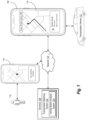
- FIG. 1 illustrates a block diagram of an environment for implementing a transportation matching system and a vehicle-motion-analysis system in accordance with one or more embodiments.
- FIG. 2 illustrates determining driving-event scores by determining parameters that align provider-device axes with transportation-vehicle axes and applying the parameters to location and motion data for a driving event in accordance with one or more embodiments.
- FIG. 3 illustrates a comparison of provider-device axes with transportation-vehicle axes in accordance with one or more embodiments.
- FIG. 4 illustrates rotation-axes parameters that align provider-device axes with transportation-vehicle axes in accordance with one or more embodiments.
- FIG. 5 illustrates determining a driving-event score for a driving event in accordance with one or more embodiments.
- FIGS. 6 A- 6 C illustrate customized graphical user interfaces for a provider device based on driving-event scores in accordance with one or more embodiments.
- FIG. 7 illustrates a customized graphical user interface for a requester device based on a driving-event score in accordance with one or more embodiments.
- FIG. 8 illustrates training a movement-machine-learning model to generate model location and motion data for a driving event in accordance with one or more embodiments.
- FIG. 9 illustrates comparing model location and motion data with observed location and motion data for a transportation vehicle to determine a driving-event score in accordance with one or more embodiments.
- FIGS. 10 - 12 illustrate accuracy metrics of transportation-vehicle-motion data determined by the vehicle-motion-analysis system in accordance with one or more embodiments.
- FIG. 14 illustrates an example flow of acts for determining a driving-event score by determining parameters that align provider-device axes with transportation-vehicle axes and applying the parameters to location and motion data for a driving event in accordance with one or more embodiments.
- FIG. 15 illustrates a block diagram of a computing device for implementing one or more embodiments of the present disclosure.
- FIG. 16 illustrates an example environment for a transportation matching system in accordance with one or more embodiments.
- This disclosure describes a vehicle-motion-analysis system that can determine driving-event scores based on driving behavior associated with a driving event.
- the vehicle-motion-analysis system can determine parameters from provider-device motion data to align axes for a provider device and a transportation vehicle to use a basis for determining driving-event scores for a driving event based on corresponding provider-device motion and location data.
- the vehicle-motion-analysis system can attribute provider-device motion data to movement of a transportation vehicle by determining axes-rotation parameters that align a provider-device frame (e.g., three-dimensional axes defining an orientation of the provider device) with a transportation-vehicle frame (e.g., three-dimensional axes defining an orientation of the transportation vehicle). Based on location and motion data of the transportation vehicle during a pickup, drop off, or other driving event, the vehicle-motion-analysis system can determine a driving-event score for the driving event performed by the transportation vehicle.
- axes-rotation parameters that align a provider-device frame (e.g., three-dimensional axes defining an orientation of the provider device) with a transportation-vehicle frame (e.g., three-dimensional axes defining an orientation of the transportation vehicle).
- the vehicle-motion-analysis system can determine a driving-event score for the driving event performed by the transportation vehicle.
- the vehicle-motion-analysis system can utilize provider-device motion data to determine transportation-vehicle motion data. Because devices can move and rotate within a vehicle, the motion data of a provider device is not always directly attributable to motion of a transportation vehicle. But the vehicle-motion-analysis system can determine whether to align provider-device axes and vehicle axes based on a position or connectivity or a provider device. Before relying on provider device motion data to determine transportation-vehicle motion data, the vehicle-motion-analysis system can determine that the provider device is secure in place (e.g., with a fixed position and orientation) within the transportation vehicle (e.g., within a device mount). In some cases, the vehicle-motion-analysis system detects either a wireless network connection between a provider device and a device mount or a closed circuit between the provider device and the device mount before generating axes-rotation parameters for aligning axes.
- the vehicle-motion-analysis system can determine a relationship between a frame of reference for a provider device and a frame of reference for a transportation vehicle. For instance, the vehicle-motion-analysis system can compare provider-device axes that define an orientation or pose of a provider device (e.g., as determined via accelerometer and gyroscope data) with transportation-vehicle axes that define an orientation or a pose of a transportation vehicle. Based on such a comparison, the vehicle-motion-analysis system can generate axes-rotation parameters for aligning the provider-device axes with the transportation-vehicle axes.
- the vehicle-motion-analysis system can determine the provider-device axes by detecting provider-device location data and motion data.
- the vehicle-motion-analysis system detects readings from provider-device components, such as an accelerometer, a gyroscope, and a GPS sensor.
- the vehicle-motion-analysis system can further determine the transportation-vehicle axes for comparing with the provider-device axes based on location data (e.g., GPS sensor readings) from the provider device.
- the vehicle-motion-analysis system can determine transportation-vehicle axes for a transportation vehicle based on changes in location over time as determined by a GPS sensor of the provider device within the transportation vehicle.
- IMUs inertial measurement units
- accelerometers accelerometers
- gyroscopes gyroscopes
- GPS sensors accessible to transportation matching systems
- the vehicle-motion-analysis system can determine transportation-vehicle axes for a transportation vehicle based on changes in location over time as determined by a GPS sensor of the provider device within the transportation vehicle.
- the vehicle-motion-analysis system can determine a three-dimensional frame or pose of a transportation vehicle based on a vertical-target acceleration, a lateral-target acceleration, and a linear-target acceleration for the transportation vehicle.
- the vehicle-motion-analysis system can utilize location data from the provider device (e.g., GPS coordinate location readings).
- the vehicle-motion-analysis system can determine a linear-target acceleration based on a change in speed over time (e.g., the derivative of speed) as indicated by GPS location data from the provider device.
- the vehicle-motion-analysis system can also determine a lateral-target acceleration associated with a transportation vehicle.
- a lateral-target acceleration can indicate centripetal movement of the transportation vehicle based on a turn rate associated with the transportation vehicle (which is based on gyroscope readings and accelerometer readings from the provider device).
- the vehicle-motion-analysis system can utilize gyroscope data associated with a transportation vehicle.
- the vehicle-motion-analysis system can receive gyroscope readings from a provider device to determine a target rotation of the transportation vehicle.
- the vehicle-motion-analysis system can also receive gyroscope data to determine a device rotation.
- the vehicle-motion-analysis system can further compare the device rotation with the target rotation as part of determining axes-rotation parameters for aligning provider-device axes with transportation-vehicle axes.
- the vehicle-motion-analysis system can compare the transportation-vehicle axes with the provider-device axes based on various accelerations.
- the vehicle-motion-analysis system can compare accelerations that are specific to particular directions (e.g., vertical, lateral, and linear) which correspond to respective axes associated with a provider device and a transportation vehicle.
- the vehicle-motion-analysis system can determine a lateral-device acceleration, a linear-device acceleration, and a vertical-device acceleration (e.g., via an accelerometer and a gyroscope on the provider device) to compare with corresponding target accelerations associated with the transportation vehicle. Additional detail regarding determining a transportation vehicle frame, determining a provider device frame, and generating a vehicle rotation matrix to align the two frames is provided below with reference to the figures.
- the vehicle-motion-analysis system Based on comparing three-dimensional acceleration data, in some embodiments, the vehicle-motion-analysis system generates axes-rotation parameters that indicate transformations to align the provider-device axes with the transportation-vehicle axes. By determining such parameters to align provider-device axes with transportation-vehicle axes, the vehicle-motion-analysis system can determine motion data and location data for a transportation vehicle performing a driving event. By applying the axes-rotation parameters to the provider-device location data and the provider-device motion data for a driving event, for instance, the vehicle-motion-analysis system can estimate transportation-vehicle-motion data and transportation-vehicle-location data for the driving event.
- the vehicle-motion-analysis system analyzes such transportation-vehicle-motion data and transportation-vehicle-location data during a driving event to identify various motion paths or patterns of the transportation vehicle that reflect safety or convenience.
- Such motions may include slight directional changes, stops, turns (e.g., angle changes), accelerations, decelerations, waypoints, u-turns, lane changes, crossing bike lanes, crossing bus lanes, and pulling up to sidewalks or other locations for pick-ups, and drop-offs (which can also vary depending on location in cities, at airports, at bus stations, or near schools).
- the vehicle-motion-analysis system can determine a driving-event score for the driving event. For example, the vehicle-motion-analysis system can compare observed behavior, such as slight directional changes, stops, and turns of a transportation vehicle, with corresponding model behavior to determine how the transportation vehicle performs a particular driving event. Additionally, the vehicle-motion-analysis system can utilize various driving-event scores to determine how safe or viable particular locations are for pick-up or drop-off and/or to determine how competent providers are in their driving ability. For example, in some embodiments, the vehicle-motion-analysis system identifies harsh stops, abrupt turns, and/or a number of stops or starts (e.g., waypoints) in quick succession as a basis for a low driving-event score. Such a low driving-event score can indicate poor driving on the part of the provider and/or can indicate a difficult or unsafe location.
- a driving-event score can indicate poor driving on the part of the provider and/or can indicate a difficult or unsafe location.
- the vehicle-motion-analysis system can utilize the driving-event scores to provide a customized graphical user interface for display on a client device.
- the vehicle-motion-analysis system can generate and provide various user interface elements that correspond to driving-event scores.
- the vehicle-motion-analysis system can determine a provider rating for a provider based on one or more driving-event scores and can provide the provider rating for display within a provider graphical user interface on a provider device.
- the vehicle-motion-analysis system provides a location-restriction element for display at a particular position within a provider graphical user interface presented on a provider device to indicate an unsafe location for a particular driving event (e.g., pick-up or drop-off) based on one or more driving-event scores. Additional detail regarding customizing various graphical user interfaces based on driving-event scores is provided below with reference to the figures.
- conventional on-demand transportation systems exhibit a number of disadvantages, especially with regard to accuracy, efficiency, and safety.
- conventional on-demand transportation information systems often inaccurately determine location and motion information (e.g., speed and direction) of transportation vehicles.
- location and motion information e.g., speed and direction
- conventional systems usually generalize or approximate high-level vehicle movement based on device movement associated with computing devices within vehicles.
- the movement of a computing device can inaccurately represent the actual motion of a vehicle, especially when it comes to slighter, more granular movements.
- users manipulate or otherwise move computing devices within a vehicle for example, conventional systems cannot accurately identify a vehicle's orientation along three-dimensional axes.
- conventional systems often can provide only a broad-level estimate of a transportation vehicle's movement but cannot use the device readings for more detailed applications due to the inconsistencies and human influence inherent in the device readings.
- some conventional systems determine pick-up locations (or drop-off locations) that are slow, cumbersome, awkward, and/or unsafe for provider vehicles to navigate. Apart from identifying locations restricted by local authorities, conventional systems rely on such inaccurate motion information to identify seemingly safe or convenient pick-up locations or drop-off locations as safe, viable options. Because such locations often prove unsafe or inconvenient, conventional systems often receive large numbers of request cancelations and repeat or redundant transportation requests that stem from the request cancelations. For example, providers often fail to navigate to pick-up locations in a safe and timely manner due to the awkward navigation of some areas-which inaccurate motion data fail to indicate. Processing such large numbers of needless cancelations and redundant requests consumes excessive computing resources.
- the disclosed vehicle-motion-analysis system provides several advantages and benefits over conventional on-demand transportation information systems. For instance, the vehicle-motion-analysis system improves the accuracy of determining motion and location for a transportation vehicle. While many conventional systems generalize or approximate vehicle movement only on a high level, the vehicle-motion-analysis system can determine much more granular motion information pertaining to a transportation vehicle. By determining axes-rotation parameters for aligning provider-device axes with transportation-vehicle axes, the vehicle-motion-analysis system can utilize telematics information from a provider device to determine more precise vehicle movement-without necessarily receiving such location or motion data directly from the transportation vehicle. For example, to determine axes-rotation parameters, the vehicle-motion-analysis system can compare target accelerations associated with a transportation vehicle with corresponding device accelerations and can also compare target rotations with device rotations.
- the vehicle-motion-analysis system improves the efficiency with which transportation matching systems determine a vehicle's motion.
- the vehicle-motion-analysis system simplifies and reduces the data upon which a system determines a vehicle's motion or location.
- some conventional systems implement algorithms that are slow to process motion information relating to transportation vehicles performing driving events (e.g., by combining errors determined for individual samples of collected motion data)
- the vehicle-motion-analysis system vectorizes the determination of provider-device axes and transportation-vehicle axes.
- the vehicle-motion-analysis system can improve the speed of pose estimation (e.g., determining provider-device axes and transportation-vehicle axes) by over 1000 times as compared to conventional brute force (i.e., non-vectorized) systems.
- the vehicle-motion-analysis system further improves efficiency by reducing the computing resources required to perform iterative or repetitive processes that slow conventional systems. For example, the vehicle-motion-analysis system reduces the number of cancelations received by conventional systems that, due to their inaccuracy in determining vehicle motion information, often result in excessive numbers of cancelations on the part of both requesters and providers. In implementations of the vehicle-motion-analysis system, researchers have measured how to reduce accidents based on the system's driving-event scoring. By reducing accidents, the vehicle-motion-analysis system also reduces cancellations, repetitive requests from requester devices, duplicative processes of detecting and coordinating locations, repeat applications of matching algorithms, transmission of transportation matches across provider devices and requested devices, and transmission of cancellation requests and notifications. Thus, the vehicle-motion-analysis system reduces the computing resources for implementing computing systems.
- one or more sensory devices associated with a provider device are integral to the vehicle-motion-analysis system.
- the vehicle-motion-analysis system relies on a GPS receiver, an accelerometer, and a gyroscope associated with a provider device to determine location and motion information relative to both the provider device itself as well as a transportation vehicle.
- the vehicle-motion-analysis system further relies on these sensory devices to generate axes-rotation parameters.
- provider-device axes refers to a set of axes along which a provider computing device can accelerate, move, or orient.
- provider-device axes may include three-dimensional axes (e.g., an x-axis, a y-axis, and a z-axis) that define a pose or a frame of reference for a provider device.
- the vehicle-motion-analysis system can determine provider-device axes based on location data and/or motion data associated with a provider device.
- provider-device axes can include axes along which a provider device accelerates, such as a lateral-device acceleration (quantifying sideways or centripetal acceleration of the provider device), a linear-device acceleration (quantifying forward-backward acceleration of the provider device), and a vertical-device acceleration (quantifying an up-down gravitational acceleration of the provider device).
- the vehicle-motion-analysis system determines the device accelerations based on receiving “motion data” (or variants such as “motion dataset”). Such motion data indicates movement of a provider device or a transportation vehicle.
- motion data includes readings or data from an IMU, an accelerometer, and/or a gyroscope.
- transportation-vehicle axes refers to a set of axes along which a transportation vehicle can accelerate, move, or orient.
- transportation-vehicle axes may include three-dimensional axes (e.g., an x-axis, a y-axis, and a z-axis) that define a pose or a frame of reference for a transportation vehicle.
- the vehicle-motion-analysis system can determine transportation-vehicle axes by extrapolating motion information for the transportation vehicle from motion data and/or “location data” (or variants such as “location dataset”).
- transportation-vehicle axes can include axes along which a transportation vehicle accelerates or is estimated to accelerate, such as a lateral-target acceleration (e.g., quantifying sideways or centripetal acceleration of the transportation vehicle), a linear-target acceleration (e.g., quantifying forward-backward acceleration of the transportation vehicle), and a vertical-target acceleration (e.g., quantifying an up-down gravitational acceleration of the transportation vehicle).
- a lateral-target acceleration e.g., quantifying sideways or centripetal acceleration of the transportation vehicle
- linear-target acceleration e.g., quantifying forward-backward acceleration of the transportation vehicle
- vertical-target acceleration e.g., quantifying an up-down gravitational acceleration of the transportation vehicle.
- the vehicle-motion-analysis system determines one or more transportation vehicle accelerations based on receiving provider-device location data, such as GPS coordinate locations, attributing the provider-device GPS location data to the location of the transportation vehicle, and determining accelerations based on changes in a vehicle location over time.
- provider-device location data such as GPS coordinate locations
- attributing the provider-device GPS location data to the location of the transportation vehicle and determining accelerations based on changes in a vehicle location over time.
- the vehicle-motion-analysis system can generate axes-rotation parameters to align provider-device axes with transportation-vehicle axes (or vice-versa).
- axes-rotation parameters refers to one or more parameters that indicate how to alter or modify one set of axes to align with another set of axes.
- the axes-rotation parameters can indicate relationships between corresponding axes (two different x-coordinate axes, two different y-coordinate axes, and two different z-coordinate axes).
- axes-rotation parameters can include a rotation matrix or a transformation matrix that indicates what transformations or other modifications to make to a first set of axes (e.g., the provider-device axes) to align it with a second set of axes (e.g., the transportation-vehicle axes).
- the vehicle-motion-analysis system can determine the axes-rotation parameters by comparing provider-device accelerations (e.g., a vertical-device acceleration, a linear-device acceleration, and a lateral-device acceleration) with target accelerations associated with a transportation vehicle. (e.g., a vertical-target acceleration, a linear-target acceleration, and a lateral-target acceleration).
- the vehicle-motion-analysis system can identify particular motion paths, motion patterns, or other driving behaviors, such as stops, turns, drop-offs, and/or pick-ups that the vehicle-motion-analysis system can use as a basis for generating a driving-event score.
- the vehicle-motion-analysis system only determines motion data for transportation vehicles during driving events (e.g., between a start time/location and an end time/location) and overwrites or deletes the motion data afterward.
- a transportation provider refers to a driver or other person who operates a transportation vehicle and/or who interacts with a provider device, on the one hand, or an autonomous vehicle, on the other hand.
- a transportation provider includes a person who drives a transportation vehicle along various transportation routes—or an autonomous vehicle that drives along such transportation routes—to pick up and drop off requesters.
- the term “transportation requester” refers to a person who submits (or is projected to submit) a transportation request to a transportation matching system and/or who interacts with a requester device.
- a transportation requester includes a person who interacts with a requester device to send a transportation request to a transportation matching system.
- the requester can await pickup by the provider at a predetermined pick-up location.
- the requester can engage with the provider by getting into a transportation vehicle associated with the provider for transport to a destination specified in the requester's transportation request.
- a requester may refer to (i) a person who requests a ride or other form of transportation but who is still waiting for pick-up or (ii) a person whom a transportation vehicle has picked up and who is currently riding within the transportation vehicle to a destination.
- FIG. 1 illustrates a block diagram of a system environment for implementing a vehicle-motion-analysis system 104 in accordance with one or more embodiments.
- the environment includes server(s) 106 housing the vehicle-motion-analysis system 104 as part of a transportation matching system 102 .
- the environment of FIG. 1 further includes a provider device 108 , a requester device 116 associated with a requester 118 , a transportation vehicle 112 associated with the provider device 108 , and a network 114 .
- the server(s) 106 can include one or more computing devices to implement the vehicle-motion-analysis system 104 .
- the provider device 108 may comprise any computing device as described in FIGS. 15 - 16 . Additional description regarding the illustrated computing devices (e.g., the server(s) 106 and/or the provider device 108 ) is provided with respect to FIGS. 15 - 16 below.
- the vehicle-motion-analysis system 104 utilizes the network 114 to communicate with the provider device 108 .
- the vehicle-motion-analysis system 104 communicates with the provider device 108 to match transportation requests received from the requester device 116 with the provider device 108 .
- the vehicle-motion-analysis system 104 can receive a transportation request from the requester device 116 and can provide request information to the provider device 108 , such as a requested pick-up location, a requester identification (for the requester 118 ), and a requested pick-up time.
- the vehicle-motion-analysis system 104 receives device information from the provider device 108 such as location coordinates (e.g., latitude, longitude, and/or elevation) and status (currently riding, not riding, available, or unavailable) for matching requests.
- location coordinates e.g., latitude, longitude, and/or elevation
- status currently riding, not riding, available, or unavailable
- the vehicle-motion-analysis system 104 communicates with the provider device 108 (e.g., through a provider application 110 ). As indicated by FIG. 1 , the provider device 108 includes the provider application 110 . In many embodiments, the vehicle-motion-analysis system 104 communicates with the provider device 108 through the provider application 110 to, for example, receive and provide information including location data, motion data, and transportation request information (e.g., pick-up locations and/or drop-off locations).
- location data e.g., motion data, and transportation request information
- the vehicle-motion-analysis system 104 can provide (or cause the provider device 108 to render) visual indicators within a graphical user interface associated with the provider application 110 .
- the vehicle-motion-analysis system 104 selects a provider associated with the provider device 108 to service a transportation request received from the requester device 116 based on various factors. Such factors may include a location associated with the transportation request, a provider-device location, locations of other provider devices, provider incentives, requester incentives, a time of day, traffic information, and/or other transportation-matching considerations.
- the vehicle-motion-analysis system 104 Based on selecting a provider associated with the provider device 108 to service the transportation request (and, in some cases, based on the provider device 108 accepting the request), the vehicle-motion-analysis system 104 provides a visual indicator for the transportation request (including a pick-up location and a route to the pick-up location) for display within a user interface on the provider device 108 (e.g., as part of the provider application 110 ). Further, in some embodiments, the vehicle-motion-analysis system 104 provides other user interface elements within graphical user interfaces of the provider application 110 (such as a driver score element) based on determining driving-event scores associated with the provider device 108 and/or various locations.
- FIG. 1 illustrates the environment having a particular number and arrangement of components associated with the vehicle-motion-analysis system 104
- the environment may include more or fewer components with varying configurations.
- the vehicle-motion-analysis system 104 can communicate directly with the provider device 108 , bypassing the network 114 .
- the vehicle-motion-analysis system 104 can be housed (entirely on in part) on the provider device 108 .
- the vehicle-motion-analysis system 104 can include or communicate with a database for storing information, such as provider-device location information, provider-device motion information, request information, and/or other information described herein.
- the vehicle-motion-analysis system 104 can provide a customized graphical user interface to a client device based on generating a driving-event score for a driving event.
- the vehicle-motion-analysis system 104 can determine a driving-event score based on rotation-axes parameters for aligning provider-device axes with transportation vehicle-axes and location and motion information for a driving event.
- FIG. 2 illustrates a sequence of acts 202 - 218 that the vehicle-motion-analysis system 104 performs to provide a customized graphical user interface based on aligning provider-device axes with transportation-vehicle axes to determine a driving-event score in accordance with one or more embodiments.
- the vehicle-motion-analysis system 104 performs an act 202 to determine that provider-device motion is translatable to vehicle motion. Particularly, the vehicle-motion-analysis system 104 determines that the motion data received from various components (e.g., an IMU, an accelerometer, and/or a gyroscope) of the provider device 108 is trustworthy and reliable to represent motion of the transportation vehicle 112 . For example, the vehicle-motion-analysis system 104 determines that the frame of the provider device 108 is secure or fixed—e.g., that the provider device 108 is secure in place and/or orientation relative to (e.g., within) the transportation vehicle 112 . In addition (or alternatively), the vehicle-motion-analysis system 104 determines that the provider device 108 is not being manipulated or otherwise hand-held by a provider.
- various components e.g., an IMU, an accelerometer, and/or a gyroscope
- the vehicle-motion-analysis system 104 detects that the provider device 108 is attached to a mount 203 affixed to the transportation vehicle 112 .
- the vehicle-motion-analysis system 104 communicates with a mount (or carriage) that has a sensor 203 b (e.g., touch sensor, a pressure sensor, or a photo sensor).
- a sensor 203 b e.g., touch sensor, a pressure sensor, or a photo sensor.
- the mount sensor indicates (or provides a signal that causes the provider device 108 to indicate) that the provider device 108 is attached (e.g., by indicating a closed circuit between the provider device 108 and the device mount), and the vehicle-motion-analysis system 104 receives a signal from the mount 203 indicating that the provider device 108 is attached to the mount 203 .
- the mount 203 includes one or more indicator lights 203 a that is one color when the provider device 108 is attached and a different color (or not lit) when the provider device 108 is not attached.
- the mount 203 includes a word indicator 203 c that flashes, lights up, or otherwise prominently appears to prompt or otherwise indicate to the provider to attach the provider device 108 to the mount 203 .
- the vehicle-motion-analysis system 104 detects a wireless network communication between the provider device 108 and the device mount.
- the vehicle-motion-analysis system 104 utilizes a mount with a WiFi and/or a Bluetooth transceiver that can indicate via proximity (e.g., signal strength) and/or wireless network positioning techniques that the provider device 108 is fixed to the mount 203 . If the vehicle-motion-analysis system 104 determines that the provider device 108 is not attached to the mount 203 (e.g., based on not detecting a signal from the provider device 108 or the mount 203 ), the vehicle-motion-analysis system 104 determines that the provider-device motion data is not translatable to transportation-vehicle motion.
- the vehicle-motion-analysis system 104 determines that the provider device 108 is secure or fixed in frame relative to the transportation vehicle 112 using a different technique.
- the vehicle-motion-analysis system 104 monitors motion data (e.g., accelerometer data and/or gyroscope data) from the provider device 108 to determine that the provider device 108 is fixed or secure.
- the vehicle-motion-analysis system 104 utilizes an algorithm (in addition to or alternatively to an algorithm for determining whether the provider device 108 is fixed to the mount 203 ) to determine or detect hand-held motion of the provider device 108 .
- the vehicle-motion-analysis system 104 compares the movement of the provider device 108 with movement that would be expected (or modeled) for a device being manipulated in the hand of a user. For example, the vehicle-motion-analysis system 104 uses accelerometer data and/or a gyroscope data from the provider device 108 to classify periods of time as hand-held events. The vehicle-motion-analysis system 104 treats that task as a binary classification problem based on time series data.
- the vehicle-motion-analysis system 104 trains a machine learning model on hand-held motion of devices (e.g., accelerometer data and/or gyroscope data for a period of time that is classified as hand-held motion event) and applies the trained machine learning model to provider-device motion data for a driving event to predict/classify the driving event as hand-held or not hand-held.
- the vehicle-motion-analysis system 104 trains a machine learning model, such as an acceleration threshold model or a neural network (e.g., a convolutional neural network or a recursive neural network) based on one or more datasets of labeled data (e.g., frames of motion data labeled as hand-held or non-hand-held).
- the vehicle-motion-analysis system 104 trains the machine learning model on datasets, such as Cambridge Mobile Telematics (“CMT”) hand-held events, CMT harsh corner events, and/or Fleetcam-derived hand-held events.
- CMT Cambridge Mobile Telematics
- the vehicle-motion-analysis system 104 identifies a particular period or duration of time for a driving event (e.g., between a start time and an end time of the event) and classifies the event as a hand-held event or a non-hand-held event based on the motion data for the duration of time.
- the vehicle-motion-analysis system 104 utilizes a neural network to evaluate individual frames of a signal (e.g., a 25 Hz signal of provider-device motion data) to classify the frames as hand-held or not.
- the vehicle-motion-analysis system 104 utilizes a neural network to evaluate the driving event as a whole (e.g., a continuous set of frames of provider-device motion data).
- the vehicle-motion-analysis system 104 utilizes another type of machine learning model (e.g., an acceleration threshold model) to evaluate the driving event as a whole.
- the vehicle-motion-analysis system 104 determines that the provider-device motion is not translatable to vehicle motion. For example, if the vehicle-motion-analysis system 104 applies a neural network and classifies the event as hand-held, the vehicle-motion-analysis system 104 determines that the provider-device motion data is not translatable to vehicle-motion data. Conversely, if the vehicle-motion-analysis system 104 applies a neural network and classifies the event as non-hand-held, then the vehicle-motion-analysis system 104 determines that the provider-device motion data is translatable to vehicle-motion data.
- the vehicle-motion-analysis system 104 determines that the provider device 108 does not move linearly, laterally, or vertically relative to a transportation vehicle, and/or determines that the provider device 108 does not rotate in any direction relative to the transportation vehicle. In some such embodiments, to determine that the provider device 108 is fixed, the vehicle-motion-analysis system 104 determines that the provider device 108 does not move or rotate for at least a threshold period of time. For instance, the provider device 108 may not necessarily be fixed in the mount 203 but may nevertheless be fixed relative to the transportation vehicle 112 (e.g., in a cupholder, on a car seat, or resting on a phone tray).
- the vehicle-motion-analysis system 104 determines that the provider-device motion data is not translatable to motion of the transportation vehicle 112 .
- the vehicle-motion-analysis system 104 determines that the provider-device motion data is translatable to motion of the transportation vehicle 112 .
- the vehicle-motion-analysis system 104 further performs an act 204 to determine a location dataset and a motion dataset corresponding to provider-device axes. For instance, the vehicle-motion-analysis system 104 determines provider-device axes based on receiving acceleration information from an accelerometer and rotation information from a gyroscope.
- the vehicle-motion-analysis system 104 determines a linear-device acceleration, a lateral-device acceleration, and a vertical-device acceleration for the provider device 108 .
- the vehicle-motion-analysis system 104 also determines a device rotation (e.g., around a vertical axis).
- the vehicle-motion-analysis system 104 gathers and determines various location data and motion data described herein only in accordance with privacy considerations, regulations, and device settings.
- the vehicle-motion-analysis system 104 also enables providers associated with provider accounts to opt out of services which would require the determinations of such data. Further, the vehicle-motion-analysis system 104 deletes the location data and motion data regularly and/or immediately upon utilizing it to determine driving-event scores as described herein.
- the vehicle-motion-analysis system 104 further performs an act 206 to determine location data and motion data for transportation-vehicle axes.
- the vehicle-motion-analysis system 104 determines GPS coordinate location data from a provider device 108 to indicate coordinate data for the transportation vehicle 112 . Based on the provider-device location data, the vehicle-motion-analysis system 104 further determines or extrapolates target motion information for the transportation vehicle 112 . For example, based on detecting changes in location over time, the vehicle-motion-analysis system 104 calculates a linear-target acceleration for the transportation vehicle 112 .
- the vehicle-motion-analysis system 104 further determines a lateral-target acceleration and a vertical-target acceleration associated with the transportation vehicle 112 .
- the vehicle-motion-analysis system 104 utilizes gyroscope data from the provider device 108 to determine a lateral-target acceleration associated with the transportation vehicle 112 .
- the vehicle-motion-analysis system 104 determines a turn rate for the transportation vehicle 112 based on gyroscope data.
- the vehicle-motion-analysis system 104 utilizes gravity data from the provider device 108 to determine a vertical-target acceleration associated with the transportation vehicle 112 .
- the vehicle-motion-analysis system 104 utilizes the target accelerations of the transportation vehicle 112 as a baseline or a target dataset to compare with the provider-device motion dataset. Additional detail regarding determining the various target vehicle accelerations is provided below with reference to subsequent figures.
- the vehicle-motion-analysis system 104 performs an act 208 to compare datasets for provider-device axes and transportation-vehicle axes. Indeed, the vehicle-motion-analysis system 104 compares the provider-device motion data that corresponds to the provider-device axes with target motion data that corresponds to the transportation-vehicle axes. For example, the vehicle-motion-analysis system 104 compares the linear-device acceleration with the linear-target acceleration, compares the lateral-device acceleration with the lateral-target acceleration, and compares the vertical-device acceleration with the vertical-target acceleration. Based on the comparison, the vehicle-motion-analysis system 104 determines relationships (e.g., differences) between the provider-device axes and the transportation-vehicle axes that the vehicle-motion-analysis system 104 .
- relationships e.g., differences
- the vehicle-motion-analysis system 104 performs an act 210 to generate axes-rotation parameters. More particularly, the vehicle-motion-analysis system 104 generates axes-rotation parameters for aligning the provider-device axes with the transportation-vehicle axes. For example, the vehicle-motion-analysis system 104 utilizes the relationships from the comparison of the act 208 to determine a target rotation of the transportation vehicle 112 (e.g., around a vertical axis) and a device rotation of the provider device 108 based on gyroscope data and/or other motion data.
- a target rotation of the transportation vehicle 112 e.g., around a vertical axis
- device rotation of the provider device 108 based on gyroscope data and/or other motion data.
- the vehicle-motion-analysis system 104 determines other transformations to align the provider-device axes with the transportation-vehicle axes as well. In some embodiments, the vehicle-motion-analysis system 104 generates axes-rotation parameters in the form of a rotation matrix based on differences between the various provider-device accelerations and the target accelerations associated with the transportation vehicle 112 as well as the differences between the device rotation of the provider device 108 and the target rotation of the transportation vehicle 112 . Additional detail regarding determining the axes-rotation parameters is provided below with reference to subsequent figures.
- the vehicle-motion-analysis system 104 further performs an act 212 to identify a driving event associated with the transportation vehicle 112 .
- the vehicle-motion-analysis system 104 detects an event indicator for the driving event.
- the vehicle-motion-analysis system 104 may receive a pick-up indicator or a drop-off indicator from the provider device 108 (indicating a pick up or drop off of a requester) and identify a window of time or locations before and after a corresponding pickup or drop-off time or a pickup or drop-off location.
- the vehicle-motion-analysis system 104 detects a start indicator that corresponds to a start time when the vehicle-motion-analysis system 104 detects the start indicator. Additionally, the vehicle-motion-analysis system 104 detects an end indicator that corresponds to an end time at which the driving event terminates.
- the vehicle-motion-analysis system 104 detects a start indicator for a transportation event by receiving a pick-up indicator from the provider device 108 to indicate that the transportation vehicle 112 has begun to service a transportation request (e.g., by indicating that a requester associated with a transportation request has been picked up).
- the vehicle-motion-analysis system 104 detects a start indicator using other techniques in addition (or alternatively) to those just described above. For example, the vehicle-motion-analysis system 104 detects a start indicator for a pick-up event or a drop-off event by detecting a change of direction (e.g., a turn) associated with the transportation vehicle 112 (or the provider device 108 ) that exceeds a threshold angle. For example, the vehicle-motion-analysis system 104 determines transportation-vehicle location data and transportation-vehicle motion data by applying the axes-rotation parameters to the provider-device location data and the provider-device motion data.
- a change of direction e.g., a turn
- the vehicle-motion-analysis system 104 Based on the transportation-vehicle location data and the transportation-vehicle motion data, the vehicle-motion-analysis system 104 identifies a change of direction, a change of location, a change of rotation, and/or a change of speed that indicate a driving event.
- the vehicle-motion-analysis system 104 detects a door close within a threshold distance of a pick-up location (e.g., by receiving an indication of gyroscopic wobble or roll detected from the provider device 108 ) in conjunction with a pick-up indicator to determine that service has begun for a transportation request (e.g., that a requester has been picked up).
- the vehicle-motion-analysis system 104 also detects an end indicator for a driving event.
- the vehicle-motion-analysis system 104 detects an end indicator for a pick-up event by receiving a pick-up indication from the provider device 108 and/or by detecting a door close within a threshold distance of a pick-up location.
- the end of a pick-up event is not when the requester is picked up but rather once the transportation vehicle 112 reenters normal traffic flow after picking up the requester.
- vehicle-motion-analysis system 104 detects an end indicator by determining, after receiving a pick-up indication and/or after detecting a door close, that the transportation vehicle 112 (or the provider device 108 ) has traveled at least a threshold distance away from the pick-up location.
- the vehicle-motion-analysis system 104 detects an end indicator for a transportation event by determining that a drop-off event has started (e.g., by detecting a start indicator for a drop-off event). In some embodiments, however, the vehicle-motion-analysis system 104 detects an end indicator for a transportation event by receiving a drop-off indication from the provider device 108 (indicating that service has been completed and the requester has been dropped off) and/or by detecting a door close within a threshold distance of a drop-off location.
- the vehicle-motion-analysis system 104 detects an end indicator for a drop-off event by receiving a drop-off indication from the provider device 108 (indicating that service has been completed and the requester has been dropped off) and/or by detecting a door close within a threshold distance of a drop-off location.
- the drop-off event does not end when the requester is dropped off but rather when the transportation vehicle 112 reenters normal traffic flow after dropping off the requester.
- the vehicle-motion-analysis system 104 detects an end indicator for a drop-off event by determining, after receiving a drop-off indication and/or detecting a door close at a drop-off location, that the transportation vehicle 112 (or the provider device 108 ) has traveled at least a threshold distance away from the drop-off location.
- the vehicle-motion-analysis system 104 performs an act 214 to determine behavior for the driving event.
- the vehicle-motion-analysis system 104 identifies a motion path, a motion pattern, or other driving behavior of a transportation vehicle that occurs at particular locations during a driving event.
- the vehicle-motion-analysis system 104 identifies a set of location coordinates corresponding to one or more event indicators (e.g., a pickup indicator, a drop-off indicator, or a start time and an end time) of a driving event and further determines various behaviors corresponding to the location coordinates.
- event indicators e.g., a pickup indicator, a drop-off indicator, or a start time and an end time
- Example behaviors include motion paths or patterns indicating turns, stops, accelerations, decelerations, u-turns, drop-offs, and pick-ups.
- the vehicle-motion-analysis system 104 monitors provider-device motion data and location data to determine changes in direction and/or speed which can indicate stops and turns. Additional detail regarding how the vehicle-motion-analysis system 104 determines or identifies various behaviors is provided below with reference to subsequent figures.
- the vehicle-motion-analysis system 104 further performs an act 216 to generate a driving-event score for the driving event. More particularly, the vehicle-motion-analysis system 104 scores or rates individual behaviors such as stops and turns. For example, based on the provider-device motion data and location data received during a driving event, the vehicle-motion-analysis system 104 determines how long the transportation vehicle 112 is stopped at a particular stop, where the transportation vehicle 112 stops or turns, how many times the transportation vehicle 112 stops or turns, and/or how harsh each stop or turn is.
- the vehicle-motion-analysis system 104 determines a driving-event score for the driving event. For example, the vehicle-motion-analysis system 104 determines a composite score for the various behaviors that occur during the driving event. Specifically, the vehicle-motion-analysis system 104 combines the individual behavior scores to determine an average score across the driving event to utilize as the driving-event score. In one or more embodiments, the vehicle-motion-analysis system 104 determines a driving-event score on a scale (e.g. from 1 to 10 or 1 to 100) or by labeling a driving event as poor, average, or good based on scores of constituent behaviors.
- a scale e.g. from 1 to 10 or 1 to 100
- the vehicle-motion-analysis system 104 compares stops and turns associated with the transportation vehicle 112 with corresponding model stops and model turns. Indeed, the vehicle-motion-analysis system 104 determines model behaviors (e.g., model stops and model turns) for driving events based on historical location data associated with various provider devices and transportation vehicles of the transportation matching system 102 .
- model behaviors e.g., model stops and model turns
- the vehicle-motion-analysis system 104 can train a movement-machine-learning model (e.g., a neural network such as a deep neural network or a convolutional neural network) to generate model behavior data (e.g., model location data and model motion data) based on input locations and driving-event types (e.g., pick-up versus drop-off versus transportation) as well as ground truth model behavior data.
- a movement-machine-learning model e.g., a neural network such as a deep neural network or a convolutional neural network
- model behavior data e.g., model location data and model motion data
- driving-event types e.g., pick-up versus drop-off versus transportation
- ground truth model behavior data e.g., pick-up versus drop-off versus transportation
- the vehicle-motion-analysis system 104 can utilize the model behavior data to compare with transportation-vehicle location data and motion data to determine driving-event scores based on how close the transportation-vehi
- the vehicle-motion-analysis system 104 further generates a provider rating and/or a location rating. In particular, the vehicle-motion-analysis system 104 determines a provider rating to indicate a driving performance of the provider for the driving event. In some embodiments, the vehicle-motion-analysis system 104 utilizes the driving-event score as the provider rating. Over time, the vehicle-motion-analysis system 104 monitors provider ratings associated with the provider account (or the provider device 108 ) to determine an average provider rating that reflects a provider's driving ability or driving safety (e.g., overall or with respect to particular types of driving events).
- a provider that frequently has harsh stops, harsh accelerations, abrupt turns, performs out-of-the-ordinary maneuvers (e.g., reversing against traffic flow), and/or stops an excessive number of times to perform driving events may have a low provider rating.
- a provider that exhibits smooth turns, gentle stops, and an appropriate number (e.g., below a threshold number) of stops may have a high provider rating.
- the vehicle-motion-analysis system 104 determines a location rating based on a driving-event score.
- the vehicle-motion-analysis system 104 can determine a location rating that indicates a measure of safety or viability associated with a particular location (e.g., a pick-up location or a drop-off location).
- the vehicle-motion-analysis system 104 determines, for a location, a location rating specific to a particular type of driving event (e.g., based on driving-event scores associated with driving events of the same type), or the vehicle-motion-analysis system 104 determines an overall location rating across all driving events.
- the vehicle-motion-analysis system 104 determines low location ratings for locations where transportation vehicles frequently make an excessive number of stops, perform out-of-the-ordinary maneuvers, make harsh stops, harsh accelerations, or abrupt turns. Similarly, the vehicle-motion-analysis system 104 can determine low location ratings for locations where transportation vehicles frequently have accidents. Over time, the vehicle-motion-analysis system 104 monitors location ratings for driving events that occur at particular locations. In one or more embodiments, the vehicle-motion-analysis system 104 determines a combined location rating by averaging location ratings (e.g., specific to a particular driving-event type or for all driving events at the location). If a location rating dips below a threshold location rating, the vehicle-motion-analysis system 104 determines that the location is unsafe or not viable for a particular type of driving event (or for all driving events).
- averaging location ratings e.g., specific to a particular driving-event type or for all driving events at the location.
- the vehicle-motion-analysis system 104 provides a location-restriction element that indicates a location that is unavailable to use for a particular driving event (e.g., pick-up or drop-off) based on its locating rating. Additional detail regarding providing a customized graphical user interface is provided below with reference to subsequent figures.
- each axis of the provider device 108 and the transportation vehicle 112 has a positive portion (represented by a solid-line arrow) and a negative portion (represented by a dashed-line arrow) that extend in opposite directions. While FIG. 3 depicts the dashed and solid portions in a particular manner, other configurations are also possible.
- each of the axes that make up the provider-device axes 302 represent axes for various accelerations associated with the provider device 108 .
- the vertical-device axis 308 (extending vertically through the top and bottom of the provider device 108 ) represents an axis for vertical-device acceleration.
- linear-device axis 309 (extending perpendicular outward from the device display and in the opposite direction out of the back of the provider device 108 ) represents an axis for linear-device acceleration.
- lateral-device axis 310 (extending perpendicular from each lateral side of the provider device 108 ) represents an axis for lateral-device acceleration.
- the transportation-vehicle axes 304 represent axes for accelerations associated with the transportation vehicle 112 .
- the vertical vehicle axis 307 (extending vertically up and down through the transportation vehicle 112 ) represents an axis for vertical-target acceleration associated with the transportation vehicle 112 .
- the linear vehicle axis 305 (extending outwards in front and behind the transportation vehicle 112 ) represents an axis for linear-target acceleration associated with the transportation vehicle 112 .
- the lateral vehicle axis 306 (extending laterally from either side of the transportation vehicle 112 ) represents an axis for lateral-target acceleration associated with the transportation vehicle 112 .
- the vehicle-motion-analysis system 104 receives (or requests or accesses) provider-device GPS data including measurements of latitude, longitude, speed (change in distance over time), and bearing associated with the provider device 108 at a frequency of 1 Hz.
- the vehicle-motion-analysis system 104 receives (or requests or accesses) provider-device accelerometer data such as accelerations in x, y, and z directions at a frequency of 25 Hz.
- the vehicle-motion-analysis system 104 receives (or requests or accesses) provider-device gyroscope data in the form of gyroscopic rotational movement in the x, y, and z directions at a frequency of 25 Hz.
- the vehicle-motion-analysis system 104 receives (or requests or accesses) provider-device gravity data in the x, y, and z directions at a frequency of 25 Hz. In some embodiments, the vehicle-motion-analysis system 104 receives or determines various location and/or motion data at frequencies (e.g., 15 Hz) other than those shown in the table.
- the vehicle-motion-analysis system 104 utilizes provider-device location data and provider-device motion data.
- the vehicle-motion-analysis system 104 extrapolates or calculates target location data and target motion data based on provider-device location data and provider-device motion data.
- the vehicle-motion-analysis system 104 utilizes GPS speed data in accordance with:
- the vehicle-motion-analysis system 104 utilizes gyroscope motion data and gravitational motion data (obtained via a filter applied to accelerometer data) from the provider device 108 . Particularly, the vehicle-motion-analysis system 104 determines a lateral-target acceleration based on a turn rate of the transportation vehicle 112 . In some embodiments, the vehicle-motion-analysis system 104 derives a turn rate associated with the transportation vehicle 112 based on gyroscope data and gravity data in accordance with:
- TurnRate gyro ⁇ gravitiy ⁇ gravity ⁇
- gyro represents gyroscope motion data
- gravity represents gravity data (from the table above)
- TurnRate represents the transportation-vehicle turn rate.
- the vehicle-motion-analysis system 104 determines TurnRate assuming the ground is flat or relatively flat (e.g., that the transportation vehicle 112 is not facing up, down, or sideways on a slope).
- the gravity data is expressed in gravitational acceleration.
- the vehicle-motion-analysis system 104 further determines the lateral-target acceleration of the transportation vehicle 112 .
- the vehicle-motion-analysis system 104 determines a vertical-target acceleration associated with the transportation vehicle 112 .
- the vehicle-motion-analysis system 104 assumes that the transportation vehicle 112 is traveling on a flat surface or relatively flat surface, so the vertical-target acceleration is the acceleration of gravity (e.g., ⁇ 9.81 m/s 2 ).
- the provider-device axes 302 are different from (e.g., not aligned with) the transportation-vehicle axes 304 .
- the pose of the provider device 108 does not align with the pose of the transportation vehicle 112 because their acceleration data and gyroscopic data are not the same.
- the vertical-device axis 308 does not align with the vertical vehicle axis 307 .
- the linear-device axis 309 does not align with the linear vehicle axis 305 .
- the lateral-device axis 310 does not align with the lateral vehicle axis 306 .
- the vehicle-motion-analysis system 104 can determine that provider-device location data and provider-device motion data is translatable to motion of the transportation vehicle 112 . Based on this determination, the vehicle-motion-analysis system 104 can align the provider-device axes 302 with the transportation-vehicle axes 304 . Additionally, the vehicle-motion-analysis system 104 can then use provider-device motion data and location data to determine transportation-vehicle motion data and location data. In particular, the vehicle-motion-analysis system 104 can generate or determine axes-rotation parameters to align the provider-device axes 302 with the transportation-vehicle axes 304 . FIG. 4 illustrates utilizing axes-rotation parameters 402 such as a rotation matrix to align the provider-device axes with the transportation-vehicle axes 304 in accordance with one or more embodiments.
- the vehicle-motion-analysis system 104 applies axes-rotation parameters 402 to align the provider-device axes 302 of the provider device 108 with the transportation-vehicle axes 304 of the transportation vehicle 112 (or vice-versa). More specifically, the vehicle-motion-analysis system 104 determines how to rotate the provider device 108 about each of the provider-device axes 302 to align with the transportation vehicle axes 304 . For example, the vehicle-motion-analysis system 104 determines one or more relative angles between the provider-device axes 302 and transportation-vehicle axes 304 to align one or more such axes.
- the vehicle-motion-analysis system 104 determines a relative angle ⁇ indicating a degree to which the provider device 108 rotates about a linear axis (e.g., the linear-device axis 309 ). In addition, the vehicle-motion-analysis system 104 determines a relative angle ⁇ indicating a degree to which the provider device 108 rotates about a lateral axis (e.g., the lateral-device axis 310 ). Further, the vehicle-motion-analysis system 104 determines a relative angle ⁇ indicating a degree to which the provider device 108 rotates about a vertical axis (e.g., the vertical-device axis 308 ).
- the vehicle-motion-analysis system 104 compares the provider-device axes 302 with the transportation-vehicle axes 304 . By comparing such axes, the vehicle-motion-analysis system 104 determines relationships between corresponding axes such as angles between vertical axes, linear axes, and lateral axes. For example, the vehicle-motion-analysis system 104 determines which provider-device axes 302 align with which transportation-vehicle axes 304 through the comparison.
- the vehicle-motion-analysis system 104 solves the optimization problem based on an assumption that the transportation vehicle 112 is moving on a flat surface or relatively flat surface. In some embodiments, however, the vehicle-motion-analysis system 104 accounts for variations in pitch and roll that occur as the transportation vehicle 112 travels over non-flat surface, such as hills and slopes. Indeed, as the transportation vehicle 112 travels up a hill, for example, the vehicle-motion-analysis system 104 accommodates the corresponding change in the transportation-vehicle axes 304 by adjusting the provider-device axes 302 accordingly. To account for such variations in pitch and roll, the vehicle-motion-analysis system 104 utilizes a different definition for Gyro target than the one provided below. For example, the vehicle-motion-analysis system 104 does not fix the x and y values to 0, but instead determines the values based on sensory readings from a gyroscope on the provider device 108 .
- the vehicle-motion-analysis system 104 implements an optimization function to minimize a difference between provider-device motion data (e.g., acceleration data and gyroscope data received from the provider device 108 ) and target motion data (e.g., target acceleration data and target gyroscope data determined as described above).
- provider-device motion data e.g., acceleration data and gyroscope data received from the provider device 108
- target motion data e.g., target acceleration data and target gyroscope data determined as described above.
- the vehicle-motion-analysis system 104 compares the provider-device motion data with the target motion data at different orientations (e.g., over a variety of possible quaternions) to discover or identify an orientation where the provider-device axes 302 and the transportation-vehicle axes 304 align. Additionally, the vehicle-motion-analysis system 104 utilizes the optimization function to minimize the difference. For example, the vehicle-motion-analysis system 104 utilizes an optimization function of the form:
- accel provider device,i acceleration data for the provider device 108 at an i th orientation of N possible orientations
- accel target,i represents target acceleration data for the transportation vehicle 112 at the i th orientation
- gyro provider device,i represents gyroscope data for the provider device 108 at the i th orientation
- gyro target,i represents target gyroscope data for the transportation vehicle 112 at the i th orientation
- R represents the axes-rotation parameters 402 .
- the vehicle-motion-analysis system 104 applies a relative gyroscope weight to balance errors associated with the optimization function.
- the vehicle-motion-analysis system 104 utilizes a weighted optimization function as follows:
- the optimization function is non-convex as R has to be a valid rotation matrix.
- the vehicle-motion-analysis system 104 vectorizes the optimization function to improve efficiency. Indeed, as described above, conventional non-vectorized systems are slow to process motion data. By vectorizing the optimization function, the vehicle-motion-analysis system 104 improves the speed of generating the axes-rotation parameters 402 by over 1000 times. For instance, the vehicle-motion-analysis system 104 vectorizes the optimization function to form a provider-device acceleration vector (or matrix) and a provider-device gyroscope vector (or matrix) of the forms:
- Accel pro ⁇ viderdevice [ Accel providerdevice , x , 0 , ... , Accel providerdevice , x , N - 1 Accel providerdevice , x , 0 , ... , Accel providerdevice , x , N - 1 Accel providerdevice , x , 0 , ... , Accel providerdevice , x , N - 1 ] and
- Gyro pro ⁇ viderdevice [ Gyro providerdevice , x , 0 , ... , Gyro providerdevice , x , N - 1 Gyro providerdevice , x , 0 , ... , Gyro providerdevice , x , N - 1 Gyro providerdevice , x , 0 , ... , Gyro providerdevice , x , N - 1 ] .
- the vehicle-motion-analysis system 104 further generates target vectors or matrices.
- the vehicle-motion-analysis system 104 generates a target acceleration vector (or matrix) and a target gyroscope vector (or matrix) of the forms:
- Accel target [ Accel lateral , 0 , ... , Accel lateral , N - 1 Accel lateral , 0 , ... , Accel lateral , N - 1 Accel vertical , 0 , ... , Accel vertical , N - 1 ] and
- Gyro target [ 0 , ... , 0 0 , ... , 0 TurnRate 0 , ... , TurnRate N - 1 ] .
- the vehicle-motion-analysis system 104 Based on the provider-device vectors and the target vectors, the vehicle-motion-analysis system 104 generates and solves a vectorized optimization function to compare provider-device motion data with target motion data. For instance, the vehicle-motion-analysis system 104 implements a vectorized optimization function as follows:
- the vehicle-motion-analysis system 104 further applies relative gyroscope weights to the vectorized optimization function to balance errors.
- the vehicle-motion-analysis system 104 implements a weighted vectorized optimization function as given by:
- the vehicle-motion-analysis system 104 aligns the provider-device axes 302 with the transportation-vehicle axes 304 . Utilizing the aligned axes, the vehicle-motion-analysis system 104 can utilize provider-device location data and provider-device motion data to determine corresponding vehicle-location data and vehicle-motion data. More specifically, the vehicle-motion-analysis system 104 receives provider-device motion data and provider-device location data and applies the axes-rotation parameters 402 to the data to generate corresponding vehicle-motion data and vehicle-location data.
- FIG. 5 illustrates determining various vehicle-location data and vehicle-motion data for a particular driving event in accordance with one or more embodiments.
- the vehicle-motion-analysis system 104 determines or identifies various stops, turns, and other behaviors of the transportation vehicle 112 during a driving event. Indeed, the vehicle-motion-analysis system 104 determines the behaviors based on a provider-device location dataset and a provider-device motion dataset associated with the driving event. For instance, FIG. 5 illustrates a pick-up event for the transportation vehicle 112 , where the vehicle-motion-analysis system 104 determines slight, detailed movements of the transportation vehicle 112 based on the data received from the provider device 108 .
- the vehicle-motion-analysis system 104 detects, for the transportation vehicle 112 traveling along a travel path 501 down a traffic lane 500 , slight directional changes, decelerations, accelerations, stops, and starts.
- the vehicle-motion-analysis system 104 provides the travel path 501 and/or indications of different behaviors (e.g., stops, turns) for display within a graphical user interface on the provider device 108 (or a requester device).
- the vehicle-motion-analysis system 104 further generates a vehicle-location dataset and a vehicle-motion dataset that indicate the behaviors during the driving event. For example, the vehicle-motion-analysis system 104 generates a vehicle-location dataset and a vehicle-motion dataset to include turns, stops, accelerations, and decelerations (and locations associated with each). As shown in FIG. 5 , the vehicle-motion-analysis system 104 identifies stops, such as the vehicle stop 508 a , the vehicle stop 508 b , and the vehicle stop 508 c . The key 502 in FIG. 5 illustrates that triangles represent the vehicle stops 508 a - 508 c.
- the vehicle-motion-analysis system 104 determines various coordinate location readings (represented by the circles with “x”s inside them) and determines a composite location coordinate between or among the coordinate location readings.
- the vehicle-motion-analysis system 104 receives coordinate location readings 506 a - 506 c from the provider device 108 .
- the vehicle-motion-analysis system 104 can identify the stop location of the vehicle stop 508 a .
- the vehicle-motion-analysis system 104 can determine an average location (e.g., a center of mass) between or among the coordinate location readings 506 a - 506 c as a stop location for the vehicle stop 508 a.
- the vehicle-motion-analysis system 104 also identifies turns associated with the driving event. For example, as indicated by the rectangles along the travel path 501 , the vehicle-motion-analysis system 104 determines locations where the transportation vehicle 112 changes direction, as indicated by accelerometer and/or gyroscope data. Indeed, the vehicle-motion-analysis system 104 determines turns 504 a - 504 c based on detecting at least a threshold change of direction associated with the transportation vehicle 112 .
- the vehicle-motion-analysis system 104 identifies a door of a transportation vehicle closing as part of the driving event. For example, the vehicle-motion-analysis system 104 identifies a stop location (e.g., for the vehicle stop 508 c ) where gyroscope and/or accelerometer data indicate a change in roll and/or pitch along corresponding axes that indicates a person closing a door and/or a trunk of the transportation vehicle 112 . In some embodiments, the vehicle-motion-analysis system 104 determines a side of the transportation vehicle 112 where the door was closed to determine which side a requester entered the transportation vehicle 112 .
- a stop location e.g., for the vehicle stop 508 c
- accelerometer data indicate a change in roll and/or pitch along corresponding axes that indicates a person closing a door and/or a trunk of the transportation vehicle 112 .
- the vehicle-motion-analysis system 104 determines a side of the transportation vehicle 112 where the door was closed to determine
- the vehicle-motion-analysis system 104 identifies a pick-up location associated with the driving event.
- the vehicle-motion-analysis system 104 receives an indication from the provider device 108 that the provider has picked up the requester at a particular location and begun transportation.
- the vehicle-motion-analysis system 104 uses multiple signals together to identify a pick-up (or a drop-off) location. Indeed, the vehicle-motion-analysis system 104 may utilize more data signals from the provider device 108 indicating a pick-up location.
- the vehicle-motion-analysis system 104 determines a pick-up location based on the pick-up indication in conjunction with a door close and/or identifying a stop location (e.g., for the vehicle stop 508 c ).
- the vehicle-motion-analysis system 104 can determine other behaviors for a driving event as well. For example, the vehicle-motion-analysis system 104 can identify accelerations and decelerations associated with the transportation vehicle 112 . Indeed, the vehicle-motion-analysis system 104 can receive accelerometer data that indicates accelerations and decelerations. The vehicle-motion-analysis system 104 can likewise detect slight directional changes and starts (e.g., waypoints) as part of driving behavior for a driving event.
- the vehicle-motion-analysis system 104 utilizes vehicle-location data and vehicle-motion data (including rotation data) to determine additional or alternative behaviors for a driving event. For instance, the vehicle-motion-analysis system 104 utilizes vehicle-location data and vehicle-motion data to track a location and/or a path of the transportation vehicle 112 at a fine level of detail (e.g., to the nearest foot or the nearest meter). In addition, the vehicle-motion-analysis system 104 identifies when the transportation vehicle 112 is stopped. Further, the vehicle-motion-analysis system 104 determines a current or a historic orientation of the transportation vehicle 112 during transport of a requester. Implementations of the vehicle-motion-analysis system 104 provide indications for locations, paths, and/or orientations (current or historic) for display within a graphical user interface (e.g., on the provider device 108 or the requester device 116 ).
- a graphical user interface e.g., on the provider device 108 or the requester device 116 .
- the vehicle-motion-analysis system 104 utilizes vehicle-location data and vehicle-motion data (including rotation data) to generate or determine routes. Particularly, the vehicle-motion-analysis system 104 generates a pick-up route (e.g., a route from a provider-device location to a pick-up location) or a destination route (e.g., a route from a pick-up location to a destination). To determine a route, the vehicle-motion-analysis system 104 identifies areas that have a higher likelihood of accidents, slowdowns, sharp turns, or rough roads due to construction based on historical vehicle-location data and historical vehicle-motion data.
- a pick-up route e.g., a route from a provider-device location to a pick-up location
- a destination route e.g., a route from a pick-up location to a destination.
- the vehicle-motion-analysis system 104 identifies areas that have a higher likelihood of accidents, slowdowns, sharp turns, or rough roads due to construction
- the vehicle-motion-analysis system 104 determines location ratings for areas based on vehicle-location data and vehicle-motion data.
- a location rating can indicate or represent a probability of one or more of an accident, a slowdown, one or more sharp turns, or rough roads due to construction.
- the vehicle-motion-analysis system 104 determines a route to exclude areas with low (e.g., below a threshold) location ratings and/or to include areas with high (e.g., above a threshold) location ratings.
- the vehicle-motion-analysis system 104 generates routes to avoid accidents, slowdowns, sharp turns, or rough roads.
- the vehicle-motion-analysis system 104 generates a route to avoid these obstacles while still keeping the route within a threshold route time as compared to a fastest possible (e.g., baseline) route determined without these considerations.
- the vehicle-motion-analysis system 104 can utilize vehicle-motion data and vehicle-location data to identify risky behavior.
- the vehicle-motion-analysis system 104 utilizes a machine learning model to classify events as safe or unsafe (or to determine probabilities of accidents occurring).
- the vehicle-motion-analysis system 104 trains a machine learning model based on labeled location and motion data (labeled as relating to an accident or not relating to an accident) and applies the machine learning model to vehicle-motion data and vehicle-location data for an event to classify the event accordingly (or to determine an accident probability). Additional detail regarding training a machine learning model to predict accident probabilities is provided below with reference to FIG. 8 .
- the vehicle-motion-analysis system 104 can provide a notification to the provider device 108 to indicate the risky behavior to the provider. For example, the vehicle-motion-analysis system 104 generates and provides a push notification or an in-app notification (e.g., as part of the provider application 110 ) to pop up for display on the provider device 108 . In these or other embodiments, the vehicle-motion-analysis system 104 generates and provides an audio notification to play via the provider device 108 to alert the provider of risky behavior.
- a push notification or an in-app notification e.g., as part of the provider application 110
- the vehicle-motion-analysis system 104 notifies a provider when the provider makes too many abrupt turns or stops within a single event (or within a time period), when the provider is in the wrong lane for entering an airport pick-up zone, when the provider is tailgating, and/or when the provider drifts between lanes (or into a bike lane or a bus lane).
- the vehicle-motion-analysis system 104 utilizes vehicle-location data and vehicle-motion data for specific applications that are location-based. In particular, the vehicle-motion-analysis system 104 determines that the provider device 108 is at or near an airport and/or that the provider device 108 is selected to service a transportation request with a pick-up location (or a drop-off location) at an airport. The vehicle-motion-analysis system 104 further determines and monitors vehicle-location data and vehicle-motion data for a driving event at the airport to help the provider navigate airport traffic.
- the vehicle-motion-analysis system 104 can determine which lanes are for pick-up and which lanes are for drop-off at particular airports (or even particular terminals) and can provide specific notifications to the provider device 108 to guide the user through airport traffic on a granular level (for faster, safer navigation).
- the vehicle-motion-analysis system 104 can generate a driving-event score for a driving event based on vehicle-motion data and vehicle-location data indicating various behaviors. For the driving event illustrated in FIG. 5 , for instance, the vehicle-motion-analysis system identifies three vehicle stops, three turns, a pick-up, and a door close. Based on these data, the vehicle-motion-analysis system 104 can determine a driving-event score as described above.
- the vehicle-motion-analysis system 104 can score individual behaviors within the driving event. In particular, the vehicle-motion-analysis system 104 scores a behavior by comparing the behavior with a corresponding model behavior to determine a measure of similarity between them. In addition, the vehicle-motion-analysis system 104 combines individual behavior scores to determine a driving-event score. For example, the vehicle-motion-analysis system 104 determines an average behavior score or a total behavior score. In some embodiments, the vehicle-motion-analysis system 104 weights some behavior scores more heavily than others.
- the vehicle-motion-analysis system 104 can weight scores for stops and turns more heavily than those for accelerations and decelerations (or in some other order) based on a driving-event type (e.g., pick-up versus drop-off) and/or a prioritization set by an administrator.
- a driving-event type e.g., pick-up versus drop-off
- a prioritization set by an administrator e.g., pick-up versus drop-off
- the vehicle-motion-analysis system 104 utilizes driving-event scores for particular applications. For example, the vehicle-motion-analysis system 104 utilizes a driving-event score as (or to determine) a probability of an accident occurring for a driving event. As another example, the vehicle-motion-analysis system 104 utilizes a driving-event score as (or to determine) a measure of riskiness for a driving event. Further, the vehicle-motion-analysis system 104 determines location ratings (which may indicate a likelihood of an accident) and provider ratings (which may indicate a measure of riskiness in provider driving behavior) based on driving-event scores.
- location ratings which may indicate a likelihood of an accident
- provider ratings which may indicate a measure of riskiness in provider driving behavior
- the vehicle-motion-analysis system 104 can determine location ratings and provider ratings based on driving-event scores. For example, the vehicle-motion-analysis system 104 can determine a location rating for the location shown in FIG. 5 based on one or more driving-event scores. To elaborate, the vehicle-motion-analysis system 104 can identify multiple trips by the provider device 108 or the transportation vehicle 112 to the same location. Based on the multiple trips, the vehicle-motion-analysis system 104 can determine a combined or a composite location rating by averaging the location ratings for the individual trips.
- the vehicle-motion-analysis system 104 can weight certain location ratings (e.g., more recent location ratings or location ratings associated with trips that took place during particular conditions such as bad weather or heavy traffic) differently in the determination of a combined location rating.
- the vehicle-motion-analysis system 104 weights location ratings from more recent trips more heavily because they are more likely to reflect the current state of the location.
- the vehicle-motion-analysis system 104 weights location ratings from trips that occurred during particularly bad weather or unusually heavy traffic less heavily because the uncharacteristically bad conditions indicate that the location rating from that trip is less representative of the location under normal conditions.
- the vehicle-motion-analysis system 104 can determine a location-specific provider rating for the location based on the multiple trips as well (e.g., by averaging provider ratings across the multiple trips to the location).
- the vehicle-motion-analysis system 104 can provide a customized graphical user interface based on a driving-event score.
- the vehicle-motion-analysis system 104 can generate and provide interface elements for display within a provider graphical user interface or a requester graphical user interface.
- FIGS. 6 A- 6 C illustrate provider graphical user interfaces displayed on the provider device 108 in accordance with one or more embodiments.
- FIG. 7 illustrates a requester graphical user interface displayed on a requester device 702 in accordance with one or more embodiments.
- the provider device 108 displays a provider graphical user interface 602 a that includes a driver-rating element 604 .
- the vehicle-motion-analysis system 104 can generate a provider rating based on one or more driving-event scores. For example, in some implementations, the vehicle-motion-analysis system 104 generates a provider rating cumulatively over multiple driving events associated with the provider device 108 .
- the vehicle-motion-analysis system 104 can provide the driver-rating element 604 representing either a single driving event or multiple driving events for display within the provider graphical user interface 602 a.
- the provider device 108 displays a provider graphical user interface 602 b that includes a provider-rating-breakdown element 606 .
- the vehicle-motion-analysis system 104 determines event-type-specific provider ratings for the provider associated with the provider device 108 .
- the vehicle-motion-analysis system 104 determines separate average ratings or cumulative ratings for pick-up event scores, drop-off event scores, and transit event scores.
- a transit event score represents a score for driving in between a pickup location and a drop-off location.
- the vehicle-motion-analysis system 104 provides the provider-rating-breakdown element 606 that includes a breakdown of different event-specific provider ratings for display on the provider device 108 .
- the provider device 108 displays a provider graphical user interface 602 c that includes a location-restriction element 608 .
- the provider device 108 displays the location-restriction element 608 at a position within the provider graphical user interface 602 c that corresponds to a location with a low location rating.
- the vehicle-motion-analysis system 104 determines location ratings for various locations based on driving-event scores. For example, the vehicle-motion-analysis system 104 determines a cumulative rating or an average rating for a location based on multiple driving-event scores corresponding to the location. In some embodiments, the vehicle-motion-analysis system 104 determines event-type-specific location ratings for pick-up events, drop-off events, and transit events.
- the vehicle-motion-analysis system 104 determines that the location is unsafe or not viable for that type of driving event. As shown in FIG. 6 C , the vehicle-motion-analysis system 104 determines that the location corresponding to the location-restriction element 608 is unsafe. Based on such a determination, the vehicle-motion-analysis system 104 designates the location as forbidden or restricted for a driving event and prevents a pick up, drop off, waypoint stop, or other driving event from occurring at the indicated location. The vehicle-motion-analysis system 104 thus effectively prevents accidents or other dangerous driving patterns from potentially occurring and improves safety over conventional systems.
- a rating threshold e.g., for a particular type of driving event
- the vehicle-motion-analysis system 104 can further provide a customized requester graphical user interface for display on a requester device.
- FIG. 7 illustrates a requester graphical user interface 704 including a location-rating indicator 706 and a location-restriction element 708 in accordance with one or more embodiments.
- the vehicle-motion-analysis system 104 generates the location-rating indicator 706 to represent the location rating corresponding to the indicated location, and the vehicle-motion-analysis system 104 also generate a location-restriction element 708 indicating a forbidden or restricted location that the vehicle-motion-analysis system 104 prevents from being selected as a pick-up location, drop-off location, waypoint, or other location for a request.
- the requester device 702 displays the requester graphical user interface 704 to facilitate a requester selecting a pick-up location for a transportation request.
- the requester device 702 can detect a requester touching a screen and swipe to slide the displayed map around the fixed location-selection pin to set a pick-up location other than the location marked by the location-restriction element 708 .
- the vehicle-motion-analysis system 104 continuously updates the location-rating indicator 706 based on location ratings for display within the requester device 702 .
- the vehicle-motion-analysis system 104 updates the location-rating indicator 706 to indicate location ratings of locations where the pin is pointing on the map. As shown, the location-rating indicator 706 indicates a rating of 70 (e.g., out of 100) for the location of the pin. As the requester slides the map so that the pin points to a different location, however, the vehicle-motion-analysis system 104 updates the location-rating indicator 706 to reflect the location rating of the new location. Based on receiving a score from the vehicle-motion-analysis system 104 , the requester device 702 displays the score corresponding to a location selected by the requester.
- the requester device 702 displays the score corresponding to a location selected by the requester.
- the location-rating indicator 706 can have a different appearance, such as a particular color (e.g., based on a color gradient where greener colors correspond to higher location ratings, redder colors correspond to lower location ratings, and yellow corresponds to average location ratings).
- a particular color e.g., based on a color gradient where greener colors correspond to higher location ratings, redder colors correspond to lower location ratings, and yellow corresponds to average location ratings.
- the vehicle-motion-analysis system 104 can generate driving-event scores based on comparing particular event-specific driving behavior data with model-vehicle-behavior data.
- the vehicle-motion-analysis system 104 can train a movement-machine-learning model to generate model-vehicle-behavior data for particular driving events to use as a baseline for the comparison, such as model-vehicle-location data and model-vehicle-motion data.
- FIG. 8 illustrates training a movement-machine-learning model 804 to generate model-vehicle-behavior data 806 in accordance with one or more embodiments.
- the vehicle-motion-analysis system 104 identifies a driving event 802 to input into the movement-machine-learning model 804 .
- the vehicle-motion-analysis system 104 accesses driving event information such as an event location and an event type from a database 814 .
- driving event information such as an event location and an event type from a database 814 .
- the movement-machine-learning model 804 Based on inputting the event location and the event type (which together define the driving event 802 ) into the movement-machine-learning model 804 , the movement-machine-learning model 804 generates model-vehicle-behavior data 806 .
- the movement-machine-learning model 804 analyzes the driving event information utilizing its various neurons, layers, and weights to pass data between layers and ultimately generate an output of model-vehicle-behavior data 806 .
- the model-vehicle-behavior data 806 can include model-vehicle-location data and model-vehicle-motion data corresponding to one or more behaviors (e.g., stops, turns, etc.) that occur during the driving event.
- the vehicle-motion-analysis system 104 performs a comparison 810 to compare the model-vehicle-behavior data 806 with ground-truth-model-vehicle-behavior data 808 (e.g., ground-truth-vehicle-location data and ground-truth-vehicle-motion data).
- the vehicle-motion-analysis system 104 accesses the ground-truth-model-vehicle-behavior data 808 that corresponds to the driving event 802 from the database 814 .
- the ground-truth-model-vehicle-behavior data 808 can include motion data that represents desired or ideal data for one or more behaviors (e.g., a model acceleration, a model deceleration, a model stop location, a model turn location, a model measure of turn harshness, or a model measure of stop harshness).
- the vehicle-motion-analysis system 104 determines how closely the model-vehicle-behavior data 806 resembles the ground-truth-model-vehicle-behavior data 808 .
- the vehicle-motion-analysis system 104 utilizes a loss function such as a cross-entropy loss function or some other type of loss function to determines an error or a measure of loss associated with the movement-machine-learning model 804 .
- the vehicle-motion-analysis system 104 further performs a back propagation 812 .
- the vehicle-motion-analysis system 104 back propagates to adjust or modify various internal weights or parameters of the movement-machine-learning model 804 .
- the vehicle-motion-analysis system 104 changes how the movement-machine-learning model 804 analyzes information and passes data between neurons or layers.
- the vehicle-motion-analysis system 104 modifies the weights to minimize or reduce the measure of loss determined via the comparison 810 .
- the vehicle-motion-analysis system 104 further repeats the training process illustrated in FIG. 8 for multiple iterations or epochs. For example, the vehicle-motion-analysis system 104 identifies new driving events to input into the movement-machine-learning model 804 as well as corresponding ground-truth-model-vehicle-behavior data to compare with model-vehicle-behavior data that the movement-machine-learning model 804 generates. The vehicle-motion-analysis system 104 further back propagates to modify parameters and improve accuracy by reducing the measure of loss of the movement-machine-learning model 804 .
- the vehicle-motion-analysis system 104 reduces the measure of loss associated with the movement-machine-learning model 804 until converging on model-vehicle-behavior data for a particular driving event.
- the vehicle-motion-analysis system 104 continues training iterations or training epochs until reducing the measure of loss associated with the movement-machine-learning model 804 until the loss is below a threshold loss (or until the movement-machine-learning model 804 satisfies a threshold accuracy in generating model-vehicle-behavior data).
- the vehicle-motion-analysis system 104 trains the movement-machine-learning model 804 based on different data.
- the vehicle-motion-analysis system 104 can train the movement-machine-learning model 804 to predict likelihoods or probabilities of accidents occurring at particular locations (or on particular routes at particular times of day based on traffic, weather, and event schedules).
- the motion-analysis system 104 trains the model utilizing training data for historical driving events that consists of, for a given historical driving event, accident information (e.g., an indication of whether or not an accident occurred during the historical driving event), motion information indicating movement of a vehicle/device during the historical driving event, route information, location information, traffic information, weather information, and/or even schedule information.
- the vehicle-motion-analysis system 104 can apply the model to driving event information for a current driving event (e.g., information including location, route, traffic, weather, and/or event schedule) to predict whether or an accident will occur (or to predict a probability of an accident occurring).
- a current driving event e.g., information including location, route, traffic, weather, and/or event schedule
- the vehicle-motion-analysis system 104 identifies a driving event 902 associated with the transportation vehicle 112 . Particularly, the vehicle-motion-analysis system 104 identifies a driving-event type and an event location associated with the driving event 902 . In some embodiments, the vehicle-motion-analysis system 104 identifies the driving event 902 by detecting one or more event indicators, as described above.
- the vehicle-motion-analysis system 104 determines observed-vehicle-behavior data 904 for the driving event 902 . More specifically, the vehicle-motion-analysis system 104 determines vehicle-location data and vehicle-motion data for the transportation vehicle 112 as the transportation vehicle performs one or more behaviors during the driving event 902 . For example, the vehicle-motion-analysis system 104 determines how sharp transportation vehicle 112 turns for a given turn or how harsh the transportation vehicle brakes for a given stop.
- the vehicle-motion-analysis system 104 inputs the driving event 902 (e.g., the event location and the event type) into the movement-machine-learning model 804 , whereupon the movement-machine-learning model 804 generates the model-vehicle-behavior data 906 .
- the model-vehicle-behavior data 906 indicates target vehicle-location data and vehicle-motion data for one or more behaviors such as stops, turns, etc., for the driving event 902 .
- the vehicle-motion-analysis system 104 further performs a comparison 908 to compare the observed-vehicle-behavior data 904 with the model-vehicle-behavior data 906 . Indeed, the vehicle-motion-analysis system 104 performs the comparison 908 to determine how similar the observed-vehicle-behavior data 904 is to the model-vehicle-behavior data 906 (e.g., by determining a measure of error).
- the vehicle-motion-analysis system 104 further generates a driving-event score 910 .
- the vehicle-motion-analysis system 104 generates a driving-event score 910 that indicates the measure of similarity (or error) between the observed-vehicle-behavior data 904 and the model-vehicle-behavior data 906 .
- the vehicle-motion-analysis system 104 generates the driving-event score 910 in the form of a rating from 1-10 or from 1-100, where higher numbers indicate a higher degree of similarity (or a lower error).
- the vehicle-motion-analysis system 104 determines the driving-event score 910 based on the likelihood of an accident occurring. For example, the vehicle-motion-analysis system 104 applies an inverse relationship to the likelihood of an accident occurring and the driving-event score 910 . The vehicle-motion-analysis system 104 thus generates higher driving-event scores for driving events with lower likelihoods of accidents occurring and generates lower driving-event scores for driving events with higher likelihoods of accidents occurring.
- the vehicle-motion-analysis system 104 can further utilize the trained movement-machine-learning model 804 for other applications as well.
- the vehicle-motion-analysis system 104 can utilize mode-vehicle-behavior data 906 and/or accident prediction data to determine how an autonomous vehicle should move for various driving events.
- the vehicle-motion-analysis system 104 can train or coach an autonomous vehicle to performs particular motions during a driving event for better driving-event scores and to avoid accidents.
- FIGS. 10 - 12 illustrate the accuracy of the vehicle-motion-analysis system 104 in accordance with one or more embodiments.
- FIG. 10 illustrates a table 1002 of different accuracy metrics (e.g., errors) in accordance with one or more embodiments.
- the vehicle-motion-analysis system 104 determines vehicle-motion data as described above by applying axes-rotation parameters to provider-device motion data.
- the vehicle-motion-analysis system 104 determines baseline motion data by monitoring one or more transportation vehicles equipped with sensors such as IMUs, accelerometers, and gyroscopes.
- the vehicle-motion-analysis system 104 determines baseline motion data from an autonomous vehicle traveling a particular route, where the vehicle-motion-analysis system 104 receives motion data from the autonomous vehicle during the route.
- FIGS. 11 - 12 illustrate different visual representations of the accuracy metrics from the table 1002 in accordance with one or more embodiments.
- the graph 1102 illustrates a comparison of lateral acceleration of vehicle-motion data and baseline motion data.
- the graph 1104 illustrates a comparison of linear acceleration and baseline motion data
- the graph 1106 illustrates a comparison of vertical acceleration and baseline motion data.
- the darker shading represents baseline motion data while the lighter shading represents vehicle-motion data.
- the lighter shading represents vehicle-motion data.
- the vehicle-motion data nevertheless closely resembles the baseline motion data.
- FIG. 12 illustrates a different representation of comparing vehicle-motion data with baseline motion data.
- FIG. 12 illustrates scatterplots 1202 - 1206 that include points for discrete data points indicating relationships between to vehicle-motion data and baseline motion data.
- the scatterplot 1202 represents lateral acceleration
- the scatterplot 1204 represents linear acceleration
- the scatterplot 1206 represents vertical acceleration.
- the vehicle-motion-analysis system 104 exhibits a high degree of accuracy in determining vehicle-motion data using the techniques described herein.
- FIG. 13 illustrates an example schematic diagram of the vehicle-motion-analysis system 104 on an example computing device 1300 (e.g., one or more of the provider device 108 and/or the server(s) 106 ).
- the vehicle-motion-analysis system 104 may include an axes-alignment manager 1302 , a driving-event-behavior manager 1304 , a driving-event-score manager 1306 , a user-interface manager 1308 , and a storage manager 1310 .
- the vehicle-motion-analysis system 104 includes an axes-alignment manager 1302 .
- the axes-alignment manager 1302 can manage, determine, detect, generate, obtain, or otherwise identify aligned provider-device axes with transportation-vehicle axes.
- the axes-alignment manager 1302 can align provider-device axes with transportation-vehicle axes (or vice-versa) by determining axes-rotation parameters.
- the axes-alignment manager 1302 can communicate with a provider device or the storage manager 1310 to access provider-device location data and provider-device motion data (e.g., from the database 1312 ).
- the axes-alignment manager 1302 can determine vehicle-location data and vehicle-motion data, as described herein.
- the axes-alignment manager 1302 can further communicate with the driving-event-behavior manager 1304 to provide the vehicle-location data and vehicle-motion data and/or with storage manager 1310 to store the vehicle-location data and the vehicle-motion data within the database 1312 .
- the vehicle-motion-analysis system 104 includes a driving-event-behavior manager 1304 .
- the driving-event-behavior manager 1304 can manage, determine, detect, monitor, obtain, or otherwise identify driving-event behavior associated with a transportation vehicle.
- the driving-event-behavior manager 1304 can determine stops, turns, and other behavior that the transportation vehicle performs based on the vehicle-location data and the vehicle-motion data.
- the driving-event-behavior manager 1304 can further communicate with the storage manager 1310 to store behavior data within the database 1312 and/or can communicate with the driving-event-score manager 1306 to provide the behavior data.
- the vehicle-motion-analysis system 104 includes a driving-event-score manager 1306 .
- the driving-event-score manager 1306 can manage, maintain, determine, obtain, generate, extrapolate, or otherwise identify driving-event scores based on vehicle-location data and vehicle-motion data for various behaviors of a driving event.
- the driving-event-score manager 1306 can generate location ratings and/or provider ratings based on driving-event scores.
- the driving-event-score manager 1306 can further communicate with the user-interface manager 1308 to provide the driving-event scores (or the location ratings or the provider ratings) and/or can communicate with the storage manager 1310 to store the driving-event scores (or the location ratings or the provider ratings) within the database 1312 .
- the vehicle-motion-analysis system 104 further includes a user-interface manager 1308 .
- the user-interface manager 1308 can manage, maintain, generate, provide, present, display, customize, or otherwise portray user interface elements within a graphical user interface.
- the user-interface manager 1308 can generate and provide a driver-rating element and/or a location-restriction element based on driver ratings or provider ratings.
- the user-interface manager 1308 can communicate with a provider device (e.g., the provider device 108 ) to provide data for a customized graphical user interface.
- each of the components of the vehicle-motion-analysis system 104 are in communication with one another using any suitable communication technologies. Additionally, the components of the vehicle-motion-analysis system 104 can be in communication with one or more other devices including one or more client devices described above. It will be recognized that although the components of the vehicle-motion-analysis system 104 are shown to be separate in FIG. 13 , any of the subcomponents may be combined into fewer components, such as into a single component, or divided into more components as may serve a particular implementation. Furthermore, although the components of FIG. 13 are described in connection with the vehicle-motion-analysis system 104 , at least some of the components for performing operations in conjunction with the vehicle-motion-analysis system 104 described herein may be implemented on other devices within the environment.
- the components of the vehicle-motion-analysis system 104 can include software, hardware, or both.
- the components of the vehicle-motion-analysis system 104 can include one or more instructions stored on a computer-readable storage medium and executable by processors of one or more computing devices (e.g., the computing device 1300 ). When executed by the one or more processors, the computer-executable instructions of the vehicle-motion-analysis system 104 can cause the computing device 1300 to perform the methods described herein.
- the components of the vehicle-motion-analysis system 104 can comprise hardware, such as a special purpose processing device to perform a certain function or group of functions. Additionally or alternatively, the components of the vehicle-motion-analysis system 104 can include a combination of computer-executable instructions and hardware.
- the components of the vehicle-motion-analysis system 104 performing the functions described herein may, for example, be implemented as part of a stand-alone application, as a module of an application, as a plug-in for applications including content management applications, as a library function or functions that may be called by other applications, and/or as a cloud-computing model.
- the components of the vehicle-motion-analysis system 104 may be implemented as part of a stand-alone application on a personal computing device or a mobile device.
- the components of the vehicle-motion-analysis system 104 may be implemented in any application that allows creation and delivery of marketing content to users, including, but not limited to, various applications.
- FIGS. 1 - 13 the corresponding text, and the examples provide a number of different systems, methods, and non-transitory computer readable media for customizing a graphical user interface based on determining driving-event scores by determining parameters that align provider-device axes with transportation-vehicle axes and applying the parameters to location and motion data for a driving event.
- embodiments can also be described in terms of flowcharts comprising acts for accomplishing a particular result.
- FIG. 14 illustrates a flowchart of an example sequence of acts in accordance with one or more embodiments.
- FIG. 14 illustrates acts according to some embodiments
- alternative embodiments may omit, add to, reorder, and/or modify any of the acts shown in FIG. 14 .
- the acts of FIG. 14 can be performed as part of a method.
- a non-transitory computer readable medium can comprise instructions, that when executed by one or more processors, cause a computing device to perform the acts of FIG. 14 .
- a system can perform the acts of FIG. 14 .
- the acts described herein may be repeated or performed in parallel with one another or in parallel with different instances of the same or other similar acts.
- FIG. 14 illustrates an example series of acts 1400 for customizing a graphical user interface based on determining driving-event scores by determining parameters that align provider-device axes with transportation-vehicle axes and applying the parameters to location and motion data for a driving event.
- the series of acts 1400 can include an act 1402 of identifying a first location dataset and a first motion dataset.
- the act 1402 can involve identifying a first location dataset and a first motion dataset from a provider device corresponding to a transportation vehicle.
- the series of acts 1400 can also include an act 1404 of generating axes-rotation parameters.
- the act 1404 can involve generating axes-rotation parameters for aligning provider-device axes for the provider device with vehicle axes for the transportation vehicle based on the first location dataset and the first motion dataset.
- the act 1404 can involve determining a lateral-target acceleration, a linear-target acceleration, and a vertical-target acceleration for the transportation vehicle based on the first location dataset and the first motion dataset.
- the act 1404 can also involve identifying a lateral-device acceleration, a linear-device acceleration, and a vertical-device acceleration for the provider device based on the first location dataset and the first motion dataset.
- the act 1406 can involve generating the axes-rotation parameters by comparing the lateral-target acceleration with the lateral-device acceleration, the linear-target acceleration with the linear-device acceleration, and the vertical-target acceleration with the vertical-device acceleration.
- the series of acts 1400 can additionally include an act 1406 of determining a vehicle-location dataset and a vehicle-motion dataset.
- the act 1406 can involve determining a vehicle-location dataset and a vehicle-motion dataset corresponding to a driving event of the transportation vehicle by applying the axes-rotation parameters to a second location dataset and a second motion dataset from the provider device.
- the vehicle-location dataset and the vehicle-motion dataset corresponding to the driving event indicate a series of movements performed by the transportation vehicle to pick up or drop off a requester at a location.
- the series of acts 1400 can include an act 1408 of determining a driving-event score.
- the act 1408 can involve determining a driving-event score for the driving event based on the vehicle-location dataset and the vehicle-motion dataset.
- the act 1408 can involve identifying, based on the second location dataset, a set of location coordinates for the transportation vehicle based on one or more event indicators.
- the act 1408 can also involve identifying a set of location coordinates for the transportation vehicle between a start time of the driving event and an end time of the driving event.
- the act 1408 can involve determining one or more stop locations for the transportation vehicle between the start time and the end time based on groupings of the set of location coordinates (e.g., by determining, for a given stop location of the one or more stop locations, a composite location coordinate based on a group of location coordinates from among the plurality of location coordinates). Further, the act 1408 can involve determining one or more angle changes of the transportation vehicle based on changes in orientation of the provider device between the start time and the end time. The act 1408 can also involve determining one or more acceleration changes of the transportation vehicle identified from the second motion dataset between the start time and the end time. The act 1408 can further involve generating the driving-event score based on the one or more stop locations, the one or more angle changes for the transportation vehicle, and the one or more acceleration changes of the transportation vehicle.
- the series of acts 1400 can also include an act of determining that the first motion dataset for the provider device is translatable to motion associated with the transportation vehicle by determining that the provider device is attached to a mount affixed to the transportation vehicle.
- the series of acts 1400 can include an act of detecting one or more of a wireless network connection between the provider device and a device mount for the transportation vehicle or a closed circuit between the provider device and the device mount.
- the series of acts 1400 can include an act of determining that the provider device is attached to the device mount affixed to the transportation vehicle based on the one or more of the wireless network connection or the closed circuit and an act of, based on determining the provider device is attached to the device mount, generating the axes-rotation parameters.
- the series of acts 1400 includes an act of determining that the provider device is not connected to a device mount for the transportation vehicle and an act of, based on determining that the provider device is not connected to the device mount, providing a notification for display on the provider device indicating that the provider device is not connected to the device mount.
- the series of acts 1400 can also include an act of determining a location rating for a location associated with the driving event based on the driving-event score and/or an act of determining a provider rating for a provider associated with the provider device based on the driving-event score.
- the series of acts 1400 can include an act of determining, utilizing a movement-machine-learning model, model-vehicle-location data and model-vehicle-motion data at a location corresponding to the driving event.
- the series of acts 1400 can include an act of determining the driving-event score by comparing the model-vehicle-location data and the model-vehicle-motion data corresponding to the driving event with the vehicle-location dataset and the vehicle-motion dataset of the transportation vehicle.
- the series of acts 1400 can also include an act of identifying a device rotation of the provider device around the vertical axis based on the gyroscope data. Further, the series of acts 1400 can include an act of generating the axes-rotation parameters by further comparing the target rotation of the transportation vehicle with the device rotation of the provider device.
- Embodiments of the present disclosure may comprise or utilize a special purpose or general-purpose computer including computer hardware, such as, for example, one or more processors and system memory, as discussed in greater detail below.
- Embodiments within the scope of the present disclosure also include physical and other computer-readable media for carrying or storing computer-executable instructions and/or data structures.
- one or more of the processes described herein may be implemented at least in part as instructions embodied in a non-transitory computer-readable medium and executable by one or more computing devices (e.g., any of the media content access devices described herein).
- a processor receives instructions, from a non-transitory computer-readable medium, (e.g., a memory, etc.), and executes those instructions, thereby performing one or more processes, including one or more of the processes described herein.
- a non-transitory computer-readable medium e.g., a memory, etc.
- Computer-readable media can be any available media that can be accessed by a general purpose or special purpose computer system, including by one or more servers.
- Computer-readable media that store computer-executable instructions are non-transitory computer-readable storage media (devices).
- Computer-readable media that carry computer-executable instructions are transmission media.
- embodiments of the disclosure can comprise at least two distinctly different kinds of computer-readable media: non-transitory computer-readable storage media (devices) and transmission media.
- Non-transitory computer-readable storage media includes RAM, ROM, EEPROM, CD-ROM, solid state drives (“SSDs”) (e.g., based on RAM), Flash memory, phase-change memory (“PCM”), other types of memory, other optical disk storage, magnetic disk storage or other magnetic storage devices, or any other medium which can be used to store desired program code means in the form of computer-executable instructions or data structures and which can be accessed by a general purpose or special purpose computer.
- SSDs solid state drives
- PCM phase-change memory
- program code means in the form of computer-executable instructions or data structures can be transferred automatically from transmission media to non-transitory computer-readable storage media (devices) (or vice versa).
- computer-executable instructions or data structures received over a network or data link can be buffered in RAM within a network interface module (e.g., a “NIC”), and then eventually transferred to computer system RAM and/or to less volatile computer storage media (devices) at a computer system.
- a network interface module e.g., a “NIC”
- non-transitory computer-readable storage media (devices) can be included in computer system components that also (or even primarily) utilize transmission media.
- Computer-executable instructions comprise, for example, instructions and data which, when executed at a processor, cause a general-purpose computer, special purpose computer, or special purpose processing device to perform a certain function or group of functions.
- computer-executable instructions are executed on a general-purpose computer to turn the general-purpose computer into a special purpose computer implementing elements of the disclosure.
- the computer executable instructions may be, for example, binaries, intermediate format instructions such as assembly language, or even source code.
- the disclosure may be practiced in network computing environments with many types of computer system configurations, including, virtual reality devices, personal computers, desktop computers, laptop computers, message processors, hand-held devices, multi-processor systems, microprocessor-based or programmable consumer electronics, network PCs, minicomputers, mainframe computers, mobile telephones, PDAs, tablets, pagers, routers, switches, and the like.
- the disclosure may also be practiced in distributed system environments where local and remote computer systems, which are linked (either by hardwired data links, wireless data links, or by a combination of hardwired and wireless data links) through a network, both perform tasks.
- program modules may be located in both local and remote memory storage devices.
- Embodiments of the present disclosure can also be implemented in cloud computing environments.
- “cloud computing” is defined as a model for enabling on-demand network access to a shared pool of configurable computing resources.
- cloud computing can be employed in the marketplace to offer ubiquitous and convenient on-demand access to the shared pool of configurable computing resources.
- the shared pool of configurable computing resources can be rapidly provisioned via virtualization and released with low management effort or service provider interaction, and then scaled accordingly.
- a cloud-computing model can be composed of various characteristics such as, for example, on-demand self-service, broad network access, resource pooling, rapid elasticity, measured service, and so forth.
- a cloud-computing model can also expose various service models, such as, for example, Software as a Service (“SaaS”), Platform as a Service (“PaaS”), and Infrastructure as a Service (“IaaS”).
- SaaS Software as a Service
- PaaS Platform as a Service
- IaaS Infrastructure as a Service
- a cloud-computing model can also be deployed using different deployment models such as private cloud, community cloud, public cloud, hybrid cloud, and so forth.
- a “cloud-computing environment” is an environment in which cloud computing is employed.
- FIG. 15 illustrates, in block diagram form, an exemplary computing device 1500 (e.g., the computing device 1300 ) that may be configured to perform one or more of the processes described above.
- the vehicle-motion-analysis system 104 can comprise implementations of the computing device 1500 , including, but not limited to, the provider device 108 and/or the server(s) 106 .
- the computing device can comprise a processor 1502 , memory 1504 , a storage device 1506 , an I/O interface 1508 , and a communication interface 1510 .
- the computing device 1500 can include fewer or more components than those shown in FIG. 15 . Components of computing device 1500 shown in FIG. 15 will now be described in additional detail.
- processor(s) 1502 includes hardware for executing instructions, such as those making up a computer program.
- processor(s) 1502 may retrieve (or fetch) the instructions from an internal register, an internal cache, memory 1504 , or a storage device 1506 and decode and execute them.
- the computing device 1500 includes memory 1504 , which is coupled to the processor(s) 1502 .
- the memory 1504 may be used for storing data, metadata, and programs for execution by the processor(s).
- the memory 1504 may include one or more of volatile and non-volatile memories, such as Random Access Memory (“RAM”), Read Only Memory (“ROM”), a solid-state disk (“SSD”), Flash, Phase Change Memory (“PCM”), or other types of data storage.
- RAM Random Access Memory
- ROM Read Only Memory
- SSD solid-state disk
- PCM Phase Change Memory
- the memory 1504 may be internal or distributed memory.
- the computing device 1500 includes a storage device 1506 includes storage for storing data or instructions.
- storage device 1506 can comprise a non-transitory storage medium described above.
- the storage device 1506 may include a hard disk drive (“HDD”), flash memory, a Universal Serial Bus (“USB”) drive or a combination of these or other storage devices.
- HDD hard disk drive
- USB Universal Serial Bus
- the computing device 1500 also includes one or more input or output interface 1508 (or “I/O interface 1508 ”), which are provided to allow a user (e.g., requester or provider) to provide input to (such as user strokes), receive output from, and otherwise transfer data to and from the computing device 1500 .
- I/O interface 1508 may include a mouse, keypad or a keyboard, a touch screen, camera, optical scanner, network interface, modem, other known I/O devices or a combination of such I/O interface 1508 .
- the touch screen may be activated with a stylus or a finger.
- the I/O interface 1508 may include one or more devices for presenting output to a user, including, but not limited to, a graphics engine, a display (e.g., a display screen), one or more output providers (e.g., display providers), one or more audio speakers, and one or more audio providers.
- interface 1508 is configured to provide graphical data to a display for presentation to a user.
- the graphical data may be representative of one or more graphical user interfaces and/or any other graphical content as may serve a particular implementation.
- the computing device 1500 can further include a communication interface 1510 .
- the communication interface 1510 can include hardware, software, or both.
- the communication interface 1510 can provide one or more interfaces for communication (such as, for example, packet-based communication) between the computing device and one or more other computing devices 1500 or one or more networks.
- communication interface 1510 may include a network interface controller (“NIC”) or network adapter for communicating with an Ethernet or other wire-based network or a wireless NIC (“WNIC”) or wireless adapter for communicating with a wireless network, such as a WI-FI.
- NIC network interface controller
- WNIC wireless NIC
- the computing device 1500 can further include a bus 1512 .
- the bus 1512 can comprise hardware, software, or both that connects components of computing device 1500 to each other.
- FIG. 16 illustrates an example network environment 1600 of the transportation matching system 102 .
- the network environment 1600 includes a client device 1606 (e.g., the provider device 108 or the requester device 116 ), a transportation matching system 102 , and a vehicle subsystem 1608 connected to each other by a network 1604 .
- FIG. 16 illustrates a particular arrangement of the client device 1606 , the transportation matching system 102 , the vehicle subsystem 1608 , and the network 1604 , this disclosure contemplates any suitable arrangement of client device 1606 , the transportation matching system 102 , the vehicle subsystem 1608 , and the network 1604 .
- two or more of client device 1606 , the transportation matching system 102 , and the vehicle subsystem 1608 communicate directly, bypassing network 1604 .
- two or more of client device 1606 , the transportation matching system 102 , and the vehicle subsystem 1608 may be physically or logically co-located with each other in whole or in part.
- FIG. 16 illustrates a particular number of client devices 1606 , transportation matching systems 102 , vehicle subsystems 1608 , and networks 1604
- this disclosure contemplates any suitable number of client devices 1606 , transportation matching system 102 , vehicle subsystems 1608 , and networks 1604 .
- network environment 1600 may include multiple client device 1606 , transportation matching system 102 , vehicle subsystems 1608 , and/or networks 1604 .
- network 1604 may include any suitable network 1604 .
- one or more portions of network 1604 may include an ad hoc network, an intranet, an extranet, a virtual private network (“VPN”), a local area network (“LAN”), a wireless LAN (“WLAN”), a wide area network (“WAN”), a wireless WAN (“WWAN”), a metropolitan area network (“MAN”), a portion of the Internet, a portion of the Public Switched Telephone Network (“PSTN”), a cellular telephone network, or a combination of two or more of these.
- Network 1604 may include one or more networks 1604 .
- Links may connect client device 1606 , vehicle-motion-analysis system 104 , and vehicle subsystem 1608 to network 1604 or to each other.
- This disclosure contemplates any suitable links.
- one or more links include one or more wireline (such as for example Digital Subscriber Line (“DSL”) or Data Over Cable Service Interface Specification (“DOCSIS”), wireless (such as for example Wi-Fi or Worldwide Interoperability for Microwave Access (“WiMAX”), or optical (such as for example Synchronous Optical Network (“SONET”) or Synchronous Digital Hierarchy (“SDH”) links.
- wireline such as for example Digital Subscriber Line (“DSL”) or Data Over Cable Service Interface Specification (“DOCSIS”)
- wireless such as for example Wi-Fi or Worldwide Interoperability for Microwave Access (“WiMAX”)
- optical such as for example Synchronous Optical Network (“SONET”) or Synchronous Digital Hierarchy (“SDH”) links.
- SONET Synchronous Optical Network
- SDH Synchronous Digital Hierarchy
- one or more links each include an ad hoc network, an intranet, an extranet, a VPN, a LAN, a WLAN, a WAN, a WWAN, a MAN, a portion of the Internet, a portion of the PSTN, a cellular technology-based network, a satellite communications technology-based network, another link, or a combination of two or more such links.
- Links need not necessarily be the same throughout network environment 1600 .
- One or more first links may differ in one or more respects from one or more second links.
- the client device 1606 may be an electronic device including hardware, software, or embedded logic components or a combination of two or more such components and capable of carrying out the appropriate functionalities implemented or supported by client device 1606 .
- a client device 1606 may include any of the computing devices discussed above in relation to FIG. 15 .
- a client device 1606 may enable a network user at the client device 1606 to access network 1604 .
- a client device 1606 may enable its user to communicate with other users at other client devices 1606 .
- the client device 1606 may include a requester application or a web browser, such as MICROSOFT INTERNET EXPLORER, GOOGLE CHROME or MOZILLA FIREFOX, and may have one or more add-ons, plug-ins, or other extensions, such as TOOLBAR or YAHOO TOOLBAR.
- a user at the client device 1606 may enter a Uniform Resource Locator (“URL”) or other address directing the web browser to a particular server (such as server), and the web browser may generate a Hyper Text Transfer Protocol (“HTTP”) request and communicate the HTTP request to server.
- the server may accept the HTTP request and communicate to the client device 1606 one or more Hyper Text Markup Language (“HTML”) files responsive to the HTTP request.
- HTTP Hyper Text Transfer Protocol
- the client device 1606 may render a webpage based on the HTML files from the server for presentation to the user.
- This disclosure contemplates any suitable webpage files.
- webpages may render from HTML files, Extensible Hyper Text Markup Language (“XHTML”) files, or Extensible Markup Language (“XML”) files, according to particular needs.
- Such pages may also execute scripts such as, for example and without limitation, those written in JAVASCRIPT, JAVA, MICROSOFT SILVERLIGHT, combinations of markup language and scripts such as AJAX (Asynchronous JAVASCRIPT and XML), and the like.
- AJAX Asynchronous JAVASCRIPT and XML
- transportation matching system 102 may be a network-addressable computing system that can host a transportation matching network.
- the transportation matching system 102 may generate, store, receive, and send data, such as, for example, user-profile data, concept-profile data, text data, transportation request data, GPS location data, provider data, requester data, vehicle data, or other suitable data related to the transportation matching network. This may include authenticating the identity of providers and/or vehicles who are authorized to provide transportation services through the transportation matching system 102 .
- the transportation matching system 102 may manage identities of service requesters such as users/requesters.
- the transportation matching system 102 may maintain requester data such as driving/riding histories, personal data, or other user data in addition to navigation and/or traffic management services or other location services (e.g., GPS services).
- the transportation matching system 102 may manage transportation matching services to connect a user/requester with a vehicle and/or provider.
- the transportation matching system 102 can manage the distribution and allocation of resources from vehicle systems and user resources such as GPS location and availability indicators, as described herein.
- the transportation matching system 102 may be accessed by the other components of network environment 1600 either directly or via network 1604 .
- the transportation matching system 102 may include one or more servers.
- Each server may be a unitary server or a distributed server spanning multiple computers or multiple datacenters. Servers may be of various types, such as, for example and without limitation, web server, news server, mail server, message server, advertising server, file server, application server, exchange server, database server, proxy server, another server suitable for performing functions or processes described herein, or any combination thereof.
- each server may include hardware, software, or embedded logic components or a combination of two or more such components for carrying out the appropriate functionalities implemented or supported by server.
- the transportation matching system 102 may include one or more data stores.
- Data stores may be used to store various types of information.
- the information stored in data stores may be organized according to specific data structures.
- each data store may be a relational, columnar, correlation, or other suitable database.
- this disclosure describes or illustrates particular types of databases, this disclosure contemplates any suitable types of databases.
- Particular embodiments may provide interfaces that enable a client device 1606 , or a transportation matching system 102 to manage, retrieve, modify, add, or delete, the information stored in data store.
- the transportation matching system 102 may provide users with the ability to take actions on various types of items or objects, supported by the transportation matching system 102 .
- the items and objects may include transportation matching networks to which users of the transportation matching system 102 may belong, vehicles that users may request, location designators, computer-based applications that a user may use, transactions that allow users to buy or sell items via the service, interactions with advertisements that a user may perform, or other suitable items or objects.
- a user may interact with anything that is capable of being represented in the transportation matching system 102 or by an external system of a third-party system, which is separate from transportation matching system 102 and coupled to the transportation matching system 102 via a network 1604 .
- the transportation matching system 102 may be capable of linking a variety of entities.
- the transportation matching system 102 may enable users to interact with each other or other entities, or to allow users to interact with these entities through an application programming interfaces (“API”) or other communication channels.
- API application programming interfaces
- the transportation matching system 102 may include a variety of servers, sub-systems, programs, modules, logs, and data stores.
- the transportation matching system 102 may include one or more of the following: a web server, action logger, API-request server, relevance-and-ranking engine, content-object classifier, notification controller, action log, third-party-content-object-exposure log, inference module, authorization/privacy server, search module, advertisement-targeting module, user-interface module, user-profile (e.g., provider profile or requester profile) store, connection store, third-party content store, or location store.
- user-profile e.g., provider profile or requester profile
- the transportation matching system 102 may also include suitable components such as network interfaces, security mechanisms, load balancers, failover servers, management-and-network-operations consoles, other suitable components, or any suitable combination thereof.
- the transportation matching system 102 may include one or more user-profile stores for storing user profiles for transportation providers and/or transportation requesters.
- a user profile may include, for example, biographic information, demographic information, behavioral information, social information, or other types of descriptive information, such as interests, affinities, or location.
- the web server may include a mail server or other messaging functionality for receiving and routing messages between the transportation matching system 102 and one or more client devices 1606 .
- An action logger may be used to receive communications from a web server about a user's actions on or off the transportation matching system 102 .
- a third-party-content-object log may be maintained of user exposures to third-party-content objects.
- a notification controller may provide information regarding content objects to a client device 1606 .
- Information may be pushed to a client device 1606 as notifications, or information may be pulled from client device 1606 responsive to a request received from client device 1606 .
- Authorization servers may be used to enforce one or more privacy settings of the users of the transportation matching system 102 .
- a privacy setting of a user determines how particular information associated with a user can be shared.
- the authorization server may allow users to opt in to or opt out of having their actions logged by the transportation matching system 102 or shared with other systems, such as, for example, by setting appropriate privacy settings.
- Third-party-content-object stores may be used to store content objects received from third parties.
- Location stores may be used for storing location information received from client devices 1606 associated with users.
- the vehicle subsystem 1608 can include a human-operated vehicle or an autonomous vehicle.
- a provider of a human-operated vehicle can perform maneuvers to pick up, transport, and drop off one or more requesters according to the embodiments described herein.
- the vehicle subsystem 1608 can include an autonomous vehicle—i.e., a vehicle that does not require a human operator.
- the vehicle subsystem 1608 can perform maneuvers, communicate, and otherwise function without the aid of a human provider, in accordance with available technology.
- the vehicle subsystem 1608 may include one or more sensors incorporated therein or associated thereto.
- sensor(s) can be mounted on the top of the vehicle subsystem 1608 or else can be located within the interior of the vehicle subsystem 1608 .
- the sensor(s) can be located in multiple areas at once—i.e., split up throughout the vehicle subsystem 1608 so that different components of the sensor(s) can be placed in different locations in accordance with optimal operation of the sensor(s).
- the sensor(s) can include motion-related components such as an inertial measurement unit (“IMU”) including one or more accelerometers, one or more gyroscopes, and one or more magnetometers.
- IMU inertial measurement unit
- the sensor(s) can additionally or alternatively include a wireless IMU (“WIMU”), one or more cameras, one or more microphones, or other sensors or data input devices capable of receiving and/or recording information relating to navigating a route to pick up, transport, and/or drop off a requester.
- WIMU wireless IMU
- the vehicle subsystem 1608 may include a communication device capable of communicating with the client device 1606 and/or the vehicle-motion-analysis system 104 .
- the vehicle subsystem 1608 can include an on-board computing device communicatively linked to the network 1604 to transmit and receive data such as GPS location information, sensor-related information, requester location information, or other relevant information.
Landscapes
- Engineering & Computer Science (AREA)
- Business, Economics & Management (AREA)
- Remote Sensing (AREA)
- Radar, Positioning & Navigation (AREA)
- General Physics & Mathematics (AREA)
- Physics & Mathematics (AREA)
- Strategic Management (AREA)
- Finance (AREA)
- Accounting & Taxation (AREA)
- Development Economics (AREA)
- Economics (AREA)
- Marketing (AREA)
- General Business, Economics & Management (AREA)
- Theoretical Computer Science (AREA)
- Automation & Control Theory (AREA)
- General Health & Medical Sciences (AREA)
- Health & Medical Sciences (AREA)
- Entrepreneurship & Innovation (AREA)
- Game Theory and Decision Science (AREA)
- Social Psychology (AREA)
- Tourism & Hospitality (AREA)
- Human Resources & Organizations (AREA)
- Primary Health Care (AREA)
- Traffic Control Systems (AREA)
- Navigation (AREA)
- Operations Research (AREA)
Abstract
Description
| Gravity | ||||
| GPS | Accelerometer | Gyroscope | (WIP) | |
| Coordinate | Global | Local | Local | Local |
| (Device) | (Device) | (Device) | ||
| |
1 Hz | 25 Hz | 25 Hz | 25 Hz |
| Measurements | Lat, Lng, | Accel in | Gyro in | Gravity in |
| Speed, | x, y, z | x, y, z | x, y, z | |
| Bearing | ||||
where t represents time, Accellinear represents the linear-target acceleration, and Speed represents speed as indicated by the GPS data (e.g., a rate of location change over time).
where gyro represents gyroscope motion data, gravity represents gravity data (from the table above), and TurnRate represents the transportation-vehicle turn rate. In some embodiments, the vehicle-motion-analysis system 104 determines TurnRate assuming the ground is flat or relatively flat (e.g., that the
Accellateral=TurnRate*Speed
where TurnRate and Speed are defined above, and where Accellateral represents the lateral-target acceleration for the
Accelvertical=−9.81
where Accelvertical is the vertical-target acceleration of the
Acceltarget[3×N]=R3×3×Accelprovider device[3×N]
where Acceltarget[3×N] represents the target accelerations of the transportation vehicle 112 (corresponding to the transportation-vehicle axes 304), R3×3 represents the axes-rotation parameters 402 (e.g., a rotation matrix), and Accelprovider device[3×N] represents device accelerations (corresponding to the provider-device axes 302).
Acceltarget[3×N]=[Accellateral,Accellinear,Accelvertical]
where the terms Accellateral, Accellinear, and Accelvertical are defined as described above. In some embodiments, the vehicle-motion-analysis system 104 solves the optimization problem based on an assumption that the
Gyrotarget=[0,0,−TurnRate]
where Gyrotarget represents target gyroscope data for a transportation vehicle and TurnRate is defined as described above.
where accelprovider device,i represents acceleration data for the
where w is the relative gyroscope weight. In some embodiments, the optimization function is non-convex as R has to be a valid rotation matrix.
and
and
where F represents the Frobenius norm or the Euclidean norm.
Claims (20)
Priority Applications (2)
| Application Number | Priority Date | Filing Date | Title |
|---|---|---|---|
| US16/820,528 US12169854B2 (en) | 2020-03-16 | 2020-03-16 | Aligning provider-device axes with transportation-vehicle axes to generate driving-event scores |
| US18/960,593 US20250086682A1 (en) | 2020-03-16 | 2024-11-26 | Aligning provider-device axes with transportation-vehicle axes to generate driving-event scores |
Applications Claiming Priority (1)
| Application Number | Priority Date | Filing Date | Title |
|---|---|---|---|
| US16/820,528 US12169854B2 (en) | 2020-03-16 | 2020-03-16 | Aligning provider-device axes with transportation-vehicle axes to generate driving-event scores |
Related Child Applications (1)
| Application Number | Title | Priority Date | Filing Date |
|---|---|---|---|
| US18/960,593 Continuation US20250086682A1 (en) | 2020-03-16 | 2024-11-26 | Aligning provider-device axes with transportation-vehicle axes to generate driving-event scores |
Publications (2)
| Publication Number | Publication Date |
|---|---|
| US20210287262A1 US20210287262A1 (en) | 2021-09-16 |
| US12169854B2 true US12169854B2 (en) | 2024-12-17 |
Family
ID=77663796
Family Applications (2)
| Application Number | Title | Priority Date | Filing Date |
|---|---|---|---|
| US16/820,528 Active 2042-07-13 US12169854B2 (en) | 2020-03-16 | 2020-03-16 | Aligning provider-device axes with transportation-vehicle axes to generate driving-event scores |
| US18/960,593 Pending US20250086682A1 (en) | 2020-03-16 | 2024-11-26 | Aligning provider-device axes with transportation-vehicle axes to generate driving-event scores |
Family Applications After (1)
| Application Number | Title | Priority Date | Filing Date |
|---|---|---|---|
| US18/960,593 Pending US20250086682A1 (en) | 2020-03-16 | 2024-11-26 | Aligning provider-device axes with transportation-vehicle axes to generate driving-event scores |
Country Status (1)
| Country | Link |
|---|---|
| US (2) | US12169854B2 (en) |
Families Citing this family (10)
| Publication number | Priority date | Publication date | Assignee | Title |
|---|---|---|---|---|
| KR102518540B1 (en) * | 2017-11-27 | 2023-04-07 | 현대자동차주식회사 | Apparatus and method for matching member for carpool |
| US10278039B1 (en) | 2017-11-27 | 2019-04-30 | Zendrive, Inc. | System and method for vehicle sensing and analysis |
| US11518393B2 (en) * | 2020-07-31 | 2022-12-06 | Uatc, Llc | Vehicle trajectory dynamics validation and interpolation |
| JP2022054820A (en) * | 2020-09-28 | 2022-04-07 | マツダ株式会社 | Traveling route setting apparatus |
| US11978289B2 (en) * | 2021-01-04 | 2024-05-07 | Guangzhou Automobile Group Co., Ltd. | Method, apparatus and non-transitory computer readable storage medium for driving evaluation |
| US20220230482A1 (en) * | 2021-01-19 | 2022-07-21 | Anatera Inc | Rating system for driver performance using passenger data |
| US12358518B2 (en) * | 2021-09-24 | 2025-07-15 | Embark Trucks, Inc. | Autonomous vehicle automated scenario characterization |
| US20230134342A1 (en) * | 2021-11-02 | 2023-05-04 | Zendrive, Inc. | System and/or method for vehicle trip classification |
| WO2023102257A2 (en) | 2021-12-03 | 2023-06-08 | Zendrive, Inc. | System and method for trip classification |
| US12316528B1 (en) * | 2022-06-29 | 2025-05-27 | Amazon Technologies, Inc. | Transportation handoffs for increased network density |
Citations (47)
| Publication number | Priority date | Publication date | Assignee | Title |
|---|---|---|---|---|
| US20110307188A1 (en) * | 2011-06-29 | 2011-12-15 | State Farm Insurance | Systems and methods for providing driver feedback using a handheld mobile device |
| US20120046020A1 (en) | 2010-08-18 | 2012-02-23 | John Tomasini | System and Method for Deactivating Mobile Communication Devices within a Vehicle |
| US20120139507A1 (en) | 2010-12-05 | 2012-06-07 | Microsemi Corporation | Hysteretic voltage converter with offset voltage correction |
| US20120274218A1 (en) | 2011-04-28 | 2012-11-01 | Eldon Technology Limited | Smart Illumination for Electronic Devices |
| US20140149145A1 (en) | 2012-11-29 | 2014-05-29 | State Farm Insurance | System and Method for Auto-Calibration and Auto-Correction of Primary and Secondary Motion for Telematics Applications via Wireless Mobile Devices |
| US9086948B1 (en) | 2013-03-13 | 2015-07-21 | Allstate Insurance Company | Telematics based on handset movement within a moving vehicle |
| US20150363841A1 (en) * | 2014-06-11 | 2015-12-17 | Shaleapps, Llc | System, Method, and Apparatus for Generating Ratings for Material Transportation |
| US20160091978A1 (en) | 2014-09-25 | 2016-03-31 | Hyundai Motor Company | Gesture recognition apparatus, vehicle having the same and method for controlling the same |
| US20160205238A1 (en) | 2013-08-23 | 2016-07-14 | Dan Abramson | Mobile device context aware determinations |
| US9465214B2 (en) * | 2015-01-29 | 2016-10-11 | Ford Global Technologies, Llc | Methods and systems for managing a vehicle computer to record information and images |
| US20170052028A1 (en) | 2015-08-20 | 2017-02-23 | Zendrive, Inc. | Method for accelerometer-assisted navigation |
| US9654932B1 (en) | 2016-09-13 | 2017-05-16 | Allstate Insurance Company | Systems and methods for detecting mobile device movement within a vehicle using accelerometer data |
| US9691115B2 (en) | 2012-06-21 | 2017-06-27 | Cellepathy Inc. | Context determination using access points in transportation and other scenarios |
| US20170186054A1 (en) * | 2015-12-28 | 2017-06-29 | Bosch Automotive Service Solutions Inc. | System To Identify A Driver |
| US20170220958A1 (en) | 2014-07-24 | 2017-08-03 | Schucan Management Ag | Ticketing Method and System |
| US20170265044A1 (en) | 2016-03-10 | 2017-09-14 | Allstate Insurance Company | Detection of Mobile Device Location Within Vehicle Using Vehicle Based Data and Mobile Device Based Data |
| US9868393B2 (en) * | 2015-12-10 | 2018-01-16 | International Business Machines Corporation | Vehicle accident avoidance system |
| US9925841B2 (en) * | 2015-09-14 | 2018-03-27 | Ford Global Technologies, Llc | Active vehicle suspension |
| US20190051287A1 (en) | 2017-08-10 | 2019-02-14 | Toyota Jidosha Kabushiki Kaisha | Information providing device and information providing system |
| US20190075426A1 (en) | 2017-09-05 | 2019-03-07 | Toyota Jidosha Kabushiki Kaisha | Information processing apparatus, information processing system, information processing method, and recording medium |
| US20190075201A1 (en) | 2017-09-05 | 2019-03-07 | Apple Inc. | Systems and methods for detecting call handedness |
| CN109547988A (en) * | 2018-11-21 | 2019-03-29 | 浙江泰米电子科技有限公司 | A method of NFC label identification and Bluetooth pairing are realized with wireless charging device |
| EP3462403A1 (en) * | 2011-12-21 | 2019-04-03 | Scope Technologies Holdings Limited | Systems and methods for assessing or monitoring vehicle status or operator behaviour |
| US20190102840A1 (en) | 2017-09-06 | 2019-04-04 | Swiss Reinsurance Company Ltd. | Electronic System for Dynamic, Quasi-Realtime Measuring and Identifying Driver Maneuvers Solely Based on Mobile Phone Telemetry, and a Corresponding Method Thereof |
| US20190109843A1 (en) | 2017-10-06 | 2019-04-11 | The Boeing Company | Network Request Handling Based on Optically-Transmitted Codes |
| WO2019119597A1 (en) * | 2017-12-22 | 2019-06-27 | 深圳岚锋创视网络科技有限公司 | Method for implementing planar recording and panoramic recording by coordination between mobile terminal and lens assembly and lens assembly |
| US10423991B1 (en) * | 2016-11-30 | 2019-09-24 | Uber Technologies, Inc. | Implementing and optimizing safety interventions |
| US10430883B1 (en) | 2016-02-12 | 2019-10-01 | Allstate Insurance Company | Dynamic usage-based policies |
| US10462608B1 (en) | 2017-07-31 | 2019-10-29 | Agero, Inc. | Estimating orientation of a mobile device with respect to a vehicle using global displacement information and local motion information |
| AU2018313085A1 (en) * | 2017-08-11 | 2020-03-05 | Lyft, Inc. | Travel path and location predictions |
| CN110869807A (en) * | 2017-07-31 | 2020-03-06 | 北京嘀嘀无限科技发展有限公司 | System and method for determining vehicle position |
| CN111179578A (en) * | 2018-11-09 | 2020-05-19 | 北京嘀嘀无限科技发展有限公司 | Method and system for determining parking place limitation |
| US10664917B1 (en) | 2014-06-20 | 2020-05-26 | Allstate Insurance Company | Personalized insurance systems |
| CN210634476U (en) * | 2019-07-31 | 2020-05-29 | 青岛鲁渝能源科技有限公司 | Wireless charging support for mobile phone |
| US10672249B1 (en) * | 2019-05-06 | 2020-06-02 | Cambridge Mobile Telematics Inc. | Determining, scoring, and reporting mobile phone distraction of a driver |
| US20200200920A1 (en) | 2018-12-19 | 2020-06-25 | Uber Technologies, Inc. | Inferring Vehicle Location and Movement Using Sensor Data Fusion |
| US20200239982A1 (en) * | 2019-01-28 | 2020-07-30 | East China Jiaotong University | Prediction Control Method And System For Component Contents In Rare Earth Extraction Process |
| US10732635B2 (en) * | 2017-12-30 | 2020-08-04 | Lyft Inc. | Localization based on sensor data |
| US20200252744A1 (en) | 2019-02-05 | 2020-08-06 | Toyota Jidosha Kabushiki Kaisha | Information processing system, program, and information processing method |
| US10745025B2 (en) * | 2017-05-29 | 2020-08-18 | Volkswagen Ag | Method and device for supporting a vehicle occupant in a vehicle |
| US20200265474A1 (en) * | 2019-02-15 | 2020-08-20 | Ford Global Technologies, Llc | Local business access using geofence |
| US20210048541A1 (en) | 2019-08-14 | 2021-02-18 | Apple Inc. | Device orientation initialization |
| US10948299B1 (en) | 2017-09-28 | 2021-03-16 | Apple Inc. | Relative inertial measurement system with visual correction |
| US20210142419A1 (en) | 2015-01-06 | 2021-05-13 | State Farm Mutual Automobile Insurance Company | Systems and methods for managing user accounts according to electronic device usage events |
| US11137832B2 (en) * | 2012-12-13 | 2021-10-05 | Eyesight Mobile Technologies, LTD. | Systems and methods to predict a user action within a vehicle |
| US11361379B1 (en) | 2014-05-12 | 2022-06-14 | Esurance Insurance Services, Inc. | Transmitting driving data to an insurance platform |
| US11533614B1 (en) | 2019-07-31 | 2022-12-20 | United Services Automobile Association (Usaa) | Systems and methods of multi-factor authentication utilizing a vehicle |
-
2020
- 2020-03-16 US US16/820,528 patent/US12169854B2/en active Active
-
2024
- 2024-11-26 US US18/960,593 patent/US20250086682A1/en active Pending
Patent Citations (48)
| Publication number | Priority date | Publication date | Assignee | Title |
|---|---|---|---|---|
| US20120046020A1 (en) | 2010-08-18 | 2012-02-23 | John Tomasini | System and Method for Deactivating Mobile Communication Devices within a Vehicle |
| US20120139507A1 (en) | 2010-12-05 | 2012-06-07 | Microsemi Corporation | Hysteretic voltage converter with offset voltage correction |
| US20120274218A1 (en) | 2011-04-28 | 2012-11-01 | Eldon Technology Limited | Smart Illumination for Electronic Devices |
| US20110307188A1 (en) * | 2011-06-29 | 2011-12-15 | State Farm Insurance | Systems and methods for providing driver feedback using a handheld mobile device |
| EP3462403A1 (en) * | 2011-12-21 | 2019-04-03 | Scope Technologies Holdings Limited | Systems and methods for assessing or monitoring vehicle status or operator behaviour |
| US9691115B2 (en) | 2012-06-21 | 2017-06-27 | Cellepathy Inc. | Context determination using access points in transportation and other scenarios |
| US20140149145A1 (en) | 2012-11-29 | 2014-05-29 | State Farm Insurance | System and Method for Auto-Calibration and Auto-Correction of Primary and Secondary Motion for Telematics Applications via Wireless Mobile Devices |
| US11137832B2 (en) * | 2012-12-13 | 2021-10-05 | Eyesight Mobile Technologies, LTD. | Systems and methods to predict a user action within a vehicle |
| US9086948B1 (en) | 2013-03-13 | 2015-07-21 | Allstate Insurance Company | Telematics based on handset movement within a moving vehicle |
| US20160205238A1 (en) | 2013-08-23 | 2016-07-14 | Dan Abramson | Mobile device context aware determinations |
| US11361379B1 (en) | 2014-05-12 | 2022-06-14 | Esurance Insurance Services, Inc. | Transmitting driving data to an insurance platform |
| US20150363841A1 (en) * | 2014-06-11 | 2015-12-17 | Shaleapps, Llc | System, Method, and Apparatus for Generating Ratings for Material Transportation |
| US10664917B1 (en) | 2014-06-20 | 2020-05-26 | Allstate Insurance Company | Personalized insurance systems |
| US20170220958A1 (en) | 2014-07-24 | 2017-08-03 | Schucan Management Ag | Ticketing Method and System |
| US20160091978A1 (en) | 2014-09-25 | 2016-03-31 | Hyundai Motor Company | Gesture recognition apparatus, vehicle having the same and method for controlling the same |
| US20210142419A1 (en) | 2015-01-06 | 2021-05-13 | State Farm Mutual Automobile Insurance Company | Systems and methods for managing user accounts according to electronic device usage events |
| US9465214B2 (en) * | 2015-01-29 | 2016-10-11 | Ford Global Technologies, Llc | Methods and systems for managing a vehicle computer to record information and images |
| US20170052028A1 (en) | 2015-08-20 | 2017-02-23 | Zendrive, Inc. | Method for accelerometer-assisted navigation |
| US9925841B2 (en) * | 2015-09-14 | 2018-03-27 | Ford Global Technologies, Llc | Active vehicle suspension |
| US9868393B2 (en) * | 2015-12-10 | 2018-01-16 | International Business Machines Corporation | Vehicle accident avoidance system |
| US20170186054A1 (en) * | 2015-12-28 | 2017-06-29 | Bosch Automotive Service Solutions Inc. | System To Identify A Driver |
| US10430883B1 (en) | 2016-02-12 | 2019-10-01 | Allstate Insurance Company | Dynamic usage-based policies |
| US20170265044A1 (en) | 2016-03-10 | 2017-09-14 | Allstate Insurance Company | Detection of Mobile Device Location Within Vehicle Using Vehicle Based Data and Mobile Device Based Data |
| US9654932B1 (en) | 2016-09-13 | 2017-05-16 | Allstate Insurance Company | Systems and methods for detecting mobile device movement within a vehicle using accelerometer data |
| US10423991B1 (en) * | 2016-11-30 | 2019-09-24 | Uber Technologies, Inc. | Implementing and optimizing safety interventions |
| US10745025B2 (en) * | 2017-05-29 | 2020-08-18 | Volkswagen Ag | Method and device for supporting a vehicle occupant in a vehicle |
| US10462608B1 (en) | 2017-07-31 | 2019-10-29 | Agero, Inc. | Estimating orientation of a mobile device with respect to a vehicle using global displacement information and local motion information |
| CN110869807A (en) * | 2017-07-31 | 2020-03-06 | 北京嘀嘀无限科技发展有限公司 | System and method for determining vehicle position |
| US20190051287A1 (en) | 2017-08-10 | 2019-02-14 | Toyota Jidosha Kabushiki Kaisha | Information providing device and information providing system |
| AU2018313085A1 (en) * | 2017-08-11 | 2020-03-05 | Lyft, Inc. | Travel path and location predictions |
| US20190075201A1 (en) | 2017-09-05 | 2019-03-07 | Apple Inc. | Systems and methods for detecting call handedness |
| US20190075426A1 (en) | 2017-09-05 | 2019-03-07 | Toyota Jidosha Kabushiki Kaisha | Information processing apparatus, information processing system, information processing method, and recording medium |
| US20190102840A1 (en) | 2017-09-06 | 2019-04-04 | Swiss Reinsurance Company Ltd. | Electronic System for Dynamic, Quasi-Realtime Measuring and Identifying Driver Maneuvers Solely Based on Mobile Phone Telemetry, and a Corresponding Method Thereof |
| US10948299B1 (en) | 2017-09-28 | 2021-03-16 | Apple Inc. | Relative inertial measurement system with visual correction |
| US20190109843A1 (en) | 2017-10-06 | 2019-04-11 | The Boeing Company | Network Request Handling Based on Optically-Transmitted Codes |
| WO2019119597A1 (en) * | 2017-12-22 | 2019-06-27 | 深圳岚锋创视网络科技有限公司 | Method for implementing planar recording and panoramic recording by coordination between mobile terminal and lens assembly and lens assembly |
| US20200363807A1 (en) * | 2017-12-30 | 2020-11-19 | Lyft, Inc. | Localization based on sensor data |
| US10732635B2 (en) * | 2017-12-30 | 2020-08-04 | Lyft Inc. | Localization based on sensor data |
| CN111179578A (en) * | 2018-11-09 | 2020-05-19 | 北京嘀嘀无限科技发展有限公司 | Method and system for determining parking place limitation |
| CN109547988A (en) * | 2018-11-21 | 2019-03-29 | 浙江泰米电子科技有限公司 | A method of NFC label identification and Bluetooth pairing are realized with wireless charging device |
| US20200200920A1 (en) | 2018-12-19 | 2020-06-25 | Uber Technologies, Inc. | Inferring Vehicle Location and Movement Using Sensor Data Fusion |
| US20200239982A1 (en) * | 2019-01-28 | 2020-07-30 | East China Jiaotong University | Prediction Control Method And System For Component Contents In Rare Earth Extraction Process |
| US20200252744A1 (en) | 2019-02-05 | 2020-08-06 | Toyota Jidosha Kabushiki Kaisha | Information processing system, program, and information processing method |
| US20200265474A1 (en) * | 2019-02-15 | 2020-08-20 | Ford Global Technologies, Llc | Local business access using geofence |
| US10672249B1 (en) * | 2019-05-06 | 2020-06-02 | Cambridge Mobile Telematics Inc. | Determining, scoring, and reporting mobile phone distraction of a driver |
| CN210634476U (en) * | 2019-07-31 | 2020-05-29 | 青岛鲁渝能源科技有限公司 | Wireless charging support for mobile phone |
| US11533614B1 (en) | 2019-07-31 | 2022-12-20 | United Services Automobile Association (Usaa) | Systems and methods of multi-factor authentication utilizing a vehicle |
| US20210048541A1 (en) | 2019-08-14 | 2021-02-18 | Apple Inc. | Device orientation initialization |
Non-Patent Citations (5)
| Title |
|---|
| B. Wallace, M. Rockwood, R. Goubran, F. Knoefel, S. Marshall and M. Porter, "Measurement of vehicle acceleration in studies of older drivers from GPS position and OBDII velocity sensors," 2015 IEEE International Symposium on Medical Measurements and Applications (MeMeA) Proceedings, Turin, Italy (Year: 2015). * |
| Cambridge Mobile Telematics; "We make roads safer by making drivers better."; Date downloaded Nov. 16, 2020; https://www.cmtelematics.com. |
| J. Wahlström, I. Skog and P. Händel, "Smartphone-Based Vehicle Telematics: A Ten-Year Anniversary," in IEEE Transactions on Intelligent Transportation Systems, vol. 18, No. 10, pp. 2802-2825, Oct. 2017, doi: 10.1109/TITS.2017.2680468. |
| U.S. Appl. No. 17/070,439 filed Jun. 25, 2024. |
| U.S. Appl. No. 17/070,439, filed Feb. 8, 2024, Office Action. |
Also Published As
| Publication number | Publication date |
|---|---|
| US20250086682A1 (en) | 2025-03-13 |
| US20210287262A1 (en) | 2021-09-16 |
Similar Documents
| Publication | Publication Date | Title |
|---|---|---|
| US20250086682A1 (en) | Aligning provider-device axes with transportation-vehicle axes to generate driving-event scores | |
| US10989544B2 (en) | Utilizing artificial neural networks to evaluate routes based on generated route tiles | |
| US20240345579A1 (en) | Localization based on sensor data | |
| US10991159B2 (en) | Providing a virtual reality transportation experience | |
| US11341855B2 (en) | Facilitating transportation services by generating a directional indicator between a requester and a transportation vehicle | |
| US12270665B2 (en) | Transportation route error detection and adjustment | |
| US12163792B2 (en) | Rendering location and orientation of public transportation vehicle icons within a graphical map display | |
| US20220101207A1 (en) | Intelligently selecting and providing designated intersection locations for transportation requests | |
| US12387284B2 (en) | Utilizing digital signals to intelligently monitor client device transit progress and generate dynamic public transit interfaces | |
| US20240263951A1 (en) | Utilizing transition times to intelligently select transition locations for autonomous vehicles | |
| US20250024228A1 (en) | Detecting handheld device movements utilizing a handheld-movement-detection model | |
| US20240242116A1 (en) | Systems and techniques for measuring model sensitivity and feature importance of machine learning models | |
| US20240410714A1 (en) | Generating improved user interfaces for provider computing devices with compass, dynamic halo, and contextual information shapes | |
| US20250005235A1 (en) | Integrated autonomous vehicle signal quality-based review recommendation system |
Legal Events
| Date | Code | Title | Description |
|---|---|---|---|
| FEPP | Fee payment procedure |
Free format text: ENTITY STATUS SET TO UNDISCOUNTED (ORIGINAL EVENT CODE: BIG.); ENTITY STATUS OF PATENT OWNER: LARGE ENTITY |
|
| AS | Assignment |
Owner name: LYFT, INC., CALIFORNIA Free format text: ASSIGNMENT OF ASSIGNORS INTEREST;ASSIGNORS:ABBOTT, ALYA;CHAKRAVARTI, DEVJIT;CONTRYMAN, ALEXANDER WESLEY;AND OTHERS;SIGNING DATES FROM 20200412 TO 20201204;REEL/FRAME:054577/0019 |
|
| STCT | Information on status: administrative procedure adjustment |
Free format text: PROSECUTION SUSPENDED |
|
| AS | Assignment |
Owner name: JPMORGAN CHASE BANK, N.A., AS ADMINISTRATIVE AGENT, NEW YORK Free format text: SECURITY INTEREST;ASSIGNOR:LYFT, INC.;REEL/FRAME:061880/0237 Effective date: 20221103 |
|
| STPP | Information on status: patent application and granting procedure in general |
Free format text: NON FINAL ACTION MAILED |
|
| STPP | Information on status: patent application and granting procedure in general |
Free format text: RESPONSE TO NON-FINAL OFFICE ACTION ENTERED AND FORWARDED TO EXAMINER |
|
| STPP | Information on status: patent application and granting procedure in general |
Free format text: FINAL REJECTION MAILED |
|
| STPP | Information on status: patent application and granting procedure in general |
Free format text: DOCKETED NEW CASE - READY FOR EXAMINATION |
|
| STPP | Information on status: patent application and granting procedure in general |
Free format text: NON FINAL ACTION MAILED |
|
| STPP | Information on status: patent application and granting procedure in general |
Free format text: RESPONSE TO NON-FINAL OFFICE ACTION ENTERED AND FORWARDED TO EXAMINER |
|
| STPP | Information on status: patent application and granting procedure in general |
Free format text: FINAL REJECTION MAILED |
|
| STPP | Information on status: patent application and granting procedure in general |
Free format text: RESPONSE AFTER FINAL ACTION FORWARDED TO EXAMINER |
|
| STPP | Information on status: patent application and granting procedure in general |
Free format text: NOTICE OF ALLOWANCE MAILED -- APPLICATION RECEIVED IN OFFICE OF PUBLICATIONS |
|
| STPP | Information on status: patent application and granting procedure in general |
Free format text: AWAITING TC RESP., ISSUE FEE NOT PAID |
|
| STPP | Information on status: patent application and granting procedure in general |
Free format text: NOTICE OF ALLOWANCE MAILED -- APPLICATION RECEIVED IN OFFICE OF PUBLICATIONS |
|
| STPP | Information on status: patent application and granting procedure in general |
Free format text: PUBLICATIONS -- ISSUE FEE PAYMENT VERIFIED |
|
| STCF | Information on status: patent grant |
Free format text: PATENTED CASE |