US12169192B2 - Methods of identifying a hydrocarbon fuel - Google Patents
Methods of identifying a hydrocarbon fuel Download PDFInfo
- Publication number
- US12169192B2 US12169192B2 US17/087,127 US202017087127A US12169192B2 US 12169192 B2 US12169192 B2 US 12169192B2 US 202017087127 A US202017087127 A US 202017087127A US 12169192 B2 US12169192 B2 US 12169192B2
- Authority
- US
- United States
- Prior art keywords
- fuel
- water
- water phase
- marker
- fluorescence intensity
- Prior art date
- Legal status (The legal status is an assumption and is not a legal conclusion. Google has not performed a legal analysis and makes no representation as to the accuracy of the status listed.)
- Active, expires
Links
Images


Classifications
-
- G—PHYSICS
- G01—MEASURING; TESTING
- G01N—INVESTIGATING OR ANALYSING MATERIALS BY DETERMINING THEIR CHEMICAL OR PHYSICAL PROPERTIES
- G01N33/00—Investigating or analysing materials by specific methods not covered by groups G01N1/00 - G01N31/00
- G01N33/26—Oils; Viscous liquids; Paints; Inks
- G01N33/28—Oils, i.e. hydrocarbon liquids
- G01N33/2835—Specific substances contained in the oils or fuels
- G01N33/2882—Markers
-
- C—CHEMISTRY; METALLURGY
- C10—PETROLEUM, GAS OR COKE INDUSTRIES; TECHNICAL GASES CONTAINING CARBON MONOXIDE; FUELS; LUBRICANTS; PEAT
- C10L—FUELS NOT OTHERWISE PROVIDED FOR; NATURAL GAS; SYNTHETIC NATURAL GAS OBTAINED BY PROCESSES NOT COVERED BY SUBCLASSES C10G OR C10K; LIQUIFIED PETROLEUM GAS; USE OF ADDITIVES TO FUELS OR FIRES; FIRE-LIGHTERS
- C10L1/00—Liquid carbonaceous fuels
- C10L1/003—Marking, e.g. coloration by addition of pigments
-
- C—CHEMISTRY; METALLURGY
- C10—PETROLEUM, GAS OR COKE INDUSTRIES; TECHNICAL GASES CONTAINING CARBON MONOXIDE; FUELS; LUBRICANTS; PEAT
- C10L—FUELS NOT OTHERWISE PROVIDED FOR; NATURAL GAS; SYNTHETIC NATURAL GAS OBTAINED BY PROCESSES NOT COVERED BY SUBCLASSES C10G OR C10K; LIQUIFIED PETROLEUM GAS; USE OF ADDITIVES TO FUELS OR FIRES; FIRE-LIGHTERS
- C10L1/00—Liquid carbonaceous fuels
- C10L1/10—Liquid carbonaceous fuels containing additives
- C10L1/14—Organic compounds
- C10L1/18—Organic compounds containing oxygen
- C10L1/185—Ethers; Acetals; Ketals; Aldehydes; Ketones
- C10L1/1852—Ethers; Acetals; Ketals; Orthoesters
- C10L1/1855—Cyclic ethers, e.g. epoxides, lactides, lactones
-
- C—CHEMISTRY; METALLURGY
- C10—PETROLEUM, GAS OR COKE INDUSTRIES; TECHNICAL GASES CONTAINING CARBON MONOXIDE; FUELS; LUBRICANTS; PEAT
- C10L—FUELS NOT OTHERWISE PROVIDED FOR; NATURAL GAS; SYNTHETIC NATURAL GAS OBTAINED BY PROCESSES NOT COVERED BY SUBCLASSES C10G OR C10K; LIQUIFIED PETROLEUM GAS; USE OF ADDITIVES TO FUELS OR FIRES; FIRE-LIGHTERS
- C10L1/00—Liquid carbonaceous fuels
- C10L1/10—Liquid carbonaceous fuels containing additives
- C10L1/14—Organic compounds
- C10L1/22—Organic compounds containing nitrogen
- C10L1/228—Organic compounds containing nitrogen containing at least one carbon-to-nitrogen double bond, e.g. guanidines, hydrazones, semicarbazones, imines; containing at least one carbon-to-nitrogen triple bond, e.g. nitriles
- C10L1/2283—Organic compounds containing nitrogen containing at least one carbon-to-nitrogen double bond, e.g. guanidines, hydrazones, semicarbazones, imines; containing at least one carbon-to-nitrogen triple bond, e.g. nitriles containing one or more carbon to nitrogen double bonds, e.g. guanidine, hydrazone, semi-carbazone, azomethine
-
- C—CHEMISTRY; METALLURGY
- C10—PETROLEUM, GAS OR COKE INDUSTRIES; TECHNICAL GASES CONTAINING CARBON MONOXIDE; FUELS; LUBRICANTS; PEAT
- C10L—FUELS NOT OTHERWISE PROVIDED FOR; NATURAL GAS; SYNTHETIC NATURAL GAS OBTAINED BY PROCESSES NOT COVERED BY SUBCLASSES C10G OR C10K; LIQUIFIED PETROLEUM GAS; USE OF ADDITIVES TO FUELS OR FIRES; FIRE-LIGHTERS
- C10L1/00—Liquid carbonaceous fuels
- C10L1/10—Liquid carbonaceous fuels containing additives
- C10L1/14—Organic compounds
- C10L1/22—Organic compounds containing nitrogen
- C10L1/232—Organic compounds containing nitrogen containing nitrogen in a heterocyclic ring
-
- G—PHYSICS
- G01—MEASURING; TESTING
- G01N—INVESTIGATING OR ANALYSING MATERIALS BY DETERMINING THEIR CHEMICAL OR PHYSICAL PROPERTIES
- G01N1/00—Sampling; Preparing specimens for investigation
- G01N1/28—Preparing specimens for investigation including physical details of (bio-)chemical methods covered elsewhere, e.g. G01N33/50, C12Q
- G01N1/40—Concentrating samples
- G01N1/4055—Concentrating samples by solubility techniques
-
- G—PHYSICS
- G01—MEASURING; TESTING
- G01N—INVESTIGATING OR ANALYSING MATERIALS BY DETERMINING THEIR CHEMICAL OR PHYSICAL PROPERTIES
- G01N21/00—Investigating or analysing materials by the use of optical means, i.e. using sub-millimetre waves, infrared, visible or ultraviolet light
- G01N21/62—Systems in which the material investigated is excited whereby it emits light or causes a change in wavelength of the incident light
- G01N21/63—Systems in which the material investigated is excited whereby it emits light or causes a change in wavelength of the incident light optically excited
- G01N21/64—Fluorescence; Phosphorescence
-
- C—CHEMISTRY; METALLURGY
- C09—DYES; PAINTS; POLISHES; NATURAL RESINS; ADHESIVES; COMPOSITIONS NOT OTHERWISE PROVIDED FOR; APPLICATIONS OF MATERIALS NOT OTHERWISE PROVIDED FOR
- C09B—ORGANIC DYES OR CLOSELY-RELATED COMPOUNDS FOR PRODUCING DYES, e.g. PIGMENTS; MORDANTS; LAKES
- C09B11/00—Diaryl- or thriarylmethane dyes
- C09B11/04—Diaryl- or thriarylmethane dyes derived from triarylmethanes, i.e. central C-atom is substituted by amino, cyano, alkyl
- C09B11/06—Hydroxy derivatives of triarylmethanes in which at least one OH group is bound to an aryl nucleus and their ethers or esters
- C09B11/08—Phthaleins; Phenolphthaleins; Fluorescein
-
- C—CHEMISTRY; METALLURGY
- C09—DYES; PAINTS; POLISHES; NATURAL RESINS; ADHESIVES; COMPOSITIONS NOT OTHERWISE PROVIDED FOR; APPLICATIONS OF MATERIALS NOT OTHERWISE PROVIDED FOR
- C09B—ORGANIC DYES OR CLOSELY-RELATED COMPOUNDS FOR PRODUCING DYES, e.g. PIGMENTS; MORDANTS; LAKES
- C09B11/00—Diaryl- or thriarylmethane dyes
- C09B11/04—Diaryl- or thriarylmethane dyes derived from triarylmethanes, i.e. central C-atom is substituted by amino, cyano, alkyl
- C09B11/10—Amino derivatives of triarylmethanes
- C09B11/24—Phthaleins containing amino groups ; Phthalanes; Fluoranes; Phthalides; Rhodamine dyes; Phthaleins having heterocyclic aryl rings; Lactone or lactame forms of triarylmethane dyes
-
- C—CHEMISTRY; METALLURGY
- C10—PETROLEUM, GAS OR COKE INDUSTRIES; TECHNICAL GASES CONTAINING CARBON MONOXIDE; FUELS; LUBRICANTS; PEAT
- C10L—FUELS NOT OTHERWISE PROVIDED FOR; NATURAL GAS; SYNTHETIC NATURAL GAS OBTAINED BY PROCESSES NOT COVERED BY SUBCLASSES C10G OR C10K; LIQUIFIED PETROLEUM GAS; USE OF ADDITIVES TO FUELS OR FIRES; FIRE-LIGHTERS
- C10L2200/00—Components of fuel compositions
- C10L2200/04—Organic compounds
- C10L2200/0407—Specifically defined hydrocarbon fractions as obtained from, e.g. a distillation column
- C10L2200/0415—Light distillates, e.g. LPG, naphtha
- C10L2200/0423—Gasoline
-
- C—CHEMISTRY; METALLURGY
- C10—PETROLEUM, GAS OR COKE INDUSTRIES; TECHNICAL GASES CONTAINING CARBON MONOXIDE; FUELS; LUBRICANTS; PEAT
- C10L—FUELS NOT OTHERWISE PROVIDED FOR; NATURAL GAS; SYNTHETIC NATURAL GAS OBTAINED BY PROCESSES NOT COVERED BY SUBCLASSES C10G OR C10K; LIQUIFIED PETROLEUM GAS; USE OF ADDITIVES TO FUELS OR FIRES; FIRE-LIGHTERS
- C10L2200/00—Components of fuel compositions
- C10L2200/04—Organic compounds
- C10L2200/0407—Specifically defined hydrocarbon fractions as obtained from, e.g. a distillation column
- C10L2200/0438—Middle or heavy distillates, heating oil, gasoil, marine fuels, residua
- C10L2200/0446—Diesel
-
- C—CHEMISTRY; METALLURGY
- C10—PETROLEUM, GAS OR COKE INDUSTRIES; TECHNICAL GASES CONTAINING CARBON MONOXIDE; FUELS; LUBRICANTS; PEAT
- C10L—FUELS NOT OTHERWISE PROVIDED FOR; NATURAL GAS; SYNTHETIC NATURAL GAS OBTAINED BY PROCESSES NOT COVERED BY SUBCLASSES C10G OR C10K; LIQUIFIED PETROLEUM GAS; USE OF ADDITIVES TO FUELS OR FIRES; FIRE-LIGHTERS
- C10L2230/00—Function and purpose of a components of a fuel or the composition as a whole
- C10L2230/16—Tracers which serve to track or identify the fuel component or fuel composition
-
- C—CHEMISTRY; METALLURGY
- C10—PETROLEUM, GAS OR COKE INDUSTRIES; TECHNICAL GASES CONTAINING CARBON MONOXIDE; FUELS; LUBRICANTS; PEAT
- C10L—FUELS NOT OTHERWISE PROVIDED FOR; NATURAL GAS; SYNTHETIC NATURAL GAS OBTAINED BY PROCESSES NOT COVERED BY SUBCLASSES C10G OR C10K; LIQUIFIED PETROLEUM GAS; USE OF ADDITIVES TO FUELS OR FIRES; FIRE-LIGHTERS
- C10L2290/00—Fuel preparation or upgrading, processes or apparatus therefore, comprising specific process steps or apparatus units
- C10L2290/36—Applying radiation such as microwave, IR, UV
-
- C—CHEMISTRY; METALLURGY
- C10—PETROLEUM, GAS OR COKE INDUSTRIES; TECHNICAL GASES CONTAINING CARBON MONOXIDE; FUELS; LUBRICANTS; PEAT
- C10L—FUELS NOT OTHERWISE PROVIDED FOR; NATURAL GAS; SYNTHETIC NATURAL GAS OBTAINED BY PROCESSES NOT COVERED BY SUBCLASSES C10G OR C10K; LIQUIFIED PETROLEUM GAS; USE OF ADDITIVES TO FUELS OR FIRES; FIRE-LIGHTERS
- C10L2290/00—Fuel preparation or upgrading, processes or apparatus therefore, comprising specific process steps or apparatus units
- C10L2290/54—Specific separation steps for separating fractions, components or impurities during preparation or upgrading of a fuel
- C10L2290/544—Extraction for separating fractions, components or impurities during preparation or upgrading of a fuel
-
- C—CHEMISTRY; METALLURGY
- C10—PETROLEUM, GAS OR COKE INDUSTRIES; TECHNICAL GASES CONTAINING CARBON MONOXIDE; FUELS; LUBRICANTS; PEAT
- C10L—FUELS NOT OTHERWISE PROVIDED FOR; NATURAL GAS; SYNTHETIC NATURAL GAS OBTAINED BY PROCESSES NOT COVERED BY SUBCLASSES C10G OR C10K; LIQUIFIED PETROLEUM GAS; USE OF ADDITIVES TO FUELS OR FIRES; FIRE-LIGHTERS
- C10L2290/00—Fuel preparation or upgrading, processes or apparatus therefore, comprising specific process steps or apparatus units
- C10L2290/60—Measuring or analysing fractions, components or impurities or process conditions during preparation or upgrading of a fuel
-
- G—PHYSICS
- G01—MEASURING; TESTING
- G01N—INVESTIGATING OR ANALYSING MATERIALS BY DETERMINING THEIR CHEMICAL OR PHYSICAL PROPERTIES
- G01N1/00—Sampling; Preparing specimens for investigation
- G01N1/28—Preparing specimens for investigation including physical details of (bio-)chemical methods covered elsewhere, e.g. G01N33/50, C12Q
- G01N1/40—Concentrating samples
- G01N1/4055—Concentrating samples by solubility techniques
- G01N2001/4061—Solvent extraction
-
- G—PHYSICS
- G01—MEASURING; TESTING
- G01N—INVESTIGATING OR ANALYSING MATERIALS BY DETERMINING THEIR CHEMICAL OR PHYSICAL PROPERTIES
- G01N21/00—Investigating or analysing materials by the use of optical means, i.e. using sub-millimetre waves, infrared, visible or ultraviolet light
- G01N21/62—Systems in which the material investigated is excited whereby it emits light or causes a change in wavelength of the incident light
- G01N21/63—Systems in which the material investigated is excited whereby it emits light or causes a change in wavelength of the incident light optically excited
- G01N21/64—Fluorescence; Phosphorescence
- G01N21/6428—Measuring fluorescence of fluorescent products of reactions or of fluorochrome labelled reactive substances, e.g. measuring quenching effects, using measuring "optrodes"
- G01N21/643—Measuring fluorescence of fluorescent products of reactions or of fluorochrome labelled reactive substances, e.g. measuring quenching effects, using measuring "optrodes" non-biological material
Definitions
- This disclosure is directed to methods of identifying a hydrocarbon fuel, and in particular, methods of identifying a hydrocarbon fuel using a marker compound having a fluorescence intensity.
- Hydrocarbon fuel compositions for vehicles are continually being improved to enhance various performance properties of the fuels in order to accommodate their use in newer, more advanced engines.
- Each fuel brand often includes a select mix and amounts of additives that may be unique to the quality offered by that brand of fuel.
- Fuel companies often undertake substantial expenditures to ensure their branded fuel meets performance and quality standards.
- fuel companies often include within their branded fuel unique additive packages containing, for instance, select amounts of detergents, dispersants, friction modifiers, and many other compounds to achieve desired quality and performance. Consumers may rely upon the branded fuel and their advertised quality to assure that the product being purchased meets desired expectations.
- Fluorescent markers have been proposed for such use in fuels, but both gasoline and diesel fuel has a native fluorescence that can overwhelm any usual fluorescence from such markers. Moreover, fluorescent markers are also often unstable in hydrocarbon fuels and/or either react with fuel additives or simply lose their fluorescence over time.
- FIG. 1 is a plot of additive treat rate versus fluorescence intensity of a marker compound in water phase
- FIG. 2 is a plot of additive treat rate versus fluorescence intensity of a marker compound in water phase
- FIG. 3 is a plot of additive treat rate versus fluorescence intensity of a marker compound in water phase
- FIG. 4 is a plot of additive treat rate versus fluorescence intensity of a marker compound in water phase.
- FIG. 5 is a plot of additive treat rate versus fluorescence intensity of a marker compound in water phase.
- a method for identifying a hydrocarbon fuel includes obtaining a sample of a hydrocarbon fuel containing a measureable amount of a marker compound, the marker compound having a fluorescence intensity and at least partially soluble in water; combining the hydrocarbon fuel with water, and mixing the fuel and water mixture; after the mixing, allowing the fuel and water mixture to separate into a water phase and a fuel phase to at least partially extract the marker compound into the water phase; and subjecting the water phase to light having a wavelength of 250 nm to 800 nm and observing the fluorescence emitted from the marker compound in the water phase.
- the observing includes measuring a fluorescence intensity of the water phase and determining a concentration of the marker compound in the fuel based on the fluorescence intensity of the water phase with the at least partially extracted maker compound therein relative to a baseline fluorescence intensity of the water phase without the marker compound.
- the method of the previous paragraph may be combined with optional features and optional method steps in any combination thereof.
- These optional features, steps, or embodiments may include: wherein the fuel is selected from gasoline or diesel; and/or wherein the fuel is gasoline containing low alcohol (e.g., methanol, ethanol, or propanol); and/or wherein the gasoline contains at least about 2 volume percent ethanol; and/or wherein the fuel includes a fuel performance additive selected from the group consisting of detergents, antioxidants, carrier fluids, metal deactivators, corrosion inhibitors, biocides, antistatic additives, drag reducing agents, demulsifiers, emulsifiers, dehazers, anti-icing additives, antiknock additives, anti-valve-seat recession additives, lubricity additives, surfactants, combustion improvers, or combinations thereof and/or wherein the detergent is selected from the group consisting of Mannich reaction products formed by condensing a long-chain aliphatic hydrocarbon-substituted
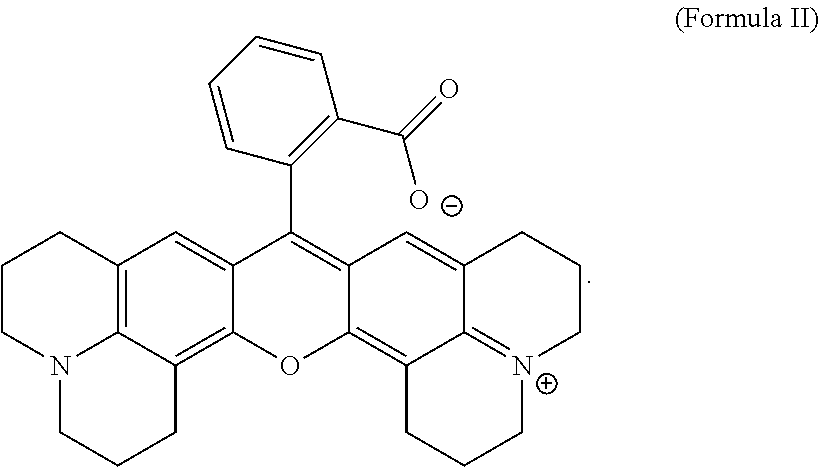
- R 1 and R 2 are independently hydrogen, a linear or branched alkyl group, or R 1 and R 2 may join to form a cyclic group or an aromatic group; n is an integer of 1 or 2; and each R 3 is hydrogen, a halogen atom, or a linear or branched C1 to C12 alkyl group; and/or wherein the marker compound having a fluorescence intensity has a structure of Formula II:
- the marker compound having a fluorescence intensity has a structure of Formula III:
- each R 4 is independently a C1 to C10 alkyl group; and/or wherein the marker compound is first added to the fuel performance additive; and/or wherein the water includes a pH 4 to 10 buffer solution; and/or wherein the buffer solution includes dihydrogen potassium phosphate and dibasic sodium phosphate.
- a gasoline composition is also provided by the present disclosure.
- the gasoline composition includes a major amount of gasoline including at least about 2 volume percent ethanol; a gasoline performance additive including an additive selected from the group comprising detergents, antioxidants, carrier fluids, metal deactivators, corrosion inhibitors, biocides, antistatic additives, drag reducing agents, demulsifiers, emulsifiers, dehazers, anti-icing additives, antiknock additives, anti-valve-seat recession additives, lubricity additives, surfactants, combustion improvers, or combinations thereof; about 0.01 to about 100 parts per billion of a marker compound having a fluorescence intensity; and a partition ratio of the marker compound between water and gasoline of at least about 0.1.
- the gasoline composition of the previous paragraph may be combined with optional features and embodiments in any combination thereof.
- These optional features or embodiments may include: wherein the gasoline includes about 25 to about 1000 ptb (pounds per thousand barrels) of the fuel performance additive in the gasoline; and/or wherein the marker compound having a fluorescence intensity has a structure of Formula
- R 1 and R 2 are independently hydrogen, a linear or branched alkyl group, or R 1 and R 2 may join to form a cyclic group or an aromatic group; n is an integer of 1 or 2; and each R 3 is hydrogen, a halogen atom, or a linear or branched C1 to C12 alkyl group; and/or wherein the marker compound having a fluorescence intensity has a structure of Formula II:
- the marker compound having a fluorescence intensity has a structure of Formula III:
- each R 4 is independently a C1 to C10 alkyl group.
- the present disclosure provides methods for identifying a hydrocarbon fuel, such as the presence and/or amounts of marker compounds having a fluorescence intensity and, through correlation, also identify the presence and/or amounts of additive package(s) within the hydrocarbon fuel.
- the methods herein include first obtaining a sample of a hydrocarbon fuel containing a measureable amount of a marker compound.
- the marker compound has a fluorescence intensity and is at least partially soluble in water.
- the hydrocarbon fuel with the marker compound therein is combined with water to form a fuel and water mixture. The mixture is agitated to facilitate contact between the water and fuel.
- the fuel and water are allowed to separate into a water phase and a fuel phase to at least partially extract the marker compound into the water phase. Then, a fluorescence intensity of the water phase is measured and a concentration of the marker compound in the fuel (and thus, a concentration of the additive package in the fuel by correlation) is determined based on the fluorescence intensity of the water phase with the at least partially extracted maker compound therein. In some instances, the concentration may be corrected relative to a baseline fluorescence intensity of water or the water phase without the marker compound.
- the hydrocarbon fuel may include diesel, biodiesel, gasoline (also known as petrol), alcohol-based fuels, alcohol-blended fuels, or mixtures thereof.
- an alcohol-blended fuel may include a fuel, such as gasoline, blended with ethanol as described more below.
- ethanol herein is meant ethyl alcohol, the chemical compound C 2 H 5 OH.
- This can arise in or be provided in many qualities or grades, such a commercial fuel grade, as well as pure or reagent grade ethanol, and can be derived from any source such as but not limited to petroleum refinery streams, distillation cuts, and bio-derived (e.g. bioethanol such as from corn).
- the fuel is gasoline or diesel. In other approaches of the method, the fuel is gasoline and, preferably, gasoline with an amount of ethanol therein.
- the gasoline may contain at least about 2 volume percent ethanol (in other approaches, at least about 5 volume percent ethanol, at least about 10 volume percent ethanol, at least about 15 volume percent ethanol, at least about 20 volume percent ethanol, or at least about 25 volume percent ethanol and, in some approaches, less than about 50 volume percent ethanol, less than about 40 volume percent alcohol, less than about 30 volume percent ethanol, less than about 25 volume percent ethanol, or less than about 20 volume percent ethanol).
- the fuel includes one or more fuel performance additives selected from the group consisting of detergents, antioxidants, carrier fluids, metal deactivators, corrosion inhibitors, biocides, antistatic additives, drag reducing agents, demulsifiers, emulsifiers, dehazers, anti-icing additives, antiknock additives, anti-valve-seat recession additives, lubricity additives, surfactants, combustion improvers, or combinations thereof.
- fuel performance additives selected from the group consisting of detergents, antioxidants, carrier fluids, metal deactivators, corrosion inhibitors, biocides, antistatic additives, drag reducing agents, demulsifiers, emulsifiers, dehazers, anti-icing additives, antiknock additives, anti-valve-seat recession additives, lubricity additives, surfactants, combustion improvers, or combinations thereof.
- the marker compound is at least partially soluble in water and, in some approaches, stable within the fuel and additive composition wherein the marker compound does not react with the hydrocarbon fuel and/or additives within the hydrocarbon fuel. Solubility between phases may be determined through a partition ratio.
- the partition ratio is defined herein as the equilibrium concentration of the marker compound in the water phase divided by the equilibrium concentration of the marker compound in the fuel phase.
- a partition ratio of the marker compound between the water and the fuel phases herein may be at least about 0.1, at least about 0.2, at least about 0.3 at least about 0.4, at least about 0.5, at least about 1, at least about 2, at least about 5, at least about 8, at least about 10, at least about 15, or even at least about 20 and less than 30, less than 25, less than 20, less than 15, or even less than 10.
- Partition ratios greater than 1 mean the marker compound is more soluble in water than fuel and partition ratios less than one mean the marker compound is partially soluble in water.
- the selected marker compound demonstrates a linear relationship or correlation between the fluorescence intensity and the concentration of marker compound in the fuel within a concentration range of the marker compound of interest in the fuel.
- approaches of the methods herein include the fuel having about 0.01 to about 100 parts per billion (ppb) of the marker compound, in other approaches, about 0.5 to 70 ppb, about 1 to about 50 ppb, about 1 to about 30 ppb, about 1 to about 20 ppb, about 1 to about 15 ppb, or about 1 to about 10 ppb of the marker compound (or other ranges therewithin).
- the relationship between the fluorescence intensity of the marker compound and concentration of the marker compound is linear within such amounts of the marker compounds in the fuels herein.
- the marker compound having a fluorescence intensity suitable for the methods herein has a structure of Formula I:
- R 1 and R 2 are independently hydrogen, a linear or branched alkyl group, or R 1 and R 2 may join to form a cyclic group or an aromatic group; n is an integer of 1 or 2; and each R 3 is hydrogen, a halogen atom, or a linear or branched C1 to C12 alkyl group
- the marker compound having a fluorescence intensity suitable for the methods herein has a structure of Formula II:
- the marker compound having a fluorescence intensity suitable for the methods herein has a structure of Formula III:
- each R 4 is independently a C1 to C10 alkyl group.
- marker compounds of Formula I, II, and/or III have surprisingly demonstrated the desired water solubility, partition ratio, stability in typical additive packages, and stability in hydrocarbon fuels having an additive package therein.
- the marker compounds herein are free of non-cyclic ester groups and, in some approaches, free of non-cyclic ester groups means that hydroxyl groups on marker compound ring structures are not esterified as further shown by the marker compound structures herein.
- the marker compounds without non-cyclic ester groups still function within the methods herein.
- the select marker compound is first added to a fuel performance additive, such as a gasoline or diesel performance additive.
- fuel performance additive such as a gasoline or diesel performance additive.
- additives may include select amounts of detergents, antioxidants, carrier fluids, metal deactivators, corrosion inhibitors, biocides, antistatic additives, drag reducing agents, demulsifiers, emulsifiers, dehazers, anti-icing additives, antiknock additives, anti-valve-seat recession additives, lubricity additives, surfactants, combustion improvers, or combinations thereof.
- the fuel performance additive may include about 1 to about 100 ppm of the marker compound, in other approaches, about 0.1 to about 75 ppm of the marker compound, or about 1 to about 50 ppm of the marker compound.
- the fuels herein may include about 1 to about 5000 ppm of the fuel performance additive package with the marker compound therein.
- the fuel may include up to about 4000 ppm, up to about 3000 ppm, up to about 2000 ppm, up to about 1000 ppm, up to about 900 ppm, up to about 800 ppm, up to about 600 ppm, up to about 550 ppm, up to about 400 ppm, up to about 200 ppm, up to about 150 ppm, up to about 100, ppm, up to about 60 ppm, up to about 50 ppm, or up to about 30 ppm of the fuel performance additive package.
- the fuel may also include at least about 20 ppm of the fuel performance additive package, or at least about 40 ppm, at least about 70 ppm, at least about 90 ppm, at least about 150 ppm, at least about 200 ppm, at least about 300 ppm, at least about 400 ppm, at least about 450 ppm, at least about 500 ppm, at least about 900 ppm, at least about 1500 ppm, or at least about 2000 ppm.
- the fuel performance additive package including the marker compound may be blended with the desired fuel source.
- a sample of the fuel is taken.
- the amount of fuel in the test sample is not particularly limited, but is usually less than about 100 ml, such as about 2 to about 25 ml of fuel, or about 2 to about 10 ml of the fuel to be analyzed.
- the fuel is then combined with water by either adding the fuel to the water or, alternatively, adding water to the fuel to form a fuel and water mixture.
- the amount of water used is about 1 to about 5 ml, or preferably, about 1 to about 3 ml of water.
- water may be added in a lower amount than the fuel, which may increase the concentration of the marker compound in the water phase.
- the ratio of fuel to water is about 5:1 to about 1:1.
- the ratio may be about 1:1 to about 3.5:1 (or 1:1 to about 3:1 or about 3:1) and for diesel, the ratio may be 1:1 to about 3:1 (or 1:1 to about 2.6:1 or about 2.6:1).
- gasoline including ethanol some of the ethanol added to or included with the gasoline may enter the water phase, thus increasing the total volume of that phase.
- the water may be a distilled or deionized water or, optionally, a buffered water solution, such as pH 4 to 10 buffer solutions (in other approaches, a pH 6 to 8 buffer solution).
- the buffer solution may be a 0.05 molar, pH 7 dihydrogen potassium phosphate and sodium phosphate dibasic buffer solution.
- the fuel and water mixture is gently mixed, shaken, or agitated.
- the mixture is then allowed to separate into a water and a fuel phase.
- the water phase is analyzed within an appropriate container or vessel, such as a 10 mm NMR tube for instance (but any suitable glass or clear walled tube or container may be used).
- Suitable gentle mixing, shaking, or agitation may be accomplished by gently shaking for about 30 seconds to about 2 minutes, or simply by inverting the NMR tube (or other container) 8 to 30 times, preferably 15 to 25 times, and most preferably, 20 times; however, other comparable gentle mixing procedures may be used.
- the mixture is allowed sit for a period of time so that the mixture may again separate into fuel and water phases.
- the mixture is allowed to sit and separate for about 1 to about 15 minutes, about 2 to about 10 minutes, or about 3 to about 5 minutes.
- the select marker compounds herein are at least partially extracted or at least partially partitioned into the water phase.
- the color bodies typically found in commercial gasoline or diesel fuels do not partition into the water phase, but remain in the fuel phase. Thus, any additives or other compounds in gasoline or diesel would not interfere with the water phase fluorescence.
- a partition ratio of the marker compound between the water and the fuel phases herein may be at least about 0.1, at least about 0.2, at least about 0.3 at least about 0.4, at least about 0.5, at least about 1, at least about 2, at least about 5, at least about 8, at least about 10, at least about 15, or even at least about 20 and less than 30, less than 25, less than 20, less than 15, or even less than 10.
- Partition ratios greater than 1 mean the marker compound is more soluble in water than fuel and partition ratios less than one mean the marker compound is partially soluble in water.
- a fluorescence intensity of the water phase (with the extracted marker compound therein) is then measured. Fluorescence measurements may be conducted using a Perkin Elmer 204-a Fluorescence Spectrophotometer equipped with a tungsten-halogen light source. However, other suitable spectrophotometers may also be used. In approaches of the methods herein, the spectrophotometer was operated with slit widths set to about 10 mm for both excitation and emission wavelengths. If needed, an initial fluorescence intensity of the water before mixing and separation may be performed to determine any background noise or background fluorescence of the water used in the testing. Excitation wavelengths for the testing may range from about 250 nm to about 800 nm and may vary depending on the selected marker compound.
- Emission wavelength for the testing may range from about 300 nm to about 900 nm and may also vary depending on the selected marker compound.
- marker compound of Formula 1 may have an excitation wavelength of 450 to 480 nm and preferably 470 nm and an emission wavelength of about 500 to about 550 nm and preferably 515 nm.
- the marker compound of Formula II may have an excitation wavelength of 520 to 560 nm and preferably 540 nm and an emission wavelength of about 580 to about 660 nm and preferably 590 nm.
- the marker compound of Formula III may have an excitation wavelength of 530 to 550 nm and preferably 540 nm and an emission wavelength of about 580 to about 600 nm and preferably 590 nm.
- the spectrophotometer reports the fluorescence intensity, which those of ordinary skill appreciate is an arbitrary unit of measure reported from the instrument. From the measured fluorescence intensity, the concentration of marker compound (and thus the concentration of fuel performance additive) in the fuel can be determined because the concentration of the marker compound in the fuel (and thus, the amount of fuel performance additive in the fuel) is directly proportional to the fluorescence intensity (and preferably a linear relationship) within the concentration range of interest within the fuel. The identity of the hydrocarbon fuel can then be confirmed by ascertaining if the concentration of the fuel performance additive is within specification.
- the hydrocarbon fuels of the present application may be applicable to the operation of diesel, jet, or gasoline engines.
- the marker compounds herein are well suited for diesel or gasoline and, particularly, gasoline, and even more particularly, gasoline having an amount of ethanol therein.
- the fuel is gasoline and, in another embodiment, gasoline having ethanol therein. In other another embodiment, the fuel is a diesel.
- the fuels may include any and all middle distillate fuels, diesel fuels, biorenewable fuels, biodiesel fuel, fatty acid alkyl ester, gas-to-liquid (GTL) fuels, gasoline, jet fuel, alcohols, ethers, kerosene, low sulfur fuels, synthetic fuels, such as Fischer-Tropsch fuels, liquid petroleum gas, bunker oils, coal to liquid (CTL) fuels, biomass to liquid (BTL) fuels, high asphaltene fuels, fuels derived from coal (natural, cleaned, and petcoke), genetically engineered biofuels and crops and extracts therefrom, and natural gas.
- GTL gas-to-liquid
- gasoline jet fuel
- alcohols alcohols
- ethers ethers
- kerosene low sulfur fuels
- synthetic fuels such as Fischer-Tropsch fuels, liquid petroleum gas, bunker oils, coal to liquid (CTL) fuels, biomass to liquid (BTL) fuels, high asphaltene fuels, fuels derived from coal
- the biorenewable fuel can comprise monohydroxy alcohols, such as those comprising from 1 to about 5 carbon atoms.
- suitable monohydroxy alcohols include methanol, ethanol, propanol, n-butanol, isobutanol, t-butyl alcohol, amyl alcohol, isoamyl alcohol, and mixtures thereof.
- Preferred fuels include gasoline fuels.
- a common ethanol-blended fuel is E10, which is a blend of 10 volume % ethanol and 90 volume % gasoline.
- the fuels may include amounts of ethanol as described above.
- Other ethanol based fuels may include, for example 85 volume % ethanol (E85), 50 volume % ethanol (E50), or 100 volume % ethanol (E100).
- E10, gasoline, and diesel are seasonally adjusted to ensure proper starting and performance in different geographic locations.
- the fuels herein are suitable for use in various internal combustion systems or engines.
- the systems or engines may include both stationary engines (e.g., engines used in electrical power generation installations, in pumping stations, etc.) and ambulatory engines (e.g., engines used as prime movers in automobiles, trucks, road-grading equipment, military vehicles, etc.).
- combustion system or engine herein is meant, internal combustion engines, for example and not by limitation, Atkinson cycle engines, rotary engines, spray guided, wall guided, and the combined wall/spray guided direct injection gasoline (“DIG” or “GDI”) engines, turbocharged DIG engines, supercharged DIG engines, homogeneous combustion DIG engines, homogeneous/stratified DIG engines, DIG engines outfitted with piezoinjectors with capability of multiple fuel pulses per injection, DIG engines with EGR, DIG engines with a lean-NOx trap, DIG engines with a lean-NOx catalyst, DIG engines with SN-CR NOx control, DIG engines with exhaust diesel fuel after-injection (post combustion) for NOx control, DIG engines outfitted for flex fuel operation (for example, gasoline, ethanol, methanol, biofuels, synthetic fuels, natural gas, liquefied petroleum gas (LPG), and mixtures thereof) Also included are conventional and advanced port-fueled internal combustion engines, with and without advanced exhaust after-treatment systems capability
- HCCI homogeneous charge compression ignition
- diesel HCCI engines two-stroke engines
- diesel fuel engines gasoline fuel engines
- stationary generators gasoline and diesel HCCI
- supercharged, turbocharged, gasoline and diesel direct injection engines engines capably of variable valve timing, leanburn engines, engines capable of inactivating cylinders or any other internal combustion engine.
- combustion systems include any of the above-listed systems combined in a hybrid vehicle with an electric motor.
- the base hydrocarbon fuel may contain an additive package or concentrate including one or more optional fuel additives.
- the additive packages herein and/or the fuels may contain conventional quantities of detergents, cetane improvers, octane improvers, corrosion inhibitors, cold flow improvers (CFPP additive), pour point depressants, solvents, demulsifiers, lubricity additives, friction modifiers, amine stabilizers, combustion improvers, dispersants, antioxidants, heat stabilizers, conductivity improvers, metal deactivators, marker dyes, organic nitrate ignition accelerators, cycloaromatic manganese tricarbonyl compounds, carrier fluids, antifoam agents, and the like appropriate for the type of fuel.
- compositions described herein may contain about 10 weight percent or less, or in other aspects, about 5 weight percent or less, based on the total weight of the additive package or concentrate, of one or more of the above additives.
- the fuels may contain suitable amounts of conventional fuel blending components such as methanol, ethanol, butanol, dialkyl ethers, 2-ethylhexanol, fatty acid methyl esters (FAME, biodiesel) and the like. If used, the fuel preferably includes at least about 1 volume percent of such fuel blending components, and in other embodiments, about 2 to about 20 volume percent, or about 2 to about 15 volume percent, or about 2 to about 10 volume percent. In some approaches, the fuel blending component is ethanol.
- organic nitrate ignition accelerators that include aliphatic or cycloaliphatic nitrates in which the aliphatic or cycloaliphatic group is saturated, and that contain up to about 12 carbons may be used.
- organic nitrate ignition accelerators examples include methyl nitrate, ethyl nitrate, propyl nitrate, isopropyl nitrate, allyl nitrate, butyl nitrate, isobutyl nitrate, sec-butyl nitrate, tert-butyl nitrate, amyl nitrate, isoamyl nitrate, 2-amyl nitrate, 3-amyl nitrate, hexyl nitrate, heptyl nitrate, 2-heptyl nitrate, octyl nitrate, isooctyl nitrate, 2-ethylhexyl nitrate, nonyl nitrate, decyl nitrate, undecyl nitrate, dodecyl nitrate, cyclopentyl nitrate, cyclohexyl
- metal deactivators useful in the compositions of the present application are disclosed in U.S. Pat. No. 4,482,357, the disclosure of which is herein incorporated by reference in its entirety.
- metal deactivators include, for example, salicylidene-o-aminophenol, disalicylidene ethylenediamine, di salicylidene propylenediamine, and N,N′-disalicylidene-1,2-diaminopropane.
- Suitable optional cycloaromatic manganese tricarbonyl compounds which may be employed in the compositions of the present application include, for example, cyclopentadienyl manganese tricarbonyl, methylcyclopentadienyl manganese tricarbonyl, indenyl manganese tricarbonyl, and ethylcyclopentadienyl manganese tricarbonyl.
- cyclopentadienyl manganese tricarbonyl methylcyclopentadienyl manganese tricarbonyl
- indenyl manganese tricarbonyl and ethylcyclopentadienyl manganese tricarbonyl.
- ethylcyclopentadienyl manganese tricarbonyl ethylcyclopentadienyl manganese tricarbonyl.
- suitable cycloaromatic manganese tricarbonyl compounds are disclosed in U.S. Pat. Nos. 5,575,823 and 3,015,
- Suitable detergents include but are not limited to succinimides, Mannich base detergents, quaternary ammonium compounds, bis-aminotriazole detergents as generally described in U.S. Pat. No. 8,529,643; US 2012/0010112; and/or U.S. Pat. No. 10,308,888 (which are all incorporated herein by reference), or a reaction product of a hydrocarbyl substituted dicarboxylic acid, or anhydride and an aminoguanidine, wherein the reaction product has less than one equivalent of amino triazole group per molecule as generally described in U.S. Pat. Nos. 8,758,456 and/or 8,852,297, which are both incorporated herein by reference.
- the detergent is selected from the group consisting of Mannich reaction products formed by condensing a long-chain aliphatic hydrocarbon-substituted phenol or cresol with an aldehyde and an amine; long chain aliphatic hydrocarbons having an amine or a polyamine attached thereto; fuel-soluble nitrogen containing salts, amides, imides, succinimides, imidazolines, esters, and long chain aliphatic hydrocarbon-substituted dicarboxylic acids or their anhydrides or mixtures thereof; polyetheramines; and combinations thereof.
- Suitable carrier fluids may be selected from any suitable carrier fluid that is compatible with the gasoline and is capable of dissolving or dispersing the components of the additive concentrate.
- the carrier fluid is a hydrocarbyl polyether or a hydrocarbon fluid, for example a petroleum or synthetic lubricating oil basestock including mineral oil, synthetic oils such as polyesters or polyethers or other polyols, or hydrocracked or hydroisomerised basestock.
- the carrier fluid may be a distillate boiling in the gasoline range.
- the amount of carrier fluid contained in the additive concentrate may range from 10 to 80 wt. %, or from 20 to 75 wt. %, or from 30 to 60 wt. % based on a total weight of the additive concentrate.
- Such additive concentrates containing the inventive components, detergent and carrier fluid were found to remain as clear fluids even at temperatures as low as ⁇ 20° C.
- the additives of the present application including the marker compounds as described above, and any optional additives used in formulating the fuels of this disclosure may be blended into the base fuel individually or in various sub-combinations.
- the marker compounds of the present application may be blended into the fuel concurrently using an additive concentrate, as this takes advantage of the mutual compatibility and convenience afforded by the combination of ingredients when in the form of an additive concentrate.
- the marker compound is first blended with the fuel performance additive or concentrate, which is then blended into the fuel. Also, use of a concentrate may reduce blending time and lessen the possibility of blending errors.
- hydrocarbyl substituent or “hydrocarbyl group” is used in its ordinary sense, which is well-known to those skilled in the art. Specifically, it refers to a group having a carbon atom directly attached to the remainder of the molecule and having a predominantly hydrocarbon character.
- Each hydrocarbyl group is independently selected from hydrocarbon substituents, and substituted hydrocarbon substituents containing one or more of halo groups, hydroxyl groups, alkoxy groups, mercapto groups, nitro groups, nitroso groups, amino groups, pyridyl groups, furyl groups, imidazolyl groups, oxygen and nitrogen, and wherein no more than two non-hydrocarbon substituents are present for every ten carbon atoms in the hydrocarbyl group.
- percent by weight or “wt %”, unless expressly stated otherwise, means the percentage the recited component represents to the weight of the entire composition.
- alkyl if used herein, unless specified otherwise, refers to straight, branched, cyclic, and/or substituted saturated chain moieties of from about 1 to about 200 carbon atoms.
- alkenyl if used herein, unless specified otherwise, refers to straight, branched, cyclic, and/or substituted unsaturated chain moieties of from about 3 to about 30 carbon atoms.
- aryl if used herein, unless specified otherwise, refers to single and multi-ring aromatic compounds that may include alkyl, alkenyl, alkylaryl, amino, hydroxyl, alkoxy, halo substituents, and/or heteroatoms including, but not limited to, nitrogen, and oxygen.
- the “molecular weight” or “MW” if used herein, unless specified otherwise, is determined by gel permeation chromatography (GPC) using commercially available polystyrene standards (with a Mn of 180 to about 18,000 as the calibration reference).
- the fluorescence of various unmodified marker compounds were evaluated.
- the general protocol involved obtaining a measured amount of fuel treated with an additive package with a fluorescent marker therein was first dispensed into a clear glass vial. Then, a measured amount of distilled water or buffered water solution as noted below was added to the vial. The vial with gently agitated (inverted 20 times) to mix the water and fuel. The samples were allowed to sit at room temperature (20 to 25° C.) for 5 minutes to allow the water and fuel phases to separate. Then, the fluorescence intensity of the marker in the water phase, at the appropriate excitation and emission wavelengths, was measured and plotted against the concentration of the additive blend. This plot can serve as a calibration curve.
- Rhodamine B, Rhodamine 101 and Rhodamine 6G unbuffered distilled water was used.
- the gasoline used in the examples was obtained from a pipeline terminal in Richmond Virginia and contained 10 volume % ethanol.
- the diesel used in the examples was No. 2 ultra-low sulfur diesel fuel and was obtained from the same terminal.
- Fluorescence measurements were made with a Perkin Elmer 204-A Fluorescence Spectrophotometer equipped with a tungsten-halogen light source. Slit widths were set to 10 mm for both the excitation and emission wavelengths. The sample vial was arranged in the instrument such that the excitation beam passed only through the water (lower) phase.
- Blend 1 Gasoline additive base composition (Blend 1): Component Concentration (wt. %) Detergent 36.0 Carrier Fluid 15.0 Demulsifier 1.0 Corrosion Inhibitor 0.5 Solvent 47.5
- the detergent in Blend 1 was a Mannich reaction product of a 1000 Mn polyisobutylene substituted cresol reacted with formaldehyde and an amine.
- Blend 1 or Blend 2 was combined with a base fuel (gasoline or diesel) according to the amounts in Table 3 and Table 4 below.
- Rhodamine 6G is not stable in the fuel or fuel additive and reacts with some component in the additive base composition, with the resulting product being non-fluorescent.
- the fluorescence intensity of the water phase 5 to 10 minutes after agitation from the other marker compounds and samples is reported in Table 4. (Fluorescence intensity is corrected for any background fluorescence and stray light from the water as exemplified in the next Example)
- the data from the table 4 is plotted in FIGS. 1 to 5 showing the linear correlations between the fluorescence intensity of the water layer relative to the treat rate of the additive composition in the fuel.
- the separation/partition of the marker compound between water and fuel phases was measured.
- the procedure for this Example included: measure fluorescence of 10 grams of water phase with and without marker compound present to determine background fluorescence. Then, 10 grams of hydrocarbon including 10 ppb of marker compound was added to the water and gently agitated for 1 minute. After mixing, the sample was allowed to completely separate into two phases. Thereafter, the fluorescence of the water phase was re-measured. Since the marker concentration is directly proportional to fluorescence intensity (at 10 ppb and within a range of interest), the Partition Ratio can be calculated from the initial and final tracer fluorescence intensities (corrected for any background fluorescence) from the water phase.
- Rhodamine B Rhodamine 101
- Fluorescein marker compounds were used for Rhodamine 101 and Rhodamine B measurements.
- excitation wavelength was 540 nm and emission wavelength was 590 nm.
- Fluorescein measurements excitation wavelength was 470 nm and emission wavelength was 515 nm. The measured fluorescence and partition ratio is shown in Table 5 below.
- the ability to detect the marker compound in the water phase depends on a number of variables that may include the partition ratio, marker compound, and amounts of marker compound in the fuel.
- the intensity in the water phase after extraction tends to be proportional to the concentration of the marker in the fuel, intensity of the instrument's excitation wavelength, the sensitivity of the instrument's detector to the emission wavelength, the absorbance of the tracer to the excitation wavelength, and/or the fluorescence quantum yield as well as the water/gasoline partition ratio.
- each range disclosed herein is to be interpreted as a disclosure of each specific value within the disclosed range that has the same number of significant digits.
- a range from 1 to 4 is to be interpreted as an express disclosure of the values 1, 2, 3 and 4 as well as any range of such values.
- each lower limit of each range disclosed herein is to be interpreted as disclosed in combination with each upper limit of each range and each specific value within each range disclosed herein for the same component, compounds, substituent or parameter.
- this disclosure to be interpreted as a disclosure of all ranges derived by combining each lower limit of each range with each upper limit of each range or with each specific value within each range, or by combining each upper limit of each range with each specific value within each range. That is, it is also further understood that any range between the endpoint values within the broad range is also discussed herein.
- a range from 1 to 4 also means a range from 1 to 3, 1 to 2, 2 to 4, 2 to 3, and so forth.
Landscapes
- Chemical & Material Sciences (AREA)
- Oil, Petroleum & Natural Gas (AREA)
- Engineering & Computer Science (AREA)
- Health & Medical Sciences (AREA)
- Chemical Kinetics & Catalysis (AREA)
- General Chemical & Material Sciences (AREA)
- Life Sciences & Earth Sciences (AREA)
- Organic Chemistry (AREA)
- Immunology (AREA)
- Physics & Mathematics (AREA)
- General Health & Medical Sciences (AREA)
- Analytical Chemistry (AREA)
- General Physics & Mathematics (AREA)
- Pathology (AREA)
- Biochemistry (AREA)
- Medicinal Chemistry (AREA)
- Food Science & Technology (AREA)
- Nuclear Medicine, Radiotherapy & Molecular Imaging (AREA)
- Emergency Medicine (AREA)
- Liquid Carbonaceous Fuels (AREA)
- Molecular Biology (AREA)
- Optics & Photonics (AREA)
- Investigating, Analyzing Materials By Fluorescence Or Luminescence (AREA)
- Investigating Or Analyzing Non-Biological Materials By The Use Of Chemical Means (AREA)
Abstract
Description

and wherein R1 and R2 are independently hydrogen, a linear or branched alkyl group, or R1 and R2 may join to form a cyclic group or an aromatic group; n is an integer of 1 or 2; and each R3 is hydrogen, a halogen atom, or a linear or branched C1 to C12 alkyl group; and/or wherein the marker compound having a fluorescence intensity has a structure of Formula II:

and/or wherein the marker compound having a fluorescence intensity has a structure of Formula III:

and wherein each R4 is independently a C1 to C10 alkyl group; and/or wherein the marker compound is first added to the fuel performance additive; and/or wherein the water includes a

wherein R1 and R2 are independently hydrogen, a linear or branched alkyl group, or R1 and R2 may join to form a cyclic group or an aromatic group; n is an integer of 1 or 2; and each R3 is hydrogen, a halogen atom, or a linear or branched C1 to C12 alkyl group; and/or wherein the marker compound having a fluorescence intensity has a structure of Formula II:

and/or
wherein the marker compound having a fluorescence intensity has a structure of Formula III:

and wherein each R4 is independently a C1 to C10 alkyl group.

wherein R1 and R2 are independently hydrogen, a linear or branched alkyl group, or R1 and R2 may join to form a cyclic group or an aromatic group; n is an integer of 1 or 2; and each R3 is hydrogen, a halogen atom, or a linear or branched C1 to C12 alkyl group


wherein each R4 is independently a C1 to C10 alkyl group. Such marker compounds of Formula I, II, and/or III have surprisingly demonstrated the desired water solubility, partition ratio, stability in typical additive packages, and stability in hydrocarbon fuels having an additive package therein. In some approaches, the marker compounds herein are free of non-cyclic ester groups and, in some approaches, free of non-cyclic ester groups means that hydroxyl groups on marker compound ring structures are not esterified as further shown by the marker compound structures herein. Surprisingly, the marker compounds without non-cyclic ester groups still function within the methods herein.
| TABLE 1 |
| Gasoline additive base composition (Blend 1): |
| Component | Concentration (wt. %) | ||
| Detergent | 36.0 | ||
| Carrier Fluid | 15.0 | ||
| Demulsifier | 1.0 | ||
| Corrosion Inhibitor | 0.5 | ||
| Solvent | 47.5 | ||
The detergent in
| TABLE 2 |
| Diesel additive base composition (Blend 2): |
| Component | Concentration (wt. %) | ||
| Detergent | 25.0 | ||
| Demulsifier | 1.5 | ||
| Antifoam Agent | 2.0 | ||
| Corrosion Inhibitor | 0.5 | ||
| Solvent | 71.0 | ||
The detergent in
| TABLE 3 |
| Additive blends with markers |
| Concentration (wt. %) |
| | Blend | 1 | |
TOFA | Fluorescein | Rhodamine 101 | Rhodamine | Rhodamine 6G | |
| 1 | 99.999 | 0.001 | |||||
| 2 | 99.997 | 0.003 | |||||
| 3 | 99.997 | 0.003 | |||||
| 4 | 99.999 | 0.001 | |||||
| 5 | 99.9993 | 0.0007 | |||||
| 6 | 99.997 | 0.003 | |||||
| TABLE 4 |
| Fluorescence Intensity of water layer after extraction according to procedure: |
| Treat Rate of Additive | Excitation | Emission | Fluorescence | ||
| Blend in Fuel | Wavelength | Wavelength | Intensity | ||
| Sample | Fuel Type | (ppm by wt.) | (nm) | (nm) | (Arbitrary Units) |
| Baseline | Gasoline | — | 470 | 515 | 0.7 |
| Baseline | Gasoline | — | 540 | 590 | 0.5 |
| 1 | |
1000 | 470 | 515 | 311.7 |
| 1 | Gasoline | 750 | 470 | 515 | 235.0 |
| 1 | |
500 | 470 | 515 | 156.7 |
| 1 | |
250 | 470 | 515 | 83.0 |
| 1 | |
100 | 470 | 515 | 38.5 |
| 1 | |
50 | 470 | 515 | 21.0 |
| 1 | Gasoline | 25 | 470 | 515 | 13.7 |
| 2 | |
1000 | 540 | 590 | 206.7 |
| 2 | Gasoline | 750 | 540 | 590 | 153.3 |
| 2 | |
500 | 540 | 590 | 102.5 |
| 2 | |
250 | 540 | 590 | 52.0 |
| 2 | |
100 | 540 | 590 | 16.0 |
| 2 | |
50 | 540 | 590 | 7.5 |
| 3 | |
1000 | 540 | 590 | 281.7 |
| 3 | Gasoline | 750 | 540 | 590 | 243.3 |
| 3 | |
500 | 540 | 590 | 160.0 |
| 3 | |
250 | 540 | 590 | 77.0 |
| 3 | |
100 | 540 | 590 | 35.0 |
| Baseline | Diesel Fuel | — | 470 | 515 | 6.5 |
| Baseline | Diesel Fuel | — | 540 | 590 | 2.9 |
| 4 | |
500 | 470 | 515 | 223.3 |
| 4 | |
250 | 470 | 515 | 111.7 |
| 4 | |
100 | 470 | 515 | 48.0 |
| 4 | Diesel Fuel | 75 | 470 | 515 | 41.0 |
| 4 | |
50 | 470 | 515 | 27.7 |
| 4 | Diesel Fuel | 25 | 470 | 515 | 14.0 |
| 5 | |
500 | 540 | 590 | 62.0 |
| 5 | |
400 | 540 | 590 | 49.0 |
| 5 | |
300 | 540 | 590 | 40.0 |
| 5 | |
200 | 540 | 590 | 29.0 |
| 5 | |
100 | 540 | 590 | 14.3 |
| TABLE 5 | ||||
| Initial Fluorescence | Fluorescence Intensity | |||
| Intensity in Water | in Water Phase After | Partition Ratio | ||
| Marker | Hydrocarbon | Phase (arb units) | Partition (arb units) | (Kd) |
| | Heptane | 0 | 1 | — | |
| | Gasoline | 0 | 0.5 | — | |
| Rhodamine B | Heptane | 75 | 21.5 | 0.38 | |
| Rhodamine B | Gasoline | 71.5 | 13 | 0.21 | |
| | Heptane | 0 | 1 | — | |
| | Gasoline | 0 | 0.5 | — | |
| Rhodamine 101 | Heptane | 73 | 20 | 0.35 | |
| Rhodamine 101 | Gasoline | 73.5 | 12.5 | 0.20 | |
| | Heptane | 0 | 1.5 | — | |
| | Gasoline | 0 | 12.5 | — | |
| Fluorescein | Heptane | 93.5 | 91 | 22.38 | |
| Fluorescein | Gasoline | 97 | 101 | 10.41 | |
| Note: | |||||
| the partition ratio (corrected for background) is calculated as follows: KD = [Intensity Marker]water/[Intensity Marker]hydrocarbon and an example calculation for Rhodamine B in Heptane is (21.5-1)/(75-(21.5-1)) | |||||
Claims (21)

Priority Applications (5)
| Application Number | Priority Date | Filing Date | Title |
|---|---|---|---|
| US17/087,127 US12169192B2 (en) | 2020-11-02 | 2020-11-02 | Methods of identifying a hydrocarbon fuel |
| EP21815074.6A EP4237847A1 (en) | 2020-11-02 | 2021-10-28 | Methods of identifying a hydrocarbon fuel |
| MX2023005133A MX2023005133A (en) | 2020-11-02 | 2021-10-28 | METHODS FOR IDENTIFYING HYDROCARBONS FUEL. |
| CN202180085798.2A CN116648495A (en) | 2020-11-02 | 2021-10-28 | Methods of Identifying Hydrocarbon Fuels |
| PCT/US2021/072073 WO2022094572A1 (en) | 2020-11-02 | 2021-10-28 | Methods of identifying a hydrocarbon fuel |
Applications Claiming Priority (1)
| Application Number | Priority Date | Filing Date | Title |
|---|---|---|---|
| US17/087,127 US12169192B2 (en) | 2020-11-02 | 2020-11-02 | Methods of identifying a hydrocarbon fuel |
Publications (2)
| Publication Number | Publication Date |
|---|---|
| US20220136968A1 US20220136968A1 (en) | 2022-05-05 |
| US12169192B2 true US12169192B2 (en) | 2024-12-17 |
Family
ID=78771261
Family Applications (1)
| Application Number | Title | Priority Date | Filing Date |
|---|---|---|---|
| US17/087,127 Active 2041-04-11 US12169192B2 (en) | 2020-11-02 | 2020-11-02 | Methods of identifying a hydrocarbon fuel |
Country Status (5)
| Country | Link |
|---|---|
| US (1) | US12169192B2 (en) |
| EP (1) | EP4237847A1 (en) |
| CN (1) | CN116648495A (en) |
| MX (1) | MX2023005133A (en) |
| WO (1) | WO2022094572A1 (en) |
Families Citing this family (2)
| Publication number | Priority date | Publication date | Assignee | Title |
|---|---|---|---|---|
| US12216041B2 (en) * | 2022-05-31 | 2025-02-04 | Saudi Arabian Oil Company | Method to detect diesel in fluid samples using partially dissolvable cuvettes |
| WO2025042992A1 (en) * | 2023-08-24 | 2025-02-27 | Authentix, Inc. | Green energy sources authentication and compliance testing |
Citations (117)
| Publication number | Priority date | Publication date | Assignee | Title |
|---|---|---|---|---|
| GB361310A (en) * | 1930-06-18 | 1931-11-18 | Howard Ferguson | Improvements in and relating to motor fuels or like combustible liquids |
| US2425845A (en) | 1945-04-21 | 1947-08-19 | Carbide & Carbon Chem Corp | Mixtures of polyoxyalkylene diols and methods of making such mixtures |
| US2425755A (en) | 1944-06-01 | 1947-08-19 | Carbide & Carbon Chem Corp | Mixtures of polyoxyalkylene monohydroxy compounds and methods of making such mixtures |
| US2448664A (en) | 1944-05-30 | 1948-09-07 | Carbide & Carbon Chem Corp | Polyoxypropylene compounds |
| US2457139A (en) | 1946-02-26 | 1948-12-28 | Carbide & Carbon Chem Corp | Esters of polyoxyalkylene diols |
| US2475755A (en) | 1946-11-18 | 1949-07-12 | Pearson Inc | Vehicle cooling apparatus using carbon dioxide |
| US3172892A (en) | 1959-03-30 | 1965-03-09 | Reaction product of high molecular weight succinic acids and succinic anhydrides with an ethylene poly- amine | |
| US3202678A (en) | 1959-08-24 | 1965-08-24 | California Research Corp | Alkenyl succinimides of tetraethylene pentamine |
| US3216936A (en) | 1964-03-02 | 1965-11-09 | Lubrizol Corp | Process of preparing lubricant additives |
| US3254025A (en) | 1961-08-18 | 1966-05-31 | Lubrizol Corp | Boron-containing acylated amine and lubricating compositions containing the same |
| US3272746A (en) | 1965-11-22 | 1966-09-13 | Lubrizol Corp | Lubricating composition containing an acylated nitrogen compound |
| US3676089A (en) | 1969-11-06 | 1972-07-11 | Texaco Inc | Motor fuel composition |
| US4038043A (en) | 1975-09-12 | 1977-07-26 | E. I. Du Pont De Nemours And Company | Gasoline additive compositions comprising a combination of monoamine and polyamine mannich bases |
| US4152499A (en) | 1977-01-22 | 1979-05-01 | Basf Aktiengesellschaft | Polyisobutenes |
| US4171959A (en) | 1977-12-14 | 1979-10-23 | Texaco Inc. | Fuel composition containing quaternary ammonium salts of succinimides |
| EP0016312A1 (en) | 1979-02-05 | 1980-10-01 | BASF Aktiengesellschaft | Process for the manufacture of polyisobutenes and use thereof in the production of mineral-oil additives |
| US4231759A (en) | 1973-03-12 | 1980-11-04 | Standard Oil Company (Indiana) | Liquid hydrocarbon fuels containing high molecular weight Mannich bases |
| US4234435A (en) | 1979-02-23 | 1980-11-18 | The Lubrizol Corporation | Novel carboxylic acid acylating agents, derivatives thereof, concentrate and lubricant compositions containing the same, and processes for their preparation |
| US4248719A (en) | 1979-08-24 | 1981-02-03 | Texaco Inc. | Quaternary ammonium salts and lubricating oil containing said salts as dispersants |
| US4605808A (en) | 1983-11-01 | 1986-08-12 | Bp Chemicals Limited | Cationic polymerization of 1-olefins |
| US4613341A (en) | 1985-05-31 | 1986-09-23 | Ethyl Corporation | Fuel compositions |
| US4729769A (en) | 1986-05-08 | 1988-03-08 | Texaco Inc. | Gasoline compositions containing reaction products of fatty acid esters and amines as carburetor detergents |
| US4847714A (en) | 1987-03-09 | 1989-07-11 | Alps Electric Co., Ltd. | Magnetic head adjusting device for a double cassette tape player |
| US4877416A (en) | 1987-11-18 | 1989-10-31 | Chevron Research Company | Synergistic fuel compositions |
| CA2089833A1 (en) | 1992-02-20 | 1993-08-21 | Leonard Baldine Graiff | Gasoline composition |
| US5254138A (en) | 1991-05-03 | 1993-10-19 | Uop | Fuel composition containing a quaternary ammonium salt |
| US5358873A (en) * | 1992-07-27 | 1994-10-25 | Atlantic Richfield Company | Method for determining adulteration of gasolines |
| US5393309A (en) | 1991-09-13 | 1995-02-28 | Chevron Research And Technology Company | Fuel additive compositions containing polyisobutenyl succinimides |
| US5498808A (en) | 1995-01-20 | 1996-03-12 | United Color Manufacturing, Inc. | Fluorescent petroleum markers |
| US5514190A (en) | 1994-12-08 | 1996-05-07 | Ethyl Corporation | Fuel compositions and additives therefor |
| US5518511A (en) | 1992-04-03 | 1996-05-21 | The Associated Octel Company Limited | Multi-functional gasoline detergent compositions |
| WO1996022343A1 (en) * | 1995-01-17 | 1996-07-25 | Exxon Chemical Limited | Fuel oil compositions |
| US5575823A (en) | 1989-12-22 | 1996-11-19 | Ethyl Petroleum Additives Limited | Diesel fuel compositions |
| US5620486A (en) | 1994-12-30 | 1997-04-15 | Chevron Chemical Company | Fuel compositions containing aryl succinimides |
| US5634951A (en) | 1996-06-07 | 1997-06-03 | Ethyl Corporation | Additives for minimizing intake valve deposits, and their use |
| US5697988A (en) | 1991-11-18 | 1997-12-16 | Ethyl Corporation | Fuel compositions |
| EP0820499A1 (en) | 1995-04-13 | 1998-01-28 | United Color Manufacturing Inc. | Colorless petroleum markers |
| US5725612A (en) | 1996-06-07 | 1998-03-10 | Ethyl Corporation | Additives for minimizing intake valve deposits, and their use |
| US5786468A (en) | 1995-03-24 | 1998-07-28 | Lever Brothers Company, Division Of Conopco, Inc. | Anionic glycasuccinamide surfactants and a process for their manufacture |
| US5814111A (en) | 1995-03-14 | 1998-09-29 | Shell Oil Company | Gasoline compositions |
| US5873917A (en) | 1997-05-16 | 1999-02-23 | The Lubrizol Corporation | Fuel additive compositions containing polyether alcohol and hydrocarbylphenol |
| US6048373A (en) | 1998-11-30 | 2000-04-11 | Ethyl Corporation | Fuels compositions containing polybutenes of narrow molecular weight distribution |
| US6166238A (en) | 2000-01-12 | 2000-12-26 | Crompton Corporation | High purity organofunctional alkyldialkoxysilanes |
| US6458172B1 (en) | 2000-03-03 | 2002-10-01 | The Lubrizol Corporation | Fuel additive compositions and fuel compositions containing detergents and fluidizers |
| US6475250B2 (en) | 2000-01-11 | 2002-11-05 | Clariant Gmbh | Multifunctional additive for fuel oils |
| US6514917B1 (en) * | 2001-08-28 | 2003-02-04 | United Color Manufacturing, Inc. | Molecular tags for organic solvent systems |
| EP1293553A2 (en) | 2001-09-14 | 2003-03-19 | Ethyl Corporation | Fuels compositions for direct injection gasoline engines |
| US6548458B2 (en) | 2000-05-01 | 2003-04-15 | Ethyl Corporation | Succinimide-acid compounds and derivatives thereof |
| US6695890B1 (en) | 1996-10-18 | 2004-02-24 | Aae Technologies International Plc | Fuel composition |
| US20040060226A1 (en) | 2000-11-08 | 2004-04-01 | Aae Technologies International Plc | Alkanolamide free fuel additives |
| US6730773B2 (en) | 2000-01-31 | 2004-05-04 | Ciba Specialty Chemicals Corporation | Salt of a melamine condensation product and a phosphorous-containing acid |
| WO2004050806A2 (en) | 2002-12-02 | 2004-06-17 | Basf Aktiengesellschaft | Use of amines and/or mannich adducts in fuel and lubricant compositions for direct injection spark ignition engines |
| US6800103B2 (en) | 2001-02-02 | 2004-10-05 | Ethyl Corporation | Secondary amine mannich detergents |
| US6867171B2 (en) | 2002-11-27 | 2005-03-15 | Chevron Oronitz Company Llc | Low molecular weight branched alkenyl succinic acid derivatives prepared from low molecular weight polyisobutene and unsaturated acidic reagents |
| WO2005023965A1 (en) | 2003-09-09 | 2005-03-17 | Raisz Ivan | Fuel additive with reduced emission |
| US20050066572A1 (en) | 2003-09-25 | 2005-03-31 | Colucci William J. | Fuels compositions and methods for using same |
| US20050215411A1 (en) | 2004-03-26 | 2005-09-29 | Sanyo Electric Co., Ltd. | Dielectric ceramic material and multilayer ceramic substrate |
| US6991914B2 (en) | 2000-07-12 | 2006-01-31 | Sk Corporation | Silent marker for an oil product and associated detection method |
| US20060196110A1 (en) | 2003-04-11 | 2006-09-07 | Basf Aktiengesellschaft | Fuel composition |
| US20060196111A1 (en) | 2005-03-04 | 2006-09-07 | Colucci William J | Fuel additive composition |
| US20070245621A1 (en) | 2006-04-20 | 2007-10-25 | Malfer Dennis J | Additives for minimizing injector fouling and valve deposits and their uses |
| US20080086936A1 (en) | 2006-10-16 | 2008-04-17 | Cunningham Lawrence J | Method and compositions for reducing wear in engines combusting ethanol-containing fuels |
| US7402185B2 (en) | 2002-04-24 | 2008-07-22 | Afton Chemical Intangibles, Llc | Additives for fuel compositions to reduce formation of combustion chamber deposits |
| US7435272B2 (en) | 2002-04-24 | 2008-10-14 | Afton Chemical Intangibles | Friction modifier alkoxyamine salts of carboxylic acids as additives for fuel compositions and methods of use thereof |
| US20090049740A1 (en) | 2005-09-30 | 2009-02-26 | International Fuel Technology, Inc. | Fuel Compositions Containing Fuel Additive |
| US20090235576A1 (en) | 2004-12-13 | 2009-09-24 | Basf Aktiengesellschaft | Hydrocarbyl succinic acid and hydrocarbylsuccinic acid derivatives as friction modifiers |
| US20100005706A1 (en) | 2008-07-11 | 2010-01-14 | Innospec Fuel Specialties, LLC | Fuel composition with enhanced low temperature properties |
| US7704289B2 (en) | 2002-03-12 | 2010-04-27 | The Lubrizol Corporation | Method of operating a direct injection spark-ignited engine with a fuel composition |
| US20100132253A1 (en) | 2008-12-03 | 2010-06-03 | Taconic Energy, Inc. | Fuel additives and fuel compositions and methods for making and using the same |
| US20110162263A1 (en) | 2008-07-10 | 2011-07-07 | The Lubrizol Corportation | Carboxylic acid derivatives as friction modifiers in fuels |
| US8097570B2 (en) | 2005-07-05 | 2012-01-17 | Total France | Lubricating composition for hydrocarbonated mixtures and products obtained |
| US8153570B2 (en) | 2008-06-09 | 2012-04-10 | The Lubrizol Corporation | Quaternary ammonium salt detergents for use in lubricating compositions |
| US20120138004A1 (en) | 2009-05-15 | 2012-06-07 | The Lubrizol Corporation | Quaternary Ammonium Amide and/or Ester Salts |
| US8231695B2 (en) | 2006-08-09 | 2012-07-31 | Afton Chemical Corporation | Fuel compositions comprising hydrocarbon oil carriers and methods for using the same |
| GB2493377A (en) | 2011-08-03 | 2013-02-06 | Innospec Ltd | Gasoline composition comprising Mannich additive |
| US20130031828A1 (en) | 2010-03-10 | 2013-02-07 | Innospec Limited | Fuel composition comprising detergent and quanternary ammonium salt additive |
| US8425627B2 (en) | 2005-11-04 | 2013-04-23 | The Lubrizol Corporation | Fuel additive concentrate composition and fuel composition and method thereof |
| US20130104826A1 (en) | 2010-05-10 | 2013-05-02 | Innospec Limited | Gasoline Composition, Methods and Use |
| US8486879B2 (en) | 2008-12-09 | 2013-07-16 | The Clorox Company | Hypochlorite denture compositions and methods of use |
| US8496716B2 (en) | 1999-10-06 | 2013-07-30 | Basf Se | Method for producing Mannich adducts that contain polyisobutylene phenol |
| US20130227878A1 (en) | 2011-12-30 | 2013-09-05 | Butamax (Tm) Advanced Biofuels Llc | Corrosion inhibitor compositions for oxygenated gasolines |
| US8529643B2 (en) | 2008-05-13 | 2013-09-10 | Afton Chemical Corporation | Fuel additives for treating internal deposits of fuel injectors |
| US20130247450A1 (en) | 2009-02-05 | 2013-09-26 | Butamax Advanced Biofuels Llc | Gasoline Deposit Control Additive Compositions |
| US20130255139A1 (en) | 2010-12-23 | 2013-10-03 | Total Raffinage Marketing | Modified alkyl-phenol-aldehyde resins, use thereof as additives for improving the properties of liquid hydrocarbon fuels in cold conditions |
| US8557003B2 (en) | 2006-12-15 | 2013-10-15 | Afton Chemical Corporation | Mannich detergents for hydrocarbon fuels |
| US20130312318A1 (en) | 2012-05-25 | 2013-11-28 | Basf Se | Use of a reaction product of carboxylic acids with aliphatic polyamines for improving or boosting the separation of water from fuel oils |
| US20130324665A1 (en) | 2011-06-08 | 2013-12-05 | Tpc Group Llc | Adducts of Low Molecular Weight PIB With Low Polydispersity and High Vinylidene Content |
| US20140004615A1 (en) * | 2011-03-16 | 2014-01-02 | Decipher Pte. Ltd. | Kit for marking and/or detecting alteration of fuel and its method thereof |
| US20140157656A1 (en) | 2011-08-03 | 2014-06-12 | Jacqueline Reid | Diesel fuel compositions |
| US20140174390A1 (en) | 2011-08-03 | 2014-06-26 | Jacqueline Reid | Diesel fuel compositions |
| US8765650B2 (en) | 2009-03-03 | 2014-07-01 | The Lubrizol Corporation | Ashless or reduced ash quaternary detergents |
| US8778034B2 (en) | 2006-09-14 | 2014-07-15 | Afton Chemical Corporation | Biodegradable fuel performance additives |
| US8894726B2 (en) | 2012-06-13 | 2014-11-25 | Afton Chemical Corporation | Fuel additive for improved performance in fuel injected engines |
| US9005988B2 (en) | 2008-07-18 | 2015-04-14 | Lux Innovate Limited | Method to assess multiphase fluid compositions |
| US20150212007A1 (en) * | 2008-06-20 | 2015-07-30 | Nalco Company | Method of Monitoring and Optimizing Additive Concentration in Fuel Ethanol |
| US20150252278A1 (en) | 2012-10-23 | 2015-09-10 | The Lubrizol Corporation | Diesel detergent without a low molecular weight penalty |
| US20160130514A1 (en) | 2013-06-07 | 2016-05-12 | Basf Se | Use of nitrogen compounds quaternised with alkylene oxide and hydrocarbyl-substituted polycarboxylic acid as additives in fuels and lubricants |
| US20160152912A1 (en) | 2013-07-26 | 2016-06-02 | Innospec Limited | Diesel fuel compositions and methods of use thereof |
| US20160152910A1 (en) | 2013-07-26 | 2016-06-02 | Innospec Limited | Quaternary ammonium compounds as fuel or lubricant additives |
| US20160272912A1 (en) | 2013-10-24 | 2016-09-22 | Basf Se | Use of a polyalkylene glycol to reduce fuel consumption |
| US20160289584A1 (en) | 2013-11-18 | 2016-10-06 | Afton Chemical Corporation | Mixed Detergent Composition for Intake Valve Deposit Control |
| US20170096611A1 (en) | 2014-05-30 | 2017-04-06 | The Lubrizol Corporation | Branched amine containing quaternary ammonium salts |
| US20170096610A1 (en) | 2014-05-30 | 2017-04-06 | The Lubrizol Corporation | High molecular weight amide/ester containing quaternary ammonium salts |
| US20170101594A1 (en) | 2014-05-30 | 2017-04-13 | The Lubrizol Corporation | Coupled quaternary ammonium salts |
| US20170107438A1 (en) | 2014-05-30 | 2017-04-20 | The Lubrizol Corporation | High molecular weight imide containing quaternary ammonium salts |
| US20170114297A1 (en) | 2014-05-30 | 2017-04-27 | The Lubrizol Corporation | Imidazole containing quaternary ammonium salts |
| US20170114296A1 (en) | 2014-05-30 | 2017-04-27 | The Lubrizol Corporation | Low molecular weight imide containing quaternary ammonium salts |
| US20170121628A1 (en) | 2014-05-30 | 2017-05-04 | The Lubrizol Corporation | Low molecular weight amide/ester containing quaternary ammonium salts |
| WO2017097686A1 (en) | 2015-12-10 | 2017-06-15 | Basf Coatings Gmbh | Thermosettable coating compositions using pendant carbamate-functional polyurethane polymers and methods of forming the thermosettable coating compositions |
| US20170166826A1 (en) | 2015-12-10 | 2017-06-15 | Afton Chemical Corporation | Dialkyaminoalkanol Friction Modifiers For Fuels And Lubricants |
| US20170218291A1 (en) | 2014-07-28 | 2017-08-03 | Innospec Limited | Quaternary ammonium compounds and their use as fuel or lubricant additives |
| EP2531580B1 (en) | 2010-02-05 | 2017-11-15 | Innospec Limited | Fuel compositions |
| US20180066202A1 (en) | 2015-04-09 | 2018-03-08 | The Lubrizol Corporation | Lubricants containing quaternary ammonium compounds |
| US9951285B2 (en) | 2011-06-28 | 2018-04-24 | Basf Se | Quaternized nitrogen compounds and use thereof as additives in fuels and lubricants |
| US20180223203A1 (en) | 2015-07-28 | 2018-08-09 | Innospec Limited | Cyclic quaternary ammonium salts as fuel or lubricant additives |
| US10273425B2 (en) | 2017-03-13 | 2019-04-30 | Afton Chemical Corporation | Polyol carrier fluids and fuel compositions including polyol carrier fluids |
| US10308888B1 (en) | 2018-06-15 | 2019-06-04 | Afton Chemical Corporation | Quaternary ammonium fuel additives |
Family Cites Families (5)
| Publication number | Priority date | Publication date | Assignee | Title |
|---|---|---|---|---|
| US3015668A (en) | 1959-11-24 | 1962-01-02 | Ethyl Corp | Process for producing cyclomatic manganese tricarbonyl compounds |
| US4482357A (en) | 1983-12-30 | 1984-11-13 | Ethyl Corporation | Fuel Compositions |
| US20120010112A1 (en) | 2010-07-06 | 2012-01-12 | Basf Se | Acid-free quaternized nitrogen compounds and use thereof as additives in fuels and lubricants |
| US8852297B2 (en) | 2011-09-22 | 2014-10-07 | Afton Chemical Corporation | Fuel additives for treating internal deposits of fuel injectors |
| US8758456B2 (en) | 2011-09-22 | 2014-06-24 | Afton Chemical Corporation | Fuel additive for improved performance of low sulfur diesel fuels |
-
2020
- 2020-11-02 US US17/087,127 patent/US12169192B2/en active Active
-
2021
- 2021-10-28 EP EP21815074.6A patent/EP4237847A1/en active Pending
- 2021-10-28 CN CN202180085798.2A patent/CN116648495A/en active Pending
- 2021-10-28 WO PCT/US2021/072073 patent/WO2022094572A1/en not_active Ceased
- 2021-10-28 MX MX2023005133A patent/MX2023005133A/en unknown
Patent Citations (127)
| Publication number | Priority date | Publication date | Assignee | Title |
|---|---|---|---|---|
| GB361310A (en) * | 1930-06-18 | 1931-11-18 | Howard Ferguson | Improvements in and relating to motor fuels or like combustible liquids |
| US2448664A (en) | 1944-05-30 | 1948-09-07 | Carbide & Carbon Chem Corp | Polyoxypropylene compounds |
| US2425755A (en) | 1944-06-01 | 1947-08-19 | Carbide & Carbon Chem Corp | Mixtures of polyoxyalkylene monohydroxy compounds and methods of making such mixtures |
| US2425845A (en) | 1945-04-21 | 1947-08-19 | Carbide & Carbon Chem Corp | Mixtures of polyoxyalkylene diols and methods of making such mixtures |
| US2457139A (en) | 1946-02-26 | 1948-12-28 | Carbide & Carbon Chem Corp | Esters of polyoxyalkylene diols |
| US2475755A (en) | 1946-11-18 | 1949-07-12 | Pearson Inc | Vehicle cooling apparatus using carbon dioxide |
| US3219666A (en) | 1959-03-30 | 1965-11-23 | Derivatives of succinic acids and nitrogen compounds | |
| US3172892A (en) | 1959-03-30 | 1965-03-09 | Reaction product of high molecular weight succinic acids and succinic anhydrides with an ethylene poly- amine | |
| US3361673A (en) | 1959-08-24 | 1968-01-02 | Chevron Res | Lubricating oil compositions containing alkenyl succinimides of tetraethylene pentamine |
| US3202678A (en) | 1959-08-24 | 1965-08-24 | California Research Corp | Alkenyl succinimides of tetraethylene pentamine |
| US3254025A (en) | 1961-08-18 | 1966-05-31 | Lubrizol Corp | Boron-containing acylated amine and lubricating compositions containing the same |
| US3216936A (en) | 1964-03-02 | 1965-11-09 | Lubrizol Corp | Process of preparing lubricant additives |
| US3272746A (en) | 1965-11-22 | 1966-09-13 | Lubrizol Corp | Lubricating composition containing an acylated nitrogen compound |
| US3676089A (en) | 1969-11-06 | 1972-07-11 | Texaco Inc | Motor fuel composition |
| US4231759A (en) | 1973-03-12 | 1980-11-04 | Standard Oil Company (Indiana) | Liquid hydrocarbon fuels containing high molecular weight Mannich bases |
| US4038043A (en) | 1975-09-12 | 1977-07-26 | E. I. Du Pont De Nemours And Company | Gasoline additive compositions comprising a combination of monoamine and polyamine mannich bases |
| US4152499A (en) | 1977-01-22 | 1979-05-01 | Basf Aktiengesellschaft | Polyisobutenes |
| US4171959A (en) | 1977-12-14 | 1979-10-23 | Texaco Inc. | Fuel composition containing quaternary ammonium salts of succinimides |
| EP0016312A1 (en) | 1979-02-05 | 1980-10-01 | BASF Aktiengesellschaft | Process for the manufacture of polyisobutenes and use thereof in the production of mineral-oil additives |
| US4234435A (en) | 1979-02-23 | 1980-11-18 | The Lubrizol Corporation | Novel carboxylic acid acylating agents, derivatives thereof, concentrate and lubricant compositions containing the same, and processes for their preparation |
| US4248719A (en) | 1979-08-24 | 1981-02-03 | Texaco Inc. | Quaternary ammonium salts and lubricating oil containing said salts as dispersants |
| US4605808A (en) | 1983-11-01 | 1986-08-12 | Bp Chemicals Limited | Cationic polymerization of 1-olefins |
| US4613341A (en) | 1985-05-31 | 1986-09-23 | Ethyl Corporation | Fuel compositions |
| US4729769A (en) | 1986-05-08 | 1988-03-08 | Texaco Inc. | Gasoline compositions containing reaction products of fatty acid esters and amines as carburetor detergents |
| US4847714A (en) | 1987-03-09 | 1989-07-11 | Alps Electric Co., Ltd. | Magnetic head adjusting device for a double cassette tape player |
| US4877416A (en) | 1987-11-18 | 1989-10-31 | Chevron Research Company | Synergistic fuel compositions |
| US5575823A (en) | 1989-12-22 | 1996-11-19 | Ethyl Petroleum Additives Limited | Diesel fuel compositions |
| US5254138A (en) | 1991-05-03 | 1993-10-19 | Uop | Fuel composition containing a quaternary ammonium salt |
| US5393309A (en) | 1991-09-13 | 1995-02-28 | Chevron Research And Technology Company | Fuel additive compositions containing polyisobutenyl succinimides |
| US5697988A (en) | 1991-11-18 | 1997-12-16 | Ethyl Corporation | Fuel compositions |
| CA2089833A1 (en) | 1992-02-20 | 1993-08-21 | Leonard Baldine Graiff | Gasoline composition |
| US5518511A (en) | 1992-04-03 | 1996-05-21 | The Associated Octel Company Limited | Multi-functional gasoline detergent compositions |
| US5358873A (en) * | 1992-07-27 | 1994-10-25 | Atlantic Richfield Company | Method for determining adulteration of gasolines |
| US5514190A (en) | 1994-12-08 | 1996-05-07 | Ethyl Corporation | Fuel compositions and additives therefor |
| US5620486A (en) | 1994-12-30 | 1997-04-15 | Chevron Chemical Company | Fuel compositions containing aryl succinimides |
| WO1996022343A1 (en) * | 1995-01-17 | 1996-07-25 | Exxon Chemical Limited | Fuel oil compositions |
| US5498808A (en) | 1995-01-20 | 1996-03-12 | United Color Manufacturing, Inc. | Fluorescent petroleum markers |
| US5814111A (en) | 1995-03-14 | 1998-09-29 | Shell Oil Company | Gasoline compositions |
| US5786468A (en) | 1995-03-24 | 1998-07-28 | Lever Brothers Company, Division Of Conopco, Inc. | Anionic glycasuccinamide surfactants and a process for their manufacture |
| EP0820499A1 (en) | 1995-04-13 | 1998-01-28 | United Color Manufacturing Inc. | Colorless petroleum markers |
| US5634951A (en) | 1996-06-07 | 1997-06-03 | Ethyl Corporation | Additives for minimizing intake valve deposits, and their use |
| US5725612A (en) | 1996-06-07 | 1998-03-10 | Ethyl Corporation | Additives for minimizing intake valve deposits, and their use |
| US6695890B1 (en) | 1996-10-18 | 2004-02-24 | Aae Technologies International Plc | Fuel composition |
| US5873917A (en) | 1997-05-16 | 1999-02-23 | The Lubrizol Corporation | Fuel additive compositions containing polyether alcohol and hydrocarbylphenol |
| US6048373A (en) | 1998-11-30 | 2000-04-11 | Ethyl Corporation | Fuels compositions containing polybutenes of narrow molecular weight distribution |
| CN1256302A (en) | 1998-11-30 | 2000-06-14 | 乙基公司 | Fuel composition containing narrow molecular weight distribution polybutene |
| US8496716B2 (en) | 1999-10-06 | 2013-07-30 | Basf Se | Method for producing Mannich adducts that contain polyisobutylene phenol |
| US6475250B2 (en) | 2000-01-11 | 2002-11-05 | Clariant Gmbh | Multifunctional additive for fuel oils |
| US6166238A (en) | 2000-01-12 | 2000-12-26 | Crompton Corporation | High purity organofunctional alkyldialkoxysilanes |
| US6730773B2 (en) | 2000-01-31 | 2004-05-04 | Ciba Specialty Chemicals Corporation | Salt of a melamine condensation product and a phosphorous-containing acid |
| EP1411105A2 (en) | 2000-03-03 | 2004-04-21 | The Lubrizol Corporation | Fuel additive compositions and fuel compositions containing detergents and fluidizers |
| US6458172B1 (en) | 2000-03-03 | 2002-10-01 | The Lubrizol Corporation | Fuel additive compositions and fuel compositions containing detergents and fluidizers |
| US6548458B2 (en) | 2000-05-01 | 2003-04-15 | Ethyl Corporation | Succinimide-acid compounds and derivatives thereof |
| US6991914B2 (en) | 2000-07-12 | 2006-01-31 | Sk Corporation | Silent marker for an oil product and associated detection method |
| US20040060226A1 (en) | 2000-11-08 | 2004-04-01 | Aae Technologies International Plc | Alkanolamide free fuel additives |
| US6800103B2 (en) | 2001-02-02 | 2004-10-05 | Ethyl Corporation | Secondary amine mannich detergents |
| US6514917B1 (en) * | 2001-08-28 | 2003-02-04 | United Color Manufacturing, Inc. | Molecular tags for organic solvent systems |
| EP1293553A2 (en) | 2001-09-14 | 2003-03-19 | Ethyl Corporation | Fuels compositions for direct injection gasoline engines |
| US7704289B2 (en) | 2002-03-12 | 2010-04-27 | The Lubrizol Corporation | Method of operating a direct injection spark-ignited engine with a fuel composition |
| US7435272B2 (en) | 2002-04-24 | 2008-10-14 | Afton Chemical Intangibles | Friction modifier alkoxyamine salts of carboxylic acids as additives for fuel compositions and methods of use thereof |
| US7402185B2 (en) | 2002-04-24 | 2008-07-22 | Afton Chemical Intangibles, Llc | Additives for fuel compositions to reduce formation of combustion chamber deposits |
| US6867171B2 (en) | 2002-11-27 | 2005-03-15 | Chevron Oronitz Company Llc | Low molecular weight branched alkenyl succinic acid derivatives prepared from low molecular weight polyisobutene and unsaturated acidic reagents |
| US20060070293A1 (en) | 2002-12-02 | 2006-04-06 | Arno Lange | Use of amines and/or mannich adducts in fuel and lubricant compositions for direct injection spark ignition engines |
| WO2004050806A2 (en) | 2002-12-02 | 2004-06-17 | Basf Aktiengesellschaft | Use of amines and/or mannich adducts in fuel and lubricant compositions for direct injection spark ignition engines |
| US8449630B2 (en) | 2002-12-02 | 2013-05-28 | Basf Se | Use of amines and/or Mannich adducts in fuel and lubricant compositions for direct injection spark ignition engines |
| US20130237466A1 (en) | 2002-12-02 | 2013-09-12 | Basf Se | Use of amines and/or mannich adducts in fuel and lubricant compositions for direct injection spark ignition engines |
| US20060196110A1 (en) | 2003-04-11 | 2006-09-07 | Basf Aktiengesellschaft | Fuel composition |
| WO2005023965A1 (en) | 2003-09-09 | 2005-03-17 | Raisz Ivan | Fuel additive with reduced emission |
| US7766982B2 (en) | 2003-09-25 | 2010-08-03 | Afton Chemical Corporation | Fuels compositions and methods for using same |
| US20060168876A1 (en) | 2003-09-25 | 2006-08-03 | Afton Chemical Corporation | Fuels compositions and methods for using same |
| US20050066572A1 (en) | 2003-09-25 | 2005-03-31 | Colucci William J. | Fuels compositions and methods for using same |
| US20050215411A1 (en) | 2004-03-26 | 2005-09-29 | Sanyo Electric Co., Ltd. | Dielectric ceramic material and multilayer ceramic substrate |
| US20090235576A1 (en) | 2004-12-13 | 2009-09-24 | Basf Aktiengesellschaft | Hydrocarbyl succinic acid and hydrocarbylsuccinic acid derivatives as friction modifiers |
| US20060196111A1 (en) | 2005-03-04 | 2006-09-07 | Colucci William J | Fuel additive composition |
| US8097570B2 (en) | 2005-07-05 | 2012-01-17 | Total France | Lubricating composition for hydrocarbonated mixtures and products obtained |
| US20090049740A1 (en) | 2005-09-30 | 2009-02-26 | International Fuel Technology, Inc. | Fuel Compositions Containing Fuel Additive |
| US8425627B2 (en) | 2005-11-04 | 2013-04-23 | The Lubrizol Corporation | Fuel additive concentrate composition and fuel composition and method thereof |
| US20070245621A1 (en) | 2006-04-20 | 2007-10-25 | Malfer Dennis J | Additives for minimizing injector fouling and valve deposits and their uses |
| US8231695B2 (en) | 2006-08-09 | 2012-07-31 | Afton Chemical Corporation | Fuel compositions comprising hydrocarbon oil carriers and methods for using the same |
| US8778034B2 (en) | 2006-09-14 | 2014-07-15 | Afton Chemical Corporation | Biodegradable fuel performance additives |
| US20080086936A1 (en) | 2006-10-16 | 2008-04-17 | Cunningham Lawrence J | Method and compositions for reducing wear in engines combusting ethanol-containing fuels |
| EP1918355A1 (en) | 2006-10-16 | 2008-05-07 | Afton Chemical Corporation | Method and compositions for reducing wear in engines combusting ethanol-containing fuels |
| US8557003B2 (en) | 2006-12-15 | 2013-10-15 | Afton Chemical Corporation | Mannich detergents for hydrocarbon fuels |
| US8529643B2 (en) | 2008-05-13 | 2013-09-10 | Afton Chemical Corporation | Fuel additives for treating internal deposits of fuel injectors |
| US8153570B2 (en) | 2008-06-09 | 2012-04-10 | The Lubrizol Corporation | Quaternary ammonium salt detergents for use in lubricating compositions |
| US20150212007A1 (en) * | 2008-06-20 | 2015-07-30 | Nalco Company | Method of Monitoring and Optimizing Additive Concentration in Fuel Ethanol |
| US20110162263A1 (en) | 2008-07-10 | 2011-07-07 | The Lubrizol Corportation | Carboxylic acid derivatives as friction modifiers in fuels |
| US20100005706A1 (en) | 2008-07-11 | 2010-01-14 | Innospec Fuel Specialties, LLC | Fuel composition with enhanced low temperature properties |
| US9005988B2 (en) | 2008-07-18 | 2015-04-14 | Lux Innovate Limited | Method to assess multiphase fluid compositions |
| US20100132253A1 (en) | 2008-12-03 | 2010-06-03 | Taconic Energy, Inc. | Fuel additives and fuel compositions and methods for making and using the same |
| US8486879B2 (en) | 2008-12-09 | 2013-07-16 | The Clorox Company | Hypochlorite denture compositions and methods of use |
| US20130247450A1 (en) | 2009-02-05 | 2013-09-26 | Butamax Advanced Biofuels Llc | Gasoline Deposit Control Additive Compositions |
| US8765650B2 (en) | 2009-03-03 | 2014-07-01 | The Lubrizol Corporation | Ashless or reduced ash quaternary detergents |
| US20120138004A1 (en) | 2009-05-15 | 2012-06-07 | The Lubrizol Corporation | Quaternary Ammonium Amide and/or Ester Salts |
| EP2531580B1 (en) | 2010-02-05 | 2017-11-15 | Innospec Limited | Fuel compositions |
| US20130031828A1 (en) | 2010-03-10 | 2013-02-07 | Innospec Limited | Fuel composition comprising detergent and quanternary ammonium salt additive |
| US20130104826A1 (en) | 2010-05-10 | 2013-05-02 | Innospec Limited | Gasoline Composition, Methods and Use |
| US20130255139A1 (en) | 2010-12-23 | 2013-10-03 | Total Raffinage Marketing | Modified alkyl-phenol-aldehyde resins, use thereof as additives for improving the properties of liquid hydrocarbon fuels in cold conditions |
| US20140004615A1 (en) * | 2011-03-16 | 2014-01-02 | Decipher Pte. Ltd. | Kit for marking and/or detecting alteration of fuel and its method thereof |
| US20130324665A1 (en) | 2011-06-08 | 2013-12-05 | Tpc Group Llc | Adducts of Low Molecular Weight PIB With Low Polydispersity and High Vinylidene Content |
| US9951285B2 (en) | 2011-06-28 | 2018-04-24 | Basf Se | Quaternized nitrogen compounds and use thereof as additives in fuels and lubricants |
| US20140157656A1 (en) | 2011-08-03 | 2014-06-12 | Jacqueline Reid | Diesel fuel compositions |
| GB2493377A (en) | 2011-08-03 | 2013-02-06 | Innospec Ltd | Gasoline composition comprising Mannich additive |
| US20140174390A1 (en) | 2011-08-03 | 2014-06-26 | Jacqueline Reid | Diesel fuel compositions |
| US20130227878A1 (en) | 2011-12-30 | 2013-09-05 | Butamax (Tm) Advanced Biofuels Llc | Corrosion inhibitor compositions for oxygenated gasolines |
| US20130312318A1 (en) | 2012-05-25 | 2013-11-28 | Basf Se | Use of a reaction product of carboxylic acids with aliphatic polyamines for improving or boosting the separation of water from fuel oils |
| US8894726B2 (en) | 2012-06-13 | 2014-11-25 | Afton Chemical Corporation | Fuel additive for improved performance in fuel injected engines |
| US20150252278A1 (en) | 2012-10-23 | 2015-09-10 | The Lubrizol Corporation | Diesel detergent without a low molecular weight penalty |
| US20160130514A1 (en) | 2013-06-07 | 2016-05-12 | Basf Se | Use of nitrogen compounds quaternised with alkylene oxide and hydrocarbyl-substituted polycarboxylic acid as additives in fuels and lubricants |
| US20160152910A1 (en) | 2013-07-26 | 2016-06-02 | Innospec Limited | Quaternary ammonium compounds as fuel or lubricant additives |
| US20160152912A1 (en) | 2013-07-26 | 2016-06-02 | Innospec Limited | Diesel fuel compositions and methods of use thereof |
| US20160272912A1 (en) | 2013-10-24 | 2016-09-22 | Basf Se | Use of a polyalkylene glycol to reduce fuel consumption |
| US20160289584A1 (en) | 2013-11-18 | 2016-10-06 | Afton Chemical Corporation | Mixed Detergent Composition for Intake Valve Deposit Control |
| US20170096610A1 (en) | 2014-05-30 | 2017-04-06 | The Lubrizol Corporation | High molecular weight amide/ester containing quaternary ammonium salts |
| US20170096611A1 (en) | 2014-05-30 | 2017-04-06 | The Lubrizol Corporation | Branched amine containing quaternary ammonium salts |
| US20170114297A1 (en) | 2014-05-30 | 2017-04-27 | The Lubrizol Corporation | Imidazole containing quaternary ammonium salts |
| US20170114296A1 (en) | 2014-05-30 | 2017-04-27 | The Lubrizol Corporation | Low molecular weight imide containing quaternary ammonium salts |
| US20170121628A1 (en) | 2014-05-30 | 2017-05-04 | The Lubrizol Corporation | Low molecular weight amide/ester containing quaternary ammonium salts |
| US20170107438A1 (en) | 2014-05-30 | 2017-04-20 | The Lubrizol Corporation | High molecular weight imide containing quaternary ammonium salts |
| US20170101594A1 (en) | 2014-05-30 | 2017-04-13 | The Lubrizol Corporation | Coupled quaternary ammonium salts |
| US20170218291A1 (en) | 2014-07-28 | 2017-08-03 | Innospec Limited | Quaternary ammonium compounds and their use as fuel or lubricant additives |
| US20180066202A1 (en) | 2015-04-09 | 2018-03-08 | The Lubrizol Corporation | Lubricants containing quaternary ammonium compounds |
| US20180223203A1 (en) | 2015-07-28 | 2018-08-09 | Innospec Limited | Cyclic quaternary ammonium salts as fuel or lubricant additives |
| US20170166826A1 (en) | 2015-12-10 | 2017-06-15 | Afton Chemical Corporation | Dialkyaminoalkanol Friction Modifiers For Fuels And Lubricants |
| WO2017097686A1 (en) | 2015-12-10 | 2017-06-15 | Basf Coatings Gmbh | Thermosettable coating compositions using pendant carbamate-functional polyurethane polymers and methods of forming the thermosettable coating compositions |
| US10273425B2 (en) | 2017-03-13 | 2019-04-30 | Afton Chemical Corporation | Polyol carrier fluids and fuel compositions including polyol carrier fluids |
| US10308888B1 (en) | 2018-06-15 | 2019-06-04 | Afton Chemical Corporation | Quaternary ammonium fuel additives |
Non-Patent Citations (9)
| Title |
|---|
| Hakami, A.A.H. et al. "Extraction Procedures and Analytical Methods for the Determination of Methylene Blue, Rhodamine B and Crystal Violet—An Overview," Current Analytical Chemistry, vol. 17, Issue 5, 2021; pp. 1-21. (Year: 2021). * |
| Kaewtong, C. et al. "A solvatochromic-based sensor for chromium(III) in real systems," New J. Chem., 2018, 42, 9930. (Year: 2018). * |
| Karpiuk, J. et al. "Photophysics of the Lactone Form of Rhodamine 101," J. Phys. Chem. 1994, 98, 3247-3256 (Year: 1994). * |
| Klonis, N. et al. "Spectral Properties of the Prototropic Forms of Fluorescein in Aqueous Solution," Journal of Fluorescence, vol. 6, No. 3, 1996, 147-157. (Year: 1996). * |
| Mchedlov-Petrossyan, N.O. et al. "Dissociation, tautomerism and electroreduction of xanthene and sulfonephthalein dyes in N, N-dimethylformamide and other solvents," J. Phys. Org. Chem. 2003; 16: 380-397 (Year: 2003). * |
| Murugesan, Sankaran et al. "Carbon Quantum Dots Fluorescent Tracers for Production and Well Monitoring." Paper presented at the SPE Annual Technical Conference and Exhibition, Dubai, UAE, Sep. 2016. doi: https://doi.org/10.2118/181503-MS, abstract only. |
| PCT; App. No. PCT/US2021/072073; International Search Report and Written Opinion mailed Feb. 22, 2022. |
| Stephenson, C. J. et al. "A fluorescent diastereoselective molecular sensor for 1,2-aminoalcohols based on the rhodamine B lactone-zwitterion equilibrium," Org. Biomol. Chem., 2010, 8, 1027-1032 (Year: 2010). * |
| Tosch W. C. "Technique for Incorporating Water-Soluble Tracers in Hydrocarbon Media" Analytical Chemistry, vol. 37, No. 7, Jun. 1, 1965, pp. 959-959. |
Also Published As
| Publication number | Publication date |
|---|---|
| US20220136968A1 (en) | 2022-05-05 |
| MX2023005133A (en) | 2023-08-04 |
| CN116648495A (en) | 2023-08-25 |
| WO2022094572A1 (en) | 2022-05-05 |
| EP4237847A1 (en) | 2023-09-06 |
Similar Documents
| Publication | Publication Date | Title |
|---|---|---|
| KR101475119B1 (en) | Fuel additive for improved performance in direct fuel injected engines | |
| EP1357170B9 (en) | Friction modifier additives for fuel compositions and methods of use thereof | |
| US9562498B2 (en) | Biodegradable fuel performance additives | |
| US7976591B2 (en) | Fuel composition and its use | |
| US12169192B2 (en) | Methods of identifying a hydrocarbon fuel | |
| EP2582777B1 (en) | Fuel composition and its use | |
| EP3464521A1 (en) | Fuel compositions | |
| US20030159337A1 (en) | Diesel fuel compositions | |
| EP2958977B1 (en) | Diesel fuel with improved ignition characteristics | |
| US9222047B2 (en) | Liquid fuel compositions | |
| US9862905B2 (en) | Diesel fuel with improved ignition characteristics | |
| RU2148077C1 (en) | Gasoline additive and composition containing thereof | |
| US11084997B2 (en) | Process for preparing a diesel fuel composition | |
| RU2161639C1 (en) | Gasoline additive and composition containing thereof | |
| EP3969546B1 (en) | Compositions and methods and uses relating thereto | |
| WO2018077976A1 (en) | Process for preparing an automotive gasoil | |
| EP3184612A1 (en) | Process for preparing a diesel fuel composition | |
| US20060254127A1 (en) | Fuel additives and compositions | |
| UA55879A (en) | A composite additive to automotive fuels |
Legal Events
| Date | Code | Title | Description |
|---|---|---|---|
| FEPP | Fee payment procedure |
Free format text: ENTITY STATUS SET TO UNDISCOUNTED (ORIGINAL EVENT CODE: BIG.); ENTITY STATUS OF PATENT OWNER: LARGE ENTITY |
|
| AS | Assignment |
Owner name: AFTON CHEMICAL CORPORATION, VIRGINIA Free format text: ASSIGNMENT OF ASSIGNORS INTEREST;ASSIGNOR:SCHWAB, SCOTT D.;REEL/FRAME:055793/0688 Effective date: 20201028 |
|
| STPP | Information on status: patent application and granting procedure in general |
Free format text: DOCKETED NEW CASE - READY FOR EXAMINATION |
|
| AS | Assignment |
Owner name: AFTON CHEMICAL CORPORATION, VIRGINIA Free format text: ASSIGNMENT OF ASSIGNORS INTEREST;ASSIGNOR:ANDERSON, DANA;REEL/FRAME:059532/0283 Effective date: 20220329 |
|
| STPP | Information on status: patent application and granting procedure in general |
Free format text: NON FINAL ACTION MAILED |
|
| STPP | Information on status: patent application and granting procedure in general |
Free format text: RESPONSE TO NON-FINAL OFFICE ACTION ENTERED AND FORWARDED TO EXAMINER |
|
| STPP | Information on status: patent application and granting procedure in general |
Free format text: RESPONSE TO NON-FINAL OFFICE ACTION ENTERED AND FORWARDED TO EXAMINER |
|
| STPP | Information on status: patent application and granting procedure in general |
Free format text: FINAL REJECTION COUNTED, NOT YET MAILED |
|
| STPP | Information on status: patent application and granting procedure in general |
Free format text: FINAL REJECTION MAILED |
|
| STPP | Information on status: patent application and granting procedure in general |
Free format text: DOCKETED NEW CASE - READY FOR EXAMINATION |
|
| STPP | Information on status: patent application and granting procedure in general |
Free format text: NON FINAL ACTION MAILED |
|
| STPP | Information on status: patent application and granting procedure in general |
Free format text: RESPONSE TO NON-FINAL OFFICE ACTION ENTERED AND FORWARDED TO EXAMINER |
|
| STPP | Information on status: patent application and granting procedure in general |
Free format text: FINAL REJECTION MAILED |
|
| STPP | Information on status: patent application and granting procedure in general |
Free format text: RESPONSE AFTER FINAL ACTION FORWARDED TO EXAMINER |
|
| STPP | Information on status: patent application and granting procedure in general |
Free format text: NOTICE OF ALLOWANCE MAILED -- APPLICATION RECEIVED IN OFFICE OF PUBLICATIONS |
|
| STPP | Information on status: patent application and granting procedure in general |
Free format text: NOTICE OF ALLOWANCE MAILED -- APPLICATION RECEIVED IN OFFICE OF PUBLICATIONS |
|
| STPP | Information on status: patent application and granting procedure in general |
Free format text: PUBLICATIONS -- ISSUE FEE PAYMENT VERIFIED |
|
| STCF | Information on status: patent grant |
Free format text: PATENTED CASE |