US12165230B2 - Systems and methods for generating title reports - Google Patents
Systems and methods for generating title reports Download PDFInfo
- Publication number
- US12165230B2 US12165230B2 US17/361,737 US202117361737A US12165230B2 US 12165230 B2 US12165230 B2 US 12165230B2 US 202117361737 A US202117361737 A US 202117361737A US 12165230 B2 US12165230 B2 US 12165230B2
- Authority
- US
- United States
- Prior art keywords
- title
- document
- user device
- property
- processors
- Prior art date
- Legal status (The legal status is an assumption and is not a legal conclusion. Google has not performed a legal analysis and makes no representation as to the accuracy of the status listed.)
- Active, expires
Links
Images




Classifications
-
- G—PHYSICS
- G06—COMPUTING OR CALCULATING; COUNTING
- G06F—ELECTRIC DIGITAL DATA PROCESSING
- G06F16/00—Information retrieval; Database structures therefor; File system structures therefor
- G06F16/20—Information retrieval; Database structures therefor; File system structures therefor of structured data, e.g. relational data
- G06F16/25—Integrating or interfacing systems involving database management systems
- G06F16/258—Data format conversion from or to a database
-
- G—PHYSICS
- G06—COMPUTING OR CALCULATING; COUNTING
- G06F—ELECTRIC DIGITAL DATA PROCESSING
- G06F40/00—Handling natural language data
- G06F40/10—Text processing
- G06F40/103—Formatting, i.e. changing of presentation of documents
-
- G—PHYSICS
- G06—COMPUTING OR CALCULATING; COUNTING
- G06Q—INFORMATION AND COMMUNICATION TECHNOLOGY [ICT] SPECIALLY ADAPTED FOR ADMINISTRATIVE, COMMERCIAL, FINANCIAL, MANAGERIAL OR SUPERVISORY PURPOSES; SYSTEMS OR METHODS SPECIALLY ADAPTED FOR ADMINISTRATIVE, COMMERCIAL, FINANCIAL, MANAGERIAL OR SUPERVISORY PURPOSES, NOT OTHERWISE PROVIDED FOR
- G06Q10/00—Administration; Management
- G06Q10/10—Office automation; Time management
-
- G—PHYSICS
- G06—COMPUTING OR CALCULATING; COUNTING
- G06Q—INFORMATION AND COMMUNICATION TECHNOLOGY [ICT] SPECIALLY ADAPTED FOR ADMINISTRATIVE, COMMERCIAL, FINANCIAL, MANAGERIAL OR SUPERVISORY PURPOSES; SYSTEMS OR METHODS SPECIALLY ADAPTED FOR ADMINISTRATIVE, COMMERCIAL, FINANCIAL, MANAGERIAL OR SUPERVISORY PURPOSES, NOT OTHERWISE PROVIDED FOR
- G06Q20/00—Payment architectures, schemes or protocols
- G06Q20/08—Payment architectures
- G06Q20/085—Payment architectures involving remote charge determination or related payment systems
-
- G—PHYSICS
- G06—COMPUTING OR CALCULATING; COUNTING
- G06Q—INFORMATION AND COMMUNICATION TECHNOLOGY [ICT] SPECIALLY ADAPTED FOR ADMINISTRATIVE, COMMERCIAL, FINANCIAL, MANAGERIAL OR SUPERVISORY PURPOSES; SYSTEMS OR METHODS SPECIALLY ADAPTED FOR ADMINISTRATIVE, COMMERCIAL, FINANCIAL, MANAGERIAL OR SUPERVISORY PURPOSES, NOT OTHERWISE PROVIDED FOR
- G06Q30/00—Commerce
- G06Q30/018—Certifying business or products
-
- G—PHYSICS
- G06—COMPUTING OR CALCULATING; COUNTING
- G06Q—INFORMATION AND COMMUNICATION TECHNOLOGY [ICT] SPECIALLY ADAPTED FOR ADMINISTRATIVE, COMMERCIAL, FINANCIAL, MANAGERIAL OR SUPERVISORY PURPOSES; SYSTEMS OR METHODS SPECIALLY ADAPTED FOR ADMINISTRATIVE, COMMERCIAL, FINANCIAL, MANAGERIAL OR SUPERVISORY PURPOSES, NOT OTHERWISE PROVIDED FOR
- G06Q50/00—Information and communication technology [ICT] specially adapted for implementation of business processes of specific business sectors, e.g. utilities or tourism
- G06Q50/10—Services
- G06Q50/16—Real estate
- G06Q50/167—Closing
-
- G—PHYSICS
- G06—COMPUTING OR CALCULATING; COUNTING
- G06V—IMAGE OR VIDEO RECOGNITION OR UNDERSTANDING
- G06V30/00—Character recognition; Recognising digital ink; Document-oriented image-based pattern recognition
- G06V30/40—Document-oriented image-based pattern recognition
-
- G—PHYSICS
- G06—COMPUTING OR CALCULATING; COUNTING
- G06V—IMAGE OR VIDEO RECOGNITION OR UNDERSTANDING
- G06V30/00—Character recognition; Recognising digital ink; Document-oriented image-based pattern recognition
- G06V30/40—Document-oriented image-based pattern recognition
- G06V30/41—Analysis of document content
-
- G—PHYSICS
- G06—COMPUTING OR CALCULATING; COUNTING
- G06F—ELECTRIC DIGITAL DATA PROCESSING
- G06F40/00—Handling natural language data
- G06F40/40—Processing or translation of natural language
- G06F40/55—Rule-based translation
- G06F40/56—Natural language generation
-
- G—PHYSICS
- G06—COMPUTING OR CALCULATING; COUNTING
- G06Q—INFORMATION AND COMMUNICATION TECHNOLOGY [ICT] SPECIALLY ADAPTED FOR ADMINISTRATIVE, COMMERCIAL, FINANCIAL, MANAGERIAL OR SUPERVISORY PURPOSES; SYSTEMS OR METHODS SPECIALLY ADAPTED FOR ADMINISTRATIVE, COMMERCIAL, FINANCIAL, MANAGERIAL OR SUPERVISORY PURPOSES, NOT OTHERWISE PROVIDED FOR
- G06Q30/00—Commerce
- G06Q30/06—Buying, selling or leasing transactions
- G06Q30/08—Auctions
-
- G—PHYSICS
- G06—COMPUTING OR CALCULATING; COUNTING
- G06V—IMAGE OR VIDEO RECOGNITION OR UNDERSTANDING
- G06V30/00—Character recognition; Recognising digital ink; Document-oriented image-based pattern recognition
- G06V30/10—Character recognition
Definitions
- the present disclosure relates generally to generating title reports and, more particularly, to systems and methods for generating title reports in standardized formats and providing an environment for exchanging the title reports.
- a title search is process of examining public records for information related to the real property of interest, records such as security interests, liens, easements, protective covenants, chains of title, and the like. Although the title search is important to ensure all rights in the real property are known and acknowledged, the process of preparing these title reports is time consuming and mostly unchanged for decades.
- title records are ordinarily stored by a governmental body. Some of the documents, for example those executed and/or recorded in the past couple decades, may be accessible electronically from public (e.g., government) or private entities, which can store them on a web site in a downloadable format. In a vast number of other cases, however, the title records are stored as hard copies, usually at the county courthouse. For these documents, the title abstractor (i.e., the person who gathers the documents and creates the title report) must travel to the courthouse, pay for scans of the hard copies, save those scans, and add them with any digital copies they already have stored for the property. After all records have been saved, the title abstractor, or an end user like a closing attorney, needs to sort through each of the documents and arrange/order them according to industry standards.
- public e.g., government
- private entities which can store them on a web site in a downloadable format.
- the title records are stored as hard copies, usually at the county courthouse.
- the title abstractor i
- building titles can be a labor intensive process that includes retrieving data from a plurality of sources and ordering them manually.
- current processes do not enable that title report to be reused by someone other than the party that requested the title. For example, if a second closing attorney wishes to have a title report completed for the same real property as a first closing attorney, the second closing attorney will need to run an entire new title report, thereby duplicating the labor intensive process. Accordingly, there is a need for improved systems and methods for building standardized title reports from multiple locations and/or formats.
- Examples of the present disclosure relate generally to generating title reports and, more particularly, to systems and methods for generating title reports in standardized formats and providing an environment for exchanging the title reports.
- the present disclosure provides a system for building a title in a standardized format.
- the system can perform steps of a process for building the title.
- the process can include receiving, at the one or more processors, a request to generate the title.
- the request can include information related to a real property of interest.
- the process can include receiving, at the one more processors, a first document associated with the real property of interest.
- the first document can include first metadata created responsive to a first document input received from a first user device.
- the first metadata can include a first timing element.
- the process can include receiving, at the one more processors, a second document associated with the real property of interest.
- the second document can include second metadata created responsive to a second document input received from the first user device and/or a second user device.
- the second metadata can include a second timing element.
- the process can include generating, via the one or more processors, the title to include the first document and the second document.
- the first document and the second document can appear within the title in an order based on at least one of: (i) the first timing element and the second timing element, or (ii) a standardized order for title documentation.
- the first document can be a digital file retrieved by the first user device from a document entity storing a plurality of property documents.
- the second document can be an image file captured by the first user device and/or the second user device.
- the image file can be associated with a hard copy of a property document.
- the process can include using optical character recognition (OCR) to identify at least one of the first timing element, the second timing element, the first document input, or the second document input.
- OCR optical character recognition
- the first document input and the second document input can be received from one or more fields in a graphical user interface (GUI) associated with the system and displayed on the first user device and/or the second user device.
- GUI graphical user interface
- the first document input and the second document input can include information about which type of property document is being uploaded.
- the first timing element can include at least one of a first recordation date or a first deed book location associated with the first document.
- the second timing element can include at least one of a second recordation date or a second deed book location associated with the second document.
- the first deed book location and/or the second deed book location can include character identifiers configured to arrange one or more deed books chronologically.
- the one or more deed books can be chronologically arranged according to one or more arranging rules.
- the process can further include storing, in a database, the one or more arranging rules for the one or more deed books.
- the process can further include arranging, via the one or more processors, the first timing element and the second timing element based on the one or more arranging rules.
- the process can further include storing, in a database, a plurality of title reports comprising the title, the plurality of title reports being accessible by a plurality of user devices and searchable based at least upon property addresses associated with a plurality of real properties.
- the process can further include receiving, at the one or more processors, an access request for the title from a third user device seeking a copy of the title responsive to purchasing the title.
- the process can further include transmitting, via a transceiver, the title to the third user device.
- the process can further include displaying, via the one or more processors, the plurality of real properties on a map within a graphical user interface displayed on the plurality of user devices.
- a location of each of the plurality of real properties can be superimposed on the map.
- the location of each of the plurality of real properties can be selectable to view and/or purchase a title report associated with a selected property.
- the process can further include receiving, at the one or more processors, a partial address for the real property of interest.
- the process can further include auto-filling, via the one or more processors and a mapping application programming interface (API) connecting the one or more processors to a third-party map service, a full address for the real property of interest to confirm a recording address for the real property of interest is accurate and consistent for all user devices accessing a database associated with the system.
- API application programming interface
- the present disclosure provides a user device for building and uploading a title in a standardized format.
- the user device can perform steps of a process for building and uploading the title.
- the process can include receiving, at the one or more processors, a request to generate the title for a real property of interest.
- the request can be received at a graphical user interface (GUI) associated with a title system.
- GUI graphical user interface
- the process can include receiving, at the one or more processors, a first document associated with the real property of interest.
- the first document can include first metadata created responsive to a first document input.
- the first metadata can include a first timing element.
- the process can include receiving, at the one or more processors, a second document associated with the real property of interest.
- the second document can include second metadata created responsive to a second document input.
- the second metadata can include a second timing element.
- the process can include generating, at the one or more processors and via a transceiver, the title to include the first document and the second document.
- the first document and the second document can appear within the title in an order based on at least one of: (i) the first timing element and the second timing element, or (ii) a standardized order for title documentation.
- the device can comprise an image capture device.
- the first document can be a digital file received by the user device from a document entity storing a plurality of property documents.
- the second document can be an image file captured by the image capture device.
- the image file can be associated with a hard copy of a property document.
- the process can include using optical character recognition (OCR) to identify at least one of the first timing element, the second timing element, the first document input, or the second document input.
- OCR optical character recognition
- the process can include receiving, at the one or more processors, the first document input from one or more fields in the GUI and displayed on the user device.
- the process can include receiving, at the one or more processors, the second document input from the one or more fields.
- the first timing element can include at least one of a first recordation date or a first deed book location associated with the first document.
- the second timing element can include at least one of a second recordation date or a second deed book location associated with the second document.
- the first deed book location and/or the second deed book location can include character identifiers configured to arrange one or more deed books chronologically.
- a system or method of arranging the one or more deed books chronologically can be jurisdiction specific.
- the first document and the second document can be arranged in the title receive according to the system of arranging the one or more deed books.
- the process can include receiving, at the one or more processors and via the GUI, a confirmation to provide the title for purchase on a cloud server operated by the title system.
- the present disclosure provides a method for exchanging and storing titles.
- the system can perform steps of a process for building the title.
- the method can include receiving, at one or more processors, a title request from a requesting entity seeking a title for a real property of interest.
- the title request can include a title fee.
- the method can include transmitting, via a transceiver in communication with one or more processors, a bid to a plurality of user devices requesting the title.
- the method can include receiving, at the one or more processors, the title from a first user device of the plurality of user devices.
- the method can include transmitting, via the transceiver, the title to the requesting entity free of identifying information associated with the first user device or a user of the first user device.
- the method can include transmitting, via the transceiver, an indication of at least a portion of the title fee to the first user device.
- the method can include receiving, at the one or more processors, a first document associated with the real property of interest.
- the first document can include first metadata created responsive to a first document input received from the first user device.
- the first metadata including a first timing element.
- the method can include receiving, at the one or more processors, a second document associated with the real property of interest.
- the second document can include second metadata created responsive to a second document input received from the first user device.
- the second metadata can include a second timing element.
- the method can include generating, via the one or more processors, the title to include the first document and the second document.
- the first document and the second document can appear within the title in an order based on at least one of: (i) the first timing element and the second timing element, or (ii) a standardized order for title documentation.
- the method can include selecting, via the one or more processors, the plurality of user devices from a larger subset of user devices stored in a database comprising a list of title abstractors.
- the plurality of user devices can be selected based on a ranking or rating system associated with users of the plurality of user devices.
- the method can include selecting, via the one or more processors, the first user device from the plurality of user devices based on proximities of the plurality of user devices to a location of the real property of interest.
- FIG. 1 is a diagram of an example system environment that can be used to implement one or more examples of the present disclosure
- FIG. 2 is a component diagram of an example title sub-system, according to the present disclosure
- FIG. 3 is a component diagram of an example user device, according to the present disclosure.
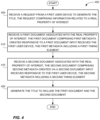
- FIG. 4 is a flowchart of an example process for building a title in a standardized format, according to the present disclosure
- FIG. 5 depicts an example generated title summary, according to the present disclosure
- FIG. 6 A depicts an example graphical user interface for receiving a document input, according to the present disclosure
- FIG. 6 B depicts an example graphical user interface for receiving a document input and/or a timing element, according to the present disclosure
- FIG. 6 C depicts an example graphical user interface for displaying available titles within a map interface, according to the present disclosure
- FIG. 7 is a flowchart of an example process for building and uploading a title in a standardized format, according to the present disclosure
- FIG. 8 is a flowchart of an example process for exchanging and storing titles, according to the present disclosure.
- FIG. 9 is a flowchart of an example process for saving individual property documents in a vault, according to the present disclosure.
- Examples of the present disclosure relate generally to generating title reports and, more particularly, to systems and methods for generating title reports in standardized formats and providing an environment for exchanging the title reports.
- the systems and methods described herein are necessarily rooted in computer technology as they can relate to gathering digital files in a variety of formats, generating metadata to associate with those digital files, and creating a standardized format based on that metadata.
- hard-copy files of property records can be uploaded into the systems and appended with metadata that allows the documents to be arranged according to industry and/or client-specific standards.
- the systems and methods can also utilize features of smart user device, such geographic location sensors (GLS) that provide location services enabling the system to identify locations of title abstractors that are closest to a particular real property and or government entity that stores title records. This can decrease the time required to process a title for a property as well as provide opportunities for title abstractors.
- GLS geographic location sensors
- title or title report when reference is made to a title or title report, this will be understood to mean a final product of combined one or more public records (e.g., title documents or property documents) associated with a real property of interest.
- property documents can include but are not limited to security interests (e.g., mortgages), judgement/liens, easements/leases, protective convenances, chains of title (e.g., deeds), and the like.
- title summary this can include a summary of the property documents within the title.
- Title abstractors will be understood as a user of the one or more user devices described herein that request that the title system(s) generate a title, request and/or upload one or more property documents to be included in the title, and/or provide document inputs to add metadata to the one or more property documents.
- the title abstractors can be known to the title system(s) so that the system can select title abstractors to build the title reports using the systems and methods described herein.
- the systems and methods described herein provide options for title abstractors and entities that request titles (e.g., law firms, real-estate firms, buyers, sellers, etc.) to receive a complete title report that includes all property documents in a standardized format and/or sequence.
- Title abstractors previously received a request from a requiting entity, accessed documents online and/or scanned numerous hard-copy documents stored in courthouse records, printed these documents, and arranged them according to industry standards.
- the present systems and methods can automatically create title reports, including a detailed title summary, based on metadata stored for each property document, whether the document is downloaded or manually scanned. Further, the systems and methods described herein provide solutions to the situation where multiple requesting entities request the same title report.
- the systems and methods provide an exchange system that enables requesting entities to access and/or purchase completed titles from a cloud service. This further adds value to the stakeholders by utilizing technology to make digital titles accessible.
- FIG. 1 is a diagram of an example system environment 100 that can be used to implement one or more examples of the present disclosure. A more detailed explanation of the components of the system environment 100 is provided below. It is beneficial, however, to provide a brief overview to describe the components of the systems and methods generating title reports in standardized formats and providing an environment for exchanging the title reports.
- the system environment 100 can include a title system 102 that can perform the one or more processes or methods described herein for generating and/or providing titles.
- the system environment 100 can include one or more user devices 106 .
- the user device 106 can be a computing device the performs steps such as requesting a title to be built, inputting documents (e.g., either from digital files or by creating digital files from hard copy files), inputting document inputs that identify the property documents, and the like.
- steps such as requesting a title to be built, inputting documents (e.g., either from digital files or by creating digital files from hard copy files), inputting document inputs that identify the property documents, and the like.
- the system environment 100 can include one or more requesting entities (e.g., a law firm, real-estate firm, etc.) that seek a prepared title from the abstractor (e.g., user device 106 ) and/or the system (e.g., title system 102 ).
- the system environment 100 can include a document entity 112 , which can be a government entity web site, server, and the like that stores digital property documents. It is also contemplated that the document entity 112 could be a third-party service, such as other title systems that perform the processes and methods described herein, that store property documents.
- the system environment can also include a mapping service 114 that provides third-party mapping services for the title system 102 .
- the mapping service(s) 114 can enable the title system 102 to provide a graphical user interface (GUI) with embeddings that show, within a map environment, which properties have a title report of record.
- the mapping service 114 can also provide additional services to the title system 102 , such as providing a list of known property addresses. This can enable the GUI provided by the title system 102 to auto-fill property addresses when a user is inputting a first request to build a title report. For example, if a user begins to enter “123 Elm S,” the user device 106 and/or title system 102 can receive a full address of “123 Elm St., Atlanta, G 31111.” This can prevent errors in association between the actual real property of interest and the property documents associated with that real property of interest.
- the title system 102 can communicate with the mapping service 114 via an application programming interface (API) 115 associated with the mapping service 114 .
- API application programming interface
- the title system 102 , one or more user devices 106 , requesting entity 110 , document entity 112 , and/or mapping service 114 can communicate via a wired or wireless network 108 .
- the wired networks can be an Ethernet network and the wireless networks can be cellular or WiFiTM networks, for example.
- network 108 can connect terminals, services, and user devices using direct connections such as WiFiTM, ZigBeeTM, ambient backscatter communications (ABC) protocols, USB, WAN, or LAN.
- the connections can also be encrypted or otherwise secured.
- the title system 102 can be affiliated with a title service provider that provides the title services described herein (e.g., generating and exchanging titles) for a fee.
- the title system 102 can include and/or communicate with a title sub-system 104 , which will be described in greater detail below and with respect to the component diagram shown in FIG. 2 .
- the title sub-system 104 can include one or more processors (e.g., processor 210 ) and memory 220 that can perform the title generation processes described herein.
- FIG. 3 is a component diagram of an example user device 106 , according to the present disclosure. The component diagram is described in greater detail below. It should be noted that, although only a single user device 106 is shown in FIG. 1 and FIG. 3 , it will be understood that the processes described herein can be performed by more than one user devices. For example, a first user device can be used by an abstractor to retrieve property documents from a first source (e.g., from an online source such as the document entity 112 ), and a second user device can be used by the abstractor to retrieve property documents from a second source (e.g., take scans/photographs of hard-copy records). However, a single user device 106 can also retrieve documents from all sources.
- a first source e.g., from an online source such as the document entity 112
- a second user device can be used by the abstractor to retrieve property documents from a second source (e.g., take scans/photographs of hard-copy records).
- FIG. 4 is a flowchart of an example process 400 for building a title in a standardized format, according to the present disclosure.
- the steps of process 400 can be performed by one or more components of a title system 102 (e.g., title sub-system 104 and/or web server 120 ).
- the title system 102 can receive, for example at a processor (e.g., processor 210 and/or processor 122 ), a request to generate the title (e.g., from a user device 106 and/or a requesting entity 110 ).
- the request can include information related to a real property of interest, including but not limited to a property address, lot number, district, etc.
- mapping service 114 can auto-fill addresses to ensure an accurate address is provided.
- this auto-fill information can be populated based on a proximity to the user device (e.g., in the case that the user device includes a geographic location sensor).
- process 400 can include receiving, for example at the title system 102 , a first document associated with the real property of interest.
- the first document can be inputted by a user device (e.g., user device 106 ) for receipt by the title system 102 .
- the first document can be a digital file retrieved from a document entity 112 (e.g., county government website) in a digital format (e.g., PDF, JPEG, MPEG, PNG, etc.).
- the first document can include first metadata created responsive to a first document input received from a first user device.
- Document inputs can include information about the first document, such as what type of property document the first document is (e.g., security interest, judgement/lien, easement/lease, protective convenance, chain of title, etc.).
- the user device can input a timing element to include in the first metadata.
- the timing element can indicate when the property document was recorded.
- Timing elements can include, for example, a first recordation date and/or a first deed book location associated with the first document.
- a deed book location can include a book number, which can be ranked sequentially based on a local guideline, and a page number within the book.
- FIG. 6 B and its related disclosure describes deed books and other timing elements in greater detail.
- process 400 can include receiving, for example at the title system 102 , a second document associated with the real property of interest.
- the second document can be inputted by a user device (either the first user device in block 415 or a second user device) for receipt by the title system 102 .
- the first document can be a hard copy record that is captured by the respective user device via an input/output device (e.g., I/O device 330 , which can include a digital camera or other image capture device).
- the second document can include second metadata created responsive to a second document input received via the first user device and/or the second user device.
- the second metadata can include a second timing element, as defined above.
- the metadata can be added to the digital copies of the first document and/or second document via the user device.
- the user device can transmit a copy of the property documents to the title system 102 , and the title system 102 can append the metadata to the digital copy of the property documents.
- process 400 can include generating, for example via the title system 102 , the title to include the first document and the second document appearing within the title.
- the system can arrange, or order, the property documents based on at least one of (i) the first timing element and the second timing element, or (ii) a standardized order for title documentation.
- the timing elements for illustration, if two documents are within the same document category (e.g., security interests), the first and second document can be arranged from newest to oldest within the title report.
- standardized orders for title document many industries and/or stakeholders have preferred orders in which to arrange property documents.
- the title report can arrange the various property documents based on category, for example security interests, then judgments/liens, then easements/leases, then protective covenants, and so on. This example, however, is merely illustrative. It is also contemplated that the arranging can be based on a client preference.
- the title system 102 can store arranging rules (e.g., in database 118 ) that are entity specific. A requesting entity 110 can, therefore, receive a title report in an order preferred by that particular entity.
- Process 400 can end after block 420 .
- additional steps can be performed according to the examples described herein.
- the title created by process 400 can be stored and made available to other entities wishing to retrieve a copy of the title searched for the particular property.
- Process 400 can include storing, in a database (e.g., database 118 ), a plurality of title reports comprising the title created in steps 405 - 420 .
- the plurality of title reports can be accessible by a plurality of user devices and searchable based at least upon property addresses associated with a plurality of real properties.
- the list of property addresses can be provided in any type of order, including numerical and/or alphabetical based on street name.
- the plurality of title reports can be listed on a map (e.g., map 630 in FIG. 6 C ) that enables a requesting entity to review which title reports are available in a particular area.
- Process 400 can include receiving an access request for the title from a third user device seeking a copy of the title responsive to purchasing the title.
- the third party user device can be associated with a requesting entity, which can be the original requesting entity or another requesting entity.
- Process 400 can include transmitting, via a transceiver (e.g., transceiver 280 ), the title to the third user device.
- FIG. 5 depicts an example generated title summary 500 , according to the present disclosure.
- a benefit of the present systems and methods is that they also provide an automated approach to create a title summary, which can describe all property documents within the generated title.
- the title summary 500 can include fields describing the title.
- the fields can include a property information field 505 , which described the property title, including address, when the title was searched, the type of real property, and the like.
- the fields can include a property legal information field 510 that includes the type of property (e.g., subdivision), district, lot, subdivision name, etc.
- the fields can include a current owner field 515 that shows who has the most recent interest in the real property.
- the fields can further include a security interest field 520 , a judgement/liens field 525 , an easements/leases field 530 , and/or a protective covenant field 535 . These fields can be populated based on what types of property documents are uploaded, for example as indicated by the metadata from one or more document inputs describing the document.
- the fields can also include a chain of title field 540 listing all or a portion of the transfers of ownership of the real property.
- the fields can include a taxes field 545 including information related to taxes, which can be retrieved, for example, from the document entity 112 .
- FIG. 6 A depicts an example graphical user interface (GUI) 600 for receiving a document input, according to the present disclosure.
- GUI graphical user interface
- one aspect of the present systems and methods includes adding metadata to digital property documents so as to identify them for ordering/sequencing purposes (for example based on property type and/or timing element).
- FIG. 6 A depicts an example graphical user interface (GUI) 600 for receiving a document input, according to the present disclosure.
- GUI graphical user interface
- GUI 600 provides a GUI 600 that is associated with the title system 102 that enables a user device 106 to provide document inputs associated with document type, as shown in the header 602 stating “Choose Document Type.”
- a user device 106 retrieves a property document (e.g., as a digital file downloaded from the document entity 112 or as a scan/photograph of a hard copy document)
- the user of the device can provide a document input that described the document.
- the GUI 600 can include fields associated with various document types, such as a chain of title field 604 , mortgages field 606 , liens field 608 , plat/floor plans field 610 , easements/leases field 612 , or any other number of fields associated with document types uploadable to the system.
- the title system 102 and/or user device 106 can append metadata associated with the uploaded property document.
- the document input that identifies the property document can be inputted automatically.
- the recorded document will ordinarily have a descriptor on the page written in text, indicating whether the document reflects a security interest, lien, etc. This can be true for contemporary documents, such as those typed within the past 50 years, but also with older documents including 19th century documents. Even if portions of the property document were handwritten, many times these documents included heading that were typeface.
- OCR optical character recognition
- the user device 106 can capture an image of the hard-copy document via an input/output device (e.g., I/O device 330 , which can include a digital camera or other image capture device). The user device 106 can then perform OCR, or the user device 106 can transmit a digital copy of the captured document to the title system 102 , which can perform OCR. OCR can also be performed on digital documents downloaded from the document entity 112 .
- I/O device 330 can include a digital camera or other image capture device.
- OCR can also be performed on digital documents downloaded from the document entity 112 .
- FIG. 6 B depicts an example GUI 600 for receiving a document input including a timing element, according to the present disclosure.
- the metadata that is added to the digital copies of the property documents can include an indication of when the document was recorded (e.g., a timing element).
- the timing element can include a deed date (shown in field 618 ), a date recorded (shown in field 620 ), or information related to the deed book in which the property document is recorded (as shown in deed book field 626 and page field 628 ).
- Deed book locations i.e., book number and page number
- each deed book can include character identifiers (e.g., numbers, letters, or combinations of numbers and letters) identifying the sequence in which deed books fall.
- character identifiers e.g., numbers, letters, or combinations of numbers and letters
- a deed book labeled A can come before a deed book labeled AA; whereas a deed book labeled B may come between deed book A and deed book AA chronologically.
- the system can store (for example in database 118 and/or database 250 ) these arranging rules on a jurisdiction-specific basis. If a title request is received for a real property in State X, then the title system 102 can retrieve the arranging rules for State X in which to arrange (chronologically) the documents in the completed title report. It is contemplated that the deed book number and page number can be entered into GUI 600 as shown (e.g., in deed book field 626 and page field 628 ). In other examples, these timing elements can be identified via OCR, as described above.
- FIG. 6 B shows other details of an example GUI 600 for receiving timing elements, including additional fields, including a title indicator field 614 that indicates what type of document is being uploaded.
- the GUI 600 shows a page for “Chain of Title,” as shown, the GUI 600 can include a current owner toggle 616 that indicates whether this is most recent chain in that title.
- the interface can also show the grantor (in grantor field 622 ) and grantee (in grantee field 624 ).
- Each of these document inputs can also be identified via OCR, as described above.
- FIG. 6 C depicts an example GUI 600 for displaying titles that are available within a map 630 interface, according to the present disclosure.
- one aspect of the present disclosure provides a system and method for uploading previously-generated title reports to a cloud service so that the titles are available for purchase or exchange.
- One drawback to prior designs is that if one requesting entity, say a first law firm, requested a title, that title was generated for use by the first law firm. If a second law firm wished to run a title search on the same property, that firm would need to hire an abstractor to duplicate the work that was already completed.
- the present systems and methods provide an option of sharing the completed title report on a cloud-based platform (e.g., web server 120 ) so that other requesting entities can purchase the title.
- the completed title reports can be saved, for example, in a database (e.g., databases 118 , 124 , and/or 250 ) for access.
- the titles can be listed in a GUI 600 provided by the system (e.g., the title system 102 ) and can be searchable by a property identifier, such as an address, a parcel number, and the like.
- available titles can be displayed on a map 630 within the GUI 600 .
- the map 630 can include one or more icons, e.g., a first icon 632 and a second icon 634 , that allows a user of the service to select a property of interest to retrieve the saved title report. This can be valuable for developers that wish to run title searches on many properties in a given subdivision—using the map 630 they can locate which properties in that subdivision already have a saved title report. If a property in a subdivision is not available, the developer (or other requesting entity 110 ) can request a new title for that property.
- the map 630 provided in the example GUI 600 shown in FIG. 6 C can be a map that is native to the title system 102 (e.g., the title system 102 stores the map information within database 118 , database 250 , etc.). In other examples, the map can be provided to a user interface via the mapping service 114 .
- Mapping services 114 can include companies that provide map interfaces for customers, such as the map interfaces associated with Google®, Apple®, Waze®, etc.
- the title system 102 can communicate with the mapping service 114 via an API (e.g., API 115 ) that allows the third-party service to embed maps 630 in the GUI 600 of the title system 102 , for example via HTTP requests and similar requests.
- each property that is saved in the database can have more than one title report and title summary associated with the property.
- a first abstractor can use the processes described herein to create a first title report (e.g., by using the process 400 described above with reference to FIG. 4 ), and the system can store that title report.
- That first title report will have a first effective date, i.e., a date for which that title is “effective” through.
- a period of time can pass, and another abstractor can create a second title report in a similar manner.
- the second title report can have an effective date that is later than the first title report.
- These two title reports can be stored for the single real property of interest, and can be selectable/purchasable by a requesting entity 110 and/or another abstractor.
- the system can tier pricing of all title reports stored for a property by the effective date—i.e., the first (older) title report can be cheaper than the second (newer) title report.
- the requesting entity 110 and/or other abstractor then has options of which title report to purchase. It is likely that, regardless of the effective date of the title report(s), an updated search will be required so that the abstractor can confirm the title search is current.
- the requestor can select an older, cheaper title report, and build upon the report from the effective filing date of that title report.
- a property may have property documents dating back to 1890.
- the system in this example, stores two title reports, a first with an effective date of Jun. 18, 2017 and a second with an effective date of Jan. 3, 2021.
- the requestor can select the 2017 report for a lower price, and then build a new report (e.g., using process 400 in FIG. 4 ) that includes any property document from Jun. 18, 2017 to today.
- the abstractor was able to receive a title report for all documents from 1890 to 2017 , but save money on the documents from 2017 to 2021 , since that work may be minimal yet must be completed to confirm accuracy up until today.
- FIG. 7 is a flowchart of an example process 700 for building and uploading a title in a standardized format, according to the present disclosure.
- the steps of process 700 can be performed by components of one or more user devices (e.g., processor 210 and memory 220 of user device 106 ).
- process 700 can include receiving a request to generate the title for a real property of interest.
- the request can be received at a GUI associated with a title system (e.g., one or more components of the title system 102 ).
- the request can be selected in a field within a GUI that requests to build a new title or add to a previously-started title.
- process 700 can include receiving a first document associated with the real property of interest.
- the first document can be retrieved from third-party service that stores digital copies of property documents (e.g., a government entity and/or another document entity 112 ).
- the documents can be retrieved in a digital format, such as a PDF, JPEG, MPEG, PNG, or other document format.
- the first document can include first metadata created responsive to a first document input.
- the first document input can be received via an input into a GUI (e.g., GUI 600 shown in FIGS. 6 A and 6 B above) and/or via OCR, as described above.
- the first metadata can include a first timing element describing when the document was recorded.
- process 700 can include receiving a second document associated with the real property of interest.
- the second document can be another digital file retrieved from a third-party service.
- the second document can be digital copy of a hard-copy file retrieved from a document-storing facility, such as a country courthouse.
- the digital file can be received, at the one or more processors of the user device, via a digital camera or other input/output device.
- the second document can include second metadata created responsive to a second document input.
- the second document input can be received via an input into a GUI (e.g., GUI 600 shown in FIGS. 6 A and 6 B above) and/or via OCR, as described above.
- the second metadata can include a second timing element describing when the document was recorded.
- process 700 can include receiving, for example at a transceiver (e.g., transceiver 350 ), the title that includes the first document and the second document appearing within the title.
- the user device can generate the title independently of the backend (e.g., independent of the title system 102 ).
- This receiving/generating step can conclude with a user of the user device receiving a fully-created title report for the property, including the first document, the second document, and any other document(s).
- the first and second document can be arranged based on at least one of (i) the first timing element and the second timing element, or (ii) a standardized order for title documentation.
- the standardized order can be based on industry standards or client standards, as described above.
- Process 700 can end after block 720 . In other examples, additional steps can be performed according to the examples described herein.
- FIG. 8 is a flowchart of an example process 800 for exchanging and storing titles, according to the present disclosure.
- Another aspect of the present disclosure provides options for one or more requesting entities (e.g., requesting entit(ies) 110 ) to request a title search and full title report from one or more abstractors.
- the request can be transmitted to the service (e.g., title system 102 ), requesting a title for a particular real property of interest. This can be the case, for example, when a requesting entity, like a law firm, does not have an employed or contracted abstractor in a particular location, e.g., a county in a state.
- the title service that operates the title system 102 can operate to find an abstractor that can run the title using the systems and methods described herein, and do so by selecting an abstractor based on particular parameters. These parameters can include abstractor rankings and/or ratings or abstractor proximities to a particular document storage facility, e.g., proximity to a county courthouse. Further, the systems and methods can also position the title system 102 as an intermediary between the requesting entity and abstractor so that information about the requesting entity is never provided to the abstractor, and information about the abstractor is never provided to the requesting entity. In this manner, the title service can ensure that any work product created by the title system 102 with input by the abstractor is exchanged through the system and not directly between the abstractor/requesting entity. This ensures that the title system provider receives payment for providing the systems and methods described herein for creating the title, and, in some examples, the final product can be uploaded to an online server for other requesting entities to purchase, as described above.
- process 800 can include receiving a title request from a requesting entity seeking a title for a real property of interest.
- the title request can include a title fee.
- the requesting entity can agree to pay a particular fee to the title service provider to run the title report. This fee can also pay the final abstractor for his/her work in processing the title.
- process 800 can include transmitting, via a transceiver (e.g., transceiver 280 ), a bid to a plurality of user devices requesting the title.
- the title system can store a list of abstractors that can run titles for any given jurisdiction.
- the title abstractors, or the user device that is associated with the abstractor can be chosen based on a number of factors.
- the title system 102 can store a list of title abstractors that work in a given jurisdiction (for example a particular state or region of a state).
- the title system 102 can also rank the title abstractors known to the system based on criteria defined by the title service.
- the title system 102 can store which title abstractors run a title search via the systems and methods described herein within a predetermined period of time, ranking those title abstractors that generate a title report more quickly higher than slower abstractors.
- the ranking can also be based on a quantity of titles performed by the abstractor(s), where abstractors that generate more titles are ranked higher than less experienced abstractors, or vice versa.
- the title system 102 can choose a subset of user devices of the plurality of user devices in which to send the bid in block 810 . This can also provide an incentive to other abstractors to work more efficiently with respect to title generation so that they are included in more bids in the future.
- the title system 102 can choose which user devices of a larger set of user devices receive a bid based on proximity to a location of the real property of interest. For example, if a request is for a property at 123 Elm Street in Fulton County, the title system 102 can determine which user devices of the plurality of user devices registered to abstractors are within a predetermined distance of 123 Elm St. In other examples, the title system 102 can determine which user device is located within a predetermined distance of a courthouse within a county in which the real property of interest is situated.
- the title system 102 can determine which user devices of the plurality of user devices registered to abstractors are within a predetermined distance of the Fulton County courthouse. This distance ranking can be performed by tracking or pinging locations of user devices of registered abstractors that have location services to a track location of the abstractor devices (for example when the user devices include a geographic location sensor, as described below). It is also contemplated that a user device of the plurality of user devices can be selected based on both (i) a ranking and (ii) proximity to the real property and/or proximity to the courthouse.
- process 800 can include receiving the title from a first user device of the plurality of user devices.
- the first user device can be any one of the user devices used by abstractors.
- the title can be created by any of the methods or processes described herein, including those described above for process 700 in FIG. 7 .
- process 800 can include transmitting the title to the requesting entity.
- the title can be transmitted to the requesting entity free of any identifying information associated with the first user device or a user (e.g., abstractor) associated with the first user device.
- process 800 can include transmitting an indication of at least a portion of the title fee to the first user device. This step can include, for example, transmitting a notification to the first user device that the title system 102 has transferred a sum of money to an account associated with the first user device. Process 800 can end after block 825 . In other examples, additional steps can be performed according to the examples described herein.
- an aspect of the present disclosure provides a way for abstractors to monetize their efforts in using the system to build and upload a completed title report (e.g., by using the processes described in process 400 in FIG. 4 and/or process 700 in FIG. 7 ).
- the systems and methods can provide an exclusivity period for an abstractor that uploads a title document into an exchange environment. For example, if a first abstractor uploads a title into the system for purchase by other entities (e.g., other abstractors and/or other requesting entities 110 ), the system can provide that abstractor a predetermined period of time in which that uploaded title is the “newest” title in the system (e.g., most current effective date).
- That exclusivity period can be one week, two weeks, a month, etc.
- Other abstractors can build reports during this exclusivity period, but those newer reports can be stored in the system until the exclusivity period is over.
- the newer abstracts can be published for purchase (e.g., as described above with reference to FIG. 6 C ). This can help prevent later abstractors from purchasing the title report built by the first abstractor, and then republishing the same title report for a price less than the first abstractor.
- any new report built after that exclusivity period can have another exclusivity period. For example, the first abstractor (or anyone else) can build a new report sometime after the exclusivity period of the first report is over, and the new report will have a new exclusivity period.
- FIG. 9 is a flowchart of an example process 900 for saving individual property documents in a vault, according to the present disclosure.
- Another aspect of the present disclosure provides an environment where any single property document retrieved and/or uploaded using the processes described herein (e.g., by process 400 in FIG. 4 ) can be saved in a “vault” for that real property of interest.
- the vault can be accessed by third parties (e.g., requesting entities 110 ) that are not searching for an entire title report with a title summary, but are instead interested in one or more individual documents associated with that property.
- the individual property document embodiment can build upon any of the preceding processes.
- process 900 can be performed by one or more components of a title system 102 (e.g., title sub-system 104 and/or web server 120 ).
- process 900 can include generating a title to include one or more documents.
- an abstractor can use the systems described above with reference to process 400 in FIG. 4 to begin building a title report.
- the process can include uploading one or more property documents and saving them to the title system 102 . This can include a first document and a second document, as described herein, or a single document.
- process 900 can include the title system 102 searching a database (e.g., databases 118 , 124 , and/or 250 ) to identify if one or more of the documents exist in storage.
- This step can include searching a vault of a plurality of property documents stored by the system for the property.
- the property documents can be received from an abstractor building a title report as described herein.
- the system can store the entire generated title report as well as each individual property document within the title report.
- the metadata appended to each of the property documents can work as an identifier for the individual property documents. For example, a mortgage for 123 Elm Street can be saved and searchable by identifiers such as the property address, the recordation date, the execution date, and any property identifier received as a property input and/or a timing element.
- process 900 can include identifying that at least one document (e.g., at least one of a first document or a second document) is not stored in the vault of documents associated with the real property of interest. If any of the property documents have never been stored for that property, the system can ask the user if that document should be uploaded into that property's vault.
- process 900 can include transmitting a notification to a user device indicating that a non-stored (e.g., one of the first or second documents) can be uploaded to the vault for that property.
- process 900 can include receiving an indication from a user device (e.g., via the GUIs described herein) that the non-stored document can be uploaded to the vault.
- process 900 can include adding the non-stored property document to the vault.
- the new property document can be accessed from a third party (e.g., a requesting entity 110 ) individually.
- Process 900 can end after block 930 . In other examples, additional steps can be performed according to the examples described herein.
- the person that uploaded the document(s) into the vault can be paid for each copy retrieved by a requesting entity.
- a document storage entity such as the county courthouse or other document repository, can charge a certain amount for copies of documents.
- the present systems enable the person who did the work to upload the document and provide document inputs/timing elements to receive at least a portion of the fee associated with any copy.
- the uploader can be an abstractor, as described herein, or any other user, such as a government employee using the title system 102 to store digital copies of the hard-copy documents stored at the courthouse.
- the title system 102 can interact with a user device 106 , the requesting entity 110 , the document entity 112 , and/or the mapping service 114 via a network 108 .
- the title system environment 102 can include a web server 120 , a local network 116 , title sub-system 104 , and a database 118 .
- an abstractor can operate the user device 106 , for example to provide the property documents and/or document inputs.
- FIG. 1 depicts a single user device, it is contemplated that an abstractor can perform the processes described herein with one or more user devices.
- the user device 106 can include one or more of a mobile device, smart phone, general purpose computer, tablet computer, laptop computer, other mobile computing device, or other device capable of communicating with the network 108 and ultimately communicating with one or more components of the system environment 100 .
- the network 108 may include any type of computer networking arrangement used to exchange data.
- the network 108 may be the Internet, a private data network, virtual private network using a public network, and/or other suitable connection(s) that enable(s) components in the title system 102 to send and receive information between the components of the system environment 100 .
- the network 108 may also include a public switched telephone network (“PSTN”) and/or a wireless network.
- PSTN public switched telephone network
- a requesting entity 110 e.g., the party seeking to receive a generated title report, may be in communication with the title system 102 via the network 108 .
- the requesting entity 110 can include a computer system associated with an entity that performs one or more functions associated with requesting and/or purchasing a title report.
- the title system 102 may be associated with and optionally controlled by one or more entities such as a business, corporation, individual, partnership, or any other entity that provides one or more of goods, services, and consultations to individuals such as customers.
- the title system 102 may include one or more servers and computer systems for performing one or more functions associated with products and/or services that the organization provides.
- Such servers and computer systems may include, for example, the web server 120 as well as any other computer systems necessary to accomplish tasks associated with the organization or the needs of customers (which may be customers of the entity associated with the organization).
- the web server 120 may include a computer system configured to generate and provide one or more websites accessible to customers, as well as any other individuals involved in an organization's normal operations.
- the web server 120 may include a computer system configured to receive communications from the user device 106 via for example, a mobile application, a chat program, an instant messaging program, a voice-to-text program, an SMS message, email, or any other type or format of written or electronic communication.
- the web server 120 may have one or more processors 122 and one or more web server databases 124 , which may be any suitable repository of website data. Information stored in the web server 120 may be accessed (e.g., retrieved, updated, and added to) via the local network 116 (and/or the network 108 ) by one or more devices (e.g., the title sub-system 104 ) of the system environment 100 .
- the local network 116 may include any type of computer networking arrangement used to exchange data in a localized area, such as WiFi, BluetoothTM Ethernet, cellular, and other suitable network connections that enable components of the title system 102 to interact with one another and to connect to the network 108 for interacting with components in the system environment 100 .
- the local network 116 may include an interface for communicating with or linking to the network 108 .
- certain components of the system environment 100 may communicate via the network 108 without a separate local network 116 .
- the title system 102 may include one or more computer systems configured to compile data from a plurality of sources, such as the web server 120 , the title sub-system 104 , and/or the database 118 .
- the title sub-system 104 may correlate compiled data, analyze the compiled data, arrange the compiled data, generate derived data based on the compiled data, and store the compiled and derived data in a database such as the database 118 .
- the database 118 may be a database associated with an organization and/or a related entity that stores a variety of information relating to customers, transactions, and business operations.
- the database 118 may also serve as a back-up storage device and may contain data and information that is also stored on, for example, databases 124 and 250 (as discussed with reference to FIG. 2 ).
- the title sub-system 104 may include a processor 210 , an input/output (“I/O”) device 260 , a memory 220 containing an operating system (“OS”) 230 and a program 240 .
- the title sub-system 104 may be a single server or may be configured as a distributed computer system including multiple servers or computers that interoperate to perform one or more of the processes and functionalities associated with the disclosed embodiments.
- the title sub-system 104 may further include a peripheral interface, a communication interface 270 (including, for example, a transceiver 280 ), a mobile network interface in communication with the processor 210 , a bus configured to facilitate communication between the various components of the title sub-system 104 , and a power source configured to power one or more components of the title sub-system 104 .
- a peripheral interface including, for example, a transceiver 280
- a mobile network interface in communication with the processor 210
- a bus configured to facilitate communication between the various components of the title sub-system 104
- a power source configured to power one or more components of the title sub-system 104 .
- a peripheral interface may include the hardware, firmware and/or software that enable(s) communication with various peripheral devices, such as media drives (e.g., magnetic disk, solid state, or optical disk drives), other processing devices, or any other input source used in connection with the disclosed technology.
- a peripheral interface may include a serial port, a parallel port, a general-purpose input and output (GPIO) port, a game port, a universal serial bus (USB), a micro-USB port, a high definition multimedia (HDMI) port, a video port, an audio port, a BluetoothTM port, a near-field communication (NFC) port, another like communication interface, or any combination thereof.
- a transceiver 280 may be configured to communicate with compatible devices and ID tags when they are within a predetermined range.
- a transceiver 280 may be compatible with one or more of: cellular, radio-frequency identification (RFID), near-field communication (NFC), BluetoothTM, low-energy BluetoothTM (BLE), WiFiTM, ZigBeeTM, ambient backscatter communications (ABC) protocols or similar technologies.
- RFID radio-frequency identification
- NFC near-field communication
- BLE low-energy BluetoothTM
- WiFiTM WiFiTM
- ZigBeeTM ZigBeeTM
- ABS ambient backscatter communications
- a mobile network interface may provide access to a cellular network, the Internet, or another wide-area or local area network.
- a mobile network interface may include hardware, firmware, and/or software that allow(s) the processor(s) 210 to communicate with other devices via wired or wireless networks, whether local or wide area, private or public, as known in the art.
- a power source may be configured to provide an appropriate alternating current (AC) or direct current (DC) to power components.
- the processor 210 may include one or more of a microprocessor, microcontroller, digital signal processor, co-processor or the like or combinations thereof capable of executing stored instructions and operating upon stored data.
- the memory 220 may include, in some implementations, one or more suitable types of memory (e.g.
- RAM random access memory
- ROM read only memory
- PROM programmable read-only memory
- EPROM erasable programmable read-only memory
- EEPROM electrically erasable programmable read-only memory
- magnetic disks optical disks, floppy disks, hard disks, removable cartridges, flash memory, a redundant array of independent disks (RAID), and the like
- application programs including, for example, a web browser application, a widget or gadget engine, and or other applications, as necessary
- executable instructions and data for storing files including an operating system, application programs (including, for example, a web browser application, a widget or gadget engine, and or other applications, as necessary), executable instructions and data.
- the processing techniques described herein may be implemented as a combination of executable instructions and data stored within the memory 220 .
- the processor 210 may be one or more known processing devices, such as, but not limited to, a microprocessor from the PentiumTM family manufactured by IntelTM or the TurionTM family manufactured by AMDTM.
- the processor 210 may constitute a single core or multiple core processor that executes parallel processes simultaneously.
- the processor 210 may be a single core processor that is configured with virtual processing technologies.
- the processor 210 may use logical processors to simultaneously execute and control multiple processes.
- the processor 210 may implement virtual machine technologies, or other similar known technologies to provide the ability to execute, control, run, manipulate, store, etc. multiple software processes, applications, programs, etc.
- One of ordinary skill in the art would understand that other types of processor arrangements could be implemented that provide for the capabilities disclosed herein.
- the title sub-system 104 may include one or more storage devices configured to store information used by the processor 210 (or other components) to perform certain functions related to the disclosed embodiments.
- the title sub-system 104 may include the memory 220 that includes instructions to enable the processor 210 to execute one or more applications, such as server applications, network communication processes, and any other type of application or software known to be available on computer systems.
- the instructions, application programs, etc. may be stored in an external storage or available from a memory over a network.
- the one or more storage devices may be a volatile or non-volatile, magnetic, semiconductor, tape, optical, removable, non-removable, or other type of storage device or tangible computer-readable medium.
- the title sub-system 104 may include a memory 220 that includes instructions that, when executed by the processor 210 , perform one or more processes consistent with the functionalities disclosed herein. Methods, systems, and articles of manufacture consistent with disclosed embodiments are not limited to separate programs or computers configured to perform dedicated tasks.
- the title sub-system 104 may include the memory 220 that may include one or more programs 240 to perform one or more functions of the disclosed embodiments.
- the title sub-system 104 may additionally manage dialogue and/or other interactions with the customer via a program 240 .
- the processor 210 may execute one or more programs 240 located remotely from the title system 102 .
- the title system 102 may access one or more remote programs 240 , that, when executed, perform functions related to disclosed embodiments.
- the title sub-system 104 may include stored data relating to weighting sub-score, phone numbers, emails, and user device locations associated with a plurality of users.
- the functions provided by a categorizing database 250 may also be provided by a database that is external to the title sub-system 104 , such as the database 118 as shown in FIG. 1 .
- the title sub-system 104 may also include one or more I/O devices 260 that may comprise one or more interfaces for receiving signals or input from devices and providing signals or output to one or more devices that allow data to be received and/or transmitted by the title sub-system 104 .
- the title sub-system 104 may include interface components, which may provide interfaces to one or more input devices, such as one or more keyboards, mouse devices, touch screens, track pads, trackballs, scroll wheels, digital cameras, microphones, sensors, and the like, that enable the title sub-system 104 to receive data from a use (such as, for example, via the user device 106 ).
- the user device 106 can be a mobile computing device (e.g., a smart phone, tablet computer, smart wearable (e.g., a smart watch), portable laptop computer, or other mobile computing device) or a stationary device (e.g., desktop computer).
- the user device 106 can include a processor 305 similar to the processor 210 described above.
- the user device 106 can also include a memory 310 , operating system 315 , one or more programs 320 , and/or data storage 325 , which can be similar to the memory 220 , OS 230 , one or more programs 240 , or database 250 , respectively, as described above.
- the user device 106 can also include a communication interface 345 that includes a transceiver 350 , which can be similar to the communication interface 270 and transceiver 280 described above.
- the operating system 315 can enable the user device 106 to operate the various applications described herein.
- a program 320 can include an application associated with the title system 102 .
- the operating system 315 can operate an account provider application that enables the user device 106 to display a GUI associated with the title system 102 .
- the user device 106 can also include one or more input/output (“I/O”) devices 330 that can include one or more interfaces for receiving signals or input from devices and providing signals or output to one or more devices that allow data to be received and/or transmitted by the user device 106 .
- I/O input/output
- the user device 106 can include interface components, which can provide interfaces to one or more input devices, such as one or more keyboards, mouse devices, touch screens, track pads, trackballs, scroll wheels, digital cameras, microphones, sensors, and the like, that enable the user device 106 to receive data from one or more users.
- the user device 106 can also include a user interface (“U/I”) device 335 for receiving user input data, such as data representative of a click, a scroll, a tap, a press, or typing on an input device that can detect tactile inputs.
- U/I device 335 can include some or all of the components described with respect to I/O device 330 above.
- the U/I device 335 can be defined as the “input” of the user device 106 .
- the user device 106 can also include a geographic location sensor (“GLS”) 340 for determining the geographic location of the user device 106 .
- GLS geographic location sensor
- the user device 106 can include a display 355 .
- the display 355 can provide visual representation of the various websites, applications, and/or GUIs described herein.
- the display 355 can also be a U/I device 335 in the case that the user device 106 has touchscreen capabilities. In other words, in some examples the display 355 can be the “input” of the user device 106 .
Landscapes
- Engineering & Computer Science (AREA)
- Business, Economics & Management (AREA)
- Theoretical Computer Science (AREA)
- Physics & Mathematics (AREA)
- General Physics & Mathematics (AREA)
- Strategic Management (AREA)
- General Business, Economics & Management (AREA)
- Economics (AREA)
- Tourism & Hospitality (AREA)
- Marketing (AREA)
- Human Resources & Organizations (AREA)
- Entrepreneurship & Innovation (AREA)
- Accounting & Taxation (AREA)
- Databases & Information Systems (AREA)
- Computer Vision & Pattern Recognition (AREA)
- General Health & Medical Sciences (AREA)
- Finance (AREA)
- Data Mining & Analysis (AREA)
- Health & Medical Sciences (AREA)
- Artificial Intelligence (AREA)
- General Engineering & Computer Science (AREA)
- Operations Research (AREA)
- Quality & Reliability (AREA)
- Development Economics (AREA)
- Primary Health Care (AREA)
- Multimedia (AREA)
- Audiology, Speech & Language Pathology (AREA)
- Computational Linguistics (AREA)
- Information Retrieval, Db Structures And Fs Structures Therefor (AREA)
Abstract
Description
Claims (13)
Priority Applications (2)
| Application Number | Priority Date | Filing Date | Title |
|---|---|---|---|
| US17/361,737 US12165230B2 (en) | 2021-06-29 | 2021-06-29 | Systems and methods for generating title reports |
| US18/945,999 US20250069170A1 (en) | 2021-06-29 | 2024-11-13 | Systems and methods for generating title reports |
Applications Claiming Priority (1)
| Application Number | Priority Date | Filing Date | Title |
|---|---|---|---|
| US17/361,737 US12165230B2 (en) | 2021-06-29 | 2021-06-29 | Systems and methods for generating title reports |
Related Child Applications (1)
| Application Number | Title | Priority Date | Filing Date |
|---|---|---|---|
| US18/945,999 Division US20250069170A1 (en) | 2021-06-29 | 2024-11-13 | Systems and methods for generating title reports |
Publications (2)
| Publication Number | Publication Date |
|---|---|
| US20220414806A1 US20220414806A1 (en) | 2022-12-29 |
| US12165230B2 true US12165230B2 (en) | 2024-12-10 |
Family
ID=84541155
Family Applications (2)
| Application Number | Title | Priority Date | Filing Date |
|---|---|---|---|
| US17/361,737 Active 2043-02-20 US12165230B2 (en) | 2021-06-29 | 2021-06-29 | Systems and methods for generating title reports |
| US18/945,999 Pending US20250069170A1 (en) | 2021-06-29 | 2024-11-13 | Systems and methods for generating title reports |
Family Applications After (1)
| Application Number | Title | Priority Date | Filing Date |
|---|---|---|---|
| US18/945,999 Pending US20250069170A1 (en) | 2021-06-29 | 2024-11-13 | Systems and methods for generating title reports |
Country Status (1)
| Country | Link |
|---|---|
| US (2) | US12165230B2 (en) |
Citations (4)
| Publication number | Priority date | Publication date | Assignee | Title |
|---|---|---|---|---|
| US20070174076A1 (en) * | 2006-01-26 | 2007-07-26 | Crystal Kord | System and method for providing real-time access of real estate property transaction information and status via voice communication networks |
| US7548884B1 (en) * | 2003-10-21 | 2009-06-16 | Neil Thomas | Computerized process to, for example, automate the home sale, mortgage loan financing and settlement process, and the home mortgage loan refinancing and settlement processes |
| US20100161496A1 (en) * | 2008-12-22 | 2010-06-24 | Sony Computer Entertainment America Inc. | Method for Ensuring Contractual Compliance in Cross-Platform Quality Control |
| US20190050954A1 (en) * | 2017-08-09 | 2019-02-14 | Indepth Solutions, Inc. | Methods for providing title services in a real estate transaction |
-
2021
- 2021-06-29 US US17/361,737 patent/US12165230B2/en active Active
-
2024
- 2024-11-13 US US18/945,999 patent/US20250069170A1/en active Pending
Patent Citations (4)
| Publication number | Priority date | Publication date | Assignee | Title |
|---|---|---|---|---|
| US7548884B1 (en) * | 2003-10-21 | 2009-06-16 | Neil Thomas | Computerized process to, for example, automate the home sale, mortgage loan financing and settlement process, and the home mortgage loan refinancing and settlement processes |
| US20070174076A1 (en) * | 2006-01-26 | 2007-07-26 | Crystal Kord | System and method for providing real-time access of real estate property transaction information and status via voice communication networks |
| US20100161496A1 (en) * | 2008-12-22 | 2010-06-24 | Sony Computer Entertainment America Inc. | Method for Ensuring Contractual Compliance in Cross-Platform Quality Control |
| US20190050954A1 (en) * | 2017-08-09 | 2019-02-14 | Indepth Solutions, Inc. | Methods for providing title services in a real estate transaction |
Non-Patent Citations (1)
| Title |
|---|
| Title Leader retrieved from the Internet Archive WayBack Machine at https://web.archive.org/web/20201201140303/https://titleleader.com/why/#faq (Year: 2020). * |
Also Published As
| Publication number | Publication date |
|---|---|
| US20250069170A1 (en) | 2025-02-27 |
| US20220414806A1 (en) | 2022-12-29 |
Similar Documents
| Publication | Publication Date | Title |
|---|---|---|
| US11748345B2 (en) | Apparatuses, methods and systems for a lead generating hub | |
| US11244388B2 (en) | Methods and systems for assessing performance and risk in financing supply chain | |
| US20110288962A1 (en) | Apparatuses, methods and systems for a lead exchange facilitating hub | |
| US20110289161A1 (en) | Apparatuses, Methods and Systems For An Intelligent Inbox Coordinating HUB | |
| US20110289010A1 (en) | Apparatuses, methods and systems for an activity tracking and property transaction facilitating hub user interface | |
| US8346664B1 (en) | Method and system for modifying financial transaction categorization lists based on input from multiple users | |
| US20140032267A1 (en) | User controlled system and method for collecting, pricing, and trading data | |
| US20110066643A1 (en) | System and method for assembling, verifying, and distibuting financial information | |
| US20130211963A1 (en) | Facilitation of interaction between providers, buyers, and agents | |
| CA2927580C (en) | Method and system for document data extraction template management | |
| KR20150093215A (en) | Methods for discovering and paying debts owed by a group | |
| Khan et al. | Key features of digital library management system (DLMS) for developing digital libraries: An investigation from LIS practitioners in Pakistan | |
| US20110066645A1 (en) | System and method for assembling, verifying, and distibuting financial information | |
| EP2510491A1 (en) | System and method for facilitating the creation, management, and valuation of securities research | |
| US20190362430A1 (en) | Electronic fulfillment system and method for completing life insurance settlement transactions and obtaining and managing electronic signatures for life insurance settlement transaction documents | |
| CN111357031B (en) | Method, system and program product for local investment network | |
| AU2014343044A1 (en) | Method and system for document data extraction template management | |
| US20230105485A1 (en) | Multi-dimensional interaction with data stores related to tangible property | |
| US20110066644A1 (en) | System and method for assembling, verifying, and distibuting financial information | |
| US20190333648A1 (en) | System and method for building, using and sharing a corpus of scientific literature for a life science company | |
| US12165230B2 (en) | Systems and methods for generating title reports | |
| US20070162490A1 (en) | System and method for generating a uniform indexing scheme for ordering and retrieving property information | |
| US20130151363A1 (en) | Recognizing missing offerings in a marketplace | |
| US20170256009A1 (en) | Marketing real estate services based on listing status | |
| US20130097055A1 (en) | Methods and systems for transferring liquor licenses |
Legal Events
| Date | Code | Title | Description |
|---|---|---|---|
| FEPP | Fee payment procedure |
Free format text: ENTITY STATUS SET TO UNDISCOUNTED (ORIGINAL EVENT CODE: BIG.); ENTITY STATUS OF PATENT OWNER: SMALL ENTITY |
|
| FEPP | Fee payment procedure |
Free format text: ENTITY STATUS SET TO SMALL (ORIGINAL EVENT CODE: SMAL); ENTITY STATUS OF PATENT OWNER: SMALL ENTITY |
|
| STPP | Information on status: patent application and granting procedure in general |
Free format text: DOCKETED NEW CASE - READY FOR EXAMINATION |
|
| AS | Assignment |
Owner name: AMERICAN LAND TITLE EXCHANGE, LLC, GEORGIA Free format text: ASSIGNMENT OF ASSIGNORS INTEREST;ASSIGNORS:RUSEK, STASIO FRENCH;BEEHLER, STEPHEN MICHAEL;REEL/FRAME:059420/0769 Effective date: 20210628 |
|
| STPP | Information on status: patent application and granting procedure in general |
Free format text: NON FINAL ACTION MAILED |
|
| STPP | Information on status: patent application and granting procedure in general |
Free format text: RESPONSE TO NON-FINAL OFFICE ACTION ENTERED AND FORWARDED TO EXAMINER |
|
| STPP | Information on status: patent application and granting procedure in general |
Free format text: RESPONSE TO NON-FINAL OFFICE ACTION ENTERED AND FORWARDED TO EXAMINER |
|
| STPP | Information on status: patent application and granting procedure in general |
Free format text: NON FINAL ACTION MAILED |
|
| STPP | Information on status: patent application and granting procedure in general |
Free format text: RESPONSE TO NON-FINAL OFFICE ACTION ENTERED AND FORWARDED TO EXAMINER |
|
| STPP | Information on status: patent application and granting procedure in general |
Free format text: NOTICE OF ALLOWANCE MAILED -- APPLICATION RECEIVED IN OFFICE OF PUBLICATIONS |
|
| STPP | Information on status: patent application and granting procedure in general |
Free format text: NOTICE OF ALLOWANCE MAILED -- APPLICATION RECEIVED IN OFFICE OF PUBLICATIONS |
|
| STCF | Information on status: patent grant |
Free format text: PATENTED CASE |