US12109131B2 - Motorized adjustable socket for amputee prosthesis users and methods for use thereof - Google Patents
Motorized adjustable socket for amputee prosthesis users and methods for use thereof Download PDFInfo
- Publication number
- US12109131B2 US12109131B2 US16/865,088 US202016865088A US12109131B2 US 12109131 B2 US12109131 B2 US 12109131B2 US 202016865088 A US202016865088 A US 202016865088A US 12109131 B2 US12109131 B2 US 12109131B2
- Authority
- US
- United States
- Prior art keywords
- socket
- limb
- sensor
- panel
- processor
- Prior art date
- Legal status (The legal status is an assumption and is not a legal conclusion. Google has not performed a legal analysis and makes no representation as to the accuracy of the status listed.)
- Active, expires
Links
- 238000000034 method Methods 0.000 title claims abstract description 64
- 230000000694 effects Effects 0.000 claims description 54
- 230000001939 inductive effect Effects 0.000 claims description 14
- 230000033001 locomotion Effects 0.000 claims description 14
- 230000004044 response Effects 0.000 claims description 9
- 210000003414 extremity Anatomy 0.000 description 71
- 238000012360 testing method Methods 0.000 description 33
- 239000012530 fluid Substances 0.000 description 27
- 230000008859 change Effects 0.000 description 23
- 238000004891 communication Methods 0.000 description 15
- 230000006870 function Effects 0.000 description 14
- 238000003860 storage Methods 0.000 description 11
- 238000011084 recovery Methods 0.000 description 10
- 238000013500 data storage Methods 0.000 description 9
- XEEYBQQBJWHFJM-UHFFFAOYSA-N Iron Chemical compound [Fe] XEEYBQQBJWHFJM-UHFFFAOYSA-N 0.000 description 8
- 230000001965 increasing effect Effects 0.000 description 7
- CWYNVVGOOAEACU-UHFFFAOYSA-N Fe2+ Chemical compound [Fe+2] CWYNVVGOOAEACU-UHFFFAOYSA-N 0.000 description 6
- 238000001514 detection method Methods 0.000 description 6
- 230000036541 health Effects 0.000 description 6
- 230000014759 maintenance of location Effects 0.000 description 6
- 230000008901 benefit Effects 0.000 description 5
- 230000007423 decrease Effects 0.000 description 5
- 238000013461 design Methods 0.000 description 5
- 238000010586 diagram Methods 0.000 description 5
- 238000006073 displacement reaction Methods 0.000 description 5
- 239000004744 fabric Substances 0.000 description 5
- 230000007246 mechanism Effects 0.000 description 5
- 230000008569 process Effects 0.000 description 5
- 238000002266 amputation Methods 0.000 description 4
- 229920001971 elastomer Polymers 0.000 description 4
- 239000000806 elastomer Substances 0.000 description 4
- 238000011542 limb amputation Methods 0.000 description 4
- 238000007726 management method Methods 0.000 description 4
- 238000005259 measurement Methods 0.000 description 4
- 230000007935 neutral effect Effects 0.000 description 4
- 230000003287 optical effect Effects 0.000 description 4
- BASFCYQUMIYNBI-UHFFFAOYSA-N platinum Chemical compound [Pt] BASFCYQUMIYNBI-UHFFFAOYSA-N 0.000 description 4
- 229920000049 Carbon (fiber) Polymers 0.000 description 3
- 241000196324 Embryophyta Species 0.000 description 3
- 238000004458 analytical method Methods 0.000 description 3
- 239000004917 carbon fiber Substances 0.000 description 3
- 238000005516 engineering process Methods 0.000 description 3
- 230000001976 improved effect Effects 0.000 description 3
- 229910052742 iron Inorganic materials 0.000 description 3
- 230000007774 longterm Effects 0.000 description 3
- 238000004519 manufacturing process Methods 0.000 description 3
- VNWKTOKETHGBQD-UHFFFAOYSA-N methane Chemical compound C VNWKTOKETHGBQD-UHFFFAOYSA-N 0.000 description 3
- 229920000642 polymer Polymers 0.000 description 3
- 238000011160 research Methods 0.000 description 3
- 239000011347 resin Substances 0.000 description 3
- 229920005989 resin Polymers 0.000 description 3
- 238000005070 sampling Methods 0.000 description 3
- 230000007704 transition Effects 0.000 description 3
- 238000004804 winding Methods 0.000 description 3
- 241000350052 Daniellia ogea Species 0.000 description 2
- 230000009471 action Effects 0.000 description 2
- 239000000853 adhesive Substances 0.000 description 2
- 230000001070 adhesive effect Effects 0.000 description 2
- 238000011871 bio-impedance analysis Methods 0.000 description 2
- 238000009826 distribution Methods 0.000 description 2
- 208000014674 injury Diseases 0.000 description 2
- 238000011835 investigation Methods 0.000 description 2
- 239000007788 liquid Substances 0.000 description 2
- 238000012544 monitoring process Methods 0.000 description 2
- 210000000426 patellar ligament Anatomy 0.000 description 2
- 229910052697 platinum Inorganic materials 0.000 description 2
- 230000035807 sensation Effects 0.000 description 2
- 230000035945 sensitivity Effects 0.000 description 2
- 206010061224 Limb discomfort Diseases 0.000 description 1
- 208000005764 Peripheral Arterial Disease Diseases 0.000 description 1
- 208000030831 Peripheral arterial occlusive disease Diseases 0.000 description 1
- 241000124033 Salix Species 0.000 description 1
- 208000026137 Soft tissue injury Diseases 0.000 description 1
- 229910000831 Steel Inorganic materials 0.000 description 1
- 208000027418 Wounds and injury Diseases 0.000 description 1
- 230000002159 abnormal effect Effects 0.000 description 1
- 230000004308 accommodation Effects 0.000 description 1
- 210000004712 air sac Anatomy 0.000 description 1
- XAGFODPZIPBFFR-UHFFFAOYSA-N aluminium Chemical compound [Al] XAGFODPZIPBFFR-UHFFFAOYSA-N 0.000 description 1
- 229910052782 aluminium Inorganic materials 0.000 description 1
- 210000003423 ankle Anatomy 0.000 description 1
- 230000003466 anti-cipated effect Effects 0.000 description 1
- 230000004872 arterial blood pressure Effects 0.000 description 1
- 238000012550 audit Methods 0.000 description 1
- 230000006399 behavior Effects 0.000 description 1
- 230000009286 beneficial effect Effects 0.000 description 1
- 230000017531 blood circulation Effects 0.000 description 1
- 239000003990 capacitor Substances 0.000 description 1
- 230000010267 cellular communication Effects 0.000 description 1
- 230000008878 coupling Effects 0.000 description 1
- 238000010168 coupling process Methods 0.000 description 1
- 238000005859 coupling reaction Methods 0.000 description 1
- 230000006378 damage Effects 0.000 description 1
- 230000003247 decreasing effect Effects 0.000 description 1
- 230000001419 dependent effect Effects 0.000 description 1
- 230000002542 deteriorative effect Effects 0.000 description 1
- 238000011161 development Methods 0.000 description 1
- 230000018109 developmental process Effects 0.000 description 1
- 238000002474 experimental method Methods 0.000 description 1
- 210000003722 extracellular fluid Anatomy 0.000 description 1
- 230000002349 favourable effect Effects 0.000 description 1
- 239000006260 foam Substances 0.000 description 1
- 230000005021 gait Effects 0.000 description 1
- 238000003475 lamination Methods 0.000 description 1
- 238000012423 maintenance Methods 0.000 description 1
- 238000012986 modification Methods 0.000 description 1
- 230000004048 modification Effects 0.000 description 1
- 230000010355 oscillation Effects 0.000 description 1
- 230000000737 periodic effect Effects 0.000 description 1
- 230000002093 peripheral effect Effects 0.000 description 1
- 230000002085 persistent effect Effects 0.000 description 1
- 239000002243 precursor Substances 0.000 description 1
- 230000002035 prolonged effect Effects 0.000 description 1
- 230000009467 reduction Effects 0.000 description 1
- 230000008672 reprogramming Effects 0.000 description 1
- 238000012827 research and development Methods 0.000 description 1
- 230000002441 reversible effect Effects 0.000 description 1
- 230000000630 rising effect Effects 0.000 description 1
- 238000005549 size reduction Methods 0.000 description 1
- 210000004872 soft tissue Anatomy 0.000 description 1
- 230000003068 static effect Effects 0.000 description 1
- 239000010959 steel Substances 0.000 description 1
- 230000002123 temporal effect Effects 0.000 description 1
- 210000002303 tibia Anatomy 0.000 description 1
- 210000001519 tissue Anatomy 0.000 description 1
- 230000008736 traumatic injury Effects 0.000 description 1
- 230000002792 vascular Effects 0.000 description 1
- 239000013585 weight reducing agent Substances 0.000 description 1
- 239000002023 wood Substances 0.000 description 1
Images




Classifications
-
- A—HUMAN NECESSITIES
- A61—MEDICAL OR VETERINARY SCIENCE; HYGIENE
- A61F—FILTERS IMPLANTABLE INTO BLOOD VESSELS; PROSTHESES; DEVICES PROVIDING PATENCY TO, OR PREVENTING COLLAPSING OF, TUBULAR STRUCTURES OF THE BODY, e.g. STENTS; ORTHOPAEDIC, NURSING OR CONTRACEPTIVE DEVICES; FOMENTATION; TREATMENT OR PROTECTION OF EYES OR EARS; BANDAGES, DRESSINGS OR ABSORBENT PADS; FIRST-AID KITS
- A61F2/00—Filters implantable into blood vessels; Prostheses, i.e. artificial substitutes or replacements for parts of the body; Appliances for connecting them with the body; Devices providing patency to, or preventing collapsing of, tubular structures of the body, e.g. stents
- A61F2/50—Prostheses not implantable in the body
- A61F2/76—Means for assembling, fitting or testing prostheses, e.g. for measuring or balancing, e.g. alignment means
-
- A—HUMAN NECESSITIES
- A61—MEDICAL OR VETERINARY SCIENCE; HYGIENE
- A61F—FILTERS IMPLANTABLE INTO BLOOD VESSELS; PROSTHESES; DEVICES PROVIDING PATENCY TO, OR PREVENTING COLLAPSING OF, TUBULAR STRUCTURES OF THE BODY, e.g. STENTS; ORTHOPAEDIC, NURSING OR CONTRACEPTIVE DEVICES; FOMENTATION; TREATMENT OR PROTECTION OF EYES OR EARS; BANDAGES, DRESSINGS OR ABSORBENT PADS; FIRST-AID KITS
- A61F2/00—Filters implantable into blood vessels; Prostheses, i.e. artificial substitutes or replacements for parts of the body; Appliances for connecting them with the body; Devices providing patency to, or preventing collapsing of, tubular structures of the body, e.g. stents
- A61F2/50—Prostheses not implantable in the body
- A61F2/68—Operating or control means
- A61F2/70—Operating or control means electrical
-
- A—HUMAN NECESSITIES
- A61—MEDICAL OR VETERINARY SCIENCE; HYGIENE
- A61F—FILTERS IMPLANTABLE INTO BLOOD VESSELS; PROSTHESES; DEVICES PROVIDING PATENCY TO, OR PREVENTING COLLAPSING OF, TUBULAR STRUCTURES OF THE BODY, e.g. STENTS; ORTHOPAEDIC, NURSING OR CONTRACEPTIVE DEVICES; FOMENTATION; TREATMENT OR PROTECTION OF EYES OR EARS; BANDAGES, DRESSINGS OR ABSORBENT PADS; FIRST-AID KITS
- A61F2/00—Filters implantable into blood vessels; Prostheses, i.e. artificial substitutes or replacements for parts of the body; Appliances for connecting them with the body; Devices providing patency to, or preventing collapsing of, tubular structures of the body, e.g. stents
- A61F2/50—Prostheses not implantable in the body
- A61F2/78—Means for protecting prostheses or for attaching them to the body, e.g. bandages, harnesses, straps, or stockings for the limb stump
- A61F2/80—Sockets, e.g. of suction type
-
- A—HUMAN NECESSITIES
- A61—MEDICAL OR VETERINARY SCIENCE; HYGIENE
- A61F—FILTERS IMPLANTABLE INTO BLOOD VESSELS; PROSTHESES; DEVICES PROVIDING PATENCY TO, OR PREVENTING COLLAPSING OF, TUBULAR STRUCTURES OF THE BODY, e.g. STENTS; ORTHOPAEDIC, NURSING OR CONTRACEPTIVE DEVICES; FOMENTATION; TREATMENT OR PROTECTION OF EYES OR EARS; BANDAGES, DRESSINGS OR ABSORBENT PADS; FIRST-AID KITS
- A61F2/00—Filters implantable into blood vessels; Prostheses, i.e. artificial substitutes or replacements for parts of the body; Appliances for connecting them with the body; Devices providing patency to, or preventing collapsing of, tubular structures of the body, e.g. stents
- A61F2/50—Prostheses not implantable in the body
- A61F2002/5016—Prostheses not implantable in the body adjustable
- A61F2002/5027—Prostheses not implantable in the body adjustable for adjusting cross-section
-
- A—HUMAN NECESSITIES
- A61—MEDICAL OR VETERINARY SCIENCE; HYGIENE
- A61F—FILTERS IMPLANTABLE INTO BLOOD VESSELS; PROSTHESES; DEVICES PROVIDING PATENCY TO, OR PREVENTING COLLAPSING OF, TUBULAR STRUCTURES OF THE BODY, e.g. STENTS; ORTHOPAEDIC, NURSING OR CONTRACEPTIVE DEVICES; FOMENTATION; TREATMENT OR PROTECTION OF EYES OR EARS; BANDAGES, DRESSINGS OR ABSORBENT PADS; FIRST-AID KITS
- A61F2/00—Filters implantable into blood vessels; Prostheses, i.e. artificial substitutes or replacements for parts of the body; Appliances for connecting them with the body; Devices providing patency to, or preventing collapsing of, tubular structures of the body, e.g. stents
- A61F2/50—Prostheses not implantable in the body
- A61F2/68—Operating or control means
- A61F2002/6863—Operating or control means magnetic
-
- A—HUMAN NECESSITIES
- A61—MEDICAL OR VETERINARY SCIENCE; HYGIENE
- A61F—FILTERS IMPLANTABLE INTO BLOOD VESSELS; PROSTHESES; DEVICES PROVIDING PATENCY TO, OR PREVENTING COLLAPSING OF, TUBULAR STRUCTURES OF THE BODY, e.g. STENTS; ORTHOPAEDIC, NURSING OR CONTRACEPTIVE DEVICES; FOMENTATION; TREATMENT OR PROTECTION OF EYES OR EARS; BANDAGES, DRESSINGS OR ABSORBENT PADS; FIRST-AID KITS
- A61F2/00—Filters implantable into blood vessels; Prostheses, i.e. artificial substitutes or replacements for parts of the body; Appliances for connecting them with the body; Devices providing patency to, or preventing collapsing of, tubular structures of the body, e.g. stents
- A61F2/50—Prostheses not implantable in the body
- A61F2/68—Operating or control means
- A61F2/70—Operating or control means electrical
- A61F2002/701—Operating or control means electrical operated by electrically controlled means, e.g. solenoids or torque motors
-
- A—HUMAN NECESSITIES
- A61—MEDICAL OR VETERINARY SCIENCE; HYGIENE
- A61F—FILTERS IMPLANTABLE INTO BLOOD VESSELS; PROSTHESES; DEVICES PROVIDING PATENCY TO, OR PREVENTING COLLAPSING OF, TUBULAR STRUCTURES OF THE BODY, e.g. STENTS; ORTHOPAEDIC, NURSING OR CONTRACEPTIVE DEVICES; FOMENTATION; TREATMENT OR PROTECTION OF EYES OR EARS; BANDAGES, DRESSINGS OR ABSORBENT PADS; FIRST-AID KITS
- A61F2/00—Filters implantable into blood vessels; Prostheses, i.e. artificial substitutes or replacements for parts of the body; Appliances for connecting them with the body; Devices providing patency to, or preventing collapsing of, tubular structures of the body, e.g. stents
- A61F2/50—Prostheses not implantable in the body
- A61F2/68—Operating or control means
- A61F2/70—Operating or control means electrical
- A61F2002/704—Operating or control means electrical computer-controlled, e.g. robotic control
-
- A—HUMAN NECESSITIES
- A61—MEDICAL OR VETERINARY SCIENCE; HYGIENE
- A61F—FILTERS IMPLANTABLE INTO BLOOD VESSELS; PROSTHESES; DEVICES PROVIDING PATENCY TO, OR PREVENTING COLLAPSING OF, TUBULAR STRUCTURES OF THE BODY, e.g. STENTS; ORTHOPAEDIC, NURSING OR CONTRACEPTIVE DEVICES; FOMENTATION; TREATMENT OR PROTECTION OF EYES OR EARS; BANDAGES, DRESSINGS OR ABSORBENT PADS; FIRST-AID KITS
- A61F2/00—Filters implantable into blood vessels; Prostheses, i.e. artificial substitutes or replacements for parts of the body; Appliances for connecting them with the body; Devices providing patency to, or preventing collapsing of, tubular structures of the body, e.g. stents
- A61F2/50—Prostheses not implantable in the body
- A61F2/76—Means for assembling, fitting or testing prostheses, e.g. for measuring or balancing, e.g. alignment means
- A61F2002/7615—Measuring means
- A61F2002/762—Measuring means for measuring dimensions, e.g. a distance
-
- A—HUMAN NECESSITIES
- A61—MEDICAL OR VETERINARY SCIENCE; HYGIENE
- A61F—FILTERS IMPLANTABLE INTO BLOOD VESSELS; PROSTHESES; DEVICES PROVIDING PATENCY TO, OR PREVENTING COLLAPSING OF, TUBULAR STRUCTURES OF THE BODY, e.g. STENTS; ORTHOPAEDIC, NURSING OR CONTRACEPTIVE DEVICES; FOMENTATION; TREATMENT OR PROTECTION OF EYES OR EARS; BANDAGES, DRESSINGS OR ABSORBENT PADS; FIRST-AID KITS
- A61F2/00—Filters implantable into blood vessels; Prostheses, i.e. artificial substitutes or replacements for parts of the body; Appliances for connecting them with the body; Devices providing patency to, or preventing collapsing of, tubular structures of the body, e.g. stents
- A61F2/50—Prostheses not implantable in the body
- A61F2/78—Means for protecting prostheses or for attaching them to the body, e.g. bandages, harnesses, straps, or stockings for the limb stump
- A61F2/7812—Interface cushioning members placed between the limb stump and the socket, e.g. bandages or stockings for the limb stump
- A61F2002/7818—Stockings or socks for the limb stump
-
- A—HUMAN NECESSITIES
- A61—MEDICAL OR VETERINARY SCIENCE; HYGIENE
- A61F—FILTERS IMPLANTABLE INTO BLOOD VESSELS; PROSTHESES; DEVICES PROVIDING PATENCY TO, OR PREVENTING COLLAPSING OF, TUBULAR STRUCTURES OF THE BODY, e.g. STENTS; ORTHOPAEDIC, NURSING OR CONTRACEPTIVE DEVICES; FOMENTATION; TREATMENT OR PROTECTION OF EYES OR EARS; BANDAGES, DRESSINGS OR ABSORBENT PADS; FIRST-AID KITS
- A61F2/00—Filters implantable into blood vessels; Prostheses, i.e. artificial substitutes or replacements for parts of the body; Appliances for connecting them with the body; Devices providing patency to, or preventing collapsing of, tubular structures of the body, e.g. stents
- A61F2/50—Prostheses not implantable in the body
- A61F2/78—Means for protecting prostheses or for attaching them to the body, e.g. bandages, harnesses, straps, or stockings for the limb stump
- A61F2002/7875—Means for protecting prostheses or for attaching them to the body, e.g. bandages, harnesses, straps, or stockings for the limb stump with releasable ratchets or pegs
Definitions
- socket fit problems are reported as the single-most important issue faced by people with limb amputation.
- Management of socket fit e.g. adding socks to accommodate volume loss
- Some users especially people who have recently had a limb amputated or people with poor limb sensation, find it difficult to identify when a socket size change is needed.
- People wearing pants, for example, must remove them to change socks, which interrupts their activity, is time consuming, and may not be possible in certain social environments.
- determining the amount of socket-size adjustment to make is also an issue (e.g., the sock thickness that should be added). Adding too much sock thickness may occlude blood flow, accentuate volume loss, and detrimentally affect health of limb tissues. Adding insufficient sock thickness may not resolve the socket fit problem and risk a fall.
- Sockets that adjust their size using a passive pressure-driven mechanism or based on interface stress measurement from sensors on the prosthesis have been pursued by several investigators. Sockets have been created that adjust liquid within bladders or tubes either affixed to the socket or embedded within prosthetic liners. Air bladders have also been used to adjust socket size.
- an example apparatus for automatically adjusting a socket size of a prosthesis includes (a) the prosthesis having a socket configured to receive a liner arranged over a limb, (b) a first opening in a wall of the socket, (c) a first panel aligned with the first opening, (d) a first actuator coupled to the first panel and to the prosthesis, wherein the first actuator is configured to advance and retract the first panel through the first opening, (e) a first sensor coupled to the wall of the socket and configured to obtain limb-to-socket gap data corresponding to a distance between the limb and the wall of the socket, and (f) a processor communicatively coupled to the first actuator and to the first sensor, wherein the processor is configured (i) to receive the limb-to-socket gap data, (ii) to determine a socket-size adjustment based on the limb-to-socket gap data and a predetermined socket-fit value, (iii) to
- an example method for automatically adjusting a socket size of a prosthesis using an apparatus includes (a) receiving, via the processor, the limb-to-socket gap data from the first sensor, (b) determining, via the processor, a socket-size adjustment based on the limb-to-socket gap data from the first sensor and the predetermined socket-fit value, (c) generating, via the processor, the command with the socket-size adjustment, and (d) sending, via the processor, the command with the socket-size adjustment to the first actuator to advance or retract the first panel through the first opening.
- an example non-transitory computer-readable medium has stored thereon program instructions that upon execution by a processor, cause performance of a set of acts including (a) receiving the limb-to-socket gap data from the first sensor, (b) determining a socket-size adjustment based on the limb-to-socket gap data from the first sensor and the predetermined socket-fit value, (c) generating the command with the socket-size adjustment, and (d) sending the command with the socket-size adjustment to the first actuator to advance or retract the first panel through the first opening.
- FIG. 1 is a functional block diagram of a system, according to one example implementation
- FIG. 2 is a block diagram of a computing device and a computer network, according to an example implementation
- FIG. 3 is a rear posterior view of the apparatus according to one example implementation
- FIG. 4 is a side detail view of the apparatus according to FIG. 1 showing an actuator and moveable panel
- FIG. 5 is a rear view of the actuator according to one example implementation
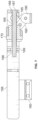
- FIG. 6 is a cross-sectional side view of the actuator along line A-A in FIG. 5 ;
- FIG. 7 is a cross-sectional side view of the actuator along line B-B in FIG. 5 ;
- FIG. 8 is a side view of the actuator according to another example implementation.
- FIG. 9 is a top cross-sectional view of the apparatus according to one example implementation.
- FIG. 10 is a side cross-sectional view of the pin sensor and housing according to one example implementation.
- FIG. 11 shows a flowchart of a method, according to an example implementation
- FIG. 12 is a graph showing the change in sensed distance between the socket wall and the limb over time
- FIG. 13 is a flow chart according to one example implementation of the control system
- FIG. 14 is a graph showing the relationship between Socket Fit Metric (SFM) and Socket Size (SS);
- FIG. 15 is a schematic showing the automated socket fit control loop
- FIG. 16 shows recorded SFM and system set point over time along with a predicted model response overlaid
- FIG. 17 shows the control system's reading of SFM versus a single set point over time
- FIG. 18 shows the distribution of measured Integrated Absolute Error (IAE) in mm for segments of walking activity for different participants.
- FIG. 19 shows an example demonstrating control system absolute error during an Adjusted Set Point test.
- Implementations of an apparatus and methods described herein can advantageously provide a socket for a prosthetic that adjusts socket size automatically upon a detection of deteriorating socket fit with a user's limb to maintain a proper fit and stabilize limb volume.
- the disclosed auto-adjusting socket apparatus and methods also reduce residual limb health complications from poor socket fit.
- the apparatus and methods relieve users of the burden of continually sensing if their socket fit has deteriorated, deciding what adjustment to make, and effecting a socket size change. Users may instead focus on other aspects of their life.
- the auto-adjusting socket apparatus and methods should enhance independence, improve limb health, and enrich patient quality of life.
- the automatic socket-size adjustments provided by the socket apparatus and methods disclosed herein may also optionally operate in three different modes, namely for walking, for low activity (i.e., short bouts of walking combined with periods of standing), and for sitting or rest.
- effective adjustment in terms of both comfort and maintenance of limb volume requires both socket enlargement and reduction.
- Reducing an oversized socket reduces risk of discomfort and soft tissue injury and ensures stable limb-socket coupling during ambulation.
- Enlarging an undersized socket relieves interface stresses on soft tissues, reducing discomfort and risk of injury, and facilitates limb fluid volume recovery during ambulation.
- Periodic socket enlargement during rest also facilitates the recovery of limb fluid volume and its retention during subsequent activity.
- the processor may determine the operating mode based on user activity and then responsively determines the frequency and degree of socket-size adjustments.
- FIG. 1 is a block diagram showing an environment 100 that may include outdoor space with varying terrain or an indoor space such as an office building or that includes a treadmill or furniture for rest.
- the environment 100 includes or involves, for example, an apparatus 105 for automatic socket size adjustment of a prosthesis that includes an actuator 140 and at least one sensor 145 , as shown in detail in FIGS. 3 - 10 and described below.
- a user wearing the apparatus may be engaged in walking, high activity, low activity, sitting or rest in environment 100 .
- Method 300 in FIG. 11 described below shows an implementation of a method that can be used within this environment 100 using apparatus 105 .
- FIG. 2 is a block diagram illustrating an example of a computing device 200 , according to an example implementation, that is configured to interface with environment 100 , either directly or indirectly.
- the computing device 200 may be used to perform functions of the method shown in FIG. 11 and described below.
- computing device 200 can be configured to perform one or more functions, including, but not limited to, determining a socket-size adjustment and thereby adjusting a socket-size of the apparatus 105 , for example.
- the computing device 200 has a processor(s) 202 , and also a communication interface 204 , data storage 206 , an output interface 208 , and a display 210 each connected to a communication bus 212 .
- the computing device 200 may also include hardware to enable communication within the computing device 200 and between the computing device 200 and other devices (e.g. not shown).
- the hardware may include transmitters, receivers, and antennas, for example.
- the communication interface 204 may be a wireless interface and/or one or more wired interfaces that allow for both short-range communication and long-range communication to one or more networks 214 or to one or more remote computing devices 216 (e.g., a tablet 216 a , a personal computer 216 b , a laptop computer 216 c and a mobile computing device 216 d , for example).
- Such wireless interfaces may provide for communication under one or more wireless communication protocols, such as Bluetooth, Wi-Fi (e.g., an institute of electrical and electronic engineers (IEEE) 802.11 protocol), Long-Term Evolution (LTE), cellular communications, near-field communication (NFC), and/or other wireless communication protocols.
- IEEE institute of electrical and electronic engineers
- LTE Long-Term Evolution
- NFC near-field communication
- Such wired interfaces may include Ethernet interface, a Universal Serial Bus (USB) interface, or similar interface to communicate via a wire, a twisted pair of wires, a coaxial cable, an optical link, a fiber-optic link, or other physical connection to a wired network.
- the communication interface 204 may be configured to receive input data from one or more devices and may also be configured to send output data to other devices.
- the communication interface 204 may also include a user-input device, such as a keyboard, a keypad, a touch screen, a touch pad, a computer mouse, a track ball and/or other similar devices, for example.
- a user-input device such as a keyboard, a keypad, a touch screen, a touch pad, a computer mouse, a track ball and/or other similar devices, for example.
- the data storage 206 may include or take the form of one or more computer-readable storage media that can be read or accessed by the processor(s) 202 .
- the computer-readable storage media can include volatile and/or non-volatile storage components, such as optical, magnetic, organic or other memory or disc storage, which can be integrated in whole or in part with the processor(s) 202 .
- the data storage 206 is considered non-transitory computer readable media.
- the data storage 206 can be implemented using a single physical device (e.g., one optical, magnetic, organic or other memory or disc storage unit), while in other examples, the data storage 206 can be implemented using two or more physical devices.
- the data storage 206 thus is a non-transitory computer readable storage medium, and executable instructions 218 are stored thereon.
- the instructions 218 include computer executable code. When the instructions 218 are executed by the processor(s) 202 , the processor(s) 202 are caused to perform functions.
- Such functions include, but are not limited to, (i) receiving limb-to-socket gap data, (ii) determining a socket-size adjustment based on the limb-to-socket gap data and a predetermined socket-fit value, (iii) to generating a command with the socket-size adjustment, (iv) sending the command with the socket-size adjustment to the first actuator to advance or retract the first panel through the first opening to thereby adjust socket size, (v) receiving limb-depth data, (vi) determining the socket-size adjustment further based on the limb-depth data to thereby adjust socket size, (vii) determining a current operating mode is one of a walking mode, a high activity mode, a low activity mode and a rest mode based on the limb-to-socket gap data and the limb-depth data and (viii) determining the socket-size adjustment further based on the current operating mode, for example.
- the processor(s) 202 may be a general-purpose processor or a special purpose processor (e.g., digital signal processors, application specific integrated circuits, etc.).
- the processor(s) 202 may receive inputs from the communication interface 204 , and process the inputs to generate outputs that are stored in the data storage 206 and output to the display 210 .
- the processor(s) 202 can be configured to execute the executable instructions 218 (e.g., computer-readable program instructions) that are stored in the data storage 206 and are executable to provide the functionality of the computing device 200 described herein.
- the output interface 208 outputs information to the display 210 or to other components as well.
- the output interface 208 may be similar to the communication interface 204 and can be a wireless interface (e.g., transmitter) or a wired interface as well.
- the output interface 208 may send commands to one or more controllable devices, for example.
- the computing device 200 shown in FIG. 2 may also be representative of a local computing device 200 a in environment 100 , for example, in communication with the apparatus 105 , including the actuator 140 and at least one sensor 145 .
- This local computing device 200 a may perform one or more of the steps of the method 300 described below, may receive input from a user, may receive data from sensors in the apparatus 105 and/or may send sensor data and user input to computing device 200 to perform all or some of the steps of method 300 .
- FIG. 11 shows a flowchart of an example method 300 to control socket-size adjustment of the apparatus 105 .
- Method 300 shown in FIG. 11 presents an example of a method that could be used with the computing device 200 of FIG. 2 , for example.
- components of the apparatus 105 may be configured to perform the functions such that the components are configured and structured with hardware and/or software to enable such performance.
- Components of the systems may be arranged to be adapted to, capable of, or suited for performing the functions, such as when operated in a specific manner.
- Method 300 may include one or more operations, functions, or actions as illustrated by one or more of blocks 305 - 320 .
- each block may represent a module, a segment, or a portion of program code, which includes one or more instructions executable by a processor for implementing specific logical functions or steps in the process.
- the program code may be stored on any type of computer readable medium or data storage, for example, such as a storage device including a disk or hard drive. Further, the program code can be encoded on a computer-readable storage media in a machine-readable format, or on other non-transitory media or articles of manufacture.
- the computer readable medium may include non-transitory computer readable medium or memory, for example, such as computer-readable media that stores data for short periods of time such as register memory, processor cache and Random Access Memory (RAM).
- the computer readable medium may also include non-transitory media, such as secondary or persistent long-term storage, like read only memory (ROM), optical or magnetic disks, compact-disc read only memory (CD-ROM), for example.
- the computer readable media may also be any other volatile or non-volatile storage systems.
- the computer readable medium may be considered a tangible computer readable storage medium, for example.
- each block in FIG. 11 may represent circuitry that is wired to perform the specific logical functions in the process.
- Alternative implementations are included within the scope of the examples of the present disclosure in which functions may be executed out of order from that shown or discussed, including substantially concurrent or in reverse order, depending on the functionality involved, as would be understood by those reasonably skilled in the art.
- an apparatus 105 for automatically adjusting a socket size of a prosthesis 120 includes the prosthesis 120 having a socket 125 configured to receive a liner 150 arranged over a limb.
- the apparatus 105 also includes a first opening 130 provided in a wall 126 of the socket and a first panel 135 that is aligned with the first opening 130 .
- the first opening 130 and the first panel 135 are arranged at a posterior location 129 on the wall 126 of the socket 125 , as shown in FIGS. 3 and 9 .
- a first actuator 140 is coupled to the first panel 135 and to the prosthesis 120 .
- the first actuator 140 is configured to advance and retract the first panel 135 through the first opening 130 .
- the technical effect of this arrangement is to increase or decrease the effective socket size of the prosthesis to maintain a proper fit with a user's limb and to stabilize limb volume.
- the first actuator 140 is discussed in further detail below.
- the apparatus 105 may include a second opening 131 in the wall 126 of the socket 125 and a second panel 136 aligned with the second opening 131 .
- the second opening 131 and the second panel 136 are arranged at an anterior-lateral location 128 on the wall 126 of the socket 125 .
- a second actuator 141 is coupled to the second panel 136 and to the prosthesis 120 .
- the second actuator 141 is configured to advance and retract the second panel 136 through the second opening 131 .
- the apparatus 105 may further include a third opening 132 in the wall 126 of the socket 125 and a third panel 137 aligned with the third opening 132 .
- the third opening 132 and the third panel 137 are arranged at an anterior-medial location 127 on the wall 126 of the socket 125 .
- a third actuator 142 coupled to the third panel 137 and to the prosthesis 120 .
- the third actuator 142 is configured to advance and retract the third panel 137 through the third opening 132 .
- the apparatus 105 further includes a first sensor 145 coupled to the wall 126 of the socket 125 and configured to obtain limb-to-socket gap data corresponding to a distance between the limb and the wall of the socket.
- limb-to-socket gap data includes a sensed or detected distance (SD) or gap between the first sensor and a liner 150 arranged over a limb that is disposed in the socket 125 , as well as a corresponding time of detection.
- This limb-to-socket gap data may also be obtained continuously and may be stored on a remote computing device, in one example implementation.
- the first sensor 145 is an inductive sensor.
- the first sensor 145 is arranged at a posterior-medial mid-limb location 141 , or alternatively in a posterior-lateral mid-limb location 152 .
- a user wears a liner 150 on the limb.
- the liner 150 has iron powder incorporated therein that may be detected by the first sensor 145 to determine a distance between the liner 150 (i.e., the limb) and the first sensor 145 .
- the liner 150 is an elastomer having an iron concentration ranging from about 80% to 85% by weight with the iron contained within the outer 1 mm of the elastomer.
- the apparatus 105 includes a second sensor 146 coupled to the wall 126 of the socket 125 and configured to obtain the limb-to-socket gap data.
- This limb-to-socket gap data from the second sensor 146 may be used to audit the limb-to-socket gap data from the first sensor 145 to improve accuracy of the socket-fit adjustment determination and to identify any abnormal measurements in the sensed distance.
- the second sensor 146 is an inductive sensor.
- the second sensor 146 may be arranged at an anterior mid-limb location 151 , a posterior-lateral mid-limb location 152 , an anterior-distal location 153 , a posterior-distal location 154 , or an anterior-proximal location (located near the top of the socket on the anterior side shown in FIG. 9 ).
- the processor 202 may calculate and use the mean value for a given time to determine the effective distance between the liner 150 and the wall 126 of the socket 125 .
- the first sensor 145 is arranged at a posterior-medial mid-limb location 141 and the second sensor 146 is arranged in a posterior-lateral mid-limb location 152 .
- various other sensors may be coupled to the wall 126 of the socket 125 to obtain limb-to-socket gap data for use in a determination of a socket-size adjustment and/or for use in a determination that a current operating mode is one of a walking mode, a high activity mode, a low activity mode or a rest mode.
- a third sensor in a distal anterior location in the wall 126 of the socket 125 may obtain data for the processor 202 to determine a current operating mode is a walking mode.
- the processor further determines a socket-fit adjustment based on thresholds and step-size adjustments associated with the walking mode.
- the apparatus 105 includes a processor 202 communicatively coupled to the first actuator 140 and to the first sensor 145 .
- communicatively coupled refers to both a wired or wireless connection, as discussed in more detail in the Example Architecture section above.
- the processor 202 is configured (i) to receive the limb-to-socket gap data from the first sensor 145 , (ii) to determine a socket-size adjustment based on the limb-to-socket gap data and a predetermined socket-fit value, (iii) to generate a command with the socket-size adjustment, and (iv) to send the command with the socket-size adjustment to the first actuator to advance or retract the first panel through the first opening.
- multiple panels in the wall 126 of the socket 125 , the first panel 135 , the second panel 136 , and the third panel 137 may be adjusted the same amount or different amounts according to predetermined settings. These predetermined settings may be provided by a trained practitioner and may be specific to a given user. In one implementation, these predetermined settings may be modified in response to feedback received from a remote computing device 216 .
- the processor 202 continuously receives limb-to-socket gap data based on a set time step and iteratively determines a socket-size adjustment to thereby effect automatic adjustment of the socket size.
- the time step may be adjusted based on the current operating mode (e.g., walking, high activity, low activity, and rest) as determined by the processor 202 or as provided by a user using a remote computing device 216 .
- the processor 202 is communicatively coupled to the second sensor 150 to receive additional limb-to-socket gap data, as discussed above, and may use a mean value, for example, of the data obtained from the first sensor 145 and the second sensor 146 .
- the predetermined socket-fit value may be based on the socket fit metric (SFM) and/or input provided by the user for a preferred socket fit.
- the predetermined socket-fit value may be further set based on whether the current operating mode is one of a walking mode, a high activity mode, a low activity mode or a rest mode.
- the first actuator 140 includes an electric motor 155 .
- the electric motor 155 may be operated in two directions to effect either an increase or a decrease in socket-size adjustment.
- the electric 155 motor may be used to spool and unspool cables coupled to the first panel 135 anchored on one end to the socket wall and coupled to the electric motor 155 at the other end.
- the cables may be disposed within channels formed in the wall 126 of the socket 125 and may also be coupled to the second and third panels 136 , 137 .
- a sleeve 195 is disposed on the lead screw 165 .
- the sleeve 195 is not threaded and is held in place by the plurality of linkages 175 .
- the at least one travel nut 170 includes a first travel nut 173 and a second travel nut 174 arranged on opposing sides of the sleeve 195 .
- the first travel nut 173 and the second travel nut 174 are arranged such that rotation of the lead screw 165 in a first direction causes the first travel nut 173 and the second travel nut 174 to move toward each other and toward the sleeve 195 to advance the panel mount forward to reduce socket size.
- rotation in a second direction causes the first travel nut 173 and the second travel nut 174 to move away from each other and the sleeve 195 thereby retracting the panel mount 191 rearward to increase socket size.
- the electric motor 155 and the lead screw 165 are coupled together via gears 159 .
- the plurality of linkages 175 includes a pair of first linkages 180 and a pair of second linkages 185 .
- the pair of first linkages 180 is rotatably coupled at first ends 181 to opposing sides 171 , 172 of the at least one travel nut 170 and rotatably coupled at second ends 182 to opposing sides of a panel mount 190 .
- panel mount 190 is coupled to the first panel 135 .
- the pair of second linkages 185 is rotatably coupled at first ends 186 to the pair of first linkages 180 and rotatably coupled at second ends 187 to opposing sides 157 , 158 of the frame 156 .
- a length of the pair of first linkages 180 is greater than a length of the pair of second linkages 185 .
- the pair of first and second linkages 175 , 185 rotatably cooperate to cause the panel mount 190 to advance forward to reduce socket size.
- the pair of first and second linkages 175 , 185 rotatably cooperate to cause the panel mount 190 to retract rearward to increase socket size.
- the plurality of supports 160 includes (i) a support block 161 having a first end 162 coupled to the frame 156 and a second end 163 extending from the frame 156 and coupled to the prosthesis 120 below the first opening 130 and (ii) a pair of arms 164 arranged on opposing sides of the frame 156 and coupled to the prosthesis 120 on opposing sides of the first opening 130 .
- a sleeve 195 is disposed on the lead screw 165 .
- the sleeve 195 is not threaded and is held in place by the plurality of linkages 175 .
- the at least one travel nut 170 includes a first travel nut 173 and a second travel nut 174 arranged on opposing sides of the sleeve 195 .
- the first travel nut 173 and the second travel nut 174 are arranged such that rotation of the lead screw 165 in a first direction causes the first travel nut 173 and the second travel nut 174 to move toward each other and toward the sleeve 195 to advance the panel mount forward to reduce socket size.
- rotation in a second direction causes the first travel nut 173 and the second travel nut 174 to move away from each other and the sleeve 195 thereby retracting the panel mount 191 rearward to increase socket size.
- the electric motor 155 and the lead screw 165 are coupled together via gears 157 .
- the plurality of linkages 175 include a pair of first linkages 176 a,b and a pair of second linkages 196 a,b .
- the pair of first linkages 176 a,b are each rotatably coupled at a first end 177 to the first panel 135 , optionally via a panel mount 191 , and one of the pair of first linkages 176 a is rotatably coupled at a second end 178 a to the first travel nut 173 and the other of the pair of first linkages 176 b is rotatably coupled at a second end 178 b to the second travel nut 174 .
- the pair of second linkages 196 a,b are each rotatably coupled at a first end 197 to the sleeve 195 and one of the pair of second linkages 196 a is rotatably coupled at a second end 198 to one of the pair of the first linkages 176 a and the other of the pair of second linkages 196 b is rotatably coupled at a second end 198 to the other of the pair of first linkages 176 b .
- a length of the pair of first linkages 176 is greater than a length of the pair of second linkages 196 .
- the plurality of supports includes (i) a first support block 161 having a first end 162 coupled to the frame 156 and a second end 163 extending outwardly from the frame 156 and coupled to the prosthesis 120 below the first opening 130 and (ii) a second support block 161 having a first end 162 coupled to the frame 156 and a second end 163 extending outwardly from the frame 156 and coupled to the prosthesis 120 above the first opening 130 .
- the second actuator 141 and the third actuator 142 may take the same form as the first actuator 140 , as shown in FIGS. 3 - 8 .
- the second actuator 141 and the third actuator 142 may each include a plurality of cables coupled to and extending across a width of the second panel such that a first end of each of the plurality of cables is anchored to the wall 126 of the socket 125 and a second end of each of the plurality of cables extends through one or more channels in the wall 126 of the socket 125 to a ratcheted knob configured to manually wind or unwind the plurality of cables to retract or advance the second panel 136 in the second opening 131 and the third panel 137 in the third opening 132 .
- the apparatus 105 may further include a pin sensor 147 arranged at a bottom 124 of the socket 125 and configured to receive a locking pin 148 coupled to the liner 150 arranged over limb.
- the locking pin 148 is typically made of steel.
- the pin sensor 147 is an inductive sensor that includes coil windings on the exterior of a sleeve 149 that receives the locking pin 148 . The coil windings are coupled to a capacitor and, optionally, a thermistor.
- the pin sensor 147 is configured to obtain limb-depth data corresponding to a depth of the limb in the socket 125 .
- the “limb-depth data” includes information about the depth of a locking pin 148 in the pin sensor, as well as a corresponding time of detection.
- the processor is communicatively coupled to the pin sensor 147 .
- the processor 202 is further configured (v) to receive the limb-depth data from the pin sensor 147 and (vi) to determine the socket-size adjustment further based on the limb-depth data.
- the processor 202 is further configured (vii) to determine that a current operating mode is one of a walking mode, a low activity mode and a rest mode based on the limb-to-socket gap data and the limb-depth data and (viii) to determine the socket-size adjustment further based on the current operating mode.
- Method 300 includes, at block 305 , a processor 202 receiving the limb-to-socket gap data from the first sensor 145 . Then, at block 310 , the processor 202 determines a socket-size adjustment based on the limb-to-socket gap data from the first sensor and the predetermined socket-fit value. Next, at block 315 , the processor 202 generates the command with the socket-size adjustment.
- the processor 202 sends the command with the socket-size adjustment to the first actuator 140 to advance or retract the first panel 135 through the first opening 130 .
- the processor 202 continuously receives limb-to-socket gap data based on a set time step and iteratively determines a socket-size adjustment to thereby effect automatic adjustment of the socket size.
- the time step may vary based on the current operating mode. For example, data will be obtained from the sensors 145 , 146 as often as is required to maintain a proper fit for the current operating mode, but will also be minimized to the extent possible in order to conserve power.
- the sampling rate (i.e., time spent obtaining data) is a separate consideration from the time step used to determine when to power on the various sensors to obtain relevant data.
- sampling at a rate of 32 Hz is necessary in order to capture an entire step corresponding to a user's walking action.
- the sampling rate would increase for an activity like running and decrease for an activity like standing.
- These steps may be repeated in an ongoing and continuous manner as the limb-to-socket gap data is continuously obtained by the first sensor in a stepwise manner.
- the actuator responsively and automatically adjusts the socket size of the prosthesis based on the commands received from the processor 202 .
- the apparatus 105 further includes a second sensor 146 coupled to the wall 126 of the socket 125 .
- the processor 202 is communicatively coupled to the second sensor 146 .
- the processor 202 further receives limb-to-socket data from the second sensor 146 .
- the processor 202 determines the socket-size adjustment further based on the limb-to-socket gap data from the second sensor 146 .
- a mean value may be calculated by the processor 202 for the limb-to-socket gap data obtained from the first sensor 145 and the second sensor 146 .
- the apparatus 105 further includes a pin sensor 147 arranged at a bottom 124 of the socket 125 and configured to receive a locking pin 148 coupled to a liner 150 arranged over the limb.
- the pin sensor 147 is configured to obtain limb-depth data corresponding to a depth of the limb in the socket 125 .
- the processor 202 is communicatively coupled to the pin sensor 147 .
- method 300 further includes the processor 202 receiving the limb-depth data from the pin sensor 147 .
- the processor 202 determines the socket-size adjustment further based on the limb-depth data.
- method 300 includes the processor 202 determining that a current operating mode is one of a walking mode, a high activity mode, a low activity mode and a rest mode based on the limb-to-socket gap data and the limb-depth data.
- Other modes are contemplated, including, but not limited to, a jogging mode, an uphill walking mode, a stair-climbing mode, a sports mode for a particular sport associated with quantifiable sensor detection.
- “modes” refers to states that have quantifiable regular activity that has the same control system features or settings.
- the processor 202 determines the socket-size adjustment further based on the current operating mode.
- the apparatus 105 may include a third sensor in a distal anterior location in the wall 126 of the socket 125 to obtain data for the processor 202 to determine a current operating mode is a walking mode, as one optional implementation.
- the processor 202 determining that the current operating mode is the walking mode includes the processor 202 identifying the five most recent peak-to-peak amplitudes for the five most recent local minima and five most recent local maxima for the distance between the limb and the wall 126 of the socket 125 based on the limb-to-socket gap data, see FIG. 12 as one example and the discussion in Example 1 in Section V below.
- the processor 202 determines that none of the five most recent peak-to-peak amplitudes is more than 25% greater than an average value of the five most recent peak-to-peak amplitudes and that none of the five most recent peak-to-peak amplitudes is more than 25% less than the average value of the five most recent peak-to-peak amplitudes. And the processor 202 determines that a cadence time between each of the successive local minima of the at least five most recent local minima is less than a cadence threshold based on the limb-to-socket gap data. In other words, “cadence time” refers to the period between each local minimum. In one optional implementation, the cadence threshold is 5.1 seconds.
- the cadence threshold may range from 1 second to 30 seconds, including but not limited to a cadence threshold of 1 s, 2 s, 5 s, 10 s, or 30 s.
- a shorter threshold period increases potential instability of the processor's performance (i.e. determined socket-fit adjustments), whereas a larger threshold period permits a more consistent pattern to be observed by the processor and thereby decreases the risk that the processor's performance will lead to instability.
- the apparatus 105 further includes a pin sensor 147 arranged at a bottom 124 of the socket 125 and configured to receive a locking pin 148 coupled to a liner 150 arranged over the limb.
- the pin sensor 147 is configured to obtain limb-depth data corresponding to a depth of the limb in the socket 125 .
- the processor 202 is communicatively coupled to the pin sensor 147 .
- the processor 202 determining that the current operating mode is the low activity mode includes the processor 202 determining that a most recent pin height minimum is below a pin height threshold based on the limb-depth data.
- the pin height threshold is determined by the processor based on pin height minima detected by the pin sensor over a preceding predetermined period of time.
- the preceding predetermined period of time may correspond to a typical period of low activity that generally precedes a lower pin height minimum or increased pin depth.
- method 300 may include determining the current operating mode is the rest mode, based on data obtained by the third sensor in the distal anterior location in the wall 126 of the socket 125 and/or on data obtained by the pin sensor 147 .
- the processor may determine whether the signal from the third sensor and the pin sensor 147 is changing and to determine whether the liner on the limb has tighter fit with the wall 126 of the socket 125 to identify a rest mode.
- method 300 includes, in response to a determination that the current operating mode is the rest mode, the processor 202 determining that the socket-size adjustment is 1% of the predetermined socket-fit value.
- the processor 202 determines that the socket-size adjustment is 1% of the predetermined socket-fit value.
- the rest mode a panel release for socket expansion will involve smaller distances relative to those in walk and low activity modes to avoid a situation in which a user forgets or does not appreciate that socket release was conducted and attempts to rise and walk before a retention adjustment reducing socket size is achieved.
- the total number of socket-size adjustments in combination would not exceed 1% of the socket volume that was achieved immediately before entering the rest mode. This reduces the risk of a user rising up and then falling due to a socket volume being oversized.
- the socket-size adjustments may range from 0.2% to about 0.4% of socket volume. That said, there may be multiple socket-size adjustments implemented throughout an ongoing period of walking that may ultimately add up to more than a 1% volume change.
- method 300 includes the processor 202 receiving the predetermined socket-fit value from a user.
- a user may submit this information to the processor 202 via a remote computing device, such as a tablet 216 a , a personal computer 216 b , a laptop computer 216 c and a mobile computing device 216 d .
- the range of socket-size adjustments can be set by a prosthetist when fitting a user.
- a prosthetist may determine that a user should not exceed a +/ ⁇ 2% change in the predetermined socket-fit value (SFM) when the panels are in a flush neutral position with the wall 126 of the socket 125 in order to improve user safety.
- SFM predetermined socket-fit value
- This restriction can be programmed into the processor such that the user cannot alter the setting.
- non-transitory computer-readable medium having stored thereon program instructions that upon execution by a processor 202 may be utilized to cause performance of any of functions of the foregoing methods.
- a non-transitory computer-readable medium having stored thereon program instructions that upon execution by a processor 202 , cause performance of a set of acts includes receiving the limb-to-socket gap data from the first sensor. Then a socket-size adjustment is determined based on the limb-to-socket gap data from the first sensor and the predetermined socket-fit value. Next a command is generated with the socket-size adjustment. And the command is sent with the socket-size adjustment to the first actuator to advance or retract the first panel through the first opening.
- a system is presented for monitoring socket fit via tracking a distance measurement between a liner (sock) in a prosthesis and the rigid wall of the prosthesis.
- An embodiment of the system was fabricated and tested, and becomes an exemplary embodiment with which to explain the system disclosed herein.
- Sockets with motor-driven, three-panel, adjustable panels were constructed for study participants. Panels were located anterior medial, anterior lateral, and along the posterior midline, similar to positions commonly used in RevoFitTM sockets. The participants' regular socket shape was duplicated by scanning their normal socket using an industrial coordinate measurement machine (FARO Platinum Arm, Faro Technologies, Lake Mary, FL). Sockets were fabricated with inductive sensors embedded within the socket wall to measure socket-to-target distance, termed “Sensed Distance” (SD) in this study. The sensed distance was taken to be representative of the limb-to-socket distance. The cable that ran through the three panels was connected to a motor within a housing (505 g) positioned immediately beneath the socket.
- SD socket-to-target distance
- the motor drew in cable, the panels displaced radially inward.
- the motor released cable the panels displaced radially outward.
- the motor was controlled using a single-board computer (LattePanda, Shanghai, China) with an integrated microcontroller (Arduino Due) and a custom shield to execute motor control.
- the computer, microcontroller, and motor-control board were housed within a custom enclosure (total weight 648 g) mounted in a waist belt.
- TightVNC software (GlavSoft, Tomsk, Russia) was added for remotely connecting to the device. All data was logged by a controller operating in LabVIEW (NI 2017, National Instruments, Austin, TX) running on the single-board computer. Since all data was logged locally, once the device was started it did not require a remote connection to control the motor.
- Iron powder incorporated into the participant's prosthetic liner served as a magnetic target for the inductive sensors.
- the liner was purchased for research purposes from a commercial liner manufacturer (Willow Wood, Mt. Sterling, OH).
- the iron concentration in the liner was approximately 80% by weight, similar to a ferrous sheath developed previously, and it was contained within the outer 1 mm of the elastomer.
- there was a fabric backing over the outside of the elastomer thus the fabric backing and adhesive holding it in place were between the magnetic target and the sensor.
- the fabric backing and adhesive were an elastic element of approximately 1.3 mm thickness.
- the inductive sensor measured distance across this elastic element when the liner was in contact with the socket, and distance through air and the undeformed elastic element when it was not.
- the liner and sensor were calibrated using an inflatable bladder positioned within the socket.
- Bench testing of the sensor-liner system demonstrated errors of less than 2.8% full-scale.
- a certified prosthetist fit the test prostheses to study participants and helped them select an appropriate sock thickness such that the socket was comfortable at the neutral panel position (flush with socket). Participants did not wear socks when using the test prosthesis.
- One aspect of the automatic socket control system is the definition of the Socket Fit Metric (SFM), derived from continuous SD data.
- SFM Socket Fit Metric
- Six SD sensors were located on the socket, positioned at proximal, mid-limb, and distal locations. Past studies have shown that the stance minimum within each step, when the SD is fully loaded, is a favorable indicator of socket fit during walking. During pilot testing, a survey of the six sensors showed that the posterior medial mid-limb SD (location shown in FIG. 9 ) was the best combination of lowest error and highest signal from changes in socket size.
- a typical human subject time series corresponding to several steps from a posterior medial mid-limb SD sensor was plotted with sensed distance SD vs. Time in FIG. 12 . A small SD value indicates a small distance between the socket and the liner.
- the stance and swing phases of the step were easily identified.
- the stance minima for each step are also indicated. Because the socket fit control method is computed on a fixed time step, the value of the SFM is assumed constant between steps (i.e. a zero-order hold).
- the Delta value shown therein is equal to the average of the minimum and maximum socket distance SD within a 10 second moving window.
- the SFM is the moving average of the SD value at the last five identified local minima detected.
- a method for automatically controlling the size of the socket to compensate, during walking, for the unknown changes in limb fluid volume was developed.
- the controller continuously measures socket “fit” and adjusts the socket geometry to maintain a prescribed reference set point.
- FIG. 14 shows the relationship between the SFM and socket size (SS).
- the SFM inferred from the SD sensors, is a measure of the looseness of the fit between the socket and residual limb: a small SFM indicates a tight fit and a large SFM indicates a loose fit.
- Socket Size is a measure of the effective volume of the socket, as determined from motor encoder data. Curve A in FIG. 14 shows that when SS is very small, the socket is fully tight, and the SFM is approximately constant. Further, lowering of SS merely forces fluid from the limb, with no corresponding change in SFM.
- the goal of automatic prosthesis control during walking is to maintain the SFM at a level just below the stability limit. This will maximize limb fluid volume, while ensuring stable operation. As limb fluid volume varies (i.e., gain or loss), the control system will adjust to sustain the operating point near the stability limit.
- the control loop relating the socket fit set point (SFMref) to measured SFM is shown in FIG. 15 .
- the socket/limb block relates the SS to the SFM. Changes in the SFM caused by changes in limb fluid volume are considered to be exogenous disturbances to be rejected by the controller.
- Open-loop experiments have shown that a first-order linear model of the socket/limb system is adequate for design purposes. For each participant, the model parameters, gain K and time constant ⁇ , are identified from open-loop ramp and step responses, respectively. Note that K is the effective slope of the proportional region in FIG. 14 .
- the controller determines the mechanical changes in SS implemented through the motor/winch mechanism.
- the parameters (KP and KI) of the proportional-integral (PI) controller are selected to produce a critically damped second order closed loop system, with response time only moderately faster (0.8 ⁇ ) than the open-loop system.
- KP and KI proportional-integral
- the system has zero steady-state error for a step change in the set point SFMref, and zero steady-state error for a finite increase in limb fluid volume.
- the nominal performance of the SFM controller is shown in FIG. 16 . After the participant had been walking for several minutes, a step change in the SFM set point was commanded. The amplitude of the step is small in comparison to the proportional range described in FIG. 14 . The system responds by increasing SS until the SFM settles at the new set point. Also shown is the model predicted response derived from the model of FIG. 15 .
- a walking detector was implemented to ensure the controller only operated during steady walking. Walking was considered detected when a threshold peak-to-peak amplitude during 5 continuous steps was detected, and walking cadence (period between local minima) was less than 5.1 s. Use of the walking detector ensured the SFM was in the proportional region of the SFM vs. SS diagram ( FIG. 14 ), the participant's gait was not erratic, and weight-shifting during standing was not interpreted as walking.
- the socket fit controller was implemented in LabVIEW, executed either on a desktop or single-board computer. Commands were sent from LabVIEW to a socket-mounted chicken Due and shield that controlled the motor/winch mechanism. The Due sent motor position data to a previously described device, where it was packaged with SD data and sent to LabVIEW via a second serial connection.
- the sample rate of the socket control system was 32 Hz, the highest rate possible when querying the distance sensors sequentially to prevent interference.
- Adjusted Set Point Test which was completed if participants were not fatigued after the Constant Set Point Test and willing to conduct more trials walking on the treadmill, participants walked with automatic control continuously engaged at least 1 minute. During the walks, the researcher adjusted the set point up or down by 1000 sensor count, the equivalent of an SD change of about 0.008 mm, and the SFM response was observed. Differences between SFM and set point data were calculated. Session duration was approximately 34 minutes.
- the operational effectiveness of the proposed automatic socket control was judged by its ability to maintain the SFM set point.
- the measured SFM and its set point are plotted as functions of time.
- the control error summarized for each walk as the average Integral Absolute Error (IAE), was estimated as:
- SFM 0 the SFM set point
- SFM i the measured SFM of the ith temporal index
- N the number of data points in the walk.
- IAE distribution was characterized across the test participants by making a histogram of IAE for 0.001 mm bins of error.
- Segment duration where a segment refers to walking under continuous control, ranged from 78 s to 924 s.
- IAE normalized to the number of points for all walking segments ranged from 0.001 to 0.046 mm with a median of 0.003 mm.
- An example SFM v. time plot with IAE as dashed lines is shown in FIG. 17 .
- a histogram of IAE showed that 80% of the walks had IAE values less than 0.006 mm ( FIG. 18 ). Walks with errors larger than 0.010 mm were from two participants #4 and #9. Analysis of motor position v. time data revealed that some participants, including participants #2, 4, 5, 7, and 9, had their socket larger than neutral (flush panels) part of the time during their first test.
- Adjustable sockets under automated control have the potential to improve comfort and usability of prostheses for people with limb amputation. By maintaining fit, sockets under automated control relieve prosthesis users of the distraction of continually monitoring and adjusting their socket. In this control system, a socket fit metric based on socket distance data was implemented.
- an active control system was shown to effectively maintain a set point based on a measured-fit metric, while a person with limb amputation ambulated wearing an adjustable-size socket.
- the control model and sensing element developed here are applicable to other adjustable socket technologies, for example a socket made using three flexible struts that surround a custom flexible liner. Socket size is adjusted using a cable around the outside of the struts (Infinite SocketTM).
- IFITTM ski-boot buckles extending across the overlap
- Systems with electronic-driven actuators adjusted using a mechanical pump which are more directly matched to the control system developed here, include elevated vacuum sockets (LimbLogicTM, HarmonyTM ePulse, VASSTM), air filled bladders, and liquid filled bladders or tubes within the socket or liner.
- elevated vacuum sockets LibLogicTM, HarmonyTM ePulse, VASSTM
- air filled bladders air filled bladders
- liquid filled bladders or tubes within the socket or liner.
- the most meaningful source of IAE in this study was the single cable design of the adjustable panel system.
- a single cable connected all three panels to each other.
- individual panels may have “floated” relative to the socket, taking on different radial positions at different times during testing.
- a panel-pull system was designed with one mechanism spanning across each of three panels.
- the side supports (aluminum 7075) were made in three differing lengths to accommodate various panel heights. These units spanned 10.2 cm (short), 12.7 cm (medium), and 19.1 cm (long) distances.
- Custom side supports were connected to bearing blocks that directly mounted to the socket. These blocks were covered so that the resin did not fill the threaded holes. The covers were removed after the lamination was complete.
- the lead screws were 1 ⁇ 4-16 ACME thread of opposing directions connected by a rigid coupler in the center and bearings on opposing sides.
- a motor (1717T006SRIEH2-4096+15A 152:1+MG03, Micromo, Clearwater, Florida) drove gearing that connected to the end of a lead screw which translated the motor's rotation to axial movement of the travel nut.
- the travel nut had connection points for arm linkages. These arm linkages were mounted to the socket panel via a mount that was laminated into the panel during fabrication using a positioning jig to ensure proper alignment and translated the axial movement of the travel nut to a perpendicular linear movement of the panel. This perpendicular linear movement equated to the radial displacement of the panel.
- the radial direction (tightening or loosening) of the panel was changed.
- the arrows show inward and outward panel movement.
- Strapping was adhered to the liner fabric by heat activated fusing web. The strapping was threaded through cutouts in the panel where they were tied off.
- the motors on the panels were controlled using a virtual instrument (VI) (LabView, National Instruments, Austin, Texas) connected to the socket via a 25-cm cable.
- VI virtual instrument
- the researcher used the VI to select panel position in mm relative to neutral (flush) according to the study protocol described below. All three panels were moved the same distance simultaneously.
- the VI sent commands (motor position) to a microcontroller (LPC54114x, NXP, Eindhoven, Netherlands) on an electronics board mounted on the ankle of the prosthesis.
- the microcontroller relayed those commands in the form of pulse width modulation (PWM) to a motor driver (DRV8835, Texas Instruments, Dallas, Texas) which drove the three motors (6V, Micromo) all at the same duty cycle.
- PWM pulse width modulation
- the encoders on the motors provided feedback to the microcontroller. Those signals were decoded using a quadrature counter (LS7366R, LSI/CSI, Melville, New York) with an SPI interface.
- the microcontroller maintained the panel position communicated by the VI within 0.02 mm for positions tighter than flush and 0.08 mm for positions looser than flush.
- the motor encoder recorded the motor's rotation in degrees.
- the gear ratio from motor to shaft was 2:1.
- one full rotation of the motor resulted in the shaft rotating 180° and the travel nut moving 1/32′′ (0.79375 mm) along the shaft.
- the linkage from the travel nut to the panel was 35.56 mm.
- the panel flush position of the system was 24.78 mm x and 25.50 mm y because the shaft was 25.50 mm from the surface of the panel when mounted.
- the system allowed for approximately 10 mm radial movement out and 5 mm radial movement in from the flush position.
- the actual range of the system was from 18.28 mm to 32.00 mm in the x direction corresponding to radial panel displacements of 30.50 mm (tightest possible) and 15.50 mm (loosest socket possible), respectively.
- One goal is to reduce weight of the auto-adjusting socket closer to that of a traditional prosthesis, which may improve usability and clinical acceptance. From experience, some participants do not like prostheses heavier than their traditional prosthesis. Implementing the auto-adjusting socket on the posterior panel only would allow us weight reduction of the socket by about 320 g. To initiate this effort, the auto-adjustment system was operated with posterior panel adjustment only (the two anterior panels were kept stationary) on two participants. Test results showed that the match between SFM data and the set point was comparable to that of the three-panel system.
- IIR infinite impulse response
- An auto-adjustment method that eliminates the distraction of manually executing socket release and then returning the socket back to the original size before walking may help to better maintain limb fluid volume during the day and enhance socket fit management and limb health.
- a Sitting auto-adjustment method should execute limited distance panel release since the user, forgetting that socket release was conducted, may rise and start walking quickly before the actuator returns the socket to a smaller size. While limiting panel release distance may limit the amount of fluid volume recovery and retention, if auto-adjusting socket release is conducted frequently this may still improve socket fit management relative to no panel release.
- Utilizing a control system with settings for walking, high activity, low activity and sitting or rest will result in better fitting sockets with less residual limb discomfort and pain, less distraction to the user to operate and thus an improved quality of life and a more stable limb volume that may improve residual limb health and patient long-term outcome.
- the present disclosure challenges current clinical paradigms, seeking to shift away from the practice of enlarging or reducing socket size upon user sensation of discomfort to an early-action philosophy based on adjustment when a measurable change in fit has occurred but is not yet discernable to the user.
- Capitalizing on opportunities to increase socket size during periods of limb volume recovery is a practice not normally executed by people wearing traditional sockets. This is an innovative way to stabilize daily limb volume and maintain socket fit.
- Custom sensors to monitor limb-socket distance and limb depth in the socket are implemented in this disclosure.
- the distance sensor uses an inductive sensing modality to measure distance between a custom antenna positioned in the socket wall during fabrication and an elastomeric liner with a ferrous polymer target embedded in its outer layer.
- the ferrous polymer can be added to almost any liner by removing the fabric backing and replacing it with our ferrous layer.
- the ferrous polymer had tensile properties consistent with that of commercial elastomeric liners, but high compressive stress and thus minimal sensitivity to limb-socket pressure.
- An inductive sensing chip (LDC1614, Texas Instruments) is used to drive the antenna.
- the circuit acts as an LC tank oscillator.
- the ferrous liner When the magnetically permeable target, the ferrous liner, is brought near the antenna, it reinforces the inductor and lowers the sensor's oscillation frequency in a distance-dependent manner.
- the frequency measured by the chip is a sensitive measure of distance between the target and antenna. Durability testing did not show a trend of decreased or increased sensitivity over time.
- the pin sensor provides a very sensitive measure of pin depth into the shuttle lock ( FIGS. 9 - 10 ).
- the pin sensor detects the very small vertical up and down motions of the pin (between shuttle lock clicks) within the inductive element.
- the inductive sensor is a 30-AWG wire wrapped around a 3D-printed coil former. A thermistor is placed next to the coil winding in case thermal compensation is needed. Calibration testing showed consistent performance before and after amputee participant testing.
- Test sockets duplicate in shape to participants' traditional sockets are fabricated. Each person's traditional socket is scanned using a commercial 3D scanner (FARO Platinum Arm, Faro Technologies), then from the scan a foam positive carved (C7, Provel). A series of three layups are implemented. A 4-ply Nyglass stockinette is applied to the positive and infused with resin. After the layers cure, thin flexible inductive sensors are placed at anterior distal, posterior medial mid-limb, and posterior lateral mid-limb locations. These locations are selected based on prior study results demonstrating that the two posterior locations served as effective feedback signals for auto-adjustment, and the anterior channel served as an effective activity detector. A 1-ply carbon fiber layer is applied, and then small rectangular mounts to support the frame for the adjustable panel are applied.
- An outer layup of 1-ply carbon fiber, 2-ply Nyglass, and 1-ply carbon fiber is added, infused with resin, and cured.
- Panel locations are strategically selected where practitioners typically add pads. These areas of the residual limb are known to be load tolerant. Panel size is maximized in order to produce meaningful socket volume change but at the same time will avoid the bony prominences at the anterior distal tibia, tibial crest, and fibular head that may be sensitive to compressive stress.
- Small motors (1724A006SRIEH2-4096, Micromo) (37 g) mounted to the frame of each panel are used to adjust socket size.
- power switches are re-routed so as to enable/disable the motor encoders while leaving the other peripherals as is. This capability will allow power management to be improved so that the auto-adjusting socket can be used longer during field tests before re-charging is necessary.
- Firmware changes include the addition of event logging to stored data to identify in the data stream when the controller makes a change as opposed to the participant manually making an adjustment using the mobile phone.
- the socket is capable of operation in a single-panel or three-panel mode via changes to settings in the code embedded in the micro-controller.
- the single-panel mode may require a greater panel displacement range since the socket volume change per increment that it induces is about 40% of that of the three-panel mode system.
- the posterior panel is typically larger than the anterior panels.
- socket size reductions are the primary adjustment to address when the Low Activity auto-adjustment setting is operating.
- the auto-adjustment system reduces socket size when the participant's limb becomes unstable and starts to move deeper into the socket.
- the socket sensors on the posterior mid-limb though they well identify socket fit changes and limb fluid volume losses during walking that may be precursors to limb downward displacement, do not well identify limb downward motion during standing or weight-shifting.
- the pin sensor in the distal socket that provides a very sensitive measure of pin height in the shuttle lock may provide such information. Analysis of data from a take-home test on a participant using the adjustable socket in manual mode (auto-adjustment off) showed that a consistent pin depth was maintained during the stance phase of walking but a deeper position after 19 minutes of low activity.
- the pin sensor may provide an effective control system signal to manage socket fit during Low Activity based on pin sensor-socket size relationships during standing and weight-shifting.
- the anterior panels may be manually adjustable using a short, lightweight ratcheted knob and cable or a related mechanism for each panel. This design will allow the anterior panels' motor and frame hardware to be eliminated, reducing socket weight.
- the control system will be implemented in a portable LabViewTM module to allow the control method to be easily modified and updated. Use of this module permits reprogramming of the control system architecture during research, but in real-world operation, the earlier-described microcontroller will be used.
- the control system will use the anterior distal socket sensor to determine if the person is in the Low Activity state.
- the Low Activity state is characterized by stands, weight-shifts, and short walks (a few steps at a time).
- the Low Activity SFM ocket fit metric
- a cycle is defined as a local maximum to a local minimum to a local maximum, thus essentially a weight shift to and from the prosthetic limb.
- the Low Activity method is not expected to need frequent socket size adjustment. Doing so may accentuate fluid volume loss. This has been observed anecdotally in the lab using bioimpedance analysis to monitor limb fluid volume. A method that uses a moving average of the pin sensor minima during weight shifting is used.
- Socket release during sitting has been demonstrated to facilitate limb fluid volume recovery and retention during subsequent walking.
- the intent of the Sitting setting in the control system is to execute panel release during sitting in such a way that limb volume recovery is achieved but at the same time avoid sockets that are too loose and that may put participants at risk of a fall should they stand up before socket return to the pre-sit size is completed.
- Small socket releases during rest of approximately 1% socket volume are contemplated to induce meaningful fluid volume recovery and retention.
- a 1% level is selected based on prior investigation where some participants found that walking with a 2% socket enlargement right after sitting was uncomfortable. The socket is released 1% during rest (i.e., sitting) and then returned back to its pre-rest size when the participant prepares to ambulate. If participants start to walk before the Sitting method completes, they will not be at high risk of a fall.
- One option is to repeatedly execute 1% socket releases over the day for this intervention to have a beneficial impact, given the anticipated small fluid volume recovery each time.
- activity data collected on 21 participants with transtibial amputation in their free-living environments and other initial studies participants were found to have rested for short durations frequently. As such, there may be opportunities for frequent socket releases during the day for many prosthesis users.
- the Sitting auto-adjustment method is implemented using data from the anterior distal socket sensor and the pin sensor.
- the panel When sitting is detected, where there is a high anterior distal sensed distance and a high pin position within the shuttle lock, the panel will be released to accomplish at least a 1% socket volume change. However, in systems that are programmed to reduce socket size upon detection of movement, then the socket size release may be up to a 5% socket volume change. The socket will remain this size until the user begins to prepare for weight bearing, where the pin displacing from proximal to distal and there is a decrease in anterior distal sensed distance.
- a calibration procedure may be executed on each participant to characterize threshold pin distances for the controller so that the controller properly detects transition from sitting to standing.
- the pin sensor may not register the expected changes if the participant does not bear sufficient weight on the distal limb during standing. However, this behavior is highly unlikely for patellar-tendon-bearing and total-surface bearing socket designs.
- Example devices, methods, and systems are described herein. It should be understood the words “example,” “exemplary,” and “illustrative” are used herein to mean “serving as an example, instance, or illustration.” Any embodiment or feature described herein as being an “example,” being “exemplary,” or being “illustrative” is not necessarily to be construed as preferred or advantageous over other embodiments or features.
- the example embodiments described herein are not meant to be limiting. It will be readily understood aspects of the present disclosure, as generally described herein, and illustrated in the figures, can be arranged, substituted, combined, separated, and designed in a wide variety of different configurations, all of which are explicitly contemplated herein.
Landscapes
- Health & Medical Sciences (AREA)
- Cardiology (AREA)
- Oral & Maxillofacial Surgery (AREA)
- Transplantation (AREA)
- Engineering & Computer Science (AREA)
- Biomedical Technology (AREA)
- Heart & Thoracic Surgery (AREA)
- Vascular Medicine (AREA)
- Life Sciences & Earth Sciences (AREA)
- Animal Behavior & Ethology (AREA)
- General Health & Medical Sciences (AREA)
- Public Health (AREA)
- Veterinary Medicine (AREA)
- Prostheses (AREA)
Abstract
Description
where SFM0 is the SFM set point, SFMi is the measured SFM of the ith temporal index, and N is the number of data points in the walk. IAE distribution was characterized across the test participants by making a histogram of IAE for 0.001 mm bins of error.
Claims (18)
Priority Applications (1)
| Application Number | Priority Date | Filing Date | Title |
|---|---|---|---|
| US16/865,088 US12109131B2 (en) | 2019-05-01 | 2020-05-01 | Motorized adjustable socket for amputee prosthesis users and methods for use thereof |
Applications Claiming Priority (2)
| Application Number | Priority Date | Filing Date | Title |
|---|---|---|---|
| US201962841655P | 2019-05-01 | 2019-05-01 | |
| US16/865,088 US12109131B2 (en) | 2019-05-01 | 2020-05-01 | Motorized adjustable socket for amputee prosthesis users and methods for use thereof |
Publications (2)
| Publication Number | Publication Date |
|---|---|
| US20200345520A1 US20200345520A1 (en) | 2020-11-05 |
| US12109131B2 true US12109131B2 (en) | 2024-10-08 |
Family
ID=73016084
Family Applications (1)
| Application Number | Title | Priority Date | Filing Date |
|---|---|---|---|
| US16/865,088 Active 2041-12-10 US12109131B2 (en) | 2019-05-01 | 2020-05-01 | Motorized adjustable socket for amputee prosthesis users and methods for use thereof |
Country Status (1)
| Country | Link |
|---|---|
| US (1) | US12109131B2 (en) |
Families Citing this family (4)
| Publication number | Priority date | Publication date | Assignee | Title |
|---|---|---|---|---|
| US20240307195A1 (en) * | 2021-06-22 | 2024-09-19 | University Of Washington | Monitoring limb depth in lower-limb prosthetic sockets |
| US20250255736A1 (en) * | 2022-06-02 | 2025-08-14 | University Of Washington | Sensing System for Monitoring Prosthetic Socket Fit |
| US12178725B1 (en) | 2024-01-16 | 2024-12-31 | Vessl Prosthetics Inc. | Self-adjusting socket for lower limb prosthesis |
| CN120673966B (en) * | 2025-08-20 | 2025-11-07 | 川北医学院附属医院 | A Method and System for Health Management of Kidney Disease Patients Based on Neural Network Prediction Models |
Citations (22)
| Publication number | Priority date | Publication date | Assignee | Title |
|---|---|---|---|---|
| US4695509A (en) | 1985-12-23 | 1987-09-22 | Allied Corporation | Polyamide fiber reinforcement in thermoset polyurethane composites |
| US5323650A (en) | 1993-01-14 | 1994-06-28 | Fullen Systems, Inc. | System for continuously measuring forces applied to the foot |
| US5408873A (en) | 1994-07-25 | 1995-04-25 | Cleveland Medical Devices, Inc. | Foot force sensor |
| US5507836A (en) | 1992-02-14 | 1996-04-16 | Pohlig; Kurt | Adjustable thigh prosthesis for compensation of volume variations and imposing femur adduction |
| US5728165A (en) | 1995-01-27 | 1998-03-17 | Flo-Tech Orthotic & Prosthetic Systems, Inc. | Adjustable post-operative preparatory prosthetic system |
| US5840047A (en) | 1996-04-16 | 1998-11-24 | Prosthetic Sensing Technologies, Llc | Sensor device for monitoring a prosthetic device |
| US6671531B2 (en) | 1999-12-09 | 2003-12-30 | Masimo Corporation | Sensor wrap including foldable applicator |
| US20040181290A1 (en) | 1999-06-03 | 2004-09-16 | Otto Bock Healthcare Lp | Vacuum apparatus and method for managing residual limb volume in an artificial limb |
| US20070191965A1 (en) * | 2005-06-10 | 2007-08-16 | The Ohio Willow Wood Company | Prosthetic device utilizing electric vacuum pump |
| US7377944B2 (en) | 2002-07-08 | 2008-05-27 | Ossur Hf | Socket liner incorporating sensors to monitor amputee progress |
| US20100023149A1 (en) | 2008-07-24 | 2010-01-28 | University Of Washington | Computer aided design and manufacturing of transtibial prosthetic sockets |
| US20120041567A1 (en) | 2010-08-12 | 2012-02-16 | Cornell Keith D | Adjustable prosthetic limb socket |
| US8142369B2 (en) | 2008-07-28 | 2012-03-27 | University Of Washington | Measurement and use of in-socket residual limb volume change data for prosthetic fitting |
| US20130123940A1 (en) | 2011-11-12 | 2013-05-16 | Garrett Ray Hurley | Modular prosthetic sockets and methods for making same |
| US8443501B2 (en) | 2009-09-18 | 2013-05-21 | Joseph A. Mahon | Adjustable prosthetic interfaces and related systems and methods |
| US8480759B2 (en) * | 2009-04-28 | 2013-07-09 | Cadence Biomedical, Inc. | Adjustable prosthesis |
| US20140149082A1 (en) | 2012-05-04 | 2014-05-29 | University Of Washington Through Its Center For Commercialization | System to Evaluate Prosthetic Sockets |
| US8869626B2 (en) | 2005-02-02 | 2014-10-28 | össur hf | Sensing systems and methods for monitoring gait dynamics |
| US20170143520A1 (en) | 2015-11-25 | 2017-05-25 | Lim Innovations, Inc. | Transtibial prosthetic socket with textile jacket |
| US20170156896A1 (en) | 2012-10-31 | 2017-06-08 | Randall D. Alley | Adaptable socket system, method, and kit |
| US20180020973A1 (en) | 2016-07-21 | 2018-01-25 | Lim Innovations, Inc. | Prosthetic sockets with sensors |
| US20210113356A1 (en) * | 2017-09-08 | 2021-04-22 | Blatchford Products Limited | Prosthetic limb socket |
-
2020
- 2020-05-01 US US16/865,088 patent/US12109131B2/en active Active
Patent Citations (24)
| Publication number | Priority date | Publication date | Assignee | Title |
|---|---|---|---|---|
| US4695509A (en) | 1985-12-23 | 1987-09-22 | Allied Corporation | Polyamide fiber reinforcement in thermoset polyurethane composites |
| US5507836A (en) | 1992-02-14 | 1996-04-16 | Pohlig; Kurt | Adjustable thigh prosthesis for compensation of volume variations and imposing femur adduction |
| US5323650A (en) | 1993-01-14 | 1994-06-28 | Fullen Systems, Inc. | System for continuously measuring forces applied to the foot |
| US5408873A (en) | 1994-07-25 | 1995-04-25 | Cleveland Medical Devices, Inc. | Foot force sensor |
| US5728165A (en) | 1995-01-27 | 1998-03-17 | Flo-Tech Orthotic & Prosthetic Systems, Inc. | Adjustable post-operative preparatory prosthetic system |
| US5840047A (en) | 1996-04-16 | 1998-11-24 | Prosthetic Sensing Technologies, Llc | Sensor device for monitoring a prosthetic device |
| US20040181290A1 (en) | 1999-06-03 | 2004-09-16 | Otto Bock Healthcare Lp | Vacuum apparatus and method for managing residual limb volume in an artificial limb |
| US6671531B2 (en) | 1999-12-09 | 2003-12-30 | Masimo Corporation | Sensor wrap including foldable applicator |
| US7377944B2 (en) | 2002-07-08 | 2008-05-27 | Ossur Hf | Socket liner incorporating sensors to monitor amputee progress |
| US8869626B2 (en) | 2005-02-02 | 2014-10-28 | össur hf | Sensing systems and methods for monitoring gait dynamics |
| US20070191965A1 (en) * | 2005-06-10 | 2007-08-16 | The Ohio Willow Wood Company | Prosthetic device utilizing electric vacuum pump |
| US20100023149A1 (en) | 2008-07-24 | 2010-01-28 | University Of Washington | Computer aided design and manufacturing of transtibial prosthetic sockets |
| US8142369B2 (en) | 2008-07-28 | 2012-03-27 | University Of Washington | Measurement and use of in-socket residual limb volume change data for prosthetic fitting |
| US9044159B2 (en) | 2008-07-28 | 2015-06-02 | University Of Washington | Measurement and use of in-socket residual limb volume change data for prosthetic fitting |
| US8480759B2 (en) * | 2009-04-28 | 2013-07-09 | Cadence Biomedical, Inc. | Adjustable prosthesis |
| US8443501B2 (en) | 2009-09-18 | 2013-05-21 | Joseph A. Mahon | Adjustable prosthetic interfaces and related systems and methods |
| US20120041567A1 (en) | 2010-08-12 | 2012-02-16 | Cornell Keith D | Adjustable prosthetic limb socket |
| US20130123940A1 (en) | 2011-11-12 | 2013-05-16 | Garrett Ray Hurley | Modular prosthetic sockets and methods for making same |
| US8978224B2 (en) | 2011-11-12 | 2015-03-17 | Lim Innovations, Inc. | Modular prosthetic sockets and methods for making same |
| US20140149082A1 (en) | 2012-05-04 | 2014-05-29 | University Of Washington Through Its Center For Commercialization | System to Evaluate Prosthetic Sockets |
| US20170156896A1 (en) | 2012-10-31 | 2017-06-08 | Randall D. Alley | Adaptable socket system, method, and kit |
| US20170143520A1 (en) | 2015-11-25 | 2017-05-25 | Lim Innovations, Inc. | Transtibial prosthetic socket with textile jacket |
| US20180020973A1 (en) | 2016-07-21 | 2018-01-25 | Lim Innovations, Inc. | Prosthetic sockets with sensors |
| US20210113356A1 (en) * | 2017-09-08 | 2021-04-22 | Blatchford Products Limited | Prosthetic limb socket |
Non-Patent Citations (91)
| Title |
|---|
| Access Prosthetics. Product descriptions for Above Knee Adjustable Sockets. https://accessprosthetics.com/above-knee-adjustable-sockets/. Downloaded Nov. 18, 2020. |
| Al-Fakih EA, Osman NAA, Adikan FRM. Techniquest for interface Stress Measurements within Prosthetic Sockets of Transtibial Amputees: A Review of the Past 50 Years of Research. Sensors 2016; 16; 1119. |
| Baer, Rudolf L. Allergic contact sensitization to iron. Journal of Allergy and Clinical Immunology. 1973;51(1):35-8. |
| Beghaei-Nejad M, Mendoza DS, Zou Z, Radiom S, Gielen G, Zheng LR, Tenhunen H. A Remote-Powered RFID Tag with 10Mb/s UWB Uplink and −18.5dBm Sensitivity UHF Downlink in 0.18 μm CMOS. IEEE International Solid-State Circuits Conference 2009, Session 11; TD: Trends in Wireless Communications, 11.2. |
| Berme N, Lawes P, Solomonidis S, Paul JP. A shorter pylon transducer for measurement of prosthetic forces and moments during amputee gait. Eng Med. 1976;4(4):6-8. |
| Board WJ, Street GM and Caspers C. A comparison of trans-tibial amputee suction and vacuum socket conditions. Prosthet Orthot Int 2001; 25(3): 202-209. |
| Cagle JC, Hafner BJ, Taflin N, Reinhall PG, Sanders JE. Characterization of prosthetic liner product for people with trans-tibial amputation. J Prosthet Orthot. 2017 [epub ahead of print]. |
| Cagle JC, Reinhall PG, Hafner BJ, Sanders JE. Development of standardized material testing protocols for prosthetic liners. J Biomech Engi 2017;139:045001-1-045001-12. |
| Caldara M, Colleoni C, Guido E, Re V, Rosace G. Optical monitoring of sweat pH by a textile fabric wearable sensor based on covalently bonded litmus-3-glycidoxypropyltrimethoxysilane coating. Sensors and Actuators B: Chemical. Jan. 1, 2016;222:213-20. |
| Candrea D, Sharma A, Osborn L, Gu Y, Thakor N. An adaptable prosthetic socket: Regulating independent air pladders through closed-loop control. IEEE International Symposium on Circuits and Systems (ISCAS), Baltimore, MD, USA, pp. 1-4, 2017. |
| Carrigan W, Nothnagle C, Savant p. Gao F, Wijesundara MJ. Pneumatic actuator inserts for interface pressure mapping and fit improvement in lower extremity prosthetics. Proceedings of the IEEE International Conference in Biorobotics, pp. 574-579, 2016. |
| Commean PK, Smith KE and Vannier MW. Lower extremity residual limb slippage within the prosthesis. Arch Phys Med Rehabil 1997; 78: 476-485. |
| Convery P, Murray KD. Ultrasound study of the motion of the residual femur within a trans-femoral socket during gait. Prosthet Orthot Int. 2000;24(3):226-32. [PMID: 11195358]. |
| Darter BJ, Sinitski K, Wilken JM. Axial bone-socket displacement for persons with a traumatic transtibial amputation: The effect of elevated vacuum suspension at progressive body-weight loads. Prosthet Orthot Int, vol. 40, No. 5, pp. 552-557 2016. |
| Dear-Southampton, Sophie. ‘Smart’ liner detects how leg prosthetics fit. Futurity, Apr. 17, 2014. |
| Di Leo A. An adjustable fit with a twist of the wrist. In Motion Nov./Dec. 2014; 34-36. |
| Dillingham T, Kenia J, Shofer F, Marschalek J. A prospective assessment of an adjustable, immediate fit, transtibial prosthesis. PM&R, 2019 [epub ahead of print]. |
| Dumbleton T, Buis AWP, McFayden A, McHugh BF, McKay G, Murray KD, Sexton S. Dynamic interface pressure distributions of two transtibial prosthetic socket concepts. Journal of Rehabilitation Research and Development; 46/3:405-416, 2009. |
| Fernie G and Holliday P. Volume fluctuations in the residual limbs of lower limb amputees. Arch Phys Med Rehabil 1982; 63: 162-165. |
| Force Sensing Prosthetic Leg Liner Measures Pressures to Better Fit New Devices for Amputees. Eds., medGadget Apr. 16, 2014. |
| Gerschutz MJ, Hayne ML, Colvin JM, Denune JA. Dynamic effectiveness evaluation of elevated vacuum suspension. J Prosthet Orthot 2015; 27: 161-165. |
| Gholizadeh H, Osman NAA, Esraghi A, Ali S, Arifin N, Abas W ABW. Evaluation of new suspension system for limb prosthetics. Biomed Eng Online; 13/-:1-13, 2014. |
| Gor{hacek over (s)}i{hacek over (c)} M, Kamnik R, Ambro{hacek over (z)}i{hacek over (c)} L, Vitiello N, Lefeber D, Pasquini G, Munih M. Online Phase Detection Using Wearable Sensors for Walking with a Robotic Prosthesis. Sensors 2014;14: 2776-2794. |
| Greenwald RM. Volume management: smart variable geometry socket (SVGS) technology for lower-limb prostheses. JPO 2003; 15(3):107-12. |
| Grevsten S and Eriksson U. Stump-socket contact and skeletal displacement in a suction patellar-tendon bearing prosthesis. J Bone Joint Surg 1974;56:1692-1696. |
| Grevsten S, Erikson U. A roentgenological study of the stump-socket contact and skeletal displacement in the PTB-Suction Prosthesis. Ups J Med Sci. 1975;80(1):49-57.[PMID: 1145905]. |
| Grevsten S. Ideas on the suspension of the below-knee prosthesis. Prosthet Orthot Int 1978; 2: 3-7. |
| Griffin J, Durgin G. Multipath Fading Measurements for Multi-Antenna Backscatter RFID at 5.8 GHz. 2009 IEEE International Conference on RFID, 322-329. |
| Guo R, Du X, Zhang R, Deng L, Dong A, Zhang J. Bioadhesive film formed from a novel organic-inorganic hybrid gel for transdermal drug delivery system. European Journal of Pharmaceutics and Biopharmaceutics. Nov. 1, 2011;79(3):574-83. |
| Hafner BJ and Sanders JE. Considerations for development of sensing and monitoring tools to facilitate treatment and care of persons with lower limb loss: A review. J Rehabil Res Dev 2014; 51(1): 1-14. |
| Hanspal RS, Fisher K, Nieveen R. Prosthetic socket fit comfort score. Disabil Rehabil 2003; 25: 1278-1280. |
| Henrikson KM, Weathersby EJ, Larsen BG, Cagle JC, McLean JB, Sanders JE. An Inductive Sensing System to Measure In-Socket Residual Limb Displacements for People Using Lower-Limb Prostheses. Sensors (Basel), vol. 18, No. 11, Nov. 9, 2018. |
| Juang H, Farahanipad F, Singk AK. A Stacked Dual-Frequency Microstrip Patch Antenna for Simultaneous Shear and Pressure Displacement Sensing. IEEE Sensors J, vol. 17, No. 24, Dec. 15, 2017. |
| Kahle JT, Klenow TD, Highsmith MJ. Comparative effectiveness of an adjustable transfemoral prosthetic interface accommodating volume fluctuation: case study. Technol Innov, vol. 18, pp. 175-183, 2016. |
| Kahle JT. A case study using fluoroscope to determine the vital elements of transfemoral interface design. J ProsthetOrthot. 2002;14(3):121-26. |
| Karakoy M, Gultepe E, Pandey S, Khashab MA, Gracias DH. Silane surface modification for improved bioadhesion of esophageal stents. Applied surface science. Aug. 30, 2014;311:684-9. |
| Legro MW, Reiber G, del Aquila M, Ajax MJ, Boone DA, Larsen JA, Smith DG, Sangeorzan B. Issues of importance reported by persons with lower limb amputations and prostheses. J Rehabil Res Dev 1999; 36(3):155-63. |
| Legro MW, Reiber GD, Smith DG, del Aqulia M, Larsen J, Boone D. Prosthesis Evaluation Questionnaire for person with lower limb amputations: Assessing prosthesis-related quality of life. Arch Phys Med Rehabil 1998; 79: 931-938. |
| Lilja M, Johansson T, Oberg T. Movement of the tibial end in a PTB prosthesis socket: A sagittal X-ray study of the PTB prosthesis. Prosthet Orthot Int. 1993;17(1):21-26.[PMID: 8337097]. |
| Lim Innovations. Product description for Infinite Socket T/F. https://www.liminnovations.com/infinite-socket-tf/. Downloaded Nov. 18, 2020. |
| Lim Innovations. Product description for Infinite Socket TT-S. https://www.liminnovations.com/infinite-socket-tts/. Downloaded Nov. 18, 2020. |
| Marks LJ, Michael JW. Science, medicine, and the future: artificial limbs. BMJ 2001; 323(7315):732-5. |
| McLean JB, Redd CB, Larsen BG, Garbini JL, Brzostowski JT, Hafner BJ, Sanders JE. Socket size adjustments in people with trans-tibial amputation: Effects on residual limb fluid volume and limb-socket distances. Clin Biomech, 2019, in press. |
| Mercier M, Shirley C, Stafford S, Hitzke S, Byju A, Kevorkian C, Madigan M, Philen M. Fluidic flexible matrix composites for volume management in prosthetic sockets. In Proceedings of the ASME 2014 conference on smart materials, adaptive structures and intelligent systems, Newport, Rhode Island, USA, pp.V002T06A015. |
| Metzler S, Zankovych S, Rauchfuß F, Dittmar Y, Jandt K, Jandt KD, Settmacher U, Scheuerlein H. In vitro analysis of biopolymer coating with glycidoxypropyltrimethoxysilane on hernia meshes. Journal of Biomedical Materials Research Part B: Applied Biomaterials. 2017;105(5):1083-90. |
| Mitchell SB, Sanders JE. An accurate inexpensive system for the assessment of walking speed. J Prosthet Orthot.2000;12(4):117-19. |
| Mitton K, Kulkarni J, Dunn KW, Ung AH. Fluctuating residual limb volume accommodated with an adjustable, modular socket design: A novel case report. Prosthet Orthot Int, vol. 41, No. 5, pp. 527-531, 2017. |
| Murray KD, Convery P. The calibration of ultrasound transducers used to monitor motion of the residual femur within a trans-femoral socket during gait. Prosthet OrthotInt. 2000;24(1):55-62. [PMID: 10855439]. |
| Nandy A, Mondal S, Chakraborty p. Nandi G C. Development of a Robust Microcontroller Based Intelligent Prosthetic Limb. Contemporary Computing; 306/46:452-462, 2012 pp. 445-455. |
| Narita H, Yokogushi K, Shii S, Kakizawa M, Nosaka T. Suspension effect and dynamic evaluation of the total surface bearing (TSB) trans-tibial prosthesis: A comparison with the pateallar tendon bearing (PTB) trans-tibial prosthesis. Pros-thet Orthot Int. 1997;21(3):175-78. [PMID: 9453088]. |
| Newton RL, Morgan D, Schreiber MH. Radiological evaluation of prosthetic fit in below-the-knee amputees. SkeletalRadiol. 1988;17(14):276-80. [PMID: 3212490]. |
| Oberhauser C. Ldc Sensor Design [Internet]. Texas Instruments; 2015 Available from: www.ti.com/lit/snoa930. |
| Ogawa A, Obinata G, Hase K, Dutta A, Nakagawa M. Design of lower limb prosthesis with contact pressure adjustment by MR fluid. Proceedings of the 30th Annual International IEEE EMBS Conference, Vancouver, British Columbia, Canada, Aug. 20-24, 2008. |
| Ogden S, Lewis D, Shapter J. Silane Functionalisation of Iron Oxide Nanoparticles. vol. 7267. 2008. |
| Omasta M, Palousek D, Navrat T, Rosicky J. Finite element analysis for the evaluation of the structural behavior, of a prosthesis for trans-tibial amputees. Medical Engineering and Physics; 34/1:38-45, 2012. |
| Pirouzi G, Abu Osman NA, Oshkour AA, Ali S, Gholizadeh H, Wan Abas WAB. Development of an air pneumatic suspension system for trans-tibial prostheses. Sensors (Basel), vol. 14, No. 9, pp. 16754-65, 2014. |
| Polliack AA, Sieh RC, Craig DD, Landsberger S, McNeil DR, Ayyappa E. Scientific validation of two commercial pressure sensor system for prosthetic socket fit. Prosthetics and Orthotics Intl 2000 vol. 24 pp. 63-73. |
| Portnoy S, Siev-Nerl, Shabshin N, Kristal A, Yizhar Z, Gefen A. Patient-specific analyses of deep tissue loads post-transtibial amputation in residual limbs of multiple prosthetic users. JBiomech2009;42:2686-93. |
| Portnoy S, van Haare J, Geers RPJ, Kristal A, Siev-Nerl, Seelen HAM, Oomens CWJ, Gefen A. Real-time subject-specific analyses of dynamic internal tissue loads in the residual limb of transtibial amputees.Med Engi Phys 2010;32:312-23. |
| Portnoy S, Yizhar Z, Shabshin N, Itzchak Y, Kristal A, Dotan-Marom Y, Siev-Nerl, Gefen A. Internal mechanical conditions in the soft tissues of a residual limb of a trans-tibial amputee. JBiomech 2008;41:1897-1909. |
| Qiu S, Wang Z, Zhao H, Hu Huosheng. Using Distributed Wearable Sensors to Measure and Evaluate Human Lower Limb Motions. IEEE Transactions on Instrumentation and Measurement, vol. 65, No. 4, Apr. 2016. |
| Razak AHA, Zayegh A, Begg RK, Wahab Y. Foot Plantar Pressure Measurement System: A Review. Sensors (Basel) 2012; 12(7): 9884-9912. |
| Razak NAA, Osman NAA, Gholizadeh H, Ali S. Prosthetics socket that incorporates an air splint system focusing on dynamic interface pressure. Biomed Eng Online; 13/108:1-13, 2014. |
| RevoFit2 Adjustable Prosthetic Socket. https://www.cornerstonepo.com/portfolio-items/revofit2-adjustable-prosthetic-socket/, downloaded Nov. 20, 2020. |
| Salazar-Salgado S, Rendón-Vélez E. Measuring Displacement Within a Transfemoral Socket Using Marker-based Optical Tracking System: Static Tests. Proceedings of the ASME 2017 International Mechanical Engineering Congress and Exposition, Tampa, Florida, Nov. 3-9. |
| Sanders JE, Cagle JC, Allyn KJ, Harrison DS, Ciol MA. How do activities walking, standing, and resting influence trans-tibial amputee residual limb fluid volume. JRehabilResDev 2014;51(2):201-12. |
| Sanders JE, Cagle JC, Harrison DS, and Karchin A. Amputee stump socks: How does sock ply correlate to sock thickness? Prosthet Orthot Int 2012; 36(1):77-86. |
| Sanders JE, Daly CH, Burgess EM. Clinical measurement of normal and shear stresses on a trans-tibial stump: Characteristics of wave-form shapes during walking. ProsthetOrthot Int. 1993;17(1):38-48. [PMID: 8337099]. |
| Sanders JE, Fatone S. Residual limb volume change: systematic review of measurement and management. J Rehabil Res Dev, vol. 48, No. 8, pp. 949-986, 2011. |
| Sanders JE, Garbini JL, McLean JB, Hinrichs P, Predmore TJ, Brzostowski JT, Redd CB, Cagle JC. A motor-driven, adjustable prosthetic socket operated using a mobile phone app: A technical note. Med Eng Phys, 2018, submitted. |
| Sanders JE, Hartley TL, Phillips RH, Allyn KJ, Cagle JC, Ciol MA, Harrison DS. Does temporary socket removal affect residual limb fluid volume of trans-tibial amputees? Prosthet Orthot Int 2016; 40(3):320-328. |
| Sanders JE, Karchin A, Fergason JR, Sorenson, Ea. A noncontact sensor for measurement of distal residual-limb position during walking. J Rehabil Res Dev 2006; 43(4): 509-516. |
| Sanders JE, Lam D, Dralle AJ, Okumura R. Interface pressures and shear stresses at thirteen socket sites on two persons with transtibial amputation. J Rehabil Res Dev. Jan. 1997;34(1):19-43. |
| Sanders JE, Larsen BG, McLean JB, Brzostowski JT, Gurrey CJ, Hafner BJ, Garbini JL, Hinrichs P, Allyn KJ, Youngblood RT. Incremental socket size adjustments during ambulation: effects on residual limb fluid volume. American Academy of Orthotists & Prosthetists 44th Academy Annual Meeting and Scientific Symposium, Workshop on Methods for Assessing Socket Fit, New Orleans, LA, USA, 2018. |
| Sanders JE, Redd CB, Larsen BG, Vamos AC, Brzostowski JT, Hafner BJ, Allyn KJ, McLean JB, Hinrichs P. A novel method for assessing prosthesis use and accommodation practices of people with trans-tibial amputation. J Prosthet Orthot 2018 in press. |
| Sanders JE, Severance MR, Allyn KJ.Computer-socket manufacturing error: how much before it is clinically apparent? JRehabilResDev. 2012;49:567-82. |
| Sanders JE, Youngblood RT, Hafner BJ, Cagle JC, McLean JB, Redd CB, Dietrich CR, Ciol MA, Allyn KJ. Effects of socket size on metrics of socket fit in trans-tibial prosthesis users. Med Engi Phys 2016a; submitted. |
| Sanders JE, Zachariah SG, Jacobsen AK, Fergason JR. Changes in interface pressures and shear stresses over time on trans-tibial amputee subjects ambulating with prosthetic limbs: Comparison of diurnal and six-month differences. J Biomech. 2005;38(8):1566-73. [PMID: 15958212]. |
| Schaffalitzky E, Gallagher P, Maclachlan M, Wegener ST. Developing consensus on important factors associated with lower limb prosthetic prescription and use. Disabil Rehabil 2012; 34(24):2085-94. |
| Söderberg B et al. Roentgen stereophotogrammetric analysis of motion between the bone and the socket in a transtibial amputation prosthesis: A case study. J Prosthet Orthot. 2003;15(3):95-99. |
| Swanson EC, McLean JB, Allyn KJ, Redd CB, Sanders JE. Instrumented socket inserts for sensing interaction at the limb-socket interface. Med EngPhys 2018 51: 111-118. |
| Thyssen JP, Linneberg A, Menné T, Johansen JD. The epidemiology of contact allergy in the general population—prevalence and main findings. Contact Dermatitis. Nov. 1, 2007;57(5):287-99. |
| Valenta C, Durgin G. Rectenna Performance Under Power-optimized Waveform Excitation. 2013 IEEE International Conference on RFID, 237-244. |
| Vamos AC, Gurrey CJ, Cagle JC, Brzostowski JT, McLean JB, Sanders JE. An algorithm to calculate socket volume changes of adjustable sockets for transtibial prosthesis users. J Prosthet Orthot, 2020, in press. |
| Weathersby EJ, Cagle JC, Larsen BG, Henrikson KM, Sanders JE. Development of a magnetic composite material for measurement of residual limb displacements in prosthetic sockets. J Rehabil Assist Technol Eng, vol. 5, 2018. |
| Wernke M, McGough J, Albury A, Denune J, Doddroe C, Colvin J, Rink C, Sen C, Hendershot B, Dearth C. Multiaxial in-socket movement and its relationship to fit. American Academy of Orthotists & Prosthetists 44th Academy Annual Meeting and Scientific Symposium, New Orleans, LA, USA, 2018. |
| Wheeler JW, Mazumdar A, Marron L, Dullea K, Sanders J, Allyn K. Development and Amputee Validation of Pressure and Shear Sensing Liner for Prosthetic Sockets. IEEE Engineering in Medicine and Biology Society, Orlando, FL, USA, 2016. |
| Wypych G. 2.151.1 Fumed Silica. In: Handbook of Fillers. 2nd ed. New York: Plastics Design Library; 2000. |
| Youngblood RT, Hafner BJ, Allyn KJ, Cagle JC, Hinrichs P, Redd CB, Vamos AC, Ciol MA, Bean N, Sanders JE. Effects of activity intensity, time, and intermittent doffing on daily limb fluid volume change in people with transtibial amputation. Prosthet Orthot Int 2019;43(1):28-38. |
| Zachariah SG, Saxena R, Fergason JR, Sanders JE. Shape and volume change in the transtibial residuum over the short term: Preliminary investigation of six subjects. J Rehabil ResDev. 2004;41(5):683-94. [PMID: 15558398]. |
| Zhang R, Ho CK. MIMO Broadcasting for Simultaneous Wireless Information and Power Transfer. IEEE Communications Society, 2011 IEEE Globecom Proceeings. |
Also Published As
| Publication number | Publication date |
|---|---|
| US20200345520A1 (en) | 2020-11-05 |
Similar Documents
| Publication | Publication Date | Title |
|---|---|---|
| US12109131B2 (en) | Motorized adjustable socket for amputee prosthesis users and methods for use thereof | |
| EP1942843B1 (en) | System and method for determining terrain transitions | |
| EP2257247B1 (en) | Transfemoral prosthetic systems and methods for operating the same | |
| US7637959B2 (en) | Systems and methods for adjusting the angle of a prosthetic ankle based on a measured surface angle | |
| EP3678609B1 (en) | Prosthetic limb socket | |
| EP2911575B1 (en) | Monitoring system for determining the efficacy of a compression device | |
| CN101316565B (en) | Systems and methods for motion-controlled foot units | |
| JP6316831B2 (en) | Monitoring system used for pressure therapy | |
| Grimes et al. | Feasibility of an active control scheme for above knee prostheses | |
| US20150359644A1 (en) | Systems, Devices, and Methods for Prosthetic Socket Adjustment | |
| US12171545B2 (en) | Robotic shoe for diagnosis and rehabilitation of gait anomalies | |
| Weathersby et al. | Automatic control of prosthetic socket size for people WithTranstibial amputation: Implementation and evaluation | |
| McLean et al. | Socket size adjustments in people with transtibial amputation: effects on residual limb fluid volume and limb-socket distance | |
| KR20220024968A (en) | blood vessel measurement | |
| WO2015126849A1 (en) | Prosthetic joint with cam locking mechanism | |
| Zahedi et al. | Adaptive prosthesis–a new concept in prosthetic knee control | |
| Sanders et al. | An adaptive prosthetic socket for people with transtibial amputation | |
| JP2021029266A (en) | Weight-supported walking assist device and its control method | |
| WO2015170964A1 (en) | A prosthetic limb integrated with a sensory system | |
| Youngblood | Physiological and mechanical effects of prosthetic elevated vacuum systems in people with transtibial amputation | |
| US20220362037A1 (en) | Orthopedic measurement system | |
| US20220047404A1 (en) | Method for manufacturing portions of a prosthetic shaft and kit | |
| Nasir et al. | Study and prepare to design a smart liner socket for the lower extremities | |
| Chan et al. | Dynamic Prosthetic Socket | |
| GB2606264A (en) | Prosthetic Limb Socket |
Legal Events
| Date | Code | Title | Description |
|---|---|---|---|
| FEPP | Fee payment procedure |
Free format text: ENTITY STATUS SET TO UNDISCOUNTED (ORIGINAL EVENT CODE: BIG.); ENTITY STATUS OF PATENT OWNER: SMALL ENTITY |
|
| FEPP | Fee payment procedure |
Free format text: ENTITY STATUS SET TO SMALL (ORIGINAL EVENT CODE: SMAL); ENTITY STATUS OF PATENT OWNER: SMALL ENTITY |
|
| STPP | Information on status: patent application and granting procedure in general |
Free format text: APPLICATION DISPATCHED FROM PREEXAM, NOT YET DOCKETED |
|
| AS | Assignment |
Owner name: UNIVERSITY OF WASHINGTON, WASHINGTON Free format text: ASSIGNMENT OF ASSIGNORS INTEREST;ASSIGNORS:SANDERS, JOAN E;GARBINI, JOSEPH L;MCLEAN, JAKE;AND OTHERS;SIGNING DATES FROM 20200513 TO 20200529;REEL/FRAME:053046/0882 |
|
| AS | Assignment |
Owner name: THE GOVERNMENT OF THE UNITED STATES, AS REPRESENTED BY THE SECRETARY OF THE ARMY, MARYLAND Free format text: CONFIRMATORY LICENSE;ASSIGNOR:UNIVERSITY OF WASHINGTON;REEL/FRAME:055193/0961 Effective date: 20200520 |
|
| STPP | Information on status: patent application and granting procedure in general |
Free format text: DOCKETED NEW CASE - READY FOR EXAMINATION |
|
| STPP | Information on status: patent application and granting procedure in general |
Free format text: NON FINAL ACTION MAILED |
|
| STPP | Information on status: patent application and granting procedure in general |
Free format text: RESPONSE TO NON-FINAL OFFICE ACTION ENTERED AND FORWARDED TO EXAMINER |
|
| STPP | Information on status: patent application and granting procedure in general |
Free format text: RESPONSE AFTER FINAL ACTION FORWARDED TO EXAMINER |
|
| STPP | Information on status: patent application and granting procedure in general |
Free format text: ADVISORY ACTION COUNTED, NOT YET MAILED |
|
| STPP | Information on status: patent application and granting procedure in general |
Free format text: NON FINAL ACTION MAILED |
|
| STPP | Information on status: patent application and granting procedure in general |
Free format text: RESPONSE TO NON-FINAL OFFICE ACTION ENTERED AND FORWARDED TO EXAMINER |
|
| STPP | Information on status: patent application and granting procedure in general |
Free format text: FINAL REJECTION MAILED |
|
| STPP | Information on status: patent application and granting procedure in general |
Free format text: RESPONSE AFTER FINAL ACTION FORWARDED TO EXAMINER |
|
| STPP | Information on status: patent application and granting procedure in general |
Free format text: NOTICE OF ALLOWANCE MAILED -- APPLICATION RECEIVED IN OFFICE OF PUBLICATIONS |
|
| STPP | Information on status: patent application and granting procedure in general |
Free format text: PUBLICATIONS -- ISSUE FEE PAYMENT VERIFIED |
|
| STCF | Information on status: patent grant |
Free format text: PATENTED CASE |