US12087283B2 - Electronic apparatus and controlling method thereof - Google Patents
Electronic apparatus and controlling method thereof Download PDFInfo
- Publication number
- US12087283B2 US12087283B2 US17/484,516 US202117484516A US12087283B2 US 12087283 B2 US12087283 B2 US 12087283B2 US 202117484516 A US202117484516 A US 202117484516A US 12087283 B2 US12087283 B2 US 12087283B2
- Authority
- US
- United States
- Prior art keywords
- electronic apparatus
- voice recognition
- electronic
- utterance
- voice
- Prior art date
- Legal status (The legal status is an assumption and is not a legal conclusion. Google has not performed a legal analysis and makes no representation as to the accuracy of the status listed.)
- Active, expires
Links
Images



Classifications
-
- G—PHYSICS
- G10—MUSICAL INSTRUMENTS; ACOUSTICS
- G10L—SPEECH ANALYSIS TECHNIQUES OR SPEECH SYNTHESIS; SPEECH RECOGNITION; SPEECH OR VOICE PROCESSING TECHNIQUES; SPEECH OR AUDIO CODING OR DECODING
- G10L15/00—Speech recognition
- G10L15/08—Speech classification or search
-
- A—HUMAN NECESSITIES
- A47—FURNITURE; DOMESTIC ARTICLES OR APPLIANCES; COFFEE MILLS; SPICE MILLS; SUCTION CLEANERS IN GENERAL
- A47L—DOMESTIC WASHING OR CLEANING; SUCTION CLEANERS IN GENERAL
- A47L11/00—Machines for cleaning floors, carpets, furniture, walls, or wall coverings
- A47L11/40—Parts or details of machines not provided for in groups A47L11/02 - A47L11/38, or not restricted to one of these groups, e.g. handles, arrangements of switches, skirts, buffers, levers
- A47L11/4011—Regulation of the cleaning machine by electric means; Control systems and remote control systems therefor
-
- A—HUMAN NECESSITIES
- A47—FURNITURE; DOMESTIC ARTICLES OR APPLIANCES; COFFEE MILLS; SPICE MILLS; SUCTION CLEANERS IN GENERAL
- A47L—DOMESTIC WASHING OR CLEANING; SUCTION CLEANERS IN GENERAL
- A47L9/00—Details or accessories of suction cleaners, e.g. mechanical means for controlling the suction or for effecting pulsating action; Storing devices specially adapted to suction cleaners or parts thereof; Carrying-vehicles specially adapted for suction cleaners
- A47L9/28—Installation of the electric equipment, e.g. adaptation or attachment to the suction cleaner; Controlling suction cleaners by electric means
- A47L9/2805—Parameters or conditions being sensed
-
- A—HUMAN NECESSITIES
- A47—FURNITURE; DOMESTIC ARTICLES OR APPLIANCES; COFFEE MILLS; SPICE MILLS; SUCTION CLEANERS IN GENERAL
- A47L—DOMESTIC WASHING OR CLEANING; SUCTION CLEANERS IN GENERAL
- A47L9/00—Details or accessories of suction cleaners, e.g. mechanical means for controlling the suction or for effecting pulsating action; Storing devices specially adapted to suction cleaners or parts thereof; Carrying-vehicles specially adapted for suction cleaners
- A47L9/28—Installation of the electric equipment, e.g. adaptation or attachment to the suction cleaner; Controlling suction cleaners by electric means
- A47L9/2857—User input or output elements for control, e.g. buttons, switches or displays
-
- G—PHYSICS
- G06—COMPUTING OR CALCULATING; COUNTING
- G06F—ELECTRIC DIGITAL DATA PROCESSING
- G06F3/00—Input arrangements for transferring data to be processed into a form capable of being handled by the computer; Output arrangements for transferring data from processing unit to output unit, e.g. interface arrangements
- G06F3/16—Sound input; Sound output
- G06F3/167—Audio in a user interface, e.g. using voice commands for navigating, audio feedback
-
- G—PHYSICS
- G10—MUSICAL INSTRUMENTS; ACOUSTICS
- G10L—SPEECH ANALYSIS TECHNIQUES OR SPEECH SYNTHESIS; SPEECH RECOGNITION; SPEECH OR VOICE PROCESSING TECHNIQUES; SPEECH OR AUDIO CODING OR DECODING
- G10L15/00—Speech recognition
- G10L15/22—Procedures used during a speech recognition process, e.g. man-machine dialogue
-
- G—PHYSICS
- G10—MUSICAL INSTRUMENTS; ACOUSTICS
- G10L—SPEECH ANALYSIS TECHNIQUES OR SPEECH SYNTHESIS; SPEECH RECOGNITION; SPEECH OR VOICE PROCESSING TECHNIQUES; SPEECH OR AUDIO CODING OR DECODING
- G10L25/00—Speech or voice analysis techniques not restricted to a single one of groups G10L15/00 - G10L21/00
- G10L25/78—Detection of presence or absence of voice signals
-
- A—HUMAN NECESSITIES
- A47—FURNITURE; DOMESTIC ARTICLES OR APPLIANCES; COFFEE MILLS; SPICE MILLS; SUCTION CLEANERS IN GENERAL
- A47L—DOMESTIC WASHING OR CLEANING; SUCTION CLEANERS IN GENERAL
- A47L2201/00—Robotic cleaning machines, i.e. with automatic control of the travelling movement or the cleaning operation
- A47L2201/06—Control of the cleaning action for autonomous devices; Automatic detection of the surface condition before, during or after cleaning
-
- G—PHYSICS
- G01—MEASURING; TESTING
- G01S—RADIO DIRECTION-FINDING; RADIO NAVIGATION; DETERMINING DISTANCE OR VELOCITY BY USE OF RADIO WAVES; LOCATING OR PRESENCE-DETECTING BY USE OF THE REFLECTION OR RERADIATION OF RADIO WAVES; ANALOGOUS ARRANGEMENTS USING OTHER WAVES
- G01S3/00—Direction-finders for determining the direction from which infrasonic, sonic, ultrasonic, or electromagnetic waves, or particle emission, not having a directional significance, are being received
- G01S3/80—Direction-finders for determining the direction from which infrasonic, sonic, ultrasonic, or electromagnetic waves, or particle emission, not having a directional significance, are being received using ultrasonic, sonic or infrasonic waves
- G01S3/802—Systems for determining direction or deviation from predetermined direction
- G01S3/808—Systems for determining direction or deviation from predetermined direction using transducers spaced apart and measuring phase or time difference between signals therefrom, i.e. path-difference systems
-
- G—PHYSICS
- G01—MEASURING; TESTING
- G01S—RADIO DIRECTION-FINDING; RADIO NAVIGATION; DETERMINING DISTANCE OR VELOCITY BY USE OF RADIO WAVES; LOCATING OR PRESENCE-DETECTING BY USE OF THE REFLECTION OR RERADIATION OF RADIO WAVES; ANALOGOUS ARRANGEMENTS USING OTHER WAVES
- G01S5/00—Position-fixing by co-ordinating two or more direction or position line determinations; Position-fixing by co-ordinating two or more distance determinations
- G01S5/18—Position-fixing by co-ordinating two or more direction or position line determinations; Position-fixing by co-ordinating two or more distance determinations using ultrasonic, sonic, or infrasonic waves
-
- G—PHYSICS
- G10—MUSICAL INSTRUMENTS; ACOUSTICS
- G10L—SPEECH ANALYSIS TECHNIQUES OR SPEECH SYNTHESIS; SPEECH RECOGNITION; SPEECH OR VOICE PROCESSING TECHNIQUES; SPEECH OR AUDIO CODING OR DECODING
- G10L15/00—Speech recognition
- G10L15/08—Speech classification or search
- G10L2015/088—Word spotting
-
- G—PHYSICS
- G10—MUSICAL INSTRUMENTS; ACOUSTICS
- G10L—SPEECH ANALYSIS TECHNIQUES OR SPEECH SYNTHESIS; SPEECH RECOGNITION; SPEECH OR VOICE PROCESSING TECHNIQUES; SPEECH OR AUDIO CODING OR DECODING
- G10L15/00—Speech recognition
- G10L15/22—Procedures used during a speech recognition process, e.g. man-machine dialogue
- G10L2015/226—Procedures used during a speech recognition process, e.g. man-machine dialogue using non-speech characteristics
-
- G—PHYSICS
- G10—MUSICAL INSTRUMENTS; ACOUSTICS
- G10L—SPEECH ANALYSIS TECHNIQUES OR SPEECH SYNTHESIS; SPEECH RECOGNITION; SPEECH OR VOICE PROCESSING TECHNIQUES; SPEECH OR AUDIO CODING OR DECODING
- G10L25/00—Speech or voice analysis techniques not restricted to a single one of groups G10L15/00 - G10L21/00
- G10L25/78—Detection of presence or absence of voice signals
- G10L2025/783—Detection of presence or absence of voice signals based on threshold decision
Definitions
- the disclosure relates to an electronic apparatus providing a voice recognition function and a controlling method thereof. More particularly, the disclosure relates to an electronic apparatus that estimates an utterance location of a user voice by sharing information with other electronic apparatuses and activating a voice recognition function of one electronic apparatus based on the utterance location and a controlling method thereof.
- the user may use a specific voice command as a trigger voice (or a wake-up word) to activate a voice recognition function of an electronic apparatus by uttering the trigger word, and voice recognition regarding the user's uttered voice may not be performed until the trigger word is input.
- various voice recognition apparatuses in the same space may have the same trigger word and, in this case, there is a problem that several electronic apparatuses can be activated at the same time by the utterance of the user's trigger word.
- the voice recognition function of one apparatus having the highest input sound pressure is controlled to be activated, allowing one electronic apparatus closest distance to the user to be activated.
- an aspect of the disclosure is to provide an electronic apparatus that estimates a user's voice utterance location by sharing location information of each of the various electronic apparatuses that provide a voice recognition function and direction information regarding the user's voice utterance location and activates the voice recognition function of one electronic apparatus located at the closest distance from the user's voice utterance location and a controlling method thereof.
- an electronic apparatus configured to provide a voice recognition function including a communication interface configured to communicate with other electronic apparatuses, a memory configured to store location information of the electronic apparatus and the other electronic apparatuses, a microphone configured to detect sound using a plurality of channels, and a processor configured to, based on a voice recognition function being activated, perform a voice recognition operation regarding a user's uttered voice received through the microphone.
- the processor is configured to, based on a trigger voice being identified through the microphone, identify an utterance direction of the trigger voice, control the communication interface to share the identified utterance direction with the other electronic apparatuses, and estimate an utterance location based on information regarding the utterance direction received from the other electronic apparatuses and the identified utterance direction, and activate a voice recognition function of the electronic apparatus based on the stored location information and the estimated utterance location.
- the processor may be further configured to, based on identifying that a distance between the estimated utterance location and the electronic apparatus is less than a distance between the other electronic apparatuses and the estimated utterance location, activate the voice recognition function.
- the memory may be further configured to store map information regarding an environment in which the electronic apparatus and the other electronic apparatuses are located, and the location information may be location information on a map in the map information.
- the map information may be generated in a robot cleaner capable of mapping a surrounding environment.
- the processor may be further configured to identify a sound pressure of the trigger voice, control the communication interface to share information regarding the identified sound pressure together with information regarding the identified utterance direction, and activate a voice recognition function of the electronic apparatus based on the estimated utterance location and sound pressure information in each of a plurality of electronic apparatuses.
- the processor may be further configured to preferentially compare distances between a plurality of electronic apparatuses and an utterance location, and based on a difference in distance being less than a predetermined value, activate a voice recognition function based on sound pressure information.
- the processor may be further configured to, based on the voice recognition function being activated, perform voice recognition regarding a user request included in the user's uttered voice, determine whether it is possible for the electronic apparatus to perform an operation corresponding to the user request, and perform the operation corresponding to the user request based on a result of the determination.
- the processor may be further configured to, based on determining that it is possible for the electronic apparatus to perform the operation corresponding to the user request, perform the operation corresponding to the user request.
- the processor may be further configured to, based on determining that it is not possible for the electronic apparatus to perform the operation corresponding to the user request, control the communication interface to transmit a control signal for controlling to perform the operation corresponding to the user request to another electronic apparatus.
- the processor may be further configured to control the communication interface to transmit the control signal to the other electronic apparatus located at a closest distance from the estimated utterance location from among a plurality of other electronic apparatuses capable of performing the operation corresponding to the user request.
- a controlling method of an electronic apparatus configured to provide a voice recognition function.
- the controlling method includes storing location information of the electronic apparatus and other electronic apparatuses, based on a trigger voice being identified through a microphone that detects sound using a plurality of channels, identifying an utterance direction of the trigger voice, sharing information regarding the identified utterance direction with the other electronic apparatuses, estimating an utterance location based on information regarding the utterance direction received from the other electronic apparatuses and the identified utterance direction, activating a voice recognition function of the electronic apparatus based on the stored location information and the estimated utterance location, and based on a voice recognition function being activated, performing a voice recognition function regarding the user's uttered voice received through the microphone.
- the activating of the voice recognition function may include, based on identifying that a distance between the estimated utterance location and the electronic apparatus is less than a distance between the other electronic apparatuses and the estimated utterance location, activating the voice recognition function.
- the storing may include storing map information regarding an environment in which the electronic apparatus and the other electronic apparatuses are located, and the location information may be location information on a map in the map information.
- the map information may be generated in a robot cleaner capable of mapping a surrounding environment.
- the method may further include identifying a sound pressure of the trigger voice, and the sharing may include sharing information regarding the identified sound pressure together with information regarding the identified utterance direction, and the activating of the voice recognition function may include activating the voice recognition function of the electronic apparatus based on the estimated utterance location and sound pressure information in each of a plurality of electronic apparatuses.
- the activating of the voice recognition function may include preferentially comparing distances between a plurality of electronic apparatuses and an utterance location, and based on a difference in distance being less than a predetermined value, activating the voice recognition function based on sound pressure information.
- the performing of the voice recognition function may further include, performing voice recognition regarding a user request included in a user's uttered voice, determining whether it is possible for the electronic apparatus to perform an operation corresponding to the user request, and performing the operation corresponding to the user request based on a result of the determination.
- the method may further include, based on determining that it is not possible for the electronic apparatus to perform the operation corresponding to the user request, transmitting a control signal for controlling to perform the operation corresponding to the user request to another electronic apparatus.
- the transmitting of the control signal to the other electronic apparatus may include transmitting the control signal to the other electronic apparatus located at a closest distance from the estimated utterance location from among a plurality of other electronic apparatuses capable of performing the operation corresponding to the user request.
- a computer readable recording medium in which a program for controlling an electronic apparatus according to an embodiment is stored, is provided.
- the program includes instructions for storing location information of the electronic apparatus and other electronic apparatuses, based on a trigger voice being identified through a microphone that detects sound using a plurality of channels, identifying an utterance direction of the trigger voice, sharing information regarding the identified utterance direction with other electronic apparatuses, estimating an utterance location based on information regarding the utterance direction received from other electronic apparatuses and the identified utterance direction, activating a voice recognition function of the electronic apparatus based on the stored location information and the estimated utterance location, and, based on a voice recognition function being activated, performing a voice recognition function regarding the user's uttered voice received through the microphone.
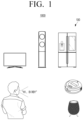
- FIG. 1 is a view provided to schematically explain a voice recognition system according to an embodiment of the disclosure
- FIG. 2 is a block diagram provided to explain configuration of an electronic apparatus according to an embodiment of the disclosure
- FIG. 3 is a block diagram provided to explain detailed configuration of an electronic apparatus according to an embodiment of the disclosure.
- FIG. 4 is a view provided to explain an operation in which an electronic apparatus estimates a user's voice utterance location according to an embodiment of the disclosure
- FIG. 5 is a view provided to explain an operation of determining an electronic apparatus of which voice recognition function is activated from among various electronic apparatuses existing in the same space based on map information regarding an environment where a user voice is uttered according to an embodiment of the disclosure;
- FIG. 6 is a view provided to explain an operation of determining an electronic apparatus of which voice recognition function is activated according to a type of a user request included in a user's uttered voice according to an embodiment of the disclosure;
- FIG. 7 is a flowchart provided to explain an operation of an electronic apparatus according to an embodiment of the disclosure.
- FIG. 8 is a view provided to explain a controlling method of an electronic apparatus according to an embodiment of the disclosure.
- an expression “have,” “may have,” “include,” “may include,” or the like indicates an existence of a corresponding feature (e.g., a numerical value, a function, an operation, a component such as a part, or the like), and does not exclude an existence of an additional feature.
- first,” “second,” or the like, used in the disclosure may indicate various components regardless of a sequence and/or importance of the components, will be used only in order to distinguish one component from the other components, and do not limit the corresponding components.
- first component described in the disclosure may be named the second component and the second component may also be similarly named the first component, without departing from the scope of the disclosure.
- components necessary for description of each embodiment have been described, and the disclosure is not limited thereto. Accordingly, some components may be changed or omitted, or other components may be added. In addition, components may be distributed and arranged in different independent devices.
- FIG. 1 is a view provided to schematically explain a voice recognition system according to an embodiment of the disclosure.
- a voice recognition system 1000 may include various types of electronic apparatuses 100 that provide a voice recognition function.
- the voice recognition function may include a function of converting an acoustic signal acquired by the electronic apparatus 100 through a sound senor such as a microphone into a word or a sentence.
- the voice recognition function performs a task of removing a noise after extracting a voice signal and subsequently, voice recognition may be performed by extracting features of the voice signal and comparing them with a voice model database (DB).
- DB voice model database
- the electronic apparatus 100 may perform an operation corresponding to a user request (e.g., a command for controlling the electronic apparatus) included in a user's uttered voice or provide various life convenience services such as providing a response regarding information requested by the user.
- a user request e.g., a command for controlling the electronic apparatus
- various life convenience services such as providing a response regarding information requested by the user.
- Each of the electronic apparatuses 100 may perform the voice recognition function after identifying a trigger voice. For example, the electronic apparatus 100 may not perform voice recognition regarding the user's uttered voice before the trigger voice is input, and as the user utters the trigger voice, may activate the voice recognition function of the electronic apparatus.
- the trigger voice is a call word for activating the voice recognition function, and may be a specific word or a sentence.
- the name of the electronic apparatus or an artificial intelligence assistant may be used as the trigger voice.
- Such a trigger voice may be pre-set in the electronic apparatus or may be changed or set.
- the user may activate the voice recognition function of the electronic apparatus 100 by uttering “Hi, Bixby” which is the trigger voice.
- a plurality of electronic apparatuses providing the voice recognition function may be disposed in the space where the user is located.
- the electronic apparatuses providing the voice recognition function may include smart speakers, televisions (TVs), air conditioners, air purifiers, washing machines, refrigerators, robot cleaners, kitchen appliances, but are not limited thereto.
- the user When the user utters the trigger word, the user generally may have an intention to receive a service through the voice recognition function using an electronic apparatus located at the nearest distance.
- the voice recognition apparatuses disposed in the same space have the same trigger voice, there may be a problem in that several electronic apparatuses are simultaneously activated by the user's trigger voice utterance.
- the disclosure discloses a voice recognition system capable of estimating the user's voice utterance location and activating the voice recognition function of one electronic apparatus located at the nearest distance from the user's voice utterance location and an electronic apparatus having the same.
- FIG. 2 is a block diagram provided to explain configuration of an electronic apparatus according to an embodiment of the disclosure.
- the electronic apparatus 100 may include a communication interface 110 , a memory 120 , a processor 130 , and a microphone 140 .
- the communication interface 110 may communicate with an external apparatus to transmit and receive various data.
- the electronic apparatus 100 may share various information with other electronic apparatuses through the communication interface 110 . Detailed description regarding information sharing between electronic apparatuses will be provided later.
- the communication interface 110 may communicate with an electronic apparatus not only through a Local Area Network (LAN), an Internet network, or a mobile communication network but also through various communication methods such as Bluetooth (BT), Bluetooth Low Energy (BLE), WI-FI, WI-FI Direct, Zigbee, Near Field Communication (NFC), etc.
- the communication interface 110 may include various communication modules for performing network communication.
- the communication interface 110 may include a Bluetooth chip, a Wi-Fi chip, a wireless chip, etc.
- the memory 120 is electrically connected to the processor 130 , and may story data necessary for various embodiments of the disclosure.
- the memory 120 may store instructions or data related to at least one of other components of the electronic apparatus 100 .
- the memory 120 may be implemented as a non-volatile memory, a volatile memory, a flash-memory, a hard disc drive (HDD), a solid state drive (SSD), or the like.
- the memory 120 is accessed by the processor 130 , and data read/write/edit/delete/update by the processor 130 may be performed.
- a term ‘memory’ may include the memory 120 , a read only memory (ROM) 121 in the processor 130 , a random access memory (RAM), or a memory card (not illustrated) (for example, a micro secure digital (SD) card or a memory stick) mounted in the electronic apparatus 100 .
- the memory 120 may store programs, data, etc. for configuring various screens to be displayed on the display area of the display 150 .
- the memory 120 may store location information of the electronic apparatus 100 and location information of other electronic apparatuses. Specifically, the memory 120 may store location information of the electronic apparatus 100 and other electronic apparatuses included in map information by storing map information regarding the environment where the electronic apparatus 100 is located. Detailed description regarding the map information stored in the memory 120 will be described later with reference to FIG. 5 .
- the microphone 140 may receive information on sound generated around the electronic apparatus 100 .
- the microphone 140 may receive a user's uttered voice.
- the user's uttered voice may be a voice for executing a specific function of the electronic apparatus 100 , for example, a voice for activating a voice recognition function or a voice for executing an operation corresponding to a user request such as a command for controlling the electronic apparatus.
- the microphone 140 may have a plurality of channels and recognize a direction in which a voice input to the microphone 140 is uttered through the plurality of channels. For example, the microphone 140 may detect the direction of input sound through Sound Source Localization (SSL) to which a sound direction detection technology using Delay of Arrival (DOA) of a sound source input to each channel is applied. In this case, if the microphone 140 includes two channels, the microphone 140 may detect a direction in a range of 180 degrees, and if the microphone 140 includes three channels, the microphone 140 may detect a direction in a range of 360 degrees.
- SSL Sound Source Localization
- DOA Delay of Arrival
- the direction in which the input sound source is generated may be recognized using the difference in distance between a plurality of channels included in the microphone 140 and in time between sound source signals input to each channel. For example, if a first channel and a second channel are arranged sequentially at a predetermined interval, when a sound signal is input to the first channel and the second channel sequentially, it may be recognized that the direction where the sound source is generated is closer to the location of the first channel
- the processor 130 is electrically connected to the communication interface 110 , the memory 120 and the microphone 140 , and may control the overall operations of the electronic apparatus 100 .
- the processor 130 may be implemented as a digital signal processor (DSP) processing a digital signal, a microprocessor, or a time controller (TCON).
- DSP digital signal processor
- the processor 130 is not limited thereto, but may include one or more of a central processing unit (CPU), a micro controller unit (MCU), a micro processing unit (MPU), a controller, an application processor (AP) or a communication processor (CP), an ARM processor, or an Artificial Intelligence (AI) processor, or may be defined by these terms.
- the processor 130 may be implemented as a system-on-chip (SoC) or a large scale integration (LSI) in which a processing algorithm is embedded or may be implemented in a field programmable gate array (FPGA) form.
- SoC system-on-chip
- LSI large scale integration
- FPGA field programmable gate array
- the processor 130 may perform various functions by executing computer executable instructions stored in the memory 120 .
- the processor 130 may identify the direction in which the trigger voice is uttered based on the received signal. Subsequently, the processor 130 may control the communication interface 110 to share information regarding the identified utterance direction with other electronic apparatuses, and by comprehensively considering utterance direction information received from other electronic apparatuses and location information of electronic apparatuses stored in the memory 120 , may estimate the location where the trigger voice is uttered. Detailed description regarding information sharing of the utterance direction and estimation of location where the voice is uttered will be provided later with reference to FIG. 4 .
- the processor 130 may activate the voice recognition function in the electronic apparatus 100 based on the location information stored in the memory 120 and the estimated utterance location, and when the voice recognition function is activated, may perform a voice recognition function regarding the user's uttered voice. For example, if it is determined that the electronic apparatus 100 is located at the closest distance from the estimated utterance location in comparison with other electronic apparatuses, the processor 130 may activate the voice recognition function of the electronic apparatus 100 and perform a voice recognition operation regarding a user request included in the user's uttered voice.
- FIGS. 4 to 6 Detailed description regarding the method of determining an electronic apparatus of which voice recognition function is to be activated from among a plurality of electronic apparatuses and an operation of performing voice recognition according to the method will be provided later with reference to FIGS. 4 to 6 .
- FIG. 3 is a block diagram provided to explain detailed configuration of an electronic apparatus according to an embodiment of the disclosure.
- the electronic apparatus 100 may include the communication interface 110 , the memory 120 , the processor 130 , the microphone 140 , the display 150 , the speaker 160 , and the input interface 170 .
- the communication interface 110 the memory 120 , the processor 130 , the microphone 140 , the display 150 , the speaker 160 , and the input interface 170 .
- the components in FIG. 3 which overlap with the components in FIG. 2 will be omitted.
- the display 150 may display various images.
- the images may be a concept including at least one of a still image or a moving image.
- the display 150 may be implemented in various forms such as liquid crystal display (LCD), organic light-emitting diode (OLED), Liquid Crystal on Silicon (LCoS), Digital Light Processing (DLP), quantum dot (QD) display panel, etc.
- LCD liquid crystal display
- OLED organic light-emitting diode
- LCDoS Liquid Crystal on Silicon
- DLP Digital Light Processing
- QD quantum dot
- the speaker 160 may output various audios.
- the electronic apparatus 100 may provide a response regarding information requested by a user through the speaker 160 in the form of audio.
- the input interface 170 may receive various user commands.
- the input interface 170 may receive a user command for controlling the electronic apparatus 100 .
- the input interface 170 may include the microphone 140 that receives a user's uttered voice, and may include the display 150 that receives a user command through a touch screen.
- FIG. 4 is a view provided to explain an operation in which an electronic apparatus estimates a user's voice utterance location according to an embodiment of the disclosure.
- FIG. 4 it illustrates two electronic apparatuses 100 located at different distances from the user.
- each of the electronic apparatuses will be referred to as a first electronic apparatus 100 - 1 and a second electronic apparatus 100 - 2 for convenience of explanation.
- the user may utter a trigger voice for activating the voice recognition function of one of the electronic apparatuses 100 - 1 , 100 - 2 .
- the first electronic apparatus 100 - 1 and the second electronic apparatus 100 - 2 disposed in the same space may receive the trigger voice.
- the first electronic apparatus 100 - 1 and the second electronic apparatus 100 - 2 may detect the direction in which the trigger voice is uttered through a microphone provided in each of the electronic apparatuses. Referring to FIG. 4 , the first electronic apparatus 100 - 1 may detect that the trigger voice is uttered in a first direction (d 1 ) with reference to the location of the first electronic apparatus 100 - 1 , and the second electronic apparatus 100 - 2 may detect that the trigger voice is uttered in a second direction (d 2 ) with reference to the location of the second electronic apparatus 100 - 2 . As the feature of detecting a direction through a microphone including a plurality of channels has been described previously, further description thereof will not be provided.
- the first electronic apparatus 100 - 1 and the second electronic apparatus 100 - 2 may share with each other information regarding the detected directions in which the trigger voice is uttered from each location.
- a plurality of electronic apparatuses 100 that perform communication using the same network may share information regarding the utterance direction through the corresponding network, and may share information through a communication protocol such as a User Datagram Protocol (UDP).
- UDP User Datagram Protocol
- each of the electronic apparatuses 100 may store map information regarding an environment in which the electronic apparatuses are located, that is, location information of each of the plurality of electronic apparatuses.
- map information may be provided from an electronic apparatus capable of mapping a surrounding environment, such as a robot cleaner. Detailed description regarding the process of mapping location information of each of the plurality of electronic apparatuses 100 through a robot cleaner will be provided later with reference to FIG. 5 .
- Each of the electronic apparatuses 100 may compile the utterance direction information detected by itself, the utterance direction information shared with other electronic apparatuses and the location information of each of the electronic apparatuses 100 and calculate a contact point for the utterance location to estimate the location where the trigger voice is uttered.
- Each of the electronic apparatuses 100 may calculate a distance from the estimated utterance location of the electronic apparatuses through the estimated utterance location information and the location information of each of the electronic apparatuses 100 , and may identify the electronic apparatus 100 located at the closest distance from the utterance location from among the plurality of electronic apparatuses 100 by comparing the calculated distance.
- the first electronic apparatus 100 - 1 may estimate the utterance location of the trigger voice based on the shared utterance direction information and the location information of the first electronic apparatus 100 - 1 and the second electronic apparatus 100 - 2 , calculate and compare distances at which each of the first electronic apparatus 100 - 1 and the second electronic apparatus 100 - 2 is located from the estimated utterance location, determine that the first electronic apparatus 100 - 1 is located closer to the utterance location than the second electronic apparatus 100 - 2 , and activate the voice recognition function.
- the second electronic apparatus 100 - 2 may determine that the second electronic apparatus 100 - 2 is located father from the utterance location of the trigger voice than the first electronic apparatus 100 - 1 , and may not activate the voice recognition function.
- the electronic apparatus 100 may compare it with the distance information which is calculated and shared by other electronic apparatuses to determine whether the electronic apparatus 100 corresponds to an apparatus located closest from the uttered location from among electronic apparatuses that share the information with.
- FIG. 4 illustrates two electronic apparatuses 100 , but the disclosure is not limited thereto. Even in the case where there are more than three electronic apparatuses, the same operation may be conducted to estimate the utterance location, and when each of the electronic apparatuses determines that it is the electronic apparatus at the closest distance from the utterance location, the electronic apparatus may activate the voice recognition function.
- FIG. 5 is a view provided to explain an operation of identifying an electronic apparatus of which voice recognition function is to be activated from among various electronic apparatuses in the same space based on map information regarding an environment where a user voice is uttered according to an embodiment of the disclosure.
- location information regarding each of the electronic apparatuses may be provided to each electronic apparatus in the form of location information on a map.
- the map information may be generated in a robot cleaner capable of mapping the surrounding environment and be transmitted to each electronic apparatus.
- the robot cleaner may drive an indoor environment to map the indoor structure through automatic mapping technology, and by recognizing electronic apparatuses disposed indoors using an object recognition function, may generate map information including location information of each electronic apparatus.
- the robot cleaner may map the indoor structure through a sensor that detects a distance from an object, map the indoor structure using a surrounding environment image obtained through a camera, and recognize electronic apparatuses disposed indoors.
- the robot cleaner may acquire an image regarding a surrounding environment through a camera and analyze the image, and if an electronic apparatus such as a TV and an air conditioner is identified from the image, may store location information in which the identified electronic apparatus is located in map information mapping the indoor structure.
- the user may reflect the location of the electronic apparatus on the map information by directly inputting the location of the electronic apparatus.
- each of the electronic apparatuses 100 may store map information regarding an environment where the electronic apparatuses 100 are located, that is, location information of each of the plurality of electronic apparatuses 100 .
- map information may be provided by an electronic apparatus capable of mapping a surrounding environment such as a robot cleaner.
- Each of the electronic apparatuses 100 may compile the utterance direction information detected by itself, the utterance direction information shared with other electronic apparatuses and the location information of each of the electronic apparatuses 100 and calculate a contact point for the utterance location to estimate the location where the user voice is uttered.
- Each of the electronic apparatuses 100 may calculate distances from the estimated utterance location of each electronic apparatus 100 through the estimated utterance location information and location information of each electronic apparatus 100 , compare the calculated distances and determine the electronic apparatus 100 at the closest distance from the utterance location from among the plurality of electronic apparatuses 100 as the electronic apparatus of which voice recognition function is to be activated.
- the voice recognition function of the speaker of the electronic apparatus 100 - 1 which is located at the closest distance from the user from among the plurality of electronic apparatuses 100 - 1 , 100 - 2 , 100 - 3 , 100 - 4 , 100 - 5 , and 100 - 6 may be activated.
- a number of the plurality of electronic apparatuses is not limited.
- FIG. 6 is a view provided to explain an operation of determining an electronic apparatus of which voice recognition function is activated according to a type of a user request included in the user's uttered voice according to an embodiment of the disclosure.
- FIG. 6 it illustrates two different types of electronic apparatuses 100 which are located at different distances.
- each of the electronic apparatuses will be referred to as the first electronic apparatus 100 - 1 and the second electronic apparatus 100 - 2 for convenience of explanation.
- the first electronic apparatus 100 - 1 may be a speaker
- the second electronic apparatus 100 - 2 may be a display apparatus.
- the voice recognition function of the first electronic apparatus 100 - 1 located at a relatively closer than the second electronic apparatus 100 - 2 from the utterance location may be activated.
- the voice recognition function When the voice recognition function is activated, the first electronic apparatus 100 - 1 may perform voice recognition regarding a user request included in the user's uttered voice.
- the user may utter a voice including a user request to show a movie.
- the first electronic apparatus 100 - 1 may perform voice recognition regarding “Show me a movie” which is the voice uttered by the user, and receive the user request.
- the first electronic apparatus 100 - 1 may determine that an operation corresponding to the input user request cannot be performed.
- the electronic apparatus 100 may transmit a control signal for controlling to perform the operation corresponding to the user request to another electronic apparatus.
- the electronic apparatus may transmit the control signal to another electronic apparatus located at the closest distance from the estimated utterance location from among a plurality of other electronic apparatuses capable of performing the operation corresponding to the user request.
- the first electronic apparatus 100 - 1 includes a display for displaying an image from among electronic apparatuses located nearby based on shared information, and it may be determined that the electronic apparatus located at the closest distance from the utterance location from among the electronic apparatuses including a display is the second electronic apparatus 100 - 2 . Based on a result of the determination, the first electronic apparatus 100 - 1 may transmit a control signal for controlling the second electronic apparatus 100 - 2 to perform an operation corresponding to a user request to the second electronic apparatus 100 - 2 , and the second electronic apparatus 100 - 2 may receive the control signal and perform the operation corresponding to the user request.
- FIG. 7 is a flowchart provided to explain an operation of an electronic apparatus according to an embodiment.
- the electronic apparatus 100 may store map information regarding a surrounding environment at operation S 710 . Subsequently, when a trigger voice is identified at operation S 720 , the direction in which the trigger voice is uttered is identified through SSL at operation S 730 , and information regarding the utterance direction may be shared between apparatuses on the same network at operation S 740 .
- the electronic apparatus 100 may identify whether there are a plurality of electronic apparatuses that have received the trigger voice at operation S 750 . When determining that there are no other electronic apparatuses that have received the trigger voice, the electronic apparatus 100 may activate the voice recognition function of the electronic apparatus 100 .
- the utterance location of the trigger voice may be estimated by calculating a contact point based on the shared information at operation S 760 , and the voice recognition function of an appropriate electronic apparatus, that is, an electronic apparatus at the closest distance from the utterance location or an electronic apparatus at the closest distance from the utterance location from among electronic apparatuses capable of performing an operation corresponding to a user request, may be activated at operation S 770 .
- FIG. 8 is a view provided to explain a controlling method of an electronic apparatus according to an embodiment of the disclosure.
- an electronic apparatus providing a voice recognition function may store location information of the electronic apparatus and other electronic apparatuses at operation S 810 .
- the electronic apparatus may store map information regarding environments where the electronic apparatus and other electronic apparatuses are located and, in this case, the location information may be location information on a map in the map information.
- the map information may be information that is generated in a robot cleaner capable of mapping a surrounding environment and provided to the electronic apparatus, and may include location information of each of various electronic apparatuses that provide a voice recognition function.
- the electronic apparatus may identify the utterance direction of the trigger voice at operation S 820 .
- the trigger voice is a call word for activating the voice recognition function, and may be a specific word or a sentence.
- the electronic apparatus may share information regarding the identified utterance direction with other electronic apparatuses at operation S 830 .
- the electronic apparatus may estimate the utterance location based on the utterance direction information received from other electronic apparatuses and the identified utterance direction at operation S 840 .
- the electronic apparatus may activate the voice recognition function of the electronic apparatus based on the stored location information and the estimated utterance location at operation S 850 .
- the electronic apparatus may activate the voice recognition function.
- the electronic apparatus of which voice recognition function is to be activated may be determine based on the level of sound pressure input to the electronic apparatuses.
- the electronic apparatus may identify the sound pressure of the trigger voice and share information regarding the identified sound pressure together with information regarding the identified utterance direction.
- the electronic apparatus may activate the voice recognition function of the electronic apparatus based on information regarding the estimated utterance location and sound pressure of each of the plurality of electronic apparatuses.
- the electronic apparatus may preferentially compare a distance between the plurality of electronic apparatuses and the utterance location, and based on a difference in distance being less than a predetermined value, determine the electronic apparatus to perform its voice recognition function based on sound pressure information.
- the voice recognition function of the electronic apparatus having a large input sound pressure may be activated.
- the electronic apparatus may perform a voice recognition operation regarding a user's uttered voice received through a microphone at operation S 860 .
- the electronic apparatus may determine the electronic apparatus of which voice recognition function is activated according to the type of a user request included in a user's uttered voice.
- the electronic apparatus may perform voice recognition regarding a user request included in the user's uttered voice, determine whether it is possible to perform an operation corresponding to the user request, and perform the operation corresponding to the user request based on a result of the determination.
- the electronic apparatus may transmit a control signal for controlling to perform the operation corresponding to the user request to another electronic apparatus.
- the electronic apparatus may transmit the control signal to another electronic apparatus at the closest distance from the estimated utterance location from among a plurality of electronic apparatuses capable of performing the operation corresponding to the user request.
- the user convenience can be improved as the electronic apparatus at the closest location from the user location from among the electronic apparatuses capable of performing the operation corresponding to the user request is selected to provide a service corresponding to the user request.
- computer instructions for performing processing operations according to the diverse embodiments of the disclosure described above may be stored in a non-transitory computer-readable medium.
- the computer instructions stored in the non-transitory computer-readable medium cause a specific device to perform the processing operations of the display apparatus according to the diverse embodiments described above when they are executed by a processor of the specific device.
- the non-transitory computer-readable medium is not a medium that stores data for a while, such as a register, a cache, a memory, or the like, but means a medium that semi-permanently stores data and is readable by the device.
- Specific examples of the non-transitory computer-readable medium may include a compact disk (CD), a digital versatile disk (DVD), a hard disk, a Blu-ray disk, a universal serial bus (USB), a memory card, a ROM, and the like.
- a method according to the various embodiments may be included in a computer program product and provided therein.
- the computer program product can be traded between a seller and a buyer as a product.
- the computer program product may be distributed in the form of a storage medium that can be read by machine (e.g., compact disc read only memory (CD-ROM)), or may be distributed online through an application store (e.g., PlayStoreTM).
- an application store e.g., PlayStoreTM
- at least a portion of the computer program product may be at least temporarily stored in a storage medium such as a memory of a server of a manufacturer, a server of an application store, or a relay server, or may be temporarily generated.
- the programs for controlling an electronic apparatus according to an embodiment may be provided to various electronic apparatuses capable of performing a voice recognition function.
- the programs may be applied to various apparatuses such as smart speakers, TVs, air conditioners, air purifiers, washing machines, refrigerators, robot cleaners, kitchen appliances, etc., but are not limited thereto.
- the apparatuses which are provided with the programs for controlling an electronic apparatus according to an embodiment may share information with other electronic apparatuses by performing communication and based on this, may perform the above-described operations of the electronic apparatus prior to estimating an utterance location, activating a voice recognition function, etc.
Landscapes
- Engineering & Computer Science (AREA)
- Multimedia (AREA)
- Health & Medical Sciences (AREA)
- Audiology, Speech & Language Pathology (AREA)
- Human Computer Interaction (AREA)
- Physics & Mathematics (AREA)
- Acoustics & Sound (AREA)
- Computational Linguistics (AREA)
- Mechanical Engineering (AREA)
- Signal Processing (AREA)
- Theoretical Computer Science (AREA)
- General Health & Medical Sciences (AREA)
- General Physics & Mathematics (AREA)
- General Engineering & Computer Science (AREA)
- Navigation (AREA)
- User Interface Of Digital Computer (AREA)
Abstract
Description
Claims (12)
Applications Claiming Priority (3)
| Application Number | Priority Date | Filing Date | Title |
|---|---|---|---|
| KR1020200151247A KR20220064768A (en) | 2020-11-12 | 2020-11-12 | Electronic apparatus and control method thereof |
| KR10-2020-0151247 | 2020-11-12 | ||
| PCT/KR2021/009654 WO2022102908A1 (en) | 2020-11-12 | 2021-07-26 | Electronic device and control method thereof |
Related Parent Applications (1)
| Application Number | Title | Priority Date | Filing Date |
|---|---|---|---|
| PCT/KR2021/009654 Continuation WO2022102908A1 (en) | 2020-11-12 | 2021-07-26 | Electronic device and control method thereof |
Publications (2)
| Publication Number | Publication Date |
|---|---|
| US20220148575A1 US20220148575A1 (en) | 2022-05-12 |
| US12087283B2 true US12087283B2 (en) | 2024-09-10 |
Family
ID=81454667
Family Applications (1)
| Application Number | Title | Priority Date | Filing Date |
|---|---|---|---|
| US17/484,516 Active 2042-07-11 US12087283B2 (en) | 2020-11-12 | 2021-09-24 | Electronic apparatus and controlling method thereof |
Country Status (1)
| Country | Link |
|---|---|
| US (1) | US12087283B2 (en) |
Families Citing this family (1)
| Publication number | Priority date | Publication date | Assignee | Title |
|---|---|---|---|---|
| DE102023132570A1 (en) * | 2023-11-22 | 2025-05-22 | Alfred Kärcher SE & Co. KG | Cleaning system with user-guided cleaning device and method for operating a cleaning system |
Citations (41)
| Publication number | Priority date | Publication date | Assignee | Title |
|---|---|---|---|---|
| US6850496B1 (en) * | 2000-06-09 | 2005-02-01 | Cisco Technology, Inc. | Virtual conference room for voice conferencing |
| US20050080619A1 (en) * | 2003-10-13 | 2005-04-14 | Samsung Electronics Co., Ltd. | Method and apparatus for robust speaker localization and automatic camera steering system employing the same |
| US20080182518A1 (en) * | 2007-01-31 | 2008-07-31 | Bluepacket Communications Co., Ltd. | Multimedia switching system |
| US20110218812A1 (en) * | 2010-03-02 | 2011-09-08 | Nilang Patel | Increasing the relevancy of media content |
| US20120014525A1 (en) * | 2010-07-13 | 2012-01-19 | Samsung Electronics Co., Ltd. | Method and apparatus for simultaneously controlling near sound field and far sound field |
| US20120086568A1 (en) * | 2010-10-06 | 2012-04-12 | Microsoft Corporation | Inferring Building Metadata From Distributed Sensors |
| US20130029684A1 (en) * | 2011-07-28 | 2013-01-31 | Hiroshi Kawaguchi | Sensor network system for acuiring high quality speech signals and communication method therefor |
| US20130266151A1 (en) * | 2010-12-28 | 2013-10-10 | Nec Casio Mobile Communications, Ltd. | Electroacoustic transducer |
| US20150228293A1 (en) * | 2012-09-19 | 2015-08-13 | Dolby Laboratories Licensing Corporation | Method and System for Object-Dependent Adjustment of Levels of Audio Objects |
| US20150279356A1 (en) * | 2014-03-31 | 2015-10-01 | Samsung Electronics Co., Ltd. | Speech recognition system and method |
| US20160049150A1 (en) | 2013-08-29 | 2016-02-18 | Panasonic Intellectual Property Corporation Of America | Speech recognition method and speech recognition device |
| US20160077794A1 (en) * | 2014-09-12 | 2016-03-17 | Apple Inc. | Dynamic thresholds for always listening speech trigger |
| US20160154089A1 (en) * | 2014-12-02 | 2016-06-02 | Qualcomm Incorporated | Method and apparatus for performing ultrasonic presence detection |
| US20160155443A1 (en) * | 2014-11-28 | 2016-06-02 | Microsoft Technology Licensing, Llc | Device arbitration for listening devices |
| US20160241976A1 (en) * | 2015-02-12 | 2016-08-18 | Harman International Industries, Incorporated | Media content playback system and method |
| US20170090864A1 (en) * | 2015-09-28 | 2017-03-30 | Amazon Technologies, Inc. | Mediation of wakeword response for multiple devices |
| US20170133011A1 (en) * | 2015-11-06 | 2017-05-11 | Google Inc. | Voice commands across devices |
| US20180018964A1 (en) * | 2016-07-15 | 2018-01-18 | Sonos, Inc. | Voice Detection By Multiple Devices |
| US20180213364A1 (en) * | 2017-01-24 | 2018-07-26 | Essential Products, Inc. | Media and communications in a connected environment |
| US20180308490A1 (en) * | 2017-04-21 | 2018-10-25 | Lg Electronics Inc. | Voice recognition apparatus and voice recognition method |
| US10134399B2 (en) * | 2016-07-15 | 2018-11-20 | Sonos, Inc. | Contextualization of voice inputs |
| KR20180125241A (en) | 2017-05-15 | 2018-11-23 | 네이버 주식회사 | Device control according to user's talk position |
| US20180358009A1 (en) * | 2017-06-09 | 2018-12-13 | International Business Machines Corporation | Cognitive and interactive sensor based smart home solution |
| KR20190003157A (en) | 2017-06-30 | 2019-01-09 | 엘지전자 주식회사 | Robot cleaner and robot cleaning system |
| US20190044745A1 (en) * | 2017-08-02 | 2019-02-07 | Lenovo (Singapore) Pte. Ltd. | Grouping electronic devices to coordinate action based on context awareness |
| US20190074008A1 (en) * | 2016-10-19 | 2019-03-07 | Sonos, Inc. | Arbitration-Based Voice Recognition |
| US20190104119A1 (en) * | 2017-10-04 | 2019-04-04 | Michael E. Giorgi | Single node network connectivity for structure automation functionality |
| KR101975423B1 (en) | 2017-06-02 | 2019-05-07 | 네이버 주식회사 | Method and apparatus for providing appropriate information for location and space of user actively |
| KR20190084003A (en) | 2019-06-25 | 2019-07-15 | 엘지전자 주식회사 | Method and apparatus for selecting voice enable device |
| US10354653B1 (en) * | 2016-01-19 | 2019-07-16 | United Services Automobile Association (Usaa) | Cooperative delegation for digital assistants |
| KR20190096861A (en) | 2019-04-23 | 2019-08-20 | 엘지전자 주식회사 | Method and apparatus for determining voice enable device |
| KR20190107622A (en) | 2019-09-02 | 2019-09-20 | 엘지전자 주식회사 | Method and Apparatus for Updating Real-time Voice Recognition Model Using Moving Agent |
| US20190364375A1 (en) * | 2018-05-25 | 2019-11-28 | Sonos, Inc. | Determining and Adapting to Changes in Microphone Performance of Playback Devices |
| US20200072937A1 (en) | 2018-02-12 | 2020-03-05 | Luxrobo Co., Ltd. | Location-based voice recognition system with voice command |
| KR20200049020A (en) | 2018-10-31 | 2020-05-08 | 삼성전자주식회사 | Method for displaying contents responding to voice command and electronic device thereof |
| KR20200050152A (en) | 2018-11-01 | 2020-05-11 | 현대자동차주식회사 | System for recognizing voice using multiple devices and method of controlling the same |
| US20200184964A1 (en) * | 2018-12-07 | 2020-06-11 | Sonos, Inc. | Systems and methods of operating media playback systems having multiple voice assistant services |
| US20200294503A1 (en) | 2019-03-15 | 2020-09-17 | Samsung Electronics Co., Ltd. | Method for location inference of iot device, server, and electronic device supporting the same |
| US20200322540A1 (en) * | 2017-12-26 | 2020-10-08 | Canon Kabushiki Kaisha | Image capturing apparatus, control method, and recording medium |
| US20220254344A1 (en) * | 2019-05-24 | 2022-08-11 | Lg Electronics Inc. | Method for controlling device using voice recognition and device implementing the same |
| US20220345820A1 (en) * | 2019-07-30 | 2022-10-27 | Dolby Laboratories Licensing Corporation | Coordination of audio devices |
-
2021
- 2021-09-24 US US17/484,516 patent/US12087283B2/en active Active
Patent Citations (48)
| Publication number | Priority date | Publication date | Assignee | Title |
|---|---|---|---|---|
| US6850496B1 (en) * | 2000-06-09 | 2005-02-01 | Cisco Technology, Inc. | Virtual conference room for voice conferencing |
| US20050080619A1 (en) * | 2003-10-13 | 2005-04-14 | Samsung Electronics Co., Ltd. | Method and apparatus for robust speaker localization and automatic camera steering system employing the same |
| US20080182518A1 (en) * | 2007-01-31 | 2008-07-31 | Bluepacket Communications Co., Ltd. | Multimedia switching system |
| US20110218812A1 (en) * | 2010-03-02 | 2011-09-08 | Nilang Patel | Increasing the relevancy of media content |
| US20120014525A1 (en) * | 2010-07-13 | 2012-01-19 | Samsung Electronics Co., Ltd. | Method and apparatus for simultaneously controlling near sound field and far sound field |
| US20120086568A1 (en) * | 2010-10-06 | 2012-04-12 | Microsoft Corporation | Inferring Building Metadata From Distributed Sensors |
| US20130266151A1 (en) * | 2010-12-28 | 2013-10-10 | Nec Casio Mobile Communications, Ltd. | Electroacoustic transducer |
| US20130029684A1 (en) * | 2011-07-28 | 2013-01-31 | Hiroshi Kawaguchi | Sensor network system for acuiring high quality speech signals and communication method therefor |
| US20150228293A1 (en) * | 2012-09-19 | 2015-08-13 | Dolby Laboratories Licensing Corporation | Method and System for Object-Dependent Adjustment of Levels of Audio Objects |
| US20160049150A1 (en) | 2013-08-29 | 2016-02-18 | Panasonic Intellectual Property Corporation Of America | Speech recognition method and speech recognition device |
| US9818403B2 (en) | 2013-08-29 | 2017-11-14 | Panasonic Intellectual Property Corporation Of America | Speech recognition method and speech recognition device |
| JP6433903B2 (en) | 2013-08-29 | 2018-12-05 | パナソニック インテレクチュアル プロパティ コーポレーション オブ アメリカPanasonic Intellectual Property Corporation of America | Speech recognition method and speech recognition apparatus |
| US20150279356A1 (en) * | 2014-03-31 | 2015-10-01 | Samsung Electronics Co., Ltd. | Speech recognition system and method |
| US20160077794A1 (en) * | 2014-09-12 | 2016-03-17 | Apple Inc. | Dynamic thresholds for always listening speech trigger |
| US20160155443A1 (en) * | 2014-11-28 | 2016-06-02 | Microsoft Technology Licensing, Llc | Device arbitration for listening devices |
| US20160154089A1 (en) * | 2014-12-02 | 2016-06-02 | Qualcomm Incorporated | Method and apparatus for performing ultrasonic presence detection |
| US20160241976A1 (en) * | 2015-02-12 | 2016-08-18 | Harman International Industries, Incorporated | Media content playback system and method |
| US20170090864A1 (en) * | 2015-09-28 | 2017-03-30 | Amazon Technologies, Inc. | Mediation of wakeword response for multiple devices |
| US20170133011A1 (en) * | 2015-11-06 | 2017-05-11 | Google Inc. | Voice commands across devices |
| US10354653B1 (en) * | 2016-01-19 | 2019-07-16 | United Services Automobile Association (Usaa) | Cooperative delegation for digital assistants |
| US20180018964A1 (en) * | 2016-07-15 | 2018-01-18 | Sonos, Inc. | Voice Detection By Multiple Devices |
| US10134399B2 (en) * | 2016-07-15 | 2018-11-20 | Sonos, Inc. | Contextualization of voice inputs |
| US20190074008A1 (en) * | 2016-10-19 | 2019-03-07 | Sonos, Inc. | Arbitration-Based Voice Recognition |
| US20180213364A1 (en) * | 2017-01-24 | 2018-07-26 | Essential Products, Inc. | Media and communications in a connected environment |
| US20180308490A1 (en) * | 2017-04-21 | 2018-10-25 | Lg Electronics Inc. | Voice recognition apparatus and voice recognition method |
| KR20180125241A (en) | 2017-05-15 | 2018-11-23 | 네이버 주식회사 | Device control according to user's talk position |
| KR101975423B1 (en) | 2017-06-02 | 2019-05-07 | 네이버 주식회사 | Method and apparatus for providing appropriate information for location and space of user actively |
| US20180358009A1 (en) * | 2017-06-09 | 2018-12-13 | International Business Machines Corporation | Cognitive and interactive sensor based smart home solution |
| KR20190003157A (en) | 2017-06-30 | 2019-01-09 | 엘지전자 주식회사 | Robot cleaner and robot cleaning system |
| US20190044745A1 (en) * | 2017-08-02 | 2019-02-07 | Lenovo (Singapore) Pte. Ltd. | Grouping electronic devices to coordinate action based on context awareness |
| US20190104119A1 (en) * | 2017-10-04 | 2019-04-04 | Michael E. Giorgi | Single node network connectivity for structure automation functionality |
| US20200322540A1 (en) * | 2017-12-26 | 2020-10-08 | Canon Kabushiki Kaisha | Image capturing apparatus, control method, and recording medium |
| US20200072937A1 (en) | 2018-02-12 | 2020-03-05 | Luxrobo Co., Ltd. | Location-based voice recognition system with voice command |
| US20190364375A1 (en) * | 2018-05-25 | 2019-11-28 | Sonos, Inc. | Determining and Adapting to Changes in Microphone Performance of Playback Devices |
| US20210398528A1 (en) | 2018-10-31 | 2021-12-23 | Samsung Electronics Co., Ltd. | Method for displaying content in response to speech command, and electronic device therefor |
| KR20200049020A (en) | 2018-10-31 | 2020-05-08 | 삼성전자주식회사 | Method for displaying contents responding to voice command and electronic device thereof |
| KR20200050152A (en) | 2018-11-01 | 2020-05-11 | 현대자동차주식회사 | System for recognizing voice using multiple devices and method of controlling the same |
| US20200184964A1 (en) * | 2018-12-07 | 2020-06-11 | Sonos, Inc. | Systems and methods of operating media playback systems having multiple voice assistant services |
| KR20200109954A (en) | 2019-03-15 | 2020-09-23 | 삼성전자주식회사 | Method for location inference of IoT device, server and electronic device supporting the same |
| US20200294503A1 (en) | 2019-03-15 | 2020-09-17 | Samsung Electronics Co., Ltd. | Method for location inference of iot device, server, and electronic device supporting the same |
| US20200074988A1 (en) | 2019-04-23 | 2020-03-05 | Lg Electronics Inc. | Method and apparatus for determining voice enable device |
| KR20190096861A (en) | 2019-04-23 | 2019-08-20 | 엘지전자 주식회사 | Method and apparatus for determining voice enable device |
| US20220254344A1 (en) * | 2019-05-24 | 2022-08-11 | Lg Electronics Inc. | Method for controlling device using voice recognition and device implementing the same |
| US20190392834A1 (en) | 2019-06-25 | 2019-12-26 | Lg Electronics Inc. | Method and apparatus for selecting voice-enabled device |
| KR20190084003A (en) | 2019-06-25 | 2019-07-15 | 엘지전자 주식회사 | Method and apparatus for selecting voice enable device |
| US20220345820A1 (en) * | 2019-07-30 | 2022-10-27 | Dolby Laboratories Licensing Corporation | Coordination of audio devices |
| US20200013392A1 (en) | 2019-09-02 | 2020-01-09 | Lg Electronics Inc. | Method and apparatus for updating real-time voice recognition model using moving agent |
| KR20190107622A (en) | 2019-09-02 | 2019-09-20 | 엘지전자 주식회사 | Method and Apparatus for Updating Real-time Voice Recognition Model Using Moving Agent |
Non-Patent Citations (1)
| Title |
|---|
| International Search report and written opinion dated Nov. 26, 2021, issued in International Application No. PCT/KR2021/009654. |
Also Published As
| Publication number | Publication date |
|---|---|
| US20220148575A1 (en) | 2022-05-12 |
Similar Documents
| Publication | Publication Date | Title |
|---|---|---|
| US12170088B2 (en) | Electronic device and controlling method thereof | |
| US11516040B2 (en) | Electronic device and method for controlling thereof | |
| US11267131B2 (en) | Mobile home robot and controlling method of the mobile home robot | |
| US10540995B2 (en) | Electronic device and method for recognizing speech | |
| KR102792944B1 (en) | Terminal device and method for controlling thereof | |
| US11145299B2 (en) | Managing voice interface devices | |
| US9984563B2 (en) | Method and device for controlling subordinate electronic device or supporting control of subordinate electronic device by learning IR signal | |
| US20190130898A1 (en) | Wake-up-word detection | |
| US10269377B2 (en) | Detecting pause in audible input to device | |
| US12087283B2 (en) | Electronic apparatus and controlling method thereof | |
| US12334067B2 (en) | Voice trigger based on acoustic space | |
| US11600275B2 (en) | Electronic device and control method thereof | |
| CN111916079B (en) | A voice response method, system, device and storage medium for electronic equipment | |
| US20170243579A1 (en) | Electronic apparatus and service providing method thereof | |
| KR20220064768A (en) | Electronic apparatus and control method thereof | |
| JP2023059845A (en) | Enhanced noise reduction on voice-activated devices | |
| JP7018850B2 (en) | Terminal device, decision method, decision program and decision device | |
| EP3757818B1 (en) | Systems and methods for automatic service activation on a computing device | |
| EP4423742B1 (en) | Warm word arbitration between automated assistant devices | |
| US11803393B2 (en) | Systems and methods for automatic service activation on a computing device | |
| US12106755B2 (en) | Warm word arbitration between automated assistant devices |
Legal Events
| Date | Code | Title | Description |
|---|---|---|---|
| AS | Assignment |
Owner name: SAMSUNG ELECTRONICS CO., LTD., KOREA, REPUBLIC OF Free format text: ASSIGNMENT OF ASSIGNORS INTEREST;ASSIGNORS:HWANG, DOHYEONG;SHIN, JONGYEONG;REEL/FRAME:057592/0271 Effective date: 20210924 |
|
| FEPP | Fee payment procedure |
Free format text: ENTITY STATUS SET TO UNDISCOUNTED (ORIGINAL EVENT CODE: BIG.); ENTITY STATUS OF PATENT OWNER: LARGE ENTITY |
|
| STPP | Information on status: patent application and granting procedure in general |
Free format text: DOCKETED NEW CASE - READY FOR EXAMINATION |
|
| STPP | Information on status: patent application and granting procedure in general |
Free format text: NON FINAL ACTION MAILED |
|
| STPP | Information on status: patent application and granting procedure in general |
Free format text: RESPONSE TO NON-FINAL OFFICE ACTION ENTERED AND FORWARDED TO EXAMINER |
|
| STPP | Information on status: patent application and granting procedure in general |
Free format text: FINAL REJECTION MAILED |
|
| STPP | Information on status: patent application and granting procedure in general |
Free format text: RESPONSE AFTER FINAL ACTION FORWARDED TO EXAMINER |
|
| STPP | Information on status: patent application and granting procedure in general |
Free format text: NOTICE OF ALLOWANCE MAILED -- APPLICATION RECEIVED IN OFFICE OF PUBLICATIONS |
|
| STPP | Information on status: patent application and granting procedure in general |
Free format text: PUBLICATIONS -- ISSUE FEE PAYMENT RECEIVED |
|
| STPP | Information on status: patent application and granting procedure in general |
Free format text: PUBLICATIONS -- ISSUE FEE PAYMENT VERIFIED |
|
| STCF | Information on status: patent grant |
Free format text: PATENTED CASE |