US12053426B2 - Device for mitigating motion sickness and other responses to inconsistent sensory information - Google Patents
Device for mitigating motion sickness and other responses to inconsistent sensory information Download PDFInfo
- Publication number
- US12053426B2 US12053426B2 US17/193,745 US202117193745A US12053426B2 US 12053426 B2 US12053426 B2 US 12053426B2 US 202117193745 A US202117193745 A US 202117193745A US 12053426 B2 US12053426 B2 US 12053426B2
- Authority
- US
- United States
- Prior art keywords
- vibrations
- vestibular system
- patient
- signal generator
- skull
- Prior art date
- Legal status (The legal status is an assumption and is not a legal conclusion. Google has not performed a legal analysis and makes no representation as to the accuracy of the status listed.)
- Active, expires
Links
- 201000003152 motion sickness Diseases 0.000 title claims abstract description 23
- 230000004044 response Effects 0.000 title claims abstract description 19
- 230000001953 sensory effect Effects 0.000 title abstract description 31
- 230000000116 mitigating effect Effects 0.000 title abstract description 10
- 230000001720 vestibular Effects 0.000 claims abstract description 133
- 230000002842 otolith Effects 0.000 claims abstract description 13
- 210000001265 otolithic membrane Anatomy 0.000 claims abstract description 13
- 208000012886 Vertigo Diseases 0.000 claims abstract description 11
- 231100000889 vertigo Toxicity 0.000 claims abstract description 11
- 208000019695 Migraine disease Diseases 0.000 claims abstract description 10
- 210000002480 semicircular canal Anatomy 0.000 claims abstract description 10
- 210000003128 head Anatomy 0.000 claims abstract description 8
- 230000001939 inductive effect Effects 0.000 claims description 36
- 210000003625 skull Anatomy 0.000 claims description 20
- 230000001133 acceleration Effects 0.000 claims description 13
- 210000000988 bone and bone Anatomy 0.000 claims description 11
- 210000003780 hair follicle Anatomy 0.000 claims description 10
- 210000003060 endolymph Anatomy 0.000 claims description 8
- 230000000763 evoking effect Effects 0.000 claims description 8
- 208000003443 Unconsciousness Diseases 0.000 claims description 7
- 210000003491 skin Anatomy 0.000 claims description 6
- 238000000034 method Methods 0.000 claims description 5
- 230000008859 change Effects 0.000 claims description 4
- 230000036541 health Effects 0.000 claims description 4
- 230000036772 blood pressure Effects 0.000 claims description 2
- 210000001595 mastoid Anatomy 0.000 claims description 2
- 230000004962 physiological condition Effects 0.000 claims 4
- 230000003213 activating effect Effects 0.000 claims 1
- 230000007177 brain activity Effects 0.000 claims 1
- 210000004556 brain Anatomy 0.000 abstract description 57
- 210000003027 ear inner Anatomy 0.000 abstract description 30
- 210000003484 anatomy Anatomy 0.000 abstract description 20
- 210000003454 tympanic membrane Anatomy 0.000 abstract description 6
- 230000006461 physiological response Effects 0.000 abstract description 5
- 230000000739 chaotic effect Effects 0.000 description 14
- 210000000613 ear canal Anatomy 0.000 description 9
- 210000003477 cochlea Anatomy 0.000 description 8
- 238000010586 diagram Methods 0.000 description 8
- 241001465754 Metazoa Species 0.000 description 7
- 210000000959 ear middle Anatomy 0.000 description 7
- 230000003993 interaction Effects 0.000 description 7
- 230000001537 neural effect Effects 0.000 description 7
- 238000002604 ultrasonography Methods 0.000 description 7
- 210000003205 muscle Anatomy 0.000 description 6
- 210000005069 ears Anatomy 0.000 description 5
- 230000004118 muscle contraction Effects 0.000 description 5
- 230000035807 sensation Effects 0.000 description 5
- 230000000638 stimulation Effects 0.000 description 4
- 241000282412 Homo Species 0.000 description 3
- 210000002808 connective tissue Anatomy 0.000 description 3
- 230000000694 effects Effects 0.000 description 3
- 238000005516 engineering process Methods 0.000 description 3
- 210000001508 eye Anatomy 0.000 description 3
- 230000005855 radiation Effects 0.000 description 3
- 230000000007 visual effect Effects 0.000 description 3
- 210000001638 cerebellum Anatomy 0.000 description 2
- 210000002768 hair cell Anatomy 0.000 description 2
- 239000007943 implant Substances 0.000 description 2
- 210000000653 nervous system Anatomy 0.000 description 2
- 210000002569 neuron Anatomy 0.000 description 2
- 230000001766 physiological effect Effects 0.000 description 2
- 210000001088 stapedius Anatomy 0.000 description 2
- 210000000516 tensor tympani Anatomy 0.000 description 2
- 241000282472 Canis lupus familiaris Species 0.000 description 1
- 241001125840 Coryphaenidae Species 0.000 description 1
- 206010011878 Deafness Diseases 0.000 description 1
- 241000282326 Felis catus Species 0.000 description 1
- 241000356847 Otolithes Species 0.000 description 1
- 241000283080 Proboscidea <mammal> Species 0.000 description 1
- 241000700159 Rattus Species 0.000 description 1
- 230000008649 adaptation response Effects 0.000 description 1
- 239000003990 capacitor Substances 0.000 description 1
- 239000000470 constituent Substances 0.000 description 1
- 230000008602 contraction Effects 0.000 description 1
- 230000003247 decreasing effect Effects 0.000 description 1
- 230000001627 detrimental effect Effects 0.000 description 1
- 208000037265 diseases, disorders, signs and symptoms Diseases 0.000 description 1
- 208000035475 disorder Diseases 0.000 description 1
- 230000005611 electricity Effects 0.000 description 1
- 230000003203 everyday effect Effects 0.000 description 1
- 239000012530 fluid Substances 0.000 description 1
- 235000019256 formaldehyde Nutrition 0.000 description 1
- 230000005484 gravity Effects 0.000 description 1
- 231100000888 hearing loss Toxicity 0.000 description 1
- 230000010370 hearing loss Effects 0.000 description 1
- 208000016354 hearing loss disease Diseases 0.000 description 1
- 238000007689 inspection Methods 0.000 description 1
- 230000007774 longterm Effects 0.000 description 1
- 238000004519 manufacturing process Methods 0.000 description 1
- 230000007246 mechanism Effects 0.000 description 1
- 239000012528 membrane Substances 0.000 description 1
- 210000004379 membrane Anatomy 0.000 description 1
- 239000002184 metal Substances 0.000 description 1
- 239000000203 mixture Substances 0.000 description 1
- 238000012544 monitoring process Methods 0.000 description 1
- 210000004237 neck muscle Anatomy 0.000 description 1
- 210000005036 nerve Anatomy 0.000 description 1
- ORQBXQOJMQIAOY-UHFFFAOYSA-N nobelium Chemical compound [No] ORQBXQOJMQIAOY-UHFFFAOYSA-N 0.000 description 1
- 210000000056 organ Anatomy 0.000 description 1
- 230000003252 repetitive effect Effects 0.000 description 1
- 210000005077 saccule Anatomy 0.000 description 1
- 230000035945 sensitivity Effects 0.000 description 1
- 210000000697 sensory organ Anatomy 0.000 description 1
- 239000000021 stimulant Substances 0.000 description 1
- 239000000758 substrate Substances 0.000 description 1
Images




Classifications
-
- A—HUMAN NECESSITIES
- A61—MEDICAL OR VETERINARY SCIENCE; HYGIENE
- A61H—PHYSICAL THERAPY APPARATUS, e.g. DEVICES FOR LOCATING OR STIMULATING REFLEX POINTS IN THE BODY; ARTIFICIAL RESPIRATION; MASSAGE; BATHING DEVICES FOR SPECIAL THERAPEUTIC OR HYGIENIC PURPOSES OR SPECIFIC PARTS OF THE BODY
- A61H23/00—Percussion or vibration massage, e.g. using supersonic vibration; Suction-vibration massage; Massage with moving diaphragms
- A61H23/02—Percussion or vibration massage, e.g. using supersonic vibration; Suction-vibration massage; Massage with moving diaphragms with electric or magnetic drive
-
- A—HUMAN NECESSITIES
- A61—MEDICAL OR VETERINARY SCIENCE; HYGIENE
- A61H—PHYSICAL THERAPY APPARATUS, e.g. DEVICES FOR LOCATING OR STIMULATING REFLEX POINTS IN THE BODY; ARTIFICIAL RESPIRATION; MASSAGE; BATHING DEVICES FOR SPECIAL THERAPEUTIC OR HYGIENIC PURPOSES OR SPECIFIC PARTS OF THE BODY
- A61H21/00—Massage devices for cavities of the body, e.g. nose, ears and anus ; Vibration or percussion related aspects A61H23/00
-
- A—HUMAN NECESSITIES
- A61—MEDICAL OR VETERINARY SCIENCE; HYGIENE
- A61H—PHYSICAL THERAPY APPARATUS, e.g. DEVICES FOR LOCATING OR STIMULATING REFLEX POINTS IN THE BODY; ARTIFICIAL RESPIRATION; MASSAGE; BATHING DEVICES FOR SPECIAL THERAPEUTIC OR HYGIENIC PURPOSES OR SPECIFIC PARTS OF THE BODY
- A61H23/00—Percussion or vibration massage, e.g. using supersonic vibration; Suction-vibration massage; Massage with moving diaphragms
-
- A—HUMAN NECESSITIES
- A61—MEDICAL OR VETERINARY SCIENCE; HYGIENE
- A61H—PHYSICAL THERAPY APPARATUS, e.g. DEVICES FOR LOCATING OR STIMULATING REFLEX POINTS IN THE BODY; ARTIFICIAL RESPIRATION; MASSAGE; BATHING DEVICES FOR SPECIAL THERAPEUTIC OR HYGIENIC PURPOSES OR SPECIFIC PARTS OF THE BODY
- A61H23/00—Percussion or vibration massage, e.g. using supersonic vibration; Suction-vibration massage; Massage with moving diaphragms
- A61H23/02—Percussion or vibration massage, e.g. using supersonic vibration; Suction-vibration massage; Massage with moving diaphragms with electric or magnetic drive
- A61H23/0218—Percussion or vibration massage, e.g. using supersonic vibration; Suction-vibration massage; Massage with moving diaphragms with electric or magnetic drive with alternating magnetic fields producing a translating or oscillating movement
- A61H23/0236—Percussion or vibration massage, e.g. using supersonic vibration; Suction-vibration massage; Massage with moving diaphragms with electric or magnetic drive with alternating magnetic fields producing a translating or oscillating movement using sonic waves, e.g. using loudspeakers
-
- A—HUMAN NECESSITIES
- A61—MEDICAL OR VETERINARY SCIENCE; HYGIENE
- A61H—PHYSICAL THERAPY APPARATUS, e.g. DEVICES FOR LOCATING OR STIMULATING REFLEX POINTS IN THE BODY; ARTIFICIAL RESPIRATION; MASSAGE; BATHING DEVICES FOR SPECIAL THERAPEUTIC OR HYGIENIC PURPOSES OR SPECIFIC PARTS OF THE BODY
- A61H23/00—Percussion or vibration massage, e.g. using supersonic vibration; Suction-vibration massage; Massage with moving diaphragms
- A61H23/02—Percussion or vibration massage, e.g. using supersonic vibration; Suction-vibration massage; Massage with moving diaphragms with electric or magnetic drive
- A61H23/0245—Percussion or vibration massage, e.g. using supersonic vibration; Suction-vibration massage; Massage with moving diaphragms with electric or magnetic drive with ultrasonic transducers, e.g. piezoelectric
-
- A—HUMAN NECESSITIES
- A61—MEDICAL OR VETERINARY SCIENCE; HYGIENE
- A61H—PHYSICAL THERAPY APPARATUS, e.g. DEVICES FOR LOCATING OR STIMULATING REFLEX POINTS IN THE BODY; ARTIFICIAL RESPIRATION; MASSAGE; BATHING DEVICES FOR SPECIAL THERAPEUTIC OR HYGIENIC PURPOSES OR SPECIFIC PARTS OF THE BODY
- A61H2201/00—Characteristics of apparatus not provided for in the preceding codes
- A61H2201/01—Constructive details
- A61H2201/0157—Constructive details portable
-
- A—HUMAN NECESSITIES
- A61—MEDICAL OR VETERINARY SCIENCE; HYGIENE
- A61H—PHYSICAL THERAPY APPARATUS, e.g. DEVICES FOR LOCATING OR STIMULATING REFLEX POINTS IN THE BODY; ARTIFICIAL RESPIRATION; MASSAGE; BATHING DEVICES FOR SPECIAL THERAPEUTIC OR HYGIENIC PURPOSES OR SPECIFIC PARTS OF THE BODY
- A61H2201/00—Characteristics of apparatus not provided for in the preceding codes
- A61H2201/16—Physical interface with patient
- A61H2201/1602—Physical interface with patient kind of interface, e.g. head rest, knee support or lumbar support
- A61H2201/165—Wearable interfaces
-
- A—HUMAN NECESSITIES
- A61—MEDICAL OR VETERINARY SCIENCE; HYGIENE
- A61H—PHYSICAL THERAPY APPARATUS, e.g. DEVICES FOR LOCATING OR STIMULATING REFLEX POINTS IN THE BODY; ARTIFICIAL RESPIRATION; MASSAGE; BATHING DEVICES FOR SPECIAL THERAPEUTIC OR HYGIENIC PURPOSES OR SPECIFIC PARTS OF THE BODY
- A61H2201/00—Characteristics of apparatus not provided for in the preceding codes
- A61H2201/50—Control means thereof
- A61H2201/5058—Sensors or detectors
-
- A—HUMAN NECESSITIES
- A61—MEDICAL OR VETERINARY SCIENCE; HYGIENE
- A61H—PHYSICAL THERAPY APPARATUS, e.g. DEVICES FOR LOCATING OR STIMULATING REFLEX POINTS IN THE BODY; ARTIFICIAL RESPIRATION; MASSAGE; BATHING DEVICES FOR SPECIAL THERAPEUTIC OR HYGIENIC PURPOSES OR SPECIFIC PARTS OF THE BODY
- A61H2201/00—Characteristics of apparatus not provided for in the preceding codes
- A61H2201/50—Control means thereof
- A61H2201/5058—Sensors or detectors
- A61H2201/5084—Acceleration sensors
-
- A—HUMAN NECESSITIES
- A61—MEDICAL OR VETERINARY SCIENCE; HYGIENE
- A61H—PHYSICAL THERAPY APPARATUS, e.g. DEVICES FOR LOCATING OR STIMULATING REFLEX POINTS IN THE BODY; ARTIFICIAL RESPIRATION; MASSAGE; BATHING DEVICES FOR SPECIAL THERAPEUTIC OR HYGIENIC PURPOSES OR SPECIFIC PARTS OF THE BODY
- A61H2205/00—Devices for specific parts of the body
- A61H2205/02—Head
- A61H2205/027—Ears
-
- A—HUMAN NECESSITIES
- A61—MEDICAL OR VETERINARY SCIENCE; HYGIENE
- A61H—PHYSICAL THERAPY APPARATUS, e.g. DEVICES FOR LOCATING OR STIMULATING REFLEX POINTS IN THE BODY; ARTIFICIAL RESPIRATION; MASSAGE; BATHING DEVICES FOR SPECIAL THERAPEUTIC OR HYGIENIC PURPOSES OR SPECIFIC PARTS OF THE BODY
- A61H23/00—Percussion or vibration massage, e.g. using supersonic vibration; Suction-vibration massage; Massage with moving diaphragms
- A61H23/02—Percussion or vibration massage, e.g. using supersonic vibration; Suction-vibration massage; Massage with moving diaphragms with electric or magnetic drive
- A61H23/0254—Percussion or vibration massage, e.g. using supersonic vibration; Suction-vibration massage; Massage with moving diaphragms with electric or magnetic drive with rotary motor
- A61H23/0263—Percussion or vibration massage, e.g. using supersonic vibration; Suction-vibration massage; Massage with moving diaphragms with electric or magnetic drive with rotary motor using rotating unbalanced masses
Definitions
- Embodiments of the present invention relate to systems, devices, and methods for mitigating motion sickness, vertigo, vestibular migraines, and loss of consciousness by disrupting, controlling, or influencing anatomy of the vestibular system.
- the brain can determine orientation, balance, position, and movement of a body through a combination of signals received from various parts of anatomy, including eyes, ears, and muscles.
- nerve cells with hair follicles sense movement of endolymph fluid in the vestibular system of the inner ear to determine movement and orientation of the head.
- Otoliths in the vestibular system of the inner ear sink in the direction of gravity and pull on hair follicles of nerve cells to aid in distinguishing up from down; horizontal and vertical visual patterns received by the eyes can assist with determinations of orientation, balance, and position; and differential strain on opposing neck muscles can help determine head position and orientation.
- signals from multiple sources do not match, an individual can develop motion sickness, experience vertigo, vestibular migraines, or even become unconscious.
- Unmatched orientation, balance, position and movement signals may result from extreme or unfamiliar movement during, for example, travel in cars, trains, airplanes, and other modes of transportation. Unmatched signals may also result from simulated perceived movement during, for example, 3D movies, 3D video games, and virtual reality devices.
- a brain can ignore sensory information provided in signals that are chaotic, not novel, or unintelligible. For example, repetitive vibrations in the vestibular system of the human inner ear decrease the amplitude of electrical signals sent to the cerebellum.
- studies have shown that very high intensities are required in order for sound to affect the vestibular system. See H. Sohmer et al., Effect of noise on the vestibular system—Vestibular evoked potential studies in rats. 2 NOISE HEALTH 41-52 (1999).
- a “noisy” signal from the vestibular system cannot be properly interpreted by the brain, prompting the brain to instead rely on signals from other sources, such as the eyes and muscles. Fewer signals to interpret may allow the brain to determine orientation, balance, position, movement, or a combination thereof, and may reduce the chance that the brain receives unmatched signals. Consequently, this reduces the likelihood that an individual may experience resulting detrimental physiological effects.
- Embodiments of the invention can mitigate motion sickness by disrupting, controlling, or influencing anatomy of the vestibular system, including, for example, otoliths, endolymph, and hair follicles.
- An embodiment of the invention may induce vibrations in the vestibular system, including otoliths and/or semicircular canals of the inner ear, thereby causing noisy or unreliable sensory information in signals sent to the brain from the vestibular system. Due to this noisy or unreliable sensory information, the brain, as part of a normal physiological response, may rely less on signals received from vestibular system and rely more heavily on other sources, thereby mitigating the motion sickness response, vertigo, vestibular migraines, and other physiological responses to inconsistent sensory information.
- Another embodiment of the invention may induce vibrations in the vestibular system of the inner ear, thereby controlling the positions of otoliths, endolymph, hair follicles or combinations thereof, and, consequently, alter the sensory information in the signal sent from the vestibular system to the brain to mitigate the physiological effects of inconsistent sensory information.
- FIG. 1 is an example block diagram of a power source connected to a vibration-inducing element, according to various aspects of an embodiment of the invention.
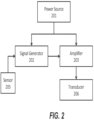
- FIG. 2 is an example block diagram of a power source connected to a signal generator and an amplifier, which is further connected to a transducer, according to various aspects of an embodiment of the invention.
- FIG. 3 is an example block diagram of a power source connected to a signal generator and an amplifier, which is further connected to a transducer and a balancer, according to various aspects of an embodiment of the invention.
- FIG. 4 is an example illustration of a first interaction between an embodiment of the invention and the anatomy of the ear according to various aspects of an embodiment of the invention.
- FIG. 5 is an example illustration of a second interaction between an embodiment of the invention and the anatomy of the ear according to various aspects of an embodiment of the invention.
- FIG. 6 is an example illustration of a third interaction between an embodiment of the invention and the anatomy of the ear according to various aspects of an embodiment of the invention.
- FIG. 7 is an example diagram of a device configuration according to various aspects of an embodiment of the invention.
- the term “infrasound” typically includes vibrations at frequencies between 0 Hz and 20 Hz, but may also include vibrations at frequencies from 10 Hz to 30 Hz.
- the term “audible” may comprise frequencies of vibrations detectable by an average human or mammalian ear at typical every-day intensities.
- “audible” typically includes vibrations at frequencies between 20 Hz and 20,000 Hz.
- the audible range for non-human mammals can include sounds in the infrasound range, from 10 Hz up to 20 Hz (e.g., for moles and elephants), as well as sounds in the ultrasound range, from 20,000 Hz and up. For instance, cats and dogs hear up to 40,000 Hz and dolphins can hear sounds up to 160,000 Hz, all in the ultrasound range.
- neuroneuronal signal comprises vestibular system evoked potentials carried along the nervous system.
- the term “power source” may comprise any means for providing power to the invention recognized by a person of ordinary skill in the art, including power generators that are able to generate power without an external power source as well as those that connect to a remote source of power through a USB connector, a power cord, or other appropriate connection line.
- signal generator may comprise any means for generating a repeating or non-repeating electronic signals and producing waveforms.
- vibration-inducing element may comprise any means recognized by a person of ordinary skill in the art by which vibrations may be induced in the vestibular system of an inner ear, including, for example, transducers, agitators, electrodes, and magnets.
- Embodiments of the invention may include methods and systems that generate signals which alter magnetic fields, stimulate muscle contractions (e.g., using attached or implanted electrodes), or create a steady sound (tone), for the purpose of causing vibration in the vestibular system that lead to a chaotic neuronal signal that causes the brain to ignore or reduce its dependence on problematic sensory signals. Additionally, electrodes may be used to directly act upon the vestibular system or create chaotic neuronal signals (directly) for the same purpose.
- the signals that act upon the vestibular system may be random (a signal that has no meaning or discernable pattern); they may pick up on outside signals in the auditory range; and they may include an independent signal that is generated by the system or device (without regard to outside noise).
- a signal may produce a controlled countermovement in the vestibular system that counteracts other sensory information or controlled surprise movements. Any signal that creates an appropriate stimulus that acts upon the vestibular system in a manner that results in an appropriate neuronal signal carried to the brain may be used in the present invention.
- Embodiments of the invention may decrease dependence on signals comprising sensory information related to orientation, balance, position, movement, or a combination thereof, from the vestibular system by inducing vibrations in the vestibular system.
- An embodiment of the invention may induce sufficient vibrations in the vestibular system to create “signal noise” to an extent such that the brain substantially ignores signals from the vestibular system and relies primarily on information provided by other sources to determine orientation, balance, position, movement, or a combination thereof.
- Another embodiment of the invention may induce vibrations of different intensities and/or frequencies at different time points and/or locations within the vestibular system such that the brain relies primarily on other information sources.
- Yet another embodiment of the invention may induce vibrations of specific intensities and/or frequencies at specific time points and/or locations within the vestibular system to create an artificial sense of orientation, balance, position, movement, or a combination thereof.
- an additional embodiment may induce vibrations such that the amplitude of the signal sent from the vestibular system to the brain (due to the induced vibrations) is greater than the amplitude of signals sent to the brain due to actual sensations of orientation, balance, position, or movement.
- Some embodiments of the invention may induce changes in vibration and/or pressure in the vestibular system such that transitory periods occur wherein the brain adapts to changing sensory information in signals, but does not—during that transitory period—also determine orientation, balance, position, movement, or a combination thereof.
- embodiments that continuously or intermittently produce changes in vibration and/or pressure in the vestibular system may keep the brain constantly in a transitory state and cause the brain to rely less on the vestibular system to determine orientation, balance, position, movement, or a combination thereof.
- Embodiments of the present invention can prevent or reduce motion sickness, vertigo, vestibular migraines, or loss of consciousness by directing the brain to ignore the signals from vestibular system, by introducing and mixing noise (e.g. white noise) with the real acceleration signals generated by the vestibular system, and/or by decreasing the vestibular evoked response.
- noise e.g. white noise
- Embodiments of the invention may utilize any method known by one of ordinary skill in the art to induce vibrations in the vestibular system.
- an embodiment of the invention may place an agitator (a device that rotates an imbalanced object) on an individual's head near the vestibular system such that vibrations from the agitator induce vibrations in the vestibular system.
- Another embodiment of the invention may place a transducer (a device that pulsates back and forth) near the eardrum such that vibrations from the transducer induce vibrations in the vestibular system via conduction by the air, eardrum, and bones of the middle ear.
- Yet another embodiment may place a transducer directly on an individual's head such that vibrations of the transducer induce vibrations in the vestibular system via conduction by the skin, skull, and connective tissue.
- An additional embodiment of the invention may position an ultrasonic transducer (a device that can focus ultrasonic vibrations to targeted points) such that ultrasonic vibrations focused by the ultrasonic transducer induce vibrations in the vestibular system.
- Embodiments of the invention may further comprise a sound-cancelling component that cancels all or some audible sounds produced by an external transducer. Such sound-cancelling components may be found in headphones, for example.
- the sound-cancelling components may also optionally include one or more speakers that are fitted over or around the ears. Users may change the signal frequency though use of an adjustment button or other frequency modulation device incorporated in some embodiments.
- Embodiments of the invention may optionally be implantable.
- Implantable embodiments may have one or more extracorporeal components and one or more implanted components.
- Extracorporeal components of these embodiments may include, for example, a vibration-inducing element, a power source, and/or a signal generator with an optional amplifier.
- Implantable embodiments may be positioned, for example, against the mastoid bone, adjacent to the vestibular system, or in the sinus cavity near the inner ear.
- Embodiments of the invention may produce vibrations that travel through the air before inducing vibrations in the vestibular system of the inner ear.
- an embodiment may incorporate a pair of vibration-inducing elements in headphones that rest on the outside portion of the ear, such that vibrations must travel through the air into the ear canal before being able to induce vibrations in the vestibular system of the inner ear.
- Another example embodiment may incorporate a pair of vibration inducing elements into ear buds that fit into the ear canal, such that vibrations must travel through the air in the ear canal before being able to induce vibrations in the vestibular system of the inner ear.
- Embodiments of the invention may produce vibrations that travel through the bone(s) and/or connective tissue of the skull before inducing vibrations in the vestibular system of the inner ear.
- an embodiment of the invention may dispose a vibration-inducing element directly against the skull, such that vibrations must travel through the bone(s) and/or connective tissue of the skull before being able to induce vibrations in the vestibular system of the inner ear.
- Embodiments of the invention may utilize a range of vibrational frequencies, including multiple frequencies simultaneously.
- An embodiment of the invention may produce low or ultra-low infrasound frequency vibrations that are below the audible range of frequencies, but are produced at intensities capable of inducing vibrations in the vestibular system.
- an embodiment may produce vibrations at a frequency of 10, 15, or 18 Hz, which are typically undetectable by the human ear, at intensities strong enough to induce vibrations in the vestibular system of the inner ear.
- Another embodiment may produce high or ultra-high frequency vibrations that are above the audible range of frequencies for humans, but at intensities capable of inducing vibrations in the vestibular system.
- an embodiment may produce vibrations at a frequency of 19,000 Hz, which is typically undetectable by the human ear, at intensities strong enough to induce vibrations in the vestibular system of the inner ear.
- an embodiment may produce vibrations at a frequency of between 19 KHz and 30 KHz, which are similarly undetectable by the human ear, at intensities strong enough to induce vibrations in the vestibular system of the inner ear.
- Yet another embodiment may produce vibrations at an audible frequency in addition to vibrations at frequencies above and/or below the audible range of frequencies.
- an embodiment may produce vibrations at a frequency of 15 Hz, which is typically undetectable by the human ear, at intensities strong enough to induce vibrations in the vestibular system of the inner ear, while simultaneously producing audible vibrations, such as music or speech.
- Yet another embodiment may produce ultrasonic frequency vibrations capable of inducing vibrations in the vestibular system.
- Yet another embodiment may produce multiple frequencies of vibration simultaneously, such as the simultaneous production of low and high frequency vibrations, and capable of inducing vibrations in the vestibular system.
- Embodiments may also mix vibrations within the audible range of frequencies with vibrations outside the audible range of frequencies.
- Embodiments of the invention may produce constant or intermittent vibrations at one or more frequencies.
- Standard headphones including those involving noise-cancelling technology, do not produce signals of sufficient intensity to produce the vestibular system responses and resultant neuronal signals necessary to produce the desired response in the brain.
- certain noise cancelling headphones handle up to 110 dB/mW and may provide up to 100 mW in power. They generally handle frequencies between 40-1,500 Hz (higher frequencies), and direct against using headphones at high volumes, particularly for long periods of time. Use of these types of headphones with a high enough intensity that might effect vibrations in the vestibular system can cause ringing in the ears, and short term or long-term hearing loss.
- Embodiments of the present invention avoid these problems associated with the use of standard headphones at higher intensities within the audible range.
- Embodiments of the invention may use focused ultrasound to induce pressure in the vestibular system of the inner ear.
- Ultrasound may be focused at a particular point by, for example, a transducer with a concave surface geometry, an acoustic lens, such as a concave horn, or other means recognized by a person of ordinary skill in the art.
- Pressure exerted in the vestibular system of the inner ear by focused ultrasound may activate sensory nerves in the vestibular system and send signals to the brain.
- Embodiments may intermittently focus ultrasound in the vestibular system such that the induced pressure results in noisy sensory information in signals sent to the brain.
- Embodiments of the invention may produce vibrations of various shapes, such as sine waves, square waves, saw-tooth waves, and triangle waves. Such vibrations and their shapes are known to those of ordinary skill in the art.
- Square waves generally result in an increase in transducer temperatures.
- generally square waves, saw-tooth waves, and triangle waves that are used to practice the present invention include higher frequencies.
- Embodiments of the invention may utilize acoustic radiation force to move anatomy of the vestibular system.
- Acoustic radiation force is a phenomenon where vibrational nodes (points of minimal vibration) and antinodes (points of maximal vibration) are formed in a substrate and can inducement movement of objects away from antinodes and toward nodes.
- Embodiments that utilize acoustic radiation force may induce vibrations such that antinodes push otoliths and/or hair follicles toward nodes.
- These embodiments may alter the frequency, phase, and intensity of the vibrations to move otoliths and/or hair follicles in desired directions and consequently influence signals transmitted from the vestibular system to the brain to deliver desired sensory information related to orientation, balance, position, movement, or a combination thereof.
- Embodiments of the invention may utilize electrical current to mitigate motion sickness or other issues caused by unmatched signals sent to the brain.
- Embodiments of the invention may utilize electrodes to induce muscular contractions resulting in vibrations of muscles located near the inner ear. Electrodes may, for example, be configured to induce repeated contraction of muscles near the vestibular system thereby inducing vibrations in the vestibular system such that “noisy” sensory information is sent in signals to the brain causing the brain to rely less on the vestibular system to determine orientation, balance, position, movement, or a combination thereof. Electrodes may also be configured to induce precisely controlled contractions of muscles near the vestibular system thereby inducing controlled vibrations in the vestibular system that result in induced sensations relating to orientation, balance, position, movement, or a combination thereof.
- Some embodiments of the invention may attach to the skin electrodes configured to induce contraction of muscles near the inner ear, such as the tensor tympani and/or stapedius in the middle ear.
- Embodiments of the invention may use electrodes attached to the skin at a location and in a manner such that they can induce muscle stimulation (e.g., electrical pulses) near the inner ear. This may include stimulation of the tensor tympani and/or stapedius in the middle ear, as previously noted, causing them to constrict and relax repeatedly and generate mechanical vibrations. By doing this in the vicinity of the inner ear, the vestibular system may detect accelerations caused by mechanical vibrations.
- the introduced stimulations may be controlled precisely, such that a measurable relationship between the stimulations and the vestibular-evoked response to the brain is detected.
- This relationship may be characterized using experimental (e.g., empirical or heuristic) or numerical methods.
- experimental e.g., empirical or heuristic
- numerical methods e.g., numerical methods.
- the actions of the muscles resulting from a set of electrical pulses may be engineered to be highly chaotic such that the signal generated by the vestibular system becomes chaotic, and the brain ignores the chaotic signal. Therefore, responses involving motion sickness, vertigo, vestibular migraines, and loss of consciousness may be reduced or prevented.
- Prior research has demonstrated that the brain learns to filter out and ignore constant signals, therefore, such constant signals should not be used in the present invention.
- electrodes can be placed on the skin to send electrical pulses to the nervous system directly.
- the electrodes can be placed at a location and in a manner such that at least a portion of the stimulants (electrical signals) directly act upon the signal travel route relating to the vestibular evoked response that travels from the vestibular system to the cerebellum.
- the disruption induced by the electrical current or pulse may result in “noisy” sensory information and cause the brain to rely less on the vestibular system to determine orientation, balance, position, movement, or a combination thereof. This, in effect, scrambles the signal sent to the brain and the brain, not being able to make sense of the signals being sent, ignores them.
- inventions of the invention may be implanted in the skull or include ear electrodes also configured to induce contraction of muscles near the inner ear.
- Embodiments of the invention may utilize magnetic fields to induce vibrations in, or move anatomy of, the vestibular system of the inner ear by inducing movement of otoliths, endolymph, hair follicles, or other anatomy of the inner ear.
- Embodiments of the invention may dispose the magnetic field generator on the outside of the ear, within the ear canal, or adjacent to the skull near the ear. Other embodiments may implant the magnetic field generator within the skull or near the inner ear.
- the magnetic field generator may, for example, be configured to induce vibrations in the vestibular system such that “noisy” sensory information is sent in signals to the brain causing the brain to reduce reliance on the vestibular system to determine orientation, balance, position, movement, or a combination thereof.
- the signal generator directs magnetic field generators to change generated magnetic fields in a controlled manner, causing the vestibular system to experience chaotic acceleration transmitting chaotic signals to the brain.
- Embodiments may use magnetic field generators to communicate with the signal generator.
- the magnetic field generators in the vicinity of the inner ear generate forces to move one or more components of the vestibular system in a controlled manner, in order to create a desired sense of acceleration after the signals are interpreted by the brain. This may also induce sensations of orientation, balance, position, movement, or a combination thereof.
- Yet another embodiment may produce magnetic fields that interact with the otoliths, gelatinous membrane, endolymph, or hair cells.
- the position of one or more component of the vestibular system e.g., the saccule, utricle, or hair cells
- magnetic fields are changed in a way that causes the vestibular system to experience chaotic accelerations thus sending a chaotic signal to the brain. The brain ignores the chaotic signal. Therefore, responses involving motion sickness, vertigo, vestibular migraines, and loss of consciousness may be reduced or prevented.
- Yet another embodiment may produce magnetic fields that interact with an implanted device such as a small magnet. This interaction may be done discretely to create an artificial sensation of motion or constantly to create vibration in the inner ear and a noisy signal to the brain.
- the magnetic fields generated according to the present invention are generally of a very low frequency, for example, a maximum frequency of 5 Hz.
- FIG. 1 shows a block diagram of a representative motion sickness mitigation system of the present invention.
- the power source 101 provides the required power to the signal vibration-inducing element 102 .
- FIG. 2 shows a block diagram of another representative motion sickness mitigation system of the present invention.
- the power source 201 provides power to the signal generator 202 and amplifier 203 , which in turn, activates the transducer 206 .
- Sensor 205 may comprise an acceleration sensor and/or an orientation sensor.
- An alternative embodiment of the system optionally includes a balance 304 that distributes the signal created by the signal generator 302 and amplified by the amplifier 303 to two or more transducers 306 and 307 , which produce vibrations that may act upon the skull or the vestibular system directly.
- Sensor 305 may comprise an acceleration sensor and/or an orientation sensor.
- a balance 304 may alter the amplitude and/or frequency of the electrical signal between the amplifier 303 and a vibration-inducing element such that the mechanical motion of one vibration-inducing element (for example transducer 306 ) is different from another vibration-inducing element (for example, transducer 307 ).
- FIG. 4 is an example illustration of a first interaction between an embodiment of the invention and the anatomy of the ear according to various aspects of an embodiment of the invention.
- a power source 401 supplies electricity to a signal generator 402 , which drives an amplifier 403 , which powers a transducer 406 .
- the signal generator 402 provides input to the amplifier 403 , whose output activates a transducer 406 to produce vibrations 408 that travel into the ear 410 and through the ear canal 411 to induce vibrations in the eardrum 412 , bones of the middle ear 413 , cochlea 420 , vestibule 421 , and semicircular canals 422 .
- Vibrations 408 may be at a frequency and intensity to induce vibrations in the vestibular system, but undetectable by the cochlea 420 .
- the induced vibrations in the vestibular system therefore, may result in “noisy” sensory signals being sent to the brain, causing the brain to rely less on the vestibular system to determine orientation, balance, position, movement, or a combination thereof.
- FIG. 5 is an example illustration of a second interaction between an embodiment of the invention and the anatomy of the ear according to various aspects of an embodiment of the invention.
- a power source 501 supplies power to a signal generator 502 , which powers a transducer 506 .
- the signal generator 502 produces an electrical signal that travels to the amplifier 503 , which activates the transducer 506 to produce vibrations 508 that travel into the ear 500 , through the ear canal 511 , and induce vibrations in the eardrum, bones of the middle ear, cochlea, vestibule, and semicircular canals.
- Vibrations 504 may be at a frequency and intensity to induce vibrations in the vestibular system, but undetectable by the cochlea.
- the induced vibrations in the vestibular system may result in “noisy” sensory signals sent to the brain, causing the brain to rely less on the vestibular system to determine orientation, balance, position, movement, or a combination thereof.
- the present invention may include a switch that turns on/off the amplifier (or regulates the power or amplitude of the signal) with a frequency related to the time periods ⁇ 1 and ⁇ 2 .
- transducers may introduce ultrasound waves to systems to improve the effectiveness of the system in reducing or eliminating motion sickness, vertigo, or loss of consciousness.
- a balance can be used to adjust the sound outputs to correlate to the hearing sensitivities of the ears.
- more than one switch may be used and switches can be used to turn on/off any or all of the transducers.
- FIG. 6 is an example illustration of a third interaction between an embodiment of the invention and the anatomy of the ear according to various aspects of an embodiment of the invention.
- a power source 601 supplies power to a signal generator 602 , an amplifier 603 , and optionally a vibration-inducing element such as a transducer 606 .
- the signal generator 602 sends a signal to the amplifier 603 , which activates the transducer 606 to produce vibrations 608 that travel through the skull 660 and induce vibrations in the vestibule and semicircular canals.
- Vibrations 608 may be at a frequency and intensity to induce vibrations in the vestibular system that are undetectable by the cochlea.
- the induced vibrations in the vestibular system result in “noisy” sensory signals sent to the brain, causing the brain to rely less on the vestibular system to determine orientation, balance, position, movement, or a combination thereof.
- the bone-conducting device 650 may be disposed on headphone strap, wherein the vibration-inducing transducer 606 may be secured in front or behind each ear next to the skin over the skull.
- a separate ear bud (attached to headphone 650 , not shown) may be placed in each ear canal to secure the embodiment on the head of the user.
- FIG. 7 is an example diagram of a device configuration according to various aspects of an embodiment of the invention.
- a power supply 701 supplies power to a signal generator 702 , an amplifier 703 (such as a class D audio amplifier), and optionally a vibration-inducing element 704 (such as a transducer).
- the power supply 701 may comprise, for example, batteries, another electrical device, an A/C power outlet, a USB port, or a vehicular DC outlet.
- the signal generator 702 may comprise, for example, a timer, resistors, and capacitors integrated on a printed circuit board, such as a microcontroller, which produces an electrical signal in the form of a wave.
- the amplifier 703 may comprise, for example, a 3.7 Watt D class mono or stereo amplifier.
- a vibration-inducing element 704 may comprise, for example, a transducer, such as an 8-Ohm metal cup exciter, or a vibrator, or an agitator.
- the signal generator 702 may produce an electrical signal that is amplified by an amplifier 703 and converted into mechanical motion by a vibration-inducing element 704 connected to the amplifier 703 .
- the embodiments involving mechanical motion generated by a vibration-inducing device may produce vibrations that travel into the ear and through the ear canal to induce vibrations in the eardrum, bones of the middle ear, cochlea, vestibule, and semicircular canals.
- Embodiments may also produce vibrations that travel through bone to induce vibrations in the bones of the middle ear, cochlea, vestibule, and semicircular canals. Vibrations may be at a frequency and intensity to induce chaotic vibrations in the vestibular system undetectable by the cochlea.
- embodiments may produce vibrations corresponding to a tone having a sine wave pattern at a user-selectable fixed frequency in the infrasound range, such as between 10 Hz and 30 Hz, at an average output power level of between 100 dB and 150 dB.
- Other embodiments may produce vibrations corresponding to a tone having a square wave, saw-tooth wave, and/or triangle wave pattern at a user-selectable fixed frequency in the infrasound range, such as between 10 Hz and 30 Hz, at an average output power level of between 100 dB and 150 dB.
- Still other embodiments may produce random noise signal at between 15 Hz and 25 Hz, and at approximately 120 dB.
- the resulting vibrations induced in the vestibular system may result in noisy or chaotic neuronal signals being sent to the brain, causing the brain to rely less on the vestibular system to determine orientation, balance, position, movement, or a combination thereof.
- Embodiments of the invention may further comprise a sound-cancelling component that cancels all or some audible sounds produced by a vibration-inducing element, separate battery packs to power the amplifier and microcontroller, and sound-cancelling components that are built onto a single headphone.
- the microcontroller may send a 3.3 V digital signal (square wave) at approximately 30 Hz to the amplifier's line-in (with the negative tied to the battery's ground). In other embodiments, the microcontroller may send a sine wave signal to the amplifier.
- Embodiments of the invention intended for medical use may, for example, induce vibrations of the vestibular system to disrupt sensory information sent to the brain or induce movement of anatomy in the vestibular system in order to improve patient stability.
- Embodiments may be attached to or incorporated in medical devices such as, for example, hearing aids and cochlear implants.
- Other embodiments may be implanted in patients to help alleviate problems associated with motion sickness, balance, vestibular migraines, or vertigo.
- Embodiments of the invention intended for use with movies, video games, or virtual reality devices may, for example, induce movement of the anatomy of the vestibular system to simulate sensory information regarding orientation, balance, position, movement, or a combination thereof, consistent with visuals presented by the movies, video games, or virtual reality devices.
- Another example embodiment may induce vibrations in the vestibular system such that the brain substantially ignores sensory information in signals from the vestibular system.
- Embodiments of the invention intended for use in vehicles may, for example, comprise a helmet or headset with an integrated transducer or agitator capable of inducing vibrations in in the vestibular system.
- the transducer or agitator may be powered by an independent power source, such as a battery built into the helmet or headset, or may be plugged into a power source associated with the vehicle.
- the transducer or agitator may be integrated with audio components typically present in the helmet or headset, or may be attached as a separate module.
- Other embodiments may comprise speakers attached to or integrated in the body of the vehicle that produce low frequency vibrations at an intensity sufficient to travel through the space between the speakers and the intended target(s) and induce vibrations in the vestibular system(s) of the target(s).
- Yet other embodiments may comprise transducers or agitators integrated into headrests of the vehicle capable of inducing vibrations in the vestibular systems of the driver and passengers of the vehicle.
- Embodiments of the invention may induce specific vibrations or movement of the anatomy of the vestibular system based on signals received from external sensors.
- embodiments may wirelessly receive acceleration information from sensors built into the device, a suit, or a vehicle and accordingly vary the frequency, power and/or amplitude of the produced vibrations so as to induce neuronal vibrations in the vestibular system to disrupt sensory information sent to the brain or induce movement of anatomy in the vestibular system to counteract movement of the anatomy of the vestibular system induced by movement sensed by the sensors.
- Another example embodiment may induce vibrations or movement of the of the anatomy of the vestibular system based on signals received from health-monitoring sensors, such as a heart rate sensor, blood pressure sensor, or an electroencephalogram.
- Embodiments of the invention may comprise an interface for a computing device, such that vibrations are induced based on signals received from the computing device.
- an embodiment of the invention may interface with a virtual reality device, such that vibrations are induced when the virtual reality device is in use.
- Another embodiment of the invention may produce vibrations only when visuals displayed by a virtual reality device could be interpreted by a brain as movement of a user.
- Additional embodiments of the invention may be used by fighter pilots to counteract the external stimuli received during flight relating to g-forces and aerial maneuvers performed during flight.
- fighter pilots may use helmets comprising the device of the present invention to filter out undesirable signals or generate chaotic signals that cause the brain to ignore them.
- Embodiments of the invention may be used with animals. Many animals suffer from motion sickness for primarily the same reasons as humans. Consequently, embodiments of the invention may be used to mitigate motion sickness and other responses to inconsistent sensory information in animals in substantially similar ways to humans.
- one embodiment of the invention may comprise speakers mounted to the interior of train cars or trailers that produce low frequency vibrations at an intensity sufficient to travel through the space between the speakers and the animals and induce vibrations in the vestibular systems of the animals.
- Another embodiment of the invention may comprise headphones or a similarly head-mountable device that produces low frequency vibrations at intensities sufficient to induce vibrations in the vestibular systems of an animal wearing the device.
- Another embodiment may comprise a helmet that includes the device of the present invention.
- the frequencies of the vibrations produced may be adjusted so as fall outside the range of frequencies detectable by the ears of the target animal(s).
Landscapes
- Health & Medical Sciences (AREA)
- Rehabilitation Therapy (AREA)
- Epidemiology (AREA)
- Pain & Pain Management (AREA)
- Physical Education & Sports Medicine (AREA)
- Life Sciences & Earth Sciences (AREA)
- Animal Behavior & Ethology (AREA)
- General Health & Medical Sciences (AREA)
- Public Health (AREA)
- Veterinary Medicine (AREA)
- Reproductive Health (AREA)
- Otolaryngology (AREA)
- Percussion Or Vibration Massage (AREA)
Abstract
Description
Claims (15)
Priority Applications (2)
| Application Number | Priority Date | Filing Date | Title |
|---|---|---|---|
| US17/193,745 US12053426B2 (en) | 2014-09-29 | 2021-03-05 | Device for mitigating motion sickness and other responses to inconsistent sensory information |
| US18/760,864 US20250177242A1 (en) | 2014-09-29 | 2024-07-01 | Device for mitigating motion sickness and other responses to inconsistent sensory information |
Applications Claiming Priority (5)
| Application Number | Priority Date | Filing Date | Title |
|---|---|---|---|
| US201462071636P | 2014-09-29 | 2014-09-29 | |
| US201562179682P | 2015-05-15 | 2015-05-15 | |
| US14/867,774 US20160089298A1 (en) | 2014-09-29 | 2015-09-28 | Device for Mitigating Motion Sickness and Other Responses to Inconsistent Sensory Information |
| US15/980,124 US20180256444A1 (en) | 2014-09-29 | 2018-05-15 | Device for mitigating motion sickness and other responses to inconsistent sensory information |
| US17/193,745 US12053426B2 (en) | 2014-09-29 | 2021-03-05 | Device for mitigating motion sickness and other responses to inconsistent sensory information |
Related Parent Applications (1)
| Application Number | Title | Priority Date | Filing Date |
|---|---|---|---|
| US15/980,124 Continuation US20180256444A1 (en) | 2014-09-29 | 2018-05-15 | Device for mitigating motion sickness and other responses to inconsistent sensory information |
Related Child Applications (1)
| Application Number | Title | Priority Date | Filing Date |
|---|---|---|---|
| US18/760,864 Continuation US20250177242A1 (en) | 2014-09-29 | 2024-07-01 | Device for mitigating motion sickness and other responses to inconsistent sensory information |
Publications (2)
| Publication Number | Publication Date |
|---|---|
| US20220040033A1 US20220040033A1 (en) | 2022-02-10 |
| US12053426B2 true US12053426B2 (en) | 2024-08-06 |
Family
ID=55583329
Family Applications (4)
| Application Number | Title | Priority Date | Filing Date |
|---|---|---|---|
| US14/867,774 Abandoned US20160089298A1 (en) | 2014-09-29 | 2015-09-28 | Device for Mitigating Motion Sickness and Other Responses to Inconsistent Sensory Information |
| US15/980,124 Abandoned US20180256444A1 (en) | 2014-09-29 | 2018-05-15 | Device for mitigating motion sickness and other responses to inconsistent sensory information |
| US17/193,745 Active 2035-10-25 US12053426B2 (en) | 2014-09-29 | 2021-03-05 | Device for mitigating motion sickness and other responses to inconsistent sensory information |
| US18/760,864 Pending US20250177242A1 (en) | 2014-09-29 | 2024-07-01 | Device for mitigating motion sickness and other responses to inconsistent sensory information |
Family Applications Before (2)
| Application Number | Title | Priority Date | Filing Date |
|---|---|---|---|
| US14/867,774 Abandoned US20160089298A1 (en) | 2014-09-29 | 2015-09-28 | Device for Mitigating Motion Sickness and Other Responses to Inconsistent Sensory Information |
| US15/980,124 Abandoned US20180256444A1 (en) | 2014-09-29 | 2018-05-15 | Device for mitigating motion sickness and other responses to inconsistent sensory information |
Family Applications After (1)
| Application Number | Title | Priority Date | Filing Date |
|---|---|---|---|
| US18/760,864 Pending US20250177242A1 (en) | 2014-09-29 | 2024-07-01 | Device for mitigating motion sickness and other responses to inconsistent sensory information |
Country Status (1)
| Country | Link |
|---|---|
| US (4) | US20160089298A1 (en) |
Cited By (2)
| Publication number | Priority date | Publication date | Assignee | Title |
|---|---|---|---|---|
| US20230283940A1 (en) * | 2020-05-22 | 2023-09-07 | Rutgers, The State University Of New Jersey | Smart headphone system and method |
| US20240090476A1 (en) * | 2022-09-20 | 2024-03-21 | Subaru Corporation | Information processing apparatus and vehicle |
Families Citing this family (17)
| Publication number | Priority date | Publication date | Assignee | Title |
|---|---|---|---|---|
| US20160089298A1 (en) | 2014-09-29 | 2016-03-31 | Otolith Sound Inc | Device for Mitigating Motion Sickness and Other Responses to Inconsistent Sensory Information |
| US20170112715A1 (en) * | 2015-10-23 | 2017-04-27 | Tawana Robinson | Massage Assembly |
| US10398897B2 (en) | 2016-11-14 | 2019-09-03 | Otolith Sound Inc. | Systems, devices, and methods for treating vestibular conditions |
| US11284205B2 (en) | 2016-11-14 | 2022-03-22 | Otolith Sound Inc. | Systems, devices, and methods for treating vestibular conditions |
| US20180133102A1 (en) * | 2016-11-14 | 2018-05-17 | Otolith Sound, Inc. | Devices And Methods For Reducing The Symptoms Of Maladies Of The Vestibular System |
| CN107765861B (en) * | 2017-12-07 | 2023-04-14 | 河北迈拓港湾数字信息股份有限公司 | Method and device for preventing virtual reality equipment from generating dizziness to human body |
| CA3088682A1 (en) * | 2018-02-12 | 2019-08-15 | Otolith Sound Inc. | Systems, devices, and methods for treating vestibular conditions |
| WO2019230941A1 (en) * | 2018-05-31 | 2019-12-05 | 国立大学法人名古屋大学 | Vestibular stimulation device, dizziness treatment device, and health promotion device |
| DE102019205986A1 (en) * | 2019-04-26 | 2020-10-29 | Zf Friedrichshafen Ag | Method and system for reducing a kinetosis effect on passengers of a vehicle |
| US11586291B2 (en) * | 2019-05-12 | 2023-02-21 | NeuroHaptics, Inc. | Motion sickness reduction device |
| US11275441B2 (en) * | 2019-05-12 | 2022-03-15 | Neurohaptics, Inc | Motion sickness reduction, directional indication, and neural rehabilitation device |
| CN110463644A (en) * | 2019-08-20 | 2019-11-19 | 中国水产科学研究院东海水产研究所 | A method of marking otolith elements for breeding and releasing fry of black sea bream |
| IT201900022896A1 (en) * | 2019-12-05 | 2021-06-05 | Sonolab Di Villa Pasquale | VIBRATION DEVICE IN THE INFRASOUND FREQUENCIES IN CONTACT WITH THE DERMA |
| US11559006B2 (en) * | 2019-12-10 | 2023-01-24 | John Richard Lachenmayer | Disrupting the behavior and development cycle of wood-boring insects with vibration |
| WO2024014055A1 (en) * | 2022-07-13 | 2024-01-18 | 国立大学法人東海国立大学機構 | Vestibular function improvement device, drunkenness stimulation application system, and program |
| WO2024020082A1 (en) * | 2022-07-22 | 2024-01-25 | Medtronic Xomed, LLC | Vestibular stimulation medical device |
| WO2025076552A1 (en) * | 2023-10-06 | 2025-04-10 | Otolith Sound Inc. | Systems, devices, and methods for treating vestibular conditions using vibrations applied at predetermined directions against a head of a subject |
Citations (134)
| Publication number | Priority date | Publication date | Assignee | Title |
|---|---|---|---|---|
| US2680158A (en) | 1949-08-16 | 1954-06-01 | Fortiphone Ltd | Bone conduction hearing aid |
| US3984707A (en) | 1973-07-13 | 1976-10-05 | Mcclintock Richard D | Spring return linear signal generator |
| DE2846859A1 (en) | 1977-10-27 | 1979-05-10 | Bernhard Leitner | Medical treatment couch for patients - has sonic loudspeakers arranged beneath couch to produce variable intensity and frequency |
| US4222393A (en) | 1978-07-28 | 1980-09-16 | American Tinnitus Association | Tinnitus masker |
| US4354067A (en) | 1978-05-17 | 1982-10-12 | Bodysonic Kabushiki Kaisha | Audio-band electromechanical vibration converter |
| US4495940A (en) | 1982-06-09 | 1985-01-29 | Hiroshi Takaishi | Massager |
| US4558703A (en) | 1982-05-27 | 1985-12-17 | Hermann Mark | Vestibular stimulation method |
| US4813403A (en) | 1986-04-01 | 1989-03-21 | Ken Hayashibara | Vibrostimulative device |
| WO1990001966A1 (en) | 1988-08-24 | 1990-03-08 | Graeme Francis Peter | Method and apparatus for the prevention of motion sickness |
| US5050587A (en) | 1987-07-08 | 1991-09-24 | Kabushiki Kaisha Hayashibara Seibutsu Kagaku Kenkyujo | Vibrator system and vibrotherapeutic device using the same |
| US5167236A (en) | 1988-12-22 | 1992-12-01 | Franz Junker | Tinnitus-masker |
| US5323468A (en) | 1992-06-30 | 1994-06-21 | Bottesch H Werner | Bone-conductive stereo headphones |
| US5325872A (en) | 1990-05-09 | 1994-07-05 | Topholm & Westermann Aps | Tinnitus masker |
| US5361437A (en) | 1991-12-19 | 1994-11-08 | Shanghai Intor Electrical Applicance Factory | Massage cushion for providing a hammering mode massage |
| US5403262A (en) | 1993-03-09 | 1995-04-04 | Microtek Medical, Inc. | Minimum energy tinnitus masker |
| US5611771A (en) | 1994-11-14 | 1997-03-18 | Sharper Image Corporation | Head mounted pulse action facial massager |
| US5692056A (en) | 1994-12-07 | 1997-11-25 | Gardner; William A. | Method and apparatus for intracranial noise suppression |
| US5788656A (en) | 1997-02-28 | 1998-08-04 | Mino; Alfonso Di | Electronic stimulation system for treating tinnitus disorders |
| US5795287A (en) | 1996-01-03 | 1998-08-18 | Symphonix Devices, Inc. | Tinnitus masker for direct drive hearing devices |
| CA2248642A1 (en) | 1997-10-24 | 1999-04-24 | Axel F. Brisken | Apparatus and method for determining individual sensitivity to ultrasonic signals |
| US5966680A (en) | 1996-02-15 | 1999-10-12 | Butnaru; Hanan | Motion sickness/vertigo prevention device and method |
| WO2000010361A2 (en) | 1998-08-14 | 2000-02-24 | Symphonix Devices, Inc. | Ultrasonic hearing system |
| US6047074A (en) | 1996-07-09 | 2000-04-04 | Zoels; Fred | Programmable hearing aid operable in a mode for tinnitus therapy |
| US6068590A (en) | 1997-10-24 | 2000-05-30 | Hearing Innovations, Inc. | Device for diagnosing and treating hearing disorders |
| US6077237A (en) | 1998-11-06 | 2000-06-20 | Adaboy, Inc. | Headset for vestibular stimulation in virtual environments |
| US6193677B1 (en) | 1997-08-14 | 2001-02-27 | B.R.S. Capital, Inc. | Sonic percussor device |
| US6210321B1 (en) | 1999-07-29 | 2001-04-03 | Adm Tronics Unlimited, Inc. | Electronic stimulation system for treating tinnitus disorders |
| US20010051776A1 (en) | 1998-10-14 | 2001-12-13 | Lenhardt Martin L. | Tinnitus masker/suppressor |
| JP2002065871A (en) | 2000-08-30 | 2002-03-05 | Hiromitsu Kuriyama | Motion sickness-eliminating sun glass with magnets |
| JP2002159556A (en) | 2000-11-28 | 2002-06-04 | Onkyooribu Kk | Health apparatus |
| US6411050B1 (en) | 1997-12-04 | 2002-06-25 | Namika Precision Jewel Co., Ltd. | Device for driving vibration actuator |
| US6443913B1 (en) | 2000-03-07 | 2002-09-03 | Bruce Kania | Apparatus and method for relieving motion sickness |
| WO2002089525A2 (en) | 2001-04-27 | 2002-11-07 | Virginia Commonwealth University | Hearing device improvements using modulation techniques |
| JP2003180847A (en) | 2001-11-02 | 2003-07-02 | Respironics Inc | Vestibular stimulation system and method |
| US20030195588A1 (en) | 2002-04-16 | 2003-10-16 | Neuropace, Inc. | External ear canal interface for the treatment of neurological disorders |
| US6692428B1 (en) | 1998-07-24 | 2004-02-17 | Bruce Kania | Apparatus and method for relieving motion sickness |
| US20040097839A1 (en) | 2002-07-03 | 2004-05-20 | Epley Research, L.L.C. | Head-stabilized medical apparatus, system and methodology |
| JP2004186831A (en) | 2002-11-29 | 2004-07-02 | Alps Electric Co Ltd | Vibration generator |
| WO2004077658A1 (en) | 2003-02-27 | 2004-09-10 | Matsushita Electric Industrial Co., Ltd. | Closed loop control of linear vibration actuator |
| US20040199214A1 (en) | 2002-12-17 | 2004-10-07 | Merfeld Daniel M. | Vestibular stimulator |
| US20050015027A1 (en) | 2002-03-13 | 2005-01-20 | Yasuji Kojima | Portable body-felt vibration system |
| US20050184601A1 (en) | 2004-02-23 | 2005-08-25 | Kweon Soon D. | Linear vibration motor using resonance frequency |
| US20050201574A1 (en) | 2004-01-20 | 2005-09-15 | Sound Technique Systems | Method and apparatus for improving hearing in patients suffering from hearing loss |
| US20060020161A1 (en) | 2004-07-20 | 2006-01-26 | James Mageras | Method and device for auditory stimulation for therapeutic application |
| US20060233418A1 (en) | 2005-04-18 | 2006-10-19 | Jui-Chen Huang | Loudspeaker with low-frequency oscillation |
| CN1853444A (en) | 2003-09-16 | 2006-10-25 | 皇家飞利浦电子股份有限公司 | High efficiency audio transducer |
| JP2007007433A (en) | 1999-05-05 | 2007-01-18 | Respironics Inc | Vestibular stimulation system |
| US20070041595A1 (en) | 2005-07-07 | 2007-02-22 | Carazo Alfredo V | Bone-conduction hearing-aid transducer having improved frequency response |
| US20070149905A1 (en) | 2004-05-26 | 2007-06-28 | Hanna Joseph P | Method and apparatus for relief of headache |
| US7253350B2 (en) | 1999-10-22 | 2007-08-07 | Yamaha Corporation | Vibration source driving device |
| US20080036307A1 (en) | 2006-08-14 | 2008-02-14 | Liangju Lu | Vibration power generation |
| US20080036303A1 (en) | 2006-06-15 | 2008-02-14 | Clive Graham Stevens | Linear motor for imparting vibration to a supported body |
| JP2008092460A (en) | 2006-10-04 | 2008-04-17 | Namiki Precision Jewel Co Ltd | Bone conduction speaker |
| WO2008058567A1 (en) | 2006-11-17 | 2008-05-22 | Balance International Innovations Gmbh | System and method for providing body sway feedback to a body of a subject |
| US20080214973A1 (en) | 2003-08-29 | 2008-09-04 | Von Othegraven Achim | Therapeutic Treatment Device |
| US20080221489A1 (en) | 2007-03-05 | 2008-09-11 | Madsen Alan G | Personal sonic massage device and method |
| US7442147B2 (en) | 2005-06-28 | 2008-10-28 | Denso Corporation | Vehicle control system |
| US7442174B2 (en) | 2001-01-05 | 2008-10-28 | Butler Charles F | Simulated wave massage |
| US20090005713A1 (en) | 2007-02-12 | 2009-01-01 | Podrazhansky Yury M | Method and Device for Using Vibroacoustical Stimulation to Treat Target Tissue Areas of Living Organisms |
| WO2009029040A1 (en) | 2007-08-31 | 2009-03-05 | Tore Persson | Methods and devices for the treatment of tinnitus, anosmia and nerve injury |
| US20090072636A1 (en) | 2007-04-25 | 2009-03-19 | Saia-Burgess, Inc. | Adjustable mid air gap magnetic latching solenoid |
| US7626295B2 (en) | 2005-11-01 | 2009-12-01 | Tokyo Parts Industrial Co., Ltd | Flat eccentric rotor equipped with a fan and flat vibration motor equipped with a fan comprising same rotor |
| US7633835B1 (en) | 2006-03-27 | 2009-12-15 | Bae Systems Information And Electronic Systems Integration Inc. | High power, motor driven underwater acoustic transducer |
| US20100141248A1 (en) | 2005-12-22 | 2010-06-10 | Motoaki Suzukawa | Magnetostriction Apparatus |
| CN101801453A (en) | 2007-09-21 | 2010-08-11 | Ric投资有限责任公司 | Vestibular stimulation system |
| US20110029045A1 (en) | 2009-03-05 | 2011-02-03 | Michael Cevette | Galvanic vestibular stimulation system and method of use for simulation, directional cueing, and alleviating motion-related sickness |
| US20110071340A1 (en) | 2009-09-22 | 2011-03-24 | Mcguire John F | Methods and systems for treating tinnitus |
| US20110152729A1 (en) | 2009-02-03 | 2011-06-23 | Tsutomu Oohashi | Vibration generating apparatus and method introducing hypersonic effect to activate fundamental brain network and heighten aesthetic sensibility |
| US20110278962A1 (en) | 2010-05-14 | 2011-11-17 | Samsung Electro-Mechanics Co., Ltd. | Linear vibrator |
| US20120033849A1 (en) | 2009-04-22 | 2012-02-09 | Yea Il Electronics Co., Ltd. | Sensory signal output apparatus |
| US20120106774A1 (en) | 2009-05-12 | 2012-05-03 | Shuji Saiki | Speaker, and mobile electronic device |
| US20120203309A1 (en) | 2009-10-28 | 2012-08-09 | Koninklijke Philips Electronics, N.V. | Method of alleviating motion sickness |
| JP2012165129A (en) | 2011-02-04 | 2012-08-30 | Jvc Kenwood Corp | Electroacoustic transducer |
| US20120286765A1 (en) | 2011-05-12 | 2012-11-15 | Heuvel Koen Van Den | Identifying hearing prosthesis actuator resonance peak(s) |
| US8317848B1 (en) | 2007-01-11 | 2012-11-27 | Lockheed Martin Corporation | Vestibular implant and method for optical stimulation of nerves |
| US20120302929A1 (en) | 2011-05-23 | 2012-11-29 | Vitaly Tkachenko | Head mounted pulse action facial and head massager band |
| CN202721792U (en) | 2012-08-02 | 2013-02-06 | 北京美尔斯通科技发展股份有限公司 | Wireless headset with combination of bone conduction and air conduction |
| US20130061736A1 (en) | 2011-09-09 | 2013-03-14 | Tomokuni Wauke | Vibration generator |
| US20130090520A1 (en) | 2009-06-19 | 2013-04-11 | Randall Redfield | Bone Conduction Apparatus and Multi-sensory Brain Integration Method |
| US20130123889A1 (en) | 2010-03-30 | 2013-05-16 | Jay W. Katz | Apparatus for Preventing Motion Sickness and Related Method |
| US8463389B1 (en) | 2010-03-31 | 2013-06-11 | Richard Oths | Multi-sensory system and method for providing neuromuscular stimulation |
| US20130169071A1 (en) | 2010-06-30 | 2013-07-04 | Nidec Copal Corporation | Oscillating actuator |
| US20130184788A1 (en) | 2012-01-17 | 2013-07-18 | Med-El Elektromedizinische Geraete Gmbh | Implantable Vestibular Prosthesis System with Power Saving Mode Including Soft Start and Soft Power-Down |
| US20130225915A1 (en) | 2009-06-19 | 2013-08-29 | Randall Redfield | Bone Conduction Apparatus and Multi-Sensory Brain Integration Method |
| US20130237746A1 (en) | 2012-03-07 | 2013-09-12 | Christian Veitl | Device for the treatment of tinnitus |
| US8579796B2 (en) | 2007-01-10 | 2013-11-12 | Peter Anthony Winkler | Tinnitus treatment |
| US20130303953A1 (en) | 2011-01-05 | 2013-11-14 | Stefanie Lattner | Method and apparatus for treating various neurological conditions |
| CN103430573A (en) | 2011-02-24 | 2013-12-04 | 维布兰特美迪医疗电子听觉技术有限公司 | MRI safe actuator for implantable floating mass transducer |
| US20140018713A1 (en) | 2012-07-05 | 2014-01-16 | Resonant Systems, Inc. | Personal vibration appliance |
| US20140046230A1 (en) | 2007-01-10 | 2014-02-13 | Peter Anthony Winkler | Tinnitus treatment |
| US20140084710A1 (en) | 2011-03-31 | 2014-03-27 | Nidec Copal Corporation | Vibration actuator |
| US8801591B1 (en) | 2007-11-28 | 2014-08-12 | Vincent J. Lasorso, Jr. | Physical therapy whole sound frequencies device and method of using the same |
| EP2779696A1 (en) | 2013-03-15 | 2014-09-17 | Rion Co., Ltd. | Electromechanical transducer and electroacoustic transducer |
| US20140276193A1 (en) | 2013-03-15 | 2014-09-18 | Lawrence L. Doochin | Sound therapy systems and methods for recalibrating the body's electromagnetic field |
| US8849407B1 (en) | 2008-01-04 | 2014-09-30 | Yuri P. Danilov | Non-invasive neuromodulation (NINM) for rehabilitation of brain function |
| US20140309718A1 (en) | 2009-12-18 | 2014-10-16 | Scion Neurostim, Llc | Devices and methods for vestibular and/or cranial nerve stimulation |
| US20140350441A1 (en) | 2013-05-27 | 2014-11-27 | Iman Shafieloo | Vibratory neural stimulation |
| US20140363003A1 (en) | 2013-06-09 | 2014-12-11 | DSP Group | Indication of quality for placement of bone conduction transducers |
| CN104244842A (en) | 2012-02-28 | 2014-12-24 | 阿纳·马里亚·索扎 | Methods, devices and systems for diagnosing and treating mood disorders |
| US20150018601A1 (en) | 2006-09-01 | 2015-01-15 | Gsmo Pty Ltd. | Motion sickness device |
| US20150063616A1 (en) | 2013-08-09 | 2015-03-05 | Otorix AB | Bone conduction hearing aid system |
| US20150063611A1 (en) | 2013-08-28 | 2015-03-05 | Martin Evert Gustaf Hillbratt | Devices for enhancing transmissions of stimuli in auditory prostheses |
| WO2015040832A1 (en) | 2013-09-20 | 2015-03-26 | パナソニックIpマネジメント株式会社 | Bone conduction speaker and bone conduction headphone device |
| CN104490517A (en) | 2014-12-26 | 2015-04-08 | 秦皇岛嘎哈医疗电子仪器有限公司 | Ear disease therapeutic apparatus |
| US20150156581A1 (en) | 2010-09-01 | 2015-06-04 | Mor Efrati | Tactile low frequency transducer |
| CN104799999A (en) | 2015-05-17 | 2015-07-29 | 宋鹏龙 | Otolith vibration therapy instrument |
| CN104873370A (en) | 2015-05-05 | 2015-09-02 | 青岛帮尼达新产品技术开发咨询有限公司 | Mouth yoke type mask used for protecting mouth sexual intercourse and improving sexual fun |
| CN104873374A (en) | 2015-05-12 | 2015-09-02 | 邹静 | Low-frequency vibration source and mastoid process coupling device for treating peripheral vertigo |
| WO2015143053A1 (en) | 2014-03-19 | 2015-09-24 | Copa Animal Health, Llc | Sensory stimulation or monitoring apparatus for the back of neck |
| US20150272817A1 (en) | 2012-10-02 | 2015-10-01 | Jörg Knyrim | Control Arrangement for Controlling the Intensity of the Massaging Motion of a Massage Device and a Massage Device Comprising a Control Arrangement of this Type |
| CN104967935A (en) | 2015-06-12 | 2015-10-07 | 苏州佑克骨传导科技有限公司 | Large-power oscillator suitable for bone conduction earphone |
| US20150282754A1 (en) | 2013-05-13 | 2015-10-08 | Ear and Skull Base Center, P.C. | Systems and methods for delivering bone conduction stimuli to and for measuring gravitation receptor functions of the inner ear |
| US20150297444A1 (en) | 2012-02-08 | 2015-10-22 | Forschungszentrum Juelich Gmbh | Apparatus and method for calibrating non-invasive desynchronizing neurostimulation |
| US20150325027A1 (en) | 2014-05-09 | 2015-11-12 | Dreamworks Animation Llc | Method and system for reducing motion sickness in virtual reality ride systems |
| KR20160007957A (en) | 2014-07-10 | 2016-01-21 | 한림대학교 산학협력단 | Galvanic vestibular stimulation system for reducing cyber-sickness in 3d virtual reality environment and method thereof |
| US20160051793A1 (en) | 2013-04-01 | 2016-02-25 | Motion Therapeutics Inc. | A method and apparatus for mediating proprioceptive skin and body sensors, vision, vestibular and somato-sensation acting in combination with brain function or neurosensory-motor system function |
| US20160067099A1 (en) | 2013-04-23 | 2016-03-10 | Daiichi Medical Co., Ltd. | A portable device for treating meniere's disease and similar conditions |
| US20160089298A1 (en) | 2014-09-29 | 2016-03-31 | Otolith Sound Inc | Device for Mitigating Motion Sickness and Other Responses to Inconsistent Sensory Information |
| CN205142506U (en) | 2015-08-13 | 2016-04-06 | 深圳市韶音科技有限公司 | Improve osteoacusis speaker that osteoacusis speaker leaks sound |
| CN105536145A (en) | 2010-07-21 | 2016-05-04 | Med-El电气医疗器械有限公司 | Vestibular implant system |
| EP3054702A1 (en) | 2015-02-06 | 2016-08-10 | Skullcandy, Inc. | Speakers and headphones related to vibrations in an audio system, and methods for operating same |
| US20160228771A1 (en) | 2015-02-05 | 2016-08-11 | Sony Computer Entertainment Inc. | Motion sickness monitoring and application of supplemental sound to counteract sickness |
| US20160234613A1 (en) | 2013-08-09 | 2016-08-11 | Otorix Usa Inc. | Bone Conduction Hearing Aid System |
| US20160256347A1 (en) | 2015-03-05 | 2016-09-08 | Ronald ZIMMERMANN | Ear massage device |
| US20160277821A1 (en) | 2015-03-19 | 2016-09-22 | Panasonic Intellectual Property Management Co., Ltd. | Vibration headphones |
| US20170171677A1 (en) | 2015-12-11 | 2017-06-15 | Turtle Beach Corporation | Tinnitus treatment systems and methods |
| WO2018089994A1 (en) | 2016-11-14 | 2018-05-17 | Otolith Sound, Inc. | Devices and methods for reducing the symptoms of maladies of the vestibular system |
| US20180185595A1 (en) | 2016-09-14 | 2018-07-05 | Healthy Humming, LLC | Therapeutic device for treatment of conditions relating to the sinuses, nasal cavities, ear, nose and throat |
| US20180250494A1 (en) | 2017-03-02 | 2018-09-06 | Sana Health, Inc. | Methods and systems for modulating stimuli to the brain with biosensors |
| US20180264266A1 (en) | 2016-11-14 | 2018-09-20 | Otolith Sound Inc. | Systems, devices, and methods for treating vestibular conditions |
| US20190014425A1 (en) | 2015-08-13 | 2019-01-10 | Shenzhen Voxtech Co., Ltd. | Systems for bone conduction speaker |
| WO2019157443A1 (en) | 2018-02-12 | 2019-08-15 | Otolith Sound Inc. | Systems, devices, and methods for treating vestibular conditions |
| WO2020090477A1 (en) | 2018-11-01 | 2020-05-07 | 株式会社ソニー・インタラクティブエンタテインメント | Vr sickness reduction system, head-mounted display, vr sickness reduction method, and program |
| US20210321205A1 (en) | 2016-11-14 | 2021-10-14 | Otolith Sound Inc. | Systems, devices, and methods for treating vestibular conditions |
-
2015
- 2015-09-28 US US14/867,774 patent/US20160089298A1/en not_active Abandoned
-
2018
- 2018-05-15 US US15/980,124 patent/US20180256444A1/en not_active Abandoned
-
2021
- 2021-03-05 US US17/193,745 patent/US12053426B2/en active Active
-
2024
- 2024-07-01 US US18/760,864 patent/US20250177242A1/en active Pending
Patent Citations (151)
| Publication number | Priority date | Publication date | Assignee | Title |
|---|---|---|---|---|
| US2680158A (en) | 1949-08-16 | 1954-06-01 | Fortiphone Ltd | Bone conduction hearing aid |
| US3984707A (en) | 1973-07-13 | 1976-10-05 | Mcclintock Richard D | Spring return linear signal generator |
| DE2846859A1 (en) | 1977-10-27 | 1979-05-10 | Bernhard Leitner | Medical treatment couch for patients - has sonic loudspeakers arranged beneath couch to produce variable intensity and frequency |
| US4354067A (en) | 1978-05-17 | 1982-10-12 | Bodysonic Kabushiki Kaisha | Audio-band electromechanical vibration converter |
| US4222393A (en) | 1978-07-28 | 1980-09-16 | American Tinnitus Association | Tinnitus masker |
| US4558703A (en) | 1982-05-27 | 1985-12-17 | Hermann Mark | Vestibular stimulation method |
| US4495940A (en) | 1982-06-09 | 1985-01-29 | Hiroshi Takaishi | Massager |
| US4813403A (en) | 1986-04-01 | 1989-03-21 | Ken Hayashibara | Vibrostimulative device |
| US5050587A (en) | 1987-07-08 | 1991-09-24 | Kabushiki Kaisha Hayashibara Seibutsu Kagaku Kenkyujo | Vibrator system and vibrotherapeutic device using the same |
| WO1990001966A1 (en) | 1988-08-24 | 1990-03-08 | Graeme Francis Peter | Method and apparatus for the prevention of motion sickness |
| US5167236A (en) | 1988-12-22 | 1992-12-01 | Franz Junker | Tinnitus-masker |
| US5325872A (en) | 1990-05-09 | 1994-07-05 | Topholm & Westermann Aps | Tinnitus masker |
| US5361437A (en) | 1991-12-19 | 1994-11-08 | Shanghai Intor Electrical Applicance Factory | Massage cushion for providing a hammering mode massage |
| US5323468A (en) | 1992-06-30 | 1994-06-21 | Bottesch H Werner | Bone-conductive stereo headphones |
| US5403262A (en) | 1993-03-09 | 1995-04-04 | Microtek Medical, Inc. | Minimum energy tinnitus masker |
| US5611771A (en) | 1994-11-14 | 1997-03-18 | Sharper Image Corporation | Head mounted pulse action facial massager |
| US5692056A (en) | 1994-12-07 | 1997-11-25 | Gardner; William A. | Method and apparatus for intracranial noise suppression |
| US5795287A (en) | 1996-01-03 | 1998-08-18 | Symphonix Devices, Inc. | Tinnitus masker for direct drive hearing devices |
| US5966680A (en) | 1996-02-15 | 1999-10-12 | Butnaru; Hanan | Motion sickness/vertigo prevention device and method |
| US6047074A (en) | 1996-07-09 | 2000-04-04 | Zoels; Fred | Programmable hearing aid operable in a mode for tinnitus therapy |
| US5788656A (en) | 1997-02-28 | 1998-08-04 | Mino; Alfonso Di | Electronic stimulation system for treating tinnitus disorders |
| US6193677B1 (en) | 1997-08-14 | 2001-02-27 | B.R.S. Capital, Inc. | Sonic percussor device |
| US6068590A (en) | 1997-10-24 | 2000-05-30 | Hearing Innovations, Inc. | Device for diagnosing and treating hearing disorders |
| CA2248642A1 (en) | 1997-10-24 | 1999-04-24 | Axel F. Brisken | Apparatus and method for determining individual sensitivity to ultrasonic signals |
| US6411050B1 (en) | 1997-12-04 | 2002-06-25 | Namika Precision Jewel Co., Ltd. | Device for driving vibration actuator |
| US6692428B1 (en) | 1998-07-24 | 2004-02-17 | Bruce Kania | Apparatus and method for relieving motion sickness |
| WO2000010361A2 (en) | 1998-08-14 | 2000-02-24 | Symphonix Devices, Inc. | Ultrasonic hearing system |
| US20010051776A1 (en) | 1998-10-14 | 2001-12-13 | Lenhardt Martin L. | Tinnitus masker/suppressor |
| US6077237A (en) | 1998-11-06 | 2000-06-20 | Adaboy, Inc. | Headset for vestibular stimulation in virtual environments |
| JP2007007433A (en) | 1999-05-05 | 2007-01-18 | Respironics Inc | Vestibular stimulation system |
| US8355788B2 (en) | 1999-05-05 | 2013-01-15 | Ric Investments, Llc | Vestibular stimulation system and method |
| US6210321B1 (en) | 1999-07-29 | 2001-04-03 | Adm Tronics Unlimited, Inc. | Electronic stimulation system for treating tinnitus disorders |
| US7253350B2 (en) | 1999-10-22 | 2007-08-07 | Yamaha Corporation | Vibration source driving device |
| US6443913B1 (en) | 2000-03-07 | 2002-09-03 | Bruce Kania | Apparatus and method for relieving motion sickness |
| JP2002065871A (en) | 2000-08-30 | 2002-03-05 | Hiromitsu Kuriyama | Motion sickness-eliminating sun glass with magnets |
| JP2002159556A (en) | 2000-11-28 | 2002-06-04 | Onkyooribu Kk | Health apparatus |
| US7442174B2 (en) | 2001-01-05 | 2008-10-28 | Butler Charles F | Simulated wave massage |
| WO2002089525A2 (en) | 2001-04-27 | 2002-11-07 | Virginia Commonwealth University | Hearing device improvements using modulation techniques |
| JP2003180847A (en) | 2001-11-02 | 2003-07-02 | Respironics Inc | Vestibular stimulation system and method |
| US20050015027A1 (en) | 2002-03-13 | 2005-01-20 | Yasuji Kojima | Portable body-felt vibration system |
| US20030195588A1 (en) | 2002-04-16 | 2003-10-16 | Neuropace, Inc. | External ear canal interface for the treatment of neurological disorders |
| US20040097839A1 (en) | 2002-07-03 | 2004-05-20 | Epley Research, L.L.C. | Head-stabilized medical apparatus, system and methodology |
| JP2004186831A (en) | 2002-11-29 | 2004-07-02 | Alps Electric Co Ltd | Vibration generator |
| US20040199214A1 (en) | 2002-12-17 | 2004-10-07 | Merfeld Daniel M. | Vestibular stimulator |
| US7962217B2 (en) | 2002-12-17 | 2011-06-14 | Massachusetts Eye & Ear Infirmary | Vestibular stimulator |
| WO2004077658A1 (en) | 2003-02-27 | 2004-09-10 | Matsushita Electric Industrial Co., Ltd. | Closed loop control of linear vibration actuator |
| US20080214973A1 (en) | 2003-08-29 | 2008-09-04 | Von Othegraven Achim | Therapeutic Treatment Device |
| CN1853444A (en) | 2003-09-16 | 2006-10-25 | 皇家飞利浦电子股份有限公司 | High efficiency audio transducer |
| US20070026903A1 (en) | 2003-09-16 | 2007-02-01 | Aarts Ronaldus M | High efficiency audio transducer |
| US20050201574A1 (en) | 2004-01-20 | 2005-09-15 | Sound Technique Systems | Method and apparatus for improving hearing in patients suffering from hearing loss |
| US20050184601A1 (en) | 2004-02-23 | 2005-08-25 | Kweon Soon D. | Linear vibration motor using resonance frequency |
| US20070149905A1 (en) | 2004-05-26 | 2007-06-28 | Hanna Joseph P | Method and apparatus for relief of headache |
| US20060020161A1 (en) | 2004-07-20 | 2006-01-26 | James Mageras | Method and device for auditory stimulation for therapeutic application |
| US20060233418A1 (en) | 2005-04-18 | 2006-10-19 | Jui-Chen Huang | Loudspeaker with low-frequency oscillation |
| US7442147B2 (en) | 2005-06-28 | 2008-10-28 | Denso Corporation | Vehicle control system |
| US20070041595A1 (en) | 2005-07-07 | 2007-02-22 | Carazo Alfredo V | Bone-conduction hearing-aid transducer having improved frequency response |
| US7626295B2 (en) | 2005-11-01 | 2009-12-01 | Tokyo Parts Industrial Co., Ltd | Flat eccentric rotor equipped with a fan and flat vibration motor equipped with a fan comprising same rotor |
| US20100141248A1 (en) | 2005-12-22 | 2010-06-10 | Motoaki Suzukawa | Magnetostriction Apparatus |
| US7633835B1 (en) | 2006-03-27 | 2009-12-15 | Bae Systems Information And Electronic Systems Integration Inc. | High power, motor driven underwater acoustic transducer |
| US20080036303A1 (en) | 2006-06-15 | 2008-02-14 | Clive Graham Stevens | Linear motor for imparting vibration to a supported body |
| US20080036307A1 (en) | 2006-08-14 | 2008-02-14 | Liangju Lu | Vibration power generation |
| US20150018601A1 (en) | 2006-09-01 | 2015-01-15 | Gsmo Pty Ltd. | Motion sickness device |
| JP2008092460A (en) | 2006-10-04 | 2008-04-17 | Namiki Precision Jewel Co Ltd | Bone conduction speaker |
| WO2008058567A1 (en) | 2006-11-17 | 2008-05-22 | Balance International Innovations Gmbh | System and method for providing body sway feedback to a body of a subject |
| US8579796B2 (en) | 2007-01-10 | 2013-11-12 | Peter Anthony Winkler | Tinnitus treatment |
| US20140046230A1 (en) | 2007-01-10 | 2014-02-13 | Peter Anthony Winkler | Tinnitus treatment |
| US8317848B1 (en) | 2007-01-11 | 2012-11-27 | Lockheed Martin Corporation | Vestibular implant and method for optical stimulation of nerves |
| US20090005713A1 (en) | 2007-02-12 | 2009-01-01 | Podrazhansky Yury M | Method and Device for Using Vibroacoustical Stimulation to Treat Target Tissue Areas of Living Organisms |
| US20080221489A1 (en) | 2007-03-05 | 2008-09-11 | Madsen Alan G | Personal sonic massage device and method |
| US20090072636A1 (en) | 2007-04-25 | 2009-03-19 | Saia-Burgess, Inc. | Adjustable mid air gap magnetic latching solenoid |
| WO2009029040A1 (en) | 2007-08-31 | 2009-03-05 | Tore Persson | Methods and devices for the treatment of tinnitus, anosmia and nerve injury |
| CN101801453A (en) | 2007-09-21 | 2010-08-11 | Ric投资有限责任公司 | Vestibular stimulation system |
| US20120016431A1 (en) | 2007-09-21 | 2012-01-19 | Koninklijke Philips Electronics N.V. | Vestibular stimulation system |
| US8801591B1 (en) | 2007-11-28 | 2014-08-12 | Vincent J. Lasorso, Jr. | Physical therapy whole sound frequencies device and method of using the same |
| US8849407B1 (en) | 2008-01-04 | 2014-09-30 | Yuri P. Danilov | Non-invasive neuromodulation (NINM) for rehabilitation of brain function |
| US20110152729A1 (en) | 2009-02-03 | 2011-06-23 | Tsutomu Oohashi | Vibration generating apparatus and method introducing hypersonic effect to activate fundamental brain network and heighten aesthetic sensibility |
| US20110029045A1 (en) | 2009-03-05 | 2011-02-03 | Michael Cevette | Galvanic vestibular stimulation system and method of use for simulation, directional cueing, and alleviating motion-related sickness |
| US20120033849A1 (en) | 2009-04-22 | 2012-02-09 | Yea Il Electronics Co., Ltd. | Sensory signal output apparatus |
| US20120106774A1 (en) | 2009-05-12 | 2012-05-03 | Shuji Saiki | Speaker, and mobile electronic device |
| US20130090520A1 (en) | 2009-06-19 | 2013-04-11 | Randall Redfield | Bone Conduction Apparatus and Multi-sensory Brain Integration Method |
| US20130225915A1 (en) | 2009-06-19 | 2013-08-29 | Randall Redfield | Bone Conduction Apparatus and Multi-Sensory Brain Integration Method |
| US20110071340A1 (en) | 2009-09-22 | 2011-03-24 | Mcguire John F | Methods and systems for treating tinnitus |
| US20120203309A1 (en) | 2009-10-28 | 2012-08-09 | Koninklijke Philips Electronics, N.V. | Method of alleviating motion sickness |
| US8515552B2 (en) | 2009-10-28 | 2013-08-20 | Koninklijke Philips N.V. | Method of alleviating motion sickness |
| US20140309718A1 (en) | 2009-12-18 | 2014-10-16 | Scion Neurostim, Llc | Devices and methods for vestibular and/or cranial nerve stimulation |
| US20130123889A1 (en) | 2010-03-30 | 2013-05-16 | Jay W. Katz | Apparatus for Preventing Motion Sickness and Related Method |
| US8463389B1 (en) | 2010-03-31 | 2013-06-11 | Richard Oths | Multi-sensory system and method for providing neuromuscular stimulation |
| US20110278962A1 (en) | 2010-05-14 | 2011-11-17 | Samsung Electro-Mechanics Co., Ltd. | Linear vibrator |
| US20130169071A1 (en) | 2010-06-30 | 2013-07-04 | Nidec Copal Corporation | Oscillating actuator |
| CN105536145A (en) | 2010-07-21 | 2016-05-04 | Med-El电气医疗器械有限公司 | Vestibular implant system |
| US20150156581A1 (en) | 2010-09-01 | 2015-06-04 | Mor Efrati | Tactile low frequency transducer |
| US20130303953A1 (en) | 2011-01-05 | 2013-11-14 | Stefanie Lattner | Method and apparatus for treating various neurological conditions |
| JP2012165129A (en) | 2011-02-04 | 2012-08-30 | Jvc Kenwood Corp | Electroacoustic transducer |
| CN103430573A (en) | 2011-02-24 | 2013-12-04 | 维布兰特美迪医疗电子听觉技术有限公司 | MRI safe actuator for implantable floating mass transducer |
| US20140084710A1 (en) | 2011-03-31 | 2014-03-27 | Nidec Copal Corporation | Vibration actuator |
| US20120286765A1 (en) | 2011-05-12 | 2012-11-15 | Heuvel Koen Van Den | Identifying hearing prosthesis actuator resonance peak(s) |
| US20120302929A1 (en) | 2011-05-23 | 2012-11-29 | Vitaly Tkachenko | Head mounted pulse action facial and head massager band |
| US20130061736A1 (en) | 2011-09-09 | 2013-03-14 | Tomokuni Wauke | Vibration generator |
| US20130184788A1 (en) | 2012-01-17 | 2013-07-18 | Med-El Elektromedizinische Geraete Gmbh | Implantable Vestibular Prosthesis System with Power Saving Mode Including Soft Start and Soft Power-Down |
| US20150297444A1 (en) | 2012-02-08 | 2015-10-22 | Forschungszentrum Juelich Gmbh | Apparatus and method for calibrating non-invasive desynchronizing neurostimulation |
| CN104244842A (en) | 2012-02-28 | 2014-12-24 | 阿纳·马里亚·索扎 | Methods, devices and systems for diagnosing and treating mood disorders |
| US20130237746A1 (en) | 2012-03-07 | 2013-09-12 | Christian Veitl | Device for the treatment of tinnitus |
| US20140018713A1 (en) | 2012-07-05 | 2014-01-16 | Resonant Systems, Inc. | Personal vibration appliance |
| CN202721792U (en) | 2012-08-02 | 2013-02-06 | 北京美尔斯通科技发展股份有限公司 | Wireless headset with combination of bone conduction and air conduction |
| US20150272817A1 (en) | 2012-10-02 | 2015-10-01 | Jörg Knyrim | Control Arrangement for Controlling the Intensity of the Massaging Motion of a Massage Device and a Massage Device Comprising a Control Arrangement of this Type |
| US9289349B2 (en) | 2013-03-15 | 2016-03-22 | Uriel Patent, Llc | Sound therapy systems and methods for recalibrating the body's electromagnetic field |
| US20140270276A1 (en) | 2013-03-15 | 2014-09-18 | Rion Co., Ltd. | Electromechanical transducer and electrocoustic transducer |
| US20140276193A1 (en) | 2013-03-15 | 2014-09-18 | Lawrence L. Doochin | Sound therapy systems and methods for recalibrating the body's electromagnetic field |
| EP2779696A1 (en) | 2013-03-15 | 2014-09-17 | Rion Co., Ltd. | Electromechanical transducer and electroacoustic transducer |
| US20160051793A1 (en) | 2013-04-01 | 2016-02-25 | Motion Therapeutics Inc. | A method and apparatus for mediating proprioceptive skin and body sensors, vision, vestibular and somato-sensation acting in combination with brain function or neurosensory-motor system function |
| US20160067099A1 (en) | 2013-04-23 | 2016-03-10 | Daiichi Medical Co., Ltd. | A portable device for treating meniere's disease and similar conditions |
| US20150282754A1 (en) | 2013-05-13 | 2015-10-08 | Ear and Skull Base Center, P.C. | Systems and methods for delivering bone conduction stimuli to and for measuring gravitation receptor functions of the inner ear |
| US20140350441A1 (en) | 2013-05-27 | 2014-11-27 | Iman Shafieloo | Vibratory neural stimulation |
| US20140363003A1 (en) | 2013-06-09 | 2014-12-11 | DSP Group | Indication of quality for placement of bone conduction transducers |
| US20150063616A1 (en) | 2013-08-09 | 2015-03-05 | Otorix AB | Bone conduction hearing aid system |
| US20160234613A1 (en) | 2013-08-09 | 2016-08-11 | Otorix Usa Inc. | Bone Conduction Hearing Aid System |
| US20150063611A1 (en) | 2013-08-28 | 2015-03-05 | Martin Evert Gustaf Hillbratt | Devices for enhancing transmissions of stimuli in auditory prostheses |
| WO2015040832A1 (en) | 2013-09-20 | 2015-03-26 | パナソニックIpマネジメント株式会社 | Bone conduction speaker and bone conduction headphone device |
| US20170135896A1 (en) | 2014-03-19 | 2017-05-18 | Copa Animal Health, Llc | Sensory stimulation or monitoring apparatus for the back of neck |
| WO2015143053A1 (en) | 2014-03-19 | 2015-09-24 | Copa Animal Health, Llc | Sensory stimulation or monitoring apparatus for the back of neck |
| US20150325027A1 (en) | 2014-05-09 | 2015-11-12 | Dreamworks Animation Llc | Method and system for reducing motion sickness in virtual reality ride systems |
| KR20160007957A (en) | 2014-07-10 | 2016-01-21 | 한림대학교 산학협력단 | Galvanic vestibular stimulation system for reducing cyber-sickness in 3d virtual reality environment and method thereof |
| US20180256444A1 (en) | 2014-09-29 | 2018-09-13 | Otolith Sound Inc. | Device for mitigating motion sickness and other responses to inconsistent sensory information |
| US20160089298A1 (en) | 2014-09-29 | 2016-03-31 | Otolith Sound Inc | Device for Mitigating Motion Sickness and Other Responses to Inconsistent Sensory Information |
| CN104490517A (en) | 2014-12-26 | 2015-04-08 | 秦皇岛嘎哈医疗电子仪器有限公司 | Ear disease therapeutic apparatus |
| US20160228771A1 (en) | 2015-02-05 | 2016-08-11 | Sony Computer Entertainment Inc. | Motion sickness monitoring and application of supplemental sound to counteract sickness |
| US9999835B2 (en) | 2015-02-05 | 2018-06-19 | Sony Interactive Entertainment Inc. | Motion sickness monitoring and application of supplemental sound to counteract sickness |
| EP3054702A1 (en) | 2015-02-06 | 2016-08-10 | Skullcandy, Inc. | Speakers and headphones related to vibrations in an audio system, and methods for operating same |
| US20160234588A1 (en) | 2015-02-06 | 2016-08-11 | Skullcandy, Inc. | Speakers and headphones related to vibrations in an audio system, and methods for operating same |
| US20160256347A1 (en) | 2015-03-05 | 2016-09-08 | Ronald ZIMMERMANN | Ear massage device |
| US20160277821A1 (en) | 2015-03-19 | 2016-09-22 | Panasonic Intellectual Property Management Co., Ltd. | Vibration headphones |
| CN104873370A (en) | 2015-05-05 | 2015-09-02 | 青岛帮尼达新产品技术开发咨询有限公司 | Mouth yoke type mask used for protecting mouth sexual intercourse and improving sexual fun |
| CN104873374A (en) | 2015-05-12 | 2015-09-02 | 邹静 | Low-frequency vibration source and mastoid process coupling device for treating peripheral vertigo |
| CN104799999A (en) | 2015-05-17 | 2015-07-29 | 宋鹏龙 | Otolith vibration therapy instrument |
| CN104967935A (en) | 2015-06-12 | 2015-10-07 | 苏州佑克骨传导科技有限公司 | Large-power oscillator suitable for bone conduction earphone |
| CN205142506U (en) | 2015-08-13 | 2016-04-06 | 深圳市韶音科技有限公司 | Improve osteoacusis speaker that osteoacusis speaker leaks sound |
| US20190014425A1 (en) | 2015-08-13 | 2019-01-10 | Shenzhen Voxtech Co., Ltd. | Systems for bone conduction speaker |
| US20170171677A1 (en) | 2015-12-11 | 2017-06-15 | Turtle Beach Corporation | Tinnitus treatment systems and methods |
| US20180185595A1 (en) | 2016-09-14 | 2018-07-05 | Healthy Humming, LLC | Therapeutic device for treatment of conditions relating to the sinuses, nasal cavities, ear, nose and throat |
| US20200001085A1 (en) | 2016-11-14 | 2020-01-02 | Otolith Sound Inc. | Systems, devices, and methods for treating vestibular conditions |
| US20180264266A1 (en) | 2016-11-14 | 2018-09-20 | Otolith Sound Inc. | Systems, devices, and methods for treating vestibular conditions |
| WO2018089994A1 (en) | 2016-11-14 | 2018-05-17 | Otolith Sound, Inc. | Devices and methods for reducing the symptoms of maladies of the vestibular system |
| US10398897B2 (en) | 2016-11-14 | 2019-09-03 | Otolith Sound Inc. | Systems, devices, and methods for treating vestibular conditions |
| US20180133102A1 (en) | 2016-11-14 | 2018-05-17 | Otolith Sound, Inc. | Devices And Methods For Reducing The Symptoms Of Maladies Of The Vestibular System |
| US10702694B2 (en) | 2016-11-14 | 2020-07-07 | Otolith Sound Inc. | Systems, devices, and methods for treating vestibular conditions |
| US20210321205A1 (en) | 2016-11-14 | 2021-10-14 | Otolith Sound Inc. | Systems, devices, and methods for treating vestibular conditions |
| US11284205B2 (en) | 2016-11-14 | 2022-03-22 | Otolith Sound Inc. | Systems, devices, and methods for treating vestibular conditions |
| US20220279292A1 (en) | 2016-11-14 | 2022-09-01 | Otolith Sound Inc. | Systems, devices, and methods for treating vestibular conditions |
| US20180250494A1 (en) | 2017-03-02 | 2018-09-06 | Sana Health, Inc. | Methods and systems for modulating stimuli to the brain with biosensors |
| WO2019157443A1 (en) | 2018-02-12 | 2019-08-15 | Otolith Sound Inc. | Systems, devices, and methods for treating vestibular conditions |
| WO2020090477A1 (en) | 2018-11-01 | 2020-05-07 | 株式会社ソニー・インタラクティブエンタテインメント | Vr sickness reduction system, head-mounted display, vr sickness reduction method, and program |
Non-Patent Citations (52)
| Title |
|---|
| Australian Office Action for Application No. AU2017357123, mailed Jun. 7, 2022, 4 pages. |
| Beh, S. C. et al., "Damping of Monocular Pendular Nystagmus with Vibration in a Patient with Multiple Sclerosis," Neurology, Apr. 15, 2014; 82(15): 1380-1381. |
| Bone Conductor Transducer with Wires—8 Ohm 1 Watt, Product ID: 1674 [Online], Retrieved from the Internet: URL: https://www.adafruit.com/product/1674, Retrieved from the Internet on May 15, 2018, 7 pages. |
| Dayton Audio BCT-2 45 × 25mm Bone Conducting Transducer 240-612 [Online], Retrieved from the Internet: URL: https://www.newegg.com/Product/Product.aspx?Item=9SIA88E3493965&ignorebbr=1&n, Retrieved from the Internet May 15, 2018, 2 pages. |
| Dumas, G. et al., "How to perform the skull vibration-induced nystagmus test (SVINT)," European Annals of Otorhinolaryngology, Head and Neck Diseases 133 (2016) 343-348. |
| Dumas, G. et al., "Skull Vibration-Induced Nystagmus Test in Unilateral Superior Canal Dehiscence and Otosclerosis: a Vestibular Weber Test," Acta Oto-Laryngologica, 2014; 134:588-600. |
| Dumas, G. et al., "The Skull Vibration-Induced Nystagmus Test of Vestibular Function—A Review," Frontiers in Neurology, Mar. 2017, vol. 8, Article 41, pp. 1-18. |
| Extended European Search Report for European Application No. 17868920.4, mailed May 8, 2020, 10 pages. |
| First Office Action for Chinese Application No. 201780083234.9, dated Feb. 3, 2021, 13 pages. |
| First Office Action for Chinese Application No. CN20198013128, mailed Jan. 7, 2022, 15 pages. |
| Haybach, P. J., "Meniere's Disease," Vestibular Disorders Association [Online], Retrieved from the Internet: https://vestibular.org/menieres-disease, 4 pages (Jun. 2018). |
| International Search Report and Written Opinion for International Application No. PCT/US2017/061520, mailed Dec. 18, 2017, 13 pages. |
| International Search Report and Written Opinion for International Application No. PCT/US2019/017497, mailed Jul. 12, 2019, 21 pages. |
| International Search Report and Written Opinion for International Application No. PCT/US2020/032693, mailed Sep. 18, 2020, 18 pages. |
| Invitation to Pay Additional Fees and Partial International Search Report for International Application No. PCT/US2020/032693, mailed Jul. 27, 2020, 12 pages. |
| Lee, S-U et al., "Head-Shaking and Vibration-Induced Nystagmus During and Between the Attacks of Unilateral Meniere's Disease," Otology & Neurotology, 36:865-872, 2015. |
| Margolis, R. H. et al., "Acoustic method for calibration of audiometric bone vibrators," J. Acoust. Soc. Am. 131(2):1221-1225, Feb. 2012. |
| Medium Surface Transducer with Wires—4 Ohm 3 Watt, Product ID: 1785, [Online], Retrieved from the Internet: URL: https://www.adafruit.com/product/1785, Retrieved from the Internet on May 15, 2018, 5 pages. |
| Notice of Reasons for Rejection for Japanese Application No. 2019-547218, mailed Oct. 27, 2021, 10 pages. |
| Office Action and Search Report for Chinese Application No. CN20208050443 dated Jul. 13, 2023, 12 pages. |
| Office Action for Australian Application No. AU20190216971 mailed Nov. 24, 2023, 5 pages. |
| Office Action for Canadian Application No. CA20173043501 dated Sep. 28, 2023, 5 pages. |
| Office Action for Canadian Application No. CA20193088682 dated Dec. 1, 2023, 4 pages. |
| Office Action for Canadian Application No. CA20203140031 mailed Oct. 30, 2023, 3 pages. |
| Office Action for Chinese Application No. CN20198013128, mailed Nov. 4, 2022, 10 pages. |
| Office Action for European Application No. 17868920.4, mailed Mar. 19, 2021, 5 pages. |
| Office Action for European Application No. 17868920.4, mailed Mar. 24, 2022, 6 pages. |
| Office Action for European Application No. EP20190711180 dated Jun. 27, 2023, 6 pages. |
| Office Action for European Application No. EP20729543.7 dated Oct. 4, 2023, 7 pages. |
| Office Action for Japanese application No. JP20190547218, mailed Aug. 5, 2022, 7 pages. |
| Office Action for Japanese Application No. JP20200539096 dated Sep. 13, 2023, 5 pages. |
| Office Action for Japanese Application No. JP20200539096, mailed Nov. 30, 2022, 11 pages. |
| Office Action for Japanese Application No. JP20210568136 dated Feb. 19, 2024, 6 pages. |
| Office Action for U.S. Appl. No. 14/867,774, mailed Feb. 22, 2016, 13 pages. |
| Office Action for U.S. Appl. No. 14/867,774, mailed Jan. 6, 2017, 15 pages. |
| Office Action for U.S. Appl. No. 14/867,774, mailed Jun. 27, 2017, 16 pages. |
| Office Action for U.S. Appl. No. 15/481,457, mailed Dec. 13, 2018, 34 pages. |
| Office Action for U.S. Appl. No. 15/481,457, mailed Jun. 29, 2018, 35 pages. |
| Office Action for U.S. Appl. No. 15/481,457, mailed Oct. 10, 2019, 35 pages. |
| Office Action for U.S. Appl. No. 15/481,457, mailed Sep. 1, 2017, 25 pages. |
| Office Action for U.S. Appl. No. 15/980,124, mailed Mar. 16, 2020, 11 pages. |
| Office Action for U.S. Appl. No. 15/980,124, mailed Sep. 9, 2020, 15 pages. |
| Office Action for U.S. Appl. No. 15/982,867, mailed Apr. 4, 2019, 25 pages. |
| Office Action for U.S. Appl. No. 16/557,217, mailed Nov. 25, 2019, 33 pages. |
| Office Action for U.S. Appl. No. 16/921,484, mailed Jul. 16, 2021, 12 pages. |
| Ohki, M. et al., "Vibration-Induced Nystagmus in Patients with Vestibular Disorders," Otolaryngol Head Neck Surg 2003;129:255-258. |
| Second Office Action for Chinese Application No. 201780083234.9, mailed Nov. 19, 2021, 17 pages. |
| Second Office Action for Chinese Application No. CN20198013128, mailed on Apr. 4, 2023, 10 pages. |
| Sohmer, H. et al., "Effect of Noise on the Vestibular System—Vestibular Evoked Potential Studies in Rats," Noise & Health, 1999, vol. 2(5):41-51. |
| Waveform generated by Bone Conducting Transducer 240-612, generated on Apr. 11, 2018, 1 page. |
| Waveform generated by Dayton Audio BCT-2 Bone Conduction Transducer, generated on Apr. 11, 2018, 1 page. |
| Waveform generated by Medium Surface Transducer with Wires—4 Ohm 3 Watt, generated on Apr. 11, 2018, 1 page. |
Cited By (4)
| Publication number | Priority date | Publication date | Assignee | Title |
|---|---|---|---|---|
| US20230283940A1 (en) * | 2020-05-22 | 2023-09-07 | Rutgers, The State University Of New Jersey | Smart headphone system and method |
| US12464276B2 (en) * | 2020-05-22 | 2025-11-04 | Rutgers, The State University Of New Jersey | Smart headphone system and method |
| US20240090476A1 (en) * | 2022-09-20 | 2024-03-21 | Subaru Corporation | Information processing apparatus and vehicle |
| US12396440B2 (en) * | 2022-09-20 | 2025-08-26 | Subaru Corporation | Information processing apparatus for assessing animal condidtion in vehicle |
Also Published As
| Publication number | Publication date |
|---|---|
| US20180256444A1 (en) | 2018-09-13 |
| US20160089298A1 (en) | 2016-03-31 |
| US20220040033A1 (en) | 2022-02-10 |
| US20250177242A1 (en) | 2025-06-05 |
Similar Documents
| Publication | Publication Date | Title |
|---|---|---|
| US12053426B2 (en) | Device for mitigating motion sickness and other responses to inconsistent sensory information | |
| US10702694B2 (en) | Systems, devices, and methods for treating vestibular conditions | |
| RU2393884C2 (en) | Device for transcutaneous nerve stimulation of human body | |
| CN111565793B (en) | neurostimulator | |
| CN110381912B (en) | Apparatus and method for reducing symptoms of a disorder of the vestibular system | |
| US12382232B2 (en) | Systems, devices, and methods for treating vestibular conditions | |
| CN111712223A (en) | Systems, devices and methods for treating vestibular conditions | |
| CN109310858B (en) | Electrical stimulation device for the innervation of the external auditory meatus | |
| US20150164361A1 (en) | Sound stimulator for memory enhancement | |
| CN114144151B (en) | Systems, devices, and methods for treating vestibular disorders | |
| US20180325738A1 (en) | Hearing device | |
| US11765523B2 (en) | Ultrasonic hearing system and related methods | |
| JP2015525088A (en) | Intraoral balance device based on palatal stimulation | |
| US20190313184A1 (en) | Headphone with transdermal electrical nerve stimulation | |
| CN111226445A (en) | Advanced aids for prosthetic-assisted communication | |
| CN103561812B (en) | Vestibular implant system with low battery warning | |
| US20250352816A1 (en) | Device and system for reduction of tinnitus defects and hearing disorders in the ear and to correct the defects along with real-time feedback with the help of brain output signal recording technology to determine the amount of corrections | |
| WO2022126295A1 (en) | System and method for kinesthetic auditory transduction | |
| WO2025149997A1 (en) | Tinnitus management techniques | |
| EP4605064A1 (en) | Sensory medical device with expanded features | |
| GB2621655A (en) | Improvements in or relating to ear apparatus | |
| JP3060877U (en) | Brain wave guidance device | |
| Diego et al. | Current Outcomes and Future Perspectives of Cochlear Implants | |
| UA95670U (en) | HEADPHONES FOR HIGH-FREQUENCY THERAPY | |
| JP2017153653A (en) | Ultrasonic ejection device |
Legal Events
| Date | Code | Title | Description |
|---|---|---|---|
| FEPP | Fee payment procedure |
Free format text: ENTITY STATUS SET TO UNDISCOUNTED (ORIGINAL EVENT CODE: BIG.); ENTITY STATUS OF PATENT OWNER: SMALL ENTITY |
|
| FEPP | Fee payment procedure |
Free format text: ENTITY STATUS SET TO SMALL (ORIGINAL EVENT CODE: SMAL); ENTITY STATUS OF PATENT OWNER: SMALL ENTITY |
|
| AS | Assignment |
Owner name: OTOLITH SOUND INC., DISTRICT OF COLUMBIA Free format text: ASSIGNMENT OF ASSIGNORS INTEREST;ASSIGNOR:OWEN, SAMUEL JEFFREY;REEL/FRAME:055989/0938 Effective date: 20180829 |
|
| STPP | Information on status: patent application and granting procedure in general |
Free format text: DOCKETED NEW CASE - READY FOR EXAMINATION |
|
| STPP | Information on status: patent application and granting procedure in general |
Free format text: NON FINAL ACTION MAILED |
|
| STPP | Information on status: patent application and granting procedure in general |
Free format text: RESPONSE TO NON-FINAL OFFICE ACTION ENTERED AND FORWARDED TO EXAMINER |
|
| STPP | Information on status: patent application and granting procedure in general |
Free format text: FINAL REJECTION MAILED |
|
| STPP | Information on status: patent application and granting procedure in general |
Free format text: DOCKETED NEW CASE - READY FOR EXAMINATION |
|
| STPP | Information on status: patent application and granting procedure in general |
Free format text: NOTICE OF ALLOWANCE MAILED -- APPLICATION RECEIVED IN OFFICE OF PUBLICATIONS |
|
| ZAAB | Notice of allowance mailed |
Free format text: ORIGINAL CODE: MN/=. |
|
| STPP | Information on status: patent application and granting procedure in general |
Free format text: PUBLICATIONS -- ISSUE FEE PAYMENT VERIFIED |
|
| STCF | Information on status: patent grant |
Free format text: PATENTED CASE |