US12053239B2 - Device, method and booth for automatic determination of the subjective ocular refraction of a patient - Google Patents
Device, method and booth for automatic determination of the subjective ocular refraction of a patient Download PDFInfo
- Publication number
- US12053239B2 US12053239B2 US17/055,455 US201817055455A US12053239B2 US 12053239 B2 US12053239 B2 US 12053239B2 US 201817055455 A US201817055455 A US 201817055455A US 12053239 B2 US12053239 B2 US 12053239B2
- Authority
- US
- United States
- Prior art keywords
- patient
- ocular refraction
- central unit
- accommodation value
- refraction
- Prior art date
- Legal status (The legal status is an assumption and is not a legal conclusion. Google has not performed a legal analysis and makes no representation as to the accuracy of the status listed.)
- Active, expires
Links
- 238000000034 method Methods 0.000 title claims abstract description 26
- 238000012360 testing method Methods 0.000 claims abstract description 70
- 230000004308 accommodation Effects 0.000 claims description 40
- 238000012937 correction Methods 0.000 claims description 22
- 238000001514 detection method Methods 0.000 claims description 12
- 238000012545 processing Methods 0.000 claims description 10
- 230000005540 biological transmission Effects 0.000 claims description 8
- 238000004891 communication Methods 0.000 claims description 7
- 230000009365 direct transmission Effects 0.000 claims description 3
- 210000001508 eye Anatomy 0.000 description 56
- 230000004044 response Effects 0.000 description 9
- 230000004438 eyesight Effects 0.000 description 8
- 230000003287 optical effect Effects 0.000 description 3
- 210000001525 retina Anatomy 0.000 description 3
- 230000002350 accommodative effect Effects 0.000 description 2
- 230000004430 ametropia Effects 0.000 description 2
- 238000004364 calculation method Methods 0.000 description 2
- 238000005259 measurement Methods 0.000 description 2
- 208000014733 refractive error Diseases 0.000 description 2
- 230000001755 vocal effect Effects 0.000 description 2
- 208000029091 Refraction disease Diseases 0.000 description 1
- 230000005856 abnormality Effects 0.000 description 1
- 238000013473 artificial intelligence Methods 0.000 description 1
- 210000004556 brain Anatomy 0.000 description 1
- 210000005252 bulbus oculi Anatomy 0.000 description 1
- 230000008859 change Effects 0.000 description 1
- 238000010586 diagram Methods 0.000 description 1
- 210000001061 forehead Anatomy 0.000 description 1
- 230000003387 muscular Effects 0.000 description 1
- 210000005036 nerve Anatomy 0.000 description 1
- 230000008569 process Effects 0.000 description 1
- 230000004304 visual acuity Effects 0.000 description 1
- 230000000007 visual effect Effects 0.000 description 1
Images


Classifications
-
- A—HUMAN NECESSITIES
- A61—MEDICAL OR VETERINARY SCIENCE; HYGIENE
- A61B—DIAGNOSIS; SURGERY; IDENTIFICATION
- A61B3/00—Apparatus for testing the eyes; Instruments for examining the eyes
- A61B3/02—Subjective types, i.e. testing apparatus requiring the active assistance of the patient
- A61B3/028—Subjective types, i.e. testing apparatus requiring the active assistance of the patient for testing visual acuity; for determination of refraction, e.g. phoropters
- A61B3/0285—Phoropters
-
- A—HUMAN NECESSITIES
- A61—MEDICAL OR VETERINARY SCIENCE; HYGIENE
- A61B—DIAGNOSIS; SURGERY; IDENTIFICATION
- A61B3/00—Apparatus for testing the eyes; Instruments for examining the eyes
- A61B3/02—Subjective types, i.e. testing apparatus requiring the active assistance of the patient
- A61B3/028—Subjective types, i.e. testing apparatus requiring the active assistance of the patient for testing visual acuity; for determination of refraction, e.g. phoropters
- A61B3/032—Devices for presenting test symbols or characters, e.g. test chart projectors
-
- A—HUMAN NECESSITIES
- A61—MEDICAL OR VETERINARY SCIENCE; HYGIENE
- A61B—DIAGNOSIS; SURGERY; IDENTIFICATION
- A61B3/00—Apparatus for testing the eyes; Instruments for examining the eyes
- A61B3/02—Subjective types, i.e. testing apparatus requiring the active assistance of the patient
-
- A—HUMAN NECESSITIES
- A61—MEDICAL OR VETERINARY SCIENCE; HYGIENE
- A61B—DIAGNOSIS; SURGERY; IDENTIFICATION
- A61B3/00—Apparatus for testing the eyes; Instruments for examining the eyes
- A61B3/02—Subjective types, i.e. testing apparatus requiring the active assistance of the patient
- A61B3/09—Subjective types, i.e. testing apparatus requiring the active assistance of the patient for testing accommodation
-
- A—HUMAN NECESSITIES
- A61—MEDICAL OR VETERINARY SCIENCE; HYGIENE
- A61B—DIAGNOSIS; SURGERY; IDENTIFICATION
- A61B3/00—Apparatus for testing the eyes; Instruments for examining the eyes
- A61B3/10—Objective types, i.e. instruments for examining the eyes independent of the patients' perceptions or reactions
Definitions
- the present invention relates to a device and a method for the automatic determination of the subjective ocular refraction of a patient, as well as a booth equipped with such a device.
- Ocular refraction is used to determine abnormalities in the vision (ametropia) of a person (hereinafter referred to as the “patient”).
- the ametropias of an eye are defined by the position of the light rays entering the eye, which are deflected in relation to the retina. Depending on the position of these rays, the eye is considered myopic, normal or hypermetropic.
- the eye is astigmatic.
- an automatic refractometer (or “auto-refractometer”) is generally used to measure a theoretical refraction called objective refraction, which defines an objective correction for each of the patient's eyes.
- the results provided by an automatic refractometer are variable over time. Muscular and neurosensory phenomena such as accommodation can also cause these results to vary.
- the ophthalmologist or another vision professional such as an orthoptist, optometrist or optician determines the subjective ocular refraction of the patient, requiring the patient's participation.
- the eye care professional usually uses an automatic refractor to do this.
- An automatic refractor typically consists of an ocular device with two eyepieces to be placed in front of the patient's eyes, a management unit configured to take corrective lenses from a supply and position them in the eyepieces, and a control interface that is used by the eye care professional to operate the management unit.
- This examination different combinations of corrective lenses are placed in the eyepieces, and the patient checks, by looking at a target through the ocular device, whether the lens or lenses presented allow a clear view of the target.
- the eye care professional generally has to perform a large number of successive tests before being able to determine a comfortable vision correction for the patient. Such an examination is therefore takes a significant amount of time.
- FR 3 050 922 discloses a method for reducing the duration of an examination of the subjective ocular refraction of a patient.
- This method whose aim is to control an automatic refractor, is characterised by a step of the determination of an accommodative profile indicating a capacity of the eye to accommodate excessively or not, and a step of generation of at least one selection command identifying corrective lenses to be successively positioned in the ocular device in order to subject the eye to several successive refractive tests, wherein the selection command depends on the accommodative profile determined.
- This method enables the automatic determination of a set of tests by identifying corrective lenses to be positioned in the ocular device, thus reducing the duration of the examination.
- the present invention provides a device for the automatic determination of at least the subjective ocular refraction of a patient. It concerns a device comprising:
- the central unit is preferably configured to generate a prescription comprising a prescription for spectacles for the patient, adapted to the subjective ocular refraction thus determined.
- the term “direct” detection and/or transmission of gestural indications means the detection without the intervention of a third party (such as an operator, in particular an eye care professional) of these gestural indications and the transmission of these gestural indications to the central unit of the device, also without the intervention of a third party.
- this device does not require the intervention of an operator, such as an eye care professional, to perform the necessary eye test(s) at the central unit of the device to determine the subjective ocular refraction of the patient.
- this device thus makes it possible to automatically determine the subjective ocular refraction of the patient and to automatically generate a prescription where necessary, which brings advantages in particular in terms of cost and availability and makes it possible to remedy the aforementioned drawbacks.
- the said device comprises, in addition, at least one of the following elements:
- the device also comprises a transmission element configured to transmit the prescription remotely to a user.
- the instruction generation system comprises a voice output unit.
- the interface system comprises at least one manual actuating element.
- This manual actuating element is configured to be manually operated by the patient. This may include one or more actuating elements such as buttons. It can also be a joystick.
- the indications in the form of gestures thus represent manual actuations of the manual actuating element.
- the interface system comprises a system for automatic detection of patient gestures.
- the indications in the form of gestures
- the said device comprises, in addition:
- the various components (and in particular the automatic refractor, the central unit, the data acquisition unit, the instruction generation system and the interface system, as well as the automatic refractometer and the frontofocometer, as the case may be) of the device may be connected together in different ways, in order to communicate and transmit data and/or commands in particular.
- the present invention also relates to a booth for automatic determination of the subjective ocular refraction of a patient (and preferably for generation of a prescription).
- said booth is at least partially closed and comprises at least one seat for a patient and a device for automatic determination of the subjective ocular refraction of a patient as specified above.
- the various elements are arranged in the booth in such a way that they are accessible, if necessary, from the patient's seat.
- the present invention further concerns a method for automatic determination of the subjective ocular refraction of a patient, by means of a device such as the aforementioned one, which comprises at least:
- the said method comprises:
- the said process advantageously also comprises at least one data input step, which is implemented prior to the generation step.
- the generation and testing steps preferably use a fog test.
- test step consists of displaying letter Es with branches with different orientations, which can be easily and simply recognised, especially by populations of illiterate individuals.
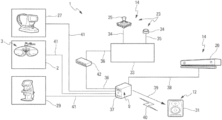
- FIG. 1 is a synoptic diagram of a particular embodiment of an inventive device for determination of the subjective ocular refraction of a patient
- FIG. 2 schematically shows a first mode of communication between different elements of the device, via a local network
- FIG. 3 schematically shows a second mode of communication between different elements of the device, via serial links
- FIG. 4 is a schematic perspective view of a booth for determination of the subjective ocular refraction of a patient
- FIGS. 5 and 6 are schematic perspective views, looking respectively from the right and left, of the booth in FIG. 4 ;
- FIG. 7 schematically shows the main steps of a particular embodiment of a method for the automatic determination of the subjective ocular refraction of a patient.
- Device 1 shown schematically in FIG. 1 and serving to illustrate the present invention, is a device for automatic determination of at least the subjective ocular refraction of a patient.
- This device 1 usually comprises:
- the data input unit 11 can comprise any type of element or usual means of inputting data, such as for example a keyboard associated with a screen or a touch screen.
- said device 1 further comprises:
- the interface system 14 is configured to detect, directly, indications generated by the patient in the form of gestures, and preferably in manual form, at least during an eye test, and to transmit these detected indications (in the form of gestures) directly to central unit 9 via a link 15 .
- central unit 9 comprises a control element 16 which is configured:
- Central unit 9 also comprises a processing element 17 configured to generate a prescription.
- This prescription comprises, in particular, a prescription for corrective lenses of spectacles for the patient, whose correction is adapted to the subjective ocular refraction determined by control element 16 .
- Said device 1 also comprises a recording element 18 which is configured to record at least the prescription (and possibly the objective ocular refraction) generated by processing element 17 , on a storage medium 18 A, internal or external (to central unit 9 ), of any usual type, for example a USB key.
- a recording element 18 which is configured to record at least the prescription (and possibly the objective ocular refraction) generated by processing element 17 , on a storage medium 18 A, internal or external (to central unit 9 ), of any usual type, for example a USB key.
- device 1 comprises a printing element (or printer) 19 .
- This printing element 19 is configured to print on paper the prescription generated by processing element 17 (or simply the subjective ocular refraction) and received via a link 20 .
- processing element 17 or simply the subjective ocular refraction
- link 20 a link
- device 1 comprises, additionally and/or alternatively, a transmission element 21 .
- This transmission element 21 is configured to transmit (in particular remotely via the Internet) the prescription, generated by processing element 17 (or simply the subjective ocular refraction) and received via a link 22 , to a user, for example a healthcare professional.
- device 1 is able to perform a teletransmission of the prescription and/or subjective ocular refraction.
- the instruction generation system 12 comprises a conventional voice output unit, comprising a loudspeaker 31 ( FIGS. 2 and 3 ), which is configured to generate the instructions as voice signals, i.e. via a synthesised voice.
- a conventional voice output unit comprising a loudspeaker 31 ( FIGS. 2 and 3 ), which is configured to generate the instructions as voice signals, i.e. via a synthesised voice.
- a loudspeaker 31 FIGS. 2 and 3
- the instruction generation system 12 may generate the instructions in visual form.
- interface system 14 comprises at least one manual actuating element 23 .
- This manual actuating element 23 is configured to be manually operated by the patient.
- this may be one or more actuating elements such as buttons, e.g. pushbuttons or rotary knobs, as shown for example in FIGS. 2 and 3 with button 24 .
- manual actuating element 23 can comprise two buttons, one of which indicates the right and the other the left, for example.
- Manual actuating element 23 can also be a conventional joystick 25 , as shown in FIGS. 2 and 3 .
- such a joystick 25 can be moved in two different directions, forwards/backwards and up/down.
- the indications in the form of gestures thus represent manual actuations of manual actuating device 23 by the patient.
- interface system 14 comprises a detection system 26 ( FIGS. 2 and 3 ) of the usual type, which is configured to automatically detect (remotely, i.e. without contact) the gestures of the patient.
- indications in the form of gestures represent gestures, in particular movements of one or both hands of the patient, which are detected automatically and directly by detection system 26 without the intervention of a third party and without contact with the patient.
- device 1 comprises a voice command system (not shown) that allows the patient to provide said device 1 (and in particular central unit 9 ) with indications in vocal form, especially during an eye test.
- a voice command system (not shown) that allows the patient to provide said device 1 (and in particular central unit 9 ) with indications in vocal form, especially during an eye test.
- said device 1 also comprises, as shown in FIG. 1 , a conventional automatic refractometer 27 configured to measure the objective ocular refraction of the patient. To perform this examination, the patient must rest their forehead and chin against and upon appropriate supports. Automatic refractometer 27 then automatically measures the objective ocular refraction of the eyes of the patient. Automatic refractometer 27 is configured to automatically transmit to central unit 9 , via a link 28 , the objective ocular refraction thus measured. This measured objective ocular refraction is used by central unit 9 to automatically generate the eye test(s) and/or to automatically determine said subjective ocular refraction.
- a conventional automatic refractometer 27 configured to measure the objective ocular refraction of the patient. To perform this examination, the patient must rest their forehead and chin against and upon appropriate supports. Automatic refractometer 27 then automatically measures the objective ocular refraction of the eyes of the patient. Automatic refractometer 27 is configured to automatically transmit to central unit 9 , via a link 28
- said device 1 comprises, in addition, as shown in FIG. 1 , a usual frontofocometer 29 configured to measure the corrections of the lenses of the spectacles of the patient.
- a usual frontofocometer 29 configured to measure the corrections of the lenses of the spectacles of the patient.
- frontofocometer 29 is automated. This frontofocometer 29 is configured to transmit the measured corrections to central unit 9 via a link 30 . These measured corrections are used by central unit 9 to automatically generate the eye test(s) and/or to automatically determine said subjective ocular refraction.
- the various components (and in particular automatic refractor 2 , central unit 9 , data input unit 11 , instruction generation system 12 and interface system 14 , as well as, where appropriate, automatic refractometer 27 and frontofocometer 29 ) of device 1 can be connected together in different ways, in order to communicate and transmit data and/or commands in particular.
- device 1 comprises a Local Area Network (LAN) that is configured to allow communications between at least some of the above-mentioned elements of device 1 .
- LAN Local Area Network
- interface system 14 comprises a nanocomputer 33 equipped with an ARM processor, e.g. of the Raspberry PI type.
- Button 24 and joystick 25 are each connected to nanocomputer 33 via a USB link or a Raspberry PI IO bus, i.e. a set of electronic connections between the different units (inputs or outputs) of the Raspberry PI electronic board, as illustrated by links 34 and 35 .
- automatic refractor 2 central unit 9 , nanocomputer 33 , automatic refractometer 27 and frontofocometer 29 are linked (or connected) to local network 32 via usual connectors 36 , for example of the RJ45 type.
- central unit 9 which is, for example, integrated in a computer 37 is linked to detection system 26 via a link 38 , for example of the USB type.
- central unit 9 is linked to instruction generation system 12 via a wired link 39 (“jack” or “RCA” outlet) or a “Bluetooth” type link 40 .
- device 1 also comprises a device 42 of the “HUB” or “Switch” type, which connects via connectors 36 , e.g. of the RJ45 type, the nanocomputer 33 of the interface system 14 to the central unit 9 .
- At least some of the elements of device 1 communicate with each other via wireless (or “wifi”) communication.
- device 1 for automatic determination of the subjective ocular refraction of a patient is integrated in a booth 43 (for automatic determination of subjective ocular refraction).
- This booth 43 is at least partially closed and comprises, in addition to device 1 , a seat 44 for a patient.
- This seat 44 is adjustable, especially in height and possibly in the horizontal plane.
- the various elements of the said device 1 and in particular automatic refractor 2 , interface system 14 , automatic refractometer 27 and frontofocometer 29 are arranged in such a way as to be accessible from the patient seat 44 .
- Automatic refractometer 27 and frontofocometer 29 can be optional in a simplified embodiment.
- data input unit 11 for example a keyboard 45 combined with a display 46 , can be arranged at the entrance to booth 43 , as shown in the example in FIGS. 4 to 6 .
- Data input unit 11 can also be arranged inside booth 43 .
- Data unit 11 can also comprise a payment terminal 47 , for a payment, e.g. by credit card.
- booth 43 comprises within it:
- a PR method for automatic determination of the subjective ocular refraction of a patient is described below, with reference to FIG. 7 in conjunction with FIG. 1 , using a device 1 such as the one described above.
- This PR method comprises:
- Steps E 1 to E 4 of the PR method are described in more detail below.
- the patient inputs (using the data input unit 11 ) data about themselves, including age, which will be used by central unit 9 to determine subjective ocular refraction.
- the patient is also asked, via instruction generation system 12 , to perform a measurement using automatic refractometer 27 to measure the objective ocular refraction RO of their eyes.
- the patient can also be asked to enter (via the data input unit 11 ) the objective ocular refraction of their eyes if they know it.
- the patient is also asked, via the instruction generation system 12 , to place their spectacles in the frontofocometer 29 so that the latter automatically measures the lens corrections of their spectacles.
- the subsequent generation step E 2 implemented by the central unit 9 , consists of automatically generating at least one eye test, using in particular the age of the patient, their objective ocular refraction RO and their optical correction range measured with a frontofocometer 29 .
- the eye test(s) are determined by central unit 9 to present different combinations of corrective lenses to the patient based on the objective ocular refraction RO.
- the patient looks at displays 25 controlled by central unit 9 through eyepiece device 3 fitted with these corrective lenses, and provides indications as to their vision via interface system 14 in test step E 3 .
- central unit 9 determines an RB refraction (or fog refraction) and derives the subjective RF ocular refraction in processing step E 4 .
- generation step E 2 uses a fog test.
- other types of tests can be carried out by device 1 in the context of the present invention.
- the fog test consists of making displays (viewed by the patient through the corrective lenses presented in eyepiece device 3 ) of letter Es, with branches of the E displayed in four different orientations, i.e. to the right, downwards, to the left and upwards.
- Four E's of different orientations are planned to be displayed, with the RO correction of the patient and E's of 2/10 in ocular device 3 .
- the patient views these displays through the corrective lenses arranged in the ocular device 3 .
- the vision is gradually brightened (and made possible) by gradually removing fog.
- device 1 performs the test on only one eye to determine the RB refraction.
- the right eye is used, unless measurement with automatic refractometer 27 is impossible on the right eye.
- the instruction generation system 12 can emit (in sub-step E 3 A) the following voice message to the patient: “The following reading test is called the fog test. It is used to accurately determine your correction. Your vision will be deliberately blurred through the spectacles, and will then gradually become clearer. We will display letter Es with branches in four different orientations as follows. To the right, down, left and up. At the beginning, it will be totally impossible for you to respond and then we will gradually clear your vision by removing the fog. The most important thing for this test is to respond only when you can guess the direction of the E. When you do this, use the directional joystick to tell us the direction of the E, i.e. up, down, right, left”. This directional joystick corresponds to joystick 25 described above.
- the method of calculation of the RB refraction is as follows, wherein the RB refraction is obtained starting from the RO refraction to which +4 dioptres are added.
- central unit 9 can either determine the RB refraction for the other eye in the same way or perform the following calculations:
- processing step E 4 implemented by central unit 9 , includes the automatic determination of the subjective ocular RF refraction.
- Central unit 9 calculates the subjective ocular refraction RF from the RB refraction determined as described above.
- Test step E 4 also consists of generating a prescription P from this subjective RF ocular refraction. More specifically, central unit 9 determines the prescription P to be entered on the prescription, as follows:
- prescription P is provided to the patient, for example by being printed by print element 19 .
- Prescription P can also be transmitted remotely to a third party, for example to a healthcare professional, using transmission element 21 .
- Device 1 can also be set up to issue an alert message advising the patient to consult an eye care professional in an emergency if their visual acuity is too low.
- the method described above is therefore a method for the automated determination of the subjective ocular refraction of a patient, using an algorithm (integrated into central unit 9 ) and an analysis by artificial intelligence of the combination of objective refraction data measured automatically using, in particular, an automatic refractometer 27 , the patient's age, their optical correction range measured using a frontofocometer 29 and their responses collected by central unit 9 , wherein the various elements of the device 1 are controlled automatically by central unit 9 , wherein central unit 9 presents in the eyepieces 4 A and 4 B of ocular device 3 a series of adapted corrective lenses, wherein the eye test(s) are implemented with vocal guidance of the patient by a synthesised voice (via the instruction generation system 12 ) and comprising a collection of responses using interface system 14 .
Landscapes
- Life Sciences & Earth Sciences (AREA)
- Health & Medical Sciences (AREA)
- Medical Informatics (AREA)
- Biophysics (AREA)
- Ophthalmology & Optometry (AREA)
- Engineering & Computer Science (AREA)
- Biomedical Technology (AREA)
- Heart & Thoracic Surgery (AREA)
- Physics & Mathematics (AREA)
- Molecular Biology (AREA)
- Surgery (AREA)
- Animal Behavior & Ethology (AREA)
- General Health & Medical Sciences (AREA)
- Public Health (AREA)
- Veterinary Medicine (AREA)
- Eye Examination Apparatus (AREA)
- Eyeglasses (AREA)
Abstract
Description
-
- the patient is guided by an operator such as an eye care professional who controls the conduct of the test(s) (determined automatically); and
- the operator enters the responses provided by the patient into the system during testing.
-
- an automatic refractor comprising an ocular device (with one or two eyepieces) and a management unit configured to take corrective lenses from a reserve and position them in the ocular device;
- a central unit configured to at least control the automatic refractor management unit to position corrective lenses in the ocular device; and
- a data input unit for entering at least patient-related data into the central unit.
-
- said device further comprises:
- an instruction generation system controlled by the central unit and configured to automatically generate instructions to the patient at least during an eye test; and
- an interface system between the patient and the central unit, which is configured to detect, directly, indications generated in the form of gestures, preferably manually, by the patient at least during an eye test and to transmit these indications directly to the central unit; and
- the central unit is also configured to automatically implement at least one eye test, by controlling the management unit and receiving the indications generated by the patient via the interface system, and to automatically determine the subjective ocular refraction from at least said received indications.
-
- a recording element configured to record the prescription; and
- a print element configured to print the prescription.
-
- the interface system is a system which makes it possible to automatically detect the patient's gestures, which they perform in order to provide (or generate) the said indications (gestures), which represent their comments (or responses) relating to the questions asked during the eye test(s);
- the patient's gestures correspond to movements of at least one part of their body. These movements preferably concern movements or actions performed by one or both hands of the patient. However, the use of other parts of the body, such as, for example, the feet, may be considered in the context of the present invention.
-
- an automatic refractometer configured to measure the objective ocular refraction of the patient and to transmit it to the central unit, wherein the measured objective ocular refraction is used by the central unit to perform at least one of the following two actions: generate said at least one eye test, determine said subjective ocular refraction; and/or
- a frontofocometer configured to measure the spectacle lenses corrections of the patient and to transmit the measured corrections to the central unit, wherein the measured corrections are used by the central unit to perform at least one of the following two actions: generate said at least one eye test, determine said subjective ocular refraction; and/or
- a voice control system allowing the patient to provide the device with voice indications.
-
- in a first embodiment, said device comprises a local network configured to allow communications between at least some of said elements of said device;
- in a second embodiment, at least some of said elements of said device communicate with one another via serial links; and
- in a third embodiment, at least some of the said elements of the said device communicate with each other by means of a wireless (or “wifi”) communication.
-
- an automatic refractor comprising an ocular device and a management unit configured to take corrective lenses from a reserve and position them in the ocular device;
- a central unit;
- a data input unit;
- an instruction generation system; and
- an interface system between the patient and the central unit.
-
- a generation step, implemented by the central unit, and consisting of automatically generating at least one eye test, using at least inputted data relating to the patient;
- a test step consisting of implementing at least one eye test generated in the generation step, the test step comprising at least:
- a sub-step of generation of instructions for the patient, implemented by the instruction generation system;
- a sub-step of controlling the automatic refractor management unit to take corrective lenses from the reserve and position them in the ocular device;
- a sub-step of direct detection of indications generated in the form of gestures by the patient during the eye test, by looking at displays through the ocular device, and direct transmission of these indications to the central unit, implemented by the interface system; and
- a processing step, implemented by the central unit, and consisting of automatically determining the subjective ocular refraction of the patient, from at least the said indications received, as well as a prescription.
-
- an automatic refractor 2 comprising an
eyepiece device 3 provided with one or preferably two eyepieces 4A and 4B and a management unit 5 configured to take corrective lenses from a reserve 6 for example using an articulated arm (not shown) and position them in the eyepieces 4A and 4B, as shown schematically by mixed lines 7A and 7B inFIG. 1 ; - a central unit 9 configured to at least control the management unit of the automatic refractor 2, as illustrated by link 8, in order to position lenses in the eyepiece(s) 4A and 4B of the
eyepiece device 3; and - a
data input unit 11 for inputting at least patient-related data into the central unit 9 as illustrated by a link 10.
- an automatic refractor 2 comprising an
-
- an
instruction generation system 12 controlled by central unit 9, as illustrated by a link 13, and configured to generate instructions to the patient at least during an eye test; and - an
interface system 14 creating an interface between the patient and the central unit 9.
- an
-
- to automatically implement at least one eye test, by controlling management unit 5, by guiding the patient via
instruction generation system 12 and receiving the indications generated by the patient viainterface system 14; and - to automatically determine the subjective ocular refraction from at least said received indications.
- to automatically implement at least one eye test, by controlling management unit 5, by guiding the patient via
-
- the
interface system 14 is a system which makes it possible to automatically detect the gestures of the patient, i.e. the gestures which the patient performs to provide (or generate) the said indications (in the form of gestures), which represent their comments (or responses) relating in particular to questions asked during an eye test; - the gestures of the patient correspond to movements of a part of the body of said patient. Preferably, these movements concern movements or actions performed by one or both hands of the patient. However, movements of other parts of the body of the patient may be envisaged in the context of the present invention, such as, in particular, movements of the feet of the patient which act, for example, on pedals or other mechanical elements (in this case forming part of interface system 14).
- the
-
- on one side, as shown in
FIG. 5 , automatic refractor 2,interface system 14, andinstruction generation system 12; and - on the other side, as shown in
FIG. 6 , automatic refractometer 27 and frontofocometer 29.
- on one side, as shown in
-
- a data input step E1 consisting of inputting data relating to the patient into device 1 (and more particularly into the central unit 9);
- a generation step E2, implemented by central unit 9, and consisting of automatically generating at least one eye test, using at least inputted data, relating to the patient;
- a test step E3 to implement at least one eye test generated in the generation step E2. Test step E3 comprises at least:
- a sub-step E3A of generation of instructions for the patient, implemented by the
instruction generation system 12; - a sub-step E3B for ordering control unit 5 of automatic refractor 2 to take corrective lenses from reserve 6 and position them in the eyepieces 4A and 4B of
eyepiece device 3; - a sub-step E3C for direct detection of indications in the form of gestures generated by the patient during the eye test, during which the patient looks at displays controlled by central unit 9 through
eyepiece device 3 fitted with special corrective lenses and generates indications according to what they see, the sub-step E3C (implemented by the interface system 14) also comprising a direct transmission of these indications to central unit 9; and - a processing step E4, implemented by central unit 9, and consisting of automatically determining the subjective ocular refraction of a patient, and preferably also a prescription, based in particular on the indications received. Processing step E4 preferably determines the subjective ocular refraction of the patient, using, among other things, the age of the patient, their objective ocular refraction RO measured by automatic refractometer 27, their optical range correction measured by the frontofocometer 29, and their responses collected by central unit 9 via
interface system 14 during eye tests.
-
- that the patient makes a pre-consultation payment, for example, using payment terminal 47; and/or
- that they enter other information about themselves such as their name and address for example, which may appear on the prescription.
-
- if there is an error in the patient's response or if the patient cannot respond, 0.50 of fog is removed until we remove one dioptre of fog has been removed, then 0.25 is removed in steps;
- if four consecutive answers are correct, the test is stopped;
- similarly, if 2.75 is removed, the test is stopped.
-
- determine an accommodation value Δ, using the following expression:
- Δ=RB−RO on the tested eye; and
- remove this accommodation value Δ on the other eye without having testing it.
-
- if Δ=0, RF=RO=RB;
- if Δ<1.00 dioptre, RF=RO+0.25;
- if Δ≤1.00 dioptre, then:
- if RB is sphere-positive, the RF value is determined from the RB value, taking into account a predetermined correspondence table between RB and RF values;
- if RB is sphere-negative, a “red green” test is performed to determine the subjective ocular RF refraction.
-
- if Δ=0 or if Δ<1.00 dioptre or if the patient is over 38 years of age:
- if RF is sphere-negative, then P=RF as validated;
- if RF is of positive sphere, then P=RF obtained from the correspondence table;
- if Δ≥1.00 dioptre: P=RF.
Claims (19)
Applications Claiming Priority (3)
| Application Number | Priority Date | Filing Date | Title |
|---|---|---|---|
| FR1854106 | 2018-05-17 | ||
| FR1854106A FR3081095B1 (en) | 2018-05-17 | 2018-05-17 | DEVICE, METHOD AND CABIN FOR AUTOMATIC DETERMINATION OF THE SUBJECTIVE EYE REFRACTION OF A PATIENT. |
| PCT/FR2018/051326 WO2019220023A1 (en) | 2018-05-17 | 2018-06-07 | Device, method and booth for automatic determination of the subjective ocular refraction of a patient |
Publications (2)
| Publication Number | Publication Date |
|---|---|
| US20210212560A1 US20210212560A1 (en) | 2021-07-15 |
| US12053239B2 true US12053239B2 (en) | 2024-08-06 |
Family
ID=62909557
Family Applications (1)
| Application Number | Title | Priority Date | Filing Date |
|---|---|---|---|
| US17/055,455 Active 2040-02-04 US12053239B2 (en) | 2018-05-17 | 2018-06-07 | Device, method and booth for automatic determination of the subjective ocular refraction of a patient |
Country Status (6)
| Country | Link |
|---|---|
| US (1) | US12053239B2 (en) |
| EP (1) | EP3793424B1 (en) |
| JP (1) | JP7045522B2 (en) |
| ES (1) | ES3023839T3 (en) |
| FR (1) | FR3081095B1 (en) |
| WO (1) | WO2019220023A1 (en) |
Citations (11)
| Publication number | Priority date | Publication date | Assignee | Title |
|---|---|---|---|---|
| US4105303A (en) * | 1977-01-05 | 1978-08-08 | Guyton D L | Method for determining the refractive correction for an eye |
| US5914772A (en) * | 1997-08-29 | 1999-06-22 | Eyelogic Inc. | Method and device for testing eyes |
| US20060023163A1 (en) * | 2004-07-28 | 2006-02-02 | Bart Foster | Automated vision screening apparatus and method |
| US20090153796A1 (en) | 2005-09-02 | 2009-06-18 | Arthur Rabner | Multi-functional optometric-ophthalmic system for testing diagnosing, or treating, vision or eyes of a subject, and methodologies thereof |
| US20130339043A1 (en) * | 2012-06-13 | 2013-12-19 | Advanced Vision Solutions, Inc. | Vision correction prescription and health assessment facility |
| US20140129259A1 (en) * | 2012-11-06 | 2014-05-08 | 20/20 Vision Center LLC | Systems and methods for enabling customers to obtain vision and eye health examinations |
| US20150070650A1 (en) | 2007-02-16 | 2015-03-12 | 20/20 Vision Center LLC | System and method for enabling customers to obtain refraction specifications and purchase eyeglasses or contact lenses |
| US20150150446A1 (en) | 2013-12-03 | 2015-06-04 | Medizs Inc. | Method for controlling ophthalmic device |
| US20160310000A1 (en) | 2015-04-21 | 2016-10-27 | Adaptica Srl | Phoropter system and method of use |
| FR3050922A1 (en) | 2016-05-04 | 2017-11-10 | Philippe Morizet | METHOD FOR CONTROLLING AN AUTOMATIC REFRACTOR |
| US20170329154A1 (en) | 2016-05-11 | 2017-11-16 | Perfect Vision Technology (Hk) Ltd. | Methods and Systems for Determining Refractive Corrections of Human Eyes for Eyeglasses |
Family Cites Families (3)
| Publication number | Priority date | Publication date | Assignee | Title |
|---|---|---|---|---|
| JP2002209850A (en) * | 2001-01-23 | 2002-07-30 | Topcon Corp | Subjective optometry device |
| JP4188118B2 (en) * | 2003-03-20 | 2008-11-26 | 株式会社トプコン | Optometry equipment |
| JP4481665B2 (en) * | 2004-01-30 | 2010-06-16 | 株式会社ニデック | Optometry equipment |
-
2018
- 2018-05-17 FR FR1854106A patent/FR3081095B1/en active Active
- 2018-06-07 US US17/055,455 patent/US12053239B2/en active Active
- 2018-06-07 JP JP2021514488A patent/JP7045522B2/en active Active
- 2018-06-07 WO PCT/FR2018/051326 patent/WO2019220023A1/en not_active Ceased
- 2018-06-07 EP EP18740628.5A patent/EP3793424B1/en active Active
- 2018-06-07 ES ES18740628T patent/ES3023839T3/en active Active
Patent Citations (11)
| Publication number | Priority date | Publication date | Assignee | Title |
|---|---|---|---|---|
| US4105303A (en) * | 1977-01-05 | 1978-08-08 | Guyton D L | Method for determining the refractive correction for an eye |
| US5914772A (en) * | 1997-08-29 | 1999-06-22 | Eyelogic Inc. | Method and device for testing eyes |
| US20060023163A1 (en) * | 2004-07-28 | 2006-02-02 | Bart Foster | Automated vision screening apparatus and method |
| US20090153796A1 (en) | 2005-09-02 | 2009-06-18 | Arthur Rabner | Multi-functional optometric-ophthalmic system for testing diagnosing, or treating, vision or eyes of a subject, and methodologies thereof |
| US20150070650A1 (en) | 2007-02-16 | 2015-03-12 | 20/20 Vision Center LLC | System and method for enabling customers to obtain refraction specifications and purchase eyeglasses or contact lenses |
| US20130339043A1 (en) * | 2012-06-13 | 2013-12-19 | Advanced Vision Solutions, Inc. | Vision correction prescription and health assessment facility |
| US20140129259A1 (en) * | 2012-11-06 | 2014-05-08 | 20/20 Vision Center LLC | Systems and methods for enabling customers to obtain vision and eye health examinations |
| US20150150446A1 (en) | 2013-12-03 | 2015-06-04 | Medizs Inc. | Method for controlling ophthalmic device |
| US20160310000A1 (en) | 2015-04-21 | 2016-10-27 | Adaptica Srl | Phoropter system and method of use |
| FR3050922A1 (en) | 2016-05-04 | 2017-11-10 | Philippe Morizet | METHOD FOR CONTROLLING AN AUTOMATIC REFRACTOR |
| US20170329154A1 (en) | 2016-05-11 | 2017-11-16 | Perfect Vision Technology (Hk) Ltd. | Methods and Systems for Determining Refractive Corrections of Human Eyes for Eyeglasses |
Non-Patent Citations (4)
| Title |
|---|
| International Preliminary Report on Patentability mailed Nov. 17, 2020, issued in corresponding International Application No. PCT/FR2018/051326, filed Jun. 7, 2018, 1 page. |
| International Search Report mailed Feb. 2, 2019, issued in corresponding International Application No. PCT/FR2018/051326, filed Jun. 7, 2018, 3 pages. |
| Written Opinion of the International Searching Authority mailed Feb. 2, 2019, issued in corresponding International Application No. PCT/FR2018/051326, filed Jun. 7, 2018, 5 pages. |
| Written Opinion of the International Searching Authority mailed Feb. 2, 2019, issued in corresponding International Application No. PCT/FR2018/051326, filed Jun. 7, 2018, 7 pages. |
Also Published As
| Publication number | Publication date |
|---|---|
| EP3793424B1 (en) | 2025-03-19 |
| US20210212560A1 (en) | 2021-07-15 |
| EP3793424A1 (en) | 2021-03-24 |
| FR3081095B1 (en) | 2021-01-15 |
| EP3793424C0 (en) | 2025-03-19 |
| WO2019220023A1 (en) | 2019-11-21 |
| JP2021530330A (en) | 2021-11-11 |
| JP7045522B2 (en) | 2022-03-31 |
| ES3023839T3 (en) | 2025-06-03 |
| FR3081095A1 (en) | 2019-11-22 |
Similar Documents
| Publication | Publication Date | Title |
|---|---|---|
| JP7166473B2 (en) | eye examination | |
| EP3626157A1 (en) | Eyeglass prescription method and system | |
| WO2006010611A1 (en) | Automated vision screening apparatus and method | |
| KR20200088630A (en) | Method and system for virtual reality-based visual field inspection | |
| AU2025210828A1 (en) | Subjective refraction exam system | |
| CN209301108U (en) | A kind of human eye vision monitoring system | |
| US12053239B2 (en) | Device, method and booth for automatic determination of the subjective ocular refraction of a patient | |
| KR102208508B1 (en) | Systems and methods for performing complex ophthalmic tratment | |
| WO2021164866A1 (en) | Vision testing sequences | |
| JPH09500028A (en) | Automatic refraction correction device by subjective control | |
| CN113693550A (en) | Full-automatic intelligent comprehensive optometry analysis system and method | |
| US12042224B2 (en) | Method and device for determining at least one astigmatic effect of at least one eye | |
| US20250031958A1 (en) | Methods and Apparatus for Addressing Presbyopia | |
| US12114927B2 (en) | Methods and apparatus for addressing presbyopia | |
| EP4512304A2 (en) | Determining a lens shape for producing an optical lens for an eye of a person | |
| EP4464235B1 (en) | Device and method for determining a final value of a vision correction power of a corrective lens | |
| JP2019062979A (en) | Optometry device, method and program | |
| KR20230059330A (en) | Machine learning-based eyeglasses ordering devices and methods with VR | |
| WO2025216177A1 (en) | Examination device and examination method | |
| Shekhar et al. | Detecting Astigmatism Condition in Human Eye using VR | |
| HK40041389B (en) | Eye test | |
| HK40041389A (en) | Eye test | |
| HK40069035A (en) | Method for automatically assessing the near vision accommodative state of a non-presbyopic individual and associated device | |
| JPH03195535A (en) | Device and method for determining contact lens |
Legal Events
| Date | Code | Title | Description |
|---|---|---|---|
| FEPP | Fee payment procedure |
Free format text: ENTITY STATUS SET TO UNDISCOUNTED (ORIGINAL EVENT CODE: BIG.); ENTITY STATUS OF PATENT OWNER: SMALL ENTITY |
|
| FEPP | Fee payment procedure |
Free format text: ENTITY STATUS SET TO SMALL (ORIGINAL EVENT CODE: SMAL); ENTITY STATUS OF PATENT OWNER: SMALL ENTITY |
|
| STPP | Information on status: patent application and granting procedure in general |
Free format text: APPLICATION DISPATCHED FROM PREEXAM, NOT YET DOCKETED |
|
| STPP | Information on status: patent application and granting procedure in general |
Free format text: DOCKETED NEW CASE - READY FOR EXAMINATION |
|
| STPP | Information on status: patent application and granting procedure in general |
Free format text: NON FINAL ACTION MAILED |
|
| STPP | Information on status: patent application and granting procedure in general |
Free format text: RESPONSE TO NON-FINAL OFFICE ACTION ENTERED AND FORWARDED TO EXAMINER |
|
| STPP | Information on status: patent application and granting procedure in general |
Free format text: FINAL REJECTION MAILED |
|
| FEPP | Fee payment procedure |
Free format text: ENTITY STATUS SET TO UNDISCOUNTED (ORIGINAL EVENT CODE: BIG.); ENTITY STATUS OF PATENT OWNER: SMALL ENTITY |
|
| STPP | Information on status: patent application and granting procedure in general |
Free format text: DOCKETED NEW CASE - READY FOR EXAMINATION |
|
| STPP | Information on status: patent application and granting procedure in general |
Free format text: NOTICE OF ALLOWANCE MAILED -- APPLICATION RECEIVED IN OFFICE OF PUBLICATIONS |
|
| ZAAA | Notice of allowance and fees due |
Free format text: ORIGINAL CODE: NOA |
|
| ZAAB | Notice of allowance mailed |
Free format text: ORIGINAL CODE: MN/=. |
|
| FEPP | Fee payment procedure |
Free format text: ENTITY STATUS SET TO SMALL (ORIGINAL EVENT CODE: SMAL); ENTITY STATUS OF PATENT OWNER: SMALL ENTITY |
|
| STPP | Information on status: patent application and granting procedure in general |
Free format text: NOTICE OF ALLOWANCE MAILED -- APPLICATION RECEIVED IN OFFICE OF PUBLICATIONS |
|
| ZAAA | Notice of allowance and fees due |
Free format text: ORIGINAL CODE: NOA |
|
| STPP | Information on status: patent application and granting procedure in general |
Free format text: PUBLICATIONS -- ISSUE FEE PAYMENT VERIFIED |
|
| STCF | Information on status: patent grant |
Free format text: PATENTED CASE |