US12041270B2 - Transform-skip residual coding of video data - Google Patents
Transform-skip residual coding of video data Download PDFInfo
- Publication number
- US12041270B2 US12041270B2 US16/872,643 US202016872643A US12041270B2 US 12041270 B2 US12041270 B2 US 12041270B2 US 202016872643 A US202016872643 A US 202016872643A US 12041270 B2 US12041270 B2 US 12041270B2
- Authority
- US
- United States
- Prior art keywords
- flag
- level
- abs
- pass
- gtx
- Prior art date
- Legal status (The legal status is an assumption and is not a legal conclusion. Google has not performed a legal analysis and makes no representation as to the accuracy of the status listed.)
- Active
Links
Images





Classifications
-
- H—ELECTRICITY
- H04—ELECTRIC COMMUNICATION TECHNIQUE
- H04N—PICTORIAL COMMUNICATION, e.g. TELEVISION
- H04N19/00—Methods or arrangements for coding, decoding, compressing or decompressing digital video signals
- H04N19/60—Methods or arrangements for coding, decoding, compressing or decompressing digital video signals using transform coding
- H04N19/63—Methods or arrangements for coding, decoding, compressing or decompressing digital video signals using transform coding using sub-band based transform, e.g. wavelets
- H04N19/64—Methods or arrangements for coding, decoding, compressing or decompressing digital video signals using transform coding using sub-band based transform, e.g. wavelets characterised by ordering of coefficients or of bits for transmission
- H04N19/645—Methods or arrangements for coding, decoding, compressing or decompressing digital video signals using transform coding using sub-band based transform, e.g. wavelets characterised by ordering of coefficients or of bits for transmission by grouping of coefficients into blocks after the transform
-
- H—ELECTRICITY
- H04—ELECTRIC COMMUNICATION TECHNIQUE
- H04N—PICTORIAL COMMUNICATION, e.g. TELEVISION
- H04N19/00—Methods or arrangements for coding, decoding, compressing or decompressing digital video signals
- H04N19/10—Methods or arrangements for coding, decoding, compressing or decompressing digital video signals using adaptive coding
- H04N19/102—Methods or arrangements for coding, decoding, compressing or decompressing digital video signals using adaptive coding characterised by the element, parameter or selection affected or controlled by the adaptive coding
- H04N19/129—Scanning of coding units, e.g. zig-zag scan of transform coefficients or flexible macroblock ordering [FMO]
-
- H—ELECTRICITY
- H04—ELECTRIC COMMUNICATION TECHNIQUE
- H04N—PICTORIAL COMMUNICATION, e.g. TELEVISION
- H04N19/00—Methods or arrangements for coding, decoding, compressing or decompressing digital video signals
- H04N19/10—Methods or arrangements for coding, decoding, compressing or decompressing digital video signals using adaptive coding
- H04N19/102—Methods or arrangements for coding, decoding, compressing or decompressing digital video signals using adaptive coding characterised by the element, parameter or selection affected or controlled by the adaptive coding
- H04N19/13—Adaptive entropy coding, e.g. adaptive variable length coding [AVLC] or context adaptive binary arithmetic coding [CABAC]
-
- H—ELECTRICITY
- H04—ELECTRIC COMMUNICATION TECHNIQUE
- H04N—PICTORIAL COMMUNICATION, e.g. TELEVISION
- H04N19/00—Methods or arrangements for coding, decoding, compressing or decompressing digital video signals
- H04N19/10—Methods or arrangements for coding, decoding, compressing or decompressing digital video signals using adaptive coding
- H04N19/169—Methods or arrangements for coding, decoding, compressing or decompressing digital video signals using adaptive coding characterised by the coding unit, i.e. the structural portion or semantic portion of the video signal being the object or the subject of the adaptive coding
- H04N19/17—Methods or arrangements for coding, decoding, compressing or decompressing digital video signals using adaptive coding characterised by the coding unit, i.e. the structural portion or semantic portion of the video signal being the object or the subject of the adaptive coding the unit being an image region, e.g. an object
- H04N19/176—Methods or arrangements for coding, decoding, compressing or decompressing digital video signals using adaptive coding characterised by the coding unit, i.e. the structural portion or semantic portion of the video signal being the object or the subject of the adaptive coding the unit being an image region, e.g. an object the region being a block, e.g. a macroblock
-
- H—ELECTRICITY
- H04—ELECTRIC COMMUNICATION TECHNIQUE
- H04N—PICTORIAL COMMUNICATION, e.g. TELEVISION
- H04N19/00—Methods or arrangements for coding, decoding, compressing or decompressing digital video signals
- H04N19/10—Methods or arrangements for coding, decoding, compressing or decompressing digital video signals using adaptive coding
- H04N19/169—Methods or arrangements for coding, decoding, compressing or decompressing digital video signals using adaptive coding characterised by the coding unit, i.e. the structural portion or semantic portion of the video signal being the object or the subject of the adaptive coding
- H04N19/18—Methods or arrangements for coding, decoding, compressing or decompressing digital video signals using adaptive coding characterised by the coding unit, i.e. the structural portion or semantic portion of the video signal being the object or the subject of the adaptive coding the unit being a set of transform coefficients
-
- H—ELECTRICITY
- H04—ELECTRIC COMMUNICATION TECHNIQUE
- H04N—PICTORIAL COMMUNICATION, e.g. TELEVISION
- H04N19/00—Methods or arrangements for coding, decoding, compressing or decompressing digital video signals
- H04N19/90—Methods or arrangements for coding, decoding, compressing or decompressing digital video signals using coding techniques not provided for in groups H04N19/10-H04N19/85, e.g. fractals
- H04N19/91—Entropy coding, e.g. variable length coding [VLC] or arithmetic coding
Definitions
- the present disclosure generally relates to video data processing, and more particularly, to transform-skip residual coding of video data.
- VVC Versatile Video Coding
- HEVC/H.265 High Efficiency Video Coding
- the embodiments of the present disclosure provide methods and systems for transform-skip residual video data coding.
- One exemplary method comprises: performing a first pass of scanning a transform coefficient of a sub-block of a video frame, wherein the first pass of scanning comprises: bypass coding a parity level flag for the transform coefficient, the parity level flag indicating a parity of an absolute value of a level of the transform coefficient.
- Another exemplary method comprises: performing a first pass of scanning a transform coefficient of a sub-block of a video frame, wherein the first pass of scanning comprises: bypass decoding a parity level flag for the transform coefficient, the parity level flag indicating a parity of an absolute value of a level of the transform coefficient.
- One exemplary system comprises: a memory storing a set of instructions; and a processor configured to execute the set of instructions to cause the system to: perform a first pass of scanning a transform coefficient of a sub-block of a video frame, wherein the first pass of scanning comprises: bypass coding a parity level flag for the transform coefficient, the parity level flag indicating a parity of an absolute value of a level of the transform coefficient.
- Another exemplary system comprises: a memory storing a set of instructions; and a processor configured to execute the set of instructions to cause the system to: perform a first pass of scanning a transform coefficient of a sub-block of a video frame, wherein the first pass of scanning comprises: bypass decoding a parity level flag for the transform coefficient, the parity level flag indicating a parity of an absolute value of a level of the transform coefficient.
- FIG. 1 illustrates an example encoder block diagram of a hybrid video coding system.
- FIG. 2 illustrates an example decoder block diagram of a hybrid video coding system.
- FIG. 3 illustrates an example pseudocode including syntax of transforming coding.
- FIG. 4 illustrates an example pseudocode including syntax of transforming skip residual coding.
- FIG. 5 illustrates an example method of transform-skip residual coding with the number of coding passes being reduced to 3, according to some embodiments of the present disclosure.
- FIG. 6 illustrates an example pseudocode including syntax of the method shown in FIG. 5 , according to some embodiments of the present disclosure.
- FIG. 7 illustrates another example method of transform-skip residual coding with the number of coding passes being reduced to 3, according to some embodiments of the present disclosure.
- FIG. 8 illustrates an example pseudocode including syntax of the method shown in FIG. 7 , according to some embodiments of the present disclosure.
- FIG. 10 A illustrates an 8 ⁇ 8 block before it is flipped, according to some embodiments of the present disclosure.
- FIG. 10 B illustrates a resultant block after the 8 ⁇ 8 block in FIG. 10 A is flipped, according to some embodiments of the present disclosure
- FIG. 11 illustrates an example multi-pass coding, according to some embodiments of the present disclosure.
- FIG. 12 illustrates an example single pass bypass coding method for an absolute value of a level, according to some embodiments of the disclosure.
- FIG. 13 illustrates an example look-up table for Rice parameters, according to some embodiments of the present disclosure.
- FIG. 14 illustrates an example method of transform-skip residual coding with the number of coding passes reduced to 3 combined with a single pass bypass coding, according to some embodiments of the present disclosure.
- FIG. 15 illustrates an example pseudocode including syntax of bypass coding combined with the method in FIG. 14 , according to some embodiments of the present disclosure.
- FIG. 16 illustrates an example method of transform-skip residual coding with a first pass for context coding and a second pass for Golomb-Rice coding, according to some embodiments of the present disclosure.
- FIG. 17 illustrates an example pseudocode including syntax of bypass coding of the method in FIG. 16 , according to some embodiments of the present disclosure.
- FIG. 18 illustrates an example look-up table for Rice parameters when minimum bypass coded value is equal to 0, according to some embodiments of the present disclosure.
- a video is a set of static pictures (or “frames”) arranged in a temporal sequence to store visual information.
- a video capture device e.g., a camera
- a video playback device e.g., a television, a computer, a smartphone, a tablet computer, a video player, or any end-user terminal with a function of display
- a video capturing device can transmit the captured video to the video playback device (e.g., a computer with a monitor) in real-time, such as for surveillance, conferencing, or live broadcasting.
- the video can be compressed.
- the video can be compressed before storage and transmission and decompressed before the display.
- the compression and decompression can be implemented by software executed by a processor (e.g., a processor of a generic computer) or specialized hardware.
- the module for compression is generally referred to as an “encoder,” and the module for decompression is generally referred to as a “decoder.”
- the encoder and the decoder can be collectively referred to as a “codec.”
- the encoder and the decoder can be implemented as any of a variety of suitable hardware, software, or a combination thereof.
- the hardware implementation of the encoder and the decoder can include circuitry, such as one or more microprocessors, digital signal processors (DSPs), application-specific integrated circuits (ASICs), field-programmable gate arrays (FPGAs), discrete logic, or any combinations thereof.
- the software implementation of the encoder and the decoder can include program codes, computer-executable instructions, firmware, or any suitable computer-implemented algorithm or process fixed in a computer-readable medium.
- Video compression and decompression can be implemented by various algorithms or standards, such as MPEG-1, MPEG-2, MPEG-4, H.26x series, or the like.
- the codec can decompress the video from a first coding standard and re-compress the decompressed video using a second coding standard, in which case the codec can be referred to as a “transcoder.”
- the video encoding process can identify and keep useful information that can be used to reconstruct a picture. If information that was disregarded I the video encoding process cannot be fully reconstructed, the encoding process can be referred to as “lossy.” Otherwise, it can be referred to as “lossless.” Most encoding processes are lossy, which is a tradeoff to reduce the needed storage space and the transmission bandwidth.
- the useful information of a picture being encoded can include changes with respect to a reference picture (e.g., a picture previously encoded or reconstructed).
- changes can include position changes, luminosity changes, or color changes of the pixels, among which the position changes are mostly concerned.
- Position changes of a group of pixels that represent an object can reflect the motion of the object between the reference picture and the current picture.
- JVET Joint exploration model
- coding technologies were incorporated into the JEM, the JEM achieved substantially higher coding performance than HEVC.
- the VCEG and MPEG have also formally started the development of a next generation video compression standard beyond HEVC.
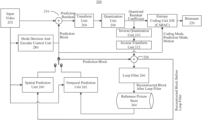
- FIG. 1 illustrates an example encoder block diagram of a hybrid video coding system.
- video encoder 200 may perform intra- or inter-coding of blocks within video frames, including video blocks, or partitions or sub-partitions of video blocks.
- Intra-coding may rely on spatial prediction to reduce or remove spatial redundancy in video within a given video frame.
- Inter-coding may rely on temporal prediction to reduce or remove temporal redundancy in video within adjacent frames of a video sequence.
- Intra modes may refer to a number of spatial based compression modes.
- Inter modes (such as uni-prediction or bi-prediction) may refer to a number of temporal-based compression modes.
- input video signal 202 may be processed block by block.
- the video block unit may be a 16 ⁇ 16 pixel block (e.g., a macroblock (MB)).
- the size of the video block units may vary, depending on the coding techniques used, and the required accuracy and efficiency.
- extended block sizes e.g., a coding tree unit (CTU)
- CTU coding tree unit
- a CTU may include up to 64 ⁇ 64 luma samples corresponding chroma samples, and associated syntax elements.
- the size of a CTU may be further increased to include 128 ⁇ 128 luma samples, corresponding chroma samples, and associated syntax elements.
- a CTU can be further divided into coding units (CUs) using, for example, quad-tree, binary tree, or ternary tree.
- a CU may be further partitioned into prediction units (PUs), for which separate prediction methods may be applied.
- Each input video block may be processed by using spatial prediction unit 260 or temporal prediction unit 262 .
- Spatial prediction unit 260 performs spatial prediction (e.g., intra prediction) to the current block/CU using information on the same picture/slice containing the current block. Spatial prediction may use pixels from the already coded neighboring blocks in the same video picture frame/slice to predict the current video block. Spatial prediction may reduce spatial redundancy inherent in the video signal.
- spatial prediction e.g., intra prediction
- Temporal prediction unit 262 performs temporal prediction (e.g., inter prediction) to the current block using information from picture(s)/slice(s) different from the picture/slice containing the current block.
- Temporal prediction for a video block may be signaled by one or more motion vectors.
- unit-directional temporal prediction only one motion vector indicating one reference picture is used to generate the prediction signal for the current block.
- bi-directional temporal prediction two motion vectors, each indicating a respective reference picture, can be used to generate the prediction signal for the current block.
- the motion vectors may indicate the amount and the direction of motion between the current block and one or more associated block(s) in the reference frames.
- one or more reference picture indices may be sent for a video block.
- the one or more reference indices may be used to identify from which reference picture(s) in the reference picture store or decoded picture buffer (DPB) 264 , the temporal prediction signal may come.
- DPB decoded picture buffer
- Mode decision and encoder control unit 280 in the encoder may choose the prediction mode, for example, based on rate-distortion optimization. Based on the determined prediction mode, the prediction block can be obtained. The prediction block may be subtracted from the current video block at adder 216 . The prediction residual may be transformed by transformation unit 204 and quantized by quantization unit 206 . The quantized residual coefficients may be inverse quantized at inverse quantization unit 210 and inverse transformed at inverse transform unit 212 to form the reconstructed residual. The reconstructed residual may be added to the prediction block at adder 226 to form the reconstructed video block. The reconstructed video block before loop-filtering may be used to provide reference samples for intra prediction.
- the reconstructed video block may go through loop filtering at loop filter 266 .
- loop filtering such as deblocking filter, sample adaptive offset (SAO), and adaptive loop filter (ALF) may be applied.
- the reconstructed block after loop filtering may be stored in reference picture store 264 and can be used to provide inter prediction reference samples for coding other video blocks.
- coding mode e.g., inter or intra
- prediction mode information e.g., motion information
- quantized residual coefficients may be sent to the entropy coding unit 208 to further reduce the bit rate, before the data are compressed and packed to form bitstream 220 .
- a block can be an M by N array of transform coefficients.
- a transform coefficient can be a scalar quantity, considered to be in a frequency domain, that is associated with a particular one-dimensional or two-dimensional frequency index in a transform.
- the transform coefficient levels can be represented by an array TransCoeffLevel[x0][y0][cIdx][xC][yC].
- the array indices x0, y0 can specify the location (x0, y0) of the top-left luma sample of the considered transform block relative to the top-left luma sample of the picture.
- the array index cIdx can specify an indicator for the color component.
- the array indices xC and yC can specify the transform coefficient location (xC, yC) within the current transform block.
- VVC transform coefficients of a coding block are coded using non-overlapped coefficient groups (or sub-blocks). For each sub-block, regular (or context) coded bins and bypass coded bins are separated in coding order. For example, first all regular coded bins for a sub-block are transmitted and, thereafter, the bypass coded bins are transmitted.
- the transform coefficient levels of a sub-block are coded in three passes over the scan positions. The transform coefficient levels can be values of the transform coefficients.
- each bin can have a probability model that is selected by a context. The context can refer to previously encoded syntax elements.
- specific bins can be selected to speed up the coding process with negligible loss of coding efficiency.
- bins can be encoded with a set probability (e.g., a probability that is equal to 0.5).
- a significance flag e.g., sig_coeff_flag
- a greater-than-1 flag e.g., gt1_flag
- a parity flag e.g., par_level_flag
- a greater-than-3 flag e.g., gt3_flag
- the parity flag specifies the parity of the absolute level minus 2.
- the greater-than-3 flag specifies if the absolute level is greater than 3.
- a position of a last regular (e.g., context) coded coefficient may be stored in a variable firstPosModel.
- coding of a remaining absolute level is processed starting from the first scan position of the coefficient group to the firstPosModel position. Only the position with the greater-than-1 flag equal to 1 is coded.
- a non-binary syntax element is binarized with Golomb-Rice code and the resulting bins are coded in the bypass mode of an arithmetic coding engine. For example, a value of 2 may be represented using a Golomb-Rice code of “001,” and each bit of “001” can be referred to as a bin (e.g., bin 0, bin 0, and bin 1).
- coding of absolute level (dec_abs_level) is processed starting from the first bypass coding position (e.g., firstPosModel ⁇ 1, from reverse order) to the last scan position of the coefficient group and are completely coded in the bypass mode of the arithmetic coding engine using a Golomb-Rice code.
- first bypass coding position e.g., firstPosModel ⁇ 1, from reverse order
- coding of sign flags (e.g., sign_flag) is processed for all scan positions with sig_coeff_flag equal to 1.
- no more than 32 regular-coded bins e.g., sig_coeff_flag, gt1_flag, par_level_flag, and gt3_flag
- the number of regular-coded bins may be limited to 8. After the limit is reached, all bins are coded in the bypass mode.
- the sig_coeff_flag, the coeff_sign_flag, the greater-than-1 flag (e.g., abs_level_gtx_flag[0]), and the par_level_flag are processed in coding order. If the sig_coeff_flag is equal to 1, the coeff_sign_flag and the abs_level_gtx_flag[0] are coded in order.
- the coeff_sign_flag specifies the sign of the transform coefficient level.
- the abs_level_gtx_flag[0] specifies whether the absolute level is greater than 1.
- the par_level_flag is additionally coded.
- the par_level_flag specifies the parity of the absolute level minus 2.
- CABAC context-adaptive binary arithmetic coding
- abs_level_gtx_flag[0] for a given position is equal to 1
- a greater-than-3 flag e.g., abs_level_gtx_flag[1]
- the abs_level_gtx_flag[1] specifies whether the absolute level is greater than 3.
- the CABAC engine checks if a context coded bin is available. If the context coded bin is not available, the abs_level_gtx_flag[1] is bypass coded.
- the CABAC engine checks if a context coded bin is available. If the context coded bin is not available, the abs_level_gtx_flag[2] is bypass coded.
- abs_level_gtx_flag[2] for a given position is equal to 1
- a greater-than-7 flag e.g., abs_level_gtx_flag[3]
- the abs_level_gtx_flag[3] specifies whether the absolute level is greater than 7.
- the CABAC engine checks if a context coded bin is available or not. If the context coded bin is not available, the abs_level_gtx_flag[3] is bypass coded.
- abs_level_gtx_flag[3] for a position is equal to 1
- a greater-than-9 flag e.g., abs_level_gtx_flag[4]
- the abs_level_gtx_flag[4] specifies whether the absolute level is greater than 9.
- the CABAC engine checks if a context coded bin is available. If the context coded bin is not available, the abs_level_gtx_flag[4] is bypass coded.
- the abs_remainder is processed for all scan positions with abs_level_gtx_flag[4] equal to 1.
- the non-binary syntax element is binarized with Golomb-Rice code and the resulting bins are coded in the bypass mode of the arithmetic coding engine.
- FIG. 3 illustrates an example pseudocode including syntax of transforming coding.
- the syntax shown in FIG. 3 can be used for transforming coding in VVC.
- FIG. 4 illustrates an example pseudocode including syntax of transforming skip residual coding.
- the syntax shown in FIG. 4 can be used for transforming skip residual coding in VVC.
- the number of coding passes of the transform-skip residual coding is six. That means, in many cases, the CABAC engine needs to scan a coefficient group six times, which significantly affects CABAC's throughput.
- the number of coding passes of the transform-skip residual coding differs from that of transform residual coding (e.g., six passes vs. three passes). The difference in the number of coding passes can result in hardware implementation complexity.
- the coefficient scanning of the transform-skip residual coding is forward scan, whereas the scanning of the transformed residual coding is in a reverse order. The difference in scanning order can also result in hardware implementation complexity.
- the bypass coding has only two syntax elements (e.g., abs_remainder and dec_abs_level).
- the bypass coding can have many more syntax elements, such as sig_coeff_flag, coeff_sign_flag, par_level_flag, abs_level_gtx_flag[0], abs_level_gtx_flag[1], abs_level_gtx_flag[2], abs_level_gtx_flag[3], abs_level_gtx_flag[4], and abs_remainder. It is desirable to unify the bypass coding method of the transformed residual coding and the transform-skip residual coding.
- Embodiments of the present disclosure provide a new bypass coding method of the parity flag.
- the parity flag specifies the parity of the absolute level minus 2, which indicates whether the absolute value of a non-zero coefficient position is even or odd.
- the probability distribution of the parity flag in transform-skip block can be uniform. Therefore, the probabilities of even and odd values can be equal.
- bypass coding of the parity flag and the signal parity flag can be applied. This bypass coding may take place before or after the abs_remainder is signaled.
- the parity flag can be signaled if greater-than-1 flag is equal to 1.
- the total number of context coded bins may be limited to 2 bins per sample in the transform block, freeing up the parity flag's context can allow other syntax elements with non-equal probability distribution (e.g., any of the greater-than-x flags that are coded after parity flag) be context coded, which can improve coding efficiency.
- the parity flag is coded as a regular context coded bin and can be signaled in the second pass of the coefficient coding process.
- the parity flag can be signaled before or after greater-than-3 flag.
- VVC e.g., VVC 5
- a total of four coding passes are used to code the greater-than-3 flag (e.g., abs_level_gtx_flag[1]), the greater-than-5 flag (e.g., abs_level_gtx_flag[2]), the greater-than-7 flag (abs_level_gtx_flag[3]), and the greater-than-9 flag (e.g., abs_level_gtx_flag[4]).
- each flag is coded in a separate coding pass.
- Embodiments of the present disclosure provide a new method to code all the flags in a single pass. As a result, only one coding pass is needed to code all the flags, which can improve CABAC's throughput.
- the position of the greater-than-3 flag (e.g., abs_level_gtx_flag[1]) can be moved to the first coding pass.
- the greater-than-3 flag can be signaled if the greater-than-1 flag (e.g., abs_level_gtx_flag[1]) is equal to 1. This change can unify the coding of the greater-than-1 flag and the greater-than-3 flag with the transformed residual coding case, which also codes these two flags in the first coding pass.
- the number of coding passes of the transform-skip levels of a sub-block can be reduced to 3.
- FIG. 5 illustrates an example method of transform-skip residual coding with the number of coding passes reduced to 3, according to some embodiments of the present disclosure. The method in FIG. 5 comprises three passes.
- coefficients of a sub-block are scanned.
- each coefficient starting from a first scan position of a sub-block to a last scan position of that sub-block is scanned.
- the significance flag can specify if the level of the coefficient is a non-zero value.
- a signal coefficient sign flag e.g., coeff_sign_flag
- a greater-than-1 flag e.g., abs_level_gtx_flag[0]
- a greater-than-5 flag e.g., abs_level_gtx_flag[2]
- the greater-than-5 flag can specify whether the absolute level is greater than 5. If the greater-than-5 flag for the coefficient indicates that the absolute level is greater than 5 (e.g., the greater-than-5 flag is equal to 1), a greater-than-7 flag (e.g., abs_level_gtx_flag[3]) can be coded. The greater-than-7 flag can specify whether the absolute level is greater than 7.
- a greater-than-9 flag e.g., abs_level_gtx_flag[4]
- the greater-than-9 flag can specify whether the absolute level is greater than 9.
- coefficients of the sub-block are scanned. In some embodiments, each coefficient starting from the first scan position of the sub-block to the last scan position of that sub-block is scanned. If the greater-than-1 flag for a coefficient indicates that the absolute level is greater than 1 (e.g., the greater-than-1 flag is equal to 1), a parity level flag (e.g., par_level_flag) for the coefficient can be bypass coded.
- the parity level flag can specify the parity of the absolute level minus 2.
- FIG. 6 illustrates an example pseudocode including syntax of the method shown in FIG. 5 , according to some embodiments of the present disclosure. Some portions of the pseudocode in FIG. 6 are italicized, indicating the processing of the greater-than-3 flag, the greater-than-5 flag, the greater-than-7 flag, the greater-than-9 flag, and the parity level flag.
- the method of FIG. 5 can be implemented by an encoder (e.g., encoder of FIG. 1 ).
- the encoder can receive video frames.
- the method can comprise three passes.
- coefficients of a sub-block is scanned.
- each coefficient starting from a first scan position of a sub-block to a last scan position of that sub-block is scanned.
- There can be a significance flag (e.g., sig_coeff_flag) for each coefficient.
- the significance flag can be decoded.
- the significance flag can specify if the level is a non-zero value.
- a signal coefficient sign flag e.g., coeff_sign_flag
- a greater-than-1 flag e.g., abs_level_gtx_flag[0]
- coefficients of the sub-block are scanned. In some embodiments, each coefficient starting from the first scan position of the sub-block to the last scan position of that sub-block is scanned. If the greater-than-1 flag for the coefficient indicates that the absolute level is greater than 1 (e.g., the greater-than-1 flag is equal to 1), a parity level flag (e.g., par_level_flag) for each coefficient can be decoded.
- the parity level flag can specify the parity of the absolute level minus 2.
- a greater-than-3 flag e.g., abs_level_gtx_flag[1]
- a greater-than-5 flag e.g., abs_level_gtx_flag[2]
- coefficients of the sub-block are scanned. In some embodiments, each coefficient starting from the first scan position of the sub-block to the last scan position of that sub-block is scanned. If the greater-than-9 flag indicates that the absolute level is greater than 9 (e.g., the greater-than-9 flag is equal to 1), a remaining absolute level (e.g., abs_remainder) for the coefficient can be decoded.
- FIG. 7 illustrates another example method of transform-skip residual coding with the number of coding passes reduced to 3, according to some embodiments of the present disclosure.
- the method of FIG. 7 can comprise three passes.
- coefficients of a sub-block are scanned.
- each coefficient starting from a first scan position of a sub-block to a last scan position of that sub-block is scanned.
- There can a significance flag (e.g., sig_coeff_flag) for each coefficient.
- the significance flag can indicate whether the level is a non-zero value. If the significance flag for the coefficient indicates that the level is a non-zero value (e.g., the significance flag is equal to 1), a signal coefficient sign flag (e.g., coeff_sign_flag) and a greater-than-1 flag (e.g., abs_level_gtx_flag[0]) can be coded.
- coefficients of the sub-block are scanned. In some embodiments, each coefficient starting from the first scan position of the sub-block to the last scan position of that sub-block is scanned. If the greater-than-3 flag for a coefficient indicates that the absolute level is greater than 3 (e.g., the greater-than-3 flag is equal to 1), a greater-than-5 flag (e.g., abs_level_gtx_flag[2]) can be coded. The greater-than-5 flag can specify whether the absolute level is greater than 5.
- a greater-than-7 flag e.g., abs_level_gtx_flag[3]
- the greater-than-7 flag can specify whether the absolute level is greater than 7. If the greater-than-7 flag for the coefficient indicates that the absolute level is greater than 7 (e.g., the greater-than-7 flag is equal to 1), a greater-than-9 flag (e.g., abs_level_gtx_flag[4]) can be coded.
- the greater-than-9 flag can specify whether the absolute level is greater than 9.
- coefficients of the sub-block are scanned. In some embodiments, each coefficient starting from the first scan position of the sub-block to the last scan position of that sub-block is scanned. If the greater-than-1 flag for a coefficient indicates that the absolute level is greater than 1 (e.g., the greater-than-1 flag is equal to 1), a parity level flag (e.g., par_level_flag) for the coefficient can be bypass coded.
- the parity level flag can specify the parity of the absolute level minus 2.
- FIG. 7 illustrates an example pseudocode including syntax of the method shown in FIG. 7 , according to some embodiments of the present disclosure. Some portions of the pseudocode in FIG. 8 are italicized, indicating the processing of the greater-than-3 flag, the greater-than-5 flag, the greater-than-7 flag, the greater-than-9 flag, and the parity level flag.
- the method in FIG. 7 can be implemented by an encoder (e.g., encoder of FIG. 1 ).
- the encoder can receive video frames.
- the method can comprise three passes.
- coefficients of a sub-block are scanned.
- each coefficient starting from a first scan position of a sub-block to a last scan position of that sub-block is scanned.
- There can be a significance flag (e.g., sig_coeff_flag) for each coefficient.
- the significance flag is decoded.
- the significance flag can indicate whether the level is a non-zero value.
- a signal coefficient sign flag e.g., coeff_sign_flag
- a greater-than-1 flag e.g., abs_level_gtx_flag[0]
- a greater-than-3 flag e.g., abs_level_gtx_flag[1]
- coefficients of the sub-block are scanned. In some embodiments, each coefficient starting from the first scan position of the sub-block to the last scan position of that sub-block is scanned. If the greater-than-1 flag for a coefficient indicates that the absolute level is greater than 1 (e.g., the greater-than-1 flag is equal to 1), a parity level flag (e.g., par_level_flag) for each coefficient can be decoded. If the greater-than-3 flag for the coefficient indicates that the absolute level is greater than 3 (e.g., the greater-than-3 flag is equal to 1), a greater-than-5 flag (e.g., abs_level_gtx_flag[2]) can be decoded.
- a parity level flag e.g., par_level_flag
- a greater-than-7 flag e.g., abs_level_gtx_flag[3]
- a greater-than-9 flag e.g., abs_level_gtx_flag[4]
- the greater-than-9 flag can specify whether the absolute level is greater than 9.
- coefficients of the sub-block are scanned. In some embodiments, each coefficient starting from the first scan position of the sub-block to the last scan position of that sub-block is scanned. If the greater-than-9 flag indicates that the absolute level is greater than 9 (e.g., the greater-than-9 flag is equal to 1), a remaining absolute level (e.g., abs_remainder) for the coefficient can be decoded.
- the decoder can receive a video bit-stream.
- the scanning order of the transform-skip residual block can be changed in order to unify the scanning order of the transformed and transform-skip residual coding processes.
- the scanning order of the transform-skip residual block can be changed from forward scanning to reverse scanning.
- FIG. 9 illustrates an example reverse scanning of an 8 ⁇ 8 transform-skip block, according to some embodiments of the present disclosure. As shown in FIG. 9 , the scanning of the coefficients starts from the coefficient located at the bottom-right corner and ends at the coefficient located at the top-left corner. It is appreciated that the scanning order illustrated in FIG. 9 can be applied by methods shown in FIG. 5 and FIG. 7 .
- the reverse scanning can be executed after the transform block is flipped.
- FIGS. 10 A and 10 B illustrate an example flipping of an 8 ⁇ 8 block, according to some embodiments of the present disclosure. As shown in FIGS. 10 A and 10 B , after flipping the block, the position of the top-left residual coefficient is moved to the bottom-right position. After a block is flipped, the reverse scanning (e.g., reverse scanning of FIG. 9 ) can be executed.
- the bypass coding can be executed in multiple passes.
- FIG. 11 illustrates an example multi-pass coding, according to some embodiments of the present disclosure.
- the multi-pass coding shown in FIG. 11 can be executed in VVC (e.g., VVC 5). It can be assumed that the number of context coded bins in FIG. 11 has reached a maximum limit at the position of the first pass (shown as the black dot in FIG. 11 ).
- the flags e.g., greater-than-3 flag, greater-than-5 flag, greater-than-7 flag, greater-than-9 flag, etc.
- the flags can be bypass coded in multiple coding passes.
- FIG. 12 illustrates an example single pass bypass coding method for an absolute value of a level, according to some embodiments of the disclosure. As shown in FIG. 12 , once the context coded bins reach maximum limits (e.g., shown as a black dot in FIG. 12 ), the CABAC engine can start bypass coding of the remainder of the absolute level using Golomb-Rice coding.
- FIG. 13 illustrates an example look-up table for Rice parameters, according to some embodiments of the present disclosure.
- Rice parameters can be represented by a variable cRiceParam.
- the location of sum absolute can be represented by a variable locSumAbs.
- a Rice parameter (e.g., cRiceParam) can be derived in the following way. Given an array AbsLevel[x][y] for a transform-skip block, a top-left luma location (x0, y0), and a current coefficient scan location (xC, yC), assuming minLevel is a minimum bypass coded value, if none of the flags of a coefficient is context coded, minLevel for that coefficient is 0. If all of the flags are context coded, minLevel is equal to 10.
- variable locSumAbs can be derived as specified by the following pseudo code:
- the single pass bypass coding can be combined with the method shown in FIG. 7 .
- FIG. 14 illustrates an example method of transform-skip residual coding with the number of coding passes reduced to 3 combined with a single pass bypass coding, according to some embodiments of the present disclosure.
- the method in FIG. 14 comprises 3 passes.
- coefficients of a sub-block are scanned.
- each coefficient starting from first scan position of the sub-block to the last scan position is scanned.
- the following can be performed if the remaining number of context coded bins are larger than or equal to a group limit. For example, in some embodiments, it is more efficient to code all of the flags in the group using either context coding or bypass coding. As a result, if the number of context coded bins is less than the group limit, it is more efficient to code all the remaining flags using bypass coding, instead of coding some of the remaining flags using context coding and others using bypass coding.
- a significance flag e.g., sig_coeff_flag
- a signal coefficient sign flag e.g., coeff_sign_flag
- a greater-than-1 flag e.g., abs_level_gtx_flag[0]
- a greater-than-3 flag e.g., abs_level_gtx_flag[1]
- the coefficients can be scanned until the context coded bins reach maximum limits (e.g., the black dot in FIG. 12 ), and then the scanning stops at a position as the last position of the first pass.
- a first pass bypass position variable (e.g., iFirstPassBypassPos) can be set according to the last position of the previous pass (step 1404 ).
- the first pass bypass position variable can be set to the last position of the previous pass plus 1.
- coefficients starting from the first scan position of a sub-block to iFirstPassBypassPos can be scanned. For each coefficient, the following can be performed if the remaining number of context coded bins are larger than or equal to a group limit.
- the group limit can be 3 (e.g., greater-than 5 flag, greater-than-7 flag, and greater-than-9 flag). If greater-than-3 flag indicates that the absolute level is greater than 3 (e.g., the greater-than-3 flag is equal to 1), a greater-than-5 flag (e.g., abs_level_gtx_flag[2]) can be coded.
- a greater-than-7 flag e.g., abs_level_gtx_flag[3]
- a greater-than-9 flag e.g., abs_level_gtx_flag[4]
- a second pass bypass position variable (e.g., iSecondPassBypassPos) is set according to the last position of the previous pass (step 1408 ).
- the second pass bypass position variable can be set to the last position of the previous pass plus 1.
- coefficients starting from the first scan position of a sub-block to iFirstPassBypassPos can be scanned. The following can be performed for each coefficient. If the greater-than-1 flag indicates that the absolute level is greater than 1 (e.g., the greater-than-1 flag is equal to 1), a parity level flag (e.g., par_level_flag) can be bypass coded. If the greater-than-9 flag indicates that the absolute level is greater than 9 (e.g., the greater-than-9 flag is equal to 1), coding of a remaining absolute level (e.g., abs_remainder) can be processed by the non-binary syntax element which is binarized with Golomb-Rice code. The resulting bins can be coded in the bypass mode of the arithmetic coding engine.
- a parity level flag e.g., par_level_flag
- coding of a remaining absolute level e.g., abs_remainder
- the resulting bins can be coded in the
- coefficients starting from iFirstPassBypassPos to the last scan position can be scanned.
- coding of absolute level e.g., dec_abs_level
- the resulting bins can be coded in the bypass mode of the arithmetic coding engine.
- the signal coefficient sign flag can also be coded.
- coefficients starting from iFirstPassBypassPos to the last scan position can be scanned, and coding of absolute level (e.g., dec_abs_level) can processed by two steps for each coefficient.
- dec_abs_level absolute level
- the signal coefficient sign flag can also be coded.
- FIG. 15 illustrates an example pseudocode including syntax of bypass coding combined with the method in FIG. 14 , according to some embodiments of the present disclosure. Some portions of the pseudocode in FIG. 15 are italicized, indicating the processing of the greater-than-3 flag, the greater-than-5 flag, the greater-than-7 flag, the greater-than-9 flag, and the parity level flag.
- a two-pass coding method can be used. For example, all of the flags can be context coded in pass 1, and Golomb-Rice coding can be used for bypass coding in pass 2.
- FIG. 16 illustrates an example method of transform-skip residual coding with a first pass for context coding and a second pass for Golomb-Rice coding, according to some embodiments of the present disclosure. The method in FIG. 16 comprises 2 passes.
- coefficients of a sub-block are scanned.
- each coefficient starting from a first scan position of a sub-block to a last scan position is scanned.
- the following can be performed if the remaining number of context coded bins is equal to or larger than 8.
- a significance flag e.g., sig_coeff_flag
- the significance flag indicates that the level is non-zero (e.g., the significance flag is equal to 1)
- a coefficient sign flag e.g., coeff_sign_flag
- a greater-than-1 flag e.g., abs_level_gtx_flag[0]
- a parity level flag e.g., par_level_flag
- a greater-than-3 flag e.g., abs_level_gtx_flag[1]
- the parity level flag can specify the parity of the absolute level minus 2.
- the greater-than-3 flag can specify whether the absolute level is greater than 3. If the greater-than-3 flag indicates that the absolute level is greater than 3 (e.g., the greater-than-3 flag is equal to 1), a greater-than-5 flag (e.g., abs_level_gtx_flag[2]) can be coded.
- a greater-than-7 flag e.g., abs_level_gtx_flag[3]
- a greater-than-9 flag e.g., abs_level_gtx_flag[4]
- the greater-than-9 flag can specify whether the absolute level of the level is greater than 9.
- the coefficients can be scanned until the context coded bins reach maximum limits (e.g., the black dot in FIG. 12 ), and then the scanning stops at a position as the last position of the first pass.
- a first pass bypass position variable (iFirstPassBypassPos) can be set according to the last position of the previous pass (step 1604 ).
- the first pass bypass position variable can be set to the last position of the previous pass plus 1.
- the first pass bypass position variable can represent a start position from which an absolute level (e.g., dec_abs_level) syntax is signaled.
- Coefficients whose scan position is less than the first pass bypass position can be partially signaled through the context coding in pass 1 and the remaining coefficients can be signaled in pass 2(a). In some embodiments, if the scan position of a coefficient is greater than or equal to the first pass bypass position variable, none of the flags of that coefficient is context coded, and the full coefficient and sign can be signaled using bypass coding of pass 2(b).
- coefficients starting from the first scan position of the sub-block to a location of the first pass bypass position variable minus 1 can be scanned. The following can be performed for each coefficient. If the greater-than-9 flag indicates that the absolute level is greater than 9 (e.g., the greater-than-9 flag is equal to 1), the remaining absolute level (e.g., abs_remainder) can be binarized using Golomb-Rice code, and the resulting bins can be coded in a bypass mode of the arithmetic coding engine.
- coefficients starting from the first pass bypass position to the last scan position can be scanned. The following can be performed for each coefficient.
- An absolute level e.g., dec_abs_level
- Golomb-Rice code e.g., Golomb-Rice code
- the resulting bins can be coded in the bypass mode of the arithmetic coding engine. If the absolute level is not equal to 0, a coefficient sign flag (e.g., coeff_sign_flag) can be bypass coded.
- the method of FIG. 16 can be implemented by an encoder (e.g., encoder of FIG. 1 ).
- the encoder can receive video frames.
- the encoded video frame from the method of FIG. 17 can be decoded using a decoder (e.g., decoder of FIG. 2 ).
- the decoding method can comprise 2 passes.
- coefficients of a sub-block are scanned.
- each coefficient starting from a first scan position of a sub-block to a last scan position is scanned.
- the group limit can be 8, indicating the number of different flags to be coded in pass 1 (e.g., significance flag, coefficient sign flag, greater-than-1 flag, parity level flag, greater-than-3 flag, greater-than-5 flag, greater-than-7 flag, and greater-than-9 flag).
- a significance flag e.g., sig_coeff_flag
- a coefficient sign flag e.g., coeff_sign_flag
- a greater-than-1 flag e.g., abs_level_gtx_flag[0]
- a parity level flag e.g., par_level_flag
- a greater-than-3 flag e.g., abs_level_gtx_flag[1]
- the parity level flag can specify the parity of the absolute level minus 2.
- the greater-than-3 flag can specify whether the absolute level is greater than 3. If the greater-than-3 flag indicates that the absolute level is greater than 3 (e.g., the greater-than-3 flag is equal to 1), a greater-than-5 flag (e.g., abs_level_gtx_flag[2]) can be decoded. If the greater-than-5 flag indicates that the absolute level is greater than 5 (e.g., the greater-than-5 flag is equal to 1), a greater-than-7 flag (e.g., abs_level_gtx_flag[3]) can be decoded.
- a greater-than-5 flag e.g., abs_level_gtx_flag[2]
- a greater-than-7 flag e.g., abs_level_gtx_flag[3]
- a greater-than-9 flag (e.g., abs_level_gtx_flag[4]) can be decoded.
- the greater-than-9 flag can specify whether the absolute level of the level is greater than 9.
- the coefficients can be scanned until the context coded bins reach maximum limits (e.g., the black dot in FIG. 12 ), and then the scanning stops at a position as the last position of the first pass.
- a first pass bypass position variable (iFirstPassBypassPos) can be set according to the last position of the previous pass.
- the first pass bypass position variable can be set to the last position of the previous pass plus 1.
- the first pass bypass position variable can represent a start position from which an absolute level (e.g., dec_abs_level) syntax is signaled.
- Coefficients whose scan position is less than the first pass bypass position can be partially signaled through the context coding in pass 1 and the remaining coefficients can be signaled in pass 2(a). In some embodiments, if the scan position of a coefficient is greater than or equal to the first pass bypass position variable, none of the flags of that coefficient is context decoded, and the full coefficient and sign can be signaled using bypass decoding of pass 2(b).
- coefficients starting from the first scan position of the sub-block to a location of the first pass bypass position variable minus 1 can be scanned. The following can be performed for each coefficient. If the greater-than-9 flag indicates that the absolute level is greater than 9 (e.g., the greater-than-9 flag is equal to 1), the binarized remaining absolute level (e.g., abs_remainder) can be can be decoded using Golomb-Rice code, and the resulting bins can be decoded in a bypass mode of the arithmetic coding engine.
- the binarized remaining absolute level e.g., abs_remainder
- coefficients starting from the first pass bypass position to the last scan position can be scanned. The following can be performed for each coefficient.
- a binarized absolute level e.g., dec_abs_level
- Golomb-Rice code e.g., Golomb-Rice code
- the resulting bins can be decoded in the bypass mode of the arithmetic coding engine. If the absolute level is not equal to 0, a coefficient sign flag (e.g., coeff_sign_flag) can be bypass decoded.
- FIG. 17 illustrates an example pseudocode including syntax of the bypass coding of the method in FIG. 16 , according to some embodiments of the present disclosure. Some portions of the pseudocode in FIG. 17 are italicized, indicating the processing of the first pass bypass position and pass 2(b).
- the Rice parameter cRiceParam can be derived in the following manner. Given an array TransCoeffLevel[xC][yC] as the coefficient value at a scan location (xC, yC) and a value minLevel as a minimum bypass coded value, if none of the flags of a coefficient is context coded, minLevel for that coefficient is 0. If all of the flags are context coded, minLevel is equal to 10.
- the variable locSumAbs can be derived as specified by the following pseudo code:
- FIG. 18 illustrates an example look-up table for Rice parameters when minimum bypass coded value is equal to 0, according to some embodiments of the present disclosure.
- Rice parameters can be represented by a variable cRiceParam.
- the location of sum absolute can be represented by a variable locSumAbs.
- two separate look-up tables can be used for Rice parameter derivations based on minLevel. If minLevel is equal to 0, the table shown in FIG. 18 can be used. If minLevel is not equal to 0, the table shown in FIG. 13 can be used.
- the derivation of Rice parameter does not require any look-up table.
- the cRiceParam can be derived as follows:
- the offset can be a predefined constant and can be determined by offline training.
- One example of the offset value is 4.
- the offset value depends on the color component.
- the offset value can be 4 for luma and 0 for chroma.
- the offset value depends on the frame type.
- the offset value can be 4 for intra frame and 0 for inter frame.
- transform skip mode is allowed for both luma and chroma components, and both types of components can share the same context variables.
- a context variable can be a variable specified for the adaptive binary arithmetic decoding process of a bin by an equation containing recently decoded bins.
- the signal statistics of luma and chroma blocks may be different.
- different context variables can be used for luma and chroma components.
- a significance coefficient flag e.g., sig_coeff_flag
- a parity flag e.g., par_level_flag
- a signal coefficient sign flag e.g., coeff_sign_flag
- coded_sub_block_flag e.g., coded_sub
- VVC In VVC (e.g., VVC 7), 3 context variables can be used to code sig_coeff_flag of the transform skip mode.
- a total of 6 context variables e.g., 3 for luma and 3 for chroma
- the context index for coding the sig_coeff_flag of the transform skip mode can be derived from the number of significant coefficients of neighbors (e.g., top and left neighbors).
- the context index can refer to the identifiers of a context variable.
- the context index of the first context variable can be 0, the context index of the second context variable can be 1, etc.
- Input to this process can be the color component index cIdx, the luma location (x0, y0), and the current coefficient scan location (xC, yC).
- the luma location (x0, y0) can specify a specific sample (e.g., a top-left sample) of the current transform block relative to the specific sample (e.g., top-left sample) of the current picture.
- the output of this process can be the coding index variable ctxInc.
- the variable ctxInc can be derived according to the following pseudocode:
- VVC In VVC (e.g., VVC 7), 4 context variables can be used to code abs_level_gtx_flag[n][0] of the transform skip mode.
- a total of 8 context variables (4 for luma and 4 for chroma) can be used to code abs_level_gtx_flag[n][0] of the transform skip mode.
- the context index for coding abs_level_gtx_flag[n][0] of the transform skip can be derived from the number of significant coefficients of neighbors (e.g., top and left neighbors). Input to this process can be the color component index cIdx, the luma location (x0, y0), and the current coefficient scan location (xC, yC).
- the luma location (x0, y0) can specify the specific sample (e.g., top-left sample) of the current transform block relative to the specific sample (e.g., top-left sample) of the current picture.
- the output of this process can be the coding index variable ctxInc.
- the variable ctxInc can be derived according to the following pseudocode:
- 1 context variable can be used to code par_level_flag of the transform skip mode.
- a total of 2 context variables (1 for luma and 1 for chroma) can be used to code par_level_flag of the transform skip mode.
- the context index for coding par_level_flag of the transform skip can be derived in the following manner.
- the input to this process can be the color component index cIdx.
- the output of this process is the coding index variable ctxInc.
- the variable ctxInc can be derived according to the following pseudocode:
- separate context variables for luma and chroma can be used to code abs_level_gtx_flag of the transform skip mode.
- the context index for coding abs_level_gtx_flag of the transform skip can be derived in the following manner.
- the input to this process can be the color component index cIdx.
- the output of this process can be the coding index variable ctxInc.
- VVC e.g., VVC 7
- 6 context variables can be used to code coeff_sign_flag of the transform skip mode.
- a total of 12 context variables (6 for luma and 6 for chroma) can be used to code coeff_sign_flag of the transform skip mode.
- the context index for coding the coeff_sign_flag of the transform skip mode can be derived from the coeff_sign_flag of neighbors (e.g., top and left neighbors).
- Input to this process can be the color component index cIdx, the luma location (x0, y0), and the current coefficient scan location (xC, yC).
- the luma location (x0, y0) can specify the specific sample (e.g., top-left sample) of the current transform block relative to the specific sample (e.g., top-left sample) of the current picture.
- the output of this process can be the coding index variable ctxInc.
- variables leftSign and aboveSign can be derived according to the following pseudocode:
- variable ctxInc can be derived according to the following pseudocode:
- VVC e.g., VVC 7
- 3 context variables can be used to code coded_sub_block_flag of the transform skip mode.
- the coded_sub_block_flag can be a sub-block flag that specifies whether the transform coefficient levels in the sub-block are equal to 0. For example, if the coded_sub_block_flag[xS][yS] is equal to 0, the transform coefficient levels of the subblock at location (xS, yS) are inferred to be equal to 0. If coded_sub_block_flag[xS][yS] is equal to 1, at least one of the transform coefficient levels of the sub-block at location (xS, yS) has a non-zero value.
- a total of 6 context variables (3 for luma and 3 for chroma) can be used to code coded_sub_block_flag of the transform skip mode.
- the context index for coding the coded_sub_block_flag of the transform skip mode can be derived from the coded_sub_block_flag of top and left neighbors.
- Input to this process can be the color component index cIdx, the luma location (x0, y0), the current sub-block scan location (xS, yS), the previously decoded bins of the syntax element coded_sub_block_flag, the binary logarithm of the transform block width log 2TbWidth, and the transform block height log 2TbHeight.
- the luma location (x0, y0) can specify the top-left sample of the current transform block relative to the top-left sample of the current picture.
- the output of this process can be the coding index variable ctxInc.
- the variables log 2SbWidth and log 2SbHeight can be derived according to the following pseudocode:
- variables log 2SbWidth and log 2SbHeight can be modified according to the following pseudocode:
- a variable csbfCtx can be initialized as 0 and modified according to the following pseudocode:
- the context index variable ctxInc can be derived using the color component index cIdx and csbfCtx according to the following pseudocode:
- a non-transitory computer-readable storage medium including instructions is also provided, and the instructions may be executed by a device (such as the disclosed encoder and decoder), for performing the above-described methods.
- a device such as the disclosed encoder and decoder
- Common forms of non-transitory media include, for example, a floppy disk, a flexible disk, hard disk, solid state drive, magnetic tape, or any other magnetic data storage medium, a CD-ROM, any other optical data storage medium, any physical medium with patterns of holes, a RAM, a PROM, and EPROM, a FLASH-EPROM or any other flash memory, NVRAM, a cache, a register, any other memory chip or cartridge, and networked versions of the same.
- the device may include one or more processors (CPUs), an input/output interface, a network interface, and/or a memory.
- the term “or” encompasses all possible combinations, except where infeasible. For example, if it is stated that a database may include A or B, then, unless specifically stated otherwise or infeasible, the database may include A, or B, or A and B. As a second example, if it is stated that a database may include A, B, or C, then, unless specifically stated otherwise or infeasible, the database may include A, or B, or C, or A and B, or A and C, or B and C, or A and B and C.
- the above described embodiments can be implemented by hardware, or software (program codes), or a combination of hardware and software. If implemented by software, it may be stored in the above-described computer-readable media. The software, when executed by the processor can perform the disclosed methods.
- the computing units and other functional units described in the present disclosure can be implemented by hardware, or software, or a combination of hardware and software.
- One of ordinary skill in the art will also understand that multiple ones of the above described modules/units may be combined as one module/unit, and each of the above described modules/units may be further divided into a plurality of sub-modules/sub-units.
- a coding method implemented by an encoder of video data comprising:
- a decoding method implemented by a decoder of video data comprising:
- a system to encode video data comprising:
- a system to decode video data comprising:
- a coding method implemented by an encoder of video data comprising:
- the first pass of scanning further comprises: coding a greater-than-1 flag for a first transform coefficient in response to the significance flag of the first transform coefficient indicating that a level of the first transform coefficient is not zero, the first transform coefficient being one of the first set of transform coefficients, the greater-than-1 flag indicating whether an absolute value of the level of the first transform coefficient is greater than 1.
- binarizing the absolute value of the level for each of the second set of transform coefficients further comprises:
- a decoding method implemented by a decoder of video data comprising:
- decoding the binarized absolute value of the level for each of the second set of transform coefficients further comprises:
- a system to encode video data comprising:
- a system to decode video data comprising:
- a coding method implemented by an encoder of video data comprising:
- a video processing method comprising:
- a decoding method implemented by a decoder of video data comprising:
- decoding the first set of transform coefficients comprises:
- decoding the first set of transform coefficients comprises:
- decoding the first set of transform coefficients comprises:
- decoding the first set of transform coefficients comprises:
- decoding the first set of transform coefficients comprises:
- a system to encode video data comprising:
- a system to decode video data comprising:
- a non-transitory computer readable medium that stores a set of instructions that is executable by one or more processors of an apparatus to cause the apparatus to initiate a method for encoding video data, the method comprising:
- a non-transitory computer readable medium that stores a set of instructions that is executable by one or more processors of an apparatus to cause the apparatus to initiate a method for decoding video data, the method comprising:
- a non-transitory computer readable medium that stores a set of instructions that is executable by one or more processors of an apparatus to cause the apparatus to initiate a method for encoding video data, the method comprising:
- a non-transitory computer readable medium that stores a set of instructions that is executable by one or more processors of an apparatus to cause the apparatus to initiate a method for decoding video data, the method comprising:
- a non-transitory computer readable medium that stores a set of instructions that is executable by one or more processors of an apparatus to cause the apparatus to initiate a method for decoding video data, the method comprising:
Landscapes
- Engineering & Computer Science (AREA)
- Multimedia (AREA)
- Signal Processing (AREA)
- Compression Or Coding Systems Of Tv Signals (AREA)
Abstract
Description
| locSumAbs = 0 | |||
| if (xC > 0) | |||
| locSumAbs += AbsLevel[ xC − 1][ yC ] | |||
| if (yC > 0) | |||
| locSumAbs += AbsLevel[ xC] [ yC -1] | |||
| locSumAbs += ( 10 − minLevel) | |||
| locSumAbs = Clip3 ( 0, 31, LocSumAbs ) | |||
| locSumAbs = 0 | |||
| if (xC > 0) | |||
| locSumAbs += Abs(TransCoeffLevel[ xC − 1][ yC ]) | |||
| if (yC > 0) | |||
| locSumAbs += Abs(TransCoeffLevel[ xC] [ yC -1]) | |||
| locSumAbs = locSumAbs − 2*minLevel | |||
| locSumAbs = Clip3 ( 0, 31, LocSumAbs ) | |||
| locNumSig = 0 | |
| if (xC > 0) | |
| locNumSig += sig_coeff_flag[xC − l][yC] | |
| if (yC > 0) | |
| locNumSig += sig_coeff_flag[xC][yC − 1] | |
| if (cIdx == 0) // e.g., luma component, ctxInc can be derived as: | |
| ctxInc = locNumSig | |
| else // e.g., chroma component, ctxInc can be derived as: | |
| ctxInc = |
|
| if (BdpcmFlag[x0][y0][cIdx] == 1) | |
| ctxInc = 3 | |
| else if (xC > 0 and yC > 0) | |
| ctxInc = sig_coeff_flag[xC − 1][yC] + sig_coeff_flag[xC][yC − 1] | |
| else if (xC > 0) | |
| ctxInc = sig_coeff_flag[xC − l][yC] | |
| else if (yC > 0) | |
| ctxInc = sig_coeff_flag[xC][yC − 1] | |
| else | |
| ctxInc = 0 | |
| if (cIdx > 0) | |
| ctxInc = |
|
| if (cIdx == 0) | |||
| ctxInc = 0 | |||
| else | |||
| ctxInc = 1 | |||
| if (xC == 0) | |||
| leftSign = 0 | |||
| else | |||
| leftSign = CoeffSignLevel[xC − l][yC] | |||
| if (yC == 0) | |||
| aboveSign = 0 | |||
| else | |||
| aboveSign = CoeffSignLevel[xC][yC − 1] | |||
| if ((leftSign == 0 and aboveSign == 0) or (leftSign == aboveSign)) | |
| if (BdpcmFlag[x0][y0][cIdx] == 0) | |
| ctxInc = 0 | |
| else | |
| ctxInc = 3 | |
| else if (leftSign >= 0 and aboveSign >= 0) | |
| if (BdpcmFlag[x0][y0][cIdx]) | |
| ctxInc = 1 | |
| else | |
| ctxInc = 4 | |
| else | |
| if (BdpcmFlag[x0][y0][cIdx]) | |
| ctxInc = 2 | |
| else | |
| ctxInc = 5 | |
| if (cIdx > 0) | |
| ctxInc = |
|
| if (minimum (log2TbWidth, log2TbHeight) < 2) | |||
| log2SbWidth = 1 | |||
| else | |||
| log2SbHeight = log2SbWidth | |||
| if (log2TbWidth < 2 and cIdx == 0) | |||
| log2SbWidth = log2TbWidth | |||
| log2SbHeight = 4 − log2SbWidth | |||
| else if (log2TbHeight < 2 and cIdx == 0) | |||
| log2SbHeight = log2TbHeight | |||
| log2SbWidth = 4 − log2SbHeight | |||
| if (xS > 0) | |
| csbfCtx = csbfCtx + coded_sub_block_flag[xS − l][yS] | |
| if (yS > 0) | |
| csbfCtx = csbfCtx + coded_sub_block_flag[xS][yS − 1] | |
| if (cIdx == 0) | |||
| ctxInc = csbfCtx | |||
| else | |||
| ctxInc = 3 + csbfCtx | |||
-
- performing a first pass of scanning a transform coefficient of a sub-block of a video frame, wherein the first pass of scanning comprises:
- bypass coding a parity level flag for the transform coefficient, the parity level flag indicating a parity of an absolute value of a level of the transform coefficient.
- performing a first pass of scanning a transform coefficient of a sub-block of a video frame, wherein the first pass of scanning comprises:
-
- before the first pass of scanning, performing a second pass of scanning the transform coefficient, wherein the second pass of scanning comprises:
- coding a greater-than-1 flag, wherein the greater-than-1 flag indicates whether the absolute value is greater than 1;
- wherein the first pass of scanning further comprises:
- bypass coding the parity level flag in response to the greater-than-1 flag indicating that the absolute value is greater than 1.
- before the first pass of scanning, performing a second pass of scanning the transform coefficient, wherein the second pass of scanning comprises:
-
- scanning the plurality of transform coefficients until a number of context coded bins reaches a maximum limit; and
- in response to the number of context coded bins reaching the maximum limit, bypass coding absolute values of levels of transform coefficients that are unscanned in the second pass, wherein the bypass coding comprises binarizing the absolute values of the unscanned transform coefficients using Golomb-Rice coding.
-
- coding a significance flag for the transform coefficient, the significance flag indicating whether the level of the transform coefficient is zero; and coding the greater-than-1 flag in response to the significance flag indicating that the level of the transform coefficient is not zero.
-
- coding a greater-than-3 flag for the transform coefficient in response to the greater-than-1 flag indicating that the absolute value is greater than 1, the greater-than-3 flag indicating whether the absolute value is greater than 3.
-
- after the second pass of scanning and before the first pass of scanning, performing a third pass of scanning the transform coefficient, wherein the third pass of scanning comprises:
- coding a greater-than-5 flag for the transform coefficient in response to the greater-than-3 flag indicating that the absolute value is greater than 3, the greater-than-5 flag indicating whether the absolute value is greater than 5;
- coding a greater-than-7 flag for the transform coefficient in response to the greater-than-5 flag indicating that the absolute value is greater than 5, the greater-than-7 flag indicating whether the absolute value is greater than 7; and
- coding a greater-than-9 flag for the transform coefficient in response to the greater-than-7 flag indicating that the absolute value is greater than 7, the greater-than-9 flag indicating whether the absolute value is greater than 9.
- after the second pass of scanning and before the first pass of scanning, performing a third pass of scanning the transform coefficient, wherein the third pass of scanning comprises:
-
- coding a remaining absolute level flag for the transform coefficient in response to the greater-than-9 flag indicating that the absolute value is greater than 9, the remaining absolute level flag indicating a remaining absolute value of the level of the transform coefficient.
-
- after the second pass of scanning and before the first pass of scanning, performing a third pass of scanning the transform coefficient, wherein the third pass of scanning further comprises:
- coding a greater-than-3 flag for the transform coefficient in response to the greater-than-1 flag indicating that the absolute value is greater than 1, the greater-than-3 flag indicating whether the absolute value is greater than 3.
-
- coding a greater-than-5 flag for the transform coefficient in response to the greater-than-3 flag indicating that the absolute value is greater than 3, the greater-than-5 flag indicating whether the absolute value is greater than 5;
- coding a greater-than-7 flag for the transform coefficient in response to the greater-than-5 flag indicating that the absolute value is greater than 5, the greater-than-7 flag indicating whether the absolute value is greater than 7; and
- coding a greater-than-9 flag for the transform coefficient in response to the greater-than-7 flag indicating that the absolute value is greater than 7, the greater-than-9 flag indicating whether the absolute value is greater than 9.
-
- coding a remaining absolute level flag for the transform coefficient in response to the greater-than-9 flag indicating that the absolute value is greater than 9, the remaining absolute level flag indicating a remaining absolute value of the level of the transform coefficient.
-
- flipping the plurality of transform coefficients prior to performing the first pass of scanning.
-
- receiving the video frame; and
- splitting the video frame into a plurality of sub-blocks.
-
- performing a first pass of scanning a transform coefficient of a sub-block of a video frame, wherein the first pass of scanning comprises:
- bypass decoding a parity level flag for the transform coefficient, the parity level flag indicating a parity of an absolute value of a level of the transform coefficient.
- performing a first pass of scanning a transform coefficient of a sub-block of a video frame, wherein the first pass of scanning comprises:
-
- before the first pass of scanning, performing a second pass of scanning the transform coefficient, wherein the second pass of scanning comprises:
- decoding a greater-than-1 flag, wherein the greater-than-1 flag indicates whether the absolute value is greater than 1;
- wherein the first pass of scanning further comprises:
- bypass decoding the parity level flag in the first pass in response to the greater-than-1 flag indicating that the absolute value is greater than 1.
- before the first pass of scanning, performing a second pass of scanning the transform coefficient, wherein the second pass of scanning comprises:
-
- decoding a significance flag for the transform coefficient, the significance flag indicating whether the level of the transform coefficient is zero; and
- decoding the greater-than-1 flag in response to the significance flag indicating that the level of the transform coefficient is not zero.
-
- decoding a greater-than-3 flag for the transform coefficient in response to the greater-than-1 flag indicating that the absolute value is greater than 1, the greater-than-3 flag indicating whether the absolute value is greater than 3;
- decoding a greater-than-5 flag for the transform coefficient in response to the greater-than-3 flag indicating that the absolute value is greater than 3, the greater-than-5 flag indicating whether the absolute value is greater than 5;
- decoding a greater-than-7 flag for the transform coefficient in response to the greater-than-5 flag indicating that the absolute value is greater than 5, the greater-than-7 flag indicating whether the absolute value is greater than 7; and
- decoding a greater-than-9 flag for the transform coefficient in response to the greater-than-7 flag indicating that the absolute value is greater than 7, the greater-than-9 flag indicating whether the absolute value is greater than 9.
-
- performing a third pass of scanning the transform coefficient, wherein the third pass of scanning comprises:
- decoding a remaining absolute level flag for the transform coefficient in response to the greater-than-9 flag indicating that the absolute value is greater than 9, the remaining absolute level flag indicating a remaining absolute value of the level of the transform coefficient.
- performing a third pass of scanning the transform coefficient, wherein the third pass of scanning comprises:
-
- flipping the plurality of transform coefficients prior to performing the first pass of scanning.
-
- a memory storing a set of instructions; and
- a processor configured to execute the set of instructions to cause the system to:
- performing a first pass of scanning a transform coefficient of a sub-block of a video frame, wherein the first pass of scanning comprises:
- bypass coding a parity level flag for the transform coefficient, the parity level flag indicating a parity of an absolute value of a level of the transform coefficient.
- performing a first pass of scanning a transform coefficient of a sub-block of a video frame, wherein the first pass of scanning comprises:
-
- a memory storing a set of instructions; and
- a processor configured to execute the set of instructions to cause the system to:
- performing a first pass of scanning a transform coefficient of a sub-block of a video frame, wherein the first pass of scanning comprises:
- decoding a parity level flag for the transform, the parity level flag indicating a parity of an absolute value of a level of the transform coefficient.
- performing a first pass of scanning a transform coefficient of a sub-block of a video frame, wherein the first pass of scanning comprises:
-
- performing a first pass of scanning transform coefficients of a sub-block of a video frame, wherein:
- the performing of the first pass of scanning is stopped when a number of context coded bins reaches a maximum limit,
- a first set of transform coefficients of the sub-block are scanned in the first pass, and
- the first pass of scanning comprises coding, for each of the first set of transform coefficients, a significance flag indicating whether a level of the transform coefficient is zero; and
- performing a second pass of scanning the transform coefficients of the sub-block, wherein the second pass of scanning comprises:
- binarizing an absolute value of a level for each of a second set of transform coefficients, wherein the second set of transform coefficients are not scanned in the first pass.
- performing a first pass of scanning transform coefficients of a sub-block of a video frame, wherein:
-
- coding a greater-than-3 flag for the first transform coefficient in response to the greater-than-1 flag indicating that the absolute value of the level of the first transform coefficient is greater than 1, the greater-than-3 flag indicating whether the absolute value of the level of the first transform coefficient is greater than 3, wherein the the performing of the first pass of scanning is stopped when a number of remaining context coded bins is less than a group limit;
- coding a greater-than-5 flag for the first transform coefficient in response to the greater-than-3 flag indicating that the absolute value of the level of the first transform coefficient is greater than 3, the greater-than-5 flag indicating whether the absolute value of the level of the first transform coefficient is greater than 5;
- coding a greater-than-7 flag for the first transform coefficient in response to the greater-than-5 flag indicating that the absolute value of the level of the first transform coefficient is greater than 5, the greater-than-7 flag indicating whether the absolute value of the level of the first transform coefficient is greater than 7; and
- coding a greater-than-9 flag for the first transform coefficient in response to the greater-than-7 flag indicating that the absolute value of the level of the first transform coefficient is greater than 7, the greater-than-9 flag indicating whether the absolute value of the level of the first transform coefficient is greater than 9.
-
- coding a remaining absolute level flag for the first transform coefficient in response to the greater-than-9 flag indicating that the absolute value of the level of the first transform coefficient is greater than 9, wherein the remaining absolute level flag indicates a remaining absolute value of the level of the first transform coefficient.
-
- flipping the transform coefficients of the sub-block prior to performing the first pass.
-
- binarizing the absolute value using Golomb-Rice code.
-
- performing a first pass of scanning transform coefficients of a sub-block of a video frame, wherein:
- the performing of the first pass of scanning is stopped when a number of context coded bins reaches a maximum limit,
- a first set of transform coefficients of the sub-block are scanned in the first pass, and
- the first pass of scanning comprises decoding, for each of the first set of transform coefficients, a significance flag indicating whether a level of the transform coefficient is zero; and
- performing a second pass of scanning the transform coefficients of the sub-block, wherein the second pass of scanning comprises:
- decoding a binarized absolute value of a level for each of a second set of transform coefficients, wherein the second set of transform coefficients are not scanned in the first pass.
- performing a first pass of scanning transform coefficients of a sub-block of a video frame, wherein:
-
- decoding a greater-than-1 flag for a first transform coefficients in response to the significance flag of the first transform coefficient indicating that a level of the first transform coefficient is not zero, the first transform coefficient being one of the first set of transform coefficients, the greater-than-1 flag indicating whether an absolute value of the level of the first transform coefficient is greater than 1.
-
- decoding a greater-than-3 flag for the first transform coefficient in response to the greater-than-1 flag indicating that the absolute value of the level of the first transform coefficient is greater than 1, the greater-than-3 flag indicating whether the absolute value of the level of the first transform coefficient being scanned is greater than 3, wherein the the performing of the first pass of scanning is stopped when a number of remaining context coded bins is less than a group limit;
- decoding a greater-than-5 flag for each of the first transform coefficient in response to the greater-than-3 flag indicating that the absolute value of the level of the first transform coefficient is greater than 3, the greater-than-5 flag indicating whether the absolute value of the level of the first transform coefficient is greater than 5;
- decoding a greater-than-7 flag for each of the first transform coefficient in response to the greater-than-5 flag indicating that the absolute value of the level of the first transform coefficient is greater than 5, the greater-than-7 flag indicating whether the absolute value of the level of the first transform coefficient is greater than 7; and
- decoding a greater-than-9 flag for each of the first transform coefficient in response to the greater-than-7 flag indicating that the absolute value of the level of the first transform coefficient is greater than 7, the greater-than-9 flag indicating whether the absolute value of the level of the first transform coefficient is greater than 9.
-
- decoding a remaining absolute level flag for the first transform coefficient in response to the greater-than-9 flag indicating that the absolute value of the level of the first transform coefficient being scanned is greater than 9, wherein the remaining absolute level flag indicates a remaining absolute value of the level of the first transform coefficient.
-
- decoding the absolute value using Golomb-Rice code.
-
- a memory storing a set of instructions; and
- a processor configured to execute the set of instructions to cause the system to:
- perform a first pass of scanning transform coefficients of a sub-block of a video frame, wherein:
- the performing of the first pass of scanning is stopped when a number of context coded bins reaches a maximum limit,
- a first set of transform coefficients of the sub-block are scanned in the first pass, and
- the first pass of scanning comprises coding, for each of the first set of transform coefficients, a significance flag indicating whether a level of the transform coefficient is zero; and
- perform a second pass of scanning the transform coefficients of the sub-block, wherein the second pass of scanning comprises:
- binarizing an absolute value of a level for each of a second set of transform coefficients, wherein the second set of transform coefficients are not scanned in the first pass.
- perform a first pass of scanning transform coefficients of a sub-block of a video frame, wherein:
-
- a memory storing a set of instructions; and
- a processor configured to execute the set of instructions to cause the system to:
- perform a first pass of scanning transform coefficients of a sub-block of a video frame, wherein:
- the performing of the first pass of scanning is stopped when a number of context coded bins reaches a maximum limit,
- a first set of transform coefficients of the sub-block are scanned in the first pass, and
- the first pass of scanning comprises decoding, for each of the first set of transform coefficients, a significance flag indicating whether a level of the transform coefficient is zero; and
- perform a second pass of scanning the transform coefficients of the sub-block, wherein the second pass of scanning comprises:
- decoding a binarized absolute value of a level for each of a second set of transform coefficients, wherein the second set of transform coefficients are not scanned in the first pass.
- perform a first pass of scanning transform coefficients of a sub-block of a video frame, wherein:
-
- generating a first set of context variables for luma components of a video frame;
- generating a second set of context variables for chroma components of the video frame;
- generating a sub-block of the video frame; and
- coding a first set of transform coefficients of the sub-block according to the first set of context variables and the second set of context variables.
-
- coding a significance flag for a transform coefficient of the first set of transform coefficients according to 3 context variables from the first set of context variables and 3 context variables from the second set of context variables, the significance flag indicating whether a level of the transform coefficient is zero.
-
- generating the 3 context variables from the first set of context variables and the 3 context variables from the second set of context variables, the generating being based on a color component index, a luma location that specifies a location of the sub-block relative to the video frame, and a current coefficient scan location.
-
- coding greater-than-x flags for a transform coefficient of the first set of transform coefficients according to 4 context variables from the first set of context variables and 4 context variables from the second set of context variables, wherein the greater-than-x flags indicate whether an absolute value of the level of the transform coefficient is greater than a number x.
-
- generating the 4 context variables from the first set of context variables and the 4 context variables from the second set of context variables, the generating being based on a color component index, a luma location that specifies a location of the sub-block relative to the video frame, and a current coefficient scan location.
-
- coding a parity flag for a transform coefficient of the first set of transform coefficients according to 1 context variable from the first set of context variables and 1 context variable from the second set of context variables, wherein the parity flag indicates a parity of the absolute value of the level of the transform coefficient.
-
- generating, according to a color component index, the 1 context variable from the first set of context variables and the 1 context variable from the second set of context variables.
-
- coding a coefficient sign flag for a transform coefficient of the first set of transform coefficients according to 6 context variables from the first set of context variables and 6 context variables from the second set of context variables, wherein the coefficient sign flag indicates a sign of the value of the transform coefficient.
-
- generating the 6 context variables from the first set of context variables and the 6 context variables from the second set of context variables, the generating being based on a number of significant coefficients of neighbors of the video frame, a luma location that specifies location of the sub-block relative to the video frame, and a current coefficient scan location.
-
- coding a sub-block flag for a transform coefficient of the first set of transform coefficients according to 3 context variables from the first set of context variables and 3 context variables from the second set of context variables.
-
- generating the 3 context variables from the first set of context variables and the 3 context variables from the second set of context variables, the generating being based on a number of significant coefficients of neighbors of the video frame, a luma location that specifies location of the sub-block relative to the video frame, and a current coefficient scan location.
-
- receiving a video bit-stream;
- splitting the video bit-stream into a plurality of sub-blocks;
- generating a first set of context variables for luma components of a sub-block;
- generating a second set of context variables for chroma components of the sub-block; and
- context coding a first set of transform coefficients of the sub-block according to the first set of context variables and the second set of context variables.
-
- receiving a video frame;
- splitting the video frame into a plurality of sub-blocks;
- generating a first set of context variables for luma components of the video frame;
- generating a second set of context variables for chroma components of the video frame; and
- decoding a first set of transform coefficients of the sub-block according to the first set of context variables and the second set of context variables.
-
- decoding a significance flag for a transform coefficient of the first set of transform coefficients according to 3 context variables from the first set of context variables and 3 context variables from the second set of context variables, the significance flag indicating whether a level of the transform coefficient is zero.
-
- generating the 3 context variables from the first set of context variables and the 3 context variables from the second set of context variables, the generating being based on a color component index, a luma location that specifies a top-left sample of a current transform block relative to a top-left sample of the video frame, and a current coefficient scan location.
-
- decoding greater-than-x flags for a transform coefficient of the first set of transform coefficients according to 4 context variables from the first set of context variables and 4 context variables from the second set of context variables.
-
- generating the 4 context variables from the first set of context variables and the 4 context variables from the second set of context variables, the generating being based on a color component index, a luma location that specifies a top-left sample of a current transform block relative to a top-left sample of the video frame, and a current coefficient scan location.
-
- decoding a parity flag for a transform coefficient of the first set of transform coefficients according to 1 context variable from the first set of context variables and 1 context variable from the second set of context variables.
-
- generating the 1 context variable from the first set of context variables and the 1 context variable from the second set of context variables, the generating being based on a color component index.
-
- decoding a context coefficient sign flag for a transform coefficient of the first set of transform coefficients according to 6 context variables from the first set of context variables and 6 context variables from the second set of context variables.
-
- generating the 6 context variables from the first set of context variables and the 6 context variables from the second set of context variables, the generating being based on a number of significant coefficients of top and left neighbors of the video frame, a luma location that specifies a top-left sample of a current transform block relative to a top-left sample of the video frame, and a current coefficient scan location.
-
- decoding a sub-block flag for a transform coefficient of the first set of transform coefficients according to 3 context variables from the first set of context variables and 3 context variables from the second set of context variables.
-
- generating the 3 context variables from the first set of context variables and the 3 context variables from the second set of context variables, the generating being based on a number of significant coefficients of top and left neighbors of the video frame, a luma location that specifies a top-left sample of a current transform block relative to a top-left sample of the video frame, and a current coefficient scan location.
-
- a memory storing a set of instructions; and
- a processor configured to execute the set of instructions to cause the system to:
- generate a first set of context variables for luma components of a video frame;
- generate a second set of context variables for chroma components of the video
- frame;
- generate a sub-block of the video frame; and
- code a first set of transform coefficients of the sub-block according to the first set of context variables and the second set of context variables.
-
- a memory storing a set of instructions; and
- a processor configured to execute the set of instructions to cause the system to:
- receive a video frame;
- split the video frame into a plurality of sub-blocks;
- generate a first set of context variables for luma components of the video frame;
- generate a second set of context variables for chroma components of the video frame; and
- decode a first set of transform coefficients of the sub-block according to the first set of context variables and the second set of context variables.
-
- performing a first pass of scanning a transform coefficient of a sub-block of a video frame, wherein the first pass of scanning comprises:
- bypass coding a parity level flag for the transform coefficient, the parity level flag indicating a parity of an absolute value of a level the transform coefficient.
- performing a first pass of scanning a transform coefficient of a sub-block of a video frame, wherein the first pass of scanning comprises:
-
- performing a first pass of scanning a transform coefficient of a sub-block of a video frame, wherein the first pass of scanning comprises:
- bypass decoding a parity level flag for the transform coefficient, the parity level flag indicating a parity of an absolute value of a level of the transform coefficient.
- performing a first pass of scanning a transform coefficient of a sub-block of a video frame, wherein the first pass of scanning comprises:
-
- performing a first pass of scanning transform coefficients of a sub-block of a video frame, wherein:
- the performing of the first pass of scanning is stopped when a number of context coded bins reaches a maximum limit,
- a first set of transform coefficients of the sub-block are scanned in the first pass, and
- the first pass of scanning comprises coding, for each of the first set of transform coefficients, a significance flag indicating whether a level of the transform coefficient is zero; and
- performing a second pass of scanning the transform coefficients of the sub-block, wherein the second pass of scanning comprises:
- binarizing an absolute value of a level for each of a second set of transform coefficients, wherein the second set of transform coefficients are not scanned in the first pass.
- performing a first pass of scanning transform coefficients of a sub-block of a video frame, wherein:
-
- performing a first pass of scanning transform coefficients of a sub-block of a video frame, wherein:
- the performing of the first pass of scanning is stopped when a number of context coded bins reaches a maximum limit,
- a first set of transform coefficients of the sub-block are scanned in the first pass, and
- the first pass of scanning comprises decoding, for each of the first set of transform coefficients, a significance flag indicating whether a level of the transform coefficient is zero; and
- performing a second pass of scanning the transform coefficients of the sub-block, wherein the second pass of scanning comprises:
- decoding a binarized absolute value of a level for each of a second set of transform coefficients, wherein the second set of transform coefficients are not scanned in the first pass.
- performing a first pass of scanning transform coefficients of a sub-block of a video frame, wherein:
-
- generating a first set of context variables for luma components of a video frame;
- generating a second set of context variables for chroma components of the video frame;
- generating a sub-block of the video frame; and
- coding a first set of transform coefficients of the sub-block according to the first set of context variables and the second set of context variables.
-
- receiving a video frame;
- splitting the video frame into a plurality of sub-blocks;
- generating a first set of context variables for luma components of the video frame;
- generating a second set of context variables for chroma components of the video frame; and
- decoding a first set of transform coefficients of the sub-block according to the first set of context variables and the second set of context variables.
Claims (14)
Priority Applications (5)
| Application Number | Priority Date | Filing Date | Title |
|---|---|---|---|
| US16/872,643 US12041270B2 (en) | 2019-06-24 | 2020-05-12 | Transform-skip residual coding of video data |
| US18/679,306 US12335527B2 (en) | 2019-06-24 | 2024-05-30 | Transform-skip residual coding of video data |
| US19/210,591 US20250280151A1 (en) | 2019-06-24 | 2025-05-16 | Transform-skip residual coding of video data |
| US19/210,684 US20250280152A1 (en) | 2019-06-24 | 2025-05-16 | Transform-skip residual coding of video data |
| US19/210,755 US20250280153A1 (en) | 2019-06-24 | 2025-05-16 | Transform-skip residual coding of video data |
Applications Claiming Priority (4)
| Application Number | Priority Date | Filing Date | Title |
|---|---|---|---|
| US201962865916P | 2019-06-24 | 2019-06-24 | |
| US201962902115P | 2019-09-18 | 2019-09-18 | |
| US201962953460P | 2019-12-24 | 2019-12-24 | |
| US16/872,643 US12041270B2 (en) | 2019-06-24 | 2020-05-12 | Transform-skip residual coding of video data |
Related Child Applications (1)
| Application Number | Title | Priority Date | Filing Date |
|---|---|---|---|
| US18/679,306 Continuation US12335527B2 (en) | 2019-06-24 | 2024-05-30 | Transform-skip residual coding of video data |
Publications (2)
| Publication Number | Publication Date |
|---|---|
| US20200404332A1 US20200404332A1 (en) | 2020-12-24 |
| US12041270B2 true US12041270B2 (en) | 2024-07-16 |
Family
ID=74039022
Family Applications (5)
| Application Number | Title | Priority Date | Filing Date |
|---|---|---|---|
| US16/872,643 Active US12041270B2 (en) | 2019-06-24 | 2020-05-12 | Transform-skip residual coding of video data |
| US18/679,306 Active US12335527B2 (en) | 2019-06-24 | 2024-05-30 | Transform-skip residual coding of video data |
| US19/210,591 Pending US20250280151A1 (en) | 2019-06-24 | 2025-05-16 | Transform-skip residual coding of video data |
| US19/210,684 Pending US20250280152A1 (en) | 2019-06-24 | 2025-05-16 | Transform-skip residual coding of video data |
| US19/210,755 Pending US20250280153A1 (en) | 2019-06-24 | 2025-05-16 | Transform-skip residual coding of video data |
Family Applications After (4)
| Application Number | Title | Priority Date | Filing Date |
|---|---|---|---|
| US18/679,306 Active US12335527B2 (en) | 2019-06-24 | 2024-05-30 | Transform-skip residual coding of video data |
| US19/210,591 Pending US20250280151A1 (en) | 2019-06-24 | 2025-05-16 | Transform-skip residual coding of video data |
| US19/210,684 Pending US20250280152A1 (en) | 2019-06-24 | 2025-05-16 | Transform-skip residual coding of video data |
| US19/210,755 Pending US20250280153A1 (en) | 2019-06-24 | 2025-05-16 | Transform-skip residual coding of video data |
Country Status (6)
| Country | Link |
|---|---|
| US (5) | US12041270B2 (en) |
| EP (2) | EP3987809A4 (en) |
| JP (5) | JP7682108B2 (en) |
| KR (1) | KR20220024658A (en) |
| CN (6) | CN114679917B9 (en) |
| WO (1) | WO2020263442A1 (en) |
Families Citing this family (9)
| Publication number | Priority date | Publication date | Assignee | Title |
|---|---|---|---|---|
| CN115460403A (en) * | 2017-07-31 | 2022-12-09 | 韩国电子通信研究院 | Method of encoding and decoding image and computer readable medium storing bitstream |
| CN114679917B9 (en) * | 2019-06-24 | 2025-07-08 | 阿里巴巴集团控股有限公司 | Transform skip residual coding of video data |
| CN116939220B (en) * | 2019-09-24 | 2024-08-23 | 北京达佳互联信息技术有限公司 | Method and device for coding and decoding residual error and coefficient |
| KR20220121747A (en) * | 2021-02-25 | 2022-09-01 | 주식회사 케이티 | A method of encoding/dcoding a video signal and a recoding medium stroing data stream generated by the encoding method |
| CN119893123A (en) * | 2021-03-12 | 2025-04-25 | Oppo广东移动通信有限公司 | Coefficient encoding and decoding method, encoding and decoding device, and storage medium |
| CN119728975A (en) * | 2021-03-17 | 2025-03-28 | Oppo广东移动通信有限公司 | Encoding and decoding method for coefficient, encoder, decoder and computer storage medium |
| WO2023191261A1 (en) * | 2022-03-30 | 2023-10-05 | 엘지전자 주식회사 | Method and device for coding residual information in image coding system |
| CN119054279A (en) * | 2022-04-28 | 2024-11-29 | Oppo广东移动通信有限公司 | Subblock coding inference in video coding |
| WO2025148495A1 (en) * | 2024-01-11 | 2025-07-17 | Guangdong Oppo Mobile Telecommunications Corp., Ltd. | Method and apparatus for coefficient coding in video coding |
Citations (22)
| Publication number | Priority date | Publication date | Assignee | Title |
|---|---|---|---|---|
| CN1391383A (en) | 2001-06-11 | 2003-01-15 | Lg电子株式会社 | Digital vestigial sideband transmission system |
| CN102255858A (en) | 2011-08-22 | 2011-11-23 | 宁波大学 | Multimedia broadcast single-frequency robust mobile signal framing modulation method |
| US20130003834A1 (en) | 2011-06-28 | 2013-01-03 | Qualcomm Incorporated | Derivation of the position in scan order of the last significant transform coefficient in video coding |
| CN103262534A (en) | 2010-10-14 | 2013-08-21 | 汤姆逊许可公司 | Method and apparatus for improved entropy encoding and decoding |
| US20130272389A1 (en) * | 2012-04-13 | 2013-10-17 | Texas Instruments Incorporated | Reducing Context Coded and Bypass Coded Bins to Improve Context Adaptive Binary Arithmetic Coding (CABAC) Throughput |
| US20130272424A1 (en) | 2012-04-16 | 2013-10-17 | Qualcomm Incorporated | Sign hiding techniques for quantized transform coefficients in video coding |
| US20140003530A1 (en) * | 2012-06-28 | 2014-01-02 | Qualcomm Incorporated | Sign hiding techniques for quantized transform coefficients in video coding |
| CN103650510A (en) | 2011-07-15 | 2014-03-19 | 摩托罗拉移动有限责任公司 | Context modeling techniques for transform coefficient level coding |
| CN104205832A (en) | 2012-04-14 | 2014-12-10 | 高通股份有限公司 | Group flag in transform coefficient coding for video coding |
| US20150071359A1 (en) * | 2013-09-09 | 2015-03-12 | Qualcomm Incorporated | Two level last significant coefficient (lsc) position coding |
| US20150264348A1 (en) * | 2014-03-17 | 2015-09-17 | Qualcomm Incorporated | Dictionary coding of video content |
| US20170142448A1 (en) * | 2015-11-13 | 2017-05-18 | Qualcomm Incorporated | Coding sign information of video data |
| CN107925764A (en) | 2015-09-01 | 2018-04-17 | 高通股份有限公司 | Coefficient Level Decoding in Video Coding |
| CN108737384A (en) | 2017-04-24 | 2018-11-02 | 特克特朗尼克公司 | System and method for decoding a bitstream using a syntax tree generated by a compiler |
| US20190052909A1 (en) * | 2016-02-16 | 2019-02-14 | Samsung Electronics Co., Ltd. | Image encoding method and apparatus, and image decoding method and apparatus |
| US20200077117A1 (en) * | 2018-09-05 | 2020-03-05 | Qualcomm Incorporated | Regular coded bin reduction for coefficient coding |
| US20200244995A1 (en) * | 2019-01-28 | 2020-07-30 | Mediatek Inc. | Methods and Apparatuses for Coding Transform Blocks |
| US20200260080A1 (en) * | 2018-09-11 | 2020-08-13 | Lg Electronics Inc. | Residual coding method and device for same |
| US20200288134A1 (en) * | 2017-07-31 | 2020-09-10 | Electronics And Telecommunications Research Institute | Image encoding/decoding method and device, and recording medium storing bitstream |
| US20200322607A1 (en) * | 2019-04-03 | 2020-10-08 | Mediatek Inc. | Coding Transform Coefficients With Throughput Constraints |
| US10904548B2 (en) * | 2018-12-06 | 2021-01-26 | Qualcomm Incorporated | Coefficient processing for video encoding and decoding |
| US20220094939A1 (en) * | 2019-01-25 | 2022-03-24 | Mediatek Inc. | Method and Apparatus of Transform Coefficient Coding with TB-Level Constraint |
Family Cites Families (7)
| Publication number | Priority date | Publication date | Assignee | Title |
|---|---|---|---|---|
| AU2012200319B2 (en) * | 2012-01-19 | 2015-11-26 | Canon Kabushiki Kaisha | Method, apparatus and system for encoding and decoding the significance map for residual coefficients of a transform unit |
| CN107302368B (en) * | 2012-01-20 | 2020-07-28 | Ge视频压缩有限责任公司 | Apparatus for decoding a plurality of transform coefficients having a transform coefficient level from a data stream |
| CA2807382A1 (en) * | 2012-04-16 | 2013-10-16 | Research In Motion Limited | Modified contexts for level coding of video data |
| EP2904781B1 (en) * | 2012-10-01 | 2019-03-20 | Telefonaktiebolaget LM Ericsson (publ) | Coding and decoding of transform-skipped blocks |
| US9456210B2 (en) * | 2013-10-11 | 2016-09-27 | Blackberry Limited | Sign coding for blocks with transform skipped |
| CA2988451C (en) * | 2015-06-23 | 2021-01-19 | Mediatek Singapore Pte. Ltd. | Method and apparatus for transform coefficient coding of non-square blocks |
| CN114679917B9 (en) * | 2019-06-24 | 2025-07-08 | 阿里巴巴集团控股有限公司 | Transform skip residual coding of video data |
-
2020
- 2020-05-12 CN CN202080046743.6A patent/CN114679917B9/en active Active
- 2020-05-12 CN CN202510106931.8A patent/CN119946309B/en active Active
- 2020-05-12 CN CN202510106910.6A patent/CN119946307B/en active Active
- 2020-05-12 EP EP20830907.0A patent/EP3987809A4/en active Pending
- 2020-05-12 US US16/872,643 patent/US12041270B2/en active Active
- 2020-05-12 CN CN202510106915.9A patent/CN119922335B/en active Active
- 2020-05-12 WO PCT/US2020/032460 patent/WO2020263442A1/en not_active Ceased
- 2020-05-12 CN CN202510106899.3A patent/CN119946306A/en active Pending
- 2020-05-12 CN CN202510106923.3A patent/CN119946308B/en active Active
- 2020-05-12 KR KR1020227001694A patent/KR20220024658A/en active Pending
- 2020-05-12 EP EP25206204.7A patent/EP4668752A2/en active Pending
- 2020-05-12 JP JP2021571049A patent/JP7682108B2/en active Active
-
2024
- 2024-05-30 US US18/679,306 patent/US12335527B2/en active Active
-
2025
- 2025-05-13 JP JP2025080461A patent/JP2025120185A/en active Pending
- 2025-05-13 JP JP2025080459A patent/JP2025120183A/en active Pending
- 2025-05-13 JP JP2025080460A patent/JP2025120184A/en active Pending
- 2025-05-13 JP JP2025080462A patent/JP2025120186A/en active Pending
- 2025-05-16 US US19/210,591 patent/US20250280151A1/en active Pending
- 2025-05-16 US US19/210,684 patent/US20250280152A1/en active Pending
- 2025-05-16 US US19/210,755 patent/US20250280153A1/en active Pending
Patent Citations (23)
| Publication number | Priority date | Publication date | Assignee | Title |
|---|---|---|---|---|
| CN1391383A (en) | 2001-06-11 | 2003-01-15 | Lg电子株式会社 | Digital vestigial sideband transmission system |
| CN103262534A (en) | 2010-10-14 | 2013-08-21 | 汤姆逊许可公司 | Method and apparatus for improved entropy encoding and decoding |
| US20130003834A1 (en) | 2011-06-28 | 2013-01-03 | Qualcomm Incorporated | Derivation of the position in scan order of the last significant transform coefficient in video coding |
| US20130003835A1 (en) | 2011-06-28 | 2013-01-03 | Qualcomm Incorporated | Coding of last significant transform coefficient |
| CN103650510A (en) | 2011-07-15 | 2014-03-19 | 摩托罗拉移动有限责任公司 | Context modeling techniques for transform coefficient level coding |
| CN102255858A (en) | 2011-08-22 | 2011-11-23 | 宁波大学 | Multimedia broadcast single-frequency robust mobile signal framing modulation method |
| US20130272389A1 (en) * | 2012-04-13 | 2013-10-17 | Texas Instruments Incorporated | Reducing Context Coded and Bypass Coded Bins to Improve Context Adaptive Binary Arithmetic Coding (CABAC) Throughput |
| CN104205832A (en) | 2012-04-14 | 2014-12-10 | 高通股份有限公司 | Group flag in transform coefficient coding for video coding |
| US20130272424A1 (en) | 2012-04-16 | 2013-10-17 | Qualcomm Incorporated | Sign hiding techniques for quantized transform coefficients in video coding |
| US20140003530A1 (en) * | 2012-06-28 | 2014-01-02 | Qualcomm Incorporated | Sign hiding techniques for quantized transform coefficients in video coding |
| US20150071359A1 (en) * | 2013-09-09 | 2015-03-12 | Qualcomm Incorporated | Two level last significant coefficient (lsc) position coding |
| US20150264348A1 (en) * | 2014-03-17 | 2015-09-17 | Qualcomm Incorporated | Dictionary coding of video content |
| CN107925764A (en) | 2015-09-01 | 2018-04-17 | 高通股份有限公司 | Coefficient Level Decoding in Video Coding |
| US20170142448A1 (en) * | 2015-11-13 | 2017-05-18 | Qualcomm Incorporated | Coding sign information of video data |
| US20190052909A1 (en) * | 2016-02-16 | 2019-02-14 | Samsung Electronics Co., Ltd. | Image encoding method and apparatus, and image decoding method and apparatus |
| CN108737384A (en) | 2017-04-24 | 2018-11-02 | 特克特朗尼克公司 | System and method for decoding a bitstream using a syntax tree generated by a compiler |
| US20200288134A1 (en) * | 2017-07-31 | 2020-09-10 | Electronics And Telecommunications Research Institute | Image encoding/decoding method and device, and recording medium storing bitstream |
| US20200077117A1 (en) * | 2018-09-05 | 2020-03-05 | Qualcomm Incorporated | Regular coded bin reduction for coefficient coding |
| US20200260080A1 (en) * | 2018-09-11 | 2020-08-13 | Lg Electronics Inc. | Residual coding method and device for same |
| US10904548B2 (en) * | 2018-12-06 | 2021-01-26 | Qualcomm Incorporated | Coefficient processing for video encoding and decoding |
| US20220094939A1 (en) * | 2019-01-25 | 2022-03-24 | Mediatek Inc. | Method and Apparatus of Transform Coefficient Coding with TB-Level Constraint |
| US20200244995A1 (en) * | 2019-01-28 | 2020-07-30 | Mediatek Inc. | Methods and Apparatuses for Coding Transform Blocks |
| US20200322607A1 (en) * | 2019-04-03 | 2020-10-08 | Mediatek Inc. | Coding Transform Coefficients With Throughput Constraints |
Non-Patent Citations (23)
| Title |
|---|
| A. Segall et al. "Joint Call for Proposals on Video Compression with Capability beyond HEVC." Joint Video Exploration Team (JVET), 8th Meeting: Macao, CN 27 pages (2017). |
| Benjamin Bross et al. "Versatile Video Coding (Draft 5)" International organization for standardization organization international de normalization ISO/IEC JTC1/SC29/WG11 coding of moving pictures and audio, JVET-N1001-v10, 406 pages (2019). |
| Benjamin Bross et al. "Versatile Video Coding (Draft 6)" Joint Video Experts Team (JVET) of ITU-T, 15th Meeting: Gothenburg, SE, JVET-O2001-vE 455 pages (2019). |
| Benjamin Bross et al. "Versatile Video Coding (Draft 7)," Joint Video Experts Team (JVET), 16 Meeting: Geneva, CH, JVET-P2001-v1, 455 pages (2019). |
| Bross et al., "Non-CE8: Unified Transform Type Signalling and Residual Coding for Transform Skip," JVET-M0464-v4, 13th Meeting: Marrakech, MA, Jan. 9-18, 2019, 13 pages. |
| European Patent Office Communication issued for Application No. 20830907.0 which encloses the extended European Search Report which includes pursuant to Rule 62 EPC, the Supplementary European Search Report (Art. 153(7) EPC) and the European search opinion, dated Jan. 20, 2023, 19 pages. |
| Gary J. Sullivan et al. "Overview of the High Efficiency Video Coding (HEVC) Standard" IEE Transactions on Circuits and Systems for Video Technology vol. 22 No. 12, pp. 1649-1668 (2012). |
| Gon Wenbin, "Research on Information Hiding Technology Based on HEVC Video," South China University of Technology, Guangzhou, China, Apr. 2018 (70 pages). |
| International Search Report and written opinion in related International Application No. PCT/US2020/032460, mailed Jul. 29, 2020 (11 pgs). |
| International Telecommunications Union "Series H: Audiovisual and Multimedia Systems Infrastructure of audiovisual services—Coding of moving video", ITU-T Telecommunication Standardization Sector of ITU, pp. 1-692 (2018). |
| JEM https://jvet.hhi.fraunhofer.de/svn/svn HMJEM Software p. 1. |
| Jianle Chen et al. "Algorithm description for Versatile Video Coding and test Model 5 (VTM 5)" International organization for standardization Coding_of moving pictures and audio, 14th meeting Geneva, CH, JVET-N1002-v2, 77 pages (2019). |
| Jianle Chen et al. "Algorithm Description of Joint Exploration Test Model 7 (JEM 7)" Joint Video Explorations Teams (JVET), 7th Meeting: Torino, IT, JVET-G1001-v1. 50 pages (2017). |
| Jianle Chen, et al., "H0554 non-CE1: Throughput improvement on CABAC coefficients level coding," JCTVC, Qualcomm, Feb. 3, 2012. |
| Karczewicz, et al., "CE7-related: unified Rice parameter derivation for coefficient coding," JVET-M0469, 13th Meeting: Marrakech, MA Jan. 9-18, 2019, 4 pages. |
| Kato, et al., "CE7-relatead: Unification of CCB check method and bypass coding between two residual coding modes," JVET-P0298-v1, 16th Meeting: Geneva, CH, Oct. 1-11, 2019, 11 pages. |
| Sarwer et al., "CE7-1.3: Simplification of transform-skip residual coding," JVET-P0072-v1, 16th Meeting: Geneva, CH, Oct. 1-11, 2019, 13 pages. |
| Sarwer et al., "Non-CE7: Simplification of transform skip residual coding," JVET-O0619-v3, 15th Meeting: Gothenburg, SE, Jul. 3-12, 2019, 16 pages. |
| Schwarz et al., "CE7: Transform coefficient coding with reduced number of regular-coded bins (tests 7.1.3a, 7.1.3b)," JVET-L0274-v3, 12th Meeting: Macao, CN, Oct. 3-12, 2018, 19 pages. |
| T. Nguyen et al. "Residual Coding for Transform Skip Mode in Versatile Video Coding" 2020 Data Compression Conference (DCC) pp. 1-10 (2020). |
| The first Office Action issued by Chinese Patent Office in corresponding with a Chinese Application No. 202080046743.6, mailed Jan. 11, 2024. (58 pages). |
| The Search Report issued by Chinese Patent Office in corresponding with a Chinese Application No. 202080046743.6, mailed Jan. 11, 2024. (4 pages). |
| Zhao et al., "CE8-related: Modified limitation on context coded bins for CE8-4.4a and CE8-5.1a," JVED-N0366-v3, 14th Meeting: Geneva, CH, Mar. 19-27, 2019, 3 pages. |
Also Published As
| Publication number | Publication date |
|---|---|
| EP3987809A1 (en) | 2022-04-27 |
| US12335527B2 (en) | 2025-06-17 |
| CN119946307A (en) | 2025-05-06 |
| CN119922335B (en) | 2025-12-26 |
| CN114679917B (en) | 2025-02-07 |
| US20240323443A1 (en) | 2024-09-26 |
| US20250280152A1 (en) | 2025-09-04 |
| EP3987809A4 (en) | 2023-02-22 |
| CN119946306A (en) | 2025-05-06 |
| US20250280153A1 (en) | 2025-09-04 |
| JP2022538968A (en) | 2022-09-07 |
| JP7682108B2 (en) | 2025-05-23 |
| US20200404332A1 (en) | 2020-12-24 |
| JP2025120186A (en) | 2025-08-15 |
| CN119946307B (en) | 2025-10-31 |
| EP4668752A2 (en) | 2025-12-24 |
| WO2020263442A1 (en) | 2020-12-30 |
| CN119946308B (en) | 2025-09-12 |
| JP2025120185A (en) | 2025-08-15 |
| CN119946309B (en) | 2025-09-12 |
| CN114679917B9 (en) | 2025-07-08 |
| KR20220024658A (en) | 2022-03-03 |
| CN119946308A (en) | 2025-05-06 |
| CN114679917A (en) | 2022-06-28 |
| CN119946309A (en) | 2025-05-06 |
| JP2025120183A (en) | 2025-08-15 |
| US20250280151A1 (en) | 2025-09-04 |
| CN119922335A (en) | 2025-05-02 |
| JP2025120184A (en) | 2025-08-15 |
Similar Documents
| Publication | Publication Date | Title |
|---|---|---|
| US12335527B2 (en) | Transform-skip residual coding of video data | |
| US12108058B2 (en) | Method and apparatus for chroma sampling | |
| US12335470B2 (en) | Directional cross component filter for video coding | |
| CN103782598A (en) | Fast Encoding Method for Lossless Encoding | |
| JP2025134725A (en) | Method and apparatus for encoding video data in transform skip mode | |
| CN116743996A (en) | Method and device for signaling sub-image division information | |
| US12395631B2 (en) | Signaling of maximum transform size and residual coding method | |
| CN115428455A (en) | Palette prediction method | |
| US12549728B2 (en) | Method and apparatus for coding video data in transform-skip mode | |
| US20240348782A1 (en) | Methods for context-based video coding | |
| HK40082442A (en) | Signaling of maximum transform size and residual coding method | |
| HK40071988A (en) | Video decoding method, video encoding method, device and equipment |
Legal Events
| Date | Code | Title | Description |
|---|---|---|---|
| FEPP | Fee payment procedure |
Free format text: ENTITY STATUS SET TO UNDISCOUNTED (ORIGINAL EVENT CODE: BIG.); ENTITY STATUS OF PATENT OWNER: LARGE ENTITY |
|
| AS | Assignment |
Owner name: ALIBABA GROUP HOLDING LIMITED, CAYMAN ISLANDS Free format text: ASSIGNMENT OF ASSIGNORS INTEREST;ASSIGNORS:SARWER, MOHAMMED GOLAM;YE, YAN;SIGNING DATES FROM 20200514 TO 20200515;REEL/FRAME:053251/0596 |
|
| AS | Assignment |
Owner name: ALIBABA GROUP HOLDING LIMITED, CAYMAN ISLANDS Free format text: ASSIGNMENT OF ASSIGNORS INTEREST;ASSIGNOR:LUO, JIANCONG;REEL/FRAME:053668/0782 Effective date: 20200817 |
|
| STPP | Information on status: patent application and granting procedure in general |
Free format text: NON FINAL ACTION MAILED |
|
| STPP | Information on status: patent application and granting procedure in general |
Free format text: RESPONSE TO NON-FINAL OFFICE ACTION ENTERED AND FORWARDED TO EXAMINER |
|
| STPP | Information on status: patent application and granting procedure in general |
Free format text: FINAL REJECTION MAILED |
|
| STPP | Information on status: patent application and granting procedure in general |
Free format text: RESPONSE AFTER FINAL ACTION FORWARDED TO EXAMINER |
|
| STPP | Information on status: patent application and granting procedure in general |
Free format text: ADVISORY ACTION MAILED |
|
| STPP | Information on status: patent application and granting procedure in general |
Free format text: DOCKETED NEW CASE - READY FOR EXAMINATION |
|
| STPP | Information on status: patent application and granting procedure in general |
Free format text: NON FINAL ACTION MAILED |
|
| STPP | Information on status: patent application and granting procedure in general |
Free format text: RESPONSE TO NON-FINAL OFFICE ACTION ENTERED AND FORWARDED TO EXAMINER |
|
| STPP | Information on status: patent application and granting procedure in general |
Free format text: FINAL REJECTION MAILED |
|
| STPP | Information on status: patent application and granting procedure in general |
Free format text: RESPONSE AFTER FINAL ACTION FORWARDED TO EXAMINER |
|
| STPP | Information on status: patent application and granting procedure in general |
Free format text: ADVISORY ACTION MAILED |
|
| STCV | Information on status: appeal procedure |
Free format text: NOTICE OF APPEAL FILED |
|
| STPP | Information on status: patent application and granting procedure in general |
Free format text: RESPONSE TO NON-FINAL OFFICE ACTION ENTERED AND FORWARDED TO EXAMINER |
|
| STPP | Information on status: patent application and granting procedure in general |
Free format text: NON FINAL ACTION MAILED |
|
| STPP | Information on status: patent application and granting procedure in general |
Free format text: FINAL REJECTION MAILED |
|
| STPP | Information on status: patent application and granting procedure in general |
Free format text: DOCKETED NEW CASE - READY FOR EXAMINATION |
|
| STPP | Information on status: patent application and granting procedure in general |
Free format text: NOTICE OF ALLOWANCE MAILED -- APPLICATION RECEIVED IN OFFICE OF PUBLICATIONS |
|
| ZAAB | Notice of allowance mailed |
Free format text: ORIGINAL CODE: MN/=. |
|
| STPP | Information on status: patent application and granting procedure in general |
Free format text: AWAITING TC RESP., ISSUE FEE NOT PAID |
|
| STPP | Information on status: patent application and granting procedure in general |
Free format text: NOTICE OF ALLOWANCE MAILED -- APPLICATION RECEIVED IN OFFICE OF PUBLICATIONS |
|
| STPP | Information on status: patent application and granting procedure in general |
Free format text: PUBLICATIONS -- ISSUE FEE PAYMENT RECEIVED |
|
| STPP | Information on status: patent application and granting procedure in general |
Free format text: PUBLICATIONS -- ISSUE FEE PAYMENT VERIFIED |
|
| STCF | Information on status: patent grant |
Free format text: PATENTED CASE |