US12026787B2 - Accelerated intelligent enterprise including timely vendor spend analytics - Google Patents
Accelerated intelligent enterprise including timely vendor spend analytics Download PDFInfo
- Publication number
- US12026787B2 US12026787B2 US17/198,203 US202117198203A US12026787B2 US 12026787 B2 US12026787 B2 US 12026787B2 US 202117198203 A US202117198203 A US 202117198203A US 12026787 B2 US12026787 B2 US 12026787B2
- Authority
- US
- United States
- Prior art keywords
- vendor
- spend
- received information
- analytics
- spending
- Prior art date
- Legal status (The legal status is an assumption and is not a legal conclusion. Google has not performed a legal analysis and makes no representation as to the accuracy of the status listed.)
- Active
Links
Images




Classifications
-
- G—PHYSICS
- G06—COMPUTING OR CALCULATING; COUNTING
- G06Q—INFORMATION AND COMMUNICATION TECHNOLOGY [ICT] SPECIALLY ADAPTED FOR ADMINISTRATIVE, COMMERCIAL, FINANCIAL, MANAGERIAL OR SUPERVISORY PURPOSES; SYSTEMS OR METHODS SPECIALLY ADAPTED FOR ADMINISTRATIVE, COMMERCIAL, FINANCIAL, MANAGERIAL OR SUPERVISORY PURPOSES, NOT OTHERWISE PROVIDED FOR
- G06Q40/00—Finance; Insurance; Tax strategies; Processing of corporate or income taxes
- G06Q40/12—Accounting
-
- G—PHYSICS
- G06—COMPUTING OR CALCULATING; COUNTING
- G06N—COMPUTING ARRANGEMENTS BASED ON SPECIFIC COMPUTATIONAL MODELS
- G06N20/00—Machine learning
- G06N20/10—Machine learning using kernel methods, e.g. support vector machines [SVM]
-
- G—PHYSICS
- G06—COMPUTING OR CALCULATING; COUNTING
- G06N—COMPUTING ARRANGEMENTS BASED ON SPECIFIC COMPUTATIONAL MODELS
- G06N5/00—Computing arrangements using knowledge-based models
- G06N5/04—Inference or reasoning models
- G06N5/048—Fuzzy inferencing
-
- G—PHYSICS
- G06—COMPUTING OR CALCULATING; COUNTING
- G06Q—INFORMATION AND COMMUNICATION TECHNOLOGY [ICT] SPECIALLY ADAPTED FOR ADMINISTRATIVE, COMMERCIAL, FINANCIAL, MANAGERIAL OR SUPERVISORY PURPOSES; SYSTEMS OR METHODS SPECIALLY ADAPTED FOR ADMINISTRATIVE, COMMERCIAL, FINANCIAL, MANAGERIAL OR SUPERVISORY PURPOSES, NOT OTHERWISE PROVIDED FOR
- G06Q40/00—Finance; Insurance; Tax strategies; Processing of corporate or income taxes
- G06Q40/06—Asset management; Financial planning or analysis
-
- G—PHYSICS
- G06—COMPUTING OR CALCULATING; COUNTING
- G06N—COMPUTING ARRANGEMENTS BASED ON SPECIFIC COMPUTATIONAL MODELS
- G06N3/00—Computing arrangements based on biological models
- G06N3/02—Neural networks
- G06N3/04—Architecture, e.g. interconnection topology
- G06N3/042—Knowledge-based neural networks; Logical representations of neural networks
-
- G—PHYSICS
- G06—COMPUTING OR CALCULATING; COUNTING
- G06N—COMPUTING ARRANGEMENTS BASED ON SPECIFIC COMPUTATIONAL MODELS
- G06N5/00—Computing arrangements using knowledge-based models
- G06N5/01—Dynamic search techniques; Heuristics; Dynamic trees; Branch-and-bound
-
- G—PHYSICS
- G06—COMPUTING OR CALCULATING; COUNTING
- G06N—COMPUTING ARRANGEMENTS BASED ON SPECIFIC COMPUTATIONAL MODELS
- G06N5/00—Computing arrangements using knowledge-based models
- G06N5/02—Knowledge representation; Symbolic representation
- G06N5/022—Knowledge engineering; Knowledge acquisition
-
- G—PHYSICS
- G06—COMPUTING OR CALCULATING; COUNTING
- G06Q—INFORMATION AND COMMUNICATION TECHNOLOGY [ICT] SPECIALLY ADAPTED FOR ADMINISTRATIVE, COMMERCIAL, FINANCIAL, MANAGERIAL OR SUPERVISORY PURPOSES; SYSTEMS OR METHODS SPECIALLY ADAPTED FOR ADMINISTRATIVE, COMMERCIAL, FINANCIAL, MANAGERIAL OR SUPERVISORY PURPOSES, NOT OTHERWISE PROVIDED FOR
- G06Q10/00—Administration; Management
- G06Q10/06—Resources, workflows, human or project management; Enterprise or organisation planning; Enterprise or organisation modelling
- G06Q10/067—Enterprise or organisation modelling
Definitions
- FIG. 7 illustrates a screen depiction of the enterprise system of FIG. 1 illustrating the landing page in the category spend described herein;
- FIG. 15 illustrates a screen depiction of the enterprise system of FIG. 1 illustrating depicting the true spend of a particular vendor regardless of category;
- the present invention is directed to an intelligent enterprise with vendor spend analytics.
- the present invention may accelerate the intelligence of the enterprise using artificial intelligence of the analytics.
- the present enterprise provides transparent and prescriptive insights. This allows users to make increasingly smarter and faster decisions with less risk given the enterprise collaboration and use of prescriptive intel.
- the present enterprise may be used with in-place financial and vendor management solutions.
- the present enterprise utilizes an agnostic overlay that is a SaaS application that works with all financial systems to categorize and visualize vendor spend.
- the ledger of the ledger, expenditure, credit, revenue system 128 may comprise a general ledger.
- the general ledger represents the record-keeping system for a company's financial data with debit and credit account records validated by a trial balance.
- the general ledger provides a record of each financial transaction that takes place during the life of an operating company.
- the general ledger holds account information that is needed to prepare the company's financial statements, and transaction data is segregated by type into accounts for assets, liabilities, owners' equity, revenues, and expenses.
- Expenditure of the ledger, expenditure, credit, revenue system 128 is a recordation within the ledger representing a payment or the incurrence of a liability in exchange for goods or services.
- Evidence of the documentation triggered by an expenditure is a sales receipt or an invoice.
- Display module may receive the data generated by the quantifying module and vendor spend analytics module and generate data for the display of the received data.
- the display data may be communicated by the display module to the printer driver and to the printer, and the printer may produce a printed version of the display data.
- the display data may be communicated to graphics subsystem by display module to display device 140 , and display device 140 may render the display data to a user.
- An example visual depiction of the display data that may be generated by display module and printed by printer or rendered by display device 140 is described in detail below.
- Computing system 100 may be implemented, for example, in a computer, System-on-a-Chip, or other computing or data processing device or apparatus.
- the processor 165 is configurable to execute instructions specifying the functionality of the modules as described above with reference to FIG. 1 .
- the instructions may be stored in memory device 170 and/or in one or more additional computer-readable storage media (not depicted).
- a third vendor 350 is the third largest spend representing $18.2 million and is sized slightly smaller than the second vendor 340 representation as a slightly smaller spending is represented. Additional spending is shown for other vendors including the fourth 360 through vendor x. Each of the respective boxes is sized according to the amount of spending associated with the vendor.
- FIG. 4 illustrates a flow 400 of the vendor rollup associated with the present system 100 of FIG. 1 .
- vendor data is extracted from a database 41 of system 100 of FIG. 1 .
- This extracted vendor data allows for the illustration of FIG. 3 , which shows users, such CIOs, CMOs, CFOs, and the like, how much the company is spending collectively with multiple vendors who have been rolled up into a single, acquiring company, such as through merger and acquisition activity, for example.
- Vendor rollup may also be referred to as parentage.
- FIG. 4 illustrates the organization database of FIG. 1 providing input along with new companies and vendors to find to a first step of identifying nearest neighbors with propensity score matching algorithm to find exact matches 420 .
- the output of this test is provided to an algorithm that determines the vendor or company parent company 450 .
- the algorithm also outputs the exact matches to a second algorithm that uses the fuzzy matching 430 1 , 430 2 described herein above.
- the output of the fuzzy matching 430 1 is provided to a second fuzzy matching algorithm 430 2 and then items with predefined cutoff scores 440 are filtered. These values are then input to the algorithm that determines the vendor or company parent company 450 .
- the result is then fed back into the organization database 470 and output a final data set 460 for vendor OEM rollup.
- the system intelligently determines and reveals the parent-child relationship of vendors that occurs as a result of mergers and acquisitions. This solution reveals important relationship data in a shorter period of time than any existing process or solution as current approaches fail in the normalization of the company name. This failure leads to inaccurate association if at all.
- the system enhances the parentage to include all known prior parent entities and the date on which the parentage changed allowing for the ability to analyze spend relative to specific times. This is especially important when we consider benchmarks and trends.
- the company's pending with vendors at the OEM and vendor parent level is determined.
- the original OEM is determined regardless of who the goods or services were purchased from or whether the customer's data includes OEM data.
- the combination of artificial intelligence and machine learning generates “reseller spend visibility.” This visibility reveals and visualizes how much a company is actually spending on the original equipment manufacturer (“OEM”), which in most systems is not known due to the multiple and myriad resellers that are purchased from or through.
- OEM original equipment manufacturer
- a company is spending more than $2M/month ($24M/year) on Cisco equipment, but nothing in their financial records reveals that, because purchase requests, purchase orders and invoices show that the Cisco equipment was purchased through dozens of VARs and resellers.
- Large organizations are able to negotiate better terms by presenting where a vendor resides in the company's vendor list.
- Cisco is one of their Top 5 vendors, for example, leverage based on this relationship may be applied.
- Existing financial systems do not reveal such information when the OEM requires that organizations purchase their equipment through VARs or resellers.
- a core OEM hierarchy table in a database of FIG. 1 is established.
- the table links to itself to form parent-child hierarchies.
- Spend data from customers is ingested and matched against the supplier name (vendor of purchase record), OEM name, manufacturing part numbers, model numbers and potential nomenclature that the machine learning operates that could be specific to a client's data.
- This approach uses augmented NLP to process the spend description.
- the result of the spend description may then be passed to a Deep Learning model that includes an inference engine with heuristics to provides speed and scale.
- a Linear Support Vector Machine and Random Forest process the final output.
- the final output 460 is used to determine if the incoming OEM name is a match of an existing OEM name.
- Accurate vendor spend aggregation is an enormous task.
- vendors are often duplicated in accounts payable and purchase order systems due to: multiple remit to addresses, regional instances of a given vendor around the world, user bias, such as inconsistent utilization of abbreviations in entering vendor names, for example and general inconsistent vendor tables maintenance.
- the present system normalizes and cleans inconsistent vendor names by “compressing a name.”
- IBM can show up in multiple ways. These may include IBM, I.B.M., International Business Machine, International Business Machine S.A, for example. Training the system to recognize each name as the same organization is fundamental to performing efficient an accurate vendor aggregation.
- the first item to be resolved is the name of the supplier and the name of the manufacturer. These may vary in spelling accuracy, pseudonym usage and truncation. Dell, Dell Technologies, Inc., Dell Corp ltd, for example, should all point back to Dell. HP and Hewitt Packard are the same while HPS is different, for example.
- the present system 100 matches an incoming vendor name with an existing hierarchy by interpreting and normalizing the different variations of company names. Further, the present system 100 simplifies the data set through a visualization engine.
- FIG. 5 illustrates a flow 500 for finding the OEM from a product in the database of FIG. 1 .
- the item description is used to train a model to recognize the words to categorize the OEM.
- Manufacturing companies use verbiage that is tailored to differentiate their product. This verbiage is not always captured at the purchase order line item level, but often at the invoice line item level.
- topic modeling the concept of word vectors may be used to find topics of interest and is used in the present system to find the OEM from product descriptions. This approach requires a large corpus of data from an OEM to converge with high confidence.
- the flow 500 implemented takes an incremental approach to learning the OEM.
- the OEMs are examined and the model is updated to improve the next iteration of training.
- the flow 500 may further leverage online learning by forming a solid base on which to incrementally improve and allow for the fact that over time the words that describe a category may change. Take each word as a random variable, and the conjunction of multiple to be the conditional probability that it is the OEM given those words.
- each of the variables, words, are considered independent and use the product of the probabilities: For example, in Eqs. 2, assuming the category or the OEM is C then what is the probability that the current description with features x 1 , x 2 , . . . , x n indicate that the item is in the right category.
- x 1 ,x 2 , . . . ,x n ) P ( x 1 ,x 2 , . . . ,x n
- Each category may be provided its own distribution of words and a band around center for class assignment. The category with the highest probability wins.
- X is the vector of words being used to classify the item into an OEM category.
- Y is the OEM category label. As more of the words associated with the category of determined, the probabilities of the category improve. As certain words change the model automatically adjusts by updating the probabilities from the latest sample.
- the present system uses a combination of artificial intelligence and machine learning along with purchase item data, reseller info, and spend categorization to determine the OEM based on just a product description. Further, the present system differentiates the use of product-level information with a visualization engine.
- FIG. 5 illustrates a flow where data is input in the form of PDF, CSV or another file format at step 510 .
- a text description of the invoice PO line item at step 520 is determined.
- a random forest method may be used to learn the category and use variable importance to prune the dictionary of terms to be sed. Further, the system may convert the text to terms then use term frequency and inverse document frequency to eliminate n-grams that do not support class separation at step 530 .
- a tolerance may be performed at step 540 . This may include the removal of stop words and create n-grams over whole words with length from single words to triple words to maintain order. Enrichment data at step 530 may be further fed into the tolerance.
- the system may learn what n-gram is consistent with a category at step 550 . From there the OEM may be learned at step 570 and the taxonomy category may be learned at step 590 to identify the OEM from the description.
- an equally important data point is providing transparency on “what” a company is purchasing.
- Using a pre-defined and recognized taxonomy combined with the ability to view the data set via the taxonomy allows the system to provide standardized context to spend aggregation.
- the standardized taxonomy allows for analysis such as benchmarks and anonymized peer to peer comparisons.
- Custom taxonomies via a customer portal may be configured to allow customers the ability to create additional views of data.
- FIG. 6 illustrates a screen depiction 600 of the enterprise system 100 of FIG. 1 illustrating the navigation windows for selecting vendor true spend 610 , peer comparison 620 , market insight 630 and prescriptive insight aspects 640 .
- This screen may be used to create and leverage aggregated data from the databases of FIG. 1 .
- the system activates the true spend analysis.
- FIG. 7 illustrates a screen depiction 700 of the enterprise system 100 of FIG. 1 illustrating the landing page in the category spend 610 described herein above.
- This uses the taxonomy that is defined above in FIG. 2 including application 230 , big data 240 , compute 250 , platform 270 , end user 280 , delivery 285 , security and compliance 290 , IT management 295 , and non-IT (not shown).
- the presented IT pattern is proved and, in this instance, a one year spend 710 is provided.
- Each of the variables may be modified to change the presentation using either other colors for trending, or other timeframes to view, for example.
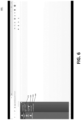
- FIGS. 8 and 9 illustrate a screen depiction 800 of the enterprise system 100 of FIG. 1 illustrating the vendor spend after selection of the vendor spend 610 in the window 700 of FIG. 7 .
- FIG. 8 represents screen depiction 800 partially transformed from screen 700 of FIG. 7 and
- FIG. 9 represents screen depiction 800 more fully transformed from screen 700 of FIG. 7 .
- Screen depiction 800 provides spend data based on vendor within the taxomony of FIG. 2 again by including application 230 , big data 240 , compute 250 , platform 270 , end user 280 , delivery 285 , security and compliance 290 , IT management 295 , and non-IT (not shown) represented in FIG. 7 .
- each vendor box size 810 is allocated based on the spend level within the taxonomy. Colors such as red and green may be used to indicate increased spending (red) and decreased spending (green), while using shading of the respective colors to indicate degree of increase or decrease.
- the identified vendor may additionally account for resellers that may be involved in the chain. As may be evident in comparing the depictions in FIG. 8 and FIG. 9 , the vendor box has replaced the spend values depicted in FIG. 7 .
- Each of the vendors that make up a portion of the taxonomy of FIG. 2 is represented with the size, and color providing underlying meaning within the data as described herein.
- FIG. 10 illustrates a screen depiction 1000 of the enterprise system 100 of FIG. 1 illustrating the vendor spend for a specific category selected in FIG. 7 or FIGS. 8 and 9 .
- a portion of the taxonomy of compute 250 is selected and illustrated.
- Screen depiction 1000 provides the vendor spend for the selected compute 250 . As may be evident by comparing with FIG. 9 , for example, this enlarges the views of the Compute taxonomy 250 and the underlying vendors associated in the compute 250 category.
- Screen depiction 1000 highlights details on vendor consolidation benefits that may be achieved.
- FIG. 12 illustrates a screen depiction 1200 of the enterprise system 100 of FIG. 1 illustrating additional detail provided by selecting a vendor 1110 identified in the category 250 of FIG. 10 . This allows specific orders 1210 within the category 250 and vendor 1110 to be viewed. Additionally, by interacting with the screen 1220 a user may even be provided with additional information regarding a particular order 1230 , such as order number, date, cost, product and the like.
Landscapes
- Engineering & Computer Science (AREA)
- Theoretical Computer Science (AREA)
- Business, Economics & Management (AREA)
- Software Systems (AREA)
- General Physics & Mathematics (AREA)
- Physics & Mathematics (AREA)
- Finance (AREA)
- Accounting & Taxation (AREA)
- Development Economics (AREA)
- Data Mining & Analysis (AREA)
- General Engineering & Computer Science (AREA)
- Computing Systems (AREA)
- Mathematical Physics (AREA)
- Evolutionary Computation (AREA)
- Artificial Intelligence (AREA)
- General Business, Economics & Management (AREA)
- Economics (AREA)
- Technology Law (AREA)
- Strategic Management (AREA)
- Marketing (AREA)
- Computational Linguistics (AREA)
- Fuzzy Systems (AREA)
- Automation & Control Theory (AREA)
- Computer Vision & Pattern Recognition (AREA)
- Medical Informatics (AREA)
- Operations Research (AREA)
- Human Resources & Organizations (AREA)
- Game Theory and Decision Science (AREA)
- Entrepreneurship & Innovation (AREA)
- Financial Or Insurance-Related Operations Such As Payment And Settlement (AREA)
- Management, Administration, Business Operations System, And Electronic Commerce (AREA)
Abstract
Description
X˜N(μ,Σ)=exp(−½(X−μ){circumflex over ( )}TΣ{circumflex over ( )}(−1)(X−μ))/√((2π){circumflex over ( )}k|Σ|), Eq. 1
where sigma is the covariance. For speed and ease, each of the variables, words, are considered independent and use the product of the probabilities: For example, in Eqs. 2, assuming the category or the OEM is C then what is the probability that the current description with features x1, x2, . . . , xn indicate that the item is in the right category.
P(C|x 1 ,x 2 , . . . ,x n)=P(x 1 ,x 2 , . . . ,x n |C)P(C),
P(x 1 ,x 2 , . . . ,x n)
P(x 1 ,x 2 , . . . ,x n |C)=P(x 1 ,x 2 , . . . ,x n ,C)
=P(x 1 |C)P(x 2 |C) . . . P(x n-1 |C)P(C)—under the Naive assumption of independence
P(C|x 1 ,x 2 , . . . ,x n)=P(x 1 |C)·P(x 2 |C) . . . P(x n |C)P(C) Eqs. 2
This formulation allows the right features to be selected from the text processing and text repository. Each category may be provided its own distribution of words and a band around center for class assignment. The category with the highest probability wins. X is the vector of words being used to classify the item into an OEM category. Y is the OEM category label. As more of the words associated with the category of determined, the probabilities of the category improve. As certain words change the model automatically adjusts by updating the probabilities from the latest sample.
Claims (20)
Priority Applications (2)
| Application Number | Priority Date | Filing Date | Title |
|---|---|---|---|
| US17/198,203 US12026787B2 (en) | 2020-03-10 | 2021-03-10 | Accelerated intelligent enterprise including timely vendor spend analytics |
| US18/762,517 US20240354867A1 (en) | 2020-03-10 | 2024-07-02 | Accelerated intelligent enterprise including timely vendor spend analytics |
Applications Claiming Priority (2)
| Application Number | Priority Date | Filing Date | Title |
|---|---|---|---|
| US202062987623P | 2020-03-10 | 2020-03-10 | |
| US17/198,203 US12026787B2 (en) | 2020-03-10 | 2021-03-10 | Accelerated intelligent enterprise including timely vendor spend analytics |
Related Child Applications (1)
| Application Number | Title | Priority Date | Filing Date |
|---|---|---|---|
| US18/762,517 Continuation US20240354867A1 (en) | 2020-03-10 | 2024-07-02 | Accelerated intelligent enterprise including timely vendor spend analytics |
Publications (2)
| Publication Number | Publication Date |
|---|---|
| US20210287301A1 US20210287301A1 (en) | 2021-09-16 |
| US12026787B2 true US12026787B2 (en) | 2024-07-02 |
Family
ID=77663736
Family Applications (2)
| Application Number | Title | Priority Date | Filing Date |
|---|---|---|---|
| US17/198,203 Active US12026787B2 (en) | 2020-03-10 | 2021-03-10 | Accelerated intelligent enterprise including timely vendor spend analytics |
| US18/762,517 Pending US20240354867A1 (en) | 2020-03-10 | 2024-07-02 | Accelerated intelligent enterprise including timely vendor spend analytics |
Family Applications After (1)
| Application Number | Title | Priority Date | Filing Date |
|---|---|---|---|
| US18/762,517 Pending US20240354867A1 (en) | 2020-03-10 | 2024-07-02 | Accelerated intelligent enterprise including timely vendor spend analytics |
Country Status (5)
| Country | Link |
|---|---|
| US (2) | US12026787B2 (en) |
| EP (1) | EP4118594A4 (en) |
| JP (2) | JP7704444B2 (en) |
| GB (1) | GB2609133A (en) |
| WO (1) | WO2021183700A1 (en) |
Families Citing this family (7)
| Publication number | Priority date | Publication date | Assignee | Title |
|---|---|---|---|---|
| US12014382B2 (en) * | 2020-04-14 | 2024-06-18 | Capital One Services, Llc | Systems and methods for trend detection |
| WO2023043322A1 (en) * | 2021-09-17 | 2023-03-23 | Xero Limited | Methods and systems for training attribute prediction models |
| US12014430B2 (en) * | 2022-04-29 | 2024-06-18 | Truist Bank | Time-based input and output monitoring and analysis to predict future inputs and outputs |
| US11838170B1 (en) | 2022-05-11 | 2023-12-05 | Truist Bank | Messaging segmentation based on data flow informatics |
| US12488365B2 (en) | 2023-06-26 | 2025-12-02 | Ingram Micro Inc. | Systems and methods for managing agnostic data forms for vendors |
| US12493904B2 (en) | 2023-06-26 | 2025-12-09 | Ingram Micro Inc. | Systems and methods for automated configuration to order and quote to order |
| US20250029157A1 (en) * | 2023-06-26 | 2025-01-23 | Ingram Micro Inc. | Systems and methods for performing vendor-agnostic cto/qto (configure to order/quote to order) |
Citations (23)
| Publication number | Priority date | Publication date | Assignee | Title |
|---|---|---|---|---|
| US20050015261A1 (en) * | 2001-08-20 | 2005-01-20 | International Business Machines Corporation | System and method for business analysis and planning |
| US20050055275A1 (en) * | 2003-06-10 | 2005-03-10 | Newman Alan B. | System and method for analyzing marketing efforts |
| US20090222364A1 (en) | 2008-02-29 | 2009-09-03 | Ourcashflow.Com, Llc | System and method for attribute-based transaction categorization |
| US20090254971A1 (en) * | 1999-10-27 | 2009-10-08 | Pinpoint, Incorporated | Secure data interchange |
| US20110320397A1 (en) * | 2010-06-24 | 2011-12-29 | Alexander Podkolzin | Impulse regular expression matching |
| US8255278B1 (en) * | 2009-03-23 | 2012-08-28 | United Services Automobile Association | Systems and methods for payment at a point of sale using a virtual check |
| US20130073464A1 (en) * | 2011-09-21 | 2013-03-21 | Visa International Service Association | Systems and methods to communication via a merchant aggregator |
| US8732219B1 (en) * | 2010-08-25 | 2014-05-20 | United Services Automobile Association (Usaa) | Method and system for determining correlated geographic areas |
| US20150121180A1 (en) * | 2013-10-28 | 2015-04-30 | Promethean Limited | Systems and Methods for Presentation Version Management |
| US20150121232A1 (en) * | 2013-10-28 | 2015-04-30 | Promethean Limited | Systems and Methods for Creating and Displaying Multi-Slide Presentations |
| US20150142713A1 (en) * | 2013-11-04 | 2015-05-21 | Global Analytics, Inc. | Real-Time Adaptive Decision System And Method Using Predictive Modeling |
| US20150221045A1 (en) | 2014-01-31 | 2015-08-06 | Valify, LLC | System and method of normalizing vendor data |
| US20150332308A1 (en) * | 2014-05-13 | 2015-11-19 | Bank Of America Corporation | Predicting Swing Buyers in Marketing Campaigns |
| US20170011445A1 (en) * | 2015-03-03 | 2017-01-12 | Go Daddy Operating Company, LLC | Business asset search for recommending legal service providers |
| US20180144314A1 (en) * | 2016-11-21 | 2018-05-24 | Lisa Therese Miller | Invoice Analytics System |
| US20180350006A1 (en) * | 2017-06-02 | 2018-12-06 | Visa International Service Association | System, Method, and Apparatus for Self-Adaptive Scoring to Detect Misuse or Abuse of Commercial Cards |
| US10169353B1 (en) * | 2014-10-30 | 2019-01-01 | United Services Automobile Association (Usaa) | Grouping documents based on document concepts |
| US20190012733A1 (en) | 2017-07-06 | 2019-01-10 | Xero Limited | Data reconciliation based on computer analysis of data |
| US20190325211A1 (en) * | 2018-04-18 | 2019-10-24 | Google Llc | Systems and methods for assigning word fragments to text lines in optical character recognition-extracted data |
| US20200027172A1 (en) * | 2016-06-10 | 2020-01-23 | Understory, LLC | Data processing system for managing activities linked to multimedia content |
| US20200111173A1 (en) * | 2016-06-10 | 2020-04-09 | Understory, LLC | Data processing system for managing activities linked to multimedia content |
| US20210192412A1 (en) * | 2017-11-27 | 2021-06-24 | Sankar Krishnaswamy | Cognitive Intelligent Autonomous Transformation System for actionable Business intelligence (CIATSFABI) |
| US11205147B1 (en) * | 2018-03-01 | 2021-12-21 | Wells Fargo Bank, N.A. | Systems and methods for vendor intelligence |
Family Cites Families (4)
| Publication number | Priority date | Publication date | Assignee | Title |
|---|---|---|---|---|
| CA2426070A1 (en) * | 2000-10-25 | 2002-05-02 | Electronic Data Systems Corporation | Method and system for organizing vendor information |
| CA2711936A1 (en) * | 2008-01-15 | 2009-07-23 | Matthew Mullen | System and method for data completion including push identifier |
| JP6903560B2 (en) * | 2017-12-18 | 2021-07-14 | アルトア株式会社 | Information processing equipment and programs |
| JP6836286B2 (en) * | 2019-08-20 | 2021-02-24 | 株式会社日本デジタル研究所 | Accounting system, accounting method and program |
-
2021
- 2021-03-10 US US17/198,203 patent/US12026787B2/en active Active
- 2021-03-10 GB GB2214876.1A patent/GB2609133A/en active Pending
- 2021-03-10 EP EP21767194.0A patent/EP4118594A4/en active Pending
- 2021-03-10 JP JP2022555130A patent/JP7704444B2/en active Active
- 2021-03-10 WO PCT/US2021/021789 patent/WO2021183700A1/en not_active Ceased
-
2024
- 2024-07-02 US US18/762,517 patent/US20240354867A1/en active Pending
-
2025
- 2025-06-19 JP JP2025103706A patent/JP2025131888A/en active Pending
Patent Citations (23)
| Publication number | Priority date | Publication date | Assignee | Title |
|---|---|---|---|---|
| US20090254971A1 (en) * | 1999-10-27 | 2009-10-08 | Pinpoint, Incorporated | Secure data interchange |
| US20050015261A1 (en) * | 2001-08-20 | 2005-01-20 | International Business Machines Corporation | System and method for business analysis and planning |
| US20050055275A1 (en) * | 2003-06-10 | 2005-03-10 | Newman Alan B. | System and method for analyzing marketing efforts |
| US20090222364A1 (en) | 2008-02-29 | 2009-09-03 | Ourcashflow.Com, Llc | System and method for attribute-based transaction categorization |
| US8255278B1 (en) * | 2009-03-23 | 2012-08-28 | United Services Automobile Association | Systems and methods for payment at a point of sale using a virtual check |
| US20110320397A1 (en) * | 2010-06-24 | 2011-12-29 | Alexander Podkolzin | Impulse regular expression matching |
| US8732219B1 (en) * | 2010-08-25 | 2014-05-20 | United Services Automobile Association (Usaa) | Method and system for determining correlated geographic areas |
| US20130073464A1 (en) * | 2011-09-21 | 2013-03-21 | Visa International Service Association | Systems and methods to communication via a merchant aggregator |
| US20150121180A1 (en) * | 2013-10-28 | 2015-04-30 | Promethean Limited | Systems and Methods for Presentation Version Management |
| US20150121232A1 (en) * | 2013-10-28 | 2015-04-30 | Promethean Limited | Systems and Methods for Creating and Displaying Multi-Slide Presentations |
| US20150142713A1 (en) * | 2013-11-04 | 2015-05-21 | Global Analytics, Inc. | Real-Time Adaptive Decision System And Method Using Predictive Modeling |
| US20150221045A1 (en) | 2014-01-31 | 2015-08-06 | Valify, LLC | System and method of normalizing vendor data |
| US20150332308A1 (en) * | 2014-05-13 | 2015-11-19 | Bank Of America Corporation | Predicting Swing Buyers in Marketing Campaigns |
| US10169353B1 (en) * | 2014-10-30 | 2019-01-01 | United Services Automobile Association (Usaa) | Grouping documents based on document concepts |
| US20170011445A1 (en) * | 2015-03-03 | 2017-01-12 | Go Daddy Operating Company, LLC | Business asset search for recommending legal service providers |
| US20200027172A1 (en) * | 2016-06-10 | 2020-01-23 | Understory, LLC | Data processing system for managing activities linked to multimedia content |
| US20200111173A1 (en) * | 2016-06-10 | 2020-04-09 | Understory, LLC | Data processing system for managing activities linked to multimedia content |
| US20180144314A1 (en) * | 2016-11-21 | 2018-05-24 | Lisa Therese Miller | Invoice Analytics System |
| US20180350006A1 (en) * | 2017-06-02 | 2018-12-06 | Visa International Service Association | System, Method, and Apparatus for Self-Adaptive Scoring to Detect Misuse or Abuse of Commercial Cards |
| US20190012733A1 (en) | 2017-07-06 | 2019-01-10 | Xero Limited | Data reconciliation based on computer analysis of data |
| US20210192412A1 (en) * | 2017-11-27 | 2021-06-24 | Sankar Krishnaswamy | Cognitive Intelligent Autonomous Transformation System for actionable Business intelligence (CIATSFABI) |
| US11205147B1 (en) * | 2018-03-01 | 2021-12-21 | Wells Fargo Bank, N.A. | Systems and methods for vendor intelligence |
| US20190325211A1 (en) * | 2018-04-18 | 2019-10-24 | Google Llc | Systems and methods for assigning word fragments to text lines in optical character recognition-extracted data |
Non-Patent Citations (2)
| Title |
|---|
| EP Office Action Nov. 14, 2023; Application 21767194.0; Applicant CXO Nexus. |
| International Search Report and Written Opinion is related PCT/2021/021789, mailed May 25, 2021. |
Also Published As
| Publication number | Publication date |
|---|---|
| EP4118594A1 (en) | 2023-01-18 |
| JP7704444B2 (en) | 2025-07-08 |
| US20240354867A1 (en) | 2024-10-24 |
| WO2021183700A1 (en) | 2021-09-16 |
| JP2023529518A (en) | 2023-07-11 |
| JP2025131888A (en) | 2025-09-09 |
| US20210287301A1 (en) | 2021-09-16 |
| GB2609133A (en) | 2023-01-25 |
| EP4118594A4 (en) | 2023-12-13 |
| GB202214876D0 (en) | 2022-11-23 |
Similar Documents
| Publication | Publication Date | Title |
|---|---|---|
| US12026787B2 (en) | Accelerated intelligent enterprise including timely vendor spend analytics | |
| Bose et al. | Big data, data analytics and artificial intelligence in accounting: An overview | |
| Ibrahim et al. | The convergence of big data and accounting: innovative research opportunities | |
| US20230070176A1 (en) | Architecture for data processing and user experience to provide decision support | |
| Frennea et al. | Value appropriation and firm shareholder value: Role of advertising and receivables management | |
| US9600779B2 (en) | Machine learning classifier that can determine classifications of high-risk items | |
| Aksoy et al. | Artificial intelligence in computer-aided auditing techniques and technologies (CAATTs) and an application proposal for auditors | |
| Dongre et al. | Artificial intelligence in accounting: opportunities & challenges | |
| US10529017B1 (en) | Automated business plan underwriting for financial institutions | |
| Al-Zoubi et al. | Financial risk management in the supply chain using business intelligence and big data | |
| WO2024121728A1 (en) | Systems and methods for managing debt portfolios and obligation portfolios | |
| Obaydin et al. | AI-accounting capability and internal control effectiveness | |
| Visitpanya et al. | Synthesis of tax return datasets for development of tax evasion detection | |
| Chan et al. | Artificial intelligence in accounting and auditing | |
| CN117751362A (en) | AI-enhanced audit platform including techniques for applying combinable assurance integrity frameworks | |
| Loshin | Evaluating the business impacts of poor data quality | |
| Osho | Impact of forensic accounting on university financial system in Nigeria | |
| Shidaganti et al. | Challenges in banking and solving them using RPA | |
| CN110968622B (en) | Accounting report customization method, platform and terminal | |
| Suresh et al. | The Untapped Potential of Artificial Intelligence for Small Audit Firms in Kerala | |
| Luesma Blanco | Applied statistical methods for computing the failure of companies | |
| US20240346418A1 (en) | Method and apparatus to extract client data with context using enterprise knowledge graph framework | |
| Zaks et al. | Supply Chain Finance and Artificial Intelligence-a game changing relationship? | |
| Sya'bania et al. | TIJAB (The International Journal of Applied Business) | |
| Christopher Westland | Simulated Transactions for Auditing Service Organizations |
Legal Events
| Date | Code | Title | Description |
|---|---|---|---|
| STPP | Information on status: patent application and granting procedure in general |
Free format text: DOCKETED NEW CASE - READY FOR EXAMINATION |
|
| STPP | Information on status: patent application and granting procedure in general |
Free format text: NON FINAL ACTION MAILED |
|
| STPP | Information on status: patent application and granting procedure in general |
Free format text: RESPONSE TO NON-FINAL OFFICE ACTION ENTERED AND FORWARDED TO EXAMINER |
|
| STPP | Information on status: patent application and granting procedure in general |
Free format text: FINAL REJECTION MAILED |
|
| STPP | Information on status: patent application and granting procedure in general |
Free format text: DOCKETED NEW CASE - READY FOR EXAMINATION |
|
| STPP | Information on status: patent application and granting procedure in general |
Free format text: ALLOWED -- NOTICE OF ALLOWANCE NOT YET MAILED |
|
| AS | Assignment |
Owner name: CXO NEXUS, NEW YORK Free format text: ASSIGNMENT OF ASSIGNORS INTEREST;ASSIGNORS:YOUNG, BARRINGTON;CHANDRAWAT, BHANUPRATAP;TOTORO, VINCENT;AND OTHERS;SIGNING DATES FROM 20201119 TO 20201207;REEL/FRAME:066549/0380 Owner name: CXO NEXUS, NEW YORK Free format text: ASSIGNMENT OF ASSIGNOR'S INTEREST;ASSIGNORS:YOUNG, BARRINGTON;CHANDRAWAT, BHANUPRATAP;TOTORO, VINCENT;AND OTHERS;SIGNING DATES FROM 20201119 TO 20201207;REEL/FRAME:066549/0380 |
|
| STPP | Information on status: patent application and granting procedure in general |
Free format text: NOTICE OF ALLOWANCE MAILED -- APPLICATION RECEIVED IN OFFICE OF PUBLICATIONS |
|
| STPP | Information on status: patent application and granting procedure in general |
Free format text: PUBLICATIONS -- ISSUE FEE PAYMENT VERIFIED |
|
| STCF | Information on status: patent grant |
Free format text: PATENTED CASE |