US12008227B2 - Performant configuration user interface - Google Patents
Performant configuration user interface Download PDFInfo
- Publication number
- US12008227B2 US12008227B2 US18/177,662 US202318177662A US12008227B2 US 12008227 B2 US12008227 B2 US 12008227B2 US 202318177662 A US202318177662 A US 202318177662A US 12008227 B2 US12008227 B2 US 12008227B2
- Authority
- US
- United States
- Prior art keywords
- user interface
- images
- design
- image
- view
- Prior art date
- Legal status (The legal status is an assumption and is not a legal conclusion. Google has not performed a legal analysis and makes no representation as to the accuracy of the status listed.)
- Active
Links
Images




Classifications
-
- G—PHYSICS
- G06—COMPUTING OR CALCULATING; COUNTING
- G06F—ELECTRIC DIGITAL DATA PROCESSING
- G06F3/00—Input arrangements for transferring data to be processed into a form capable of being handled by the computer; Output arrangements for transferring data from processing unit to output unit, e.g. interface arrangements
- G06F3/01—Input arrangements or combined input and output arrangements for interaction between user and computer
- G06F3/048—Interaction techniques based on graphical user interfaces [GUI]
- G06F3/0484—Interaction techniques based on graphical user interfaces [GUI] for the control of specific functions or operations, e.g. selecting or manipulating an object, an image or a displayed text element, setting a parameter value or selecting a range
- G06F3/04845—Interaction techniques based on graphical user interfaces [GUI] for the control of specific functions or operations, e.g. selecting or manipulating an object, an image or a displayed text element, setting a parameter value or selecting a range for image manipulation, e.g. dragging, rotation, expansion or change of colour
-
- G—PHYSICS
- G06—COMPUTING OR CALCULATING; COUNTING
- G06F—ELECTRIC DIGITAL DATA PROCESSING
- G06F3/00—Input arrangements for transferring data to be processed into a form capable of being handled by the computer; Output arrangements for transferring data from processing unit to output unit, e.g. interface arrangements
- G06F3/01—Input arrangements or combined input and output arrangements for interaction between user and computer
- G06F3/048—Interaction techniques based on graphical user interfaces [GUI]
-
- G—PHYSICS
- G06—COMPUTING OR CALCULATING; COUNTING
- G06F—ELECTRIC DIGITAL DATA PROCESSING
- G06F3/00—Input arrangements for transferring data to be processed into a form capable of being handled by the computer; Output arrangements for transferring data from processing unit to output unit, e.g. interface arrangements
- G06F3/01—Input arrangements or combined input and output arrangements for interaction between user and computer
- G06F3/048—Interaction techniques based on graphical user interfaces [GUI]
- G06F3/0481—Interaction techniques based on graphical user interfaces [GUI] based on specific properties of the displayed interaction object or a metaphor-based environment, e.g. interaction with desktop elements like windows or icons, or assisted by a cursor's changing behaviour or appearance
- G06F3/04815—Interaction with a metaphor-based environment or interaction object displayed as three-dimensional, e.g. changing the user viewpoint with respect to the environment or object
-
- G—PHYSICS
- G06—COMPUTING OR CALCULATING; COUNTING
- G06F—ELECTRIC DIGITAL DATA PROCESSING
- G06F3/00—Input arrangements for transferring data to be processed into a form capable of being handled by the computer; Output arrangements for transferring data from processing unit to output unit, e.g. interface arrangements
- G06F3/01—Input arrangements or combined input and output arrangements for interaction between user and computer
- G06F3/048—Interaction techniques based on graphical user interfaces [GUI]
- G06F3/0487—Interaction techniques based on graphical user interfaces [GUI] using specific features provided by the input device, e.g. functions controlled by the rotation of a mouse with dual sensing arrangements, or of the nature of the input device, e.g. tap gestures based on pressure sensed by a digitiser
- G06F3/0488—Interaction techniques based on graphical user interfaces [GUI] using specific features provided by the input device, e.g. functions controlled by the rotation of a mouse with dual sensing arrangements, or of the nature of the input device, e.g. tap gestures based on pressure sensed by a digitiser using a touch-screen or digitiser, e.g. input of commands through traced gestures
-
- G—PHYSICS
- G06—COMPUTING OR CALCULATING; COUNTING
- G06F—ELECTRIC DIGITAL DATA PROCESSING
- G06F30/00—Computer-aided design [CAD]
- G06F30/10—Geometric CAD
- G06F30/12—Geometric CAD characterised by design entry means specially adapted for CAD, e.g. graphical user interfaces [GUI] specially adapted for CAD
-
- G—PHYSICS
- G06—COMPUTING OR CALCULATING; COUNTING
- G06F—ELECTRIC DIGITAL DATA PROCESSING
- G06F30/00—Computer-aided design [CAD]
- G06F30/10—Geometric CAD
- G06F30/13—Architectural design, e.g. computer-aided architectural design [CAAD] related to design of buildings, bridges, landscapes, production plants or roads
-
- G—PHYSICS
- G06—COMPUTING OR CALCULATING; COUNTING
- G06T—IMAGE DATA PROCESSING OR GENERATION, IN GENERAL
- G06T5/00—Image enhancement or restoration
- G06T5/70—Denoising; Smoothing
-
- G—PHYSICS
- G06—COMPUTING OR CALCULATING; COUNTING
- G06F—ELECTRIC DIGITAL DATA PROCESSING
- G06F2111/00—Details relating to CAD techniques
- G06F2111/16—Customisation or personalisation
-
- G—PHYSICS
- G06—COMPUTING OR CALCULATING; COUNTING
- G06F—ELECTRIC DIGITAL DATA PROCESSING
- G06F2111/00—Details relating to CAD techniques
- G06F2111/20—Configuration CAD, e.g. designing by assembling or positioning modules selected from libraries of predesigned modules
-
- G—PHYSICS
- G06—COMPUTING OR CALCULATING; COUNTING
- G06F—ELECTRIC DIGITAL DATA PROCESSING
- G06F2203/00—Indexing scheme relating to G06F3/00 - G06F3/048
- G06F2203/048—Indexing scheme relating to G06F3/048
- G06F2203/04803—Split screen, i.e. subdividing the display area or the window area into separate subareas
-
- G—PHYSICS
- G06—COMPUTING OR CALCULATING; COUNTING
- G06F—ELECTRIC DIGITAL DATA PROCESSING
- G06F2203/00—Indexing scheme relating to G06F3/00 - G06F3/048
- G06F2203/048—Indexing scheme relating to G06F3/048
- G06F2203/04804—Transparency, e.g. transparent or translucent windows
-
- G—PHYSICS
- G06—COMPUTING OR CALCULATING; COUNTING
- G06T—IMAGE DATA PROCESSING OR GENERATION, IN GENERAL
- G06T2200/00—Indexing scheme for image data processing or generation, in general
- G06T2200/24—Indexing scheme for image data processing or generation, in general involving graphical user interfaces [GUIs]
-
- G—PHYSICS
- G06—COMPUTING OR CALCULATING; COUNTING
- G06T—IMAGE DATA PROCESSING OR GENERATION, IN GENERAL
- G06T2207/00—Indexing scheme for image analysis or image enhancement
- G06T2207/20—Special algorithmic details
- G06T2207/20172—Image enhancement details
- G06T2207/20192—Edge enhancement; Edge preservation
Definitions
- the present disclosure relates generally to user interfaces of computer systems and, more specifically, to performant configuration user interfaces used to configure products for build-to-order workflows.
- a design space for a house may have more than 10,000 or 100,000 different configurations that are possible with every permutation of surface material, fixture, layout, and the like that can be combined. Users generally do not want to, for example, view 10,000 images of a room to decide which they like best.
- Some aspects include a process including: obtaining a set of images compositable to depict different design configurations; providing a first user interface by which members of the set are overlaid responsive to user inputs to depict different design configurations; obtaining a first design configuration specified via the first user interface; and providing a second user interface depicting a field of view having a first portion depicting the first design configuration and a second portion depicting a second design configuration, the second user interface being operative to adjust allocation in pixel space of the field of view between the first portion and the second portion responsive to user input.
- Some aspects include a tangible, non-transitory, machine-readable medium storing instructions that when executed by a data processing apparatus cause the data processing apparatus to perform operations including the above-mentioned process.
- Some aspects include a system, including: one or more processors; and memory storing instructions that when executed by the processors cause the processors to effectuate operations of the above-mentioned process.
- FIG. 1 illustrates a computing environment in which the present techniques may be implemented in some embodiments
- FIG. 2 illustrates a process by which the present techniques may be implemented in some embodiments
- FIG. 3 A illustrates a user interface in which the present techniques may be implemented in some embodiments
- FIG. 3 B illustrates the user interface in which the present techniques may be implemented in some embodiments
- FIG. 3 C illustrates a user interface in which the present techniques may be implemented in some embodiments
- FIG. 3 D illustrates a user interface in which the present techniques may be implemented in some embodiments
- FIG. 4 A illustrates a user interface in which the present techniques may be implemented in some embodiments
- FIG. 4 B illustrates the user interface in which the present techniques may be implemented in some embodiments
- FIG. 4 C illustrates a user interface in which the present techniques may be implemented in some embodiments
- FIG. 4 D illustrates a user interface in which the present techniques may be implemented in some embodiments
- FIG. 4 E illustrates a user interface in which the present techniques may be implemented in some embodiments
- FIG. 4 F illustrates a user interface in which the present techniques may be implemented in some embodiments.
- FIG. 5 illustrates an example computing device by which the present techniques may be implemented in some embodiments.
- Some embodiments improve upon existing computer implemented tools to help users choose among their options and in build-to-order workflow.
- some embodiments implement a set of user interfaces that help users to quickly navigate a large, relatively high dimensional design space (e.g., as complicated or more complicated than those mentioned above) by improving the speed of the user's navigation through various windows and views.
- Some embodiments include two stages of user interfaces, with a first stage in which the user can dynamically adjust compositing of a stack of images to select various candidate designs, and a second stage in which the user can dynamically adjust which portions of a field-of-view depict one design or another, for instance by sliding a user interface element left and right or up and down, to dynamically adjust how much of the field-of-view depicts one design or the other on either side of a corresponding line adjusted with the sliding action.
- Some embodiments may further substantially reduce memory computational complexity of design sessions with a data structure for images that scales favorably with the design space, e.g., a number of images needed to support operations may scale at a substantially lower rate than the number of supported designs in a design space.
- Some embodiments may implement compositing (e.g., alpha compositing) with techniques that reduce image artifacts near the edge of nontransparent portions of images in a stack.
- Some embodiments may reuse layers isolating given design options of given design elements across a relatively large number of designs involving those design elements and, in some cases, freeze a stack of layered images in a single flat image for use in the second stage user interface to afford relatively performant transitions. It should be emphasized, though, that embodiments are not limited to implementations affording all of these benefits, as various inventive aspects described can be used independently.
- FIG. 1 illustrates an example of a computing environment 10 in which the present techniques may be implemented.
- the computing environment 10 is a distributed computing environment implementing a client/server architecture, though other architectures are contemplated, including monolithic architectures executing on a single computing device.
- the computing environment 10 includes a server 12 , client computing devices 14 , a configuration engine 16 , a rendering engine 18 , and a network 20 , such as the Internet, by which these components may communicate.
- the client computing devices 14 are desktop computers, laptop computers, in-store kiosks, tablet computers, mobile phones, head-mounted displays, or the like, executing an operating system and a web browser or native application in which the described user interfaces are presented. Three client computing devices 14 are shown, but embodiments may support substantially more concurrent sessions, e.g., more than 100, or more than 1,000 geographically distributed sessions around the US or the world.
- the server 12 is a nonblocking web server or application program interface server configured to service multiple concurrent sessions with different client computing devices 14 , for instance implementing a model-view-controller architecture or other design.
- the server 12 may dynamically generate assets, markup language instructions, and scripting language instructions responsive to requests from client computing devices 14 to send user interfaces to, or update user interfaces on, those client computing devices 14 .
- the user interface may evolve over time (e.g., in a web application), in some cases, displaying new resources (e.g., images and other data) sent from the server 12 responsive to user inputs to the user interface.
- the configuration engine 16 and rendering engine 18 may be used to generate image files and metadata used by the server 12 to generate the user interfaces, for example supplying resources depicting and describing options in a design space.
- the server 12 may execute a process illustrated in FIG. 2 , for example, by executing program code stored on a tangible, non-transitory, machine-readable medium.
- the illustrated operations may be executed in a different order, omitted, replicated, executed concurrently, executed serially, have additional operations inserted, all be automated, involve human intervention, or otherwise be modified relative to the arrangement depicted, which is not to suggest that any other description herein is limiting.
- the process 40 is preceded by one or more product manufacturers, which may be different tenants having different tenant accounts supported by the server 12 , supplying a set of records characterizing a respective design space, among a plurality of design spaces.
- the set of records may include computer aided design files specifying a spatial arrangement of a product to be manufactured, like a home, landscaping design, automobile, computer, furniture, or article of clothing.
- the set of records may further include various options for components, which may include different, substitutable computer-aided design (CAD) files for different shapes of components, like different fixtures, as well as different textures corresponding to different surfaces, like image files to be tiled over polygons that define a surface specified by the CAD files.
- the records may furthering indicate which optional resources correspond to which surfaces or spatial areas of the CAD file.
- Options may further include lighting options, which may include attributes of the light to be used in renders.
- this set of records may be received by the above-described configuration engine 16 , which may cooperate with the rendering engine 18 to provide data that allows the server 12 to obtain a set of images compositable to depict different designs in a design space, as indicated by block 42 in FIG. 2 .
- the set of images may include substantially fewer images than there are possible designs supported in the design space.
- the number of images may scale at a rate of less than some coefficient of the number of designs supported by a specified design space corresponding to the set of images, or the design space may have a number of designs that scales at an exponential rate relative to the number of injured images needed to depict all of the designs in that space or a lower rate.
- some embodiments may substantially reduce the computational complexity of the described operations in terms of memory complexity relative to more na ⁇ ve approaches that obtain a different image for every single possible design in a design space. That said, embodiments are also consistent with this more na ⁇ ve approach in some cases, for example, where the design spaces relatively low dimensional and coarse-grained.
- the set of images may include images like those described below in a technical description of an example embodiment having in-line images.
- the set of images may include a base image depicting a field-of-view of the article of manufacture, or portion thereof, like a view into a kitchen of a house or commercial property to be designed, or into an automobile interior, or of a model wearing article of clothing.
- the base image may have no transparency in the entire image or a portion depicting the field-of-view.
- the base image is a three-dimensional perspective view of the field-of-view.
- the rendering engine may execute a ray-tracing algorithm to render the images, in some cases, masking or isolating given objects to create the templates described below.
- the set of images include template images to be overlaid on the base image to depict different design options.
- the base image may depict a countertop with a blue surface
- a template image may include a view of that countertop with a green surface, both having the pixels depicting the countertop in the same positions in pixel space (e.g., at the same Cartesian coordinates in the image).
- the template images may include a first portion with pixel values that are nontransparent and overlay and occlude pixels in the base image to depict the design option.
- the template images may further include a second portion with pixels that are transparent, such that when overlaid on the base image, the pixels of the base image are still viewable.
- the transparent pixels in need not be perfectly transparent to qualify as such, provided the visual effect of the base image or other layered images remains for the viewer.
- the transparent pixels may be less than more than 80% transparent, 90% transparent, 95% transparent, 99% transparent, or 99.9% transparent while still qualifying as “transparent.”
- the images in the set may be in a format that supports transparency, for example portable network graphics (PNG) format, joint photographic experts group extended range (JPEG XR) format, WebP format, or the like.
- the image file format may include an alpha channel, separate from, for example, red, blue, and green channels that specify intensities for each of several colors constituting the pixel.
- the alpha channel may specify transparency of the corresponding pixel at the coordinates of that pixel, like Cartesian coordinates of height and width.
- the alpha channel may have a bit depth of 4, 8, 16, or 32 bits, or more or less corresponding to different degrees of transparency.
- the image format may be a lossy compression format or a lossless compression format, depending upon design trade-offs in image quality, latency, and bandwidth consumption.
- Some embodiments may compress the image by segmenting it into square blocks, computing a discrete wavelet transform (e.g., with a fast Fourier transform) of various spatial variation of pixel intensity in the channel within each block, quantizing the resulting matrix by multiplying it with a quantization matrix tuned to down-res higher frequency components, and then compressing the result with run-length coding or dictionary coding.
- the client computing device may reverse this process with a suitable image decoder to determine pixel intensities and display the image, thereby conserving memory, bandwidth, and latency.
- each of the images in the set may have the same height and width in pixel space, such that when the images are overlaid, the position of the second portion in the template images is at a specified portion of the first portion, for instance causing an overlay of a countertop surface design choice to be in the proper position.
- template images may be smaller and may include a height and width offset that specifies an alignment point for overlay.
- the template images are associated with a depth value, like an integer depth value, such as a z value, and template images may be applied to a base image in a stack according to these depth values, monotonically increasing or decreasing, depending upon the numbering scheme. This is expected to accommodate scenes in which portions affected by different design options overlie one another in the field-of-view.
- the images in the set may be created by the rendering engine 18 in cooperation with the configuration engine 16 .
- the configuration engine 16 may execute a script that causes the configuration engine 16 to generate polygon volumetric meshes and surface tiling of every permutation of supported design and provide those outputs to the rendering engine 18 to cause the rendering engine 18 to render corresponding images.
- the rendering engine 18 e.g., Unreal Engine from Epic Games Inc. of Cary, North Carolina
- this process may be repeated for multiple sets corresponding to different views of different portions of the product, and the operations described may be replicated for those different views.
- a user may configure their kitchen in one set of user interfaces and their bathroom in another.
- the images may be generated in advance of a session with the user with preprocessing, as image generation may be relatively computationally complex and time-consuming, possibly taking more than 10 minutes or 10 hours to cover all permutations of a design space.
- some embodiments may implement real-time server-side or client-side rendering, e.g., when the design space is particularly high dimensional and complex.
- the resulting images may be indexed according to the design options to which they correspond, and the configuration engine 16 may provide an ontology of those options along with the corresponding images to the server 12 , which may store them in a repository for use when generating user interfaces in subsequent steps.
- the rendering engine 18 may be operative to perform certain operations to reduce edge artifacts in template images to improve the visual quality of composite images in which those templates are stacked on a base image, in some cases with multiple ( 3 , 5 , 10 , or more) such template images stacked. In some embodiments, the rendering engine 18 may implement alpha compositing with those template images.
- the rendering engine or associated raster graphics editor may apply a Gaussian blur on the alpha channel of the template images (e.g., only the alpha channel and not in the other channels), for example a five pixel by five pixel Gaussian kernel, a three pixel by three pixel Gaussian kernel, or different size Gaussian kernel for a convolution may be applied to the alpha channel but not other channels, in some cases.
- the transformation may be performed after converting the initial images from a non-linear color space, like sRGB, to a linear color space, and then after the transformation to smooth edges in the alpha channel, the images may be converted back to a non-linear color space.
- the alpha channel may be a straight unassociated alpha channel or a pre-multiplied associate alpha channel.
- these operations may result in a gradient of transparency at edges of the first portions of the template images, which are expected to reduce artifacts at edges, like ugly jagged lines and discordant color transitions in composite images displayed in client-side user interfaces.
- the rendering engine 18 may include or may communicate with a raster graphics editor program, such as one scripted to implement these transformations or instructed implement these transformations through system calls, like Gimp or ImageMagick. Or some embodiments may implement compositing without adjusting the alpha channel, which is not to suggest that any other description is limiting.
- the process 40 further includes providing a first user interface by which members of the set are overlaid responsive to user inputs to depict different design configurations, as indicated by block 44 .
- this operation may be performed by the server 12 by sending markup styling and scripting what language instructions to the client device 14 responsive to a request for such a user interface (e.g., one including a user identifier by which the session may be associated with a profile), along with corresponding visual assets and data used to effectuate different views to be presented responsive to user inputs.
- this transmission may be responsive to a request for a specific view or product from the one of the client devices 14 , for example, via a web browser or native application.
- the user interface may be provided by sending assets and data to a native application otherwise having code and other instructions needed to populate the user interface.
- providing the user interface may include sending images that are not immediately displayed to hold in a client-side cache to afford a relatively responsive updates to the user interface after user inputs. For example, some embodiments may send a subset of template images selected based upon a user's profile that are predicted to be likely to be chosen or were previously designated as “favorites.” In some embodiments, the user interface may take the form of that shown below in the appended technical documentation. In some embodiments, this first user interface may include inputs by which a user selects which design element is to be configured and inputs by which the user selects among options for that design element, for instance, by clicking, touching, or voicing spoken instructions to make selections.
- user interfaces may be presented in virtual reality or augmented reality with a head-mounted display, and inputs may be implemented with gaze tracking or pointing.
- User inputs may be mapped to event handlers that update the user interface by manipulating a document object model to reflect the user's selection and update program state, e.g., swapping in and out template images in a stack of such images overlaying a base image to reflect user design choices.
- the first user interface executing on the client device may present these options and receive inputs from the user to select among them. Responsive to receiving a user selection of a given design option, the first user interface may access from cache or request from the server 12 a corresponding template image depicting the user selection (e.g., a given design option). The user interface may, upon receiving that image or accessing that image, determine a position in a stack of images currently composited in the user interface to receive the newly selected template image, based upon a depth value of the image and depth values of the other images in the stack, maintaining the stacked images in depth order in a composite view.
- the images may be stacked in a div box in a document object model with which the user interface is implemented in a web browser.
- the images that are stacked may have their position attributes set to absolute to control alignment as, for example, the screen is resized.
- the user interface may maintain a design state record for the session, which in some cases may be saved to a user profile server-side or client-side, so that the current state of the user interface may be re-created by, for example, replaying a set of user selections in a log, or stacking the specified template images for a design recorded in the profile.
- the user interfaces may include an input by which a user may save their design or name their design.
- the stacked set of images may be flattened into a flat, single image of the design, which may be stored in memory in association with the user's profile (e.g., in client-side cache or server-side).
- a design image may be named according to the response of a hash function to a text specification of the existing design, such that identical designs are assigned the same hash value as a name, and duplicate instances of the same design selected by different consumers may be maintained in memory with a single image file server side to save memory.
- the flattening of the image may be performed server-side with the above-described image raster graphics editors, or some embodiments may flatten the image client-side, for example, by invoking WebGL functionality to expedite image processing operations via the browser by concurrently combining pixel values in a stack in different regions with different pixel shaders of a graphics processing unit (GPU) of the client 14 .
- GPU graphics processing unit
- some embodiments of the server 12 may obtain a first design configuration specified via the first user interface, as indicated by block 46 .
- the specification may include identifiers of the images stacked in the design, a log of user edits to the design from the base design, or an inventory of design elements chosen in the design, for example.
- this design configuration may be stored along with a plurality of other design configurations chosen by the user.
- the server 12 may further store in memory a set of public design configurations (also referred to as designs), for example, chosen by interior design specialists or architects or other experts in the design domain, and users may also access these to compare against their own configurations or to compare configurations of designs from different preset alternatives.
- Some embodiments may then provide a second user interface depicting a field of view having a first portion depicting the first design configuration and a second portion depicting a second design configuration, as indicated by block 48 .
- the second user interface is operative to adjust allocation in pixel space of the field-of-view between the first portion and the second portion responsive the user input.
- the second user interface may include a user interface element, like a clickable, touchable, or otherwise draggable region that bisects the image and can be slid left and right or up and down (or along some other path), causing two different designs to be depicted in the same view on either side of the line, as the line is moved to show more or less of one designer the other.
- user interfaces that cause one designed to fade into the other, for example by stacking the two designs and adjusting transparency of one designer the other.
- the user interface may include a circular or rectangular “lens” or other region that can be moved around the field-of-view to show a different design from that depicted in the view surrounding the lens.
- individual design elements are selectable, like touchable, clickable, or the like, to transition between different options in the different designs.
- two designs may be compared with the second user interface, three designs may be compared to the second user interface (for example with multiple lens user interfaces), or more designs may be compared.
- the flattened versions of the images depicting the designs are used to expedite the transition between designs, to keep the user interface responsive, or some embodiments may maintain the stacked composited images from the first user interface in the second user interface, and implement the same visual adjustment by manipulating which spatial portions of the stacks are depicted responsive to user interface inputs. Or some embodiments may toggle which layers are depicted using similar techniques.
- the second user interface may include scripting language (or WebAssembly) instructions that map an event handler to an element in a document object model of the user interface that corresponds to user input to make the adjustment of block 48 . Examples include a div box, button, or the like.
- the user interface element is updated in its position in the window responsive to user input, such that the user interface element appears to be animated sliding along with the user's touch.
- the element may snap to positions corresponding to predefined granular adjustments in the view.
- the event handler may cause a subroutine to be executed that updates which portions of the images depicting the first and second view design configurations are visible.
- some embodiments may stack images of the different designs in a div box in the document object model with position attributes set to absolute, and as a slider is adjusted, touch release, on touch, or touch drag events (or corresponding mouse or gaze events) may trigger an event handler mapped to the corresponding user interface element, and that event handler may cause scripts to be executed to dynamically update which portions of the images of the different designs are visible by modulating the clip-path property in cascading style sheets specifications mapped to the images in the div box.
- these updates to the document object model may be mediated through a shadow document object model using a framework or library like React, Vue, or Angular to make transition smoother and consolidate collections of transitions similar to one another in time to reduce the processing workload for the browser's rendering engine.
- a framework or library like React, Vue, or Angular
- these techniques may be implemented to present user interfaces like those described in FIGS. 3 A- 3 J that illustrate an embodiment in an example use case.
- user's upon selecting a design, user's may be routed to a server of a product manufacturer, e.g., with URL having a query string that specifies the design, and the user may purchase the product and have it built according to specification.
- FIGS. 3 A- 3 D and FIGS. 4 A- 4 F illustrate an example use case of the techniques, described above, to present user interfaces 300 a - 300 d and 400 a - 40 f , respectively on a display screen 302 / 402 included on a client 14 of FIG. 1 .
- FIG. 3 A illustrates the user interface 300 a .
- the user interface 300 a may include a base image 304 .
- the base image may depict a field-of-view of the article of manufacture, or portion thereof, like a view into a kitchen of a house or commercial property to be designed, or into an automobile interior, or of a model wearing an article of clothing.
- the base image may include a base division (div) hypertext markup language (HTML) element with a background image to present an initial scene.
- div base division
- HTML hypertext markup language
- FIG. 3 B illustrates the user interface 300 b .
- additional div elements may be added with full width and height to show layers.
- user interface 300 b may include a template image 306 .
- template images may be overlaid on the base image to depict different design options.
- the base image may depict a countertop with a blue surface
- the template image 306 may include a view of that countertop with a green surface, both having the pixels depicting the countertop in the same positions in pixel space (e.g., at the same Cartesian coordinates in the image).
- the template image 306 may include a first portion 306 a with pixel values that are nontransparent and overlay and occlude pixels in the base image to depict the design option.
- the template image 306 may further include a second portion 306 b with pixels that are transparent, such that when overlaid on the base image, the pixels of the base image are still viewable.
- FIG. 3 C illustrates the user interface 300 c .
- the user interface 300 c may include a template image 308 .
- the template image 308 may include a first portion 308 a with pixel values that are nontransparent. As illustrated, the first portion 308 a includes an image of a facet.
- the template image 308 may include a second portion 308 b with pixels that are transparent.
- FIG. 3 D illustrates the user interface 300 d .
- the user interface 300 d may include a composite image 310 that includes a stack of the template images 306 and 308 and the base image 306 .
- the countertop 306 a illustrated in FIG. 3 B
- the facet 308 b illustrated in FIG. 3 C
- the composite image 310 is now stacked on the base image 304 to form the composite image 310 .
- FIGS. 4 A- 4 F illustrate presented user interfaces 400 a - 400 g on a display screen 402 include on a client 14 of FIG. 1 .
- the user interface 400 a depicts a field of view 403 having a first portion 404 depicting a first design configuration 404 a and a second portion 406 depicting a second design configuration 406 a , as discussed above with respect to block 48 .
- the user interface 400 a is operative to adjust allocation in pixel space of the field-of-view between the first portion 404 and the second portion 406 responsive the user input.
- the user interface 400 a may include a user interface element 408 , like a clickable, touchable, or otherwise draggable region that bisects the image and can be slid left and right or up and down (or along some other path), causing two different designs to be depicted in the same view on either side of the line, as the line is moved to show more or less of one designer the other.
- FIG. 4 B illustrates the user interface element 408 moved to the top of the display such that primarily the second portion 406 is viewed on the user interface 400 b such that the second design configuration 406 a may be presented.
- FIG. 4 B illustrates the user interface element 408 moved to the top of the display such that primarily the second portion 406 is viewed on the user interface 400 b such that the second design configuration 406 a may be presented.
- FIG. 4 C illustrates the user interface 400 c where the first design configuration 404 a and the second design configuration 406 a are swapped such that the first portion 404 of the field of view 403 may present the second design configuration 406 a and the second portion 406 of the field of view may present the first design configuration 404 a.
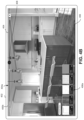
- FIG. 4 D the user may have selected that the user interface element 408 is positioned in a vertical orientation rather than a horizontal orientation as illustrated in FIGS. 4 A- 4 C .
- the user interface 400 d depicts a field of view 403 having a first portion 404 depicting a first design configuration 404 a and a second portion 406 depicting a second design configuration 406 a .
- FIG. 4 E illustrates the user interface element 408 moved to the left of the user interface 400 e such that primarily the first portion 404 is viewed on the user interface 400 e or that the first design configuration 404 a may be presented.
- FIG. 4 E illustrates the user interface element 408 moved to the left of the user interface 400 e such that primarily the first portion 404 is viewed on the user interface 400 e or that the first design configuration 404 a may be presented.
- 4 F illustrates the user interface 400 f where the first design configuration 404 a and the second design configuration 406 a are swapped such that the first portion 404 of the field of view 403 may presented by the second design configuration 406 a and the second portion 406 of the field of view may present the first design configuration 404 a.
- FIG. 5 is a diagram that illustrates an exemplary computing system 500 in accordance with embodiments of the present technique.
- Various portions of systems and methods described herein may include or be executed on one or more computer systems similar to computing system 500 . Further, processes and modules described herein may be executed by one or more processing systems similar to that of computing system 500 .
- Computing system 500 may include one or more processors (e.g., processors 510 a - 510 n ) coupled to system memory 520 , an input/output I/O device interface 530 , and a network interface 540 via an input/output (I/O) interface 550 .
- a processor may include a single processor or a plurality of processors (e.g., distributed processors).
- a processor may be any suitable processor capable of executing or otherwise performing instructions.
- a processor may include a central processing unit (CPU) that carries out program instructions to perform the arithmetical, logical, and input/output operations of computing system 500 .
- CPU central processing unit
- a processor may execute code (e.g., processor firmware, a protocol stack, a database management system, an operating system, or a combination thereof) that creates an execution environment for program instructions.
- a processor may include a programmable processor.
- a processor may include general or special purpose microprocessors.
- a processor may receive instructions and data from a memory (e.g., system memory 520 ).
- Computing system 500 may be a uni-processor system including one processor (e.g., processor 510 a ), or a multi-processor system including any number of suitable processors (e.g., 510 a - 510 n ). Multiple processors may be employed to provide for parallel or sequential execution of one or more portions of the techniques described herein.
- Processes, such as logic flows, described herein may be performed by one or more programmable processors executing one or more computer programs to perform functions by operating on input data and generating corresponding output. Processes described herein may be performed by, and apparatus can also be implemented as, special purpose logic circuitry, e.g., an FPGA (field programmable gate array) or an ASIC (application specific integrated circuit).
- Computing system 500 may include a plurality of computing devices (e.g., distributed computer systems) to implement various processing functions.
- I/O device interface 530 may provide an interface for connection of one or more I/O devices 560 to computer system 500 .
- I/O devices may include devices that receive input (e.g., from a user) or output information (e.g., to a user).
- I/O devices 560 may include, for example, graphical user interface presented on displays (e.g., a cathode ray tube (CRT) or liquid crystal display (LCD) monitor), pointing devices (e.g., a computer mouse or trackball), keyboards, keypads, touchpads, scanning devices, voice recognition devices, gesture recognition devices, printers, audio speakers, microphones, cameras, or the like.
- I/O devices 560 may be connected to computer system 500 through a wired or wireless connection.
- I/O devices 560 may be connected to computer system 500 from a remote location.
- I/O devices 560 located on remote computer system for example, may be connected to computer system 500 via a network and network interface 540 .
- Network interface 540 may include a network adapter that provides for connection of computer system 500 to a network.
- Network interface may 540 may facilitate data exchange between computer system 500 and other devices connected to the network.
- Network interface 540 may support wired or wireless communication.
- the network may include an electronic communication network, such as the Internet, a local area network (LAN), a wide area network (WAN), a cellular communications network, or the like.
- System memory 520 may be configured to store program instructions 501 or data 502 .
- Program instructions 501 may be executable by a processor (e.g., one or more of processors 510 a - 510 n ) to implement one or more embodiments of the present techniques.
- Instructions 501 may include modules of computer program instructions for implementing one or more techniques described herein with regard to various processing modules.
- Program instructions may include a computer program (which in certain forms is known as a program, software, software application, script, or code).
- a computer program may be written in a programming language, including compiled or interpreted languages, or declarative or procedural languages.
- a computer program may include a unit suitable for use in a computing environment, including as a stand-alone program, a module, a component, or a subroutine.
- a computer program may or may not correspond to a file in a file system.
- a program may be stored in a portion of a file that holds other programs or data (e.g., one or more scripts stored in a markup language document), in a single file dedicated to the program in question, or in multiple coordinated files (e.g., files that store one or more modules, sub programs, or portions of code).
- a computer program may be deployed to be executed on one or more computer processors located locally at one site or distributed across multiple remote sites and interconnected by a communication network.
- System memory 520 may include a tangible program carrier having program instructions stored thereon.
- a tangible program carrier may include a non-transitory computer readable storage medium.
- a non-transitory computer readable storage medium may include a machine readable storage device, a machine readable storage substrate, a memory device, or any combination thereof.
- Non-transitory computer readable storage medium may include non-volatile memory (e.g., flash memory, ROM, PROM, EPROM, EEPROM memory), volatile memory (e.g., random access memory (RAM), static random access memory (SRAM), synchronous dynamic RAM (SDRAM)), bulk storage memory (e.g., CD-ROM and/or DVD-ROM, hard-drives), or the like.
- non-volatile memory e.g., flash memory, ROM, PROM, EPROM, EEPROM memory
- volatile memory e.g., random access memory (RAM), static random access memory (SRAM), synchronous dynamic RAM (SDRAM)
- bulk storage memory e.g.
- System memory 520 may include a non-transitory computer readable storage medium that may have program instructions stored thereon that are executable by a computer processor (e.g., one or more of processors 510 a - 510 n ) to cause the subject matter and the functional operations described herein.
- a memory e.g., system memory 520
- Instructions or other program code to provide the functionality described herein may be stored on a tangible, non-transitory computer readable media. In some cases, the entire set of instructions may be stored concurrently on the media, or in some cases, different parts of the instructions may be stored on the same media at different times.
- I/O interface 550 may be configured to coordinate I/O traffic between processors 510 a - 510 n , system memory 520 , network interface 540 , I/O devices 560 , and/or other peripheral devices. I/O interface 550 may perform protocol, timing, or other data transformations to convert data signals from one component (e.g., system memory 520 ) into a format suitable for use by another component (e.g., processors 510 a - 510 n ). I/O interface 550 may include support for devices attached through various types of peripheral buses, such as a variant of the Peripheral Component Interconnect (PCI) bus standard or the Universal Serial Bus (USB) standard.
- PCI Peripheral Component Interconnect
- USB Universal Serial Bus
- Embodiments of the techniques described herein may be implemented using a single instance of computer system 500 or multiple computer systems 500 configured to host different portions or instances of embodiments. Multiple computer systems 500 may provide for parallel or sequential processing/execution of one or more portions of the techniques described herein.
- Computer system 500 is merely illustrative and is not intended to limit the scope of the techniques described herein.
- Computer system 500 may include any combination of devices or software that may perform or otherwise provide for the performance of the techniques described herein.
- computer system 500 may include or be a combination of a cloud-computing system, a data center, a server rack, a server, a virtual server, a desktop computer, a laptop computer, a tablet computer, a server device, a client device, a mobile telephone, a personal digital assistant (PDA), a mobile audio or video player, a game console, a vehicle-mounted computer, or a Global Positioning System (GPS), or the like.
- PDA personal digital assistant
- GPS Global Positioning System
- Computer system 500 may also be connected to other devices that are not illustrated, or may operate as a stand-alone system.
- functionality provided by the illustrated components may in some embodiments be combined in fewer components or distributed in additional components.
- functionality of some of the illustrated components may not be provided or other additional functionality may be available.
- instructions stored on a computer-accessible medium separate from computer system 500 may be transmitted to computer system 500 via transmission media or signals such as electrical, electromagnetic, or digital signals, conveyed via a communication medium such as a network or a wireless link.
- Various embodiments may further include receiving, sending, or storing instructions or data implemented in accordance with the foregoing description upon a computer-accessible medium. Accordingly, the present techniques may be practiced with other computer system configurations.
- illustrated components are depicted as discrete functional blocks, but embodiments are not limited to systems in which the functionality described herein is organized as illustrated.
- the functionality provided by each of the components may be provided by software or hardware modules that are differently organized than is presently depicted, for example such software or hardware may be intermingled, conjoined, replicated, broken up, distributed (e.g. within a data center or geographically), or otherwise differently organized.
- the functionality described herein may be provided by one or more processors of one or more computers executing code stored on a tangible, non-transitory, machine readable medium.
- third party content delivery networks may host some or all of the information conveyed over networks, in which case, to the extent information (e.g., content) is said to be supplied or otherwise provided, the information may provided by sending instructions to retrieve that information from a content delivery network.
- the word “may” is used in a permissive sense (i.e., meaning having the potential to), rather than the mandatory sense (i.e., meaning must).
- the words “include”, “including”, and “includes” and the like mean including, but not limited to.
- the singular forms “a,” “an,” and “the” include plural referents unless the content explicitly indicates otherwise.
- Statements in which a plurality of attributes or functions are mapped to a plurality of objects encompasses both all such attributes or functions being mapped to all such objects and subsets of the attributes or functions being mapped to subsets of the attributes or functions (e.g., both all processors each performing steps A-D, and a case in which processor 1 performs step A, processor 2 performs step B and part of step C, and processor 3 performs part of step C and step D), unless otherwise indicated.
- reference to “a computer system” performing step A and “the computer system” performing step B can include the same computing device within the computer system performing both steps or different computing devices within the computer system performing steps A and B.
- statements that one value or action is “based on” another condition or value encompass both instances in which the condition or value is the sole factor and instances in which the condition or value is one factor among a plurality of factors.
- statements that “each” instance of some collection have some property should not be read to exclude cases where some otherwise identical or similar members of a larger collection do not have the property, i.e., each does not necessarily mean each and every.
- data structures and formats described with reference to uses salient to a human need not be presented in a human-intelligible format to constitute the described data structure or format, e.g., text need not be rendered or even encoded in Unicode or ASCII to constitute text; images, maps, and data-visualizations need not be displayed or decoded to constitute images, maps, and data-visualizations, respectively; speech, music, and other audio need not be emitted through a speaker or decoded to constitute speech, music, or other audio, respectively.
- Computer implemented instructions, commands, and the like are not limited to executable code and can be implemented in the form of data that causes functionality to be invoked, e.g., in the form of arguments of a function or API call.
- bespoke noun phrases and other coined terms
- the definition of such phrases may be recited in the claim itself, in which case, the use of such bespoke noun phrases should not be taken as invitation to impart additional limitations by looking to the specification or extrinsic evidence.
Landscapes
- Engineering & Computer Science (AREA)
- Physics & Mathematics (AREA)
- Theoretical Computer Science (AREA)
- General Physics & Mathematics (AREA)
- General Engineering & Computer Science (AREA)
- Geometry (AREA)
- Human Computer Interaction (AREA)
- Computer Hardware Design (AREA)
- Mathematical Analysis (AREA)
- Mathematical Optimization (AREA)
- Pure & Applied Mathematics (AREA)
- Computational Mathematics (AREA)
- Evolutionary Computation (AREA)
- Architecture (AREA)
- Civil Engineering (AREA)
- Structural Engineering (AREA)
- User Interface Of Digital Computer (AREA)
- Processing Or Creating Images (AREA)
Abstract
Description
-
- 1. A tangible, non-transitory, machine-readable medium storing instructions that when executed by one or more processors effectuate operations comprising: obtaining, with a computer system, a set of images compositable to depict different design configurations; providing, with the computer system, a first user interface by which members of the set are overlaid responsive to user inputs to depict different design configurations; obtaining, with the computer system, a first design configuration specified via the first user interface; and providing, with the computer system, a second user interface depicting a field of view having a first portion depicting the first design configuration and a second portion depicting a second design configuration, the second user interface being operative to adjust allocation in pixel space of the field of view between the first portion and the second portion responsive to user input.
- 2. The medium of embodiment 1, wherein the set of images includes a base image and at least one template image overlaid on top of the base image.
- 3. The medium of embodiment 2, wherein the base image depicts a field of view of at least a portion of an article of manufacture.
- 4. The medium of embodiment 2, wherein the at least one template image includes a first portion with pixels that are transparent such that, when overlaid on the base image, the pixels of the base image are still viewable, and wherein the at least one template image includes a second portion with pixels that are nontransparent and provide a design option for the first design configuration or the second design configuration such that, when overlaid on the base image, the pixels of the second portion occlude and overlay pixels in the base image to depict the design option.
- 5. The medium of embodiment 2, wherein a template image of the at least one template image includes a depth value that indicates a position of the template image in a stack of template images.
- 6. The medium of embodiment 2, wherein the base image and the at least one template image are stacked in a div box in a document object model.
- 7. The medium of embodiment 2, wherein the operations include steps for reducing edge artifacts in the at least one template image.
- 8. The medium of embodiment 1, wherein the second user interface includes a user interface element that splits the second user interface and is slidable to adjust the allocation in pixel space of the field of view between the first portion and the second portion responsive to the user input.
- 9. The medium of embodiment 8, wherein the user interface element is presented as animated sliding.
- 10. The medium of embodiment 8, wherein the user interface element is presented with an animated snap to a position corresponding to a predefined granular adjustment.
- 11. The medium of embodiment 1, wherein the adjusting the field of view between the first portion and the second portion responsive to the user input includes fading the first portion into the second portion by adjusting a transparency of the first portion.
- 12. The medium of embodiment 1, wherein the adjusting the field of view between the first portion and the second portion responsive to the user input includes a region that is movable by the user input such that the first portion is presented in the region and the second portion is presented outside the region.
- 13. The medium of embodiment 1, wherein second user interface includes scripting language instructions that map an event handler to an element in a document object model of the second user interface that corresponds to the user input to make the adjustment.
- 14. The medium of embodiment 1, wherein the operations comprise steps for adjust allocation in pixel space of the field of view between the first portion and the second portion responsive to user input.
- 15. A tangible, non-transitory, machine-readable medium storing instructions that when executed by one or more processors effectuate operations comprising: obtaining, with a computer system, a set of images compositable to depict different design configurations; providing, with the computer system, a first user interface by which members of the set are overlaid responsive to user inputs to depict different design configurations; obtaining, with the computer system, a first design configuration specified via the first user interface; and providing, with the computer system, the first user interface depicting a field of view depicting the first design configuration using a subset of the set of images.
- 16. The medium of embodiment 15, wherein the set of images includes a base image and at least one template image overlaid on top of the base image.
- 17. The medium of
embodiment 16, wherein the at least one template image includes a first portion with pixels that are transparent such that, when overlaid on the base image, the pixels of the base image are still viewable, and wherein the at least one template image includes a second portion with pixels that are nontransparent and provide a design option for the first design configuration or the second design configuration such that, when overlaid on the base image, the pixels of the second portion occlude and overlay pixels in the base image to depict the design option. - 18. The medium of
embodiment 16, wherein a template image of the at least one template image includes a depth value that indicates a position of the template image in a stack of template images. - 19. The medium of
embodiment 16, wherein the base image and the at least one template image are stacked in a div box in a document object model. - 20. The medium of
embodiment 16, wherein the operations include steps for reducing edge artifacts in the at least one template image.
Claims (20)
Priority Applications (2)
| Application Number | Priority Date | Filing Date | Title |
|---|---|---|---|
| US18/177,662 US12008227B2 (en) | 2021-03-02 | 2023-03-02 | Performant configuration user interface |
| US18/676,133 US12493402B2 (en) | 2021-03-02 | 2024-05-28 | Performant configuration user interface |
Applications Claiming Priority (3)
| Application Number | Priority Date | Filing Date | Title |
|---|---|---|---|
| US202163155419P | 2021-03-02 | 2021-03-02 | |
| US17/685,279 US11620039B2 (en) | 2021-03-02 | 2022-03-02 | Performant configuration user interface |
| US18/177,662 US12008227B2 (en) | 2021-03-02 | 2023-03-02 | Performant configuration user interface |
Related Parent Applications (1)
| Application Number | Title | Priority Date | Filing Date |
|---|---|---|---|
| US17/685,279 Continuation US11620039B2 (en) | 2021-03-02 | 2022-03-02 | Performant configuration user interface |
Related Child Applications (1)
| Application Number | Title | Priority Date | Filing Date |
|---|---|---|---|
| US18/676,133 Continuation US12493402B2 (en) | 2021-03-02 | 2024-05-28 | Performant configuration user interface |
Publications (2)
| Publication Number | Publication Date |
|---|---|
| US20230280895A1 US20230280895A1 (en) | 2023-09-07 |
| US12008227B2 true US12008227B2 (en) | 2024-06-11 |
Family
ID=83103385
Family Applications (3)
| Application Number | Title | Priority Date | Filing Date |
|---|---|---|---|
| US17/685,279 Active US11620039B2 (en) | 2021-03-02 | 2022-03-02 | Performant configuration user interface |
| US18/177,662 Active US12008227B2 (en) | 2021-03-02 | 2023-03-02 | Performant configuration user interface |
| US18/676,133 Active US12493402B2 (en) | 2021-03-02 | 2024-05-28 | Performant configuration user interface |
Family Applications Before (1)
| Application Number | Title | Priority Date | Filing Date |
|---|---|---|---|
| US17/685,279 Active US11620039B2 (en) | 2021-03-02 | 2022-03-02 | Performant configuration user interface |
Family Applications After (1)
| Application Number | Title | Priority Date | Filing Date |
|---|---|---|---|
| US18/676,133 Active US12493402B2 (en) | 2021-03-02 | 2024-05-28 | Performant configuration user interface |
Country Status (2)
| Country | Link |
|---|---|
| US (3) | US11620039B2 (en) |
| CA (1) | CA3150688A1 (en) |
Families Citing this family (6)
| Publication number | Priority date | Publication date | Assignee | Title |
|---|---|---|---|---|
| US12254244B1 (en) * | 2020-04-24 | 2025-03-18 | Apple Inc. | 2D floorplan pipeline and refinement |
| US11620039B2 (en) * | 2021-03-02 | 2023-04-04 | Builder Homesite, Inc. | Performant configuration user interface |
| CA3203326A1 (en) * | 2022-06-14 | 2023-12-14 | Builder Homesite, Inc. | Session collaboration system |
| US20230410391A1 (en) * | 2022-06-20 | 2023-12-21 | Corel Corporation | Methods and systems relating to digital mark opacity, blending and canvas texture |
| EP4603954A1 (en) * | 2023-02-21 | 2025-08-20 | Samsung Electronics Co., Ltd. | Electronic device, method, and computer-readable storage medium for displaying image corresponding to external space in virtual space display |
| USD1025113S1 (en) * | 2023-12-16 | 2024-04-30 | Peter de Lande Long | Display screen or portion thereof with animated graphical user interface |
Citations (10)
| Publication number | Priority date | Publication date | Assignee | Title |
|---|---|---|---|---|
| US20100313110A1 (en) * | 2007-12-14 | 2010-12-09 | Doubleiq Pty Ltd | Method and apparatus for the display and/or processing of information, such as data |
| US20140157162A1 (en) * | 2002-07-10 | 2014-06-05 | Apple Inc. | Method and apparatus for displaying a window for a user interface |
| US20150097869A1 (en) * | 2013-10-04 | 2015-04-09 | Samsung Electronics Co., Ltd. | Display apparatus and image display method using the same |
| US20160085436A1 (en) * | 2009-06-08 | 2016-03-24 | Apple Inc. | User interface for multiple display regions |
| US20170178305A1 (en) * | 2015-12-22 | 2017-06-22 | Intel Corporation | Morphological and geometric edge filters for edge enhancement in depth images |
| US10713854B2 (en) * | 2015-08-12 | 2020-07-14 | Ppg Industries Ohio, Inc. | Home visualization tool |
| US20210097768A1 (en) * | 2019-09-27 | 2021-04-01 | Apple Inc. | Systems, Methods, and Graphical User Interfaces for Modeling, Measuring, and Drawing Using Augmented Reality |
| US20220129974A1 (en) * | 2020-10-28 | 2022-04-28 | Shopify Inc. | Systems and methods for determining positions for three-dimensional models relative to spatial features |
| US11620039B2 (en) * | 2021-03-02 | 2023-04-04 | Builder Homesite, Inc. | Performant configuration user interface |
| US20230401346A1 (en) * | 2022-06-14 | 2023-12-14 | Builder Homesite, Inc. | Session collaboration system |
Family Cites Families (4)
| Publication number | Priority date | Publication date | Assignee | Title |
|---|---|---|---|---|
| US10691743B2 (en) * | 2014-08-05 | 2020-06-23 | Sri International | Multi-dimensional realization of visual content of an image collection |
| US20150178786A1 (en) * | 2012-12-25 | 2015-06-25 | Catharina A.J. Claessens | Pictollage: Image-Based Contextual Advertising Through Programmatically Composed Collages |
| US10089346B2 (en) * | 2014-04-25 | 2018-10-02 | Dropbox, Inc. | Techniques for collapsing views of content items in a graphical user interface |
| US10803013B2 (en) * | 2017-02-10 | 2020-10-13 | Smugmug, Inc. | Efficient similarity detection |
-
2022
- 2022-03-02 US US17/685,279 patent/US11620039B2/en active Active
- 2022-03-02 CA CA3150688A patent/CA3150688A1/en active Pending
-
2023
- 2023-03-02 US US18/177,662 patent/US12008227B2/en active Active
-
2024
- 2024-05-28 US US18/676,133 patent/US12493402B2/en active Active
Patent Citations (10)
| Publication number | Priority date | Publication date | Assignee | Title |
|---|---|---|---|---|
| US20140157162A1 (en) * | 2002-07-10 | 2014-06-05 | Apple Inc. | Method and apparatus for displaying a window for a user interface |
| US20100313110A1 (en) * | 2007-12-14 | 2010-12-09 | Doubleiq Pty Ltd | Method and apparatus for the display and/or processing of information, such as data |
| US20160085436A1 (en) * | 2009-06-08 | 2016-03-24 | Apple Inc. | User interface for multiple display regions |
| US20150097869A1 (en) * | 2013-10-04 | 2015-04-09 | Samsung Electronics Co., Ltd. | Display apparatus and image display method using the same |
| US10713854B2 (en) * | 2015-08-12 | 2020-07-14 | Ppg Industries Ohio, Inc. | Home visualization tool |
| US20170178305A1 (en) * | 2015-12-22 | 2017-06-22 | Intel Corporation | Morphological and geometric edge filters for edge enhancement in depth images |
| US20210097768A1 (en) * | 2019-09-27 | 2021-04-01 | Apple Inc. | Systems, Methods, and Graphical User Interfaces for Modeling, Measuring, and Drawing Using Augmented Reality |
| US20220129974A1 (en) * | 2020-10-28 | 2022-04-28 | Shopify Inc. | Systems and methods for determining positions for three-dimensional models relative to spatial features |
| US11620039B2 (en) * | 2021-03-02 | 2023-04-04 | Builder Homesite, Inc. | Performant configuration user interface |
| US20230401346A1 (en) * | 2022-06-14 | 2023-12-14 | Builder Homesite, Inc. | Session collaboration system |
Also Published As
| Publication number | Publication date |
|---|---|
| US11620039B2 (en) | 2023-04-04 |
| US20220283699A1 (en) | 2022-09-08 |
| US20230280895A1 (en) | 2023-09-07 |
| US20240402893A1 (en) | 2024-12-05 |
| US12493402B2 (en) | 2025-12-09 |
| CA3150688A1 (en) | 2022-09-02 |
Similar Documents
| Publication | Publication Date | Title |
|---|---|---|
| US12008227B2 (en) | Performant configuration user interface | |
| US12159087B2 (en) | Session collaboration system | |
| US10679061B2 (en) | Tagging virtualized content | |
| CN109525901B (en) | Video processing method, apparatus, electronic device and computer readable medium | |
| US9183672B1 (en) | Embeddable three-dimensional (3D) image viewer | |
| US9240070B2 (en) | Methods and systems for viewing dynamic high-resolution 3D imagery over a network | |
| US8456467B1 (en) | Embeddable three-dimensional (3D) image viewer | |
| US20150279058A1 (en) | Page Rendering Method and Apparatus | |
| WO2021142977A1 (en) | Vray-based method and system for rendering pbr materials | |
| WO2025251691A1 (en) | Three-dimensional model reconstruction and image generation method, device, storage medium, and program product | |
| WO2023159595A9 (en) | Method and device for constructing and configuring three-dimensional space scene model, and computer program product | |
| CN114820988A (en) | Three-dimensional modeling method, apparatus, equipment and storage medium | |
| Zhang et al. | When a tree model meets texture baking: an approach for quality-preserving lightweight visualization in virtual 3D scene construction | |
| CN110569098B (en) | Method, system, device and medium for generating 2D and 3D hybrid human-computer interface | |
| CN113282852A (en) | Method and device for editing webpage | |
| US20250232398A1 (en) | Generating 2d image of 3d scene | |
| US11978147B2 (en) | 3D rendering | |
| CN114241378A (en) | Method and device for generating transition video, electronic equipment and storage medium | |
| US10467819B2 (en) | Real-time spatial authoring in augmented reality using additive and subtractive modeling | |
| US20140270527A1 (en) | Methods, systems, and media for image processing using hierarchical expansion | |
| CN117763644A (en) | Method and device for adaptive adjustment of design drawings | |
| US20150082235A1 (en) | Difference-oriented user interface creation | |
| CN115393521B (en) | Method, device and electronic device for reconstructing a three-dimensional model from three views of a cabinet | |
| Munoz et al. | Convolution‐based simulation of homogeneous subsurface scattering | |
| Chen et al. | Generation of Appearance-Driven Low-Poly Textured Building Models with Differentiable Rendering |
Legal Events
| Date | Code | Title | Description |
|---|---|---|---|
| FEPP | Fee payment procedure |
Free format text: ENTITY STATUS SET TO UNDISCOUNTED (ORIGINAL EVENT CODE: BIG.); ENTITY STATUS OF PATENT OWNER: SMALL ENTITY |
|
| FEPP | Fee payment procedure |
Free format text: ENTITY STATUS SET TO SMALL (ORIGINAL EVENT CODE: SMAL); ENTITY STATUS OF PATENT OWNER: SMALL ENTITY |
|
| STPP | Information on status: patent application and granting procedure in general |
Free format text: NON FINAL ACTION MAILED |
|
| AS | Assignment |
Owner name: BUILDER HOMESITE, INC., TEXAS Free format text: ASSIGNMENT OF ASSIGNORS INTEREST;ASSIGNORS:PRESLEY, KATI;LELLIS, NICOLE;ARORA, ALPANA;REEL/FRAME:064876/0811 Effective date: 20210305 Owner name: BUILDER HOMESITE, INC., TEXAS Free format text: ASSIGNMENT OF ASSIGNOR'S INTEREST;ASSIGNORS:PRESLEY, KATI;LELLIS, NICOLE;ARORA, ALPANA;REEL/FRAME:064876/0811 Effective date: 20210305 |
|
| STPP | Information on status: patent application and granting procedure in general |
Free format text: RESPONSE TO NON-FINAL OFFICE ACTION ENTERED AND FORWARDED TO EXAMINER |
|
| STPP | Information on status: patent application and granting procedure in general |
Free format text: NOTICE OF ALLOWANCE MAILED -- APPLICATION RECEIVED IN OFFICE OF PUBLICATIONS |
|
| AS | Assignment |
Owner name: BARINGS FINANCE LLC, ADMINISTRATIVE AGENT, NORTH CAROLINA Free format text: SECURITY INTEREST;ASSIGNORS:BUILDERS DIGITAL EXPERIENCE, LLC;BUILDER HOMESITE, INC.;MEYERS RESEARCH, LLC;REEL/FRAME:066619/0714 Effective date: 20240301 |
|
| STPP | Information on status: patent application and granting procedure in general |
Free format text: PUBLICATIONS -- ISSUE FEE PAYMENT VERIFIED |
|
| STCF | Information on status: patent grant |
Free format text: PATENTED CASE |
|
| FEPP | Fee payment procedure |
Free format text: ENTITY STATUS SET TO UNDISCOUNTED (ORIGINAL EVENT CODE: BIG.); ENTITY STATUS OF PATENT OWNER: LARGE ENTITY |