US11999915B2 - Phosphorous-free oil soluble molybdenum complexes as high temperature fouling inhibitors - Google Patents
Phosphorous-free oil soluble molybdenum complexes as high temperature fouling inhibitors Download PDFInfo
- Publication number
- US11999915B2 US11999915B2 US17/443,628 US202117443628A US11999915B2 US 11999915 B2 US11999915 B2 US 11999915B2 US 202117443628 A US202117443628 A US 202117443628A US 11999915 B2 US11999915 B2 US 11999915B2
- Authority
- US
- United States
- Prior art keywords
- sulfur
- containing molybdenum
- ppm
- foulant
- complex
- Prior art date
- Legal status (The legal status is an assumption and is not a legal conclusion. Google has not performed a legal analysis and makes no representation as to the accuracy of the status listed.)
- Active
Links
Images

Classifications
-
- C—CHEMISTRY; METALLURGY
- C10—PETROLEUM, GAS OR COKE INDUSTRIES; TECHNICAL GASES CONTAINING CARBON MONOXIDE; FUELS; LUBRICANTS; PEAT
- C10G—CRACKING HYDROCARBON OILS; PRODUCTION OF LIQUID HYDROCARBON MIXTURES, e.g. BY DESTRUCTIVE HYDROGENATION, OLIGOMERISATION, POLYMERISATION; RECOVERY OF HYDROCARBON OILS FROM OIL-SHALE, OIL-SAND, OR GASES; REFINING MIXTURES MAINLY CONSISTING OF HYDROCARBONS; REFORMING OF NAPHTHA; MINERAL WAXES
- C10G75/00—Inhibiting corrosion or fouling in apparatus for treatment or conversion of hydrocarbon oils, in general
- C10G75/04—Inhibiting corrosion or fouling in apparatus for treatment or conversion of hydrocarbon oils, in general by addition of antifouling agents
-
- C—CHEMISTRY; METALLURGY
- C10—PETROLEUM, GAS OR COKE INDUSTRIES; TECHNICAL GASES CONTAINING CARBON MONOXIDE; FUELS; LUBRICANTS; PEAT
- C10G—CRACKING HYDROCARBON OILS; PRODUCTION OF LIQUID HYDROCARBON MIXTURES, e.g. BY DESTRUCTIVE HYDROGENATION, OLIGOMERISATION, POLYMERISATION; RECOVERY OF HYDROCARBON OILS FROM OIL-SHALE, OIL-SAND, OR GASES; REFINING MIXTURES MAINLY CONSISTING OF HYDROCARBONS; REFORMING OF NAPHTHA; MINERAL WAXES
- C10G9/00—Thermal non-catalytic cracking, in the absence of hydrogen, of hydrocarbon oils
- C10G9/14—Thermal non-catalytic cracking, in the absence of hydrogen, of hydrocarbon oils in pipes or coils with or without auxiliary means, e.g. digesters, soaking drums, expansion means
- C10G9/16—Preventing or removing incrustation
-
- C—CHEMISTRY; METALLURGY
- C23—COATING METALLIC MATERIAL; COATING MATERIAL WITH METALLIC MATERIAL; CHEMICAL SURFACE TREATMENT; DIFFUSION TREATMENT OF METALLIC MATERIAL; COATING BY VACUUM EVAPORATION, BY SPUTTERING, BY ION IMPLANTATION OR BY CHEMICAL VAPOUR DEPOSITION, IN GENERAL; INHIBITING CORROSION OF METALLIC MATERIAL OR INCRUSTATION IN GENERAL
- C23F—NON-MECHANICAL REMOVAL OF METALLIC MATERIAL FROM SURFACE; INHIBITING CORROSION OF METALLIC MATERIAL OR INCRUSTATION IN GENERAL; MULTI-STEP PROCESSES FOR SURFACE TREATMENT OF METALLIC MATERIAL INVOLVING AT LEAST ONE PROCESS PROVIDED FOR IN CLASS C23 AND AT LEAST ONE PROCESS COVERED BY SUBCLASS C21D OR C22F OR CLASS C25
- C23F15/00—Other methods of preventing corrosion or incrustation
- C23F15/005—Inhibiting incrustation
Definitions
- the application is directed at an anti-foulant composition.
- the temperatures are most commonly attained by furnace heaters and heat exchangers in which the hydrocarbon feeds, products and intermediates are intimately contacted with heated surfaces.
- These conditions are known to promote the formation of deposits which can foul up various systems and processes.
- foulant deposition can limit refining capacities and flow rates.
- the fouling in furnace heaters will cause heat transfer loss, hot spots throughout pipes, and metallurgy deformation issues.
- Fouling in heat exchangers will cause gradual efficiency loss, heat transfer loss, and pressure drop. These issues will reduce the throughput because of materials depositing on the inner surfaces thereof. Consequently, the process units must be periodically shut down and the deposits removed or the units replaced.
- Coke is the typical foulant produced as a direct byproduct of polymerization and condensation reactions from lightest to heaviest fractions (maltenes, asphaltenes, and coke). Fouling is generally attributed to the presence of unstable components, such as thermally generated radicals, oxidized derivatives of hydrocarbons, the inorganic impurities present in hydrocarbon fractions, the presence of olefinic unsaturated hydrocarbons or their polymeric derivatives, or the like.
- unstable components such as thermally generated radicals, oxidized derivatives of hydrocarbons, the inorganic impurities present in hydrocarbon fractions, the presence of olefinic unsaturated hydrocarbons or their polymeric derivatives, or the like.
- Fouling of heat exchangers, and equipment such as furnaces, pipes, reboilers, condensers, compressors, auxiliary equipment, and the like, are costly because of the loss in production time and the increase in man hours required for disassembly, cleaning, and reassembly of the process equipment components.
- compositions and methods for inhibiting or reducing the deposition of foulant thereby improving energy efficiency of systems and preventing product quality issues.
- a method of inhibiting deposition of a foulant comprising:
- R represents an oxygen, nitrogen or carbon-containing compounds such as alcohols, alkyl, alkenyl, amides, amines, or aryl groups; n is 4-10.
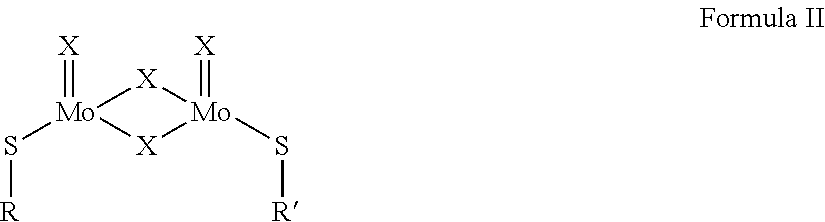
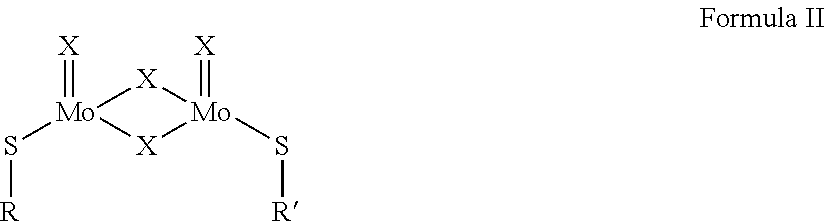
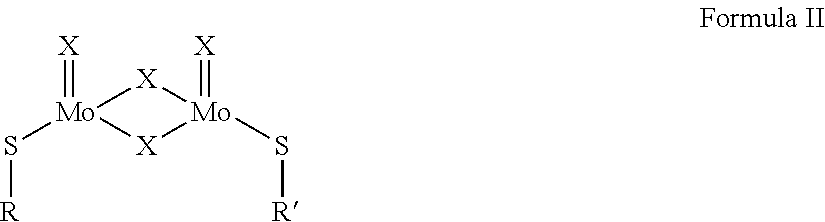
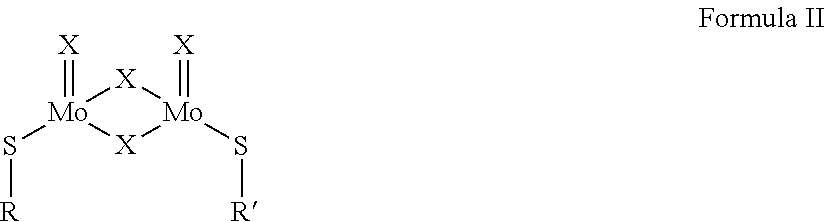
- R and R′ each represents an oxygen, nitrogen or carbon-containing compounds such as alcohols, alkyl, alkenyl, amides, amines, or aryl groups; and X represents oxygen or sulfur and can be the same or different but where at least one X in the formula is sulfur.
- composition a composition comprising sulfur-containing molybdenum complex to inhibit deposition of a foulant in contact with process equipment, the sulfur-containing molybdenum complex
- R represents an oxygen, nitrogen or carbon-containing compounds such as alcohols, alkyl, alkenyl, amides, amines, or aryl groups; n is 4-10.
- treated process equipment comprising a process equipment comprising a metal surface; and the fluid source comprising a sulfur-containing molybdenum complex as described in Formula I, II, III, and IV, wherein at least a portion of the metal surface is contacted by the fluid source.
- the sulfur-containing molybdenum complex is used to inhibit organic and inorganic material that deposit on equipment during the operation of a manufacturing and/or chemical process, which deposition may be unwanted and includes but is not limited to asphaltene and coke.
- FIG. 1 is a graphical representation of surface coke deposition in the presence of Test Complex A compared with Comparative Complex 1 and Comparative Complex 2.
- anti-foulant refers to a complex that prevents, retards, mitigates, reduces, controls and/or delays the deposition of organic and inorganic materials such as polymers, prepolymers, oligomers and/or other materials on “process equipment.”
- the term will be understood to refer to the anti-foulant itself or in a composition which may include other anti-foulants or compounds or solvents, as determined by context.
- foulant means organic and inorganic material that deposit on equipment during the operation of a manufacturing and/or petroleum and/or chemical processes, which may be unwanted and which may impair the cost and/or efficiency of the process and includes but is not limited to asphaltene and coke.
- hydrocarbon processing means a process performed on the hydrocarbon material that includes but not limited to refining, storing, transporting, fractionating or otherwise affecting the hydrocarbon material.
- the term “inhibits,” “inhibiting,” or grammatical equivalents thereof refer to preventing, retarding, mitigating, reducing, controlling and/or delaying the deposition of foulant.
- passivation means the prevention of a reaction between two materials when used together by coating at least one of the two materials to such an extent that they become substantially less reactive relative to each other.
- process equipment means equipment used to refine, store, transport, fractionate, or otherwise process a material including but not limited to heaters, heat exchangers, tubes, pipes, heat transfer vessels, process vessels, tanks, compressors, fans, impellers, pumps, valves, inter-coolers, sensors, and the like, that are associated with a process and which may be subject to the deposition of foulant.
- This term also includes sets of components which are in communication such as, for example, a gas compressor in an ethylene cracking process.
- the term “optional” or “optionally” means that the subsequently described event or circumstance may, but need not occur, and that the description includes instances where the event or circumstance occurs and instances in which it does not.
- intended properties include, solely by way of non-limiting examples thereof, flexibility, partition coefficient, rate, solubility, temperature, and the like; intended values include thickness, yield, weight, concentration, and the like.
- the effect on methods that are modified by “substantially” include the effects caused by variations in type, number, or amount of materials used in a process, variability in machine settings, the effects of ambient conditions on a process, and the like wherein the manner or degree of the effect does not negate one or more intended properties or results; and like proximate considerations.
- the claims appended hereto include equivalents to these types and amounts of materials.
- any recited ranges of values contemplate all values within the range and are to be construed as support for claims reciting any sub-ranges having endpoints which are real number values within the recited range.
- a disclosure in this specification of a range from 1 to 5 shall be considered to support claims to any of the following ranges: 1-5; 1-4; 1-3; 1-2; 2-5; 2-4; 2-3; 3-5; 3-4; and 4-5 and anything there between.
- compositions and methods to inhibit to the deposition of foulant in equipment and systems such as systems used in petroleum or hydrocarbon processing includes at least one sulfur-containing molybdenum complex.
- the sulfur-containing molybdenum complex contains at least one molybdenum center that is coordinated to at least a sulfur, and can include oxygen and bearing oxygen, nitrogen or carbon-containing ligands including, thiolates, sulfides, thiocarbamates, thiocarbonates, thioacids or polymers thereof and combinations thereof.
- the described compositions and methods inhibit fouling by serving as antifoulant, or to passivate a surface or both.
- the sulfur-containing molybdenum complex has the general formula of Formula I or Formula II.
- Mo molybdenum complex
- S sulfur
- R represents oxygen, nitrogen or carbon-containing ligands such as alcohols, alkyl, alkenyl, amides, amines, or aryl groups
- n is 4-10.
- R and R′ each represents oxygen, nitrogen or carbon-containing ligands such as alcohols, alkyl, alkenyl, amides, amines, or aryl groups, and R and R′ can be the same or different; and X represents oxygen or sulfur and can be the same or different but where at least one X in the formula is sulfur.
- R or R′ represents an alkyl group (linear, branched, or cyclic) with or without saturation or heteroatoms or both; thiolates, sulfides, thiocarbamates, thiocarbonates, thioacids, aromatic rings with or without substituents, organic polysulfides, or inorganic polysulfides (e.g., S2 through S8).
- R and R′ are each an alkyl group having 2 to 30 carbon atoms; 5 to 20 carbon atoms; 5 to 15 carbon atoms; 5 to 10 carbon atoms or an aryl group (including alkylaryl group).
- the number of carbon atoms described above is characterized by one or more hydroxyl groups (e.g. alkyl alcohols), acids or esters thereof.
- the alkyl group is ethyl, propyl, butyl, pentyl, hexyl, heptyl, octyl, nonyl, decyl, undecyl, dodecyl, tridecyl, tetradecyl, pentadecyl, hexadecyl, heptadecyl and octadecyl, cyclohexyl, phenyl, naphthyl, tolyl, xylyl, benzyl and phenethyl groups.
- These alkyl groups may be primary, secondary or tertiary alkyl groups and straight-chain or branched.
- the (alkyl)aryl groups include phenyl, tolyl, ethylphenyl, propylphenyl, butylphenyl, pentylphenyl, hexylphenyl, octylphenyl, nonylphenyl, decylphenyl, undecylphenyl, dodecylphenyl groups, all of which alkyl groups may be primary, secondary or tertiary alkyl groups and straight-chain or branched.
- the (alkyl)aryl groups include all positional isomers wherein the aryl group may possess an alkyl substituent at any position.
- the (alkyl) aryl groups as described above are composed of carbon and hydrogen, and might include heteroatoms such as nitrogen, oxygen, and sulfur.
- the alcohol groups may be mono-substituted alcohols, diols or bis-alcohols, or polyalcohols. In some embodiments the alcohols are six to ten carbon atoms.
- the amino groups may be monoamines, diamines, or polyamines.
- the amine is a dialkyl amine with the formula HNR5R6, where R5 and R6 are each selected from straight or branched chains containing 2 to 24 carbon atoms, or from 4-13; 8 to 13; or 10 to 20 carbon atoms.
- R5 can be the same or different from R6.
- the R5 and R6 can be an aryl group including an (alkyl)aryl group.
- the alkyl group is ethyl, propyl, butyl, pentyl, hexyl, heptyl, octyl, nonyl, decyl, undecyl, dodecyl, tridecyl, tetradecyl, pentadecyl, hexadecyl, heptadecyl and octadecyl groups.
- These alkyl groups may be primary, secondary or tertiary alkyl groups and straight-chain or branched.
- the alkyl groups may be straight-chain or branched and the alkyl groups may bond to any position of the phenyl groups, and mixtures thereof.
- molybdenum complexes are sulfur-containing molybdenum dithiolates, molybdenum dithioester, or molybdenum thio-terminated amide complexes.
- R and R′ can be 1-4 rings or an aromatic group.
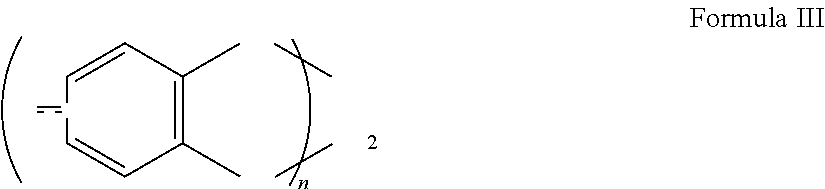
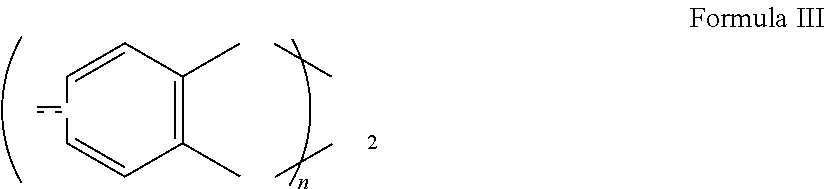
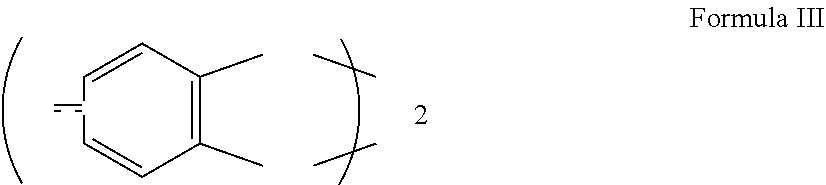
- the sulfur-containing molybdenum complex has the following general formula III:
- R is as described above.
- the R is an alkyl group (linear, branched, or cyclic) with or without saturation or heteroatoms or both; thiolates, sulfides, dithiocarbamates, dithiocarbonates, dithioacids, aromatic rings with or without substituents, organic polysulfides, inorganic polysulfides; and n is 2-10 or 2-6.
- the R in the sulfur-containing molybdenum is a phenolic containing sulfur.
- the phenolic containing sulfur is an ethylhexal phenol; 4,4′-thiobis(2-methyl-6-tert-butylphenol), 4,4′-thiobis(3-methyl-6-tert-butylphenol), 2,2′-thiobis(4-methyl-6-tert-butylphenol), bis(3-methyl-4-hydroxy-5-tert-butylbenzyl)sulfide, bis(3,5-di-tert-butyl-4-hydroxybenzyl)sulfide and 2,2′-thio-diethylenebis[3-(3,5-di-tert-butyl-4-hydroxyphenyl)propionate].
- R and R′ are each organic polysulfides or inorganic polysulfides.
- the inorganic polysulfide has 2-10 or 2-8 or 3-7 sulfurs.
- the organic polysulfide has the general formula IV: R 2 —S x —R 3 Formula IV
- R 2 and R 3 are each as described above for R and R′.
- R 2 and R 3 are each an alkyl groups (aliphatic, acyclic, aromatic and heterocyclic groups) and R2 and R 3 can be the same or different; and x ranges from 2 to 8.
- the polysulfide is a di-(2ethylhexyl) polysulfide, dibenzylpolysulfide, di-tert-nonylpolysulfide, didodecylpolysulfide, di-tert-butylpolysulfide, dioctylpolysulfide, diphenylpolysulfide and dicyclohexylpolysulfide.
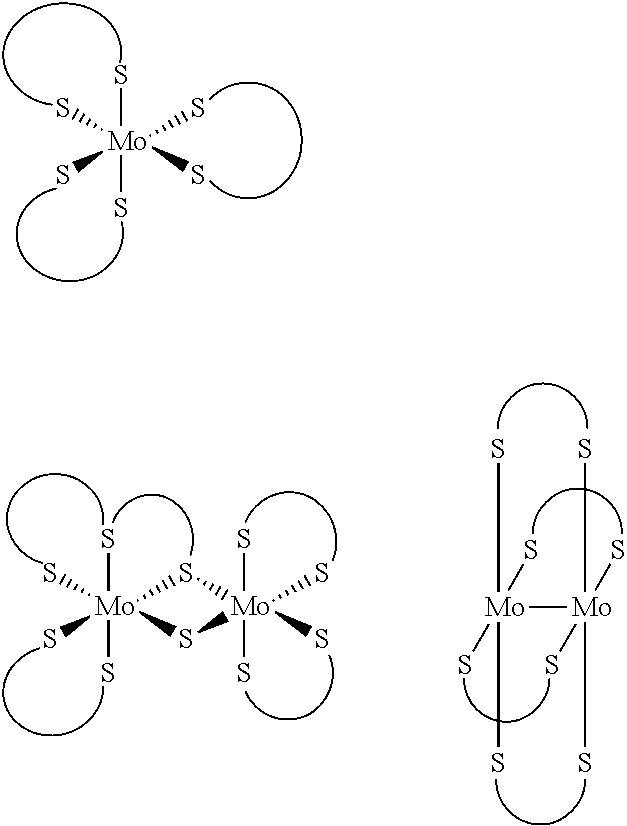
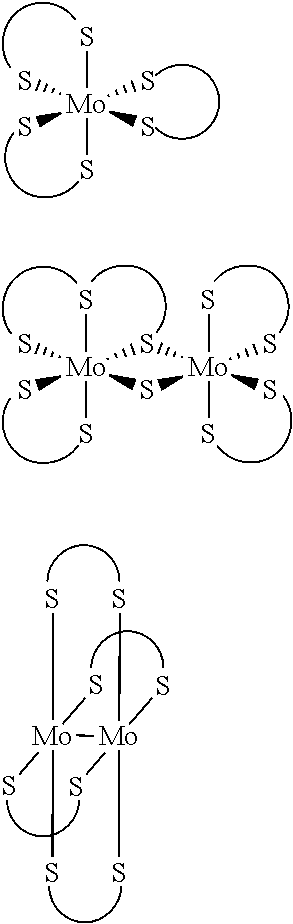
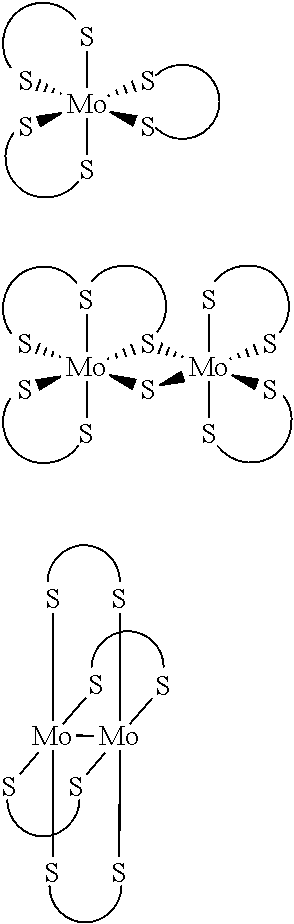
- the sulfur-containing Mo complex is as shown below.
- arcs represent alkyl chains (linear, branched and cyclic) with or without saturation or heteroatoms or both; dithiocarbamates, dithiocarbonates, dithioacids, aromatic rings with or without substituents, organic polysulfides, or inorganic polysulfides.
- the R, R′, R 2 and R 3 in the sulfur-containing molybdenum complex are thiolates, thiocarbamates, thiocarbonates, thioacids, dithiolates, dithiocarbamates, dithiocarbonates, dithioacids, polymers thereof and mixtures thereof.
- the R, R′, R 2 and R 3 in the sulfur-containing molybdenum complex is a diethyldithiocarbamate, dipropyldithiocarbamate, dibutyldithiocarbamate, dipentyldithiocarbamate, dihexyldithiocarbamate, dioctyldithiocarbamate, didecyldithiocarbamate, didodecyldithiocarbamate, di(butylphenyl)dithiocarbamate, di(nonylphenyl)dithiocarbamate, or di (2-ethylhexyl)dithiocarbamate or mixtures thereof.
- the sulfur-containing molybdenum complex is phosphorous-free or has little or no phosphorus. Such a complex provides a longer life for catalysts used in hydrocarbon-treating processes.
- the sulfur-containing molybdenum complex may be prepared as described in Tribology International Vol. 27, Issue 6, p. 379-386 (1994); Tribology International Vol. 53, p. 150-158 (2012); and U.S. Pat. No. 3,356,702, the references incorporated herein by reference in their entireties.
- molybdenum compounds of various oxidation states such as from 2-6 may be used and can be represented by the following compositions: molybdic acid, ammonium molybdate, molybdenum salts such as MoOC14, MoO2 Br2, Mo2 O3 Cl6, molybdenum trioxide or similar acidic molybdenum compounds.
- Acidic molybdenum compounds are molybdic acid, ammonium molybdate, and molybdenum trioxide.
- the molybdates include molybdenum oxide or molybdenum sulfide. The molybdates are reacted with a sulfur source.
- the sulfur sources are sulfur, hydrogen sulfide, sulfur monochloride, sulfur dichloride, phosphorus pentasulfide, R2 Sx where R is hydrocarbyl, preferably C1-40 alkyl, and x is at least 2, inorganic sulfides and polysulfides such as (NH4)2 Sx, where x is at least 1, thioacetamide, thiourea, and mercaptans of the formula RSH where R is as defined above.
- sulfurizing agents are traditional sulfur-containing antioxidants such as wax sulfides and poly sulfides, olefins, carboxylic and esters and ester-olefins, and alkylphenols and the metal salts thereof.
- the compositions comprise, consist essentially of, or consist of at least one of the described sulfur-containing molybdenum complexes.
- the sulfur-containing molybdenum complexes can be formulated as an anti-foulant or passivation composition useful to inhibit deposition of foulant (e.g., coke) on metal surfaces of process equipment in contact with a hydrocarbon material (in either liquid or gaseous form) which surfaces or liquid reach temperatures from 200° C. to 1500° C.
- the compositions comprise, consist essentially of, or consist of at least one of the described sulfur-containing molybdenum complexes to inhibit fouling by serving as antifoulant, or to passivate a surface or both.
- the sulfur-containing molybdenum complex is formulated with solvents such as water, alcohols such as methanol, ethanol, isopropanol, n-propanol, n-butanol, isobutanol, sec-butanol, t-butanol or higher alcohols such as benzyl alcohol); ketones such as acetone, or methyl ethyl ketone (2-butanone); acetonitrile; esters such as ethyl acetate, propyl acetate and butyl acetate; ethers such as diethyl ether or higher, e.g.
- solvents such as water, alcohols such as methanol, ethanol, isopropanol, n-propanol, n-butanol, isobutanol, sec-butanol, t-butanol or higher alcohols such as benzyl alcohol
- ketones such as acetone, or methyl e
- methyl t-butyl ether glyme, diglyme, ethylene glycol monobutyl ether, ethylene diglycol ethyl ether, 1,4 dioxane and related; aromatics such as toluene, xylene(s), diethylbenzene, naphthalene and related aromatics or refinery cuts (heavy aromatic naptha, heavy aromatic distillates, and related); aliphatics such as pentane, hexane, heptane, octane, or refined gasoline.
- the solvents suitable for formulation with the molybdenum-containing composition are aliphatic, such as pentane, hexane, cyclohexane, methylcyclohexane, heptane, decane, dodecane, and the like, and aromatics, such as toluene, xylene, heavy aromatic naphtha, diesel, fatty acid derivatives (acids, esters, amides), and the like.
- the one or more solvents are 10 wt % to 99 wt % of the sulfur-containing molybdenum complex; 1-25 wt %; 20-50 wt %; 30-75 wt %; 50-75%; 75-100 wt % of the sulfur-containing molybdenum complex.
- the sulfur-containing molybdenum complexes are provided neat (viz., without a solvent). In some embodiments, the sulfur-containing molybdenum complexes are provided as a concentrate.
- the sulfur-containing molybdenum complex or compositions containing them include other additives such as one or more asphaltene inhibitors, paraffin inhibitors, scale inhibitors, demulsifiers, water clarifiers, dispersants, emulsion breakers, antifoams, or any combination thereof.
- the sulfur-containing molybdenum complex further comprises one or more solvents or a mixture thereof.
- the sulfur-containing molybdenum complex or in compositions are used in an amount from about 0.1 ppm to 10,000 ppm; from 0.1 ppm to 3,000 ppm; from about 100 ppm to 1500 ppm; from about 100 ppm to 1000 ppm; from about 500 ppm to 3,000 ppm; from about 750 ppm to 3,000 ppm; from about 2,000 ppm to 5,000 ppm; from about 3,000 ppm to 5000 ppm; from about 100 ppm to 3,000 ppm; from about 1 ppm to 1000 ppm; from about 1 ppm to 3,000 ppm; from about 10 ppm to 50 ppm; from about 50 ppm to 100 ppm, from 100 pp to 800 ppm, from 150 ppm to 550
- the sulfur-containing molybdenum complex may be added by any suitable method.
- the sulfur-containing molybdenum complex may be added neat or as a dilute solution.
- the sulfur-containing molybdenum complex may be introduced as a solution, emulsion, or dispersion that is sprayed, dripped, poured or injected into a desired opening within a system or onto the process equipment or process condensate.
- the sulfur-containing molybdenum complex may be added with a wash-oil or an at-temperation water.
- the sulfur-containing molybdenum complex can be added continuously or intermittently to the process equipment as required to inhibit fouling.
- the molybdenum-containing antifouling complex is introduced during or after a decoking or cleaning process such as an online spalling, mechanical pigging, or steam/air burning process.
- the molybdenum-containing antifouling complex is introduced during a warm up process, viz., bringing the unit back to process temperatures after a shut down and/or cleaning process.
- the sulfur-containing molybdenum complex is introduced to passivate the surfaces when the equipment is shut down and decoked and cleaned.
- the sulfur-containing molybdenum complex is added and passivation can occur without shutting down the equipment.
- Any known method in the art to passivate surfaces can be used, such as for example U.S. Pat. No. 9,845,437, which reference is incorporated herein by reference in its entirety.
- the sulfur-containing molybdenum complex can be pumped or injected into a system in a continuous fashion or as an intermittent fashion to mitigate the fouling in the process unit.
- the injection point can be at any or all stages of the process unit.
- the sulfur-containing molybdenum complex is used on any suitable process equipment such as process equipment used in the production and refining of oil and gas.
- the process equipment includes thermal conversion units, heat exchanger, visbreakers, cokers, fired heaters, furnaces, fractionators, or other heat transfer equipment.
- the process equipment is gas compressors.
- the process equipment is coils, heat exchangers, transfer line exchangers quench coolers, furnaces, separation columns or fractionators.
- the sulfur-containing molybdenum complex can also be useful in other similar applications and with other equipment.
- the sulfur-containing molybdenum complex may be used with any process where process equipment will come into contact with unsaturated monomers, such as in an ethylene cracked gas process.
- the sulfur-containing molybdenum complex may be used with ethylene dilution steam generators and acrylonitrile purification systems. Many polymer processes have monomer recovery systems which are subject to fouling and are good target applications for the sulfur-containing molybdenum complex. Water strippers and waste water strippers used with petrochemical processes such as styrene, butadiene, acrylonitrile, and ethylene processes are potential applications for the sulfur-containing molybdenum complex. In some embodiments, ethylene acid gas scrubbers and butadiene solvent recovery systems are also end-use applications of the sulfur-containing molybdenum complex.
- the sulfur-containing molybdenum complex can be used in any process which has process equipment subject to foulant (e.g., polymers) forming and depositing on process equipment.
- the sulfur-containing molybdenum complex can prevent polymerization and deposition of the polymers on process equipment in a primary fractionation process, light ends fractionation, non-aromatic halogenated vinyl fractionation, process-gas compression, dilution steam system, caustic tower, quench water tower, butadiene extraction.
- the sulfur-containing molybdenum complex can inhibit the polymerization of resins and compositions comprising unsaturated species.
- fouling is inhibited by using the sulfur-containing molybdenum complex to surface passivate processing equipment.
- the sulfur-containing molybdenum complexes are not used in processing equipment such as an engine, hydraulic brake, power steering system, or transmission nor are the sulfur-containing molybdenum complexes used as a coolant additive in hydraulic fluid.
- the sulfur-containing molybdenum complex is introduced into a fluid by any means suitable for ensuring dispersal of the sulfur-containing molybdenum complex through the fluid source being treated.
- the composition comprising the sulfur-containing molybdenum complex can be injected as prepared or formulated in one or more additional solvents, depending upon the application and requirements.
- One of skill in the art will understand that the methods disclosed herein are not limited in any way by the introduction method, the timing or the location of the introduction.
- the sulfur-containing molybdenum complex or in compositions is introduced to a fluid source using various well-known methods and they may be introduced at numerous, different locations throughout a given system.
- the composition comprising the molybdenum-containing chemistry is pumped into an oil/gas pipeline using an umbilical line.
- capillary string injection systems may be utilized to deliver the composition.
- U.S. Pat. No. 7,311,144 provides a description of an apparatus and methods relating to capillary injection, the disclosure of which is incorporated into the present application in its entirety.
- the composition comprising the one or more sulfur-containing molybdenum complex is injected using mechanical equipment such as chemical injection pumps, piping tees, injection fittings, and the like.
- the sulfur-containing molybdenum complex is introduced into process equipment or fluid in contact with the process equipment.
- the process equipment is used to refine, store, transport, fractionate, or otherwise process a hydrocarbon such as crude oil, natural gas, petroleum and petroleum fractions.
- the sulfur-containing molybdenum complex or in compositions is introduced into process equipment to form treated process equipment.
- treated process equipment can be observed to undergo less foulant deposition than on process equipment without addition of the sulfur-containing molybdenum complex or in compositions.
- Inhibition in the foulant formation or foulant deposition can be evaluated by any known method or test.
- the inhibition of foulant formation and foulant deposition on process equipment can be assessed by measuring weight gain caused by foulant deposition as described in Examples 1 and 2.
- the sulfur-containing molybdenum complex or in compositions can be used for any process equipment having a metal surface.
- the metal surface of the process equipment is metal or metal alloys.
- the metal surface can include steel (including carbon steel, stainless steel, galvanized steel, hot dipped galvanized steel, electrogalvanized steel, annealed hot dipped galvanized steel, or mild steel), nickel, titanium, tantalum, aluminum, copper, gold, silver, platinum, zinc, nickel titanium alloy (nitinol), an alloy of nickel, chromium, iron, iridium, tungsten, silicon, magnesium, tin, alloys of any of the foregoing metals, coatings containing any of the foregoing metals, and combinations thereof.
- the metal surface of the process equipment is iron alloys, carbon steel, stainless steel, nickel-chromium-iron alloys, or other alloys.
- the deposition of foulant inside process equipment treated with the sulfur-containing molybdenum complex is reduced by at least 50 wt % compared to process equipment not treated with the molybdenum-containing foulant.
- about 50 wt % to 100 wt % (where 100 wt % reduction in polymer formation is elimination of deposition), or about 50 wt % to 95 wt %, or about 50 wt % to 90 wt %, or about 50 wt % to 85 wt %, or about 50 wt % to 80 wt %, or about 50 wt % to 75 wt %, or about 50 wt % to 70 wt %, or about 55 wt % to 100 wt %, or about 60 wt % to 100 wt %, or about 65 wt % to 100 wt %, or about 70 wt % to 100 wt %, or
- the sulfur-containing molybdenum complexes are used in a method to passivate the surfaces of a process equipment to provide a treated process equipment.
- the treated process equipment mitigates (e.g., inhibits) the fouling on the metal surfaces.
- Examples of passivation are described in U.S. Pat. Nos. 4,024,050, 3,522,093, 6,228,253, ASTM A-967, and ASTM A-380, which references are incorporated herein by reference in their entirety.
- passivation is carried out before the process equipment is used for a hydrocarbon processing (e.g., prior to hydrocarbon cracking) and/or after the process equipment has been de-coked or cleaned, and referred herein as pre-passivation.
- the sulfur-containing molybdenum complexes is introduced into the hydrocarbon feedstock before or during the processing of the hydrocarbon feedstock, and referred here as passivation.
- the molybdenum complex is introduced continuously or intermittently.
- the sulfur-containing molybdenum complexes are introduced at an initial dosage rate and for short time period to result in coating of the metal surface. In some embodiments, the sulfur-containing molybdenum complexes are introduced at a rate of about 1 ppm to about 3,000 ppm or about 500 ppm to about 2,000 ppm and to maintain this level for a time period ranging from 12 hour to 48 hours or 12 hours to 24 hours until the sulfur-containing molybdenum complexes induces the build-up of a protective coating (e.g., unreactive) on the metal surfaces.
- a protective coating e.g., unreactive
- the sulfur-containing molybdenum complexes is dosed at a concentration that is at least double the initial dosage rate for a period of 1 hour to 12 hours prior to introducing the fluids to be processed. In some embodiments, the sulfur-containing molybdenum complexes are introduced at a rate of about 1000 ppm to about 3,000 ppm for a time period ranging from 6 hour to 12 hours.
- the sulfur-containing molybdenum complexes is dosed at a concentration that is at least double the initial dosage rate for a period of 1 hour to several hours while simultaneously introducing fluids to be processed.
- the dosage rate needed to maintain the protection may be reduced from 1 ppm to 3000 ppm to at least 1 ppm to 1500 ppm.
- the dosage for a continuous application of the sulfur-containing molybdenum complex into the fluid is 1 ppm to 1500 ppm; 1 ppm-1000 ppm; 1-500 ppm, 1-250 ppm, 100-200 ppm, or 500-1000 ppm without substantial sacrifice of protection.
- the sulfur-containing molybdenum complexes are used as disclosed in U.S. Provisional Application No. 63/058,010 filed Jul. 29, 2020.
- a method of inhibiting deposition of a foulant comprising:
- R represents an oxygen, nitrogen or carbon-containing compounds such as alcohols, alkyl, alkenyl, amides, amines, or aryl groups; n is 4-10.
- R and R′ each represents an oxygen, nitrogen or carbon-containing compounds such as alcohols, alkyl, alkenyl, amides, amines, or aryl groups; and X represents oxygen or sulfur and can be the same or different but where at least one X in the formula is sulfur.
- sulfur-containing molybdenum complex further comprises one or more, asphaltene inhibitors, paraffin inhibitors, scale inhibitors, emulsifiers, water clarifiers, dispersants, emulsion breakers, or any combination thereof.
- R represents an oxygen, nitrogen or carbon-containing compounds such as alcohols, alkyl, alkenyl, amides, amines, or aryl groups; n is 2-6.
- R or R′ comprise each an alkyl group (linear, branched, or cyclic) with or without saturation or heteroatoms or both; thiolates, sulfides, thiocarbamates, thiocarbonates, thioacids, aromatic rings with or without substituents, organic polysulfides, inorganic polysulfides, polymers thereof and combinations thereof.
- R or R′ comprise each dithiolates, disulfide, dithiolates, dithiocarbamates, dithiocarbonates, dithioacids, inorganic polysulfides, organic polysulfides, polymers thereof and mixtures thereof.
- R2 and R3 each represents an oxygen, nitrogen or carbon-containing ligands such as alcohols, alkyl, alkenyl, amides, amines, or aryl groups; and R and R′ can be the same or different.
- R2 and R3 comprise each an alkyl group (linear, branched, or cyclic) with or without saturation or heteroatoms or both; thiolates, sulfides, thiocarbamates, thiocarbonates, thioacids, aromatic rings with or without substituents, organic polysulfides, inorganic polysulfides, polymers thereof and combinations thereof.
- R2 and R3 comprise each an alkyl group (linear, branched, or cyclic) with or without saturation or heteroatoms or both; thiolates, sulfides, thiocarbamates, thiocarbonates, thioacids, aromatic rings with or without substituents, organic polysulfides, inorganic polysulfides, polymers thereof and combinations thereof.
- the arcs represent alkyl chains (linear, branched and cyclic) with or without saturation or heteroatoms or both; thiolates, sulfides, thiocarbamates, thiocarbonates, thioacids, aromatic rings with or without substituents, organic polysulfides, or inorganic polysulfides.
- a composition comprising sulfur-containing molybdenum complex to inhibit deposition of a foulant in contact with process equipment, the sulfur-containing molybdenum complex
- R represents an oxygen, nitrogen or carbon-containing compounds such as alcohols, alkyl, alkenyl, amides, amines, or aryl groups; n is 4-10.
- composition of embodiment 24, wherein the composition further comprises one or more, asphaltene inhibitors, paraffin inhibitors, scale inhibitors, emulsifiers, water clarifiers, dispersants, emulsion breakers, or any combination thereof.
- R represents an oxygen, nitrogen or carbon-containing compounds such as alcohols, alkyl, alkenyl, amides, amines, or aryl groups; n is 2-6.
- composition as in one of embodiments 20-27, wherein the R, R′ comprise each disulfides, dithiolates, dithiocarbamates, dithiocarbonates, dithioacids, inorganic polysulfides, organic polysulfides, polymers thereof and mixtures thereof.
- composition of embodiment 28, wherein the organic polysulfide has the general formula IV: R2-Sx-R3 Formula IV
- R2 and R3 each represents an oxygen, nitrogen or carbon-containing ligands such as alcohols, alkyl, alkenyl, amides, amines, or aryl groups; and R2 and R3 can be the same or different.
- composition of embodiment 29, wherein the R2 and R3 comprise each an alkyl group (linear, branched, or cyclic) with or without saturation or heteroatoms or both; thiolates, sulfides, thiocarbamates, thiocarbonates, thioacids, aromatic rings with or without substituents, organic polysulfides, inorganic polysulfides, polymers thereof and combinations thereof.
- composition as in one of embodiments 24-31, wherein the sulfur-containing molybdenum complex comprises the following:
- composition as in one of embodiments 24-32, wherein the sulfur-containing molybdenum complex is about 1 ppm to 3000 ppm of the composition.
- composition comprising:
- composition as in one of embodiments 24-37, wherein the fluid temperature is 200° C. to 1500° C.
- a treated process equipment comprising:
- the fluid source comprising the sulfur-containing molybdenum complex as in one of embodiments 24-38, wherein at least a portion of the metal surface is contacted by the fluid source.
- a sulfur-containing molybdenum complex used as an anti-coke inhibitor was evaluated by gain in weight of SS304 mesh coupons from coke deposition.
- a reactor apparatus was used to simulate the coking process conditions and temperatures.
- Table 1 shows the experimental conditions used in the autoclave testing:
- a SS304 mesh (as described above) was weighed on an analytical balance and inserted into a high pressure/high temperature autoclave vessel. Then, 50 g vacuum distillation bottom residue was added into the autoclave. Subsequently, the vessel was closed and sealed. The vessel was purged and pressurized with N2. The reactor content was continuously mixed while the vessel was heating to 410° C. Once the target temperature of 410° C. was reached of the medium, the pyrolysis experiment time was started.
- the autoclave was cooled down and the reactor pressure was released. Subsequently, the mesh was removed from the reactor and washed with toluene. The weight increase was measured, and the weight gain was calculated.
- FIG. 1 shows the response for Test Complex A (molybdenum dithiocarbamate) compared to Comparative Complex 1 (formaldehyde resin) and Comparative Complex 2 (olefinic copolymer) for the tested residual deposition amounts.
- the repeatability of the pyrolysis experiments in the mentioned reactors is ⁇ 1 mg.
- FIG. 1 also shows that Test Complex A was equal or better than the comparative complex chemistries.
- the Test Complex A and Comparative Complex 1 reduced the surface coke deposition to a similar extent with the current residue feed sample when they are used as anti-coke chemistries.
- the sulfur-containing molybdenum complexes used as anti-coke inhibitors will be evaluated by gain in weight of SS304 mesh coupons from coke deposition in a pre-passivation dose.
- a reactor apparatus will be used to simulate the coking process conditions and temperatures.
- Table 2 shows the experimental conditions that will be used in the autoclave testing:
- Metal meshes will be first weighed on an analytical balance (four-decimal). Next the meshes will be immersed in paraffin oil that will be heated at 250° C. and subjected to continuous nitrogen purging. To the heated oil will be added 1000 ppm dose of an anti-foulant composition tested and the resulting paraffin oil solution will be stirred at 250° C. for 1 hour. This heating and introducing the test anti-foulant simulates the process as a real unit in which the passivator would be applied over a short time frame (12 to 24 hours) at a high concentration in a hydrocarbon medium during the warm up of equipment. After 1-hour of passivation, heating will be stopped. Once the oil cooled down ( ⁇ 80° C.), the meshes will be removed from the oil, will be washed with toluene and isopropanol, and dried using a nitrogen gas stream.
- a prepassivated SS304 mesh (as described above) will be weighed on an analytical balance (four-decimal) and inserted into a high pressure/high temperature autoclave vessel. Then, 50 g vacuum distillation bottom residue or any other kind of hydrocarbon stream will be added into the autoclave. Subsequently, the vessel will be sealed and tightened using a set of bolts/screws. The atmosphere inside the vessel will be first purged with N2 using three rounds of 100 psi N2 fills/releases. The vessel will be then pressurized with N2 to 100 psi and then inserted inside a heating element or mantle. The reactor content will be continuously mixed while the vessel will be heating to 410° C. Once the target temperature of 410° C. will be reached, the pyrolysis experiment time will be started.
- the autoclave will be cooled down to 350° C., the pressure inside the vessel will be released, and then purged with N2.
- the heating mantle will be turned off and the vessel temperature dropped below 150° C., the autoclave will be removed from the heating mantle and disassembled and the mesh will be removed and will washed with toluene.
- the dried mesh will be weighed using the same analytical balance used to initially weight prepassivated SS304 mesh, and the weight gain will be calculated.
- Test Complexes such as a sulfur-containing Mo thiolate; a sulfur-containing Mo dialkyldithiocarbamate; a sulfur-containing Mo dialkyldithiocarbonate; a sulfur-containing Mo dialkyldithioacid and a sulfur-containing Mo polysulfide and will be compared to Comparative Complexes such as a mixture of a mono- and di-alkyl phosphate ester or an organic polysulfide or an inorganic polysulfide; or a thiolate or other benchmark anti-coke chemistries such as magnesium-based products and Test Complex A, Comparative Complex 1 and 2 as described in Example 1.
- the application illustratively disclosed herein can be suitably practiced in the absence of any element which is not specifically disclosed herein. Additionally, each and every embodiment of the application, as described herein, is intended to be used either alone or in combination with any other embodiment described herein as well as modifications, equivalents, and alternatives thereof.
- the application suitably comprises, consists essentially of, or consists of the elements described herein and claimed according to the claims. It will be recognized that various modifications and changes may be made without following the example embodiments and applications illustrated and described herein, and without departing from the scope of the claims.
Landscapes
- Chemical & Material Sciences (AREA)
- Oil, Petroleum & Natural Gas (AREA)
- Engineering & Computer Science (AREA)
- Organic Chemistry (AREA)
- Chemical Kinetics & Catalysis (AREA)
- General Chemical & Material Sciences (AREA)
- Physics & Mathematics (AREA)
- Thermal Sciences (AREA)
- Materials Engineering (AREA)
- Mechanical Engineering (AREA)
- Metallurgy (AREA)
- Production Of Liquid Hydrocarbon Mixture For Refining Petroleum (AREA)
- Lubricants (AREA)
- Catalysts (AREA)
- Pharmaceuticals Containing Other Organic And Inorganic Compounds (AREA)
Abstract
Description
-
- introducing into a process equipment or a fluid in contact with the process equipment a composition comprising a sulfur-containing molybdenum complex having the general formula selected from Formula I or II:


-
- R and R′ each represents an oxygen, nitrogen or carbon-containing compounds such as alcohols, alkyl, alkenyl, amides, amines, or aryl groups; and X represents oxygen or sulfur and can be the same or different but where at least one X in the formula is sulfur.

R2—Sx—R3 Formula IV
-
- introducing into a process equipment or a fluid in contact with the process equipment a composition comprising a sulfur-containing molybdenum complex having the general formula selected from Formula I or II:

R2-Sx-R3 Formula IV

-
- R and R′ each represents an oxygen, nitrogen or carbon-containing compounds such as alcohols, alkyl, alkenyl, amides, amines, or aryl groups; and X represents oxygen or sulfur and can be the same or different but where at least one X in the formula is sulfur.
R2-Sx-R3 Formula IV
-
- Wherein the arcs represent alkyl chains (linear, branched and cyclic) with or without saturation or heteroatoms or both; thiolates, sulfides, thiocarbamates, thiocarbonates, thioacids, aromatic rings with or without substituents, organic polysulfides, or inorganic polysulfides.
-
- a fluid; and
- the at least one sulfur-containing molybdenum complex as in one of embodiments 24-33.
| TABLE 1 |
| Experimental Parameters to be used in High Temperature |
| Anti-fouling Testing |
| Experimental Variable | Parameter | ||
| Temperature | 410° C. | ||
| Reaction N2 pressure | 8 bar @ room temperature | ||
| Time | 40 minutes | ||
| Autoclave testing medium | Vacuum distillation bottom residue | ||
| Metal inserts | SS304 mesh | ||
| Anticoke dose (continuous | 1200 ppm | ||
| process dose) | |||
Anti-Fouling Testing (Continuous Dose Process)
| TABLE 2 |
| Experimental Parameters to be used in High Temperature |
| Anti-fouling Testing |
| Experimental Variable | Parameter | ||
| Temperature | 410° C. | ||
| Shear rate | 600 rpm after the temperature reaches | ||
| 410° C. | |||
| Reaction N2 pressure | 8 bar @ room temperature | ||
| Time | 40 minutes | ||
| Autoclave testing medium | Vacuum distillation bottom residue | ||
| (e.g., heavy content of petroleum) | |||
| Metal inserts | SS304 mesh | ||
| Pre-passivation dose | 1000 ppm | ||
Mesh Prepassivation Step
Claims (6)

Priority Applications (2)
| Application Number | Priority Date | Filing Date | Title |
|---|---|---|---|
| US17/443,628 US11999915B2 (en) | 2020-07-29 | 2021-07-27 | Phosphorous-free oil soluble molybdenum complexes as high temperature fouling inhibitors |
| US18/646,393 US12365845B2 (en) | 2020-07-29 | 2024-04-25 | Phosphorous-free oil soluble molybdenum complexes as high temperature fouling inhibitors |
Applications Claiming Priority (2)
| Application Number | Priority Date | Filing Date | Title |
|---|---|---|---|
| US202063058023P | 2020-07-29 | 2020-07-29 | |
| US17/443,628 US11999915B2 (en) | 2020-07-29 | 2021-07-27 | Phosphorous-free oil soluble molybdenum complexes as high temperature fouling inhibitors |
Related Child Applications (1)
| Application Number | Title | Priority Date | Filing Date |
|---|---|---|---|
| US18/646,393 Division US12365845B2 (en) | 2020-07-29 | 2024-04-25 | Phosphorous-free oil soluble molybdenum complexes as high temperature fouling inhibitors |
Publications (2)
| Publication Number | Publication Date |
|---|---|
| US20220033977A1 US20220033977A1 (en) | 2022-02-03 |
| US11999915B2 true US11999915B2 (en) | 2024-06-04 |
Family
ID=77398666
Family Applications (2)
| Application Number | Title | Priority Date | Filing Date |
|---|---|---|---|
| US17/443,628 Active US11999915B2 (en) | 2020-07-29 | 2021-07-27 | Phosphorous-free oil soluble molybdenum complexes as high temperature fouling inhibitors |
| US18/646,393 Active US12365845B2 (en) | 2020-07-29 | 2024-04-25 | Phosphorous-free oil soluble molybdenum complexes as high temperature fouling inhibitors |
Family Applications After (1)
| Application Number | Title | Priority Date | Filing Date |
|---|---|---|---|
| US18/646,393 Active US12365845B2 (en) | 2020-07-29 | 2024-04-25 | Phosphorous-free oil soluble molybdenum complexes as high temperature fouling inhibitors |
Country Status (7)
| Country | Link |
|---|---|
| US (2) | US11999915B2 (en) |
| EP (1) | EP4189040A1 (en) |
| KR (1) | KR20230043862A (en) |
| CN (1) | CN116157494B (en) |
| CA (1) | CA3186764A1 (en) |
| SA (1) | SA523442330B1 (en) |
| WO (1) | WO2022026436A1 (en) |
Families Citing this family (4)
| Publication number | Priority date | Publication date | Assignee | Title |
|---|---|---|---|---|
| MY207792A (en) | 2019-07-29 | 2025-03-19 | Ecolab Usa Inc | Oil soluble molybdenum complexes for inhibiting high temperature corrosion and related applications in petroleum refineries |
| WO2021021888A1 (en) | 2019-07-29 | 2021-02-04 | Ecolab USA, Inc. | Oil soluble molybdenum complexes as high temperature fouling inhibitors |
| US11999915B2 (en) | 2020-07-29 | 2024-06-04 | Ecolab Usa Inc. | Phosphorous-free oil soluble molybdenum complexes as high temperature fouling inhibitors |
| EP4189047A1 (en) | 2020-07-29 | 2023-06-07 | Ecolab USA, Inc. | Phophorous-free oil soluble molybdenum complexes for high temperature naphthenic acid corrosion inhibition |
Citations (80)
| Publication number | Priority date | Publication date | Assignee | Title |
|---|---|---|---|---|
| US3356702A (en) | 1964-08-07 | 1967-12-05 | Vanderbilt Co R T | Molybdenum oxysulfide dithiocarbamates and processes for their preparation |
| US3446735A (en) | 1962-07-30 | 1969-05-27 | Lubrizol Corp | Lubricants containing molybdenum phosphorodithioates |
| US3522093A (en) | 1967-02-27 | 1970-07-28 | Chem Cleaning & Equipment Serv | Processes of cleaning and passivating reactor equipment |
| US4024051A (en) | 1975-01-07 | 1977-05-17 | Nalco Chemical Company | Using an antifoulant in a crude oil heating process |
| US4024050A (en) | 1975-01-07 | 1977-05-17 | Nalco Chemical Company | Phosphorous ester antifoulants in crude oil refining |
| DE2840094A1 (en) | 1978-09-12 | 1980-03-20 | Minnesota Mining & Mfg | Refractor-reflector radiation concentrator - uses components in co-operation to focus solar radiation from linear echelon and obtain high heat flux |
| US4226700A (en) | 1978-08-14 | 1980-10-07 | Nalco Chemical Company | Method for inhibiting fouling of petrochemical processing equipment |
| US4298454A (en) | 1976-07-02 | 1981-11-03 | Exxon Research And Engineering Company | Hydroconversion of an oil-coal mixture |
| US4370221A (en) | 1981-03-03 | 1983-01-25 | Her Majesty The Queen In Right Of Canada, As Represented By The Minister Of Energy, Mines And Resources | Catalytic hydrocracking of heavy oils |
| US4428848A (en) | 1981-11-09 | 1984-01-31 | Texaco Inc. | Molybdenum derivatives and lubricants containing same |
| US4511405A (en) | 1982-09-30 | 1985-04-16 | Reed Larry E | Antifoulants for thermal cracking processes |
| US4542253A (en) | 1983-08-11 | 1985-09-17 | Nalco Chemical Company | Use of phosphate and thiophosphate esters neutralized with water soluble amines as ethylene furnace anti-coking antifoulants |
| US4551227A (en) | 1984-04-16 | 1985-11-05 | Phillips Petroleum Company | Antifoulants for thermal cracking processes |
| US4559152A (en) | 1980-09-18 | 1985-12-17 | Texaco Inc. | Friction-reducing molybdenum salts and process for making same |
| US4582543A (en) | 1984-07-26 | 1986-04-15 | The Lubrizol Corporation | Water-based metal-containing organic phosphate compositions |
| US4613372A (en) | 1985-01-22 | 1986-09-23 | Phillips Petroleum | Antifoulants for thermal cracking processes |
| EP0267674A1 (en) | 1986-09-30 | 1988-05-18 | Petrolite Corporation | Antifoulant compositions and uses thereof |
| US4941994A (en) | 1989-07-18 | 1990-07-17 | Petrolite Corporation | Corrosion inhibitors for use in hot hydrocarbons |
| US5000836A (en) | 1989-09-26 | 1991-03-19 | Betz Laboratories, Inc. | Method and composition for retarding coke formation during pyrolytic hydrocarbon processing |
| US5015358A (en) | 1990-08-30 | 1991-05-14 | Phillips Petroleum Company | Antifoulants comprising titanium for thermal cracking processes |
| US5055174A (en) | 1984-06-27 | 1991-10-08 | Phillips Petroleum Company | Hydrovisbreaking process for hydrocarbon containing feed streams |
| US5182013A (en) | 1990-12-21 | 1993-01-26 | Exxon Chemical Patents Inc. | Naphthenic acid corrosion inhibitors |
| US5252254A (en) | 1992-12-30 | 1993-10-12 | Nalco Chemical Company | Naphthenic acid corrosion inhibitor |
| US5314643A (en) | 1993-03-29 | 1994-05-24 | Betz Laboratories, Inc. | High temperature corrosion inhibitor |
| JPH0646243U (en) | 1992-11-27 | 1994-06-24 | 日本軽金属株式会社 | Panel duct joint profile |
| US5445749A (en) | 1993-02-01 | 1995-08-29 | The Lubrizol Corporation | Thiocarbamates for metal/ceramic lubrication |
| WO1996006899A1 (en) | 1994-08-29 | 1996-03-07 | Den Norske Stats Oljeselskap A.S | A process for removing essentially naphthenic acids from a hydrocarbon oil |
| EP0727429A2 (en) | 1995-02-15 | 1996-08-21 | Asahi Denka Kogyo Kabushiki Kaisha | A process for producing molybdenum oxysulfide dithiocarbamate |
| US5552085A (en) | 1994-08-31 | 1996-09-03 | Nalco Chemical Company | Phosphorus thioacid ester inhibitor for naphthenic acid corrosion |
| EP0768366A1 (en) | 1995-10-11 | 1997-04-16 | Tonen Corporation | Lubricating oil composition |
| US5630964A (en) | 1995-05-10 | 1997-05-20 | Nalco/Exxon Energy Chemicals, L.P. | Use of sulfiding agents for enhancing the efficacy of phosphorus in controlling high temperature corrosion attack |
| WO1998033869A1 (en) | 1997-02-04 | 1998-08-06 | Betzdearborn Inc. | Methods for inhibiting high temperature corrosion |
| US5863415A (en) | 1996-05-30 | 1999-01-26 | Baker Hughes Incorporated | Control of naphthenic acid corrosion with thiophosporus compounds |
| US6022835A (en) | 1997-10-22 | 2000-02-08 | Shell Oil Company | Lubricating composition |
| EP1046700A2 (en) | 1999-04-21 | 2000-10-25 | Showa Shell Sekiyu Kabushiki Kaisha | Grease composition for constant velocity joint |
| US6207625B1 (en) | 1998-12-21 | 2001-03-27 | Tonen Corporation | Lubricant oil composition for diesel engines (LAW913) |
| US6228253B1 (en) | 1997-06-05 | 2001-05-08 | Zalman Gandman | Method for removing and suppressing coke formation during pyrolysis |
| US6852213B1 (en) | 1999-09-15 | 2005-02-08 | Nalco Energy Services | Phosphorus-sulfur based antifoulants |
| US7311144B2 (en) | 2004-10-12 | 2007-12-25 | Greg Allen Conrad | Apparatus and method for increasing well production using surfactant injection |
| EP1870706A1 (en) | 2006-06-21 | 2007-12-26 | Oil Plus Limited | Method of screening crude oil for low molecular weight naphthenic acids |
| US20090176671A1 (en) | 2006-05-10 | 2009-07-09 | Showa Shell Sekiyu K.K. | Grease Composition For Constant Velocity Joints |
| CN101697038A (en) | 2009-10-10 | 2010-04-21 | 张培榕 | Spectrum conversion device |
| US20100116718A1 (en) | 2007-04-04 | 2010-05-13 | Dorf Ketal Chemicals (1) Private Limited | Naphthenic acid corrosion inhibition using new synergetic combination of phosphorus compounds |
| US7727942B2 (en) | 2002-12-03 | 2010-06-01 | Tryssenkrupp Stahl Ag | Lubricant coated sheet metal with improved deformation properties |
| US20100152074A1 (en) | 2008-12-17 | 2010-06-17 | Chevron Oronite Company Llc | Lubricating oil compositions |
| US20100152073A1 (en) | 2008-12-17 | 2010-06-17 | Chevron Oronite Company Llc | Lubricating oil compositions |
| US7763744B2 (en) | 2005-03-01 | 2010-07-27 | R.T. Vanderbilt Company, Inc. | Molybdenum dialkyldithiocarbamate compositions and lubricating compositions containing the same |
| US20110160405A1 (en) | 2008-08-26 | 2011-06-30 | Dorf Ketal Chemicals (1) Private Limited | Effective novel polymeric additive for inhibiting napthenic acid corrosion and method of using the same |
| US7989404B2 (en) | 2008-02-11 | 2011-08-02 | Clearwater International, Llc | Compositions and methods for gas well treatment |
| WO2011161982A1 (en) | 2010-06-25 | 2011-12-29 | Jx日鉱日石エネルギー株式会社 | Fuel efficient engine oil composite |
| US8092618B2 (en) | 2009-10-21 | 2012-01-10 | Nalco Company | Surface passivation technique for reduction of fouling |
| US8247539B2 (en) | 2006-07-31 | 2012-08-21 | IFP Energies Nouvelles | Process for preparing materials by grafting halogenated phosphorus-containing groups onto an inorganic surface |
| US8309041B2 (en) | 2007-10-31 | 2012-11-13 | Headwaters Heavy Oil, Llc | Systems for increasing catalyst concentration in heavy oil and/or coal resid hydrocracker |
| EP2687582A1 (en) | 2012-07-18 | 2014-01-22 | Afton Chemical Corporation | Lubricant compositions for direct injection engines |
| EP2716743A1 (en) | 2011-05-26 | 2014-04-09 | JX Nippon Oil & Energy Corporation | Lubricating oil composition |
| US9023193B2 (en) | 2011-05-23 | 2015-05-05 | Saudi Arabian Oil Company | Process for delayed coking of whole crude oil |
| CN104730602A (en) | 2015-03-24 | 2015-06-24 | 南京理工大学 | Focusing lens |
| US9090837B2 (en) | 2007-03-30 | 2015-07-28 | Dorf Ketal Chemicals (I) Private Limited | High temperature naphthenic acid corrosion inhibition using organophosphorous sulphur compounds and combinations thereof |
| US9115319B2 (en) | 2007-09-14 | 2015-08-25 | Dorf Ketal Chemicals (I) Private Limited | Additive for naphthenic acid corrosion inhibition and method of using the same |
| US9206361B2 (en) | 2010-12-20 | 2015-12-08 | Chevron U.S.A. .Inc. | Hydroprocessing catalysts and methods for making thereof |
| US9233359B2 (en) | 2010-07-06 | 2016-01-12 | Total Marketing Services | Process for the hydroconversion of a low quality hydrocarbonaceous feedstock |
| CN105482869A (en) | 2014-06-06 | 2016-04-13 | 北京雅士科莱恩石油化工有限公司 | Antifriction agent containing nitrogen-sulfur molybdenum phosphate and preparation method thereof |
| CN106010480A (en) | 2016-05-16 | 2016-10-12 | 中石化石油工程技术服务有限公司 | Drilling fluid lubricant and drilling fluid |
| US20160362619A1 (en) | 2009-04-15 | 2016-12-15 | Dorf Ketal Chemicals (India) Private Limited | Effective Novel Non-Polymeric and Non-Fouling Additive for Inhibiting High-Temperature Naphthenic Acid Corrosion and Method of Using the Same |
| US9605215B2 (en) | 2004-04-28 | 2017-03-28 | Headwaters Heavy Oil, Llc | Systems for hydroprocessing heavy oil |
| US9663743B2 (en) | 2009-06-10 | 2017-05-30 | Afton Chemical Corporation | Lubricating method and composition for reducing engine deposits |
| US20170240838A1 (en) | 2016-02-23 | 2017-08-24 | Vanderbilt Chemicals, Llc | Quaternary ammonium sulfur-containing binuclear molybdate salts as lubricant additives |
| US9790440B2 (en) | 2011-09-23 | 2017-10-17 | Headwaters Technology Innovation Group, Inc. | Methods for increasing catalyst concentration in heavy oil and/or coal resid hydrocracker |
| US9845437B2 (en) | 2015-02-12 | 2017-12-19 | Ecolab Usa Inc. | Surface passivation method for fouling reduction |
| US9890339B2 (en) | 2008-08-26 | 2018-02-13 | Dorf Ketal Chemicals (I) Private Limited | Additive for inhibiting acid corrosion and method of using the new additive |
| US20180100117A1 (en) | 2016-10-07 | 2018-04-12 | Exxonmobil Research And Engineering Company | Lubricating oil compositions for electric vehicle powertrains |
| US9951290B2 (en) | 2016-03-31 | 2018-04-24 | Exxonmobil Research And Engineering Company | Lubricant compositions |
| US20190225909A1 (en) | 2018-01-19 | 2019-07-25 | Chevron Oronite Company Llc | Ultra low ash lubricating oil compositions |
| US20190264125A1 (en) | 2016-06-29 | 2019-08-29 | Adeka Corporation | Lubricant additive composition, lubricating composition containing same and engine oil composition consisting of lubricating composition |
| WO2020105702A1 (en) | 2018-11-21 | 2020-05-28 | 協同油脂株式会社 | Grease composition for tapered roller bearing |
| US10712105B1 (en) | 2019-06-19 | 2020-07-14 | Exxonmobil Research And Engineering Company | Heat transfer fluids and methods of use |
| US20210032758A1 (en) | 2019-07-29 | 2021-02-04 | Ecolab Usa Inc. | Oil soluble molybdenum complexes for inhibiting high temperature corrosion and related applications in petroleum refineries |
| US20210032528A1 (en) | 2019-07-29 | 2021-02-04 | Ecolab Usa Inc. | Oil soluble molybdenum complexes as high temperature fouling inhibitors |
| US20220033725A1 (en) | 2020-07-29 | 2022-02-03 | Ecolab Usa Inc. | Phosphorous-free oil soluble molybdenum complexes for high temperature naphthenic acid corrosion inhibition |
| WO2022026436A1 (en) | 2020-07-29 | 2022-02-03 | Ecolab Usa Inc. | Phosphorous-free oil soluble molybdenum complexes as high temperature fouling inhibitors |
-
2021
- 2021-07-27 US US17/443,628 patent/US11999915B2/en active Active
- 2021-07-27 KR KR1020237003290A patent/KR20230043862A/en active Pending
- 2021-07-27 CA CA3186764A patent/CA3186764A1/en active Pending
- 2021-07-27 CN CN202180059435.1A patent/CN116157494B/en active Active
- 2021-07-27 WO PCT/US2021/043267 patent/WO2022026436A1/en not_active Ceased
- 2021-07-27 EP EP21756130.7A patent/EP4189040A1/en active Pending
-
2023
- 2023-01-26 SA SA523442330A patent/SA523442330B1/en unknown
-
2024
- 2024-04-25 US US18/646,393 patent/US12365845B2/en active Active
Patent Citations (90)
| Publication number | Priority date | Publication date | Assignee | Title |
|---|---|---|---|---|
| US3446735A (en) | 1962-07-30 | 1969-05-27 | Lubrizol Corp | Lubricants containing molybdenum phosphorodithioates |
| US3356702A (en) | 1964-08-07 | 1967-12-05 | Vanderbilt Co R T | Molybdenum oxysulfide dithiocarbamates and processes for their preparation |
| US3522093A (en) | 1967-02-27 | 1970-07-28 | Chem Cleaning & Equipment Serv | Processes of cleaning and passivating reactor equipment |
| US4024051A (en) | 1975-01-07 | 1977-05-17 | Nalco Chemical Company | Using an antifoulant in a crude oil heating process |
| US4024050A (en) | 1975-01-07 | 1977-05-17 | Nalco Chemical Company | Phosphorous ester antifoulants in crude oil refining |
| US4298454A (en) | 1976-07-02 | 1981-11-03 | Exxon Research And Engineering Company | Hydroconversion of an oil-coal mixture |
| US4226700A (en) | 1978-08-14 | 1980-10-07 | Nalco Chemical Company | Method for inhibiting fouling of petrochemical processing equipment |
| DE2840094A1 (en) | 1978-09-12 | 1980-03-20 | Minnesota Mining & Mfg | Refractor-reflector radiation concentrator - uses components in co-operation to focus solar radiation from linear echelon and obtain high heat flux |
| US4559152A (en) | 1980-09-18 | 1985-12-17 | Texaco Inc. | Friction-reducing molybdenum salts and process for making same |
| US4370221A (en) | 1981-03-03 | 1983-01-25 | Her Majesty The Queen In Right Of Canada, As Represented By The Minister Of Energy, Mines And Resources | Catalytic hydrocracking of heavy oils |
| US4428848A (en) | 1981-11-09 | 1984-01-31 | Texaco Inc. | Molybdenum derivatives and lubricants containing same |
| US4511405A (en) | 1982-09-30 | 1985-04-16 | Reed Larry E | Antifoulants for thermal cracking processes |
| US4542253A (en) | 1983-08-11 | 1985-09-17 | Nalco Chemical Company | Use of phosphate and thiophosphate esters neutralized with water soluble amines as ethylene furnace anti-coking antifoulants |
| US4551227A (en) | 1984-04-16 | 1985-11-05 | Phillips Petroleum Company | Antifoulants for thermal cracking processes |
| US5055174A (en) | 1984-06-27 | 1991-10-08 | Phillips Petroleum Company | Hydrovisbreaking process for hydrocarbon containing feed streams |
| US4582543A (en) | 1984-07-26 | 1986-04-15 | The Lubrizol Corporation | Water-based metal-containing organic phosphate compositions |
| US4613372A (en) | 1985-01-22 | 1986-09-23 | Phillips Petroleum | Antifoulants for thermal cracking processes |
| EP0267674A1 (en) | 1986-09-30 | 1988-05-18 | Petrolite Corporation | Antifoulant compositions and uses thereof |
| US4941994A (en) | 1989-07-18 | 1990-07-17 | Petrolite Corporation | Corrosion inhibitors for use in hot hydrocarbons |
| US5000836A (en) | 1989-09-26 | 1991-03-19 | Betz Laboratories, Inc. | Method and composition for retarding coke formation during pyrolytic hydrocarbon processing |
| US5015358A (en) | 1990-08-30 | 1991-05-14 | Phillips Petroleum Company | Antifoulants comprising titanium for thermal cracking processes |
| US5182013A (en) | 1990-12-21 | 1993-01-26 | Exxon Chemical Patents Inc. | Naphthenic acid corrosion inhibitors |
| JPH0646243U (en) | 1992-11-27 | 1994-06-24 | 日本軽金属株式会社 | Panel duct joint profile |
| US5252254A (en) | 1992-12-30 | 1993-10-12 | Nalco Chemical Company | Naphthenic acid corrosion inhibitor |
| US5445749A (en) | 1993-02-01 | 1995-08-29 | The Lubrizol Corporation | Thiocarbamates for metal/ceramic lubrication |
| US5314643A (en) | 1993-03-29 | 1994-05-24 | Betz Laboratories, Inc. | High temperature corrosion inhibitor |
| CN1164867A (en) | 1994-08-29 | 1997-11-12 | 挪威国家石油公司 | Process for removing essentially naphthenic acids from hydrocarbon oil |
| WO1996006899A1 (en) | 1994-08-29 | 1996-03-07 | Den Norske Stats Oljeselskap A.S | A process for removing essentially naphthenic acids from a hydrocarbon oil |
| US5552085A (en) | 1994-08-31 | 1996-09-03 | Nalco Chemical Company | Phosphorus thioacid ester inhibitor for naphthenic acid corrosion |
| EP0727429A2 (en) | 1995-02-15 | 1996-08-21 | Asahi Denka Kogyo Kabushiki Kaisha | A process for producing molybdenum oxysulfide dithiocarbamate |
| US5630964A (en) | 1995-05-10 | 1997-05-20 | Nalco/Exxon Energy Chemicals, L.P. | Use of sulfiding agents for enhancing the efficacy of phosphorus in controlling high temperature corrosion attack |
| EP0768366A1 (en) | 1995-10-11 | 1997-04-16 | Tonen Corporation | Lubricating oil composition |
| US5863415A (en) | 1996-05-30 | 1999-01-26 | Baker Hughes Incorporated | Control of naphthenic acid corrosion with thiophosporus compounds |
| WO1998033869A1 (en) | 1997-02-04 | 1998-08-06 | Betzdearborn Inc. | Methods for inhibiting high temperature corrosion |
| US6228253B1 (en) | 1997-06-05 | 2001-05-08 | Zalman Gandman | Method for removing and suppressing coke formation during pyrolysis |
| US6022835A (en) | 1997-10-22 | 2000-02-08 | Shell Oil Company | Lubricating composition |
| US6207625B1 (en) | 1998-12-21 | 2001-03-27 | Tonen Corporation | Lubricant oil composition for diesel engines (LAW913) |
| EP1046700A2 (en) | 1999-04-21 | 2000-10-25 | Showa Shell Sekiyu Kabushiki Kaisha | Grease composition for constant velocity joint |
| US6258760B1 (en) | 1999-04-21 | 2001-07-10 | Showa Shell Sekiyu K.K. | Grease composition for constant velocity joint |
| US6852213B1 (en) | 1999-09-15 | 2005-02-08 | Nalco Energy Services | Phosphorus-sulfur based antifoulants |
| US7727942B2 (en) | 2002-12-03 | 2010-06-01 | Tryssenkrupp Stahl Ag | Lubricant coated sheet metal with improved deformation properties |
| US9605215B2 (en) | 2004-04-28 | 2017-03-28 | Headwaters Heavy Oil, Llc | Systems for hydroprocessing heavy oil |
| US7311144B2 (en) | 2004-10-12 | 2007-12-25 | Greg Allen Conrad | Apparatus and method for increasing well production using surfactant injection |
| US7763744B2 (en) | 2005-03-01 | 2010-07-27 | R.T. Vanderbilt Company, Inc. | Molybdenum dialkyldithiocarbamate compositions and lubricating compositions containing the same |
| US20090176671A1 (en) | 2006-05-10 | 2009-07-09 | Showa Shell Sekiyu K.K. | Grease Composition For Constant Velocity Joints |
| EP1870706A1 (en) | 2006-06-21 | 2007-12-26 | Oil Plus Limited | Method of screening crude oil for low molecular weight naphthenic acids |
| US20070298505A1 (en) | 2006-06-21 | 2007-12-27 | Desmond Smith | Method of Screening Crude Oil for Low Molecular Weight Naphthenic Acids |
| US8247539B2 (en) | 2006-07-31 | 2012-08-21 | IFP Energies Nouvelles | Process for preparing materials by grafting halogenated phosphorus-containing groups onto an inorganic surface |
| US9090837B2 (en) | 2007-03-30 | 2015-07-28 | Dorf Ketal Chemicals (I) Private Limited | High temperature naphthenic acid corrosion inhibition using organophosphorous sulphur compounds and combinations thereof |
| US20100116718A1 (en) | 2007-04-04 | 2010-05-13 | Dorf Ketal Chemicals (1) Private Limited | Naphthenic acid corrosion inhibition using new synergetic combination of phosphorus compounds |
| US9115319B2 (en) | 2007-09-14 | 2015-08-25 | Dorf Ketal Chemicals (I) Private Limited | Additive for naphthenic acid corrosion inhibition and method of using the same |
| US8309041B2 (en) | 2007-10-31 | 2012-11-13 | Headwaters Heavy Oil, Llc | Systems for increasing catalyst concentration in heavy oil and/or coal resid hydrocracker |
| US7989404B2 (en) | 2008-02-11 | 2011-08-02 | Clearwater International, Llc | Compositions and methods for gas well treatment |
| US20110160405A1 (en) | 2008-08-26 | 2011-06-30 | Dorf Ketal Chemicals (1) Private Limited | Effective novel polymeric additive for inhibiting napthenic acid corrosion and method of using the same |
| US9890339B2 (en) | 2008-08-26 | 2018-02-13 | Dorf Ketal Chemicals (I) Private Limited | Additive for inhibiting acid corrosion and method of using the new additive |
| US20100152074A1 (en) | 2008-12-17 | 2010-06-17 | Chevron Oronite Company Llc | Lubricating oil compositions |
| US20100152073A1 (en) | 2008-12-17 | 2010-06-17 | Chevron Oronite Company Llc | Lubricating oil compositions |
| US20160362619A1 (en) | 2009-04-15 | 2016-12-15 | Dorf Ketal Chemicals (India) Private Limited | Effective Novel Non-Polymeric and Non-Fouling Additive for Inhibiting High-Temperature Naphthenic Acid Corrosion and Method of Using the Same |
| US9663743B2 (en) | 2009-06-10 | 2017-05-30 | Afton Chemical Corporation | Lubricating method and composition for reducing engine deposits |
| CN101697038A (en) | 2009-10-10 | 2010-04-21 | 张培榕 | Spectrum conversion device |
| US8092618B2 (en) | 2009-10-21 | 2012-01-10 | Nalco Company | Surface passivation technique for reduction of fouling |
| WO2011161982A1 (en) | 2010-06-25 | 2011-12-29 | Jx日鉱日石エネルギー株式会社 | Fuel efficient engine oil composite |
| US9233359B2 (en) | 2010-07-06 | 2016-01-12 | Total Marketing Services | Process for the hydroconversion of a low quality hydrocarbonaceous feedstock |
| US9206361B2 (en) | 2010-12-20 | 2015-12-08 | Chevron U.S.A. .Inc. | Hydroprocessing catalysts and methods for making thereof |
| US9023193B2 (en) | 2011-05-23 | 2015-05-05 | Saudi Arabian Oil Company | Process for delayed coking of whole crude oil |
| US20140100148A1 (en) | 2011-05-26 | 2014-04-10 | Jx Nippon Oil & Energy Corporation | Lubricating oil composition |
| EP2716743A1 (en) | 2011-05-26 | 2014-04-09 | JX Nippon Oil & Energy Corporation | Lubricating oil composition |
| US9790440B2 (en) | 2011-09-23 | 2017-10-17 | Headwaters Technology Innovation Group, Inc. | Methods for increasing catalyst concentration in heavy oil and/or coal resid hydrocracker |
| EP2687582A1 (en) | 2012-07-18 | 2014-01-22 | Afton Chemical Corporation | Lubricant compositions for direct injection engines |
| US20140020645A1 (en) | 2012-07-18 | 2014-01-23 | Afton Chemical Corporation | Lubricant compositions for direct injection engines |
| CN105482869A (en) | 2014-06-06 | 2016-04-13 | 北京雅士科莱恩石油化工有限公司 | Antifriction agent containing nitrogen-sulfur molybdenum phosphate and preparation method thereof |
| US9845437B2 (en) | 2015-02-12 | 2017-12-19 | Ecolab Usa Inc. | Surface passivation method for fouling reduction |
| CN104730602A (en) | 2015-03-24 | 2015-06-24 | 南京理工大学 | Focusing lens |
| US20170240838A1 (en) | 2016-02-23 | 2017-08-24 | Vanderbilt Chemicals, Llc | Quaternary ammonium sulfur-containing binuclear molybdate salts as lubricant additives |
| US9951290B2 (en) | 2016-03-31 | 2018-04-24 | Exxonmobil Research And Engineering Company | Lubricant compositions |
| CN106010480A (en) | 2016-05-16 | 2016-10-12 | 中石化石油工程技术服务有限公司 | Drilling fluid lubricant and drilling fluid |
| US20190264125A1 (en) | 2016-06-29 | 2019-08-29 | Adeka Corporation | Lubricant additive composition, lubricating composition containing same and engine oil composition consisting of lubricating composition |
| US20180100117A1 (en) | 2016-10-07 | 2018-04-12 | Exxonmobil Research And Engineering Company | Lubricating oil compositions for electric vehicle powertrains |
| US20190225909A1 (en) | 2018-01-19 | 2019-07-25 | Chevron Oronite Company Llc | Ultra low ash lubricating oil compositions |
| WO2020105702A1 (en) | 2018-11-21 | 2020-05-28 | 協同油脂株式会社 | Grease composition for tapered roller bearing |
| US20220017836A1 (en) | 2018-11-21 | 2022-01-20 | Kyodo Yushi Co., Ltd. | Grease composition for tapered roller bearing |
| US10712105B1 (en) | 2019-06-19 | 2020-07-14 | Exxonmobil Research And Engineering Company | Heat transfer fluids and methods of use |
| US20210032758A1 (en) | 2019-07-29 | 2021-02-04 | Ecolab Usa Inc. | Oil soluble molybdenum complexes for inhibiting high temperature corrosion and related applications in petroleum refineries |
| US20210032528A1 (en) | 2019-07-29 | 2021-02-04 | Ecolab Usa Inc. | Oil soluble molybdenum complexes as high temperature fouling inhibitors |
| WO2021021888A1 (en) | 2019-07-29 | 2021-02-04 | Ecolab USA, Inc. | Oil soluble molybdenum complexes as high temperature fouling inhibitors |
| WO2021021891A1 (en) | 2019-07-29 | 2021-02-04 | Ecolab Usa Inc. | Oil soluble molybdenum complexes for inhibiting high temperature corrosion and related applications in petroleum refineries |
| US20230303908A1 (en) | 2019-07-29 | 2023-09-28 | Ecolab Usa Inc. | Oil soluble molybdenum complexes as high temperature fouling inhibitors |
| US20220033725A1 (en) | 2020-07-29 | 2022-02-03 | Ecolab Usa Inc. | Phosphorous-free oil soluble molybdenum complexes for high temperature naphthenic acid corrosion inhibition |
| WO2022026436A1 (en) | 2020-07-29 | 2022-02-03 | Ecolab Usa Inc. | Phosphorous-free oil soluble molybdenum complexes as high temperature fouling inhibitors |
| WO2022026434A1 (en) | 2020-07-29 | 2022-02-03 | Ecolab Usa Inc. | Phophorous-free oil soluble molybdenum complexes for high temperature naphthenic acid corrosion inhibition |
Non-Patent Citations (18)
| Title |
|---|
| A. Morina, et al. (2006) "ZDDP and MoDTC interactions in boundary lubrication—The effect oftemperature and ZDDP/MoDTC ratio", Tribology International, 39:1545-1557. |
| Babaian-Kibala (1994) "Phosphate ester inhibitors solve naphthenic acid corrosion problems", Oil & Gas Journal, 92 (9), 9 pages, (Abstract). |
| C. Grossiord, et al. (1998) "In situ MoS2 formation and selective transfer from MoDPT films", Surface and Coatings Technology, 108-109:352-359. |
| C. Grossiord, et al. (1998) "M0S2 single sheet lubrication by molybdenum dithiocarbamate", Tribology International, 31(12):737-743. |
| De Feo, et al. (2017) "Formation of interfacial molybdenum carbide for DLC lubricated by MoDTC: Origin of wear mechanism", Wear, 370-371:17-28. |
| International Search Report for International Application No. PCT/US2020/044005, dated Oct. 13, 2020, 6 pages. |
| International Search Report for International Application No. PCT/US2020/044009, mailed on Oct. 14, 2020, 7 pages. |
| International Search Report for International Application No. PCT/US2021/043264, dated Nov. 10, 2021, 6 pages. |
| International Search Report for International Application No. PCT/US2021/043267, dated Oct. 28, 2021, 6 pages. |
| L. Yan, et al. (2012) "Comparing tribological behaviors of sulfur- and phosphorus-free organomolybdenum additive with ZDDP and MoDTC", Tribology International, 53:150-158. |
| O.P. Parenago, et al. (2017) "Sulfur-Containing Molybdenum Compounds as High-Performance Lubricant Additives (Review)", Petroleum Chemistry, 57(8):631-642. |
| Oung et al. (1998) "Mitigating steel corrosion in cooling water by molybdate based inhibitors", Corrosion Prevention and Control. 45. 156-162 (Abstract only). |
| R. Sarin, et al. (1994) "Molybdenum dialkylphosphorodithioates:synthesis and performance evaluation as multifunctional additives for lubricants", Tribology International, 27(6):379-386. |
| T. Sakurai, et al. (1971) "The Synthesis of Di-μ-thio-dithio-bis(dialkyldithiocarbamates) Dimolybdenum (V) and Their Effects on⋅ Boundary Lubrication", Bulletin of The Japan Petroleum Institute, 13(2):243-249. |
| Written Opinion for International Application No. PCT/US2020/044005, dated Oct. 13, 2020, 8 pages. |
| Written Opinion for International Application No. PCT/US2020/044009, dated Oct. 14, 2020, 8 pages. |
| Written Opinion for International Application No. PCT/US2021/043264, dated Nov. 10, 2021, 11 pages. |
| Written Opinion for International Application No. PCT/US2021/043267, dated Oct. 28, 2021, 9 pages. |
Also Published As
| Publication number | Publication date |
|---|---|
| US20220033977A1 (en) | 2022-02-03 |
| US12365845B2 (en) | 2025-07-22 |
| CN116157494B (en) | 2025-08-29 |
| WO2022026436A1 (en) | 2022-02-03 |
| CA3186764A1 (en) | 2022-02-03 |
| CN116157494A (en) | 2023-05-23 |
| KR20230043862A (en) | 2023-03-31 |
| SA523442330B1 (en) | 2025-06-01 |
| US20240287397A1 (en) | 2024-08-29 |
| EP4189040A1 (en) | 2023-06-07 |
Similar Documents
| Publication | Publication Date | Title |
|---|---|---|
| US12365845B2 (en) | Phosphorous-free oil soluble molybdenum complexes as high temperature fouling inhibitors | |
| US20230303908A1 (en) | Oil soluble molybdenum complexes as high temperature fouling inhibitors | |
| KR101530372B1 (en) | Naphthenic acid corrosion inhibition using a novel synergistic combination of phosphate compounds | |
| EP2132281B1 (en) | High temperature naphthenic acid corrosion inhibition using organophosphorous sulphur compounds and combinations thereof | |
| US12006483B2 (en) | Phosphorous-free oil soluble molybdenum complexes for high temperature naphthenic acid corrosion inhibition | |
| US11767596B2 (en) | Oil soluble molybdenum complexes for inhibiting high temperature corrosion and related applications in petroleum refineries | |
| CN101473017A (en) | Method and compositions for inhibition of naphthenic acid induced corrosion | |
| JPH06280062A (en) | Inhibitor for corrosion caused by naphthenic acid and method for suppression thereof | |
| US8663455B2 (en) | Addition of high molecular weight naphthenic tetra-acids to crude oils to reduce whole crude oil fouling | |
| KR20060032194A (en) | Prevention of corrosion by naphthenic acid in oil refinery | |
| US8425761B2 (en) | Non-high solvency dispersive power (non-HSDP) crude oil with increased fouling mitigation and on-line cleaning effects | |
| Al‐Janabi | Corrosion inhibitors for refinery operations | |
| KR20070001121A (en) | How to prevent corrosion of oil refineries by acid crude oil |
Legal Events
| Date | Code | Title | Description |
|---|---|---|---|
| AS | Assignment |
Owner name: ECOLAB USA INC., MINNESOTA Free format text: ASSIGNMENT OF ASSIGNORS INTEREST;ASSIGNORS:GUL, OMER;ZENASNI, OUSSAMA;THORNTHWAITE, PHILIP ANDREW;SIGNING DATES FROM 20200803 TO 20200804;REEL/FRAME:056994/0724 |
|
| FEPP | Fee payment procedure |
Free format text: ENTITY STATUS SET TO UNDISCOUNTED (ORIGINAL EVENT CODE: BIG.); ENTITY STATUS OF PATENT OWNER: LARGE ENTITY |
|
| STPP | Information on status: patent application and granting procedure in general |
Free format text: DOCKETED NEW CASE - READY FOR EXAMINATION |
|
| STPP | Information on status: patent application and granting procedure in general |
Free format text: NON FINAL ACTION MAILED |
|
| STPP | Information on status: patent application and granting procedure in general |
Free format text: NON FINAL ACTION MAILED |
|
| STPP | Information on status: patent application and granting procedure in general |
Free format text: RESPONSE TO NON-FINAL OFFICE ACTION ENTERED AND FORWARDED TO EXAMINER |
|
| STPP | Information on status: patent application and granting procedure in general |
Free format text: NOTICE OF ALLOWANCE MAILED -- APPLICATION RECEIVED IN OFFICE OF PUBLICATIONS |
|
| STPP | Information on status: patent application and granting procedure in general |
Free format text: NOTICE OF ALLOWANCE MAILED -- APPLICATION RECEIVED IN OFFICE OF PUBLICATIONS |
|
| STPP | Information on status: patent application and granting procedure in general |
Free format text: DOCKETED NEW CASE - READY FOR EXAMINATION |
|
| STPP | Information on status: patent application and granting procedure in general |
Free format text: NOTICE OF ALLOWANCE MAILED -- APPLICATION RECEIVED IN OFFICE OF PUBLICATIONS |
|
| STPP | Information on status: patent application and granting procedure in general |
Free format text: PUBLICATIONS -- ISSUE FEE PAYMENT RECEIVED |
|
| STPP | Information on status: patent application and granting procedure in general |
Free format text: PUBLICATIONS -- ISSUE FEE PAYMENT VERIFIED |
|
| STCF | Information on status: patent grant |
Free format text: PATENTED CASE |
|
| CC | Certificate of correction |