[go: up one dir, main page]

US11895318B2 - Concept of using one or multiple look up tables to store motion information of previously coded in order and use them to code following blocks - Google Patents

Concept of using one or multiple look up tables to store motion information of previously coded in order and use them to code following blocks Download PDF

Info

Publication number
US11895318B2
US11895318B2 US16/796,708 US202016796708A US11895318B2 US 11895318 B2 US11895318 B2 US 11895318B2 US 202016796708 A US202016796708 A US 202016796708A US 11895318 B2 US11895318 B2 US 11895318B2
Authority
US
United States
Prior art keywords
motion
candidates
video block
block
tables
Prior art date
Legal status (The legal status is an assumption and is not a legal conclusion. Google has not performed a legal analysis and makes no representation as to the accuracy of the status listed.)
Active
Application number
US16/796,708
Other versions
US20200195960A1 (en
Inventor
Li Zhang
Kai Zhang
Hongbin Liu
Yue Wang
Current Assignee (The listed assignees may be inaccurate. Google has not performed a legal analysis and makes no representation or warranty as to the accuracy of the list.)
Beijing ByteDance Network Technology Co Ltd
ByteDance Inc
Original Assignee
Beijing ByteDance Network Technology Co Ltd
ByteDance Inc
Priority date (The priority date is an assumption and is not a legal conclusion. Google has not performed a legal analysis and makes no representation as to the accuracy of the date listed.)
Filing date
Publication date
Application filed by Beijing ByteDance Network Technology Co Ltd, ByteDance Inc filed Critical Beijing ByteDance Network Technology Co Ltd
Assigned to BEIJING BYTEDANCE NETWORK TECHNOLOGY CO., LTD. reassignment BEIJING BYTEDANCE NETWORK TECHNOLOGY CO., LTD. ASSIGNMENT OF ASSIGNORS INTEREST (SEE DOCUMENT FOR DETAILS). Assignors: LIU, HONGBIN, WANG, YUE
Assigned to BYTEDANCE INC. reassignment BYTEDANCE INC. ASSIGNMENT OF ASSIGNORS INTEREST (SEE DOCUMENT FOR DETAILS). Assignors: ZHANG, KAI, ZHANG, LI
Publication of US20200195960A1 publication Critical patent/US20200195960A1/en
Application granted granted Critical
Publication of US11895318B2 publication Critical patent/US11895318B2/en
Active legal-status Critical Current
Anticipated expiration legal-status Critical

Links

Images

Classifications

    • HELECTRICITY
    • H04ELECTRIC COMMUNICATION TECHNIQUE
    • H04NPICTORIAL COMMUNICATION, e.g. TELEVISION
    • H04N19/00Methods or arrangements for coding, decoding, compressing or decompressing digital video signals
    • H04N19/50Methods or arrangements for coding, decoding, compressing or decompressing digital video signals using predictive coding
    • H04N19/503Methods or arrangements for coding, decoding, compressing or decompressing digital video signals using predictive coding involving temporal prediction
    • H04N19/51Motion estimation or motion compensation
    • H04N19/513Processing of motion vectors
    • H04N19/517Processing of motion vectors by encoding
    • H04N19/52Processing of motion vectors by encoding by predictive encoding
    • HELECTRICITY
    • H04ELECTRIC COMMUNICATION TECHNIQUE
    • H04NPICTORIAL COMMUNICATION, e.g. TELEVISION
    • H04N19/00Methods or arrangements for coding, decoding, compressing or decompressing digital video signals
    • H04N19/10Methods or arrangements for coding, decoding, compressing or decompressing digital video signals using adaptive coding
    • H04N19/102Methods or arrangements for coding, decoding, compressing or decompressing digital video signals using adaptive coding characterised by the element, parameter or selection affected or controlled by the adaptive coding
    • H04N19/103Selection of coding mode or of prediction mode
    • H04N19/105Selection of the reference unit for prediction within a chosen coding or prediction mode, e.g. adaptive choice of position and number of pixels used for prediction
    • HELECTRICITY
    • H04ELECTRIC COMMUNICATION TECHNIQUE
    • H04NPICTORIAL COMMUNICATION, e.g. TELEVISION
    • H04N19/00Methods or arrangements for coding, decoding, compressing or decompressing digital video signals
    • H04N19/10Methods or arrangements for coding, decoding, compressing or decompressing digital video signals using adaptive coding
    • H04N19/102Methods or arrangements for coding, decoding, compressing or decompressing digital video signals using adaptive coding characterised by the element, parameter or selection affected or controlled by the adaptive coding
    • H04N19/117Filters, e.g. for pre-processing or post-processing
    • HELECTRICITY
    • H04ELECTRIC COMMUNICATION TECHNIQUE
    • H04NPICTORIAL COMMUNICATION, e.g. TELEVISION
    • H04N19/00Methods or arrangements for coding, decoding, compressing or decompressing digital video signals
    • H04N19/10Methods or arrangements for coding, decoding, compressing or decompressing digital video signals using adaptive coding
    • H04N19/134Methods or arrangements for coding, decoding, compressing or decompressing digital video signals using adaptive coding characterised by the element, parameter or criterion affecting or controlling the adaptive coding
    • H04N19/157Assigned coding mode, i.e. the coding mode being predefined or preselected to be further used for selection of another element or parameter
    • H04N19/159Prediction type, e.g. intra-frame, inter-frame or bidirectional frame prediction
    • HELECTRICITY
    • H04ELECTRIC COMMUNICATION TECHNIQUE
    • H04NPICTORIAL COMMUNICATION, e.g. TELEVISION
    • H04N19/00Methods or arrangements for coding, decoding, compressing or decompressing digital video signals
    • H04N19/10Methods or arrangements for coding, decoding, compressing or decompressing digital video signals using adaptive coding
    • H04N19/169Methods or arrangements for coding, decoding, compressing or decompressing digital video signals using adaptive coding characterised by the coding unit, i.e. the structural portion or semantic portion of the video signal being the object or the subject of the adaptive coding
    • H04N19/17Methods or arrangements for coding, decoding, compressing or decompressing digital video signals using adaptive coding characterised by the coding unit, i.e. the structural portion or semantic portion of the video signal being the object or the subject of the adaptive coding the unit being an image region, e.g. an object
    • H04N19/176Methods or arrangements for coding, decoding, compressing or decompressing digital video signals using adaptive coding characterised by the coding unit, i.e. the structural portion or semantic portion of the video signal being the object or the subject of the adaptive coding the unit being an image region, e.g. an object the region being a block, e.g. a macroblock
    • HELECTRICITY
    • H04ELECTRIC COMMUNICATION TECHNIQUE
    • H04NPICTORIAL COMMUNICATION, e.g. TELEVISION
    • H04N19/00Methods or arrangements for coding, decoding, compressing or decompressing digital video signals
    • H04N19/10Methods or arrangements for coding, decoding, compressing or decompressing digital video signals using adaptive coding
    • H04N19/169Methods or arrangements for coding, decoding, compressing or decompressing digital video signals using adaptive coding characterised by the coding unit, i.e. the structural portion or semantic portion of the video signal being the object or the subject of the adaptive coding
    • H04N19/184Methods or arrangements for coding, decoding, compressing or decompressing digital video signals using adaptive coding characterised by the coding unit, i.e. the structural portion or semantic portion of the video signal being the object or the subject of the adaptive coding the unit being bits, e.g. of the compressed video stream
    • HELECTRICITY
    • H04ELECTRIC COMMUNICATION TECHNIQUE
    • H04NPICTORIAL COMMUNICATION, e.g. TELEVISION
    • H04N19/00Methods or arrangements for coding, decoding, compressing or decompressing digital video signals
    • H04N19/10Methods or arrangements for coding, decoding, compressing or decompressing digital video signals using adaptive coding
    • H04N19/169Methods or arrangements for coding, decoding, compressing or decompressing digital video signals using adaptive coding characterised by the coding unit, i.e. the structural portion or semantic portion of the video signal being the object or the subject of the adaptive coding
    • H04N19/186Methods or arrangements for coding, decoding, compressing or decompressing digital video signals using adaptive coding characterised by the coding unit, i.e. the structural portion or semantic portion of the video signal being the object or the subject of the adaptive coding the unit being a colour or a chrominance component
    • HELECTRICITY
    • H04ELECTRIC COMMUNICATION TECHNIQUE
    • H04NPICTORIAL COMMUNICATION, e.g. TELEVISION
    • H04N19/00Methods or arrangements for coding, decoding, compressing or decompressing digital video signals
    • H04N19/50Methods or arrangements for coding, decoding, compressing or decompressing digital video signals using predictive coding
    • H04N19/503Methods or arrangements for coding, decoding, compressing or decompressing digital video signals using predictive coding involving temporal prediction
    • H04N19/51Motion estimation or motion compensation
    • HELECTRICITY
    • H04ELECTRIC COMMUNICATION TECHNIQUE
    • H04NPICTORIAL COMMUNICATION, e.g. TELEVISION
    • H04N19/00Methods or arrangements for coding, decoding, compressing or decompressing digital video signals
    • H04N19/50Methods or arrangements for coding, decoding, compressing or decompressing digital video signals using predictive coding
    • H04N19/503Methods or arrangements for coding, decoding, compressing or decompressing digital video signals using predictive coding involving temporal prediction
    • H04N19/51Motion estimation or motion compensation
    • H04N19/513Processing of motion vectors
    • HELECTRICITY
    • H04ELECTRIC COMMUNICATION TECHNIQUE
    • H04NPICTORIAL COMMUNICATION, e.g. TELEVISION
    • H04N19/00Methods or arrangements for coding, decoding, compressing or decompressing digital video signals
    • H04N19/50Methods or arrangements for coding, decoding, compressing or decompressing digital video signals using predictive coding
    • H04N19/503Methods or arrangements for coding, decoding, compressing or decompressing digital video signals using predictive coding involving temporal prediction
    • H04N19/51Motion estimation or motion compensation
    • H04N19/577Motion compensation with bidirectional frame interpolation, i.e. using B-pictures
    • HELECTRICITY
    • H04ELECTRIC COMMUNICATION TECHNIQUE
    • H04NPICTORIAL COMMUNICATION, e.g. TELEVISION
    • H04N19/00Methods or arrangements for coding, decoding, compressing or decompressing digital video signals
    • H04N19/70Methods or arrangements for coding, decoding, compressing or decompressing digital video signals characterised by syntax aspects related to video coding, e.g. related to compression standards
    • HELECTRICITY
    • H04ELECTRIC COMMUNICATION TECHNIQUE
    • H04NPICTORIAL COMMUNICATION, e.g. TELEVISION
    • H04N19/00Methods or arrangements for coding, decoding, compressing or decompressing digital video signals
    • H04N19/90Methods or arrangements for coding, decoding, compressing or decompressing digital video signals using coding techniques not provided for in groups H04N19/10-H04N19/85, e.g. fractals
    • H04N19/96Tree coding, e.g. quad-tree coding

Definitions

  • This document relates to video coding and decoding techniques, devices and systems.
  • This document discloses methods, systems, and devices for encoding and decoding digital video using one or more look up tables.
  • a video coding method includes deriving motion information for a first video block which is coded using an intra block copy mode, wherein one or more candidates of one or more tables are selectively checked during a motion candidate list construction process which is used to derive the motion information for the first video block, wherein each table of the one or more tables includes motion candidates derived from previously coded video blocks that are coded prior to the first video block; and coding, based on the motion information, the first video block.
  • the above-described method is embodied in the form of processor-executable code and stored in a computer-readable program medium.
  • a device that is configured or operable to perform the above-described method.
  • the device may include a processor that is programmed to implement this method.
  • a video decoder apparatus may implement a method as described herein.
  • FIG. 1 shows an example block diagram of a typical High Efficiency Video Coding (HEVC) video encoder and decoder.
  • HEVC High Efficiency Video Coding
  • FIG. 2 shows examples of macroblock (MB) partitions in H.264/AVC.
  • FIG. 3 shows examples of splitting coding blocks (CBs) into prediction blocks (PBs).
  • FIGS. 4 A and 4 B show an example of the subdivision of a coding tree block (CTB) into CBs and transform blocks (TBs), and the corresponding quadtree, respectively.
  • CB coding tree block
  • TBs transform blocks
  • FIGS. 5 A and 5 B show an example of the subdivisions and a corresponding QTBT (quadtree plus binary tree) for a largest coding unit (LCU).
  • QTBT quadtree plus binary tree
  • FIGS. 6 A- 6 E show examples of partitioning a coding block.
  • FIG. 7 shows an example subdivision of a CB based on a QTBT.
  • FIGS. 8 A- 8 I show examples of the partitions of a CB supported the multi-tree type (MTT), which is a generalization of the QTBT.
  • MTT multi-tree type
  • FIG. 9 A shows an example of tree-type signaling.
  • FIG. 9 B shows an example of constructing a merge candidate list.
  • FIG. 10 shows an example of positions of spatial candidates.
  • FIG. 11 shows an example of candidate pairs subject to a redundancy check of spatial merge candidates.
  • FIGS. 12 A and 12 B show examples of the position of a second prediction unit (PU) based on the size and shape of the current block.
  • FIG. 13 shows an example of motion vector scaling for temporal merge candidates.
  • FIG. 14 shows an example of candidate positions for temporal merge candidates.
  • FIG. 15 shows an example of generating a combined bi-predictive merge candidate.
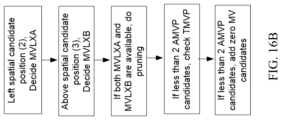
  • FIGS. 16 A and 16 B show examples of a derivation process for motion vector prediction candidates.
  • FIG. 17 shows an example of motion vector scaling for spatial motion vector candidates.
  • FIG. 18 shows an example of motion prediction using the alternative temporal motion vector prediction (ATMVP) algorithm for a coding unit (CU).
  • ATMVP alternative temporal motion vector prediction
  • FIG. 19 shows an example of the identification of a source block and source picture.
  • FIG. 20 shows an example of a coding unit (CU) with sub-blocks and neighboring blocks used by the spatial-temporal motion vector prediction (STMVP) algorithm.
  • CU coding unit
  • STMVP spatial-temporal motion vector prediction
  • FIG. 21 shows an example of bilateral matching in pattern matched motion vector derivation (PMMVD) mode, which is a special merge mode based on the frame-rate up conversion (FRUC) algorithm.
  • PMMVD pattern matched motion vector derivation
  • FRUC frame-rate up conversion
  • FIG. 22 shows an example of template matching in the FRUC algorithm.
  • FIG. 23 shows an example of unilateral motion estimation in the FRUC algorithm.
  • FIG. 24 shows an example of the decoder-side motion vector refinement (DMVR) algorithm based on bilateral template matching.
  • FIG. 25 shows an example of neighboring samples used for deriving illumination compensation (IC) parameters.
  • FIG. 26 shows an example of neighboring blocks used to derive the spatial merge candidates.
  • FIG. 27 shows an example of the proposed 67 intra prediction modes.
  • FIG. 28 shows an example of neighboring blocks for Most Probable Mode derivation.
  • FIGS. 29 A and 29 B show the corresponding luma and chroma sub-blocks in an I-slice with the QTBT structure.
  • FIG. 30 shows an example of selection of a representative position for look-up table updates.
  • FIGS. 31 A and 31 B show examples of updating look up table with new set of motion information.
  • FIG. 32 shows an example of priority-based insertion of candidates from non-adjacent blocks and LUTs.
  • FIG. 33 shows another example of priority-based insertion of candidates from non-adjacent blocks and LUTs.
  • FIG. 34 shows a coding flow for an example of the LUT-based MVP/intra mode prediction/IC parameters with updating after one block.
  • FIG. 35 shows a coding flow for an example of the LUT-based MVP/intra mode prediction/IC parameters with updating after one block.
  • FIG. 36 shows a coding flow for an example of the LUT-based MVP/intra mode prediction/IC parameters with updating after one region.
  • FIG. 37 shows an example of a decoding flow chart with the proposed HMVP method.
  • FIG. 38 shows examples of updating tables using the proposed HMVP method.
  • FIG. 39 A- 39 B show examples of a redundancy-removal based LUT updating method (with one redundancy motion candidate removed).
  • FIG. 40 A- 40 B show examples of a redundancy-removal based LUT updating method (with multiple redundancy motion candidates removed).
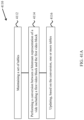
  • FIGS. 41 A, 41 B and 41 C show flow charts of example methods for video processing in accordance with the disclosed technology.
  • FIG. 42 is a block diagram of an example of a hardware platform for implementing a visual media decoding or a visual media encoding technique described in the present document.
  • Video codecs typically include an electronic circuit or software that compresses or decompresses digital video, and are continually being improved to provide higher coding efficiency.
  • a video codec converts uncompressed video to a compressed format or vice versa.
  • the compressed format usually conforms to a standard video compression specification, e.g., the High Efficiency Video Coding (HEVC) standard (also known as H.265 or MPEG-H Part 2), the Versatile Video Coding standard to be finalized, or other current and/or future video coding standards.
  • HEVC High Efficiency Video Coding
  • MPEG-H Part 2 the Versatile Video Coding standard to be finalized, or other current and/or future video coding standards.
  • Embodiments of the disclosed technology may be applied to existing video coding standards (e.g., HEVC, H.265) and future standards to improve compression performance. Section headings are used in the present document to improve readability of the description and do not in any way limit the discussion or the embodiments (and/or implementations) to the respective sections only.
  • FIG. 1 shows an example block diagram of a typical HEVC video encoder and decoder.
  • An encoding algorithm producing an HEVC compliant bitstream would typically proceed as follows. Each picture is split into block-shaped regions, with the exact block partitioning being conveyed to the decoder. The first picture of a video sequence (and the first picture at each clean random access point into a video sequence) is coded using only intra-picture prediction (that uses some prediction of data spatially from region-to-region within the same picture, but has no dependence on other pictures). For all remaining pictures of a sequence or between random access points, inter-picture temporally predictive coding modes are typically used for most blocks.
  • the encoding process for inter-picture prediction consists of choosing motion data comprising the selected reference picture and motion vector (MV) to be applied for predicting the samples of each block.
  • the encoder and decoder generate identical inter-picture prediction signals by applying motion compensation (MC) using the MV and mode decision data, which are transmitted as side information.
  • MC motion compensation
  • the residual signal of the intra- or inter-picture prediction which is the difference between the original block and its prediction, is transformed by a linear spatial transform.
  • the transform coefficients are then scaled, quantized, entropy coded, and transmitted together with the prediction information.
  • the encoder duplicates the decoder processing loop (see gray-shaded boxes in FIG. 1 ) such that both will generate identical predictions for subsequent data. Therefore, the quantized transform coefficients are constructed by inverse scaling and are then inverse transformed to duplicate the decoded approximation of the residual signal. The residual is then added to the prediction, and the result of that addition may then be fed into one or two loop filters to smooth out artifacts induced by block-wise processing and quantization.
  • the final picture representation (that is a duplicate of the output of the decoder) is stored in a decoded picture buffer to be used for the prediction of subsequent pictures.
  • the order of encoding or decoding processing of pictures often differs from the order in which they arrive from the source; necessitating a distinction between the decoding order (i.e., bitstream order) and the output order (i.e., display order) for a decoder.
  • decoding order i.e., bitstream order
  • output order i.e., display order
  • Video material to be encoded by HEVC is generally expected to be input as progressive scan imagery (either due to the source video originating in that format or resulting from deinterlacing prior to encoding).
  • No explicit coding features are present in the HEVC design to support the use of interlaced scanning, as interlaced scanning is no longer used for displays and is becoming substantially less common for distribution.
  • a metadata syntax has been provided in HEVC to allow an encoder to indicate that interlace-scanned video has been sent by coding each field (i.e., the even or odd numbered lines of each video frame) of interlaced video as a separate picture or that it has been sent by coding each interlaced frame as an HEVC coded picture. This provides an efficient method of coding interlaced video without burdening decoders with a need to support a special decoding process for it.
  • the core of the coding layer in previous standards was the macroblock, containing a 16 ⁇ 16 block of luma samples and, in the usual case of 4:2:0 color sampling, two corresponding 8 ⁇ 8 blocks of chroma samples.
  • An intra-coded block uses spatial prediction to exploit spatial correlation among pixels.
  • Two partitions are defined: 16 ⁇ 16 and 4 ⁇ 4.
  • An inter-coded block uses temporal prediction, instead of spatial prediction, by estimating motion among pictures.
  • Motion can be estimated independently for either 16 ⁇ 16 macroblock or any of its sub-macroblock partitions: 16 ⁇ 8, 8 ⁇ 16, 8 ⁇ 8, 8 ⁇ 4, 4 ⁇ 8, 4 ⁇ 4, as shown in FIG. 2 . Only one motion vector (MV) per sub-macroblock partition is allowed.
  • a coding tree unit In HEVC, a coding tree unit (CTU) is split into coding units (CUs) by using a quadtree structure denoted as coding tree to adapt to various local characteristics. The decision whether to code a picture area using inter-picture (temporal) or intra-picture (spatial) prediction is made at the CU level.
  • Each CU can be further split into one, two or four prediction units (PUs) according to the PU splitting type. Inside one PU, the same prediction process is applied and the relevant information is transmitted to the decoder on a PU basis.
  • a CU After obtaining the residual block by applying the prediction process based on the PU splitting type, a CU can be partitioned into transform units (TUs) according to another quadtree structure similar to the coding tree for the CU.
  • transform units transform units
  • One of key feature of the HEVC structure is that it has the multiple partition conceptions including CU, PU, and TU.
  • Coding tree units and coding tree block (CTB) structure
  • the analogous structure in HEVC is the coding tree unit (CTU), which has a size selected by the encoder and can be larger than a traditional macroblock.
  • the CTU consists of a luma CTB and the corresponding chroma CTBs and syntax elements.
  • HEVC then supports a partitioning of the CTBs into smaller blocks using a tree structure and quadtree-like signaling.
  • Coding units CUs
  • CBs coding blocks
  • the quadtree syntax of the CTU specifies the size and positions of its luma and chroma CBs.
  • the root of the quadtree is associated with the CTU.
  • the size of the luma CTB is the largest supported size for a luma CB.
  • the splitting of a CTU into luma and chroma CBs is signaled jointly.
  • a CTB may contain only one CU or may be split to form multiple CUs, and each CU has an associated partitioning into prediction units (PUs) and a tree of transform units (TUs).
  • PUs prediction units
  • TUs tree of transform units
  • Prediction units and prediction blocks The decision whether to code a picture area using inter picture or intra picture prediction is made at the CU level.
  • a PU partitioning structure has its root at the CU level.
  • the luma and chroma CBs can then be further split in size and predicted from luma and chroma prediction blocks (PBs).
  • HEVC supports variable PB sizes from 64 ⁇ 64 down to 4 ⁇ 4 samples.
  • FIG. 3 shows examples of allowed PBs for an M ⁇ M CU.
  • the prediction residual is coded using block transforms.
  • a TU tree structure has its root at the CU level.
  • the luma CB residual may be identical to the luma transform block (TB) or may be further split into smaller luma TBs. The same applies to the chroma TBs.
  • Integer basis functions similar to those of a discrete cosine transform (DCT) are defined for the square TB sizes 4 ⁇ 4, 8 ⁇ 8, 16 ⁇ 16, and 32 ⁇ 32.
  • DCT discrete cosine transform
  • an integer transform derived from a form of discrete sine transform (DST) is alternatively specified.
  • a CB can be recursively partitioned into transform blocks (TBs).
  • the partitioning is signaled by a residual quadtree. Only square CB and TB partitioning is specified, where a block can be recursively split into quadrants, as illustrated in FIG. 4 .
  • a flag signals whether it is split into four blocks of size M/2 ⁇ M/2. If further splitting is possible, as signaled by a maximum depth of the residual quadtree indicated in the sequence parameter set (SPS), each quadrant is assigned a flag that indicates whether it is split into four quadrants.
  • the leaf node blocks resulting from the residual quadtree are the transform blocks that are further processed by transform coding.
  • the encoder indicates the maximum and minimum luma TB sizes that it will use. Splitting is implicit when the CB size is larger than the maximum TB size. Not splitting is implicit when splitting would result in a luma TB size smaller than the indicated minimum.
  • the chroma TB size is half the luma TB size in each dimension, except when the luma TB size is 4 ⁇ 4, in which case a single 4 ⁇ 4 chroma TB is used for the region covered by four 4 ⁇ 4 luma TBs.
  • intra-picture-predicted CUs the decoded samples of the nearest-neighboring TBs (within or outside the CB) are used as reference data for intra picture prediction.
  • the HEVC design allows a TB to span across multiple PBs for inter-picture predicted CUs to maximize the potential coding efficiency benefits of the quadtree-structured TB partitioning.
  • a CTB is divided according to a quad-tree structure, the nodes of which are coding units.
  • the plurality of nodes in a quad-tree structure includes leaf nodes and non-leaf nodes.
  • the leaf nodes have no child nodes in the tree structure (i.e., the leaf nodes are not further split).
  • The, non-leaf nodes include a root node of the tree structure.
  • the root node corresponds to an initial video block of the video data (e.g., a CTB).
  • the respective non-root node corresponds to a video block that is a sub-block of a video block corresponding to a parent node in the tree structure of the respective non-root node.
  • Each respective non-leaf node of the plurality of non-leaf nodes has one or more child nodes in the tree structure.
  • JEM Joint Exploration Model
  • QTBT quadtree plus binary tree
  • TT ternary tree
  • the QTBT structure removes the concepts of multiple partition types, i.e. it removes the separation of the CU, PU and TU concepts, and supports more flexibility for CU partition shapes.
  • a CU can have either a square or rectangular shape.
  • a coding tree unit (CTU) is first partitioned by a quadtree structure.
  • the quadtree leaf nodes are further partitioned by a binary tree structure.
  • the binary tree leaf nodes are called coding units (CUs), and that segmentation is used for prediction and transform processing without any further partitioning.
  • a CU sometimes consists of coding blocks (CBs) of different colour components, e.g. one CU contains one luma CB and two chroma CBs in the case of P and B slices of the 4:2:0 chroma format and sometimes consists of a CB of a single component, e.g., one CU contains only one luma CB or just two chroma CBs in the case of I slices.
  • CBs coding blocks
  • the CTU size is set as 128 ⁇ 128 luma samples with two corresponding 64 ⁇ 64 blocks of chroma samples
  • the MinQTSize is set as 16 ⁇ 16
  • the MaxBTSize is set as 64 ⁇ 64
  • the MinBTSize (for both width and height) is set as 4 ⁇ 4
  • the MaxBTDepth is set as 4.
  • the quadtree partitioning is applied to the CTU first to generate quadtree leaf nodes.
  • the quadtree leaf nodes may have a size from 16 ⁇ 16 (i.e., the MinQTSize) to 128 ⁇ 128 (i.e., the CTU size).
  • the quadtree leaf node is also the root node for the binary tree and it has the binary tree depth as 0.
  • MaxBTDepth i.e., 4
  • no further splitting is considered.
  • MinBTSize i.e. 4
  • no further horizontal splitting is considered.
  • the binary tree node has height equal to MinBTSize
  • no further vertical splitting is considered.
  • the leaf nodes of the binary tree are further processed by prediction and transform processing without any further partitioning. In the JEM, the maximum CTU size is 256 ⁇ 256 luma samples.
  • FIG. 5 A shows an example of block partitioning by using QTBT
  • FIG. 5 B shows the corresponding tree representation.
  • the solid lines indicate quadtree splitting and dotted lines indicate binary tree splitting.
  • each splitting (i.e., non-leaf) node of the binary tree one flag is signalled to indicate which splitting type (i.e., horizontal or vertical) is used, where 0 indicates horizontal splitting and 1 indicates vertical splitting.
  • the quadtree splitting there is no need to indicate the splitting type since quadtree splitting always splits a block both horizontally and vertically to produce 4 sub-blocks with an equal size.
  • the QTBT scheme supports the ability for the luma and chroma to have a separate QTBT structure.
  • the luma and chroma CTBs in one CTU share the same QTBT structure.
  • the luma CTB is partitioned into CUs by a QTBT structure
  • the chroma CTBs are partitioned into chroma CUs by another QTBT structure. This means that a CU in an I slice consists of a coding block of the luma component or coding blocks of two chroma components, and a CU in a P or B slice consists of coding blocks of all three colour components.
  • inter prediction for small blocks is restricted to reduce the memory access of motion compensation, such that bi-prediction is not supported for 4 ⁇ 8 and 8 ⁇ 4 blocks, and inter prediction is not supported for 4 ⁇ 4 blocks.
  • these restrictions are removed.
  • FIG. 6 A shows an example of quad-tree (QT) partitioning
  • FIGS. 6 B and 6 C show examples of the vertical and horizontal binary-tree (BT) partitioning, respectively.
  • BT binary-tree
  • ternary tree (TT) partitions e.g., horizontal and vertical center-side ternary-trees (as shown in FIGS. 6 D and 6 E ) are supported.
  • region tree quad-tree
  • prediction tree binary-tree or ternary-tree
  • a CTU is firstly partitioned by region tree (RT).
  • a RT leaf may be further split with prediction tree (PT).
  • PT leaf may also be further split with PT until max PT depth is reached.
  • a PT leaf is the basic coding unit. It is still called CU for convenience.
  • a CU cannot be further split.
  • Prediction and transform are both applied on CU in the same way as JEM.
  • the whole partition structure is named ‘multiple-type-tree’.
  • a tree structure called a Multi-Tree Type which is a generalization of the QTBT, is supported.
  • MTT Multi-Tree Type
  • FIG. 7 a Coding Tree Unit (CTU) is firstly partitioned by a quad-tree structure.
  • the quad-tree leaf nodes are further partitioned by a binary-tree structure.
  • the structure of the MTT constitutes of two types of tree nodes: Region Tree (RT) and Prediction Tree (PT), supporting nine types of partitions, as shown in FIG. 8 .
  • a region tree can recursively split a CTU into square blocks down to a 4 ⁇ 4 size region tree leaf node.
  • a prediction tree can be formed from one of three tree types: Binary Tree, Ternary Tree, and Asymmetric Binary Tree.
  • a PT split it is prohibited to have a quadtree partition in branches of the prediction tree.
  • the luma tree and the chroma tree are separated in I slices.
  • the signaling methods for RT and PT are illustrated in FIG. 9 A .
  • Video coding standards have significantly improved over the years, and now provide, in part, high coding efficiency and support for higher resolutions.
  • Recent standards such as HEVC and H.265 are based on the hybrid video coding structure wherein temporal prediction plus transform coding are utilized.
  • Each inter-predicted PU has motion parameters for one or two reference picture lists.
  • motion parameters include a motion vector and a reference picture index.
  • the usage of one of the two reference picture lists may also be signaled using inter_pred_idc.
  • motion vectors may be explicitly coded as deltas relative to predictors.
  • a merge mode is specified whereby the motion parameters for the current PU are obtained from neighboring PUs, including spatial and temporal candidates.
  • the merge mode can be applied to any inter-predicted PU, not only for skip mode.
  • the alternative to merge mode is the explicit transmission of motion parameters, where motion vector, corresponding reference picture index for each reference picture list and reference picture list usage are signaled explicitly per each PU.
  • the PU When signaling indicates that one of the two reference picture lists is to be used, the PU is produced from one block of samples. This is referred to as ‘uni-prediction’. Uni-prediction is available both for P-slices and B-slices.
  • Bi-prediction When signaling indicates that both of the reference picture lists are to be used, the PU is produced from two blocks of samples. This is referred to as ‘bi-prediction’. Bi-prediction is available for B-slices only.
  • Step 1 Initial candidates derivation
  • Step 2 Additional candidates insertion
  • FIG. 9 B shows an example of constructing a merge candidate list based on the sequence of steps summarized above.
  • For spatial merge candidate derivation a maximum of four merge candidates are selected among candidates that are located in five different positions.
  • temporal merge candidate derivation a maximum of one merge candidate is selected among two candidates. Since constant number of candidates for each PU is assumed at decoder, additional candidates are generated when the number of candidates does not reach to maximum number of merge candidate (MaxNumMergeCand) which is signalled in slice header. Since the number of candidates is constant, index of best merge candidate is encoded using truncated unary binarization (TU). If the size of CU is equal to 8, all the PUs of the current CU share a single merge candidate list, which is identical to the merge candidate list of the 2N ⁇ 2N prediction unit.
  • TU truncated unary binarization
  • a maximum of four merge candidates are selected among candidates located in the positions depicted in FIG. 10 .
  • the order of derivation is A 1 , B 1 , B 0 , A 0 and B 2 .
  • Position B 2 is considered only when any PU of position A 1 , B 1 , B 0 , A 0 is not available (e.g. because it belongs to another slice or tile) or is intra coded.
  • candidate at position A 1 is added, the addition of the remaining candidates is subject to a redundancy check which ensures that candidates with same motion information are excluded from the list so that coding efficiency is improved.
  • FIGS. 12 A and 12 B depict the second PU for the case of N ⁇ 2N and 2N ⁇ N, respectively.
  • candidate at position A 1 is not considered for list construction.
  • adding this candidate may lead to two prediction units having the same motion information, which is redundant to just have one PU in a coding unit.
  • position B 1 is not considered when the current PU is partitioned as 2N ⁇ N.
  • a scaled motion vector is derived based on co-located PU belonging to the picture which has the smallest POC difference with current picture within the given reference picture list.
  • the reference picture list to be used for derivation of the co-located PU is explicitly signaled in the slice header.
  • FIG. 13 shows an example of the derivation of the scaled motion vector for a temporal merge candidate (as the dotted line), which is scaled from the motion vector of the co-located PU using the POC distances, tb and td, where tb is defined to be the POC difference between the reference picture of the current picture and the current picture and td is defined to be the POC difference between the reference picture of the co-located picture and the co-located picture.
  • the reference picture index of temporal merge candidate is set equal to zero. For a B-slice, two motion vectors, one is for reference picture list 0 and the other is for reference picture list 1, are obtained and combined to make the bi-predictive merge candidate.
  • the position for the temporal candidate is selected between candidates C 0 and C 1 , as depicted in FIG. 14 . If PU at position C 0 is not available, is intra coded, or is outside of the current CTU, position C 1 is used. Otherwise, position C 0 is used in the derivation of the temporal merge candidate.
  • merge candidates there are two additional types of merge candidates: combined bi-predictive merge candidate and zero merge candidate.
  • Combined bi-predictive merge candidates are generated by utilizing spatio-temporal merge candidates.
  • Combined bi-predictive merge candidate is used for B-Slice only.
  • the combined bi-predictive candidates are generated by combining the first reference picture list motion parameters of an initial candidate with the second reference picture list motion parameters of another. If these two tuples provide different motion hypotheses, they will form a new bi-predictive candidate.
  • FIG. 15 shows an example of this process, wherein two candidates in the original list ( 710 , on the left), which have mvL0 and refIdxL0 or mvL1 and refIdxL1, are used to create a combined bi-predictive merge candidate added to the final list ( 720 , on the right).
  • Zero motion candidates are inserted to fill the remaining entries in the merge candidates list and therefore hit the MaxNumMergeCand capacity. These candidates have zero spatial displacement and a reference picture index which starts from zero and increases every time a new zero motion candidate is added to the list. The number of reference frames used by these candidates is one and two for uni- and bi-directional prediction, respectively. In some embodiments, no redundancy check is performed on these candidates.
  • motion estimation can be performed in parallel whereby the motion vectors for all prediction units inside a given region are derived simultaneously.
  • the derivation of merge candidates from spatial neighborhood may interfere with parallel processing as one prediction unit cannot derive the motion parameters from an adjacent PU until its associated motion estimation is completed.
  • a motion estimation region may be defined.
  • the size of the MER may be signaled in the picture parameter set (PPS) using the “log 2_parallel_merge_level_minus2” syntax element.
  • the picture parameter set (PPS) raw byte sequence payload (RBSP) syntax is shown in Table 1, where log 2_parallel_merge_level_minus2 plus 2 specifies the value of the variable Log 2ParMrgLevel, which is used in the derivation process for luma motion vectors for merge mode and the derivation process for spatial merging candidates as specified in an existing video coding standard.
  • the value of log 2_parallel_merge_level_minus2 shall be in the range of 0 to CtbLog 2SizeY ⁇ 2, inclusive.
  • Log 2ParMrgLevel log 2_parallel_merge_level_minus2+2
  • Log 2ParMrgLevel indicates the built-in capability of parallel derivation of the merging candidate lists. For example, when Log 2ParMrgLevel is equal to 6, the merging candidate lists for all the prediction units (PUs) and coding units (CUs) contained in a 64 ⁇ 64 block can be derived in parallel.
  • Motion vector prediction exploits spatio-temporal correlation of motion vector with neighboring PUs, which is used for explicit transmission of motion parameters. It constructs a motion vector candidate list by firstly checking availability of left, above temporally neighboring PU positions, removing redundant candidates and adding zero vector to make the candidate list to be constant length. Then, the encoder can select the best predictor from the candidate list and transmit the corresponding index indicating the chosen candidate. Similarly with merge index signaling, the index of the best motion vector candidate is encoded using truncated unary.
  • FIGS. 16 A and 16 B summarize derivation process for motion vector prediction candidate, and may be implemented for each reference picture list with refidx as an input.
  • motion vector candidate two types are considered: spatial motion vector candidate and temporal motion vector candidate.
  • spatial motion vector candidate derivation two motion vector candidates are eventually derived based on motion vectors of each PU located in five different positions as previously shown in FIG. 10 .
  • one motion vector candidate is selected from two candidates, which are derived based on two different co-located positions. After the first list of spatio-temporal candidates is made, duplicated motion vector candidates in the list are removed. If the number of potential candidates is larger than two, motion vector candidates whose reference picture index within the associated reference picture list is larger than 1 are removed from the list. If the number of spatio-temporal motion vector candidates is smaller than two, additional zero motion vector candidates is added to the list.
  • a maximum of two candidates are considered among five potential candidates, which are derived from PUs located in positions as previously shown in FIG. 10 , those positions being the same as those of motion merge.
  • the order of derivation for the left side of the current PU is defined as A 0 , A 1 , and scaled A 0 , scaled A 1 .
  • the order of derivation for the above side of the current PU is defined as B 0 , B 1 , B 2 , scaled B 0 , scaled B 1 , scaled B 2 .
  • the no-spatial-scaling cases are checked first followed by the cases that allow spatial scaling. Spatial scaling is considered when the POC is different between the reference picture of the neighbouring PU and that of the current PU regardless of reference picture list. If all PUs of left candidates are not available or are intra coded, scaling for the above motion vector is allowed to help parallel derivation of left and above MV candidates. Otherwise, spatial scaling is not allowed for the above motion vector.
  • the motion vector of the neighbouring PU is scaled in a similar manner as for temporal scaling.
  • One difference is that the reference picture list and index of current PU is given as input; the actual scaling process is the same as that of temporal scaling.
  • the reference picture index is signaled to the decoder.
  • AMVP mode For the AMVP mode, four parts may be signalled in the bitstream, e.g., prediction direction, reference index, MVD and my predictor candidate index, which are described in the context of the syntax shown in Table 2-4. While for the merge mode, only a merge index may need to be signalled.
  • five_minus_max_num_merge_cand specifies the maximum number of merging MVP candidates supported in the slice subtracted from 5.
  • the maximum number of merging MVP candidates, MaxNumMergeCand is derived as follows:
  • MaxNumMergeCand shall be in the range of 1 to 5, inclusive.
  • merge_flag[x0][y0] specifies whether the inter prediction parameters for the current prediction unit are inferred from a neighboring inter-predicted partition.
  • the array indices x0, y0 specify the location (x0, y0) of the top-left luma sample of the considered prediction block relative to the top-left luma sample of the picture.
  • merge_idx[x0][y0] specifies the merging candidate index of the merging candidate list where x0, y0 specify the location (x0, y0) of the top-left luma sample of the considered prediction block relative to the top-left luma sample of the picture.
  • JEM Joint Exploration Model
  • affine prediction alternative temporal motion vector prediction
  • STMVP spatial-temporal motion vector prediction
  • BIO bi-directional optical flow
  • FRUC Frame-Rate Up Conversion
  • LAMVR Locally Adaptive Motion Vector Resolution
  • OBMC Overlapped Block Motion Compensation
  • LIC Local Illumination Compensation
  • DMVR Decoder-side Motion Vector Refinement
  • each CU can have at most one set of motion parameters for each prediction direction.
  • two sub-CU level motion vector prediction methods are considered in the encoder by splitting a large CU into sub-CUs and deriving motion information for all the sub-CUs of the large CU.
  • Alternative temporal motion vector prediction (ATMVP) method allows each CU to fetch multiple sets of motion information from multiple blocks smaller than the current CU in the collocated reference picture.
  • STMVP spatial-temporal motion vector prediction
  • motion vectors of the sub-CUs are derived recursively by using the temporal motion vector predictor and spatial neighbouring motion vector.
  • the motion compression for the reference frames may be disabled.
  • the temporal motion vector prediction (TMVP) method is modified by fetching multiple sets of motion information (including motion vectors and reference indices) from blocks smaller than the current CU.
  • FIG. 18 shows an example of ATMVP motion prediction process for a CU 1800 .
  • the ATMVP method predicts the motion vectors of the sub-CUs 1801 within a CU 1800 in two steps.
  • the first step is to identify the corresponding block 1851 in a reference picture 1850 with a temporal vector.
  • the reference picture 1850 is also referred to as the motion source picture.
  • the second step is to split the current CU 1800 into sub-CUs 1801 and obtain the motion vectors as well as the reference indices of each sub-CU from the block corresponding to each sub-CU.
  • a reference picture 1850 and the corresponding block is determined by the motion information of the spatial neighboring blocks of the current CU 1800 .
  • the first merge candidate in the merge candidate list of the current CU 1800 is used.
  • the first available motion vector as well as its associated reference index are set to be the temporal vector and the index to the motion source picture. This way, the corresponding block may be more accurately identified, compared with TMVP, wherein the corresponding block (sometimes called collocated block) is always in a bottom-right or center position relative to the current CU.
  • the associated MV and reference picture are utilized to identify the source block and source picture.
  • a corresponding block of the sub-CU 1851 is identified by the temporal vector in the motion source picture 1850 , by adding to the coordinate of the current CU the temporal vector.
  • the motion information of its corresponding block e.g., the smallest motion grid that covers the center sample
  • the motion information of a corresponding N ⁇ N block is identified, it is converted to the motion vectors and reference indices of the current sub-CU, in the same way as TMVP of HEVC, wherein motion scaling and other procedures apply.
  • the decoder checks whether the low-delay condition (e.g.
  • motion vector MVx e.g., the motion vector corresponding to reference picture list X
  • motion vector MVy e.g., with X being equal to 0 or 1 and Y being equal to 1 ⁇ X
  • FIG. 20 shows an example of one CU with four sub-blocks and neighboring blocks.
  • an 8 ⁇ 8 CU 2000 that includes four 4 ⁇ 4 sub-CUs A ( 2001 ), B ( 2002 ), C ( 2003 ), and D ( 2004 ).
  • the neighboring 4 ⁇ 4 blocks in the current frame are labelled as a ( 2011 ), b ( 2012 ), c ( 2013 ), and d ( 2014 ).
  • the motion derivation for sub-CU A starts by identifying its two spatial neighbors.
  • the first neighbor is the N ⁇ N block above sub-CU A 1101 (block c 2013 ). If this block c ( 2013 ) is not available or is intra coded the other N ⁇ N blocks above sub-CU A ( 2001 ) are checked (from left to right, starting at block c 2013 ).
  • the second neighbor is a block to the left of the sub-CU A 2001 (block b 2012 ). If block b ( 2012 ) is not available or is intra coded other blocks to the left of sub-CU A 2001 are checked (from top to bottom, staring at block b 2012 ).
  • the motion information obtained from the neighboring blocks for each list is scaled to the first reference frame for a given list.
  • temporal motion vector predictor (TMVP) of sub-block A 2001 is derived by following the same procedure of TMVP derivation as specified in HEVC.
  • the motion information of the collocated block at block D 2004 is fetched and scaled accordingly.
  • all available motion vectors are averaged separately for each reference list. The averaged motion vector is assigned as the motion vector of the current sub-CU.
  • the sub-CU modes are enabled as additional merge candidates and there is no additional syntax element required to signal the modes.
  • Two additional merge candidates are added to merge candidates list of each CU to represent the ATMVP mode and STMVP mode. In other embodiments, up to seven merge candidates may be used, if the sequence parameter set indicates that ATMVP and STMVP are enabled.
  • the encoding logic of the additional merge candidates is the same as for the merge candidates in the HM, which means, for each CU in P or B slice, two more RD checks may be needed for the two additional merge candidates.
  • all bins of the merge index are context coded by CABAC (Context-based Adaptive Binary Arithmetic Coding). In other embodiments, e.g., HEVC, only the first bin is context coded and the remaining bins are context by-pass coded.
  • CABAC Context-based Adaptive Binary Arithmetic Coding
  • motion vector differences (between the motion vector and predicted motion vector of a PU) are signalled in units of quarter luma samples when use_integer_mv_flag is equal to 0 in the slice header.
  • LAMVR locally adaptive motion vector resolution
  • MVD can be coded in units of quarter luma samples, integer luma samples or four luma samples.
  • the MVD resolution is controlled at the coding unit (CU) level, and MVD resolution flags are conditionally signalled for each CU that has at least one non-zero MVD components.
  • a first flag is signalled to indicate whether quarter luma sample MV precision is used in the CU.
  • the first flag (equal to 1) indicates that quarter luma sample MV precision is not used, another flag is signalled to indicate whether integer luma sample MV precision or four luma sample MV precision is used.
  • the quarter luma sample MV resolution is used for the CU.
  • the MVPs in the AMVP candidate list for the CU are rounded to the corresponding precision.
  • CU-level RD checks are used to determine which MVD resolution is to be used for a CU. That is, the CU-level RD check is performed three times for each MVD resolution.
  • the following encoding schemes are applied in the JEM:
  • the procedure is similar to the HEVC design. However, when the current block chooses a lower precision of MVs (e.g., integer-precision), rounding operations may be applied. In the current implementation, after selecting the 2 candidates from spatial positions, if both are available, these two are rounded, followed by pruning.
  • MVs e.g., integer-precision
  • the PMMVD mode is a special merge mode based on the Frame-Rate Up Conversion (FRUC) method. With this mode, motion information of a block is not signaled but derived at decoder side.
  • FRUC Frame-Rate Up Conversion
  • a FRUC flag can be signaled for a CU when its merge flag is true.
  • a merge index can be signaled and the regular merge mode is used.
  • an additional FRUC mode flag can be signaled to indicate which method (e.g., bilateral matching or template matching) is to be used to derive motion information for the block.
  • the decision on whether using FRUC merge mode for a CU is based on RD cost selection as done for normal merge candidate. For example, multiple matching modes (e.g., bilateral matching and template matching) are checked for a CU by using RD cost selection. The one leading to the minimal cost is further compared to other CU modes. If a FRUC matching mode is the most efficient one, FRUC flag is set to true for the CU and the related matching mode is used.
  • multiple matching modes e.g., bilateral matching and template matching
  • motion derivation process in FRUC merge mode has two steps: a CU-level motion search is first performed, then followed by a Sub-CU level motion refinement.
  • CU level an initial motion vector is derived for the whole CU based on bilateral matching or template matching.
  • a list of MV candidates is generated and the candidate that leads to the minimum matching cost is selected as the starting point for further CU level refinement.
  • a local search based on bilateral matching or template matching around the starting point is performed.
  • the MV results in the minimum matching cost is taken as the MV for the whole CU.
  • the motion information is further refined at sub-CU level with the derived CU motion vectors as the starting points.
  • the following derivation process is performed for a W ⁇ H CU motion information derivation.
  • MV for the whole W ⁇ H CU is derived.
  • the CU is further split into M ⁇ M sub-CUs.
  • the value of M is calculated as in Eq. (3), D is a predefined splitting depth which is set to 3 by default in the JEM. Then the MV for each sub-CU is derived.
  • FIG. 21 shows an example of bilateral matching used in the Frame-Rate Up Conversion (FRUC) method.
  • the bilateral matching is used to derive motion information of the current CU by finding the closest match between two blocks along the motion trajectory of the current CU ( 2100 ) in two different reference pictures ( 2110 , 2111 ).
  • the motion vectors MV 0 ( 2101 ) and MV 1 ( 2102 ) pointing to the two reference blocks are proportional to the temporal distances, e.g., TD 0 ( 2103 ) and TD 1 ( 2104 ), between the current picture and the two reference pictures.
  • the bilateral matching becomes mirror based bi-directional MV.
  • FIG. 22 shows an example of template matching used in the Frame-Rate Up Conversion (FRUC) method.
  • Template matching can be used to derive motion information of the current CU 2200 by finding the closest match between a template (e.g., top and/or left neighboring blocks of the current CU) in the current picture and a block (e.g., same size to the template) in a reference picture 2210 .
  • a template e.g., top and/or left neighboring blocks of the current CU
  • a block e.g., same size to the template
  • the newly derived candidate by template matching is different to the first existing AMVP candidate, it is inserted at the very beginning of the AMVP candidate list and then the list size is set to two (e.g., by removing the second existing AMVP candidate).
  • the list size is set to two (e.g., by removing the second existing AMVP candidate).
  • the MV candidate set at CU level can include the following: (1) original AMVP candidates if the current CU is in AMVP mode, (2) all merge candidates, (3) several MVs in the interpolated MV field (described later), and top and left neighboring motion vectors.
  • each valid MV of a merge candidate can be used as an input to generate a MV pair with the assumption of bilateral matching.
  • one valid MV of a merge candidate is (MVa, ref a ) at reference list A.
  • the reference picture ref b of its paired bilateral MV is found in the other reference list B so that ref a and ref b are temporally at different sides of the current picture. If such a ref b is not available in reference list B, ref b is determined as a reference which is different from ref a and its temporal distance to the current picture is the minimal one in list B.
  • MVb is derived by scaling MVa based on the temporal distance between the current picture and ref a , ref b .
  • four MVs from the interpolated MV field can also be added to the CU level candidate list. More specifically, the interpolated MVs at the position (0, 0), (W/2, 0), (0, H/2) and (W/2, H/2) of the current CU are added.
  • the original AMVP candidates are also added to CU level MV candidate set.
  • 15 MVs for AMVP CUs and 13 MVs for merge CUs can be added to the candidate list.
  • the MV candidate set at sub-CU level includes an MV determined from a CU-level search, (2) top, left, top-left and top-right neighboring MVs, (3) scaled versions of collocated MVs from reference pictures, (4) one or more ATMVP candidates (e.g., up to four), and (5) one or more STMVP candidates (e.g., up to four).
  • the scaled MVs from reference pictures are derived as follows. The reference pictures in both lists are traversed. The MVs at a collocated position of the sub-CU in a reference picture are scaled to the reference of the starting CU-level MV.
  • ATMVP and STMVP candidates can be the four first ones.
  • one or more MVs are added to the candidate list.
  • interpolated motion field Before coding a frame, interpolated motion field is generated for the whole picture based on unilateral ME. Then the motion field may be used later as CU level or sub-CU level MV candidates.
  • FIG. 23 shows an example of unilateral Motion Estimation (ME) 2300 in the FRUC method.
  • ME unilateral Motion Estimation
  • the motion of the reference block is scaled to the current picture according to the temporal distance TD and TD 1 (the same way as that of MV scaling of TMVP in HEVC) and the scaled motion is assigned to the block in the current frame. If no scaled MV is assigned to a 4 ⁇ 4 block, the block's motion is marked as unavailable in the interpolated motion field.
  • the matching cost is a bit different at different steps.
  • the matching cost can be the absolute sum difference (SAD) of bilateral matching or template matching.
  • SAD absolute sum difference
  • w is a weighting factor.
  • w can be empirically set to 4.
  • MV and MV s indicate the current MV and the starting MV, respectively.
  • SAD may still be used as the matching cost of template matching at sub-CU level search.
  • MV is derived by using luma samples only. The derived motion will be used for both luma and chroma for MC inter prediction. After MV is decided, final MC is performed using 8-taps interpolation filter for luma and 4-taps interpolation filter for chroma.
  • MV refinement is a pattern based MV search with the criterion of bilateral matching cost or template matching cost.
  • two search patterns are supported—an unrestricted center-biased diamond search (UCBDS) and an adaptive cross search for MV refinement at the CU level and sub-CU level, respectively.
  • UMBDS center-biased diamond search
  • the MV is directly searched at quarter luma sample MV accuracy, and this is followed by one-eighth luma sample MV refinement.
  • the search range of MV refinement for the CU and sub-CU step are set equal to 8 luma samples.
  • bi-prediction is applied because the motion information of a CU is derived based on the closest match between two blocks along the motion trajectory of the current CU in two different reference pictures.
  • the encoder can choose among uni-prediction from list0, uni-prediction from list1, or bi-prediction for a CU. The selection ca be based on a template matching cost as follows:
  • cost0 is the SAD of list0 template matching
  • cost1 is the SAD of list1 template matching
  • costBi is the SAD of bi-prediction template matching.
  • the value of factor is equal to 1.25, it means that the selection process is biased toward bi-prediction.
  • the inter prediction direction selection can be applied to the CU-level template matching process.
  • a bi-prediction operation for the prediction of one block region, two prediction blocks, formed using a motion vector (MV) of list0 and a MV of list1, respectively, are combined to form a single prediction signal.
  • the two motion vectors of the bi-prediction are further refined by a bilateral template matching process.
  • the bilateral template matching applied in the decoder to perform a distortion-based search between a bilateral template and the reconstruction samples in the reference pictures in order to obtain a refined MV without transmission of additional motion information.
  • a bilateral template is generated as the weighted combination (i.e. average) of the two prediction blocks, from the initial MV 0 of list0 and MV 1 of list1, respectively, as shown in FIG. 24 .
  • the template matching operation consists of calculating cost measures between the generated template and the sample region (around the initial prediction block) in the reference picture. For each of the two reference pictures, the MV that yields the minimum template cost is considered as the updated MV of that list to replace the original one.
  • nine MV candidates are searched for each list. The nine MV candidates include the original MV and 8 surrounding MVs with one luma sample offset to the original MV in either the horizontal or vertical direction, or both.
  • the two new MVs i.e., MV 0 ′ and MV 1 ′ as shown in FIG. 24 , are used for generating the final bi-prediction results.
  • a sum of absolute differences (SAD) is used as the cost measure.
  • DMVR is applied for the merge mode of bi-prediction with one MV from a reference picture in the past and another from a reference picture in the future, without the transmission of additional syntax elements.
  • JEM when LIC, affine motion, FRUC, or sub-CU merge candidate is enabled for a CU, DMVR is not applied.
  • IC Local Illumination Compensation
  • CU inter-mode coded coding unit
  • a least square error method is employed to derive the parameters a and b by using the neighbouring samples of the current CU and their corresponding reference samples. More specifically, as illustrated in FIG. 25 , the subsampled (2:1 subsampling) neighbouring samples of the CU and the corresponding samples (identified by motion information of the current CU or sub-CU) in the reference picture are used. The IC parameters are derived and applied for each prediction direction separately.
  • the IC flag is copied from neighbouring blocks, in a way similar to motion information copy in merge mode; otherwise, an IC flag is signalled for the CU to indicate whether LIC applies or not.
  • MR-SAD mean-removed sum of absolute difference
  • MR-SATD mean-removed sum of absolute Hadamard-transformed difference
  • IC is disabled for the entire picture when there is no obvious illumination change between a current picture and its reference pictures.
  • histograms of a current picture and every reference picture of the current picture are calculated at the encoder. If the histogram difference between the current picture and every reference picture of the current picture is smaller than a given threshold, IC is disabled for the current picture; otherwise, IC is enabled for the current picture.
  • a merge candidate list is first constructed by inserting the motion vectors and reference indices of the spatial neighboring and temporal neighboring blocks into the candidate list with redundancy checking until the number of the available candidates reaches the maximum candidate size of 19.
  • the merge candidate list for the merge/skip mode is constructed by inserting spatial candidates, temporal candidates, affine candidates, advanced temporal MVP (ATMVP) candidate, spatial temporal MVP (STMVP) candidate and the additional candidates as used in HEVC (Combined candidates and Zero candidates) according to a pre-defined insertion order, and in the context of the numbered blocks shown in FIG. 26 :
  • IC flags are also inherited from merge candidates except for STMVP and affine. Moreover, for the first four spatial candidates, the bi-prediction ones are inserted before the ones with uni-prediction.
  • blocks which are not connected with the current block may be accessed. If a non-adjacent block is coded with non-intra mode, the associated motion information may be added as an additional merge candidate.
  • the related value should be firstly binarized to a bin string based on the distribution. For each bin, it may be coded with context or bypass coding methods.
  • the unary code word in CABAC consists of x “1” bits plus a terminating “0” bit.
  • Bin string of the unary binarization prefixVal Bin string 0 0 1 1 0 2 1 1 1 0 3 1 1 1 0 4 1 1 1 1 0 5 1 1 1 1 1 1 0 . . . binIdx 0 1 2 3 4 5
  • Bin string of the truncated unary binarization prefixVal Bin string 0 0 1 1 0 2 1 1 0 3 1 1 1 0 4 1 1 1 1 0 5 1 1 1 1 1 binIdx 0 1 2 3 4 5
  • Bin string of the EG0 binarization K 0 prefixVal Bin string 0 0 1 1 0 0 2 1 0 1 3 1 1 0 0 0 4 1 1 0 0 1 5 1 1 0 1 0 6 1 1 0 1 1 7 1 1 1 0 0 0 0 0 0 . . . binIdx 0 1 2 3 4 5 6
  • Input to this process is a request for a TR binarization, cMax, and cRiceParam.
  • Output of this process is the TR binarization associating each value symbolVal with a corresponding bin string.
  • TR bin string is a concatenation of a prefix bin string and, when present, a suffix bin string.
  • the TR binarization is exactly a truncated unary binarization and it is always invoked with a cMax value equal to the largest possible value of the syntax element being decoded.
  • Inputs to this process are a request for a FL binarization and cMax.
  • Output of this process is the FL binarization associating each value symbolVal with a corresponding bin string.
  • the merge index is firstly binarized to a bin string if the total number of allowed merge candidate is larger than 1.
  • TR with cRiceParam equal to 0, i.e., TU is used.
  • the first bin of merge_idx is coded with one context and the remaining bins, if exist, are coded with bypass.
  • the number of directional intra modes is extended from 33, as used in HEVC, to 65.
  • the additional directional modes are depicted as light grey dotted arrows in FIG. 27 , and the planar and DC modes remain the same.
  • These denser directional intra prediction modes apply for all block sizes and for both luma and chroma intra predictions.
  • FIG. 27 depicts the examples of the 67 intra prediction modes.
  • an intra mode coding method with 6 Most Probable Modes is used. Two major technical aspects are involved: 1) the derivation of 6 MPMs, and 2) entropy coding of 6 MPMs and non-MPM modes.
  • An initial MPM list is formed by inserting 5 neighbour intra modes and the planar and DC modes into the MPM list.
  • a pruning process is used to remove duplicated modes so that only unique modes can be included into the MPM list. The order in which the initial modes are included is: left, above, planar, DC, below-left, above-right, and then above-left.
  • derived modes are added; these intra modes are obtained by adding ⁇ 1 or +1 to the angular modes that are already included in the MPM list. Such additional derived modes are not generated from the non-angular modes (DC or planar).
  • a truncated unary binarization is used for entropy coding of the selected mode using the 6 MPMs.
  • the first three bins are coded with contexts that depend on the MPM mode related to the bin currently being signalled.
  • the MPM mode is classified into one of three categories: (a) modes that are predominantly horizontal (i.e., the MPM mode number is less than or equal to the mode number for the diagonal direction), (b) modes that are predominantly vertical (i.e., the MPM mode is greater than the mode number for the diagonal direction), and (c) the non-angular (DC and planar) class. Accordingly, three contexts are used to signal the MPM index based on this classification.
  • the coding for selection of the remaining 61 non-MPMs is done as follows.
  • the 61 non-MPMs are first divided into two sets: a selected mode set and a non-selected mode set.
  • the selected modes set contains 16 modes and the rest (45 modes) are assigned to the non-selected modes set.
  • the mode set that the current mode belongs to is indicated in the bitstream with a flag. If the mode to be indicated is within the selected modes set, the selected mode is signalled with a 4-bit fixed-length code, and if the mode to be indicated is from the non-selected set, the selected mode is signalled with a truncated binary code.
  • the selected modes set is generated by sub-sampling the 61 non-MPM modes as follows:
  • the similar two-stage intra mode decision process of HM is used.
  • the intra mode pre-selection stage a lower complexity Sum of Absolute Transform Difference (SATD) cost is used to pre-select N intra prediction modes from all the available intra modes.
  • SATD Absolute Transform Difference
  • R-D cost selection is further applied to select one intra prediction mode from the N candidates.
  • 67 intra prediction modes since the total number of available modes is roughly doubled, the complexity of the intra mode pre-selection stage will also be increased if the same encoder mode decision process of HM is directly used.
  • a two-step intra mode pre-selection process is performed.
  • N N depends on intra prediction block size
  • STD Sum of Absolute Transform Difference
  • the direct neighbours additional intra prediction directions as indicated by light grey dotted arrows in FIG. 27
  • the list of selected N modes are updated.
  • the first M MPMs are added to the N modes if not already included, and the final list of candidate intra prediction modes is generated for the second stage R-D cost examination, which is done in the same way as HM.
  • the value of M is increased by one based on the original setting in the HM, and N is decreased somewhat as shown below in Table 10.
  • chroma mode candidates includes the following three parts:
  • a pruning process is applied whenever a new chroma intra mode is added to the candidate list.
  • the non-CCLM chroma intra mode candidates list size is then trimmed to 5.
  • a flag is first signalled to indicate whether one of the CCLM modes or one of the traditional chroma intra prediction mode is used. Then a few more flags may follow to specify the exact chroma prediction mode used for the current chroma CBs.
  • the current HEVC design could take the correlation of current block its neighbouring blocks (next to the current block) to better code the motion information. However, it is possible that that the neighbouring blocks correspond to different objects with different motion trajectories. In this case, prediction from its neighbouring blocks is not efficient.
  • Prediction from motion information of non-adjacent blocks could bring additional coding gain with the cost of storing all the motion information (typically on 4 ⁇ 4 level) into cache which significantly increase the complexity for hardware implementation.
  • Unary binarization method works fine for smaller number of allowed merge candidates. However, when the total number of allowed candidate becomes larger, the unary binarization may be sub-optimal.
  • the HEVC design of AMVP candidate list construction process only invokes pruning among two spatial AMVP candidates. Full pruning (each of the available candidate compared to all others) is not utilized since there is negligible coding loss due to limited pruning. However, if there are more AMVP candidates available, pruning becomes important. Also, when LAMVR is enabled, how to construct the AVMP candidate list should be studied.
  • Embodiments of the presently disclosed technology overcome the drawbacks of existing implementations, thereby providing video coding with higher coding efficiencies.
  • the LUT-based motion vector prediction based on the disclosed technology which may enhance both existing and future video coding standards, is elucidated in the following examples described for various implementations.
  • the LUT-based motion vector prediction method one or multiple tables with motion information from previously coded blocks are maintained during the encoding/decoding process.
  • the associated motion information in LUTs may be added to the motion candidate lists, and after encoding/decoding one block, LUTs may be updated.
  • an entry of a LUT is a motion candidate.
  • the term motion candidate is used to indicate a set of motion information stored in a look up table.
  • AMVP or merge candidates are used for storing the motion information.
  • the notion of LUTs with motion candidates for motion vector prediction is extended to LUTs with intra prediction modes for intra mode coding or extended to LUTs with illumination compensation parameters for IC parameter coding or extended to LUTs with filter parameters.
  • the LUT based methods for motion candidates may be extended to other types of coding information, as described in this document, existing and future video coding standards.
  • Each look up table may contain one or more motion candidates wherein each candidate is associated with its motion information.
  • Motion information of a motion candidate here may include partial or all of the prediction direction, reference indices/pictures, motion vectors, LIC flag, affine flag, MVD precision, MVD values.
  • Motion information may further include the block position information and/or block shape to indicate wherein the motion information is coming from.
  • Example B1 For coding a block, partial or all of motion candidates from one look up table may be checked in order. When one motion candidate is checked during coding a block, it may be added to the motion candidate list (e.g., AMVP, merge candidate lists).
  • the motion candidate list e.g., AMVP, merge candidate lists
  • Example C1 Multiple LUTs may be constructed with different roles.
  • Example D1 After coding a block with motion information (i.e., intra block copy mode, inter coded mode), one or multiple look up tables may be updated. ⁇
  • motion information i.e., intra block copy mode, inter coded mode
  • the selected look up table may further be updated.
  • Look up tables to be updated may be selected based on coded information, and/or positions of the block/LCU.
  • the motion information for the block may be added to a look up table.
  • Example D2 In one example, all of the LUTs are not updated after coding/decoding a block with intra block copy mode.
  • Example E1 A LUT may be used when a block is coded with merge or AMVP mode.
  • Example E2 In one example, a LUT may not be used when the block is coded with intra block copy mode.
  • Each look up table may contain one or more motion candidates wherein each candidate is associated with its motion information.
  • Motion information of a motion candidate here may include partial or all of the prediction direction, reference indices/pictures, motion vectors, LIC flag, affine flag, MVD precision, MVD values.
  • Motion information may further include the block position information and/or block shape to indicate wherein the motion information is coming from.
  • a counter may be further assigned for each look up table.
  • the table size (number of allowed motion candidates) and/or number of tables may be the fixed or adaptive.
  • the table size may be same for all tables, or different for different tables.
  • N*P tables may be required for coding a slice, wherein P indicates the number of LCU rows or the number of tiles.
  • Example B1 For coding a block, partial or all of motion candidates from one look up table may be checked in order. When one motion candidate is checked during coding a block, it may be added to the motion candidate list (e.g., AMVP, merge candidate lists).
  • the motion candidate list e.g., AMVP, merge candidate lists
  • motion candidates from multiple look up tables may be checked in order.
  • the look up table indices may be signaled in CTU, CTB, CU or PU, or a region covering multiple CTU/CTB/CU/PUs.
  • Example B2 The selection of look up tables may depend on the position of a block.
  • b It may depend on the distance between the position of the block and the position associated with one motion candidate in one or multiple look up tables.
  • Example C1 The total number of motion candidates in a look up table to be checked may be pre-defined.
  • the total number of motion candidates to be checked may be signalled in Video Parameter Set (VPS), Sequence Parameter Set (SPS), Picture Parameter Set (PPS), Slice header, tile header, Coding Tree Unit (CTU), Coding Tree Block (CTB), Coding Unit (CU) or Prediction Unit (PU), region covering multiple CTU/CTB/CU/PUs.
  • VPS Video Parameter Set
  • SPS Sequence Parameter Set
  • PPS Picture Parameter Set
  • CTU Coding Tree Unit
  • CTB Coding Tree Block
  • CU Coding Unit
  • PU Prediction Unit
  • Example C2 The motion candidate(s) included in a look up table may be directly inherited by a block.
  • a may be used for the merge mode coding, i.e., motion candidates may be checked in the merge candidate list derivation process.
  • They may be used for the affine merge mode coding.
  • Example C3 The motion candidate(s) included in a look up table may be used as a predictor for coding motion information of a block.
  • AMVP mode coding i.e., motion candidates may be checked in the AMVP candidate list derivation process.
  • All the candidates (L candidates) in the look up table when K> L, based on an order.
  • the first K % L candidates in the table are checked in descending order of entry indices to the LUT, and then check the last (L ⁇ K % L) candidates in descending order of entry indices.
  • selecting K motion candidates based on the candidate information such as the distance of positions associated with the motion candidates and current block.
  • How many and how to select motion candidates from a look table may depend on the coded information, such as block size/block shape.
  • maximum number of motion candidates in a look up table to be checked may depend on the number of available motion candidates (denoted by NavaiMCinLUT) in a look up table, and/or maximally allowed motion candidates (denoted by NUMmaxMC) to be added (which may be pre-defined or signaled), and/or number of available candidates (denoted by NavaiC) in a candidate list before checking the candidates from the look up table.
  • the checking process will terminate once the merge/AMVP candidate list reaches the maximally allowed candidate numbers.
  • Th may be pre-defined as a positive integer value, e.g., 1, or 2, or 3.
  • Th may be adaptively changed from block to block.
  • Th may be signaled in the SPS/PPS/slice header etc. al.
  • Th may further depend on block shape/block size/coded modes etc.
  • Th may depend on how many available candidates before adding the motion candidates from LUTs.
  • the maximally allowed motion candidate numbers may be signaled or pre-defined. Alternatively, the maximally allowed motion candidate numbers may further depend on block shape/block size/coded modes etc.
  • Example C5 Enabling/disabling the usage look up tables for motion information coding of a block may be signalled in SPS, PPS, Slice header, tile header, CTU, CTB, CU or PU, region covering multiple CTU/CTB/CU/PUs.
  • Example C6 Whether to apply prediction from look up tables may further depend on the coded information. When it is inferred not to apply for a block, additional signaling of indications of the prediction is skipped. Alternatively, when it is inferred not to apply for a block, there is no need to access motion candidates of look up tables, and the checking of related motion candidates is omitted.
  • Whether to apply prediction from look up tables may depend on block size/block shape. In one example, for smaller blocks, such as 4 ⁇ 4, 8 ⁇ 4 or 4 ⁇ 8 blocks, it is disallowed to perform prediction from look up tables.
  • Whether to apply prediction from look up tables may depend on whether the block is coded with AMVP or merge mode. In one example, for the AMVP mode, it is disallowed to perform prediction from look up tables.
  • Whether to apply prediction from look up tables may depend on the block is coded with affine motion or other kinds of motion (such as translational motion). In one example, for the affine mode, it is disallowed to perform prediction from look up tables.
  • Example C7 Motion candidates of a look up table in previously coded frames/slices/tiles may be used to predict motion information of a block in a different frame/slice/tile.
  • Example D1 After coding a block with motion information (i.e., IntraBC mode, inter coded mode), one or multiple look up tables may be updated.
  • a block with motion information i.e., IntraBC mode, inter coded mode
  • whether to update a look up table may reuse the rules for selecting look up tables, e.g., when a look up table could be selected for coding the current block, after coding/decoding the block, the selected look up table may further be updated.
  • Look up tables to be updated may be selected based on coded information, and/or positions of the block/LCU.
  • the motion information for the block may be added to a look up table.
  • a counter of a look up table to be updated is denoted by K before coding the current block, after coding the block, for one selected set of motion information (with methods mentioned above0, it is added as an additional motion candidate with index equal to K % L (wherein L is the look up table size). Examples are shown in FIGS. 31 A and 31 B
  • the look-up table may be emptied after coding one intra-constrained block.
  • Example D2 If one block is located at a picture/slice/tile border, updating of look up tables may be always disallowed.
  • Example D3 Motion information of above LCU rows may be disabled to code the current LCU row.
  • the number of available motion candidates may be reset to 0.
  • Example D4 At the beginning of coding a slice/tile with a new temporal layer index, the number of available motion candidates may be reset to 0.
  • Example D5 The look up table may be continuously updated with one slice/tile/LCU row/slices with same temporal layer index.
  • one look up table may stop updating once it reaches a maximally allowed counter.
  • the counter may be predefined. Alternatively, it be signalled in Video Parameter Set (VPS), Sequence Parameter Set (SPS), Picture Parameter Set (PPS), Slice header, tile header, Coding Tree Unit (CTU), Coding Tree Block (CTB), Coding Unit (CU) or Prediction Unit (PU), region covering multiple CTU/CTB/CU/PUs.
  • VPS Video Parameter Set
  • SPS Sequence Parameter Set
  • PPS Picture Parameter Set
  • CTU Coding Tree Unit
  • CTB Coding Tree Block
  • CU Coding Unit
  • PU Prediction Unit
  • Examples 1 and 2 advantageously define LUTs as used in the disclosed technology.
  • the table size (e.g., the number of maximally allowed entries of motion candidates) and/or number of tables may depend on sequence resolution, largest coding unit size, size of merge candidate lists.
  • LUTs may be constructed with different roles.
  • Examples 3-5 advantageously describe update procedures as used in embodiments of the disclosed technology.
  • a LUT may be updated with motion information associated with the block when the block is coded with merge or AMVP mode.
  • pruning Before updating a LUT by adding a motion candidate obtained from a coded block, pruning may be applied.
  • a LUT may be updated periodically.
  • Examples 6-11 advantageously describe using the LUTs in embodiments of the disclosed technology.
  • a LUT may be used when a block is coded with merge or AMVP mode.
  • the coded motion information is not allowed to update LUTs. That is, after coding or decoding such a block, the process of updating LUTs is skipped.
  • the LUT-based motion vector coding method may be combined with the non-adjacent merge candidates.
  • Default motion candidates may be included in LUTs.
  • Reordering of motion candidates in LUT may be applied.
  • Example 12 advantageously describes locally adaptive motion vector resolution (LAMVR) improvements.
  • LAMVR locally adaptive motion vector resolution
  • Example 13 advantageously provides merge index coding embodiments.
  • a merge index may be split into two parts and each part may invoke a different binarization method.
  • Examples 14-16 advantageously provides embodiments for LUTs with intra prediction modes and intra mode prediction from non-adjacent blocks.
  • one or multiple LUTs may be constructed, and/or updated to store intra prediction modes from previously coded blocks and LUTs may be used for coding/decoding an intra-coded block.
  • Intra prediction modes of non-adjacent blocks may be used as predictors for coding an intra-coded block.
  • LUTs and non-adjacent based methods may be jointly utilized.
  • Examples 17-19 advantageously provides embodiments for LUTs with IC parameters and IC parameter derivation from non-adjacent blocks.
  • one or multiple LUTs may be constructed, and/or updated to store illumination parameters from previously coded blocks and LUTs may be used for coding/decoding an IC-coded block.
  • Non-adjacent based methods may be applied wherein when deriving IC parameters for the current block, instead of using the spatial neighbors as a template as depicted in FIG. 25 , the spatial neighbors of a non-adjacent block may be utilized to avoid degrading parallelism of the codec.
  • LUTs and non-adjacent based methods may be jointly utilized.
  • FIG. 35 An example of the coding flow for the LUT-based prediction methods is depicted in FIG. 35 .
  • the updating process is done after decoding a region.
  • FIG. 36 An example is depicted in FIG. 36 to avoid frequently updating LUTs.
  • HMVP history-based MVP
  • a First-In-First-Out (FIFO) rule is applied so that the table always contains the latest previously coded L motion candidates.
  • FIG. 38 depicts an example wherein the FIFO rule is applied to remove a HMVP candidate and add a new one to the table used in the proposed method.
  • a redundancy checking process is applied firstly to identify whether there are identical or similar motion candidates in LUTs.
  • FIG. 39 A shows an example when the LUT is full before adding a new motion candidate.
  • FIG. 39 B shows an example when the LUT is not full before adding a new motion candidate.
  • FIGS. 39 A and 39 B together show an example of redundancy-removal based LUT updating method (with one redundancy motion candidate removed).
  • FIGS. 40 A and 40 B show example implementation for two cases of the redundancy-removal based LUT updating method (with multiple redundancy motion candidates removed, 2 candidates in the figures)
  • FIG. 40 A shows an example case of when the LUT is full before adding a new motion candidate.
  • FIG. 40 B shows an example case of When the LUT is not full before adding a new motion candidate
  • HMVP candidates could be used in the merge candidate list construction process. All HMVP candidates from the last entry to the first entry (or the last K0 HMVP, e.g., K0 equal to 16 or 6) in the table are inserted after the TMVP candidate. Pruning is applied on the HMVP candidates. Once the total number of available merge candidates reaches the signaled maximally allowed merge candidates, the merge candidate list construction process is terminated. Alternatively, once the total number of added motion candidates reaches a given value, the fetching of motion candidates from LUTs is terminated.
  • HMVP candidates could also be used in the AMVP candidate list construction process.
  • the motion vectors of the last K1 HMVP candidates in the table are inserted after the TMVP candidate. Only HMVP candidates with the same reference picture as the AMVP target reference picture are used to construct the AMVP candidate list. Pruning is applied on the HMVP candidates. In one example, K1 is set to 4.
  • FIGS. 41 A, 41 B and 41 C show flowcharts of exemplary methods for video processing method.
  • the method 4110 includes, at step 4112 , maintaining a set of look-up tables (LUTs), wherein each LUT includes motion candidates derived from previously decoded video blocks that are decoded prior to a first video block in video data.
  • the method 4110 further includes, at step 4114 , performing a conversion between a bitstream representation of the first video block and the first video block.
  • the method 4110 further includes, at step 4116 , updating, based on the conversion, one or multiple of LUTs within the set of LUTs.
  • the method 4120 includes, at step 4122 , receiving a bitstream representation of a first block of video data.
  • the method 4120 further includes, at step 4124 , processing the bitstream representation based on at a set of look-up tables (LUTs) to generate the first block of video data, wherein the set of LUTs comprises coding candidates.
  • LUTs look-up tables
  • the method 4130 includes, at step 4132 , deriving motion information for a first video block which is coded in an IBC mode, wherein one or more candidates of one or more tables are selectively checked during a motion candidate list construction process which is used to derive the motion information for the first video block, wherein each table of the one or more tables includes motion candidates derived from previously decoded video blocks that are decoded prior to the first video block; and the method 4130 further includes, at step 4134 , coding, based on the motion information, the first video block.
  • a video processing method (e.g., method 4110 as depicted in FIG. 41 A ), comprising: maintaining a set of tables, wherein each table includes motion candidates derived from previously decoded video blocks that are decoded prior to a first video block in video data; performing a conversion between a bitstream representation of the first video block and the first video block; and updating, based on the conversion, one or multiple of tables within the set of tables.
  • one of the tables utilized for generating the second video block includes a motion candidate derived from the first video block.
  • the motion information includes at least one of: a prediction direction, a reference picture index, motion vector values, intensity compensation flag, affine flag, motion vector difference precision, or motion vector difference value.
  • the motion information includes block shape information indicating source of the motion information.
  • a method for video processing (e.g., method 4120 as depicted in FIG. 41 B ), comprising: receiving a bitstream representation of a first block of video data; and processing the bitstream representation based on at a set of tables to generate the first block of video data, wherein the set of tables comprises coding candidates.
  • a first table of the set of tables comprises motion candidates with motion information only from Advanced Motion Vector Prediction (AMVP) coded blocks
  • AMVP Advanced Motion Vector Prediction
  • the coding candidates include motion information including at least one of: a prediction direction, a reference picture index, motion vector values, intensity compensation flag, affine flag, motion vector difference precision, or motion vector difference value.
  • a video coding method (e.g., method 4130 as depicted in FIG. 41 C ), comprising: deriving motion information for the first video block which is coded in an IBC mode, wherein one or more candidates of one or more tables are selectively checked during a motion candidate list construction process which is used to derive the motion information for the first video block, wherein each table of the one or more tables includes motion candidates derived from previously coded video blocks that are coded prior to the first video block; and coding, based on the motion information, the first video block.
  • the motion information includes at least one of: a prediction direction, a reference picture index, motion vector values, intensity compensation flag, affine flag, motion vector difference precision, filter parameters, motion vector difference value, or indications of blocks where the motion information is coming from.
  • An apparatus comprising a processor and a non-transitory memory with instructions thereon, wherein the instructions upon execution by the processor, cause the processor to implement the method in any one of clauses 1 to 58.
  • a computer program product stored on a non-transitory computer readable media including program code for carrying out the method in any one of clauses 1 to 58.
  • FIG. 42 is a block diagram of a video processing apparatus 4200 .
  • the apparatus 4200 may be used to implement one or more of the methods described herein.
  • the apparatus 4200 may be embodied in a smartphone, tablet, computer, Internet of Things (IoT) receiver, and so on.
  • the apparatus 4200 may include one or more processors 4202 , one or more memories 4204 and video processing hardware 4206 .
  • the processor(s) 4202 may be configured to implement one or more methods (including, but not limited to, methods 4110 , 4120 and 4130 ) described in the present document.
  • the memory (memories) 4104 may be used for storing data and code used for implementing the methods and techniques described herein.
  • the video processing hardware 4106 may be used to implement, in hardware circuitry, some techniques described in the present document.
  • the video coding methods may be implemented using an apparatus that is implemented on a hardware platform as described with respect to FIG. 42 .
  • Implementations of the subject matter and the functional operations described in this document can be implemented in various systems, digital electronic circuitry, or in computer software, firmware, or hardware, including the structures disclosed in this specification and their structural equivalents, or in combinations of one or more of them. Implementations of the subject matter described in this specification can be implemented as one or more computer program products, i.e., one or more modules of computer program instructions encoded on a tangible and non-transitory computer readable medium for execution by, or to control the operation of, data processing apparatus.
  • the computer readable medium can be a machine-readable storage device, a machine-readable storage substrate, a memory device, a composition of matter effecting a machine-readable propagated signal, or a combination of one or more of them.
  • data processing unit or “data processing apparatus” encompasses all apparatus, devices, and machines for processing data, including by way of example a programmable processor, a computer, or multiple processors or computers.
  • the apparatus can include, in addition to hardware, code that creates an execution environment for the computer program in question, e.g., code that constitutes processor firmware, a protocol stack, a database management system, an operating system, or a combination of one or more of them.
  • a computer program (also known as a program, software, software application, script, or code) can be written in any form of programming language, including compiled or interpreted languages, and it can be deployed in any form, including as a stand-alone program or as a module, component, subroutine, or other unit suitable for use in a computing environment.
  • a computer program does not necessarily correspond to a file in a file system.
  • a program can be stored in a portion of a file that holds other programs or data (e.g., one or more scripts stored in a markup language document), in a single file dedicated to the program in question, or in multiple coordinated files (e.g., files that store one or more modules, sub programs, or portions of code).
  • a computer program can be deployed to be executed on one computer or on multiple computers that are located at one site or distributed across multiple sites and interconnected by a communication network.
  • the processes and logic flows described in this specification can be performed by one or more programmable processors executing one or more computer programs to perform functions by operating on input data and generating output.
  • the processes and logic flows can also be performed by, and apparatus can also be implemented as, special purpose logic circuitry, e.g., an FPGA (field programmable gate array) or an ASIC (application specific integrated circuit).
  • processors suitable for the execution of a computer program include, by way of example, both general and special purpose microprocessors, and any one or more processors of any kind of digital computer.
  • a processor will receive instructions and data from a read only memory or a random access memory or both.
  • the essential elements of a computer are a processor for performing instructions and one or more memory devices for storing instructions and data.
  • a computer will also include, or be operatively coupled to receive data from or transfer data to, or both, one or more mass storage devices for storing data, e.g., magnetic, magneto optical disks, or optical disks.
  • mass storage devices for storing data, e.g., magnetic, magneto optical disks, or optical disks.
  • a computer need not have such devices.
  • Computer readable media suitable for storing computer program instructions and data include all forms of nonvolatile memory, media and memory devices, including by way of example semiconductor memory devices, e.g., EPROM, EEPROM, and flash memory devices.
  • semiconductor memory devices e.g., EPROM, EEPROM, and flash memory devices.
  • the processor and the memory can be supplemented by, or incorporated in, special purpose logic circuitry.

Landscapes

  • Engineering & Computer Science (AREA)
  • Multimedia (AREA)
  • Signal Processing (AREA)
  • Compression Or Coding Systems Of Tv Signals (AREA)

Abstract

Devices, systems and methods for coding video using one or more tables to store motion information and process subsequent blocks are described. In one aspect, a video coding method is provided to include deriving motion information for a first video block which is coded using an intra block copy mode, wherein one or more candidates of one or more tables are selectively checked during a motion candidate list construction process which is used to derive the motion information for the first video block, wherein each table of the one or more tables includes motion candidates derived from previously coded video blocks that are coded prior to the first video block; and coding, based on the motion information, the first video block.

Description

CROSS REFERENCE TO RELATED APPLICATIONS
This application claims priority to International Application No. PCT/IB2019/055587, filed on Jul. 1, 2019, which claims priority to International Patent Application No. PCT/CN2018/093663, filed on Jun. 29, 2018, International Patent Application No. PCT/CN2018/105193, filed on Sep. 12, 2018, and International Patent Application No. PCT/CN2018/093987, filed on Jul. 2, 2018. All of the aforementioned patent applications are hereby incorporated by reference in their entireties.
TECHNICAL FIELD
This document relates to video coding and decoding techniques, devices and systems.
BACKGROUND
In spite of the advances in video compression, digital video still accounts for the largest bandwidth use on the internet and other digital communication networks. As the number of connected user devices capable of receiving and displaying video increases, it is expected that the bandwidth demand for digital video usage will continue to grow.
SUMMARY
This document discloses methods, systems, and devices for encoding and decoding digital video using one or more look up tables.
In one aspect, a video coding method is provided to include deriving motion information for a first video block which is coded using an intra block copy mode, wherein one or more candidates of one or more tables are selectively checked during a motion candidate list construction process which is used to derive the motion information for the first video block, wherein each table of the one or more tables includes motion candidates derived from previously coded video blocks that are coded prior to the first video block; and coding, based on the motion information, the first video block.
In yet another representative aspect, the above-described method is embodied in the form of processor-executable code and stored in a computer-readable program medium.
In yet another representative aspect, a device that is configured or operable to perform the above-described method is disclosed. The device may include a processor that is programmed to implement this method.
In yet another representative aspect, a video decoder apparatus may implement a method as described herein.
The above and other aspects and features of the disclosed technology are described in greater detail in the drawings, the description and the claims.
BRIEF DESCRIPTION OF THE DRAWINGS
FIG. 1 shows an example block diagram of a typical High Efficiency Video Coding (HEVC) video encoder and decoder.
FIG. 2 shows examples of macroblock (MB) partitions in H.264/AVC.
FIG. 3 shows examples of splitting coding blocks (CBs) into prediction blocks (PBs).
FIGS. 4A and 4B show an example of the subdivision of a coding tree block (CTB) into CBs and transform blocks (TBs), and the corresponding quadtree, respectively.
FIGS. 5A and 5B show an example of the subdivisions and a corresponding QTBT (quadtree plus binary tree) for a largest coding unit (LCU).
FIGS. 6A-6E show examples of partitioning a coding block.
FIG. 7 shows an example subdivision of a CB based on a QTBT.
FIGS. 8A-8I show examples of the partitions of a CB supported the multi-tree type (MTT), which is a generalization of the QTBT.
FIG. 9A shows an example of tree-type signaling.
FIG. 9B shows an example of constructing a merge candidate list.
FIG. 10 shows an example of positions of spatial candidates.
FIG. 11 shows an example of candidate pairs subject to a redundancy check of spatial merge candidates.
FIGS. 12A and 12B show examples of the position of a second prediction unit (PU) based on the size and shape of the current block.
FIG. 13 shows an example of motion vector scaling for temporal merge candidates.
FIG. 14 shows an example of candidate positions for temporal merge candidates.
FIG. 15 shows an example of generating a combined bi-predictive merge candidate.
FIGS. 16A and 16B show examples of a derivation process for motion vector prediction candidates.
FIG. 17 shows an example of motion vector scaling for spatial motion vector candidates.
FIG. 18 shows an example of motion prediction using the alternative temporal motion vector prediction (ATMVP) algorithm for a coding unit (CU).
FIG. 19 shows an example of the identification of a source block and source picture.
FIG. 20 shows an example of a coding unit (CU) with sub-blocks and neighboring blocks used by the spatial-temporal motion vector prediction (STMVP) algorithm.
FIG. 21 shows an example of bilateral matching in pattern matched motion vector derivation (PMMVD) mode, which is a special merge mode based on the frame-rate up conversion (FRUC) algorithm.
FIG. 22 shows an example of template matching in the FRUC algorithm.
FIG. 23 shows an example of unilateral motion estimation in the FRUC algorithm.
FIG. 24 shows an example of the decoder-side motion vector refinement (DMVR) algorithm based on bilateral template matching.
FIG. 25 shows an example of neighboring samples used for deriving illumination compensation (IC) parameters.
FIG. 26 shows an example of neighboring blocks used to derive the spatial merge candidates.
FIG. 27 shows an example of the proposed 67 intra prediction modes.
FIG. 28 shows an example of neighboring blocks for Most Probable Mode derivation.
FIGS. 29A and 29B show the corresponding luma and chroma sub-blocks in an I-slice with the QTBT structure.
FIG. 30 shows an example of selection of a representative position for look-up table updates.
FIGS. 31A and 31B show examples of updating look up table with new set of motion information.
FIG. 32 shows an example of priority-based insertion of candidates from non-adjacent blocks and LUTs.
FIG. 33 shows another example of priority-based insertion of candidates from non-adjacent blocks and LUTs.
FIG. 34 shows a coding flow for an example of the LUT-based MVP/intra mode prediction/IC parameters with updating after one block.
FIG. 35 shows a coding flow for an example of the LUT-based MVP/intra mode prediction/IC parameters with updating after one block.
FIG. 36 shows a coding flow for an example of the LUT-based MVP/intra mode prediction/IC parameters with updating after one region.
FIG. 37 shows an example of a decoding flow chart with the proposed HMVP method.
FIG. 38 shows examples of updating tables using the proposed HMVP method.
FIG. 39A-39B show examples of a redundancy-removal based LUT updating method (with one redundancy motion candidate removed).
FIG. 40A-40B show examples of a redundancy-removal based LUT updating method (with multiple redundancy motion candidates removed).
FIGS. 41A, 41B and 41C show flow charts of example methods for video processing in accordance with the disclosed technology.
FIG. 42 is a block diagram of an example of a hardware platform for implementing a visual media decoding or a visual media encoding technique described in the present document.
DETAILED DESCRIPTION
Due to the increasing demand of higher resolution video, video coding methods and techniques are ubiquitous in modern technology. Video codecs typically include an electronic circuit or software that compresses or decompresses digital video, and are continually being improved to provide higher coding efficiency. A video codec converts uncompressed video to a compressed format or vice versa. There are complex relationships between the video quality, the amount of data used to represent the video (determined by the bit rate), the complexity of the encoding and decoding algorithms, sensitivity to data losses and errors, ease of editing, random access, and end-to-end delay (latency). The compressed format usually conforms to a standard video compression specification, e.g., the High Efficiency Video Coding (HEVC) standard (also known as H.265 or MPEG-H Part 2), the Versatile Video Coding standard to be finalized, or other current and/or future video coding standards.
Embodiments of the disclosed technology may be applied to existing video coding standards (e.g., HEVC, H.265) and future standards to improve compression performance. Section headings are used in the present document to improve readability of the description and do not in any way limit the discussion or the embodiments (and/or implementations) to the respective sections only.
1. Example Embodiments of Video Coding
FIG. 1 shows an example block diagram of a typical HEVC video encoder and decoder. An encoding algorithm producing an HEVC compliant bitstream would typically proceed as follows. Each picture is split into block-shaped regions, with the exact block partitioning being conveyed to the decoder. The first picture of a video sequence (and the first picture at each clean random access point into a video sequence) is coded using only intra-picture prediction (that uses some prediction of data spatially from region-to-region within the same picture, but has no dependence on other pictures). For all remaining pictures of a sequence or between random access points, inter-picture temporally predictive coding modes are typically used for most blocks. The encoding process for inter-picture prediction consists of choosing motion data comprising the selected reference picture and motion vector (MV) to be applied for predicting the samples of each block. The encoder and decoder generate identical inter-picture prediction signals by applying motion compensation (MC) using the MV and mode decision data, which are transmitted as side information.
The residual signal of the intra- or inter-picture prediction, which is the difference between the original block and its prediction, is transformed by a linear spatial transform. The transform coefficients are then scaled, quantized, entropy coded, and transmitted together with the prediction information.
The encoder duplicates the decoder processing loop (see gray-shaded boxes in FIG. 1 ) such that both will generate identical predictions for subsequent data. Therefore, the quantized transform coefficients are constructed by inverse scaling and are then inverse transformed to duplicate the decoded approximation of the residual signal. The residual is then added to the prediction, and the result of that addition may then be fed into one or two loop filters to smooth out artifacts induced by block-wise processing and quantization. The final picture representation (that is a duplicate of the output of the decoder) is stored in a decoded picture buffer to be used for the prediction of subsequent pictures. In general, the order of encoding or decoding processing of pictures often differs from the order in which they arrive from the source; necessitating a distinction between the decoding order (i.e., bitstream order) and the output order (i.e., display order) for a decoder.
Video material to be encoded by HEVC is generally expected to be input as progressive scan imagery (either due to the source video originating in that format or resulting from deinterlacing prior to encoding). No explicit coding features are present in the HEVC design to support the use of interlaced scanning, as interlaced scanning is no longer used for displays and is becoming substantially less common for distribution. However, a metadata syntax has been provided in HEVC to allow an encoder to indicate that interlace-scanned video has been sent by coding each field (i.e., the even or odd numbered lines of each video frame) of interlaced video as a separate picture or that it has been sent by coding each interlaced frame as an HEVC coded picture. This provides an efficient method of coding interlaced video without burdening decoders with a need to support a special decoding process for it.
1.1. Examples of Partition Tree Structures in H.264/AVC
The core of the coding layer in previous standards was the macroblock, containing a 16×16 block of luma samples and, in the usual case of 4:2:0 color sampling, two corresponding 8×8 blocks of chroma samples.
An intra-coded block uses spatial prediction to exploit spatial correlation among pixels. Two partitions are defined: 16×16 and 4×4.
An inter-coded block uses temporal prediction, instead of spatial prediction, by estimating motion among pictures. Motion can be estimated independently for either 16×16 macroblock or any of its sub-macroblock partitions: 16×8, 8×16, 8×8, 8×4, 4×8, 4×4, as shown in FIG. 2 . Only one motion vector (MV) per sub-macroblock partition is allowed.
1.2 Examples of Partition Tree Structures in HEVC
In HEVC, a coding tree unit (CTU) is split into coding units (CUs) by using a quadtree structure denoted as coding tree to adapt to various local characteristics. The decision whether to code a picture area using inter-picture (temporal) or intra-picture (spatial) prediction is made at the CU level. Each CU can be further split into one, two or four prediction units (PUs) according to the PU splitting type. Inside one PU, the same prediction process is applied and the relevant information is transmitted to the decoder on a PU basis. After obtaining the residual block by applying the prediction process based on the PU splitting type, a CU can be partitioned into transform units (TUs) according to another quadtree structure similar to the coding tree for the CU. One of key feature of the HEVC structure is that it has the multiple partition conceptions including CU, PU, and TU.
Certain Features Involved in Hybrid Video Coding Using HEVC Include:
(1) Coding tree units (CTUs) and coding tree block (CTB) structure: The analogous structure in HEVC is the coding tree unit (CTU), which has a size selected by the encoder and can be larger than a traditional macroblock. The CTU consists of a luma CTB and the corresponding chroma CTBs and syntax elements. The size L×L of a luma CTB can be chosen as L=16, 32, or 64 samples, with the larger sizes typically enabling better compression. HEVC then supports a partitioning of the CTBs into smaller blocks using a tree structure and quadtree-like signaling.
(2) Coding units (CUs) and coding blocks (CBs): The quadtree syntax of the CTU specifies the size and positions of its luma and chroma CBs. The root of the quadtree is associated with the CTU. Hence, the size of the luma CTB is the largest supported size for a luma CB. The splitting of a CTU into luma and chroma CBs is signaled jointly. One luma CB and ordinarily two chroma CBs, together with associated syntax, form a coding unit (CU). A CTB may contain only one CU or may be split to form multiple CUs, and each CU has an associated partitioning into prediction units (PUs) and a tree of transform units (TUs).
(3) Prediction units and prediction blocks (PBs): The decision whether to code a picture area using inter picture or intra picture prediction is made at the CU level. A PU partitioning structure has its root at the CU level. Depending on the basic prediction-type decision, the luma and chroma CBs can then be further split in size and predicted from luma and chroma prediction blocks (PBs). HEVC supports variable PB sizes from 64×64 down to 4×4 samples. FIG. 3 shows examples of allowed PBs for an M×M CU.
(4) Transform units (Tus) and transform blocks: The prediction residual is coded using block transforms. A TU tree structure has its root at the CU level. The luma CB residual may be identical to the luma transform block (TB) or may be further split into smaller luma TBs. The same applies to the chroma TBs. Integer basis functions similar to those of a discrete cosine transform (DCT) are defined for the square TB sizes 4×4, 8×8, 16×16, and 32×32. For the 4×4 transform of luma intra picture prediction residuals, an integer transform derived from a form of discrete sine transform (DST) is alternatively specified.
1.2.1. Examples of Tree-Structured Partitioning into TBs and TUs
For residual coding, a CB can be recursively partitioned into transform blocks (TBs). The partitioning is signaled by a residual quadtree. Only square CB and TB partitioning is specified, where a block can be recursively split into quadrants, as illustrated in FIG. 4 . For a given luma CB of size M×M, a flag signals whether it is split into four blocks of size M/2×M/2. If further splitting is possible, as signaled by a maximum depth of the residual quadtree indicated in the sequence parameter set (SPS), each quadrant is assigned a flag that indicates whether it is split into four quadrants. The leaf node blocks resulting from the residual quadtree are the transform blocks that are further processed by transform coding. The encoder indicates the maximum and minimum luma TB sizes that it will use. Splitting is implicit when the CB size is larger than the maximum TB size. Not splitting is implicit when splitting would result in a luma TB size smaller than the indicated minimum. The chroma TB size is half the luma TB size in each dimension, except when the luma TB size is 4×4, in which case a single 4×4 chroma TB is used for the region covered by four 4×4 luma TBs. In the case of intra-picture-predicted CUs, the decoded samples of the nearest-neighboring TBs (within or outside the CB) are used as reference data for intra picture prediction.
In contrast to previous standards, the HEVC design allows a TB to span across multiple PBs for inter-picture predicted CUs to maximize the potential coding efficiency benefits of the quadtree-structured TB partitioning.
1.2.2. Parent and Child Nodes
A CTB is divided according to a quad-tree structure, the nodes of which are coding units. The plurality of nodes in a quad-tree structure includes leaf nodes and non-leaf nodes. The leaf nodes have no child nodes in the tree structure (i.e., the leaf nodes are not further split). The, non-leaf nodes include a root node of the tree structure. The root node corresponds to an initial video block of the video data (e.g., a CTB). For each respective non-root node of the plurality of nodes, the respective non-root node corresponds to a video block that is a sub-block of a video block corresponding to a parent node in the tree structure of the respective non-root node. Each respective non-leaf node of the plurality of non-leaf nodes has one or more child nodes in the tree structure.
1.3. Examples of Quadtree Plus Binary Tree Block Structures with Larger CTUs in JEM
In some embodiments, future video coding technologies are explored using a reference software known as the Joint Exploration Model (JEM). In addition to binary tree structures, JEM describes quadtree plus binary tree (QTBT) and ternary tree (TT) structures.
1.3.1. Examples of the QTBT Block Partitioning Structure
In contrast to HEVC, the QTBT structure removes the concepts of multiple partition types, i.e. it removes the separation of the CU, PU and TU concepts, and supports more flexibility for CU partition shapes. In the QTBT block structure, a CU can have either a square or rectangular shape. As shown in FIG. 5A, a coding tree unit (CTU) is first partitioned by a quadtree structure. The quadtree leaf nodes are further partitioned by a binary tree structure. There are two splitting types, symmetric horizontal splitting and symmetric vertical splitting, in the binary tree splitting. The binary tree leaf nodes are called coding units (CUs), and that segmentation is used for prediction and transform processing without any further partitioning. This means that the CU, PU and TU have the same block size in the QTBT coding block structure. In the JEM, a CU sometimes consists of coding blocks (CBs) of different colour components, e.g. one CU contains one luma CB and two chroma CBs in the case of P and B slices of the 4:2:0 chroma format and sometimes consists of a CB of a single component, e.g., one CU contains only one luma CB or just two chroma CBs in the case of I slices.
The following parameters are defined for the QTBT partitioning scheme:
    • CTU size: the root node size of a quadtree, the same concept as in HEVC
    • MinQTSize: the minimally allowed quadtree leaf node size
    • MaxBTSize: the maximally allowed binary tree root node size
    • MaxBTDepth: the maximally allowed binary tree depth
    • MinBTSize: the minimally allowed binary tree leaf node size
In one example of the QTBT partitioning structure, the CTU size is set as 128×128 luma samples with two corresponding 64×64 blocks of chroma samples, the MinQTSize is set as 16×16, the MaxBTSize is set as 64×64, the MinBTSize (for both width and height) is set as 4×4, and the MaxBTDepth is set as 4. The quadtree partitioning is applied to the CTU first to generate quadtree leaf nodes. The quadtree leaf nodes may have a size from 16×16 (i.e., the MinQTSize) to 128×128 (i.e., the CTU size). If the leaf quadtree node is 128×128, it will not be further split by the binary tree since the size exceeds the MaxBTSize (i.e., 64×64). Otherwise, the leaf quadtree node could be further partitioned by the binary tree. Therefore, the quadtree leaf node is also the root node for the binary tree and it has the binary tree depth as 0. When the binary tree depth reaches MaxBTDepth (i.e., 4), no further splitting is considered. When the binary tree node has width equal to MinBTSize (i.e., 4), no further horizontal splitting is considered. Similarly, when the binary tree node has height equal to MinBTSize, no further vertical splitting is considered. The leaf nodes of the binary tree are further processed by prediction and transform processing without any further partitioning. In the JEM, the maximum CTU size is 256×256 luma samples.
FIG. 5A shows an example of block partitioning by using QTBT, and FIG. 5B shows the corresponding tree representation. The solid lines indicate quadtree splitting and dotted lines indicate binary tree splitting. In each splitting (i.e., non-leaf) node of the binary tree, one flag is signalled to indicate which splitting type (i.e., horizontal or vertical) is used, where 0 indicates horizontal splitting and 1 indicates vertical splitting. For the quadtree splitting, there is no need to indicate the splitting type since quadtree splitting always splits a block both horizontally and vertically to produce 4 sub-blocks with an equal size.
In addition, the QTBT scheme supports the ability for the luma and chroma to have a separate QTBT structure. Currently, for P and B slices, the luma and chroma CTBs in one CTU share the same QTBT structure. However, for I slices, the luma CTB is partitioned into CUs by a QTBT structure, and the chroma CTBs are partitioned into chroma CUs by another QTBT structure. This means that a CU in an I slice consists of a coding block of the luma component or coding blocks of two chroma components, and a CU in a P or B slice consists of coding blocks of all three colour components.
In HEVC, inter prediction for small blocks is restricted to reduce the memory access of motion compensation, such that bi-prediction is not supported for 4×8 and 8×4 blocks, and inter prediction is not supported for 4×4 blocks. In the QTBT of the JEM, these restrictions are removed.
1.4. Ternary-Tree (TT) for Versatile Video Coding (VVC)
FIG. 6A shows an example of quad-tree (QT) partitioning, and FIGS. 6B and 6C show examples of the vertical and horizontal binary-tree (BT) partitioning, respectively. In some embodiments, and in addition to quad-trees and binary-trees, ternary tree (TT) partitions, e.g., horizontal and vertical center-side ternary-trees (as shown in FIGS. 6D and 6E) are supported.
In some implementations, two levels of trees are supported: region tree (quad-tree) and prediction tree (binary-tree or ternary-tree). A CTU is firstly partitioned by region tree (RT). A RT leaf may be further split with prediction tree (PT). A PT leaf may also be further split with PT until max PT depth is reached. A PT leaf is the basic coding unit. It is still called CU for convenience. A CU cannot be further split. Prediction and transform are both applied on CU in the same way as JEM. The whole partition structure is named ‘multiple-type-tree’.
1.5. Examples of Partitioning Structures in Alternate Video Coding Technologies
In some embodiments, a tree structure called a Multi-Tree Type (MTT), which is a generalization of the QTBT, is supported. In QTBT, as shown in FIG. 7 , a Coding Tree Unit (CTU) is firstly partitioned by a quad-tree structure. The quad-tree leaf nodes are further partitioned by a binary-tree structure.
The structure of the MTT constitutes of two types of tree nodes: Region Tree (RT) and Prediction Tree (PT), supporting nine types of partitions, as shown in FIG. 8 . A region tree can recursively split a CTU into square blocks down to a 4×4 size region tree leaf node. At each node in a region tree, a prediction tree can be formed from one of three tree types: Binary Tree, Ternary Tree, and Asymmetric Binary Tree. In a PT split, it is prohibited to have a quadtree partition in branches of the prediction tree. As in JEM, the luma tree and the chroma tree are separated in I slices. The signaling methods for RT and PT are illustrated in FIG. 9A.
2 Examples of Inter-Prediction in HEVC/H.265
Video coding standards have significantly improved over the years, and now provide, in part, high coding efficiency and support for higher resolutions. Recent standards such as HEVC and H.265 are based on the hybrid video coding structure wherein temporal prediction plus transform coding are utilized.
2.1 Examples of Prediction Modes
Each inter-predicted PU (prediction unit) has motion parameters for one or two reference picture lists. In some embodiments, motion parameters include a motion vector and a reference picture index. In other embodiments, the usage of one of the two reference picture lists may also be signaled using inter_pred_idc. In yet other embodiments, motion vectors may be explicitly coded as deltas relative to predictors.
When a CU is coded with skip mode, one PU is associated with the CU, and there are no significant residual coefficients, no coded motion vector delta or reference picture index. A merge mode is specified whereby the motion parameters for the current PU are obtained from neighboring PUs, including spatial and temporal candidates. The merge mode can be applied to any inter-predicted PU, not only for skip mode. The alternative to merge mode is the explicit transmission of motion parameters, where motion vector, corresponding reference picture index for each reference picture list and reference picture list usage are signaled explicitly per each PU.
When signaling indicates that one of the two reference picture lists is to be used, the PU is produced from one block of samples. This is referred to as ‘uni-prediction’. Uni-prediction is available both for P-slices and B-slices.
When signaling indicates that both of the reference picture lists are to be used, the PU is produced from two blocks of samples. This is referred to as ‘bi-prediction’. Bi-prediction is available for B-slices only.
2.1.1 Embodiments of Constructing Candidates for Merge Mode
When a PU is predicted using merge mode, an index pointing to an entry in the merge candidates list is parsed from the bitstream and used to retrieve the motion information. The construction of this list can be summarized according to the following sequence of steps:
Step 1: Initial candidates derivation
    • Step 1.1: Spatial candidates derivation
    • Step 1.2: Redundancy check for spatial candidates
    • Step 1.3: Temporal candidates derivation
Step 2: Additional candidates insertion
    • Step 2.1: Creation of bi-predictive candidates
    • Step 2.2: Insertion of zero motion candidates
FIG. 9B shows an example of constructing a merge candidate list based on the sequence of steps summarized above. For spatial merge candidate derivation, a maximum of four merge candidates are selected among candidates that are located in five different positions. For temporal merge candidate derivation, a maximum of one merge candidate is selected among two candidates. Since constant number of candidates for each PU is assumed at decoder, additional candidates are generated when the number of candidates does not reach to maximum number of merge candidate (MaxNumMergeCand) which is signalled in slice header. Since the number of candidates is constant, index of best merge candidate is encoded using truncated unary binarization (TU). If the size of CU is equal to 8, all the PUs of the current CU share a single merge candidate list, which is identical to the merge candidate list of the 2N×2N prediction unit.
2.1.2 Constructing Spatial Merge Candidates
In the derivation of spatial merge candidates, a maximum of four merge candidates are selected among candidates located in the positions depicted in FIG. 10 . The order of derivation is A1, B1, B0, A0 and B2. Position B2 is considered only when any PU of position A1, B1, B0, A0 is not available (e.g. because it belongs to another slice or tile) or is intra coded. After candidate at position A1 is added, the addition of the remaining candidates is subject to a redundancy check which ensures that candidates with same motion information are excluded from the list so that coding efficiency is improved.
To reduce computational complexity, not all possible candidate pairs are considered in the mentioned redundancy check. Instead only the pairs linked with an arrow in FIG. 11 are considered and a candidate is only added to the list if the corresponding candidate used for redundancy check has not the same motion information. Another source of duplicate motion information is the “second PU” associated with partitions different from 2N×2N. As an example, FIGS. 12A and 12B depict the second PU for the case of N×2N and 2N×N, respectively. When the current PU is partitioned as N×2N, candidate at position A1 is not considered for list construction. In some embodiments, adding this candidate may lead to two prediction units having the same motion information, which is redundant to just have one PU in a coding unit. Similarly, position B1 is not considered when the current PU is partitioned as 2N×N.
2.1.3 Constructing Temporal Merge Candidates
In this step, only one candidate is added to the list. Particularly, in the derivation of this temporal merge candidate, a scaled motion vector is derived based on co-located PU belonging to the picture which has the smallest POC difference with current picture within the given reference picture list. The reference picture list to be used for derivation of the co-located PU is explicitly signaled in the slice header.
FIG. 13 shows an example of the derivation of the scaled motion vector for a temporal merge candidate (as the dotted line), which is scaled from the motion vector of the co-located PU using the POC distances, tb and td, where tb is defined to be the POC difference between the reference picture of the current picture and the current picture and td is defined to be the POC difference between the reference picture of the co-located picture and the co-located picture. The reference picture index of temporal merge candidate is set equal to zero. For a B-slice, two motion vectors, one is for reference picture list 0 and the other is for reference picture list 1, are obtained and combined to make the bi-predictive merge candidate.
In the co-located PU (Y) belonging to the reference frame, the position for the temporal candidate is selected between candidates C0 and C1, as depicted in FIG. 14 . If PU at position C0 is not available, is intra coded, or is outside of the current CTU, position C1 is used. Otherwise, position C0 is used in the derivation of the temporal merge candidate.
2.1.4 Constructing Additional Types of Merge Candidates
Besides spatio-temporal merge candidates, there are two additional types of merge candidates: combined bi-predictive merge candidate and zero merge candidate. Combined bi-predictive merge candidates are generated by utilizing spatio-temporal merge candidates. Combined bi-predictive merge candidate is used for B-Slice only. The combined bi-predictive candidates are generated by combining the first reference picture list motion parameters of an initial candidate with the second reference picture list motion parameters of another. If these two tuples provide different motion hypotheses, they will form a new bi-predictive candidate.
FIG. 15 shows an example of this process, wherein two candidates in the original list (710, on the left), which have mvL0 and refIdxL0 or mvL1 and refIdxL1, are used to create a combined bi-predictive merge candidate added to the final list (720, on the right).
Zero motion candidates are inserted to fill the remaining entries in the merge candidates list and therefore hit the MaxNumMergeCand capacity. These candidates have zero spatial displacement and a reference picture index which starts from zero and increases every time a new zero motion candidate is added to the list. The number of reference frames used by these candidates is one and two for uni- and bi-directional prediction, respectively. In some embodiments, no redundancy check is performed on these candidates.
2.1.5 Examples of Motion Estimation Regions for Parallel Processing
To speed up the encoding process, motion estimation can be performed in parallel whereby the motion vectors for all prediction units inside a given region are derived simultaneously. The derivation of merge candidates from spatial neighborhood may interfere with parallel processing as one prediction unit cannot derive the motion parameters from an adjacent PU until its associated motion estimation is completed. To mitigate the trade-off between coding efficiency and processing latency, a motion estimation region (MER) may be defined. The size of the MER may be signaled in the picture parameter set (PPS) using the “log 2_parallel_merge_level_minus2” syntax element. When a MER is defined, merge candidates falling in the same region are marked as unavailable and therefore not considered in the list construction.
The picture parameter set (PPS) raw byte sequence payload (RBSP) syntax is shown in Table 1, where log 2_parallel_merge_level_minus2 plus 2 specifies the value of the variable Log 2ParMrgLevel, which is used in the derivation process for luma motion vectors for merge mode and the derivation process for spatial merging candidates as specified in an existing video coding standard. The value of log 2_parallel_merge_level_minus2 shall be in the range of 0 to CtbLog 2SizeY−2, inclusive.
The variable Log 2ParMrgLevel is derived as follows:
Log 2ParMrgLevel=log 2_parallel_merge_level_minus2+2
Note that the value of Log 2ParMrgLevel indicates the built-in capability of parallel derivation of the merging candidate lists. For example, when Log 2ParMrgLevel is equal to 6, the merging candidate lists for all the prediction units (PUs) and coding units (CUs) contained in a 64×64 block can be derived in parallel.
TABLE 1
General picture parameter set RBSP syntax
Descriptor
pic_parameter_set_rbsp( ) {
pps_pic_parameter_set_id ue(v)
pps_seq_parameter_set_id ue(v)
dependent_slice_segments_enabled_flag u(1)
...
pps_scaling_list_data_present_flag u(1)
if( pps_scaling_list_data_present_flag )
scaling_list_data( )
lists_modification_present_flag u(1)
log2_parallel_merge_level_minus2 ue(v)
slice_segment_header_extension_present_flag u(1)
pps_extension_present_flag u(1)
...
rbsp_trailing_bits( )
}
2.2 Embodiments of Motion Vector Prediction in AMVP Mode
Motion vector prediction exploits spatio-temporal correlation of motion vector with neighboring PUs, which is used for explicit transmission of motion parameters. It constructs a motion vector candidate list by firstly checking availability of left, above temporally neighboring PU positions, removing redundant candidates and adding zero vector to make the candidate list to be constant length. Then, the encoder can select the best predictor from the candidate list and transmit the corresponding index indicating the chosen candidate. Similarly with merge index signaling, the index of the best motion vector candidate is encoded using truncated unary.
2.2.1 Examples of Constructing Motion Vector Prediction Candidates
FIGS. 16A and 16B summarize derivation process for motion vector prediction candidate, and may be implemented for each reference picture list with refidx as an input.
In motion vector prediction, two types of motion vector candidates are considered: spatial motion vector candidate and temporal motion vector candidate. For spatial motion vector candidate derivation, two motion vector candidates are eventually derived based on motion vectors of each PU located in five different positions as previously shown in FIG. 10 .
For temporal motion vector candidate derivation, one motion vector candidate is selected from two candidates, which are derived based on two different co-located positions. After the first list of spatio-temporal candidates is made, duplicated motion vector candidates in the list are removed. If the number of potential candidates is larger than two, motion vector candidates whose reference picture index within the associated reference picture list is larger than 1 are removed from the list. If the number of spatio-temporal motion vector candidates is smaller than two, additional zero motion vector candidates is added to the list.
2.2.2 Constructing Spatial Motion Vector Candidates
In the derivation of spatial motion vector candidates, a maximum of two candidates are considered among five potential candidates, which are derived from PUs located in positions as previously shown in FIG. 10 , those positions being the same as those of motion merge. The order of derivation for the left side of the current PU is defined as A0, A1, and scaled A0, scaled A1. The order of derivation for the above side of the current PU is defined as B0, B1, B2, scaled B0, scaled B1, scaled B2. For each side there are therefore four cases that can be used as motion vector candidate, with two cases not required to use spatial scaling, and two cases where spatial scaling is used. The four different cases are summarized as follows:
    • No Spatial Scaling
      • (1) Same reference picture list, and same reference picture index (same POC)
      • (2) Different reference picture list, but same reference picture (same POC)
    • Spatial Scaling
      • (3) Same reference picture list, but different reference picture (different POC)
      • (4) Different reference picture list, and different reference picture (different POC)
The no-spatial-scaling cases are checked first followed by the cases that allow spatial scaling. Spatial scaling is considered when the POC is different between the reference picture of the neighbouring PU and that of the current PU regardless of reference picture list. If all PUs of left candidates are not available or are intra coded, scaling for the above motion vector is allowed to help parallel derivation of left and above MV candidates. Otherwise, spatial scaling is not allowed for the above motion vector.
As shown in the example in FIG. 17 , for the spatial scaling case, the motion vector of the neighbouring PU is scaled in a similar manner as for temporal scaling. One difference is that the reference picture list and index of current PU is given as input; the actual scaling process is the same as that of temporal scaling.
2.2.3 Constructing Temporal Motion Vector Candidates
Apart from the reference picture index derivation, all processes for the derivation of temporal merge candidates are the same as for the derivation of spatial motion vector candidates (as shown in the example in FIG. 14 ). In some embodiments, the reference picture index is signaled to the decoder.
2.2.4 Signaling of Merge/AMVP Information
For the AMVP mode, four parts may be signalled in the bitstream, e.g., prediction direction, reference index, MVD and my predictor candidate index, which are described in the context of the syntax shown in Table 2-4. While for the merge mode, only a merge index may need to be signalled.
TABLE 2
General slice segment header syntax
Descriptor
slice_segment_header( ) {
...
if( slice_type = = P | | slice_type = = B ) {
if(( weighted_pred_flag && slice_type = = P ) | |
 ( weighted_bipred_flag && slice_type = =
 B ))
pred_weight_table( )
five_minus_max_num_merge_cand ue(v)
if( motion_vector_resolution_control_idc = = 2 )
use_integer_mv_flag u(1)
}
...
TABLE 3
Prediction unit syntax
Descriptor
prediction_unit( x0, y0, nPbW, nPbH ) {
if( cu_skip_flag[ x0 ][ y0 ] ) {
if( MaxNumMergeCand > 1 )
merge_idx[ x0 ][ y0 ] ae(v)
} else { /* MODE_INTER */
merge_flag[ x0 ][ y0 ] ae(v)
if( merge_flag[ x0 ][ y0 ] ) {
if( MaxNumMergeCand > 1 )
merge_idx[ x0 ][ y0 ] ae(v)
} else {
if( slice_type == B )
inter_pred_idc[ x0 ][ y0 ] ae(v)
if( inter_pred_idc[ x0 ][ y0 ] != PRED_L1 ) {
if( num_ref_idx_l0_active_minus1 > 0 )
ref_idx_l0[ x0 ][ y0 ] ae(v)
mvd_coding( x0, y0, 0 )
mvp_l0_flag[ x0 ][ y0 ] ae(v)
}
if( inter_pred_idc[ x0 ][ y0 ] != PRED_L0 ) {
if( num_ref_idx_l1_active_minus1 > 0 )
ref_idx_l1[ x0 ][ y0 ] ae(v)
if( mvd_l1_zero_flag && inter_pred_idc[ x0 ][ y0 ] == PRED_BI ) {
MvdL1[ x0 ][ y0 ][ 0 ] = 0
MvdL1[ x0 ][ y0 ][ 1 ] = 0
} else
mvd_coding( x0, y0, 1 )
mvp_l1_flag[ x0 ][ y0 ] ae(v)
}
}
}
}
TABLE 4
Motion vector difference syntax
Descriptor
mvd_coding( x0, y0, refList ) {
abs_mvd_greater0_flag[ 0 ] ae(v)
abs_mvd_greater0_flag[ 1 ] ae(v)
if( abs_mvd_greater0_flag[ 0 ] )
abs_mvd_greater1_flag[ 0 ] ae(v)
if( abs_mvd_greater0_flag[ 1 ] )
abs_mvd_greater1_flag [ 1 ] ae(v)
if( abs_mvd_greater0_flag[ 0 ] ) {
if( abs_mvd_greater1_flag[ 0 ] )
abs_mvd_minus2[ 0 ] ae(v)
mvd_sign_flag[ 0 ] ae(v)
}
if( abs_mvd_greater0_flag[ 1 ] ) {
if( abs_mvd_greater1_flag[ 1 ] )
abs_mvd_minus2[ 1 ] ae(v)
mvd_sign_flag[ 1 ] ae(v)
}
}
The Corresponding Semantics Include:
five_minus_max_num_merge_cand specifies the maximum number of merging MVP candidates supported in the slice subtracted from 5. The maximum number of merging MVP candidates, MaxNumMergeCand is derived as follows:
    • MaxNumMergeCand=5−five_minus_max_num_merge_cand
The value of MaxNumMergeCand shall be in the range of 1 to 5, inclusive.
merge_flag[x0][y0] specifies whether the inter prediction parameters for the current prediction unit are inferred from a neighboring inter-predicted partition. The array indices x0, y0 specify the location (x0, y0) of the top-left luma sample of the considered prediction block relative to the top-left luma sample of the picture.
When merge_flag[x0][y0] is not present, it is inferred as follows:
    • If CuPredMode[x0][y0] is equal to MODE_SKIP, merge_flag[x0][y0] is inferred to be equal to 1.
    • Otherwise, merge_flag[x0][y0] is inferred to be equal to 0.
merge_idx[x0][y0] specifies the merging candidate index of the merging candidate list where x0, y0 specify the location (x0, y0) of the top-left luma sample of the considered prediction block relative to the top-left luma sample of the picture.
3. Example of Inter Prediction Methods in Joint Exploration Model (JEM)
In some embodiments, future video coding technologies are explored using a reference software known as the Joint Exploration Model (JEM). In JEM, sub-block based prediction is adopted in several coding tools, such as affine prediction, alternative temporal motion vector prediction (ATMVP), spatial-temporal motion vector prediction (STMVP), bi-directional optical flow (BIO), Frame-Rate Up Conversion (FRUC), Locally Adaptive Motion Vector Resolution (LAMVR), Overlapped Block Motion Compensation (OBMC), Local Illumination Compensation (LIC), and Decoder-side Motion Vector Refinement (DMVR).
3.1 Examples of Sub-CU Based Motion Vector Prediction
In the JEM with quadtrees plus binary trees (QTBT), each CU can have at most one set of motion parameters for each prediction direction. In some embodiments, two sub-CU level motion vector prediction methods are considered in the encoder by splitting a large CU into sub-CUs and deriving motion information for all the sub-CUs of the large CU. Alternative temporal motion vector prediction (ATMVP) method allows each CU to fetch multiple sets of motion information from multiple blocks smaller than the current CU in the collocated reference picture. In spatial-temporal motion vector prediction (STMVP) method motion vectors of the sub-CUs are derived recursively by using the temporal motion vector predictor and spatial neighbouring motion vector. In some embodiments, and to preserve more accurate motion field for sub-CU motion prediction, the motion compression for the reference frames may be disabled.
3.1.1 Examples of Alternative Temporal Motion Vector Prediction (ATMVP)
In the ATMVP method, the temporal motion vector prediction (TMVP) method is modified by fetching multiple sets of motion information (including motion vectors and reference indices) from blocks smaller than the current CU.
FIG. 18 shows an example of ATMVP motion prediction process for a CU 1800. The ATMVP method predicts the motion vectors of the sub-CUs 1801 within a CU 1800 in two steps. The first step is to identify the corresponding block 1851 in a reference picture 1850 with a temporal vector. The reference picture 1850 is also referred to as the motion source picture. The second step is to split the current CU 1800 into sub-CUs 1801 and obtain the motion vectors as well as the reference indices of each sub-CU from the block corresponding to each sub-CU.
In the first step, a reference picture 1850 and the corresponding block is determined by the motion information of the spatial neighboring blocks of the current CU 1800. To avoid the repetitive scanning process of neighboring blocks, the first merge candidate in the merge candidate list of the current CU 1800 is used. The first available motion vector as well as its associated reference index are set to be the temporal vector and the index to the motion source picture. This way, the corresponding block may be more accurately identified, compared with TMVP, wherein the corresponding block (sometimes called collocated block) is always in a bottom-right or center position relative to the current CU.
In one example, if the first merge candidate is from the left neighboring block (i.e., A1 in FIG. 19 ), the associated MV and reference picture are utilized to identify the source block and source picture.
In the second step, a corresponding block of the sub-CU 1851 is identified by the temporal vector in the motion source picture 1850, by adding to the coordinate of the current CU the temporal vector. For each sub-CU, the motion information of its corresponding block (e.g., the smallest motion grid that covers the center sample) is used to derive the motion information for the sub-CU. After the motion information of a corresponding N×N block is identified, it is converted to the motion vectors and reference indices of the current sub-CU, in the same way as TMVP of HEVC, wherein motion scaling and other procedures apply. For example, the decoder checks whether the low-delay condition (e.g. the POCs of all reference pictures of the current picture are smaller than the POC of the current picture) is fulfilled and possibly uses motion vector MVx (e.g., the motion vector corresponding to reference picture list X) to predict motion vector MVy (e.g., with X being equal to 0 or 1 and Y being equal to 1−X) for each sub-CU.
3.1.2 Examples of Spatial-Temporal Motion Vector Prediction (STMVP)
In the STMVP method, the motion vectors of the sub-CUs are derived recursively, following raster scan order. FIG. 20 shows an example of one CU with four sub-blocks and neighboring blocks. Consider an 8×8 CU 2000 that includes four 4×4 sub-CUs A (2001), B (2002), C (2003), and D (2004). The neighboring 4×4 blocks in the current frame are labelled as a (2011), b (2012), c (2013), and d (2014).
The motion derivation for sub-CU A starts by identifying its two spatial neighbors. The first neighbor is the N×N block above sub-CU A 1101 (block c 2013). If this block c (2013) is not available or is intra coded the other N×N blocks above sub-CU A (2001) are checked (from left to right, starting at block c 2013). The second neighbor is a block to the left of the sub-CU A 2001 (block b 2012). If block b (2012) is not available or is intra coded other blocks to the left of sub-CU A 2001 are checked (from top to bottom, staring at block b 2012). The motion information obtained from the neighboring blocks for each list is scaled to the first reference frame for a given list. Next, temporal motion vector predictor (TMVP) of sub-block A 2001 is derived by following the same procedure of TMVP derivation as specified in HEVC. The motion information of the collocated block at block D 2004 is fetched and scaled accordingly. Finally, after retrieving and scaling the motion information, all available motion vectors are averaged separately for each reference list. The averaged motion vector is assigned as the motion vector of the current sub-CU.
3.1.3 Examples of Sub-CU Motion Prediction Mode Signaling
In some embodiments, the sub-CU modes are enabled as additional merge candidates and there is no additional syntax element required to signal the modes. Two additional merge candidates are added to merge candidates list of each CU to represent the ATMVP mode and STMVP mode. In other embodiments, up to seven merge candidates may be used, if the sequence parameter set indicates that ATMVP and STMVP are enabled. The encoding logic of the additional merge candidates is the same as for the merge candidates in the HM, which means, for each CU in P or B slice, two more RD checks may be needed for the two additional merge candidates. In some embodiments, e.g., JEM, all bins of the merge index are context coded by CABAC (Context-based Adaptive Binary Arithmetic Coding). In other embodiments, e.g., HEVC, only the first bin is context coded and the remaining bins are context by-pass coded.
3.2 Examples of Adaptive Motion Vector Difference Resolution
In some embodiments, motion vector differences (MVDs) (between the motion vector and predicted motion vector of a PU) are signalled in units of quarter luma samples when use_integer_mv_flag is equal to 0 in the slice header. In the JEM, a locally adaptive motion vector resolution (LAMVR) is introduced. In the JEM, MVD can be coded in units of quarter luma samples, integer luma samples or four luma samples. The MVD resolution is controlled at the coding unit (CU) level, and MVD resolution flags are conditionally signalled for each CU that has at least one non-zero MVD components.
For a CU that has at least one non-zero MVD components, a first flag is signalled to indicate whether quarter luma sample MV precision is used in the CU. When the first flag (equal to 1) indicates that quarter luma sample MV precision is not used, another flag is signalled to indicate whether integer luma sample MV precision or four luma sample MV precision is used.
When the first MVD resolution flag of a CU is zero, or not coded for a CU (meaning all MVDs in the CU are zero), the quarter luma sample MV resolution is used for the CU. When a CU uses integer-luma sample MV precision or four-luma-sample MV precision, the MVPs in the AMVP candidate list for the CU are rounded to the corresponding precision.
In the encoder, CU-level RD checks are used to determine which MVD resolution is to be used for a CU. That is, the CU-level RD check is performed three times for each MVD resolution. To accelerate encoder speed, the following encoding schemes are applied in the JEM:
    • During RD check of a CU with normal quarter luma sample MVD resolution, the motion information of the current CU (integer luma sample accuracy) is stored. The stored motion information (after rounding) is used as the starting point for further small range motion vector refinement during the RD check for the same CU with integer luma sample and 4 luma sample MVD resolution so that the time-consuming motion estimation process is not duplicated three times.
    • RD check of a CU with 4 luma sample MVD resolution is conditionally invoked. For a CU, when RD cost integer luma sample MVD resolution is much larger than that of quarter luma sample MVD resolution, the RD check of 4 luma sample MVD resolution for the CU is skipped.
3.2.1 Examples of AMVP Candidate List Construction
In JEM, the procedure is similar to the HEVC design. However, when the current block chooses a lower precision of MVs (e.g., integer-precision), rounding operations may be applied. In the current implementation, after selecting the 2 candidates from spatial positions, if both are available, these two are rounded, followed by pruning.
3.3 Examples of Pattern Matched Motion Vector Derivation (PMMVD)
The PMMVD mode is a special merge mode based on the Frame-Rate Up Conversion (FRUC) method. With this mode, motion information of a block is not signaled but derived at decoder side.
A FRUC flag can be signaled for a CU when its merge flag is true. When the FRUC flag is false, a merge index can be signaled and the regular merge mode is used. When the FRUC flag is true, an additional FRUC mode flag can be signaled to indicate which method (e.g., bilateral matching or template matching) is to be used to derive motion information for the block.
At the encoder side, the decision on whether using FRUC merge mode for a CU is based on RD cost selection as done for normal merge candidate. For example, multiple matching modes (e.g., bilateral matching and template matching) are checked for a CU by using RD cost selection. The one leading to the minimal cost is further compared to other CU modes. If a FRUC matching mode is the most efficient one, FRUC flag is set to true for the CU and the related matching mode is used.
Typically, motion derivation process in FRUC merge mode has two steps: a CU-level motion search is first performed, then followed by a Sub-CU level motion refinement. At CU level, an initial motion vector is derived for the whole CU based on bilateral matching or template matching. First, a list of MV candidates is generated and the candidate that leads to the minimum matching cost is selected as the starting point for further CU level refinement. Then a local search based on bilateral matching or template matching around the starting point is performed. The MV results in the minimum matching cost is taken as the MV for the whole CU. Subsequently, the motion information is further refined at sub-CU level with the derived CU motion vectors as the starting points.
For example, the following derivation process is performed for a W×H CU motion information derivation. At the first stage, MV for the whole W×H CU is derived. At the second stage, the CU is further split into M×M sub-CUs. The value of M is calculated as in Eq. (3), D is a predefined splitting depth which is set to 3 by default in the JEM. Then the MV for each sub-CU is derived.
M = max { 4 , min { M 2 D , N 2 D } } Eq . ( 3 )
FIG. 21 shows an example of bilateral matching used in the Frame-Rate Up Conversion (FRUC) method. The bilateral matching is used to derive motion information of the current CU by finding the closest match between two blocks along the motion trajectory of the current CU (2100) in two different reference pictures (2110, 2111). Under the assumption of continuous motion trajectory, the motion vectors MV0 (2101) and MV1 (2102) pointing to the two reference blocks are proportional to the temporal distances, e.g., TD0 (2103) and TD1 (2104), between the current picture and the two reference pictures. In some embodiments, when the current picture 2100 is temporally between the two reference pictures (2110, 2111) and the temporal distance from the current picture to the two reference pictures is the same, the bilateral matching becomes mirror based bi-directional MV.
FIG. 22 shows an example of template matching used in the Frame-Rate Up Conversion (FRUC) method. Template matching can be used to derive motion information of the current CU 2200 by finding the closest match between a template (e.g., top and/or left neighboring blocks of the current CU) in the current picture and a block (e.g., same size to the template) in a reference picture 2210. Except the aforementioned FRUC merge mode, the template matching can also be applied to AMVP mode. In both JEM and HEVC, AMVP has two candidates. With the template matching method, a new candidate can be derived. If the newly derived candidate by template matching is different to the first existing AMVP candidate, it is inserted at the very beginning of the AMVP candidate list and then the list size is set to two (e.g., by removing the second existing AMVP candidate). When applied to AMVP mode, only CU level search is applied.
The MV candidate set at CU level can include the following: (1) original AMVP candidates if the current CU is in AMVP mode, (2) all merge candidates, (3) several MVs in the interpolated MV field (described later), and top and left neighboring motion vectors.
When using bilateral matching, each valid MV of a merge candidate can be used as an input to generate a MV pair with the assumption of bilateral matching. For example, one valid MV of a merge candidate is (MVa, refa) at reference list A. Then the reference picture refb of its paired bilateral MV is found in the other reference list B so that refa and refb are temporally at different sides of the current picture. If such a refb is not available in reference list B, refb is determined as a reference which is different from refa and its temporal distance to the current picture is the minimal one in list B. After refb is determined, MVb is derived by scaling MVa based on the temporal distance between the current picture and refa, refb.
In some implementations, four MVs from the interpolated MV field can also be added to the CU level candidate list. More specifically, the interpolated MVs at the position (0, 0), (W/2, 0), (0, H/2) and (W/2, H/2) of the current CU are added. When FRUC is applied in AMVP mode, the original AMVP candidates are also added to CU level MV candidate set. In some implementations, at the CU level, 15 MVs for AMVP CUs and 13 MVs for merge CUs can be added to the candidate list.
The MV candidate set at sub-CU level includes an MV determined from a CU-level search, (2) top, left, top-left and top-right neighboring MVs, (3) scaled versions of collocated MVs from reference pictures, (4) one or more ATMVP candidates (e.g., up to four), and (5) one or more STMVP candidates (e.g., up to four). The scaled MVs from reference pictures are derived as follows. The reference pictures in both lists are traversed. The MVs at a collocated position of the sub-CU in a reference picture are scaled to the reference of the starting CU-level MV. ATMVP and STMVP candidates can be the four first ones. At the sub-CU level, one or more MVs (e.g., up to 17) are added to the candidate list.
Generation of an interpolated MV field. Before coding a frame, interpolated motion field is generated for the whole picture based on unilateral ME. Then the motion field may be used later as CU level or sub-CU level MV candidates.
In some embodiments, the motion field of each reference pictures in both reference lists is traversed at 4×4 block level. FIG. 23 shows an example of unilateral Motion Estimation (ME) 2300 in the FRUC method. For each 4×4 block, if the motion associated to the block passing through a 4×4 block in the current picture and the block has not been assigned any interpolated motion, the motion of the reference block is scaled to the current picture according to the temporal distance TD and TD1 (the same way as that of MV scaling of TMVP in HEVC) and the scaled motion is assigned to the block in the current frame. If no scaled MV is assigned to a 4×4 block, the block's motion is marked as unavailable in the interpolated motion field.
Interpolation and matching cost. When a motion vector points to a fractional sample position, motion compensated interpolation is needed. To reduce complexity, bi-linear interpolation instead of regular 8-tap HEVC interpolation can be used for both bilateral matching and template matching.
The calculation of matching cost is a bit different at different steps. When selecting the candidate from the candidate set at the CU level, the matching cost can be the absolute sum difference (SAD) of bilateral matching or template matching. After the starting MV is determined, the matching cost C of bilateral matching at sub-CU level search is calculated as follows:
C=SAD+w·(|MVx−MVx s|+|MVy−MVy s|)  Eq. (4)
Here, w is a weighting factor. In some embodiments, w can be empirically set to 4. MV and MVs indicate the current MV and the starting MV, respectively. SAD may still be used as the matching cost of template matching at sub-CU level search.
In FRUC mode, MV is derived by using luma samples only. The derived motion will be used for both luma and chroma for MC inter prediction. After MV is decided, final MC is performed using 8-taps interpolation filter for luma and 4-taps interpolation filter for chroma.
MV refinement is a pattern based MV search with the criterion of bilateral matching cost or template matching cost. In the JEM, two search patterns are supported—an unrestricted center-biased diamond search (UCBDS) and an adaptive cross search for MV refinement at the CU level and sub-CU level, respectively. For both CU and sub-CU level MV refinement, the MV is directly searched at quarter luma sample MV accuracy, and this is followed by one-eighth luma sample MV refinement. The search range of MV refinement for the CU and sub-CU step are set equal to 8 luma samples.
In the bilateral matching merge mode, bi-prediction is applied because the motion information of a CU is derived based on the closest match between two blocks along the motion trajectory of the current CU in two different reference pictures. In the template matching merge mode, the encoder can choose among uni-prediction from list0, uni-prediction from list1, or bi-prediction for a CU. The selection ca be based on a template matching cost as follows:
    • If costBi<=factor*min (cost0, cost1)
      • bi-prediction is used;
    • Otherwise, if cost0<=cost1
      • uni-prediction from list0 is used;
    • Otherwise,
      • uni-prediction from list1 is used;
Here, cost0 is the SAD of list0 template matching, cost1 is the SAD of list1 template matching and costBi is the SAD of bi-prediction template matching. For example, when the value of factor is equal to 1.25, it means that the selection process is biased toward bi-prediction. The inter prediction direction selection can be applied to the CU-level template matching process.
3.4 Examples of Decoder-Side Motion Vector Refinement (DMVR)
In a bi-prediction operation, for the prediction of one block region, two prediction blocks, formed using a motion vector (MV) of list0 and a MV of list1, respectively, are combined to form a single prediction signal. In the decoder-side motion vector refinement (DMVR) method, the two motion vectors of the bi-prediction are further refined by a bilateral template matching process. The bilateral template matching applied in the decoder to perform a distortion-based search between a bilateral template and the reconstruction samples in the reference pictures in order to obtain a refined MV without transmission of additional motion information.
In DMVR, a bilateral template is generated as the weighted combination (i.e. average) of the two prediction blocks, from the initial MV0 of list0 and MV1 of list1, respectively, as shown in FIG. 24 . The template matching operation consists of calculating cost measures between the generated template and the sample region (around the initial prediction block) in the reference picture. For each of the two reference pictures, the MV that yields the minimum template cost is considered as the updated MV of that list to replace the original one. In the JEM, nine MV candidates are searched for each list. The nine MV candidates include the original MV and 8 surrounding MVs with one luma sample offset to the original MV in either the horizontal or vertical direction, or both. Finally, the two new MVs, i.e., MV0′ and MV1′ as shown in FIG. 24 , are used for generating the final bi-prediction results. A sum of absolute differences (SAD) is used as the cost measure.
DMVR is applied for the merge mode of bi-prediction with one MV from a reference picture in the past and another from a reference picture in the future, without the transmission of additional syntax elements. In the JEM, when LIC, affine motion, FRUC, or sub-CU merge candidate is enabled for a CU, DMVR is not applied.
3.5 Local Illumination Compensation
Local Illumination Compensation (IC) is based on a linear model for illumination changes, using a scaling factor α and an offset b. And it is enabled or disabled adaptively for each inter-mode coded coding unit (CU).
When IC applies for a CU, a least square error method is employed to derive the parameters a and b by using the neighbouring samples of the current CU and their corresponding reference samples. More specifically, as illustrated in FIG. 25 , the subsampled (2:1 subsampling) neighbouring samples of the CU and the corresponding samples (identified by motion information of the current CU or sub-CU) in the reference picture are used. The IC parameters are derived and applied for each prediction direction separately.
When a CU is coded with merge mode, the IC flag is copied from neighbouring blocks, in a way similar to motion information copy in merge mode; otherwise, an IC flag is signalled for the CU to indicate whether LIC applies or not.
When IC is enabled for a picture, additional CU level RD check is needed to determine whether LIC is applied or not for a CU. When IC is enabled for a CU, mean-removed sum of absolute difference (MR-SAD) and mean-removed sum of absolute Hadamard-transformed difference (MR-SATD) are used, instead of SAD and SATD, for integer pel motion search and fractional pel motion search, respectively.
To reduce the encoding complexity, the following encoding scheme is applied in the JEM. IC is disabled for the entire picture when there is no obvious illumination change between a current picture and its reference pictures. To identify this situation, histograms of a current picture and every reference picture of the current picture are calculated at the encoder. If the histogram difference between the current picture and every reference picture of the current picture is smaller than a given threshold, IC is disabled for the current picture; otherwise, IC is enabled for the current picture.
3.6 Examples of Merge/Skip Mode with Bilateral Matching Refinement
A merge candidate list is first constructed by inserting the motion vectors and reference indices of the spatial neighboring and temporal neighboring blocks into the candidate list with redundancy checking until the number of the available candidates reaches the maximum candidate size of 19. The merge candidate list for the merge/skip mode is constructed by inserting spatial candidates, temporal candidates, affine candidates, advanced temporal MVP (ATMVP) candidate, spatial temporal MVP (STMVP) candidate and the additional candidates as used in HEVC (Combined candidates and Zero candidates) according to a pre-defined insertion order, and in the context of the numbered blocks shown in FIG. 26 :
    • (1) Spatial candidates for blocks 1-4
    • (2) Extrapolated affine candidates for blocks 1-4
    • (3) ATMVP
    • (4) STMVP
    • (5) Virtual affine candidate
    • (6) Spatial candidate (block 5) (used only when the number of the available candidates is smaller than 6)
    • (7) Extrapolated affine candidate (block 5)
    • (8) Temporal candidate (derived as in HEVC)
    • (9) Non-adjacent spatial candidate followed by extrapolated affine candidate (blocks 6 to 49)
    • (10) Combined candidates
    • (11) Zero candidates
It may be noted that IC flags are also inherited from merge candidates except for STMVP and affine. Moreover, for the first four spatial candidates, the bi-prediction ones are inserted before the ones with uni-prediction.
In some implementations, blocks which are not connected with the current block may be accessed. If a non-adjacent block is coded with non-intra mode, the associated motion information may be added as an additional merge candidate.
4. Examples of Binarization Methods and Merge Index Coding
In some embodiments, several binarization methods could be selected. For one syntax element, the related value should be firstly binarized to a bin string based on the distribution. For each bin, it may be coded with context or bypass coding methods.
4.1 Exemplary Unary and Truncated Unary (TU) Binarization Process
For each unsigned integer valued symbol x≥0 the unary code word in CABAC consists of x “1” bits plus a terminating “0” bit. The truncated unary (TU) code is only defined for x with 0≤x≤S, where for x<S the code is given by the unary code, whereas for x=S the terminating “0” bit is neglected such that the TU code of x=S is given by codeword consisting of x “1” bits only.
TABLE 5
Bin string of the unary binarization
prefixVal Bin string
0 0
1 1 0
2 1 1 0
3 1 1 1 0
4 1 1 1 1 0
5 1 1 1 1 1 0
. . .
binIdx 0 1 2 3 4 5
TABLE 6
Bin string of the truncated unary binarization
prefixVal Bin string
0 0
1 1 0
2 1 1 0
3 1 1 1 0
4 1 1 1 1 0
5 1 1 1 1 1
binIdx 0 1 2 3 4 5
4.2 Exemplary K-th Order Exp-Golomb (EGk) Binarization Process
For the EGk binarization the number of symbols having the same code length of k+2·1(x)+1 is geometrically growing. By inverting Shannon's relationship between ideal code length and symbol probability, we can e.g. easily deduce that EG0 is the optimal code for a pdf p(x)=½·(x+1)−2 with x≥0. This implies that for an appropriately chosen parameter k the EGk code represents a fairly good first-order approximation of the ideal prefix-free code for tails of typically observed pdfs.
TABLE 7
Bin string of the EG0 binarization
K = 0
prefixVal Bin string
0 0
1 1 0 0
2 1 0 1
3 1 1 0 0 0
4 1 1 0 0 1
5 1 1 0 1 0
6 1 1 0 1 1
7 1 1 1 0 0 0 0
. . .
binIdx 0 1 2 3 4 5 6
4.3 Exemplary Truncated Rice (TR) Binarization Process
Input to this process is a request for a TR binarization, cMax, and cRiceParam.
Output of this process is the TR binarization associating each value symbolVal with a corresponding bin string.
A TR bin string is a concatenation of a prefix bin string and, when present, a suffix bin string.
For the derivation of the prefix bin string, the following applies:
    • The prefix value of symbolVal, prefixVal, is derived as follows:
      • prefixVal=symbolVal>>cRiceParam
    • The prefix of the TR bin string is specified as follows:
      • If prefixVal is less than cMax>>cRiceParam, the prefix bin string is a bit string of length prefixVal+1 indexed by binIdx. The bins for binIdx less than prefixVal are equal to 1. The bin with binIdx equal to prefixVal is equal to 0.
When cMax is greater than symbolVal and cRiceParam is greater than 0, the suffix of the TR bin string is present and it is derived as follows:
    • The suffix value suffixVal is derived as follows:
      • suffixVal=symbolVal−((prefixVal)<<cRiceParam)
    • The suffix of the TR bin string is specified by invoking the fixed-length (FL) binarization process for suffixVal with a cMax value equal to (1<<cRiceParam)−1.
Note that for the input parameter cRiceParam=0 the TR binarization is exactly a truncated unary binarization and it is always invoked with a cMax value equal to the largest possible value of the syntax element being decoded.
4.4 Exemplary Fixed-Length (FL) Binarization Process
Inputs to this process are a request for a FL binarization and cMax.
Output of this process is the FL binarization associating each value symbolVal with a corresponding bin string.
FL binarization is constructed by using the fixedLength-bit unsigned integer bin string of the symbol value symbolVal, where fixedLength=Ceil(Log 2(cMax+1)). The indexing of bins for the FL binarization is such that the binIdx=0 relates to the most significant bit with increasing values of binIdx towards the least significant bit.
TABLE 8
Bin string of the FL binarization (cMax = 7)
prefixVal Bin String
0 0 0 0
1 0 0 1
2 0 1 0
3 0 1 1
4 1 0 0
5 1 0 1
. . .
binIdx 0 1 2
4.5 Exemplary Coding of Merge_Idx
As specified in the HEVC specification, the merge index is firstly binarized to a bin string if the total number of allowed merge candidate is larger than 1.
TABLE 9
binarization and ways of coding bins for merge_idx
merge_idx[ ][ ] TR/TU cMax = MaxNumMergeCand − 1, cRiceParam = 0
binIdx
Syntax element
0 1 2 3 4 >=5
merge_idx[ ][ ] 0 bypass bypass bypass n/a N/a
TR with cRiceParam equal to 0, i.e., TU is used. The first bin of merge_idx is coded with one context and the remaining bins, if exist, are coded with bypass.
5 Example Embodiments of Intra Prediction in JEM 5.1 Examples of Intra Mode Coding with 67 Intra Prediction Modes
To capture the arbitrary edge directions presented in natural video, the number of directional intra modes is extended from 33, as used in HEVC, to 65. The additional directional modes are depicted as light grey dotted arrows in FIG. 27 , and the planar and DC modes remain the same. These denser directional intra prediction modes apply for all block sizes and for both luma and chroma intra predictions.
5.2 Examples of Luma Intra Mode Coding
In JEM, the total number of intra prediction modes has been increased from 35 in HEVC to 67. FIG. 27 depicts the examples of the 67 intra prediction modes.
To accommodate the increased number of directional intra modes, an intra mode coding method with 6 Most Probable Modes (MPMs) is used. Two major technical aspects are involved: 1) the derivation of 6 MPMs, and 2) entropy coding of 6 MPMs and non-MPM modes.
In the JEM, the modes included into the MPM lists are classified into three groups:
    • Neighbor intra modes
    • Derived intra modes
    • Default intra modes
Five neighbouring intra prediction modes are used to form the MPM list. Those locations of the 5 neighbouring blocks are the same as those used in the merge mode, i.e., left (L), above (A), below-left (BL), above-right (AR), and above-left (AL) as shown in FIG. 28 . An initial MPM list is formed by inserting 5 neighbour intra modes and the planar and DC modes into the MPM list. A pruning process is used to remove duplicated modes so that only unique modes can be included into the MPM list. The order in which the initial modes are included is: left, above, planar, DC, below-left, above-right, and then above-left.
If the MPM list is not full (i.e., there are less than 6 MPM candidates in the list), derived modes are added; these intra modes are obtained by adding −1 or +1 to the angular modes that are already included in the MPM list. Such additional derived modes are not generated from the non-angular modes (DC or planar).
Finally, if the MPM list is still not complete, the default modes are added in the following order: vertical, horizontal, mode 2, and diagonal mode. As a result of this process, a unique list of 6 MPM modes is generated.
For entropy coding of the selected mode using the 6 MPMs, a truncated unary binarization is used. The first three bins are coded with contexts that depend on the MPM mode related to the bin currently being signalled. The MPM mode is classified into one of three categories: (a) modes that are predominantly horizontal (i.e., the MPM mode number is less than or equal to the mode number for the diagonal direction), (b) modes that are predominantly vertical (i.e., the MPM mode is greater than the mode number for the diagonal direction), and (c) the non-angular (DC and planar) class. Accordingly, three contexts are used to signal the MPM index based on this classification.
The coding for selection of the remaining 61 non-MPMs is done as follows. The 61 non-MPMs are first divided into two sets: a selected mode set and a non-selected mode set. The selected modes set contains 16 modes and the rest (45 modes) are assigned to the non-selected modes set. The mode set that the current mode belongs to is indicated in the bitstream with a flag. If the mode to be indicated is within the selected modes set, the selected mode is signalled with a 4-bit fixed-length code, and if the mode to be indicated is from the non-selected set, the selected mode is signalled with a truncated binary code. The selected modes set is generated by sub-sampling the 61 non-MPM modes as follows:
    • Selected modes set={0, 4, 8, 12, 16, 20 . . . 60}
    • Non-selected modes set={1, 2, 3, 5, 6, 7, 9, 10 . . . 59}
At the encoder side, the similar two-stage intra mode decision process of HM is used. In the first stage, i.e., the intra mode pre-selection stage, a lower complexity Sum of Absolute Transform Difference (SATD) cost is used to pre-select N intra prediction modes from all the available intra modes. In the second stage, a higher complexity R-D cost selection is further applied to select one intra prediction mode from the N candidates. However, when 67 intra prediction modes is applied, since the total number of available modes is roughly doubled, the complexity of the intra mode pre-selection stage will also be increased if the same encoder mode decision process of HM is directly used. To minimize the encoder complexity increase, a two-step intra mode pre-selection process is performed. At the first step, N (N depends on intra prediction block size) modes are selected from the original 35 intra prediction modes (indicated by black solid arrows in FIG. 27 ) based on the Sum of Absolute Transform Difference (SATD) measure; At the second step, the direct neighbours (additional intra prediction directions as indicated by light grey dotted arrows in FIG. 27 ) of the selected N modes are further examined by SATD, and the list of selected N modes are updated. Finally, the first M MPMs are added to the N modes if not already included, and the final list of candidate intra prediction modes is generated for the second stage R-D cost examination, which is done in the same way as HM. The value of M is increased by one based on the original setting in the HM, and N is decreased somewhat as shown below in Table 10.
TABLE 10
Number of mode candidates at the intra mode pre-selection step
Intra prediction block size 4 × 4 8 × 8 16 × 16 32 × 32 64 × 64 >64 × 64
HM 8 8 3 3 3 3
JEM with 67 intra prediction modes 7 7 2 2 2 2
5.3 Examples of Chroma Intra Mode Coding
In the JEM, a total of 11 intra modes are allowed for chroma CB coding. Those modes include 5 traditional intra modes and 6 cross-component linear model modes. The list of chroma mode candidates includes the following three parts:
    • CCLM modes
    • DM modes, intra prediction modes derived from luma CBs covering the collocated five positions of the current chroma block
      • The five positions to be checked in order are: center (CR), top-left (TL), top-right (TR), bottom-left (BL) and bottom-right (BR) 4×4 block within the corresponding luma block of current chroma block for I slices. For P and B slices, only one of these five sub-blocks is checked since they have the same mode index. An example of five collocated luma positions is shown in FIGS. 29A and 29B.
    • Chroma prediction modes from spatial neighbouring blocks:
      • 5 chroma prediction modes: from left, above, below-left, above-right, and above-left spatially neighbouring blocks
      • Planar and DC modes
      • Derived modes are added, these intra modes are obtained by adding −1 or +1 to the angular modes which are already included into the list
      • Vertical, horizontal, mode 2
A pruning process is applied whenever a new chroma intra mode is added to the candidate list. The non-CCLM chroma intra mode candidates list size is then trimmed to 5. For the mode signalling, a flag is first signalled to indicate whether one of the CCLM modes or one of the traditional chroma intra prediction mode is used. Then a few more flags may follow to specify the exact chroma prediction mode used for the current chroma CBs.
6. Examples of Existing Implementations
The current HEVC design could take the correlation of current block its neighbouring blocks (next to the current block) to better code the motion information. However, it is possible that that the neighbouring blocks correspond to different objects with different motion trajectories. In this case, prediction from its neighbouring blocks is not efficient.
Prediction from motion information of non-adjacent blocks could bring additional coding gain with the cost of storing all the motion information (typically on 4×4 level) into cache which significantly increase the complexity for hardware implementation.
Unary binarization method works fine for smaller number of allowed merge candidates. However, when the total number of allowed candidate becomes larger, the unary binarization may be sub-optimal.
The HEVC design of AMVP candidate list construction process only invokes pruning among two spatial AMVP candidates. Full pruning (each of the available candidate compared to all others) is not utilized since there is negligible coding loss due to limited pruning. However, if there are more AMVP candidates available, pruning becomes important. Also, when LAMVR is enabled, how to construct the AVMP candidate list should be studied.
7. Example Methods for LUT-Based Motion Vector Prediction
Embodiments of the presently disclosed technology overcome the drawbacks of existing implementations, thereby providing video coding with higher coding efficiencies. The LUT-based motion vector prediction based on the disclosed technology, which may enhance both existing and future video coding standards, is elucidated in the following examples described for various implementations. In the LUT-based motion vector prediction method, one or multiple tables with motion information from previously coded blocks are maintained during the encoding/decoding process. During the encoding/decoding of one block, the associated motion information in LUTs may be added to the motion candidate lists, and after encoding/decoding one block, LUTs may be updated. The examples of the disclosed technology provided below explain general concepts, and are not meant to be interpreted as limiting. In an example, unless explicitly indicated to the contrary, the various features described in these examples may be combined.
With regard to terminology, the following examples an entry of a LUT is a motion candidate. The term motion candidate is used to indicate a set of motion information stored in a look up table. For conventional AMVP or merge modes, AMVP or merge candidates are used for storing the motion information. As will be described below, and in a non-limiting example, the notion of LUTs with motion candidates for motion vector prediction is extended to LUTs with intra prediction modes for intra mode coding or extended to LUTs with illumination compensation parameters for IC parameter coding or extended to LUTs with filter parameters. The LUT based methods for motion candidates may be extended to other types of coding information, as described in this document, existing and future video coding standards.
Examples of Look-Up Tables
Example A1: Each look up table may contain one or more motion candidates wherein each candidate is associated with its motion information.
a. Motion information of a motion candidate here may include partial or all of the prediction direction, reference indices/pictures, motion vectors, LIC flag, affine flag, MVD precision, MVD values.
b. Motion information may further include the block position information and/or block shape to indicate wherein the motion information is coming from.
Selection of LUTs
Example B1: For coding a block, partial or all of motion candidates from one look up table may be checked in order. When one motion candidate is checked during coding a block, it may be added to the motion candidate list (e.g., AMVP, merge candidate lists).
    • a. Alternatively, motion candidates from multiple look up tables may be checked in order.
    • b. The look up table indices may be signaled in CTU, CTB, CU or PU, or a region covering multiple CTU/CTB/CU/PUs.
Example of Defining LUTs
Example C1: Multiple LUTs may be constructed with different roles.
    • (a) In one example, one LUT (1st LUT) may include motion candidates with purely motion information from AMVP coded blocks; and another LUT (2nd LUT) may include motion information from both AMVP and merge coded blocks.
    • (b) In one example, one LUT (1st LUT) may include motion candidates with purely uni-prediction; and another LUT (2nd LUT) may include motion candidates with bi-prediction.
    • (c) When coding a block, a checking order of LUTs may be defined. For each LUT, multiple motion candidates may be first checked before visiting a second LUT. In one example, for the above case, when coding a block, motion candidates from the 2nd LUT are firstly checked, followed by those from the 1st LUT, or vice versa.
Example of Updating LUTs
Example D1: After coding a block with motion information (i.e., intra block copy mode, inter coded mode), one or multiple look up tables may be updated.\
(a) when a look up table could be selected for coding the current block, after coding/decoding the block, the selected look up table may further be updated.
(b) Look up tables to be updated may be selected based on coded information, and/or positions of the block/LCU.
(c) If the block is coded with motion information directly signaled (such as AMVP mode), the motion information for the block may be added to a look up table.
Example D2: In one example, all of the LUTs are not updated after coding/decoding a block with intra block copy mode.
Example of Using LUTs
Example E1: A LUT may be used when a block is coded with merge or AMVP mode.
Example E2: In one example, a LUT may not be used when the block is coded with intra block copy mode.
8. Alternative Example Methods for LUT-Based Motion Vector Prediction
The examples below should be considered as examples to explain general concepts. These examples should not be interpreted in a narrow way. Furthermore, these examples can be combined in any manner.
The examples below explain general concepts.
Examples of Look-Up Tables
Example A1: Each look up table may contain one or more motion candidates wherein each candidate is associated with its motion information.
a. Motion information of a motion candidate here may include partial or all of the prediction direction, reference indices/pictures, motion vectors, LIC flag, affine flag, MVD precision, MVD values.
b. Motion information may further include the block position information and/or block shape to indicate wherein the motion information is coming from.
c. A counter may be further assigned for each look up table.
    • i. The counter may be initialized to be zero at the beginning of encoding/decoding a picture/slice/LCU(CTU) row/tile.
    • ii. In one example, the counter may be updated after encoding/decoding a CTU/CTB/CU/CB/PU/a certain region size (e.g., 8×8 or 16×16).
    • iii. In one example, the counter is increased by one each time one candidate is added into the lookup table.
    • iv. In one example, the counter should be no larger than the table size (number of allowed motion candidates).
    • v. Alternatively, the counter may be used to indicate how many motion candidates have been tried to be added to the look up tables (some of them was in the look up table but later may be removed from the table). In this case, the counter could be larger than the table size.
d. The table size (number of allowed motion candidates) and/or number of tables may be the fixed or adaptive. The table size may be same for all tables, or different for different tables.
    • i. Alternatively, different sizes may be used for different look-up tables (e.g., 1 or 2).
    • ii. In one example, the table sizes and/or number of tables may be pre-defined.
    • iii. In one example, the table sizes and/or number of tables may be signalled in Video Parameter Set (VPS), Sequence Parameter Set (SPS), Picture Parameter Set (PPS), Slice header, tile header, Coding Tree Unit (CTU), Coding Tree Block (CTB), Coding Unit (CU) or Prediction Unit (PU), region covering multiple CTU/CTB/CU/PUs.
    • iv. The table size and/or number of tables may further depend on the slice type, temporal layer index of a picture, picture order count (POC) distance between one slice and the closest intra slice.
e. Suppose there are N tables used for a coding thread, N*P tables may be required for coding a slice, wherein P indicates the number of LCU rows or the number of tiles.
    • i. Alternatively, only P tables may be required for coding a slice, wherein P indicates the number of LCU rows wherein each LCU row only use one look up table even N could be larger than 1 when tile is disabled.
Selection of LUTs
Example B1: For coding a block, partial or all of motion candidates from one look up table may be checked in order. When one motion candidate is checked during coding a block, it may be added to the motion candidate list (e.g., AMVP, merge candidate lists).
a. Alternatively, motion candidates from multiple look up tables may be checked in order.
b. The look up table indices may be signaled in CTU, CTB, CU or PU, or a region covering multiple CTU/CTB/CU/PUs.
Example B2: The selection of look up tables may depend on the position of a block.
a. It may depend on the CTU address covering the block. Here, we take two look up tables (Dual Look Up Tables, DLUT) for an example to illustrate the idea:
    • i. If the block is located at one of the first M CTUs in a CTU row, the first look up table may be utilized for coding the block, while for blocks located in the remaining CTUs in the CTU row, the second look up table may be utilized.
    • ii. If the block is located at one of the first M CTUs in a CTU row, motion candidates of the first look up table may firstly checked for coding the block, if there are not enough candidates in the first table, the second look up table may be further utilized. while for blocks located in the remaining CTUs in the CTU row, the second look up table may be utilized.
    • iii. Alternatively, for blocks located in the remaining CTUs in the CTU row, motion candidates of the second look up table may firstly checked for coding the block, if there are not enough candidates in the second table, the first look up table may be further utilized.
b. It may depend on the distance between the position of the block and the position associated with one motion candidate in one or multiple look up tables.
    • iv. In one example, if one motion candidate is associated with a smaller distance to the block to be coded, it may be checked earlier compared to another motion candidate.
Usage of Look Up Tables
Example C1: The total number of motion candidates in a look up table to be checked may be pre-defined.
a. It may further depend on the coded information, block size, block shape and etc. al. For example, for the AMVP mode, only m motion candidates may be checked while for the merge mode, n motion candidates may be checked (e.g., m=2, n=44).
b. In one example, the total number of motion candidates to be checked may be signalled in Video Parameter Set (VPS), Sequence Parameter Set (SPS), Picture Parameter Set (PPS), Slice header, tile header, Coding Tree Unit (CTU), Coding Tree Block (CTB), Coding Unit (CU) or Prediction Unit (PU), region covering multiple CTU/CTB/CU/PUs.
Example C2: The motion candidate(s) included in a look up table may be directly inherited by a block.
a. They may be used for the merge mode coding, i.e., motion candidates may be checked in the merge candidate list derivation process.
b. They may be used for the affine merge mode coding.
    • i. A motion candidate in a look up table can be added as an affine merge candidate if its affine flag is one.
c. Checking of motion candidates in look up tables may be enabled when:
    • i. the merge candidate list is not full after inserting the TMVP candidate;
    • ii. the merge candidate list is not full after checking a certain spatial neighboring block for spatial merge candidate derivation;
    • iii. the merge candidate list is not full after all spatial merge candidates;
    • iv. the merge candidate list is not full after combined bi-predictive merge candidates;
    • v. when the number of spatial or temporal (e.g., including adjacent spatial and non-adjacent spatial, TMVP, STMVP, ATMVP, etc. al) merge candidates that have been put into the merge candidate list from other coding methods (e.g., the merge derivation process of HEVC design, or JEM design) is less than the maximally allowed merge candidates minus a given threshold.
      • 1. in one example, the threshold is set to 1 or 0.
      • 2. Alternatively, the threshold may be signaled or pre-defined in SPS/PPS/sequence, picture, slice header/tile.
      • 3. Alternatively, the threshold may be adaptively changed from block to block. For example, it may be dependent on coded block information, like block size/block shape/slice type, and/or dependent on the number of available spatial or temporal merge candidates.
      • 4. In another example, when the number of a certain kind of merge candidates than have been put into the merge candidate list is less than the maximally allowed merge candidates minus a given threshold. The “certain kind of merge candidates” may be spatial candidates as in HEVC or non-adjacent merge candidates.
    • vi. Pruning may be applied before adding a motion candidate to the merge candidate list.
      • 1. In one example, a motion candidate may be pruned to all or partial of the available spatial or temporal (e.g., including adjacent spatial and non-adjacent spatial, TMVP, STMVP, ATMVP, etc. al) merge candidates from other coding methods in the merge candidate list.
      • 2. a motion candidate may be NOT pruned to sub-block based motion candidates, e.g., ATMVP, STMVP.
      • 3. In one example, a current motion candidate may be pruned to all or partial of the available motion candidates (inserted before the current motion candidate) in the merge candidate list.
      • 4. Number of pruning operations related to motion candidates (that is, how many times that motion candidates need to be compared to other candidates in the merge list) may depend on the number of available spatial or temporal merge candidates. For example, when checking a new motion candidate, if there are M candidates available in the merge list, the new motion candidate may be only compared to the first K (K<=M) candidates. If the pruning function returns false (e.g., not identical to any of the first K candidates), the new motion candidate is considered to be different from all of the M candidates and it could be added to the merge candidate list.
      • 5. In one example, a newly appended motion candidate is only compared with the first N candidate in the merge candidate list. For example, N=3, 4 or 5. N may be signaled from the encoder to the decoder.
      • 6. one example, a new motion candidate to be checked is only compared with the last N candidate in the merge candidate list. For example, N=3, 4 or 5. N may be signaled from the encoder to the decoder.
Example C3: The motion candidate(s) included in a look up table may be used as a predictor for coding motion information of a block.
a. They may be used for the AMVP mode coding, i.e., motion candidates may be checked in the AMVP candidate list derivation process.
b. Checking of motion candidates in look up tables may be enabled when:
    • i. the AMVP candidate list is not full after inserting the TMVP candidate;
    • ii. the AMVP candidate list is not full after selecting from spatial neighbors and pruning, right before inserting the TMVP candidate;
    • iii. when there is no AMVP candidate from above neighboring blocks without scaling and/or when there is no AMVP candidate from left neighboring blocks without scaling
    • iv. Pruning may be applied before adding a motion candidate to the AMVP candidate list.
    • v. Similar rules as mentioned in bullet 5. (3) (4) may be applied to AMVP mode
c. Motion candidates with identical reference picture to the current reference picture is checked.
    • i. Alternatively, in addition, motion candidates with different reference pictures from the current reference picture are also checked (with MV scaled).
    • ii. Alternatively, all motion candidates with identical reference picture to the current reference picture are first checked, then, motion candidates with different reference pictures from the current reference picture are checked.
    • iii. Alternatively, motion candidates are checked following the same in merge.
Example C4: The checking order of motion candidates in a look up table is defined as follows (suppose K (K>=1) motion candidates are allowed to be checked):
a. The last K motion candidates in the look up table, e.g., in descending order of entry indices to the LUT.
b. The first K % L candidates wherein L is the look up table size when K>=L, e.g., in descending order of entry indices to the LUT.
c. All the candidates (L candidates) in the look up table when K>=L, based on an order. In one example, the first K % L candidates in the table are checked in descending order of entry indices to the LUT, and then check the last (L−K % L) candidates in descending order of entry indices.
d. Alternatively, furthermore, based on the descending order of motion candidate indices.
e. Alternatively, selecting K motion candidates based on the candidate information, such as the distance of positions associated with the motion candidates and current block.
    • i. In one example, K nearest motion candidates are selected.
    • ii. in one example, the candidate information may further consider block shape when calculating the distance
f. How many and how to select motion candidates from a look table may depend on the coded information, such as block size/block shape.
    • i. In one example, for a smaller block size, instead of choosing the last K motion candidates, the other K motion candidates (starting not from the last one) may be chosen.
g. In one example, maximum number of motion candidates in a look up table to be checked (i.e., which may be added to the merge/amvp candidate list) may depend on the number of available motion candidates (denoted by NavaiMCinLUT) in a look up table, and/or maximally allowed motion candidates (denoted by NUMmaxMC) to be added (which may be pre-defined or signaled), and/or number of available candidates (denoted by NavaiC) in a candidate list before checking the candidates from the look up table.
    • i. In one example, maximum number of motion candidates in the look up table to be checked is set to minimum value of (NavaiMCinLUT, NUMmaxMC, NavaiC).
    • ii. Alternatively, maximum number of motion candidates in the look up table to be checked is set to minimum value of (NavaiMCinLUT, NUMmaxMC-NavaiC).
    • iii. In one example, NavaiC denotes the number of inserted candidates derived from spatial or temporal (adjacent and/or non-adjacent) neighboring blocks. Alternatively, furthermore, the number of sub-block candidates (like AMTVP, STMVP) is not counted in NavaiC.
    • iv. NUMmaxMC may depend on the coded mode, e.g., for merge mode and AMVP mode, NUMmaxMC may be set to different values. In one example, for merge mode, NUMmaxMC may be set to 4, 6, 8, 10, etc. al. for AMVP mode, NUMmaxMC may be set to 1, 2, 4, etc. al.
    • v. Alternatively, NUMmaxMC may depend on other coded information, like block size, block shape, slice type etc. al.
h. The checking order of different look up tables is defined in usage of look up tables in the next subsection.
i. The checking process will terminate once the merge/AMVP candidate list reaches the maximally allowed candidate numbers.
j. The checking process will terminate once the merge/AMVP candidate list reaches the maximally allowed candidate numbers minus a threshold (Th). In one example, Th may be pre-defined as a positive integer value, e.g., 1, or 2, or 3. Alternatively, Th may be adaptively changed from block to block. Alternatively, Th may be signaled in the SPS/PPS/slice header etc. al. Alternatively, Th may further depend on block shape/block size/coded modes etc. Alternatively, Th may depend on how many available candidates before adding the motion candidates from LUTs.
k. Alternatively, it will terminate once the number of added motion candidates reaches the maximally allowed motion candidate numbers. The maximally allowed motion candidate numbers may be signaled or pre-defined. Alternatively, the maximally allowed motion candidate numbers may further depend on block shape/block size/coded modes etc.
l. One syntax element to indicate the table size as well as the number of motion candidates (i.e., K=L) allowed to be checked may be signaled in SPS, PPS, Slice header, tile header.
Example C5: Enabling/disabling the usage look up tables for motion information coding of a block may be signalled in SPS, PPS, Slice header, tile header, CTU, CTB, CU or PU, region covering multiple CTU/CTB/CU/PUs.
Example C6: Whether to apply prediction from look up tables may further depend on the coded information. When it is inferred not to apply for a block, additional signaling of indications of the prediction is skipped. Alternatively, when it is inferred not to apply for a block, there is no need to access motion candidates of look up tables, and the checking of related motion candidates is omitted.
a. Whether to apply prediction from look up tables may depend on block size/block shape. In one example, for smaller blocks, such as 4×4, 8×4 or 4×8 blocks, it is disallowed to perform prediction from look up tables.
b. Whether to apply prediction from look up tables may depend on whether the block is coded with AMVP or merge mode. In one example, for the AMVP mode, it is disallowed to perform prediction from look up tables.
c. Whether to apply prediction from look up tables may depend on the block is coded with affine motion or other kinds of motion (such as translational motion). In one example, for the affine mode, it is disallowed to perform prediction from look up tables.
Example C7: Motion candidates of a look up table in previously coded frames/slices/tiles may be used to predict motion information of a block in a different frame/slice/tile.
a. In one example, only look up tables associated with reference pictures of current block may be utilized for coding current block.
b. In one example, only look up tables associated with pictures with the same slice type and/or same quantization parameters of current block may be utilized for coding current block.
Update of Look Up Tables
Example D1: After coding a block with motion information (i.e., IntraBC mode, inter coded mode), one or multiple look up tables may be updated.
a. In one example, whether to update a look up table may reuse the rules for selecting look up tables, e.g., when a look up table could be selected for coding the current block, after coding/decoding the block, the selected look up table may further be updated.
b. Look up tables to be updated may be selected based on coded information, and/or positions of the block/LCU.
c. If the block is coded with motion information directly signaled (such as AMVP mode), the motion information for the block may be added to a look up table.
    • i. Alternatively, if the block is coded with motion information directly inherited from a spatial neighboring block without any refinement (e.g., spatial merge candidate without refinement), the motion information for the block shouldn't be added to a look up table.
    • ii. Alternatively, if the block is coded with motion information directly inherited from a spatial neighboring block with refinement (such as DMVR, FRUC), the motion information for the block shouldn't be added to any look up table.
    • iii. Alternatively, if the block is coded with motion information directly inherited from a motion candidate stored in a look up table, the motion information for the block shouldn't be added to any look up table.
d. M (M>=1) representative position within the block is chosen and the motion information associated with the representative is used to update look up tables.
    • i. In one example, the representative position is defined as one of the four corner positions (e.g., C0-C3 in FIG. 30 ) within the block.
    • ii. In one example, the representative position is defined as the center position (e.g., Ca-Cd in FIG. 30 ) within the block.
    • iii. When sub-block prediction is disallowed for block, M is set to 1.
    • iv. When sub-block prediction is allowed for block, M could be set to 1 or total number of sub-blocks or any other value between [1, number of sub-blocks] exclusively.
    • v. Alternatively, when sub-block prediction is allowed for block, M could be set to
      • 1 and the selection of a representative sub-block is based on
      • 1. the frequency of utilized motion information,
      • 2. whether it is a bi-prediction block
      • 3. based on the reference picture index/reference picture
      • 4. motion vector differences compared to other motion vectors (e.g., selecting the maximum MV differences)
      • 5. other coded information.
e. When M (M>=1) sets of representative positions are selected to update look up tables, further conditions may be checked before adding them as additional motion candidates to look up tables.
    • i. Pruning may be applied to the new sets of motion information to the existing motion candidates in the look up table.
    • ii. In one example, a new set of motion information shouldn't be identical to any or partial of existing motion candidates in the look up table.
    • iii. Alternatively, for same reference pictures from a new set of motion information and one existing motion candidate, the MV difference should be no smaller than one/multiple thresholds. For example, horizontal and/or vertical component of the MV difference should be larger than 1-pixel distance.
    • iv. Alternatively, the new sets of motion information are only pruned with the last K candidates or the first K % L existing motion candidates when K>L to allow reactivating the old motion candidates.
    • v. Alternatively, no pruning is applied.
f. If M sets of motion information are used to update a look up table, the corresponding counter should be increased by M.
g. Suppose a counter of a look up table to be updated is denoted by K before coding the current block, after coding the block, for one selected set of motion information (with methods mentioned above0, it is added as an additional motion candidate with index equal to K % L (wherein L is the look up table size). Examples are shown in FIGS. 31A and 31B
    • i. Alternatively, it is added as an additional motion candidate with index equal to min(K+1, L−1). Alternatively, furthermore, if K>=L, the first motion candidate (index equal to 0) is removed from the look-up table, and the following K candidates indices are reduced by 1.
    • ii. For above both methods (either adding the new motion candidate to entry index equal to K % L or adding it with index equal to min(K+1, L−1)), they are trying to keep the latest few sets of motion information from previously coded blocks regardless whether there are identical/similar motion candidates.
    • iii. Alternatively, when adding a new set of motion information as a motion candidate to a LUT, redundancy checking is firstly applied. In this case, the LUT will keep the latest several sets of motion information from previously coded blocks, however, redundant ones may be removed from LUTs. Such a method is called redundancy-removal based LUT updating method.
      • 1. If there are redundant motion candidates in the LUT, the counter associated with the LUT may be not increased or decreased.
      • 2. The redundant checking may be defined as the pruning process in merge candidate list construction process, e.g., checking whether the reference pictures/reference picture indices are the same, and motion vector differences are within a range or identical.
      • 3. If there is a redundant motion candidate found in a LUT, the redundant motion candidate is moved from its current position to the last one of the LUT.
        • a. Similarly, if there is a redundant motion candidate found in a LUT, this redundant motion candidate is removed from the LUT. In addition, all the motion candidates inserted to LUT after the redundant motion candidate move forward to refill the removed entry of the redundant motion candidate. After the shifting, the new motion candidate is added to the LUT.
        • b. In this case, the counter is kept unchanged.
        • c. One a redundant motion candidate is identified in a LUT, the redundant checking process is terminated.
      • 4. Multiple redundant motion candidates may be identified. In this case, all of them are removed from the LUT. In addition, all of the remaining motion candidates may move forward in order.
        • a. In this case, the counter is decreased by (number of redundant motion candidates minus 1).
        • b. The redundant checking process is terminated after identifying max R redundant motion candidates (max R is a positive integer variable).
      • 5. The redundancy checking process may start from the first to the last motion candidate (i.e., in the order of added to LUTs, in the order of decoding process of blocks where motion information is from).
      • 6. Alternatively, when there are redundant motion candidates in LUT, instead of removing one or multiple of redundant ones form LUTs, virtual motion candidates may be derived from redundant ones and the virtual motion candidates may be used to replace the redundant ones.
        • a. Virtual motion candidates may be derived from a redundant motion candidate by adding offset(s) to horizontal and/or vertical component of one or multiple motion vectors; or average of two motion vectors if pointing to the same reference pictures. Alternatively, the virtual motion candidate may be derived from any function with motion vectors in the look up table as the input. Exemplary functions are: Adding two or motion vectors together; Averaging two or more motion vectors. The motion vectors may be scaled before being input into the function.
        • b. Virtual motion candidates may be added to the same position as the redundant motion candidates.
        • c. Virtual motion candidates may be added before all the other motion candidates (e.g., starting from smallest entry indices, like zero).
        • d. In one example, it is applied only under certain conditions, such as when the current LUT is not full.
      • 7. The redundancy-removal based LUT updating method may be invoked under certain conditions, such as
        • a. the current block is coded with merge mode,
        • b. the current block is coded with AMVP mode but with at least one component of MV difference is non-zero;
        • c. the current block is or is not coded with sub-block based motion prediction/motion compensation methods (e.g., not coded with affine mode)
h. The look-up table may be emptied after coding one intra-constrained block.
i. If an entry of motion information is added into the lookup table, more entries of motion information may also be added into the table by derivation from the motion information. In this case, the counter associated with the look up table may be increased more than 1.
    • i. In one example, the MV of an entry of motion information is scaled and put into the table;
    • ii. In one example, the MV of an entry of motion information is added by (dx, dy) and put into the table;
    • iii. In one example, the average of MVs of two or more entries of motion information is calculated and put into the table.
Example D2: If one block is located at a picture/slice/tile border, updating of look up tables may be always disallowed.
Example D3: Motion information of above LCU rows may be disabled to code the current LCU row.
a. In this case, at the beginning of a new slice/tile/LCU row, the number of available motion candidates may be reset to 0.
Example D4: At the beginning of coding a slice/tile with a new temporal layer index, the number of available motion candidates may be reset to 0.
Example D5: The look up table may be continuously updated with one slice/tile/LCU row/slices with same temporal layer index.
a. Alternatively, the look up table may be updated only after coding/decoding each S (S>=1) CTUs/CTBs/CUs/CBs or after coding/decoding a certain region (e.g., size equal to 8×8 or 16×16).
b. Alternatively, the look up table may be updated only after coding/decoding each S (S>=1) blocks (e.g., CUs/CBs) with certain modes (e.g., S inter-coded blocks). Alternatively, the look up table may be updated only after coding/decoding each S (S>=1) inter-coded blocks (e.g., CUs/CBs) which are not coded with sub-block based motion prediction/motion compensation method (e.g., not coded with affine and/or ATMVP mode).
c. Alternatively, the look up table may be updated only when the left-top coordinate of the coded/decoded block satisfies some conditions. For example, the look up table is updated only when (x&M==0)&&(y&M==0), where (x, y) is left-top coordinate of the coded/decoded block. M is an integer such as 2, 4, 8, 16, 32, or 64.
d. Alternatively, one look up table may stop updating once it reaches a maximally allowed counter.
e. In one example, the counter may be predefined. Alternatively, it be signalled in Video Parameter Set (VPS), Sequence Parameter Set (SPS), Picture Parameter Set (PPS), Slice header, tile header, Coding Tree Unit (CTU), Coding Tree Block (CTB), Coding Unit (CU) or Prediction Unit (PU), region covering multiple CTU/CTB/CU/PUs.
9. Alternative Example Methods for LUT-Based Motion Vector Prediction
Examples 1 and 2 advantageously define LUTs as used in the disclosed technology.
Example 1
In one example, the table size (e.g., the number of maximally allowed entries of motion candidates) and/or number of tables may depend on sequence resolution, largest coding unit size, size of merge candidate lists.
    • (a) In one example, there is no additional signaling of the table size.
    • (b) The table size is inferred to be the same as the signaled maximum merge candidates.
    • (c) Alternatively, the table size is inferred to be the same as the signaled maximum merge candidates minus a certain value. The certain value may be defined as how many spatial/temporal neighboring blocks may be accessed in the merge candidate list construction process, e.g., 5 in HEVC.
Example 2
Multiple LUTs may be constructed with different roles.
    • (a) In one example, one LUT (1st LUT) may include motion candidates with purely motion information from AMVP coded blocks; and another LUT (2nd LUT) may include motion information from both AMVP and merge coded blocks.
    • (b) In one example, one LUT (1st LUT) may include motion candidates with purely uni-prediction; and another LUT (2nd LUT) may include motion candidates with bi-prediction.
    • (c) When coding a block, a checking order of LUTs may be defined. For each LUT, multiple motion candidates may be first checked before visiting a second LUT. In one example, for the above case, when coding a block, motion candidates from the 2nd LUT are firstly checked, followed by those from the 1st LUT, or vice versa.
Examples 3-5 advantageously describe update procedures as used in embodiments of the disclosed technology.
Example 3
A LUT may be updated with motion information associated with the block when the block is coded with merge or AMVP mode.
    • (a) In one example, all of the LUTs are not updated after coding/decoding a block with intra mode.
    • (b) In one example, all of the LUTs are not updated after coding/decoding a block with intra block copy mode.
    • (c) In one example, all of the LUTs are not updated after coding/decoding a block with affine merge or affine AMVP mode.
Example 4
Before updating a LUT by adding a motion candidate obtained from a coded block, pruning may be applied.
    • (a) In one example, the new motion candidate to be added need to be pruned to all existing motion candidates in selected tables.
    • (b) Alternatively, the new motion candidates may be only pruned to a certain number of existing motion candidates. For example, it may be pruned to the last m motion candidates (m is an integer) in a LUT.
    • (c) In one example, the selected tables could be the table to be updated, partial or all available LUTs.
Example 5
A LUT may be updated periodically.
    • (a) A LUT may be updated after coding/decoding a given region size. It means that all blocks within a region will use the same LUT.
    • (b) In one example, a LUT is updated after coding/decoding every N LCUs, N is an integer like 1 or 2.
    • (c) In one example, a LUT is updated after coding/decoding every N CUs, N is an integer like 4 or 8. Alternatively, a LUT is updated after coding/decoding every N inter-coded CUs, N is an integer like 4 or 8.
    • (d) When there are multiple blocks with motion information which may be used to update LUTs, only the last block in coding/decoding order may be used to update LUTs.
      • (i) Alternatively, only the last block in coding/decoding order that is coded with motion information and allowed to update LUTs may be utilized to update LUTs.
      • (ii) Alternatively, all blocks that are coded with motion information and allowed to update LUTs may be utilized to update LUTs.
Examples 6-11 advantageously describe using the LUTs in embodiments of the disclosed technology.
Example 6
A LUT may be used when a block is coded with merge or AMVP mode.
    • (a) In one example, a LUT may not be used when the block is coded with intra mode.
    • (b) In one example, a LUT may not be used when the block is coded with intra block copy mode.
    • (c) In one example, a LUT may not be used when the block is coded with affine merge or affine AMVP mode.
    • (d) The numbers of motion candidates in a LUT to be checked for an AMVP-coded block and a merge coded block may be different.
      • (i) In one example, the two numbers are set to be the same (e.g., 16, 44).
      • (ii) Alternatively, the two numbers could be different.
      • (iii) Alternatively, the number of motion candidates to be checked for an AMVP-coded block should be smaller than that for a merge coded block (e.g., 4 and 16 for AMVP and merge coded blocks, respectively).
      • (iv) In one example, the two numbers may depend on the LUT size and the maximally allowed AMVP and/or merge candidate number.
Example 7
When a block with certain information (such as block mode) is not allowed to use the information from LUTs, the coded motion information is not allowed to update LUTs. That is, after coding or decoding such a block, the process of updating LUTs is skipped.
    • (a) Alternatively, a block, with certain conditions satisfied (such as block mode equal to e.g., affine, or block size equal to e.g., 4×4, or other conditions), is not allowed to use the information from LUTs, but the coded motion information is allowed to update LUTs. (write mode only, only allowed to write to the LUTs)
    • (b) Alternatively, if the coded motion information of a block with certain conditions satisfied is not allowed to update LUTs, but the coding/decoding process may still use motion candidates from LUTs. (read mode only, only allowed to read from the LUTs).
    • (c) In one example, the affine coded blocks are disallowed to use motion candidates from LUTs. Meanwhile, the affine motion are disallowed to update LUTs, i.e., motion candidates couldn't be affine motion.
      • (i) Alternatively, the derived motion (by affine model) of some sub-blocks (within the current block) are allowed to update LUTs.
      • (ii) Alternatively, LUTs are allowed to be used for deriving the affine model parameters. In this case, the position of blocks are also stored in the LUTs.
Example 8
When there are multiple look up tables, different checking orders of motion candidates in multiple tables may be applied.
    • (a) For certain blocks, it uses the first m motion candidates from the first LUT, and then check the last n motion candidates (most recently added) from the second LUT.
    • (b) For the first LCU in a new LCU row, it uses the last m motion candidates from the first LUT, and then check the first n motion candidates (most recently) from the second LUT.
    • (c) The certain blocks may be defined as the first LCU in a new LCU row or first coding block in a new LCU row or for coding blocks covering the samples in the first column of the slice.
Example 9
The LUT-based motion vector coding method may be combined with the non-adjacent merge candidates.
    • (a) In one example, m non-adjacent merging candidates and n motion candidates from LUTs may be added.
    • (b) In one example, m non-adjacent blocks may be checked and n motion candidates from LUTs may be checked. It should be noted, when a block is checked or a motion candidate is checked, it is possible that none will be added to the (e.g., merge) candidate list.
    • (c) In one example, the order of non-adjacent merging candidates and motion candidates from LUTs may be added in an interleaved way.
      • (i) The order of checking non-adjacent blocks is kept unchanged. One candidate from one non-adjacent block is followed by a motion candidate from a LUT.
      • (ii) The order of checking non-adjacent blocks is kept unchanged. However, if one non-adjacent block is located outside a certain range (e.g., outside the current LCU row), it would be replaced by a motion candidate in a LUT.
      • (iii) In one example, the order of checking non-adjacent blocks is kept unchanged. However, if one non-adjacent block is coded with intra mode or intra block copy mode, it would be replaced by a motion candidate in a LUT.
      • (iv) An example of checking orders for merge candidate list reconstruction is given in FIG. 32 .
    • (d) In one example, non-adjacent merging candidates have a higher priority compared to motion candidates from LUTs.
      • (i) In this case, all the non-adjacent blocks are checked firstly. If the total number of merging candidates are still less than the maximally allowed number, then the LUT-based method is further applied by checking motion candidates from LUTs.
      • (ii) Alternatively, motion candidates from LUTs have a higher priority compared to non-adjacent merging candidates. The LUT-based method is firstly applied by checking motion candidates from LUTs. If the total number of merging candidates are still less than the maximally allowed number, the non-adjacent blocks are checked to add non-adjacent merging candidates to the merge candidate list.
      • (iii) Similarly, when both non-adjacent method and LUT-based method are allowed in the AMVP coding process, the priority could be handled in a similar way as described in above examples.
      • (iv) An example is shown in FIG. 33 .
    • (e) In one example, the two methods (e.g., non-adjacent method and the LUT-based method) may be invoked not one right the other, instead, one method may be applied, then add some other kinds of candidates, and then the second method may be applied. An example is shown in FIG. 34 where the non-adjacent merge candidates are checked before the TMVP process, and the motion candidates from LUTs are checked afterwards.
    • (f) Adaptive orders for inserting non-adjacent candidates and motion candidates from LUTs may be performed.
      • (i) In one example, all bi-predictive merge candidates from non-adjacent candidates are firstly checked, followed by motion candidates from LUTs, and then uni-predicted non-adjacent merge candidates.
      • (ii) In one example, for one block, it may check non-adjacent candidates before motion candidates from LUTs while for another block, it may check motion candidates from LUTs before non-adjacent candidates.
Example 10
Default motion candidates may be included in LUTs.
    • (a) In one example, zero motion vector candidates (with one or multiple reference pictures) are treated as default motion candidates.
    • (b) In one example, default motion candidates may be derived from previously coded motion information in current slice/tile or from previously coded motion from different pictures.
    • (c) Default motion candidates may be signaled in the bitstream, such as in sequence parameter set (SPS), picture parameter set (PPS), slice header, etc.
Example 11
Reordering of motion candidates in LUT may be applied.
    • (a) In one example, after coding one block, a new motion candidate may be obtained from this block. It may be firstly added to LUTs and then the reordering may be applied. In this case, for the subsequence block, it will utilize the reordered LUTs. For example, the reordering happens after finish coding a certain unit (e.g., one LCU, one LCU row, multiple LCUs, etc.).
    • (b) In one example, motion candidates in LUTs are not reordered. However, when coding a block, the reordering of motion candidates may be firstly applied, followed by being checked and inserted to the merge/AMVP/or other kinds of motion information candidate list.
Example 12 advantageously describes locally adaptive motion vector resolution (LAMVR) improvements.
Example 12
When multiple motion vector precision (such as IMV) is enabled, and for a block with lower MV precision, the following may apply:
    • (a) Rounding is firstly applied to one motion candidate, then apply pruning to other AMVP candidates.
    • (b) Alternatively, for each AMVP candidate to be added to the AMVP candidate list, it is firstly rounded and then pruned with other available AMVP candidates.
    • (c) Alternatively, all AMVP candidates are inserted to the AMVP candidate list without being rounded and with pruning. Afterwards, the candidates are rounded. In one example, after rounding, pruning among the rounded AMVP candidates is further applied. If the total number of available AMVP candidates is less than the maximally allowed number, LUT-based method may be further applied to add more AMVP candidates.
Example 13 advantageously provides merge index coding embodiments.
Example 13
Instead of using the TR with cRiceParam equal to 0 (or TU), a merge index may be split into two parts and each part may invoke a different binarization method.
    • (a) The first part is coded with unary binarization method.
    • (b) In one example, the second part may use FL binarization method.
    • (c) Alternatively, the second part may use EGk binarization method (wherein k is equal to 0, 1 . . . ).
    • (d) The two parts may be defined as (Total number of merge candidate minus N, N) wherein N is a given value. Some examples are shown Table 11).
    • (e) The proposed methods may be invoked only when the merge index is larger than a pre-defined or signaled threshold.
TABLE 11
Bin string of the merge index (total
merge number is 15, and N = 8)
Value of merge
index Bin String
0 0
1 1 0
2 1 1 0
3 1 1 1 0
4 1 1 1 1 0
5 1 1 1 1 1 0
6 1 1 1 1 1 1 0
7 1 1 1 1 1 1 1 0 0 0
8 1 1 1 1 1 1 1 0 0 1
9 1 1 1 1 1 1 1 0 1 0
10 1 1 1 1 1 1 1 0 0 1
. . .
binIdx 0 1 2 3 4 5 6 7 8 9
Examples 14-16 advantageously provides embodiments for LUTs with intra prediction modes and intra mode prediction from non-adjacent blocks.
Example 14
Similar to the usage of LUTs with motion candidates for motion vector prediction, it is proposed that one or multiple LUTs may be constructed, and/or updated to store intra prediction modes from previously coded blocks and LUTs may be used for coding/decoding an intra-coded block.
    • (a) When the LUT-based method is applied, number of entries for each LUT is the same, e.g., equal to total number of allowed intra predictions.
    • (b) When the LUT-based method is applied, a variable (i.e., cnt) may be further assigned for each intra prediction mode to recorder how many times the intra prediction mode has been used in previously coded blocks.
    • (c) When updating a LUT with a selected intra perdition mode, the associated cnt will be modified, such as increasing by 1.
Example 15
Intra prediction modes of non-adjacent blocks may be used as predictors for coding an intra-coded block.
Example 16
Alternatively, LUTs and non-adjacent based methods may be jointly utilized.
    • (a) In one example, the intra prediction modes in either LUTs or non-adjacent blocks may be used in the MPM list construction process.
    • (b) Alternatively, the intra prediction modes in either LUTs or non-adjacent blocks may be used to re-order non-MPM intra prediction modes.
Examples 17-19 advantageously provides embodiments for LUTs with IC parameters and IC parameter derivation from non-adjacent blocks.
Example 17
Similar to the usage of LUTs with motion candidates for motion vector prediction, it is proposed that one or multiple LUTs may be constructed, and/or updated to store illumination parameters from previously coded blocks and LUTs may be used for coding/decoding an IC-coded block.
    • (a) After coding a block/a region, if one or multiple blocks are coded with the IC mode, the corresponding IC parameters may be used to update LUTs.
    • (b) Before coding a new picture/slice/LCU row, LUTs may be initialized with signaled IC parameters (e.g., derived based on the whole picture/slice/LCU row).
Example 18
Non-adjacent based methods may be applied wherein when deriving IC parameters for the current block, instead of using the spatial neighbors as a template as depicted in FIG. 25 , the spatial neighbors of a non-adjacent block may be utilized to avoid degrading parallelism of the codec.
    • (c) In one example, the IC parameters are stored for each IC-coded block.
Example 19
LUTs and non-adjacent based methods may be jointly utilized.
    • (d) In one example, a parameter list of IC parameters may be constructed like the merge/AMVP candidate list. An index of IC parameters may be signaled.
    • (e) The rule of adding IC parameters from non-adjacent blocks and LUTs may be similar to that for the motion vector coding in AMVP or merge modes.
10. Additional Embodiments for LUT-Based Motion Vector Prediction
An example of the coding flow for the LUT-based prediction methods is depicted in FIG. 35 . In some implementations, the updating process is done after decoding a region. An example is depicted in FIG. 36 to avoid frequently updating LUTs.
11. Additional Example Embodiments
A history-based MVP (HMVP) method is proposed wherein a HMVP candidate is defined as the motion information of a previously coded block. A table with multiple HMVP candidates is maintained during the encoding/decoding process. The table is emptied when a new slice is encountered. Whenever there is an inter-coded block, the associated motion information is added to the last entry of the table as a new HMVP candidate. The overall coding flow is depicted in FIG. 37 .
In one example, the table size is set to be L (e.g., L=16 or 6, or 44), which indicates up to L HMVP candidates may be added to the table.
In one embodiment (corresponding to example 11.g.i), if there are more than L HMVP candidates from the previously coded blocks, a First-In-First-Out (FIFO) rule is applied so that the table always contains the latest previously coded L motion candidates. FIG. 38 depicts an example wherein the FIFO rule is applied to remove a HMVP candidate and add a new one to the table used in the proposed method.
In another embodiment (corresponding to invention 11.g.iii), whenever adding a new motion candidate (such as the current block is inter-coded and non-affine mode), a redundancy checking process is applied firstly to identify whether there are identical or similar motion candidates in LUTs.
Some Examples are Depicted as Follows:
FIG. 39A shows an example when the LUT is full before adding a new motion candidate.
FIG. 39B shows an example when the LUT is not full before adding a new motion candidate.
FIGS. 39A and 39B together show an example of redundancy-removal based LUT updating method (with one redundancy motion candidate removed).
FIGS. 40A and 40B show example implementation for two cases of the redundancy-removal based LUT updating method (with multiple redundancy motion candidates removed, 2 candidates in the figures)
FIG. 40A shows an example case of when the LUT is full before adding a new motion candidate.
FIG. 40B shows an example case of When the LUT is not full before adding a new motion candidate
HMVP candidates could be used in the merge candidate list construction process. All HMVP candidates from the last entry to the first entry (or the last K0 HMVP, e.g., K0 equal to 16 or 6) in the table are inserted after the TMVP candidate. Pruning is applied on the HMVP candidates. Once the total number of available merge candidates reaches the signaled maximally allowed merge candidates, the merge candidate list construction process is terminated. Alternatively, once the total number of added motion candidates reaches a given value, the fetching of motion candidates from LUTs is terminated.
Similarly, HMVP candidates could also be used in the AMVP candidate list construction process. The motion vectors of the last K1 HMVP candidates in the table are inserted after the TMVP candidate. Only HMVP candidates with the same reference picture as the AMVP target reference picture are used to construct the AMVP candidate list. Pruning is applied on the HMVP candidates. In one example, K1 is set to 4.
The examples described above may be incorporated in the context of the methods described below, e.g., methods 4110, 4120 and 4130, which may be implemented at a video decoder and/or video encoder.
FIGS. 41A, 41B and 41C show flowcharts of exemplary methods for video processing method. In FIG. 41A, the method 4110 includes, at step 4112, maintaining a set of look-up tables (LUTs), wherein each LUT includes motion candidates derived from previously decoded video blocks that are decoded prior to a first video block in video data. The method 4110 further includes, at step 4114, performing a conversion between a bitstream representation of the first video block and the first video block. The method 4110 further includes, at step 4116, updating, based on the conversion, one or multiple of LUTs within the set of LUTs.
In FIG. 41B, the method 4120 includes, at step 4122, receiving a bitstream representation of a first block of video data. The method 4120 further includes, at step 4124, processing the bitstream representation based on at a set of look-up tables (LUTs) to generate the first block of video data, wherein the set of LUTs comprises coding candidates.
In FIG. 41C, the method 4130 includes, at step 4132, deriving motion information for a first video block which is coded in an IBC mode, wherein one or more candidates of one or more tables are selectively checked during a motion candidate list construction process which is used to derive the motion information for the first video block, wherein each table of the one or more tables includes motion candidates derived from previously decoded video blocks that are decoded prior to the first video block; and the method 4130 further includes, at step 4134, coding, based on the motion information, the first video block.
Additional features and embodiments of the above-described methods/techniques are described below using a clause-based description format.
1. A video processing method (e.g., method 4110 as depicted in FIG. 41A), comprising: maintaining a set of tables, wherein each table includes motion candidates derived from previously decoded video blocks that are decoded prior to a first video block in video data; performing a conversion between a bitstream representation of the first video block and the first video block; and updating, based on the conversion, one or multiple of tables within the set of tables.
2. The method of clause 1, wherein the updating of the one or multiple of tables include determining whether to update the one or multiple tables based on the conversion.
3. The method of clause 1, wherein the first video block is coded using an inter-coding mode which uses reference samples from different pictures.
4. The method of clause 1, wherein the first video block is coded using an intra block copy mode which uses reference samples from current picture including the first video block.
5. The method of clause 1, wherein the first video block is in a slice, a picture, or a tile of the video data.
6. The method of clause 1, wherein the conversion is performed to obtain a reconstructed first video block based on the set of tables and the one or multiple of tables are updated using the reconstructed first video block.
7. The method of clause 1, wherein the conversion is performed to obtain a reconstructed first video block without usage of the set of tables and the one or more of tables are updated using the reconstructed first video block.
8. The method of clause 1, wherein the conversion is performed to obtain a reconstructed first video block based on the set of tables and none of tables is updated using the reconstructed first video block.
9. The method of clause 1, further comprising performing, based on the updated set of tables, a conversion between a bitstream representation of a second video block in the video data.
10. The method of clause 1 or 9, wherein the performing of the conversion includes generating the bitstream representation from the first video block or the second video block.
11. The method of clause 1 or 9, wherein the performing of the conversion includes generating the first video block or the second video block from the bitstream representation.
12. The method of clause 11, wherein the second video block is generated after the first video block is generated.
13. The method of clause 11, wherein one of the tables utilized for generating the second video block includes a motion candidate derived from the first video block.
14. The method of clause 1, wherein the updating of the one or multiple of tables comprises adding motion information of the first video block to the one or multiple tables.
15. The method of clause 1, wherein one of the motion candidates in the set of tables is derived from a third block neighboring to the first video block.
16. The method of clause 1, wherein one of the motion candidates in the set of tables is derived from a forth video block which is not neighboring to the first video block.
17. The method of clause 1, wherein a first motion candidate in the set of tables is derived from a third video block which is neighboring to the first video block, and a second motion candidate in the tables is derived from a forth video block which is not neighboring to the first video block.
18. The method of clause 1, wherein the motion information includes at least one of: a prediction direction, a reference picture index, motion vector values, intensity compensation flag, affine flag, motion vector difference precision, or motion vector difference value.
19. The method of clause 1, wherein the motion information includes block position information indicating source of the motion information.
20. The method of claim 1, wherein the motion information includes block shape information indicating source of the motion information.
21. The method of clause 1, wherein the performing of the conversion includes checking partial or all of motion candidates from one table in order.
22. The method of clause 1, wherein the performing of the conversion includes checking motion candidates from multiple tables in order.
23. The method of clause 1, wherein the performing of the conversion includes signaling of a selected table index from which motion candidates are checked for decoding the first video block.
24. The method of clause 23, wherein the signaling is performed in the level of coding tree unit (CTU), coding tree block (CTB), coding unit (CU), prediction unit (PU), or a region covering multiple CTU/CTB/CU/PUs.
25. The method of clause 1, wherein one table within the set of tables is updated according to specific rules.
26. The method of clause 25, wherein a first table of the set of tables is updated with motion information only from Advanced Motion Vector Prediction (AMVP) coded blocks, and wherein a second table of the set of tables is updated with motion information from AMVP and merge coded blocks.
27. The method of clause 26, wherein a first table of the set of tables is updated with motion information only from inter coded blocks, and wherein a second table of the set of tables is updated with motion information from blocks coded with intra block copy mode.
28. The method of clause 26, wherein a first table of the set of tables is updated with only uni-prediction motion information, and wherein a second table of the set of tables is updated motion candidates with only bi-prediction motion information.
29. The method of clause 26 or 28, wherein the motion candidates in the second table are checked before the motion candidates in the first table are checked.
30. The method of clause 28 or 29, wherein the motion candidates in the second table are checked after the motion candidates in the first table are checked.
31. A method for video processing (e.g., method 4120 as depicted in FIG. 41B), comprising: receiving a bitstream representation of a first block of video data; and processing the bitstream representation based on at a set of tables to generate the first block of video data, wherein the set of tables comprises coding candidates.
32. The method of clause 31, wherein the coding candidates comprise motion candidates.
33. The method of clause 32, wherein a first table of the set of tables comprises motion candidates with motion information only from Advanced Motion Vector Prediction (AMVP) coded blocks, and wherein a second table of the set of tables comprises motion candidates with motion information from AMVP and merge coded blocks.
34. The method of clause 32, wherein a first table of the set of tables comprises motion candidates with only uni-prediction, and wherein a second table of the set of tables comprises motion candidates with only bi-prediction.
35. The method of clause 32, wherein a first table of the set of tables is updated with motion information only from inter coded blocks, and wherein a second table of the set of tables is updated with motion information from blocks coded with intra block copy mode.
36. The method of any one of clauses 33-35, wherein the motion candidates in the second table are checked before the motion candidates in the first table re checked.
37. The method of any one of clauses 33-35, wherein the motion candidates in the second table are checked after the motion candidates in the first table are checked.
38. The method of clause 31, wherein the tables are used to predict motion information of a second block of video data.
39. The method of clause 31, wherein the coding candidates include motion information including at least one of: a prediction direction, a reference picture index, motion vector values, intensity compensation flag, affine flag, motion vector difference precision, or motion vector difference value.
40. The method of clause 31, wherein the coding candidates include motion information including block position information indicating source of the motion information.
41. The method of clause 31, wherein the coding candidates include motion information including block shape information indicating source of the motion information.
42. The method of clause 31, wherein the processing comprises decoding the bitstream representation of the first block of video data.
43. The method of any one of clauses 1-30, 32-34, 36, and 37, wherein the motion candidates correspond to motion candidates for intra prediction modes for intra mode coding.
44. The method of any one of clauses 1-30, 32-34, 36, and 37, wherein the motion candidates correspond to motion candidates that include illumination compensation parameters for IC parameter coding.
45. The method of any one of clauses 14, 18-20, 26-28, 33, 35, and 38-41, wherein the motion information for motion candidates includes filter parameters.
46. A video coding method (e.g., method 4130 as depicted in FIG. 41C), comprising: deriving motion information for the first video block which is coded in an IBC mode, wherein one or more candidates of one or more tables are selectively checked during a motion candidate list construction process which is used to derive the motion information for the first video block, wherein each table of the one or more tables includes motion candidates derived from previously coded video blocks that are coded prior to the first video block; and coding, based on the motion information, the first video block.
47. The method of clause 46, wherein in the intra block copy mode, reference samples from a video region including the first video block are used.
48. The method of clause 46, wherein the method further comprises: determining whether using the motion information of the first video block to update the one or more tables.
49. The method of clause 48, wherein the determining comprises:
determining, based on the properties of the first video block, whether using the motion information of the first video block to update the one or more tables.
50. The method of clause 46, wherein checking the one or more candidates of the one or more tables is determined at least based on a number of motion candidates in the motion candidate list not reaching a maximally allowed number.
51. The method of clause 46, wherein the motion candidate list is one of a merge candidate list and an Advanced Motion Vector Prediction (AMVP) candidate list.
52. The method of clause 48, further comprising deriving, based on the updated one or more tables, motion information for a subsequent video block to code the subsequent vide block.
53. The method of clause 46, wherein the motion information includes at least one of: a prediction direction, a reference picture index, motion vector values, intensity compensation flag, affine flag, motion vector difference precision, filter parameters, motion vector difference value, or indications of blocks where the motion information is coming from.
54. The method of clause 46, further comprising checking partial or all of motion candidates from one table of the one or more tables in order and adding one or more candidates selectively to the motion candidate list based on the checking result.
55. The method of clause 46, wherein a table of the one or more tables is updated with motion information from AMVP and merge coded blocks.
56. The method of clause 46, wherein a table of the one or more tables is updated with motion information only from blocks coded with the IBC mode.
57. The method of clause 46, wherein the coding process includes encoding the first video block into a video bitstream.
58. The method of clause 46, wherein the coding process includes decoding the first video block from a video bitstream.
59. An apparatus comprising a processor and a non-transitory memory with instructions thereon, wherein the instructions upon execution by the processor, cause the processor to implement the method in any one of clauses 1 to 58.
60. A computer program product stored on a non-transitory computer readable media, the computer program product including program code for carrying out the method in any one of clauses 1 to 58.
12. Example Implementations of the Disclosed Technology
FIG. 42 is a block diagram of a video processing apparatus 4200. The apparatus 4200 may be used to implement one or more of the methods described herein. The apparatus 4200 may be embodied in a smartphone, tablet, computer, Internet of Things (IoT) receiver, and so on. The apparatus 4200 may include one or more processors 4202, one or more memories 4204 and video processing hardware 4206. The processor(s) 4202 may be configured to implement one or more methods (including, but not limited to, methods 4110, 4120 and 4130) described in the present document. The memory (memories) 4104 may be used for storing data and code used for implementing the methods and techniques described herein. The video processing hardware 4106 may be used to implement, in hardware circuitry, some techniques described in the present document.
In some embodiments, the video coding methods may be implemented using an apparatus that is implemented on a hardware platform as described with respect to FIG. 42 .
From the foregoing, it will be appreciated that specific embodiments of the presently disclosed technology have been described herein for purposes of illustration, but that various modifications may be made without deviating from the scope of the invention. Accordingly, the presently disclosed technology is not limited except as by the appended claims.
Implementations of the subject matter and the functional operations described in this document can be implemented in various systems, digital electronic circuitry, or in computer software, firmware, or hardware, including the structures disclosed in this specification and their structural equivalents, or in combinations of one or more of them. Implementations of the subject matter described in this specification can be implemented as one or more computer program products, i.e., one or more modules of computer program instructions encoded on a tangible and non-transitory computer readable medium for execution by, or to control the operation of, data processing apparatus. The computer readable medium can be a machine-readable storage device, a machine-readable storage substrate, a memory device, a composition of matter effecting a machine-readable propagated signal, or a combination of one or more of them. The term “data processing unit” or “data processing apparatus” encompasses all apparatus, devices, and machines for processing data, including by way of example a programmable processor, a computer, or multiple processors or computers. The apparatus can include, in addition to hardware, code that creates an execution environment for the computer program in question, e.g., code that constitutes processor firmware, a protocol stack, a database management system, an operating system, or a combination of one or more of them.
A computer program (also known as a program, software, software application, script, or code) can be written in any form of programming language, including compiled or interpreted languages, and it can be deployed in any form, including as a stand-alone program or as a module, component, subroutine, or other unit suitable for use in a computing environment. A computer program does not necessarily correspond to a file in a file system. A program can be stored in a portion of a file that holds other programs or data (e.g., one or more scripts stored in a markup language document), in a single file dedicated to the program in question, or in multiple coordinated files (e.g., files that store one or more modules, sub programs, or portions of code). A computer program can be deployed to be executed on one computer or on multiple computers that are located at one site or distributed across multiple sites and interconnected by a communication network.
The processes and logic flows described in this specification can be performed by one or more programmable processors executing one or more computer programs to perform functions by operating on input data and generating output. The processes and logic flows can also be performed by, and apparatus can also be implemented as, special purpose logic circuitry, e.g., an FPGA (field programmable gate array) or an ASIC (application specific integrated circuit).
Processors suitable for the execution of a computer program include, by way of example, both general and special purpose microprocessors, and any one or more processors of any kind of digital computer. Generally, a processor will receive instructions and data from a read only memory or a random access memory or both. The essential elements of a computer are a processor for performing instructions and one or more memory devices for storing instructions and data. Generally, a computer will also include, or be operatively coupled to receive data from or transfer data to, or both, one or more mass storage devices for storing data, e.g., magnetic, magneto optical disks, or optical disks. However, a computer need not have such devices. Computer readable media suitable for storing computer program instructions and data include all forms of nonvolatile memory, media and memory devices, including by way of example semiconductor memory devices, e.g., EPROM, EEPROM, and flash memory devices. The processor and the memory can be supplemented by, or incorporated in, special purpose logic circuitry.
It is intended that the specification, together with the drawings, be considered exemplary only, where exemplary means an example. As used herein, the singular forms “a”, “an” and “the” are intended to include the plural forms as well, unless the context clearly indicates otherwise. Additionally, the use of “or” is intended to include “and/or”, unless the context clearly indicates otherwise.
While this document contains many specifics, these should not be construed as limitations on the scope of any invention or of what may be claimed, but rather as descriptions of features that may be specific to particular embodiments of particular inventions. Certain features that are described in this document in the context of separate embodiments can also be implemented in combination in a single embodiment. Conversely, various features that are described in the context of a single embodiment can also be implemented in multiple embodiments separately or in any suitable subcombination. Moreover, although features may be described above as acting in certain combinations and even initially claimed as such, one or more features from a claimed combination can in some cases be excised from the combination, and the claimed combination may be directed to a subcombination or variation of a subcombination.
Similarly, while operations are depicted in the drawings in a particular order, this should not be understood as requiring that such operations be performed in the particular order shown or in sequential order, or that all illustrated operations be performed, to achieve desirable results. Moreover, the separation of various system components in the embodiments described in this document should not be understood as requiring such separation in all embodiments.
Only a few implementations and examples are described and other implementations, enhancements and variations can be made based on what is described and illustrated in this document.

Claims (22)

What is claimed is:
1. A video coding method, comprising:
deriving motion information for a first video block which is coded using an intra block copy (IBC) mode, wherein one or more motion candidates of one or more tables are selectively checked in an order during a motion candidate list construction process which is used to derive the motion information for the first video block, wherein each table of the one or more tables includes motion candidates derived from previously coded video blocks that are coded prior to the first video block and coded with the IBC mode, and arrangement of the motion candidates in the table is based on a sequence of addition of the motion candidates into the table;
coding, based on the motion information, the first video block;
adding, in a case of a size of the first video block satisfying a predefined condition and the first video block being coded with the IBC mode, a new motion candidate related to the motion information of the first video block into the one or more tables, wherein at least one motion candidate in the table is deleted when the table is full before the new motion candidate is added to the table, and not adding, in a case of the size of the first video block not satisfying the predefined condition or the first video block not being coded with the IBC mode, the new motion candidate related to the motion information of the first video block into the one or more tables,
wherein the new motion candidate has a maximum index in the table.
2. The method of claim 1, wherein in the intra block copy mode, reference samples from a video region including the first video block are used.
3. The method of claim 1, wherein the method further comprises:
determining whether to use the motion information of the first video block to update the one or more tables.
4. The method of claim 3, wherein the determining comprises:
determining, based on properties of the first video block, whether to use the motion information of the first video block to update the one or more tables.
5. The method of claim 3, further comprising deriving, based on the updated one or more tables, motion information for a subsequent video block to code the subsequent video block.
6. The method of claim 1, wherein checking the one or more candidates of the one or more tables is determined at least based on a number of motion candidates in the motion candidate list not reaching a maximally allowed number.
7. The method of claim 1, wherein the motion candidate list is one of a merge candidate list and an Advanced Motion Vector Prediction (AMVP) candidate list.
8. The method of claim 1, wherein the motion information includes at least one of: a prediction direction, a reference picture index, motion vector values, intensity compensation flag, affine flag, motion vector difference precision, filter parameters, motion vector difference value, or indications of blocks where the motion information is coming from.
9. The method of claim 1, further comprising checking partial or all of motion candidates from one table of the one or more tables in order and adding one or more candidates selectively to the motion candidate list based on a checking result.
10. The method of claim 1, wherein a table of the one or more tables is updated with motion information from AMVP and merge coded blocks.
11. The method of claim 1, wherein the coding process includes encoding the first video block into a video bitstream.
12. The method of claim 1, wherein the coding process includes decoding the first video block from a video bitstream.
13. The method of claim 1, wherein the table is reset at a beginning of coding a new coding Tree Unit which comprises one or more blocks.
14. The method of claim 1, wherein in a case of the size of the first video block being at least equal to one of at least one predetermined size and the first video block being coded with the IBC mode, the new motion candidate related to the motion information of the first video block is added into the one or more tables.
15. A video coding apparatus comprising a processor and a non-transitory memory with instructions thereon, wherein the instructions upon execution by the processor, cause the processor to:
derive motion information for a first video block which is coded using an intra block copy (IBC) mode, wherein one or more motion candidates of one or more tables are selectively checked in an order during a motion candidate list construction process which is used to derive the motion information for the first video block, wherein each table of the one or more tables includes motion candidates derived from previously coded video blocks that are coded prior to the first video block and coded with the IBC mode, and arrangement of the motion candidates in the table is based on a sequence of addition of the motion candidates into the table;
code, based on the motion information, the first video block; and
add, in a case of a size of the first video block satisfying a predefined condition and the first video block being coded with the IBC mode, a new motion candidate related to the motion information of the first video block into the one or more tables, wherein at least one motion candidate in the table is deleted when the table is full before the new motion candidate is added to the table, and not add, in a case of the size of the first video block not satisfying the predefined condition or the first video block not being coded with the IBC mode, the new motion candidate related to the motion information of the first video block into the one or more tables,
wherein the new motion candidate has a maximum index in the table.
16. The apparatus of claim 15, wherein, wherein in the intra block copy mode, reference samples from a video region including the first video block are used.
17. The apparatus of claim 15, wherein the instructions upon execution by the processor, further cause the processor to:
determine whether to use the motion information of the first video block to update the one or more tables.
18. The apparatus of claim 15, wherein the motion candidate list is one of a merge candidate list and an Advanced Motion Vector Prediction (AMVP) candidate list.
19. The apparatus of claim 15, wherein the motion information includes at least one of: a prediction direction, a reference picture index, motion vector values, intensity compensation flag, affine flag, motion vector difference precision, filter parameters, motion vector difference value or indications of blocks where the motion information is coming from.
20. The apparatus of claim 15, wherein the instructions, upon execution by the processor, further cause the processor to check partial or all of motion candidates from one table of the one or more tables in order and adding one or more candidates selectively to the motion candidate list based on a checking result.
21. A non-transitory computer-readable storage medium storing instructions that cause a processor to:
derive motion information for a first video block which is coded using an intra block copy (IBC) mode, wherein one or more motion candidates of one or more tables are selectively checked in order during a motion candidate list construction process which is used to derive the motion information for the first video block, wherein each table of the one or more tables includes motion candidates derived from previously coded video blocks that are coded prior to the first video block and coded with the IBC mode, and arrangement of the motion candidates in the table is based on a sequence of addition of the motion candidates into the table;
code, based on the motion information, the first video block; and
add, in a case of a size of the first video block satisfying a predefined condition and the first video block being coded with the IBC mode, a new motion candidate related to the motion information of the first video block into the one or more tables, wherein at least one motion candidate in the table is deleted when the table is full before the new motion candidate is added to the table, and not add, in a case of the size of the first video block not satisfying the predefined condition or the first video block not being coded with the IBC mode, the new motion candidate related to the motion information of the first video block into the one or more tables,
wherein the new motion candidate has a maximum index in the table.
22. A method for storing a bitstream, comprising:
generating the bitstream of a first video block; and
storing the bitstream in a non-transitory computer-readable storage medium,
wherein the generating the bitstream includes:
deriving motion information for a first video block which is coded using an intra block copy (IBC) mode, wherein one or more motion candidates of one or more tables are selectively checked in an order during a motion candidate list construction process which is used to derive the motion information for the first video block, wherein each table of the one or more tables includes motion candidates derived from previously coded video blocks that are coded prior to the first video block and coded with the IBC mode, and an arrangement of the motion candidates in the table is based on a sequence of addition of the motion candidates into the table;
encoding, based on the motion information, the first video block; and
adding, in a case of a size of the first video block satisfying a predefined condition and the first video block being coded with the IBC mode, a new motion candidate related to the motion information of the first video block into the one or more tables, wherein at least one motion candidate in the table is deleted when the table is full before the new motion candidate is added to the table, and not adding, in a case of the size of the first video block not satisfying the predefined condition or the first video block not being coded with the IBC mode, the new motion candidate related to the motion information of the first video block into the one or more tables,
wherein the new motion candidate has a maximum index in the table.
US16/796,708 2018-06-29 2020-02-20 Concept of using one or multiple look up tables to store motion information of previously coded in order and use them to code following blocks Active US11895318B2 (en)

Applications Claiming Priority (7)

Application Number Priority Date Filing Date Title
CNPCT/CN2018/093663 2018-06-29
CN2018093663 2018-06-29
CN2018093987 2018-07-02
CNPCT/CN2018/093987 2018-07-02
CN2018105193 2018-09-12
CNPCT/CN2018/105193 2018-09-12
PCT/IB2019/055587 WO2020003279A1 (en) 2018-06-29 2019-07-01 Concept of using one or multiple look up tables to store motion information of previously coded in order and use them to code following blocks

Related Parent Applications (1)

Application Number Title Priority Date Filing Date
PCT/IB2019/055587 Continuation-In-Part WO2020003279A1 (en) 2018-06-29 2019-07-01 Concept of using one or multiple look up tables to store motion information of previously coded in order and use them to code following blocks

Publications (2)

Publication Number Publication Date
US20200195960A1 US20200195960A1 (en) 2020-06-18
US11895318B2 true US11895318B2 (en) 2024-02-06

Family

ID=67262802

Family Applications (2)

Application Number Title Priority Date Filing Date
US16/796,693 Active US12058364B2 (en) 2018-06-29 2020-02-20 Concept of using one or multiple look up tables to store motion information of previously coded in order and use them to code following blocks
US16/796,708 Active US11895318B2 (en) 2018-06-29 2020-02-20 Concept of using one or multiple look up tables to store motion information of previously coded in order and use them to code following blocks

Family Applications Before (1)

Application Number Title Priority Date Filing Date
US16/796,693 Active US12058364B2 (en) 2018-06-29 2020-02-20 Concept of using one or multiple look up tables to store motion information of previously coded in order and use them to code following blocks

Country Status (8)

Country Link
US (2) US12058364B2 (en)
EP (1) EP3791586A1 (en)
JP (2) JP7137008B2 (en)
KR (1) KR102840294B1 (en)
CN (1) CN110662059B (en)
GB (1) GB2588531B (en)
TW (1) TWI723444B (en)
WO (1) WO2020003279A1 (en)

Cited By (5)

* Cited by examiner, † Cited by third party
Publication number Priority date Publication date Assignee Title
US12058364B2 (en) 2018-06-29 2024-08-06 Beijing Bytedance Network Technology Co., Ltd. Concept of using one or multiple look up tables to store motion information of previously coded in order and use them to code following blocks
US20250030865A1 (en) * 2022-04-05 2025-01-23 Beijing Bytedance Network Technology Co., Ltd. Method, apparatus, and medium for video processing
US12368880B2 (en) 2019-01-10 2025-07-22 Beijing Bytedance Network Technology Co., Ltd. Invoke of LUT updating
US12401820B2 (en) 2019-03-22 2025-08-26 Beijing Bytedance Network Technology Co., Ltd. Interaction between merge list construction and other tools
US12549756B2 (en) 2018-06-29 2026-02-10 Beijing Bytedance Network Technology Co., Ltd. Partial/full pruning when adding a HMVP candidate to merge/AMVP

Families Citing this family (49)

* Cited by examiner, † Cited by third party
Publication number Priority date Publication date Assignee Title
US11451791B2 (en) * 2018-01-25 2022-09-20 Wilus Institute Of Standards And Technology Inc. Video signal processing method and device
CN111869214B (en) * 2018-03-19 2024-11-29 高通股份有限公司 Advanced temporal motion vector prediction
WO2020003282A1 (en) 2018-06-29 2020-01-02 Beijing Bytedance Network Technology Co., Ltd. Managing motion vector predictors for video coding
CN110662052B (en) 2018-06-29 2022-07-08 北京字节跳动网络技术有限公司 Updating conditions of a look-up table (LUT)
EP3791589A1 (en) 2018-06-29 2021-03-17 Beijing Bytedance Network Technology Co. Ltd. Which lut to be updated or no updating
KR20240007298A (en) 2018-06-29 2024-01-16 베이징 바이트댄스 네트워크 테크놀로지 컴퍼니, 리미티드 Checking order of motion candidates in lut
JP7295231B2 (en) 2018-06-29 2023-06-20 北京字節跳動網絡技術有限公司 Interaction between LUT and AMVP
CN110662054B (en) 2018-06-29 2023-01-06 北京字节跳动网络技术有限公司 Method, device, computer-readable storage medium for video processing
JP7256265B2 (en) 2018-06-29 2023-04-11 北京字節跳動網絡技術有限公司 Lookup table update: FIFO, limited FIFO
GB2589241B (en) 2018-07-02 2023-06-07 Beijing Bytedance Network Tech Co Ltd Update of look-up tables
US11509890B2 (en) * 2018-07-24 2022-11-22 Hfi Innovation Inc. Methods and apparatus for entropy coding and decoding aspects of video data
CN111064959B (en) 2018-09-12 2023-09-01 北京字节跳动网络技术有限公司 How many HMVP candidates to check
US12170756B2 (en) * 2018-09-18 2024-12-17 Electronics And Telecommunications Research Institute Image encoding/decoding method and device, and recording medium in which bitstream is stored
TWI826533B (en) 2018-09-19 2023-12-21 大陸商北京字節跳動網絡技術有限公司 Multiple prediction blocks for one intra-coded block
US11979585B2 (en) * 2018-11-20 2024-05-07 Interdigital Madison Patent Holdings, Sas Current picture referencing block vector initialization with dual tree
EP3871410A4 (en) 2018-11-29 2021-12-22 Beijing Bytedance Network Technology Co., Ltd. INTERACTION BETWEEN AN INTRA BLOCK COPY MODE AND INTERPREDICTION TOOLS
CN113170150B (en) 2018-12-03 2024-02-27 北京字节跳动网络技术有限公司 Partial pruning method based on history motion vector prediction (HMVP) mode
US11197017B2 (en) * 2018-12-06 2021-12-07 Tencent America LLC Methods and apparatuses for video coding
EP3900347A2 (en) * 2018-12-21 2021-10-27 Vid Scale, Inc. Methods, architectures, apparatuses and systems directed to improved linear model estimation for template based video coding
JP7407412B2 (en) * 2018-12-28 2024-01-04 合同会社IP Bridge1号 Video encoding device, video encoding method, video encoding program, video decoding device, video decoding method, video decoding program, storage method, and transmission method
EP3905690A4 (en) * 2018-12-28 2022-11-02 Godo Kaisha IP Bridge 1 MOVING PICTURE CODING DEVICE, MOVING PICTURE CODING METHOD, MOVING PICTURE CODING PROGRAM, MOVING PICTURE DECODING DEVICE, MOVING PICTURE DECODING METHOD, AND MOVING PICTURE DECODING PROGRAM
JP2021513795A (en) * 2019-01-01 2021-05-27 エルジー エレクトロニクス インコーポレイティド Methods and Devices for Processing Video Signals Based on History-Based Motion Vector Predictions
CN113383554B (en) 2019-01-13 2022-12-16 北京字节跳动网络技术有限公司 Interaction between LUTs and shared Merge lists
CN113302937B (en) 2019-01-16 2024-08-02 北京字节跳动网络技术有限公司 Motion candidate derivation
WO2020159994A1 (en) 2019-01-28 2020-08-06 Op Solutions, Llc Online and offline selection of extended long term reference picture retention
WO2020175913A1 (en) * 2019-02-26 2020-09-03 주식회사 엑스리스 Method for encoding/decoding video signal, and apparatus therefor
US11226822B2 (en) 2019-05-27 2022-01-18 Texas Instmments Incorporated Look-up table initialize
KR102627821B1 (en) 2019-06-04 2024-01-23 베이징 바이트댄스 네트워크 테크놀로지 컴퍼니, 리미티드 Construction of motion candidate list using neighboring block information
WO2020244568A1 (en) 2019-06-04 2020-12-10 Beijing Bytedance Network Technology Co., Ltd. Motion candidate list with geometric partition mode coding
CN117354507A (en) 2019-06-06 2024-01-05 北京字节跳动网络技术有限公司 Motion candidate list construction for video codecs
WO2020244659A1 (en) 2019-06-06 2020-12-10 Beijing Bytedance Network Technology Co., Ltd. Interactions between sub-block based intra block copy and different coding tools
CN113966612B (en) 2019-06-16 2025-07-04 北京字节跳动网络技术有限公司 Screen content encoding and decoding based on the interaction with motion information
CN120956887A (en) * 2019-06-21 2025-11-14 松下电器(美国)知识产权公司 Systems and methods for video decoding
CN114009037B (en) 2019-06-22 2025-01-10 北京字节跳动网络技术有限公司 Motion candidate list construction for intra block copy mode
CN114175636B (en) 2019-07-14 2024-01-12 北京字节跳动网络技术有限公司 Indication of adaptive loop filtering in adaptive parameter sets
WO2021047544A1 (en) 2019-09-09 2021-03-18 Beijing Bytedance Network Technology Co., Ltd. Intra block copy coding and decoding
CN114450959B (en) 2019-09-28 2024-08-02 北京字节跳动网络技术有限公司 Geometric partitioning modes in video coding and decoding
US11240524B2 (en) * 2019-11-27 2022-02-01 Mediatek Inc. Selective switch for parallel processing
CN111163322B (en) * 2020-01-08 2022-08-30 绍兴文理学院 Encoding and decoding method for mapping index based on historical motion vector
CN113365077B (en) * 2020-03-04 2023-02-21 Oppo广东移动通信有限公司 Inter prediction method, encoder, decoder, computer readable storage medium
WO2021180020A1 (en) 2020-03-07 2021-09-16 Beijing Bytedance Network Technology Co., Ltd. Implicit multiple transform set signaling in video coding
US11595678B2 (en) * 2020-06-11 2023-02-28 Tencent America LLC Spatial displacement vector prediction for intra picture block and string copying
US12113987B2 (en) * 2020-12-22 2024-10-08 Qualcomm Incorporated Multi-pass decoder-side motion vector refinement
JP2024512926A (en) * 2021-03-29 2024-03-21 クゥアルコム・インコーポレイテッド Template matching-based advanced motion vector predictor (AMVP) candidate list construction using non-adjacent candidates and AMVP index signaling
US11895321B2 (en) 2021-03-29 2024-02-06 Qualcomm Incorporated Template matching based advanced motion vector predictor (AMVP) candidate list construction with non-adjacent candidates and AMVP index signaling
CN118369917A (en) * 2021-09-29 2024-07-19 抖音视界有限公司 Method, device and medium for video processing
CN114449354B (en) * 2022-02-07 2023-12-08 上海幻电信息科技有限公司 Video editing method and system
US12445614B2 (en) * 2022-02-07 2025-10-14 Tencent America LLC Adaptive context-based adaptive binary arithmetic coding (CABAC) initial state selection from coded pictures
WO2023183496A1 (en) * 2022-03-25 2023-09-28 Bytedance Inc. Method, apparatus, and medium for video processing

Citations (273)

* Cited by examiner, † Cited by third party
Publication number Priority date Publication date Assignee Title
US20050105812A1 (en) 2003-09-26 2005-05-19 The Regents Of The University Of California Video encoding methods and devices
CN1898715A (en) 2003-12-18 2007-01-17 汤姆森特许公司 Method and apparatus for generating a look-up table in the video picture field
US20070025444A1 (en) 2005-07-28 2007-02-01 Shigeyuki Okada Coding Method
CN1925614A (en) 2005-08-30 2007-03-07 深圳清华大学研究院 Rapid movement estimating method
CN101193302A (en) 2006-12-01 2008-06-04 三星电子株式会社 Illumination Compensation Method and Device and Video Codec Method and Device
US20090180538A1 (en) 2008-01-16 2009-07-16 The Regents Of The University Of California Template matching scheme using multiple predictors as candidates for intra-prediction
US20100080296A1 (en) 2008-09-26 2010-04-01 Qualcomm Incorporated Locating motion vectors for video data units
CN101933328A (en) 2008-01-22 2010-12-29 杜比实验室特许公司 Adaptive motion information cost estimation with dynamic look-up table update
US20110109964A1 (en) 2009-11-06 2011-05-12 Hwi Kim Liquid elastic membrane prism and 3 dimension display device having the same
US20110116546A1 (en) 2009-07-06 2011-05-19 Xun Guo Single pass adaptive interpolation filter
US20110170600A1 (en) 2010-01-08 2011-07-14 Sony Corporation Image processing apparatus, image processing method and image processing program
WO2011095260A1 (en) 2010-02-05 2011-08-11 Telefonaktiebolaget L M Ericsson (Publ) Managing predicted motion vector candidates
US20110200107A1 (en) 2010-02-17 2011-08-18 Samsung Electronics Co., Ltd. Apparatus and method for motion estimation and image processing apparatus
GB201111867D0 (en) 2011-07-11 2011-08-24 Canon Kk Video encoding and decoding with low complexity
US20120082229A1 (en) 2010-10-01 2012-04-05 Yeping Su System for nested entropy encoding
CN102474619A (en) 2009-07-20 2012-05-23 三星电子株式会社 Motion vector prediction method, and apparatus and method for encoding and decoding image using the same
US20120134415A1 (en) 2010-11-29 2012-05-31 Mediatek Inc. Method and Apparatus of Extended Motion Vector Predictor
WO2012074344A2 (en) 2010-12-03 2012-06-07 엘지전자 주식회사 Method for indexing motion information lists and apparatus using same
WO2012095467A1 (en) 2011-01-12 2012-07-19 Canon Kabushiki Kaisha Video encoding and decoding with low complexity
US20120195368A1 (en) 2011-01-27 2012-08-02 Qualcomm Incorporated Performing motion vector prediction for video coding
US20120195366A1 (en) 2011-02-01 2012-08-02 Mediatek Singapore Pte. Ltd. Method and Apparatus of Adaptive Inter Mode Coding Using Variable Length Codes
GB2488815A (en) 2011-03-09 2012-09-12 Canon Kk Determining a temporal motion vector predictor to ensure diversity among a set of predictors
US20120257678A1 (en) 2011-04-11 2012-10-11 Minhua Zhou Parallel Motion Estimation in Video Coding
US20120263231A1 (en) 2011-04-18 2012-10-18 Minhua Zhou Temporal Motion Data Candidate Derivation in Video Coding
US20120300846A1 (en) * 2011-05-24 2012-11-29 Panasonic Corporation Image coding method, image coding apparatus, image decoding method, image decoding apparatus, and image coding and decoding apparatus
US20120307903A1 (en) 2011-05-31 2012-12-06 Panasonic Corporation Moving picture coding method, moving picture coding apparatus, moving picture decoding method, moving picture decoding apparatus, and moving picture coding and decoding apparatus
WO2012172668A1 (en) 2011-06-15 2012-12-20 株式会社 東芝 Video encoding method and device, and video decoding method and device
US20120320984A1 (en) 2011-06-14 2012-12-20 Minhua Zhou Inter-Prediction Candidate Index Coding Independent of Inter-Prediction Candidate List Construction in Video Coding
CN102907098A (en) 2009-10-01 2013-01-30 Sk电信有限公司 Method and apparatus for encoding/decoding images using variable-sized macroblocks
US20130064301A1 (en) 2010-05-20 2013-03-14 Thomson Licensing Methods and apparatus for adaptive motion vector candidate ordering for video encoding and decoding
US20130070855A1 (en) 2011-09-17 2013-03-21 Qualcomm Incorporated Hybrid motion vector coding modes for video coding
CN103004204A (en) 2010-12-27 2013-03-27 松下电器产业株式会社 Image encoding method and image decoding method
US20130094580A1 (en) 2011-10-18 2013-04-18 Qualcomm Incorporated Detecting availabilities of neighboring video units for video coding
CN103096071A (en) 2011-11-07 2013-05-08 吴秀美 Method for deriving motion information
US20130114723A1 (en) 2011-11-04 2013-05-09 Nokia Corporation Method for coding and an apparatus
US20130114717A1 (en) * 2011-11-07 2013-05-09 Qualcomm Incorporated Generating additional merge candidates
US20130128982A1 (en) 2011-08-29 2013-05-23 Ibex Pt Holdings Co., Ltd. Method for generating prediction block in amvp mode
WO2013081365A1 (en) 2011-11-28 2013-06-06 에스케이텔레콤 주식회사 Method and apparatus for video encoding/decoding using improved merge
JP2013110766A (en) 2013-03-06 2013-06-06 Jvc Kenwood Corp Moving image decoder, moving image decoding method, moving image decoding program, receiving device, receiving method, and receiving program
US20130163668A1 (en) 2011-12-22 2013-06-27 Qualcomm Incorporated Performing motion vector prediction for video coding
US20130188715A1 (en) 2012-01-09 2013-07-25 Qualcomm Incorporated Device and methods for merge list reordering in video coding
US20130208799A1 (en) 2012-02-10 2013-08-15 Texas Instruments Incorporated Methods and systems for encoding pictures associated with video data
US20130243093A1 (en) 2012-03-16 2013-09-19 Qualcomm Incorporated Motion vector coding and bi-prediction in hevc and its extensions
JP2013537772A (en) 2010-08-17 2013-10-03 オ,ス−ミ Inter prediction coding method
US20130265388A1 (en) 2012-03-14 2013-10-10 Qualcomm Incorporated Disparity vector construction method for 3d-hevc
US20130272410A1 (en) 2012-04-11 2013-10-17 Qualcomm Incorporated Motion vector rounding
US20130272412A1 (en) 2012-04-12 2013-10-17 Qualcomm Incorporated Common motion information candidate list construction process
US20130272413A1 (en) 2012-04-12 2013-10-17 Qualcomm Incorporated Common spatial candidate blocks for parallel motion estimation
US20130272377A1 (en) 2012-04-11 2013-10-17 Qualcomm Incorporated Bypass bins for reference index coding in video coding
CN103370937A (en) 2011-02-18 2013-10-23 西门子公司 Coding method and image coding device for the compression of an image sequence
WO2013157251A1 (en) 2012-04-16 2013-10-24 株式会社Jvcケンウッド Video encoding device, video encoding method, video encoding program, transmission device, transmission method, transmission program, video decoding device, video decoding method, video decoding program, reception device, reception method, and reception program
CN103404143A (en) 2011-02-24 2013-11-20 高通股份有限公司 Hierarchy of motion prediction video blocks
CN103444182A (en) 2011-02-09 2013-12-11 Lg电子株式会社 Method of storing motion information and method of deriving temporal motion vector predictors using the method
US20130336406A1 (en) 2012-06-14 2013-12-19 Qualcomm Incorporated Redundancy removal for merge/skip mode motion information candidate list construction
WO2014007058A1 (en) 2012-07-03 2014-01-09 シャープ株式会社 Image decoding device and image encoding device
CN103518374A (en) 2011-06-10 2014-01-15 联发科技股份有限公司 Scalable video coding method and apparatus thereof
JP2014501091A (en) 2010-12-17 2014-01-16 エレクトロニクス アンド テレコミュニケーションズ リサーチ インスチチュート Inter prediction method and apparatus
CN103535039A (en) 2011-06-30 2014-01-22 松下电器产业株式会社 Image decoding method, image encoding method, image decoding device, image encoding device, and image encoding/decoding device
CN103535040A (en) 2011-03-21 2014-01-22 Lg电子株式会社 Method of selecting motion vector predictor and device using same
CN103609123A (en) 2011-06-20 2014-02-26 高通股份有限公司 Unified merge mode and adaptive motion vector prediction mode candidates selection
US20140078251A1 (en) 2012-09-19 2014-03-20 Qualcomm Incorporated Selection of pictures for disparity vector derivation
US20140086327A1 (en) 2012-09-27 2014-03-27 Nokia Corporation Method and techniqal equipment for scalable video coding
WO2014054267A1 (en) 2012-10-01 2014-04-10 パナソニック株式会社 Image coding device and image coding method
US20140105302A1 (en) 2011-06-30 2014-04-17 JVC Kenwood Corporation Picture encoding device, picture encoding method, picture encoding program, picture decoding device, picture decoding method, and picture decoding program
US20140126629A1 (en) 2011-06-17 2014-05-08 Lg Electronics Inc. Method and apparatus for encoding/decoding video in intra prediction mode
US20140133558A1 (en) 2011-06-28 2014-05-15 Samsung Electronics Co., Ltd. Method and apparatus for coding video and method and apparatus for decoding video, using intra prediction
CN103828364A (en) 2011-09-29 2014-05-28 夏普株式会社 Image decoding device, image decoding method, and image encoding device
CN103858428A (en) 2011-10-19 2014-06-11 松下电器产业株式会社 Image encoding method, image encoding device, image decoding method, and image decoding device
EP2741499A1 (en) 2011-08-03 2014-06-11 Panasonic Corporation Video encoding method, video encoding apparatus, video decoding method, video decoding apparatus, and video encoding/decoding apparatus
US20140161186A1 (en) 2012-12-07 2014-06-12 Qualcomm Incorporated Advanced merge/skip mode and advanced motion vector prediction (amvp) mode for 3d video
US20140185685A1 (en) 2009-06-18 2014-07-03 Kabushiki Kaisha Toshiba Video encoding apparatus and a video decoding apparatus
CN103931192A (en) 2011-11-08 2014-07-16 三星电子株式会社 Method and device for motion vector determination in video encoding or decoding
US20140219356A1 (en) 2011-06-30 2014-08-07 JVC Kenwood Corporation Picture coding device, picture coding method, picture coding program, picture decoding device, picture decoding method, and picture decoding program
US8804816B2 (en) 2011-08-30 2014-08-12 Microsoft Corporation Video encoding enhancements
US20140241434A1 (en) 2011-10-11 2014-08-28 Mediatek Inc Method and apparatus of motion and disparity vector derivation for 3d video coding and hevc
CN104041042A (en) 2011-10-28 2014-09-10 松下电器产业株式会社 Image encoding method, image decoding method, image encoding device, and image decoding device
US20140286427A1 (en) 2011-12-28 2014-09-25 JVC Kenwood Corporation Moving picture coding device, moving picture coding method, and moving picture coding program, and moving picture decoding device, moving picture decoding method, and moving picture decoding program
CN104079944A (en) 2014-06-30 2014-10-01 华为技术有限公司 Video coding motion vector list establishing method and system
JP2014197883A (en) 2010-12-21 2014-10-16 エレクトロニクス アンド テレコミュニケーションズ リサーチ インスチチュートElectronics And Telecommunications Research Institute Video decoding method
US20140334557A1 (en) 2012-01-20 2014-11-13 Fraunhofer-Gesellschaft Zur Foerderung Der Angewandten Forschung E.V. Coding concept allowing parallel processing, transport demultiplexer and video bitstream
TW201444349A (en) 2013-01-04 2014-11-16 Qualcomm Inc Bitstream constraints and motion vector restriction for inter-view or inter-layer reference pictures
US20140341289A1 (en) 2011-11-11 2014-11-20 Fraunhofer-Gesellschaft Zur Foerderung Der Angewandten Forschung E.V. Efficient multi-view coding using depth-map estimate and update
US20140355685A1 (en) 2013-05-31 2014-12-04 Qualcomm Incorporated Parallel derived disparity vector for 3d video coding with neighbor-based disparity vector derivation
CN104247434A (en) 2011-10-21 2014-12-24 高通股份有限公司 Loop filtering around slice boundaries or tile boundaries in video decoding
US20140376638A1 (en) 2012-04-12 2014-12-25 JVC Kenwood Corporation Moving picture coding device, moving picture coding method, and moving picture coding program, and moving picture decoding device, moving picture decoding method, and moving picture decoding program
US20140376614A1 (en) 2012-03-23 2014-12-25 JVC Kenwood Corporation Moving picture coding device, moving picture coding method, and moving picture coding program, and moving picture decoding device, moving picture decoding method, and moving picture decoding program
US20140376626A1 (en) 2012-01-20 2014-12-25 Pantech Co., Ltd. Intra prediction mode mapping method and device using the method
WO2015006920A1 (en) 2013-07-16 2015-01-22 Mediatek Singapore Pte. Ltd. An adaptive disparity vector derivation method
WO2015010226A1 (en) 2013-07-24 2015-01-29 Qualcomm Incorporated Simplified advanced motion prediction for 3d-hevc
CN104350749A (en) 2012-06-13 2015-02-11 高通股份有限公司 Derivation of Depth Map Estimation
CN104365102A (en) 2012-05-10 2015-02-18 Lg电子株式会社 Method and apparatus for processing video signals
CN104396248A (en) 2012-10-12 2015-03-04 韩国电子通信研究院 Image encoding/decoding method and device using same
WO2015042432A1 (en) 2013-09-20 2015-03-26 Vid Scale, Inc Systems and methods for providing 3d look-up table coding for color gamut scalability
WO2015052273A1 (en) 2013-10-11 2015-04-16 Canon Kabushiki Kaisha Method and apparatus for displacement vector component prediction in video coding and decoding
CN104539950A (en) 2011-06-15 2015-04-22 富士通株式会社 Video encoding apparatus and video encoding method
CN104584549A (en) 2012-06-22 2015-04-29 诺基亚公司 Method and apparatus for video encoding
CN104662909A (en) 2012-09-13 2015-05-27 高通股份有限公司 Inter-view motion prediction for 3d video
CN104756499A (en) 2012-10-25 2015-07-01 高通股份有限公司 Reference picture status for video coding
US20150195558A1 (en) 2012-07-02 2015-07-09 Samsung Electronics Co., Ltd. Motion vector prediction method and apparatus for encoding or decoding video
US20150256853A1 (en) 2014-03-04 2015-09-10 Vixs Systems, Inc. Video encoder with transform size preprocessing and methods for use therewith
CN104915966A (en) 2015-05-08 2015-09-16 上海交通大学 Frame rate up-conversion motion estimation method and frame rate up-conversion motion estimation system based on Kalman filtering
US20150281733A1 (en) 2012-10-03 2015-10-01 Mediatek Inc. Method and apparatus of motion information management in video coding
US20150341635A1 (en) 2014-05-23 2015-11-26 Qualcomm Incorporated Coding run values based on palette index in palette-based video coding
WO2015180014A1 (en) 2014-05-26 2015-12-03 Mediatek Singapore Pte. Ltd. An improved merge candidate list construction method for intra block copy
RU2571572C2 (en) 2011-03-09 2015-12-20 Кэнон Кабусики Кайся Video encoding and decoding
CN105245900A (en) 2011-05-31 2016-01-13 Jvc建伍株式会社 Moving image coding device, moving image coding method,reception device, and reception method
WO2016008409A1 (en) 2014-07-18 2016-01-21 Mediatek Singapore Pte. Ltd. Method of temporal derived bi-directional motion vector for motion vector prediction
CN105324996A (en) 2013-04-10 2016-02-10 联发科技股份有限公司 Method and device for inter-view candidate derivation of 3D video coding
EP2983365A1 (en) 2013-04-26 2016-02-10 Huawei Technologies Co., Ltd. Image prediction coding method and image coder
US20160044332A1 (en) 2012-06-12 2016-02-11 Google Inc. Inter frame candidate selection for a video encoder
US20160050430A1 (en) 2013-04-02 2016-02-18 Vid Scale, Inc. Enhanced temporal motion vector prediction for scalable video coding
WO2016054979A1 (en) 2014-10-09 2016-04-14 Mediatek Inc. Method of 3d or multi-view video coding including view synthesis prediction
JP2016059066A (en) 2011-09-28 2016-04-21 株式会社Jvcケンウッド Moving picture coding device, moving picture coding method, moving picture coding program, transmitting device, transmission method and transmission program
CN105556971A (en) 2014-03-04 2016-05-04 微软技术许可有限责任公司 Encoder-side decisions for block flipping and skip mode in intra block copy prediction
US9350970B2 (en) 2012-12-14 2016-05-24 Qualcomm Incorporated Disparity vector derivation
CN105681807A (en) 2016-01-06 2016-06-15 福州瑞芯微电子股份有限公司 Method and device for calculating sub pixel motion vector based on H264 protocol
WO2016091161A1 (en) 2014-12-10 2016-06-16 Mediatek Singapore Pte. Ltd. Method of video coding using binary tree block partitioning
US20160227214A1 (en) 2015-01-30 2016-08-04 Qualcomm Incorporated Flexible partitioning of prediction units
US20160234492A1 (en) 2015-02-11 2016-08-11 Qualcomm Incorporated Coding tree unit (ctu) level adaptive loop filter (alf)
CN105917650A (en) 2014-01-03 2016-08-31 微软技术许可有限责任公司 Block vector prediction in video and image coding/decoding
US20160295240A1 (en) 2013-10-18 2016-10-06 Lg Electronics Inc. Method predicting view synthesis in multi-view video coding and method for constituting merge candidate list by using same
US20160337661A1 (en) 2015-05-11 2016-11-17 Qualcomm Incorporated Search region determination for inter coding within a particular picture of video data
US20160366442A1 (en) 2014-03-07 2016-12-15 Hongbin Liu Simplified sub-prediction unit (sub-pu) motion parameter inheritence (mpi)
US20160366416A1 (en) 2015-06-09 2016-12-15 Qualcomm Incorporated Systems and methods of determining illumination compensation status for video coding
US20160373784A1 (en) 2013-07-02 2016-12-22 Electronics And Telecommunications Research Institute Method for encoding and decoding video including plurality of layers
US20170006302A1 (en) 2014-03-19 2017-01-05 Kt Corporation Method and apparatus for processing multiview video signals
US20170013269A1 (en) 2014-02-12 2017-01-12 Chips & Media, Inc Method and apparatus for processing video
JP2017028712A (en) 2012-01-19 2017-02-02 エレクトロニクス アンド テレコミュニケーションズ リサーチ インスチチュートElectronics And Telecommunications Research Institute Apparatus for decoding image
US20170048550A1 (en) 2012-02-01 2017-02-16 Nokia Technologies Oy Method and apparatus for video coding
CN106464864A (en) 2014-03-21 2017-02-22 华为技术有限公司 Illumination Compensation (IC) improvement
US20170054996A1 (en) 2014-05-06 2017-02-23 Xiaozhong Xu Method of Block Vector Prediction for Intra Block Copy Mode Coding
CN106471806A (en) 2014-06-16 2017-03-01 高通股份有限公司 Simplified Shift Merge Candidates and Merge List Export in 3D‑HEVC
US20170078699A1 (en) 2014-03-14 2017-03-16 Samsung Electronics Co., Ltd. Method and device for configuring merge candidate list for decoding and encoding of interlayer video
WO2017043734A1 (en) 2015-09-07 2017-03-16 엘지전자(주) Method for processing image on basis of inter prediction mode and device therefor
US20170099495A1 (en) 2015-10-02 2017-04-06 Qualcomm Incorporated Intra block copy merge mode and padding of unavailable ibc reference region
US20170127086A1 (en) * 2014-06-19 2017-05-04 Hfi Innovation Inc. Method and Apparatus of Candidate Generation for Single Sample Mode in Video Coding
WO2017076221A1 (en) 2015-11-05 2017-05-11 Mediatek Inc. Method and apparatus of inter prediction using average motion vector for video coding
CN106716997A (en) 2014-07-31 2017-05-24 三星电子株式会社 Video encoding method and device using in-loop filter parameter prediction and corresponding video decoding method and device
WO2017084512A1 (en) 2015-11-20 2017-05-26 Mediatek Inc. Method and apparatus of motion vector prediction or merge candidate derivation for video coding
KR20170058871A (en) 2015-11-19 2017-05-29 한국전자통신연구원 Method and apparatus for encoding/decoding of intra prediction mode signaling
US20170163999A1 (en) * 2014-06-23 2017-06-08 Microsoft Technology Licensing, Llc Encoder decisions based on results of hash-based block matching
CN106851046A (en) 2016-12-28 2017-06-13 中国科学院自动化研究所 Video dynamic super-resolution processing method and system
US20170188045A1 (en) 2011-03-08 2017-06-29 Texas Instruments Incorporated Parsing friendly and error resilient merge flag coding in video coding
JP2017123542A (en) 2016-01-06 2017-07-13 日本電信電話株式会社 Image encoder, image decoder, image coding method, image decoding method, image coding program and image decoding program
US20170214932A1 (en) 2014-07-18 2017-07-27 Mediatek Singapore Pte. Ltd Method of Motion Vector Derivation for Video Coding
US20170238005A1 (en) 2016-02-15 2017-08-17 Qualcomm Incorporated Picture order count based motion vector pruning
US20170238011A1 (en) 2016-02-17 2017-08-17 Telefonaktiebolaget Lm Ericsson (Publ) Methods and Devices For Encoding and Decoding Video Pictures
CN107071458A (en) 2010-12-14 2017-08-18 M&K控股株式会社 Equipment for encoding motion pictures
CN107079161A (en) 2014-09-01 2017-08-18 寰发股份有限公司 Method for intra picture block copying for screen content and video coding
CN107079162A (en) 2014-09-15 2017-08-18 寰发股份有限公司 Deblocking method for intra block copy in video coding
CN107113446A (en) 2014-12-09 2017-08-29 联发科技股份有限公司 Method for deriving motion vector predictor or merging candidate in video coding
CN107113424A (en) 2014-11-18 2017-08-29 联发科技股份有限公司 Bidirectional predictive video coding method based on motion vector and merging candidate from unidirectional prediction
CN107113442A (en) 2014-10-31 2017-08-29 三星电子株式会社 Method and apparatus for encoding/decoding motion vectors
US9762882B2 (en) 2013-01-11 2017-09-12 Hfi Innovation Inc. Method and apparatus for efficient coding of depth lookup table
US20170264895A1 (en) 2012-01-18 2017-09-14 JVC Kenwood Corporation Moving picture coding device, moving picture coding method and moving picture coding program, and moving picture decoding device, moving picture decoding method and moving picture decoding program
US20170272746A1 (en) 2010-12-28 2017-09-21 Sun Patent Trust Image decoding apparatus for decoding a current picture with prediction using one or both of a first reference picture list and a second reference picture list
CN107197301A (en) 2011-09-09 2017-09-22 Lg 电子株式会社 Inter-frame prediction method and device
CN107211156A (en) 2015-01-26 2017-09-26 高通股份有限公司 Advanced Temporal Motion Vector Prediction Based on Sub-prediction Units
RU2632158C2 (en) 2011-11-08 2017-10-02 Электроникс Энд Телекоммьюникейшнз Рисерч Инститьют Method and device for sharing list of candidates
KR20170115969A (en) 2016-04-08 2017-10-18 한국전자통신연구원 Method and apparatus for derivation of motion prediction information
CN107295348A (en) 2017-07-31 2017-10-24 南通海鑫信息科技有限公司 A kind of method for encoding images
CN107347159A (en) 2016-05-05 2017-11-14 谷歌公司 The motion vector encoder carried out using dynamic reference motion vector
US20170332084A1 (en) 2016-05-13 2017-11-16 Qualcomm Incorporated Neighbor based signaling of intra prediction modes
CA3020265A1 (en) 2016-05-13 2017-11-16 Qualcomm Incorporated Merge candidates for motion vector prediction for video coding
US20170332095A1 (en) 2016-05-16 2017-11-16 Qualcomm Incorporated Affine motion prediction for video coding
US20170339425A1 (en) 2014-10-31 2017-11-23 Samsung Electronics Co., Ltd. Video encoding device and video decoding device using high-precision skip encoding and method thereof
CN107493473A (en) 2011-11-08 2017-12-19 株式会社Kt The method decoded using decoding apparatus to vision signal
US9872016B2 (en) 2011-10-19 2018-01-16 Hfi Innovation Inc. Method and apparatus for derivation of motion vector predictor candidate set
CN107592529A (en) 2011-09-09 2018-01-16 株式会社Kt Method for decoding video signal
WO2018012886A1 (en) 2016-07-12 2018-01-18 한국전자통신연구원 Image encoding/decoding method and recording medium therefor
US20180041769A1 (en) 2016-08-08 2018-02-08 Mediatek Inc. Pattern-based motion vector derivation for video coding
CN107690809A (en) 2015-06-11 2018-02-13 高通股份有限公司 Use space and/or the sub- predicting unit motion vector prediction of time movable information
CN107710764A (en) 2015-06-09 2018-02-16 高通股份有限公司 Systems and methods for determining illumination compensation status for video coding
US20180070100A1 (en) 2016-09-06 2018-03-08 Qualcomm Incorporated Geometry-based priority for the construction of candidate lists
US9918102B1 (en) 2015-06-22 2018-03-13 Ambarella, Inc. Inter-prediction candidate selection in a mode decision
WO2018045944A1 (en) 2016-09-06 2018-03-15 Mediatek Inc. Methods and apparatuses of candidate set determination for binary-tree splitting blocks
US20180077417A1 (en) 2016-09-14 2018-03-15 Mediatek Inc. Method and Apparatus of Encoding Decision for Encoder Block Partition
US20180084260A1 (en) 2016-09-16 2018-03-22 Qualcomm Incorporated Offset vector identification of temporal motion vector predictor
US20180098063A1 (en) 2016-10-05 2018-04-05 Qualcomm Incorporated Motion vector prediction for affine motion models in video coding
WO2018061522A1 (en) 2016-09-27 2018-04-05 シャープ株式会社 Motion vector generation device, prediction image generation device, moving image decoding device, and moving image encoding device
WO2018058526A1 (en) 2016-09-30 2018-04-05 华为技术有限公司 Video encoding method, decoding method and terminal
WO2018065397A2 (en) 2016-10-03 2018-04-12 Thomson Licensing Method and apparatus for encoding and decoding motion information
WO2018070107A1 (en) 2016-10-14 2018-04-19 シャープ株式会社 Entropy decoding apparatus, entropy encoding device, image decoding apparatus and image encoding apparatus
CN107959853A (en) 2011-10-18 2018-04-24 株式会社Kt Video signal decoding method
CN108134934A (en) 2011-11-07 2018-06-08 英孚布瑞智有限私人贸易公司 Image encoding apparatus
US20180184085A1 (en) 2016-12-23 2018-06-28 Samsung Electronics Co., Ltd. Method of decoding video data, video decoder performing the same, method of encoding video data, and video encoder performing the same
US20180192069A1 (en) 2016-12-29 2018-07-05 Qualcomm Incorporated Motion vector generation for affine motion model for video coding
US20180192071A1 (en) 2017-01-05 2018-07-05 Mediatek Inc. Decoder-side motion vector restoration for video coding
CN108293127A (en) 2015-09-25 2018-07-17 诺基亚技术有限公司 For Video coding and decoded device, method and computer program
US20180242024A1 (en) 2017-02-21 2018-08-23 Mediatek Inc. Methods and Apparatuses of Candidate Set Determination for Quad-tree Plus Binary-tree Splitting Blocks
US10085041B2 (en) 2014-03-18 2018-09-25 Hfi Innovation Inc. Method for depth lookup table signaling
US20180278949A1 (en) 2017-03-22 2018-09-27 Qualcomm Incorporated Constraining motion vector information derived by decoder-side motion vector derivation
US20180332284A1 (en) 2017-05-09 2018-11-15 Futurewei Technologies, Inc. Intra-Prediction With Multiple Reference Lines
US20180332312A1 (en) 2017-05-09 2018-11-15 Futurewei Technologies, Inc. Devices And Methods For Video Processing
US20180343467A1 (en) 2012-10-08 2018-11-29 Huawei Technologies Co., Ltd. Method and apparatus for building motion vector list for motion vector prediction
US20180352223A1 (en) 2017-05-31 2018-12-06 Mediatek Inc. Split Based Motion Vector Operation Reduction
US10154286B2 (en) 2014-06-19 2018-12-11 Vid Scale, Inc. Systems and methods for model parameter optimization in three dimensional based color mapping
US20180359483A1 (en) 2017-06-13 2018-12-13 Qualcomm Incorporated Motion vector prediction
CN109076218A (en) 2016-05-16 2018-12-21 高通股份有限公司 Multiple filters in video coding in adaptive loop filter are obscured
CN109089119A (en) 2017-06-13 2018-12-25 浙江大学 A kind of method and apparatus of motion-vector prediction
US20180376149A1 (en) 2017-06-23 2018-12-27 Qualcomm Incorporated Combination of inter-prediction and intra-prediction in video coding
US20180376160A1 (en) 2017-06-23 2018-12-27 Qualcomm Incorporated Motion-based priority for the construction of candidate lists in video coding
US20180376164A1 (en) 2017-06-26 2018-12-27 Qualcomm Incorporated Motion information propagation in video coding
US10200709B2 (en) 2012-03-16 2019-02-05 Qualcomm Incorporated High-level syntax extensions for high efficiency video coding
US20190098329A1 (en) 2017-09-28 2019-03-28 Google Inc. Constrained motion field estimation for hardware efficiency
US20190116381A1 (en) 2016-04-06 2019-04-18 Kt Corporation Method and apparatus for processing video signal
US20190116374A1 (en) 2017-10-17 2019-04-18 Qualcomm Incorporated Coding motion information of video data using coding structure-based candidate list construction
US20190141334A1 (en) 2016-05-24 2019-05-09 Electronics And Telecommunications Research Institute Image encoding/decoding method and recording medium for same
US20190158827A1 (en) 2016-04-26 2019-05-23 Intellectual Discovery Co., Ltd. Method and device for encoding/decoding image
US10349083B2 (en) 2014-03-17 2019-07-09 Hfi Innovation Inc. Method for low-latency illumination compensation process and Depth Lookup Table based coding
US20190215529A1 (en) 2011-08-17 2019-07-11 Canon Kabushiki Kaisha Method and Device for Encoding a Sequence of Images and Method and Device for Decoding a Sequence of Images
US10362330B1 (en) 2018-07-30 2019-07-23 Tencent America LLC Combining history-based motion vector prediction and non-adjacent merge prediction
US20190230362A1 (en) 2016-09-30 2019-07-25 Huawei Technologies Co., Ltd. Method and Apparatus for Image Coding and Decoding Through Inter-Prediction
US20190230376A1 (en) 2018-01-25 2019-07-25 Qualcomm Incorporated Advanced motion vector prediction speedups for video coding
US10368072B2 (en) 2015-05-29 2019-07-30 Qualcomm Incorporated Advanced arithmetic coder
US20190297343A1 (en) 2016-12-05 2019-09-26 Lg Electronics Inc. Method and device for decoding image in image coding system
US20190297325A1 (en) 2016-07-12 2019-09-26 Electronics And Telecommunications Research Institute Image encoding/decoding method and recording medium therefor
US10440378B1 (en) 2018-07-17 2019-10-08 Tencent America LLC Method and apparatus for history-based motion vector prediction with parallel processing
US20190320180A1 (en) 2018-04-15 2019-10-17 Arris Enterprises Llc Reducing Overhead for Multiple-Hypothesis Temporal Prediction
US10462439B2 (en) 2015-10-02 2019-10-29 Vid Scale, Inc. Color correction with a lookup table
US20190342557A1 (en) 2017-01-03 2019-11-07 Interdigital Vc Holdings, Inc. Method and apparatus for encoding and decoding motion information
US10491902B1 (en) 2018-07-16 2019-11-26 Tencent America LLC Method and apparatus for history-based motion vector prediction
WO2019223746A1 (en) 2018-05-23 2019-11-28 Mediatek Inc. Method and apparatus of video coding using bi-directional cu weight
US20200014948A1 (en) 2018-07-06 2020-01-09 Mediatek Inc. Inherited motion information for decoding a current coding unit in a video coding system
US20200021839A1 (en) * 2018-07-10 2020-01-16 Qualcomm Incorporated MULTIPLE HISTORY BASED NON-ADJACENT MVPs FOR WAVEFRONT PROCESSING OF VIDEO CODING
US20200021845A1 (en) 2018-07-14 2020-01-16 Mediatek Inc. Method and Apparatus of Constrained Overlapped Block Motion Compensation in Video Coding
US20200029088A1 (en) 2018-07-19 2020-01-23 Tencent America LLC Method and apparatus for video coding
US20200036997A1 (en) 2018-07-27 2020-01-30 Tencent America LLC History-based affine merge and motion vector prediction
US20200077106A1 (en) 2018-08-28 2020-03-05 FG Innovation Company Limited Device and method for coding video data
US20200099951A1 (en) 2018-09-21 2020-03-26 Qualcomm Incorporated History-based motion vector prediction for affine mode
US20200112715A1 (en) 2018-10-05 2020-04-09 Qualcomm Incorporated History-based motion vector prediction for inter prediction coding
US20200112741A1 (en) 2018-10-08 2020-04-09 Qualcomm Incorporated History-based motion vector predictor
US20200120334A1 (en) 2018-10-10 2020-04-16 Tencent America LLC Method and apparatus for intra block copy in intra-inter blending mode and triangle prediction unit mode
US20200128238A1 (en) 2016-12-22 2020-04-23 Kt Corporation Video signal processing method and device
US20200128266A1 (en) 2018-10-23 2020-04-23 Tencent America LLC Method and apparatus for video coding
US20200154124A1 (en) 2017-07-04 2020-05-14 Lg Electronics Inc. Image decoding method based on inter prediction and image decoding apparatus therefor
US20200169748A1 (en) 2018-11-27 2020-05-28 Qualcomm Incorporated Decoder-side motion vector refinement
US20200169745A1 (en) 2018-11-27 2020-05-28 Qualcomm Incorporated Simplification of history-based motion vector prediction
US10681383B2 (en) 2015-04-08 2020-06-09 Hfi Innovation Inc. Methods for palette mode context coding and binarization in video coding
US20200186820A1 (en) 2018-08-13 2020-06-11 Lg Electronics Inc. Inter prediction method and apparatus based on history-based motion vector
US20200186793A1 (en) 2017-05-31 2020-06-11 Interdigital Vc Holdings, Inc. Method and apparatus for candidate list pruning
US20200195920A1 (en) 2017-06-26 2020-06-18 Interdigital Vc Holdings, Inc. Method and apparatus for most probable mode (mpm) sorting and signaling in video en-coding and decoding
US20200195959A1 (en) 2018-06-29 2020-06-18 Beijing Bytedance Network Technology Co., Ltd. Concept of using one or multiple look up tables to store motion information of previously coded in order and use them to code following blocks
US20200204820A1 (en) 2018-06-29 2020-06-25 Beijing Bytedance Network Technology Co., Ltd. Resetting of look up table per slice/tile/lcu row
US20200221108A1 (en) 2019-01-05 2020-07-09 Tencent America LLC Method and apparatus for video coding
US20200244954A1 (en) 2018-09-06 2020-07-30 Lg Electronics Inc. Intra prediction-based image coding method using mpm list and apparatus therefor
US20200267408A1 (en) 2016-11-28 2020-08-20 Electronics And Telecommunications Research Institute Image encoding/decoding method and device, and recording medium having bitstream stored thereon
US20200275124A1 (en) 2017-04-28 2020-08-27 Electronics And Telecommunications Research Institute Image encoding/decoding method and device, and recording medium storing bit stream
US20200280735A1 (en) 2017-06-09 2020-09-03 Electronics And Telecommunications Research Institute Video encoding/decoding method and device, and recording medium storing bit stream
US20200288150A1 (en) 2017-10-26 2020-09-10 Electronics And Telecommunications Research Institute Method and device for image encoding/decoding on basis of asymmetric sub-block
US20200296414A1 (en) 2017-11-30 2020-09-17 Lg Electronics Inc. Image decoding method and apparatus based on inter-prediction in image coding system
US20200322628A1 (en) 2017-10-10 2020-10-08 Electronics And Telecommunications Research Institute Method and device using inter prediction information
US20200366923A1 (en) 2018-06-29 2020-11-19 Beijing Bytedance Network Technology Co., Ltd. Interaction between lut and amvp
US20200374542A1 (en) 2018-06-29 2020-11-26 Beijing Bytedance Network Technology Co., Ltd. Partial/full pruning when adding a hmvp candidate to merge/amvp
US20200382770A1 (en) 2018-06-29 2020-12-03 Beijing Bytedance Network Technology Co., Ltd. Selection of coded motion information for lut updating
US20200396447A1 (en) 2018-06-29 2020-12-17 Beijing Bytedance Network Technology Co., Ltd. Checking order of motion candidates in lut
US20200396466A1 (en) 2018-06-29 2020-12-17 Beijing Bytedance Network Technology Co., Ltd. Number of motion candidates in a look up table to be checked according to mode
US20200404254A1 (en) 2019-01-01 2020-12-24 Lg Electronics Inc. Method and apparatus for processing video signal on basis of history-based motion vector prediction
US20200404320A1 (en) 2018-06-29 2020-12-24 Beijing Bytedance Network Technology Co., Ltd. Update of look up table: fifo, constrained fifo
US20200413038A1 (en) 2019-01-13 2020-12-31 Beijing Bytedance Network Technology Co., Ltd. Interaction between look up table and shared merge list
US20200413045A1 (en) 2018-07-02 2020-12-31 Beijing Bytedance Network Technology Co., Ltd. Luts with intra prediction modes and intra mode prediction from non-adjacent blocks
US20200413044A1 (en) 2018-09-12 2020-12-31 Beijing Bytedance Network Technology Co., Ltd. Conditions for starting checking hmvp candidates depend on total number minus k
US20210014520A1 (en) 2018-06-29 2021-01-14 Beijing Bytedance Network Technology Co., Ltd. Conditions for updating luts
JP2021052373A (en) 2018-12-28 2021-04-01 株式会社Jvcケンウッド Image coding device, image coding method, image coding program, image decoding device, image decoding method and image decoding program
JP2021510265A (en) 2018-12-12 2021-04-15 エルジー エレクトロニクス インコーポレイティド Methods and Devices for Processing Video Signals Based on History-Based Motion Vector Predictions
US20210185326A1 (en) 2018-08-09 2021-06-17 Huawei Technologies Co., Ltd. Method and apparatus of history-based intra mode coding
US20210203984A1 (en) 2018-04-02 2021-07-01 Lg Electronics Inc. Image coding method using lookup table for intra prediction mode and apparatus therefor
US20210235108A1 (en) 2019-01-10 2021-07-29 Beijing Bytedance Network Technology Co., Ltd. Invoke of lut updating
US20210258569A1 (en) 2018-10-10 2021-08-19 Huawei Technologies Co., Ltd. Inter prediction method and apparatus
US20210344947A1 (en) 2019-01-16 2021-11-04 Beijing Bytedance Network Technology Co., Ltd. Motion candidates derivation
US20210400298A1 (en) 2018-09-28 2021-12-23 Lg Electronics Inc. Method and apparatus for processing video signal by using affine prediction
US20220007047A1 (en) 2019-03-22 2022-01-06 Beijing Bytedance Network Technology Co., Ltd. Interaction between merge list construction and other tools
US11412211B2 (en) 2018-05-23 2022-08-09 Kt Corporation Method and apparatus for processing video signal

Family Cites Families (60)

* Cited by examiner, † Cited by third party
Publication number Priority date Publication date Assignee Title
US7023922B1 (en) 2000-06-21 2006-04-04 Microsoft Corporation Video coding system and method using 3-D discrete wavelet transform and entropy coding with motion information
US7801220B2 (en) 2005-01-07 2010-09-21 Microsoft Corporation In-band wavelet video coding with spatial scalability
WO2006109143A1 (en) 2005-04-13 2006-10-19 Nokia Corporation Fgs identification in scalable video coding
MX2009004121A (en) 2006-10-20 2009-06-08 Nokia Corp Generic indication of adaptation paths for scalable multimedia.
KR101456499B1 (en) 2010-07-09 2014-11-03 삼성전자주식회사 Method and apparatus for encoding and decoding motion vector
US20120287999A1 (en) 2011-05-11 2012-11-15 Microsoft Corporation Syntax element prediction in error correction
US20130188013A1 (en) 2011-07-22 2013-07-25 Qualcomm Incorporated Mvc based 3dvc codec supporting inside view motion prediction (ivmp) mode
GB201113527D0 (en) 2011-08-04 2011-09-21 Imagination Tech Ltd External vectors in a motion estimation system
US20140286433A1 (en) 2011-10-21 2014-09-25 Dolby Laboratories Licensing Corporation Hierarchical motion estimation for video compression and motion analysis
US9485503B2 (en) 2011-11-18 2016-11-01 Qualcomm Incorporated Inside view motion prediction among texture and depth view components
US9900615B2 (en) 2011-12-28 2018-02-20 Microsoft Technology Licensing, Llc Representative motion information for temporal motion prediction in video encoding and decoding
US9503702B2 (en) 2012-04-13 2016-11-22 Qualcomm Incorporated View synthesis mode for three-dimensional video coding
EP2842327A4 (en) 2012-04-24 2016-10-12 Mediatek Inc Method and apparatus of motion vector derivation for 3d video coding
US20130294513A1 (en) 2012-05-07 2013-11-07 Qualcomm Incorporated Inter layer merge list construction for video coding
CN104272743B (en) 2012-05-09 2019-01-01 太阳专利托管公司 Execute method, coding and decoding methods and its device of motion-vector prediction
US9998727B2 (en) 2012-09-19 2018-06-12 Qualcomm Incorporated Advanced inter-view residual prediction in multiview or 3-dimensional video coding
US9699450B2 (en) 2012-10-04 2017-07-04 Qualcomm Incorporated Inter-view predicted motion vector for 3D video
CN102946536B (en) 2012-10-09 2015-09-30 华为技术有限公司 The method of candidate vector list builder and device
CN104838658B (en) 2012-12-14 2018-07-20 高通股份有限公司 Interior views motion prediction in texture and depth views component with asymmetric spatial resolution
US9584792B2 (en) 2013-01-04 2017-02-28 Qualcomm Incorporated Indication of current view dependency on reference view in multiview coding file format
EP2941873A1 (en) 2013-01-07 2015-11-11 VID SCALE, Inc. Motion information signaling for scalable video coding
US10158876B2 (en) 2013-04-10 2018-12-18 Qualcomm Incorporated Backward view synthesis prediction
EP2997732A1 (en) 2013-05-15 2016-03-23 VID SCALE, Inc. Single loop decoding based inter layer prediction
WO2015000108A1 (en) 2013-07-01 2015-01-08 Mediatek Singapore Pte. Ltd. An improved texture merging candidate in 3dvc
US9667996B2 (en) 2013-09-26 2017-05-30 Qualcomm Incorporated Sub-prediction unit (PU) based temporal motion vector prediction in HEVC and sub-PU design in 3D-HEVC
CN104717510B (en) 2013-12-13 2018-08-17 华为技术有限公司 Method and apparatus for image procossing
US9967592B2 (en) 2014-01-11 2018-05-08 Qualcomm Incorporated Block-based advanced residual prediction for 3D video coding
US9756354B2 (en) 2014-03-17 2017-09-05 Qualcomm Incorporated Block vector predictor for intra block copying
US9854237B2 (en) 2014-10-14 2017-12-26 Qualcomm Incorporated AMVP and merge candidate list derivation for intra BC and inter prediction unification
US10230980B2 (en) 2015-01-26 2019-03-12 Qualcomm Incorporated Overlapped motion compensation for video coding
EP3254463A4 (en) 2015-02-06 2018-02-21 Microsoft Technology Licensing, LLC Skipping evaluation stages during media encoding
US10958927B2 (en) 2015-03-27 2021-03-23 Qualcomm Incorporated Motion information derivation mode determination in video coding
WO2017045101A1 (en) 2015-09-14 2017-03-23 Mediatek Singapore Pte. Ltd. Advanced deblocking filter in video coding
WO2017147765A1 (en) 2016-03-01 2017-09-08 Mediatek Inc. Methods for affine motion compensation
WO2017192616A1 (en) 2016-05-06 2017-11-09 Vid Scale, Inc. Systems and methods for motion compensated residual prediction
KR20180000303A (en) 2016-06-22 2018-01-02 한국전자통신연구원 Method and apparatus for intra prediction
CN117201809A (en) 2016-08-01 2023-12-08 韩国电子通信研究院 Image encoding/decoding method and apparatus, and recording medium storing bit stream
US10778999B2 (en) 2016-09-30 2020-09-15 Qualcomm Incorporated Frame rate up-conversion coding mode with affine motion model
US10715827B2 (en) 2017-01-06 2020-07-14 Mediatek Inc. Multi-hypotheses merge mode
US10701366B2 (en) 2017-02-21 2020-06-30 Qualcomm Incorporated Deriving motion vector information at a video decoder
US10701390B2 (en) 2017-03-14 2020-06-30 Qualcomm Incorporated Affine motion information derivation
US10491917B2 (en) 2017-03-22 2019-11-26 Qualcomm Incorporated Decoder-side motion vector derivation
US10805650B2 (en) 2017-03-27 2020-10-13 Qualcomm Incorporated Signaling important video information in network video streaming using mime type parameters
CN118075491A (en) 2017-09-28 2024-05-24 Vid拓展公司 Video encoder, video decoder, and video processing apparatus
CN109963155B (en) 2017-12-23 2023-06-06 华为技术有限公司 Method, device and codec for predicting motion information of image block
US11172229B2 (en) 2018-01-12 2021-11-09 Qualcomm Incorporated Affine motion compensation with low bandwidth
US11265551B2 (en) 2018-01-18 2022-03-01 Qualcomm Incorporated Decoder-side motion vector derivation
WO2019234674A1 (en) 2018-06-07 2019-12-12 Beijing Bytedance Network Technology Co., Ltd. Integer motion compensation
TWI744660B (en) 2018-06-29 2021-11-01 大陸商北京字節跳動網絡技術有限公司 Mer improvements
CN115842912A (en) 2018-08-04 2023-03-24 抖音视界有限公司 Interaction between different decoder-side motion vector derivation modes
WO2020069673A1 (en) 2018-10-06 2020-04-09 Mediatek Inc. Method and apparatus of shared merge candidate list region for video coding
CN112956197B (en) 2018-10-22 2025-04-25 北京字节跳动网络技术有限公司 Limitations of decoder-side motion vector derivation based on codec information
CN112913249B (en) 2018-10-22 2022-11-08 北京字节跳动网络技术有限公司 Simplified coding and decoding of generalized bi-directional prediction index
CN118158405A (en) 2018-10-24 2024-06-07 北京字节跳动网络技术有限公司 Motion Candidate Derivation Based on Spatial Neighboring Blocks in Sub-block Motion Vector Prediction
CN115514958B (en) 2018-11-02 2025-08-15 抖音视界有限公司 Method and device for encoding and decoding video data
KR102711166B1 (en) 2018-11-06 2024-09-30 베이징 바이트댄스 네트워크 테크놀로지 컴퍼니, 리미티드 Position-dependent storage of motion information
WO2020094049A1 (en) 2018-11-06 2020-05-14 Beijing Bytedance Network Technology Co., Ltd. Extensions of inter prediction with geometric partitioning
CN116527882A (en) * 2018-11-07 2023-08-01 寰发股份有限公司 Video block coding or decoding method and device using current picture reference coding method
CN113170184B (en) 2018-11-22 2024-12-06 北京字节跳动网络技术有限公司 How to configure the default motion candidate
MX2021005654A (en) 2018-11-22 2021-07-07 Beijing Bytedance Network Tech Co Ltd MODULATION TECHNIQUE BY PULSE CODING IN VIDEO PROCESSING.

Patent Citations (380)

* Cited by examiner, † Cited by third party
Publication number Priority date Publication date Assignee Title
US20050105812A1 (en) 2003-09-26 2005-05-19 The Regents Of The University Of California Video encoding methods and devices
CN1898715A (en) 2003-12-18 2007-01-17 汤姆森特许公司 Method and apparatus for generating a look-up table in the video picture field
US20070025444A1 (en) 2005-07-28 2007-02-01 Shigeyuki Okada Coding Method
CN1925614A (en) 2005-08-30 2007-03-07 深圳清华大学研究院 Rapid movement estimating method
CN101193302A (en) 2006-12-01 2008-06-04 三星电子株式会社 Illumination Compensation Method and Device and Video Codec Method and Device
US20090180538A1 (en) 2008-01-16 2009-07-16 The Regents Of The University Of California Template matching scheme using multiple predictors as candidates for intra-prediction
CN101933328A (en) 2008-01-22 2010-12-29 杜比实验室特许公司 Adaptive motion information cost estimation with dynamic look-up table update
US20100080296A1 (en) 2008-09-26 2010-04-01 Qualcomm Incorporated Locating motion vectors for video data units
US20140185685A1 (en) 2009-06-18 2014-07-03 Kabushiki Kaisha Toshiba Video encoding apparatus and a video decoding apparatus
US20110116546A1 (en) 2009-07-06 2011-05-19 Xun Guo Single pass adaptive interpolation filter
CN102474619A (en) 2009-07-20 2012-05-23 三星电子株式会社 Motion vector prediction method, and apparatus and method for encoding and decoding image using the same
CN102907098A (en) 2009-10-01 2013-01-30 Sk电信有限公司 Method and apparatus for encoding/decoding images using variable-sized macroblocks
US20110109964A1 (en) 2009-11-06 2011-05-12 Hwi Kim Liquid elastic membrane prism and 3 dimension display device having the same
US20110170600A1 (en) 2010-01-08 2011-07-14 Sony Corporation Image processing apparatus, image processing method and image processing program
CN102860006A (en) 2010-02-05 2013-01-02 瑞典爱立信有限公司 Managing predicted motion vector candidates
WO2011095260A1 (en) 2010-02-05 2011-08-11 Telefonaktiebolaget L M Ericsson (Publ) Managing predicted motion vector candidates
US20110194609A1 (en) * 2010-02-05 2011-08-11 Thomas Rusert Selecting Predicted Motion Vector Candidates
EP2532160A1 (en) 2010-02-05 2012-12-12 Telefonaktiebolaget L M Ericsson (PUBL) Managing predicted motion vector candidates
US20110194608A1 (en) 2010-02-05 2011-08-11 Thomas Rusert Managing Predicted Motion Vector Candidates
US20110200107A1 (en) 2010-02-17 2011-08-18 Samsung Electronics Co., Ltd. Apparatus and method for motion estimation and image processing apparatus
US20180310018A1 (en) 2010-05-20 2018-10-25 Thomson Licensing Methods and apparatus for adaptive motion vector candidate ordering for video encoding and decoding
US20130064301A1 (en) 2010-05-20 2013-03-14 Thomson Licensing Methods and apparatus for adaptive motion vector candidate ordering for video encoding and decoding
JP2013537772A (en) 2010-08-17 2013-10-03 オ,ス−ミ Inter prediction coding method
US20120082229A1 (en) 2010-10-01 2012-04-05 Yeping Su System for nested entropy encoding
US20120134415A1 (en) 2010-11-29 2012-05-31 Mediatek Inc. Method and Apparatus of Extended Motion Vector Predictor
WO2012074344A2 (en) 2010-12-03 2012-06-07 엘지전자 주식회사 Method for indexing motion information lists and apparatus using same
CN107071458A (en) 2010-12-14 2017-08-18 M&K控股株式会社 Equipment for encoding motion pictures
JP2014501091A (en) 2010-12-17 2014-01-16 エレクトロニクス アンド テレコミュニケーションズ リサーチ インスチチュート Inter prediction method and apparatus
JP2014197883A (en) 2010-12-21 2014-10-16 エレクトロニクス アンド テレコミュニケーションズ リサーチ インスチチュートElectronics And Telecommunications Research Institute Video decoding method
CN103004204A (en) 2010-12-27 2013-03-27 松下电器产业株式会社 Image encoding method and image decoding method
US20170272746A1 (en) 2010-12-28 2017-09-21 Sun Patent Trust Image decoding apparatus for decoding a current picture with prediction using one or both of a first reference picture list and a second reference picture list
US20180262753A1 (en) 2010-12-28 2018-09-13 Sun Patent Trust Image decoding apparatus for decoding a current picture with prediction using one or both of a first reference picture list and a second reference picture list
US20130301734A1 (en) 2011-01-12 2013-11-14 Canon Kabushiki Kaisha Video encoding and decoding with low complexity
WO2012095467A1 (en) 2011-01-12 2012-07-19 Canon Kabushiki Kaisha Video encoding and decoding with low complexity
CN103339938A (en) 2011-01-27 2013-10-02 高通股份有限公司 Perform motion vector prediction for video decoding
EP2668784A1 (en) 2011-01-27 2013-12-04 Qualcomm Incorporated Performing motion vector prediction for video coding
RU2550554C2 (en) 2011-01-27 2015-05-10 Квэлкомм Инкорпорейтед Predicting movement vector for video coding
US20120195368A1 (en) 2011-01-27 2012-08-02 Qualcomm Incorporated Performing motion vector prediction for video coding
US20120195366A1 (en) 2011-02-01 2012-08-02 Mediatek Singapore Pte. Ltd. Method and Apparatus of Adaptive Inter Mode Coding Using Variable Length Codes
CN103444182A (en) 2011-02-09 2013-12-11 Lg电子株式会社 Method of storing motion information and method of deriving temporal motion vector predictors using the method
CN103370937A (en) 2011-02-18 2013-10-23 西门子公司 Coding method and image coding device for the compression of an image sequence
CN103404143A (en) 2011-02-24 2013-11-20 高通股份有限公司 Hierarchy of motion prediction video blocks
US20170188045A1 (en) 2011-03-08 2017-06-29 Texas Instruments Incorporated Parsing friendly and error resilient merge flag coding in video coding
US20140064372A1 (en) 2011-03-09 2014-03-06 Canon Kabushiki Kaisha Video encoding and decoding
GB2488815A (en) 2011-03-09 2012-09-12 Canon Kk Determining a temporal motion vector predictor to ensure diversity among a set of predictors
RU2571572C2 (en) 2011-03-09 2015-12-20 Кэнон Кабусики Кайся Video encoding and decoding
CN107087165A (en) 2011-03-09 2017-08-22 佳能株式会社 Video encoding and decoding
CN103535040A (en) 2011-03-21 2014-01-22 Lg电子株式会社 Method of selecting motion vector predictor and device using same
US20150237370A1 (en) 2011-04-11 2015-08-20 Texas Instruments Incorporated Parallel motion estimation in video coding
US20120257678A1 (en) 2011-04-11 2012-10-11 Minhua Zhou Parallel Motion Estimation in Video Coding
US20170289570A1 (en) 2011-04-11 2017-10-05 Texas Instruments Incorporated Parallel motion estimation in video coding
US20120263231A1 (en) 2011-04-18 2012-10-18 Minhua Zhou Temporal Motion Data Candidate Derivation in Video Coding
US20120300846A1 (en) * 2011-05-24 2012-11-29 Panasonic Corporation Image coding method, image coding apparatus, image decoding method, image decoding apparatus, and image coding and decoding apparatus
CN105245900A (en) 2011-05-31 2016-01-13 Jvc建伍株式会社 Moving image coding device, moving image coding method,reception device, and reception method
US20170150168A1 (en) 2011-05-31 2017-05-25 JVC Kenwood Corporation Moving picture coding device, moving picture coding method, and moving picture coding program
US20120307903A1 (en) 2011-05-31 2012-12-06 Panasonic Corporation Moving picture coding method, moving picture coding apparatus, moving picture decoding method, moving picture decoding apparatus, and moving picture coding and decoding apparatus
CN103518374A (en) 2011-06-10 2014-01-15 联发科技股份有限公司 Scalable video coding method and apparatus thereof
US20120320984A1 (en) 2011-06-14 2012-12-20 Minhua Zhou Inter-Prediction Candidate Index Coding Independent of Inter-Prediction Candidate List Construction in Video Coding
US20150189313A1 (en) 2011-06-15 2015-07-02 Fujitsu Limited Video decoding apparatus, video coding apparatus, video decoding method, video coding method, and storage medium
CN104539950A (en) 2011-06-15 2015-04-22 富士通株式会社 Video encoding apparatus and video encoding method
US20140105295A1 (en) 2011-06-15 2014-04-17 Kabushiki Kaisha Toshiba Moving image encoding method and apparatus, and moving image decoding method and apparatus
WO2012172668A1 (en) 2011-06-15 2012-12-20 株式会社 東芝 Video encoding method and device, and video decoding method and device
US9762900B2 (en) 2011-06-17 2017-09-12 Lg Electronics Inc. Method and apparatus for encoding/decoding video in intra prediction mode
US20140126629A1 (en) 2011-06-17 2014-05-08 Lg Electronics Inc. Method and apparatus for encoding/decoding video in intra prediction mode
CN103609123A (en) 2011-06-20 2014-02-26 高通股份有限公司 Unified merge mode and adaptive motion vector prediction mode candidates selection
US20140133558A1 (en) 2011-06-28 2014-05-15 Samsung Electronics Co., Ltd. Method and apparatus for coding video and method and apparatus for decoding video, using intra prediction
US20140105302A1 (en) 2011-06-30 2014-04-17 JVC Kenwood Corporation Picture encoding device, picture encoding method, picture encoding program, picture decoding device, picture decoding method, and picture decoding program
CN103535039A (en) 2011-06-30 2014-01-22 松下电器产业株式会社 Image decoding method, image encoding method, image decoding device, image encoding device, and image encoding/decoding device
US20140219356A1 (en) 2011-06-30 2014-08-07 JVC Kenwood Corporation Picture coding device, picture coding method, picture coding program, picture decoding device, picture decoding method, and picture decoding program
CN106851269A (en) 2011-06-30 2017-06-13 太阳专利托管公司 Picture decoding method and device, method for encoding images and device, coding and decoding device
CN106851267A (en) 2011-06-30 2017-06-13 Jvc建伍株式会社 Picture coding device, method for encoding images, picture decoding apparatus and picture decoding method
GB2492778A (en) 2011-07-11 2013-01-16 Canon Kk Motion compensated image coding by combining motion information predictors
GB201111867D0 (en) 2011-07-11 2011-08-24 Canon Kk Video encoding and decoding with low complexity
US20160241867A1 (en) 2011-08-03 2016-08-18 Sun Patent Trust Video encoding method, video encoding apparatus, video decoding method, video decoding apparatus, and video encoding/decoding apparatus
EP2741499A1 (en) 2011-08-03 2014-06-11 Panasonic Corporation Video encoding method, video encoding apparatus, video decoding method, video decoding apparatus, and video encoding/decoding apparatus
US20190215529A1 (en) 2011-08-17 2019-07-11 Canon Kabushiki Kaisha Method and Device for Encoding a Sequence of Images and Method and Device for Decoding a Sequence of Images
US20150110197A1 (en) 2011-08-29 2015-04-23 Ibex Pt Holdings Co., Ltd. Method for generating prediction block in amvp mode
US20130128982A1 (en) 2011-08-29 2013-05-23 Ibex Pt Holdings Co., Ltd. Method for generating prediction block in amvp mode
US8804816B2 (en) 2011-08-30 2014-08-12 Microsoft Corporation Video encoding enhancements
CN107197301A (en) 2011-09-09 2017-09-22 Lg 电子株式会社 Inter-frame prediction method and device
CN107592529A (en) 2011-09-09 2018-01-16 株式会社Kt Method for decoding video signal
US20130070855A1 (en) 2011-09-17 2013-03-21 Qualcomm Incorporated Hybrid motion vector coding modes for video coding
JP2016059066A (en) 2011-09-28 2016-04-21 株式会社Jvcケンウッド Moving picture coding device, moving picture coding method, moving picture coding program, transmitting device, transmission method and transmission program
US20150312588A1 (en) 2011-09-29 2015-10-29 Sharp Kabushiki Kaisha Image decoding device, image decoding method, and image encoding device
CN103828364A (en) 2011-09-29 2014-05-28 夏普株式会社 Image decoding device, image decoding method, and image encoding device
US20140241434A1 (en) 2011-10-11 2014-08-28 Mediatek Inc Method and apparatus of motion and disparity vector derivation for 3d video coding and hevc
CN103891281A (en) 2011-10-18 2014-06-25 高通股份有限公司 Detect availability of adjacent video units for video decoding
CN107959853A (en) 2011-10-18 2018-04-24 株式会社Kt Video signal decoding method
US20130094580A1 (en) 2011-10-18 2013-04-18 Qualcomm Incorporated Detecting availabilities of neighboring video units for video coding
US9872016B2 (en) 2011-10-19 2018-01-16 Hfi Innovation Inc. Method and apparatus for derivation of motion vector predictor candidate set
CN103858428A (en) 2011-10-19 2014-06-11 松下电器产业株式会社 Image encoding method, image encoding device, image decoding method, and image decoding device
CN104247434A (en) 2011-10-21 2014-12-24 高通股份有限公司 Loop filtering around slice boundaries or tile boundaries in video decoding
CN104041042A (en) 2011-10-28 2014-09-10 松下电器产业株式会社 Image encoding method, image decoding method, image encoding device, and image decoding device
US20130114723A1 (en) 2011-11-04 2013-05-09 Nokia Corporation Method for coding and an apparatus
CN104054350A (en) 2011-11-04 2014-09-17 诺基亚公司 Method for video coding and an apparatus
CN103096071A (en) 2011-11-07 2013-05-08 吴秀美 Method for deriving motion information
US20130114717A1 (en) * 2011-11-07 2013-05-09 Qualcomm Incorporated Generating additional merge candidates
CN108235009A (en) 2011-11-07 2018-06-29 英孚布瑞智有限私人贸易公司 The method for exporting movable information
CN108134934A (en) 2011-11-07 2018-06-08 英孚布瑞智有限私人贸易公司 Image encoding apparatus
CN104126302A (en) 2011-11-07 2014-10-29 高通股份有限公司 Generating additional merge candidates
CN107493473A (en) 2011-11-08 2017-12-19 株式会社Kt The method decoded using decoding apparatus to vision signal
CN103931192A (en) 2011-11-08 2014-07-16 三星电子株式会社 Method and device for motion vector determination in video encoding or decoding
RU2632158C2 (en) 2011-11-08 2017-10-02 Электроникс Энд Телекоммьюникейшнз Рисерч Инститьют Method and device for sharing list of candidates
US20140341289A1 (en) 2011-11-11 2014-11-20 Fraunhofer-Gesellschaft Zur Foerderung Der Angewandten Forschung E.V. Efficient multi-view coding using depth-map estimate and update
WO2013081365A1 (en) 2011-11-28 2013-06-06 에스케이텔레콤 주식회사 Method and apparatus for video encoding/decoding using improved merge
US20130163668A1 (en) 2011-12-22 2013-06-27 Qualcomm Incorporated Performing motion vector prediction for video coding
US20140286427A1 (en) 2011-12-28 2014-09-25 JVC Kenwood Corporation Moving picture coding device, moving picture coding method, and moving picture coding program, and moving picture decoding device, moving picture decoding method, and moving picture decoding program
US20130188715A1 (en) 2012-01-09 2013-07-25 Qualcomm Incorporated Device and methods for merge list reordering in video coding
US20170264895A1 (en) 2012-01-18 2017-09-14 JVC Kenwood Corporation Moving picture coding device, moving picture coding method and moving picture coding program, and moving picture decoding device, moving picture decoding method and moving picture decoding program
US20220417551A1 (en) 2012-01-19 2022-12-29 Electronics And Telecommunications Research Institute Method and apparatus for image coding/decoding
CN108200437A (en) 2012-01-19 2018-06-22 韩国电子通信研究院 For the method and apparatus of encoding/decoding image
JP2017028712A (en) 2012-01-19 2017-02-02 エレクトロニクス アンド テレコミュニケーションズ リサーチ インスチチュートElectronics And Telecommunications Research Institute Apparatus for decoding image
US20200228825A1 (en) 2012-01-19 2020-07-16 Electronics And Telecommunications Research Institute Method and apparatus for image coding/decoding
US20140376626A1 (en) 2012-01-20 2014-12-25 Pantech Co., Ltd. Intra prediction mode mapping method and device using the method
US20140334557A1 (en) 2012-01-20 2014-11-13 Fraunhofer-Gesellschaft Zur Foerderung Der Angewandten Forschung E.V. Coding concept allowing parallel processing, transport demultiplexer and video bitstream
US20170048550A1 (en) 2012-02-01 2017-02-16 Nokia Technologies Oy Method and apparatus for video coding
US20130208799A1 (en) 2012-02-10 2013-08-15 Texas Instruments Incorporated Methods and systems for encoding pictures associated with video data
US20130265388A1 (en) 2012-03-14 2013-10-10 Qualcomm Incorporated Disparity vector construction method for 3d-hevc
US20130243093A1 (en) 2012-03-16 2013-09-19 Qualcomm Incorporated Motion vector coding and bi-prediction in hevc and its extensions
US10200709B2 (en) 2012-03-16 2019-02-05 Qualcomm Incorporated High-level syntax extensions for high efficiency video coding
US20140376614A1 (en) 2012-03-23 2014-12-25 JVC Kenwood Corporation Moving picture coding device, moving picture coding method, and moving picture coding program, and moving picture decoding device, moving picture decoding method, and moving picture decoding program
US20130272377A1 (en) 2012-04-11 2013-10-17 Qualcomm Incorporated Bypass bins for reference index coding in video coding
US20130272410A1 (en) 2012-04-11 2013-10-17 Qualcomm Incorporated Motion vector rounding
US20130272413A1 (en) 2012-04-12 2013-10-17 Qualcomm Incorporated Common spatial candidate blocks for parallel motion estimation
US20130272412A1 (en) 2012-04-12 2013-10-17 Qualcomm Incorporated Common motion information candidate list construction process
US20140376638A1 (en) 2012-04-12 2014-12-25 JVC Kenwood Corporation Moving picture coding device, moving picture coding method, and moving picture coding program, and moving picture decoding device, moving picture decoding method, and moving picture decoding program
WO2013157251A1 (en) 2012-04-16 2013-10-24 株式会社Jvcケンウッド Video encoding device, video encoding method, video encoding program, transmission device, transmission method, transmission program, video decoding device, video decoding method, video decoding program, reception device, reception method, and reception program
CN104365102A (en) 2012-05-10 2015-02-18 Lg电子株式会社 Method and apparatus for processing video signals
US20160044332A1 (en) 2012-06-12 2016-02-11 Google Inc. Inter frame candidate selection for a video encoder
CN104350749A (en) 2012-06-13 2015-02-11 高通股份有限公司 Derivation of Depth Map Estimation
US20130336406A1 (en) 2012-06-14 2013-12-19 Qualcomm Incorporated Redundancy removal for merge/skip mode motion information candidate list construction
CN104584549A (en) 2012-06-22 2015-04-29 诺基亚公司 Method and apparatus for video encoding
US20190158866A1 (en) 2012-07-02 2019-05-23 Samsung Electronics Co., Ltd. Motion vector prediction method and apparatus for encoding or decoding video
US20150195558A1 (en) 2012-07-02 2015-07-09 Samsung Electronics Co., Ltd. Motion vector prediction method and apparatus for encoding or decoding video
WO2014007058A1 (en) 2012-07-03 2014-01-09 シャープ株式会社 Image decoding device and image encoding device
CN104662909A (en) 2012-09-13 2015-05-27 高通股份有限公司 Inter-view motion prediction for 3d video
US20140078251A1 (en) 2012-09-19 2014-03-20 Qualcomm Incorporated Selection of pictures for disparity vector derivation
US20140086327A1 (en) 2012-09-27 2014-03-27 Nokia Corporation Method and techniqal equipment for scalable video coding
WO2014054267A1 (en) 2012-10-01 2014-04-10 パナソニック株式会社 Image coding device and image coding method
US20150281733A1 (en) 2012-10-03 2015-10-01 Mediatek Inc. Method and apparatus of motion information management in video coding
US20180343467A1 (en) 2012-10-08 2018-11-29 Huawei Technologies Co., Ltd. Method and apparatus for building motion vector list for motion vector prediction
CN104396248A (en) 2012-10-12 2015-03-04 韩国电子通信研究院 Image encoding/decoding method and device using same
CN104756499A (en) 2012-10-25 2015-07-01 高通股份有限公司 Reference picture status for video coding
US20140161186A1 (en) 2012-12-07 2014-06-12 Qualcomm Incorporated Advanced merge/skip mode and advanced motion vector prediction (amvp) mode for 3d video
US9350970B2 (en) 2012-12-14 2016-05-24 Qualcomm Incorporated Disparity vector derivation
US10021414B2 (en) 2013-01-04 2018-07-10 Qualcomm Incorporated Bitstream constraints and motion vector restriction for inter-view or inter-layer reference pictures
TW201444349A (en) 2013-01-04 2014-11-16 Qualcomm Inc Bitstream constraints and motion vector restriction for inter-view or inter-layer reference pictures
US9762882B2 (en) 2013-01-11 2017-09-12 Hfi Innovation Inc. Method and apparatus for efficient coding of depth lookup table
JP2013110766A (en) 2013-03-06 2013-06-06 Jvc Kenwood Corp Moving image decoder, moving image decoding method, moving image decoding program, receiving device, receiving method, and receiving program
US20160050430A1 (en) 2013-04-02 2016-02-18 Vid Scale, Inc. Enhanced temporal motion vector prediction for scalable video coding
CN105324996A (en) 2013-04-10 2016-02-10 联发科技股份有限公司 Method and device for inter-view candidate derivation of 3D video coding
EP2983365A1 (en) 2013-04-26 2016-02-10 Huawei Technologies Co., Ltd. Image prediction coding method and image coder
US20140355685A1 (en) 2013-05-31 2014-12-04 Qualcomm Incorporated Parallel derived disparity vector for 3d video coding with neighbor-based disparity vector derivation
US20180352256A1 (en) 2013-07-02 2018-12-06 Electronics And Telecommunications Research Institute Method for encoding and decoding video including plurality of layers
US20160373784A1 (en) 2013-07-02 2016-12-22 Electronics And Telecommunications Research Institute Method for encoding and decoding video including plurality of layers
WO2015006920A1 (en) 2013-07-16 2015-01-22 Mediatek Singapore Pte. Ltd. An adaptive disparity vector derivation method
WO2015010226A1 (en) 2013-07-24 2015-01-29 Qualcomm Incorporated Simplified advanced motion prediction for 3d-hevc
US10390029B2 (en) 2013-09-20 2019-08-20 Vid Scale, Inc. Systems and methods for providing 3D look-up table coding for color gamut scalability
US20190356925A1 (en) 2013-09-20 2019-11-21 Vid Scale, Inc. Systems and methods for providing 3d look-up table coding for color gamut scalability
WO2015042432A1 (en) 2013-09-20 2015-03-26 Vid Scale, Inc Systems and methods for providing 3d look-up table coding for color gamut scalability
WO2015052273A1 (en) 2013-10-11 2015-04-16 Canon Kabushiki Kaisha Method and apparatus for displacement vector component prediction in video coding and decoding
US20160295240A1 (en) 2013-10-18 2016-10-06 Lg Electronics Inc. Method predicting view synthesis in multi-view video coding and method for constituting merge candidate list by using same
CN105917650A (en) 2014-01-03 2016-08-31 微软技术许可有限责任公司 Block vector prediction in video and image coding/decoding
US20160330471A1 (en) 2014-01-03 2016-11-10 Microsoft Technology Licensing, Llc Block vector prediction in video and image coding/decoding
RU2669005C2 (en) 2014-01-03 2018-10-05 МАЙКРОСОФТ ТЕКНОЛОДЖИ ЛАЙСЕНСИНГ, ЭлЭлСи Block vector prediction in video and image coding/decoding
US20170013269A1 (en) 2014-02-12 2017-01-12 Chips & Media, Inc Method and apparatus for processing video
US20150256853A1 (en) 2014-03-04 2015-09-10 Vixs Systems, Inc. Video encoder with transform size preprocessing and methods for use therewith
CN105556971A (en) 2014-03-04 2016-05-04 微软技术许可有限责任公司 Encoder-side decisions for block flipping and skip mode in intra block copy prediction
US20160277761A1 (en) * 2014-03-04 2016-09-22 Microsoft Technology Licensing, Llc Encoder-side decisions for block flipping and skip mode in intra block copy prediction
US20160366442A1 (en) 2014-03-07 2016-12-15 Hongbin Liu Simplified sub-prediction unit (sub-pu) motion parameter inheritence (mpi)
US20170078699A1 (en) 2014-03-14 2017-03-16 Samsung Electronics Co., Ltd. Method and device for configuring merge candidate list for decoding and encoding of interlayer video
US10349083B2 (en) 2014-03-17 2019-07-09 Hfi Innovation Inc. Method for low-latency illumination compensation process and Depth Lookup Table based coding
US10085041B2 (en) 2014-03-18 2018-09-25 Hfi Innovation Inc. Method for depth lookup table signaling
US20170006302A1 (en) 2014-03-19 2017-01-05 Kt Corporation Method and apparatus for processing multiview video signals
CN106464864A (en) 2014-03-21 2017-02-22 华为技术有限公司 Illumination Compensation (IC) improvement
US20170054996A1 (en) 2014-05-06 2017-02-23 Xiaozhong Xu Method of Block Vector Prediction for Intra Block Copy Mode Coding
US20150341635A1 (en) 2014-05-23 2015-11-26 Qualcomm Incorporated Coding run values based on palette index in palette-based video coding
WO2015180014A1 (en) 2014-05-26 2015-12-03 Mediatek Singapore Pte. Ltd. An improved merge candidate list construction method for intra block copy
US20170127082A1 (en) 2014-06-16 2017-05-04 Qualcomm Incorporated Simplified shifting merge candidate and merge list derivation in 3d-hevc
CN106471806A (en) 2014-06-16 2017-03-01 高通股份有限公司 Simplified Shift Merge Candidates and Merge List Export in 3D‑HEVC
US10841615B2 (en) 2014-06-19 2020-11-17 Vid Scale, Inc. Systems and methods for model parameter optimization in three dimensional based color mapping
US10154286B2 (en) 2014-06-19 2018-12-11 Vid Scale, Inc. Systems and methods for model parameter optimization in three dimensional based color mapping
US20170127086A1 (en) * 2014-06-19 2017-05-04 Hfi Innovation Inc. Method and Apparatus of Candidate Generation for Single Sample Mode in Video Coding
US20170163999A1 (en) * 2014-06-23 2017-06-08 Microsoft Technology Licensing, Llc Encoder decisions based on results of hash-based block matching
CN104079944A (en) 2014-06-30 2014-10-01 华为技术有限公司 Video coding motion vector list establishing method and system
WO2016008409A1 (en) 2014-07-18 2016-01-21 Mediatek Singapore Pte. Ltd. Method of temporal derived bi-directional motion vector for motion vector prediction
US20170214932A1 (en) 2014-07-18 2017-07-27 Mediatek Singapore Pte. Ltd Method of Motion Vector Derivation for Video Coding
CN106716997A (en) 2014-07-31 2017-05-24 三星电子株式会社 Video encoding method and device using in-loop filter parameter prediction and corresponding video decoding method and device
US20170223352A1 (en) 2014-07-31 2017-08-03 Samsung Electronics Co., Ltd. Video encoding method using in-loop filter parameter prediction and apparatus therefor, and video decoding method and apparatus therefor
US20170280159A1 (en) 2014-09-01 2017-09-28 Hfi Innovation Inc. Method of Intra Picture Block Copy for Screen Content and Video Coding
CN107079161A (en) 2014-09-01 2017-08-18 寰发股份有限公司 Method for intra picture block copying for screen content and video coding
CN107079162A (en) 2014-09-15 2017-08-18 寰发股份有限公司 Deblocking method for intra block copy in video coding
WO2016054979A1 (en) 2014-10-09 2016-04-14 Mediatek Inc. Method of 3d or multi-view video coding including view synthesis prediction
US20170339425A1 (en) 2014-10-31 2017-11-23 Samsung Electronics Co., Ltd. Video encoding device and video decoding device using high-precision skip encoding and method thereof
CN107113442A (en) 2014-10-31 2017-08-29 三星电子株式会社 Method and apparatus for encoding/decoding motion vectors
CN107113424A (en) 2014-11-18 2017-08-29 联发科技股份有限公司 Bidirectional predictive video coding method based on motion vector and merging candidate from unidirectional prediction
CN107113446A (en) 2014-12-09 2017-08-29 联发科技股份有限公司 Method for deriving motion vector predictor or merging candidate in video coding
WO2016091161A1 (en) 2014-12-10 2016-06-16 Mediatek Singapore Pte. Ltd. Method of video coding using binary tree block partitioning
CN107211156A (en) 2015-01-26 2017-09-26 高通股份有限公司 Advanced Temporal Motion Vector Prediction Based on Sub-prediction Units
US20160227214A1 (en) 2015-01-30 2016-08-04 Qualcomm Incorporated Flexible partitioning of prediction units
US20160234492A1 (en) 2015-02-11 2016-08-11 Qualcomm Incorporated Coding tree unit (ctu) level adaptive loop filter (alf)
US10681383B2 (en) 2015-04-08 2020-06-09 Hfi Innovation Inc. Methods for palette mode context coding and binarization in video coding
CN104915966A (en) 2015-05-08 2015-09-16 上海交通大学 Frame rate up-conversion motion estimation method and frame rate up-conversion motion estimation system based on Kalman filtering
US20160337661A1 (en) 2015-05-11 2016-11-17 Qualcomm Incorporated Search region determination for inter coding within a particular picture of video data
US10368072B2 (en) 2015-05-29 2019-07-30 Qualcomm Incorporated Advanced arithmetic coder
US20160366416A1 (en) 2015-06-09 2016-12-15 Qualcomm Incorporated Systems and methods of determining illumination compensation status for video coding
CN107690810A (en) 2015-06-09 2018-02-13 高通股份有限公司 It is determined that the system and method for the illumination compensation state for video coding
CN107710764A (en) 2015-06-09 2018-02-16 高通股份有限公司 Systems and methods for determining illumination compensation status for video coding
CN107690809A (en) 2015-06-11 2018-02-13 高通股份有限公司 Use space and/or the sub- predicting unit motion vector prediction of time movable information
US9918102B1 (en) 2015-06-22 2018-03-13 Ambarella, Inc. Inter-prediction candidate selection in a mode decision
WO2017043734A1 (en) 2015-09-07 2017-03-16 엘지전자(주) Method for processing image on basis of inter prediction mode and device therefor
CN108293127A (en) 2015-09-25 2018-07-17 诺基亚技术有限公司 For Video coding and decoded device, method and computer program
US10462439B2 (en) 2015-10-02 2019-10-29 Vid Scale, Inc. Color correction with a lookup table
WO2017058633A1 (en) 2015-10-02 2017-04-06 Qualcomm Incorporated Intra block copy merge mode and padding of unavailable ibc reference region
US20170099495A1 (en) 2015-10-02 2017-04-06 Qualcomm Incorporated Intra block copy merge mode and padding of unavailable ibc reference region
WO2017076221A1 (en) 2015-11-05 2017-05-11 Mediatek Inc. Method and apparatus of inter prediction using average motion vector for video coding
KR20170058871A (en) 2015-11-19 2017-05-29 한국전자통신연구원 Method and apparatus for encoding/decoding of intra prediction mode signaling
WO2017084512A1 (en) 2015-11-20 2017-05-26 Mediatek Inc. Method and apparatus of motion vector prediction or merge candidate derivation for video coding
JP2017123542A (en) 2016-01-06 2017-07-13 日本電信電話株式会社 Image encoder, image decoder, image coding method, image decoding method, image coding program and image decoding program
CN105681807A (en) 2016-01-06 2016-06-15 福州瑞芯微电子股份有限公司 Method and device for calculating sub pixel motion vector based on H264 protocol
US20170238005A1 (en) 2016-02-15 2017-08-17 Qualcomm Incorporated Picture order count based motion vector pruning
US20170238011A1 (en) 2016-02-17 2017-08-17 Telefonaktiebolaget Lm Ericsson (Publ) Methods and Devices For Encoding and Decoding Video Pictures
US20190116381A1 (en) 2016-04-06 2019-04-18 Kt Corporation Method and apparatus for processing video signal
KR20170115969A (en) 2016-04-08 2017-10-18 한국전자통신연구원 Method and apparatus for derivation of motion prediction information
US20200169726A1 (en) 2016-04-08 2020-05-28 Electronics And Telecommunications Research Institute Method and device for inducing motion prediction information
US20190158827A1 (en) 2016-04-26 2019-05-23 Intellectual Discovery Co., Ltd. Method and device for encoding/decoding image
CN107347159A (en) 2016-05-05 2017-11-14 谷歌公司 The motion vector encoder carried out using dynamic reference motion vector
WO2017197126A1 (en) 2016-05-13 2017-11-16 Qualcomm Incorporated Merge candidates for motion vector prediction for video coding
CA3020265A1 (en) 2016-05-13 2017-11-16 Qualcomm Incorporated Merge candidates for motion vector prediction for video coding
US10560718B2 (en) 2016-05-13 2020-02-11 Qualcomm Incorporated Merge candidates for motion vector prediction for video coding
US20170332099A1 (en) 2016-05-13 2017-11-16 Qualcomm Incorporated Merge candidates for motion vector prediction for video coding
US20200077116A1 (en) 2016-05-13 2020-03-05 Qualcomm Incorporated Merge candidates for motion vector prediction for video coding
US20170332084A1 (en) 2016-05-13 2017-11-16 Qualcomm Incorporated Neighbor based signaling of intra prediction modes
CN109076218A (en) 2016-05-16 2018-12-21 高通股份有限公司 Multiple filters in video coding in adaptive loop filter are obscured
US20170332095A1 (en) 2016-05-16 2017-11-16 Qualcomm Incorporated Affine motion prediction for video coding
US20190141334A1 (en) 2016-05-24 2019-05-09 Electronics And Telecommunications Research Institute Image encoding/decoding method and recording medium for same
WO2018012886A1 (en) 2016-07-12 2018-01-18 한국전자통신연구원 Image encoding/decoding method and recording medium therefor
US20190200040A1 (en) 2016-07-12 2019-06-27 Electronics And Telecommunications Research Institute Image encoding/decoding method and recording medium therefor
US20190297325A1 (en) 2016-07-12 2019-09-26 Electronics And Telecommunications Research Institute Image encoding/decoding method and recording medium therefor
US20180041769A1 (en) 2016-08-08 2018-02-08 Mediatek Inc. Pattern-based motion vector derivation for video coding
WO2018048904A1 (en) 2016-09-06 2018-03-15 Qualcomm Incorporated Geometry-based priority for the construction of candidate lists
US20180070100A1 (en) 2016-09-06 2018-03-08 Qualcomm Incorporated Geometry-based priority for the construction of candidate lists
WO2018045944A1 (en) 2016-09-06 2018-03-15 Mediatek Inc. Methods and apparatuses of candidate set determination for binary-tree splitting blocks
US20180077417A1 (en) 2016-09-14 2018-03-15 Mediatek Inc. Method and Apparatus of Encoding Decision for Encoder Block Partition
US20180084260A1 (en) 2016-09-16 2018-03-22 Qualcomm Incorporated Offset vector identification of temporal motion vector predictor
WO2018061522A1 (en) 2016-09-27 2018-04-05 シャープ株式会社 Motion vector generation device, prediction image generation device, moving image decoding device, and moving image encoding device
US20190230362A1 (en) 2016-09-30 2019-07-25 Huawei Technologies Co., Ltd. Method and Apparatus for Image Coding and Decoding Through Inter-Prediction
WO2018058526A1 (en) 2016-09-30 2018-04-05 华为技术有限公司 Video encoding method, decoding method and terminal
WO2018065397A2 (en) 2016-10-03 2018-04-12 Thomson Licensing Method and apparatus for encoding and decoding motion information
US20180098063A1 (en) 2016-10-05 2018-04-05 Qualcomm Incorporated Motion vector prediction for affine motion models in video coding
US10448010B2 (en) 2016-10-05 2019-10-15 Qualcomm Incorporated Motion vector prediction for affine motion models in video coding
WO2018070107A1 (en) 2016-10-14 2018-04-19 シャープ株式会社 Entropy decoding apparatus, entropy encoding device, image decoding apparatus and image encoding apparatus
US20200267408A1 (en) 2016-11-28 2020-08-20 Electronics And Telecommunications Research Institute Image encoding/decoding method and device, and recording medium having bitstream stored thereon
US20190297343A1 (en) 2016-12-05 2019-09-26 Lg Electronics Inc. Method and device for decoding image in image coding system
US20200128238A1 (en) 2016-12-22 2020-04-23 Kt Corporation Video signal processing method and device
US20180184085A1 (en) 2016-12-23 2018-06-28 Samsung Electronics Co., Ltd. Method of decoding video data, video decoder performing the same, method of encoding video data, and video encoder performing the same
CN106851046A (en) 2016-12-28 2017-06-13 中国科学院自动化研究所 Video dynamic super-resolution processing method and system
US20180192069A1 (en) 2016-12-29 2018-07-05 Qualcomm Incorporated Motion vector generation for affine motion model for video coding
US20190342557A1 (en) 2017-01-03 2019-11-07 Interdigital Vc Holdings, Inc. Method and apparatus for encoding and decoding motion information
US20180192071A1 (en) 2017-01-05 2018-07-05 Mediatek Inc. Decoder-side motion vector restoration for video coding
CN110169073A (en) 2017-01-05 2019-08-23 联发科技股份有限公司 Decoder-side motion vector recovery for coding and decoding video
WO2018127119A1 (en) 2017-01-05 2018-07-12 Mediatek Inc. Decoder-side motion vector restoration for video coding
US20180242024A1 (en) 2017-02-21 2018-08-23 Mediatek Inc. Methods and Apparatuses of Candidate Set Determination for Quad-tree Plus Binary-tree Splitting Blocks
US20180278949A1 (en) 2017-03-22 2018-09-27 Qualcomm Incorporated Constraining motion vector information derived by decoder-side motion vector derivation
US20200275124A1 (en) 2017-04-28 2020-08-27 Electronics And Telecommunications Research Institute Image encoding/decoding method and device, and recording medium storing bit stream
US20180332284A1 (en) 2017-05-09 2018-11-15 Futurewei Technologies, Inc. Intra-Prediction With Multiple Reference Lines
US20180332312A1 (en) 2017-05-09 2018-11-15 Futurewei Technologies, Inc. Devices And Methods For Video Processing
US20200186793A1 (en) 2017-05-31 2020-06-11 Interdigital Vc Holdings, Inc. Method and apparatus for candidate list pruning
US20180352223A1 (en) 2017-05-31 2018-12-06 Mediatek Inc. Split Based Motion Vector Operation Reduction
US20200280735A1 (en) 2017-06-09 2020-09-03 Electronics And Telecommunications Research Institute Video encoding/decoding method and device, and recording medium storing bit stream
JP2020523853A (en) 2017-06-13 2020-08-06 クゥアルコム・インコーポレイテッドQualcomm Incorporated Motion vector prediction
US20180359483A1 (en) 2017-06-13 2018-12-13 Qualcomm Incorporated Motion vector prediction
CN109089119A (en) 2017-06-13 2018-12-25 浙江大学 A kind of method and apparatus of motion-vector prediction
WO2018231700A1 (en) 2017-06-13 2018-12-20 Qualcomm Incorporated Motion vector prediction
US20180376160A1 (en) 2017-06-23 2018-12-27 Qualcomm Incorporated Motion-based priority for the construction of candidate lists in video coding
US20180376149A1 (en) 2017-06-23 2018-12-27 Qualcomm Incorporated Combination of inter-prediction and intra-prediction in video coding
WO2018237299A1 (en) 2017-06-23 2018-12-27 Qualcomm Incorporated COMBINATION OF INTER-PREDICTION AND INTRA-PREDICTION IN VIDEO CODING
US20180376164A1 (en) 2017-06-26 2018-12-27 Qualcomm Incorporated Motion information propagation in video coding
US20200195920A1 (en) 2017-06-26 2020-06-18 Interdigital Vc Holdings, Inc. Method and apparatus for most probable mode (mpm) sorting and signaling in video en-coding and decoding
US20200154124A1 (en) 2017-07-04 2020-05-14 Lg Electronics Inc. Image decoding method based on inter prediction and image decoding apparatus therefor
CN107295348A (en) 2017-07-31 2017-10-24 南通海鑫信息科技有限公司 A kind of method for encoding images
US20190098329A1 (en) 2017-09-28 2019-03-28 Google Inc. Constrained motion field estimation for hardware efficiency
US20200322628A1 (en) 2017-10-10 2020-10-08 Electronics And Telecommunications Research Institute Method and device using inter prediction information
US20190116374A1 (en) 2017-10-17 2019-04-18 Qualcomm Incorporated Coding motion information of video data using coding structure-based candidate list construction
US20200288150A1 (en) 2017-10-26 2020-09-10 Electronics And Telecommunications Research Institute Method and device for image encoding/decoding on basis of asymmetric sub-block
US20200296414A1 (en) 2017-11-30 2020-09-17 Lg Electronics Inc. Image decoding method and apparatus based on inter-prediction in image coding system
US20190230376A1 (en) 2018-01-25 2019-07-25 Qualcomm Incorporated Advanced motion vector prediction speedups for video coding
US20210203984A1 (en) 2018-04-02 2021-07-01 Lg Electronics Inc. Image coding method using lookup table for intra prediction mode and apparatus therefor
US20190320180A1 (en) 2018-04-15 2019-10-17 Arris Enterprises Llc Reducing Overhead for Multiple-Hypothesis Temporal Prediction
US11412211B2 (en) 2018-05-23 2022-08-09 Kt Corporation Method and apparatus for processing video signal
WO2019223746A1 (en) 2018-05-23 2019-11-28 Mediatek Inc. Method and apparatus of video coding using bi-directional cu weight
US11146786B2 (en) 2018-06-20 2021-10-12 Beijing Bytedance Network Technology Co., Ltd. Checking order of motion candidates in LUT
US11159807B2 (en) 2018-06-29 2021-10-26 Beijing Bytedance Network Technology Co., Ltd. Number of motion candidates in a look up table to be checked according to mode
US20210120234A1 (en) 2018-06-29 2021-04-22 Beijing Bytedance Network Technology Co., Ltd. Selection of coded motion information for lut updating
US11706406B2 (en) 2018-06-29 2023-07-18 Beijing Bytedance Network Technology Co., Ltd Selection of coded motion information for LUT updating
US11695921B2 (en) 2018-06-29 2023-07-04 Beijing Bytedance Network Technology Co., Ltd Selection of coded motion information for LUT updating
US11528501B2 (en) 2018-06-29 2022-12-13 Beijing Bytedance Network Technology Co., Ltd. Interaction between LUT and AMVP
US20200195959A1 (en) 2018-06-29 2020-06-18 Beijing Bytedance Network Technology Co., Ltd. Concept of using one or multiple look up tables to store motion information of previously coded in order and use them to code following blocks
US20200204820A1 (en) 2018-06-29 2020-06-25 Beijing Bytedance Network Technology Co., Ltd. Resetting of look up table per slice/tile/lcu row
US11528500B2 (en) 2018-06-29 2022-12-13 Beijing Bytedance Network Technology Co., Ltd. Partial/full pruning when adding a HMVP candidate to merge/AMVP
US20220094915A1 (en) 2018-06-29 2022-03-24 Beijing Bytedance Network Technology Co., Ltd. Checking order of motion candidates in lut
US20220094967A1 (en) 2018-06-29 2022-03-24 Beijing Bytedance Network Technology Co., Ltd. Update of look up table: fifo, constrained fifo
US11245892B2 (en) 2018-06-29 2022-02-08 Beijing Bytedance Network Technology Co., Ltd. Checking order of motion candidates in LUT
US20210377518A1 (en) 2018-06-29 2021-12-02 Beijing Bytedance Network Technology Co., Ltd. Selection of coded motion information for lut updating
US20210360278A1 (en) 2018-06-29 2021-11-18 Beijing Bytedance Network Technology Co., Ltd. Conditions for updating luts
US20210360230A1 (en) 2018-06-29 2021-11-18 Beijing Bytedance Network Technology Co., Ltd. Which lut to be updated or no updating
US20210352312A1 (en) 2018-06-29 2021-11-11 Beijing Bytedance Network Technology Co., Ltd. Partial/full pruning when adding a hmvp candidate to merge/amvp
US10778997B2 (en) 2018-06-29 2020-09-15 Beijing Bytedance Network Technology Co., Ltd. Resetting of look up table per slice/tile/LCU row
US20210337216A1 (en) 2018-06-29 2021-10-28 Beijing Bytedance Network Technology Co., Ltd. Number of motion candidates in a look up table to be checked according to mode
US11159817B2 (en) 2018-06-29 2021-10-26 Beijing Bytedance Network Technology Co., Ltd. Conditions for updating LUTS
US11153557B2 (en) 2018-06-29 2021-10-19 Beijing Bytedance Network Technology Co., Ltd. Which LUT to be updated or no updating
US20200366923A1 (en) 2018-06-29 2020-11-19 Beijing Bytedance Network Technology Co., Ltd. Interaction between lut and amvp
US20200374542A1 (en) 2018-06-29 2020-11-26 Beijing Bytedance Network Technology Co., Ltd. Partial/full pruning when adding a hmvp candidate to merge/amvp
US20200382770A1 (en) 2018-06-29 2020-12-03 Beijing Bytedance Network Technology Co., Ltd. Selection of coded motion information for lut updating
US20200396447A1 (en) 2018-06-29 2020-12-17 Beijing Bytedance Network Technology Co., Ltd. Checking order of motion candidates in lut
US20200396446A1 (en) 2018-06-29 2020-12-17 Beijing Bytedance Network Technology Co., Ltd. Checking order of motion candidates in lut
US20200396466A1 (en) 2018-06-29 2020-12-17 Beijing Bytedance Network Technology Co., Ltd. Number of motion candidates in a look up table to be checked according to mode
US10873756B2 (en) 2018-06-29 2020-12-22 Beijing Bytedance Network Technology Co., Ltd. Interaction between LUT and AMVP
US11146785B2 (en) 2018-06-29 2021-10-12 Beijing Bytedance Network Technology Co., Ltd. Selection of coded motion information for LUT updating
US20200404316A1 (en) 2018-06-29 2020-12-24 Beijing Bytedance Network Technology Co., Ltd. Which lut to be updated or no updating
US20200404320A1 (en) 2018-06-29 2020-12-24 Beijing Bytedance Network Technology Co., Ltd. Update of look up table: fifo, constrained fifo
US20200404285A1 (en) 2018-06-29 2020-12-24 Beijing Bytedance Network Technology Co., Ltd. Update of look up table: fifo, constrained fifo
US11140385B2 (en) 2018-06-29 2021-10-05 Beijing Bytedance Network Technology Co., Ltd. Checking order of motion candidates in LUT
US11134267B2 (en) 2018-06-29 2021-09-28 Beijing Bytedance Network Technology Co., Ltd. Update of look up table: FIFO, constrained FIFO
GB2588006A (en) 2018-06-29 2021-04-14 Beijing Bytedance Network Tech Co Ltd Number of motion candidates in a look up table to be checked according to mode
EP3794825A1 (en) 2018-06-29 2021-03-24 Beijing Bytedance Network Technology Co. Ltd. Update of look up table: fifo, constrained fifo
EP3791588A1 (en) 2018-06-29 2021-03-17 Beijing Bytedance Network Technology Co. Ltd. Checking order of motion candidates in lut
US20210014520A1 (en) 2018-06-29 2021-01-14 Beijing Bytedance Network Technology Co., Ltd. Conditions for updating luts
US20210014525A1 (en) 2018-06-29 2021-01-14 Beijing Bytedance Network Technology Co., Ltd. Interaction between lut and amvp
US11134243B2 (en) 2018-07-02 2021-09-28 Beijing Bytedance Network Technology Co., Ltd. Rules on updating luts
US20210029351A1 (en) 2018-07-02 2021-01-28 Beijing Bytedance Network Technology Co., Ltd. Usage of luts
US20210006819A1 (en) 2018-07-02 2021-01-07 Beijing Bytedance Network Technology Co., Ltd. Rules on updating luts
US20210006823A1 (en) 2018-07-02 2021-01-07 Beijing Bytedance Network Technology Co., Ltd. Update of look-up tables
US11153559B2 (en) 2018-07-02 2021-10-19 Beijing Bytedance Network Technology Co., Ltd. Usage of LUTs
US20200413045A1 (en) 2018-07-02 2020-12-31 Beijing Bytedance Network Technology Co., Ltd. Luts with intra prediction modes and intra mode prediction from non-adjacent blocks
US11153558B2 (en) 2018-07-02 2021-10-19 Beijing Bytedance Network Technology Co., Ltd. Update of look-up tables
US11463685B2 (en) 2018-07-02 2022-10-04 Beijing Bytedance Network Technology Co., Ltd. LUTS with intra prediction modes and intra mode prediction from non-adjacent blocks
US11134244B2 (en) 2018-07-02 2021-09-28 Beijing Bytedance Network Technology Co., Ltd. Order of rounding and pruning in LAMVR
US20210029374A1 (en) 2018-07-02 2021-01-28 Beijing Bytedance Network Technology Co., Ltd. Order of rounding and pruning in lamvr
US20200014948A1 (en) 2018-07-06 2020-01-09 Mediatek Inc. Inherited motion information for decoding a current coding unit in a video coding system
US20200021839A1 (en) * 2018-07-10 2020-01-16 Qualcomm Incorporated MULTIPLE HISTORY BASED NON-ADJACENT MVPs FOR WAVEFRONT PROCESSING OF VIDEO CODING
US20200021845A1 (en) 2018-07-14 2020-01-16 Mediatek Inc. Method and Apparatus of Constrained Overlapped Block Motion Compensation in Video Coding
US10491902B1 (en) 2018-07-16 2019-11-26 Tencent America LLC Method and apparatus for history-based motion vector prediction
US10440378B1 (en) 2018-07-17 2019-10-08 Tencent America LLC Method and apparatus for history-based motion vector prediction with parallel processing
US20200029088A1 (en) 2018-07-19 2020-01-23 Tencent America LLC Method and apparatus for video coding
US20200036997A1 (en) 2018-07-27 2020-01-30 Tencent America LLC History-based affine merge and motion vector prediction
US10362330B1 (en) 2018-07-30 2019-07-23 Tencent America LLC Combining history-based motion vector prediction and non-adjacent merge prediction
US20210185326A1 (en) 2018-08-09 2021-06-17 Huawei Technologies Co., Ltd. Method and apparatus of history-based intra mode coding
US20200186820A1 (en) 2018-08-13 2020-06-11 Lg Electronics Inc. Inter prediction method and apparatus based on history-based motion vector
US20200077106A1 (en) 2018-08-28 2020-03-05 FG Innovation Company Limited Device and method for coding video data
US20200244954A1 (en) 2018-09-06 2020-07-30 Lg Electronics Inc. Intra prediction-based image coding method using mpm list and apparatus therefor
US20200413044A1 (en) 2018-09-12 2020-12-31 Beijing Bytedance Network Technology Co., Ltd. Conditions for starting checking hmvp candidates depend on total number minus k
US20210297659A1 (en) 2018-09-12 2021-09-23 Beijing Bytedance Network Technology Co., Ltd. Conditions for starting checking hmvp candidates depend on total number minus k
US11159787B2 (en) 2018-09-12 2021-10-26 Beijing Bytedance Network Technology Co., Ltd. Conditions for starting checking HMVP candidates depend on total number minus K
US20200099951A1 (en) 2018-09-21 2020-03-26 Qualcomm Incorporated History-based motion vector prediction for affine mode
US20210400298A1 (en) 2018-09-28 2021-12-23 Lg Electronics Inc. Method and apparatus for processing video signal by using affine prediction
US20200112715A1 (en) 2018-10-05 2020-04-09 Qualcomm Incorporated History-based motion vector prediction for inter prediction coding
JP2022504073A (en) 2018-10-08 2022-01-13 クゥアルコム・インコーポレイテッド Improved history-based motion vector predictors
US20200112741A1 (en) 2018-10-08 2020-04-09 Qualcomm Incorporated History-based motion vector predictor
US20210258569A1 (en) 2018-10-10 2021-08-19 Huawei Technologies Co., Ltd. Inter prediction method and apparatus
US20200120334A1 (en) 2018-10-10 2020-04-16 Tencent America LLC Method and apparatus for intra block copy in intra-inter blending mode and triangle prediction unit mode
US20200128266A1 (en) 2018-10-23 2020-04-23 Tencent America LLC Method and apparatus for video coding
JP2022507682A (en) 2018-11-27 2022-01-18 クゥアルコム・インコーポレイテッド Simplified history-based motion vector prediction
US20200169745A1 (en) 2018-11-27 2020-05-28 Qualcomm Incorporated Simplification of history-based motion vector prediction
US20200169748A1 (en) 2018-11-27 2020-05-28 Qualcomm Incorporated Decoder-side motion vector refinement
WO2020113051A2 (en) 2018-11-27 2020-06-04 Qualcomm Incorporated Decoder-side motion vector refinement
JP2022507683A (en) 2018-11-27 2022-01-18 クゥアルコム・インコーポレイテッド Decoder side motion vector improvement
JP2021510265A (en) 2018-12-12 2021-04-15 エルジー エレクトロニクス インコーポレイティド Methods and Devices for Processing Video Signals Based on History-Based Motion Vector Predictions
JP2021052373A (en) 2018-12-28 2021-04-01 株式会社Jvcケンウッド Image coding device, image coding method, image coding program, image decoding device, image decoding method and image decoding program
JP2021513795A (en) 2019-01-01 2021-05-27 エルジー エレクトロニクス インコーポレイティド Methods and Devices for Processing Video Signals Based on History-Based Motion Vector Predictions
US20200404254A1 (en) 2019-01-01 2020-12-24 Lg Electronics Inc. Method and apparatus for processing video signal on basis of history-based motion vector prediction
US20200221108A1 (en) 2019-01-05 2020-07-09 Tencent America LLC Method and apparatus for video coding
US20210235108A1 (en) 2019-01-10 2021-07-29 Beijing Bytedance Network Technology Co., Ltd. Invoke of lut updating
US11589071B2 (en) 2019-01-10 2023-02-21 Beijing Bytedance Network Technology Co., Ltd. Invoke of LUT updating
US11140383B2 (en) 2019-01-13 2021-10-05 Beijing Bytedance Network Technology Co., Ltd. Interaction between look up table and shared merge list
US20200413038A1 (en) 2019-01-13 2020-12-31 Beijing Bytedance Network Technology Co., Ltd. Interaction between look up table and shared merge list
US20210377545A1 (en) 2019-01-13 2021-12-02 Beijing Bytedance Network Technology Co., Ltd. Interaction between lut and shared merge list
US20210344947A1 (en) 2019-01-16 2021-11-04 Beijing Bytedance Network Technology Co., Ltd. Motion candidates derivation
US20220007047A1 (en) 2019-03-22 2022-01-06 Beijing Bytedance Network Technology Co., Ltd. Interaction between merge list construction and other tools
US11641483B2 (en) 2019-03-22 2023-05-02 Beijing Bytedance Network Technology Co., Ltd. Interaction between merge list construction and other tools

Non-Patent Citations (133)

* Cited by examiner, † Cited by third party
Title
"History, based" Library USPTO Search Query, Mar. 3, 2022.
"Versatile Video Coding (WC)", JVET, JEM-7.0, Available at address: https://jvet.hhi.fraunhofer.de/svn/svn_HMJEMSoftware/tags/ HM-16.6-JEM-7.0. Accessed on Feb. 11, 2020.
"VVC and Inter" Library USPTO Search Query, Mar. 7, 2022.
A.Robert et al. "High precision FRUC with additional candidates" JVET Meeting JVET-D0046 (Oct. 2016).
Akula et al. "Description of SDR, HDR and 360° video coding technology proposal considering mobile application scenario by Samsung, Huawei, GoPro, and HiSilicon" Joint Video Exploration Team (JVET)of ITU-T SG 16 WP 3 and ISO/IEC JTC 1/SC 29/WG 1110th Meeting: San Diego, US, Apr. 10-20, 2018, document JVET-J0024, 2018. (cited in RU2020138539 OA1 mailed Dec. 5, 2022).
B. Gross et al. "Versatile Video Coding (Draft 2)", JVET 11th Meeting, JVET-K1001-v5 (Jul. 2018).
Bandyopadhyay, Saurav, "Cross-Check of JVET-M0436:AHG2: Regarding HMVO Table Size," Joint Video Experts Team (JVET) of ITU-T SG 16 WP 3 and ISO/IEC JTC 1/SC 29/WG 11, 13th Meeting: Marrakech, MA Jan. 9-18, 2019, document JVET-M0562, Jan. 2019.
C. C. Chen et al. "CE4.3.1: Shared merging candidate list", JVET 13th Meeting, JVET-M0170-v1 (Jan. 2019).
Chen et al. "Algorithm Description for Versatile Video Coding and Terst Model 3 (VTM 3)," Joint Video Experts Team (JVET) of ITU-T SG 16 WP 3 and ISO/IEC JTC 1/SC 29/WG 11, 12th Meeting, Macao, CN, Oct. 3-12, 2018, document JVET-L1002, 2018. (cited in EP20737921.5 EESR Feb. 22, 2022).
Chien et al. "Enhanced AMVP Mechanism Based Adaptive Motion Search Range Decision Algorithm for Fast HEVC Coding," IEEE, Institute of Computer and Communication Engineering, 2014, pp. 3696-3699.
Chien et al."CE4-Related: Modification on History-Based Mode Vector Prediction," Joint Video Exploration Team (JVET) of ITU-T SG 16 WP 3 and ISO/IEC JTC 1/SC 29/WG 11, 12th Meeting, Macao, CN, Oct. 3-12, 2018, document JVET-L0401, 2018. (cited in JP2021-523109 OA mailed Mar. 29, 2022).
Examination Report from Patent Application GB2018263.0 dated Mar. 30, 2022.
Examination Report from Patent Application GB2019557.4 dated Apr. 1, 2022.
Examination Report from Patent Application GB2020091.1 dated Mar. 21, 2022.
Extended European Search Report from European Patent Application No. 20737921.5 dated Feb. 22, 2022 (9 pages).
Final Office Action from U.S. Appl. No. 16/796,693 dated Oct. 27, 2020.
Final Office Action from U.S. Appl. No. 17/019,675 dated Mar. 19, 2021.
Final Office Action from U.S. Appl. No. 17/019,753 dated Mar. 8, 2021.
Final Office Action from U.S. Appl. No. 17/031,322 dated Feb. 26, 2021.
Final Office Action from U.S. Appl. No. 17/071,139 dated Apr. 16, 2021.
Final Office Action from U.S. Appl. No. 17/480,184 dated May 2, 2022.
Guionnet et al. "CE5.h: Reducing the Coding Cost of Merge Index by Dynamic Merge Index Reallocation," Joint Collaborative Team on 3D Video Coding Extension Development of ITU-T SG 16 WP 3 and ISO/IEC JTC 1/SC 29/WG 11, 2nd Meeting: Shanghai, CN, Oct. 13-19, 2012, document JCT3V-B0078, 2012.
H. Chen et al. "Symmetrical mode for bi-prediction" JVET Meeting,JVET-J0063 (Apr. 2018).
H. Yang et al. "Description of Core Experiment 4 (CE4): Inter prediction and motion vector coding" JVET-K1024 (Jul. 2018).
Hahyun Lee et al. "Non-CE4:HMVP Unification between the Merge and MVP List," Joint Video Experts Team (JVET) of ITU-T SG 16 WP 3 and ISO/IEC JTC 1/SC 29/WG 11, 14th Meeting, Geneva, CH, Mar. 19-27, 2019, document JVET-N0373, Mar. 2019.
Information Technology—High efficiency coding and media delivery in heterogeneous environments—Part 2: "High Efficiency Video Coding" ISO/IEC JTC 1/SC 29/WG 11 N 17661, ISO/IEC DIS 23008-2_201x(4th Ed.) (Apr. 2018).
International Search Report and Written Opinion from International Patent Application No. PCT/CN2020/071332 dated Apr. 9, 2020(9 pages).
International Search Report and Written Opinion from International Patent Application No. PCT/CN2020/071656 dated Apr. 3, 2020(12 pages).
International Search Report and Written Opinion from International Patent Application No. PCT/CN2020/072387 dated Apr. 20, 2020(10 pages).
International Search Report and Written Opinion from International Patent Application No. PCT/CN2020/072391 dated Mar. 6, 2020 (11 pages).
International Search Report and Written Opinion from International Patent Application No. PCT/CN2020/080597 dated Jun. 30, 2020(11 pages).
International Search Report and Written Opinion from International Patent Application No. PCT/IB2019/055549 dated Aug. 20, 2019 (16 pages).
International Search Report and Written Opinion from International Patent Application No. PCT/IB2019/055554 dated Aug. 20, 2019 (16 pages).
International Search Report and Written Opinion from International Patent Application No. PCT/IB2019/055556 dated Aug. 29, 2019 (15 pages).
International Search Report and Written Opinion from International Patent Application No. PCT/IB2019/055575 dated Aug. 20, 2019 (12 pages).
International Search Report and Written Opinion from International Patent Application No. PCT/IB2019/055576 dated Sep. 16, 2019 (15 pages).
International Search Report and Written Opinion from International Patent Application No. PCT/IB2019/055581 dated Aug. 29, 2019 (25 pages).
International Search Report and Written Opinion from International Patent Application No. PCT/IB2019/055582 dated Sep. 20, 2019 for (18 pages).
International Search Report and Written Opinion from International Patent Application No. PCT/IB2019/055586 dated Sep. 16, 2019 (16 pages).
International Search Report and Written Opinion from International Patent Application No. PCT/IB2019/055587 dated Sep. 16, 2019 (23 pages).
International Search Report and Written Opinion from International Patent Application No. PCT/IB2019/055588 dated Sep. 16, 2019 (21 pages).
International Search Report and Written Opinion from International Patent Application No. PCT/IB2019/055591 dated Jan. 10, 2019 (16 pages).
International Search Report and Written Opinion from International Patent Application No. PCT/IB2019/055593 dated Sep. 16, 2019 (23 pages).
International Search Report and Written Opinion from International Patent Application No. PCT/IB2019/055595 dated Sep. 16, 2019 (25 pages).
International Search Report and Written Opinion from International Patent Application No. PCT/IB2019/055619 dated Sep. 16, 2019 (26 pages).
International Search Report and Written Opinion from International Patent Application No. PCT/IB2019/055620 dated Sep. 25, 2019 (18 pages).
International Search Report and Written Opinion from International Patent Application No. PCT/IB2019/055621 dated Sep. 30, 2019 (18 pages).
International Search Report and Written Opinion from International Patent Application No. PCT/IB2019/055622 dated Sep. 16, 2019 (13 pages).
International Search Report and Written Opinion from International Patent Application No. PCT/IB2019/055623 dated Sep. 26, 2019 (17 pages).
International Search Report and Written Opinion from International Patent Application No. PCT/IB2019/055624 dated Sep. 26, 2019 (17 pages).
International Search Report and Written Opinion from International Patent Application No. PCT/IB2019/055625 dated Sep. 26, 2019 (19 pages).
International Search Report and Written Opinion from International Patent Application No. PCT/IB2019/055626 dated Sep. 16, 2019 (17 pages).
International Search Report and Written Opinion from International Patent Application No. PCT/IB2019/057690 dated Dec. 16, 2019 (17 pages).
International Search Report and Written Opinion from International Patent Application No. PCT/IB2019/057692 dated Jan. 7, 2020 (16 pages).
International Search Report and Written Opinion from International Patent Application No. PCTIB2019/055571 dated Sep. 16, 2019 (20 pages).
ITU-T H.265 ""High efficiency video coding"" Series H: Audiovisual and Multimedia SystemsInfrastructure of audiovisual services—Coding of movingvideo,Telecommunicationstandardization Sectorof ITU, Available at address: https://www.itu.int/rec/T-REC-H.265 (Nov. 2019).
J. Chen et al. "Algorithm description of Joint Exploration Test Model 7 (JEM7)," JVET-G1001, (Jul. 2017).
J. Chen et al. "Internet Video Coding Test Model" (ITM) v 2.0″ "Information Technology—Coding of audio-visual objects—Internet Video Coding", Geneva; XP030019221 (May 2012).
J. Han et al. "A dynamic motion vector referencing scheme for video coding" IEEE International Conference On Image Processing (ICIP), (Sep. 2016).
J-L Lin et al. "CE3: Summary report on motion prediction for texture coding" JCT-3V Meeting, JCT3V-G0023 (Jan. 2014).
K. Rapaka et al. "On intra block copy merge vector handling" JCT-VC Meeting, JCTVC-V0049 (Oct. 2015).
Kudo et al. "Motion Vector Prediction Methods Considering Prediction Continuity in HEVC," Picture Coding Symposium (PCS), 2016.
Lee et al. "EE2.6: Modification of Merge Candidate Derivation: ATMVP Simplification and Merge Pruning," Joint Video Exploration Team (JVET) of ITU-T SG 16 WP 3 and ISO/IEC JTC 1/SC 29/WG 11, 3rd Meeting: Geneva, CH, May 26-Jun. 2016, document JVET-C0035, 2016.
Li Zhang et al. "CE10-related: Merge List Construction Process for Triangular Protection Mode," Joint Video Experts Team (JVET) of ITU-T SG 16 WP 3 and ISO/IEC JTC 1/SC 29/WG 11, 13th Meeting: Marrakech, MA, Jan. 9-18, 2019, document JVET-M0271, Jan. 2019.
Li Zhang et al. "CE4-4.4: Merge List Construction for Triangular Prediction Mode," Joint Video Experts Team (JVET) of ITU-T SG 16 WP 3 and ISO/IEC JTC 1/SC 29/WG 11, 14th Meeting: Geneva, CH, Mar. 19-27, 2019, document JVET-N0269, Mar. 2019.
Luthra et al., "Overview of the H.264/AVC video coding standard", Proceedings of SPIE vol. 5203 Applications of Digital Image Processing XXVI., (2003).
Ma et al. "Eleventh Five-Year Plan" teaching materials for ordinary colleges and universities, Principle and Application of S7-200 PLC and Digital Speed Control Systems, Jul. 31, 2009.
N.Sprljan et al. "TE3 subtest 3: Local intensity compensation (LIC) for inter prediction", JCT-VC of ITU-T SG16 WP3 and ISO/IEC JTC1/SC29/WG11, 3rd Meeting: Guangzhou, CN, JCTVC-C233 (Oct. 2010).
Nevdyaev, Telecommunication Technologies, English-Russian Explanatory Dictionary and Reference Book, Communications and Business, Moscow, 2002, p. 44 & p. 431.
Non-Final Office Action from U.S. Appl. No. 16/796,693 dated Apr. 28, 2020.
Non-Final Office Action from U.S. Appl. No. 16/803,706 dated Apr. 17, 2020.
Non-Final Office Action from U.S. Appl. No. 16/993,561 dated Dec. 24, 2020.
Non-Final Office Action from U.S. Appl. No. 16/993,598 dated Oct. 14, 2020.
Non-Final Office Action from U.S. Appl. No. 16/998,258 dated Nov. 25, 2020.
Non-Final Office Action from U.S. Appl. No. 16/998,296 dated Nov. 24, 2020.
Non-Final Office Action from U.S. Appl. No. 17/005,574 dated Dec. 1, 2020.
Non-Final Office Action from U.S. Appl. No. 17/005,634 dated Nov. 13, 2020.
Non-Final Office Action from U.S. Appl. No. 17/005,702 dated Nov. 27, 2020.
Non-Final Office Action from U.S. Appl. No. 17/011,058 dated Apr. 13, 2021.
Non-Final Office Action from U.S. Appl. No. 17/011,058 dated Dec. 15, 2020.
Non-Final Office Action from U.S. Appl. No. 17/011,068 dated Nov. 19, 2020.
Non-Final Office Action from U.S. Appl. No. 17/018,200 dated Nov. 20, 2020.
Non-Final Office Action from U.S. Appl. No. 17/018,214 dated Dec. 1, 2020.
Non-Final Office Action from U.S. Appl. No. 17/019,675 dated Nov. 10, 2020.
Non-Final Office Action from U.S. Appl. No. 17/019,675 dated Nov. 18, 2021.
Non-Final Office Action from U.S. Appl. No. 17/019,753 dated Jul. 22, 2021.
Non-Final Office Action from U.S. Appl. No. 17/019,753 dated Nov. 17, 2020.
Non-Final Office Action from U.S. Appl. No. 17/031,322 dated Nov. 17, 2020.
Non-Final Office Action from U.S. Appl. No. 17/031,404 dated Dec. 24, 2020.
Non-Final Office Action from U.S. Appl. No. 17/071,084 dated Dec. 10, 2020.
Non-Final Office Action from U.S. Appl. No. 17/071,139 dated Dec. 15, 2020.
Non-Final Office Action from U.S. Appl. No. 17/135,054 dated Nov. 25, 2022.
Non-Final Office Action from U.S. Appl. No. 17/229,019 dated Jun. 25, 2021.
Non-Final Office Action from U.S. Appl. No. 17/369,132 dated Mar. 30, 2023.
Non-Final Office Action from U.S. Appl. No. 17/374,208 dated Aug. 21, 2023.
Non-Final Office Action from U.S. Appl. No. 17/374,311 dated Aug. 7, 2023.
Non-Final Office Action from U.S. Appl. No. 17/457,868 dated Nov. 25, 2022.
Non-Final Office Action from U.S. Appl. No. 17/480,184 dated Dec. 29, 2021.
Notice of Allowance from U.S. Appl. No. 16/796,693 dated Feb. 10, 2021.
Notice of Allowance from U.S. Appl. No. 16/998,258 dated Mar. 24, 2021.
Notice of Allowance from U.S. Appl. No. 16/998,296 dated Mar. 23, 2021.
Notice of Allowance from U.S. Appl. No. 17/005,574 dated Mar. 17, 2021.
Notice of Allowance from U.S. Appl. No. 17/011,068 dated Mar. 1, 2021.
Notice of Allowance from U.S. Appl. No. 17/018,200 dated Mar. 1, 2021.
Notice of Allowance from U.S. Appl. No. 17/019,675 dated Jun. 16, 2022.
Notice of Allowance from U.S. Appl. No. 17/019,675 dated Mar. 11, 2022.
Notice of Allowance from U.S. Appl. No. 17/019,753 dated Dec. 1, 2021.
Notice of Allowance from U.S. Appl. No. 17/229,019 dated Oct. 12, 2022.
Notice of Eligibility of Grant from Singapore Patent Application No. 11202011714R dated Jul. 25, 2022 (10 pages).
P. Bordes et al. "Description of SDR, HDR and 360° video coding technology proposal by Qualcomm and Technicolor—medium complexity version", JVET Meeting, JVET-J0022 (Apr. 2018).
Park et al. "Hardware-friendly Advanced Motion Vector Predictor Generation for an HEVC Encoder," Journal of Semiconductor Technology and Science, Dec. 2018, 18(6):737-747.
R. Sjoberg et al. "Description of SDR and HDR video coding technology proposal by Ericsson and Nokia" JVET Meeting, JVET-J0012-v1 (Apr. 2018).
Rosewarne et al. "High Efficiency Video Coding (HEVC) Test Model 16 (HM 16) Improved Encoder Description Update 9," Joint Collaborative Team on Video Coding (JCT-VC) of ITU SG 16 WP3 and ISO/IEC JTC1/SC 29/WG 11 28th Meeting, Torino, IT, Jul. 15-21, 2017, document JCTVC-AB1002, 2017. (cited in KR10-2020-7038007 Office action dated Dec. 9, 2021).
S. Esenlik et al. "Description of Core Experiment 9 (CE9): Decoder Side Motion Vector Derivation" JVET-J1029-r4, (Apr. 2018).
Sullivan et al. "Meeting Report of the 11th Meeting of the Joint Video Experts Team (JVET),Ljubljana, SI, Jul. 10-18, 2018," Joint Video Experts Team (JVET) of ITU-T Sg 16 WP 3 and ISO/IEC JTC 1/SC 29/WG 11 11th Meeting: Ljubljana, SI, Jul. 10-18, 2018, document JVET-K1000, 2018.
Sullivan et al., "Overview of the High Efficiency Video Coding (HEVC) Standard", IEEE Transactions on Circuits andSystems for Video Technology, vol. 22, No. 12, Dec. 2012.
T. Toma et al. ""Description of SDR video coding technology proposal by Panasonic"", Joint Video Experts Team (JVET) of ITU-T SG 16 WP 3 and ISO/IEC JTC 1/SC 29/WG 1110th Meeting: San Diego, US, JVET-J0020-v1 (Apr. 2018).
Timofey Solovyev et al. "CE-4.6: Simplification for Merge List Derivation in Triangular Prediction Mode," Joint Video Experts Team (JVET) of ITU-T SG 16 WP 3 and ISO/IEC JTC 1/SC 29/WG 11, 14th Meeting: Geneva, CH, Mar. 19-27, 2019, document JVET-N0454, Mar. 2019.
Toma et al. "Description of SDR video coding technology proposal by Panasonic", Joint Video Experts Team (JVET) of ITU-T SG 16 WP 3 and ISO/IEC JTC 1/SC 29/WG 11, 10th Meeting: San Diego, US, JVET-J0020-V2 (Apr. 2018).
Weijia Zhu et al. "Simplified HMVP," Joint Video Experts Team (JVET) of ITU-T SG 16 WP 3 and ISO/IEC JTC 1/SC 29/WG 11, 13th Meeting: Marrakech, MA, Jan. 9-18, 2019, Document JVET-M0473, Jan. 2019.
X. Xu et al. "Intra block copy improvement on top of Tencent's CfP response" JVET Meeting, JVET-J0050-r2 (Apr. 2018).
Xiang Li et al. JVET-D0117r1 ""Multi-Type-Tree"" Joint Video Exploration Team (JVET)of ITU-T SG 16 WP 3 and ISO/IEC JTC 1/SC 29/WG 114th Meeting: Chengdu, CN, (Oct. 15-21, 2016).
Xin, Yakun, "Exploration and Optimization of Merge Mode Candidate Decision in HEVC," 2016 Microcomputers and Applications No. 15 Xin Yakun (School of Information Engineering, Shanghai Maritime University, Shanghai 201306) Sep. 1, 2016.
Y. Chen et al. ""Description of SDR, HDR and 360° video coding technology proposal by Qualcomm and Technicolor—low and high complexity versions"", Joint Video Exploration Team (JVET) of ITU-T SG 16 WP 3 and ISO/IEC JTC 1/SC 29/WG 1110th Meeting: San Diego, US, JVET-J0021 (Apr. 2018).
Yang et al. Description of Core Experiment 4 (CE4); Interprediction and Motion Vector Coding,JVET Meeting, The Joint Video Exploration Team of ISO/IEC JTC1/SC29/WG11 and ITU-TSG.16 No Meeting San Diego, Apr. 20, 2018, Document JVET-J1024, Apr. 20, 2018.
Y-K Wang et al. "Spec text for the agreed starting point on slicing and tiling", JVET 12th Meeting, JVET-L0686-v2 (Oct. 2018).
Yu et al. "Parallel AMVP Candidate List Construction for HEVC," Conference: Visual Communications and Image Processing (VCIP), Nov. 2012, IEEE, retrieved May 12, 2016.
Zhang et al. ""CE4: History-based Motion Vector Prediction(Test 4.4.7)"", Joint Video Experts Team (JVET) of ITU-T SG 16 WP 3 and ISO/IEC JTC 1/SC 29/WG 11, 12th meeting: Macao, CN, Oct. 3-12, 2018, Document JVET-L0266-12 Oct. 2018.
Zhang et al. "CE2-related: Early awareness of accessing temporal blocks in sub-block merge list construction", JVET-M0273 (Jan. 2019).
Zhang et al. "CE4: History-based Motion Vector Prediction(Test 4.4.7)", Joint Video Experts Team (JVET) of ITU-T SG 16 WP 3 and ISO/IEC JTC 1/SC 29/WG 11, 12th meeting: Macao, CN, Oct. 3-12, 2018, Document JVET-L0266-V1, Oct. 2018.
Zhang et al. "CE4-related: History-based Motion Vector Prediction", Joint Video Experts Team (JVET) of ITU-T SG 16 WP 3 and ISO/IEC JTC 1/SC 29/WG 11, Document JVET-K0104-v5, Meeting Report of the 11th meeting of the Joint Video Experts Team (JVET), Ljubljana, SI, (Jul. 10-18, 2018).
Zhang et al. "CE4-related: Restrictions on History-based Motion Vector Prediction", JVET-M0272 (Jan. 2019).
Zhang et al., "History-Based Motion Vector Prediction in Versatile Video Coding", 2019 Data Compression Conference (DCC), IEEE, pp. 43-52, XP033548557 (Mar. 2019).

Cited By (5)

* Cited by examiner, † Cited by third party
Publication number Priority date Publication date Assignee Title
US12058364B2 (en) 2018-06-29 2024-08-06 Beijing Bytedance Network Technology Co., Ltd. Concept of using one or multiple look up tables to store motion information of previously coded in order and use them to code following blocks
US12549756B2 (en) 2018-06-29 2026-02-10 Beijing Bytedance Network Technology Co., Ltd. Partial/full pruning when adding a HMVP candidate to merge/AMVP
US12368880B2 (en) 2019-01-10 2025-07-22 Beijing Bytedance Network Technology Co., Ltd. Invoke of LUT updating
US12401820B2 (en) 2019-03-22 2025-08-26 Beijing Bytedance Network Technology Co., Ltd. Interaction between merge list construction and other tools
US20250030865A1 (en) * 2022-04-05 2025-01-23 Beijing Bytedance Network Technology Co., Ltd. Method, apparatus, and medium for video processing

Also Published As

Publication number Publication date
US12058364B2 (en) 2024-08-06
JP7137008B2 (en) 2022-09-13
GB202018437D0 (en) 2021-01-06
EP3791586A1 (en) 2021-03-17
JP2022172260A (en) 2022-11-15
JP7502380B2 (en) 2024-06-18
CN110662059B (en) 2021-04-20
WO2020003279A1 (en) 2020-01-02
CN110662059A (en) 2020-01-07
KR102840294B1 (en) 2025-07-30
GB2588531B (en) 2023-02-01
US20200195960A1 (en) 2020-06-18
JP2021530937A (en) 2021-11-11
GB2588531A (en) 2021-04-28
US20200195959A1 (en) 2020-06-18
TW202002647A (en) 2020-01-01
TWI723444B (en) 2021-04-01
KR20210025537A (en) 2021-03-09

Similar Documents

Publication Publication Date Title
US11895318B2 (en) Concept of using one or multiple look up tables to store motion information of previously coded in order and use them to code following blocks
US11134244B2 (en) Order of rounding and pruning in LAMVR
US11973971B2 (en) Conditions for updating LUTs
US11909989B2 (en) Number of motion candidates in a look up table to be checked according to mode
US20240267554A1 (en) Motion Candidates Derivation
US20230217039A1 (en) Priority-based non-adjacent merge design

Legal Events

Date Code Title Description
AS Assignment

Owner name: BYTEDANCE INC., CALIFORNIA

Free format text: ASSIGNMENT OF ASSIGNORS INTEREST;ASSIGNORS:ZHANG, LI;ZHANG, KAI;REEL/FRAME:051882/0174

Effective date: 20200219

Owner name: BEIJING BYTEDANCE NETWORK TECHNOLOGY CO., LTD., CHINA

Free format text: ASSIGNMENT OF ASSIGNORS INTEREST;ASSIGNORS:LIU, HONGBIN;WANG, YUE;REEL/FRAME:051882/0219

Effective date: 20200219

FEPP Fee payment procedure

Free format text: ENTITY STATUS SET TO UNDISCOUNTED (ORIGINAL EVENT CODE: BIG.); ENTITY STATUS OF PATENT OWNER: LARGE ENTITY

STPP Information on status: patent application and granting procedure in general

Free format text: NON FINAL ACTION MAILED

STCV Information on status: appeal procedure

Free format text: NOTICE OF APPEAL FILED

STPP Information on status: patent application and granting procedure in general

Free format text: DOCKETED NEW CASE - READY FOR EXAMINATION

STPP Information on status: patent application and granting procedure in general

Free format text: NON FINAL ACTION MAILED

STPP Information on status: patent application and granting procedure in general

Free format text: RESPONSE TO NON-FINAL OFFICE ACTION ENTERED AND FORWARDED TO EXAMINER

STPP Information on status: patent application and granting procedure in general

Free format text: FINAL REJECTION MAILED

STPP Information on status: patent application and granting procedure in general

Free format text: RESPONSE AFTER FINAL ACTION FORWARDED TO EXAMINER

STPP Information on status: patent application and granting procedure in general

Free format text: ADVISORY ACTION MAILED

STPP Information on status: patent application and granting procedure in general

Free format text: DOCKETED NEW CASE - READY FOR EXAMINATION

STPP Information on status: patent application and granting procedure in general

Free format text: NON FINAL ACTION MAILED

STPP Information on status: patent application and granting procedure in general

Free format text: NOTICE OF ALLOWANCE MAILED -- APPLICATION RECEIVED IN OFFICE OF PUBLICATIONS

STPP Information on status: patent application and granting procedure in general

Free format text: PUBLICATIONS -- ISSUE FEE PAYMENT VERIFIED

STCF Information on status: patent grant

Free format text: PATENTED CASE

STPP Information on status: patent application and granting procedure in general

Free format text: WITHDRAW FROM ISSUE AWAITING ACTION

STPP Information on status: patent application and granting procedure in general

Free format text: NOTICE OF ALLOWANCE MAILED -- APPLICATION RECEIVED IN OFFICE OF PUBLICATIONS

STPP Information on status: patent application and granting procedure in general

Free format text: PUBLICATIONS -- ISSUE FEE PAYMENT RECEIVED

STPP Information on status: patent application and granting procedure in general

Free format text: PUBLICATIONS -- ISSUE FEE PAYMENT VERIFIED

STCF Information on status: patent grant

Free format text: PATENTED CASE