US11887108B2 - System and user interface of a user device for managing tokens associated with a user - Google Patents
System and user interface of a user device for managing tokens associated with a user Download PDFInfo
- Publication number
- US11887108B2 US11887108B2 US17/449,730 US202117449730A US11887108B2 US 11887108 B2 US11887108 B2 US 11887108B2 US 202117449730 A US202117449730 A US 202117449730A US 11887108 B2 US11887108 B2 US 11887108B2
- Authority
- US
- United States
- Prior art keywords
- user device
- denominations
- denomination
- user
- arrangement
- Prior art date
- Legal status (The legal status is an assumption and is not a legal conclusion. Google has not performed a legal analysis and makes no representation as to the accuracy of the status listed.)
- Active
Links
Images


Classifications
-
- G—PHYSICS
- G06—COMPUTING OR CALCULATING; COUNTING
- G06Q—INFORMATION AND COMMUNICATION TECHNOLOGY [ICT] SPECIALLY ADAPTED FOR ADMINISTRATIVE, COMMERCIAL, FINANCIAL, MANAGERIAL OR SUPERVISORY PURPOSES; SYSTEMS OR METHODS SPECIALLY ADAPTED FOR ADMINISTRATIVE, COMMERCIAL, FINANCIAL, MANAGERIAL OR SUPERVISORY PURPOSES, NOT OTHERWISE PROVIDED FOR
- G06Q20/00—Payment architectures, schemes or protocols
- G06Q20/38—Payment protocols; Details thereof
- G06Q20/381—Currency conversion
-
- G—PHYSICS
- G06—COMPUTING OR CALCULATING; COUNTING
- G06Q—INFORMATION AND COMMUNICATION TECHNOLOGY [ICT] SPECIALLY ADAPTED FOR ADMINISTRATIVE, COMMERCIAL, FINANCIAL, MANAGERIAL OR SUPERVISORY PURPOSES; SYSTEMS OR METHODS SPECIALLY ADAPTED FOR ADMINISTRATIVE, COMMERCIAL, FINANCIAL, MANAGERIAL OR SUPERVISORY PURPOSES, NOT OTHERWISE PROVIDED FOR
- G06Q20/00—Payment architectures, schemes or protocols
- G06Q20/08—Payment architectures
- G06Q20/20—Point-of-sale [POS] network systems
- G06Q20/207—Tax processing
-
- G—PHYSICS
- G06—COMPUTING OR CALCULATING; COUNTING
- G06Q—INFORMATION AND COMMUNICATION TECHNOLOGY [ICT] SPECIALLY ADAPTED FOR ADMINISTRATIVE, COMMERCIAL, FINANCIAL, MANAGERIAL OR SUPERVISORY PURPOSES; SYSTEMS OR METHODS SPECIALLY ADAPTED FOR ADMINISTRATIVE, COMMERCIAL, FINANCIAL, MANAGERIAL OR SUPERVISORY PURPOSES, NOT OTHERWISE PROVIDED FOR
- G06Q20/00—Payment architectures, schemes or protocols
- G06Q20/30—Payment architectures, schemes or protocols characterised by the use of specific devices or networks
- G06Q20/32—Payment architectures, schemes or protocols characterised by the use of specific devices or networks using wireless devices
- G06Q20/322—Aspects of commerce using mobile devices [M-devices]
-
- G—PHYSICS
- G06—COMPUTING OR CALCULATING; COUNTING
- G06Q—INFORMATION AND COMMUNICATION TECHNOLOGY [ICT] SPECIALLY ADAPTED FOR ADMINISTRATIVE, COMMERCIAL, FINANCIAL, MANAGERIAL OR SUPERVISORY PURPOSES; SYSTEMS OR METHODS SPECIALLY ADAPTED FOR ADMINISTRATIVE, COMMERCIAL, FINANCIAL, MANAGERIAL OR SUPERVISORY PURPOSES, NOT OTHERWISE PROVIDED FOR
- G06Q20/00—Payment architectures, schemes or protocols
- G06Q20/30—Payment architectures, schemes or protocols characterised by the use of specific devices or networks
- G06Q20/32—Payment architectures, schemes or protocols characterised by the use of specific devices or networks using wireless devices
- G06Q20/322—Aspects of commerce using mobile devices [M-devices]
- G06Q20/3224—Transactions dependent on location of M-devices
-
- G—PHYSICS
- G06—COMPUTING OR CALCULATING; COUNTING
- G06Q—INFORMATION AND COMMUNICATION TECHNOLOGY [ICT] SPECIALLY ADAPTED FOR ADMINISTRATIVE, COMMERCIAL, FINANCIAL, MANAGERIAL OR SUPERVISORY PURPOSES; SYSTEMS OR METHODS SPECIALLY ADAPTED FOR ADMINISTRATIVE, COMMERCIAL, FINANCIAL, MANAGERIAL OR SUPERVISORY PURPOSES, NOT OTHERWISE PROVIDED FOR
- G06Q20/00—Payment architectures, schemes or protocols
- G06Q20/30—Payment architectures, schemes or protocols characterised by the use of specific devices or networks
- G06Q20/32—Payment architectures, schemes or protocols characterised by the use of specific devices or networks using wireless devices
- G06Q20/326—Payment applications installed on the mobile devices
-
- G—PHYSICS
- G06—COMPUTING OR CALCULATING; COUNTING
- G06Q—INFORMATION AND COMMUNICATION TECHNOLOGY [ICT] SPECIALLY ADAPTED FOR ADMINISTRATIVE, COMMERCIAL, FINANCIAL, MANAGERIAL OR SUPERVISORY PURPOSES; SYSTEMS OR METHODS SPECIALLY ADAPTED FOR ADMINISTRATIVE, COMMERCIAL, FINANCIAL, MANAGERIAL OR SUPERVISORY PURPOSES, NOT OTHERWISE PROVIDED FOR
- G06Q20/00—Payment architectures, schemes or protocols
- G06Q20/30—Payment architectures, schemes or protocols characterised by the use of specific devices or networks
- G06Q20/32—Payment architectures, schemes or protocols characterised by the use of specific devices or networks using wireless devices
- G06Q20/327—Short range or proximity payments by means of M-devices
- G06Q20/3276—Short range or proximity payments by means of M-devices using a pictured code, e.g. barcode or QR-code, being read by the M-device
-
- G—PHYSICS
- G06—COMPUTING OR CALCULATING; COUNTING
- G06Q—INFORMATION AND COMMUNICATION TECHNOLOGY [ICT] SPECIALLY ADAPTED FOR ADMINISTRATIVE, COMMERCIAL, FINANCIAL, MANAGERIAL OR SUPERVISORY PURPOSES; SYSTEMS OR METHODS SPECIALLY ADAPTED FOR ADMINISTRATIVE, COMMERCIAL, FINANCIAL, MANAGERIAL OR SUPERVISORY PURPOSES, NOT OTHERWISE PROVIDED FOR
- G06Q40/00—Finance; Insurance; Tax strategies; Processing of corporate or income taxes
- G06Q40/10—Tax strategies
-
- G—PHYSICS
- G06—COMPUTING OR CALCULATING; COUNTING
- G06V—IMAGE OR VIDEO RECOGNITION OR UNDERSTANDING
- G06V20/00—Scenes; Scene-specific elements
- G06V20/10—Terrestrial scenes
Definitions
- currencies may have different denominations and exchange rates between currencies may fluctuate according to economic conditions of the jurisdictions.
- different adjustment factors may impact transactions in different jurisdictions (e.g., based on types of objects or services that are being received, based on types of transactions that are being performed, and so on).
- the user device may include one or more memories and one or more processors communicatively coupled to the one or more memories.
- the user device may be configured to receive token information associated with available tokens of a user.
- the user device may be configured to store, in association with a user account of the user and based on the token information, available token information associated with the available tokens.
- the user device may be configured to receive object information associated with an object.
- the user device may be configured to determine an adjustment factor that is associated with the location.
- the user device may be configured to determine, based on the value and the adjustment factor, an adjusted value of the object for an execution of the transaction.
- the user device may be configured to determine, based on the adjusted value and the available token information, an arrangement of one or more of the available tokens for a transaction involving the object and the tokens.
- the user device may be configured to output an indication of the arrangement on a display of the user device to indicate the arrangement.
- Some implementations described herein relate to a non-transitory computer-readable medium that stores a set of instructions for a user device.
- the set of instructions when executed by one or more processors of the user device, may cause the user device to receive, via a user interface, object information associated with an object.
- the set of instructions when executed by one or more processors of the user device, may cause the user device to determine, based on the type of the object and the location, an adjustment factor associated with a transaction involving the object.
- the set of instructions when executed by one or more processors of the user device, may cause the user device to determine, based on the value and the adjustment factor, an adjusted value of the object for the transaction.
- the set of instructions when executed by one or more processors of the user device, may cause the user device to determine, based on the adjusted value, an arrangement of tokens that may be utilized in the transaction.
- the set of instructions when executed by one or more processors of the user device, may cause the user device to outputting, via the user interface, an indication of the arrangement of the tokens.
- the method may include receiving, by a device and via an application, object information associated with an object, where the object information identifies a value associated with the object and a location of the object.
- the method may include determining, by the device, an adjustment factor that is associated with transactions performed in a region of the location.
- the method may include determining, by the device and based on the value and the adjustment factor, an adjusted value associated with the object.
- the method may include generating, by the device and based on the adjusted value, an arrangement of tokens for a transaction involving the object and the tokens.
- the method may include outputting, by the device and via a user interface of the application, an indication of the arrangement of tokens to assist a user with engaging in the transaction.
- FIGS. 1 A- 1 C are diagrams of an example implementation associated with managing tokens associated with a user of a user device, as described herein.
- FIG. 2 is a diagram of an example implementation associated with a user interface for managing tokens associated with a user of a user device, as described herein.
- FIG. 3 is a diagram of an example environment in which systems and/or methods described herein may be implemented.
- FIG. 4 is a diagram of example components of one or more devices of FIG. 3 .
- FIG. 5 is a flowchart of an example process associated with a system and a user interface of a user device for managing tokens associated with a user.
- Various jurisdictions utilize one or more currencies for transactions. Certain laws and/or norms within a jurisdiction can impact transactions differently from another jurisdiction. For example, a tax rate or a conventional tipping rate in one jurisdiction may be different than in another jurisdiction. Accordingly, a transaction involving a particular object and/or service may be different (e.g., a currency value of the transaction) depending on the jurisdiction. While many objects and/or services are typically marked with a corresponding currency value (e.g., a price for the object and/or service), such currency values to not account for certain adjustment factors that may be applied to the object or service.
- a corresponding currency value e.g., a price for the object and/or service
- a transaction terminal e.g., a point-of-sale terminal
- the individual may be asked to pay an adjusted value in a transaction for an object (e.g., an adjusted currency value that is different from the currency value than what is marked on an object).
- an object e.g., an adjusted currency value that is different from the currency value than what is marked on an object
- An individual may be unfamiliar with certain currencies used in transactions for objects or services and/or adjustment factors that are to be applied to the objects and/or services in a particular jurisdiction. For example, an individual that is traveling to an unfamiliar geographical location or jurisdiction may not be aware of taxes being applied, tips that are to be applied, and/or other types of adjustments or fees that might be applied. Accordingly, the individual may need to attempt to guess currency values for transactions involving unfamiliar currencies (and/or denominations of currencies), may need to calculate or determine a conversion rate between currencies and/or denominations of currencies, and/or may need to learn adjustment factors to determine an adjusted value for a transaction.
- an adjustment factor for a jurisdiction may change over time (e.g., due to a change in a tax law and/or a change in a tipping convention in the jurisdiction). Accordingly, there is a need to facilitate management of tokens associated with a user to assist the user with engaging in transactions using the tokens.
- Some implementations described herein provide a system and/or a user device that is configured to facilitate management of tokens of a user to enable the user to determine an adjusted value for an object (and/or a service) and/or determine whether the user is capable of engaging in a transaction for the object using tokens that are available to the user.
- the user device e.g., via an application
- the user device may receive object information associated with an object and determine an adjustment factor associated with the object and/or a location of the object (e.g., a location for a transaction, such as a location of the user and/or the user device).
- the user device may obtain the adjustment factor from an adjustment factor data source that is configured to track and/or indicate adjustment factors for one or more objects and/or types of objects, as described herein. Accordingly, based on determining an adjustment factor for an object, the user device may indicate an arrangement of tokens (e.g., tokens that indicated as available to the user) that can be utilized to engage in a transaction for the object.
- an adjustment factor data source that is configured to track and/or indicate adjustment factors for one or more objects and/or types of objects, as described herein. Accordingly, based on determining an adjustment factor for an object, the user device may indicate an arrangement of tokens (e.g., tokens that indicated as available to the user) that can be utilized to engage in a transaction for the object.
- tokens e.g., tokens that indicated as available to the user
- the system and/or the user device may automatically determine, for an object, an adjusted value for the object according to the location or type of the object, determine an arrangement of tokens (e.g., bills and/or coins of a currency that is accepted in a jurisdiction associated with the location) for a transaction involving the object, and facilitate the transaction by indicating the arrangement via a display of the user device.
- the system and/or the user device may improve a user experience involved in using tokens for transactions.
- the system and/or the user device may conserve resources associated with cancelling a transaction for an object due to a user being unfamiliar with a currency and/or an adjustment factor involved in the transaction.
- the system and/or the user device may conserve computing resources (e.g., processor and/or memory resources) of a transaction terminal that is used to initiate and/or cancel a transaction for an object without using the system and/or user device (or the application of the user device) as described herein.
- computing resources e.g., processor and/or memory resources
- FIGS. 1 A- 1 C are diagrams of an example implementation 100 associated with managing tokens associated with a user of a user device. As shown in FIGS. 1 A- 1 C , example implementation 100 includes a user device, an object management system, and an adjustment factor data source. These devices are described in more detail below in connection with FIG. 3 and FIG. 4 .
- the user device includes a token manager application may be installed on the user device to facilitate and/or manage tokens (or available tokens) associated with a user of the device, as described herein.
- the token manager application may include a token identification model, an object information module, a token arrangement module, and a user interface module.
- the user device receives token information.
- the token information may include information associated with tokens that are available to a user (which may be referred to as “available tokens”).
- the tokens may be one or more denominations (e.g., bills, coins, or other types of fiat currency) of a type of currency that is associated with a location of the user and/or the user device (e.g., as determined or indicated by a geolocation sensor of the user device, such as a global positioning system (GPS) sensor).
- GPS global positioning system
- the received token information may specify denominations of a type of currency and/or corresponding quantities of the denominations of the type of currency that are available to the user (e.g., on the user's person and/or available to the user for a transaction).
- the user may input the token information into the user device (e.g., using a user interface of the token manager application). More specifically, the user may indicate (e.g., via the user interface) the corresponding quantities of available denominations (e.g., coins and/or bills) of a particular type of currency.
- the token information may be received and/or determined from one or more images of the available tokens.
- the user may capture an image of a token (e.g., using a camera of the user device), and the user device may process the image (e.g., via an image processing model, such as the token identification model of the token manager application) to identify the token information (e.g., a value of the token and/or a type of currency of the token).
- an image processing model such as the token identification model of the token manager application
- the user device may receive (e.g., from the user) and/or determine (e.g., from an image captured by the user) a value, a quantity, and/or a type of a token that is available to a user.
- the user device identifies available transaction tokens associated with the user. For example, the user device (e.g., via the token identification model) may process the token information and/or an image of available tokens to identify a set of tokens (e.g., a set of bills and/or a set of coins) that are available to the user for a transaction.
- a set of tokens e.g., a set of bills and/or a set of coins
- the user device may aggregate token information according to the types of the tokens. For example, the user device (e.g., via the token management module) may count corresponding quantities of denominations of currencies that are available to the user. In some implementations, the token information may indicate whether certain tokens that were previously available to the user were spent. In this way, the user device may track (e.g., across transactions) which tokens are available to the user.
- the user device stores the available token information that is associated with the user. For example, the user device may store, based on the identified tokens in the token information, available token information in an available token data structure of the user device.
- the available token data structure may be associated with the token manger application and/or maintained in association with a user account of the user.
- the user account may be associated with the user based on the user registering the user account with the token management application (e.g., to permit the token management application to track available tokens associated with the user and/or facilitate a transaction involving the tokens for the user).
- the user device may update the stored available information in the available token data structure according to updates to the available tokens (as indicated by newly received token information). In this way, the available token data structure, at a given moment, may indicate which tokens have been indicated or are indicated as available to a user.
- the user device receives object information associated with an object.
- the user device may receive an identifier of an object, a type of an object (e.g., a type of a product), and/or a value of an object (e.g., a marked currency value that is indicated on the object).
- the user device may receive the object information in association with a read of a barcode associated with the object.
- the read of the barcode may be performed in association with a read operation of the token manager application and/or the camera.
- the read operation may involve accessing the object information from the object management system.
- the read operation may involve capturing an image of the barcode, processing the image to identify and read the barcode (e.g., in association with decoding the barcode), and requesting the object management system to provide the object information according to the read operation.
- the object management system may provide the object information based on the request including read data associated with the barcode of the object and/or the read data being mapped to the object information. In this way, the user device may receive the object information associated with the object based on the barcode being mapped or associated with the object, as indicated by the object management system.
- the object information may include a location associated with the object.
- a location of the object may be determined using a geolocation sensor of the user device.
- the user may provide location information that is associated with the object or a potential transaction involving the object.
- the user may provide the object information (and/or perform a read of the barcode) while the user is shopping at a store of a merchant.
- the object may include a ball that has a value of $9.99.
- the user may have an interest in engaging in a transaction with the merchant to purchase the ball (e.g., a purchase of the object using the available tokens).
- the value of $9.99 depending on whether an adjustment factor is to be applied to the ball (based on whether a particular tax rate is applied for transactions involving balls at the location of the transaction), $9.99 may not be a value of the transaction for the ball.
- the user may provide the object information (and/or cause the user device to receive the object information) to receive an adjusted value of the ball (e.g., based on a location of the object, the user, and/or the merchant) and/or an indication of an arrangement of tokens that can be used to engage in a transaction for the ball.
- an adjusted value of the ball e.g., based on a location of the object, the user, and/or the merchant
- the user device determines an adjustment factor that is associated with the object.
- the user device may determine the adjustment factor based on sending a query to the adjustment factor data source. For example, the user device may send a query that includes information from the object information (e.g., a type of the object and/or a location for a transaction involving the object) and receive, from the adjustment factor data source, a response to the query that includes the adjustment factor.
- the object information e.g., a type of the object and/or a location for a transaction involving the object
- the adjustment factor may be associated with values of transactions involving the object and/or transactions that are performed in a region (e.g., a jurisdiction, such as a state or country) associated with the object.
- the adjustment factor may be received from the adjustment factor data source.
- the adjustment factor data source may be associated with the token manager application and/or a third party system that is configured to maintain and/or indicate adjustment factors associated with certain types of objects and/or certain locations (or jurisdictions).
- the adjustment factor data source may map adjustment factors to the types of objects and/or the locations based on identifying updates to adjustment factors (e.g., updates to tax laws and/or changes in tipping practices, which may be indicated through crowd sourcing, surveys, or the like).
- the adjustment factor data source may be configured to automatically indicate or provide (e.g., via a real simple syndication (RSS) feed or other communication interface) changes to adjustment factors to the user device based on the token manager application being installed on the user device and/or based on the user having a user account with the token manager application.
- RSS real simple syndication
- the adjustment factor may correspond to a tax rate that is associated with the type of the object and/or the location of the object (and/or a location of the user, the user device, and/or a merchant associated with the object).
- the adjustment factor data source may indicate a sales tax rate that is applied to items (e.g., balls or other retail-type items) in transactions that are a same type of the object and/or a tax rate that is applied to items in transactions in the same region or same jurisdiction associated with the location identified in the object information.
- the adjustment factor may correspond to a tipping rate that is associated with the type of the object and/or the location.
- the adjustment factor data source may indicate a typical tipping rate that is applied to the user receiving the object (e.g., a tipping rate applied if the user were to receive food or a waiter service at a restaurant).
- the user device may determine the adjustment factor associated with a transaction involving the object, based on the type of the object and/or the location identified in the object information.
- the user device determines an adjusted value that is associated with the object.
- the adjusted value may correspond to an actual cost (or currency value) of the object for execution of a transaction involving the object (e.g., if the object were involved in a transaction using the available tokens associated with the user).
- the adjusted value may be indicated in association with (or based on) a type of currency associated with the available tokens of the user. For example, the adjusted value may be determined according to the type of currency that is indicated in the token information (and/or the stored available token information).
- the user device may determine the adjusted value by applying the adjustment factor to a value of the object indicated in the object information.
- the adjusted value may indicate a total value associated with a purchase of the object including tax (e.g., according to a tax rate that is to be applied at the location) and/or a tip (e.g., according to the tipping rate that should be applied at the location).
- the user may verify (e.g., via the token manager application) that the adjusted value is less than or equal to a total spend value associated with the available tokens (e.g., to permit the user to engage in a transaction for the object).
- the user device determines a token arrangement.
- the arrangement of the tokens may involve an indication of one or more denominations of a type of currency identified in the token information.
- the user device may determine the token arrangement that is based on the adjusted value. More specifically, the user device may determine a token arrangement that has a combined value that is greater than or equal to the adjusted value.
- the user device via the token manager application, may determine an arrangement of one or more denominations associated with the available tokens that are associated with the user. For example, based on the adjusted value and the available token information, the user device may indicate which set of the available tokens may be utilized to engage in a transaction for the object (e.g., if the total spend value of the available tokens is greater than the adjusted value).
- the user device may determine an arrangement of tokens (e.g., an arrangement of the tokens that are available to the user) that may be utilized to engage in a transaction for an object based on a value of the object and/or an adjusted value of the object.
- an arrangement of tokens e.g., an arrangement of the tokens that are available to the user
- the user device generates an indication of the token arrangement.
- the user device may cause the user interface module to generate the arrangement based on corresponding quantities of available tokens and the adjusted value.
- the token arrangement for a transaction involving the object may indicate that the user may use a quantity of currencies that satisfy the adjusted value (e.g., $11.00).
- the user device may indicate the quantities of the denominations based on the token information (e.g., as indicated by the corresponding “Available” fields of the denominations) indicating that the user is associated with at least the quantities of the denominations (e.g., the user has an available $1 bill and an available $10 bill).
- the token information e.g., as indicated by the corresponding “Available” fields of the denominations
- the user device may generate the arrangement based on respective quantities of the denominations and/or spend values associated with the denominations (e.g., to generate a token arrangement of available tokens with a combined value that is greater than or equal to the adjusted value of the ball).
- the user device outputs the indication of the token arrangement.
- the user device may present, via a display of the user device, the token arrangement to indicate respective quantities of the denominations that may be used to engage in a transaction for the ball.
- the arrangement of the tokens includes a first denomination of a type of currency ($1 bill) and a second denomination ($10 bill) of the type of currency ($).
- the first denomination and the second denomination may be been selected to be included in the arrangement based on the first denomination and the second denomination being identified (e.g., in the token information) as available to the user.
- the user device via the user interface of the token manager application may output an indication of the arrangement of tokens to assist a user with engaging in the transaction.
- the token manager application may received updated token information based on the user engaging in the transaction (e.g., using the identified tokens in the token arrangement). For example, the user device may receive feedback from the user that the tokens were utilized in a transaction (e.g., based on a prompt to the user via the user interface). Accordingly, the user device may update the token information to indicate updated available tokens of the user (e.g., which would be zero $1 bills and two $10 bills in example implementation 100 ).
- a system and/or a user device may permit a user to identify tokens that may be used in association with a potential transaction involving an object based on an availability of the tokens to the user and/or based on an adjusted value of the object. Accordingly, without the user having to interact with a point of sale terminal (or representative of a merchant), the user may verify, prior to engaging in the transaction, that a total spend value of available tokens to the user is greater than or equal to an adjusted value for the potential transaction.
- FIGS. 1 A- 1 C are provided as an example. Other examples may differ from what is described with regard to FIGS. 1 A- 1 C .
- the number and arrangement of devices shown in FIGS. 1 A- 1 C are provided as an example. In practice, there may be additional devices, fewer devices, different devices, or differently arranged devices than those shown in FIGS. 1 A- 1 C .
- two or more devices shown in FIGS. 1 A- 1 C may be implemented within a single device, or a single device shown in FIGS. 1 A- 1 C may be implemented as multiple, distributed devices.
- a set of devices (e.g., one or more devices) shown in FIGS. 1 A- 1 C may perform one or more functions described as being performed by another set of devices shown in FIGS. 1 A- 1 C .
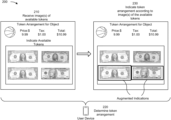
- FIG. 2 is a diagram of an example implementation 200 associated with a user interface for managing tokens associated with a user of a user device. As shown in FIG. 2 , example implementation 200 includes a user interface of a user device. These devices are described in more detail below in connection with FIG. 3 and FIG. 4 .
- the user device receives one or more images of available tokens.
- the user device may receive the images in association with receiving token information associated with available tokens associated with a user of the user device (e.g., the user of example implementation 100 ). More specifically, to provide the token information, once the user gains access to one or more tokens, the user may capture (e.g., using a camera of the user device and/or a feature of the token manager application of example implementation 100 ) one or more images that depict the tokens.
- the user device may analyze, using an image processing technique, an image that depicts a token to obtain token information associated with the token.
- the image processing technique may be associated with the token identification model, such as an object recognition technique, an optical character recognition technique, an edge detection technique, or any other suitable image processing technique. Accordingly, the user device (e.g., via the token manager application) may identify (or determine) a token value associated with a token that is depicted in the received image.
- the user device may determine available token information associated with the user. For example, as shown in example implementation 200 , the one or more images may depict two $1 bills, a $5 bill, and a $10 bill. Correspondingly, as described herein, the user device may receive and/or determine available token information associated with available tokens of a user that indicates that the user is associated with the two $1 bills, the $5 bill, and the $10 bill.
- the user device determines a token arrangement.
- the user device may determine the token arrangement as described above, at least, in connection with example implementation 100 .
- the user may determine the token arrangement according to the available token information that is determined from the one or more images that depict the available tokens associated with the user. Accordingly, as described elsewhere herein, the user device may identify available tokens that are associated with the user and select, from the available tokens, one or more of the tokens for the arrangement of tokens to be included in an indication of the arrangement of tokens.
- received images may include a first denomination (a $1 bill) and a second denomination (a $10 bill).
- the user device e.g., via a token arrangement module
- the user device may determine the arrangement based on a first value of the first denomination, a second value of the second denomination, and the value associated with the object.
- the user device indicates the token arrangement according to the one or more images of the available tokens.
- the user device may include an indication of which tokens (e.g., as depicted in the images) may be utilized for a transaction involving the object.
- the user device e.g., via the user interface module
- the received images may be included within a video stream (e.g., as frames of the video stream) from a camera of the user device (e.g., in a similar manner as a stream of images in a preview mode of a camera of the user device).
- the indications may be indicated via augmented reality to cause the individual tokens, of the arrangement of tokens, to appear to be highlighted or selected on a display of the user device (e.g., a display that is presenting the live stream of images).
- the user device may identify the available tokens, determine values of the available tokens, and determine an arrangement of the available tokens that may be used in a transaction for an object based on a determined adjusted value of the object for the transaction.
- FIG. 2 is provided as an example. Other examples may differ from what is described with regard to FIG. 2 .
- the number and arrangement of devices shown in FIG. 2 are provided as an example. In practice, there may be additional devices, fewer devices, different devices, or differently arranged devices than those shown in FIG. 2 .
- two or more devices shown in FIG. 2 may be implemented within a single device, or a single device shown in FIG. 2 may be implemented as multiple, distributed devices.
- a set of devices (e.g., one or more devices) shown in FIG. 2 may perform one or more functions described as being performed by another set of devices shown in FIG. 2 .
- FIG. 3 is a diagram of an example environment 300 in which systems and/or methods described herein may be implemented.
- environment 300 may include a user device 310 , an object management system 320 , an adjustment factor data source 330 , and a network 340 .
- Devices of environment 300 may interconnect via wired connections, wireless connections, or a combination of wired and wireless connections.
- the user device 310 includes one or more devices capable of receiving, generating, storing, processing, and/or providing information associated with managing tokens associated with a user device, as described elsewhere herein.
- the user device 310 may include a communication device and/or a computing device.
- the user device 310 may include a wireless communication device, a mobile phone, a user equipment, a laptop computer, a tablet computer, a desktop computer, a camera, a wearable communication device (e.g., a smart wristwatch, a pair of smart eyeglasses, a head mounted display, or a virtual reality headset), or a similar type of device.
- the object management system 320 includes one or more devices capable of receiving, generating, storing, processing, providing, and/or routing information associated with one or more objects (e.g., one or more items that may be for sale or purchased via a transaction), as described elsewhere herein.
- the object management system 320 may include a communication device and/or a computing device.
- the object management system 320 may include a server, such as an application server, a client server, a web server, a database server, a host server, a proxy server, a virtual server (e.g., executing on computing hardware), or a server in a cloud computing system.
- the object management system 320 includes computing hardware used in a cloud computing environment.
- the adjustment factor data source 330 includes one or more devices capable of receiving, generating, storing, processing, and/or providing information associated with adjustment factors for transactions that are associated with objects, services, and/or locations, as described elsewhere herein.
- the adjustment factor data source 330 may include a communication device and/or a computing device.
- the adjustment factor data source 330 may include a database, a server, a database server, an application server, a client server, a web server, a host server, a proxy server, a virtual server (e.g., executing on computing hardware), a server in a cloud computing system, a device that includes computing hardware used in a cloud computing environment, or a similar type of device.
- the adjustment factor data source 330 may communicate with one or more other devices of environment 300 , as described elsewhere herein.
- the network 340 includes one or more wired and/or wireless networks.
- the network 340 may include a wireless wide area network (e.g., a cellular network or a public land mobile network), a local area network (e.g., a wired local area network or a wireless local area network (WLAN), such as a Wi-Fi network), a personal area network (e.g., a Bluetooth network), a near-field communication network, a telephone network, a private network, the Internet, and/or a combination of these or other types of networks.
- the network 340 enables communication among the devices of environment 300 .
- the number and arrangement of devices and networks shown in FIG. 3 are provided as an example. In practice, there may be additional devices and/or networks, fewer devices and/or networks, different devices and/or networks, or differently arranged devices and/or networks than those shown in FIG. 3 . Furthermore, two or more devices shown in FIG. 3 may be implemented within a single device, or a single device shown in FIG. 3 may be implemented as multiple, distributed devices. Additionally, or alternatively, a set of devices (e.g., one or more devices) of environment 300 may perform one or more functions described as being performed by another set of devices of environment 300 .
- FIG. 4 is a diagram of example components of a device 400 , which may correspond to the user device 310 , the object management system 320 , and/or the adjustment factor data source 330 .
- the user device 310 , the object management system 320 , and/or the adjustment factor data source 330 may include one or more devices 400 and/or one or more components of device 400 .
- device 400 may include a bus 410 , a processor 420 , a memory 430 , an input component 440 , an output component 450 , and a communication component 460 .
- Bus 410 includes one or more components that enable wired and/or wireless communication among the components of device 400 .
- Bus 410 may couple together two or more components of FIG. 4 , such as via operative coupling, communicative coupling, electronic coupling, and/or electric coupling.
- Processor 420 includes a central processing unit, a graphics processing unit, a microprocessor, a controller, a microcontroller, a digital signal processor, a field-programmable gate array, an application-specific integrated circuit, and/or another type of processing component.
- Processor 420 is implemented in hardware, firmware, or a combination of hardware and software.
- processor 420 includes one or more processors capable of being programmed to perform one or more operations or processes described elsewhere herein.
- Memory 430 includes volatile and/or nonvolatile memory.
- memory 430 may include random access memory (RAM), read only memory (ROM), a hard disk drive, and/or another type of memory (e.g., a flash memory, a magnetic memory, and/or an optical memory).
- Memory 430 may include internal memory (e.g., RAM, ROM, or a hard disk drive) and/or removable memory (e.g., removable via a universal serial bus connection).
- Memory 430 may be a non-transitory computer-readable medium.
- Memory 430 stores information, instructions, and/or software (e.g., one or more software applications) related to the operation of device 400 .
- memory 430 includes one or more memories that are coupled to one or more processors (e.g., processor 420 ), such as via bus 410 .
- Input component 440 enables device 400 to receive input, such as user input and/or sensed input.
- input component 440 may include a touch screen, a keyboard, a keypad, a mouse, a button, a microphone, a switch, a sensor, a global positioning system sensor, an accelerometer, a gyroscope, and/or an actuator.
- Output component 450 enables device 400 to provide output, such as via a display, a speaker, and/or a light-emitting diode.
- Communication component 460 enables device 400 to communicate with other devices via a wired connection and/or a wireless connection.
- communication component 460 may include a receiver, a transmitter, a transceiver, a modem, a network interface card, and/or an antenna.
- Device 400 may perform one or more operations or processes described herein.
- a non-transitory computer-readable medium e.g., memory 430
- Processor 420 may execute the set of instructions to perform one or more operations or processes described herein.
- execution of the set of instructions, by one or more processors 420 causes the one or more processors 420 and/or the device 400 to perform one or more operations or processes described herein.
- hardwired circuitry may be used instead of or in combination with the instructions to perform one or more operations or processes described herein.
- processor 420 may be configured to perform one or more operations or processes described herein.
- implementations described herein are not limited to any specific combination of hardware circuitry and software.
- Device 400 may include additional components, fewer components, different components, or differently arranged components than those shown in FIG. 4 . Additionally, or alternatively, a set of components (e.g., one or more components) of device 400 may perform one or more functions described as being performed by another set of components of device 400 .
- FIG. 5 is a flowchart of an example process 500 associated with a system and user interface of a user device for managing tokens associated with a user.
- one or more process blocks of FIG. 5 may be performed by a user device (e.g., user device 310 ).
- one or more process blocks of FIG. 5 may be performed by another device or a group of devices separate from or including the user device, such as the object management system 320 and/or the adjustment factor data source 330 .
- one or more process blocks of FIG. 5 may be performed by one or more components of device 400 , such as processor 420 , memory 430 , input component 440 , output component 450 , and/or communication component 460 .
- process 500 may include receiving, via an application, object information associated with an object, wherein the object information identifies a value associated with the object and a location of the object (block 510 ). As further shown in FIG. 5 , process 500 may include determining an adjustment factor that is associated with transactions performed in a region of the location (block 520 ).
- process 500 may include determining, based on the value and the adjustment factor, an adjusted value associated with the object (block 530 ). As further shown in FIG. 5 , process 500 may include generating, based on the adjusted value, an arrangement of tokens for a transaction involving the object and the tokens (block 540 ). As further shown in FIG. 5 , process 500 may include outputting, via a user interface of the application, an indication of the arrangement of tokens to assist a user with engaging in the transaction (block 550 ).
- process 500 may include additional blocks, fewer blocks, different blocks, or differently arranged blocks than those depicted in FIG. 5 . Additionally, or alternatively, two or more of the blocks of process 500 may be performed in parallel.
- the term “component” is intended to be broadly construed as hardware, firmware, or a combination of hardware and software. It will be apparent that systems and/or methods described herein may be implemented in different forms of hardware, firmware, and/or a combination of hardware and software. The actual specialized control hardware or software code used to implement these systems and/or methods is not limiting of the implementations. Thus, the operation and behavior of the systems and/or methods are described herein without reference to specific software code—it being understood that software and hardware can be used to implement the systems and/or methods based on the description herein.
- “at least one of: a, b, or c” is intended to cover a, b, c, a-b, a-c, b-c, and a-b-c, as well as any combination with multiple of the same item.
- the terms “has,” “have,” “having,” or the like are intended to be open-ended terms. Further, the phrase “based on” is intended to mean “based, at least in part, on” unless explicitly stated otherwise. Also, as used herein, the term “or” is intended to be inclusive when used in a series and may be used interchangeably with “and/or,” unless explicitly stated otherwise (e.g., if used in combination with “either” or “only one of”).
Landscapes
- Business, Economics & Management (AREA)
- Engineering & Computer Science (AREA)
- Accounting & Taxation (AREA)
- Finance (AREA)
- General Physics & Mathematics (AREA)
- Physics & Mathematics (AREA)
- Theoretical Computer Science (AREA)
- Strategic Management (AREA)
- General Business, Economics & Management (AREA)
- Development Economics (AREA)
- Economics (AREA)
- Computer Networks & Wireless Communication (AREA)
- Marketing (AREA)
- Technology Law (AREA)
- Multimedia (AREA)
- Management, Administration, Business Operations System, And Electronic Commerce (AREA)
Abstract
Description
Claims (20)
Priority Applications (1)
| Application Number | Priority Date | Filing Date | Title |
|---|---|---|---|
| US17/449,730 US11887108B2 (en) | 2021-10-01 | 2021-10-01 | System and user interface of a user device for managing tokens associated with a user |
Applications Claiming Priority (1)
| Application Number | Priority Date | Filing Date | Title |
|---|---|---|---|
| US17/449,730 US11887108B2 (en) | 2021-10-01 | 2021-10-01 | System and user interface of a user device for managing tokens associated with a user |
Publications (2)
| Publication Number | Publication Date |
|---|---|
| US20230109299A1 US20230109299A1 (en) | 2023-04-06 |
| US11887108B2 true US11887108B2 (en) | 2024-01-30 |
Family
ID=85774161
Family Applications (1)
| Application Number | Title | Priority Date | Filing Date |
|---|---|---|---|
| US17/449,730 Active US11887108B2 (en) | 2021-10-01 | 2021-10-01 | System and user interface of a user device for managing tokens associated with a user |
Country Status (1)
| Country | Link |
|---|---|
| US (1) | US11887108B2 (en) |
Citations (65)
| Publication number | Priority date | Publication date | Assignee | Title |
|---|---|---|---|---|
| US20050169504A1 (en) * | 1998-04-07 | 2005-08-04 | Black Gerald R. | Method for identity verification |
| EP1575004A1 (en) | 2004-03-08 | 2005-09-14 | Scandinavian Ecotechnologies A/S | Biometric credit card |
| US7044368B1 (en) * | 2004-02-17 | 2006-05-16 | Gary Barron | Multi-functional data card |
| US20060201775A1 (en) * | 2005-03-11 | 2006-09-14 | Tedesco Daniel E | Apparatus, systems and methods for accepting payment at a sales device |
| US20070073619A1 (en) * | 2005-09-23 | 2007-03-29 | Smith Rebecca C | Biometric anti-fraud plastic card |
| US20080133419A1 (en) * | 2006-12-05 | 2008-06-05 | Brian Wormington | Secure financial transaction system and method |
| US20110166992A1 (en) * | 2010-01-06 | 2011-07-07 | Firethorn Holdings, Llc | System and method for creating and managing a stored value account associated with a client unique identifier |
| US20110218868A1 (en) * | 2010-03-08 | 2011-09-08 | Firethorn Holdings, Llc | System and method for determining appropriate redemption presentations for a virtual token associated with a stored value account |
| US8090358B2 (en) * | 2006-08-16 | 2012-01-03 | At&T Intellectual Property I, L.P. | Methods and computer-readable media for location-based targeted advertising |
| US20120296849A1 (en) * | 2003-01-23 | 2012-11-22 | Lortscher Jr Frank Duane | System and method for generating transaction based recommendations |
| US20120310778A1 (en) * | 2011-06-03 | 2012-12-06 | Uc Group Limited | Systems and methods for clearing and settling transaction activity |
| US8606645B1 (en) * | 2012-02-02 | 2013-12-10 | SeeMore Interactive, Inc. | Method, medium, and system for an augmented reality retail application |
| US20140081859A1 (en) * | 2012-09-14 | 2014-03-20 | Ebay Inc. | Financial strentgh indication |
| US20140236746A1 (en) * | 2002-05-15 | 2014-08-21 | Oncircle, Inc. | Methods of facilitating merchant transactions using a computerized system including a set of titles |
| US20140279503A1 (en) * | 2013-03-13 | 2014-09-18 | Bank Of America Corporation | Providing customer alerts based on geo-thresholds |
| EP2787468A1 (en) | 2013-04-01 | 2014-10-08 | NCR Corporation | Headheld scanner and display |
| US20140310080A1 (en) * | 2012-06-04 | 2014-10-16 | Visa International Service Association | Systems and methods to process loyalty benefits |
| US20150026080A1 (en) * | 2002-05-15 | 2015-01-22 | Oncircle, Inc. | Methods and apparatus for title protocol, authentication, and sharing |
| US20150088751A1 (en) * | 2011-08-19 | 2015-03-26 | Bank Of America Corporation | Transaction verification system based on user location |
| US9016584B2 (en) * | 2002-03-28 | 2015-04-28 | Innovation Connection Corporation | System, method and apparatus for enabling transactions using a biometrically enabled programmable magnetic stripe |
| US20150302411A1 (en) * | 2014-04-22 | 2015-10-22 | Bank Of America Corporation | Proximity to a location as a form of authentication |
| US20160019547A1 (en) * | 2014-07-15 | 2016-01-21 | Verizon Patent And Licensing Inc. | Secure financial payment |
| US20160086222A1 (en) * | 2009-01-21 | 2016-03-24 | Truaxis, Inc. | Method and system to remind users of targeted offers in similar categories |
| US9412121B2 (en) * | 2012-10-05 | 2016-08-09 | Sap Se | Backend support for augmented reality window shopping |
| US9412100B1 (en) * | 2014-12-31 | 2016-08-09 | Square, Inc. | Physical currency management |
| US20160260089A1 (en) * | 2015-03-02 | 2016-09-08 | Shanghai Luluyou Information Technology Ltd. | Secure account management using tokens |
| US20170032382A1 (en) * | 2014-04-14 | 2017-02-02 | Jenda Tag, LLC | System and Method for Product Authentication |
| US20170061405A1 (en) * | 2015-09-01 | 2017-03-02 | Bank Of America Corporation | System for authenticating a wearable device for transaction queuing |
| US20170091765A1 (en) * | 2015-09-30 | 2017-03-30 | Bank Of America Corporation | Non-intrusive geo-location determination associated with transaction authorization |
| US9704161B1 (en) * | 2008-06-27 | 2017-07-11 | Amazon Technologies, Inc. | Providing information without authentication |
| US20170293899A1 (en) * | 2016-04-12 | 2017-10-12 | Digicash Pty Ltd. | Digital value token processing systems and methods having improved security and scalability |
| US10089630B2 (en) * | 2010-04-23 | 2018-10-02 | Visa U.S.A. Inc. | Systems and methods to provide offers to travelers |
| US20180293573A1 (en) * | 2015-01-19 | 2018-10-11 | Royal Bank Of Canada | System and method for location-based token transaction processing |
| US20180300717A1 (en) * | 2017-04-18 | 2018-10-18 | Zeeshanul Haque | Cryptographically secure token exchange |
| US20190130391A1 (en) * | 2016-04-11 | 2019-05-02 | nChain Holdings Limited | Computer-implemented methods and systems for validating tokens for blockchain-based cryptocurrencies |
| US20190164152A1 (en) * | 2017-11-24 | 2019-05-30 | Mathias Bucher | Physical commodity-based currency system |
| US20190164165A1 (en) * | 2017-11-28 | 2019-05-30 | Ca, Inc. | Cross-device, multi-factor authentication for interactive kiosks |
| US10318569B1 (en) * | 2017-12-29 | 2019-06-11 | Square, Inc. | Smart inventory tags |
| US10332150B2 (en) * | 2010-05-11 | 2019-06-25 | Facebook, Inc. | Location event advertising |
| US10423920B1 (en) * | 2014-12-31 | 2019-09-24 | Square, Inc. | Physical currency management |
| US20190303925A1 (en) * | 2011-06-02 | 2019-10-03 | Visa International Service Association | Local Usage of Electronic Tokens in a Transaction Processing System |
| US10438185B1 (en) * | 2014-12-31 | 2019-10-08 | Square, Inc. | Physical currency management |
| US20190378135A1 (en) * | 2015-09-30 | 2019-12-12 | Bank Of America Corporation | Non-intrusive geo-location determination associated with transaction authorization |
| US20200186416A1 (en) * | 2018-12-06 | 2020-06-11 | HashiCorp | Generating configuration files for configuring an information technology infrastructure |
| US10686766B2 (en) * | 2016-09-16 | 2020-06-16 | Pivotal Software, Inc. | Credential management in cloud-based application deployment |
| US20200202324A1 (en) * | 2018-12-19 | 2020-06-25 | Paypal, Inc. | Automated data tokenization through networked sensors |
| US20200265426A1 (en) * | 2016-04-12 | 2020-08-20 | Digicash Pty Ltd. | Secure transaction controller for value token exchange systems |
| US20200366742A1 (en) * | 2016-05-19 | 2020-11-19 | Apple Inc. | User interface for remote authorization |
| US20200394626A1 (en) * | 2017-08-03 | 2020-12-17 | Liquineq AG | System and method for true peer-to-peer automatic teller machine transactions using mobile device payment systems |
| US20210201288A1 (en) * | 2016-09-06 | 2021-07-01 | Apple Inc. | User interfaces for stored-value accounts |
| US20210201328A1 (en) * | 2016-12-02 | 2021-07-01 | Persephone GmbH | System and method for managing transactions in dynamic digital documents |
| US20210224790A1 (en) * | 2012-11-20 | 2021-07-22 | Blackhawk Network, Inc. | System and method for using intelligent codes in conjunction with stored-value cards |
| US20210233162A1 (en) * | 2016-01-06 | 2021-07-29 | Plaid Inc. | Systems and methods for estimating past and prospective attribute values associated with a user account |
| US20210272101A1 (en) * | 2011-07-05 | 2021-09-02 | Visa International Service Association | Electronic wallet checkout platform apparatuses, methods and systems |
| US20210358062A1 (en) * | 2019-12-21 | 2021-11-18 | Key Living Corporation | System and method for on-demand ownership management |
| US20220012739A1 (en) * | 2020-07-13 | 2022-01-13 | Royal Bank Of Canada | Secure identity data tokenization and processing |
| US20220040562A1 (en) * | 2007-02-16 | 2022-02-10 | Walker Digital Table Systems, Llc | Rfid system for facilitating selections at a table game apparatus |
| US20220067702A1 (en) * | 2020-08-28 | 2022-03-03 | The Toronto-Dominion Bank | Value transfer card management system |
| US20220101311A1 (en) * | 2020-09-28 | 2022-03-31 | Mastercard International Incorporated | Systems and methods for tracking the exchange of physical currency between entities |
| US20220114571A1 (en) * | 2012-10-17 | 2022-04-14 | Royal Bank Of Canada | Systems, methods, and devices for secure generation and processing of data sets representing pre-funded payments |
| US11334893B1 (en) * | 2020-12-09 | 2022-05-17 | Bank Of America Corporation | Intelligent cash handling |
| US20220253832A1 (en) * | 2011-02-16 | 2022-08-11 | Visa International Service Association | Snap mobile payment apparatuses, methods and systems |
| US20220253837A1 (en) * | 2021-02-10 | 2022-08-11 | Jals, Llc | Systems for hybrid account interactions and methods of use thereof |
| US20220270078A1 (en) * | 2010-01-08 | 2022-08-25 | Blackhawk Network, Inc. | Method and system for reloading prepaid card |
| US11720896B1 (en) * | 2020-12-10 | 2023-08-08 | Wells Fargo Bank, N.A. | Apparatuses, computer-implemented methods, and computer program products for proximate financial transactions |
-
2021
- 2021-10-01 US US17/449,730 patent/US11887108B2/en active Active
Patent Citations (69)
| Publication number | Priority date | Publication date | Assignee | Title |
|---|---|---|---|---|
| US20050169504A1 (en) * | 1998-04-07 | 2005-08-04 | Black Gerald R. | Method for identity verification |
| US9016584B2 (en) * | 2002-03-28 | 2015-04-28 | Innovation Connection Corporation | System, method and apparatus for enabling transactions using a biometrically enabled programmable magnetic stripe |
| US20150026080A1 (en) * | 2002-05-15 | 2015-01-22 | Oncircle, Inc. | Methods and apparatus for title protocol, authentication, and sharing |
| US20140236746A1 (en) * | 2002-05-15 | 2014-08-21 | Oncircle, Inc. | Methods of facilitating merchant transactions using a computerized system including a set of titles |
| US20120296849A1 (en) * | 2003-01-23 | 2012-11-22 | Lortscher Jr Frank Duane | System and method for generating transaction based recommendations |
| US7044368B1 (en) * | 2004-02-17 | 2006-05-16 | Gary Barron | Multi-functional data card |
| EP1575004A1 (en) | 2004-03-08 | 2005-09-14 | Scandinavian Ecotechnologies A/S | Biometric credit card |
| US20070012542A1 (en) * | 2004-07-30 | 2007-01-18 | Tedesco Daniel E | Apparatus, systems and methods for accepting payment at a sales device |
| US20060201775A1 (en) * | 2005-03-11 | 2006-09-14 | Tedesco Daniel E | Apparatus, systems and methods for accepting payment at a sales device |
| US20070073619A1 (en) * | 2005-09-23 | 2007-03-29 | Smith Rebecca C | Biometric anti-fraud plastic card |
| US8090358B2 (en) * | 2006-08-16 | 2012-01-03 | At&T Intellectual Property I, L.P. | Methods and computer-readable media for location-based targeted advertising |
| US20080133419A1 (en) * | 2006-12-05 | 2008-06-05 | Brian Wormington | Secure financial transaction system and method |
| US20220040562A1 (en) * | 2007-02-16 | 2022-02-10 | Walker Digital Table Systems, Llc | Rfid system for facilitating selections at a table game apparatus |
| US9704161B1 (en) * | 2008-06-27 | 2017-07-11 | Amazon Technologies, Inc. | Providing information without authentication |
| US20160086222A1 (en) * | 2009-01-21 | 2016-03-24 | Truaxis, Inc. | Method and system to remind users of targeted offers in similar categories |
| US20110166992A1 (en) * | 2010-01-06 | 2011-07-07 | Firethorn Holdings, Llc | System and method for creating and managing a stored value account associated with a client unique identifier |
| US20220270078A1 (en) * | 2010-01-08 | 2022-08-25 | Blackhawk Network, Inc. | Method and system for reloading prepaid card |
| US20110218868A1 (en) * | 2010-03-08 | 2011-09-08 | Firethorn Holdings, Llc | System and method for determining appropriate redemption presentations for a virtual token associated with a stored value account |
| US20150220908A1 (en) * | 2010-03-08 | 2015-08-06 | Qualcomm Incorporated | System and method for determining appropriate redemption presentations for a virtual token associated with a stored value account |
| US10089630B2 (en) * | 2010-04-23 | 2018-10-02 | Visa U.S.A. Inc. | Systems and methods to provide offers to travelers |
| US10332150B2 (en) * | 2010-05-11 | 2019-06-25 | Facebook, Inc. | Location event advertising |
| US20220253832A1 (en) * | 2011-02-16 | 2022-08-11 | Visa International Service Association | Snap mobile payment apparatuses, methods and systems |
| US20190303925A1 (en) * | 2011-06-02 | 2019-10-03 | Visa International Service Association | Local Usage of Electronic Tokens in a Transaction Processing System |
| US20120310778A1 (en) * | 2011-06-03 | 2012-12-06 | Uc Group Limited | Systems and methods for clearing and settling transaction activity |
| US20120310702A1 (en) * | 2011-06-03 | 2012-12-06 | Uc Group Limited | Systems and methods for monitoring compulsive behavior and for identifying early warning indicators across multiple websites |
| US20210272101A1 (en) * | 2011-07-05 | 2021-09-02 | Visa International Service Association | Electronic wallet checkout platform apparatuses, methods and systems |
| US20150088751A1 (en) * | 2011-08-19 | 2015-03-26 | Bank Of America Corporation | Transaction verification system based on user location |
| US8606645B1 (en) * | 2012-02-02 | 2013-12-10 | SeeMore Interactive, Inc. | Method, medium, and system for an augmented reality retail application |
| US20140310080A1 (en) * | 2012-06-04 | 2014-10-16 | Visa International Service Association | Systems and methods to process loyalty benefits |
| US20140081859A1 (en) * | 2012-09-14 | 2014-03-20 | Ebay Inc. | Financial strentgh indication |
| US9412121B2 (en) * | 2012-10-05 | 2016-08-09 | Sap Se | Backend support for augmented reality window shopping |
| US20220114571A1 (en) * | 2012-10-17 | 2022-04-14 | Royal Bank Of Canada | Systems, methods, and devices for secure generation and processing of data sets representing pre-funded payments |
| US20210224790A1 (en) * | 2012-11-20 | 2021-07-22 | Blackhawk Network, Inc. | System and method for using intelligent codes in conjunction with stored-value cards |
| US20140279503A1 (en) * | 2013-03-13 | 2014-09-18 | Bank Of America Corporation | Providing customer alerts based on geo-thresholds |
| EP2787468A1 (en) | 2013-04-01 | 2014-10-08 | NCR Corporation | Headheld scanner and display |
| US20170032382A1 (en) * | 2014-04-14 | 2017-02-02 | Jenda Tag, LLC | System and Method for Product Authentication |
| US20150302411A1 (en) * | 2014-04-22 | 2015-10-22 | Bank Of America Corporation | Proximity to a location as a form of authentication |
| US20160019547A1 (en) * | 2014-07-15 | 2016-01-21 | Verizon Patent And Licensing Inc. | Secure financial payment |
| US9412100B1 (en) * | 2014-12-31 | 2016-08-09 | Square, Inc. | Physical currency management |
| US10438185B1 (en) * | 2014-12-31 | 2019-10-08 | Square, Inc. | Physical currency management |
| US10423920B1 (en) * | 2014-12-31 | 2019-09-24 | Square, Inc. | Physical currency management |
| US20180293573A1 (en) * | 2015-01-19 | 2018-10-11 | Royal Bank Of Canada | System and method for location-based token transaction processing |
| US20160260089A1 (en) * | 2015-03-02 | 2016-09-08 | Shanghai Luluyou Information Technology Ltd. | Secure account management using tokens |
| US20170061405A1 (en) * | 2015-09-01 | 2017-03-02 | Bank Of America Corporation | System for authenticating a wearable device for transaction queuing |
| US20170091765A1 (en) * | 2015-09-30 | 2017-03-30 | Bank Of America Corporation | Non-intrusive geo-location determination associated with transaction authorization |
| US20190378135A1 (en) * | 2015-09-30 | 2019-12-12 | Bank Of America Corporation | Non-intrusive geo-location determination associated with transaction authorization |
| US20210233162A1 (en) * | 2016-01-06 | 2021-07-29 | Plaid Inc. | Systems and methods for estimating past and prospective attribute values associated with a user account |
| US20190130391A1 (en) * | 2016-04-11 | 2019-05-02 | nChain Holdings Limited | Computer-implemented methods and systems for validating tokens for blockchain-based cryptocurrencies |
| US20170293899A1 (en) * | 2016-04-12 | 2017-10-12 | Digicash Pty Ltd. | Digital value token processing systems and methods having improved security and scalability |
| US20200265426A1 (en) * | 2016-04-12 | 2020-08-20 | Digicash Pty Ltd. | Secure transaction controller for value token exchange systems |
| US20200366742A1 (en) * | 2016-05-19 | 2020-11-19 | Apple Inc. | User interface for remote authorization |
| US20210201288A1 (en) * | 2016-09-06 | 2021-07-01 | Apple Inc. | User interfaces for stored-value accounts |
| US10686766B2 (en) * | 2016-09-16 | 2020-06-16 | Pivotal Software, Inc. | Credential management in cloud-based application deployment |
| US20210201328A1 (en) * | 2016-12-02 | 2021-07-01 | Persephone GmbH | System and method for managing transactions in dynamic digital documents |
| US20180300717A1 (en) * | 2017-04-18 | 2018-10-18 | Zeeshanul Haque | Cryptographically secure token exchange |
| US20200394626A1 (en) * | 2017-08-03 | 2020-12-17 | Liquineq AG | System and method for true peer-to-peer automatic teller machine transactions using mobile device payment systems |
| US20190164152A1 (en) * | 2017-11-24 | 2019-05-30 | Mathias Bucher | Physical commodity-based currency system |
| US20190164165A1 (en) * | 2017-11-28 | 2019-05-30 | Ca, Inc. | Cross-device, multi-factor authentication for interactive kiosks |
| US10318569B1 (en) * | 2017-12-29 | 2019-06-11 | Square, Inc. | Smart inventory tags |
| US20200186416A1 (en) * | 2018-12-06 | 2020-06-11 | HashiCorp | Generating configuration files for configuring an information technology infrastructure |
| US20200202324A1 (en) * | 2018-12-19 | 2020-06-25 | Paypal, Inc. | Automated data tokenization through networked sensors |
| US20220084009A1 (en) * | 2018-12-19 | 2022-03-17 | Paypal, Inc. | Automated data tokenization through networked sensors |
| US20210358062A1 (en) * | 2019-12-21 | 2021-11-18 | Key Living Corporation | System and method for on-demand ownership management |
| US20220012739A1 (en) * | 2020-07-13 | 2022-01-13 | Royal Bank Of Canada | Secure identity data tokenization and processing |
| US20220067702A1 (en) * | 2020-08-28 | 2022-03-03 | The Toronto-Dominion Bank | Value transfer card management system |
| US20220101311A1 (en) * | 2020-09-28 | 2022-03-31 | Mastercard International Incorporated | Systems and methods for tracking the exchange of physical currency between entities |
| US11334893B1 (en) * | 2020-12-09 | 2022-05-17 | Bank Of America Corporation | Intelligent cash handling |
| US11720896B1 (en) * | 2020-12-10 | 2023-08-08 | Wells Fargo Bank, N.A. | Apparatuses, computer-implemented methods, and computer program products for proximate financial transactions |
| US20220253837A1 (en) * | 2021-02-10 | 2022-08-11 | Jals, Llc | Systems for hybrid account interactions and methods of use thereof |
Non-Patent Citations (1)
| Title |
|---|
| Blomqvist, "Secrets Management in a Multi-Cloud Kubernetes Environment," Master of Science in Technology Thesis, University of Turku, Department of Computing, Software Engineering, May 2021, 63 Pages. |
Also Published As
| Publication number | Publication date |
|---|---|
| US20230109299A1 (en) | 2023-04-06 |
Similar Documents
| Publication | Publication Date | Title |
|---|---|---|
| US11709578B1 (en) | Mobile application with dynamic feature set | |
| US12147958B2 (en) | Generating an online storefront | |
| US11015014B2 (en) | Automated contactless access device location system and method | |
| US10885522B1 (en) | Updating merchant location for cardless payment transactions | |
| US20230230086A1 (en) | Value transfer via facial recognition | |
| AU2019201310A1 (en) | Computing distances of devices | |
| US10121174B2 (en) | Ad hoc merchant configuration system | |
| US9589290B1 (en) | Client-side use of customer preferences | |
| KR20210095120A (en) | Object verification for network-based services | |
| US10586231B2 (en) | Receipt retrieval based on location | |
| US20190325511A1 (en) | Augmented Reality Foreign Currency View | |
| CN108446905B (en) | Payment method and device and electronic equipment | |
| JP7059415B1 (en) | Information processing equipment, information processing methods and information processing programs | |
| KR20140010295A (en) | Payment method and mobile terminal using the same | |
| US20230056297A1 (en) | System and method for recommending portable financial device for a payment transaction | |
| US11887108B2 (en) | System and user interface of a user device for managing tokens associated with a user | |
| JP2017228296A (en) | Dynamic transaction recording | |
| US12536881B1 (en) | Systems and methods for automated teller machine replenishing and merchant operations | |
| US20240202696A1 (en) | Systems and methods for performing payments in an extended reality environment | |
| JP2022012909A (en) | Proxy-selling system, proxy-selling method, and proxy-selling program | |
| CN109960909B (en) | Three-dimensional map-based social method, server, and computer-readable storage medium | |
| US12518282B2 (en) | Using location-based mapping to enable automated information transfer at a user location | |
| US20250371564A1 (en) | Customized product bundles | |
| US20250272751A1 (en) | Relational database management systems of data structures facilitating file management and data retrieval | |
| WO2023244164A1 (en) | Method and device for detecting merchant from payment transaction |
Legal Events
| Date | Code | Title | Description |
|---|---|---|---|
| AS | Assignment |
Owner name: CAPITAL ONE SERVICES, LLC, VIRGINIA Free format text: ASSIGNMENT OF ASSIGNORS INTEREST;ASSIGNOR:CROUSE, MARGARET;REEL/FRAME:057672/0290 Effective date: 20210930 |
|
| FEPP | Fee payment procedure |
Free format text: ENTITY STATUS SET TO UNDISCOUNTED (ORIGINAL EVENT CODE: BIG.); ENTITY STATUS OF PATENT OWNER: LARGE ENTITY |
|
| STPP | Information on status: patent application and granting procedure in general |
Free format text: NON FINAL ACTION MAILED |
|
| STPP | Information on status: patent application and granting procedure in general |
Free format text: RESPONSE TO NON-FINAL OFFICE ACTION ENTERED AND FORWARDED TO EXAMINER |
|
| STPP | Information on status: patent application and granting procedure in general |
Free format text: NOTICE OF ALLOWANCE MAILED -- APPLICATION RECEIVED IN OFFICE OF PUBLICATIONS |
|
| STPP | Information on status: patent application and granting procedure in general |
Free format text: AWAITING TC RESP., ISSUE FEE NOT PAID |
|
| STPP | Information on status: patent application and granting procedure in general |
Free format text: NOTICE OF ALLOWANCE MAILED -- APPLICATION RECEIVED IN OFFICE OF PUBLICATIONS |
|
| STPP | Information on status: patent application and granting procedure in general |
Free format text: PUBLICATIONS -- ISSUE FEE PAYMENT VERIFIED |
|
| STCF | Information on status: patent grant |
Free format text: PATENTED CASE |