US11866502B2 - Anti-FGFR2 antibodies and methods of use thereof - Google Patents
Anti-FGFR2 antibodies and methods of use thereof Download PDFInfo
- Publication number
- US11866502B2 US11866502B2 US17/507,138 US202117507138A US11866502B2 US 11866502 B2 US11866502 B2 US 11866502B2 US 202117507138 A US202117507138 A US 202117507138A US 11866502 B2 US11866502 B2 US 11866502B2
- Authority
- US
- United States
- Prior art keywords
- amino acid
- acid sequence
- seq
- antigen
- antibody
- Prior art date
- Legal status (The legal status is an assumption and is not a legal conclusion. Google has not performed a legal analysis and makes no representation as to the accuracy of the status listed.)
- Active, expires
Links
Images


Classifications
-
- C—CHEMISTRY; METALLURGY
- C07—ORGANIC CHEMISTRY
- C07K—PEPTIDES
- C07K16/00—Immunoglobulins [IGs], e.g. monoclonal or polyclonal antibodies
- C07K16/18—Immunoglobulins [IGs], e.g. monoclonal or polyclonal antibodies against material from animals or humans
- C07K16/28—Immunoglobulins [IGs], e.g. monoclonal or polyclonal antibodies against material from animals or humans against receptors, cell surface antigens or cell surface determinants
- C07K16/2863—Immunoglobulins [IGs], e.g. monoclonal or polyclonal antibodies against material from animals or humans against receptors, cell surface antigens or cell surface determinants against receptors for growth factors, growth regulators
-
- A—HUMAN NECESSITIES
- A61—MEDICAL OR VETERINARY SCIENCE; HYGIENE
- A61K—PREPARATIONS FOR MEDICAL, DENTAL OR TOILETRY PURPOSES
- A61K45/00—Medicinal preparations containing active ingredients not provided for in groups A61K31/00 - A61K41/00
- A61K45/06—Mixtures of active ingredients without chemical characterisation, e.g. antiphlogistics and cardiaca
-
- A—HUMAN NECESSITIES
- A61—MEDICAL OR VETERINARY SCIENCE; HYGIENE
- A61K—PREPARATIONS FOR MEDICAL, DENTAL OR TOILETRY PURPOSES
- A61K47/00—Medicinal preparations characterised by the non-active ingredients used, e.g. carriers or inert additives; Targeting or modifying agents chemically bound to the active ingredient
- A61K47/50—Medicinal preparations characterised by the non-active ingredients used, e.g. carriers or inert additives; Targeting or modifying agents chemically bound to the active ingredient the non-active ingredient being chemically bound to the active ingredient, e.g. polymer-drug conjugates
- A61K47/51—Medicinal preparations characterised by the non-active ingredients used, e.g. carriers or inert additives; Targeting or modifying agents chemically bound to the active ingredient the non-active ingredient being chemically bound to the active ingredient, e.g. polymer-drug conjugates the non-active ingredient being a modifying agent
- A61K47/68—Medicinal preparations characterised by the non-active ingredients used, e.g. carriers or inert additives; Targeting or modifying agents chemically bound to the active ingredient the non-active ingredient being chemically bound to the active ingredient, e.g. polymer-drug conjugates the non-active ingredient being a modifying agent the modifying agent being an antibody, an immunoglobulin or a fragment thereof, e.g. an Fc-fragment
- A61K47/6801—Drug-antibody or immunoglobulin conjugates defined by the pharmacologically or therapeutically active agent
- A61K47/6803—Drugs conjugated to an antibody or immunoglobulin, e.g. cisplatin-antibody conjugates
-
- A—HUMAN NECESSITIES
- A61—MEDICAL OR VETERINARY SCIENCE; HYGIENE
- A61K—PREPARATIONS FOR MEDICAL, DENTAL OR TOILETRY PURPOSES
- A61K47/00—Medicinal preparations characterised by the non-active ingredients used, e.g. carriers or inert additives; Targeting or modifying agents chemically bound to the active ingredient
- A61K47/50—Medicinal preparations characterised by the non-active ingredients used, e.g. carriers or inert additives; Targeting or modifying agents chemically bound to the active ingredient the non-active ingredient being chemically bound to the active ingredient, e.g. polymer-drug conjugates
- A61K47/51—Medicinal preparations characterised by the non-active ingredients used, e.g. carriers or inert additives; Targeting or modifying agents chemically bound to the active ingredient the non-active ingredient being chemically bound to the active ingredient, e.g. polymer-drug conjugates the non-active ingredient being a modifying agent
- A61K47/68—Medicinal preparations characterised by the non-active ingredients used, e.g. carriers or inert additives; Targeting or modifying agents chemically bound to the active ingredient the non-active ingredient being chemically bound to the active ingredient, e.g. polymer-drug conjugates the non-active ingredient being a modifying agent the modifying agent being an antibody, an immunoglobulin or a fragment thereof, e.g. an Fc-fragment
- A61K47/6801—Drug-antibody or immunoglobulin conjugates defined by the pharmacologically or therapeutically active agent
- A61K47/6803—Drugs conjugated to an antibody or immunoglobulin, e.g. cisplatin-antibody conjugates
- A61K47/68033—Drugs conjugated to an antibody or immunoglobulin, e.g. cisplatin-antibody conjugates the drug being a maytansine
-
- A—HUMAN NECESSITIES
- A61—MEDICAL OR VETERINARY SCIENCE; HYGIENE
- A61K—PREPARATIONS FOR MEDICAL, DENTAL OR TOILETRY PURPOSES
- A61K47/00—Medicinal preparations characterised by the non-active ingredients used, e.g. carriers or inert additives; Targeting or modifying agents chemically bound to the active ingredient
- A61K47/50—Medicinal preparations characterised by the non-active ingredients used, e.g. carriers or inert additives; Targeting or modifying agents chemically bound to the active ingredient the non-active ingredient being chemically bound to the active ingredient, e.g. polymer-drug conjugates
- A61K47/51—Medicinal preparations characterised by the non-active ingredients used, e.g. carriers or inert additives; Targeting or modifying agents chemically bound to the active ingredient the non-active ingredient being chemically bound to the active ingredient, e.g. polymer-drug conjugates the non-active ingredient being a modifying agent
- A61K47/68—Medicinal preparations characterised by the non-active ingredients used, e.g. carriers or inert additives; Targeting or modifying agents chemically bound to the active ingredient the non-active ingredient being chemically bound to the active ingredient, e.g. polymer-drug conjugates the non-active ingredient being a modifying agent the modifying agent being an antibody, an immunoglobulin or a fragment thereof, e.g. an Fc-fragment
- A61K47/6801—Drug-antibody or immunoglobulin conjugates defined by the pharmacologically or therapeutically active agent
- A61K47/6803—Drugs conjugated to an antibody or immunoglobulin, e.g. cisplatin-antibody conjugates
- A61K47/68037—Drugs conjugated to an antibody or immunoglobulin, e.g. cisplatin-antibody conjugates the drug being a camptothecin [CPT] or derivatives
-
- A—HUMAN NECESSITIES
- A61—MEDICAL OR VETERINARY SCIENCE; HYGIENE
- A61K—PREPARATIONS FOR MEDICAL, DENTAL OR TOILETRY PURPOSES
- A61K47/00—Medicinal preparations characterised by the non-active ingredients used, e.g. carriers or inert additives; Targeting or modifying agents chemically bound to the active ingredient
- A61K47/50—Medicinal preparations characterised by the non-active ingredients used, e.g. carriers or inert additives; Targeting or modifying agents chemically bound to the active ingredient the non-active ingredient being chemically bound to the active ingredient, e.g. polymer-drug conjugates
- A61K47/51—Medicinal preparations characterised by the non-active ingredients used, e.g. carriers or inert additives; Targeting or modifying agents chemically bound to the active ingredient the non-active ingredient being chemically bound to the active ingredient, e.g. polymer-drug conjugates the non-active ingredient being a modifying agent
- A61K47/68—Medicinal preparations characterised by the non-active ingredients used, e.g. carriers or inert additives; Targeting or modifying agents chemically bound to the active ingredient the non-active ingredient being chemically bound to the active ingredient, e.g. polymer-drug conjugates the non-active ingredient being a modifying agent the modifying agent being an antibody, an immunoglobulin or a fragment thereof, e.g. an Fc-fragment
- A61K47/6835—Medicinal preparations characterised by the non-active ingredients used, e.g. carriers or inert additives; Targeting or modifying agents chemically bound to the active ingredient the non-active ingredient being chemically bound to the active ingredient, e.g. polymer-drug conjugates the non-active ingredient being a modifying agent the modifying agent being an antibody, an immunoglobulin or a fragment thereof, e.g. an Fc-fragment the modifying agent being an antibody or an immunoglobulin bearing at least one antigen-binding site
- A61K47/6849—Medicinal preparations characterised by the non-active ingredients used, e.g. carriers or inert additives; Targeting or modifying agents chemically bound to the active ingredient the non-active ingredient being chemically bound to the active ingredient, e.g. polymer-drug conjugates the non-active ingredient being a modifying agent the modifying agent being an antibody, an immunoglobulin or a fragment thereof, e.g. an Fc-fragment the modifying agent being an antibody or an immunoglobulin bearing at least one antigen-binding site the antibody targeting a receptor, a cell surface antigen or a cell surface determinant
-
- A—HUMAN NECESSITIES
- A61—MEDICAL OR VETERINARY SCIENCE; HYGIENE
- A61K—PREPARATIONS FOR MEDICAL, DENTAL OR TOILETRY PURPOSES
- A61K47/00—Medicinal preparations characterised by the non-active ingredients used, e.g. carriers or inert additives; Targeting or modifying agents chemically bound to the active ingredient
- A61K47/50—Medicinal preparations characterised by the non-active ingredients used, e.g. carriers or inert additives; Targeting or modifying agents chemically bound to the active ingredient the non-active ingredient being chemically bound to the active ingredient, e.g. polymer-drug conjugates
- A61K47/51—Medicinal preparations characterised by the non-active ingredients used, e.g. carriers or inert additives; Targeting or modifying agents chemically bound to the active ingredient the non-active ingredient being chemically bound to the active ingredient, e.g. polymer-drug conjugates the non-active ingredient being a modifying agent
- A61K47/68—Medicinal preparations characterised by the non-active ingredients used, e.g. carriers or inert additives; Targeting or modifying agents chemically bound to the active ingredient the non-active ingredient being chemically bound to the active ingredient, e.g. polymer-drug conjugates the non-active ingredient being a modifying agent the modifying agent being an antibody, an immunoglobulin or a fragment thereof, e.g. an Fc-fragment
- A61K47/6835—Medicinal preparations characterised by the non-active ingredients used, e.g. carriers or inert additives; Targeting or modifying agents chemically bound to the active ingredient the non-active ingredient being chemically bound to the active ingredient, e.g. polymer-drug conjugates the non-active ingredient being a modifying agent the modifying agent being an antibody, an immunoglobulin or a fragment thereof, e.g. an Fc-fragment the modifying agent being an antibody or an immunoglobulin bearing at least one antigen-binding site
- A61K47/6851—Medicinal preparations characterised by the non-active ingredients used, e.g. carriers or inert additives; Targeting or modifying agents chemically bound to the active ingredient the non-active ingredient being chemically bound to the active ingredient, e.g. polymer-drug conjugates the non-active ingredient being a modifying agent the modifying agent being an antibody, an immunoglobulin or a fragment thereof, e.g. an Fc-fragment the modifying agent being an antibody or an immunoglobulin bearing at least one antigen-binding site the antibody targeting a determinant of a tumour cell
- A61K47/6863—Medicinal preparations characterised by the non-active ingredients used, e.g. carriers or inert additives; Targeting or modifying agents chemically bound to the active ingredient the non-active ingredient being chemically bound to the active ingredient, e.g. polymer-drug conjugates the non-active ingredient being a modifying agent the modifying agent being an antibody, an immunoglobulin or a fragment thereof, e.g. an Fc-fragment the modifying agent being an antibody or an immunoglobulin bearing at least one antigen-binding site the antibody targeting a determinant of a tumour cell the tumour determinant being from stomach or intestines cancer cell
-
- A—HUMAN NECESSITIES
- A61—MEDICAL OR VETERINARY SCIENCE; HYGIENE
- A61K—PREPARATIONS FOR MEDICAL, DENTAL OR TOILETRY PURPOSES
- A61K47/00—Medicinal preparations characterised by the non-active ingredients used, e.g. carriers or inert additives; Targeting or modifying agents chemically bound to the active ingredient
- A61K47/50—Medicinal preparations characterised by the non-active ingredients used, e.g. carriers or inert additives; Targeting or modifying agents chemically bound to the active ingredient the non-active ingredient being chemically bound to the active ingredient, e.g. polymer-drug conjugates
- A61K47/51—Medicinal preparations characterised by the non-active ingredients used, e.g. carriers or inert additives; Targeting or modifying agents chemically bound to the active ingredient the non-active ingredient being chemically bound to the active ingredient, e.g. polymer-drug conjugates the non-active ingredient being a modifying agent
- A61K47/68—Medicinal preparations characterised by the non-active ingredients used, e.g. carriers or inert additives; Targeting or modifying agents chemically bound to the active ingredient the non-active ingredient being chemically bound to the active ingredient, e.g. polymer-drug conjugates the non-active ingredient being a modifying agent the modifying agent being an antibody, an immunoglobulin or a fragment thereof, e.g. an Fc-fragment
- A61K47/6889—Conjugates wherein the antibody being the modifying agent and wherein the linker, binder or spacer confers particular properties to the conjugates, e.g. peptidic enzyme-labile linkers or acid-labile linkers, providing for an acid-labile immuno conjugate wherein the drug may be released from its antibody conjugated part in an acidic, e.g. tumoural or environment
-
- A—HUMAN NECESSITIES
- A61—MEDICAL OR VETERINARY SCIENCE; HYGIENE
- A61P—SPECIFIC THERAPEUTIC ACTIVITY OF CHEMICAL COMPOUNDS OR MEDICINAL PREPARATIONS
- A61P35/00—Antineoplastic agents
-
- C—CHEMISTRY; METALLURGY
- C07—ORGANIC CHEMISTRY
- C07K—PEPTIDES
- C07K16/00—Immunoglobulins [IGs], e.g. monoclonal or polyclonal antibodies
- C07K16/18—Immunoglobulins [IGs], e.g. monoclonal or polyclonal antibodies against material from animals or humans
- C07K16/28—Immunoglobulins [IGs], e.g. monoclonal or polyclonal antibodies against material from animals or humans against receptors, cell surface antigens or cell surface determinants
- C07K16/30—Immunoglobulins [IGs], e.g. monoclonal or polyclonal antibodies against material from animals or humans against receptors, cell surface antigens or cell surface determinants from tumour cells
-
- A—HUMAN NECESSITIES
- A61—MEDICAL OR VETERINARY SCIENCE; HYGIENE
- A61K—PREPARATIONS FOR MEDICAL, DENTAL OR TOILETRY PURPOSES
- A61K39/00—Medicinal preparations containing antigens or antibodies
- A61K2039/505—Medicinal preparations containing antigens or antibodies comprising antibodies
-
- C—CHEMISTRY; METALLURGY
- C07—ORGANIC CHEMISTRY
- C07K—PEPTIDES
- C07K2317/00—Immunoglobulins specific features
- C07K2317/20—Immunoglobulins specific features characterized by taxonomic origin
- C07K2317/21—Immunoglobulins specific features characterized by taxonomic origin from primates, e.g. man
-
- C—CHEMISTRY; METALLURGY
- C07—ORGANIC CHEMISTRY
- C07K—PEPTIDES
- C07K2317/00—Immunoglobulins specific features
- C07K2317/30—Immunoglobulins specific features characterized by aspects of specificity or valency
- C07K2317/33—Crossreactivity, e.g. for species or epitope, or lack of said crossreactivity
-
- C—CHEMISTRY; METALLURGY
- C07—ORGANIC CHEMISTRY
- C07K—PEPTIDES
- C07K2317/00—Immunoglobulins specific features
- C07K2317/40—Immunoglobulins specific features characterized by post-translational modification
- C07K2317/41—Glycosylation, sialylation, or fucosylation
-
- C—CHEMISTRY; METALLURGY
- C07—ORGANIC CHEMISTRY
- C07K—PEPTIDES
- C07K2317/00—Immunoglobulins specific features
- C07K2317/70—Immunoglobulins specific features characterized by effect upon binding to a cell or to an antigen
- C07K2317/73—Inducing cell death, e.g. apoptosis, necrosis or inhibition of cell proliferation
-
- C—CHEMISTRY; METALLURGY
- C07—ORGANIC CHEMISTRY
- C07K—PEPTIDES
- C07K2317/00—Immunoglobulins specific features
- C07K2317/90—Immunoglobulins specific features characterized by (pharmaco)kinetic aspects or by stability of the immunoglobulin
- C07K2317/92—Affinity (KD), association rate (Ka), dissociation rate (Kd) or EC50 value
Definitions
- the present invention relates to antibodies and antigen-binding fragments thereof, as well as antibody-drug conjugates of such antibodies, which specifically bind fibroblast growth factor receptor 2 (FGFR2), and methods of use thereof.
- FGFR2 fibroblast growth factor receptor 2
- sequence listing is submitted concurrently with the specification electronically via EFS-Web as an ASCII formatted sequence listing with a file name of 10680US01_Sequence_Listing_ST25.TXT, a creation date of Oct. 21, 2021, and a size of about 72 kilobytes.
- the sequence listing contained in this ASCII formatted document is part of the specification and is herein incorporated by reference in its entirety.
- the fibroblast growth factor (FGF) receptor tyrosine kinase (RTK) family consists of fibroblast growth factor receptor 1 (FGFR1), FGFR2, FGFR3, and FGFR4, and encompasses high affinity receptors for as many as 18 different FGF ligands.
- the receptor is a transmembrane tyrosine kinase, and FGFR signaling drives downstream pathways, including the mitogen-activated protein kinase (MAPK) and AKT pathways, which are crucial for cell proliferation, differentiation, survival, and migration. Binding of the FGF ligand to the receptor induces dimerization of the FGF:FGFR complex.
- Dimerization leads to kinase activation and autophosphorylation of multiple tyrosine residues in the cytoplasmic domain of the receptor, and activation of downstream signaling of the phosphoinositide 3-kinase (PI3K)-AKT and MAPK-extracellular signal-regulated kinase (ERK) pathways.
- PI3K phosphoinositide 3-kinase
- ERK MAPK-extracellular signal-regulated kinase
- FGFR2 amplification has been reported in various cancers. FGFR2 amplification affects signaling without altering the intrinsic kinase activity of the receptor. Signaling through overexpressed FGFR2 also shows evidence of being ligand-independent and sensitive to FGFR inhibitors (Lorenzi, 1997, Ligand-independent activation of fibroblast growth factor receptor-2 by carboxyl terminal alterations, Oncogene; Takeda, 1999, AZD2171 shows potent antitumor activity against gastric cancer over-expressing fibroblast growth factor receptor 2/keratinocyte growth factor receptor, Clin Cancer Research; Cha, 2009, Aberrant receptor internalization and enhanced FRS2-dependent signaling contribute to the transforming activity of the fibroblast growth factor receptor 2 IIIb C3 isoform, J. Biol. Chem).
- the FGFR2 protein is overexpressed in about 3% of breast cancers, including triple negative breast cancer, and about 10% of gastric/esophageal cancers.
- FGFR2 overexpression is also found in other cancers, including colon, hepatocellular, pancreatic, ovary, uterine, cervical, endometrial, bladder, lung, colon, glioma, and head and neck cancers.
- mutations of the FGFR2 gene have been reported in about 12% of endometrial carcinomas.
- FGFR2 overexpression has been associated with poor survival in patients with gastric cancer.
- FGFR-amplified tumors are sensitive to FGFR inhibition and therefore susceptible to therapeutic targeting.
- Treatment of FGFR2 positive tumors with anti-FGFR2 therapies such as Bemarituzumab (aka HGS1036, HGS 1036, FP-1039, FPA144, GSK3052230) reportedly leads to improvements in early survival and advanced disease.
- Bemarituzumab aka HGS1036, HGS 1036, FP-1039, FPA144, GSK3052230
- FPA144 A Therapeutic Monoclonal Antibody Targeting the FGFR2b Receptor, Promotes Antibody Dependent Cell-Mediated Cytotoxicity and Stimulates Sensitivity to PD-1 in the 4T1 Syngeneic Tumor Model” AACR Abstract ID 1407; and Lee et al. (2016) “Antitumor Activity and Safety of FPA144, an ADCC-Enhanced, FGFR2b Isoform-Selective Monoclonal Antibody, in Patients with FGFR2b+ Gastric Cancer and Advanced Solid Tumors” ASCO Abstract ID 2502).
- FGFR2 antibodies are conjugated to cytotoxic payloads, including thorium-227 (Aprutumab, aka BAY1179470, BAY2304058) and auristatin (Aprutumab ixadotin, aka BAY1187982, BAY1179470 ADC).
- Aprutumab-TTC anti-FGFR2 antibody, a chelator moiety covalently conjugated to the antibody, and the alpha particle-emitting radionuclide thorium-227) reportedly inhibited tumor growth in several xenograft models.
- antibodies and antigen-binding fragments thereof that bind human FGF receptor 2 protein (FGFR2).
- the antibodies are useful, inter alia, for targeting tumor cells that express FGFR2.
- the anti-FGFR2 antibodies, and antigen-binding portions thereof may be used alone in unmodified form, or may be included as part of an antibody-drug conjugate.
- FIG. 1 A and FIG. 1 B depict a monoclonal antibody with a click moiety spacer, a cathepsin B cleavable linker, and a tubulysin payload.
- FIG. 1 B depicts a process for site specific conjugation on the antibody.
- FIG. 2 provides SEC-HPLC analyses of the anti-FGFR2 antibody-tubulysin conjugate.
- FIG. 3 shows change in tumor volume and body weight in human gastric cancer xenografts over time with treatment using different dosages of Anti-FGFR2 antibody-tubulysin conjugate.
- FIG. 4 shows change in tumor volume and body weight in mice having human gastric cancer xenografts over time with treatment using different dosages of Anti-FGFR2 antibody-maytansinoid conjugate.
- FIG. 5 shows change in tumor volume and body weight in mice with human gastric cancer PDX GA0033 tumors over time with treatment using different dosages of Anti-FGFR2 antibody-tubulysin conjugate and Anti-FGFR2 antibody-maytansinoid conjugate. Mice were dosed on day 0 and day 7 with the respective ADCs or control antibodies.
- FIG. 6 shows change in tumor volume and body weight in mice with SNU-16 human gastric cancer xenografts over time with treatment using different dosages of Anti-FGFR2 antibody-camptothecin analog conjugates (DAR8). Mice were dosed on day 0 with the respective conjugates and dosages.
- DAR8 Anti-FGFR2 antibody-camptothecin analog conjugates
- FIG. 7 shows change in tumor volume and body weight in mice with SNU-16 human gastric cancer xenografts over time with treatment using different dosages of an Anti-FGFR2 antibody camptothecin analog conjugate (DAR4). Mice were dosed on day 0 and day 7 with the respective dosages.
- DAR4 Anti-FGFR2 antibody camptothecin analog conjugate
- FIG. 8 depicts basic component structures of non-limiting exemplary azide amine linkers.
- FIG. 9 depicts basic component structures of exemplary non-limiting branched-alkyl azide amine linkers.
- FIG. 10 shows change in tumor volume and body weight in mice with GA1224 human PDX tumors over time with treatment using different dosages of Anti-FGFR2 antibody camptothecin ADC (DAR4). Mice were dosed on day 0 and day 7 with the respective dosages.
- DAR4 Anti-FGFR2 antibody camptothecin ADC
- FIG. 11 shows change in tumor volume and body weight in mice with SNU-16 human gastric cancer xenografts (FGFR2b positive) over time with treatment using an Anti-FGFR2 antibody camptothecin ADC (DAR4) or Anti-FGFR2 antibody maytansinoid ADC.
- DAR4 Anti-FGFR2 antibody camptothecin ADC
- DAR4 Anti-FGFR2 antibody maytansinoid ADC
- FIG. 12 shows change in tumor volume and body weight in mice with SNU-5 human gastric cancer xenografts (FGFR2b negative) over time with treatment using an Anti-FGFR2 antibody camptothecin ADC (DAR4) or Anti-FGFR2 antibody maytansinoid ADC.
- DAR4 Anti-FGFR2 antibody camptothecin ADC
- DAR4 Anti-FGFR2 antibody maytansinoid ADC
- FIG. 13 shows change in tumor volume and body weight in mice co-implanted at a ratio of 2:1 with SNU-16 (FGFR2b positive) and SNU-5 (FGFR2b negative) human gastric cancer xenografts with treatment using an Anti-FGFR2 antibody camptothecin ADC (DAR4) or Anti-FGFR2 antibody maytansinoid ADC.
- DAR4 Anti-FGFR2 antibody camptothecin ADC
- DAR4 Anti-FGFR2 antibody maytansinoid ADC
- FGFR2 refers to a tyrosine protein kinase that acts as a cell-surface receptor for fibroblast growth factors.
- the protein is also known as keratinocyte growth factor receptor and CD332.
- FGFR2b can refer to the amino acid sequence as set forth in SEQ ID NO: 55, and/or having the amino acid sequence as set forth in NCBI accession No. NP_075259.4, and is encoded by the FGFR2 gene residing on chromosome 10.
- the epithelial splicing regulatory protein 1 (ESRP1) isoform is responsible for the FGFR2 splicing and consequent expression of the epithelial FGFR2b isoform.
- FGFR2 is a tyrosine-protein kinase that acts as cell-surface receptor for fibroblast growth factors and plays an essential role in the regulation of cell proliferation, differentiation, migration and apoptosis, and in the regulation of embryonic development.
- Activation of FGFR2 results in phosphorylation of PLCG1, FRS2, and PAK4 and activation of several signaling cascades.
- Activation of PLCG1 leads to the production of the cellular signaling molecules diacylglycerol and inositol 1,4,5-trisphosphate.
- FRS2 Phosphorylation of FRS2 triggers recruitment of GRB2, GAB1, PIK3R1 and SOS1, and mediates activation of RAS, MAPK1/ERK2, MAPK3/ERK1 and the MAP kinase signaling pathway, as well as of the AKT1 signaling pathway.
- FGFR2 signaling is down-regulated by ubiquitination, internalization and degradation. Mutations that lead to constitutive kinase activation or impair normal FGFR2 maturation, internalization and degradation lead to aberrant signaling. Likewise, over-expressed FGFR2 promotes activation of STAT1.
- FGFR2 means human FGFR2 unless specified as being from a non-human species, e.g., “mouse FGFR2” “monkey FGFR2,” etc.
- cell surface-expressed FGFR2 means one or more FGFR2 protein(s), or the extracellular domain thereof, that is/are expressed on the surface of a cell in vitro or in vivo, such that at least a portion of a FGFR2 protein is exposed to the extracellular side of the cell membrane and is accessible to an antigen-binding portion of an antibody.
- a “cell surface-expressed FGFR2” can comprise or consist of an FGFR2 protein expressed on the surface of a cell which normally expresses FGFR2 protein.
- “cell surface-expressed FGFR2” can comprise or consist of FGFR2 protein expressed on the surface of a cell that normally does not express human FGFR2 on its surface but has been artificially engineered to express FGFR2 on its surface.
- antibody means any antigen-binding molecule or molecular complex comprising at least one complementarity determining region (CDR) that specifically binds to or interacts with a particular antigen (e.g., FGFR2).
- CDR complementarity determining region
- the term “antibody” includes immunoglobulin molecules comprising four polypeptide chains, two heavy chains (HC) and two light chains (LC) inter-connected by disulfide bonds, as well as multimers thereof (e.g., IgM).
- IgM multimers thereof
- antibody also includes immunoglobulin molecules consisting of four polypeptide chains, two HC and two LC inter-connected by disulfide bonds.
- Each HC comprises a heavy chain variable region (abbreviated herein as HCVR or V H ) and a heavy chain constant region.
- the heavy chain constant region comprises three domains, C H1 , C H2 and C H3 .
- Each LC comprises a light chain variable region (abbreviated herein as LCVR or V L ) and a light chain constant region.
- the light chain constant region comprises one domain (C L1 ).
- the V H and V L regions can be further subdivided into regions of hypervariability, termed complementarity determining regions (CDRs), interspersed with regions that are more conserved, termed framework regions (FR).
- CDRs complementarity determining regions
- Each V H and V L is composed of three CDRs and four FRs, arranged from amino-terminus to carboxy-terminus in the following order FR1, CDR1, FR2, CDR2, FR3, CDR3, FR4.
- the FRs of the anti-FGFR2 antibody may be identical to the human germline sequences, or may be naturally or artificially modified.
- An amino acid consensus sequence may be defined based on a side-by-side analysis of two or more CDRs.
- antibody includes immunoglobulin molecules comprising eight polypeptide chains, four HC and four LC inter-connected by disulfide bonds, i.e., a bi-specific antibody.
- antibody also includes immunoglobulin molecules consisting of eight polypeptide chains, four HC and four LC inter-connected by disulfide bonds.
- the term “antibody” includes functionalized immunoglobulin molecules comprising at least one HC, wherein the HC comprises an azido-PEG3-amine.
- the azido-PEG3-amine is located at a Q295 site on the antibody HC.
- the azido-PEG3-amine is located at a Q297 site on the antibody.
- the antibody has two HCs functionalized with azido-PEG 3 -amines located at both Q295 sites in the HCs.
- the antibody has two HCs functionalized with azido-PEG 3 -amines located at both Q297 sites in the HCs.
- the antibody has two HCs functionalized with azido-PEG 3 -amines located at both Q295 sites and at both Q297 sites in the HCs.
- the Q297 sites in the HCs are obtained by modifying the N297 to a Q297, also referred to herein as an N297Q modification.
- anti-FGFR2 antibodies are provided.
- Exemplary anti-FGFR2 antibodies according to this aspect are listed in Tables 3 and 4 herein.
- Table 3 sets forth the amino acid sequence identifiers of the heavy chain variable regions (HCVRs), light chain variable regions (LCVRs), heavy chain complementarity determining regions (HCDR1, HCDR2 and HCDR3), light chain complementarity determining regions (LCDR1, LCDR2 and LCDR3), heavy chains (HC), and light chains (LC) of the anti-FGFR2 antibodies, or antigen-binding fragments thereof, disclosed herein.
- Table 4 sets forth the nucleic acid sequence identifiers of the HCVRs, LCVRs, HCDR1, HCDR2, HCDR3, LCDR1, LCDR2, LCDR3, HC, and LC of the exemplary antibodies.
- antibodies or antigen-binding fragments thereof that specifically bind FGFR2, comprising the CDRs within an HCVR comprising an amino acid sequence selected from any of the HCVR amino acid sequences listed in Table 3, or a substantially similar sequence thereof having at least 90%, at least 95%, at least 98% or at least 99% sequence identity thereto.
- antibodies or antigen-binding fragments thereof that specifically bind FGFR2, comprising an HCVR comprising an amino acid sequence selected from any of the HCVR amino acid sequences listed in Table 3, or a substantially similar sequence thereof having at least 90%, at least 95%, at least 98% or at least 99% sequence identity thereto.
- antibodies or antigen-binding fragments thereof that specifically bind FGFR2, comprising the CDRs within an LCVR comprising an amino acid sequence selected from any of the LCVR amino acid sequences listed in Table 3, or a substantially similar sequence thereof having at least 90%, at least 95%, at least 98% or at least 99% sequence identity thereto.
- antibodies or antigen-binding fragments thereof that specifically bind FGFR2, comprising an LCVR comprising an amino acid sequence selected from any of the LCVR amino acid sequences listed in Table 3, or a substantially similar sequence thereof having at least 90%, at least 95%, at least 98% or at least 99% sequence identity thereto.
- antibodies or antigen-binding fragments thereof that specifically bind FGFR2 comprising the CDRs within an HCVR and an LCVR amino acid sequence pair (HCVR/LCVR) comprising any of the HCVR amino acid sequences listed in Table 3 paired with any of the LCVR amino acid sequences listed in Table 3.
- antibodies or antigen-binding fragments thereof that specifically bind FGFR2 comprising an HCVR/LCVR amino acid sequence pair comprising any of the HCVR amino acid sequences listed in Table 3 paired with any of the LCVR amino acid sequences listed in Table 3.
- an HCVR/LCVR amino acid sequence pair is selected from the group consisting of: SEQ ID NO: 2/10, 22/28, and 40/44.
- antibodies or antigen-binding fragments thereof that specifically bind FGFR2, comprising a heavy chain CDR1 (HCDR1) comprising an amino acid sequence selected from any of the HCDR1 amino acid sequences listed in Table 3 or a substantially similar sequence thereof having at least 90%, at least 95%, at least 98% or at least 99% sequence identity.
- HCDR1 heavy chain CDR1
- antibodies or antigen-binding fragments thereof that specifically bind FGFR2, comprising a heavy chain CDR2 (HCDR2) comprising an amino acid sequence selected from any of the HCDR2 amino acid sequences listed in Table 3 or a substantially similar sequence thereof having at least 90%, at least 95%, at least 98% or at least 99% sequence identity.
- HCDR2 heavy chain CDR2
- antibodies or antigen-binding fragments thereof that specifically bind FGFR2, comprising a heavy chain CDR3 (HCDR3) comprising an amino acid sequence selected from any of the HCDR3 amino acid sequences listed in Table 3 or a substantially similar sequence thereof having at least 90%, at least 95%, at least 98% or at least 99% sequence identity.
- HCDR3 heavy chain CDR3
- antibodies or antigen-binding fragments thereof that specifically bind FGFR2 comprising a light chain CDR1 (LCDR1) comprising an amino acid sequence selected from any of the LCDR1 amino acid sequences listed in Table 3 or a substantially similar sequence thereof having at least 90%, at least 95%, at least 98% or at least 99% sequence identity.
- LCDR1 light chain CDR1
- antibodies or antigen-binding fragments thereof that specifically bind FGFR2 comprising a light chain CDR2 (LCDR2) comprising an amino acid sequence selected from any of the LCDR2 amino acid sequences listed in Table 3 or a substantially similar sequence thereof having at least 90%, at least 95%, at least 98% or at least 99% sequence identity.
- LCDR2 light chain CDR2
- antibodies or antigen-binding fragments thereof that specifically bind FGFR2 comprising a light chain CDR3 (LCDR3) comprising an amino acid sequence selected from any of the LCDR3 amino acid sequences listed in Table 3 or a substantially similar sequence thereof having at least 90%, at least 95%, at least 98% or at least 99% sequence identity.
- LCDR3 light chain CDR3
- antibodies or antigen-binding fragments thereof that specifically bind FGFR2, comprising an HCDR1 and an LCDR1 amino acid sequence pair (HCDR1/LCDR1) comprising any of the HCDR1 amino acid sequences listed in Table 3 paired with any of the LCDR1 amino acid sequences listed in Table 3.
- antibodies or antigen-binding fragments thereof comprise at least one HCDR1/LCDR1 amino acid sequence pair contained within any of the exemplary anti-FGFR2 antibodies listed in Table 3.
- the HCDR1/LCDR1 amino acid sequence pair is selected from the group consisting of: SEQ ID NO: 4/12, 24/30, and 24/46.
- antibodies or antigen-binding fragments thereof that specifically bind FGFR2, comprising an HCDR2 and an LCDR2 amino acid sequence pair (HCDR2/LCDR2) comprising any of the HCDR2 amino acid sequences listed in Table 3 paired with any of the LCDR2 amino acid sequences listed in Table 3.
- the antibodies or antigen-binding fragments thereof comprise at least one HCDR2/LCDR2 amino acid sequence pair contained within any of the exemplary anti-FGFR2 antibodies listed in Table 3.
- the HCDR2/LCDR2 amino acid sequence pair is selected from the group consisting of: SEQ ID NO: 6/14 and 6/32.
- antibodies or antigen-binding fragments thereof that specifically bind FGFR2, comprising an HCDR3 and an LCDR3 amino acid sequence pair (HCDR3/LCDR3) comprising any of the HCDR3 amino acid sequences listed in Table 3 paired with any of the LCDR3 amino acid sequences listed in Table 3.
- the antibodies or antigen-binding fragments thereof comprise at least one HCDR3/LCDR3 amino acid sequence pair contained within any of the exemplary anti-FGFR2 antibodies listed in Table 3.
- the HCDR3/LCDR3 amino acid sequence pair is selected from the group consisting of: SEQ ID NO: 8/16, 26/34, and 42/34.
- antibodies or antigen-binding fragments thereof that specifically bind FGFR2, comprising a set of six CDRs (i.e., HCDR1-HCDR2-HCDR3-LCDR1-LCDR2-LCDR3) contained within any of the exemplary anti-FGFR2 antibody sequences listed in Table 3.
- the HCDR1-HCDR2-HCDR3-LCDR1-LCDR2-LCDR3 amino acid sequence sets are selected from the group consisting of: SEQ ID NO: 4-6-8-12-14-16, 24-6-26-30-32-34, and 24-6-42-46-32-34.
- antibodies or antigen-binding fragments thereof that specifically bind FGFR2 comprise a set of six CDRs (i.e., HCDR1-HCDR2-HCDR3-LCDR1-LCDR2-LCDR3) contained within an HCVR/LCVR amino acid sequence pair as defined by any of the exemplary anti-FGFR2 antibody sequences listed in Table 3.
- anti-FGFR2 antibodies or antigen-binding fragments thereof can comprise an HCDR1-HCDR2-HCDR3-LCDR1-LCDR2-LCDR3 amino acid sequence set contained within an HCVR/LCVR amino acid sequence pair selected from the group consisting of: SEQ ID NOs: 2/10, 22/28, and 40/44.
- CDRs within HCVR and LCVR amino acid sequences are well known in the art and can be used to identify CDRs within the specified HCVR and/or LCVR amino acid sequences disclosed herein.
- Exemplary conventions that can be used to identify the boundaries of CDRs include, e.g., the Kabat definition, the Chothia definition, and the AbM definition.
- the Kabat definition is based on sequence variability
- the Chothia definition is based on the location of the structural loop regions
- the AbM definition is a compromise between the Kabat and Chothia approaches. See, e.g., Kabat, “Sequences of Proteins of Immunological Interest,” National Institutes of Health, Bethesda, Md.
- antibodies or antigen-binding fragments thereof that specifically bind FGFR2 comprising a heavy chain (HC) comprising an amino acid sequence selected from any of the HC amino acid sequences listed in Table 3, or a substantially similar sequence thereof having at least 90%, at least 95%, at least 98% or at least 99% sequence identity thereto.
- HC heavy chain
- antibodies or antigen-binding fragments thereof that specifically bind FGFR2 comprising a HC comprising an amino acid sequence selected from any of the HC amino acid sequences listed in Table 3, but comprising an N297Q modification, or an equivalent modification.
- an antibody or antigen-binding fragment thereof having a heavy chain comprising an N297Q modification within a HC amino acid sequence selected from the group consisting of SEQ ID NOs: 18, 36, and 49.
- the antibody or antigen-binding fragment thereof comprises a HC comprising an N297Q modification within the HC amino acid sequence of SEQ ID NO: 18.
- the antibody or antigen-binding fragment thereof comprises a HC comprising an N297Q modification within the HC amino acid sequence of SEQ ID NO: 36.
- the antibody or antigen-binding fragment thereof comprises a HC comprising an N297Q modification within the HC amino acid sequence of SEQ ID NO: 49.
- the antibody or antigen-binding fragment thereof comprises a HC amino acid sequence selected from the group consisting of SEQ ID NOs: 52, 53, and 54.
- Such HC sequences comprise the equivalent of the N297Q modification.
- antibodies or antigen-binding fragments thereof that specifically bind FGFR2, comprising a light chain (LC) comprising an amino acid sequence selected from any of the LC amino acid sequences listed in Table 3, or a substantially similar sequence thereof having at least 90%, at least 95%, at least 98% or at least 99% sequence identity thereto.
- LC light chain
- antibodies or antigen-binding fragments thereof that specifically bind FGFR2, comprising an HC and an LC amino acid sequence pair (HC/LC) comprising any of the HC amino acid sequences listed in Table 3 paired with any of the LC amino acid sequences listed in Table 3.
- the antibodies comprise two HC/LC amino acid sequence pairs contained within any of the exemplary anti-FGFR2 antibodies listed in Table 3.
- an HC/LC amino acid sequence pair is selected from the group consisting of: SEQ ID NO: 18/20, 36/38, and 49/51.
- the HC comprises an N297Q modification as provided above.
- HC/LC amino acid sequence pair is selected from the group consisting of: SEQ ID NO: 52/20, 53/38, and 54/51.
- nucleic acid molecules encoding anti-FGFR2 antibodies or portions thereof are also provided herein.
- the present invention provides nucleic acid molecules encoding any of the HCVR amino acid sequences listed in Table 3; in certain embodiments the nucleic acid molecule comprises a polynucleotide sequence selected from any of the HCVR nucleic acid sequences listed in Table 4, or a substantially similar sequence thereof having at least 90%, at least 95%, at least 98% or at least 99% sequence identity thereto.
- nucleic acid molecules encoding any of the LCVR amino acid sequences listed in Table 3; in certain embodiments the nucleic acid molecule comprises a polynucleotide sequence selected from any of the LCVR nucleic acid sequences listed in Table 4, or a substantially similar sequence thereof having at least 90%, at least 95%, at least 98% or at least 99% sequence identity thereto.
- nucleic acid molecules encoding any of the HCDR1 amino acid sequences listed in Table 3; in certain embodiments the nucleic acid molecule comprises a polynucleotide sequence selected from any of the HCDR1 nucleic acid sequences listed in Table 4, or a substantially similar sequence thereof having at least 90%, at least 95%, at least 98% or at least 99% sequence identity thereto.
- nucleic acid molecules encoding any of the HCDR2 amino acid sequences listed in Table 3; in certain embodiments the nucleic acid molecule comprises a polynucleotide sequence selected from any of the HCDR2 nucleic acid sequences listed in Table 4, or a substantially similar sequence thereof having at least 90%, at least 95%, at least 98% or at least 99% sequence identity thereto.
- nucleic acid molecules encoding any of the HCDR3 amino acid sequences listed in Table 3; in certain embodiments the nucleic acid molecule comprises a polynucleotide sequence selected from any of the HCDR3 nucleic acid sequences listed in Table 4, or a substantially similar sequence thereof having at least 90%, at least 95%, at least 98% or at least 99% sequence identity thereto.
- nucleic acid molecules encoding any of the LCDR1 amino acid sequences listed in Table 3; in certain embodiments the nucleic acid molecule comprises a polynucleotide sequence selected from any of the LCDR1 nucleic acid sequences listed in Table 4, or a substantially similar sequence thereof having at least 90%, at least 95%, at least 98% or at least 99% sequence identity thereto.
- nucleic acid molecules encoding any of the LCDR2 amino acid sequences listed in Table 3; in certain embodiments the nucleic acid molecule comprises a polynucleotide sequence selected from any of the LCDR2 nucleic acid sequences listed in Table 4, or a substantially similar sequence thereof having at least 90%, at least 95%, at least 98% or at least 99% sequence identity thereto.
- nucleic acid molecules encoding any of the LCDR3 amino acid sequences listed in Table 3; in certain embodiments the nucleic acid molecule comprises a polynucleotide sequence selected from any of the LCDR3 nucleic acid sequences listed in Table 4, or a substantially similar sequence thereof having at least 90%, at least 95%, at least 98% or at least 99% sequence identity thereto.
- nucleic acid molecules encoding an HCVR wherein the HCVR comprises a set of three CDRs (i.e., HCDR1-HCDR2-HCDR3), wherein the HCDR1-HCDR2-HCDR3 amino acid sequence set is as defined by any of the exemplary anti-FGFR2 antibodies listed in Table 3.
- nucleic acid molecules encoding an LCVR wherein the LCVR comprises a set of three CDRs (i.e., LCDR1-LCDR2-LCDR3), wherein the LCDR1-LCDR2-LCDR3 amino acid sequence set is as defined by any of the exemplary anti-FGFR2 antibodies listed in Table 3.
- the LCVR comprises a set of three CDRs (i.e., LCDR1-LCDR2-LCDR3), wherein the LCDR1-LCDR2-LCDR3 amino acid sequence set is as defined by any of the exemplary anti-FGFR2 antibodies listed in Table 3.
- nucleic acid molecules encoding both an HCVR and an LCVR, wherein the HCVR comprises an amino acid sequence of any of the HCVR amino acid sequences listed in Table 3, and wherein the LCVR comprises an amino acid sequence of any of the LCVR amino acid sequences listed in Table 3.
- the nucleic acid molecule comprises a polynucleotide sequence selected from any of the HCVR nucleic acid sequences listed in Table 4, or a substantially similar sequence thereof having at least 90%, at least 95%, at least 98% or at least 99% sequence identity thereto, and a polynucleotide sequence selected from any of the LCVR nucleic acid sequences listed in Table 4, or a substantially similar sequence thereof having at least 90%, at least 95%, at least 98% or at least 99% sequence identity thereto.
- the nucleic acid molecule encodes an HCVR and LCVR, wherein the HCVR and LCVR are both derived from the same anti-FGFR2 antibody listed in Table 3.
- nucleic acid molecules encoding any of the HC amino acid sequences listed in Table 3; or encoding a substantially similar sequence thereof having at least 90%, at least 95%, at least 98% or at least 99% sequence identity thereto.
- the nucleic acid molecules can encode any of the HC amino acid sequences listed in Table 3, wherein the HC has an N297Q modification.
- nucleic acid molecules encoding any of the LC amino acid sequences listed in Table 3; or encoding a substantially similar sequence thereof having at least 90%, at least 95%, at least 98% or at least 99% sequence identity thereto.
- recombinant expression vectors capable of expressing a polypeptide comprising a heavy or light chain variable region of an anti-FGFR2 antibody.
- recombinant expression vectors comprise any of the nucleic acid molecules mentioned herein, i.e., nucleic acid molecules encoding any of the HCVR, LCVR, and/or CDR sequences as set forth in Table 3.
- host cells into which such vectors have been introduced are also included within the scope of the present disclosure, as well as methods of producing the antibodies or portions thereof by culturing the host cells under conditions permitting production of the antibodies or antibody fragments, and recovering the antibodies and antibody fragments so produced.
- anti-FGFR2 antibodies or antigen-binding fragments thereof having a modified glycosylation pattern.
- modification to remove undesirable glycosylation sites may be useful, or an antibody lacking a fucose moiety present on the oligosaccharide chain, for example, to increase antibody dependent cellular cytotoxicity (ADCC) function (see Shield et al. (2002) JBC 277:26733).
- ADCC antibody dependent cellular cytotoxicity
- modification of galactosylation can be made in order to modify complement dependent cytotoxicity (CDC).
- the expression “antigen-binding domain” means any peptide, polypeptide, nucleic acid molecule, scaffold-type molecule, peptide display molecule, or polypeptide-containing construct that is capable of specifically binding a particular antigen of interest (e.g., human FGFR2).
- a particular antigen of interest e.g., human FGFR2
- the term “specifically binds” or the like, as used herein, means that the antigen-binding domain forms a complex with a particular antigen characterized by a dissociation constant (K D ) of 500 pM or less, and does not bind other unrelated antigens under ordinary test conditions.
- K D dissociation constant
- Unrelated antigens are proteins, peptides or polypeptides that have less than 95% amino acid identity to one another.
- antigen-binding domains that can be used in the context of the present disclosure include antibodies, antigen-binding portions of antibodies, peptides that specifically interact with a particular antigen (e.g., peptibodies), receptor molecules that specifically interact with a particular antigen, proteins comprising a ligand-binding portion of a receptor that specifically binds a particular antigen, antigen-binding scaffolds (e.g., DARPins, HEAT repeat proteins, ARM repeat proteins, tetratricopeptide repeat proteins, and other scaffolds based on naturally occurring repeat proteins, etc., [see, e.g., Boersma and Pluckthun, 2011 , Curr. Opin. Biotechnol. 22:849-857, and references cited therein]), and aptamers or portions thereof.
- DARPins e.g., DARPins, HEAT repeat proteins, ARM repeat proteins, tetratricopeptide repeat proteins, and other scaffolds based
- an antigen-binding domain includes polypeptides that bind a particular antigen (e.g., a target molecule [T] or an internalizing effector protein [E]) or a portion thereof with a K D of less than about 500 pM, less than about 400 pM, less than about 300 pM, less than about 200 pM, less than about 100 pM, less than about 90 pM, less than about 80 pM, less than about 70 pM, less than about 60 pM, less than about 50 pM, less than about 40 pM, less than about 30 pM, less than about 20 pM, less than about 10 pM, less than about 5 pM, less than about 4 pM, less than about 2 pM, less than about 1 pM, less
- surface plasmon resonance refers to an optical phenomenon that allows for the analysis of real-time interactions by detection of alterations in protein concentrations within a biosensor matrix, for example using the BIAcoreTM system (Biacore Life Sciences division of GE Healthcare, Piscataway, NJ).
- K D means the equilibrium dissociation constant of a particular protein-protein interaction (e.g., antibody-antigen interaction). Unless indicated otherwise, the K D values disclosed herein refer to K D values determined by surface plasmon resonance assay at 25° C.
- an “antigen-binding domain” may comprise or consist of an antibody or antigen-binding fragment of an antibody.
- antibody means any antigen-binding molecule or molecular complex comprising at least one complementarity determining region (CDR) that specifically binds to or interacts with a particular antigen (e.g., human FGFR2).
- CDR complementarity determining region
- antibody includes immunoglobulin molecules comprising two polypeptide chains, one heavy (H) chain and one light (L) chain inter-connected by disulfide bonds, as well as multimers thereof (e.g., IgM).
- the heavy chain comprises a heavy chain variable region (abbreviated herein as HCVR or V H ) and a heavy chain constant region.
- the heavy chain constant region comprises three domains, C H1 , C H2 and C H3 .
- the light chain comprises a light chain variable region (abbreviated herein as LCVR or V L ) and a light chain constant region.
- the light chain constant region comprises one domain (C L 1).
- the V H and V L regions can be further subdivided into regions of hypervariability, termed complementarity determining regions (CDRs), interspersed with regions that are more conserved, termed framework regions (FR).
- CDRs complementarity determining regions
- FR framework regions
- Each V H and V L is composed of three CDRs and four FRs, arranged from amino-terminus to carboxy-terminus in the following order: FR1, CDR1, FR2, CDR2, FR3, CDR3, FR4.
- the FRs of the antibodies provided herein may be identical to the human germline sequences, or may be naturally or artificially modified.
- An amino acid consensus sequence may be defined based on a side-by-side analysis of two or more CDRs.
- antigen-binding portion of an antibody, “antigen-binding fragment” of an antibody, and the like, as used herein, include any naturally occurring, enzymatically obtainable, synthetic, or genetically engineered polypeptide or glycoprotein that specifically binds an antigen to form a complex.
- Antigen-binding fragments of an antibody may be derived, e.g., from full antibody molecules using any suitable standard techniques such as proteolytic digestion or recombinant genetic engineering techniques involving the manipulation and expression of DNA encoding antibody variable and optionally constant domains.
- DNA is known and/or is readily available from, e.g., commercial sources, DNA libraries (including, e.g., phage-antibody libraries), or can be synthesized.
- the DNA may be sequenced and manipulated chemically or by using molecular biology techniques, for example, to arrange one or more variable and/or constant domains into a suitable configuration, or to introduce codons, create cysteine residues, modify, add or delete amino acids, etc.
- Non-limiting examples of antigen-binding fragments include: (i) Fab fragments; (ii) F(ab′)2 fragments; (iii) Fd fragments; (iv) Fv fragments; (v) single-chain Fv (scFv) molecules; (vi) dAb fragments; and (vii) minimal recognition units consisting of the amino acid residues that mimic the hypervariable region of an antibody (e.g., an isolated complementarity determining region (CDR) such as a CDR3 peptide), or a constrained FR3-CDR3-FR4 peptide.
- CDR complementarity determining region
- engineered molecules such as domain-specific antibodies, single domain antibodies, domain-deleted antibodies, chimeric antibodies, CDR-grafted antibodies, diabodies, triabodies, tetrabodies, minibodies, nanobodies (e.g., monovalent nanobodies, bivalent nanobodies, etc.), small modular immunopharmaceuticals (SMIPs), and shark variable IgNAR domains, are also encompassed within the expression “antigen-binding fragment,” as used herein.
- SMIPs small modular immunopharmaceuticals
- shark variable IgNAR domains are also encompassed within the expression “antigen-binding fragment,” as used herein.
- an antigen-binding fragment of an antibody will typically comprise at least one variable domain.
- the variable domain may be of any size or amino acid composition and will generally comprise at least one CDR which is adjacent to or in frame with one or more framework sequences.
- the V H and V L domains may be situated relative to one another in any suitable arrangement.
- the variable region may be dimeric and contain V H -V H , V H -V L or V L -V L dimers.
- the antigen-binding fragment of an antibody may contain a monomeric V H or V L domain.
- an antigen-binding fragment of an antibody may contain at least one variable domain covalently linked to at least one constant domain.
- variable and constant domains that may be found within an antigen-binding fragment of an antibody of the present disclosure include: (i) V H -C H 1; V H -C H 2; (iii) V H -C H 3; (iv) V H -C H 1-C H 2; (v) V H -C H 1-C H 2-C H 3; (vi) V H -C H 2-C H 3; (vii) V H -C L ; (viii) V L -C H 1; (ix) V L -C H 2; (x) V L -C H 3; (xi) V L -C H 1-C H 2; (xii) V L -C H 1-C H 2-C H 3; (xiii) V L -C H 2-C H 3; and (xiv) V L -C L
- variable and constant domains may be either directly linked to one another or may be linked by a full or partial hinge or linker region.
- a hinge region may consist of at least 2 (e.g., 5, 10, 15, 20, 40, 60 or more) amino acids which result in a flexible or semi-flexible linkage between adjacent variable and/or constant domains in a single polypeptide molecule.
- an antigen-binding fragment may comprise a homo-dimer or hetero-dimer (or other multimer) of any of the variable and constant domain configurations listed above in non-covalent association with one another and/or with one or more monomeric V H or V L domain (e.g., by disulfide bond(s)).
- the antibodies provided herein may comprise or consist of human antibodies and/or recombinant human antibodies, or fragments thereof.
- human antibody includes antibodies having variable and constant regions derived from human germline immunoglobulin sequences. Human antibodies may nonetheless include amino acid residues not encoded by human germline immunoglobulin sequences (e.g., mutations introduced by random or site-specific mutagenesis in vitro or by somatic mutation in vivo), for example in the CDRs and in particular CDR3.
- the term “human antibody”, as used herein is not intended to include antibodies in which CDR sequences derived from the germline of another mammalian species, such as a mouse, have been grafted onto human framework sequences.
- the antibodies or antigen-binding fragments thereof of the present disclosure may comprise or consist of recombinant human antibodies or antigen-binding fragments thereof.
- recombinant human antibody is intended to include all human antibodies that are prepared, expressed, created or isolated by recombinant means, such as' antibodies expressed using a recombinant expression vector transfected into a host cell (described further below), antibodies isolated from a recombinant, combinatorial human antibody library (described further below), antibodies isolated from an animal (e.g., a mouse) that is transgenic for human immunoglobulin genes (see e.g., Taylor et al. (1992) Nucl. Acids Res.
- Such recombinant human antibodies have variable and constant regions derived from human germline immunoglobulin sequences. In certain embodiments, however, such recombinant human antibodies are subjected to in vitro mutagenesis (or, when an animal transgenic for human Ig sequences is used, in vivo somatic mutagenesis) and thus the amino acid sequences of the V H and V L regions of the recombinant antibodies are sequences that, while derived from and related to human germline V H and V L sequences, may not naturally exist within the human antibody germline repertoire in vivo.
- the anti-FGFR2 antibodies or antigen-binding fragments thereof provided herein may be “isolated.”
- An “isolated anti-FGFR2 antibody” as used herein means an antibody or antigen-binding fragment thereof that has been identified and separated and/or recovered from at least one component of its natural environment.
- an antibody or antigen-binding fragment thereof that has been separated or removed from at least one component of an organism, or from a tissue or cell in which the antibody is produced is an “isolated anti-FGFR2 antibody” for purposes of the present disclosure.
- An isolated anti-FGFR2 antibody or antigen-binding fragment thereof also includes molecules in situ within a recombinant cell.
- Isolated antibodies or antigen-binding fragments thereof are molecules that have been subjected to at least one purification or isolation step. According to certain embodiments, an isolated anti-FGFR2 antibody or antigen-binding fragment thereof may be substantially free of other cellular material and/or chemicals.
- the anti-FGFR2 antibodies and antigen-binding fragments thereof disclosed herein may comprise one or more amino acid substitutions, insertions, and/or deletions in the framework and/or CDR regions of the heavy and light chain variable domains as compared to the corresponding germline sequences from which the antibodies or antigen-binding fragments thereof were derived.
- Such mutations can be readily ascertained by comparing the amino acid sequences disclosed herein to germline sequences available from, for example, public antibody sequence databases.
- the present disclosure includes antibodies or antigen-binding fragments thereof, which are derived from any of the amino acid sequences disclosed herein, wherein one or more amino acids within one or more framework and/or CDR regions are mutated to the corresponding residue(s) of the germline sequence from which the antibody was derived, or to the corresponding residue(s) of another human germline sequence, or to a conservative amino acid substitution of the corresponding germline residue(s) (such sequence changes are referred to herein collectively as “germline mutations”).
- a person of ordinary skill in the art can easily produce numerous antibodies or antigen-binding fragments thereof, which comprise one or more individual germline mutations or combinations thereof.
- all of the framework and/or CDR residues within the V H and/or V L domains are mutated back to the residues found in the original germline sequence from which the antibody was derived.
- only certain residues are mutated back to the original germline sequence, e.g., only the mutated residues found within the first 8 amino acids of FR1 or within the last 8 amino acids of FR4, or only the mutated residues found within CDR1, CDR2 or CDR3.
- one or more of the framework and/or CDR residue(s) are mutated to the corresponding residue(s) of a different germline sequence (i.e., a germline sequence that is different from the germline sequence from which the antibody was originally derived).
- the antibodies or antigen-binding fragments thereof of the present disclosure may contain any combination of two or more germline mutations within the framework and/or CDR regions, e.g., wherein certain individual residues are mutated to the corresponding residue of a particular germline sequence while certain other residues that differ from the original germline sequence are maintained or are mutated to the corresponding residue of a different germline sequence.
- antibodies or antigen-binding fragments thereof that contain one or more germline mutations can be easily tested for one or more desired property such as, improved binding specificity, increased binding affinity, improved or enhanced antagonistic or agonistic biological properties (as the case may be), reduced immunogenicity, etc.
- Antibodies or antigen-binding fragments thereof obtained in this general manner are encompassed within the present disclosure.
- an antibody or antigen-binding fragment provided herein which is modified in some way retains the ability to specifically bind to FGFR2, e.g., retains at least 10% of its FGFR2 binding activity (when compared to the parental antibody) when that activity is expressed on a molar basis.
- an antibody or antigen-binding fragment of the disclosure retains at least 20%, 50%, 70%, 80%, 90%, 95% or 100% or more of the FGFR2 binding affinity as the parental antibody. It is also intended that an antibody or antigen-binding fragment of the present disclosure can include conservative or non-conservative amino acid substitutions (referred to as “conservative variants” or “function conserved variants” of the antibody) that do not substantially alter its biologic activity.
- a “variant” of a polynucleotide refers to a polynucleotide comprising a nucleotide sequence that is at least about 70-99.9% (e.g., at least about 70, 72, 74, 75, 76, 79, 80, 81, 82, 83, 84, 85, 86, 87, 88, 89, 90, 91, 92, 93, 94, 95, 96, 97, 98, 99, 99.5, or 99.9%) identical to a referenced nucleotide sequence that is set forth herein (e.g., SEQ ID NO: 1, 3, 5, 7, 9, 11, 13, 15, 17, 19, 21, 23, 25, 27, 29, 31, 33, 35, 37, 39, 41, 43, 45, 47, 48, and 50); when the comparison is performed by a BLAST algorithm wherein the parameters of the algorithm are selected to give the largest match between the respective sequences over the entire length of the respective reference sequences (e.g., expect threshold: 10; word size
- nucleic acid or fragment thereof indicates that, when optimally aligned with appropriate nucleotide insertions or deletions with another nucleic acid (or its complementary strand), there is nucleotide sequence identity in at least about 90%, and more preferably at least about 95%, 96%, 97%, 98% or 99% of the nucleotide bases, as measured by any well-known algorithm of sequence identity, such as FASTA, BLAST or GAP, as discussed below.
- a nucleic acid molecule having substantial identity to a reference nucleic acid molecule may, in certain instances, encode a polypeptide having the same or substantially similar amino acid sequence as the polypeptide encoded by the reference nucleic acid molecule.
- a “variant” of a polypeptide refers to a polypeptide comprising an amino acid sequence that is at least about 70-99.9% (e.g., 70, 72, 74, 75, 76, 79, 80, 81, 82, 83, 84, 85, 86, 87, 88, 89, 90, 91, 92, 93, 94, 95, 96, 97, 98, 99, 99.5, 99.9%) identical or similar to a referenced amino acid sequence that is set forth herein (e.g., SEQ ID NO: 2, 10, 18, 20, 22, 28, 36, 38, 40, 44, 49, or 51); when the comparison is performed by a BLAST algorithm wherein the parameters of
- the term “substantial similarity” or “substantially similar” means that two peptide sequences, when optimally aligned, such as by the programs GAP or BESTFIT using default gap weights, share at least 90% sequence identity, even more preferably at least 95%, 98% or 99% sequence identity. Preferably, residue positions, which are not identical, differ by conservative amino acid substitutions.
- a “conservatively modified variant” or a “conservative substitution” refers to a variant wherein there is one or more substitutions of amino acids in a polypeptide with other amino acids having similar characteristics (e.g., charge, side-chain size, hydrophobicity/hydrophilicity, backbone conformation and rigidity, etc.).
- the percent or degree of similarity may be adjusted upwards to correct for the conservative nature of the substitution. Means for making this adjustment are well known to those of skill in the art. (See, e.g., Pearson (1994) Methods Mol. Biol. 24: 307-331).
- Examples of groups of amino acids that have side chains with similar chemical properties include 1) aliphatic side chains: glycine, alanine, valine, leucine and isoleucine; 2) aliphatic-hydroxyl side chains: serine and threonine; 3) amide-containing side chains: asparagine and glutamine; 4) aromatic side chains: phenylalanine, tyrosine, and tryptophan; 5) basic side chains: lysine, arginine, and histidine; 6) acidic side chains: aspartate and glutamate, and 7) sulfur-containing side chains: cysteine and methionine.
- Preferred conservative amino acids substitution groups are: valine-leucine-isoleucine, phenylalanine-tyrosine, lysine-arginine, alanine-valine, glutamate-aspartate, and asparagine-glutamine.
- a conservative replacement is any change having a positive value in the PAM250 log-likelihood matrix disclosed in Gonnet et al. (1992) Science 256: 1443 45.
- a “moderately conservative” replacement is any change having a nonnegative value in the PAM250 log-likelihood matrix.
- Sequence similarity for polypeptides is typically measured using sequence analysis software. Protein analysis software matches similar sequences using measures of similarity assigned to various substitutions, deletions, and other modifications, including conservative amino acid substitutions.
- GCG software contains programs such as GAP and BESTFIT which can be used with default parameters to determine sequence homology or sequence identity between closely related polypeptides, such as homologous polypeptides from different species of organisms or between a wild type protein and a mutein thereof. See, e.g., GCG Version 6.1. Polypeptide sequences also can be compared using FASTA with default or recommended parameters; a program in GCG Version 6.1.
- FASTA e.g., FASTA2 and FASTA3
- FASTA2 and FASTA3 provides alignments and percent sequence identity of the regions of the best overlap between the query and search sequences (Pearson (2000) supra).
- Another preferred algorithm when comparing a sequence provided herein to a database containing a large number of sequences from different organisms is the computer program BLAST, especially BLASTP or TBLASTN, using default parameters. See, e.g., Altschul et al. (1990) J. Mol. Biol. 215: 403-410 and Altschul et al. (1997) Nucleic Acids Res. 25:3389-3402, each incorporated by reference herein.
- the present disclosure also includes anti-FGFR2 antibodies and antigen-binding fragments thereof comprising variants of any of the HCVR, LCVR, and/or CDR amino acid sequences disclosed herein.
- Exemplary variants included within this aspect include variants of any of the HCVR, LCVR, and/or CDR amino acid sequences disclosed herein having one or more substitutions, for example, conservative substitutions.
- the present disclosure includes anti-FGFR2 antibodies and antigen-binding fragments thereof having HCVR, LCVR, and/or CDR amino acid sequences with, e.g., 10 or fewer, 8 or fewer, 6 or fewer, 4 or fewer, 3 or fewer, 2, or 1 amino acid substitutions relative to any of the HCVR, LCVR, and/or CDR amino acid sequences set forth in Table 3 herein, where the modified antibodies and antigen-binding fragments thereof maintain the binding activity against FGFR2.
- Anti-FGFR2 antigen-binding proteins include a heavy chain immunoglobulin variable region having at least 70% (e.g., 80%, 85%, 90%, 95%, 99%) amino acid sequence identity to the amino acids set forth in SEQ ID NO: 2, 22, or 40; and/or a light chain immunoglobulin variable region having at least 70% (e.g., 80%, 85%, 90%, 95%, 99%) amino acid sequence identity to the amino acids set forth in SEQ ID NO: 10, 28, or 44.
- a heavy chain immunoglobulin variable region having at least 70% (e.g., 80%, 85%, 90%, 95%, 99%) amino acid sequence identity to the amino acids set forth in SEQ ID NO: 2, 22, or 40
- a light chain immunoglobulin variable region having at least 70% (e.g., 80%, 85%, 90%, 95%, 99%) amino acid sequence identity to the amino acids set forth in SEQ ID NO: 10, 28, or 44.
- a variant anti-FGFR2 antigen-binding protein may include a polypeptide comprising an amino acid sequence that is set forth herein except for one or more (e.g., 1, 2, 3, 4, 5, 6, 7, 8, 9 or 10) mutations such as, for example, missense mutations (e.g., conservative substitutions), non-sense mutations, deletions, or insertions.
- the present disclosure includes antigen-binding proteins which include an immunoglobulin heavy chain variant comprising the amino acid sequence set forth in SEQ ID NO: 2, 22, or 40 but having one or more of such mutations and/or an immunoglobulin light chain variant comprising the amino acid sequence set forth in SEQ ID NO: 10, 28, or 44 but having one or more of such mutations.
- a variant anti-FGFR2 antigen-binding protein includes an immunoglobulin heavy chain variant comprising HCDR1, HCDR2, and HCDR3 wherein one or more (e.g., 1 or 2 or 3) of such CDRs has one or more of such mutations (e.g., conservative substitutions) and/or an immunoglobulin light chain variant comprising LCDR1, LCDR2, and LCDR3 wherein one or more (e.g., 1 or 2 or 3) of such CDRs has one or more of such mutations (e.g., conservative substitutions).
- an immunoglobulin heavy chain variant comprising HCDR1, HCDR2, and HCDR3 wherein one or more (e.g., 1 or 2 or 3) of such CDRs has one or more of such mutations (e.g., conservative substitutions).
- variant anti-FGFR2 antigen-binding proteins e.g., antibodies or antigen-binding fragments thereof, comprising one or more variant CDRs (e.g., any one or more of HCDR1, HCDR2, HCDR3, LCDR1, LCDR2, and/or LCDR3) that are set forth herein with at least 70%, 75%, 80%, 85%, 90%, 95%, 98%, 99% or 99.9% sequence identity or similarity to, e.g., SEQ ID NO: 4, 6, 8, 12, 14, and/or 16; or 24, 6, 26, 30, 32, and/or 34; or 24, 6, 42, 46, 32, and/or 34.
- variant CDRs e.g., any one or more of HCDR1, HCDR2, HCDR3, LCDR1, LCDR2, and/or LCDR3
- Embodiments of the present disclosure also include variant antigen-binding proteins, e.g., anti-FGFR2 antibodies and antigen-binding fragments thereof, that comprise immunoglobulin V H s and Vis, or HCs and LCs, which comprise an amino acid sequence having 70% or more (e.g., 80%, 85%, 90%, 91%, 92%, 93%, 94%, 95%, 96%, 97%, 98%, or 99%) overall amino acid sequence identity or similarity to the amino acid sequences of the corresponding V H S, V L s, HCs or LCs specifically set forth herein, but wherein the HCDR1, HCDR2, HCDR3, LCDR1, LCDR2, and/or LCDR3 of such immunoglobulins are not variants and comprise the amino acid sequence set forth in SEQ ID NO: 4, 6, 8, 12, 14, and/or 16; or 24, 6, 26, 30, 32, and/or 34; or 24, 6, 42, 46, 32, and/or 34, respectively.
- an anti-FGFR2 antibody or antigen-binding fragment thereof comprising: three heavy chain CDRs (HCDR1, HCDR2, and HCDR3) contained within the heavy chain variable region (HCVR) amino acid sequence of SEQ ID NO: 2, or an amino acid sequence that is at least 90% identical thereto; and three light chain CDRs (LCDR1, LCDR2, and LCDR3) contained within the light chain variable region (LCVR) amino acid sequence of SEQ ID NO: 10, or an amino acid sequence that is at least 90% identical thereto.
- the HCDR1 comprises the amino acid sequence of SEQ ID NO: 4 or an amino acid sequence of SEQ ID NO: 4 comprising two or fewer amino acid substitutions
- the HCDR2 comprises the amino acid sequence of SEQ ID NO: 6 or an amino acid sequence of SEQ ID NO: 6 comprising two or fewer amino acid substitutions
- the HCDR3 comprises the amino acid sequence of SEQ ID NO: 8 or an amino acid sequence of SEQ ID NO: 8 comprising two or fewer amino acid substitutions
- the LCDR1 comprises the amino acid sequence of SEQ ID NO: 12 or an amino acid sequence of SEQ ID NO: 12 comprising two or fewer amino acid substitutions
- the LCDR2 comprises the amino acid sequence of SEQ ID NO: 14 or an amino acid sequence of SEQ ID NO: 14 comprising two or fewer amino acid substitutions
- the LCDR3 comprises the amino acid sequence of SEQ ID NO: 16 or an amino acid sequence of SEQ ID NO: 16 comprising two or fewer amino acid substitutions.
- the HCDR1 comprises the amino acid sequence of SEQ ID NO: 4; the HCDR2 comprises the amino acid sequence of SEQ ID NO: 6; the HCDR3 comprises the amino acid sequence of SEQ ID NO: 8; the LCDR1 comprises the amino acid sequence of SEQ ID NO: 12; the LCDR2 comprises the amino acid sequence of SEQ ID NO: 14; and the LCDR3 comprises the amino acid sequence of SEQ ID NO: 16.
- the anti-FGFR2 antibody or antigen-binding fragment thereof comprises an HCVR comprising the amino acid sequence of SEQ ID NO: 2 or an amino acid sequence that is at least 95% identical thereto; and an LCVR comprising the amino acid sequence of SEQ ID NO: 10 or an amino acid sequence that is at least 95% identical thereto.
- the anti-FGFR2 antibody or antigen-binding fragment thereof comprises an HCVR comprising the amino acid sequence of SEQ ID NO: 2; and an LCVR comprising the amino acid sequence of SEQ ID NO: 10.
- the anti-FGFR2 antibody or antigen-binding fragment thereof comprises three heavy chain CDRs (HCDR1, HCDR2, and HCDR3) contained within the heavy chain variable region (HCVR) amino acid sequence of SEQ ID NO: 22, or an amino acid sequence that is at least 90% identical thereto; and three light chain CDRs (LCDR1, LCDR2, and LCDR3) contained within the light chain variable region (LCVR) amino acid sequence of SEQ ID NO: 28, or an amino acid sequence that is at least 90% identical thereto.
- HCDR1, HCDR2, and HCDR3 contained within the heavy chain variable region (HCVR) amino acid sequence of SEQ ID NO: 22, or an amino acid sequence that is at least 90% identical thereto
- LCDR1, LCDR2, and LCDR3 contained within the light chain variable region (LCVR) amino acid sequence of SEQ ID NO: 28, or an amino acid sequence that is at least 90% identical thereto.
- the HCDR1 comprises the amino acid sequence of SEQ ID NO: 24 or an amino acid sequence of SEQ ID NO: 24 comprising two or fewer amino acid substitutions
- the HCDR2 comprises the amino acid sequence of SEQ ID NO: 6 or an amino acid sequence of SEQ ID NO: 6 comprising two or fewer amino acid substitutions
- the HCDR3 comprises the amino acid sequence of SEQ ID NO: 26 or an amino acid sequence of SEQ ID NO: 26 comprising two or fewer amino acid substitutions
- the LCDR1 comprises the amino acid sequence of SEQ ID NO: 30 or an amino acid sequence of SEQ ID NO: 30 comprising two or fewer amino acid substitutions
- the LCDR2 comprises the amino acid sequence of SEQ ID NO: 32 or an amino acid sequence of SEQ ID NO: 32 comprising two or fewer amino acid substitutions
- the LCDR3 comprises the amino acid sequence of SEQ ID NO: 34 or an amino acid sequence of SEQ ID NO: 34 comprising two or fewer amino acid substitutions.
- the HCDR1 comprises the amino acid sequence of SEQ ID NO: 24; the HCDR2 comprises the amino acid sequence of SEQ ID NO: 6; the HCDR3 comprises the amino acid sequence of SEQ ID NO: 26; the LCDR1 comprises the amino acid sequence of SEQ ID NO: 30; the LCDR2 comprises the amino acid sequence of SEQ ID NO: 32; and the LCDR3 comprises the amino acid sequence of SEQ ID NO: 34.
- the anti-FGFR2 antibody or antigen-binding fragment thereof comprises an HCVR comprising the amino acid sequence of SEQ ID NO: 22 or an amino acid sequence that is at least 95% identical thereto; and an LCVR comprising the amino acid sequence of SEQ ID NO: 28 or an amino acid sequence that is at least 95% identical thereto.
- the anti-FGFR2 antibody or antigen-binding fragment thereof comprises an HCVR comprising the amino acid sequence of SEQ ID NO: 22; and an LCVR comprising the amino acid sequence of SEQ ID NO: 28.
- Function-conservative variants of the anti-FGFR2 antibodies and antigen-binding fragments thereof are also part of the present invention. Any of the variants of the anti-FGFR2 antibodies and antigen-binding fragments thereof (as discussed herein) may be “function-conservative variants”. Such function-conservative variants may, in some cases, also be characterized as conservatively modified variants. “Function-conservative variants,” as used herein, refers to variants of the anti-FGFR2 antibodies or antigen-binding fragments thereof in which one or more amino acid residues have been changed without significantly altering one or more functional properties of the antibody or fragment. In an embodiment of the invention, a function-conservative variant of an anti-FGFR2 antibody or antigen-binding fragment thereof of the present disclosure comprises a variant amino acid sequence and exhibits one or more of the following functional properties:
- anti-FGFR2 antibodies or antigen-binding fragments thereof comprising an Fc domain comprising one or more mutations which enhance or diminish antibody binding to the FcRn receptor, e.g., at acidic pH as compared to neutral pH.
- the present disclosure includes anti-FGFR2 antibodies comprising a mutation in the C H 2 or a C H 3 region of the Fc domain, wherein the mutation(s) increases the affinity of the Fc domain to FcRn in an acidic environment (e.g., in an endosome where pH ranges from about 5.5 to about 6.0).
- Such mutations may result in an increase in serum half-life of the antibody when administered to an animal.
- Non-limiting examples of such Fc modifications include, e.g., a modification at position 250 (e.g., E or Q); 250 and 428 (e.g., L or F); 252 (e.g., L/Y/F/W or T), 254 (e.g., S or T), and 256 (e.g., S/R/Q/E/D or T); or a modification at position 428 and/or 433 (e.g., H/UR/S/P/Q or K) and/or 434 (e.g., A, W, H, F or Y [N434A, N434W, N434H, N434F or N434Y]); or a modification at position 250 and/or 428; or a modification at position 307 or 308 (e.g., 308F, V308F), and 434.
- a modification at position 250 e.g., E or Q
- 250 and 428 e.g., L or F
- the modification comprises a 428L (e.g., M428L) and 434S (e.g., N434S) modification; a 428L, 2591 (e.g., V2591), and 308F (e.g., V308F) modification; a 433K (e.g., H433K) and a 434 (e.g., 434Y) modification; a 252, 254, and 256 (e.g., 252Y, 254T, and 256E) modification; a 250Q and 428L modification (e.g., T250Q and M428L); and a 307 and/or 308 modification (e.g., 308F or 308P).
- the modification comprises a 265A (e.g., D265A) and/or a 297A (e.g., N297A) modification.
- anti-FGFR2 antibodies comprising an Fc domain comprising one or more pairs or groups of mutations selected from the group consisting of: 250Q and 248L (e.g., T250Q and M248L); 252Y, 254T and 256E (e.g., M252Y, S254T and T256E); 428L and 434S (e.g., M428L and N434S); 2571 and 3111 (e.g., P2571 and Q3111); 2571 and 434H (e.g., P2571 and N434H); 376V and 434H (e.g., D376V and N434H); 307A, 380A and 434A (e.g., T307A, E380A and N434A); and 433K and 434F (e.g., H433K and N434F). All possible combinations of the foregoing Fc domain mutations and other mutations within the antibody variable domains disclosed
- the present disclosure also includes anti-FGFR2 antibodies comprising a chimeric heavy chain constant (C H ) region, wherein the chimeric CH region comprises segments derived from the C H regions of more than one immunoglobulin isotype.
- the antibodies of the disclosure may comprise a chimeric CH region comprising part or all of a C H 2 domain derived from a human IgG1, human IgG2 or human IgG4 molecule, combined with part or all of a C H 3 domain derived from a human IgG1, human IgG2 or human IgG4 molecule.
- the antibodies provided herein comprise a chimeric CH region having a chimeric hinge region.
- a chimeric hinge may comprise an “upper hinge” amino acid sequence (amino acid residues from positions 216 to 227 according to EU numbering) derived from a human IgG1, a human IgG2 or a human IgG4 hinge region, combined with a “lower hinge” sequence (amino acid residues from positions 228 to 236 according to EU numbering) derived from a human IgG1, a human IgG2 or a human IgG4 hinge region.
- the chimeric hinge region comprises amino acid residues derived from a human IgG1 or a human IgG4 upper hinge and amino acid residues derived from a human IgG2 lower hinge.
- An antibody comprising a chimeric CH region as described herein may, in certain embodiments, exhibit modified Fc effector functions without adversely affecting the therapeutic or pharmacokinetic properties of the antibody. (See, e.g., U.S. Provisional Appl. No. 61/759,578, filed Feb. 1, 2013).
- the antibodies provided herein may be mono-specific, bi-specific, or multi-specific. Multi-specific antibodies may be specific for different epitopes of one target polypeptide or may contain antigen-binding domains specific for more than one target polypeptide. See, e.g., Tutt et al., 1991, J. Immunol. 147:60-69; Kufer et al., 2004, Trends Biotechnol. 22:238-244.
- any of the multi-specific antigen-binding molecules provided herein, or variants thereof, may be constructed using standard molecular biological techniques (e.g., recombinant DNA and protein expression technology), as will be known to a person of ordinary skill in the art.
- FGFR2-specific antibodies are generated in a bi-specific format (a “bi-specific”) in which variable regions binding to distinct domains of FGFR2 are linked together to confer dual antigen specificity within a single binding molecule.
- bi-specifics may enhance overall FGFR2 inhibitory efficacy through increasing both specificity and binding avidity.
- Variable regions with specificity for individual domains, or that can bind to different regions within one domain are paired on a structural scaffold that allows each region to bind simultaneously to the separate epitopes, or to different regions within one domain.
- V H heavy chain variable regions
- V L light chain variable regions
- V L segment Use of a single V L segment reduces the complexity of the system and thereby simplifies and increases efficiency in cloning, expression, and purification processes used to generate the bi-specific (See, for example, U.S. Ser. No. 13/022,759 and US2010/0331527).
- antibodies that bind more than one domain and a second target may be prepared in a bi-specific format using techniques described herein, or other techniques known to those skilled in the art.
- Antibody variable regions binding to distinct regions may be linked together with variable regions that bind to relevant sites on, for example, FGFR2, to confer dual-antigen specificity within a single binding molecule.
- Appropriately designed bi-specifics of this nature serve a dual function.
- Variable regions with specificity for one antigen are combined with variable regions with specificity for FGFR2 and are paired on a structural scaffold that allows each variable region to bind to the separate antigens.
- An exemplary bi-specific antibody format that can be used in the context of the present disclosure involves the use of a first immunoglobulin (Ig) C H 3 domain and a second Ig C H 3 domain, wherein the first and second Ig C H 3 domains differ from one another by at least one amino acid, and wherein at least one amino acid difference reduces binding of the bi-specific antibody to Protein A as compared to a bi-specific antibody lacking the amino acid difference.
- the first Ig C H 3 domain binds Protein A and the second Ig C H 3 domain contains a mutation that reduces or abolishes Protein A binding such as an H95R modification (by IMGT exon numbering; H435R by EU numbering).
- the second C H 3 may further comprise a Y96F modification (by IMGT; Y436F by EU). Further modifications that may be found within the second C H 3 include: D16E, L18M, N44S, K52N, V57M, and V82I (by IMGT; D356E, L358M, N384S, K392N, V397M, and V422I by EU) in the case of IgG1 antibodies; N44S, K52N, and V82I (IMGT; N384S, K392N, and V422I by EU) in the case of IgG2 antibodies; and Q15R, N44S, K52N, V57M, R69K, E79Q, and V82I (by IMGT; Q355R, N384S, K392N, V397M, R409K, E419Q, and V422I by EU) in the case of IgG4 antibodies. Variations on the bi-specific antibody format described above
- bi-specific formats that can be used in the context of the present disclosure include, without limitation, e.g., scFv-based or diabody bi-specific formats, IgG-scFv fusions, dual variable domain (DVD)-Ig, Quadroma, knobs-into-holes, common light chain (e.g., common light chain with knobs-into-holes, etc.), CrossMab, CrossFab, (SEED)body, leucine zipper, Duobody, IgG1/IgG2, dual acting Fab (DAF)-IgG, and Mabe bi-specific formats (see, e.g., Klein et al.
- Bi-specific antibodies can also be constructed using peptide/nucleic acid conjugation, e.g., wherein unnatural amino acids with orthogonal chemical reactivity are used to generate site-specific antibody-oligonucleotide conjugates which then self-assemble into multimeric complexes with defined composition, valency, and geometry. (See, e.g., Kazane et al., J. Am. Chem. Soc . [Epub: Dec. 4, 2012]).
- bi-specific antibodies comprising at least one antigen-binding domain which binds with FGFR2.
- Methods for making bi-specific antibodies are known in the art and may be used to construct bi-specific antigen-binding molecules disclosed herein.
- Exemplary antigen-binding domains that can be included in an anti-FGFR2 bi-specific antigen-binding molecule include one or more antigen-binding domains derived from any of the anti-FGFR2 sequences disclosed herein.
- the present disclosure includes FGFR2 ⁇ FGFR2 bi-specific antigen-binding molecules comprising a D1 and/or D2 antigen-binding domain comprising an HCVR comprising an amino acid sequence selected from any of the HCVR amino acid sequences listed in Table 3, or a substantially similar sequence thereof having at least 90%, at least 95%, at least 98% or at least 99% sequence identity thereto.
- FGFR2 ⁇ FGFR2 bi-specific antigen-binding molecules comprising a D1 and/or D2 antigen-binding domain comprising an LCVR comprising an amino acid sequence selected from any of the LCVR amino acid sequences listed in Table 3, or a substantially similar sequence thereof having at least 90%, at least 95%, at least 98% or at least 99% sequence identity thereto.
- anti-FGFR2 antibodies and antigen binding fragments thereof that bind human FGFR2 (e.g., hFGFR2b.mmh) with high affinity.
- the present disclosure includes anti-FGFR2 antibodies and antigen binding fragments thereof that bind human FGFR2 with a K D of less than about 25 nM as measured by surface plasmon resonance at 25° C., e.g., using an assay format as defined in Example 3 herein, or a substantially similar assay.
- anti-FGFR2 antibodies and antigen-binding fragments thereof are provided that bind human FGFR2 at 25° C.
- K D of less than about 25 nM, less than about 20 nM, less than about 18 nM, less than about 15 nM, less than about 12 nM, less than about 10 nM, less than about 9 nM, or less than about 8 nM, as measured by surface plasmon resonance, e.g., using an assay format as defined in Example 3 herein, or a substantially similar assay.
- anti-FGFR2 antibodies and antigen binding fragments thereof that bind human FGFR2 (e.g., hFGFR2b.mmh) with a dissociative half-life (t1 ⁇ 2) of greater than about 10 minutes as measured by surface plasmon resonance at 25° C., e.g., using an assay format as defined in Example 3 herein, or a substantially similar assay.
- anti-FGFR2 antibodies and antigen-binding fragments thereof are provided that bind human FGFR2 at 25° C.
- t1 ⁇ 2 of greater than about 12 minutes, greater than about 14 minutes, greater than about 16 minutes, greater than about 18 minutes, greater than about 20 minutes, greater than about 22 minutes, greater than about 24 minutes, or greater than about 25 minutes, or longer, as measured by surface plasmon resonance, e.g., using an assay format as defined in Example 3 herein, or a substantially similar assay.
- antibodies or antigen-binding fragments thereof that bind to FGFR2, wherein the antibodies or antigen-binding fragments thereof exhibit one or more of the following characteristics:
- anti-FGFR2 antibodies or antigen-binding fragments thereof having one or more of the following characteristics:
- anti-FGFR2 antibodies or antigen-binding fragments thereof having one or more of the following characteristics:
- anti-FGFR2 antibodies or antigen-binding fragments thereof conjugated to a cytotoxin having one or more of the following characteristics:
- anti-FGFR2 antibodies or antigen-binding fragments thereof that, when conjugated to a cytotoxin, are weakly cytotoxic to low FGFR2b expressing but high FGFR2c expressing cells; are weakly cytotoxic to non-FGFR2 expressing cells; and/or are cytotoxic to FGFR2b positive cells.
- anti-FGFR2 antibodies and antigen-binding fragments thereof that, when conjugated to a cytotoxin, are weakly cytotoxic to low FGFR2b but high FGFR2c expressing NCI-H716 cells, i.e.
- IC50 of greater than about 20 nM are weakly cytotoxic to non-FGFR2 expressing IM-9 cells, i.e. have an IC50 of greater than about 20 nM; and/or are cytotoxic to FGFR2b positive MFM-223 or SNU-16 cells, i.e.
- IC50 of less than about 270 pM, for example, less than about 268 pM, less than about 214 pM, less than about 206 pM, less than about 172 pM, less than about 125 pM, less than about 63 pM, less than about 43.4 pM or less than about 37 pM, using an in vitro cytotoxicity assay format as defined in Example 6 herein, or a substantially similar assay.
- anti-FGFR2 antibodies or antigen-binding fragments thereof that, when conjugated to a cytotoxin, reduce tumor growth in FGFR2b positive tumors. Also provided herein are anti-FGFR2 antibodies or antigen-binding fragments thereof that, when conjugated to a cytotoxin, cause tumor regression in FGFR2b positive tumors. Reduction in tumor growth and tumor regression can be ascertained using tumor xenografts implanted in SCID mice as described in Example 7 herein, or a substantially similar assay.
- anti-FGFR2 antibodies and antigen-binding fragments thereof that, when conjugated to a cytotoxin such as tubulysin 1ALP, reduce SNU-16 xenograft tumor growth by at least 16.2% in mice administered 0.1 mg/kg anti-FGFR2 antibody as a one-time subcutaneous injection.
- anti-FGFR2 antibodies and antigen-binding fragments thereof that, when conjugated to a cytotoxin such as tubulysin 1ALP, reduce SNU-16 xenograft tumor growth by at least 72.7% in mice administered 0.3 mg/kg anti-FGFR2 antibody as a one-time subcutaneous injection.
- anti-FGFR2 antibodies and antigen-binding fragments thereof that, when conjugated to a cytotoxin such as tubulysin 1ALP, reduce SNU-16 xenograft tumor growth by at least 132.5% in mice administered 1.0 mg/kg anti-FGFR2 antibody as a one-time subcutaneous injection.
- anti-FGFR2 antibodies and antigen-binding fragments thereof that, when conjugated to a cytotoxin such as tubulysin 1ALP, reduce SNU-16 xenograft tumor growth by at least 139% in mice administered 3.0 mg/kg anti-FGFR2 antibody as a one-time subcutaneous injection.
- anti-FGFR2 antibodies and antigen-binding fragments thereof that, when conjugated to a cytotoxin such as maytansinoid 1ALP, reduce SNU-16 xenograft tumor growth by at least 63.9% in mice administered 1.0 mg/kg anti-FGFR2 antibody as a one-time subcutaneous injection.
- anti-FGFR2 antibodies and antigen-binding fragments thereof that, when conjugated to a cytotoxin such as maytansinoid 1ALP, reduce SNU-16 xenograft tumor growth by at least 89.2% in mice administered 3 mg/kg anti-FGFR2 antibody as a one-time subcutaneous injection.
- anti-FGFR2 antibodies and antigen-binding fragments thereof that, when conjugated to a cytotoxin such as maytansinoid 1ALP, reduce SNU-16 xenograft tumor growth by at least 102.3% in mice administered 10 mg/kg anti-FGFR2 antibody as a one-time subcutaneous injection.
- anti-FGFR2 antibodies and antigen-binding fragments thereof that, when conjugated to a cytotoxin such as maytansinoid 1ALP, reduce SNU-16 xenograft tumor growth by at least 100.4% in mice administered 15 mg/kg anti-FGFR2 antibody as a one-time subcutaneous injection.
- anti-FGFR2 antibodies and antigen-binding fragments thereof that, when conjugated to a cytotoxin such as Camptothecin LP1 (8 DAR), reduce SNU-16 xenograft tumor growth by at least 99% in mice administered 1.0 mg/kg anti-FGFR2 antibody as a one-time subcutaneous injection.
- anti-FGFR2 antibodies and antigen-binding fragments thereof that, when conjugated to a cytotoxin such as Camptothecin LP1 (8 DAR), reduce SNU xenograft tumor growth by at least 131% in mice administered 3 mg/kg anti-FGFR2 antibody as a one-time subcutaneous injection.
- anti-FGFR2 antibodies and antigen-binding fragments thereof that, when conjugated to a cytotoxin such as Camptothecin LP1 (8 DAR), reduce SNU xenograft tumor growth by at least 131% in mice administered 10 mg/kg anti-FGFR2 antibody as a one-time subcutaneous injection.
- a cytotoxin such as Camptothecin LP1 (8 DAR)
- Camptothecin LP1 8 DAR
- anti-FGFR2 antibodies and antigen-binding fragments thereof that, when conjugated to a cytotoxin such as Camptothecin LP2 (4 DAR), reduce SNU-16 xenograft tumor growth by at least 72% in mice administered 0.3 mg/kg anti-FGFR2 antibody by subcutaneous injection on day 0 and day 7.
- anti-FGFR2 antibodies and antigen-binding fragments thereof that, when conjugated to a cytotoxin such as Camptothecin LP2 (4 DAR), reduce SNU xenograft tumor growth by at least 106% in mice administered 1 mg/kg anti-FGFR2 antibody by subcutaneous injection on day 0 and day 7.
- anti-FGFR2 antibodies and antigen-binding fragments thereof that, when conjugated to a cytotoxin such as Camptothecin LP2 (4 DAR), reduce SNU xenograft tumor growth by at least 137% in mice administered 3 mg/kg anti-FGFR2 antibody by subcutaneous injection on day 0 and day 7.
- a cytotoxin such as Camptothecin LP2 (4 DAR)
- the antigen-binding proteins of the present disclosure may possess one or more of the aforementioned biological characteristics, or any combination thereof.
- the foregoing list of biological characteristics of the antibodies is not intended to be exhaustive. Other biological characteristics of the antibodies provided herein will be evident to a person of ordinary skill in the art from a review of the present disclosure including the working Examples herein.
- ADCs Antibody-Drug Conjugates
- ADCs antibody-drug conjugates
- a therapeutic moiety such as a cytotoxic agent (i.e., a cytotoxin), a chemotherapeutic drug, or a radioisotope.
- Cytotoxic agents include any agent that is detrimental to the growth, viability, or propagation of cells, including, but not limited to, tubulin-interacting agents and DNA-damaging agents.
- the cytotoxic agent is a tubulin inhibitor.
- the tubulin inhibitor inhibits tubulin polymerization.
- the cytotoxic payload is a topoisomerase I inhibitor.
- the cytotoxic agent is a maytansinoid, an auristatin, a hemiasterlin, a vinblastine, a vincristine, a pyrrolobenzodiazepine, a paclitaxel, a docetaxel, a cryptophycin, a tubulysin, or a camptothecin analog.
- cytotoxic agents and chemotherapeutic agents that can be conjugated to anti-FGFR2 antibodies in accordance with this aspect of the disclosure also include, e.g., 1-(2chloroethyl)-1,2-dimethanesulfonyl hydrazide, 1,8-dihydroxy-bicyclo[7.3.1]trideca-4,9-diene-2,6-diyne-13-one, 1-dehydrotestosterone, 5-fluorouracil, 6-mercaptopurine, 6-thioguanine, 9-amino camptothecin, actinomycin D, amanitins, aminopterin, anguidine, anthracycline, anthramycin (AMC), bleomycin, busulfan, butyric acid, calicheamicins (e.g., calicheamicin camptothecin, carminomycins, carmustine, cemadotins, cisplatin, colchicin,
- the cytotoxic agent that is conjugated to an anti-FGFR2 antibody is a maytansinoid such as DM1 or DM4, a tomaymycin derivative, or a dolastatin derivative.
- the cytotoxic agent that is conjugated to an anti-FGFR2 antibody is an auristatin such as MMAE, MMAF, or derivatives thereof.
- the cytotoxic agent is Dxd or a derivative thereof.
- the cytotoxic agent is AZ13599185 (see, e.g., Li et. al., 2016 Cancer Cell 29, 117-129).
- cytotoxic agents known in the art are contemplated within the scope of the present disclosure, including, e.g., protein toxins such ricin, C. difficile toxin, pseudomonas exotoxin, ricin, diphtheria toxin, botulinum toxin, bryodin, saporin, pokeweed toxins (i.e., phytolaccatoxin and phytolaccigenin), and others such as those set forth in Sapra et al., Pharmacol . & Therapeutics, 2013, 138:452-469.
- the cytotoxic agent is a tubulysin, a maytansinoid, or a camptothecin, or an analog thereof.
- the cytotoxic agent is a tubulysin.
- suitable tubulysins include those described in U.S. patent application Ser. No. 16/724,164 filed Dec. 20, 2019.
- the tubulysin is Compound IVa, IVa′, IVb, IVc, IVd, IVe, IVf, IVg, IVh, IVj, IVk, IV-l, IVm, IVn, IVo, IVp, IVq, IVr, IVs, IVt, IVu, IVvA, IVvB, IVw, IVx, IVy, Va, Va′, Vb, Vc, Vd, Ve, Vf, Vg, Vh, Vi, Vj, Vk, Via, Vlb, Vlc, Vld, Vle, Vlf, Vlg, Vlh, VI, Vli, VII, VIII, IX, X, D-5a, or D-5c from U.S.
- tubulysin is Compound Ve in U.S. patent application Ser. No. 16/724,164 filed Dec. 20, 2019. In some embodiments, the tubulysin has the following structure:
- Tubulysin 1A can be prepared using the methods disclosed in U.S. Ser. No. 16/724,164 filed Dec. 20, 2019.
- the payload of the present disclosure is camptothecin. In certain embodiments, the payloads of the present disclosure are camptothecin analogs and/or derivatives.
- a suitable camptothecin analog is topotecan, irinotecan, belotecan, or deruxtecan (Dxd).
- the payload of the present disclosure is deruxtecan (Dxd):
- the payload is exatecan:
- the payload of the present disclosure is a camptothecin analog having the structure P-I:
- R 1 , R 2 , and R 3 , and R 4 are independently a hydrogen or an alkyl, e.g., a C 1 -C 12 alkyl, or a C 1 -C 8 alkyl, or a C 1 -C 6 alkyl, or a C 1 -C 4 alkyl, or wherein R 2 and R 3 together form a 5-membered or a 6-membered ring, or a pharmaceutically acceptable salt thereof.
- R 1 is a hydrogen.
- R 2 is a hydrogen.
- R 2 is a C 1 -C 4 alkyl.
- R 3 is a hydrogen.
- R 3 is a C 1 -C 4 alkyl.
- R 4 is a hydrogen.
- R 4 is a C 1 -C 4 alkyl.
- R 1 , R 2 , and R 3 , and R 4 are a hydrogen in each occurrence.
- the compound of the present disclosure is P-IA:
- P-IA is converted into dxd. In some aspects, P-IA is converted to dxd in vivo. In some aspects, the ADC delivers the payload to a FGFR2b expressing tissue, such as an FGFR2b expressing tumor, and in some aspects, P-IA is converted in the local environment to dxd. In some aspects, the ADC comprises P-1A, and the ADC is converted in the local environment to dxd.
- R 2 and R 3 together form a 5-membered ring. In one embodiment, R 2 and R 3 together are —(CH 2 ) 3 —.
- R 2 and R 3 together form a 6-membered ring. In one embodiment, R 2 and R 3 together are —(CH 2 ) 4 —.
- R 1 is a hydrogen
- R 2 and R 3 together form a 5-membered ring.
- the compound of the present disclosure has a structure according to Formula (P-II):
- R is a hydrogen or an alkyl, e.g., a C 1 -C 12 alkyl, or a C 1 -C 8 alkyl, or a C 1 -C 6 alkyl, or a C 1 -C 4 alkyl, or a pharmaceutically acceptable salt thereof.
- the compound of the present disclosure is N-(2-aminoethyl)-2-aminoethyl-N-(2-aminoethyl)-2-aminoethyl-N-(2-aminoethyl)-2-aminoethyl-N-(2-aminoethyl)-2-aminoethyl
- the payload according to the disclosure is conjugated to form a protein-drug conjugate (e.g., an anti-FGFR2 antibody-drug conjugate).
- the payload is covalently attached to a moiety M.
- the payload is M-Dxd.
- M-Dxd has a structure selected from the group consisting of
- R is a hydrogen or a C 1 -C 4 alkyl, and where represents the point of attachment to L2.
- the payload according to the disclosure is:
- an anti-FGFR2 antibody or antigen binding fragment thereof conjugated through a linker to a payload having the following structure:
- the anti-FGFR2 antibody or antigen-binding fragment thereof comprises an HCDR1-HCDR2-HCDR3-LCDR1-LCDR2-LCDR3 amino acid sequence set contained within an HCVR/LCVR amino acid sequence pair selected from the group consisting of: SEQ ID NOs: 2/10, 22/28, and 40/44.
- an anti-FGFR2 antibody or antigen binding fragment thereof conjugated through a linker to a payload having the following structure:
- the anti-FGFR2 antibody or antigen-binding fragment thereof comprises an HCDR1-HCDR2-HCDR3-LCDR1-LCDR2-LCDR3 amino acid sequence set selected from the group consisting of SEQ ID NO: 4-6-8-12-14-16, 24-6-26-30-32-34, and 24-6-42-46-32-34.
- an anti-FGFR2 antibody or antigen binding fragment thereof conjugated through a linker to a payload having the following structure:
- anti-FGFR2 antibody or antigen-binding fragment thereof comprises an HCVR/LCVR amino acid sequence pair selected from the group consisting of: SEQ ID NOs: 2/10, 22/28, and 40/44.
- an anti-FGFR2 antibody or antigen binding fragment thereof conjugated through a linker to a payload having the following structure:
- the anti-FGFR2 antibody or antigen-binding fragment thereof comprises a heavy chain amino acid sequence selected from the group consisting of SEQ ID NO: 18, 36, 49, 52, SEQ ID NO: 53, and SEQ ID NO: 54.
- the anti-EGFR2 antibody or antigen-binding fragment thereof comprises a heavy chain/light chain amino acid sequence pair selected from the group consisting of SEQ ID NOs: 18/20, 36/38, 49/51, 52/20, 53/38, and 54/51.
- the cytotoxic agent is a maytansinoid, e.g., derivative of maytansine.
- Suitable maytansinoids include DM1, DM4, or derivatives, stereoisomers, or isotopologues thereof.
- Suitable maytansinoids also include, but are not limited to, those disclosed in WO 2014/145090A1, WO 2015/031396A1, US 2016/0375147A1, U.S. Pat. No. 10,570,151 (e.g., compound 6 therein) and US 2017/0209591A1, incorporated herein by reference in their entireties.
- the maytansinoid is DM1.
- the maytansinoid has the following structure:
- A is an optionally substituted arylene or heteroarylene.
- the maytansinoid has the following structure:
- A is an optionally substituted arylene or heteroarylene.
- the maytansinoid has the following structure:
- n is an integer from 1-12 and R 1 is alkyl.
- the maytansinoid is:
- the maytansinoid is:
- the maytansinoid is a compound having the formula Maytansinoid 1A:
- an antibody-drug conjugate comprising an anti-FGFR2 antibody or antigen binding fragment thereof conjugated to Maytansinoid 1A, wherein the antibody-drug conjugate has the following structure:
- the Ab is the anti-FGFR2 antibody or antigen binding fragment thereof and L is a linker.
- the Ab is an anti-FGFR2 antibody or antigen-binding fragment thereof comprising the CDRs within the HCVR amino acid sequence of SEQ ID NO: 2 and the CDRs within the LCVR amino acid sequence of SEQ ID NO: 10.
- the Ab is an anti-FGFR2 antibody or antigen-binding fragment thereof comprising an HCDR1 amino acid sequence of SEQ ID NO: 4; an HCDR2 amino acid sequence of SEQ ID NO: 6; an HCDR3 amino acid sequence of SEQ ID NO: 8; an LCDR1 amino acid sequence of SEQ ID NO: 12; an LCDR2 amino acid sequence of SEQ ID NO: 14; and an LCDR3 amino acid sequence of SEQ ID NO: 16.
- the Ab is an anti-FGFR2 antibody or antigen-binding fragment thereof comprising the CDRs within the HCVR amino acid sequence of SEQ ID NO: 22 and the CDRs within the LCVR amino acid sequence of SEQ ID NO: 28.
- the Ab is an anti-FGFR2 antibody or antigen-binding fragment thereof comprising an HCDR1 amino acid sequence of SEQ ID NO: 24; an HCDR2 amino acid sequence of SEQ ID NO: 6; an HCDR3 amino acid sequence of SEQ ID NO: 26; an LCDR1 amino acid sequence of SEQ ID NO: 30; an LCDR2 amino acid sequence of SEQ ID NO: 32; and an LCDR3 amino acid sequence of SEQ ID NO: 34.
- the Ab is an anti-FGFR2 antibody or antigen-binding fragment thereof comprising the CDRs within the HCVR amino acid sequence of SEQ ID NO: 40 and the CDRs within the LCVR amino acid sequence of SEQ ID NO: 44.
- the Ab is an anti-FGFR2 antibody or antigen-binding fragment thereof comprising an HCDR1 amino acid sequence of SEQ ID NO: 24; an HCDR2 amino acid sequence of SEQ ID NO: 6; an HCDR3 amino acid sequence of SEQ ID NO: 42; an LCDR1 amino acid sequence of SEQ ID NO: 46; an LCDR2 amino acid sequence of SEQ ID NO: 32; and an LCDR3 amino acid sequence of SEQ ID NO: 34.
- an antibody-drug conjugate comprising an anti-FGFR2 antibody or antigen binding fragment thereof conjugated to Tubulysin 1A, wherein the antibody-drug conjugate has the following structure:
- the Ab is the anti-FGFR2 antibody or antigen binding fragment thereof and L is a linker.
- the Ab is an anti-FGFR2 antibody or antigen-binding fragment thereof comprising the CDRs within the HCVR amino acid sequence of SEQ ID NO: 2 and the CDRs within the LCVR amino acid sequence of SEQ ID NO: 10.
- the Ab is an anti-FGFR2 antibody or antigen-binding fragment thereof comprising an HCDR1 amino acid sequence of SEQ ID NO: 4; an HCDR2 amino acid sequence of SEQ ID NO: 6; an HCDR3 amino acid sequence of SEQ ID NO: 8; an LCDR1 amino acid sequence of SEQ ID NO: 12; an LCDR2 amino acid sequence of SEQ ID NO: 14; and an LCDR3 amino acid sequence of SEQ ID NO: 16.
- the Ab is an anti-FGFR2 antibody or antigen-binding fragment thereof comprising the CDRs within the HCVR amino acid sequence of SEQ ID NO: 22 and the CDRs within the LCVR amino acid sequence of SEQ ID NO: 28.
- the Ab is an anti-FGFR2 antibody or antigen-binding fragment thereof comprising an HCDR1 amino acid sequence of SEQ ID NO: 24; an HCDR2 amino acid sequence of SEQ ID NO: 6; an HCDR3 amino acid sequence of SEQ ID NO: 26; an LCDR1 amino acid sequence of SEQ ID NO: 30; an LCDR2 amino acid sequence of SEQ ID NO: 32; and an LCDR3 amino acid sequence of SEQ ID NO: 34.
- the Ab is an anti-FGFR2 antibody or antigen-binding fragment thereof comprising the CDRs within the HCVR amino acid sequence of SEQ ID NO: 40 and the CDRs within the LCVR amino acid sequence of SEQ ID NO: 44.
- the Ab is an anti-FGFR2 antibody or antigen-binding fragment thereof comprising an HCDR1 amino acid sequence of SEQ ID NO: 24; an HCDR2 amino acid sequence of SEQ ID NO: 6; an HCDR3 amino acid sequence of SEQ ID NO: 42; an LCDR1 amino acid sequence of SEQ ID NO: 46; an LCDR2 amino acid sequence of SEQ ID NO: 32; and an LCDR3 amino acid sequence of SEQ ID NO: 34.
- an antibody-drug conjugate comprising an anti-FGFR2 antibody or antigen binding fragment thereof conjugated to a camptothecin analog, wherein the antibody-drug conjugate has the following structure:
- the Ab is the anti-FGFR2 antibody or antigen binding fragment thereof, and n is 2 or 4. In particular embodiments, n is 2. In particular embodiments, n is 4. In some embodiments, the Ab is an anti-FGFR2 antibody or antigen-binding fragment thereof comprising the CDRs within the HCVR amino acid sequence of SEQ ID NO: 2 and the CDRs within the LCVR amino acid sequence of SEQ ID NO: 10.
- the Ab is an anti-FGFR2 antibody or antigen-binding fragment thereof comprising an HCDR1 amino acid sequence of SEQ ID NO: 4; an HCDR2 amino acid sequence of SEQ ID NO: 6; an HCDR3 amino acid sequence of SEQ ID NO: 8; an LCDR1 amino acid sequence of SEQ ID NO: 12; an LCDR2 amino acid sequence of SEQ ID NO: 14; and an LCDR3 amino acid sequence of SEQ ID NO: 16.
- the Ab is an anti-FGFR2 antibody or antigen-binding fragment thereof comprising the CDRs within the HCVR amino acid sequence of SEQ ID NO: 22 and the CDRs within the LCVR amino acid sequence of SEQ ID NO: 28.
- the Ab is an anti-FGFR2 antibody or antigen-binding fragment thereof comprising an HCDR1 amino acid sequence of SEQ ID NO: 24; an HCDR2 amino acid sequence of SEQ ID NO: 6; an HCDR3 amino acid sequence of SEQ ID NO: 26; an LCDR1 amino acid sequence of SEQ ID NO: 30; an LCDR2 amino acid sequence of SEQ ID NO: 32; and an LCDR3 amino acid sequence of SEQ ID NO: 34.
- the Ab is an anti-FGFR2 antibody or antigen-binding fragment thereof comprising the CDRs within the HCVR amino acid sequence of SEQ ID NO: 40 and the CDRs within the LCVR amino acid sequence of SEQ ID NO: 44.
- the Ab is an anti-FGFR2 antibody or antigen-binding fragment thereof comprising an HCDR1 amino acid sequence of SEQ ID NO: 24; an HCDR2 amino acid sequence of SEQ ID NO: 6; an HCDR3 amino acid sequence of SEQ ID NO: 42; an LCDR1 amino acid sequence of SEQ ID NO: 46; an LCDR2 amino acid sequence of SEQ ID NO: 32; and an LCDR3 amino acid sequence of SEQ ID NO: 34.
- n is a value between 2 and 12, for example, 2, 3, 4, 5, 6, 7, 8, 9, 10, 11, or 12.
- ARCs antibody-radionuclide conjugates
- exemplary radionuclides that can be used in the context of this aspect of the disclosure include, but are not limited to, e.g., 225 Ac, 212 Bi, 213 Bi, 131 I, 186 Re, 227 Th, 222 Rn, 223 Ra, 224 Ra, and 90 Y.
- ADCs comprising an anti-FGFR2 antibody or antigen-binding fragment thereof conjugated to a cytotoxic agent (e.g., any of the cytotoxic agents disclosed above) via a linker.
- a cytotoxic agent e.g., any of the cytotoxic agents disclosed above
- Linkers are any group or moiety that links, connects, or bonds the antibody or antigen-binding proteins described herein with a therapeutic moiety, e.g., cytotoxic agent. Suitable linkers may be found, for example, in Antibody - Drug Conjugates and Immunotoxins ; Phillips, G.
- suitable binding agent linkers for the antibody conjugates described herein are those that are sufficiently stable to exploit the circulating half-life of the antibody and, at the same time, capable of releasing its payload upon antigen binding and/or antigen-mediated internalization of the conjugate.
- Linkers can be cleavable or non-cleavable.
- Cleavable linkers include linkers that are cleaved by intracellular metabolism following internalization, e.g., cleavage via hydrolysis, reduction, or enzymatic reaction.
- Non-cleavable linkers include linkers that release an attached payload via lysosomal degradation of the antibody following internalization.
- Suitable linkers include, but are not limited to, acid-labile linkers, hydrolysis-labile linkers, enzymatically cleavable linkers, reduction labile linkers, self-immolative linkers, and non-cleavable linkers.
- Suitable linkers also include, but are not limited to, those that are or comprise peptides, glucuronides, succinimide-thioethers, polyethylene glycol (PEG) units, hydrazones, mal-caproyl units, dipeptide units, valine-citrulline units, and para-aminobenzyl (PAB) units.
- the linker comprises one of more PEG groups.
- linker is a cleavable linker, e.g., a cathepsin B cleavable linker. According to other embodiments, the linker is a non-cleavable linker.
- linkers that can be used in the context of the present disclosure include, linkers that comprise or consist of e.g., MC (6-maleimidocaproyl), MP (maleimidopropanoyl), val-cit (valine-citrulline), val-ala (valine-alanine), dipeptide site in protease-cleavable linker, ala-phe (alanine-phenylalanine), dipeptide site in protease-cleavable linker, PAB (p-aminobenzyloxycarbonyl), SPP (N-Succinimidyl 4-(2-pyridylthio) pentanoate), SMCC (N-Succinimidyl 4-(N-maleimidomethyl)cyclohexane-1 carboxylate), SIAB (N-Succinimidyl (4-iodo-acetyl)aminobenzoate), and variants and combinations thereof.
- MC maleimidoca
- linkers that can be used in the context of the present disclosure are provided, e.g., in U.S. Pat. No. 7,754,681 and in Ducry, Bioconjugate Chem., 2010, 21:5-13, and the references cited therein, the contents of which are incorporated by reference herein in their entireties.
- the linkers are stable in physiological conditions.
- the linkers are cleavable, for instance, able to release at least the payload portion in the presence of an enzyme or at a particular pH range or value.
- a linker comprises an enzyme-cleavable moiety.
- Illustrative enzyme-cleavable moieties include, but are not limited to, peptide bonds, ester linkages, hydrazones, and disulfide linkages.
- the linker comprises a cathepsin-cleavable linker.
- the linker comprises a non-cleavable moiety.
- Suitable linkers also include, but are not limited to, those that are chemically bonded to two cysteine residues of a single binding agent, e.g., antibody. Such linkers can serve to mimic the antibody's disulfide bonds that are disrupted as a result of the conjugation process.
- the linker comprises one or more amino acids. In some embodiments, the linker comprises two amino acids. In some embodiments, the linker comprises three amino acids. In some embodiments, the linker comprises four amino acids. Suitable amino acids include natural, non-natural, standard, non-standard, proteinogenic, non-proteinogenic, and L - or D - ⁇ -amino acids.
- the linker comprises alanine, valine, glycine, leucine, isoleucine, methionine, tryptophan, phenylalanine, proline, serine, threonine, cysteine, tyrosine, asparagine, glutamine, aspartic acid, glutamic acid, lysine, arginine, histidine, or citrulline, a derivative thereof, or combination thereof.
- one or more side chains of the amino acids is linked to a side chain group, described below.
- the linker comprises valine and citrulline.
- the linker comprises lysine, valine, and citrulline.
- the linker comprises lysine, valine, and alanine. In some embodiments, the linker comprises valine and alanine. In some embodiments, the linker comprises a dipeptide, tripeptide, or tetrapeptide. In some embodiments, the linker comprises a peptide, wherein the peptide is valine-citrulline (val-cit or VC), glutamic acid-valine-citrulline (EVC), glycine-glycine-phenylalanine (GGF), or glycine-glycine-phenylalanine-glycine (GGFG).
- val-cit or VC valine-citrulline
- EMC glutamic acid-valine-citrulline
- GGF glycine-glycine-phenylalanine
- GGFG glycine-glycine-phenylalanine-glycine
- the linker comprises a self-immolative group.
- the self-immolative group can be any such group known to those of skill.
- the self-immolative group is p-aminobenzyl (PAB), or a derivative thereof.
- PAB p-aminobenzyl
- Useful derivatives include p-aminobenzyloxycarbonyl (PABC).
- the linker comprises a moiety having the following structure:
- the linker is:
- the linker is:
- the linker is:
- the linker is:
- the linker is derived from maleimidylmethyl-4-trans-cyclohexanecarboxysuccinate:
- the linker is:
- cytotoxic agent e.g., a compound having the following formula:
- Suitable linkers also include, but are not limited to, linkers that comprise one or more cyclic moieties.
- the cyclic moiety is derived from a cycloaddition reaction.
- the cyclic moiety is derived from a 1-3-cycloaddition reaction between an azide and alkyne, e.g., cycloalkyne.
- the cyclic moiety is
- regioisomer As used herein, “regioisomer,” “regioisomers,” or “mixture of regioisomers” refers to the product(s) of 1,3-cycloadditions or strain-promoted alkyne-azide cycloadditions (SPAACs)— otherwise known as click reactions—that derive from suitable azides (e.g., —N 3 , or -PEG-N 3 derivatized antibodies) treated with suitable alkynes.
- SPAACs strain-promoted alkyne-azide cycloadditions
- suitable azides e.g., —N 3 , or -PEG-N 3 derivatized antibodies
- more than one suitable azide and more than one suitable alkyne can be utilized within a synthetic scheme en route to a product, where each pair of azide-alkyne can participate in one or more independent click reactions to generate a mixture of regioisomeric click reaction products.
- a first suitable azide may independently react with a first suitable alkyne
- a second suitable azide may independently react with a second suitable alkyne, en route to a product, resulting in the generation of four possible click reaction regioisomers or a mixture of the four possible click reaction regioisomers.
- such cycloaddition reactions facilitate conjugation of an antibody functionalized with one of more azido groups with a payload comprising a linker moiety comprising an alkyne.
- the anti-FGFR2 antibodies described herein are functionalized with one or more azido groups.
- the antibodies are specifically functionalized with azido groups at specific amino acid residues, e.g., Q295, such antibodies can be site-specifically conjugated with payloads having linker moieties comprising an alkyne that is capable of undergoing a cycloaddition reaction with said azido groups.
- the anti-FGFR2 antibody is functionalized at Q295 by reacting said antibody with a primary amine compound comprising an azido group and transglutaminase.
- Antibodies that are conjugated through glutamine residues are bonded through a —CONH— moiety, e.g., that results from reaction of the glutamine residue with a primary amine compound.
- the bond connecting a linker-payload to such conjugated glutamine residue is depicted herein in some embodiments as
- the primary amine compound comprising an azido group comprises a PEG group.
- said primary amine compound is:
- n 1-12.
- said primary amine compound is:
- the linker comprises one or more spacers.
- Suitable spacers include moieties that link, e.g., covalently or through ionic interaction, two linker portions, a linker portion with a payload, or a linker portion with an antibody.
- the spacer is a PEG group.
- the present disclosure comprises ADCs in which a linker connects an anti-FGFR2 antibody or antigen-binding fragment thereof to a drug or cytotoxin through an attachment at a particular amino acid within the antibody or antigen-binding molecule.
- a linker connects an anti-FGFR2 antibody or antigen-binding fragment thereof to a drug or cytotoxin through an attachment at a particular amino acid within the antibody or antigen-binding molecule.
- Exemplary amino acid attachments that can be used in the context of this aspect, e.g., lysine (see, e.g., U.S. Pat. No. 5,208,020; US 2010/0129314; Hollander et al., Bioconjugate Chem., 2008, 19:358-361; WO 2005/089808; U.S. Pat. No.
- cysteine see, e.g., US 2007/0258987; WO 2013/055993; WO 2013/055990; WO 2013/053873; WO 2013/053872; WO 2011/130598; US 2013/0101546; and U.S. Pat. No. 7,750,116
- selenocysteine see, e.g., WO 2008/122039; and Hofer et al., Proc. Natl. Acad. Sci., USA, 2008, 105:12451-12456
- formyl glycine see, e.g., Carrico et al., Nat. Chem.
- Linkers can also be conjugated to an antigen-binding protein via attachment to carbohydrates (see, e.g., US 2008/0305497, WO 2014/065661, and Ryan et al., Food & Agriculture Immunol., 2001, 13:127-130) and disulfide linkers (see, e.g., WO 2013/085925, WO 2010/010324, WO 2011/018611, and Shaunak et al., Nat. Chem. Biol., 2006, 2:312-313).
- Site specific conjugation techniques can also be employed to direct conjugation to particular residues of the antibody or antigen binding protein (see, e.g., Schumacher et al.
- Site specific conjugation techniques include, but are not limited to, glutamine conjugation via transglutaminase (see e.g., Schibli, Angew Chemie Inter Ed. 2010, 49, 9995).
- the present disclosure provides ADCs, wherein an anti-FGFR2 antibody or antigen-binding fragment thereof as described herein is conjugated to a linker-drug composition as set forth in International Patent Publication WO2014/145090, (e.g., compound “7” disclosed therein), the disclosure of which is hereby incorporated by reference herein in its entirety:
- antibody-drug conjugates comprising the anti-FGFR2 antibodies disclosed herein, where said antibody is conjugated to a cytotoxic agent.
- the cytotoxic agent is a maytansinoid.
- the maytansinoid is a compound having the following formula:
- n is an integer from 1-12 and R 1 is alkyl.
- the maytansinoid is
- the maytansinoid is Maytansinoid 1A:
- the cytotoxic agent is a maytansinoid, and the maytansinoid is covalently attached to the antibody via non-cleavable linker. In certain embodiments, the cytotoxic agent is a maytansinoid, and the maytansinoid is covalently attached to the anti-FGFR2 antibody or antigen-binding fragment thereof via cleavable linker.
- An exemplary cleavable linker is the cathepsin B cleavable linker.
- the cytotoxic agent is a maytansinoid, and the maytansinoid is covalently attached to the anti-FGFR2 antibody or antigen-binding fragment thereof via a cathepsin B cleavable linker.
- the anti-FGFR2 antibody or antigen-binding fragment thereof is conjugated to a maytansinoid via cleavable linker, wherein the linker comprises a dipeptide.
- the anti-FGFR2 antibody or antigen-binding fragment thereof is conjugated to a maytansinoid via cleavable linker, wherein the linker comprises a valine-citrulline dipeptide.
- the anti-FGFR2 antibody or antigen-binding fragment thereof is conjugated to a maytansinoid via cleavable linker, wherein the linker comprises a valine-citrulline dipeptide and PAB group.
- the anti-FGFR2 antibody or antigen-binding fragment thereof is conjugated to:
- the antibody is an anti-FGFR2 antibody or antigen-binding fragment thereof comprising the CDRs within the HCVR amino acid sequence of SEQ ID NO: 2 and the CDRs within the LCVR amino acid sequence of SEQ ID NO: 10.
- the antibody is an anti-FGFR2 antibody or antigen-binding fragment thereof comprising an HCDR1 amino acid sequence of SEQ ID NO: 4; an HCDR2 amino acid sequence of SEQ ID NO: 6; an HCDR3 amino acid sequence of SEQ ID NO: 8; an LCDR1 amino acid sequence of SEQ ID NO: 12; an LCDR2 amino acid sequence of SEQ ID NO: 14; and an LCDR3 amino acid sequence of SEQ ID NO: 16.
- the antibody is an anti-FGFR2 antibody or antigen-binding fragment thereof comprising the CDRs within the HCVR amino acid sequence of SEQ ID NO: 22 and the CDRs within the LCVR amino acid sequence of SEQ ID NO: 28.
- the antibody is an anti-FGFR2 antibody or antigen-binding fragment thereof comprising an HCDR1 amino acid sequence of SEQ ID NO: 24; an HCDR2 amino acid sequence of SEQ ID NO: 6; an HCDR3 amino acid sequence of SEQ ID NO: 26; an LCDR1 amino acid sequence of SEQ ID NO: 30; an LCDR2 amino acid sequence of SEQ ID NO: 32; and an LCDR3 amino acid sequence of SEQ ID NO: 34.
- the antibody is an anti-FGFR2 antibody or antigen-binding fragment thereof comprising the CDRs within the HCVR amino acid sequence of SEQ ID NO: 40 and the CDRs within the LCVR amino acid sequence of SEQ ID NO: 44.
- the antibody is an anti-FGFR2 antibody or antigen-binding fragment thereof comprising an HCDR1 amino acid sequence of SEQ ID NO: 24; an HCDR2 amino acid sequence of SEQ ID NO: 6; an HCDR3 amino acid sequence of SEQ ID NO: 42; an LCDR1 amino acid sequence of SEQ ID NO: 46; an LCDR2 amino acid sequence of SEQ ID NO: 32; and an LCDR3 amino acid sequence of SEQ ID NO: 34.
- the anti-FGFR2 antibody or antigen-binding fragment thereof is conjugated to:
- the antibody is an anti-FGFR2 antibody or antigen-binding fragment thereof comprising the CDRs within the HCVR amino acid sequence of SEQ ID NO: 2 and the CDRs within the LCVR amino acid sequence of SEQ ID NO: 10.
- the antibody is an anti-FGFR2 antibody or antigen-binding fragment thereof comprising an HCDR1 amino acid sequence of SEQ ID NO: 4; an HCDR2 amino acid sequence of SEQ ID NO: 6; an HCDR3 amino acid sequence of SEQ ID NO: 8; an LCDR1 amino acid sequence of SEQ ID NO: 12; an LCDR2 amino acid sequence of SEQ ID NO: 14; and an LCDR3 amino acid sequence of SEQ ID NO: 16.
- the antibody is an anti-FGFR2 antibody or antigen-binding fragment thereof comprising the CDRs within the HCVR amino acid sequence of SEQ ID NO: 22 and the CDRs within the LCVR amino acid sequence of SEQ ID NO: 28.
- the antibody is an anti-FGFR2 antibody or antigen-binding fragment thereof comprising an HCDR1 amino acid sequence of SEQ ID NO: 24; an HCDR2 amino acid sequence of SEQ ID NO: 6; an HCDR3 amino acid sequence of SEQ ID NO: 26; an LCDR1 amino acid sequence of SEQ ID NO: 30; an LCDR2 amino acid sequence of SEQ ID NO: 32; and an LCDR3 amino acid sequence of SEQ ID NO: 34.
- the antibody is an anti-FGFR2 antibody or antigen-binding fragment thereof comprising the CDRs within the HCVR amino acid sequence of SEQ ID NO: 40 and the CDRs within the LCVR amino acid sequence of SEQ ID NO: 44.
- the antibody is an anti-FGFR2 antibody or antigen-binding fragment thereof comprising an HCDR1 amino acid sequence of SEQ ID NO: 24; an HCDR2 amino acid sequence of SEQ ID NO: 6; an HCDR3 amino acid sequence of SEQ ID NO: 42; an LCDR1 amino acid sequence of SEQ ID NO: 46; an LCDR2 amino acid sequence of SEQ ID NO: 32; and an LCDR3 amino acid sequence of SEQ ID NO: 34.
- the anti-FGFR2 antibody or antigen-binding fragment thereof is conjugated to:
- the antibody is an anti-FGFR2 antibody or antigen-binding fragment thereof comprising the CDRs within the HCVR amino acid sequence of SEQ ID NO: 2 and the CDRs within the LCVR amino acid sequence of SEQ ID NO: 10.
- the antibody is an anti-FGFR2 antibody or antigen-binding fragment thereof comprising an HCDR1 amino acid sequence of SEQ ID NO: 4; an HCDR2 amino acid sequence of SEQ ID NO: 6; an HCDR3 amino acid sequence of SEQ ID NO: 8; an LCDR1 amino acid sequence of SEQ ID NO: 12; an LCDR2 amino acid sequence of SEQ ID NO: 14; and an LCDR3 amino acid sequence of SEQ ID NO: 16.
- the antibody is an anti-FGFR2 antibody or antigen-binding fragment thereof comprising the CDRs within the HCVR amino acid sequence of SEQ ID NO: 22 and the CDRs within the LCVR amino acid sequence of SEQ ID NO: 28.
- the antibody is an anti-FGFR2 antibody or antigen-binding fragment thereof comprising an HCDR1 amino acid sequence of SEQ ID NO: 24; an HCDR2 amino acid sequence of SEQ ID NO: 6; an HCDR3 amino acid sequence of SEQ ID NO: 26; an LCDR1 amino acid sequence of SEQ ID NO: 30; an LCDR2 amino acid sequence of SEQ ID NO: 32; and an LCDR3 amino acid sequence of SEQ ID NO: 34.
- the antibody is an anti-FGFR2 antibody or antigen-binding fragment thereof comprising the CDRs within the HCVR amino acid sequence of SEQ ID NO: 40 and the CDRs within the LCVR amino acid sequence of SEQ ID NO: 44.
- the antibody is an anti-FGFR2 antibody or antigen-binding fragment thereof comprising an HCDR1 amino acid sequence of SEQ ID NO: 24; an HCDR2 amino acid sequence of SEQ ID NO: 6; an HCDR3 amino acid sequence of SEQ ID NO: 42; an LCDR1 amino acid sequence of SEQ ID NO: 46; an LCDR2 amino acid sequence of SEQ ID NO: 32; and an LCDR3 amino acid sequence of SEQ ID NO: 34.
- the anti-FGFR2 antibody or antigen-binding fragment thereof is conjugated to:
- the antibody is an anti-FGFR2 antibody or antigen-binding fragment thereof comprising the CDRs within the HCVR amino acid sequence of SEQ ID NO: 2 and the CDRs within the LCVR amino acid sequence of SEQ ID NO: 10.
- the antibody is an anti-FGFR2 antibody or antigen-binding fragment thereof comprising an HCDR1 amino acid sequence of SEQ ID NO: 4; an HCDR2 amino acid sequence of SEQ ID NO: 6; an HCDR3 amino acid sequence of SEQ ID NO: 8; an LCDR1 amino acid sequence of SEQ ID NO: 12; an LCDR2 amino acid sequence of SEQ ID NO: 14; and an LCDR3 amino acid sequence of SEQ ID NO: 16.
- the antibody is an anti-FGFR2 antibody or antigen-binding fragment thereof comprising the CDRs within the HCVR amino acid sequence of SEQ ID NO: 22 and the CDRs within the LCVR amino acid sequence of SEQ ID NO: 28.
- the antibody is an anti-FGFR2 antibody or antigen-binding fragment thereof comprising an HCDR1 amino acid sequence of SEQ ID NO: 24; an HCDR2 amino acid sequence of SEQ ID NO: 6; an HCDR3 amino acid sequence of SEQ ID NO: 26; an LCDR1 amino acid sequence of SEQ ID NO: 30; an LCDR2 amino acid sequence of SEQ ID NO: 32; and an LCDR3 amino acid sequence of SEQ ID NO: 34.
- the antibody is an anti-FGFR2 antibody or antigen-binding fragment thereof comprising the CDRs within the HCVR amino acid sequence of SEQ ID NO: 40 and the CDRs within the LCVR amino acid sequence of SEQ ID NO: 44.
- the antibody is an anti-FGFR2 antibody or antigen-binding fragment thereof comprising an HCDR1 amino acid sequence of SEQ ID NO: 24; an HCDR2 amino acid sequence of SEQ ID NO: 6; an HCDR3 amino acid sequence of SEQ ID NO: 42; an LCDR1 amino acid sequence of SEQ ID NO: 46; an LCDR2 amino acid sequence of SEQ ID NO: 32; and an LCDR3 amino acid sequence of SEQ ID NO: 34.
- the anti-FGFR2 antibody or antigen-binding fragment thereof is conjugated to BAY1187982; see Sommer et al., 2016 , Cancer Res, 76 (21), 6631-6639, doi: 10.1158/0008-5472.CAN-16-0180. In some embodiments, the anti-FGFR2 antibody or antigen binding fragment thereof is conjugated to
- the anti-FGFR2 antibody or antigen-binding fragment thereof is conjugated to:
- L is a linker
- the antibody is an anti-FGFR2 antibody or antigen-binding fragment thereof comprising the CDRs within the HCVR amino acid sequence of SEQ ID NO: 2 and the CDRs within the LCVR amino acid sequence of SEQ ID NO: 10.
- the antibody is an anti-FGFR2 antibody or antigen-binding fragment thereof comprising an HCDR1 amino acid sequence of SEQ ID NO: 4; an HCDR2 amino acid sequence of SEQ ID NO: 6; an HCDR3 amino acid sequence of SEQ ID NO: 8; an LCDR1 amino acid sequence of SEQ ID NO: 12; an LCDR2 amino acid sequence of SEQ ID NO: 14; and an LCDR3 amino acid sequence of SEQ ID NO: 16.
- the antibody is an anti-FGFR2 antibody or antigen-binding fragment thereof comprising the CDRs within the HCVR amino acid sequence of SEQ ID NO: 22 and the CDRs within the LCVR amino acid sequence of SEQ ID NO: 28.
- the antibody is an anti-FGFR2 antibody or antigen-binding fragment thereof comprising an HCDR1 amino acid sequence of SEQ ID NO: 24; an HCDR2 amino acid sequence of SEQ ID NO: 6; an HCDR3 amino acid sequence of SEQ ID NO: 26; an LCDR1 amino acid sequence of SEQ ID NO: 30; an LCDR2 amino acid sequence of SEQ ID NO: 32; and an LCDR3 amino acid sequence of SEQ ID NO: 34.
- the antibody is an anti-FGFR2 antibody or antigen-binding fragment thereof comprising the CDRs within the HCVR amino acid sequence of SEQ ID NO: 40 and the CDRs within the LCVR amino acid sequence of SEQ ID NO: 44.
- the antibody is an anti-FGFR2 antibody or antigen-binding fragment thereof comprising an HCDR1 amino acid sequence of SEQ ID NO: 24; an HCDR2 amino acid sequence of SEQ ID NO: 6; an HCDR3 amino acid sequence of SEQ ID NO: 42; an LCDR1 amino acid sequence of SEQ ID NO: 46; an LCDR2 amino acid sequence of SEQ ID NO: 32; and an LCDR3 amino acid sequence of SEQ ID NO: 34.
- the anti-FGFR2 antibody or antigen-binding fragment thereof is conjugated to:
- the antibody is a bond to a glutamine residue of the antibody.
- the glutamine residue is Q295.
- the antibody is conjugated at Q295 and Q297.
- the antibody is an anti-FGFR2 antibody or antigen-binding fragment thereof comprising the CDRs within the HCVR amino acid sequence of SEQ ID NO: 2 and the CDRs within the LCVR amino acid sequence of SEQ ID NO: 10.
- the antibody is an anti-FGFR2 antibody or antigen-binding fragment thereof comprising an HCDR1 amino acid sequence of SEQ ID NO: 4; an HCDR2 amino acid sequence of SEQ ID NO: 6; an HCDR3 amino acid sequence of SEQ ID NO: 8; an LCDR1 amino acid sequence of SEQ ID NO: 12; an LCDR2 amino acid sequence of SEQ ID NO: 14; and an LCDR3 amino acid sequence of SEQ ID NO: 16.
- the antibody is an anti-FGFR2 antibody or antigen-binding fragment thereof comprising the CDRs within the HCVR amino acid sequence of SEQ ID NO: 22 and the CDRs within the LCVR amino acid sequence of SEQ ID NO: 28.
- the antibody is an anti-FGFR2 antibody or antigen-binding fragment thereof comprising an HCDR1 amino acid sequence of SEQ ID NO: 24; an HCDR2 amino acid sequence of SEQ ID NO: 6; an HCDR3 amino acid sequence of SEQ ID NO: 26; an LCDR1 amino acid sequence of SEQ ID NO: 30; an LCDR2 amino acid sequence of SEQ ID NO: 32; and an LCDR3 amino acid sequence of SEQ ID NO: 34.
- the antibody is an anti-FGFR2 antibody or antigen-binding fragment thereof comprising the CDRs within the HCVR amino acid sequence of SEQ ID NO: 40 and the CDRs within the LCVR amino acid sequence of SEQ ID NO: 44.
- the antibody is an anti-FGFR2 antibody or antigen-binding fragment thereof comprising an HCDR1 amino acid sequence of SEQ ID NO: 24; an HCDR2 amino acid sequence of SEQ ID NO: 6; an HCDR3 amino acid sequence of SEQ ID NO: 42; an LCDR1 amino acid sequence of SEQ ID NO: 46; an LCDR2 amino acid sequence of SEQ ID NO: 32; and an LCDR3 amino acid sequence of SEQ ID NO: 34.
- the anti-FGFR2 antibody or antigen-binding fragment thereof is conjugated to:
- the anti-FGFR2 antibody comprises a heavy chain having Q295 and Q297, wherein said Q297 is derived from an N2970 mutation.
- the anti-FGFR2 antibody comprises a heavy chain (HC) selected from the group consisting of SEQ ID NOs: 52, 53, and 54.
- the antibody is an anti-FGFR2 antibody or antigen-binding fragment thereof comprising the CDRs within the HCVR amino acid sequence of SEQ ID NO: 2 and the CDRs within the LCVR amino acid sequence of SEQ ID NO: 10.
- the antibody is an anti-FGFR2 antibody or antigen-binding fragment thereof comprising an HCDR1 amino acid sequence of SEQ ID NO: 4; an HCDR2 amino acid sequence of SEQ ID NO: 6; an HCDR3 amino acid sequence of SEQ ID NO: 8; an LCDR1 amino acid sequence of SEQ ID NO: 12; an LCDR2 amino acid sequence of SEQ ID NO: 14; and an LCDR3 amino acid sequence of SEQ ID NO: 16.
- the antibody is an anti-FGFR2 antibody or antigen-binding fragment thereof comprising the CDRs within the HCVR amino acid sequence of SEQ ID NO: 22 and the CDRs within the LCVR amino acid sequence of SEQ ID NO: 28.
- the antibody is an anti-FGFR2 antibody or antigen-binding fragment thereof comprising an HCDR1 amino acid sequence of SEQ ID NO: 24; an HCDR2 amino acid sequence of SEQ ID NO: 6; an HCDR3 amino acid sequence of SEQ ID NO: 26; an LCDR1 amino acid sequence of SEQ ID NO: 30; an LCDR2 amino acid sequence of SEQ ID NO: 32; and an LCDR3 amino acid sequence of SEQ ID NO: 34.
- the antibody is an anti-FGFR2 antibody or antigen-binding fragment thereof comprising the CDRs within the HCVR amino acid sequence of SEQ ID NO: 40 and the CDRs within the LCVR amino acid sequence of SEQ ID NO: 44.
- the antibody is an anti-FGFR2 antibody or antigen-binding fragment thereof comprising an HCDR1 amino acid sequence of SEQ ID NO: 24; an HCDR2 amino acid sequence of SEQ ID NO: 6; an HCDR3 amino acid sequence of SEQ ID NO: 42; an LCDR1 amino acid sequence of SEQ ID NO: 46; an LCDR2 amino acid sequence of SEQ ID NO: 32; and an LCDR3 amino acid sequence of SEQ ID NO: 34.
- the anti-FGFR2 antibody or antigen-binding fragment thereof is conjugated through a linker to:
- the linker is attached to one or more glutamine residue(s) of the antibody or antigen-binding fragment thereof.
- the antibody is an anti-FGFR2 antibody or antigen-binding fragment thereof comprising the CDRs within the HCVR amino acid sequence of SEQ ID NO: 2 and the CDRs within the LCVR amino acid sequence of SEQ ID NO: 10.
- the antibody is an anti-FGFR2 antibody or antigen-binding fragment thereof comprising an HCDR1 amino acid sequence of SEQ ID NO: 4; an HCDR2 amino acid sequence of SEQ ID NO: 6; an HCDR3 amino acid sequence of SEQ ID NO: 8; an LCDR1 amino acid sequence of SEQ ID NO: 12; an LCDR2 amino acid sequence of SEQ ID NO: 14; and an LCDR3 amino acid sequence of SEQ ID NO: 16.
- the antibody is an anti-FGFR2 antibody or antigen-binding fragment thereof comprising the CDRs within the HCVR amino acid sequence of SEQ ID NO: 22 and the CDRs within the LCVR amino acid sequence of SEQ ID NO: 28.
- the antibody is an anti-FGFR2 antibody or antigen-binding fragment thereof comprising an HCDR1 amino acid sequence of SEQ ID NO: 24; an HCDR2 amino acid sequence of SEQ ID NO: 6; an HCDR3 amino acid sequence of SEQ ID NO: 26; an LCDR1 amino acid sequence of SEQ ID NO: 30; an LCDR2 amino acid sequence of SEQ ID NO: 32; and an LCDR3 amino acid sequence of SEQ ID NO: 34.
- the antibody is an anti-FGFR2 antibody or antigen-binding fragment thereof comprising the CDRs within the HCVR amino acid sequence of SEQ ID NO: 40 and the CDRs within the LCVR amino acid sequence of SEQ ID NO: 44.
- the antibody is an anti-FGFR2 antibody or antigen-binding fragment thereof comprising an HCDR1 amino acid sequence of SEQ ID NO: 24; an HCDR2 amino acid sequence of SEQ ID NO: 6; an HCDR3 amino acid sequence of SEQ ID NO: 42; an LCDR1 amino acid sequence of SEQ ID NO: 46; an LCDR2 amino acid sequence of SEQ ID NO: 32; and an LCDR3 amino acid sequence of SEQ ID NO: 34.
- the conjugates have the following structure: Ab[L-Pay] n
- n is 2. In some embodiments, n is 4. In some embodiments, Pay is:
- L is a cleavable linker. In some embodiments, L comprises a peptide. In some embodiments, L comprises val-cit. In some embodiments, L comprises
- L comprises a PEG group.
- L comprises a cyclic moiety.
- the cyclic moiety is the product of a 1,3-cycloaddition between an azide and a cycloalkyne.
- -L-Pay is
- SP 1 and SP 2 are each independently a spacer
- the cyclic moiety is a product of a cycloaddition reaction. In certain embodiments, the cyclic moiety is a product of a cycloaddition reaction between an azide and cycloalkyne. In certain embodiments, the cyclic moiety is
- SP 1 comprises a PEG moiety.
- the PEG comprises 1-12 ethylene glycol units.
- SP 2 comprise a dipeptide. In certain embodiments,
- SP 2 comprises val-cit. In certain embodiments, SP 2 comprises embodiments, SP 2 comprises a PEG moiety. In some embodiments, SP2-Pay is:
- the antibody is an anti-FGFR2 antibody or antigen-binding fragment thereof comprising the CDRs within the HCVR amino acid sequence of SEQ ID NO: 2 and the CDRs within the LCVR amino acid sequence of SEQ ID NO: 10.
- the antibody is an anti-FGFR2 antibody or antigen-binding fragment thereof comprising an HCDR1 amino acid sequence of SEQ ID NO: 4; an HCDR2 amino acid sequence of SEQ ID NO: 6; an HCDR3 amino acid sequence of SEQ ID NO: 8; an LCDR1 amino acid sequence of SEQ ID NO: 12; an LCDR2 amino acid sequence of SEQ ID NO: 14; and an LCDR3 amino acid sequence of SEQ ID NO: 16.
- the antibody is an anti-FGFR2 antibody or antigen-binding fragment thereof comprising the CDRs within the HCVR amino acid sequence of SEQ ID NO: 22 and the CDRs within the LCVR amino acid sequence of SEQ ID NO: 28.
- the antibody is an anti-FGFR2 antibody or antigen-binding fragment thereof comprising an HCDR1 amino acid sequence of SEQ ID NO: 24; an HCDR2 amino acid sequence of SEQ ID NO: 6; an HCDR3 amino acid sequence of SEQ ID NO: 26; an LCDR1 amino acid sequence of SEQ ID NO: 30; an LCDR2 amino acid sequence of SEQ ID NO: 32; and an LCDR3 amino acid sequence of SEQ ID NO: 34.
- the antibody is an anti-FGFR2 antibody or antigen-binding fragment thereof comprising the CDRs within the HCVR amino acid sequence of SEQ ID NO: 40 and the CDRs within the LCVR amino acid sequence of SEQ ID NO: 44.
- the antibody is an anti-FGFR2 antibody or antigen-binding fragment thereof comprising an HCDR1 amino acid sequence of SEQ ID NO: 24; an HCDR2 amino acid sequence of SEQ ID NO: 6; an HCDR3 amino acid sequence of SEQ ID NO: 42; an LCDR1 amino acid sequence of SEQ ID NO: 46; an LCDR2 amino acid sequence of SEQ ID NO: 32; and an LCDR3 amino acid sequence of SEQ ID NO: 34.
- the present disclosure provides a compound having a structure according to Formula (A): BA-(Gln-NH-L1-B-(-L2-(-M-Dxd) m ) k ) n (A), wherein:
- L2 is a second linker covalently attached to the branching unit B via the at least one group B′′;
- R, R′, and R′′ are independently at each occurrence hydrogen or a C 1 -C 4 alkyl, or wherein R′ and R′′ together form a 5-membered or a 6-membered ring;
- the anti-FGFR2 antibody-drug conjugate according to the present disclosure comprises an anti-FGFR2 antibody, or antigen-binding fragment thereof, and a linker-payload, wherein the linker-payload comprises the structure:
- the compound according to the disclosure has the following structure:
- BA is an anti-FGFR2 antibody or an antigen-binding fragment thereof.
- the anti-FGFR2 antibody or antigen-binding fragment thereof comprises the CDRs within the HCVR amino acid sequence of SEQ ID NO: 2 and the CDRs within the LCVR amino acid sequence of SEQ ID NO: 10.
- the anti-FGFR2 antibody or antigen-binding fragment thereof comprises an HCDR1 amino acid sequence of SEQ ID NO: 4; an HCDR2 amino acid sequence of SEQ ID NO: 6; an HCDR3 amino acid sequence of SEQ ID NO: 8; an LCDR1 amino acid sequence of SEQ ID NO: 12; an LCDR2 amino acid sequence of SEQ ID NO: 14; and an LCDR3 amino acid sequence of SEQ ID NO: 16.
- the anti-FGFR2 antibody or antigen-binding fragment thereof comprises the CDRs within the HCVR amino acid sequence of SEQ ID NO: 22 and the CDRs within the LCVR amino acid sequence of SEQ ID NO: 28.
- the anti-FGFR2 antibody or antigen-binding fragment thereof comprises an HCDR1 amino acid sequence of SEQ ID NO: 24; an HCDR2 amino acid sequence of SEQ ID NO: 6; an HCDR3 amino acid sequence of SEQ ID NO: 26; an LCDR1 amino acid sequence of SEQ ID NO: 30; an LCDR2 amino acid sequence of SEQ ID NO: 32; and an LCDR3 amino acid sequence of SEQ ID NO: 34.
- the anti-FGFR2 antibody or antigen-binding fragment thereof comprises the CDRs within the HCVR amino acid sequence of SEQ ID NO: 40 and the CDRs within the LCVR amino acid sequence of SEQ ID NO: 44.
- the anti-FGFR2 antibody or antigen-binding fragment thereof comprises an HCDR1 amino acid sequence of SEQ ID NO: 24; an HCDR2 amino acid sequence of SEQ ID NO: 6; an HCDR3 amino acid sequence of SEQ ID NO: 42; an LCDR1 amino acid sequence of SEQ ID NO: 46; an LCDR2 amino acid sequence of SEQ ID NO: 32; and an LCDR3 amino acid sequence of SEQ ID NO: 34.
- the compound according to the disclosure has the following structure:
- BA is an anti-FGFR2 antibody or an antigen-binding fragment thereof.
- the compound according to the disclosure has the following structure:
- BA is an anti-FGFR2 antibody or an antigen-binding fragment thereof.
- the anti-FGFR2 antibody or antigen-binding fragment thereof comprises the CDRs within the HCVR amino acid sequence of SEQ ID NO: 2 and the CDRs within the LCVR amino acid sequence of SEQ ID NO: 10.
- the anti-FGFR2 antibody or antigen-binding fragment thereof comprises an HCDR1 amino acid sequence of SEQ ID NO: 4; an HCDR2 amino acid sequence of SEQ ID NO: 6; an HCDR3 amino acid sequence of SEQ ID NO: 8; an LCDR1 amino acid sequence of SEQ ID NO: 12; an LCDR2 amino acid sequence of SEQ ID NO: 14; and an LCDR3 amino acid sequence of SEQ ID NO: 16.
- the anti-FGFR2 antibody or antigen-binding fragment thereof comprises the CDRs within the HCVR amino acid sequence of SEQ ID NO: 22 and the CDRs within the LCVR amino acid sequence of SEQ ID NO: 28.
- the anti-FGFR2 antibody or antigen-binding fragment thereof comprises an HCDR1 amino acid sequence of SEQ ID NO: 24; an HCDR2 amino acid sequence of SEQ ID NO: 6; an HCDR3 amino acid sequence of SEQ ID NO: 26; an LCDR1 amino acid sequence of SEQ ID NO: 30; an LCDR2 amino acid sequence of SEQ ID NO: 32; and an LCDR3 amino acid sequence of SEQ ID NO: 34.
- the anti-FGFR2 antibody or antigen-binding fragment thereof comprises the CDRs within the HCVR amino acid sequence of SEQ ID NO: 40 and the CDRs within the LCVR amino acid sequence of SEQ ID NO: 44.
- the anti-FGFR2 antibody or antigen-binding fragment thereof comprises an HCDR1 amino acid sequence of SEQ ID NO: 24; an HCDR2 amino acid sequence of SEQ ID NO: 6; an HCDR3 amino acid sequence of SEQ ID NO: 42; an LCDR1 amino acid sequence of SEQ ID NO: 46; an LCDR2 amino acid sequence of SEQ ID NO: 32; and an LCDR3 amino acid sequence of SEQ ID NO: 34.
- the compound according to the disclosure has the following structure:
- BA is an anti-FGFR2 antibody or an antigen-binding fragment thereof.
- Linker L1 is an anti-FGFR2 antibody or an antigen-binding fragment thereof.
- linker L1 is absent.
- linker L1 is present and is covalently attached to the amine of a glutamine residue of the anti-FGFR2 antibody.
- linker L1 comprises an alkyl (e.g., a C 1-20 alkyl, or a C 1-12 alkyl, or a C 1-6 alkyl), —NH—, —C(O)—, —(CH 2 ) u —NH—C(O)—, —(CH 2 ) u —C(O)—NH—, —(CH 2 —CH 2 —O) v —, —(CH 2 ) u —(O—CH 2 —CH 2 ) v —C(O)—NH—, a peptide unit comprising from 2 to 4 amino acids, or combinations thereof, each of which may be optionally substituted with one or more of —S—, —S(O 2 )—, —C(O)—, —C(O 2 )—; or —CO 2 H, wherein subscripts u and v are independently an integer from 1 to 8.
- the free (unconjugated) linker L1 comprises a primary amine for attachment to the glutamine residue via a transglutamination reaction.
- linker L1 comprises one or more polyethylene glycol (PEG) units. In one embodiment, L1 comprises 2, or 3, or 4, or 5, or 6, or 7, or 8, or 9, or 10 PEG units.
- PEG polyethylene glycol
- linker L1 comprises a disulfide (—S—S—) bond.
- linker L1 comprises a —S(O 2 )— moiety.
- one or more carbons on linker L1 is substituted with —CO 2 H.
- linker L1 comprises a peptide unit comprising from 2 to 4 amino acids, or a peptide unit comprising 2 amino acids, a peptide unit comprising 3 amino acids, or a peptide unit comprising 4 amino acids.
- linker L1 comprises a peptide unit comprising 2 amino acids selected from glycine, valine, phenylalanine, proline, glutamic acid, and citrulline, and combinations thereof. In one particular embodiment, linker L1 comprises a valine-citrulline unit.
- linker L1 is selected from the group consisting of:
- R A is a group comprising an alkyne, an azide, a tetrazine, a trans-cyclooctene, a maleimide, an amine, a ketone, an aldehyde, a carboxylic acid, an ester, a thiol, a sulfonic acid, a tosylate, a halide, a silane, a cyano group, a carbohydrate group, a biotin group, a lipid residue, and wherein subscripts x, n, p and q are independently an integer from 0 to 12, and combinations thereof.
- Branching Unit B is a group comprising an alkyne, an azide, a tetrazine, a trans-cyclooctene, a maleimide, an amine, a ketone, an aldehyde, a carboxylic acid, an ester, a thiol, a sulfonic acid
- branching unit B comprises at least one adduct of group B′. In certain embodiments, B comprises one adduct of group B′. In certain embodiments, B comprises two adducts of group B′. In certain embodiments, B comprises three adducts of group B′.
- B comprises at least four adducts of group B′. In certain embodiments, B comprises four adducts of group B′. In certain embodiments, B comprises five adducts of group B′. In certain embodiments, B comprises six adducts of group B′.
- an adduct of group B′ encompasses any moiety comprising the product of an addition reaction of group B′, independent of the synthetic steps taken to produce the moiety.
- the adduct of group B′ may be a product of a substituted maleimide and, e.g., a thiol, or a substituted trans-cyclooctene, e.g.:
- n is an integer from 0 to 12 and, e.g., a tetrazine.
- the adduct of group B′ may be the product of a 1,3-cycloaddition reaction between an azide and an alkyne moiety.
- the azide-alkyne cycloaddition is a 1,3-dipolar cycloaddition between an azide and a terminal or internal alkyne to give a 1,2,3-triazole.
- Q is C or N
- Q may encompass a 1,3-cycloaddition adduct of the group B′ and the group B′′ selected from
- group B′ may be an azide (—N 3 ), and group B′′ may be an alkyne-containing group, e.g.,
- group B′ may be an alkyne-containing group, e.g.,
- group B′′ may be an azide
- the adduct of the group B′ and the group B′′ comprises a triazole moiety.
- the adduct of the group B′ and the group B′′ has a structure selected from the group consisting of:
- B comprises one adduct of the group B′.
- L1-B is selected from the group consisting of:
- the group B′ is an azide (—N3), and the adduct of the group B′ comprises a triazole.
- AL azide amine linkers
- B comprises at least two adducts of the group B′.
- B comprises:
- (B′) comprises points of attachment of the adduct of the group B′.
- B is selected from the group consisting of:
- L1-B is selected from the group consisting of:
- BL branched-alkyl azide amine linkers
- L2 has a structure according to Formula (L2): B′′-SP1-B2-(-SP2-AA-SP3) p (L2), wherein:
- L2 has a structure according to Formula (L2′): H2N-SP1-B2-(-SP2-AA-SP3) p (L2′), wherein:
- L2 has a structure according to Formula (L2′′): Maleimide-N-SP1-B2-(-SP2-AA-SP3) p (L2′′), wherein:
- the linker L2 may be directly covalently attached to an anti-FGFR2 antibody, e.g., via a TGase-mediated glutamine ligation (linker L2′) or a cysteine ligation (linker L2′′).
- the linker L2 comprises a group B′′ capable of covalently attaching to the group B′ as described above.
- the group B′′ is selected from
- group B′′ may be an alkyne-containing group, e.g.,
- group B′′ may be an azide
- the adduct of the group B′ and the group B′′ comprises a triazole moiety.
- the adduct of the group B′ and the group B′′ has a structure selected from the group consisting of:
- the first spacer SP1 is absent.
- SP1 is selected from the group consisting of
- the second spacer SP2 is absent.
- SP2 is selected from the group consisting of an alkyl (e.g., a C 1-20 alkyl, or a C 1-12 alkyl, or a C 1-10 alkyl, or a C 1-8 alkyl, or a C 1-6 alkyl), —(CH 2 —CH 2 —O) v —, —NH—, —C(O)—, —NH—C(O)—, —NH—(CH 2 ) u —, —NH—(CH 2 ) u —C(O)—, —NH—(CH 2 —CH 2 —O) v —, —NH—(CH 2 —CH 2 —O) v —C(O)—, —NH—(CH 2 —CH 2 —O) u —(CH 2 ) u —, —NH—(CH 2 —CH 2 —O) u —(CH 2 ) u —, —NH—(CH 2
- AA is a peptide unit comprising from 2 to 4 amino acids selected from glycine, valine, phenylalanine, proline, glutamic acid, lysine, phenylalanine, and citrulline, and combinations thereof.
- AA is a peptide unit comprising 2 amino acids. In one embodiment, AA is a peptide unit comprising 3 amino acids. In one embodiment, AA is a peptide unit comprising 4 amino acids.
- AA is valine-citrulline, valine-alanine, or phenylalanine-lysine.
- AA is selected from the group consisting of glycine-glycine-glycine (GGG), glycine-glycine-glycine-glycine (GGGG), glycine-glycine-phenylalanine (GGF), and glycine-glycine-phenylalanine-glycine (GGFG) and glutamic acid-valine-citrulline (EVC).
- GGG glycine-glycine-glycine
- GGGG glycine-glycine-glycine-glycine-glycine
- GGF glycine-glycine-phenylalanine
- EMC glutamic acid-valine-citrulline
- the third spacer SP3 is absent.
- SP3 is selected from the group consisting of
- R c is independently at each occurrence absent or a group selected from
- the spacer SP3 is covalently attached to the camptothecin analog, e.g., Dxd or M-Dxd.
- the linker L2 comprises from about 1 to about 12, or from about 1 to about 10, or from about 1 to about 8, or from about 1 to about 6, or from about 1 to about 4, or from about 1 to about 2 (SP2-AA-SP3) moieties
- the linker-payload L2-Dxd comprises from about 1 to about 12, or from about 1 to about 10, or from about 1 to about 8, or from about 1 to about 6, or from about 1 to about 4, or from about 1 to about 2 Dxd payload molecules.
- moiety M is absent.
- M is present and has a structure
- R, R′, and R′′ are independently at each occurrence hydrogen or alkyl, or wherein R′ and R′′ together form a ring, e.g., a 3-membered to an 8-membered ring.
- M is present and has a structure
- R, R′, and R′′ are independently at each occurrence hydrogen or a C 1 -C 4 alkyl, or wherein R′ and R′′ together form a 5-membered or a 6-membered ring.
- R is a hydrogen
- R′ is a hydrogen. In one embodiment, R′ is a C 1 -C 4 alkyl.
- R′′ is a hydrogen. In one embodiment, R′′ is a C 1 -C 4 alkyl.
- R′ and R′′ together form a 5-membered ring. In one embodiment, R′ and R′′ together are —(CH 2 ) 3 —.
- R′ and R′′ together form a 6-membered ring. In one embodiment, R′ and R′′ together are —(CH 2 ) 4 —.
- R, R′, and R′′ are hydrogens at each occurrence, i.e., M is
- R is hydrogen and R′ and R′′ together form a 5-membered ring, e.g., R′ and R′′ together are —(CH 2 ) 3 — and M is
- the present disclosure provides a compound according to Formula (L2-P), (L2′-P), or (L2′′-P): B′′-SP1-(-SP2-AA-SP3-M-Dxd)p (L2-P), H2N-SP1-(-SP2-AA-SP3-M-Dxd)p (L2′-P), or Maleimide-N-SP1-(-SP2-AA-SP3-M-Dxd)p (L2′-P), wherein: B′′ is selected from the group consisting of
- SP1 is absent or a first spacer unit selected from the group consisting of
- SP2 is absent or a second spacer unit selected from the group consisting of a C 1-6 alkyl, —(CH 2 —CH 2 —O) v —, —NH—, —C(O)—, —NH—C(O)—, —NH—(CH 2 ) u —, —NH—(CH 2 ) v —C(O)—, —NH—(CH 2 —CH 2 —O) v —, —NH—(CH 2 —CH 2 —O) v —C(O)—, —NH—(CH 2 —CH 2 —O) v —(CH 2 ) u —, —NH—(CH 2 —CH 2 —O) v —(CH 2 ) u —C(O)—, —(CH 2 ) u —NH—C(O)—, —NH—(CH 2 ) u —NH—C(O)—, —NH—(
- R c is independently at each occurrence absent or a group selected from
- R, R′, and R′′ are independently at each occurrence hydrogen or a C 1 -C 4 alkyl, or wherein R′ and R′′ together form a 5-membered or a 6-membered ring; and Dxd is an anti-tumor agent having a structure according to Formula (P):
- p is an integer from 1 to 12.
- the linker-payload may be directly covalently attached to an anti-FGFR2 antibody, e.g., via a TGase-mediated glutamine ligation (L2′-P) or a cysteine ligation (L2′′-P).
- L2′-P TGase-mediated glutamine ligation
- L2′′-P cysteine ligation
- the product of a direct attachment of L2′-P to an anti-FGFR2 antibody might have the following structure: BA-(Gln-NH-SP1-B2-(-SP2-AA-SP3-M-Dxd) p ) n .
- the linker-payload L2-P, L2′-P, or L2′′-P according to the disclosure has a structure selected from the group consisting of:
- the present disclosure provides L2-P which comprise one or more branching units.
- Exemplary branching units B1-B5 according to the disclosure are depicted in Table 1, below.
- Table 2 below, provides structures for exemplary branched linker2-payloads (BL2P) according to the disclosure.
- the compound i.e., the linker-payload according to the disclosure has the structure:
- the Ab is conjugated to a linker-payload or payload disclosed in WO2015/157592, e.g., compound T32 disclosed therein.
- the Ab is conjugated to deruxtecan (DXd), optionally through a linker comprising GGFG.
- Ab is an anti-FGFR2 antibody or antigen-binding fragment thereof comprising the CDRs within the HCVR amino acid sequence of SEQ ID NO: 2 and the CDRs within the LCVR amino acid sequence of SEQ ID NO: 10. In some embodiments, Ab is an anti-FGFR2 antibody or antigen-binding fragment thereof comprising the HCVR amino acid sequence of SEQ ID NO: 2 and the LCVR amino acid sequence of SEQ ID NO: 10.
- Ab is an anti-FGFR2 antibody or antigen-binding fragment thereof comprising the CDRs within the HCVR amino acid sequence of SEQ ID NO: 22 and the CDRs within the LCVR amino acid sequence of SEQ ID NO: 28. In some embodiments, Ab is an anti-FGFR2 antibody or antigen-binding fragment thereof comprising the HCVR amino acid sequence of SEQ ID NO: 22 and the LCVR amino acid sequence of SEQ ID NO: 28.
- Ab is an anti-FGFR2 antibody or antigen-binding fragment thereof comprising the CDRs within the HCVR amino acid sequence of SEQ ID NO: 40 and the CDRs within the LCVR amino acid sequence of SEQ ID NO: 44. In some embodiments, Ab is an anti-FGFR2 antibody or antigen-binding fragment thereof comprising the HCVR amino acid sequence of SEQ ID NO: 40 and the LCVR amino acid sequence of SEQ ID NO: 44.
- L is a cleavable linker. In some embodiments, L is a non-cleavable linker. In some embodiments, L comprises a dipeptide. In some embodiments, L comprises a PAB moiety.
- L comprises a moiety having the following structure:
- L comprises a moiety having the following structure:
- L comprises a moiety having the following structure:
- L comprises a moiety having the following structure:
- Pay is a tubulysin.
- Pay is a camptothecin analog.
- Pay is a maytansinoid.
- Pay is:
- R 1 is alkyl
- Pay is:
- Pay is:
- n is an integer from 2 to 5.
- -L-Pay is:
- -L-Pay is:
- -L-Pay is
- -L-Pay is:
- the conjugates have the following structure: Ab[L-Pay] n wherein: Ab is an anti-FGFR2 antibody or antigen-binding fragment thereof comprising:
- n is an integer from 2-5.
- the conjugates have the following structure: Ab[L-Pay] n wherein: Ab is an anti-FGFR2 antibody or antigen-binding fragment thereof comprising:
- n is an integer from 2-5.
- the conjugates have the following structure: Ab-[L-Pay] n wherein: Ab is an anti-FGFR2 antibody or antigen-binding fragment thereof comprising:
- n is an integer from 2-5.
- the conjugates have the following structure: Ab-[L-Pay] n wherein: Ab is an anti-FGFR2 antibody or antigen-binding fragment thereof comprising:
- n is an integer from 2-5.
- the conjugates have the following structure: Ab[L-Pay] n wherein: Ab is an anti-FGFR2 antibody or antigen-binding fragment thereof comprising: (i) an HCDR1 having the amino acid sequence of SEQ ID NO: 4; an HCDR2 having the amino acid sequence of SEQ ID NO: 6; an HCDR3 having the amino acid sequence of SEQ ID NO: 8; an LCDR1 having the amino acid sequence of SEQ ID NO: 12; an LCDR2 having the amino acid sequence of SEQ ID NO: 14; and an LCDR3 having the amino acid sequence of SEQ ID NO: 16; L-Pay is an anti-FGFR2 antibody or antigen-binding fragment thereof comprising: (i) an HCDR1 having the amino acid sequence of SEQ ID NO: 4; an HCDR2 having the amino acid sequence of SEQ ID NO: 6; an HCDR3 having the amino acid sequence of SEQ ID NO: 8; an LCDR1 having the amino acid sequence of SEQ ID NO: 12; an LCDR2 having the amino acid sequence of
- n is a bond to a heavy chain glutamine.
- n is 2.
- n is 2 and L-Pay is bonded to Q295 glutamines.
- n is 4.
- n is 4 and L-Pay is bonded to Q295 and Q297 glutamines.
- the conjugates have the following structure: Ab[L-Pay] n wherein: Ab is an anti-FGFR2 antibody or antigen-binding fragment thereof comprising: (ii) an HCDR1 having the amino acid sequence of SEQ ID NO: 24; an HCDR2 having the amino acid sequence of SEQ ID NO: 6; an HCDR3 having the amino acid sequence of SEQ ID NO: 26; an LCDR1 having the amino acid sequence of SEQ ID NO: 30; an LCDR2 having the amino acid sequence of SEQ ID NO: 32; and an LCDR3 having the amino acid sequence of SEQ ID NO: 34; L-Pay is an anti-FGFR2 antibody or antigen-binding fragment thereof comprising: (ii) an HCDR1 having the amino acid sequence of SEQ ID NO: 24; an HCDR2 having the amino acid sequence of SEQ ID NO: 6; an HCDR3 having the amino acid sequence of SEQ ID NO: 26; an LCDR1 having the amino acid sequence of SEQ ID NO: 30; an LCDR2 having the amino acid
- n is a bond to a heavy chain glutamine.
- n is 2.
- n is 2 and L-Pay is bonded to Q295 glutamines.
- n is 4.
- n is 4 and L-Pay is bonded to Q295 and Q297 glutamines.
- the conjugates have the following structure: Ab-[L-Pay] n wherein: Ab is an anti-FGFR2 antibody or antigen-binding fragment thereof comprising: (i) an HCDR1 having the amino acid sequence of SEQ ID NO: 4; an HCDR2 having the amino acid sequence of SEQ ID NO: 6; an HCDR3 having the amino acid sequence of SEQ ID NO: 8; an LCDR1 having the amino acid sequence of SEQ ID NO: 12; an LCDR2 having the amino acid sequence of SEQ ID NO: 14; and an LCDR3 having the amino acid sequence of SEQ ID NO: 16; Pay is an anti-FGFR2 antibody or antigen-binding fragment thereof comprising: (i) an HCDR1 having the amino acid sequence of SEQ ID NO: 4; an HCDR2 having the amino acid sequence of SEQ ID NO: 6; an HCDR3 having the amino acid sequence of SEQ ID NO: 8; an LCDR1 having the amino acid sequence of SEQ ID NO: 12; an LCDR2 having the amino acid sequence of S
- n is an integer from 2-8.
- the conjugates have the following structure: Ab-[L-Pay] n wherein: Ab is an anti-FGFR2 antibody or antigen-binding fragment thereof comprising: (ii) an HCDR1 having the amino acid sequence of SEQ ID NO: 24; an HCDR2 having the amino acid sequence of SEQ ID NO: 6; an HCDR3 having the amino acid sequence of SEQ ID NO: 26; an LCDR1 having the amino acid sequence of SEQ ID NO: 30; an LCDR2 having the amino acid sequence of SEQ ID NO: 32; and an LCDR3 having the amino acid sequence of SEQ ID NO: 34;
- n is an integer from 2-8.
- the conjugates have the following structure: Ab[L-Pay] n wherein: Ab is an anti-FGFR2 antibody or antigen-binding fragment thereof comprising: (i) an HCDR1 having the amino acid sequence of SEQ ID NO: 4; an HCDR2 having the amino acid sequence of SEQ ID NO: 6; an HCDR3 having the amino acid sequence of SEQ ID NO: 8; an LCDR1 having the amino acid sequence of SEQ ID NO: 12; an LCDR2 having the amino acid sequence of SEQ ID NO: 14; and an LCDR3 having the amino acid sequence of SEQ ID NO: 16; L-Pay is an anti-FGFR2 antibody or antigen-binding fragment thereof comprising: (i) an HCDR1 having the amino acid sequence of SEQ ID NO: 4; an HCDR2 having the amino acid sequence of SEQ ID NO: 6; an HCDR3 having the amino acid sequence of SEQ ID NO: 8; an LCDR1 having the amino acid sequence of SEQ ID NO: 12; an LCDR2 having the amino acid sequence of
- n is 2. In certain embodiments, n is 2 and L-Pay is bonded to Q295 glutamines. In some embodiments, n is 4. In certain embodiments, n is 4 and L-Pay is bonded to Q295 and Q297 glutamines. In some embodiments, n is 6. In some embodiments, n is 8. In some embodiments, n is 8, L is branched, and L-Pay is bonded to Q295 and Q297.
- the conjugates have the following structure: Ab[L-Pay] n wherein: Ab is an anti-FGFR2 antibody or antigen-binding fragment thereof comprising: (ii) an HCDR1 having the amino acid sequence of SEQ ID NO: 24; an HCDR2 having the amino acid sequence of SEQ ID NO: 6; an HCDR3 having the amino acid sequence of SEQ ID NO: 26; an LCDR1 having the amino acid sequence of SEQ ID NO: 30; an LCDR2 having the amino acid sequence of SEQ ID NO: 32; and an LCDR3 having the amino acid sequence of SEQ ID NO: 34; L-Pay is an anti-FGFR2 antibody or antigen-binding fragment thereof comprising: (ii) an HCDR1 having the amino acid sequence of SEQ ID NO: 24; an HCDR2 having the amino acid sequence of SEQ ID NO: 6; an HCDR3 having the amino acid sequence of SEQ ID NO: 26; an LCDR1 having the amino acid sequence of SEQ ID NO: 30; an LCDR2 having the amino acid
- n is 2. In certain embodiments, n is 2 and L-Pay is bonded to Q295 glutamines. In some embodiments, n is 4. In certain embodiments, n is 4 and L-Pay is bonded to Q295 and Q297 glutamines. In some embodiments, n is 6. In some embodiments, n is 8. In some embodiments, n is 8, L is branched, and L-Pay is bonded to Q295 and Q297.
- an anti-FGFR2 antibody or antigen-binding fragment thereof antibody drug conjugate is prepared by contacting an anti-FGFR2 antibody or antigen-binding fragment thereof described herein with a compound comprising the desired linker and cytotoxic agent, wherein said linker possesses a moiety that is reactive with the antibody or antigen-binding protein, e.g., at the desired residue of the antibody or antigen-binding protein.
- the antibody drug conjugates provided herein are conjugated at heavy chain Q295 and/or Q297 glutamines.
- Antibodies comprising heavy chain Q297 glutamines can be prepared using techniques known in the art, e.g., through N2970 mutation. See, e.g., Bioconjugate Chem. 2014, 25, 3, 569 (2014).
- Such conjugation methods can provide antibody drug conjugates having a DAR of 2 or 4.
- the conjugations methods can provide antibody drug conjugates having a DAR of 6 or 8.
- such methods comprise installing a first reactive moiety at the heavy chain glutamines by reacting the antibody with a primary amine compound comprising said first reactive moiety in the presence of transglutaminase to produce an antibody comprising the first reactive moiety at Q295, and optionally Q297.
- This product can be subsequently reacted with a payload having a linker and complementary second reactive moiety to provide antibody-drug conjugates provided herein.
- the first reactive moiety is an azide.
- the second reactive moiety is a cycloalkyne.
- the payload having a linker and complementary second reactive moiety is:
- the primary amine compound is
- an antibody-drug conjugate comprising contacting an anti-FGFR2 antibody or antigen-binding fragment thereof described herein with a compound
- anti-FGFR2 is functionalized with an azide
- an antibody-drug conjugate comprising contacting an anti-FGFR2 antibody or antigen-binding fragment thereof described herein with a compound having the following formula A 1 :
- the compound of formula A 1 is present in stoichiometric excess. In some embodiments, the compound of formula A 1 is present in 5-6 fold stoichiometric excess. In some embodiments, the aqueous diluent comprises HEPES. In some embodiments, the aqueous diluent comprises DMA.
- the compound of formula A 1 is a compound of formula A 2 or A 3 :
- the compound of formula A 2 is A 3 stereometrically pure.
- the compound of formula A 1 comprises a compound of formula A 1 or A 2 , wherein the compound of A 1 or A 2 is present in a diastereomeric excess of more than 50%.
- the diastereomeric excess is more than 70%.
- the diastereomeric excess is more than 90%.
- the diastereomeric excess is more than 95%.
- diastereomeric excess refers to the difference between the mole fraction of the desired single diastereomer as compared to the remaining diastereomers in a composition. Diastereomeric excess is calculated as follows: (amount of single diastereomer) ⁇ (amount of other diastereomers)/1. For example, a composition that contains 90% of 1 and 10% of 2, 3, 4, or a mixture thereof has a diastereomeric excess of 80% [(90 ⁇ 10)/1]. A composition that contains 95% of 1 and 5% of 2, 3, 4, or a mixture thereof has a diastereomeric excess of 90% [(95 ⁇ 5)/1]. A composition that contains 99% of 1 and 1% of 2, 3, 4, or a mixture thereof has a diastereomeric excess of 98% [(99 ⁇ 1)/1]. The diastereomeric excess can similarly be calculated for any one of 1, 2, 3, or 4.
- the compound of formula A′ is prepared by contacting a compound of formula (a):
- the diluent comprises an organic solvent and water.
- an antibody-drug conjugate comprising contacting an anti-FGFR2 antibody or antigen-binding fragment thereof described herein with a compound having the following formula B:
- LG is a leaving group, and aqueous diluent.
- the compound of formula B is present in stoichiometric excess. In some embodiments, the compound of formula B is present in 5-6 fold stoichiometric excess.
- the aqueous diluent comprises HEPES. In some embodiments, the aqueous diluent comprises DMA. In some embodiments, the —C(O)-LG is an ester, e.g., NHS or trifluorophenyl ester.
- the compound of formula B is a compound of formula B 1 :
- the compound of formula B1 is prepared by contacting a compound of formula C:
- N-hydroxysuccinimide N-hydroxysuccinimide
- a peptide coupling reagent N-hydroxysuccinimide
- organic diluent Suitable peptide coupling reagents include those that activate, i.e., render reactive, carboxylic acid moieties for reaction with a nucleophile.
- the peptide coupling reagent is N-(3-dimethylaminopropyl)-N′-ethylcarbodiimide hydrochloride (EDC).
- the organic solvent is dichloromethane.
- the compound of formula C is prepared by contacting a compound of formula D:
- the peptide coupling agent is 2-ethoxy-1-ethoxycarbonyl-1,2-dihydroquinoline (EEDQ).
- the organic solvent comprises dichloromethane.
- Compound D can be prepared as described in WO2014/145090. Epitope Mapping and Related Technologies
- epitope refers to a site on an antigen to which B and/or T cells respond.
- B-cell epitopes can be formed both from contiguous amino acids and noncontiguous amino acids juxtaposed by tertiary folding of a protein. Epitopes formed from contiguous amino acids are typically retained on exposure to denaturing solvents, whereas epitopes formed by tertiary folding are typically lost on treatment with denaturing solvents.
- An epitope typically includes at least 3, and more usually, at least 5 or 8-10 amino acids in a unique spatial conformation.
- anti-FGFR2 antibodies that interact with one or more amino acids found within the FGFR2 protein.
- the epitope to which the antibodies and antigen-binding fragments thereof bind may consist of a single contiguous sequence of 3 or more (e.g., 3, 4, 5, 6, 7, 8, 9, 10, 11, 12, 13, 14, 15, 16, 17, 18, 19, 20 or more) amino acids of a FGFR2 protein.
- the relevant epitope may consist of a plurality of non-contiguous amino acids (or amino acid sequences) of FGFR2 (e.g., a conformational epitope).
- Various techniques known to persons of ordinary skill in the art can be used to determine the epitope on FGFR2 with which the antibodies and antigen-binding domains of the present disclosure interact.
- Exemplary techniques that can be used to determine an epitope or binding domain of a particular antibody or antigen-binding domain include, e.g., point mutagenesis (e.g., alanine scanning mutagenesis, arginine scanning mutagenesis, etc.), peptide blots analysis (Reineke, 2004, Methods Mol Biol 248:443-463), protease protection, and peptide cleavage analysis.
- the hydrogen/deuterium exchange method involves deuterium-labeling the protein of interest, followed by binding the antibody to the deuterium-labeled protein. Next, the protein/antibody complex is transferred to water and exchangeable protons within amino acids that are protected by the antibody complex undergo deuterium-to-hydrogen back-exchange at a slower rate than exchangeable protons within amino acids that are not part of the interface.
- amino acids that form part of the protein/antibody interface may retain deuterium and therefore exhibit relatively higher mass compared to amino acids not included in the interface.
- the target protein is subjected to protease cleavage and mass spectrometry analysis, thereby revealing the deuterium-labeled residues that correspond to the specific amino acids with which the antibody interacts. See, e.g., Ehring (1999) Analytical Biochemistry 267(2):252-259; Engen and Smith (2001) Anal. Chem. 73:256A-265A.
- X-ray crystal structure analysis can also be used to identify the amino acids within a polypeptide with which an antibody interacts.
- anti-FGFR2 antibodies or antigen-binding fragments thereof that bind to the same epitope as any of the specific exemplary antibodies or antigen-binding fragments thereof described herein (e.g., antibodies comprising any of the amino acid sequences as set forth in Table 3 herein).
- anti-FGFR2 antibodies or antigen-binding fragments thereof that compete for binding to FGFR2 with any of the specific exemplary antibodies described herein (e.g., antibodies comprising any of the amino acid sequences as set forth in Table 3 herein).
- test antibody may bind to the same epitope as the epitope bound by the reference anti-FGFR2 antibody.
- Additional routine experimentation e.g., peptide mutation and binding analyses
- steric blocking or another phenomenon
- this sort can be performed using ELISA, RIA, Biacore, flow cytometry or any other quantitative or qualitative antibody-binding assay available in the art.
- two antibodies bind to the same (or overlapping) epitope if, e.g., a 1-, 5-, 10-, 20- or 100-fold excess of one antibody inhibits binding of the other by at least 50% but preferably 75%, 90% or even 99% as measured in a competitive binding assay (see, e.g., Junghans et al., Cancer Res. 1990:50:1495-1502).
- two antibodies are deemed to bind to the same epitope if essentially all amino acid mutations in the antigen that reduce or eliminate binding of one antibody reduce or eliminate binding of the other.
- Two antibodies are deemed to have “overlapping epitopes” if only a subset of the amino acid mutations that reduce or eliminate binding of one antibody reduce or eliminate binding of the other.
- the above-described binding methodology is performed in two orientations: In a first orientation, the reference antibody is allowed to bind to a FGFR2 protein under saturating conditions followed by assessment of binding of the test antibody to the FGFR2 molecule. In a second orientation, the test antibody is allowed to bind to a FGFR2 molecule under saturating conditions followed by assessment of binding of the reference antibody to the FGFR2 molecule. If, in both orientations, only the first (saturating) antibody is capable of binding to the FGFR2 molecule, then it is concluded that the test antibody and the reference antibody compete for binding to FGFR2.
- an antibody that competes for binding with a reference antibody may not necessarily bind to the same epitope as the reference antibody, but may sterically block binding of the reference antibody by binding an overlapping or adjacent epitope.
- the antibodies of the disclosure are obtained from mice immunized with FGFR2b, for example, GenBank accession number NP_075259.4 (SEQ ID NO: 55) or extracellular domain of recombinant human FGFR2b isoform (Accession Number NP_075259.4) fused with a mouse Fc domain (accession number P01863) (SEQ ID NO: 56).
- the FGFR2 protein or a fragment thereof may be produced using standard biochemical techniques and modified and used as immunogen.
- the immunogen is a recombinant FGFR2 protein or fragment thereof.
- the immunogen may be a commercially available FGFR2 protein.
- one or more booster injections may be administered.
- the booster injections may comprise one or more commercially available FGFR2 proteins.
- the immunogen may be a recombinant FGFR2 protein expressed in E. coli or in any other eukaryotic or mammalian cells such as Chinese hamster ovary (CHO) cells.
- VELOCIMMUNE® technology see, for example, U.S. Pat. No. 6,596,541, Regeneron Pharmaceuticals, VELOCIMMUNE®
- VELOCIMMUNE® technology involves generation of a transgenic mouse having a genome comprising human heavy and light chain variable regions operably linked to endogenous mouse constant region loci such that the mouse produces an antibody comprising a human variable region and a mouse constant region in response to antigenic stimulation.
- the DNA encoding the variable regions of the heavy and light chains of the antibody are isolated and operably linked to DNA encoding the human heavy and light chain constant regions.
- the DNA is then expressed in a cell capable of expressing the fully human antibody.
- lymphatic cells such as B-cells
- the lymphatic cells may be fused with a myeloma cell line to prepare immortal hybridoma cell lines, and such hybridoma cell lines are screened and selected to identify hybridoma cell lines that produce antibodies specific to the antigen of interest.
- DNA encoding the variable regions of the heavy chain and light chain may be isolated and linked to desirable isotypic constant regions of the heavy chain and light chain.
- Such an antibody protein may be produced in a cell, such as a CHO cell.
- DNA encoding the antigen-specific chimeric antibodies or the variable domains of the light and heavy chains may be isolated directly from antigen-specific lymphocytes.
- high affinity chimeric antibodies are isolated having a human variable region and a mouse constant region.
- the antibodies are characterized and selected for desirable characteristics, including affinity, selectivity, epitope, etc.
- the mouse constant regions are replaced with a desired human constant region to generate the fully human antibody, for example wild-type or modified IgG1 or IgG4. While the constant region selected may vary according to specific use, high affinity antigen-binding and target specificity characteristics reside in the variable region.
- fully human anti-FGFR2 antibodies are isolated directly from antigen-positive B cells.
- the anti-FGFR2 antibodies and antibody fragments thereof provided herein encompass proteins having amino acid sequences that vary from those of the described antibodies but that retain the ability to bind human FGFR2. Such variant antibodies and antibody fragments comprise one or more additions, deletions, or substitutions of amino acids when compared to parent sequence, but exhibit biological activity that is essentially equivalent to that of the described antibodies.
- the anti-FGFR2 antibody-encoding DNA sequences of the present disclosure encompass sequences that comprise one or more additions, deletions, or substitutions of nucleotides when compared to the disclosed sequence, but that encode an anti-FGFR2 antibody or antibody fragment that is essentially bioequivalent to an anti-FGFR2 antibody or antibody fragment of the disclosure. Examples of such variant amino acid and DNA sequences are discussed above.
- Two antigen-binding proteins, or antibodies are considered bioequivalent if, for example, they are pharmaceutical equivalents or pharmaceutical alternatives whose rate and extent of absorption do not show a significant difference when administered at the same molar dose under similar experimental conditions, either single does or multiple doses.
- Some antibodies will be considered equivalents or pharmaceutical alternatives if they are equivalent in the extent of their absorption but not in their rate of absorption and yet may be considered bioequivalent because such differences in the rate of absorption are intentional and are reflected in the labeling, are not essential to the attainment of effective body drug concentrations on, e.g., chronic use, and are considered medically insignificant for the particular drug product studied.
- two antigen-binding proteins are bioequivalent if there are no clinically meaningful differences in their safety, purity, and potency.
- two antigen-binding proteins are bioequivalent if a patient can be switched one or more times between the reference product and the biological product without an expected increase in the risk of adverse effects, including a clinically significant change in immunogenicity, or diminished effectiveness, as compared to continued therapy without such switching.
- two antigen-binding proteins are bioequivalent if they both act by a common mechanism or mechanisms of action for the condition or conditions of use, to the extent that such mechanisms are known.
- Bioequivalence may be demonstrated by in vivo and in vitro methods.
- Bioequivalence measures include, e.g., (a) an in vivo test in humans or other mammals, in which the concentration of the antibody or its metabolites is measured in blood, plasma, serum, or other biological fluid as a function of time; (b) an in vitro test that has been correlated with and is reasonably predictive of human in vivo bioavailability data; (c) an in vivo test in humans or other mammals in which the appropriate acute pharmacological effect of the antibody (or its target) is measured as a function of time; and (d) in a well-controlled clinical trial that establishes safety, efficacy, or bioavailability or bioequivalence of an antibody.
- Bioequivalent variants of anti-FGFR2 antibodies or antigen-binding fragments thereof provided herein may be constructed by, for example, making various substitutions of residues or sequences or deleting terminal or internal residues or sequences not needed for biological activity.
- cysteine residues not essential for biological activity can be deleted or replaced with other amino acids to prevent formation of unnecessary or incorrect intramolecular disulfide bridges upon renaturation.
- bioequivalent antibodies may include anti-FGFR2 antibody variants comprising amino acid changes which modify the glycosylation characteristics of the antibodies, e.g., mutations which eliminate or remove glycosylation.
- the present disclosure provides anti-FGFR2 antibodies (and antigen-binding molecules comprising anti-FGFR2 antigen-binding domains) that bind to human FGFR2 but not to FGFR2 from other species.
- the present disclosure also includes anti-FGFR2 antibodies (and antigen-binding molecules comprising anti-FGFR2 antigen-binding domains) that bind to human FGFR2 and to FGFR2 from one or more non-human species.
- the anti-FGFR2 antibodies and antigen-binding molecules may bind to human FGFR2 and may bind or not bind, as the case may be, to one or more of mouse, rat, guinea pig, hamster, gerbil, pig, cat, dog, rabbit, goat, sheep, cow, horse, camel, cynomolgus, marmoset, rhesus or chimpanzee FGFR2.
- compositions comprising the anti-FGFR2 antibodies, including anti-FGFR2 ADCs, of the present invention.
- the pharmaceutical compositions may be formulated with suitable carriers, excipients, and other agents that provide improved transfer, delivery, tolerance, and the like.
- the pharmaceutical composition comprising a therapeutically effective amount of one or more isolated human monoclonal antibodies, or antigen-binding fragments thereof, as described herein, together with one or more pharmaceutically acceptable excipients.
- a therapeutic composition comprising an anti-FGFR2 antibody or antigen-binding fragment thereof, including anti-FGFR2 antibody ADCs, comprising any of the sequences as set forth herein.
- the therapeutic composition can comprise any of the anti-FGFR2 antibodies or antigen-binding fragments thereof, including anti-FGFR2 antibody ADCs, disclosed herein, and a pharmaceutically acceptable carrier or diluent.
- the therapeutic compositions are used in the manufacture of a medicament for the treatment, prevention and/or amelioration of any disease or disorder associated with or mediated by FGFR2 expression, signaling or activity, or treatable by blocking FGFR2 signal transduction, or otherwise inhibiting FGFR2 activity and/or signaling. In some aspects, the therapeutic compositions are used in the manufacture of a medicament for treating cancer.
- anti-FGFR2 antibodies or antigen-binding fragments thereof are useful, inter alia, for the treatment, prevention and/or amelioration of any disease or disorder associated with or mediated by FGFR2 expression, signaling or activity, or treatable by blocking FGFR2 signal transduction, or otherwise inhibiting FGFR2 activity and/or signaling.
- the anti-FGFR2 antibodies or antigen-binding fragments thereof, including anti-FGFR2 antibody ADCs, of the present disclosure are useful for the treatment of tumors that express (or overexpress) FGFR2, in particular, FGFR2b.
- the anti-FGFR2 antibodies or antigen-binding fragments thereof, including anti-FGFR2 antibody ADCs bind cells positive for FGFR2b, e.g., SNU-16 and MFM-223 cells.
- the anti-FGFR2 antibodies or antigen-binding fragments thereof, including anti-FGFR2 antibody ADCs bind minimally with FGFR2c positive cells, e.g., NCI-H716 cells.
- the anti-FGFR2 antibodies or antigen-binding fragments thereof, including anti-FGFR2 antibody ADCs bind poorly to cells lacking FGFR2 expression, e.g., IM-9 cells.
- anti-FGFR2 antibodies or antigen-binding fragments thereof exhibit cell killing of FGFR2b positive cells but not low FGFR2 expressors. In some aspects, cell killing is less than about 15%, less than about 10%, less than about 5%, or less than about 2% of cells expressing low levels of FGFR2.
- anti-FGFR2 antibodies or antigen-binding fragments thereof exhibit cell killing of FGFR2b positive cells but not FGFR2c positive cells. In some aspects, cell killing is less than about 35%, less than about 30%, less than about 20%, less than about 10%, or less than about 1% of cells expressing FGFR2c.
- the anti-FGFR2 antibodies or antigen-binding fragments thereof, including anti-FGFR2 antibody ADCs are used to treat one or more of the following cancers: astrocytoma, bladder cancer, blood cancer, blood cancer, bone cancer, brain cancer, breast cancer, cervical cancer, clear cell renal cell carcinoma, colorectal cancer, microsatellite-intermediate colorectal cancer, cutaneous squamous cell carcinoma, diffuse large B-cell lymphoma, endometrial cancer, esophageal cancer, fibrosarcoma, gastric cancer, glioblastoma, glioblastoma multiforme, head and neck squamous cell carcinoma, hepatic cell carcinoma, leukemia, liver cancer, leiomyosarcoma, lung cancer, lymphoma, melanoma, mesothelioma, myeloma, nasopharyngeal cancer, non-small cell lung cancer, osteosarcoma, ova
- the anti-FGFR2 antibodies or antigen-binding fragments thereof may be used to treat primary and/or metastatic tumors positive for FGFR2b, i.e. tumors arising in the brain and meninges, oropharynx, lung and bronchial tree, gastrointestinal tract, male and female reproductive tract, muscle, bone, skin and appendages, connective tissue, spleen, immune system, blood forming cells and bone marrow, liver and urinary tract, and special sensory organs such as the eye.
- primary and/or metastatic tumors positive for FGFR2b i.e. tumors arising in the brain and meninges, oropharynx, lung and bronchial tree, gastrointestinal tract, male and female reproductive tract, muscle, bone, skin and appendages, connective tissue, spleen, immune system, blood forming cells and bone marrow, liver and urinary tract, and special sensory organs such as the eye.
- the anti-FGFR2 antibodies or antigen-binding fragments thereof may be administered as a monotherapy (i.e., as the only therapeutic agent), in combination with one or more additional therapeutic agents (examples of which are described elsewhere herein), or as an ADC (examples of which are also described elsewhere herein).
- the methods comprise administering to the subject an anti-FGFR2 antibody or antigen-binding fragment thereof as provided herein.
- the anti-FGFR2 antibody or antigen-binding fragment thereof comprises: (i) an HCDR1 having the amino acid sequence of SEQ ID NO: 4; an HCDR2 having the amino acid sequence of SEQ ID NO: 6; an HCDR3 having the amino acid sequence of SEQ ID NO: 8; an LCDR1 having the amino acid sequence of SEQ ID NO: 12; an LCDR2 having the amino acid sequence of SEQ ID NO: 14; and an LCDR3 having the amino acid sequence of SEQ ID NO: 16.
- the anti-FGFR2 antibody or antigen-binding fragment thereof comprises: (ii) an HCDR1 having the amino acid sequence of SEQ ID NO: 24; an HCDR2 having the amino acid sequence of SEQ ID NO: 6; an HCDR3 having the amino acid sequence of SEQ ID NO: 26; an LCDR1 having the amino acid sequence of SEQ ID NO: 30; an LCDR2 having the amino acid sequence of SEQ ID NO: 32; and an LCDR3 having the amino acid sequence of SEQ ID NO: 34.
- the cancer is selected from the group consisting of breast invasive ductal carcinoma, gastric adenocarcinoma, esophageal adenocarcinoma, colon adenocarcinoma, and adenocarcinoma of the gastroesophageal junction.
- ADC antibody-drug conjugate
- the anti-FGFR2 antibody or antigen-binding fragment thereof comprises: (i) an HCDR1 having the amino acid sequence of SEQ ID NO: 4; an HCDR2 having the amino acid sequence of SEQ ID NO: 6; an HCDR3 having the amino acid sequence of SEQ ID NO: 8; an LCDR1 having the amino acid sequence of SEQ ID NO: 12; an LCDR2 having the amino acid sequence of SEQ ID NO: 14; and an LCDR3 having the amino acid sequence of SEQ ID NO: 16; or (ii) an HCDR1 having the amino acid sequence of SEQ ID NO: 24; an HCDR2 having the amino acid sequence of SEQ ID NO: 6; an HCDR3 having the amino
- the cytotoxin is a tubulysin. In some aspects, the cytotoxin is a maytansinoid. In some aspects, the cytotoxin is a camptothecin analog. In some aspects, the cytotoxin is an auristatin.
- compositions and therapeutic formulations comprising any of the anti-FGFR2 antibodies or antigen-binding fragments thereof, including anti-FGFR2 antibody ADCs, described herein in combination with one or more additional therapeutically active components, and methods of treatment comprising administering such combinations to subjects in need thereof.
- the anti-FGFR2 antibodies or antigen-binding fragments thereof, including anti-FGFR2 antibody ADCs, may be co-formulated with and/or administered in combination with one or more additional therapeutically active component(s) selected from the group consisting of: another antagonist of FGFR2, for example, an antagonist of FGFR2b (e.g., bemarituzumab or aprutumab, or aprutumab ixadotin), an antagonist of HER2/ErbB2 (e.g., anti-ErbB2 [e.g., Trastuzumab or T-DM1 ⁇ KADCYLA® ⁇ , or trastuzumab deruxtican ⁇ T-SXD; a DNA topoisomerase 1 inhibitor ⁇ ], or small molecule inhibitor of ErbB2 activity), an antagonist of another EGFR family member such as ErbB3 or ErbB4 (e.g., anti-ErbB3 or anti-ErbB4 antibody or small molecule inhibitor of
- Pat. No. 7,087,411 also referred to herein as a “VEGF-inhibiting fusion protein”
- anti-VEGF antibody e.g., bevacizumab
- small molecule kinase inhibitor of VEGF receptor e.g., sunitinib, sorafenib or pazopanib
- a DLL4 antagonist e.g., an anti-DLL4 antibody disclosed in US 2009/0142354 such as REGN421
- an Ang2 antagonist e.g., an anti-Ang2 antibody disclosed in US 2011/0027286 such as H1H685P
- FOLH1 antagonist e.g., an anti-FOLH1 antibody
- STEAP1 or STEAP2 antagonist e.g., an anti-STEAP1 antibody or an anti-STEAP2 antibody
- TMPRSS2 antagonist e.g., an anti-TMPRSS2 antibody
- MSLN antagonist e.g., MSLN
- cytokines such as IL-1, IL-2, IL-3, IL-4, IL-5, IL-6, IL-8, IL-9, IL-11, IL-12, IL-13, IL-17, IL-18, or to their respective receptors.
- a PD-1 inhibitor such as an anti-PD-1 antibody can be combined with an anti-FGFR2 antibody or antigen-binding fragment thereof, or an antibody-drug conjugate as described herein.
- the target patient population includes specifically those patients with tumors that overexpress FGFR2, or express a mutated FGFR2, such as a patient with a FGFR2-expressing breast cancer.
- compositions and therapeutic formulations comprising any of the anti-FGFR2 antibodies or antigen-binding fragments thereof, including anti-FGFR2 antibody ADCs, described herein in combination with one or more chemotherapeutic agents.
- chemotherapeutic agents include alkylating agents such as thiotepa and cyclosphosphamide (CytoxanTM); alkyl sulfonates such as busulfan, improsulfan and piposulfan; aziridines such as benzodopa, carboquone, meturedopa, and uredopa; ethylenimines and methylamelamines including altretamine, triethylenemelamine, trietylenephosphoramide, triethylenethiophosphaoramide and trimethylolomelamine; nitrogen mustards such as chlorambucil, chlornaphazine, cholophosphamide, estramustine, ifosfamide, mechlorethamine
- paclitaxel TexolTM, Bristol-Myers Squibb Oncology, Princeton, N.J.
- docetaxel TaxotereTM; Aventis Antony, France
- chlorambucil gemcitabine
- 6-thioguanine mercaptopurine
- methotrexate platinum analogs such as cisplatin and carboplatin; vinblastine; platinum; etoposide (VP-16); ifosfamide; mitomycin C; mitoxantrone; vincristine; vinorelbine; navelbine; novantrone; teniposide; daunomycin; aminopterin; xeloda; ibandronate; CPT-11; topoisomerase inhibitor RFS 2000; difluoromethylornithine (DMFO); retinoic acid; esperamicins; capecitabine; and pharmaceutically acceptable salts, acids or derivatives of any of the above.
- DMFO difluoro
- anti-hormonal agents that act to regulate or inhibit hormone action on tumors
- anti-estrogens including for example tamoxifen, raloxifene, aromatase inhibiting 4(5)-imidazoles, 4-hydroxytamoxifen, trioxifene, keoxifene, LY 117018, onapristone, and toremifene (Fareston); and anti-androgens such as flutamide, nilutamide, bicalutamide, leuprolide, and goserelin; and pharmaceutically acceptable salts, acids or derivatives of any of the above.
- anti-FGFR2 antibodies or antigen-binding fragments thereof may also be administered and/or co-formulated in combination with antivirals, antibiotics, analgesics, corticosteroids, steroids, oxygen, antioxidants, COX inhibitors, cardioprotectants, metal chelators, IFN-gamma, and/or NSAIDs.
- the additional therapeutically active component(s), e.g., any of the agents listed above or derivatives thereof, may be administered just prior to, concurrent with, or shortly after the administration of an anti-FGFR2 antibody or antigen-binding fragment thereof, including an anti-FGFR2 antibody ADC; (for purposes of the present disclosure, such administration regimens are considered the administration of an antibody “in combination with” an additional therapeutically active component).
- the present disclosure includes pharmaceutical compositions in which an anti-FGFR2 antibody or antigen-binding fragment thereof, including an anti-FGFR2 antibody ADC is co-formulated with one or more of the additional therapeutically active component(s) as described elsewhere herein.
- multiple doses of an anti-FGFR2 antibody or antigen-binding fragment thereof, including an anti-FGFR2 antibody ADC, or a pharmaceutical composition comprising a combination of an anti-FGFR2 antibody or anti-FGFR2 antibody ADC, and any of the additional therapeutically active agents mentioned herein, may be administered to a subject over a defined time course.
- the methods according to this aspect comprise sequentially administering to a subject, multiple doses of an anti-FGFR2 antibody or antigen-binding fragment thereof, including an anti-FGFR2 antibody ADC, provided herein.
- sequentially administering means that each dose of antibody or ADC is administered to the subject at a different point in time, e.g., on different days separated by a predetermined interval (e.g., hours, days, weeks or months).
- the present disclosure includes methods which comprise sequentially administering to the patient a single initial dose of an anti-FGFR2 antibody or antigen-binding fragment thereof, including an anti-FGFR2 antibody ADC, followed by one or more secondary doses of the anti-FGFR2 antibody or antigen-binding fragment thereof, or anti-FGFR2 antibody ADC, and optionally followed by one or more tertiary doses of the anti-FGFR2 antibody or antigen-binding fragment thereof or ADC.
- the terms “initial dose,” “secondary doses,” and “tertiary doses,” refer to the temporal sequence of administration of the anti-FGFR2 antibody or antigen-binding fragment thereof, or anti-FGFR2 antibody ADC.
- the “initial dose” is the dose which is administered at the beginning of the treatment regimen (also referred to as the “baseline dose”);
- the “secondary doses” are the doses which are administered after the initial dose;
- the “tertiary doses” are the doses which are administered after the secondary doses.
- the initial, secondary, and tertiary doses may all contain the same amount of the anti-FGFR2 antibody or antigen-binding fragment thereof, or anti-FGFR2 antibody ADC, but generally may differ from one another in terms of frequency of administration. In certain embodiments, however, the amount of antibody contained in the initial, secondary and/or tertiary doses varies from one another (e.g., adjusted up or down as appropriate) during the course of treatment. In certain embodiments, two or more (e.g., 2, 3, 4, or 5) doses are administered at the beginning of the treatment regimen as “loading doses” followed by subsequent doses that are administered on a less frequent basis (e.g., “maintenance doses”).
- the anti-FGFR2 antibody or antigen-binding fragment thereof of the present disclosure may also be used to detect and/or measure FGFR2, e.g., FGFR2b, or FGFR2b-expressing cells in a sample, e.g., for diagnostic purposes.
- an anti-FGFR2 antibody, or fragment thereof may be used to diagnose a condition or disease characterized by aberrant expression (e.g., over-expression, under-expression, lack of expression, etc.) of FGFR2.
- Exemplary diagnostic assays for FGFR2 may comprise, e.g., contacting a sample, obtained from a patient, with an anti-FGFR2 antibody or antigen-binding fragment thereof, wherein the antibody is labeled with a detectable label or reporter molecule.
- an unlabeled anti-FGFR2 antibody can be used in diagnostic applications in combination with a secondary antibody which is itself detectably labeled.
- the detectable label or reporter molecule can be a radioisotope, such as 3 H, 14 C, 32 P, 35 S, or 125 I; a fluorescent or chemiluminescent moiety such as fluorescein, or rhodamine; or an enzyme such as alkaline phosphatase, beta-galactosidase, horseradish peroxidase, or luciferase.
- a radioisotope such as 3 H, 14 C, 32 P, 35 S, or 125 I
- a fluorescent or chemiluminescent moiety such as fluorescein, or rhodamine
- an enzyme such as alkaline phosphatase, beta-galactosidase, horseradish peroxidase, or luciferase.
- Specific exemplary assays that can be used to detect or measure FGFR2 in a sample include enzyme-linked immunosorbent assay (ELISA), radioimmunoassay (RIA), immuno-PET
- the anti-FGFR2 antibody or antigen-binding fragment thereof is labeled as described in WO 2018/044540, the entirety of which is incorporated herein by reference in its entirety. In some embodiments, the anti-FGFR2 antibody or antigen-binding fragment thereof is labeled to:
- an anti-FGFR2 antibody or antigen-binding fragment thereof comprising an HCVR amino acid sequence of SEQ ID NO: 2 and an LCVR amino acid sequence of SEQ ID NO: 10 is labeled to Biosensor 1.
- an anti-FGFR2 antibody or antigen-binding fragment thereof comprising an HCVR amino acid sequence of SEQ ID NO: 22 and an LCVR amino acid sequence of SEQ ID NO: 28 is labeled to Biosensor 1.
- an anti-FGFR2 antibody or antigen-binding fragment thereof comprising an HCVR amino acid sequence of SEQ ID NO: 40 and an LCVR amino acid sequence of SEQ ID NO: 44 is labeled to Biosensor 1.
- Samples that can be used in FGFR2 diagnostic assays according to the present disclosure include any tissue or fluid sample obtainable from a patient.
- levels of FGFR2 in a particular sample obtained from a healthy patient e.g., a patient not afflicted with a disease or condition associated with abnormal FGFR2 levels or activity
- This baseline level of FGFR2 can then be compared against the levels of FGFR2 measured in samples obtained from individuals suspected of having a FGFR2-related disease or condition.
- Comp1 The two comparator antibodies used in the Examples are referred to as Comp1 and Comp2.
- Comp1 (Five Prime Therapeutics) is a humanized anti-FGFR2b isoform bi-specific antibody identified in Catenacci et al. (2020, Phase I Escalation and Expansion Study of Bemarituzumab (FPA144) in Patients With Advanced Solid Tumors and FGFR2b-Selected Gastroesophageal Adenocarcinoma, J Clin Onc , DOI https://doi.org/10.1200/JCO.19.01834).
- This same bispecific antibody is mentioned in U.S. Pat. No. 8,603,987 (Galaxy Biotech) as HuGAL-FR21.
- Comp2 (Bayer) is a humanized IgG1 antibody that binds at the N-terminus of both FGFR2b and FGFR2c.
- the Comp2 antibody is mentioned in Sommer et al. (2016, Preclinical Efficacy of Auristatin-based antibody-drug conjugate BAY 1187982 for the treatment of FGFR2-positive solid tumors, Cancer Res, 76 (21), 6631-6639, doi: 10.1158/0008-5472.CAN-16-0180) and U.S. Patent Publication No. 2014/0322220.
- the Comp2 antibody is referred to as TPP-1402, which is a variant of MO48-D01, and has purported heavy chain SEQ ID NO: 133 and light chain SEQ ID NO: 124, according to the U.S. 2014/0322220 publication.
- the isotype control antibodies used herein are referred to as IC1 and IC2.
- Such antibodies can be conjugated to any of the linker payloads including maytansinoid 1 LP, which releases the maytansinoid 1A payload, tubulysin 1 LP, which releases the tubulysin 1A payload, DXd1 LP (branched) and DXd2 LP (unbranched), which release DXd-G or DXd, and the BAY-LP (BAY1187982; see Sommer et al., 2016, Preclinical Efficacy of Auristatin-based Antibody-Drug Conjugate BAY 1187982 for the Treatment of FGFR2-Positive Solid Tumors, Cancer Res, 76 (21), 6631-6639, doi: 10.1158/0008-5472.CAN-16-0180)).
- Human antibodies to FGFR2 were obtained by immunizing a genetically engineered mouse comprising DNA encoding human immunoglobulin heavy and kappa light chain variable regions with an immunogen comprising the extracellular domain of recombinant human FGFR2b isoform (Accession Number NP_075259.4) fused with a mouse Fc domain (accession number P01863) according to SEQ ID NO: 56.
- the antibody immune response was monitored by a FGFR2-specific immunoassay.
- a desired immune response was achieved splenocytes were harvested and fused with mouse myeloma cells to preserve their viability and form hybridoma cell lines.
- the hybridoma cell lines were screened and selected to identify cell lines that produce FGFR2-specific antibodies.
- anti-FGFR2 chimeric antibodies i.e., antibodies possessing human variable domains and mouse constant domains
- several fully human anti-FGFR2 antibodies were isolated directly from antigen-positive B cells without fusion to myeloma cells, as described in U.S. Pat. No. 7,582,298, herein specifically incorporated by reference in its entirety.
- fully human anti-FGFR2 antibodies i.e., antibodies possessing human variable domains and human constant domains
- Table 3 sets forth the amino acid sequence identifiers of the heavy and light chain variable regions and CDRs, as well as the heavy chain and light chain sequences, of exemplary anti-FGFR2 antibodies.
- the corresponding nucleic acid sequence identifiers are set forth in Table 4.
- Antibodies disclosed herein have fully human variable regions but can have mouse constant regions (e.g., a mouse IgG1 Fc or a mouse IgG2 Fc (a or b isotype)) or human constant regions (e.g., a human IgG1 Fc or a human IgG4 Fc).
- mouse constant regions e.g., a mouse IgG1 Fc or a mouse IgG2 Fc (a or b isotype)
- human constant regions e.g., a human IgG1 Fc or a human IgG4 Fc.
- an antibody having a particular Fc isotype can be converted to an antibody with a different Fc isotype (e.g., an antibody with a mouse IgG1 Fc can be converted to an antibody with a human IgG4, etc.), but in any event, the variable domains (including the CDRs)— which are indicated by the numerical identifiers shown in Tables 3 and 4 will remain the same, and the binding properties to antigen are expected to be identical or substantially similar regardless of the nature of the Fc domain.
- antibodies disclosed herein have identical heavy chain variable region sequences, but may or may not have an N297Q modification within the Fc domain of the full heavy chain amino acid sequence.
- the equilibrium dissociation constants (K D values) for hFGFR2b.mmh binding to anti-FGFR2 antibodies conjugated with Tubulysin (“tubulysin 1ALP”), Auristatin (“auristatin LP1”), or mc-VC-PAB-NMe-C3- May (“maytansinoid 1ALP”) were determined using a real-time surface plasmon resonance biosensor assay on a Biacore 2000 or a Biacore 4000 instrument.
- the Biacore sensor surface was derivatized by amine coupling with a monoclonal mouse anti-human Fc antibody (REGN2567 or Jackson Cat.
- hFGFR2b-MMH or hFGFR2c-MMH prepared in HBS-EP running buffer were injected over the anti-FGFR2 ADC or antibody captured surface at a flow rate of 50 ⁇ L/min.
- Association of hFGFR2b-MMH or hFGFR2c-MMH to each of the captured ADCs and monoclonal antibodies was monitored for 4 minutes.
- dissociation was monitored for 10 minutes in HBS-EP running buffer.
- Anti-human Fc surface was regenerated by a brief injection of 20 mM H 3 PO 4 . All binding kinetic experiments were performed at 25° C.
- K D ( M ) k ⁇ d k ⁇ a
- ⁇ t ⁇ 1 / 2 ⁇ ( min ) ln ⁇ ( 2 ) 60 * kd
- Binding kinetic parameters for hFGFR2b.mmh binding to the anti-FGFR2 monoclonal antibodies at 25° C. are shown in Table 5a and Table 5b.
- anti-FGFR2 monoclonal antibodies bound to hFGFR2b.mmh with KB values of 8.92 nM and 25.0 nM, respectively.
- the anti-FGFR2 monoclonal antibody conjugates bound to hFGFR2b.mmh with K D values ranging from 12.8 nM to 48.1 nM.
- the isotype control antibody 101 exhibited no binding. See Table 5a.
- the anti-FGFR2 monoclonal antibodies did not bind to hFGFR2c.mmh demonstrating specificity for the FGFR2b protein. Comp2 bound to both hFGFR2b.mmh and hFGFR2c.mmh as expected.
- the anti-FGFR2 antibodies were conjugated to the cytotoxin tubulysin 1A, which has the following structure:
- the antibody was conjugated through a linker moiety as described in the procedure below, providing an ADC having the following structure, and/or its cycloaddition regioisomer thereof.
- Ab is the anti-FGFR2 antibody.
- Site-specific conjugates of a cyclooctyne-spacer-payload to a wild-type antibody or antigen-binding fragment thereof were produced in three steps.
- deglycosylation of a wild-type antibody was performed.
- MMG-based conjugation microbial transglutaminase
- FIG. 1 A is an example of a linker-spacer-payload having a DIBAC moiety conjugated with an azido-functionalized antibody via a [2+3] cycloaddition. This process provided site-specific and stoichiometric conjugates in about 50-80% isolated yield.
- FIG. 1 B is an example of 3-step site specific conjugation carried out as follows:
- Step 1 Preparation of a Deglycosylated Antibody.
- Deglycosylation was performed to expose the conjugation site.
- An anti-FGFR2 human IgG4 antibody (30 mg, 40 mg/mL in PBS; pH5.5-8.0) was mixed with PNGase F enzyme (New England BioLabs, 500,000 U/mL, 2 uL enzyme per 1 mg antibody, so 60 uL total).
- PNGase F enzyme New England BioLabs, 500,000 U/mL, 2 uL enzyme per 1 mg antibody, so 60 uL total.
- the reaction mixture was incubated at 37° C. overnight while gently shaking.
- the deglycosylation was monitored by ESI-MS. Upon reaction completion, the reaction mixture was used directly in next step.
- Step 2 Preparation of an Azido-Functionalized Antibody.
- MTG ACTIVA TI, Ajinomoto, Japan
- the reaction was incubated at 37° C. for 4 h then 25° C. overnight while gently mixing.
- the reaction was monitored by ESI-MS.
- excess azido-PEG 3 -amine and MTG were removed by SEC (Superdex 200 PG, GE Healthcare), to generate the azido-functionalized antibody.
- SEC Superdex 200 PG, GE Healthcare
- This process can also be carried out on antibodies having an N297Q modification in one or both heavy chains.
- the azido-PEG 3 -amine would be added to two Q295 sites and at least one 2970 site on the antibody resulting in a 3DAR or 4DAR antibody-PEGS-azide conjugate.
- Step 3 Preparation of Site-Specific Conjugates by a [2+3] Click Reaction Between the Azido-Functionalized Glutaminyl-Modified Antibodies and Cyclooctyne Containing Linker-Payload (LPs).
- an azido-functionalized antibody-LP conjugate was prepared by incubating the azido-functionalized glutaminyl-modified antibody with molar equivalents of LP, e.g., the compound of the following structure:
- the azido-functionalized anti-FGFR2 antibodies e.g., mAb1 and mAb2 (23 mg) in 3.2 mL PBS were treated with six equivalents of Tubulysin 1A-LP (conc. 10 mg/mL in DMA) at 30° C. overnight.
- the excess linker payload (LP) was removed by SEC (Superdex 200 PG, GE Healthcare).
- the final product was characterized by UV, SEC-HPLC (see FIG. 2 ), and ESI-MS.
- the purified conjugates were analyzed by SEC-HPLC and ESI-MS, with representative SEC and ESI-MS.
- the anti-FGFR2 antibodies were conjugated to the cytotoxin maytansinoid 1A, which was the following structure:
- the antibody was conjugated through a linker moiety as described in the procedure below, providing an ADC having the following structure:
- Ab is the anti-FGFR2 antibody.
- the antibodies (10-20 mg/ml) in 50 mM HEPES, 150 mM NaCl, pH 8.0, and 10-15% (v/v) DMA were conjugated with a 5-6 fold excess of the following compounds:
- conjugates were purified by size exclusion chromatography or extensive ultrafiltration and sterile filtered. Protein concentrations were determined by UV spectral analysis. Size-exclusion HPLC established that all conjugates used were >90% monomeric, and RP-HPLC established that there was ⁇ 1% unconjugated linker payload. All conjugated antibodies were analyzed by UV for linker payload loading values according to Hamblett et al (American Association for Cancer Research. 2004 Oct. 15; 10(20):7063-70) and/or by mass difference, native versus conjugated. Payload to antibody ratios (DARs) are shown in Table 7.
- DARs Payload to antibody ratios
- the conjugates were deglycosylated, and analyzed by LC-MS.
- PNGase F solution was prepared by adding 150 ⁇ L of PNGase F stock (New England Biolabs, Cat #P0704L) and 850 ⁇ L of milli-Q water and mixed well] was added to the diluted conjugate solution and then incubated at 37° C. overnight.
- the mass spectrometry spectra were deconvoluted using Masslynx software and the drug to antibody ratio (DAR) was calculated using the following equations.
- ADCs anti-FGFR2 antibody drug conjugates
- In vitro cytotoxicity of the anti-FGFR2 ADCs, isotype control ADCs, and reference free payloads were evaluated using the CellTiter-Glo 2.0 Assay Kit (Promega, Cat #G9243), in which the quantity of ATP present is used to determine the number of viable cells in culture.
- the payloads Maytansinoid 1A, Maytansinoid 1A* (a cell permeable equivalent of Maytansinoid 1A), and Tubulysin 1A were tested as free payloads, and the unconjugated antibodies, including comparator antibodies, were used as controls.
- SNU-16, MFM-223, NCI-H716, or IM-9 cells were seeded at 2000 cells/well in poly-D-lysine coated white 96 well BioCoat plates (Corning #356693) in complete growth medium and grown overnight at 37° C. in 5% CO 2 .
- Five-fold serial dilutions of anti-FGFR2 ADCs or isotype control ADCs were prepared in dilution media (Optimem+0.1% BSA) and added to cells at final concentrations ranging from 20 nM to 0.051 pM (concentrations were corrected for the DAR and are dosed based on the effective payload concentration).
- Relative light units were measured on an Envision luminometer (Perkin Elmer) and cell viability was expressed as a percentage of the untreated (100% viable) cells.
- IC50 values were determined using a four-parameter logistic equation over a 10-point dose response curve (GraphPad Prism). The maximum % kill was also determined for each test article as follows: 100 ⁇ minimum percent viability. The IC50 value and maximum % kill of each test article are shown in Table 8.
- mAb2-tubulysin 1A-LP and mAb1-tubulysin 1A-LP killed FGFR2b positive SNU-16 and MFM-223 cells with IC50 values ranging from of 37.0 pM to 125 pM and maximum % kill values ranging from 90.0% to 95.4%.
- anti-FGFR2 ADCs were weakly cytotoxic in NCI-H716 cells (low FGFR2b but high FGFR2c expressing cell line) and in non-FGFR2 expressing IM-9 cells with IC50 values >20 nM.
- the free payload tubulysin 1A (the payload of tubulysin 1A-LP) killed all tested cells with 1050 values ranging from 3.69 pM to 74.3 pM.
- a non-binding control antibody conjugated to the tubulysin payload (IC1-tubulysin 1A-LP) was weakly cytotoxic in all tested cells with IC50 values ranging from 1.98 nM to >20 nM.
- the mAb2-maytansinoid 1A-LP and mAb1-maytansinoid 1A-LP (anti-FGFR2 ADCs conjugated to a maytansinoid payload) antibody conjugates also killed FGFR2b positive SNU-16 and MFM-223 cells with IC50 values ranging from of 172 pM to 268 pM and maximum % kill values ranging from 85.5% to 95.0%.
- the free payload maytansinoid 1A (the payload in maytansinoid 1A-LP) and a non-binding control antibody conjugated to the maytansinoid payload (IC1-maytansinoid 1A-LP) had little to no killing activity at the tested concentrations with IC50 values ranging from 4.63 nM to >20 nM.
- the cell permeable equivalent of maytansinoid 1A did kill all tested lines with IC50 values ranging from 113 pM to 5.45 nM suggesting that none of the tested cell lines are generally resistant to the class of maytansinoid payloads.
- a comparator anti-FGFR2 ADC that recognizes both FGFR2b and FGFR2c and is conjugated to an auristatin payload was also tested for cytotoxicity. Similar to the other tested anti-FGFR2 ADCs, Comp2-BAY-LP killed SNU-16 and MFM-223 cells with 87.1 pM and 63.8 pM IC5p values, respectively. In contrast to the other tested anti-FGFR2 ADCs which only bind FGFR2b, the dual FGFR2b+FGFR2c binder, Comp2-BAY-LP, also killed NCI-H716 cells (expressing high FGFR2c levels but low FGFR2b) with an IC 50 value of 349 pM.
- Comp2-BAY-LP was weakly cytotoxic in FGFR2 negative IM-9 cells and the non-binding control conjugated to the auristatin payload (IC2-BAY-LP) was weakly cytotoxic in all tested lines with IC50 ranging from 6.06 nM to greater than 20 nM. All of the unconjugated antibodies including an FGFR2b selective comparator antibody, Comp1, were weakly cytotoxic in all tested lines with EC 50 s greater than 20 nM.
- mAb2-tubulysin 1ALP and mAb1-tubulysin 1ALP antibody conjugates killed FGFR2 positive SNU-16 monocultures with maximum % killing of 97.2 and 97.1, respectively, but were not cytotoxic in FGFR2 negative NALM-6 monocultures.
- the mAb2-tubulysin 1ALP and mAb1-tubulysin 1ALP antibody conjugates also killed SNU-16+NALM-6 cocultures with maximum killing of 97.7 and 87.8 suggestive of bystander killing activity.
- the non-binding ADC control (IC1-tubulysin 1ALP) was weakly cytotoxic in the SNU-16+NALM-6 coculture with max % killing of 17.0%.
- mAb2-maytansinoid 1ALP demonstrated cytotoxicity in FGFR2-positive SNU-16 cell monocultures (EC 50 value of 64.5 pM and 94.8% max kill) and did not have cytotoxic activity in FGFR2-negative NALM-6 cell monocultures (5.0% max kill).
- mAb2-maytansinoid 1ALP exhibited a maximum cytotoxicity of approximately 18.3%, suggesting there was little to no bystander killing of the FGFR2-negative NALM-6 cell population.
- the non-binding control ICI-maytansinoid 1ALP was weakly cytotoxic under all tested conditions ( ⁇ 10% max kill).
- the Comparator ADC Comp2-BAY-LP, also exhibited weak bystander activity as evidenced by its robust killing activity in SNU-16 cells (max % kill of 95.6%) and weak killing activity in the SNU-16+NALM16 coculture (max % kill of 21.2%).
- FGFR2 tubulysin ADC mAb1-tubulysin 1ALP was tested in Experiment A ( FIG. 3 ), and FGFR2 maytansinoid ADC mAb2-maytansinoid 1ALP was tested in Experiment B ( FIG. 4 ), for their ability to inhibit the growth of SNU-16 human gastric cancer xenografts at different doses. Briefly, 5 ⁇ 10 6 SNU-16 cells (ATCC) mixed with Matrigel (BD Biosciences) were implanted subcutaneously into the flank of male BALB/c SCID mice (6-8 weeks old, Jackson Laboratory).
- Mice were administered a human Fc isotype control tubulysin ADC IC1-tubulysin 1ALP (3.0 mg/kg) or an FGFR2 tubulysin ADC mAb1-tubulysin 1ALP (0.1, 0.3, 1.0 or 3.0 mg/kg) in Experiment A, and a human Fc isotype control maytansinoid ADC ICI-maytansinoid 1ALP or an FGFR2 maytansinoid ADC mAb2-maytansinoid 1ALP (1.0, 3.0, 10 or 15 mg/kg) in Experiment B.
- Example 8 In Vivo Efficacy of Anti-FGFR2b Antibody Drug Conjugates (ADC) on the Growth of Human Gastric Cancer PDX GA0033 Tumors
- FGFR2 maytansinoid ADC mAb1-maytansinoid 1ALP and FGFR2 tubulysin ADC mAb1-tubulysin 1ALP were tested in this experiment ( FIG. 5 ), for their ability to inhibit the growth of human gastric cancer PDX GA0033 tumors at different doses.
- mice were administered a human Fc isotype control maytansinoid ADC IC-maytansinoid 1ALP (10 mg/kg), an FGFR2 maytansinoid ADC mAb1-maytansinoid 1ALP (3 or 10 mg/kg), a human Fc isotype control tubulysin ADC IC-tubulysin 1ALP (3 mg/kg), an FGFR2 tubulysin ADC mAb1-tubulysin 1ALP (1 or 3 mg/kg), a human Fc isotype control naked antibody IC (15 mg/kg), or an FGFR2 naked antibody mAb1 (15 mg/kg).
- All ADCs were administered once per week via subcutaneous injection for two treatments, and all naked antibodies were administered twice per week via subcutaneous injection throughout the experiment. Tumor volumes were measured twice per week over the course of the experiment. Averages (mean+/ ⁇ standard deviation) of the tumor growth (change in tumor volume from the start of treatment through the end of the experiment) were calculated for each treatment group. The percent decrease of tumor growth was calculated from comparison to the corresponding isotype control group, and the percent regression of tumors at the end of the experiment was calculated from comparison to the tumor volume at the start of treatment. The results are shown in Table 11.
- Payload P1 Exatecan mesylate
- Payload P2 and P3 were synthesized as described in WO2015155998, incorporated herein by reference, and camptothecin derivative payload P4 was synthesized as described in Scheme 1A and according to the synthetic steps outlined in Examples 9A-1E:
- Example 9B Synthesis of Benzyl 2- ⁇ [1-(2- ⁇ [(9H-fluoren-9-ylmethoxy)carbonyl]amino ⁇ acetyl) pyrrolidin-2-yl ⁇ oxy)acetate (P4-3)
- Example 9C Synthesis of 2- ⁇ [1-(2- ⁇ [(9H-Fluoren-9-ylmethoxy)carbonyl]amino ⁇ acetyl)pyrrolidin-2-yl]oxy ⁇ acetic acid (P4-4)
- Example 9D 9H-Fluoren-9-ylmethyl N- ⁇ 2-[2-( ⁇ [(10S,23S)-10-ethyl-18-fluoro-10-hydroxy-19-methyl-5,9-dioxo-8-oxa-4,15-diazahexacyclo[14.7.1.0 2,14 .0 4,13 .0 6,11 .0 20,24 ]tetracosa-1,6(11),12,14,16,18,20(24)-heptaen-23-yl]carbamoyl ⁇ methoxy)pyrrolidin-1-yl]-2-oxoethyl ⁇ carbamate (P4-5)
- Example 9E 2- ⁇ [1-(2-Aminoacetyl)pyrrolidin-2-yl]oxy ⁇ -N-[(10S,23S)-10-ethyl-18-fluoro-10-hydroxy-19-methyl-5,9-dioxo-8-oxa-4,15-diazahexacyclo[14.7.1.0 2,14 .0 4,13 .0 6,11 .0 20,24 ] tetracosa-1,6(11),12,14,16,18,20(24)-heptaen-23-yl]acetamide (P4)
- Linker-payloads LP1 and LP2 were synthesized as described in Scheme 2 and in Examples 10A-10C (for LP1) and 10D (for LP2), below.
- Starting materials L1-1 (CAS 2226472-26-8) and L2-3 (CAS 2226472-28-0) were synthesized according to WO2018089373A2, incorporated by reference herein in its entirety.
- Example 10A N-[(1S)-1- ⁇ [(1S)-4-(Carbamoylamino)-1- ⁇ [4-(hydroxymethyl)phenyl]carbamoyl ⁇ butyl]carbamoyl ⁇ -2-methylpropyl]-1-[2-(cyclooct-2-yn-1-yloxy)acetamido]-3,6,9,12-tetraoxapentadecan-15-amide (L1-2)
- Example 10B ⁇ 4-[(2S)-5-(Carbamoylamino)-2-[(2S)-2- ⁇ 1-[2-(cyclooct-2-yn-1-yloxy) acetamido]-3,6,9,12-tetraoxapentadecan-15-amido ⁇ -3-methylbutanamido]pentanamido]phenyl ⁇ methyl 4-nitrophenyl carbonate (L1-3)
- Example 10C ⁇ 4-[(2S)-5-(Carbamoylamino)-2-[(2S)-2- ⁇ 1-[2-(cyclooct-2-yn-1-yloxy)acetamido]-3,6,9,12-tetraoxapentadecan-15-amido ⁇ -3-methylbutanamido]pentanamido]phenyl ⁇ methyl N-( ⁇ [( ⁇ [(10S,23S)-10-ethyl-18-fluoro-10-hydroxy-19-methyl-5,9-dioxo-8-oxa-4,15-diazahexacyclo[14.7.1.0 2,14 .0 4,13 .0 6,11 .0 20,24 ]tetracosa-1,6(11),12,14,16,18,20(24)-heptaen-23-yl]carbamoyl ⁇ methoxy)methyl]carbamoyl ⁇ methyl)carbamate (LP1)
- Example 10D ⁇ 4-[(2 S)-2-[(2S)-2-[1-(4- ⁇ 2-Azatricyclo[10.4.0.0 4,9 ]hexadeca-1(12),4(9),5,7,13,15-hexaen-10-yn-2-yl ⁇ -4-oxobutanamido)-3,6,9,12-tetraoxapentadecan-15-amido]-3-methylbutanamido]-5-(carbamoylamino)pentanamido]phenyl ⁇ methyl N-( ⁇ [( ⁇ [(10S,23S)-10-ethyl-18-fluoro-10-hydroxy-19-methyl-5,9-dioxo-8-oxa-4,15-diazahexacyclo[14.7.1.0 2,14 .0 4,13 .0 6,11 0.
- linker-payload LP2 (12 mg, 46% yield) was obtained as a mixture of the lactone product (LP2, pictured above) and the ring-opening product (LP2-RO, pictured below) as a white solid after purification by reversed phase flash chromatography (0-100% methanol in aq. ammonium bicarbonate (10 mM)).
- Lactone LP2 HPLC purity: 67%, retention time: 7.41 min, ESI m/z: 507.3 (M/3+H) + , 760.5 (M/2+H) + ; Ring-opening product LP2-RO: HPLC purity: 33%, retention time: 6.61 min, ESI m/z: 513.3 (M/3+H) + , 769.5 (M/2+H) + .
- This example demonstrates a method for site-specific conjugation according to an embodiment of the disclosure, generally, of a payload to an anti-FGFR2b antibody or an antigen-binding fragment thereof.
- the first step is microbial transglutaminase (MTG) mediated attachment of Linker 1 (L1-B′), such as bis azido-alkyl substituted amine (BL7) or azide-PEGS-amine (AL1), to the FGFR2b antibody, wherein an excess of the amine reagent was used to avoid potential cross-linking of antibody chains.
- MMG microbial transglutaminase
- the second step attached the alkyne-linked payload linker payload (L2P) to the N3-tagged conjugate via a strain-promoted azide-alkyne cycloaddition (SPAAC).
- L2P alkyne-linked payload linker payload
- SPAAC strain-promoted azide-alkyne cycloaddition
- the expected DAR 2 times n times m, where n is the number of azide functional groups B′ on each L1 linker, and m is the number of L2P payloads, respectively.
- the expected DAR 4 ⁇ (n) ⁇ (m).
- Example 11A Step 1: Making a Site-Specific Azido-Functionalized Antibody Drug Conjugate Containing 2, 4 or 8 Azido Groups
- Anti-FGFR2b human IgG antibody containing an N297Q mutation or an isotype control antibody was mixed with 150 molar equivalents of azido-PEGS-amine (AL1, MW 218.26 g/mol) or bis azido-alkyl substituted amine (BL7, MW 325.38 g/mL).
- the resulting solution was mixed with transglutaminase (25U/mL; 1U mTG per mg of antibody, Zedira, Darmstadt, Germany) resulting in a final concentration of the antibody at 1-20 mg/mL.
- the reaction mixture was incubated at 25-37° C. for 4-24 hours while gently shaking while monitored by ESI-MS.
- Example 11B Step 2: Making Site-Specific Conjugates Via 1,3-Cycloaddition (“Click”) Reactions Between Azido-Functionalized Antibodies and Alkyne Containing Linker-Payloads
- a site-specific antibody drug conjugate was prepared by incubating azido-functionalized antibody (1-20 mg/mL) in PBS (pH 7.4) with ⁇ 6 molar equivalents of a linker-payload dissolved in an organic solvent such as DMSO or DMA (10 mg/mL) to have the reaction mixture containing 5-15% organic solvent (v/v), at 25-37° C. for 1-48 hours while gently shaking.
- the reaction was monitored by ESI-MS.
- the excess amount of linker-payload and protein aggregates were removed by size exclusion chromatography (SEC).
- SEC size exclusion chromatography
- the purified conjugate was concentrated, sterile filtered and characterized by UV-Vis, SEC and ESI-MS. Conjugates' monomer purity was >99% by SEC.
- the present disclosure depicts three exemplary approaches to attach branched linker-payloads to anti-FGFR2b antibody Q295/297 sites.
- Approaches I and II include a two-step process for the antibody-drug conjugations.
- the first step is microbial transglutaminase (MTG) mediated attachment of a small molecular amine, e.g., AL1 or BL2, to the mAb-Q sites, wherein an excess of the amine reagent is used to avoid potential cross-linking of antibody chains (WO2017/147542, incorporated by reference herein in its entirety).
- the second step is attaching an alkyne-linked linker payload (L 2 P) to the N3-tagged conjugate via, e.g., a strain-promoted azide-alkyne cycloaddition (SPAAC, aka copper-free click chemistry).
- SPAAC strain-promoted azide-alkyne cycloaddition
- the conjugation is carried out with an azido functionalized antibody via a [2+3] cycloaddition.
- This process provides the site-specific and stoichiometric conjugates.
- Approach I is to conjugate a small molecular amine linker L1 (e.g., AL1) to the antibody 0295/297 sites to generate antibody-azido tag (Ab-N3), which is then covalently reacted (e.g., via the “click” cycloaddition) with an alkyne-tethered linear linker-payload (LL2P) to generate 4DAR ADCs and with an alkyne tethered branched linker-payload (BL2P) to generate 8DAR ADCs.
- L1 small molecular amine linker L1
- Ab-N3 antibody-azido tag
- L2P alkyne-tethered linear linker-payload
- B2P alkyne tethered branched linker-payload
- Approach II is to conjugate a small molecular branched azido-amine (e.g., BL2) to the antibody Q295/297 sites to generate antibody branched-azido tag (Ab-branch-2N3), which is then covalently reacted (e.g., via the “click” cycloaddition) with a linear linker-Payload to generate 8DAR ADCs and with an alkyne tethered branched linker-2 Payload to generate 16DAR ADCs or a branched tethered-3 Payload to generate 24DAR ADCs.
- the site-specific ADC conjugations on antibody Q295 sites with the linear or branched linker-Payload could generate DAR2 to DAR12 ADCs.
- Example 12A Step 1: Making a Site-Specific Azido-Functionalized Antibody Drug Conjugate Containing 2, 4 or 8 Azido Groups
- the resulting solution was mixed with transglutaminase (25U/mL; 1U mTG per mg of antibody, Zedira, Darmstadt, Germany; or 10U/mL; 5.5U MTG per mg of antibody, Modernist Pantry-ACTIVA TI contains Maltodextrin from Ajinomoto, Japan) resulting in a final concentration of the antibody at 0.5-20 mg/m L.
- the reaction mixture was incubated at 25-37° C. for 24 hours while gently shaking while monitored by ESI-MS. Upon completion, the excess amine and mTG were removed by size exclusion chromatography (SEC) or protein A column chromatography.
- SEC size exclusion chromatography
- the conjugate was characterized by UV-Vis, SEC and ESI-MS.
- the azido linkers attached to the antibody resulted in an 804 Da or 1232 Da mass increase for the 4DAR conjugates with AL1 and BL2, respectively, and in a 2768 Da increase for the 8DAR antibody-BL2-(azide) 8 conjugate.
- Conjugates' monomer purity was >99% by SEC.
- Example 12B Step 2: Making Site-Specific Conjugates Via [2+3] Click Reactions Between Azido-Functionalized Antibodies and an Alkyne Containing Linker-Payload
- a site-specific antibody drug conjugate with a human IgG (IgG1, IgG4, etc) was prepared by the [2+3] azide-alkyne “click” reaction between the azido-functionalized antibody and an alkyne-functionalized linker-payload.
- the azido-functionalized antibody (1-20 mg/mL) in PBS (pH7.4) was incubated with ⁇ 6 molar equivalents of a linker-payload (LP) dissolved in an organic solvent such as DMSO or DMA (10 mg/mL) to have the reaction mixture containing 5-15% organic solvent (v/v) at 25-37° C. for 1-48 hours while gently shaking.
- the reaction was monitored by ESI-MS.
- Camptothecin ADCs against SNU16 xenografts human gastric cancer xenografts
- mice treated with the anti-FGFR2 Camptothecin-LP1 ADC were dosed on day 0; mice treated with anti-FGFR2 Camptothecin-LP2 ADC (DAR4) were dose twice, first on day 0 and then again on day 7.
- the constructs comprise the camptothecin analog:
- Tumor volumes were measured twice per week over the course of the experiment. Averages (mean+/ ⁇ standard deviation) of the tumor growth (change in tumor volume from the start of treatment through the end of the experiment) were calculated for each treatment group. The percent decrease of tumor growth was calculated from comparison to the isotype control group, and the percent regression of tumors at the end of the experiment was calculated from comparison to the tumor volume at the start of treatment.
- the results from two separate experiments utilizing ADCs with different DARs are shown in Table 15 and FIGS. 6 and 7 . The results demonstrate that FGFR2b Camptothecin Derivative ADCs induce complete regression of SNU-16 tumor xenografts in a dose dependent manner.
- Tumor volumes were measured twice per week over the course of the experiment. Averages (mean+/ ⁇ standard deviation) of the tumor growth (change in tumor volume from the start of treatment through the end of the experiment) were calculated for each treatment group. The percent decrease of tumor growth was calculated from comparison to the isotype control antibody group, and the percent regression of tumors at the end of the experiment was calculated from comparison to the tumor volume at the start of treatment. The results are shown in Table 17 and FIG. 10 . These results demonstrate that DXd ADCs targeting FGFR2b isoforms induced complete regression of GA1224 PDX tumors at all tested doses.
- the ability of FGFR2b Camptothecin ADC and FGFR2b Maytansinoid ADC to inhibit tumor growth was tested on FGFR2-amplified SNU-16 human gastric cancer xenografts ( FIG. 11 ), on FGFR2-negative SNU-5 human gastric cancer xenografts ( FIG. 12 ), or on co-inoculated SNU-16 and SNU-5 xenografts implanted at a ratio of 2:1 ( FIG. 13 ).
- Tumor volumes were measured twice per week over the course of the experiment. Averages (mean+/ ⁇ standard deviation) of the tumor growth (change in tumor volume from the start of treatment through the end of the experiment) were calculated for each treatment group. The percent decrease of tumor growth was calculated from comparison to the isotype control group, and the percent regression of tumors at the end of the experiment was calculated from comparison to the tumor volume at the start of treatment. The results are shown in Table 19.
Landscapes
- Health & Medical Sciences (AREA)
- Chemical & Material Sciences (AREA)
- Life Sciences & Earth Sciences (AREA)
- Bioinformatics & Cheminformatics (AREA)
- Engineering & Computer Science (AREA)
- Immunology (AREA)
- Medicinal Chemistry (AREA)
- General Health & Medical Sciences (AREA)
- Pharmacology & Pharmacy (AREA)
- Animal Behavior & Ethology (AREA)
- Public Health (AREA)
- Veterinary Medicine (AREA)
- Organic Chemistry (AREA)
- Epidemiology (AREA)
- Cell Biology (AREA)
- Biophysics (AREA)
- Molecular Biology (AREA)
- Proteomics, Peptides & Aminoacids (AREA)
- Genetics & Genomics (AREA)
- Biochemistry (AREA)
- General Chemical & Material Sciences (AREA)
- Chemical Kinetics & Catalysis (AREA)
- Nuclear Medicine, Radiotherapy & Molecular Imaging (AREA)
- Oncology (AREA)
- Peptides Or Proteins (AREA)
- Medicines Containing Antibodies Or Antigens For Use As Internal Diagnostic Agents (AREA)
- Medicinal Preparation (AREA)
- Medicines That Contain Protein Lipid Enzymes And Other Medicines (AREA)
- Pharmaceuticals Containing Other Organic And Inorganic Compounds (AREA)
- Micro-Organisms Or Cultivation Processes Thereof (AREA)
Abstract
Description
-
- binds to FGFR2b with a KD equal to or less than 2.5×10⁻⁸ M as measured by surface plasmon resonance;
- selectively binds hFGFR2b over hFGFR2c; and/or
- has a half-life (t½) of greater than about 10 minutes as measured by surface plasmon resonance.
Anti-FGFR2 Antibodies or Antigen-Binding Fragments Thereof Comprising Fc Variants
-
- (a) are fully human monoclonal antibodies;
- (b) bind to FGFR2b with a KD equal to or less than 2.5×10⁻⁸ M as measured by surface plasmon resonance;
- (c) selectively bind hFGFR2b over hFGFR2c; and
- (d) comprise three heavy chain CDRs (HCDR1, HCDR2, and HCDR3) contained within the heavy chain variable region (HCVR) amino acid sequence of SEQ ID NO: 2 or SEQ ID NO: 22, or an amino acid sequence that is at least 90% identical thereto; and three light chain CDRs (LCDR1, LCDR2, and LCDR3) contained within the light chain variable region (LCVR) amino acid sequence of SEQ ID NO: 10 or SEQ ID NO: 28, or an amino acid sequence that is at least 90% identical thereto.
-
- (a) are fully human monoclonal antibodies;
- (b) bind to FGFR2b with a KD equal to or less than 2.5×10⁻⁹ M as measured by surface plasmon resonance;
- (c) have a half-life (t½) of greater than about 10 minutes as measured by surface plasmon resonance; and
- (d) selectively bind hFGFR2b over hFGFR2c.
-
- (a) are fully human monoclonal antibodies;
- (b) bind to FGFR2b with a KD equal to or less than 8.9×10⁻⁹ M as measured by surface plasmon resonance;
- (c) have a half-life (t½) of greater than about 25 minutes as measured by surface plasmon resonance; and
- (d) selectively bind hFGFR2b over hFGFR2c.
-
- (a) are selectively cytotoxic to hFGFR2b expressing cells over hFGFR2c expressing cells;
- (b) bind to FGFR2b with a KD equal to or less than 4.8×10⁻⁸ M as measured by surface plasmon resonance;
- (c) have a half-life (t½) of greater than about 7 minutes as measured by surface plasmon resonance; and
- (d) induce regression of FGFR2b positive tumors in a dose dependent manner.


wherein R1, R2, and R3, and R4 are independently a hydrogen or an alkyl, e.g., a C1-C12 alkyl, or a C1-C8 alkyl, or a C1-C6 alkyl, or a C1-C4 alkyl, or wherein R2 and R3 together form a 5-membered or a 6-membered ring,
or a pharmaceutically acceptable salt thereof.

or a pharmaceutically acceptable salt thereof. In some embodiments, P-IA is converted into dxd. In some aspects, P-IA is converted to dxd in vivo. In some aspects, the ADC delivers the payload to a FGFR2b expressing tissue, such as an FGFR2b expressing tumor, and in some aspects, P-IA is converted in the local environment to dxd. In some aspects, the ADC comprises P-1A, and the ADC is converted in the local environment to dxd.

(P-II),
wherein R is a hydrogen or an alkyl, e.g., a C1-C12 alkyl, or a C1-C8 alkyl, or a C1-C6 alkyl, or a C1-C4 alkyl,
or a pharmaceutically acceptable salt thereof.
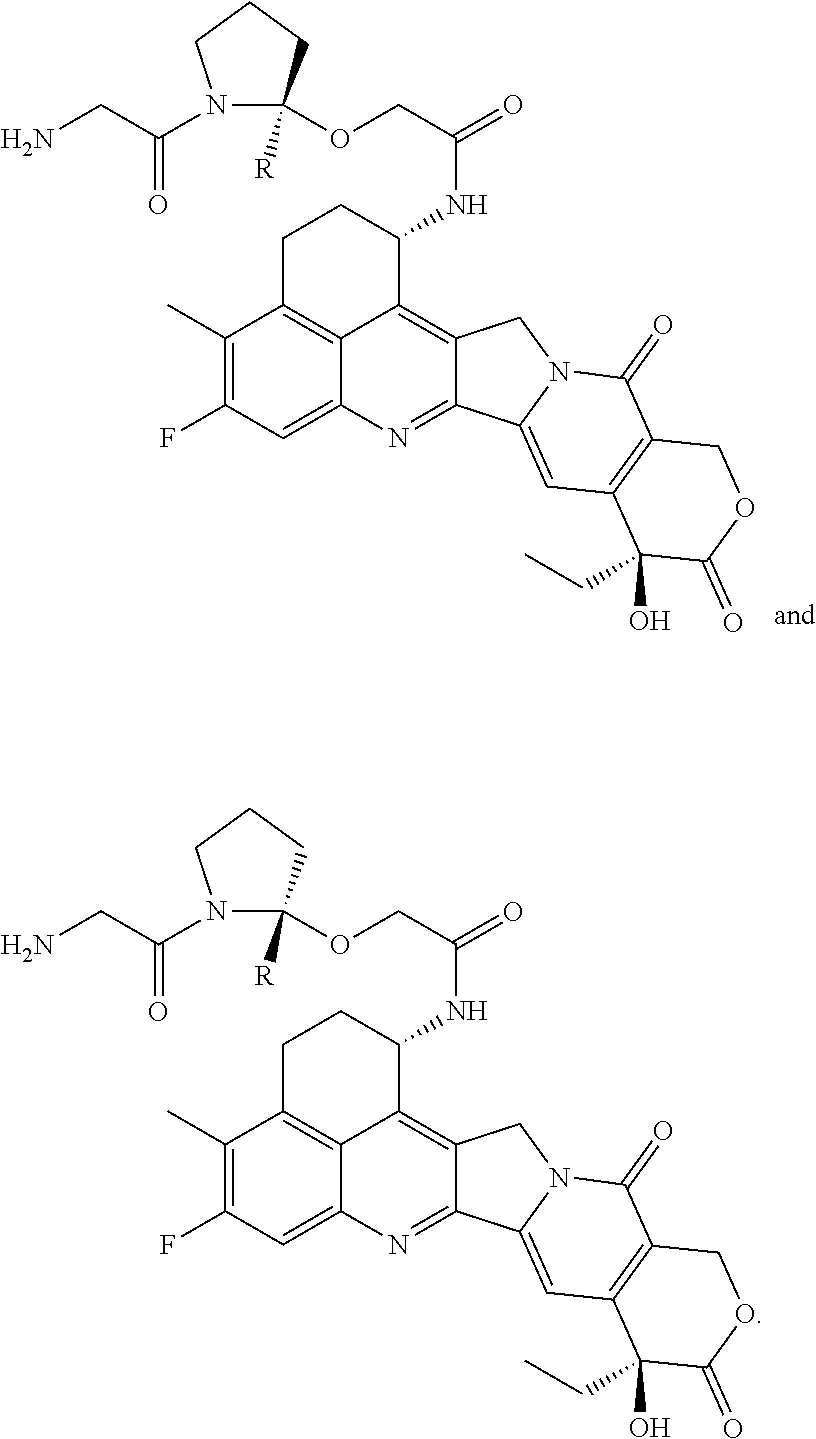
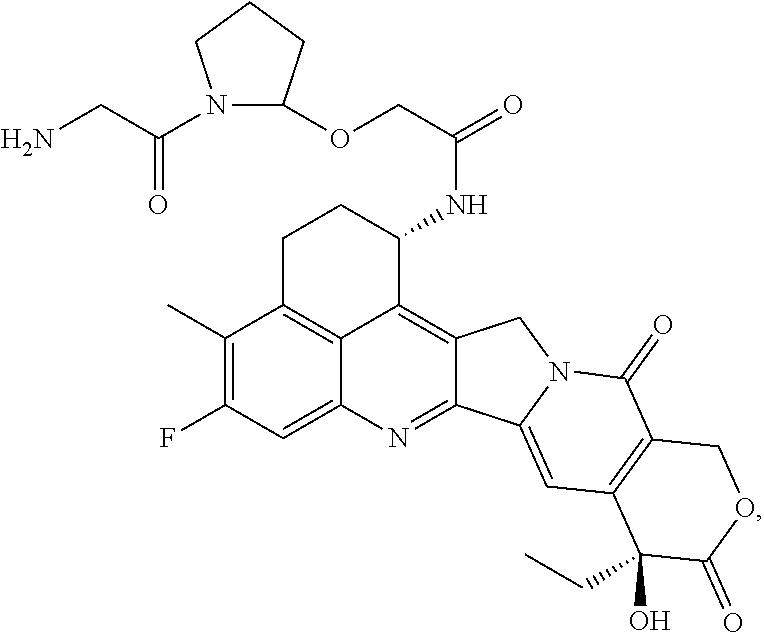
or a pharmaceutically acceptable salt thereof.
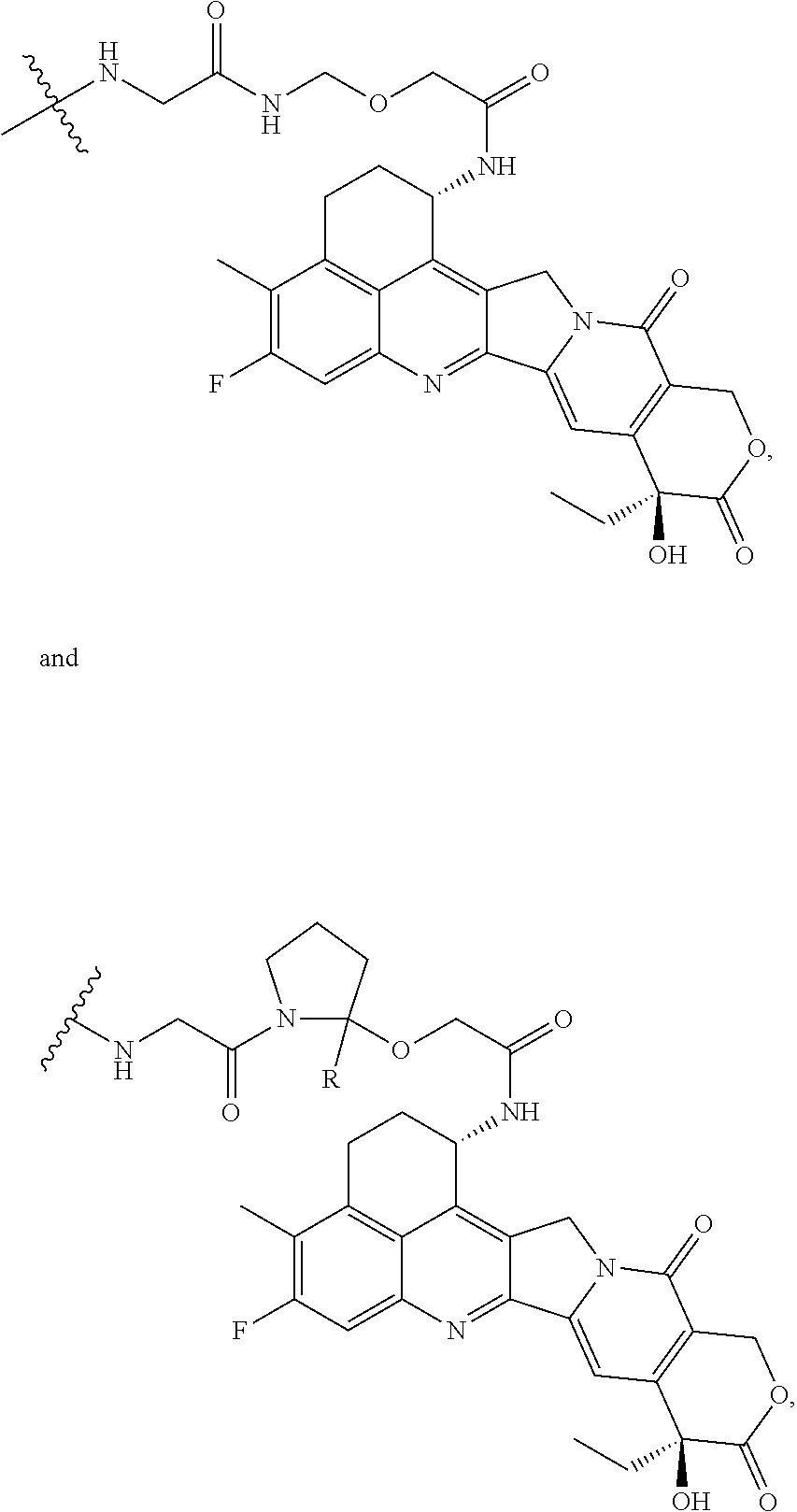
wherein R is a hydrogen or a C1-C4 alkyl, and where represents the point of attachment to L2.

where


wherein the anti-FGFR2 antibody or antigen-binding fragment thereof comprises an HCDR1-HCDR2-HCDR3-LCDR1-LCDR2-LCDR3 amino acid sequence set contained within an HCVR/LCVR amino acid sequence pair selected from the group consisting of: SEQ ID NOs: 2/10, 22/28, and 40/44.

wherein the anti-FGFR2 antibody or antigen-binding fragment thereof comprises an HCDR1-HCDR2-HCDR3-LCDR1-LCDR2-LCDR3 amino acid sequence set selected from the group consisting of SEQ ID NO: 4-6-8-12-14-16, 24-6-26-30-32-34, and 24-6-42-46-32-34.
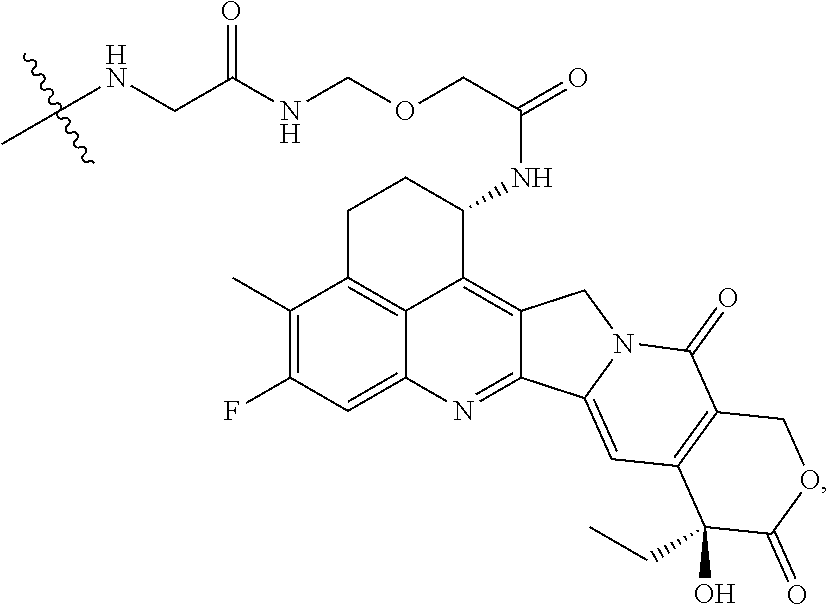
wherein the anti-FGFR2 antibody or antigen-binding fragment thereof comprises an HCVR/LCVR amino acid sequence pair selected from the group consisting of: SEQ ID NOs: 2/10, 22/28, and 40/44.

wherein the anti-FGFR2 antibody or antigen-binding fragment thereof comprises a heavy chain amino acid sequence selected from the group consisting of SEQ ID NO: 18, 36, 49, 52, SEQ ID NO: 53, and SEQ ID NO: 54. In some aspects, the anti-EGFR2 antibody or antigen-binding fragment thereof comprises a heavy chain/light chain amino acid sequence pair selected from the group consisting of SEQ ID NOs: 18/20, 36/38, 49/51, 52/20, 53/38, and 54/51.

wherein A is an optionally substituted arylene or heteroarylene.

wherein A is an optionally substituted arylene or heteroarylene.

wherein n is an integer from 1-12 and R1 is alkyl.


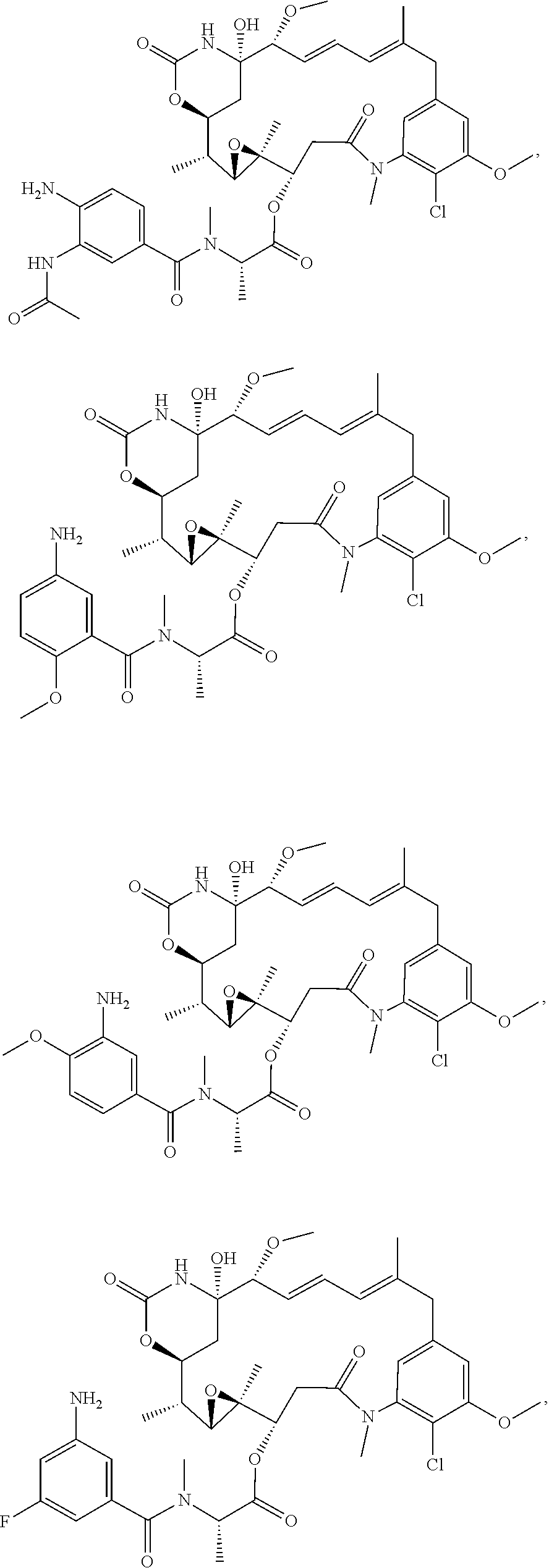

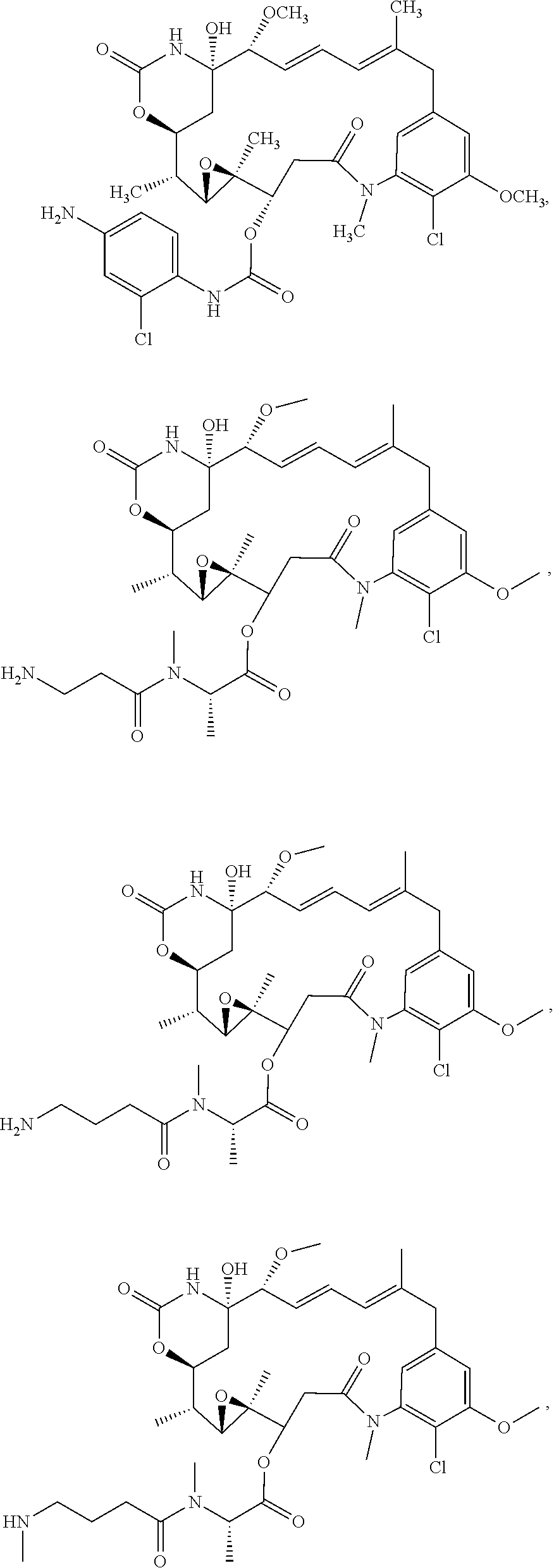


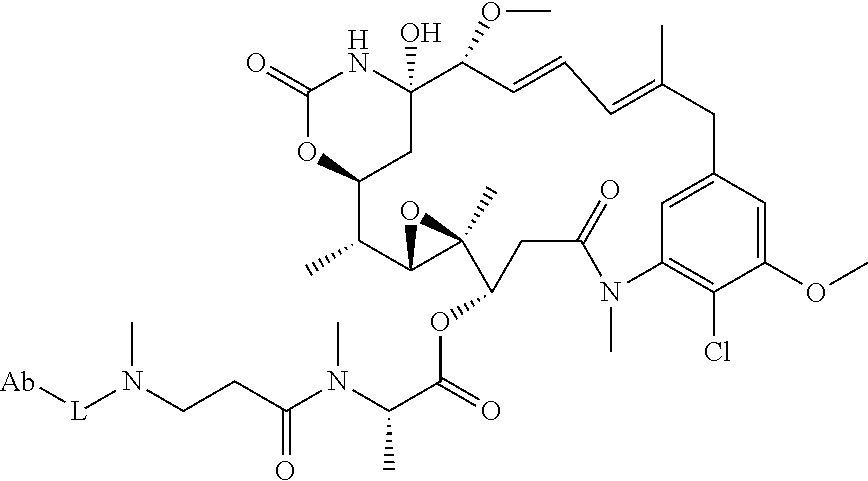
wherein the Ab is the anti-FGFR2 antibody or antigen binding fragment thereof and L is a linker. In some embodiments, the Ab is an anti-FGFR2 antibody or antigen-binding fragment thereof comprising the CDRs within the HCVR amino acid sequence of SEQ ID NO: 2 and the CDRs within the LCVR amino acid sequence of SEQ ID NO: 10. In some embodiments, the Ab is an anti-FGFR2 antibody or antigen-binding fragment thereof comprising an HCDR1 amino acid sequence of SEQ ID NO: 4; an HCDR2 amino acid sequence of SEQ ID NO: 6; an HCDR3 amino acid sequence of SEQ ID NO: 8; an LCDR1 amino acid sequence of SEQ ID NO: 12; an LCDR2 amino acid sequence of SEQ ID NO: 14; and an LCDR3 amino acid sequence of SEQ ID NO: 16. In some embodiments, the Ab is an anti-FGFR2 antibody or antigen-binding fragment thereof comprising the CDRs within the HCVR amino acid sequence of SEQ ID NO: 22 and the CDRs within the LCVR amino acid sequence of SEQ ID NO: 28. In some embodiments, the Ab is an anti-FGFR2 antibody or antigen-binding fragment thereof comprising an HCDR1 amino acid sequence of SEQ ID NO: 24; an HCDR2 amino acid sequence of SEQ ID NO: 6; an HCDR3 amino acid sequence of SEQ ID NO: 26; an LCDR1 amino acid sequence of SEQ ID NO: 30; an LCDR2 amino acid sequence of SEQ ID NO: 32; and an LCDR3 amino acid sequence of SEQ ID NO: 34. In some embodiments, the Ab is an anti-FGFR2 antibody or antigen-binding fragment thereof comprising the CDRs within the HCVR amino acid sequence of SEQ ID NO: 40 and the CDRs within the LCVR amino acid sequence of SEQ ID NO: 44. In some embodiments, the Ab is an anti-FGFR2 antibody or antigen-binding fragment thereof comprising an HCDR1 amino acid sequence of SEQ ID NO: 24; an HCDR2 amino acid sequence of SEQ ID NO: 6; an HCDR3 amino acid sequence of SEQ ID NO: 42; an LCDR1 amino acid sequence of SEQ ID NO: 46; an LCDR2 amino acid sequence of SEQ ID NO: 32; and an LCDR3 amino acid sequence of SEQ ID NO: 34.

wherein the Ab is the anti-FGFR2 antibody or antigen binding fragment thereof and L is a linker. In some embodiments, the Ab is an anti-FGFR2 antibody or antigen-binding fragment thereof comprising the CDRs within the HCVR amino acid sequence of SEQ ID NO: 2 and the CDRs within the LCVR amino acid sequence of SEQ ID NO: 10. In some embodiments, the Ab is an anti-FGFR2 antibody or antigen-binding fragment thereof comprising an HCDR1 amino acid sequence of SEQ ID NO: 4; an HCDR2 amino acid sequence of SEQ ID NO: 6; an HCDR3 amino acid sequence of SEQ ID NO: 8; an LCDR1 amino acid sequence of SEQ ID NO: 12; an LCDR2 amino acid sequence of SEQ ID NO: 14; and an LCDR3 amino acid sequence of SEQ ID NO: 16. In some embodiments, the Ab is an anti-FGFR2 antibody or antigen-binding fragment thereof comprising the CDRs within the HCVR amino acid sequence of SEQ ID NO: 22 and the CDRs within the LCVR amino acid sequence of SEQ ID NO: 28. In some embodiments, the Ab is an anti-FGFR2 antibody or antigen-binding fragment thereof comprising an HCDR1 amino acid sequence of SEQ ID NO: 24; an HCDR2 amino acid sequence of SEQ ID NO: 6; an HCDR3 amino acid sequence of SEQ ID NO: 26; an LCDR1 amino acid sequence of SEQ ID NO: 30; an LCDR2 amino acid sequence of SEQ ID NO: 32; and an LCDR3 amino acid sequence of SEQ ID NO: 34. In some embodiments, the Ab is an anti-FGFR2 antibody or antigen-binding fragment thereof comprising the CDRs within the HCVR amino acid sequence of SEQ ID NO: 40 and the CDRs within the LCVR amino acid sequence of SEQ ID NO: 44. In some embodiments, the Ab is an anti-FGFR2 antibody or antigen-binding fragment thereof comprising an HCDR1 amino acid sequence of SEQ ID NO: 24; an HCDR2 amino acid sequence of SEQ ID NO: 6; an HCDR3 amino acid sequence of SEQ ID NO: 42; an LCDR1 amino acid sequence of SEQ ID NO: 46; an LCDR2 amino acid sequence of SEQ ID NO: 32; and an LCDR3 amino acid sequence of SEQ ID NO: 34.

wherein the Ab is the anti-FGFR2 antibody or antigen binding fragment thereof, and n is 2 or 4. In particular embodiments, n is 2. In particular embodiments, n is 4. In some embodiments, the Ab is an anti-FGFR2 antibody or antigen-binding fragment thereof comprising the CDRs within the HCVR amino acid sequence of SEQ ID NO: 2 and the CDRs within the LCVR amino acid sequence of SEQ ID NO: 10. In some embodiments, the Ab is an anti-FGFR2 antibody or antigen-binding fragment thereof comprising an HCDR1 amino acid sequence of SEQ ID NO: 4; an HCDR2 amino acid sequence of SEQ ID NO: 6; an HCDR3 amino acid sequence of SEQ ID NO: 8; an LCDR1 amino acid sequence of SEQ ID NO: 12; an LCDR2 amino acid sequence of SEQ ID NO: 14; and an LCDR3 amino acid sequence of SEQ ID NO: 16. In some embodiments, the Ab is an anti-FGFR2 antibody or antigen-binding fragment thereof comprising the CDRs within the HCVR amino acid sequence of SEQ ID NO: 22 and the CDRs within the LCVR amino acid sequence of SEQ ID NO: 28. In some embodiments, the Ab is an anti-FGFR2 antibody or antigen-binding fragment thereof comprising an HCDR1 amino acid sequence of SEQ ID NO: 24; an HCDR2 amino acid sequence of SEQ ID NO: 6; an HCDR3 amino acid sequence of SEQ ID NO: 26; an LCDR1 amino acid sequence of SEQ ID NO: 30; an LCDR2 amino acid sequence of SEQ ID NO: 32; and an LCDR3 amino acid sequence of SEQ ID NO: 34. In some embodiments, the Ab is an anti-FGFR2 antibody or antigen-binding fragment thereof comprising the CDRs within the HCVR amino acid sequence of SEQ ID NO: 40 and the CDRs within the LCVR amino acid sequence of SEQ ID NO: 44. In some embodiments, the Ab is an anti-FGFR2 antibody or antigen-binding fragment thereof comprising an HCDR1 amino acid sequence of SEQ ID NO: 24; an HCDR2 amino acid sequence of SEQ ID NO: 6; an HCDR3 amino acid sequence of SEQ ID NO: 42; an LCDR1 amino acid sequence of SEQ ID NO: 46; an LCDR2 amino acid sequence of SEQ ID NO: 32; and an LCDR3 amino acid sequence of SEQ ID NO: 34. n is a value between 2 and 12, for example, 2, 3, 4, 5, 6, 7, 8, 9, 10, 11, or 12.


wherein

is a bond to the antibody or antigen-binding protein (e.g., via lysine residue) and

is a bond to the cytotoxic agent (e.g., DM1). In some embodiments, the linker is:

wherein

is a bond to the antibody or antigen-binding protein (e.g., via lysine residue) and

is a bond to the cytotoxic agent (e.g., DM1). In certain embodiments, the linker is:
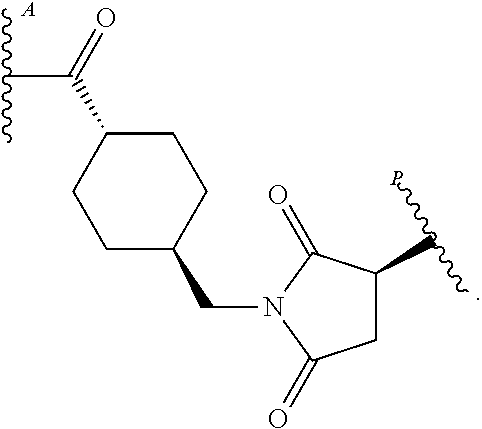


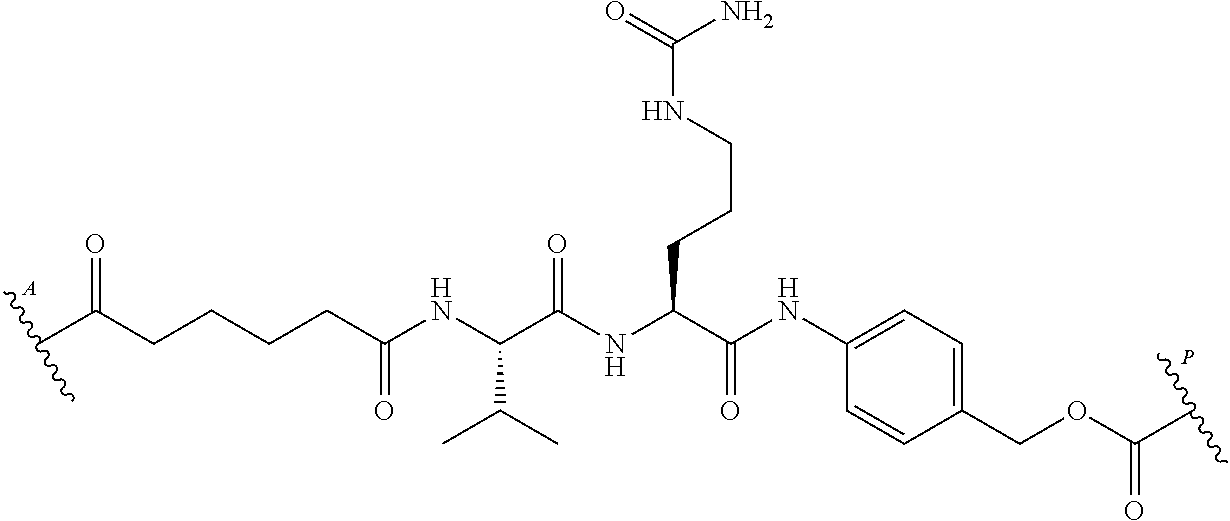
wherein

is a bond to the antibody or antigen-binding protein (e.g., via lysine residue) and

is a bond to the cytotoxic agent (e.g., a compound having the following formula:
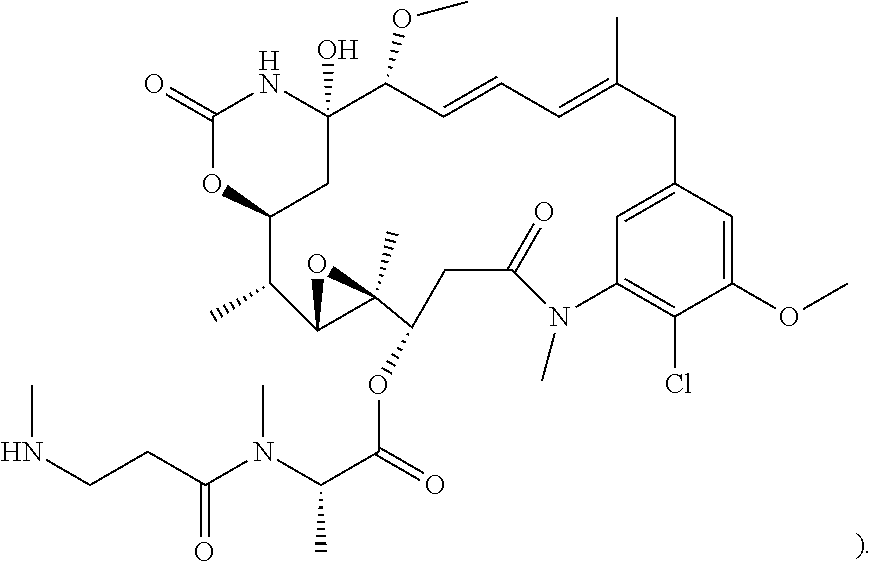

or its cycloaddition regioisomer:


both representing the resulting —C(O)NH— moiety that links the antibody to the linker payloads described herein. In some embodiments, the primary amine compound comprising an azido group comprises a PEG group. In certain embodiments, said primary amine compound is:

wherein n is 1-12. In certain embodiments, said primary amine compound is:


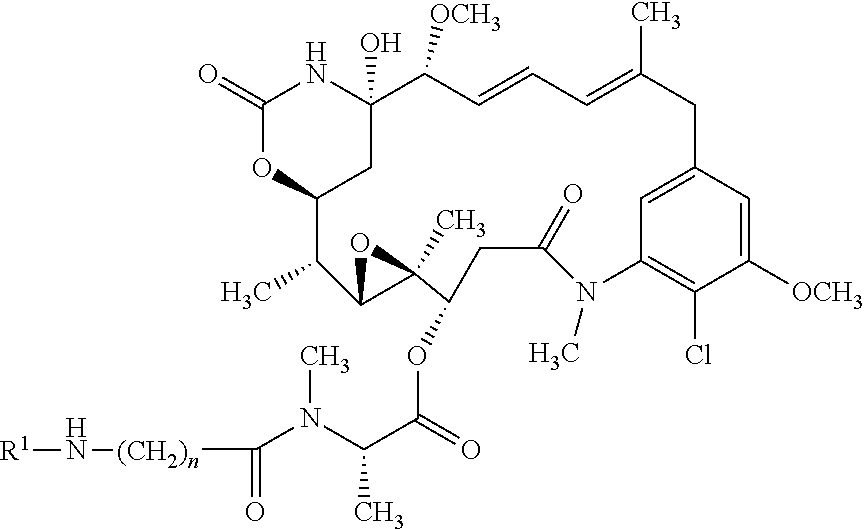
wherein n is an integer from 1-12 and R1 is alkyl. In certain embodiments, the maytansinoid is

In some embodiments, the maytansinoid is Maytansinoid 1A:

In certain embodiments, the cytotoxic agent is a maytansinoid, and the maytansinoid is covalently attached to the antibody via non-cleavable linker. In certain embodiments, the cytotoxic agent is a maytansinoid, and the maytansinoid is covalently attached to the anti-FGFR2 antibody or antigen-binding fragment thereof via cleavable linker.

wherein

is a bond to the antibody. In some embodiments, the antibody is an anti-FGFR2 antibody or antigen-binding fragment thereof comprising the CDRs within the HCVR amino acid sequence of SEQ ID NO: 2 and the CDRs within the LCVR amino acid sequence of SEQ ID NO: 10. In some embodiments, the antibody is an anti-FGFR2 antibody or antigen-binding fragment thereof comprising an HCDR1 amino acid sequence of SEQ ID NO: 4; an HCDR2 amino acid sequence of SEQ ID NO: 6; an HCDR3 amino acid sequence of SEQ ID NO: 8; an LCDR1 amino acid sequence of SEQ ID NO: 12; an LCDR2 amino acid sequence of SEQ ID NO: 14; and an LCDR3 amino acid sequence of SEQ ID NO: 16. In some embodiments, the antibody is an anti-FGFR2 antibody or antigen-binding fragment thereof comprising the CDRs within the HCVR amino acid sequence of SEQ ID NO: 22 and the CDRs within the LCVR amino acid sequence of SEQ ID NO: 28. In some embodiments, the antibody is an anti-FGFR2 antibody or antigen-binding fragment thereof comprising an HCDR1 amino acid sequence of SEQ ID NO: 24; an HCDR2 amino acid sequence of SEQ ID NO: 6; an HCDR3 amino acid sequence of SEQ ID NO: 26; an LCDR1 amino acid sequence of SEQ ID NO: 30; an LCDR2 amino acid sequence of SEQ ID NO: 32; and an LCDR3 amino acid sequence of SEQ ID NO: 34. In some embodiments, the antibody is an anti-FGFR2 antibody or antigen-binding fragment thereof comprising the CDRs within the HCVR amino acid sequence of SEQ ID NO: 40 and the CDRs within the LCVR amino acid sequence of SEQ ID NO: 44. In some embodiments, the antibody is an anti-FGFR2 antibody or antigen-binding fragment thereof comprising an HCDR1 amino acid sequence of SEQ ID NO: 24; an HCDR2 amino acid sequence of SEQ ID NO: 6; an HCDR3 amino acid sequence of SEQ ID NO: 42; an LCDR1 amino acid sequence of SEQ ID NO: 46; an LCDR2 amino acid sequence of SEQ ID NO: 32; and an LCDR3 amino acid sequence of SEQ ID NO: 34.

wherein

is a bond to the antibody. In some embodiments, the antibody is an anti-FGFR2 antibody or antigen-binding fragment thereof comprising the CDRs within the HCVR amino acid sequence of SEQ ID NO: 2 and the CDRs within the LCVR amino acid sequence of SEQ ID NO: 10. In some embodiments, the antibody is an anti-FGFR2 antibody or antigen-binding fragment thereof comprising an HCDR1 amino acid sequence of SEQ ID NO: 4; an HCDR2 amino acid sequence of SEQ ID NO: 6; an HCDR3 amino acid sequence of SEQ ID NO: 8; an LCDR1 amino acid sequence of SEQ ID NO: 12; an LCDR2 amino acid sequence of SEQ ID NO: 14; and an LCDR3 amino acid sequence of SEQ ID NO: 16. In some embodiments, the antibody is an anti-FGFR2 antibody or antigen-binding fragment thereof comprising the CDRs within the HCVR amino acid sequence of SEQ ID NO: 22 and the CDRs within the LCVR amino acid sequence of SEQ ID NO: 28. In some embodiments, the antibody is an anti-FGFR2 antibody or antigen-binding fragment thereof comprising an HCDR1 amino acid sequence of SEQ ID NO: 24; an HCDR2 amino acid sequence of SEQ ID NO: 6; an HCDR3 amino acid sequence of SEQ ID NO: 26; an LCDR1 amino acid sequence of SEQ ID NO: 30; an LCDR2 amino acid sequence of SEQ ID NO: 32; and an LCDR3 amino acid sequence of SEQ ID NO: 34. In some embodiments, the antibody is an anti-FGFR2 antibody or antigen-binding fragment thereof comprising the CDRs within the HCVR amino acid sequence of SEQ ID NO: 40 and the CDRs within the LCVR amino acid sequence of SEQ ID NO: 44. In some embodiments, the antibody is an anti-FGFR2 antibody or antigen-binding fragment thereof comprising an HCDR1 amino acid sequence of SEQ ID NO: 24; an HCDR2 amino acid sequence of SEQ ID NO: 6; an HCDR3 amino acid sequence of SEQ ID NO: 42; an LCDR1 amino acid sequence of SEQ ID NO: 46; an LCDR2 amino acid sequence of SEQ ID NO: 32; and an LCDR3 amino acid sequence of SEQ ID NO: 34.

wherein

is a bond to the antibody. In some embodiments, the antibody is an anti-FGFR2 antibody or antigen-binding fragment thereof comprising the CDRs within the HCVR amino acid sequence of SEQ ID NO: 2 and the CDRs within the LCVR amino acid sequence of SEQ ID NO: 10. In some embodiments, the antibody is an anti-FGFR2 antibody or antigen-binding fragment thereof comprising an HCDR1 amino acid sequence of SEQ ID NO: 4; an HCDR2 amino acid sequence of SEQ ID NO: 6; an HCDR3 amino acid sequence of SEQ ID NO: 8; an LCDR1 amino acid sequence of SEQ ID NO: 12; an LCDR2 amino acid sequence of SEQ ID NO: 14; and an LCDR3 amino acid sequence of SEQ ID NO: 16. In some embodiments, the antibody is an anti-FGFR2 antibody or antigen-binding fragment thereof comprising the CDRs within the HCVR amino acid sequence of SEQ ID NO: 22 and the CDRs within the LCVR amino acid sequence of SEQ ID NO: 28. In some embodiments, the antibody is an anti-FGFR2 antibody or antigen-binding fragment thereof comprising an HCDR1 amino acid sequence of SEQ ID NO: 24; an HCDR2 amino acid sequence of SEQ ID NO: 6; an HCDR3 amino acid sequence of SEQ ID NO: 26; an LCDR1 amino acid sequence of SEQ ID NO: 30; an LCDR2 amino acid sequence of SEQ ID NO: 32; and an LCDR3 amino acid sequence of SEQ ID NO: 34. In some embodiments, the antibody is an anti-FGFR2 antibody or antigen-binding fragment thereof comprising the CDRs within the HCVR amino acid sequence of SEQ ID NO: 40 and the CDRs within the LCVR amino acid sequence of SEQ ID NO: 44. In some embodiments, the antibody is an anti-FGFR2 antibody or antigen-binding fragment thereof comprising an HCDR1 amino acid sequence of SEQ ID NO: 24; an HCDR2 amino acid sequence of SEQ ID NO: 6; an HCDR3 amino acid sequence of SEQ ID NO: 42; an LCDR1 amino acid sequence of SEQ ID NO: 46; an LCDR2 amino acid sequence of SEQ ID NO: 32; and an LCDR3 amino acid sequence of SEQ ID NO: 34.

wherein

is a bond to the antibody. In some embodiments, the antibody is an anti-FGFR2 antibody or antigen-binding fragment thereof comprising the CDRs within the HCVR amino acid sequence of SEQ ID NO: 2 and the CDRs within the LCVR amino acid sequence of SEQ ID NO: 10. In some embodiments, the antibody is an anti-FGFR2 antibody or antigen-binding fragment thereof comprising an HCDR1 amino acid sequence of SEQ ID NO: 4; an HCDR2 amino acid sequence of SEQ ID NO: 6; an HCDR3 amino acid sequence of SEQ ID NO: 8; an LCDR1 amino acid sequence of SEQ ID NO: 12; an LCDR2 amino acid sequence of SEQ ID NO: 14; and an LCDR3 amino acid sequence of SEQ ID NO: 16. In some embodiments, the antibody is an anti-FGFR2 antibody or antigen-binding fragment thereof comprising the CDRs within the HCVR amino acid sequence of SEQ ID NO: 22 and the CDRs within the LCVR amino acid sequence of SEQ ID NO: 28. In some embodiments, the antibody is an anti-FGFR2 antibody or antigen-binding fragment thereof comprising an HCDR1 amino acid sequence of SEQ ID NO: 24; an HCDR2 amino acid sequence of SEQ ID NO: 6; an HCDR3 amino acid sequence of SEQ ID NO: 26; an LCDR1 amino acid sequence of SEQ ID NO: 30; an LCDR2 amino acid sequence of SEQ ID NO: 32; and an LCDR3 amino acid sequence of SEQ ID NO: 34. In some embodiments, the antibody is an anti-FGFR2 antibody or antigen-binding fragment thereof comprising the CDRs within the HCVR amino acid sequence of SEQ ID NO: 40 and the CDRs within the LCVR amino acid sequence of SEQ ID NO: 44. In some embodiments, the antibody is an anti-FGFR2 antibody or antigen-binding fragment thereof comprising an HCDR1 amino acid sequence of SEQ ID NO: 24; an HCDR2 amino acid sequence of SEQ ID NO: 6; an HCDR3 amino acid sequence of SEQ ID NO: 42; an LCDR1 amino acid sequence of SEQ ID NO: 46; an LCDR2 amino acid sequence of SEQ ID NO: 32; and an LCDR3 amino acid sequence of SEQ ID NO: 34.


wherein L is a linker and

is a bond to the antibody. In some embodiments, the antibody is an anti-FGFR2 antibody or antigen-binding fragment thereof comprising the CDRs within the HCVR amino acid sequence of SEQ ID NO: 2 and the CDRs within the LCVR amino acid sequence of SEQ ID NO: 10. In some embodiments, the antibody is an anti-FGFR2 antibody or antigen-binding fragment thereof comprising an HCDR1 amino acid sequence of SEQ ID NO: 4; an HCDR2 amino acid sequence of SEQ ID NO: 6; an HCDR3 amino acid sequence of SEQ ID NO: 8; an LCDR1 amino acid sequence of SEQ ID NO: 12; an LCDR2 amino acid sequence of SEQ ID NO: 14; and an LCDR3 amino acid sequence of SEQ ID NO: 16. In some embodiments, the antibody is an anti-FGFR2 antibody or antigen-binding fragment thereof comprising the CDRs within the HCVR amino acid sequence of SEQ ID NO: 22 and the CDRs within the LCVR amino acid sequence of SEQ ID NO: 28. In some embodiments, the antibody is an anti-FGFR2 antibody or antigen-binding fragment thereof comprising an HCDR1 amino acid sequence of SEQ ID NO: 24; an HCDR2 amino acid sequence of SEQ ID NO: 6; an HCDR3 amino acid sequence of SEQ ID NO: 26; an LCDR1 amino acid sequence of SEQ ID NO: 30; an LCDR2 amino acid sequence of SEQ ID NO: 32; and an LCDR3 amino acid sequence of SEQ ID NO: 34. In some embodiments, the antibody is an anti-FGFR2 antibody or antigen-binding fragment thereof comprising the CDRs within the HCVR amino acid sequence of SEQ ID NO: 40 and the CDRs within the LCVR amino acid sequence of SEQ ID NO: 44. In some embodiments, the antibody is an anti-FGFR2 antibody or antigen-binding fragment thereof comprising an HCDR1 amino acid sequence of SEQ ID NO: 24; an HCDR2 amino acid sequence of SEQ ID NO: 6; an HCDR3 amino acid sequence of SEQ ID NO: 42; an LCDR1 amino acid sequence of SEQ ID NO: 46; an LCDR2 amino acid sequence of SEQ ID NO: 32; and an LCDR3 amino acid sequence of SEQ ID NO: 34.

or its cycloaddition regioisomer thereof, wherein SP is a spacer and

is a bond to the antibody. In some embodiments, the

is a bond to a glutamine residue of the antibody. In particular embodiments, the glutamine residue is Q295. In some embodiments, the antibody is conjugated at Q295 and Q297. In some embodiments, the antibody is an anti-FGFR2 antibody or antigen-binding fragment thereof comprising the CDRs within the HCVR amino acid sequence of SEQ ID NO: 2 and the CDRs within the LCVR amino acid sequence of SEQ ID NO: 10. In some embodiments, the antibody is an anti-FGFR2 antibody or antigen-binding fragment thereof comprising an HCDR1 amino acid sequence of SEQ ID NO: 4; an HCDR2 amino acid sequence of SEQ ID NO: 6; an HCDR3 amino acid sequence of SEQ ID NO: 8; an LCDR1 amino acid sequence of SEQ ID NO: 12; an LCDR2 amino acid sequence of SEQ ID NO: 14; and an LCDR3 amino acid sequence of SEQ ID NO: 16. In some embodiments, the antibody is an anti-FGFR2 antibody or antigen-binding fragment thereof comprising the CDRs within the HCVR amino acid sequence of SEQ ID NO: 22 and the CDRs within the LCVR amino acid sequence of SEQ ID NO: 28. In some embodiments, the antibody is an anti-FGFR2 antibody or antigen-binding fragment thereof comprising an HCDR1 amino acid sequence of SEQ ID NO: 24; an HCDR2 amino acid sequence of SEQ ID NO: 6; an HCDR3 amino acid sequence of SEQ ID NO: 26; an LCDR1 amino acid sequence of SEQ ID NO: 30; an LCDR2 amino acid sequence of SEQ ID NO: 32; and an LCDR3 amino acid sequence of SEQ ID NO: 34. In some embodiments, the antibody is an anti-FGFR2 antibody or antigen-binding fragment thereof comprising the CDRs within the HCVR amino acid sequence of SEQ ID NO: 40 and the CDRs within the LCVR amino acid sequence of SEQ ID NO: 44. In some embodiments, the antibody is an anti-FGFR2 antibody or antigen-binding fragment thereof comprising an HCDR1 amino acid sequence of SEQ ID NO: 24; an HCDR2 amino acid sequence of SEQ ID NO: 6; an HCDR3 amino acid sequence of SEQ ID NO: 42; an LCDR1 amino acid sequence of SEQ ID NO: 46; an LCDR2 amino acid sequence of SEQ ID NO: 32; and an LCDR3 amino acid sequence of SEQ ID NO: 34.

or its cycloaddition regioisomer thereof:

wherein

is a bond to a glutamine residue of the antibody. In certain embodiments, the glutamine is a heavy chain Q295 glutamine. In certain embodiments, the anti-FGFR2 antibody comprises a heavy chain having Q295 and Q297, wherein said Q297 is derived from an N2970 mutation. In some aspects, the anti-FGFR2 antibody comprises a heavy chain (HC) selected from the group consisting of SEQ ID NOs: 52, 53, and 54. In some embodiments, the antibody is an anti-FGFR2 antibody or antigen-binding fragment thereof comprising the CDRs within the HCVR amino acid sequence of SEQ ID NO: 2 and the CDRs within the LCVR amino acid sequence of SEQ ID NO: 10. In some embodiments, the antibody is an anti-FGFR2 antibody or antigen-binding fragment thereof comprising an HCDR1 amino acid sequence of SEQ ID NO: 4; an HCDR2 amino acid sequence of SEQ ID NO: 6; an HCDR3 amino acid sequence of SEQ ID NO: 8; an LCDR1 amino acid sequence of SEQ ID NO: 12; an LCDR2 amino acid sequence of SEQ ID NO: 14; and an LCDR3 amino acid sequence of SEQ ID NO: 16. In some embodiments, the antibody is an anti-FGFR2 antibody or antigen-binding fragment thereof comprising the CDRs within the HCVR amino acid sequence of SEQ ID NO: 22 and the CDRs within the LCVR amino acid sequence of SEQ ID NO: 28. In some embodiments, the antibody is an anti-FGFR2 antibody or antigen-binding fragment thereof comprising an HCDR1 amino acid sequence of SEQ ID NO: 24; an HCDR2 amino acid sequence of SEQ ID NO: 6; an HCDR3 amino acid sequence of SEQ ID NO: 26; an LCDR1 amino acid sequence of SEQ ID NO: 30; an LCDR2 amino acid sequence of SEQ ID NO: 32; and an LCDR3 amino acid sequence of SEQ ID NO: 34. In some embodiments, the antibody is an anti-FGFR2 antibody or antigen-binding fragment thereof comprising the CDRs within the HCVR amino acid sequence of SEQ ID NO: 40 and the CDRs within the LCVR amino acid sequence of SEQ ID NO: 44. In some embodiments, the antibody is an anti-FGFR2 antibody or antigen-binding fragment thereof comprising an HCDR1 amino acid sequence of SEQ ID NO: 24; an HCDR2 amino acid sequence of SEQ ID NO: 6; an HCDR3 amino acid sequence of SEQ ID NO: 42; an LCDR1 amino acid sequence of SEQ ID NO: 46; an LCDR2 amino acid sequence of SEQ ID NO: 32; and an LCDR3 amino acid sequence of SEQ ID NO: 34.
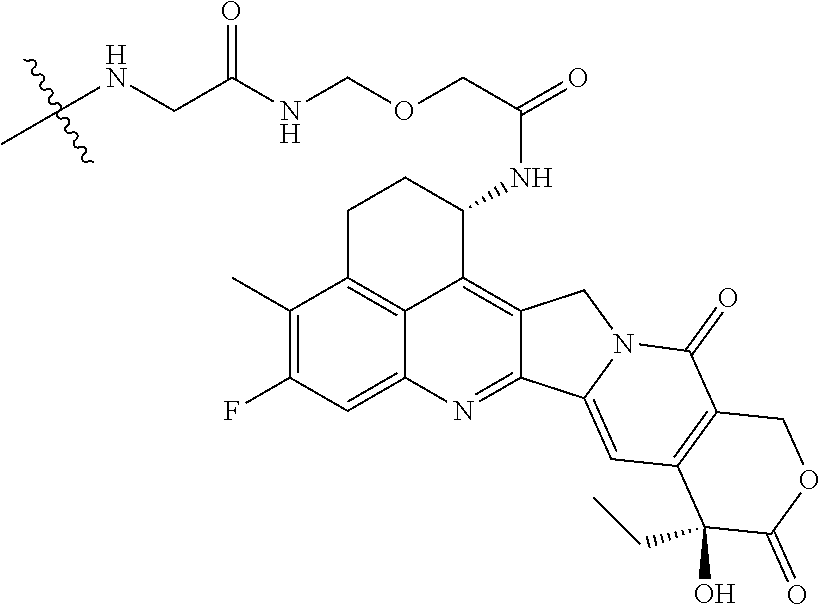
where
Ab[L-Pay]n
-
- wherein:
- Ab is an anti-FGFR2 antibody or antigen-binding fragment thereof as described herein;
- L is a linker;
- Pay is a cytotoxic agent; and
- n is an integer from 1-12.


In some embodiments, L comprises a PEG group.
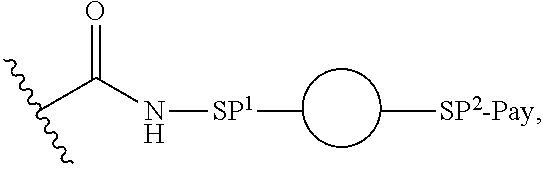
wherein SP1 and SP2 are each independently a spacer,

is a cyclic moiety, and

is a glutamine residue of an antibody. In some embodiments, the glutamine is a Q295 glutamine. In some embodiments, n is 2, wherein two L-Pay are conjugated to Q295. In some embodiments, n is 4, wherein two L-Pay are conjugated to Q295 and two L-Pay are conjugated to Q297. In some embodiments, the cyclic moiety is a product of a cycloaddition reaction. In certain embodiments, the cyclic moiety is a product of a cycloaddition reaction between an azide and cycloalkyne. In certain embodiments, the cyclic moiety is

In certain embodiments, SP1 comprises a PEG moiety. In some embodiments, the PEG comprises 1-12 ethylene glycol units. In certain embodiments, SP2 comprise a dipeptide. In certain embodiments,
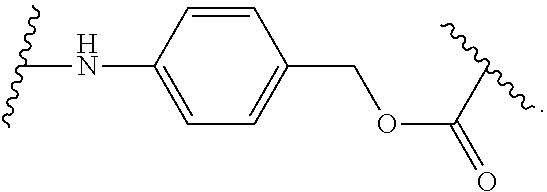
SP2 comprises val-cit. In certain embodiments, SP2 comprises embodiments, SP2 comprises a PEG moiety. In some embodiments, SP2-Pay is:
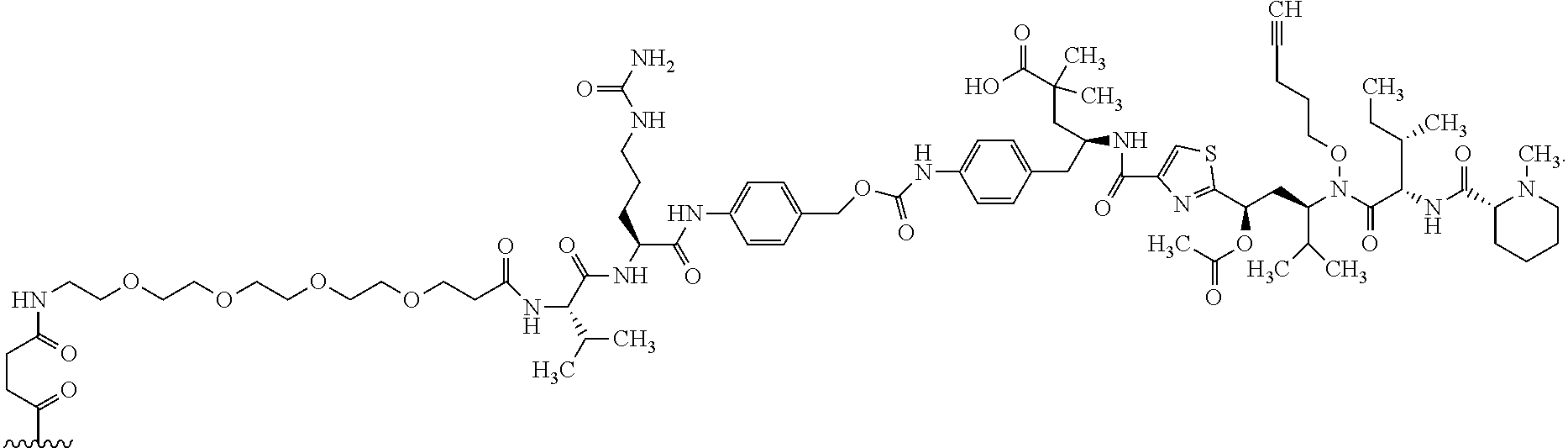
In certain embodiments,

or a cycloaddition regioisomer thereof.

or a regioisomer thereof:

wherein

is a bond to a glutamine residue of the antibody. In some embodiments, the antibody is an anti-FGFR2 antibody or antigen-binding fragment thereof comprising the CDRs within the HCVR amino acid sequence of SEQ ID NO: 2 and the CDRs within the LCVR amino acid sequence of SEQ ID NO: 10. In some embodiments, the antibody is an anti-FGFR2 antibody or antigen-binding fragment thereof comprising an HCDR1 amino acid sequence of SEQ ID NO: 4; an HCDR2 amino acid sequence of SEQ ID NO: 6; an HCDR3 amino acid sequence of SEQ ID NO: 8; an LCDR1 amino acid sequence of SEQ ID NO: 12; an LCDR2 amino acid sequence of SEQ ID NO: 14; and an LCDR3 amino acid sequence of SEQ ID NO: 16. In some embodiments, the antibody is an anti-FGFR2 antibody or antigen-binding fragment thereof comprising the CDRs within the HCVR amino acid sequence of SEQ ID NO: 22 and the CDRs within the LCVR amino acid sequence of SEQ ID NO: 28. In some embodiments, the antibody is an anti-FGFR2 antibody or antigen-binding fragment thereof comprising an HCDR1 amino acid sequence of SEQ ID NO: 24; an HCDR2 amino acid sequence of SEQ ID NO: 6; an HCDR3 amino acid sequence of SEQ ID NO: 26; an LCDR1 amino acid sequence of SEQ ID NO: 30; an LCDR2 amino acid sequence of SEQ ID NO: 32; and an LCDR3 amino acid sequence of SEQ ID NO: 34. In some embodiments, the antibody is an anti-FGFR2 antibody or antigen-binding fragment thereof comprising the CDRs within the HCVR amino acid sequence of SEQ ID NO: 40 and the CDRs within the LCVR amino acid sequence of SEQ ID NO: 44. In some embodiments, the antibody is an anti-FGFR2 antibody or antigen-binding fragment thereof comprising an HCDR1 amino acid sequence of SEQ ID NO: 24; an HCDR2 amino acid sequence of SEQ ID NO: 6; an HCDR3 amino acid sequence of SEQ ID NO: 42; an LCDR1 amino acid sequence of SEQ ID NO: 46; an LCDR2 amino acid sequence of SEQ ID NO: 32; and an LCDR3 amino acid sequence of SEQ ID NO: 34.
BA-(Gln-NH-L1-B-(-L2-(-M-Dxd)m)k)n (A), wherein:
-
- BA is an anti-FGFR2 antibody or an antigen-binding fragment thereof;
- Gln is a glutamine residue;
- L1 is absent or a first linker;
- B is a branching unit comprising at least one adduct of group B′ and group B″, wherein one of the groups B′ and B″ is selected from —N3 and

and the other of the groups B′ and B″ is selected from

where Q is C or N; L2 is a second linker covalently attached to the branching unit B via the at least one group B″;
-
- M is absent or a moiety having the structure

where R, R′, and R″ are independently at each occurrence hydrogen or a C1-C4 alkyl, or wherein R′ and R″ together form a 5-membered or a 6-membered ring;
-
- Dxd is an anti-tumor agent having a structure according to Formula (P):

-
- k is an integer from 1 to 12;
- m is an integer from 1 to 30, and
- n is an integer from 1 to 30.

or a pharmaceutically acceptable salt thereof, where
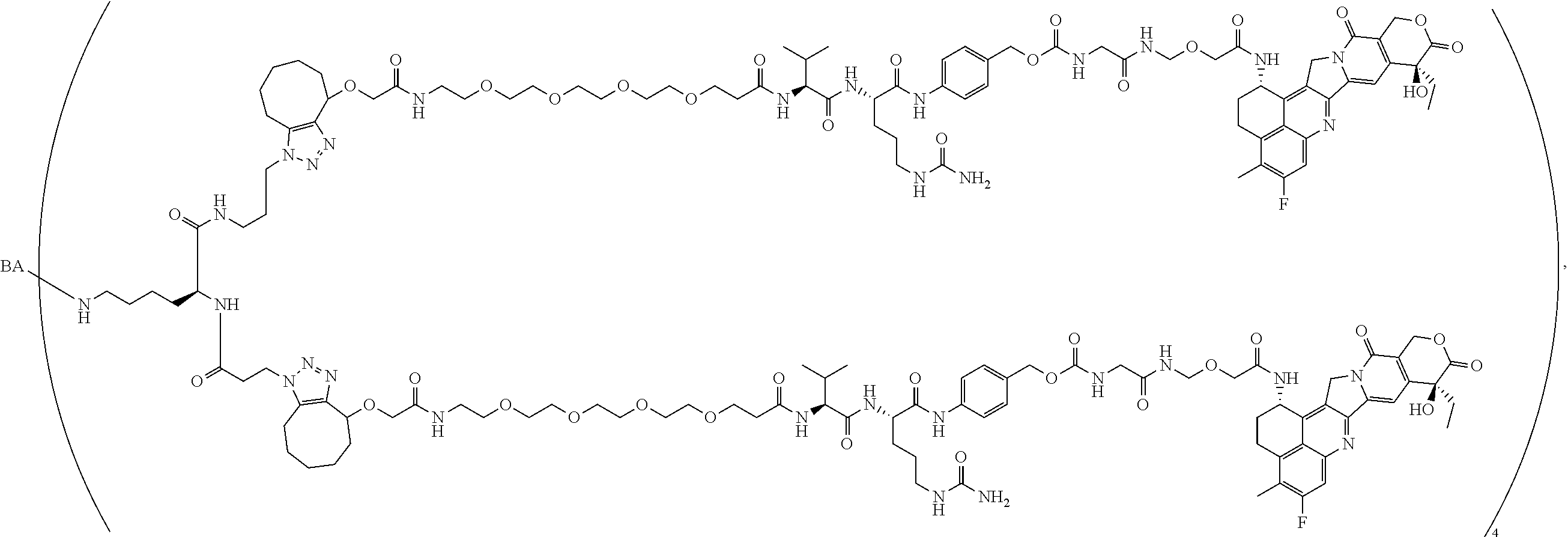
wherein BA is an anti-FGFR2 antibody or an antigen-binding fragment thereof.

wherein BA is an anti-FGFR2 antibody or an antigen-binding fragment thereof.

wherein BA is an anti-FGFR2 antibody or an antigen-binding fragment thereof.

wherein BA is an anti-FGFR2 antibody or an antigen-binding fragment thereof).
Linker L1

wherein RA is a group comprising an alkyne, an azide, a tetrazine, a trans-cyclooctene, a maleimide, an amine, a ketone, an aldehyde, a carboxylic acid, an ester, a thiol, a sulfonic acid, a tosylate, a halide, a silane, a cyano group, a carbohydrate group, a biotin group, a lipid residue, and wherein subscripts x, n, p and q are independently an integer from 0 to 12, and combinations thereof.
Branching Unit B
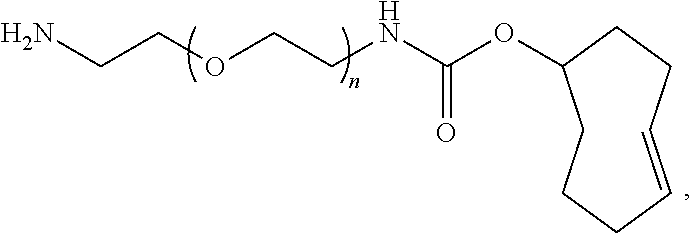
where n is an integer from 0 to 12 and, e.g., a tetrazine.
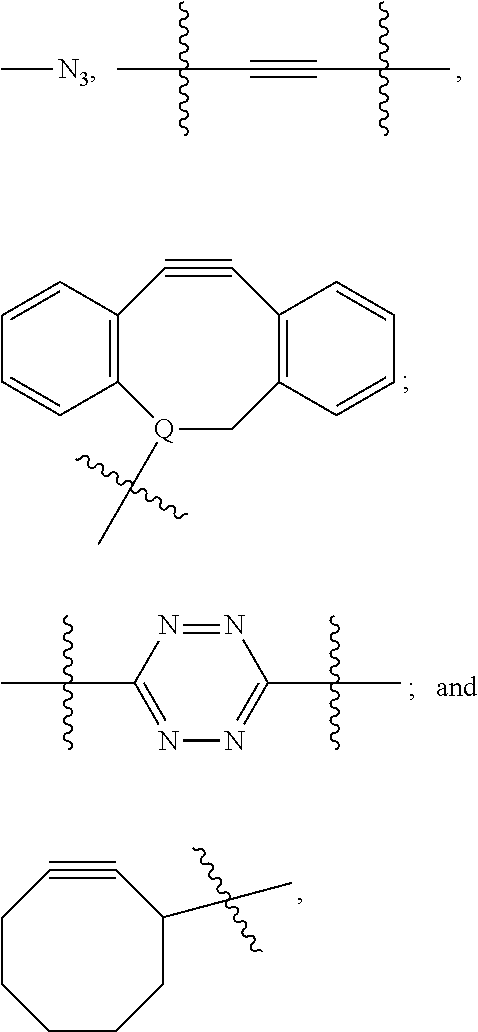
where Q is C or N, may encompass a 1,3-cycloaddition adduct of the group B′ and the group B″ selected from
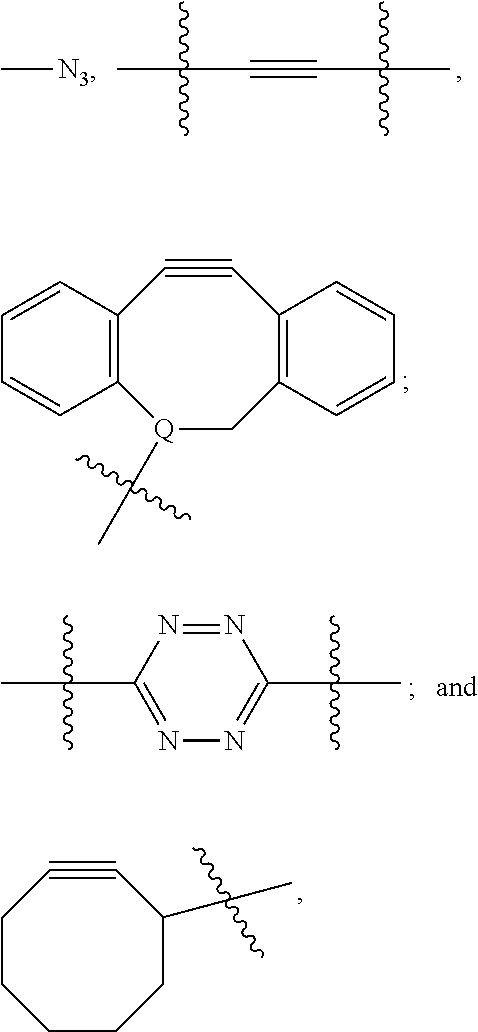
where Q is C or N, wherein the group B″ is complementary to the group B′ to form a 1,3-cycloaddition adduct.


and group B″ may be an azide.

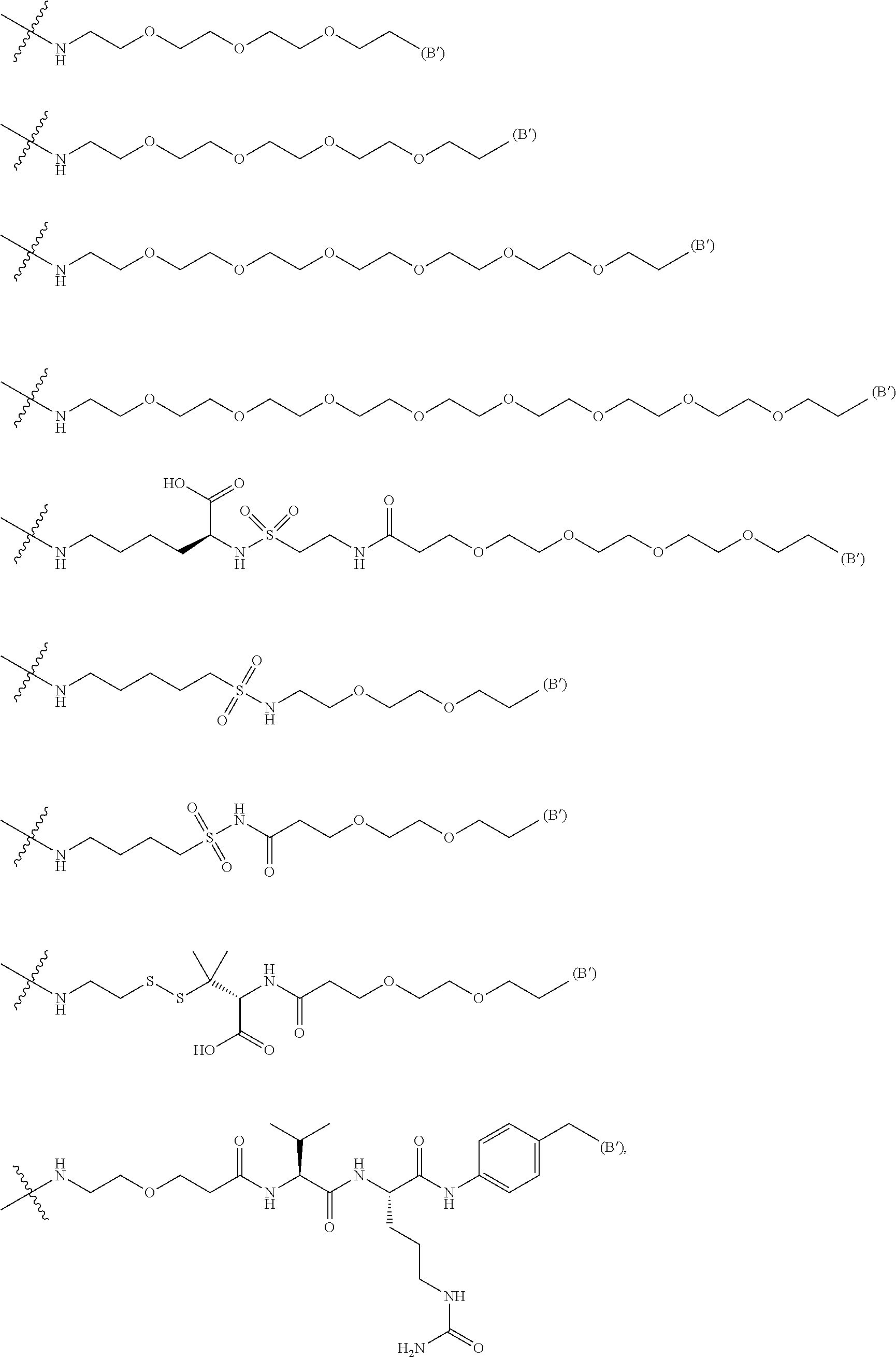
where the

is the amino point of attachment to the glutamine residue of the anti-FGFR2 antibody, and (B′) is the adduct of the group B′.


where (B′) comprises points of attachment of the adduct of the group B′.

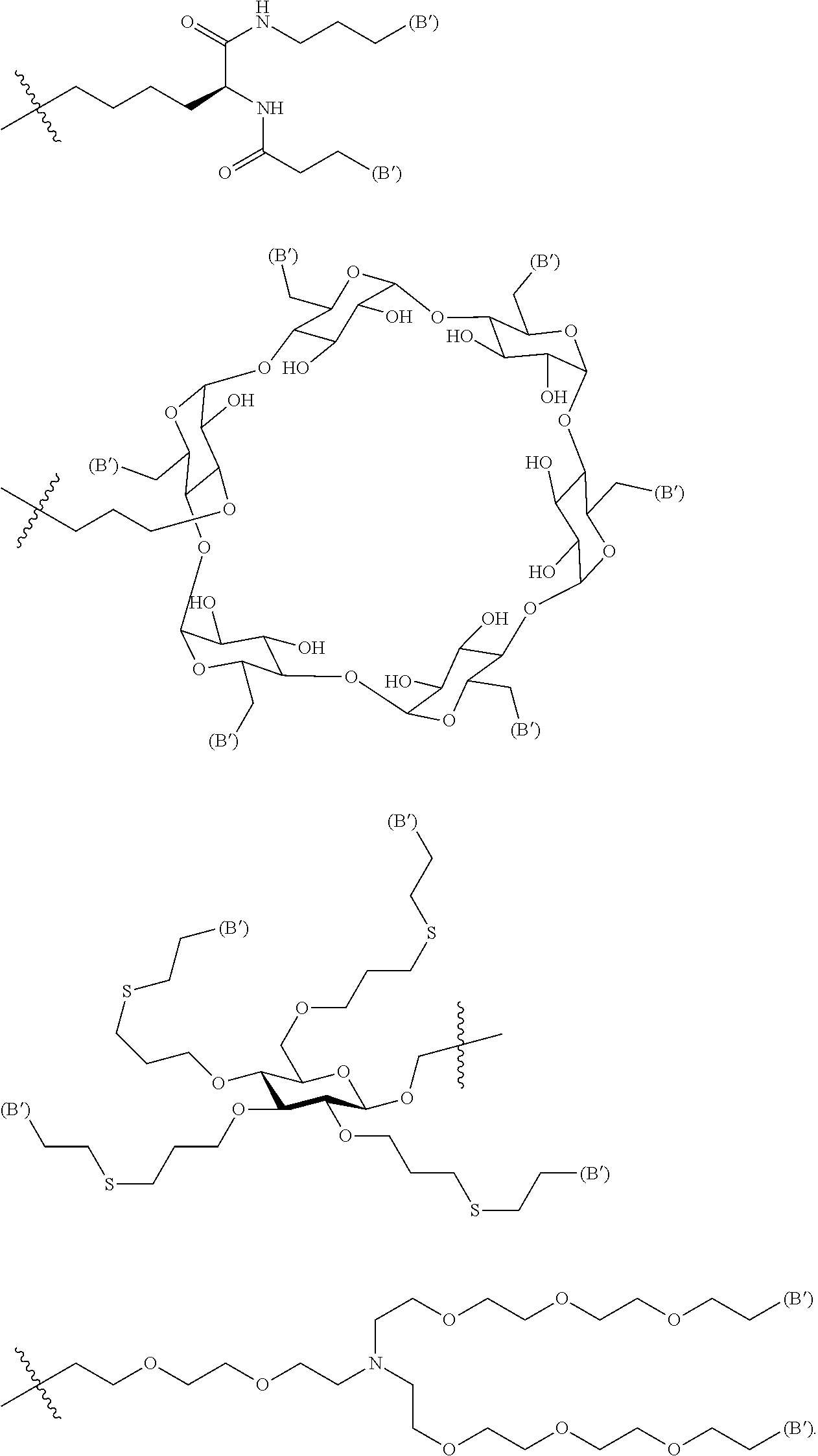
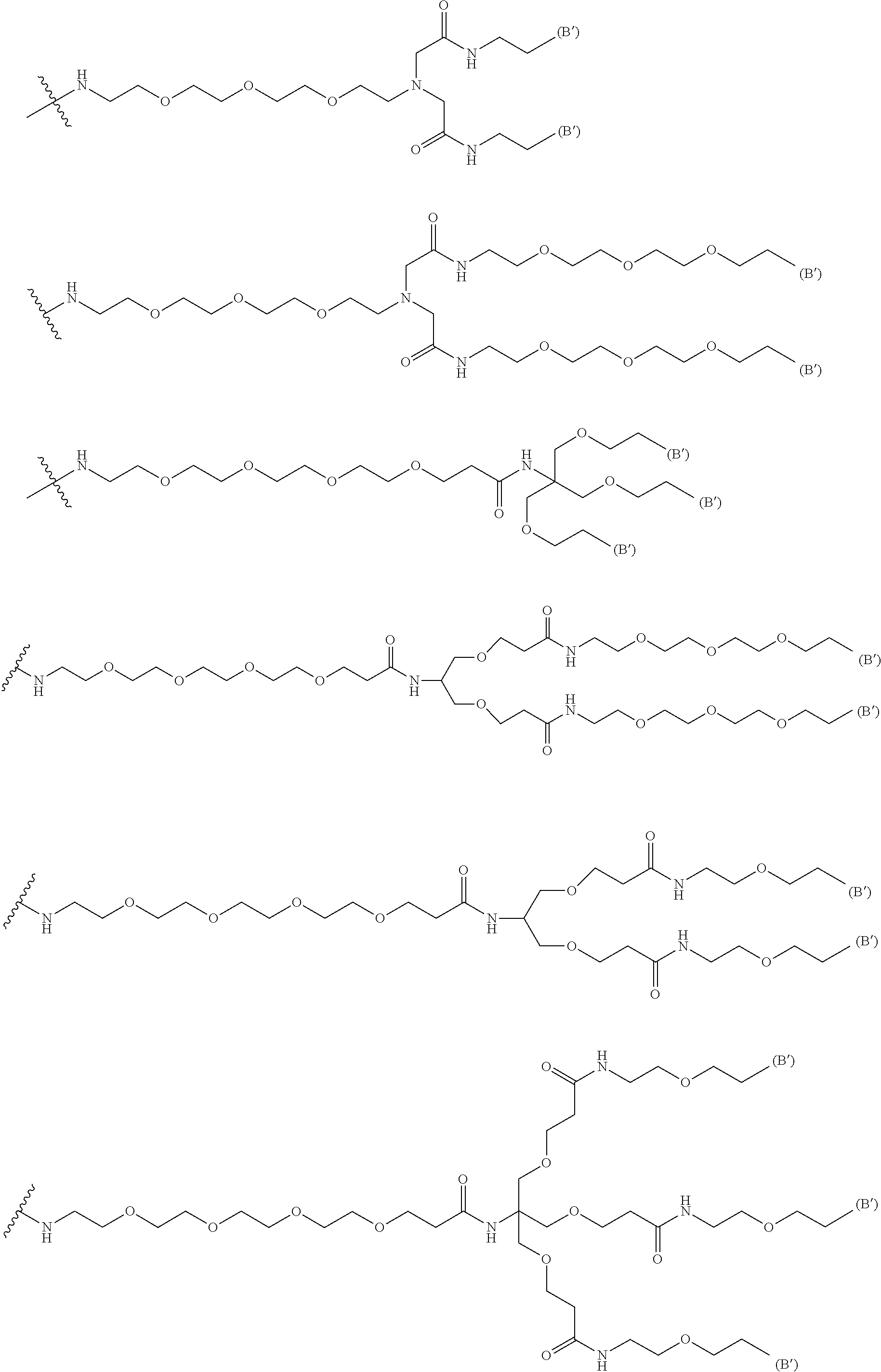

where

the is the amino point of attachment to the glutamine residue of the anti-FGFR2 antibody.
B″-SP1-B2-(-SP2-AA-SP3)p (L2),
wherein:
-
- B″ is a group capable of covalently attaching to the group B′;
- SP1 is absent or a first spacer unit;
- B2 is absent or a branching unit;
- SP2 is absent or a second spacer unit;
- AA is absent or a peptide unit comprising from 2 to 4 amino acids;
- SP3 is absent or a third spacer unit, and
- p is an integer from 1 to 12.
H2N-SP1-B2-(-SP2-AA-SP3)p (L2′),
wherein:
-
- SP1 is absent or a first spacer unit;
- B2 is absent or a branching unit;
- SP2 is absent or a second spacer unit;
- AA is absent or a peptide unit comprising from 2 to 4 amino acids;
- SP3 is absent or a third spacer unit, and
- p is an integer from 1 to 12.
Maleimide-N-SP1-B2-(-SP2-AA-SP3)p (L2″),
wherein:
-
- SP1 is absent or a first spacer unit;
- B2 is absent or a branching unit;
- SP2 is absent or a second spacer unit;
- AA is absent or a peptide unit comprising from 2 to 4 amino acids;
- SP3 is absent or a third spacer unit, and
- p is an integer from 1 to 12.

where Q is C or N.


wherein Q is C or N.


and combinations thereof, wherein Rc is independently at each occurrence absent or a group selected from
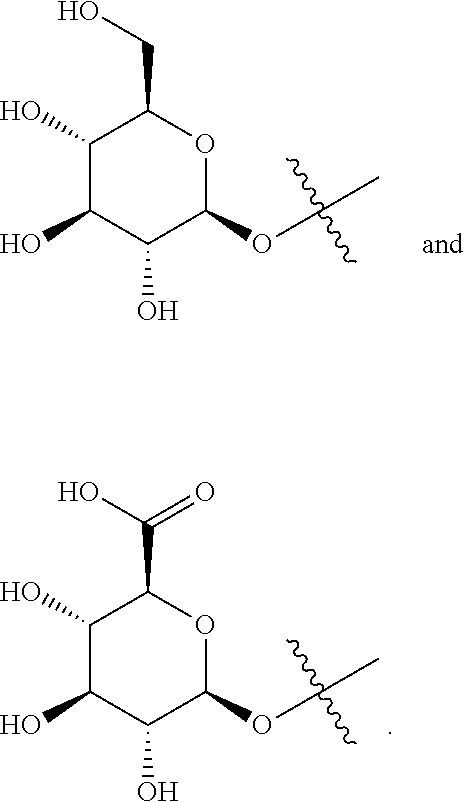

where R, R′, and R″ are independently at each occurrence hydrogen or alkyl, or wherein R′ and R″ together form a ring, e.g., a 3-membered to an 8-membered ring.

where R, R′, and R″ are independently at each occurrence hydrogen or a C1-C4 alkyl, or wherein R′ and R″ together form a 5-membered or a 6-membered ring.


Linker-Payloads (L2-P)
B″-SP1-(-SP2-AA-SP3-M-Dxd)p (L2-P),
H2N-SP1-(-SP2-AA-SP3-M-Dxd)p (L2′-P), or
Maleimide-N-SP1-(-SP2-AA-SP3-M-Dxd)p (L2′-P),
wherein:
B″ is selected from the group consisting of
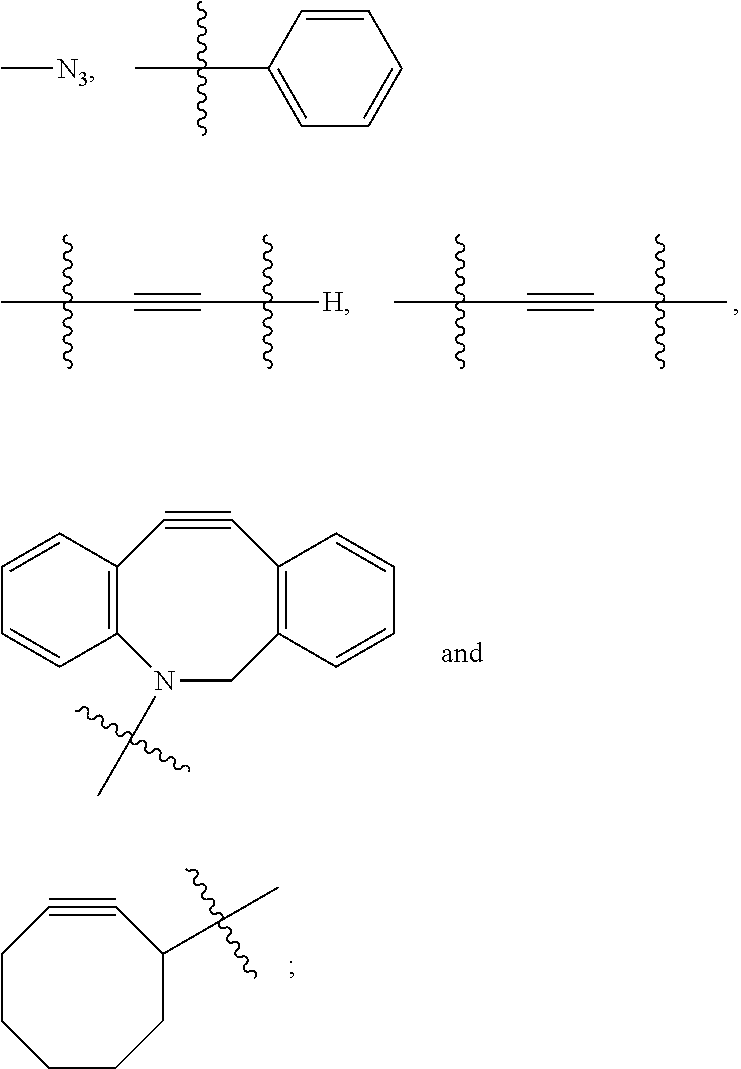
SP1 is absent or a first spacer unit selected from the group consisting of

SP2 is absent or a second spacer unit selected from the group consisting of a C1-6 alkyl, —(CH2—CH2—O)v—, —NH—, —C(O)—, —NH—C(O)—, —NH—(CH2)u—, —NH—(CH2)v—C(O)—, —NH—(CH2—CH2—O)v—, —NH—(CH2—CH2—O)v—C(O)—, —NH—(CH2—CH2—O)v—(CH2)u—, —NH—(CH2—CH2—O)v—(CH2)u—C(O)—, —(CH2)u—NH—C(O)—, —NH—(CH2)u—NH—C(O)—, —NH—(CH2)u—C(O)—NH—, or combinations thereof; wherein subscripts u and v are independently an integer from 1 to 8;
AA is absent or a peptide unit comprising from 2 to 4 amino acids;
SP3 is absent or a third spacer unit selected from the group consisting of,

wherein Rc is independently at each occurrence absent or a group selected from

M is absent or
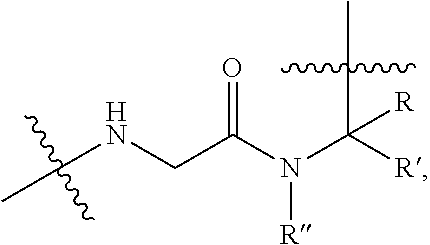
where R, R′, and R″ are independently at each occurrence hydrogen or a C1-C4 alkyl, or wherein R′ and R″ together form a 5-membered or a 6-membered ring; and
Dxd is an anti-tumor agent having a structure according to Formula (P):
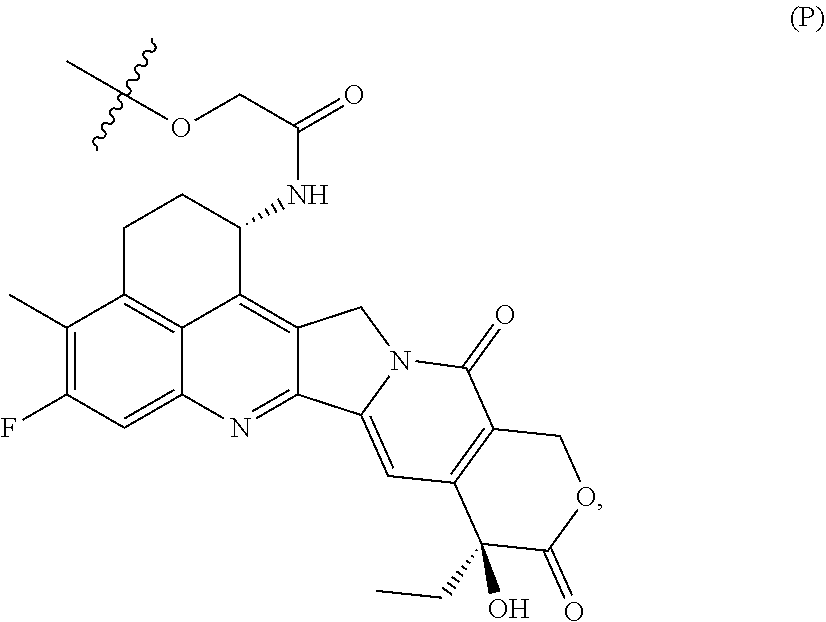
and
p is an integer from 1 to 12.
BA-(Gln-NH-SP1-B2-(-SP2-AA-SP3-M-Dxd)p)n.


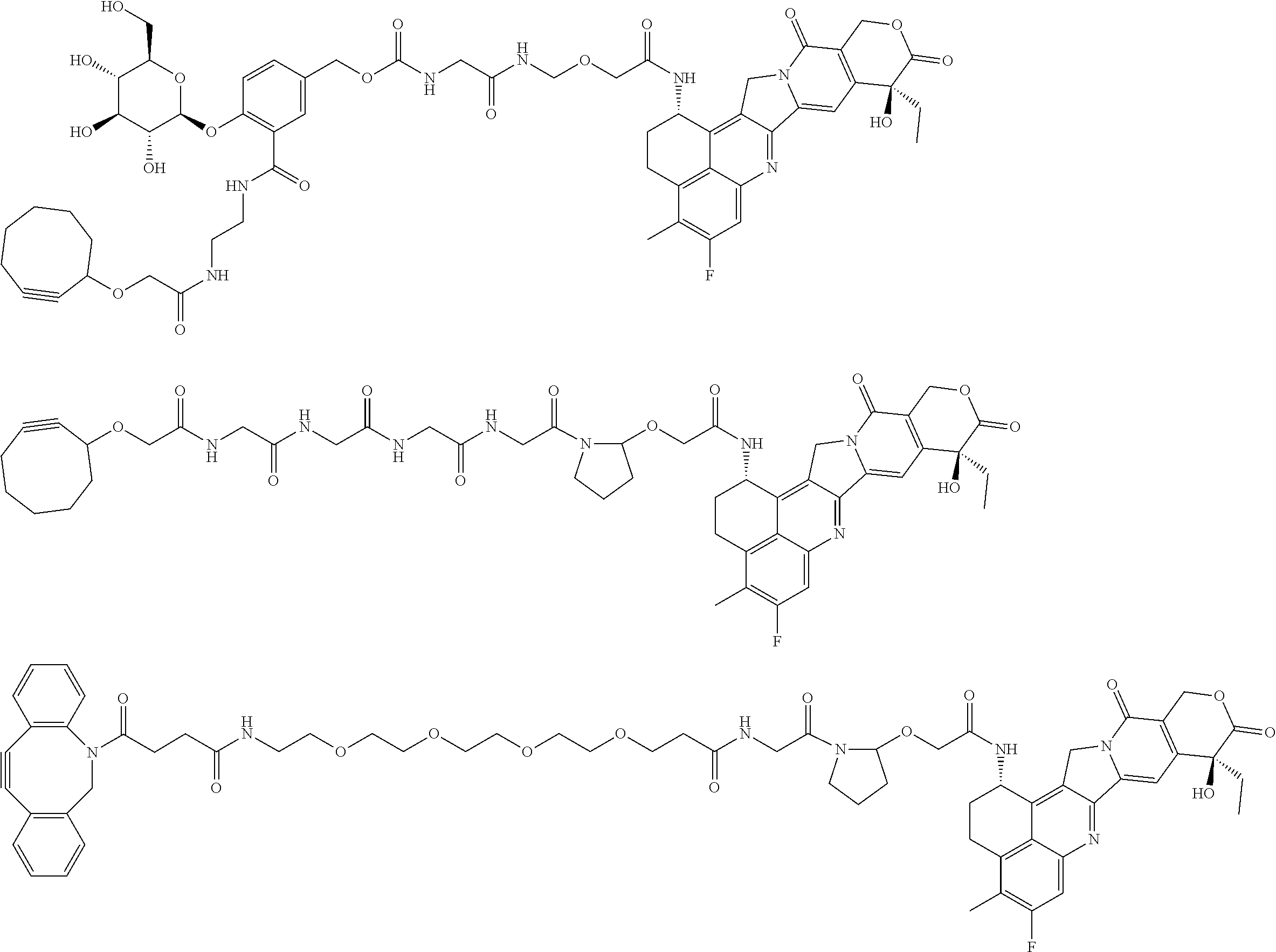

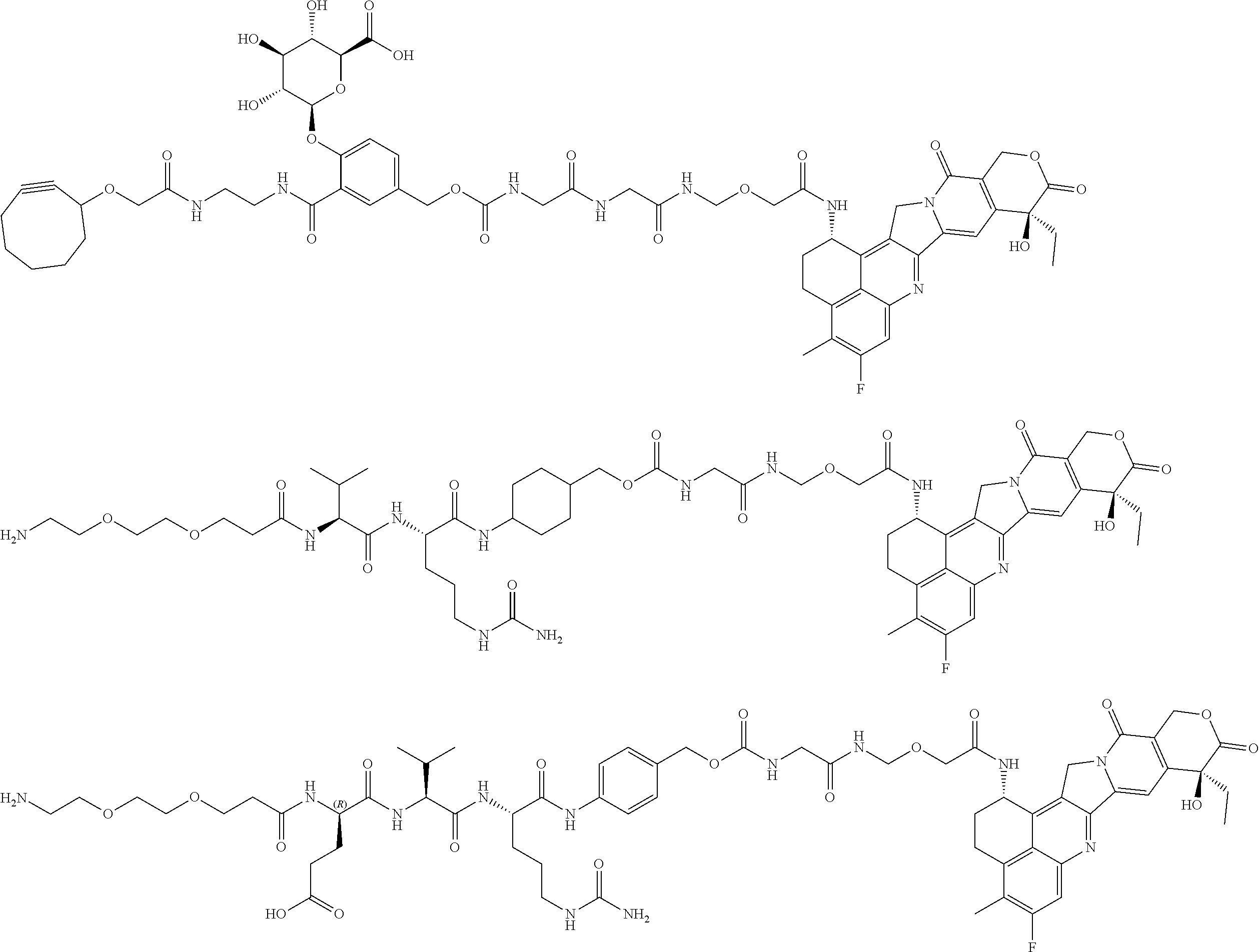
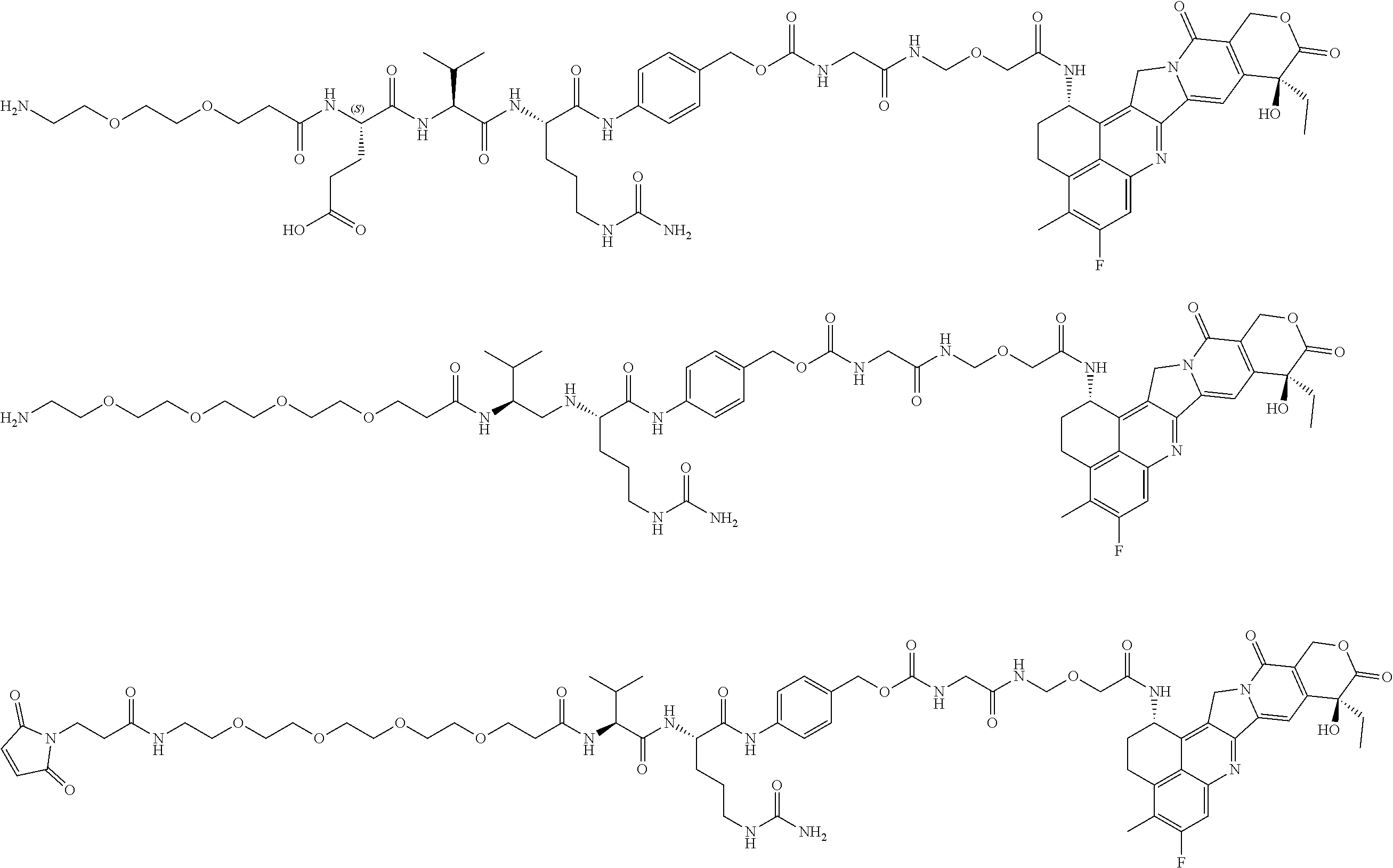


or a pharmaceutically acceptable salt thereof.
Branched Linker2-Payloads (BL2P)
| TABLE 1 |
| Structures of Branching Units B1-B5 |
| Branch B | B1 | B2 | B3 |
| Structure |
 |
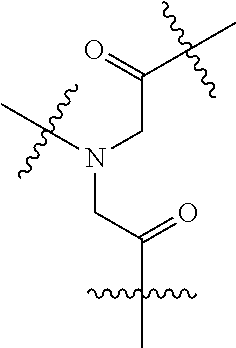 |
 |
| Branch B | B4 | B5 | ||
| Structure |
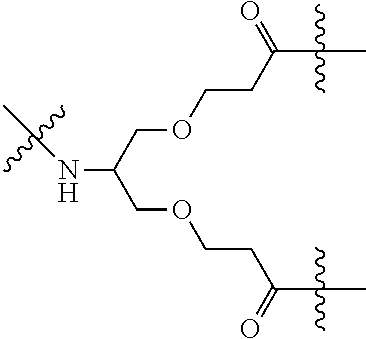 |
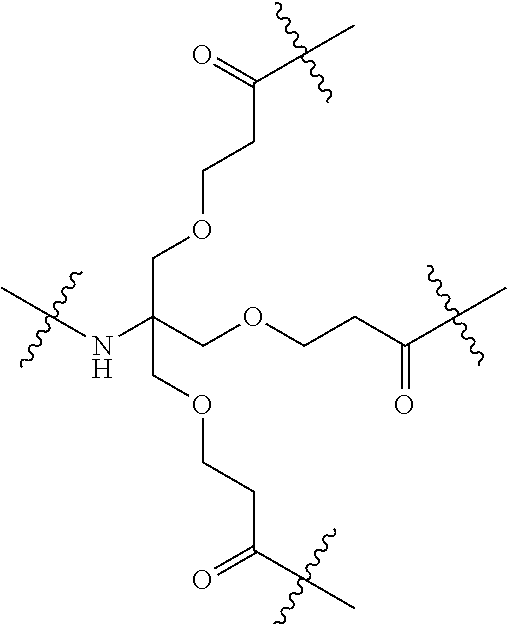 |
||
| TABLE 2 |
| Structures of Branched Linker2-Payloads (BL2P) |
| Structures |
 |
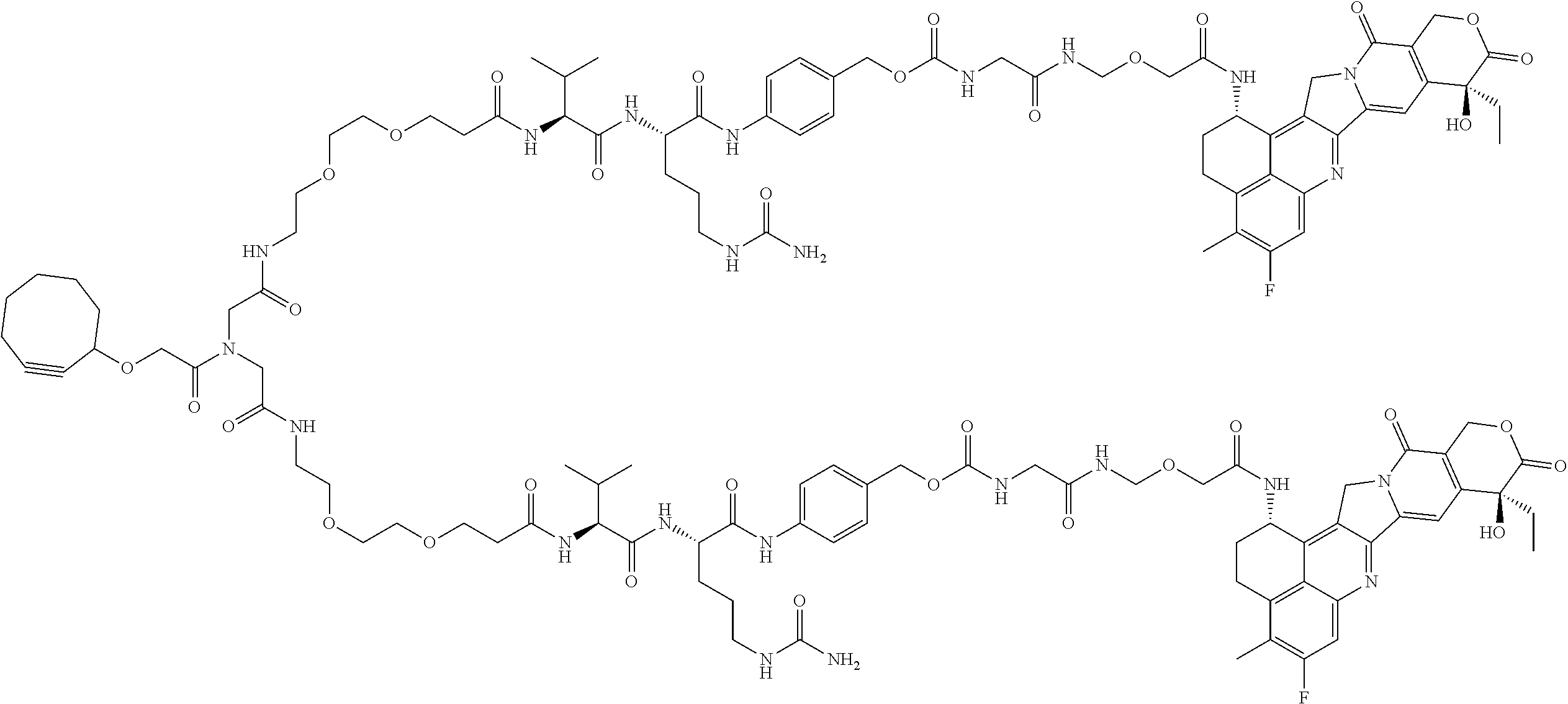 |
 |
 |
 |
 |
 |
 |
 |
 |
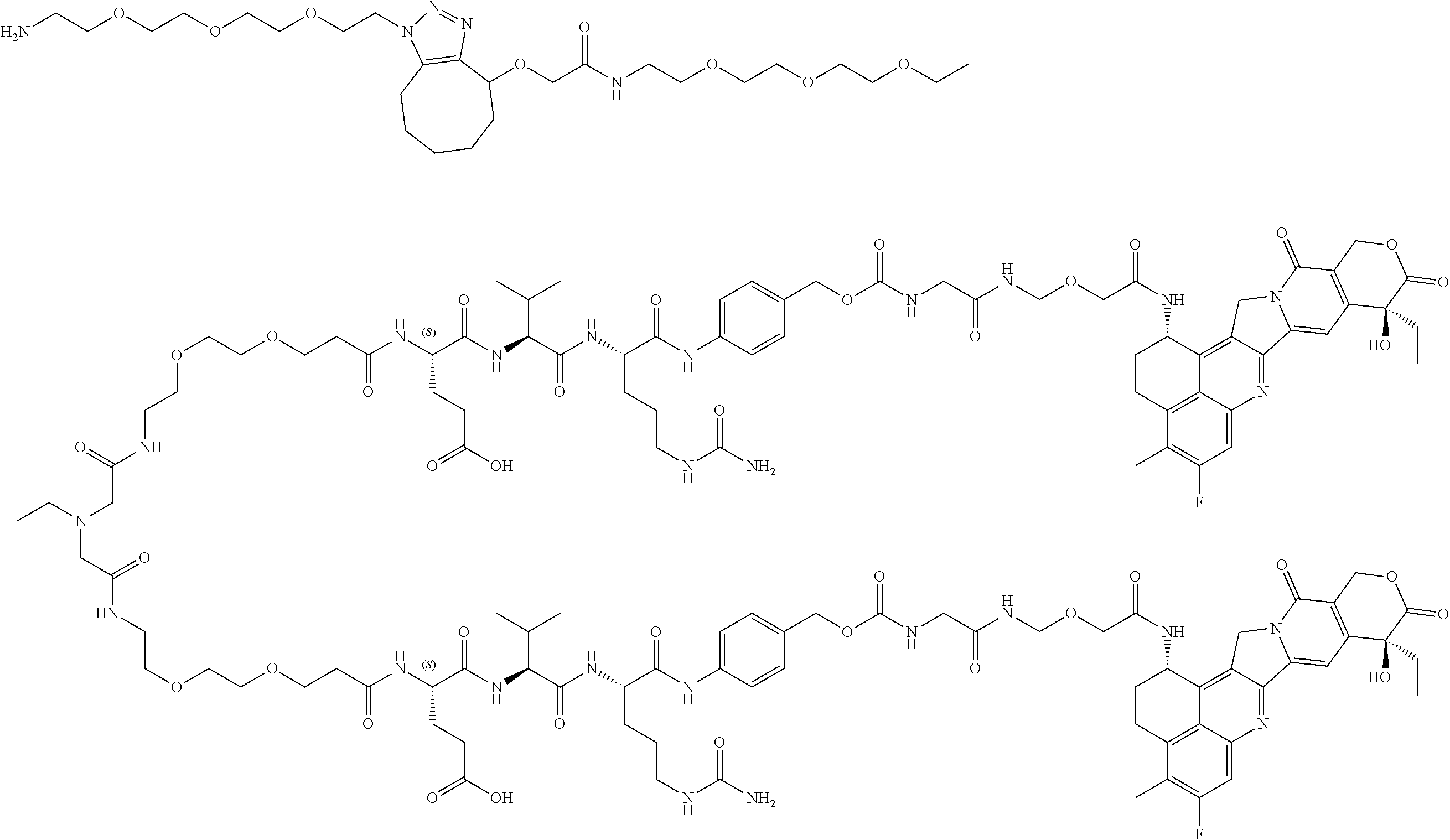 |
 |
 |
 |
 |
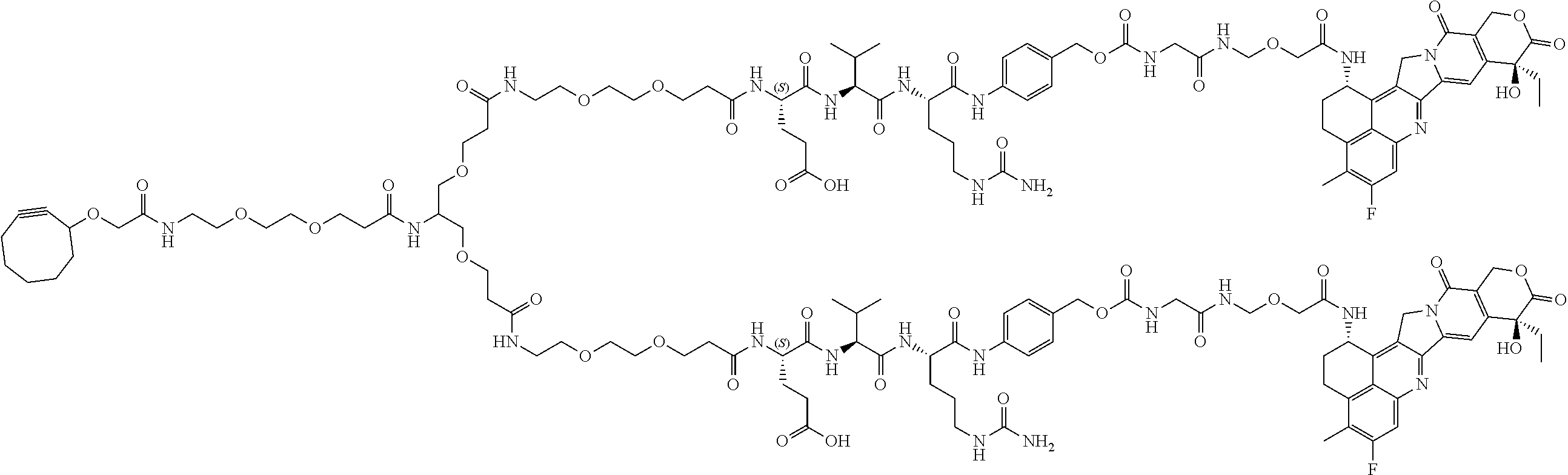 |
 |
 |
 |
 |

or a pharmaceutically acceptable salt thereof.
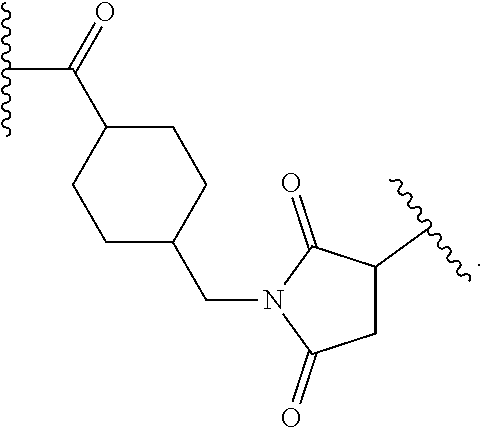


wherein R1 is alkyl.

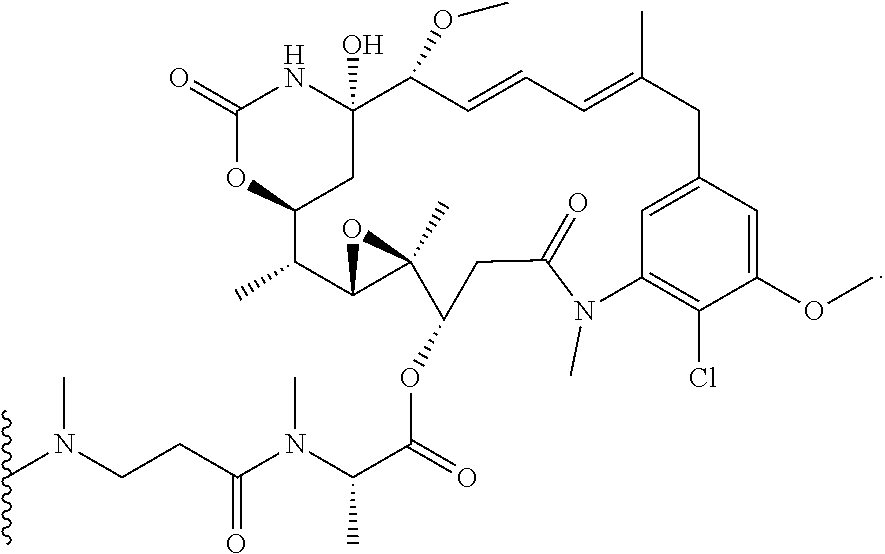

wherein

is a bond to the antibody.

wherein

is a bond to the antibody.
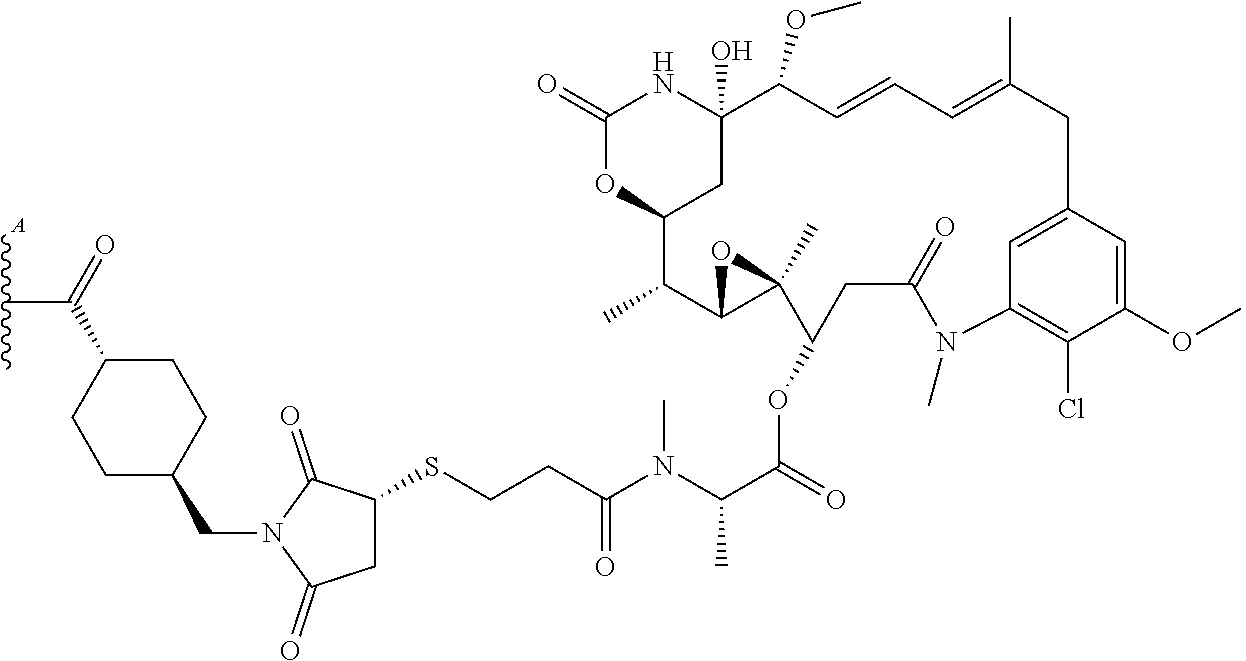
wherein

is a bond to the antibody.

wherein

is a bond to the antibody.
Ab[L-Pay]n
wherein: Ab is an anti-FGFR2 antibody or antigen-binding fragment thereof comprising:
-
- (i) an HCDR1 having the amino acid sequence of SEQ ID NO: 4; an HCDR2 having the amino acid sequence of SEQ ID NO: 6; an HCDR3 having the amino acid sequence of SEQ ID NO: 8; an LCDR1 having the amino acid sequence of SEQ ID NO: 12; an LCDR2 having the amino acid sequence of SEQ ID NO: 14; and an LCDR3 having the amino acid sequence of SEQ ID NO: 16;
L-Pay is
- (i) an HCDR1 having the amino acid sequence of SEQ ID NO: 4; an HCDR2 having the amino acid sequence of SEQ ID NO: 6; an HCDR3 having the amino acid sequence of SEQ ID NO: 8; an LCDR1 having the amino acid sequence of SEQ ID NO: 12; an LCDR2 having the amino acid sequence of SEQ ID NO: 14; and an LCDR3 having the amino acid sequence of SEQ ID NO: 16;
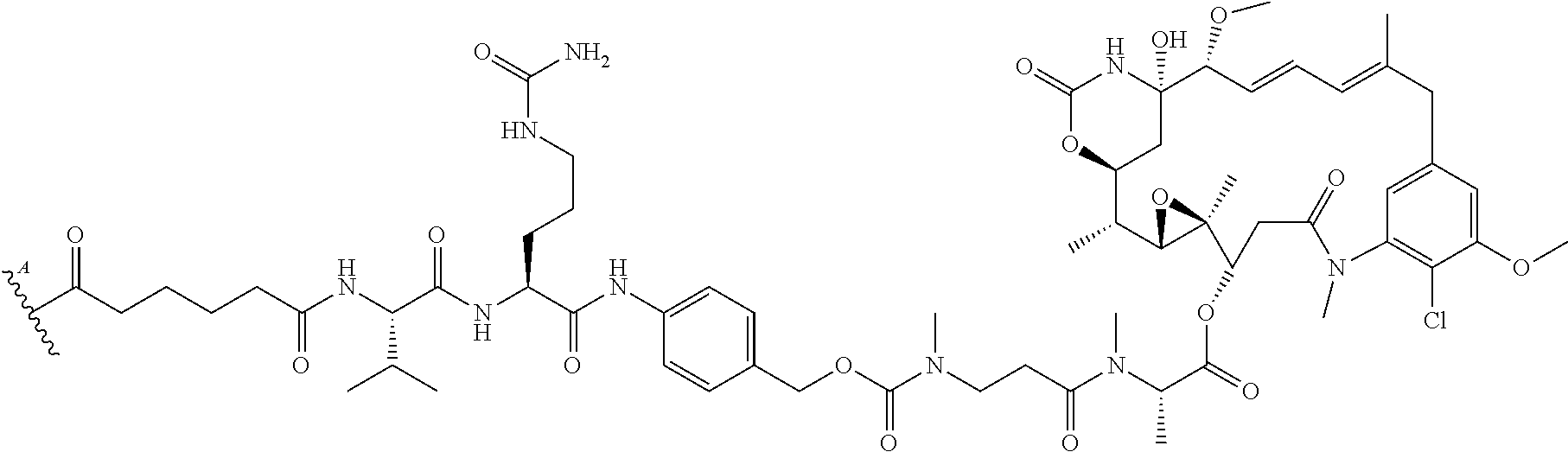
(maytansinoid 1ALP) wherein

is a bond to the antigen-binding protein; and n is an integer from 2-5.
Ab[L-Pay]n
wherein: Ab is an anti-FGFR2 antibody or antigen-binding fragment thereof comprising:
-
- (ii) an HCDR1 having the amino acid sequence of SEQ ID NO: 24; an HCDR2 having the amino acid sequence of SEQ ID NO: 6; an HCDR3 having the amino acid sequence of SEQ ID NO: 26; an LCDR1 having the amino acid sequence of SEQ ID NO: 30; an LCDR2 having the amino acid sequence of SEQ ID NO: 32; and an LCDR3 having the amino acid sequence of SEQ ID NO: 34;
L-Pay is
- (ii) an HCDR1 having the amino acid sequence of SEQ ID NO: 24; an HCDR2 having the amino acid sequence of SEQ ID NO: 6; an HCDR3 having the amino acid sequence of SEQ ID NO: 26; an LCDR1 having the amino acid sequence of SEQ ID NO: 30; an LCDR2 having the amino acid sequence of SEQ ID NO: 32; and an LCDR3 having the amino acid sequence of SEQ ID NO: 34;

(maytansinoid 1ALP) wherein

is a bond to the antigen-binding protein; and n is an integer from 2-5.
Ab-[L-Pay]n
wherein: Ab is an anti-FGFR2 antibody or antigen-binding fragment thereof comprising:
-
- (i) an HCDR1 having the amino acid sequence of SEQ ID NO: 4; an HCDR2 having the amino acid sequence of SEQ ID NO: 6; an HCDR3 having the amino acid sequence of SEQ ID NO: 8; an LCDR1 having the amino acid sequence of SEQ ID NO: 12; an LCDR2 having the amino acid sequence of SEQ ID NO: 14; and an LCDR3 having the amino acid sequence of SEQ ID NO: 16; Pay is

wherein

is a bond to the antigen-binding protein; and n is an integer from 2-5.
Ab-[L-Pay]n
wherein: Ab is an anti-FGFR2 antibody or antigen-binding fragment thereof comprising:
-
- (ii) an HCDR1 having the amino acid sequence of SEQ ID NO: 24; an HCDR2 having the amino acid sequence of SEQ ID NO: 6; an HCDR3 having the amino acid sequence of SEQ ID NO: 26; an LCDR1 having the amino acid sequence of SEQ ID NO: 30; an LCDR2 having the amino acid sequence of SEQ ID NO: 32; and an LCDR3 having the amino acid sequence of SEQ ID NO: 34;
- Pay is

wherein

is a bond to the antigen-binding protein; and n is an integer from 2-5.
Ab[L-Pay]n
wherein: Ab is an anti-FGFR2 antibody or antigen-binding fragment thereof comprising:
(i) an HCDR1 having the amino acid sequence of SEQ ID NO: 4; an HCDR2 having the amino acid sequence of SEQ ID NO: 6; an HCDR3 having the amino acid sequence of SEQ ID NO: 8; an LCDR1 having the amino acid sequence of SEQ ID NO: 12; an LCDR2 having the amino acid sequence of SEQ ID NO: 14; and an LCDR3 having the amino acid sequence of SEQ ID NO: 16;
L-Pay is

or cycloaddition regioisomer thereof wherein

is a bond to a heavy chain glutamine. In some embodiments, n is 2. In certain embodiments, n is 2 and L-Pay is bonded to Q295 glutamines. In some embodiments, n is 4. In certain embodiments, n is 4 and L-Pay is bonded to Q295 and Q297 glutamines.
Ab[L-Pay]n
wherein: Ab is an anti-FGFR2 antibody or antigen-binding fragment thereof comprising:
(ii) an HCDR1 having the amino acid sequence of SEQ ID NO: 24; an HCDR2 having the amino acid sequence of SEQ ID NO: 6; an HCDR3 having the amino acid sequence of SEQ ID NO: 26; an LCDR1 having the amino acid sequence of SEQ ID NO: 30; an LCDR2 having the amino acid sequence of SEQ ID NO: 32; and an LCDR3 having the amino acid sequence of SEQ ID NO: 34;
L-Pay is

or cycloaddition regioisomer thereof wherein

is a bond to a heavy chain glutamine. In some embodiments, n is 2. In certain embodiments, n is 2 and L-Pay is bonded to Q295 glutamines. In some embodiments, n is 4. In certain embodiments, n is 4 and L-Pay is bonded to Q295 and Q297 glutamines.
Ab-[L-Pay]n
wherein: Ab is an anti-FGFR2 antibody or antigen-binding fragment thereof comprising:
(i) an HCDR1 having the amino acid sequence of SEQ ID NO: 4; an HCDR2 having the amino acid sequence of SEQ ID NO: 6; an HCDR3 having the amino acid sequence of SEQ ID NO: 8; an LCDR1 having the amino acid sequence of SEQ ID NO: 12; an LCDR2 having the amino acid sequence of SEQ ID NO: 14; and an LCDR3 having the amino acid sequence of SEQ ID NO: 16; Pay is
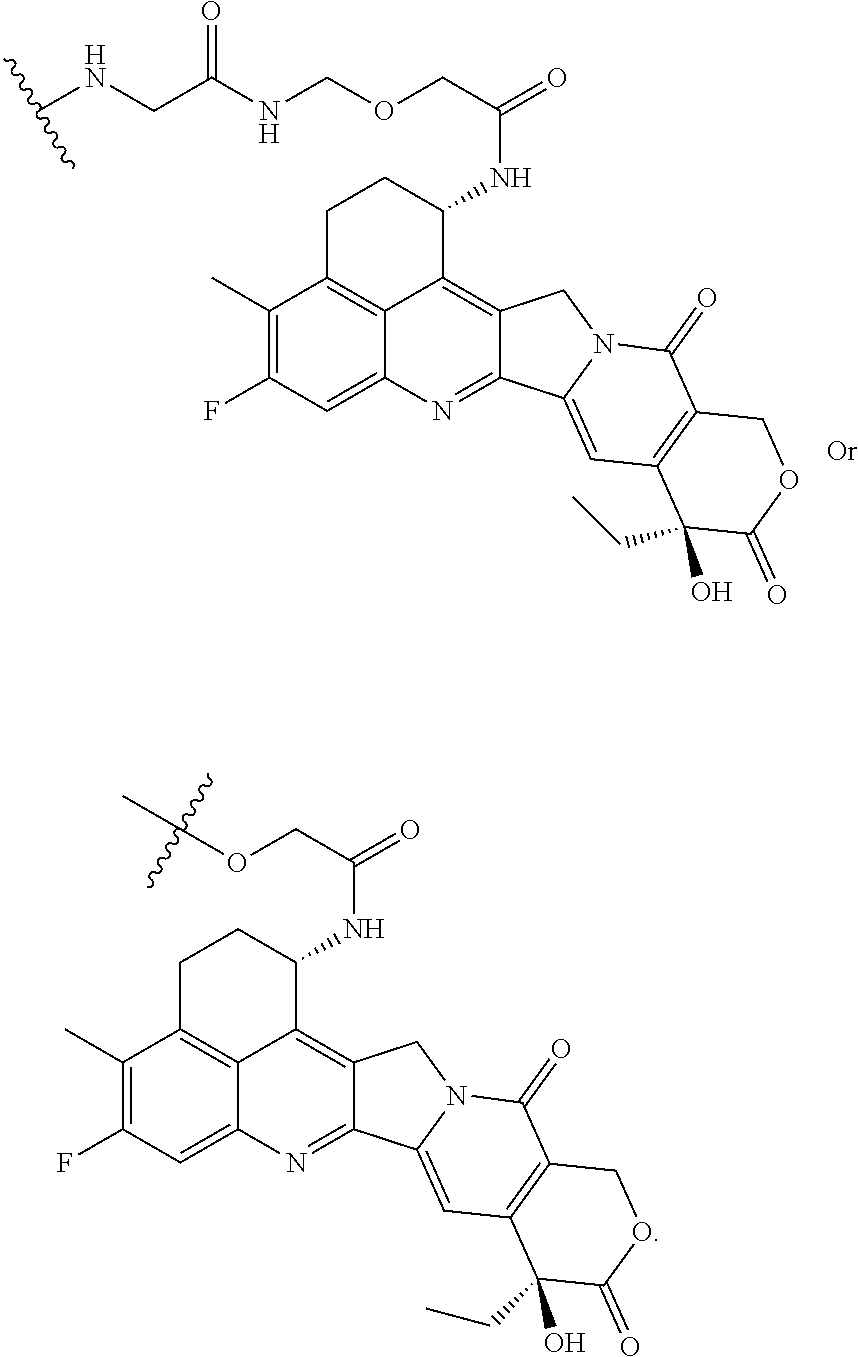
wherein
Ab-[L-Pay]n
wherein: Ab is an anti-FGFR2 antibody or antigen-binding fragment thereof comprising:
(ii) an HCDR1 having the amino acid sequence of SEQ ID NO: 24; an HCDR2 having the amino acid sequence of SEQ ID NO: 6; an HCDR3 having the amino acid sequence of SEQ ID NO: 26; an LCDR1 having the amino acid sequence of SEQ ID NO: 30; an LCDR2 having the amino acid sequence of SEQ ID NO: 32; and an LCDR3 having the amino acid sequence of SEQ ID NO: 34;
-
- Pay is

wherein
Ab[L-Pay]n
wherein: Ab is an anti-FGFR2 antibody or antigen-binding fragment thereof comprising:
(i) an HCDR1 having the amino acid sequence of SEQ ID NO: 4; an HCDR2 having the amino acid sequence of SEQ ID NO: 6; an HCDR3 having the amino acid sequence of SEQ ID NO: 8; an LCDR1 having the amino acid sequence of SEQ ID NO: 12; an LCDR2 having the amino acid sequence of SEQ ID NO: 14; and an LCDR3 having the amino acid sequence of SEQ ID NO: 16;
L-Pay is

wherein L-pay is bonded to Ab through a heavy chain glutamine. In some embodiments, n is 2. In certain embodiments, n is 2 and L-Pay is bonded to Q295 glutamines. In some embodiments, n is 4. In certain embodiments, n is 4 and L-Pay is bonded to Q295 and Q297 glutamines. In some embodiments, n is 6. In some embodiments, n is 8. In some embodiments, n is 8, L is branched, and L-Pay is bonded to Q295 and Q297.
Ab[L-Pay]n
wherein: Ab is an anti-FGFR2 antibody or antigen-binding fragment thereof comprising:
(ii) an HCDR1 having the amino acid sequence of SEQ ID NO: 24; an HCDR2 having the amino acid sequence of SEQ ID NO: 6; an HCDR3 having the amino acid sequence of SEQ ID NO: 26; an LCDR1 having the amino acid sequence of SEQ ID NO: 30; an LCDR2 having the amino acid sequence of SEQ ID NO: 32; and an LCDR3 having the amino acid sequence of SEQ ID NO: 34;
L-Pay is

wherein L-pay is bonded to Ab through a heavy chain glutamine. In some embodiments, n is 2. In certain embodiments, n is 2 and L-Pay is bonded to Q295 glutamines. In some embodiments, n is 4. In certain embodiments, n is 4 and L-Pay is bonded to Q295 and Q297 glutamines. In some embodiments, n is 6. In some embodiments, n is 8. In some embodiments, n is 8, L is branched, and L-Pay is bonded to Q295 and Q297.

which can be prepared using methods described in U.S. patent application Ser. No. 16/724,164 filed Dec. 20, 2019 (e.g., compound LP4 described therein). In certain embodiments, the primary amine compound is


wherein the anti-FGFR2 is functionalized with an azide.

and aqueous diluent.
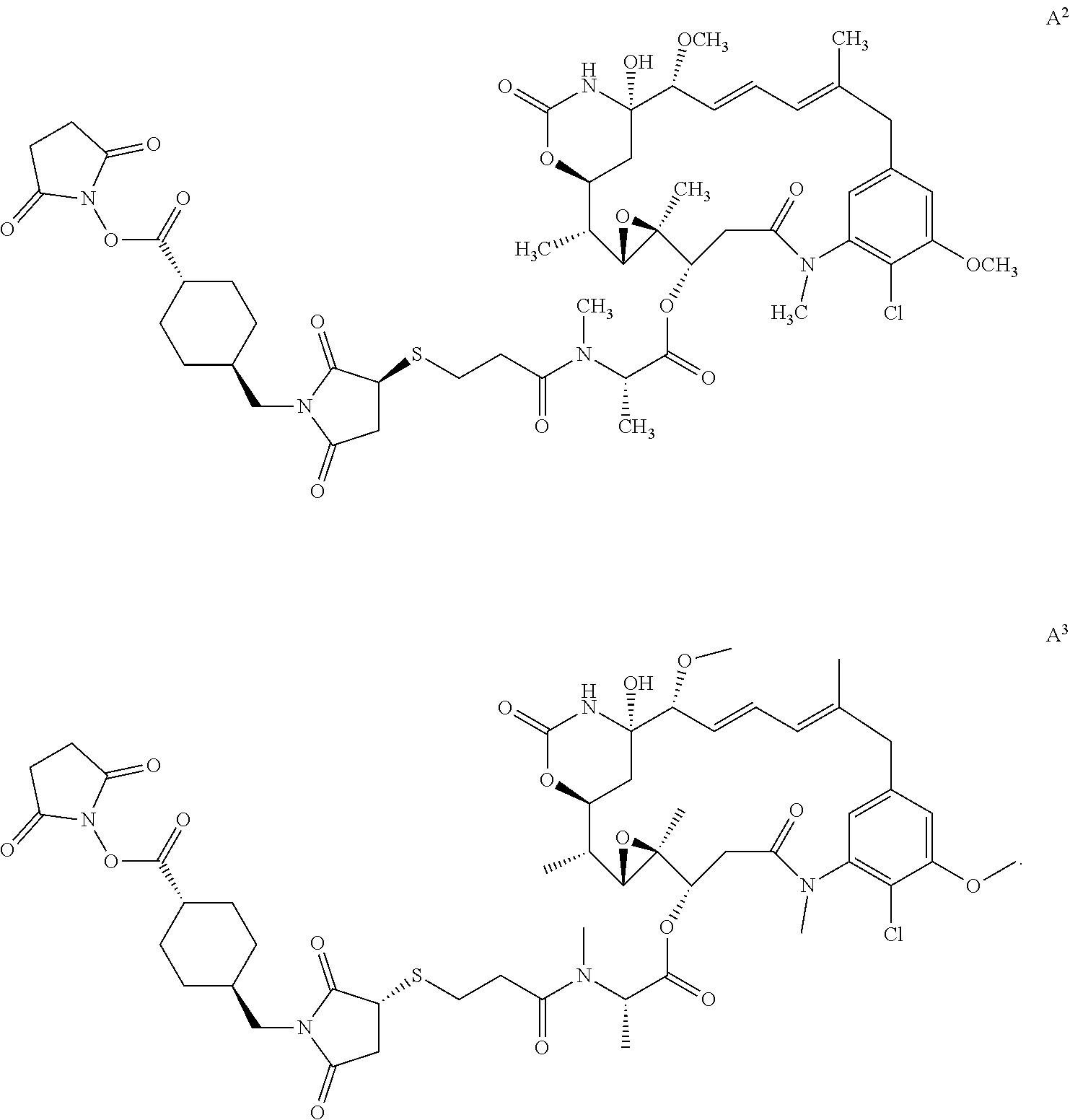
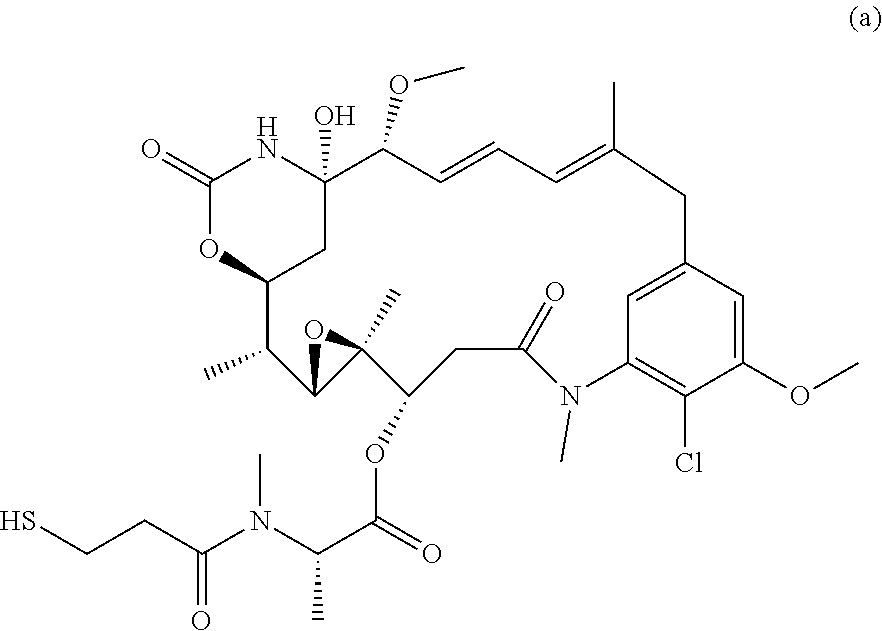
with a compound of formula (b)

in the presence of silica gel and diluent. In some embodiments, the diluent comprises an organic solvent and water.

with a compound of formula (b):
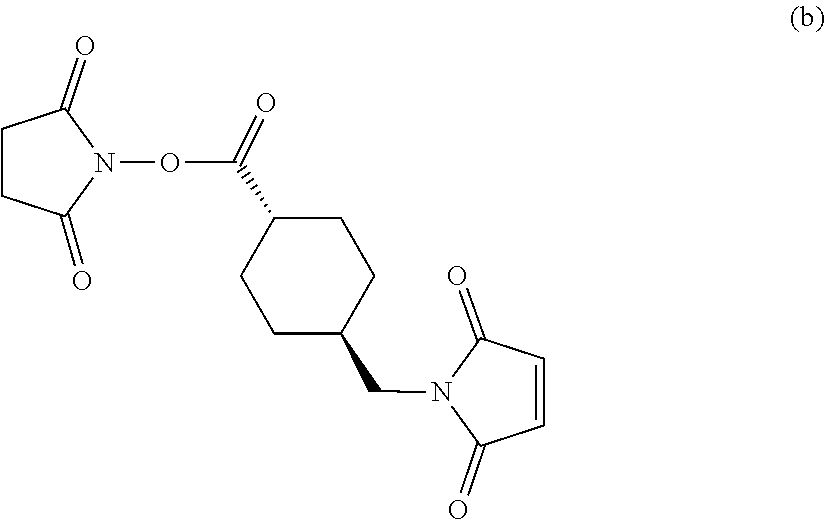
-
- in the presence of silica gel and diluent to synthesize an intermediate; and
(ii) contacting an anti-FGFR2 antibody or antigen-binding fragment thereof described herein with the intermediate and aqueous diluent.
- in the presence of silica gel and diluent to synthesize an intermediate; and

wherein LG is a leaving group, and aqueous diluent.
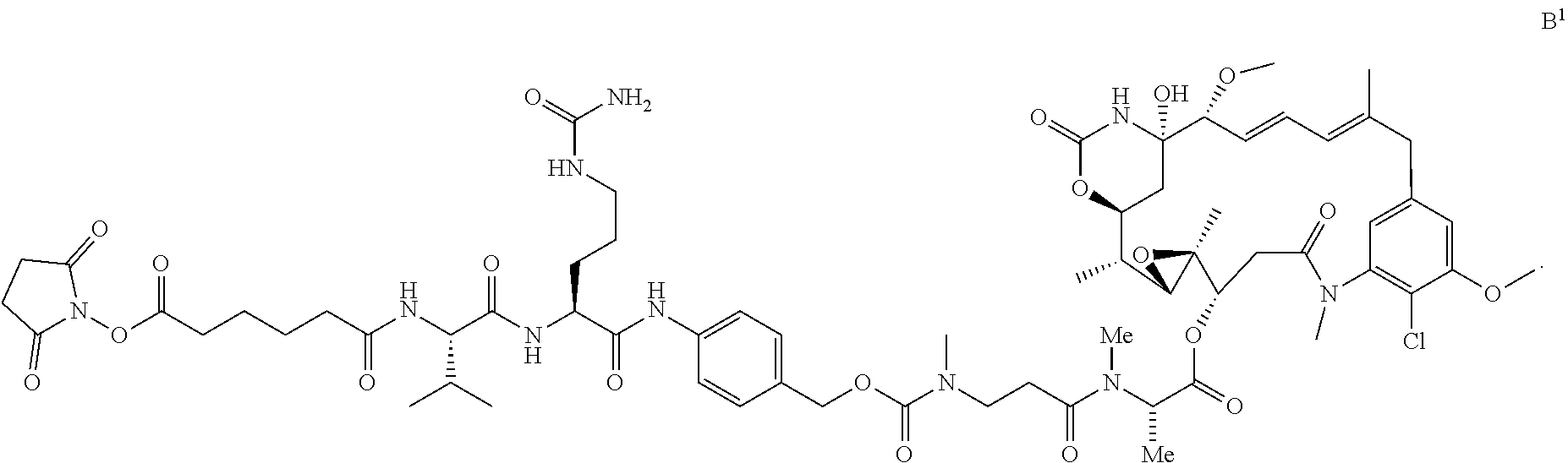
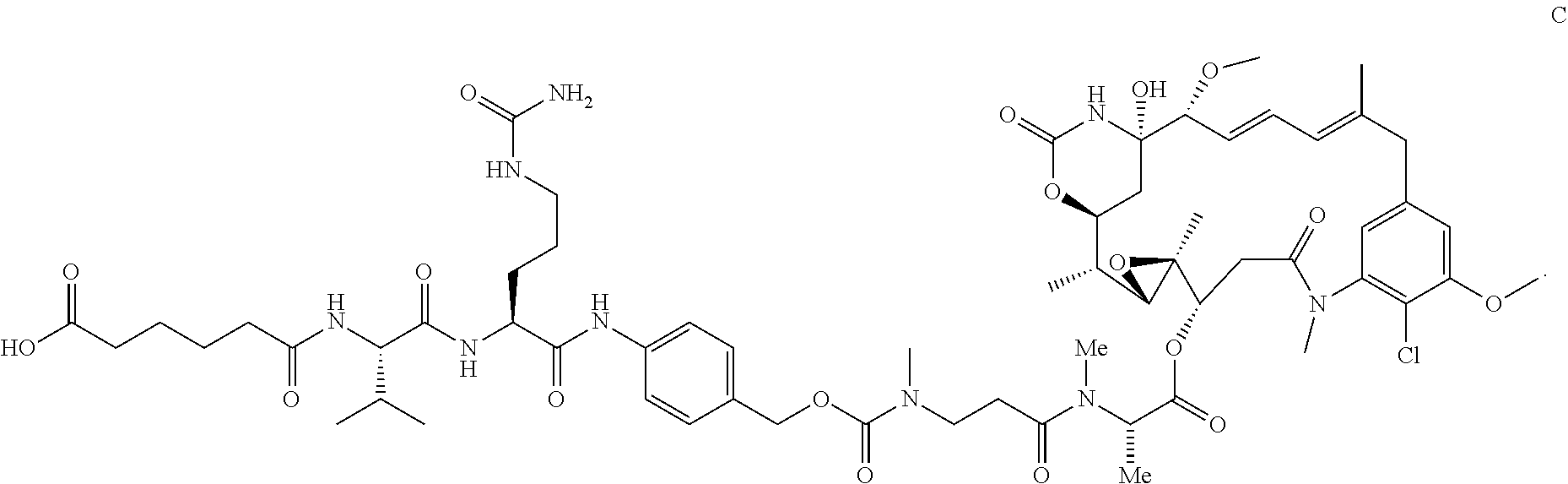
with N-hydroxysuccinimide (NHS), a peptide coupling reagent, and an organic diluent. Suitable peptide coupling reagents include those that activate, i.e., render reactive, carboxylic acid moieties for reaction with a nucleophile. In certain embodiments, the peptide coupling reagent is N-(3-dimethylaminopropyl)-N′-ethylcarbodiimide hydrochloride (EDC). In some embodiments, the organic solvent is dichloromethane.
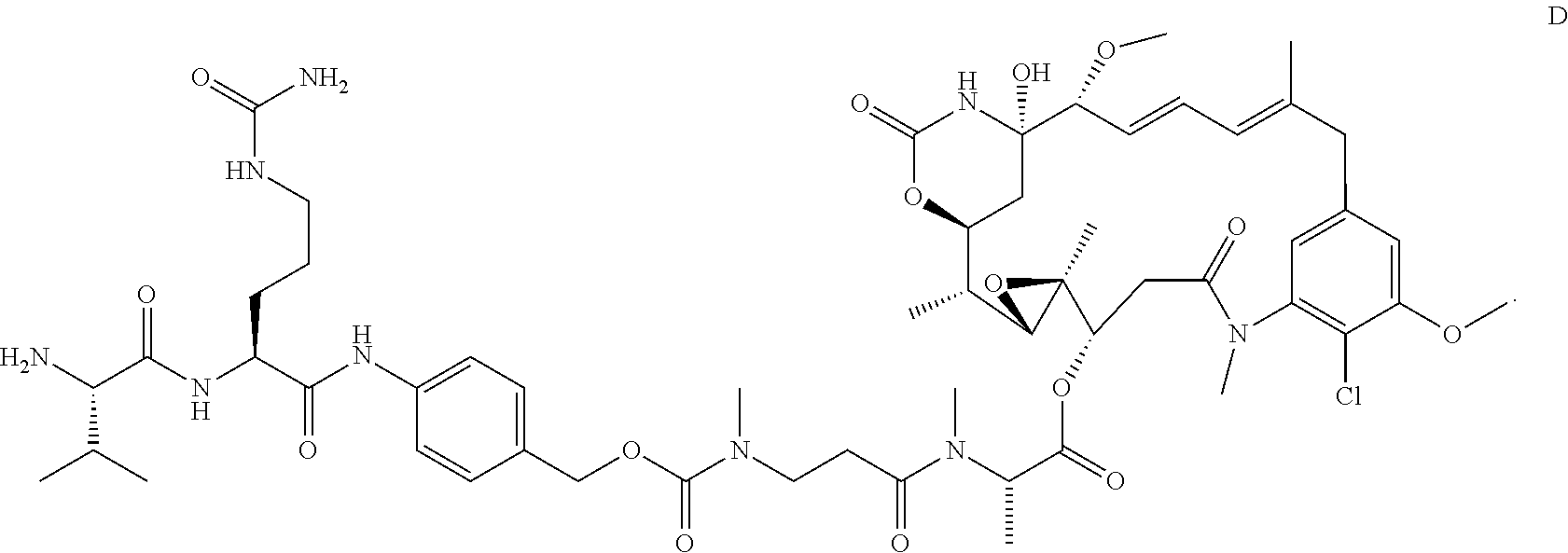
with adipic acid, a peptide coupling agent, and an organic solvent. In certain embodiments, the peptide coupling agent is 2-ethoxy-1-ethoxycarbonyl-1,2-dihydroquinoline (EEDQ). In certain embodiments, the organic solvent comprises dichloromethane. Compound D can be prepared as described in WO2014/145090.
Epitope Mapping and Related Technologies

| TABLE 3 |
| Amino Acid Sequence Identifiers |
| SEQ ID NOs: |
| Antibody | ||||||||||
| Designation | HCVR | HCDR1 | HCDR2 | HCDR3 | LCVR | LCDR1 | LCDR2 | LCDR3 | | LC |
| mAb1 |
| 2 | 4 | 6 | 8 | 10 | 12 | 14 | 16 | 18 | 20 | |
| mAb2 | 22 | 24 | 6 | 26 | 28 | 30 | 32 | 34 | 36 | 38 |
| |
40 | 24 | 6 | 42 | 44 | 46 | 32 | 34 | 49 | 51 |
| TABLE 4 |
| Nucleic Acid Sequence Identifiers |
| SEQ ID NOs: |
| Antibody | ||||||||||
| Designation | HCVR | HCDR1 | HCDR2 | HCDR3 | LCVR | LCDR1 | LCDR2 | LCDR3 | | LC |
| mAb1 |
| 1 | 3 | 5 | 7 | 9 | 11 | 13 | 15 | 17 | 19 | |
| mAb2 | 21 | 23 | 5 | 25 | 27 | 29 | 31 | 33 | 35 | 37 |
| mAb3 | 39 | 23 | 5 | 41 | 43 | 45 | 31 | 47 | 48 | 50 |
| TABLE 5a |
| Binding Kinetics of Anti-FGFR2 Antibodies to hFGFR2b.mmh at 25° C. |
| mAb | Antigen | |||||
| Captured | Bound | |||||
| Antibody and ADC | (RU) | (RU) | ka (1/Ms) | kd (1/s) | KD (M) | t1/2 (min) |
| mAb2 | 337.1 ± 2.5 | 62.5 | 5.01E+04 | 4.47E−04 | 8.92E−09 | 25.8 |
| mAb2- | 266.8 ± 8.4 | 31.3 | 6.85E+04 | 8.79E−04 | 1.28E−08 | 13.1 |
| maytansinoid | ||||||
| 1ALP | ||||||
| mAb2-tubulysin | 254.1 ± 3.4 | 32.7 | 5.10E+04 | 1.18E−03 | 2.31E−08 | 9.8 |
| 1ALP | ||||||
| mAb1 | 514.2 ± 9.7 | 70.9 | 4.17E+04 | 1.04E−03 | 2.50E−08 | 11.1 |
| mAb1- | 369 ± 7.6 | 42.1 | 2.48E+04 | 1.04E−03 | 4.18E−08 | 11.1 |
| maytansinoid | ||||||
| 1ALP | ||||||
| mAb1-tubulysin | 305.2 ± 4.9 | 36.4 | 2.21E+04 | 1.06E−03 | 4.81E−08 | 7.4 |
| 1ALP | ||||||
| Comp2 | 1267.6 ± 9.3 | 296.1 | 3.69E+05 | 1.01E−04 | 2.74E−10 | 113.9 |
| Comp2-BAY-LP | 294.7 ± 7.7 | 133.1 | 3.58E+05 | 4.90E−05 | 1.37E−10 | 235.8 |
| Comp1 | 582.6 ± 2.4 | 68.3 | 7.74E+04 | 4.71E−03 | 6.08E−08 | 2.5 |
| IC1 | 480.7 ± 9.1 | 0 | NB | NB | NB | NB |
| TABLE 5b |
| Binding Kinetics of Anti-FGFR2 Antibodies to hFGFR2c.mmh at 25° C. |
| mAb | Antigen | |||||
| Captured | Bound | |||||
| Antibody | (RU) | (RU) | ka (1/Ms) | kd (1/s) | KD (M) | t1/2 (min) |
| mAb2 | 351.4 ± 4 | −1.4 | NB | NB | NB | NB |
| mAb1 | 279.3 ± 4.1 | 1.5 | NB | NB | NB | NB |
| Comp2 | 1227.4 ± 2.1 | 295.2 | 1.41E+05 | 1.03E−04 | 7.30E−10 | 112.1 |
| Comp1 | 567.2 ± 0.7 | 0.6 | NB | NB | NB | NB |
| IC1 | 232.6 ± 2.7 | −0.1 | NB | NB | NB | NB |
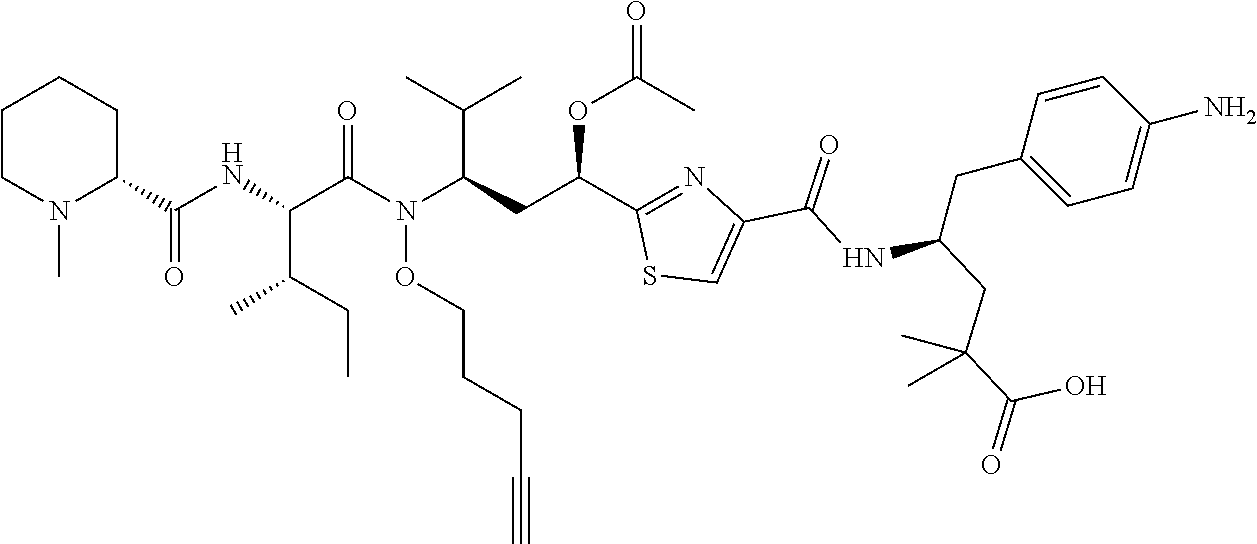

wherein Ab is the anti-FGFR2 antibody.
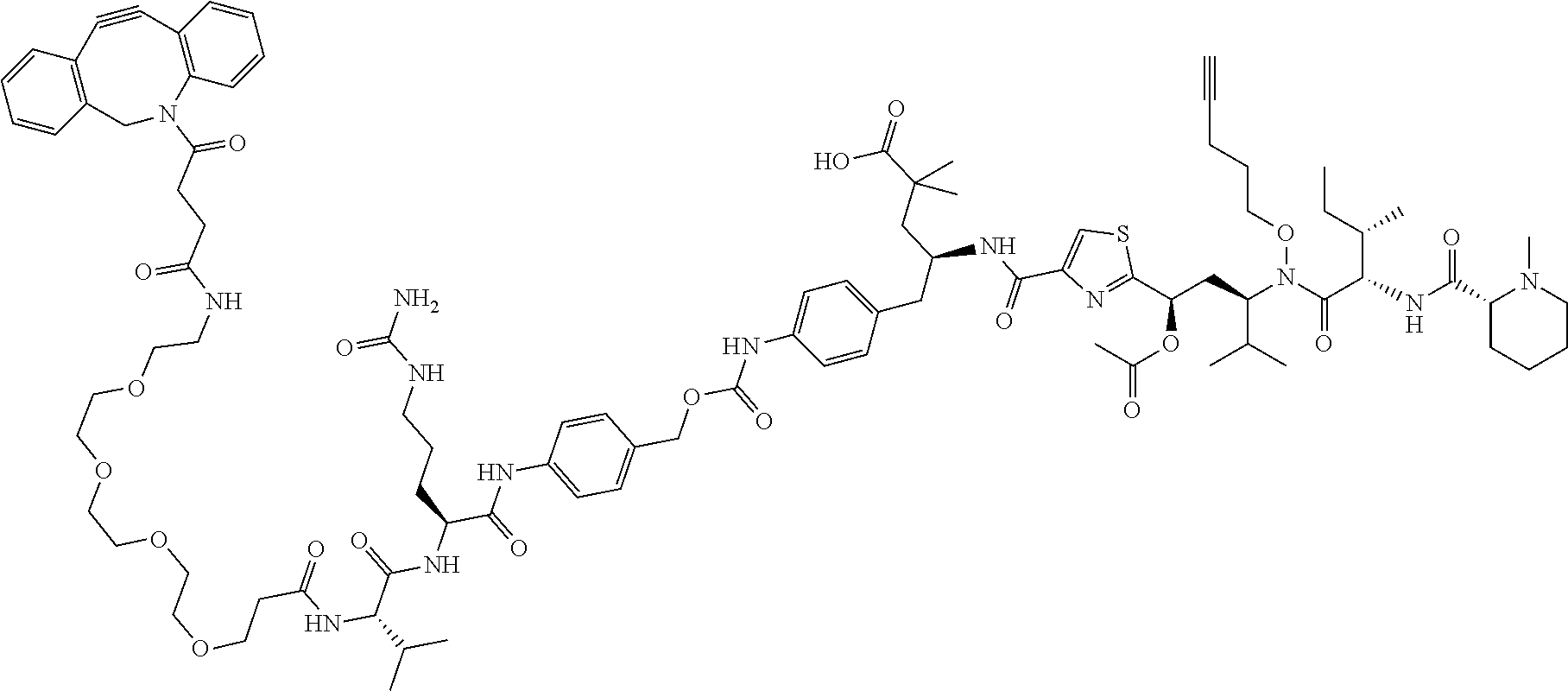
dissolved in a suitable organic solvent (e.g., DMSO, DMF or DMA; reaction mixture contains 10-20% organic solvent, v/v) at 25° C. to 37° C. for 3-24 h. The progress of the reaction was monitored by ESI-MS. Absence of azido-functionalized antibody (mAb-PEG3-N3) indicated completion of the conjugation. The excess linker-payload (LP) and organic solvent were removed by desalting column or size exclusion chromatography (SEC). The purified conjugate was analyzed by SEC-HPLC and ESI-MS. Conjugates' monomer purity was >99% by SEC-HPLC analysis.
| TABLE 6 |
| Antibody Drug Conjugate DARs |
| DAR | ||
| ADC | (by ESI-MS) | |
| mAb1-Tubulysin 1A-LP | Anti FGFR2 mAb1-PEG3-N3- | 2.1 |
| Tubulysin 1A-LP | ||
| mAb2-Tubulysin 1A-LP | Anti FGFR2 mAb2-PEG3-N3- | 2.1 |
| Tubulysin 1A-LP | ||
| IC1-Tubulysin 1A-LP | Isotype mAb-PEG3-N3- | 2.0 |
| Tubulysin 1A-LP | ||
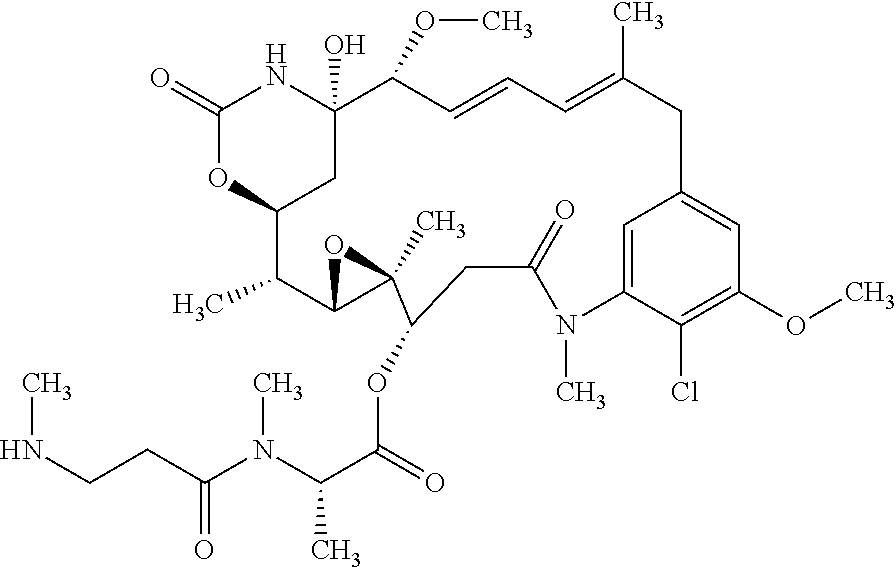
The antibody was conjugated through a linker moiety as described in the procedure below, providing an ADC having the following structure:
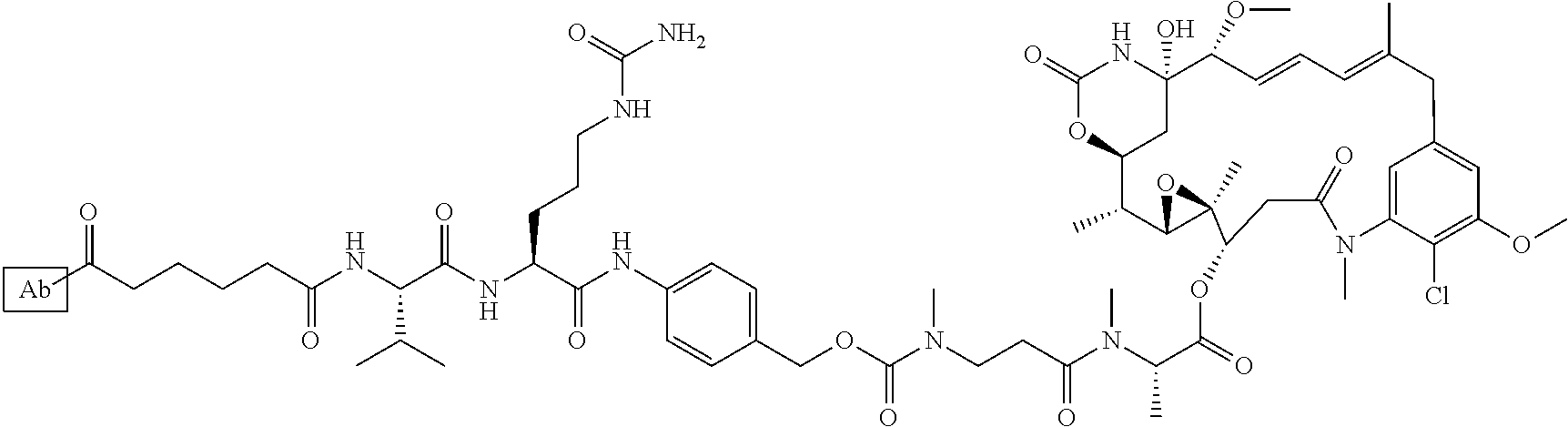
wherein Ab is the anti-FGFR2 antibody.
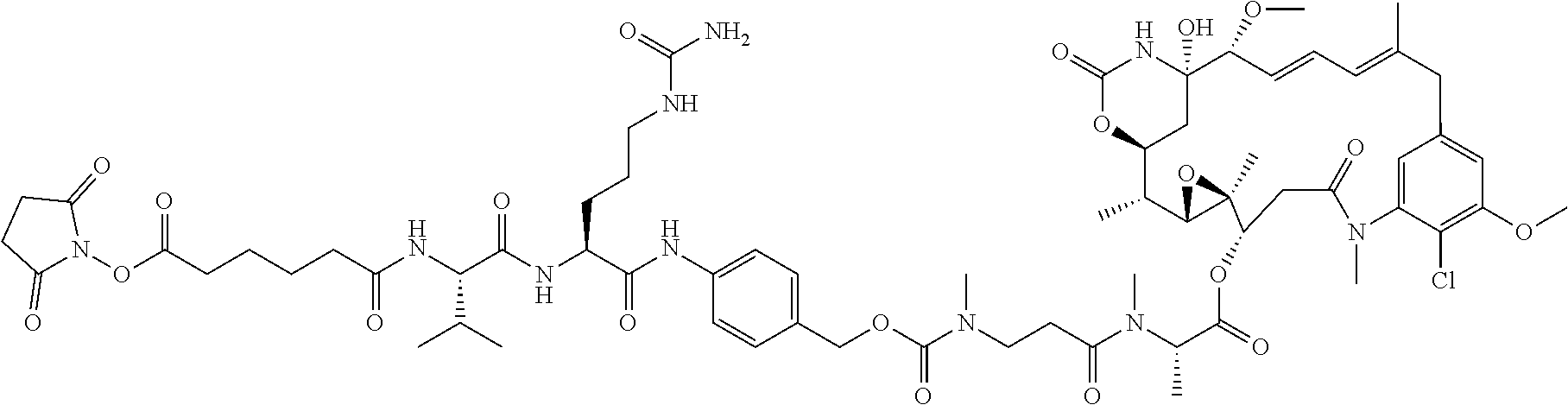
2 hours at ambient temperature. The conjugates were purified by size exclusion chromatography or extensive ultrafiltration and sterile filtered. Protein concentrations were determined by UV spectral analysis. Size-exclusion HPLC established that all conjugates used were >90% monomeric, and RP-HPLC established that there was <1% unconjugated linker payload. All conjugated antibodies were analyzed by UV for linker payload loading values according to Hamblett et al (American Association for Cancer Research. 2004 Oct. 15; 10(20):7063-70) and/or by mass difference, native versus conjugated. Payload to antibody ratios (DARs) are shown in Table 7.
| TABLE 7 |
| Percent Yield and Payload to Antibody Ratios for Each Antibody |
| Drug Conjugate |
| Antibody | Yield (%) | DAR (ESI-MS) | ||
| mAb3-maytansinoid 1ALP | 70 | 2.2 | ||
| mAb2-maytansinoid 1ALP | 70 | 1.9 | ||
| mAb1-maytansinoid 1ALP | 70 | 2.5 | ||
| IC1-maytansinoid 1ALP | 80 | 2.0 | ||
Characterization of Conjugates by Liquid Chromatography-Mass Spectrometry
-
- 1. Relative percentage (%) of drug (Dn) by distribution peak intensity (PI):
Dn %=Pln/Σ(PI0+PI1+PI2+ . . . PIi)×100,(n=0,1,2,3, . . . ,i) - 2. Average DAR calculation:
DAR=Σ(1×D1%/+2×D2%+3×D3%+ . . . +i×Di %)
- 1. Relative percentage (%) of drug (Dn) by distribution peak intensity (PI):
| TABLE 8 |
| Cytotoxicity of Anti-FGFR2 ADCs in SNU-16, NCI-H716, |
| MFM-223, MFE-296, and IM-9 Cells |
| IM-9 | MFM-223 | NCI-H716 | SNU-16 |
| Max | Max | Max | Max | |||||
| % | % | % | % | |||||
| Test Article | IC50 (M) | Kill | IC50 (M) | Kill | IC50 (M) | Kill | IC50 (M) | Kill |
| mAb2-tubulysin | >2.00E−08 | 6.9 | 6.36E−11 | 90.0 | >2.00E−08 | 30.9 | 3.70E−11 | 95.3 |
| 1ALP | ||||||||
| mAb1-tubulysin | >2.00E−08 | 13.4 | 1.25E−10 | 91.1 | >2.00E−08 | 19.3 | 4.34E−11 | 95.4 |
| 1ALP | ||||||||
| IC1-tubulysin | 1.45E−08 | 95.2 | 1.98E−09 | 89.6 | >2.00E−08 | 7.1 | 3.40E−09 | 94.9 |
| 1ALP (Control) | ||||||||
| Tubulysin 1A | 2.12E−11 | 94.6 | 3.76E−12 | 89.7 | 7.43E−11 | 84.9 | 3.69E−12 | 95.1 |
| mAb2- | >2.00E−08 | 9.5 | 1.72E−10 | 91.1 | >2.00E−08 | 17.0 | 2.06E−10 | 95.0 |
| maytansinoid | ||||||||
| 1ALP | ||||||||
| mAb1- | >2.00E−08 | 0.0 | 2.14E−10 | 85.5 | >2.00E−08 | 0.5 | 2.68E−10 | 93.1 |
| maytansinoid | ||||||||
| 1ALP | ||||||||
| IC1- | >2.00E−08 | 4.0 | 4.63E−09 | 84.3 | >2.00E−08 | 3.3 | >2.00E−08 | 6.0 |
| maytansinoid | ||||||||
| 1ALP (control) | ||||||||
| maytansinoid 1A | >2.00E−08 | 3.7 | >2.00E−08 | 18.1 | >2.00E−08 | 6.4 | >2.00E−08 | 9.2 |
| Cell Permeable | 2.99E−10 | 95.3 | 1.13E−10 | 92.0 | 5.45E−09 | 59.5 | 1.89E−10 | 95.9 |
| Maytansinoid | ||||||||
| 1A* | ||||||||
| Comp2-BAY-LP | >2.00E−08 | 2.2 | 6.38E−11 | 90.4 | 3.49E−10 | 77.2 | 8.71E−11 | 94.7 |
| 1C2-BAY-LP | >2.00E−08 | 10.5 | 6.06E−09 | 89.3 | >2.00E−08 | 19.0 | 1.31E−08 | 66.1 |
| (control) | ||||||||
| Comp1 | >2.00E−08 | 3.8 | >2.00E−08 | 0.8 | >2.00E−08 | 9.9 | >2.00E−08 | 0.0 |
| (Unconjugated) | ||||||||
| Comp2 | >2.00E−08 | 7.6 | >2.00E−08 | 7.8 | >2.00E−08 | 0.6 | >2.00E−08 | 12.0 |
| (Unconjugated) | ||||||||
| mAb2 | >2.00E−08 | 6.4 | >2.00E−08 | 4.5 | >2.00E−08 | 7.8 | >2.00E−08 | 10.3 |
| (Unconjugated) | ||||||||
| mAb1 | >2.00E−08 | 4.4 | >2.00E−08 | 4.5 | >2.00E−08 | 7.8 | >2.00E−08 | 5.4 |
| (Unconjugated) | ||||||||
| IC1 | >2.00E−08 | 1.6 | >2.00E−08 | 2.9 | >2.00E−08 | 12.6 | >2.00E−08 | 6.0 |
| (Unconjugated | ||||||||
| Control) | ||||||||
| IC2 | >2.00E−08 | 6.2 | >2.00E−08 | 8.5 | >2.00E−08 | 3.5 | >2.00E−08 | 2.1 |
| (Unconjugated | ||||||||
| Control) | ||||||||
Co-Cultures and the Bystander Effect
| TABLE 9 |
| Cytotoxicity of Anti-FGFR2 ADCs in An in Vitro Bystander Assay |
| SNU-16 + NALM-6 |
| SNU-16 cells | NALM-6 cells | Cells |
| Max % | Max % | Max % | ||||
| Test Article | IC50 (M) | Kill | IC50 (M) | Kill | IC50 (M) | Kill |
| mAb2-tubulysin 1ALP | 2.73E−11 | 97.2 | >1.0E−07 | 0.0 | 1.16E−08 | 97.7 |
| mAb1-tubulysin 1ALP | 6.69E−11 | 97.1 | >1.0E−07 | 0.0 | 4.97E−08 | 87.8 |
| IC1-tubulysin 1ALP | 4.11E−08 | 91.0 | >1.0E−07 | 3.7 | >1.0E−07 | 17.0 |
| Tubulysin 1A | 1.84E−11 | 99.3 | 7.09E−11 | 99.9 | 1.66E−10 | 99.5 |
| mAb2-maytansinoid 1ALP | 6.45E−10 | 94.8 | >1.0E−07 | 5.0 | >1.0E−07 | 18.3 |
| IC1-maytansinoid 1ALP | >1.0E−07 | 9.8 | >1.0E−07 | 0.0 | >1.0E−07 | 3.6 |
| (control) | ||||||
| Comp2-BAY-LP | 2.34E−10 | 95.6 | >1.0E−07 | 0.0 | >1.0E−07 | 21.2 |
| IC2-BAY-LP (control) | 5.68E−08 | 76.9 | >1.0E−07 | 7.8 | >1.0E−07 | 19.3 |
| TABLE 10 |
| Inhibition of SNU-16 Xenograft Growth in BALB/c SCID Mice |
| Total | Tumor growth in | Average % | ||
| Payload | mm3 from start of | Decrease in | Average % | |
| Dose | treatment (mean ± | Tumor | Tumor | |
| Antibody (mg/kg) | (ug/kg) | SD) | Growth | Regression |
| Experiment A |
| IC1-tubulysin 1ALP | 36 | 519.3 ± 576.8 | ||
| (3.0 mg/kg) | ||||
| mAb1-tubulysin 1ALP | 1.2 | 435.2 ± 189.7 | 16.2 | |
| (0.1 mg/kg) | ||||
| mAb1-tubulysin 1ALP | 3.6 | 141.8 ± 141.5 | 72.7 | |
| (0.3 mg/kg) | ||||
| mAb1-tubulysin 1ALP | 12 | −168.8 ± 37.8 | 79.3 | |
| (1.0 mg/kg) | ||||
| mAb1-tubulysin 1ALP | 36 | −202.5 ± 48.7 | 88.3 | |
| (3.0 mg/kg) |
| Experiment B |
| IC1-maytansinoid 1ALP | 190 | 1516.2 ± 413.9 | ||
| (15 mg/kg) | ||||
| mAb2-maytansinoid 1ALP | 14 | 547.6 ± 292.3 | 63.9 | |
| (1.0 mg/kg) | ||||
| mAb2-maytansinoid 1ALP | 42 | 164.1 ± 245.5 | 89.2 | |
| (3.0 mg/kg) | ||||
| mAb2-maytansinoid 1ALP | 140 | −35.1 ± 102.7 | 18.2 | |
| (10 mg/kg) | ||||
| mAb2-maytansinoid 1ALP | 210 | −5.8 ± 145.6 | 8.4 | |
| (15 mg/kg) | ||||
| TABLE 11 |
| Inhibition of Human Gastric Cancer PDX GA0033 Tumor Growth in BALB/c Nude Mice |
| Total | Tumor growth in mm3 | Average % | Average % | |
| Payload | from start of | Decrease in | Tumor | |
| Antibody (mg/kg) | Dose (ug/kg) | treatment (mean ± SD) | Tumor Growth | Regression |
| IC-maytansinoid 1ALP | 132 ± 2 | 1099.4 ± 676.3 | ||
| (10 mg/kg) | ||||
| mAb1-maytansinoid 1ALP | 40 × 2 | 273.6 ± 241.9 | 75.1 | |
| (3 mg/kg) | ||||
| mAb1-maytansinoid 1ALP | 132 × 2 | −104.2 ± 20.6 | 75.0 | |
| (10 mg/kg) | ||||
| IC-tubulysin 1ALP | 36 × 2 | 1497.7 ± 839.5 | ||
| (3 mg/kg) | ||||
| mAb1-tubulysin 1ALP | 12 × 2 | 197.3 ± 201.7 | 86.8 | |
| (1 mg/kg) | ||||
| mAb1- |
36 × 2 | −138.4 ± 27.6 | 96.5 | |
| (3 mg/kg) | ||||
| IC (15 mg/kg) | N/A | 1273.7 ± 750.2 | ||
| mAb1 (15 mg/kg) | N/A | 1135.3 ± 391.3 | 10.9 | |
| TABLE 12 |
| Exemplary Camptothecin Analog Payloads P1-P4 |
| Purity | ||||||||
| # | Name | Structures | cLogP | MF | MW | (%) | m/z | Salt |
| P1 | Exatecan |
 |
1.45 | C24H22FN3O4•CH4O3S | 531.56 | 97 | 436.1 [M + H], 893.2 [2M + Na] | MsOH |
| P2 | Dxd |
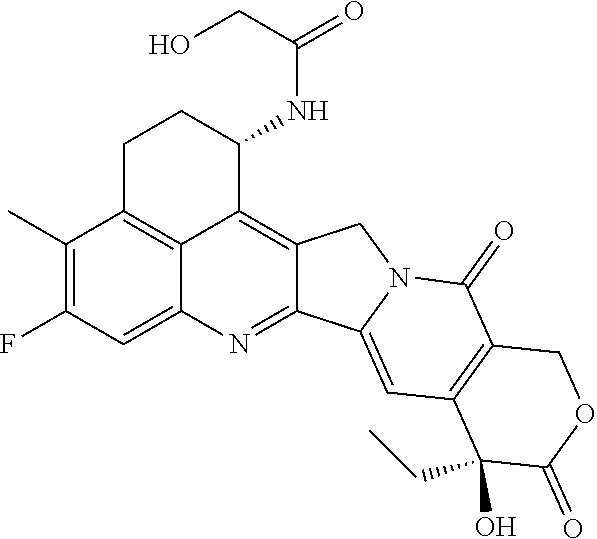 |
0.55 | C26H24FN3O6 | 493.48 | 100 | 494.2 [M + H] | NA |
| P3 |
 |
−0.60 | C29H30FN5O7•C2HF3O2 | 693.59 | 97 | 580.2 [M + H], 1159.2 [2M + H] | TFA | |
| P4 |
 |
0.02 | C32H34FN5O7 | 619.64 | 88 | 620.3 [M + H] | NA | |
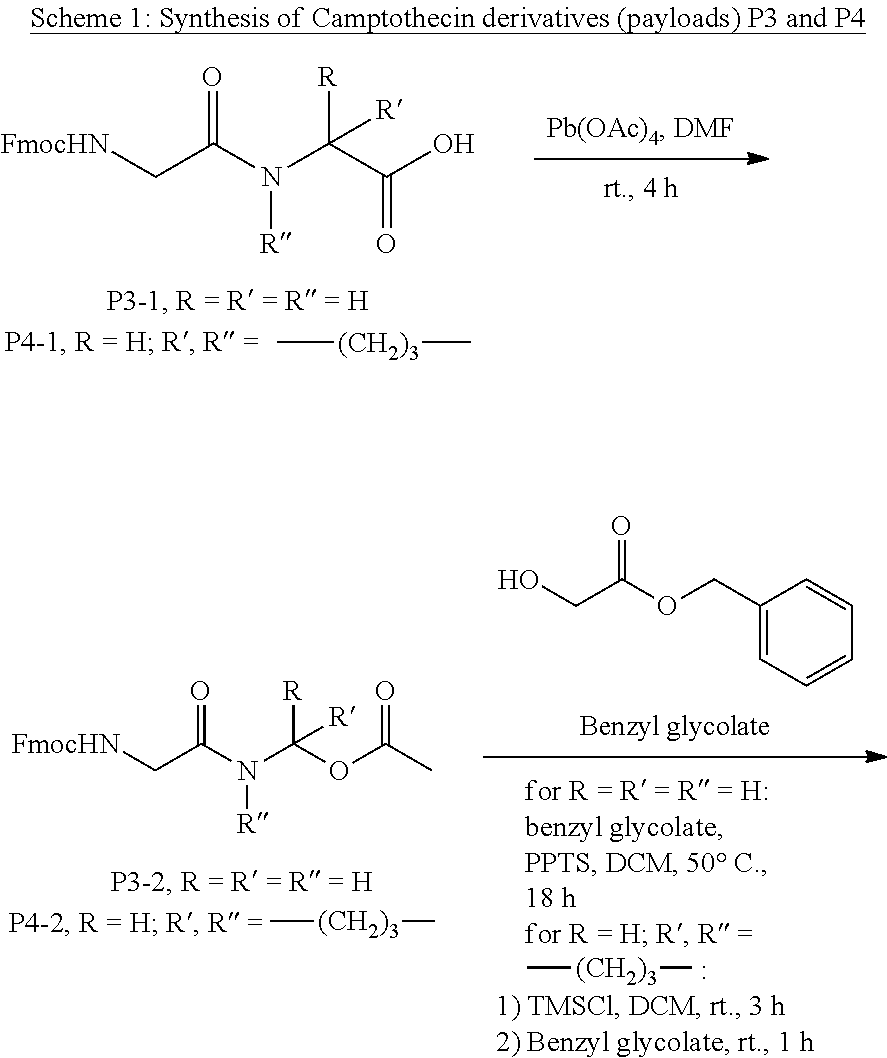
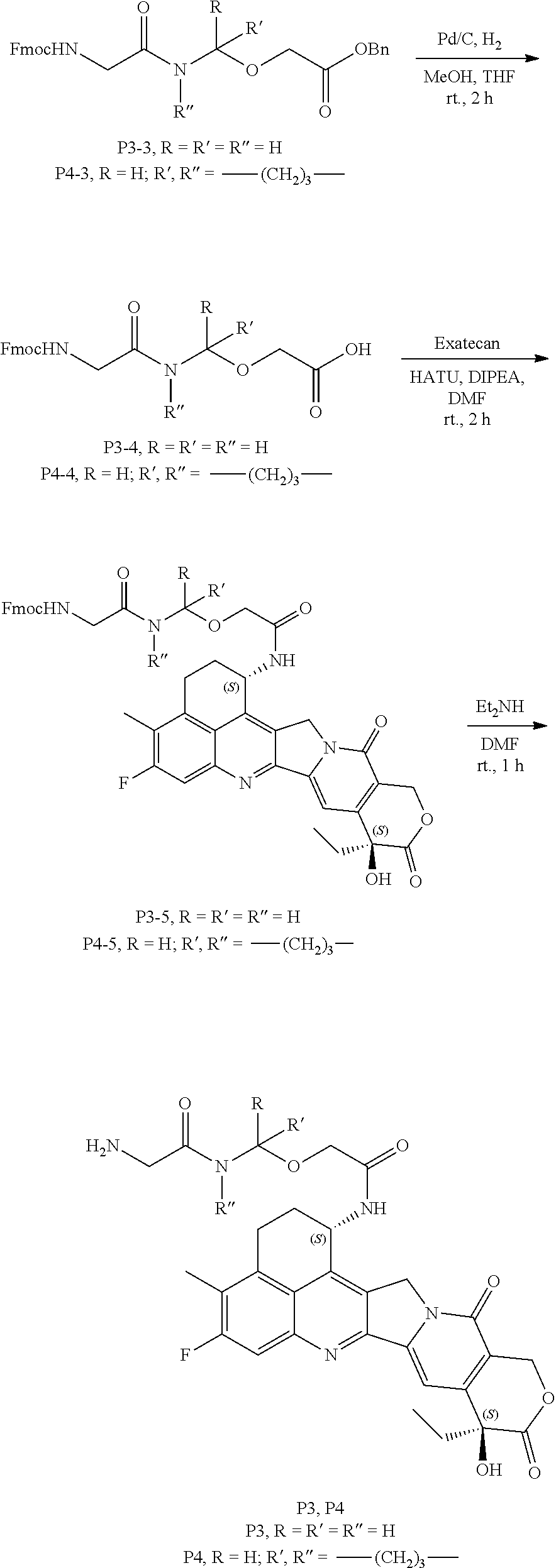
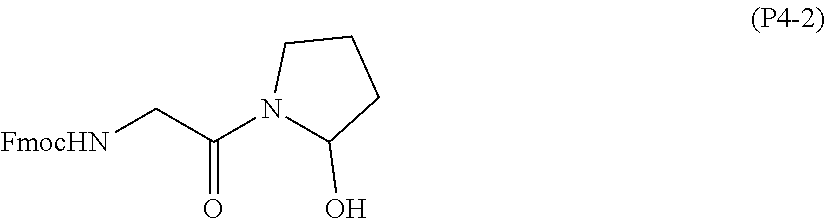
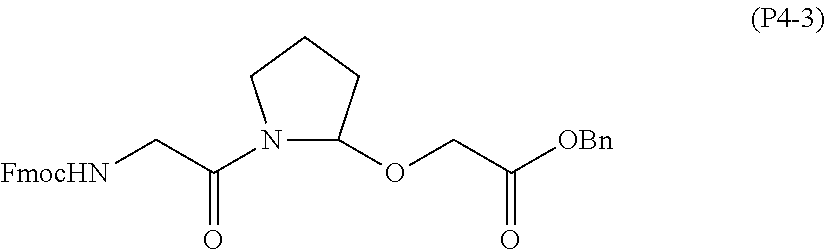


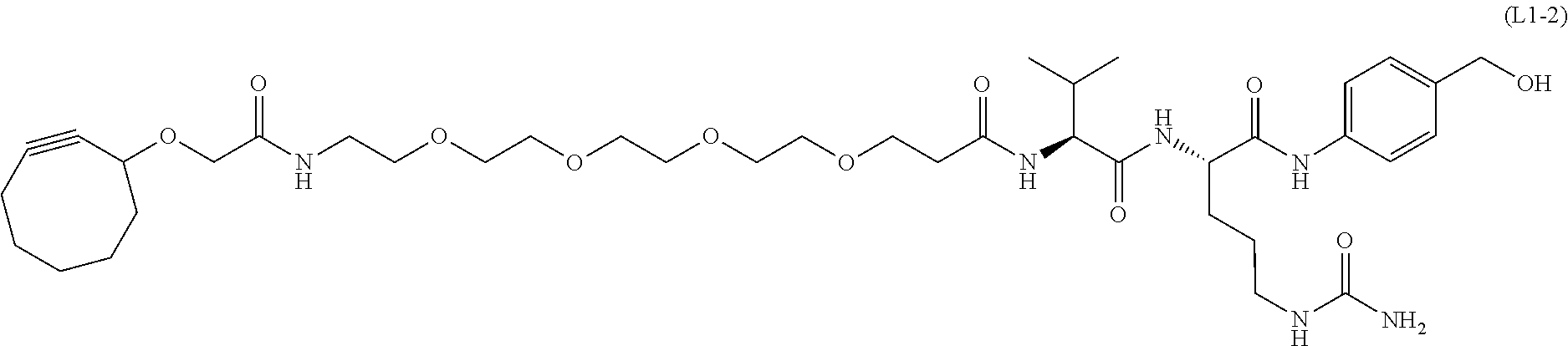
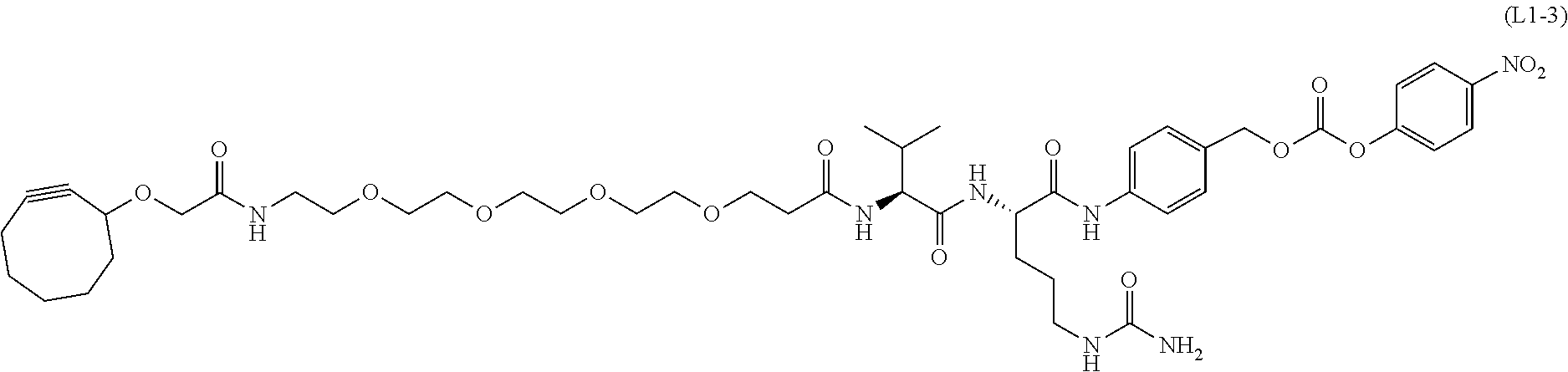


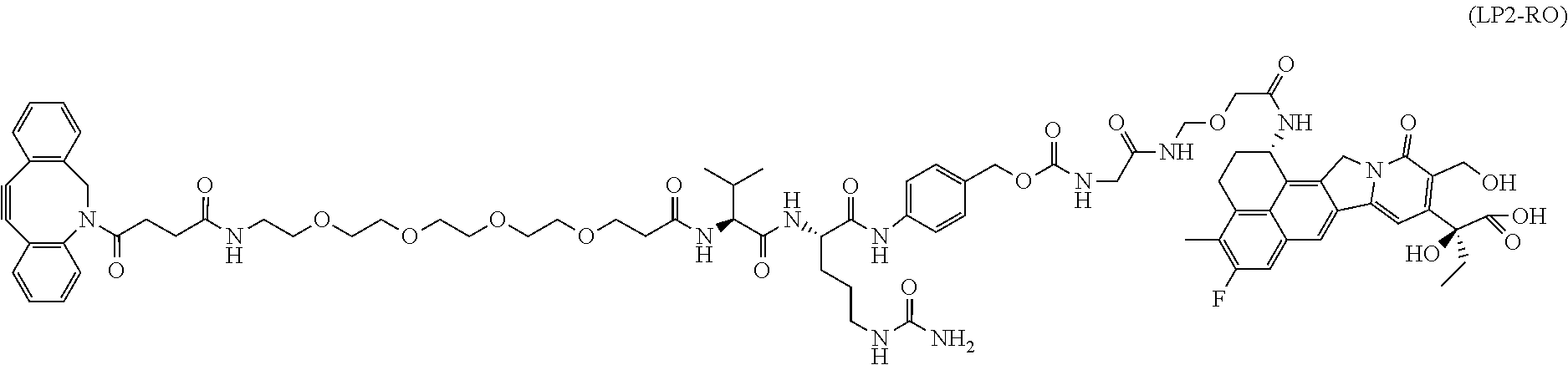
| TABLE 13 |
| Camptothecin Derivatives |
| Campto- thecin- LP1 |
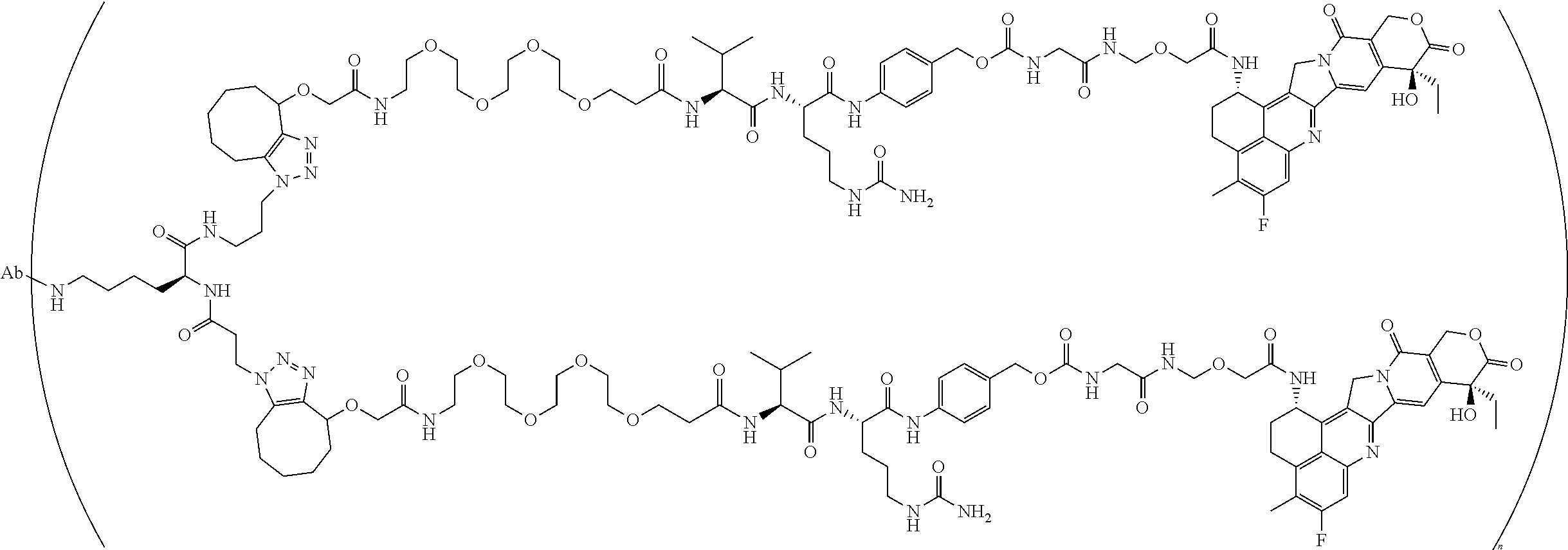 |
| Campto- thecin- LP2 |
 |
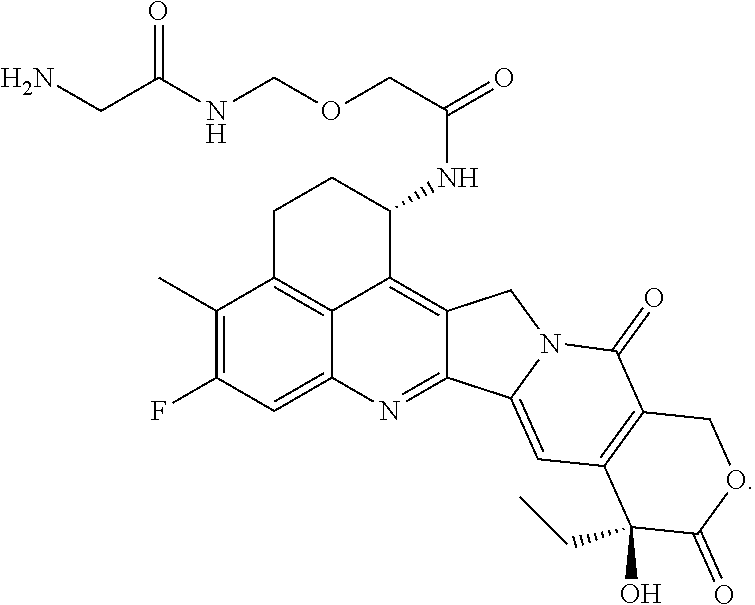
| TABLE 14 |
| Antibody-Camptothecin Derivative-Linker Payloads and Respective Dosages |
| Fc | Site of | |||
| Antibody-LP | modification | Conjugation | DAR | Dose |
| IC-Camptothecin-LP1 ADC | N297Q | Q295, Q297 | 7.9 | 10 mg/kg |
| mAb2-Camptothecin-LP1 ADC | N297Q | Q295, Q297 | 7.5 | 1, 3 or 10 mg/kg |
| mAb1-Camptothecin-LP1 ADC | N297Q | Q295, Q297 | 7.9 | 1, 3 or 10 mg/kg |
| IC-Camptothecin-LP2 ADC | N297Q | Q295, Q297 | 3.7 | 3 mg/kg |
| mAb1-Camptothecin-LP2 ADC | N297Q | Q295, Q297 | 3.7 | 0.3, 1 or 3 mg/kg |
| TABLE 15 |
| Inhibition of SNU-16 Xenograft Growth in BALB/c SCID Mice |
| Total | Tumor growth in | Average % | ||
| Payload | mm3 from start of | Decrease in | Average % | |
| Dose | treatment (mean ± | Tumor | Tumor | |
| Antibody (mg/kg) | (ug/kg) | SD) | Growth | Regression |
| Experiment 1 (DAR 8 ADCs) |
| mAb2 Camptothecin-LP1ADC (1 | 25 | −27.2 ± 89.2 | 103.3 | 11.0 |
| mg/kg) | ||||
| mAb2 Camptothecin-LP1 ADC | 76 | −254.4 ± 34.1 | 131.4 | 99.1 |
| (3 mg/kg) | ||||
| mAb2 Camptothecin-LP1 ADC | 254 | −259.0 ± 25.8 | 131.9 | 100 |
| (10 mg/kg) | ||||
| mAb1 Camptothecin-LP1 ADC | 26 | 4.7 ± 181.9 | 99.4 | 6.7 |
| (1 mg/kg) | ||||
| mAb1 Camptothecin-LP1 ADC | 79 | −259.8 ± 40.1 | 132.0 | 99.8 |
| (3 mg/kg) | ||||
| mAb1 Camptothecin-LP1 ADC | 264 | −260.8 ± 25.0 | 132.1 | 100 |
| (10 mg/kg) | ||||
| IC Camptothecin-LP1 ADC (10 | 264 | 579.5 ± 229.3 | 28.6 | −192.9 |
| mg/kg) | ||||
| Vehicle control | 811.5 ± 556.1 | −291.8 |
| Experiment 2 (DAR 4 ADCs) |
| mAb1 Camptothecin-LP2 ADC | 4 | 187.0 ± 117.1 | 72.5 | −74.8 |
| (0.3 mg/kg) | ||||
| mAb1 Camptothecin-LP2 ADC | 13 | -43.5 ± 91.6 | 106.4 | 16.3 |
| (1 mg/kg) | ||||
| mAb1 Camptothecin-LP2 ADC | 38 | -254.2 ± 30.2 | 137.4 | 99.7 |
| (3 mg/kg) | ||||
| IC Camptothecin-LP2 ADC (3 | 38 | 679.0 ± 253.1 | −259.1 | |
| mg/kg) | ||||
| TABLE 16 |
| Antibody-Camptothecin Derivative-Linker Payloads and |
| Respective Dosages |
| Fc | Site of | ||||
| Antibody-LP | modification | Conjugation | DAR | Dose | |
| IC | | NA | NA | 20 mg/kg | |
| mAb1 | | NA | NA | 20 mg/kg | |
| IC-Camptotecin-LP2 | N297Q | Q295, Q297 | 4.0 | 20 mg/kg | |
| ADC | |||||
| mAb1-Camptothecin- | N297Q | Q295, Q297 | 4.0 | 5, 10 or 20 | |
| LP2 ADC | mg/kg | ||||
| TABLE 17 |
| Inhibition of GA1224 PDX Growth in BALB/c Nude Mice |
| Tumor growth in | ||||
| mm3 from start of | Average % | |||
| Total Payload | treatment (mean ± | Decrease in | Average % Tumor | |
| Antibody (mg/kg) | Dose (ug/kg) | SD) | Tumor Growth | Regression |
| mAb1- | 68 | −124.9 ± 31.2 | 111.3 | 100 |
| Camptothecin-LP2 | ||||
| ADC (5 mg/kg) | ||||
| mAb1- | 136 | −124.9 ± 36.5 | 111.3 | 100 |
| Camptothecin-LP2 | ||||
| ADC (10 mg/kg) | ||||
| mAb1- | 272 | −125.1 ± 34.8 | 111.3 | 100 |
| Camptothecin-LP2 | ||||
| ADC (20 mg/kg) | ||||
| IC-Camptotecin- | 272 | 1499.7 ± 432.8 | −35.9 | −1265.4 |
| LP2 ADC (20 | ||||
| mg/kg) | ||||
| |
NA | 1627.8 ± 551.9 | −47.5 | −1300.5 |
| IC | NA | 1103.5 ± 289.7 | NA | −923.2 |
| TABLE 18 |
| Antibody-Camptothecin-Linker Payloads and Antibody-Maytansinoid- |
| Linker Payloads and Respective Dosages |
| Fc modi- | Site of | |||
| Antibody-LP | fication | Conjugation | DAR | Dose |
| mAb1-Camptothecin-LP2 | N297Q | Q295/Q297 | 3.7 | 10 mg/kg |
| ADC | ||||
| mAb1-Maytansinoid 1ALP | N297Q | Q295/Q297 | 3.0 | 10 mg/kg |
| ADC | ||||
| IC-Camptothecin-LP2 ADC | N297Q | Lys | 3.7 | 10 mg/kg |
| IC-Maytansinoid 1ALP ADC | N297Q | Lys | 3.0 | 10 mg/kg |
| IC | N297Q | NA | NA | 10 mg/kg |
| TABLE 19 |
| Inhibition of SNU-16 and/or SNU-5 xenograft growth in BALB/c SCID mice |
| Tumor growth in mm3 from | Average % | Average % | ||
| Total Payload | start of treatment (mean ± | Decrease in | Tumor | |
| Antibody (mg/kg) | Dose (ug/kg) | SD) | Tumor Growth | Regression |
| FIG. 11: SNU16 (FGFR2b positive cells) |
| mAb1-camptothecin-LP2 ADC | 130 | −158.4 ± 25.4 | 120.1 | 98.9 |
| (10 mg/kg) | ||||
| mAb1-Maytansinoid 1ALP ADC | 147 | −160.7 ± 28.4 | 120.4 | 100 |
| (10 mg/kg) | ||||
| IC-camptothecin-LP2 ADC (10 | 130 | 560.2 ± 302.0 | 29 | −363.5 |
| mg/kg) | ||||
| IC-Maytansinoid-1ALP (10 | 147 | 686.0 ± 174.5 | 13.1 | −472.3 |
| mg/kg) | ||||
| IC (10 mg/kg) | NA | 789.2 ± 413.5 | −493.8 |
| FIG. 12: SNU5 (FGFR2b negative cells) |
| mAb1-camptothecin-LP2 ADC | 130 | 220.6 ± 103.8 | 46.9 | −164 |
| (10 mg/kg) | ||||
| mAb1-Maytansinoid 1ALP ADC | 147 | 401.6 ± 74.4 | 3.4 | −311.8 |
| (10 mg/kg) | ||||
| IC-camptothecin-LP2 ADC (10 | 130 | 252.1 ± 159.6 | 39.4 | −195.6 |
| mg/kg) | ||||
| IC-Maytansinoid-1ALP (10 | 147 | 395.6 ± 225.0 | 4.8 | −272.7 |
| mg/kg) | ||||
| IC (10 mg/kg) | 415.7 ± 160.3 | −323.4 |
| FIG. 13: SNU16 and SNU5 Co-Inoculated (2:1 ratio) |
| mAb1-camptothecin-LP2 ADC | 130 | −140.6 ± 18.5 | 124.7 | 91.8 |
| (10 mg/kg) | ||||
| mAb1-Maytansinoid 1ALP ADC | 147 | 181.1 ± 57.0 | 68.2 | −118.3 |
| (10 mg/kg) | ||||
| IC-camptothecin-LP2 ADC (10 | 130 | 291.8 ± 131.3 | 48.7 | −189.8 |
| mg/kg) | ||||
| IC-Maytansinoid-1ALP (10 | 147 | 342.3 ± 101.3 | 39.9 | −222.9 |
| mg/kg) | ||||
| IC (10 mg/kg) | 569.4 ± 480.7 | −380.5 | ||
| SEQUENCE LISTING |
| SEQ | |||
| ID NO | | Description | |
| 1 | CAGGTGCAGCTGGTGGAGTCTGGGGGAGGCGTGGTCCAGCCTGGGAGGTC | mAb1 |
| CCTGAGACTCTCCTGTGCAGCGTCTGGATTCACCTTCAGTAGCTATGGCATG | Heavy Chain Variable | |
| CACTGGGTCCGCCAGGCTCCAGGCAAGGGACTGGAGTGGGTGGCAGTTAT | Region | |
| ATGGTATGATGGAAGTAATAAATACTATGCAGACTCCGTGAAGGGCCGATTC | ||
| ACCATCTCCAGAGACAATTCCAAGAACACGCTGTATCTGCAAATGAACAGCC | ||
| TGAGAGCCGAGGACACGGCTGTGTATTACTGTGCGAGAGAGGAAAGCAGC | ||
| GCGTCCGGGGTTGACTACTGGGGCCAGGGAACCCTGGTCACCGTCTCCTC | ||
| |
||
| 2 | QVQLVESGGGVVQPGRSLRLSCAASGFTFSSYGMHWVRQAPGKGLEWVAVI | mAb1 |
| WYDGSNKYYADSVKGRFTISRDNSKNTLYLQMNSLRAEDTAVYYCAREESSAS | Heavy Chain | |
| GVDYWGQGTLVTVSS | Region | |
| 3 | GGATTCACCTTCAGTAGCTATGGC | |
| HCDR1 | ||
| 4 | | mAb1 |
| HCDR1 | ||
| 5 | ATATGGTATGATGGAAGTAATAAA | mAb1, mAb2, and |
| | ||
| HCDR2 | ||
| 6 | IWYDGSNK | mAb1, mAb2, and |
| | ||
| HCDR2 | ||
| 7 | GCGAGAGAGGAAAGCAGCGCGTCCGGGGTTGACTAC | mAb1 |
| HCDR3 | ||
| 8 | AREESSASGVDY | mAb1 |
| HCDR3 | ||
| 9 | GAAATTGTGTTGACGCAGTCTCCAGGCACCCTGTCCTTGTCTCCAGGGGAA | mAb1 |
| AGAGCCACCCTCTCCTGCAGGGCCAGTCAGAGTGTTAGCACCAGGTACTTA | Light Chain Variable | |
| GCCTGGTACCAGCAGAAACGTGGCCAGGCTCCCAGGCTCCTCATCTATGGT | Region | |
| GCATCCAGCAGGGCCACTGGCATCCCAGACAGGTTCAGTGGCAGTGGGTC | ||
| TGGGACAGACTTCACTCTCACCATCAGCAGACTGGAGCCTGAAGATTTTGCA | ||
| GTGTATTACTGTCAGGAGTATGGTAGCTCATCGATCACCTTCGGCCAAGGGA | ||
| CACGACTGGAGATTAAA | ||
| 10 | EIVLTQSPGTLSLSPGERATLSCRASQSVSTRYLAWYQQKRGQAPRLLIYGASS | mAb1 |
| RATGIPDRFSGSGSGTDFTLTISRLEPEDFAVYYCQEYGSSSITFGQGTRLEIK | Light Chain Variable | |
| Region | ||
| 11 | CAGAGTGTTAGCACCAGGTAC | mAb1 |
| LCDR1 | ||
| 12 | QSVSTRY | mAb1 |
| LCDR1 | ||
| 13 | GGTGCATCC | mAb1 |
| LCDR2 | ||
| 14 | | mAb1 |
| LCDR2 | ||
| 15 | CAGGAGTATGGTAGCTCATCGATCACC | |
| LCDR3 | ||
| 16 | QEYGSSSIT | mAb1 |
| LCDR3 | ||
| 17 | CAGGTGCAGCTGGTGGAGTCTGGGGGAGGCGTGGTCCAGCCTGGGAGGTC | mAb1 |
| CCTGAGACTCTCCTGTGCAGCGTCTGGATTCACCTTCAGTAGCTATGGCATG | Heavy Chain | |
| CACTGGGTCCGCCAGGCTCCAGGCAAGGGACTGGAGTGGGTGGCAGTTAT | ||
| ATGGTATGATGGAAGTAATAAATACTATGCAGACTCCGTGAAGGGCCGATTC | ||
| ACCATCTCCAGAGACAATTCCAAGAACACGCTGTATCTGCAAATGAACAGCC | ||
| TGAGAGCCGAGGACACGGCTGTGTATTACTGTGCGAGAGAGGAAAGCAGC | ||
| GCGTCCGGGGTTGACTACTGGGGCCAGGGAACCCTGGTCACCGTCTCCTC | ||
| AGCCTCCACCAAGGGCCCATCGGTCTTCCCCCTGGCGCCCTGCTCCAGGA | ||
| GCACCTCCGAGAGCACAGCCGCCCTGGGCTGCCTGGTCAAGGACTACTTC | ||
| CCCGAACCGGTGACGGTGTCGTGGAACTCAGGCGCCCTGACCAGCGGCGT | ||
| GCACACCTTCCCGGCTGTCCTACAGTCCTCAGGACTCTACTCCCTCAGCAG | ||
| CGTGGTGACCGTGCCCTCCAGCAGCTTGGGCACGAAGACCTACACCTGCAA | ||
| CGTAGATCACAAGCCCAGCAACACCAAGGTGGACAAGAGAGTTGAGTCCAA | ||
| ATATGGTCCCCCATGCCCACCCTGCCCAGCACCTGAGTTCCTGGGGGGACC | ||
| ATCAGTCTTCCTGTTCCCCCCAAAACCCAAGGACACTCTCATGATCTCCCGG | ||
| ACCCCTGAGGTCACGTGCGTGGTGGTGGACGTGAGCCAGGAAGACCCCGA | ||
| GGTCCAGTTCAACTGGTACGTGGATGGCGTGGAGGTGCATAATGCCAAGAC | ||
| AAAGCCGCGGGAGGAGCAGTTCAACAGCACGTACCGTGTGGTCAGCGTCC | ||
| TCACCGTCCTGCACCAGGACTGGCTGAACGGCAAGGAGTACAAGTGCAAGG | ||
| TCTCCAACAAAGGCCTCCCGTCCTCCATCGAGAAAACCATCTCCAAAGCCAA | ||
| AGGGCAGCCCCGAGAGCCACAGGTGTACACCCTGCCCCCATCCCAGGAGG | ||
| AGATGACCAAGAACCAGGTCAGCCTGACCTGCCTGGTCAAAGGCTTCTACC | ||
| CCAGCGACATCGCCGTGGAGTGGGAGAGCAATGGGCAGCCGGAGAACAAC | ||
| TACAAGACCACGCCTCCCGTGCTGGACTCCGACGGCTCCTTCTTCCTCTACA | ||
| GCAGGCTCACCGTGGACAAGAGCAGGTGGCAGGAGGGGAATGTCTTCTCA | ||
| TGCTCCGTGATGCATGAGGCTCTGCACAACCACTACACACAGAAGTCCCTCT | ||
| CCCTGTCTCTGGGTAAATGA | ||
| 18 | QVQLVESGGGVVQPGRSLRLSCAASGFTFSSYGMHWVRQAPGKGLEWVAVI | mAb1 |
| WYDGSNKYYADSVKGRFTISRDNSKNTLYLQMNSLRAEDTAVYYCAREESSAS | Heavy Chain | |
| GVDYWGQGTLVTVSSASTKGPSVFPLAPCSRSTSESTAALGCLVKDYFPEPVT | ||
| VSWNSGALTSGVHTFPAVLQSSGLYSLSSVVTVPSSSLGTKTYTCNVDHKPSN | ||
| TKVDKRVESKYGPPCPPCPAPEFLGGPSVFLFPPKPKDTLMISRTPEVTCVVVD | ||
| VSQEDPEVQFNWYVDGVEVHNAKTKPREEQFNSTYRVVSVLTVLHQDWLNGK | ||
| EYKCKVSNKGLPSSIEKTISKAKGQPREPQVYTLPPSQEEMTKNQVSLTCLVKG | ||
| FYPSDIAVEWESNGQPENNYKTTPPVLDSDGSFFLYSRLTVDKSRWQEGNVFS | ||
| CSVMHEALHNHYTQKSLSLSLGK* | ||
| 19 | GAAATTGTGTTGACGCAGTCTCCAGGCACCCTGTCCTTGTCTCCAGGGGAA | mAb1 |
| AGAGCCACCCTCTCCTGCAGGGCCAGTCAGAGTGTTAGCACCAGGTACTTA | Light Chain | |
| GCCTGGTACCAGCAGAAACGTGGCCAGGCTCCCAGGCTCCTCATCTATGGT | ||
| GCATCCAGCAGGGCCACTGGCATCCCAGACAGGTTCAGTGGCAGTGGGTC | ||
| TGGGACAGACTTCACTCTCACCATCAGCAGACTGGAGCCTGAAGATTTTGCA | ||
| GTGTATTACTGTCAGGAGTATGGTAGCTCATCGATCACCTTCGGCCAAGGGA | ||
| CACGACTGGAGATTAAACGAACTGTGGCTGCACCATCTGTCTTCATCTTCCC | ||
| GCCATCTGATGAGCAGTTGAAATCTGGAACTGCCTCTGTTGTGTGCCTGCTG | ||
| AATAACTTCTATCCCAGAGAGGCCAAAGTACAGTGGAAGGTGGATAACGCC | ||
| CTCCAATCGGGTAACTCCCAGGAGAGTGTCACAGAGCAGGACAGCAAGGAC | ||
| AGCACCTACAGCCTCAGCAGCACCCTGACGCTGAGCAAAGCAGACTACGAG | ||
| AAACACAAAGTCTACGCCTGCGAAGTCACCCATCAGGGCCTGAGCTCGCCC | ||
| GTCACAAAGAGCTTCAACAGGGGAGAGTGTTAG | ||
| 20 | EIVLTQSPGTLSLSPGERATLSCRASQSVSTRYLAWYQQKRGQAPRLLIYGASS | mAb1 |
| RATGIPDRFSGSGSGTDFTLTISRLEPEDFAVYYCQEYGSSSITFGQGTRLEIKR | Light Chain | |
| TVAAPSVFIFPPSDEQLKSGTASVVCLLNNFYPREAKVQWKVDNALQSGNSQE | ||
| SVTEQDSKDSTYSLSSTLTLSKADYEKHKVYACEVTHQGLSSPVTKSFNRGEC* | ||
| 21 | CAGGTGCAGCTGGTGGAGTCTGGGGGAGGCGTGGTCCAGCCTGGGAAGTC | mAb2 |
| CCTGAGACTCTCCTGTGCAGCGTCTGGATTCACCTTCAGTAACTATGGCATG | Heavy Chain Variable | |
| CACTGGGTCCGCCAAACTCCAGTCAAGGGACTGGAGTGGGTGACACTTATA | Region | |
| TGGTATGATGGAAGTAATAAATACTATACAGACTCCGTGAAGGGCCGATTCA | ||
| CCATCTCCAGAGACAATTCCAAGAACACGCTGTATCTGCAAATGAACAGCCT | ||
| GAGATCCGAGGACACGGCTGTGTATTACTGTGCGAGAGAGGGGAACTGGAA | ||
| CTACGGGCATGCTTTTGATATCTGGGGCCAAGGGACAATGGTCACCGTCTC | ||
| TTCA | ||
| 22 | QVQLVESGGGVVQPGKSLRLSCAASGFTFSNYGMHWVRQTPVKGLEWVTLIW | mAb2 |
| YDGSNKYYTDSVKGRFTISRDNSKNTLYLQMNSLRSEDTAVYYCAREGNWNYG | Heavy Chain Variable | |
| HAFDIWGQGTMVTVSS | Region | |
| 23 | GGATTCACCTTCAGTAACTATGGC | mAb2 and mAb3 |
| HCDR1 | ||
| 24 | GFTFSNYG | mAb2 and |
| HCDR1 | ||
| 25 | GCGAGAGAGGGGAACTGGAACTACGGGCATGCTTTTGATATC | mAb2 |
| HCDR3 | ||
| 26 | AREGNWNYGHAFDI | mAb2 |
| HCDR3 | ||
| 27 | GACATCCAGATGACCCAGTCTCCTTCCACCCTGTCTGCATCTGTAGGAGACA | mAb2 |
| GAGTCACCATCACTTGCCGGGCCAGTCAGAATATTGGTAACTGGTTGGCCT | Light Chain Variable | |
| GGTATCAGCAGAAACCAGGGAAAGCCCCTAACCTCCTGATTTATAAGGCGT | Region | |
| CTACTTTAGAAAGTGGGGTCCCATCAAGGTTCAGCGGCAGTGGATCTGGGA | ||
| CAGAATTCACTCTCACCATCAGCAGCCTGCAGCCTGATGATTTTGCAACTTA | ||
| TAACTGCCAACAGTATAATAGTTATTCTCCCACTTTTGGCCAGGGGACCAAG | ||
| CTGGAGATCAAA | ||
| 28 | DIQMTQSPSTLSASVGDRVTITCRASQNIGNWLAWYQQKPGKAPNLLIYKASTL | mAb2 |
| ESGVPSRFSGSGSGTEFTLTISSLQPDDFATYNCQQYNSYSPTFGQGTKLEIK | Light Chain Variable | |
| Region | ||
| 29 | CAGAATATTGGTAACTGG | |
| LCDR1 | ||
| 30 | QNIGNW | mAb2 |
| LCDR1 | ||
| 31 | AAGGCGTCT | mAb2 and mAb3 |
| LCDR2 | ||
| 32 | KAS | mAb2 and mAb3 |
| LCDR2 | ||
| 33 | CAACAGTATAATAGTTATTCTCCCACT | mAb2 |
| LCDR3 | ||
| 34 | QQYNSYSPT | mAb2 and |
| LCDR3 | ||
| 35 | CAGGTGCAGCTGGTGGAGTCTGGGGGAGGCGTGGTCCAGCCTGGGAAGTC | mAb2 |
| CCTGAGACTCTCCTGTGCAGCGTCTGGATTCACCTTCAGTAACTATGGCATG | Heavy Chain | |
| CACTGGGTCCGCCAAACTCCAGTCAAGGGACTGGAGTGGGTGACACTTATA | ||
| TGGTATGATGGAAGTAATAAATACTATACAGACTCCGTGAAGGGCCGATTCA | ||
| CCATCTCCAGAGACAATTCCAAGAACACGCTGTATCTGCAAATGAACAGCCT | ||
| GAGATCCGAGGACACGGCTGTGTATTACTGTGCGAGAGAGGGGAACTGGAA | ||
| CTACGGGCATGCTTTTGATATCTGGGGCCAAGGGACAATGGTCACCGTCTC | ||
| TTCAGCCTCCACCAAGGGCCCATCGGTCTTCCCCCTGGCGCCCTGCTCCAG | ||
| GAGCACCTCCGAGAGCACAGCCGCCCTGGGCTGCCTGGTCAAGGACTACT | ||
| TCCCCGAACCGGTGACGGTGTCGTGGAACTCAGGCGCCCTGACCAGCGGC | ||
| GTGCACACCTTCCCGGCTGTCCTACAGTCCTCAGGACTCTACTCCCTCAGCA | ||
| GCGTGGTGACCGTGCCCTCCAGCAGCTTGGGCACGAAGACCTACACCTGC | ||
| AACGTAGATCACAAGCCCAGCAACACCAAGGTGGACAAGAGAGTTGAGTCC | ||
| AAATATGGTCCCCCATGCCCACCCTGCCCAGCACCTGAGTTCCTGGGGGGA | ||
| CCATCAGTCTTCCTGTTCCCCCCAAAACCCAAGGACACTCTCATGATCTCCC | ||
| GGACCCCTGAGGTCACGTGCGTGGTGGTGGACGTGAGCCAGGAAGACCCC | ||
| GAGGTCCAGTTCAACTGGTACGTGGATGGCGTGGAGGTGCATAATGCCAAG | ||
| ACAAAGCCGCGGGAGGAGCAGTTCAACAGCACGTACCGTGTGGTCAGCGT | ||
| CCTCACCGTCCTGCACCAGGACTGGCTGAACGGCAAGGAGTACAAGTGCAA | ||
| GGTCTCCAACAAAGGCCTCCCGTCCTCCATCGAGAAAACCATCTCCAAAGC | ||
| CAAAGGGCAGCCCCGAGAGCCACAGGTGTACACCCTGCCCCCATCCCAGG | ||
| AGGAGATGACCAAGAACCAGGTCAGCCTGACCTGCCTGGTCAAAGGCTTCT | ||
| ACCCCAGCGACATCGCCGTGGAGTGGGAGAGCAATGGGCAGCCGGAGAAC | ||
| AACTACAAGACCACGCCTCCCGTGCTGGACTCCGACGGCTCCTTCTTCCTCT | ||
| ACAGCAGGCTCACCGTGGACAAGAGCAGGTGGCAGGAGGGGAATGTCTTC | ||
| TCATGCTCCGTGATGCATGAGGCTCTGCACAACCACTACACACAGAAGTCC | ||
| CTCTCCCTGTCTCTGGGTAAATGA | ||
| 36 | QVQLVESGGGVVQPGKSLRLSCAASGFTFSNYGMHWVRQTPVKGLEWVTLIW | mAb2 |
| YDGSNKYYTDSVKGRFTISRDNSKNTLYLQMNSLRSEDTAVYYCAREGNWNYG | Heavy Chain | |
| HAFDIWGQGTMVTVSSASTKGPSVFPLAPCSRSTSESTAALGCLVKDYFPEPVT | ||
| VSWNSGALTSGVHTFPAVLQSSGLYSLSSVVTVPSSSLGTKTYTCNVDHKPSN | ||
| TKVDKRVESKYGPPCPPCPAPEFLGGPSVFLFPPKPKDTLMISRTPEVTCVVVD | ||
| VSQEDPEVQFNWYVDGVEVHNAKTKPREEQFNSTYRVVSVLTVLHQDWLNGK | ||
| EYKCKVSNKGLPSSIEKTISKAKGQPREPQVYTLPPSQEEMTKNQVSLTCLVKG | ||
| FYPSDIAVEWESNGQPENNYKTTPPVLDSDGSFFLYSRLTVDKSRWQEGNVFS | ||
| CSVMHEALHNHYTQKSLSLSLGK* | ||
| 37 | GACATCCAGATGACCCAGTCTCCTTCCACCCTGTCTGCATCTGTAGGAGACA | mAb2 |
| GAGTCACCATCACTTGCCGGGCCAGTCAGAATATTGGTAACTGGTTGGCCT | Light Chain | |
| GGTATCAGCAGAAACCAGGGAAAGCCCCTAACCTCCTGATTTATAAGGCGT | ||
| CTACTTTAGAAAGTGGGGTCCCATCAAGGTTCAGCGGCAGTGGATCTGGGA | ||
| CAGAATTCACTCTCACCATCAGCAGCCTGCAGCCTGATGATTTTGCAACTTA | ||
| TAACTGCCAACAGTATAATAGTTATTCTCCCACTTTTGGCCAGGGGACCAAG | ||
| CTGGAGATCAAACGAACTGTGGCTGCACCATCTGTCTTCATCTTCCCGCCAT | ||
| CTGATGAGCAGTTGAAATCTGGAACTGCCTCTGTTGTGTGCCTGCTGAATAA | ||
| CTTCTATCCCAGAGAGGCCAAAGTACAGTGGAAGGTGGATAACGCCCTCCA | ||
| ATCGGGTAACTCCCAGGAGAGTGTCACAGAGCAGGACAGCAAGGACAGCA | ||
| CCTACAGCCTCAGCAGCACCCTGACGCTGAGCAAAGCAGACTACGAGAAAC | ||
| ACAAAGTCTACGCCTGCGAAGTCACCCATCAGGGCCTGAGCTCGCCCGTCA | ||
| CAAAGAGCTTCAACAGGGGAGAGTGTTAG | ||
| 38 | DIQMTQSPSTLSASVGDRVTITCRASQNIGNWLAWYQQKPGKAPNLLIYKASTL | mAb2 |
| ESGVPSRFSGSGSGTEFTLTISSLQPDDFATYNCQQYNSYSPTFGQGTKLEIKR | Light Chain | |
| TVAAPSVFIFPPSDEQLKSGTASVVCLLNNFYPREAKVQWKVDNALQSGNSQE | ||
| SVTEQDSKDSTYSLSSTLTLSKADYEKHKVYACEVTHQGLSSPVTKSFNRGEC* | ||
| 39 | CAGGTGCAGCTGGTGGAGTCTGGGGGAGGCGTGGTCCAGCCTGGGAGGTC | mAb3 |
| CCTGAGACTCTCCTGTGCAGCGTCTGGATTCACCTTCAGTAACTATGGCATG | Heavy Chain Variable | |
| CACTGGGTCCGCCAGGCTCCAGGCAAGGGGCTGGAGTGGGTGGCACTTAT | Region | |
| ATGGTATGATGGAAGTAATAAATACTATGCAGACTCCGTGAAGGGCCGATTC | ||
| ACCATCTCCAGAGACAATTCCAAGAACACGCTTTTTCTGCAAATGAACAGCC | ||
| TGAGAGCCGATGACACGGCTGTGTATTACTGTGCGCGAGAGATGGAGAGCA | ||
| GCTCGGGCTTCGATCTCTGGGGCCGTGGCACCCTGGTCACTGTCTCCTCA | ||
| 40 | QVQLVESGGGVVQPGRSLRLSCAASGFTFSNYGMHWVRQAPGKGLEWVALI | mAb3 |
| WYDGSNKYYADSVKGRFTISRDNSKNTLFLQMNSLRADDTAVYYCAREMESSS | Heavy Chain Variable | |
| GFDLWGRGTLVTVSS | Region | |
| 41 | GCGCGAGAGATGGAGAGCAGCTCGGGCTTCGATCTC | mAb3 |
| HCDR3 | ||
| 42 | AREMESSSGFDL | mAb3 |
| HCDR3 | ||
| 43 | GACATCCAGATGACCCAGTCTCCTTCCACCCTGTCTGCATCTGTAGGAGACA | mAb3 |
| GAGTCACCATCACTTGCCGGGCCAGTCAGAGTATTAGTAGGTGGTTGGCCT | Light Chain Variable | |
| GGTATCAGCAGAAACCAGGGAAAGCCCCTAAGCTCCTGATCTATAAGGCGT | Region | |
| CTAGTTTACAAAGTGGGGTCCCTTCAAGGTTCAGCGGCAGTGGATCTGGGA | ||
| CAGAATTCACTCTCACCATCAGCAGCCTGCAGCCTGATGATTTTGCAACTTA | ||
| TTACTGCCAACAGTATAATAGTTATTCTCCGACGTTCGGCCAAGGGACCAAG | ||
| GTGGAAATCAAA | ||
| 44 | DIQMTQSPSTLSASVGDRVTITCRASQSISRWLAWYQQKPGKAPKLLIYKASSL | mAb3 |
| QSGVPSRFSGSGSGTEFTLTISSLQPDDFATYYCQQYNSYSPTFGQGTKVEIK | Light Chain Variable | |
| Region | ||
| 45 | CAGAGTATTAGTAGGTGG | mAb3 |
| LCDR1 | ||
| 46 | QSISRW | mAb3 |
| LCDR1 | ||
| 47 | CAACAGTATAATAGTTATTCTCCGACG | mAb3 |
| LCDR3 | ||
| 48 | CAGGTGCAGCTGGTGGAGTCTGGGGGAGGCGTGGTCCAGCCTGGGAGGTC | mAb3 |
| CCTGAGACTCTCCTGTGCAGCGTCTGGATTCACCTTCAGTAACTATGGCATG | Heavy Chain | |
| CACTGGGTCCGCCAGGCTCCAGGCAAGGGGCTGGAGTGGGTGGCACTTAT | ||
| ATGGTATGATGGAAGTAATAAATACTATGCAGACTCCGTGAAGGGCCGATTC | ||
| ACCATCTCCAGAGACAATTCCAAGAACACGCTTTTTCTGCAAATGAACAGCC | ||
| TGAGAGCCGATGACACGGCTGTGTATTACTGTGCGCGAGAGATGGAGAGCA | ||
| GCTCGGGCTTCGATCTCTGGGGCCGTGGCACCCTGGTCACTGTCTCCTCAG | ||
| CCTCCACCAAGGGCCCATCGGTCTTCCCCCTGGCGCCCTGCTCCAGGAGCA | ||
| CCTCCGAGAGCACAGCCGCCCTGGGCTGCCTGGTCAAGGACTACTTCCCC | ||
| GAACCGGTGACGGTGTCGTGGAACTCAGGCGCCCTGACCAGCGGCGTGCA | ||
| CACCTTCCCGGCTGTCCTACAGTCCTCAGGACTCTACTCCCTCAGCAGCGT | ||
| GGTGACCGTGCCCTCCAGCAGCTTGGGCACGAAGACCTACACCTGCAACGT | ||
| AGATCACAAGCCCAGCAACACCAAGGTGGACAAGAGAGTTGAGTCCAAATA | ||
| TGGTCCCCCATGCCCACCCTGCCCAGCACCTGAGTTCCTGGGGGGACCATC | ||
| AGTCTTCCTGTTCCCCCCAAAACCCAAGGACACTCTCATGATCTCCCGGACC | ||
| CCTGAGGTCACGTGCGTGGTGGTGGACGTGAGCCAGGAAGACCCCGAGGT | ||
| CCAGTTCAACTGGTACGTGGATGGCGTGGAGGTGCATAATGCCAAGACAAA | ||
| GCCGCGGGAGGAGCAGTTCAACAGCACGTACCGTGTGGTCAGCGTCCTCA | ||
| CCGTCCTGCACCAGGACTGGCTGAACGGCAAGGAGTACAAGTGCAAGGTCT | ||
| CCAACAAAGGCCTCCCGTCCTCCATCGAGAAAACCATCTCCAAAGCCAAAG | ||
| GGCAGCCCCGAGAGCCACAGGTGTACACCCTGCCCCCATCCCAGGAGGAG | ||
| ATGACCAAGAACCAGGTCAGCCTGACCTGCCTGGTCAAAGGCTTCTACCCC | ||
| AGCGACATCGCCGTGGAGTGGGAGAGCAATGGGCAGCCGGAGAACAACTA | ||
| CAAGACCACGCCTCCCGTGCTGGACTCCGACGGCTCCTTCTTCCTCTACAG | ||
| CAGGCTCACCGTGGACAAGAGCAGGTGGCAGGAGGGGAATGTCTTCTCAT | ||
| GCTCCGTGATGCATGAGGCTCTGCACAACCACTACACACAGAAGTCCCTCT | ||
| CCCTGTCTCTGGGTAAATGA | ||
| 49 | QVQLVESGGGVVQPGRSLRLSCAASGFTFSNYGMHWVRQAPGKGLEWVALI | mAb3 |
| WYDGSNKYYADSVKGRFTISRDNSKNTLFLQMNSLRADDTAVYYCAREMESSS | Heavy Chain | |
| GFDLWGRGTLVTVSSASTKGPSVFPLAPCSRSTSESTAALGCLVKDYFPEPVTV | ||
| SWNSGALTSGVHTFPAVLQSSGLYSLSSVVTVPSSSLGTKTYTCNVDHKPSNT | ||
| KVDKRVESKYGPPCPPCPAPEFLGGPSVFLFPPKPKDTLMISRTPEVTCVVVDV | ||
| SQEDPEVQFNWYVDGVEVHNAKTKPREEQFNSTYRVVSVLTVLHQDWLNGKE | ||
| YKCKVSNKGLPSSIEKTISKAKGQPREPQVYTLPPSQEEMTKNQVSLTCLVKGF | ||
| YPSDIAVEWESNGQPENNYKTTPPVLDSDGSFFLYSRLTVDKSRWQEGNVFSC | ||
| SVMHEALHNHYTQKSLSLSLGK* | ||
| 50 | GACATCCAGATGACCCAGTCTCCTTCCACCCTGTCTGCATCTGTAGGAGACA | mAb3 |
| GAGTCACCATCACTTGCCGGGCCAGTCAGAGTATTAGTAGGTGGTTGGCCT | Light Chain | |
| GGTATCAGCAGAAACCAGGGAAAGCCCCTAAGCTCCTGATCTATAAGGCGT | ||
| CTAGTTTACAAAGTGGGGTCCCTTCAAGGTTCAGCGGCAGTGGATCTGGGA | ||
| CAGAATTCACTCTCACCATCAGCAGCCTGCAGCCTGATGATTTTGCAACTTA | ||
| TTACTGCCAACAGTATAATAGTTATTCTCCGACGTTCGGCCAAGGGACCAAG | ||
| GTGGAAATCAAACGAACTGTGGCTGCACCATCTGTCTTCATCTTCCCGCCAT | ||
| CTGATGAGCAGTTGAAATCTGGAACTGCCTCTGTTGTGTGCCTGCTGAATAA | ||
| CTTCTATCCCAGAGAGGCCAAAGTACAGTGGAAGGTGGATAACGCCCTCCA | ||
| ATCGGGTAACTCCCAGGAGAGTGTCACAGAGCAGGACAGCAAGGACAGCA | ||
| CCTACAGCCTCAGCAGCACCCTGACGCTGAGCAAAGCAGACTACGAGAAAC | ||
| ACAAAGTCTACGCCTGCGAAGTCACCCATCAGGGCCTGAGCTCGCCCGTCA | ||
| CAAAGAGCTTCAACAGGGGAGAGTGTTAG | ||
| 51 | DIQMTQSPSTLSASVGDRVTITCRASQSISRWLAWYQQKPGKAPKLLIYKASSL | mAb3 |
| QSGVPSRFSGSGSGTEFTLTISSLQPDDFATYYCQQYNSYSPTFGQGTKVEIKR | Light Chain | |
| TVAAPSVFIFPPSDEQLKSGTASVVCLLNNFYPREAKVQWKVDNALQSGNSQE | ||
| SVTEQDSKDSTYSLSSTLTLSKADYEKHKVYACEVTHQGLSSPVTKSFNRGEC* | ||
| 52 | QVQLVESGGGVVQPGRSLRLSCAASGFTFSSYGMHWVRQAPGKGLEWVAVI | mAb1 |
| WYDGSNKYYADSVKGRFTISRDNSKNTLYLQMNSLRAEDTAVYYCAREESSAS | Heavy Chain with | |
| GVDYWGQGTLVTVSSASTKGPSVFPLAPCSRSTSESTAALGCLVKDYFPEPVT | N297Q Modification | |
| VSWNSGALTSGVHTFPAVLQSSGLYSLSSVVTVPSSSLGTKTYTCNVDHKPSN | ||
| TKVDKRVESKYGPPCPPCPAPEFLGGPSVFLFPPKPKDTLMISRTPEVTCVVVD | ||
| VSQEDPEVQFNWYVDGVEVHNAKTKPREEQFQSTYRVVSVLTVLHQDWLNGK | ||
| EYKCKVSNKGLPSSIEKTISKAKGQPREPQVYTLPPSQEEMTKNQVSLTCLVKG | ||
| FYPSDIAVEWESNGQPENNYKTTPPVLDSDGSFFLYSRLTVDKSRWQEGNVFS | ||
| CSVMHEALHNHYTQKSLSLSLGK* | ||
| 53 | QVQLVESGGGVVQPGKSLRLSCAASGFTFSNYGMHWVRQTPVKGLEWVTLIW | mAb2 |
| YDGSNKYYTDSVKGRFTISRDNSKNTLYLQMNSLRSEDTAVYYCAREGNWNYG | Heavy Chain with | |
| HAFDIWGQGTMVTVSSASTKGPSVFPLAPCSRSTSESTAALGCLVKDYFPEPVT | N297Q Modification | |
| VSWNSGALTSGVHTFPAVLQSSGLYSLSSVVTVPSSSLGTKTYTCNVDHKPSN | ||
| TKVDKRVESKYGPPCPPCPAPEFLGGPSVFLFPPKPKDTLMISRTPEVTCVVVD | ||
| VSQEDPEVQFNWYVDGVEVHNAKTKPREEQFQSTYRVVSVLTVLHQDWLNGK | ||
| EYKCKVSNKGLPSSIEKTISKAKGQPREPQVYTLPPSQEEMTKNQVSLTCLVKG | ||
| FYPSDIAVEWESNGQPENNYKTTPPVLDSDGSFFLYSRLTVDKSRWQEGNVFS | ||
| CSVMHEALHNHYTQKSLSLSLGK* | ||
| 54 | QVQLVESGGGVVQPGRSLRLSCAASGFTFSNYGMHWVRQAPGKGLEWVALI | mAb3 |
| WYDGSNKYYADSVKGRFTISRDNSKNTLFLQMNSLRADDTAVYYCAREMESSS | Heavy Chain with | |
| GFDLWGRGTLVTVSSASTKGPSVFPLAPCSRSTSESTAALGCLVKDYFPEPVTV | N297Q Modification | |
| SWNSGALTSGVHTFPAVLQSSGLYSLSSVVTVPSSSLGTKTYTCNVDHKPSNT | ||
| KVDKRVESKYGPPCPPCPAPEFLGGPSVFLFPPKPKDTLMISRTPEVTCVVVDV | ||
| SQEDPEVQFNWYVDGVEVHNAKTKPREEQFQSTYRVVSVLTVLHQDWLNGKE | ||
| YKCKVSNKGLPSSIEKTISKAKGQPREPQVYTLPPSQEEMTKNQVSLTCLVKGF | ||
| YPSDIAVEWESNGQPENNYKTTPPVLDSDGSFFLYSRLTVDKSRWQEGNVFSC | ||
| SVMHEALHNHYTQKSLSLSLGK* | ||
| 55 | MVSWGRFICLVVVTMATLSLARPSFSLVEDTTLEPEEPPTKYQISQPEVYVAAP | FGFR2b NCBI |
| GESLEVRCLLKDAAVISWTKDGVHLGPNNRTVLIGEYLQIKGATPRDSGLYACTA | accession No. | |
| SRTVDSETWYFMVNVTDAISSGDDEDDTDGAEDFVSENSNNKRAPYWTNTEK | NP_075259.4 | |
| MEKRLHAVPAANTVKFRCPAGGNPMPTMRWLKNGKEFKQEHRIGGYKVRNQH | ||
| WSLIMESVVPSDKGNYTCVVENEYGSINHTYHLDVVERSPHRPILQAGLPANAS | ||
| TVVGGDVEFVCKVYSDAQPHIQWIKHVEKNGSKYGPDGLPYLKVLKHSGINSSN | ||
| AEVLALFNVTEADAGEYICKVSNYIGQANQSAWLTVLPKQQAPGREKEITASPD | ||
| YLEIAIYCIGVFLIACMVVTVILCRMKNTTKKPDFSSQPAVHKLTKRIPLRRQVTVS | ||
| AESSSSMNSNTPLVRITTRLSSTADTPMLAGVSEYELPEDPKWEFPRDKLTLGK | ||
| PLGEGCFGQVVMAEAVGIDKDKPKEAVTVAVKMLKDDATEKDLSDLVSEMEMM | ||
| KMIGKHKNIINLLGACTQDGPLYVIVEYASKGNLREYLRARRPPGMEYSYDINRV | ||
| PEEQMTFKDLVSCTYQLARGMEYLASQKCIHRDLAARNVLVTENNVMKIADFGL | ||
| ARDINNIDYYKKTTNGRLPVKWMAPEALFDRVYTHQSDVWSFGVLMWEIFTLG | ||
| GSPYPGIPVEELFKLLKEGHRMDKPANCTNELYMMMRDCWHAVPSQRPTFKQ | ||
| LVEDLDRILTLTTNEEYLDLSQPLEQYSPSYPDTRSSCSSGDDSVFSPDPMPYE | ||
| PCLPQYPHINGSVKT | ||
| 56 | RPSFSLVEDTTLEPEEPPTKYQISQPEVYVAAPGESLEVRCLLKDAAVISWTKDG | extracellular domain |
| VHLGPNNRTVLIGEYLQIKGATPRDSGLYACTASRTVDSETWYFMVNVTDAISS | of recombinant | |
| GDDEDDTDGAEDFVSENSNNKRAPYWTNTEKMEKRLHAVPAANTVKFRCPAG | human FGFR2b | |
| GNPMPTMRWLKNGKEFKQEHRIGGYKVRNQHWSLIMESVVPSDKGNYTCVVE | isoform (Accession | |
| NEYGSINHTYHLDVVERSPHRPILQAGLPANASTVVGGDVEFVCKVYSDAQPHI | Number | |
| QWIKHVEKNGSKYGPDGLPYLKVLKHSGINSSNAEVLALFNVTEADAGEYICKV | NP_075259.4) fused | |
| SNYIGQANQSAWLTVLPKQQAPGREKEITASPDYLEIEPRGPTIKPCPPCKCPAP | with a mouse Fc | |
| NLLGGPSVFIFPPKIKDVLMISLSPIVTCVVVDVSEDDPDVQISWFVNNVEVHTAQ | domain (accession | |
| TQTHREDYNSTLRVVSALPIQHQDWMSGKEFKCKVNNKDLPAPIERTISKPKGS | number P01863) | |
| VRAPQVYVLPPPEEEMTKKQVTLTCMVTDFMPEDIYVEWTNNGKTELNYKNTE | ||
| PVLDSDGSYFMYSKLRVEKKNWVERNSYSCSVVHEGLHNHHTTKSFSRTPGK | ||
| 57 | RPSFSLVEDTTLEPEEPPTKYQISQPEVYVAAPGESLEVRCLLKDAAVISWTKDG | hFGFR2b-MMH |
| VHLGPNNRTVLIGEYLQIKGATPRDSGLYACTASRTVDSETWYFMVNVTDAISS | ||
| GDDEDDTDGAEDFVSENSNNKRAPYWTNTEKMEKRLHAVPAANTVKFRCPAG | ||
| GNPMPTMRWLKNGKEFKQEHRIGGYKVRNQHWSLIMESVVPSDKGNYTCVVE | ||
| NEYGSINHTYHLDVVERSPHRPILQAGLPANASTVVGGDVEFVCKVYSDAQPHI | ||
| QWIKHVEKNGSKYGPDGLPYLKVLKHSGINSSNAEVLALFNVTEADAGEYICKV | ||
| SNYIGQANQSAWLTVLPKQQAPGREKEITASPDYLEIEQKLISEEDLGGEQKLIS | ||
| EEDLHHHHHH | ||
| 58 | RPSFSLVEDTTLEPEEPPTKYQISQPEVYVAAPGESLEVRCLLKDAAVISWTKDG | |
| VHLGPNNRTVLIGEYLQIKGATPRDSGLYACTASRTVDSETWYFMVNVTDAISS | hFGFR2c-MMH | |
| GDDEDDTDGAEDFVSENSNNKRAPYWTNTEKMEKRLHAVPAANTVKFRCPAG | ||
| GNPMPTMRWLKNGKEFKQEHRIGGYKVRNQHWSLIMESVVPSDKGNYTCVVE | ||
| NEYGSINHTYHLDVVERSPHRPILQAGLPANASTVVGGDVEFVCKVYSDAQPHI | ||
| QWIKHVEKNGSKYGPDGLPYLKVLKAAGVNTTDKEIEVLYIRNVTFEDAGEYTCL | ||
| AGNSIGISFHSAWLTVLPAPGREKEITASPDYLEEQKLISEEDLGGEQKLISEEDL | ||
| HHHHHH | ||
Claims (65)
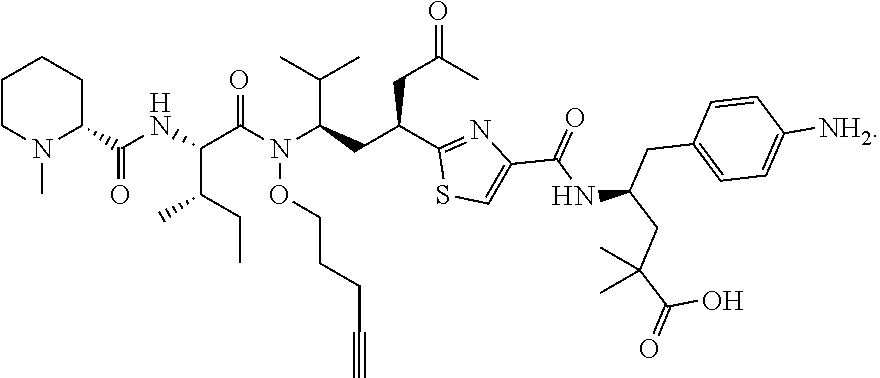


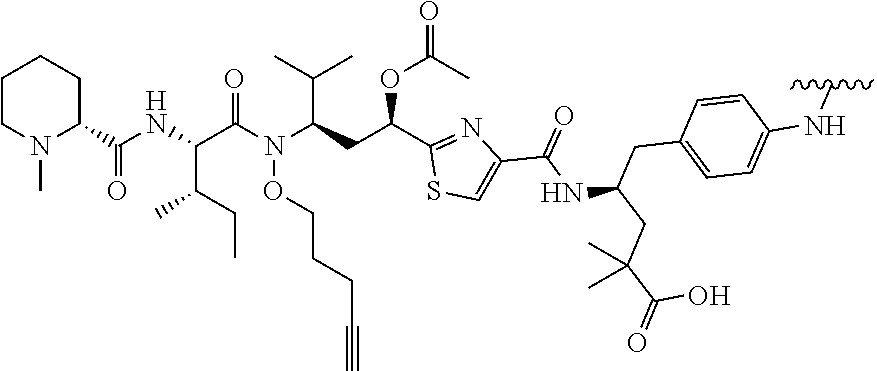


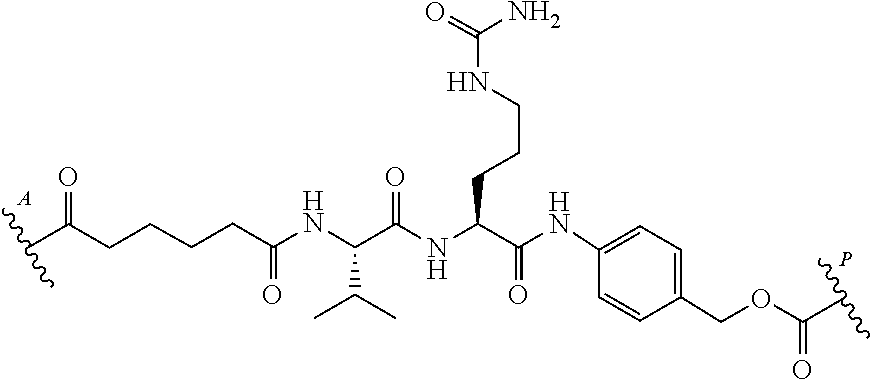


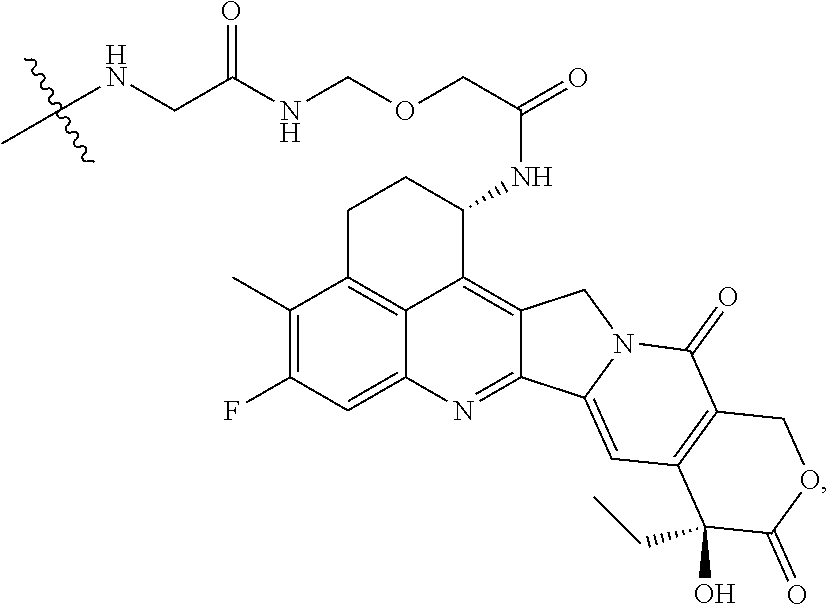

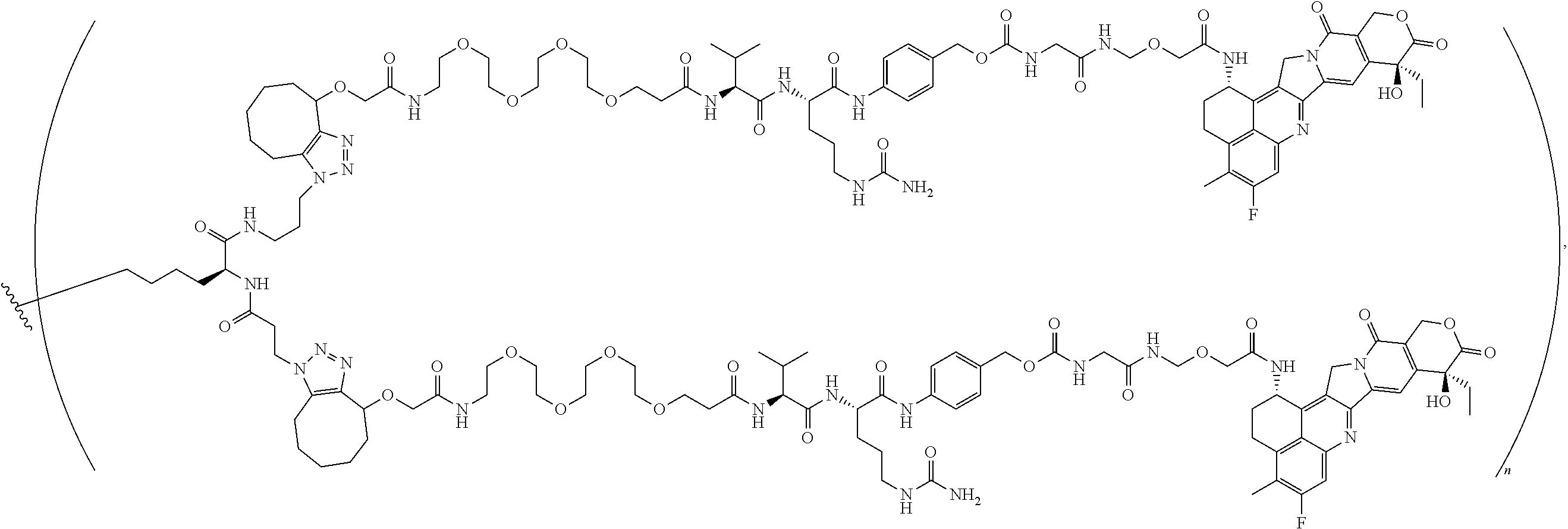


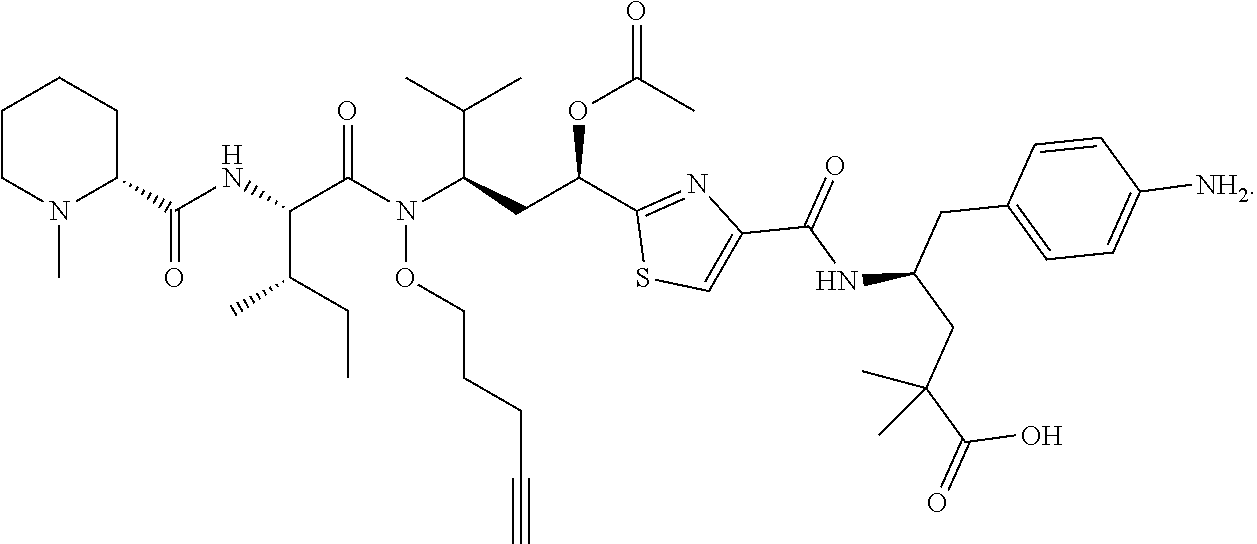


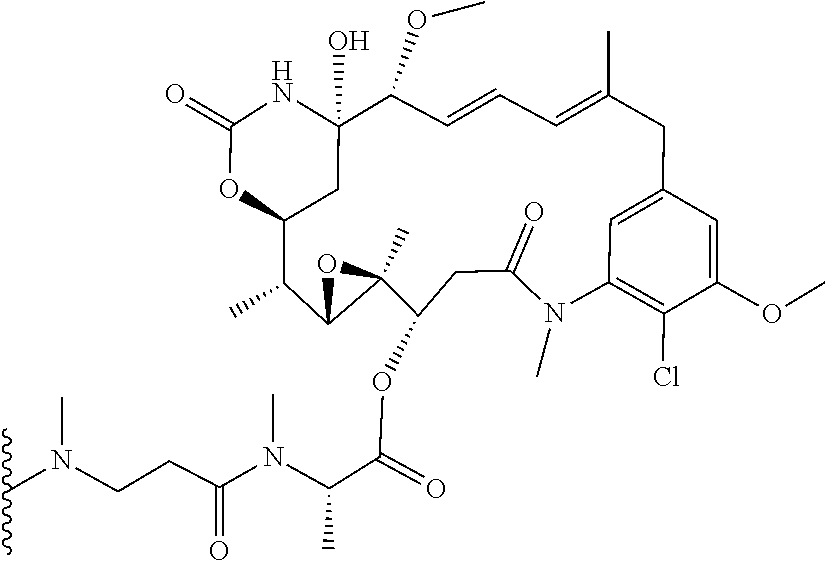


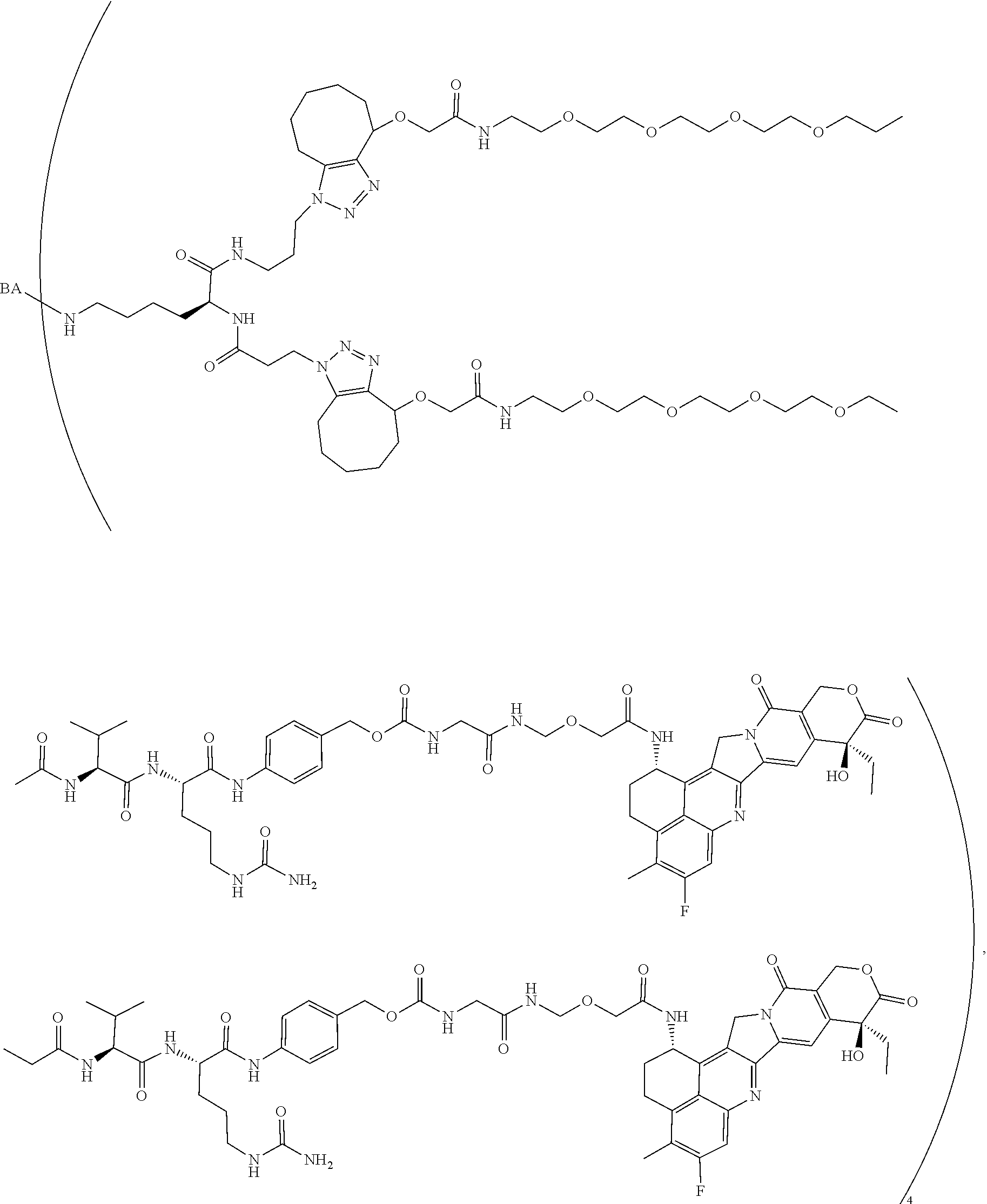
Priority Applications (2)
| Application Number | Priority Date | Filing Date | Title |
|---|---|---|---|
| US17/507,138 US11866502B2 (en) | 2020-10-22 | 2021-10-21 | Anti-FGFR2 antibodies and methods of use thereof |
| US18/462,692 US20240190973A1 (en) | 2020-10-22 | 2023-09-07 | Anti-fgfr2 antibodies and methods of use thereof |
Applications Claiming Priority (4)
| Application Number | Priority Date | Filing Date | Title |
|---|---|---|---|
| US202063104377P | 2020-10-22 | 2020-10-22 | |
| US202163220948P | 2021-07-12 | 2021-07-12 | |
| US202163253858P | 2021-10-08 | 2021-10-08 | |
| US17/507,138 US11866502B2 (en) | 2020-10-22 | 2021-10-21 | Anti-FGFR2 antibodies and methods of use thereof |
Related Child Applications (1)
| Application Number | Title | Priority Date | Filing Date |
|---|---|---|---|
| US18/462,692 Continuation US20240190973A1 (en) | 2020-10-22 | 2023-09-07 | Anti-fgfr2 antibodies and methods of use thereof |
Publications (2)
| Publication Number | Publication Date |
|---|---|
| US20220162323A1 US20220162323A1 (en) | 2022-05-26 |
| US11866502B2 true US11866502B2 (en) | 2024-01-09 |
Family
ID=78806631
Family Applications (2)
| Application Number | Title | Priority Date | Filing Date |
|---|---|---|---|
| US17/507,138 Active 2041-11-27 US11866502B2 (en) | 2020-10-22 | 2021-10-21 | Anti-FGFR2 antibodies and methods of use thereof |
| US18/462,692 Pending US20240190973A1 (en) | 2020-10-22 | 2023-09-07 | Anti-fgfr2 antibodies and methods of use thereof |
Family Applications After (1)
| Application Number | Title | Priority Date | Filing Date |
|---|---|---|---|
| US18/462,692 Pending US20240190973A1 (en) | 2020-10-22 | 2023-09-07 | Anti-fgfr2 antibodies and methods of use thereof |
Country Status (13)
| Country | Link |
|---|---|
| US (2) | US11866502B2 (en) |
| EP (1) | EP4232481A1 (en) |
| JP (1) | JP7767411B2 (en) |
| KR (1) | KR20230095070A (en) |
| CN (1) | CN116406379A (en) |
| AU (1) | AU2021366691B2 (en) |
| CA (1) | CA3190569A1 (en) |
| CL (1) | CL2023001114A1 (en) |
| CO (1) | CO2023004110A2 (en) |
| IL (1) | IL301702A (en) |
| MX (1) | MX2023004434A (en) |
| NZ (1) | NZ797493A (en) |
| WO (1) | WO2022087243A1 (en) |
Families Citing this family (12)
| Publication number | Priority date | Publication date | Assignee | Title |
|---|---|---|---|---|
| MY208067A (en) * | 2018-12-21 | 2025-04-11 | Regeneron Pharma | Tubulysins and protein-tubulysin conjugates |
| NZ797493A (en) | 2020-10-22 | 2024-05-31 | Regeneron Pharma | Anti-fgfr2 antibodies and methods of use thereof |
| CN117917435A (en) * | 2022-10-21 | 2024-04-23 | 北京天广实生物技术股份有限公司 | Antibodies that bind to FGFR2B and their uses |
| CN120677176A (en) * | 2022-12-28 | 2025-09-19 | 苏州创胜医药集团有限公司 | Anti-FGFR 2B antibodies and uses thereof |
| CN118994393A (en) * | 2023-05-19 | 2024-11-22 | 广东东阳光药业股份有限公司 | An anti-FGFR2 antibody and its application |
| WO2025067442A1 (en) * | 2023-09-28 | 2025-04-03 | 南京维立志博生物科技股份有限公司 | Anti-fgfr2 antibody and multispecific binding molecule comprising same |
| TW202540177A (en) * | 2023-11-14 | 2025-10-16 | 大陸商蘇州創勝醫藥集團有限公司 | Anti-fgfr2b immunoconjugates and their use in the treatment of cancer |
| WO2025130905A1 (en) * | 2023-12-18 | 2025-06-26 | 山东先声生物制药有限公司 | Anti-fgfr2b antibody-drug conjugate and use thereof |
| WO2025130860A1 (en) * | 2023-12-18 | 2025-06-26 | 山东先声生物制药有限公司 | Anti-fgfr2b antibody and use thereof |
| CN120424212A (en) * | 2024-01-26 | 2025-08-05 | 上海安领科生物医药有限公司 | Anti-FGFR2b antibodies and antibody-drug conjugates |
| WO2025209434A1 (en) * | 2024-04-01 | 2025-10-09 | 思康睿奇(上海)药业有限公司 | Anti-fgfr2b antibody-drug conjugate and use thereof |
| WO2025218662A1 (en) * | 2024-04-16 | 2025-10-23 | 杭州中美华东制药有限公司 | Antibody against fibroblast growth factor receptor 2b and use thereof |
Citations (40)
| Publication number | Priority date | Publication date | Assignee | Title |
|---|---|---|---|---|
| US5280020A (en) | 1988-11-16 | 1994-01-18 | Sergio Bertini Curri | Drug and method for increasing the microcirculatory flow-rate and volume in the capillaries to the skin |
| US5714586A (en) | 1995-06-07 | 1998-02-03 | American Cyanamid Company | Methods for the preparation of monomeric calicheamicin derivative/carrier conjugates |
| US6596541B2 (en) | 2000-10-31 | 2003-07-22 | Regeneron Pharmaceuticals, Inc. | Methods of modifying eukaryotic cells |
| WO2005089808A2 (en) | 2004-03-15 | 2005-09-29 | Wyeth | Antibody calicheamicin conjugates |
| US7087411B2 (en) | 1999-06-08 | 2006-08-08 | Regeneron Pharmaceuticals, Inc. | Fusion protein capable of binding VEGF |
| US20070258987A1 (en) | 2000-11-28 | 2007-11-08 | Seattle Genetics, Inc. | Recombinant Anti-Cd30 Antibodies and Uses Thereof |
| WO2008122039A2 (en) | 2007-04-02 | 2008-10-09 | The Government Of The United States Of America, As Represented By The Secretary, Department Of Health And Human Services | Selenocysteine mediated hybrid antibody molecules |
| US20080305497A1 (en) | 2007-05-23 | 2008-12-11 | Ventana Medical Systems, Inc. | Polymeric carriers for immunohistochemistry and in situ hybridization |
| US20090142354A1 (en) | 2006-12-14 | 2009-06-04 | Regeneron Pharmaceuticals, Inc. | Human antibodies to human delta like ligand 4 |
| US7582298B2 (en) | 2006-06-02 | 2009-09-01 | Regeneron Pharmaceuticals, Inc. | High affinity antibodies to human IL-6 receptor |
| WO2010010324A1 (en) | 2008-07-21 | 2010-01-28 | Polytherics Limited | Novel reagents and method for conjugating biological molecules |
| US20100129314A1 (en) | 2008-04-30 | 2010-05-27 | Immunogen Inc. | Potent conjugates and hydrophilic linkers |
| US7750116B1 (en) | 2006-02-18 | 2010-07-06 | Seattle Genetics, Inc. | Antibody drug conjugate metabolites |
| US7754681B2 (en) | 2004-02-23 | 2010-07-13 | Seattle Genetics, Inc. | Heterocyclic self-immolative linkers and conjugates |
| US20100331527A1 (en) | 2009-06-26 | 2010-12-30 | Regeneron Pharmaceuticals, Inc. | Readily Isolated Bispecific Antibodies with Native Immunoglobulin Format |
| US20110027286A1 (en) | 2009-07-29 | 2011-02-03 | Regeneron Pharmaceuticals, Inc. | High Affinity Human Antibodies to Human Angiopoietin-2 |
| WO2011018611A1 (en) | 2009-08-10 | 2011-02-17 | Ucl Business Plc | Reversible covalent linkage of functional molecules |
| WO2011130598A1 (en) | 2010-04-15 | 2011-10-20 | Spirogen Limited | Pyrrolobenzodiazepines and conjugates thereof |
| WO2012059882A2 (en) | 2010-11-05 | 2012-05-10 | Rinat Neuroscience Corporation | Engineered polypeptide conjugates and methods for making thereof using transglutaminase |
| WO2012166559A1 (en) | 2011-05-27 | 2012-12-06 | Ambrx, Inc. | Compositions containing, methods involving, and uses of non-natural amino acid linked dolastatin derivatives |
| WO2013055990A1 (en) | 2011-10-14 | 2013-04-18 | Seattle Genetics, Inc. | Pyrrolobenzodiazepines and targeted conjugates |
| WO2013053872A1 (en) | 2011-10-14 | 2013-04-18 | Spirogen Sàrl | Synthesis method and intermediates useful in the preparation of pyrrolobenzodiazepines |
| WO2013053873A1 (en) | 2011-10-14 | 2013-04-18 | Spirogen Sàrl | Pyrrolobenzodiazepines |
| WO2013055993A1 (en) | 2011-10-14 | 2013-04-18 | Seattle Genetics, Inc. | Pyrrolobenzodiazepines and targeted conjugates |
| US20130101546A1 (en) | 2011-06-10 | 2013-04-25 | Mersana Therapeutics, Inc. | Protein-Polymer-Drug Conjugates |
| WO2013068874A1 (en) | 2011-11-11 | 2013-05-16 | Pfizer Inc. | Antibody-drug conjugates |
| WO2013076186A1 (en) | 2011-11-23 | 2013-05-30 | Bayer Intellectual Property Gmbh | Anti-fgfr2 antibodies and uses thereof |
| WO2013085925A1 (en) | 2011-12-05 | 2013-06-13 | Igenica, Inc. | Antibody-drug conjugates and related compounds, compositions, and methods |
| WO2014065661A1 (en) | 2012-10-23 | 2014-05-01 | Synaffix B.V. | Modified antibody, antibody-conjugate and process for the preparation thereof |
| WO2014089193A1 (en) * | 2012-12-04 | 2014-06-12 | Aveo Pharmaceuticals, Inc. | Anti-fgfr2 antibodies |
| WO2014121087A1 (en) | 2013-02-01 | 2014-08-07 | Regeneron Pharmaceuticals, Inc. | Antibodies comprising chimeric constant domains |
| WO2014145090A1 (en) | 2013-03-15 | 2014-09-18 | Regeneron Pharmaceuticals, Inc. | Biologically active molecules, conjugates thereof, and therapeutic uses |
| WO2015031396A1 (en) | 2013-08-26 | 2015-03-05 | Regeneron Pharmaceuticals, Inc. | Pharmaceutical compositions comprising macrolide diastereomers, methods of their synthesis and therapeutic uses |
| WO2015155998A1 (en) | 2014-04-10 | 2015-10-15 | Daiichi Sankyo Company, Limited | Anti-her3 antibody-drug conjugate |
| US20160375147A1 (en) | 2015-03-27 | 2016-12-29 | Regeneron Pharmaceuticals, Inc. | Maytansinoid derivatives, conjugates thereof, and methods of use |
| US20170209591A1 (en) | 2016-01-25 | 2017-07-27 | Regeneron Pharmaceuticals, Inc. | Maytansinoid derivatives, conjugates thereof, and methods of use |
| WO2018089373A2 (en) | 2016-11-08 | 2018-05-17 | Regeneron Pharmaceuticals, Inc. | Steroids and protein-conjugates thereof |
| US10143186B2 (en) | 2010-02-08 | 2018-12-04 | Regeneron Pharmaceuticals, Inc. | Common light chain mouse |
| US20210260208A1 (en) | 2018-12-21 | 2021-08-26 | Regeneron Pharmaceuticals, Inc. | Tubulysins and protein-tubulysin conjugates |
| WO2022087243A1 (en) | 2020-10-22 | 2022-04-28 | Regeneron Pharmaceuticals, Inc. | Anti-fgfr2 antibodies and methods of use thereof |
Family Cites Families (9)
| Publication number | Priority date | Publication date | Assignee | Title |
|---|---|---|---|---|
| US5208020A (en) | 1989-10-25 | 1993-05-04 | Immunogen Inc. | Cytotoxic agents comprising maytansinoids and their therapeutic use |
| LT3290052T (en) | 2008-11-07 | 2020-02-25 | Galaxy Biotech, Llc | Monoclonal antibodies to fibroblast growth factor receptor 2 |
| KR101000067B1 (en) | 2008-12-30 | 2010-12-10 | 엘지전자 주식회사 | Laser firing apparatus for high efficiency solar cell and manufacturing method of high efficiency solar cell |
| WO2012005982A2 (en) | 2010-07-06 | 2012-01-12 | Board Of Supervisors Of Louisiana State University And Agricultural And Mechanical College | Reporter for rna polymerase ii termination |
| NZ715201A (en) | 2013-08-01 | 2021-12-24 | Five Prime Therapeutics Inc | Afucosylated anti-fgfr2iiib antibodies |
| US10160812B2 (en) | 2014-04-11 | 2018-12-25 | Medimmune, Llc | Bispecific HER2 antibodies |
| EP3419670A2 (en) | 2016-02-26 | 2019-01-02 | Regeneron Pharmaceuticals, Inc. | Optimized transglutaminase site-specific antibody conjugation |
| WO2018044540A1 (en) | 2016-08-31 | 2018-03-08 | Regeneron Pharmaceuticals, Inc. | Compositions and methods for detecting protein trafficking |
| CA3160810A1 (en) | 2019-12-24 | 2021-07-01 | Dizal (Jiangsu) Pharmaceutical Co., Ltd. | Novel anti-fgfr2b antibodies |
-
2021
- 2021-10-21 NZ NZ797493A patent/NZ797493A/en unknown
- 2021-10-21 KR KR1020237012828A patent/KR20230095070A/en active Pending
- 2021-10-21 AU AU2021366691A patent/AU2021366691B2/en active Active
- 2021-10-21 JP JP2023519662A patent/JP7767411B2/en active Active
- 2021-10-21 WO PCT/US2021/056018 patent/WO2022087243A1/en not_active Ceased
- 2021-10-21 US US17/507,138 patent/US11866502B2/en active Active
- 2021-10-21 CA CA3190569A patent/CA3190569A1/en active Pending
- 2021-10-21 MX MX2023004434A patent/MX2023004434A/en unknown
- 2021-10-21 EP EP21815730.3A patent/EP4232481A1/en active Pending
- 2021-10-21 CN CN202180066955.5A patent/CN116406379A/en active Pending
- 2021-10-21 IL IL301702A patent/IL301702A/en unknown
-
2023
- 2023-03-29 CO CONC2023/0004110A patent/CO2023004110A2/en unknown
- 2023-04-18 CL CL2023001114A patent/CL2023001114A1/en unknown
- 2023-09-07 US US18/462,692 patent/US20240190973A1/en active Pending
Patent Citations (44)
| Publication number | Priority date | Publication date | Assignee | Title |
|---|---|---|---|---|
| US5280020A (en) | 1988-11-16 | 1994-01-18 | Sergio Bertini Curri | Drug and method for increasing the microcirculatory flow-rate and volume in the capillaries to the skin |
| US5714586A (en) | 1995-06-07 | 1998-02-03 | American Cyanamid Company | Methods for the preparation of monomeric calicheamicin derivative/carrier conjugates |
| US7087411B2 (en) | 1999-06-08 | 2006-08-08 | Regeneron Pharmaceuticals, Inc. | Fusion protein capable of binding VEGF |
| US6596541B2 (en) | 2000-10-31 | 2003-07-22 | Regeneron Pharmaceuticals, Inc. | Methods of modifying eukaryotic cells |
| US20070258987A1 (en) | 2000-11-28 | 2007-11-08 | Seattle Genetics, Inc. | Recombinant Anti-Cd30 Antibodies and Uses Thereof |
| US7754681B2 (en) | 2004-02-23 | 2010-07-13 | Seattle Genetics, Inc. | Heterocyclic self-immolative linkers and conjugates |
| WO2005089808A2 (en) | 2004-03-15 | 2005-09-29 | Wyeth | Antibody calicheamicin conjugates |
| US7750116B1 (en) | 2006-02-18 | 2010-07-06 | Seattle Genetics, Inc. | Antibody drug conjugate metabolites |
| US7582298B2 (en) | 2006-06-02 | 2009-09-01 | Regeneron Pharmaceuticals, Inc. | High affinity antibodies to human IL-6 receptor |
| US20090142354A1 (en) | 2006-12-14 | 2009-06-04 | Regeneron Pharmaceuticals, Inc. | Human antibodies to human delta like ligand 4 |
| WO2008122039A2 (en) | 2007-04-02 | 2008-10-09 | The Government Of The United States Of America, As Represented By The Secretary, Department Of Health And Human Services | Selenocysteine mediated hybrid antibody molecules |
| US20080305497A1 (en) | 2007-05-23 | 2008-12-11 | Ventana Medical Systems, Inc. | Polymeric carriers for immunohistochemistry and in situ hybridization |
| US20100129314A1 (en) | 2008-04-30 | 2010-05-27 | Immunogen Inc. | Potent conjugates and hydrophilic linkers |
| WO2010010324A1 (en) | 2008-07-21 | 2010-01-28 | Polytherics Limited | Novel reagents and method for conjugating biological molecules |
| US20100331527A1 (en) | 2009-06-26 | 2010-12-30 | Regeneron Pharmaceuticals, Inc. | Readily Isolated Bispecific Antibodies with Native Immunoglobulin Format |
| US20110027286A1 (en) | 2009-07-29 | 2011-02-03 | Regeneron Pharmaceuticals, Inc. | High Affinity Human Antibodies to Human Angiopoietin-2 |
| WO2011018611A1 (en) | 2009-08-10 | 2011-02-17 | Ucl Business Plc | Reversible covalent linkage of functional molecules |
| US10143186B2 (en) | 2010-02-08 | 2018-12-04 | Regeneron Pharmaceuticals, Inc. | Common light chain mouse |
| WO2011130598A1 (en) | 2010-04-15 | 2011-10-20 | Spirogen Limited | Pyrrolobenzodiazepines and conjugates thereof |
| WO2012059882A2 (en) | 2010-11-05 | 2012-05-10 | Rinat Neuroscience Corporation | Engineered polypeptide conjugates and methods for making thereof using transglutaminase |
| WO2012166559A1 (en) | 2011-05-27 | 2012-12-06 | Ambrx, Inc. | Compositions containing, methods involving, and uses of non-natural amino acid linked dolastatin derivatives |
| US20130101546A1 (en) | 2011-06-10 | 2013-04-25 | Mersana Therapeutics, Inc. | Protein-Polymer-Drug Conjugates |
| WO2013053873A1 (en) | 2011-10-14 | 2013-04-18 | Spirogen Sàrl | Pyrrolobenzodiazepines |
| WO2013055990A1 (en) | 2011-10-14 | 2013-04-18 | Seattle Genetics, Inc. | Pyrrolobenzodiazepines and targeted conjugates |
| WO2013053872A1 (en) | 2011-10-14 | 2013-04-18 | Spirogen Sàrl | Synthesis method and intermediates useful in the preparation of pyrrolobenzodiazepines |
| WO2013055993A1 (en) | 2011-10-14 | 2013-04-18 | Seattle Genetics, Inc. | Pyrrolobenzodiazepines and targeted conjugates |
| WO2013068874A1 (en) | 2011-11-11 | 2013-05-16 | Pfizer Inc. | Antibody-drug conjugates |
| WO2013076186A1 (en) | 2011-11-23 | 2013-05-30 | Bayer Intellectual Property Gmbh | Anti-fgfr2 antibodies and uses thereof |
| US20140322220A1 (en) | 2011-11-23 | 2014-10-30 | Bayer Intellectual Property Gmbh | Anti-FGFR2 Antibodies and Uses Thereof |
| WO2013085925A1 (en) | 2011-12-05 | 2013-06-13 | Igenica, Inc. | Antibody-drug conjugates and related compounds, compositions, and methods |
| WO2014065661A1 (en) | 2012-10-23 | 2014-05-01 | Synaffix B.V. | Modified antibody, antibody-conjugate and process for the preparation thereof |
| WO2014089193A1 (en) * | 2012-12-04 | 2014-06-12 | Aveo Pharmaceuticals, Inc. | Anti-fgfr2 antibodies |
| WO2014121087A1 (en) | 2013-02-01 | 2014-08-07 | Regeneron Pharmaceuticals, Inc. | Antibodies comprising chimeric constant domains |
| WO2014145090A1 (en) | 2013-03-15 | 2014-09-18 | Regeneron Pharmaceuticals, Inc. | Biologically active molecules, conjugates thereof, and therapeutic uses |
| US10570151B2 (en) | 2013-03-15 | 2020-02-25 | Regeneron Pharmaceuticals, Inc. | Biologically active molecules, conjugates thereof, and therapeutic uses |
| WO2015031396A1 (en) | 2013-08-26 | 2015-03-05 | Regeneron Pharmaceuticals, Inc. | Pharmaceutical compositions comprising macrolide diastereomers, methods of their synthesis and therapeutic uses |
| US20160354482A1 (en) | 2013-08-26 | 2016-12-08 | Regeneron Pharmaceuticals, Inc. | Pharmaceutical compositions comprising macrolide diastereomers, methods of their synthesis and therapeutic uses |
| WO2015155998A1 (en) | 2014-04-10 | 2015-10-15 | Daiichi Sankyo Company, Limited | Anti-her3 antibody-drug conjugate |
| US20160375147A1 (en) | 2015-03-27 | 2016-12-29 | Regeneron Pharmaceuticals, Inc. | Maytansinoid derivatives, conjugates thereof, and methods of use |
| US20170209591A1 (en) | 2016-01-25 | 2017-07-27 | Regeneron Pharmaceuticals, Inc. | Maytansinoid derivatives, conjugates thereof, and methods of use |
| US9950076B2 (en) | 2016-01-25 | 2018-04-24 | Regeneron Pharmaceuticals, Inc. | Maytansinoid derivatives, conjugates thereof, and methods of use |
| WO2018089373A2 (en) | 2016-11-08 | 2018-05-17 | Regeneron Pharmaceuticals, Inc. | Steroids and protein-conjugates thereof |
| US20210260208A1 (en) | 2018-12-21 | 2021-08-26 | Regeneron Pharmaceuticals, Inc. | Tubulysins and protein-tubulysin conjugates |
| WO2022087243A1 (en) | 2020-10-22 | 2022-04-28 | Regeneron Pharmaceuticals, Inc. | Anti-fgfr2 antibodies and methods of use thereof |
Non-Patent Citations (51)
Also Published As
| Publication number | Publication date |
|---|---|
| US20220162323A1 (en) | 2022-05-26 |
| JP2023547323A (en) | 2023-11-10 |
| MX2023004434A (en) | 2023-05-08 |
| KR20230095070A (en) | 2023-06-28 |
| NZ797493A (en) | 2024-05-31 |
| AU2021366691B2 (en) | 2024-06-06 |
| JP7767411B2 (en) | 2025-11-11 |
| IL301702A (en) | 2023-05-01 |
| CL2023001114A1 (en) | 2023-11-24 |
| US20240190973A1 (en) | 2024-06-13 |
| AU2021366691A1 (en) | 2023-03-23 |
| CO2023004110A2 (en) | 2023-04-27 |
| CN116406379A (en) | 2023-07-07 |
| EP4232481A1 (en) | 2023-08-30 |
| WO2022087243A1 (en) | 2022-04-28 |
| CA3190569A1 (en) | 2022-04-28 |
Similar Documents
| Publication | Publication Date | Title |
|---|---|---|
| US11866502B2 (en) | Anti-FGFR2 antibodies and methods of use thereof | |
| US20250250342A2 (en) | Anti-met antibodies, bispecific antigen binding molecules that bind met, and methods of use thereof | |
| US11958910B2 (en) | Bispecific antigen binding molecules that bind HER2, and methods of use thereof | |
| US20180094066A1 (en) | Anti-prlr antibodies and uses thereof | |
| AU2020224136C1 (en) | Methods of treating ocular cancer using anti-MET antibodies and bispecific antigen binding molecules that bind MET | |
| US12545735B2 (en) | Anti-met antibodies, bispecific antigen binding molecules that bind met, and methods of use thereof | |
| EA042597B1 (en) | ANTIBODIES TO MET, BISPECIFIC ANTIGEN-BINDING MOLECULES THAT BIND MET, AND METHODS OF THEIR APPLICATION |
Legal Events
| Date | Code | Title | Description |
|---|---|---|---|
| FEPP | Fee payment procedure |
Free format text: ENTITY STATUS SET TO UNDISCOUNTED (ORIGINAL EVENT CODE: BIG.); ENTITY STATUS OF PATENT OWNER: LARGE ENTITY |
|
| STPP | Information on status: patent application and granting procedure in general |
Free format text: DOCKETED NEW CASE - READY FOR EXAMINATION |
|
| STPP | Information on status: patent application and granting procedure in general |
Free format text: NON FINAL ACTION MAILED |
|
| STPP | Information on status: patent application and granting procedure in general |
Free format text: NOTICE OF ALLOWANCE MAILED -- APPLICATION RECEIVED IN OFFICE OF PUBLICATIONS |
|
| STPP | Information on status: patent application and granting procedure in general |
Free format text: NOTICE OF ALLOWANCE MAILED -- APPLICATION RECEIVED IN OFFICE OF PUBLICATIONS Free format text: AWAITING TC RESP., ISSUE FEE NOT PAID |
|
| AS | Assignment |
Owner name: REGENERON PHARMACEUTICALS, INC., NEW YORK Free format text: ASSIGNMENT OF ASSIGNORS INTEREST;ASSIGNORS:DALY, CHRISTOPHER;DELFINO, FRANK;HAN, AMY;AND OTHERS;SIGNING DATES FROM 20230807 TO 20230820;REEL/FRAME:064799/0310 |
|
| STPP | Information on status: patent application and granting procedure in general |
Free format text: PUBLICATIONS -- ISSUE FEE PAYMENT RECEIVED |
|
| STPP | Information on status: patent application and granting procedure in general |
Free format text: PUBLICATIONS -- ISSUE FEE PAYMENT VERIFIED |
|
| STCF | Information on status: patent grant |
Free format text: PATENTED CASE |
|
| CC | Certificate of correction |