[go: up one dir, main page]

US11782483B2 - Uniformly narrow display bezels in portable electronic devices - Google Patents

Uniformly narrow display bezels in portable electronic devices Download PDF

Info

Publication number
US11782483B2
US11782483B2 US17/507,293 US202117507293A US11782483B2 US 11782483 B2 US11782483 B2 US 11782483B2 US 202117507293 A US202117507293 A US 202117507293A US 11782483 B2 US11782483 B2 US 11782483B2
Authority
US
United States
Prior art keywords
face
portable electronic
cover layer
electronic device
chamfered
Prior art date
Legal status (The legal status is an assumption and is not a legal conclusion. Google has not performed a legal analysis and makes no representation as to the accuracy of the status listed.)
Active
Application number
US17/507,293
Other versions
US20220043488A1 (en
Inventor
Michael J. Lombardi
Joseph L. Allore
Chi-Jer Wang
Stuart Kyle
Ssu-Chieh Yu
Kuan-Ku Kuo
Current Assignee (The listed assignees may be inaccurate. Google has not performed a legal analysis and makes no representation or warranty as to the accuracy of the list.)
Google LLC
Original Assignee
Google LLC
Priority date (The priority date is an assumption and is not a legal conclusion. Google has not performed a legal analysis and makes no representation as to the accuracy of the date listed.)
Filing date
Publication date
Application filed by Google LLC filed Critical Google LLC
Priority to US17/507,293 priority Critical patent/US11782483B2/en
Assigned to GOOGLE LLC reassignment GOOGLE LLC ASSIGNMENT OF ASSIGNORS INTEREST (SEE DOCUMENT FOR DETAILS). Assignors: WANG, CHI-JER, ALLORE, JOSEPH L., KUO, KUAN-KU, KYLE, STUART, LOMBARDI, MICHAEL J., Yu, Ssu-Chieh
Publication of US20220043488A1 publication Critical patent/US20220043488A1/en
Application granted granted Critical
Publication of US11782483B2 publication Critical patent/US11782483B2/en
Active legal-status Critical Current
Anticipated expiration legal-status Critical

Links

Images

Classifications

    • GPHYSICS
    • G06COMPUTING OR CALCULATING; COUNTING
    • G06FELECTRIC DIGITAL DATA PROCESSING
    • G06F1/00Details not covered by groups G06F3/00 - G06F13/00 and G06F21/00
    • G06F1/16Constructional details or arrangements
    • G06F1/1613Constructional details or arrangements for portable computers
    • G06F1/1633Constructional details or arrangements of portable computers not specific to the type of enclosures covered by groups G06F1/1615 - G06F1/1626
    • G06F1/1637Details related to the display arrangement, including those related to the mounting of the display in the housing
    • GPHYSICS
    • G06COMPUTING OR CALCULATING; COUNTING
    • G06FELECTRIC DIGITAL DATA PROCESSING
    • G06F1/00Details not covered by groups G06F3/00 - G06F13/00 and G06F21/00
    • G06F1/16Constructional details or arrangements
    • G06F1/1613Constructional details or arrangements for portable computers
    • G06F1/1633Constructional details or arrangements of portable computers not specific to the type of enclosures covered by groups G06F1/1615 - G06F1/1626
    • G06F1/1656Details related to functional adaptations of the enclosure, e.g. to provide protection against EMI, shock, water, or to host detachable peripherals like a mouse or removable expansions units like PCMCIA cards, or to provide access to internal components for maintenance or to removable storage supports like CDs or DVDs, or to mechanically mount accessories
    • GPHYSICS
    • G06COMPUTING OR CALCULATING; COUNTING
    • G06FELECTRIC DIGITAL DATA PROCESSING
    • G06F1/00Details not covered by groups G06F3/00 - G06F13/00 and G06F21/00
    • G06F1/16Constructional details or arrangements
    • G06F1/1613Constructional details or arrangements for portable computers
    • G06F1/1626Constructional details or arrangements for portable computers with a single-body enclosure integrating a flat display, e.g. Personal Digital Assistants [PDAs]
    • HELECTRICITY
    • H04ELECTRIC COMMUNICATION TECHNIQUE
    • H04MTELEPHONIC COMMUNICATION
    • H04M1/00Substation equipment, e.g. for use by subscribers
    • H04M1/02Constructional features of telephone sets
    • H04M1/0202Portable telephone sets, e.g. cordless phones, mobile phones or bar type handsets
    • H04M1/026Details of the structure or mounting of specific components
    • H04M1/0266Details of the structure or mounting of specific components for a display module assembly
    • HELECTRICITY
    • H04ELECTRIC COMMUNICATION TECHNIQUE
    • H04MTELEPHONIC COMMUNICATION
    • H04M1/00Substation equipment, e.g. for use by subscribers
    • H04M1/02Constructional features of telephone sets
    • H04M1/0202Portable telephone sets, e.g. cordless phones, mobile phones or bar type handsets
    • H04M1/0249Details of the mechanical connection between the housing parts or relating to the method of assembly

Definitions

  • a portable electronic device includes a housing that houses a display panel stack having a chamfered, polyhedral cover layer bonded to a top of a display module.
  • the cover layer may include a large chamfer between a top face and a side face, which defines a chamfered face extending a perimeter of the cover layer.
  • the chamfered face may be angled any number of degrees in a range from one to eighty-nine degrees to a horizontal plane defined by the top face of the cover layer, such that the chamfered face possesses a front-facing portion.
  • the chamfered face may be adhered to a parallel or subparallel interior face of the housing. In such a configuration, an opaque border added to a face opposite of the top face may be imperceptible to a user, resulting in uniformly narrow display bezels.
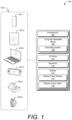
  • FIG. 1 illustrates an example device diagram of a portable electronic device in which uniformly narrow display bezels can be implemented
  • FIG. 2 illustrates a partial, cross-sectional view of an example cover layer
  • FIGS. 3 A and 3 B illustrate a top view and a partial, cross-sectional view, respectively, of an example portable electronic device in which uniformly narrow display bezels can be implemented;
  • FIG. 4 illustrates a zoomed-in, partial, cross-sectional view of an example portable electronic device in which uniformly narrow displays bezels may be implemented
  • FIG. 5 illustrates a first manufacturing step in assembling a portable electronic device configured to implement uniformly narrow display borders
  • FIG. 6 illustrates a second manufacturing step in assembling a portable electronic device configured to implement uniformly narrow display borders
  • FIG. 7 illustrates a third manufacturing step in assembling a portable electronic device configured to implement uniformly narrow display borders
  • FIGS. 8 A, 8 B, and 8 C further illustrate techniques to achieve a third manufacturing step 700 in assembling a portable electronic device configured to implement uniformly display borders;
  • FIG. 9 illustrates a fourth manufacturing step in assembling a portable electronic device configured to implement uniformly narrow display borders
  • FIG. 10 illustrates a fifth manufacturing step in assembling a portable electronic device configured to implement uniformly narrow display borders.
  • Displays such as light-emitting diode (LED) displays and liquid crystal displays (LCD).
  • LCD liquid crystal displays
  • Portable electronic device manufactures fabricate these displays in a layered structure, often referred to as a “display panel stack,” containing a cover layer (e.g., cover glass) and a display module.
  • the display panel stack may further include, integrated within the display module or altogether separate from the display module, one or more of a touch layer (e.g., touch sensor panel) and a polarizer layer (e.g., polarization filters).
  • a touch layer e.g., touch sensor panel
  • polarizer layer e.g., polarization filters
  • the display module includes a pixel array having tens of thousands of pixels organized into a two-dimensional grid (e.g., circular grid, rectangular grid).
  • display modules often include routing circuitry, surrounding the perimeter of the pixel array, connecting the pixels to one or more drivers.
  • a pixel array having a two-dimensional rectangular grid of pixels is operably coupled to one or more row-line drivers via electrical traces (e.g., wires).
  • an opaque border often referred to as an “ink mask,” may be added to the underside of the cover layer, defining a display bezel.
  • An amount of space consumed by the electrical traces often dictates a size of the display bezel, especially in corner regions.
  • the display bezel acts as a frame, hiding routing circuitry in an inactive area (e.g., non-emissive area) of a display.
  • the display bezel further surrounds an active area of a display (e.g., an emissive area of a display module visible to a user).
  • a display bezel may be narrower along sides of a portable electronic device but larger on a top and/or a bottom of the device. Some users prefer uniform display bezels, finding such an implementation more aesthetic in portable electronic devices. To this end, this document describes systems and techniques directed at minimizing display bezels, while simultaneously providing an aesthetic device with uniform display bezels.
  • FIG. 1 illustrates an example device diagram 100 of a portable electronic device 102 in which uniformly narrow display bezels can be implemented.
  • the portable electronic device 102 may include additional components and interfaces omitted from FIG. 1 for the sake of clarity.
  • the portable electronic device 102 can be a variety of consumer portable electronic devices.
  • the portable electronic device 102 can be a mobile phone 102 - 1 , a tablet device 102 - 2 , a laptop computer 102 - 3 , a portable video game console 102 - 4 , virtual-reality (VR) goggles 102 - 5 , a computerized watch 102 - 6 , and the like.
  • VR virtual-reality
  • the portable electronic device 102 includes one or more processors 104 .
  • the processor(s) 104 can include, as non-limiting examples, a system on a chip (SoC), an application processor (AP), a central processing unit (CPU), or a graphics processing unit (GPU).
  • SoC system on a chip
  • AP application processor
  • CPU central processing unit
  • GPU graphics processing unit
  • the processor(s) 104 generally executes commands and processes utilized by the portable electronic device 102 and an operating system installed thereon.
  • the processor(s) 104 may perform operations to display graphics of the portable electronic device 102 on a display and can perform other specific computational tasks.
  • the portable electronic device 102 also includes computer-readable storage media (CRM) 106 .
  • the CRM 106 may be a suitable storage device configured to store device data of the portable electronic device 102 , user data, and multimedia data.
  • the CRM may store an operating system that generally manages hardware and software resources (e.g., the applications) of the portable electronic device 102 and provides common services for applications stored on the CRM.
  • the operating system and the applications are generally executable by the processor(s) 104 to enable communications and user interaction with the portable electronic device 102 .
  • One or more processor(s) 104 such as a GPU, perform operations to display graphics of the portable electronic device 102 on the display 114 and can perform other specific computational tasks.
  • the processor(s) 104 can be single-core or multiple-core processors.
  • the portable electronic device 102 may also include input/output (I/O) ports 110 .
  • the I/O ports 110 allow the portable electronic device 102 to interact with other devices or users.
  • the I/O ports 110 may include any combination of internal or external ports, such as universal serial bus (USB) ports, audio ports, Serial ATA (SATA) ports, PCI-express based ports or card-slots, secure digital input/output (SDIO) slots, and/or other legacy ports.
  • USB universal serial bus
  • SATA Serial ATA
  • SDIO secure digital input/output
  • the portable electronic device 102 further includes one or more sensors 112 .
  • the sensor(s) 112 can include any of a variety of sensors, such as an audio sensor (e.g., a microphone), a touch-input sensor (e.g., a touchscreen), an image-capture device (e.g., a camera, video-camera), proximity sensors (e.g., capacitive sensors), or an ambient light sensor (e.g., photodetector).
  • the portable electronic device 102 includes one or more of a front-facing sensor(s) and a rear-facing sensor(s).
  • the portable electronic device 102 includes a display 114 with a display panel stack having a display module 116 and a cover layer 118 .
  • the display module 116 may include a two-dimensional pixel array forming a rectangular grid, operably coupled to one or more row-line drivers via electrical traces.
  • the pixel array generates light to create an image on the display 114 upon electrical activation by one or more drivers.
  • data-line drivers provide voltage data via electrical traces to the pixel array to control the luminance of individual pixels.
  • a section of the display module 116 (e.g., a bottom section) may include more circuitry, such as electrical traces and drivers, than other portions of the display module 116 (e.g., a top section, a side section). In such a configuration, the display module 116 can be configured such that the section having more circuitry is folded or bent in a direction opposite to the cover layer 118 .
  • FIG. 2 illustrates a partial, cross-sectional view 200 of an example cover layer 118 .
  • the cover layer 118 may be composed of any of a variety of translucent materials including polymer (e.g., plastic, acrylic), glass, and so forth, in the form of any three-dimensional shape (e.g., a polyhedron), such as a rectangular prism or cylinder.
  • an opaque border 202 may first be added (e.g., laminated, printed) on a bottom face 212 (e.g., underside) of the cover layer 118 .
  • the opaque border 202 is a black ink mask printed on the bottom face 212 of the cover layer 118 .
  • the bottom face 212 of the cover layer 118 may then be bonded to the display module (e.g., display module 116 ) forming the display panel stack (not shown).
  • the width and/or length of the display module is greater than the width and/or length of the cover layer 118 .
  • the display module can extend 0.5 millimeters (mm) beyond all sides of the cover layer 118 .
  • the cover layer 118 may include one or more small chamfers 204 .
  • the small chamfers 204 may extend portions or a full perimeter of any three-dimensionally shaped cover layer 118 , forming a chamfered polyhedron.
  • the cover layer 118 includes the small chamfers 204 (e.g., small chamfer 204 - 1 , small chamfer 204 - 2 ) to reduce imperfections otherwise formed during manufacturing of the cover layer 118 .
  • the small chamfers 204 can minimize, or altogether prevent, edge defects resulting from computer numerical control (CNC) machining operations.
  • CNC computer numerical control
  • the cover layer 118 further includes a large chamfer 206 , a top face 208 , and a side face 210 .
  • the large chamfer 206 is implemented between the top face 208 and the side face 210 , defining a chamfered face extending portions or a full perimeter of the cover layer 118 .
  • the top face 208 may define a horizontal plane approximately perpendicular to a vertical plane defined by the side face 210 . From the horizontal plane defined by the top face 208 , the chamfered face may be angled any number of degrees in a range from one to eighty-nine degrees, such that the chamfered face includes a front-facing portion. For example, FIG.
  • the chamfered face for example, possesses a front-facing portion of approximately 0.18 mm.
  • the chamfered face angle may be implemented as having any desirable angle configured to, for example, optimize adhesive application techniques during manufacturing.
  • the angle of the chamfered face can be designed to achieve a predetermined fluid flow of adhesive such that when adhesive is applied to the chamfered face, the viscosity of the adhesive along with the angle of the chamfered face can expedite the application of the adhesive.
  • FIGS. 3 A and 3 B illustrate a top view and a partial, cross-sectional view, respectively, of an example portable electronic device 102 (e.g., mobile phone 102 - 1 ) in which uniformly narrow display bezels can be implemented.
  • the portable electronic device 102 includes a housing 302 that houses a display 114 having a display panel stack including a display module 116 and a cover layer 118 .
  • the housing 302 may define an opening whose area is larger than the area of a top face (e.g., top face 208 ) of the cover layer 118 .
  • the width and height of the cover layer 118 may be larger than the width and height of the opening.
  • the housing 302 can house the display 114 such that the top face of the cover layer 118 may extend beyond or be flush to the housing 302 . Further, the housing 302 can protect side faces (e.g., side face 210 ) of the cover layer 118 .
  • the display 114 can be configured to have an active area 306 and a display bezel 308 .
  • the display module 116 emits light using a pixel array, or any other active light-emitting element. The emitted light passes through an area of the translucent cover layer 118 , defining an active area 306 , to be perceived by a user.
  • An opaque border 202 added to an underside surface (e.g., bottom face 212 ) of the cover layer 118 can hide routing circuitry supporting the display module 116 and may obstruct the passage of light emitted from the display module 116 , defining a display bezel 308 (e.g., an inactive area).
  • the display bezel 308 may be perceived by a user as a black region underneath the cover layer 118 surrounding the active area 306 .
  • the narrow display bezels can uniformly extend along the perimeter of the active area 306 , even at a top and bottom section of the portable electronic device 102 .
  • FIG. 4 illustrates a zoomed-in, partial, cross-sectional view 400 of an example portable electronic device 102 in which uniformly narrow displays bezels may be implemented.
  • FIG. 3 is described in the context of the portable electronic device 102 of FIGS. 1 - 3 B .
  • the portable electronic device 102 includes housing 302 that houses a display panel stack having the cover layer 118 .
  • the cover layer 118 includes the large chamfer 206 .
  • the housing may define an interior face 402 parallel or subparallel to the chamfered face.
  • the interior face may be angled any degrees in a range of one to eighty-nine degrees from a horizontal plane defined by the top face of the cover layer 118 .
  • the interior face 402 may contact the cover layer 118 at any point along the chamfered face.
  • an adhesive 404 e.g., glue, sealant
  • cover layer 118 and/or the interior face 402 such that the adhesive 404 fills the area between the chamfered face and the interior face 402 .
  • a waterproof sealant can be applied to the chamfered face of the cover layer 118 .
  • the chamfered face may be angled to optimize fluid flow of the sealant such that it covers the full face of the chamfered face before mechanical adhering.
  • the chamfered face of the cover layer 118 may then be bonded to the interior face 402 of the housing 302 of the portable electronic device 102 .
  • FIG. 5 illustrates a first manufacturing step 500 in assembling a portable electronic device (e.g., mobile phone 102 - 1 ) configured to implement uniformly narrow display borders.
  • a middle housing section 502 of a housing (e.g., housing 302 ) of a portable electronic device (e.g., portable electronic device 102 ) may include a camera bump 504 to house sensor(s) 506 (e.g., sensor(s) 112 ).
  • the sensor(s) 506 may include a rear-facing image-capture device.
  • the sensor(s) 506 is assembled with the middle housing section 502 , forming a middle housing section and sensor(s) assembly 508 .
  • FIG. 6 illustrates a second manufacturing step 600 in assembling a portable electronic device configured to implement uniformly narrow display borders.
  • FIG. 6 is described in context of the manufacturing step illustrated in FIG. 5 .
  • a back housing 602 may be assembled with a display 604 (e.g., display 114 ) having a display panel stack, forming a back housing and display assembly 606 .
  • Assembling the back housing 602 and display 604 may involve adhering (e.g., glue, sealant) the display 604 to the back housing 602 , mechanically fixing (e.g., screws) the back housing 602 to the display 604 , or any other similar method.
  • FIG. 7 illustrates a third manufacturing step 700 in assembling a portable electronic device configured to implement uniformly narrow display borders.
  • FIG. 7 is described in context of the manufacturing steps illustrated in FIGS. 5 and 6 .
  • the back housing and display assembly 606 is added into the middle housing section and sensor(s) assembly 508 .
  • the addition may involve inserting the middle housing section and sensor(s) assembly 508 at an angle.
  • FIGS. 8 A, 8 B, and 8 C further illustrate techniques to achieve a third manufacturing step 700 in assembling a portable electronic device configured to implement uniformly narrow display borders.
  • FIGS. 8 A, 8 B, and 8 C are described in context of the manufacturing steps illustrated in FIGS. 5 - 7 .
  • FIG. 8 A illustrates the middle housing section and sensor(s) assembly 508 having front-loaded sensor(s) 506 pushed up and held in a position 802 .
  • FIG. 8 B illustrates a back housing and display assembly 606 tilted, in an implementation, at 2.5 degrees from a horizontal plane defined by the housing section and sensor(s) assembly 508 and added into the middle housing section and sensor(s) assembly 508 .
  • the display panel stack including the cover layer (e.g., cover layer 118 ) and display module (e.g., display module 116 ), is rear-loaded into the housing section and sensor(s) assembly 508 of the portable electronic device.
  • FIG. 8 C illustrates the back housing and display assembly 606 residing in the housing section and sensor(s) assembly 508 . Further illustrated, the front-loaded sensor(s) 506 is pushed down 804 .
  • FIG. 9 illustrates a fourth manufacturing step 900 in assembling a portable electronic device configured to implement uniformly narrow display borders.
  • FIG. 9 is described in context of the manufacturing steps illustrated in FIGS. 5 - 8 D .
  • the back housing and display assembly 606 may be assembled to the middle housing section and sensor(s) assembly 508 using screws 902 (e.g., screw 902 - 1 , screw 902 - 2 , screw 902 - 3 , screw 902 - 4 , screw 902 - 5 , screw 902 - 6 ), forming a front assembly 904 .
  • the two assemblies can be assembled together using an adhesive.
  • FIG. 10 illustrates a fifth manufacturing step 1000 in assembling a portable electronic device configured to implement uniformly narrow display borders.
  • FIG. 10 is described in context of the manufacturing steps illustrated in FIGS. 5 - 9 .
  • other components e.g., processors, battery, circuitry
  • a back housing 1004 may be assembled to the front assembly 804 , forming a portable electronic device having narrow display borders.
  • the cover layer may be comparatively thin (e.g., 1.2 mm), facilitating a lighter portable electronic device while still affording users a larger active area.
  • the portable electronic device is designed in an aesthetic and compact package. If the portable electronic device utilizes adhesive during the manufacturing assembly, the portable electronic device can also provide waterproofing capabilities.
  • the middle housings section 502 supports the display, preventing external forces on the cover layer stressing the adhesive bond (e.g., adhesive 404 ).

Landscapes

  • Engineering & Computer Science (AREA)
  • Computer Hardware Design (AREA)
  • Theoretical Computer Science (AREA)
  • General Engineering & Computer Science (AREA)
  • Human Computer Interaction (AREA)
  • Physics & Mathematics (AREA)
  • General Physics & Mathematics (AREA)
  • Signal Processing (AREA)
  • Devices For Indicating Variable Information By Combining Individual Elements (AREA)

Abstract

This document describes systems and techniques directed at uniformly narrow display bezels in portable electronic devices. In aspects, a portable electronic device includes a housing that houses a display panel stack having a chamfered, polyhedral cover layer bonded to a top of a display module. The cover layer may include a large chamfer between a top face and a side face, defining a chamfered face extending a perimeter of the cover layer. The chamfered face may be angled any number of degrees in a range from one to eighty-nine degrees to a horizontal plane defined by the top face of the cover layer, such that the chamfered face possesses a front-facing portion. The chamfered face may be adhered to a parallel or subparallel interior face of the housing. In such a configuration, an opaque border added to a face opposite of the top face may be imperceptible to a user, resulting in uniformly narrow display bezels.

Description

RELATED APPLICATION
This application claims priority under 35 U.S.C. § 119(e) to U.S. Provisional Patent Application 63/237,007, filed on Aug. 25, 2021 which is incorporated herein by reference in its entirety.
SUMMARY
This document describes systems and techniques directed at uniformly narrow display bezels in portable electronic devices. In aspects, a portable electronic device includes a housing that houses a display panel stack having a chamfered, polyhedral cover layer bonded to a top of a display module. The cover layer may include a large chamfer between a top face and a side face, which defines a chamfered face extending a perimeter of the cover layer. The chamfered face may be angled any number of degrees in a range from one to eighty-nine degrees to a horizontal plane defined by the top face of the cover layer, such that the chamfered face possesses a front-facing portion. The chamfered face may be adhered to a parallel or subparallel interior face of the housing. In such a configuration, an opaque border added to a face opposite of the top face may be imperceptible to a user, resulting in uniformly narrow display bezels.
This Summary is provided to introduce simplified concepts of systems and techniques directed at narrow display borders in portable electronic devices, the concepts of which are further described below in the Detailed Description and Drawings. This Summary is not intended to identify essential features of the claimed subject matter, nor is it intended for use in determining the scope of the claimed subject matter.
BRIEF DESCRIPTION OF THE DRAWINGS
The details of one or more aspects of systems and techniques directed at uniformly narrow display bezels in portable electronic devices are described in this document with reference to the following drawings:
FIG. 1 illustrates an example device diagram of a portable electronic device in which uniformly narrow display bezels can be implemented;
FIG. 2 illustrates a partial, cross-sectional view of an example cover layer;
FIGS. 3A and 3B illustrate a top view and a partial, cross-sectional view, respectively, of an example portable electronic device in which uniformly narrow display bezels can be implemented;
FIG. 4 illustrates a zoomed-in, partial, cross-sectional view of an example portable electronic device in which uniformly narrow displays bezels may be implemented;
FIG. 5 illustrates a first manufacturing step in assembling a portable electronic device configured to implement uniformly narrow display borders;
FIG. 6 illustrates a second manufacturing step in assembling a portable electronic device configured to implement uniformly narrow display borders;
FIG. 7 illustrates a third manufacturing step in assembling a portable electronic device configured to implement uniformly narrow display borders;
FIGS. 8A, 8B, and 8C further illustrate techniques to achieve a third manufacturing step 700 in assembling a portable electronic device configured to implement uniformly display borders;
FIG. 9 illustrates a fourth manufacturing step in assembling a portable electronic device configured to implement uniformly narrow display borders; and
FIG. 10 illustrates a fifth manufacturing step in assembling a portable electronic device configured to implement uniformly narrow display borders.
The same numbers are used throughout the Drawings to reference like features and components.
DETAILED DESCRIPTION Overview
This document describes systems and techniques directed at uniformly narrow display bezels in portable electronic devices. Many portable electronic devices include displays, such as light-emitting diode (LED) displays and liquid crystal displays (LCD). Portable electronic device manufactures fabricate these displays in a layered structure, often referred to as a “display panel stack,” containing a cover layer (e.g., cover glass) and a display module. The display panel stack may further include, integrated within the display module or altogether separate from the display module, one or more of a touch layer (e.g., touch sensor panel) and a polarizer layer (e.g., polarization filters). The display module includes a pixel array having tens of thousands of pixels organized into a two-dimensional grid (e.g., circular grid, rectangular grid). To power and control the pixel array, display modules often include routing circuitry, surrounding the perimeter of the pixel array, connecting the pixels to one or more drivers. For example, a pixel array having a two-dimensional rectangular grid of pixels is operably coupled to one or more row-line drivers via electrical traces (e.g., wires).
Before a cover layer is bonded to the top of a display panel stack, an opaque border, often referred to as an “ink mask,” may be added to the underside of the cover layer, defining a display bezel. An amount of space consumed by the electrical traces often dictates a size of the display bezel, especially in corner regions. The display bezel acts as a frame, hiding routing circuitry in an inactive area (e.g., non-emissive area) of a display. The display bezel further surrounds an active area of a display (e.g., an emissive area of a display module visible to a user).
Users of portable electronic devices often desire compact, aesthetic portable electronic devices with large display active areas. However, many displays frequently contain large display bezels, reducing a display active area. In some implementations, a display bezel may be narrower along sides of a portable electronic device but larger on a top and/or a bottom of the device. Some users prefer uniform display bezels, finding such an implementation more aesthetic in portable electronic devices. To this end, this document describes systems and techniques directed at minimizing display bezels, while simultaneously providing an aesthetic device with uniform display bezels.
Example Environment
FIG. 1 illustrates an example device diagram 100 of a portable electronic device 102 in which uniformly narrow display bezels can be implemented. The portable electronic device 102 may include additional components and interfaces omitted from FIG. 1 for the sake of clarity.
The portable electronic device 102 can be a variety of consumer portable electronic devices. As non-limiting examples, the portable electronic device 102 can be a mobile phone 102-1, a tablet device 102-2, a laptop computer 102-3, a portable video game console 102-4, virtual-reality (VR) goggles 102-5, a computerized watch 102-6, and the like.
The portable electronic device 102 includes one or more processors 104. The processor(s) 104 can include, as non-limiting examples, a system on a chip (SoC), an application processor (AP), a central processing unit (CPU), or a graphics processing unit (GPU). The processor(s) 104 generally executes commands and processes utilized by the portable electronic device 102 and an operating system installed thereon. For example, the processor(s) 104 may perform operations to display graphics of the portable electronic device 102 on a display and can perform other specific computational tasks.
The portable electronic device 102 also includes computer-readable storage media (CRM) 106. The CRM 106 may be a suitable storage device configured to store device data of the portable electronic device 102, user data, and multimedia data. The CRM may store an operating system that generally manages hardware and software resources (e.g., the applications) of the portable electronic device 102 and provides common services for applications stored on the CRM. The operating system and the applications are generally executable by the processor(s) 104 to enable communications and user interaction with the portable electronic device 102. One or more processor(s) 104, such as a GPU, perform operations to display graphics of the portable electronic device 102 on the display 114 and can perform other specific computational tasks. The processor(s) 104 can be single-core or multiple-core processors.
The portable electronic device 102 may also include input/output (I/O) ports 110. The I/O ports 110 allow the portable electronic device 102 to interact with other devices or users. The I/O ports 110 may include any combination of internal or external ports, such as universal serial bus (USB) ports, audio ports, Serial ATA (SATA) ports, PCI-express based ports or card-slots, secure digital input/output (SDIO) slots, and/or other legacy ports.
The portable electronic device 102 further includes one or more sensors 112. The sensor(s) 112 can include any of a variety of sensors, such as an audio sensor (e.g., a microphone), a touch-input sensor (e.g., a touchscreen), an image-capture device (e.g., a camera, video-camera), proximity sensors (e.g., capacitive sensors), or an ambient light sensor (e.g., photodetector). In implementations, the portable electronic device 102 includes one or more of a front-facing sensor(s) and a rear-facing sensor(s).
Further, the portable electronic device 102 includes a display 114 with a display panel stack having a display module 116 and a cover layer 118. The display module 116 may include a two-dimensional pixel array forming a rectangular grid, operably coupled to one or more row-line drivers via electrical traces. The pixel array generates light to create an image on the display 114 upon electrical activation by one or more drivers. As an example, data-line drivers provide voltage data via electrical traces to the pixel array to control the luminance of individual pixels. A section of the display module 116 (e.g., a bottom section) may include more circuitry, such as electrical traces and drivers, than other portions of the display module 116 (e.g., a top section, a side section). In such a configuration, the display module 116 can be configured such that the section having more circuitry is folded or bent in a direction opposite to the cover layer 118.
FIG. 2 illustrates a partial, cross-sectional view 200 of an example cover layer 118. The cover layer 118 may be composed of any of a variety of translucent materials including polymer (e.g., plastic, acrylic), glass, and so forth, in the form of any three-dimensional shape (e.g., a polyhedron), such as a rectangular prism or cylinder. During manufacturing of the display panel stack, an opaque border 202 may first be added (e.g., laminated, printed) on a bottom face 212 (e.g., underside) of the cover layer 118. As an example, the opaque border 202 is a black ink mask printed on the bottom face 212 of the cover layer 118. The bottom face 212 of the cover layer 118 may then be bonded to the display module (e.g., display module 116) forming the display panel stack (not shown). In an implementation, the width and/or length of the display module is greater than the width and/or length of the cover layer 118. For example, the display module can extend 0.5 millimeters (mm) beyond all sides of the cover layer 118.
Further illustrated, the cover layer 118 may include one or more small chamfers 204. Although only a partial, cross-sectional view 200 is illustrated in FIG. 2 , it should be understood by anyone skilled in the art, that the small chamfers 204 may extend portions or a full perimeter of any three-dimensionally shaped cover layer 118, forming a chamfered polyhedron. In an implementation, the cover layer 118 includes the small chamfers 204 (e.g., small chamfer 204-1, small chamfer 204-2) to reduce imperfections otherwise formed during manufacturing of the cover layer 118. For example, if the cover layer 118 is composed of glass, the small chamfers 204 can minimize, or altogether prevent, edge defects resulting from computer numerical control (CNC) machining operations.
The cover layer 118 further includes a large chamfer 206, a top face 208, and a side face 210. As illustrated, the large chamfer 206 is implemented between the top face 208 and the side face 210, defining a chamfered face extending portions or a full perimeter of the cover layer 118. The top face 208 may define a horizontal plane approximately perpendicular to a vertical plane defined by the side face 210. From the horizontal plane defined by the top face 208, the chamfered face may be angled any number of degrees in a range from one to eighty-nine degrees, such that the chamfered face includes a front-facing portion. For example, FIG. 2 illustrates a cover layer 118 with a chamfered face angled at approximately 62 degrees from the horizontal plane defined by the top face 208. At an angle of 62 degrees, the chamfered face, for example, possesses a front-facing portion of approximately 0.18 mm. The chamfered face angle may be implemented as having any desirable angle configured to, for example, optimize adhesive application techniques during manufacturing. As an example, the angle of the chamfered face can be designed to achieve a predetermined fluid flow of adhesive such that when adhesive is applied to the chamfered face, the viscosity of the adhesive along with the angle of the chamfered face can expedite the application of the adhesive.
FIGS. 3A and 3B illustrate a top view and a partial, cross-sectional view, respectively, of an example portable electronic device 102 (e.g., mobile phone 102-1) in which uniformly narrow display bezels can be implemented. As illustrated, the portable electronic device 102 includes a housing 302 that houses a display 114 having a display panel stack including a display module 116 and a cover layer 118. The housing 302 may define an opening whose area is larger than the area of a top face (e.g., top face 208) of the cover layer 118. The width and height of the cover layer 118 may be larger than the width and height of the opening. In such a configuration, the housing 302 can house the display 114 such that the top face of the cover layer 118 may extend beyond or be flush to the housing 302. Further, the housing 302 can protect side faces (e.g., side face 210) of the cover layer 118.
The display 114 can be configured to have an active area 306 and a display bezel 308. In more detail, the display module 116 emits light using a pixel array, or any other active light-emitting element. The emitted light passes through an area of the translucent cover layer 118, defining an active area 306, to be perceived by a user. An opaque border 202 added to an underside surface (e.g., bottom face 212) of the cover layer 118 can hide routing circuitry supporting the display module 116 and may obstruct the passage of light emitted from the display module 116, defining a display bezel 308 (e.g., an inactive area). The display bezel 308 may be perceived by a user as a black region underneath the cover layer 118 surrounding the active area 306.
Due to the large chamfer 206 and the configuration of the cover layer 118 in the housing 302 of the portable electronic device 102, a significant portion of the opaque border 202 may be imperceptible to a user, resulting in narrow display bezels. Further to the above descriptions, the narrow display bezels can uniformly extend along the perimeter of the active area 306, even at a top and bottom section of the portable electronic device 102.
FIG. 4 illustrates a zoomed-in, partial, cross-sectional view 400 of an example portable electronic device 102 in which uniformly narrow displays bezels may be implemented. FIG. 3 is described in the context of the portable electronic device 102 of FIGS. 1-3B. As illustrated the portable electronic device 102 includes housing 302 that houses a display panel stack having the cover layer 118. The cover layer 118 includes the large chamfer 206. The housing may define an interior face 402 parallel or subparallel to the chamfered face. The interior face may be angled any degrees in a range of one to eighty-nine degrees from a horizontal plane defined by the top face of the cover layer 118. In a configuration, the interior face 402 may contact the cover layer 118 at any point along the chamfered face. During manufacturing, an adhesive 404 (e.g., glue, sealant) may be applied to cover layer 118 and/or the interior face 402 such that the adhesive 404 fills the area between the chamfered face and the interior face 402. For example, a waterproof sealant can be applied to the chamfered face of the cover layer 118. The chamfered face may be angled to optimize fluid flow of the sealant such that it covers the full face of the chamfered face before mechanical adhering. The chamfered face of the cover layer 118 may then be bonded to the interior face 402 of the housing 302 of the portable electronic device 102.
Manufacturing Assembly Techniques
FIG. 5 illustrates a first manufacturing step 500 in assembling a portable electronic device (e.g., mobile phone 102-1) configured to implement uniformly narrow display borders. As illustrated, a middle housing section 502 of a housing (e.g., housing 302) of a portable electronic device (e.g., portable electronic device 102) may include a camera bump 504 to house sensor(s) 506 (e.g., sensor(s) 112). The sensor(s) 506 may include a rear-facing image-capture device. The sensor(s) 506 is assembled with the middle housing section 502, forming a middle housing section and sensor(s) assembly 508.
FIG. 6 illustrates a second manufacturing step 600 in assembling a portable electronic device configured to implement uniformly narrow display borders. FIG. 6 is described in context of the manufacturing step illustrated in FIG. 5 . As illustrated, a back housing 602 may be assembled with a display 604 (e.g., display 114) having a display panel stack, forming a back housing and display assembly 606. Assembling the back housing 602 and display 604 may involve adhering (e.g., glue, sealant) the display 604 to the back housing 602, mechanically fixing (e.g., screws) the back housing 602 to the display 604, or any other similar method.
FIG. 7 illustrates a third manufacturing step 700 in assembling a portable electronic device configured to implement uniformly narrow display borders. FIG. 7 is described in context of the manufacturing steps illustrated in FIGS. 5 and 6 . As illustrated, the back housing and display assembly 606 is added into the middle housing section and sensor(s) assembly 508. The addition may involve inserting the middle housing section and sensor(s) assembly 508 at an angle.
FIGS. 8A, 8B, and 8C further illustrate techniques to achieve a third manufacturing step 700 in assembling a portable electronic device configured to implement uniformly narrow display borders. FIGS. 8A, 8B, and 8C are described in context of the manufacturing steps illustrated in FIGS. 5-7 . FIG. 8A illustrates the middle housing section and sensor(s) assembly 508 having front-loaded sensor(s) 506 pushed up and held in a position 802. FIG. 8B illustrates a back housing and display assembly 606 tilted, in an implementation, at 2.5 degrees from a horizontal plane defined by the housing section and sensor(s) assembly 508 and added into the middle housing section and sensor(s) assembly 508. In such a manner, the display panel stack, including the cover layer (e.g., cover layer 118) and display module (e.g., display module 116), is rear-loaded into the housing section and sensor(s) assembly 508 of the portable electronic device. FIG. 8C illustrates the back housing and display assembly 606 residing in the housing section and sensor(s) assembly 508. Further illustrated, the front-loaded sensor(s) 506 is pushed down 804.
FIG. 9 illustrates a fourth manufacturing step 900 in assembling a portable electronic device configured to implement uniformly narrow display borders. FIG. 9 is described in context of the manufacturing steps illustrated in FIGS. 5-8D. As illustrated, the back housing and display assembly 606 may be assembled to the middle housing section and sensor(s) assembly 508 using screws 902 (e.g., screw 902-1, screw 902-2, screw 902-3, screw 902-4, screw 902-5, screw 902-6), forming a front assembly 904. In other implementations, the two assemblies can be assembled together using an adhesive.
FIG. 10 illustrates a fifth manufacturing step 1000 in assembling a portable electronic device configured to implement uniformly narrow display borders. FIG. 10 is described in context of the manufacturing steps illustrated in FIGS. 5-9 . As illustrated, other components (e.g., processors, battery, circuitry) 1002 and a back housing 1004 may be assembled to the front assembly 804, forming a portable electronic device having narrow display borders.
In such a configuration, the cover layer may be comparatively thin (e.g., 1.2 mm), facilitating a lighter portable electronic device while still affording users a larger active area. Further, the portable electronic device is designed in an aesthetic and compact package. If the portable electronic device utilizes adhesive during the manufacturing assembly, the portable electronic device can also provide waterproofing capabilities. In addition to the above descriptions, with the back housing 602 assembled behind the display 604 and assembled to the middle housing section 502 using screws 902, the middle housings section 502 supports the display, preventing external forces on the cover layer stressing the adhesive bond (e.g., adhesive 404).

Claims (8)

What is claimed is:
1. A portable electronic device comprising:
a cover layer having a top face and an opposing bottom face, the cover layer including at least one chamfer between the top face and the bottom face, the at least one chamfer defining a chamfered face, the chamfered face angled between zero and ninety degrees from a horizontal plane defined by the top face; and
a housing configured to house the cover layer, the housing comprising:
an opening that is larger than a surface area of the top face; and
an interior face contiguous with the opening in the housing, the interior face configured to extend over at least portions of the chamfered face in a direction parallel to the horizontal plane and provide a force perpendicular to and at contact the chamfered face of the cover layer sufficient to enable the housing to mechanically retain the cover layer.
2. The portable electronic device of claim 1, wherein the cover layer is composed of glass shaping a chamfered polyhedron.
3. The portable electronic device of claim 1, wherein the cover layer is rear-loaded to enable the cover layer to reside within the housing.
4. The portable electronic device of claim 1, wherein the chamfered face is angled at approximately 62 degrees from the horizontal plane defined by the top face and extends a full perimeter of the cover layer.
5. The portable electronic device of claim 4, wherein the chamfered face angled at approximately 62 degrees possesses a front-facing portion of approximately 0.18 millimeters.
6. The portable electronic device of claim 1, wherein the interior face of the housing is subparallel to the chamfered face, the interior face angled to contact the chamfered face at a point.
7. The portable electronic device of claim 1, wherein the chamfered face is bonded to the interior face of the housing using an adhesive.
8. The portable electronic device of claim 7, wherein the adhesive is a waterproof glue.
US17/507,293 2021-08-25 2021-10-21 Uniformly narrow display bezels in portable electronic devices Active US11782483B2 (en)

Priority Applications (1)

Application Number Priority Date Filing Date Title
US17/507,293 US11782483B2 (en) 2021-08-25 2021-10-21 Uniformly narrow display bezels in portable electronic devices

Applications Claiming Priority (2)

Application Number Priority Date Filing Date Title
US202163237007P 2021-08-25 2021-08-25
US17/507,293 US11782483B2 (en) 2021-08-25 2021-10-21 Uniformly narrow display bezels in portable electronic devices

Publications (2)

Publication Number Publication Date
US20220043488A1 US20220043488A1 (en) 2022-02-10
US11782483B2 true US11782483B2 (en) 2023-10-10

Family

ID=80113768

Family Applications (1)

Application Number Title Priority Date Filing Date
US17/507,293 Active US11782483B2 (en) 2021-08-25 2021-10-21 Uniformly narrow display bezels in portable electronic devices

Country Status (1)

Country Link
US (1) US11782483B2 (en)

Cited By (2)

* Cited by examiner, † Cited by third party
Publication number Priority date Publication date Assignee Title
US12353246B2 (en) 2023-08-29 2025-07-08 Google Llc Narrow display borders using a display-to-frame interposer
US12531015B2 (en) 2022-05-02 2026-01-20 Google Llc Compensating for non-uniform luminance in curved-edge displays

Families Citing this family (3)

* Cited by examiner, † Cited by third party
Publication number Priority date Publication date Assignee Title
US12367821B2 (en) 2022-10-28 2025-07-22 Google Llc Expediting fingerprint authentication via variable refresh rate control and display luminance compensation
US12396341B2 (en) 2023-02-23 2025-08-19 Google Llc Enlarging active areas of displays in electronic devices
US12008836B2 (en) 2023-05-04 2024-06-11 Google Llc Spatially and temporally dynamic illumination for fingerprint authentication

Citations (29)

* Cited by examiner, † Cited by third party
Publication number Priority date Publication date Assignee Title
US20060093928A1 (en) 2004-11-03 2006-05-04 Mu-Ching Hung Manufacturing method of color filter on TFT array and manufacturing method of LCD panel
US20070070272A1 (en) 2005-09-23 2007-03-29 Gettemy Shawn R Cosmetically uniform reflective border area in a transflective display
US20080123032A1 (en) 2006-06-15 2008-05-29 Epson Imaging Devices Corporation Liquid crystal display panel
US20100053853A1 (en) * 2008-09-03 2010-03-04 Motorola Inc Extruded Housing for Hand-Held Device with a Cap for Covering Two or More Adjacent Sides
US20110175852A1 (en) 2002-11-04 2011-07-21 Neonode, Inc. Light-based touch screen using elliptical and parabolic reflectors
US20130088671A1 (en) 2011-10-05 2013-04-11 Paul S. Drzaic Displays with Minimized Border Regions
US20140118985A1 (en) * 2012-10-31 2014-05-01 Motorola Mobility Llc Phone construction/lens design to reduce lens boarders
US20140240911A1 (en) * 2013-02-25 2014-08-28 Motorola Mobility Llc Electronic Device Having a Display and Method of Manufacture
US20140265822A1 (en) 2013-03-15 2014-09-18 Apple Inc. Electronic Device Displays With Border Masking Layers
US20150070826A1 (en) * 2013-09-09 2015-03-12 Apple Inc. Component assembly in pre bent state
US20150138434A1 (en) 2013-11-15 2015-05-21 Htc Corporation Electronic device
US20150301417A1 (en) 2014-04-22 2015-10-22 Apple Inc. Logo Patterning Methods for Liquid Crystal Displays
US20150331292A1 (en) 2014-05-15 2015-11-19 Apple Inc. Display with Opaque Border Resistant to Electrostatic Discharge
US20160227654A1 (en) * 2015-02-02 2016-08-04 Samsung Display Co., Ltd. Display device
US20160337570A1 (en) 2014-01-31 2016-11-17 Hewlett-Packard Development Company, L.P. Camera included in display
US20170116932A1 (en) 2014-03-20 2017-04-27 Dell Products, Lp System and Method for Coordinating Image Capture in a Camera Hidden Behind a Display Device
US20170168463A1 (en) 2015-12-15 2017-06-15 Qualcomm Incorporated Display panel with minimum borders
US20170322357A1 (en) 2015-06-25 2017-11-09 Apple Inc. Border Structures for Displays
US10021226B2 (en) * 2016-02-26 2018-07-10 Essential Products, Inc. Display cover mounting
US20180260602A1 (en) 2017-03-07 2018-09-13 Shenzhen GOODIX Technology Co., Ltd. Devices with peripheral task bar display zone and under-lcd screen optical sensor module for on-screen fingerprint sensing
US20190303639A1 (en) 2018-03-27 2019-10-03 Shenzhen GOODIX Technology Co., Ltd. 3-dimensional optical topographical sensing of fingerprints using under-screen optical sensor module
US10440839B2 (en) 2017-01-09 2019-10-08 Guangdong Oppo Mobile Telecommunications Corp., Ltd. Display screen assembly, assembling method thereof and electronic device
US20200117933A1 (en) 2018-10-11 2020-04-16 Egis Technology Inc. Light-emitting signal intensity control method and electronic device
US10742788B2 (en) * 2016-09-21 2020-08-11 Lg Electronics Inc. Mobile terminal
US10838452B2 (en) * 2018-02-07 2020-11-17 Microsoft Technology Licensing, Llc Computing device display bonding
US10890954B2 (en) * 2017-05-01 2021-01-12 Microsoft Technology Licensing, Llc Computing devices with formed edges and methods of manufacturing thereof
US20220050506A1 (en) 2020-08-14 2022-02-17 Apple Inc. Electronic Devices With Borderless Displays
US20220058254A1 (en) 2019-08-21 2022-02-24 Samsung Display Co., Ltd. Display device including fingerprint sensor and fingerprint authentication method thereof
WO2022046025A1 (en) 2020-08-24 2022-03-03 Google Llc Displays with passive display areas

Patent Citations (29)

* Cited by examiner, † Cited by third party
Publication number Priority date Publication date Assignee Title
US20110175852A1 (en) 2002-11-04 2011-07-21 Neonode, Inc. Light-based touch screen using elliptical and parabolic reflectors
US20060093928A1 (en) 2004-11-03 2006-05-04 Mu-Ching Hung Manufacturing method of color filter on TFT array and manufacturing method of LCD panel
US20070070272A1 (en) 2005-09-23 2007-03-29 Gettemy Shawn R Cosmetically uniform reflective border area in a transflective display
US20080123032A1 (en) 2006-06-15 2008-05-29 Epson Imaging Devices Corporation Liquid crystal display panel
US20100053853A1 (en) * 2008-09-03 2010-03-04 Motorola Inc Extruded Housing for Hand-Held Device with a Cap for Covering Two or More Adjacent Sides
US20130088671A1 (en) 2011-10-05 2013-04-11 Paul S. Drzaic Displays with Minimized Border Regions
US20140118985A1 (en) * 2012-10-31 2014-05-01 Motorola Mobility Llc Phone construction/lens design to reduce lens boarders
US20140240911A1 (en) * 2013-02-25 2014-08-28 Motorola Mobility Llc Electronic Device Having a Display and Method of Manufacture
US20140265822A1 (en) 2013-03-15 2014-09-18 Apple Inc. Electronic Device Displays With Border Masking Layers
US20150070826A1 (en) * 2013-09-09 2015-03-12 Apple Inc. Component assembly in pre bent state
US20150138434A1 (en) 2013-11-15 2015-05-21 Htc Corporation Electronic device
US20160337570A1 (en) 2014-01-31 2016-11-17 Hewlett-Packard Development Company, L.P. Camera included in display
US20170116932A1 (en) 2014-03-20 2017-04-27 Dell Products, Lp System and Method for Coordinating Image Capture in a Camera Hidden Behind a Display Device
US20150301417A1 (en) 2014-04-22 2015-10-22 Apple Inc. Logo Patterning Methods for Liquid Crystal Displays
US20150331292A1 (en) 2014-05-15 2015-11-19 Apple Inc. Display with Opaque Border Resistant to Electrostatic Discharge
US20160227654A1 (en) * 2015-02-02 2016-08-04 Samsung Display Co., Ltd. Display device
US20170322357A1 (en) 2015-06-25 2017-11-09 Apple Inc. Border Structures for Displays
US20170168463A1 (en) 2015-12-15 2017-06-15 Qualcomm Incorporated Display panel with minimum borders
US10021226B2 (en) * 2016-02-26 2018-07-10 Essential Products, Inc. Display cover mounting
US10742788B2 (en) * 2016-09-21 2020-08-11 Lg Electronics Inc. Mobile terminal
US10440839B2 (en) 2017-01-09 2019-10-08 Guangdong Oppo Mobile Telecommunications Corp., Ltd. Display screen assembly, assembling method thereof and electronic device
US20180260602A1 (en) 2017-03-07 2018-09-13 Shenzhen GOODIX Technology Co., Ltd. Devices with peripheral task bar display zone and under-lcd screen optical sensor module for on-screen fingerprint sensing
US10890954B2 (en) * 2017-05-01 2021-01-12 Microsoft Technology Licensing, Llc Computing devices with formed edges and methods of manufacturing thereof
US10838452B2 (en) * 2018-02-07 2020-11-17 Microsoft Technology Licensing, Llc Computing device display bonding
US20190303639A1 (en) 2018-03-27 2019-10-03 Shenzhen GOODIX Technology Co., Ltd. 3-dimensional optical topographical sensing of fingerprints using under-screen optical sensor module
US20200117933A1 (en) 2018-10-11 2020-04-16 Egis Technology Inc. Light-emitting signal intensity control method and electronic device
US20220058254A1 (en) 2019-08-21 2022-02-24 Samsung Display Co., Ltd. Display device including fingerprint sensor and fingerprint authentication method thereof
US20220050506A1 (en) 2020-08-14 2022-02-17 Apple Inc. Electronic Devices With Borderless Displays
WO2022046025A1 (en) 2020-08-24 2022-03-03 Google Llc Displays with passive display areas

Non-Patent Citations (8)

* Cited by examiner, † Cited by third party
Title
"Foreign Office Action", IN Application No. 202247031876, dated Aug. 7, 2023, 7 pages.
"International Preliminary Report on Patentability", Application No. PCT/US2020/047670, dated Feb. 28, 2023, 10 pages.
"International Search Report and Written Opinion", Application No. PCT/US2020/047670, dated May 12, 2021, 13 pages.
Choi, et al., "Light-Guiding Structure For Under-Display Sensor Modules", Technical Disclosure Commons; Retrieved from https://www.tdcommons.org/dpubs_series/3527, Aug. 17, 2020, 8 pages.
Li-Fong, et al., "A Circular Flexible Amoled Display with a 1-mm Slim Border", May 25, 2016, pp. 847-850.
Lih, et al., "A True Circular 1.39 Inch Amoled for Wearable Application", May 2016, pp. 566-569.
Lombardi, et al., "Adaptive User Interface for a Camera Aperture within an Active Display Area", Technical Disclosure Commons; Retrieved from https://www.tdcommons.org/dpubs_series/2719, Nov. 25, 2019, 12 pages.
Skanda, "Xiaomi Mi 9 to Feature an Improved In-screen Fingerprint Sensor", https://www.gizchina.com/2019/02/17/mi-9-fingerprint-improved-fingerprint/, Feb. 17, 2019, 10 pages.

Cited By (2)

* Cited by examiner, † Cited by third party
Publication number Priority date Publication date Assignee Title
US12531015B2 (en) 2022-05-02 2026-01-20 Google Llc Compensating for non-uniform luminance in curved-edge displays
US12353246B2 (en) 2023-08-29 2025-07-08 Google Llc Narrow display borders using a display-to-frame interposer

Also Published As

Publication number Publication date
US20220043488A1 (en) 2022-02-10

Similar Documents

Publication Publication Date Title
US11782483B2 (en) Uniformly narrow display bezels in portable electronic devices
US11531441B2 (en) Display having opaque member disposed in area surrounded by pixels and electronic apparatus having the same
JP7527706B2 (en) Electronic devices, including coatings for window protection
CN106817451A (en) A kind of mobile terminal touch-control shows structure and its manufacture method, mobile terminal
US9465458B1 (en) Surface display assemblies
US10502997B2 (en) Touch liquid crystal display device with two adhesives, touch display device and lamination method
CN111630831A (en) Displays that include openings for mounting sensors
US10716223B2 (en) Frame assembly for an electronic device display
US20120086673A1 (en) Touch display device
EP3232258B1 (en) Multi-face display device
CN108227259A (en) Electronic device
KR102511297B1 (en) An electronic device including a sensor mounted below a display panel
CN108132563B (en) Backlight module, display screen and electronic equipment
KR20150092812A (en) Display appratus
TWM474189U (en) Touch display apparatus
US11510309B2 (en) Display device
KR20200115092A (en) Electronic device comprising coating for protection of window
EP3582064A1 (en) Display device and electronic device including the same
US20240179859A1 (en) Trimless Foldable Displays
US11099439B2 (en) Display device assembly having a spacer layer surrounding the integrated circuit
KR20190120051A (en) Display having oraque member disposed in area surrounded by pixels and electronic apparatus having the same
US20250169012A1 (en) User-Exposed and Variably-Thick Cover Glass for Foldable Displays
CN204790243U (en) Terminal protecgulum subassembly and terminal
CN105005413B (en) Display screen module and terminal
US12353246B2 (en) Narrow display borders using a display-to-frame interposer

Legal Events

Date Code Title Description
AS Assignment

Owner name: GOOGLE LLC, CALIFORNIA

Free format text: ASSIGNMENT OF ASSIGNORS INTEREST;ASSIGNORS:LOMBARDI, MICHAEL J.;ALLORE, JOSEPH L.;WANG, CHI-JER;AND OTHERS;SIGNING DATES FROM 20210826 TO 20210909;REEL/FRAME:057867/0745

FEPP Fee payment procedure

Free format text: ENTITY STATUS SET TO UNDISCOUNTED (ORIGINAL EVENT CODE: BIG.); ENTITY STATUS OF PATENT OWNER: LARGE ENTITY

STPP Information on status: patent application and granting procedure in general

Free format text: DOCKETED NEW CASE - READY FOR EXAMINATION

STPP Information on status: patent application and granting procedure in general

Free format text: AWAITING TC RESP., ISSUE FEE NOT PAID

STPP Information on status: patent application and granting procedure in general

Free format text: NOTICE OF ALLOWANCE MAILED -- APPLICATION RECEIVED IN OFFICE OF PUBLICATIONS

STPP Information on status: patent application and granting procedure in general

Free format text: PUBLICATIONS -- ISSUE FEE PAYMENT RECEIVED

STPP Information on status: patent application and granting procedure in general

Free format text: PUBLICATIONS -- ISSUE FEE PAYMENT VERIFIED

STCF Information on status: patent grant

Free format text: PATENTED CASE