US11768167B2 - Ferrocene labels for electrochemical assay and their use in analytical methods - Google Patents
Ferrocene labels for electrochemical assay and their use in analytical methods Download PDFInfo
- Publication number
- US11768167B2 US11768167B2 US17/094,473 US202017094473A US11768167B2 US 11768167 B2 US11768167 B2 US 11768167B2 US 202017094473 A US202017094473 A US 202017094473A US 11768167 B2 US11768167 B2 US 11768167B2
- Authority
- US
- United States
- Prior art keywords
- label
- electrochemical
- ferrocenyl
- moiety
- alkyl
- Prior art date
- Legal status (The legal status is an assumption and is not a legal conclusion. Google has not performed a legal analysis and makes no representation as to the accuracy of the status listed.)
- Active, expires
Links
Images


Classifications
-
- G—PHYSICS
- G01—MEASURING; TESTING
- G01N—INVESTIGATING OR ANALYSING MATERIALS BY DETERMINING THEIR CHEMICAL OR PHYSICAL PROPERTIES
- G01N27/00—Investigating or analysing materials by the use of electric, electrochemical, or magnetic means
- G01N27/26—Investigating or analysing materials by the use of electric, electrochemical, or magnetic means by investigating electrochemical variables; by using electrolysis or electrophoresis
- G01N27/28—Electrolytic cell components
- G01N27/30—Electrodes, e.g. test electrodes; Half-cells
- G01N27/327—Biochemical electrodes, e.g. electrical or mechanical details for in vitro measurements
- G01N27/3275—Sensing specific biomolecules, e.g. nucleic acid strands, based on an electrode surface reaction
- G01N27/3276—Sensing specific biomolecules, e.g. nucleic acid strands, based on an electrode surface reaction being a hybridisation with immobilised receptors
-
- C—CHEMISTRY; METALLURGY
- C07—ORGANIC CHEMISTRY
- C07F—ACYCLIC, CARBOCYCLIC OR HETEROCYCLIC COMPOUNDS CONTAINING ELEMENTS OTHER THAN CARBON, HYDROGEN, HALOGEN, OXYGEN, NITROGEN, SULFUR, SELENIUM OR TELLURIUM
- C07F17/00—Metallocenes
- C07F17/02—Metallocenes of metals of Groups 8, 9 or 10 of the Periodic Table
-
- C—CHEMISTRY; METALLURGY
- C12—BIOCHEMISTRY; BEER; SPIRITS; WINE; VINEGAR; MICROBIOLOGY; ENZYMOLOGY; MUTATION OR GENETIC ENGINEERING
- C12Q—MEASURING OR TESTING PROCESSES INVOLVING ENZYMES, NUCLEIC ACIDS OR MICROORGANISMS; COMPOSITIONS OR TEST PAPERS THEREFOR; PROCESSES OF PREPARING SUCH COMPOSITIONS; CONDITION-RESPONSIVE CONTROL IN MICROBIOLOGICAL OR ENZYMOLOGICAL PROCESSES
- C12Q1/00—Measuring or testing processes involving enzymes, nucleic acids or microorganisms; Compositions therefor; Processes of preparing such compositions
- C12Q1/68—Measuring or testing processes involving enzymes, nucleic acids or microorganisms; Compositions therefor; Processes of preparing such compositions involving nucleic acids
- C12Q1/6813—Hybridisation assays
- C12Q1/6816—Hybridisation assays characterised by the detection means
-
- C—CHEMISTRY; METALLURGY
- C12—BIOCHEMISTRY; BEER; SPIRITS; WINE; VINEGAR; MICROBIOLOGY; ENZYMOLOGY; MUTATION OR GENETIC ENGINEERING
- C12Q—MEASURING OR TESTING PROCESSES INVOLVING ENZYMES, NUCLEIC ACIDS OR MICROORGANISMS; COMPOSITIONS OR TEST PAPERS THEREFOR; PROCESSES OF PREPARING SUCH COMPOSITIONS; CONDITION-RESPONSIVE CONTROL IN MICROBIOLOGICAL OR ENZYMOLOGICAL PROCESSES
- C12Q2563/00—Nucleic acid detection characterized by the use of physical, structural and functional properties
- C12Q2563/113—Nucleic acid detection characterized by the use of physical, structural and functional properties the label being electroactive, e.g. redox labels
Definitions
- the invention relates to electrochemical detection methods. More especially, the invention relates to electrochemical assays, to electrochemically active labels for use in electrochemical detection methods, and to their use.
- WO 03/074731 discloses a method of probing for a nucleic acid.
- a nucleic acid solution is contacted with an oligonucleotide probe with an electrochemically active marker.
- the probe is caused to at least partially hybridise with any complementary target sequence which may be present in the nucleic acid solution.
- 30 information is electrochemically determined relating to the marker.
- Compounds for use in the method are also disclosed.
- WO02005/05657 discloses a method of detecting protease activity in which a sample solution is contacted with a protease substrate with an electrochemically active marker, providing conditions under which any protease which may be present in the sample may degrade the protease substrate and information relating to the electrochemically active marker is electrochemically determined. Certain novel compounds for use in the process were also disclosed.
- nucleic acids in isolated form or in the form of larger molecules, for example, natural or synthetic oligonucleotides
- amino acids in isolated form or in the form of larger molecules, for example, natural or synthetic peptides
- R is a linker group
- the compounds used in accordance with the invention have been found to be effective labels for use in electrochemical assays.
- the compounds may be used to form labelled substrates.
- Molecules of interest as substrates that may be labelled include, but are not limited to—amino acids, nucleotides, nucleosides, sugars, peptides, proteins, oligonucleotides, polynucleotides, carbohydrates and derivatives of any of those molecules.
- Other substrates that might be labelled using the compounds of the invention include latex/paramagnetic microparticles and nanoparticles.
- the labelling compounds of general formula I and labelled molecules including labels derivable from the labelling compounds are potentially useful in electrochemical techniques in which their electrochemical characteristics can be utilized to derive information about the labels or their environment.
- the compounds of the invention may find use in a method as described in WO 03/074731 or in a method as described in WO02005/05657.
- X represents C1 to C6-alkylene optionally interrupted by oxygen
- Y represents C1 to C6-alkylene optionally interrupted by oxygen
- Z represents C1 to C8 alkylene optionally interrupted by oxygen.
- X is is preferably —(CH 2 ) x — in which x is from 1 to 6, preferably 1 to 4, especially 1 or 2; or C1 to C6-alkylene interrupted by oxygen, for example
- Y is preferably —(CH 2 ) y — in which y is from 1 to 6, preferably 1 to 4, especially 1 or 2; or C1 to C6-alkylene interrupted by oxygen, for example —(CH 2 ) 3 , —O—CH 2 —, —(CH 2 ) 2 —O—(CH 2 ) 2 — or
- X and Y are the same.
- Fc and Fc′ are the same and X and Y are the same.
- Z is —(CH 2 ) z — in which z is from 1 to 8, with z preferably representing from 1 to 6, especially from 2 to 6; or is C1 to C8 alkylene interrupted by oxygen, for example —((CH 2 ) 2 —O—(CH 2 ) 3 — or —(CH 2 ) 2 —O—(CH 2 ) 3 —.
- X is —(CH 2 ) x — in which x is 1 or 2; Y is —(CH 2 ) y — in which y is 1 or 2; and Z is (CH 2 ) z — in which z is from 1 to 8.
- R 5 preferably represents hydrogen or C1 to C4 alkyl, more preferably hydrogen.
- the invention provides use, as an electrochemical label, of a compound of the general formula II:
- Fc is a substituted or unsubstituted ferrocenyl moiety
- Fc′ is a substituted or unsubstituted ferrocenyl moiety, and may be the same as or different from Fc
- x is 1 or 2
- y is 1 or 2
- z is from 1 to 8
- R is a linker group.
- x and y are each equal to 1.
- Ferrocenyl moieties in the compounds of general formula I or general formula II may be unsubstituted ferrocenyl or one or both may be substituted as further disclosed below. It is preferred that the ferrocenyl moieties are the same, and it is therefore preferred that where Fc is substituted with one or more substituents, Fc′ carries the same substituents in the same positions.
- substrate is used throughout the remainder of this document to include both naturally occurring substrates and synthetic substrates.
- Synthetic substrates include synthetic analogues of naturally occurring substrates.
- Substrates include single nucleotides and single amino acids. In the case of an assay relying upon cleavage of a substrate, for example by an enzyme, a single amino acid may be regarded as a substrate because, although it lacks an internal bond capable of being cleaved by a protease enzyme, such a bond may be formed through the attachment of a marker.
- the invention provides a method of detecting a chemical entity using a compound according to the invention.
- Use in an electrochemical assay according to the invention may be for example in an assay for detecting an electrochemically labelled substrate.
- the electrochemical assay may for example be an assay for determination of the amount of an electrochemically labelled substrate.
- the assay may advantageously be for detecting or determining the amount of a labelled substrate wherein the labelled substrate is selected from amino acids, nucleotides, nucleosides, sugars, peptides, proteins, oligonucleotides, polynucleotides, carbohydrates, microparticles and nanoparticles.
- the assay is for detecting or determining the amount of a labelled substrate in which the labelled substrate is selected from nucleotides, nucleosides, oligonucleotides, and polynucleotides. In another advantageous embodiment, the assay is for detecting or determining the amount of a labelled substrate in which the labelled substrate is selected from amino acids, peptides, and proteins.
- the label may be functionalised by addition of a functionalising group.
- the invention further provides functionalised derivatives comprising a moiety derivable from the compounds of the invention attached to a functionalising group suitable for enhancing attachment to a substrate.
- the invention also provides a method for manufacturing a functionalized labelling compound comprising a label moiety for use in an electrochemical assay, comprising reacting a compound of general formula I:
- F represents a functionalising moiety, especially a functionalising moiety for reacting with a substrate for attachment of the labelling moiety to the substrate;
- L represents a linker moiety
- the linker moiety L will generally be a linker moiety derivable from the linker group R.
- R is or contains an OH group L will usually represent or comprise —O—.
- the invention provides a method for the manufacture of a substrate, comprising reacting a compound of general formula III: A-L-F III
- the invention moreover provides a functionalised labelling compound for use in the manufacture of a substrate, the functionalised labelling compound having the general formula III: A-L-F III in which A, L and F are as defined above.
- the invention also provides a labelled substrate for use in an electrochemical assay, the labelled substrate being of general formula Ma: A-L-F′—[S] IIIa in which A represents
- the invention further provides assays comprising substrates according to the invention.
- Electrochemical detection has the potential for very high levels of sensitivity and exhibits a wider linear dynamic range than fluorescence. There is no requirement for samples to be optically clear. There is also less interference from background contaminants (many biological samples auto-fluoresce).
- Electrochemical detection is based on the observation that an electrochemically active marker exhibits different electrochemical characteristics depending on whether or not it is attached to a substrate and on the nature of the substrate. For example, in the case of an electrochemical label attached to an amino acid, the exhibited characteristics will depend not only on the identity of the amino acid but also on whether or not that amino acid residue is incorporated into a peptide or protein, and on the length of any such peptide or protein. Under appropriate circumstances, the electrochemical activity of a marker attached to an amino acid residue can change by a detectable degree following loss of attachment of a single or very few amino acid residues.
- the size and characteristics of a molecule to which an electrochemically active marker is attached influence the observable characteristics of the electrochemical marker. That may occur, for example, by influencing the rate of migration of the marker by diffusion or its rate of migration in response to an electric field.
- Electrochemical activity of a marker may also be influenced by steric effects resulting from the presence of the molecule to which it is linked. For example, steric hindrance may prevent the marker from approaching an electrode and accepting or donating electrons.
- the secondary structure of the peptide may influence the physical properties of the marker. For example, if the marker is attached to an amino acid residue in a peptide such that the structure of the peptide sterically hinders the electrochemically active marker then the signals observable by voltammetry may be reduced. Digestion of the peptide may destroy or release secondary structure elements and thus reduce or abolish the influence of the peptide structure on the marker. Accordingly, digestion of the peptide results in a change, usually an increase, in the electrochemical signal produced by the marker moiety. In a differential pulse voltammetry experiment, the faradaic current response at a particular applied voltage may increase upon digestion of the peptide.
- the electrochemical characteristics will be influenced by whether or not the nucleotide is incorporated into an oligonucleotide, upon the length of that oligonucleotide, and upon the sequence of the oligonucleotide especially in the vicinity of the point of attachment.
- the information relating to the electrochemically active marker can be obtained by voltammetry or by an amperometric method. Differential pulse voltammetry is particularly suitable.
- the electrochemical detection step may be carried out using one or more electrodes covered by a membrane which is able selectively to exclude molecules based on one or more characteristics, for example size, charge or hydrophobicity. That may assist in eliminating background noise current arising from, for example, charged species in the solution.
- the compounds of general formula I used in electrochemical assay are N,N-di-(ferrocenylalkyl)aminoalcohols, the aminoalcohol moiety advantageously having from 2 to 10 carbon atoms, preferably from 2 to 8 carbon atoms, especially from 3 to 6 carbon atoms.
- the alcohol moiety is a straight-chain alcohol moiety that is unsubstituted or substituted and which is optionally interrupted by one or more hetero atoms and/or one or more groups.
- hetero atoms are, for example, oxygen, sulphur or nitrogen.
- Groups that may be present include without limitation —O—, —S—, cycloalkyl, including heterocycloalkyl, —CO—, —CONH—, —NHCO— and —NH— and —NR 1 — in which R 1 is C1 to C4 alkyl.
- Substituents when present, may be for example C1-C4 alkyl which may optionally be substituted by one of more groups selected from a hydroxy, halo, cyano, oxo, amino, ester or amido; C1-C4 alkenyl; C1-C4 alkenyl substituted with a hydroxy, halo, cyano, oxo, amino, ester or amido; aryl; or aryl substituted with a hydroxy, halo, cyano, oxo, amino, ester or amido.
- the alkylene moiety of the diferrocenylalkyl group has from 1 to 4 carbon atoms, preferably one or two carbon atoms.
- the alkylene moiety is the same in both ferrocenylalkyl groups.
- the diferrocenylalkyl group is diferrocenylmethyl or diferrocenylethyl, in which the ferrocenyl moiety may in each case independently be unsubstituted or substituted by one or more substituents.
- the two ferrocenyl groups Fc and Fc′ are each preferably independently selected from unsubstituted and substituted ferrocenyl groups.
- the two ferrocenyl groups in the compounds according to general formulae I, II and III and labelling moiety of general formula Ia are each unsubstituted ferrocenyl.
- one or both pentadienyl rings of one or each of the ferrocenyl moieties may be substituted by one or more substituents, the nature and location of which are selected so as to influence in a desired manner the redox characteristics of the ferrocene moiety.
- the pentadienyl rings of the ferrocenyl moiety may additionally or instead be substituted by any ring substituents that do not materially reduce the electrochemical sensitivity of the label.
- At least one and preferably both of the ferrocenyl groups are substituted ferrocenyl moieties having one or more substituents selected from halo; C1-C4 alkyl which may optionally be substituted by one of more groups selected from a hydroxy, halo, cyano, oxo, amino, ester or amido; C1-C4 alkenyl; C1-C4 alkenyl substituted with a hydroxy, halo, cyano, oxo, amino, ester or amido; aryl; or aryl substituted with a hydroxy, halo, cyano, oxo, amino, ester or amido.
- Preferred substituents include C1 to C4 alkyl, for example methyl or ethyl; C1-C4 alkyl substituted with NH 2 , NHR 2 , NR 3 R 4 in which R2, R3 and R4 are each independently selected from straightchain or branched C1 to C4 alkyl; halo for example bromo or fluoro; or C1 to C4 alkenyl, for example vinyl.
- each ferrocenyl group includes a single substituent at a ring position adjacent to the position at which the ferrocenyl group is attached to the rest of the molecule.
- Illustrative of that embodiment is the compound bis((2-(dimethylamino)ferrocenyl)methyl)-6-aminohexanol.
- both ferrocenyl groups are unsubsituted.
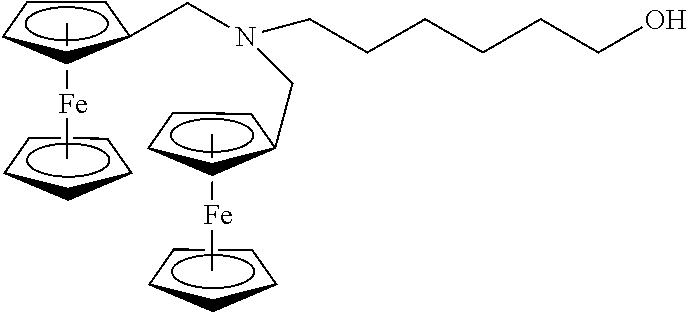
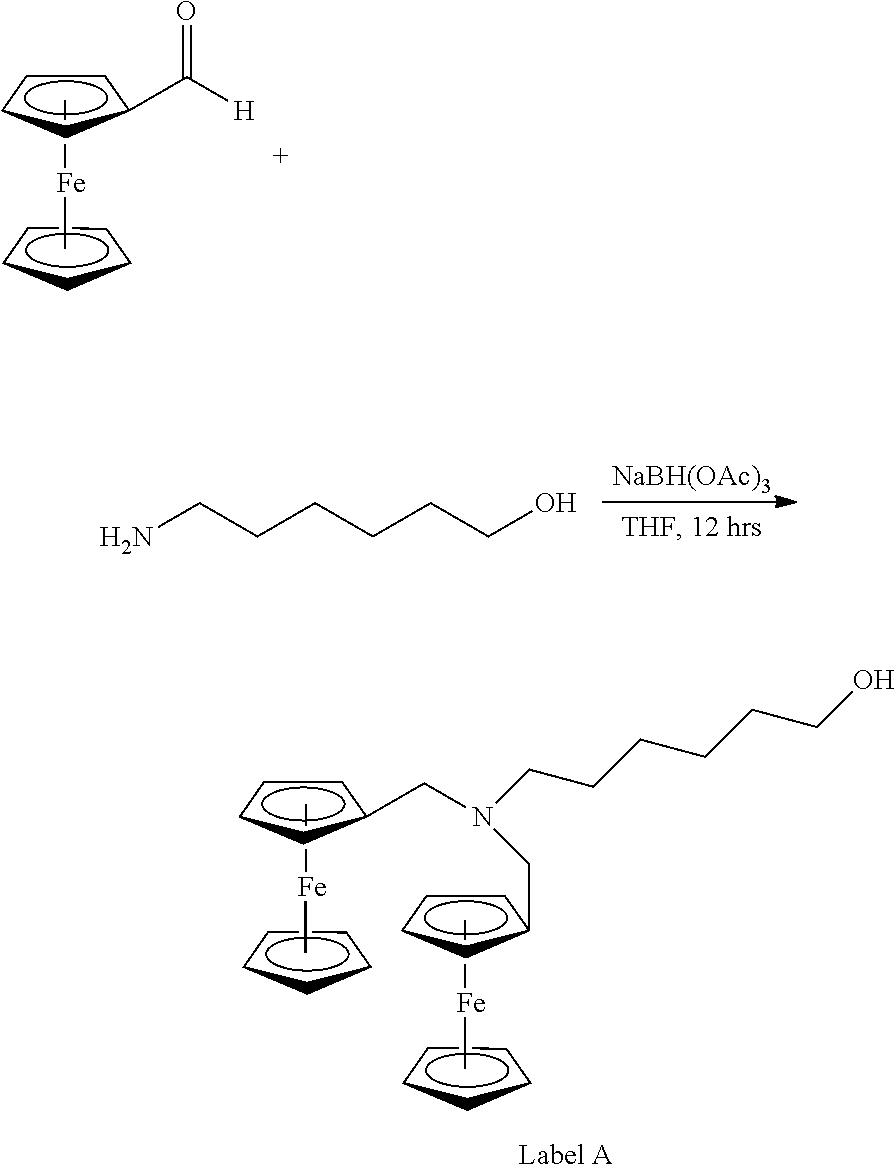
- Illustrative of that embodiment is the compound N,N-di(ferrocenylmethyl)-6-aminohexanol.
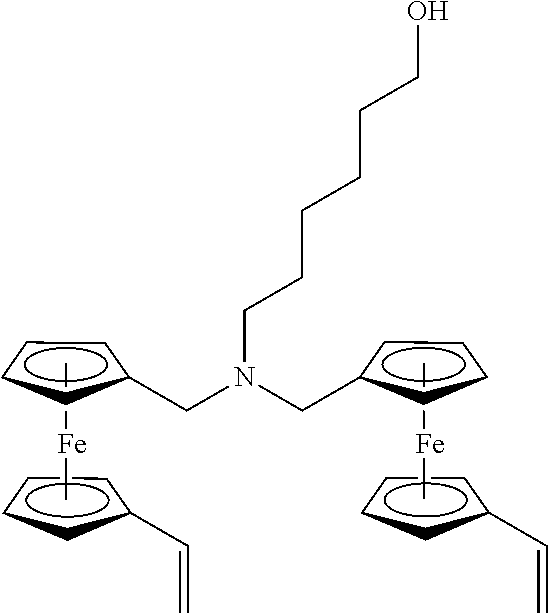
- ferrocenyl groups include 1′-methyl ferrocenyl; 2-methylferrocenyl; 1′-vinylferrocenyl; 1′-bromoferrocenyl; and 2,3,4,5-tetramethyl-1′,2′,3′,4′,5′-pentamethylferrocenyl.
- the ferrocenyl moieties are identical. That is thought to give a stronger signal.
- the moiety Z may be unsubstituted or substituted.
- Substituents when present, may be for example one or more substituents selected from hydroxy, halo, cyano, amino, and unsubstituted or substituted C1-C4 alkyl, C1-C4 alkenyl, or aryl; wherein in each case optional substituents include without limitation hydroxy, halo, cyano, oxo, amino, ester or amido.
- the moiety Z may, if desired, be interrupted by one, or optionally more than one, atom or moiety seleted from —O—, —S—, cycloalkyl, including heterocycloalkyl, —CO—, —CONH—, —NHCO— and —NH— and —NR 1 — in which R 1 is C1 to C4 alkyl.
- cycloalkyl moieties that may be included as interruptions within the moiety Z are cycloalkyl rings with from 5 to 7 ring atoms, especially 6 ring atoms, for example cyclohexyl, piperidinyl, morpholinyl.
- the moieties X and Y which are preferably the same, advantageously have a chain length of from 1 to 6, preferably from 1 to 4 carbon atoms, especially one or two carbon atoms, and more especially one carbon atom.
- the moieties X and Y may each represent an alkylene chain, optionally interrupted by —O—, —S— or —NR 5 — for example —NH—.
- Preferred moieties X and Y include, for example, —CH 2 —, —CH 2 —CH 2 —, —(CH 2 ) 3 —O—CH 2 —, —CH 2 —O—(CH 2 ) 3 —, —(CH 2 ) 3 —O—(CH 2 ) 2 —, and —(CH 2 ) 2 —O—(CH 2 ) 3 —.
- Linkage to the substrate can be by any suitable linkage, typically by linkage to a substrate side chain.
- the linker group R in the compounds of general formula I may be any group suitable for effecting linkage to the substrate either directly or via a functionalising group as described herein.
- R is preferably a hydroxyl group or a protected hydroxyl group or a group containing a hydroxyl group or a protected hydroxyl group. It will be appreciated, however, that any other suitable linker group R may be selected having regard to the substrate to which, in use, the compound is to be attached.
- Various synthetic methods have been developed for the derivatisation of protein, peptide or amino acid side chains or protein, peptide or amino acid terminal moieties.
- lysine residues in a protein may be derivatised by reaction with a succinimidyl ester.
- a succinimidyl ester For derivatisation at other amino acid residues, other known synthetic methods may be used.
- a maleimide reagent may be used to derivatise cysteine residues.
- An N-hydroxy succinimide ester may be used to derivatise the amino terminus or side chain amino group of a protein or peptide, or an amino moiety of an amino acid.
- Suitable derivatisation methods for nucleotides are also well-known, for example, using the phosphoramidite moiety.
- Labelled substrates according to the invention may be prepared by reaction of a compound according to the invention, optionally after functionalisation to obtained a functionalised labelling compound, with a substrate, for example, with a substrate selected from amino acids, nucleotides (for example oligo deoxyribonucleotides or oligo ribonucleotides), nucleosides, sugars, peptides, proteins, oligonucleotides, polynucleotides, carbohydrates and derivatives of any of those molecules.
- a substrate selected from amino acids, nucleotides (for example oligo deoxyribonucleotides or oligo ribonucleotides), nucleosides, sugars, peptides, proteins, oligonucleotides, polynucleotides, carbohydrates and derivatives of any of those molecules.
- the substrate is a nucleotide or an oligonucleotide.
- the nucleotide may be selected from adenosine, thymidine, guanosine, cytidine or uridine.
- the nucleotide, or a nucleotide of the oligonucleotide is attached to the label through a group attached to the ribose or deoxyribose group of the nucleotide, for example in the 2′, 3′ or 5′ position, for example through an oxygen or nitrogen atom.
- the nucleotide is attached at the 3′ or 5′ position, for example at the 5′ position. Linking at other positions is also possible.
- one advantageous way of attaching labels of the invention is by functionalisation with phosphoramidite.
- the linking of phosphoramidite groups to oligonucleotides is widely practised in oligonucleotide synthesis and thus methods and conditions for attachment to an oligonucleotide of labels functionalised with phosphoramidite will be well-known and a routine matter to those skilled in the art. Further, it advantageously permits the use of standard oligo manufacturing methods.
- Oligonucleotides to be for use in an assay in accordance with the invention are advantageously nucleotides having from 2 to 50 nucleotides, more preferably from 2 to 40 nucleotides especially from 15 to 35 nucleotides, with from 18 to 30 nucleotides being especially preferred.
- shorter oligonucleotides may be useful, for example oligonucleotides with from 2 to 14 nucleotides, more preferably from 2 to 10 nucleotides.
- Attachment to proteins may be accomplished in some cases by incubation of the protein and ferrocenyl label together at room temperature in an appropriate buffer solution.
- the label is advantageously to be linked to cysteine or lysine but the substrate sequence does not contain cysteine or lysine at a suitable position the sequence may if desired be mutated to add one or more cysteine or lysine residue either as an additional residue or as a substitution for another residue.
- An alternative method for attachment to proteins may include biotinylation of the labels and use of commercial streptavidinated proteins (or vice versa).
- the substrate may be biotinylated by any standard technique for example by use of a commercially available biotinylation kit.
- Biotinylated substrate will bind to strepavidin or avidin conjugated compounds such as antibodies (which are commercially and widely available).
- A-L is preferably a moiety derived from a compound according to general formula I and F is a functionalising group.
- Preferred functionalised labelling compounds of the general formula III include compounds of the general formula IIIb: A-O—F IIIb
- A-O is a moiety derived from a compound according to general formula I, preferably by loss of a hydroxy hydrogen atom or protecting group when the linker group R of general formula I is hydroxyl or a hydroxyl-containing group or is a protected hydroxyl group, and F is a functionalising group.
- Suitable functionalising groups that may be usable with labels of the invention may include, without limitation, succinimidyl ester groups, phosphoramidite groups, maleimide groups, biotin and azide groups. It will be appreciated, however, that there may be used any functionalising group that facilitates attachment of the labelling compound to the substrate to be labelled.
- the invention also provides a method of detecting a nucleic acid (for example RNA or DNA) in a sample comprising the optional step of amplifying the nucleic acid (for example by PCR or another nucleic acid amplification technique) followed by the step of contacting the amplicon with a complementary nucleic acid probe under conditions to allow hybridization between the probe and amplicon, followed by the step of selectively degrading either hybridized or unhybridized probe (for example by use of single or double strand specific nucleases), wherein said probe is labelled with an electrochemically active compound of the invention and wherein the method provides the step of measuring the electrochemical activity of the compound labelling the probe of wherein said electrochemical activity is dependent either quantitatively or qualitatively on the extent of degradation of the probe.
- a nucleic acid for example RNA or DNA
- the invention also provides a method of detecting an antibody or derivative (which may for example be bound to target antigen in an assay) with an electrochemically active compound of the invention comprising the step of measuring the electrochemical activity of the compound.
- the invention also provides methods of diagnosing or monitoring a disease in a subject comprising using a method of the invention in the detection of a protease or a protease inhibitor associated with said disease in a tissue or body fluid of the subject.
- the invention also provides methods of diagnosing or maintaining a disease in a subject comprising using a method of the invention to detect a peptide or protein associated with said disease in a tissue or body fluid of the subject.
- the invention also provides methods of diagnosing or monitoring a disease in a subject comprising using a method of the invention in the detection of a nuclease or a nuclease inhibitor associated with said disease in a tissue or body fluid of the subject.
- the invention provides use of a method of the invention for detecting a disease in a subject.
- the invention also provides methods of detecting a pathogen or other undesirable organism, for example a food spoilage organism, comprising using a method of the invention.
- the invention provides the use of a N,N-di(ferrocenylalkyl)glycine derivative, for example a N,N-di(ferrocenylalkyl)glycinamido derivative, as an electrochemical label in an electrochemical measurement method.
- the invention also provides an assay comprising a labelled substrate of the invention, optionally in combination with other assay components for example a sample vessel, a container comprising electrodes for electrochemical detection, enzymes for use in the assay or standards and controls.
- Said assay may comprise more than one different labelled substrate of the invention. If that is the case the presence of different labelled substrates may be differentially detected by labelling them with electrochemical labels of the invention having different electrochemical characteristics (for example different oxidation potentials) thereby permitting the assay to be a multiplex (for example a duplex) assay in which different substrates may be discriminated when present in the same sample vessel.
- each ferrocenyl moiety is substituted by at least one substituent selected from halo, C1 to C4-alkyl, haloalkyl, aryl, C1 to C4 alkenyl, and cyano.
- the invention provides a compound according to general formula I
- X represents —(CH 2 ) x — in which x is from 1 to 6; and Y represents —(CH 2 ) y — in which y is from 1 to 6.
- Z preferably represents C6 to C8 alkylene optionally interrupted by oxygen.
- the linker group R comprises a group capable of reacting with a compatible group of a functionalising moiety or of a substrate to attach the compound to said functionalising moiety or said substrate, for example R may be hydroxy, protected hydroxy or a moiety containing a hydroxy or protected hydroxy group.
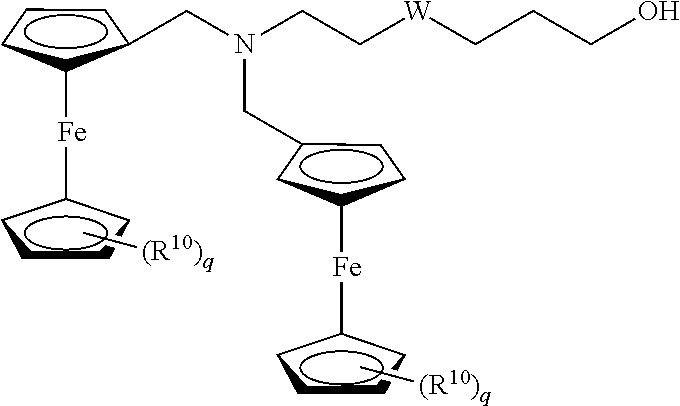
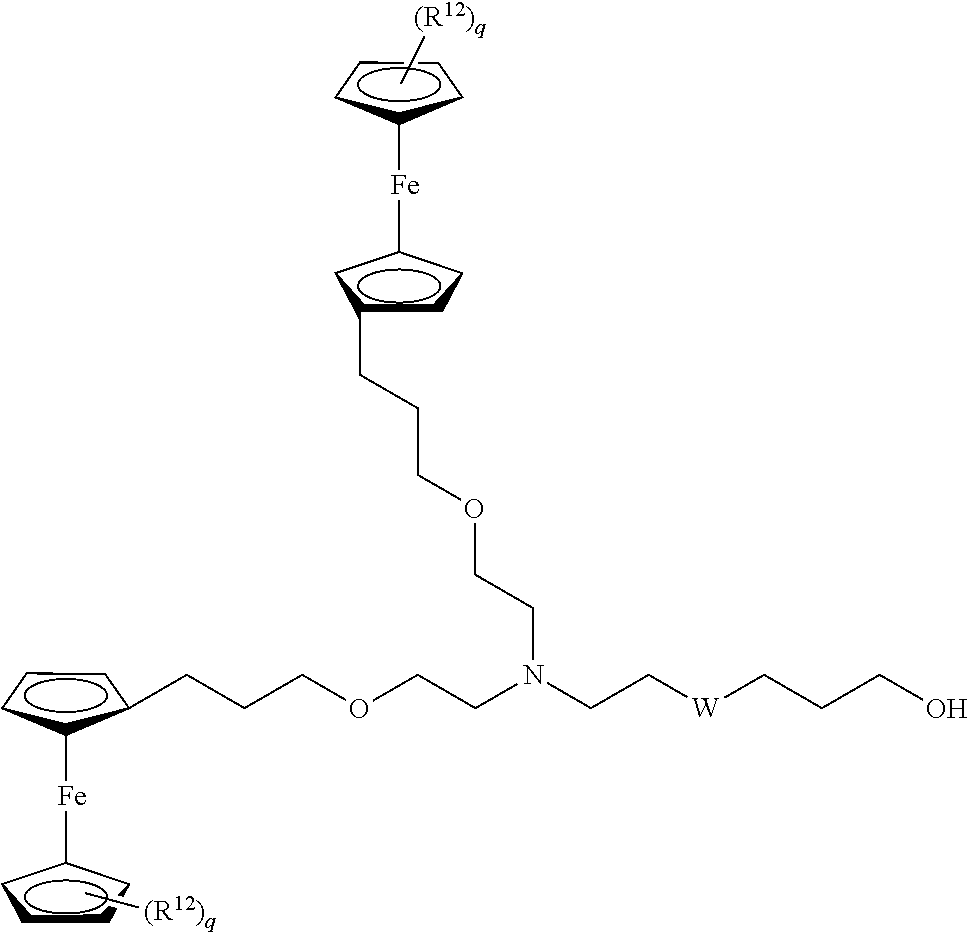
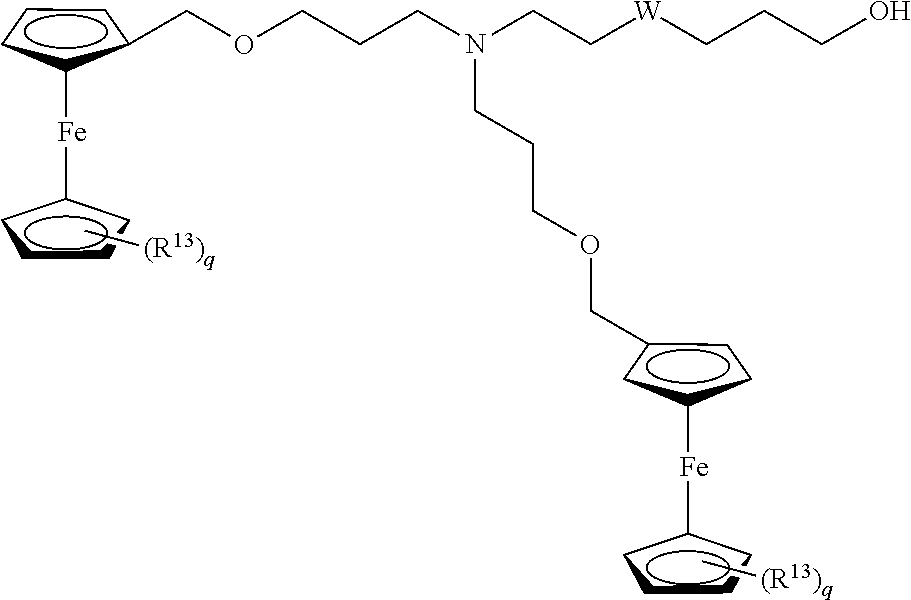
- Table 1 below sets out in the general formulae IVa, Va, VIa, VIIa and VIIIa certain preferred compounds according to the invention which may be used as labels in electrochemical assays in accordance with the invention, and which may be used to make functionalised labelling compounds and labelled substrates according to the invention.
- Table 1 also sets out in the general formulae IVb, Vb, VIb, VIIb and VIIIb illustrative corresponding functionalised labelling compounds according to the invention.
- each ferrocenyl may have more than one substituent R, which may be the same or different, and in any ring position. Where there is one or more substituent on one of the ferrocenyl groups, the other ferrocenyl group is to be understood as having the same substituent(s) in the same positions.
- R 10 if present represents halo, C1 to C4-alkyl, haloalkyl, especially fluoroalkyl, phenyl, C1 to C4 alkenyl, for example vinyl, or cyano; q represents from 0 to 5, for example 1; and W represents (CH 2 ) n where n is from 0 to 6, O, S or NR 20 where R 20 is alkyl, for example C1 to C4 alkyl IVb
- R 10 , q and W are as defined with reference to general formula IVa Va in which R 11 if present represents alkyl, for example C1 to C4- alkyl, aryl, for example phenyl, or amino alkyl, especially dialkyl- substituted amino alkyl, for example di(C1-C4- alkyl)aminomethyl-; r represents from 1 to 4, for example 1; and W represents (CH 2 ) n where n is from
- each distal pentadienyl ring of each ferrocenyl that is the ring remote from the bond linking the ferrocenyl to the rest of the molecule
- those substituents may be in any position relative to one another.
- ring substituents on either the proximal or the distal ring, it is also possible for both pentadienyl rings of each ferrocenyl to carry one or more substituents.
- the compound is N,N-di(ferrocenylmethyl)-6-aminohexanol (referred to in the Examples below as Label A).
- Label A N,N-di(ferrocenylmethyl)-6-aminohexanol
- each ferrocenyl moiety may be unsubsituted or substituted by one or more substituents.
- the compound N,N-diferrocenylmethyl-6-aminohexanol, in which the ferrocenyl groups are both unsubstituted, has been found to have good electrochemical characteristics.
- incorporation of one or more substituents on each of the ferrocenyl groups (the substituents in each ferrocenyl being the same) in that compound can be used to obtain compounds with modified electrochemical characteristics, providing through appropriate substituent selection a suite of compounds from which two or more may be selected for the purpose of multiplex reactions.
- FIG. 1 is a schematic representation of an electrochemical cell used in differential pulse voltammetry measurements described herein;
- FIG. 2 is a differential pulse voltammogram of Label A as manufactured in Example 1 below;
- FIG. 3 is a differential pulse voltammogram of Label B as manufactured in Example 2 below;
- FIG. 4 is a differential pulse voltammogram of Label C as manufactured in Example 3 below;
- FIG. 5 shows the voltammetric scans for both a Chlamydia positive and a negative sample according to Example 5(a) below;
- FIG. 6 is a mass spec analysis of a mononucleotide and a dinucleotide synthesised with the label A electrochemical label as described in Example 5(a) below;
- FIG. 7 is a mass spec analysis of the assay product of Example 5(a);
- FIG. 8 is a bar graph showing current measurements taken when a Chlamydia target is added directly to a PCR reaction at a range of concentrations and detected using a oligonucleotide probe as described in Example 5(b) below;
- FIG. 9 is a bar graph showing peak current at a range of concentrations when the Chlamydia target was added to a DNA extraction process and the output from the extraction process was amplified using PCR, then detected using an oligonucleotide probe labelled with Label A, as described in Example 5(c) below;
- FIG. 10 shows a comparison between electrochemical detection using the label A probe and a SYBR Green based qPCR assay for Norovirus
- FIG. 11 shows a comparison between electrochemical detection using the label A probe and a SYBR Green based qPCR assay for Streptococcus equi;
- FIG. 12 a is a voltammetric scan using label A coupled to a commercially available anti-goat IgG;
- FIG. 12 b shows voltammetric scans carried out at time intervals using label A coupled to a commercially available anti-goat IgG;
- FIG. 13 shows voltammetric scans of microparticles according to Example 8 at various concentrations.
- FIG. 14 is a differential pulse voltammogram of Label D as manufactured in Example 9 below.
- FIG. 1 there is shown schematically an electrochemical cell 1 suitable for use in the cyclic voltammetry experiments described herein.
- the cell comprises a vessel 2, containing a background electrolyte solution 3, which is an aqueous 100 mM solution of sodium chloride.
- a background electrolyte solution 3 which is an aqueous 100 mM solution of sodium chloride.
- Immersed in the solution 3 is a printed carbon working electrode 5, a printed carbon counter electrode 6 and a silver/silver chloride reference electrode 7, all with silver connectors.
- the sample is spread on to the surface of the working electrode and voltammetry is performed by connecting the silver connectors to the appropriate leads on the potentiometer.
- the sample may be prepared as follows: Ferrocenyl label precursor (2 ng) is dissolved in DMSO (1 mL). An aliquot of 10 ⁇ L is taken of this solution and is then further diluted in the buffer (500 ⁇ L). Then an aliquot (20 ⁇ L) is applied to the screen printed
- Ferrocene carboxylic acid was obtained from Sigma-Aldrich.
- Ferrocene carboxaldehyde was obtained from Sigma-Aldrich.
- 6-Aminohexanol was obtained from Sigma-Aldrich.
- N,N-diisopropylethylamine was obtained from Sigma-Aldrich.
- 2-cyanoethyldiisopropylchlorophosphoramidite was obtained from Sigma-Aldrich.
- Papain solution at concentration 1 mg/mL was obtained from Sigma-Aldrich.
- Anti-goat IgG and Biotinylated goat IgG were obtained from Sigma.
- PCR methods were performed using a PTC-100 or PTC-200 Programmable Thermal Controller (MJ Research Inc.), or a PeqLab flat bed thermocycler
- Streptavidin coated microtitre wells were Sigma ScreenTM high density wells.
- the electrodes are ink based and are screen printed on to a polymer substrate (for example Mylar) followed by heat curing—produced by GM Name plate (Seattle, Wash.)
- the product label was found to have a redox potential of 0.275V.
- reaction mixture was quenched with DMF (0.4 mL, 6.25 mmol) and stirred again at room temperature for 4 hrs. Water (15 mL) was then added to the reaction. The organic phase was then extracted with ether (2 ⁇ 25 mL). The combined organic phases were dried with magnesium sulphate, filtered and the solvent was removed under vacuum to afford the product in an 72% yield (dark red/brown oil).
- the electrochemistry of the product compound is shown on the voltammogram in FIG. 3 .
- the product label B was found to have a redox potential of 0.38V.
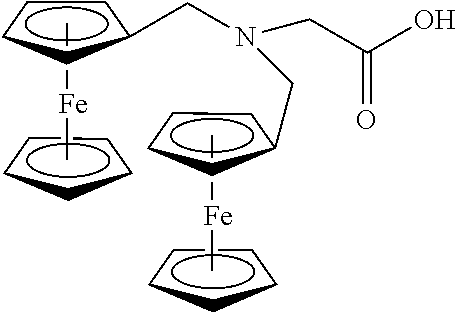
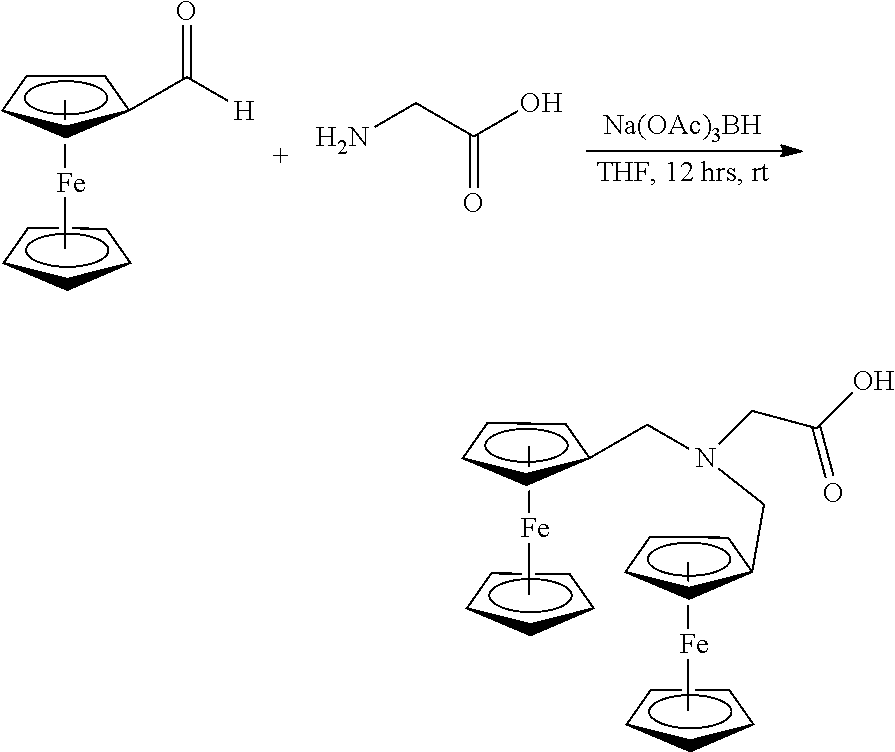
- Ferrocene carboboxaldehyde (2.1 g) was added to a round bottomed flask containing dry THF (20 mL). Glycine (0.5 g) was added to the solution and the reaction was stirred under N 2 . Sodium triacetoxyborohydride (2.3 g) was added portionwise to the stirring solution. The reaction was stirred over night. The solution was then partitioned between ethyl acetate (40 mL) and 1M aqueous sodium hydroxide (40 mL). The organic fraction was washed with saturated aqueous NaHCO 3 (sat; 20 mL), brine (40 mL) and water (40 mL). The organic fraction was dried using MgSO 4 and the solvent was removed.
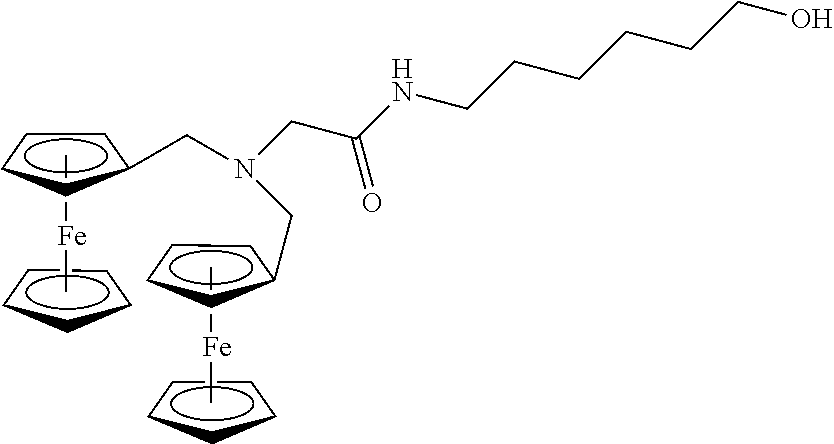
- Oxalyl chloride (0.87 mL) in dry DCM (2 mL) was added dropwise via a pressure equalising dropping funnel to a stirred solution of the di-ferrocenyl glycine derivative obtained in 3(a) above in dry DCM (100 mL) at 0° C. under N 2 .
- the reaction warmed to room temperature and stirred for 2 hrs.
- the solvent was removed and the acid chloride product was taken up in dry DCM (75 mL).
- 6-amino hexan-1-ol (0.56 g) in dry DCM (75 mL) was added dropwise via a dropping funnel at 0° C. under N 2 .
- the reaction was then stirred for 2 hrs while warming to room temperature.
- the ferrocenyl derivative shown as a starting material in the above reaction scheme is illustrative, and may be replaced by a molar equivalent of any of the compounds made in Examples 1 to 3 above or Examples 9 to 13 below.
- N,N-diisopropylethylamine (0.4 mL, 8.4 mmol) was added to a stirred solution of the ferrocene derivative (2.1 mmol) in dry THF (25 mL) under a nitrogen atmosphere.
- 2-cyanoethyldiisopropylchlorophosphoramidite (0.2 ml, 3.15 mmol) was added dropwise and the resulting mixture was stirred for 15 mins.
- MilliQ filtered water 200 mL was added and the solution was stirred for a further 30 mins.
- Ethyl Acetate-Triethylamine (1:1, 25 mL) was added, a precipitate formed.
- oligonucleotide was carried out using standard oligonucleotide solid-phase synthesis techniques the nucleotides being added stepwise to the 5′ end of the oligonucleotide strand. Each addition to the oligonucleotide chain involves four reactions which are the de-blocking, coupling, capping and oxidation steps. Once the oligonucleotide sequence has been completed to the desired length the electrochemical label was added via a phosphoramidite linkage.
- the target sequence was amplified from a Chlamydia trachomatis target by a standard PCR method using 5′ and 3′ target specific primers and a uracil-DNA glycosylase (UDG) Step.
- PCR conditions are summarised in Table 1 below.
- a oligonucleotide probe labelled with electrochemical Label A at the 5′ terminal
- T7 exonuclease was added to the tube and incubated to allow it to digest dsRNA.
- Probe was digested by the T7 exonuclease to the extent that it was annealed to the PCR amplicon. Electrochemical detection was then carried out, showing a peak at a characteristic redox potential of 0.2V for the digest product nucleotide labelled with Label A.
- FIG. 5 shows the peak height, as a current, at the known (label specific) redox potential for both a Chlamydia trachomatis positive sample (the strong peak) and negative sample (absence of peak).
- FIG. 6 shows a mass spec analysis of a mononucleotide and a dinucleotide synthesised with the label A electrochemical label.
- FIG. 7 is a mass spec analysis of the assay product, which shows exact correlation to a mononucleotide coupled to the label A electrochemical label, the electrochemical moiety detected in the assay.
- FIG. 8 shows the results of an experiment where the Chlamydia target is added directly to the PCR reaction at a range of concentrations. This is amplified using PCR, then detected using a label A oligonucleotide probe.
- FIG. 9 shows the result for an experiment where a range of concentrations of the Chlamydia target are added to a DNA extraction process (i.e. not added directly to the PCR) and the output from the extraction process is amplified using PCR, then detected using an oligonucleotide probe labelled with Label A.
- FIG. 10 shows a comparison between electrochemical detection using the label A probe and a SYBR Green based qPCR assay for Norovirus.
- the materials and protocols are as follows:
- the data shows the limit of detection for the electrochemical assay to be 200 ag.
- the limit of detection for the qPCR assay is shown as between 2 and 20 fg. Below this level the Ct value is greater than 40-cycle cut-off, shown by the horizontal line as the inverse of a Ct value of 40.
- the qPCR negatives did not rise above the threshold. This demonstrates the advantageous sensitivity of the electrochemical assay using label A.
- FIG. 11 shows a comparison between electrochemical detection using the label A probe and a SYBR Green based qPCR assay for Streptococcus equi.
- FIG. 12 a is a voltammetric scan using label A coupled directly to the primary amine of a commercially available anti-goat IgG, using an active NHS ester (N-hydroxysuccinimide ester.
- the following generalised reaction scheme illustrates attachment of the label to a free amine of, for example, a lysine residue in the anti-goat IgG.
- biotinylated goat IgG was immobilised onto a streptavidin coated microtitre well.
- the label A anti-goat IgG was then incubated in the well containing the immobilised goat IgG, this was then removed with washing.
- a papain solution was added to the well and incubated to allow digestion of the secondary antibody, with the resulting solution read electrochemically.
- the control in this experiment followed the same procedure, but the final incubation was carried out in buffer only, without papain.
- FIG. 12 a shows that an electrochemical signal at the known oxidation potential for the label A is released when papain is present, but is not present in the absence of papain. This shows that the label A is directly bound to the antibody in this assay and signal is only observed when this antibody is digested, releasing the electrochemical label.
- FIG. 12 b The data in FIG. 12 b uses the same model assay as in Example 7a) above, except that a papain digestion time course experiment is shown.
- the control was the label A secondary antibody (anti-goat IgG) which was added to a well with no immobilised goat IgG antibody.
- a biotin molecule was coupled to label A.
- the biotinylation can be carried out in an automated oligonucleotide synthesiser or using standard laboratory conditions by reaction of ferrocenyl phosphoramidite label with N-hydroxysuccinimide (NHS) esters of biotin.
- NHS N-hydroxysuccinimide
- Paramagnetic treptavidin particles were washed ⁇ 3 (phosphate buffer) and mixed with biotinylated label, followed by incubation for 1 hour at room temperature with mixing. The particles were washed ⁇ 2 (phosphate buffer) and washed ⁇ 1 (PCR buffer) They were resuspended in final buffer (PCR buffer)
- Oxalyl chloride (0.87 mL) in dry DCM (2 mL) was added dropwise via a pressure equalising dropping funnel to a stirred solution of di-ferrocenyl glycine (obtained as described in Example 3a) in dry DCM (100 mL) at 0° C. under N 2 .
- the reaction warmed to room temperature and was stirred for 2 hrs.
- the solvent was removed and the acid chloride product was taken up in dry DCM (75 mL).
- 6-aminohexan-1-ol (0.56 g) in dry DCM (75 mL) was added dropwise via a dropping funnel at 0° C. under N 2 .
- the reaction was then stirred for 2 hrs while warming to room temperature.
- Example 12 6-(bis((1′-bromoferrocenyl) 1 -methylferrocenyl)amino)hexan-1-ol
- Methylferrocenecarboxaldehyde (1 g, 5 mmol) was dissolved in dry THF (30 cm 3 ). 6-aminohexan-1-ol (0.25 g, 2.13 mmol) was added. Then sodium triacetoxyborohydride (1.3 g, 6.16 mmol) was added to the reaction mixture. The solution was stirred under nitrogen at room temperature overnight. Ethyl acetate (20 cm 3 ) and 1M NaOH (20 cm 3 ) were then added and the organic layer was then extracted with saturated NaHCO 3 (25 cm 3 ), brine (25 cm 3 ) and Milli Q filtered water (25 cm 3 ) then dried over magnesium sulfate and the solvent removed in vacuo to yield an orange oil.
- solution B solution A (solution A: ethyl acetate 95% TEA 5%, solution B: petroleum ether 40-60 95%, TEA 5%) to elicit the pure product (orange oil). (0.95, 65%).
- the data in the above table illustrates how inclusion of a substituent on the ferrocenyl moieties and the selection of that substituent may be used to influence the electrode potential.
- This enables the electrochemical detection of compounds to be carried out under a variety of different conditions, for example selecting an optimum measurement potential or avoiding conditions under which measuring sensitivity may be compromised by interference with impurities that may be present.
- the use of labels with different electrode potentials allows for the development of multiplex reactions, in which more than one determination can be carried out in the same sample.
Landscapes
- Chemical & Material Sciences (AREA)
- Organic Chemistry (AREA)
- Life Sciences & Earth Sciences (AREA)
- Health & Medical Sciences (AREA)
- Molecular Biology (AREA)
- Physics & Mathematics (AREA)
- Wood Science & Technology (AREA)
- Engineering & Computer Science (AREA)
- Zoology (AREA)
- Proteomics, Peptides & Aminoacids (AREA)
- Biochemistry (AREA)
- General Health & Medical Sciences (AREA)
- Immunology (AREA)
- Analytical Chemistry (AREA)
- Bioinformatics & Cheminformatics (AREA)
- General Engineering & Computer Science (AREA)
- Genetics & Genomics (AREA)
- Biotechnology (AREA)
- Microbiology (AREA)
- Biophysics (AREA)
- Chemical Kinetics & Catalysis (AREA)
- Pathology (AREA)
- General Physics & Mathematics (AREA)
- Electrochemistry (AREA)
- Spectroscopy & Molecular Physics (AREA)
- Measuring Or Testing Involving Enzymes Or Micro-Organisms (AREA)
- Peptides Or Proteins (AREA)
- Saccharide Compounds (AREA)
- Plural Heterocyclic Compounds (AREA)
Abstract
Description

-
- in which:
- Fc is a substituted or unsubstituted ferrocenyl moiety,
- Fc′ is a substituted or unsubstituted ferrocenyl moiety, and may be the same as or different from Fc;
- X is a C1 to C6 alkylene chain which is optionally interrupted by —O—, —S—, or —NR5—, in which R5 represents hydrogen or C1 to C6 alkyl;
- Y is a C1 to C6 alkylene chain which is optionally interrupted by —O—, —S—, or —NR5—, in which R5 represents hydrogen or C1 to C6 alkyl;
- Z is a C1 to C12 alkylene chain which may optionally be substituted and/or may optionally be interrupted by —O—, —S—, cycloalkyl, —CO—, —CONR1—, —NR1CO— or —NR1— in which R1 represents hydrogen or C1 to C4 alkyl; and

in which:
Fc is a substituted or unsubstituted ferrocenyl moiety,
Fc′ is a substituted or unsubstituted ferrocenyl moiety, and may be the same as or different from Fc;
x is 1 or 2;
y is 1 or 2;
z is from 1 to 8;
and R is a linker group.

-
- in which:
- Fc is a substituted or unsubstituted ferrocenyl moiety,
- Fc′ is a substituted or unsubstituted ferrocenyl moiety, and may be the same as or different from Fc;
- X is a C1 to C6 alkylene chain which is optionally interrupted by —O—, —S—, or —NR5—, in which R5 represents hydrogen or C1 to C6 alkyl;
- Y is a C1 to C6 alkylene chain which is optionally interrupted by —O—, —S—, or —NR5—, in which R5 represents hydrogen or C1 to C6 alkyl;
- Z is a C1 to C12 alkylene chain which may optionally be substituted and/or may optionally be interrupted by —O—, —S—, cycloalkyl, —CO—, —CONR1—, —NR1CO— or —NR1— in which R1 represents hydrogen or C1 to C4 alkyl; and
- R is a linker group comprising an oxygen atom
with a functionalising compound to obtain a funtionalised labelling compound of general formula III:
A-L-F III
in which A represents

A-L-F III
A-L-F III
in which A, L and F are as defined above.
A-L-F′—[S] IIIa
in which A represents

-
- in which:
- Fc is a substituted or unsubstituted ferrocenyl moiety,
- Fc′ is a substituted or unsubstituted ferrocenyl moiety, and may be the same as or different from Fc;
- X is a C1 to C6 alkylene chain which is optionally interrupted by —O—, —S—, or —NR5—, in which R5 represents hydrogen or C1 to C6 alkyl;
- Y is a C1 to C6 alkylene chain which is optionally interrupted by —O—, —S—, or —NR5—, in which R5 represents hydrogen or C1 to C6 alkyl;
- Z is a C1 to C12 alkylene chain which may optionally be substituted and/or may optionally be interrupted by —O—, —S—, cycloalkyl, —CO—, —CONR1—, —NR1CO— or —NR1— in which R1 represents hydrogen or C1 to C4 alkyl;
L-F′ represents a linking moiety; and
[S] represents a substrate.
The linking moiety -L-F′— is in general a moiety derivable from the moiety -L-F— according to general formula III.
A-L-F III
A-O—F IIIb

-
- in which:
- Fc is a substituted ferrocenyl moiety,
- Fc′ is a substituted ferrocenyl moiety, and may be the same as or different from Fc;
- X is a C1 to C6 alkylene chain which is optionally interrupted by —O—, —S—, or —NR5—, in which R5 represents hydrogen or C1 to C6 alkyl;
- Y is a C1 to C6 alkylene chain which is optionally interrupted by —O—, —S—, or —NR5—, in which R5 represents hydrogen or C1 to C6 alkyl;
- Z is a C1 to C12 alkylene chain which may optionally be substituted and/or may optionally be interrupted by —O—, —S—, cycloalkyl, —CO—, —CONR1—, —NR1CO— or —NR1— in which R1 represents hydrogen or C1 to C4 alkyl; and
- R is a linker group.

-
- in which:
- Fc and Fc′ are each an unsubstituted ferrocenyl moiety,
- X is a C1 to C6 alkylene chain which is optionally interrupted by —O—, —S—, or —NR5—, in which R5 represents hydrogen or C1 to C6 alkyl;
- Y is a C1 to C6 alkylene chain which is optionally interrupted by —O—, —S—, or —NR5—, in which R5 represents hydrogen or C1 to C6 alkyl;
- Z is a C6 to C12 alkylene chain or is a C1 to C12 alkylene which is substituted by one or more substituents and/or is interrupted by a moiety selected from —O—, —S—, cycloalkyl, —CO—, —CONH—, —NHCO— or —NR1— in which R1 represents hydrogen or C1 to C4 alkyl; and
- R is a linker group.
| TABLE 1 |
| Illustrative compounds and functionalised labelling compounds |
 |
IVa |
| in which R10 if present represents halo, C1 to C4-alkyl, haloalkyl, | |
| especially fluoroalkyl, phenyl, C1 to C4 alkenyl, for example | |
| vinyl, or cyano; q represents from 0 to 5, for example 1; and W | |
| represents (CH2)n where n is from 0 to 6, O, S or NR20 where R20 | |
| is alkyl, for example C1 to C4 alkyl | |
 |
IVb |
| In which R10, q and W are as defined with reference to general | |
| formula IVa | |
 |
Va |
| in which R11 if present represents alkyl, for example C1 to C4- | |
| alkyl, aryl, for example phenyl, or amino alkyl, especially dialkyl- | |
| substituted amino alkyl, for example di(C1-C4- | |
| alkyl)aminomethyl-; r represents from 1 to 4, for example 1; and | |
| W represents (CH2)n where n is from 0 to 6, O, S or NR20 where | |
| R20 is alkyl, for example C1 to C4 alkyl | |
 |
Vb |
| In which R11, r and W are as defined with reference to general | |
| formula Va | |
 |
VIa |
| in which R12 if present represents halo, C1 to C4-alkyl, haloalkyl, | |
| especially fluoroalkyl, phenyl, C1 to C4 alkenyl, for example | |
| vinyl, or cyano; q represents from 0 to 5, for example 1; and W | |
| represents (CH2)n where n is from 0 to 6, O, S or NR20 where R20 | |
| is alkyl, for example C1 to C4 alkyl | |
 |
VIb |
| In which R12, q and W are as defined with reference to general | |
| formula VIa | |
 |
VIIa |
| in which R13 if present represents halo, C1 to C4-alkyl, haloalkyl, | |
| especially fluoroalkyl, phenyl, C1 to C4 alkenyl, for example | |
| vinyl, or cyano; r represents from 1 to 4, for example 1; and W | |
| represents (CH2)n where n is from 0 to 6, O, S or NR20 where R20 | |
| is alkyl, for example C1 to C4 alkyl | |
 |
VIIb |
| In which R13, r and W are as defined with reference to general | |
| formula VIIa | |
 |
VIIIa |
| in which R14 if present represents halo, C1 to C4-alkyl, haloalkyl, | |
| especially fluoroalkyl, phenyl, C1 to C4 alkenyl, for example | |
| vinyl, or cyano; q represents from 0 to 5, for example 1; W | |
| represents (CH2)n where n is from 0 to 6, O, S or NR20 where R20 | |
| is alkyl, for example C1 to C4 alkyl; and V represents (CH2)m | |
| where m represents from 2 to 6 | |
 |
VIIIb |
| In which R14, q, W and V are as defined with reference to | |
| general formula VIIIa | |
- 2-((diferrocenylmethyl)amino)-1-(4-(hydroxymethyl)piperidin-1-yl)ethanone; and
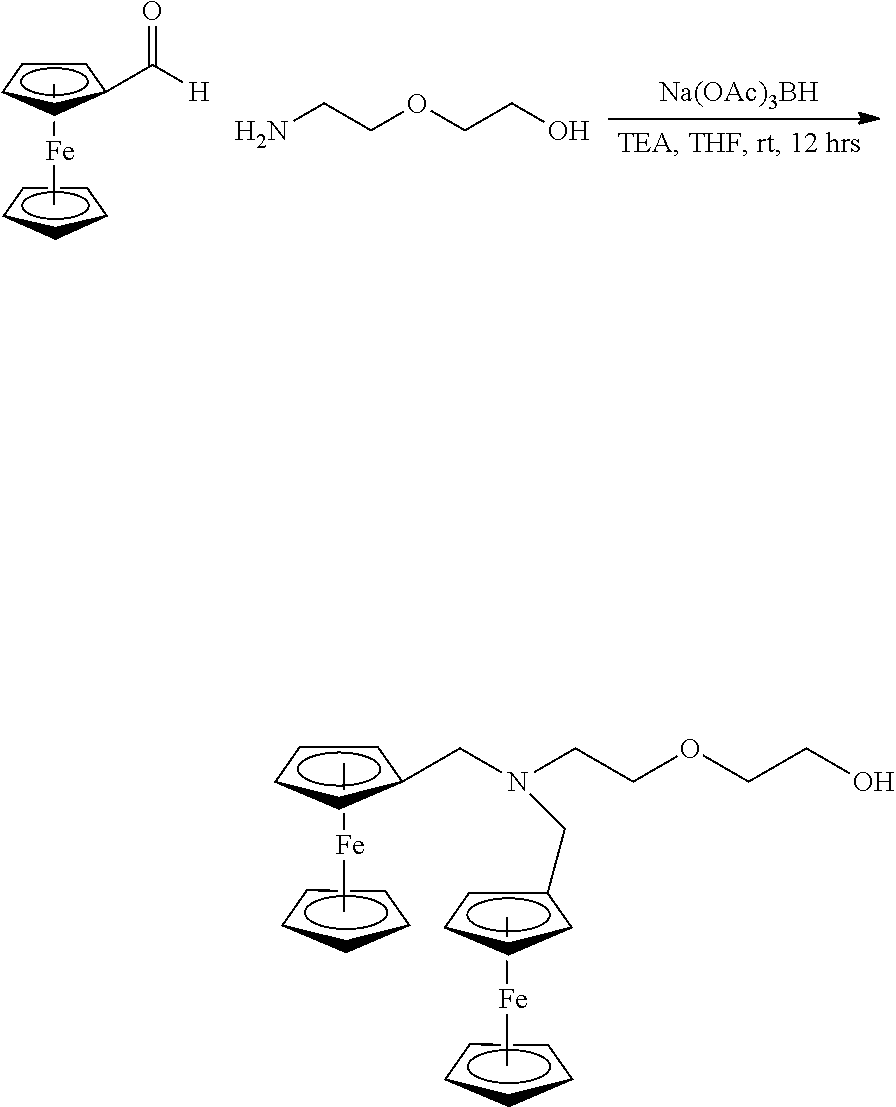
- N,N-di-(ferrocenylmethyl)-2-aminoethoxy) ethanol
| TABLE 2 |
| Illustrative labelling compounds according to the invention |
 |
 |
 |
 |
 |
 |
 |
 |
 |
 |


| TABLE 3 |
| Electrochemical activity of Label C |
| Peak Position (mV) | Peak Height | ||
| 410 | 6.79e−6 | ||
| 425 | 8.47e−6 | ||
| 415 | 8.56e−6 | ||


| TABLE 4 | |||
| Component | Concentration | ||
| PCR | 1X | ||
| MgCl |
| 2 | 5 | mM |
| dUTP mix | 1X |
| Forward primer | 0.04 | μM | ||
| Reverse primer | 0.3 | μM | ||
| Taq | 2.5 | U | ||
| UNG | 0.5 | U | ||
-
- Bioline SensiMix dU
-
Bioline 1×SYBR Green - 0.3 μM forward primer
- 0.3 μM reverse primer
- 0.5 U UNG

| TABLE 5 |
| Electrochemical activity of Label D |
| Peak Position (mV) | Peak Height | ||
| 242 | 9.31e−6 | ||
| 245 | 9.38e−6 | ||
| 239 | 9.76e−6 | ||

| TABLE 6 |
| Electrochemical activity of Label E |
| Peak Position | Peak Height | ||
| 504 | 6.61e−6 | ||
| 506 | 5.51e−6 | ||
| 507 | 3.28e−6 | ||


| TABLE 7 |
| Effect on electrode potential of substituents |
| on ferrocenyl moieties of Label A |
| Example | Fc | Electrode potential | |
| 1 | None | 275 |
| 2 | Dimethylaminomethyl | 380 mV |
| 11 | 1′-vinyl | 298 mV |
| 12 | 1′-bromo | 437 mV |
| 13 | 2-methyl | 330 mV |
Claims (2)

Priority Applications (2)
| Application Number | Priority Date | Filing Date | Title |
|---|---|---|---|
| US17/094,473 US11768167B2 (en) | 2010-12-22 | 2020-11-10 | Ferrocene labels for electrochemical assay and their use in analytical methods |
| US18/449,936 US20230393089A1 (en) | 2010-12-22 | 2023-08-15 | Compounds and their use in analytical methods |
Applications Claiming Priority (8)
| Application Number | Priority Date | Filing Date | Title |
|---|---|---|---|
| GBGB1021896.4A GB201021896D0 (en) | 2010-12-22 | 2010-12-22 | Novel compounds and their use in analytical methods |
| GB1021896.4 | 2010-12-22 | ||
| GB1021896 | 2010-12-22 | ||
| PCT/GB2011/052573 WO2012085591A1 (en) | 2010-12-22 | 2011-12-22 | Novel ferrocene labels for electrochemical assay and their use in analytical methods |
| US201313996748A | 2013-10-31 | 2013-10-31 | |
| US15/908,133 US10495600B2 (en) | 2010-12-22 | 2018-02-28 | Ferrocene labels for electrochemical assay and their use in analytical methods |
| US16/666,750 US10830728B2 (en) | 2010-12-22 | 2019-10-29 | Ferrocene labels for electrochemical assay and their use in analytical methods |
| US17/094,473 US11768167B2 (en) | 2010-12-22 | 2020-11-10 | Ferrocene labels for electrochemical assay and their use in analytical methods |
Related Parent Applications (1)
| Application Number | Title | Priority Date | Filing Date |
|---|---|---|---|
| US16/666,750 Division US10830728B2 (en) | 2010-12-22 | 2019-10-29 | Ferrocene labels for electrochemical assay and their use in analytical methods |
Related Child Applications (1)
| Application Number | Title | Priority Date | Filing Date |
|---|---|---|---|
| US18/449,936 Continuation US20230393089A1 (en) | 2010-12-22 | 2023-08-15 | Compounds and their use in analytical methods |
Publications (2)
| Publication Number | Publication Date |
|---|---|
| US20210116409A1 US20210116409A1 (en) | 2021-04-22 |
| US11768167B2 true US11768167B2 (en) | 2023-09-26 |
Family
ID=43598931
Family Applications (5)
| Application Number | Title | Priority Date | Filing Date |
|---|---|---|---|
| US13/996,748 Abandoned US20140051080A1 (en) | 2010-12-22 | 2011-12-22 | Novel Ferrocene Labels for Electrochemical Assay and their Use in Analytical Methods |
| US15/908,133 Active US10495600B2 (en) | 2010-12-22 | 2018-02-28 | Ferrocene labels for electrochemical assay and their use in analytical methods |
| US16/666,750 Active US10830728B2 (en) | 2010-12-22 | 2019-10-29 | Ferrocene labels for electrochemical assay and their use in analytical methods |
| US17/094,473 Active 2032-08-26 US11768167B2 (en) | 2010-12-22 | 2020-11-10 | Ferrocene labels for electrochemical assay and their use in analytical methods |
| US18/449,936 Pending US20230393089A1 (en) | 2010-12-22 | 2023-08-15 | Compounds and their use in analytical methods |
Family Applications Before (3)
| Application Number | Title | Priority Date | Filing Date |
|---|---|---|---|
| US13/996,748 Abandoned US20140051080A1 (en) | 2010-12-22 | 2011-12-22 | Novel Ferrocene Labels for Electrochemical Assay and their Use in Analytical Methods |
| US15/908,133 Active US10495600B2 (en) | 2010-12-22 | 2018-02-28 | Ferrocene labels for electrochemical assay and their use in analytical methods |
| US16/666,750 Active US10830728B2 (en) | 2010-12-22 | 2019-10-29 | Ferrocene labels for electrochemical assay and their use in analytical methods |
Family Applications After (1)
| Application Number | Title | Priority Date | Filing Date |
|---|---|---|---|
| US18/449,936 Pending US20230393089A1 (en) | 2010-12-22 | 2023-08-15 | Compounds and their use in analytical methods |
Country Status (12)
| Country | Link |
|---|---|
| US (5) | US20140051080A1 (en) |
| EP (1) | EP2655387B1 (en) |
| JP (1) | JP5898693B2 (en) |
| CN (1) | CN103459407B (en) |
| AU (1) | AU2011346861B2 (en) |
| BR (1) | BR112013016240B1 (en) |
| CA (1) | CA2822477C (en) |
| DK (1) | DK2655387T3 (en) |
| EA (1) | EA026116B1 (en) |
| ES (1) | ES2528700T3 (en) |
| GB (1) | GB201021896D0 (en) |
| WO (1) | WO2012085591A1 (en) |
Families Citing this family (22)
| Publication number | Priority date | Publication date | Assignee | Title |
|---|---|---|---|---|
| GB201021896D0 (en) * | 2010-12-22 | 2011-02-02 | Atlas Genetics Ltd | Novel compounds and their use in analytical methods |
| GB201211157D0 (en) * | 2012-06-22 | 2012-08-08 | Atlas Genetics Ltd | Novel compounds and their use in analytical methods |
| GB201312995D0 (en) | 2013-07-19 | 2013-09-04 | Atlas Genetics Ltd | Methods and kits for specific nucleic acid amplification and detection |
| GB2516667A (en) | 2013-07-29 | 2015-02-04 | Atlas Genetics Ltd | An improved cartridge, cartridge reader and method for preventing reuse |
| GB2516675A (en) | 2013-07-29 | 2015-02-04 | Atlas Genetics Ltd | A valve which depressurises, and a valve system |
| GB2516672B (en) | 2013-07-29 | 2015-05-20 | Atlas Genetics Ltd | A system and method for expelling liquid from a fluidic cartridge |
| GB2516669B (en) | 2013-07-29 | 2015-09-09 | Atlas Genetics Ltd | A method for processing a liquid sample in a fluidic cartridge |
| GB2516666B (en) | 2013-07-29 | 2015-09-09 | Atlas Genetics Ltd | Fluidic cartridge for nucleic acid amplification and detection |
| EP3055317B1 (en) * | 2013-10-08 | 2018-01-31 | Atlas Genetics Limited | Labelling compounds and their use in assays |
| GB201416459D0 (en) | 2014-09-17 | 2014-10-29 | Atlas Genetics Ltd | Detection method |
| GB2531616B (en) | 2015-02-02 | 2017-11-22 | Atlas Genetics Ltd | Instrument for performing a diagnostic test on a fluidic cartridge |
| GB2531615B (en) | 2015-02-02 | 2017-11-22 | Atlas Genetics Ltd | Instrument for performing a diagnostic test on a fluidic cartridge |
| GB201501705D0 (en) | 2015-02-02 | 2015-03-18 | Atlas Genetics Ltd | Instrument for performing a diagnostic test on a fluidic cartridge |
| GB2530596B (en) | 2015-02-02 | 2016-08-24 | Atlas Genetics Ltd | Improved blister assembly |
| US11649484B2 (en) | 2016-02-26 | 2023-05-16 | Abbott Diagnostics Scarborough, Inc. | Redox labeled oligonucleotide probes and their use |
| GB2556879A (en) * | 2016-11-22 | 2018-06-13 | Mahle Engine Systems Uk Ltd | Sliding component, material and method |
| CN106866748B (en) * | 2017-03-29 | 2018-05-15 | 厦门云凡医药科技有限公司 | The preparation method of compound |
| JP2018203652A (en) * | 2017-05-31 | 2018-12-27 | 島根県 | Ferrocene naphthalene diimide derivative, telomerase activity detection kit, and telomerase activity detection method |
| CN109827898B (en) * | 2019-03-29 | 2021-09-17 | 河海大学 | Metal corrosion test device |
| CN114113252B (en) * | 2021-11-22 | 2024-02-09 | 常州大学 | Preparation method and application method of chiral mesoporous silica microspheres |
| CN114349800B (en) * | 2021-12-08 | 2023-08-15 | 深圳清华大学研究院 | Ferrocene derivative and synthetic method and application thereof |
| CN114891836A (en) * | 2022-05-31 | 2022-08-12 | 重庆张邦医药科技有限责任公司 | Preparation method of chiral ferrocene derivative |
Citations (9)
| Publication number | Priority date | Publication date | Assignee | Title |
|---|---|---|---|---|
| JP2003125798A (en) | 2001-08-28 | 2003-05-07 | Fuji Photo Film Co Ltd | Method for confirming base sequence in gene of specimen |
| WO2003074731A2 (en) | 2002-03-07 | 2003-09-12 | Molecular Sensing Plc | Nucleic acid probes, their synthesis and use |
| WO2005005657A1 (en) | 2003-07-09 | 2005-01-20 | Molecular Sensing Plc | Protease detection assay |
| JP2006098342A (en) | 2004-09-30 | 2006-04-13 | Kyushu Univ | Electrochemical detection of abnormal prions |
| JP2006325477A (en) | 2005-05-26 | 2006-12-07 | Seiko Epson Corp | Polymorph detection method, polymorph detection kit |
| CN101189521A (en) | 2005-03-09 | 2008-05-28 | E2V生物传感器有限公司 | biosensor labeling group |
| US20150293107A1 (en) | 2012-06-22 | 2015-10-15 | Atlas Genetics Limited | 1,1 '-[[(substituted alkyl)imino]bis(alkylene)]bis-ferrocenes and their use in i electrochemical assays by labelling substrates of interest |
| US20160244815A1 (en) | 2013-10-08 | 2016-08-25 | Atlas Genetics Limited | Labelling Compounds and their Use in Assays |
| US10495600B2 (en) | 2010-12-22 | 2019-12-03 | Atlas Genetics Limited | Ferrocene labels for electrochemical assay and their use in analytical methods |
-
2010
- 2010-12-22 GB GBGB1021896.4A patent/GB201021896D0/en not_active Ceased
-
2011
- 2011-12-22 ES ES11805925.2T patent/ES2528700T3/en active Active
- 2011-12-22 CA CA2822477A patent/CA2822477C/en not_active Expired - Fee Related
- 2011-12-22 JP JP2013545508A patent/JP5898693B2/en not_active Expired - Fee Related
- 2011-12-22 WO PCT/GB2011/052573 patent/WO2012085591A1/en not_active Ceased
- 2011-12-22 BR BR112013016240-6A patent/BR112013016240B1/en not_active IP Right Cessation
- 2011-12-22 DK DK11805925.2T patent/DK2655387T3/en active
- 2011-12-22 CN CN201180067208.XA patent/CN103459407B/en not_active Expired - Fee Related
- 2011-12-22 EA EA201390916A patent/EA026116B1/en not_active IP Right Cessation
- 2011-12-22 AU AU2011346861A patent/AU2011346861B2/en active Active
- 2011-12-22 US US13/996,748 patent/US20140051080A1/en not_active Abandoned
- 2011-12-22 EP EP11805925.2A patent/EP2655387B1/en active Active
-
2018
- 2018-02-28 US US15/908,133 patent/US10495600B2/en active Active
-
2019
- 2019-10-29 US US16/666,750 patent/US10830728B2/en active Active
-
2020
- 2020-11-10 US US17/094,473 patent/US11768167B2/en active Active
-
2023
- 2023-08-15 US US18/449,936 patent/US20230393089A1/en active Pending
Patent Citations (16)
| Publication number | Priority date | Publication date | Assignee | Title |
|---|---|---|---|---|
| JP2003125798A (en) | 2001-08-28 | 2003-05-07 | Fuji Photo Film Co Ltd | Method for confirming base sequence in gene of specimen |
| US9127308B2 (en) | 2002-03-07 | 2015-09-08 | Atlas Genetics Limited | Nucleic acid probes, their synthesis and use |
| WO2003074731A2 (en) | 2002-03-07 | 2003-09-12 | Molecular Sensing Plc | Nucleic acid probes, their synthesis and use |
| US20050221315A1 (en) | 2002-03-07 | 2005-10-06 | Helen Braven | Nucleic acid probes, their synthesis and use |
| US10094800B2 (en) * | 2002-03-07 | 2018-10-09 | Atlas Genetics Limited | Assays and apparatus for detecting electrochemical active markers in an electric field |
| US20160025703A1 (en) | 2002-03-07 | 2016-01-28 | Atlas Genetics Limited | Nucleic Acid Probes, their Synthesis and Use |
| US20150159203A1 (en) | 2002-03-07 | 2015-06-11 | Atlas Genetics Limited | Assays and Apparatus for Detecting Electrochemical Active Markers in an Electric Field |
| WO2005005657A1 (en) | 2003-07-09 | 2005-01-20 | Molecular Sensing Plc | Protease detection assay |
| US7803572B2 (en) | 2003-07-09 | 2010-09-28 | Atlas Genetics, Ltd. | Protease detection assay |
| JP2006098342A (en) | 2004-09-30 | 2006-04-13 | Kyushu Univ | Electrochemical detection of abnormal prions |
| CN101189521A (en) | 2005-03-09 | 2008-05-28 | E2V生物传感器有限公司 | biosensor labeling group |
| JP2006325477A (en) | 2005-05-26 | 2006-12-07 | Seiko Epson Corp | Polymorph detection method, polymorph detection kit |
| US10495600B2 (en) | 2010-12-22 | 2019-12-03 | Atlas Genetics Limited | Ferrocene labels for electrochemical assay and their use in analytical methods |
| US10830728B2 (en) * | 2010-12-22 | 2020-11-10 | Binx Health Limited | Ferrocene labels for electrochemical assay and their use in analytical methods |
| US20150293107A1 (en) | 2012-06-22 | 2015-10-15 | Atlas Genetics Limited | 1,1 '-[[(substituted alkyl)imino]bis(alkylene)]bis-ferrocenes and their use in i electrochemical assays by labelling substrates of interest |
| US20160244815A1 (en) | 2013-10-08 | 2016-08-25 | Atlas Genetics Limited | Labelling Compounds and their Use in Assays |
Non-Patent Citations (11)
| Title |
|---|
| Alvarez, 1999, Structural and pH Control of the Electronic Communnication between Two Identical Ferrocene Sites, Organometallics, 18:5733-5734. |
| Alvarez, 2001, Modulation of the Electronic Communication Between Two Equivalent Ferrocene Centers by Proton Transfer, Solvent Effects and Structural Modifications, Journal of Supramolecular Chemistry 1, pp. 7-16. |
| Baldoli, 2006, A new triferrocenyl-tris(hydroxymethyl)aminomethane derivative as a highly sensitive electrochemical marker of biomolecules: Application to the labeling of PNA monomers and their electrochemical characterization, Chemisrty—A European Journal, 12(15):4091-4100. |
| Beer, 1998, Tunable bis(ferrocenyl) receptors for the solution-phase electrochemical sensing of transition-metal cations, J. Chem. Soc., Dalton Trans., pp. 417-423. |
| Biot, 2006, Probing the Role of the Covalent Linkage of Ferrocene into a Chloroquine Template, J. Med. Chem., vol. 49, pp. 4707-4714. |
| International Search Report and Written Opinion issued in International Application No. PCT/GB2011/052573, dated Mar. 9, 2012, 9 pages. |
| Kerr, 2000, Synthesis and Structure of N-ferrocenylglycosylamines; redox chemistry of O-ferrocenylglycosides and N-ferrocenylglycosylamines, J. Chem. Soc., Dalton Trans., pp. 1411-1417. |
| Kühnert, 2008, Phosphinoferrocenyl-terminated amidoamines: Synthesis and catalytic utilization in palladium-mediated C—C bond forming reactions, Journal of Molecular Catalysis A: Chemical 285, pp. 41-47. |
| Sato, 2005, Electrochemical detection of telomeric quadruplex DNA using ferrocenyl naphthalene diimide, Nucleic Acids Symposium Series, 49:237-238. |
| STN Columbus Database entry. Ferrocene, 1.1—[[(carboxymethyl)imino]bis(methylene)]bis-(9Cl), entered Oct. 22, 2004. |
| Vilaplana, 2002, Synthesis of the novel chiral 1, 3-amino alchol 8-N, N-bis(ferrocenylmethyl)amino-menthol and its use as catalyst in the enantioselective addition of diethylzinc to aldehydes, Tetrahedrom: Asymmetry, 13(1):5-8. |
Also Published As
| Publication number | Publication date |
|---|---|
| US20230393089A1 (en) | 2023-12-07 |
| GB201021896D0 (en) | 2011-02-02 |
| CA2822477C (en) | 2016-09-13 |
| US10830728B2 (en) | 2020-11-10 |
| US20180252664A1 (en) | 2018-09-06 |
| JP5898693B2 (en) | 2016-04-06 |
| US20140051080A1 (en) | 2014-02-20 |
| ES2528700T3 (en) | 2015-02-11 |
| EP2655387B1 (en) | 2014-10-29 |
| BR112013016240B1 (en) | 2019-05-21 |
| EA201390916A1 (en) | 2014-01-30 |
| WO2012085591A1 (en) | 2012-06-28 |
| CN103459407A (en) | 2013-12-18 |
| BR112013016240A2 (en) | 2016-09-27 |
| CA2822477A1 (en) | 2012-06-28 |
| JP2014501925A (en) | 2014-01-23 |
| AU2011346861B2 (en) | 2015-05-21 |
| US20210116409A1 (en) | 2021-04-22 |
| CN103459407B (en) | 2016-05-04 |
| EA026116B1 (en) | 2017-03-31 |
| EP2655387A1 (en) | 2013-10-30 |
| HK1191015A1 (en) | 2014-07-18 |
| US20200064299A1 (en) | 2020-02-27 |
| US10495600B2 (en) | 2019-12-03 |
| DK2655387T3 (en) | 2014-12-15 |
| AU2011346861A1 (en) | 2013-07-18 |
Similar Documents
| Publication | Publication Date | Title |
|---|---|---|
| US11768167B2 (en) | Ferrocene labels for electrochemical assay and their use in analytical methods | |
| US12111320B2 (en) | 1,1′-[(substituted alkyl)imino]bis(alkylene)]bis-ferrocenes and their use in electrochemical assays by labelling substrates of interest | |
| US20160077041A1 (en) | Electrochemical detection system and apparatus | |
| US11572592B2 (en) | Labelling compounds and their use in assays | |
| HK1191015B (en) | Novel ferrocene labels for electrochemical assay and their use in analytical methods |
Legal Events
| Date | Code | Title | Description |
|---|---|---|---|
| FEPP | Fee payment procedure |
Free format text: ENTITY STATUS SET TO UNDISCOUNTED (ORIGINAL EVENT CODE: BIG.); ENTITY STATUS OF PATENT OWNER: SMALL ENTITY |
|
| FEPP | Fee payment procedure |
Free format text: ENTITY STATUS SET TO SMALL (ORIGINAL EVENT CODE: SMAL); ENTITY STATUS OF PATENT OWNER: SMALL ENTITY |
|
| AS | Assignment |
Owner name: BINX HEALTH LIMITED, UNITED KINGDOM Free format text: CHANGE OF NAME;ASSIGNOR:ATLAS GENETICS LIMITED;REEL/FRAME:054969/0496 Effective date: 20181005 Owner name: ATLAS GENETICS LIMITED, UNITED KINGDOM Free format text: ASSIGNMENT OF ASSIGNORS INTEREST;ASSIGNORS:MARSH, BARRIE;SHARP, JONATHAN;FLOWER, STEPHEN;AND OTHERS;SIGNING DATES FROM 20131022 TO 20131025;REEL/FRAME:054969/0366 |
|
| AS | Assignment |
Owner name: ORBIMED ROYALTY & CREDIT OPPORTUNITIES III, LP, NEW YORK Free format text: PATENT SECURITY AGREEMENT;ASSIGNOR:BINX HEALTH LIMITED;REEL/FRAME:055859/0724 Effective date: 20210407 |
|
| STPP | Information on status: patent application and granting procedure in general |
Free format text: DOCKETED NEW CASE - READY FOR EXAMINATION |
|
| STPP | Information on status: patent application and granting procedure in general |
Free format text: NON FINAL ACTION MAILED |
|
| STPP | Information on status: patent application and granting procedure in general |
Free format text: RESPONSE TO NON-FINAL OFFICE ACTION ENTERED AND FORWARDED TO EXAMINER |
|
| STPP | Information on status: patent application and granting procedure in general |
Free format text: NOTICE OF ALLOWANCE MAILED -- APPLICATION RECEIVED IN OFFICE OF PUBLICATIONS |
|
| STPP | Information on status: patent application and granting procedure in general |
Free format text: PUBLICATIONS -- ISSUE FEE PAYMENT VERIFIED |
|
| STCF | Information on status: patent grant |
Free format text: PATENTED CASE |
|
| AS | Assignment |
Owner name: BX HEP AGGREGATOR, LLC, NEW YORK Free format text: ASSIGNMENT OF PATENT SECURITY AGREEMENT;ASSIGNOR:ORBIMED ROYALTY & CREDIT OPPORTUNITIES III, LP;REEL/FRAME:069107/0116 Effective date: 20241002 |
|
| AS | Assignment |
Owner name: BINX HEALTH LIMITED, UNITED KINGDOM Free format text: RELEASE BY SECURED PARTY;ASSIGNOR:BX HEP AGGREGATOR, LLC,;REEL/FRAME:069925/0466 Effective date: 20250106 Owner name: BINX HEALTH LIMITED, UNITED KINGDOM Free format text: RELEASE OF SECURITY INTEREST;ASSIGNOR:BX HEP AGGREGATOR, LLC,;REEL/FRAME:069925/0466 Effective date: 20250106 |
|
| AS | Assignment |
Owner name: KREOS CAPITAL VII (UK) LIMITED, UNITED KINGDOM Free format text: SECURITY INTEREST;ASSIGNOR:BINX HEALTH LIMITED;REEL/FRAME:070620/0287 Effective date: 20250106 |