US11724056B2 - Birfurcated cannula device - Google Patents
Birfurcated cannula device Download PDFInfo
- Publication number
- US11724056B2 US11724056B2 US16/124,818 US201816124818A US11724056B2 US 11724056 B2 US11724056 B2 US 11724056B2 US 201816124818 A US201816124818 A US 201816124818A US 11724056 B2 US11724056 B2 US 11724056B2
- Authority
- US
- United States
- Prior art keywords
- lumen
- nosepiece
- internal diameter
- bridge
- flow
- Prior art date
- Legal status (The legal status is an assumption and is not a legal conclusion. Google has not performed a legal analysis and makes no representation as to the accuracy of the status listed.)
- Active
Links
Images




Classifications
-
- A—HUMAN NECESSITIES
- A61—MEDICAL OR VETERINARY SCIENCE; HYGIENE
- A61M—DEVICES FOR INTRODUCING MEDIA INTO, OR ONTO, THE BODY; DEVICES FOR TRANSDUCING BODY MEDIA OR FOR TAKING MEDIA FROM THE BODY; DEVICES FOR PRODUCING OR ENDING SLEEP OR STUPOR
- A61M16/00—Devices for influencing the respiratory system of patients by gas treatment, e.g. ventilators; Tracheal tubes
- A61M16/06—Respiratory or anaesthetic masks
- A61M16/0666—Nasal cannulas or tubing
- A61M16/0672—Nasal cannula assemblies for oxygen therapy
-
- A—HUMAN NECESSITIES
- A61—MEDICAL OR VETERINARY SCIENCE; HYGIENE
- A61M—DEVICES FOR INTRODUCING MEDIA INTO, OR ONTO, THE BODY; DEVICES FOR TRANSDUCING BODY MEDIA OR FOR TAKING MEDIA FROM THE BODY; DEVICES FOR PRODUCING OR ENDING SLEEP OR STUPOR
- A61M16/00—Devices for influencing the respiratory system of patients by gas treatment, e.g. ventilators; Tracheal tubes
- A61M16/06—Respiratory or anaesthetic masks
- A61M16/0666—Nasal cannulas or tubing
-
- A—HUMAN NECESSITIES
- A61—MEDICAL OR VETERINARY SCIENCE; HYGIENE
- A61M—DEVICES FOR INTRODUCING MEDIA INTO, OR ONTO, THE BODY; DEVICES FOR TRANSDUCING BODY MEDIA OR FOR TAKING MEDIA FROM THE BODY; DEVICES FOR PRODUCING OR ENDING SLEEP OR STUPOR
- A61M16/00—Devices for influencing the respiratory system of patients by gas treatment, e.g. ventilators; Tracheal tubes
- A61M16/08—Bellows; Connecting tubes ; Water traps; Patient circuits
- A61M16/0816—Joints or connectors
-
- A—HUMAN NECESSITIES
- A61—MEDICAL OR VETERINARY SCIENCE; HYGIENE
- A61M—DEVICES FOR INTRODUCING MEDIA INTO, OR ONTO, THE BODY; DEVICES FOR TRANSDUCING BODY MEDIA OR FOR TAKING MEDIA FROM THE BODY; DEVICES FOR PRODUCING OR ENDING SLEEP OR STUPOR
- A61M11/00—Sprayers or atomisers specially adapted for therapeutic purposes
-
- A—HUMAN NECESSITIES
- A61—MEDICAL OR VETERINARY SCIENCE; HYGIENE
- A61M—DEVICES FOR INTRODUCING MEDIA INTO, OR ONTO, THE BODY; DEVICES FOR TRANSDUCING BODY MEDIA OR FOR TAKING MEDIA FROM THE BODY; DEVICES FOR PRODUCING OR ENDING SLEEP OR STUPOR
- A61M16/00—Devices for influencing the respiratory system of patients by gas treatment, e.g. ventilators; Tracheal tubes
- A61M16/06—Respiratory or anaesthetic masks
- A61M16/0683—Holding devices therefor
-
- A—HUMAN NECESSITIES
- A61—MEDICAL OR VETERINARY SCIENCE; HYGIENE
- A61M—DEVICES FOR INTRODUCING MEDIA INTO, OR ONTO, THE BODY; DEVICES FOR TRANSDUCING BODY MEDIA OR FOR TAKING MEDIA FROM THE BODY; DEVICES FOR PRODUCING OR ENDING SLEEP OR STUPOR
- A61M16/00—Devices for influencing the respiratory system of patients by gas treatment, e.g. ventilators; Tracheal tubes
- A61M16/08—Bellows; Connecting tubes ; Water traps; Patient circuits
- A61M16/0875—Connecting tubes
-
- A—HUMAN NECESSITIES
- A61—MEDICAL OR VETERINARY SCIENCE; HYGIENE
- A61M—DEVICES FOR INTRODUCING MEDIA INTO, OR ONTO, THE BODY; DEVICES FOR TRANSDUCING BODY MEDIA OR FOR TAKING MEDIA FROM THE BODY; DEVICES FOR PRODUCING OR ENDING SLEEP OR STUPOR
- A61M16/00—Devices for influencing the respiratory system of patients by gas treatment, e.g. ventilators; Tracheal tubes
- A61M16/10—Preparation of respiratory gases or vapours
- A61M16/1075—Preparation of respiratory gases or vapours by influencing the temperature
-
- A—HUMAN NECESSITIES
- A61—MEDICAL OR VETERINARY SCIENCE; HYGIENE
- A61M—DEVICES FOR INTRODUCING MEDIA INTO, OR ONTO, THE BODY; DEVICES FOR TRANSDUCING BODY MEDIA OR FOR TAKING MEDIA FROM THE BODY; DEVICES FOR PRODUCING OR ENDING SLEEP OR STUPOR
- A61M16/00—Devices for influencing the respiratory system of patients by gas treatment, e.g. ventilators; Tracheal tubes
- A61M16/10—Preparation of respiratory gases or vapours
- A61M16/14—Preparation of respiratory gases or vapours by mixing different fluids, one of them being in a liquid phase
-
- A—HUMAN NECESSITIES
- A61—MEDICAL OR VETERINARY SCIENCE; HYGIENE
- A61M—DEVICES FOR INTRODUCING MEDIA INTO, OR ONTO, THE BODY; DEVICES FOR TRANSDUCING BODY MEDIA OR FOR TAKING MEDIA FROM THE BODY; DEVICES FOR PRODUCING OR ENDING SLEEP OR STUPOR
- A61M16/00—Devices for influencing the respiratory system of patients by gas treatment, e.g. ventilators; Tracheal tubes
- A61M16/10—Preparation of respiratory gases or vapours
- A61M16/14—Preparation of respiratory gases or vapours by mixing different fluids, one of them being in a liquid phase
- A61M16/16—Devices to humidify the respiration air
-
- A—HUMAN NECESSITIES
- A61—MEDICAL OR VETERINARY SCIENCE; HYGIENE
- A61M—DEVICES FOR INTRODUCING MEDIA INTO, OR ONTO, THE BODY; DEVICES FOR TRANSDUCING BODY MEDIA OR FOR TAKING MEDIA FROM THE BODY; DEVICES FOR PRODUCING OR ENDING SLEEP OR STUPOR
- A61M2207/00—Methods of manufacture, assembly or production
-
- A—HUMAN NECESSITIES
- A61—MEDICAL OR VETERINARY SCIENCE; HYGIENE
- A61M—DEVICES FOR INTRODUCING MEDIA INTO, OR ONTO, THE BODY; DEVICES FOR TRANSDUCING BODY MEDIA OR FOR TAKING MEDIA FROM THE BODY; DEVICES FOR PRODUCING OR ENDING SLEEP OR STUPOR
- A61M2207/00—Methods of manufacture, assembly or production
- A61M2207/10—Device therefor
-
- A—HUMAN NECESSITIES
- A61—MEDICAL OR VETERINARY SCIENCE; HYGIENE
- A61M—DEVICES FOR INTRODUCING MEDIA INTO, OR ONTO, THE BODY; DEVICES FOR TRANSDUCING BODY MEDIA OR FOR TAKING MEDIA FROM THE BODY; DEVICES FOR PRODUCING OR ENDING SLEEP OR STUPOR
- A61M2209/00—Ancillary equipment
- A61M2209/08—Supports for equipment
- A61M2209/088—Supports for equipment on the body
-
- A—HUMAN NECESSITIES
- A61—MEDICAL OR VETERINARY SCIENCE; HYGIENE
- A61M—DEVICES FOR INTRODUCING MEDIA INTO, OR ONTO, THE BODY; DEVICES FOR TRANSDUCING BODY MEDIA OR FOR TAKING MEDIA FROM THE BODY; DEVICES FOR PRODUCING OR ENDING SLEEP OR STUPOR
- A61M2230/00—Measuring parameters of the user
- A61M2230/40—Respiratory characteristics
- A61M2230/42—Rate
-
- B—PERFORMING OPERATIONS; TRANSPORTING
- B29—WORKING OF PLASTICS; WORKING OF SUBSTANCES IN A PLASTIC STATE IN GENERAL
- B29C—SHAPING OR JOINING OF PLASTICS; SHAPING OF MATERIAL IN A PLASTIC STATE, NOT OTHERWISE PROVIDED FOR; AFTER-TREATMENT OF THE SHAPED PRODUCTS, e.g. REPAIRING
- B29C41/00—Shaping by coating a mould, core or other substrate, i.e. by depositing material and stripping-off the shaped article; Apparatus therefor
-
- B—PERFORMING OPERATIONS; TRANSPORTING
- B29—WORKING OF PLASTICS; WORKING OF SUBSTANCES IN A PLASTIC STATE IN GENERAL
- B29C—SHAPING OR JOINING OF PLASTICS; SHAPING OF MATERIAL IN A PLASTIC STATE, NOT OTHERWISE PROVIDED FOR; AFTER-TREATMENT OF THE SHAPED PRODUCTS, e.g. REPAIRING
- B29C41/00—Shaping by coating a mould, core or other substrate, i.e. by depositing material and stripping-off the shaped article; Apparatus therefor
- B29C41/02—Shaping by coating a mould, core or other substrate, i.e. by depositing material and stripping-off the shaped article; Apparatus therefor for making articles of definite length, i.e. discrete articles
- B29C41/14—Dipping a core
Definitions
- HFT devices deliver gas to a patient using high flow therapy (“HFT”).
- HFT devices deliver a high flow rate of breathing gas to a patient via an interface such as a nasal cannula to increase a patient's fraction of inspired oxygen (FiO2) and/or help to facilitate a patient's breathing.
- Nasal cannulas are commonly used in acute short-term therapy and in therapy for chronic issues.
- a nasal cannula typically includes one or more nasal prongs, with each prong inserted into a respective nostril during use.
- a tube or other surface may span the space between the two prongs and rest against the users face. However, rigid materials spanning the space between the two prongs may be uncomfortable to patients. Certain geometries may additionally allow the cannula nosepiece to roll outward, away from patients' faces.
- bifurcated nasal cannulas were dip molded by closely locating a left-side mandrel and a right-side mandrel, leaving a small gap to fill with liquid plastic, forming a rib connecting the two halves of the part and sealing off the gas path, as shown in FIG. 1 .
- Dip molding is a process in which a flexible material is formed over a die by dipping the die into liquid material. The die is removed from the liquid material and heated to cure the liquid material into a solid form. The solid material is flexible which enables it to be stripped or pulled off the die or mandrel. This method of creating bifurcated cannulas results in an oddly shaped gas path with a large empty volume between inlet and outlet ends, as shown in FIG.
- This empty volume provides a place for condensation to collect (also known as “rainout”). Once the condensation reaches a critical mass in a tube, a liquid droplet or bolus can form and may be delivered to the patient. This can be uncomfortable and, in some cases, dangerous to the patient.
- the connecting rib such as rib 214 of FIG. 2 , results in sharp corners where the two mandrels were held in close proximity during dip molding, which causes eddies and high resistance in the gas flow path. Steps or other uneven surfaces in gas flow path geometry, such as those shown in FIG. 2 , may trap moisture, causing condensation droplets to increase in size and become noticeable rainout. Additionally, air trapped in eddies has a longer holdup time and therefore better chance to cool in the gas path. Drops in gas temperature greatly contribute to the formation of rainout, because the capacity for air to hold water vapor decreases with a decrease in temperature.
- Gas paths with high flow resistance are undesirable, especially in high flow therapy, as high flow resistance reduces the amount of flow that can be pushed by a given flow generating device, such as a fan or blower.
- High flow resistance may cause drops in flow pressure and excessive noise.
- the connecting rib causes the material to be locally stiff at the rib (when compared to the rest of the cannula). The orientation of the connecting rib that spans the space between the two nasal prongs contacts the skin on the upper lip, which can cause patient discomfort due to the stiff material.
- the cannula includes a nosepiece for respiratory therapy having a custom bridge between nasal prongs of the nasal cannula and a smooth bore gas path.
- the nosepiece may be manufactured by dip molding at least three mandrels fixedly arranged around each other. The three mandrel method allows for design freedom and an open geometry of the nasal bridge. Sacrificial material may be molded completely around the third mandrel and then trimmed and discarded after manufacture.
- the relatively low monetary cost of the dip molding material allows for discarding the excess material without significantly affecting the production cost.
- the dip molding process also allows for manufacture of the custom bridge to separate the nasal prongs and but with one or more custom openings that optionally allow for fluid communication with the prongs or between them.
- the nosepiece can be provided in several nonlimiting aspects.
- the nosepiece comprises a first lumen, a second lumen, and a bridge.
- the first and second lumens deliver breathing gas to the patient when connected to a source of breathing gas, while the bridge spatially, and in some cases fluidically, separates the two lumens.
- the bridge also provides a surface to rest on the patient's philtrum.
- the nosepiece provides smoother gas paths than devices in the current state of the art, resulting in low flow resistance, quiet operation, and improved patient comfort.
- the first lumen comprises a first inlet end to receive a first flow of breathing gas from a source of breathing gas (for example humidified oxygen or air), and a first outlet end through which the first flow is delivered.
- the second lumen comprises a second inlet end to receive a second flow of breathing gas from a source of breathing gas, and a second outlet end through which the second flow is delivered.
- the bridge may be hollow and have at least one opening, for example to provide a connection to a medicament delivery device to the nosepiece.
- the bridge may fluidically seal the two lumens from each other.
- the bridge may attach a nebulizer to the nosepiece.
- the nebulizer may provide a third outlet end, through which the medicament is delivered.
- the bridge may comprise a plurality of openings configured to allow medicament to flow from an attached medicament delivery device, such as a nebulizer, to the first and second lumens.
- an attached medicament delivery device such as a nebulizer
- these openings may allow aerosolized medicament from a nebulizer to join the first and second breathing gas flows through a slipstream effect.
- the first lumen may comprise a first bend between the first inlet end and the first outlet end.
- the second lumen may comprise a second bend between the second inlet end and the second outlet end.
- the bridge may attach to the outer surface of the first lumen at the first bend and the outer surface of the second lumen at the second bend.
- the bridge may form a fluid barrier between the first lumen and the second lumen, so the two lumens are fluidically sealed from each other.
- the bridge may be configured to allow fluid communication between the first flow and the second flow.
- the bridge may be configured with small flow channels or membranes that permit flow, osmosis, or any other suitable fluid communication between the lumens and the bridge.
- the lumens may also be shaped and arranged in structures that facilitate a smooth flow.
- the output gas flow velocity may be adjusted to suit patient needs by adjusting the internal diameter at the first and second outlet ends.
- an internal diameter of the first lumen tapers toward the first outlet end, and an internal diameter of the second lumen tapers toward the second outlet end. Such a taper increases output gas flow velocity at the first and second outlet ends.
- first lumen may have a constant internal diameter and the second lumen may have a constant internal diameter.
- the internal diameters of the first and second lumens may be the same or different.
- an internal diameter of the first inlet end may be greater than an internal diameter of the first outlet end, and an internal diameter of the second inlet end greater than an internal diameter of the second outlet end.
- these differences in internal diameter allow the nosepiece to be fitted to additional lumens, while maintaining a substantially constant internal diameter between two connected lumens, such as the first and third lumens of the nasal cannula described below.
- gas flow through those lumens may be relatively undisturbed, resulting in lower flow resistance and less noise than in typical connections.
- a material of the outer surface comprises at least one of: polyvinyl chloride (PVC) plastic, plastisol, vinyl, silicone, non-latex rubber, an elastomer, ethylene vinyl acetate (EVA), styrene-butadiene copolymer (SBC), polyether ether ketone (PEEK), a polyether block amide (such as PEBAX), a polyethylene material, a high-density polyethylene (HDPE) material, a medium-density polyethylene (MDPE) material, a low-density polyethylene (LDPE) material, a crack-resistant material, a material with a low coefficient of friction, a material less than 70 Durometer Shore A, and flexible plastic.
- PVC polyvinyl chloride
- plastisol vinyl, silicone, non-latex rubber
- EVA ethylene vinyl acetate
- SBC styrene-butadiene copolymer
- PEEK polyether ether ketone
- the cannula is connected to a breathing gas source, and the gas is delivered to the patient through the cannula.
- a source of breathing gas is connected to the first inlet end and the second inlet end of the respective lumens.
- the gas flows through the inlet ends and outlet ends of the first and second lumens, then through the nasal prongs to the patient, with each prong inserted into a respective patient nostril during use.
- high flow therapy HFT
- HFT breathing gas is oxygen; the HFT gas may also be compressed air, and may be humidified air or humidified oxygen.
- the bridge may be configured to serve multiple purposes.
- the bridge may include a first opening, for example along a base of the bridge.
- the opening increases the flexibility of the bridge. It may further allow medical and/or measurement devices to be coupled to the nosepiece, for example the opening may function as a port for a nebulizer or other drug delivery device.
- the bridge is collapsible. The flexibility of a collapsible bridge allows the nosepiece to better conform to irregular facial geometries. A coupling between the nosepiece and a nebulizer would allow nebulized medication to be delivered to a patient together with supplemental breathing gas, allowing a patient to receive the medication without stopping use of a respiratory assist device.
- a combination of nebulized medication and HFT can be used to assist patients experiencing respiratory distress and provide a comfortable and effective management of cardiopulmonary conditions.
- the nosepiece allows for delivery of both breathing gas and aerosolized medicament by separate flow paths and separate cannula outlets that are not in fluid communication with each other.
- the delivery of the aerosolized medicament (attached at the bridge) and breathing gas (delivered by the first and second lumens) by separate tubes allows a source of the aerosolized medicament (e.g., a nebulizer) to be disconnected without interrupting the delivery of the breathing gas.
- a nasal cannula for respiratory therapy, comprising a nosepiece and two elongated lumens.
- the nosepiece is connected to the two elongated lumens.
- the cannula may be configured to provide breathing gas to a patient by connecting the elongated lumens to a source of breathing gas.
- the nosepiece may be secured to a user's face, with nasal portions inserted within the patient's nares.
- the nosepiece comprises a first lumen, a second lumen, and a bridge.
- the first lumen has an outer surface.
- the first lumen comprises a first inlet end to receive a first flow of breathing gas, and a first outlet end to deliver the first flow.
- the second lumen has an outer surface.
- the second lumen comprises a second inlet end to receive a second flow of breathing gas, and a second outlet end to deliver the second flow.
- the bridge separates the first lumen and the second lumen.
- the bridge may be hollow and have at least one opening.
- the nosepiece is connected to a third lumen and a fourth lumen.
- the third lumen of the nasal cannula has an inlet end and an outlet end, and a fourth elongated lumen of the cannula has an inlet end and an outlet end.
- the nosepiece portion of the nasal cannula is configured to be connected to the outlet ends of the third and fourth lumens.
- the nasal cannula provides smooth gas paths with a gentler bend than devices in the current state of the art, resulting in low flow resistance, quiet operation, and patient comfort.
- the nasal cannula may be implemented by various examples, including those detailed herein.
- the first lumen may comprise a first bend between the first inlet end and the first outlet end.
- the second lumen may comprise a second bend between the second inlet end and the second outlet end.
- the bridge may attach to the outer surface of the first lumen at the first bend and the outer surface of the second lumen at the second bend.
- the bridge may form a fluid barrier between the first lumen and the second lumen.
- the bridge may be configured to allow fluid communication between the first flow and the second flow.
- an internal diameter of the first lumen tapers toward the first outlet end, and an internal diameter of the second lumen tapers toward the second outlet end.
- the output gas flow velocity may be adjusted to suit patient needs by adjusting the internal diameter at the first and second outlet ends.
- Such a taper increases output gas flow velocity at the first and second outlet ends.
- An internal diameter of the first inlet end may be greater than an internal diameter of the first outlet end, and an internal diameter of the second inlet end greater than an internal diameter of the second outlet end.
- the third lumen and the nosepiece define a constant diameter flow path for the first flow of breathing gas from the inlet end of the third lumen to the outlet end of the first lumen; and the fourth lumen and the nosepiece portion define a constant diameter flow path for the second flow of breathing gas from the inlet end of the fourth lumen to the outlet end of the second lumen.
- the first inlet end of the first lumen is adapted to be connected to the outlet end of the third lumen without constricting the internal diameter of the third lumen
- the second inlet end of the second lumen is adapted to be connected to the outlet end of the fourth lumen without constricting the internal diameter of the fourth lumen.
- a source of breathing gas may be connected to the inlet ends of the third and fourth lumens. Therefore, the cannula may deliver breathing gas to a patient, through nasal prongs, such as the outlet ends of the first and second lumens, with each prong inserted into a respective nostril during use.
- HFT may be used to deliver a high flow rate of breathing gas to a patient in through the nasal cannula to increase a patient's fraction of inspired oxygen (FiO2) and/or help to facilitate a patient's breathing
- FiO2 inspired oxygen
- a material of the outer surface may comprise at least one of: polyvinyl chloride (PVC) plastic, plastisol, vinyl, silicone, non-latex rubber, an elastomer, ethylene vinyl acetate (EVA), styrene-butadiene copolymer (SBC), polyether ether ketone (PEEK), a polyether block amide (such as PEBAX), a polyethylene material, a high-density polyethylene (HDPE) material, a medium-density polyethylene (MDPE) material, a low-density polyethylene (LDPE) material, a crack-resistant material, a material with a low coefficient of friction, a material less than 70 Durometer Shore A, and a flexible plastic.
- PVC polyvinyl chloride
- plastisol vinyl, silicone, non-latex rubber
- EVA ethylene vinyl acetate
- SBC styrene-butadiene copolymer
- PEEK polyether ether ketone
- Flexible plastics and the other material examples listed above may be chosen to provide customized comfort to a patient.
- an infant patient may require a more flexible nosepiece than an adult patient.
- a more flexible material may be chosen.
- the third and fourth lumens of the nasal cannula may wrap around a patient's ears and/or around the patient's head.
- a flexible material may increase the comfort of the patient during use of the nasal cannula.
- the bridge may include one or more openings, including, for example, a first opening along a base of the bridge.
- the opening may increase the flexibility of the bridge. It may further allow medical and/or measurement devices to be coupled to the nosepiece.
- the bridge is collapsible. The flexibility of a collapsible bridge allows the nosepiece to better conform to irregular facial geometries.
- the first opening is configured to allow a medical device to be coupled to the nosepiece.
- the medical device is a nebulizer.
- a coupling between the nosepiece and a nebulizer would allow nebulized medication to be delivered to a patient together with supplemental breathing gas, allowing a patient to receive the medication without stopping use of a respiratory assist device.
- a combination of nebulized medication and HFT can be used to assist patients experiencing respiratory distress and provide a comfortable and effective management of cardiopulmonary conditions.
- the nosepiece allows for delivery of both breathing gas and aerosolized medicament by separate flow paths and separate cannula outlets that are not in fluid communication with each other.
- the delivery of the aerosolized medicament (attached at the bridge) and breathing gas (delivered by the first and second lumens) by separate tubes allows a source of the aerosolized medicament (e.g., a nebulizer) to be disconnected without interrupting the delivery of the breathing gas.
- a source of the aerosolized medicament e.g., a nebulizer
- a system for respiratory therapy comprises a nosepiece portion, a third elongated lumen, a fourth elongated lumen, and a source of breathing gas.
- the nosepiece portion comprises a first lumen, a second lumen, and a bridge.
- the first lumen comprises a first inlet end to receive a first flow of breathing gas, a first outlet end to deliver the first flow, and a first bend between the first inlet end and the first outlet end.
- the second lumen comprises a second inlet end to receive a second flow of breathing gas, a second outlet end to deliver the second flow, and a second bend between the second inlet end and the second outlet end.
- the bridge having at least one opening, separates the first lumen and the second lumen.
- the bridge attaches to the first lumen at the first bend and the second lumen at the second bend.
- the bridge forms a fluid barrier between the first lumen and the second lumen.
- the third elongated lumen has an inlet end and an outlet end.
- the fourth elongated lumen has an inlet end and an outlet end.
- a source of breathing gas is connected to the inlet ends of the third and fourth lumens.
- the nosepiece is configured to be connected to the outlet ends of the first and second lumens.
- the breathing gas is humidified and heated. Heated and humidified breathing gas may be beneficial for patient respiratory therapy and further increase patient comfort during system use.
- the nosepiece may be configured according to any of the examples and embodiments referenced herein.
- an internal diameter of the first lumen tapers toward the first outlet end, and an internal diameter of the second lumen tapers toward the second outlet end.
- the output gas flow velocity may be adjusted to suit patient needs by adjusting the internal diameter at the first and second outlet ends. Such a taper increases output gas flow velocity at the first and second outlet ends.
- the third lumen and the nosepiece define a constant diameter flow path for the first flow of breathing gas from the inlet end of the third lumen to the outlet end of the first lumen; and the fourth lumen and the nosepiece portion define a constant diameter flow path for the second flow of breathing gas from the inlet end of the fourth lumen to the outlet end of the second lumen.
- the first inlet end of the first lumen is adapted to be connected to the outlet end of the third lumen without constricting the internal diameter of the third lumen; and the second inlet end of the second lumen is adapted to be connected to the outlet end of the fourth lumen without constricting the internal diameter of the fourth lumen.
- a material of the outer surface may be made of at least one of the following materials: polyvinyl chloride (PVC) plastic, plastisol, vinyl, silicone, non-latex rubber, an elastomer, ethylene vinyl acetate (EVA), styrene-butadiene copolymer (SBC), polyether ether ketone (PEEK), a polyether block amide (such as PEBAX), a polyethylene material, a high-density polyethylene (HDPE) material, a medium-density polyethylene (MDPE) material, a low-density polyethylene (LDPE) material, a crack-resistant material, a material with a low coefficient of friction, a material less than 70 Durometer Shore A, and a flexible plastic.
- PVC polyvinyl chloride
- plastisol vinyl, silicone, non-latex rubber
- EVA ethylene vinyl acetate
- SBC styrene-butadiene copolymer
- PEEK poly
- the bridge comprises a first opening along a base of the bridge.
- the opening may increase the flexibility of the bridge. It may further allow medical and/or measurement devices to be coupled to the nosepiece.
- the bridge is collapsible. The flexibility of a collapsible bridge allows the nosepiece to better conform to irregular facial geometries.
- the first opening is configured to couple a medical device to the nosepiece.
- the medical device is a nebulizer.
- a coupling between the nosepiece and a nebulizer would allow nebulized medication to be delivered to a patient together with supplemental breathing gas, allowing a patient to receive the medication without stopping use of a respiratory assist device.
- a combination of nebulized medication and HFT can be used to assist patients experiencing respiratory distress and provide a comfortable and effective management of cardiopulmonary conditions.
- the nosepiece allows for delivery of both breathing gas and aerosolized medicament by separate flow paths and separate cannula outlets that are not in fluid communication with each other.
- the delivery of the aerosolized medicament (attached at the bridge) and breathing gas (delivered by the first and second lumens) by separate tubes allows a source of the aerosolized medicament (e.g., a nebulizer) to be disconnected without interrupting the delivery of the breathing gas.
- a source of the aerosolized medicament e.g., a nebulizer
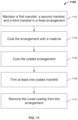
- a method for manufacturing a nosepiece for respiratory therapy comprises maintaining a plurality of mandrels, and then coating the mandrels with a material.
- the coated mandrels are cured, and the cured coating is then removed from the mandrels to form a structure made of the coating material.
- At least one of the coated mandrels is trimmed before removing the cured coating to create an opening in the coating of the trimmed mandrel. After removing the cured coating, the coating may be further trimmed to achieve the desired structure.
- a first, second, and third mandrels are maintained in a fixed arrangement with respect to each other.
- the third mandrel is positioned between the first and second mandrels and held at a distance from the first and second mandrels.
- the coating on the first, second and third mandrels form the first lumen, the second lumen, and the bridge, respectively, of a nosepiece.
- the step of coating comprises immersing the fixed arrangement in the material, and removing the arrangement from the material. Dip molding the arrangement provides a relatively economical, in terms of both cost and time, method of manufacture of the above-described nosepiece, while allowing for nosepiece customization.
- the step of coating comprises spraying the material onto the arrangement.
- the first, second, and third mandrels are fixedly held on a substrate. This may keep the mandrels in the desired arrangement for the step of coating.
- a method for respiratory therapy comprises receiving two separate flows of breathing gas through two inlet ends of a nosepiece and delivering the two flows through two respective outlet ends.
- the first flow of breathing gas is received at a first inlet end of a first lumen.
- the second flow of breathing gas is received at a second inlet end of a second lumen.
- the first flow is delivered through a first outlet end of the first lumen, while the second flow is delivered through a second outlet end of the second lumen.
- the first lumen and second lumen may be part of a nosepiece.
- the nosepiece may further comprise a bridge separating the first lumen and the second lumen.
- the bridge may have at least one opening.
- the bridge may be configured to maintain the first flow separate from the second flow.
- the bridge maybe configured to allow the first flow and the second flow to be in fluid communication.
- the bridge may be configured with small flow channels or membranes that permit flow, osmosis, or any other suitable fluid communication between the lumens and the bridge.
- a flow feedback loop an inherent flow limitation, a pressure feedback loop, a balancing shunt, or any other suitable system may be implemented to increase patient comfort if an occlusion occurs in the first lumen or the second lumen.
- the first lumen has a first bend and the second lumen has a second bend.
- the bridge may connect to the outer surface of the first lumen at the first bend and the outer surface of the second lumen at the second bend.
- the first flow and the second flow are heated and humidified.
- Heated and humidified breathing gas may be beneficial for patient respiratory therapy and further increase patient comfort during system use.
- the nosepiece may be configured according to any of the examples and embodiments referenced herein.
- FIG. 1 shows an illustrative prior art nasal cannula nosepiece mandrel arrangement
- FIG. 2 shows an illustrative prior art nasal cannula nosepiece
- FIG. 3 shows an illustrative nosepiece of a nasal cannula for respiratory therapy
- FIG. 4 shows an illustrative mandrel arrangement for manufacturing a nosepiece of a nasal cannula for respiratory therapy
- FIG. 5 shows an illustrative cross-sectional view of a bridge of a nosepiece before trimming excess plastic away
- FIG. 6 shows an illustrative cross-sectional view of a nosepiece formed by three mandrels located in close proximity;
- FIG. 7 shows an illustrative cross-sectional view of a bridge of a nosepiece
- FIG. 8 shows an illustrative nasal cannula
- FIG. 9 shows a non-desirable but typical to prior art connection between two lumens
- FIG. 10 shows an illustrative connection to maintain a constant inner diameter between two lumens
- FIG. 11 shows a flowchart of an illustrative manufacturing process for a nosepiece of a nasal cannula
- FIGS. 12 A- 12 B show an illustrative nosepiece of a nasal cannula for respiratory therapy, with and without an occlusion, according to a further embodiment of the present disclosure.
- FIG. 13 shows an illustrative lumen pressure versus flowrate plot for the nasal cannula of FIGS. 12 A- 12 B .
- a nosepiece for respiratory therapy is described below that provides a custom bridge between nasal prongs of a nasal cannula with a smooth bore gas path.
- the nosepiece may be manufactured by dip molding at least three mandrels fixedly arranged relative to each other.
- the three mandrel method allows for design freedom and an open geometry of the nasal bridge.
- Sacrificial material may be molded completely around the third mandrel and then trimmed.
- the relatively low monetary cost of the dip molding material allows for discarding the excess material without significantly affecting the production cost.
- the methods described for creating a dip molded bifurcated cannula that has low gas flow resistance also create nasal bridges that are flexible and can conform to irregular facial geometries.
- the systems, methods, and devices described herein provide a smooth gas path with a gentler bend than devices in the current state of the art, resulting in low flow resistance, quiet operation, and patient comfort.
- the low flow resistance of the disclosed devices is especially important for devices that provide the flow of gas through nasal cannulas by means other than compressed gas provided by a hospital.
- the low flow resistance of the disclosed devices may be beneficial in home use respiratory therapy systems.
- the smooth bore design of the systems, method, and devices described herein eliminates places for moisture to coalesce and therefore reduces rainout.
- FIG. 1 shows an illustrative prior art nasal cannula nosepiece mandrel arrangement.
- a first mandrel 110 is placed in close proximity to a second mandrel 112 .
- a small gap 114 is left between the two mandrels 110 and 112 .
- Mandrels 110 and 112 may be dipped in liquid material to create a dip mold. Liquid plastic may flow into gap 114 that connects mandrels 110 and 112 , sealing off the gas path between the two halves of the nosepiece and forming a ridge (as shown in FIG. 2 and described below).
- FIG. 2 shows an illustrative prior art nasal cannula nosepiece 200 .
- Nosepiece 200 may be made using the mandrel arrangement of FIG. 1 .
- a first section 210 and a second section 212 of the nosepiece are separated by ridge 214 .
- Outputs 216 , 218 may output breathing gas to a patient.
- Breathing gas may be input to parts 220 and 222 .
- Sections 212 and 210 are configured to have relatively wide diameters (compared to the diameters of input parts 222 and 220 ) where they join at ridge 214 . This provides a surface for the nosepiece to rest beneath the patient's nose.
- connecting ridge 214 creates a hard feeling piece of plastic where it contacts the skin on the upper lip, which can cause patient discomfort.
- geometry of nosepiece 200 and, in particular, placement of ridge 214 creates an inflexible surface where the nosepiece rests on the patient's face, which can cause the nosepiece to roll outward, away from the patient's face, and additionally increases the amount of discomfort the patient feels.
- sections 210 and 212 combined with the sharp change in direction of breathing flow at ridge 214 , causes a high flow resistance gas path and disruptions in the flow of breathing gas. Consequences of the disruptions can be loss of heat from the breathing gas, liquid formation and excess water dripping (rainout), and pressure drop, which can decrease the efficacy of respiratory therapy.
- the shape of the sections 210 and 212 also can create a high level of noise during operation, which can further increase patient discomfort.
- a nosepiece for respiratory therapy is described below that provides a custom bridge between nasal prongs of a nasal cannula with a smooth bore gas path.
- the nosepiece may be manufactured by dip molding three mandrels fixedly arranged around each other. The three mandrel method allows for design freedom and an open geometry of the nasal bridge.
- FIG. 3 shows an illustrative nosepiece 300 of a nasal cannula for respiratory therapy.
- Nosepiece 300 comprises a first lumen 330 , a second lumen 332 , and a bridge 314 .
- Nosepiece 300 may desirably be shaped to prevent sharp changes in direction of the flow of breathing gas within lumens 330 and 332 .
- Lumens 330 and 332 may be, for example, nasal prongs used to deliver breathing gas to nares of a patient.
- First lumen 330 has an outer surface 310 , 312 . Outer surface 310 , 312 may form a tube.
- First lumen 330 has a first inlet end 326 to receive a first flow of breathing gas, a first outlet end 322 to deliver the first flow, and a first bend between first inlet end 326 and first outlet end 322 .
- Second lumen 332 has an outer surface 334 , 336 . Outer surface 334 , 336 may also form a tube.
- Second lumen 332 has a second inlet end 328 to receive a second flow of breathing gas, a second outlet end 324 to deliver the second flow, and a second bend between second inlet end 328 and second outlet end 324 .
- nosepiece 300 is formed from a flexible material (e.g., polyvinyl chloride (PVC) plastic, plastisol, vinyl, silicone, non-latex rubber, an elastomer, ethylene vinyl acetate (EVA), styrene-butadiene copolymer (SBC), polyether ether ketone (PEEK), a polyether block amide (such as PEBAX), a polyethylene material, a high-density polyethylene (HDPE) material, a medium-density polyethylene (MDPE) material, a low-density polyethylene (LDPE) material, a crack-resistant material, a material with a low coefficient of friction, a material less than 70 Durometer Shore A, or any other flexible plastic).
- PVC polyvinyl chloride
- plastisol plastisol
- vinyl vinyl acetate
- EVA styrene-butadiene copolymer
- PEEK polyether ether ketone
- PEBAX
- Bridge 314 spatially separates first lumen 330 and second lumen 332 .
- Bridge 314 attaches to the outer surface 310 , 312 of first lumen 330 at the first bend and attaches to the outer surface 334 , 336 of second lumen 332 at the second bend.
- Bridge 314 has at least one opening 316 and is hollow.
- Bridge 314 may fluidically seal the two lumens 330 and 332 from each other, and maintain the first flow of breathing gas in the first lumen 330 separate from the second flow of breathing gas in the second lumen 332 .
- the bend in sections 334 and the bend in section 312 may attach to bridge 314 , while maintaining a solid barrier between lumens 330 and 332 and bridge 314 .
- Preventing the first and second flows of breathing gas from mingling helps to prevent disruptions to the breathing gas flow delivered to a patient, which in turn reduces rainout and the coalescence of large droplets of rainout. Rainout may be uncomfortable and potentially dangerous to patients.
- the separation of lumens 330 and 332 also allows for a smooth bore gas path, providing a steady flow of breathing gas to a patient.
- Bridge 314 may act as a “pillow” to provide a comfortable fit for patients using the nosepiece and prevent nosepiece 300 from rolling outward from a patient's nose.
- Bridge 314 may be customized to provide different levels of flexibility and greater comfort to patients, especially those with unique facial features.
- bridge 314 may be three-sided, cylindrical, four-sided, etc., depending on patient needs.
- Bridge 314 may be hollow to allow greater flexibility and lighter weight.
- Opening 316 is along a base of bridge 314 . Opening 316 may be a variety of shapes, allowing for the bridge to collapse more easily and conform to patients' unique facial geometry.
- First lumen 330 comprises a first section 310 and a second section 312 .
- the internal diameter of sections 310 and 312 may be different.
- Second lumen 332 comprises a first section 334 and a second section 336 .
- the internal diameter of sections 334 and 336 may be different.
- the difference in internal diameter between sections 310 and 312 , and 334 and 336 allows for different diameters for inlet ends 326 , 328 and outlet ends 322 , 324 .
- an internal diameter of the first inlet end 326 is greater than an internal diameter of the first outlet end 322
- an internal diameter of the second inlet end 328 is greater than an internal diameter of the second outlet end 324 .
- FIG. 3 may be part of nasal cannula comprising third and fourth elongated lumens (shown in FIG. 8 ).
- the change in internal diameter between sections 310 and 312 , sections 334 and 336 may allow the third and fourth elongated lumens to be fitted within sections 310 , 336 respectively, as shown in FIG. 10 and described below.
- the same constant internal diameter may be maintained through the third and fourth lumens into sections 312 and 334 , respectively.
- the diameter of sections 312 and 334 may taper to outlet ends 322 and 324 , respectively.
- a taper may begin where section 310 meets section 312 or before or after the bend in section 312 .
- a taper may begin where section 334 meets section 336 or before or after the bend in section 334 .
- the diameter of ends 322 and 324 will affect output gas flow velocity from nosepiece 300 .
- the diameter of section 312 may decrease as section 312 approaches outlet end 322 .
- Such a decrease in diameter increases output gas flow velocity at outlet end 322 .
- Output gas flow velocity may therefore be adjusted to suit patient needs by adjusting the diameter at outlet ends 322 and 324 .
- a narrowing taper may increase flow resistance. Increasing the abruptness of the taper increases the flow resistance for gas flows through sections 330 and 332 . To decrease flow resistance, the taper may be gradual.
- Nosepiece 300 is not limited to the above components, but may include alternative or additional components, as would be understood by one of ordinary skill in the art from the description herein.
- nosepiece 300 may be connected to additional lumens as shown in FIG. 8 and described below.
- Nosepiece 300 may be part of system for respiratory therapy, such as HFT, and may be connected to a gas source, nebulizer, and/or nasal cannula for delivery of heated and humidified air with or without aerosolized medicament.
- opening 316 may be configured to allow a medical device to be coupled to nosepiece 300 .
- opening 316 may be used to connect a medical device tube to nosepiece 300 .
- bridge 314 may have more than one opening.
- bridge 314 may have an opening along its base and its top, allowing a tube to be threaded through bridge 314 and held in place by an attachment or friction fitting.
- a device to measure a patient's breathing rate may be coupled to nosepiece 300 .
- Such couplings between medical devices and nosepiece 300 may be accomplished through fittings wherein the medical device “snaps” into opening 316 .
- a ball-like connector of the medical device or nebulizer may sit in the cavity of bridge 314 , forming a lock-type fit between the device and nosepiece 300 , or forming a ball and socket joint.
- a nebulizer may be coupled to nosepiece 300 at opening 316 .
- Nebulizers allow aerosolized respiratory medications, such as bronchodilators (e.g.,Albuterol (Ventolin), Salbutamol (Proventil), Levosalbutamol/Levalbuterol (Xopenex)) for treating asthma or Chronic Obstructive Pulmonary Disease (COPD) to be administered through inhalation directly to a patient's lungs.
- bronchodilators e.g.,Albuterol (Ventolin), Salbutamol (Proventil), Levosalbutamol/Levalbuterol (Xopenex)
- COPD Chronic Obstructive Pulmonary Disease
- Such a coupling between nosepiece 300 and a nebulizer would allow nebulized medication to be delivered to a patient together with supplemental breathing gas (as provided via lumens 330 , 332 ), allowing a patient to receive the medication without stopping use of a respiratory assist device.
- the aerosolized medication may be delivered through a separate third outlet end of the nebulizer.
- the breathing gas and aerosolized medicament may merge through the slipstream effect.
- a combination of nebulized medication and HFT can be used to assist patients experiencing respiratory distress and provide a comfortable and effective management of cardiopulmonary conditions.
- Nosepiece 300 allows for delivery of both breathing gas and aerosolized medicament by separate flow paths and separate cannula outlets that are not in fluid communication with each other.
- the delivery of the aerosolized medicament (attached at bridge 314 ) and breathing gas (delivered by lumens 330 and 332 ) by separate tubes allows a source of the aerosolized medicament (e.g., a nebulizer) to be disconnected without interrupting the delivery of the breathing gas.
- a source of the aerosolized medicament e.g., a nebulizer
- the nosepiece 300 involves no junction point between the flow of aerosolized medicament and the flow of breathing gas.
- a device to measure the breathing rate of a patient may be attached or detached to nosepiece 300 with minimal disruption to the patient.
- bridge 314 may be configured to allow the first flow of breathing gas through lumen 330 and the second flow of breathing gas through lumen 332 to be in fluid communication with each other.
- bridge 314 may be configured with small flow channels or membranes that permit flow, osmosis, or any other suitable fluid communication between lumens 330 , 332 and bridge 314 .
- bridge 314 may comprise a plurality of openings, in addition to opening 316 , configured to allow medicament to flow from an attached medicament delivery device, such as a nebulizer, to lumens 330 and 332 . These openings may allow aerosolized medicament from the attached medicament delivery device to join the first and second breathing gas flows through a slipstream effect, as described in U.S. Pat. No. 9,333,317, the contents of which is hereby incorporated by reference in its entirety.
- Nosepiece 300 may be part of a system for respiratory therapy with a source of heated and humidified breathing gas.
- Heating and humidifying breathing gas may increase patient comfort.
- providing heated and humidified breathing gas to the patient along with aerosol from a nebulizer can increase patient comfort by counterbalancing the cooling and drying sensations associated with the delivery of aerosol to the nostril.
- Nosepiece 300 may be used in a method for respiratory therapy. Such a method may comprise receiving two separate flows of breathing gas through the two inlet ends 328 , 326 of nosepiece 300 and delivering the two flows through two respective outlet ends 322 , 324 .
- the first flow of breathing gas through section 312 and the second flow of breathing gas through section 334 may be heated and humidified.
- FIG. 4 shows an illustrative mandrel arrangement 400 for manufacturing a nosepiece of a nasal cannula for respiratory therapy.
- mandrel arrangement 400 may be used to manufacture nosepiece 300 , as shown in FIG. 3 .
- Arrangement 400 comprises a first mandrel 418 , a second mandrel 420 , and a third mandrel 422 .
- Third mandrel 422 is placed in close proximity between first mandrel 418 and second mandrel 420 .
- the first mandrel 418 has a circular cross section and comprises two diameters: a first diameter through section 410 and a second diameter through section 412 .
- the diameter of section 412 is less than the diameter of section 410 .
- the second mandrel 420 has a circular cross section and comprises two diameters: a first diameter through section 426 and a second diameter through section 424 .
- the diameter of section 424 is less than the diameter of section 426 .
- the diameter of section 410 may be the same as the diameter of section 426 .
- the diameter of section 412 may be the same as the diameter of section 424 .
- the first mandrel 418 may further comprise a third diameter through section 430 .
- the third diameter through section 430 may be the same as or different than the first diameter through section 410 .
- the second mandrel 420 may further comprise a third diameter through section 428 .
- the third diameter through section 428 may be the same as or different than the first diameter through section 426 .
- the diameter of sections 412 and 424 may taper to ends 432 and 434 , respectively.
- a taper may begin where section 410 meets section 412 or before or after the bend in section 412 .
- a taper may begin where section 426 meets section 424 or before or after the bend in section 424 .
- the diameter of ends 432 and 434 will affect output gas flow velocity from the nosepiece formed by mandrels 418 , 420 , and 422 .
- the diameter of section 412 may decrease as section 412 approaches end 432 .
- Such a decrease in diameter increases output gas flow velocity at the output of a nosepiece formed on mandrel 418 (such as the output from outlet end 322 of FIG. 1 ).
- the diameter at outlet ends 322 and 324 may be adjusted to suit patient needs.
- the third mandrel 422 comprises an upper portion 414 and a lower portion 416 .
- the distal end of portion 414 is attached to the proximal end of portion 416 .
- the distal end of portion 414 is larger than the proximal end of portion 416 so as to create an undercut.
- Portion 414 is placed between section 412 and section 424 of first mandrel 418 and second mandrel 420 , respectively.
- Mandrels 418 , 420 , 422 are in a fixed arrangement with respect to each other.
- Third mandrel 422 is arranged between first mandrel 418 and second mandrel 420 .
- Section 414 of third mandrel 422 is placed between a bend in section 412 and a bend in section 424 .
- a small distance is left between section 414 and sections 412 and 424 , respectively.
- the distance may be 3 mm, 2 mm, 1 mm, or any other suitable distance.
- the arrangement is coated with a material.
- the material may be, polyvinyl chloride (PVC) plastic, plastisol, vinyl, silicone, non-latex rubber, an elastomer, a material less than 70 Durometer Shore A , ethylene vinyl acetate (EVA), styrene-butadiene copolymer (SBC), polyether ether ketone (PEEK), a polyether block amide (such as PEBAX), a polyethylene material, a high-density polyethylene (HDPE) material, a medium-density polyethylene (MDPE) material, a low-density polyethylene (LDPE) material, a crack-resistant material, a material with a low coefficient of friction, flexible plastic, or any other suitable material.
- PVC polyvinyl chloride
- plastisol vinyl
- vinyl silicone
- non-latex rubber an elastomer
- EVA ethylene vinyl acetate
- SBC styrene-butadiene
- the distance between mandrels 418 , 420 , and 422 allows material to flow around the mandrels and form two lumens and a hollow bridge, while sealing off the gas path between the two lumens.
- the arrangement may be coated by, for example, fixedly holding mandrels 418 , 420 , and 422 on a substrate and dipping arrangement 400 in liquid material, spraying material onto arrangement 400 , dipping arrangement 400 arranged on a rack into material, or any other suitable means.
- arrangement 400 After arrangement 400 is coated in material, it may be cured.
- the coated arrangement may be cured at room temperature, or at a temperature or set of temperature (such as those determined by the material's curing temperature profile) determined to accelerate the curing time.
- the coating may be cured using a heat lamp, oven, UV radiation or any other suitable means.
- at least one coated mandrel may be trimmed to create an opening in the coating of the trimmed mandrel.
- mandrel 422 may be a “sacrificial” mandrel. Coated mandrel 422 may be trimmed to allow the pertinent cured coating to be removed from mandrel 422 .
- the cured coating on mandrel 422 may correspond to bridge 314 of FIG.
- the cured coating may then be removed from arrangement 400 to leave a single intact structure.
- the cured coating may be a flexible plastic that is in the shape of the nosepiece shown FIG. 3 .
- mandrels 418 and 420 may form lumens 330 and 332 , respectively, while mandrel 422 may form hollow bridge 314 .
- the material coating is joined where there was distance left between mandrels 418 , 420 , and 420 . By leaving a small distance between the mandrels, the material that flows around the mandrels will separate the structures formed by the mandrels with a thin layer of material.
- Mandrel 422 geometry may be of any shape such that it comes within close proximity of mandrels 418 and 420 that form the gas path of the nosepiece.
- the bridge created by mandrel 422 and connecting the coatings on mandrels 418 and 422 can be three-sided or hollow, allowing for the bridge to collapse more or less easily and, therefore, better conform to patients' unique facial geometry.
- the inherent opening of the coating of mandrel 422 can also be any shape, so long as mandrel 422 can be forcibly pulled through the flexible opening of material coating it. Varying the opening of the bridge formed by mandrel 422 can be done to perform different functions, such as adding intentional undercuts or to aid in the collapsibility of the bridge.
- Mandrel 422 may include raised patterns or ribbing to alter the inner surface of the coating on mandrel 422 . These alterations to the inner surface of the coating may add strength and/or alter the flexibility of bridge 314 of FIG. 3 .
- This method allows for the design of nearly any bridge geometry to provide customized comfort and ergonomics to patients.
- the form of the bridge is no longer tied to the round or rectangular geometries required by manufacture. Dip molding, for example, allows for smaller production runs, more effective cost, less time, and more customizable geometries than traditional manufacturing means.
- FIG. 5 shows an illustrative cross-sectional view 500 of a bridge of a nosepiece before trimming excess material away.
- FIG. 5 may represent a portion of a structure similar to that of FIG. 3 , wherein section 510 corresponds to section 310 and section 312 corresponds to section 312 of lumen 330 .
- the mandrel forming the bridge (such as mandrel 422 of FIG. 4 ) may be entirely coated in cured material.
- the bridge mandrel itself is a “sacrificial” mandrel and may be trimmed to provide an opening for the bridge mandrel to be removed through.
- the sacrificial material is molded completely around the third mandrel that must be cut off. The relatively low cost of the material allows for discarding the excess.
- opening 514 may then be trimmed to suit the needs of a patient. For example, the opening may be trimmed close to the connection with lumen 512 (as shown in FIG. 3 at opening 316 ). In another instance, the opening may not be trimmed as closely, and may instead leave the majority of opening 514 to provide an input “tube” to attach a medical device. Other openings may further be trimmed in the structure of opening 514 , such as creating a second opening to allow a medical device to be threaded through the nasal bridge. The trimming may depend on the patient's facial structure, the amount of flexibility needed, the configuration of devices to attach to the bridge, or other suitable factors.
- FIG. 6 shows an illustrative cross-sectional view 600 of a nosepiece formed by three mandrels located in close proximity to form connecting ribs, after the sacrificial mandrel has been trimmed.
- FIG. 6 may represent a structure similar to that of FIG. 3 , wherein section 612 corresponds to section 312 , section 622 corresponds to section 334 , and section 614 corresponds to section 314 .
- section 616 section 612 forms a lumen with a smooth inner surface.
- section 618 forms a lumen with a smooth inner surface similar to that of section 612 .
- section 614 is a hollow bridge between sections 612 and 622 .
- the hollow space surrounded by section 614 is isolated from the lumens formed by sections 612 and 622 .
- breathing gas flowing through the lumen formed by section 612 is separated from breathing gas flowing through the lumen formed by section 622 .
- No breathing gas enters section 614 .
- the separation between sections 612 and 622 may help to decrease disruptions to gas flow during delivery to patients.
- FIG. 7 shows an illustrative cross-sectional view of a bridge of a nosepiece.
- Section 710 corresponds to section 310 of FIG. 3
- section 712 corresponds to section 312 of FIG. 3
- Section 714 illustrates a cross section of bridge 314 of FIG. 3 after excess material is trimmed away and the mandrels have been removed.
- Section 712 is a nasal prong used to deliver breathing gas to the nostril of a patient.
- Inlet section 710 may connect to a separate lumen to, for instance, form a nasal cannula. Breathing gas may flow in through inlet section 710 through section 712 to the patient.
- section 714 While section 714 is connected to section 712 , breathing gas does not flow through section 714 , because there is a thin barrier of flexible material between the two sections. This barrier prevents breathing gas from escaping section 712 before reaching its outlet end and the nostril of the patient and is a result of the dip molding process with the three mandrels discussed above in relation to FIG. 4 .
- FIG. 8 shows an illustrative nasal cannula in use by a patient.
- Nasal cannula 800 comprises a nosepiece portion 802 , a third lumen 806 , and a fourth lumen 808 .
- Nosepiece portion 802 corresponds to nosepiece 300 as shown in FIG. 3 and described above.
- the third elongated lumen 806 has an inlet end and an outlet end.
- Fourth elongated lumen 808 has an inlet end and an outlet end.
- Nosepiece portion 802 is connected to the outlet end of third lumen 806 at connection 810 and the outlet end of fourth lumen 808 at connection 812 .
- Nasal cannula 800 may include, for example, padding 814 and 816 around the patient's ears for added comfort.
- the third lumen 806 and nosepiece portion 802 define a constant diameter flow path for the first flow of breathing gas from the inlet end of the third lumen to the outlet end 804 of the first lumen (lumen 330 of FIG. 3 ).
- Fourth lumen 808 and the nosepiece portion 802 define a constant diameter flow path for the second flow of breathing gas from the inlet end of fourth lumen 808 to the outlet end 818 of the second lumen (lumen 332 of FIG. 3 ).
- the constant internal diameter of the flow paths decreases noise creation during breathing gas delivery by preventing disruptions (e.g. eddies) in breathing gas flow. Minimizing noise during cannula use may increase a patient's comfort level.
- the first inlet end of the first lumen is adapted to be connected to the outlet end of third lumen 806 without constricting the internal diameter of third lumen 806 .
- the second inlet end of the second lumen is adapted to be connected to the outlet end of fourth lumen 808 without constricting the internal diameter of fourth lumen 808 .
- the connections between third lumen 806 , fourth lumen 808 , and nosepiece 802 may be similar to the connection shown in FIG. 9 and described below.
- nasal cannula 800 is not limited to the above components, but may include alternative or additional components, as would be understood by one of ordinary skill in the art from the description herein.
- nasal cannula 800 may be part of a system for respiratory therapy.
- the system may comprise the nosepiece described above and a source of breathing gas.
- the source generates heated and humidified breathing gas for delivery to the patient.
- the source may be configured to provide, for example, breathing gas at flow rates between 1 and 8 liters per minute (lpm) for infants, between 5 and 20 lpm for pediatric patients, or up to 40 lpm for adults. Suitable sources of heated and humidified gas will be known to one of ordinary skill in the art.
- the source may be the Vapotherm Flowrest System, Vapotherm Careflow System, Precision Flow unit, or the Vapotherm 2000i, all of which are provided by Vapotherm, Inc. of Schwarz, N.H., USA.
- Vapotherm, Inc. of Schwarz, N.H., USA.
- Other suitable sources of breathing gas will be known to one of ordinary skill in the art from the description herein.
- FIG. 9 shows a non-desirable but typical to prior art connection between two lumens.
- a first lumen is defined by tube 902 .
- a second lumen is defined by tube 904 .
- Tube 904 has a smaller internal diameter than tube 902 .
- Tube 904 fits into 902 , creating an airtight seal through, for example, a friction fitting.
- Breathing gas flow 906 flows through tube 904 to tube 902 .
- the sharp change in internal diameter between tubes 904 and 902 creates eddies and disruptions in gas flow 906 .
- Such disruptions cause, for example, noise and resistance in the gas flow path, making the connection less efficient and any system using such connection for a nasal cannula less comfortable for a patient.
- FIG. 10 shows an illustrative connection to maintain a constant inner diameter between two lumens.
- a first lumen is defined by tube 1002 .
- a second lumen is defined by tube 1004 .
- Tube 1002 is connected to tube 1004 without constricting the internal diameter of tube 1004 .
- Tube 1002 has an enlarged portion 1008 .
- Enlarged portion 1008 has an internal diameter equal to the outer diameter of tube 1004 .
- Tube 1002 transitions to the internal diameter of tube 1004 , thereby maintaining a substantially constant diameter between tubes 1002 and 1004 .
- Breathing gas flow 1006 flows through tube 1004 to tube 1002 .
- gas flow 1006 may be relatively undisturbed resulting in lower flow resistance and less noise than the typical connection shown in FIG. 9 .
- Such a connection may be used, for example, to connect the nosepiece of FIG. 3 to elongated lumens to form a nasal cannula or system for respiratory therapy, as described above.
- This connection may
- FIG. 11 shows a flowchart of an illustrative manufacturing process for a nosepiece of a nasal cannula.
- Process 1100 begins at step 1102 where a first mandrel, a second mandrel, and a third mandrel are maintained in a fixed arrangement.
- the third mandrel is positioned between the first and second mandrels in close proximity.
- the third mandrel is held at a distance from the first and second mandrels.
- the mandrels may be made of, for example, steel, aluminum-bronze alloys, stainless steel, or any other suitable material, such as those resistance to curing methods and which will not permanently adhere to the flexible material used in forming the nosepiece.
- the material may be, polyvinyl chloride (PVC) plastic, plastisol, vinyl, silicone, non-latex rubber, an elastomer, ethylene vinyl acetate (EVA), styrene-butadiene copolymer (SBC), polyether ether ketone (PEEK), a polyether block amide (such as PEBAX), a polyethylene material, a high-density polyethylene (HDPE) material, a medium-density polyethylene (MDPE) material, a low-density polyethylene (LDPE) material, a crack-resistant material, a material with a low coefficient of friction, a material less than 70 Durometer Shore A, or any other suitable material).
- PVC polyvinyl chloride
- plastisol vinyl, silicone, non-latex rubber
- EVA ethylene vinyl acetate
- SBC styrene-butadiene copolymer
- PEEK polyether ether ketone
- step 1106 the coated arrangement is cured.
- the coated arrangement may be cured at room temperature or at a temperature or set of temperatures determined to accelerate the curing time.
- the coating may be cured using a heat lamp, oven, UV radiation, or any other suitable means.
- step 1108 at least one coated mandrel is trimmed to create an opening in the coating of the trimmed mandrel.
- the third mandrel may be a “sacrificial” mandrel, as described above.
- the coated third mandrel may be trimmed to allow the cured coating to be removed from the arrangement.
- step 1108 to step 1110 the cured coating is removed from the arrangement.
- the cured coating may be a flexible plastic that is in the shape of the nosepiece shown in FIG. 1 . The remaining excess material formed on the remaining untrimmed mandrels or all mandrels may then be trimmed.
- a bifurcated cannula such as that described above in relation to FIG. 3
- gas flow cannot split across a bridge between the two lumens. Because the two lumens split the total gas flow and are completely separate (e.g., not in fluid communication with one another), occluding one lumen will divert all flow through the other, non-occluded lumen. Occlusions may occur due to an obstruction, momentary kinking of the lumen, crushing the lumen by rolling over onto the tubing during sleep, or any other suitable occlusion.
- the flow rate through a system is set to the maximum that is comfortable for the patient. The limiting factor for this is often the sensation of high velocity flow in the patient's nares. For this reason, doubling the flow is likely to be unpleasant for the patient.
- FIGS. 12 A- 12 B show an illustrative non-bifurcated nosepiece during operation of a respiratory therapy system.
- FIG. 12 A shows “normal” flow during operation.
- FIG. 12 B shows flow during operation when a portion of the nosepiece is occluded.
- air flow 1214 flows through first lumen 1202 and exits outlet end 1210 .
- Air flow 1216 flows through second lumen 1204 and exits outlet end 1212 . Little to now air flow travels through bridge 1206 . If however, one of the first and second lumens is occluded, as shown in FIG. 12 B , a large portion of air flow will flow through bridge 1206 .
- FIG. 12 A shows “normal” flow during operation.
- FIG. 12 B shows flow during operation when a portion of the nosepiece is occluded.
- first lumen 1202 is effectively blocked at occlusion 1208 such that little to no gas flow can pass through first lumen 1202 from one side of occlusion 1208 to the other side of occlusion 1208 .
- Occlusions may include, but are not limited to, a bend in the tubing forming a lumen (e.g., if the tubing is bent at a sharp angle), pressure applied to the lumen externally (e.g., if the tubing is pinched), debris or other elements blocking the lumen internally, or any other occlusion that obstructs the flow of gas through a lumen 1202 , 1204 in the nosepiece 1200 .
- gas flow 1218 flowing through second lumen 1204 splits off—a portion of gas flow 1218 exits second lumen 1204 through outlet end 1212 , while a portion of gas flow 1218 flows through bridge 1206 , into first lumen 1202 , and exits via outlet end 1210 .
- the nosepiece effectively self corrects if one of the two lumens is occluded—i.e., even if gas flow cannot pass through the entirety of one lumen (e.g., first lumen 1202 ), gas flow will still exit the outlet ends (e.g., outlet ends 1210 , 1212 ) of both lumens (e.g., lumens 1202 , 1204 ) because gas flow can pass through a bridge (e.g., bridge 1206 ) between the two lumens.
- a patient will therefore still receive gas from both outlet ends (that, in many cases, are placed within the patient's nares during operation of the system) even if one of the lumens is occluded.
- FIG. 13 shows a graph depicting how pressure varies with flow between normal and occluded operation in a bifurcated cannula nosepiece. Pressure in pounds per square inch (Psi) is shown along the y-axis and flow in liters per minute (L/min) is shown along the x-axis.
- Psi pounds per square inch
- L/min flow in liters per minute
- Curve 1310 shows pressure and flow through the cannula when one of two lumens is occluded.
- Curve 1320 shows pressure and flow through the cannula when both lumens are operating under normal conditions (i.e., non-occluded).
- Blower flow characteristic line 1350 shows a constant pressure of 1.5 Psi.
- Occluded curve 1310 intersections blower flow characteristic line 1350 at occluded operating point 1330 .
- Normal operation curve 1320 intersects blower flow characteristic line 1350 at normal operating point 1340 .
- a system may be configured to provide a constant flow. To maintain a constant flow, when one lumen is occluded, the pressure of the system would have to significantly increase. For example, if the system is set to maintain a flow rate of 40 L/min, when one lumen becomes occluded, the pressure necessary to maintain that flow rate would increase from 1.5 Psi to approximately 3 Psi.
- Such solutions include a flow feedback loop, an inherent flow limitation, a pressure feedback loop, a balancing shunt, or any suitable system or modification.
- a flow feedback loop may be used.
- a desired flow rate is selected and set.
- the flow rate may be set by a clinician, a patient, an automated process, or any other suitable means.
- the respiratory therapy system monitors the back pressure required to deliver the set flow rate for a period of time.
- the respiratory therapy system may include a sensor and processor configured to monitor back pressure and adjust the delivered flow rate. By monitoring the back pressure, the system establishes a benchmark for a non-occluded cannula—i.e., a cannula with two lumens where gas can flow through both lumens.
- the system maintains the current flow rate to the extent possible within a range of acceptable pressures around the benchmark. If the system requires more pressure than that acceptable pressure range allows to maintain the set flow rate, the system may trigger an alarm indicating the possibility of a partial occlusion. The system may also limit the flow rate to avoid causing discomfort to the patient.
- a flow generator delivers a constant pressure at a particular input (operating rotations per minute) would be used.
- the flow generator may be a standard blower system, and the speed of the blower may be the input. If the speed is maintained at a constant value, the pressure will also remain substantially constant at low flow rates (i.e., flow rates that require the blower to operate very close to the maximum pressure the blower can deliver when fully occluded).
- a desired flow rate is selected and set (e.g., by a clinician). The system then delivers a constant pressure output. An occlusion in a lumen would result in a decreased flow rate.
- the system monitors and detects the reduced flow rate and triggers an alarm (e.g., to notify a clinician of the reduced flow rate).
- a pressure feedback loop may be implemented.
- a desired flow rate is selected and set (e.g., by a clinician).
- the system monitors the back pressure required to deliver this set flow rate for a period of time to establish a target pressure for a non-occluded cannula.
- the system maintains the pressure as a constant. If the flow rate deviates from the targeted flow set point, the system triggers an alarm indicating the possibility of a partial occlusion.
- a balancing shunt may be implemented.
- a modification to the bifurcated cannula approach is to use a balancing shunt in the nosepiece.
- the shunt may comprise a flow path that connects the separate lumens in an area adjacent to the cannula prongs.
- the flow passage is configured so that in normal, non-occluded conditions, the pressure at both ends of the shunt (i.e., at the connection between the shunt and the lumens) are equal and net flow will pass through the shunt.
- the shunt is disposed in a location where the openings from the two lumens into the shunt do not disturb the flow in the lumens.
- the shut may be located on a point tangent to the flow in the lumen and away from bends in the lumen.
Landscapes
- Health & Medical Sciences (AREA)
- Pulmonology (AREA)
- Emergency Medicine (AREA)
- Life Sciences & Earth Sciences (AREA)
- Anesthesiology (AREA)
- Biomedical Technology (AREA)
- Heart & Thoracic Surgery (AREA)
- Hematology (AREA)
- Engineering & Computer Science (AREA)
- Animal Behavior & Ethology (AREA)
- General Health & Medical Sciences (AREA)
- Public Health (AREA)
- Veterinary Medicine (AREA)
- Otolaryngology (AREA)
- Infusion, Injection, And Reservoir Apparatuses (AREA)
- External Artificial Organs (AREA)
Abstract
Description
Claims (22)
Priority Applications (3)
| Application Number | Priority Date | Filing Date | Title |
|---|---|---|---|
| US16/124,818 US11724056B2 (en) | 2017-09-08 | 2018-09-07 | Birfurcated cannula device |
| US18/214,740 US12226580B2 (en) | 2017-09-08 | 2023-06-27 | Bifurcated cannula device |
| US19/023,693 US20250229048A1 (en) | 2017-09-08 | 2025-01-16 | Bifurcated cannula device |
Applications Claiming Priority (2)
| Application Number | Priority Date | Filing Date | Title |
|---|---|---|---|
| US201762555945P | 2017-09-08 | 2017-09-08 | |
| US16/124,818 US11724056B2 (en) | 2017-09-08 | 2018-09-07 | Birfurcated cannula device |
Related Child Applications (1)
| Application Number | Title | Priority Date | Filing Date |
|---|---|---|---|
| US18/214,740 Continuation US12226580B2 (en) | 2017-09-08 | 2023-06-27 | Bifurcated cannula device |
Publications (2)
| Publication Number | Publication Date |
|---|---|
| US20190076615A1 US20190076615A1 (en) | 2019-03-14 |
| US11724056B2 true US11724056B2 (en) | 2023-08-15 |
Family
ID=63722763
Family Applications (3)
| Application Number | Title | Priority Date | Filing Date |
|---|---|---|---|
| US16/124,818 Active US11724056B2 (en) | 2017-09-08 | 2018-09-07 | Birfurcated cannula device |
| US18/214,740 Active US12226580B2 (en) | 2017-09-08 | 2023-06-27 | Bifurcated cannula device |
| US19/023,693 Pending US20250229048A1 (en) | 2017-09-08 | 2025-01-16 | Bifurcated cannula device |
Family Applications After (2)
| Application Number | Title | Priority Date | Filing Date |
|---|---|---|---|
| US18/214,740 Active US12226580B2 (en) | 2017-09-08 | 2023-06-27 | Bifurcated cannula device |
| US19/023,693 Pending US20250229048A1 (en) | 2017-09-08 | 2025-01-16 | Bifurcated cannula device |
Country Status (4)
| Country | Link |
|---|---|
| US (3) | US11724056B2 (en) |
| EP (1) | EP3678721B1 (en) |
| AU (1) | AU2018327338A1 (en) |
| WO (1) | WO2019051245A1 (en) |
Families Citing this family (2)
| Publication number | Priority date | Publication date | Assignee | Title |
|---|---|---|---|---|
| CN111330130A (en) * | 2020-03-04 | 2020-06-26 | 深圳市量子氢生物技术有限公司 | Cavity-divided type nasal suction tube |
| AU2023407353A1 (en) * | 2022-12-22 | 2025-07-24 | Fisher & Paykel Healthcare Limited | Respiratory support control using respiratory rate |
Citations (93)
| Publication number | Priority date | Publication date | Assignee | Title |
|---|---|---|---|---|
| USRE24534E (en) | 1958-09-16 | By-pass flow washer | ||
| US2941544A (en) | 1955-09-27 | 1960-06-21 | Renault | Fluid control devices and elastic pressure-responsive valves |
| US4003398A (en) | 1974-01-21 | 1977-01-18 | Francois Duveau | Pressure limiter device |
| US4422456A (en) | 1981-09-08 | 1983-12-27 | City Of Hope National Medical Center | Nasal cannula structure |
| US4708166A (en) | 1986-02-22 | 1987-11-24 | Klaus Kobold | Control valve for automatically maintaining a constant fluid flow rate |
| US4782832A (en) | 1987-07-30 | 1988-11-08 | Puritan-Bennett Corporation | Nasal puff with adjustable sealing means |
| US4790308A (en) * | 1984-04-04 | 1988-12-13 | Sherwood Medical Company | Nasal cannula harness |
| US5099836A (en) | 1987-10-05 | 1992-03-31 | Hudson Respiratory Care Inc. | Intermittent oxygen delivery system and cannula |
| US5113911A (en) | 1989-12-11 | 1992-05-19 | Advantec Corp. | Pressure actuated elastomeric valve |
| US5433242A (en) | 1993-10-12 | 1995-07-18 | The Hoover Company | Pressure activated dispensing valve |
| WO1998018513A1 (en) | 1996-10-29 | 1998-05-07 | The Scott Fetzer Company | Supplemental oxygen delivery apparatus and method |
| FR2827778A1 (en) | 2001-07-30 | 2003-01-31 | Vygon | Nasal respiratory assistance apparatus comprises two parallel tubular passages whose distal ends are introduced into patient's nostrils, each passage has auxiliary channel supplied with ventilation gas |
| US6561188B1 (en) | 2000-08-21 | 2003-05-13 | Ellis Alan D | Nasal breathing apparatus and methods |
| US20040112383A1 (en) * | 2001-01-04 | 2004-06-17 | Curti James N. | Nasal and oral cannula breathing detection device |
| US6805126B2 (en) | 1998-12-01 | 2004-10-19 | Edward P. Dutkiewicz | Oxygen delivery and gas sensing nasal cannula system |
| US20040226566A1 (en) | 2003-02-21 | 2004-11-18 | Resmed Limited | Nasal assembly |
| US20050028822A1 (en) | 2003-08-08 | 2005-02-10 | Tiara Medical Systems, Inc. | Sealing nasal cannula |
| US20050066976A1 (en) * | 2003-08-18 | 2005-03-31 | Wondka Anthony D. | Method and device for non-invasive ventilation with nasal interface |
| US20050103347A1 (en) * | 2001-01-04 | 2005-05-19 | Curti James N. | Nasal and oral cannula having two capabilities and method of producing same |
| US20050229927A1 (en) | 2004-04-20 | 2005-10-20 | Aerogen, Inc. | Ventilation systems and methods employing aerosol generators |
| US20050229928A1 (en) * | 2004-04-20 | 2005-10-20 | Aerogen, Inc. | Aerosol delivery apparatus and method for pressure-assisted breathing systems |
| US6986353B2 (en) | 2002-08-21 | 2006-01-17 | Medical Device Group, Inc. | Divided nasal cannula assembly |
| US20060030696A1 (en) | 2003-02-28 | 2006-02-09 | Lonza Biologics Plc. | Protein a chromatography |
| US7007694B2 (en) | 2004-05-21 | 2006-03-07 | Acoba, Llc | Nasal cannula |
| US20060230931A1 (en) | 2005-04-05 | 2006-10-19 | Bliss Peter L | Portable oxygen concentrator |
| US20060230929A1 (en) | 2005-04-05 | 2006-10-19 | Bliss Peter L | Portable oxygen concentrator |
| WO2006138579A2 (en) | 2005-06-17 | 2006-12-28 | Salter Labs | Nasal and oral cannula having two capabilities and method of producing same |
| US20070175473A1 (en) | 2005-09-12 | 2007-08-02 | Lewis Charles A | High flow therapy device utilizing a non-sealing respiratory interface and related methods |
| WO2008060587A2 (en) | 2006-11-15 | 2008-05-22 | Vapotherm, Inc. | Nasal cannula with reduced heat loss to reduce rainout |
| US20080223375A1 (en) | 2006-11-15 | 2008-09-18 | Vapotherm, Inc. | Single nasal prong nasal cannula |
| US7481244B2 (en) | 2006-06-05 | 2009-01-27 | Bioquiddity, Inc. | Fluid flow control device |
| EP2022528A2 (en) | 2007-07-30 | 2009-02-11 | Resmed Limited | Patient interface |
| US20090101147A1 (en) | 2005-09-12 | 2009-04-23 | Mergenet Medical, Inc. | High Flow Therapy Artificial Airway Interfaces and Related Methods |
| US20090253995A1 (en) | 2008-04-02 | 2009-10-08 | Mergenet Medical | Clinical monitoring in open respiratory airways |
| US20090250132A1 (en) | 2005-12-23 | 2009-10-08 | Bivin Donald B | Fluid flow control device |
| US7662181B2 (en) | 2000-03-04 | 2010-02-16 | Pulmonx Corporation | Methods and devices for use in performing pulmonary procedures |
| US20100096019A1 (en) | 2006-08-07 | 2010-04-22 | Diperna Paul Mario | Variable flow reshapable flow restrictor apparatus and related methods |
| US20100113955A1 (en) | 2008-10-30 | 2010-05-06 | Joshua Lewis Colman | Oral-nasal cannula system enabling co2 and breath flow measurement |
| US20100108073A1 (en) | 2005-12-02 | 2010-05-06 | Carefusion 2200, Inc. | Nasal interface prong device |
| US7743770B2 (en) | 2001-01-04 | 2010-06-29 | Salter Labs | Nasal and oral cannula having three or more capabilities and method of producing same |
| US20100252037A1 (en) | 2009-04-02 | 2010-10-07 | Breathe Technologies, Inc. | Methods, systems and devices for non-invasive open ventilation with gas delivery nozzles within nasal pillows |
| EP2247331A1 (en) | 2008-01-25 | 2010-11-10 | Salters Labs | Respiratory therapy system including a nasal cannula assembly |
| US20100282247A1 (en) * | 2007-09-25 | 2010-11-11 | Novartis Ag | Treatment of pulmonary disorders with aerosolized medicaments such as vancomycin |
| US20110067704A1 (en) | 2008-03-04 | 2011-03-24 | Resmed Limited | Unobtrusive interface systems |
| US20110073116A1 (en) | 2008-02-21 | 2011-03-31 | Harald Genger | Applicators for a Nasal Cannula |
| US20110094518A1 (en) | 2009-04-02 | 2011-04-28 | Breathe Technologies, Inc. | Methods, systems and devices for non-invasive ventilation including a non-sealing ventilation interface with a free space nozzle feature |
| US20110146685A1 (en) | 2008-05-12 | 2011-06-23 | Olivia Marie Allan | Patient interface and aspects thereof |
| US20110232649A1 (en) | 2010-03-25 | 2011-09-29 | Respcare, Inc. | Adjustable nasal prong and headgear assembly |
| US20110284001A1 (en) | 2009-02-04 | 2011-11-24 | Robert Tero | Nasal Interface Device |
| US20120090622A1 (en) | 2010-10-13 | 2012-04-19 | Hsiner Co., Ltd. | Breathing assistance apparatus with two nasal prongs |
| US20120125332A1 (en) | 2010-11-19 | 2012-05-24 | Vapotherm, Inc. | Apparatus, systems, and methods for respiratory therapy |
| US20120167878A1 (en) | 2008-12-02 | 2012-07-05 | ThermoCure, Inc, | Systems and methods for delivery of a breathing gas with fine ice particles |
| US20120304992A1 (en) * | 2011-06-06 | 2012-12-06 | Ratto David R | Breathing treatment system and method |
| WO2013042004A1 (en) | 2011-09-22 | 2013-03-28 | Koninklijke Philips Electronics N.V. | Patient interface device with automatically titling cushion |
| WO2013041996A2 (en) | 2011-09-22 | 2013-03-28 | Koninklijke Philips Electronics N.V. | Patient interface with expandable nasal prongs |
| US20130092165A1 (en) | 2011-09-26 | 2013-04-18 | Anthony David Wondka | Nasal Ventilation Cannula System and Methods |
| US20130152925A1 (en) | 2010-08-09 | 2013-06-20 | Takeda Gmbh | Device and system for delivery of an aerosol to a patient on ventilatory support |
| US20130160772A1 (en) | 2011-12-27 | 2013-06-27 | Farrokh Tabrizchi | Multi-functional nasal cannula |
| WO2013112545A1 (en) | 2012-01-24 | 2013-08-01 | Vapotherm, Inc. | Systems and methods for providing respiratory therapy |
| WO2013157960A1 (en) | 2012-04-17 | 2013-10-24 | Fisher & Paykel Healthcare Limited | A tube securement system |
| US20140066801A1 (en) | 2011-04-29 | 2014-03-06 | Robert Tero | Nasal Interface Device |
| US20140116447A1 (en) * | 2012-10-31 | 2014-05-01 | Vapotherm, Inc. | Quiet nasal cannula |
| US20140137744A1 (en) | 2012-10-12 | 2014-05-22 | Inova Labs, Inc., A Delaware Corporation | Oxygen concentrator systems and methods |
| US20140147506A1 (en) | 2009-11-09 | 2014-05-29 | Virginia Commonwealth University | Delivery of Submicrometer and Nanometer Aerosols to the Lungs using Hygroscopic Excipients or Dual Stream Nasal Delivery |
| US20140150789A1 (en) | 2012-12-04 | 2014-06-05 | Ino Therapeutics Llc | Cannula For Minimizing Dilution Of Dosing During Nitric Oxide Delivery |
| US20140158127A1 (en) * | 2012-12-07 | 2014-06-12 | Parion Sciences, Inc. | Nasal cannula for delivery of aerosolized medicaments |
| US20140166009A1 (en) | 2012-12-04 | 2014-06-19 | Ino Therapeutics Llc | Cannula For Minimizing Dilution Of Dosing During Nitric Oxide Delivery |
| US20140230942A1 (en) | 2013-02-21 | 2014-08-21 | Toyoda Gosei Co., Ltd. | Damper opening and closing device |
| WO2014142681A1 (en) | 2013-03-15 | 2014-09-18 | Fisher & Paykel Healthcare Limited | Nasal cannula assemblies and related parts |
| US20140261704A1 (en) | 2013-03-14 | 2014-09-18 | Nordson Corporation | Gas regulator, control interface module, and methods for surgical applications |
| US20150000659A1 (en) | 2013-06-28 | 2015-01-01 | American Air Liquide, Inc. | Method of treating a patient having pulmonary hypertension by long term no therapy |
| US20150000660A1 (en) | 2013-06-28 | 2015-01-01 | American Air Liquide, Inc. | Nasal cannula assembly with flow control passage communicating with a deformable reservoir |
| US20150000654A1 (en) | 2013-06-28 | 2015-01-01 | American Air Liquide, Inc. | Breathing assistance apparatus for delivery of nitric oxide to a patient by means of a nasal cannula assembly with flow control passage |
| US20150230731A1 (en) | 2009-01-05 | 2015-08-20 | Oridion Medical 1987 Ltd. | Exhaled breath sampling with delivery of gas |
| WO2015121815A1 (en) | 2014-02-12 | 2015-08-20 | Koninklijke Philips N.V. | Flexible low deadspace respiratory nosepiece for gas sampling cannulae and method of manufacturing respiratory nosepiece |
| WO2015164921A1 (en) | 2014-05-01 | 2015-11-05 | Resmed Limited | A patient interface |
| US20160015921A1 (en) | 2014-07-16 | 2016-01-21 | Human Design Medical, Llc | Adjustable positive airway pressure or ventilation system |
| US20160015296A1 (en) | 2014-07-17 | 2016-01-21 | Christian I. Garaycochea | Attachable nasal cannula |
| WO2016043607A1 (en) | 2014-09-19 | 2016-03-24 | Fisher & Paykel Healthcare Limited | A patient interface |
| US20160158476A1 (en) | 2013-08-09 | 2016-06-09 | Fisher & Paykel Healthcare Limited | Asymmetrical nasal delivery elements and fittings for nasal interfaces |
| US20160271353A1 (en) | 2012-12-11 | 2016-09-22 | Koninklijke Philips N.V. | Nasal cannula system and method |
| US20170000965A1 (en) | 2015-06-30 | 2017-01-05 | Vapotherm, Inc. | Nasal cannula for continuous and simultaneous delivery of aerosolized medicament and high flow therapy |
| US9597263B2 (en) | 2013-03-15 | 2017-03-21 | Nadarasa Visveshwara | Fluid and nutrition delivery device and method of use |
| WO2017062677A1 (en) | 2015-10-06 | 2017-04-13 | Snap Cpap, Llc | Respiratory assembly |
| US9822515B2 (en) | 2015-07-22 | 2017-11-21 | Long Tai Copper Corporation | Flow-control faucet aerator |
| WO2018005851A1 (en) | 2016-06-30 | 2018-01-04 | Vapotherm, Inc. | Cannula device for high flow therapy |
| US9925348B2 (en) | 2013-07-17 | 2018-03-27 | Upods, Llc | Gas delivery device |
| WO2018065588A1 (en) | 2016-10-06 | 2018-04-12 | B-Helpware Aps | A nasal delivery system |
| WO2018068085A1 (en) | 2016-10-10 | 2018-04-19 | Oventus Medical Limited | A breathing assist system including an oral appliance and connector system therefor |
| JP2018089139A (en) * | 2016-12-05 | 2018-06-14 | MiZ株式会社 | Nasal cannula |
| US10100622B2 (en) | 2015-04-29 | 2018-10-16 | Baker Hughes, A Ge Company, Llc | Autonomous flow control device and method for controlling flow |
| WO2019191814A1 (en) | 2018-04-06 | 2019-10-10 | ResMed Pty Ltd | Methods and apparatus for treating a respiratory disorder |
| EP3646913A1 (en) | 2018-10-31 | 2020-05-06 | Dynasthetics, LLC | Apparatus and method for oxygen delivery to a patient during manual ventilation |
Family Cites Families (8)
| Publication number | Priority date | Publication date | Assignee | Title |
|---|---|---|---|---|
| US5645539A (en) * | 1994-11-14 | 1997-07-08 | Innocare One, Ltd. | Elongated medical channel assembly and method of preventing dislodgement |
| US7735490B2 (en) | 2005-02-12 | 2010-06-15 | Tracey Lyn Rinaldi | Adjustable nasal cannula apparatus and method of use |
| US8161971B2 (en) | 2006-08-04 | 2012-04-24 | Ric Investments, Llc | Nasal and oral patient interface |
| US20110282248A1 (en) | 2010-03-04 | 2011-11-17 | Martin Ruth E | Portable high frequency air pulse delivery device |
| WO2012037467A2 (en) | 2010-09-17 | 2012-03-22 | Salter Labs | Mask strap head, facial or ear cushion |
| US9211388B2 (en) | 2011-05-31 | 2015-12-15 | Resmed Limited | Mask assembly supporting arrangements |
| US20130146064A1 (en) | 2011-12-08 | 2013-06-13 | Helen Dryden | Nasal Cannula Support Device |
| EP4364770A3 (en) | 2015-03-31 | 2024-07-17 | Fisher & Paykel Healthcare Limited | Nasal cannula |
-
2018
- 2018-09-07 US US16/124,818 patent/US11724056B2/en active Active
- 2018-09-07 AU AU2018327338A patent/AU2018327338A1/en not_active Abandoned
- 2018-09-07 WO PCT/US2018/049979 patent/WO2019051245A1/en not_active Ceased
- 2018-09-07 EP EP18782241.6A patent/EP3678721B1/en active Active
-
2023
- 2023-06-27 US US18/214,740 patent/US12226580B2/en active Active
-
2025
- 2025-01-16 US US19/023,693 patent/US20250229048A1/en active Pending
Patent Citations (113)
| Publication number | Priority date | Publication date | Assignee | Title |
|---|---|---|---|---|
| USRE24534E (en) | 1958-09-16 | By-pass flow washer | ||
| US2941544A (en) | 1955-09-27 | 1960-06-21 | Renault | Fluid control devices and elastic pressure-responsive valves |
| US4003398A (en) | 1974-01-21 | 1977-01-18 | Francois Duveau | Pressure limiter device |
| US4422456A (en) | 1981-09-08 | 1983-12-27 | City Of Hope National Medical Center | Nasal cannula structure |
| US4790308A (en) * | 1984-04-04 | 1988-12-13 | Sherwood Medical Company | Nasal cannula harness |
| US4708166A (en) | 1986-02-22 | 1987-11-24 | Klaus Kobold | Control valve for automatically maintaining a constant fluid flow rate |
| US4782832A (en) | 1987-07-30 | 1988-11-08 | Puritan-Bennett Corporation | Nasal puff with adjustable sealing means |
| US5099836A (en) | 1987-10-05 | 1992-03-31 | Hudson Respiratory Care Inc. | Intermittent oxygen delivery system and cannula |
| US5113911A (en) | 1989-12-11 | 1992-05-19 | Advantec Corp. | Pressure actuated elastomeric valve |
| US5433242A (en) | 1993-10-12 | 1995-07-18 | The Hoover Company | Pressure activated dispensing valve |
| WO1998018513A1 (en) | 1996-10-29 | 1998-05-07 | The Scott Fetzer Company | Supplemental oxygen delivery apparatus and method |
| US6805126B2 (en) | 1998-12-01 | 2004-10-19 | Edward P. Dutkiewicz | Oxygen delivery and gas sensing nasal cannula system |
| US7662181B2 (en) | 2000-03-04 | 2010-02-16 | Pulmonx Corporation | Methods and devices for use in performing pulmonary procedures |
| US6561188B1 (en) | 2000-08-21 | 2003-05-13 | Ellis Alan D | Nasal breathing apparatus and methods |
| US20050103347A1 (en) * | 2001-01-04 | 2005-05-19 | Curti James N. | Nasal and oral cannula having two capabilities and method of producing same |
| US20040112383A1 (en) * | 2001-01-04 | 2004-06-17 | Curti James N. | Nasal and oral cannula breathing detection device |
| US7743770B2 (en) | 2001-01-04 | 2010-06-29 | Salter Labs | Nasal and oral cannula having three or more capabilities and method of producing same |
| US7832400B2 (en) | 2001-01-04 | 2010-11-16 | Salter Labs | Nasal and oral cannula having two capabilities and method of producing same |
| FR2827778A1 (en) | 2001-07-30 | 2003-01-31 | Vygon | Nasal respiratory assistance apparatus comprises two parallel tubular passages whose distal ends are introduced into patient's nostrils, each passage has auxiliary channel supplied with ventilation gas |
| US6986353B2 (en) | 2002-08-21 | 2006-01-17 | Medical Device Group, Inc. | Divided nasal cannula assembly |
| US20130008447A1 (en) | 2003-02-21 | 2013-01-10 | Resmed Limited | Nasal assembly |
| US20040226566A1 (en) | 2003-02-21 | 2004-11-18 | Resmed Limited | Nasal assembly |
| US20060030696A1 (en) | 2003-02-28 | 2006-02-09 | Lonza Biologics Plc. | Protein a chromatography |
| US20050028822A1 (en) | 2003-08-08 | 2005-02-10 | Tiara Medical Systems, Inc. | Sealing nasal cannula |
| US20050066976A1 (en) * | 2003-08-18 | 2005-03-31 | Wondka Anthony D. | Method and device for non-invasive ventilation with nasal interface |
| US20050229928A1 (en) * | 2004-04-20 | 2005-10-20 | Aerogen, Inc. | Aerosol delivery apparatus and method for pressure-assisted breathing systems |
| US20050229927A1 (en) | 2004-04-20 | 2005-10-20 | Aerogen, Inc. | Ventilation systems and methods employing aerosol generators |
| US7007694B2 (en) | 2004-05-21 | 2006-03-07 | Acoba, Llc | Nasal cannula |
| US20060230929A1 (en) | 2005-04-05 | 2006-10-19 | Bliss Peter L | Portable oxygen concentrator |
| US20060230931A1 (en) | 2005-04-05 | 2006-10-19 | Bliss Peter L | Portable oxygen concentrator |
| WO2006138579A2 (en) | 2005-06-17 | 2006-12-28 | Salter Labs | Nasal and oral cannula having two capabilities and method of producing same |
| US20070175473A1 (en) | 2005-09-12 | 2007-08-02 | Lewis Charles A | High flow therapy device utilizing a non-sealing respiratory interface and related methods |
| US20090101147A1 (en) | 2005-09-12 | 2009-04-23 | Mergenet Medical, Inc. | High Flow Therapy Artificial Airway Interfaces and Related Methods |
| US20100108073A1 (en) | 2005-12-02 | 2010-05-06 | Carefusion 2200, Inc. | Nasal interface prong device |
| US20090250132A1 (en) | 2005-12-23 | 2009-10-08 | Bivin Donald B | Fluid flow control device |
| US7481244B2 (en) | 2006-06-05 | 2009-01-27 | Bioquiddity, Inc. | Fluid flow control device |
| US20100096019A1 (en) | 2006-08-07 | 2010-04-22 | Diperna Paul Mario | Variable flow reshapable flow restrictor apparatus and related methods |
| US20080121230A1 (en) * | 2006-11-15 | 2008-05-29 | Vapothem, Inc. | Nasal cannula with reduced heat loss to reduce rainout |
| US20080223375A1 (en) | 2006-11-15 | 2008-09-18 | Vapotherm, Inc. | Single nasal prong nasal cannula |
| WO2008060587A2 (en) | 2006-11-15 | 2008-05-22 | Vapotherm, Inc. | Nasal cannula with reduced heat loss to reduce rainout |
| US20090044808A1 (en) | 2007-07-30 | 2009-02-19 | Resmed Limited | Patient interface |
| EP2022528A2 (en) | 2007-07-30 | 2009-02-11 | Resmed Limited | Patient interface |
| US20100282247A1 (en) * | 2007-09-25 | 2010-11-11 | Novartis Ag | Treatment of pulmonary disorders with aerosolized medicaments such as vancomycin |
| EP2247331A1 (en) | 2008-01-25 | 2010-11-10 | Salters Labs | Respiratory therapy system including a nasal cannula assembly |
| US20110073116A1 (en) | 2008-02-21 | 2011-03-31 | Harald Genger | Applicators for a Nasal Cannula |
| US20110067704A1 (en) | 2008-03-04 | 2011-03-24 | Resmed Limited | Unobtrusive interface systems |
| US20090253995A1 (en) | 2008-04-02 | 2009-10-08 | Mergenet Medical | Clinical monitoring in open respiratory airways |
| US20110146685A1 (en) | 2008-05-12 | 2011-06-23 | Olivia Marie Allan | Patient interface and aspects thereof |
| US20100113955A1 (en) | 2008-10-30 | 2010-05-06 | Joshua Lewis Colman | Oral-nasal cannula system enabling co2 and breath flow measurement |
| US20120167878A1 (en) | 2008-12-02 | 2012-07-05 | ThermoCure, Inc, | Systems and methods for delivery of a breathing gas with fine ice particles |
| US20150230731A1 (en) | 2009-01-05 | 2015-08-20 | Oridion Medical 1987 Ltd. | Exhaled breath sampling with delivery of gas |
| US20110284001A1 (en) | 2009-02-04 | 2011-11-24 | Robert Tero | Nasal Interface Device |
| US20110094518A1 (en) | 2009-04-02 | 2011-04-28 | Breathe Technologies, Inc. | Methods, systems and devices for non-invasive ventilation including a non-sealing ventilation interface with a free space nozzle feature |
| US20100252037A1 (en) | 2009-04-02 | 2010-10-07 | Breathe Technologies, Inc. | Methods, systems and devices for non-invasive open ventilation with gas delivery nozzles within nasal pillows |
| US20140147506A1 (en) | 2009-11-09 | 2014-05-29 | Virginia Commonwealth University | Delivery of Submicrometer and Nanometer Aerosols to the Lungs using Hygroscopic Excipients or Dual Stream Nasal Delivery |
| US20110232649A1 (en) | 2010-03-25 | 2011-09-29 | Respcare, Inc. | Adjustable nasal prong and headgear assembly |
| US20130152925A1 (en) | 2010-08-09 | 2013-06-20 | Takeda Gmbh | Device and system for delivery of an aerosol to a patient on ventilatory support |
| US20120090622A1 (en) | 2010-10-13 | 2012-04-19 | Hsiner Co., Ltd. | Breathing assistance apparatus with two nasal prongs |
| US20120125332A1 (en) | 2010-11-19 | 2012-05-24 | Vapotherm, Inc. | Apparatus, systems, and methods for respiratory therapy |
| US20140066801A1 (en) | 2011-04-29 | 2014-03-06 | Robert Tero | Nasal Interface Device |
| US20120304992A1 (en) * | 2011-06-06 | 2012-12-06 | Ratto David R | Breathing treatment system and method |
| WO2013041996A2 (en) | 2011-09-22 | 2013-03-28 | Koninklijke Philips Electronics N.V. | Patient interface with expandable nasal prongs |
| WO2013042004A1 (en) | 2011-09-22 | 2013-03-28 | Koninklijke Philips Electronics N.V. | Patient interface device with automatically titling cushion |
| US20140366885A1 (en) | 2011-09-22 | 2014-12-18 | Koninklijke Philips N.V. | Patient interface device with automatically tilting cushion |
| US20130092165A1 (en) | 2011-09-26 | 2013-04-18 | Anthony David Wondka | Nasal Ventilation Cannula System and Methods |
| US20130160772A1 (en) | 2011-12-27 | 2013-06-27 | Farrokh Tabrizchi | Multi-functional nasal cannula |
| US9333317B2 (en) | 2012-01-24 | 2016-05-10 | Vapotherm, Inc. | Systems and methods for providing respiratory therapy |
| US20190328993A1 (en) | 2012-01-24 | 2019-10-31 | Vapotherm, Inc. | Systems and methods for providing respiratory therapy |
| EP3747488A1 (en) | 2012-01-24 | 2020-12-09 | Vapotherm, Inc. | Systems and methods for providing respiratory therapy |
| WO2013112545A1 (en) | 2012-01-24 | 2013-08-01 | Vapotherm, Inc. | Systems and methods for providing respiratory therapy |
| US10265494B2 (en) | 2012-01-24 | 2019-04-23 | Vapotherm, Inc. | Systems and methods for providing respiratory therapy |
| AU2013212314A1 (en) | 2012-01-24 | 2014-08-14 | Vapotherm, Inc | Systems and methods for providing respiratory therapy |
| AU2017251790A1 (en) | 2012-01-24 | 2017-11-16 | Vapotherm, Inc. | Systems and methods for providing respiratory therapy |
| EP3216475A1 (en) | 2012-01-24 | 2017-09-13 | Vapotherm, Inc. | Systems for providing respiratory therapy |
| EP2806926A1 (en) | 2012-01-24 | 2014-12-03 | Vapotherm, Inc. | Systems and methods for providing respiratory therapy |
| US20150090255A1 (en) | 2012-04-17 | 2015-04-02 | Fisher & Paykel Healthcare Limited | Tube securement system |
| WO2013157960A1 (en) | 2012-04-17 | 2013-10-24 | Fisher & Paykel Healthcare Limited | A tube securement system |
| US20140137744A1 (en) | 2012-10-12 | 2014-05-22 | Inova Labs, Inc., A Delaware Corporation | Oxygen concentrator systems and methods |
| US10300236B2 (en) | 2012-10-31 | 2019-05-28 | Vapotherm, Inc. | Quiet nasal cannula |
| US20140116447A1 (en) * | 2012-10-31 | 2014-05-01 | Vapotherm, Inc. | Quiet nasal cannula |
| US20190328990A1 (en) | 2012-10-31 | 2019-10-31 | Vapotherm, Inc. | Quiet nasal cannula |
| AU2013337995A1 (en) | 2012-10-31 | 2015-05-21 | Vapotherm, Inc. | Quiet nasal cannula |
| WO2014070833A1 (en) | 2012-10-31 | 2014-05-08 | Vapotherm, Inc. | Quiet nasal cannula |
| EP2914322A1 (en) | 2012-10-31 | 2015-09-09 | Vapotherm, Inc. | Quiet nasal cannula |
| US20140166009A1 (en) | 2012-12-04 | 2014-06-19 | Ino Therapeutics Llc | Cannula For Minimizing Dilution Of Dosing During Nitric Oxide Delivery |
| US20140150789A1 (en) | 2012-12-04 | 2014-06-05 | Ino Therapeutics Llc | Cannula For Minimizing Dilution Of Dosing During Nitric Oxide Delivery |
| US20140158127A1 (en) * | 2012-12-07 | 2014-06-12 | Parion Sciences, Inc. | Nasal cannula for delivery of aerosolized medicaments |
| US20160271353A1 (en) | 2012-12-11 | 2016-09-22 | Koninklijke Philips N.V. | Nasal cannula system and method |
| US20140230942A1 (en) | 2013-02-21 | 2014-08-21 | Toyoda Gosei Co., Ltd. | Damper opening and closing device |
| US20140261704A1 (en) | 2013-03-14 | 2014-09-18 | Nordson Corporation | Gas regulator, control interface module, and methods for surgical applications |
| US20160030696A1 (en) | 2013-03-15 | 2016-02-04 | Fisher & Paykel Healthcare Limited | Nasal cannula assemblies and related parts |
| US9597263B2 (en) | 2013-03-15 | 2017-03-21 | Nadarasa Visveshwara | Fluid and nutrition delivery device and method of use |
| WO2014142681A1 (en) | 2013-03-15 | 2014-09-18 | Fisher & Paykel Healthcare Limited | Nasal cannula assemblies and related parts |
| US20150000654A1 (en) | 2013-06-28 | 2015-01-01 | American Air Liquide, Inc. | Breathing assistance apparatus for delivery of nitric oxide to a patient by means of a nasal cannula assembly with flow control passage |
| US20150000660A1 (en) | 2013-06-28 | 2015-01-01 | American Air Liquide, Inc. | Nasal cannula assembly with flow control passage communicating with a deformable reservoir |
| US20150000659A1 (en) | 2013-06-28 | 2015-01-01 | American Air Liquide, Inc. | Method of treating a patient having pulmonary hypertension by long term no therapy |
| US9925348B2 (en) | 2013-07-17 | 2018-03-27 | Upods, Llc | Gas delivery device |
| US20160158476A1 (en) | 2013-08-09 | 2016-06-09 | Fisher & Paykel Healthcare Limited | Asymmetrical nasal delivery elements and fittings for nasal interfaces |
| WO2015121815A1 (en) | 2014-02-12 | 2015-08-20 | Koninklijke Philips N.V. | Flexible low deadspace respiratory nosepiece for gas sampling cannulae and method of manufacturing respiratory nosepiece |
| WO2015164921A1 (en) | 2014-05-01 | 2015-11-05 | Resmed Limited | A patient interface |
| US20160015921A1 (en) | 2014-07-16 | 2016-01-21 | Human Design Medical, Llc | Adjustable positive airway pressure or ventilation system |
| US20160015296A1 (en) | 2014-07-17 | 2016-01-21 | Christian I. Garaycochea | Attachable nasal cannula |
| WO2016043607A1 (en) | 2014-09-19 | 2016-03-24 | Fisher & Paykel Healthcare Limited | A patient interface |
| US10100622B2 (en) | 2015-04-29 | 2018-10-16 | Baker Hughes, A Ge Company, Llc | Autonomous flow control device and method for controlling flow |
| US20170000965A1 (en) | 2015-06-30 | 2017-01-05 | Vapotherm, Inc. | Nasal cannula for continuous and simultaneous delivery of aerosolized medicament and high flow therapy |
| US9822515B2 (en) | 2015-07-22 | 2017-11-21 | Long Tai Copper Corporation | Flow-control faucet aerator |
| WO2017062677A1 (en) | 2015-10-06 | 2017-04-13 | Snap Cpap, Llc | Respiratory assembly |
| WO2018005851A1 (en) | 2016-06-30 | 2018-01-04 | Vapotherm, Inc. | Cannula device for high flow therapy |
| WO2018065588A1 (en) | 2016-10-06 | 2018-04-12 | B-Helpware Aps | A nasal delivery system |
| WO2018068085A1 (en) | 2016-10-10 | 2018-04-19 | Oventus Medical Limited | A breathing assist system including an oral appliance and connector system therefor |
| JP2018089139A (en) * | 2016-12-05 | 2018-06-14 | MiZ株式会社 | Nasal cannula |
| WO2019191814A1 (en) | 2018-04-06 | 2019-10-10 | ResMed Pty Ltd | Methods and apparatus for treating a respiratory disorder |
| EP3646913A1 (en) | 2018-10-31 | 2020-05-06 | Dynasthetics, LLC | Apparatus and method for oxygen delivery to a patient during manual ventilation |
Non-Patent Citations (10)
| Title |
|---|
| Doshi et al., "High-Velocity Nasal Insufflation in the Treatment of Respiratory Failure: A Randomized Clinical Trial", Annals of Emergency Medicine, Jul. 2017;72(1):73-83. |
| English Translation of JP 2018089139A, http://www.espacenet.com, Sep. 29, 2022 (Year: 2018). * |
| International Search Report dated Dec. 3, 2018, Application No. PCT/US2018/049979 ( 9 pages. |
| International Search Report dated Oct. 18, 2017, Application No. PCT/US2017/040079 (21 pages). |
| International Search Report dated Oct. 4, 2016, Application No. PCT/US2016/040465 (16 pages). |
| International Search Report dated Oct. 7, 2020, Application No. PCT/US2020/039641 (13 pages). |
| Pending U.S. Appl. No. 15/199,158, filed Jun. 30, 2016. |
| Pending U.S. Appl. No. 15/637,556, filed Jun. 29, 2017. |
| Pending U.S. Appl. No. 16/912,095, filed Jun. 25, 2020. |
| Spivey S., et al., "Assessment of High Flow Nasal Cannula Therapy use in the Emergency Department Setting: Observations of Practice Across Four Systems", Respiratory Therapy, vol. 10, No. 1, pp. 30-34 (2015). |
Also Published As
| Publication number | Publication date |
|---|---|
| EP3678721A1 (en) | 2020-07-15 |
| US20250229048A1 (en) | 2025-07-17 |
| WO2019051245A1 (en) | 2019-03-14 |
| US20240165358A1 (en) | 2024-05-23 |
| AU2018327338A1 (en) | 2020-03-19 |
| EP3678721B1 (en) | 2024-05-15 |
| US12226580B2 (en) | 2025-02-18 |
| US20190076615A1 (en) | 2019-03-14 |
Similar Documents
| Publication | Publication Date | Title |
|---|---|---|
| US20250229048A1 (en) | Bifurcated cannula device | |
| EP3316950B1 (en) | Nasal cannula for continuous and simultaneous delivery of aerosolized medicament and high flow therapy | |
| US7267121B2 (en) | Aerosol delivery apparatus and method for pressure-assisted breathing systems | |
| US9038634B2 (en) | Ventilation mask with integrated piloted exhalation valve | |
| US6571794B1 (en) | Multi-lumen hose for respirators | |
| RU2602037C2 (en) | Device ncpap with flow division | |
| US20080017198A1 (en) | Aerosol delivery apparatus and method for pressure-assisted breathing systems | |
| US20250177669A1 (en) | Cannula-based vibrating mesh nebulizer | |
| CN109248365B (en) | Respiratory therapy condensate adapter | |
| EP3129086B1 (en) | A high flow nasal therapy system | |
| US20130146054A1 (en) | Portable humidification system and adaptor therefore | |
| CN104470572B (en) | pediatric full face mask | |
| US20240139459A1 (en) | Connectors for respiratory system components, a filter, and a respiratory conduit end cap | |
| TW202300190A (en) | Patient interface | |
| CN113304365A (en) | Respiratory therapy system, heat insulation box and medical respiratory gas delivery conduit thereof | |
| WO2014025591A1 (en) | Ventilation mask with integrated piloted exhalation valve | |
| US20250152890A1 (en) | Patient interface | |
| TW202319087A (en) | Tracheostomy guard and associated assembly | |
| HK40046903A (en) | Nasal cannula for continuous and simultaneous delivery of aerosolized medicament and high flow therapy | |
| JPS6152707B2 (en) |
Legal Events
| Date | Code | Title | Description |
|---|---|---|---|
| FEPP | Fee payment procedure |
Free format text: ENTITY STATUS SET TO UNDISCOUNTED (ORIGINAL EVENT CODE: BIG.); ENTITY STATUS OF PATENT OWNER: SMALL ENTITY |
|
| FEPP | Fee payment procedure |
Free format text: ENTITY STATUS SET TO SMALL (ORIGINAL EVENT CODE: SMAL); ENTITY STATUS OF PATENT OWNER: SMALL ENTITY |
|
| AS | Assignment |
Owner name: VAPOTHERM, INC., NEW HAMPSHIRE Free format text: ASSIGNMENT OF ASSIGNORS INTEREST;ASSIGNOR:BODWELL, JESSE;REEL/FRAME:047259/0773 Effective date: 20181018 |
|
| STPP | Information on status: patent application and granting procedure in general |
Free format text: DOCKETED NEW CASE - READY FOR EXAMINATION |
|
| STPP | Information on status: patent application and granting procedure in general |
Free format text: NON FINAL ACTION MAILED |
|
| AS | Assignment |
Owner name: CANADIAN IMPERIAL BANK OF COMMERCE, CANADA Free format text: SECURITY INTEREST;ASSIGNOR:VAPOTHERM, INC.;REEL/FRAME:054145/0212 Effective date: 20201021 |
|
| STPP | Information on status: patent application and granting procedure in general |
Free format text: FINAL REJECTION MAILED |
|
| STPP | Information on status: patent application and granting procedure in general |
Free format text: DOCKETED NEW CASE - READY FOR EXAMINATION |
|
| STPP | Information on status: patent application and granting procedure in general |
Free format text: NON FINAL ACTION MAILED |
|
| STPP | Information on status: patent application and granting procedure in general |
Free format text: RESPONSE TO NON-FINAL OFFICE ACTION ENTERED AND FORWARDED TO EXAMINER |
|
| AS | Assignment |
Owner name: SLR INVESTMENT CORP., NEW YORK Free format text: SECURITY INTEREST;ASSIGNOR:VAPOTHERM, INC.;REEL/FRAME:059203/0137 Effective date: 20220218 |
|
| AS | Assignment |
Owner name: VAPOTHERM, INC., NEW HAMPSHIRE Free format text: RELEASE BY SECURED PARTY;ASSIGNOR:CANADIAN IMPERIAL BANK OF COMMERCE;REEL/FRAME:059218/0087 Effective date: 20220218 Owner name: VAPOTHERM, INC., NEW HAMPSHIRE Free format text: RELEASE OF SECURITY INTEREST;ASSIGNOR:CANADIAN IMPERIAL BANK OF COMMERCE;REEL/FRAME:059218/0087 Effective date: 20220218 |
|
| STPP | Information on status: patent application and granting procedure in general |
Free format text: FINAL REJECTION MAILED |
|
| STPP | Information on status: patent application and granting procedure in general |
Free format text: DOCKETED NEW CASE - READY FOR EXAMINATION |
|
| STPP | Information on status: patent application and granting procedure in general |
Free format text: NON FINAL ACTION MAILED |
|
| STPP | Information on status: patent application and granting procedure in general |
Free format text: PUBLICATIONS -- ISSUE FEE PAYMENT VERIFIED |
|
| STCF | Information on status: patent grant |
Free format text: PATENTED CASE |