US11621067B1 - Method for generating personalized resistance training program - Google Patents
Method for generating personalized resistance training program Download PDFInfo
- Publication number
- US11621067B1 US11621067B1 US16/911,191 US202016911191A US11621067B1 US 11621067 B1 US11621067 B1 US 11621067B1 US 202016911191 A US202016911191 A US 202016911191A US 11621067 B1 US11621067 B1 US 11621067B1
- Authority
- US
- United States
- Prior art keywords
- user
- personalized
- computer
- training
- resistance training
- Prior art date
- Legal status (The legal status is an assumption and is not a legal conclusion. Google has not performed a legal analysis and makes no representation as to the accuracy of the status listed.)
- Active, expires
Links
Images


Classifications
-
- G—PHYSICS
- G16—INFORMATION AND COMMUNICATION TECHNOLOGY [ICT] SPECIALLY ADAPTED FOR SPECIFIC APPLICATION FIELDS
- G16H—HEALTHCARE INFORMATICS, i.e. INFORMATION AND COMMUNICATION TECHNOLOGY [ICT] SPECIALLY ADAPTED FOR THE HANDLING OR PROCESSING OF MEDICAL OR HEALTHCARE DATA
- G16H20/00—ICT specially adapted for therapies or health-improving plans, e.g. for handling prescriptions, for steering therapy or for monitoring patient compliance
- G16H20/30—ICT specially adapted for therapies or health-improving plans, e.g. for handling prescriptions, for steering therapy or for monitoring patient compliance relating to physical therapies or activities, e.g. physiotherapy, acupressure or exercising
-
- G—PHYSICS
- G09—EDUCATION; CRYPTOGRAPHY; DISPLAY; ADVERTISING; SEALS
- G09B—EDUCATIONAL OR DEMONSTRATION APPLIANCES; APPLIANCES FOR TEACHING, OR COMMUNICATING WITH, THE BLIND, DEAF OR MUTE; MODELS; PLANETARIA; GLOBES; MAPS; DIAGRAMS
- G09B19/00—Teaching not covered by other main groups of this subclass
- G09B19/003—Repetitive work cycles; Sequence of movements
- G09B19/0038—Sports
-
- G—PHYSICS
- G09—EDUCATION; CRYPTOGRAPHY; DISPLAY; ADVERTISING; SEALS
- G09B—EDUCATIONAL OR DEMONSTRATION APPLIANCES; APPLIANCES FOR TEACHING, OR COMMUNICATING WITH, THE BLIND, DEAF OR MUTE; MODELS; PLANETARIA; GLOBES; MAPS; DIAGRAMS
- G09B19/00—Teaching not covered by other main groups of this subclass
- G09B19/003—Repetitive work cycles; Sequence of movements
-
- G—PHYSICS
- G16—INFORMATION AND COMMUNICATION TECHNOLOGY [ICT] SPECIALLY ADAPTED FOR SPECIFIC APPLICATION FIELDS
- G16H—HEALTHCARE INFORMATICS, i.e. INFORMATION AND COMMUNICATION TECHNOLOGY [ICT] SPECIALLY ADAPTED FOR THE HANDLING OR PROCESSING OF MEDICAL OR HEALTHCARE DATA
- G16H50/00—ICT specially adapted for medical diagnosis, medical simulation or medical data mining; ICT specially adapted for detecting, monitoring or modelling epidemics or pandemics
- G16H50/20—ICT specially adapted for medical diagnosis, medical simulation or medical data mining; ICT specially adapted for detecting, monitoring or modelling epidemics or pandemics for computer-aided diagnosis, e.g. based on medical expert systems
-
- A—HUMAN NECESSITIES
- A63—SPORTS; GAMES; AMUSEMENTS
- A63B—APPARATUS FOR PHYSICAL TRAINING, GYMNASTICS, SWIMMING, CLIMBING, OR FENCING; BALL GAMES; TRAINING EQUIPMENT
- A63B23/00—Exercising apparatus specially adapted for particular parts of the body
- A63B23/035—Exercising apparatus specially adapted for particular parts of the body for limbs, i.e. upper or lower limbs, e.g. simultaneously
- A63B23/04—Exercising apparatus specially adapted for particular parts of the body for limbs, i.e. upper or lower limbs, e.g. simultaneously for lower limbs
- A63B23/0405—Exercising apparatus specially adapted for particular parts of the body for limbs, i.e. upper or lower limbs, e.g. simultaneously for lower limbs involving a bending of the knee and hip joints simultaneously
- A63B2023/0411—Squatting exercises
-
- A—HUMAN NECESSITIES
- A63—SPORTS; GAMES; AMUSEMENTS
- A63B—APPARATUS FOR PHYSICAL TRAINING, GYMNASTICS, SWIMMING, CLIMBING, OR FENCING; BALL GAMES; TRAINING EQUIPMENT
- A63B23/00—Exercising apparatus specially adapted for particular parts of the body
- A63B23/035—Exercising apparatus specially adapted for particular parts of the body for limbs, i.e. upper or lower limbs, e.g. simultaneously
- A63B23/12—Exercising apparatus specially adapted for particular parts of the body for limbs, i.e. upper or lower limbs, e.g. simultaneously for upper limbs or related muscles, e.g. chest, upper back or shoulder muscles
- A63B23/1209—Involving a bending of elbow and shoulder joints simultaneously
-
- A—HUMAN NECESSITIES
- A63—SPORTS; GAMES; AMUSEMENTS
- A63B—APPARATUS FOR PHYSICAL TRAINING, GYMNASTICS, SWIMMING, CLIMBING, OR FENCING; BALL GAMES; TRAINING EQUIPMENT
- A63B24/00—Electric or electronic controls for exercising apparatus of preceding groups; Controlling or monitoring of exercises, sportive games, training or athletic performances
- A63B24/0003—Analysing the course of a movement or motion sequences during an exercise or trainings sequence, e.g. swing for golf or tennis
-
- A—HUMAN NECESSITIES
- A63—SPORTS; GAMES; AMUSEMENTS
- A63B—APPARATUS FOR PHYSICAL TRAINING, GYMNASTICS, SWIMMING, CLIMBING, OR FENCING; BALL GAMES; TRAINING EQUIPMENT
- A63B24/00—Electric or electronic controls for exercising apparatus of preceding groups; Controlling or monitoring of exercises, sportive games, training or athletic performances
- A63B24/0062—Monitoring athletic performances, e.g. for determining the work of a user on an exercise apparatus, the completed jogging or cycling distance
-
- A—HUMAN NECESSITIES
- A63—SPORTS; GAMES; AMUSEMENTS
- A63B—APPARATUS FOR PHYSICAL TRAINING, GYMNASTICS, SWIMMING, CLIMBING, OR FENCING; BALL GAMES; TRAINING EQUIPMENT
- A63B24/00—Electric or electronic controls for exercising apparatus of preceding groups; Controlling or monitoring of exercises, sportive games, training or athletic performances
- A63B24/0075—Means for generating exercise programs or schemes, e.g. computerized virtual trainer, e.g. using expert databases
-
- G—PHYSICS
- G06—COMPUTING OR CALCULATING; COUNTING
- G06N—COMPUTING ARRANGEMENTS BASED ON SPECIFIC COMPUTATIONAL MODELS
- G06N20/00—Machine learning
Definitions
- the present invention relates generally to exercise systems, and more specifically to an weight training program system that generates one or more personalized resistance training programs for users in a one-on-one setting and/or group fitness setting.
- Weight training program systems are well known in the art and are effective means to guide users during exercise. Commonly in the art, users hire a personal trainer to help educate and assist them with selecting the types of workouts to meet their desired fitness goals. One of the problems commonly associated with this is limited efficiency. For example, many conventional weight training program systems are not personalized to an individual user and are often targeted to generalized groups.
- FIG. 1 is a flow diagram of a preferred embodiment of a computer-implemented personalized resistance training program system, illustrating a method to create a personalized resistance training program based on input of information;
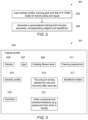
- FIG. 2 is a flow diagram of the method of use of an embodiment of a personalized resistance training program in accordance with the present application.
- FIG. 3 is a schematic of a trainee profile in accordance with the present application.
- the system and method of use in accordance with the present application overcomes one or more of the above-discussed problems commonly associated with conventional weight training systems. Specifically, the system of the present invention evaluates the strength and weakness of a user with respect to individual sizes.
- machine learning model means a system that analyzes data and establishes models to make predictions and decisions without the system being explicitly programmed to do so.
- Reference to “resistance training” means a form of exercise that improves muscular strength and endurance.
- trainee means a user taking part in the computer-implemented personalized resistance training program system.
- trainer means an individual overseeing the computer-implemented personalized resistance training program system.
- the functions of a trainer include, but are not limited to, motivate the trainee, assess the progress of the trainee, and modify the resistance training program of the trainee if needed.
- FIG. 1 depicts a flow diagram of a computer-implemented personalized resistance training program system illustrating a method to create a personalized resistance training program in accordance with a preferred embodiment of the present application. It will be appreciated that system 101 overcomes one or more of the above-listed problems commonly associated with conventional weight training program systems. It will be further appreciated that additional steps are also contemplated in the preferred and alternative embodiments.
- the method 101 initiates with step 103 of selecting a training goal and inputting the profile of a trainee (see FIG. 3 for trainee profile).
- the types of training goals include, but are not limited to, strength endurance, hypertrophy, maximum strength and power.
- the method 101 also includes step 105 of displaying a range of repetition used specifically for the type of training goal that is selected from step 103 .
- the method 101 also includes a step 107 of the generation of a primary customized repetition range for the selected training goal. It is contemplated and will be appreciated that a machine learning model may be used to generate the primary customized repetition range.
- the method 101 also includes step 109 of the trainee evaluating the primary customized repetition range (e.g., 8-10RM loads) for a major exercise for both the upper body step 111 a (e.g., bench press) and lower body step 111 b (e.g., squat).
- the method 101 then includes step 113 of applying the load conversion model to convert the load that the trainee evaluates in step 109 into nRM loads (e.g., 6RM loads as shown in step 115 ).
- the method 101 also includes step 117 of applying the load prediction model to infer nRM loads (e.g., 6RM loads as shown in step 119 ) for assistant exercises for both the upper body and lower body from the nRM loads (e.g., 6RM loads as shown in step 119 ) of bench press and squat, respectively.
- the method then includes step 121 of applying the load conversion model to convert the nRM loads (e.g., 6RM loads as shown in steps 115 , 119 ) to nRM loads required by the customized repetition range.
- the method 101 includes step 125 of applying the feedback model which incorporates the feedback from the trainee into the customized repetition range in step 123 .
- the feedback model can also detect the strength and weakness of the trainee and thus adjusts the nRM loads for customized repetition range automatically. It is further contemplated and will be appreciated that other machine learning models may be utilized to detect the strength and weakness of the trainee.
- the load conversion model in step 113 converts loads between different nRM (e.g., from 10RM to 6RM).
- the load conversion model also allows conversion for higher nRM.
- n RM percentage LR(1 ⁇ RM percentage,2 ⁇ RM percentage, . . . ,( n ⁇ 1)RM percentage)
- nRM percentage is the percentage of the nRM with respect to 1 RM and the model takes all the proceeding RM percentages as input
- LR( ) is the linear regression model
- the load prediction model in step 117 predicts the loads of assistant exercises from the load of major exercise.
- the load prediction model applies linear regression to obtain the equations between the 6RM loads of major exercises and 6RM loads of assistant exercises.
- method 101 can incorporate a plurality of linear regression models continuously to generate customized repetition ranges. For example, method 101 evaluates the strength and weakness of a trainee with respect to individual exercises by using the estimated loads and repetitions as baselines. If the trainee can do more repetitions than the estimated baseline, the exercise represents the strength of the trainee. In contrast, if the trainee can do fewer repetitions than the estimated baseline, the exercise represents the weakness of the trainee. Method 101 automatically adjusts the training program to improve the weakness of the trainee via the plurality of linear regression models based on the last RM.
- method 101 can be implemented in a one-on-one fitness setting between the trainer and trainee, in a group fitness setting between the trainer and one or more trainees, or a combination thereof.
- one of the unique features believed characteristic of the present application is that it generates a personalized training program with high accuracy and efficiency and requires the evaluation of only two major exercises rather than on all exercises. Furthermore, the personalized training program tracks the progress of strengths and weaknesses of the muscle groups of the trainee as well as comparing the progress of the trainee to other trainees.
- FIG. 2 depicts a flow diagram of a method of use associated with system 101 .
- the method 201 initiates with step 203 of inputting trainee profile, training goal and test of 8-10RM loads for bench press and squat.
- the method then includes step 205 of generating a personalized training that includes exercises, corresponding weights and repetitions.
- FIG. 3 presents a schematic 301 of a trainee's profile in accordance with the present application.
- the trainee profile 303 includes, but is not limited to, gender 305 , age 307 , existing fitness level 309 , training experience 311 , genetic profile 313 , amount of time allotted for rest and recovery after exercise 315 , nutritional intake 317 , hydration 319 , and other emotional and physical stressors (e.g., pressures from work or family) 321 .
- the trainee's profile 303 incorporates into step 103 of FIG. 1 .
- computer software products can be written in any of various suitable programming languages, such as C, C++, C#, Pascal, Fortran, Perl, Matlab (from MathWorks), SAS, SPSS, JavaScript, AJAX, Java, Swift and Objective C.
- the computer software product can be an independent application with data input and data display modules.
- the computer software products can be classes that can be instantiated as distributed objects.
- the computer software products can also be component software (e.g., Java Beans or Enterprise Java Beans). Much functionality described herein can be implemented in computer software, computer hardware, or a combination thereof.
- a computer that is running the previously mentioned computer software can be connected to a network and can interface to other computers using the network.
- the network can be an intranet, internet, or the Internet, among others.
- the network can be a wired network (e.g., using copper), telephone network, packet network, an optical network (e.g., using optical fiber), or a wireless network, or a combination of such networks.
- data and other information can be passed between the computer and components (or steps) of a system using a wireless network based on a protocol, for example Wi-Fi (IEEE standard 802.11 including its sub standards a, b, e, g, h, i, n, et al.).
- signals from the computer can be transferred, at least in part, wirelessly to components or other computers.
- each illustrated component represents a collection of functionalities which can be implemented as software, hardware, firmware or any combination of these.
- a component can be implemented as software, it can be implemented as a standalone program, but can also be implemented in other ways, for example as part of a larger program, as a plurality of separate programs, as a kernel loadable module, as one or more device drivers or as one or more statically or dynamically linked libraries.
- the portions, modules, agents, managers, components, functions, procedures, actions, layers, features, attributes, methodologies and other aspects of the invention can be implemented as software, hardware, firmware or any combination of the three.
- a component of the present invention is implemented as software, the component can be implemented as a script, as a standalone program, as part of a larger program, as a plurality of separate scripts and/or programs, as a statically or dynamically linked library, as a kernel loadable module, as a device driver, and/or in every and any other way known now or in the future to those of skill in the art of computer programming.
- the present invention is in no way limited to implementation in any specific programming language, or for any specific operating system or environment.
Landscapes
- Engineering & Computer Science (AREA)
- Health & Medical Sciences (AREA)
- Business, Economics & Management (AREA)
- Public Health (AREA)
- Medical Informatics (AREA)
- Primary Health Care (AREA)
- General Health & Medical Sciences (AREA)
- Epidemiology (AREA)
- Educational Technology (AREA)
- Physics & Mathematics (AREA)
- Biophysics (AREA)
- Physical Education & Sports Medicine (AREA)
- Theoretical Computer Science (AREA)
- General Physics & Mathematics (AREA)
- Educational Administration (AREA)
- Life Sciences & Earth Sciences (AREA)
- Entrepreneurship & Innovation (AREA)
- Biomedical Technology (AREA)
- Data Mining & Analysis (AREA)
- Databases & Information Systems (AREA)
- Pathology (AREA)
- Management, Administration, Business Operations System, And Electronic Commerce (AREA)
Abstract
A computer-implemented method of creating a personalized weight training program for users in a one-on-one fitness setting and/or group fitness setting. The method includes the input of user information by the user, input of user information by a machine learning model, or a combination thereof to create the personalized weight training program. The method includes strength and weakness assessment of the muscles of a user and progress assessment of the user and/or between users.
Description
The present invention relates generally to exercise systems, and more specifically to an weight training program system that generates one or more personalized resistance training programs for users in a one-on-one setting and/or group fitness setting.
Weight training program systems are well known in the art and are effective means to guide users during exercise. Commonly in the art, users hire a personal trainer to help educate and assist them with selecting the types of workouts to meet their desired fitness goals. One of the problems commonly associated with this is limited efficiency. For example, many conventional weight training program systems are not personalized to an individual user and are often targeted to generalized groups.
Accordingly, although great strides have been made in the area of weight training program systems, many shortcomings remain.
The novel features believed characteristic of the embodiments of the present application are set forth in the appended claims. However, the embodiments themselves, as well as a preferred mode of use, and further objectives and advantages thereof, will best be understood by reference to the following detailed description when read in conjunction with the accompanying drawings, wherein:
While the system and method of use of the present application is susceptible to various modifications and alternative forms, specific embodiments thereof have been shown by way of example in the drawings and are herein described in detail. It should be understood, however, that the description herein of specific embodiments is not intended to limit the invention to the particular embodiment disclosed, but on the contrary, the intention is to cover all modifications, equivalents, and alternatives falling within the spirit and scope of the present application as defined by the appended claims.
Illustrative embodiments of the system and method of use of the present application are provided below. It will of course be appreciated that in the development of any actual embodiment, numerous implementation-specific decisions will be made to achieve the developer's specific goals, such as compliance with system-related and business-related constraints, which will vary from one implementation to another. Moreover, it will be appreciated that such a development effort might be complex and time-consuming, but would nevertheless be a routine undertaking for those of ordinary skill in the art having the benefit of this disclosure.
The system and method of use in accordance with the present application overcomes one or more of the above-discussed problems commonly associated with conventional weight training systems. Specifically, the system of the present invention evaluates the strength and weakness of a user with respect to individual sizes. These and other unique features of the system and method of use are discussed below and illustrated in the accompanying drawings.
The system and method of use will be understood, both as to its structure and operation, from the accompanying drawings, taken in conjunction with the accompanying description. Several embodiments of the system are presented herein. It should be understood that various components, parts, and features of the different embodiments may be combined together and/or interchanged with one another, all of which are within the scope of the present application, even though not all variations and particular embodiments are shown in the drawings. It should also be understood that the mixing and matching of features, elements, and/or functions between various embodiments is expressly contemplated herein so that one of ordinary skill in the art would appreciate from this disclosure that the features, elements, and/or functions of one embodiment may be incorporated into another embodiment as appropriate, unless described otherwise.
The preferred embodiment herein described is not intended to be exhaustive or to limit the invention to the precise form disclosed. It is chosen and described to explain the principles of the invention and its application and practical use to enable others skilled in the art to follow its teachings.
Reference to “machine learning model” means a system that analyzes data and establishes models to make predictions and decisions without the system being explicitly programmed to do so.
Reference to “resistance training” means a form of exercise that improves muscular strength and endurance.
Reference to “RM” means repetition maximum.
Reference to “trainee” means a user taking part in the computer-implemented personalized resistance training program system.
Reference to “trainer” means an individual overseeing the computer-implemented personalized resistance training program system. The functions of a trainer include, but are not limited to, motivate the trainee, assess the progress of the trainee, and modify the resistance training program of the trainee if needed.
Reference to “n” represents a whole number value of the repetition maximum.
Referring now to the drawings wherein like reference characters identify corresponding or similar elements throughout the several views, FIG. 1 depicts a flow diagram of a computer-implemented personalized resistance training program system illustrating a method to create a personalized resistance training program in accordance with a preferred embodiment of the present application. It will be appreciated that system 101 overcomes one or more of the above-listed problems commonly associated with conventional weight training program systems. It will be further appreciated that additional steps are also contemplated in the preferred and alternative embodiments.
In the contemplated embodiment, the method 101 initiates with step 103 of selecting a training goal and inputting the profile of a trainee (see FIG. 3 for trainee profile). The types of training goals include, but are not limited to, strength endurance, hypertrophy, maximum strength and power. The method 101 also includes step 105 of displaying a range of repetition used specifically for the type of training goal that is selected from step 103.
The method 101 also includes a step 107 of the generation of a primary customized repetition range for the selected training goal. It is contemplated and will be appreciated that a machine learning model may be used to generate the primary customized repetition range.
The method 101 also includes step 109 of the trainee evaluating the primary customized repetition range (e.g., 8-10RM loads) for a major exercise for both the upper body step 111 a (e.g., bench press) and lower body step 111 b (e.g., squat). The method 101 then includes step 113 of applying the load conversion model to convert the load that the trainee evaluates in step 109 into nRM loads (e.g., 6RM loads as shown in step 115). The method 101 also includes step 117 of applying the load prediction model to infer nRM loads (e.g., 6RM loads as shown in step 119) for assistant exercises for both the upper body and lower body from the nRM loads (e.g., 6RM loads as shown in step 119) of bench press and squat, respectively. The method then includes step 121 of applying the load conversion model to convert the nRM loads (e.g., 6RM loads as shown in steps 115, 119) to nRM loads required by the customized repetition range.
Furthermore, the method 101 includes step 125 of applying the feedback model which incorporates the feedback from the trainee into the customized repetition range in step 123. It is contemplated and will be appreciated that the feedback model can also detect the strength and weakness of the trainee and thus adjusts the nRM loads for customized repetition range automatically. It is further contemplated and will be appreciated that other machine learning models may be utilized to detect the strength and weakness of the trainee.
It is contemplated and will be appreciated that the load conversion model in step 113 converts loads between different nRM (e.g., from 10RM to 6RM). The load conversion model also allows conversion for higher nRM. For example, for a high nRM such as 16RM, 18RM, etc., a linear regression model is used to infer the percentage of the higher nRM with respect to 1RM, which is shown in the following equation:
nRM percentage=LR(1−RM percentage,2−RM percentage, . . . ,(n−1)RM percentage)
nRM percentage=LR(1−RM percentage,2−RM percentage, . . . ,(n−1)RM percentage)
where nRM percentage is the percentage of the nRM with respect to 1 RM and the model takes all the proceeding RM percentages as input, LR( ) is the linear regression model.
It is also contemplated and will be appreciated that the load prediction model in step 117 predicts the loads of assistant exercises from the load of major exercise. For example, the load prediction model applies linear regression to obtain the equations between the 6RM loads of major exercises and 6RM loads of assistant exercises.
It is further contemplated and will be appreciated that method 101 can incorporate a plurality of linear regression models continuously to generate customized repetition ranges. For example, method 101 evaluates the strength and weakness of a trainee with respect to individual exercises by using the estimated loads and repetitions as baselines. If the trainee can do more repetitions than the estimated baseline, the exercise represents the strength of the trainee. In contrast, if the trainee can do fewer repetitions than the estimated baseline, the exercise represents the weakness of the trainee. Method 101 automatically adjusts the training program to improve the weakness of the trainee via the plurality of linear regression models based on the last RM.
It is further contemplated and will be appreciated that method 101 can be implemented in a one-on-one fitness setting between the trainer and trainee, in a group fitness setting between the trainer and one or more trainees, or a combination thereof.
It should also be appreciated that one of the unique features believed characteristic of the present application is that it generates a personalized training program with high accuracy and efficiency and requires the evaluation of only two major exercises rather than on all exercises. Furthermore, the personalized training program tracks the progress of strengths and weaknesses of the muscle groups of the trainee as well as comparing the progress of the trainee to other trainees.
As described herein, computer software products can be written in any of various suitable programming languages, such as C, C++, C#, Pascal, Fortran, Perl, Matlab (from MathWorks), SAS, SPSS, JavaScript, AJAX, Java, Swift and Objective C. The computer software product can be an independent application with data input and data display modules. Alternatively, the computer software products can be classes that can be instantiated as distributed objects. The computer software products can also be component software (e.g., Java Beans or Enterprise Java Beans). Much functionality described herein can be implemented in computer software, computer hardware, or a combination thereof.
Furthermore, a computer that is running the previously mentioned computer software can be connected to a network and can interface to other computers using the network. The network can be an intranet, internet, or the Internet, among others. The network can be a wired network (e.g., using copper), telephone network, packet network, an optical network (e.g., using optical fiber), or a wireless network, or a combination of such networks. For example, data and other information can be passed between the computer and components (or steps) of a system using a wireless network based on a protocol, for example Wi-Fi (IEEE standard 802.11 including its sub standards a, b, e, g, h, i, n, et al.). In one example, signals from the computer can be transferred, at least in part, wirelessly to components or other computers.
It is to be understood that although various components are illustrated herein as separate entities, each illustrated component represents a collection of functionalities which can be implemented as software, hardware, firmware or any combination of these. Where a component is implemented as software, it can be implemented as a standalone program, but can also be implemented in other ways, for example as part of a larger program, as a plurality of separate programs, as a kernel loadable module, as one or more device drivers or as one or more statically or dynamically linked libraries.
As will be understood by those familiar with the art, the invention may be embodied in other specific forms without departing from the spirit or essential characteristics thereof. Likewise, the particular naming and division of the portions, modules, agents, managers, components, functions, procedures, actions, layers, features, attributes, methodologies and other aspects are not mandatory or significant, and the mechanisms that implement the invention or its features may have different names, divisions and/or formats.
Furthermore, as will be apparent to one of ordinary skill in the relevant art, the portions, modules, agents, managers, components, functions, procedures, actions, layers, features, attributes, methodologies and other aspects of the invention can be implemented as software, hardware, firmware or any combination of the three. Of course, wherever a component of the present invention is implemented as software, the component can be implemented as a script, as a standalone program, as part of a larger program, as a plurality of separate scripts and/or programs, as a statically or dynamically linked library, as a kernel loadable module, as a device driver, and/or in every and any other way known now or in the future to those of skill in the art of computer programming. Additionally, the present invention is in no way limited to implementation in any specific programming language, or for any specific operating system or environment.
Furthermore, it will be readily apparent to those of ordinary skill in the relevant art that where the present invention is implemented in whole or in part in software, the software components thereof can be stored on computer readable media as computer program products. Any form of computer readable medium can be used in this context, such as magnetic or optical storage media. Additionally, software portions of the present invention can be instantiated (e.g., as object code or executable images) within the memory of any programmable computing device.
The particular embodiments disclosed above are illustrative only, as the embodiments may be modified and practiced in different but equivalent manners apparent to those skilled in the art having the benefit of the teachings herein. It is therefore evident that the particular embodiments disclosed above may be altered or modified, and all such variations are considered within the scope and spirit of the application. Accordingly, the protection sought herein is as set forth in the description. Although the present embodiments are shown above, they are not limited to just these embodiments, but are amenable to various changes and modifications without departing from the spirit thereof.
Claims (2)
1. A computer-implemented method to generate one or more personalized resistance training programs, the computer-implemented method comprising:
providing a computer having an algorithm and a database;
allowing a user to select a training goal and inputting his or her training profile via the computer;
generating one or more personalized resistance training programs via the algorithm based on user information inputted by the user, user information inputted by a machine learning model, or a combination thereof;
allowing a user to modify the personalized resistance training programs;
tracking the progress of the strengths and weaknesses of the muscle groups of a user via user input;
comparing the strengths and weaknesses of the muscle groups of a user with one or more other users via information found in the database;
wherein the machine learning model utilizes a load conversion model, a load prediction model, and a feedback model to generate one or more personalized resistance training programs.
2. The method of claim 1 wherein the training profile includes gender, age, existing fitness level, training experience, genetic profile, the amount of time allotted for rest and recovery after exercise, nutritional intake, hydration, and other emotional and physical stressors.
Priority Applications (1)
| Application Number | Priority Date | Filing Date | Title |
|---|---|---|---|
| US16/911,191 US11621067B1 (en) | 2020-06-24 | 2020-06-24 | Method for generating personalized resistance training program |
Applications Claiming Priority (1)
| Application Number | Priority Date | Filing Date | Title |
|---|---|---|---|
| US16/911,191 US11621067B1 (en) | 2020-06-24 | 2020-06-24 | Method for generating personalized resistance training program |
Publications (1)
| Publication Number | Publication Date |
|---|---|
| US11621067B1 true US11621067B1 (en) | 2023-04-04 |
Family
ID=85775785
Family Applications (1)
| Application Number | Title | Priority Date | Filing Date |
|---|---|---|---|
| US16/911,191 Active 2041-05-18 US11621067B1 (en) | 2020-06-24 | 2020-06-24 | Method for generating personalized resistance training program |
Country Status (1)
| Country | Link |
|---|---|
| US (1) | US11621067B1 (en) |
Cited By (44)
| Publication number | Priority date | Publication date | Assignee | Title |
|---|---|---|---|---|
| US20220126169A1 (en) * | 2020-10-28 | 2022-04-28 | Rom Technologies, Inc. | Systems and methods for using machine learning to control a rehabilitation and exercise electromechanical device |
| US20220331658A1 (en) * | 2021-04-16 | 2022-10-20 | Fitbod, Inc. | Machine-learned exercise capability prediction model |
| US20220331659A1 (en) * | 2021-04-16 | 2022-10-20 | Fitbod, Inc. | Determining a user's current exercise capability |
| US20230414997A1 (en) * | 2022-01-17 | 2023-12-28 | Tonal Systems, Inc. | Exercise machine struggle detection |
| US12154672B2 (en) | 2019-10-03 | 2024-11-26 | Rom Technologies, Inc. | Method and system for implementing dynamic treatment environments based on patient information |
| US12150792B2 (en) | 2019-10-03 | 2024-11-26 | Rom Technologies, Inc. | Augmented reality placement of goniometer or other sensors |
| US12165768B2 (en) | 2019-10-03 | 2024-12-10 | Rom Technologies, Inc. | Method and system for use of telemedicine-enabled rehabilitative equipment for prediction of secondary disease |
| US12176091B2 (en) | 2019-10-03 | 2024-12-24 | Rom Technologies, Inc. | Systems and methods for using elliptical machine to perform cardiovascular rehabilitation |
| US12176089B2 (en) | 2019-10-03 | 2024-12-24 | Rom Technologies, Inc. | System and method for using AI ML and telemedicine for cardio-oncologic rehabilitation via an electromechanical machine |
| US12183447B2 (en) | 2019-10-03 | 2024-12-31 | Rom Technologies, Inc. | Method and system for creating an immersive enhanced reality-driven exercise experience for a user |
| US20250001257A1 (en) * | 2023-06-27 | 2025-01-02 | Tonal Systems, Inc. | Cold start calibration |
| US12191018B2 (en) | 2019-10-03 | 2025-01-07 | Rom Technologies, Inc. | System and method for using artificial intelligence in telemedicine-enabled hardware to optimize rehabilitative routines capable of enabling remote rehabilitative compliance |
| US12191021B2 (en) | 2019-10-03 | 2025-01-07 | Rom Technologies, Inc. | System and method for use of telemedicine-enabled rehabilitative hardware and for encouragement of rehabilitative compliance through patient-based virtual shared sessions |
| US12217865B2 (en) | 2019-10-03 | 2025-02-04 | Rom Technologies, Inc. | Method and system for enabling physician-smart virtual conference rooms for use in a telehealth context |
| US12220202B2 (en) | 2019-10-03 | 2025-02-11 | Rom Technologies, Inc. | Remote examination through augmented reality |
| US12224052B2 (en) | 2019-10-03 | 2025-02-11 | Rom Technologies, Inc. | System and method for using AI, machine learning and telemedicine for long-term care via an electromechanical machine |
| US12230382B2 (en) | 2019-10-03 | 2025-02-18 | Rom Technologies, Inc. | Systems and methods for using artificial intelligence and machine learning to predict a probability of an undesired medical event occurring during a treatment plan |
| US12230381B2 (en) | 2019-10-03 | 2025-02-18 | Rom Technologies, Inc. | System and method for an enhanced healthcare professional user interface displaying measurement information for a plurality of users |
| US12246222B2 (en) | 2019-10-03 | 2025-03-11 | Rom Technologies, Inc. | Method and system for using artificial intelligence to assign patients to cohorts and dynamically controlling a treatment apparatus based on the assignment during an adaptive telemedical session |
| US12249410B2 (en) | 2019-10-03 | 2025-03-11 | Rom Technologies, Inc. | System and method for use of treatment device to reduce pain medication dependency |
| US12283356B2 (en) | 2019-10-03 | 2025-04-22 | Rom Technologies, Inc. | System and method for processing medical claims using biometric signatures |
| US12285654B2 (en) | 2019-05-10 | 2025-04-29 | Rom Technologies, Inc. | Method and system for using artificial intelligence to interact with a user of an exercise device during an exercise session |
| US12301663B2 (en) | 2019-10-03 | 2025-05-13 | Rom Technologies, Inc. | System and method for transmitting data and ordering asynchronous data |
| US12324961B2 (en) | 2019-05-10 | 2025-06-10 | Rom Technologies, Inc. | Method and system for using artificial intelligence to present a user interface representing a user's progress in various domains |
| US12327623B2 (en) | 2019-10-03 | 2025-06-10 | Rom Technologies, Inc. | System and method for processing medical claims |
| US12340884B2 (en) | 2019-10-03 | 2025-06-24 | Rom Technologies, Inc. | Method and system to analytically optimize telehealth practice-based billing processes and revenue while enabling regulatory compliance |
| US12347542B2 (en) | 2021-04-16 | 2025-07-01 | Fitbod, Inc. | Predicting exercises based on user-selected variance |
| US12347543B2 (en) | 2019-10-03 | 2025-07-01 | Rom Technologies, Inc. | Systems and methods for using artificial intelligence to implement a cardio protocol via a relay-based system |
| US12347558B2 (en) | 2019-10-03 | 2025-07-01 | Rom Technologies, Inc. | Method and system for using artificial intelligence and machine learning to provide recommendations to a healthcare provider in or near real-time during a telemedicine session |
| US12367959B2 (en) | 2019-10-03 | 2025-07-22 | Rom Technologies, Inc. | System and method for using AI/ML to generate treatment plans to stimulate preferred angiogenesis |
| US12367960B2 (en) | 2020-09-15 | 2025-07-22 | Rom Technologies, Inc. | System and method for using AI ML and telemedicine to perform bariatric rehabilitation via an electromechanical machine |
| US12380984B2 (en) | 2019-10-03 | 2025-08-05 | Rom Technologies, Inc. | Systems and methods for using artificial intelligence and machine learning to generate treatment plans having dynamically tailored cardiac protocols for users to manage a state of an electromechanical machine |
| US12390689B2 (en) | 2019-10-21 | 2025-08-19 | Rom Technologies, Inc. | Persuasive motivation for orthopedic treatment |
| US12402805B2 (en) | 2019-09-17 | 2025-09-02 | Rom Technologies, Inc. | Wearable device for coupling to a user, and measuring and monitoring user activity |
| US12420145B2 (en) | 2019-10-03 | 2025-09-23 | Rom Technologies, Inc. | Systems and methods of using artificial intelligence and machine learning for generating alignment plans to align a user with an imaging sensor during a treatment session |
| US12424319B2 (en) | 2019-11-06 | 2025-09-23 | Rom Technologies, Inc. | System for remote treatment utilizing privacy controls |
| US12424308B2 (en) | 2019-10-03 | 2025-09-23 | Rom Technologies, Inc. | System and method for determining, based on advanced metrics of actual performance of an electromechanical machine, medical procedure eligibility in order to ascertain survivability rates and measures of quality-of-life criteria |
| US12420143B1 (en) | 2019-10-03 | 2025-09-23 | Rom Technologies, Inc. | System and method for enabling residentially-based cardiac rehabilitation by using an electromechanical machine and educational content to mitigate risk factors and optimize user behavior |
| US12427376B2 (en) | 2019-10-03 | 2025-09-30 | Rom Technologies, Inc. | Systems and methods for an artificial intelligence engine to optimize a peak performance |
| US12469587B2 (en) | 2019-10-03 | 2025-11-11 | Rom Technologies, Inc. | Systems and methods for assigning healthcare professionals to remotely monitor users performing treatment plans on electromechanical machines |
| US12478837B2 (en) | 2019-10-03 | 2025-11-25 | Rom Technologies, Inc. | Method and system for monitoring actual patient treatment progress using sensor data |
| US12537088B2 (en) | 2019-10-03 | 2026-01-27 | Rom Technologies, Inc. | System and method for using AI/ML and telemedicine for invasive surgical treatment to determine a cardiac treatment plan that uses an electromechanical machine |
| US12539446B2 (en) | 2019-10-03 | 2026-02-03 | Rom Technologies, Inc. | Method and system for using sensors to optimize a user treatment plan in a telemedicine environment |
| US12548657B2 (en) | 2024-06-24 | 2026-02-10 | Rom Technologies, Inc. | System and method for using AI/ML and telemedicine to integrate rehabilitation for a plurality of comorbid conditions |
Citations (4)
| Publication number | Priority date | Publication date | Assignee | Title |
|---|---|---|---|---|
| US20190046107A1 (en) * | 2017-08-14 | 2019-02-14 | MAD Apparel, Inc. | Exercise application based on muscle stress measurement |
| US20190344121A1 (en) * | 2018-05-14 | 2019-11-14 | MAD Apparel, Inc. | Exercise training adaptation using physiological data |
| US11065506B2 (en) * | 2018-08-30 | 2021-07-20 | Industrial Technology Research Institute | Muscle training equipment, muscle training system and muscle training method |
| US11207556B2 (en) * | 2018-07-23 | 2021-12-28 | Matthew Silveira | Competitive weightlifting machine and methods for using the same |
-
2020
- 2020-06-24 US US16/911,191 patent/US11621067B1/en active Active
Patent Citations (4)
| Publication number | Priority date | Publication date | Assignee | Title |
|---|---|---|---|---|
| US20190046107A1 (en) * | 2017-08-14 | 2019-02-14 | MAD Apparel, Inc. | Exercise application based on muscle stress measurement |
| US20190344121A1 (en) * | 2018-05-14 | 2019-11-14 | MAD Apparel, Inc. | Exercise training adaptation using physiological data |
| US11207556B2 (en) * | 2018-07-23 | 2021-12-28 | Matthew Silveira | Competitive weightlifting machine and methods for using the same |
| US11065506B2 (en) * | 2018-08-30 | 2021-07-20 | Industrial Technology Research Institute | Muscle training equipment, muscle training system and muscle training method |
Cited By (52)
| Publication number | Priority date | Publication date | Assignee | Title |
|---|---|---|---|---|
| US12285654B2 (en) | 2019-05-10 | 2025-04-29 | Rom Technologies, Inc. | Method and system for using artificial intelligence to interact with a user of an exercise device during an exercise session |
| US12324961B2 (en) | 2019-05-10 | 2025-06-10 | Rom Technologies, Inc. | Method and system for using artificial intelligence to present a user interface representing a user's progress in various domains |
| US12495987B2 (en) | 2019-09-17 | 2025-12-16 | Rom Technologies, Inc. | Wearable device for coupling to a user, and measuring and monitoring user activity |
| US12402805B2 (en) | 2019-09-17 | 2025-09-02 | Rom Technologies, Inc. | Wearable device for coupling to a user, and measuring and monitoring user activity |
| US12301663B2 (en) | 2019-10-03 | 2025-05-13 | Rom Technologies, Inc. | System and method for transmitting data and ordering asynchronous data |
| US12217865B2 (en) | 2019-10-03 | 2025-02-04 | Rom Technologies, Inc. | Method and system for enabling physician-smart virtual conference rooms for use in a telehealth context |
| US12150792B2 (en) | 2019-10-03 | 2024-11-26 | Rom Technologies, Inc. | Augmented reality placement of goniometer or other sensors |
| US12165768B2 (en) | 2019-10-03 | 2024-12-10 | Rom Technologies, Inc. | Method and system for use of telemedicine-enabled rehabilitative equipment for prediction of secondary disease |
| US12176091B2 (en) | 2019-10-03 | 2024-12-24 | Rom Technologies, Inc. | Systems and methods for using elliptical machine to perform cardiovascular rehabilitation |
| US12176089B2 (en) | 2019-10-03 | 2024-12-24 | Rom Technologies, Inc. | System and method for using AI ML and telemedicine for cardio-oncologic rehabilitation via an electromechanical machine |
| US12183447B2 (en) | 2019-10-03 | 2024-12-31 | Rom Technologies, Inc. | Method and system for creating an immersive enhanced reality-driven exercise experience for a user |
| US12539446B2 (en) | 2019-10-03 | 2026-02-03 | Rom Technologies, Inc. | Method and system for using sensors to optimize a user treatment plan in a telemedicine environment |
| US12191018B2 (en) | 2019-10-03 | 2025-01-07 | Rom Technologies, Inc. | System and method for using artificial intelligence in telemedicine-enabled hardware to optimize rehabilitative routines capable of enabling remote rehabilitative compliance |
| US12340884B2 (en) | 2019-10-03 | 2025-06-24 | Rom Technologies, Inc. | Method and system to analytically optimize telehealth practice-based billing processes and revenue while enabling regulatory compliance |
| US12327623B2 (en) | 2019-10-03 | 2025-06-10 | Rom Technologies, Inc. | System and method for processing medical claims |
| US12220202B2 (en) | 2019-10-03 | 2025-02-11 | Rom Technologies, Inc. | Remote examination through augmented reality |
| US12220201B2 (en) | 2019-10-03 | 2025-02-11 | Rom Technologies, Inc. | Remote examination through augmented reality |
| US12224052B2 (en) | 2019-10-03 | 2025-02-11 | Rom Technologies, Inc. | System and method for using AI, machine learning and telemedicine for long-term care via an electromechanical machine |
| US12230383B2 (en) | 2019-10-03 | 2025-02-18 | Rom Technologies, Inc. | United states systems and methods for using elliptical machine to perform cardiovascular rehabilitation |
| US12230382B2 (en) | 2019-10-03 | 2025-02-18 | Rom Technologies, Inc. | Systems and methods for using artificial intelligence and machine learning to predict a probability of an undesired medical event occurring during a treatment plan |
| US12230381B2 (en) | 2019-10-03 | 2025-02-18 | Rom Technologies, Inc. | System and method for an enhanced healthcare professional user interface displaying measurement information for a plurality of users |
| US12246222B2 (en) | 2019-10-03 | 2025-03-11 | Rom Technologies, Inc. | Method and system for using artificial intelligence to assign patients to cohorts and dynamically controlling a treatment apparatus based on the assignment during an adaptive telemedical session |
| US12249410B2 (en) | 2019-10-03 | 2025-03-11 | Rom Technologies, Inc. | System and method for use of treatment device to reduce pain medication dependency |
| US12283356B2 (en) | 2019-10-03 | 2025-04-22 | Rom Technologies, Inc. | System and method for processing medical claims using biometric signatures |
| US12537088B2 (en) | 2019-10-03 | 2026-01-27 | Rom Technologies, Inc. | System and method for using AI/ML and telemedicine for invasive surgical treatment to determine a cardiac treatment plan that uses an electromechanical machine |
| US12478837B2 (en) | 2019-10-03 | 2025-11-25 | Rom Technologies, Inc. | Method and system for monitoring actual patient treatment progress using sensor data |
| US12154672B2 (en) | 2019-10-03 | 2024-11-26 | Rom Technologies, Inc. | Method and system for implementing dynamic treatment environments based on patient information |
| US12469587B2 (en) | 2019-10-03 | 2025-11-11 | Rom Technologies, Inc. | Systems and methods for assigning healthcare professionals to remotely monitor users performing treatment plans on electromechanical machines |
| US12191021B2 (en) | 2019-10-03 | 2025-01-07 | Rom Technologies, Inc. | System and method for use of telemedicine-enabled rehabilitative hardware and for encouragement of rehabilitative compliance through patient-based virtual shared sessions |
| US12427376B2 (en) | 2019-10-03 | 2025-09-30 | Rom Technologies, Inc. | Systems and methods for an artificial intelligence engine to optimize a peak performance |
| US12347543B2 (en) | 2019-10-03 | 2025-07-01 | Rom Technologies, Inc. | Systems and methods for using artificial intelligence to implement a cardio protocol via a relay-based system |
| US12347558B2 (en) | 2019-10-03 | 2025-07-01 | Rom Technologies, Inc. | Method and system for using artificial intelligence and machine learning to provide recommendations to a healthcare provider in or near real-time during a telemedicine session |
| US12420143B1 (en) | 2019-10-03 | 2025-09-23 | Rom Technologies, Inc. | System and method for enabling residentially-based cardiac rehabilitation by using an electromechanical machine and educational content to mitigate risk factors and optimize user behavior |
| US12367959B2 (en) | 2019-10-03 | 2025-07-22 | Rom Technologies, Inc. | System and method for using AI/ML to generate treatment plans to stimulate preferred angiogenesis |
| US12424308B2 (en) | 2019-10-03 | 2025-09-23 | Rom Technologies, Inc. | System and method for determining, based on advanced metrics of actual performance of an electromechanical machine, medical procedure eligibility in order to ascertain survivability rates and measures of quality-of-life criteria |
| US12380985B2 (en) | 2019-10-03 | 2025-08-05 | Rom Technologies, Inc. | Method and system for implementing dynamic treatment environments based on patient information |
| US12380984B2 (en) | 2019-10-03 | 2025-08-05 | Rom Technologies, Inc. | Systems and methods for using artificial intelligence and machine learning to generate treatment plans having dynamically tailored cardiac protocols for users to manage a state of an electromechanical machine |
| US12420145B2 (en) | 2019-10-03 | 2025-09-23 | Rom Technologies, Inc. | Systems and methods of using artificial intelligence and machine learning for generating alignment plans to align a user with an imaging sensor during a treatment session |
| US12390689B2 (en) | 2019-10-21 | 2025-08-19 | Rom Technologies, Inc. | Persuasive motivation for orthopedic treatment |
| US12424319B2 (en) | 2019-11-06 | 2025-09-23 | Rom Technologies, Inc. | System for remote treatment utilizing privacy controls |
| US12367960B2 (en) | 2020-09-15 | 2025-07-22 | Rom Technologies, Inc. | System and method for using AI ML and telemedicine to perform bariatric rehabilitation via an electromechanical machine |
| US12515104B2 (en) * | 2020-10-28 | 2026-01-06 | Rom Technologies, Inc. | Systems and methods for using machine learning to control a rehabilitation and exercise electromechanical device |
| US20220126169A1 (en) * | 2020-10-28 | 2022-04-28 | Rom Technologies, Inc. | Systems and methods for using machine learning to control a rehabilitation and exercise electromechanical device |
| US20220331659A1 (en) * | 2021-04-16 | 2022-10-20 | Fitbod, Inc. | Determining a user's current exercise capability |
| US12347542B2 (en) | 2021-04-16 | 2025-07-01 | Fitbod, Inc. | Predicting exercises based on user-selected variance |
| US20220331658A1 (en) * | 2021-04-16 | 2022-10-20 | Fitbod, Inc. | Machine-learned exercise capability prediction model |
| US12109454B2 (en) * | 2021-04-16 | 2024-10-08 | Fitbod, Inc. | Determining a user's current exercise capability |
| US12357876B2 (en) * | 2022-01-17 | 2025-07-15 | Tonal Systems, Inc. | Exercise machine struggle detection |
| US20230414997A1 (en) * | 2022-01-17 | 2023-12-28 | Tonal Systems, Inc. | Exercise machine struggle detection |
| US20250001257A1 (en) * | 2023-06-27 | 2025-01-02 | Tonal Systems, Inc. | Cold start calibration |
| US12548656B2 (en) | 2023-07-31 | 2026-02-10 | Rom Technologies, Inc. | System and method for an enhanced patient user interface displaying real-time measurement information during a telemedicine session |
| US12548657B2 (en) | 2024-06-24 | 2026-02-10 | Rom Technologies, Inc. | System and method for using AI/ML and telemedicine to integrate rehabilitation for a plurality of comorbid conditions |
Similar Documents
| Publication | Publication Date | Title |
|---|---|---|
| US11621067B1 (en) | Method for generating personalized resistance training program | |
| US12347542B2 (en) | Predicting exercises based on user-selected variance | |
| US11745058B2 (en) | Methods and apparatus for coaching based on workout history | |
| Mokmin | The effectiveness of a personalized virtual fitness trainer in teaching physical education by applying the artificial intelligent algorithm | |
| NL1001347C2 (en) | A system for programming training on exercise machines and machines. | |
| US20110201476A1 (en) | Computer automated physical fitness system | |
| US20110179068A1 (en) | Computer implemented process for creating an overall health wellness database for a plurality of patients | |
| CN118072908A (en) | Service provider processing device and method for providing customized exercise recommendations | |
| US12109454B2 (en) | Determining a user's current exercise capability | |
| Thompson et al. | “Is it a slow day or a go day?”: The perceptions and applications of velocity-based training within elite strength and conditioning | |
| KR102145692B1 (en) | Customized fitness member management system using big data | |
| KR102438725B1 (en) | System and method for providing exercise information using health and body information, computer program for the same | |
| Sheng | The relationship between sports measurement and evaluation in physical education through intelligent analysis and data mining | |
| Rodiles-Guerrero et al. | Comparison of load-velocity relationships in two bench press variations: Weight stack machine vs Smith machine | |
| Neagu et al. | Selfit–an intelligent tutoring system for psychomotor development | |
| Dyas et al. | The physical determinants of maximal jumping time of flight in elite trampolining | |
| Pan et al. | Designing auditory feedback from wearable weightlifting devices | |
| KR20220147042A (en) | The method for providing customized exercise program | |
| Wilson et al. | Bayesian analysis of changes in standing horizontal and vertical jump after different modes of resistance training | |
| Zuykova et al. | System-Modular technologies in the educational process of physical culture | |
| US20250006339A1 (en) | System and method for real-time fitness tracking and scheduling | |
| Hirsch et al. | A critical appraisal of using barbell velocity data to regulate training | |
| KR20220067608A (en) | Customized AI healthcare methods for personal diseases | |
| Herold et al. | A mathematical model-based approach to optimize loading schemes of isometric resistance training sessions | |
| US20220331658A1 (en) | Machine-learned exercise capability prediction model |
Legal Events
| Date | Code | Title | Description |
|---|---|---|---|
| FEPP | Fee payment procedure |
Free format text: ENTITY STATUS SET TO UNDISCOUNTED (ORIGINAL EVENT CODE: BIG.); ENTITY STATUS OF PATENT OWNER: SMALL ENTITY |
|
| FEPP | Fee payment procedure |
Free format text: ENTITY STATUS SET TO MICRO (ORIGINAL EVENT CODE: MICR); ENTITY STATUS OF PATENT OWNER: SMALL ENTITY |
|
| FEPP | Fee payment procedure |
Free format text: ENTITY STATUS SET TO SMALL (ORIGINAL EVENT CODE: SMAL); ENTITY STATUS OF PATENT OWNER: SMALL ENTITY |
|
| STCF | Information on status: patent grant |
Free format text: PATENTED CASE |
|
| CC | Certificate of correction |