US11491313B2 - Guide catheter extension system with a delivery micro-catheter configured to facilitate percutaneous coronary intervention - Google Patents
Guide catheter extension system with a delivery micro-catheter configured to facilitate percutaneous coronary intervention Download PDFInfo
- Publication number
- US11491313B2 US11491313B2 US15/899,603 US201815899603A US11491313B2 US 11491313 B2 US11491313 B2 US 11491313B2 US 201815899603 A US201815899603 A US 201815899603A US 11491313 B2 US11491313 B2 US 11491313B2
- Authority
- US
- United States
- Prior art keywords
- inner member
- catheter
- flexible
- tapered
- sheath
- Prior art date
- Legal status (The legal status is an assumption and is not a legal conclusion. Google has not performed a legal analysis and makes no representation as to the accuracy of the status listed.)
- Active
Links
Images



Classifications
-
- A—HUMAN NECESSITIES
- A61—MEDICAL OR VETERINARY SCIENCE; HYGIENE
- A61M—DEVICES FOR INTRODUCING MEDIA INTO, OR ONTO, THE BODY; DEVICES FOR TRANSDUCING BODY MEDIA OR FOR TAKING MEDIA FROM THE BODY; DEVICES FOR PRODUCING OR ENDING SLEEP OR STUPOR
- A61M25/00—Catheters; Hollow probes
- A61M25/0097—Catheters; Hollow probes characterised by the hub
-
- A—HUMAN NECESSITIES
- A61—MEDICAL OR VETERINARY SCIENCE; HYGIENE
- A61M—DEVICES FOR INTRODUCING MEDIA INTO, OR ONTO, THE BODY; DEVICES FOR TRANSDUCING BODY MEDIA OR FOR TAKING MEDIA FROM THE BODY; DEVICES FOR PRODUCING OR ENDING SLEEP OR STUPOR
- A61M25/00—Catheters; Hollow probes
- A61M25/01—Introducing, guiding, advancing, emplacing or holding catheters
- A61M25/09—Guide wires
- A61M25/0905—Guide wires extendable, e.g. mechanisms for extension
-
- A—HUMAN NECESSITIES
- A61—MEDICAL OR VETERINARY SCIENCE; HYGIENE
- A61M—DEVICES FOR INTRODUCING MEDIA INTO, OR ONTO, THE BODY; DEVICES FOR TRANSDUCING BODY MEDIA OR FOR TAKING MEDIA FROM THE BODY; DEVICES FOR PRODUCING OR ENDING SLEEP OR STUPOR
- A61M25/00—Catheters; Hollow probes
- A61M25/01—Introducing, guiding, advancing, emplacing or holding catheters
- A61M25/0102—Insertion or introduction using an inner stiffening member, e.g. stylet or push-rod
-
- A—HUMAN NECESSITIES
- A61—MEDICAL OR VETERINARY SCIENCE; HYGIENE
- A61M—DEVICES FOR INTRODUCING MEDIA INTO, OR ONTO, THE BODY; DEVICES FOR TRANSDUCING BODY MEDIA OR FOR TAKING MEDIA FROM THE BODY; DEVICES FOR PRODUCING OR ENDING SLEEP OR STUPOR
- A61M25/00—Catheters; Hollow probes
- A61M25/01—Introducing, guiding, advancing, emplacing or holding catheters
- A61M25/0169—Exchanging a catheter while keeping the guidewire in place
-
- A—HUMAN NECESSITIES
- A61—MEDICAL OR VETERINARY SCIENCE; HYGIENE
- A61M—DEVICES FOR INTRODUCING MEDIA INTO, OR ONTO, THE BODY; DEVICES FOR TRANSDUCING BODY MEDIA OR FOR TAKING MEDIA FROM THE BODY; DEVICES FOR PRODUCING OR ENDING SLEEP OR STUPOR
- A61M25/00—Catheters; Hollow probes
- A61M25/01—Introducing, guiding, advancing, emplacing or holding catheters
- A61M25/06—Body-piercing guide needles or the like
- A61M25/0662—Guide tubes
-
- A—HUMAN NECESSITIES
- A61—MEDICAL OR VETERINARY SCIENCE; HYGIENE
- A61M—DEVICES FOR INTRODUCING MEDIA INTO, OR ONTO, THE BODY; DEVICES FOR TRANSDUCING BODY MEDIA OR FOR TAKING MEDIA FROM THE BODY; DEVICES FOR PRODUCING OR ENDING SLEEP OR STUPOR
- A61M25/00—Catheters; Hollow probes
- A61M25/01—Introducing, guiding, advancing, emplacing or holding catheters
- A61M25/09—Guide wires
- A61M25/09041—Mechanisms for insertion of guide wires
-
- A—HUMAN NECESSITIES
- A61—MEDICAL OR VETERINARY SCIENCE; HYGIENE
- A61M—DEVICES FOR INTRODUCING MEDIA INTO, OR ONTO, THE BODY; DEVICES FOR TRANSDUCING BODY MEDIA OR FOR TAKING MEDIA FROM THE BODY; DEVICES FOR PRODUCING OR ENDING SLEEP OR STUPOR
- A61M25/00—Catheters; Hollow probes
- A61M25/10—Balloon catheters
- A61M25/104—Balloon catheters used for angioplasty
-
- A—HUMAN NECESSITIES
- A61—MEDICAL OR VETERINARY SCIENCE; HYGIENE
- A61M—DEVICES FOR INTRODUCING MEDIA INTO, OR ONTO, THE BODY; DEVICES FOR TRANSDUCING BODY MEDIA OR FOR TAKING MEDIA FROM THE BODY; DEVICES FOR PRODUCING OR ENDING SLEEP OR STUPOR
- A61M25/00—Catheters; Hollow probes
- A61M2025/0004—Catheters; Hollow probes having two or more concentrically arranged tubes for forming a concentric catheter system
-
- A—HUMAN NECESSITIES
- A61—MEDICAL OR VETERINARY SCIENCE; HYGIENE
- A61M—DEVICES FOR INTRODUCING MEDIA INTO, OR ONTO, THE BODY; DEVICES FOR TRANSDUCING BODY MEDIA OR FOR TAKING MEDIA FROM THE BODY; DEVICES FOR PRODUCING OR ENDING SLEEP OR STUPOR
- A61M25/00—Catheters; Hollow probes
- A61M2025/0004—Catheters; Hollow probes having two or more concentrically arranged tubes for forming a concentric catheter system
- A61M2025/0006—Catheters; Hollow probes having two or more concentrically arranged tubes for forming a concentric catheter system which can be secured against axial movement, e.g. by using a locking cuff
-
- A—HUMAN NECESSITIES
- A61—MEDICAL OR VETERINARY SCIENCE; HYGIENE
- A61M—DEVICES FOR INTRODUCING MEDIA INTO, OR ONTO, THE BODY; DEVICES FOR TRANSDUCING BODY MEDIA OR FOR TAKING MEDIA FROM THE BODY; DEVICES FOR PRODUCING OR ENDING SLEEP OR STUPOR
- A61M25/00—Catheters; Hollow probes
- A61M25/0021—Catheters; Hollow probes characterised by the form of the tubing
- A61M2025/0042—Microcatheters, cannula or the like having outside diameters around 1 mm or less
-
- A—HUMAN NECESSITIES
- A61—MEDICAL OR VETERINARY SCIENCE; HYGIENE
- A61M—DEVICES FOR INTRODUCING MEDIA INTO, OR ONTO, THE BODY; DEVICES FOR TRANSDUCING BODY MEDIA OR FOR TAKING MEDIA FROM THE BODY; DEVICES FOR PRODUCING OR ENDING SLEEP OR STUPOR
- A61M25/00—Catheters; Hollow probes
- A61M25/01—Introducing, guiding, advancing, emplacing or holding catheters
- A61M2025/0183—Rapid exchange or monorail catheters
-
- A—HUMAN NECESSITIES
- A61—MEDICAL OR VETERINARY SCIENCE; HYGIENE
- A61M—DEVICES FOR INTRODUCING MEDIA INTO, OR ONTO, THE BODY; DEVICES FOR TRANSDUCING BODY MEDIA OR FOR TAKING MEDIA FROM THE BODY; DEVICES FOR PRODUCING OR ENDING SLEEP OR STUPOR
- A61M25/00—Catheters; Hollow probes
- A61M25/01—Introducing, guiding, advancing, emplacing or holding catheters
- A61M25/06—Body-piercing guide needles or the like
- A61M25/0662—Guide tubes
- A61M2025/0681—Systems with catheter and outer tubing, e.g. sheath, sleeve or guide tube
-
- A—HUMAN NECESSITIES
- A61—MEDICAL OR VETERINARY SCIENCE; HYGIENE
- A61M—DEVICES FOR INTRODUCING MEDIA INTO, OR ONTO, THE BODY; DEVICES FOR TRANSDUCING BODY MEDIA OR FOR TAKING MEDIA FROM THE BODY; DEVICES FOR PRODUCING OR ENDING SLEEP OR STUPOR
- A61M25/00—Catheters; Hollow probes
- A61M25/0043—Catheters; Hollow probes characterised by structural features
- A61M25/005—Catheters; Hollow probes characterised by structural features with embedded materials for reinforcement, e.g. wires, coils, braids
- A61M25/0052—Localized reinforcement, e.g. where only a specific part of the catheter is reinforced, for rapid exchange guidewire port
-
- A—HUMAN NECESSITIES
- A61—MEDICAL OR VETERINARY SCIENCE; HYGIENE
- A61M—DEVICES FOR INTRODUCING MEDIA INTO, OR ONTO, THE BODY; DEVICES FOR TRANSDUCING BODY MEDIA OR FOR TAKING MEDIA FROM THE BODY; DEVICES FOR PRODUCING OR ENDING SLEEP OR STUPOR
- A61M25/00—Catheters; Hollow probes
- A61M25/0043—Catheters; Hollow probes characterised by structural features
- A61M25/0054—Catheters; Hollow probes characterised by structural features with regions for increasing flexibility
-
- A—HUMAN NECESSITIES
- A61—MEDICAL OR VETERINARY SCIENCE; HYGIENE
- A61M—DEVICES FOR INTRODUCING MEDIA INTO, OR ONTO, THE BODY; DEVICES FOR TRANSDUCING BODY MEDIA OR FOR TAKING MEDIA FROM THE BODY; DEVICES FOR PRODUCING OR ENDING SLEEP OR STUPOR
- A61M25/00—Catheters; Hollow probes
- A61M25/0067—Catheters; Hollow probes characterised by the distal end, e.g. tips
- A61M25/0068—Static characteristics of the catheter tip, e.g. shape, atraumatic tip, curved tip or tip structure
-
- A—HUMAN NECESSITIES
- A61—MEDICAL OR VETERINARY SCIENCE; HYGIENE
- A61M—DEVICES FOR INTRODUCING MEDIA INTO, OR ONTO, THE BODY; DEVICES FOR TRANSDUCING BODY MEDIA OR FOR TAKING MEDIA FROM THE BODY; DEVICES FOR PRODUCING OR ENDING SLEEP OR STUPOR
- A61M25/00—Catheters; Hollow probes
- A61M25/01—Introducing, guiding, advancing, emplacing or holding catheters
- A61M25/06—Body-piercing guide needles or the like
- A61M25/0662—Guide tubes
- A61M25/0668—Guide tubes splittable, tear apart
Definitions
- the present invention is directed to medical devices, and particularly, to minimally invasive devices used for treatments within the human vasculature, such as, for example, coronary arteries.
- the present invention is further directed to devices designed for atraumatic, fast, simple delivery and replacement of catheters in coronary arteries or other blood vessels in the human body to facilitate percutaneous revascularization.
- the present invention is also directed to medical devices for intravascular procedures using a guide catheter extension system equipped with a delivery micro-catheter that permits easy delivery of the distal portion of the tubular guide extension system to, and beyond, a lesion to be stented (treated).
- the present invention further is directed to a medical device that includes a thin-walled tubular guide catheter extension system that is delivered co-axially to, and/or beyond, a coronary artery obstruction lesion by virtue of an integrated micro-catheter system to allow the distal delivery of the guide extension device with minimal trauma while passing through a coronary artery.
- the present invention is also directed to a guide catheter extension system operating with a co-axial highly flexible tapered delivery micro-catheter positioned at the distal end and fitted within of the catheter extension system specifically designed to track over a guidewire and configured to deliver the guide extension distal end to, and beyond, a lesion of interest.
- the guide catheter extension system has a miniature profile (at its distal end) with a diameter less than 1 mm, and equipped with a lubricity coating to permit the distal tip to attain the “crossability” that would be superior to that of the distal tip of a conventional balloon angioplasty catheter, and far superior to the distal tubular end of a conventional guide extension device.
- the present invention is directed to an intravascular guide catheter extension system using an inner member reciprocable internally of an outer member (a sheath), and configured with a tapered micro-catheter at its distal end.
- a connection sub-system is provided which controllably connects/disconnects (engages/disengages) the inner and outer member for joined motion within a guiding catheter, or relative displacement of the inner and outer member each with respect to another as required by the intravascular procedure.
- Coronary artery obstruction disease or a disease in the peripheral vasculature, is often treated by the balloon angioplasty and/or stent placement.
- the advancement of the revascularization devices, such as balloons or stent delivery systems, within the blood vessels to a treatment site can be challenging in case of tortuosity and/or calcification of the vessels.
- Revascularization devices usually use guiding (or guide) catheters for delivery of such devices to the site of treatment.
- guiding catheters alone to “back up” the advancement of the revascularization devices to the coronary arteries may be limited and challenging.
- guide catheter extension systems In order to facilitate the revascularization devices delivery to the site of interest, guide catheter extension systems have been designed and used during cardiac procedures.
- the guide extension system such as “GuidelinerTM,” is produced by Vascular Solutions.
- This guide extension system is described in U.S. Pat. No. 8,292,850, authored by Root, et al. Root, et al. (U.S. Pat. No. 8,292,850) and describes a coaxial guide catheter to be passed through a lumen of a guide catheter, for use with interventional cardiology devices that are insertable into a branch artery that branches off from a main artery.
- the Root coaxial guide catheter is extended through the lumen of the guide catheter and beyond its distal end and inserted into the branch artery. Root uses the guide extension supported by a tapered inner catheter.
- the purpose of the inner catheter is to provide an atraumatic tip to avoid vessel injury, while advancing the guide extension into the proximal portion of a coronary vessel.
- FIG. 1 Another guide extension system, such as “GuidezillaTM”, has been designed and manufactured by Boston Scientific.
- This guide extension system is described in U.S. Pat. No. 9,764,118, authored by Anderson, et al.
- Anderson's guide extension system uses a push member having a proximal portion having a proximal stiffness, a distal portion having a distal stiffness different from the proximal stiffness, and a transition portion disposed and providing a smooth transition between the proximal and distal portions.
- a distal tubular member is attached to the push member and has an outer diameter larger than the outer diameter of the push member.
- U.S. Patent Application Publication #2017/0028178 authored by Ho, describes a guide extension system using a slit catheter which is extendable upon insertion of a balloon or stent delivery system. Ho's guide extension also uses a rigid push rod to assist in delivery of the guide extension to the treatment site.
- One of the limitations of the currently used guide extension devices is that they use a relatively blunt and large caliber cylindrical distal end. Relatively high profile distal edges have a limited deliverability of the guide extension in many cases, and permit the advancement only to the proximal or mid portion of the coronary artery to be treated. Very rarely, if ever, can the guide extension be delivered to the actual lesion to be treated with angioplasty or stenting, even after balloon pre-dilatation of the lesion.
- U.S. Patent Application Publication #2011/0301502 authored by Gill, describes a catheter with a longitudinal separation, allowing for the positioning device to be smaller in diameter than the stent delivery system.
- the Gill device does not envision an inner catheter to permit easy and atraumatic crossing of the lesion to be treated.
- the Gill system acts merely as a covering for the stent delivery system, which can be removed after advancement of the stent delivery system, due to the longitudinal separation.
- a device and method that would permit a delivery of the distal portion of the tubular guide extension system to, or ideally, beyond, the lesion to be treated, would have significant advantages over conventional guide extension devices, such as the “Guideliner” (Vascular Solutions), or the “Guidezilla” (Boston Scientific), and others.
- Root Although a concept of a tapered piece inside a guide extension catheter is envisioned by Root, this system uses a very short taper, and does not envision the taper as a longer integrated member of the whole system, nor does it envision that this inner piece would travel coaxially over a guidewire. Nor does Root describe, anticipate or envision a longer system delivery system, with a very low profile tip which would be beneficial in attaining the coaxial delivery of the guide extension past a lesion of interest. Such an embodiment has never been commercialized, and the description of the tapered tip inner device was only meant as a means for the proximal delivery of the blunt tip of the guide catheter extension out of the guiding catheter.
- One of the objects of the subject invention is to use a highly flexible tapered elongated micro-catheter delivery catheter to deliver the distal tip of a guide extension “sheath” to, and beyond, a target lesion to be treated with angioplasty or stenting in a diseased human coronary artery.
- a rapid exchange or alternatively, an over-the-wire inner member (micro-catheter delivery device) is removed, while the 0.014′′ coronary guidewire is left in place in the more distal portion of the target vessel, and a treatment catheter may be advanced inside of the “sheath” to the treatment site.
- tubular sheath of the guide catheter extension system may be formed from or reinforced with a flat wire helical coil (with a wire thickness of approximately 1 mil to 3 mils).
- a flat wire helical coil is either embedded in the plastic wall of the sheath, or has a very thin coating of plastic placed onto its inner and outer surfaces. This design reduces the wall thickness of the tubular sheath of the guide extension system to less than 7 mils, and, preferably, to around 5 mils.
- the micro-catheter at the distal end of the inner member is also envisioned as being formed from or reinforced with the flat wire helical coil, which may have a pitch changing along the micro-catheter length to provide a flexibility gradient beneficial for operation and atraumatic qualities of the subject system.
- Such a novel construction reduces the outside diameter of the subject guide catheter extension compared to existing guide extension systems.
- a guide extension system having a shaft which employs a thin-walled, flat wire helical coil fabricated from a shape memory alloy such as Nitinol to prevent the possibility of kinking of the tubular shaft of the guide extension catheter.
- Still another object of the invention is to provide a micro-catheter delivery system that has a balloon on its proximal portion to permit balloon expansion, after it has been advanced into the coronary artery and to an area of interest.
- Still another object of the invention is to provide an outer member/sheath whose distal end is tapered, and can be stretched during the withdrawal of the inner member, thus allowing a nearly flush outer surface at the point at which the inner member exits the outer member.
- the present invention constitutes an intravascular system equipped with a guide catheter extension sub-system cooperating with a guide wire removably advanceable in a blood vessel of interest to or beyond a treatment site and displaceable internally of a guide catheter.
- the guide catheter extension sub-system is configured for controllable displacement along the guide wire.
- the guide catheter extension sub-system has a proximal portion, a distal portion, and a middle junction portion interconnected between the proximal and distal portions of the guide catheter extension sub-system.
- the guide catheter extension sub-system comprises:
- an inner member having an elongated body defining an internal channel extending along the longitudinal axis thereof.
- the inner member extends internally along the sheath lumen in a controllably displaceable relationship with the sheath.
- the inner member has a distal end configured with a tapered delivery micro-catheter having an elongated body of a predetermined length (preferably, exceeding 2 cm). The tapered delivery micro-catheter is displaceable along the guide wire beyond the distal end of the sheath;
- an interconnection mechanism disposed in an operative coupling with the inner and outer members of the guide catheter extension sub-system and controllably actuated to operate the guide catheter extension sub-system in an engaged or disengaged modes of operation.
- the inner and outer members of the guide catheter extension sub-system are engaged for a controllable common displacement along the guide wire, and in the disengaged mode of operation, the inner and outer members are disengaged for a controllable individual linear or rotational displacement relative one another.
- the micro-catheter is formed of a flexible material having differential flexibility along its length.
- the flexibility of the micro-catheter increases towards its distal end.
- the micro-catheter is configured with a flat wire helical coil extending along the predetermined length of the micro-catheter. The pitch of the flat wire helical coil changes along the length of the micro-catheter to increase the flexibility of the micro-catheter towards its distal end.
- the predetermined length of the micro-catheter exceeds 2 cm, and a diameter of the micro-catheter at its distal end does not exceed 1 mm.
- the sheath, at its distal end, is configured with a tapered outer tip
- the inner member, at its distal end, is configured with a tapered distal tip.
- the tapered distal tip of the inner member interfaces, at its outer surface, with an inner surface of the tapered outer tip of the sheath. It is of a paramount importance that a dimensional transition between the outer diameter of the outer tip of the sheath and the outer diameter of the distal tip of the inner member does not exceed 0.006′′ in order to form a substantially flush transition therebetween and provide a smooth outer surface at the distal portion of the subject guide catheter extension sub-system.
- the subject guide catheter extension sub-system further comprises an inner member pusher which is coupled, at its distal end, to a proximal end of the inner member, and an outer member pusher which is coupled, at its distal end, to the proximal end of the outer member.
- the inner and outer member pushers are actuated by a surgeon (operator) to control the displacement of the inner and outer member along the guide wire, as well as a linear and/or rotational displacement of the inner and outer members relative one another.
- the guide catheter extension sub-system further includes an inner member pusher handle, and an outer member pusher handle.
- the inner member pusher is attached, at its proximal end, to the inner member pusher handle, and the outer member pusher is attached, at its proximal end, to the outer member pusher handle.
- the interconnection mechanism in the subject guide catheter extension sub-system is envisioned in a number of alternative embodiments.
- the interconnection mechanism is operatively coupled to the inner and outer member pusher handles, and includes tabs extending at opposite sides of one of the inner and outer member pusher handles, and notches formed at respective sides of another one of the inner and outer member pusher handles. The tabs disengageably cooperate with the notches, thus forming a snap-based interconnection mechanism.
- the interconnection mechanism is a friction-based mechanism created between an outer surface of the inner member and an inner surface of the sheath of the outer member at at least one area along their interfacing length.
- the interconnection mechanism is configured as a threaded engagement/disengagement mechanism which includes at least one engagement button extending above an external surface of the inner member, and at least one engagement slot configured at least at the proximal end of the sheath of the outer member.
- the engagement button is removably engaged (by operating the inner and/or outer member pushers) in the engagement slot in the engaged mode of operation for locking the inner and outer member one to another.
- the subject interconnection mechanism includes:
- a pull-away sheath formed with a substantially cylindrically shaped body having a wall defining an internal channel for receiving the inner and outer member pushers therein in the engaged mode of operation.
- the wall is pre-treated at predetermined areas for collapsing therealong;
- the subject guide catheter extension sub-system is configured with a flat wire helical coil member forming at least a portion of respective walls of the sheath and/or the micro-catheter.
- the inner member includes, at its proximal end, a tubular member having a proximal opening formed in the tubular member's wall and an internal channel aligned with the inner channel of the inner member.
- the tubular member of the inner member may include a reinforced portion formed with a flat wire helical coil embedded in its wall and extended circumferentially around the internal channel of the tubular member.
- the guide wire and the tapered distal end of the inner member pusher are received in the internal channel of the tubular member through the proximal opening for extending along the internal channel of the tubular member substantially in parallel relationship.
- the distal end of the outer member pusher preferably has a tapered arcuated configuration cooperating with a contour of the inner member at its proximal end.
- the distal end of the outer member pusher is fixedly attached to the proximal end of the sheath.
- the flat wire helical coil which may be embedded in the wall of the tubular member, as well as in the walls of the sheath and/or micro-catheter, is formed of a radio-opaque material, preferably including a shape memory alloy, such as Nitinol.
- radio-opaque markers are attached to the distal ends of the sheath and the micro-catheter to facilitate a surgeon in performing the cardiac procedure.
- the inner member pusher is formed in a tubular configuration having an internal channel extending along the longitudinal axis of the inner member pusher.
- the inner member pusher handle includes an entrance channel communicating with the internal channel of the inner member pusher, and the guide wire enters into the internal channel of the inner member at its proximal end through the entrance channel of the inner member pusher handle in communication with the internal channel of the inner member pusher.
- the present invention constitutes a method for intravascular treatment using a guide catheter extension system in cooperation with a guide wire and guide catheter.
- the subject method comprises the following steps:
- the inner and outer members of the guide catheter extension system are engaged for a controllable common displacement along the guide wire and inside the guide catheter, and in the disengaged mode of operation, the inner and outer members are disengaged for a controllable individual linear and/or rotational displacement relative to one another, as well as for switching between the engaged and disengaged modes of operation.
- the method further includes the following steps:
- the subject method further advances to:
- FIG. 1 shows schematically the subject guide catheter extension system advanced to the area of interest within a coronary artery
- FIG. 2 shows schematically the subject guide catheter extension system
- FIG. 3 is representative of the proximal end of the subject system
- FIG. 4 is representative of a middle junction of the subject system with FIG. 4A being a cross-section of the tubular part in the inner member, taken along Lines A-A of FIG. 4 , FIG. 4B being a cross-section of the interconnection unit taken along Lines B-B of FIG. 4 , and, FIG. 4C being a cross-section of the interconnection unit taken along Lines C-C of FIG. 4 ;
- FIG. 5 depicts the middle junction of FIG. 3 , detailing the brake reinforcement system
- FIG. 6 depicts a distal end of the subject system
- FIG. 7 depicts the proximal end of an alternative embodiment of the subject guiding catheter system
- FIG. 8 details the middle junction of the subject system in its alternative embodiment
- FIG. 9 shows the longitudinal cross-section of the distal end of the subject system
- FIG. 10 depicts the middle junction of the subject system with an alternative engagement mechanism (between the inner and outer members), with FIG. 10A depicting a cross-section of the interconnection unit taken along Lines A-A of FIG. 10 ;
- FIG. 11 shows the outer sub-assembly (“sheath”) of the middle junction configured for cooperation with the inner sub-assembly of FIG. 10 ;
- FIGS. 12A and 12B depict the threaded assembly of the middle junction of the subject system in its locked position ( FIG. 12A ) and unlocked position ( FIG. 12B );
- FIG. 13 depicts the alternative embodiment of the middle junction of the subject system designed with a modified engagement mechanism
- FIG. 14 depicts a peel-away embodiment of the subject system
- FIG. 15 shows schematically the details of the peel-away embodiment of the subject system
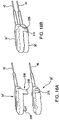
- FIGS. 16A-16B show the “snap-together hubs” alternative embodiment of the subject system with FIG. 16A depicting the inner and outer pusher hubs disengaged, and FIG. 16B depicting the inner and outer usher hubs engaged; and
- FIGS. 17A-17E illustrate schematically a sequence of steps during the cardiac intervention procedure using the subject guide catheter extension system.
- FIG. 1 depicts a subject guide catheter extension system 10 which is used in conjunction with a guide catheter 11 .
- the guide catheter 11 is advanced through a blood vessel 12 (such as the aorta) to a position adjacent to the ostium 14 of the coronary artery 16 .
- a guidewire 18 is used during the cardiac procedure to guide the guide extension system 10 within the artery 16 toward a target location 20 , as will be detailed in following paragraphs.
- a treatment system such as a balloon catheter or stent system, may be advanced through the guide extension system 10 into the coronary artery 16 to the target location 20 to perform an intended cardiac treatment.
- the subject guide extension system 10 In order to reliably reach the target location, and even pass beyond the target location 20 , the subject guide extension system 10 extends through the guide catheter 11 and beyond a distal end 24 of the guide catheter 11 deep into the coronary artery 16 .
- the subject guide extension system 10 by extending beyond the distal end 24 of the guide catheter 11 , provides an adequate reachability to the target location 20 , and, by extending beyond the ostium 14 of the coronary artery 16 , stabilizes the positioning of the guide catheter 11 and allows for an improved accessibility into the coronary artery 16 and to the target site 20 .
- the subject guide extension system 10 includes a proximal end 26 , a distal end 28 , and a middle junction portion 30 , interconnected between the proximal end 26 and the distal end 28 of the guide extension catheter system 10 .
- the subject wire extension catheter system 10 is shown being extended within a lumen (internal channel) 32 of the guide catheter 11 .
- the guide wire 18 is shown extending internally the guide extension system 10 along the longitudinal axis 168 thereof, and exits the system 10 beyond the outermost end 132 of the distal end 28 and between the proximal end 26 and the middle junction 30 in a manner detailed in further paragraphs.
- proximal end 26 of the subject guide extension system 10 is represented by a proximal handle 34 of an inner member 36 (to be detailed in further paragraphs) and a proximal handle 38 of an outer member 40 (to be detailed in following paragraphs).
- An inner member pusher 42 is connected, at the proximal end 44 thereof, to the proximal handle 34 of the inner member 36 .
- An outer member pusher 46 is connected, at the proximal end 48 thereof, to the proximal handle 38 of the outer member 40 .
- the proximal handle 34 of the inner member 36 and the proximal handle 38 of the outer member 40 are manipulated by a surgeon (operator) performing the coronary intervention procedure to position the guide extension catheter system 10 at the desired location 20 , as well as to advance or retract the inner member 36 and the outer member 40 relative to the guide catheter 10 as required by the coronary intervention procedure.
- both inner and outer pushers 42 and 46 are made as solid wire members.
- the subject guide extension catheter system 10 includes the inner member 36 which is built, at the middle junction 30 , with an interconnection unit 50 and a tubular part 52 connected, at the end 54 thereof, to a proximal end 56 of the interconnection unit 50 .
- the interconnection unit 50 represents a cylindrically-shaped unit having, as shown in FIGS. 4B-4C , a lumen 58 formed therein along its longitudinal axis (which coincides with the longitudinal axis 168 of the guide catheter extension system 10 ).
- the tubular part 52 is provided with a lumen 60 which is aligned, at the end 62 of the tubular part 52 , with the lumen 58 at the proximal end 56 of the interconnection unit 50 .
- the tubular part 52 has an RX notch (Rapid Exchange Notch) 64 configured to receive the end 66 of the inner member pusher 42 , as represented in FIG. 4A . Being received and extending through the lumen 60 of the tubular part 52 , the end 66 of the inner member pusher 42 reaches the proximal end 56 of the interconnection unit 50 and is coupled (glued, welded, or otherwise fixedly attached) to the interconnection unit 50 to ensure that by manipulating the inner member pusher 42 , a surgeon (operator) can control the positioning of the interconnection unit 50 (as well as the inner member 36 in its entirety).
- RX notch Rapid Exchange Notch
- the outer member 40 includes a “sheath” 70 made with a cylindrically shaped tubular body 72 extending substantially the entire length 138 of the subject system 10 and covering the middle junction 30 and the distal end 28 thereof.
- a surgeon actuates a required linear and/or rotational displacement of the inner member 36 with regard to the “sheath” 70 of the outer member 40 (as will be detailed in further paragraphs), to advance or retract, the interconnection unit 50 to or from the guide catheter 11 by displacing the inner member 36 relative to the outer member 40 , as required by the procedure performed.
- the guidewire 18 extends through the RX notch 54 of the tubular part 52 at the end 54 thereof and extends along the lumen 60 of the tubular part 52 in parallel with the inner member pusher 42 as shown in FIGS. 4 and 4A .
- the guidewire 18 also extends through the lumen 58 of the interconnection unit 50 (as depicted in FIGS. 4, and 4B-4C ), and through the lumen 130 in the distal end 28 of the subject guide extension catheter system 10 , as shown in FIG. 9 , to be further described.
- the outer member 40 is represented by the sheath 70 having the tubular body 72 , the inner surface 74 of which, at its proximal end 76 , interconnects with the outer surface 78 or the interconnection unit 50 .
- the subject guide catheter extension system 10 may operate in an inner/outer member engagement mode and in an inner/outer member disengagement mode.
- the interconnection unit 50 and the inner surface 74 of the sheath 70 are interconnected by a friction mechanism.
- the friction mechanism is used in the guide catheter extension system 10 to lock the inner member 36 and the outer member 40 together (when required by the cardiac procedure) to provide integral manipulation of the inner and outer members 36 , 40 , by actuating the inner and/or outer member pushers 42 , 46 , respectively, during the cardiac intervention procedure.
- a similar friction-based engagement/disengagement mechanism may be provided at other locations along the length 138 of the inner/outer members interface, for example, at the distal end 28 .
- the interconnecting mechanism may be controlled by a surgeon during the cardiac procedure to disengage the inner member 36 from the outer member 40 where a relative displacement of one with respect to another is required. Such disengagement of the inner and outer member is required during the cardiac procedure when the distal end 132 of the inner member 36 is to be advanced beyond the distal end 98 of the sheath 70 (as shown in FIGS. 6 and 17C ), or when the inner member 36 is to be retracted from the sheath 70 and removed from the guide catheter 11 (as shown in FIG. 17D ) prior to entering the balloon/stent catheter 230 to the lesion site 20 through the sheath 70 (as shown in FIG. 17E ).
- the inner member pusher 42 is somewhat tapered at its end 66 , as shown in FIGS. 4 and 4A .
- the guide wire 18 has a sufficient room within the lumen 60 in the tubular part 52 to extend therealong.
- the outer member pusher 46 is also tapered at its end 80 , and is welded (glued, adhered, or otherwise fixedly attached) to the proximal end 76 of the tubular body 72 of the sheath 70 .
- the tapered end 80 of the outer member pusher 46 may have a somewhat curved configuration in order to snugly cradle the portion of the outer surface 78 of the interconnection unit 50 in order to form a smooth surface at their interconnection, as well as to consume as little space within the sheath 70 as possible.
- the middle junction portion 30 of the subject guide extension catheter 10 may be manufactured with a braid reinforcement structure.
- the braid reinforcement member 84 includes a braid reinforced tube 86 that creates a somewhat flexible tubing connected to the interconnection unit 50 of the inner member 36 , and a plastic tubing 88 that is connected to the proximal end 90 of the braid reinforced tubing 86 and bonded to the inner member pusher 42 , as shown in FIG. 5 .
- the RX (rapid exchange) notch 92 for passing the guide wire 18 therethrough is formed through the wall 93 of the braid reinforced tubing 86 .
- the braid reinforcement mechanism 84 may be configured with metallic patterns or wires within the braid reinforced tubing 86 to prevent kinking and which would give the braid reinforced tubing 86 a longitudinal stiffness.
- the metal braid portion 94 is embedded in the braid reinforced tubing 86 to add an increased flexibility thereto simultaneously with the stiffness required for advancing and retracting the inner member 36 relative to the sheath 70 during the procedure.
- a flat wire helical coil (made, for example, from a shape memory alloy, such as Nitinol) with a wire thickness of approximately 1 mil to 3 mils may be embedded in the braid portion 94 . This coil may be formed with a very thin coating of plastic placed onto its inner and outer surfaces, which facilitates the reduction of the wall thickness of the tubing 86 to less than 7 mils and preferably to approximately 5 mils.
- the principles of reinforcing tubular members by a flat wire helical coil or forming the tubular member from the flat wire helical coil may be applied in the subject guide catheter system 10 to the sheath 70 , as well as to the micro-catheter 106 .
- such flat wire helical coil may be embedded in predetermined positions along the length of the walls thereof, for example, at the proximal and or distal ends.
- the entire length of the sheath 70 and/or micro-catheter 106 may be formed from the flat wire helical coil.
- the pitch between the coils may be changed to provide the flexibility gradient along the length of the tubular member (sheath 70 and or micro-catheter 106 ) increasing to the distal end thereof to facilitate atraumatic operation.
- the flat wire helical coil 135 is schematically depicted in FIGS. 6, 8, and 11 .
- the length of the micro-catheter may exceed 2 cm.
- the subject guide catheter extension system 10 may be configured with a differential in micro-catheter flexibility with greater flexibility in the distal portion, by either changing the durometer of the plastic components from the “sheath's” proximal portion to its distal portion (i.e., higher durometer in the proximal rather than the distal portion), and/or changing the winding frequency (pitch) of the helical coil of wire in the micro-catheter 106 in the direction from the proximal portion to distal portion, such that the distal portion of the micro-catheter 106 is more flexible and trackable than the proximal portion of the micro-catheter delivery device, and has a substantially lower profile and more flexible than even the distal portion of the guide extension catheter (“sheath”).
- the system 10 could also include wires that have radio-opacity such that the guide extension system (“sheath”) is easily visualized using fluoroscopy. It is also envisioned that both the tip 132 of the micro-catheter delivery portion 106 and the tip 98 of the sheath 70 will have one or more radio-opaque markers 99 , 133 (shown schematically in FIG.
- the sheath 70 extends between its proximal end 76 at the middle junction 30 and its distal end 98 at the distal end 28 of the subject system 10 along the entire length 138 of the subject guide catheter extension system 10 .
- the inner member 36 includes a distal tip 102 and a micro-catheter 106 (which may have a cylindrical configuration or a tapered cone-contoured configuration) formed integrally with the distal tip 102 .
- the sheath 70 is formed with an outer tip 100 which may have a tapered cone-contoured configuration which may be frictionally (or through an alternative engagement/disengagement mechanism) interconnected with the distal tip 102 of the inner member 36 .
- the distal tip 102 has a tapered configuration which changes gradually from the point of interconnection with the outer tip 100 of the sheath 70 to the distal end 104 of the distal tip 102 .
- the micro-catheter 106 extends from the distal end 104 of the distal tip 102 of the inner member 36 in integral connection therewith and terminates in the distal end 132 .
- the diameter of the micro-catheter 106 at the distal end 132 does not exceed 1 mm.
- the guide wire 18 extends from the proximal end 26 of the subject guide extension catheter system 10 through the internal lumen 108 in the inner member 36 within the sheath 70 and through the distal tip 102 of the inner member 36 , and exits at the distal end 132 of the micro-catheter 106 of the inner member 36 .
- the inner member 36 has an internal lumen 108 extending along the entire inner member 36 from its proximal end 56 of the interconnection unit 50 along the internal lumen 128 extending within the sheath 70 , through the length of the distal tip 102 and the length of the micro-catheter 106 .
- the outer tip 100 of the sheath 70 is a cone-shaped configuration made of a flexible material to facilitate a relative movement of the distal tip 102 (including the micro-catheter 106 ) of the inner member 36 when the inner member 36 is to be retracted into the outer sheath 70 through the outer tip 100 thereof, as required by the cardiac procedure.
- the distal tip 102 of the inner member 36 which interfaces with the outer tip 100 of the sheath 70 is provided with notches 110 formed along the distal tip 102 's surface so that the distal part of the outer tip 100 of the sheath 70 can be snugly received in the notches 110 of the distal tip 102 to provide a smooth transition between the outer surface of the sheath 70 and the outer surface of the distal tip 102 of the inner member 36 .
- the notches 110 may extend along the entire length of the inner member 36 , i.e., from the distal tip 102 to (and including) on the outer surface of the interconnection unit 50 , or a portion of the length of the inner member 36 .
- the flexible end 111 of the outer tip 100 stretches, and the distal tip 102 of the inner member 36 , along with the micro-catheter 106 can be retracted into the outer member 40 .
- the guidewire 18 extends at the proximal end 26 ′ of the system 10 ′ in parallel to the inner pusher 42 , as presented in FIGS. 7 and 8 .
- the proximal end 26 ′ of the subject system 10 ′ includes an inner pusher 120 formed as a tubular member having a hollow passage 121 formed therealong.
- the inner member proximal handle 122 is configured with a passage 124 cooperating with the hollow passage 121 within the inner member pusher 120 .
- the guidewire 18 enters the passage 124 in the inner member proximal handle 122 and extends through the hollow passage 121 of the inner member pusher 120 .
- the middle junction portion 30 ′ (shown in FIG. 8 ) of the subject guide extension catheter system 10 ′ is modified in comparison with the middle junction portion 30 of the system 10 shown in FIGS. 4 and 5 .
- a tubular member 126 receives the inner member pusher 120 in its internal channel for passage therealong, and leads the pusher 120 into the lumen 58 of the interconnection unit 50 .
- the guidewire 18 extends internally (along the hollow passage 121 ) in the pusher 120 , within the tubular member 126 , inside the interconnection member 50 , and further within the inner member 36 's length 138 inside the sheath 70 to the distal end 28 of the system 10 ′, and egresses the micro-catheter 106 at the distal tip 102 of the inner member 36 similar to the guide extension catheter system 10 , as shown in FIGS. 2, 6, and 9 .
- the distal tip 102 of the inner member 36 extends along the inner channel 128 of the tubular body 72 of the sheath 70 and beyond the distal end 98 of the sheath 70 .
- the distal tip 102 of the inner member 36 has a tapered conical configuration decreasing in diameter beginning from the distal end 98 of the sheath 70 to the distal end 104 of the distal tip 102 and is integral with the micro-catheter 106 extending beyond the distal end 104 of the distal tip 102 .
- the inner member 36 has an internal channel 108 which extends from the end 54 of the tubular part 52 through the length 138 of the inner member 36 , through the distal tip 102 of the inner member 336 , and along the micro-catheter 106 at the distal end 28 and ends at the distal end 132 .
- the internal channel 108 of the inner member 36 thus is formed by the lumen 60 of the tubular part 52 (shown in FIGS. 4 and 4A ), followed by the lumen 58 of the interconnection unit 50 (shown in FIGS.
- the guidewire 18 is received within the internal channel 108 of the inner member 36 and extends, as required by the procedure, from the proximal end 26 through the middle junction 30 and through the distal tip 102 of the inner member 36 and along the micro-catheter 106 , where it exits from the micro-catheter 106 at its distal end 132 .
- the distal end 98 as well as the outer tip 100 of the sheath 70 , are formed of a flexible material which permits easy extension and retraction of the distal tip 102 of the inner member 36 therethrough.
- the flat wire helical coil may be used for the distal end 98 and the outer tip 100 of the sheath 70 .
- the distal tip 102 of the inner member 36 at its wider diameter has the same dimension as the diameter of the outer tip 100 of the sheath 70 in order to form a substantially smooth outer surface at the distal end 28 of the system 10 .
- An important aspect of the subject system is that for a transition between the outer diameter of the outer tip 100 of the sheath 70 and the outer diameter of the distal tip 102 of the inner member 36 is equal to or less than 0.0006′′ to form substantially flush transition therebetween.
- the interface 111 between the outer tip 100 of the sheath 70 and the distal tip 102 of the inner member 36 is chamfered to facilitate displacement of the distal tip 102 of the inner member 36 relative to the outer tip 100 of the sheath 70 and basically to facilitate extension of the distal tip 102 beyond and removal from relative to the outer tip 100 of the sheath 70 , as required by the cardiac procedure.
- the interface 111 between the outer tip 100 of the sheath 70 and the distal tip 102 of the inner member 36 has an approximate 45° chamfer. Additionally, the interface 111 has an approximate 60° chamfer formed between the outer tip 100 of the sheath 70 and the distal tip 102 of the inner member 36 . The angled chamfer is for easing the displacement of the inner member 36 into the distal end 98 of the sheath 70 .
- the guide extension catheter system 10 includes interconnection unit 50 which is frictionally engaged with the inner surface 74 of the tubular body 72 of the sheath 70 at its proximal end 76 .
- a similar frictional engagement mechanism may be provided also between the outer tip 100 of the sheath 70 and the distal tip 102 of the inner member 36 at the distal end 28 of the guide extension catheter system 10 .
- This frictional interconnection between the inner member 36 and the outer member 40 permits the integral manipulation of both the inner member 36 and outer member 40 , as required by the cardiac procedure.
- an alternative embodiment of the middle junction portion 30 ′ of the subject system includes a “threaded” engagement between the interconnection unit 140 and the sheath 148 .
- the interconnection unit 140 (which replaces the interconnection unit 50 supporting the friction engagement mechanism) is configured with an engagement button 142 extending beyond the surface 144 of the interconnection unit 140 .
- the proximal end 149 of the sheath 148 is modified (as compared to the sheath 70 adapted for the frictional engagement) and is configured with a system of flexible ribs 150 separated by respective inter-rib spaces 152 which extend in a somewhat arcuated configuration reflecting the cylindrical configuration of the sheath 148 and are adapted to embrace the cylindrically shaped outer surface 144 of the unit 140 .
- One of the inter-rib spaces 152 specifically, the slot-like portion 154 is shaped with an exit channel 156 angularly cooperating at one of its ends 158 with the engagement slot 160 .
- a surgeon turns the inner member 36 in clockwise direction toward its end 164 (by manipulating the inner member pusher 42 ) to advance the engagement button 142 along the engagement slot 160 as shown in FIG. 12A for locking the inner member 36 with the outer member (i.e., the sheath 148 ).
- the engagement button 142 is placed at the end 164 of the engagement slot 160 , the inner and outer members, 36 and 40 , respectively, are placed in the locked position, as shown in FIG. 12A .
- the engagement button 142 is displaced (by a surgeon manipulating the inner member pusher 42 ) from the end 164 along the engagement slot 160 towards the end 158 of the exit channel 156 (by a surgeon manipulating the pusher 42 to make a counter-clockwise rotation of the inner member 36 relative to the outer member 40 ).
- the inner member 36 is pulled from the sheath 148 (by pulling the inner member pusher 42 ) with the engagement button 142 moving along the exit channel 156 from the end 158 thereof in the direction shown by the arrow 166 .
- the engagement button 142 is removed from the exit channel 156 , the inner member 36 is disengaged (or unlocked) from the sheath 148 , as depicted in FIG. 12B .
- a surgeon uses the inner member pusher 42 which is either molded (glued, welded, or otherwise fixedly attached to the interconnection unit 50 or 140 , as presented in the embodiments of FIGS. 4-4C, 5 , and 10 ), or which is attached to the internal lumen of the interconnection unit 140 , similar to the embodiment shown in FIG. 8 .
- FIG. 13 shows a further alternative embodiment of the proximal end 149 ′ of the sheath 148 which is shown slightly modified in comparison with FIGS. 11 and 12A-12B .
- the exit channel/engagement slot 160 shown in FIGS. 12A and 12B is replaced with an engagement channel 170 where the substantially perpendicular relationship between the exit channel 156 and the engagement slot 160 is replaced with a somewhat 45° angled configuration where the exit channel 172 and the ending engagement slot 174 are connected by a substantially flat interconnection channel 176 .
- the interconnection channel 176 is similarly angled about 45° with relation to the exit channel 172 and the ending engagement slot 174 .
- This arrangement provides a mechanical advantage for engaging the engagement button 142 in the engagement channel 170 , and prevents accidental disengagement of the engagement button 142 from the engagement channel 170 .
- the inner member pusher 42 and the outer member pusher 46 are positioned in a single peel away sheath 180 having a channel 182 where both inner and outer pushers extend in connection one with another.
- the peel away sheath 180 is connected to the peel away handle 184 by a cord 183 .
- the sheath 180 (as shown in FIG. 15 ) is pre-cut at its sides 188 , and the sides are held together, to form the channel 182 , by a wire/suture 200 embedded therein.
- the wire/suture 200 is operatively connected to the handle 184 by a cord 183 .
- a surgeon manipulates a peel away handle 184 to pull the cord 183 . Having been pulled, the cord 183 applies the force to a wire/suture 200 embedded in the side(s) 186 , 188 of the sheath 180 . As a result, the wire/suture 200 breaks, and the sheath 180 “opens” at the side(s) 186 , 188 .
- the peel away sheath 180 is divided into two halves when the side 186 is separated from the side 188 , and the inner and outer member pushers 42 , 46 are “freed” from the sheath 180 , and can be manipulated independently of each other.
- the inner member 36 is disengaged from the outer member 40 (i.e., the sheath 70 ) for a controlled displacement relative thereto.
- the peel away sheath 180 may also have several serrations 202 along its surface 204 for facilitating an easy splitting of the sides 186 , 188 (or at other locations along the surface 204 ) of the peel away sheath 180 .
- an additional embodiment of the engagement/disengagement mechanism includes the handles 34 ′ and 38 ′ of the inner and outer member pushers 42 , 46 , respectively, which may be attached, as shown in FIG. 16B to provide an integral motion together as a single unit during the procedure.
- the handles 34 ′, 38 ′ are disengaged to provide a relative displacement of the inner and outer members 36 , 40 , respectively, as required during the cardiac procedure.
- the handles are provided with a snap mechanism 206 .
- the snap mechanism 206 may include two tabs 208 formed on the sides of the handle 34 ′ for the inner member 36 to be engageable with the notches 210 formed on the companion handle 38 ′ for the outer member 40 .
- the handles' snap mechanism 206 is just one exemplary mechanism of many envisioned for engagement/disengagement between the inner and outer members in the subject system.
- a proximal end of the coronary guidewire 18 is extended through the inner channel 108 of the inner member of the subject system 10 .
- the guide catheter 11 along with a guidewire 18 therewithin, is inserted and advanced into the blood vessel 16 of interest.
- the distal end 24 of the guide catheter is not placed at the lesion location 20 .
- the sheath 70 locked with the inner member 36 therewithin, is advanced within the guide catheter 11 towards the treatment site 20 and reaches the distal end 24 of the guide catheter 11 .
- the guidewire 18 which extends beyond the distal end 24 of the guide catheter 11 , serves as a guide along which the micro-catheter 106 slides towards the treatment site 20 .
- the sheath 70 is disengaged from the inner member 36 by any mechanism described in previous paragraphs.
- the distal tip 102 (particularly, the micro-catheter 106 ) of the inner member 36 is advanced beyond the distal end of the sheath 70 , along the blood vessel 16 towards (or beyond) the lesion 20 to be treated, as shown in FIG. 17C .
- the sheath 70 is pushed by the surgeon to slide inside the guide catheter 11 along the micro-catheter 106 towards or beyond the lesion 20 .
- the inner member 36 is removed from the sheath 70 .
- the distal end 98 of the sheath 70 (within the guide catheter 11 ) is positioned in alignment or beyond the lesion 20 and remains within the guide catheter 11 .
- a stent delivery system or a balloon catheter 230 can be delivered to the lesion 20 for a subsequent treatment.
- Another embodiment of this same invention describes the use of a similar micro-catheter delivery system that is placed inside a balloon expandable guide extension tube to allow one to deliver the micro-catheter tip and a low profile guide extension catheter to an area beyond a lesion of interest and then to use a balloon contained on the outer aspect of the micro-catheter to mechanically expand a metal reinforced but balloon expandable guide extension tube after it has been already delivered at a lower profile diameter to the area at or distal to a lesion to be treated.
Landscapes
- Health & Medical Sciences (AREA)
- Life Sciences & Earth Sciences (AREA)
- Heart & Thoracic Surgery (AREA)
- Hematology (AREA)
- Engineering & Computer Science (AREA)
- Anesthesiology (AREA)
- Biomedical Technology (AREA)
- Pulmonology (AREA)
- Biophysics (AREA)
- Animal Behavior & Ethology (AREA)
- General Health & Medical Sciences (AREA)
- Public Health (AREA)
- Veterinary Medicine (AREA)
- Vascular Medicine (AREA)
- Child & Adolescent Psychology (AREA)
- Media Introduction/Drainage Providing Device (AREA)
Abstract
Description
-
- an outer member formed by a flexible substantially cylindrically contoured elongated sheath defining a sheath lumen having a proximal end and a distal end,
- an inner member having an elongated body defining an internal channel extending along its longitudinal axis. The inner member has a distal end configured with a tapered delivery micro-catheter having an elongated body of a predetermined length (preferably, longer than 2-3 cm). The inner member is extended in the sheath lumen in a controllably displaceable relationship with the sheath, and
- an interconnection mechanism disposed in an operative coupling with the inner and outer members of the guide catheter extension system and controllably actuated (by a surgeon) to operate the guide catheter extension system in an engaged or disengaged modes of operation.
-
- (b) upon assembling the guide catheter extension system, extending a guide wire along the internal channel of the inner member with a proximal end of the guide wire extending beyond a proximal end of the internal body, and a distal end of the guide wire extending beyond a distal end of the delivery micro-catheter;
- (c) advancing the distal end of the guide wire into a blood vessel of interest towards a treatment site;
- (d) controlling the interconnection mechanism to establish the engaged mode of operation;
- (e) advancing the guide catheter extension system, in the engaged operational mode, within the guide catheter and along the blood vessel of interest with the micro-catheter sliding along the guide wire towards the treatment site until the micro-catheter is brought at least in alignment with or beyond the treatment site.
-
- (f) controlling the interconnection mechanism to switch to the disengaged mode of operation to disengage the inner and outer members one from another; and
- (g) subsequently thereto, advancing the sheath (remaining within the guide catheter) along the micro-catheter until the distal end of the sheath is brought in substantial alignment with the distal end of the micro-catheter and is brought in at least alignment or beyond the treatment site.
-
- (h) removing the inner member from the sheath, yet leaving the sheath inside the blood vessel (within the guide catheter) with the distal end of the sheath in alignment with or beyond the treatment site; and
- (i) advancing a treatment system (such as, for example, a balloon delivery system or a stent catheter) to or beyond the treatment site inside the sheath lumen for a required treatment of the blood vessel.
Claims (34)
Priority Applications (9)
| Application Number | Priority Date | Filing Date | Title |
|---|---|---|---|
| US15/899,603 US11491313B2 (en) | 2018-02-20 | 2018-02-20 | Guide catheter extension system with a delivery micro-catheter configured to facilitate percutaneous coronary intervention |
| US16/132,878 US20190255299A1 (en) | 2018-02-20 | 2018-09-17 | Intravascular delivery system and method for percutaneous coronary intervention |
| PCT/US2019/012678 WO2019164592A1 (en) | 2018-02-20 | 2019-01-08 | Intravascular delivery system and method for percutaneous coronary intervention |
| US16/793,120 US11642500B2 (en) | 2018-02-20 | 2020-02-18 | Intravascular delivery system and method for percutaneous coronary intervention |
| US17/938,811 US12194258B2 (en) | 2018-02-20 | 2022-10-07 | Guide catheter extension system with a delivery micro-catheter configured to facilitate percutaneous coronary intervention |
| US18/051,221 US20230088977A1 (en) | 2018-02-20 | 2022-10-31 | Guide catheter extension system for reverse controlled antegrade/retrograde tracking & thrombus removal procedures |
| US18/191,400 US12186509B2 (en) | 2018-02-20 | 2023-03-28 | Intravascular delivery system and method for percutaneous coronary intervention |
| US18/953,702 US20250135167A1 (en) | 2018-02-20 | 2024-11-20 | Intravascular delivery system and method for percutaneous coronary intervention |
| US18/969,793 US20250135163A1 (en) | 2018-02-20 | 2024-12-05 | Guide catheter extension system with a delivery micro-catheter configured to facilitate percutaneous coronary intervention |
Applications Claiming Priority (1)
| Application Number | Priority Date | Filing Date | Title |
|---|---|---|---|
| US15/899,603 US11491313B2 (en) | 2018-02-20 | 2018-02-20 | Guide catheter extension system with a delivery micro-catheter configured to facilitate percutaneous coronary intervention |
Related Child Applications (2)
| Application Number | Title | Priority Date | Filing Date |
|---|---|---|---|
| US16/132,878 Continuation-In-Part US20190255299A1 (en) | 2018-02-20 | 2018-09-17 | Intravascular delivery system and method for percutaneous coronary intervention |
| US17/938,811 Continuation US12194258B2 (en) | 2018-02-20 | 2022-10-07 | Guide catheter extension system with a delivery micro-catheter configured to facilitate percutaneous coronary intervention |
Publications (2)
| Publication Number | Publication Date |
|---|---|
| US20190255297A1 US20190255297A1 (en) | 2019-08-22 |
| US11491313B2 true US11491313B2 (en) | 2022-11-08 |
Family
ID=67616353
Family Applications (3)
| Application Number | Title | Priority Date | Filing Date |
|---|---|---|---|
| US15/899,603 Active US11491313B2 (en) | 2018-02-20 | 2018-02-20 | Guide catheter extension system with a delivery micro-catheter configured to facilitate percutaneous coronary intervention |
| US17/938,811 Active 2038-02-20 US12194258B2 (en) | 2018-02-20 | 2022-10-07 | Guide catheter extension system with a delivery micro-catheter configured to facilitate percutaneous coronary intervention |
| US18/969,793 Pending US20250135163A1 (en) | 2018-02-20 | 2024-12-05 | Guide catheter extension system with a delivery micro-catheter configured to facilitate percutaneous coronary intervention |
Family Applications After (2)
| Application Number | Title | Priority Date | Filing Date |
|---|---|---|---|
| US17/938,811 Active 2038-02-20 US12194258B2 (en) | 2018-02-20 | 2022-10-07 | Guide catheter extension system with a delivery micro-catheter configured to facilitate percutaneous coronary intervention |
| US18/969,793 Pending US20250135163A1 (en) | 2018-02-20 | 2024-12-05 | Guide catheter extension system with a delivery micro-catheter configured to facilitate percutaneous coronary intervention |
Country Status (1)
| Country | Link |
|---|---|
| US (3) | US11491313B2 (en) |
Cited By (9)
| Publication number | Priority date | Publication date | Assignee | Title |
|---|---|---|---|---|
| US11642500B2 (en) | 2018-02-20 | 2023-05-09 | Crossliner, Inc. | Intravascular delivery system and method for percutaneous coronary intervention |
| US11712266B2 (en) | 2021-06-25 | 2023-08-01 | Vantis Vascular, Inc. | Enhanced guide extension system for the efficient delivery of leads |
| US11759315B1 (en) | 2022-10-07 | 2023-09-19 | Vantis Vascular, Inc. | Method and apparatus for antegrade transcatheter valve repair or implantation |
| US11766328B1 (en) | 2022-10-07 | 2023-09-26 | Vantis Vascular, Inc. | Method and apparatus for antegrade transcatheter valve repair or implantation |
| US11964091B1 (en) | 2023-10-10 | 2024-04-23 | Vantis Vascular, Inc. | Method and apparatus for catheter-based extracorporeal membrane oxygenation (ECMO) |
| US12194258B2 (en) | 2018-02-20 | 2025-01-14 | Vantis Vascular, Inc. | Guide catheter extension system with a delivery micro-catheter configured to facilitate percutaneous coronary intervention |
| US12226564B1 (en) | 2023-10-10 | 2025-02-18 | Vantis Vascular, Inc. | Method and apparatus for catheter-based extracorporeal membrane oxygenation (ECMO) |
| USD1071209S1 (en) | 2022-06-29 | 2025-04-15 | Cardiovascular Systems, Inc. | Partial flared guide extension catheter |
| USD1071208S1 (en) | 2022-06-29 | 2025-04-15 | Cardiovascular Systems, Inc. | Guide extension catheter |
Families Citing this family (29)
| Publication number | Priority date | Publication date | Assignee | Title |
|---|---|---|---|---|
| US11660420B2 (en) | 2018-09-17 | 2023-05-30 | Seigla Medical, Inc. | Catheters and related devices and methods of manufacture |
| US11433216B2 (en) | 2018-09-17 | 2022-09-06 | Seigla Medical, Inc. | Methods for fabricating medical devices and portions of medical devices |
| US11547835B2 (en) | 2018-09-17 | 2023-01-10 | Seigla Medical, Inc. | Systems, methods and apparatus for guiding and supporting catheters and methods of manufacture |
| EP3840815B1 (en) * | 2018-08-21 | 2024-11-06 | Medtronic Vascular, Inc. | Guide extension catheter assemblies and systems |
| US12539389B2 (en) | 2018-09-17 | 2026-02-03 | Seigla Medical, Inc. | Catheters and related devices and methods of manufacture |
| US10828470B1 (en) | 2019-08-14 | 2020-11-10 | Vasoinnovations Inc. | Apparatus and method for advancing catheters or other medical devices through a lumen |
| US10773059B1 (en) | 2019-08-14 | 2020-09-15 | Vasoinnovations, Inc. | Apparatus and method for advancing catheters or other medical devices through a lumen |
| US12048820B2 (en) | 2019-08-14 | 2024-07-30 | Vasoinnovations Inc. | Apparatus and method for advancing catheters or other medical devices through a lumen |
| US10792469B1 (en) | 2019-08-14 | 2020-10-06 | Vasoinnovations Inc. | Devices, systems, and methods for delivering catheters or other medical devices to locations within a patients body |
| US10821267B1 (en) | 2019-08-14 | 2020-11-03 | Vasoinnovations Inc. | Apparatus and method for advancing catheters or other medical devices through a lumen |
| GB201917184D0 (en) * | 2019-11-26 | 2020-01-08 | Univ Sheffield | Guiding device for a vascular catheter |
| AU2020429461A1 (en) * | 2020-02-18 | 2022-09-22 | Vantis Vascular, Inc. | Intravascular delivery system and method for percutaneous coronary intervention |
| US20210275778A1 (en) * | 2020-03-03 | 2021-09-09 | Intuitive Surgical Operations, Inc. | Elongate instrument and elongate instrument guard member compatibility |
| US20230001143A1 (en) * | 2021-07-02 | 2023-01-05 | Becton, Dickinson And Company | Vascular Access System Having a Dynamically Expandable Probe |
| US12446979B2 (en) | 2022-08-01 | 2025-10-21 | Imperative Care, Inc. | Method of performing a multi catheter robotic neurovascular procedure |
| US12440289B2 (en) | 2022-08-01 | 2025-10-14 | Imperative Care, Inc. | Method of priming an interventional device assembly |
| US20230052862A1 (en) | 2021-08-12 | 2023-02-16 | Imperative Care, Inc. | Sterile packaging assembly for robotic interventional device |
| US12447317B2 (en) | 2022-08-01 | 2025-10-21 | Imperative Care, Inc. | Method of priming concentrically stacked interventional devices |
| US12419703B2 (en) | 2022-08-01 | 2025-09-23 | Imperative Care, Inc. | Robotic drive system for achieving supra-aortic access |
| US20240041480A1 (en) | 2022-08-02 | 2024-02-08 | Imperative Care, Inc. | Multi catheter system with integrated fluidics management |
| US20240108855A1 (en) * | 2022-10-03 | 2024-04-04 | German Antonio ROSERO | Devices, systems, and methods for percutaneous- mediated fluid removal |
| EP4626353A1 (en) * | 2022-12-01 | 2025-10-08 | Imperative Care, Inc. | Controller for robotic catheter drive system |
| US12433702B2 (en) | 2022-12-01 | 2025-10-07 | Imperative Care, Inc. | Telescoping drive table |
| CN219167463U (en) * | 2022-12-29 | 2023-06-13 | 广东博迈医疗科技股份有限公司 | Extension Catheters and Medical Devices |
| US12377206B2 (en) | 2023-05-17 | 2025-08-05 | Imperative Care, Inc. | Fluidics control system for multi catheter stack |
| US12508093B2 (en) | 2023-05-31 | 2025-12-30 | Imperative Care, Inc. | Magnetic coupling through a sterile field barrier |
| USD1102447S1 (en) | 2023-11-30 | 2025-11-18 | Imperative Care, Inc. | Display screen or portion thereof with graphical user interface |
| WO2025166310A1 (en) * | 2024-02-01 | 2025-08-07 | Boston Scientific Scimed, Inc. | Access system including guide extension catheter and dilator adapted to remain aligned with the guide extension catheter |
| WO2025264786A1 (en) * | 2024-06-18 | 2025-12-26 | Promedica Health System, Inc. | Catheter device for post-transcatheter aortic valve replacement coronary access procedure |
Citations (56)
| Publication number | Priority date | Publication date | Assignee | Title |
|---|---|---|---|---|
| US3388703A (en) * | 1966-03-22 | 1968-06-18 | Johnson & Johnson | Intravenous cannula assembly unit |
| US5102390A (en) | 1985-05-02 | 1992-04-07 | C. R. Bard, Inc. | Microdilatation probe and system for performing angioplasty in highly stenosed blood vessels |
| US5234416A (en) | 1991-06-06 | 1993-08-10 | Advanced Cardiovascular Systems, Inc. | Intravascular catheter with a nontraumatic distal tip |
| US5704926A (en) | 1994-11-23 | 1998-01-06 | Navarre Biomedical, Ltd. | Flexible catheter |
| US5813405A (en) | 1990-04-18 | 1998-09-29 | Cordis Corporation | Snap-in connection assembly for extension guidewire system |
| US5947925A (en) | 1996-03-18 | 1999-09-07 | Hiroaki Ashiya | Catheter assembly |
| US6120480A (en) * | 1997-10-28 | 2000-09-19 | Medtronic Ave, Inc. | Catheter introducer |
| US20020087076A1 (en) * | 2000-11-14 | 2002-07-04 | C-I-Medic Co., Ltd. | Catheter assemble |
| US20030105451A1 (en) * | 2001-12-04 | 2003-06-05 | Cardiac Pacemakers, Inc. | Adjustable length catheter assembly |
| US6648854B1 (en) | 1999-05-14 | 2003-11-18 | Scimed Life Systems, Inc. | Single lumen balloon-tipped micro catheter with reinforced shaft |
| US20050273074A1 (en) | 2004-06-03 | 2005-12-08 | Lewis Joseph G | Intravascular catheter delivery system |
| US20080183128A1 (en) * | 2007-01-24 | 2008-07-31 | John Morriss | Methods, devices and systems for treatment and/or diagnosis of disorders of the ear, nose and throat |
| US20080281228A1 (en) * | 2007-04-23 | 2008-11-13 | Juan Carlos Parodi | Guidewire with adjustable stiffness |
| US20090018525A1 (en) | 2007-07-13 | 2009-01-15 | Cook Incorporated | Tapered catheter devices |
| US20090082800A1 (en) | 2007-09-21 | 2009-03-26 | Insera Therapeutics Llc | Distal Embolic Protection Devices With A Variable Thickness Microguidewire And Methods For Their Use |
| US20090156953A1 (en) | 2007-05-18 | 2009-06-18 | Breathe Technologies, Inc. | Methods and devices for sensing respiration and providing ventilation therapy |
| US20100305475A1 (en) | 2007-04-23 | 2010-12-02 | Hinchliffe Peter W J | Guidewire with adjustable stiffness |
| US20110054503A1 (en) | 2009-09-02 | 2011-03-03 | Isa Rizk | Systems, methods and devices for ablation, crossing, and cutting of occlusions |
| US20110112567A1 (en) | 2009-09-11 | 2011-05-12 | Onset Medical Corporation | Expandable cerebrovascular sheath and method of use |
| US7993351B2 (en) | 2002-07-24 | 2011-08-09 | Pressure Products Medical Supplies, Inc. | Telescopic introducer with a compound curvature for inducing alignment and method of using the same |
| US8048032B2 (en) | 2006-05-03 | 2011-11-01 | Vascular Solutions, Inc. | Coaxial guide catheter for interventional cardiology procedures |
| US20110301502A1 (en) | 2010-02-12 | 2011-12-08 | Sukhjit Gill | In-vessel positioning device |
| US8361057B2 (en) | 2004-10-25 | 2013-01-29 | Coloplast A/S | Male telescope catheter |
| US8365087B2 (en) | 2008-04-08 | 2013-01-29 | Siemens Aktiengesellschaft | Method and user interface for the graphical presentation of medical data |
| US20130116701A1 (en) | 2011-11-09 | 2013-05-09 | Boston Scientific Scimed, Inc. | Guide extension catheter |
| US20130237962A1 (en) * | 2010-01-14 | 2013-09-12 | Goodman Co., Ltd. | Catheter assembly |
| US20140012281A1 (en) * | 2012-07-09 | 2014-01-09 | Boston Scientific Scimed, Inc. | Expandable guide extension catheter |
| US20140018773A1 (en) | 2012-07-13 | 2014-01-16 | Boston Scientific Scimed, Inc. | Guide extension catheter |
| US8652193B2 (en) | 2005-05-09 | 2014-02-18 | Angiomed Gmbh & Co. Medizintechnik Kg | Implant delivery device |
| US20140058251A1 (en) * | 2012-08-23 | 2014-02-27 | Volcano Corporation | Device, System, and Method for Anatomical Lesion Length Estimation |
| US8747428B2 (en) | 2012-01-12 | 2014-06-10 | Fischell Innovations, Llc | Carotid sheath with entry and tracking rapid exchange dilators and method of use |
| US20140194918A1 (en) | 2013-01-04 | 2014-07-10 | St. Jude Medical Puerto Rico Llc | Rapid exchange temporary blood flow cessation device for large bore closure |
| US20140236088A1 (en) | 2013-02-15 | 2014-08-21 | Ibrahim Rashid Al-Rashdan | Expandable sheath and system for intravascular insertion of a medical implement using the same |
| US8821485B2 (en) | 2009-01-29 | 2014-09-02 | Boston Scientific Scimed, Inc. | Employing a secondary sheath with an ablation catheter |
| US20140276618A1 (en) * | 2013-03-15 | 2014-09-18 | Qxmedical, Llc | Boosting Catheter and Related Systems and Methods |
| US20150005801A1 (en) * | 2013-06-27 | 2015-01-01 | Covidien Lp | Microcatheter system |
| US8996095B2 (en) | 2012-01-31 | 2015-03-31 | Boston Scientific Scimed, Inc. | Guide extension catheter |
| US8996096B2 (en) | 2011-07-19 | 2015-03-31 | Welch Allyn, Inc. | Systems and methods for determining patient temperature |
| US20150151090A1 (en) | 2012-06-08 | 2015-06-04 | GMedix, Inc | Coaxial guide coil for interventional cardiology procedures |
| US20150173782A1 (en) | 2013-12-23 | 2015-06-25 | Silk Road Medical, Inc. | Methods and Systems for Treatment of Acute Ischemic Stroke |
| US20150265806A1 (en) * | 2012-11-30 | 2015-09-24 | Terumo Kabushiki Kaisha | Catheter |
| US20160121080A1 (en) | 2014-11-04 | 2016-05-05 | Orbusneich Medical, Inc. | Progressive Flexibility Catheter Support Frame |
| US20160144155A1 (en) | 2013-07-01 | 2016-05-26 | Avinger, Inc. | Occlusion sheath for imaging catheter |
| US20160249942A1 (en) * | 2015-02-26 | 2016-09-01 | Surmodics, Inc. | Insertable medical device system with plaque treatment portion and methods of using |
| US20160346506A1 (en) * | 2015-05-29 | 2016-12-01 | Covidien Lp | Catheter with tapering outer diameter |
| US20170028170A1 (en) | 2015-07-28 | 2017-02-02 | Andrew Ho, M.D., Inc. | Guide catheter extension device and methods of use for cardiology procedures |
| US9681882B2 (en) * | 2014-03-21 | 2017-06-20 | Route 92 Medical, Inc. | Rapid aspiration thrombectomy system and method |
| US9687634B2 (en) | 2009-02-20 | 2017-06-27 | Boston Scientific Scimed, Inc. | Catheter with skived tubular member |
| US20180008801A1 (en) | 2011-04-05 | 2018-01-11 | Thermopeutix, Inc. | Microcatheter with distal tip portion and proximal solution lumen |
| US20180126121A1 (en) * | 2016-11-09 | 2018-05-10 | Medtronic Vascular, Inc. | Telescoping catheter |
| US20180193042A1 (en) * | 2017-01-10 | 2018-07-12 | Route 92 Medical, Inc. | Aspiration catheter systems and methods of use |
| US20190255299A1 (en) | 2018-02-20 | 2019-08-22 | Crossliner, Llc | Intravascular delivery system and method for percutaneous coronary intervention |
| US10449339B2 (en) | 2011-05-26 | 2019-10-22 | Abbott Cardiovascular Systems Inc. | Catheter with stepped skived hypotube |
| US20200179661A1 (en) | 2018-02-20 | 2020-06-11 | Crossliner, Llc | Intravascular delivery system and method for percutaneous coronary intervention |
| US10786655B2 (en) * | 2016-03-14 | 2020-09-29 | Indian Wells Medical, Inc. | Steerable guidewire and method of use |
| WO2021167653A1 (en) | 2020-02-18 | 2021-08-26 | Crossliner, Llc | Intravascular delivery system and method for percutaneous coronary intervention |
Family Cites Families (21)
| Publication number | Priority date | Publication date | Assignee | Title |
|---|---|---|---|---|
| US3633579A (en) | 1967-05-24 | 1972-01-11 | Sherwood Medical Ind Inc | Catheter placement device and method |
| US5425723A (en) | 1993-12-30 | 1995-06-20 | Boston Scientific Corporation | Infusion catheter with uniform distribution of fluids |
| US5769819A (en) | 1997-04-24 | 1998-06-23 | Medtronic, Inc. | Catheter distal tip component |
| US6179813B1 (en) | 1998-04-24 | 2001-01-30 | Scimed Life Systems, Inc. | Vascular infusion device |
| JPH11347131A (en) | 1998-06-11 | 1999-12-21 | Medikit Kk | Catheter introducer |
| US7758624B2 (en) | 2000-11-13 | 2010-07-20 | C. R. Bard, Inc. | Implant delivery device |
| US6585747B1 (en) | 2000-04-14 | 2003-07-01 | Advanced Cardiovascular Systems, Inc. | Interdigitating polymeric endcap for enhanced stent retention |
| US6749619B2 (en) | 2001-11-20 | 2004-06-15 | The Cleveland Clinic Foundation | Apparatus and method for eliminating dislodged thrombus |
| DE10158289A1 (en) | 2001-11-20 | 2003-05-28 | Biotronik Mess & Therapieg | Device for implanting catheters |
| WO2004019760A2 (en) | 2002-08-29 | 2004-03-11 | Medical Components, Inc. | Releasably locking dilator and sheath assembly |
| US20050182387A1 (en) | 2004-02-13 | 2005-08-18 | Cardiac Pacemakers, Inc. | Peel-away catheter shaft |
| DE202004012714U1 (en) | 2004-08-12 | 2004-11-04 | Smiths Medical Deutschland Gmbh | Luer lock connector for medical devices |
| US9101382B2 (en) | 2009-02-18 | 2015-08-11 | Hotspur Technologies, Inc. | Apparatus and methods for treating obstructions within body lumens |
| US20100082000A1 (en) | 2008-09-30 | 2010-04-01 | Medtronic, Inc. | Catheter system with reinforced member |
| AU2010249050A1 (en) | 2009-05-12 | 2011-12-15 | Access Scientific, Inc. | Access device with valve |
| US10751206B2 (en) | 2010-06-26 | 2020-08-25 | Scott M. Epstein | Catheter or stent delivery system |
| US8702678B2 (en) | 2011-08-03 | 2014-04-22 | Venous Therapy, Inc. | Assemblies, systems, and methods for infusing therapeutic agents into the body |
| US11065019B1 (en) | 2015-02-04 | 2021-07-20 | Route 92 Medical, Inc. | Aspiration catheter systems and methods of use |
| US11491313B2 (en) | 2018-02-20 | 2022-11-08 | Crossliner, Inc. | Guide catheter extension system with a delivery micro-catheter configured to facilitate percutaneous coronary intervention |
| US11712266B2 (en) | 2021-06-25 | 2023-08-01 | Vantis Vascular, Inc. | Enhanced guide extension system for the efficient delivery of leads |
| US20240123187A1 (en) | 2022-10-14 | 2024-04-18 | Vantis Vascular, Inc. | Intravascular delivery system and method for percutaneous coronary intervention including perfusion |
-
2018
- 2018-02-20 US US15/899,603 patent/US11491313B2/en active Active
-
2022
- 2022-10-07 US US17/938,811 patent/US12194258B2/en active Active
-
2024
- 2024-12-05 US US18/969,793 patent/US20250135163A1/en active Pending
Patent Citations (66)
| Publication number | Priority date | Publication date | Assignee | Title |
|---|---|---|---|---|
| US3388703A (en) * | 1966-03-22 | 1968-06-18 | Johnson & Johnson | Intravenous cannula assembly unit |
| US5102390A (en) | 1985-05-02 | 1992-04-07 | C. R. Bard, Inc. | Microdilatation probe and system for performing angioplasty in highly stenosed blood vessels |
| US5813405A (en) | 1990-04-18 | 1998-09-29 | Cordis Corporation | Snap-in connection assembly for extension guidewire system |
| US5234416A (en) | 1991-06-06 | 1993-08-10 | Advanced Cardiovascular Systems, Inc. | Intravascular catheter with a nontraumatic distal tip |
| US5704926A (en) | 1994-11-23 | 1998-01-06 | Navarre Biomedical, Ltd. | Flexible catheter |
| US5947925A (en) | 1996-03-18 | 1999-09-07 | Hiroaki Ashiya | Catheter assembly |
| US6120480A (en) * | 1997-10-28 | 2000-09-19 | Medtronic Ave, Inc. | Catheter introducer |
| US6648854B1 (en) | 1999-05-14 | 2003-11-18 | Scimed Life Systems, Inc. | Single lumen balloon-tipped micro catheter with reinforced shaft |
| US20020087076A1 (en) * | 2000-11-14 | 2002-07-04 | C-I-Medic Co., Ltd. | Catheter assemble |
| US20030105451A1 (en) * | 2001-12-04 | 2003-06-05 | Cardiac Pacemakers, Inc. | Adjustable length catheter assembly |
| US7993351B2 (en) | 2002-07-24 | 2011-08-09 | Pressure Products Medical Supplies, Inc. | Telescopic introducer with a compound curvature for inducing alignment and method of using the same |
| US20050273074A1 (en) | 2004-06-03 | 2005-12-08 | Lewis Joseph G | Intravascular catheter delivery system |
| US8361057B2 (en) | 2004-10-25 | 2013-01-29 | Coloplast A/S | Male telescope catheter |
| US8652193B2 (en) | 2005-05-09 | 2014-02-18 | Angiomed Gmbh & Co. Medizintechnik Kg | Implant delivery device |
| USRE45760E1 (en) | 2006-05-03 | 2015-10-20 | Vascular Solutions, Inc. | Coaxial guide catheter for interventional cardiology procedures |
| USRE46116E1 (en) | 2006-05-03 | 2016-08-23 | Vascular Solutions, Inc. | Coaxial guide catheter for interventional cardiology procedures |
| USRE45380E1 (en) | 2006-05-03 | 2015-02-17 | Vascular Solutions, Inc. | Coaxial guide catheter for interventional cardiology procedures |
| USRE47379E1 (en) | 2006-05-03 | 2019-05-07 | Teleflex Innovations S.A.R.L. | Coaxial guide catheter for interventional cardiology procedures |
| USRE45776E1 (en) | 2006-05-03 | 2015-10-27 | Vascular Solutions, Inc. | Coaxial guide catheter for interventional cardiology procedures |
| US8142413B2 (en) | 2006-05-03 | 2012-03-27 | Vascular Solutions, Inc. | Coaxial guide catheter for interventional cardiology procedures |
| US8048032B2 (en) | 2006-05-03 | 2011-11-01 | Vascular Solutions, Inc. | Coaxial guide catheter for interventional cardiology procedures |
| US8292850B2 (en) | 2006-05-03 | 2012-10-23 | Vascular Solutions, Inc. | Coaxial guide catheter for interventional cardiology procedures |
| US20080183128A1 (en) * | 2007-01-24 | 2008-07-31 | John Morriss | Methods, devices and systems for treatment and/or diagnosis of disorders of the ear, nose and throat |
| US20100305475A1 (en) | 2007-04-23 | 2010-12-02 | Hinchliffe Peter W J | Guidewire with adjustable stiffness |
| US20080281228A1 (en) * | 2007-04-23 | 2008-11-13 | Juan Carlos Parodi | Guidewire with adjustable stiffness |
| US20090156953A1 (en) | 2007-05-18 | 2009-06-18 | Breathe Technologies, Inc. | Methods and devices for sensing respiration and providing ventilation therapy |
| US20090018525A1 (en) | 2007-07-13 | 2009-01-15 | Cook Incorporated | Tapered catheter devices |
| US20090082800A1 (en) | 2007-09-21 | 2009-03-26 | Insera Therapeutics Llc | Distal Embolic Protection Devices With A Variable Thickness Microguidewire And Methods For Their Use |
| US8365087B2 (en) | 2008-04-08 | 2013-01-29 | Siemens Aktiengesellschaft | Method and user interface for the graphical presentation of medical data |
| US8821485B2 (en) | 2009-01-29 | 2014-09-02 | Boston Scientific Scimed, Inc. | Employing a secondary sheath with an ablation catheter |
| US9687634B2 (en) | 2009-02-20 | 2017-06-27 | Boston Scientific Scimed, Inc. | Catheter with skived tubular member |
| US20110054503A1 (en) | 2009-09-02 | 2011-03-03 | Isa Rizk | Systems, methods and devices for ablation, crossing, and cutting of occlusions |
| US20110112567A1 (en) | 2009-09-11 | 2011-05-12 | Onset Medical Corporation | Expandable cerebrovascular sheath and method of use |
| US20130237962A1 (en) * | 2010-01-14 | 2013-09-12 | Goodman Co., Ltd. | Catheter assembly |
| US20110301502A1 (en) | 2010-02-12 | 2011-12-08 | Sukhjit Gill | In-vessel positioning device |
| US20180008801A1 (en) | 2011-04-05 | 2018-01-11 | Thermopeutix, Inc. | Microcatheter with distal tip portion and proximal solution lumen |
| US10449339B2 (en) | 2011-05-26 | 2019-10-22 | Abbott Cardiovascular Systems Inc. | Catheter with stepped skived hypotube |
| US8996096B2 (en) | 2011-07-19 | 2015-03-31 | Welch Allyn, Inc. | Systems and methods for determining patient temperature |
| US20130116701A1 (en) | 2011-11-09 | 2013-05-09 | Boston Scientific Scimed, Inc. | Guide extension catheter |
| US8747428B2 (en) | 2012-01-12 | 2014-06-10 | Fischell Innovations, Llc | Carotid sheath with entry and tracking rapid exchange dilators and method of use |
| US9764118B2 (en) | 2012-01-31 | 2017-09-19 | Boston Scientific Scimed, Inc. | Guide extension catheter |
| US8996095B2 (en) | 2012-01-31 | 2015-03-31 | Boston Scientific Scimed, Inc. | Guide extension catheter |
| US20150151090A1 (en) | 2012-06-08 | 2015-06-04 | GMedix, Inc | Coaxial guide coil for interventional cardiology procedures |
| US20140012281A1 (en) * | 2012-07-09 | 2014-01-09 | Boston Scientific Scimed, Inc. | Expandable guide extension catheter |
| US20140018773A1 (en) | 2012-07-13 | 2014-01-16 | Boston Scientific Scimed, Inc. | Guide extension catheter |
| US20140058251A1 (en) * | 2012-08-23 | 2014-02-27 | Volcano Corporation | Device, System, and Method for Anatomical Lesion Length Estimation |
| US20150265806A1 (en) * | 2012-11-30 | 2015-09-24 | Terumo Kabushiki Kaisha | Catheter |
| US20140194918A1 (en) | 2013-01-04 | 2014-07-10 | St. Jude Medical Puerto Rico Llc | Rapid exchange temporary blood flow cessation device for large bore closure |
| US20140236088A1 (en) | 2013-02-15 | 2014-08-21 | Ibrahim Rashid Al-Rashdan | Expandable sheath and system for intravascular insertion of a medical implement using the same |
| US20140276618A1 (en) * | 2013-03-15 | 2014-09-18 | Qxmedical, Llc | Boosting Catheter and Related Systems and Methods |
| US20150005801A1 (en) * | 2013-06-27 | 2015-01-01 | Covidien Lp | Microcatheter system |
| US20160144155A1 (en) | 2013-07-01 | 2016-05-26 | Avinger, Inc. | Occlusion sheath for imaging catheter |
| US20150173782A1 (en) | 2013-12-23 | 2015-06-25 | Silk Road Medical, Inc. | Methods and Systems for Treatment of Acute Ischemic Stroke |
| US9681882B2 (en) * | 2014-03-21 | 2017-06-20 | Route 92 Medical, Inc. | Rapid aspiration thrombectomy system and method |
| US20160121080A1 (en) | 2014-11-04 | 2016-05-05 | Orbusneich Medical, Inc. | Progressive Flexibility Catheter Support Frame |
| US20160249942A1 (en) * | 2015-02-26 | 2016-09-01 | Surmodics, Inc. | Insertable medical device system with plaque treatment portion and methods of using |
| US20160346506A1 (en) * | 2015-05-29 | 2016-12-01 | Covidien Lp | Catheter with tapering outer diameter |
| US20170028170A1 (en) | 2015-07-28 | 2017-02-02 | Andrew Ho, M.D., Inc. | Guide catheter extension device and methods of use for cardiology procedures |
| US10786655B2 (en) * | 2016-03-14 | 2020-09-29 | Indian Wells Medical, Inc. | Steerable guidewire and method of use |
| US20180126121A1 (en) * | 2016-11-09 | 2018-05-10 | Medtronic Vascular, Inc. | Telescoping catheter |
| US20180193042A1 (en) * | 2017-01-10 | 2018-07-12 | Route 92 Medical, Inc. | Aspiration catheter systems and methods of use |
| US11020133B2 (en) | 2017-01-10 | 2021-06-01 | Route 92 Medical, Inc. | Aspiration catheter systems and methods of use |
| US20190255299A1 (en) | 2018-02-20 | 2019-08-22 | Crossliner, Llc | Intravascular delivery system and method for percutaneous coronary intervention |
| WO2019164592A1 (en) | 2018-02-20 | 2019-08-29 | Crossliner, Llc | Intravascular delivery system and method for percutaneous coronary intervention |
| US20200179661A1 (en) | 2018-02-20 | 2020-06-11 | Crossliner, Llc | Intravascular delivery system and method for percutaneous coronary intervention |
| WO2021167653A1 (en) | 2020-02-18 | 2021-08-26 | Crossliner, Llc | Intravascular delivery system and method for percutaneous coronary intervention |
Non-Patent Citations (8)
| Title |
|---|
| Biometrics, "What are Micro-Catheters?", Sep. 15, 2015 (Year: 2015). * |
| International Search Report and Written Opinion of International Searching Authority (US) Regarding Corresponding Application PCT/US2019/012678, dated Mar. 25, 2019. |
| International Search Report and Written Opinion of PCT Application No. PCT/US2020/057064, dated Jan. 25, 2021; 26 pages. |
| U.S. Appl. No. 16/184,706 filed Nov. 8, 2018, Root et al. |
| U.S. Appl. No. 16/220,925 filed Nov. 12, 2018, Root et al. |
| U.S. Appl. No. 16/220,951 filed Dec. 14, 2018, Root et al. |
| U.S. Appl. No. 16/220,975 filed Dec. 14, 2018, Root et al. |
| U.S. Appl. No. 16/220,996 filed Dec. 14, 2018, Root et al. |
Cited By (17)
| Publication number | Priority date | Publication date | Assignee | Title |
|---|---|---|---|---|
| US12186509B2 (en) | 2018-02-20 | 2025-01-07 | Vantis Vascular, Inc. | Intravascular delivery system and method for percutaneous coronary intervention |
| US11642500B2 (en) | 2018-02-20 | 2023-05-09 | Crossliner, Inc. | Intravascular delivery system and method for percutaneous coronary intervention |
| US12194258B2 (en) | 2018-02-20 | 2025-01-14 | Vantis Vascular, Inc. | Guide catheter extension system with a delivery micro-catheter configured to facilitate percutaneous coronary intervention |
| US12268417B2 (en) | 2021-06-25 | 2025-04-08 | Vantis Vascular, Inc. | Enhanced guide extension system for the efficient delivery of leads |
| US11998236B2 (en) | 2021-06-25 | 2024-06-04 | Vantis Vascular, Inc. | Enhanced guide extension system for the efficient delivery of leads |
| US11903613B2 (en) | 2021-06-25 | 2024-02-20 | Vantis Vascular, Inc. | Enhanced guide extension system for the efficient delivery of leads |
| US11712266B2 (en) | 2021-06-25 | 2023-08-01 | Vantis Vascular, Inc. | Enhanced guide extension system for the efficient delivery of leads |
| USD1071209S1 (en) | 2022-06-29 | 2025-04-15 | Cardiovascular Systems, Inc. | Partial flared guide extension catheter |
| USD1071208S1 (en) | 2022-06-29 | 2025-04-15 | Cardiovascular Systems, Inc. | Guide extension catheter |
| US12186189B2 (en) | 2022-10-07 | 2025-01-07 | Vantis Vascular, Inc. | Method and apparatus for antegrade transcatheter valve repair or implantation |
| US11766328B1 (en) | 2022-10-07 | 2023-09-26 | Vantis Vascular, Inc. | Method and apparatus for antegrade transcatheter valve repair or implantation |
| US11759315B1 (en) | 2022-10-07 | 2023-09-19 | Vantis Vascular, Inc. | Method and apparatus for antegrade transcatheter valve repair or implantation |
| US11925554B1 (en) | 2022-10-07 | 2024-03-12 | Vantis Vascular, Inc. | Method and apparatus for antegrade transcatheter valve repair or implantation |
| US12390328B2 (en) | 2022-10-07 | 2025-08-19 | Vantis Vascular, Inc. | Method and apparatus for antegrade transcatheter valve repair or implantation |
| US12226564B1 (en) | 2023-10-10 | 2025-02-18 | Vantis Vascular, Inc. | Method and apparatus for catheter-based extracorporeal membrane oxygenation (ECMO) |
| US11964091B1 (en) | 2023-10-10 | 2024-04-23 | Vantis Vascular, Inc. | Method and apparatus for catheter-based extracorporeal membrane oxygenation (ECMO) |
| US12390572B2 (en) | 2023-10-10 | 2025-08-19 | Vantis Vascular, Inc. | Method and apparatus for catheter-based extracorporeal membrane oxygenation (ECMO) |
Also Published As
| Publication number | Publication date |
|---|---|
| US20230122087A1 (en) | 2023-04-20 |
| US20250135163A1 (en) | 2025-05-01 |
| US12194258B2 (en) | 2025-01-14 |
| US20190255297A1 (en) | 2019-08-22 |
Similar Documents
| Publication | Publication Date | Title |
|---|---|---|
| US12194258B2 (en) | Guide catheter extension system with a delivery micro-catheter configured to facilitate percutaneous coronary intervention | |
| US12186509B2 (en) | Intravascular delivery system and method for percutaneous coronary intervention | |
| US11849956B2 (en) | Devices and methods for delivering an implant to a vascular disorder | |
| US20190255299A1 (en) | Intravascular delivery system and method for percutaneous coronary intervention | |
| EP2043725B1 (en) | Guide wire exchange catheter system | |
| AU2020429461A1 (en) | Intravascular delivery system and method for percutaneous coronary intervention | |
| JP7522898B2 (en) | Devices and methods for delivering implants to vascular defects - Patents.com | |
| JP2015506777A (en) | Guidewire for use in cardiovascular lesions | |
| EP2265223A2 (en) | Retrieval catheter and methods of retrieving deployed medical devices | |
| JP2023545780A (en) | Support catheters and associated loading components | |
| US12053602B2 (en) | Methods and devices for vascular access | |
| US20240123187A1 (en) | Intravascular delivery system and method for percutaneous coronary intervention including perfusion | |
| WO2017058818A1 (en) | Vascular access sheath extension | |
| CA3270283A1 (en) | Intravascular delivery system and method for percutaneous coronary intervention including perfusion |
Legal Events
| Date | Code | Title | Description |
|---|---|---|---|
| AS | Assignment |
Owner name: CROSSLINER, LLC, MICHIGAN Free format text: ASSIGNMENT OF ASSIGNORS INTEREST;ASSIGNORS:FISCHELL, TIM A.;SALTIEL, FRANK S.;SIGNING DATES FROM 20180215 TO 20180216;REEL/FRAME:044974/0700 |
|
| FEPP | Fee payment procedure |
Free format text: ENTITY STATUS SET TO UNDISCOUNTED (ORIGINAL EVENT CODE: BIG.); ENTITY STATUS OF PATENT OWNER: SMALL ENTITY |
|
| FEPP | Fee payment procedure |
Free format text: ENTITY STATUS SET TO SMALL (ORIGINAL EVENT CODE: SMAL); ENTITY STATUS OF PATENT OWNER: SMALL ENTITY |
|
| STPP | Information on status: patent application and granting procedure in general |
Free format text: NON FINAL ACTION MAILED |
|
| STPP | Information on status: patent application and granting procedure in general |
Free format text: NON FINAL ACTION MAILED |
|
| STPP | Information on status: patent application and granting procedure in general |
Free format text: RESPONSE TO NON-FINAL OFFICE ACTION ENTERED AND FORWARDED TO EXAMINER |
|
| STPP | Information on status: patent application and granting procedure in general |
Free format text: DOCKETED NEW CASE - READY FOR EXAMINATION |
|
| STPP | Information on status: patent application and granting procedure in general |
Free format text: NON FINAL ACTION MAILED |
|
| STPP | Information on status: patent application and granting procedure in general |
Free format text: RESPONSE TO NON-FINAL OFFICE ACTION ENTERED AND FORWARDED TO EXAMINER |
|
| STPP | Information on status: patent application and granting procedure in general |
Free format text: FINAL REJECTION MAILED |
|
| STPP | Information on status: patent application and granting procedure in general |
Free format text: DOCKETED NEW CASE - READY FOR EXAMINATION |
|
| STPP | Information on status: patent application and granting procedure in general |
Free format text: NON FINAL ACTION MAILED |
|
| STPP | Information on status: patent application and granting procedure in general |
Free format text: RESPONSE TO NON-FINAL OFFICE ACTION ENTERED AND FORWARDED TO EXAMINER |
|
| STPP | Information on status: patent application and granting procedure in general |
Free format text: NOTICE OF ALLOWANCE MAILED -- APPLICATION RECEIVED IN OFFICE OF PUBLICATIONS |
|
| STPP | Information on status: patent application and granting procedure in general |
Free format text: DOCKETED NEW CASE - READY FOR EXAMINATION |
|
| AS | Assignment |
Owner name: CROSSLINER, INC., MICHIGAN Free format text: CHANGE OF NAME;ASSIGNOR:CROSSLINER, LLC;REEL/FRAME:061177/0854 Effective date: 20181115 |
|
| STPP | Information on status: patent application and granting procedure in general |
Free format text: NOTICE OF ALLOWANCE MAILED -- APPLICATION RECEIVED IN OFFICE OF PUBLICATIONS |
|
| STPP | Information on status: patent application and granting procedure in general |
Free format text: PUBLICATIONS -- ISSUE FEE PAYMENT RECEIVED |
|
| STPP | Information on status: patent application and granting procedure in general |
Free format text: PUBLICATIONS -- ISSUE FEE PAYMENT VERIFIED |
|
| STCF | Information on status: patent grant |
Free format text: PATENTED CASE |
|
| CC | Certificate of correction | ||
| AS | Assignment |
Owner name: VANTIS VASCULAR, INC., MICHIGAN Free format text: CHANGE OF NAME;ASSIGNOR:CROSSLINER, INC.;REEL/FRAME:063835/0161 Effective date: 20221109 |