US11484411B2 - Joint implant for new tissue formation at the joint - Google Patents
Joint implant for new tissue formation at the joint Download PDFInfo
- Publication number
- US11484411B2 US11484411B2 US16/466,174 US201716466174A US11484411B2 US 11484411 B2 US11484411 B2 US 11484411B2 US 201716466174 A US201716466174 A US 201716466174A US 11484411 B2 US11484411 B2 US 11484411B2
- Authority
- US
- United States
- Prior art keywords
- joint implant
- joint
- implant according
- pinlike
- region
- Prior art date
- Legal status (The legal status is an assumption and is not a legal conclusion. Google has not performed a legal analysis and makes no representation as to the accuracy of the status listed.)
- Active
Links
- 239000007943 implant Substances 0.000 title claims abstract description 101
- 230000009772 tissue formation Effects 0.000 title abstract description 10
- 210000002901 mesenchymal stem cell Anatomy 0.000 claims abstract description 23
- 230000004069 differentiation Effects 0.000 claims abstract description 20
- 230000005661 hydrophobic surface Effects 0.000 claims abstract description 18
- 230000001737 promoting effect Effects 0.000 claims abstract description 6
- 238000000576 coating method Methods 0.000 claims description 34
- 239000004814 polyurethane Substances 0.000 claims description 29
- 239000011248 coating agent Substances 0.000 claims description 25
- 239000000463 material Substances 0.000 claims description 21
- 230000002209 hydrophobic effect Effects 0.000 claims description 20
- 229920002635 polyurethane Polymers 0.000 claims description 19
- 239000000126 substance Substances 0.000 claims description 16
- 229920000867 polyelectrolyte Polymers 0.000 claims description 15
- 239000003102 growth factor Substances 0.000 claims description 10
- 229920000642 polymer Polymers 0.000 claims description 10
- 230000005660 hydrophilic surface Effects 0.000 claims description 9
- 239000007787 solid Substances 0.000 claims description 8
- 210000001519 tissue Anatomy 0.000 claims description 8
- 239000000919 ceramic Substances 0.000 claims description 7
- 108010049870 Bone Morphogenetic Protein 7 Proteins 0.000 claims description 6
- 102100022544 Bone morphogenetic protein 7 Human genes 0.000 claims description 6
- MCMNRKCIXSYSNV-UHFFFAOYSA-N Zirconium dioxide Chemical compound O=[Zr]=O MCMNRKCIXSYSNV-UHFFFAOYSA-N 0.000 claims description 6
- 239000004952 Polyamide Substances 0.000 claims description 5
- 238000000034 method Methods 0.000 claims description 5
- 229920001643 poly(ether ketone) Polymers 0.000 claims description 5
- 229920002647 polyamide Polymers 0.000 claims description 5
- 238000010146 3D printing Methods 0.000 claims description 4
- 229920001661 Chitosan Polymers 0.000 claims description 4
- -1 PDGF Proteins 0.000 claims description 4
- 239000004696 Poly ether ether ketone Substances 0.000 claims description 4
- 239000004699 Ultra-high molecular weight polyethylene Substances 0.000 claims description 4
- 229920001652 poly(etherketoneketone) Polymers 0.000 claims description 4
- 229920001610 polycaprolactone Polymers 0.000 claims description 4
- 229920002530 polyetherether ketone Polymers 0.000 claims description 4
- 229920000785 ultra high molecular weight polyethylene Polymers 0.000 claims description 4
- 108010049931 Bone Morphogenetic Protein 2 Proteins 0.000 claims description 3
- 102100024506 Bone morphogenetic protein 2 Human genes 0.000 claims description 3
- 229910000684 Cobalt-chrome Inorganic materials 0.000 claims description 3
- JUPQTSLXMOCDHR-UHFFFAOYSA-N benzene-1,4-diol;bis(4-fluorophenyl)methanone Chemical compound OC1=CC=C(O)C=C1.C1=CC(F)=CC=C1C(=O)C1=CC=C(F)C=C1 JUPQTSLXMOCDHR-UHFFFAOYSA-N 0.000 claims description 3
- 239000010952 cobalt-chrome Substances 0.000 claims description 3
- 239000007788 liquid Substances 0.000 claims description 3
- 239000002184 metal Substances 0.000 claims description 3
- 229910052751 metal Inorganic materials 0.000 claims description 3
- 229910001092 metal group alloy Inorganic materials 0.000 claims description 3
- 230000001582 osteoblastic effect Effects 0.000 claims description 3
- 230000008569 process Effects 0.000 claims description 3
- 239000010935 stainless steel Substances 0.000 claims description 3
- 229910001220 stainless steel Inorganic materials 0.000 claims description 3
- QORWJWZARLRLPR-UHFFFAOYSA-H tricalcium bis(phosphate) Chemical compound [Ca+2].[Ca+2].[Ca+2].[O-]P([O-])([O-])=O.[O-]P([O-])([O-])=O QORWJWZARLRLPR-UHFFFAOYSA-H 0.000 claims description 3
- 229910000391 tricalcium phosphate Inorganic materials 0.000 claims description 3
- 108090000386 Fibroblast Growth Factor 1 Proteins 0.000 claims description 2
- 102000003971 Fibroblast Growth Factor 1 Human genes 0.000 claims description 2
- 108090001047 Fibroblast growth factor 10 Proteins 0.000 claims description 2
- 102100028412 Fibroblast growth factor 10 Human genes 0.000 claims description 2
- 108090000379 Fibroblast growth factor 2 Proteins 0.000 claims description 2
- 102000003974 Fibroblast growth factor 2 Human genes 0.000 claims description 2
- 108050002062 Fibroblast growth factor 22 Proteins 0.000 claims description 2
- 102100024804 Fibroblast growth factor 22 Human genes 0.000 claims description 2
- 108090000723 Insulin-Like Growth Factor I Proteins 0.000 claims description 2
- 102000004218 Insulin-Like Growth Factor I Human genes 0.000 claims description 2
- 102100021669 Stromal cell-derived factor 1 Human genes 0.000 claims description 2
- 101710088580 Stromal cell-derived factor 1 Proteins 0.000 claims description 2
- 102000046299 Transforming Growth Factor beta1 Human genes 0.000 claims description 2
- 101800002279 Transforming growth factor beta-1 Proteins 0.000 claims description 2
- 102000056172 Transforming growth factor beta-3 Human genes 0.000 claims description 2
- 108090000097 Transforming growth factor beta-3 Proteins 0.000 claims description 2
- 230000008468 bone growth Effects 0.000 claims description 2
- 102100021503 ATP-binding cassette sub-family B member 6 Human genes 0.000 claims 1
- 101000742140 Foeniculum vulgare Pathogenesis-related protein Proteins 0.000 claims 1
- 101000924727 Homo sapiens Alternative prion protein Proteins 0.000 claims 1
- 101000740685 Homo sapiens C4b-binding protein alpha chain Proteins 0.000 claims 1
- 101001090065 Homo sapiens Peroxiredoxin-2 Proteins 0.000 claims 1
- 101000686934 Mus musculus Prolactin-7D1 Proteins 0.000 claims 1
- 101000633277 Saccharomyces cerevisiae (strain ATCC 204508 / S288c) Peroxiredoxin TSA1 Proteins 0.000 claims 1
- PNEYBMLMFCGWSK-UHFFFAOYSA-N aluminium oxide Inorganic materials [O-2].[O-2].[O-2].[Al+3].[Al+3] PNEYBMLMFCGWSK-UHFFFAOYSA-N 0.000 claims 1
- 229910052593 corundum Inorganic materials 0.000 claims 1
- 229910001845 yogo sapphire Inorganic materials 0.000 claims 1
- 210000000988 bone and bone Anatomy 0.000 description 32
- 210000000845 cartilage Anatomy 0.000 description 28
- 239000000758 substrate Substances 0.000 description 13
- 239000010936 titanium Substances 0.000 description 10
- 230000015572 biosynthetic process Effects 0.000 description 8
- 210000001612 chondrocyte Anatomy 0.000 description 8
- 230000012010 growth Effects 0.000 description 8
- 238000007373 indentation Methods 0.000 description 8
- 230000007547 defect Effects 0.000 description 7
- YXFVVABEGXRONW-UHFFFAOYSA-N Toluene Chemical compound CC1=CC=CC=C1 YXFVVABEGXRONW-UHFFFAOYSA-N 0.000 description 6
- 206010003246 arthritis Diseases 0.000 description 6
- 210000001188 articular cartilage Anatomy 0.000 description 6
- 230000001172 regenerating effect Effects 0.000 description 6
- 238000002560 therapeutic procedure Methods 0.000 description 6
- OKTJSMMVPCPJKN-UHFFFAOYSA-N Carbon Chemical compound [C] OKTJSMMVPCPJKN-UHFFFAOYSA-N 0.000 description 5
- 239000004970 Chain extender Substances 0.000 description 5
- 208000012659 Joint disease Diseases 0.000 description 5
- 229910052799 carbon Inorganic materials 0.000 description 5
- 238000009109 curative therapy Methods 0.000 description 5
- 150000002009 diols Chemical class 0.000 description 5
- 210000000629 knee joint Anatomy 0.000 description 5
- 239000004094 surface-active agent Substances 0.000 description 5
- 239000002318 adhesion promoter Substances 0.000 description 4
- 230000022159 cartilage development Effects 0.000 description 4
- 238000004132 cross linking Methods 0.000 description 4
- 238000007598 dipping method Methods 0.000 description 4
- 230000000694 effects Effects 0.000 description 4
- 210000000968 fibrocartilage Anatomy 0.000 description 4
- 210000000630 fibrocyte Anatomy 0.000 description 4
- 210000004394 hip joint Anatomy 0.000 description 4
- 230000007774 longterm Effects 0.000 description 4
- 210000000689 upper leg Anatomy 0.000 description 4
- 240000002853 Nelumbo nucifera Species 0.000 description 3
- 208000012868 Overgrowth Diseases 0.000 description 3
- RTAQQCXQSZGOHL-UHFFFAOYSA-N Titanium Chemical compound [Ti] RTAQQCXQSZGOHL-UHFFFAOYSA-N 0.000 description 3
- 239000000560 biocompatible material Substances 0.000 description 3
- 238000011161 development Methods 0.000 description 3
- 230000018109 developmental process Effects 0.000 description 3
- 238000005553 drilling Methods 0.000 description 3
- RRAMGCGOFNQTLD-UHFFFAOYSA-N hexamethylene diisocyanate Chemical compound O=C=NCCCCCCN=C=O RRAMGCGOFNQTLD-UHFFFAOYSA-N 0.000 description 3
- 125000003010 ionic group Chemical group 0.000 description 3
- 210000001503 joint Anatomy 0.000 description 3
- 239000000203 mixture Substances 0.000 description 3
- 230000011164 ossification Effects 0.000 description 3
- 229920005862 polyol Polymers 0.000 description 3
- 150000003077 polyols Chemical class 0.000 description 3
- 210000000130 stem cell Anatomy 0.000 description 3
- 229910052719 titanium Inorganic materials 0.000 description 3
- XLYOFNOQVPJJNP-UHFFFAOYSA-N water Substances O XLYOFNOQVPJJNP-UHFFFAOYSA-N 0.000 description 3
- 244000043261 Hevea brasiliensis Species 0.000 description 2
- 239000005057 Hexamethylene diisocyanate Substances 0.000 description 2
- 235000006508 Nelumbo nucifera Nutrition 0.000 description 2
- 235000006510 Nelumbo pentapetala Nutrition 0.000 description 2
- 208000006735 Periostitis Diseases 0.000 description 2
- 239000005062 Polybutadiene Substances 0.000 description 2
- 239000004698 Polyethylene Substances 0.000 description 2
- 229910000883 Ti6Al4V Inorganic materials 0.000 description 2
- 238000004873 anchoring Methods 0.000 description 2
- 238000013459 approach Methods 0.000 description 2
- 210000000544 articulatio talocruralis Anatomy 0.000 description 2
- 230000008901 benefit Effects 0.000 description 2
- 210000004369 blood Anatomy 0.000 description 2
- 239000008280 blood Substances 0.000 description 2
- 210000001185 bone marrow Anatomy 0.000 description 2
- 210000004027 cell Anatomy 0.000 description 2
- 230000001427 coherent effect Effects 0.000 description 2
- 238000010276 construction Methods 0.000 description 2
- 230000008021 deposition Effects 0.000 description 2
- 238000003618 dip coating Methods 0.000 description 2
- 238000002651 drug therapy Methods 0.000 description 2
- 238000001035 drying Methods 0.000 description 2
- 230000002708 enhancing effect Effects 0.000 description 2
- 230000006872 improvement Effects 0.000 description 2
- 230000003993 interaction Effects 0.000 description 2
- 150000002500 ions Chemical class 0.000 description 2
- 230000005923 long-lasting effect Effects 0.000 description 2
- 238000004519 manufacturing process Methods 0.000 description 2
- 230000035800 maturation Effects 0.000 description 2
- 230000005012 migration Effects 0.000 description 2
- 238000013508 migration Methods 0.000 description 2
- 229920003052 natural elastomer Polymers 0.000 description 2
- 229920001194 natural rubber Polymers 0.000 description 2
- RVTZCBVAJQQJTK-UHFFFAOYSA-N oxygen(2-);zirconium(4+) Chemical compound [O-2].[O-2].[Zr+4] RVTZCBVAJQQJTK-UHFFFAOYSA-N 0.000 description 2
- 210000003460 periosteum Anatomy 0.000 description 2
- 229920002857 polybutadiene Polymers 0.000 description 2
- 229920000573 polyethylene Polymers 0.000 description 2
- 239000005056 polyisocyanate Substances 0.000 description 2
- 229920001228 polyisocyanate Polymers 0.000 description 2
- 230000035755 proliferation Effects 0.000 description 2
- 230000035484 reaction time Effects 0.000 description 2
- 230000008929 regeneration Effects 0.000 description 2
- 238000011069 regeneration method Methods 0.000 description 2
- 230000000284 resting effect Effects 0.000 description 2
- 230000003075 superhydrophobic effect Effects 0.000 description 2
- 238000003786 synthesis reaction Methods 0.000 description 2
- 235000019731 tricalcium phosphate Nutrition 0.000 description 2
- 210000003857 wrist joint Anatomy 0.000 description 2
- KIUKXJAPPMFGSW-DNGZLQJQSA-N (2S,3S,4S,5R,6R)-6-[(2S,3R,4R,5S,6R)-3-Acetamido-2-[(2S,3S,4R,5R,6R)-6-[(2R,3R,4R,5S,6R)-3-acetamido-2,5-dihydroxy-6-(hydroxymethyl)oxan-4-yl]oxy-2-carboxy-4,5-dihydroxyoxan-3-yl]oxy-5-hydroxy-6-(hydroxymethyl)oxan-4-yl]oxy-3,4,5-trihydroxyoxane-2-carboxylic acid Chemical compound CC(=O)N[C@H]1[C@H](O)O[C@H](CO)[C@@H](O)[C@@H]1O[C@H]1[C@H](O)[C@@H](O)[C@H](O[C@H]2[C@@H]([C@@H](O[C@H]3[C@@H]([C@@H](O)[C@H](O)[C@H](O3)C(O)=O)O)[C@H](O)[C@@H](CO)O2)NC(C)=O)[C@@H](C(O)=O)O1 KIUKXJAPPMFGSW-DNGZLQJQSA-N 0.000 description 1
- CVCQAQVBOPNTFI-AAONGDSNSA-N (3r,4r,5s,6r)-3-amino-6-(hydroxymethyl)oxane-2,4,5-triol;sulfuric acid Chemical compound OS(O)(=O)=O.N[C@H]1C(O)O[C@H](CO)[C@@H](O)[C@@H]1O.N[C@H]1C(O)O[C@H](CO)[C@@H](O)[C@@H]1O CVCQAQVBOPNTFI-AAONGDSNSA-N 0.000 description 1
- SMZOUWXMTYCWNB-UHFFFAOYSA-N 2-(2-methoxy-5-methylphenyl)ethanamine Chemical compound COC1=CC=C(C)C=C1CCN SMZOUWXMTYCWNB-UHFFFAOYSA-N 0.000 description 1
- NIXOWILDQLNWCW-UHFFFAOYSA-M Acrylate Chemical compound [O-]C(=O)C=C NIXOWILDQLNWCW-UHFFFAOYSA-M 0.000 description 1
- 208000010392 Bone Fractures Diseases 0.000 description 1
- 239000004215 Carbon black (E152) Substances 0.000 description 1
- 229920001287 Chondroitin sulfate Polymers 0.000 description 1
- 241000196324 Embryophyta Species 0.000 description 1
- 102000018233 Fibroblast Growth Factor Human genes 0.000 description 1
- 108050007372 Fibroblast Growth Factor Proteins 0.000 description 1
- 206010017076 Fracture Diseases 0.000 description 1
- 101000911772 Homo sapiens Hsc70-interacting protein Proteins 0.000 description 1
- 101000599951 Homo sapiens Insulin-like growth factor I Proteins 0.000 description 1
- 101100435109 Homo sapiens PRNP gene Proteins 0.000 description 1
- 101710108470 Hyalin Proteins 0.000 description 1
- 102100037852 Insulin-like growth factor I Human genes 0.000 description 1
- 229940119178 Interleukin 1 receptor antagonist Drugs 0.000 description 1
- 241000446313 Lamella Species 0.000 description 1
- 241001465754 Metazoa Species 0.000 description 1
- CERQOIWHTDAKMF-UHFFFAOYSA-N Methacrylic acid Chemical compound CC(=C)C(O)=O CERQOIWHTDAKMF-UHFFFAOYSA-N 0.000 description 1
- 208000001132 Osteoporosis Diseases 0.000 description 1
- NBIIXXVUZAFLBC-UHFFFAOYSA-N Phosphoric acid Chemical group OP(O)(O)=O NBIIXXVUZAFLBC-UHFFFAOYSA-N 0.000 description 1
- 102000010780 Platelet-Derived Growth Factor Human genes 0.000 description 1
- 108010038512 Platelet-Derived Growth Factor Proteins 0.000 description 1
- 229920002125 Sokalan® Polymers 0.000 description 1
- 208000013201 Stress fracture Diseases 0.000 description 1
- 239000004809 Teflon Substances 0.000 description 1
- 229920006362 Teflon® Polymers 0.000 description 1
- 102000009618 Transforming Growth Factors Human genes 0.000 description 1
- 108010009583 Transforming Growth Factors Proteins 0.000 description 1
- KXBFLNPZHXDQLV-UHFFFAOYSA-N [cyclohexyl(diisocyanato)methyl]cyclohexane Chemical compound C1CCCCC1C(N=C=O)(N=C=O)C1CCCCC1 KXBFLNPZHXDQLV-UHFFFAOYSA-N 0.000 description 1
- 229940048053 acrylate Drugs 0.000 description 1
- 229940114077 acrylic acid Drugs 0.000 description 1
- 230000006978 adaptation Effects 0.000 description 1
- 125000001931 aliphatic group Chemical group 0.000 description 1
- QGZKDVFQNNGYKY-UHFFFAOYSA-O ammonium group Chemical group [NH4+] QGZKDVFQNNGYKY-UHFFFAOYSA-O 0.000 description 1
- 210000003484 anatomy Anatomy 0.000 description 1
- 125000000129 anionic group Chemical group 0.000 description 1
- 230000003466 anti-cipated effect Effects 0.000 description 1
- 229940121363 anti-inflammatory agent Drugs 0.000 description 1
- 239000002260 anti-inflammatory agent Substances 0.000 description 1
- 230000003110 anti-inflammatory effect Effects 0.000 description 1
- 230000003592 biomimetic effect Effects 0.000 description 1
- 210000001124 body fluid Anatomy 0.000 description 1
- 238000009954 braiding Methods 0.000 description 1
- 239000004068 calcium phosphate ceramic Substances 0.000 description 1
- 230000000747 cardiac effect Effects 0.000 description 1
- 210000003321 cartilage cell Anatomy 0.000 description 1
- 230000003848 cartilage regeneration Effects 0.000 description 1
- 125000002091 cationic group Chemical group 0.000 description 1
- 230000024245 cell differentiation Effects 0.000 description 1
- 230000008859 change Effects 0.000 description 1
- 238000006243 chemical reaction Methods 0.000 description 1
- 239000000788 chromium alloy Substances 0.000 description 1
- 238000004140 cleaning Methods 0.000 description 1
- 230000000536 complexating effect Effects 0.000 description 1
- 229920001577 copolymer Polymers 0.000 description 1
- INSRQEMEVAMETL-UHFFFAOYSA-N decane-1,1-diol Chemical compound CCCCCCCCCC(O)O INSRQEMEVAMETL-UHFFFAOYSA-N 0.000 description 1
- 230000007850 degeneration Effects 0.000 description 1
- 230000003111 delayed effect Effects 0.000 description 1
- 230000001419 dependent effect Effects 0.000 description 1
- 230000001627 detrimental effect Effects 0.000 description 1
- KORSJDCBLAPZEQ-UHFFFAOYSA-N dicyclohexylmethane-4,4'-diisocyanate Chemical compound C1CC(N=C=O)CCC1CC1CCC(N=C=O)CC1 KORSJDCBLAPZEQ-UHFFFAOYSA-N 0.000 description 1
- 125000005442 diisocyanate group Chemical group 0.000 description 1
- 208000037265 diseases, disorders, signs and symptoms Diseases 0.000 description 1
- 208000035475 disorder Diseases 0.000 description 1
- GTZOYNFRVVHLDZ-UHFFFAOYSA-N dodecane-1,1-diol Chemical compound CCCCCCCCCCCC(O)O GTZOYNFRVVHLDZ-UHFFFAOYSA-N 0.000 description 1
- 239000003814 drug Substances 0.000 description 1
- 239000003792 electrolyte Substances 0.000 description 1
- 230000009881 electrostatic interaction Effects 0.000 description 1
- 238000005516 engineering process Methods 0.000 description 1
- 229940126864 fibroblast growth factor Drugs 0.000 description 1
- 108090000370 fibroblast growth factor 18 Proteins 0.000 description 1
- 102000003977 fibroblast growth factor 18 Human genes 0.000 description 1
- 210000001145 finger joint Anatomy 0.000 description 1
- 239000012530 fluid Substances 0.000 description 1
- 229920002313 fluoropolymer Polymers 0.000 description 1
- 239000004811 fluoropolymer Substances 0.000 description 1
- 210000003108 foot joint Anatomy 0.000 description 1
- ACCCMOQWYVYDOT-UHFFFAOYSA-N hexane-1,1-diol Chemical compound CCCCCC(O)O ACCCMOQWYVYDOT-UHFFFAOYSA-N 0.000 description 1
- 210000004276 hyalin Anatomy 0.000 description 1
- 229920002674 hyaluronan Polymers 0.000 description 1
- 229960003160 hyaluronic acid Drugs 0.000 description 1
- 229930195733 hydrocarbon Natural products 0.000 description 1
- 230000007062 hydrolysis Effects 0.000 description 1
- 238000006460 hydrolysis reaction Methods 0.000 description 1
- 238000007654 immersion Methods 0.000 description 1
- 238000002513 implantation Methods 0.000 description 1
- IQPQWNKOIGAROB-UHFFFAOYSA-N isocyanate group Chemical group [N-]=C=O IQPQWNKOIGAROB-UHFFFAOYSA-N 0.000 description 1
- NIMLQBUJDJZYEJ-UHFFFAOYSA-N isophorone diisocyanate Chemical compound CC1(C)CC(N=C=O)CC(C)(CN=C=O)C1 NIMLQBUJDJZYEJ-UHFFFAOYSA-N 0.000 description 1
- 150000002739 metals Chemical class 0.000 description 1
- 210000000878 metatarsophalangeal joint Anatomy 0.000 description 1
- 229940063559 methacrylic acid Drugs 0.000 description 1
- 125000002496 methyl group Chemical group [H]C([H])([H])* 0.000 description 1
- 239000002086 nanomaterial Substances 0.000 description 1
- 230000007935 neutral effect Effects 0.000 description 1
- 210000000963 osteoblast Anatomy 0.000 description 1
- 210000004409 osteocyte Anatomy 0.000 description 1
- 229910052574 oxide ceramic Inorganic materials 0.000 description 1
- 239000011224 oxide ceramic Substances 0.000 description 1
- TWNQGVIAIRXVLR-UHFFFAOYSA-N oxo(oxoalumanyloxy)alumane Chemical compound O=[Al]O[Al]=O TWNQGVIAIRXVLR-UHFFFAOYSA-N 0.000 description 1
- 239000002245 particle Substances 0.000 description 1
- 229920003023 plastic Polymers 0.000 description 1
- 239000004033 plastic Substances 0.000 description 1
- 210000004623 platelet-rich plasma Anatomy 0.000 description 1
- 239000004584 polyacrylic acid Substances 0.000 description 1
- 239000004417 polycarbonate Substances 0.000 description 1
- 229920000515 polycarbonate Polymers 0.000 description 1
- 229920000307 polymer substrate Polymers 0.000 description 1
- 229920001296 polysiloxane Polymers 0.000 description 1
- 229920001343 polytetrafluoroethylene Polymers 0.000 description 1
- 239000004810 polytetrafluoroethylene Substances 0.000 description 1
- 238000002360 preparation method Methods 0.000 description 1
- 238000012545 processing Methods 0.000 description 1
- 239000002994 raw material Substances 0.000 description 1
- 230000009467 reduction Effects 0.000 description 1
- 230000001846 repelling effect Effects 0.000 description 1
- 230000003252 repetitive effect Effects 0.000 description 1
- 238000000926 separation method Methods 0.000 description 1
- 210000000323 shoulder joint Anatomy 0.000 description 1
- 238000004513 sizing Methods 0.000 description 1
- 239000000344 soap Substances 0.000 description 1
- 241000894007 species Species 0.000 description 1
- 239000007858 starting material Substances 0.000 description 1
- 230000009885 systemic effect Effects 0.000 description 1
- 230000007704 transition Effects 0.000 description 1
- ZTWTYVWXUKTLCP-UHFFFAOYSA-N vinylphosphonic acid Chemical compound OP(O)(=O)C=C ZTWTYVWXUKTLCP-UHFFFAOYSA-N 0.000 description 1
Images




Classifications
-
- A—HUMAN NECESSITIES
- A61—MEDICAL OR VETERINARY SCIENCE; HYGIENE
- A61F—FILTERS IMPLANTABLE INTO BLOOD VESSELS; PROSTHESES; DEVICES PROVIDING PATENCY TO, OR PREVENTING COLLAPSING OF, TUBULAR STRUCTURES OF THE BODY, e.g. STENTS; ORTHOPAEDIC, NURSING OR CONTRACEPTIVE DEVICES; FOMENTATION; TREATMENT OR PROTECTION OF EYES OR EARS; BANDAGES, DRESSINGS OR ABSORBENT PADS; FIRST-AID KITS
- A61F2/00—Filters implantable into blood vessels; Prostheses, i.e. artificial substitutes or replacements for parts of the body; Appliances for connecting them with the body; Devices providing patency to, or preventing collapsing of, tubular structures of the body, e.g. stents
- A61F2/02—Prostheses implantable into the body
- A61F2/30—Joints
- A61F2/30756—Cartilage endoprostheses
-
- A—HUMAN NECESSITIES
- A61—MEDICAL OR VETERINARY SCIENCE; HYGIENE
- A61F—FILTERS IMPLANTABLE INTO BLOOD VESSELS; PROSTHESES; DEVICES PROVIDING PATENCY TO, OR PREVENTING COLLAPSING OF, TUBULAR STRUCTURES OF THE BODY, e.g. STENTS; ORTHOPAEDIC, NURSING OR CONTRACEPTIVE DEVICES; FOMENTATION; TREATMENT OR PROTECTION OF EYES OR EARS; BANDAGES, DRESSINGS OR ABSORBENT PADS; FIRST-AID KITS
- A61F2/00—Filters implantable into blood vessels; Prostheses, i.e. artificial substitutes or replacements for parts of the body; Appliances for connecting them with the body; Devices providing patency to, or preventing collapsing of, tubular structures of the body, e.g. stents
- A61F2/02—Prostheses implantable into the body
- A61F2/28—Bones
-
- A—HUMAN NECESSITIES
- A61—MEDICAL OR VETERINARY SCIENCE; HYGIENE
- A61F—FILTERS IMPLANTABLE INTO BLOOD VESSELS; PROSTHESES; DEVICES PROVIDING PATENCY TO, OR PREVENTING COLLAPSING OF, TUBULAR STRUCTURES OF THE BODY, e.g. STENTS; ORTHOPAEDIC, NURSING OR CONTRACEPTIVE DEVICES; FOMENTATION; TREATMENT OR PROTECTION OF EYES OR EARS; BANDAGES, DRESSINGS OR ABSORBENT PADS; FIRST-AID KITS
- A61F2/00—Filters implantable into blood vessels; Prostheses, i.e. artificial substitutes or replacements for parts of the body; Appliances for connecting them with the body; Devices providing patency to, or preventing collapsing of, tubular structures of the body, e.g. stents
- A61F2/02—Prostheses implantable into the body
- A61F2/30—Joints
- A61F2/3094—Designing or manufacturing processes
- A61F2/30942—Designing or manufacturing processes for designing or making customized prostheses, e.g. using templates, CT or NMR scans, finite-element analysis or CAD-CAM techniques
-
- A—HUMAN NECESSITIES
- A61—MEDICAL OR VETERINARY SCIENCE; HYGIENE
- A61F—FILTERS IMPLANTABLE INTO BLOOD VESSELS; PROSTHESES; DEVICES PROVIDING PATENCY TO, OR PREVENTING COLLAPSING OF, TUBULAR STRUCTURES OF THE BODY, e.g. STENTS; ORTHOPAEDIC, NURSING OR CONTRACEPTIVE DEVICES; FOMENTATION; TREATMENT OR PROTECTION OF EYES OR EARS; BANDAGES, DRESSINGS OR ABSORBENT PADS; FIRST-AID KITS
- A61F2/00—Filters implantable into blood vessels; Prostheses, i.e. artificial substitutes or replacements for parts of the body; Appliances for connecting them with the body; Devices providing patency to, or preventing collapsing of, tubular structures of the body, e.g. stents
- A61F2/02—Prostheses implantable into the body
- A61F2/30—Joints
- A61F2002/30001—Additional features of subject-matter classified in A61F2/28, A61F2/30 and subgroups thereof
- A61F2002/30003—Material related properties of the prosthesis or of a coating on the prosthesis
- A61F2002/30004—Material related properties of the prosthesis or of a coating on the prosthesis the prosthesis being made from materials having different values of a given property at different locations within the same prosthesis
- A61F2002/30031—Material related properties of the prosthesis or of a coating on the prosthesis the prosthesis being made from materials having different values of a given property at different locations within the same prosthesis differing in wettability, e.g. in hydrophilic or hydrophobic behaviours
-
- A—HUMAN NECESSITIES
- A61—MEDICAL OR VETERINARY SCIENCE; HYGIENE
- A61F—FILTERS IMPLANTABLE INTO BLOOD VESSELS; PROSTHESES; DEVICES PROVIDING PATENCY TO, OR PREVENTING COLLAPSING OF, TUBULAR STRUCTURES OF THE BODY, e.g. STENTS; ORTHOPAEDIC, NURSING OR CONTRACEPTIVE DEVICES; FOMENTATION; TREATMENT OR PROTECTION OF EYES OR EARS; BANDAGES, DRESSINGS OR ABSORBENT PADS; FIRST-AID KITS
- A61F2/00—Filters implantable into blood vessels; Prostheses, i.e. artificial substitutes or replacements for parts of the body; Appliances for connecting them with the body; Devices providing patency to, or preventing collapsing of, tubular structures of the body, e.g. stents
- A61F2/02—Prostheses implantable into the body
- A61F2/30—Joints
- A61F2/30756—Cartilage endoprostheses
- A61F2002/30766—Scaffolds for cartilage ingrowth and regeneration
-
- A—HUMAN NECESSITIES
- A61—MEDICAL OR VETERINARY SCIENCE; HYGIENE
- A61F—FILTERS IMPLANTABLE INTO BLOOD VESSELS; PROSTHESES; DEVICES PROVIDING PATENCY TO, OR PREVENTING COLLAPSING OF, TUBULAR STRUCTURES OF THE BODY, e.g. STENTS; ORTHOPAEDIC, NURSING OR CONTRACEPTIVE DEVICES; FOMENTATION; TREATMENT OR PROTECTION OF EYES OR EARS; BANDAGES, DRESSINGS OR ABSORBENT PADS; FIRST-AID KITS
- A61F2/00—Filters implantable into blood vessels; Prostheses, i.e. artificial substitutes or replacements for parts of the body; Appliances for connecting them with the body; Devices providing patency to, or preventing collapsing of, tubular structures of the body, e.g. stents
- A61F2/02—Prostheses implantable into the body
- A61F2/30—Joints
- A61F2/30767—Special external or bone-contacting surface, e.g. coating for improving bone ingrowth
- A61F2/30771—Special external or bone-contacting surface, e.g. coating for improving bone ingrowth applied in original prostheses, e.g. holes or grooves
- A61F2002/3084—Nanostructures
-
- A—HUMAN NECESSITIES
- A61—MEDICAL OR VETERINARY SCIENCE; HYGIENE
- A61F—FILTERS IMPLANTABLE INTO BLOOD VESSELS; PROSTHESES; DEVICES PROVIDING PATENCY TO, OR PREVENTING COLLAPSING OF, TUBULAR STRUCTURES OF THE BODY, e.g. STENTS; ORTHOPAEDIC, NURSING OR CONTRACEPTIVE DEVICES; FOMENTATION; TREATMENT OR PROTECTION OF EYES OR EARS; BANDAGES, DRESSINGS OR ABSORBENT PADS; FIRST-AID KITS
- A61F2/00—Filters implantable into blood vessels; Prostheses, i.e. artificial substitutes or replacements for parts of the body; Appliances for connecting them with the body; Devices providing patency to, or preventing collapsing of, tubular structures of the body, e.g. stents
- A61F2/02—Prostheses implantable into the body
- A61F2/30—Joints
- A61F2/30767—Special external or bone-contacting surface, e.g. coating for improving bone ingrowth
- A61F2002/3092—Special external or bone-contacting surface, e.g. coating for improving bone ingrowth having an open-celled or open-pored structure
-
- A—HUMAN NECESSITIES
- A61—MEDICAL OR VETERINARY SCIENCE; HYGIENE
- A61F—FILTERS IMPLANTABLE INTO BLOOD VESSELS; PROSTHESES; DEVICES PROVIDING PATENCY TO, OR PREVENTING COLLAPSING OF, TUBULAR STRUCTURES OF THE BODY, e.g. STENTS; ORTHOPAEDIC, NURSING OR CONTRACEPTIVE DEVICES; FOMENTATION; TREATMENT OR PROTECTION OF EYES OR EARS; BANDAGES, DRESSINGS OR ABSORBENT PADS; FIRST-AID KITS
- A61F2/00—Filters implantable into blood vessels; Prostheses, i.e. artificial substitutes or replacements for parts of the body; Appliances for connecting them with the body; Devices providing patency to, or preventing collapsing of, tubular structures of the body, e.g. stents
- A61F2/02—Prostheses implantable into the body
- A61F2/30—Joints
- A61F2/3094—Designing or manufacturing processes
- A61F2/30942—Designing or manufacturing processes for designing or making customized prostheses, e.g. using templates, CT or NMR scans, finite-element analysis or CAD-CAM techniques
- A61F2002/30943—Designing or manufacturing processes for designing or making customized prostheses, e.g. using templates, CT or NMR scans, finite-element analysis or CAD-CAM techniques using mathematical models
-
- A—HUMAN NECESSITIES
- A61—MEDICAL OR VETERINARY SCIENCE; HYGIENE
- A61F—FILTERS IMPLANTABLE INTO BLOOD VESSELS; PROSTHESES; DEVICES PROVIDING PATENCY TO, OR PREVENTING COLLAPSING OF, TUBULAR STRUCTURES OF THE BODY, e.g. STENTS; ORTHOPAEDIC, NURSING OR CONTRACEPTIVE DEVICES; FOMENTATION; TREATMENT OR PROTECTION OF EYES OR EARS; BANDAGES, DRESSINGS OR ABSORBENT PADS; FIRST-AID KITS
- A61F2/00—Filters implantable into blood vessels; Prostheses, i.e. artificial substitutes or replacements for parts of the body; Appliances for connecting them with the body; Devices providing patency to, or preventing collapsing of, tubular structures of the body, e.g. stents
- A61F2/02—Prostheses implantable into the body
- A61F2/30—Joints
- A61F2/3094—Designing or manufacturing processes
- A61F2/30942—Designing or manufacturing processes for designing or making customized prostheses, e.g. using templates, CT or NMR scans, finite-element analysis or CAD-CAM techniques
- A61F2002/30962—Designing or manufacturing processes for designing or making customized prostheses, e.g. using templates, CT or NMR scans, finite-element analysis or CAD-CAM techniques using stereolithography
-
- A—HUMAN NECESSITIES
- A61—MEDICAL OR VETERINARY SCIENCE; HYGIENE
- A61F—FILTERS IMPLANTABLE INTO BLOOD VESSELS; PROSTHESES; DEVICES PROVIDING PATENCY TO, OR PREVENTING COLLAPSING OF, TUBULAR STRUCTURES OF THE BODY, e.g. STENTS; ORTHOPAEDIC, NURSING OR CONTRACEPTIVE DEVICES; FOMENTATION; TREATMENT OR PROTECTION OF EYES OR EARS; BANDAGES, DRESSINGS OR ABSORBENT PADS; FIRST-AID KITS
- A61F2/00—Filters implantable into blood vessels; Prostheses, i.e. artificial substitutes or replacements for parts of the body; Appliances for connecting them with the body; Devices providing patency to, or preventing collapsing of, tubular structures of the body, e.g. stents
- A61F2/02—Prostheses implantable into the body
- A61F2/30—Joints
- A61F2/3094—Designing or manufacturing processes
- A61F2002/30985—Designing or manufacturing processes using three dimensional printing [3DP]
Definitions
- the present invention pertains to a joint implant for new tissue formation at the joint, and more particularly to a joint implant for new cartilage formation at the knee, hip, shoulder, ankle, metatarsophalangeal or wrist joint.
- Joint disorders are among the ten most frequent disorders worldwide. Completely replacing the disordered joint entails high costs and is commonly perceived by the patients affected to be mentally stressful. Revisions of the joint prosthesis involve further costs, stresses for the patient, and, often, complications.
- Various approaches have therefore been developed to the curative treatment of joint disorders (arthritis), and especially to the curative treatment of knee and hip joint arthritis.
- Drug therapy options are confined to the symptomatic administration of antiinflammatories and painkillers and also to the partially intraarticular and partially systemic treatment with hyaluronic acid, chondroitin sulphate, interleukin-1 receptor antagonists and glucosamine sulphate. Despite good results having been demonstrated here in reducing pain, it has not so far been possible by this means to prevent the progression of the arthritis.
- Surgical therapies as well such as local bone or cartilage transplant and/or autologous chondrocyte transplant or implant (ACT or ACI), have failed so far to establish themselves, requiring as they do two operations (removal and reimplantation), thus implying long resting or immobilization of the joint during rehabilitation, with consequent detrimental effects on regeneration. At the site of removal, moreover, the cartilage that is still healthy is damaged.
- ACT or ACI autologous chondrocyte transplant or implant
- Pridie drilling anterograde/retrograde drilling
- microfracturing a number of holes are made through the subchondral border lamella.
- blood can be made to enter the cartilage defect in the defect area, and so fibrocytes, mesenchymal stem cells and chondroblasts are carried from the spongiose compartment into the cartilage defect. Together with growth factors, these species form a blood coagulum (“super clot”) and undergo differentiation into articular cartilage.
- Clinical studies have shown pain reduction and high joint mobility.
- EP 1 450 875 A1 discloses a joint implant of this kind for new tissue formation at the joint, where the pins employed are made from compacted carbon having a predetermined porosity.
- the pins employed are made from compacted carbon having a predetermined porosity.
- fibrocytes and mesenchymal stem cells can be carried from the spongiose compartment into the cartilage defect, and they form a “super clot” and undergo differentiation into articular cartilage.
- the pinlike body and in particular its top region are preferably produced by an artificial trabecular structure by means of a 3D printing process, thus allowing the construction, the perviosity and the sizing of the pinlike body to be defined with great precision.
- the material of the pinlike body may, for example, comprise a non-bioabsorbable polymer, more particularly PA, PEK, PEKK, PEEK and UHMWPE, or a bioabsorbable polymer, e.g. PCL.
- a non-bioabsorbable polymer more particularly PA, PEK, PEKK, PEEK and UHMWPE
- a bioabsorbable polymer e.g. PCL.
- the material of the pinlike body may also comprise a metal, more particularly Ti, especially grade 1 pure titanium, stainless steel, or a metal alloy, more particularly Ti6Al4V (also called Ti64), especially CoCr, or a non-bioabsorbable ceramic, more particularly Al2O3, ZrO2, or a bioabsorbable ceramic, more particularly Ca3(PO4)2, hence allowing the realization of a joint implant having high mechanical strength and having improved properties of new tissue formation.
- a metal more particularly Ti, especially grade 1 pure titanium, stainless steel, or a metal alloy, more particularly Ti6Al4V (also called Ti64), especially CoCr, or a non-bioabsorbable ceramic, more particularly Al2O3, ZrO2, or a bioabsorbable ceramic, more particularly Ca3(PO4)2, hence allowing the realization of a joint implant having high mechanical strength and having improved properties of new tissue formation.
- the hydrophobic surface may preferably be realized through a hydrophobic chemical coating on a hydrophilic porous substrate, thus allowing the chondroblastic differentiation to be realized with particular simplicity and effectiveness.
- the hydrophobic chemical coating comprises a segmented polymer, preferably a polyurethane or polyelectrolyte, or a hydrophobically functionalized chitosan or chitosan derivative.
- the hydrophobic surface may further be realized through hydrophobic nanostructuring of a substrate, something which further promotes the chondroblastic differentiation of stem cells.
- the pinlike body may preferably further comprise a coating, more particularly comprising a growth factor, thus further improving cartilage differentiation and also the growth of tissue and, in particular, of cartilage material on the joint implant and at the defect site.
- the pinlike body at least in its base region, may have a hydrophilic surface for promoting osteoblastic differentiation of mesenchymal stem cells, thereby enhancing bone formation and hence anchorage in the bone.
- FIG. 1 shows a simplified sectional view of a femur with joint implants of the invention
- FIGS. 2A and 2B show simplified perspective views of natural trabecular structures
- FIGS. 3A to 3F show simplified perspective views of artificial trabecular structures according to exemplary embodiments of the invention.
- FIG. 4 shows a simplified perspective view of a joint implant according to a first exemplary embodiment of the invention
- FIG. 5 shows a simplified perspective view of a joint implant according to a further exemplary embodiment of the invention.
- FIG. 6 shows a simplified perspective view of a joint implant according to a further exemplary embodiment of the invention.
- FIG. 7 shows a simplified perspective view of a joint implant according to a further exemplary embodiment of the invention.
- FIG. 8 shows a simplified perspective view of a joint implant according to a further exemplary embodiment of the invention.
- FIG. 9 shows a schematic overview of the various maturation stages of mesenchymal stem cells, after Aubin 1998.
- FIGS. 10A and 10B show an exemplary embodiment for the production of a hydrophobic chemical coating, using segmented polyurethanes as an example
- FIGS. 11A and 11B show enlarged views of Ti substrates, coated with segmented PU, for illustration of a respective contact angle
- FIGS. 12A and 12B show a perspective view and also a partially enlarged view of the pinlike body of the joint implant according to a further exemplary embodiment of the invention.
- FIG. 1 shows a simplified sectional view of an upper section of a femur in order to illustrate, exemplarily, the use of the joint implants of the invention for new tissue formation at a femoral/hip joint.
- the joint implants of the invention which can be introduced into the femur in the region of the joint.
- one or a multiplicity of indentations may be drilled, punched or otherwise formed in the bone, and then a respective joint implant 1 inserted into each of the indentations formed.
- Each indentation in this case is preferably of a size such that the joint implant 1 used, or its top region, does not protrude from the surface of the bone or cartilage 2 , but instead finishes level with the latter or, preferably, the top region of the joint implant 1 lies below the surface of the bone or cartilage 2 .
- the articular cartilage 2 damaged as a result of joint disorder (arthritis), may be at least partly regenerated with the joint implants 1 of the invention, since at the ends and/or top regions of the joint implants 1 introduced, there is formation of new tissue and, in particular, of new articular cartilage.
- the bone has a bone-covering periosteum 4 , with the end regions 3 of the bone containing a natural trabecular structure referred to as what is called spongy bone.
- the bone In its central region, furthermore, the bone consists of a relatively firm bone cortex 5 , and in its interior of a bone marrow cavity 6 .
- FIGS. 2A and 2B show simplified perspective views of natural trabecular structures, of the kind present, for example, in the spongy bone region 3 of the human femur.
- the spongy bone region 3 is interspersed by a very fine and dense natural trabecular structure
- an older person suffering in particular from osteoporosis, for example, often possesses a greatly altered natural trabecular structure, with only a few, very thin bone spicules (trabeculae) in the spongy bone region 3 .
- the joint implant 1 may comprise a pinlike body which, at least on its surface or else completely, comprises an artificial trabecular structure.
- an artificial trabecular structure or trabecular structure pervious to liquids
- the possibility is created of rapid colonization of the trabecular surface, and especially of the top region of the pinlike body, by cartilage-forming cells such as chondroblasts, for example, resulting in significantly accelerated and at the same time durable overgrowth, and also enabling a high-quality regenerative cartilage.
- the joint implant 1 with its artificial trabecular structure, may preferably be constructed by means of suitable 3D printing processes, and microstructured in terms of the biomedical application, in such a way that, as a result of a defined internal and external structure and roughness, there is optimum anchorage with the natural trabecular structure in the indentation (drill hole, punched indentation, etc.) in the spongy bone region 3 .
- the indentation indentation (drill hole, punched indentation, etc.) in the spongy bone region 3 .
- FIGS. 3A to 3F show simplified perspective views of artificial trabecular structures according to exemplary embodiments of the present invention.
- the artificial trabecular structure here has a multiplicity of spicular or platelike elements (trabeculae) which combine with one another to produce a 3-dimensional microarchitecture.
- biomimetic, artificial trabeculae produced preferably by 3D printing technology ought not to undershoot or exceed certain parameters.
- the “mean trabecular thickness” (Tb.Th) defines the average thickness of each of the trabeculae or spicular elements. Since according to FIG. 3A , for example, the respective trabeculae may have different shapes, Tb.Th represents the average of the local thicknesses of all the artificial trabeculae. The local thickness is obtained, in the case of rectangular trabeculae, for example, from the trabecular diagonal, and from the trabecular diameter in the case of circular trabeculae.
- FIG. 3B shows, diagrammatically, the effects on the artificial microstructure of an increase in the average trabecular thickness Tb.Th.
- the average trabecular thickness Tb.Th for the artificial trabecular structure is preferably in a range from 100 to 500 ⁇ m and more particularly from 150 to 400 ⁇ m.
- Tb.Sp The “mean trabecular separation” (Tb.Sp) defines the average trabecular distance in analogy to the average trabecular thickness Tb.Th.
- a decrease in Tb.Sp may result from the changing of various other parameters, e.g. increase in Tb.Th ( FIG. 3B ), increase in Tb.N ( FIG. 3C ), or decrease in the “structure model index” SMI ( FIG. 3D ).
- the unit for the average trabecular distance Tb.Sp is ⁇ m, and for the artificial trabecular structure of the invention is situated preferably in a range between 100 ⁇ m and 900 ⁇ m and more particularly between 200 ⁇ m and 600 ⁇ m.
- the “trabecular number” (Tb.N) is defined as the inverse function of the average distance between the axes of the plates and/or spicules, and indicates the number of trabeculae per mm.
- FIG. 3C shows an increase in Tb.N in comparison to FIG. 3A .
- the trabecular number Tb.N for the artificial trabecular structure is preferably in a range from 1 to 6 per mm, more particularly in a range from 1.6 to 5.2 per mm.
- the “structure model index” is a further descriptive parameter of the artificial trabecular structure, which may be, for example, a network constructed of platelike and rodlike elements. In reality, however, the trabecular network does not take on one or another form, there being instead a fluid transition. With increasing age, for example, a more platelike network becomes a more rodlike one. On the basis of this finding, therefore, the “structure model index” (SMI) was introduced, allowing the structure to be quantified in relation to the number of plates and rods. For an ideal plate model, the SMI lies at a value of 0 (i.e. pure plate structure); for an ideal rod model, it lies at a value of 3.
- the SMI therefore describes the relative composition of the artificial trabecular structure made up of plates and rods.
- FIG. 3D shows, schematically, a decrease in SMI.
- the SMI is dimensionless and for the present invention is for example 0.2 to 2.0, preferably 0.25 to 1.8.
- the “connectivity density” (Conn.D) is a measure of the crosslinking of the trabecular braiding. Connectivity is the maximum number of connections which within the network can be interrupted by microfractures, for example, without the net as a whole being broken down into two parts which are no longer joined to one another.
- FIG. 3E shows, schematically, an increase in the crosslinking density Conn.D.
- the crosslinking density Conn.D for the artificial trabecular structure of the invention is preferably in a range from 1/mm 3 to 60/mm 3 , more particularly from 1.5/mm3 to 45/mm3.
- the geometric degree of anisotropy is a parameter for quantifying the spatial asymmetry. The higher the DA, the greater the extent of which there is orientation of the artificial trabecular structure in a defined direction.
- FIG. 3F shows, schematically, a decrease in DA.
- DA is dimensionless.
- a DA of 0 indicates a perfectly isotropic structure, a DA of 1 a perfectly anisotropic structure.
- the degree of anisotropy is also reported, supplementarily, by what is called the tDA (alternative DA), with values from 1, perfectly isotropic, to infinity, perfectly anisotropic.
- the tDA is not used here in describing the structure according to the invention.
- the geometric degree of anisotropy DA for the artificial trabecular structure of the invention is preferably in a range from 0.1 to 1.0, more particularly from 0.2 to 0.8, and with further preference is 0.2 to 0.6.
- BV/TV The “bone volume tissue volume fraction” is the volumetric fraction of the trabeculae as a proportion of the total volume of a trabecular structure under consideration.
- An increase in BV/TV may result from a change in various other parameters, e.g. increase in Tb.Th ( FIG. 3B ), increase in Tb.N ( FIG. 3C ) or decrease in SMI ( FIG. 3D ).
- BV/TV is preferably in a range from 6% to 70%, more preferably from 20 to 50%.
- the “marrow star volume” defines a particular trabecular porosity of the artificial trabecular structure. More precisely, the MSV defines the size of the cavities in the artificial trabecular structure.
- the arithmetic mean mMSV in accordance with the invention is preferably in a range from 0.05 mm 3 to 110 mm 3 , more particularly between 0.05 mm 3 to 9 mm 3 , and with further preference between 0.05 mm 3 to 5 mm 3 .
- FIG. 4 shows a simplified perspective view of the joint implant 1 according to a first exemplary embodiment of the invention.
- the joint implant 1 here comprises a pinlike body in the form of a solid cylinder (impervious to liquid), which has a bottom region 11 , a shell region 13 and a top region 12 .
- the joint implant 1 here can be inserted into the bone, in accordance with FIG. 1 , in such a way that its top region 12 in the region of the cartilage 2 is disposed preferably with a slight indentation in the bone.
- the top region 12 of the joint implant 1 is able to act as a growth region for the newly forming tissue or the newly forming articular cartilage 2 .
- the bottom region 11 and also the lower part of the joint implant are preferably located wholly or partly in the spongy bone region 3 .
- the above-described artificial trabecular structure 14 may be formed at least in a shell region 13 . Furthermore, however, the top region 12 , in particular, may also have the artificial trabecular structure 14 .
- the open trabecular structure of the joint implant 1 which is pervious to bodily fluids, for example, rapid colonization of the trabecular surface with cells such as chondroblasts is enabled, resulting in significantly accelerated overgrowth.
- the joint implant of the invention allows the growth of a regenerative fibrocartilage up to a high-grade, hyalin regenerative cartilage, in particular on the top region 12 .
- the pinlike body of the joint implant 1 preferably has a length L of at least 0.6 cm and at most 1.2 cm for patellar application and application in small joints such as, for example, the wrist or ankle joint, and at least 0.8 cm and at most 2.2 cm, more particularly 1.0 cm to 1.6 cm, and with further preference 1.25 cm, for respective proximal and distal, tibial and femoral application in the knee and hip joints.
- a length L of at least 0.6 cm and at most 1.2 cm for patellar application and application in small joints such as, for example, the wrist or ankle joint, and at least 0.8 cm and at most 2.2 cm, more particularly 1.0 cm to 1.6 cm, and with further preference 1.25 cm, for respective proximal and distal, tibial and femoral application in the knee and hip joints.
- the pinlike body of the joint implant 1 may further have a diameter D of at least 2 mm and at most 6 mm, preferably 3 mm, so enabling an optimum of lateral surface, facing the synovia, to be achieved, for the purpose of forming replacement cartilage tissue.
- a thickness d of the artificial trabecular structure 14 is preferably 0.5 to 2.0 mm, more preferably 0.5 to 1.5 mm.
- the joint implants 1 are formed preferably on the basis of medically approved, bioinert and biocompatible, 3D-printable materials such as, for example, non-bioabsorbable polymers, more particularly polyamide (PA), polyetherketones, more particularly PEK [polyetherketone], PEKK [poly(etherketoneketone)], PEEK [polyetheretherketone], polyethylene (PE), more particularly UHMWPE [ultra-high molecular weight polyethylene], or, for example, bioabsorbable polymers, more particularly PCL [poly- ⁇ -caprolactone].
- PA polyamide
- PEK polyetherketone
- PEKK poly(etherketoneketone)
- PEEK polyetheretherketone
- PE polyethylene
- UHMWPE ultra-high molecular weight polyethylene
- bioabsorbable polymers more particularly PCL [poly- ⁇ -caprolactone].
- metals and metal alloys more particularly titanium (grade 1 pure titanium), especially Ti64 (Ti6Al4V), Ti64 ELI and TiCP, stainless steel, especially 316L, and cobalt-chromium alloys, especially CoCr, can also be used as materials for the joint implants 1 , and in particular for their artificial trabecular structures.
- titanium grade 1 pure titanium
- Ti64 Ti6Al4V
- stainless steel especially 316L
- cobalt-chromium alloys especially CoCr
- non-bioabsorbable preferably 3D-print-suitable, ceramics, especially aluminum oxide ceramic [Al2O3], and zirconium dioxide ceramic [ZrO2], or bioabsorbable ceramics, especially calcium phosphate ceramic [Ca3(PO4)2], to be used as materials for the joint implants 1 .
- ceramics especially aluminum oxide ceramic [Al2O3], and zirconium dioxide ceramic [ZrO2], or bioabsorbable ceramics, especially calcium phosphate ceramic [Ca3(PO4)2]
- bioinert and biocompatible materials and especially 3D-printable materials, to be used for the joint implants 1 and, in particular, for the artificial trabecular structures 14 according to FIGS. 3A to 3F .
- FIG. 5 shows a simplified perspective view of the pinlike body of the joint implant 1 according to a further exemplary embodiment of the invention, with identical reference symbols denoting identical or corresponding elements, which are therefore not described again below.
- the pinlike body of the joint implant 1 may comprise a solid cylinder, with the trabecular structure 14 of the invention formed at least on its lateral surface
- the pinlike body of the joint implant 1 according to FIG. 5 may also consist entirely of the artificial trabecular structure 14 . This allows a further improvement to be achieved in the inflow, proliferation and migration of fibrocytes, mesenchymal stem cells and chondroblasts from the spongy bone region 3 into the cartilage defect.
- FIG. 6 shows a simplified perspective view of the pinlike body of the joint implant 1 according to a further exemplary embodiment of the invention, with identical reference symbols denoting identical or corresponding elements, which are therefore not described again below.
- the pinlike body of the joint implant 1 may preferably comprise a hollow body, such as hollow cylinder, for example, in which case the artificial trabecular structure 14 is formed at least in a shell region 13 of the hollow cylinder.
- the hollow body has at least one coherent cavity or a plurality of non-coherent cavities.
- the hollow cylinder may also consist completely of the artificial trabecular structure 14 (not shown).
- the inflow, the proliferation and the migration of fibrocytes, mesenchymal stem cells and chondroblasts from the spongy bone region 3 into the cartilage defect may be improved further through this enlargement of the interaction surface.
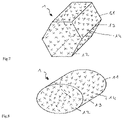
- FIG. 7 shows a simplified perspective view of the joint implant 1 according to a further exemplary embodiment of the invention, with identical reference symbols denoting identical or corresponding elements, which is why they are not described again below.
- the pinlike body of the joint implant 1 may also have the form of a prism or hollow prism (not shown).
- a further improvement is achieved in anchoring of the joint implant in the bone or spongy bone region 3 , thus further improving the long-term integrity of the joint implants.
- FIG. 8 shows a simplified perspective view of the pinlike body of the joint implant 1 according to a further exemplary embodiment of the invention, with identical reference symbols denoting identical or corresponding elements, which is why they are not described again below.
- the joint implant 1 used may also be a hollow body or body which is cross-sectionally ellipsoidal, in which case, in turn, improved anchoring and, in particular, reduced rotatory mobility about the longitudinal axis are anticipated, but the incidence of unwanted fracture segments at edges and corners is reduced. As a result, long-term integrity is further enhanced.
- FIG. 9 shows a schematic overview of the various stages of maturation of mesenchymal stem cells, after Aubin, 1998.
- mesenchymal stem cells MSCs
- mesenchymal stem cells MSCs
- differentiation of the mesenchymal stem cells (MSCs) into osteocytes may be advantageous, in order to promote bone formation and hence optimum growth of the joint implant 1 into the spongy bone region 3 .
- hydrophobic surface and “hydrophilicity” or “hydrophilic surface”, are defined below by way of what is called the contact angle of a water droplet on a surface.
- hydrophobic surfaces have a contact angle of greater than or equal to 90°, while contact angles of greater than 160° are characteristic of superhydrophobic surfaces.
- the best-known representative of these superhydrophobic surfaces is the plant known as the “lotus” plant, which by virtue of its particular microstructuring and nanostructuring exhibits contact angles of up to 170°.
- hydrophilic surfaces are characterized by a contact angle of less than 90°.
- this capacity of the stem cells for differentiation depending on the hydrophobicity or hydrophilicity of a surface is exploited by the pinlike body of the joint implant 1 having corresponding hydrophobic surfaces which promote chondroblastic differentiation of the mesenchymal stem cells and therefore development of cartilage.
- either the entire pinlike body may have a hydrophobic surface, or else only part of the body may possess hydrophobic surfaces.
- at least the top region 12 has a hydrophobic surface, in order to promote cartilage growth at this point.
- the pinlike body may have a hydrophobic surface in its top region 12 and upper shell region 13 , while the bottom region 11 and the lower part of the shell region 13 have a hydrophilic surface.
- the hydrophobic surface and hence a surface promoting chondroblastic differentiation, may be realized in a variety of different ways.
- chemical coatings may be applied to the pinlike body and especially to its trabecular structures, these coatings enhancing the hydrophobic (water repelling) properties.
- suitable microstructuring and/or nanostructuring of the surface of the pinlike body, and especially its trabecular structures may also bring about a desired hydrophobic quality.
- hydrophobic chemical coatings with physical topographical structuring may also be used in order to realize such “lotus effect” surfaces with hydrophobic qualities, in order to promote chondroblastic differentiation and hence the growth of cartilage.
- FIGS. 10A and 10B show an exemplary embodiment of the production of a hydrophobic coating of this kind, using the example of segmented polyurethanes, as may be applied to a joint implant of the invention.
- FIG. 10A the preparation of NCO-terminated prepolymers is illustrated first of all, there being a stoichiometric excess of —NCO.
- FIG. 10B subsequently, the NCO-terminated prepolymers are converted, using dodecanediol as apolar “chain extender”, into the desired segmented polyurethane (segmented PU).
- FIG. 11A shows an enlarged view of a Ti substrate coated with a segmented PU of this kind. Whereas an uncoated Ti substrate (not shown) has a contact angle of 0°, the Ti surface coated with segmented PU (10% PU in toluene) possesses a contact angle of approximately 112° to 116°.
- FIG. 11B shows an enlarged view of a Ti substrate coated with a segmented PU, the concentration of the segmented PU being 2% in toluene.
- the Ti surface coated with a segmented PU of this kind now has a contact angle of approximately 109° to 111°.
- IPDI isophorone diisocyanate
- HDI hexamethylene diisocyanate
- HMDI dicyclohexylmethane diisocyanate
- polyols polycarbonate diols (hydrolysis stability), such as e.g. Desmophen C2200, Desmophen XP2586, and also hydrocarbon diols based on natural rubber and hydrogenated natural rubber
- chain extenders aliphatic diols such as hexanediol, decanediol and possibly longer diols on account of the hydrophobicity
- hydrophobic chemical coating it is also possible, furthermore, to use a PU-based polyelectrolyte complex.
- the same components as above are used, with sulphonated diols, or diols containing ammonium groups, being used additionally as chain extenders in order to introduce ionic groups for the formation of the electrolyte complexes.
- Complexing is then accomplished after coating (preferably dip coating) by immersion into a dilute solution containing a surfactant (cationic or anionic, according to the ionic groups present in the polymer).
- a surfactant cationic or anionic, according to the ionic groups present in the polymer.
- the ionic interactions between the polyelectrolyte and the surfactant result in a firm bond, particularly if the surfactant is hydrophobic and therefore in any case has no tendency in an aqueous environment to enter into solution.
- hydrophobic chemical coating it is also possible, furthermore, to use an acrylate-based polyelectrolyte complex, in which case a first layer of polyelectrolytes such as polyacrylic acid and/or acrylic- or methacrylic-acid-containing copolymers, possibly also with some phosphoric acid groups (vinylphosphonic acid as comonomer), is applied to the surface for adhesion, after which a second layer is applied as above (coating from a surfactant solution, tailored to the ionic groups of the polyelectrolyte).
- a first layer of polyelectrolytes such as polyacrylic acid and/or acrylic- or methacrylic-acid-containing copolymers, possibly also with some phosphoric acid groups (vinylphosphonic acid as comonomer)
- a second layer is applied as above (coating from a surfactant solution, tailored to the ionic groups of the polyelectrolyte).
- Polyurethanes differ from the majority of other polymers and plastics in that they are composed by means of a “building block system” of a large number of different components (diisocyanates, polyisocyanates, polyols, chain extenders, soft segments, etc.).
- the actual construction here (chemical synthesis of the polymer molecules) is typically accomplished not until during processing, and so the user and/or producer of components is able to assemble the ultimate properties, on the basis of polyurethanes, entirely according to his or her requirements.
- Virtually all other plastics are produced with set profiles of properties by the raw materials manufacturer (chemical industry) and dispatched in that form, meaning that the user and/or producer of components has only relatively little influence over the profile of properties.
- Polyurethanes therefore represent a very good starting basis for specialty developments such as the coating of the implant body 1 of the invention.
- Polyurethanes have long been used as biocompatible materials, for example as inert, non-degradable coatings on cardiac pacemakers, or else as biocompatible, degradable support materials (scaffolds) for tissue engineering and/or regenerative medicine.
- the properties e.g. hydrophobicity/hydrophilicity, degradability/long-term stability, strength, stiffness, porosity, etc.
- properties are adjusted as required through the combination of the components.
- Crosslinked polyurethanes are prepared in dilute solution in the presence of the substrate to be coated.
- the components can be selected so that crosslinking is at the same time accompanied by chemical attachment to the surface of the substrate to be coated. These materials often exhibit outstanding adhesion, particularly to hydrophilic surfaces, without adhesion promoters or similar intermediate coats.
- the components of the polyurethanes can be selected so that the resultant coats are themselves hydrophobic.
- suitable components are aliphatic di- and polyisocyanates; for the long-term stability, soft segments and polycarbonate-, silicone- or polybutadiene-based polyols; and, for the hydrophobicity, long-chain diols, possibly likewise silicone-based or polybutadiene-based, as chain extenders.
- the main disadvantage is the problem controlling the coat thickness in the course of coating.
- the concentration is the only independent parameter which can be varied in order to influence the coat thickness. While the composition and the reaction time do affect the coat thickness, the composition, nevertheless, also influences all of the other properties, and the reaction time cannot be set arbitrarily, since biocompatibility requires the complete conversion of the isocyanate groups, and so the coating time cannot be shortened ad infinitum.
- Uncrosslinked polyurethanes are prepared separately from the coating operation and are subsequently applied from a dilute solution in a dipping operation.
- the adjustment of the properties offers the same opportunities as in the case of the crosslinked polyurethanes, since virtually all components can be used in both cases.
- the advantage of the uncrosslinked polyurethanes is that synthesis and coating proceed separately from one another, and so there are better opportunities for controlling the coat thickness.
- the concentration, the exposure time during the dipping operation, and, in particular, the number of dipping operations (with drying between in each case) determine the thickness of the applied coat.
- Polyelectrolyte complexes exploit electrostatic interactions between positively and negatively charged ions and surfaces. Every material, in water, exhibits a certain surface charge (zeta potential), which is positive or negative, according to the chemical structure. This surface charge is also possessed by neutral particles or surfaces. Polyelectrolytes whose charges along the polymer chain carry an opposite charge to this surface charge adhere very firmly to the surface. In general they can no longer be removed, since each polymer chain, according to chain length, adheres simultaneously with dozens or hundreds of groups and so is maintained in position even when some of these groups are detached by external exposures.
- zeta potential surface charge
- Polyelectrolytes whose charges along the polymer chain carry an opposite charge to this surface charge adhere very firmly to the surface. In general they can no longer be removed, since each polymer chain, according to chain length, adheres simultaneously with dozens or hundreds of groups and so is maintained in position even when some of these groups are detached by external exposures.
- polyelectrolytes of opposite charge can then be deposited on the first polyelectrolytes, thereby enabling precise establishment of the coat thickness on a molecular basis, by means of alternate deposition (layer-by-layer technique).
- ions of low molecular mass such as surfactants or soaps, are deposited, with one end of these molecules carrying a charge opposite to that of the polyelectrolyte, in order to ensure the adhesion, while their other end is hydrophobic.
- coats can be produced which to the outside have a dense layer of, for example, methyl groups, so making it possible to achieve virtually the surface tension of fluoropolymers (PTFE, Teflon).
- a disadvantage is the deposition in virtually monomolecular layers, which in case of higher coat thicknesses necessitates a large number of dipping operations in alternating polyelectrolyte baths. Since, however, no intermediate drying steps are needed, the cost and complexity are acceptable.
- the pinlike body of the joint implant 1 As starting material for the pinlike body of the joint implant 1 , it is additionally possible to use such 3D-printable materials which already per se (that is, without additional microstructuring and/or nanostructuring and chemical coating) have a hydrophobic surface.
- the untreated surface of a zirconium dioxide ceramic substrate already exhibits hydrophobic properties.
- micro- and nanostructured surfaces on the pinlike body of the joint implant 1 of the kind also known, as self-cleaning surfaces, under the term Lotus Effect®.
- Micro- and nanostructured surfaces of this kind are known from publication WO 96/04123 A, for example.
- the artificial trabecular structures 14 may have an additional growth coating and/or a growth factor for the purpose of improved cartilage cell differentiation and improved attachment of cartilage material.
- the artificial trabecular structure 14 may preferably be coated with specific, human and human-homologous growth factor FGF [Fibroblast Growth Factor], particularly FGF-1, FGF-2 and FGF-10 to FGF-22, and among the latter particularly FGF-18.
- FGF Fibroblast Growth Factor
- FGF-1 Fibroblast Growth Factor
- FGF-2 Fibroblast Growth Factor
- FGF-10 Fibroblast Growth Factor
- FGF-18 fibroblast Growth Factor
- SDF Stromal Cell-Derived Factor
- specific, human and human-homologous growth factor IGF-1 Insulin-like Growth Factor 1
- human PDGF Platinum-Derived Growth Factor
- specific, human and human-homologous growth factor TGF- ⁇ 1 and TGF- ⁇ 3 Transforming Growth Factors beta 1 and beta 3
- specific, human and human-homologous BMP-2 and BMP-7 Bone Morphogenetic Protein-2 and Protein-7
- Further coating possibilities include the following: specific, human and human-homologous OP-1 [Osteogenic Protein-1], human PRP [Platelet-rich Plasma], and also bioinert polyamide suitable especially for coatings.
- the growth factor may be applied as the last coat.
- the differentiation of mesenchymal stem cells into chondroblasts or osteoblasts can be controlled in a targeted way.
- it is possible to improve the cartilage structure on the synovia-facing side (top region 12 ) of the joint implants 1 by means of the above-described hydrophobic surface structures and coatings, and also with the growth factors which stimulate cartilage formation.
- hydrophilic surface structures and coatings can be used to improve bone formation and also the bone structure in the spongiose bone region. This produces almost physiological suitability, because the joint anatomy and the natural bone stability are influenced not at all or only insignificantly as in the case, for example, of implantation of an endoprosthesis.
- the compatibility and activity of the curative therapy by means of the above-described joint implants are substantially enhanced as a result.
- an innovative joint implant is obtained which is able to optimize further the quantity and quality and hence the robustness and integrity of replacement cartilage tissue, and to make a key contribution to the curative treatment of joint disorders (arthritis).
Landscapes
- Health & Medical Sciences (AREA)
- Engineering & Computer Science (AREA)
- Animal Behavior & Ethology (AREA)
- General Health & Medical Sciences (AREA)
- Transplantation (AREA)
- Cardiology (AREA)
- Biomedical Technology (AREA)
- Heart & Thoracic Surgery (AREA)
- Vascular Medicine (AREA)
- Life Sciences & Earth Sciences (AREA)
- Orthopedic Medicine & Surgery (AREA)
- Oral & Maxillofacial Surgery (AREA)
- Public Health (AREA)
- Veterinary Medicine (AREA)
- Rheumatology (AREA)
- Physics & Mathematics (AREA)
- Geometry (AREA)
- Manufacturing & Machinery (AREA)
- Prostheses (AREA)
- Materials For Medical Uses (AREA)
- Acyclic And Carbocyclic Compounds In Medicinal Compositions (AREA)
Abstract
Description
- 1 Joint implant
- 2 Articular cartilage
- 3 Spongy bone region
- 4 Periosteum
- 5 Bone cortex
- 6 Bone marrow cavity
- 7, 8 Trabeculae
- 11 Bottom region
- 12 Top region
- 13 Shell region
- 14 Artificial trabecular structure
- D Diameter of the joint implant
- L Length of the joint implant
- d Thickness of the artificial trabecular structure
Claims (17)
Applications Claiming Priority (3)
| Application Number | Priority Date | Filing Date | Title |
|---|---|---|---|
| DE102016124049.4A DE102016124049B4 (en) | 2016-12-12 | 2016-12-12 | Joint implant for tissue regeneration at the joint |
| DE102016124049.4 | 2016-12-12 | ||
| PCT/EP2017/076691 WO2018108360A1 (en) | 2016-12-12 | 2017-10-19 | Joint implant for new tissue formation at the joint |
Publications (2)
| Publication Number | Publication Date |
|---|---|
| US20190290440A1 US20190290440A1 (en) | 2019-09-26 |
| US11484411B2 true US11484411B2 (en) | 2022-11-01 |
Family
ID=60143706
Family Applications (1)
| Application Number | Title | Priority Date | Filing Date |
|---|---|---|---|
| US16/466,174 Active US11484411B2 (en) | 2016-12-12 | 2017-10-19 | Joint implant for new tissue formation at the joint |
Country Status (14)
| Country | Link |
|---|---|
| US (1) | US11484411B2 (en) |
| EP (1) | EP3538029B1 (en) |
| JP (1) | JP6839278B2 (en) |
| CA (1) | CA3043675C (en) |
| DE (1) | DE102016124049B4 (en) |
| DK (1) | DK3538029T3 (en) |
| ES (1) | ES2949358T3 (en) |
| FI (1) | FI3538029T3 (en) |
| HR (1) | HRP20230668T1 (en) |
| HU (1) | HUE063568T2 (en) |
| PL (1) | PL3538029T3 (en) |
| SI (1) | SI3538029T1 (en) |
| TW (1) | TWI649101B (en) |
| WO (1) | WO2018108360A1 (en) |
Families Citing this family (7)
| Publication number | Priority date | Publication date | Assignee | Title |
|---|---|---|---|---|
| DE102018113580A1 (en) * | 2018-06-07 | 2019-12-12 | Christoph Karl | METHOD AND DEVICE FOR PRODUCING AN IMPLANT |
| DE102018113809A1 (en) * | 2018-06-11 | 2019-12-12 | Christoph Karl | Joint implant for tissue regeneration at the joint |
| CN110916855A (en) * | 2018-09-20 | 2020-03-27 | 天津正天医疗器械有限公司 | Bionic porous intervertebral implant and manufacturing method thereof |
| WO2020231328A1 (en) * | 2019-05-16 | 2020-11-19 | Mighty Jaxx International Pte. Ltd. | An ownership data management system and method |
| NL2023398B1 (en) * | 2019-06-27 | 2021-02-01 | Jointsphere B V | Plug-shaped implant for the replacement and regeneration of biological tissue and method for preparing the implant |
| IT202000032936A1 (en) * | 2020-12-31 | 2022-07-01 | Alessandro Russo | SUPPORT RETICULAR STRUCTURE |
| WO2024185441A1 (en) * | 2023-03-09 | 2024-09-12 | 住友化学株式会社 | Porous ceramic layer, porous ceramic laminate, and separation membrane |
Citations (21)
| Publication number | Priority date | Publication date | Assignee | Title |
|---|---|---|---|---|
| US6319712B1 (en) | 1998-01-30 | 2001-11-20 | Deutsche Institute Fur Textil-Und Faserforschung Stuttgart | Biohybrid articular surface replacement |
| US20030006534A1 (en) * | 2001-06-22 | 2003-01-09 | Taboas Juan M. | Controlled local/global and micro/macro-porous 3D plastic, polymer and ceramic/cement composite scaffold fabrication and applications thereof |
| WO2003045463A1 (en) | 2001-11-28 | 2003-06-05 | Schunk Kohlenstofftechnik Gmbh | Articular implant and method for the production thereof |
| US6660363B1 (en) | 1994-07-29 | 2003-12-09 | Wilhelm Barthlott | Self-cleaning surfaces of objects and process for producing same |
| US20050149046A1 (en) | 2003-12-24 | 2005-07-07 | Friedman Craig D. | Repair of spinal annular defects and annulo-nucleoplasty regeneration |
| US20050221072A1 (en) | 2003-04-17 | 2005-10-06 | Nanosys, Inc. | Medical device applications of nanostructured surfaces |
| WO2007020449A2 (en) | 2005-08-17 | 2007-02-22 | Oxford Biomaterials Ltd. | Implantable cartilaginous tissue repair device |
| US7217294B2 (en) | 2003-08-20 | 2007-05-15 | Histogenics Corp. | Acellular matrix implants for treatment of articular cartilage, bone or osteochondral defects and injuries and method for use thereof |
| US20080249637A1 (en) | 2007-04-05 | 2008-10-09 | Cinvention Ag | Partially biodegradable therapeutic implant for bone and cartilage repair |
| US20090029077A1 (en) * | 2007-07-27 | 2009-01-29 | Boston Scientific Scimed, Inc. | Drug eluting medical devices having porous layers |
| EP2465549A1 (en) | 2010-11-17 | 2012-06-20 | Zimmer GmbH | Porous metal structures made from polymer preforms |
| US20120177702A1 (en) * | 2009-06-15 | 2012-07-12 | Cartiheal (2009) Ltd. | Solid Forms for Tissue Repair |
| WO2012096997A2 (en) | 2011-01-10 | 2012-07-19 | Biomimedica, Inc. | Orthopedic implants having gradient polymer alloys |
| US20140200679A1 (en) * | 2013-01-11 | 2014-07-17 | Bvw Holding Ag | Implantable superhydrophobic surfaces |
| US20140324169A1 (en) * | 2013-04-26 | 2014-10-30 | New York Society For The Ruptured And Crippled Maintaining The Hospital For Special Surgery | Multi-component non-biodegradable implant, a method of making and a method of implantation |
| CN104645419A (en) | 2014-12-02 | 2015-05-27 | 中国人民解放军第四军医大学 | Preparation method of porous titanium-alloy femoral head support rod in bionic bone trabecula structure |
| US20160318247A1 (en) * | 2015-04-28 | 2016-11-03 | Warsaw Orthopedic, Inc. | 3d printing devices and methods |
| US20160331869A1 (en) | 2005-09-09 | 2016-11-17 | Board Of Trustees Of The University Of Arkansas | Bone regeneration using biodegradable polymeric nanocomposite materials and applications of the same |
| US20170281829A1 (en) * | 2005-09-09 | 2017-10-05 | Board Of Trustees Of The University Of Arkansas | Bone regeneration using biodegradable polymeric nanocomposite materials and applications of the same |
| US10196610B2 (en) | 2011-04-05 | 2019-02-05 | Hiroshima University | Animal cell culture kit, method for culturing animal cells, method for selective culture of animal cells and cell differentiation method |
| US20190083282A1 (en) * | 2007-02-28 | 2019-03-21 | Ryan K. Roeder | Implantable devices |
Family Cites Families (2)
| Publication number | Priority date | Publication date | Assignee | Title |
|---|---|---|---|---|
| AU2003235938A1 (en) * | 2002-05-13 | 2003-11-11 | Mmt.Co., Ltd | Member for regenerating joint cartilage and process for producing the same, method of regenerating joint cartilage and aritficial cartilage for transplantation |
| EP2173858A4 (en) * | 2007-07-02 | 2010-09-08 | Univ Columbia | ENGINEERING COMPOSITE FABRICS OF BIOLOGICAL ORIGIN |
-
2016
- 2016-12-12 DE DE102016124049.4A patent/DE102016124049B4/en active Active
-
2017
- 2017-10-19 EP EP17787164.7A patent/EP3538029B1/en active Active
- 2017-10-19 PL PL17787164.7T patent/PL3538029T3/en unknown
- 2017-10-19 JP JP2019525947A patent/JP6839278B2/en active Active
- 2017-10-19 SI SI201731365T patent/SI3538029T1/en unknown
- 2017-10-19 WO PCT/EP2017/076691 patent/WO2018108360A1/en not_active Ceased
- 2017-10-19 ES ES17787164T patent/ES2949358T3/en active Active
- 2017-10-19 HU HUE17787164A patent/HUE063568T2/en unknown
- 2017-10-19 FI FIEP17787164.7T patent/FI3538029T3/en active
- 2017-10-19 DK DK17787164.7T patent/DK3538029T3/en active
- 2017-10-19 CA CA3043675A patent/CA3043675C/en active Active
- 2017-10-19 US US16/466,174 patent/US11484411B2/en active Active
- 2017-10-19 HR HRP20230668TT patent/HRP20230668T1/en unknown
- 2017-10-20 TW TW106136230A patent/TWI649101B/en active
Patent Citations (21)
| Publication number | Priority date | Publication date | Assignee | Title |
|---|---|---|---|---|
| US6660363B1 (en) | 1994-07-29 | 2003-12-09 | Wilhelm Barthlott | Self-cleaning surfaces of objects and process for producing same |
| US6319712B1 (en) | 1998-01-30 | 2001-11-20 | Deutsche Institute Fur Textil-Und Faserforschung Stuttgart | Biohybrid articular surface replacement |
| US20030006534A1 (en) * | 2001-06-22 | 2003-01-09 | Taboas Juan M. | Controlled local/global and micro/macro-porous 3D plastic, polymer and ceramic/cement composite scaffold fabrication and applications thereof |
| WO2003045463A1 (en) | 2001-11-28 | 2003-06-05 | Schunk Kohlenstofftechnik Gmbh | Articular implant and method for the production thereof |
| US20050221072A1 (en) | 2003-04-17 | 2005-10-06 | Nanosys, Inc. | Medical device applications of nanostructured surfaces |
| US7217294B2 (en) | 2003-08-20 | 2007-05-15 | Histogenics Corp. | Acellular matrix implants for treatment of articular cartilage, bone or osteochondral defects and injuries and method for use thereof |
| US20050149046A1 (en) | 2003-12-24 | 2005-07-07 | Friedman Craig D. | Repair of spinal annular defects and annulo-nucleoplasty regeneration |
| WO2007020449A2 (en) | 2005-08-17 | 2007-02-22 | Oxford Biomaterials Ltd. | Implantable cartilaginous tissue repair device |
| US20160331869A1 (en) | 2005-09-09 | 2016-11-17 | Board Of Trustees Of The University Of Arkansas | Bone regeneration using biodegradable polymeric nanocomposite materials and applications of the same |
| US20170281829A1 (en) * | 2005-09-09 | 2017-10-05 | Board Of Trustees Of The University Of Arkansas | Bone regeneration using biodegradable polymeric nanocomposite materials and applications of the same |
| US20190083282A1 (en) * | 2007-02-28 | 2019-03-21 | Ryan K. Roeder | Implantable devices |
| US20080249637A1 (en) | 2007-04-05 | 2008-10-09 | Cinvention Ag | Partially biodegradable therapeutic implant for bone and cartilage repair |
| US20090029077A1 (en) * | 2007-07-27 | 2009-01-29 | Boston Scientific Scimed, Inc. | Drug eluting medical devices having porous layers |
| US20120177702A1 (en) * | 2009-06-15 | 2012-07-12 | Cartiheal (2009) Ltd. | Solid Forms for Tissue Repair |
| EP2465549A1 (en) | 2010-11-17 | 2012-06-20 | Zimmer GmbH | Porous metal structures made from polymer preforms |
| WO2012096997A2 (en) | 2011-01-10 | 2012-07-19 | Biomimedica, Inc. | Orthopedic implants having gradient polymer alloys |
| US10196610B2 (en) | 2011-04-05 | 2019-02-05 | Hiroshima University | Animal cell culture kit, method for culturing animal cells, method for selective culture of animal cells and cell differentiation method |
| US20140200679A1 (en) * | 2013-01-11 | 2014-07-17 | Bvw Holding Ag | Implantable superhydrophobic surfaces |
| US20140324169A1 (en) * | 2013-04-26 | 2014-10-30 | New York Society For The Ruptured And Crippled Maintaining The Hospital For Special Surgery | Multi-component non-biodegradable implant, a method of making and a method of implantation |
| CN104645419A (en) | 2014-12-02 | 2015-05-27 | 中国人民解放军第四军医大学 | Preparation method of porous titanium-alloy femoral head support rod in bionic bone trabecula structure |
| US20160318247A1 (en) * | 2015-04-28 | 2016-11-03 | Warsaw Orthopedic, Inc. | 3d printing devices and methods |
Also Published As
| Publication number | Publication date |
|---|---|
| DK3538029T3 (en) | 2023-07-17 |
| WO2018108360A1 (en) | 2018-06-21 |
| DE102016124049B4 (en) | 2018-09-27 |
| JP6839278B2 (en) | 2021-03-03 |
| DE102016124049A1 (en) | 2018-06-14 |
| FI3538029T3 (en) | 2023-07-10 |
| PL3538029T3 (en) | 2023-10-09 |
| EP3538029B1 (en) | 2023-05-10 |
| HUE063568T2 (en) | 2024-01-28 |
| SI3538029T1 (en) | 2023-08-31 |
| US20190290440A1 (en) | 2019-09-26 |
| EP3538029A1 (en) | 2019-09-18 |
| ES2949358T3 (en) | 2023-09-28 |
| TW201821115A (en) | 2018-06-16 |
| HRP20230668T1 (en) | 2023-10-13 |
| TWI649101B (en) | 2019-02-01 |
| JP2020500588A (en) | 2020-01-16 |
| CA3043675C (en) | 2022-01-04 |
| CA3043675A1 (en) | 2018-06-21 |
Similar Documents
| Publication | Publication Date | Title |
|---|---|---|
| US11484411B2 (en) | Joint implant for new tissue formation at the joint | |
| Ahn et al. | Modification of titanium implant and titanium dioxide for bone tissue engineering | |
| Zuo et al. | Properties improvement of titanium alloys scaffolds in bone tissue engineering: a literature review | |
| EP2802363B1 (en) | Composite device that combines porous metal and bone stimuli | |
| EP2675490B1 (en) | Non-resorbable polymer - ceramic composite implant materials | |
| Poliakov et al. | Current trends in improving of artificial joints design and technologies for their arthroplasty | |
| Rehman et al. | The era of biofunctional biomaterials in orthopedics: what does the future hold? | |
| US9271841B2 (en) | Ball joint prosthesis and method | |
| TWI804623B (en) | Joint implant for new tissue formation at the joint | |
| EP1501450A1 (en) | Bone prosthesis with multilayer interface | |
| US11458020B2 (en) | Method and device for producing an implant | |
| HK40010335B (en) | Joint implant for new tissue formation at the joint | |
| HK40010335A (en) | Joint implant for new tissue formation at the joint | |
| Yakar et al. | Nanostructured titanium surfaces in hard tissue repair | |
| Mittal et al. | Surface Treatment of Polymeric, Ceramic, Metallic, and Composite Biomaterials for Bioimplants and Medical Device Applications | |
| Mittal et al. | 16 Surface Treatment of Polymeric, Ceramic | |
| Yakar et al. | in Hard Tissue Repair | |
| Gradzka-Dahlke | An overview of the surface engineering methods usage for surgical implants production |
Legal Events
| Date | Code | Title | Description |
|---|---|---|---|
| FEPP | Fee payment procedure |
Free format text: ENTITY STATUS SET TO UNDISCOUNTED (ORIGINAL EVENT CODE: BIG.); ENTITY STATUS OF PATENT OWNER: SMALL ENTITY |
|
| FEPP | Fee payment procedure |
Free format text: ENTITY STATUS SET TO SMALL (ORIGINAL EVENT CODE: SMAL); ENTITY STATUS OF PATENT OWNER: SMALL ENTITY |
|
| STPP | Information on status: patent application and granting procedure in general |
Free format text: DOCKETED NEW CASE - READY FOR EXAMINATION |
|
| STPP | Information on status: patent application and granting procedure in general |
Free format text: RESPONSE TO NON-FINAL OFFICE ACTION ENTERED AND FORWARDED TO EXAMINER |
|
| STPP | Information on status: patent application and granting procedure in general |
Free format text: FINAL REJECTION MAILED |
|
| STPP | Information on status: patent application and granting procedure in general |
Free format text: RESPONSE AFTER FINAL ACTION FORWARDED TO EXAMINER |
|
| STPP | Information on status: patent application and granting procedure in general |
Free format text: ADVISORY ACTION MAILED |
|
| STPP | Information on status: patent application and granting procedure in general |
Free format text: DOCKETED NEW CASE - READY FOR EXAMINATION |
|
| STPP | Information on status: patent application and granting procedure in general |
Free format text: NON FINAL ACTION MAILED |
|
| STPP | Information on status: patent application and granting procedure in general |
Free format text: RESPONSE TO NON-FINAL OFFICE ACTION ENTERED AND FORWARDED TO EXAMINER |
|
| STPP | Information on status: patent application and granting procedure in general |
Free format text: FINAL REJECTION MAILED |
|
| STPP | Information on status: patent application and granting procedure in general |
Free format text: DOCKETED NEW CASE - READY FOR EXAMINATION |
|
| STPP | Information on status: patent application and granting procedure in general |
Free format text: NOTICE OF ALLOWANCE MAILED -- APPLICATION RECEIVED IN OFFICE OF PUBLICATIONS |
|
| STPP | Information on status: patent application and granting procedure in general |
Free format text: PUBLICATIONS -- ISSUE FEE PAYMENT VERIFIED |
|
| STCF | Information on status: patent grant |
Free format text: PATENTED CASE |