US11445724B2 - Insecticidal compounds - Google Patents
Insecticidal compounds Download PDFInfo
- Publication number
- US11445724B2 US11445724B2 US17/086,670 US202017086670A US11445724B2 US 11445724 B2 US11445724 B2 US 11445724B2 US 202017086670 A US202017086670 A US 202017086670A US 11445724 B2 US11445724 B2 US 11445724B2
- Authority
- US
- United States
- Prior art keywords
- spp
- compound
- formula
- compounds
- ccn
- Prior art date
- Legal status (The legal status is an assumption and is not a legal conclusion. Google has not performed a legal analysis and makes no representation as to the accuracy of the status listed.)
- Active
Links
- 0 *N(C(C)=O)c1c(C)ccc(C(=O)Nc2c([Y])cc(C(F)(C(F)(F)F)C(F)(F)F)cc2OC(F)F)c1C Chemical compound *N(C(C)=O)c1c(C)ccc(C(=O)Nc2c([Y])cc(C(F)(C(F)(F)F)C(F)(F)F)cc2OC(F)F)c1C 0.000 description 12
- DPQOBLFLUYBOTQ-UHFFFAOYSA-N CC(=O)Nc1c([Y])cc(C(F)(C(F)(F)F)C(F)(F)F)cc1OC(F)F Chemical compound CC(=O)Nc1c([Y])cc(C(F)(C(F)(F)F)C(F)(F)F)cc1OC(F)F DPQOBLFLUYBOTQ-UHFFFAOYSA-N 0.000 description 4
- MGCLQQKXWQLIML-UHFFFAOYSA-N CC(C)c1cc[n+]([O-])cc1.C[W][W][W][W][W] Chemical compound CC(C)c1cc[n+]([O-])cc1.C[W][W][W][W][W] MGCLQQKXWQLIML-UHFFFAOYSA-N 0.000 description 3
- SAGATSSBPIDUPO-UHFFFAOYSA-N CC(C)c1ccc[n+]([O-])c1.C[W][W][W] Chemical compound CC(C)c1ccc[n+]([O-])c1.C[W][W][W] SAGATSSBPIDUPO-UHFFFAOYSA-N 0.000 description 3
- JHNAZWYCOXIHIB-UHFFFAOYSA-N CC(C)c1cccnc1.C[W][W] Chemical compound CC(C)c1cccnc1.C[W][W] JHNAZWYCOXIHIB-UHFFFAOYSA-N 0.000 description 3
- XIIVIXVYUGWUIJ-UHFFFAOYSA-N CC(C)c1ccncc1.C[W][W][W][W] Chemical compound CC(C)c1ccncc1.C[W][W][W][W] XIIVIXVYUGWUIJ-UHFFFAOYSA-N 0.000 description 3
- SHQHRDPILKDALG-UHFFFAOYSA-N CC.CC(C)c1ccccc1 Chemical compound CC.CC(C)c1ccccc1 SHQHRDPILKDALG-UHFFFAOYSA-N 0.000 description 3
- IHSDBANQUQXKMC-UHFFFAOYSA-N CCN(C(=O)c1ccccc1F)c1cccc(C(=O)Nc2c(Br)cc(C(F)(C(F)(F)F)C(F)(F)F)cc2OC(F)F)c1F Chemical compound CCN(C(=O)c1ccccc1F)c1cccc(C(=O)Nc2c(Br)cc(C(F)(C(F)(F)F)C(F)(F)F)cc2OC(F)F)c1F IHSDBANQUQXKMC-UHFFFAOYSA-N 0.000 description 2
- WBWFHALDRNXBSV-UHFFFAOYSA-N COc1c(C(=O)Cc2c(Br)cc(C(F)(C(F)(F)F)C(F)(F)F)cc2OC(F)F)cccc1N(C)C(=O)c1cc[n+]([O-])cc1 Chemical compound COc1c(C(=O)Cc2c(Br)cc(C(F)(C(F)(F)F)C(F)(F)F)cc2OC(F)F)cccc1N(C)C(=O)c1cc[n+]([O-])cc1 WBWFHALDRNXBSV-UHFFFAOYSA-N 0.000 description 2
- BOTPKTUUCHAGDZ-UHFFFAOYSA-N COc1c(C(=O)Cc2c(Br)cc(C(F)(C(F)(F)F)C(F)(F)F)cc2OC(F)F)cccc1N(C)C(=O)c1ccncc1 Chemical compound COc1c(C(=O)Cc2c(Br)cc(C(F)(C(F)(F)F)C(F)(F)F)cc2OC(F)F)cccc1N(C)C(=O)c1ccncc1 BOTPKTUUCHAGDZ-UHFFFAOYSA-N 0.000 description 2
- FAWFNNDFWSFJCR-UHFFFAOYSA-N COc1c(NC(=O)c2ccc(C#N)cc2)cccc1C(=O)Cc1c(Cl)cc(C(F)(C(F)(F)F)C(F)(F)F)cc1OC(F)F Chemical compound COc1c(NC(=O)c2ccc(C#N)cc2)cccc1C(=O)Cc1c(Cl)cc(C(F)(C(F)(F)F)C(F)(F)F)cc1OC(F)F FAWFNNDFWSFJCR-UHFFFAOYSA-N 0.000 description 2
- HLMGSDWGLMICMJ-UHFFFAOYSA-N C#Cc1ccc(C(=O)N(CC)c2cc(C(=O)Cc3c(Br)cc(C(F)(C(F)(F)F)C(F)(F)F)cc3OC(F)F)ccc2C#N)c(C)c1 Chemical compound C#Cc1ccc(C(=O)N(CC)c2cc(C(=O)Cc3c(Br)cc(C(F)(C(F)(F)F)C(F)(F)F)cc3OC(F)F)ccc2C#N)c(C)c1 HLMGSDWGLMICMJ-UHFFFAOYSA-N 0.000 description 1
- GKKZGDPSRMMRKA-UHFFFAOYSA-N C#Cc1ccc(C(=O)N(CC)c2cc(C(=O)Cc3c(Br)cc(C(F)(C(F)(F)F)C(F)(F)F)cc3OC(F)F)ccc2C#N)c(C)c1.C#Cc1ccc(C(=O)Nc2cc(C(=O)Cc3c(Br)cc(C(F)(C(F)(F)F)C(F)(F)F)cc3OC(F)F)ccc2C#N)c(C)c1.CN(C(=O)c1ccc(F)cc1F)c1cc(C(=O)Cc2c(Br)cc(C(F)(C(F)(F)F)C(F)(F)F)cc2OC(F)F)ccc1C#N.Cc1ccc(C(=O)N(C)c2cc(C(=O)Cc3c(Br)cc(C(F)(C(F)(F)F)C(F)(F)F)cc3OC(F)F)ccc2C#N)c(Cl)c1.Cc1ccc(C(=O)Nc2cc(C(=O)Cc3c(Br)cc(C(F)(C(F)(F)F)C(F)(F)F)cc3OC(F)F)ccc2C#N)c(F)c1 Chemical compound C#Cc1ccc(C(=O)N(CC)c2cc(C(=O)Cc3c(Br)cc(C(F)(C(F)(F)F)C(F)(F)F)cc3OC(F)F)ccc2C#N)c(C)c1.C#Cc1ccc(C(=O)Nc2cc(C(=O)Cc3c(Br)cc(C(F)(C(F)(F)F)C(F)(F)F)cc3OC(F)F)ccc2C#N)c(C)c1.CN(C(=O)c1ccc(F)cc1F)c1cc(C(=O)Cc2c(Br)cc(C(F)(C(F)(F)F)C(F)(F)F)cc2OC(F)F)ccc1C#N.Cc1ccc(C(=O)N(C)c2cc(C(=O)Cc3c(Br)cc(C(F)(C(F)(F)F)C(F)(F)F)cc3OC(F)F)ccc2C#N)c(Cl)c1.Cc1ccc(C(=O)Nc2cc(C(=O)Cc3c(Br)cc(C(F)(C(F)(F)F)C(F)(F)F)cc3OC(F)F)ccc2C#N)c(F)c1 GKKZGDPSRMMRKA-UHFFFAOYSA-N 0.000 description 1
- HCVHQGMRMORCIG-UHFFFAOYSA-N C#Cc1ccc(C(=O)Nc2cc(C(=O)Cc3c(Br)cc(C(F)(C(F)(F)F)C(F)(F)F)cc3OC(F)F)ccc2C#N)c(C)c1 Chemical compound C#Cc1ccc(C(=O)Nc2cc(C(=O)Cc3c(Br)cc(C(F)(C(F)(F)F)C(F)(F)F)cc3OC(F)F)ccc2C#N)c(C)c1 HCVHQGMRMORCIG-UHFFFAOYSA-N 0.000 description 1
- RDPCOHPVEOOZLU-UHFFFAOYSA-N C.C.CO.Cc1ccc(C(=O)Nc2c([Y])cc(C(F)(C(F)(F)F)C(F)(F)F)cc2OC(F)F)c(C)c1[N+](=O)[O-].Cc1ccc(C(=O)Nc2c([Y])cc(C(F)(C(F)(F)F)C(F)(F)F)cc2OC(F)F)c(C)c1[N+](=O)[O-] Chemical compound C.C.CO.Cc1ccc(C(=O)Nc2c([Y])cc(C(F)(C(F)(F)F)C(F)(F)F)cc2OC(F)F)c(C)c1[N+](=O)[O-].Cc1ccc(C(=O)Nc2c([Y])cc(C(F)(C(F)(F)F)C(F)(F)F)cc2OC(F)F)c(C)c1[N+](=O)[O-] RDPCOHPVEOOZLU-UHFFFAOYSA-N 0.000 description 1
- NDESSBWMZYWIDD-UHFFFAOYSA-L C.CC(F)(C(F)(F)F)C(F)(F)F.CI.I[V]I.Nc1c([Y])cc(C(F)(C(F)(F)F)C(F)(F)F)cc1OC(F)F.Nc1c([Y])cccc1OC(F)F Chemical compound C.CC(F)(C(F)(F)F)C(F)(F)F.CI.I[V]I.Nc1c([Y])cc(C(F)(C(F)(F)F)C(F)(F)F)cc1OC(F)F.Nc1c([Y])cccc1OC(F)F NDESSBWMZYWIDD-UHFFFAOYSA-L 0.000 description 1
- SXYVCCJBJRWDPK-UHFFFAOYSA-M C.Cc1ccc(C(=O)Nc2c([Y])cc(C(F)(C(F)(F)F)C(F)(F)F)cc2OC(F)F)c(C)c1N.Cc1ccc(C(=O)Nc2c([Y])cc(C(F)(C(F)(F)F)C(F)(F)F)cc2OC(F)F)c(C)c1[N+](=O)[O-].[V]I Chemical compound C.Cc1ccc(C(=O)Nc2c([Y])cc(C(F)(C(F)(F)F)C(F)(F)F)cc2OC(F)F)c(C)c1N.Cc1ccc(C(=O)Nc2c([Y])cc(C(F)(C(F)(F)F)C(F)(F)F)cc2OC(F)F)c(C)c1[N+](=O)[O-].[V]I SXYVCCJBJRWDPK-UHFFFAOYSA-M 0.000 description 1
- SMYFCBQOQHWZBH-UHFFFAOYSA-N C.IC(I)I.Nc1c([Y])cc(C(F)(C(F)(F)F)C(F)(F)F)cc1OC(F)F.Nc1ccc(C(F)(C(F)(F)F)C(F)(F)F)cc1OC(F)F Chemical compound C.IC(I)I.Nc1c([Y])cc(C(F)(C(F)(F)F)C(F)(F)F)cc1OC(F)F.Nc1ccc(C(F)(C(F)(F)F)C(F)(F)F)cc1OC(F)F SMYFCBQOQHWZBH-UHFFFAOYSA-N 0.000 description 1
- YDFAHQDEOQKOHF-UHFFFAOYSA-N CC(=O)Nc1c(Br)cc(C(F)(C(F)(F)F)C(F)(F)F)cc1OC(F)F Chemical compound CC(=O)Nc1c(Br)cc(C(F)(C(F)(F)F)C(F)(F)F)cc1OC(F)F YDFAHQDEOQKOHF-UHFFFAOYSA-N 0.000 description 1
- NFBFFTBRAVQBHI-UHFFFAOYSA-L CC(=O)Nc1c([Y])cc(C(F)(C(F)(F)F)C(F)(F)F)cc1OC(F)F.CC(=O)OC(C)=O.I[IH]I.I[V]I.Nc1c([Y])cc(C(F)(C(F)(F)F)C(F)(F)F)cc1OC(F)F Chemical compound CC(=O)Nc1c([Y])cc(C(F)(C(F)(F)F)C(F)(F)F)cc1OC(F)F.CC(=O)OC(C)=O.I[IH]I.I[V]I.Nc1c([Y])cc(C(F)(C(F)(F)F)C(F)(F)F)cc1OC(F)F NFBFFTBRAVQBHI-UHFFFAOYSA-L 0.000 description 1
- UIWMZJUIOMTLPU-UHFFFAOYSA-N CCN(C(=O)c1cc(C(F)(F)F)ccc1F)c1cccc(C(=O)Cc2c(Br)cc(C(F)(C(F)(F)F)C(F)(F)F)cc2OC(F)F)c1F Chemical compound CCN(C(=O)c1cc(C(F)(F)F)ccc1F)c1cccc(C(=O)Cc2c(Br)cc(C(F)(C(F)(F)F)C(F)(F)F)cc2OC(F)F)c1F UIWMZJUIOMTLPU-UHFFFAOYSA-N 0.000 description 1
- PZPWBRKXSVZPFP-UHFFFAOYSA-N CCN(C(=O)c1cc(C(F)(F)F)ccc1F)c1cccc(C(=O)Cc2c(Br)cc(C(F)(C(F)(F)F)C(F)(F)F)cc2OC(F)F)c1OC Chemical compound CCN(C(=O)c1cc(C(F)(F)F)ccc1F)c1cccc(C(=O)Cc2c(Br)cc(C(F)(C(F)(F)F)C(F)(F)F)cc2OC(F)F)c1OC PZPWBRKXSVZPFP-UHFFFAOYSA-N 0.000 description 1
- ZAWNGXKJKKPCCU-UHFFFAOYSA-N CCN(C(=O)c1cc(C(F)(F)F)ccc1F)c1cccc(C(=O)Cc2c(Cl)cc(C(F)(C(F)(F)F)C(F)(F)F)cc2OC(F)F)c1F Chemical compound CCN(C(=O)c1cc(C(F)(F)F)ccc1F)c1cccc(C(=O)Cc2c(Cl)cc(C(F)(C(F)(F)F)C(F)(F)F)cc2OC(F)F)c1F ZAWNGXKJKKPCCU-UHFFFAOYSA-N 0.000 description 1
- KJRWSQONNUJDBF-UHFFFAOYSA-N CCN(C(=O)c1cc(C(F)(F)F)ccc1F)c1cccc(C(=O)Cc2c(Cl)cc(C(F)(C(F)(F)F)C(F)(F)F)cc2OC(F)F)c1OC Chemical compound CCN(C(=O)c1cc(C(F)(F)F)ccc1F)c1cccc(C(=O)Cc2c(Cl)cc(C(F)(C(F)(F)F)C(F)(F)F)cc2OC(F)F)c1OC KJRWSQONNUJDBF-UHFFFAOYSA-N 0.000 description 1
- QIOBFHAGFIFBFE-UHFFFAOYSA-N CCN(C(=O)c1cc(Cl)ccc1F)c1cccc(C(=O)Nc2c(Br)cc(C(F)(C(F)(F)F)C(F)(F)F)cc2OC(F)F)c1F Chemical compound CCN(C(=O)c1cc(Cl)ccc1F)c1cccc(C(=O)Nc2c(Br)cc(C(F)(C(F)(F)F)C(F)(F)F)cc2OC(F)F)c1F QIOBFHAGFIFBFE-UHFFFAOYSA-N 0.000 description 1
- QSNGANKEQPWXIZ-UHFFFAOYSA-N CCN(C(=O)c1cc(Cl)ccc1F)c1cccc(C(=O)Nc2c(Br)cc(C(F)(C(F)(F)F)C(F)(F)F)cc2OC(F)F)c1OC Chemical compound CCN(C(=O)c1cc(Cl)ccc1F)c1cccc(C(=O)Nc2c(Br)cc(C(F)(C(F)(F)F)C(F)(F)F)cc2OC(F)F)c1OC QSNGANKEQPWXIZ-UHFFFAOYSA-N 0.000 description 1
- VMCXXAJLUHGGRM-UHFFFAOYSA-N CCN(C(=O)c1cc(Cl)ccc1F)c1cccc(C(=O)Nc2c(Cl)cc(C(F)(C(F)(F)F)C(F)(F)F)cc2OC(F)F)c1F Chemical compound CCN(C(=O)c1cc(Cl)ccc1F)c1cccc(C(=O)Nc2c(Cl)cc(C(F)(C(F)(F)F)C(F)(F)F)cc2OC(F)F)c1F VMCXXAJLUHGGRM-UHFFFAOYSA-N 0.000 description 1
- YHXRQBXSJNNBBI-UHFFFAOYSA-N CCN(C(=O)c1cc(Cl)ccc1F)c1cccc(C(=O)Nc2c(Cl)cc(C(F)(C(F)(F)F)C(F)(F)F)cc2OC(F)F)c1OC Chemical compound CCN(C(=O)c1cc(Cl)ccc1F)c1cccc(C(=O)Nc2c(Cl)cc(C(F)(C(F)(F)F)C(F)(F)F)cc2OC(F)F)c1OC YHXRQBXSJNNBBI-UHFFFAOYSA-N 0.000 description 1
- IQLLINZYYHNOCJ-UHFFFAOYSA-N CCN(C(=O)c1cc[n+]([O-])cc1)c1cccc(C(=O)Cc2c(Br)cc(C(F)(C(F)(F)F)C(F)(F)F)cc2OC(F)F)c1F Chemical compound CCN(C(=O)c1cc[n+]([O-])cc1)c1cccc(C(=O)Cc2c(Br)cc(C(F)(C(F)(F)F)C(F)(F)F)cc2OC(F)F)c1F IQLLINZYYHNOCJ-UHFFFAOYSA-N 0.000 description 1
- AQMUGYHUSIOEQV-UHFFFAOYSA-N CCN(C(=O)c1cc[n+]([O-])cc1)c1cccc(C(=O)Nc2c(Br)cc(C(F)(C(F)(F)F)C(F)(F)F)cc2OC(F)F)c1F Chemical compound CCN(C(=O)c1cc[n+]([O-])cc1)c1cccc(C(=O)Nc2c(Br)cc(C(F)(C(F)(F)F)C(F)(F)F)cc2OC(F)F)c1F AQMUGYHUSIOEQV-UHFFFAOYSA-N 0.000 description 1
- CNXYFNXTLRZCHB-UHFFFAOYSA-N CCN(C(=O)c1cc[n+]([O-])cc1)c1cccc(C(=O)Nc2c(Br)cc(C(F)(C(F)(F)F)C(F)(F)F)cc2OC(F)F)c1OC Chemical compound CCN(C(=O)c1cc[n+]([O-])cc1)c1cccc(C(=O)Nc2c(Br)cc(C(F)(C(F)(F)F)C(F)(F)F)cc2OC(F)F)c1OC CNXYFNXTLRZCHB-UHFFFAOYSA-N 0.000 description 1
- BHEPBKULCOGKAL-UHFFFAOYSA-N CCN(C(=O)c1ccc(C#N)cc1)c1cccc(C(=O)Nc2c(Br)cc(C(F)(C(F)(F)F)C(F)(F)F)cc2OC(F)F)c1F Chemical compound CCN(C(=O)c1ccc(C#N)cc1)c1cccc(C(=O)Nc2c(Br)cc(C(F)(C(F)(F)F)C(F)(F)F)cc2OC(F)F)c1F BHEPBKULCOGKAL-UHFFFAOYSA-N 0.000 description 1
- QZLHAEROSSGCRJ-UHFFFAOYSA-N CCN(C(=O)c1ccc(C#N)cc1)c1cccc(C(=O)Nc2c(Br)cc(C(F)(C(F)(F)F)C(F)(F)F)cc2OC(F)F)c1OC Chemical compound CCN(C(=O)c1ccc(C#N)cc1)c1cccc(C(=O)Nc2c(Br)cc(C(F)(C(F)(F)F)C(F)(F)F)cc2OC(F)F)c1OC QZLHAEROSSGCRJ-UHFFFAOYSA-N 0.000 description 1
- XJZZJQCFLBJVQF-UHFFFAOYSA-N CCN(C(=O)c1ccc(C#N)cc1)c1cccc(C(=O)Nc2c(Cl)cc(C(F)(C(F)(F)F)C(F)(F)F)cc2OC(F)F)c1F Chemical compound CCN(C(=O)c1ccc(C#N)cc1)c1cccc(C(=O)Nc2c(Cl)cc(C(F)(C(F)(F)F)C(F)(F)F)cc2OC(F)F)c1F XJZZJQCFLBJVQF-UHFFFAOYSA-N 0.000 description 1
- ZOXHNDSQEVRFEY-UHFFFAOYSA-N CCN(C(=O)c1ccc(C#N)cc1)c1cccc(C(=O)Nc2c(Cl)cc(C(F)(C(F)(F)F)C(F)(F)F)cc2OC(F)F)c1OC Chemical compound CCN(C(=O)c1ccc(C#N)cc1)c1cccc(C(=O)Nc2c(Cl)cc(C(F)(C(F)(F)F)C(F)(F)F)cc2OC(F)F)c1OC ZOXHNDSQEVRFEY-UHFFFAOYSA-N 0.000 description 1
- RVYCWZYIHZZIPY-UHFFFAOYSA-N CCN(C(=O)c1ccc(C(F)(F)F)cc1)c1cccc(C(=O)Nc2c(Br)cc(C(F)(C(F)(F)F)C(F)(F)F)cc2OC(F)F)c1F Chemical compound CCN(C(=O)c1ccc(C(F)(F)F)cc1)c1cccc(C(=O)Nc2c(Br)cc(C(F)(C(F)(F)F)C(F)(F)F)cc2OC(F)F)c1F RVYCWZYIHZZIPY-UHFFFAOYSA-N 0.000 description 1
- PVFCMLGSJMEHRG-UHFFFAOYSA-N CCN(C(=O)c1ccc(C(F)(F)F)cc1)c1cccc(C(=O)Nc2c(Br)cc(C(F)(C(F)(F)F)C(F)(F)F)cc2OC(F)F)c1OC Chemical compound CCN(C(=O)c1ccc(C(F)(F)F)cc1)c1cccc(C(=O)Nc2c(Br)cc(C(F)(C(F)(F)F)C(F)(F)F)cc2OC(F)F)c1OC PVFCMLGSJMEHRG-UHFFFAOYSA-N 0.000 description 1
- VLKYWSJCMFMWNL-UHFFFAOYSA-N CCN(C(=O)c1ccc(C(F)(F)F)cc1)c1cccc(C(=O)Nc2c(Cl)cc(C(F)(C(F)(F)F)C(F)(F)F)cc2OC(F)F)c1F Chemical compound CCN(C(=O)c1ccc(C(F)(F)F)cc1)c1cccc(C(=O)Nc2c(Cl)cc(C(F)(C(F)(F)F)C(F)(F)F)cc2OC(F)F)c1F VLKYWSJCMFMWNL-UHFFFAOYSA-N 0.000 description 1
- PJKPKCQLEGSVPB-UHFFFAOYSA-N CCN(C(=O)c1ccc(C(F)(F)F)cc1)c1cccc(C(=O)Nc2c(Cl)cc(C(F)(C(F)(F)F)C(F)(F)F)cc2OC(F)F)c1OC Chemical compound CCN(C(=O)c1ccc(C(F)(F)F)cc1)c1cccc(C(=O)Nc2c(Cl)cc(C(F)(C(F)(F)F)C(F)(F)F)cc2OC(F)F)c1OC PJKPKCQLEGSVPB-UHFFFAOYSA-N 0.000 description 1
- RWFBKDRDMIKMQL-UHFFFAOYSA-N CCN(C(=O)c1ccc(C)cc1)c1cccc(C(=O)Nc2c(Br)cc(C(F)(C(F)(F)F)C(F)(F)F)cc2OC(F)F)c1F Chemical compound CCN(C(=O)c1ccc(C)cc1)c1cccc(C(=O)Nc2c(Br)cc(C(F)(C(F)(F)F)C(F)(F)F)cc2OC(F)F)c1F RWFBKDRDMIKMQL-UHFFFAOYSA-N 0.000 description 1
- JXPAKSDKMPYZFS-UHFFFAOYSA-N CCN(C(=O)c1ccc(C)cc1)c1cccc(C(=O)Nc2c(Br)cc(C(F)(C(F)(F)F)C(F)(F)F)cc2OC(F)F)c1OC Chemical compound CCN(C(=O)c1ccc(C)cc1)c1cccc(C(=O)Nc2c(Br)cc(C(F)(C(F)(F)F)C(F)(F)F)cc2OC(F)F)c1OC JXPAKSDKMPYZFS-UHFFFAOYSA-N 0.000 description 1
- BLWGBFDMDLXJQY-UHFFFAOYSA-N CCN(C(=O)c1ccc(C)cc1)c1cccc(C(=O)Nc2c(Cl)cc(C(F)(C(F)(F)F)C(F)(F)F)cc2OC(F)F)c1F Chemical compound CCN(C(=O)c1ccc(C)cc1)c1cccc(C(=O)Nc2c(Cl)cc(C(F)(C(F)(F)F)C(F)(F)F)cc2OC(F)F)c1F BLWGBFDMDLXJQY-UHFFFAOYSA-N 0.000 description 1
- YATGCZSCEPDKSA-UHFFFAOYSA-N CCN(C(=O)c1ccc(C)cc1)c1cccc(C(=O)Nc2c(Cl)cc(C(F)(C(F)(F)F)C(F)(F)F)cc2OC(F)F)c1OC Chemical compound CCN(C(=O)c1ccc(C)cc1)c1cccc(C(=O)Nc2c(Cl)cc(C(F)(C(F)(F)F)C(F)(F)F)cc2OC(F)F)c1OC YATGCZSCEPDKSA-UHFFFAOYSA-N 0.000 description 1
- NAUKWDRPPKPEOW-UHFFFAOYSA-N CCN(C(=O)c1ccc(F)c(C(F)(F)F)c1)c1cccc(C(=O)Nc2c(Br)cc(C(F)(C(F)(F)F)C(F)(F)F)cc2OC(F)F)c1F Chemical compound CCN(C(=O)c1ccc(F)c(C(F)(F)F)c1)c1cccc(C(=O)Nc2c(Br)cc(C(F)(C(F)(F)F)C(F)(F)F)cc2OC(F)F)c1F NAUKWDRPPKPEOW-UHFFFAOYSA-N 0.000 description 1
- ZLYCQDYOXVRNEB-UHFFFAOYSA-N CCN(C(=O)c1ccc(F)c(C(F)(F)F)c1)c1cccc(C(=O)Nc2c(Br)cc(C(F)(C(F)(F)F)C(F)(F)F)cc2OC(F)F)c1OC Chemical compound CCN(C(=O)c1ccc(F)c(C(F)(F)F)c1)c1cccc(C(=O)Nc2c(Br)cc(C(F)(C(F)(F)F)C(F)(F)F)cc2OC(F)F)c1OC ZLYCQDYOXVRNEB-UHFFFAOYSA-N 0.000 description 1
- IPHGPROUZAHRKX-UHFFFAOYSA-N CCN(C(=O)c1ccc(F)c(C(F)(F)F)c1)c1cccc(C(=O)Nc2c(Cl)cc(C(F)(C(F)(F)F)C(F)(F)F)cc2OC(F)F)c1F Chemical compound CCN(C(=O)c1ccc(F)c(C(F)(F)F)c1)c1cccc(C(=O)Nc2c(Cl)cc(C(F)(C(F)(F)F)C(F)(F)F)cc2OC(F)F)c1F IPHGPROUZAHRKX-UHFFFAOYSA-N 0.000 description 1
- DGKDCLJSWCPMLM-UHFFFAOYSA-N CCN(C(=O)c1ccc(F)c(C(F)(F)F)c1)c1cccc(C(=O)Nc2c(Cl)cc(C(F)(C(F)(F)F)C(F)(F)F)cc2OC(F)F)c1OC Chemical compound CCN(C(=O)c1ccc(F)c(C(F)(F)F)c1)c1cccc(C(=O)Nc2c(Cl)cc(C(F)(C(F)(F)F)C(F)(F)F)cc2OC(F)F)c1OC DGKDCLJSWCPMLM-UHFFFAOYSA-N 0.000 description 1
- BUQTZPFDCLGPOY-UHFFFAOYSA-N CCN(C(=O)c1ccc(F)cc1)c1cccc(C(=O)Nc2c(Br)cc(C(F)(C(F)(F)F)C(F)(F)F)cc2OC(F)F)c1F Chemical compound CCN(C(=O)c1ccc(F)cc1)c1cccc(C(=O)Nc2c(Br)cc(C(F)(C(F)(F)F)C(F)(F)F)cc2OC(F)F)c1F BUQTZPFDCLGPOY-UHFFFAOYSA-N 0.000 description 1
- RFFVDAMJPDRPEK-UHFFFAOYSA-N CCN(C(=O)c1ccc(F)cc1)c1cccc(C(=O)Nc2c(Br)cc(C(F)(C(F)(F)F)C(F)(F)F)cc2OC(F)F)c1OC Chemical compound CCN(C(=O)c1ccc(F)cc1)c1cccc(C(=O)Nc2c(Br)cc(C(F)(C(F)(F)F)C(F)(F)F)cc2OC(F)F)c1OC RFFVDAMJPDRPEK-UHFFFAOYSA-N 0.000 description 1
- IVQKANWFUWPBEL-UHFFFAOYSA-N CCN(C(=O)c1ccc(F)cc1)c1cccc(C(=O)Nc2c(Cl)cc(C(F)(C(F)(F)F)C(F)(F)F)cc2OC(F)F)c1F Chemical compound CCN(C(=O)c1ccc(F)cc1)c1cccc(C(=O)Nc2c(Cl)cc(C(F)(C(F)(F)F)C(F)(F)F)cc2OC(F)F)c1F IVQKANWFUWPBEL-UHFFFAOYSA-N 0.000 description 1
- MXLHCRKHYABEAK-UHFFFAOYSA-N CCN(C(=O)c1ccc(F)cc1)c1cccc(C(=O)Nc2c(Cl)cc(C(F)(C(F)(F)F)C(F)(F)F)cc2OC(F)F)c1OC Chemical compound CCN(C(=O)c1ccc(F)cc1)c1cccc(C(=O)Nc2c(Cl)cc(C(F)(C(F)(F)F)C(F)(F)F)cc2OC(F)F)c1OC MXLHCRKHYABEAK-UHFFFAOYSA-N 0.000 description 1
- QKDPBURNHMICDL-UHFFFAOYSA-N CCN(C(=O)c1ccc(F)cc1C)c1cccc(C(=O)Cc2c(Br)cc(C(F)(C(F)(F)F)C(F)(F)F)cc2OC(F)F)c1OC Chemical compound CCN(C(=O)c1ccc(F)cc1C)c1cccc(C(=O)Cc2c(Br)cc(C(F)(C(F)(F)F)C(F)(F)F)cc2OC(F)F)c1OC QKDPBURNHMICDL-UHFFFAOYSA-N 0.000 description 1
- YDPOGUWEGSIOEP-UHFFFAOYSA-N CCN(C(=O)c1ccc(F)cc1C)c1cccc(C(=O)Cc2c(Cl)cc(C(F)(C(F)(F)F)C(F)(F)F)cc2OC(F)F)c1OC Chemical compound CCN(C(=O)c1ccc(F)cc1C)c1cccc(C(=O)Cc2c(Cl)cc(C(F)(C(F)(F)F)C(F)(F)F)cc2OC(F)F)c1OC YDPOGUWEGSIOEP-UHFFFAOYSA-N 0.000 description 1
- DVRCUIHOAJMDLJ-UHFFFAOYSA-N CCN(C(=O)c1ccc(F)cc1C)c1cccc(C(=O)Nc2c(Br)cc(C(F)(C(F)(F)F)C(F)(F)F)cc2OC(F)F)c1F Chemical compound CCN(C(=O)c1ccc(F)cc1C)c1cccc(C(=O)Nc2c(Br)cc(C(F)(C(F)(F)F)C(F)(F)F)cc2OC(F)F)c1F DVRCUIHOAJMDLJ-UHFFFAOYSA-N 0.000 description 1
- KGTLBZORFDJCDQ-UHFFFAOYSA-N CCN(C(=O)c1ccc(F)cc1C)c1cccc(C(=O)Nc2c(Cl)cc(C(F)(C(F)(F)F)C(F)(F)F)cc2OC(F)F)c1F Chemical compound CCN(C(=O)c1ccc(F)cc1C)c1cccc(C(=O)Nc2c(Cl)cc(C(F)(C(F)(F)F)C(F)(F)F)cc2OC(F)F)c1F KGTLBZORFDJCDQ-UHFFFAOYSA-N 0.000 description 1
- SCHASEPUBLCZRS-UHFFFAOYSA-N CCN(C(=O)c1ccc(F)cc1Cl)c1cccc(C(=O)Cc2c(Br)cc(C(F)(C(F)(F)F)C(F)(F)F)cc2OC(F)F)c1OC Chemical compound CCN(C(=O)c1ccc(F)cc1Cl)c1cccc(C(=O)Cc2c(Br)cc(C(F)(C(F)(F)F)C(F)(F)F)cc2OC(F)F)c1OC SCHASEPUBLCZRS-UHFFFAOYSA-N 0.000 description 1
- URYWBOPZGOEQNV-UHFFFAOYSA-N CCN(C(=O)c1ccc(F)cc1Cl)c1cccc(C(=O)Cc2c(Cl)cc(C(F)(C(F)(F)F)C(F)(F)F)cc2OC(F)F)c1F Chemical compound CCN(C(=O)c1ccc(F)cc1Cl)c1cccc(C(=O)Cc2c(Cl)cc(C(F)(C(F)(F)F)C(F)(F)F)cc2OC(F)F)c1F URYWBOPZGOEQNV-UHFFFAOYSA-N 0.000 description 1
- NDTMHSFYDQSJFX-UHFFFAOYSA-N CCN(C(=O)c1ccc(F)cc1Cl)c1cccc(C(=O)Cc2c(Cl)cc(C(F)(C(F)(F)F)C(F)(F)F)cc2OC(F)F)c1OC Chemical compound CCN(C(=O)c1ccc(F)cc1Cl)c1cccc(C(=O)Cc2c(Cl)cc(C(F)(C(F)(F)F)C(F)(F)F)cc2OC(F)F)c1OC NDTMHSFYDQSJFX-UHFFFAOYSA-N 0.000 description 1
- JPQGLMUCLOWOAT-UHFFFAOYSA-N CCN(C(=O)c1ccc(F)cc1Cl)c1cccc(C(=O)Nc2c(Br)cc(C(F)(C(F)(F)F)C(F)(F)F)cc2OC(F)F)c1F Chemical compound CCN(C(=O)c1ccc(F)cc1Cl)c1cccc(C(=O)Nc2c(Br)cc(C(F)(C(F)(F)F)C(F)(F)F)cc2OC(F)F)c1F JPQGLMUCLOWOAT-UHFFFAOYSA-N 0.000 description 1
- GXARQPHZKMNHSN-UHFFFAOYSA-N CCN(C(=O)c1ccc(F)cc1F)c1cccc(C(=O)Cc2c(Br)cc(C(F)(C(F)(F)F)C(F)(F)F)cc2OC(F)F)c1F Chemical compound CCN(C(=O)c1ccc(F)cc1F)c1cccc(C(=O)Cc2c(Br)cc(C(F)(C(F)(F)F)C(F)(F)F)cc2OC(F)F)c1F GXARQPHZKMNHSN-UHFFFAOYSA-N 0.000 description 1
- KYJPSBAQVFMRJK-UHFFFAOYSA-N CCN(C(=O)c1ccc(F)cc1F)c1cccc(C(=O)Cc2c(Br)cc(C(F)(C(F)(F)F)C(F)(F)F)cc2OC(F)F)c1OC Chemical compound CCN(C(=O)c1ccc(F)cc1F)c1cccc(C(=O)Cc2c(Br)cc(C(F)(C(F)(F)F)C(F)(F)F)cc2OC(F)F)c1OC KYJPSBAQVFMRJK-UHFFFAOYSA-N 0.000 description 1
- RJCJUODYQOTMDC-UHFFFAOYSA-N CCN(C(=O)c1ccc(F)cc1F)c1cccc(C(=O)Cc2c(Cl)cc(C(F)(C(F)(F)F)C(F)(F)F)cc2OC(F)F)c1OC Chemical compound CCN(C(=O)c1ccc(F)cc1F)c1cccc(C(=O)Cc2c(Cl)cc(C(F)(C(F)(F)F)C(F)(F)F)cc2OC(F)F)c1OC RJCJUODYQOTMDC-UHFFFAOYSA-N 0.000 description 1
- HBMYPFUUFXGPFS-UHFFFAOYSA-N CCN(C(=O)c1ccc(F)cc1F)c1cccc(C(=O)Nc2c(Cl)cc(C(F)(C(F)(F)F)C(F)(F)F)cc2OC(F)F)c1F Chemical compound CCN(C(=O)c1ccc(F)cc1F)c1cccc(C(=O)Nc2c(Cl)cc(C(F)(C(F)(F)F)C(F)(F)F)cc2OC(F)F)c1F HBMYPFUUFXGPFS-UHFFFAOYSA-N 0.000 description 1
- VQCNUYFZWBNWNU-UHFFFAOYSA-N CCN(C(=O)c1ccc(OC(F)(F)F)cc1)c1cccc(C(=O)Nc2c(Cl)cc(C(F)(C(F)(F)F)C(F)(F)F)cc2OC(F)F)c1OC Chemical compound CCN(C(=O)c1ccc(OC(F)(F)F)cc1)c1cccc(C(=O)Nc2c(Cl)cc(C(F)(C(F)(F)F)C(F)(F)F)cc2OC(F)F)c1OC VQCNUYFZWBNWNU-UHFFFAOYSA-N 0.000 description 1
- WOZFUZLCAWNSKX-UHFFFAOYSA-N CCN(C(=O)c1ccc([N+](=O)[O-])cc1)c1cccc(C(=O)Nc2c(Br)cc(C(F)(C(F)(F)F)C(F)(F)F)cc2OC(F)F)c1F Chemical compound CCN(C(=O)c1ccc([N+](=O)[O-])cc1)c1cccc(C(=O)Nc2c(Br)cc(C(F)(C(F)(F)F)C(F)(F)F)cc2OC(F)F)c1F WOZFUZLCAWNSKX-UHFFFAOYSA-N 0.000 description 1
- LAOUINXAXNKTRP-UHFFFAOYSA-N CCN(C(=O)c1ccc([N+](=O)[O-])cc1)c1cccc(C(=O)Nc2c(Br)cc(C(F)(C(F)(F)F)C(F)(F)F)cc2OC(F)F)c1OC Chemical compound CCN(C(=O)c1ccc([N+](=O)[O-])cc1)c1cccc(C(=O)Nc2c(Br)cc(C(F)(C(F)(F)F)C(F)(F)F)cc2OC(F)F)c1OC LAOUINXAXNKTRP-UHFFFAOYSA-N 0.000 description 1
- CNWKYLDIJDDWIR-UHFFFAOYSA-N CCN(C(=O)c1ccc([N+](=O)[O-])cc1)c1cccc(C(=O)Nc2c(Cl)cc(C(F)(C(F)(F)F)C(F)(F)F)cc2OC(F)F)c1F Chemical compound CCN(C(=O)c1ccc([N+](=O)[O-])cc1)c1cccc(C(=O)Nc2c(Cl)cc(C(F)(C(F)(F)F)C(F)(F)F)cc2OC(F)F)c1F CNWKYLDIJDDWIR-UHFFFAOYSA-N 0.000 description 1
- IZRXVPRBQQTLJV-UHFFFAOYSA-N CCN(C(=O)c1ccc([N+](=O)[O-])cc1)c1cccc(C(=O)Nc2c(Cl)cc(C(F)(C(F)(F)F)C(F)(F)F)cc2OC(F)F)c1OC Chemical compound CCN(C(=O)c1ccc([N+](=O)[O-])cc1)c1cccc(C(=O)Nc2c(Cl)cc(C(F)(C(F)(F)F)C(F)(F)F)cc2OC(F)F)c1OC IZRXVPRBQQTLJV-UHFFFAOYSA-N 0.000 description 1
- VPMLEWAOJZJYAD-UHFFFAOYSA-N CCN(C(=O)c1ccc([N+](=O)[O-])cc1Cl)c1cccc(C(=O)Cc2c(Br)cc(C(F)(C(F)(F)F)C(F)(F)F)cc2OC(F)F)c1F Chemical compound CCN(C(=O)c1ccc([N+](=O)[O-])cc1Cl)c1cccc(C(=O)Cc2c(Br)cc(C(F)(C(F)(F)F)C(F)(F)F)cc2OC(F)F)c1F VPMLEWAOJZJYAD-UHFFFAOYSA-N 0.000 description 1
- YQOPTLBFHCEWEP-UHFFFAOYSA-N CCN(C(=O)c1ccc([N+](=O)[O-])cc1Cl)c1cccc(C(=O)Cc2c(Br)cc(C(F)(C(F)(F)F)C(F)(F)F)cc2OC(F)F)c1OC Chemical compound CCN(C(=O)c1ccc([N+](=O)[O-])cc1Cl)c1cccc(C(=O)Cc2c(Br)cc(C(F)(C(F)(F)F)C(F)(F)F)cc2OC(F)F)c1OC YQOPTLBFHCEWEP-UHFFFAOYSA-N 0.000 description 1
- NNAOWSBHYZOFCL-UHFFFAOYSA-N CCN(C(=O)c1ccc([N+](=O)[O-])cc1Cl)c1cccc(C(=O)Cc2c(Cl)cc(C(F)(C(F)(F)F)C(F)(F)F)cc2OC(F)F)c1F Chemical compound CCN(C(=O)c1ccc([N+](=O)[O-])cc1Cl)c1cccc(C(=O)Cc2c(Cl)cc(C(F)(C(F)(F)F)C(F)(F)F)cc2OC(F)F)c1F NNAOWSBHYZOFCL-UHFFFAOYSA-N 0.000 description 1
- FUKHJXWENIXJQU-UHFFFAOYSA-N CCN(C(=O)c1ccc([N+](=O)[O-])cc1Cl)c1cccc(C(=O)Cc2c(Cl)cc(C(F)(C(F)(F)F)C(F)(F)F)cc2OC(F)F)c1OC Chemical compound CCN(C(=O)c1ccc([N+](=O)[O-])cc1Cl)c1cccc(C(=O)Cc2c(Cl)cc(C(F)(C(F)(F)F)C(F)(F)F)cc2OC(F)F)c1OC FUKHJXWENIXJQU-UHFFFAOYSA-N 0.000 description 1
- LJCKYJZKCQIULJ-UHFFFAOYSA-N CCN(C(=O)c1cccc(F)c1F)c1cccc(C(=O)Nc2c(Br)cc(C(F)(C(F)(F)F)C(F)(F)F)cc2OC(F)F)c1F Chemical compound CCN(C(=O)c1cccc(F)c1F)c1cccc(C(=O)Nc2c(Br)cc(C(F)(C(F)(F)F)C(F)(F)F)cc2OC(F)F)c1F LJCKYJZKCQIULJ-UHFFFAOYSA-N 0.000 description 1
- PUWYQGUXKVFGCF-UHFFFAOYSA-N CCN(C(=O)c1cccc(F)c1F)c1cccc(C(=O)Nc2c(Br)cc(C(F)(C(F)(F)F)C(F)(F)F)cc2OC(F)F)c1OC Chemical compound CCN(C(=O)c1cccc(F)c1F)c1cccc(C(=O)Nc2c(Br)cc(C(F)(C(F)(F)F)C(F)(F)F)cc2OC(F)F)c1OC PUWYQGUXKVFGCF-UHFFFAOYSA-N 0.000 description 1
- KKKODEZSCFBIKJ-UHFFFAOYSA-N CCN(C(=O)c1cccc(F)c1F)c1cccc(C(=O)Nc2c(Cl)cc(C(F)(C(F)(F)F)C(F)(F)F)cc2OC(F)F)c1F Chemical compound CCN(C(=O)c1cccc(F)c1F)c1cccc(C(=O)Nc2c(Cl)cc(C(F)(C(F)(F)F)C(F)(F)F)cc2OC(F)F)c1F KKKODEZSCFBIKJ-UHFFFAOYSA-N 0.000 description 1
- VATXEUQEYOJYAJ-UHFFFAOYSA-N CCN(C(=O)c1cccc(F)c1F)c1cccc(C(=O)Nc2c(Cl)cc(C(F)(C(F)(F)F)C(F)(F)F)cc2OC(F)F)c1OC Chemical compound CCN(C(=O)c1cccc(F)c1F)c1cccc(C(=O)Nc2c(Cl)cc(C(F)(C(F)(F)F)C(F)(F)F)cc2OC(F)F)c1OC VATXEUQEYOJYAJ-UHFFFAOYSA-N 0.000 description 1
- HWRVTYQUIIPPOC-UHFFFAOYSA-N CCN(C(=O)c1ccccc1)c1cccc(C(=O)Nc2c(Br)cc(C(F)(C(F)(F)F)C(F)(F)F)cc2OC(F)F)c1OC Chemical compound CCN(C(=O)c1ccccc1)c1cccc(C(=O)Nc2c(Br)cc(C(F)(C(F)(F)F)C(F)(F)F)cc2OC(F)F)c1OC HWRVTYQUIIPPOC-UHFFFAOYSA-N 0.000 description 1
- QRBNJAVBNKAGPO-UHFFFAOYSA-N CCN(C(=O)c1ccccc1)c1cccc(C(=O)Nc2c(Cl)cc(C(F)(C(F)(F)F)C(F)(F)F)cc2OC(F)F)c1F Chemical compound CCN(C(=O)c1ccccc1)c1cccc(C(=O)Nc2c(Cl)cc(C(F)(C(F)(F)F)C(F)(F)F)cc2OC(F)F)c1F QRBNJAVBNKAGPO-UHFFFAOYSA-N 0.000 description 1
- XMJWLVNDHASBFC-UHFFFAOYSA-N CCN(C(=O)c1ccccc1)c1cccc(C(=O)Nc2c(Cl)cc(C(F)(C(F)(F)F)C(F)(F)F)cc2OC(F)F)c1OC Chemical compound CCN(C(=O)c1ccccc1)c1cccc(C(=O)Nc2c(Cl)cc(C(F)(C(F)(F)F)C(F)(F)F)cc2OC(F)F)c1OC XMJWLVNDHASBFC-UHFFFAOYSA-N 0.000 description 1
- LKQODWAGKIVSIF-UHFFFAOYSA-N CCN(C(=O)c1ccccc1C(F)(F)F)c1cccc(C(=O)Cc2c(Br)cc(C(F)(C(F)(F)F)C(F)(F)F)cc2OC(F)F)c1F Chemical compound CCN(C(=O)c1ccccc1C(F)(F)F)c1cccc(C(=O)Cc2c(Br)cc(C(F)(C(F)(F)F)C(F)(F)F)cc2OC(F)F)c1F LKQODWAGKIVSIF-UHFFFAOYSA-N 0.000 description 1
- NXNNHEUVAYVXAZ-UHFFFAOYSA-N CCN(C(=O)c1ccccc1C(F)(F)F)c1cccc(C(=O)Nc2c(Br)cc(C(F)(C(F)(F)F)C(F)(F)F)cc2OC(F)F)c1OC Chemical compound CCN(C(=O)c1ccccc1C(F)(F)F)c1cccc(C(=O)Nc2c(Br)cc(C(F)(C(F)(F)F)C(F)(F)F)cc2OC(F)F)c1OC NXNNHEUVAYVXAZ-UHFFFAOYSA-N 0.000 description 1
- AOXIZKMCILTYTA-UHFFFAOYSA-N CCN(C(=O)c1ccccc1C(F)(F)F)c1cccc(C(=O)Nc2c(Cl)cc(C(F)(C(F)(F)F)C(F)(F)F)cc2OC(F)F)c1F Chemical compound CCN(C(=O)c1ccccc1C(F)(F)F)c1cccc(C(=O)Nc2c(Cl)cc(C(F)(C(F)(F)F)C(F)(F)F)cc2OC(F)F)c1F AOXIZKMCILTYTA-UHFFFAOYSA-N 0.000 description 1
- KUNQZHLGCJEKTN-UHFFFAOYSA-N CCN(C(=O)c1ccccc1C(F)(F)F)c1cccc(C(=O)Nc2c(Cl)cc(C(F)(C(F)(F)F)C(F)(F)F)cc2OC(F)F)c1OC Chemical compound CCN(C(=O)c1ccccc1C(F)(F)F)c1cccc(C(=O)Nc2c(Cl)cc(C(F)(C(F)(F)F)C(F)(F)F)cc2OC(F)F)c1OC KUNQZHLGCJEKTN-UHFFFAOYSA-N 0.000 description 1
- ZCKLNUOKTZIXRW-UHFFFAOYSA-N CCN(C(=O)c1ccccc1C)c1cccc(C(=O)Cc2c(Cl)cc(C(F)(C(F)(F)F)C(F)(F)F)cc2OC(F)F)c1F Chemical compound CCN(C(=O)c1ccccc1C)c1cccc(C(=O)Cc2c(Cl)cc(C(F)(C(F)(F)F)C(F)(F)F)cc2OC(F)F)c1F ZCKLNUOKTZIXRW-UHFFFAOYSA-N 0.000 description 1
- BRTUPVVMXWBSEA-UHFFFAOYSA-N CCN(C(=O)c1ccccc1C)c1cccc(C(=O)Nc2c(Br)cc(C(F)(C(F)(F)F)C(F)(F)F)cc2OC(F)F)c1F Chemical compound CCN(C(=O)c1ccccc1C)c1cccc(C(=O)Nc2c(Br)cc(C(F)(C(F)(F)F)C(F)(F)F)cc2OC(F)F)c1F BRTUPVVMXWBSEA-UHFFFAOYSA-N 0.000 description 1
- ZEOUPQMVGRCTLF-UHFFFAOYSA-N CCN(C(=O)c1ccccc1C)c1cccc(C(=O)Nc2c(Br)cc(C(F)(C(F)(F)F)C(F)(F)F)cc2OC(F)F)c1OC Chemical compound CCN(C(=O)c1ccccc1C)c1cccc(C(=O)Nc2c(Br)cc(C(F)(C(F)(F)F)C(F)(F)F)cc2OC(F)F)c1OC ZEOUPQMVGRCTLF-UHFFFAOYSA-N 0.000 description 1
- QMEDXBHODAISSW-UHFFFAOYSA-N CCN(C(=O)c1ccccc1C)c1cccc(C(=O)Nc2c(Cl)cc(C(F)(C(F)(F)F)C(F)(F)F)cc2OC(F)F)c1OC Chemical compound CCN(C(=O)c1ccccc1C)c1cccc(C(=O)Nc2c(Cl)cc(C(F)(C(F)(F)F)C(F)(F)F)cc2OC(F)F)c1OC QMEDXBHODAISSW-UHFFFAOYSA-N 0.000 description 1
- KDZULNWVMNTTKR-UHFFFAOYSA-N CCN(C(=O)c1ccccc1Cl)c1cccc(C(=O)Cc2c(Br)cc(C(F)(C(F)(F)F)C(F)(F)F)cc2OC(F)F)c1F Chemical compound CCN(C(=O)c1ccccc1Cl)c1cccc(C(=O)Cc2c(Br)cc(C(F)(C(F)(F)F)C(F)(F)F)cc2OC(F)F)c1F KDZULNWVMNTTKR-UHFFFAOYSA-N 0.000 description 1
- FADAYDLGUAAJLS-UHFFFAOYSA-N CCN(C(=O)c1ccccc1Cl)c1cccc(C(=O)Nc2c(Br)cc(C(F)(C(F)(F)F)C(F)(F)F)cc2OC(F)F)c1OC Chemical compound CCN(C(=O)c1ccccc1Cl)c1cccc(C(=O)Nc2c(Br)cc(C(F)(C(F)(F)F)C(F)(F)F)cc2OC(F)F)c1OC FADAYDLGUAAJLS-UHFFFAOYSA-N 0.000 description 1
- HUHCDIRPCFCYFZ-UHFFFAOYSA-N CCN(C(=O)c1ccccc1Cl)c1cccc(C(=O)Nc2c(Cl)cc(C(F)(C(F)(F)F)C(F)(F)F)cc2OC(F)F)c1F Chemical compound CCN(C(=O)c1ccccc1Cl)c1cccc(C(=O)Nc2c(Cl)cc(C(F)(C(F)(F)F)C(F)(F)F)cc2OC(F)F)c1F HUHCDIRPCFCYFZ-UHFFFAOYSA-N 0.000 description 1
- OEMLTBKREXNJCH-UHFFFAOYSA-N CCN(C(=O)c1ccccc1Cl)c1cccc(C(=O)Nc2c(Cl)cc(C(F)(C(F)(F)F)C(F)(F)F)cc2OC(F)F)c1OC Chemical compound CCN(C(=O)c1ccccc1Cl)c1cccc(C(=O)Nc2c(Cl)cc(C(F)(C(F)(F)F)C(F)(F)F)cc2OC(F)F)c1OC OEMLTBKREXNJCH-UHFFFAOYSA-N 0.000 description 1
- PNNUGNNQLHBQSO-UHFFFAOYSA-N CCN(C(=O)c1ccccc1F)c1cccc(C(=O)Nc2c(Br)cc(C(F)(C(F)(F)F)C(F)(F)F)cc2OC(F)F)c1OC Chemical compound CCN(C(=O)c1ccccc1F)c1cccc(C(=O)Nc2c(Br)cc(C(F)(C(F)(F)F)C(F)(F)F)cc2OC(F)F)c1OC PNNUGNNQLHBQSO-UHFFFAOYSA-N 0.000 description 1
- JRNSWFZVBXNLIL-UHFFFAOYSA-N CCN(C(=O)c1ccccc1F)c1cccc(C(=O)Nc2c(Cl)cc(C(F)(C(F)(F)F)C(F)(F)F)cc2OC(F)F)c1F Chemical compound CCN(C(=O)c1ccccc1F)c1cccc(C(=O)Nc2c(Cl)cc(C(F)(C(F)(F)F)C(F)(F)F)cc2OC(F)F)c1F JRNSWFZVBXNLIL-UHFFFAOYSA-N 0.000 description 1
- XQRJDCMWZWQCHI-UHFFFAOYSA-N CCN(C(=O)c1ccccc1F)c1cccc(C(=O)Nc2c(Cl)cc(C(F)(C(F)(F)F)C(F)(F)F)cc2OC(F)F)c1OC Chemical compound CCN(C(=O)c1ccccc1F)c1cccc(C(=O)Nc2c(Cl)cc(C(F)(C(F)(F)F)C(F)(F)F)cc2OC(F)F)c1OC XQRJDCMWZWQCHI-UHFFFAOYSA-N 0.000 description 1
- PNMNGWJAJFUONA-UHFFFAOYSA-N CCN(C(=O)c1ccccc1OC(F)(F)F)c1cccc(C(=O)Nc2c(Br)cc(C(F)(C(F)(F)F)C(F)(F)F)cc2OC(F)F)c1F Chemical compound CCN(C(=O)c1ccccc1OC(F)(F)F)c1cccc(C(=O)Nc2c(Br)cc(C(F)(C(F)(F)F)C(F)(F)F)cc2OC(F)F)c1F PNMNGWJAJFUONA-UHFFFAOYSA-N 0.000 description 1
- WGRUESISWMGMQL-UHFFFAOYSA-N CCN(C(=O)c1ccccc1OC(F)(F)F)c1cccc(C(=O)Nc2c(Br)cc(C(F)(C(F)(F)F)C(F)(F)F)cc2OC(F)F)c1OC Chemical compound CCN(C(=O)c1ccccc1OC(F)(F)F)c1cccc(C(=O)Nc2c(Br)cc(C(F)(C(F)(F)F)C(F)(F)F)cc2OC(F)F)c1OC WGRUESISWMGMQL-UHFFFAOYSA-N 0.000 description 1
- QJRVNZWBQCUSSH-UHFFFAOYSA-N CCN(C(=O)c1ccccc1OC(F)(F)F)c1cccc(C(=O)Nc2c(Cl)cc(C(F)(C(F)(F)F)C(F)(F)F)cc2OC(F)F)c1F Chemical compound CCN(C(=O)c1ccccc1OC(F)(F)F)c1cccc(C(=O)Nc2c(Cl)cc(C(F)(C(F)(F)F)C(F)(F)F)cc2OC(F)F)c1F QJRVNZWBQCUSSH-UHFFFAOYSA-N 0.000 description 1
- UPWGHKJCHSYWDN-UHFFFAOYSA-N CCN(C(=O)c1ccccc1OC(F)(F)F)c1cccc(C(=O)Nc2c(Cl)cc(C(F)(C(F)(F)F)C(F)(F)F)cc2OC(F)F)c1OC Chemical compound CCN(C(=O)c1ccccc1OC(F)(F)F)c1cccc(C(=O)Nc2c(Cl)cc(C(F)(C(F)(F)F)C(F)(F)F)cc2OC(F)F)c1OC UPWGHKJCHSYWDN-UHFFFAOYSA-N 0.000 description 1
- LSSVSHUIUHZVOO-UHFFFAOYSA-N CCN(C(=O)c1ccccc1OC)c1cccc(C(=O)Cc2c(Cl)cc(C(F)(C(F)(F)F)C(F)(F)F)cc2OC(F)F)c1F Chemical compound CCN(C(=O)c1ccccc1OC)c1cccc(C(=O)Cc2c(Cl)cc(C(F)(C(F)(F)F)C(F)(F)F)cc2OC(F)F)c1F LSSVSHUIUHZVOO-UHFFFAOYSA-N 0.000 description 1
- PLSZPBLAKPHNDU-UHFFFAOYSA-N CCN(C(=O)c1ccccc1OC)c1cccc(C(=O)Nc2c(Br)cc(C(F)(C(F)(F)F)C(F)(F)F)cc2OC(F)F)c1F Chemical compound CCN(C(=O)c1ccccc1OC)c1cccc(C(=O)Nc2c(Br)cc(C(F)(C(F)(F)F)C(F)(F)F)cc2OC(F)F)c1F PLSZPBLAKPHNDU-UHFFFAOYSA-N 0.000 description 1
- ANRLDEGKNVLYPP-UHFFFAOYSA-N CCN(C(=O)c1ccccc1OC)c1cccc(C(=O)Nc2c(Br)cc(C(F)(C(F)(F)F)C(F)(F)F)cc2OC(F)F)c1OC Chemical compound CCN(C(=O)c1ccccc1OC)c1cccc(C(=O)Nc2c(Br)cc(C(F)(C(F)(F)F)C(F)(F)F)cc2OC(F)F)c1OC ANRLDEGKNVLYPP-UHFFFAOYSA-N 0.000 description 1
- MUJQHVYYRNHPKN-UHFFFAOYSA-N CCN(C(=O)c1ccccc1OC)c1cccc(C(=O)Nc2c(Cl)cc(C(F)(C(F)(F)F)C(F)(F)F)cc2OC(F)F)c1OC Chemical compound CCN(C(=O)c1ccccc1OC)c1cccc(C(=O)Nc2c(Cl)cc(C(F)(C(F)(F)F)C(F)(F)F)cc2OC(F)F)c1OC MUJQHVYYRNHPKN-UHFFFAOYSA-N 0.000 description 1
- DYYASSHOXCBXBM-UHFFFAOYSA-N CCN(C(=O)c1ccncc1)c1cccc(C(=O)Cc2c(Br)cc(C(F)(C(F)(F)F)C(F)(F)F)cc2OC(F)F)c1F Chemical compound CCN(C(=O)c1ccncc1)c1cccc(C(=O)Cc2c(Br)cc(C(F)(C(F)(F)F)C(F)(F)F)cc2OC(F)F)c1F DYYASSHOXCBXBM-UHFFFAOYSA-N 0.000 description 1
- DSGYWGNPUFEKIC-UHFFFAOYSA-N CCN(C(=O)c1ccncc1)c1cccc(C(=O)Nc2c(Br)cc(C(F)(C(C)(F)F)C(F)(F)F)cc2OC(F)F)c1F Chemical compound CCN(C(=O)c1ccncc1)c1cccc(C(=O)Nc2c(Br)cc(C(F)(C(C)(F)F)C(F)(F)F)cc2OC(F)F)c1F DSGYWGNPUFEKIC-UHFFFAOYSA-N 0.000 description 1
- QTPQFEKAJPKRRE-UHFFFAOYSA-N CCN(C(=O)c1ccncc1)c1cccc(C(=O)Nc2c(Br)cc(C(F)(C(F)(F)F)C(F)(F)F)cc2OC(F)F)c1OC Chemical compound CCN(C(=O)c1ccncc1)c1cccc(C(=O)Nc2c(Br)cc(C(F)(C(F)(F)F)C(F)(F)F)cc2OC(F)F)c1OC QTPQFEKAJPKRRE-UHFFFAOYSA-N 0.000 description 1
- XDDDHMDOLQTIHA-UHFFFAOYSA-N CCN(C(=O)c1ccncc1)c1cccc(C(=O)Nc2c(C)cc(C(F)(C(F)(F)F)C(F)(F)F)cc2OC(F)F)c1F Chemical compound CCN(C(=O)c1ccncc1)c1cccc(C(=O)Nc2c(C)cc(C(F)(C(F)(F)F)C(F)(F)F)cc2OC(F)F)c1F XDDDHMDOLQTIHA-UHFFFAOYSA-N 0.000 description 1
- QHTHLDFDYCVWGZ-UHFFFAOYSA-N CCN(C(=O)c1ccncc1)c1cccc(C(=O)Nc2c(Cl)cc(C(F)(C(F)(F)F)C(F)(F)F)cc2OC(F)F)c1F Chemical compound CCN(C(=O)c1ccncc1)c1cccc(C(=O)Nc2c(Cl)cc(C(F)(C(F)(F)F)C(F)(F)F)cc2OC(F)F)c1F QHTHLDFDYCVWGZ-UHFFFAOYSA-N 0.000 description 1
- IBJFCXAKVOSDSI-UHFFFAOYSA-N CCN(C(=O)c1ccncc1)c1cccc(C(=O)Nc2c(Cl)cc(C(F)(C(F)(F)F)C(F)(F)F)cc2OC(F)F)c1OC Chemical compound CCN(C(=O)c1ccncc1)c1cccc(C(=O)Nc2c(Cl)cc(C(F)(C(F)(F)F)C(F)(F)F)cc2OC(F)F)c1OC IBJFCXAKVOSDSI-UHFFFAOYSA-N 0.000 description 1
- PGLMHIGVKAAIPN-UHFFFAOYSA-N CCNc1cccc(C(=O)Cc2c(Br)cc(C(F)(C(F)(F)F)C(F)(F)F)cc2OC(F)F)c1F Chemical compound CCNc1cccc(C(=O)Cc2c(Br)cc(C(F)(C(F)(F)F)C(F)(F)F)cc2OC(F)F)c1F PGLMHIGVKAAIPN-UHFFFAOYSA-N 0.000 description 1
- JTIUXHNYKOFVFI-UHFFFAOYSA-N CI.CI.ICI.Nc1c([Y])cccc1OC(F)F.O=[N+]([O-])c1c(O)cccc1[Y].O=[N+]([O-])c1c([Y])cccc1OC(F)F Chemical compound CI.CI.ICI.Nc1c([Y])cccc1OC(F)F.O=[N+]([O-])c1c(O)cccc1[Y].O=[N+]([O-])c1c([Y])cccc1OC(F)F JTIUXHNYKOFVFI-UHFFFAOYSA-N 0.000 description 1
- ZEAZPCHHHCMFIU-UHFFFAOYSA-N COc1c(C(=O)C(C(C)=O)c2c(Br)cc(C(F)(C(F)(F)F)C(F)(F)F)cc2OC(F)F)cccc1N(C)C(=O)c1ccncc1 Chemical compound COc1c(C(=O)C(C(C)=O)c2c(Br)cc(C(F)(C(F)(F)F)C(F)(F)F)cc2OC(F)F)cccc1N(C)C(=O)c1ccncc1 ZEAZPCHHHCMFIU-UHFFFAOYSA-N 0.000 description 1
- HSTBOLOTCMHZNK-UHFFFAOYSA-N COc1c(C(=O)N(C(C)=O)c2c(Br)cc(C(F)(C(F)(F)F)C(F)(F)F)cc2OC(F)F)cccc1N(C)C(=O)c1ccncc1 Chemical compound COc1c(C(=O)N(C(C)=O)c2c(Br)cc(C(F)(C(F)(F)F)C(F)(F)F)cc2OC(F)F)cccc1N(C)C(=O)c1ccncc1 HSTBOLOTCMHZNK-UHFFFAOYSA-N 0.000 description 1
- SBRUZQYMPJDUNV-UHFFFAOYSA-N COc1c(C(=O)Nc2c(Br)cc(C(F)(C(F)(F)F)C(F)(F)F)cc2OC(F)F)cccc1N(C)C(=O)c1ccncc1 Chemical compound COc1c(C(=O)Nc2c(Br)cc(C(F)(C(F)(F)F)C(F)(F)F)cc2OC(F)F)cccc1N(C)C(=O)c1ccncc1 SBRUZQYMPJDUNV-UHFFFAOYSA-N 0.000 description 1
- UCANEYLIDTZCCR-UHFFFAOYSA-N COc1c(N)cccc1C(=O)Cc1c(Cl)cc(C(F)(C(F)(F)F)C(F)(F)F)cc1OC(F)F Chemical compound COc1c(N)cccc1C(=O)Cc1c(Cl)cc(C(F)(C(F)(F)F)C(F)(F)F)cc1OC(F)F UCANEYLIDTZCCR-UHFFFAOYSA-N 0.000 description 1
- NTEPUCFESWQSKB-UHFFFAOYSA-N COc1c(NC(=O)c2cc(C(F)(F)F)ccc2F)cccc1C(=O)Cc1c(Br)cc(C(F)(C(F)(F)F)C(F)(F)F)cc1OC(F)F Chemical compound COc1c(NC(=O)c2cc(C(F)(F)F)ccc2F)cccc1C(=O)Cc1c(Br)cc(C(F)(C(F)(F)F)C(F)(F)F)cc1OC(F)F NTEPUCFESWQSKB-UHFFFAOYSA-N 0.000 description 1
- BJIGOCYXNTYXCN-UHFFFAOYSA-N COc1c(NC(=O)c2cc(C(F)(F)F)ccc2F)cccc1C(=O)Cc1c(Cl)cc(C(F)(C(F)(F)F)C(F)(F)F)cc1OC(F)F Chemical compound COc1c(NC(=O)c2cc(C(F)(F)F)ccc2F)cccc1C(=O)Cc1c(Cl)cc(C(F)(C(F)(F)F)C(F)(F)F)cc1OC(F)F BJIGOCYXNTYXCN-UHFFFAOYSA-N 0.000 description 1
- ZTOGMOXVPDFTPO-UHFFFAOYSA-N COc1c(NC(=O)c2cc(Cl)ccc2F)cccc1C(=O)Cc1c(Br)cc(C(F)(C(F)(F)F)C(F)(F)F)cc1OC(F)F Chemical compound COc1c(NC(=O)c2cc(Cl)ccc2F)cccc1C(=O)Cc1c(Br)cc(C(F)(C(F)(F)F)C(F)(F)F)cc1OC(F)F ZTOGMOXVPDFTPO-UHFFFAOYSA-N 0.000 description 1
- LAXQSDATISDZFL-UHFFFAOYSA-N COc1c(NC(=O)c2cc(Cl)ccc2F)cccc1C(=O)Cc1c(Cl)cc(C(F)(C(F)(F)F)C(F)(F)F)cc1OC(F)F Chemical compound COc1c(NC(=O)c2cc(Cl)ccc2F)cccc1C(=O)Cc1c(Cl)cc(C(F)(C(F)(F)F)C(F)(F)F)cc1OC(F)F LAXQSDATISDZFL-UHFFFAOYSA-N 0.000 description 1
- ACKUOGINRPRAKY-UHFFFAOYSA-N COc1c(NC(=O)c2ccc(C#N)cc2)cccc1C(=O)Cc1c(Br)cc(C(F)(C(F)(F)F)C(F)(F)F)cc1OC(F)F Chemical compound COc1c(NC(=O)c2ccc(C#N)cc2)cccc1C(=O)Cc1c(Br)cc(C(F)(C(F)(F)F)C(F)(F)F)cc1OC(F)F ACKUOGINRPRAKY-UHFFFAOYSA-N 0.000 description 1
- MRTHPUIJSKVYBD-UHFFFAOYSA-N COc1c(NC(=O)c2ccc(C(F)(F)F)cc2)cccc1C(=O)Cc1c(Br)cc(C(F)(C(F)(F)F)C(F)(F)F)cc1OC(F)F Chemical compound COc1c(NC(=O)c2ccc(C(F)(F)F)cc2)cccc1C(=O)Cc1c(Br)cc(C(F)(C(F)(F)F)C(F)(F)F)cc1OC(F)F MRTHPUIJSKVYBD-UHFFFAOYSA-N 0.000 description 1
- NWDIAICDQRUXSF-UHFFFAOYSA-N COc1c(NC(=O)c2ccc(C(F)(F)F)cc2)cccc1C(=O)Cc1c(Cl)cc(C(F)(C(F)(F)F)C(F)(F)F)cc1OC(F)F Chemical compound COc1c(NC(=O)c2ccc(C(F)(F)F)cc2)cccc1C(=O)Cc1c(Cl)cc(C(F)(C(F)(F)F)C(F)(F)F)cc1OC(F)F NWDIAICDQRUXSF-UHFFFAOYSA-N 0.000 description 1
- GBDFGVBFRMJITQ-UHFFFAOYSA-N COc1c(NC(=O)c2ccc(C)cc2)cccc1C(=O)Cc1c(Br)cc(C(F)(C(F)(F)F)C(F)(F)F)cc1OC(F)F Chemical compound COc1c(NC(=O)c2ccc(C)cc2)cccc1C(=O)Cc1c(Br)cc(C(F)(C(F)(F)F)C(F)(F)F)cc1OC(F)F GBDFGVBFRMJITQ-UHFFFAOYSA-N 0.000 description 1
- AECHFPBNKJCGBG-UHFFFAOYSA-N COc1c(NC(=O)c2ccc(C)cc2)cccc1C(=O)Cc1c(Cl)cc(C(F)(C(F)(F)F)C(F)(F)F)cc1OC(F)F Chemical compound COc1c(NC(=O)c2ccc(C)cc2)cccc1C(=O)Cc1c(Cl)cc(C(F)(C(F)(F)F)C(F)(F)F)cc1OC(F)F AECHFPBNKJCGBG-UHFFFAOYSA-N 0.000 description 1
- VYXGJMRJVMHQKQ-UHFFFAOYSA-N COc1c(NC(=O)c2ccc(F)c(C(F)(F)F)c2)cccc1C(=O)Cc1c(Br)cc(C(F)(C(F)(F)F)C(F)(F)F)cc1OC(F)F Chemical compound COc1c(NC(=O)c2ccc(F)c(C(F)(F)F)c2)cccc1C(=O)Cc1c(Br)cc(C(F)(C(F)(F)F)C(F)(F)F)cc1OC(F)F VYXGJMRJVMHQKQ-UHFFFAOYSA-N 0.000 description 1
- HFJDAYVAFZDZIT-UHFFFAOYSA-N COc1c(NC(=O)c2ccc(F)c(C(F)(F)F)c2)cccc1C(=O)Cc1c(Cl)cc(C(F)(C(F)(F)F)C(F)(F)F)cc1OC(F)F Chemical compound COc1c(NC(=O)c2ccc(F)c(C(F)(F)F)c2)cccc1C(=O)Cc1c(Cl)cc(C(F)(C(F)(F)F)C(F)(F)F)cc1OC(F)F HFJDAYVAFZDZIT-UHFFFAOYSA-N 0.000 description 1
- YIBZVAYVDCBFQO-UHFFFAOYSA-N COc1c(NC(=O)c2ccc(F)cc2)cccc1C(=O)Cc1c(Br)cc(C(F)(C(F)(F)F)C(F)(F)F)cc1OC(F)F Chemical compound COc1c(NC(=O)c2ccc(F)cc2)cccc1C(=O)Cc1c(Br)cc(C(F)(C(F)(F)F)C(F)(F)F)cc1OC(F)F YIBZVAYVDCBFQO-UHFFFAOYSA-N 0.000 description 1
- MGQNJUWTZXOIHW-UHFFFAOYSA-N COc1c(NC(=O)c2ccc(F)cc2)cccc1C(=O)Cc1c(Cl)cc(C(F)(C(F)(F)F)C(F)(F)F)cc1OC(F)F Chemical compound COc1c(NC(=O)c2ccc(F)cc2)cccc1C(=O)Cc1c(Cl)cc(C(F)(C(F)(F)F)C(F)(F)F)cc1OC(F)F MGQNJUWTZXOIHW-UHFFFAOYSA-N 0.000 description 1
- HUTKBALNTRWXRT-UHFFFAOYSA-N COc1c(NC(=O)c2ccc(F)cc2C)cccc1C(=O)Cc1c(Br)cc(C(F)(C(F)(F)F)C(F)(F)F)cc1OC(F)F Chemical compound COc1c(NC(=O)c2ccc(F)cc2C)cccc1C(=O)Cc1c(Br)cc(C(F)(C(F)(F)F)C(F)(F)F)cc1OC(F)F HUTKBALNTRWXRT-UHFFFAOYSA-N 0.000 description 1
- NYCQCPZTYXOICR-UHFFFAOYSA-N COc1c(NC(=O)c2ccc(F)cc2C)cccc1C(=O)Cc1c(Cl)cc(C(F)(C(F)(F)F)C(F)(F)F)cc1OC(F)F Chemical compound COc1c(NC(=O)c2ccc(F)cc2C)cccc1C(=O)Cc1c(Cl)cc(C(F)(C(F)(F)F)C(F)(F)F)cc1OC(F)F NYCQCPZTYXOICR-UHFFFAOYSA-N 0.000 description 1
- MWXYKFPBAHUZFX-UHFFFAOYSA-N COc1c(NC(=O)c2ccc(F)cc2Cl)cccc1C(=O)Cc1c(Br)cc(C(F)(C(F)(F)F)C(F)(F)F)cc1OC(F)F Chemical compound COc1c(NC(=O)c2ccc(F)cc2Cl)cccc1C(=O)Cc1c(Br)cc(C(F)(C(F)(F)F)C(F)(F)F)cc1OC(F)F MWXYKFPBAHUZFX-UHFFFAOYSA-N 0.000 description 1
- KIDYFPOBOFBJMK-UHFFFAOYSA-N COc1c(NC(=O)c2ccc(F)cc2Cl)cccc1C(=O)Cc1c(Cl)cc(C(F)(C(F)(F)F)C(F)(F)F)cc1OC(F)F Chemical compound COc1c(NC(=O)c2ccc(F)cc2Cl)cccc1C(=O)Cc1c(Cl)cc(C(F)(C(F)(F)F)C(F)(F)F)cc1OC(F)F KIDYFPOBOFBJMK-UHFFFAOYSA-N 0.000 description 1
- ACYIINCCTPSGJT-UHFFFAOYSA-N COc1c(NC(=O)c2ccc(F)cc2F)cccc1C(=O)Cc1c(Br)cc(C(F)(C(F)(F)F)C(F)(F)F)cc1OC(F)F Chemical compound COc1c(NC(=O)c2ccc(F)cc2F)cccc1C(=O)Cc1c(Br)cc(C(F)(C(F)(F)F)C(F)(F)F)cc1OC(F)F ACYIINCCTPSGJT-UHFFFAOYSA-N 0.000 description 1
- NHTRRTFGPSIGRE-UHFFFAOYSA-N COc1c(NC(=O)c2ccc(F)cc2F)cccc1C(=O)Cc1c(Cl)cc(C(F)(C(F)(F)F)C(F)(F)F)cc1OC(F)F Chemical compound COc1c(NC(=O)c2ccc(F)cc2F)cccc1C(=O)Cc1c(Cl)cc(C(F)(C(F)(F)F)C(F)(F)F)cc1OC(F)F NHTRRTFGPSIGRE-UHFFFAOYSA-N 0.000 description 1
- DGFNESUZWPFGKF-UHFFFAOYSA-N COc1c(NC(=O)c2ccc(OC(F)(F)F)cc2)cccc1C(=O)Nc1c(Br)cc(C(F)(C(F)(F)F)C(F)(F)F)cc1OC(F)F Chemical compound COc1c(NC(=O)c2ccc(OC(F)(F)F)cc2)cccc1C(=O)Nc1c(Br)cc(C(F)(C(F)(F)F)C(F)(F)F)cc1OC(F)F DGFNESUZWPFGKF-UHFFFAOYSA-N 0.000 description 1
- MYYYCPFVWMZUQE-UHFFFAOYSA-N COc1c(NC(=O)c2ccc(OC(F)(F)F)cc2)cccc1C(=O)Nc1c(Cl)cc(C(F)(C(F)(F)F)C(F)(F)F)cc1OC(F)F Chemical compound COc1c(NC(=O)c2ccc(OC(F)(F)F)cc2)cccc1C(=O)Nc1c(Cl)cc(C(F)(C(F)(F)F)C(F)(F)F)cc1OC(F)F MYYYCPFVWMZUQE-UHFFFAOYSA-N 0.000 description 1
- UFDOHSYURVFHNX-UHFFFAOYSA-N COc1c(NC(=O)c2ccc([N+](=O)[O-])cc2)cccc1C(=O)Cc1c(Br)cc(C(F)(C(F)(F)F)C(F)(F)F)cc1OC(F)F Chemical compound COc1c(NC(=O)c2ccc([N+](=O)[O-])cc2)cccc1C(=O)Cc1c(Br)cc(C(F)(C(F)(F)F)C(F)(F)F)cc1OC(F)F UFDOHSYURVFHNX-UHFFFAOYSA-N 0.000 description 1
- RTQRXOFPAKLIRD-UHFFFAOYSA-N COc1c(NC(=O)c2ccc([N+](=O)[O-])cc2)cccc1C(=O)Cc1c(Cl)cc(C(F)(C(F)(F)F)C(F)(F)F)cc1OC(F)F Chemical compound COc1c(NC(=O)c2ccc([N+](=O)[O-])cc2)cccc1C(=O)Cc1c(Cl)cc(C(F)(C(F)(F)F)C(F)(F)F)cc1OC(F)F RTQRXOFPAKLIRD-UHFFFAOYSA-N 0.000 description 1
- DTSKWMJTNPVVOX-UHFFFAOYSA-N COc1c(NC(=O)c2ccc([N+](=O)[O-])cc2Cl)cccc1C(=O)Cc1c(Br)cc(C(F)(C(F)(F)F)C(F)(F)F)cc1OC(F)F Chemical compound COc1c(NC(=O)c2ccc([N+](=O)[O-])cc2Cl)cccc1C(=O)Cc1c(Br)cc(C(F)(C(F)(F)F)C(F)(F)F)cc1OC(F)F DTSKWMJTNPVVOX-UHFFFAOYSA-N 0.000 description 1
- UOAQMOOUUCSPTC-UHFFFAOYSA-N COc1c(NC(=O)c2ccc([N+](=O)[O-])cc2Cl)cccc1C(=O)Cc1c(Cl)cc(C(F)(C(F)(F)F)C(F)(F)F)cc1OC(F)F Chemical compound COc1c(NC(=O)c2ccc([N+](=O)[O-])cc2Cl)cccc1C(=O)Cc1c(Cl)cc(C(F)(C(F)(F)F)C(F)(F)F)cc1OC(F)F UOAQMOOUUCSPTC-UHFFFAOYSA-N 0.000 description 1
- NELOUJGCXSDWCW-UHFFFAOYSA-N COc1c(NC(=O)c2cccc(F)c2F)cccc1C(=O)Nc1c(Br)cc(C(F)(C(F)(F)F)C(F)(F)F)cc1OC(F)F Chemical compound COc1c(NC(=O)c2cccc(F)c2F)cccc1C(=O)Nc1c(Br)cc(C(F)(C(F)(F)F)C(F)(F)F)cc1OC(F)F NELOUJGCXSDWCW-UHFFFAOYSA-N 0.000 description 1
- JUMZOZUPHNSSBU-UHFFFAOYSA-N COc1c(NC(=O)c2cccc(F)c2F)cccc1C(=O)Nc1c(Cl)cc(C(F)(C(F)(F)F)C(F)(F)F)cc1OC(F)F Chemical compound COc1c(NC(=O)c2cccc(F)c2F)cccc1C(=O)Nc1c(Cl)cc(C(F)(C(F)(F)F)C(F)(F)F)cc1OC(F)F JUMZOZUPHNSSBU-UHFFFAOYSA-N 0.000 description 1
- QPTCCHKQNQNMCO-UHFFFAOYSA-N COc1c(NC(=O)c2ccccc2)cccc1C(=O)Nc1c(Br)cc(C(F)(C(F)(F)F)C(F)(F)F)cc1OC(F)F Chemical compound COc1c(NC(=O)c2ccccc2)cccc1C(=O)Nc1c(Br)cc(C(F)(C(F)(F)F)C(F)(F)F)cc1OC(F)F QPTCCHKQNQNMCO-UHFFFAOYSA-N 0.000 description 1
- XPSRFASYZSDFGT-UHFFFAOYSA-N COc1c(NC(=O)c2ccccc2)cccc1C(=O)Nc1c(Cl)cc(C(F)(C(F)(F)F)C(F)(F)F)cc1OC(F)F Chemical compound COc1c(NC(=O)c2ccccc2)cccc1C(=O)Nc1c(Cl)cc(C(F)(C(F)(F)F)C(F)(F)F)cc1OC(F)F XPSRFASYZSDFGT-UHFFFAOYSA-N 0.000 description 1
- NYGINNFLMVSMAE-UHFFFAOYSA-N COc1c(NC(=O)c2ccccc2C(F)(F)F)cccc1C(=O)Nc1c(Br)cc(C(F)(C(F)(F)F)C(F)(F)F)cc1OC(F)F Chemical compound COc1c(NC(=O)c2ccccc2C(F)(F)F)cccc1C(=O)Nc1c(Br)cc(C(F)(C(F)(F)F)C(F)(F)F)cc1OC(F)F NYGINNFLMVSMAE-UHFFFAOYSA-N 0.000 description 1
- OXTOKWAXQPZFAY-UHFFFAOYSA-N COc1c(NC(=O)c2ccccc2C(F)(F)F)cccc1C(=O)Nc1c(Cl)cc(C(F)(C(F)(F)F)C(F)(F)F)cc1OC(F)F Chemical compound COc1c(NC(=O)c2ccccc2C(F)(F)F)cccc1C(=O)Nc1c(Cl)cc(C(F)(C(F)(F)F)C(F)(F)F)cc1OC(F)F OXTOKWAXQPZFAY-UHFFFAOYSA-N 0.000 description 1
- GOVFHQBQBCIKNI-UHFFFAOYSA-N COc1c(NC(=O)c2ccccc2C)cccc1C(=O)Nc1c(Br)cc(C(F)(C(F)(F)F)C(F)(F)F)cc1OC(F)F Chemical compound COc1c(NC(=O)c2ccccc2C)cccc1C(=O)Nc1c(Br)cc(C(F)(C(F)(F)F)C(F)(F)F)cc1OC(F)F GOVFHQBQBCIKNI-UHFFFAOYSA-N 0.000 description 1
- XJKKSFMEKVOBFT-UHFFFAOYSA-N COc1c(NC(=O)c2ccccc2C)cccc1C(=O)Nc1c(Cl)cc(C(F)(C(F)(F)F)C(F)(F)F)cc1OC(F)F Chemical compound COc1c(NC(=O)c2ccccc2C)cccc1C(=O)Nc1c(Cl)cc(C(F)(C(F)(F)F)C(F)(F)F)cc1OC(F)F XJKKSFMEKVOBFT-UHFFFAOYSA-N 0.000 description 1
- AJCBATIUVVRRRV-UHFFFAOYSA-N COc1c(NC(=O)c2ccccc2Cl)cccc1C(=O)Nc1c(Br)cc(C(F)(C(F)(F)F)C(F)(F)F)cc1OC(F)F Chemical compound COc1c(NC(=O)c2ccccc2Cl)cccc1C(=O)Nc1c(Br)cc(C(F)(C(F)(F)F)C(F)(F)F)cc1OC(F)F AJCBATIUVVRRRV-UHFFFAOYSA-N 0.000 description 1
- ONUJIPJWAGQMBP-UHFFFAOYSA-N COc1c(NC(=O)c2ccccc2Cl)cccc1C(=O)Nc1c(Cl)cc(C(F)(C(F)(F)F)C(F)(F)F)cc1OC(F)F Chemical compound COc1c(NC(=O)c2ccccc2Cl)cccc1C(=O)Nc1c(Cl)cc(C(F)(C(F)(F)F)C(F)(F)F)cc1OC(F)F ONUJIPJWAGQMBP-UHFFFAOYSA-N 0.000 description 1
- BVUNYXMYCJFAFF-UHFFFAOYSA-N COc1c(NC(=O)c2ccccc2F)cccc1C(=O)Nc1c(Br)cc(C(F)(C(F)(F)F)C(F)(F)F)cc1OC(F)F Chemical compound COc1c(NC(=O)c2ccccc2F)cccc1C(=O)Nc1c(Br)cc(C(F)(C(F)(F)F)C(F)(F)F)cc1OC(F)F BVUNYXMYCJFAFF-UHFFFAOYSA-N 0.000 description 1
- AZKQYXOZRZPMJZ-UHFFFAOYSA-N COc1c(NC(=O)c2ccccc2F)cccc1C(=O)Nc1c(Cl)cc(C(F)(C(F)(F)F)C(F)(F)F)cc1OC(F)F Chemical compound COc1c(NC(=O)c2ccccc2F)cccc1C(=O)Nc1c(Cl)cc(C(F)(C(F)(F)F)C(F)(F)F)cc1OC(F)F AZKQYXOZRZPMJZ-UHFFFAOYSA-N 0.000 description 1
- FROQOYMOCMYWDX-UHFFFAOYSA-N COc1c(NC(=O)c2ccccc2OC(F)(F)F)cccc1C(=O)Nc1c(Br)cc(C(F)(C(F)(F)F)C(F)(F)F)cc1OC(F)F Chemical compound COc1c(NC(=O)c2ccccc2OC(F)(F)F)cccc1C(=O)Nc1c(Br)cc(C(F)(C(F)(F)F)C(F)(F)F)cc1OC(F)F FROQOYMOCMYWDX-UHFFFAOYSA-N 0.000 description 1
- SWLRAZSTMWDSNI-UHFFFAOYSA-N COc1c(NC(=O)c2ccccc2OC(F)(F)F)cccc1C(=O)Nc1c(Cl)cc(C(F)(C(F)(F)F)C(F)(F)F)cc1OC(F)F Chemical compound COc1c(NC(=O)c2ccccc2OC(F)(F)F)cccc1C(=O)Nc1c(Cl)cc(C(F)(C(F)(F)F)C(F)(F)F)cc1OC(F)F SWLRAZSTMWDSNI-UHFFFAOYSA-N 0.000 description 1
- YMEATGDDWOCTLN-UHFFFAOYSA-N COc1c(NC(=O)c2ccncc2)cccc1C(=O)Cc1c(Br)cc(C(F)(C(F)(F)F)C(F)(F)F)cc1OC(F)F Chemical compound COc1c(NC(=O)c2ccncc2)cccc1C(=O)Cc1c(Br)cc(C(F)(C(F)(F)F)C(F)(F)F)cc1OC(F)F YMEATGDDWOCTLN-UHFFFAOYSA-N 0.000 description 1
- OXPNQNUOHHMZCO-UHFFFAOYSA-N COc1c(NC(=O)c2ccncc2)cccc1C(=O)Cc1c(Cl)cc(C(F)(C(F)(F)F)C(F)(F)F)cc1OC(F)F Chemical compound COc1c(NC(=O)c2ccncc2)cccc1C(=O)Cc1c(Cl)cc(C(F)(C(F)(F)F)C(F)(F)F)cc1OC(F)F OXPNQNUOHHMZCO-UHFFFAOYSA-N 0.000 description 1
- BOKSWDQOKPDCQL-UHFFFAOYSA-N COc1c([NH2+][O-])cccc1C(=O)Cc1c(Cl)cc(C(F)(C(F)(F)F)C(F)(F)F)cc1OC(F)F.O Chemical compound COc1c([NH2+][O-])cccc1C(=O)Cc1c(Cl)cc(C(F)(C(F)(F)F)C(F)(F)F)cc1OC(F)F.O BOKSWDQOKPDCQL-UHFFFAOYSA-N 0.000 description 1
- WALOKUDPOBADCL-UHFFFAOYSA-N COc1ccccc1C(=O)Cc1cccc(C(=O)Nc2c(Br)cc(C(F)(C(F)(F)F)C(F)(F)F)cc2OC(F)F)c1OC Chemical compound COc1ccccc1C(=O)Cc1cccc(C(=O)Nc2c(Br)cc(C(F)(C(F)(F)F)C(F)(F)F)cc2OC(F)F)c1OC WALOKUDPOBADCL-UHFFFAOYSA-N 0.000 description 1
- HCJPCFLMWLVTCK-UHFFFAOYSA-N COc1ccccc1C(=O)Cc1cccc(C(=O)Nc2c(Cl)cc(C(F)(C(F)(F)F)C(F)(F)F)cc2OC(F)F)c1OC Chemical compound COc1ccccc1C(=O)Cc1cccc(C(=O)Nc2c(Cl)cc(C(F)(C(F)(F)F)C(F)(F)F)cc2OC(F)F)c1OC HCJPCFLMWLVTCK-UHFFFAOYSA-N 0.000 description 1
- MABWIJTUTBBFDF-UHFFFAOYSA-N COc1ccccc1C(=O)Nc1cccc(C(=O)Nc2c(Br)cc(C(F)(C(F)(F)F)C(F)(F)F)cc2OC(F)F)c1F Chemical compound COc1ccccc1C(=O)Nc1cccc(C(=O)Nc2c(Br)cc(C(F)(C(F)(F)F)C(F)(F)F)cc2OC(F)F)c1F MABWIJTUTBBFDF-UHFFFAOYSA-N 0.000 description 1
- ZDJXBIQNQBUHJO-UHFFFAOYSA-N COc1ccccc1C(=O)Nc1cccc(C(=O)Nc2c(Cl)cc(C(F)(C(F)(F)F)C(F)(F)F)cc2OC(F)F)c1F Chemical compound COc1ccccc1C(=O)Nc1cccc(C(=O)Nc2c(Cl)cc(C(F)(C(F)(F)F)C(F)(F)F)cc2OC(F)F)c1F ZDJXBIQNQBUHJO-UHFFFAOYSA-N 0.000 description 1
- MLXRAYFWLZGLLN-UHFFFAOYSA-N Cc1c([Y])cc(C(F)(C(F)(F)F)C(F)(F)F)cc1OC(F)F Chemical compound Cc1c([Y])cc(C(F)(C(F)(F)F)C(F)(F)F)cc1OC(F)F MLXRAYFWLZGLLN-UHFFFAOYSA-N 0.000 description 1
- GVRMQLAVPWSONL-UHFFFAOYSA-N Cc1cc(C(F)(C(F)(F)F)C(F)(F)F)cc(OC(F)F)c1CC(=O)c1cccc(NC(=O)c2ccncc2)c1F Chemical compound Cc1cc(C(F)(C(F)(F)F)C(F)(F)F)cc(OC(F)F)c1CC(=O)c1cccc(NC(=O)c2ccncc2)c1F GVRMQLAVPWSONL-UHFFFAOYSA-N 0.000 description 1
- JNLUYKFHZJTBII-UHFFFAOYSA-N Cc1cc(F)ccc1C(=O)Nc1cccc(C(=O)Cc2c(Cl)cc(C(F)(C(F)(F)F)C(F)(F)F)cc2OC(F)F)c1F Chemical compound Cc1cc(F)ccc1C(=O)Nc1cccc(C(=O)Cc2c(Cl)cc(C(F)(C(F)(F)F)C(F)(F)F)cc2OC(F)F)c1F JNLUYKFHZJTBII-UHFFFAOYSA-N 0.000 description 1
- DUWWQJQSJDBIAS-UHFFFAOYSA-N Cc1cc(F)ccc1C(=O)Nc1cccc(C(=O)Nc2c(Br)cc(C(F)(C(F)(F)F)C(F)(F)F)cc2OC(F)F)c1F Chemical compound Cc1cc(F)ccc1C(=O)Nc1cccc(C(=O)Nc2c(Br)cc(C(F)(C(F)(F)F)C(F)(F)F)cc2OC(F)F)c1F DUWWQJQSJDBIAS-UHFFFAOYSA-N 0.000 description 1
- AMYNIEWFCNGPCI-UHFFFAOYSA-N Cc1ccc(C(=O)N(C)c2cc(C(=O)Cc3c(Br)cc(C(F)(C(F)(F)F)C(F)(F)F)cc3OC(F)F)ccc2C#N)c(Cl)c1 Chemical compound Cc1ccc(C(=O)N(C)c2cc(C(=O)Cc3c(Br)cc(C(F)(C(F)(F)F)C(F)(F)F)cc3OC(F)F)ccc2C#N)c(Cl)c1 AMYNIEWFCNGPCI-UHFFFAOYSA-N 0.000 description 1
- HWJHDJZMCMNEJI-UHFFFAOYSA-N Cc1ccc(C(=O)N(C)c2cc(C(=O)Cc3c(Br)cc(C(F)(C(F)(F)F)C(F)(F)F)cc3OC(F)F)ccc2C#N)c(F)c1 Chemical compound Cc1ccc(C(=O)N(C)c2cc(C(=O)Cc3c(Br)cc(C(F)(C(F)(F)F)C(F)(F)F)cc3OC(F)F)ccc2C#N)c(F)c1 HWJHDJZMCMNEJI-UHFFFAOYSA-N 0.000 description 1
- UTYFYOLLQQCHRI-UHFFFAOYSA-N Cc1ccc(C(=O)Nc2cc(C(=O)Cc3c(Br)cc(C(F)(C(F)(F)F)C(F)(F)F)cc3OC(F)F)ccc2C#N)c(F)c1 Chemical compound Cc1ccc(C(=O)Nc2cc(C(=O)Cc3c(Br)cc(C(F)(C(F)(F)F)C(F)(F)F)cc3OC(F)F)ccc2C#N)c(F)c1 UTYFYOLLQQCHRI-UHFFFAOYSA-N 0.000 description 1
- KGCLOBRPFKXAIN-UHFFFAOYSA-N Cc1ccc(C(=O)Nc2cccc(C(=O)Cc3c(Br)cc(C(F)(C(F)(F)F)C(F)(F)F)cc3OC(F)F)c2F)cc1 Chemical compound Cc1ccc(C(=O)Nc2cccc(C(=O)Cc3c(Br)cc(C(F)(C(F)(F)F)C(F)(F)F)cc3OC(F)F)c2F)cc1 KGCLOBRPFKXAIN-UHFFFAOYSA-N 0.000 description 1
- FQHWSKHKNXDMEX-UHFFFAOYSA-N Cc1ccc(C(=O)Nc2cccc(C(=O)Cc3c(Cl)cc(C(F)(C(F)(F)F)C(F)(F)F)cc3OC(F)F)c2F)cc1 Chemical compound Cc1ccc(C(=O)Nc2cccc(C(=O)Cc3c(Cl)cc(C(F)(C(F)(F)F)C(F)(F)F)cc3OC(F)F)c2F)cc1 FQHWSKHKNXDMEX-UHFFFAOYSA-N 0.000 description 1
- FUSATAUWUCONRM-UHFFFAOYSA-N Cc1ccccc1C(=O)Nc1cccc(C(=O)Cc2c(Br)cc(C(F)(C(F)(F)F)C(F)(F)F)cc2OC(F)F)c1F Chemical compound Cc1ccccc1C(=O)Nc1cccc(C(=O)Cc2c(Br)cc(C(F)(C(F)(F)F)C(F)(F)F)cc2OC(F)F)c1F FUSATAUWUCONRM-UHFFFAOYSA-N 0.000 description 1
- ZESLVZDRIFTZDP-UHFFFAOYSA-N Cc1ccccc1C(=O)Nc1cccc(C(=O)Nc2c(Cl)cc(C(F)(C(F)(F)F)C(F)(F)F)cc2OC(F)F)c1F Chemical compound Cc1ccccc1C(=O)Nc1cccc(C(=O)Nc2c(Cl)cc(C(F)(C(F)(F)F)C(F)(F)F)cc2OC(F)F)c1F ZESLVZDRIFTZDP-UHFFFAOYSA-N 0.000 description 1
- OYKPWTACKQOPET-UHFFFAOYSA-N N#Cc1ccc(C(=O)Nc2cccc(C(=O)Cc3c(Br)cc(C(F)(C(F)(F)F)C(F)(F)F)cc3OC(F)F)c2F)cc1 Chemical compound N#Cc1ccc(C(=O)Nc2cccc(C(=O)Cc3c(Br)cc(C(F)(C(F)(F)F)C(F)(F)F)cc3OC(F)F)c2F)cc1 OYKPWTACKQOPET-UHFFFAOYSA-N 0.000 description 1
- WNKFVVKFDNOFQD-UHFFFAOYSA-N N#Cc1ccc(C(=O)Nc2cccc(C(=O)Cc3c(Cl)cc(C(F)(C(F)(F)F)C(F)(F)F)cc3OC(F)F)c2F)cc1 Chemical compound N#Cc1ccc(C(=O)Nc2cccc(C(=O)Cc3c(Cl)cc(C(F)(C(F)(F)F)C(F)(F)F)cc3OC(F)F)c2F)cc1 WNKFVVKFDNOFQD-UHFFFAOYSA-N 0.000 description 1
- BWCZBDIAHGCTIO-UHFFFAOYSA-N Nc1cccc(C(=O)Cc2c(Br)cc(C(F)(C(F)(F)F)C(F)(F)F)cc2OC(F)F)c1F Chemical compound Nc1cccc(C(=O)Cc2c(Br)cc(C(F)(C(F)(F)F)C(F)(F)F)cc2OC(F)F)c1F BWCZBDIAHGCTIO-UHFFFAOYSA-N 0.000 description 1
- GFJGFAFVQHPNRM-UHFFFAOYSA-N O.O=C(Cc1c(Br)cc(C(F)(C(F)(F)F)C(F)(F)F)cc1OC(F)F)c1cccc([NH2+][O-])c1F Chemical compound O.O=C(Cc1c(Br)cc(C(F)(C(F)(F)F)C(F)(F)F)cc1OC(F)F)c1cccc([NH2+][O-])c1F GFJGFAFVQHPNRM-UHFFFAOYSA-N 0.000 description 1
- JZJQYNDAEWLTPW-UHFFFAOYSA-N O.O=C(Cc1c(Cl)cc(C(F)(C(F)(F)F)C(F)(F)F)cc1OC(F)F)c1cccc([NH2+][O-])c1F Chemical compound O.O=C(Cc1c(Cl)cc(C(F)(C(F)(F)F)C(F)(F)F)cc1OC(F)F)c1cccc([NH2+][O-])c1F JZJQYNDAEWLTPW-UHFFFAOYSA-N 0.000 description 1
- RPPGLBWNYOTDMW-UHFFFAOYSA-N O=C(Nc1cccc(C(=O)Cc2c(Br)cc(C(F)(C(F)(F)F)C(F)(F)F)cc2OC(F)F)c1F)c1cc(C(F)(F)F)ccc1F Chemical compound O=C(Nc1cccc(C(=O)Cc2c(Br)cc(C(F)(C(F)(F)F)C(F)(F)F)cc2OC(F)F)c1F)c1cc(C(F)(F)F)ccc1F RPPGLBWNYOTDMW-UHFFFAOYSA-N 0.000 description 1
- OYBZRSVPHVRNRP-UHFFFAOYSA-N O=C(Nc1cccc(C(=O)Cc2c(Br)cc(C(F)(C(F)(F)F)C(F)(F)F)cc2OC(F)F)c1F)c1cc(Cl)ccc1F Chemical compound O=C(Nc1cccc(C(=O)Cc2c(Br)cc(C(F)(C(F)(F)F)C(F)(F)F)cc2OC(F)F)c1F)c1cc(Cl)ccc1F OYBZRSVPHVRNRP-UHFFFAOYSA-N 0.000 description 1
- GCQHFRLIAJOTDU-UHFFFAOYSA-N O=C(Nc1cccc(C(=O)Cc2c(Br)cc(C(F)(C(F)(F)F)C(F)(F)F)cc2OC(F)F)c1F)c1ccc(C(F)(F)F)cc1 Chemical compound O=C(Nc1cccc(C(=O)Cc2c(Br)cc(C(F)(C(F)(F)F)C(F)(F)F)cc2OC(F)F)c1F)c1ccc(C(F)(F)F)cc1 GCQHFRLIAJOTDU-UHFFFAOYSA-N 0.000 description 1
- PDRAGGZYPOZFTD-UHFFFAOYSA-N O=C(Nc1cccc(C(=O)Cc2c(Br)cc(C(F)(C(F)(F)F)C(F)(F)F)cc2OC(F)F)c1F)c1ccc(F)c(C(F)(F)F)c1 Chemical compound O=C(Nc1cccc(C(=O)Cc2c(Br)cc(C(F)(C(F)(F)F)C(F)(F)F)cc2OC(F)F)c1F)c1ccc(F)c(C(F)(F)F)c1 PDRAGGZYPOZFTD-UHFFFAOYSA-N 0.000 description 1
- QCJLXYNXKVKXRC-UHFFFAOYSA-N O=C(Nc1cccc(C(=O)Cc2c(Br)cc(C(F)(C(F)(F)F)C(F)(F)F)cc2OC(F)F)c1F)c1ccc(F)cc1 Chemical compound O=C(Nc1cccc(C(=O)Cc2c(Br)cc(C(F)(C(F)(F)F)C(F)(F)F)cc2OC(F)F)c1F)c1ccc(F)cc1 QCJLXYNXKVKXRC-UHFFFAOYSA-N 0.000 description 1
- NPCDFDSGDSBGGI-UHFFFAOYSA-N O=C(Nc1cccc(C(=O)Cc2c(Br)cc(C(F)(C(F)(F)F)C(F)(F)F)cc2OC(F)F)c1F)c1ccc(F)cc1Cl Chemical compound O=C(Nc1cccc(C(=O)Cc2c(Br)cc(C(F)(C(F)(F)F)C(F)(F)F)cc2OC(F)F)c1F)c1ccc(F)cc1Cl NPCDFDSGDSBGGI-UHFFFAOYSA-N 0.000 description 1
- PWWJSFGLTNAXEE-UHFFFAOYSA-N O=C(Nc1cccc(C(=O)Cc2c(Br)cc(C(F)(C(F)(F)F)C(F)(F)F)cc2OC(F)F)c1F)c1ccc(F)cc1F Chemical compound O=C(Nc1cccc(C(=O)Cc2c(Br)cc(C(F)(C(F)(F)F)C(F)(F)F)cc2OC(F)F)c1F)c1ccc(F)cc1F PWWJSFGLTNAXEE-UHFFFAOYSA-N 0.000 description 1
- CHRBEWCPIRYHBJ-UHFFFAOYSA-N O=C(Nc1cccc(C(=O)Cc2c(Br)cc(C(F)(C(F)(F)F)C(F)(F)F)cc2OC(F)F)c1F)c1ccc([N+](=O)[O-])cc1 Chemical compound O=C(Nc1cccc(C(=O)Cc2c(Br)cc(C(F)(C(F)(F)F)C(F)(F)F)cc2OC(F)F)c1F)c1ccc([N+](=O)[O-])cc1 CHRBEWCPIRYHBJ-UHFFFAOYSA-N 0.000 description 1
- PBTYIUUBWDUVPS-UHFFFAOYSA-N O=C(Nc1cccc(C(=O)Cc2c(Br)cc(C(F)(C(F)(F)F)C(F)(F)F)cc2OC(F)F)c1F)c1ccc([N+](=O)[O-])cc1Cl Chemical compound O=C(Nc1cccc(C(=O)Cc2c(Br)cc(C(F)(C(F)(F)F)C(F)(F)F)cc2OC(F)F)c1F)c1ccc([N+](=O)[O-])cc1Cl PBTYIUUBWDUVPS-UHFFFAOYSA-N 0.000 description 1
- HOINALGFLGDCHI-UHFFFAOYSA-N O=C(Nc1cccc(C(=O)Cc2c(Br)cc(C(F)(C(F)(F)F)C(F)(F)F)cc2OC(F)F)c1F)c1ccncc1 Chemical compound O=C(Nc1cccc(C(=O)Cc2c(Br)cc(C(F)(C(F)(F)F)C(F)(F)F)cc2OC(F)F)c1F)c1ccncc1 HOINALGFLGDCHI-UHFFFAOYSA-N 0.000 description 1
- JCYLIUXODIEBQS-UHFFFAOYSA-N O=C(Nc1cccc(C(=O)Cc2c(Cl)cc(C(F)(C(F)(F)F)C(F)(F)F)cc2OC(F)F)c1F)c1cc(C(F)(F)F)ccc1F Chemical compound O=C(Nc1cccc(C(=O)Cc2c(Cl)cc(C(F)(C(F)(F)F)C(F)(F)F)cc2OC(F)F)c1F)c1cc(C(F)(F)F)ccc1F JCYLIUXODIEBQS-UHFFFAOYSA-N 0.000 description 1
- GFYQNVHANMOIHY-UHFFFAOYSA-N O=C(Nc1cccc(C(=O)Cc2c(Cl)cc(C(F)(C(F)(F)F)C(F)(F)F)cc2OC(F)F)c1F)c1cc(Cl)ccc1F Chemical compound O=C(Nc1cccc(C(=O)Cc2c(Cl)cc(C(F)(C(F)(F)F)C(F)(F)F)cc2OC(F)F)c1F)c1cc(Cl)ccc1F GFYQNVHANMOIHY-UHFFFAOYSA-N 0.000 description 1
- QLUTWEBQBWAOGR-UHFFFAOYSA-N O=C(Nc1cccc(C(=O)Cc2c(Cl)cc(C(F)(C(F)(F)F)C(F)(F)F)cc2OC(F)F)c1F)c1ccc(C(F)(F)F)cc1 Chemical compound O=C(Nc1cccc(C(=O)Cc2c(Cl)cc(C(F)(C(F)(F)F)C(F)(F)F)cc2OC(F)F)c1F)c1ccc(C(F)(F)F)cc1 QLUTWEBQBWAOGR-UHFFFAOYSA-N 0.000 description 1
- QBVMBIKQAMBGOB-UHFFFAOYSA-N O=C(Nc1cccc(C(=O)Cc2c(Cl)cc(C(F)(C(F)(F)F)C(F)(F)F)cc2OC(F)F)c1F)c1ccc(F)c(C(F)(F)F)c1 Chemical compound O=C(Nc1cccc(C(=O)Cc2c(Cl)cc(C(F)(C(F)(F)F)C(F)(F)F)cc2OC(F)F)c1F)c1ccc(F)c(C(F)(F)F)c1 QBVMBIKQAMBGOB-UHFFFAOYSA-N 0.000 description 1
- MFQQGOROSFSPEK-UHFFFAOYSA-N O=C(Nc1cccc(C(=O)Cc2c(Cl)cc(C(F)(C(F)(F)F)C(F)(F)F)cc2OC(F)F)c1F)c1ccc(F)cc1 Chemical compound O=C(Nc1cccc(C(=O)Cc2c(Cl)cc(C(F)(C(F)(F)F)C(F)(F)F)cc2OC(F)F)c1F)c1ccc(F)cc1 MFQQGOROSFSPEK-UHFFFAOYSA-N 0.000 description 1
- HTQNOYSMOXLEGK-UHFFFAOYSA-N O=C(Nc1cccc(C(=O)Cc2c(Cl)cc(C(F)(C(F)(F)F)C(F)(F)F)cc2OC(F)F)c1F)c1ccc(F)cc1Cl Chemical compound O=C(Nc1cccc(C(=O)Cc2c(Cl)cc(C(F)(C(F)(F)F)C(F)(F)F)cc2OC(F)F)c1F)c1ccc(F)cc1Cl HTQNOYSMOXLEGK-UHFFFAOYSA-N 0.000 description 1
- ZVKZAOKFJXXJQZ-UHFFFAOYSA-N O=C(Nc1cccc(C(=O)Cc2c(Cl)cc(C(F)(C(F)(F)F)C(F)(F)F)cc2OC(F)F)c1F)c1ccc(F)cc1F Chemical compound O=C(Nc1cccc(C(=O)Cc2c(Cl)cc(C(F)(C(F)(F)F)C(F)(F)F)cc2OC(F)F)c1F)c1ccc(F)cc1F ZVKZAOKFJXXJQZ-UHFFFAOYSA-N 0.000 description 1
- HPRGMUJHXCCYEU-UHFFFAOYSA-N O=C(Nc1cccc(C(=O)Cc2c(Cl)cc(C(F)(C(F)(F)F)C(F)(F)F)cc2OC(F)F)c1F)c1ccc([N+](=O)[O-])cc1 Chemical compound O=C(Nc1cccc(C(=O)Cc2c(Cl)cc(C(F)(C(F)(F)F)C(F)(F)F)cc2OC(F)F)c1F)c1ccc([N+](=O)[O-])cc1 HPRGMUJHXCCYEU-UHFFFAOYSA-N 0.000 description 1
- OAPYDPFBJYTSQH-UHFFFAOYSA-N O=C(Nc1cccc(C(=O)Cc2c(Cl)cc(C(F)(C(F)(F)F)C(F)(F)F)cc2OC(F)F)c1F)c1ccc([N+](=O)[O-])cc1Cl Chemical compound O=C(Nc1cccc(C(=O)Cc2c(Cl)cc(C(F)(C(F)(F)F)C(F)(F)F)cc2OC(F)F)c1F)c1ccc([N+](=O)[O-])cc1Cl OAPYDPFBJYTSQH-UHFFFAOYSA-N 0.000 description 1
- SIQBDXWCLJJBTI-UHFFFAOYSA-N O=C(Nc1cccc(C(=O)Cc2c(Cl)cc(C(F)(C(F)(F)F)C(F)(F)F)cc2OC(F)F)c1F)c1ccncc1 Chemical compound O=C(Nc1cccc(C(=O)Cc2c(Cl)cc(C(F)(C(F)(F)F)C(F)(F)F)cc2OC(F)F)c1F)c1ccncc1 SIQBDXWCLJJBTI-UHFFFAOYSA-N 0.000 description 1
- LJWAZPNOFYCYDP-UHFFFAOYSA-N O=C(Nc1cccc(C(=O)Nc2c(Br)cc(C(F)(C(F)(F)F)C(F)(F)F)cc2OC(F)F)c1F)c1ccc(OC(F)(F)F)cc1 Chemical compound O=C(Nc1cccc(C(=O)Nc2c(Br)cc(C(F)(C(F)(F)F)C(F)(F)F)cc2OC(F)F)c1F)c1ccc(OC(F)(F)F)cc1 LJWAZPNOFYCYDP-UHFFFAOYSA-N 0.000 description 1
- BOMZZGRNWQSCMD-UHFFFAOYSA-N O=C(Nc1cccc(C(=O)Nc2c(Br)cc(C(F)(C(F)(F)F)C(F)(F)F)cc2OC(F)F)c1F)c1cccc(F)c1F Chemical compound O=C(Nc1cccc(C(=O)Nc2c(Br)cc(C(F)(C(F)(F)F)C(F)(F)F)cc2OC(F)F)c1F)c1cccc(F)c1F BOMZZGRNWQSCMD-UHFFFAOYSA-N 0.000 description 1
- TYUVPUDUAGINTB-UHFFFAOYSA-N O=C(Nc1cccc(C(=O)Nc2c(Br)cc(C(F)(C(F)(F)F)C(F)(F)F)cc2OC(F)F)c1F)c1ccccc1 Chemical compound O=C(Nc1cccc(C(=O)Nc2c(Br)cc(C(F)(C(F)(F)F)C(F)(F)F)cc2OC(F)F)c1F)c1ccccc1 TYUVPUDUAGINTB-UHFFFAOYSA-N 0.000 description 1
- BATYXBSKRMWIOU-UHFFFAOYSA-N O=C(Nc1cccc(C(=O)Nc2c(Br)cc(C(F)(C(F)(F)F)C(F)(F)F)cc2OC(F)F)c1F)c1ccccc1C(F)(F)F Chemical compound O=C(Nc1cccc(C(=O)Nc2c(Br)cc(C(F)(C(F)(F)F)C(F)(F)F)cc2OC(F)F)c1F)c1ccccc1C(F)(F)F BATYXBSKRMWIOU-UHFFFAOYSA-N 0.000 description 1
- MIONHJVUUBCJLF-UHFFFAOYSA-N O=C(Nc1cccc(C(=O)Nc2c(Br)cc(C(F)(C(F)(F)F)C(F)(F)F)cc2OC(F)F)c1F)c1ccccc1Cl Chemical compound O=C(Nc1cccc(C(=O)Nc2c(Br)cc(C(F)(C(F)(F)F)C(F)(F)F)cc2OC(F)F)c1F)c1ccccc1Cl MIONHJVUUBCJLF-UHFFFAOYSA-N 0.000 description 1
- IVRGPYNUSODGIP-UHFFFAOYSA-N O=C(Nc1cccc(C(=O)Nc2c(Br)cc(C(F)(C(F)(F)F)C(F)(F)F)cc2OC(F)F)c1F)c1ccccc1F Chemical compound O=C(Nc1cccc(C(=O)Nc2c(Br)cc(C(F)(C(F)(F)F)C(F)(F)F)cc2OC(F)F)c1F)c1ccccc1F IVRGPYNUSODGIP-UHFFFAOYSA-N 0.000 description 1
- WCRDQAISFGQXJQ-UHFFFAOYSA-N O=C(Nc1cccc(C(=O)Nc2c(Br)cc(C(F)(C(F)(F)F)C(F)(F)F)cc2OC(F)F)c1F)c1ccccc1OC(F)(F)F Chemical compound O=C(Nc1cccc(C(=O)Nc2c(Br)cc(C(F)(C(F)(F)F)C(F)(F)F)cc2OC(F)F)c1F)c1ccccc1OC(F)(F)F WCRDQAISFGQXJQ-UHFFFAOYSA-N 0.000 description 1
- GYTRTLCYXXMWNQ-UHFFFAOYSA-N O=C(Nc1cccc(C(=O)Nc2c(Cl)cc(C(F)(C(F)(F)F)C(F)(F)F)cc2OC(F)F)c1F)c1ccc(OC(F)(F)F)cc1 Chemical compound O=C(Nc1cccc(C(=O)Nc2c(Cl)cc(C(F)(C(F)(F)F)C(F)(F)F)cc2OC(F)F)c1F)c1ccc(OC(F)(F)F)cc1 GYTRTLCYXXMWNQ-UHFFFAOYSA-N 0.000 description 1
- PBXKBYMQHYDCIE-UHFFFAOYSA-N O=C(Nc1cccc(C(=O)Nc2c(Cl)cc(C(F)(C(F)(F)F)C(F)(F)F)cc2OC(F)F)c1F)c1cccc(F)c1F Chemical compound O=C(Nc1cccc(C(=O)Nc2c(Cl)cc(C(F)(C(F)(F)F)C(F)(F)F)cc2OC(F)F)c1F)c1cccc(F)c1F PBXKBYMQHYDCIE-UHFFFAOYSA-N 0.000 description 1
- INOZTNZVWDRPQR-UHFFFAOYSA-N O=C(Nc1cccc(C(=O)Nc2c(Cl)cc(C(F)(C(F)(F)F)C(F)(F)F)cc2OC(F)F)c1F)c1ccccc1 Chemical compound O=C(Nc1cccc(C(=O)Nc2c(Cl)cc(C(F)(C(F)(F)F)C(F)(F)F)cc2OC(F)F)c1F)c1ccccc1 INOZTNZVWDRPQR-UHFFFAOYSA-N 0.000 description 1
- KKEKNMNIABLQQZ-UHFFFAOYSA-N O=C(Nc1cccc(C(=O)Nc2c(Cl)cc(C(F)(C(F)(F)F)C(F)(F)F)cc2OC(F)F)c1F)c1ccccc1C(F)(F)F Chemical compound O=C(Nc1cccc(C(=O)Nc2c(Cl)cc(C(F)(C(F)(F)F)C(F)(F)F)cc2OC(F)F)c1F)c1ccccc1C(F)(F)F KKEKNMNIABLQQZ-UHFFFAOYSA-N 0.000 description 1
- AARAQPWSRUXJSW-UHFFFAOYSA-N O=C(Nc1cccc(C(=O)Nc2c(Cl)cc(C(F)(C(F)(F)F)C(F)(F)F)cc2OC(F)F)c1F)c1ccccc1Cl Chemical compound O=C(Nc1cccc(C(=O)Nc2c(Cl)cc(C(F)(C(F)(F)F)C(F)(F)F)cc2OC(F)F)c1F)c1ccccc1Cl AARAQPWSRUXJSW-UHFFFAOYSA-N 0.000 description 1
- NTFPXHNHRMHXNO-UHFFFAOYSA-N O=C(Nc1cccc(C(=O)Nc2c(Cl)cc(C(F)(C(F)(F)F)C(F)(F)F)cc2OC(F)F)c1F)c1ccccc1F Chemical compound O=C(Nc1cccc(C(=O)Nc2c(Cl)cc(C(F)(C(F)(F)F)C(F)(F)F)cc2OC(F)F)c1F)c1ccccc1F NTFPXHNHRMHXNO-UHFFFAOYSA-N 0.000 description 1
- FWMMRULFFICUGT-UHFFFAOYSA-N O=C(Nc1cccc(C(=O)Nc2c(Cl)cc(C(F)(C(F)(F)F)C(F)(F)F)cc2OC(F)F)c1F)c1ccccc1OC(F)(F)F Chemical compound O=C(Nc1cccc(C(=O)Nc2c(Cl)cc(C(F)(C(F)(F)F)C(F)(F)F)cc2OC(F)F)c1F)c1ccccc1OC(F)(F)F FWMMRULFFICUGT-UHFFFAOYSA-N 0.000 description 1
Classifications
-
- A—HUMAN NECESSITIES
- A01—AGRICULTURE; FORESTRY; ANIMAL HUSBANDRY; HUNTING; TRAPPING; FISHING
- A01N—PRESERVATION OF BODIES OF HUMANS OR ANIMALS OR PLANTS OR PARTS THEREOF; BIOCIDES, e.g. AS DISINFECTANTS, AS PESTICIDES OR AS HERBICIDES; PEST REPELLANTS OR ATTRACTANTS; PLANT GROWTH REGULATORS
- A01N37/00—Biocides, pest repellants or attractants, or plant growth regulators containing organic compounds containing a carbon atom having three bonds to hetero atoms with at the most two bonds to halogen, e.g. carboxylic acids
- A01N37/18—Biocides, pest repellants or attractants, or plant growth regulators containing organic compounds containing a carbon atom having three bonds to hetero atoms with at the most two bonds to halogen, e.g. carboxylic acids containing the group —CO—N<, e.g. carboxylic acid amides or imides; Thio analogues thereof
- A01N37/22—Biocides, pest repellants or attractants, or plant growth regulators containing organic compounds containing a carbon atom having three bonds to hetero atoms with at the most two bonds to halogen, e.g. carboxylic acids containing the group —CO—N<, e.g. carboxylic acid amides or imides; Thio analogues thereof the nitrogen atom being directly attached to an aromatic ring system, e.g. anilides
- A01N37/24—Biocides, pest repellants or attractants, or plant growth regulators containing organic compounds containing a carbon atom having three bonds to hetero atoms with at the most two bonds to halogen, e.g. carboxylic acids containing the group —CO—N<, e.g. carboxylic acid amides or imides; Thio analogues thereof the nitrogen atom being directly attached to an aromatic ring system, e.g. anilides containing at least one oxygen or sulfur atom being directly attached to the same aromatic ring system
-
- C—CHEMISTRY; METALLURGY
- C07—ORGANIC CHEMISTRY
- C07C—ACYCLIC OR CARBOCYCLIC COMPOUNDS
- C07C255/00—Carboxylic acid nitriles
- C07C255/49—Carboxylic acid nitriles having cyano groups bound to carbon atoms of six-membered aromatic rings of a carbon skeleton
- C07C255/57—Carboxylic acid nitriles having cyano groups bound to carbon atoms of six-membered aromatic rings of a carbon skeleton containing cyano groups and carboxyl groups, other than cyano groups, bound to the carbon skeleton
-
- A—HUMAN NECESSITIES
- A01—AGRICULTURE; FORESTRY; ANIMAL HUSBANDRY; HUNTING; TRAPPING; FISHING
- A01N—PRESERVATION OF BODIES OF HUMANS OR ANIMALS OR PLANTS OR PARTS THEREOF; BIOCIDES, e.g. AS DISINFECTANTS, AS PESTICIDES OR AS HERBICIDES; PEST REPELLANTS OR ATTRACTANTS; PLANT GROWTH REGULATORS
- A01N37/00—Biocides, pest repellants or attractants, or plant growth regulators containing organic compounds containing a carbon atom having three bonds to hetero atoms with at the most two bonds to halogen, e.g. carboxylic acids
- A01N37/34—Nitriles
-
- A—HUMAN NECESSITIES
- A01—AGRICULTURE; FORESTRY; ANIMAL HUSBANDRY; HUNTING; TRAPPING; FISHING
- A01N—PRESERVATION OF BODIES OF HUMANS OR ANIMALS OR PLANTS OR PARTS THEREOF; BIOCIDES, e.g. AS DISINFECTANTS, AS PESTICIDES OR AS HERBICIDES; PEST REPELLANTS OR ATTRACTANTS; PLANT GROWTH REGULATORS
- A01N37/00—Biocides, pest repellants or attractants, or plant growth regulators containing organic compounds containing a carbon atom having three bonds to hetero atoms with at the most two bonds to halogen, e.g. carboxylic acids
- A01N37/44—Biocides, pest repellants or attractants, or plant growth regulators containing organic compounds containing a carbon atom having three bonds to hetero atoms with at the most two bonds to halogen, e.g. carboxylic acids containing at least one carboxylic group or a thio analogue, or a derivative thereof, and a nitrogen atom attached to the same carbon skeleton by a single or double bond, this nitrogen atom not being a member of a derivative or of a thio analogue of a carboxylic group, e.g. amino-carboxylic acids
- A01N37/46—N-acyl derivatives
-
- A—HUMAN NECESSITIES
- A01—AGRICULTURE; FORESTRY; ANIMAL HUSBANDRY; HUNTING; TRAPPING; FISHING
- A01N—PRESERVATION OF BODIES OF HUMANS OR ANIMALS OR PLANTS OR PARTS THEREOF; BIOCIDES, e.g. AS DISINFECTANTS, AS PESTICIDES OR AS HERBICIDES; PEST REPELLANTS OR ATTRACTANTS; PLANT GROWTH REGULATORS
- A01N43/00—Biocides, pest repellants or attractants, or plant growth regulators containing heterocyclic compounds
- A01N43/34—Biocides, pest repellants or attractants, or plant growth regulators containing heterocyclic compounds having rings with one nitrogen atom as the only ring hetero atom
- A01N43/40—Biocides, pest repellants or attractants, or plant growth regulators containing heterocyclic compounds having rings with one nitrogen atom as the only ring hetero atom six-membered rings
-
- A—HUMAN NECESSITIES
- A61—MEDICAL OR VETERINARY SCIENCE; HYGIENE
- A61P—SPECIFIC THERAPEUTIC ACTIVITY OF CHEMICAL COMPOUNDS OR MEDICINAL PREPARATIONS
- A61P33/00—Antiparasitic agents
-
- A—HUMAN NECESSITIES
- A61—MEDICAL OR VETERINARY SCIENCE; HYGIENE
- A61P—SPECIFIC THERAPEUTIC ACTIVITY OF CHEMICAL COMPOUNDS OR MEDICINAL PREPARATIONS
- A61P33/00—Antiparasitic agents
- A61P33/14—Ectoparasiticides, e.g. scabicides
-
- C—CHEMISTRY; METALLURGY
- C07—ORGANIC CHEMISTRY
- C07C—ACYCLIC OR CARBOCYCLIC COMPOUNDS
- C07C237/00—Carboxylic acid amides, the carbon skeleton of the acid part being further substituted by amino groups
- C07C237/28—Carboxylic acid amides, the carbon skeleton of the acid part being further substituted by amino groups having the carbon atom of at least one of the carboxamide groups bound to a carbon atom of a non-condensed six-membered aromatic ring of the carbon skeleton
- C07C237/42—Carboxylic acid amides, the carbon skeleton of the acid part being further substituted by amino groups having the carbon atom of at least one of the carboxamide groups bound to a carbon atom of a non-condensed six-membered aromatic ring of the carbon skeleton having nitrogen atoms of amino groups bound to the carbon skeleton of the acid part, further acylated
-
- C—CHEMISTRY; METALLURGY
- C07—ORGANIC CHEMISTRY
- C07C—ACYCLIC OR CARBOCYCLIC COMPOUNDS
- C07C237/00—Carboxylic acid amides, the carbon skeleton of the acid part being further substituted by amino groups
- C07C237/28—Carboxylic acid amides, the carbon skeleton of the acid part being further substituted by amino groups having the carbon atom of at least one of the carboxamide groups bound to a carbon atom of a non-condensed six-membered aromatic ring of the carbon skeleton
- C07C237/44—Carboxylic acid amides, the carbon skeleton of the acid part being further substituted by amino groups having the carbon atom of at least one of the carboxamide groups bound to a carbon atom of a non-condensed six-membered aromatic ring of the carbon skeleton having carbon atoms of carboxamide groups, amino groups and singly-bound oxygen atoms bound to carbon atoms of the same non-condensed six-membered aromatic ring
-
- C—CHEMISTRY; METALLURGY
- C07—ORGANIC CHEMISTRY
- C07C—ACYCLIC OR CARBOCYCLIC COMPOUNDS
- C07C255/00—Carboxylic acid nitriles
- C07C255/49—Carboxylic acid nitriles having cyano groups bound to carbon atoms of six-membered aromatic rings of a carbon skeleton
- C07C255/58—Carboxylic acid nitriles having cyano groups bound to carbon atoms of six-membered aromatic rings of a carbon skeleton containing cyano groups and singly-bound nitrogen atoms, not being further bound to other hetero atoms, bound to the carbon skeleton
- C07C255/60—Carboxylic acid nitriles having cyano groups bound to carbon atoms of six-membered aromatic rings of a carbon skeleton containing cyano groups and singly-bound nitrogen atoms, not being further bound to other hetero atoms, bound to the carbon skeleton at least one of the singly-bound nitrogen atoms being acylated
-
- C—CHEMISTRY; METALLURGY
- C07—ORGANIC CHEMISTRY
- C07D—HETEROCYCLIC COMPOUNDS
- C07D213/00—Heterocyclic compounds containing six-membered rings, not condensed with other rings, with one nitrogen atom as the only ring hetero atom and three or more double bonds between ring members or between ring members and non-ring members
- C07D213/02—Heterocyclic compounds containing six-membered rings, not condensed with other rings, with one nitrogen atom as the only ring hetero atom and three or more double bonds between ring members or between ring members and non-ring members having three double bonds between ring members or between ring members and non-ring members
- C07D213/04—Heterocyclic compounds containing six-membered rings, not condensed with other rings, with one nitrogen atom as the only ring hetero atom and three or more double bonds between ring members or between ring members and non-ring members having three double bonds between ring members or between ring members and non-ring members having no bond between the ring nitrogen atom and a non-ring member or having only hydrogen or carbon atoms directly attached to the ring nitrogen atom
- C07D213/60—Heterocyclic compounds containing six-membered rings, not condensed with other rings, with one nitrogen atom as the only ring hetero atom and three or more double bonds between ring members or between ring members and non-ring members having three double bonds between ring members or between ring members and non-ring members having no bond between the ring nitrogen atom and a non-ring member or having only hydrogen or carbon atoms directly attached to the ring nitrogen atom with hetero atoms or with carbon atoms having three bonds to hetero atoms with at the most one bond to halogen, e.g. ester or nitrile radicals, directly attached to ring carbon atoms
- C07D213/78—Carbon atoms having three bonds to hetero atoms, with at the most one bond to halogen, e.g. ester or nitrile radicals
- C07D213/81—Amides; Imides
-
- C—CHEMISTRY; METALLURGY
- C07—ORGANIC CHEMISTRY
- C07D—HETEROCYCLIC COMPOUNDS
- C07D213/00—Heterocyclic compounds containing six-membered rings, not condensed with other rings, with one nitrogen atom as the only ring hetero atom and three or more double bonds between ring members or between ring members and non-ring members
- C07D213/02—Heterocyclic compounds containing six-membered rings, not condensed with other rings, with one nitrogen atom as the only ring hetero atom and three or more double bonds between ring members or between ring members and non-ring members having three double bonds between ring members or between ring members and non-ring members
- C07D213/89—Heterocyclic compounds containing six-membered rings, not condensed with other rings, with one nitrogen atom as the only ring hetero atom and three or more double bonds between ring members or between ring members and non-ring members having three double bonds between ring members or between ring members and non-ring members with hetero atoms directly attached to the ring nitrogen atom
Definitions
- the present invention relates to bis-amide derivatives, to processes and intermediates for preparing them, to methods of using them to control insect, acarine, nematode and mollusc pests, and to insecticidal, acaricidal, nematicidal and molluscicidal compositions comprising them.
- the present invention therefore provides a compound of formula (I)
- Y is chlorine, bromine, iodine, C 1 -C 4 alkyl, C 1 -C 4 haloalkyl, C 1 -C 4 alkoxy or C 1 -C 4 haloalkoxy
- X 1 is hydrogen, fluorine or methoxy
- X 2 is hydrogen or cyano, with the condition that if X 2 is cyano, then X 1 is hydrogen, R is hydrogen or C 1 -C 4 alkyl
- Q is a group selected from Q1, Q2, Q3, Q4 and Q5, where Q1 is a group of formula (IIa)
- substituents W1 are independently selected from, hydrogen, halogen, cyano, nitro, C 1 -C 4 alkyl, C 1 -C 4 haloalkyl, C 1 -C 4 alkoxy or C 1 -C 4 haloalkoxy, and n1 is 0, 1 or 2
- Q2 is a group of formula (IIb)
- W 2 is selected from, hydrogen, halogen, cyano, C 1 -C 4 alkyl, C 1 -C 4 haloalkyl, C 1 -C 4 alkoxy or C 1 -C 4 haloalkoxy
- Q3 is a group of formula (IIc)
- W 3 is selected from, hydrogen, halogen, cyano, C 1 -C 4 alkyl, C 1 -C 4 haloalkyl, C 1 -C 4 alkoxy or C 1 -C 4 haloalkoxy
- Q4 is a group of formula (IId)
- W 4 is selected, hydrogen, halogen, cyano, C 1 -C 4 alkyl, C 1 -C 4 haloalkyl, C 1 -C 4 alkoxy or C 1 -C 4 haloalkoxy
- Q5 is a group of formula (IIe)
- W 5 is selected from hydrogen, halogen, cyano, C 1 -C 4 alkyl, C 1 -C 4 haloalkyl, C 1 -C 4 alkoxy or C 1 -C 4 haloalkoxy or an agrochemically acceptable salt thereof.
- the compounds of formula (I) may exist in different geometric or optical isomers (enantiomers and/or diasteroisomers) or tautomeric forms. This invention covers all such isomers and tautomers and mixtures thereof in all proportions as well as isotopic forms such as deuterated compounds.
- Each alkyl moiety either alone or as part of a larger group is a straight or branched chain and is, for example, methyl, ethyl, n-propyl, n-butyl, iso-propyl, n-butyl, sec-butyl, iso-butyl or tert-butyl.
- the alkyl groups are preferably C 1 to C 6 alkyl groups, more preferably C 1 -C 4 and most preferably C 1 -C 3 alkyl groups.
- the present invention provides a compound of formula (I) wherein
- X 1 is hydrogen, fluorine or methoxy
- X 2 is hydrogen or cyano, with the condition that if X 2 is cyano, then X 1 is hydrogen,
- R is hydrogen, methyl or ethyl
- Q is a group selected from Q1, Q2, Q3, Q4 and Q5, where
- Q1 is a group of formula (IIa)
- Q1 is a group of formula (IIa)
- Q2 is a group of formula (IIb)
- Q3 is a group of formula (IIc)
- Q4 is a group of formula (IId)
- Q5 is a group of formula (IIe)
- X 1 is methoxy and X 2 is hydrogen;
- X 2 is cyano and X 1 is hydrogen;
- a further aspect of the present invention relates to compounds of formula (III)
- Y is chlorine, bromine, iodine, C 1 -C 4 alkyl, C 1 -C 4 haloalkyl, C 1 -C 4 alkoxy or C 1 -C 4 haloalkoxy.
- Y is Cl, Br, I, CH 3 , CF 3 , CHF 2 , OCF 3 , OCH 3 , OCHF 2
- the compounds of the structure (III) are useful in the synthesis of compounds according to formula (I).
- Tables A1 to A12 below illustrate the compounds of the invention.
- Table A2 describes compounds (A2.1 to A2.112) of the structure (I), where Y and Q have the values indicated in table A (line 1 to 112) and X1 is hydrogen, X2 is hydrogen and R is methyl.
- Table A3 describes compounds (A3.1 to A3.112) of the structure (I), where Y and Q have the values indicated in table A (line 1 to 112) and X1 is hydrogen, X2 is hydrogen and R is ethyl.
- Table A4 describes compounds (A4.1 to A4.112) of the structure (I), where Y and Q have the values indicated in table A (line 1 to 112) and X1 is fluorine, X2 is hydrogen and R is hydrogen.
- Table A5 describes compounds (A5.1 to A5.112) of the structure (I), where Y and Q have the values indicated in table A (line 1 to 112) and X1 is fluorine, X2 is hydrogen and R is methyl.
- Table A6 describes compounds (A6.1 to A6.112) of the structure (I), where Y and Q have the values indicated in table A (line 1 to 112) and X1 is fluorine, X2 is hydrogen and R is ethyl.
- Table A7 describes compounds (A7.1 to A7.112) of the structure (I), where Y and Q have the values indicated in table A (line 1 to 112) and X1 is methoxy, X2 is hydrogen and R is hydrogen.
- Table A8 describes compounds (A8.1 to A8.112) of the structure (I), where Y and Q have the values indicated in table A (line 1 to 112) and X1 is methoxy, X2 is hydrogen and R is methyl.
- Table A9 describes compounds (A9.1 to A9.112) of the structure (I), where Y and Q have the values indicated in table A (line 1 to 112) and X1 is methoxy, X2 is hydrogen and R is ethyl.
- Table A10 describes compounds (A10.1 to A10.112) of the structure (I), where Y and Q have the values indicated in table A (line 1 to 112) and X1 is hydrogen, X2 is cyano and R is hydrogen.
- Table A11 describes compounds (A11.1 to A11.112) of the structure (I), where Y and Q have the values indicated in table A (line 1 to 112) and X1 is hydrogen, X2 is cyano and R is methyl.
- Table A12 describes compounds (A12.1 to A12.112) of the structure (I), where Y and Q have the values indicated in table A (line 1 to 112) and X1 is hydrogen, X2 is cyano and R is ethyl. Structures of formula (III)
- the compounds of the invention may be made by a variety of methods, for example, the methods disclosed in WO 08/000438 or WO 2010/127928.
- Compounds of formula (I) may be made by treatment of compounds of formula (IV), wherein X 1 , X 2 , Y and R are as defined for formula (I) with a compound of formula (V), wherein Q is as defined for formula (I) and R 2 is OH, C 1 -C 6 alkoxy, Cl, F, Br or I.
- R 2 is OH
- a coupling reagent such as DCC (N,N′-dicyclohexylcarbodiimide), EDC (1-ethyl-3-[3-dimethylamino-propyl]carbodiimide hydrochloride) or BOP-Cl (bis(2-oxo-3-oxazolidinyl)phosphonic chloride)
- a base such as pyridine, triethylamine, 4-(dimethylamino)pyridine or diisopropylethylamine
- a nucleophilic catalyst such as hydroxybenzotriazole.
- R 2 is Cl
- such reactions may be carried out under basic conditions, for example in the presence of pyridine, triethylamine, 4-(dimethylamino)pyridine or diisopropylethylamine, and optionally in the presence of a nucleophilic catalyst.
- a catalytic quantity of a iodide salt for example potassium iodide, can be added to the acid chloride in an inert solvent, such as acetonitrile, to yield the product (see for example Organic Letters, 15 (3), pp. 702-705, 2013).
- reaction may be conducted in a biphasic system comprising an organic solvent, preferably ethyl acetate, and an aqueous solvent, preferably a solution of sodium bicarbonate.
- organic solvent preferably ethyl acetate
- aqueous solvent preferably a solution of sodium bicarbonate.
- Acid halides of formula (V), wherein R 2 is Cl, F or Br may be made from carboxylic acids of formula (V), wherein R 2 is OH by treatment with thionyl chloride or oxalyl chloride or by treatment with phosphoryl bromide or with cyanuryl fluoride.
- Carboxylic acids of formula (V), wherein R 2 is OH may be formed from esters of formula (V), wherein R 2 is C 1 -C 6 alkoxy by treatment of the ester with an alkali hydroxide, such as sodium hydroxide, in a solvent, such as ethanol.
- Esters of formula (V), wherein R 2 is C 1 -C 6 alkoxy may be made by treatment of R 2a —OH wherein R 2a is C 1 -C 6 alkyl, by acylation with a carboxylic acid of formula Q-COOH or an acid halide of formula Q-COHal, wherein Hal is Cl, F or Br, under standard conditions as described in 1).
- Compounds of formula (IV) with R different from hydrogen, wherein X 1 , X 2 and Y are as defined for formula (I) can be made by formation of the N—R bond.
- reductive amination may be achieved by treatment of the aniline (IVa) with an aldehyde or ketone and a reducing agent such as sodium cyanoborohydride.
- alkylation may be achieved by treating the amine (IVa) with an alkylating agent such as an alkyl halide, optionally in the presence of a base.
- Compounds of formula (IVa), wherein X 1 , X 2 and Y are as defined for formula (I), can be made from compounds of formula (VI) by reduction of the —NO 2 function under a variety of conditions generally well known, for example reduction using hydrogen and a metal- or metal oxide-based catalyst, like palladium, in a compatible solvent.
- the reaction can be performed in a broad range of temperatures, preferably between ⁇ 30° C. and 150° C., most preferably 10° C. to 50° C., and pressures, preferably between atmospheric pressure and 200 atm, most preferably below 10 atm.
- a further method for the reduction of an aromatic nitro group to amino group uses SnCl 2 in a protic solvent, in presence of an acid.
- a further method uses a metal, like iron, as reducing agent and an acid like HCl, acetic acid or NH 4 Cl.
- R 3 is OH
- a coupling reagent such as DCC (N,N′-dicyclohexylcarbodiimide), EDC (1-ethyl-3-[3-dimethylamino-propyl]carbodiimide hydrochloride) or BOP-Cl (bis(2-oxo-3-oxazolidinyl)phosphonic chloride)
- a base such as pyridine, triethylamine, 4-(dimethylamino)pyridine or diisopropylethylamine
- a nucleophilic catalyst such as hydroxybenzotriazole.
- R 3 is Cl
- such reactions may be carried out under basic conditions, for example in the presence of pyridine, triethylamine, 4-(dimethylamino)pyridine or diisopropylethylamine, or preferably non-basic conditions, and optionally in the presence of a nucleophilic catalyst.
- pyridine triethylamine
- 4-(dimethylamino)pyridine or diisopropylethylamine or preferably non-basic conditions, and optionally in the presence of a nucleophilic catalyst.
- Compounds of the formula (VIII) are commercially available.
- compounds of formula (VII), wherein Y is chlorine, bromine or iodine can be prepared by reacting compound of formula (XIII), described in WO 2011009540, with an halogenating reagent like, for example with N-chlorosuccinimide (NCS), N-bromosuccinimide (NBS) or N-iodosuccinimide (NIS).
- NCS N-chlorosuccinimide
- NBS N-bromosuccinimide
- N-iodosuccinimide N-iodosuccinimide
- R 4 is OH
- a coupling reagent such as DCC (N,N′-dicyclohexylcarbodiimide), EDC (1-ethyl-3-[3-dimethylamino-propyl]carbodiimide hydrochloride) or BOP-Cl (bis(2-oxo-3-oxazolidinyl)phosphonic chloride)
- a base such as pyridine, triethylamine, 4-(dimethylamino)pyridine or diisopropylethylamine
- a nucleophilic catalyst such as hydroxybenzotriazole.
- R 4 is Cl
- such reactions may be carried out under basic conditions, for example in the presence of pyridine, triethylamine, 4-(dimethylamino)pyridine or diisopropylethylamine, and optionally in the presence of a nucleophilic catalyst, or under non-basic conditions.
- compounds of formula (I) may be also be made by treatment of compounds of formula (XIV), wherein Q, X 1 , X 2 and R are as defined for formula (I) and R 4 is Cl, F, Br or I, with a compound of formula (III), wherein Y is as defined for formula (I).
- Such reactions may be carried out under basic conditions, for example in the presence of pyridine, triethylamine, 4-(dimethylamino)pyridine or diisopropylethylamine, and optionally in the presence of a nucleophilic catalyst.
- the imide intermediate may or may not be isolated and may conveniently be hydrolysed under mild alkaline conditions during work-up.
- Compounds of formula (XIV) may be made by treatment of compounds of formula (XVI), wherein X 1 , X 2 and R are as defined for formula (I) and R 5 is C 1 -C 6 alkoxy, with a compound of formula (V), wherein Q is as defined for formula (I) and R 2 is OH, C 1 -C 6 alkoxy, Cl, F, Br or I.
- R 2 is OH
- a coupling reagent such as DCC (N,N′-dicyclohexylcarbodiimide), EDC (1-ethyl-3-[3-dimethylamino-propyl]carbodiimide hydrochloride) or BOP-Cl (bis(2-oxo-3-oxazolidinyl)phosphonic chloride)
- a base such as pyridine, triethylamine, 4-(dimethylamino)pyridine or diisopropylethylamine
- a nucleophilic catalyst such as hydroxybenzotriazole.
- R 2 is Cl
- such reactions may be carried out under basic conditions, for example in the presence of pyridine, triethylamine, 4-(dimethylamino)pyridine or diisopropylethylamine, and optionally in the presence of a nucleophilic catalyst.
- the reaction may be conducted in a biphasic system comprising an organic solvent, preferably ethyl acetate, and an aqueous solvent, preferably a solution of sodium bicarbonate.
- R 2 is C 1 -C 6 alkoxy the ester may be converted directly to the amide by heating the ester and amine together in a thermal process.
- the group R 4 can be changed from C 1 -C 6 alkoxy to OH by hydrolysis of the ester function with a base, like LiOH, then eventually, to chloride, with thionyl chloride or oxalyl chloride.
- the compounds according to the invention namely the compounds of formula (I) and (III), and the compounds mentioned in the method according to the invention may exist in different geometric or optical isomers or tautomeric forms.
- This invention covers all such isomers and tautomers and mixtures thereof in all proportions as well as isotopic forms such as deuterated compounds.
- the invention also covers salts of all compounds of the invention.
- the compounds of formula (I) can be used to combat and control infestations of insect pests such as Lepidoptera, Diptera, Hemiptera , Thysanoptera, Orthoptera , Dictyoptera, Coleoptera, Siphonaptera, Hymenoptera and Isoptera and also other invertebrate pests, for example, acarine, nematode and mollusc pests. Insects, acarines, nematodes and molluscs are hereinafter collectively referred to as pests.
- the pests which may be combated and controlled by the use of the invention compounds include those pests associated with agriculture (which term includes the growing of crops for food and fiber products), horticulture and animal husbandry, companion animals, forestry and the storage of products of vegetable origin (such as fruit, grain and timber); those pests associated with the damage of man-made structures and the transmission of diseases of man and animals; and also nuisance pests (such as flies).
- the active ingredients according to the invention can be used for controlling, i. e. containing or destroying, pests of the abovementioned type which occur in particular on plants, especially on useful plants and ornamentals in agriculture, in horticulture and in forests, or on organs, such as fruits, flowers, foliage, stalks, tubers or roots, of such plants, and in some cases even plant organs which are formed at a later point in time remain protected against these pests.
- Suitable target crops are, in particular, cereals, such as wheat, barley, rye, oats, rice, maize or sorghum; beet, such as sugar or fodder beet; fruit, for example pomaceous fruit, stone fruit or soft fruit, such as apples, pears, plums, peaches, almonds, cherries or berries, for example strawberries, raspberries or blackberries; leguminous crops, such as beans, lentils, peas or soya; oil crops, such as oilseed rape, mustard, poppies, olives, sunflowers, coconut, castor, cocoa or ground nuts; cucurbits, such as pumpkins, cucumbers or melons; fibre plants, such as cotton, flax, hemp or jute; citrus fruit, such as oranges, lemons, grapefruit or tangerines; vegetables, such as spinach, lettuce, asparagus, cabbages, carrots, onions, tomatoes, potatoes or bell peppers; Lauraceae, such as avocado, Cinnamonium or camphor; and also tobacco, nuts,
- the invention therefore provides a method of combating and controlling insects, acarines, nematodes or molluscs which comprises applying an insecticidally, acaricidally, nematicidally or molluscicidally effective amount of a compound of formula (I), or a composition containing a compound of formula (I), to a pest, a locus of pest, preferably a plant, or to a plant susceptible to attack by a pest,
- the compounds of formula (I) are preferably used against insects, acarines or nematodes.
- acari for example, Tetranychus cinnabarinus, Tetranychus urticae, Panonychus citri, Aculops pelekassi, Tarsonemus spp.
- nematodes for example, Meloidogyne incognita, Bursaphelenchus lignicolus Mamiya et Kiyohara, Aphelenchoides besseyi, Heterodera glycines, Pratylenchus spp.
- the compounds can be used for controlling animal pests, in particular insects, arachnids, helminths, nematodes and molluscs, which are encountered in agriculture, in horticulture, the field of veterinary medicine, in forests, in gardens and leisure facilities, in the protection of stored products and of materials, and in the hygiene sector. They may preferably be employed as plant protection agents. They may be active against normally sensitive and resistant species and against all or some stages of development.
- Phthiraptera From the order of the Anoplura ( Phthiraptera ), for example, Damalinia spp., Haematopinus spp., Linognathus spp., Pediculus spp., Trichodectes spp.
- Acarus siro Aceria sheldoni, Aculops spp., Aculus spp., Amblyomma spp., Argas spp., Boophilus spp., Brevipalpus spp., Bryobia praetiosa, Chorioptes spp., Dermanyssus gallinae, Eotetranychus spp., Epitrimerus pyri, Eutetranychus spp., Eriophyes spp., Hemitarsonemus spp., Hyalomma spp., Ixodes spp., Latrodectus mactans, Metatetranychus spp., Oligonychus spp., Ornithodoros spp., Panonychus spp., Phyllocoptruta oleivora, Polyphagotarsonemus la
- Gastropoda From the class of the Gastropoda , for example, Arion spp., Biomphalaria spp., Bulinus spp., Deroceras spp., Galba spp., Lymnaea spp., Oncomelania spp., Succinea spp.
- Ancylostoma duodenale From the class of the helminths, for example, Ancylostoma duodenale, Ancylostoma ceylanicum, Acylostoma braziliensis, Ancylostoma spp., Ascaris lumbricoides, Ascaris spp., Brugia malayi, Brugia timori, Bunostomum spp., Chabertia spp., Clonorchis spp., Cooperia spp., Dicrocoelium spp., Dictyocaulus filaria, Diphyllobothrium latum, Dracunculus medinensis, Echinococcus granulosus, Echinococcus multilocularis, Enterobius vermicularis, Faciola spp., Haemonchus spp., Heterakis spp., Hymenolepis nana, Hyostrongul
- From the order of the Homoptera for example, Acyrthosipon spp., Aeneolamia spp., Agonoscena spp., Aleurodes spp., Aleurolobus barodensis, Aleurothrixus spp., Amrasca spp., Anuraphis cardui, Aonidiella spp., Aphanostigma piri, Aphis spp., Arboridia apicalis, Aspidiella spp., Aspidiotus spp., Atanus spp., Aulacorthum solani, Bemisia spp., Brachycaudus helichrysii, Brachycolus spp., Brevicoryne brassicae, Calligypona marginata, Carneocephala fulgida, Ceratovacuna lanigera, Cercopidae, Ceroplastes s
- Hymenoptera From the order of the Hymenoptera , for example, Diprion spp., Hoplocampa spp., Lasius spp., Mono - morium pharaonis, Vespa spp.
- Isopoda for example, Armadillidium vulgare, Oniscus asellus, Porcelio scaber.
- Orthoptera From the order of the Orthoptera , for example, Acheta domesticus, Blatta orientalis, Blattella germanica, Gryllotalpa spp., Leucophaea maderae, Locusta spp., Melanoplus spp., Periplaneta americana, Schistocerca gregaria.
- Siphonaptera for example, Ceratophyllus spp., Xenopsylla cheopis.
- Symphyla From the order of the Symphyla , for example, Scutigerella immaculata.
- Thysanoptera From the order of the Thysanoptera, for example, Basothrips biformis, Enneothrips flavens, Frankliniella spp., Heliothrips spp., Hercinothrips femoralis, Kakothrips spp., Rhipiphorothrips cruentatus, Scirtothrips spp., Taeniothrips cardamoni, Thrips spp.
- Thysanura for example, Lepisma saccharina.
- the phytoparasitic nematodes include, for example, Anguina spp., Aphelenchoides spp., Belonoaimus spp., Bursaphelenchus spp., Ditylenchus dipsaci, Globodera spp., Heliocotylenchus spp., Heterodera spp., Longidorus spp., Meloidogyne spp., Pratylenchus spp., Radopholus similis, Rotylenchus spp., Trichodorus spp., Tylenchorhynchus spp., Tylenchulus spp., Tylenchulus semipenetrans, Xiphinema spp.
- novel compounds of the present invention can be effectively used against various harmful animal parasitic pests (endoparasites and ectoparasites), for example, insects and helminthes.
- animal parasitic pests examples include the pests as described below.
- insects examples include Gasterophilus spp., Stomoxys spp., Trichodectes spp., Rhodnius spp., Ctenocephalides canis, Cimx lecturius, Ctenocephalides felis, Lucilia cuprina , and the like.
- Examples of acari include Ornithodoros spp., Ixodes spp., Boophilus spp., and the like.
- the active compounds according to the present invention are active against animal parasites, in particular ectoparasites or endoparasites.
- endoparasites includes in particular helminths, such as cestodes, nematodes or trematodes, and protozoae, such as coccidia.
- Ectoparasites are typically and preferably arthropods, in particular insects such as flies (stinging and licking), parasitic fly larvae, lice, hair lice, bird lice, fleas and the like; or acarids, such as ticks, for examples hard ticks or soft ticks, or mites, such as scab mites, harvest mites, bird mites and the like.
- insects such as flies (stinging and licking), parasitic fly larvae, lice, hair lice, bird lice, fleas and the like
- acarids such as ticks, for examples hard ticks or soft ticks, or mites, such as scab mites, harvest mites, bird mites and the like.
- Haematopinus spp. for example Haematopinus spp., Linognathus spp., Pediculus spp., Phtirus spp., Solenopotes spp.; particular examples are: Linognathus setosus, Linognathus vituli, Linognathus ovillus, Linognathus oviformis, Linognathus pedalis, Linognathus stenopsis, Haematopinus asini macrocephalus, Haematopinus eurysternus, Haematopinus suis, Pediculus humanus capitis, Pediculus humanus corporis, Phylloera vastatrix, Phthirus pubis, Solenopotes capillatus ; from the order of the Mallophagida and the suborders Amblycerina and Ischnocerina, for example Trimenopon spp., Menopon spp.,
- the active compounds according to the invention are also suitable for controlling arthropods, helminths and protozoae, which attack animals.
- Animals include agricultural livestock such as, for example, cattle, sheep, goats, horses, pigs, donkeys, camels, buffaloes, rabbits, chickens, turkeys, ducks, geese, cultured fish, honeybees.
- animals include domestic animals—also referred to as companion animals—such as, for example, dogs, cats, cage birds, aquarium fish and what are known as experimental animals such as, for example, hamsters, guinea pigs, rats and mice.
- domestic animals also referred to as companion animals—such as, for example, dogs, cats, cage birds, aquarium fish and what are known as experimental animals such as, for example, hamsters, guinea pigs, rats and mice.
- arthropods By controlling these arthropods, helminths and/or protozoae, it is intended to reduce deaths and improve performance (in the case of meat, milk, wool, hides, eggs, honey and the like) and health of the host animal, so that more economical and simpler animal keeping is made possible by the use of the active compounds according to the invention.
- controlling the parasites may help to prevent the transmittance of infectious agents.
- controlling means that the active compounds are effective in reducing the incidence of the respective parasite in an animal infected with such parasites to innocuous levels.
- controlling means that the active compound is effective in killing the respective parasite, inhibiting its growth, or inhibiting its proliferation.
- the active compounds according to the invention can be applied directly.
- compositions which may contain pharmaceutically acceptable excipients and/or auxiliaries which are known in the art.
- the active compounds are applied (e.g. administered) in the known manner by enteral administration in the form of, for example, tablets, capsules, drinks, drenches, granules, pastes, boluses, the feed-through method, suppositories; by parenteral administration, such as, for example, by injections (intramuscular, subcutaneous, intravenous, intraperitoneal and the like), implants, by nasal application, by dermal application in the form of, for example, bathing or dipping, spraying, pouring-on and spotting-on, washing, dusting, and with the aid of active-compound-comprising shaped articles such as collars, ear tags, tail tags, limb bands, halters, marking devices and the like.
- enteral administration in the form of, for example, tablets, capsules, drinks, drenches, granules, pastes, boluses, the feed-through method, suppositories
- parenteral administration such as, for example, by injection
- the active compounds may be formulated as shampoo or as suitable formulations usable in aerosols, unpressurized sprays, for example pump sprays and atomizer sprays.
- the active compounds according to the invention can be applied as formulations (for example powders, wettable powders[“WP” ], emulsions, emulsifiable concentrates [“EC” ], flowables, homogeneous solutions, and suspension concentrates [“SC” ]) which comprise the active compounds in an amount of from 1 to 80 percent by weight, either directly or after dilution (e.g. 100- to 10 000-fold dilution), or else as a chemical bath.
- formulations for example powders, wettable powders[“WP” ], emulsions, emulsifiable concentrates [“EC” ], flowables, homogeneous solutions, and suspension concentrates [“SC” ]
- the active compounds according to the invention may be used in combination with suitable synergists or other active compounds, such as for example, acaricides, insecticides, anthelmintics, anti-protozoal drugs.
- insecticide a substance having an insecticidal action against pests including all of these is referred to as an insecticide.
- An active compound of the present invention can be prepared in conventional formulation forms, when used as an insecticide.
- formulation forms include solutions, emulsions, wettable powders, water dispersible granules, suspensions, powders, foams, pastes, tablets, granules, aerosols, active compound-infiltrated natural and synthetic materials, microcapsules, seed coating agents, formulations used with a combustion apparatus (for example, fumigation and smoking cartridges, cans, coils or the like as the combustion apparatus), ULV (cold mist, warm mist), and the like.
- a combustion apparatus for example, fumigation and smoking cartridges, cans, coils or the like as the combustion apparatus
- ULV cold mist, warm mist
- formulations can be produced by methods that are known per se.
- a formulation can be produced by mixing the active compound with a developer, that is, a liquid diluent or carrier; a liquefied gas diluent or carrier; a solid diluent or carrier, and optionally with a surfactant, that is, an emulsifier and/or dispersant and/or foaming agent.
- a developer that is, a liquid diluent or carrier; a liquefied gas diluent or carrier; a solid diluent or carrier, and optionally with a surfactant, that is, an emulsifier and/or dispersant and/or foaming agent.
- an organic solvent can also be used as an auxiliary solvent.
- liquid diluent or carrier examples include aromatic hydrocarbons (for example, xylene, toluene, alkylnaphthalene and the like), chlorinated aromatic or chlorinated aliphatic hydrocarbons (for example, chlorobenzenes, ethylene chlorides, methylene chlorides), aliphatic hydrocarbons (for example, cyclohexanes), paraffins (for example, mineral oil fractions), alcohols (for example, butanol, glycols and their ethers, esters and the like), ketones (for example, acetone, methyl ethyl ketone, methyl isobutyl ketone, cyclohexanone and the like), strongly polar solvents (for example, dimethylformamide, dimethylsulfoxide and the like), water and the like.
- aromatic hydrocarbons for example, xylene, toluene, alkylnaphthalene and the like
- the liquefied gas diluent or carrier may be those which are gaseous at normal temperature and normal pressure, for example, aerosol propellants such as butane, propane, nitrogen gas, carbon dioxide and halogenated hydrocarbons.
- aerosol propellants such as butane, propane, nitrogen gas, carbon dioxide and halogenated hydrocarbons.
- the solid diluent include pulverized natural minerals (for example, kaolin, clay, talc, chalk, quartz, attapulgite, montmorillonite, diatomaceous earth, and the like), pulverized synthetic minerals (for example, highly dispersed silicic acid, alumina, silicates and the like), and the like.
- solid carrier for granules examples include pulverized and screened rocks (for example, calcite, marble, pumice, sepiolite, dolomite and the like), synthetic granules of inorganic and organic powder, fine particles of organic materials (for example, sawdust, coconut shells, maize cobs, tobacco stalk and the like), and the like.
- emulsifier and/or foaming agent examples include nonionic and anionic emulsifiers [for example, polyoxyethylene fatty acid esters, polyoxyethylene fatty acid alcohol ethers (for example, alkylaryl polyglycol ether), alkylsulfonates, alkylsulfates, arylsulfonates and the like], albumin hydro lyzate, and the like.
- emulsifiers for example, polyoxyethylene fatty acid esters, polyoxyethylene fatty acid alcohol ethers (for example, alkylaryl polyglycol ether), alkylsulfonates, alkylsulfates, arylsulfonates and the like]
- albumin hydro lyzate examples of the dispersant include lignin sulfite waste liquor and methylcellulose.
- Fixing agents can also be used in the formulations (powders, granules, emulsions), and examples of the fixing agent include carboxymethylcellulose, natural and synthetic polymers (for example, gum arabic, polyvinyl alcohol, polyvinyl acetate, and the like) and the like.
- Colorants can also be used, and examples of the colorants include inorganic pigments (for example, iron oxide, titanium oxide, Prussian Blue and the like), organic dyes such as alizarin dyes, azo dyes or metal phthalocyanine dyes, and in addition, trace elements such as the salts of iron, manganese, boron, copper, cobalt, molybdenum and zinc.
- the formulations in general can contain the active ingredient in an amount ranging from 0.1 to 95 percent by weight, and preferably 0.5 to 90 percent>by weight.
- the compound according to the present invention can also exist as an admixture with other active compounds, for example, insecticides, poisonous baits, bactericides, miticides, nematicides, fungicides, growth regulators, herbicides and the like, in the form of their commercially useful formulation forms and in the application forms prepared from those formulations.
- the content of the compound according to the present invention in a commercially useful application form can be varied within a wide range.
- the concentration of the active compound according to the present invention in actual usage can be, for example, in the range of 0.0000001 to 100 percent by weight, and preferably 0.00001 to 1 percent by weight.
- the compounds according to the present invention can be used through conventional methods that are appropriate for the usage form.
- the active compound of the present invention have, when used against hygiene pests and pests associated with stored products, stability effective against alkali on lime materials, and also shows excellent residual effectiveness on wood and soil.
- the compounds of the invention may have favourable properties with respect to amount applied, residue formulation, selectivity, toxicity, production methodology, high activity, wide spectrum of control, safety, control of resistant organisms, e.g. pests that are resistant to organic phosphorus agents and/or carbamate agents.
- the compounds of formula (I) can be used to combat and control infestations of insect pests such as Lepidoptera, Diptera, Hemiptera, Thysanoptera, Orthoptera , Dictyoptera, Coleoptera, Siphonaptera, Hymenoptera and Isoptera and also other invertebrate pests, for example, acarine, nematode and mollusc pests. Insects, acarines, nematodes and molluscs are hereinafter collectively referred to as pests.
- the pests which may be combated and controlled by the use of the invention compounds include those pests associated with agriculture (which term includes the growing of crops for food and fiber products), horticulture and animal husbandry, companion animals, forestry and the storage of products of vegetable origin (such as fruit, grain and timber); those pests associated with the damage of man-made structures and the transmission of diseases of man and animals; and also nuisance pests (such as flies).
- the compounds of the invention may be used for example on turf, ornamentals, such as flowers, shrubs, broad-leaved trees or evergreens, for example conifers, as well as for tree injection, pest management and the like.
- the compounds of the invention may be used to control animal housing pests including: Ants, Bedbugs (adult), Bees, Beetles, Boxelder Bugs, Carpenter Bees, Carpet Beetles, Centipedes, Cigarette, Beetles, Clover Mites, Cockroaches, Confused Flour Beetle, Crickets, Earwigs, Firebrats, Fleas, Flies, Lesser Grain Borers, Millipedes, Mosquitoes, Red Flour Beetles, Rice Weevils, Saw-toothed Grain Beetles, Silverfish, Sowbugs, Spiders, Termites, Ticks, Wasps, Cockroaches, Crickets, Flies, Litter Beetles (such as Darkling, Hide, and Carrion), Mosquitoes, Pillbugs, Scorpions, Spiders, Spider Mites (Twospotted, Spruce), Ticks.
- the compounds of the invention may be used to control ornamental pests including: Ants (Including Imported fire ants), Armyworms, Azalea caterpillars, Aphids, Bagworms, Black vine weevils (adult), Boxelder bugs, Budworms, California oakworms, Cankerworms, Cockroaches, Crickets, Cutworms, Eastern tent caterpillars, Elm leaf beetles, European sawflies, Fall webworms, Flea beetles, Forest tent caterpillars, Gypsy moth larvae, Japanese beetles (adults), June beetles (adults), Lace bugs, Leaf-feeding caterpillars, Leafhoppers, Leafminers (adults), Leaf rollers, Leaf skeletonizers, Midges, Mosquitoes, Oleander moth larvae, Pillbugs, Pine sawflies, Pine shoot beetles, Pinetip moths, Plant bugs, Root weevils, Sawflies, Scale insects (crawlers), Spiders, Spittlebugs,
- the compounds of the invention may be used to control turf pests including: Ants (Including Imported fire ants, Armyworms, Centipedes, Crickets, Cutworms, Earwigs, Fleas (adult), Grasshoppers, Japanese beetles (adult), Millipedes, Mites, Mosquitoes (adult), Pillbugs, Sod webworms, Sow bugs, Ticks (including species which transmit Lyme disease), Bluegrass billbugs (adult), Black turfgrass ataenius (adult), Chiggers, Fleas (adult), Grubs (suppression), Hyperodes weevils (adult), Mole crickets (nymphs and young adults), Mole Crickets (mature adults), Chinch Bugs
- Ants including Imported fire ants, Armyworms, Centipedes, Crickets, Cutworms, Earwigs, Fleas (adult), Grasshoppers, Japanese beetles (adult), Millipedes, Mites, Mosquito
- pest species which may be controlled by the compounds of formula (I) include: Myzus persicae (aphid), Aphis gossypii (aphid), Aphis fabae (aphid), Lygus spp., (capsids), Dysdercus spp., (capsids), Nilaparvata lugens (planthopper), Nephotettixc incticeps (leafhopper), Nezara spp., (stinkbugs), Euschistus spp., (stinkbugs), Leptocorisa spp., (stinkbugs), Frankliniella occidentalis (thrip), Thrips spp., ( thrips ), Leptinotarsa decemlineata (Colorado potato beetle), Anthonomus grandis (boll weevil), Aonidiella spp., (scale insects), Trialeurodes spp.,
- speratu R. virginicus, R. hesperus , and R. santonensis
- Termitidae for example Globitermes sulfureus
- Solenopsis geminata fire ant
- Monomorium pharaonis pharaoh's ant
- Damalinia spp. and Linognathus spp., (biting and sucking lice)
- Meloidogyne spp. root knot nematodes
- Globodera spp. Globodera spp.
- Heterodera spp. (cyst nematodes), Pratylenchus spp., (lesion nematodes), Rhodopholus spp., (banana burrowing nematodes), Tylenchulus spp.
- the compounds of the invention may be used for pest control on various plants, including soybean (e.g. in some cases 10-70 g/ha), corn (e.g. in some cases 10-70 g/ha), sugarcane (e.g. in some cases 20-200 g/ha), alfalfa (e.g. in some cases 10-70 g/ha), brassicas (e.g. in some cases 10-50 g/ha), oilseed rape (e.g. canola) (e.g. in some cases 20-70 g/ha), potatoes (including sweet potatoes) (e.g. in some cases 10-70 g/ha), cotton (e.g. in some cases 10-70 g/ha), rice (e.g.
- the compounds of the invention may be used on soybean to control, for example, Elasmopalpus lignosellus, Diloboderus abderus, Diabrotica speciosa, Sternechus subsignatus, Formicidae, Agrotis ipsilon, Julus spp., Anticarsia gemmatalis, Megascelis spp., Procornitermes spp., Gryllotalpidae, Nezara viridula, Piezodorus spp., Acrosternum spp., Neomegalotomus spp., Cerotoma trifurcata, Popillia japonica, Edessa spp., Liogenys fuscus, Euchistus heros , stalk borer, Scaptocoris castanea, phyllophaga spp., Pseudoplusia includens, Spodoptera spp., Bemisia tabaci, Agriotes spp.,
- the compounds of the invention may be used on corn to control, for example, Euchistus heros, Dichelops furcatus, Diloboderus abderus, Elasmopalpus lignosellus, Spodoptera frugiperda, Nezara viridula, Cerotoma trifurcata, Popillia japonica, Agrotis ypsilon, Diabrotica speciosa, Heteroptera, Procornitermes ssp., Scaptocoris castanea, Formicidae, Julus ssp., Dalbulus maidis, Diabrotica virgifera, Mocis latipes, Bemisia tabaci, heliothis spp., Tetranychus spp., Thrips spp., phyllophaga spp., scaptocoris spp., Liogenys fuscus, Spodoptera spp., Ostrinia spp., Sesami
- the compounds of the invention are preferably used on corn to control Euchistus heros, Dichelops furcatus, Diloboderus abderus, Nezara viridula, Cerotoma trifurcata, Popillia japonica, Diabrotica speciosa, Diabrotica virgifera, Tetranychus spp., Thrips spp., Phyllophaga spp., Scaptocoris spp., Agriotes spp.
- the compounds of the invention may be used on sugar cane to control, for example, Sphenophorus spp., termites, Mahanarva spp.
- the compounds of the invention are preferably used on sugar cane to control termites, Mahanarva spp.
- the compounds of the invention may be used on alfalfa to control, for example, Hypera brunneipennis, Hypera postica, Colias eurytheme, Collops spp., Empoasca solana, Epitrix, Geocoris spp., Lygus hesperus, Lygus lineolaris, Spissistilus spp., Spodoptera spp., Trichoplusia ni .
- the compounds of the invention are preferably used on alfalfa to control Hypera brunneipennis, Hypera postica, Empoasca solana , Epitrix, Lygus hesperus, Lygus lineolaris, Trichoplusia ni.
- the compounds of the invention may be used on brassicas to control, for example, Plutella xylostella, Pieris spp., Mamestra spp., Plusia spp., Trichoplusia ni, Phyllotreta spp., Spodoptera spp., Empoasca solana, Thrips spp., Spodoptera spp., Delia spp.
- the compounds of the invention are preferably used on brassicas to control Plutella xylostella Pieris spp., Plusia spp., Trichoplusia ni, Phyllotreta spp., Thrips spp.
- the compounds of the invention may be used on oil seed rape, e.g. canola, to control, for example, Meligethes spp., Ceutorhynchus napi , Psylloides spp.
- the compounds of the invention may be used on potatoes, including sweet potatoes, to control, for example, Empoasca spp., Leptinotarsa spp., Diabrotica speciosa, Phthorimaea spp., Paratrioza spp., Maladera matrida, Agriotes spp.
- the compounds of the invention are preferably used on potatoes, including sweet potatoes, to control Empoasca spp., Leptinotarsa spp., Diabrotica speciosa, Phthorimaea spp., Paratrioza spp., Agriotes spp.
- the compounds of the invention may be used on cotton to control, for example, Anthonomus grandis, Pectinophora spp., heliothis spp., Spodoptera spp., Tetranychus spp., Empoasca spp., Thrips spp., Bemisia tabaci, Lygus spp., phyllophaga spp., Scaptocoris spp.
- the compounds of the invention are preferably used on cotton to control Anthonomus grandis, Tetranychus spp., Empoasca spp., Thrips spp., Lygus spp., phyllophaga spp., Scaptocoris spp.
- the compounds of the invention may be used on rice to control, for example, Leptocorisa spp., Cnaphalocrosis spp., Chilo spp., Scirpophaga spp., Lissorhoptrus spp., Oebalus pugnax .
- the compounds of the invention are preferably used on rice to control Leptocorisa spp., Lissorhoptrus spp., Oebalus pugnax.
- the compounds of the invention may be used on coffee to control, for example, Hypothenemus Hampei, Perileucoptera Coffeella, Tetranychus spp., The compounds of the invention are preferably used on coffee to control Hypothenemus Hampei, Perileucoptera Coffeella.
- the compounds of the invention may be used on citrus to control, for example, Panonychus citri, Phyllocoptruta oleivora, Brevipalpus spp., Diaphorina citri, Scirtothrips spp., Thrips spp., Unaspis spp., Ceratitis capitata, Phyllocnistis spp.
- the compounds of the invention are preferably used on citrus to control Panonychus citri, Phyllocoptruta oleivora, Brevipalpus spp, Diaphorina citri, Scirtothrips spp., Thrips spp., Phyllocnistis spp.
- the compounds of the invention may be used on almonds to control, for example, Amyelois transitella, Tetranychus spp.
- the compounds of the invention may be used on fruiting vegetable, including tomatoes, pepper, chili, eggplant, cucumber, squash etc, to control Thrips spp, Tetranychus spp., Polyphagotarsonemus spp., Aculops spp., Empoasca spp., Spodoptera spp., heliothis spp., Tuta absoluta, Liriomyza spp., Bemisia tabaci, Trialeurodes spp., Paratrioza spp., Frankliniella occidentalis, Frankliniella spp., Anthonomus spp., Phyllotreta spp., Amrasca spp., Epilachna spp., Halyomorpha spp., Scirtothrips spp., Leucinodes spp., Neoleucinodes spp.
- the compounds of the invention are preferably used on fruiting vegetable, including tomatoes, pepper, chili, eggplant, cucumber, squash etc, to control, for example, Thrips spp., Tetranychus spp., Polyphagotarsonemus spp., Aculops spp., Empoasca spp., Spodoptera spp., heliothis spp., Tuta absoluta, Liriomyza spp., Paratrioza spp., Frankliniella occidentalis, Frankliniella spp., Amrasca spp., Scirtothrips spp., Leucinodes spp., Neoleucinodes spp.
- the compounds of the invention may be used on tea to control, for example, Pseudaulacaspis spp., Empoasca spp., Scirtothrips spp., Caloptilia theivora .
- the compounds of the invention are preferably used on tea to control Empoasca spp., Scirtothrips spp.
- the compounds of the invention may be used on bulb vegetables, including onion, leek etc to control, for example, Thrips spp., Spodoptera spp., heliothis spp.
- the compounds of the invention are preferably used on bulb vegetables, including onion, leek etc to control Thrips spp.
- the compounds of the invention may be used on grapes to control, for example, Empoasca spp., Lobesia spp., Frankliniella spp., Thrips spp., Tetranychus spp., Rhipiphorothrips Cruentatus, Eotetranychus Willamettei, Erythroneura Elegantula, Scaphoides spp.
- the compounds of the invention are preferably used on grapes to control Frankliniella spp., Thrips spp., Tetranychus spp., Rhipiphorothrips Cruentatus, Scaphoides spp.
- the compounds of the invention may be used on pome fruit, including apples, perars etc, to control, for example, Cacopsylla spp., Psylla spp., Panonychus ulmi, Cydia pomonella .
- the compounds of the invention are preferably used on pome fruit, including apples, pears etc, to control Cacopsylla spp., Psylla spp., Panonychus ulmi.
- the compounds of the invention may be used on stone fruit to control, for example, Grapholita molesta, Scirtothrips spp., Thrips spp., Frankliniella spp., Tetranychus spp.
- the compounds of the invention are preferably used on stone fruit to control Scirtothrips spp., Thrips spp., Frankliniella spp., Tetranychus spp.
- the invention therefore provides a method of combating and/or controlling an animal pest, e.g. an invertebrate animal pest, which comprises applying to the pest, to a locus of the pest, or to a plant susceptible to attack by the pest a pesticidally effective amount of a compound of formula (I).
- the invention provides a method of combating and/or controlling insects, acarines, nematodes or molluscs which comprises applying an insecticidally, acaricidally, nematicidally or molluscicidally effective amount of a compound of formula (I), or a composition containing a compound of formula (I), to a pest, a locus of pest, preferably a plant, or to a plant susceptible to attack by a pest,
- the compounds of formula (I) are preferably used against insects, acarines or nematodes.
- plants as used herein includes seedlings, bushes and trees. Crops are to be understood as also including those crops which have been rendered tolerant to herbicides or classes of herbicides (e.g. ALS-, GS-, EPSPS-, PPO- and HPPD-inhibitors) by conventional methods of breeding or by genetic engineering.
- herbicides or classes of herbicides e.g. ALS-, GS-, EPSPS-, PPO- and HPPD-inhibitors
- crops that have been rendered tolerant to herbicides by genetic engineering methods include e.g. glyphosate- and glufosinate-resistant maize varieties commercially available under the trade names RoundupReady® and LibertyLink®.
- Crops are also to be understood as being those which have been rendered resistant to harmful insects by genetic engineering methods, for example Bt maize (resistant to European corn borer), Bt cotton (resistant to cotton boll weevil) and also Bt potatoes (resistant to Colorado beetle).
- Bt maize are the Bt 176 maize hybrids of NK® (Syngenta Seeds).
- Examples of transgenic plants comprising one or more genes that code for an insecticidal resistance and express one or more toxins are KnockOut® (maize), Yield Gard® (maize), NuCOTIN33B® (cotton), Bollgard® (cotton), NewLeaf® (potatoes), NatureGard® and Protexcta®.
- Plant crops or seed material thereof can be both resistant to herbicides and, at the same time, resistant to insect feeding (“stacked” transgenic events).
- seed can have the ability to express an insecticidal Cry3 protein while at the same time being tolerant to glyphosate.
- Crops are also to be understood as being those which are obtained by conventional methods of breeding or genetic engineering and contain so-called output traits (e.g. improved storage stability, higher nutritional value and improved flavor).
- output traits e.g. improved storage stability, higher nutritional value and improved flavor.
- a compound of formula (I) is usually formulated into a composition which includes, in addition to the compound of formula (I), a suitable inert diluent or carrier and, optionally, a surface active agent (SFA).
- SFAs are chemicals which are able to modify the properties of an interface (for example, liquid/solid, liquid/air or liquid/liquid interfaces) by lowering the interfacial tension and thereby leading to changes in other properties (for example dispersion, emulsification and wetting).
- compositions both solid and liquid formulations
- the composition is generally used for the control of pests such that a compound of formula (I) is applied at a rate of from 0.1 g to 10 kg per hectare, preferably from 1 g to 6 kg per hectare, more preferably from 1 g to 1 kg per hectare.
- a compound of formula (I) When used in a seed dressing, a compound of formula (I) is generally used at a rate of 0.0001 g to 10 g (for example 0.001 g or 0.05 g), preferably 0.005 g to 10 g, more preferably 0.005 g to 4 g, per kilogram of seed.
- the present invention provides a composition comprising a pesticidally effective amount of a compound of formula (I), in particular an insecticidal, acaricidal, nematicidal or molluscicidal composition comprising an insecticidally, acaricidally, nematicidally or molluscicidally effective amount of a compound of formula (I) and a suitable carrier or diluent therefor.
- the composition is preferably an insecticidal, acaricidal, nematicidal or molluscicidal composition.
- compositions can be chosen from a number of formulation types, including dustable powders (DP), soluble powders (SP), water soluble granules (SG), water dispersible granules (WG), wettable powders (WP), granules (GR) (slow or fast release), soluble concentrates (SL), oil miscible liquids (OL), ultra low volume liquids (UL), emulsifiable concentrates (EC), dispersible concentrates (DC), emulsions (both oil in water (EW) and water in oil (EO)), micro-emulsions (ME), suspension concentrates (SC), aerosols, fogging/smoke formulations, capsule suspensions (CS) and seed treatment formulations.
- the formulation type chosen in any instance will depend upon the particular purpose envisaged and the physical, chemical and biological properties of the compound of formula (I).
- Dustable powders may be prepared by mixing a compound of formula (I) with one or more solid diluents (for example natural clays, kaolin, pyrophyllite, bentonite, alumina, montmorillonite, kieselguhr, chalk, diatomaceous earths, calcium phosphates, calcium and magnesium carbonates, sulfur, lime, flours, talc and other organic and inorganic solid carriers) and mechanically grinding the mixture to a fine powder.
- solid diluents for example natural clays, kaolin, pyrophyllite, bentonite, alumina, montmorillonite, kieselguhr, chalk, diatomaceous earths, calcium phosphates, calcium and magnesium carbonates, sulfur, lime, flours, talc and other organic and inorganic solid carriers
- Soluble powders may be prepared by mixing a compound of formula (I) with one or more water-soluble inorganic salts (such as sodium bicarbonate, sodium carbonate or magnesium sulfate) or one or more water-soluble organic solids (such as a polysaccharide) and, optionally, one or more wetting agents, one or more dispersing agents or a mixture of said agents to improve water dispersibility/solubility. The mixture is then ground to a fine powder. Similar compositions may also be granulated to form water soluble granules (SG).
- water-soluble inorganic salts such as sodium bicarbonate, sodium carbonate or magnesium sulfate
- water-soluble organic solids such as a polysaccharide
- WP Wettable powders
- WG Water dispersible granules
- Granules may be formed either by granulating a mixture of a compound of formula (I) and one or more powdered solid diluents or carriers, or from pre-formed blank granules by absorbing a compound of formula (I) (or a solution thereof, in a suitable agent) in a porous granular material (such as pumice, attapulgite clays, fuller's earth, kieselguhr, diatomaceous earths or ground corn cobs) or by adsorbing a compound of formula (I) (or a solution thereof, in a suitable agent) on to a hard core material (such as sands, silicates, mineral carbonates, sulfates or phosphates) and drying if necessary.
- a hard core material such as sands, silicates, mineral carbonates, sulfates or phosphates
- Agents which are commonly used to aid absorption or adsorption include solvents (such as aliphatic and aromatic petroleum solvents, alcohols, ethers, ketones and esters) and sticking agents (such as polyvinyl acetates, polyvinyl alcohols, dextrins, sugars and vegetable oils).
- solvents such as aliphatic and aromatic petroleum solvents, alcohols, ethers, ketones and esters
- sticking agents such as polyvinyl acetates, polyvinyl alcohols, dextrins, sugars and vegetable oils.
- One or more other additives may also be included in granules (for example an emulsifying agent, wetting agent or dispersing agent).
- DC Dispersible Concentrates
- a compound of formula (I) may be prepared by dissolving a compound of formula (I) in water or an organic solvent, such as a ketone, alcohol or glycol ether.
- organic solvent such as a ketone, alcohol or glycol ether.
- surface active agent for example to improve water dilution or prevent crystallization in a spray tank.
- Emulsifiable concentrates or oil-in-water emulsions (EW) may be prepared by dissolving a compound of formula (I) in an organic solvent (optionally containing one or more wetting agents, one or more emulsifying agents or a mixture of said agents).
- Suitable organic solvents for use in ECs include aromatic hydrocarbons (such as alkylbenzenes or alkylnaphthalenes, exemplified by SOLVESSO 100, SOLVESSO 150 and SOLVESSO 200; SOLVESSO is a Registered Trade Mark), ketones (such as cyclohexanone or methylcyclohexanone) and alcohols (such as benzyl alcohol, furfuryl alcohol or butanol), N-alkylpyrrolidones (such as N-methylpyrrolidone or N-octylpyrrolidone), dimethyl amides of fatty acids (such as C 8 -C 10 fatty acid dimethylamide) and chlorinated hydrocarbons.
- aromatic hydrocarbons such as alkylbenzenes or alkylnaphthalenes, exemplified by SOLVESSO 100, SOLVESSO 150 and SOLVESSO 200; SOLVESSO is a Registered Trade Mark
- ketones such as cycl
- An EC product may spontaneously emulsify on addition to water, to produce an emulsion with sufficient stability to allow spray application through appropriate equipment.
- Preparation of an EW involves obtaining a compound of formula (I) either as a liquid (if it is not a liquid at room temperature, it may be melted at a reasonable temperature, typically below 70° C.) or in solution (by dissolving it in an appropriate solvent) and then emulsifiying the resultant liquid or solution into water containing one or more SFAs, under high shear, to produce an emulsion.
- Suitable solvents for use in EWs include vegetable oils, chlorinated hydrocarbons (such as chlorobenzenes), aromatic solvents (such as alkylbenzenes or alkylnaphthalenes) and other appropriate organic solvents which have a low solubility in water.
- Microemulsions may be prepared by mixing water with a blend of one or more solvents with one or more SFAs, to produce spontaneously a thermodynamically stable isotropic liquid formulation.
- a compound of formula (I) is present initially in either the water or the solvent/SFA blend.
- Suitable solvents for use in MEs include those hereinbefore described for use in ECs or in EWs.
- An ME may be either an oil-in-water or a water-in-oil system (which system is present may be determined by conductivity measurements) and may be suitable for mixing water-soluble and oil-soluble pesticides in the same formulation.
- An ME is suitable for dilution into water, either remaining as a microemulsion or forming a conventional oil-in-water emulsion.
- SC Suspension concentrates
- SCs may comprise aqueous or non-aqueous suspensions of finely divided insoluble solid particles of a compound of formula (I).
- SCs may be prepared by ball or bead milling the solid compound of formula (I) in a suitable medium, optionally with one or more dispersing agents, to produce a fine particle suspension of the compound.
- One or more wetting agents may be included in the composition and a suspending agent may be included to reduce the rate at which the particles settle.
- a compound of formula (I) may be dry milled and added to water, containing agents hereinbefore described, to produce the desired end product.
- Aerosol formulations comprise a compound of formula (I) and a suitable propellant (for example n-butane).
- a compound of formula (I) may also be dissolved or dispersed in a suitable medium (for example water or a water miscible liquid, such as n-propanol) to provide compositions for use in non-pressurized, hand-actuated spray pumps.
- a compound of formula (I) may be mixed in the dry state with a pyrotechnic mixture to form a composition suitable for generating, in an enclosed space, a smoke containing the compound.
- Capsule suspensions may be prepared in a manner similar to the preparation of EW formulations but with an additional polymerization stage such that an aqueous dispersion of oil droplets is obtained, in which each oil droplet is encapsulated by a polymeric shell and contains a compound of formula (I) and, optionally, a carrier or diluent therefor.
- the polymeric shell may be produced by either an interfacial polycondensation reaction or by a coacervation procedure.
- the compositions may provide for controlled release of the compound of formula (I) and they may be used for seed treatment.
- a compound of formula (I) may also be formulated in a biodegradable polymeric matrix to provide a slow, controlled release of the compound.
- a composition may include one or more additives to improve the biological performance of the composition (for example by improving wetting, retention or distribution on surfaces; resistance to rain on treated surfaces; or uptake or mobility of a compound of formula (I)).
- additives include surface active agents, spray additives based on oils, for example certain mineral oils or natural plant oils (such as soy bean and rape seed oil), and blends of these with other bio-enhancing adjuvants (ingredients which may aid or modify the action of a compound of formula (I)).
- a compound of formula (I) may also be formulated for use as a seed treatment, for example as a powder composition, including a powder for dry seed treatment (DS), a water soluble powder (SS) or a water dispersible powder for slurry treatment (WS), or as a liquid composition, including a flowable concentrate (FS), a solution (LS) or a capsule suspension (CS).
- DS powder for dry seed treatment
- SS water soluble powder
- WS water dispersible powder for slurry treatment
- CS capsule suspension
- the preparations of DS, SS, WS, FS and LS compositions are very similar to those of, respectively, DP, SP, WP, SC and DC compositions described above.
- Compositions for treating seed may include an agent for assisting the adhesion of the composition to the seed (for example a mineral oil or a film-forming barrier).
- Wetting agents, dispersing agents and emulsifying agents may be surface SFAs of the cationic, anionic, amphoteric or non-ionic type.
- Suitable SFAs of the cationic type include quaternary ammonium compounds (for example cetyltrimethyl ammonium bromide), imidazolines and amine salts.
- Suitable anionic SFAs include alkali metals salts of fatty acids, salts of aliphatic monoesters of sulfuric acid (for example sodium lauryl sulfate), salts of sulfonated aromatic compounds (for example sodium dodecylbenzenesulfonate, calcium dodecylbenzenesulfonate, butylnaphthalene sulfonate and mixtures of sodium di-isopropyl- and tri-isopropyl-naphthalene sulfonates), ether sulfates, alcohol ether sulfates (for example sodium laureth-3-sulfate), ether carboxylates (for example sodium laureth-3-carboxylate), phosphate esters (products from the reaction between one or more fatty alcohols and phosphoric acid (predominately mono-esters) or phosphorus pentoxide (predominately di-esters), for example the reaction between lauryl alcohol and te
- Suitable SFAs of the amphoteric type include betaines, propionates and glycinates.
- Suitable SFAs of the non-ionic type include condensation products of alkylene oxides, such as ethylene oxide, propylene oxide, butylene oxide or mixtures thereof, with fatty alcohols (such as oleyl alcohol or cetyl alcohol) or with alkylphenols (such as octylphenol, nonylphenol or octylcresol); partial esters derived from long chain fatty acids or hexitol anhydrides; condensation products of said partial esters with ethylene oxide; block polymers (comprising ethylene oxide and propylene oxide); alkanolamides; simple esters (for example fatty acid polyethylene glycol esters); amine oxides (for example lauryl dimethyl amine oxide); and lecithins.
- alkylene oxides such as ethylene oxide, propylene oxide, butylene oxide or mixtures thereof
- fatty alcohols such as oleyl alcohol or cetyl alcohol
- alkylphenols such as octylphenol, nonyl
- Suitable suspending agents include hydrophilic colloids (such as polysaccharides, polyvinylpyrrolidone or sodium carboxymethylcellulose) and swelling clays (such as bentonite or attapulgite).
- hydrophilic colloids such as polysaccharides, polyvinylpyrrolidone or sodium carboxymethylcellulose
- swelling clays such as bentonite or attapulgite
- a compound of formula (I) may be applied by any of the known means of applying pesticidal compounds. For example, it may be applied, formulated or unformulated, to the pests or to a locus of the pests (such as a habitat of the pests, or a growing plant liable to infestation by the pests) or to any part of the plant, including the foliage, stems, branches or roots, to the seed before it is planted or to other media in which plants are growing or are to be planted (such as soil surrounding the roots, the soil generally, paddy water or hydroponic culture systems), directly or it may be sprayed on, dusted on, applied by dipping, applied as a cream or paste formulation, applied as a vapor or applied through distribution or incorporation of a composition (such as a granular composition or a composition packed in a water-soluble bag) in soil or an aqueous environment.
- a locus of the pests such as a habitat of the pests, or a growing plant liable to infestation by the pests
- a compound of formula (I) may also be injected into plants or sprayed onto vegetation using electrodynamic spraying techniques or other low volume methods, or applied by land or aerial irrigation systems.
- compositions for use as aqueous preparations are generally supplied in the form of a concentrate containing a high proportion of the active ingredient, the concentrate being added to water before use.
- These concentrates which may include DCs, SCs, ECs, EWs, MEs, SGs, SPs, WPs, WGs and CSs, are often required to withstand storage for prolonged periods and, after such storage, to be capable of addition to water to form aqueous preparations which remain homogeneous for a sufficient time to enable them to be applied by conventional spray equipment.
- Such aqueous preparations may contain varying amounts of a compound of formula (I) (for example 0.0001 to 10%, by weight) depending upon the purpose for which they are to be used.
- a compound of formula (I) may be used in mixtures with fertilizers (for example nitrogen-, potassium- or phosphorus-containing fertilizers). Suitable formulation types include granules of fertilizer. The mixtures preferably contain up to 25% by weight of the compound of formula (I).
- fertilizers for example nitrogen-, potassium- or phosphorus-containing fertilizers.
- Suitable formulation types include granules of fertilizer.
- the mixtures preferably contain up to 25% by weight of the compound of formula (I).
- the invention therefore also provides a fertilizer composition comprising a fertilizer and a compound of formula (I).
- compositions of this invention may contain other compounds having biological activity, for example micronutrients or compounds having fungicidal activity or which possess plant growth regulating, herbicidal, insecticidal, nematicidal or acaricidal activity.
- the compound of formula (I) may be the sole active ingredient of the composition or it may be admixed with one or more additional active ingredients such as a pesticide, e.g. a insecticide, fungicide or herbicide, or a synergist or plant growth regulator where appropriate.
- An additional active ingredient may provide a composition having a broader spectrum of activity or increased persistence at a locus; synergize the activity or complement the activity (for example by increasing the speed of effect or overcoming repellency) of the compound of formula (I); or help to overcome or prevent the development of resistance to individual components.
- the particular additional active ingredient will depend upon the intended utility of the composition.
- the compounds of the invention are also useful in the field of animal health, e.g. they may be used against parasitic invertebrate pests, more preferably against parasitic invertebrate pests in or on an animal.
- pests include nematodes, trematodes, cestodes, flies, mites, tricks, lice, fleas, true bugs and maggots.
- the animal may be a non-human animal, e.g. an animal associated with agriculture, e.g. a cow, a pig, a sheep, a goat, a horse, or a donkey, or a companion animal, e.g. a dog or a cat.
- the invention provides a compound of the invention for use in a method of therapeutic treatment.
- the invention relates to a method of controlling parasitic invertebrate pests in or on an animal comprising administering a pesticidally effective amount of a compound of the invention.
- the administration may be for example oral administration, parenteral administration or external administration, e.g. to the surface of the animal body.
- the invention relates to a compound of the invention for controlling parasitic invertebrate pests in or on an animal.
- the invention relates to use of a compound of the invention in the manufacture of a medicament for controlling parasitic invertebrate pests in or on an animal
- the invention relates to a method of controlling parasitic invertebrate pests comprising administering a pesticidally effective amount of a compound of the invention to the environment in which an animal resides.
- the invention relates to a method of protecting an animal from a parasitic invertebrate pest comprising administering to the animal a pesticidally effective amount of a compound of the invention.
- the invention relates to a compound of the invention for use in protecting an animal from a parasitic invertebrate pest.
- the invention relates to use of a compound of the invention in the manufacture of a medicament for protecting an animal from a parasitic invertebrate pest.
- the invention provides a method of treating an animal suffering from a parasitic invertebrate pest comprising administering to the animal a pesticidally effective amount of a compound of the invention.
- the invention relates to a compound of the invention for use in treating an animal suffering from a parasitic invertebrate pest.
- the invention relates to use of a compound of the invention in the manufacture of a medicament for treating an animal suffering from a parasitic invertebrate pest.
- the invention provides a pharmaceutical composition
- a pharmaceutical composition comprising a compound of the invention and a pharmaceutically suitable excipient.
- the compounds of the invention may be used alone or in combination with one or more other biologically active ingredients.
- the invention provides a combination product comprising a pesticidally effective amount of a component A and a pesticidally effective amount of component B wherein component A is a compound of the invention and component B is a compound as described below.
- the compounds of the invention may be used in combination with anthelmintic agents.
- anthelmintic agents include, compounds selected from the macrocyclic lactone class of compounds such as ivermectin, avermectin, abamectin, emamectin, eprinomectin, doramectin, selamectin, moxidectin, nemadectin and milbemycin derivatives as described in EP-357460, EP-444964 and EP-594291.
- Additional anthelmintic agents include semisynthetic and biosynthetic avermectin/milbemycin derivatives such as those described in U.S. Pat. No.
- Additional anthelmintic agents include the benzimidazoles such as albendazole, cambendazole, fenbendazole, flubendazole, mebendazole, oxfendazole, oxibendazole, parbendazole, and other members of the class. Additional anthelmintic agents include imidazothiazoles and tetrahydropyrimidines such as tetramisole, levamisole, pyrantel pamoate, oxantel or morantel. Additional anthelmintic agents include flukicides, such as triclabendazole and clorsulon and the cestocides, such as praziquantel and epsiprantel.
- the compounds of the invention may be used in combination with derivatives and analogues of the paraherquamide/marcfortine class of anthelmintic agents, as well as the antiparasitic oxazolines such as those disclosed in U.S. Pat. Nos. 5,478,855, 4,639,771 and DE-19520936.
- the compounds of the invention may be used in combination with derivatives and analogues of the general class of dioxomorpholine antiparasitic agents as described in WO-9615121 and also with anthelmintic active cyclic depsipeptides such as those described in WO-9611945, WO-9319053, WO-9325543, EP-626375, EP-382173, WO-9419334, EP-382173, and EP-503538.
- the compounds of the invention may be used in combination with other ectoparasiticides; for example, fipronil; pyrethroids; organophosphates; insect growth regulators such as lufenuron; ecdysone agonists such as tebufenozide and the like; neonicotinoids such as imidacloprid and the like.
- ectoparasiticides for example, fipronil; pyrethroids; organophosphates; insect growth regulators such as lufenuron; ecdysone agonists such as tebufenozide and the like; neonicotinoids such as imidacloprid and the like.
- the compounds of the invention may be used in combination with terpene alkaloids, for example those described in International Patent Application Publication Numbers WO95/19363 or WO04/72086, particularly the compounds disclosed therein.
- Organophosphates acephate, azamethiphos, azinphos-ethyl, azinphos-methyl, bromophos, bromophos-ethyl, cadusafos, chlorethoxyphos, chlorpyrifos, chlorfenvinphos, chlormephos, demeton, demeton-S-methyl, demeton-S-methyl sulphone, dialifos, diazinon, dichlorvos, dicrotophos, dimethoate, disulfoton, ethion, ethoprophos, etrimfos, famphur, fenamiphos, fenitrothion, fensulfothion, fenthion, flupyrazofos, fonofos, formothion, fosthiazate, heptenophos, isazophos, isothioate, isoxathion, malathion, meth
- Carbamates alanycarb, aldicarb, 2-sec-butylphenyl methylcarbamate, benfuracarb, carbaryl, carbofuran, carbosulfan, cloethocarb, ethiofencarb, fenoxycarb, fenthiocarb, furathiocarb, HCN-801, isoprocarb, indoxacarb, methiocarb, methomyl, 5-methyl-m-cumenylbutyryl(methyl)carbamate, oxamyl, pirimicarb, propoxur, thiodicarb, thiofanox, triazamate, UC-51717.
- Arthropod growth regulators a) chitin synthesis inhibitors: benzoylureas: chlorfluazuron, diflubenzuron, fluazuron, flucycloxuron, flufenoxuron, hexaflumuron, lufenuron, novaluron, teflubenzuron, triflumuron, buprofezin, diofenolan, hexythiazox, etoxazole, chlorfentazine; b) ecdysone antagonists: halofenozide, methoxyfenozide, tebufenozide; c) juvenoids: pyriproxyfen, methoprene (including S-methoprene), fenoxycarb; d) lipid biosynthesis inhibitors: spirodiclofen.
- antiparasitics acequinocyl, amitraz, AKD-1022, ANS-118, azadirachtin, Bacillus thuringiensis , bensultap, bifenazate, binapacryl, bromopropylate, BTG-504, BTG-505, camphechlor, cartap, chlorobenzilate, chlordimeform, chlorfenapyr, chromafenozide, clothianidine, cyromazine, diacloden, diafenthiuron, DBI-3204, dinactin, dihydroxymethyldihydroxypyrrolidine, dinobuton, dinocap, endosulfan, ethiprole, ethofenprox, fenazaquin, flumite, MTI-800, fenpyroximate, fluacrypyrim, flubenzimine, flubrocythrinate, flufenzine, flufenprox, fluproxyfen, halofenprox,
- Fungicides acibenzolar, aldimorph, ampropylfos, andoprim, azaconazole, azoxystrobin, benalaxyl, benomyl, bialaphos, blasticidin-S, Bordeaux mixture, bromuconazole, bupirimate, carpropamid, captafol, captan, carbendazim, chlorfenazole, chloroneb, chloropicrin, chlorothalonil, chlozolinate, copper oxychloride, copper salts, cyflufenamid, cymoxanil, cyproconazole, cyprodinil, cyprofuram, RH-7281, diclocymet, diclobutrazole, diclomezine, dicloran, difenoconazole, RP-407213, dimethomorph, domoxystrobin, diniconazole, diniconazole-M, dodine
- Biological agents Bacillus thuringiensis ssp aizawai , kurstaki, Bacillus thuringiensis delta endotoxin, baculovirus, entomopathogenic bacteria, virus and fungi.
- Bactericides chlortetracycline, oxytetracycline, streptomycin.
- the compounds of the invention are preferably used in combination with the following (where “Tx” means a compound of formula (I), and in particular one the compound of the formula (I) or one specific compound selected from the Table A1 to A12 and Table B, which may result in a synergistic combination with the given active ingredient): imidacloprid+Tx, enrofloxacin+Tx, praziquantel+Tx, pyrantel embonate+Tx, febantel+Tx, penethamate+Tx, moloxicam+Tx, cefalexin+Tx, kanamycin+Tx, pimobendan+Tx, clenbuterol+Tx, fipronil+Tx, ivermectin+Tx, omeprazole+Tx, tiamulin+Tx, benazepril+Tx, milbemycin+Tx, cyromazine+Tx,
- ratios include 100:1 to 1:6000, 50:1 to 1:50, 20:1 to 1:20, even more especially from 10:1 to 1:10, 5:1 to 1:5, 2:1 to 1:2, 4:1 to 2:1, 1:1, or 5:1, or 5:2, or 5:3, or 5:4, or 4:1, or 4:2, or 4:3, or 3:1, or 3:2, or 2:1, or 1:5, or 2:5, or 3:5, or 4:5, or 1:4, or 2:4, or 3:4, or 1:3, or 2:3, or 1:2, or 1:600, or 1:300, or 1:150, or 1:35, or 2:35, or 4:35, or 1:75, or 2:75, or 4:75, or 1:6000, or 1:3000, or 1:1500, or 1:350, or 2:350, or 4:350, or 1:750, or 2:750, or 4:750.
- Those mixing ratios are understood to include, on the one hand, ratios by weight and also, on the other hand, molar ratios.
- a combination product of the invention may comprise a pesticidally effective amount of a compound of formula I and pesticidally effective amount of at least one additional parasitic invertebrate pest control active ingredient having a similar spectrum of control but a different site of action.
- salts of chemical compounds are in equilibrium with their corresponding non salt forms, salts share the biological utility of the non salt forms.
- salts of compounds of the invention may be useful for control of invertebrate pests and animal parasites.
- Salts include acid-addition salts with inorganic or organic acids such as hydrobromic, hydrochloric, nitric, phosphoric, sulfuric, acetic, butyric, fumaric, lactic, maleic, malonic, oxalic, propionic, salicylic, tartaric, 4-toluenesulfonic or valeric acids.
- the compounds of the invention also include N-oxides. Accordingly, the invention comprises combinations of compounds of the invention including N-oxides and salts thereof and an additional active ingredient including N-oxides and salts thereof.
- compositions for use in animal health may also contain formulation auxiliaries and additives, known to those skilled in the art as formulation aids (some of which may be considered to also function as solid diluents, liquid diluents or surfactants).
- formulation auxiliaries and additives may control: pH (buffers), foaming during processing (antifoams such polyorganosiloxanes), sedimentation of active ingredients (suspending agents), viscosity (thixotropic thickeners), in-container microbial growth (antimicrobials), product freezing (antifreezes), color (dyes/pigment dispersions), wash-off (film formers or stickers), evaporation (evaporation retardants), and other formulation attributes.
- Film formers include, for example, polyvinyl acetates, polyvinyl acetate copolymers, polyvinylpyrrolidone-vinyl acetate copolymer, polyvinyl alcohols, polyvinyl alcohol copolymers and waxes.
- formulation auxiliaries and additives include those listed in McCutcheon's Volume 2: Functional Materials, annual International and North American editions published by McCutcheon's Division, The Manufacturing Confectioner Publishing Co.; and PCT Publication WO 03/024222.
- the compounds of the invention can be applied without other adjuvants, but most often application will be of a formulation comprising one or more active ingredients with suitable carriers, diluents, and surfactants and possibly in combination with a food depending on the contemplated end use.
- One method of application involves spraying a water dispersion or refined oil solution of the combination products.
- Compositions with spray oils, spray oil concentrations, spreader stickers, adjuvants, other solvents, and synergists such as piperonyl butoxide often enhance compound efficacy.
- Such sprays can be applied from spray containers such as a can, a bottle or other container, either by means of a pump or by releasing it from a pressurized container, e.g., a pressurized aerosol spray can.
- Such spray compositions can take various forms, for example, sprays, mists, foams, fumes or fog. Such spray compositions thus can further comprise propellants, foaming agents, etc. as the case may be.
- a spray composition comprising a pesticidally effective amount of a compound of the invention and a carrier.
- a spray composition comprises a pesticidally effective amount of a compound of the invention and a propellant.
- propellants include, but are not limited to, methane, ethane, propane, butane, isobutane, butene, pentane, isopentane, neopentane, pentene, hydrofluorocarbons, chlorofluorocarbons, dimethyl ether, and mixtures of the foregoing.
- a spray composition (and a method utilizing such a spray composition dispensed from a spray container) used to control at least one parasitic invertebrate pest selected from the group consisting of mosquitoes, black flies, stable flies, deer flies, horse flies, wasps, yellow jackets, hornets, ticks, spiders, ants, gnats, and the like, including individually or in combinations.
- the controlling of animal parasites includes controlling external parasites that are parasitic to the surface of the body of the host animal (e.g., shoulders, armpits, abdomen, inner part of the thighs) and internal parasites that are parasitic to the inside of the body of the host animal (e.g., stomach, intestine, lung, veins, under the skin, lymphatic tissue).
- External parasitic or disease transmitting pests include, for example, chiggers, ticks, lice, mosquitoes, flies, mites and fleas.
- Internal parasites include heartworms, hookworms and helminths.
- the compounds of the invention may be particularly suitable for combating external parasitic pests.
- the compounds of the invention may be suitable for systemic and/or non-systemic control of infestation or infection by parasites on animals.
- the compounds of the invention may be suitable for combating parasitic invertebrate pests that infest animal subjects including those in the wild, livestock and agricultural working animals.
- Livestock is the term used to refer (singularly or plurally) to a domesticated animal intentionally reared in an agricultural setting to make produce such as food or fiber, or for its labor; examples of livestock include cattle, sheep, goats, horses, pigs, donkeys, camels, buffalo, rabbits, hens, turkeys, ducks and geese (e.g., raised for meat, milk, butter, eggs, fur, leather, feathers and/or wool).
- the compounds of the invention may be suitable for combating parasitic invertebrate pests that infest companion animals and pets (e.g., dogs, cats, pet birds and aquarium fish), research and experimental animals (e.g., hamsters, guinea pigs, rats and mice), as well as animals raised for/in zoos, wild habitats and/or circuses.
- companion animals and pets e.g., dogs, cats, pet birds and aquarium fish
- research and experimental animals e.g., hamsters, guinea pigs, rats and mice
- the animal is preferably a vertebrate, and more preferably a mammal, avian or fish.
- the animal subject is a mammal (including great apes, such as humans).
- Other mammalian subjects include primates (e.g., monkeys), bovine (e.g., cattle or dairy cows), porcine (e.g., hogs or pigs), ovine (e.g., goats or sheep), equine (e.g., horses), canine (e.g., dogs), feline (e.g., house cats), camels, deer, donkeys, buffalos, antelopes, rabbits, and rodents (e.g., guinea pigs, squirrels, rats, mice, gerbils, and hamsters).
- primates e.g., monkeys
- bovine e.g., cattle or dairy cows
- porcine e.g., hogs or pigs
- ovine
- Avians include Anatidae (swans, ducks and geese), Columbidae (e.g., doves and pigeons), Phasianidae (e.g., partridges, grouse and turkeys), Thesienidae (e.g., domestic chickens), Psittacines (e.g., parakeets, macaws, and parrots), game birds, and ratites (e.g., ostriches).
- Anatidae swans, ducks and geese
- Columbidae e.g., doves and pigeons
- Phasianidae e.g., partridges, grouse and turkeys
- Thesienidae e.g., domestic chickens
- Psittacines e.g., parakeets, macaws, and parrots
- game birds e.g.,
- Birds treated or protected by the compounds of the invention can be associated with either commercial or noncommercial aviculture. These include Anatidae, such as swans, geese, and ducks, Columbidae, such as doves and domestic pigeons, Phasianidae, such as partridge, grouse and turkeys, Thesienidae, such as domestic chickens, and Psittacines, such as parakeets, macaws and parrots raised for the pet or collector market, among others.
- Anatidae such as swans, geese, and ducks
- Columbidae such as doves and domestic pigeons
- Phasianidae such as partridge, grouse and turkeys
- Thesienidae such as domestic chickens
- Psittacines such as parakeets, macaws and parrots raised for the pet or collector market, among others.
- fish is understood to include without limitation, the Teleosti grouping of fish, i.e., teleosts. Both the Salmoniformes order (which includes the Salmonidae family) and the Perciformes order (which includes the Centrarchidae family) are contained within the Teleosti grouping. Examples of potential fish recipients include the Salmonidae, Serranidae, Sparidae, Cichlidae, and Centrarchidae, among others.
- inventions are also contemplated to benefit from the inventive methods, including marsupials (such as kangaroos), reptiles (such as farmed turtles), and other economically important domestic animals for which the inventive methods are safe and effective in treating or preventing parasite infection or infestation.
- marsupials such as kangaroos
- reptiles such as farmed turtles
- other economically important domestic animals for which the inventive methods are safe and effective in treating or preventing parasite infection or infestation.
- Examples of parasitic invertebrate pests controlled by administering a pesticidally effective amount of the compounds of the invention to an animal to be protected include ectoparasites (arthropods, acarines, etc.) and endoparasites (helminths, e.g., nematodes, trematodes, cestodes, acanthocephalans, etc.).
- ectoparasites arthropods, acarines, etc.
- endoparasites e.g., nematodes, trematodes, cestodes, acanthocephalans, etc.
- helminthiasis The disease or group of diseases described generally as helminthiasis is due to infection of an animal host with parasitic worms known as helminths.
- helminths The term ‘helminths’ is meant to include nematodes, trematodes, cestodes and acanthocephalans.
- Helminthiasis is a prevalent and serious economic problem with domesticated animals such as swine, sheep, horses, cattle, goats, dogs, cats and poultry.
- the group of worms described as nematodes causes widespread and at times serious infection in various species of animals.
- Nematodes that are contemplated to be treated by the compounds of the invention include, without limitation, the following genera: Acanthocheilonema, Aelurostrongylus, Ancylostoma, Angiostrongylus, Ascaridia, Ascaris, Brugia, Bunostomum, Capillaria, Chabertia, Cooperia, Crenosoma, Dictyocaulus, Dioctophyme, Dipetalonema, Diphyllobothrium, Diropilaria, Dracunculus, Enterobius, Filaroides, Haemonchus, Heterakis, Lagochilascaris, Loa, Mansonella, Muellerius, Necator, Nematodirus, Oesophagostomum, Ostertagia, Oxyuris, Parafilaria, Parascaris, Physaloptera, Protostrongylus, Setaria, Spirocerca, Stephanofilaria, Strongyloides, Strongylus, The
- nematodes infecting the animals referred to above are Haemonchus, Trichostrongylus, Ostertagia, Nematodirus, Cooperia, Ascaris, Bunostomum, Oesophagostomum, Chabertia, Trichuris, Strongylus, Trichonema, Dictyocaulus, Capillaria, Heterakis, Toxocara, Ascaridia, Oxyuris, Ancylostoma, Uncinaria, Toxascaris and Parascaris .
- Nematodirus such as Nematodirus, Cooperia and Oesophagostomum attack primarily the intestinal tract while others, such as Haemonchus and Ostertagia , are more prevalent in the stomach while others such as Dictyocaulus are found in the lungs.
- Still other parasites may be located in other tissues such as the heart and blood vessels, subcutaneous and lymphatic tissue and the like.
- Trematodes that are contemplated to be treated by the invention and by the inventive methods include, without limitation, the following genera: Alaria, Fasciola, Nanophyetus, Opisthorchis, Paragonimus and Schistosoma.
- Cestodes that are contemplated to be treated by the invention and by the inventive methods include, without limitation, the following genera: Diphyllobothrium, Diplydium, Spirometra and Taenia.
- Other medically important genera of parasites which are found in the blood or other tissues and organs outside the gastrointestinal tract are the filarial worms such as Wuchereria, Brugia, Onchocerca and Loa , as well as Dracunculus and extra intestinal stages of the intestinal worms Strongyloides and Trichinella.
- helminth genera and species are known to the art, and are also contemplated to be treated by the compounds of the invention. These are enumerated in great detail in Textbook of Veterinary Clinical Parasitology, Volume 1, Helminths, E. J. L. Soulsby, F. A. Davis Co., Philadelphia, Pa.; Helminths, Arthropods and Protozoa, (6 th Edition of Monnig's Veterinary Helminthology and Entomology), E. J. L. Soulsby, Williams and Wilkins Co., Baltimore, Md.
- the compounds of the invention may be effective against a number of animal ectoparasites (e.g., arthropod ectoparasites of mammals and birds).
- animal ectoparasites e.g., arthropod ectoparasites of mammals and birds.
- Insect and acarine pests include, e.g., biting insects such as flies and mosquitoes, mites, ticks, lice, fleas, true bugs, parasitic maggots, and the like.
- Adult flies include, e.g., the hom fly or Haematobia irritans , the horse fly or Tabanus spp., the stable fly or Stomoxys calcitrans , the black fly or Simulium spp., the deer fly or Chrysops spp., the louse fly or Melophagus ovinus , and the tsetse fly or Glossina spp.
- Parasitic fly maggots include, e.g., the bot fly ( Oestrus ovis and Cuterebra spp.), the blow fly or Phaenicia spp., the screwworm or Cochihomyia hominivorax , the cattle grub or Hypoderma spp., the fleeceworm and the Gastrophilus of horses.
- Mosquitoes include, for example, Culex spp., Anopheles spp., and Aedes spp.
- Mites include Mesostigmalphatalpha spp., e.g., mesostigmatids such as the chicken mite, Dermalphanyssus galphallinalphae ; itch or scab mites such as Sarcoptidae spp., for example, Salpharcoptes scalphabiei ; mange mites such as Psoroptidae spp., including Chorioptes bovis and Psoroptes ovis ; chiggers e.g., Trombiculidae spp., for example the North American chigger, Trombiculalpha alphalfreddugesi.
- mesostigmatids such as the chicken mite, Dermalphanyssus galphallinalphae
- itch or scab mites such as Sarcoptidae spp., for example, Salpharcoptes scalphabiei ; mange mites such as Psoroptidae s
- Ticks include, e.g., soft-bodied ticks including Argasidae spp., for example Argalphas spp., and Ornithodoros spp.; hard-bodied ticks including Ixodidae spp., for example Rhipicephalphalus sanguineus, Dermacentor variabilis, Dermacentor andersoni, Amblyomma americanum, Ixodes scapularis and other Rhipicephalus spp., (including the former Boophilus genera).
- soft-bodied ticks including Argasidae spp., for example Argalphas spp., and Ornithodoros spp.
- hard-bodied ticks including Ixodidae spp., for example Rhipicephalphalus sanguineus, Dermacentor variabilis, Dermacentor andersoni, Amblyomma americanum, Ixodes scapularis and other Rhipicephalus spp., (including the
- Lice include, e.g., sucking lice, e.g., Menopon spp.
- biting lice e.g., Haematopinus spp., Linognathus spp., and Solenopotes spp.
- Fleas include, e.g., Ctenocephalides spp., such as dog flea ( Ctenocephalides canis ) and cat flea ( Ctenocephalides felis ); Xenopsylla spp., such as oriental rat flea ( Xenopsylla cheopis ); and Pulex spp., such as human flea ( Pulex irritans ).
- Ctenocephalides spp. such as dog flea ( Ctenocephalides canis ) and cat flea ( Ctenocephalides felis ); Xenopsylla spp., such as oriental rat flea ( Xenopsylla cheopis ); and Pulex spp., such as human flea ( Pulex irritans ).
- True bugs include, e.g., Cimicidae or e.g., the common bed bug ( Cimex lectularius ); Triatominae spp., including triatomid bugs also known as kissing bugs; for example Rhodnius prolixus and Triatoma spp.
- flies, fleas, lice, mosquitoes, gnats, mites, ticks and helminths cause tremendous losses to the livestock and companion animal sectors.
- Arthropod parasites also are a nuisance to humans and can vector disease-causing organisms in humans and animals.
- the compounds of the invention may also be effective against ectoparasites including: flies such as Haematobia ( Lyperosia ) irritans (horn fly), Simulium spp., (blackfly), Glossina spp., (tsetse flies), Hydrotaea irritans (head fly), Musca autumnalis (face fly), Musca domestica (house fly), Morellia simplex (sweat fly), Tabanus spp., (horse fly), Hypoderma bovis, Hypoderma lineatum, Lucilia sericata, Lucilia cuprina (green blowfly), Calliphora spp., (blowfly), Protophormia spp., Oestrus ovis (nasal botfly), Culicoides spp., (midges), Hippobosca equine, Gastrophilus intestinalis, Gastrophilus haemorrhoidalis and Gastrophilus nasalis
- Treatments of the invention are by conventional means such as by enteral administration in the form of, for example, tablets, capsules, drinks, drenching preparations, granulates, pastes, boli, feed-through procedures, or suppositories; or by parenteral administration, such as, for example, by injection (including intramuscular, subcutaneous, intravenous, intraperitoneal) or implants; or by nasal administration.
- enteral administration in the form of, for example, tablets, capsules, drinks, drenching preparations, granulates, pastes, boli, feed-through procedures, or suppositories
- parenteral administration such as, for example, by injection (including intramuscular, subcutaneous, intravenous, intraperitoneal) or implants; or by nasal administration.
- compounds of the invention When compounds of the invention are applied in combination with an additional biologically active ingredient, they may be administered separately e.g. as separate compositions.
- the biologically active ingredients may be administered simultaneously or sequentially.
- the biologically active ingredients may be components of one composition.
- the compounds of the invention may be administered in a controlled release form, for example in subcutaneous or orally adminstered slow release formulations.
- a parasiticidal composition according to the present invention comprises a compound of the invention, optionally in combination with an additional biologically active ingredient, or N-oxides or salts thereof, with one or more pharmaceutically or veterinarily acceptable carriers comprising excipients and auxiliaries selected with regard to the intended route of administration (e.g., oral or parenteral administration such as injection) and in accordance with standard practice.
- a suitable carrier is selected on the basis of compatibility with the one or more active ingredients in the composition, including such considerations as stability relative to pH and moisture content. Therefore of note are compounds of the invention for protecting an animal from an invertebrate parasitic pest comprising a parasitically effective amount of a compound of the invention, optionally in combination with an additional biologically active ingredient and at least one carrier.
- the compounds of the invention can be formulated in suspension, solution or emulsion in oily or aqueous vehicles, and may contain adjuncts such as suspending, stabilizing and/or dispersing agents.
- compositions for injection include aqueous solutions of water-soluble forms of active ingredients (e.g., a salt of an active compound), preferably in physiologically compatible buffers containing other excipients or auxiliaries as are known in the art of pharmaceutical formulation. Additionally, suspensions of the active compounds may be prepared in a lipophilic vehicle. Suitable lipophilic vehicles include fatty oils such as sesame oil, synthetic fatty acid esters such as ethyl oleate and triglycerides, or materials such as liposomes.
- Aqueous injection suspensions may contain substances that increase the viscosity of the suspension, such as sodium carboxymethyl cellulose, sorbitol, or dextran.
- Formulations for injection may be presented in unit dosage form, e.g., in ampoules or in multi-dose containers.
- the active ingredient may be in powder form for constitution with a suitable vehicle, e.g., sterile, pyrogen-free water, before use.
- the compounds of the invention may also be formulated as a depot preparation.
- Such long acting formulations may be administered by implantation (for example, subcutaneously or intramuscularly) or by intramuscular or subcutaneous injection.
- the compounds of the invention may be formulated for this route of administration with suitable polymeric or hydrophobic materials (for instance, in an emulsion with a pharmacologically acceptable oil), with ion exchange resins, or as a sparingly soluble derivative such as, without limitation, a sparingly soluble salt.
- the compounds of the invention can be delivered in the form of an aerosol spray using a pressurized pack or a nebulizer and a suitable propellant, e.g., without limitation, dichlorodifluoromethane, trichlorofluoromethane, dichlorotetrafluoroethane or carbon dioxide.
- a suitable propellant e.g., without limitation, dichlorodifluoromethane, trichlorofluoromethane, dichlorotetrafluoroethane or carbon dioxide.
- the dosage unit may be controlled by providing a valve to deliver a metered amount.
- Capsules and cartridges of, for example, gelatin for use in an inhaler or insufflator may be formulated containing a powder mix of the compound and a suitable powder base such as lactose or starch.
- the compounds of the invention may have favourable pharmacokinetic and pharmacodynamic properties providing systemic availability from oral administration and ingestion. Therefore after ingestion by the animal to be protected, parasiticidally effective concentrations of a compound of the invention in the bloodstream may protect the treated animal from blood-sucking pests such as fleas, ticks and lice. Therefore of note is a composition for protecting an animal from an invertebrate parasite pest in a form for oral administration (i.e. comprising, in addition to a parasiticidally effective amount of a compound of the invention, one or more carriers selected from binders and fillers suitable for oral administration and feed concentrate carriers).
- the compounds of the invention can be formulated with binders/fillers known in the art to be suitable for oral administration compositions, such as sugars and sugar derivatives (e.g., lactose, sucrose, mannitol, sorbitol), starch (e.g., maize starch, wheat starch, rice starch, potato starch), cellulose and derivatives (e.g., methylcellulose, carboxymethylcellulose, ethylhydroxycellulose), protein derivatives (e.g., zein, gelatin), and synthetic polymers (e.g., polyvinyl alcohol, polyvinylpyrrolidone).
- sugars and sugar derivatives e.g., lactose, sucrose, mannitol, sorbitol
- starch e.g., maize starch, wheat starch, rice starch, potato starch
- cellulose and derivatives e.g., methylcellulose, carboxymethylcellulose, ethylhydroxycellulose
- protein derivatives e.
- lubricants e.g., magnesium stearate
- disintegrating agents e.g., cross-linked polyvinylpyrrolidinone, agar, alginic acid
- dyes or pigments can be added.
- Pastes and gels often also contain adhesives (e.g., acacia, alginic acid, bentonite, cellulose, xanthan gum, colloidal magnesium aluminum silicate) to aid in keeping the composition in contact with the oral cavity and not being easily ejected.
- a composition of the present invention is formulated into a chewable and/or edible product (e.g., a chewable treat or edible tablet).
- a chewable and/or edible product e.g., a chewable treat or edible tablet.
- Such a product would ideally have a taste, texture and/or aroma favored by the animal to be protected so as to facilitate oral administration of the compounds of the invention.
- the carrier is typically selected from high-performance feed, feed cereals or protein concentrates.
- Such feed concentrate-containing compositions can, in addition to the parasiticidal active ingredients, comprise additives promoting animal health or growth, improving quality of meat from animals for slaughter or otherwise useful to animal husbandry.
- additives can include, for example, vitamins, antibiotics, chemotherapeutics, bacteriostats, fungistats, coccidiostats and hormones.
- the compound of the invention may also be formulated in rectal compositions such as suppositories or retention enemas, using, e.g., conventional suppository bases such as cocoa butter or other glycerides.
- the formulations for the method of this invention may include an antioxidant, such as BHT (butylated hydroxytoluene).
- the antioxidant is generally present in amounts of at 0.1-5 percent (wt/vol).
- Some of the formulations require a solubilizer, such as oleic acid, to dissolve the active agent, particularly if spinosad is included.
- Common spreading agents used in these pour-on formulations include isopropyl myristate, isopropyl palmitate, caprylic/capric acid esters of saturated C 12 -C 18 fatty alcohols, oleic acid, oleyl ester, ethyl oleate, triglycerides, silicone oils and dipropylene glycol methyl ether.
- the pour-on formulations for the method of this invention are prepared according to known techniques. Where the pour-on is a solution, the parasiticide/insecticide is mixed with the carrier or vehicle, using heat and stirring if required. Auxiliary or additional ingredients can be added to the mixture of active agent and carrier, or they can be mixed with the active agent prior to the addition of the carrier. Pour-on formulations in the form of emulsions or suspensions are similarly prepared using known techniques.
- Liposomes and emulsions are well-known examples of delivery vehicles or carriers for hydrophobic drugs.
- organic solvents such as dimethylsulfoxide may be used, if needed.
- the rate of application required for effective parasitic invertebrate pest control (e.g. “pesticidally effective amount”) will depend on such factors as the species of parasitic invertebrate pest to be controlled, the pest's life cycle, life stage, its size, location, time of year, host crop or animal, feeding behavior, mating behavior, ambient moisture, temperature, and the like.
- One skilled in the art can easily determine the pesticidally effective amount necessary for the desired level of parasitic invertebrate pest control.
- the compounds of the invention are administered in a pesticidally effective amount to an animal, particularly a homeothermic animal, to be protected from parasitic invertebrate pests.
- a pesticidally effective amount is the amount of active ingredient needed to achieve an observable effect diminishing the occurrence or activity of the target parasitic invertebrate pest.
- the pesticidally effective dose can vary for the various compounds and compositions useful for the method of the present invention, the desired pesticidal effect and duration, the target parasitic invertebrate pest species, the animal to be protected, the mode of application and the like, and the amount needed to achieve a particular result can be determined through simple experimentation.
- a dose of the compositions of the present invention administered at suitable intervals typically ranges from about 0.01 mg/kg to about 100 mg/kg, and preferably from about 0.01 mg/kg to about 30 mg/kg of animal body weight.
- Suitable intervals for the administration of the compositions of the present invention to animals range from about daily to about yearly. Of note are administration intervals ranging from about weekly to about once every 6 months. Of particular note are monthly administration intervals (i.e. administering the compounds to the animal once every month).
- the present invention also provides a method for controlling pests (such as mosquitoes and other disease vectors; see also http://www.who.int/malaria/vector_control/irs/en/).
- the method for controlling pests comprises applying the compositions of the invention to the target pests, to their locus or to a surface or substrate by brushing, rolling, spraying, spreading or dipping.
- an IRS (indoor residual spraying) application of a surface such as a wall, ceiling or floor surface is contemplated by the method of the invention.
- a substrate such as non-woven or a fabric material in the form of (or which can be used in the manufacture of) netting, clothing, bedding, curtains and tents.
- the method for controlling such pests comprises applying a pesticidally effective amount of the compositions of the invention to the target pests, to their locus, or to a surface or substrate so as to provide effective residual pesticidal activity on the surface or substrate.
- a pesticidally effective amount of the compositions of the invention to the target pests, to their locus, or to a surface or substrate so as to provide effective residual pesticidal activity on the surface or substrate.
- Such application may be made by brushing, rolling, spraying, spreading or dipping the pesticidal composition of the invention.
- an IRS application of a surface such as a wall, ceiling or floor surface is contemplated by the method of the invention so as to provide effective residual pesticidal activity on the surface.
- it is contemplated to apply such compositions for residual control of pests on a substrate such as a fabric material in the form of (or which can be used in the manufacture of) netting, clothing, bedding, curtains and tents.
- Substrates including non-woven, fabrics or netting to be treated may be made of natural fibres such as cotton, raffia, jute, flax, sisal, hessian, or wool, or synthetic fibres such as polyamide, polyester, polypropylene, polyacrylonitrile or the like.
- the polyesters are particularly suitable.
- plant as used herein includes seedlings, bushes and trees.
- crops or “plant” is to be understood as including also crop plants which have been so transformed by the use of recombinant DNA techniques that they are capable of synthesising one or more selectively acting toxins, such as are known, for example, from toxin-producing bacteria, especially those of the genus Bacillus.
- Toxins that can be expressed by such transgenic plants include, for example, insecticidal proteins, from Bacillus cereus or Bacillus popilliae ; or insecticidal proteins from Bacillus thuringiensis , such as ⁇ -endotoxins, e.g. Cry1Ab, Cry1Ac, Cry1F, Cry1Fa2, Cry2Ab, Cry3A, Cry3Bb1 or Cry9C, or vegetative insecticidal proteins (Vip), e.g.
- 6-endotoxins for example Cry1Ab, Cry1Ac, Cry1F, Cry1Fa2, Cry2Ab, Cry3A, Cry3Bb1 or Cry9C, or vegetative insecticidal proteins (Vip), for example Vip1, Vip2, Vip3 or Vip3A
- Vip vegetative insecticidal proteins
- Hybrid toxins are produced recombinantly by a new combination of different domains of those proteins (see, for example, WO 02/15701).
- Truncated toxins for example a truncated Cry1Ab, are known.
- modified toxins one or more amino acids of the naturally occurring toxin are replaced.
- amino acid replacements preferably non-naturally present protease recognition sequences are inserted into the toxin, such as, for example, in the case of Cry3A055, a cathepsin-G-recognition sequence is inserted into a Cry3A toxin (see WO 03/018810).
- Examples of such toxins or transgenic plants capable of synthesising such toxins are disclosed, for example, in EP-A-0 374 753, WO 93/07278, WO 95/34656, EP-A-0 427 529, EP-A-451 878 and WO 03/052073.
- the toxin contained in the transgenic plants imparts to the plants tolerance to harmful insects.
- insects can occur in any taxonomic group of insects, but are especially commonly found in the beetles ( Coleoptera ), two-winged insects ( Diptera ) and butterflies (Lepidoptera).
- Transgenic plants containing one or more genes that code for an insecticidal resistance and express one or more toxins are known and some of them are commercially available.
- YieldGard® (maize variety that expresses a Cry1Ab toxin); YieldGard Rootworm® (maize variety that expresses a Cry3Bb1 toxin); YieldGard Plus® (maize variety that expresses a Cry1Ab and a Cry3Bb1 toxin); Starlink® (maize variety that expresses a Cry9C toxin); Herculex I® (maize variety that expresses a Cry1Fa2 toxin and the enzyme phosphinothricine N-acetyltransferase (PAT) to achieve tolerance to the herbicide glufosinate ammonium); NuCOTN 33B® (cotton variety that expresses a Cry1Ac toxin); Bollgard I® (cotton variety that expresses a Cry1Ac toxin); Bollgard II® (cotton variety that expresses a Cry1Ac and a C
- This toxin is Cry3A055 modified by insertion of a cathepsin-G-protease recognition sequence.
- the preparation of such transgenic maize plants is described in WO 03/018810.
- MON 863 Maize from Monsanto Europe S.A. 270-272 Avenue de Tervuren, B-1150 Brussels, Belgium, registration number C/DE/02/9.
- MON 863 expresses a Cry3Bb1 toxin and has resistance to certain Coleoptera insects. 5.
- NK603 ⁇ MON 810 Maize transgenically expresses the protein CP4 EPSPS, obtained from Agrobacterium spp. strain CP4, which imparts tolerance to the herbicide Roundup® (contains glyphosate), and also a Cry1Ab toxin obtained from Bacillus thuringiensis subsp. kurstaki which brings about tolerance to certain Lepidoptera, include the European corn borer.
- the activity of the compositions according to the invention can be broadened considerably, and adapted to prevailing circumstances, by adding other insecticidally, acaricidally and/or fungicidally active ingredients.
- mixtures of the compounds of formula I with other insecticidally, acaricidally and/or fungicidally active ingredients may also have further surprising advantages which can also be described, in a wider sense, as synergistic activity. For example, better tolerance by plants, reduced phytotoxicity, insects can be controlled in their different development stages or better behaviour during their production, for example during grinding or mixing, during their storage or during their use.
- Suitable additions to active ingredients here are, for example, representatives of the following classes of active ingredients: organophosphorus compounds, nitrophenol derivatives, thioureas, juvenile hormones, formamidines, benzophenone derivatives, ureas, pyrrole derivatives, carbamates, pyrethroids, chlorinated hydrocarbons, acylureas, pyridyl-methyleneamino derivatives, macrolides, neonicotinoids and Bacillus thuringiensis preparations.
- TX means “one specific the compound of the formula (I) or one specific compound selected from the Table A1 to A12 and Table B: an adjuvant selected from the group of substances consisting of petroleum oils (alternative name) (628)+TX, an acaricide selected from the group of substances consisting of 1,1-bis(4-chlorophenyl)-2-ethoxyethanol (IUPAC name) (910)+TX, 2,4-dichlorophenyl benzenesulfonate (IUPAC/Chemical Abstracts name) (1059)+TX, 2-fluoro-N-methyl-N-1-naphthylacetamide (IUPAC name) (1295)+TX, 4-chlorophenyl phenyl sulfone (IUPAC name) (981)+TX, abamectin (1)+TX, acequinocyl (3)+TX, acetoprole [CCN
- the designation is not a “common name”, the nature of the designation used instead is given in round brackets for the particular compound; in that case, the IUPAC name, the IUPAC/Chemical Abstracts name, a “chemical name”, a “traditional name”, a “compound name” or a “development code” is used or, if neither one of those designations nor a “common name” is used, an “alternative name” is employed.
- “CAS Reg. No” means the Chemical Abstracts Registry Number.
- the active ingredient mixture of the compounds of formula I or one specific compound selected from the Table A1 to A12 and Table B, and an active ingredient as described above preferably in a mixing ratio of from 100:1 to 1:6000, especially from 50:1 to 1:50, more especially in a ratio of from 20:1 to 1:20, even more especially from 10:1 to 1:10, very especially from 5:1 and 1:5, special preference being given to a ratio of from 2:1 to 1:2, and a ratio of from 4:1 to 2:1 being likewise preferred, above all in a ratio of 1:1, or 5:1, or 5:2, or 5:3, or 5:4, or 4:1, or 4:2, or 4:3, or 3:1, or 3:2, or 2:1, or 1:5, or 2:5, or 3:5, or 4:5, or 1:4, or 2:4, or 3:4, or 1:3, or 2:3, or 1:2, or 1:600, or 1:300, or 1:150, or 1:35, or 2:35, or 4:35, or 1:75, or 2:75, or 4:75
- mixing ratios are understood to include, on the one hand, ratios by weight and also, on the other hand, molar ratios.
- the mixtures as described above can be used in a method for controlling pests, which comprises applying a composition comprising a mixture as described above to the pests or their environment, with the exception of a method for treatment of the human or animal body by surgery or therapy and diagnostic methods practised on the human or animal body.
- the mixtures comprising a compound of formula I or one specific one specific compound selected from the Table A1 to A12 and Table B and one or more active ingredients as described above can be applied, for example, in a single “ready-mix” form, in a combined spray mixture composed from separate formulations of the single active ingredient components, such as a “tank-mix”, and in a combined use of the single active ingredients when applied in a sequential manner, i.e. one after the other with a reasonably short period, such as a few hours or days.
- compositions can also comprise further solid or liquid auxiliaries, such as stabilizers, for example unepoxidized or epoxidized vegetable oils (for example epoxidized coconut oil, rapeseed oil or soya oil), antifoams, for example silicone oil, preservatives, viscosity regulators, binders and/or tackifiers, fertilizers or other active ingredients for achieving specific effects, for example bactericides, fungicides, nematocides, plant activators, molluscicides or herbicides.
- auxiliaries such as stabilizers, for example unepoxidized or epoxidized vegetable oils (for example epoxidized coconut oil, rapeseed oil or soya oil), antifoams, for example silicone oil, preservatives, viscosity regulators, binders and/or tackifiers, fertilizers or other active ingredients for achieving specific effects, for example bactericides, fungicides, nematocides, plant activators
- compositions according to the invention are prepared in a manner known per se, in the absence of auxiliaries for example by grinding, screening and/or compressing a solid active ingredient and in the presence of at least one auxiliary for example by intimately mixing and/or grinding the active ingredient with the auxiliary (auxiliaries).
- auxiliaries for example by grinding, screening and/or compressing a solid active ingredient and in the presence of at least one auxiliary for example by intimately mixing and/or grinding the active ingredient with the auxiliary (auxiliaries).
- compositions that is the methods of controlling pests of the abovementioned type, such as spraying, atomizing, dusting, brushing on, dressing, scattering or pouring—which are to be selected to suit the intended aims of the prevailing circumstances—and the use of the compositions for controlling pests of the abovementioned type are other subjects of the invention.
- Typical rates of concentration are between 0.1 and 1000 ppm, preferably between 0.1 and 500 ppm, of active ingredient.
- the rate of application per hectare is generally 1 to 2000 g of active ingredient per hectare, in particular 10 to 1000 g/ha, preferably 10 to 600 g/ha.
- a preferred method of application in the field of crop protection is application to the foliage of the plants (foliar application), it being possible to select frequency and rate of application to match the danger of infestation with the pest in question.
- the active ingredient can reach the plants via the root system (systemic action), by drenching the locus of the plants with a liquid composition or by incorporating the active ingredient in solid form into the locus of the plants, for example into the soil, for example in the form of granules (soil application). In the case of paddy rice crops, such granules can be metered into the flooded paddy-field.
- compositions according to the invention are also suitable for the protection of plant propagation material, for example seeds, such as fruit, tubers or kernels, or nursery plants, against pests of the abovementioned type.
- the propagation material can be treated with the compositions prior to planting, for example seed can be treated prior to sowing.
- the compositions can be applied to seed kernels (coating), either by soaking the kernels in a liquid composition or by applying a layer of a solid composition. It is also possible to apply the compositions when the propagation material is planted to the site of application, for example into the seed furrow during drilling.
- the compounds of formula (I) according to the invention can also be used in combination with safeners.
- the compound of the formula (I) or one specific compound selected from the Table A1 to A12 and Table B.
- the following mixtures with safeners especially, come into consideration:
- the mixing partners of the TX may also be in the form of esters or salts, as mentioned e.g. in The Pesticide Manual, 12th Edition (BCPC), 2000.
- the compound of the formula I is preferably one specific compound selected from the Table A1 to A12 and Table B
- the mixing ratios can vary over a large range and are, preferably
- Those mixing ratios are understood to include, on the one hand, ratios by weight and also, on the other hand, molar ratios.
- mixtures can advantageously be used in the above-mentioned formulations (in which case “active ingredient” relates to the respective mixture of TX with the mixing partner).
- Some mixtures may comprise active ingredients which have significantly different physical, chemical or biological properties such that they do not easily lend themselves to the same conventional formulation type.
- other formulation types may be prepared.
- one active ingredient is a water insoluble solid and the other a water insoluble liquid
- the resultant composition is a suspoemulsion (SE) formulation.
- the mixtures comprising a TX one specific or one specific compound selected from the Table A1 to A12 and Table B and one or more active ingredients as described above can be applied, for example, in a single “ready-mix” form, in a combined spray mixture composed from separate formulations of the single active ingredient components, such as a “tank-mix”, and in a combined use of the single active ingredients when applied in a sequential manner, i.e. one after the other with a reasonably short period, such as a few hours or days.
- the order of applying the compounds of formula I or one specific or one specific compound selected from the Table A1 to A12 and Table B and the active ingredients as described above is not essential for working the present invention.
- the compounds of formula (I) may be mixed with soil, peat or other rooting media for the protection of plants against seed-bome, soil-borne or foliar fungal diseases.
- synergists for use in the compositions include piperonyl butoxide, sesamex, safroxan and dodecyl imidazole.
- Suitable herbicides and plant-growth regulators for inclusion in the compositions will depend upon the intended target and the effect required.
- a rice selective herbicide which may be included is propanil.
- An example of a plant growth regulator for use in cotton is PIXTM
- Some mixtures may comprise active ingredients which have significantly different physical, chemical or biological properties such that they do not easily lend themselves to the same conventional formulation type.
- other formulation types may be prepared.
- one active ingredient is a water insoluble solid and the other a water insoluble liquid
- the resultant composition is a suspoemulsion (SE) formulation.
- the compounds of the invention can be distinguished from known compounds by virtue of greater efficacy at low application rates, which can be verified by the person skilled in the art using the experimental procedures outlined in the Examples, using lower application rates if necessary, for example 50 ppm, 12.5 ppm, 6 ppm, 3 ppm, 1.5 ppm or 0.8 ppm.
- Example P.1 N-[3-[[2-bromo-6-(difluoromethoxy)-4-[1,2,2,2-tetrafluoro-1-(trifluoromethyl)ethyl]phenyl]carbamoyl]-2-fluoro-phenyl]-N-ethyl-pyridine-4-carboxamide (Entry 2 of the Table B)
- Step 1 N-[2-bromo-6-(difluoromethoxy)-4-[1,2,2,2-tetrafluoro-1-(trifluoromethyl)ethyl]phenyl]-2-fluoro-3-nitro-benzamide
- Step 2 3-amino-N-[2-bromo-6-(difluoromethoxy)-4-[1,2,2,2-tetrafluoro-1-(trifluoromethyl)ethyl]phenyl]-2-fluoro-benzamide
- Step 3 N-[2-bromo-6-(difluoromethoxy)-4-[1,2,2,2-tetrafluoro-1-(trifluoromethyl)ethyl]phenyl]-3-(ethylamino)-2-fluoro-benzamide
- Step 4 N-[3-[[2-bromo-6-(difluoromethoxy)-4-[1,2,2,2-tetrafluoro-1-(trifluoromethyl)ethyl]phenyl]carbamoyl]-2-fluoro-phenyl]-N-ethyl-pyridine-4-carboxamide (Entry 2 of the Table B)
- Example P.2 N-[3-[[2-bromo-6-(difluoromethoxy)-4-[1,2,2,2-tetrafluoro-1-(trifluoromethyl)ethyl]phenyl]carbamoyl]-2-fluoro-phenyl]-N-ethyl-1-oxido-pyridin-1-ium-4-carboxamide (Entry 11 of the Table B)
- Example P.3 N-[2-chloro-6-(difluoromethoxy)-4-[1,2,2,2-tetrafluoro-1-(trifluoromethyl)ethyl]phenyl]-3-[(4-cyanobenzoyl)amino]-2-methoxy-benzamide (Entry 14 of the Table B)
- Step 1 N-[2-chloro-6-(difluoromethoxy)-4-[1,2,2,2-tetrafluoro-1-(trifluoromethyl)ethyl]phenyl]-2-fluoro-3-nitro-benzamide
- Step 2 N-[2-chloro-6-(difluoromethoxy)-4-[1,2,2,2-tetrafluoro-1-(trifluoromethyl)ethyl]phenyl]-2-methoxy-3-nitro-benzamide
- Step 3 3-amino-N-[2-chloro-6-(difluoromethoxy)-4-[1,2,2,2-tetrafluoro-1-(trifluoromethyl)ethyl]phenyl]-2-methoxy-benzamide
- Step 4 N-[2-chloro-6-(difluoromethoxy)-4-[1,2,2,2-tetrafluoro-1-(trifluoromethyl)ethyl]phenyl]-3-[(4-cyanobenzoyl)amino]-2-methoxy-benzamide (Entry 14 of the Table B)
- Example P.4 N-[3-[[2-bromo-6-(difluoromethoxy)-4-[1,2,2,2-tetrafluoro-1-(trifluoromethyl)ethyl]phenyl]carbamoyl]-2-methoxy-phenyl]-N-methyl-1-oxido-pyridin-1-ium-4-carboxamide (Entry 183 of the Table B)
- Step 1 N-[2-bromo-6-(difluoromethoxy)-4-[1,2,2,2-tetrafluoro-1-(trifluoromethyl)ethyl]phenyl]acetamide
- the crude solid was dissolved in tetrahydrofurane and treated with 30% (w/w) aqueous sodium hydroxide and stirred at 20° C. for 30 minutes.
- the hydrolysis of the acetimide (side product of the reaction) to the acetamide was followed by LC-MS analysis of aliquots of the reaction mixture.
- the emulsion was extracted with ethyl acetate and the organic phase was dried over sodium sulfate. After evaporation of the solvent, the crude product was purified by chromatography through silica gel using an eluent gradient (100% heptane to 40% ethyl acetate-60% heptane. After evaporation of the solvent the desired product was obtained.
- Step 2 N-[3-[acetyl-[2-bromo-6-(difluoromethoxy)-4-[1,2,2,2-tetrafluoro-1-(trifluoromethyl) ethyl]phenyl]carbamoyl]-2-methoxy-phenyl]-N-methyl-pyridine-4-carboxamide
- Step 3 N-[3-[[2-bromo-6-(difluoromethoxy)-4-[1,2,2,2-tetrafluoro-1-(trifluoromethyl) ethyl]phenyl]carbamoyl]-2-methoxy-phenyl]-N-methyl-pyridine-4-carboxamide (Entry 182 of the Table B)
- Step 4 N-[3-[[2-bromo-6-(difluoromethoxy)-4-[1,2,2,2-tetrafluoro-1-(trifluoromethyl) ethyl]phenyl]carbamoyl]-2-methoxy-phenyl]-N-methyl-1-oxido-pyridin-1-ium-4-carboxamide (Entry 183 of the Table B)
- Type of column Waters ACQUITY UPLC HSS T3; Column length: 30 mm; Internal diameter of column: 2.1 mm; Particle Size: 1.8 micron; Temperature: 60° C.
- Type of column Waters ACQUITY UPLC HSS T3; Column length: 30 mm; Internal diameter of column: 2.1 mm; Particle Size: 1.8 micron; Temperature: 60° C.
- Type of column Waters ACQUITY UPLC HSS T3; Column length: 30 mm; Internal diameter of column: 2.1 mm; Particle Size: 1.8 micron; Temperature: 60° C.
Landscapes
- Organic Chemistry (AREA)
- Chemical & Material Sciences (AREA)
- Life Sciences & Earth Sciences (AREA)
- Health & Medical Sciences (AREA)
- General Health & Medical Sciences (AREA)
- Environmental Sciences (AREA)
- Agronomy & Crop Science (AREA)
- Zoology (AREA)
- Wood Science & Technology (AREA)
- Dentistry (AREA)
- Engineering & Computer Science (AREA)
- Plant Pathology (AREA)
- Pest Control & Pesticides (AREA)
- Veterinary Medicine (AREA)
- Animal Behavior & Ethology (AREA)
- Tropical Medicine & Parasitology (AREA)
- Medicinal Chemistry (AREA)
- Chemical Kinetics & Catalysis (AREA)
- Pharmacology & Pharmacy (AREA)
- General Chemical & Material Sciences (AREA)
- Nuclear Medicine, Radiotherapy & Molecular Imaging (AREA)
- Public Health (AREA)
- Agricultural Chemicals And Associated Chemicals (AREA)
- Organic Low-Molecular-Weight Compounds And Preparation Thereof (AREA)
- Pharmaceuticals Containing Other Organic And Inorganic Compounds (AREA)
- Pyridine Compounds (AREA)
- Acyclic And Carbocyclic Compounds In Medicinal Compositions (AREA)
- Plural Heterocyclic Compounds (AREA)
Abstract
Description

wherein
Y is chlorine, bromine, iodine, C1-C4 alkyl, C1-C4 haloalkyl, C1-C4 alkoxy or C1-C4 haloalkoxy,
X1 is hydrogen, fluorine or methoxy
X2 is hydrogen or cyano, with the condition that if X2 is cyano, then X1 is hydrogen,
R is hydrogen or C1-C4 alkyl
Q is a group selected from Q1, Q2, Q3, Q4 and Q5, where
Q1 is a group of formula (IIa)

Where the substituents W1 are independently selected from, hydrogen, halogen, cyano, nitro, C1-C4 alkyl, C1-C4 haloalkyl, C1-C4 alkoxy or C1-C4 haloalkoxy,
and
n1 is 0, 1 or 2
Q2 is a group of formula (IIb)

Where W2 is selected from, hydrogen, halogen, cyano, C1-C4 alkyl, C1-C4 haloalkyl, C1-C4 alkoxy or C1-C4 haloalkoxy,
Q3 is a group of formula (IIc)
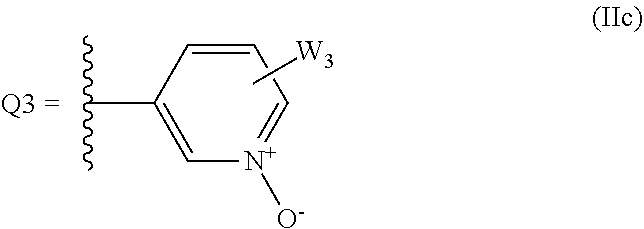
Where W3 is selected from, hydrogen, halogen, cyano, C1-C4 alkyl, C1-C4 haloalkyl, C1-C4 alkoxy or C1-C4 haloalkoxy,
Q4 is a group of formula (IId)

Where W4 is selected, hydrogen, halogen, cyano, C1-C4 alkyl, C1-C4 haloalkyl, C1-C4 alkoxy or C1-C4 haloalkoxy,
Q5 is a group of formula (IIe)

Where W5 is selected from hydrogen, halogen, cyano, C1-C4 alkyl, C1-C4 haloalkyl, C1-C4 alkoxy or C1-C4 haloalkoxy
or an agrochemically acceptable salt thereof.
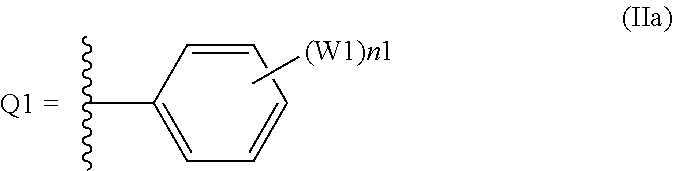
Where the substituents W1 is cyano,
And n1 is 1
Q2 is a group of formula (IIb)

Where W2 is hydrogen,
Q3 is a group of formula (IIc)

Where W3 is hydrogen,
Q4 is a group of formula (IId)

Where W4 is hydrogen
Q5 is a group of formula (IIe)
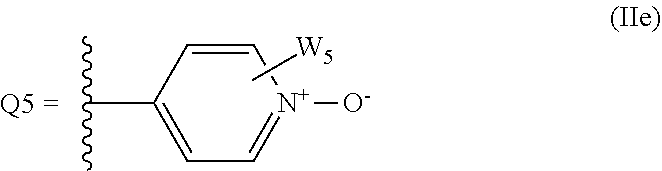
Where W5 is hydrogen.
In one preferred embodiment Q1 is a group of formula (IIa)
In one preferred embodiment Q2 is a group of formula (IIb)
In one preferred embodiment Q3 is a group of formula (IIc)
In one preferred embodiment Q4 is a group of formula (IId)
In one preferred embodiment Q5 is a group of formula (IIe)
In one preferred embodiment X1 is methoxy and X2 is hydrogen;
In one preferred embodiment X2 is cyano and X1 is hydrogen;
A further aspect of the present invention relates to compounds of formula (III)

where Y is chlorine, bromine, iodine, C1-C4 alkyl, C1-C4 haloalkyl, C1-C4 alkoxy or C1-C4 haloalkoxy.
Prefarably Y is Cl, Br, I, CH3, CF3, CHF2, OCF3, OCH3, OCHF2
The compounds of the structure (III) are useful in the synthesis of compounds according to formula (I).
The compounds in Tables A1 to A12 below illustrate the compounds of the invention.
| TABLE A | ||
| Line n° | Y | Q |
| 1 | Cl | 4-Pyridyl |
| 2 | Br | 4-Pyridyl |
| 3 | I | 4-Pyridyl |
| 4 | CH3 | 4-Pyridyl |
| 5 | Cl | 4-Pyridyl-N-oxide |
| 6 | Br | 4-Pyridyl-N-oxide |
| 7 | I | 4-Pyridyl-N-oxide |
| 8 | CH3 | 4-Pyridyl-N-oxide |
| 9 | Cl | 3-Pyridyl |
| 10 | Br | 3-Pyridyl |
| 11 | I | 3-Pyridyl |
| 12 | CH3 | 3-Pyridyl |
| 13 | Cl | 3-Pyridyl-N-oxide |
| 14 | Br | 3-Pyridyl-N-oxide |
| 15 | I | 3-Pyridyl-N-oxide |
| 16 | CH3 | 3-Pyridyl-N-oxide |
| 17 | Cl | 4-Cyanophenyl |
| 18 | Br | 4-Cyanophenyl |
| 19 | I | 4-Cyanophenyl |
| 20 | CH3 | 4-Cyanophenyl |
| 21 | Cl | Phenyl |
| 22 | Br | Phenyl |
| 23 | I | Phenyl |
| 24 | CH3 | Phenyl |
| 25 | Cl | 2-Chlorophenyl |
| 26 | Br | 2-Chlorophenyl |
| 27 | I | 2-Chlorophenyl |
| 28 | CH3 | 2-Chlorophenyl |
| 29 | Cl | 4-Nitrophenyl |
| 30 | Br | 4-Nitrophenyl |
| 31 | I | 4-Nitrophenyl |
| 32 | CH3 | 4-Nitrophenyl |
| 33 | Cl | 4-Tolyl |
| 34 | Br | 4-Tolyl |
| 35 | I | 4-Tolyl |
| 36 | CH3 | 4-Tolyl |
| 37 | Cl | 5-Chloro-2-fluorophenyl |
| 38 | Br | 5-Chloro-2-fluorophenyl |
| 39 | I | 5-Chloro-2-fluorophenyl |
| 40 | CH3 | 5-Chloro-2-fluorophenyl |
| 41 | Cl | 2-Chloro-4-nitrophenyl |
| 42 | Br | 2-Chloro-4-nitrophenyl |
| 43 | I | 2-Chloro-4-nitrophenyl |
| 44 | CH3 | 2-Chloro-4-nitrophenyl |
| 45 | Cl | 4-Trifluoromethylphenyl |
| 46 | Br | 4-Trifluoromethylphenyl |
| 47 | I | 4-Trifluoromethylphenyl |
| 48 | CH3 | 4-Trifluoromethylphenyl |
| 49 | Cl | 4-Fluoro-3-trifluoromethylphenyl |
| 50 | Br | 4-Fluoro-3-trifluoromethylphenyl |
| 51 | I | 4-Fluoro-3-trifluoromethylphenyl |
| 52 | CH3 | 4-Fluoro-3-trifluoromethylphenyl |
| 53 | Cl | 2-Trifluoromethoxyphenyl |
| 54 | Br | 2-Trifluoromethoxyphenyl |
| 55 | I | 2-Trifluoromethoxyphenyl |
| 56 | CH3 | 2-Trifluoromethoxyphenyl |
| 57 | Cl | 2-Methoxyphenyl |
| 58 | Br | 2-Methoxyphenyl |
| 59 | I | 2-Methoxyphenyl |
| 60 | CH3 | 2-Methoxyphenyl |
| 61 | Cl | 4-Fluorophenyl |
| 62 | Br | 4-Fluorophenyl |
| 63 | I | 4-Fluorophenyl |
| 64 | CH3 | 4-Fluorophenyl |
| 65 | Cl | 2-Fluorophenyl |
| 66 | Br | 2-Fluorophenyl |
| 67 | I | 2-Fluorophenyl |
| 68 | CH3 | 2-Fluorophenyl |
| 69 | Cl | 2-Trifluoromethylphenyl |
| 70 | Br | 2-Trifluoromethylphenyl |
| 71 | I | 2-Trifluoromethylphenyl |
| 72 | CH3 | 2-Trifluoromethylphenyl |
| 73 | Cl | 2-Tolyl |
| 74 | Br | 2-Tolyl |
| 75 | I | 2-Tolyl |
| 76 | CH3 | 2-Tolyl |
| 77 | Cl | 2-Chloro-4-fluorophenyl |
| 78 | Br | 2-Chloro-4-fluorophenyl |
| 79 | I | 2-Chloro-4-fluorophenyl |
| 80 | CH3 | 2-Chloro-4-fluorophenyl |
| 81 | Cl | 2,3-Difluorophenyl |
| 82 | Br | 2,3-Difluorophenyl |
| 83 | I | 2,3-Difluorophenyl |
| 84 | CH3 | 2,3-Difluorophenyl |
| 85 | Cl | 2,4-Difluorophenyl |
| 86 | Br | 2,4-Difluorophenyl |
| 87 | I | 2,4-Difluorophenyl |
| 88 | CH3 | 2,4-Difluorophenyl |
| 89 | Cl | 2-Fluoro-4-trifluoromethylphenyl |
| 90 | Br | 2-Fluoro-4-trifluoromethylphenyl |
| 91 | I | 2-Fluoro-4-trifluoromethylphenyl |
| 92 | CH3 | 2-Fluoro-4-trifluoromethylphenyl |
| 93 | Cl | 4-Fluoro-2-methylphenyl |
| 94 | Br | 4-Fluoro-2-methylphenyl |
| 95 | I | 4-Fluoro-2-methylphenyl |
| 96 | CH3 | 4-Fluoro-2-methylphenyl |
| 97 | Cl | 4-Trifluoromethoxyphenyl |
| 98 | Br | 4-Trifluoromethoxyphenyl |
| 99 | I | 4-Trifluoromethoxyphenyl |
| 100 | CH3 | 4-Trifluoromethoxyphenyl |
| 101 | Cl | 4-Fluoro-2-trifluoromethylphenyl |
Table A1 describes compounds (A1.1 to A1.112) of the structure (I), where Y and Q have the values indicated in table A (line 1 to 112) and X1 is hydrogen, X2 is hydrogen and R is hydrogen.
Table A2 describes compounds (A2.1 to A2.112) of the structure (I), where Y and Q have the values indicated in table A (line 1 to 112) and X1 is hydrogen, X2 is hydrogen and R is methyl.
Table A3 describes compounds (A3.1 to A3.112) of the structure (I), where Y and Q have the values indicated in table A (line 1 to 112) and X1 is hydrogen, X2 is hydrogen and R is ethyl.
Table A4 describes compounds (A4.1 to A4.112) of the structure (I), where Y and Q have the values indicated in table A (line 1 to 112) and X1 is fluorine, X2 is hydrogen and R is hydrogen.
Table A5 describes compounds (A5.1 to A5.112) of the structure (I), where Y and Q have the values indicated in table A (line 1 to 112) and X1 is fluorine, X2 is hydrogen and R is methyl.
Table A6 describes compounds (A6.1 to A6.112) of the structure (I), where Y and Q have the values indicated in table A (line 1 to 112) and X1 is fluorine, X2 is hydrogen and R is ethyl.
Table A7 describes compounds (A7.1 to A7.112) of the structure (I), where Y and Q have the values indicated in table A (line 1 to 112) and X1 is methoxy, X2 is hydrogen and R is hydrogen.
Table A8 describes compounds (A8.1 to A8.112) of the structure (I), where Y and Q have the values indicated in table A (line 1 to 112) and X1 is methoxy, X2 is hydrogen and R is methyl.
Table A9 describes compounds (A9.1 to A9.112) of the structure (I), where Y and Q have the values indicated in table A (line 1 to 112) and X1 is methoxy, X2 is hydrogen and R is ethyl.
Table A10 describes compounds (A10.1 to A10.112) of the structure (I), where Y and Q have the values indicated in table A (line 1 to 112) and X1 is hydrogen, X2 is cyano and R is hydrogen.
Table A11 describes compounds (A11.1 to A11.112) of the structure (I), where Y and Q have the values indicated in table A (line 1 to 112) and X1 is hydrogen, X2 is cyano and R is methyl.
Table A12 describes compounds (A12.1 to A12.112) of the structure (I), where Y and Q have the values indicated in table A (line 1 to 112) and X1 is hydrogen, X2 is cyano and R is ethyl.
Structures of formula (III)

| Table X of acetanilides of |
| the structure (III) |
| Line n° | Y | ||
| 1 | Cl | ||
| 2 | Br | ||
| 3 | I | ||
| 4 | CH3 | ||
| 5 | CF3 | ||
| 6 | CHF2 | ||
| 7 | OCF3 | ||
| 8 | OCH3 | ||
| 9 | OCHF2 | ||

2) Acid halides of formula (V), wherein R2 is Cl, F or Br, may be made from carboxylic acids of formula (V), wherein R2 is OH by treatment with thionyl chloride or oxalyl chloride or by treatment with phosphoryl bromide or with cyanuryl fluoride.
3) Carboxylic acids of formula (V), wherein R2 is OH, may be formed from esters of formula (V), wherein R2 is C1-C6alkoxy by treatment of the ester with an alkali hydroxide, such as sodium hydroxide, in a solvent, such as ethanol.
4) Esters of formula (V), wherein R2 is C1-C6alkoxy, may be made by treatment of R2a—OH wherein R2a is C1-C6alkyl, by acylation with a carboxylic acid of formula Q-COOH or an acid halide of formula Q-COHal, wherein Hal is Cl, F or Br, under standard conditions as described in 1).
5) Compounds of formula (IV) with R different from hydrogen, wherein X1, X2 and Y are as defined for formula (I) can be made by formation of the N—R bond. For example, reductive amination may be achieved by treatment of the aniline (IVa) with an aldehyde or ketone and a reducing agent such as sodium cyanoborohydride. Alternatively, alkylation may be achieved by treating the amine (IVa) with an alkylating agent such as an alkyl halide, optionally in the presence of a base.

6) Compounds of formula (IVa), wherein X1, X2 and Y are as defined for formula (I), can be made from compounds of formula (VI) by reduction of the —NO2 function under a variety of conditions generally well known, for example reduction using hydrogen and a metal- or metal oxide-based catalyst, like palladium, in a compatible solvent. The reaction can be performed in a broad range of temperatures, preferably between −30° C. and 150° C., most preferably 10° C. to 50° C., and pressures, preferably between atmospheric pressure and 200 atm, most preferably below 10 atm. A further method for the reduction of an aromatic nitro group to amino group uses SnCl2 in a protic solvent, in presence of an acid. A further method uses a metal, like iron, as reducing agent and an acid like HCl, acetic acid or NH4Cl.

7) Compounds of formula (VI), wherein X1 is OMe and X2 and Y are as defined for formula (I), may be made by substitution of the fluorine atom of the compounds of formula (VI), wherein X1 is F and X2 and Y are as defined for formula (I) by, for example, treating it in methyl alcohol, preferably in presence of a base, like potassium carbonate.


12) Compounds of formula (I) may be also be made by treatment of compounds of formula (XIV), wherein Q, X1, X2 and R are as defined for formula (I) and R4 is OH, Cl, F, Br or I with a compound of formula (VII), wherein Y is as defined for formula (I). When R4 is OH, such reactions may be carried out in the presence of a coupling reagent, such as DCC (N,N′-dicyclohexylcarbodiimide), EDC (1-ethyl-3-[3-dimethylamino-propyl]carbodiimide hydrochloride) or BOP-Cl (bis(2-oxo-3-oxazolidinyl)phosphonic chloride), in the presence of a base, such as pyridine, triethylamine, 4-(dimethylamino)pyridine or diisopropylethylamine, and optionally in the presence of a nucleophilic catalyst, such as hydroxybenzotriazole. When R4 is Cl, such reactions may be carried out under basic conditions, for example in the presence of pyridine, triethylamine, 4-(dimethylamino)pyridine or diisopropylethylamine, and optionally in the presence of a nucleophilic catalyst, or under non-basic conditions.

13) Alternatively, compounds of formula (I) may be also be made by treatment of compounds of formula (XIV), wherein Q, X1, X2 and R are as defined for formula (I) and R4 is Cl, F, Br or I, with a compound of formula (III), wherein Y is as defined for formula (I). Such reactions may be carried out under basic conditions, for example in the presence of pyridine, triethylamine, 4-(dimethylamino)pyridine or diisopropylethylamine, and optionally in the presence of a nucleophilic catalyst. The imide intermediate may or may not be isolated and may conveniently be hydrolysed under mild alkaline conditions during work-up.

14) Compounds of formula (III), wherein Y is as defined for formula (I), can be prepared from compounds of formula (VII), wherein Y is as defined for formula (I), by treatment with an activated form of acetic acid, like acetic anhydride or acetyl chloride.

15) Compounds of formula (XIV) may be made by treatment of compounds of formula (XVI), wherein X1, X2 and R are as defined for formula (I) and R5 is C1-C6 alkoxy, with a compound of formula (V), wherein Q is as defined for formula (I) and R2 is OH, C1-C6alkoxy, Cl, F, Br or I. When R2 is OH, such reactions may be carried out in the presence of a coupling reagent, such as DCC (N,N′-dicyclohexylcarbodiimide), EDC (1-ethyl-3-[3-dimethylamino-propyl]carbodiimide hydrochloride) or BOP-Cl (bis(2-oxo-3-oxazolidinyl)phosphonic chloride), in the presence of a base, such as pyridine, triethylamine, 4-(dimethylamino)pyridine or diisopropylethylamine, and optionally in the presence of a nucleophilic catalyst, such as hydroxybenzotriazole. When R2 is Cl, such reactions may be carried out under basic conditions, for example in the presence of pyridine, triethylamine, 4-(dimethylamino)pyridine or diisopropylethylamine, and optionally in the presence of a nucleophilic catalyst. Alternatively, the reaction may be conducted in a biphasic system comprising an organic solvent, preferably ethyl acetate, and an aqueous solvent, preferably a solution of sodium bicarbonate. When R2 is C1-C6 alkoxy the ester may be converted directly to the amide by heating the ester and amine together in a thermal process. In compounds of formula (XIV), the group R4 can be changed from C1-C6 alkoxy to OH by hydrolysis of the ester function with a base, like LiOH, then eventually, to chloride, with thionyl chloride or oxalyl chloride.

16) Compounds of formula (XVI) wherein X1, X2 and R are as defined for formula (I) and R5 is C1-C6 alkoxy may be made by reducing the nitro function of compounds of formula (XVII) wherein X1 and X2 are as defined for formula (I) and R5 is C1-C6 alkoxy, and submitting the aniline to reductive amination for compounds of the formula (XVI) with R different from hydrogen. Compounds of formula (XVII) are known or can be made by analogy by somebody skilled in the art.
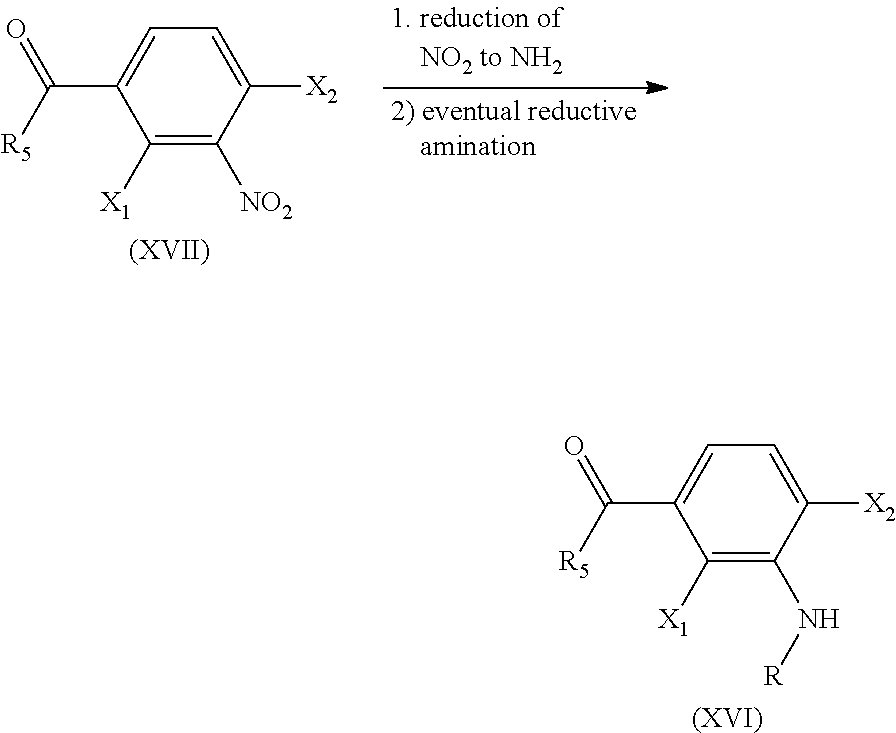
17) Compounds of formula (I), wherein X1, X2, Y and R are as defined for formula (I) and where Q is Q3 or Q5 may also be obtained by treatment of compounds of formula (I), wherein X1, X2, Y and R are as defined for formula (I) with Q is Q2 or Q4, respectively, by treatment with an oxidizing agent, like a peroxyacid, m-chloroperbenzoic acid, for example.

The compounds according to the invention, namely the compounds of formula (I) and (III), and the compounds mentioned in the method according to the invention may exist in different geometric or optical isomers or tautomeric forms.
This invention covers all such isomers and tautomers and mixtures thereof in all proportions as well as isotopic forms such as deuterated compounds.
The invention also covers salts of all compounds of the invention.
from the order Anoplura, for example,
Haematopinus spp., Linognathus spp., Pediculus spp., Pemphigus spp., and Phylloxera spp.;
from the order Coleoptera, for example,
Agriotes spp., Amphimallon majale, Anomala orientalis, Anthonomus spp., Aphodius spp., Astylus atromaculatus, Ataenius spp., Atomaria linearis, Chaetocnema tibialis, Cerotoma spp., Conoderus spp., Cosmopolites spp., Cotinis nitida, Curculio spp., Cyclocephala spp., Dermestes spp., Diabrotica spp., Diloboderus abderus, Epilachna spp., Eremnus spp., Heteronychus arator, Hypothenemus hampei, Lagria vilosa, Leptinotarsa decemLineata, Lissorhoptrus spp., Liogenys spp., Maecolaspis spp., Maladera castanea, Megascelis spp., Melighetes aeneus, Melolontha spp., Myochrous armatus, Orycaephilus spp., Otiorhynchus spp., Phyllophaga spp., Phlyctinus spp., Popillia spp., Psylliodes spp., Rhyssomatus aubtilis, Rhizopertha spp., Scarabeidae, Sitophilus spp., Sitotroga spp., Somaticus spp., Sphenophorus spp., Sternechus subsignatus, Tenebrio spp., Tribolium spp., and Trogoderma spp.;
from the order Diptera, for example,
Aedes spp., Anopheles spp., Antherigona soccata, Bactrocea oleae, Bibio hortulanus, Bradysia spp., Calliphora erythrocephala, Ceratitis spp., Chrysomyia spp., Culex spp., Cuterebra spp., Dacus spp., Delia spp., Drosophila melanogaster, Fannia spp., Gastrophilus spp., Geomyza tripunctata, Glossina spp., Hypoderma spp., Hyppobosca spp., Liriomyza spp., Lucilia spp., Melanagromyza spp., Musca spp., Oestrus spp., Orseolia spp., Oscinella frit, Pegomyia hyoscyami, Phorbia spp., Rhagoletis spp., Rivelia quadrifasciata, Scatella spp., Sciara spp., Stomoxys spp., Tabanus spp., Tannia spp., and Tipula spp.;
from the order Hemiptera, for example,
Acanthocoris scabrator, Acrosternum spp., Adelphocoris lineolatus, Amblypelta nitida, Bathycoelia thalassina, Blissus spp., Cimex spp., Clavigralla tomentosicollis, Creontiades spp., Distantiella theobroma, Dichelops furcatus, Dysdercus spp., Edessa spp., Euchistus spp., Eurydema pulchrum, Eurygaster spp., Halyomorpha halys, Horcias nobilellus, Leptocorisa spp., Lygus spp., Margarodes spp., Murgantia histrionic, Neomegalotomus spp., Nesidiocoris tenuis, Nezara spp., Nysius simulans, Oebalus insularis, Piesma spp., Piezodorus spp., Rhodnius spp., Sahlbergella singularis, Scaptocoris castanea, Scotinophara spp., Thyanta spp., Triatoma spp., Vatiga illudens;
Acyrthosium pisum, Adalges spp., Agalliana ensigera, Agonoscena targionii, Aleurodicus spp., Aleurocanthus spp., Aleurolobus barodensis, Aleurothrixus floccosus, Aleyrodes brassicae, Amarasca biguttula, Amritodus atkinsoni, Aonidiella spp., Aphididae, Aphis spp., Aspidiotus spp., Aulacorthum solani, Bactericera cockerelli, Bemisia spp., Brachycaudus spp., Brevicoryne brassicae, Cacopsylla spp., Cavariella aegopodii Scop., Ceroplaster spp., Chrysomphalus aonidium, Chrysomphalus dictyospermi, Cicadella spp., Cofana spectra, Cryptomyzus spp., Cicadulina spp., Coccus hesperidum, Dalbulus maidis, Dialeurodes spp., Diaphorina citri, Diuraphis noxia, Dysaphis spp., Empoasca spp., Eriosoma larigerum, Erythroneura spp., Gascardia spp., Glycaspis brimblecombei, Hyadaphis pseudobrassicae, Hyalopterus spp., Hyperomyzus pallidus, Idioscopus clypealis, Jacobiasca lybica, Laodelphax spp., Lecanium corni, Lepidosaphes spp., Lopaphis erysimi, Lyogenys maidis, Macrosiphum spp., Mahanarva spp., Metcalfa pruinosa, Metopolophium dirhodum, Myndus crudus, Myzus spp., Neotoxoptera spp., Nephotettix spp., Nilaparvata spp., Nippolachnus piri Mats, Odonaspis ruthae, Oregma lanigera Zehnter, Parabemisia myricae, Paratrioza cockerelli, Parlatoria spp., Pemphigus spp., Peregrinus maidis, Perkinsiella spp., Phorodon humuli, Phylloxera spp., Planococcus spp., Pseudaulacaspis spp., Pseudococcus spp., Pseudatomoscelis seriatus, Psylla spp., Pulvinaria aethiopica, Quadraspidiotus spp., Quesada gigas, Recilia dorsalis, Rhopalosiphum spp., Saissetia spp., Scaphoideus spp., Schizaphis spp., Sitobion spp., Sogatella furcifera, Spissistilus festinus, Tarophagus Proserpina, Toxoptera spp., Trialeurodes spp., Tridiscus sporoboli, Trionymus spp., Trioza erytreae, Unaspis citri, Zygina flammigera, Zyginidia scutellaris;
from the order Hymenoptera, for example,
Acromyrmex, Arge spp., Atta spp., Cephus spp., Diprion spp., Diprionidae, Gilpinia polytoma, Hoplocampa spp., Lasius spp., Monomorium pharaonis, Neodiprion spp., Pogonomyrmex spp., Slenopsis invicta, Solenopsis spp., and Vespa spp.;
from the order Isoptera, for example,
Coptotermes spp., Corniternes cumulans, Incisitermes spp., Macrotermes spp., Mastotermes spp., Microtermes spp., Reticulitermes spp.; Solenopsis geminate
from the order Lepidoptera, for example,
Acleris spp., Adoxophyes spp., Aegeria spp., Agrotis spp., Alabama argillaceae, Amylois spp., Anticarsia gemmatalis, Archips spp., Argyresthia spp., Argyrotaenia spp., Autographa spp., Bucculatrix thurberiella, Busseola fusca, Cadra cautella, Carposina nipponensis, Chilo spp., Choristoneura spp., Chrysoteuchia topiaria, Clysia ambiguella, Cnaphalocrocis spp., Cnephasia spp., Cochylis spp., Coleophora spp., Colias lesbia, Cosmophilaflava, Crambus spp., Crocidolomia binotalis, Cryptophlebia leucotreta, Cydalima perspectalis, Cydia spp., Diaphania perspectalis, Diatraea spp., Diparopsis castanea, Earias spp., Eldana saccharina, Ephestia spp., Epinotia spp., Estigmene acrea, Etiella zinckinella, Eucosma spp., Eupoecilia ambiguella, Euproctis spp., Euxoa spp., Feltia jaculiferia, Grapholita spp., Hedya nubiferana, Heliothis spp., Hellula undalis, Herpetogramma spp., Hyphantria cunea, Keiferia lycopersicella, Lasmopalpus lignosellus, Leucoptera scitella, Lithocollethis spp., Lobesia botrana, Loxostege bifidalis, Lymantria spp., Lyonetia spp., Malacosoma spp., Mamestra brassicae, Manduca sexta, Mythimna spp., Noctua spp., Operophtera spp., Orniodes indica, Ostrinia nubilalis, Pammene spp., Pandemis spp., Panolis flammea, Papaipema nebris, Pectinophora gossypiela, Perileucoptera coffeella, Pseudaletia unipuncta, Phthorimaea operculella, Pieris rapae, Pieris spp., Plutella xylostella, Prays spp., Pseudoplusia spp., Rachiplusia nu, Richia albicosta, Scirpophaga spp., Sesamia spp., Sparganothis spp., Spodoptera spp., Sylepta derogate, Synanthedon spp., Thaumetopoea spp., Tortrix spp., Trichoplusia ni, Tuta absoluta, and Yponomeuta spp.;
from the order Mallophaga, for example,
Damalinea spp., and Trichodectes spp.;
from the order Orthoptera, for example,
Blatta spp., Blattella spp., Gryllotalpa spp., Leucophaea maderae, Locusta spp., Neocurtilla hexadactyla, Periplaneta spp., Scapteriscus spp., and Schistocerca spp.;
from the order Psocoptera, for example,
Liposcelis spp.;
from the order Siphonaptera, for example,
Ceratophyllus spp., Ctenocephalides spp., and Xenopsylla cheopis;
from the order Thysanoptera, for example,
Calliothrips phaseoli, Frankliniella spp., Heliothrips spp., Hercinothrips spp., Parthenothrips spp., Scirtothrips aurantii, Sericothrips variabilis, Taeniothrips spp., Thrips spp.;
from the order Thysanura, for example,
Lepisma saccharina.
The active ingredients according to the invention can be used for controlling, i. e. containing or destroying, pests of the abovementioned type which occur in particular on plants, especially on useful plants and ornamentals in agriculture, in horticulture and in forests, or on organs, such as fruits, flowers, foliage, stalks, tubers or roots, of such plants, and in some cases even plant organs which are formed at a later point in time remain protected against these pests.
Suitable target crops are, in particular, cereals, such as wheat, barley, rye, oats, rice, maize or sorghum; beet, such as sugar or fodder beet; fruit, for example pomaceous fruit, stone fruit or soft fruit, such as apples, pears, plums, peaches, almonds, cherries or berries, for example strawberries, raspberries or blackberries; leguminous crops, such as beans, lentils, peas or soya; oil crops, such as oilseed rape, mustard, poppies, olives, sunflowers, coconut, castor, cocoa or ground nuts; cucurbits, such as pumpkins, cucumbers or melons; fibre plants, such as cotton, flax, hemp or jute; citrus fruit, such as oranges, lemons, grapefruit or tangerines; vegetables, such as spinach, lettuce, asparagus, cabbages, carrots, onions, tomatoes, potatoes or bell peppers; Lauraceae, such as avocado, Cinnamonium or camphor; and also tobacco, nuts, coffee, eggplants, sugarcane, tea, pepper, grapevines, hops, the plantain family, latex plants and ornamentals.
2. Bt176 Maize from Syngenta Seeds SAS, Chemin de l'Hobit 27, F-31 790 St. Sauveur, France, registration number C/FR/96/05/10. Genetically modified Zea mays which has been rendered resistant to attack by the European corn borer (Ostrinia nubilalis and Sesamia nonagrioides) by transgenic expression of a Cry1Ab toxin. Bt176 maize also transgenically expresses the enzyme PAT to achieve tolerance to the herbicide glufosinate ammonium.
3. MIR604 Maize from Syngenta Seeds SAS, Chemin de l'Hobit 27, F-31 790 St. Sauveur, France, registration number C/FR/96/05/10. Maize which has been rendered insect-resistant by transgenic expression of a modified Cry3A toxin. This toxin is Cry3A055 modified by insertion of a cathepsin-G-protease recognition sequence. The preparation of such transgenic maize plants is described in WO 03/018810.
4. MON 863 Maize from Monsanto Europe S.A. 270-272 Avenue de Tervuren, B-1150 Brussels, Belgium, registration number C/DE/02/9. MON 863 expresses a Cry3Bb1 toxin and has resistance to certain Coleoptera insects.
5. IPC 531 Cotton from Monsanto Europe S.A. 270-272 Avenue de Tervuren, B-1150 Brussels, Belgium, registration number C/ES/96/02.
6. 1507 Maize from Pioneer Overseas Corporation, Avenue Tedesco, 7 B-1160 Brussels, Belgium, registration number C/NL/00/10. Genetically modified maize for the expression of the protein Cry1F for achieving resistance to certain Lepidoptera insects and of the PAT protein for achieving tolerance to the herbicide glufosinate ammonium.
7. NK603×MON 810 Maize from Monsanto Europe S.A. 270-272 Avenue de Tervuren, B-1150 Brussels, Belgium, registration number C/GB/02/M3/03. Consists of conventionally bred hybrid maize varieties by crossing the genetically modified varieties NK603 and MON 810. NK603×MON 810 Maize transgenically expresses the protein CP4 EPSPS, obtained from Agrobacterium spp. strain CP4, which imparts tolerance to the herbicide Roundup® (contains glyphosate), and also a Cry1Ab toxin obtained from Bacillus thuringiensis subsp. kurstaki which brings about tolerance to certain Lepidoptera, include the European corn borer.
The activity of the compositions according to the invention can be broadened considerably, and adapted to prevailing circumstances, by adding other insecticidally, acaricidally and/or fungicidally active ingredients. The mixtures of the compounds of formula I with other insecticidally, acaricidally and/or fungicidally active ingredients may also have further surprising advantages which can also be described, in a wider sense, as synergistic activity. For example, better tolerance by plants, reduced phytotoxicity, insects can be controlled in their different development stages or better behaviour during their production, for example during grinding or mixing, during their storage or during their use.
Suitable additions to active ingredients here are, for example, representatives of the following classes of active ingredients: organophosphorus compounds, nitrophenol derivatives, thioureas, juvenile hormones, formamidines, benzophenone derivatives, ureas, pyrrole derivatives, carbamates, pyrethroids, chlorinated hydrocarbons, acylureas, pyridyl-methyleneamino derivatives, macrolides, neonicotinoids and Bacillus thuringiensis preparations.
The following mixtures of the compounds of formula I with active ingredients are preferred (the abbreviation “TX” means “one specific the compound of the formula (I) or one specific compound selected from the Table A1 to A12 and Table B:
an adjuvant selected from the group of substances consisting of petroleum oils (alternative name) (628)+TX,
an acaricide selected from the group of substances consisting of 1,1-bis(4-chlorophenyl)-2-ethoxyethanol (IUPAC name) (910)+TX, 2,4-dichlorophenyl benzenesulfonate (IUPAC/Chemical Abstracts name) (1059)+TX, 2-fluoro-N-methyl-N-1-naphthylacetamide (IUPAC name) (1295)+TX, 4-chlorophenyl phenyl sulfone (IUPAC name) (981)+TX, abamectin (1)+TX, acequinocyl (3)+TX, acetoprole [CCN]+TX, acrinathrin (9)+TX, aldicarb (16)+TX, aldoxycarb (863)+TX, alpha-cypermethrin (202)+TX, amidithion (870)+TX, amidoflumet [CCN]+TX, amidothioate (872)+TX, amiton (875)+TX, amiton hydrogen oxalate (875)+TX, amitraz (24)+TX, aramite (881)+TX, arsenous oxide (882)+TX, AVI 382 (compound code)+TX, AZ 60541 (compound code)+TX, azinphos-ethyl (44)+TX, azinphos-methyl (45)+TX, azobenzene (IUPAC name) (888)+TX, azocyclotin (46)+TX, azothoate (889)+TX, benomyl (62)+TX, benoxafos (alternative name) [CCN]+TX, benzoximate (71)+TX, benzyl benzoate (IUPAC name) [CCN]+TX, bifenazate (74)+TX, bifenthrin (76)+TX, binapacryl (907)+TX, brofenvalerate (alternative name)+TX, bromocyclen (918)+TX, bromophos (920)+TX, bromophos-ethyl (921)+TX, bromopropylate (94)+TX, buprofezin (99)+TX, butocarboxim (103)+TX, butoxycarboxim (104)+TX, butylpyridaben (alternative name)+TX, calcium polysulfide (IUPAC name) (111)+TX, camphechlor (941)+TX, carbanolate (943)+TX, carbaryl (115)+TX, carbofuran (118)+TX, carbophenothion (947)+TX, CGA 50′439 (development code) (125)+TX, chinomethionat (126)+TX, chlorbenside (959)+TX, chlordimeform (964)+TX, chlordimeform hydrochloride (964)+TX, chlorfenapyr (130)+TX, chlorfenethol (968)+TX, chlorfenson (970)+TX, chlorfensulphide (971)+TX, chlorfenvinphos (131)+TX, chlorobenzilate (975)+TX, chloromebuform (977)+TX, chloromethiuron (978)+TX, chloropropylate (983)+TX, chlorpyrifos (145)+TX, chlorpyrifos-methyl (146)+TX, chlorthiophos (994)+TX, cinerin I (696)+TX, cinerin II (696)+TX, cinerins (696)+TX, clofentezine (158)+TX, closantel (alternative name) [CCN]+TX, coumaphos (174)+TX, crotamiton (alternative name) [CCN]+TX, crotoxyphos (1010)+TX, cufraneb (1013)+TX, cyanthoate (1020)+TX, cyflumetofen (CAS Reg. No.: 400882-07-7)+TX, cyhalothrin (196)+TX, cyhexatin (199)+TX, cypermethrin (201)+TX, DCPM (1032)+TX, DDT (219)+TX, demephion (1037)+TX, demephion-O (1037)+TX, demephion-S (1037)+TX, demeton (1038)+TX, demeton-methyl (224)+TX, demeton-O (1038)+TX, demeton-O-methyl (224)+TX, demeton-S (1038)+TX, demeton-S-methyl (224)+TX, demeton-S-methylsulphon (1039)+TX, diafenthiuron (226)+TX, dialifos (1042)+TX, diazinon (227)+TX, dichlofluanid (230)+TX, dichlorvos (236)+TX, dicliphos (alternative name)+TX, dicofol (242)+TX, dicrotophos (243)+TX, dienochlor (1071)+TX, dimefox (1081)+TX, dimethoate (262)+TX, dinactin (alternative name) (653)+TX, dinex (1089)+TX, dinex-diclexine (1089)+TX, dinobuton (269)+TX, dinocap (270)+TX, dinocap-4 [CCN]+TX, dinocap-6 [CCN]+TX, dinocton (1090)+TX, dinopenton (1092)+TX, dinosulfon (1097)+TX, dinoterbon (1098)+TX, dioxathion (1102)+TX, diphenyl sulfone (IUPAC name) (1103)+TX, disulfiram (alternative name) [CCN]+TX, disulfoton (278)+TX, DNOC (282)+TX, dofenapyn (1113)+TX, doramectin (alternative name) [CCN]+TX, endosulfan (294)+TX, endothion (1121)+TX, EPN (297)+TX, eprinomectin (alternative name) [CCN]+TX, ethion (309)+TX, ethoate-methyl (1134)+TX, etoxazole (320)+TX, etrimfos (1142)+TX, fenazaflor (1147)+TX, fenazaquin (328)+TX, fenbutatin oxide (330)+TX, fenothiocarb (337)+TX, fenpropathrin (342)+TX, fenpyrad (alternative name)+TX, fenpyroximate (345)+TX, fenson (1157)+TX, fentrifanil (1161)+TX, fenvalerate (349)+TX, fipronil (354)+TX, fluacrypyrim (360)+TX, fluazuron (1166)+TX, flubenzimine (1167)+TX, flucycloxuron (366)+TX, flucythrinate (367)+TX, fluenetil (1169)+TX, flufenoxuron (370)+TX, flumethrin (372)+TX, fluorbenside (1174)+TX, fluvalinate (1184)+TX, FMC 1137 (development code) (1185)+TX, formetanate (405)+TX, formetanate hydrochloride (405)+TX, formothion (1192)+TX, formparanate (1193)+TX, gamma-HCH (430)+TX, glyodin (1205)+TX, halfenprox (424)+TX, heptenophos (432)+TX, hexadecyl cyclopropanecarboxylate (IUPAC/Chemical Abstracts name) (1216)+TX, hexythiazox (441)+TX, iodomethane (IUPAC name) (542)+TX, isocarbophos (alternative name) (473)+TX, isopropyl O-(methoxyaminothiophosphoryl)salicylate (IUPAC name) (473)+TX, ivermectin (alternative name) [CCN]+TX, jasmolin I (696)+TX, jasmolin II (696)+TX, jodfenphos (1248)+TX, lindane (430)+TX, lufenuron (490)+TX, malathion (492)+TX, malonoben (1254)+TX, mecarbam (502)+TX, mephosfolan (1261)+TX, mesulfen (alternative name) [CCN]+TX, methacrifos (1266)+TX, methamidophos (527)+TX, methidathion (529)+TX, methiocarb (530)+TX, methomyl (531)+TX, methyl bromide (537)+TX, metolcarb (550)+TX, mevinphos (556)+TX, mexacarbate (1290)+TX, milbemectin (557)+TX, milbemycin oxime (alternative name) [CCN]+TX, mipafox (1293)+TX, monocrotophos (561)+TX, morphothion (1300)+TX, moxidectin (alternative name) [CCN]+TX, naled (567)+TX, NC-184 (compound code)+TX, NC-512 (compound code)+TX, nifluridide (1309)+TX, nikkomycins (alternative name) [CCN]+TX, nitrilacarb (1313)+TX, nitrilacarb 1:1 zinc chloride complex (1313)+TX, NNI-0101 (compound code)+TX, NNI-0250 (compound code)+TX, omethoate (594)+TX, oxamyl (602)+TX, oxydeprofos (1324)+TX, oxydisulfoton (1325)+TX, pp′-DDT (219)+TX, parathion (615)+TX, permethrin (626)+TX, petroleum oils (alternative name) (628)+TX, phenkapton (1330)+TX, phenthoate (631)+TX, phorate (636)+TX, phosalone (637)+TX, phosfolan (1338)+TX, phosmet (638)+TX, phosphamidon (639)+TX, phoxim (642)+TX, pirimiphos-methyl (652)+TX, polychloroterpenes (traditional name) (1347)+TX, polynactins (alternative name) (653)+TX, proclonol (1350)+TX, profenofos (662)+TX, promacyl (1354)+TX, propargite (671)+TX, propetamphos (673)+TX, propoxur (678)+TX, prothidathion (1360)+TX, prothoate (1362)+TX, pyrethrin I (696)+TX, pyrethrin II (696)+TX, pyrethrins (696)+TX, pyridaben (699)+TX, pyridaphenthion (701)+TX, pyrimidifen (706)+TX, pyrimitate (1370)+TX, quinalphos (711)+TX, quintiofos (1381)+TX, R-1492 (development code) (1382)+TX, RA-17 (development code) (1383)+TX, rotenone (722)+TX, schradan (1389)+TX, sebufos (alternative name)+TX, selamectin (alternative name) [CCN]+TX, SI-0009 (compound code)+TX, sophamide (1402)+TX, spirodiclofen (738)+TX, spiromesifen (739)+TX, SSI-121 (development code) (1404)+TX, sulfiram (alternative name) [CCN]+TX, sulfluramid (750)+TX, sulfotep (753)+TX, sulphur (754)+TX, SZI-121 (development code) (757)+TX, tau-fluvalinate (398)+TX, tebufenpyrad (763)+TX, TEPP (1417)+TX, terbam (alternative name)+TX, tetrachlorvinphos (777)+TX, tetradifon (786)+TX, tetranactin (alternative name) (653)+TX, tetrasul (1425)+TX, thiafenox (alternative name)+TX, thiocarboxime (1431)+TX, thiofanox (800)+TX, thiometon (801)+TX, thioquinox (1436)+TX, thuringiensin (alternative name) [CCN]+TX, triamiphos (1441)+TX, triarathene (1443)+TX, triazophos (820)+TX, triazuron (alternative name)+TX, trichlorfon (824)+TX, trifenofos (1455)+TX, trinactin (alternative name) (653)+TX, vamidothion (847)+TX, vaniliprole [CCN] and YI-5302 (compound code)+TX,
an algicide selected from the group of substances consisting of bethoxazin [CCN]+TX, copper dioctanoate (IUPAC name) (170)+TX, copper sulfate (172)+TX, cybutryne [CCN]+TX, dichlone (1052)+TX, dichlorophen (232)+TX, endothal (295)+TX, fentin (347)+TX, hydrated lime [CCN]+TX, nabam (566)+TX, quinoclamine (714)+TX, quinonamid (1379)+TX, simazine (730)+TX, triphenyltin acetate (IUPAC name) (347) and triphenyltin hydroxide (IUPAC name) (347)+TX,
an anthelmintic selected from the group of substances consisting of abamectin (1)+TX, crufomate (1011)+TX, doramectin (alternative name) [CCN]+TX, emamectin (291)+TX, emamectin benzoate (291)+TX, eprinomectin (alternative name) [CCN]+TX, ivermectin (alternative name) [CCN]+TX, milbemycin oxime (alternative name) [CCN]+TX, moxidectin (alternative name) [CCN]+TX, piperazine [CCN]+TX, selamectin (alternative name) [CCN]+TX, spinosad (737) and thiophanate (1435)+TX,
an avicide selected from the group of substances consisting of chloralose (127)+TX, endrin (1122)+TX, fenthion (346)+TX, pyridin-4-amine (IUPAC name) (23) and strychnine (745)+TX,
a bactericide selected from the group of substances consisting of 1-hydroxy-1H-pyridine-2-thione (IUPAC name) (1222)+TX, 4-(quinoxalin-2-ylamino)benzenesulfonamide (IUPAC name) (748)+TX, 8-hydroxyquinoline sulfate (446)+TX, bronopol (97)+TX, copper dioctanoate (IUPAC name) (170)+TX, copper hydroxide (IUPAC name) (169)+TX, cresol [CCN]+TX, dichlorophen (232)+TX, dipyrithione (1105)+TX, dodicin (1112)+TX, fenaminosulf (1144)+TX, formaldehyde (404)+TX, hydrargaphen (alternative name) [CCN]+TX, kasugamycin (483)+TX, kasugamycin hydrochloride hydrate (483)+TX, nickel bis(dimethyldithiocarbamate) (IUPAC name) (1308)+TX, nitrapyrin (580)+TX, octhilinone (590)+TX, oxolinic acid (606)+TX, oxytetracycline (611)+TX, potassium hydroxyquinoline sulfate (446)+TX, probenazole (658)+TX, streptomycin (744)+TX, streptomycin sesquisulfate (744)+TX, tecloftalam (766)+TX, and thiomersal (alternative name) [CCN]+TX,
a biological agent selected from the group of substances consisting of Adoxophyes orana GV (alternative name) (12)+TX, Agrobacterium radiobacter (alternative name) (13)+TX, Amblyseius spp. (alternative name) (19)+TX, Anagrapha falcifera NPV (alternative name) (28)+TX, Anagrus atomus (alternative name) (29)+TX, Aphelinus abdominalis (alternative name) (33)+TX, Aphidius colemani (alternative name) (34)+TX, Aphidoletes aphidimyza (alternative name) (35)+TX, Autographa californica NPV (alternative name) (38)+TX, Bacillus firmus (alternative name) (48)+TX, Bacillus sphaericus Neide (scientific name) (49)+TX, Bacillus thuringiensis Berliner (scientific name) (51)+TX, Bacillus thuringiensis subsp. aizawai (scientific name) (51)+TX, Bacillus thuringiensis subsp. israelensis (scientific name) (51)+TX, Bacillus thuringiensis subsp. japonensis (scientific name) (51)+TX, Bacillus thuringiensis subsp. kurstaki (scientific name) (51)+TX, Bacillus thuringiensis subsp. tenebrionis (scientific name) (51)+TX, Beauveria bassiana (alternative name) (53)+TX, Beauveria brongniartii (alternative name) (54)+TX, Chrysoperla carnea (alternative name) (151)+TX, Cryptolaemus montrouzieri (alternative name) (178)+TX, Cydia pomonella GV (alternative name) (191)+TX, Dacnusa sibirica (alternative name) (212)+TX, Diglyphus isaea (alternative name) (254)+TX, Encarsia formosa (scientific name) (293)+TX, Eretmocerus eremicus (alternative name) (300)+TX, Helicoverpa zea NPV (alternative name) (431)+TX, Heterorhabditis bacteriophora and H. megidis (alternative name) (433)+TX, Hippodamia convergens (alternative name) (442)+TX, Leptomastix dactylopii (alternative name) (488)+TX, Macrolophus caliginosus (alternative name) (491)+TX, Mamestra brassicae NPV (alternative name) (494)+TX, Metaphycus helvolus (alternative name) (522)+TX, Metarhizium anisopliae var. acridum (scientific name) (523)+TX, Metarhizium anisopliae var. anisopliae (scientific name) (523)+TX, Neodiprion sertifer NPV and N. lecontei NPV (alternative name) (575)+TX, Orius spp. (alternative name) (596)+TX, Paecilomyces fumosoroseus (alternative name) (613)+TX, Phytoseiulus persimilis (alternative name) (644)+TX, Spodoptera exigua multicapsid nuclear polyhedrosis virus (scientific name) (741)+TX, Steinernema bibionis (alternative name) (742)+TX, Steinernema carpocapsae (alternative name) (742)+TX, Steinernema feltiae (alternative name) (742)+TX, Steinernema glaseri (alternative name) (742)+TX, Steinernema riobrave (alternative name) (742)+TX, Steinernema riobravis (alternative name) (742)+TX, Steinernema scapterisci (alternative name) (742)+TX, Steinernema spp. (alternative name) (742)+TX, Trichogramma spp. (alternative name) (826)+TX, Typhlodromus occidentalis (alternative name) (844) and Verticillium lecanii (alternative name) (848)+TX,
a soil sterilant selected from the group of substances consisting of iodomethane (IUPAC name) (542) and methyl bromide (537)+TX,
a chemosterilant selected from the group of substances consisting of apholate [CCN]+TX, bisazir (alternative name) [CCN]+TX, busulfan (alternative name) [CCN]+TX, diflubenzuron (250)+TX, dimatif (alternative name) [CCN]+TX, hemel [CCN]+TX, hempa [CCN]+TX, metepa [CCN]+TX, methiotepa [CCN]+TX, methyl apholate [CCN]+TX, morzid [CCN]+TX, penfluron (alternative name) [CCN]+TX, tepa [CCN]+TX, thiohempa (alternative name) [CCN]+TX, thiotepa (alternative name) [CCN]+TX, tretamine (alternative name) [CCN] and uredepa (alternative name) [CCN]+TX, an insect pheromone selected from the group of substances consisting of (E)-dec-5-en-1-yl acetate with (E)-dec-5-en-1-ol (IUPAC name) (222)+TX, (E)-tridec-4-en-1-yl acetate (IUPAC name) (829)+TX, (E)-6-methylhept-2-en-4-ol (IUPAC name) (541)+TX, (E,Z)-tetradeca-4,10-dien-1-yl acetate (IUPAC name) (779)+TX, (Z)-dodec-7-en-1-yl acetate (IUPAC name) (285)+TX, (Z)-hexadec-11-enal (IUPAC name) (436)+TX, (Z)-hexadec-11-en-1-yl acetate (IUPAC name) (437)+TX, (Z)-hexadec-13-en-11-yn-1-yl acetate (IUPAC name) (438)+TX, (Z)-icos-13-en-10-one (IUPAC name) (448)+TX, (Z)-tetradec-7-en-1-al (IUPAC name) (782)+TX, (Z)-tetradec-9-en-1-ol (IUPAC name) (783)+TX, (Z)-tetradec-9-en-1-yl acetate (IUPAC name) (784)+TX, (7E,9Z)-dodeca-7,9-dien-1-yl acetate (IUPAC name) (283)+TX, (9Z,11E)-tetradeca-9,11-dien-1-yl acetate (IUPAC name) (780)+TX, (9Z,12E)-tetradeca-9,12-dien-1-yl acetate (IUPAC name) (781)+TX, 14-methyloctadec-1-ene (IUPAC name) (545)+TX, 4-methylnonan-5-ol with 4-methylnonan-5-one (IUPAC name) (544)+TX, alpha-multistriatin (alternative name) [CCN]+TX, brevicomin (alternative name) [CCN]+TX, codlelure (alternative name) [CCN]+TX, codlemone (alternative name) (167)+TX, cuelure (alternative name) (179)+TX, disparlure (277)+TX, dodec-8-en-1-yl acetate (IUPAC name) (286)+TX, dodec-9-en-1-yl acetate (IUPAC name) (287)+TX, dodeca-8+TX, 10-dien-1-yl acetate (IUPAC name) (284)+TX, dominicalure (alternative name) [CCN]+TX, ethyl 4-methyloctanoate (IUPAC name) (317)+TX, eugenol (alternative name) [CCN]+TX, frontalin (alternative name) [CCN]+TX, gossyplure (alternative name) (420)+TX, grandlure (421)+TX, grandlure I (alternative name) (421)+TX, grandlure II (alternative name) (421)+TX, grandlure III (alternative name) (421)+TX, grandlure IV (alternative name) (421)+TX, hexalure [CCN]+TX, ipsdienol (alternative name) [CCN]+TX, ipsenol (alternative name) [CCN]+TX, japonilure (alternative name) (481)+TX, lineatin (alternative name) [CCN]+TX, litlure (alternative name) [CCN]+TX, looplure (alternative name) [CCN]+TX, medlure [CCN]+TX, megatomoic acid (alternative name) [CCN]+TX, methyl eugenol (alternative name) (540)+TX, muscalure (563)+TX, octadeca-2,13-dien-1-yl acetate (IUPAC name) (588)+TX, octadeca-3,13-dien-1-yl acetate (IUPAC name) (589)+TX, orfralure (alternative name) [CCN]+TX, oryctalure (alternative name) (317)+TX, ostramone (alternative name) [CCN]+TX, siglure [CCN]+TX, sordidin (alternative name) (736)+TX, sulcatol (alternative name) [CCN]+TX, tetradec-11-en-1-yl acetate (IUPAC name) (785)+TX, trimedlure (839)+TX, trimedlure A (alternative name) (839)+TX, trimedlure B1 (alternative name) (839)+TX, trimedlure B2 (alternative name) (839)+TX, trimedlure C (alternative name) (839) and trunc-call (alternative name) [CCN]+TX, an insect repellent selected from the group of substances consisting of 2-(octylthio)ethanol (IUPAC name) (591)+TX, butopyronoxyl (933)+TX, butoxy(polypropylene glycol) (936)+TX, dibutyl adipate (IUPAC name) (1046)+TX, dibutyl phthalate (1047)+TX, dibutyl succinate (IUPAC name) (1048)+TX, diethyltoluamide [CCN]+TX, dimethyl carbate [CCN]+TX, dimethyl phthalate [CCN]+TX, ethyl hexanediol (1137)+TX, hexamide [CCN]+TX, methoquin-butyl (1276)+TX, methylneodecanamide [CCN]+TX, oxamate [CCN] and picaridin [CCN]+TX,
an insecticide selected from the group of substances consisting of 1-dichloro-1-nitroethane (IUPAC/Chemical Abstracts name) (1058)+TX, 1,1-dichloro-2,2-bis(4-ethylphenyl)ethane (IUPAC name) (1056), +TX, 1,2-dichloropropane (IUPAC/Chemical Abstracts name) (1062)+TX, 1,2-dichloropropane with 1,3-dichloropropene (IUPAC name) (1063)+TX, 1-bromo-2-chloroethane (IUPAC/Chemical Abstracts name) (916)+TX, 2,2,2-trichloro-1-(3,4-dichlorophenyl)ethyl acetate (IUPAC name) (1451)+TX, 2,2-dichlorovinyl 2-ethylsulphinylethyl methyl phosphate (IUPAC name) (1066)+TX, 2-(1,3-dithiolan-2-yl)phenyl dimethylcarbamate (IUPAC/Chemical Abstracts name) (1109)+TX, 2-(2-butoxyethoxy)ethyl thiocyanate (IUPAC/Chemical Abstracts name) (935)+TX, 2-(4,5-dimethyl-1,3-dioxolan-2-yl)phenyl methylcarbamate (IUPAC/Chemical Abstracts name) (1084)+TX, 2-(4-chloro-3,5-xylyloxy)ethanol (IUPAC name) (986)+TX, 2-chlorovinyl diethyl phosphate (IUPAC name) (984)+TX, 2-imidazolidone (IUPAC name) (1225)+TX, 2-isovalerylindan-1,3-dione (IUPAC name) (1246)+TX, 2-methyl(prop-2-ynyl)aminophenyl methylcarbamate (IUPAC name) (1284)+TX, 2-thiocyanatoethyl laurate (IUPAC name) (1433)+TX, 3-bromo-1-chloroprop-1-ene (IUPAC name) (917)+TX, 3-methyl-1-phenylpyrazol-5-yl dimethylcarbamate (IUPAC name) (1283)+TX, 4-methyl(prop-2-ynyl)amino-3,5-xylyl methylcarbamate (IUPAC name) (1285)+TX, 5,5-dimethyl-3-oxocyclohex-1-enyl dimethylcarbamate (IUPAC name) (1085)+TX, abamectin (1)+TX, acephate (2)+TX, acetamiprid (4)+TX, acethion (alternative name) [CCN]+TX, acetoprole [CCN]+TX, acrinathrin (9)+TX, acrylonitrile (IUPAC name) (861)+TX, alanycarb (15)+TX, aldicarb (16)+TX, aldoxycarb (863)+TX, aldrin (864)+TX, allethrin (17)+TX, allosamidin (alternative name) [CCN]+TX, allyxycarb (866)+TX, alpha-cypermethrin (202)+TX, alpha-ecdysone (alternative name) [CCN]+TX, aluminium phosphide (640)+TX, amidithion (870)+TX, amidothioate (872)+TX, aminocarb (873)+TX, amiton (875)+TX, amiton hydrogen oxalate (875)+TX, amitraz (24)+TX, anabasine (877)+TX, athidathion (883)+TX, AVI 382 (compound code)+TX, AZ 60541 (compound code)+TX, azadirachtin (alternative name) (41)+TX, azamethiphos (42)+TX, azinphos-ethyl (44)+TX, azinphos-methyl (45)+TX, azothoate (889)+TX, Bacillus thuringiensis delta endotoxins (alternative name) (52)+TX, barium hexafluorosilicate (alternative name) [CCN]+TX, barium polysulfide (IUPAC/Chemical Abstracts name) (892)+TX, barthrin [CCN]+TX, Bayer 22/190 (development code) (893)+TX, Bayer 22408 (development code) (894)+TX, bendiocarb (58)+TX, benfuracarb (60)+TX, bensultap (66)+TX, beta-cyfluthrin (194)+TX, beta-cypermethrin (203)+TX, bifenthrin (76)+TX, bioallethrin (78)+TX, bioallethrin S-cyclopentenyl isomer (alternative name) (79)+TX, bioethanomethrin [CCN]+TX, biopermethrin (908)+TX, bioresmethrin (80)+TX, bis(2-chloroethyl) ether (IUPAC name) (909)+TX, bistrifluron (83)+TX, borax (86)+TX, brofenvalerate (alternative name)+TX, bromfenvinfos (914)+TX, bromocyclen (918)+TX, bromo-DDT (alternative name) [CCN]+TX, bromophos (920)+TX, bromophos-ethyl (921)+TX, bufencarb (924)+TX, buprofezin (99)+TX, butacarb (926)+TX, butathiofos (927)+TX, butocarboxim (103)+TX, butonate (932)+TX, butoxycarboxim (104)+TX, butylpyridaben (alternative name)+TX, cadusafos (109)+TX, calcium arsenate [CCN]+TX, calcium cyanide (444)+TX, calcium polysulfide (IUPAC name) (111)+TX, camphechlor (941)+TX, carbanolate (943)+TX, carbaryl (115)+TX, carbofuran(118)+TX, carbon disulfide (IUPAC/Chemical Abstracts name) (945)+TX, carbon tetrachloride (IUPAC name) (946)+TX, carbophenothion (947)+TX, carbosulfan (119)+TX, cartap (123)+TX, cartap hydrochloride (123)+TX, cevadine (alternative name) (725)+TX, chlorbicyclen (960)+TX, chlordane (128)+TX, chlordecone (963)+TX, chlordimeform (964)+TX, chlordimeform hydrochloride (964)+TX, chlorethoxyfos (129)+TX, chlorfenapyr (130)+TX, chlorfenvinphos (131)+TX, chlorfluazuron (132)+TX, chlormephos (136)+TX, chloroform [CCN]+TX, chloropicrin (141)+TX, chlorphoxim (989)+TX, chlorprazophos (990)+TX, chlorpyrifos (145)+TX, chlorpyrifos-methyl (146)+TX, chlorthiophos (994)+TX, chromafenozide (150)+TX, cinerin I (696)+TX, cinerin II (696)+TX, cinerins (696)+TX, cis-resmethrin (alternative name)+TX, cismethrin (80)+TX, clocythrin (alternative name)+TX, cloethocarb (999)+TX, closantel (alternative name) [CCN]+TX, clothianidin (165)+TX, copper acetoarsenite [CCN]+TX, copper arsenate [CCN]+TX, copper oleate [CCN]+TX, coumaphos (174)+TX, coumithoate (1006)+TX, crotamiton (alternative name) [CCN]+TX, crotoxyphos (1010)+TX, crufomate (1011)+TX, cryolite (alternative name) (177)+TX, CS 708 (development code) (1012)+TX, cyanofenphos (1019)+TX, cyanophos (184)+TX, cyanthoate (1020)+TX, cyclethrin [CCN]+TX, cycloprothrin (188)+TX, cyfluthrin (193)+TX, cyhalothrin (196)+TX, cypermethrin (201)+TX, cyphenothrin (206)+TX, cyromazine (209)+TX, cythioate (alternative name) [CCN]+TX, d-limonene (alternative name) [CCN]+TX, d-tetramethrin (alternative name) (788)+TX, DAEP (1031)+TX, dazomet (216)+TX, DDT (219)+TX, decarbofuran (1034)+TX, deltamethrin (223)+TX, demephion (1037)+TX, demephion-O (1037)+TX, demephion-S (1037)+TX, demeton (1038)+TX, demeton-methyl (224)+TX, demeton-O (1038)+TX, demeton-O-methyl (224)+TX, demeton-S (1038)+TX, demeton-S-methyl (224)+TX, demeton-S-methylsulphon (1039)+TX, diafenthiuron (226)+TX, dialifos (1042)+TX, diamidafos (1044)+TX, diazinon (227)+TX, dicapthon (1050)+TX, dichlofenthion (1051)+TX, dichlorvos (236)+TX, dicliphos (alternative name)+TX, dicresyl (alternative name) [CCN]+TX, dicrotophos (243)+TX, dicyclanil (244)+TX, dieldrin (1070)+TX, diethyl 5-methylpyrazol-3-yl phosphate (IUPAC name) (1076)+TX, diflubenzuron (250)+TX, dilor (alternative name) [CCN]+TX, dimefluthrin [CCN]+TX, dimefox (1081)+TX, dimetan(1085)+TX, dimethoate (262)+TX, dimethrin (1083)+TX, dimethylvinphos (265)+TX, dimetilan (1086)+TX, dinex (1089)+TX, dinex-diclexine (1089)+TX, dinoprop (1093)+TX, dinosam (1094)+TX, dinoseb (1095)+TX, dinotefuran (271)+TX, diofenolan (1099)+TX, dioxabenzofos (1100)+TX, dioxacarb (1101)+TX, dioxathion (1102)+TX, disulfoton (278)+TX, dithicrofos (1108)+TX, DNOC (282)+TX, doramectin (alternative name) [CCN]+TX, DSP (1115)+TX, ecdysterone (alternative name) [CCN]+TX, EI 1642 (development code) (1118)+TX, emamectin (291)+TX, emamectin benzoate (291)+TX, EMPC (1120)+TX, empenthrin (292)+TX, endosulfan (294)+TX, endothion (1121)+TX, endrin (1122)+TX, EPBP (1123)+TX, EPN (297)+TX, epofenonane (1124)+TX, eprinomectin (alternative name) [CCN]+TX, esfenvalerate (302)+TX, etaphos (alternative name) [CCN]+TX, ethiofencarb (308)+TX, ethion (309)+TX, ethiprole (310)+TX, ethoate-methyl (1134)+TX, ethoprophos (312)+TX, ethyl formate (IUPAC name) [CCN]+TX, ethyl-DDD (alternative name) (1056)+TX, ethylene dibromide (316)+TX, ethylene dichloride (chemical name) (1136)+TX, ethylene oxide [CCN]+TX, etofenprox (319)+TX, etrimfos (1142)+TX, EXD (1143)+TX, famphur (323)+TX, fenamiphos (326)+TX, fenazaflor (1147)+TX, fenchlorphos (1148)+TX, fenethacarb (1149)+TX, fenfluthrin (1150)+TX, fenitrothion (335)+TX, fenobucarb (336)+TX, fenoxacrim (1153)+TX, fenoxycarb (340)+TX, fenpirithrin (1155)+TX, fenpropathrin (342)+TX, fenpyrad (alternative name)+TX, fensulfothion (1158)+TX, fenthion (346)+TX, fenthion-ethyl [CCN]+TX, fenvalerate (349)+TX, fipronil (354)+TX, flonicamid (358)+TX, flubendiamide (CAS. Reg. No.: 272451-65-7)+TX, flucofuron (1168)+TX, flucycloxuron (366)+TX, flucythrinate (367)+TX, fluenetil (1169)+TX, flufenerim [CCN]+TX, flufenoxuron (370)+TX, flufenprox (1171)+TX, flumethrin (372)+TX, fluvalinate (1184)+TX, FMC 1137 (development code) (1185)+TX, fonofos (1191)+TX, formetanate (405)+TX, formetanate hydrochloride (405)+TX, formothion (1192)+TX, formparanate (1193)+TX, fosmethilan (1194)+TX, fospirate (1195)+TX, fosthiazate (408)+TX, fosthietan(1196)+TX, furathiocarb (412)+TX, furethrin (1200)+TX, gamma-cyhalothrin (197)+TX, gamma-HCH (430)+TX, guazatine (422)+TX, guazatine acetates (422)+TX, GY-81 (development code) (423)+TX, halfenprox (424)+TX, halofenozide (425)+TX, HCH (430)+TX, HEOD (1070)+TX, heptachlor (1211)+TX, heptenophos (432)+TX, heterophos [CCN]+TX, hexaflumuron (439)+TX, HHDN (864)+TX, hydramethylnon (443)+TX, hydrogen cyanide (444)+TX, hydroprene (445)+TX, hyquincarb (1223)+TX, imidacloprid (458)+TX, imiprothrin (460)+TX, indoxacarb (465)+TX, iodomethane (IUPAC name) (542)+TX, IPSP (1229)+TX, isazofos (1231)+TX, isobenzan (1232)+TX, isocarbophos (alternative name) (473)+TX, isodrin (1235)+TX, isofenphos (1236)+TX, isolane (1237)+TX, isoprocarb (472)+TX, isopropyl O-(methoxyaminothiophosphoryl)salicylate (IUPAC name) (473)+TX, isoprothiolane (474)+TX, isothioate (1244)+TX, isoxathion (480)+TX, ivermectin (alternative name) [CCN]+TX, jasmolin I (696)+TX, jasmolin II (696)+TX, jodfenphos (1248)+TX, juvenile hormone I (alternative name) [CCN]+TX, juvenile hormone II (alternative name) [CCN]+TX, juvenile hormone III (alternative name) [CCN]+TX, kelevan (1249)+TX, kinoprene (484)+TX, lambda-cyhalothrin (198)+TX, lead arsenate [CCN]+TX, lepimectin (CCN)+TX, leptophos (1250)+TX, lindane (430)+TX, lirimfos (1251)+TX, lufenuron (490)+TX, lythidathion (1253)+TX, m-cumenyl methylcarbamate (IUPAC name) (1014)+TX, magnesium phosphide (IUPAC name) (640)+TX, malathion (492)+TX, malonoben (1254)+TX, mazidox (1255)+TX, mecarbam (502)+TX, mecarphon (1258)+TX, menazon (1260)+TX, mephosfolan (1261)+TX, mercurous chloride (513)+TX, mesulfenfos (1263)+TX, metaflumizone (CCN)+TX, metam (519)+TX, metam-potassium (alternative name) (519)+TX, metam-sodium (519)+TX, methacrifos (1266)+TX, methamidophos (527)+TX, methanesulphonyl fluoride (IUPAC/Chemical Abstracts name) (1268)+TX, methidathion (529)+TX, methiocarb (530)+TX, methocrotophos (1273)+TX, methomyl (531)+TX, methoprene (532)+TX, methoquin-butyl (1276)+TX, methothrin (alternative name) (533)+TX, methoxychlor (534)+TX, methoxyfenozide (535)+TX, methyl bromide (537)+TX, methyl isothiocyanate (543)+TX, methylchloroform (alternative name) [CCN]+TX, methylene chloride [CCN]+TX, metofluthrin [CCN]+TX, metolcarb (550)+TX, metoxadiazone (1288)+TX, mevinphos (556)+TX, mexacarbate (1290)+TX, milbemectin (557)+TX, milbemycin oxime (alternative name) [CCN]+TX, mipafox (1293)+TX, mirex (1294)+TX, monocrotophos (561)+TX, morphothion (1300)+TX, moxidectin (alternative name) [CCN]+TX, naftalofos (alternative name) [CCN]+TX, naled (567)+TX, naphthalene (IUPAC/Chemical Abstracts name) (1303)+TX, NC-170 (development code) (1306)+TX, NC-184 (compound code)+TX, nicotine (578)+TX, nicotine sulfate (578)+TX, nifluridide (1309)+TX, nitenpyram (579)+TX, nithiazine (1311)+TX, nitrilacarb (1313)+TX, nitrilacarb 1:1 zinc chloride complex (1313)+TX, NNI-0101 (compound code)+TX, NNI-0250 (compound code)+TX, nornicotine (traditional name) (1319)+TX, novaluron (585)+TX, noviflumuron (586)+TX, 0-5-dichloro-4-iodophenyl O-ethyl ethylphosphonothioate (IUPAC name) (1057)+TX, O,O-diethyl O-4-methyl-2-oxo-2H-chromen-7-yl phosphorothioate (IUPAC name) (1074)+TX, O, O-diethyl O-6-methyl-2-propylpyrimidin-4-yl phosphorothioate (IUPAC name) (1075)+TX, O, O, O′, O′-tetrapropyl dithiopyrophosphate (IUPAC name) (1424)+TX, oleic acid (IUPAC name) (593)+TX, omethoate (594)+TX, oxamyl (602)+TX, oxydemeton-methyl (609)+TX, oxydeprofos (1324)+TX, oxydisulfoton (1325)+TX, pp′-DDT (219)+TX, para-dichlorobenzene [CCN]+TX, parathion (615)+TX, parathion-methyl (616)+TX, penfluron (alternative name) [CCN]+TX, pentachlorophenol (623)+TX, pentachlorophenyl laurate (IUPAC name) (623)+TX, permethrin (626)+TX, petroleum oils (alternative name) (628)+TX, PH 60-38 (development code) (1328)+TX, phenkapton (1330)+TX, phenothrin (630)+TX, phenthoate (631)+TX, phorate (636)+TX, phosalone (637)+TX, phosfolan (1338)+TX, phosmet (638)+TX, phosnichlor (1339)+TX, phosphamidon (639)+TX, phosphine (IUPAC name) (640)+TX, phoxim (642)+TX, phoxim-methyl (1340)+TX, pirimetaphos (1344)+TX, pirimicarb (651)+TX, pirimiphos-ethyl (1345)+TX, pirimiphos-methyl (652)+TX, polychlorodicyclopentadiene isomers (IUPAC name) (1346)+TX, polychloroterpenes (traditional name) (1347)+TX, potassium arsenite [CCN]+TX, potassium thiocyanate [CCN]+TX, prallethrin (655)+TX, precocene I (alternative name) [CCN]+TX, precocene II (alternative name) [CCN]+TX, precocene III (alternative name) [CCN]+TX, primidophos (1349)+TX, profenofos (662)+TX, profluthrin [CCN]+TX, promacyl (1354)+TX, promecarb (1355)+TX, propaphos (1356)+TX, propetamphos (673)+TX, propoxur (678)+TX, prothidathion (1360)+TX, prothiofos (686)+TX, prothoate (1362)+TX, protrifenbute [CCN]+TX, pymetrozine (688)+TX, pyraclofos (689)+TX, pyrazophos (693)+TX, pyresmethrin (1367)+TX, pyrethrin I (696)+TX, pyrethrin II (696)+TX, pyrethrins (696)+TX, pyridaben (699)+TX, pyridalyl (700)+TX, pyridaphenthion (701)+TX, pyrimidifen (706)+TX, pyrimitate (1370)+TX, pyriproxyfen (708)+TX, quassia (alternative name) [CCN]+TX, quinalphos (711)+TX, quinalphos-methyl (1376)+TX, quinothion (1380)+TX, quintiofos (1381)+TX, R-1492 (development code) (1382)+TX, rafoxanide (alternative name) [CCN]+TX, resmethrin (719)+TX, rotenone (722)+TX, RU 15525 (development code) (723)+TX, RU 25475 (development code) (1386)+TX, ryania (alternative name) (1387)+TX, ryanodine (traditional name) (1387)+TX, sabadilla (alternative name) (725)+TX, schradan (1389)+TX, sebufos (alternative name)+TX, selamectin (alternative name) [CCN]+TX, SI-0009 (compound code)+TX, SI-0205 (compound code)+TX, SI-0404 (compound code)+TX, SI-0405 (compound code)+TX, silafluofen (728)+TX, SN 72129 (development code) (1397)+TX, sodium arsenite [CCN]+TX, sodium cyanide (444)+TX, sodium fluoride (IUPAC/Chemical Abstracts name) (1399)+TX, sodium hexafluorosilicate (1400)+TX, sodium pentachlorophenoxide (623)+TX, sodium selenate (IUPAC name) (1401)+TX, sodium thiocyanate [CCN]+TX, sophamide (1402)+TX, spinosad (737)+TX, spiromesifen (739)+TX, spirotetrmat (CCN)+TX, sulcofuron (746)+TX, sulcofuron-sodium (746)+TX, sulfluramid (750)+TX, sulfotep (753)+TX, sulphuryl fluoride (756)+TX, sulprofos (1408)+TX, tar oils (alternative name) (758)+TX, tau-fluvalinate (398)+TX, tazimcarb (1412)+TX, TDE (1414)+TX, tebufenozide (762)+TX, tebufenpyrad (763)+TX, tebupirimfos (764)+TX, teflubenzuron (768)+TX, tefluthrin (769)+TX, temephos (770)+TX, TEPP (1417)+TX, terallethrin (1418)+TX, terbam (alternative name)+TX, terbufos (773)+TX, tetrachloroethane [CCN]+TX, tetrachlorvinphos (777)+TX, tetramethrin (787)+TX, theta-cypermethrin (204)+TX, thiacloprid (791)+TX, thiafenox (alternative name)+TX, thiamethoxam (792)+TX, thicrofos (1428)+TX, thiocarboxime (1431)+TX, thiocyclam (798)+TX, thiocyclam hydrogen oxalate (798)+TX, thiodicarb (799)+TX, thiofanox (800)+TX, thiometon (801)+TX, thionazin (1434)+TX, thiosultap (803)+TX, thiosultap-sodium (803)+TX, thuringiensin (alternative name) [CCN]+TX, tolfenpyrad (809)+TX, tralomethrin (812)+TX, transfluthrin (813)+TX, transpermethrin (1440)+TX, triamiphos (1441)+TX, triazamate (818)+TX, triazophos (820)+TX, triazuron (alternative name)+TX, trichlorfon (824)+TX, trichlormetaphos-3 (alternative name) [CCN]+TX, trichloronat (1452)+TX, trifenofos (1455)+TX, triflumuron (835)+TX, trimethacarb (840)+TX, triprene (1459)+TX, vamidothion (847)+TX, vaniliprole [CCN]+TX, veratridine (alternative name) (725)+TX, veratrine (alternative name) (725)+TX, XMC (853)+TX, xylylcarb (854)+TX, YI-5302 (compound code)+TX, zeta-cypermethrin (205)+TX, zetamethrin (alternative name)+TX, zinc phosphide (640)+TX, zolaprofos (1469) and ZXI 8901 (development code) (858)+TX, cyantraniliprole [736994-63-19]+TX, chlorantraniliprole [500008-45-7]+TX, cyenopyrafen [560121-52-0]+TX, cyflumetofen [400882-07-7]+TX, pyrifluquinazon [337458-27-2]+TX, spinetoram [187166-40-1+187166-15-0]+TX, spirotetramat [203313-25-1]+TX, sulfoxaflor [946578-00-3]+TX, flufiprole [704886-18-0]+TX, meperfluthrin [915288-13-0]+TX, tetramethylfluthrin [84937-88-2]+TX,
a molluscicide selected from the group of substances consisting of bis(tributyltin) oxide (IUPAC name) (913)+TX, bromoacetamide [CCN]+TX, calcium arsenate [CCN]+TX, cloethocarb (999)+TX, copper acetoarsenite [CCN]+TX, copper sulfate (172)+TX, fentin (347)+TX, ferric phosphate (IUPAC name) (352)+TX, metaldehyde (518)+TX, methiocarb (530)+TX, niclosamide (576)+TX, niclosamide-olamine (576)+TX, pentachlorophenol (623)+TX, sodium pentachlorophenoxide (623)+TX, tazimcarb (1412)+TX, thiodicarb (799)+TX, tributyltin oxide (913)+TX, trifenmorph (1454)+TX, trimethacarb (840)+TX, triphenyltin acetate (IUPAC name) (347) and triphenyltin hydroxide (IUPAC name) (347)+TX, pyriprole [394730-71-3]+TX,
a nematicide selected from the group of substances consisting of AKD-3088 (compound code)+TX, 1,2-dibromo-3-chloropropane (IUPAC/Chemical Abstracts name) (1045)+TX, 1,2-dichloropropane (IUPAC/Chemical Abstracts name) (1062)+TX, 1,2-dichloropropane with 1,3-dichloropropene (IUPAC name) (1063)+TX, 1,3-dichloropropene (233)+TX, 3,4-dichlorotetrahydrothiophene 1,1-dioxide (IUPAC/Chemical Abstracts name) (1065)+TX, 3-(4-chlorophenyl)-5-methylrhodanine (IUPAC name) (980)+TX, 5-methyl-6-thioxo-1,3,5-thiadiazinan-3-ylacetic acid (IUPAC name) (1286)+TX, 6-isopentenylaminopurine (alternative name) (210)+TX, abamectin (1)+TX, acetoprole [CCN]+TX, alanycarb (15)+TX, aldicarb (16)+TX, aldoxycarb (863)+TX, AZ 60541 (compound code)+TX, benclothiaz [CCN]+TX, benomyl (62)+TX, butylpyridaben (alternative name)+TX, cadusafos (109)+TX, carbofuran(118)+TX, carbon disulfide (945)+TX, carbosulfan (119)+TX, chloropicrin (141)+TX, chlorpyrifos (145)+TX, cloethocarb (999)+TX, cytokinins (alternative name) (210)+TX, dazomet (216)+TX, DBCP (1045)+TX, DCIP (218)+TX, diamidafos (1044)+TX, dichlofenthion (1051)+TX, dicliphos (alternative name)+TX, dimethoate (262)+TX, doramectin (alternative name) [CCN]+TX, emamectin (291)+TX, emamectin benzoate (291)+TX, eprinomectin (alternative name) [CCN]+TX, ethoprophos (312)+TX, ethylene dibromide (316)+TX, fenamiphos (326)+TX, fenpyrad (alternative name)+TX, fensulfothion (1158)+TX, fosthiazate (408)+TX, fosthietan(1196)+TX, furfural (alternative name) [CCN]+TX, GY-81 (development code) (423)+TX, heterophos [CCN]+TX, iodomethane (IUPAC name) (542)+TX, isamidofos (1230)+TX, isazofos (1231)+TX, ivermectin (alternative name) [CCN]+TX, kinetin (alternative name) (210)+TX, mecarphon (1258)+TX, metam (519)+TX, metam-potassium (alternative name) (519)+TX, metam-sodium (519)+TX, methyl bromide (537)+TX, methyl isothiocyanate (543)+TX, milbemycin oxime (alternative name) [CCN]+TX, moxidectin (alternative name) [CCN]+TX, Myrothecium verrucaria composition (alternative name) (565)+TX, NC-184 (compound code)+TX, oxamyl (602)+TX, phorate (636)+TX, phosphamidon (639)+TX, phosphocarb [CCN]+TX, sebufos (alternative name)+TX, selamectin (alternative name) [CCN]+TX, spinosad (737)+TX, terbam (alternative name)+TX, terbufos (773)+TX,
tetrachlorothiophene (IUPAC/Chemical Abstracts name) (1422)+TX, thiafenox (alternative name)+TX, thionazin (1434)+TX, triazophos (820)+TX, triazuron (alternative name)+TX, xylenols [CCN]+TX, YI-5302 (compound code) and zeatin (alternative name) (210)+TX, fluensulfone [318290-98-1]+TX,
a nitrification inhibitor selected from the group of substances consisting of potassium ethylxanthate [CCN] and nitrapyrin (580)+TX,
a plant activator selected from the group of substances consisting of acibenzolar (6)+TX, acibenzolar-S-methyl (6)+TX, probenazole (658) and Reynoutria sachalinensis extract (alternative name) (720)+TX,
a rodenticide selected from the group of substances consisting of 2-isovalerylindan-1,3-dione (IUPAC name) (1246)+TX, 4-(quinoxalin-2-ylamino)benzenesulfonamide (IUPAC name) (748)+TX, alpha-chlorohydrin [CCN]+TX, aluminium phosphide (640)+TX, antu (880)+TX, arsenous oxide (882)+TX, barium carbonate (891)+TX, bisthiosemi (912)+TX, brodifacoum (89)+TX, bromadiolone (91)+TX, bromethalin (92)+TX, calcium cyanide (444)+TX, chloralose (127)+TX, chlorophacinone (140)+TX, cholecalciferol (alternative name) (850)+TX, coumachlor (1004)+TX, coumafuryl (1005)+TX, coumatetralyl (175)+TX, crimidine (1009)+TX, difenacoum (246)+TX, difethialone (249)+TX, diphacinone (273)+TX, ergocalciferol (301)+TX, flocoumafen (357)+TX, fluoroacetamide (379)+TX, flupropadine (1183)+TX, flupropadine hydrochloride (1183)+TX, gamma-HCH (430)+TX, HCH (430)+TX, hydrogen cyanide (444)+TX, iodomethane (IUPAC name) (542)+TX, lindane (430)+TX, magnesium phosphide (IUPAC name) (640)+TX, methyl bromide (537)+TX, norbormide (1318)+TX, phosacetim (1336)+TX, phosphine (IUPAC name) (640)+TX, phosphorus [CCN]+TX, pindone (1341)+TX, potassium arsenite [CCN]+TX, pyrinuron (1371)+TX, scilliroside (1390)+TX, sodium arsenite [CCN]+TX, sodium cyanide (444)+TX, sodium fluoro-acetate (735)+TX, strychnine (745)+TX, thallium sulfate [CCN]+TX, warfarin (851) and zinc phosphide (640)+TX,
a synergist selected from the group of substances consisting of 2-(2-butoxyethoxy)ethyl piperonylate (IUPAC name) (934)+TX, 5-(1,3-benzodioxol-5-yl)-3-hexylcyclohex-2-enone (IUPAC name) (903)+TX, farnesol with nerolidol (alternative name) (324)+TX, MB-599 (development code) (498)+TX, MGK 264 (development code) (296)+TX, piperonyl butoxide (649)+TX, piprotal (1343)+TX, propyl isomer (1358)+TX, S421 (development code) (724)+TX, sesamex (1393)+TX, sesasmolin (1394) and sulfoxide (1406)+TX,
an animal repellent selected from the group of substances consisting of anthraquinone (32)+TX, chloralose (127)+TX, copper naphthenate [CCN]+TX, copper oxychloride (171)+TX, diazinon (227)+TX, dicyclopentadiene (chemical name) (1069)+TX, guazatine (422)+TX, guazatine acetates (422)+TX, methiocarb (530)+TX, pyridin-4-amine (IUPAC name) (23)+TX, thiram (804)+TX, trimethacarb (840)+TX, zinc naphthenate [CCN] and ziram (856)+TX,
a virucide selected from the group of substances consisting of imanin (alternative name) [CCN] and ribavirin (alternative name) [CCN]+TX,
a wound protectant selected from the group of substances consisting of mercuric oxide (512)+TX, octhilinone (590) and thiophanate-methyl (802)+TX,
and biologically active compounds selected from the group consisting of azaconazole (60207-31-0]+TX, bitertanol [70585-36-3]+TX, bromuconazole [116255-48-2]+TX, cyproconazole [94361-06-5]+TX, difenoconazole [119446-68-3]+TX, diniconazole [83657-24-3]+TX, epoxiconazole [106325-08-0]+TX, fenbuconazole [114369-43-6]+TX, fluquinconazole [136426-54-5]+TX, flusilazole [85509-19-9]+TX, flutriafol [76674-21-0]+TX, hexaconazole [79983-71-4]+TX, imazalil [35554-44-0]+TX, imibenconazole [86598-92-7]+TX, ipconazole [125225-28-7]+TX, metconazole [125116-23-6]+TX, myclobutanil [88671-89-0]+TX, pefurazoate [101903-30-4]+TX, penconazole [66246-88-6]+TX, prothioconazole [178928-70-6]+TX, pyrifenox [88283-41-4]+TX, prochloraz [67747-09-5]+TX, propiconazole [60207-90-1]+TX, simeconazole [149508-90-7]+TX, tebuconazole [107534-96-3]+TX, tetraconazole [112281-77-3]+TX, triadimefon [43121-43-3]+TX, triadimenol [55219-65-3]+TX, triflumizole [99387-89-0]+TX, triticonazole [131983-72-7]+TX, ancymidol [12771-68-5]+TX, fenarimol [60168-88-9]+TX, nuarimol [63284-71-9]+TX, bupirimate [41483-43-6]+TX, dimethirimol [5221-53-4]+TX, ethirimol [23947-60-6]+TX, dodemorph [1593-77-7]+TX, fenpropidine [67306-00-7]+TX, fenpropimorph [67564-91-4]+TX, spiroxamine [118134-30-8]+TX, tridemorph [81412-43-3]+TX, cyprodinil [121552-61-2]+TX, mepanipyrim [110235-47-7]+TX, pyrimethanil [53112-28-0]+TX, fenpiclonil [74738-17-3]+TX, fludioxonil [131341-86-1]+TX, benalaxyl [71626-11-4]+TX, furalaxyl [57646-30-7]+TX, metalaxyl [57837-19-1]+TX, R-metalaxyl [70630-17-0]+TX, ofurace [58810-48-3]+TX, oxadixyl [77732-09-3]+TX, benomyl [17804-35-2]+TX, carbendazim [10605-21-7]+TX, debacarb [62732-91-6]+TX, fuberidazole [3878-19-1]+TX, thiabendazole [148-79-8]+TX, chlozolinate [84332-86-5]+TX, dichlozoline [24201-58-9]+TX, iprodione [36734-19-7]+TX, myclozoline [54864-61-8]+TX, procymidone [32809-16-8]+TX, vinclozoline [50471-44-8]+TX, boscalid [188425-85-6]+TX, carboxin [5234-68-4]+TX, fenfuram [24691-80-3]+TX, flutolanil [66332-96-5]+TX, mepronil [55814-41-0]+TX, oxycarboxin [5259-88-1]+TX, penthiopyrad [183675-82-3]+TX, thifluzamide [130000-40-7]+TX, guazatine [108173-90-6]+TX, dodine [2439-10-3] [112-65-2] (free base)+TX, iminoctadine [13516-27-3]+TX, azoxystrobin [131860-33-8]+TX, dimoxystrobin [149961-52-4]+TX, enestroburin {Proc. BCPC, Int. Congr., Glasgow, 2003, 1, 93}+TX, fluoxastrobin [361377-29-9]+TX, kresoxim-methyl [143390-89-0]+TX, metominostrobin [133408-50-1]+TX, trifloxystrobin [141517-21-7]+TX, orysastrobin [248593-16-0]+TX, picoxystrobin [117428-22-5]+TX, pyraclostrobin [175013-18-0]+TX, ferbam [14484-64-1]+TX, mancozeb [8018-01-7]+TX, maneb [12427-38-2]+TX, metiram [9006-42-2]+TX, propineb [12071-83-9]+TX, thiram [137-26-8]+TX, zineb [12122-67-7]+TX, ziram [137-30-4]+TX, captafol [2425-06-1]+TX, captan[133-06-2]+TX, dichlofluanid [1085-98-9]+TX, fluoroimide [41205-21-4]+TX, folpet [133-07-3]+TX, tolylfluanid [731-27-1]+TX, bordeaux mixture [8011-63-0]+TX, copperhydroxid [20427-59-2]+TX, copperoxychlorid [1332-40-7]+TX, coppersulfat [7758-98-7]+TX, copperoxid [1317-39-1]+TX, mancopper [53988-93-5]+TX, oxine-copper [10380-28-6]+TX, dinocap [131-72-6]+TX, nitrothal-isopropyl [10552-74-6]+TX, edifenphos [17109-49-8]+TX, iprobenphos [26087-47-8]+TX, isoprothiolane [50512-35-1]+TX, phosdiphen [36519-00-3]+TX, pyrazophos [13457-18-6]+TX, tolclofos-methyl [57018-04-9]+TX, acibenzolar-S-methyl [135158-54-2]+TX, anilazine [101-05-3]+TX, benthiavalicarb [413615-35-7]+TX, blasticidin-S [2079-00-7]+TX, chinomethionat [2439-01-2]+TX, chloroneb [2675-77-6]+TX, chlorothalonil [1897-45-6]+TX, cyflufenamid [180409-60-3]+TX, cymoxanil [57966-95-7]+TX, dichlone [117-80-6]+TX, diclocymet [139920-32-4]+TX, diclomezine [62865-36-5]+TX, dicloran[99-30-9]+TX, diethofencarb [87130-20-9]+TX, dimethomorph [110488-70-5]+TX, SYP-LI90 (Flumorph) [211867-47-9]+TX, dithianon [3347-22-6]+TX, ethaboxam [162650-77-3]+TX, etridiazole [2593-15-9]+TX, famoxadone [131807-57-3]+TX fenamidone [161326-34-7]+TX, fenoxanil [115852-48-7]+TX, fentin [668-34-8]+TX, ferimzone [89269-64-7]+TX, fluazinam [79622-59-6]+TX, fluopicolide [239110-15-7]+TX, flusulfamide [106917-52-6]+TX, fenhexamid [126833-17-8]+TX, fosetyl-aluminium [39148-24-8]+TX, hymexazol [10004-44-1]+TX, iprovalicarb [140923-17-7]+TX, IKF-916 (Cyazofamid) [120116-88-3]+TX, kasugamycin [6980-18-3]+TX, methasulfocarb [66952-49-6]+TX, metrafenone [220899-03-6]+TX, pencycuron [66063-05-6]+TX, phthalide [27355-22-2]+TX, polyoxins [11113-80-7]+TX, probenazole [27605-76-1]+TX, propamocarb [25606-41-1]+TX, proquinazid [189278-12-4]+TX, pyroquilon [57369-32-1]+TX, quinoxyfen [124495-18-7]+TX, quintozene [82-68-8]+TX, sulphur [7704-34-9]+TX, tiadinil [223580-51-6]+TX, triazoxide [72459-58-6]+TX, tricyclazole [41814-78-2]+TX, triforine [26644-46-2]+TX, validamycin [37248-47-8]+TX, zoxamide (RH7281) [156052-68-5]+TX, mandipropamid [374726-62-2]+TX, isopyrazam [881685-58-1]+TX, sedaxane [874967-67-6]+TX, 3-difluoromethyl-1-methyl-1H-pyrazole-4-carboxylic acid (9-dichloromethylene-1,2,3,4-tetrahydro-1,4-methano-naphthalen-5-yl)-amide (dislosed in WO 2007/048556)+TX, 3-difluoromethyl-1-methyl-1H-pyrazole-4-carboxylic acid [2-(2,4-dichlorophenyl)-2-methoxy-1-methyl-ethyl]-amide (disclosed in WO 2008/148570)+TX, 1-[4-[4-[(5S)5-(2,6-difluorophenyl)-4,5-dihydro-1,2-oxazol-3-yl]-1,3-thiazol-2-yl]piperidin-1-yl]-2-[5-methyl-3-(trifluoromethyl)-1H-pyrazol-1-yl]ethanone+TX, 1-[4-[4-[5-(2,6-difluorophenyl)-4,5-dihydro-1,2-oxazol-3-yl]-1,3-thiazol-2-yl]piperidin-1-yl]-2-[5-methyl-3-(trifluoromethyl)-1H-pyrazol-1-yl]ethanone [1003318-67-9], both disclosed in WO 2010/123791, WO 2008/013925, WO 2008/013622 and WO 2011/051243 page 20)+TX, 3-difluoromethyl-1-methyl-1H-pyrazole-4-carboxylic acid (3′,4′,5′-trifluoro-biphenyl-2-yl)-amide (disclosed in WO 2006/0873 43)+TX, and 1-methyl-2-(2,4,5-trichloro-thiophen-3-yl)-ethyl]+TX.
The references in brackets behind the active ingredients, e.g. [3878-19-1] refer to the Chemical Abstracts Registry number. The above described mixing partners are known. Where the active ingredients are included in “The Pesticide Manual” [The Pesticide Manual—A World Compendium; Thirteenth Edition; Editor: C. D. S. TomLin; The British Crop Protection Council], they are described therein under the entry number given in round brackets hereinabove for the particular compound; for example, the compound “abamectin” is described under entry number (1). Where “[CCN]” is added hereinabove to the particular compound, the compound in question is included in the “Compendium of Pesticide Common Names”, which is accessible on the internet [A. Wood; Compendium of Pesticide Common Names, Copyright © 1995-2004]; for example, the compound “acetoprole” is described under the internet address http://www.alanwood.net/pesticides/acetoprole.html.
Most of the active ingredients described above are referred to hereinabove by a so-called “common name”, the relevant “ISO common name” or another “common name” being used in individual cases. If the designation is not a “common name”, the nature of the designation used instead is given in round brackets for the particular compound; in that case, the IUPAC name, the IUPAC/Chemical Abstracts name, a “chemical name”, a “traditional name”, a “compound name” or a “development code” is used or, if neither one of those designations nor a “common name” is used, an “alternative name” is employed. “CAS Reg. No” means the Chemical Abstracts Registry Number.
The active ingredient mixture of the compounds of formula I or one specific compound selected from the Table A1 to A12 and Table B, and an active ingredient as described above preferably in a mixing ratio of from 100:1 to 1:6000, especially from 50:1 to 1:50, more especially in a ratio of from 20:1 to 1:20, even more especially from 10:1 to 1:10, very especially from 5:1 and 1:5, special preference being given to a ratio of from 2:1 to 1:2, and a ratio of from 4:1 to 2:1 being likewise preferred, above all in a ratio of 1:1, or 5:1, or 5:2, or 5:3, or 5:4, or 4:1, or 4:2, or 4:3, or 3:1, or 3:2, or 2:1, or 1:5, or 2:5, or 3:5, or 4:5, or 1:4, or 2:4, or 3:4, or 1:3, or 2:3, or 1:2, or 1:600, or 1:300, or 1:150, or 1:35, or 2:35, or 4:35, or 1:75, or 2:75, or 4:75, or 1:6000, or 1:3000, or 1:1500, or 1:350, or 2:350, or 4:350, or 1:750, or 2:750, or 4:750. Those mixing ratios are understood to include, on the one hand, ratios by weight and also, on the other hand, molar ratios.
The mixtures as described above can be used in a method for controlling pests, which comprises applying a composition comprising a mixture as described above to the pests or their environment, with the exception of a method for treatment of the human or animal body by surgery or therapy and diagnostic methods practised on the human or animal body.
The mixtures comprising a compound of formula I or one specific one specific compound selected from the Table A1 to A12 and Table B and one or more active ingredients as described above can be applied, for example, in a single “ready-mix” form, in a combined spray mixture composed from separate formulations of the single active ingredient components, such as a “tank-mix”, and in a combined use of the single active ingredients when applied in a sequential manner, i.e. one after the other with a reasonably short period, such as a few hours or days. The order of applying the compounds of formula I or one specific compound selected from the Table A1 (compounds A1.1 to A1.112) or a specific one specific compound selected from the Table A1 to A12 and Table B, and the active ingredients as described above is not essential for working the present invention.
The compositions can also comprise further solid or liquid auxiliaries, such as stabilizers, for example unepoxidized or epoxidized vegetable oils (for example epoxidized coconut oil, rapeseed oil or soya oil), antifoams, for example silicone oil, preservatives, viscosity regulators, binders and/or tackifiers, fertilizers or other active ingredients for achieving specific effects, for example bactericides, fungicides, nematocides, plant activators, molluscicides or herbicides.
The compositions according to the invention are prepared in a manner known per se, in the absence of auxiliaries for example by grinding, screening and/or compressing a solid active ingredient and in the presence of at least one auxiliary for example by intimately mixing and/or grinding the active ingredient with the auxiliary (auxiliaries). These processes for the preparation of the compositions and the use of the compounds I for the preparation of these compositions are also a subject of the invention.
The application methods for the compositions, that is the methods of controlling pests of the abovementioned type, such as spraying, atomizing, dusting, brushing on, dressing, scattering or pouring—which are to be selected to suit the intended aims of the prevailing circumstances—and the use of the compositions for controlling pests of the abovementioned type are other subjects of the invention. Typical rates of concentration are between 0.1 and 1000 ppm, preferably between 0.1 and 500 ppm, of active ingredient. The rate of application per hectare is generally 1 to 2000 g of active ingredient per hectare, in particular 10 to 1000 g/ha, preferably 10 to 600 g/ha.
A preferred method of application in the field of crop protection is application to the foliage of the plants (foliar application), it being possible to select frequency and rate of application to match the danger of infestation with the pest in question. Alternatively, the active ingredient can reach the plants via the root system (systemic action), by drenching the locus of the plants with a liquid composition or by incorporating the active ingredient in solid form into the locus of the plants, for example into the soil, for example in the form of granules (soil application). In the case of paddy rice crops, such granules can be metered into the flooded paddy-field.
The compositions according to the invention are also suitable for the protection of plant propagation material, for example seeds, such as fruit, tubers or kernels, or nursery plants, against pests of the abovementioned type. The propagation material can be treated with the compositions prior to planting, for example seed can be treated prior to sowing. Alternatively, the compositions can be applied to seed kernels (coating), either by soaking the kernels in a liquid composition or by applying a layer of a solid composition. It is also possible to apply the compositions when the propagation material is planted to the site of application, for example into the seed furrow during drilling. These treatment methods for plant propagation material and the plant propagation material thus treated are further subjects of the invention.

To a suspension of 11 g 2-fluoro-3-nitro-benzoic acid in 170 ml dichloromethane a drop of N,N-dimethylformamide was added, followed by 5.55 ml oxalyl dichloride. The resulting yellow suspension was stirred at ambient temperature for 5.5 hours. Then the solution was evaporated to give 12.2 g of 2-fluoro-3-nitro-benzoyl chloride. To a solution of 20.7 g 2-bromo-6-(difluoromethoxy)-4-[1,2,2,2-tetrafluoro-1-(trifluoromethyl)ethyl]aniline in 200 ml acetonitrile were added 12.2 g 2-fluoro-3-nitro-benzoyl chloride and 0.84 g potassium iodide, and the resulting solution was heated to reflux for 18 hours. Then the solvent was evaporated, the residue dissolved in ethyl acetate and extracted with aqueous sodium bicarbonate. The organic phase was dried over anhydrous sodium sulfate, and the solvent was evaporated. Thus, 29 g of crude N-[2-bromo-6-(difluoromethoxy)-4-[1,2,2,2-tetrafluoro-1-(trifluoromethyl)ethyl]phenyl]-2-fluoro-3-nitro-benzamide was obtained, which was used for step 2 without further purification. 1H NMR (400 MHz, CDCl3, δ in ppm): 8.44 (t, 1H), 8.28 (t, 1H), 8.07 (d, 1H), 7.81 (s, 1H), 7.52 (m, 2H), 6.60 (t, 1H).
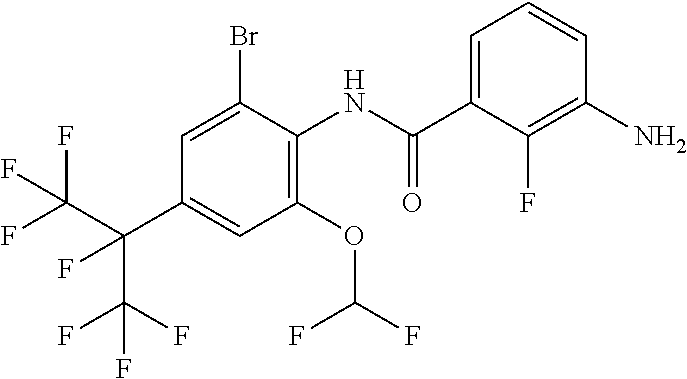
To a suspension of 15.07 g N-[2-bromo-6-(difluoromethoxy)-4-[1,2,2,2-tetrafluoro-1-(trifluoromethyl)ethyl]phenyl]-2-fluoro-3-nitro-benzamide and 3.67 g iron powder in 100 ml ethanol and 30 ml water was added 1 ml of concentrated hydrochloric acid. The resulting dark suspension was heated to reflux for 7 hours. The mixture was allowed to cool to ambient temperature, filtered over celite, and the solvent was evaporated. The residue was dissolved in ethyl acetate and washed with brine. The organic phase was separated, dried over anhydrous sodium sulfate and evaporated. The residue was purified by chromatography on silica gel, using heptane/ethyl acetate (9:1 to 1:1) as eluent. Thus, 5.23 g of 3-amino-N-[2-bromo-6-(difluoromethoxy)-4-[1,2,2,2-tetrafluoro-1-(trifluoromethyl)ethyl]phenyl]-2-fluoro-benzamide was obtained. 1H NMR (400 MHz, CDCl3, δ in ppm): 8.13 (d, 1H), 7.80 (s, 1H), 7.52 (s, 1H), 7.45 (t, 1H), 7.11 (t, 1H), 6.99 (t, 1H), 6.60 (t, 1H), 3.90 (s, broad, 2H).

To a solution of 2.32 g 3-amino-N-[2-bromo-6-(difluoromethoxy)-4-[1,2,2,2-tetrafluoro-1-(trifluoromethyl)ethyl]phenyl]-2-fluoro-benzamide, 0.27 ml acetic acid and 0.20 g acetaldehyde in 19.2 ml methanol was added 311 mg sodium cyanoborohydride. The reaction mixture was stirred at ambient temperature for 2 hours. Then the solvent was evaporated and the residue purified by chromatography on silica gel, using ethal acetate/heptane (1:19 to 1:4) as eluent. Thus, 1.98 g of N-[2-bromo-6-(difluoromethoxy)-4-[1,2,2,2-tetrafluoro-1-(trifluoromethyl)ethyl]phenyl]-3-(ethylamino)-2-fluoro-benzamide was obtained. 1H NMR (400 MHz, CDCl3, δ in ppm): 8.12 (d, 1H), 7.79 (s, 1H), 7.50 (s, 1H), 7.34 (t, 1H), 7.15 (t, 1H), 6.90 (t, 1H), 6.60 (t, 1H), 3.98 (s, broad, 1H), 3.23 (q, 2H), 1.32 (t, 3H).

To a solution of 0.70 g N-[2-bromo-6-(difluoromethoxy)-4-[1,2,2,2-tetrafluoro-1-(trifluoromethyl)ethyl]phenyl]-3-(ethylamino)-2-fluoro-benzamide in 4.9 ml tetrahydrofuran was added 267 mg of isonicotinoyl chloride hydrochloride. The suspension was heated to 70° C. for 1 hour. Then the reaction mixture was allowed to ambient temperature, and the solvent was evaporated. The residue was purified by chromatography on silica gel, using dichloromethane/methanol (1.5 to 4% methanol) as eluent. Thus, 765 mg N-[3-[[2-bromo-6-(difluoromethoxy)-4-[1,2,2,2-tetrafluoro-1-(trifluoromethyl)ethyl]phenyl]carbamoyl]-2-fluoro-phenyl]-N-ethyl-pyridine-4-carboxamide was obtained as a solid, mp=186-188° C. 1H NMR (400 MHz, CDCl3, δ in ppm): 8.50 (s, broad, 2H), 8.02 (t, 1H), 7.83 (d, 1H), 7.78 (s, 1H), 7.49 (s, 1H), 7.43 (t, 1H), 7.28 (t, 1H), 7.18 (s, broad, 2H), 6.55 (t, 1H), 4.00 (m, broad, 2H), 1.28 (t, broad, 3H).

To a solution of 454 mg N-[3-[[2-bromo-6-(difluoromethoxy)-4-[1,2,2,2-tetrafluoro-1-(trifluoromethyl)ethyl]phenyl]carbamoyl]-2-fluoro-phenyl]-N-ethyl-pyridine-4-carboxamide in 6.7 ml dichloromethane was added 173 mg 3-chlorobenzenecarboperoxoic acid. The resulting clear solution was stirred at ambient temperature for 18 hours. Then the solvent was evaporated, and the residue purified by chromatography on silica gel, using dichloromethane/methanol (1.5 to 10% methanol) as eluent. Thus, 421 mg N-[3-[[2-bromo-6-(difluoromethoxy)-4-[1,2,2,2-tetrafluoro-1-(trifluoromethyl)ethyl]phenyl]carbamoyl]-2-fluoro-phenyl]-N-ethyl-1-oxido-pyridin-1-ium-4-carboxamide was obtained as a solid, mp=103-106° C. 1H NMR (400 MHz, CDCl3, δ in ppm): 8.07 (t, 1H), 8.01 (d, 2H), 7.88 (d, 1H), 7.80 (s, 1H), 7.50 (s, 1H), 7.45 (t, 1H), 7.36 (t, 1H), 7.21 (d, 2H), 6.60 (t, 1H), 3.95 (m, broad, 2H), 1.27 (t, 3H).

12.3 g-fluoro-3-nitro-benzoic acid was dissolved in m dichloromethane and a drop of N,N-dimethylformamide was added. Then 6.2 ml oxalyl dichloride was added slowly over 30 min, and the mixture was stirred at ambient temperature for 3.5 hours, then the solvent was evaporated. The residue was dissolved in 70 ml of acetonitrile and added slowly to a solution of 20 g 2-chloro-6-(difluoromethoxy)-4-[1,2,2,2-tetrafluoro-1-(trifluoromethyl)ethyl]aniline and of 0.92 g potassium iodide in 150 mL of acetonitrile. The reaction mixture was heated to reflux for 18 hours, allowed to cool to ambient temperature, and the solvent evaporated. The residue was taken up in ethyl acetate and washed with saturated aqueous sodium bicarbonate, the organic phase was separated, dried over anhydrous sodium sulfate and evaporated. Thus, 31.5 g of crude N-[2-chloro-6-(difluoromethoxy)-4-[1,2,2,2-tetrafluoro-1-(trifluoromethyl)ethyl]phenyl]-2-fluoro-3-nitro-benzamide was obtained, which was used for step 2 without further purification. 1H NMR (400 MHz, CDCl3, δ in ppm): 8.43 (t, 1H), 8.28 (t, 1H), 8.10 (d, 1H), 7.67 (s, 1H), 7.50 (m, 2H), 6.60 (t, 1H).

11.1 g of N-[2-chloro-6-(difluoromethoxy)-4-[1,2,2,2-tetrafluoro-1-(trifluoromethyl)ethyl]phenyl]-2-fluoro-3-nitro-benzamide was dissolved in 190 ml methanol and 5.86 g of potassium carbonate was added. The mixture was heated to 50° C. for 3 hours. Then the solvent was evaporated, the residue was extracted with dichloromethane and water and the layers separated. The organic layer was dried over anhydrous sodium sulfate and the solvent evaporated. Thus, 11.04 g of crude N-[2-chloro-6-(difluoromethoxy)-4-[1,2,2,2-tetrafluoro-1-(trifluoromethyl)ethyl]phenyl]-2-methoxy-3-nitro-benzamide was obtained, which was used for step 3 without further purification. 1H NMR (400 MHz, CDCl3, δ in ppm): 9.12 (s, 1H), 8.38 (d, 1H), 8.05 (d, 1H), 7.65 (s, 1H), 7.45 (s, 1H), 7.43 (t, 1H), 6.61 (t, 1H), 4.14 (s, 3H).

To a solution of 11.04 g N-[2-chloro-6-(difluoromethoxy)-4-[1,2,2,2-tetrafluoro-1-(trifluoromethyl)ethyl]phenyl]-2-methoxy-3-nitro-benzamide in 200 ml ethanol was added 40 ml of water, followed by 0.77 ml concentrated hydrochloric acid and 2.85 g iron powder. The mixture was heated to reflux for 18 hours, then allowed to cool to ambient temperature, filtered over celite, and the solvent was evaporated. Thus, 10.06 g of 3-amino-N-[2-chloro-6-(difluoromethoxy)-4-[1,2,2,2-tetrafluoro-1-(trifluoromethyl)ethyl]phenyl]-2-methoxy-benzamide was obtained, which was used for step 4 without further purification. 1H NMR (400 MHz, CDCl3, δ in ppm): 9.46 (s, 1H), 7.62 (s, 1H), 7.50 (d, 1H), 7.45 (s, 1H), 7.10 (t, 1H), 6.97 (d, 1H), 6.61 (t, 1H), 3.98 (s, 3H), 3.93 (s, broad, 2H).

To a solution of 123 mg 3-amino-N-[2-chloro-6-(difluoromethoxy)-4-[1,2,2,2-tetrafluoro-1-(trifluoromethyl)ethyl]phenyl]-2-methoxy-benzamide in 2.4 ml acetonitrile were added 4 mg of potassium iodide and 48 mg of 4-cyanobenzoyl chloride. The mixture was heated to reflux for 3 hours, then allowed to cool to ambient temperature, and the solvent evaporated. The residue was dissolved in dichloromethane, washed with saturated aqueous sodium sulfite, then with aqueous sodium bicarbonate, then with brine. The organic phase was dried over anhydrous sodium sulfate, and the solvent evaporated. Thus, without any further purification, 132 mg of N-[2-chloro-6-(difluoromethoxy)-4-[1,2,2,2-tetrafluoro-1-(trifluoromethyl)ethyl]phenyl]-3-[(4-cyanobenzoyl)amino]-2-methoxy-benzamide was obtained as a solid, mp=90-100° C. 1H NMR (400 MHz, CDCl3, δ in ppm): 8.96 (s, 1H), 8.63 (d, 1H), 8.50 (s, 1H), 8.02 (d, 2H), 7.85 (m, 3H), 7.64 (s, 1H), 7.46 (s, 1H), 7.37 (t, 1H), 6.63 (t, 1H), 4.03 (s, 3H).

To a solution of 2-bromo-6-(difluoromethoxy)-4-[1,2,2,2-tetrafluoro-1(trifluoromethyl) ethyl]aniline (1.0 g) in acetic anhydride (5.5 ml) were added a few drops of concentrated sulfuric acid. The resulting solution was heated at 60° C. for 200 minutes. The consumption of the starting aniline was followed by LC-MS analysis of a aliquots of the reaction mixture. The solution was poured on an ice-water mixture and the resulting emulsion was extracted with ethyl acetate. The combined organic layers were dried over sodium sulfate and evaporated under reduced pressure. The crude solid was dissolved in tetrahydrofurane and treated with 30% (w/w) aqueous sodium hydroxide and stirred at 20° C. for 30 minutes. The hydrolysis of the acetimide (side product of the reaction) to the acetamide was followed by LC-MS analysis of aliquots of the reaction mixture. The emulsion was extracted with ethyl acetate and the organic phase was dried over sodium sulfate. After evaporation of the solvent, the crude product was purified by chromatography through silica gel using an eluent gradient (100% heptane to 40% ethyl acetate-60% heptane. After evaporation of the solvent the desired product was obtained. 1H NMR (400 MHz, CDCl3, δ in ppm): 7.75 (s, 1H), 7.46 (s, 1H), 6.90 (s, 1H), 6.54 (t, J=68 Hz, 1H), 2.25 (s, 3H).

To a solution of N-[2-bromo-6-(difluoromethoxy)-4-[1,2,2,2-tetrafluoro-1-(trifluoromethyl) ethyl]phenyl]acetamide (0.76 g) in 1,2-dichloroethane (5.1 ml), at 0° C., was added triethylamine (0.60 g), followed by 0.52 g of 2-methoxy-3-[methyl(pyridine-4-carbonyl)amino]benzoyl chloride (prepared from 2-methoxy-3-[methyl(pyridine-4-carbonyl)amino]benzoic acid, oxalyl chloride and a catalytic amount of dimethylformamide in 1,2-dichloroethane). The reaction was complete after stirring of the suspension for 15 hours at ° C. (LC-MS analysis). The reaction mixture was then evaporated, the residue dissolved in ethyl acetate and this solution washed with an aqueous solution of sodium hydrogencarbonate. The organic phase was dried over sodium sulfate, evaporated and the residue was chromatographed on silica gel using a gradient from 1% methyl alcohol in dichloromethane to 10% methyl alcohol in dichloromethane. The desired compound was isolated as a solid showing a melting point of 78-81° C.

To a solution of N-[3-[acetyl-[2-bromo-6-(difluoromethoxy)-4-[1,2,2,2-tetrafluoro-1-(trifluoromethyl) ethyl]phenyl]carbamoyl]-2-methoxy-phenyl]-N-methyl-pyridine-4-carboxamide (0.278 g) in tetrahydrofurane (1.7 g) was added aqueous sodium hydroxide (1 M, 1.55 ml) and the resulting emulsion was stirred for 1.5 hour at 20° C. The conversion was followed by LC-MS analysis. The reaction mixture was partitioned between water and ethyl acetate. The organic phase was dried over sodium sulfate and evaporated to yield the desired compound as a solid melting at 73-77° C. It was used without further purification in the next step.

A solution of N-[3-[[2-bromo-6-(difluoromethoxy)-4-[1,2,2,2-tetrafluoro-1-(trifluoromethyl) ethyl]phenyl]carbamoyl]-2-methoxy-phenyl]-N-methyl-pyridine-4-carboxamide (0.145 g) in dichloromethane (1.70 g) was treated with 0.052 g of 75% meta-chloroperbenzoic acid. After hours stirring at 20° C., full conversion was observed by LC-MS and TLC analyses. The reaction mixture was concentrated and submitted to column chromatography over silica gel, using a gradient from 100 methyl alcohol in dichloromethane to 7% methyl alcohol in dichloromethane. 1H NMR (400 MHz, CDCl3, δ in ppm): 9.72 (br.s, 1H), 8.08 (dd, 1H), 7.96 (br. ds, 2H), 7.76 (s, 1H), 7.56 (dd, 1H), 7.45 (s, 1H), 7.40 (t, 1H), 7.20 (br. d, 2H), 6.60 (t, J=72 Hz, 1H), 3.89 (s, 3H), 3.56 (s, 3H).
| TABLE B | ||||||
| [M + H] | [M − H] | |||||
| Entry | STRUCTURE | RT (min) | (measured) | (measured) | Method | MP ° C. |
| 1 |  | 200-204 | ||||
| 2 |  | 186-188 | ||||
| 3 |  | 192-196 | ||||
| 4 |  | 78-82 | ||||
| 5 |  | 1.88 | 672.27 | UPLC1 | 121-124 | |
| 6 |  | 1.94 | 684.3 | UPLC1 | 121-126 | |
| 7 |  | 119-124 | ||||
| 8 |  | 220-999 | ||||
| 9 |  | 1.97 | 712.31 | UPLC1 | 85-90 | |
| 10 |  | 2.12 | 700.03 | UPLC2 | 86-89 | |
| 11 |  | 103-106 | ||||
| 12 |  | 112-116 | ||||
| 13 |  | 1.15 | 626, 628 | SQD13 | ||
| 14 |  | 1.93 | 640.32 | UPLC1 | 90-100 | |
| 15 |  | 1.06 | 604, 606 | ZCQ13 | ||
| 16 |  | 1.08 | 616, 618 | ZCQ13 | ||
| 17 |  | 2.12 | 656.07 | UPLC2 | 95-100 | |
| 18 |  | 105-110 | ||||
| 19 |  | 183-184 | ||||
| 20 |  | 95-100 | ||||
| 21 |  | 1.98 | 679.96 | UPLC1 | ||
| 22 | 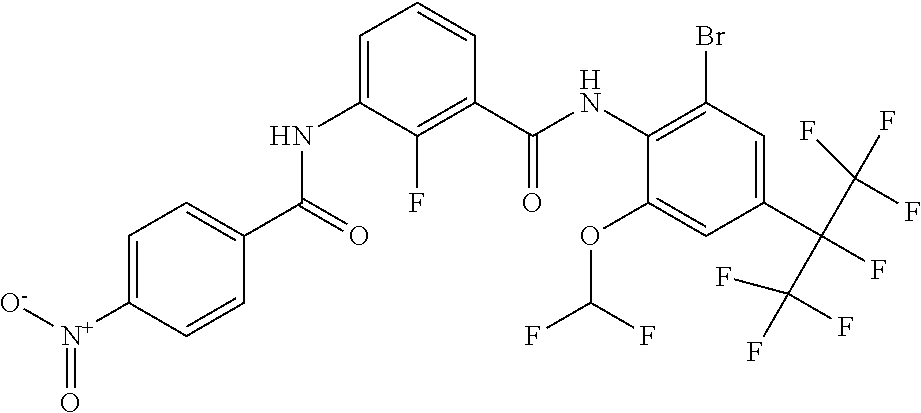 | 1.95 | 692.25 | UPLC1 | ||
| 23 |  | 2.02 | 661.28 | UPLC1 | ||
| 24 |  | 2.10 | 699.24 | UPLC1 | ||
| 25 |  | 1.99 | 726.22 | UPCL1 | ||
| 26 |  | 2.11 | 731.26 | UPLC1 | ||
| 27 | 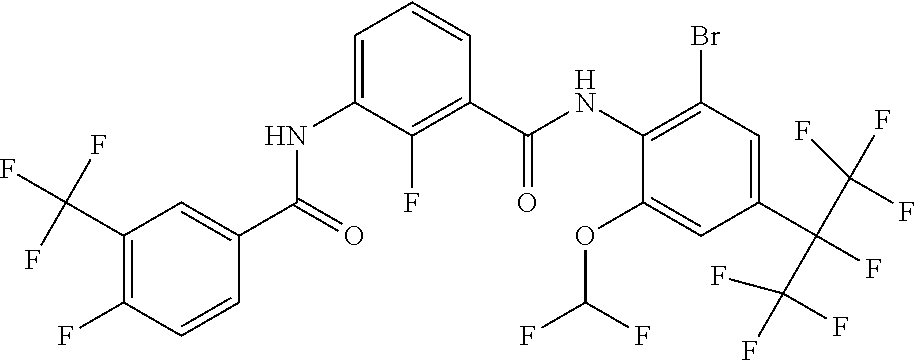 | 2.10 | 733.27 | UPLC1 | ||
| 28 |  | 2.08 | 715.27 | UPLC1 | ||
| 29 |  | 2.06 | 731.27 | UPLC1 | ||
| 30 |  | 2.09 | 677.28 | UPLC1 | ||
| 31 |  | 1.95 | 647.27 | UPLC1 | ||
| 32 |  | 1.97 | 665.26 | UPLC1 | ||
| 33 |  | 2.10 | 677.28 | UPLC1 | ||
| 34 |  | 1.99 | 715.28 | UPLC1 | ||
| 35 |  | 2.05 | 673.32 | UPLC1 | ||
| 36 | 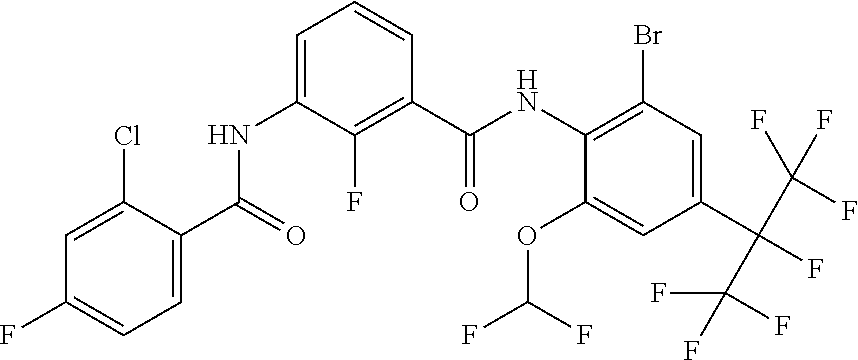 | 2.01 | 699.23 | UPLC1 | ||
| 37 |  | 2.04 | 693.27 | UPLC1 | ||
| 38 |  | 2.01 | 683.26 | UPLC1 | ||
| 39 |  | 1.99 | 704.3 | UPLC1 | ||
| 40 |  | 2.03 | 683.26 | UPLC1 | ||
| 41 |  | 2.08 | 673.31 | UPLC1 | ||
| 42 |  | 2.11 | 733.27 | UPLC1 | ||
| 43 |  | 2.06 | 691.31 | UPLC1 | ||
| 44 |  | 2.19 | 711.26 | UPLC1 | ||
| 45 |  | 1.99 | 621.29 | UPLC1 | ||
| 46 |  | 1.98 | 617.32 | UPLC1 | ||
| 47 | 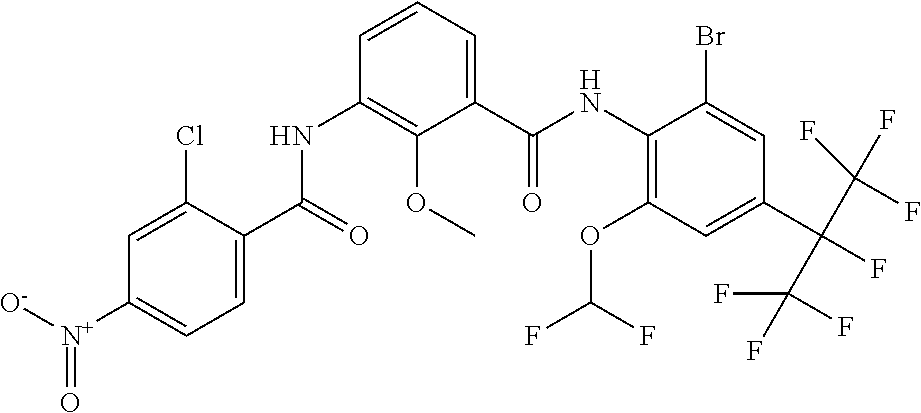 | 2.04 | 738.27 | UPLC1 | ||
| 48 |  | 1.94 | 637.27 | UPLC1 | ||
| 49 |  | 1.92 | 648.31 | UPLC1 | ||
| 50 |  | 2.15 | 743.31 | UPLC1 | ||
| 51 |  | 1.99 | 617.31 | UPLC1 | ||
| 52 |  | 2.14 | 745.29 | UPLC1 | ||
| 53 |  | 1.98 | 635.32 | UPLC1 | ||
| 54 |  | 2.13 | 727.29 | UPLC1 | ||
| 55 | 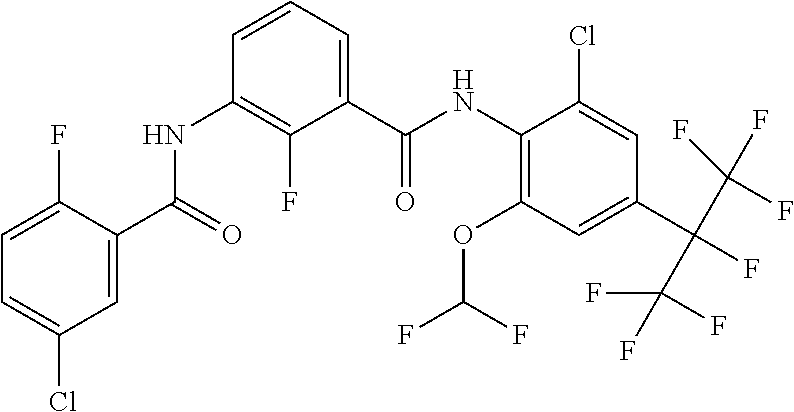 | 2.07 | 655.27 | UPLC1 | ||
| 56 | 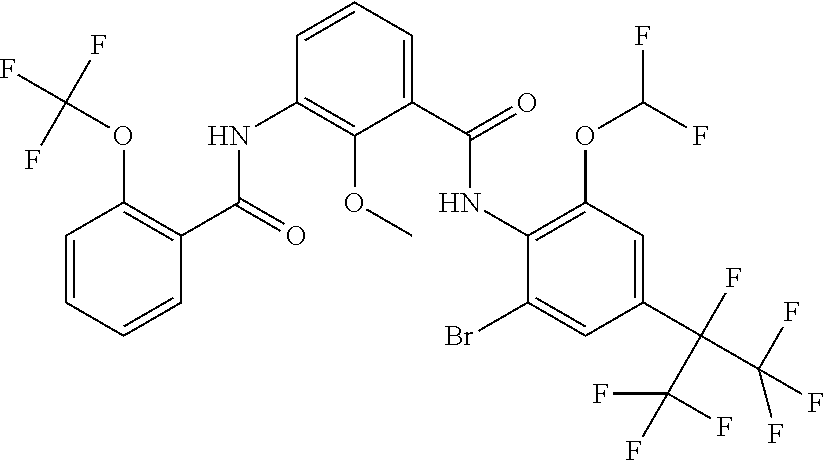 | 2.13 | 743.29 | UPLC1 | ||
| 57 |  | 1.96 | 682.29 | UPLC1 | ||
| 58 | 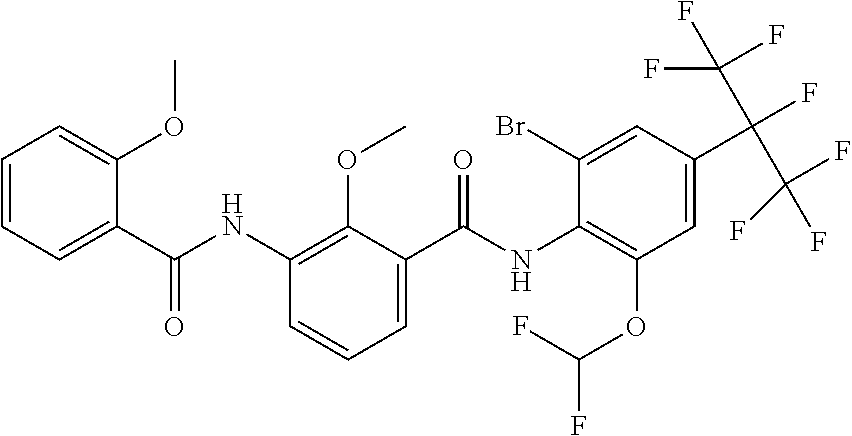 | 2.13 | 689.31 | UPLC1 | ||
| 59 |  | 2.00 | 695.29 | UPLC1 | ||
| 60 |  | 2.08 | 687.32 | UPLC1 | ||
| 61 |  | 2.01 | 677.29 | UPLC1 | ||
| 62 |  | 2.07 | 689.31 | UPLC1 | ||
| 63 |  | 2.04 | 727.3 | UPLC1 | ||
| 64 |  | 2.05 | 671.31 | UPLC1 | ||
| 65 | 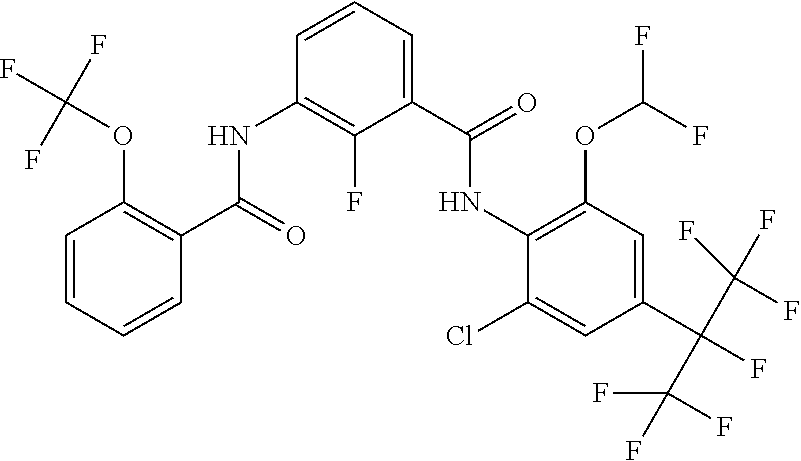 | 2.04 | 687.31 | UPLC1 | ||
| 66 |  | 2.07 | 711.26 | UPLC1 | ||
| 67 |  | 2.07 | 633.32 | UPLC1 | ||
| 68 |  | 1.92 | 603.3 | UPLC1 | ||
| 69 | 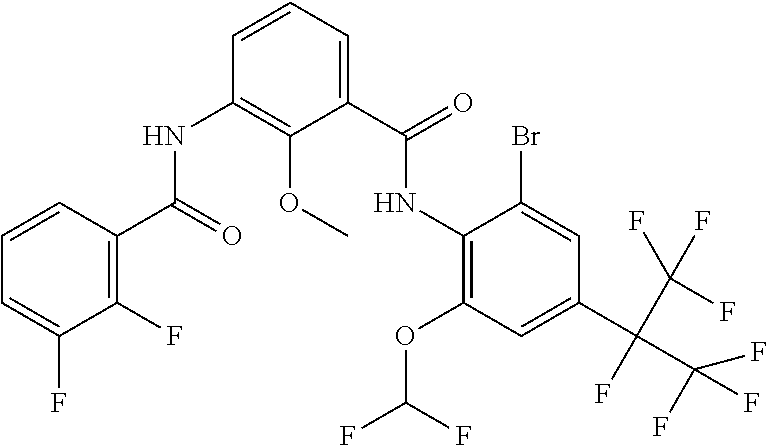 | 2.10 | 695.28 | UPLC1 | ||
| 70 |  | 1.94 | 621.3 | UPLC1 | ||
| 71 |  | 2.12 | 695.29 | UPLC1 | ||
| 72 |  | 1.97 | 671.31 | UPLC1 | ||
| 73 |  | 2.20 | 745.3 | UPLC1 | ||
| 74 |  | 1.98 | 655.27 | UPLC1 | ||
| 75 | 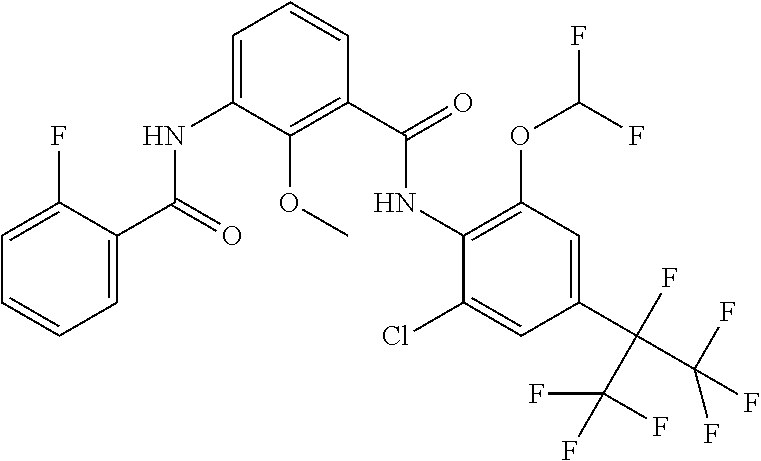 | 2.09 | 633.32 | UPLC1 | ||
| 76 | 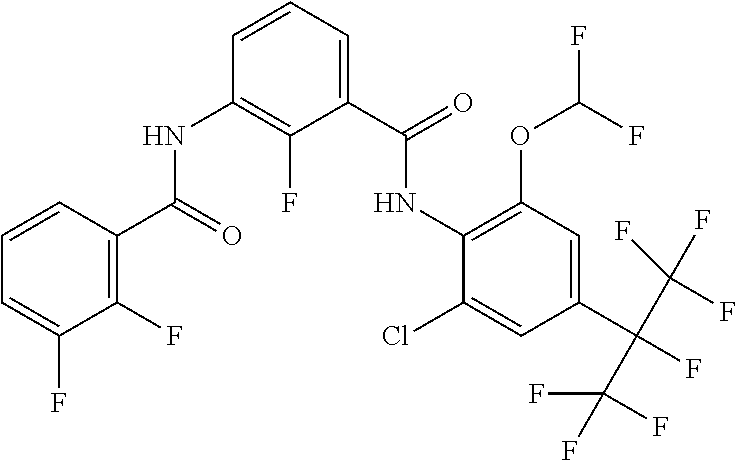 | 1.98 | 639.29 | UPLC1 | ||
| 77 |  | 2.04 | 629.34 | UPLC1 | ||
| 78 |  | 2.00 | 639.29 | UPLC1 | ||
| 79 |  | 2.04 | 649.29 | UPLC1 | ||
| 80 |  | 2.09 | 689.31 | UPLC1 | ||
| 81 | 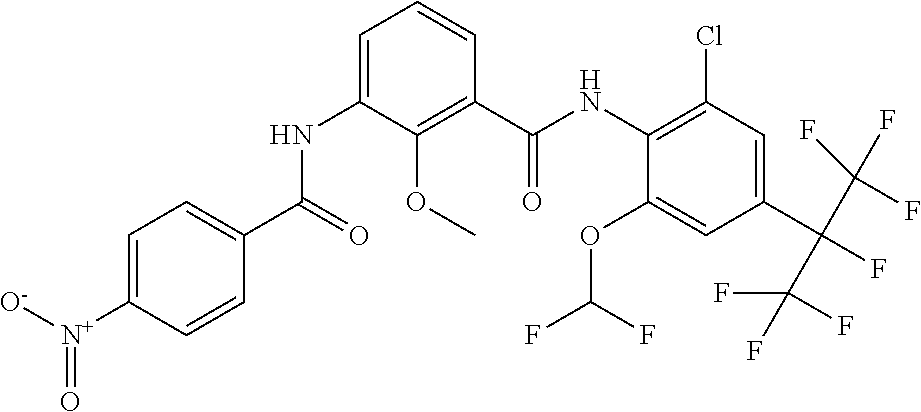 | 1.98 | 660.32 | UPLC1 | ||
| 82 |  | 2.07 | 629.34 | UPLC1 | ||
| 83 |  | 1.99 | 665.27 | UPLC1 | ||
| 84 | 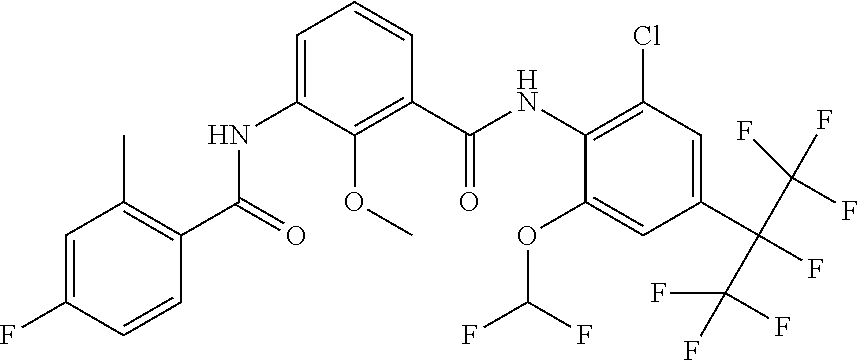 | 2.05 | 647.34 | UPLC1 | ||
| 85 | 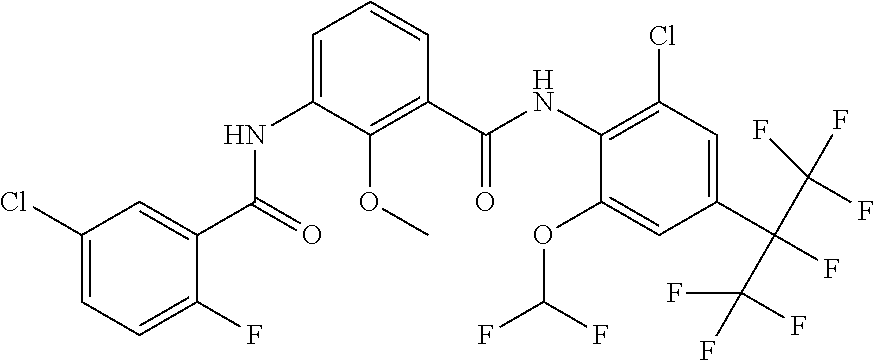 | 2.19 | 667.29 | UPLC1 | ||
| 86 |  | 2.03 | 694.3 | UPLC1 | ||
| 87 |  | 2.13 | 699.33 | UPLC1 | ||
| 88 |  | 2.13 | 701.34 | UPLC1 | ||
| 89 |  | 2.12 | 683.33 | UPLC1 | ||
| 90 |  | 2.12 | 699.34 | UPLC1 | ||
| 91 |  | 2.12 | 645.35 | UPLC1 | ||
| 92 |  | 1.99 | 615.32 | UPLC1 | ||
| 93 |  | 2.01 | 633.32 | UPLC1 | ||
| 94 |  | 2.03 | 683.34 | UPLC1 | ||
| 95 |  | 2.06 | 667.29 | UPLC1 | ||
| 96 |  | 2.09 | 651.33 | UPLC1 | ||
| 97 |  | 2.11 | 651.33 | UPLC1 | ||
| 98 |  | 2.19 | 701.33 | UPLC1 | ||
| 99 |  | 78-81 | ||||
| 100 |  | 85-88 | ||||
| 101 |  | 186-188 | ||||
| 102 |  | 73-77 | ||||
| 103 |  | 2.16 | 720.02 | UPLC2 | ||
| 104 | 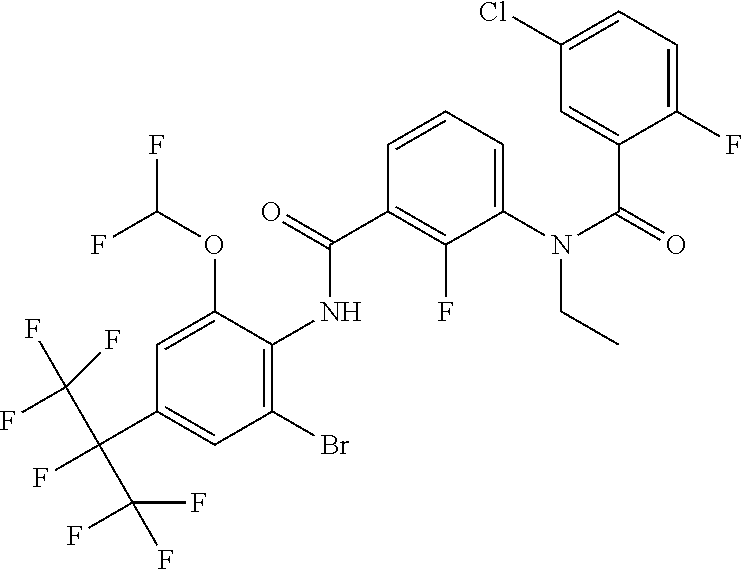 | 2.05 | 726.97 | UPLC2 | ||
| 105 | 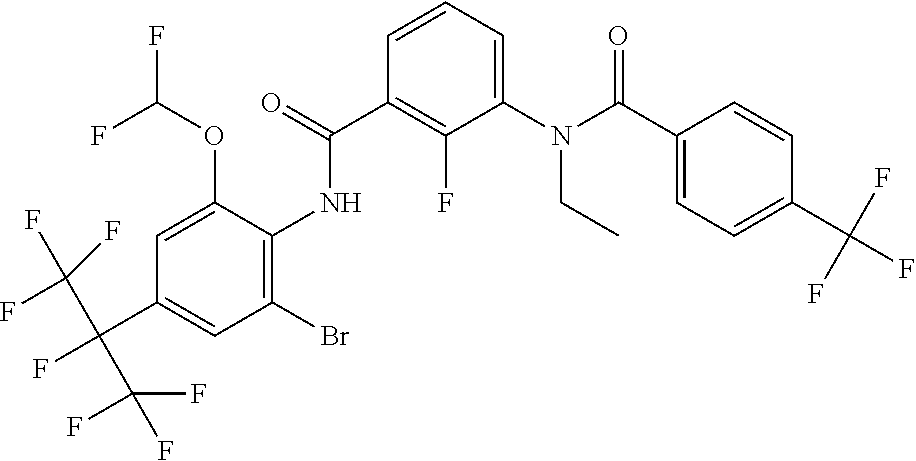 | 2.29 | 743.04 | UPLC2 | ||
| 106 |  | 2.07 | 759.01 | UPLC2 | ||
| 107 |  | 1.95 | 705.04 | UPLC2 | ||
| 108 |  | 1.98 | 711 | UPLC2 | ||
| 109 |  | 1.98 | 711 | UPLC2 | ||
| 110 |  | 2.07 | 761 | UPLC2 | ||
| 111 | 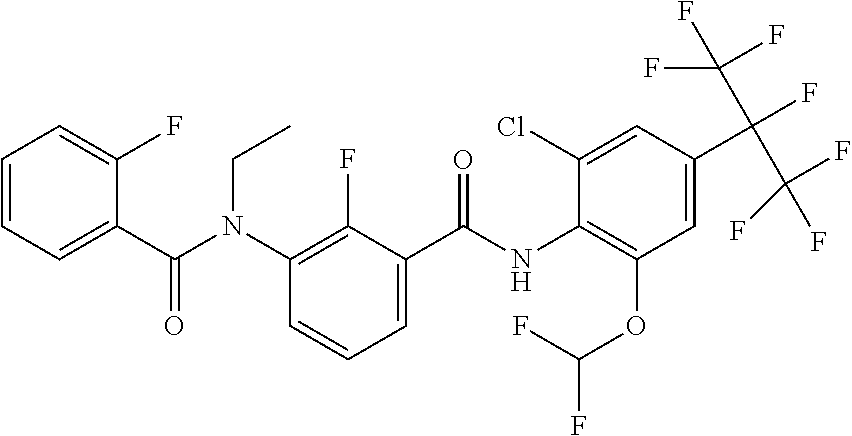 | 1.95 | 649.02 | UPLC2 | ||
| 112 | 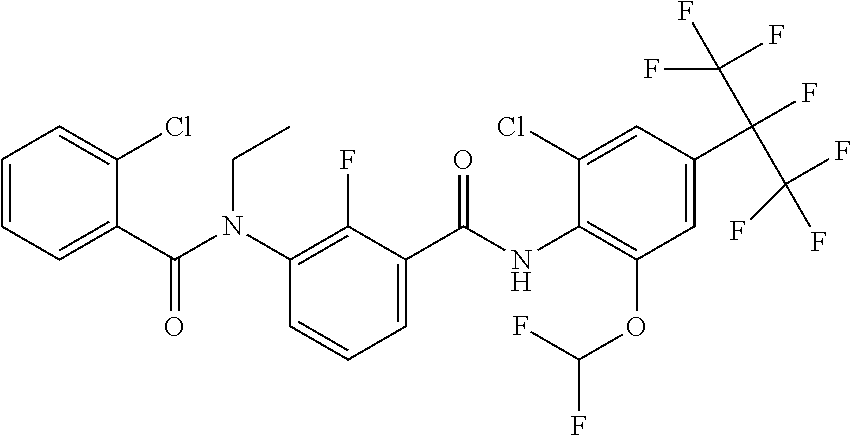 | 2.00 | 665.01 | UPLC2 | ||
| 113 |  | 2.17 | 676.07 | UPLC2 | ||
| 114 | 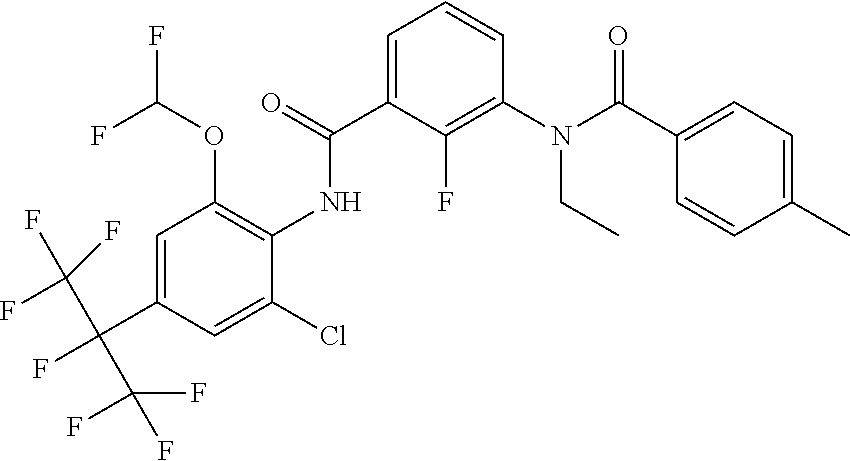 | 2.23 | 645.06 | UPLC2 | ||
| 115 |  | 2.04 | 683.01 | UPLC2 | ||
| 116 |  | 2.25 | 710.03 | UPLC2 | ||
| 117 |  | 2.29 | 699.08 | UPLC2 | ||
| 118 |  | 2.06 | 715.07 | UPLC2 | ||
| 119 |  | 1.95 | 631.01 | UPLC2 | ||
| 120 | 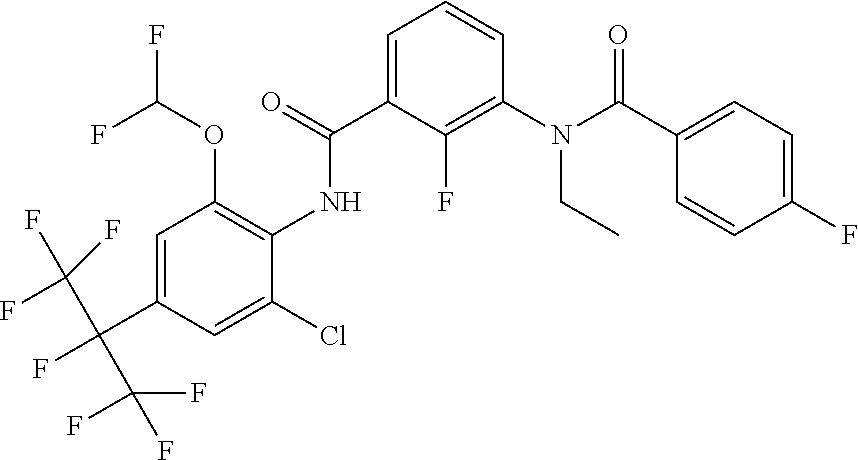 | 1.96 | 649.02 | UPLC2 | ||
| 121 | 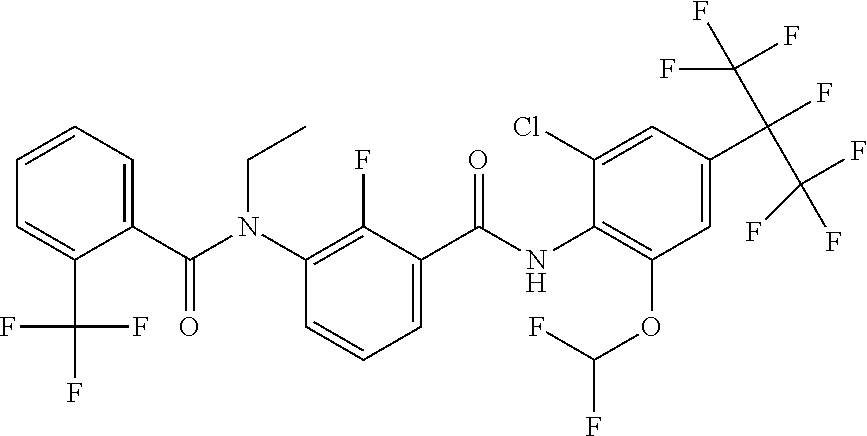 | 2.04 | 699.05 | UPLC2 | ||
| 122 |  | 2.02 | 6.83 | UPLC2 | ||
| 123 |  | 1.98 | 667.03 | UPLC2 | ||
| 124 |  | 2.29 | 717.06 | UPLC2 | ||
| 125 |  | 1.96 | 693.02 | UPLC2 | ||
| 126 |  | 2.01 | 689.01 | UPLC2 | ||
| 127 |  | 1.97 | 675.33 | UPLC2 | ||
| 128 |  | 1.99 | 693.32 | UPLC2 | ||
| 129 |  | 2.04 | 705.3 | UPLC1 | ||
| 130 |  | 2.09 | 701.33 | UPLC1 | ||
| 131 |  | 2.09 | 721.27 | UPLC1 | ||
| 132 |  | 2.11 | UPLC1 | |||
| 133 |  | 2.09 | 719.32 | UPLC1 | ||
| 134 | 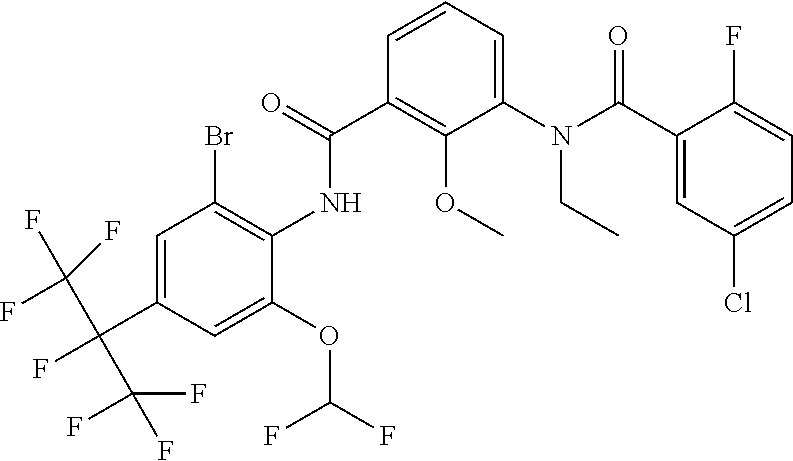 | 2.13 | 739.26 | UPLC1 | ||
| 135 |  | 2.09 | 766.26 | UPLC1 | ||
| 136 |  | 2.16 | 771.3 | UPLC1 | ||
| 137 |  | 2.04 | 717.31 | UPLC1 | ||
| 138 |  | 2.04 | 687.3 | UPLC1 | ||
| 139 |  | 2.05 | 705.28 | UPLC1 | ||
| 140 |  | 2.13 | 755.3 | UPLC1 | ||
| 141 |  | 2.12 | 739.27 | UPLC1 | ||
| 142 |  | 2.07 | 723.29 | UPLC1 | ||
| 143 |  | 2.07 | 723.28 | UPLC1 | ||
| 144 |  | 2.15 | 773.29 | UPLC1 | ||
| 145 |  | 2.04 | 661.33 | UPLC1 | ||
| 146 |  | 2.08 | 657.35 | UPLC1 | ||
| 147 |  | 2.09 | 677.01 | UPLC1 | ||
| 148 |  | 2.26 | 688.34 | UPLC1 | ||
| 149 |  | 2.09 | 657.35 | UPLC1 | ||
| 150 |  | 2.09 | 675.36 | UPLC1 | ||
| 151 |  | 2.12 | 695.32 | UPLC1 | ||
| 152 |  | 2.08 | 722.3 | UPLC1 | ||
| 153 |  | 2.16 | 727.35 | UPLC1 | ||
| 154 |  | 2.03 | 673.36 | UPLC1 | ||
| 155 | 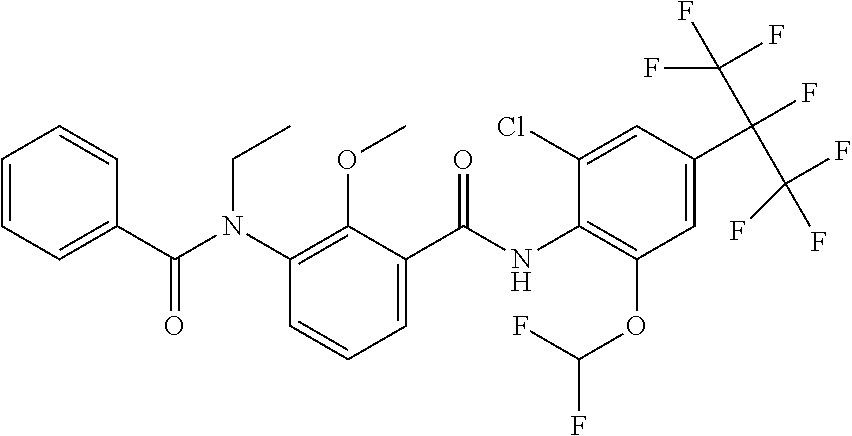 | 2.03 | 643.33 | UPLC1 | ||
| 156 |  | 2.04 | 661.34 | UPLC1 | ||
| 157 |  | 2.12 | 711.43 | UPLC1 | ||
| 158 |  | 2.11 | 695.31 | UPLC1 | ||
| 159 |  | 2.06 | 679.33 | UPLC1 | ||
| 160 |  | 2.06 | 679.33 | UPLC1 | ||
| 161 |  | 2.14 | 729.35 | UPLC1 | ||
| 162 |  | 2.02 | 732.29 | UPLC1 | ||
| 163 |  | 2.16 | 773.29 | UPLC1 | ||
| 164 |  | 1.15 | 661 | UPLC2 Short | ||
| 165 |  | 1.14 | 679.06 | UPLC2 Short | ||
| 166 |  | 1.10 | 709 | UPLC2 Short | ||
| 167 |  | 1.10 | 689 | UPLC2 Short | ||
| 168 |  | 1.11 | 7.07 | UPLC2 Short | ||
| 169 |  | 1.24 | 754 | UPLC2 Short | ||
| 170 |  | 1.14 | 761 | UPLC2 Short | ||
| 171 |  | 1.12 | 743 | UPLC2 Short | ||
| 172 | 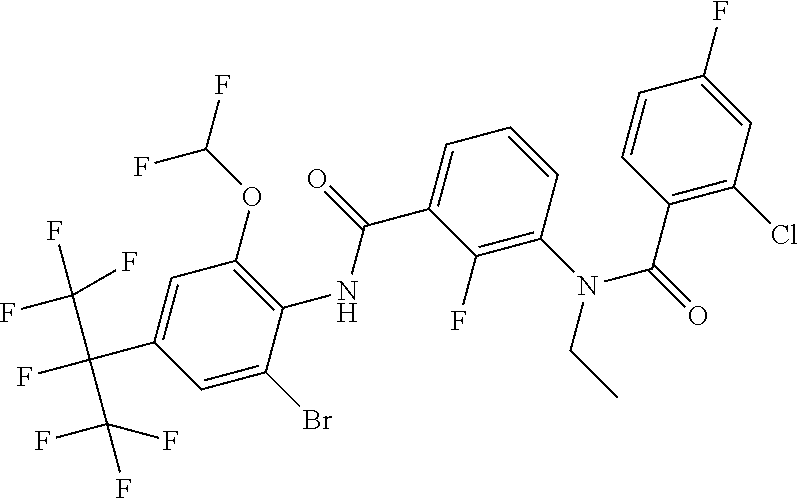 | 1.12 | 727 | UPLC2 Short | ||
| 173 |  | 1.09 | 645 | UPLC2 Short | ||
| 174 | 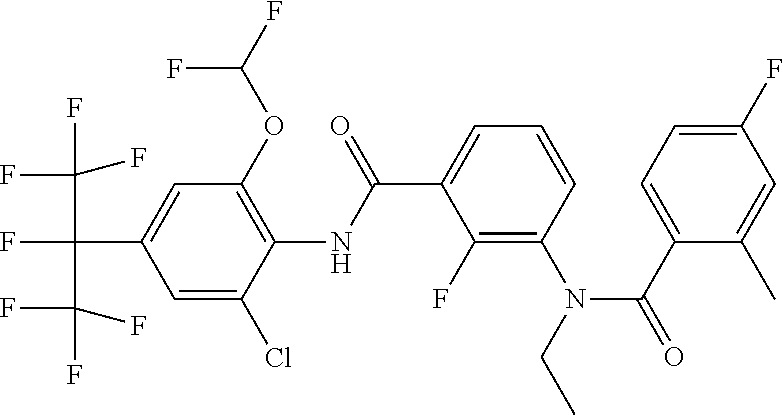 | 1.10 | 663 | UPLC2 Short | ||
| 175 |  | 1.14 | 717 | UPLC2 Short | ||
| 176 |  | 1.06 | 661 | UPLC2 Short | ||
| 177 | 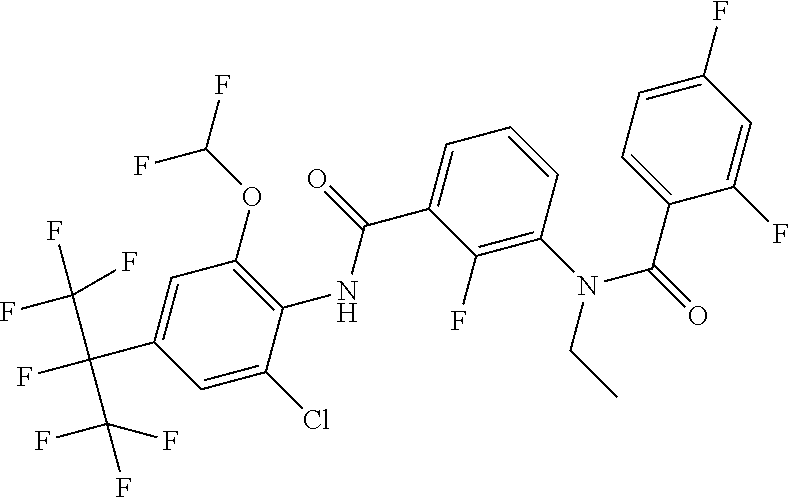 | 1.08 | 667 | UPLC2 Short | ||
| 178 |  | 1.30 | 755 | UPLC2 Short | ||
| 179 |  | 1.17 | 727 | UPLC2 Short | ||
| 180 |  | 1.17 | 729.05 | UPLC2 Short | ||
| 181 |  | 1.30 | 711.1 | UPLC2 Short | ||
| 182 |  | 73-77 | ||||
| 183 | 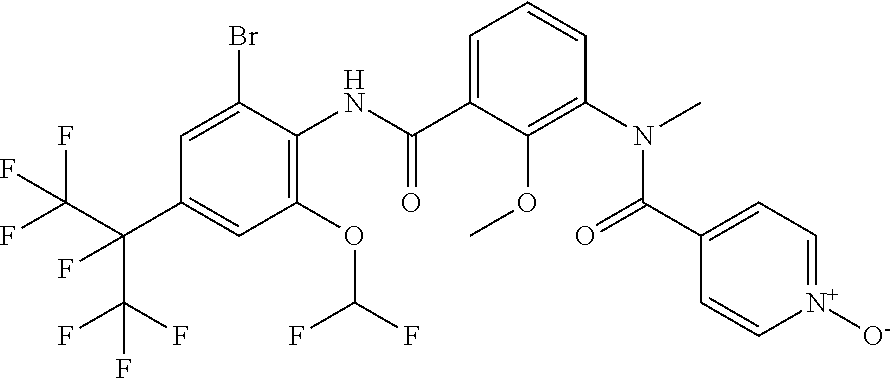 | 1.00 | 690 | ZCQ13 | ||
LC-MS Method: ZCQ13
ZQ Mass Spectrometer from Waters (Single quadrupole mass spectrometer)
Instrument Parameter:
-
- Ionization method: Electrospray
- Polarity: positive and negative ions
- Capillary: 3.00 kV
- Cone: 30 V
- Extractor: 2.00 V
- Source Temperature: 150° C.,
- Desolvation Temperature: 350C
- Cone Gas Flow: 50 L/Hr
- Desolvation Gas Flow: 400 L/Hr
- Mass range: 100 to 900 Da
Acquity UPLC from Waters: - Binary pump, heated column compartment and diode-array detector.
- Solvent degasser, binary pump, heated column compartment and diode-array detector.
- Column: Waters UPLC HSS T3, 1.8 μm, 30×2.1 mm,
- Temp: 60° C.
- DAD Wavelength range (nm): 210 to 500
- Solvent Gradient:
- A=H2O+5% MeOH+0.05% HCOOH
- B=Acetonitril+0.05% HCOOH
| Time | A% | B% | Flow (ml/min) | ||
| 0.00 | 90 | 10 | 0.85 | ||
| 1.20 | 0 | 100.0 | 0.85 | ||
| 1.50 | 0 | 100.0 | 0.85 | ||
LC-MS Method: SQD13
SQD Mass Spectrometer from Waters (Single quadrupole mass spectrometer)
Instrument Parameter:
-
- Ionization method: Electrospray
- Polarity: positive and negative ions
- Capillary: 3.00 kV
- Cone: 30V
- Extractor: 2.00 V
- Source Temperature: 150° C.,
- Desolvation Temperature: 350° C.
- Cone Gas Flow: 50 L/Hr
- Desolvation Gas Flow: 650 L/Hr
- Mass range: 100 to 900 Da
Acquity UPLC from Waters: - Binary pump, heated column compartment and diode-array detector.
- Solvent degasser, binary pump, heated column compartment and diode-array detector.
- Column: Waters UPLC HSS T3, 1.8 μm, 30×2.1 mm,
- Temp: 60° C.
- DAD Wavelength range (nm): 210 to 500
- Solvent Gradient:
- A=H2O+5% MeOH+0.05% HCOOH
- B=Acetonitril+0.05% HCOOH
| Time | A% | B% | Flow (ml/min) | ||
| 0.00 | 90 | 10 | 0.85 | ||
| 1.20 | 0 | 100.0 | 0.85 | ||
| 1.50 | 0 | 100.0 | 0.85 | ||
LC-MS Method: UPLC1
ACQUITY SQD Mass Spectrometer from Waters (Single quadrupole mass spectrometer)
Ionisation method: Electrospray
Polarity: positive ions
Capillary (kV) 3.00, Cone (V) 20.00, Extractor (V) 3.00, Source Temperature (° C.) 150,
Desolvation Temperature (° C.) 400, Cone Gas Flow (L/Hr) 60, Desolvation Gas Flow (L/Hr) 700
Mass range: 100 to 800 Da
DAD Wavelength range (nm): 210 to 400
Method Waters ACQUITY UPLC with the following HPLC gradient conditions
(Solvent A: Water/Methanol 9:1, 0.1% formic acid and Solvent B: Acetonitrile, 0.1% formic acid)
| Time | Flow rate | ||||
| (minutes) | A (%) | B (%) | (ml/min) | ||
| 0 | 100 | 0 | 0.75 | ||
| 2.5 | 0 | 100 | 0.75 | ||
| 2.8 | 0 | 100 | 0.75 | ||
| 3.0 | 100 | 0 | 0.75 | ||
Type of column: Waters ACQUITY UPLC HSS T3; Column length: 30 mm; Internal diameter of column: 2.1 mm; Particle Size: 1.8 micron; Temperature: 60° C.
| Time | Flow rate | ||||
| (minutes) | A (%) | B (%) | (ml/min) | ||
| 0 | 100 | 0 | 0.75 | ||
| 2.5 | 0 | 100 | 0.75 | ||
| 2.8 | 0 | 100 | 0.75 | ||
| 3.0 | 100 | 0 | 0.75 | ||
Type of column: Waters ACQUITY UPLC HSS T3; Column length: 30 mm; Internal diameter of column: 2.1 mm; Particle Size: 1.8 micron; Temperature: 60° C.
| Time | Flow rate | ||||
| (minutes) | A (%) | B (%) | (ml/min) | ||
| 0 | 80 | 20 | 1 | ||
| 0.1 | 75 | 25 | 1 | ||
| 0.2 | 70 | 30 | 0.75 | ||
| 1.2 | 0 | 100 | 0.75 | ||
| 1.4 | 0 | 100 | 0.75 | ||
| 1.45 | 80 | 20 | 0.75 | ||
Type of column: Waters ACQUITY UPLC HSS T3; Column length: 30 mm; Internal diameter of column: 2.1 mm; Particle Size: 1.8 micron; Temperature: 60° C.
-
- These Examples illustrate the insecticidal and acaricidal properties of the compounds of formula (I). The tests were performed as follows:
- Diabrotica balteata (Corn root worm):
- A 24-well microtiter plate (MTP) with artificial diet was treated with test solutions at an application rate of 200 ppm (concentration in well 18 ppm) by pipetting. After drying, the MTP's were infested with L2 larvae (6-10 per well). After an incubation period of 5 days, samples were checked for larval mortality.
- The following compound gave at least 80% control of Diabrotica balteata: 1, 2, 3, 4, 5, 6, 7, 8, 9, 10, 11, 12, 13, 14, 15, 16, 17, 18, 19, 20, 21, 22, 23, 24, 25, 26, 27, 28, 31, 32, 33, 35, 36, 37, 38, 39, 40, 41, 42, 43, 45, 46, 47, 48, 49, 50, 51, 52, 53, 54, 55, 56, 57, 58, 59, 60, 61, 62, 63, 64, 66, 68, 69, 70, 71, 74, 76, 77, 78, 79, 80, 81, 82, 83, 84, 86, 87, 89, 90, 91, 92, 93, 94, 95, 99, 100, 101, 102, 103, 104, 105, 108, 109, 110, 111, 112, 113, 114, 115, 116, 117, 118, 119, 120, 121, 122, 123, 125, 126, 127, 128, 129, 130, 131, 132, 133, 134, 135, 136, 138, 139, 140, 141, 142, 143, 145, 146, 147, 148, 149, 150, 151, 152, 153, 154, 155, 156, 157, 158, 159, 160, 162, 163, 183.
- Myzus persicae (Green peach aphid):
- Sunflower leaf discs were placed on agar in a 24-well microtiter plate and sprayed with test solutions at an application rate of 200 ppm. After drying, the leaf discs were infested with an aphid population of mixed ages. After an incubation period of 6 DAT, samples were checked for mortality.
- The following compounds gave at least 80% control of Myzus persicae: 1, 2, 3, 4, 5, 6, 7, 8, 9, 10, 11, 12, 13, 14, 15, 16, 17, 18, 19, 20, 21, 22, 23, 24, 25, 26, 27, 28, 31, 32, 35, 36, 37, 38, 39, 40, 41, 43, 45, 47, 48, 49, 50, 51, 52, 53, 54, 56, 57, 59, 60, 61, 63, 64, 66, 68, 69, 70, 71, 73, 76, 78, 79, 81, 82, 83, 84, 86, 89, 92, 93, 94, 95, 96, 97, 99, 100, 101, 102, 103, 105, 108, 109, 111, 112, 119, 120, 122, 123, 125, 127, 128, 131, 132, 135, 138, 139, 140, 141, 142, 143, 147, 149, 155, 156, 158, 159, 162.
- Myzus persicae (Green peach aphid):
- Test compounds were applied by pipette into 24 well plates and mixed with Sucrose solution. Application rate: 12.5 ppm. The plates were closed with a stretched Parafilm. A plastic stencil with 24 holes is placed onto the plate and infested pea seedlings were placed directly on the Parafilm. The infested plate is closed with a gel blotting paper and another plastic stencil and then turned upside down. 5 days after infestation the samples were checked on mortality. The following compounds gave at least 80% control of Myzus persicae: 1, 2, 3, 4, 5, 6, 7, 8, 9, 10, 11, 12, 13, 14, 15, 16, 17, 18, 19, 20, 21, 22, 23, 24, 25, 26, 27, 28, 31, 32, 33, 36, 38, 39, 40, 41, 44, 45, 47, 49, 50, 51, 53, 54, 56, 57, 59, 60, 61, 62, 64, 66, 68, 70, 74, 76, 78, 81, 83, 84, 86, 89, 93, 99, 100, 101, 102, 103, 104, 105, 108, 109, 110, 111, 113, 114, 115, 116, 117, 119, 120, 122, 123, 125, 126, 127, 128, 135, 138, 139, 141, 152, 155, 156, 158, 159, 160, 162, 183.
- Plutella xylostella (Diamond back moth):
- 24-well microtiter plate (MTP) with artificial diet was treated with test solutions at an application rate of 200 ppm (concentration in well 18 ppm) by pipetting. After drying, the MTP's were infested with L2 larvae (7-12 per well). After an incubation period of 6 days, samples were checked for larval mortality.
- The following compound gave at least 80% control of Plutella xylostella: 1, 2, 3, 4, 5, 6, 7, 8, 9, 10, 11, 12, 13, 14, 15, 16, 17, 18, 19, 20, 21, 22, 23, 24, 25, 26, 27, 28, 31, 32, 33, 34, 35, 36, 37, 38, 39, 40, 41, 42, 43, 44, 45, 46, 47, 48, 49, 50, 51, 52, 53, 54, 55, 56, 57, 58, 59, 60, 61, 62, 63, 64, 66, 68, 69, 70, 71, 72, 74, 75, 76, 77, 78, 79, 80, 81, 82, 83, 84, 86, 87, 88, 89, 90, 91, 92, 93, 94, 95, 96, 97, 99, 100, 101, 102, 103, 104, 105, 108, 109, 110, 111, 112, 113, 114, 115, 117, 118, 119, 120, 121, 122, 123, 125, 126, 127, 128, 129, 130, 131, 132, 133, 134, 135, 138, 139, 140, 141, 142, 143, 144, 145, 146, 147, 149, 150, 151, 152, 154, 155, 156, 157, 158, 159, 160, 162, 163.
- Spodoptera littoralis (Egyptian cotton leafworm):
- Cotton leaf discs were placed on agar in a 24-well microtiter plate and sprayed with test solutions at an application rate of 200 ppm. After drying, the leaf discs were infested with 5 L1 larvae. The samples were checked for mortality 3 days after treatment (DAT).
- The following compound gave at least 80% control of Spodoptera littoralis: 1, 2, 3, 4, 5, 6, 7, 8, 9, 10, 11, 12, 13, 14, 15, 16, 17, 18, 19, 20, 21, 22, 23, 24, 25, 26, 27, 28, 31, 32, 33, 34, 35, 36, 37, 38, 39, 40, 41, 42, 43, 44, 45, 46, 47, 48, 49, 50, 51, 52, 53, 54, 55, 56, 57, 58, 59, 60, 61, 62, 63, 64, 65, 66, 68, 69, 70, 71, 72, 73, 74, 75, 76, 77, 78, 79, 80, 81, 82, 83, 84, 85, 86, 87, 88, 89, 90, 91, 92, 93, 94, 95, 96, 97, 98, 99, 100, 101, 102, 103, 104, 105, 108, 109, 110, 111, 112, 113, 114, 115, 116, 117, 118, 119, 120, 121, 122, 123, 125, 126, 127, 128, 129, 130, 131, 132, 133, 134, 135, 138, 139, 140, 141, 142, 143, 144, 145, 146, 147, 149, 150, 151, 152, 154, 155, 156, 157, 158, 159, 160, 162.
- Tetranychus urticae (Two-spotted spider mite):
- Bean leaf discs on agar in 24-well microtiter plates were sprayed with test solutions at an application rate of 200 ppm. After drying, the leaf discs are infested with mite populations of mixed ages. 8 days later, discs are checked for egg mortality, larval mortality, and adult mortality.
- The following compounds gave at least 80% control of Tetranychus urticae: 1, 2, 3, 4, 5, 6, 7, 8, 9, 10, 11, 12, 13, 14, 15, 16, 17, 18, 19, 20, 21, 22, 23, 24, 25, 26, 27, 28, 31, 32, 35, 36, 37, 38, 39, 40, 43, 46, 47, 48, 49, 50, 51, 53, 54, 57, 60, 61, 62, 64, 66, 68, 70, 71, 74, 76, 77, 78, 79, 81, 83, 84, 86, 87, 89, 92, 93, 94, 95, 97, 99, 100, 101, 102, 103, 108, 109, 112, 119, 120, 122, 127, 128, 129, 133, 135, 139, 141, 152, 154, 156, 158, 162.
- Thrips tabaci (Onion thrips):
- Sunflower leaf discs were placed on agar in a 24-well microtiter plate and sprayed with test solutions at an application rate of 200 ppm. After drying, the leaf discs were infested with an aphid population of mixed ages. After an incubation period of 7 days, samples were checked for mortality.
- The following compounds gave at least 80% control of Thrips tabaci: 1, 2, 3, 4, 5, 6, 7, 8, 9, 10, 11, 12, 13, 14, 15, 16, 17, 18, 19, 20, 21, 22, 23, 24, 25, 26, 27, 28, 31, 32, 33, 34, 35, 36, 37, 38, 39, 40, 41, 42, 43, 45, 46, 47, 48, 49, 50, 51, 52, 53, 54, 55, 56, 57, 58, 59, 60, 61, 63, 64, 66, 68, 69, 70, 71, 74, 75, 76, 77, 78, 79, 80, 81, 82, 83, 84, 86, 87, 88, 89, 90, 92, 93, 94, 95, 97, 99, 100, 101, 102, 103, 104, 105, 108, 109, 110, 111, 112, 114, 115, 116, 117, 119, 120, 121, 122, 123, 125, 126, 127, 128, 129, 131, 132, 133, 134, 135, 138, 139, 140, 141, 142, 143, 144, 145, 147, 148, 149, 150, 151, 152, 153, 154, 155, 156, 157, 158, 159, 160, 162, 163.
Claims (12)


Priority Applications (1)
| Application Number | Priority Date | Filing Date | Title |
|---|---|---|---|
| US17/086,670 US11445724B2 (en) | 2013-12-23 | 2020-11-02 | Insecticidal compounds |
Applications Claiming Priority (9)
| Application Number | Priority Date | Filing Date | Title |
|---|---|---|---|
| EP13199383 | 2013-12-23 | ||
| EP13199383 | 2013-12-23 | ||
| EP13199383.4 | 2013-12-23 | ||
| PCT/EP2014/078815 WO2015097094A1 (en) | 2013-12-23 | 2014-12-19 | Insecticidal compounds |
| US201615107388A | 2016-06-22 | 2016-06-22 | |
| US15/824,099 US20180077930A1 (en) | 2013-12-23 | 2017-11-28 | Insecticidal compounds |
| US16/191,145 US20190075792A1 (en) | 2013-12-23 | 2018-11-14 | Insecticidal compounds |
| US16/791,783 US20200253205A1 (en) | 2013-12-23 | 2020-02-14 | Insecticidal compounds |
| US17/086,670 US11445724B2 (en) | 2013-12-23 | 2020-11-02 | Insecticidal compounds |
Related Parent Applications (1)
| Application Number | Title | Priority Date | Filing Date |
|---|---|---|---|
| US16/791,783 Continuation US20200253205A1 (en) | 2013-12-23 | 2020-02-14 | Insecticidal compounds |
Publications (2)
| Publication Number | Publication Date |
|---|---|
| US20210051955A1 US20210051955A1 (en) | 2021-02-25 |
| US11445724B2 true US11445724B2 (en) | 2022-09-20 |
Family
ID=49876497
Family Applications (5)
| Application Number | Title | Priority Date | Filing Date |
|---|---|---|---|
| US15/107,388 Expired - Fee Related US9839216B2 (en) | 2013-12-23 | 2014-12-19 | Insecticidal compounds |
| US15/824,099 Abandoned US20180077930A1 (en) | 2013-12-23 | 2017-11-28 | Insecticidal compounds |
| US16/191,145 Abandoned US20190075792A1 (en) | 2013-12-23 | 2018-11-14 | Insecticidal compounds |
| US16/791,783 Abandoned US20200253205A1 (en) | 2013-12-23 | 2020-02-14 | Insecticidal compounds |
| US17/086,670 Active US11445724B2 (en) | 2013-12-23 | 2020-11-02 | Insecticidal compounds |
Family Applications Before (4)
| Application Number | Title | Priority Date | Filing Date |
|---|---|---|---|
| US15/107,388 Expired - Fee Related US9839216B2 (en) | 2013-12-23 | 2014-12-19 | Insecticidal compounds |
| US15/824,099 Abandoned US20180077930A1 (en) | 2013-12-23 | 2017-11-28 | Insecticidal compounds |
| US16/191,145 Abandoned US20190075792A1 (en) | 2013-12-23 | 2018-11-14 | Insecticidal compounds |
| US16/791,783 Abandoned US20200253205A1 (en) | 2013-12-23 | 2020-02-14 | Insecticidal compounds |
Country Status (11)
| Country | Link |
|---|---|
| US (5) | US9839216B2 (en) |
| EP (1) | EP3087053B1 (en) |
| JP (2) | JP6838967B2 (en) |
| CN (1) | CN105873901B (en) |
| AU (1) | AU2014372696B9 (en) |
| BR (1) | BR112016014907B1 (en) |
| CA (1) | CA2934780C (en) |
| ES (1) | ES2769600T3 (en) |
| HU (1) | HUE047544T2 (en) |
| MX (1) | MX378850B (en) |
| WO (1) | WO2015097094A1 (en) |
Families Citing this family (19)
| Publication number | Priority date | Publication date | Assignee | Title |
|---|---|---|---|---|
| MX387107B (en) * | 2013-12-23 | 2025-03-18 | Syngenta Participations Ag | INSECTICIDAL COMPOUNDS. |
| JP6838967B2 (en) * | 2013-12-23 | 2021-03-03 | シンジェンタ パーティシペーションズ アーゲー | Insecticidic compound |
| AU2017211678B2 (en) * | 2016-01-25 | 2019-05-02 | Corteva Agriscience Llc | Molecules having pesticidal utility, and intermediates, compositions, and processes, related thereto |
| CN108697091B (en) | 2016-01-25 | 2021-07-23 | 美国陶氏益农公司 | Molecules with insecticidal utility, and intermediates, compositions and methods related thereto |
| TWI780112B (en) | 2017-03-31 | 2022-10-11 | 美商科迪華農業科技有限責任公司 | Molecules having pesticidal utility, and intermediates, compositions, and processes, related thereto |
| NZ763636A (en) | 2017-09-20 | 2025-12-19 | Mitsui Chemicals Crop & Life Solutions Inc | Prolonged ectoparasite-controlling agent for animal |
| EP3792248B1 (en) | 2018-05-11 | 2024-07-10 | Metisa Biotechnology Co.,Ltd | Benzamide compound and application thereof |
| CN112457288B (en) * | 2019-09-06 | 2021-12-14 | 沈阳中化农药化工研发有限公司 | Piperine acid derivative and application thereof |
| CN112661665B (en) * | 2019-10-15 | 2021-09-14 | 南通泰禾化工股份有限公司 | Amide compound and preparation method and application thereof |
| CN113321595B (en) * | 2020-02-28 | 2023-12-22 | 南通泰禾化工股份有限公司 | Meta-diamide compound and application thereof |
| CN115304512A (en) * | 2021-05-06 | 2022-11-08 | 上海晓明检测技术服务有限公司 | Amide compound and preparation method and application thereof |
| CN114394912B (en) * | 2022-01-24 | 2024-01-26 | 海利尔药业集团股份有限公司 | Meta-diamide compound or salt and composition acceptable by pesticide and application thereof |
| WO2024059837A1 (en) * | 2022-09-15 | 2024-03-21 | In The Bowl Animal Health, Inc. | Feed and methods for controlling heartworm infections in a mammal |
| CN118077702A (en) * | 2022-11-25 | 2024-05-28 | 沈阳中化农药化工研发有限公司 | An insecticide preparation containing meta-diamide compounds and its application |
| CN115745878A (en) * | 2022-12-02 | 2023-03-07 | 青岛科技大学 | Fluorine-containing pyridine bisamide insecticide and acaricide |
| CN116332708A (en) * | 2023-03-23 | 2023-06-27 | 长沙华秦高新科技有限公司 | A kind of fireworks nitrate and preparation method thereof |
| CN118754821B (en) * | 2023-11-10 | 2025-06-24 | 深圳大学 | Meta-diamide compound, and salts, preparation method, composition and application thereof acceptable as pesticides |
| DE102024120143A1 (en) | 2024-07-15 | 2026-01-15 | Biolitec Holding Gmbh & Co Kg | Composition for the control and suppression of vermin infestation and microbial contamination |
| CN120923372A (en) * | 2025-10-13 | 2025-11-11 | 艾格福作物科技有限公司 | Bromine-containing fluorine bisamide derivative and preparation method thereof |
Citations (9)
| Publication number | Priority date | Publication date | Assignee | Title |
|---|---|---|---|---|
| EP1661886A1 (en) | 2003-08-29 | 2006-05-31 | Mitsui Chemicals, Inc. | Insecticide for agricultural or horticultural use and method of use thereof |
| EP1714958A1 (en) | 2004-01-28 | 2006-10-25 | Mitsui Chemicals, Inc. | Amide derivatives, process for production of the same, and method for application thereof as insecticide |
| EP1916236A1 (en) | 2005-06-23 | 2008-04-30 | Mitsui Chemicals, Inc. | Amide derivative, pesticide containing such compound and use thereof |
| CN101203485A (en) | 2005-06-23 | 2008-06-18 | 三井化学株式会社 | Amide derivatives, insecticides containing the same and methods of use thereof |
| WO2009049845A2 (en) | 2007-10-17 | 2009-04-23 | Syngenta Participations Ag | Bisamide derivatives and their use as insecticidal compounds |
| EP2319830A1 (en) | 2008-08-13 | 2011-05-11 | Mitsui Chemicals Agro, Inc. | Amide derivative, pest control agent containing the amide derivative and use of the pest control agent |
| WO2014161850A1 (en) | 2013-04-02 | 2014-10-09 | Syngenta Participations Ag | Process for the preparation of amides from hindered anilines containing a perhaloalkyl group |
| WO2014161849A1 (en) | 2013-04-02 | 2014-10-09 | Syngenta Participations Ag | Insecticidal compounds |
| US9839216B2 (en) | 2013-12-23 | 2017-12-12 | Syngenta Participations Ag | Insecticidal compounds |
Family Cites Families (4)
| Publication number | Priority date | Publication date | Assignee | Title |
|---|---|---|---|---|
| EP2072501A1 (en) * | 2007-12-21 | 2009-06-24 | Bayer CropScience AG | Aminobenzamide derivatives as useful agents for controlling animal parasites |
| WO2012164698A1 (en) * | 2011-06-01 | 2012-12-06 | アグロカネショウ株式会社 | 3-aminooxalylaminobenzamide derivative, and insecticidal or miticidal agent comprising same as active ingredient |
| JP2014528957A (en) * | 2011-10-03 | 2014-10-30 | シンジェンタ パーティシペーションズ アクチェンゲゼルシャフト | Insecticidal compounds |
| JP2019163848A (en) * | 2018-03-20 | 2019-09-26 | Ntn株式会社 | Wheel bearing device |
-
2014
- 2014-12-19 JP JP2016542158A patent/JP6838967B2/en not_active Expired - Fee Related
- 2014-12-19 WO PCT/EP2014/078815 patent/WO2015097094A1/en not_active Ceased
- 2014-12-19 CA CA2934780A patent/CA2934780C/en active Active
- 2014-12-19 HU HUE14816261A patent/HUE047544T2/en unknown
- 2014-12-19 AU AU2014372696A patent/AU2014372696B9/en not_active Ceased
- 2014-12-19 ES ES14816261T patent/ES2769600T3/en active Active
- 2014-12-19 EP EP14816261.3A patent/EP3087053B1/en active Active
- 2014-12-19 BR BR112016014907-6A patent/BR112016014907B1/en not_active IP Right Cessation
- 2014-12-19 US US15/107,388 patent/US9839216B2/en not_active Expired - Fee Related
- 2014-12-19 CN CN201480070472.2A patent/CN105873901B/en not_active Expired - Fee Related
- 2014-12-19 MX MX2016008301A patent/MX378850B/en unknown
-
2017
- 2017-11-28 US US15/824,099 patent/US20180077930A1/en not_active Abandoned
-
2018
- 2018-11-14 US US16/191,145 patent/US20190075792A1/en not_active Abandoned
-
2019
- 2019-09-09 JP JP2019163848A patent/JP6872588B2/en not_active Expired - Fee Related
-
2020
- 2020-02-14 US US16/791,783 patent/US20200253205A1/en not_active Abandoned
- 2020-11-02 US US17/086,670 patent/US11445724B2/en active Active
Patent Citations (13)
| Publication number | Priority date | Publication date | Assignee | Title |
|---|---|---|---|---|
| EP1661886A1 (en) | 2003-08-29 | 2006-05-31 | Mitsui Chemicals, Inc. | Insecticide for agricultural or horticultural use and method of use thereof |
| EP1714958A1 (en) | 2004-01-28 | 2006-10-25 | Mitsui Chemicals, Inc. | Amide derivatives, process for production of the same, and method for application thereof as insecticide |
| EP1916236A1 (en) | 2005-06-23 | 2008-04-30 | Mitsui Chemicals, Inc. | Amide derivative, pesticide containing such compound and use thereof |
| CN101203485A (en) | 2005-06-23 | 2008-06-18 | 三井化学株式会社 | Amide derivatives, insecticides containing the same and methods of use thereof |
| WO2009049845A2 (en) | 2007-10-17 | 2009-04-23 | Syngenta Participations Ag | Bisamide derivatives and their use as insecticidal compounds |
| EP2319830A1 (en) | 2008-08-13 | 2011-05-11 | Mitsui Chemicals Agro, Inc. | Amide derivative, pest control agent containing the amide derivative and use of the pest control agent |
| WO2014161850A1 (en) | 2013-04-02 | 2014-10-09 | Syngenta Participations Ag | Process for the preparation of amides from hindered anilines containing a perhaloalkyl group |
| WO2014161849A1 (en) | 2013-04-02 | 2014-10-09 | Syngenta Participations Ag | Insecticidal compounds |
| CN105102421A (en) | 2013-04-02 | 2015-11-25 | 先正达参股股份有限公司 | Process for the preparation of amides from hindered anilines containing perhaloalkyl groups |
| CN105189457A (en) | 2013-04-02 | 2015-12-23 | 先正达参股股份有限公司 | Insecticidal compounds |
| US9598369B2 (en) | 2013-04-02 | 2017-03-21 | Syngenta Participations Ag | Process for the preparation of amides from hindered anilines containing a perhaloalkyl group |
| US9635853B2 (en) | 2013-04-02 | 2017-05-02 | Syngenta Participations Ag | Insecticidal compounds |
| US9839216B2 (en) | 2013-12-23 | 2017-12-12 | Syngenta Participations Ag | Insecticidal compounds |
Non-Patent Citations (2)
| Title |
|---|
| CN Office Action dated Jun. 1, 2017 for CN Application No. 201480070472.2. |
| International Search Report and Written Opinion for PCT/EP2014/078815 dated Mar. 23, 2015. |
Also Published As
| Publication number | Publication date |
|---|---|
| AU2014372696B9 (en) | 2019-06-20 |
| CN105873901A (en) | 2016-08-17 |
| CN105873901B (en) | 2018-07-03 |
| WO2015097094A1 (en) | 2015-07-02 |
| US9839216B2 (en) | 2017-12-12 |
| ES2769600T3 (en) | 2020-06-26 |
| JP6872588B2 (en) | 2021-05-19 |
| CA2934780A1 (en) | 2015-07-02 |
| MX378850B (en) | 2025-03-10 |
| US20170000120A1 (en) | 2017-01-05 |
| HUE047544T2 (en) | 2020-04-28 |
| CA2934780C (en) | 2022-04-12 |
| EP3087053A1 (en) | 2016-11-02 |
| US20190075792A1 (en) | 2019-03-14 |
| US20180077930A1 (en) | 2018-03-22 |
| MX2016008301A (en) | 2016-09-08 |
| BR112016014907A2 (en) | 2020-12-15 |
| AU2014372696A1 (en) | 2016-06-23 |
| US20200253205A1 (en) | 2020-08-13 |
| JP2020002169A (en) | 2020-01-09 |
| JP2017502037A (en) | 2017-01-19 |
| US20210051955A1 (en) | 2021-02-25 |
| AU2014372696B2 (en) | 2019-06-06 |
| EP3087053B1 (en) | 2019-11-20 |
| JP6838967B2 (en) | 2021-03-03 |
| BR112016014907B1 (en) | 2022-01-11 |
Similar Documents
| Publication | Publication Date | Title |
|---|---|---|
| US11445724B2 (en) | Insecticidal compounds | |
| US9975845B2 (en) | Insecticidal compounds | |
| US9023873B2 (en) | Insecticidal 2-methoxybenzamide derivatives | |
| USRE49022E1 (en) | Insecticidal compounds | |
| US9402395B2 (en) | Insecticidal compounds | |
| US10513489B2 (en) | Insecticidal compounds |
Legal Events
| Date | Code | Title | Description |
|---|---|---|---|
| FEPP | Fee payment procedure |
Free format text: ENTITY STATUS SET TO UNDISCOUNTED (ORIGINAL EVENT CODE: BIG.); ENTITY STATUS OF PATENT OWNER: LARGE ENTITY |
|
| STPP | Information on status: patent application and granting procedure in general |
Free format text: APPLICATION DISPATCHED FROM PREEXAM, NOT YET DOCKETED |
|
| STPP | Information on status: patent application and granting procedure in general |
Free format text: DOCKETED NEW CASE - READY FOR EXAMINATION |
|
| STPP | Information on status: patent application and granting procedure in general |
Free format text: NON FINAL ACTION MAILED |
|
| STPP | Information on status: patent application and granting procedure in general |
Free format text: RESPONSE TO NON-FINAL OFFICE ACTION ENTERED AND FORWARDED TO EXAMINER |
|
| STPP | Information on status: patent application and granting procedure in general |
Free format text: FINAL REJECTION MAILED |
|
| STPP | Information on status: patent application and granting procedure in general |
Free format text: RESPONSE AFTER FINAL ACTION FORWARDED TO EXAMINER |
|
| STPP | Information on status: patent application and granting procedure in general |
Free format text: NOTICE OF ALLOWANCE MAILED -- APPLICATION RECEIVED IN OFFICE OF PUBLICATIONS |
|
| STCF | Information on status: patent grant |
Free format text: PATENTED CASE |