US11344462B2 - Person lifting apparatuses including lifting straps and methods of operation based on current draw - Google Patents
Person lifting apparatuses including lifting straps and methods of operation based on current draw Download PDFInfo
- Publication number
- US11344462B2 US11344462B2 US16/576,019 US201916576019A US11344462B2 US 11344462 B2 US11344462 B2 US 11344462B2 US 201916576019 A US201916576019 A US 201916576019A US 11344462 B2 US11344462 B2 US 11344462B2
- Authority
- US
- United States
- Prior art keywords
- feeding device
- lifting
- strap feeding
- lifting strap
- controller
- Prior art date
- Legal status (The legal status is an assumption and is not a legal conclusion. Google has not performed a legal analysis and makes no representation as to the accuracy of the status listed.)
- Active, expires
Links
Images




Classifications
-
- A—HUMAN NECESSITIES
- A61—MEDICAL OR VETERINARY SCIENCE; HYGIENE
- A61G—TRANSPORT, PERSONAL CONVEYANCES, OR ACCOMMODATION SPECIALLY ADAPTED FOR PATIENTS OR DISABLED PERSONS; OPERATING TABLES OR CHAIRS; CHAIRS FOR DENTISTRY; FUNERAL DEVICES
- A61G7/00—Beds specially adapted for nursing; Devices for lifting patients or disabled persons
- A61G7/10—Devices for lifting patients or disabled persons, e.g. special adaptations of hoists thereto
- A61G7/1063—Safety means
- A61G7/1067—Safety means for adjustable bases
-
- A—HUMAN NECESSITIES
- A61—MEDICAL OR VETERINARY SCIENCE; HYGIENE
- A61G—TRANSPORT, PERSONAL CONVEYANCES, OR ACCOMMODATION SPECIALLY ADAPTED FOR PATIENTS OR DISABLED PERSONS; OPERATING TABLES OR CHAIRS; CHAIRS FOR DENTISTRY; FUNERAL DEVICES
- A61G7/00—Beds specially adapted for nursing; Devices for lifting patients or disabled persons
- A61G7/10—Devices for lifting patients or disabled persons, e.g. special adaptations of hoists thereto
-
- A—HUMAN NECESSITIES
- A61—MEDICAL OR VETERINARY SCIENCE; HYGIENE
- A61G—TRANSPORT, PERSONAL CONVEYANCES, OR ACCOMMODATION SPECIALLY ADAPTED FOR PATIENTS OR DISABLED PERSONS; OPERATING TABLES OR CHAIRS; CHAIRS FOR DENTISTRY; FUNERAL DEVICES
- A61G7/00—Beds specially adapted for nursing; Devices for lifting patients or disabled persons
- A61G7/10—Devices for lifting patients or disabled persons, e.g. special adaptations of hoists thereto
- A61G7/1013—Lifting of patients by
-
- A—HUMAN NECESSITIES
- A61—MEDICAL OR VETERINARY SCIENCE; HYGIENE
- A61G—TRANSPORT, PERSONAL CONVEYANCES, OR ACCOMMODATION SPECIALLY ADAPTED FOR PATIENTS OR DISABLED PERSONS; OPERATING TABLES OR CHAIRS; CHAIRS FOR DENTISTRY; FUNERAL DEVICES
- A61G7/00—Beds specially adapted for nursing; Devices for lifting patients or disabled persons
- A61G7/10—Devices for lifting patients or disabled persons, e.g. special adaptations of hoists thereto
- A61G7/1013—Lifting of patients by
- A61G7/1015—Cables, chains or cords
-
- A—HUMAN NECESSITIES
- A61—MEDICAL OR VETERINARY SCIENCE; HYGIENE
- A61G—TRANSPORT, PERSONAL CONVEYANCES, OR ACCOMMODATION SPECIALLY ADAPTED FOR PATIENTS OR DISABLED PERSONS; OPERATING TABLES OR CHAIRS; CHAIRS FOR DENTISTRY; FUNERAL DEVICES
- A61G7/00—Beds specially adapted for nursing; Devices for lifting patients or disabled persons
- A61G7/10—Devices for lifting patients or disabled persons, e.g. special adaptations of hoists thereto
- A61G7/104—Devices carried or supported by
- A61G7/1042—Rail systems
-
- A—HUMAN NECESSITIES
- A61—MEDICAL OR VETERINARY SCIENCE; HYGIENE
- A61G—TRANSPORT, PERSONAL CONVEYANCES, OR ACCOMMODATION SPECIALLY ADAPTED FOR PATIENTS OR DISABLED PERSONS; OPERATING TABLES OR CHAIRS; CHAIRS FOR DENTISTRY; FUNERAL DEVICES
- A61G7/00—Beds specially adapted for nursing; Devices for lifting patients or disabled persons
- A61G7/10—Devices for lifting patients or disabled persons, e.g. special adaptations of hoists thereto
- A61G7/1049—Attachment, suspending or supporting means for patients
- A61G7/1051—Flexible harnesses or slings
-
- A—HUMAN NECESSITIES
- A61—MEDICAL OR VETERINARY SCIENCE; HYGIENE
- A61G—TRANSPORT, PERSONAL CONVEYANCES, OR ACCOMMODATION SPECIALLY ADAPTED FOR PATIENTS OR DISABLED PERSONS; OPERATING TABLES OR CHAIRS; CHAIRS FOR DENTISTRY; FUNERAL DEVICES
- A61G7/00—Beds specially adapted for nursing; Devices for lifting patients or disabled persons
- A61G7/10—Devices for lifting patients or disabled persons, e.g. special adaptations of hoists thereto
- A61G7/1063—Safety means
- A61G7/1065—Safety means with electronic monitoring
-
- A—HUMAN NECESSITIES
- A61—MEDICAL OR VETERINARY SCIENCE; HYGIENE
- A61G—TRANSPORT, PERSONAL CONVEYANCES, OR ACCOMMODATION SPECIALLY ADAPTED FOR PATIENTS OR DISABLED PERSONS; OPERATING TABLES OR CHAIRS; CHAIRS FOR DENTISTRY; FUNERAL DEVICES
- A61G7/00—Beds specially adapted for nursing; Devices for lifting patients or disabled persons
- A61G7/10—Devices for lifting patients or disabled persons, e.g. special adaptations of hoists thereto
- A61G7/1073—Parts, details or accessories
- A61G7/108—Weighing means
-
- B—PERFORMING OPERATIONS; TRANSPORTING
- B66—HOISTING; LIFTING; HAULING
- B66C—CRANES; LOAD-ENGAGING ELEMENTS OR DEVICES FOR CRANES, CAPSTANS, WINCHES, OR TACKLES
- B66C13/00—Other constructional features or details
- B66C13/16—Applications of indicating, registering, or weighing devices
-
- B—PERFORMING OPERATIONS; TRANSPORTING
- B66—HOISTING; LIFTING; HAULING
- B66C—CRANES; LOAD-ENGAGING ELEMENTS OR DEVICES FOR CRANES, CAPSTANS, WINCHES, OR TACKLES
- B66C15/00—Safety gear
-
- B—PERFORMING OPERATIONS; TRANSPORTING
- B66—HOISTING; LIFTING; HAULING
- B66D—CAPSTANS; WINCHES; TACKLES, e.g. PULLEY BLOCKS; HOISTS
- B66D3/00—Portable or mobile lifting or hauling appliances
- B66D3/18—Power-operated hoists
- B66D3/20—Power-operated hoists with driving motor, e.g. electric motor, and drum or barrel contained in a common housing
-
- G—PHYSICS
- G01—MEASURING; TESTING
- G01G—WEIGHING
- G01G19/00—Weighing apparatus or methods adapted for special purposes not provided for in the preceding groups
- G01G19/44—Weighing apparatus or methods adapted for special purposes not provided for in the preceding groups for weighing persons
- G01G19/50—Weighing apparatus or methods adapted for special purposes not provided for in the preceding groups for weighing persons having additional measuring devices, e.g. for height
-
- G—PHYSICS
- G01—MEASURING; TESTING
- G01R—MEASURING ELECTRIC VARIABLES; MEASURING MAGNETIC VARIABLES
- G01R19/00—Arrangements for measuring currents or voltages or for indicating presence or sign thereof
- G01R19/165—Indicating that current or voltage is either above or below a predetermined value or within or outside a predetermined range of values
- G01R19/16566—Circuits and arrangements for comparing voltage or current with one or several thresholds and for indicating the result not covered by subgroups G01R19/16504, G01R19/16528, G01R19/16533
- G01R19/16571—Circuits and arrangements for comparing voltage or current with one or several thresholds and for indicating the result not covered by subgroups G01R19/16504, G01R19/16528, G01R19/16533 comparing AC or DC current with one threshold, e.g. load current, over-current, surge current or fault current
-
- G—PHYSICS
- G08—SIGNALLING
- G08B—SIGNALLING OR CALLING SYSTEMS; ORDER TELEGRAPHS; ALARM SYSTEMS
- G08B5/00—Visible signalling systems, e.g. personal calling systems, remote indication of seats occupied
-
- G—PHYSICS
- G08—SIGNALLING
- G08B—SIGNALLING OR CALLING SYSTEMS; ORDER TELEGRAPHS; ALARM SYSTEMS
- G08B5/00—Visible signalling systems, e.g. personal calling systems, remote indication of seats occupied
- G08B5/22—Visible signalling systems, e.g. personal calling systems, remote indication of seats occupied using electric transmission; using electromagnetic transmission
- G08B5/36—Visible signalling systems, e.g. personal calling systems, remote indication of seats occupied using electric transmission; using electromagnetic transmission using visible light sources
-
- A—HUMAN NECESSITIES
- A61—MEDICAL OR VETERINARY SCIENCE; HYGIENE
- A61G—TRANSPORT, PERSONAL CONVEYANCES, OR ACCOMMODATION SPECIALLY ADAPTED FOR PATIENTS OR DISABLED PERSONS; OPERATING TABLES OR CHAIRS; CHAIRS FOR DENTISTRY; FUNERAL DEVICES
- A61G2200/00—Information related to the kind of patient or his position
- A61G2200/10—Type of patient
- A61G2200/16—Type of patient bariatric, e.g. heavy or obese
-
- A—HUMAN NECESSITIES
- A61—MEDICAL OR VETERINARY SCIENCE; HYGIENE
- A61G—TRANSPORT, PERSONAL CONVEYANCES, OR ACCOMMODATION SPECIALLY ADAPTED FOR PATIENTS OR DISABLED PERSONS; OPERATING TABLES OR CHAIRS; CHAIRS FOR DENTISTRY; FUNERAL DEVICES
- A61G2200/00—Information related to the kind of patient or his position
- A61G2200/30—Specific positions of the patient
- A61G2200/34—Specific positions of the patient sitting
-
- A—HUMAN NECESSITIES
- A61—MEDICAL OR VETERINARY SCIENCE; HYGIENE
- A61G—TRANSPORT, PERSONAL CONVEYANCES, OR ACCOMMODATION SPECIALLY ADAPTED FOR PATIENTS OR DISABLED PERSONS; OPERATING TABLES OR CHAIRS; CHAIRS FOR DENTISTRY; FUNERAL DEVICES
- A61G2203/00—General characteristics of devices
- A61G2203/10—General characteristics of devices characterised by specific control means, e.g. for adjustment or steering
-
- A—HUMAN NECESSITIES
- A61—MEDICAL OR VETERINARY SCIENCE; HYGIENE
- A61G—TRANSPORT, PERSONAL CONVEYANCES, OR ACCOMMODATION SPECIALLY ADAPTED FOR PATIENTS OR DISABLED PERSONS; OPERATING TABLES OR CHAIRS; CHAIRS FOR DENTISTRY; FUNERAL DEVICES
- A61G2203/00—General characteristics of devices
- A61G2203/30—General characteristics of devices characterised by sensor means
- A61G2203/32—General characteristics of devices characterised by sensor means for force
-
- A—HUMAN NECESSITIES
- A61—MEDICAL OR VETERINARY SCIENCE; HYGIENE
- A61G—TRANSPORT, PERSONAL CONVEYANCES, OR ACCOMMODATION SPECIALLY ADAPTED FOR PATIENTS OR DISABLED PERSONS; OPERATING TABLES OR CHAIRS; CHAIRS FOR DENTISTRY; FUNERAL DEVICES
- A61G2203/00—General characteristics of devices
- A61G2203/30—General characteristics of devices characterised by sensor means
- A61G2203/40—General characteristics of devices characterised by sensor means for distance
-
- A—HUMAN NECESSITIES
- A61—MEDICAL OR VETERINARY SCIENCE; HYGIENE
- A61G—TRANSPORT, PERSONAL CONVEYANCES, OR ACCOMMODATION SPECIALLY ADAPTED FOR PATIENTS OR DISABLED PERSONS; OPERATING TABLES OR CHAIRS; CHAIRS FOR DENTISTRY; FUNERAL DEVICES
- A61G2203/00—General characteristics of devices
- A61G2203/30—General characteristics of devices characterised by sensor means
- A61G2203/44—General characteristics of devices characterised by sensor means for weight
-
- A—HUMAN NECESSITIES
- A61—MEDICAL OR VETERINARY SCIENCE; HYGIENE
- A61G—TRANSPORT, PERSONAL CONVEYANCES, OR ACCOMMODATION SPECIALLY ADAPTED FOR PATIENTS OR DISABLED PERSONS; OPERATING TABLES OR CHAIRS; CHAIRS FOR DENTISTRY; FUNERAL DEVICES
- A61G2203/00—General characteristics of devices
- A61G2203/70—General characteristics of devices with special adaptations, e.g. for safety or comfort
-
- A—HUMAN NECESSITIES
- A61—MEDICAL OR VETERINARY SCIENCE; HYGIENE
- A61G—TRANSPORT, PERSONAL CONVEYANCES, OR ACCOMMODATION SPECIALLY ADAPTED FOR PATIENTS OR DISABLED PERSONS; OPERATING TABLES OR CHAIRS; CHAIRS FOR DENTISTRY; FUNERAL DEVICES
- A61G7/00—Beds specially adapted for nursing; Devices for lifting patients or disabled persons
- A61G7/10—Devices for lifting patients or disabled persons, e.g. special adaptations of hoists thereto
- A61G7/1049—Attachment, suspending or supporting means for patients
- A61G7/1061—Yokes
-
- A—HUMAN NECESSITIES
- A61—MEDICAL OR VETERINARY SCIENCE; HYGIENE
- A61G—TRANSPORT, PERSONAL CONVEYANCES, OR ACCOMMODATION SPECIALLY ADAPTED FOR PATIENTS OR DISABLED PERSONS; OPERATING TABLES OR CHAIRS; CHAIRS FOR DENTISTRY; FUNERAL DEVICES
- A61G7/00—Beds specially adapted for nursing; Devices for lifting patients or disabled persons
- A61G7/10—Devices for lifting patients or disabled persons, e.g. special adaptations of hoists thereto
- A61G7/1063—Safety means
- A61G7/1069—Safety means for quick release
-
- A—HUMAN NECESSITIES
- A61—MEDICAL OR VETERINARY SCIENCE; HYGIENE
- A61G—TRANSPORT, PERSONAL CONVEYANCES, OR ACCOMMODATION SPECIALLY ADAPTED FOR PATIENTS OR DISABLED PERSONS; OPERATING TABLES OR CHAIRS; CHAIRS FOR DENTISTRY; FUNERAL DEVICES
- A61G7/00—Beds specially adapted for nursing; Devices for lifting patients or disabled persons
- A61G7/10—Devices for lifting patients or disabled persons, e.g. special adaptations of hoists thereto
- A61G7/1063—Safety means
- A61G7/1071—Safety means using redundant drives
-
- A—HUMAN NECESSITIES
- A61—MEDICAL OR VETERINARY SCIENCE; HYGIENE
- A61G—TRANSPORT, PERSONAL CONVEYANCES, OR ACCOMMODATION SPECIALLY ADAPTED FOR PATIENTS OR DISABLED PERSONS; OPERATING TABLES OR CHAIRS; CHAIRS FOR DENTISTRY; FUNERAL DEVICES
- A61G7/00—Beds specially adapted for nursing; Devices for lifting patients or disabled persons
- A61G7/10—Devices for lifting patients or disabled persons, e.g. special adaptations of hoists thereto
- A61G7/1073—Parts, details or accessories
- A61G7/1076—Means for rotating around a vertical axis
-
- B—PERFORMING OPERATIONS; TRANSPORTING
- B66—HOISTING; LIFTING; HAULING
- B66D—CAPSTANS; WINCHES; TACKLES, e.g. PULLEY BLOCKS; HOISTS
- B66D1/00—Rope, cable, or chain winding mechanisms; Capstans
- B66D1/54—Safety gear
-
- G—PHYSICS
- G01—MEASURING; TESTING
- G01G—WEIGHING
- G01G19/00—Weighing apparatus or methods adapted for special purposes not provided for in the preceding groups
- G01G19/44—Weighing apparatus or methods adapted for special purposes not provided for in the preceding groups for weighing persons
- G01G19/445—Weighing apparatus or methods adapted for special purposes not provided for in the preceding groups for weighing persons in a horizontal position
-
- G—PHYSICS
- G01—MEASURING; TESTING
- G01G—WEIGHING
- G01G19/00—Weighing apparatus or methods adapted for special purposes not provided for in the preceding groups
- G01G19/52—Weighing apparatus combined with other objects, e.g. furniture
Definitions
- the present specification generally relates to person lifting apparatuses and, in particular, person lifting apparatuses that include lifting straps, and methods for operating the same based on current draw.
- overhead lifts may operate like a winch and include a lift motor and a lift drum that is driven by the lift motor.
- a lift strap may be coupled to the lift drum for lifting and lowering a patient when the drum is rotated and the lift strap is either wound up onto the lift drum or paid out from the lift drum.
- a sling bar device may be connected to an end of the lift strap. The sling bar device may include a load hook that connects to a patient lift sling.
- Typical person lifting systems employ only a single lift strap operably connected to the lift drum. However, there may be instances where multiple lift straps may be desired. What is needed is a person lifting apparatus that includes multiple lifting straps.
- a person lifting apparatus includes a first lifting strap feeding device including a first drum and a first lifting strap wound on the first drum.
- a second lifting strap feeding device includes a second drum and a second lifting strap wound on the second drum.
- a controller is communicatively coupled to the first lifting strap feeding device and to the second lifting strap feeding device. The controller includes logic that controls operation of the first lifting strap feeding device and the second lifting strap feeding device based on a comparison of current draws of the first lifting strap feeding device and the second lifting strap feeding device.
- a method of operating a person lifting apparatus includes controlling operation of a first lifting strap feeding device and a second lifting strap feeding device thereby tilting a patient supported by lifting straps connected to the first lifting strap feeding device and the second lifting strap feeding device.
- a current draw of the first lifting strap feeding device during operation is determined using a controller.
- a current draw of the second lifting strap feeding device during operation is determined using the controller.
- the current draws of the first lifting strap feeding device and the second lifting strap feeding device are compared.
- the controller controls operation of the first lifting strap feeding device and the second lifting strap feeding device based on the comparison of the current draws.
- a person lifting apparatus includes a first lifting strap feeding device including a first drum and a first lifting strap wound on the first drum.
- a second lifting strap feeding device includes a second drum and a second lifting strap wound on the second drum.
- a controller is communicatively coupled to the first lifting strap feeding device and to the second lifting strap feeding device. The controller includes logic that prevents operation of the first lifting strap feeding device and the second lifting strap feeding device is an imbalance condition is detected using a comparison of current draws of the first lifting strap feeding device and the second lifting strap feeding device.
- FIG. 1 is a front view of an overhead person lifting apparatus, according to one or more embodiments shown and described herein;
- FIG. 2 is a schematic view of the overhead person lifting apparatus of FIG. 1 , according to one or more embodiments shown and described herein;
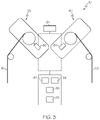
- FIG. 3 is another schematic view of the overhead person lifting apparatus of FIG. 1 , according to one or more embodiments shown and described herein;
- FIG. 4A is a side view of the overhead lifting apparatus of FIG. 1 in use, according to one or more embodiments shown and described herein;
- FIG. 4B is a front view of a sling bar device for use with the overhead lifting apparatus of FIG. 4A , according to one or more embodiments shown and described herein.
- the person lifting apparatus may generally include two lift actuators operatively connected to accessory couplings via two lift straps, whereby each lift actuator raises and lowers the respective accessory coupling using the respective lift strap.
- the accessory couplings connect to a device, such as a sling bar device, which, in turn, can connect to a patient lift sling.
- the imbalance condition may be indicative of patient orientation as current draw can indicate load on the lift actuator due to patient position and weight distribution in a patient lift sling, as an example.
- the person lifting apparatus 10 is part of an overhead patient lifting system 12 that includes one or more rails 14 that are secured or coupled to a support surface, such as a ceiling of a room.
- the person lifting apparatus 10 is movably coupled to the rail 14 by a carriage 16 .
- the person lifting apparatus 10 is configured to support and lift a patient with a pair of lifting straps 18 and 20 .
- the lifting straps 18 and 20 may each include an accessory coupling 22 and 24 located at a free end 26 and 28 of the lifting straps 18 and 20 .
- Sling bar devices 30 and 32 are illustrated connected to the accessory couplings 22 and 24 .
- sling bar devices 30 and 32 are illustrated, other accessories may be coupled to the lifting straps 18 and 20 depending on the desired lifting or other support operation.
- a sling or harness may be coupled to both of the sling bar devices 30 and 32 to support a person for a person lifting and/or tilting operation.
- An emergency brake strap 33 may be provided that can be utilized to stop all operation of the person lifting apparatus 10 and hold the lifting straps 18 and 20 in their current positions.
- the person lifting apparatus 10 includes a housing 34 and a support structure 36 that is located in the housing 34 and supports a pair of lifting strap feeding devices 38 and 40 within the same housing 34 .
- the lifting strap feeding devices 38 and 40 each wind up and pay out their respective lifting strap 18 and 20 .
- the housing 34 includes a top 42 , a bottom 44 , sides 46 , 48 , a front 50 and a back 52 ( FIG. 1 ) defining an enclosure that houses the lifting strap feeding devices 38 and 40 .
- a hanging bracket 54 is located at the top 42 of the housing 34 and may be connected to the housing 34 and support structure 36 .
- the hanging bracket 54 may also be part of or connected to the carriage 16 ( FIG.
- Rotation of the housing 34 using the carriage 16 may be effectuated manually and/or may be motorized.
- Manual rotation of the housing 34 may be caused, for example, by manually grasping one of the lifting straps 18 and 20 and/or the sling bar devices 30 , 32 and applying a rotational force to the housing 34 by pulling the lifting straps 18 and 20 and/or the sling bar devices 30 , 32 .
- a brake or other stop mechanism may be used to inhibit rotation of the housing 34 when desired.
- the support structure 36 includes support components (represented by element 56 , such as beams, brackets, fasteners, etc.) that support the lifting strap feeding devices 38 and 40 .
- the strap feeding devices 38 and 40 generally include housings 58 and 60 , lift actuators 62 and 64 (e.g., motors), and drums 66 and 68 that are rotated by the lift actuators 62 and 64 to wind up and pay out the lifting straps 18 and 20 .
- the drums 66 and 68 may be coupled to a shaft of the lift actuators 62 and 64 and may be configured to extend and retract the lifting straps 18 and 20 as the lift actuators 62 and 64 rotate the drums 66 and 68 in response to a user providing an input to a control system via an input device.
- the strap feeding devices 38 and 40 are supported by the support structure 36 at angles ⁇ 1 and ⁇ 2 to horizontal.
- the support structure 36 supports the lifting strap feeding devices 38 and 40 at the angles ⁇ 1 and ⁇ 2 to horizontal such that lifting strap feed out locations 70 and 72 are not facing vertically or horizontally only, but also face outward at an angle to both vertical and horizontal.
- Such a non-horizontal and non-vertical arrangement for the lifting strap feeding devices 38 and 40 can allow the lifting strap feeding devices 38 and 40 to pay out the lifting straps 18 and 20 at angles ⁇ 1 and ⁇ 2 to vertical inside the housing 34 toward the sides 46 and 48 of the housing 34 .
- the lifting straps 18 and 20 may release from the drums 66 and 68 at points P 1 and P 2 where the lifting straps 18 and 20 are substantially tangent to their respective drum 66 , 68 .
- the lifting straps 18 and 20 are then directed over spacing rollers 74 and 76 that are spaced horizontally from the points P 1 and P 2 and offset horizontally from the drums 66 and 68 thereby increasing a horizontal spacing between the lifting straps 18 and 20 as they release from their drums 66 and 68 at points P 1 and P 1 to points P 3 and P 4 where they release from their spacing rollers 74 and 76 .
- FIG. 2 illustrates the lifting straps 18 and 20 in a freely hanging configuration with the lifting straps 18 and 20 not in use for a lifting operation. In the freely hanging configuration, the lifting straps 18 and 20 hang from the spacing rollers 74 in a vertical orientation from the spacing rollers 74 and 76 . The lifting straps 18 and 20 may extend downward from the spacing rollers 74 and 76 and exit the housing 34 at exit openings 78 and 80 . While spacing rollers 74 and 76 are described, various other spacing members may be used that may or may not move or rotate.
- FIG. 3 another schematic of operation of the person lifting apparatus 10 is illustrated including the lift actuators 62 and 64 and lifting straps 18 and 20 that are connected to the lift actuators 62 and 64 .
- a controller 84 is operatively connected to the lift actuators 62 and 64 for controlling operation of the lift actuators 62 and 64 , e.g., based on a user input using a user input device 90 (e.g., a remote control).
- the user input device 90 may be operably connected to the strap feeding devices 38 and 40 that feed the lifting straps 18 and 20 , as discussed above, and/or connected to the controller 84 .
- the user input device 90 may include tilt controls 92 and 94 .
- the tilt control 82 may be a clockwise tilt control that, upon actuation, causes the strap feeding device 38 to wind up the lifting strap 18 , while the strap feeding device 40 pays out the lifting strap 20 .
- the tilt control 94 may be a counterclockwise tilt control that, upon actuation, causes the strap feeding device 38 to pay out the lifting strap 18 , while the strap feeding device 40 winds up the lifting strap 20 .
- the tilt controls 92 and 94 may only raise and lower one of the lifting straps 18 and 20 (e.g., to move the head up and down while leaving the legs stationary).
- the tilt controls 92 and 94 can be used to rotate a person from a prone position to a sitting position, for example.
- the user input device 90 may also include up and down controls 96 and 98 that causes both strap feeding devices 38 and 40 to operate simultaneously to raise and lower the lifting straps 18 and 20 together. While the tilt controls 92 , 94 and the up and down controls 96 and 98 are illustrated there may be other controls. For example, there may be individual up and down controls for each of the strap feeding devices 38 and 40 .
- the user input device 90 may be wired or wirelessly connected to the strap feeding devices 38 and 40 .
- the user input device 80 may control the strap feeding devices 38 and 40 directly, or controller 84 may receive input signals from the user input device 90 .
- the user input device 90 may be dedicated to controlling the strap feeding devices 38 and 40 , such as a remote.
- the user input device 90 may be a personal computing device, such as a smart phone or tablet that includes software that can be used to control operation of the strap feeding devices.
- the user input device 90 and controller 84 may be connected to the internet for remotely controlling operation of the strap feeding devices 38 and 40 .
- the strap feeding devices 38 and 40 may be operated such that an imbalance condition is created.
- An imbalance condition may be due to, for example, paying out and/or retracting one of the lifting straps 18 and 20 an amount that causes a patient to tilt toward or away from one of the lifting straps 18 and 20 more than another beyond a predetermined amount.
- one of the lift actuators 38 and 40 may experience a greater load than the other of the lift actuators 38 and 40 .
- weight can be quantified based on current measurements. Comparing the ratio of currents pulled by the lift actuators 38 and 40 during operation to a predetermined value can be used to determine an imbalance condition. This predetermined value can be selected through clinical evaluations and assessments of patient loading using the two lifting straps 18 and 20 , in order to accommodate different patient morphologies. Any non-linearities in the current-to-weight function may be addressed in logic using, for example, a look-up table and interpolation.
- the controller 84 may include circuitry that reads the current being pulled by the lift actuators 48 and 50 from a power source.
- an electronic measuring device may measure the current from the power source and provide an output to the controller 84 .
- the predetermined value may be provided as a ratio of 1.5 that is saved in memory of the controller 84 .
- the electronic measuring device may be part of the controller 84 and/or may be separate from the controller 84 . Referring to the Table below, the first example illustrates a balance condition with a current ratio of 1.25, below the 1.5 predetermined value. The second example illustrates an imbalance condition with a current ratio of 1.75, above the predetermined value.
- the controller 84 upon determining an imbalance condition exists, may take any one of a number of actions, such as to no longer allow tilting in a direction which increases the ratio. As another example, the controller 84 may tilt the person lifting apparatus 10 automatically in a direction that reduces the ratio. In some embodiments, there may be a scale of predetermined values and the action performed by the controller 84 may depend on the magnitude of the imbalance. Since the controller 84 can continually monitor the current ratio, a ratio of 1.75 may be unlikely. However, such a condition may be present, for example, when a support is suddenly removed. While the predetermined value described above is greater than 1, the predetermined value may below 1, such as 0.5 or below, depending on how the calculation is made. The controller 84 may further provide an indication to a user that an imbalance condition is present (e.g., visual and/or audible).
- an imbalance condition e.g., visual and/or audible
- the person lifting apparatus 10 is illustrated with its long axis 100 parallel with a direction of travel along the rail 14 .
- a sling 102 is illustrated connected to the sling bar devices 30 and 32 .
- the sling bar devices 30 , 32 (only sling bar device 30 is shown) includes a connector 104 for coupling the sling bar device 30 to the person lifting apparatus 10 .
- the connector 104 is fixedly coupled to the sling bar device 30 in FIG. 4B , although in other embodiments, the connector 104 may be movably coupled to the sling bar device 30 .
- Allowing the connector 104 to move with respect to the sling bar device 30 may help to decrease the torque forces on the connector 104 when the sling 102 is coupled to the sling bar device 30 , maintain the alignment of the sling 102 , sling bar device 30 , and person lifting apparatus 10 , and prevent twisting of various components.
- the sling bar device 30 includes an elongated bar 106 and two hooks 108 coupled to the distal ends of the elongated bar 106 .
- the sling bar device 30 may be an X-shaped sling bar that includes two curved frame members coupled by a middle frame member and including four support apparatus coupling mechanisms.
- the sling bar may include a U-shaped frame including two support apparatus coupling mechanisms and a U-shaped handle extending from the frame to provide stability to a subject being lifted.
- Other sling bar configurations are contemplated. Various sling bar configurations are described in greater detail in U.S. Pat. No. 9,757,297, entitled “Person Lift System.”
- the hooks 108 include a coupling base 110 with a recessed space 112 therein and a latch 114 configured to selectively enclose the recessed space 112 .
- the latch 114 is pivotally coupled to the coupling base 110 and is configured to extend across the recessed space 112 in a closed position and rotate towards the recessed space 112 in an open position.
- the user lifts the latch 114 (i.e., rotates the latch 114 away from the recessed space 112 ), to allow the strap(s) or other portion of the sling 102 to be inserted into the recessed space 112 .
- the user When a user removes the sling 102 from the hook 108 , the user lifts the latch 114 to rotate the latch 114 toward an open position (i.e., rotates the latch 114 away from the recessed space 112 ) such as with a sling strap to allow the sling 102 to be removed from the recessed space 112 .
- Suitable sling bars include, by way of example and not limitation, those commercially available under the trade name SlingGuard from Liko, HILL-ROM®, or Hill-Rom Services, Inc. (Batesville, Ind.). Additionally, it is contemplated that some embodiments may not include a sling bar.
- the above-described person lifting systems provides a multiple lifting strap solution for supporting, raising and lowering, and tilting persons.
- the multiple strap feeding devices along with the associated lifting straps can support various body types, such as bariatric patients that need assistance in raising and lowering their bodies.
- the strap feeding devices may each be rated up to 550 pounds each for a total of 1100 pounds. However, the strap feeding devices may be rated for more or less than 550 pounds each. Further, the strap feeding devices may be operated together or separately to raise and lower the lifting straps together or separately.
- the person lifting systems include a current monitoring system that includes a controller including logic that compares current draw of the lift actuators, determines a ratio and compares the ratio to a predetermined threshold.
- the controller may discontinue operation of the lift actuators or take some other action.
- a single person lifting system with a pair strap feeding devices and associated lifting straps is discussed above, two separate person lifting devices, each with a single strap feeding device and associated lifting strap may be used.
- a person lifting apparatus comprising: a first lifting strap feeding device comprising a first drum and a first lifting strap wound on the first drum; a second lifting strap feeding device comprising a second drum and a second lifting strap wound on the second drum; and a controller communicatively coupled to the first lifting strap feeding device and to the second lifting strap feeding device, the controller includes logic that controls operation of the first lifting strap feeding device and the second lifting strap feeding device based on a comparison of current draws of the first lifting strap feeding device and the second lifting strap feeding device.
- controller includes the logic that controls operation of the first lifting strap feeding device and the second lifting strap feeding device based on a ratio of the current draw of the first lifting strap feeding device and the current draw of the second strap feeding device.
- controller includes the logic that compares the ratio to a predetermined value.
- controller includes the logic that prevents operation of one or both of the first lifting strap feeding device and the second lifting strap feeding device if the ratio is above the predetermined value.
- controller includes the logic that prevents operation of one or both of the first lifting strap feeding device and the second lifting strap feeding device to prevent tilting in a direction which increases the ratio.
- controller includes the logic that allows operation of one or both of the first lifting strap feeding device and the second lifting strap feeding device to allow tilting in a direction which decreases the ratio.
- a method of operating a person lifting apparatus comprising: controlling operation of a first lifting strap feeding device and a second lifting strap feeding device thereby tilting a patient supported by lifting straps connected to the first lifting strap feeding device and the second lifting strap feeding device; determining a current draw of the first lifting strap feeding device during operation using a controller; determining a current draw of the second lifting strap feeding device during operation using the controller; comparing the current draws of the first lifting strap feeding device and the second lifting strap feeding device; and the controller controlling operation of the first lifting strap feeding device and the second lifting strap feeding device based on the comparison of the current draws.
- a person lifting apparatus comprising: a first lifting strap feeding device comprising a first drum and a first lifting strap wound on the first drum; a second lifting strap feeding device comprising a second drum and a second lifting strap wound on the second drum; and a controller communicatively coupled to the first lifting strap feeding device and to the second lifting strap feeding device, the controller includes logic that prevents operation of the first lifting strap feeding device and the second lifting strap feeding device is an imbalance condition is detected using a comparison of current draws of the first lifting strap feeding device and the second lifting strap feeding device.
- controller includes the logic that controls operation of the first lifting strap feeding device and the second lifting strap feeding device based on a ratio of the current draw of the first lifting strap feeding device and the current draw of the second strap feeding device.
- controller includes the logic that compares the ratio to a predetermined value.
- controller includes the logic that prevents operation of one or both of the first lifting strap feeding device and the second lifting strap feeding device if the ratio is above the predetermined value.
- the person lifting apparatuses described herein provide multiple lifting straps along with a controller that monitors and compares current draws from their associated lifting strap feeding devices to detect an imbalance condition.
Landscapes
- Health & Medical Sciences (AREA)
- Veterinary Medicine (AREA)
- Life Sciences & Earth Sciences (AREA)
- Animal Behavior & Ethology (AREA)
- General Health & Medical Sciences (AREA)
- Public Health (AREA)
- Nursing (AREA)
- Physics & Mathematics (AREA)
- General Physics & Mathematics (AREA)
- Engineering & Computer Science (AREA)
- Mechanical Engineering (AREA)
- Power Engineering (AREA)
- Electromagnetism (AREA)
- Invalid Beds And Related Equipment (AREA)
Abstract
Description
| TABLE |
| Imbalance Condition |
| Strap 1 | Strap 1 | |
|
Current | Imbalance | ||
| Weight | Current | Weight | Current | Ratio | Present? | ||
| Example 1 | 400 lbs | 10 A | 320 lbs | 8 A | 1.25 | No |
| Example 2 | 140 lbs | 3.5 A | 80 lbs | 2 A | 1.75 | Yes |
Claims (20)
Priority Applications (1)
| Application Number | Priority Date | Filing Date | Title |
|---|---|---|---|
| US16/576,019 US11344462B2 (en) | 2018-09-19 | 2019-09-19 | Person lifting apparatuses including lifting straps and methods of operation based on current draw |
Applications Claiming Priority (3)
| Application Number | Priority Date | Filing Date | Title |
|---|---|---|---|
| US201862733354P | 2018-09-19 | 2018-09-19 | |
| US201962878508P | 2019-07-25 | 2019-07-25 | |
| US16/576,019 US11344462B2 (en) | 2018-09-19 | 2019-09-19 | Person lifting apparatuses including lifting straps and methods of operation based on current draw |
Publications (2)
| Publication Number | Publication Date |
|---|---|
| US20200085659A1 US20200085659A1 (en) | 2020-03-19 |
| US11344462B2 true US11344462B2 (en) | 2022-05-31 |
Family
ID=69773723
Family Applications (2)
| Application Number | Title | Priority Date | Filing Date |
|---|---|---|---|
| US16/576,019 Active 2040-01-18 US11344462B2 (en) | 2018-09-19 | 2019-09-19 | Person lifting apparatuses including lifting straps and methods of operation based on current draw |
| US16/576,069 Abandoned US20200085657A1 (en) | 2018-09-19 | 2019-09-19 | Determining lifting events using sensors for person lifting apparatuses |
Family Applications After (1)
| Application Number | Title | Priority Date | Filing Date |
|---|---|---|---|
| US16/576,069 Abandoned US20200085657A1 (en) | 2018-09-19 | 2019-09-19 | Determining lifting events using sensors for person lifting apparatuses |
Country Status (1)
| Country | Link |
|---|---|
| US (2) | US11344462B2 (en) |
Families Citing this family (8)
| Publication number | Priority date | Publication date | Assignee | Title |
|---|---|---|---|---|
| US11542128B2 (en) * | 2018-12-11 | 2023-01-03 | Liko Research & Development Ab | Subject lift transfer assemblies and methods for operating the same |
| US11717457B2 (en) * | 2019-02-18 | 2023-08-08 | Liko Research & Development Ab | Lift system with a stowable support assembly |
| US11624644B2 (en) * | 2020-07-16 | 2023-04-11 | Scott J. Kupferman | Pet harness with integrated scale |
| SE544777C2 (en) | 2020-08-17 | 2022-11-15 | Arjo Ip Holding Ab | Drive system for patient lift comprising a transmission with a worm drive |
| FR3116432B1 (en) * | 2020-11-21 | 2023-06-09 | Christophe Journet | Person transfer device comprising an inclinable twin-loop harness |
| US12233014B2 (en) * | 2021-05-18 | 2025-02-25 | Sld Technology, Inc. | Modular patient lift system |
| US20240230117A9 (en) * | 2021-05-19 | 2024-07-11 | Sld Technology, Inc. | Central medical suite system |
| US20240423855A1 (en) * | 2023-06-20 | 2024-12-26 | Robert Myers | Individual Lifting and Transporting Device and Method of Use |
Citations (11)
| Publication number | Priority date | Publication date | Assignee | Title |
|---|---|---|---|---|
| US6302828B1 (en) * | 2000-01-28 | 2001-10-16 | Biodex Medical Systems, Inc. | Weight offloading apparatus |
| US20140013503A1 (en) | 2012-07-12 | 2014-01-16 | Steven A. Dixon | Monitoring Systems Devices and Methods for Patient Lifts |
| US20140223660A1 (en) | 2013-02-11 | 2014-08-14 | Handicare Ab | Patient lift device |
| US8910325B2 (en) | 2010-02-12 | 2014-12-16 | Arjohuntleigh Magog Inc. | Lift apparatus and system |
| US9463128B2 (en) | 2012-11-01 | 2016-10-11 | Liko Research & Development Ab | Lift system with status indicators |
| US9510991B2 (en) | 2013-01-22 | 2016-12-06 | Gorbel, Inc. | Medical rehab lift system and method with horizontal and vertical force sensing and motion control |
| US20170087392A1 (en) | 2015-09-28 | 2017-03-30 | Lee Lambert | Fall prevention system for peripatetic persons |
| US9693922B2 (en) | 2013-10-21 | 2017-07-04 | Liko Research & Development Ab | Sling bar or lift strap connector having an integrated scale with tilt compensation |
| US9757297B2 (en) | 2014-02-03 | 2017-09-12 | Liko Research & Development Ab | Person lift system |
| CN206675665U (en) | 2016-12-21 | 2017-11-28 | 美德远健(北京)医疗系统科技有限公司 | The bi-motor biobelt lifting device of sky rail patient's transfer system |
| US20170354559A1 (en) * | 2014-11-17 | 2017-12-14 | Arjohuntleigh Magog Inc. | Ceiling Lift Tilt Management System |
-
2019
- 2019-09-19 US US16/576,019 patent/US11344462B2/en active Active
- 2019-09-19 US US16/576,069 patent/US20200085657A1/en not_active Abandoned
Patent Citations (11)
| Publication number | Priority date | Publication date | Assignee | Title |
|---|---|---|---|---|
| US6302828B1 (en) * | 2000-01-28 | 2001-10-16 | Biodex Medical Systems, Inc. | Weight offloading apparatus |
| US8910325B2 (en) | 2010-02-12 | 2014-12-16 | Arjohuntleigh Magog Inc. | Lift apparatus and system |
| US20140013503A1 (en) | 2012-07-12 | 2014-01-16 | Steven A. Dixon | Monitoring Systems Devices and Methods for Patient Lifts |
| US9463128B2 (en) | 2012-11-01 | 2016-10-11 | Liko Research & Development Ab | Lift system with status indicators |
| US9510991B2 (en) | 2013-01-22 | 2016-12-06 | Gorbel, Inc. | Medical rehab lift system and method with horizontal and vertical force sensing and motion control |
| US20140223660A1 (en) | 2013-02-11 | 2014-08-14 | Handicare Ab | Patient lift device |
| US9693922B2 (en) | 2013-10-21 | 2017-07-04 | Liko Research & Development Ab | Sling bar or lift strap connector having an integrated scale with tilt compensation |
| US9757297B2 (en) | 2014-02-03 | 2017-09-12 | Liko Research & Development Ab | Person lift system |
| US20170354559A1 (en) * | 2014-11-17 | 2017-12-14 | Arjohuntleigh Magog Inc. | Ceiling Lift Tilt Management System |
| US20170087392A1 (en) | 2015-09-28 | 2017-03-30 | Lee Lambert | Fall prevention system for peripatetic persons |
| CN206675665U (en) | 2016-12-21 | 2017-11-28 | 美德远健(北京)医疗系统科技有限公司 | The bi-motor biobelt lifting device of sky rail patient's transfer system |
Also Published As
| Publication number | Publication date |
|---|---|
| US20200085657A1 (en) | 2020-03-19 |
| US20200085659A1 (en) | 2020-03-19 |
Similar Documents
| Publication | Publication Date | Title |
|---|---|---|
| US11344462B2 (en) | Person lifting apparatuses including lifting straps and methods of operation based on current draw | |
| EP3510987B1 (en) | Person lifting apparatuses including lifting straps and methods of operation | |
| US8635720B2 (en) | Patient lifting system | |
| US12521290B2 (en) | Person lifting apparatuses including lifting straps and methods of operation | |
| US8549679B2 (en) | Personal lifting device | |
| US11278460B2 (en) | Sling bar devices for person lifting systems and methods for operating sling bar devices | |
| US10182955B2 (en) | Configurable patient ceiling lift | |
| JPH0615658U (en) | Free-load walking training device | |
| US10238563B2 (en) | Tiltable patient ceiling lift assembly | |
| HK1244660A1 (en) | Tiltable patient ceiling lift assembly | |
| AU2004284863A1 (en) | Hoisting device | |
| CA2967852C (en) | Coupled spreader bar assembly for patient lift | |
| US20100192297A1 (en) | Handling system for lifting or moving a person, a method for lifting or moving a person and use hereof | |
| US20260034005A1 (en) | Person lifting apparatuses including lifting straps and methods of operation | |
| CN120817521A (en) | Hoisting device for operating room, control method thereof, and hoisting system | |
| HK1244661B (en) | Configurable patient ceiling lift | |
| HK1244663B (en) | Coupled spreader bar assembly for patient lift |
Legal Events
| Date | Code | Title | Description |
|---|---|---|---|
| AS | Assignment |
Owner name: LIKO RESEARCH & DEVELOPMENT AB, SWEDEN Free format text: ASSIGNMENT OF ASSIGNORS INTEREST;ASSIGNORS:TARI, JOSEPH;STRASSLE, DEREK;REEL/FRAME:050432/0781 Effective date: 20181022 |
|
| FEPP | Fee payment procedure |
Free format text: ENTITY STATUS SET TO UNDISCOUNTED (ORIGINAL EVENT CODE: BIG.); ENTITY STATUS OF PATENT OWNER: LARGE ENTITY |
|
| STPP | Information on status: patent application and granting procedure in general |
Free format text: DOCKETED NEW CASE - READY FOR EXAMINATION |
|
| STPP | Information on status: patent application and granting procedure in general |
Free format text: NON FINAL ACTION MAILED |
|
| STPP | Information on status: patent application and granting procedure in general |
Free format text: RESPONSE TO NON-FINAL OFFICE ACTION ENTERED AND FORWARDED TO EXAMINER |
|
| STPP | Information on status: patent application and granting procedure in general |
Free format text: FINAL REJECTION MAILED |
|
| STPP | Information on status: patent application and granting procedure in general |
Free format text: RESPONSE AFTER FINAL ACTION FORWARDED TO EXAMINER |
|
| STPP | Information on status: patent application and granting procedure in general |
Free format text: ADVISORY ACTION MAILED |
|
| STPP | Information on status: patent application and granting procedure in general |
Free format text: NOTICE OF ALLOWANCE MAILED -- APPLICATION RECEIVED IN OFFICE OF PUBLICATIONS |
|
| STPP | Information on status: patent application and granting procedure in general |
Free format text: PUBLICATIONS -- ISSUE FEE PAYMENT VERIFIED |
|
| STCF | Information on status: patent grant |
Free format text: PATENTED CASE |
|
| MAFP | Maintenance fee payment |
Free format text: PAYMENT OF MAINTENANCE FEE, 4TH YEAR, LARGE ENTITY (ORIGINAL EVENT CODE: M1551); ENTITY STATUS OF PATENT OWNER: LARGE ENTITY Year of fee payment: 4 |