[go: up one dir, main page]

US11324340B2 - Modular pusher tray assembly - Google Patents

Modular pusher tray assembly Download PDF

Info

Publication number
US11324340B2
US11324340B2 US16/783,415 US202016783415A US11324340B2 US 11324340 B2 US11324340 B2 US 11324340B2 US 202016783415 A US202016783415 A US 202016783415A US 11324340 B2 US11324340 B2 US 11324340B2
Authority
US
United States
Prior art keywords
tray
product
product display
subassembly
base plate
Prior art date
Legal status (The legal status is an assumption and is not a legal conclusion. Google has not performed a legal analysis and makes no representation as to the accuracy of the status listed.)
Active
Application number
US16/783,415
Other versions
US20200253393A1 (en
Inventor
Matthew Wills
Julia Padvoiskis
Current Assignee (The listed assignees may be inaccurate. Google has not performed a legal analysis and makes no representation or warranty as to the accuracy of the list.)
Retail Space Solutions LLC
Original Assignee
Retail Space Solutions LLC
Priority date (The priority date is an assumption and is not a legal conclusion. Google has not performed a legal analysis and makes no representation as to the accuracy of the date listed.)
Filing date
Publication date
Application filed by Retail Space Solutions LLC filed Critical Retail Space Solutions LLC
Priority to US16/783,415 priority Critical patent/US11324340B2/en
Priority to CA3072230A priority patent/CA3072230A1/en
Assigned to RETAIL SPACE SOLUTIONS LLC reassignment RETAIL SPACE SOLUTIONS LLC ASSIGNMENT OF ASSIGNORS INTEREST (SEE DOCUMENT FOR DETAILS). Assignors: PADVOISKIS, Julia, WILLS, Matthew
Publication of US20200253393A1 publication Critical patent/US20200253393A1/en
Application granted granted Critical
Publication of US11324340B2 publication Critical patent/US11324340B2/en
Active legal-status Critical Current
Anticipated expiration legal-status Critical

Links

Images

Classifications

    • AHUMAN NECESSITIES
    • A47FURNITURE; DOMESTIC ARTICLES OR APPLIANCES; COFFEE MILLS; SPICE MILLS; SUCTION CLEANERS IN GENERAL
    • A47FSPECIAL FURNITURE, FITTINGS, OR ACCESSORIES FOR SHOPS, STOREHOUSES, BARS, RESTAURANTS OR THE LIKE; PAYING COUNTERS
    • A47F1/00Racks for dispensing merchandise; Containers for dispensing merchandise
    • A47F1/04Racks or containers with arrangements for dispensing articles, e.g. by means of gravity or springs
    • A47F1/12Racks or containers with arrangements for dispensing articles, e.g. by means of gravity or springs dispensing from the side of an approximately horizontal stack
    • A47F1/125Racks or containers with arrangements for dispensing articles, e.g. by means of gravity or springs dispensing from the side of an approximately horizontal stack with an article-pushing device
    • A47F1/126Racks or containers with arrangements for dispensing articles, e.g. by means of gravity or springs dispensing from the side of an approximately horizontal stack with an article-pushing device the pushing device being urged by spring means
    • AHUMAN NECESSITIES
    • A47FURNITURE; DOMESTIC ARTICLES OR APPLIANCES; COFFEE MILLS; SPICE MILLS; SUCTION CLEANERS IN GENERAL
    • A47BTABLES; DESKS; OFFICE FURNITURE; CABINETS; DRAWERS; GENERAL DETAILS OF FURNITURE
    • A47B57/00Cabinets, racks or shelf units, characterised by features for adjusting shelves or partitions
    • A47B57/58Cabinets, racks or shelf units, characterised by features for adjusting shelves or partitions with means for adjusting partitions horizontally
    • A47B57/583Cabinets, racks or shelf units, characterised by features for adjusting shelves or partitions with means for adjusting partitions horizontally by sliding
    • A47B57/585Cabinets, racks or shelf units, characterised by features for adjusting shelves or partitions with means for adjusting partitions horizontally by sliding with connection means slidable in a rail
    • AHUMAN NECESSITIES
    • A47FURNITURE; DOMESTIC ARTICLES OR APPLIANCES; COFFEE MILLS; SPICE MILLS; SUCTION CLEANERS IN GENERAL
    • A47FSPECIAL FURNITURE, FITTINGS, OR ACCESSORIES FOR SHOPS, STOREHOUSES, BARS, RESTAURANTS OR THE LIKE; PAYING COUNTERS
    • A47F5/00Show stands, hangers, or shelves characterised by their constructional features
    • A47F5/0043Show shelves
    • A47F5/005Partitions therefore
    • AHUMAN NECESSITIES
    • A47FURNITURE; DOMESTIC ARTICLES OR APPLIANCES; COFFEE MILLS; SPICE MILLS; SUCTION CLEANERS IN GENERAL
    • A47FSPECIAL FURNITURE, FITTINGS, OR ACCESSORIES FOR SHOPS, STOREHOUSES, BARS, RESTAURANTS OR THE LIKE; PAYING COUNTERS
    • A47F5/00Show stands, hangers, or shelves characterised by their constructional features
    • A47F5/08Show stands, hangers, or shelves characterised by their constructional features secured to the wall, ceiling, or the like; Wall-bracket display devices
    • A47F5/0807Display panels, grids or rods used for suspending merchandise or cards supporting articles; Movable brackets therefor
    • A47F5/0846Display panels or rails with elongated channels; Sliders, brackets, shelves, or the like, slidably attached therein
    • AHUMAN NECESSITIES
    • A47FURNITURE; DOMESTIC ARTICLES OR APPLIANCES; COFFEE MILLS; SPICE MILLS; SUCTION CLEANERS IN GENERAL
    • A47FSPECIAL FURNITURE, FITTINGS, OR ACCESSORIES FOR SHOPS, STOREHOUSES, BARS, RESTAURANTS OR THE LIKE; PAYING COUNTERS
    • A47F7/00Show stands, hangers, or shelves, adapted for particular articles or materials
    • A47F7/0007Show stands, hangers, or shelves, adapted for particular articles or materials for stacked articles; Stabilising means therefor
    • AHUMAN NECESSITIES
    • A47FURNITURE; DOMESTIC ARTICLES OR APPLIANCES; COFFEE MILLS; SPICE MILLS; SUCTION CLEANERS IN GENERAL
    • A47BTABLES; DESKS; OFFICE FURNITURE; CABINETS; DRAWERS; GENERAL DETAILS OF FURNITURE
    • A47B2220/00General furniture construction, e.g. fittings
    • A47B2220/0002Adjustable furniture construction
    • AHUMAN NECESSITIES
    • A47FURNITURE; DOMESTIC ARTICLES OR APPLIANCES; COFFEE MILLS; SPICE MILLS; SUCTION CLEANERS IN GENERAL
    • A47BTABLES; DESKS; OFFICE FURNITURE; CABINETS; DRAWERS; GENERAL DETAILS OF FURNITURE
    • A47B2220/00General furniture construction, e.g. fittings
    • A47B2220/0022Slides

Definitions

  • the present disclosure relates to product support and display systems.
  • U.S. Pat. No. 5,769,248 discloses a product display grid system including a grid and various product hangers.
  • the grid is comprised of spaced vertical and spaced horizontal members.
  • the product hangers such as shelves, cups, hook and trays have attachment members that secure the product hangers to the horizontal elongate members of the grid.
  • the product hangers support and display the products.
  • U.S. Pat. No. 5,855,283 discloses a product display including a track, a tray having a top surface upon which products are displayed, and interengagable members on the track and tray for enabling the tray to have a first mode of operation wherein the interengagable members are disengaged allowing the tray to move relative to the track and a second mode of operation wherein the interengagable members are interengaged prohibiting movement of the tray relative to the track.
  • a biasing member urges products on the displayed toward the front of the display.
  • Adjustable guide members are positioned adjacent the display surface for containing products on the display surface. The guide members are adjustable to accommodate various sizes of products.
  • U.S. Pat. No. 6,227,385 discloses a self-facing, add-on shelf system made up of universal base, divider, front, and rear sections. Universal in the sense that these sections form basic building sections for constructing shelf systems of various sizes and operational mode.
  • the front and rear track sections are identical and can be combined with various combinations of bases, dividers and end sections to provide systems of different, desired widths.
  • the depth of the self-facing shelf is generally set by the depth of the shelf with which it is to be used.
  • the individual sections can be selected and combined to provide center pusher, side pusher, and gravity feed types of self facing systems.
  • the bases, dividers and end sections are configured such that they can be extruded and interlock in assembly.
  • U.S. Pat. Nos. 7,168,579 and 7,681,745 disclose merchandising systems providing for the presentation and storage of articles comprising a base having a front and a back, the base being configured to support the articles and defining a first space for containing the articles.
  • the merchandising system comprises an assembly for advancing the articles toward the front of the base, wherein the assembly comprises a member configured to extend beyond the base to create a second space for containing the articles in addition to the first space.
  • U.S. Pat. No. 7,681,744 discloses a merchandising system for articles comprising a base comprising an upper surface having a plurality of ribs, an underside having a plurality of supports formed integrally with the underside of the base, and a first side and a second side.
  • the merchandising system comprises a frame coupled to the base and configured to couple with a shelving system for supporting the base in a substantially horizontal configuration, a first guide and a second guide coupled to the base for supporting articles, and an assembly for advancing the articles that is coupled to the base and provides force on the articles.
  • U.S. Pat. No. 10,154,739 discloses a universal front-facing merchandiser having a front rail having a first mating structure and a plurality of integrated pusher and divider assemblies. Each divider assembly includes a second mating structure that corresponds to and mates with the first mating structure to couple the integrated pusher and divider assemblies to the front rail.
  • each pusher and divider assembly and the front rail are movable between a first position where the integrated pusher and divider assembly is coupled to and laterally movable about the front rail and is not removable from the front rail without force being applied to the integrated pusher and divider assembly and a second position where the integrated pusher and divider assembly is secured to the front rail in a desired position in a manner that hinders lateral movement of the integrated pusher and divider assembly.
  • U.S. Patent Application Publication No. 2018/0153313 discloses a shelf management system having a tray defining a first mating structure and a second mating structure, a shelf management component having a spring biased pusher connected thereto and movable between a first position wherein the pusher is extended to a rear of the shelf management component and a second position wherein the pusher is retracted to a front of the shelf management component, and an interstitial member positioned between the shelf management component and the tray to secure the shelf management component to the tray and hinder lateral movement of the shelf management component with respect to the tray.
  • Improved components of the shelf management system are also disclosed as are methods relating to same.
  • U.S. Patent Application Publication No. 2018/0360233 discloses a product display tray including one or more arms including engagement members.
  • the product display tray can also include a base having one or more tracks receiving the one or more arms, wherein the base is slidable along the one or more arms from a first position to a second position.
  • the product display tray can also include a handle.
  • the product display tray can also include a latch, wherein the latch is operably connected to the handle, wherein the latch has an engaged position and a disengaged position, and wherein the latch is in the engaged position when the base is in the first position and the base is operable to enter the second position when the latch is in the disengaged position.
  • a product display comprising a rail having a channel and a tray.
  • the tray comprising a first sidewall, a second sidewall, and a product support surface.
  • the tray further comprising an engagement portion having at least one protrusion configured to engage the channel.
  • U.S. Patent Application Publication No. 2019/0357701 discloses a product display merchandiser comprising a tray having a product supporting surface; a first sidewall adjacent a first side of the tray; a second sidewall adjacent a second side of the tray; and a bracket configured to detachably mount the product display merchandiser to a support.
  • the product display merchandiser is further configured with at least one of the following: the first and second sidewalls each having a respective sidewall vertical portion with a rear edge that is angled away from a rear of the product display merchandiser; the bracket having a tray-supporting portion that is oriented at an acute angle with respect to a support-engaging portion; and/or the bracket having at least two types of engagement members for mounting the product display merchandiser to either of at least two types of supports.
  • a product display merchandiser comprises a tray having a top product-supporting surface with a longitudinally extending channel defined therein.
  • a first sidewall has a vertical portion and a horizontal portion, at least a laterally inner part of the horizontal portion configured to slide laterally with respect to the tray between a bottom of the tray and a base plate below the tray.
  • a front end of the tray comprises a fitting configured to be received in a socket in the base plate.
  • the channel is configured to receive a support assembly configured to couple the tray to a support structure.
  • a product display merchandiser comprises a tray subassembly comprising a tray having a top product-supporting surface and a longitudinally extending channel recessed from the product-supporting surface.
  • a base plate is coupled to a bottom of the tray subassembly.
  • a sidewall subassembly comprises first and second sidewalls, each sidewall having a vertical portion and a horizontal portion, at least a laterally inner part of each horizontal portion slidably extending between the bottom of the tray and a top of the base plate.
  • a support subassembly is configured to couple the product display merchandiser to a support structure, the support subassembly comprising a support member located within the channel of the tray and a bracket.
  • FIG. 1 illustrates a front perspective view of a product display merchandiser according to the present disclosure.
  • FIG. 2 illustrates a rear perspective view of the product display merchandiser.
  • FIG. 3 illustrates a partially exploded view of the product display merchandiser.
  • FIG. 4 is a cross-section of the product display merchandiser down a longitudinal centerline thereof, wherein no sidewalls are installed.
  • FIG. 5 is a partially assembled view of the product display merchandiser with a first sidewall.
  • FIG. 6 is another partially assembled view of the product display merchandiser with a second sidewall.
  • FIG. 7 is another cross-section of the product display merchandiser down the longitudinal centerline thereof, wherein the first sidewall is installed.
  • FIG. 8 illustrates a close-up cross-sectional view of a front end of the product display merchandiser.
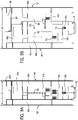
  • FIGS. 9A and 9B illustrate the sidewalls of the product display merchandiser in different positions with respect to the base plate thereof.
  • FIG. 10 is a view like FIG. 5 , but with the tray subassembly of the product display merchandiser removed.
  • FIG. 11 is a view similar to FIG. 6 , but with the tray subassembly of the product display merchandiser removed.
  • FIG. 12 illustrates a first sidewall and a base plate of another embodiment of a product display merchandiser.
  • FIG. 13 illustrates a second sidewall and the base plate of the embodiment of FIG. 12 .
  • FIG. 14 illustrates several product display merchandisers on a single base plate.
  • FIG. 15 illustrates a partially exploded view of another embodiment of a product display merchandiser.
  • FIG. 16 is a cross-section of the product display merchandiser of FIG. 15 down a longitudinal centerline thereof, wherein no sidewalls are installed.
  • FIG. 17 is a front perspective view of the assembled product display merchandiser of FIGS. 15 and 16 .
  • FIG. 18 is a close-up view of the front end of the product display merchandiser of FIGS. 15-17 .
  • FIGS. 19A and 19B are photographs of product engaged by a pusher according to the embodiment of FIGS. 15-18 .
  • FIGS. 20A and 20B are photographs of a different product engaged by the pusher according to the embodiment of FIGS. 15-18 .
  • FIG. 21 shows two pusher subassemblies according to the embodiment of FIGS. 15-18 connected together for shipping.
  • FIG. 22 shows a number of pusher subassemblies packaged in a box.
  • FIGS. 1-3 illustrate a product display merchandiser 10 according to the present disclosure.
  • the product display merchandiser 10 is made up of four subassemblies, including a pusher subassembly 12 , a support subassembly 14 , a sidewall subassembly 16 , and a base subassembly 18 .
  • the pusher subassembly 12 includes a tray 20 having a top product-supporting surface 21 with a longitudinally extending channel 22 defined therein, the channel 22 being recessed from the product-supporting surface 21 .
  • On either lateral side of the tray 20 are slideways 24 , the upper surfaces of which define the product-supporting surface 21 , and the outer edges of which overhang supporting walls 26 on the underside of the tray 20 .
  • a pusher 28 has two sidewalls 30 , the bottom ends of which are formed as inwardly-facing channels to receive the overhanging outer edges of the slideways 24 , thereby engaging the pusher 28 with the tray 20 .
  • a spring ( 44 , FIG.
  • the product stop 32 (e.g., lens) is positioned in front of the pusher 28 , and is held to the front end 20 a of the tray 20 by way of a snap fit, although other types of attachments could be used.
  • Product supported by the product-supporting surface 21 of the tray 20 is received on a front face 28 a of the pusher 28 , behind the product stop 32 .
  • the spring-biased pusher 28 moves toward the front end 20 a of the tray 20 . More specifically, when product is removed from between the pusher 28 and the product stop 32 , the spring 44 forces the pusher 28 toward the front end 20 a of the tray 20 , while the channels at the bottom ends of pusher sidewalls 30 slide along outer edges of slideways 24 .
  • the support subassembly 14 is configured to couple the tray 20 to a support structure, such as a peg/slat wall, and includes a bracket 34 and a support member 36 .
  • the support member 36 is a C-shaped member that opens downwardly; however, other structural cross-sections could be used.
  • the support member 36 is connected to the bracket 34 by way of a horizontally projecting tab 36 a at the rear end of the support member 36 , which extends into a slot 34 a in the bracket 34 and is welded, adhered, or otherwise attached to the bracket 34 .
  • the bracket 34 and support member 36 could be a single, integral piece.
  • the sidewall subassembly 16 includes two sidewalls 38 , 40 , each of which includes a vertical portion 38 a , 40 a and a horizontal product-supporting portion 38 b , 40 b .
  • each of the first and second sidewalls 38 , 40 also includes horizontally projecting tabs 38 c , 38 d , 40 c , 40 d located laterally inwardly of the product-supporting portions 38 b , 40 b , which tabs interface with one another such that a user can pull the vertical portions 38 a , 40 a toward one another or push the vertical portions 38 a , 40 a away from one another in order to accommodate products of differing widths.
  • a laterally outer part of the horizontal portions of the sidewalls 38 , 40 i.e., product-supporting portions 38 b , 40 b between the vertical portions 38 a , 40 a and horizontally projecting tabs 38 c , 38 d , 40 c , 40 d
  • product-supporting portions 38 b , 40 b between the vertical portions 38 a , 40 a and horizontally projecting tabs 38 c , 38 d , 40 c , 40 d
  • no horizontal product-supporting portions 38 b , 40 b are provided, and the horizontally projecting tabs 38 c , 38 d , 40 c , 40 d extend directly from the vertical portions 38 a , 40 a of the sidewalls 38 , 40 .
  • the base subassembly 18 includes a base plate 42 having retaining clips 42 a at a rear end thereof and a socket 42 b at a front end thereof. Another clip 42 c projects from the upper surface of the base plate 42 between the front and rear ends thereof.
  • the clips 42 a , 42 c and socket 42 b connect the base subassembly 18 to the remainder of the product display merchandiser 10 , as will be described further herein below.
  • FIG. 4 illustrates a cross-section of parts of the product display merchandiser 10 down a longitudinal centerline thereof.
  • the sidewall subassembly 16 is removed such that the interconnection of the pusher subassembly 12 , support subassembly 14 , and base subassembly 18 can be seen. Additionally, this view shows the spring 44 that biases the pusher 28 toward the front end 20 a of the tray 20 .
  • the base plate 42 comprises upwardly projecting clips 42 a , 42 c for engaging receiving structures in the tray 20 , such that the base plate 42 can be coupled to a bottom of the pusher subassembly 12 .
  • the base plate 42 is snap-fit to the tray 20 by way of the clips 42 a fitting around either end of a lower wall 20 b of the tray 20 .
  • clip 42 c fits into a receiving boss 20 d in lower wall 20 c of tray 20 .
  • Clips 42 a , 42 c thereby connect the base subassembly 18 to the pusher subassembly 12 .
  • Socket 42 b receives a fitting (see 57 , FIGS. 1 and 8 ) at the front end 20 a of tray 20 , thereby further connecting the base subassembly 18 to the pusher subassembly 12 .
  • the channel 22 is configured to receive the support subassembly 14 .
  • the support assembly 14 comprises a longitudinally extending support member 36 configured to be received/located in the channel 22 of the tray 20 and a bracket 34 extending non-parallel to the support member 36 and configured to detachably mount to a support structure.
  • the channel 22 and support member 36 are sized and shaped such that the lateral sides of the support member 36 interference fit within the channel 22 and a top surface of the support member 36 does not extend above the product-supporting surface 21 of the tray 20 .
  • Ribs including two upper ribs 20 g and two lower ribs 20 e , extend laterally within and across the channel 22 in the tray 20 .
  • the ribs 20 g , 20 e are configured to be coupled to the support assembly 14 when the support assembly 14 is received/located in the channel 22 of the tray 20 . More specifically, upper ribs 20 g are bolted to the support member 36 by way of bolts 46 (see also FIG. 1 ) and lower ribs 20 e provide stability below the support member 36 .
  • the ribs 20 g , 20 e resist moments caused by loads on the ends 20 a , 20 f of the tray 20 . Fewer or more ribs can be provided than those shown, and the support member 36 can be longer or shorter than shown depending on the loading requirements.
  • FIG. 5 shows a portion of the product display merchandiser 10 from which the product stop 32 , pusher 28 , and the second sidewall 40 has been removed.
  • the first sidewall 38 is installed to the base subassembly 18 and tray 20 by insertion of horizontally projecting tabs 38 c , 38 d extending from product-support portion 38 b of sidewall 38 between a bottom of the tray 20 and a top of the base plate 42 .
  • FIG. 6 shows the opposite sidewall 40 , which also has horizontally projecting tabs 40 c , 40 d extending from product-supporting portion 40 b . Horizontally projecting tabs 40 c , 40 d also extend between the bottom of the tray 20 and the top of the base plate 42 .
  • the product display merchandiser 10 has a first sidewall 38 having a vertical portion 38 a and a horizontal portion 38 b - d , at least a laterally inner part of the horizontal portion (i.e., horizontally projecting tabs 38 c , 38 d ) configured to slide laterally with respect to the tray 20 between a bottom of the tray 20 and the top of the base plate 42 below the tray 20 .
  • the product display merchandiser 10 further has a second sidewall 40 having a vertical portion 40 a and a horizontal portion 40 b - d , at least a laterally inner part of the horizontal portion (i.e., horizontally projecting tabs 40 c , 40 d ) configured to slide laterally with respect to the tray 20 between the bottom of the tray 20 and the base plate 42 and to slidably engage with the horizontal portion (i.e., horizontally projecting tabs 40 c , 40 d ) of the first sidewall 38 .
  • a second sidewall 40 having a vertical portion 40 a and a horizontal portion 40 b - d , at least a laterally inner part of the horizontal portion (i.e., horizontally projecting tabs 40 c , 40 d ) configured to slide laterally with respect to the tray 20 between the bottom of the tray 20 and the base plate 42 and to slidably engage with the horizontal portion (i.e., horizontally projecting tabs 40 c , 40 d )
  • horizontally projecting tabs 38 c , 38 d , 40 c , 40 d engage with one another in a manner that allows the sidewalls 38 , 40 to slide toward and away from one another and with respect to the base subassembly 18 while remaining connected to one another and to the base subassembly 18 , as will be described further herein below.
  • FIG. 7 illustrates a right side cross-sectional view of the product display merchandiser 10 with the first sidewall 38 installed and the second sidewall 40 removed. Similar to FIG. 4 , it can be seen how the pusher subassembly 12 , support subassembly 14 , and base subassembly 18 are connected to one another. It can also be seen how the first sidewall 38 of the sidewall subassembly 16 is connected to the remainder of the parts by way of the horizontally projecting tabs 38 c and 38 d extending between the bottom of the tray 20 and the top of the base plate 42 .
  • FIG. 8 shows a close-up view of the front end of the product display merchandiser 10 , taken through one of the fittings 57 at the front end 20 a of the tray 20 .
  • the front end 20 a of the tray 20 comprises a fitting 57 configured to be received in the socket 42 b in the base plate 42 .
  • FIG. 3 shows how there may in fact be two fittings 57 at the front end 20 a of the tray 20 , although one or more than two fittings can be provided.
  • Such a connection in addition to the clip connections at 42 a , 42 c described hereinabove with respect to FIG. 4 , further maintain the subassemblies in a fully assembled state.
  • FIGS. 9A and 9B show the sidewalls 38 , 40 in different positions with respect to the base subassembly 18 .
  • both sidewalls 38 , 40 are pushed fully towards one another and an opening O 1 between the sidewalls 38 , 40 is centered on the base subassembly 18 .
  • a flange 60 which extends from a rear side of the first horizontally projecting tab 38 c of the first sidewall 38 , and which is slidably received within a slot 58 located in the front side of the second horizontally projecting tab 40 c of the second sidewall 40 .
  • a flange 56 which extends from a front side of the first horizontally projecting tab 40 d of the second sidewall 40 , is slidably received within a slot 54 located in a rear side of the second horizontally projecting tab 38 d of the first sidewall 38 .
  • FIG. 9B shows both sidewalls 38 , 40 pulled fully away from one another by way of the flanges 56 , 60 sliding within slots 54 , 58 .
  • the opening O 2 between the sidewalls 38 , 40 is centered on the base subassembly 18 .
  • FIGS. 9A and 9B shows the two sidewalls 38 , 40 being pulled out simultaneously, in other examples, the left sidewall 38 could be pulled out first or the right sidewall 40 could be pulled out first.
  • the assemblies are provided with detent-like mechanisms in the form of a number of projections and scalloped surfaces.
  • a portion of the horizontally projecting tab 38 c of the first sidewall 38 slidably interfaces with a portion of the horizontally projecting tab 40 c of the second sidewall 40 such that the vertical portions 38 a , 40 a of the first and second sidewalls 38 , 40 are laterally adjustable relative to one another and the base plate 42 .
  • the portion of the horizontally projecting tab 38 c of the first sidewall 38 is a projection coupled to the horizontally projecting tab 38 c of the first sidewall 38
  • the portion of the horizontally projecting tab 40 c of the second sidewall 40 is a scalloped surface formed in the horizontally projecting tab 40 c of the second sidewall 40 .
  • Projection 62 , 64 are located at the ends of the flanges 56 , 60 extending from the side surfaces of the horizontally projecting tabs 38 c , 40 d of the first sidewall 38 and second sidewall 40 , respectively.
  • the projections 62 , 64 at the end of these flanges 56 , 60 ride along scalloped surfaces within their corresponding slots 54 , 58 in the side surfaces of the horizontally projecting tabs 38 d , 40 c , respectively.
  • Such a scalloped surface 66 is shown in slot 58 in FIG. 11 . Although the scalloped surface is not shown in slot 54 , it should be understood that it is identical to the scalloped surface 66 .
  • each of the flanges 60 , 56 extending from the first horizontally projecting tabs 38 c , 40 d of the first sidewall 38 and the second sidewall 40 terminates in a projection 62 , 64 such that the projection 62 of the first horizontally projecting tab 38 c of the first sidewall 38 interacts with the scalloped surface 66 of the second horizontally projecting tab 40 c of the second sidewall 40 and the projection 64 of the first horizontally projecting tab 40 d of the second sidewall 40 interacts with the scalloped surface (not shown, inside slot 54 ) of the second horizontally projecting tab 38 d of the first sidewall 38 .
  • projections 62 , 64 with scalloped surfaces 66 inside slot 58 and scalloped surfaces (not shown) inside slot 54 provides a number of discrete detents that allow the user to precisely position the horizontally projecting tabs 38 c , 38 d , 40 c , 40 d with respect to one another and with respect to the base subassembly 18 .
  • At least one of the horizontally projecting tabs 38 c , 38 d , 40 c , 40 d includes a plurality of indicator markings 76 , 78 that enable a user to move the first sidewall 38 and the second sidewall 40 to define a plurality of discrete tray widths, such that an opening O 1 , O 2 between the first sidewall 38 and the second sidewall 40 is centered relative to a longitudinal midline of the base plate 42 .
  • both horizontally projecting tabs 38 c and 40 c are provided with a series of markings 76 , 78 , respectively, (such as numbers and hatch marks) that allow the user to position the sidewalls 38 , 40 at precise distances away from one another, thereby creating an opening between the sidewalls 38 , 40 that matches the width of a particular product. Note that opening widths between the fully closed opening O 1 and the fully open opening O 2 are possible, although not shown herein.
  • FIGS. 9A-11 it should be understood that while the above description has focused on widening the opening between the sidewalls 38 , 40 by pulling them away from one another, the opening between the sidewalls 38 , 40 can also be narrowed by pushing them toward one another. In the event that only one of the sidewalls 38 or 40 is pushed in towards the base subassembly 18 at a time (although both sidewalls 38 , 40 can be moved at the same time, as described herein above), a peg 80 extending upwardly from base plate 42 of base subassembly 18 limits over-travel of the sidewall 38 or 40 .
  • At least one of the horizontally projecting tabs 38 c , 38 d , 40 c , 40 d further comprises a notch configured to engage with the peg 80 to prevent an over-travel condition of at least one of the first and second sidewalls 38 , 40 with respect to the base plate 42 .
  • a notch 82 on tab 38 e and a notch 84 on horizontally projecting tab 40 c fit around the peg 80 and prevent further movement of the respective sidewall 38 or 40 in an inward direction.
  • FIGS. 10 and 11 show the sidewalls 38 and 40 at the end of their inward travel and touching the peg 80 , so these notches 82 , 84 are not particularly visible.
  • front side surface 68 of horizontally projecting tab 38 c interacts with a projection 72 on the base subassembly 18 behind clip 42 c .
  • a slot 79 in horizontally projecting tab 40 c fits around a peg 81 also projecting upwardly from the base subassembly 18 .
  • the product display merchandiser width-adjustment mechanism described herein therefore includes two sidewalls 38 , 40 with horizontal portions (i.e., horizontally projecting tabs 38 c , 38 d , 40 c , 40 d ) that slidably interlock with each other and with a rack (formed by projection 72 and peg 81 ) on a third component, here, base subassembly 18 . As the sidewalls 38 , 40 are pulled out, they adjust in relation to each other and in relation to the third component.
  • the sidewalls 38 , 40 therefore adjust in equal relation to the product display merchandiser mid-line.
  • the sidewalls 38 and 40 have horizontally projecting tabs 38 c , 38 d , 40 c , 40 d that interengage, the sidewalls 38 , 40 of the product display merchandiser 10 are able to be sub-assembled as a pair that can then later be attached to a pusher subassembly 12 .
  • This is valuable in the manufacturing process of the product display merchandiser 10 because the components can be sub-assembled in one location or station and then assembled to the pusher subassembly 12 and the remainder of the product display merchandiser 10 at a second location or station. This is an improvement over known designs that require the sidewalls and pusher body parts be assembled together at one station.
  • Mixed supply chain models can be utilized that locate some assembly steps in a lower-wage region or with a lower-cost vendor, while the finished goods are assembled in other areas. Additionally, if the sidewall subassemblies 16 are common components used with multiple finished goods SKUs, they can be warehoused as a sub-component to be used for the various finished goods.
  • FIGS. 12 and 13 show a second embodiment of a sidewall subassembly 116 on the same base subassembly 18 as in FIGS. 1-11 .
  • all elements not specifically described herein below with respect to the second embodiment of the sidewall subassembly 116 are denoted with a 3-digit reference number starting with “1,” and these elements correspond to the like-numbered elements in the first embodiment of product display merchandiser 10 .
  • the sidewall subassembly 116 of FIGS. 12 and 13 includes a minimal horizontal product-supporting portion on each of the sidewalls 138 , 140 . It can be seen, for instance, that horizontal product-supporting portions 138 b , 140 b of sidewalls 138 , 140 , respectively, are narrow ledges at the bottom edge of the vertical portions 138 a , 140 a . This can allow for a product display merchandiser with the sidewall subassembly 116 to be used with narrow products and/or when tight horizontal pack-out is desired.
  • the sidewalls 138 , 140 are laterally adjustable to change the width of the product display merchandiser, but the minimum width is less than that when the first embodiment of the sidewall subassembly 16 is used. In other embodiments, no horizontal product-supporting portion is provided at all on the sidewalls.
  • the horizontally projecting tabs 138 c , 138 d on sidewall 138 and 140 c , 140 d on sidewall 140 are located and shaped differently than those of the first embodiment of the sidewall subassembly 16 .
  • the function of the components is similar, in that projection 162 on flange 160 on horizontally projecting tab 138 c fits into slot 158 with scalloped surface 166 on horizontally projecting tab 140 c , while projection 164 on flange 156 on tab 140 d fits into slot 154 with scalloped surface (not shown) on horizontally projecting tab 138 d .
  • each of the second horizontally projecting tabs 138 d , 140 c of the first sidewall and the second sidewall 138 , 140 is substantially L-shaped in plan view, and the two horizontally projecting tabs 138 d , 140 c with notches 182 , 184 slot together around the peg 81 that limits over-travel of the sidewalls 138 , 140 .
  • a slot 179 in tab 140 d fits around peg 80 also to limit over-travel, while ensuring that the sidewall 140 remains aligned on the base plate 42 .
  • the same base plate 42 is used with both the first and second embodiments of the sidewall subassembly 16 , 116 .
  • the sidewall subassembly 16 of FIGS. 1-11 is used on a product display merchandiser that is longer than the product display merchandiser with which the sidewall subassembly 116 of FIGS. 12 and 13 would be used.
  • the pusher subassembly 12 and the support subassembly 14 may be modified to be shorter or longer as required depending on the length of the product display merchandiser (see FIG. 14 ).
  • the pusher subassembly 12 , support subassembly 14 , sidewall subassemblies 16 , 116 , and base subassembly 18 are described for use with a product display merchandiser 10 that is designed for suspension from a peg board or slat, the sidewall subassemblies 16 , 116 could instead be used with a product display merchandiser having a support bracket subassembly that is designed to be from a grid system or a horizontal bar.
  • the description of the support subassembly 14 provided herein above is not limiting on the scope of the present disclosure.
  • the base plate 42 has a width configured to hold a single pusher subassembly 12 thereupon.
  • the pusher subassembly 12 and sidewall subassemblies 16 , 116 can be used with a product display merchandiser that is designed to sit on a shelf.
  • the support subassembly 14 and the base subassembly 18 are removable from the product display merchandiser 10 so that the pusher subassembly 12 and the sidewall subassembly 16 , 116 can be coupled to a shelf-supported base plate.
  • FIG. 14 shows a plurality of product display merchandisers of different lengths as they might be arranged on a shelf.
  • a shelf-supported base plate 242 which has a width configured to support more than one tray 20 , 20 ′, 20 ′′, 20 ′′′ is fastened to a shelf in a known manner.
  • the shelf-supported base plate 242 has a socket 242 b at its front end shaped like the socket 42 b of FIGS. 1-13 .
  • the fitting 57 at the front end of each tray 20 , 20 ′, 20 ′′, 20 ′′′ fits into the socket 242 b to hold the pusher subassemblies 12 , 12 ′, 12 ′′, 12 ′′′ to the shelf-supported base plate 242 .
  • each pusher subassembly 12 , 12 ′, 12 ′′, 12 ′′′ is provided for each pusher subassembly 12 , 12 ′, 12 ′′, 12 ′′′, enabling tight horizontal packout on the shelf.
  • two sidewalls or sidewalls with wider horizontal portions can be provided for use with the pusher subassemblies.
  • FIGS. 15-18 show another embodiment of a product display merchandiser 310 .
  • the base subassembly 318 and sidewall subassembly 316 are similar, if not identical to, the base subassembly 18 and sidewall subassembly 16 of FIGS. 1-13 , and therefore will not be described further herein, but like components will be labeled with a 3-digit reference number starting with the numeral “3.”
  • the support subassembly 314 differs from that of the first embodiment, however.
  • the support subassembly 314 includes a bracket 334 and a support member 336 .
  • the support member 336 is C-shaped and has a channel 336 a that opens upwardly; however, other structural cross-sections could be used.
  • the bracket 334 is connected to the support member 336 by way of a horizontally projecting tab 334 a , which sits in the channel 336 a and is bolted, riveted, or otherwise attached to the support member 336 .
  • the bracket 334 and support member 336 could be a single, integral piece.
  • the base plate 342 is snap-fit to the tray 320 by way of the clips 342 a extending through openings in the support member 336 and fitting around either end of a lower wall 320 b of the tray 320 .
  • Clip 342 c extends through an opening in the support member 336 and fits into a receiving boss 320 d in lower wall 320 c of tray 320 .
  • Clips 342 a , 342 c thereby connect the base subassembly 318 to the support subassembly 314 and the pusher subassembly 312 .
  • Socket 342 b receives a fitting (not shown, see 57 , FIG.
  • Horizontally projecting tab 334 a on bracket 334 includes a stepped portion 334 b that fits through a gap in the tray 20 in order to extend thereunder. A front end of the stepped portion 334 b abuts the rearmost clip 342 a . Support member 336 is attached to bracket 334 by way of bolt 346 .
  • the pusher subassembly 312 also differs from that of the first embodiment in that the pusher 328 comprises a front product-engaging face 328 a having ribs 361 projecting forwardly therefrom on either lateral side thereof.
  • FIG. 17 shows the product display merchandiser 310 of FIG. 15 assembled and from a different angle in order to highlight the ribs 361 on the pusher 328 .
  • the ribs 361 extend along a majority (greater than 50%) of the height of the pusher 328 , but could extend along less of the height of the pusher 328 than that shown herein.
  • the ribs 361 extend forwardly of the front face 328 a of the pusher 328 , as shown in FIG. 18 .
  • the ribs 361 cradle or guide products and keep products centered on the front face 328 a of the pusher 328 and standing upright. Integration of the ribs 361 into the pusher 328 simplifies over previous designs that included add-on components to pusher paddles.
  • FIGS. 19A and 19B and 20A and 20B show how the ribs 361 are particularly useful when the product being pushed is cylindrical or oval, such as a can of soup or a bottle of shampoo.
  • a cylindrical object as shown in FIG. 19B , three points of contact between the product and the pusher 328 are made: one at each of the ribs 361 and one on the front face 328 a of the pusher 328 .
  • two points of contact, one at each of the ribs 361 are present between the product and the pusher 328 . This is in contrast to prior pushers, in which only one point of contact would be made between the pusher's front face and the rounded rear surface of the oval or cylindrical product.
  • the ribs 361 are also particularly useful when the product being pushed is a bag with loosely packed contents, such as bagged snack candy or snack nuts. In this case, three points of contact (one at each of the ribs 361 and one on the front face 328 a of the pusher 328 ) are also present between the product and the pusher 328 , providing lateral stability and holding the product upright.
  • the pusher 328 with ribs 361 is additionally advantageous when the pusher 328 is installed on a shelf arrangement and the walls between products are fixed or low in height, as products are maintained in the center of the pusher 328 and upright.
  • the pusher 328 with ribs 361 is shown in the embodiment of the product display merchandiser 310 having an elongated support member 336 , the pusher 328 with ribs 361 could instead by used with the product display merchandiser 10 of FIGS. 1-11 , with the sidewall subassembly of either FIG. 1-11 or 12-13 . Additionally, note that the pusher 28 without ribs could be used with the product display merchandiser 310 of FIGS. 15-18 .
  • subassemblies as described above for the product display merchandisers 10 , 310 allows for using mixed supply chain models that locate some assembly steps in a lower-wage region or with a lower-cost vendor, after which the finished goods can be assembled in other areas.
  • One particular advantage is realized when the sidewall subassemblies are common components across multiple finished goods SKUs, and therefore the sidewall subassemblies 16 , 116 can be warehoused as a sub-component to be used for the various finished goods.
  • the sidewall subassembly 16 shown in use with the support subassembly 14 of the present disclosure could instead be used with support brackets that connect to grid systems, or with pusher tray assemblies meant to sit on a shelf.
  • the pusher subassembly 12 can be inserted into a system such as that described with respect to U.S. Patent Application Publication No. 2015/0157142, which is hereby incorporated herein by reference.
  • the mechanisms that connect the subassemblies of the present disclosure could be of alternate varieties, and could include multiple snap-fits, multiple sockets/fittings, mechanical fasteners such as screws or hook and loop (Velcro), or chemical fasteners such as glue or tape.
  • a physical process such as welding or heat-staking could be used to connect the subassemblies to one another.
  • the supply chain model includes shipping the subassemblies or assembled parts to the stores in which they will be installed.
  • this is done in packages that need large amounts of inserts and filler material to hold the products stable and safe during shipping and handling. Pairs of pushers are sometimes held together using a rubber band in order to save space while packaging.
  • the present inventors have developed a design that allows for pairs of subassemblies or finished goods to be temporarily assembled to one another during shipping, thus saving space and allowing more units to be packaged per box.
  • two pusher subassemblies 312 and 312 ′ are shown temporarily connected to one another for purposes of packing and shipping. This temporary connection is made by way of orienting the pusher subassemblies 312 , 312 ′ top-to-top and front-to-back and inserting tab 358 ′ (see FIG. 18 ) on pusher subassembly 312 ′ into channel 322 of tray 320 on pusher subassembly 312 . Similarly, tab 358 on pusher subassembly 312 is inserted into an identical channel (not shown) in tray 320 ′ of pusher subassembly 312 ′.
  • the tabs 358 , 358 ′ are located at the top ends of the pushers 328 , 328 ′ and are integral therewith.
  • the top end of ribs 361 , 361 ′ fit around either side of the opposite tray 320 , 320 ′, respectively.
  • the interaction between trays 320 , 320 ′ and the top ends of pushers 328 , 328 ′ by way of tabs 358 , 358 ′ and side ribs 361 , 361 ′ ensures a stable temporary connection between the two pusher subassemblies 312 , 312 ′ during packing and transit.
  • the tabs 358 , 358 ′ or only the projecting side rails 360 , 360 ′ could be provided.
  • the tabs 358 , 358 ′ and ribs 361 , 361 ′ could take shapes other than those shown herein.
  • the snap feature wherein the tabs 358 , 358 ′ snap into channels 322 , 322 ′, is specifically designed to be strong enough to hold the trays 320 , 320 ′ together during shipment, but weak enough that the trays 320 , 320 ′ can be separated before installation without tools and without significant effort.
  • the nesting track features can be included on any variety of pusher or pusher systems, not just those shown herein.
  • the connected pusher subassemblies 12 , 12 ′ of FIG. 21 allow packaging to be designed more efficiently and with less waste, because the pusher subassemblies or tray assemblies hold together and support each other during packing.
  • FIG. 22 shows how a number of connected pusher tray subassembly pairs can be stored on-end in a box 363 . Note that because the paired pusher tray subassemblies are connected to one another, they stay more organized during unpacking and installation, which makes installation easier and faster.
  • FIG. 22 shows another advantage of the modular product display merchandiser 10 of the present disclosure.
  • design and arrangement of the shipping box 363 that contains the modular components that make up an installation of a pusher system can be organized in sections so that kit-packers or installers can access each section without having to move items out of the way. This is useful in kitting so that items for each section can be loaded and counted one at a time for improved packing speed and accuracy. This is also useful for unpacking because the installer can get parts from one section, then the next section, then the next section, and so on. The installer will do this for each assembly they are installing, one at a time, until the box 363 is empty.
  • the height of the box 363 is approximately slightly taller than the longest components included as part of the kit. This enables easy packing and reaching of the components without having to bend over excessively to reach inside the box 363 .
  • the box footprint is arranged in proportions where one side is about half as long as the other side, so that the box 363 can be easily set in the aisle of a small retail store, while still allowing room to work and move around the box 363 . Previous box designs caused interference in the retail aisle due to their width.
  • the box 363 may also include handles and a width small enough to make lifting of the box 363 ergonomic and easy for the average user.

Landscapes

  • Cartons (AREA)
  • Display Racks (AREA)

Abstract

A product display merchandiser includes a tray having a top product-supporting surface with a longitudinally extending channel defined therein. A first sidewall has a vertical portion and a horizontal portion, and at least a laterally inner part of the horizontal portion can slide laterally with respect to the tray between a bottom of the tray and a base plate below the tray. A front end of the tray has a fitting received in a socket in the base plate. At a rear end of the tray, the channel receives a support assembly that connects the tray to a support structure.

Description

CROSS-REFERENCE TO RELATED APPLICATIONS
This application claims the benefit of U.S. Provisional Application Ser. No. 62/804,012 and U.S. Provisional Application Ser. No. 62/804,004, both filed Feb. 11, 2019, and both of which are hereby incorporated by reference herein in their entireties.
FIELD
The present disclosure relates to product support and display systems.
BACKGROUND
U.S. Pat. No. 5,769,248 discloses a product display grid system including a grid and various product hangers. The grid is comprised of spaced vertical and spaced horizontal members. The product hangers such as shelves, cups, hook and trays have attachment members that secure the product hangers to the horizontal elongate members of the grid. The product hangers support and display the products.
U.S. Pat. No. 5,855,283 discloses a product display including a track, a tray having a top surface upon which products are displayed, and interengagable members on the track and tray for enabling the tray to have a first mode of operation wherein the interengagable members are disengaged allowing the tray to move relative to the track and a second mode of operation wherein the interengagable members are interengaged prohibiting movement of the tray relative to the track. A biasing member urges products on the displayed toward the front of the display. Adjustable guide members are positioned adjacent the display surface for containing products on the display surface. The guide members are adjustable to accommodate various sizes of products.
U.S. Pat. No. 6,227,385 discloses a self-facing, add-on shelf system made up of universal base, divider, front, and rear sections. Universal in the sense that these sections form basic building sections for constructing shelf systems of various sizes and operational mode. The front and rear track sections are identical and can be combined with various combinations of bases, dividers and end sections to provide systems of different, desired widths. The depth of the self-facing shelf is generally set by the depth of the shelf with which it is to be used. The individual sections can be selected and combined to provide center pusher, side pusher, and gravity feed types of self facing systems. The bases, dividers and end sections are configured such that they can be extruded and interlock in assembly.
U.S. Pat. Nos. 7,168,579 and 7,681,745 disclose merchandising systems providing for the presentation and storage of articles comprising a base having a front and a back, the base being configured to support the articles and defining a first space for containing the articles. In addition, the merchandising system comprises an assembly for advancing the articles toward the front of the base, wherein the assembly comprises a member configured to extend beyond the base to create a second space for containing the articles in addition to the first space.
U.S. Pat. No. 7,681,744 discloses a merchandising system for articles comprising a base comprising an upper surface having a plurality of ribs, an underside having a plurality of supports formed integrally with the underside of the base, and a first side and a second side. The merchandising system comprises a frame coupled to the base and configured to couple with a shelving system for supporting the base in a substantially horizontal configuration, a first guide and a second guide coupled to the base for supporting articles, and an assembly for advancing the articles that is coupled to the base and provides force on the articles.
U.S. Pat. No. 10,154,739 discloses a universal front-facing merchandiser having a front rail having a first mating structure and a plurality of integrated pusher and divider assemblies. Each divider assembly includes a second mating structure that corresponds to and mates with the first mating structure to couple the integrated pusher and divider assemblies to the front rail. The mating structures of each pusher and divider assembly and the front rail are movable between a first position where the integrated pusher and divider assembly is coupled to and laterally movable about the front rail and is not removable from the front rail without force being applied to the integrated pusher and divider assembly and a second position where the integrated pusher and divider assembly is secured to the front rail in a desired position in a manner that hinders lateral movement of the integrated pusher and divider assembly.
U.S. Patent Application Publication No. 2018/0153313 discloses a shelf management system having a tray defining a first mating structure and a second mating structure, a shelf management component having a spring biased pusher connected thereto and movable between a first position wherein the pusher is extended to a rear of the shelf management component and a second position wherein the pusher is retracted to a front of the shelf management component, and an interstitial member positioned between the shelf management component and the tray to secure the shelf management component to the tray and hinder lateral movement of the shelf management component with respect to the tray. Improved components of the shelf management system are also disclosed as are methods relating to same.
U.S. Patent Application Publication No. 2018/0360233 discloses a product display tray including one or more arms including engagement members. The product display tray can also include a base having one or more tracks receiving the one or more arms, wherein the base is slidable along the one or more arms from a first position to a second position. The product display tray can also include a handle. The product display tray can also include a latch, wherein the latch is operably connected to the handle, wherein the latch has an engaged position and a disengaged position, and wherein the latch is in the engaged position when the base is in the first position and the base is operable to enter the second position when the latch is in the disengaged position.
International Application Publication No. WO 2018/200997 discloses a product display comprising a rail having a channel and a tray. The tray comprising a first sidewall, a second sidewall, and a product support surface. The tray further comprising an engagement portion having at least one protrusion configured to engage the channel.
U.S. Patent Application Publication No. 2019/0357701 discloses a product display merchandiser comprising a tray having a product supporting surface; a first sidewall adjacent a first side of the tray; a second sidewall adjacent a second side of the tray; and a bracket configured to detachably mount the product display merchandiser to a support. The product display merchandiser is further configured with at least one of the following: the first and second sidewalls each having a respective sidewall vertical portion with a rear edge that is angled away from a rear of the product display merchandiser; the bracket having a tray-supporting portion that is oriented at an acute angle with respect to a support-engaging portion; and/or the bracket having at least two types of engagement members for mounting the product display merchandiser to either of at least two types of supports.
Each of the above patents and applications is hereby incorporated herein by reference in its entirety.
SUMMARY
This Summary is provided to introduce a selection of concepts that are further described below in the Detailed Description. This Summary is not intended to identify key or essential features of the claimed subject matter, nor is it intended to be used as an aid in limiting the scope of the claimed subject matter.
According to one example, a product display merchandiser comprises a tray having a top product-supporting surface with a longitudinally extending channel defined therein. A first sidewall has a vertical portion and a horizontal portion, at least a laterally inner part of the horizontal portion configured to slide laterally with respect to the tray between a bottom of the tray and a base plate below the tray. A front end of the tray comprises a fitting configured to be received in a socket in the base plate. At a rear end of the tray, the channel is configured to receive a support assembly configured to couple the tray to a support structure.
According to another example, a product display merchandiser comprises a tray subassembly comprising a tray having a top product-supporting surface and a longitudinally extending channel recessed from the product-supporting surface. A base plate is coupled to a bottom of the tray subassembly. A sidewall subassembly comprises first and second sidewalls, each sidewall having a vertical portion and a horizontal portion, at least a laterally inner part of each horizontal portion slidably extending between the bottom of the tray and a top of the base plate. A support subassembly is configured to couple the product display merchandiser to a support structure, the support subassembly comprising a support member located within the channel of the tray and a bracket.
BRIEF DESCRIPTION OF DRAWINGS
Examples of pusher tray systems are described with reference to the following Figures. The same numbers are used throughout the Figures to reference like features and like components.
FIG. 1 illustrates a front perspective view of a product display merchandiser according to the present disclosure.
FIG. 2 illustrates a rear perspective view of the product display merchandiser.
FIG. 3 illustrates a partially exploded view of the product display merchandiser.
FIG. 4 is a cross-section of the product display merchandiser down a longitudinal centerline thereof, wherein no sidewalls are installed.
FIG. 5 is a partially assembled view of the product display merchandiser with a first sidewall.
FIG. 6 is another partially assembled view of the product display merchandiser with a second sidewall.
FIG. 7 is another cross-section of the product display merchandiser down the longitudinal centerline thereof, wherein the first sidewall is installed.
FIG. 8 illustrates a close-up cross-sectional view of a front end of the product display merchandiser.
FIGS. 9A and 9B illustrate the sidewalls of the product display merchandiser in different positions with respect to the base plate thereof.
FIG. 10 is a view like FIG. 5, but with the tray subassembly of the product display merchandiser removed.
FIG. 11 is a view similar to FIG. 6, but with the tray subassembly of the product display merchandiser removed.
FIG. 12 illustrates a first sidewall and a base plate of another embodiment of a product display merchandiser.
FIG. 13 illustrates a second sidewall and the base plate of the embodiment of FIG. 12.
FIG. 14 illustrates several product display merchandisers on a single base plate.
FIG. 15 illustrates a partially exploded view of another embodiment of a product display merchandiser.
FIG. 16 is a cross-section of the product display merchandiser of FIG. 15 down a longitudinal centerline thereof, wherein no sidewalls are installed.
FIG. 17 is a front perspective view of the assembled product display merchandiser of FIGS. 15 and 16.
FIG. 18 is a close-up view of the front end of the product display merchandiser of FIGS. 15-17.
FIGS. 19A and 19B are photographs of product engaged by a pusher according to the embodiment of FIGS. 15-18.
FIGS. 20A and 20B are photographs of a different product engaged by the pusher according to the embodiment of FIGS. 15-18.
FIG. 21 shows two pusher subassemblies according to the embodiment of FIGS. 15-18 connected together for shipping.
FIG. 22 shows a number of pusher subassemblies packaged in a box.
DETAILED DESCRIPTION
In the present description, certain terms have been used for brevity, clarity, and understanding. No unnecessary limitations are to be implied therefrom beyond the requirement of the prior art because such terms are used for descriptive purposes only and are intended to be broadly construed.
FIGS. 1-3 illustrate a product display merchandiser 10 according to the present disclosure. Referring to FIG. 3, the product display merchandiser 10 is made up of four subassemblies, including a pusher subassembly 12, a support subassembly 14, a sidewall subassembly 16, and a base subassembly 18.
The pusher subassembly 12 includes a tray 20 having a top product-supporting surface 21 with a longitudinally extending channel 22 defined therein, the channel 22 being recessed from the product-supporting surface 21. On either lateral side of the tray 20 are slideways 24, the upper surfaces of which define the product-supporting surface 21, and the outer edges of which overhang supporting walls 26 on the underside of the tray 20. A pusher 28 has two sidewalls 30, the bottom ends of which are formed as inwardly-facing channels to receive the overhanging outer edges of the slideways 24, thereby engaging the pusher 28 with the tray 20. A spring (44, FIG. 4) is recessed in the channel 22 and coiled behind the pusher 28, which is longitudinally slidable along the tray 20 and configured to push product stocked in the tray 20 toward a product stop 32 located at a front end 20 a of the tray 20. The product stop 32 (e.g., lens) is positioned in front of the pusher 28, and is held to the front end 20 a of the tray 20 by way of a snap fit, although other types of attachments could be used. Product supported by the product-supporting surface 21 of the tray 20 is received on a front face 28 a of the pusher 28, behind the product stop 32. As product is removed from the product display merchandiser 10, the spring-biased pusher 28 moves toward the front end 20 a of the tray 20. More specifically, when product is removed from between the pusher 28 and the product stop 32, the spring 44 forces the pusher 28 toward the front end 20 a of the tray 20, while the channels at the bottom ends of pusher sidewalls 30 slide along outer edges of slideways 24.
Referring to FIG. 3, the support subassembly 14 is configured to couple the tray 20 to a support structure, such as a peg/slat wall, and includes a bracket 34 and a support member 36. In this example, the support member 36 is a C-shaped member that opens downwardly; however, other structural cross-sections could be used. In this example, as shown in FIG. 2, the support member 36 is connected to the bracket 34 by way of a horizontally projecting tab 36 a at the rear end of the support member 36, which extends into a slot 34 a in the bracket 34 and is welded, adhered, or otherwise attached to the bracket 34. In other examples, the bracket 34 and support member 36 could be a single, integral piece.
As shown in FIG. 3, the sidewall subassembly 16 includes two sidewalls 38, 40, each of which includes a vertical portion 38 a, 40 a and a horizontal product-supporting portion 38 b, 40 b. As will be described further herein below, each of the first and second sidewalls 38, 40 also includes horizontally projecting tabs 38 c, 38 d, 40 c, 40 d located laterally inwardly of the product-supporting portions 38 b, 40 b, which tabs interface with one another such that a user can pull the vertical portions 38 a, 40 a toward one another or push the vertical portions 38 a, 40 a away from one another in order to accommodate products of differing widths. As shown in FIGS. 1 and 2, when the first and second sidewalls 38, 40 are coupled to the tray 20, with the first sidewall 38 adjacent a first lateral side of the tray 20 and the second sidewall 40 adjacent a second lateral side of the tray 20, a laterally outer part of the horizontal portions of the sidewalls 38, 40 (i.e., product-supporting portions 38 b, 40 b between the vertical portions 38 a, 40 a and horizontally projecting tabs 38 c, 38 d, 40 c, 40 d) are level with the product-supporting surface 21 of the tray 20. In other examples, as will also be described further herein below, no horizontal product-supporting portions 38 b, 40 b are provided, and the horizontally projecting tabs 38 c, 38 d, 40 c, 40 d extend directly from the vertical portions 38 a, 40 a of the sidewalls 38, 40.
Referring back to FIG. 3, the base subassembly 18 includes a base plate 42 having retaining clips 42 a at a rear end thereof and a socket 42 b at a front end thereof. Another clip 42 c projects from the upper surface of the base plate 42 between the front and rear ends thereof. The clips 42 a, 42 c and socket 42 b connect the base subassembly 18 to the remainder of the product display merchandiser 10, as will be described further herein below.
FIG. 4 illustrates a cross-section of parts of the product display merchandiser 10 down a longitudinal centerline thereof. The sidewall subassembly 16 is removed such that the interconnection of the pusher subassembly 12, support subassembly 14, and base subassembly 18 can be seen. Additionally, this view shows the spring 44 that biases the pusher 28 toward the front end 20 a of the tray 20. As noted, the base plate 42 comprises upwardly projecting clips 42 a, 42 c for engaging receiving structures in the tray 20, such that the base plate 42 can be coupled to a bottom of the pusher subassembly 12. More specifically, the base plate 42 is snap-fit to the tray 20 by way of the clips 42 a fitting around either end of a lower wall 20 b of the tray 20. Additionally, clip 42 c fits into a receiving boss 20 d in lower wall 20 c of tray 20. Clips 42 a, 42 c thereby connect the base subassembly 18 to the pusher subassembly 12. Socket 42 b receives a fitting (see 57, FIGS. 1 and 8) at the front end 20 a of tray 20, thereby further connecting the base subassembly 18 to the pusher subassembly 12.
Referring to FIGS. 3 and 4, at a rear end 20 f of the tray 20, the channel 22 is configured to receive the support subassembly 14. As noted herein above, the support assembly 14 comprises a longitudinally extending support member 36 configured to be received/located in the channel 22 of the tray 20 and a bracket 34 extending non-parallel to the support member 36 and configured to detachably mount to a support structure. The channel 22 and support member 36 are sized and shaped such that the lateral sides of the support member 36 interference fit within the channel 22 and a top surface of the support member 36 does not extend above the product-supporting surface 21 of the tray 20. Ribs, including two upper ribs 20 g and two lower ribs 20 e, extend laterally within and across the channel 22 in the tray 20. The ribs 20 g, 20 e are configured to be coupled to the support assembly 14 when the support assembly 14 is received/located in the channel 22 of the tray 20. More specifically, upper ribs 20 g are bolted to the support member 36 by way of bolts 46 (see also FIG. 1) and lower ribs 20 e provide stability below the support member 36. The ribs 20 g, 20 e resist moments caused by loads on the ends 20 a, 20 f of the tray 20. Fewer or more ribs can be provided than those shown, and the support member 36 can be longer or shorter than shown depending on the loading requirements.
FIG. 5 shows a portion of the product display merchandiser 10 from which the product stop 32, pusher 28, and the second sidewall 40 has been removed. The first sidewall 38 is installed to the base subassembly 18 and tray 20 by insertion of horizontally projecting tabs 38 c, 38 d extending from product-support portion 38 b of sidewall 38 between a bottom of the tray 20 and a top of the base plate 42. FIG. 6 shows the opposite sidewall 40, which also has horizontally projecting tabs 40 c, 40 d extending from product-supporting portion 40 b. Horizontally projecting tabs 40 c, 40 d also extend between the bottom of the tray 20 and the top of the base plate 42. Thus, the product display merchandiser 10 has a first sidewall 38 having a vertical portion 38 a and a horizontal portion 38 b-d, at least a laterally inner part of the horizontal portion (i.e., horizontally projecting tabs 38 c, 38 d) configured to slide laterally with respect to the tray 20 between a bottom of the tray 20 and the top of the base plate 42 below the tray 20. The product display merchandiser 10 further has a second sidewall 40 having a vertical portion 40 a and a horizontal portion 40 b-d, at least a laterally inner part of the horizontal portion (i.e., horizontally projecting tabs 40 c, 40 d) configured to slide laterally with respect to the tray 20 between the bottom of the tray 20 and the base plate 42 and to slidably engage with the horizontal portion (i.e., horizontally projecting tabs 40 c, 40 d) of the first sidewall 38. Specifically, horizontally projecting tabs 38 c, 38 d, 40 c, 40 d engage with one another in a manner that allows the sidewalls 38, 40 to slide toward and away from one another and with respect to the base subassembly 18 while remaining connected to one another and to the base subassembly 18, as will be described further herein below.
FIG. 7 illustrates a right side cross-sectional view of the product display merchandiser 10 with the first sidewall 38 installed and the second sidewall 40 removed. Similar to FIG. 4, it can be seen how the pusher subassembly 12, support subassembly 14, and base subassembly 18 are connected to one another. It can also be seen how the first sidewall 38 of the sidewall subassembly 16 is connected to the remainder of the parts by way of the horizontally projecting tabs 38 c and 38 d extending between the bottom of the tray 20 and the top of the base plate 42.
FIG. 8 shows a close-up view of the front end of the product display merchandiser 10, taken through one of the fittings 57 at the front end 20 a of the tray 20. As noted briefly herein above, the front end 20 a of the tray 20 comprises a fitting 57 configured to be received in the socket 42 b in the base plate 42. FIG. 3 shows how there may in fact be two fittings 57 at the front end 20 a of the tray 20, although one or more than two fittings can be provided. Such a connection, in addition to the clip connections at 42 a, 42 c described hereinabove with respect to FIG. 4, further maintain the subassemblies in a fully assembled state.
FIGS. 9A and 9B show the sidewalls 38, 40 in different positions with respect to the base subassembly 18. In FIG. 9A, both sidewalls 38, 40 are pushed fully towards one another and an opening O1 between the sidewalls 38, 40 is centered on the base subassembly 18. Referring also to FIGS. 10 and 11, movement of the sidewalls 38, 40 with respect to one another and with respect to the base subassembly 18 is facilitated by a flange 60, which extends from a rear side of the first horizontally projecting tab 38 c of the first sidewall 38, and which is slidably received within a slot 58 located in the front side of the second horizontally projecting tab 40 c of the second sidewall 40. A flange 56, which extends from a front side of the first horizontally projecting tab 40 d of the second sidewall 40, is slidably received within a slot 54 located in a rear side of the second horizontally projecting tab 38 d of the first sidewall 38. The first sidewall 38 and the second sidewall 40 are adjustably positionable relative to each other, and FIG. 9B shows both sidewalls 38, 40 pulled fully away from one another by way of the flanges 56, 60 sliding within slots 54, 58. Again, the opening O2 between the sidewalls 38, 40 is centered on the base subassembly 18. Note that although the series shown in FIGS. 9A and 9B shows the two sidewalls 38, 40 being pulled out simultaneously, in other examples, the left sidewall 38 could be pulled out first or the right sidewall 40 could be pulled out first.
In order to precisely position the sidewalls 38, 40 of the sidewall subassembly 16 with respect to one another and with respect to the base subassembly 18, the assemblies are provided with detent-like mechanisms in the form of a number of projections and scalloped surfaces. A portion of the horizontally projecting tab 38 c of the first sidewall 38 slidably interfaces with a portion of the horizontally projecting tab 40 c of the second sidewall 40 such that the vertical portions 38 a, 40 a of the first and second sidewalls 38, 40 are laterally adjustable relative to one another and the base plate 42. More specifically, the portion of the horizontally projecting tab 38 c of the first sidewall 38 is a projection coupled to the horizontally projecting tab 38 c of the first sidewall 38, and the portion of the horizontally projecting tab 40 c of the second sidewall 40 is a scalloped surface formed in the horizontally projecting tab 40 c of the second sidewall 40. Referring again to FIGS. 10 and 11, it can be seen that flanges 56 and 60 separate from the side surfaces of horizontally projecting tabs 40 d and 38 c, respectively, to effectively become spring-loaded. Projection 62, 64 are located at the ends of the flanges 56, 60 extending from the side surfaces of the horizontally projecting tabs 38 c, 40 d of the first sidewall 38 and second sidewall 40, respectively. The projections 62, 64 at the end of these flanges 56, 60 ride along scalloped surfaces within their corresponding slots 54, 58 in the side surfaces of the horizontally projecting tabs 38 d, 40 c, respectively. Such a scalloped surface 66 is shown in slot 58 in FIG. 11. Although the scalloped surface is not shown in slot 54, it should be understood that it is identical to the scalloped surface 66.
Thus, each of the flanges 60, 56 extending from the first horizontally projecting tabs 38 c, 40 d of the first sidewall 38 and the second sidewall 40 terminates in a projection 62, 64 such that the projection 62 of the first horizontally projecting tab 38 c of the first sidewall 38 interacts with the scalloped surface 66 of the second horizontally projecting tab 40 c of the second sidewall 40 and the projection 64 of the first horizontally projecting tab 40 d of the second sidewall 40 interacts with the scalloped surface (not shown, inside slot 54) of the second horizontally projecting tab 38 d of the first sidewall 38. The interaction of projections 62, 64 with scalloped surfaces 66 inside slot 58 and scalloped surfaces (not shown) inside slot 54 provides a number of discrete detents that allow the user to precisely position the horizontally projecting tabs 38 c, 38 d, 40 c, 40 d with respect to one another and with respect to the base subassembly 18. In fact, at least one of the horizontally projecting tabs 38 c, 38 d, 40 c, 40 d includes a plurality of indicator markings 76, 78 that enable a user to move the first sidewall 38 and the second sidewall 40 to define a plurality of discrete tray widths, such that an opening O1, O2 between the first sidewall 38 and the second sidewall 40 is centered relative to a longitudinal midline of the base plate 42. Here, both horizontally projecting tabs 38 c and 40 c are provided with a series of markings 76, 78, respectively, (such as numbers and hatch marks) that allow the user to position the sidewalls 38, 40 at precise distances away from one another, thereby creating an opening between the sidewalls 38, 40 that matches the width of a particular product. Note that opening widths between the fully closed opening O1 and the fully open opening O2 are possible, although not shown herein.
Still referring to FIGS. 9A-11, it should be understood that while the above description has focused on widening the opening between the sidewalls 38, 40 by pulling them away from one another, the opening between the sidewalls 38, 40 can also be narrowed by pushing them toward one another. In the event that only one of the sidewalls 38 or 40 is pushed in towards the base subassembly 18 at a time (although both sidewalls 38, 40 can be moved at the same time, as described herein above), a peg 80 extending upwardly from base plate 42 of base subassembly 18 limits over-travel of the sidewall 38 or 40. Furthermore, at least one of the horizontally projecting tabs 38 c, 38 d, 40 c, 40 d further comprises a notch configured to engage with the peg 80 to prevent an over-travel condition of at least one of the first and second sidewalls 38, 40 with respect to the base plate 42. Referring to FIGS. 9A and 9B, a notch 82 on tab 38 e and a notch 84 on horizontally projecting tab 40 c fit around the peg 80 and prevent further movement of the respective sidewall 38 or 40 in an inward direction. FIGS. 10 and 11 show the sidewalls 38 and 40 at the end of their inward travel and touching the peg 80, so these notches 82, 84 are not particularly visible. Additionally, front side surface 68 of horizontally projecting tab 38 c interacts with a projection 72 on the base subassembly 18 behind clip 42 c. A slot 79 in horizontally projecting tab 40 c fits around a peg 81 also projecting upwardly from the base subassembly 18. Both of these additional features also limit over-travel of the sidewalls 38, 40, as well as maintain the sidewalls 38, 40 aligned with the base plate 42 and one another.
The product display merchandiser width-adjustment mechanism described herein therefore includes two sidewalls 38, 40 with horizontal portions (i.e., horizontally projecting tabs 38 c, 38 d, 40 c, 40 d) that slidably interlock with each other and with a rack (formed by projection 72 and peg 81) on a third component, here, base subassembly 18. As the sidewalls 38, 40 are pulled out, they adjust in relation to each other and in relation to the third component. When the third component (the base subassembly 18) is connected to or integrated with the pusher subassembly 12 and centered on the mid-line, the sidewalls 38, 40 therefore adjust in equal relation to the product display merchandiser mid-line.
Because the sidewalls 38 and 40 have horizontally projecting tabs 38 c, 38 d, 40 c, 40 d that interengage, the sidewalls 38, 40 of the product display merchandiser 10 are able to be sub-assembled as a pair that can then later be attached to a pusher subassembly 12. This is valuable in the manufacturing process of the product display merchandiser 10 because the components can be sub-assembled in one location or station and then assembled to the pusher subassembly 12 and the remainder of the product display merchandiser 10 at a second location or station. This is an improvement over known designs that require the sidewalls and pusher body parts be assembled together at one station. Mixed supply chain models can be utilized that locate some assembly steps in a lower-wage region or with a lower-cost vendor, while the finished goods are assembled in other areas. Additionally, if the sidewall subassemblies 16 are common components used with multiple finished goods SKUs, they can be warehoused as a sub-component to be used for the various finished goods.
FIGS. 12 and 13 show a second embodiment of a sidewall subassembly 116 on the same base subassembly 18 as in FIGS. 1-11. Note that all elements not specifically described herein below with respect to the second embodiment of the sidewall subassembly 116 are denoted with a 3-digit reference number starting with “1,” and these elements correspond to the like-numbered elements in the first embodiment of product display merchandiser 10. There are two key differences between the sidewall subassembly 16 and the sidewall subassembly 116.
First, the sidewall subassembly 116 of FIGS. 12 and 13 includes a minimal horizontal product-supporting portion on each of the sidewalls 138, 140. It can be seen, for instance, that horizontal product-supporting portions 138 b, 140 b of sidewalls 138, 140, respectively, are narrow ledges at the bottom edge of the vertical portions 138 a, 140 a. This can allow for a product display merchandiser with the sidewall subassembly 116 to be used with narrow products and/or when tight horizontal pack-out is desired. As in the first embodiment, the sidewalls 138, 140 are laterally adjustable to change the width of the product display merchandiser, but the minimum width is less than that when the first embodiment of the sidewall subassembly 16 is used. In other embodiments, no horizontal product-supporting portion is provided at all on the sidewalls.
Second, the horizontally projecting tabs 138 c, 138 d on sidewall 138 and 140 c, 140 d on sidewall 140 are located and shaped differently than those of the first embodiment of the sidewall subassembly 16. However, the function of the components is similar, in that projection 162 on flange 160 on horizontally projecting tab 138 c fits into slot 158 with scalloped surface 166 on horizontally projecting tab 140 c, while projection 164 on flange 156 on tab 140 d fits into slot 154 with scalloped surface (not shown) on horizontally projecting tab 138 d. In this example, each of the second horizontally projecting tabs 138 d, 140 c of the first sidewall and the second sidewall 138, 140 is substantially L-shaped in plan view, and the two horizontally projecting tabs 138 d, 140 c with notches 182, 184 slot together around the peg 81 that limits over-travel of the sidewalls 138, 140. A slot 179 in tab 140 d fits around peg 80 also to limit over-travel, while ensuring that the sidewall 140 remains aligned on the base plate 42.
Note that the same base plate 42 is used with both the first and second embodiments of the sidewall subassembly 16, 116. This makes manufacturing of the parts easier, as different base subassemblies do not need to be manufactured for different sidewall subassemblies. In one example, the sidewall subassembly 16 of FIGS. 1-11 is used on a product display merchandiser that is longer than the product display merchandiser with which the sidewall subassembly 116 of FIGS. 12 and 13 would be used. The pusher subassembly 12 and the support subassembly 14 may be modified to be shorter or longer as required depending on the length of the product display merchandiser (see FIG. 14).
Additionally, note that although the pusher subassembly 12, support subassembly 14, sidewall subassemblies 16, 116, and base subassembly 18 are described for use with a product display merchandiser 10 that is designed for suspension from a peg board or slat, the sidewall subassemblies 16, 116 could instead be used with a product display merchandiser having a support bracket subassembly that is designed to be from a grid system or a horizontal bar. Thus, the description of the support subassembly 14 provided herein above is not limiting on the scope of the present disclosure. For such “suspended” embodiments, the base plate 42 has a width configured to hold a single pusher subassembly 12 thereupon.
In other embodiments, however, the pusher subassembly 12 and sidewall subassemblies 16, 116 can be used with a product display merchandiser that is designed to sit on a shelf. Thus, the support subassembly 14 and the base subassembly 18 are removable from the product display merchandiser 10 so that the pusher subassembly 12 and the sidewall subassembly 16, 116 can be coupled to a shelf-supported base plate. For example, FIG. 14 shows a plurality of product display merchandisers of different lengths as they might be arranged on a shelf. A shelf-supported base plate 242, which has a width configured to support more than one tray 20, 20′, 20″, 20″′ is fastened to a shelf in a known manner. The shelf-supported base plate 242 has a socket 242 b at its front end shaped like the socket 42 b of FIGS. 1-13. The fitting 57 at the front end of each tray 20, 20′, 20″, 20″′ fits into the socket 242 b to hold the pusher subassemblies 12, 12′, 12″, 12″′ to the shelf-supported base plate 242. In this example, only one sidewall 138, 138′, 138″, 138′″ is provided for each pusher subassembly 12, 12′, 12″, 12″′, enabling tight horizontal packout on the shelf. In other examples, two sidewalls or sidewalls with wider horizontal portions (see sidewalls 38, 40) can be provided for use with the pusher subassemblies.
FIGS. 15-18 show another embodiment of a product display merchandiser 310. In this embodiment, the base subassembly 318 and sidewall subassembly 316 are similar, if not identical to, the base subassembly 18 and sidewall subassembly 16 of FIGS. 1-13, and therefore will not be described further herein, but like components will be labeled with a 3-digit reference number starting with the numeral “3.” The support subassembly 314 differs from that of the first embodiment, however. The support subassembly 314 includes a bracket 334 and a support member 336. In this example, the support member 336 is C-shaped and has a channel 336 a that opens upwardly; however, other structural cross-sections could be used. In this example, the bracket 334 is connected to the support member 336 by way of a horizontally projecting tab 334 a, which sits in the channel 336 a and is bolted, riveted, or otherwise attached to the support member 336. In other examples, the bracket 334 and support member 336 could be a single, integral piece.
Referring to FIG. 16, the base plate 342 is snap-fit to the tray 320 by way of the clips 342 a extending through openings in the support member 336 and fitting around either end of a lower wall 320 b of the tray 320. Clip 342 c extends through an opening in the support member 336 and fits into a receiving boss 320 d in lower wall 320 c of tray 320. Clips 342 a, 342 c thereby connect the base subassembly 318 to the support subassembly 314 and the pusher subassembly 312. Socket 342 b receives a fitting (not shown, see 57, FIG. 8) on the front end 320 a of tray 320, also connecting the base subassembly 318 to the pusher subassembly 312. Horizontally projecting tab 334 a on bracket 334 includes a stepped portion 334 b that fits through a gap in the tray 20 in order to extend thereunder. A front end of the stepped portion 334 b abuts the rearmost clip 342 a. Support member 336 is attached to bracket 334 by way of bolt 346.
The pusher subassembly 312 also differs from that of the first embodiment in that the pusher 328 comprises a front product-engaging face 328 a having ribs 361 projecting forwardly therefrom on either lateral side thereof. FIG. 17 shows the product display merchandiser 310 of FIG. 15 assembled and from a different angle in order to highlight the ribs 361 on the pusher 328. The ribs 361 extend along a majority (greater than 50%) of the height of the pusher 328, but could extend along less of the height of the pusher 328 than that shown herein. The ribs 361 extend forwardly of the front face 328 a of the pusher 328, as shown in FIG. 18. The ribs 361 cradle or guide products and keep products centered on the front face 328 a of the pusher 328 and standing upright. Integration of the ribs 361 into the pusher 328 simplifies over previous designs that included add-on components to pusher paddles.
FIGS. 19A and 19B and 20A and 20B show how the ribs 361 are particularly useful when the product being pushed is cylindrical or oval, such as a can of soup or a bottle of shampoo. For a cylindrical object, as shown in FIG. 19B, three points of contact between the product and the pusher 328 are made: one at each of the ribs 361 and one on the front face 328 a of the pusher 328. For an oval product, as shown in FIG. 20B, two points of contact, one at each of the ribs 361, are present between the product and the pusher 328. This is in contrast to prior pushers, in which only one point of contact would be made between the pusher's front face and the rounded rear surface of the oval or cylindrical product.
The ribs 361 are also particularly useful when the product being pushed is a bag with loosely packed contents, such as bagged snack candy or snack nuts. In this case, three points of contact (one at each of the ribs 361 and one on the front face 328 a of the pusher 328) are also present between the product and the pusher 328, providing lateral stability and holding the product upright.
The pusher 328 with ribs 361 is additionally advantageous when the pusher 328 is installed on a shelf arrangement and the walls between products are fixed or low in height, as products are maintained in the center of the pusher 328 and upright.
Note that although the pusher 328 with ribs 361 is shown in the embodiment of the product display merchandiser 310 having an elongated support member 336, the pusher 328 with ribs 361 could instead by used with the product display merchandiser 10 of FIGS. 1-11, with the sidewall subassembly of either FIG. 1-11 or 12-13. Additionally, note that the pusher 28 without ribs could be used with the product display merchandiser 310 of FIGS. 15-18.
The use of subassemblies as described above for the product display merchandisers 10, 310 allows for using mixed supply chain models that locate some assembly steps in a lower-wage region or with a lower-cost vendor, after which the finished goods can be assembled in other areas. One particular advantage is realized when the sidewall subassemblies are common components across multiple finished goods SKUs, and therefore the sidewall subassemblies 16, 116 can be warehoused as a sub-component to be used for the various finished goods. For example, the sidewall subassembly 16 shown in use with the support subassembly 14 of the present disclosure, which is designed for use with a peg board, could instead be used with support brackets that connect to grid systems, or with pusher tray assemblies meant to sit on a shelf. As another example, the pusher subassembly 12 can be inserted into a system such as that described with respect to U.S. Patent Application Publication No. 2015/0157142, which is hereby incorporated herein by reference.
The mechanisms that connect the subassemblies of the present disclosure could be of alternate varieties, and could include multiple snap-fits, multiple sockets/fittings, mechanical fasteners such as screws or hook and loop (Velcro), or chemical fasteners such as glue or tape. Alternatively, a physical process such as welding or heat-staking could be used to connect the subassemblies to one another.
Once the subassemblies have been constructed and perhaps partially or fully assembled to one another, the supply chain model includes shipping the subassemblies or assembled parts to the stores in which they will be installed. Presently, this is done in packages that need large amounts of inserts and filler material to hold the products stable and safe during shipping and handling. Pairs of pushers are sometimes held together using a rubber band in order to save space while packaging. The present inventors have developed a design that allows for pairs of subassemblies or finished goods to be temporarily assembled to one another during shipping, thus saving space and allowing more units to be packaged per box.
Referring to FIG. 21, two pusher subassemblies 312 and 312′ are shown temporarily connected to one another for purposes of packing and shipping. This temporary connection is made by way of orienting the pusher subassemblies 312, 312′ top-to-top and front-to-back and inserting tab 358′ (see FIG. 18) on pusher subassembly 312′ into channel 322 of tray 320 on pusher subassembly 312. Similarly, tab 358 on pusher subassembly 312 is inserted into an identical channel (not shown) in tray 320′ of pusher subassembly 312′. The tabs 358, 358′ are located at the top ends of the pushers 328, 328′ and are integral therewith. The top end of ribs 361, 361′ fit around either side of the opposite tray 320, 320′, respectively. The interaction between trays 320, 320′ and the top ends of pushers 328, 328′ by way of tabs 358, 358′ and side ribs 361, 361′ ensures a stable temporary connection between the two pusher subassemblies 312, 312′ during packing and transit. Note that in other examples, only the tabs 358, 358′ or only the projecting side rails 360, 360′ could be provided. Additionally, note that the tabs 358, 358′ and ribs 361, 361′ could take shapes other than those shown herein.
The snap feature, wherein the tabs 358, 358′ snap into channels 322, 322′, is specifically designed to be strong enough to hold the trays 320, 320′ together during shipment, but weak enough that the trays 320, 320′ can be separated before installation without tools and without significant effort. The nesting track features can be included on any variety of pusher or pusher systems, not just those shown herein.
The connected pusher subassemblies 12, 12′ of FIG. 21 allow packaging to be designed more efficiently and with less waste, because the pusher subassemblies or tray assemblies hold together and support each other during packing. FIG. 22 shows how a number of connected pusher tray subassembly pairs can be stored on-end in a box 363. Note that because the paired pusher tray subassemblies are connected to one another, they stay more organized during unpacking and installation, which makes installation easier and faster.
FIG. 22 shows another advantage of the modular product display merchandiser 10 of the present disclosure. Specifically, design and arrangement of the shipping box 363 that contains the modular components that make up an installation of a pusher system can be organized in sections so that kit-packers or installers can access each section without having to move items out of the way. This is useful in kitting so that items for each section can be loaded and counted one at a time for improved packing speed and accuracy. This is also useful for unpacking because the installer can get parts from one section, then the next section, then the next section, and so on. The installer will do this for each assembly they are installing, one at a time, until the box 363 is empty.
The height of the box 363 is approximately slightly taller than the longest components included as part of the kit. This enables easy packing and reaching of the components without having to bend over excessively to reach inside the box 363. The box footprint is arranged in proportions where one side is about half as long as the other side, so that the box 363 can be easily set in the aisle of a small retail store, while still allowing room to work and move around the box 363. Previous box designs caused interference in the retail aisle due to their width. The box 363 may also include handles and a width small enough to make lifting of the box 363 ergonomic and easy for the average user.
In the present description, certain terms have been used for brevity, clarity, and understanding. No unnecessary limitations are to be implied therefrom beyond the requirement of the prior art because such terms are used for descriptive purposes only and are intended to be broadly construed. The different parts and assemblies described herein may be used alone or in combination with other parts and assemblies. Various equivalents, alternatives, and modifications are possible within the scope of the appended claims.

Claims (18)

What is claimed is:
1. A product display merchandiser comprising:
a tray having a top product-supporting surface with a longitudinally extending channel defined therein; and
a first sidewall and a second sidewall, each sidewall having a vertical portion and a horizontal portion, at least a laterally inner part of each horizontal portion configured to slide laterally with respect to the tray between a bottom of the tray and a base plate below the tray;
wherein the horizontal portions of each of the first and second sidewalls are directly slidably interlocked with one another;
wherein a front end of the tray comprises a fitting configured to be received in a socket in the base plate;
wherein at a rear end of the tray, the channel is configured to receive a removable support assembly configured to couple the tray to a support structure; and
wherein the tray is configured either to be suspended from the support structure via the support assembly, with the base plate attached to an underside of the tray, or to be supported along the underside of the tray by a shelf-supported base plate, with the support assembly not assembled within the channel.
2. The product display merchandiser of claim 1, further comprising the base plate, wherein the base plate comprises upwardly projecting clips for engaging receiving structures in the tray.
3. The product display merchandiser of claim 1, further comprising the base plate, wherein the base plate has a width configured to support a single tray thereupon.
4. The product display merchandiser of claim 1, further comprising the base plate, wherein the base plate has a width configured to support more than one tray thereupon.
5. The product display merchandiser of claim 1, further comprising the support assembly, wherein the support assembly comprises a longitudinally extending support member configured to be received in the channel of the tray and a bracket extending non-parallel to the support member and configured to connect to the support structure.
6. The product display merchandiser of claim 1, further comprising a spring-biased pusher longitudinally slidable along the tray and configured to push product toward a product stop located at the front end of the tray.
7. The product display merchandiser of claim 6, wherein the pusher comprises a front product-engaging face having ribs projecting forwardly therefrom on either lateral side thereof.
8. The product display merchandiser of claim 1, wherein when the first sidewall is coupled to the tray, a laterally outer part of the horizontal portion of the first sidewall is level with the product-supporting surface of the tray.
9. The product display merchandiser of claim 1, further comprising ribs extending laterally within and across the channel in the tray, the ribs configured to be coupled to the support assembly when the support assembly is received in the channel.
10. A product display merchandiser comprising:
a tray subassembly comprising a tray having a top product-supporting surface and a longitudinally extending channel recessed from the product-supporting surface;
a base plate coupled to a bottom of the tray subassembly;
a sidewall subassembly comprising first and second sidewalls, each sidewall having a vertical portion and a horizontal portion, at least a laterally inner part of each horizontal portion slidably extending between the bottom of the tray subassembly and a top of the base plate, wherein the horizontal portions of each of the first and second sidewalls are directly slidably interlocked with one another; and
a support subassembly configured to couple the product display merchandiser to a support structure, the support subassembly comprising a support member located within the channel of the tray and a bracket, wherein the support subassembly is removable from the product display merchandiser.
11. The product display merchandiser of claim 10, wherein the tray subassembly comprises a spring-biased pusher longitudinally slidable with respect to the product-supporting surface of the tray and configured to push product toward a product stop located at a front end of the tray.
12. The product display merchandiser of claim 11, wherein the pusher comprises a front product-engaging face having ribs projecting forwardly therefrom on either lateral side thereof.
13. The product display merchandiser of claim 10, wherein the base plate comprises a socket at a front end thereof, the socket configured to receive a fitting at a front end of the tray.
14. The product display merchandiser of claim 10, wherein the base plate has a width configured to hold a single tray subassembly thereupon.
15. The product display merchandiser of claim 10, wherein the base plate comprises clips projecting upwardly from the top thereof, the clips configured to engage receiving structures in the tray.
16. The product display merchandiser of claim 10, wherein laterally outer parts of the horizontal portions of each of the first and second sidewalls are level with the product-supporting surface of the tray.
17. The product display merchandiser of claim 10, wherein the base plate is removable from the product display merchandiser so that the tray subassembly and the sidewall subassembly can be coupled to a shelf-supported base plate.
18. The product display merchandiser of claim 10, further comprising ribs extending laterally within and across the channel in the tray, the ribs configured to be coupled to the support member when the support member is located in the channel of the tray.
US16/783,415 2019-02-11 2020-02-06 Modular pusher tray assembly Active US11324340B2 (en)

Priority Applications (2)

Application Number Priority Date Filing Date Title
US16/783,415 US11324340B2 (en) 2019-02-11 2020-02-06 Modular pusher tray assembly
CA3072230A CA3072230A1 (en) 2019-02-11 2020-02-11 Modular pusher tray assembly

Applications Claiming Priority (3)

Application Number Priority Date Filing Date Title
US201962804012P 2019-02-11 2019-02-11
US201962804004P 2019-02-11 2019-02-11
US16/783,415 US11324340B2 (en) 2019-02-11 2020-02-06 Modular pusher tray assembly

Publications (2)

Publication Number Publication Date
US20200253393A1 US20200253393A1 (en) 2020-08-13
US11324340B2 true US11324340B2 (en) 2022-05-10

Family

ID=71944741

Family Applications (2)

Application Number Title Priority Date Filing Date
US16/783,410 Active US10912398B2 (en) 2019-02-11 2020-02-06 Adjustable-width pusher tray assembly
US16/783,415 Active US11324340B2 (en) 2019-02-11 2020-02-06 Modular pusher tray assembly

Family Applications Before (1)

Application Number Title Priority Date Filing Date
US16/783,410 Active US10912398B2 (en) 2019-02-11 2020-02-06 Adjustable-width pusher tray assembly

Country Status (2)

Country Link
US (2) US10912398B2 (en)
CA (2) CA3072230A1 (en)

Families Citing this family (17)

* Cited by examiner, † Cited by third party
Publication number Priority date Publication date Assignee Title
KR102196353B1 (en) * 2015-12-31 2020-12-29 알티씨 인더스트리즈, 인크. Adjustable trays for merchandise display systems, and methods of using such adjustable trays
US10034557B1 (en) 2017-12-01 2018-07-31 Southern Imperial Llc Retail merchandise tray
WO2020072798A1 (en) * 2018-10-03 2020-04-09 Howard Randall Barton Apparatus and method for holding products
AU2019275614B2 (en) * 2018-12-18 2025-08-21 Stryker Corporation Track assembly
US11317737B2 (en) * 2019-12-02 2022-05-03 Process Retail Group, Inc. Merchandising tray system
USD1015769S1 (en) 2020-01-29 2024-02-27 Diam Uk Ltd. Product display component
US11317739B2 (en) * 2020-01-29 2022-05-03 Diam Uk Ltd Modular pusher and hang display system
US11517125B2 (en) * 2020-02-27 2022-12-06 Process Retail Group, Inc. Expandable merchandising system
US11602229B2 (en) * 2020-08-03 2023-03-14 Fasteners For Retail, Inc. Pusher tray with front stop having product support projection
US11517127B2 (en) * 2020-08-05 2022-12-06 Fasteners for Retails, Inc. Retail merchandise tray with mounting, spacing and locating
CN112043095A (en) * 2020-08-28 2020-12-08 广州富港万嘉智能科技有限公司 Equipment module placing structure
CA3208761A1 (en) * 2021-02-24 2022-09-01 Daniel Romero Modular cantilever arms for modular cantilever rack systems
US11744387B1 (en) * 2021-06-10 2023-09-05 Diam Uk Ltd Customizable product storage and display system
CA217113S (en) * 2022-11-11 2024-06-19 Harrison Ronald K Slide deck for racking system
US20240407571A1 (en) * 2023-06-06 2024-12-12 Rtc Industries, Inc. Product management display system with extended pusher travel
US12245706B1 (en) * 2023-09-13 2025-03-11 Fasteners For Retail, Inc. Pull-out tray for shelving
CN117326244A (en) * 2023-10-17 2024-01-02 北京极智嘉科技股份有限公司 A box-taking mechanism and transport robot

Citations (65)

* Cited by examiner, † Cited by third party
Publication number Priority date Publication date Assignee Title
US4856658A (en) 1988-04-25 1989-08-15 Miloslav Novak Remote control unit holder assembly
US4874099A (en) 1986-10-24 1989-10-17 Ontario Limited Napkin holder
US4907707A (en) 1988-04-04 1990-03-13 Oscar Mayer Foods Corporation Merchandiser assembly
US5012936A (en) 1988-04-04 1991-05-07 Oscar Meyer Foods Corporation Merchandiser assembly
US5123546A (en) 1988-04-04 1992-06-23 Oscar Mayer Foods Corporation Merchandiser assembly
US5366099A (en) 1994-02-02 1994-11-22 Consumer Promotions, Inc. Adjustable display unit
US5665304A (en) 1995-12-12 1997-09-09 Warner-Lambert Company Display unit
US5746328A (en) 1996-08-23 1998-05-05 Decision Point Marketing, Inc. Pegboard-mountable adjustable merchandising rack
US5769248A (en) 1996-07-22 1998-06-23 Dci Marketing Product display grid system
US5855283A (en) 1997-07-31 1999-01-05 Dci Marketing, Inc. Product display
US6227385B1 (en) 1999-12-03 2001-05-08 Dci Marketing, Inc. Shelf tray system
US6352162B1 (en) 2000-07-27 2002-03-05 Block And Company, Inc. Interlocking bookends
US6357606B1 (en) 1999-02-02 2002-03-19 Hmg Worldwide In-Store Marketing, Inc. Modular self-adjusting merchandise display system
US20030217980A1 (en) 2002-03-13 2003-11-27 Johnson Allen E. Merchandising system
US6719152B1 (en) 2001-12-17 2004-04-13 Trion Industries, Inc. Adjustable width product display system
US6745906B1 (en) 2001-12-17 2004-06-08 Trion Industries, Inc. Adjustable width display rack
US6866156B2 (en) 2001-12-17 2005-03-15 Trion Industries, Inc. Adjustable width product display system
US20050077259A1 (en) 2003-10-13 2005-04-14 Albert Menz Weighted pusher
US6886700B2 (en) 2003-03-07 2005-05-03 Trion Industries, Inc. Adjustable product display rack with extension panel
US6889854B2 (en) 1999-08-24 2005-05-10 Burke Display Systems, Inc. Snap-fit adjustable display system
US20050139560A1 (en) 2003-10-10 2005-06-30 Burnes Operating Company Llc U-channel display unit
US20060186065A1 (en) 2005-02-19 2006-08-24 Ciesick James M Telescoping display rack
US7168579B2 (en) 2002-09-06 2007-01-30 Dci Marketing, Inc. Merchandising system
US7201281B1 (en) 2003-12-18 2007-04-10 Imageworks Display And Marketing Group Adjustable modular merchandise pusher system
US7246711B1 (en) 2003-08-19 2007-07-24 Rock-Tenn Shared Services, Llc Adjustable shelving unit
US20080237164A1 (en) 2005-05-13 2008-10-02 Cadbury Schweppes Plc Merchandising/Display Element
US7458473B1 (en) 2005-12-06 2008-12-02 New Dimensions Research Corporation Display shelf
US20090008406A1 (en) 2007-07-05 2009-01-08 Enzo Vardaro Adjustable pusher tray
US20090223916A1 (en) * 2008-03-10 2009-09-10 William Henry Kahl Extendable product shelving
US20100025346A1 (en) 2008-07-29 2010-02-04 Crawbuck Cynthia A Integrated shelf allocation management system
US7681744B2 (en) 2003-05-22 2010-03-23 Dci Marketing, Inc. Merchandising system
US7703614B2 (en) 2006-01-27 2010-04-27 Display Technologies Product display tray
US20100107670A1 (en) 2008-07-09 2010-05-06 Dci Marketing, Inc. Ventilated merchandising system
US8066128B2 (en) 2007-08-28 2011-11-29 Smart Systems, Inc. Integrated shelf allocation management system
US8317038B2 (en) 2009-11-05 2012-11-27 Henschel-Steinau, Inc. Modular display and dispensing apparatus with plural dispensing tiers
WO2014135594A1 (en) 2013-03-05 2014-09-12 Ds Smith Plastics Limited Product presenter
US20140319086A1 (en) * 2013-04-30 2014-10-30 The Marco Company Salad Pusher
US8893901B2 (en) 2011-11-03 2014-11-25 Southern Imperial, Inc. Merchandise pusher tray with adjustable side barriers
US9016484B2 (en) 2009-01-15 2015-04-28 Trion Industries, Inc. Display tray and bar, and mounting bracket therefor
US9055828B2 (en) 2012-11-26 2015-06-16 Smart Systems, Inc. Adjustable shelving unit
US20150230628A1 (en) * 2014-02-19 2015-08-20 Southern Imperial, Inc. Retail Shelf
US9138076B2 (en) 2014-01-24 2015-09-22 Rtc Industries, Inc. Product management display system
US9392885B2 (en) 2013-09-24 2016-07-19 Marketing Impact Limited Modular manual lift dispenser security systems and methods for assembling, manufacturing and/or utilizing said security systems
US9408478B2 (en) 2013-04-12 2016-08-09 Marketing Impact Limited Adjustable depth merchandising crossbar systems and methods for dividing, pushing and/or dispensing one or more retail products
US9629480B2 (en) 2015-07-10 2017-04-25 Southern Imperial, Inc. Merchandise pusher tray with adjustable side barriers
US20170202369A1 (en) 2016-01-18 2017-07-20 DCI Marketing, Inc. dba DCI-Artform Sensors, devices, adapters and mating structures for merchandisers and related methods
US9713394B1 (en) 2016-02-02 2017-07-25 Brugemann USA, Inc. Modular retail product display unit with improved pusher
US20170273477A1 (en) 2016-03-23 2017-09-28 DCI Marketing, Inc. dba DCI-Artform Low product indicator for self facing merchandiser and related methods
US20180035825A1 (en) 2016-08-05 2018-02-08 Retail Space Solutions Llc Adjustable grid mount and related methods
US9901191B1 (en) 2016-08-29 2018-02-27 Aisle Logic, Inc. Consumer product adjustable merchandising tray
US20180110345A1 (en) 2016-10-21 2018-04-26 Sungal Corporation Discrete gravity feed merchandise advancement seats and assembly combinations
US9986852B2 (en) 2016-10-14 2018-06-05 Stein Industries, Inc. Product display systems
US20180153313A1 (en) 2016-12-05 2018-06-07 Retail Space Solutions Llc Shelf management system, components thereof, and related methods
US10034557B1 (en) 2017-12-01 2018-07-31 Southern Imperial Llc Retail merchandise tray
WO2018200997A1 (en) 2017-04-27 2018-11-01 Retail Space Solutions Llc Shelf-mounted tray and methods relating to same
US20180325285A1 (en) 2015-12-31 2018-11-15 Rtc Industries, Inc. Product Management Display System
US10154739B2 (en) 2013-12-02 2018-12-18 Retail Space Solutions Llc Universal merchandiser and methods relating to same
US20180360233A1 (en) 2015-07-23 2018-12-20 Retail Space Solutions Llc Merchandiser and methods relating to same
US10219639B2 (en) 2015-07-07 2019-03-05 Display Technologies, Llc Product display unit having an adjustable width
US10251494B1 (en) * 2017-12-01 2019-04-09 Southern Imperial Llc Retail merchandise tray
US10334967B2 (en) 2016-07-25 2019-07-02 Retail Space Solutions Llc Merchandiser and methods relating to same
US10357118B2 (en) 2013-03-05 2019-07-23 Rtc Industries, Inc. Systems and methods for merchandizing electronic displays
US20190357701A1 (en) 2018-05-25 2019-11-28 Retail Space Solutions Llc Tray accessory and tray with mounting structure
US20200093282A1 (en) 2018-09-21 2020-03-26 Bruegmann Gmbh & Co. Kg Merchandise display device
US10952548B2 (en) * 2016-10-18 2021-03-23 Retail Space Solutions Llc Illuminated merchandiser, retrofit kit and related methods

Family Cites Families (1)

* Cited by examiner, † Cited by third party
Publication number Priority date Publication date Assignee Title
US11134797B2 (en) 2017-03-03 2021-10-05 William R. Goehring Space saving manual shelf management system

Patent Citations (80)

* Cited by examiner, † Cited by third party
Publication number Priority date Publication date Assignee Title
US4874099A (en) 1986-10-24 1989-10-17 Ontario Limited Napkin holder
US4907707A (en) 1988-04-04 1990-03-13 Oscar Mayer Foods Corporation Merchandiser assembly
US5012936A (en) 1988-04-04 1991-05-07 Oscar Meyer Foods Corporation Merchandiser assembly
US5123546A (en) 1988-04-04 1992-06-23 Oscar Mayer Foods Corporation Merchandiser assembly
US4856658A (en) 1988-04-25 1989-08-15 Miloslav Novak Remote control unit holder assembly
US5366099A (en) 1994-02-02 1994-11-22 Consumer Promotions, Inc. Adjustable display unit
US5665304A (en) 1995-12-12 1997-09-09 Warner-Lambert Company Display unit
US5769248A (en) 1996-07-22 1998-06-23 Dci Marketing Product display grid system
US5746328A (en) 1996-08-23 1998-05-05 Decision Point Marketing, Inc. Pegboard-mountable adjustable merchandising rack
US5855283A (en) 1997-07-31 1999-01-05 Dci Marketing, Inc. Product display
US6357606B1 (en) 1999-02-02 2002-03-19 Hmg Worldwide In-Store Marketing, Inc. Modular self-adjusting merchandise display system
US6889854B2 (en) 1999-08-24 2005-05-10 Burke Display Systems, Inc. Snap-fit adjustable display system
US6227385B1 (en) 1999-12-03 2001-05-08 Dci Marketing, Inc. Shelf tray system
US6352162B1 (en) 2000-07-27 2002-03-05 Block And Company, Inc. Interlocking bookends
US6719152B1 (en) 2001-12-17 2004-04-13 Trion Industries, Inc. Adjustable width product display system
US6745906B1 (en) 2001-12-17 2004-06-08 Trion Industries, Inc. Adjustable width display rack
US6866156B2 (en) 2001-12-17 2005-03-15 Trion Industries, Inc. Adjustable width product display system
US20030217980A1 (en) 2002-03-13 2003-11-27 Johnson Allen E. Merchandising system
US7681745B2 (en) 2002-09-06 2010-03-23 Dci Marketing, Inc. Merchandising system
US7168579B2 (en) 2002-09-06 2007-01-30 Dci Marketing, Inc. Merchandising system
US6886700B2 (en) 2003-03-07 2005-05-03 Trion Industries, Inc. Adjustable product display rack with extension panel
US7681744B2 (en) 2003-05-22 2010-03-23 Dci Marketing, Inc. Merchandising system
US7246711B1 (en) 2003-08-19 2007-07-24 Rock-Tenn Shared Services, Llc Adjustable shelving unit
US20050139560A1 (en) 2003-10-10 2005-06-30 Burnes Operating Company Llc U-channel display unit
US20050077259A1 (en) 2003-10-13 2005-04-14 Albert Menz Weighted pusher
US7201281B1 (en) 2003-12-18 2007-04-10 Imageworks Display And Marketing Group Adjustable modular merchandise pusher system
US9038833B2 (en) * 2005-02-19 2015-05-26 James M Ciesick Telescoping display rack
US8453851B2 (en) 2005-02-19 2013-06-04 James M. Ciesick Telescoping display rack
US20060186065A1 (en) 2005-02-19 2006-08-24 Ciesick James M Telescoping display rack
US20080237164A1 (en) 2005-05-13 2008-10-02 Cadbury Schweppes Plc Merchandising/Display Element
US7458473B1 (en) 2005-12-06 2008-12-02 New Dimensions Research Corporation Display shelf
US7703614B2 (en) 2006-01-27 2010-04-27 Display Technologies Product display tray
US8186520B2 (en) * 2006-01-27 2012-05-29 Display Technologies Product display tray
US20090008406A1 (en) 2007-07-05 2009-01-08 Enzo Vardaro Adjustable pusher tray
US8066128B2 (en) 2007-08-28 2011-11-29 Smart Systems, Inc. Integrated shelf allocation management system
US20090223916A1 (en) * 2008-03-10 2009-09-10 William Henry Kahl Extendable product shelving
US20100107670A1 (en) 2008-07-09 2010-05-06 Dci Marketing, Inc. Ventilated merchandising system
US20100025346A1 (en) 2008-07-29 2010-02-04 Crawbuck Cynthia A Integrated shelf allocation management system
US9016484B2 (en) 2009-01-15 2015-04-28 Trion Industries, Inc. Display tray and bar, and mounting bracket therefor
US8317038B2 (en) 2009-11-05 2012-11-27 Henschel-Steinau, Inc. Modular display and dispensing apparatus with plural dispensing tiers
US8893901B2 (en) 2011-11-03 2014-11-25 Southern Imperial, Inc. Merchandise pusher tray with adjustable side barriers
US9055828B2 (en) 2012-11-26 2015-06-16 Smart Systems, Inc. Adjustable shelving unit
US20150257550A1 (en) 2012-11-26 2015-09-17 Smart Systems, Inc. Adjustable Shelving Unit
WO2014135594A1 (en) 2013-03-05 2014-09-12 Ds Smith Plastics Limited Product presenter
US10357118B2 (en) 2013-03-05 2019-07-23 Rtc Industries, Inc. Systems and methods for merchandizing electronic displays
US9408478B2 (en) 2013-04-12 2016-08-09 Marketing Impact Limited Adjustable depth merchandising crossbar systems and methods for dividing, pushing and/or dispensing one or more retail products
US20180354532A1 (en) 2013-04-12 2018-12-13 Marketing Impact Limited Quick-load merchandising pusher systems and methods for dividing, pushing and/or dispensing one or more retail products
US9642475B2 (en) 2013-04-12 2017-05-09 Marketing Impact Limited Hanging product divider and pusher systems and methods for dividing, pushing and/or dispensing one or more retail products
US9521913B2 (en) 2013-04-12 2016-12-20 Marketing Impact Limited Quick-load merchandising pusher systems and methods for dividing, pushing and/or dispensing one or more retail products
US20140319086A1 (en) * 2013-04-30 2014-10-30 The Marco Company Salad Pusher
US9629479B2 (en) 2013-04-30 2017-04-25 The Marco Company Salad pusher
US9101230B2 (en) 2013-04-30 2015-08-11 The Marco Company Salad pusher
US9392885B2 (en) 2013-09-24 2016-07-19 Marketing Impact Limited Modular manual lift dispenser security systems and methods for assembling, manufacturing and/or utilizing said security systems
US10154739B2 (en) 2013-12-02 2018-12-18 Retail Space Solutions Llc Universal merchandiser and methods relating to same
US9801466B2 (en) 2014-01-24 2017-10-31 Rtc Industries, Inc. Product management display system
US9138076B2 (en) 2014-01-24 2015-09-22 Rtc Industries, Inc. Product management display system
US9486090B2 (en) 2014-02-19 2016-11-08 Southern Imperial, Inc. Retail shelf
US20150230628A1 (en) * 2014-02-19 2015-08-20 Southern Imperial, Inc. Retail Shelf
US10219639B2 (en) 2015-07-07 2019-03-05 Display Technologies, Llc Product display unit having an adjustable width
US9629480B2 (en) 2015-07-10 2017-04-25 Southern Imperial, Inc. Merchandise pusher tray with adjustable side barriers
US20180360233A1 (en) 2015-07-23 2018-12-20 Retail Space Solutions Llc Merchandiser and methods relating to same
US20180325285A1 (en) 2015-12-31 2018-11-15 Rtc Industries, Inc. Product Management Display System
US20170202369A1 (en) 2016-01-18 2017-07-20 DCI Marketing, Inc. dba DCI-Artform Sensors, devices, adapters and mating structures for merchandisers and related methods
US9713394B1 (en) 2016-02-02 2017-07-25 Brugemann USA, Inc. Modular retail product display unit with improved pusher
US20170273477A1 (en) 2016-03-23 2017-09-28 DCI Marketing, Inc. dba DCI-Artform Low product indicator for self facing merchandiser and related methods
US10334967B2 (en) 2016-07-25 2019-07-02 Retail Space Solutions Llc Merchandiser and methods relating to same
US20180035825A1 (en) 2016-08-05 2018-02-08 Retail Space Solutions Llc Adjustable grid mount and related methods
US10278519B2 (en) 2016-08-29 2019-05-07 Aisle Logic, Inc. Consumer product adjustable merchandising tray
US9901191B1 (en) 2016-08-29 2018-02-27 Aisle Logic, Inc. Consumer product adjustable merchandising tray
US9986852B2 (en) 2016-10-14 2018-06-05 Stein Industries, Inc. Product display systems
US10441093B2 (en) * 2016-10-14 2019-10-15 Stein Industries, Inc. Detachable lighting housing with lighting unit for product display systems
US10952548B2 (en) * 2016-10-18 2021-03-23 Retail Space Solutions Llc Illuminated merchandiser, retrofit kit and related methods
US20180110345A1 (en) 2016-10-21 2018-04-26 Sungal Corporation Discrete gravity feed merchandise advancement seats and assembly combinations
US20180153313A1 (en) 2016-12-05 2018-06-07 Retail Space Solutions Llc Shelf management system, components thereof, and related methods
WO2018200997A1 (en) 2017-04-27 2018-11-01 Retail Space Solutions Llc Shelf-mounted tray and methods relating to same
US10034557B1 (en) 2017-12-01 2018-07-31 Southern Imperial Llc Retail merchandise tray
US10251494B1 (en) * 2017-12-01 2019-04-09 Southern Imperial Llc Retail merchandise tray
US10492627B2 (en) * 2017-12-01 2019-12-03 Fasteners For Retail, Inc. Retail merchandise tray
US20190357701A1 (en) 2018-05-25 2019-11-28 Retail Space Solutions Llc Tray accessory and tray with mounting structure
US20200093282A1 (en) 2018-09-21 2020-03-26 Bruegmann Gmbh & Co. Kg Merchandise display device

Non-Patent Citations (1)

* Cited by examiner, † Cited by third party
Title
Wills et al., "Adjustable-Width Pusher Tray Assembly," Unpublished U.S. Appl. No. 16/783,410, filed Feb. 6, 2020.

Also Published As

Publication number Publication date
US20200253375A1 (en) 2020-08-13
US10912398B2 (en) 2021-02-09
CA3072230A1 (en) 2020-08-11
US20200253393A1 (en) 2020-08-13
CA3072224C (en) 2023-08-08
CA3072224A1 (en) 2020-08-11

Similar Documents

Publication Publication Date Title
US11324340B2 (en) Modular pusher tray assembly
US7124898B2 (en) Merchandising system
US7168579B2 (en) Merchandising system
US20050199565A1 (en) Merchandising system
US7681744B2 (en) Merchandising system
US20050199564A1 (en) Merchandising system
CN106163343B (en) Product management display system
US4730741A (en) Pressure-feed tray system
US5577623A (en) Composite gravity feed shelf
US8025162B2 (en) Product management display system
US20050199563A1 (en) Merchandising system
US20080156751A1 (en) Merchandising system
US5439122A (en) Product display rack
US20080156752A1 (en) Merchandising System
WO2006019947A2 (en) Merchandising system
WO2008021841A2 (en) Dispensing slidable tray systems and methods
US11246428B2 (en) Product display merchandiser and related methods
US20080290056A1 (en) Stackable Tray and Inventory System with Stackable Trays
EP2768348B1 (en) Pusher mechanism and pusher mechanism guide, merchandise display system comprising such a pusher mechanism and pusher mechanism guide and a method for displaying merchandise using such a merchandise display system
US4500148A (en) Display and storage unit

Legal Events

Date Code Title Description
FEPP Fee payment procedure

Free format text: ENTITY STATUS SET TO UNDISCOUNTED (ORIGINAL EVENT CODE: BIG.); ENTITY STATUS OF PATENT OWNER: LARGE ENTITY

AS Assignment

Owner name: RETAIL SPACE SOLUTIONS LLC, WISCONSIN

Free format text: ASSIGNMENT OF ASSIGNORS INTEREST;ASSIGNORS:WILLS, MATTHEW;PADVOISKIS, JULIA;REEL/FRAME:052079/0308

Effective date: 20200205

STPP Information on status: patent application and granting procedure in general

Free format text: RESPONSE TO NON-FINAL OFFICE ACTION ENTERED AND FORWARDED TO EXAMINER

STPP Information on status: patent application and granting procedure in general

Free format text: NON FINAL ACTION MAILED

STPP Information on status: patent application and granting procedure in general

Free format text: RESPONSE TO NON-FINAL OFFICE ACTION ENTERED AND FORWARDED TO EXAMINER

STPP Information on status: patent application and granting procedure in general

Free format text: FINAL REJECTION MAILED

STPP Information on status: patent application and granting procedure in general

Free format text: NOTICE OF ALLOWANCE MAILED -- APPLICATION RECEIVED IN OFFICE OF PUBLICATIONS

STPP Information on status: patent application and granting procedure in general

Free format text: PUBLICATIONS -- ISSUE FEE PAYMENT VERIFIED

STCF Information on status: patent grant

Free format text: PATENTED CASE

MAFP Maintenance fee payment

Free format text: PAYMENT OF MAINTENANCE FEE, 4TH YEAR, LARGE ENTITY (ORIGINAL EVENT CODE: M1551); ENTITY STATUS OF PATENT OWNER: LARGE ENTITY

Year of fee payment: 4