US11302458B2 - Composite solid electrolytes for rechargeable energy storage devices - Google Patents
Composite solid electrolytes for rechargeable energy storage devices Download PDFInfo
- Publication number
- US11302458B2 US11302458B2 US16/658,331 US201916658331A US11302458B2 US 11302458 B2 US11302458 B2 US 11302458B2 US 201916658331 A US201916658331 A US 201916658331A US 11302458 B2 US11302458 B2 US 11302458B2
- Authority
- US
- United States
- Prior art keywords
- ion
- conducting
- conducting membrane
- polymers
- polymer
- Prior art date
- Legal status (The legal status is an assumption and is not a legal conclusion. Google has not performed a legal analysis and makes no representation as to the accuracy of the status listed.)
- Active, expires
Links
- 0 *[Si]12O[Si]3(*)O[Si]4(*)O[Si](*)(O1)O[Si]1(*)O[Si](*)(O2)O[Si](*)(O3)O[Si](*)(O4)O1 Chemical compound *[Si]12O[Si]3(*)O[Si]4(*)O[Si](*)(O1)O[Si]1(*)O[Si](*)(O2)O[Si](*)(O3)O[Si](*)(O4)O1 0.000 description 3
Images


Classifications
-
- H—ELECTRICITY
- H01—ELECTRIC ELEMENTS
- H01B—CABLES; CONDUCTORS; INSULATORS; SELECTION OF MATERIALS FOR THEIR CONDUCTIVE, INSULATING OR DIELECTRIC PROPERTIES
- H01B1/00—Conductors or conductive bodies characterised by the conductive materials; Selection of materials as conductors
- H01B1/20—Conductive material dispersed in non-conductive organic material
-
- B—PERFORMING OPERATIONS; TRANSPORTING
- B32—LAYERED PRODUCTS
- B32B—LAYERED PRODUCTS, i.e. PRODUCTS BUILT-UP OF STRATA OF FLAT OR NON-FLAT, e.g. CELLULAR OR HONEYCOMB, FORM
- B32B27/00—Layered products comprising a layer of synthetic resin
- B32B27/06—Layered products comprising a layer of synthetic resin as the main or only constituent of a layer, which is next to another layer of the same or of a different material
- B32B27/08—Layered products comprising a layer of synthetic resin as the main or only constituent of a layer, which is next to another layer of the same or of a different material of synthetic resin
-
- C—CHEMISTRY; METALLURGY
- C01—INORGANIC CHEMISTRY
- C01B—NON-METALLIC ELEMENTS; COMPOUNDS THEREOF; METALLOIDS OR COMPOUNDS THEREOF NOT COVERED BY SUBCLASS C01C
- C01B32/00—Carbon; Compounds thereof
- C01B32/15—Nano-sized carbon materials
- C01B32/158—Carbon nanotubes
-
- C—CHEMISTRY; METALLURGY
- C08—ORGANIC MACROMOLECULAR COMPOUNDS; THEIR PREPARATION OR CHEMICAL WORKING-UP; COMPOSITIONS BASED THEREON
- C08F—MACROMOLECULAR COMPOUNDS OBTAINED BY REACTIONS ONLY INVOLVING CARBON-TO-CARBON UNSATURATED BONDS
- C08F220/00—Copolymers of compounds having one or more unsaturated aliphatic radicals, each having only one carbon-to-carbon double bond, and only one being terminated by only one carboxyl radical or a salt, anhydride ester, amide, imide or nitrile thereof
- C08F220/02—Monocarboxylic acids having less than ten carbon atoms; Derivatives thereof
- C08F220/04—Acids; Metal salts or ammonium salts thereof
-
- C—CHEMISTRY; METALLURGY
- C08—ORGANIC MACROMOLECULAR COMPOUNDS; THEIR PREPARATION OR CHEMICAL WORKING-UP; COMPOSITIONS BASED THEREON
- C08F—MACROMOLECULAR COMPOUNDS OBTAINED BY REACTIONS ONLY INVOLVING CARBON-TO-CARBON UNSATURATED BONDS
- C08F220/00—Copolymers of compounds having one or more unsaturated aliphatic radicals, each having only one carbon-to-carbon double bond, and only one being terminated by only one carboxyl radical or a salt, anhydride ester, amide, imide or nitrile thereof
- C08F220/02—Monocarboxylic acids having less than ten carbon atoms; Derivatives thereof
- C08F220/10—Esters
- C08F220/26—Esters containing oxygen in addition to the carboxy oxygen
- C08F220/28—Esters containing oxygen in addition to the carboxy oxygen containing no aromatic rings in the alcohol moiety
- C08F220/283—Esters containing oxygen in addition to the carboxy oxygen containing no aromatic rings in the alcohol moiety and containing one or more carboxylic moiety in the chain, e.g. acetoacetoxyethyl(meth)acrylate
-
- H—ELECTRICITY
- H01—ELECTRIC ELEMENTS
- H01M—PROCESSES OR MEANS, e.g. BATTERIES, FOR THE DIRECT CONVERSION OF CHEMICAL ENERGY INTO ELECTRICAL ENERGY
- H01M10/00—Secondary cells; Manufacture thereof
- H01M10/05—Accumulators with non-aqueous electrolyte
- H01M10/056—Accumulators with non-aqueous electrolyte characterised by the materials used as electrolytes, e.g. mixed inorganic/organic electrolytes
-
- H—ELECTRICITY
- H01—ELECTRIC ELEMENTS
- H01M—PROCESSES OR MEANS, e.g. BATTERIES, FOR THE DIRECT CONVERSION OF CHEMICAL ENERGY INTO ELECTRICAL ENERGY
- H01M10/00—Secondary cells; Manufacture thereof
- H01M10/05—Accumulators with non-aqueous electrolyte
- H01M10/058—Construction or manufacture
-
- C—CHEMISTRY; METALLURGY
- C08—ORGANIC MACROMOLECULAR COMPOUNDS; THEIR PREPARATION OR CHEMICAL WORKING-UP; COMPOSITIONS BASED THEREON
- C08F—MACROMOLECULAR COMPOUNDS OBTAINED BY REACTIONS ONLY INVOLVING CARBON-TO-CARBON UNSATURATED BONDS
- C08F220/00—Copolymers of compounds having one or more unsaturated aliphatic radicals, each having only one carbon-to-carbon double bond, and only one being terminated by only one carboxyl radical or a salt, anhydride ester, amide, imide or nitrile thereof
- C08F220/02—Monocarboxylic acids having less than ten carbon atoms; Derivatives thereof
- C08F220/10—Esters
- C08F220/26—Esters containing oxygen in addition to the carboxy oxygen
- C08F220/28—Esters containing oxygen in addition to the carboxy oxygen containing no aromatic rings in the alcohol moiety
- C08F220/285—Esters containing oxygen in addition to the carboxy oxygen containing no aromatic rings in the alcohol moiety and containing a polyether chain in the alcohol moiety
- C08F220/286—Esters containing oxygen in addition to the carboxy oxygen containing no aromatic rings in the alcohol moiety and containing a polyether chain in the alcohol moiety and containing polyethylene oxide in the alcohol moiety, e.g. methoxy polyethylene glycol (meth)acrylate
-
- C—CHEMISTRY; METALLURGY
- C08—ORGANIC MACROMOLECULAR COMPOUNDS; THEIR PREPARATION OR CHEMICAL WORKING-UP; COMPOSITIONS BASED THEREON
- C08F—MACROMOLECULAR COMPOUNDS OBTAINED BY REACTIONS ONLY INVOLVING CARBON-TO-CARBON UNSATURATED BONDS
- C08F222/00—Copolymers of compounds having one or more unsaturated aliphatic radicals, each having only one carbon-to-carbon double bond, and at least one being terminated by a carboxyl radical and containing at least one other carboxyl radical in the molecule; Salts, anhydrides, esters, amides, imides, or nitriles thereof
- C08F222/10—Esters
- C08F222/1006—Esters of polyhydric alcohols or polyhydric phenols
- C08F222/102—Esters of polyhydric alcohols or polyhydric phenols of dialcohols, e.g. ethylene glycol di(meth)acrylate or 1,4-butanediol dimethacrylate
-
- H—ELECTRICITY
- H01—ELECTRIC ELEMENTS
- H01M—PROCESSES OR MEANS, e.g. BATTERIES, FOR THE DIRECT CONVERSION OF CHEMICAL ENERGY INTO ELECTRICAL ENERGY
- H01M10/00—Secondary cells; Manufacture thereof
- H01M10/05—Accumulators with non-aqueous electrolyte
- H01M10/052—Li-accumulators
-
- H—ELECTRICITY
- H01—ELECTRIC ELEMENTS
- H01M—PROCESSES OR MEANS, e.g. BATTERIES, FOR THE DIRECT CONVERSION OF CHEMICAL ENERGY INTO ELECTRICAL ENERGY
- H01M10/00—Secondary cells; Manufacture thereof
- H01M10/42—Methods or arrangements for servicing or maintenance of secondary cells or secondary half-cells
- H01M10/4235—Safety or regulating additives or arrangements in electrodes, separators or electrolyte
-
- H—ELECTRICITY
- H01—ELECTRIC ELEMENTS
- H01M—PROCESSES OR MEANS, e.g. BATTERIES, FOR THE DIRECT CONVERSION OF CHEMICAL ENERGY INTO ELECTRICAL ENERGY
- H01M2300/00—Electrolytes
- H01M2300/0017—Non-aqueous electrolytes
- H01M2300/0025—Organic electrolyte
- H01M2300/0045—Room temperature molten salts comprising at least one organic ion
-
- H—ELECTRICITY
- H01—ELECTRIC ELEMENTS
- H01M—PROCESSES OR MEANS, e.g. BATTERIES, FOR THE DIRECT CONVERSION OF CHEMICAL ENERGY INTO ELECTRICAL ENERGY
- H01M2300/00—Electrolytes
- H01M2300/0017—Non-aqueous electrolytes
- H01M2300/0065—Solid electrolytes
- H01M2300/0068—Solid electrolytes inorganic
-
- H—ELECTRICITY
- H01—ELECTRIC ELEMENTS
- H01M—PROCESSES OR MEANS, e.g. BATTERIES, FOR THE DIRECT CONVERSION OF CHEMICAL ENERGY INTO ELECTRICAL ENERGY
- H01M2300/00—Electrolytes
- H01M2300/0017—Non-aqueous electrolytes
- H01M2300/0065—Solid electrolytes
- H01M2300/0082—Organic polymers
-
- H—ELECTRICITY
- H01—ELECTRIC ELEMENTS
- H01M—PROCESSES OR MEANS, e.g. BATTERIES, FOR THE DIRECT CONVERSION OF CHEMICAL ENERGY INTO ELECTRICAL ENERGY
- H01M2300/00—Electrolytes
- H01M2300/0088—Composites
- H01M2300/0094—Composites in the form of layered products, e.g. coatings
-
- Y—GENERAL TAGGING OF NEW TECHNOLOGICAL DEVELOPMENTS; GENERAL TAGGING OF CROSS-SECTIONAL TECHNOLOGIES SPANNING OVER SEVERAL SECTIONS OF THE IPC; TECHNICAL SUBJECTS COVERED BY FORMER USPC CROSS-REFERENCE ART COLLECTIONS [XRACs] AND DIGESTS
- Y02—TECHNOLOGIES OR APPLICATIONS FOR MITIGATION OR ADAPTATION AGAINST CLIMATE CHANGE
- Y02E—REDUCTION OF GREENHOUSE GAS [GHG] EMISSIONS, RELATED TO ENERGY GENERATION, TRANSMISSION OR DISTRIBUTION
- Y02E60/00—Enabling technologies; Technologies with a potential or indirect contribution to GHG emissions mitigation
- Y02E60/10—Energy storage using batteries
Definitions
- Energy storage devices such as lithium ion batteries have high energy density, and provide a compact, rechargeable energy source suitable for use in portable electronics, electric transportation, and renewable energy storage.
- Liquid electrolytes used in Li-ion batteries can reduce battery cycling life, and solid electrolytes can be used to provide safer and longer lasting batteries.
- Suitable solid electrolyte materials should have a unique combination of characteristics such as, for example, high Li-ion conductivity, high elastic modulus, electrochemical stability, and good interfacial contact with battery electrodes.
- the present disclosure is directed to a solid-state electrolyte for an energy storage device that includes high ion conductance, can be made thin and flexible, and can suppress dendrite growth and penetration into the electrolyte at the surface of a metallic electrode.
- the present disclosure is directed to a device including an ion-conducting membrane and an ion-conducting polymer that surrounds the ion-conducting membrane.
- the present disclosure is directed to a device including an ion-conducting membrane including ceramic particles, and a film surrounding the ion-conducting membrane including an ion-conducting polymer, wherein the ion-conducting polymer is pressure-deformable and has a glass transition temperature lower than the device operation temperature.
- the present disclosure is directed to a method for making an energy storage device including dipping an ion-conducting membrane into a pre-polymer mixture of an ion-conducting polymer, wherein the pre-polymer mixture includes polymerizable compounds, an Li-ion salt, a polymerization initiator, and an optional ionic liquid.
- the method further comprises polymerizing the pre-polymer mixture under curing conditions (for example, UV or visible light, heat, microwaves, and combinations thereof) when it is on the ion-conducting membrane.
- the method may further include assembling the resulting free-standing solid electrolyte with electrodes.
- the present disclosure is directed to a method for making an energy storage device including dipping an ion-conducting membrane into a pre-polymer mixture of an ion-conducting polymer, wherein the pre-polymer mixture includes polymerizable compounds, an Li-ion salt, a polymerization initiator, and an optional ionic liquid.
- the method also includes assembling the ion-conducting membrane, while it is still wet from the pre-polymer mixture, with electrodes to form a storage device.
- the method further includes polymerizing, in-situ, the pre-polymer mixture inside the storage device by applying stimuli (for example, heat).
- the solid-state electrolyte of the present disclosure may provide benefits in a rechargeable lithium battery including, but not limited to: (1) improved interfacial contact with solid electrodes which can result in low area specific resistance (ASR) toward Li-ion transport across an Li-conducting membrane (surface planarization effect); (2) improved accommodation of electrode volume changes (cushion effect); and (3) improved interfacial stability toward Li-electrodes (protection effect).
- ASR area specific resistance
- the all solid-state Li-battery electrolyte provides both the improved performance of a solid electrolyte along with the increased energy density provided by use of a metallic Li-anode, without compromising safety or compactness.
- FIG. 1 is a schematic, cross-sectional view of an ion-conducting membrane that may be incorporated into a solid electrolyte.
- FIG. 2 is a schematic, cross-sectional view of an energy storage device including the ion-conducting membrane of FIG. 1 .
- FIG. 3 is a schematic, cross-sectional view of a solid electrolyte that may be incorporated into an energy storage device such as a Li-ion battery.
- FIG. 4 is a schematic, cross-sectional view of an apparatus suitable for forming a solid electrolyte.
- FIG. 5 is a flow diagram illustrating an example technique for forming an example Li-ion battery.
- FIG. 6 is a flow diagram illustrating an example technique for forming an example Li-ion battery.
- FIGS. 7A-7B are overhead plan views and cross-sectional SEM images of the ion-conducting membrane of Example 1.
- FIG. 8 is a cross-sectional SEM image of the solid-state electrolyte of Example 4.
- FIG. 9 is a plot of the plating and striping profile of the cell of Example 6.
- FIG. 10 is a plot of the charge-discharge (plating and stripping) profile of the cell of Example 9.
- FIG. 11 is a plot of the galvanostatic cycling behavior of a Li/Li symmetric cell assembled with the crosslinked PEG ion-conducting polymer electrolyte as described in Comparative Example 1.
- FIG. 12 is a plot of the galvanostatic cycling behavior of a Li/Li symmetric cell assembled with only the crosslinked POSS-PEG ion-conducting polymer electrolyte as described in Comparative Example 2.
- FIG. 1 is a schematic illustration of an ion-conducting membrane 100 including ion-conducting ceramic particles 114 and an insulating polymeric binder 112 .
- the ion-conducting membrane 100 includes a first major surface 124 and an opposing, second major surface 126 .
- the ion conducting membrane 100 includes a contiguous solid structure of fused or sintered ion-conducting ceramic particles 114 .
- the ion-conducting ceramic particles 114 may be linked by an optional insulating polymeric binder 112 , wherein at least a portion of the ion-conducting ceramic particles 114 extend from the first surface 124 to the second surface 126 .
- the ion-conducting ceramic particles 114 in the ion conducting membrane 100 form a single layer.
- the thickness of the ion-conducting membrane 100 is about 0.1 microns to about 100 microns.
- the insulating polymeric binder 112 may be chosen from, for example, cyclo-olefin polymers, poly-para-xylylenes, benzocyclobutenes, olefin addition polymers, olefin addition copolymers, ring opening metathesis polymers and reduced forms thereof, fluorocarbon addition polymers, fluoroether polymers, cyclobutyl fluoroethers, polyarylenes, polyarylene ethers, polybenzoazoles, polysiloxanes, silsequioxanes, polycarvosilanes, and combinations thereof.
- the polymeric binder is selected such that the ion-conducting membrane 100 is flexible.
- the ion-conducting ceramic particles 114 have an elastic modulus of greater than about 6 GPa.
- a shear modulus greater than 6 GPa may suppress dendrite formation on the surface of a metallic electrode and prevent dendrite penetration into the ion-conducting membrane 100 .
- a shear modulus greater than double the shear modulus of Li, wherein the shear modulus of Li is 3.4 GPa may efficiently suppress dendrite growth.
- the ion-conducting ceramic particles 114 may be chosen from, for example, LiPON, LISICON (Li 14 Zn(GeO 4 ) 4 ), LAGP (Li 1.5 Al 0.5 Ge 1.5 (PO 4 ) 3 ), LATP (Li 1.3 Al 0.3 Ti 1.7 (PO 4 ) 3 ), LATTP (Li 1.6 Al 0.5 Ti 0.95 Ta 0.5 (PO 4 ) 3 ), LLZO (Li 7 La 3 Zr 2 O 12 ), Li- ⁇ -alumina, doped Li 3 N, Li 2 S—SiS 2 —Li 3 PO 4 , Li 7 P 3 S 11 , Li 10 GeP 2 S 12 and mixtures and combinations thereof.
- FIG. 2 illustrates an energy storage article 200 including a solid-state electrolyte 222 .
- the solid-state electrolyte 222 includes an ion-conducting membrane 220 (as shown in FIG. 1 ) surrounded by an ion-conducting polymer 210 .
- the solid-state electrolyte 222 has a first surface 206 and a second surface 208 , and in some embodiments, the first surface 206 and the second surface 208 are substantially planar.
- the energy storage article 200 further includes a first solid electrode 202 and a second solid electrode 204 . In the embodiment shown in FIG.
- the first solid electrode 202 directly contacts the first surface 206 of the solid-state electrolyte 222
- the second solid electrode 204 directly contacts the second surface 208 of the solid-state electrolyte 222 , but direct interfacial contact is not required.
- the first solid electrode 202 is an anode
- the second solid electrode 204 is a cathode.
- Suitable first solid electrodes 202 may be chosen from Li-intercalating graphitic anodes, lithium titanate (LTO), silicon, metallic Li-anodes, and the like.
- metallic Li-anodes may provide a specific anode capacity almost 10 times larger than that of an Li-intercalating graphitic anode, and metallic Li-anodes may further maximize the overall energy density of the energy storage device 200 .
- the average distance between the first solid electrode 202 and the ion-conducting membrane 220 may be less than about 10 microns, or less than about 5 microns, or less than about 1 micron, or less than about 0.2 micron. In some embodiments, the average distance between the second solid electrode 204 and the ion-conducting membrane 220 may also be less than about 10 microns, or less than about 5 microns, or less than about 1 micron, or less than about 0.2 micron.
- the ion-conducting polymer 210 may improve the interfacial contact with one or both of the solid electrodes 202 , 204 . If the solid-state electrolyte 222 formed by surrounding the ion-conducting membrane 220 with the ion-conducting polymer 210 includes a substantially planar first surface 206 or a planar second surface 208 , surface planarization effects can improve interfacial contact with the solid electrodes 202 , 204 . Surface planarization effects may also result in low area specific resistance toward Li-ion transport across a Li-conducting membrane.
- the ion-conducting polymer 210 is thin, even if the ion-conducting polymer has lower conductance than the ion-conducting membrane 220 , there can still be good ion conductance across solid-state electrolyte 222 .
- the ion-conducting polymer 210 may be selected from pressure deformable materials, which may accommodate volume changes that may occur in the energy storage device 200 .
- volume changes may occur during charge or discharge cycles in either or both electrodes, or may occur during various applications of the energy storage device 200 .
- a Li-ion battery including a solid-state electrolyte of the present disclosure may be used as a rechargeable battery for a cell phone. If a user of the cell phone were to sit down with the cell phone in his or her pants pocket, the volume of the Li-ion battery could change upon the increase in pressure on the cell phone.
- a pressure deformable ion-conducting polymer 210 may allow for volume changes to the solid-state electrolyte 222 without causing damage to the storage device or the ion-conducting membrane 220 , which is referred to herein as a cushioning effect.
- the ion-conducting polymer 210 in a solid-state electrolyte 222 may also allow metallic Li-electrodes or the like to be used in an energy storage device in place of Li-intercalating graphitic electrodes.
- the ion-conducting polymer 210 may be selected from materials that are electrochemically stable when in contact with a metallic electrode, whereas the ion-conducting membrane 220 (more specifically ion-conducting ceramic particles in the ion-conducting membrane 220 ) may be selected from materials that are not electrochemically stable with metallic electrodes.
- electrochemically stable refers to a material that will not substantially react when placed in contact with a metallic electrode material.
- an electrochemically unstable material for the ion-conducting membrane 220 may provide the solid-state electrolyte 222 with a desired conductance, while an electrochemically stable ion-conducting polymer 210 surrounding the ion-conducting membrane 220 can make possible the use of metallic electrodes in contact with the solid-state electrolyte 222 .
- FIG. 3 illustrates an example of a solid-state electrolyte 300 including an ion-conducting membrane 320 (as shown in FIG. 1 ) surrounded by an ion-conducting polymer 310 .
- the ion-conducting polymer 310 may be chosen from linear polymers, crosslinked polymers, star polymers, and block copolymers.
- the ion-conducting polymer 310 may have a glass transition temperature (T g ) lower than the device operation temperature.
- the ion-conducting polymer 310 may include a compound that releases Li-ions, such as a Li-salt.
- Suitable Li-salts include, but are not limited to, lithium hexafluoroarsenate (LiAsF 6 ), lithium perchlorate (LiClO 4 ), lithium hexafluorophosphate (LiPF 6 ), lithium tetrafluoroborate (LiBF 4 ), lithium trifluoromethanesulfonate (LiCF 3 SO 3 ), lithium nitrate and lithium bis(trifluoromethanesulfonyl)imide (LiTFSI).
- the ion-conducting polymer 310 may include an ionic liquid, which as used in this application refers to an ionic, salt-like material that is liquid below a temperature of about 100° C. and has a melting point below room temperature, or below about 20° C., or below about 0° C.
- Suitable ionic liquids include, but are not limited to, 1-methyl-1-propyl piperidinium bis(trifluoromethylsulfonyl)imide, 1-butyl-1-methyl piperidinium bis(trifluoromethylsulfonyl)imide, 1-ethyl-1-methylpyrrolidinium tetrafluoroborate, 1-methyl-1-propylpyrrolidinium tetrafluoroborate, 1-butyl-1-methylpyrrolidinium tetrafluoroborate, 1-ethyl-1-methylpyrrolidinium bis(trifluoromethylsulfonyl)imide, 1-methyl-1-propylpyrrolidinium bis(trifluoromethyl sulfonyl)imide, 1-butyl-1-methylpropylpyrrolidinium bis(trifluoromethylsulfonyl)imide, 1-ethyl-3-methylimidazolium-bis(trifluoromethylsulfonyl
- the ion-conducting polymer 310 may include an optional inorganic filler.
- the inorganic filler may help reinforce the ion-conducting polymer 310 , which may be soft.
- the inorganic filler may also enhance the shear modulus of the ion-conducting polymer 310 .
- the inorganic filler acts as a reinforcing filler and has multiple sites available for crosslinking. Suitable inorganic fillers may be chosen from, but are not limited to, carbon nanotubes, silica nanoparticles, POSS compounds, metal oxides, and combinations thereof.
- POSS compounds of the present disclosure are molecular-sized nanoparticles having an arrangement of atoms or molecules bonded to create a fully or a substantially bounded space.
- the term POSS compound refers to resins having the structures (I), (II), or (III) below, where:
- T 8 R is denoted by the formula T 8 R , where T represents RSiO 3/2 ;
- T 10 R is denoted by the formula T 10 R , where T represents RSiO 3/2 ; or
- T 12 R is denoted by the formula T 12 R , where T represents RSiO 3/2 .
- R is independently selected from polymerizable groups or non-polymerizable groups.
- R is preferably independently selected from (L) n -OH, (L) n -NH 2 , or (L) n -O—CO—C 2 H 3 , wherein L is a linking group such as alkylene, arylene, siloxy, an ether linkage, or combination of thereof, and n is an integer from 0 to 10, or 0 to 6.
- the functionalized POSS compounds in structures (I)-(III) above may be denoted by the general formulas T m R where m is equal to 8, 10 or 12.
- T m R where m is equal to 8, 10 or 12.
- m 8
- a common name of the compound is octakis(N) silsesquioxane, where N is the name of the R group.
- the formulations used to make the inorganic filler of the ion-conducting polymer 310 may include mixtures of T 8 R POSS compounds with different R groups, mixtures of T 10 R POSS compounds with different R groups, and/or mixtures of T 12 R POSS compounds with different R groups.
- the compositions of the present disclosure may include mixtures of T 8 R , T 10 R and T 12 R POSS compounds.
- suitable POSS compounds include the compounds of structural formula (III) above, with functional groups including at least more than one polymerizable moiety. Suitable examples include functional groups that are polymerizable moieties such as, for example, methacrylate, acrylate, vinyl, and epoxy. Suitable polymerizable POSS compounds are available from Hybrid Plastics Co., Hattiesburg, Miss.
- the ion-conducting polymer 310 is a thin film surrounding the ion-conducting membrane 320 .
- the ion-conducting polymer 310 has a lower conductivity than the ion-conducting membrane 320 , but if the ion-conducting polymer 310 is sufficiently thin, the high conductance of the ion-conducting membrane 320 is not significantly impacted by the lower conductance of the ion-conducting polymer 310 . Further, a thinner ion-conducting polymer 310 reduces inter-particle interfacial resistance between the ion-conducting ceramic particles 314 and an electrode.
- the ion-conducting polymer 310 includes two planar surfaces 306 , 308 , which can provide good interfacial contact with an electrode, if in direct contact with the electrode.
- the solid-state electrolyte 300 may have a conductivity of at least 10 ⁇ 7 S/cm measured at room temperature, or at least 10 ⁇ 4 S/cm measured at room temperature.
- FIG. 4 is a schematic illustration of an apparatus 400 that may be used to make a solid-state electrolyte 422 suitable for use in, for example, an energy storage device such as a Li-ion battery.
- the apparatus 400 includes a mold 418 to shape the solid-state electrolyte 422 .
- the mold 418 retains a pre-polymer mixture 419 A, which may be polymerized to form an ion-conducting polymer 419 B.
- the pre-polymer mixture 419 A includes polymerizable compounds, an Li-salt, a polymerization initiator, and an optional ionic liquid.
- the polymerizable compounds of the pre-polymer mixture 419 A may be chosen from monomers, oligomers or mixtures and combinations thereof, any of which can form linear polymers, branched polymers, crosslinked polymers, star polymers, block copolymers, and mixtures and combinations thereof.
- the polymerization of the compounds in the pre-polymer mixture 419 A may be performed under curing conditions when the pre-polymer mixture 419 A contacts the ion-conducting membrane 420 .
- the curing conditions may include one or more of ultraviolet (UV) or visible light, heat, microwaves, ultrasound, or the like.
- the polymerization could instead be performed, in-situ, with the pre-polymer mixture 419 A inside the article 400 by applying a stimulus, wherein the stimulus may include one or more of ultraviolet (UV) or visible light, heat, microwaves, ultrasound, or the like.
- the polymerization results in a thin, pressure-deformable ion-conducting polymer 419 B surrounding the ion-conducting polymer 420 , which includes ion-conducting ceramic particles 414 retained by an insulating polymeric binder 412 .
- the resulting construction forms a solid-state electrolyte 422 with a desired shape for a particular application.
- FIG. 5 is a flow diagram illustrating an example technique 500 that may be used to make an energy storage device.
- the technique 500 includes a step 502 in which an ion-conducting membrane 420 is dipped into a pre-polymer mixture 419 A including polymerizable compounds such as monomers, oligomers and mixtures and combinations thereof, a Li-salt, a polymerization initiator, and an optional ionic liquid.
- the pre-polymer mixture 419 A is then at least partially polymerized when it is on the ion-conducting membrane 420 by exposing the pre-polymer mixture 419 A to one or more of ultraviolet (UV) or visible light, heat, microwaves, ultrasound, or the like.
- UV ultraviolet
- the technique may include the use of a mold, as such, for example, the apparatus 400 of FIG. 4 , although a mold is not required.
- the ion-conducting membrane 420 that has been wet by the pre-polymer mixture 419 A may be polymerized free-standing, or may be sandwiched between glass plates to ensure that the resulting solid-state electrolyte construction 422 is sufficiently thin for use in a desired application.
- the technique 500 of FIG. 5 further includes a step 506 of assembling the resulting free standing solid-electrolyte 422 with solid electrodes to form an energy storage device as shown in FIG. 2 .
- the solid electrodes may include an anode and a cathode that are of different materials.
- the anode may be a lithium-intercalating graphitic, a lithium titanate (LTO), silicon, or a metallic lithium electrode
- the cathode may be LiCoO 2 , LiNi 0.8 Co 0.15 Al 0.05 O 2 (NCA), LiMn 2 O 4 , lithium nickel manganese cobalt oxide, or LiFePO 4 .
- the solid electrolyte 422 may be used for applications other than Li-ion batteries, such as, for example, metal-air batteries or metal sulfur batteries.
- FIG. 6 is a flow diagram illustrating another example technique 600 that may be used to make an energy storage device.
- the technique 600 includes a step 602 in which an ion-conducting membrane 420 is dipped into a pre-polymer mixture 419 A, wherein the pre-polymer mixture 419 A includes polymerizable compounds (monomers and/or oligomers), a Li-salt, a polymerization initiator, and an optional ionic liquid.
- the pre-polymer mixture 419 A includes polymerizable compounds (monomers and/or oligomers), a Li-salt, a polymerization initiator, and an optional ionic liquid.
- the ion-conducting membrane 420 which is wet with the pre-polymer mixture 419 A, is then placed in between two solid electrodes (cathode and anode) and polymerized in-situ in step 606 by applying one or more of ultraviolet (UV) or visible light, heat, microwaves, ultrasound, or the like to form an ion-conducting polymer 419 B.
- the ion-conducting membrane 420 in combination with the ion-conducting polymer 419 B, provides a solid-state electrolyte 422 .
- the solid electrodes may include an anode and a cathode that are of different materials.
- the anode may be a lithium-intercalating graphitic, a lithium titanate (LTO), a silicon, or a metallic lithium electrode
- the cathode may be LiCoO 2 , LiNi 0.8 Co 0.15 Al 0.05 O 2 (NCA), LiMn 2 O 4 , or LiFePO 4
- the solid electrolyte 422 may be used for applications other than Li-ion batteries, such as, for example, metal-air batteries or metal sulfur batteries.
- Ion-conducting membranes were fabricated using the process described in U.S. Patent Application Publication No. 2015/0255767, which is incorporated herein by reference in its entirety.
- An ethanol soluble adhesive tape was attached to a silicon wafer and used as a substrate.
- the substrate was annealed at 75° C. for 5 minutes to ensure the surface was flat and free of wrinkles.
- Li-ion conducting glass ceramic particles Li 1.6 Al 0.5 Ti 0.95 Ta 0.5 (PO 4 ) 3 ) were used as the ion-conducting ceramic particles (from Ohara Corp., Collinso Santa Margarita, Calif.).
- the Li-ion conducting glass ceramic particles have a Li-conductivity of 7 ⁇ 10 ⁇ 4 S/cm at room temperature and 1.1 ⁇ 10 ⁇ 2 S/cm at 100° C.
- the Li-ion conducting glass ceramic particles within the size range of 45 ⁇ m to 63 ⁇ m were scattered on the adhesive tape.
- the substrate was then shaken to distribute the unattached ion-conducting ceramic particles to form a single layer, ion-conducting ceramic particle film with a high packing density.
- a 10 wt % solution of cyclo-olefin polymer (available under the trade designation Zeonor 1430 from Zeon Corp., Japan) in decalin was coated on the ion-conducting ceramic particles using a draw down coating application with a 20 ⁇ m gate opening.
- the solvent was largely removed by heating the coated ion-conducting ceramic particles on the substrate at 70° C. for 3 hours. Then, the adhesive tape was removed by submerging the substrate into ethanol at 70° C. overnight, which resulted in the bottom part of the ion-conducting membrane being exposed. The excess polymer on the top surfaces of the ion-conducting ceramic particles was removed by etching in a dry reactive oxygen plasma (MARCH).
- MARCH dry reactive oxygen plasma
- FIGS. 7A-7B show top-down and cross-sectional SEM images of the resulting ion-conducting membrane. Under those conditions after etching, the insulating polymeric binder only filled in between the ion-conducting ceramic particles, and both top and bottom parts of the ion-conducting ceramic particles were not covered by the insulating polymeric binder.
- Example 2 Preparation of Ion-Conducting Polymer Pre-Polymer Mixture Including Crosslinked PEG System
- PEGMA poly(ethylene glycol) methyl ether acrylate
- PEGDA polyethylene diacrylate
- a 60 wt % of ionic liquid (1-butyl-1 methylpyrrolidinium bis (triflouromthylsulfonyl)imide) was added to the total mass of PEDMA and PEGDA as a plasticizer.
- 1 wt % to the total mass of PEDMA and PEGDA of initiator (Darocur 1173 for UV curing and ARM for thermal curing) was added to the system.
- the pre-polymer mixture preparation was performed inside a glove box at room temperature. The pre-polymer mixture was stirred until a homogenous solution was obtained, generally for 7 to 8 hours.
- the ion-conducting polymer obtained by this process showed a glass transition temperature of ⁇ 55° C. (by DSC), a thermal stability up to 300° C. (by TGA), a storage modulus of 0.04 MPa at 25° C. (by DMA), and an ionic conductivity of ⁇ 5 ⁇ 10 ⁇ 5 S/cm at room temperature and 7.6 ⁇ 10 ⁇ 4 S/cm at 70° C. (by impedance analyzer).
- a composite solid-state electrolyte comprised of a crosslinked PEG ion-conducting polymer and an ion-conducting membrane was prepared by wetting the ion-conducting membrane of EXAMPLE 1 with the PEG pre-polymer mixture of EXAMPLE 2. Then, the ion-conducting membrane wet with the pre-polymer mixture was polymerized by radiation with 365 um UV-light for 90 sec to obtain the ion-conducting polymer.
- FIG. 8 shows the cross-sectional SEM image of the resulting solid-state electrolyte with total thickness of about 90 ⁇ m.
- two quartz plates were used to sandwich the ion-conducting membrane wet by the pre-polymer mixture before UV polymerization.
- in-situ PEG polymerization was performed after coin-cell assembly with Li-electrodes.
- An ion-conducting membrane of EXAMPLE 1 was immersed into the PEG pre-polymer mixture of EXAMPLE 2 in the presence of an AIBN initator.
- the ion-conducting membrane, wet with the pre-polymer mixture was then placed in between two Li-foils to assemble a Li—Li symmetric coin cell energy storage device.
- the coin cell was then heated at 70° C. for 24 hours in a vacuum oven to induce thermal crosslinking of the PEG pre-polymer mixture within the cell to form the ion-conducting polymer surrounding the ion-conducting membrane.
- the Li—Li symmetric coin cell prepared using the method of EXAMPLE 5 was cycled using a VMP3 BioLogic multi-channel potentiostat. The cell was discharged and charged sequentially for 6 hours each cycle at a current density of 0.2 mA/cm 2 .
- the cell demonstrated a good plating and striping profile for more than 400 hours, which was more than 70 cycles.
- Example 7 Preparation of Ion-Conducting Polymer Pre-Polymer Mixture Including Crosslinked POSS-PEG System
- the pre-polymer mixture preparation was done inside a glove box at room temperature. The pre-polymer mixture was stirred until a homogenous solution was obtained, generally for 7 to 8 hours.
- the pre-polymer mixture prepared by the method shown in EXAMPLE 7 was sandwiched between two Teflon-coated quartz plates separated by a spacer.
- the pre-polymer mixture was then polymerized by exposure to a 365-nm UV light for 90 s at 9 mW/cm 2 to obtain the ion-conducting polymer.
- the ion-conducting polymer obtained by this process showed a glass transition temperature of ⁇ 52° C. (by DSC), a thermal stability up to 300° C. (by TGA), a storage modulus of 1.1 MPa at 25° C. (by DMA), and an ionic conductivity of about 4 ⁇ 10 ⁇ 5 S/cm at room temperature (by impedance analyzer).
- a symmetric Li/Li cell was assembled with the solid-state electrolyte by following the process described in EXAMPLE 5, except using the POSS-PEG pre-polymer mixture of EXAMPLE 7 instead of the PEG pre-polymer mixture of EXAMPLE 2 for the ion-conducting polymer.
- the cell was discharged and charged sequentially for 6 hours each cycle at a current density of 0.2 mA/cm 2 .
- the cell demonstrated very stable charge-discharge profiles without significant increase in the potential for more than 800 hours, which was more than 130 cycles under the current density of 200 ⁇ A/cm 2 at room temperature.
- a crosslinked PEG ion-conducting polymer without an integrated ion-conducting membrane was used as a solid-state electrolyte.
- a Li/Li symmetric cell was assembled by drop-casting one Li-electrode with a PEG pre-polymer mixture prepared with the method described in EXAMPLE 2. Then, it was polymerized by exposure to a 365-nm UV light for 90 seconds. The crosslinked PEG-coated Li-electrode was then covered with another Li-electrode.
- FIG. 11 shows the galvanostatic cycling behavior of the Li/Li symmetric cell assembled with the crosslinked PEG ion-conducting polymer electrolyte.
- the cell was charged and discharged sequentially for a period of 10 hours at various current densities.
- the cell had a short-circuit after a few cycles under a very low current density of about 25 ⁇ A/cm 2 .
- a crosslinked POSS-PEG ion-conducting polymer without an integrated ion-conducting membrane was used as a solid-state electrolyte.
- a Li/Li symmetric cell was assembled by drop-casting one Li-electrode with a POSS-PEG pre-polymer mixture prepared with the method described in EXAMPLE 7. Then, it was polymerized by exposure to a 365-nm UV light for 90 s. The crosslinked POSS-PEG-coated Li-electrode was then covered with another Li-electrode.
- FIG. 12 shows the galvanostatic cycling behavior of the Li/Li symmetric cell assembled with the crosslinked POSS-PEG ion-conducting polymer electrolyte.
- the cell was charged and discharged sequentially for a period of 6 hours each at various current densities.
- the cell showed improved cycling performance (more than 200 cycles) compared to the crosslinked PEG film electrolyte of COMPARATIVE EXAMPLE 1 under the low current density of about 25 ⁇ A/cm 2 due to the enhanced storage modulus (1.1 MPa for crosslinked POSS-PEG vs 0.04 MPa for crosslinked PEG).
- the cell had a short circuit after a few cycles under a current density of 100 ⁇ A/cm 2 , and failed to function properly under a current density of 200 um/cm 2 .
- the solid-state electrolyte with the crosslinked POSS-PEG ion-conducting polymer and ion-conducting membrane of the present disclosure demonstrated good electrochemical plating-striping performance at these elevated current densities.
Landscapes
- Chemical & Material Sciences (AREA)
- Engineering & Computer Science (AREA)
- Organic Chemistry (AREA)
- Chemical Kinetics & Catalysis (AREA)
- Materials Engineering (AREA)
- Inorganic Chemistry (AREA)
- Manufacturing & Machinery (AREA)
- General Chemical & Material Sciences (AREA)
- Electrochemistry (AREA)
- Nanotechnology (AREA)
- Medicinal Chemistry (AREA)
- Polymers & Plastics (AREA)
- Health & Medical Sciences (AREA)
- Physics & Mathematics (AREA)
- Dispersion Chemistry (AREA)
- Spectroscopy & Molecular Physics (AREA)
- Secondary Cells (AREA)
- Ceramic Engineering (AREA)
- Composite Materials (AREA)
- Structural Engineering (AREA)
Abstract
Description

is denoted by the formula T8 R, where T represents RSiO3/2;
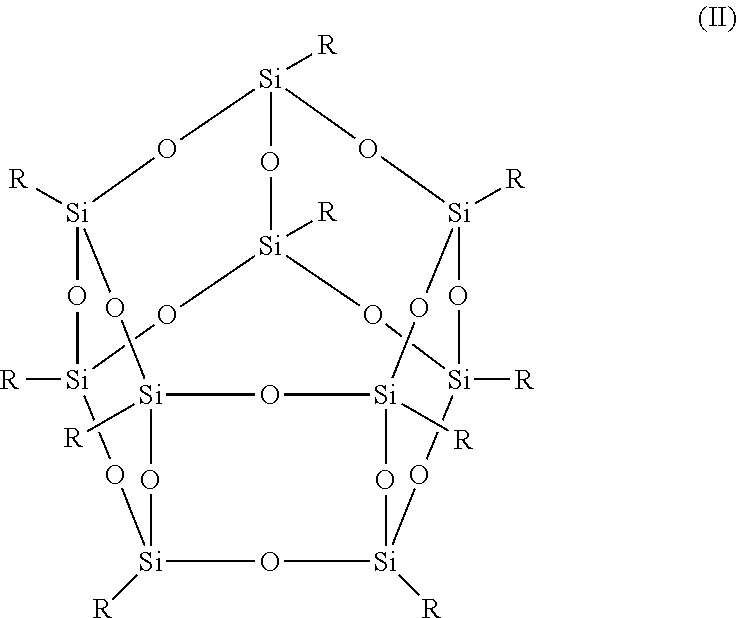
is denoted by the formula T10 R, where T represents RSiO3/2; or
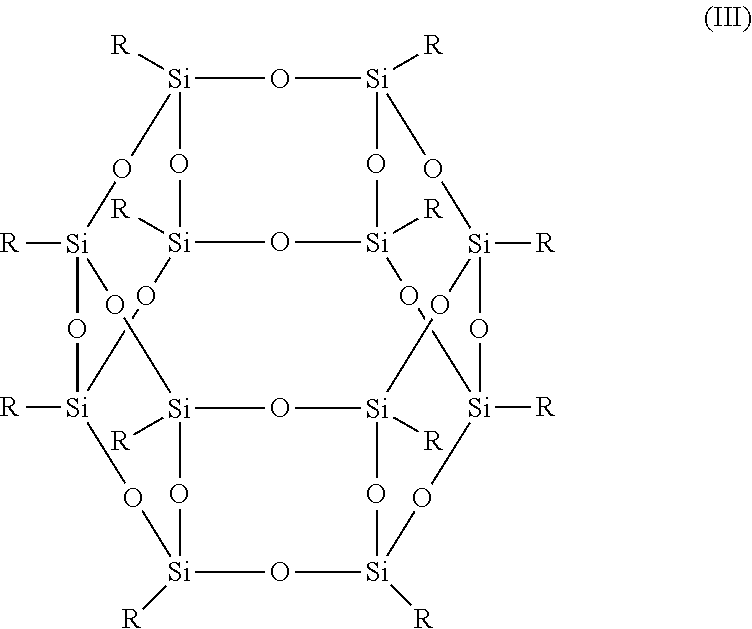
is denoted by the formula T12 R, where T represents RSiO3/2.
Claims (11)
Priority Applications (2)
| Application Number | Priority Date | Filing Date | Title |
|---|---|---|---|
| US16/658,331 US11302458B2 (en) | 2017-05-15 | 2019-10-21 | Composite solid electrolytes for rechargeable energy storage devices |
| US17/684,396 US11769605B2 (en) | 2017-05-15 | 2022-03-01 | Composite solid electrolytes for rechargeable energy storage devices |
Applications Claiming Priority (2)
| Application Number | Priority Date | Filing Date | Title |
|---|---|---|---|
| US15/594,889 US10559398B2 (en) | 2017-05-15 | 2017-05-15 | Composite solid electrolytes for rechargeable energy storage devices |
| US16/658,331 US11302458B2 (en) | 2017-05-15 | 2019-10-21 | Composite solid electrolytes for rechargeable energy storage devices |
Related Parent Applications (1)
| Application Number | Title | Priority Date | Filing Date |
|---|---|---|---|
| US15/594,889 Division US10559398B2 (en) | 2017-05-15 | 2017-05-15 | Composite solid electrolytes for rechargeable energy storage devices |
Related Child Applications (1)
| Application Number | Title | Priority Date | Filing Date |
|---|---|---|---|
| US17/684,396 Division US11769605B2 (en) | 2017-05-15 | 2022-03-01 | Composite solid electrolytes for rechargeable energy storage devices |
Publications (2)
| Publication Number | Publication Date |
|---|---|
| US20200051710A1 US20200051710A1 (en) | 2020-02-13 |
| US11302458B2 true US11302458B2 (en) | 2022-04-12 |
Family
ID=64097417
Family Applications (3)
| Application Number | Title | Priority Date | Filing Date |
|---|---|---|---|
| US15/594,889 Active 2037-08-25 US10559398B2 (en) | 2017-05-15 | 2017-05-15 | Composite solid electrolytes for rechargeable energy storage devices |
| US16/658,331 Active 2037-12-04 US11302458B2 (en) | 2017-05-15 | 2019-10-21 | Composite solid electrolytes for rechargeable energy storage devices |
| US17/684,396 Active US11769605B2 (en) | 2017-05-15 | 2022-03-01 | Composite solid electrolytes for rechargeable energy storage devices |
Family Applications Before (1)
| Application Number | Title | Priority Date | Filing Date |
|---|---|---|---|
| US15/594,889 Active 2037-08-25 US10559398B2 (en) | 2017-05-15 | 2017-05-15 | Composite solid electrolytes for rechargeable energy storage devices |
Family Applications After (1)
| Application Number | Title | Priority Date | Filing Date |
|---|---|---|---|
| US17/684,396 Active US11769605B2 (en) | 2017-05-15 | 2022-03-01 | Composite solid electrolytes for rechargeable energy storage devices |
Country Status (1)
| Country | Link |
|---|---|
| US (3) | US10559398B2 (en) |
Families Citing this family (16)
| Publication number | Priority date | Publication date | Assignee | Title |
|---|---|---|---|---|
| US20140093760A1 (en) * | 2012-09-28 | 2014-04-03 | Quantumscape Corporation | Battery control systems |
| KR102626915B1 (en) * | 2016-08-02 | 2024-01-18 | 삼성전자주식회사 | Composite membrane, preparing method thereof, and lithium secondary battery including the anode structure |
| WO2019017994A1 (en) | 2017-07-21 | 2019-01-24 | Quantumscape Corporation | Active and passive battery pressure management |
| CN109301318B (en) * | 2018-09-07 | 2020-06-26 | 成都晨光博达橡塑有限公司 | Polymer electrolyte, preparation method thereof and all-solid-state lithium ion battery prepared from polymer electrolyte |
| US10826127B2 (en) * | 2018-09-29 | 2020-11-03 | International Business Machines Corporation | Composite separator for lithium metal batteries |
| KR102904717B1 (en) * | 2019-01-31 | 2025-12-24 | 주식회사 엘지에너지솔루션 | Composite for solid polymer electrolytes and all solid polymer electrolytes comprising the same |
| DE102019107017A1 (en) * | 2019-03-19 | 2020-09-24 | Westfälische Wilhelms-Universität Münster | Multi-layer electrolyte arrangement for lithium batteries |
| KR20230013093A (en) * | 2020-06-10 | 2023-01-26 | 쇼와 덴코 가부시키가이샤 | Solid electrolyte material, solid electrolyte, method for producing solid electrolyte and all-solid-state battery |
| CN111900466B (en) * | 2020-07-02 | 2024-10-18 | 上海大学 | In-situ prepared POSS ion gel polymer electrolyte and preparation method thereof |
| CN112054244A (en) * | 2020-08-21 | 2020-12-08 | 昆山宝创新能源科技有限公司 | Composite solid electrolyte and preparation method and application thereof |
| CN112250383A (en) * | 2020-10-20 | 2021-01-22 | 陕西煤业化工技术研究院有限责任公司 | A kind of high-strength inorganic mineral reinforcement material and using method thereof |
| CN112803064B (en) * | 2021-02-02 | 2022-08-30 | 中国科学院青岛生物能源与过程研究所 | Sulfide composite solid electrolyte membrane, preparation method and application |
| US11830977B2 (en) * | 2021-02-25 | 2023-11-28 | International Business Machines Corporation | Method to reduce interfacial resistance of hybrid solid-state electrolytes for secondary energy storage devices |
| CN115093708B (en) * | 2022-02-22 | 2023-08-25 | 清华大学 | Polysiloxane elastomer with high transparent conductive performance and preparation method thereof |
| US20240283016A1 (en) * | 2023-02-16 | 2024-08-22 | Anthro Energy, Inc. | Gel electrolyte composition for a battery and a method of implementation |
| WO2025091014A1 (en) | 2023-10-27 | 2025-05-01 | Anthro Energy, Inc. | System and method for improved battery structural properties |
Citations (33)
| Publication number | Priority date | Publication date | Assignee | Title |
|---|---|---|---|---|
| US4183988A (en) | 1978-11-16 | 1980-01-15 | General Electric Company | Solid ion-conductive electrolyte |
| US4636314A (en) | 1984-03-16 | 1987-01-13 | Uop Inc. | Polymer blended membranes |
| US4654104A (en) | 1985-12-09 | 1987-03-31 | The Dow Chemical Company | Method for making an improved solid polymer electrolyte electrode using a fluorocarbon membrane in a thermoplastic state |
| US4752370A (en) | 1986-12-19 | 1988-06-21 | The Dow Chemical Company | Supported membrane/electrode structure combination wherein catalytically active particles are coated onto the membrane |
| US5603982A (en) * | 1995-09-19 | 1997-02-18 | Battery Engineering, Inc. | Thin film solid electrolyte production method |
| JP2003151361A (en) | 2001-08-31 | 2003-05-23 | Toppan Printing Co Ltd | Conductive film and method for producing conductive film |
| US20040191617A1 (en) | 2002-10-15 | 2004-09-30 | Polyplus Battery Company | Ionically conductive membranes for protection of active metal anodes and battery cells |
| CN1726608A (en) | 2002-10-15 | 2006-01-25 | 波利普拉斯电池有限公司 | Ion-conducting composites for protecting active metal anodes |
| CN1894821A (en) | 2003-10-14 | 2007-01-10 | 波利普拉斯电池有限公司 | Active metal/aqueous electrochemical cells and systems |
| US20070051620A1 (en) | 2005-09-02 | 2007-03-08 | Polyplus Battery Company | Polymer adhesive seals for protected anode architectures |
| US20070072036A1 (en) | 2005-09-26 | 2007-03-29 | Thomas Berta | Solid polymer electrolyte and process for making same |
| US7303833B2 (en) | 2004-12-17 | 2007-12-04 | Corning Incorporated | Electrolyte sheet with a corrugation pattern |
| JP2008084708A (en) | 2006-09-28 | 2008-04-10 | Nissan Motor Co Ltd | Fuel cell and manufacturing method thereof |
| US20080182157A1 (en) | 2005-08-09 | 2008-07-31 | Polyplus Battery Company | Compliant seal structures for protected active metal anodes |
| US7662517B2 (en) | 2004-12-22 | 2010-02-16 | Lg Chem, Ltd. | Organic/inorganic composite microporous membrane and electrochemical device prepared thereby |
| US20100068593A1 (en) | 2007-03-08 | 2010-03-18 | Elcomax Membranes Gmbh | Polymer electrolyte membrane with functionalized nanoparticles |
| US7824806B2 (en) | 2005-08-09 | 2010-11-02 | Polyplus Battery Company | Compliant seal structures for protected active metal anodes |
| US7943269B2 (en) | 2008-02-26 | 2011-05-17 | University Of Rochester | Ion-/proton-conducting apparatus and method |
| US20120064431A1 (en) | 2009-06-04 | 2012-03-15 | Sony Corporation | Polymer electrolyte-catalyst composite structure particle and manufacturing method thereof, electrode, membrane electrode assembly (mea), and electrochemical device |
| US20120082919A1 (en) | 2010-09-30 | 2012-04-05 | Atsuhiko Onuma | Polymer electrolyte fuel cell |
| US8173325B2 (en) | 2005-02-25 | 2012-05-08 | Japan Atomic Energy Agency | Functional membrane and electrolyte membrane for fuel cells and method for producing the same |
| US8309265B2 (en) | 2003-09-12 | 2012-11-13 | Hitachi, Ltd. | Electrolyte membrane for fuel cells, its production and fuel cell using the same |
| JP2013069416A (en) | 2011-09-20 | 2013-04-18 | Idemitsu Kosan Co Ltd | Negative electrode mixture and all-solid lithium-ion battery using the same |
| US20140170504A1 (en) | 2012-12-14 | 2014-06-19 | Samsung Electronics Co., Ltd. | Flexible solid electrolyte, all-solid-state lithium battery including the flexible solid electrolyte, and method of preparing the flexible solid electrolyte |
| US20150056517A1 (en) | 2013-08-21 | 2015-02-26 | GM Global Technology Operations LLC | Flexible membranes and coated electrodes for lithium based batteries |
| US20150072132A1 (en) * | 2009-02-26 | 2015-03-12 | Corning Incorporated | Electrically isolating polymer composition |
| US20150188187A1 (en) * | 2014-01-02 | 2015-07-02 | Wildcat Discovery Technologies, Inc. | Solid state electrolyte and electrode compositions |
| US20150255767A1 (en) | 2014-03-06 | 2015-09-10 | Asahi Kasei Kabushiki Kaisha | Ion conducting hybrid membranes |
| US20160204408A1 (en) * | 2015-01-09 | 2016-07-14 | Applied Materials, Inc. | Battery separator with dielectric coating |
| US20160204403A1 (en) * | 2013-12-23 | 2016-07-14 | Ford Global Technologies, Inc. | Battery array rail assembly with tie bracket |
| US9502729B2 (en) | 2012-08-29 | 2016-11-22 | Corning Incorporated | Ion-conducting composite electrolyte comprising path-engineered particles |
| JP2017124951A (en) | 2016-01-13 | 2017-07-20 | 住友電気工業株式会社 | Water barrier sodium ion conductive film and sodium battery |
| WO2017124951A1 (en) | 2016-01-20 | 2017-07-27 | 中兴通讯股份有限公司 | Testing method and system for optical modulation amplitude value in receiving sensitivity measurement |
-
2017
- 2017-05-15 US US15/594,889 patent/US10559398B2/en active Active
-
2019
- 2019-10-21 US US16/658,331 patent/US11302458B2/en active Active
-
2022
- 2022-03-01 US US17/684,396 patent/US11769605B2/en active Active
Patent Citations (35)
| Publication number | Priority date | Publication date | Assignee | Title |
|---|---|---|---|---|
| US4183988A (en) | 1978-11-16 | 1980-01-15 | General Electric Company | Solid ion-conductive electrolyte |
| US4636314A (en) | 1984-03-16 | 1987-01-13 | Uop Inc. | Polymer blended membranes |
| US4654104A (en) | 1985-12-09 | 1987-03-31 | The Dow Chemical Company | Method for making an improved solid polymer electrolyte electrode using a fluorocarbon membrane in a thermoplastic state |
| US4752370A (en) | 1986-12-19 | 1988-06-21 | The Dow Chemical Company | Supported membrane/electrode structure combination wherein catalytically active particles are coated onto the membrane |
| US5603982A (en) * | 1995-09-19 | 1997-02-18 | Battery Engineering, Inc. | Thin film solid electrolyte production method |
| JP2003151361A (en) | 2001-08-31 | 2003-05-23 | Toppan Printing Co Ltd | Conductive film and method for producing conductive film |
| US20040191617A1 (en) | 2002-10-15 | 2004-09-30 | Polyplus Battery Company | Ionically conductive membranes for protection of active metal anodes and battery cells |
| CN1726608A (en) | 2002-10-15 | 2006-01-25 | 波利普拉斯电池有限公司 | Ion-conducting composites for protecting active metal anodes |
| US8309265B2 (en) | 2003-09-12 | 2012-11-13 | Hitachi, Ltd. | Electrolyte membrane for fuel cells, its production and fuel cell using the same |
| CN1894821A (en) | 2003-10-14 | 2007-01-10 | 波利普拉斯电池有限公司 | Active metal/aqueous electrochemical cells and systems |
| US7303833B2 (en) | 2004-12-17 | 2007-12-04 | Corning Incorporated | Electrolyte sheet with a corrugation pattern |
| US7662517B2 (en) | 2004-12-22 | 2010-02-16 | Lg Chem, Ltd. | Organic/inorganic composite microporous membrane and electrochemical device prepared thereby |
| US8173325B2 (en) | 2005-02-25 | 2012-05-08 | Japan Atomic Energy Agency | Functional membrane and electrolyte membrane for fuel cells and method for producing the same |
| US7824806B2 (en) | 2005-08-09 | 2010-11-02 | Polyplus Battery Company | Compliant seal structures for protected active metal anodes |
| US20080182157A1 (en) | 2005-08-09 | 2008-07-31 | Polyplus Battery Company | Compliant seal structures for protected active metal anodes |
| US20070051620A1 (en) | 2005-09-02 | 2007-03-08 | Polyplus Battery Company | Polymer adhesive seals for protected anode architectures |
| US20070072036A1 (en) | 2005-09-26 | 2007-03-29 | Thomas Berta | Solid polymer electrolyte and process for making same |
| JP2008084708A (en) | 2006-09-28 | 2008-04-10 | Nissan Motor Co Ltd | Fuel cell and manufacturing method thereof |
| US20100068593A1 (en) | 2007-03-08 | 2010-03-18 | Elcomax Membranes Gmbh | Polymer electrolyte membrane with functionalized nanoparticles |
| US7943269B2 (en) | 2008-02-26 | 2011-05-17 | University Of Rochester | Ion-/proton-conducting apparatus and method |
| US20150072132A1 (en) * | 2009-02-26 | 2015-03-12 | Corning Incorporated | Electrically isolating polymer composition |
| US20120064431A1 (en) | 2009-06-04 | 2012-03-15 | Sony Corporation | Polymer electrolyte-catalyst composite structure particle and manufacturing method thereof, electrode, membrane electrode assembly (mea), and electrochemical device |
| US20120082919A1 (en) | 2010-09-30 | 2012-04-05 | Atsuhiko Onuma | Polymer electrolyte fuel cell |
| JP2013069416A (en) | 2011-09-20 | 2013-04-18 | Idemitsu Kosan Co Ltd | Negative electrode mixture and all-solid lithium-ion battery using the same |
| US9502729B2 (en) | 2012-08-29 | 2016-11-22 | Corning Incorporated | Ion-conducting composite electrolyte comprising path-engineered particles |
| US20140170504A1 (en) | 2012-12-14 | 2014-06-19 | Samsung Electronics Co., Ltd. | Flexible solid electrolyte, all-solid-state lithium battery including the flexible solid electrolyte, and method of preparing the flexible solid electrolyte |
| US20150056517A1 (en) | 2013-08-21 | 2015-02-26 | GM Global Technology Operations LLC | Flexible membranes and coated electrodes for lithium based batteries |
| US20160204403A1 (en) * | 2013-12-23 | 2016-07-14 | Ford Global Technologies, Inc. | Battery array rail assembly with tie bracket |
| US20150188187A1 (en) * | 2014-01-02 | 2015-07-02 | Wildcat Discovery Technologies, Inc. | Solid state electrolyte and electrode compositions |
| US20150255767A1 (en) | 2014-03-06 | 2015-09-10 | Asahi Kasei Kabushiki Kaisha | Ion conducting hybrid membranes |
| US20160254560A1 (en) | 2014-03-06 | 2016-09-01 | International Business Machines Corporation | Ion conducting hybrid membranes |
| US20190109359A1 (en) | 2014-03-06 | 2019-04-11 | International Business Machines Corporation | Ion conducting hybrid membranes |
| US20160204408A1 (en) * | 2015-01-09 | 2016-07-14 | Applied Materials, Inc. | Battery separator with dielectric coating |
| JP2017124951A (en) | 2016-01-13 | 2017-07-20 | 住友電気工業株式会社 | Water barrier sodium ion conductive film and sodium battery |
| WO2017124951A1 (en) | 2016-01-20 | 2017-07-27 | 中兴通讯股份有限公司 | Testing method and system for optical modulation amplitude value in receiving sensitivity measurement |
Non-Patent Citations (10)
| Title |
|---|
| Capsoni et al., Recent advances in the development of Li-air batteries, Journal of Power Sources 220:253-263 (2012). |
| Hammerschmidt et al., Inject Printing of Reinforcing Patterns for the Mechanical Stabilization of Fragile Polymeric Microsieves, Langmuir 28:3316-3321 (2012). |
| Kiesow et al., Bicontinuous Zeolite Polymer Composite Membranes Prepared via Float Casting, Journal of the American Chemical Society 135:4380-4388 (2013). |
| Kumar et al., Interface-mediated electrochemical effects in lithium/polymer-ceramic cells, Journal of Power Sources 195:327-334 (2010). |
| Liao et al., Crosslinked gel polymer electrolytes based on polyethylene glycol methacrylate and ionic liquid for lithium ion battery applications, Electrochimica Acta 87:889-894 (2013). |
| List of IBM Patents or Applications Treated as Related, filed on Oct. 21, 2019. |
| Magerl and Goedel, Porous Polymer Membranes via Selectively Wetted Surfaces, Langmuir 28:5622-5632 (2012). |
| Muhlmann et al., Preparation of Composite Membranes with Bicontinuous Structure, Langmuir 28:8197-8204 (2012). |
| Sun, Lithium ion conducting membranes for lithium-air batteries, Nano Energy 2:81-0816 (2013). |
| Yan and Goedel, Polymer Membranes with Two-Dimensionally Arranged Pores Derived from Monolayers of Silica Particles, Chemical Materials 16(9):1622-1626 (2004). |
Also Published As
| Publication number | Publication date |
|---|---|
| US20180330844A1 (en) | 2018-11-15 |
| US20200051710A1 (en) | 2020-02-13 |
| US10559398B2 (en) | 2020-02-11 |
| US11769605B2 (en) | 2023-09-26 |
| US20220238250A1 (en) | 2022-07-28 |
Similar Documents
| Publication | Publication Date | Title |
|---|---|---|
| US11769605B2 (en) | Composite solid electrolytes for rechargeable energy storage devices | |
| Meyerson et al. | Recent developments in dendrite-free lithium-metal deposition through tailoring of micro-and nanoscale artificial coatings | |
| KR101747865B1 (en) | Electrolyte, prepraring method thereof, and lithium secondary battery comprising the electrolyte | |
| US10777810B2 (en) | Lithium metal secondary battery containing a protected lithium anode | |
| CN104160544B (en) | Chargeable lithium cell for wide temperature operation | |
| US10862164B2 (en) | Polymer electrolyte, method of preparing the polymer electrolyte, and lithium metal battery including the same | |
| US10622671B2 (en) | Hybrid electrolytes with controlled network structures for lithium metal batteries | |
| JP4418134B2 (en) | Polymer gel electrolyte and lithium battery using the same | |
| US11881580B2 (en) | Flame-resistant bipolar electrodes, bipolar lithium batteries, and manufacturing method | |
| US20170365855A1 (en) | Lithium battery | |
| KR20160079574A (en) | Polymer, electrolyte comprising the polymer, and lithium secondary battery comprising the electrolyte | |
| CN110915051A (en) | Lithium metal battery | |
| US20050019667A1 (en) | Solid polymer electrolyte and method of preparation | |
| CN107078343A (en) | Lithium-sulfur cell | |
| US9601804B2 (en) | Gel polymer electrolyte, lithium battery including gel polymer electrolyte, and method of preparing gel polymer electrolyte | |
| KR20160118958A (en) | Electrolyte for lithium second battery, and lithium second battery comprising the electrolyte | |
| CN110945702B (en) | Solid electrolyte composition, sheet containing solid electrolyte, all-solid secondary battery, and method for producing both | |
| US20220293958A1 (en) | Bipolar electrodes containing flame-resistant quasi-solid or solid-state electrolyte, bipolar lithium batteries, and manufacturing method | |
| KR100558843B1 (en) | Lithium battery and process for preparing the same | |
| KR101807693B1 (en) | Gel polymer electrolyte and Lithium battery comprising gel polymer electrolyte and method for preparing gel polymer electrolyte | |
| US20220376295A1 (en) | Polymer electrolyte membrane, electrode structure and electrochemical device including same, and method for manufacturing polymer electrolyte membrane | |
| US11830977B2 (en) | Method to reduce interfacial resistance of hybrid solid-state electrolytes for secondary energy storage devices | |
| US20250174707A1 (en) | Lithium Battery Pack Comprising Internally Connected Unit Cells and Production Method | |
| Thayumanasundaram | 9 POLYMER ELECTROLYTES FOR LITHIUM RECHARGEABLE BATTERIES | |
| Munshi | Intermedics, Inc. 4000 Technology Drive, Angleton, Texas 77515, USA |
Legal Events
| Date | Code | Title | Description |
|---|---|---|---|
| AS | Assignment |
Owner name: INTERNATIONAL BUSINESS MACHINES CORPORATION, NEW YORK Free format text: ASSIGNMENT OF ASSIGNORS INTEREST;ASSIGNORS:AETUKURI, NAGA PHANI BABU;MILLER, ROBERT D.;NA, YOUNG-HYE;AND OTHERS;SIGNING DATES FROM 20170503 TO 20170810;REEL/FRAME:050776/0796 |
|
| FEPP | Fee payment procedure |
Free format text: ENTITY STATUS SET TO UNDISCOUNTED (ORIGINAL EVENT CODE: BIG.); ENTITY STATUS OF PATENT OWNER: LARGE ENTITY |
|
| STPP | Information on status: patent application and granting procedure in general |
Free format text: APPLICATION DISPATCHED FROM PREEXAM, NOT YET DOCKETED |
|
| STPP | Information on status: patent application and granting procedure in general |
Free format text: DOCKETED NEW CASE - READY FOR EXAMINATION |
|
| STPP | Information on status: patent application and granting procedure in general |
Free format text: NON FINAL ACTION MAILED |
|
| STPP | Information on status: patent application and granting procedure in general |
Free format text: RESPONSE TO NON-FINAL OFFICE ACTION ENTERED AND FORWARDED TO EXAMINER |
|
| STPP | Information on status: patent application and granting procedure in general |
Free format text: NON FINAL ACTION MAILED |
|
| STPP | Information on status: patent application and granting procedure in general |
Free format text: RESPONSE TO NON-FINAL OFFICE ACTION ENTERED AND FORWARDED TO EXAMINER |
|
| STPP | Information on status: patent application and granting procedure in general |
Free format text: FINAL REJECTION MAILED |
|
| STPP | Information on status: patent application and granting procedure in general |
Free format text: ADVISORY ACTION MAILED |
|
| STPP | Information on status: patent application and granting procedure in general |
Free format text: NOTICE OF ALLOWANCE MAILED -- APPLICATION RECEIVED IN OFFICE OF PUBLICATIONS |
|
| STPP | Information on status: patent application and granting procedure in general |
Free format text: PUBLICATIONS -- ISSUE FEE PAYMENT RECEIVED |
|
| STPP | Information on status: patent application and granting procedure in general |
Free format text: PUBLICATIONS -- ISSUE FEE PAYMENT VERIFIED |
|
| STCF | Information on status: patent grant |
Free format text: PATENTED CASE |
|
| FEPP | Fee payment procedure |
Free format text: MAINTENANCE FEE REMINDER MAILED (ORIGINAL EVENT CODE: REM.); ENTITY STATUS OF PATENT OWNER: LARGE ENTITY |