[go: up one dir, main page]

US11282456B2 - Pixel sensing device and panel driving device for sensing characteristics of pixels - Google Patents

Pixel sensing device and panel driving device for sensing characteristics of pixels Download PDF

Info

Publication number
US11282456B2
US11282456B2 US17/124,202 US202017124202A US11282456B2 US 11282456 B2 US11282456 B2 US 11282456B2 US 202017124202 A US202017124202 A US 202017124202A US 11282456 B2 US11282456 B2 US 11282456B2
Authority
US
United States
Prior art keywords
circuit
transistor
sensing
pixel
voltage
Prior art date
Legal status (The legal status is an assumption and is not a legal conclusion. Google has not performed a legal analysis and makes no representation as to the accuracy of the status listed.)
Active
Application number
US17/124,202
Other versions
US20210193039A1 (en
Inventor
Taiming Piao
Young Bok Kim
Won Kim
Byeon Cheol LEE
Current Assignee (The listed assignees may be inaccurate. Google has not performed a legal analysis and makes no representation or warranty as to the accuracy of the list.)
LX Semicon Co Ltd
Original Assignee
Silicon Works Co Ltd
Priority date (The priority date is an assumption and is not a legal conclusion. Google has not performed a legal analysis and makes no representation as to the accuracy of the date listed.)
Filing date
Publication date
Application filed by Silicon Works Co Ltd filed Critical Silicon Works Co Ltd
Assigned to SILICON WORKS CO., LTD. reassignment SILICON WORKS CO., LTD. ASSIGNMENT OF ASSIGNORS INTEREST (SEE DOCUMENT FOR DETAILS). Assignors: KIM, WON, KIM, YOUNG BOK, LEE, BYEON CHEOL, PIAO, TAIMING
Publication of US20210193039A1 publication Critical patent/US20210193039A1/en
Application granted granted Critical
Publication of US11282456B2 publication Critical patent/US11282456B2/en
Active legal-status Critical Current
Anticipated expiration legal-status Critical

Links

Images

Classifications

    • GPHYSICS
    • G09EDUCATION; CRYPTOGRAPHY; DISPLAY; ADVERTISING; SEALS
    • G09GARRANGEMENTS OR CIRCUITS FOR CONTROL OF INDICATING DEVICES USING STATIC MEANS TO PRESENT VARIABLE INFORMATION
    • G09G3/00Control arrangements or circuits, of interest only in connection with visual indicators other than cathode-ray tubes
    • G09G3/20Control arrangements or circuits, of interest only in connection with visual indicators other than cathode-ray tubes for presentation of an assembly of a number of characters, e.g. a page, by composing the assembly by combination of individual elements arranged in a matrix no fixed position being assigned to or needed to be assigned to the individual characters or partial characters
    • G09G3/22Control arrangements or circuits, of interest only in connection with visual indicators other than cathode-ray tubes for presentation of an assembly of a number of characters, e.g. a page, by composing the assembly by combination of individual elements arranged in a matrix no fixed position being assigned to or needed to be assigned to the individual characters or partial characters using controlled light sources
    • G09G3/30Control arrangements or circuits, of interest only in connection with visual indicators other than cathode-ray tubes for presentation of an assembly of a number of characters, e.g. a page, by composing the assembly by combination of individual elements arranged in a matrix no fixed position being assigned to or needed to be assigned to the individual characters or partial characters using controlled light sources using electroluminescent panels
    • G09G3/32Control arrangements or circuits, of interest only in connection with visual indicators other than cathode-ray tubes for presentation of an assembly of a number of characters, e.g. a page, by composing the assembly by combination of individual elements arranged in a matrix no fixed position being assigned to or needed to be assigned to the individual characters or partial characters using controlled light sources using electroluminescent panels semiconductive, e.g. using light-emitting diodes [LED]
    • G09G3/3208Control arrangements or circuits, of interest only in connection with visual indicators other than cathode-ray tubes for presentation of an assembly of a number of characters, e.g. a page, by composing the assembly by combination of individual elements arranged in a matrix no fixed position being assigned to or needed to be assigned to the individual characters or partial characters using controlled light sources using electroluminescent panels semiconductive, e.g. using light-emitting diodes [LED] organic, e.g. using organic light-emitting diodes [OLED]
    • G09G3/3225Control arrangements or circuits, of interest only in connection with visual indicators other than cathode-ray tubes for presentation of an assembly of a number of characters, e.g. a page, by composing the assembly by combination of individual elements arranged in a matrix no fixed position being assigned to or needed to be assigned to the individual characters or partial characters using controlled light sources using electroluminescent panels semiconductive, e.g. using light-emitting diodes [LED] organic, e.g. using organic light-emitting diodes [OLED] using an active matrix
    • G09G3/3233Control arrangements or circuits, of interest only in connection with visual indicators other than cathode-ray tubes for presentation of an assembly of a number of characters, e.g. a page, by composing the assembly by combination of individual elements arranged in a matrix no fixed position being assigned to or needed to be assigned to the individual characters or partial characters using controlled light sources using electroluminescent panels semiconductive, e.g. using light-emitting diodes [LED] organic, e.g. using organic light-emitting diodes [OLED] using an active matrix with pixel circuitry controlling the current through the light-emitting element
    • G09G3/3241Control arrangements or circuits, of interest only in connection with visual indicators other than cathode-ray tubes for presentation of an assembly of a number of characters, e.g. a page, by composing the assembly by combination of individual elements arranged in a matrix no fixed position being assigned to or needed to be assigned to the individual characters or partial characters using controlled light sources using electroluminescent panels semiconductive, e.g. using light-emitting diodes [LED] organic, e.g. using organic light-emitting diodes [OLED] using an active matrix with pixel circuitry controlling the current through the light-emitting element the current through the light-emitting element being set using a data current provided by the data driver, e.g. by using a two-transistor current mirror
    • GPHYSICS
    • G09EDUCATION; CRYPTOGRAPHY; DISPLAY; ADVERTISING; SEALS
    • G09GARRANGEMENTS OR CIRCUITS FOR CONTROL OF INDICATING DEVICES USING STATIC MEANS TO PRESENT VARIABLE INFORMATION
    • G09G3/00Control arrangements or circuits, of interest only in connection with visual indicators other than cathode-ray tubes
    • G09G3/20Control arrangements or circuits, of interest only in connection with visual indicators other than cathode-ray tubes for presentation of an assembly of a number of characters, e.g. a page, by composing the assembly by combination of individual elements arranged in a matrix no fixed position being assigned to or needed to be assigned to the individual characters or partial characters
    • G09G3/22Control arrangements or circuits, of interest only in connection with visual indicators other than cathode-ray tubes for presentation of an assembly of a number of characters, e.g. a page, by composing the assembly by combination of individual elements arranged in a matrix no fixed position being assigned to or needed to be assigned to the individual characters or partial characters using controlled light sources
    • G09G3/30Control arrangements or circuits, of interest only in connection with visual indicators other than cathode-ray tubes for presentation of an assembly of a number of characters, e.g. a page, by composing the assembly by combination of individual elements arranged in a matrix no fixed position being assigned to or needed to be assigned to the individual characters or partial characters using controlled light sources using electroluminescent panels
    • G09G3/32Control arrangements or circuits, of interest only in connection with visual indicators other than cathode-ray tubes for presentation of an assembly of a number of characters, e.g. a page, by composing the assembly by combination of individual elements arranged in a matrix no fixed position being assigned to or needed to be assigned to the individual characters or partial characters using controlled light sources using electroluminescent panels semiconductive, e.g. using light-emitting diodes [LED]
    • G09G3/3208Control arrangements or circuits, of interest only in connection with visual indicators other than cathode-ray tubes for presentation of an assembly of a number of characters, e.g. a page, by composing the assembly by combination of individual elements arranged in a matrix no fixed position being assigned to or needed to be assigned to the individual characters or partial characters using controlled light sources using electroluminescent panels semiconductive, e.g. using light-emitting diodes [LED] organic, e.g. using organic light-emitting diodes [OLED]
    • GPHYSICS
    • G09EDUCATION; CRYPTOGRAPHY; DISPLAY; ADVERTISING; SEALS
    • G09GARRANGEMENTS OR CIRCUITS FOR CONTROL OF INDICATING DEVICES USING STATIC MEANS TO PRESENT VARIABLE INFORMATION
    • G09G3/00Control arrangements or circuits, of interest only in connection with visual indicators other than cathode-ray tubes
    • G09G3/20Control arrangements or circuits, of interest only in connection with visual indicators other than cathode-ray tubes for presentation of an assembly of a number of characters, e.g. a page, by composing the assembly by combination of individual elements arranged in a matrix no fixed position being assigned to or needed to be assigned to the individual characters or partial characters
    • G09G3/22Control arrangements or circuits, of interest only in connection with visual indicators other than cathode-ray tubes for presentation of an assembly of a number of characters, e.g. a page, by composing the assembly by combination of individual elements arranged in a matrix no fixed position being assigned to or needed to be assigned to the individual characters or partial characters using controlled light sources
    • G09G3/30Control arrangements or circuits, of interest only in connection with visual indicators other than cathode-ray tubes for presentation of an assembly of a number of characters, e.g. a page, by composing the assembly by combination of individual elements arranged in a matrix no fixed position being assigned to or needed to be assigned to the individual characters or partial characters using controlled light sources using electroluminescent panels
    • G09G3/32Control arrangements or circuits, of interest only in connection with visual indicators other than cathode-ray tubes for presentation of an assembly of a number of characters, e.g. a page, by composing the assembly by combination of individual elements arranged in a matrix no fixed position being assigned to or needed to be assigned to the individual characters or partial characters using controlled light sources using electroluminescent panels semiconductive, e.g. using light-emitting diodes [LED]
    • G09G3/3208Control arrangements or circuits, of interest only in connection with visual indicators other than cathode-ray tubes for presentation of an assembly of a number of characters, e.g. a page, by composing the assembly by combination of individual elements arranged in a matrix no fixed position being assigned to or needed to be assigned to the individual characters or partial characters using controlled light sources using electroluminescent panels semiconductive, e.g. using light-emitting diodes [LED] organic, e.g. using organic light-emitting diodes [OLED]
    • G09G3/3275Details of drivers for data electrodes
    • G09G3/3291Details of drivers for data electrodes in which the data driver supplies a variable data voltage for setting the current through, or the voltage across, the light-emitting elements
    • GPHYSICS
    • G09EDUCATION; CRYPTOGRAPHY; DISPLAY; ADVERTISING; SEALS
    • G09GARRANGEMENTS OR CIRCUITS FOR CONTROL OF INDICATING DEVICES USING STATIC MEANS TO PRESENT VARIABLE INFORMATION
    • G09G2300/00Aspects of the constitution of display devices
    • G09G2300/04Structural and physical details of display devices
    • G09G2300/0439Pixel structures
    • GPHYSICS
    • G09EDUCATION; CRYPTOGRAPHY; DISPLAY; ADVERTISING; SEALS
    • G09GARRANGEMENTS OR CIRCUITS FOR CONTROL OF INDICATING DEVICES USING STATIC MEANS TO PRESENT VARIABLE INFORMATION
    • G09G2300/00Aspects of the constitution of display devices
    • G09G2300/08Active matrix structure, i.e. with use of active elements, inclusive of non-linear two terminal elements, in the pixels together with light emitting or modulating elements
    • G09G2300/0809Several active elements per pixel in active matrix panels
    • GPHYSICS
    • G09EDUCATION; CRYPTOGRAPHY; DISPLAY; ADVERTISING; SEALS
    • G09GARRANGEMENTS OR CIRCUITS FOR CONTROL OF INDICATING DEVICES USING STATIC MEANS TO PRESENT VARIABLE INFORMATION
    • G09G2300/00Aspects of the constitution of display devices
    • G09G2300/08Active matrix structure, i.e. with use of active elements, inclusive of non-linear two terminal elements, in the pixels together with light emitting or modulating elements
    • G09G2300/0809Several active elements per pixel in active matrix panels
    • G09G2300/0819Several active elements per pixel in active matrix panels used for counteracting undesired variations, e.g. feedback or autozeroing
    • GPHYSICS
    • G09EDUCATION; CRYPTOGRAPHY; DISPLAY; ADVERTISING; SEALS
    • G09GARRANGEMENTS OR CIRCUITS FOR CONTROL OF INDICATING DEVICES USING STATIC MEANS TO PRESENT VARIABLE INFORMATION
    • G09G2300/00Aspects of the constitution of display devices
    • G09G2300/08Active matrix structure, i.e. with use of active elements, inclusive of non-linear two terminal elements, in the pixels together with light emitting or modulating elements
    • G09G2300/0809Several active elements per pixel in active matrix panels
    • G09G2300/0828Several active elements per pixel in active matrix panels forming a digital to analog [D/A] conversion circuit
    • GPHYSICS
    • G09EDUCATION; CRYPTOGRAPHY; DISPLAY; ADVERTISING; SEALS
    • G09GARRANGEMENTS OR CIRCUITS FOR CONTROL OF INDICATING DEVICES USING STATIC MEANS TO PRESENT VARIABLE INFORMATION
    • G09G2310/00Command of the display device
    • G09G2310/02Addressing, scanning or driving the display screen or processing steps related thereto
    • G09G2310/0264Details of driving circuits
    • G09G2310/027Details of drivers for data electrodes, the drivers handling digital grey scale data, e.g. use of D/A converters
    • GPHYSICS
    • G09EDUCATION; CRYPTOGRAPHY; DISPLAY; ADVERTISING; SEALS
    • G09GARRANGEMENTS OR CIRCUITS FOR CONTROL OF INDICATING DEVICES USING STATIC MEANS TO PRESENT VARIABLE INFORMATION
    • G09G2320/00Control of display operating conditions
    • G09G2320/02Improving the quality of display appearance
    • G09G2320/029Improving the quality of display appearance by monitoring one or more pixels in the display panel, e.g. by monitoring a fixed reference pixel
    • GPHYSICS
    • G09EDUCATION; CRYPTOGRAPHY; DISPLAY; ADVERTISING; SEALS
    • G09GARRANGEMENTS OR CIRCUITS FOR CONTROL OF INDICATING DEVICES USING STATIC MEANS TO PRESENT VARIABLE INFORMATION
    • G09G2320/00Control of display operating conditions
    • G09G2320/02Improving the quality of display appearance
    • G09G2320/029Improving the quality of display appearance by monitoring one or more pixels in the display panel, e.g. by monitoring a fixed reference pixel
    • G09G2320/0295Improving the quality of display appearance by monitoring one or more pixels in the display panel, e.g. by monitoring a fixed reference pixel by monitoring each display pixel
    • GPHYSICS
    • G09EDUCATION; CRYPTOGRAPHY; DISPLAY; ADVERTISING; SEALS
    • G09GARRANGEMENTS OR CIRCUITS FOR CONTROL OF INDICATING DEVICES USING STATIC MEANS TO PRESENT VARIABLE INFORMATION
    • G09G2320/00Control of display operating conditions
    • G09G2320/04Maintaining the quality of display appearance
    • G09G2320/043Preventing or counteracting the effects of ageing
    • G09G2320/045Compensation of drifts in the characteristics of light emitting or modulating elements
    • GPHYSICS
    • G09EDUCATION; CRYPTOGRAPHY; DISPLAY; ADVERTISING; SEALS
    • G09GARRANGEMENTS OR CIRCUITS FOR CONTROL OF INDICATING DEVICES USING STATIC MEANS TO PRESENT VARIABLE INFORMATION
    • G09G3/00Control arrangements or circuits, of interest only in connection with visual indicators other than cathode-ray tubes
    • G09G3/20Control arrangements or circuits, of interest only in connection with visual indicators other than cathode-ray tubes for presentation of an assembly of a number of characters, e.g. a page, by composing the assembly by combination of individual elements arranged in a matrix no fixed position being assigned to or needed to be assigned to the individual characters or partial characters
    • G09G3/22Control arrangements or circuits, of interest only in connection with visual indicators other than cathode-ray tubes for presentation of an assembly of a number of characters, e.g. a page, by composing the assembly by combination of individual elements arranged in a matrix no fixed position being assigned to or needed to be assigned to the individual characters or partial characters using controlled light sources
    • G09G3/30Control arrangements or circuits, of interest only in connection with visual indicators other than cathode-ray tubes for presentation of an assembly of a number of characters, e.g. a page, by composing the assembly by combination of individual elements arranged in a matrix no fixed position being assigned to or needed to be assigned to the individual characters or partial characters using controlled light sources using electroluminescent panels
    • G09G3/32Control arrangements or circuits, of interest only in connection with visual indicators other than cathode-ray tubes for presentation of an assembly of a number of characters, e.g. a page, by composing the assembly by combination of individual elements arranged in a matrix no fixed position being assigned to or needed to be assigned to the individual characters or partial characters using controlled light sources using electroluminescent panels semiconductive, e.g. using light-emitting diodes [LED]
    • G09G3/3208Control arrangements or circuits, of interest only in connection with visual indicators other than cathode-ray tubes for presentation of an assembly of a number of characters, e.g. a page, by composing the assembly by combination of individual elements arranged in a matrix no fixed position being assigned to or needed to be assigned to the individual characters or partial characters using controlled light sources using electroluminescent panels semiconductive, e.g. using light-emitting diodes [LED] organic, e.g. using organic light-emitting diodes [OLED]
    • G09G3/3225Control arrangements or circuits, of interest only in connection with visual indicators other than cathode-ray tubes for presentation of an assembly of a number of characters, e.g. a page, by composing the assembly by combination of individual elements arranged in a matrix no fixed position being assigned to or needed to be assigned to the individual characters or partial characters using controlled light sources using electroluminescent panels semiconductive, e.g. using light-emitting diodes [LED] organic, e.g. using organic light-emitting diodes [OLED] using an active matrix
    • G09G3/3233Control arrangements or circuits, of interest only in connection with visual indicators other than cathode-ray tubes for presentation of an assembly of a number of characters, e.g. a page, by composing the assembly by combination of individual elements arranged in a matrix no fixed position being assigned to or needed to be assigned to the individual characters or partial characters using controlled light sources using electroluminescent panels semiconductive, e.g. using light-emitting diodes [LED] organic, e.g. using organic light-emitting diodes [OLED] using an active matrix with pixel circuitry controlling the current through the light-emitting element

Definitions

  • the present disclosure relates to a pixel sensing technology, more particularly, to a technology for improving performance of a pixel sensing circuit.
  • a display device comprises a source driver for driving pixels disposed on a panel.
  • a source driver determines data voltages according to image data and supplies these data voltages to pixels to control the brightness of each pixel.
  • a pixel comprises a driving transistor and when a threshold voltage of the driving transistor is changed, the brightness of the pixel is changed even if the same data voltage is supplied to the pixel. If a source driver does not reflect such characteristic changes of pixels, pixels would be driven at an undesired brightness, and this may cause a degradation of image quality.
  • characteristics of a pixel vary depending on time or the pixel's surrounding environment. Nevertheless, if a source driver supplies data voltages without reflecting such varied characteristics of pixels, this may cause a degradation of image quality, for example, burn-in.
  • a display device may comprise a pixel sensing device for sensing characteristics of pixels.
  • a pixel sensing device may receive sensing signals for pixels through sensing lines respectively connected with the pixels.
  • the pixel sensing device converts the sensing signals into sensing data and transmits the sensing data to a timing controller which identifies characteristics of the respective pixels using the sensing data.
  • the timing controller may compensate image data by reflecting characteristics of the pixels to alleviate the degradation of image quality due to differences among pixels.
  • a pixel sensing device generally uses integrated circuits for sensing characteristic currents of pixels.
  • a pixel sensing device uses an analog-digital converting circuit to convert voltage signals into digital data, and thus, uses an integrated circuit to convert a characteristic current of a pixel into a voltage signal usable in the analog-digital converting circuit.
  • An integrated circuit may comprise an operational amplifier and an integral capacitor. Characteristic currents transferred from pixels through sensing lines are accumulated in the integral capacitor to form voltage signals.
  • parasitic resistances and parasitic capacitances formed in the sensing lines may cause a deterioration of performance of an integrated circuit.
  • a pixel and an integrated circuit are connected through a sensing line and a sensing line has a parasitic resistance of its own depending on the width and length of the line and forms a parasitic capacitance with surrounding electrodes.
  • Such parasitic resistances and parasitic capacitances in sensing lines are perceived as load by an integrated circuit and this causes a so-called loading effect.
  • a loading effect causes a decrease in the accuracy of an integrated circuit.
  • the present disclosure provides a pixel sensing device comprising: an analog-front-end circuit comprising an amplifying circuit comprising an operational amplifier, which comprises a first input terminal, a second input terminal, and an output terminal, a first transistor connected with the output terminal and a second transistor forming a current mirror circuit with the first transistor, wherein the first input terminal is connected with a pixel and the output terminal, and an integrating circuit to integrate a current flowing into the second transistor; an analog-digital converting circuit to generate sensing data corresponding to an output voltage from the integrating circuit; and a data transmitting circuit to transmit the sensing data to an external device.
  • an analog-front-end circuit comprising an amplifying circuit comprising an operational amplifier, which comprises a first input terminal, a second input terminal, and an output terminal, a first transistor connected with the output terminal and a second transistor forming a current mirror circuit with the first transistor, wherein the first input terminal is connected with a pixel and the output terminal, and an integrating circuit to integrate a current flowing into the
  • a current, flowing from the first input terminal to the output terminal, may flow into the first transistor.
  • the amplifying circuit may further comprise a third transistor, through which a current, to be outputted through the output terminal of the operational amplifier flows, and a fourth transistor forming a current mirror circuit with the third transistor.
  • the integrating circuit may integrate a current flowing into the second transistor or into the fourth transistor.
  • the first transistor may be connected with a low bias voltage in its one side and with the output terminal in its other side.
  • the second transistor may be connected with the low bias voltage in its one side and with a mirroring terminal in its other side.
  • the integrating circuit may be connected with the mirroring terminal.
  • the first transistor and the second transistor may form an N:1 current mirror circuit (N is a positive real number) and a current flowing into the second transistor may have 1/N times the amount of a current flowing into the first transistor.
  • a reference voltage may be connected with the second input terminal and the reference voltage may be formed in the first input terminal by the operational amplifier.
  • the integrating circuit may comprise another operational amplifier.
  • One input terminal of this operational amplifier may be connected with the second transistor and the other input terminal thereof may be connected with a reference voltage. Between the one input terminal and an output terminal of this operational amplifier, an integrating capacitor may be disposed.
  • the pixel sensing device may further comprise a sample and hold circuit to temporarily store a voltage outputted from the integrating circuit and another amplifying circuit to amplify a signal outputted from the sample and hold circuit and to transfer the amplified signal to the analog-digital converting circuit.
  • the present disclosure provides a panel driving device for driving a panel on which a plurality of pixels are disposed and a plurality of data lines and a plurality of sensing lines, connected respectively with the plurality of pixels, are disposed, comprising: a data driving circuit to convert image data into a data voltage and to supply the data voltage through a data line; a pixel sensing circuit to generate sensing data corresponding to an integrated voltage of a characteristic current transferred from a pixel; and a data processing circuit to compensate the image data using the sensing data, wherein, in the pixel sensing circuit, the characteristic current is inputted inside an operational amplifier through its output terminal and the integrated voltage is formed by integrating a current of a second transistor forming a current mirror circuit with a first transistor disposed inside the operational amplifier in which the characteristic current flows.
  • the first transistor and the second transistor may form a N:1 (N is a positive real number) current mirror circuit and a current flowing into the second transistor may have 1/N times the amount of a current flowing into the first transistor.
  • An integrating circuit to integrate the current of the second transistor may comprise another operational amplifier.
  • the pixel sensing circuit may comprise a sample and hold circuit to temporarily store an integrated voltage, an amplifying circuit to amplify a signal outputted from the sample and hold circuit, and an analog-digital converting circuit to convert an outputted signal from the amplifying circuit into sensing data.
  • a pixel may comprise an organic light emitting diode (OLED).
  • OLED organic light emitting diode
  • the pixel sensing circuit may be connected with a contact node between a driving transistor to supply a driving current to the organic light emitting diode and the organic light emitting diode and receive a current flowing into the driving transistor or a current flowing into the organic light emitting diode as a characteristic current.
  • a characteristic of the driving transistor may be compensated using the image data according to the characteristic current.
  • the present disclosure allows reduction of a loading effect of a sensing line of a pixel sensing device, enhancing the sensing accuracy of a pixel sensing device, and improving the performance of a pixel sensing device.
  • FIG. 1 is a configuration diagram of a display device according to an embodiment
  • FIG. 2 is a diagram illustrating a structure of each pixel of FIG. 1 and signals outputted from and/or inputted into a data driving circuit, a pixel, and a sensing circuit according to an embodiment
  • FIG. 3 is a configuration diagram of a sensing circuit according to an embodiment
  • FIG. 4 is a configuration diagram of an analog-front-end circuit according to an embodiment
  • FIG. 5 is a diagram illustrating a configuration inside an amplifying circuit according to an embodiment.
  • FIG. 6 is a graph illustrating a change over time of a delta voltage corresponding to a difference between a sensing voltage and a reference voltage of FIG. 4 according to an embodiment.
  • FIG. 1 is a configuration diagram of a display device according to an embodiment.
  • a display device 100 may comprise a panel 160 and panel driving devices 120 , 130 , 140 , 150 for driving the panel 160 .
  • a plurality of data lines DL, a plurality of gate lines GL, and a plurality of sensing lines SL may be disposed, and a plurality of pixels P may be disposed.
  • Panel driving devices may comprise a data driving circuit 120 , a sensing circuit 130 , a gate driving circuit 140 , and a data processing circuit 150 .
  • the gate driving circuit 140 may supply scan signals, such as turn-on voltages or turn-off voltages, through gate lines GL.
  • scan signals such as turn-on voltages or turn-off voltages
  • the data driving circuit 120 supplies data voltages to data lines DL. Data voltages supplied to data lines DL are transferred to pixels P connected with the data lines DL according to scan signals.
  • the sensing circuit 130 receives sensing signals, such as voltages, currents, or the like, formed in respective pixels P.
  • the sensing circuit 130 may be connected with each pixel P according to a scan signal or according to a sensing scan signal.
  • a sensing scan signal may be generated by the gate driving circuit 140 .
  • the data processing circuit 150 may supply various control signals to the gate driving circuit 140 and the data driving circuit 120 .
  • the data processing circuit 150 may generate gate control signals GCS to initiate a scan according to a timing implemented in each frame and transmit the gate control signals to the gate driving circuit 140 .
  • the data processing circuit 150 may convert image data inputted from outside into image data RGB in a format suitable for data signals used in the data driving circuit 120 and output the converted image data RGB to the data driving circuit 120 .
  • the data processing circuit 150 may transmit a data control signal DCS to control the data driving circuit 120 to supply a data voltage to each pixel P at an appropriate timing
  • the data processing circuit 150 may compensate image data RGB depending on a characteristic of a pixel P and transmit compensated image data. For this, the data processing circuit 150 may receive sensing data SDAT from the sensing circuit 130 . Sensing data SDAT may include a measured value for a characteristic of a pixel P.
  • a data driving circuit 120 may be referred to as a source driver
  • a gate driving circuit 140 may be referred to as a gate driver
  • a data processing circuit 150 may be referred to as a timing controller.
  • a data driving circuit 120 and a sensing circuit 130 may be comprised in an integrated circuit 110 and referred to as a source driver integrated circuit (IC) or as a pixel sensing device. Otherwise, a data driving circuit 120 , a sensing circuit 130 , and a data processing circuit 150 may be comprised in an integrated circuit and referred to as a combined IC.
  • IC source driver integrated circuit
  • a data driving circuit 120 , a sensing circuit 130 , and a data processing circuit 150 may be comprised in an integrated circuit and referred to as a combined IC.
  • a panel 160 may be an organic light emitting display panel.
  • each pixel P disposed on the panel 160 may comprise an organic light emitting diode (OLED) and at least one transistor. Characteristics of an organic light emitting diode OLED and at least one transistor comprised in each pixel P may vary depending on time or the pixel's surrounding environments.
  • a sensing circuit 130 may sense characteristics of such elements comprised in each pixel P and transmit them to a data processing circuit 150 .
  • FIG. 2 is a diagram illustrating a structure of each pixel of FIG. 1 and signals outputted from and/or inputted into a data driving circuit, a pixel, and a sensing circuit.
  • a pixel P may comprise a light emitting diode OLED, a driving transistor DRT, a switching transistor SWT, a sensing transistor SENT, and a storage capacitor Cstg.
  • An organic light emitting diode OLED may comprise an anode electrode, an organic layer, and a cathode electrode. According to a control of the driving transistor DRT, the anode electrode is connected in a direction of a driving voltage EVDD and the cathode electrode is connected with a base voltage EVSS, whereby the organic light emitting diode emits light.
  • the driving transistor DRT may control the brightness of the organic light emitting diode OLED by controlling a driving current supplied to the organic light emitting diode OLED.
  • a first node N 1 of the driving transistor DRT may be electrically connected with the anode electrode of the light emitting diode OLED and may be a source node or a drain node.
  • a second node N 2 of the driving transistor DRT may be electrically connected with a source node or a drain node of the switching transistor SWT and may be a gate node.
  • a third node N 3 of the driving transistor DRT may be electrically connected with a driving voltage line DVL for supplying driving voltages EVDD and may be a drain node or a source node.
  • the switching transistor SWT may be electrically connected between the data line DL and the second node N 2 of the driving transistor DRT and turned on by being provided with a scan signal through a first gate line GL 1 .
  • the storage capacitor Cstg may be electrically connected between the first node N 1 and the second node N 2 of the driving transistor DRT.
  • the storage capacitor Cstg may be a parasitic capacitor that exists between the first node N 1 and the second node N 2 or an external capacitor that is intentionally disposed outside the driving transistor DRT.
  • the sensing transistor SENT may connect the first node N 1 of the driving transistor DRT and a sensing line SL and, through the sensing line SL, a reference voltage may be transferred to the first node N 1 and a value of a characteristic, such as a voltage or a current Is, of the first node N 1 may be transferred to the sensing circuit 130 .
  • the sensing circuit 130 measures a characteristic of a pixel P using a sensing signal Is transferred through the sensing line SL.
  • a sensing signal Is which is a characteristic current indicating a characteristic of a pixel, may be a current flowing in the driving transistor DRT or in the organic light emitting diode OLED.
  • the sensing circuit 130 may measure such a characteristic current and transmit a measured value to the data processing circuit (see 150 in FIG. 1 ).
  • the data processing circuit (see 150 in FIG. 1 ) may analyze the measured value of the characteristic current to identify a characteristic of each pixel P.
  • a characteristic of each pixel P may be a threshold voltage or the mobility of a driving transistor DRT.
  • FIG. 3 is a configuration diagram of a sensing circuit according to an embodiment.
  • the sensing circuit 130 may comprise an analog-front-end circuit (AFE) 310 , a sample and hold circuit (S/H) 320 , an amplifying circuit (AMP) 330 , an analog-digital converting circuit (ADC) 350 , and a data transmitting circuit (TX) 360 .
  • AFE analog-front-end circuit
  • S/H sample and hold circuit
  • AMP amplifying circuit
  • ADC analog-digital converting circuit
  • TX data transmitting circuit
  • the analog-front-end circuit 310 may sense a pixel P and form a sensing voltage Vi by processing a current Is transmitted from the pixel P.
  • the sensing voltage Vi may be the same as a voltage obtained by integrating the current Is transmitted from the pixel P.
  • the analog-front-end circuit 310 may transmit the sensing voltage Vi to the amplifying circuit 330 and the amplifying circuit 330 may amplify the sensing voltage Vi or a difference ⁇ Vi between the sensing voltage Vi and a reference voltage and transmit an amplified one to the analog-digital converting circuit 350 .
  • the sample and hold circuit 320 may be disposed between the analog-front-end circuit 310 and the amplifying circuit 330 .
  • the sample and hold circuit 320 may separate the analog-front-end circuit 310 from the amplifying circuit 330 in terms of signal, temporarily store a sensing voltage Vi outputted from the analog-front-end circuit 310 , and input the sensing voltage Vi or a difference ⁇ Vi between the sensing voltage Vi and a reference voltage into the amplifying circuit 330 .
  • the amplifying circuit 330 may amplify the sensing voltage Vi or the difference ⁇ Vi between the sensing voltage Vi and the reference voltage transmitted through an input terminal, and then, transmit an amplified one to the analog-digital converting circuit 350 .
  • the analog-digital converting circuit 350 may convert a voltage outputted from the amplifying circuit 330 into a digital signal Ao.
  • the data transmitting circuit 360 may generate sensing data SDAT by processing the digital signals Ao collected from a plurality of channels and transmit the sensing data SDAT to an external device (for example, a data processing circuit 150 ).
  • FIG. 4 is a configuration diagram of an analog-front-end circuit according to an embodiment.
  • the analog-front-end circuit 310 may comprise an amplifying circuit 410 and an integrating circuit 420 .
  • the analog-front-end circuit 310 may receive a characteristic current Is from a pixel P through a sensing line SL. In the sensing line SL, a parasitic resistance Rp and a parasitic capacitance Cp may exist. The analog-front-end circuit 310 may reduce a loading effect of the sensing line SL for the integrating circuit 420 by separating the integrating circuit 420 from the pixel P using the amplifying circuit 410 .
  • the amplifying circuit 410 may comprise a first operational amplifier AP 1 .
  • the first operational amplifier AP 1 may be driven by being provided with a high bias voltage VDD and a low bias voltage VSS as bias voltages.
  • the amplifying circuit 410 may further comprise another two transistors TR 2 , TR 4 respectively formed current mirror circuits with the two transistors TR 1 , TR 3 .
  • a first transistor TR 1 may offer a path through which a current inputted through the output terminal flows out to the low bias voltage VSS.
  • a third transistor TR 3 may offer a path through which a current outputted through the output terminal flows out from the high bias voltage VDD.
  • the second transistor TR 2 may form a current mirror circuit with the first transistor TR 1 .
  • the second transistor TR 2 and the first transistor TR 1 may respectively have gates connected with each other and both may be an N-typed transistor being connected with the low bias voltage VSS. Because of such a structure, a current, having a level proportional or identical to that of a current flowing into the first transistor TR 1 , may flow into the second transistor TR 2 .
  • a fourth transistor TR 4 may form a current mirror circuit with the third transistor TR 3 .
  • the fourth transistor TR 4 and the third transistor TR 3 may respectively have gates connected with each other and both may be a P-typed transistor being connected with the high bias voltage VDD. Because of such a structure, a current, having a level proportional or identical to that of a current flowing into the third transistor TR 3 , may flow into the fourth transistor TR 4 .
  • a characteristic current Is transferred from a pixel P may be transferred to the first node N 1 via the sensing line SL. Since the internal impedance of the first operational amplifier AP 1 is very high, the current transferred to the first node N 1 may flow to the output terminal of the first operational amplifier, not to the first input terminal thereof. When a characteristic current Is has a positive level, the characteristic current Is may flow from the output terminal via the first transistor TR 1 out to the low bias voltage VSS. When a characteristic current IS has a negative level (for example, when the current flows out toward the pixel P), the characteristic current Is may flow from the high bias voltage VDD, via the third transistor TR 3 , and out through the output terminal.
  • the integrating circuit 420 may integrate a current flowing to the second transistor TR 2 or to the fourth transistor TR 4 .
  • the second transistor TR 2 may be connected with the low bias voltage VSS in its one side and with the fourth node N 4 , which is a mirroring terminal, in its other side.
  • the fourth transistor TR 4 may be connected with the high bias voltage VDD in its one side and with the fourth node N 4 , which is a mirroring terminal, in its other side.
  • the integrating circuit 420 may be connected with the mirroring terminal (the fourth node N 4 ) of the amplifying circuit 410 , not with the output terminal thereof.
  • the integrating circuit 420 may integrate a current formed in the mirroring terminal (the fourth node N 4 ). Since a current formed in the mirroring terminal has a level proportional or identical to that of a current formed in the output terminal, the integrating circuit 420 may generate an integrated voltage for a characteristic current Is as a sensing voltage Vi. However, since the pixel P is connected only with the output terminal of the first operational amplifier AP 1 and separated from the mirroring terminal, the integrating circuit 420 would hardly be affected by the sensing line SL.
  • the integrating circuit 420 may comprise a second operational amplifier AP 2 and further comprise an integrating capacitor Ci disposed between a first input terminal and an output terminal of the second operational amplifier AP 2 .
  • the first input terminal of the second operational amplifier AP 2 may be connected with a fifth node N 5 and the fifth node N 5 may be connected with the fourth node N 4 , which is a mirroring terminal of the fifth node N 5 .
  • the integrating capacitor Ci may be connected with the fifth node N 5 in its one side and with a seventh node in its other side.
  • the output terminal of the second operational amplifier AP 2 may be connected with the seventh node N 7 .
  • a current flowing into the second transistor TR 2 or into the fourth transistor TR 4 may increase a voltage of the integrating capacitor Ci while flowing along a path passing the fifth node N 5 , the integrating capacitor Ci, and the seventh node N 7 .
  • a voltage formed in the seventh node N 7 according to a voltage of the integrating capacitor Ci may be transferred to the sample and hold circuit or the analog-digital converting circuit.
  • the first transistor TR 1 and the second transistor TR 2 may form a N:1 current mirror circuit (N is a positive real number). Accordingly, a current flowing into the second transistor TR 2 may have 1/N times the amount of a current flowing into the first transistor TR 1 .
  • the third transistor TR 3 and the fourth transistor TR 4 may form a N:1 current mirror circuit (N is a positive real number). Accordingly, a current flowing into the fourth transistor TR 4 may be 1/N times the level of a current flowing into the third transistor TR 3 .
  • the amount of a current flowing into the second transistor TR 2 or into the fourth transistor TR 4 decreases, the amount of a current flowing into the integrating capacitor Ci may also decrease. Accordingly, the capacity of the integrating capacitor Ci may be set to be small.
  • FIG. 5 is a diagram illustrating a configuration inside an amplifying circuit.
  • the first operational amplifier AP 1 may be formed using a plurality of transistors.
  • the first transistor TR 1 and the third transistor TR 3 may be connected to the output terminal of the first operational amplifier AP 1 connected with the third node N 3 .
  • the second transistor TR 2 sharing a gate voltage with the first transistor TR 1 may be disposed between the fourth node N 4 and the low bias voltage VSS, and the fourth transistor TR 4 sharing a gate voltage with the third transistor TR 3 may be disposed between the fourth node N 4 and the high bias voltage VDD.
  • the amplifying circuit 410 may output a current, having a level proportional or identical to that of a characteristic current of a pixel inputted or outputted through the third node N 3 , through the fourth node N 4 which is separated from the third node N 3 .
  • FIG. 6 is a graph illustrating a change over time of a delta voltage corresponding to a difference between a sensing voltage and a reference voltage of FIG. 4 .
  • the analog-front-end circuit 310 may operate differently in a standby time section T 1 and in an integrating time section T 2 .
  • the analog-front-end circuit 310 does not receive a characteristic current Is in the standby time section T 1 . Accordingly, no current flows in the integrating capacitor Ci and voltages of both ends of the integrating capacitor Ci may be identical.
  • a delta voltage ⁇ Vi corresponding to a difference between a sensing voltage Vi and a second reference voltage Vpre 2 , may be identical to the voltages of the both ends of the integrating capacitor Ci. Accordingly, a delta voltage ⁇ Vi in the standby time section T 1 may be 0.
  • the analog-front-end circuit 310 may receive a characteristic current Is from a pixel P.
  • a current having 1/N times the level of the characteristic current Is, flows from the seventh node N 7 toward the fifth node N 5 , the voltages of the both ends of the integrating capacitor Ci, that is, the delta voltage ⁇ Vi may increase in a positive direction.
  • the delta voltage ⁇ Vi and the characteristic current Is may have a relation represented by equation 1.
  • ⁇ Vi ( t ) ( Is/N ) ⁇ t ( t is time) [Equation 1]
  • the analog-front-end circuit 310 may integrate the integrating capacitor Ci with a current having 1/N times the level of the characteristic current Is, and output the relevant voltage as a sensing voltage Vi.
  • the sample and hold circuit, the amplifying circuit, and the analog-digital converting circuit may generate a digital signal corresponding to the sensing voltage Vi, and the data transmitting circuit may collect digital signals from the respective channels, generate sensing data, and transmit the sensing data to the data processing circuit.
  • the data processing circuit may compensate image data using the sensing data and transmit the compensated image data to the data driving circuit.
  • the data driving circuit may display an image on the panel using the compensated image data.
  • a loading effect of a sensing line of a pixel sensing device may be reduced, the sensing accuracy of the pixel sensing device may be enhanced, and the performance of the pixel sensing device may be improved.

Landscapes

  • Engineering & Computer Science (AREA)
  • Physics & Mathematics (AREA)
  • Computer Hardware Design (AREA)
  • General Physics & Mathematics (AREA)
  • Theoretical Computer Science (AREA)
  • Control Of Indicators Other Than Cathode Ray Tubes (AREA)
  • Control Of El Displays (AREA)
  • Electroluminescent Light Sources (AREA)

Abstract

The present disclosure provides, in a pixel sensing, a technology in which a parasitic impedance formed in a sensing line does not affect an integrating circuit using a current mirror circuit coupled with an operational amplifier.

Description

CROSS REFERENCE TO RELATED APPLICATION
This application claims priority from Republic of Korea Patent Application No. 10-2019-0172592, filed on Dec. 23, 2019, which is hereby incorporated by reference in its entirety.
BACKGROUND 1. Field of Technology
The present disclosure relates to a pixel sensing technology, more particularly, to a technology for improving performance of a pixel sensing circuit.
2. Description of the Prior Art
A display device comprises a source driver for driving pixels disposed on a panel.
A source driver determines data voltages according to image data and supplies these data voltages to pixels to control the brightness of each pixel.
Here, even when the same data voltage is supplied, the brightness of each pixel varies depending on characteristics of each pixel. For example, a pixel comprises a driving transistor and when a threshold voltage of the driving transistor is changed, the brightness of the pixel is changed even if the same data voltage is supplied to the pixel. If a source driver does not reflect such characteristic changes of pixels, pixels would be driven at an undesired brightness, and this may cause a degradation of image quality.
To be concrete, characteristics of a pixel vary depending on time or the pixel's surrounding environment. Nevertheless, if a source driver supplies data voltages without reflecting such varied characteristics of pixels, this may cause a degradation of image quality, for example, burn-in.
In order to solve such a problem of degradation of image quality, a display device may comprise a pixel sensing device for sensing characteristics of pixels.
A pixel sensing device may receive sensing signals for pixels through sensing lines respectively connected with the pixels. The pixel sensing device converts the sensing signals into sensing data and transmits the sensing data to a timing controller which identifies characteristics of the respective pixels using the sensing data. The timing controller may compensate image data by reflecting characteristics of the pixels to alleviate the degradation of image quality due to differences among pixels.
A pixel sensing device generally uses integrated circuits for sensing characteristic currents of pixels. A pixel sensing device uses an analog-digital converting circuit to convert voltage signals into digital data, and thus, uses an integrated circuit to convert a characteristic current of a pixel into a voltage signal usable in the analog-digital converting circuit. An integrated circuit may comprise an operational amplifier and an integral capacitor. Characteristic currents transferred from pixels through sensing lines are accumulated in the integral capacitor to form voltage signals.
However, in such a configuration, parasitic resistances and parasitic capacitances formed in the sensing lines may cause a deterioration of performance of an integrated circuit. A pixel and an integrated circuit are connected through a sensing line and a sensing line has a parasitic resistance of its own depending on the width and length of the line and forms a parasitic capacitance with surrounding electrodes. Such parasitic resistances and parasitic capacitances in sensing lines are perceived as load by an integrated circuit and this causes a so-called loading effect. A loading effect causes a decrease in the accuracy of an integrated circuit.
SUMMARY
An aspect of the present disclosure is to provide a technology for improving performance of a pixel sensing device. Another aspect of the present disclosure is to provide a technology for enhancing the sensing accuracy of a pixel sensing device. Still another aspect of the present disclosure is to provide a technology for reducing a loading effect in sensing lines of a pixel sensing device.
To this end, in an aspect, the present disclosure provides a pixel sensing device comprising: an analog-front-end circuit comprising an amplifying circuit comprising an operational amplifier, which comprises a first input terminal, a second input terminal, and an output terminal, a first transistor connected with the output terminal and a second transistor forming a current mirror circuit with the first transistor, wherein the first input terminal is connected with a pixel and the output terminal, and an integrating circuit to integrate a current flowing into the second transistor; an analog-digital converting circuit to generate sensing data corresponding to an output voltage from the integrating circuit; and a data transmitting circuit to transmit the sensing data to an external device.
A current, flowing from the first input terminal to the output terminal, may flow into the first transistor.
The amplifying circuit may further comprise a third transistor, through which a current, to be outputted through the output terminal of the operational amplifier flows, and a fourth transistor forming a current mirror circuit with the third transistor. The integrating circuit may integrate a current flowing into the second transistor or into the fourth transistor.
The first transistor may be connected with a low bias voltage in its one side and with the output terminal in its other side. The second transistor may be connected with the low bias voltage in its one side and with a mirroring terminal in its other side. The integrating circuit may be connected with the mirroring terminal.
The first transistor and the second transistor may form an N:1 current mirror circuit (N is a positive real number) and a current flowing into the second transistor may have 1/N times the amount of a current flowing into the first transistor.
A reference voltage may be connected with the second input terminal and the reference voltage may be formed in the first input terminal by the operational amplifier.
The integrating circuit may comprise another operational amplifier. One input terminal of this operational amplifier may be connected with the second transistor and the other input terminal thereof may be connected with a reference voltage. Between the one input terminal and an output terminal of this operational amplifier, an integrating capacitor may be disposed.
The pixel sensing device may further comprise a sample and hold circuit to temporarily store a voltage outputted from the integrating circuit and another amplifying circuit to amplify a signal outputted from the sample and hold circuit and to transfer the amplified signal to the analog-digital converting circuit.
In another aspect, the present disclosure provides a panel driving device for driving a panel on which a plurality of pixels are disposed and a plurality of data lines and a plurality of sensing lines, connected respectively with the plurality of pixels, are disposed, comprising: a data driving circuit to convert image data into a data voltage and to supply the data voltage through a data line; a pixel sensing circuit to generate sensing data corresponding to an integrated voltage of a characteristic current transferred from a pixel; and a data processing circuit to compensate the image data using the sensing data, wherein, in the pixel sensing circuit, the characteristic current is inputted inside an operational amplifier through its output terminal and the integrated voltage is formed by integrating a current of a second transistor forming a current mirror circuit with a first transistor disposed inside the operational amplifier in which the characteristic current flows.
The first transistor and the second transistor may form a N:1 (N is a positive real number) current mirror circuit and a current flowing into the second transistor may have 1/N times the amount of a current flowing into the first transistor.
An integrating circuit to integrate the current of the second transistor may comprise another operational amplifier.
The pixel sensing circuit may comprise a sample and hold circuit to temporarily store an integrated voltage, an amplifying circuit to amplify a signal outputted from the sample and hold circuit, and an analog-digital converting circuit to convert an outputted signal from the amplifying circuit into sensing data.
A pixel may comprise an organic light emitting diode (OLED).
The pixel sensing circuit may be connected with a contact node between a driving transistor to supply a driving current to the organic light emitting diode and the organic light emitting diode and receive a current flowing into the driving transistor or a current flowing into the organic light emitting diode as a characteristic current.
A characteristic of the driving transistor may be compensated using the image data according to the characteristic current.
As described above, the present disclosure allows reduction of a loading effect of a sensing line of a pixel sensing device, enhancing the sensing accuracy of a pixel sensing device, and improving the performance of a pixel sensing device.
BRIEF DESCRIPTION OF THE DRAWINGS
FIG. 1 is a configuration diagram of a display device according to an embodiment;
FIG. 2 is a diagram illustrating a structure of each pixel of FIG. 1 and signals outputted from and/or inputted into a data driving circuit, a pixel, and a sensing circuit according to an embodiment;
FIG. 3 is a configuration diagram of a sensing circuit according to an embodiment;
FIG. 4 is a configuration diagram of an analog-front-end circuit according to an embodiment;
FIG. 5 is a diagram illustrating a configuration inside an amplifying circuit according to an embodiment; and
FIG. 6 is a graph illustrating a change over time of a delta voltage corresponding to a difference between a sensing voltage and a reference voltage of FIG. 4 according to an embodiment.
DETAILED DESCRIPTION
FIG. 1 is a configuration diagram of a display device according to an embodiment.
Referring to FIG. 1, a display device 100 may comprise a panel 160 and panel driving devices 120, 130, 140, 150 for driving the panel 160.
On the panel 160, a plurality of data lines DL, a plurality of gate lines GL, and a plurality of sensing lines SL may be disposed, and a plurality of pixels P may be disposed.
Panel driving devices may comprise a data driving circuit 120, a sensing circuit 130, a gate driving circuit 140, and a data processing circuit 150.
The gate driving circuit 140 may supply scan signals, such as turn-on voltages or turn-off voltages, through gate lines GL. When a scan signal of a turn-on voltage is supplied to a pixel P, this pixel P is connected with a data line DL, whereas, when a scan signal of a turn-off voltage is supplied to a pixel, this pixel is disconnected from the data line DL.
The data driving circuit 120 supplies data voltages to data lines DL. Data voltages supplied to data lines DL are transferred to pixels P connected with the data lines DL according to scan signals.
The sensing circuit 130 receives sensing signals, such as voltages, currents, or the like, formed in respective pixels P. The sensing circuit 130 may be connected with each pixel P according to a scan signal or according to a sensing scan signal. Here, a sensing scan signal may be generated by the gate driving circuit 140.
The data processing circuit 150 may supply various control signals to the gate driving circuit 140 and the data driving circuit 120. The data processing circuit 150 may generate gate control signals GCS to initiate a scan according to a timing implemented in each frame and transmit the gate control signals to the gate driving circuit 140. The data processing circuit 150 may convert image data inputted from outside into image data RGB in a format suitable for data signals used in the data driving circuit 120 and output the converted image data RGB to the data driving circuit 120. In addition, the data processing circuit 150 may transmit a data control signal DCS to control the data driving circuit 120 to supply a data voltage to each pixel P at an appropriate timing
The data processing circuit 150 may compensate image data RGB depending on a characteristic of a pixel P and transmit compensated image data. For this, the data processing circuit 150 may receive sensing data SDAT from the sensing circuit 130. Sensing data SDAT may include a measured value for a characteristic of a pixel P.
Meanwhile, a data driving circuit 120 may be referred to as a source driver, a gate driving circuit 140 may be referred to as a gate driver, and a data processing circuit 150 may be referred to as a timing controller. A data driving circuit 120 and a sensing circuit 130 may be comprised in an integrated circuit 110 and referred to as a source driver integrated circuit (IC) or as a pixel sensing device. Otherwise, a data driving circuit 120, a sensing circuit 130, and a data processing circuit 150 may be comprised in an integrated circuit and referred to as a combined IC. Although the present disclosure is not limited to this, descriptions about some generally known components of a source driver, a gate driver, or a timing controller will be omitted in the description of embodiments below. Accordingly, the description of embodiments should be understood considering the fact that the description of such some components are omitted.
A panel 160 may be an organic light emitting display panel. In this case, each pixel P disposed on the panel 160 may comprise an organic light emitting diode (OLED) and at least one transistor. Characteristics of an organic light emitting diode OLED and at least one transistor comprised in each pixel P may vary depending on time or the pixel's surrounding environments. A sensing circuit 130 according to an embodiment may sense characteristics of such elements comprised in each pixel P and transmit them to a data processing circuit 150.
FIG. 2 is a diagram illustrating a structure of each pixel of FIG. 1 and signals outputted from and/or inputted into a data driving circuit, a pixel, and a sensing circuit.
Referring to FIG. 2, a pixel P may comprise a light emitting diode OLED, a driving transistor DRT, a switching transistor SWT, a sensing transistor SENT, and a storage capacitor Cstg.
An organic light emitting diode OLED may comprise an anode electrode, an organic layer, and a cathode electrode. According to a control of the driving transistor DRT, the anode electrode is connected in a direction of a driving voltage EVDD and the cathode electrode is connected with a base voltage EVSS, whereby the organic light emitting diode emits light.
The driving transistor DRT may control the brightness of the organic light emitting diode OLED by controlling a driving current supplied to the organic light emitting diode OLED.
A first node N1 of the driving transistor DRT may be electrically connected with the anode electrode of the light emitting diode OLED and may be a source node or a drain node. A second node N2 of the driving transistor DRT may be electrically connected with a source node or a drain node of the switching transistor SWT and may be a gate node. A third node N3 of the driving transistor DRT may be electrically connected with a driving voltage line DVL for supplying driving voltages EVDD and may be a drain node or a source node.
The switching transistor SWT may be electrically connected between the data line DL and the second node N2 of the driving transistor DRT and turned on by being provided with a scan signal through a first gate line GL1.
When the switching transistor SWT is turned on, a data voltage Vdata, supplied from the data driving circuit 120 through the data line DL, is transferred to the second node N2 of the driving transistor DRT.
The storage capacitor Cstg may be electrically connected between the first node N1 and the second node N2 of the driving transistor DRT.
The storage capacitor Cstg may be a parasitic capacitor that exists between the first node N1 and the second node N2 or an external capacitor that is intentionally disposed outside the driving transistor DRT.
The sensing transistor SENT may connect the first node N1 of the driving transistor DRT and a sensing line SL and, through the sensing line SL, a reference voltage may be transferred to the first node N1 and a value of a characteristic, such as a voltage or a current Is, of the first node N1 may be transferred to the sensing circuit 130.
The sensing circuit 130 measures a characteristic of a pixel P using a sensing signal Is transferred through the sensing line SL.
A sensing signal Is, which is a characteristic current indicating a characteristic of a pixel, may be a current flowing in the driving transistor DRT or in the organic light emitting diode OLED. The sensing circuit 130 may measure such a characteristic current and transmit a measured value to the data processing circuit (see 150 in FIG. 1). The data processing circuit (see 150 in FIG. 1) may analyze the measured value of the characteristic current to identify a characteristic of each pixel P.
A characteristic of each pixel P may be a threshold voltage or the mobility of a driving transistor DRT.
FIG. 3 is a configuration diagram of a sensing circuit according to an embodiment.
Referring to FIG. 3, the sensing circuit 130 may comprise an analog-front-end circuit (AFE) 310, a sample and hold circuit (S/H) 320, an amplifying circuit (AMP) 330, an analog-digital converting circuit (ADC) 350, and a data transmitting circuit (TX) 360.
The analog-front-end circuit 310 may sense a pixel P and form a sensing voltage Vi by processing a current Is transmitted from the pixel P. Depending on embodiments, the sensing voltage Vi may be the same as a voltage obtained by integrating the current Is transmitted from the pixel P. The analog-front-end circuit 310 may transmit the sensing voltage Vi to the amplifying circuit 330 and the amplifying circuit 330 may amplify the sensing voltage Vi or a difference ΔVi between the sensing voltage Vi and a reference voltage and transmit an amplified one to the analog-digital converting circuit 350.
Between the analog-front-end circuit 310 and the amplifying circuit 330, the sample and hold circuit 320 may be disposed. The sample and hold circuit 320 may separate the analog-front-end circuit 310 from the amplifying circuit 330 in terms of signal, temporarily store a sensing voltage Vi outputted from the analog-front-end circuit 310, and input the sensing voltage Vi or a difference ΔVi between the sensing voltage Vi and a reference voltage into the amplifying circuit 330.
The amplifying circuit 330 may amplify the sensing voltage Vi or the difference ΔVi between the sensing voltage Vi and the reference voltage transmitted through an input terminal, and then, transmit an amplified one to the analog-digital converting circuit 350. The analog-digital converting circuit 350 may convert a voltage outputted from the amplifying circuit 330 into a digital signal Ao.
The data transmitting circuit 360 may generate sensing data SDAT by processing the digital signals Ao collected from a plurality of channels and transmit the sensing data SDAT to an external device (for example, a data processing circuit 150).
FIG. 4 is a configuration diagram of an analog-front-end circuit according to an embodiment.
Referring to FIG. 4, the analog-front-end circuit 310 may comprise an amplifying circuit 410 and an integrating circuit 420.
The analog-front-end circuit 310 may receive a characteristic current Is from a pixel P through a sensing line SL. In the sensing line SL, a parasitic resistance Rp and a parasitic capacitance Cp may exist. The analog-front-end circuit 310 may reduce a loading effect of the sensing line SL for the integrating circuit 420 by separating the integrating circuit 420 from the pixel P using the amplifying circuit 410.
The amplifying circuit 410 may comprise a first operational amplifier AP1.
The first operational amplifier AP1 may comprise a first input terminal, a second input terminal, and an output terminal. The first input terminal may be connected with a first node N1 and a sensing line SL connected with a pixel P may be connected with the first node N1. The second input terminal may be connected with a second node N2 and a first reference voltage Vpre1 may be supplied through the second node N2. The output terminal may be connected with a third node N3 and the first node N1 may be connected with the third node N3. In a feedback structure in which the first input terminal and the output terminal are connected, a voltage of the second input terminal may be substantially identical to a voltage of the first input terminal because of a very great amplification gain of the operational amplifier. Accordingly, when the first reference voltage Vpre1 is supplied through the second input terminal, the first reference voltage Vpre1 may be formed in the first input terminal and the sensing line SL may be initialized or maintained to have the first reference voltage Vpre1.
The first operational amplifier AP1 may be driven by being provided with a high bias voltage VDD and a low bias voltage VSS as bias voltages.
To the output terminal of the first operational amplifier AP1, two transistors TR1, TR3 may be internally connected. The amplifying circuit 410 may further comprise another two transistors TR2, TR4 respectively formed current mirror circuits with the two transistors TR1, TR3.
Among the two transistors TR1, TR3 connected to the output terminal of the first operational amplifier AP1, a first transistor TR1 may offer a path through which a current inputted through the output terminal flows out to the low bias voltage VSS. A third transistor TR3 may offer a path through which a current outputted through the output terminal flows out from the high bias voltage VDD.
The second transistor TR2 may form a current mirror circuit with the first transistor TR1. The second transistor TR2 and the first transistor TR1 may respectively have gates connected with each other and both may be an N-typed transistor being connected with the low bias voltage VSS. Because of such a structure, a current, having a level proportional or identical to that of a current flowing into the first transistor TR1, may flow into the second transistor TR2.
A fourth transistor TR4 may form a current mirror circuit with the third transistor TR3. The fourth transistor TR4 and the third transistor TR3 may respectively have gates connected with each other and both may be a P-typed transistor being connected with the high bias voltage VDD. Because of such a structure, a current, having a level proportional or identical to that of a current flowing into the third transistor TR3, may flow into the fourth transistor TR4.
A characteristic current Is transferred from a pixel P may be transferred to the first node N1 via the sensing line SL. Since the internal impedance of the first operational amplifier AP1 is very high, the current transferred to the first node N1 may flow to the output terminal of the first operational amplifier, not to the first input terminal thereof. When a characteristic current Is has a positive level, the characteristic current Is may flow from the output terminal via the first transistor TR1 out to the low bias voltage VSS. When a characteristic current IS has a negative level (for example, when the current flows out toward the pixel P), the characteristic current Is may flow from the high bias voltage VDD, via the third transistor TR3, and out through the output terminal.
The integrating circuit 420 may integrate a current flowing to the second transistor TR2 or to the fourth transistor TR4.
The second transistor TR2 may be connected with the low bias voltage VSS in its one side and with the fourth node N4, which is a mirroring terminal, in its other side. The fourth transistor TR4 may be connected with the high bias voltage VDD in its one side and with the fourth node N4, which is a mirroring terminal, in its other side.
The integrating circuit 420 may be connected with the mirroring terminal (the fourth node N4) of the amplifying circuit 410, not with the output terminal thereof. The integrating circuit 420 may integrate a current formed in the mirroring terminal (the fourth node N4). Since a current formed in the mirroring terminal has a level proportional or identical to that of a current formed in the output terminal, the integrating circuit 420 may generate an integrated voltage for a characteristic current Is as a sensing voltage Vi. However, since the pixel P is connected only with the output terminal of the first operational amplifier AP1 and separated from the mirroring terminal, the integrating circuit 420 would hardly be affected by the sensing line SL.
The integrating circuit 420 may comprise a second operational amplifier AP2 and further comprise an integrating capacitor Ci disposed between a first input terminal and an output terminal of the second operational amplifier AP2. The first input terminal of the second operational amplifier AP2 may be connected with a fifth node N5 and the fifth node N5 may be connected with the fourth node N4, which is a mirroring terminal of the fifth node N5.
To a sixth node N6 connected with a second input terminal of the second operational amplifier AP2, a second reference voltage Vpre2 may be connected. Since the second operational amplifier AP2 has a very high amplification gain, voltages formed in the second input terminal and in the first input terminal may be substantially identical and, when the second reference voltage Vpre2 is supplied to the sixth node N6, the fifth node N5 may maintain the second reference voltage Vpre2 as its voltage. Accordingly, a voltage formed in the third node N3 and a voltage formed in the fourth node N4 may be identical. Here, the second reference voltage Vpre2 may have the same voltage level as that of the first reference voltage Vpre1 or they may have different levels.
The integrating capacitor Ci may be connected with the fifth node N5 in its one side and with a seventh node in its other side. The output terminal of the second operational amplifier AP2 may be connected with the seventh node N7.
A current flowing into the second transistor TR2 or into the fourth transistor TR4 may increase a voltage of the integrating capacitor Ci while flowing along a path passing the fifth node N5, the integrating capacitor Ci, and the seventh node N7. A voltage formed in the seventh node N7 according to a voltage of the integrating capacitor Ci may be transferred to the sample and hold circuit or the analog-digital converting circuit.
The first transistor TR1 and the second transistor TR2 may form a N:1 current mirror circuit (N is a positive real number). Accordingly, a current flowing into the second transistor TR2 may have 1/N times the amount of a current flowing into the first transistor TR1.
The third transistor TR3 and the fourth transistor TR4 may form a N:1 current mirror circuit (N is a positive real number). Accordingly, a current flowing into the fourth transistor TR4 may be 1/N times the level of a current flowing into the third transistor TR3.
When the amount of a current flowing into the second transistor TR2 or into the fourth transistor TR4 decreases, the amount of a current flowing into the integrating capacitor Ci may also decrease. Accordingly, the capacity of the integrating capacitor Ci may be set to be small.
FIG. 5 is a diagram illustrating a configuration inside an amplifying circuit.
Referring to FIG. 5, in the amplifying circuit 410, the first operational amplifier AP1 may be formed using a plurality of transistors.
The first transistor TR1 and the third transistor TR3 may be connected to the output terminal of the first operational amplifier AP1 connected with the third node N3. The second transistor TR2 sharing a gate voltage with the first transistor TR1 may be disposed between the fourth node N4 and the low bias voltage VSS, and the fourth transistor TR4 sharing a gate voltage with the third transistor TR3 may be disposed between the fourth node N4 and the high bias voltage VDD.
Because of such a structure, the amplifying circuit 410 may output a current, having a level proportional or identical to that of a characteristic current of a pixel inputted or outputted through the third node N3, through the fourth node N4 which is separated from the third node N3.
FIG. 6 is a graph illustrating a change over time of a delta voltage corresponding to a difference between a sensing voltage and a reference voltage of FIG. 4.
Referring to FIG. 4 and FIG. 6, the analog-front-end circuit 310 may operate differently in a standby time section T1 and in an integrating time section T2. The analog-front-end circuit 310 does not receive a characteristic current Is in the standby time section T1. Accordingly, no current flows in the integrating capacitor Ci and voltages of both ends of the integrating capacitor Ci may be identical. A delta voltage ΔVi, corresponding to a difference between a sensing voltage Vi and a second reference voltage Vpre2, may be identical to the voltages of the both ends of the integrating capacitor Ci. Accordingly, a delta voltage ΔVi in the standby time section T1 may be 0.
In the integrating time section T2, the analog-front-end circuit 310 may receive a characteristic current Is from a pixel P. Here, in the integrating capacitor Ci, a current, having 1/N times the level of the characteristic current Is, flows from the seventh node N7 toward the fifth node N5, the voltages of the both ends of the integrating capacitor Ci, that is, the delta voltage ΔVi may increase in a positive direction. The delta voltage ΔVi and the characteristic current Is may have a relation represented by equation 1.
ΔVi(t)=(Is/Nt (t is time)  [Equation 1]
The analog-front-end circuit 310 may integrate the integrating capacitor Ci with a current having 1/N times the level of the characteristic current Is, and output the relevant voltage as a sensing voltage Vi.
The sample and hold circuit, the amplifying circuit, and the analog-digital converting circuit may generate a digital signal corresponding to the sensing voltage Vi, and the data transmitting circuit may collect digital signals from the respective channels, generate sensing data, and transmit the sensing data to the data processing circuit.
The data processing circuit may compensate image data using the sensing data and transmit the compensated image data to the data driving circuit. The data driving circuit may display an image on the panel using the compensated image data.
According to the present disclosure, a loading effect of a sensing line of a pixel sensing device may be reduced, the sensing accuracy of the pixel sensing device may be enhanced, and the performance of the pixel sensing device may be improved.
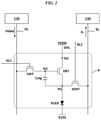
Claims (14)

What is claimed is:
1. A pixel sensing device comprising:
an analog-front-end circuit comprising an amplifying circuit including an operational amplifier in which a first input terminal, a second input terminal, and an output terminal are formed, a first transistor connected with the output terminal of the operational amplifier, and a second transistor forming a current mirror circuit with the first transistor, wherein the first input terminal is connected with a pixel through a sensing line and the output terminal, and an integrating circuit for integrating a current flowing into the second transistor;
an analog-digital converting circuit to generate sensing data corresponding to a voltage output from the integrating circuit; and
a data transmitting circuit to transmit the sensing data to an external device,
wherein a first reference voltage is connected to the second input terminal, and the first reference voltage is formed in the first input terminal by the operational amplifier, and the sensing line is initiated to have the first reference voltage.
2. The pixel sensing device of claim 1, wherein a current, flowing from the first input terminal to the output terminal, flows into the first transistor.
3. The pixel sensing device of claim 1, wherein the amplifying circuit further comprises a third transistor through which a current, outputted through the output terminal of the operational amplifier, flows and a fourth transistor forming a current mirror circuit with the third transistor, and the integrating circuit integrates a current flowing into the second transistor or into the fourth transistor.
4. The pixel sensing device of claim 1, wherein the first transistor is connected with a low bias voltage in its one side and with the output terminal in its other side, the second transistor is connected with the low bias voltage in its one side and with a mirroring terminal in its other side, and the integrating circuit is connected with the mirroring terminal.
5. The pixel sensing device of claim 1, wherein the first transistor and the second transistor form an N:1 current mirror circuit (N is a positive real number), and a current flowing into the second transistor has 1/N times a level of a current flowing into the first transistor.
6. The pixel sensing device of claim 1, wherein the integrating circuit comprises another operational amplifier, wherein this operational amplifier is connected with the second transistor in its one input terminal and with a second reference voltage in its other input terminal, and an integrating capacitor is disposed between the one input terminal and the other input terminal of this operational amplifier,
wherein the second reference voltage has a same voltage level as that of the first reference voltage.
7. The pixel sensing device of claim 1, further comprising a sample and hold circuit to temporarily store a voltage outputted from the integrating circuit and another amplifying circuit to amplify a voltage outputted from the sample and hold circuit and to transmit the amplified voltage to the analog-digital converting circuit.
8. A panel driving device for driving a panel on which a plurality of pixels are disposed and a plurality of data lines and a plurality of sensing lines are disposed, comprising:
a data driving circuit to convert image data into a data voltage and to supply the data voltage through a data line;
a pixel sensing circuit to generate sensing data corresponding to an integrated voltage of a characteristic current transferred from a pixel; and
a data processing circuit to compensate the image data using the sensing data,
wherein, in the pixel sensing circuit, the characteristic current is inputted through an output terminal of an operational amplifier, and the integrated voltage is formed by integrating a current of a second transistor disposed inside the operational amplifier, forming a current mirror circuit with a first transistor therein,
wherein a first input terminal, a second input terminal, and the output terminal are formed in the operational amplifier, and the first input terminal is connected with the pixel through a sensing line and the output terminal,
wherein a first reference voltage is connected to the second input terminal, and the first reference voltage is formed in the first input terminal by the operational amplifier, and the sensing line is initiated to have the first reference voltage.
9. The panel driving device of claim 8, wherein the first transistor and the second transistor form a N:1 (N is a positive real number) current mirror circuit and a current flowing into the second transistor has 1/N times a level of a current flowing into the first transistor.
10. The panel driving device of claim 8, wherein an integrating circuit to integrate a current of the second transistor comprises another operational amplifier.
11. The panel driving device of claim 8, wherein the pixel sensing circuit a sample and hold circuit to temporarily store an integrated voltage, an amplifying circuit to amplify a signal outputted from the sample and hold circuit, and an analog-digital converting circuit to convert an outputted signal from the amplifying circuit into sensing data.
12. The panel driving device of claim 8, wherein a pixel comprises an organic light emitting diode.
13. The panel driving device of claim 12, wherein the pixel sensing circuit is connected with a contact node between a driving transistor to supply a driving current to the organic light emitting diode and the organic light emitting diode and receives a current flowing into the driving transistor or a current flowing into the organic light emitting diode as a characteristic current.
14. The panel driving device of claim 13, a characteristic of the driving transistor is compensated according to the characteristic current.
US17/124,202 2019-12-23 2020-12-16 Pixel sensing device and panel driving device for sensing characteristics of pixels Active US11282456B2 (en)

Applications Claiming Priority (2)

Application Number Priority Date Filing Date Title
KR1020190172592A KR102830801B1 (en) 2019-12-23 2019-12-23 Pixel sensing device and panel driving device for sensing characteristics of pixels
KR10-2019-0172592 2019-12-23

Publications (2)

Publication Number Publication Date
US20210193039A1 US20210193039A1 (en) 2021-06-24
US11282456B2 true US11282456B2 (en) 2022-03-22

Family

ID=76438280

Family Applications (1)

Application Number Title Priority Date Filing Date
US17/124,202 Active US11282456B2 (en) 2019-12-23 2020-12-16 Pixel sensing device and panel driving device for sensing characteristics of pixels

Country Status (3)

Country Link
US (1) US11282456B2 (en)
KR (1) KR102830801B1 (en)
CN (1) CN113096597B (en)

Cited By (2)

* Cited by examiner, † Cited by third party
Publication number Priority date Publication date Assignee Title
US20220208126A1 (en) * 2020-12-29 2022-06-30 Lg Display Co., Ltd. Light Emitting Display Device and Method of Driving the Same
US11587508B2 (en) * 2020-10-08 2023-02-21 Silicon Works Co., Ltd. Display system and display driving apparatus thereof

Families Citing this family (4)

* Cited by examiner, † Cited by third party
Publication number Priority date Publication date Assignee Title
KR102830801B1 (en) * 2019-12-23 2025-07-07 주식회사 엘엑스세미콘 Pixel sensing device and panel driving device for sensing characteristics of pixels
KR102783321B1 (en) * 2020-08-25 2025-03-20 삼성디스플레이 주식회사 Display device and method of driving the same
KR102792031B1 (en) * 2020-11-25 2025-04-08 주식회사 엘엑스세미콘 Sensing circuit and display driving device including the same
KR102878924B1 (en) * 2022-12-06 2025-10-30 울산과학기술원 Method and apparatus for sensing current to digital converting

Citations (13)

* Cited by examiner, † Cited by third party
Publication number Priority date Publication date Assignee Title
US20070139311A1 (en) * 2005-12-05 2007-06-21 Korea Advanced Institute Of Science And Technology Current feedback-type amoled driving circuit
US20140152642A1 (en) * 2012-12-03 2014-06-05 Bo-Yeon Kim Error compensator and organic light emitting display device using the same
US20150009204A1 (en) * 2013-01-14 2015-01-08 Ignis Innovation Inc. Cleaning common unwanted signals from pixel measurements in emissive displays
US20160163261A1 (en) * 2014-12-09 2016-06-09 Lg Display Co., Ltd. Current sensing circuit and organic light emitting diode display including the same
US20180013085A1 (en) * 2016-07-07 2018-01-11 Samsung Display Co., Ltd. Display device and method of driving the same
CN107633815A (en) 2017-10-27 2018-01-26 京东方科技集团股份有限公司 Collocation structure, drive circuit module and the display panel of drive circuit
US20180166020A1 (en) * 2016-12-13 2018-06-14 Silicon Works Co., Ltd. Pixel sensing apparatus and panel driving apparatus
US20180172744A1 (en) * 2016-12-21 2018-06-21 SK Hynix Inc. Capacitance sensing circuits
CN108615491A (en) 2018-05-16 2018-10-02 京东方科技集团股份有限公司 Burn-in test circuit, compensation of ageing module and display panel
US20200013333A1 (en) * 2017-03-09 2020-01-09 Silicon Works Co., Ltd. Pixel sensing device and panel driving device
US20210049962A1 (en) * 2016-09-21 2021-02-18 Apple Inc. Active sensing and compensation for display panel hysteresis
US20210193056A1 (en) * 2019-12-19 2021-06-24 Silicon Works Co., Ltd. Pixel sensing device and panel driving device for adjusting differences among integrated circuits
US20210193039A1 (en) * 2019-12-23 2021-06-24 Silicon Works Co., Ltd. Pixel sensing device and panel driving device for sensing characteristics of pixels

Family Cites Families (3)

* Cited by examiner, † Cited by third party
Publication number Priority date Publication date Assignee Title
KR102441315B1 (en) * 2015-11-30 2022-09-08 엘지디스플레이 주식회사 Source driver ic, organic light emitting display device, and the method for driving the organic light emitting display device
KR102609508B1 (en) * 2016-11-11 2023-12-04 엘지디스플레이 주식회사 Driver Integrated Circuit For External Compensation And Display Device Including The Same
KR102387793B1 (en) * 2017-09-13 2022-04-15 엘지디스플레이 주식회사 Touch sensor integrated type display device and touch sensing method of the same

Patent Citations (26)

* Cited by examiner, † Cited by third party
Publication number Priority date Publication date Assignee Title
US7719497B2 (en) * 2005-12-05 2010-05-18 Korea Advanced Institute Of Science And Technology Current feedback-type AMOLED where sense feedback is sent over the adjacent data line
US20070139311A1 (en) * 2005-12-05 2007-06-21 Korea Advanced Institute Of Science And Technology Current feedback-type amoled driving circuit
US9424770B2 (en) * 2012-12-03 2016-08-23 Samsung Display Co., Ltd. Error compensator and organic light emitting display device using the same
US20140152642A1 (en) * 2012-12-03 2014-06-05 Bo-Yeon Kim Error compensator and organic light emitting display device using the same
US20150009204A1 (en) * 2013-01-14 2015-01-08 Ignis Innovation Inc. Cleaning common unwanted signals from pixel measurements in emissive displays
US9830857B2 (en) * 2013-01-14 2017-11-28 Ignis Innovation Inc. Cleaning common unwanted signals from pixel measurements in emissive displays
KR20160069922A (en) 2014-12-09 2016-06-17 엘지디스플레이 주식회사 Current sensing circuit and organic light emitting diode display including the same
US20160163261A1 (en) * 2014-12-09 2016-06-09 Lg Display Co., Ltd. Current sensing circuit and organic light emitting diode display including the same
US9721504B2 (en) * 2014-12-09 2017-08-01 Lg Display Co., Ltd. Current sensing circuit and organic light emitting diode display including the same
US20180013085A1 (en) * 2016-07-07 2018-01-11 Samsung Display Co., Ltd. Display device and method of driving the same
US9978969B2 (en) * 2016-07-07 2018-05-22 Samsung Display Co., Ltd. Display device and method of driving the same
US11158259B2 (en) * 2016-09-21 2021-10-26 Apple Inc. Active sensing and compensation for display panel hysteresis
US20210049962A1 (en) * 2016-09-21 2021-02-18 Apple Inc. Active sensing and compensation for display panel hysteresis
US20180166020A1 (en) * 2016-12-13 2018-06-14 Silicon Works Co., Ltd. Pixel sensing apparatus and panel driving apparatus
US10565937B2 (en) * 2016-12-13 2020-02-18 Silicon Works Co., Ltd. Pixel sensing apparatus and panel driving apparatus
US10627436B2 (en) * 2016-12-21 2020-04-21 SK Hynix Inc. Capacitance sensing circuits
US20180172744A1 (en) * 2016-12-21 2018-06-21 SK Hynix Inc. Capacitance sensing circuits
US20200013333A1 (en) * 2017-03-09 2020-01-09 Silicon Works Co., Ltd. Pixel sensing device and panel driving device
US10957251B2 (en) * 2017-03-09 2021-03-23 Silicon Works Co., Ltd. Pixel sensing device and panel driving device
CN107633815B (en) 2017-10-27 2020-02-28 京东方科技集团股份有限公司 Compensation structure of driving circuit, driving circuit module and display panel
CN107633815A (en) 2017-10-27 2018-01-26 京东方科技集团股份有限公司 Collocation structure, drive circuit module and the display panel of drive circuit
CN108615491A (en) 2018-05-16 2018-10-02 京东方科技集团股份有限公司 Burn-in test circuit, compensation of ageing module and display panel
CN108615491B (en) 2018-05-16 2020-08-07 京东方科技集团股份有限公司 Aging detection circuit, aging compensation module and display panel
US20210158731A1 (en) * 2018-05-16 2021-05-27 Hefei Xinsheng Optoelectronics Technology Co., Ltd. Aging detection circuit, aging compensation circuit, display panel and aging compensation method
US20210193056A1 (en) * 2019-12-19 2021-06-24 Silicon Works Co., Ltd. Pixel sensing device and panel driving device for adjusting differences among integrated circuits
US20210193039A1 (en) * 2019-12-23 2021-06-24 Silicon Works Co., Ltd. Pixel sensing device and panel driving device for sensing characteristics of pixels

Cited By (3)

* Cited by examiner, † Cited by third party
Publication number Priority date Publication date Assignee Title
US11587508B2 (en) * 2020-10-08 2023-02-21 Silicon Works Co., Ltd. Display system and display driving apparatus thereof
US20220208126A1 (en) * 2020-12-29 2022-06-30 Lg Display Co., Ltd. Light Emitting Display Device and Method of Driving the Same
US11817058B2 (en) * 2020-12-29 2023-11-14 Lg Display Co., Ltd. Light emitting display device and method of driving the same

Also Published As

Publication number Publication date
KR102830801B1 (en) 2025-07-07
US20210193039A1 (en) 2021-06-24
CN113096597B (en) 2025-08-01
KR20210080734A (en) 2021-07-01
CN113096597A (en) 2021-07-09

Similar Documents

Publication Publication Date Title
US11282456B2 (en) Pixel sensing device and panel driving device for sensing characteristics of pixels
US20220406255A1 (en) Cleaning common unwanted signals from pixel measurements in emissive displays
US10991307B2 (en) Pixel circuit and driving method thereof, display device
US11081051B2 (en) Pixel compensation circuit
US11610553B2 (en) Pixel sensing device and panel driving device for adjusting differences among integrated circuits
US7176910B2 (en) Driving circuit for display device
US9530356B2 (en) Source driver of display device
CN107784973B (en) Sensing circuit of display device
EP1221686A2 (en) Driving circuit for an active matrix display with compensation of threshold voltage deviation
US10957251B2 (en) Pixel sensing device and panel driving device
CN108962146B (en) External compensation circuit and compensation method, and display device
KR101452356B1 (en) Photo sensor and light emitting display using the same
US11990099B2 (en) Source driver integrated circuit and display driving device
KR20210035964A (en) Display device
US12217693B2 (en) Pixel driving circuit and display panel
US11948487B2 (en) Current supply circuit and display device including the same
US11361716B2 (en) Pixel sensing circuit and panel driving device
KR20180004366A (en) Source driver, display device and sensing apparatus
KR20180076467A (en) Pixel sensing apparatus and panel driving apparatus
US20220139320A1 (en) Pixel Sensing Device and Panel Driving Device for Sensing Characteristics of Pixels
US20250061854A1 (en) Data driver for display and sensing circuit thereof
KR102823608B1 (en) Analog digital converter and display device incluning the same
KR100953302B1 (en) Analog buffer circuit having cascode structure and its operation method
CN116030749A (en) display device
CN114550661A (en) Sensing circuit and source driver comprising same

Legal Events

Date Code Title Description
AS Assignment

Owner name: SILICON WORKS CO., LTD., KOREA, REPUBLIC OF

Free format text: ASSIGNMENT OF ASSIGNORS INTEREST;ASSIGNORS:PIAO, TAIMING;KIM, YOUNG BOK;KIM, WON;AND OTHERS;REEL/FRAME:054674/0010

Effective date: 20201125

FEPP Fee payment procedure

Free format text: ENTITY STATUS SET TO UNDISCOUNTED (ORIGINAL EVENT CODE: BIG.); ENTITY STATUS OF PATENT OWNER: LARGE ENTITY

STPP Information on status: patent application and granting procedure in general

Free format text: NON FINAL ACTION MAILED

STPP Information on status: patent application and granting procedure in general

Free format text: RESPONSE TO NON-FINAL OFFICE ACTION ENTERED AND FORWARDED TO EXAMINER

STPP Information on status: patent application and granting procedure in general

Free format text: NOTICE OF ALLOWANCE MAILED -- APPLICATION RECEIVED IN OFFICE OF PUBLICATIONS

STCF Information on status: patent grant

Free format text: PATENTED CASE

MAFP Maintenance fee payment

Free format text: PAYMENT OF MAINTENANCE FEE, 4TH YEAR, LARGE ENTITY (ORIGINAL EVENT CODE: M1551); ENTITY STATUS OF PATENT OWNER: LARGE ENTITY

Year of fee payment: 4