US11256336B2 - Integration of artificial reality interaction modes - Google Patents
Integration of artificial reality interaction modes Download PDFInfo
- Publication number
- US11256336B2 US11256336B2 US16/915,740 US202016915740A US11256336B2 US 11256336 B2 US11256336 B2 US 11256336B2 US 202016915740 A US202016915740 A US 202016915740A US 11256336 B2 US11256336 B2 US 11256336B2
- Authority
- US
- United States
- Prior art keywords
- user
- interaction mode
- hand
- interaction
- gaze
- Prior art date
- Legal status (The legal status is an assumption and is not a legal conclusion. Google has not performed a legal analysis and makes no representation as to the accuracy of the status listed.)
- Active
Links
Images




Classifications
-
- G—PHYSICS
- G06—COMPUTING OR CALCULATING; COUNTING
- G06F—ELECTRIC DIGITAL DATA PROCESSING
- G06F3/00—Input arrangements for transferring data to be processed into a form capable of being handled by the computer; Output arrangements for transferring data from processing unit to output unit, e.g. interface arrangements
- G06F3/01—Input arrangements or combined input and output arrangements for interaction between user and computer
- G06F3/011—Arrangements for interaction with the human body, e.g. for user immersion in virtual reality
-
- G—PHYSICS
- G06—COMPUTING OR CALCULATING; COUNTING
- G06F—ELECTRIC DIGITAL DATA PROCESSING
- G06F1/00—Details not covered by groups G06F3/00 - G06F13/00 and G06F21/00
- G06F1/16—Constructional details or arrangements
- G06F1/1613—Constructional details or arrangements for portable computers
- G06F1/163—Wearable computers, e.g. on a belt
-
- G—PHYSICS
- G06—COMPUTING OR CALCULATING; COUNTING
- G06F—ELECTRIC DIGITAL DATA PROCESSING
- G06F1/00—Details not covered by groups G06F3/00 - G06F13/00 and G06F21/00
- G06F1/16—Constructional details or arrangements
- G06F1/1613—Constructional details or arrangements for portable computers
- G06F1/1633—Constructional details or arrangements of portable computers not specific to the type of enclosures covered by groups G06F1/1615 - G06F1/1626
- G06F1/1684—Constructional details or arrangements related to integrated I/O peripherals not covered by groups G06F1/1635 - G06F1/1675
- G06F1/1686—Constructional details or arrangements related to integrated I/O peripherals not covered by groups G06F1/1635 - G06F1/1675 the I/O peripheral being an integrated camera
-
- G—PHYSICS
- G06—COMPUTING OR CALCULATING; COUNTING
- G06F—ELECTRIC DIGITAL DATA PROCESSING
- G06F3/00—Input arrangements for transferring data to be processed into a form capable of being handled by the computer; Output arrangements for transferring data from processing unit to output unit, e.g. interface arrangements
- G06F3/01—Input arrangements or combined input and output arrangements for interaction between user and computer
- G06F3/011—Arrangements for interaction with the human body, e.g. for user immersion in virtual reality
- G06F3/012—Head tracking input arrangements
-
- G—PHYSICS
- G06—COMPUTING OR CALCULATING; COUNTING
- G06F—ELECTRIC DIGITAL DATA PROCESSING
- G06F3/00—Input arrangements for transferring data to be processed into a form capable of being handled by the computer; Output arrangements for transferring data from processing unit to output unit, e.g. interface arrangements
- G06F3/01—Input arrangements or combined input and output arrangements for interaction between user and computer
- G06F3/011—Arrangements for interaction with the human body, e.g. for user immersion in virtual reality
- G06F3/013—Eye tracking input arrangements
-
- G—PHYSICS
- G06—COMPUTING OR CALCULATING; COUNTING
- G06F—ELECTRIC DIGITAL DATA PROCESSING
- G06F3/00—Input arrangements for transferring data to be processed into a form capable of being handled by the computer; Output arrangements for transferring data from processing unit to output unit, e.g. interface arrangements
- G06F3/01—Input arrangements or combined input and output arrangements for interaction between user and computer
- G06F3/017—Gesture based interaction, e.g. based on a set of recognized hand gestures
-
- G—PHYSICS
- G06—COMPUTING OR CALCULATING; COUNTING
- G06F—ELECTRIC DIGITAL DATA PROCESSING
- G06F3/00—Input arrangements for transferring data to be processed into a form capable of being handled by the computer; Output arrangements for transferring data from processing unit to output unit, e.g. interface arrangements
- G06F3/01—Input arrangements or combined input and output arrangements for interaction between user and computer
- G06F3/03—Arrangements for converting the position or the displacement of a member into a coded form
- G06F3/0304—Detection arrangements using opto-electronic means
-
- G—PHYSICS
- G06—COMPUTING OR CALCULATING; COUNTING
- G06F—ELECTRIC DIGITAL DATA PROCESSING
- G06F3/00—Input arrangements for transferring data to be processed into a form capable of being handled by the computer; Output arrangements for transferring data from processing unit to output unit, e.g. interface arrangements
- G06F3/01—Input arrangements or combined input and output arrangements for interaction between user and computer
- G06F3/048—Interaction techniques based on graphical user interfaces [GUI]
- G06F3/0481—Interaction techniques based on graphical user interfaces [GUI] based on specific properties of the displayed interaction object or a metaphor-based environment, e.g. interaction with desktop elements like windows or icons, or assisted by a cursor's changing behaviour or appearance
- G06F3/04812—Interaction techniques based on cursor appearance or behaviour, e.g. being affected by the presence of displayed objects
-
- G—PHYSICS
- G06—COMPUTING OR CALCULATING; COUNTING
- G06F—ELECTRIC DIGITAL DATA PROCESSING
- G06F3/00—Input arrangements for transferring data to be processed into a form capable of being handled by the computer; Output arrangements for transferring data from processing unit to output unit, e.g. interface arrangements
- G06F3/01—Input arrangements or combined input and output arrangements for interaction between user and computer
- G06F3/048—Interaction techniques based on graphical user interfaces [GUI]
- G06F3/0481—Interaction techniques based on graphical user interfaces [GUI] based on specific properties of the displayed interaction object or a metaphor-based environment, e.g. interaction with desktop elements like windows or icons, or assisted by a cursor's changing behaviour or appearance
- G06F3/04815—Interaction with a metaphor-based environment or interaction object displayed as three-dimensional, e.g. changing the user viewpoint with respect to the environment or object
-
- G—PHYSICS
- G06—COMPUTING OR CALCULATING; COUNTING
- G06F—ELECTRIC DIGITAL DATA PROCESSING
- G06F3/00—Input arrangements for transferring data to be processed into a form capable of being handled by the computer; Output arrangements for transferring data from processing unit to output unit, e.g. interface arrangements
- G06F3/01—Input arrangements or combined input and output arrangements for interaction between user and computer
- G06F3/048—Interaction techniques based on graphical user interfaces [GUI]
- G06F3/0484—Interaction techniques based on graphical user interfaces [GUI] for the control of specific functions or operations, e.g. selecting or manipulating an object, an image or a displayed text element, setting a parameter value or selecting a range
- G06F3/04842—Selection of displayed objects or displayed text elements
-
- G—PHYSICS
- G06—COMPUTING OR CALCULATING; COUNTING
- G06F—ELECTRIC DIGITAL DATA PROCESSING
- G06F3/00—Input arrangements for transferring data to be processed into a form capable of being handled by the computer; Output arrangements for transferring data from processing unit to output unit, e.g. interface arrangements
- G06F3/01—Input arrangements or combined input and output arrangements for interaction between user and computer
- G06F3/048—Interaction techniques based on graphical user interfaces [GUI]
- G06F3/0484—Interaction techniques based on graphical user interfaces [GUI] for the control of specific functions or operations, e.g. selecting or manipulating an object, an image or a displayed text element, setting a parameter value or selecting a range
- G06F3/04847—Interaction techniques to control parameter settings, e.g. interaction with sliders or dials
Definitions
- the present disclosure is directed to an artificial reality environment that can switch between different interaction modes depending on a context of an artificial reality device.
- Various artificial reality systems can be embodied in wearable devices, in systems with external displays and sensors, in passthrough systems, etc.
- Numerous interaction modes have been created for these artificial reality systems, each of which typically provides ways for a user to indicate a direction and/or position and to take actions in relation to the indicated direction and/or position.
- some interaction modes allow a user to move in three degrees of freedom (“3DoF”—typically allowing indications of direction in the pitch, roll, and yaw axes, without X, Y, or Z, axis movement)
- 3DoF three degrees of freedom
- 6DoF typically allowing movement in the pitch, roll, yaw, X, Y, and Z axes
- Some interaction modes use controllers, others track hand position and gestures, while yet others track only head movement.
- Interaction modes may be based on motion sensors, various types of cameras, time-of-flight sensors, timers, etc.
- many artificial reality systems use an interaction mode only tailored to particular situations while being difficult to use or inappropriate for other situations. For example, users find it frustrating to use head-tracking only interaction modes when performing complex interactions.
- users also often do not want to use controllers or hand tacking inputs when performing simple interactions or when in public settings. While some systems use multiple interaction modes, they often require manual user selection to switch between modes or do not automatically switch to an interaction mode appropriate to the current context.
- FIG. 1 is a block diagram illustrating an overview of devices on which some implementations of the present technology can operate.
- FIG. 2A is a wire diagram illustrating a virtual reality headset which can be used in some implementations of the present technology.
- FIG. 2B is a wire diagram illustrating a mixed reality headset which can be used in some implementations of the present technology.
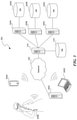
- FIG. 3 is a block diagram illustrating an overview of an environment in which some implementations of the present technology can operate.
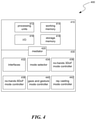
- FIG. 4 is a block diagram illustrating components which, in some implementations, can be used in a system employing the disclosed technology.
- FIG. 5 is a flow diagram illustrating a process used in some implementations of the present technology for identifying a trigger for switching between specified interaction modes and causing the triggered interaction mode to be enabled.
- FIG. 6 is a conceptual diagram illustrating an example gaze cursor.
- FIG. 7 is a conceptual diagram illustrating an example gaze cursor with a dwell timer.
- FIG. 8 is a conceptual diagram illustrating an example gaze cursor with hand gesture selections.
- FIG. 9 is a conceptual diagram illustrating an example of ray casting direction input with hand gesture selection.
- FIGS. 10A and 10B are conceptual diagrams illustrating an example interaction between device positioning and object selection using an eye-tracking based gaze cursor with a dwell timer.
- An interaction mode can specify how the interaction mode system determines (a) direction indications and movement within an artificial reality environment and (b) interactions for making selections or performing other actions.
- the interaction mode system also provides affordances for signaling a current interaction mode and interaction mode transitions.
- the interaction mode system can control multiple interaction modes and can employ a mapping of interaction mode context factors to interaction modes to control transitioning between interaction modes. Users manually activating software or hardware controls, performing interaction mode transition gestures, or other explicit commands can also cause additional interaction mode transitions.
- the interaction mode context factors can include, e.g., which hardware components are enabled or disabled (via hardware or software control); which software modules are enabled or disabled; current privacy, power, or accessibility settings; environment conditions (e.g., lighting, position detection factors such as surface types or marker availability, area-based camera restrictions, determined area types, amount of surrounding people or identified specific surrounding people, etc.); current body positions (e.g., whether hands are in view, hand orientation, gestures being performed); current controller position or status; etc.
- environment conditions e.g., lighting, position detection factors such as surface types or marker availability, area-based camera restrictions, determined area types, amount of surrounding people or identified specific surrounding people, etc.
- current body positions e.g., whether hands are in view, hand orientation, gestures being performed
- current controller position or status etc.
- the interaction mode system can determine the interaction mode context by integrating input from various sub-systems such as head tracking, position tracking, eye tracking, hand tracking, other camera-based systems, hardware controllers, simultaneous localization and mapping (SLAM) systems, or other data sources.
- a head tracking sub-system can identify an orientation of a user's head, e.g., based on one or more of data from an inertial motion unit (IMU—discussed below), tracked light emitted by a head mounted device, a camera or other external sensor directed to capture a representation of the user's head, or combinations thereof.
- IMU inertial motion unit
- a position tracking sub-system can identify a user position within an artificial reality environment, e.g., based on tracked light emitted by a wearable device, time-of-flight sensors, environment mapping based on traditional and/or depth camera data, IMU data, GPS data, etc.
- An eye tracking sub-system can identify a gaze direction relative to a head-mounted device by modeling one or both of the user's eyes to determine a gaze direction vector, often along the line connecting the user's fovea and the center of the user's pupil, e.g., based on factors such as images capturing a circle of lights (i.e., “glints”) reflected off the user's eye.
- a hand tracking sub-system can determine position, pose, and/or movements of the user's hands, e.g., based on images from one or more cameras that depict one or more of the user's hands and/or sensor data from devices worn by the user such as gloves, rings, wrist bands, etc. Information from other camera systems can gather additional information such as lighting conditions, environment mapping, etc.
- Each of the sub-systems can provide result data (e.g., head orientation, position, eye orientation, hand pose and position, body pose and position, environment data, mapping data, etc.) as well as sub-system meta-data such as whether aspects of the sub-system are enabled and whether the sub-system has access to certain types of data (e.g., whether certain sets of cameras or other sensors are enabled, battery level, accuracy estimates for related result data, etc.)
- result data e.g., head orientation, position, eye orientation, hand pose and position, body pose and position, environment data, mapping data, etc.
- sub-system meta-data such as whether aspects of the sub-system are enabled and whether the sub-system has access to certain types of data (e.g., whether certain sets of cameras or other sensors are enabled, battery level, accuracy estimates for related result data, etc.)
- the interaction mode system can control at least four interaction modes including a no-hands, 3DoF mode; a no-hands, 6DoF mode; a gaze and gesture mode; and a ray casting mode.
- the no-hands, 3DoF interaction mode can track only three degrees of freedom indicating roll, yaw, and pitch direction (though the user can indicate X, Y, and Z position movement through other means such as a joystick on a controller). Tracking in 3DoF can amount to a direction as a vector with an origin at an artificial reality device and the vector extending to a point on a sphere surrounding the origin, where the point on the sphere is identified based on IMU data.
- the vector can be modified based on an identified gaze direction of the user. Based on this vector, a “gaze cursor” can be provided in the user's field-of-view, either in the center of the field-of-view where eye tracking is not available or positioned according to where the user's eyes are focused where eye tracking is available.
- the interaction mode system can use a dwell timer that begins counting down when the direction vector does not make a threshold change within a time period and is reset when time the threshold change in the direction vector is detected. When the dwell timer counts down to zero, this can indicate a user action.
- Interaction mode context factors that can trigger a transition to the no-hands can include factors such as when position tracking cameras are off or otherwise unavailable (e.g., when in low power mode, privacy mode, public mode, etc.) or when lighting conditions are such that reliable position and hand tracking cannot be accomplished.
- the no-hands, 6DoF interaction mode can be similar to the no-hands, 3DoF interaction mode, except that the no-hands, 6DoF interaction mode system tracks not only the direction vector for a gaze cursor, but also user position movement within the artificial reality environment.
- actions in the no-hands, 6DoF interaction mode can include directing the gaze cursor (which now can be done by the user changing her direction and position) and using the dwell timer to perform actions in relation to the gaze cursor.
- Interaction mode context factors that can trigger a transition to the no-hands 6DoF interaction mode can include an indication that position tracking systems are enabled but that either (a) a hand tracking system is not enabled or lighting conditions are not sufficient to track hand position or (b) that there is no detection of a hand “ready state.”
- a ready state can occur when the user's hands are in the user's field-of-view, raised above a threshold position, and/or are in a particular configuration (e.g., palm up).
- the gaze and gesture interaction mode can be a version of the 6DoF or 3DoF interaction mode where direction is based on a gaze cursor, but instead of (or in addition to) using a dwell timer for actions, a user can indicate actions using hand gestures. For example, when a hand is in the user's field-of-view with the palm facing up, an action can be indicated by making a thumb and finger “pinch” gesture. Other gestures can also be used such as an air tap, air swipe, grab, or other identifiable motion or posture.
- Interaction mode context factors that can trigger a transition to the gaze and gesture interaction mode can include an identification that a hand tracking system is enabled and that a user's hands are in the ready state. In some implementations, transitioning to the gaze and gesture interaction mode can further require availability of a position tracking system for movement in 6DoF. See FIG. 8 for additional details on the gaze and gesture interaction mode.
- the ray casting interaction mode can replace the gaze cursor with a ray that extends from the user's hand into the artificial reality environment.
- a ray can be specified along a line connecting an origin point (e.g., a hand center-of-mass or a user's eye, shoulder, or hip) with a control point (e.g., a point relative to the user's hand).
- Hand gestures similar to those used in the gaze and gesture interaction mode can be used to indicate actions.
- Interaction mode context factors that can trigger a transition to the ray casting interaction mode can include the hand tracking system being available and the user's hand being in a ray casting pose (e.g., both (a) in the user's field-of-view or positioned above a threshold and (b) positioned with the palm downward.) See FIG. 9 and the associated description below for additional details on the ray casting interaction mode.
- other controls can augment or replace the direction and/or selection determinations in any of the above interaction modes.
- a user can indicate direction with a controller and/or press buttons on the controller to indicate selection or other actions, can indicate directions or actions using paired devices (e.g., by swiping a gesture or tapping on a touch screen, performing a scroll action on a capacitance sensor such as on a watch or ring, etc.)
- Embodiments of the disclosed technology may include or be implemented in conjunction with an artificial reality system.
- Artificial reality or extra reality (XR) is a form of reality that has been adjusted in some manner before presentation to a user, which may include, e.g., a virtual reality (VR), an augmented reality (AR), a mixed reality (MR), a hybrid reality, or some combination and/or derivatives thereof.
- Artificial reality content may include completely generated content or generated content combined with captured content (e.g., real-world photographs).
- the artificial reality content may include video, audio, haptic feedback, or some combination thereof, any of which may be presented in a single channel or in multiple channels (such as stereo video that produces a three-dimensional effect to the viewer).
- artificial reality may be associated with applications, products, accessories, services, or some combination thereof, that are, e.g., used to create content in an artificial reality and/or used in (e.g., perform activities in) an artificial reality.
- the artificial reality system that provides the artificial reality content may be implemented on various platforms, including a head-mounted display (HMD) connected to a host computer system, a standalone HMD, a mobile device or computing system, a “cave” environment or other projection system, or any other hardware platform capable of providing artificial reality content to one or more viewers.
- HMD head-mounted display
- Virtual reality refers to an immersive experience where a user's visual input is controlled by a computing system.
- Augmented reality refers to systems where a user views images of the real world after they have passed through a computing system.
- a tablet with a camera on the back can capture images of the real world and then display the images on the screen on the opposite side of the tablet from the camera. The tablet can process and adjust or “augment” the images as they pass through the system, such as by adding virtual objects.
- “Mixed reality” or “MR” refers to systems where light entering a user's eye is partially generated by a computing system and partially composes light reflected off objects in the real world.
- a MR headset could be shaped as a pair of glasses with a pass-through display, which allows light from the real world to pass through a waveguide that simultaneously emits light from a projector in the MR headset, allowing the MR headset to present virtual objects intermixed with the real objects the user can see.
- “Artificial reality,” “extra reality,” or “XR,” as used herein, refers to any of VR, AR, MR, or any combination or hybrid thereof.
- Existing XR systems have developed a number of interaction modes including features such as ray casting, air tapping, dwell timers, and gaze cursors.
- existing XR systems fail to provide automatic transitions between interaction modes using these features, either requiring a user to manually change the interaction mode, use the same interaction mode for all interactions with a particular application, or requiring the application to specify an interaction mode, regardless of the context.
- the interaction mode system and processes described herein are expected to overcome these problems associated with conventional XR interaction techniques, and are expected to (a) provide greater functionality while being more natural and intuitive than interactions in existing XR systems; (b) provide new efficiencies by selecting an interaction mode matching current power and environment conditions; and (c) make artificial reality interactions less intrusive to the user and other surrounding people.
- the systems and processes described herein are rooted in computerized artificial reality systems instead of being an analog of traditional object interactions.
- existing object interaction techniques fail to provide the set of interaction modes described herein with smooth and automatic transitions between the various modes.
- interaction mode system and processes described herein provide improvements by making interactions available in additional situations, such as where existing XR systems have provided an interaction mode which is inoperable in the current context or with which the user cannot interact (e.g., by switching to a more appropriate interaction mode when in low-light conditions or when the user's hands are otherwise occupied).
- FIG. 1 is a block diagram illustrating an overview of devices on which some implementations of the disclosed technology can operate.
- the devices can comprise hardware components of a computing system 100 that switches between interaction modes either based on factors in an identified interaction mode context or in response to user controls.
- computing system 100 can include a single computing device 103 or multiple computing devices (e.g., computing device 101 , computing device 102 , and computing device 103 ) that communicate over wired or wireless channels to distribute processing and share input data.
- computing system 100 can include a stand-alone headset capable of providing a computer created or augmented experience for a user without the need for external processing or sensors.
- computing system 100 can include multiple computing devices such as a headset and a core processing component (such as a console, mobile device, or server system) where some processing operations are performed on the headset and others are offloaded to the core processing component.
- a headset and a core processing component (such as a console, mobile device, or server system) where some processing operations are performed on the headset and others are offloaded to the core processing component.
- Example headsets are described below in relation to FIGS. 2A and 2B .
- position and environment data can be gathered only by sensors incorporated in the headset device, while in other implementations one or more of the non-headset computing devices can include sensor components that can track environment or position data.
- Computing system 100 can include one or more processor(s) 110 (e.g., central processing units (CPUs), graphical processing units (GPUs), holographic processing units (HPUs), etc.)
- processors 110 can be a single processing unit or multiple processing units in a device or distributed across multiple devices (e.g., distributed across two or more of computing devices 101 - 103 ).
- Computing system 100 can include one or more input devices 120 that provide input to the processors 110 , notifying them of actions. The actions can be mediated by a hardware controller that interprets the signals received from the input device and communicates the information to the processors 110 using a communication protocol.
- Each input device 120 can include, for example, a mouse, a keyboard, a touchscreen, a touchpad, a wearable input device (e.g., a haptics glove, a bracelet, a ring, an earring, a necklace, a watch, etc.), a camera (or other light-based input device, e.g., an infrared sensor), a microphone, or other user input devices.
- Processors 110 can be coupled to other hardware devices, for example, with the use of an internal or external bus, such as a PCI bus, SCSI bus, or wireless connection.
- the processors 110 can communicate with a hardware controller for devices, such as for a display 130 .
- Display 130 can be used to display text and graphics.
- display 130 includes the input device as part of the display, such as when the input device is a touchscreen or is equipped with an eye direction monitoring system.
- the display is separate from the input device. Examples of display devices are: an LCD display screen, an LED display screen, a projected, holographic, or augmented reality display (such as a heads-up display device or a head-mounted device), and so on.
- Other I/O devices 140 can also be coupled to the processor, such as a network chip or card, video chip or card, audio chip or card, USB, firewire or other external device, camera, printer, speakers, CD-ROM drive, DVD drive, disk drive, etc.
- Computing system 100 can include a communication device capable of communicating wirelessly or wire-based with other local computing devices or a network node.
- the communication device can communicate with another device or a server through a network using, for example, TCP/IP protocols.
- Computing system 100 can utilize the communication device to distribute operations across multiple network devices.
- the processors 110 can have access to a memory 150 , which can be contained on one of the computing devices of computing system 100 or can be distributed across of the multiple computing devices of computing system 100 or other external devices.
- a memory includes one or more hardware devices for volatile or non-volatile storage, and can include both read-only and writable memory.
- a memory can include one or more of random access memory (RAM), various caches, CPU registers, read-only memory (ROM), and writable non-volatile memory, such as flash memory, hard drives, floppy disks, CDs, DVDs, magnetic storage devices, tape drives, and so forth.
- RAM random access memory
- ROM read-only memory
- writable non-volatile memory such as flash memory, hard drives, floppy disks, CDs, DVDs, magnetic storage devices, tape drives, and so forth.
- a memory is not a propagating signal divorced from underlying hardware; a memory is thus non-transitory.
- Memory 150 can include program memory 160 that stores programs and software, such as an operating system 162 , interaction mode system 164 , and other application programs 166 .
- Memory 150 can also include data memory 170 that can include, e.g., a mapping of interaction mode context factors to interaction modes for triggering interaction mode switches, configuration data, settings, user options or preferences, etc., which can be provided to the program memory 160 or any element of the computing system 100 .
- Some implementations can be operational with numerous other computing system environments or configurations.
- Examples of computing systems, environments, and/or configurations that may be suitable for use with the technology include, but are not limited to, XR headsets, personal computers, server computers, handheld or laptop devices, cellular telephones, wearable electronics, gaming consoles, tablet devices, multiprocessor systems, microprocessor-based systems, set-top boxes, programmable consumer electronics, network PCs, minicomputers, mainframe computers, distributed computing environments that include any of the above systems or devices, or the like.
- FIG. 2A is a wire diagram of a virtual reality head-mounted display (HMD) 200 , in accordance with some embodiments.
- the HMD 200 includes a front rigid body 205 and a band 210 .
- the front rigid body 205 includes one or more electronic display elements of an electronic display 245 , an inertial motion unit (IMU—also referred to as an inertial measurement unit) 215 , one or more position sensors 220 , locators 225 , and one or more compute units 230 .
- IMU inertial motion unit
- the position sensors 220 , the IMU 215 , and compute units 230 may be internal to the HMD 200 and may not be visible to the user.
- the IMU 215 , position sensors 220 , and locators 225 can track movement and location of the HMD 200 in the real world and in a virtual environment in three degrees of freedom (3DoF) or six degrees of freedom (6DoF).
- the locators 225 can emit infrared light beams which create light points on real objects around the HMD 200 .
- the IMU 215 can include e.g., one or more accelerometers, gyroscopes, magnetometers, other non-camera-based position, force, or orientation sensors, or combinations thereof.
- One or more cameras (not shown) integrated with the HMD 200 can detect the light points.
- Compute units 230 in the HMD 200 can use the detected light points to extrapolate position and movement of the HMD 200 as well as to identify the shape and position of the real objects surrounding the HMD 200 .
- the electronic display 245 can be integrated with the front rigid body 205 and can provide image light to a user as dictated by the compute units 230 .
- the electronic display 245 can be a single electronic display or multiple electronic displays (e.g., a display for each user eye).
- Examples of the electronic display 245 include: a liquid crystal display (LCD), an organic light-emitting diode (OLED) display, an active-matrix organic light-emitting diode display (AMOLED), a display including one or more quantum dot light-emitting diode (QOLED) sub-pixels, a projector unit (e.g., microLED, LASER, etc.), some other display, or some combination thereof.
- LCD liquid crystal display
- OLED organic light-emitting diode
- AMOLED active-matrix organic light-emitting diode display
- QOLED quantum dot light-emitting diode
- a projector unit e.g., microLED, LASER
- the HMD 200 can be coupled to a core processing component such as a personal computer (PC) (not shown) and/or one or more external sensors (not shown).
- the external sensors can monitor the HMD 200 (e.g., via light emitted from the HMD 200 ) which the PC can use, in combination with output from the IMU 215 and position sensors 220 , to determine the location and movement of the HMD 200 .
- the HMD 200 can be in communication with one or more other external devices, such as controllers (not shown) which a user can hold in one or both hands.
- the controllers can have their own IMU units, position sensors, and/or can emit further light points.
- the HMD 200 or external sensors can track these controller light points.
- the compute units 230 in the HMD 200 or the core processing component can use this tracking, in combination with IMU and position output, to monitor hand positions and motions of the user.
- the controllers can also include various buttons a user can actuate to provide input and interact with virtual objects.
- the HMD 200 can also include additional subsystems, such as an eye tracking unit, an audio system, various network components, etc.
- one or more cameras included in the HMD 200 or external to it can monitor the positions and poses of the user's hands to determine gestures and other hand and body motions.
- FIG. 2B is a wire diagram of a mixed reality HMD system 250 which includes a mixed reality HMD 252 and a core processing component 254 .
- the mixed reality HMD 252 and the core processing component 254 can communicate via a wireless connection (e.g., a 60 GHz link) as indicated by link 256 .
- the mixed reality system 250 includes a headset only, without an external compute device or includes other wired or wireless connections between the mixed reality HMD 252 and the core processing component 254 .
- the mixed reality HMD 252 includes a pass-through display 258 and a frame 260 .
- the frame 260 can house various electronic components (not shown) such as light projectors (e.g., LASERs, LEDs, etc.), cameras, eye-tracking sensors, MEMS components, networking components, etc.
- the projectors can be coupled to the pass-through display 258 , e.g., via optical elements, to display media to a user.
- the optical elements can include one or more waveguide assemblies, reflectors, lenses, mirrors, collimators, gratings, etc., for directing light from the projectors to a user's eye.
- Image data can be transmitted from the core processing component 254 via link 256 to HMD 252 .
- Controllers in the HMD 252 can convert the image data into light pulses from the projectors, which can be transmitted via the optical elements as output light to the user's eye.
- the output light can mix with light that passes through the display 258 , allowing the output light to present virtual objects that appear as if they exist in the real world.
- the HMD system 250 can also include motion and position tracking units, cameras, light sources, etc., which allow the HMD system 250 to, e.g., track itself in 3DoF or 6DoF, track portions of the user (e.g., hands, feet, head, or other body parts), map virtual objects to appear as stationary as the HMD 252 moves, and have virtual objects react to gestures and other real-world objects.
- motion and position tracking units cameras, light sources, etc.
- FIG. 3 is a block diagram illustrating an overview of an environment 300 in which some implementations of the disclosed technology can operate.
- Environment 300 can include one or more client computing devices 305 A-D, examples of which can include computing system 100 .
- some of the client computing devices e.g., client computing device 305 B
- Client computing devices 305 can operate in a networked environment using logical connections through network 330 to one or more remote computers, such as a server computing device.
- server 310 can be an edge server which receives client requests and coordinates fulfillment of those requests through other servers, such as servers 320 A-C.
- Server computing devices 310 and 320 can comprise computing systems, such as computing system 100 . Though each server computing device 310 and 320 is displayed logically as a single server, server computing devices can each be a distributed computing environment encompassing multiple computing devices located at the same or at geographically disparate physical locations.
- Client computing devices 305 and server computing devices 310 and 320 can each act as a server or client to other server/client device(s).
- Server 310 can connect to a database 315 .
- Servers 320 A-C can each connect to a corresponding database 325 A-C.
- each server 310 or 320 can correspond to a group of servers, and each of these servers can share a database or can have their own database.
- databases 315 and 325 are displayed logically as single units, databases 315 and 325 can each be a distributed computing environment encompassing multiple computing devices, can be located within their corresponding server, or can be located at the same or at geographically disparate physical locations.
- Network 330 can be a local area network (LAN), a wide area network (WAN), a mesh network, a hybrid network, or other wired or wireless networks.
- Network 330 may be the Internet or some other public or private network.
- Client computing devices 305 can be connected to network 330 through a network interface, such as by wired or wireless communication. While the connections between server 310 and servers 320 are shown as separate connections, these connections can be any kind of local, wide area, wired, or wireless network, including network 330 or a separate public or private network.
- FIG. 4 is a block diagram illustrating components 400 which, in some implementations, can be used in a system employing the disclosed technology.
- Components 400 can be included in one device of computing system 100 or can be distributed across multiple of the devices of computing system 100 .
- the components 400 include hardware 410 , mediator 420 , and specialized components 430 .
- a system implementing the disclosed technology can use various hardware including processing units 412 , working memory 414 , input and output devices 416 (e.g., cameras, displays, IMU units, network connections, etc.), and storage memory 418 .
- storage memory 418 can be one or more of: local devices, interfaces to remote storage devices, or combinations thereof.
- storage memory 418 can be one or more hard drives or flash drives accessible through a system bus or can be a cloud storage provider (such as in storage 315 or 325 ) or other network storage accessible via one or more communications networks.
- components 400 can be implemented in a client computing device such as client computing devices 305 or on a server computing device, such as server computing device 310 or 320 .
- Mediator 420 can include components which mediate resources between hardware 410 and specialized components 430 .
- mediator 420 can include an operating system, services, drivers, a basic input output system (BIOS), controller circuits, or other hardware or software systems.
- BIOS basic input output system
- Specialized components 430 can include software or hardware configured to perform operations for switching between interaction modes based on (a) factors in an identified interaction mode context or (b) in response to user controls.
- Specialized components 430 can include mode selector 434 , no-hands, 3DoF mode controller 436 , no-hands, 6DoF mode controller 438 , gaze and gesture mode controller 440 , ray casting mode controller 442 , and components and APIs which can be used for providing user interfaces, transferring data, and controlling the specialized components, such as interfaces 432 .
- components 400 can be in a computing system that is distributed across multiple computing devices or can be an interface to a server-based application executing one or more of specialized components 430 .
- specialized components 430 may be logical or other nonphysical differentiations of functions and/or may be submodules or code-blocks of one or more applications.
- Mode selector 434 can identify a condition for switching interaction modes, causing control of user interactions to switch to a corresponding one of no-hands, 3DoF mode controller 436 , no-hands, 6DoF mode controller 438 , gaze and gesture mode controller 440 , or ray casting mode controller 442 .
- mode selector 434 can identify such a condition in response to an explicit user selection of an interaction mode or by mapping interaction mode context factors to a corresponding interaction mode.
- the mapping can, for example, map the interaction mode context factor of no useable tracking input to the no-hand 3DoF interaction mode, map the interaction mode context factors of useable tracking input with no identification of hands in a ready state to the no-hand 6DoF interaction mode, map the interaction mode context factors of useable tracking input and an identification of hands in a ready state to the gaze and gesture interaction mode, and map the interaction mode context factors of useable tracking input and hands in a ray state to the ray casting interaction mode. Additional details on selecting an interaction mode based on interaction mode context factors or a user selection are provided below in relation to blocks 502 - 510 and 552 - 562 of FIG. 5 .
- 3DoF mode controller 436 can provide user interactions where direction is indicated with a gaze cursor and actions are indicated with a dwell timer. No-hands, 3DoF mode controller 436 does not translate user movement in the X, Y, or Z axes into changes in the user's field-of-view. No-hands, 3DoF mode controller 436 can interface, via mediator 420 , with an IMU unit of I/O 416 to determine head position and can interface, via mediator 420 , with an eye tracker of I/O 416 to determine eye gaze direction, the combination of which can specify the location of the gaze cursor. Additional details on the no-hands, 3DoF interaction mode are provided below in relation to block 580 of FIG. 5 .
- 6DoF mode controller 438 can provide user interactions where direction is indicated with a gaze cursor and actions are indicated with a dwell timer. No-hands, 6DoF mode controller 438 can interface, via mediator 420 , with a position tracking system of I/O 416 to determine user movements along the X, Y, and Z axes and translate these into changes in the user's field-of-view. No-hands, 6DoF mode controller 438 can interface, via mediator 420 , with the IMU unit of I/O 416 to determine head position and can interface, via mediator 420 , with the eye tracker of I/O 416 to determine eye gaze direction, the combination of which can specify the location of the gaze cursor. Additional details on the no-hands, 6DoF interaction mode are provided below in relation to block 582 of FIG. 5 .
- Gaze and gesture mode controller 440 can provide user interactions where direction is indicated with a gaze cursor and actions are indicated with hand gestures. Gaze and gesture mode controller 440 can interface, via mediator 420 , with a position tracking system of I/O 416 to determine user movements along the X, Y, and Z axes and translate these into changes in the user's field-of-view. Gaze and gesture mode controller 440 can interface, via mediator 420 , with the IMU unit of I/O 416 to determine head position and can interface, via mediator 420 , with the eye tracker of I/O 416 to determine eye gaze direction, the combination of which can specify the location of the gaze cursor. Gaze and gesture mode controller 440 can further interface, via mediator 420 , with a hand tracking system to identify hand postures which it translates into actions. Additional details on the gaze and gesture interaction mode are provided below in relation to block 584 of FIG. 5 .
- Ray casting mode controller 442 can provide user interactions where direction is indicated with rays controlled by the user and actions are indicated with hand gestures. Ray casting mode controller 442 can interface, via mediator 420 , with a position tracking system of I/O 416 to determine user movements along the X, Y, and Z axes and can interface, via mediator 420 , with the IMU unit of I/O 416 to determine head position, the combination of which ray casting mode controller 442 can use to determine changes in the user's field-of-view. Ray casting mode controller 442 can further interface, via mediator 420 , with a hand tracking system to identify hand postures which it translates into a control point for casting rays and for identifying actions. Additional details on the ray casting interaction mode are provided below in relation to block 584 of FIG. 5 .
- FIGS. 1-4 may be altered in a variety of ways. For example, the order of the logic may be rearranged, substeps may be performed in parallel, illustrated logic may be omitted, other logic may be included, etc. In some implementations, one or more of the components described above can execute one or more of the processes described below.
- FIG. 5 is a flow diagram illustrating a process 500 used in some implementations of the present technology for identifying a trigger for switching between specified interaction modes and causing the triggered interaction mode to be enabled.
- Process 500 is depicted as having two possible starting points 502 and 552 .
- Process 500 can begin at starting point 552 when an explicit user command is received for manually switching interaction modes.
- Such a command can be performed, e.g., using a physical button or other control included in an artificial reality system, using a virtual control (e.g., a user interface element) displayed by the artificial reality system, with a voice command, or through a gesture or other input mapped to switching the interaction mode.
- a virtual control e.g., a user interface element
- Process 500 can begin at starting point 502 in response to various indications to check for an interaction mode change trigger, such as a periodic check (e.g., performed every 1, 5, or 10 ms) or in response to a detection in a change in interaction mode context factors.
- an interaction mode change trigger such as a periodic check (e.g., performed every 1, 5, or 10 ms) or in response to a detection in a change in interaction mode context factors.
- the factors that, when changed, cause process 500 to be performed can be different depending on the current interaction mode. For example, if the current interaction mode is the no-hands, 3DoF mode because the interaction mode system is in a low power state, a change in the lighting conditions would not trigger a mode change check, whereas if the current interaction mode is the ray casting mode requiring cameras to capture hand position, a change in the lighting conditions could trigger the mode change check.
- process 500 can proceed to block 504 .
- process 500 can determine if there is no useable input for position tracking and for hand tracking. There may not be useable input for position tracking and hand tracking when cameras used for one of those systems, or corresponding processing components such as machine learning models, are disabled (e.g., due to the interaction mode system being in low power or privacy mode, having not yet initialized those systems, etc.) or when lighting conditions are insufficient to capture images of sufficient quality for one of these systems.
- hand or position tracking can be based on a system other than cameras, such as a wearable glove, ring, and/or bracelet for a hand tracking system or time-of-flight sensors or GPS data for a position tracking system, and the determination of useable hand tracking input can be based on whether these systems are enabled and receiving information sufficient to determine hand pose and user position. If there is no such useable tracking input, process 500 can continue to block 580 . If there is such useable tracking input, process 500 can continue to block 506 .
- a system other than cameras such as a wearable glove, ring, and/or bracelet for a hand tracking system or time-of-flight sensors or GPS data for a position tracking system
- process 500 can enable no-hands, 3DoF interaction mode.
- no-hands, 3DoF interaction mode a user moving parallel to the floor or vertically (i.e., the X, Y, and Z axes) will not cause a corresponding movement in the artificial reality environment (though such movement may be performed using other controls such as a joystick or direction pad on a controller) but the user can indicate direction by moving her head to point at various positions in the artificial reality environment, e.g., using a gaze cursor.
- the gaze cursor position can be based on both head tracking (e.g., via IMU data indicating pitch, roll, and yaw movements) and eye tracking (e.g., where a camera captures images of the user's eye(s) to determine a direction of the user's gaze).
- actions can be performed using a dwell timer, which begins counting down (e.g., from three seconds) when the gaze cursor does not move more than a threshold amount for at least a threshold amount of time (e.g., when the user's gaze remains relatively fixed for at least one second).
- actions can instead or in addition be indicated in other ways such as by pressing a button on a controller, activating a UI control (i.e., a “soft” button), using voice commands, etc.
- the action can then be performed in relation to the gaze cursor, e.g., the system performs a default action in relation to one or more objects at which the gaze cursor is pointed.
- the gaze cursor and/or an indication of the user's gaze direction can be displayed in the user's field-of-view as a visual affordance to indicate the user is in the no-hands, 3DoF interaction mode (or the no-hands, 6DoF interaction mode, discussed below) and to help the user make selections with the gaze cursor. Additional details on gaze cursors and dwell timers are provided below in relation to FIGS. 6, 7, and 10 .
- process 500 can determine whether position information is available while hands are not identified as being in a ready state.
- Position information can be available when a positioning system is enabled and is receiving sufficient data to determine a user's movements in 6DoF.
- a positioning system can include a system mounted on a wearable portion of the artificial reality system (“inside-out tracking”) or external sensors directed at the user to track body position (“outside-in tracking”).
- these systems can use one or more technologies such as encoded points of light (e.g., infrared) emitted by the artificial reality system and using cameras to track movement of those points; identifying features in captured images and tracking their relative movement across frames (e.g., “motion vectors”); identifying portions of the user in captured images and tracking movement of those portions (e.g., “skeleton tracking”); taking time-of-flight sensor readings from objects in the environment; global positioning system (GPS) data; triangulation using multiple sensors; etc.
- encoded points of light e.g., infrared
- identifying features in captured images and tracking their relative movement across frames e.g., “motion vectors”
- identifying portions of the user in captured images and tracking movement of those portions e.g., “skeleton tracking”
- taking time-of-flight sensor readings from objects in the environment GPS
- triangulation using multiple sensors etc.
- Determining whether there is sufficient data can include determining whether the position tracking system is enabled (e.g., such systems may be disabled in privacy mode, in low-power mode, in public mode, in do not disturb mode, etc.) and whether they are able to appropriately determine user positions (which may not be possible for some of these systems e.g., in low lighting conditions, where there are not sufficient surfaces nearby to shine light points on, where environment mapping has not yet occurred, where the user is out of frame of a capture device, etc.)
- a hand can be identified as being in a ready state when a hand tracking system is enabled and a current hand posture matches a ready state hand posture.
- Hand tracking systems can include, for example, various technologies such as a camera taking and interpreting images of the user's hand(s) (e.g., using a trained model) or wearable devices such as gloves, rings, or bracelets that take measurements that can be interpreted as user hand postures.
- Examples of possible ready state hand postures include when the user's palm is facing substantially up (e.g., is rotated at least a threshold amount toward the sky), when the user's fingers are splayed a certain amount, when certain fingers are touching (e.g., thumb and index finger), when the user's hand is tilted past horizontal by a certain degree, when the user makes a fist, etc.
- the hand ready state can require that the hands be in the user's field-of-view, be raised above a certain threshold (e.g., be above hip level), or that the user's elbow(s) is bent at least a certain amount. Additional details on hand ready states are provided below in relation to FIG. 8 .
- bock 506 can also determine whether the hands are not in a state mapped to another interaction mode, such as the ray state discussed below in relation to blocks 508 and 510 . If position information is available and hands are not identified as being in a ready state (or another interaction mode mapped state), process 500 can continue to block 582 , otherwise process 500 can continue to block 508 .
- another interaction mode such as the ray state discussed below in relation to blocks 508 and 510 .
- process 500 can enable the no-hands, 6DoF interaction mode.
- the no-hands, 6DoF interaction mode can provide similar interactions as the no-hands, 3DoF interaction mode described above, except that user movements parallel to the floor and vertically (i.e., along the X, Y, and Z axes) are detected and translated into point-of-view movement in the artificial reality environment. Point of view movement and head and/or eye tracking can be used to position a gaze cursor.
- actions in the no-hands, 6DoF interaction mode can be performed with a dwell timer and/or other user controls (e.g., physical or soft buttons, voice commands, etc.), which can be performed in relation to the gaze cursor.
- process 500 can end at block 590 .
- process 500 can determine whether the hands are in the ready state, as discussed above. If so, process 500 can continue to block 584 ; if not, process 500 can continue to block 510 .
- process 500 can enable a gaze and gesture interaction mode.
- the gaze and gesture interaction mode can include a gaze cursor as discussed above.
- gaze and gesture interaction mode will always use position tracking, allowing the user to control her position in the artificial reality environment by moving in the real world while in other cases position tracking may or may not be enabled for gaze and gesture interaction mode.
- position tracking is enabled, the gaze cursor can be controlled by the user in 6DoF and when position tracking is not enabled at block 584 , the gaze cursor can be controlled by the user in 3DoF.
- a dwell timer may or may not be enabled in the gaze and gesture interaction mode.
- the gaze and gesture interaction mode can enable actions based on user gestures. For example, a default action can be performed when a user performs a particular gesture, such as bringing her thumb and index finger together. In some implementations, different actions can be mapped to different gestures. For example, a first action can be performed when the user brings her thumb and index finger together and a second action can be performed when the user brings her thumb and middle finger together.
- One or more of many different gestures can be used by the gaze and gesture interaction mode, such as swipe gestures, air tap gestures, grip gestures, finger extension gestures, finger curl gestures, etc.
- visual affordances can be used to signal to the user that the gaze and gesture interaction mode is enabled and/or that a gesture is being recognized.
- the hand ready state can be the user's palm being substantially directed upward and a visual affordance for the gaze and gesture interaction mode can include placing a sphere between the user's thumb and index finger (see FIG. 8 ). This can both signal to the user that the gaze and gesture interaction mode is enabled and provide feedback for a pinch gesture between these fingers (e.g., by distorting or resizing the sphere as the user brings these fingers together).
- process 500 can end at block 590 .
- process 500 can determine whether the user's hands are in a ray state. Similar to the processes described above with respect to blocks 506 and 508 , this can include determining whether hand tracking is enabled, whether there is sufficient data to determine a hand posture, and/or whether one or more hands is in-view, raised above a threshold, or that the user's elbow is bent above a threshold amount. Identifying the ray state can also include determining that one or both of the user's hands are in a pose mapped to performing ray casting.
- Examples of such poses can include the user's hand rotated so her palm is substantially pointing downward (e.g., is rotated at least a threshold amount toward the floor), that a finger (e.g., the index finger) is extended, that certain fingers are touching (e.g., the thumb, middle, and ring fingers), etc. If the user's hand(s) are identified as being in the ray state, process 500 can continue to block 586 . If the user's hand(s) are not identified as being in the ray state, process 500 does not make a change to the current interaction mode, and can continue to block 590 , where it ends.
- process 500 can enable the ray casting interaction mode.
- the ray casting interaction mode can allow a user to make selections with a “ray,” which can be a curved or straight line segment, a cone, a pyramid, a cylinder, a sphere, or another geometry whose position is directed by the user (often based on the position of at least one hand of the user). Additional details on ray casting are provide in U.S. patent application Ser. No. 16/578,221, incorporated herein by reference in its entirety.
- a ray may be a line extending from a first point between the tip of user's index finger and the tip of her thumb, along a line connecting the first point with a second point at a pivot point on the user's palm between the user's thumb and index finger.
- the ray casting interaction mode may always use position tracking, allowing the user to control her position in the artificial reality environment by moving along the X, Y, and Z axes in the real world while in other cases position tracking may or may not be enabled.
- the ray casting interaction mode allows the user to make selections based on the ray cast by the user, either from a single position (in 3DoF) or as the user moves about the artificial reality environment (in 6DoF).
- the user can perform an action in relation to the ray and/or objects with which the ray intersects, e.g., by making a gesture such as a pinch, air tap, grab, etc.
- other actions can also be performed, e.g., using controller or soft buttons, voice commands, etc.
- the ray casting interaction mode can include a visual affordance with a shape (e.g., a teardrop shape) at the point between the tips of the user's fingers from which the ray emanates.
- this shape can be resized, distorted, or otherwise changed as the user makes a gesture.
- the teardrop shape can be compressed as the user brings her thumb-tip and fingertip closer together. Additional details on the ray casting interaction mode with visual affordances are provided below in relation to FIG. 9 .
- process 500 can begin at block 552 instead of block 502 . This can occur, for example, when the user provides an indication for manually transitioning interaction modes. In various implementations, this indication can be performed by activating a physical control, a soft control, speaking a command, performing a gesture, or some other command mapped to a particular interaction mode or to cycling through interaction modes. This indication can be received at block 554 . At block 556 , process 500 can determine if the interaction mode change indication corresponds to the no-hands, 3DoF interaction mode (e.g., is either mapped to that mode or is a next mode from a current mode in a cycle of modes).
- 3DoF interaction mode e.g., is either mapped to that mode or is a next mode from a current mode in a cycle of modes.
- process 500 can determine if the interaction mode change indication corresponds to the no-hands, 6DoF interaction mode (e.g., is either mapped to that mode or is a next mode from a current mode in a cycle of modes). If so, process 500 continues to block 582 (discussed above); if not, process 500 continues to block 560 . At block 560 , process 500 can determine if the interaction mode change indication corresponds to the gaze and gesture interaction mode (e.g., is either mapped to that mode or is a next mode from a current mode in a cycle of modes).
- process 500 continues to block 584 (discussed above); if not, process 500 continues to block 562 .
- process 500 can determine if the interaction mode change indication corresponds to the ray casting interaction mode (e.g., is either mapped to that mode or is a next mode from a current mode in a cycle of modes). If so, process 500 continues to block 586 (discussed above); if not, process 500 does not make an interaction mode change and continues to block 590 , where it ends.
- FIG. 6 is a conceptual diagram illustrating an example 600 with a gaze cursor 606 .
- the gaze cursor 606 is a selection mechanism controlled by at least a user's head position, and in some implementations, further controlled by a user's eye gaze direction.
- Example 600 further includes a user's field-of-view 608 , which is what the user can see through his artificial reality device 602 .
- Field-of-view 608 includes the gaze cursor 606 as viewed by the user, projected into the field-of-view 608 by the artificial reality device 602 .
- the gaze cursor 606 can be along a direction indicated by line 604 (which may or may not be displayed to a user).
- the line 604 can be perpendicular to the coronal plane of the user's head and can intersect with a point between the user's eyes.
- the gaze cursor 606 will be in the center of the user's field-of-view 608 .
- the gaze cursor 606 can be further based on the user's tracked eye gaze direction.
- the user's field-of-view 608 is an area based on the user's head position, but the position of the gaze cursor 606 within the field-of-view 608 can be controlled based on a determination of a direction of the user's gaze and/or a point in the field-of-view at which the user is looking.
- the gaze cursor 606 can appear to be at a specified distance from the user, at a determined focal plane of the user, or on the nearest object (real or virtual) with which the line 604 intersects. Another example of gaze cursor is provided in relation to FIGS. 10A and 10B .
- FIG. 7 is a conceptual diagram illustrating an example 700 with a dwell timer 702 .
- the dwell timer 702 can be for a set amount of time (e.g., three second, four seconds, etc.) that begins when the gaze cursor 606 has not moved above a threshold amount (e.g., when line 604 has not moved by more than three degrees) within a threshold time (e.g., one second).
- the dwell timer can reset if the gaze cursor 606 moves more than the threshold amount before the dwell timer expires.
- the dwell timer 702 only begins when the gaze cursor 606 is pointed at an object for which a default action can be taken when the dwell timer expires (e.g., object 704 ).
- a visual affordance can be shown when the dwell timer begins, such as the ring around the gaze cursor 606 where a percentage of the ring changes color or shading according to a percentage of the dwell timer that remains.
- FIG. 8 is a conceptual diagram illustrating an example 800 with gaze cursor 606 and further utilizing hand gesture selections.
- gaze and gesture interaction mode has been enabled in response to a determination that the user's hand 802 is in a ready state based on the user's hand 802 being the user's field-of-view 608 and in a palm-up pose.
- the user continues to use the gaze cursor 606 (see FIG. 6 ) to indicate direction.
- the user can perform a pinch gesture between his thumb and index finger to trigger an action. As indicated by line 806 , such a pinch action is interpreted in relation to the gaze cursor 606 .
- a visual affordance was displayed in the user's field-of-view 608 as a sphere 804 between the thumb and index finger on the user's hand 802 .
- the sphere 804 can be compressed into an ellipsoid to indicate to the user a part of the pinch gesture is being recognized.
- FIG. 9 is a conceptual diagram illustrating an example 900 with ray casting direction input with hand gesture selection.
- ray casting interaction mode has been enabled in response to a determination that the user's hand 802 is in a ray state based on the user's hand 802 being the user's field-of-view 608 and in a palm down pose.
- a ray 902 is cast from a point between the user's thumb and index finger.
- the user can perform a pinch gesture between his thumb and index finger to trigger an action.
- Such a pinch action is interpreted in relation to one or more objects (e.g., object 704 ) with which the ray intersects.
- a first visual affordance was displayed in the user's field-of-view 608 as a teardrop shape 906 between the thumb and index finger on the user's hand 802 .
- the teardrop 906 can be compressed to indicate to the user a part of the pinch gesture is being recognized.
- visual affordances showing the line of ray 902 and the point 904 where the line 902 intersects with an object are displayed.
- FIGS. 10A and 10B are conceptual diagrams illustrating examples 1000 and 1050 with interaction between device positioning and object selection using an eye-tracking-based gaze cursor with a dwell timer.
- Example 1000 includes artificial reality glasses 1002 with waveguide lenses 1004 A and 1004 B that project light into a user's eyes to cause the user to see a field-of-view 1014 .
- the artificial reality glasses 1002 may be similar to glasses 252 discussed above with reference to FIG. 2B .
- a direction in an artificial reality environment for the field-of-view 1014 is controlled by head tracking unit 1016 of the artificial reality glasses 1002 .
- Head tracking unit 1016 can use, e.g., a gyroscope, magnetometer, and accelerometer to determine a direction and movement of the artificial reality glasses 1002 for the artificial reality glasses 1002 to translate into a camera position in the artificial reality environment from which to display content.
- field-of-view 1014 displays virtual objects 1012 A, 1012 B, and 1012 C.
- Artificial reality glasses 1002 include eye tracking module 1006 which includes a camera and light source (e.g., infrared light) that illuminates glints on the user's eyes, takes pictures of the user's eyes, and uses a trained machine learning model to interpret the images into a gaze direction (indicated by line 1008 ). At the end of the eye gaze direction line 1008 is a gaze cursor 1010 .
- the user is looking at the center of the field-of-view 1014 , causing the gaze cursor 1010 to be positioned there.
- example 1050 the user has moved her head to the left, as indicated by arrow 1058 .
- This movement was tracked by head tracking unit 1016 , causing the field-of-view 1014 to shift left, resulting in virtual objects 1012 A, 1012 B, and 1012 C to shift right in the field-of-view 1014 .
- the user has also transitioned her gaze from the center of the field-of-view 1014 to the lower-left corner of the field-of-view 1014 .
- This change in eye gaze was tracked by eye tracking unit 1006 , as indicated by line 1008 .
- dwell timer 1052 beings to count down from three seconds.
- the artificial reality glasses 1002 take the default action of selecting the object 1012 C on which the gaze cursor 1010 rests.
- being above a threshold means that a value for an item under comparison is above a specified other value, that an item under comparison is among a certain specified number of items with the largest value, or that an item under comparison has a value within a specified top percentage value.
- being below a threshold means that a value for an item under comparison is below a specified other value, that an item under comparison is among a certain specified number of items with the smallest value, or that an item under comparison has a value within a specified bottom percentage value.
- being within a threshold means that a value for an item under comparison is between two specified other values, that an item under comparison is among a middle-specified number of items, or that an item under comparison has a value within a middle-specified percentage range.
- Relative terms such as high or unimportant, when not otherwise defined, can be understood as assigning a value and determining how that value compares to an established threshold.
- selecting a fast connection can be understood to mean selecting a connection that has a value assigned corresponding to its connection speed that is above a threshold.
- a hand tracking system is used to determine a hand gesture or for an origin point for casting a ray
- a tracked position of a controller can be used instead.
- the word “or” refers to any possible permutation of a set of items.
- the phrase “A, B, or C” refers to at least one of A, B, C, or any combination thereof, such as any of: A; B; C; A and B; A and C; B and C; A, B, and C; or multiple of any item such as A and A; B, B, and C; A, A, B, C, and C; etc.
Landscapes
- Engineering & Computer Science (AREA)
- Theoretical Computer Science (AREA)
- General Engineering & Computer Science (AREA)
- Human Computer Interaction (AREA)
- Physics & Mathematics (AREA)
- General Physics & Mathematics (AREA)
- Computer Hardware Design (AREA)
- User Interface Of Digital Computer (AREA)
- Position Input By Displaying (AREA)
Abstract
Description
Claims (20)
Priority Applications (10)
| Application Number | Priority Date | Filing Date | Title |
|---|---|---|---|
| US16/915,740 US11256336B2 (en) | 2020-06-29 | 2020-06-29 | Integration of artificial reality interaction modes |
| KR1020237002566A KR20230025904A (en) | 2020-06-29 | 2021-06-24 | Integration of artificial reality interaction mode |
| PCT/US2021/038826 WO2022005860A1 (en) | 2020-06-29 | 2021-06-24 | Integration of artificial reality interaction modes |
| JP2022579982A JP7745575B2 (en) | 2020-06-29 | 2021-06-24 | Integration of Virtual Reality Interaction Modes |
| CN202180053780.4A CN116097209A (en) | 2020-06-29 | 2021-06-24 | Integration of Artificial Reality Interaction Modes |
| EP25217752.2A EP4675402A2 (en) | 2020-06-29 | 2021-06-24 | Integration of artificial reality interaction modes |
| EP21742998.4A EP4172736B1 (en) | 2020-06-29 | 2021-06-24 | Integration of artificial reality interaction modes |
| US17/571,671 US11625103B2 (en) | 2020-06-29 | 2022-01-10 | Integration of artificial reality interaction modes |
| US18/295,526 US12130967B2 (en) | 2020-06-29 | 2023-04-04 | Integration of artificial reality interaction modes |
| US18/884,475 US20250147595A1 (en) | 2020-06-29 | 2024-09-13 | Integration of Artificial Reality Interaction Modes |
Applications Claiming Priority (1)
| Application Number | Priority Date | Filing Date | Title |
|---|---|---|---|
| US16/915,740 US11256336B2 (en) | 2020-06-29 | 2020-06-29 | Integration of artificial reality interaction modes |
Related Child Applications (1)
| Application Number | Title | Priority Date | Filing Date |
|---|---|---|---|
| US17/571,671 Continuation US11625103B2 (en) | 2020-06-29 | 2022-01-10 | Integration of artificial reality interaction modes |
Publications (2)
| Publication Number | Publication Date |
|---|---|
| US20210405760A1 US20210405760A1 (en) | 2021-12-30 |
| US11256336B2 true US11256336B2 (en) | 2022-02-22 |
Family
ID=76959108
Family Applications (4)
| Application Number | Title | Priority Date | Filing Date |
|---|---|---|---|
| US16/915,740 Active US11256336B2 (en) | 2020-06-29 | 2020-06-29 | Integration of artificial reality interaction modes |
| US17/571,671 Active 2040-06-29 US11625103B2 (en) | 2020-06-29 | 2022-01-10 | Integration of artificial reality interaction modes |
| US18/295,526 Active US12130967B2 (en) | 2020-06-29 | 2023-04-04 | Integration of artificial reality interaction modes |
| US18/884,475 Pending US20250147595A1 (en) | 2020-06-29 | 2024-09-13 | Integration of Artificial Reality Interaction Modes |
Family Applications After (3)
| Application Number | Title | Priority Date | Filing Date |
|---|---|---|---|
| US17/571,671 Active 2040-06-29 US11625103B2 (en) | 2020-06-29 | 2022-01-10 | Integration of artificial reality interaction modes |
| US18/295,526 Active US12130967B2 (en) | 2020-06-29 | 2023-04-04 | Integration of artificial reality interaction modes |
| US18/884,475 Pending US20250147595A1 (en) | 2020-06-29 | 2024-09-13 | Integration of Artificial Reality Interaction Modes |
Country Status (6)
| Country | Link |
|---|---|
| US (4) | US11256336B2 (en) |
| EP (2) | EP4172736B1 (en) |
| JP (1) | JP7745575B2 (en) |
| KR (1) | KR20230025904A (en) |
| CN (1) | CN116097209A (en) |
| WO (1) | WO2022005860A1 (en) |
Cited By (9)
| Publication number | Priority date | Publication date | Assignee | Title |
|---|---|---|---|---|
| US20220129082A1 (en) * | 2020-06-29 | 2022-04-28 | Facebook Technologies, Llc | Integration of Artificial Reality Interaction Modes |
| US20220130100A1 (en) * | 2020-05-28 | 2022-04-28 | Facebook Technologies, Llc | Element-Based Switching of Ray Casting Rules |
| US20230050547A1 (en) * | 2021-08-12 | 2023-02-16 | International Business Machines Corporation | Rendering information in a gaze tracking device on controllable devices in a field of view to remotely control |
| US11609625B2 (en) | 2019-12-06 | 2023-03-21 | Meta Platforms Technologies, Llc | Posture-based virtual space configurations |
| US11637999B1 (en) | 2020-09-04 | 2023-04-25 | Meta Platforms Technologies, Llc | Metering for display modes in artificial reality |
| US20230326144A1 (en) * | 2022-04-08 | 2023-10-12 | Meta Platforms Technologies, Llc | Triggering Field Transitions for Artificial Reality Objects |
| US20230333665A1 (en) * | 2022-04-19 | 2023-10-19 | Apple Inc. | Hand Engagement Zone |
| EP4465153A1 (en) * | 2023-05-19 | 2024-11-20 | Sharp Kabushiki Kaisha | User interface providing apparatus, method for providing user interface, and user interface providing program |
| US12164741B2 (en) | 2022-04-11 | 2024-12-10 | Meta Platforms Technologies, Llc | Activating a snap point in an artificial reality environment |
Families Citing this family (44)
| Publication number | Priority date | Publication date | Assignee | Title |
|---|---|---|---|---|
| KR102532071B1 (en) * | 2015-12-30 | 2023-05-15 | 삼성전자주식회사 | Display apparatus, user terminal, control method thereof, computer-readable medium, system thereof |
| US10558278B2 (en) | 2017-07-11 | 2020-02-11 | Apple Inc. | Interacting with an electronic device through physical movement |
| KR102817045B1 (en) * | 2019-06-19 | 2025-06-05 | 엘지전자 주식회사 | Signaling information representing a set of transform kernels in video coding |
| US11725959B2 (en) * | 2020-11-13 | 2023-08-15 | Nvidia Corporation | Automatic graphical content recognition for vehicle applications |
| US11995230B2 (en) | 2021-02-11 | 2024-05-28 | Apple Inc. | Methods for presenting and sharing content in an environment |
| US12449907B2 (en) | 2021-05-19 | 2025-10-21 | Apple Inc. | Navigating user interfaces using a cursor |
| US12096112B2 (en) * | 2021-07-29 | 2024-09-17 | Meta Platforms Technologies, Llc | User interface to select field of view of a camera in a smart glass |
| CN113885695A (en) * | 2021-08-12 | 2022-01-04 | 青岛小鸟看看科技有限公司 | Artificial reality-based gesture interaction method and system |
| US12456271B1 (en) | 2021-11-19 | 2025-10-28 | Apple Inc. | System and method of three-dimensional object cleanup and text annotation |
| US12307614B2 (en) | 2021-12-23 | 2025-05-20 | Apple Inc. | Methods for sharing content and interacting with physical devices in a three-dimensional environment |
| WO2023137402A1 (en) | 2022-01-12 | 2023-07-20 | Apple Inc. | Methods for displaying, selecting and moving objects and containers in an environment |
| WO2023141535A1 (en) | 2022-01-19 | 2023-07-27 | Apple Inc. | Methods for displaying and repositioning objects in an environment |
| US12541280B2 (en) | 2022-02-28 | 2026-02-03 | Apple Inc. | System and method of three-dimensional placement and refinement in multi-user communication sessions |
| WO2023181549A1 (en) * | 2022-03-24 | 2023-09-28 | キヤノン株式会社 | Control device, control method, and program |
| JP2023165361A (en) * | 2022-05-02 | 2023-11-15 | ディープインサイト株式会社 | Computer program, image processing device, image processing method, and in-vehicle interface device |
| US12386428B2 (en) | 2022-05-17 | 2025-08-12 | Apple Inc. | User interfaces for device controls |
| US11531448B1 (en) * | 2022-06-01 | 2022-12-20 | VR-EDU, Inc. | Hand control interfaces and methods in virtual reality environments |
| US20240070299A1 (en) * | 2022-08-31 | 2024-02-29 | Youjean Cho | Revealing collaborative object using countdown timer |
| US12505239B2 (en) | 2022-08-31 | 2025-12-23 | Snap Inc. | Collaborative object associated with a geographical location |
| US12493705B2 (en) | 2022-08-31 | 2025-12-09 | Snap Inc. | Selective collaborative object access based on timestamp |
| US12079395B2 (en) | 2022-08-31 | 2024-09-03 | Snap Inc. | Scissor hand gesture for a collaborative object |
| US12148114B2 (en) | 2022-08-31 | 2024-11-19 | Snap Inc. | Real-world responsiveness of a collaborative object |
| US12019773B2 (en) | 2022-08-31 | 2024-06-25 | Snap Inc. | Timelapse of generating a collaborative object |
| US12361106B2 (en) | 2022-08-31 | 2025-07-15 | Snap Inc. | Authenticating a selective collaborative object |
| US12299150B2 (en) | 2022-08-31 | 2025-05-13 | Snap Inc. | Selective collaborative object access |
| US12112011B2 (en) | 2022-09-16 | 2024-10-08 | Apple Inc. | System and method of application-based three-dimensional refinement in multi-user communication sessions |
| US20240103678A1 (en) * | 2022-09-22 | 2024-03-28 | Apple Inc. | Devices, methods, and graphical user interfaces for interacting with extended reality experiences |
| US12524956B2 (en) | 2022-09-24 | 2026-01-13 | Apple Inc. | Methods for time of day adjustments for environments and environment presentation during communication sessions |
| CN120266077A (en) | 2022-09-24 | 2025-07-04 | 苹果公司 | Methods for controlling and interacting with a three-dimensional environment |
| US20240103701A1 (en) * | 2022-09-24 | 2024-03-28 | Apple Inc. | Methods for interacting with user interfaces based on attention |
| US12204689B2 (en) * | 2022-09-27 | 2025-01-21 | Tobii Dynavox Ab | Method, system, and computer program product for drawing and fine-tuned motor controls |
| EP4386521A1 (en) * | 2022-12-16 | 2024-06-19 | Koninklijke Philips N.V. | User interface control |
| CN120813918A (en) | 2023-01-30 | 2025-10-17 | 苹果公司 | Devices, methods, and graphical user interfaces for displaying multiple sets of controls in response to gaze and/or gesture input |
| WO2024168202A1 (en) * | 2023-02-09 | 2024-08-15 | Meta Platforms Technologies, Llc | User interface elements for facilitating direct-touch and indirect hand interactions with a user interface presented within an artificial-reality environment, and systems and methods of use thereof |
| CN116185201A (en) * | 2023-03-07 | 2023-05-30 | 北京字跳网络技术有限公司 | Extended reality interaction method, device, electronic device and storage medium |
| US12321515B2 (en) * | 2023-04-25 | 2025-06-03 | Apple Inc. | System and method of representations of user interfaces of an electronic device |
| US12182325B2 (en) | 2023-04-25 | 2024-12-31 | Apple Inc. | System and method of representations of user interfaces of an electronic device |
| US12348876B2 (en) * | 2023-05-11 | 2025-07-01 | Varjo Technologies Oy | Head mounted device and tracking method |
| US12229344B2 (en) * | 2023-06-02 | 2025-02-18 | Apple Inc. | Pinch recognition using finger zones |
| CN121187445A (en) | 2023-06-04 | 2025-12-23 | 苹果公司 | Method for managing overlapping windows and applying visual effects |
| CN117151545B (en) * | 2023-10-10 | 2025-04-18 | 中国人民解放军陆军工程大学 | A smart teaching management method and system |
| CN117348737A (en) * | 2023-12-06 | 2024-01-05 | 之江实验室 | A data processing system and method based on multi-channel interaction |
| WO2025199530A1 (en) * | 2024-03-22 | 2025-09-25 | Google Llc | Management of gaze to gesture control transitions |
| CN118585071B (en) * | 2024-08-07 | 2024-10-22 | 杭州李未可科技有限公司 | Active interaction system of multi-mode large model based on AR (augmented reality) glasses |
Citations (175)
| Publication number | Priority date | Publication date | Assignee | Title |
|---|---|---|---|---|
| US20040224670A1 (en) | 2001-08-16 | 2004-11-11 | Hull Eric J. | Mobile electronic communication device with lights to indicate received messages |
| US6842175B1 (en) | 1999-04-22 | 2005-01-11 | Fraunhofer Usa, Inc. | Tools for interacting with virtual environments |
| US20070003915A1 (en) | 2004-08-11 | 2007-01-04 | Templeman James N | Simulated locomotion method and apparatus |
| US20080089587A1 (en) * | 2006-10-11 | 2008-04-17 | Samsung Electronics Co.; Ltd | Hand gesture recognition input system and method for a mobile phone |
| US7701439B2 (en) | 2006-07-13 | 2010-04-20 | Northrop Grumman Corporation | Gesture recognition simulation system and method |
| US20100306716A1 (en) | 2009-05-29 | 2010-12-02 | Microsoft Corporation | Extending standard gestures |
| US20110009241A1 (en) | 2009-04-10 | 2011-01-13 | Sovoz, Inc. | Virtual locomotion controller apparatus and methods |
| US20110032257A1 (en) | 2006-09-19 | 2011-02-10 | Caustic Graphics, Inc. | Dynamic ray population control |
| US20110154266A1 (en) | 2009-12-17 | 2011-06-23 | Microsoft Corporation | Camera navigation for presentations |
| US20110254846A1 (en) | 2009-11-25 | 2011-10-20 | Juhwan Lee | User adaptive display device and method thereof |
| US20110267265A1 (en) | 2010-04-30 | 2011-11-03 | Verizon Patent And Licensing, Inc. | Spatial-input-based cursor projection systems and methods |
| US20110310220A1 (en) | 2010-06-16 | 2011-12-22 | Microsoft Corporation | Depth camera illuminator with superluminescent light-emitting diode |
| US20120069168A1 (en) | 2010-09-17 | 2012-03-22 | Sony Corporation | Gesture recognition system for tv control |
| US20120143358A1 (en) | 2009-10-27 | 2012-06-07 | Harmonix Music Systems, Inc. | Movement based recognition and evaluation |
| US20120157198A1 (en) | 2010-12-21 | 2012-06-21 | Microsoft Corporation | Driving simulator control with virtual skeleton |
| US20120188279A1 (en) | 2009-09-29 | 2012-07-26 | Kent Demaine | Multi-Sensor Proximity-Based Immersion System and Method |
| US20120206345A1 (en) | 2011-02-16 | 2012-08-16 | Microsoft Corporation | Push actuation of interface controls |
| US20120256967A1 (en) | 2011-04-08 | 2012-10-11 | Baldwin Leo B | Gaze-based content display |
| US20120275686A1 (en) | 2011-04-29 | 2012-11-01 | Microsoft Corporation | Inferring spatial object descriptions from spatial gestures |
| US20120293544A1 (en) | 2011-05-18 | 2012-11-22 | Kabushiki Kaisha Toshiba | Image display apparatus and method of selecting image region using the same |
| US20130002551A1 (en) | 2010-06-17 | 2013-01-03 | Hiroyasu Imoto | Instruction input device, instruction input method, program, recording medium, and integrated circuit |
| US20130026220A1 (en) | 2011-07-26 | 2013-01-31 | American Power Conversion Corporation | Apparatus and method of displaying hardware status using augmented reality |
| US20130042296A1 (en) | 2011-08-09 | 2013-02-14 | Ryan L. Hastings | Physical interaction with virtual objects for drm |
| US20130063345A1 (en) | 2010-07-20 | 2013-03-14 | Shigenori Maeda | Gesture input device and gesture input method |
| US20130125066A1 (en) | 2011-11-14 | 2013-05-16 | Microsoft Corporation | Adaptive Area Cursor |
| US20130147793A1 (en) | 2011-12-09 | 2013-06-13 | Seongyeom JEON | Mobile terminal and controlling method thereof |
| US8493383B1 (en) | 2009-12-10 | 2013-07-23 | Pixar | Adaptive depth of field sampling |
| US20130211843A1 (en) * | 2012-02-13 | 2013-08-15 | Qualcomm Incorporated | Engagement-dependent gesture recognition |
| US20130265220A1 (en) | 2012-04-09 | 2013-10-10 | Omek Interactive, Ltd. | System and method for combining three-dimensional tracking with a three-dimensional display for a user interface |
| US8558759B1 (en) | 2011-07-08 | 2013-10-15 | Google Inc. | Hand gestures to signify what is important |
| US20140125598A1 (en) | 2012-11-05 | 2014-05-08 | Synaptics Incorporated | User interface systems and methods for managing multiple regions |
| US20140168217A1 (en) | 2012-12-14 | 2014-06-19 | Electronics And Telecommunications Research Institute | Method of fitting virtual item using human body model and system for providing fitting service of virtual item |
| US20140201666A1 (en) | 2013-01-15 | 2014-07-17 | Raffi Bedikian | Dynamic, free-space user interactions for machine control |
| US20140236996A1 (en) | 2011-09-30 | 2014-08-21 | Rakuten, Inc. | Search device, search method, recording medium, and program |
| US8831794B2 (en) | 2011-05-04 | 2014-09-09 | Qualcomm Incorporated | Gesture recognition via an ad-hoc proximity sensor mesh for remotely controlling objects |
| US8902227B2 (en) | 2007-09-10 | 2014-12-02 | Sony Computer Entertainment America Llc | Selective interactive mapping of real-world objects to create interactive virtual-world objects |
| US20140357366A1 (en) | 2011-09-14 | 2014-12-04 | Bandai Namco Games Inc. | Method for implementing game, storage medium, game device, and computer |
| US20140375691A1 (en) | 2011-11-11 | 2014-12-25 | Sony Corporation | Information processing apparatus, information processing method, and program |
| US20150009238A1 (en) | 2013-07-03 | 2015-01-08 | Nvidia Corporation | Method for zooming into and out of an image shown on a display |
| US8947351B1 (en) | 2011-09-27 | 2015-02-03 | Amazon Technologies, Inc. | Point of view determinations for finger tracking |
| US20150035746A1 (en) | 2011-12-27 | 2015-02-05 | Andy Cockburn | User Interface Device |
| US20150054742A1 (en) | 2013-01-31 | 2015-02-26 | Panasonic Intellectual Property Corporation of Ame | Information processing method and information processing apparatus |
| US20150062160A1 (en) | 2013-08-30 | 2015-03-05 | Ares Sakamoto | Wearable user device enhanced display system |
| US20150061998A1 (en) | 2013-09-03 | 2015-03-05 | Electronics And Telecommunications Research Institute | Apparatus and method for designing display for user interaction |
| US20150153833A1 (en) | 2012-07-13 | 2015-06-04 | Softkinetic Software | Method and system for human-to-computer gesture based simultaneous interactions using singular points of interest on a hand |
| US9052161B2 (en) | 2005-12-19 | 2015-06-09 | Raydon Corporation | Perspective tracking system |
| US20150160736A1 (en) | 2013-12-11 | 2015-06-11 | Sony Corporation | Information processing apparatus, information processing method and program |
| US20150169076A1 (en) | 2013-12-16 | 2015-06-18 | Leap Motion, Inc. | User-defined virtual interaction space and manipulation of virtual cameras with vectors |
| US20150181679A1 (en) | 2013-12-23 | 2015-06-25 | Sharp Laboratories Of America, Inc. | Task light based system and gesture control |
| US20150206321A1 (en) | 2014-01-23 | 2015-07-23 | Michael J. Scavezze | Automated content scrolling |
| US20150220150A1 (en) | 2012-02-14 | 2015-08-06 | Google Inc. | Virtual touch user interface system and methods |
| US9117274B2 (en) | 2011-08-01 | 2015-08-25 | Fuji Xerox Co., Ltd. | System and method for interactive markerless paper documents in 3D space with mobile cameras and projectors |
| US20150261659A1 (en) | 2014-03-12 | 2015-09-17 | Bjoern BADER | Usability testing of applications by assessing gesture inputs |
| US20150260474A1 (en) | 2014-03-14 | 2015-09-17 | Lineweight Llc | Augmented Reality Simulator |
| US9159140B2 (en) | 2013-03-14 | 2015-10-13 | Microsoft Technology Licensing, Llc | Signal analysis for repetition detection and analysis |
| US20160027212A1 (en) | 2014-07-25 | 2016-01-28 | Alexandre da Veiga | Anti-trip when immersed in a virtual reality environment |
| US9292089B1 (en) | 2011-08-24 | 2016-03-22 | Amazon Technologies, Inc. | Gestural object selection |
| US20160110052A1 (en) | 2014-10-20 | 2016-04-21 | Samsung Electronics Co., Ltd. | Apparatus and method of drawing and solving figure content |
| US9342230B2 (en) | 2013-03-13 | 2016-05-17 | Microsoft Technology Licensing, Llc | Natural user interface scrolling and targeting |
| US20160147308A1 (en) | 2013-07-10 | 2016-05-26 | Real View Imaging Ltd. | Three dimensional user interface |
| US20160170603A1 (en) | 2014-12-10 | 2016-06-16 | Microsoft Technology Licensing, Llc | Natural user interface camera calibration |
| US20160171771A1 (en) | 2014-12-10 | 2016-06-16 | Sixense Entertainment, Inc. | System and Method for Assisting a User in Remaining in a Selected Area While the User is in a Virtual Reality Environment |
| US20160210784A1 (en) | 2015-01-20 | 2016-07-21 | Scott Ramsby | Augmented reality field of view object follower |
| US9412010B2 (en) | 2011-07-15 | 2016-08-09 | Panasonic Corporation | Posture estimation device, posture estimation method, and posture estimation program |
| US9477368B1 (en) | 2009-03-31 | 2016-10-25 | Google Inc. | System and method of indicating the distance or the surface of an image of a geographical object |
| US9526983B2 (en) | 2014-06-04 | 2016-12-27 | Chih-Feng Lin | Virtual reality avatar traveling control system and virtual reality avatar traveling control method |
| US20160378291A1 (en) | 2015-06-26 | 2016-12-29 | Haworth, Inc. | Object group processing and selection gestures for grouping objects in a collaboration system |
| US20170060230A1 (en) | 2015-08-26 | 2017-03-02 | Google Inc. | Dynamic switching and merging of head, gesture and touch input in virtual reality |
| US20170060319A1 (en) | 2015-09-02 | 2017-03-02 | Samsung Electronics Co., Ltd. | Large format display apparatus and control method thereof |
| US20170109936A1 (en) | 2015-10-20 | 2017-04-20 | Magic Leap, Inc. | Selecting virtual objects in a three-dimensional space |
| US20170123487A1 (en) | 2015-10-30 | 2017-05-04 | Ostendo Technologies, Inc. | System and methods for on-body gestural interfaces and projection displays |
| US20170139478A1 (en) | 2014-08-01 | 2017-05-18 | Starship Vending-Machine Corp. | Method and apparatus for providing interface recognizing movement in accordance with user's view |
| US20170192513A1 (en) | 2015-12-31 | 2017-07-06 | Microsoft Technology Licensing, Llc | Electrical device for hand gestures detection |
| US20170203213A1 (en) | 2013-09-30 | 2017-07-20 | Sony Interactive Entertainment Inc. | Camera Based Safety Mechanisms for Users of Head Mounted Displays |
| US20170205892A1 (en) | 2014-11-16 | 2017-07-20 | Eonite Perception Inc. | Active region determination for head mounted displays |
| US20170236320A1 (en) | 2016-02-15 | 2017-08-17 | Meta Company | Apparatuses, methods and systems for tethering 3-d virtual elements to digital content |
| US20170237789A1 (en) | 2016-02-17 | 2017-08-17 | Meta Company | Apparatuses, methods and systems for sharing virtual elements |
| US20170243401A1 (en) | 2016-02-23 | 2017-08-24 | Canon Kabushiki Kaisha | Apparatus and method for displaying image in virtual space |
| US20170262063A1 (en) | 2014-11-27 | 2017-09-14 | Erghis Technologies Ab | Method and System for Gesture Based Control Device |
| US20170278304A1 (en) | 2016-03-24 | 2017-09-28 | Qualcomm Incorporated | Spatial relationships for integration of visual images of physical environment into virtual reality |
| US20170287225A1 (en) | 2016-03-31 | 2017-10-05 | Magic Leap, Inc. | Interactions with 3d virtual objects using poses and multiple-dof controllers |
| US20170296363A1 (en) | 2016-04-15 | 2017-10-19 | Board Of Regents, The University Of Texas System | Systems, apparatuses and methods for controlling prosthetic devices by gestures and other modalities |
| US9811721B2 (en) | 2014-08-15 | 2017-11-07 | Apple Inc. | Three-dimensional hand tracking using depth sequences |
| US9817472B2 (en) | 2012-11-05 | 2017-11-14 | Samsung Electronics Co., Ltd. | Display apparatus and control method thereof |
| US9818231B2 (en) | 2013-08-13 | 2017-11-14 | Boston Scientific Scimed, Inc. | Computer visualization of anatomical items |
| US20170364198A1 (en) | 2016-06-21 | 2017-12-21 | Samsung Electronics Co., Ltd. | Remote hover touch system and method |
| US20170372499A1 (en) | 2016-06-27 | 2017-12-28 | Google Inc. | Generating visual cues related to virtual objects in an augmented and/or virtual reality environment |
| US20180005443A1 (en) | 2016-06-30 | 2018-01-04 | Adam Gabriel Poulos | Interaction with virtual objects based on determined restrictions |
| US20180024623A1 (en) | 2016-07-22 | 2018-01-25 | Google Inc. | Detecting user range of motion for virtual reality user interfaces |
| US9886096B2 (en) | 2015-09-01 | 2018-02-06 | Samsung Electronics Co., Ltd. | Method and apparatus for processing three-dimensional (3D) object based on user interaction |
| US20180059901A1 (en) | 2016-08-23 | 2018-03-01 | Gullicksen Brothers, LLC | Controlling objects using virtual rays |
| US20180095635A1 (en) | 2016-10-04 | 2018-04-05 | Facebook, Inc. | Controls and Interfaces for User Interactions in Virtual Spaces |
| US9940750B2 (en) | 2013-06-27 | 2018-04-10 | Help Lighting, Inc. | System and method for role negotiation in multi-reality environments |
| US20180107278A1 (en) | 2016-10-14 | 2018-04-19 | Intel Corporation | Gesture-controlled virtual reality systems and methods of controlling the same |
| US20180113599A1 (en) | 2016-10-26 | 2018-04-26 | Alibaba Group Holding Limited | Performing virtual reality input |
| US20180144556A1 (en) | 2016-11-18 | 2018-05-24 | Zspace, Inc. | 3D User Interface - 360-degree Visualization of 2D Webpage Content |
| US10019131B2 (en) | 2016-05-10 | 2018-07-10 | Google Llc | Two-handed object manipulations in virtual reality |
| US10026231B1 (en) | 2016-09-12 | 2018-07-17 | Meta Company | System and method for providing views of virtual content in an augmented reality environment |
| US10043279B1 (en) | 2015-12-07 | 2018-08-07 | Apple Inc. | Robust detection and classification of body parts in a depth map |
| US20180224928A1 (en) | 2015-06-10 | 2018-08-09 | Visionary Vr, Inc. | System and method for presenting virtual reality content to a user based on body posture |
| US10048760B2 (en) | 2013-05-24 | 2018-08-14 | Atheer, Inc. | Method and apparatus for immersive system interfacing |
| US10067636B2 (en) | 2016-02-09 | 2018-09-04 | Unity IPR ApS | Systems and methods for a virtual reality editor |
| US10102676B2 (en) | 2015-12-03 | 2018-10-16 | Seiko Epson Corporation | Information processing apparatus, display apparatus, information processing method, and program |
| US20180307303A1 (en) | 2017-04-19 | 2018-10-25 | Magic Leap, Inc. | Multimodal task execution and text editing for a wearable system |
| US20180322701A1 (en) | 2017-05-04 | 2018-11-08 | Microsoft Technology Licensing, Llc | Syndication of direct and indirect interactions in a computer-mediated reality environment |
| US10133342B2 (en) | 2013-02-14 | 2018-11-20 | Qualcomm Incorporated | Human-body-gesture-based region and volume selection for HMD |
| US20180335925A1 (en) | 2014-12-19 | 2018-11-22 | Hewlett-Packard Development Company, L.P. | 3d visualization |
| US20180349690A1 (en) | 2015-11-19 | 2018-12-06 | Lg Electronics Inc. | Mobile terminal and control method therefor |
| US20180357780A1 (en) | 2017-06-09 | 2018-12-13 | Sony Interactive Entertainment Inc. | Optimized shadows in a foveated rendering system |
| US10163001B2 (en) | 2015-07-14 | 2018-12-25 | Korea Institute Of Science And Technology | Method and system for controlling virtual model formed in virtual space |
| WO2018235371A1 (en) | 2017-06-20 | 2018-12-27 | ソニー株式会社 | Information processing device, information processing method, and recording medium |
| US10168873B1 (en) | 2013-10-29 | 2019-01-01 | Leap Motion, Inc. | Virtual interactions for machine control |
| US10181218B1 (en) | 2016-02-17 | 2019-01-15 | Steelcase Inc. | Virtual affordance sales tool |
| US20190033989A1 (en) | 2017-07-31 | 2019-01-31 | Google Inc. | Virtual reality environment boundaries using depth sensors |
| US20190050062A1 (en) * | 2017-08-10 | 2019-02-14 | Google Llc | Context-sensitive hand interaction |
| US10220303B1 (en) | 2013-03-15 | 2019-03-05 | Harmonix Music Systems, Inc. | Gesture-based music game |
| US10235807B2 (en) | 2015-01-20 | 2019-03-19 | Microsoft Technology Licensing, Llc | Building holographic content using holographic tools |
| US20190097981A1 (en) | 2016-06-02 | 2019-03-28 | Kobil Systems Gmbh | Secure Messaging |
| US20190094981A1 (en) | 2014-06-14 | 2019-03-28 | Magic Leap, Inc. | Methods and systems for creating virtual and augmented reality |
| US10248284B2 (en) | 2015-11-16 | 2019-04-02 | Atheer, Inc. | Method and apparatus for interface control with prompt and feedback |
| US20190102941A1 (en) | 2017-09-29 | 2019-04-04 | Sony Interactive Entertainment America Llc | Venue mapping for virtual reality spectating of electronic sports |
| US20190107894A1 (en) | 2017-10-07 | 2019-04-11 | Tata Consultancy Services Limited | System and method for deep learning based hand gesture recognition in first person view |
| US20190130655A1 (en) | 2017-10-30 | 2019-05-02 | Rovi Guides, Inc. | Systems and methods for presentation of augmented reality supplemental content in combination with presentation of media content |
| US10303259B2 (en) | 2017-04-03 | 2019-05-28 | Youspace, Inc. | Systems and methods for gesture-based interaction |
| US10325184B2 (en) | 2017-04-12 | 2019-06-18 | Youspace, Inc. | Depth-value classification using forests |
| US20190188895A1 (en) | 2017-12-14 | 2019-06-20 | Magic Leap, Inc. | Contextual-based rendering of virtual avatars |
| US10339721B1 (en) | 2018-01-24 | 2019-07-02 | Apple Inc. | Devices, methods, and graphical user interfaces for system-wide behavior for 3D models |
| US20190213792A1 (en) | 2018-01-11 | 2019-07-11 | Microsoft Technology Licensing, Llc | Providing Body-Anchored Mixed-Reality Experiences |
| US20190258318A1 (en) | 2016-06-28 | 2019-08-22 | Huawei Technologies Co., Ltd. | Terminal for controlling electronic device and processing method thereof |
| US20190278376A1 (en) | 2011-06-23 | 2019-09-12 | Intel Corporation | System and method for close-range movement tracking |
| US20190279424A1 (en) | 2018-03-07 | 2019-09-12 | California Institute Of Technology | Collaborative augmented reality system |
| US20190286231A1 (en) | 2014-07-25 | 2019-09-19 | Microsoft Technology Licensing, Llc | Gaze-based object placement within a virtual reality environment |
| US10423241B1 (en) | 2017-07-31 | 2019-09-24 | Amazon Technologies, Inc. | Defining operating areas for virtual reality systems using sensor-equipped operating surfaces |
| US20190310757A1 (en) | 2018-04-09 | 2019-10-10 | Spatial Systems Inc. | Augmented reality computing environments - mobile device join and load |
| US10451875B2 (en) | 2014-07-25 | 2019-10-22 | Microsoft Technology Licensing, Llc | Smart transparency for virtual objects |
| US10473935B1 (en) | 2016-08-10 | 2019-11-12 | Meta View, Inc. | Systems and methods to provide views of virtual content in an interactive space |
| US10481755B1 (en) | 2017-04-28 | 2019-11-19 | Meta View, Inc. | Systems and methods to present virtual content in an interactive space |
| US20190355272A1 (en) | 2018-05-17 | 2019-11-21 | Gulfstream Aerospace Corporation | Tactile responsive surface for virtual reality training device |
| US20190362557A1 (en) | 2018-05-22 | 2019-11-28 | Magic Leap, Inc. | Transmodal input fusion for a wearable system |
| US20190362562A1 (en) | 2018-05-25 | 2019-11-28 | Leap Motion, Inc. | Throwable Interface for Augmented Reality and Virtual Reality Environments |
| US20190369391A1 (en) | 2018-05-31 | 2019-12-05 | Renault Innovation Silicon Valley | Three dimensional augmented reality involving a vehicle |
| US20190377416A1 (en) | 2018-06-07 | 2019-12-12 | Facebook, Inc. | Picture-Taking Within Virtual Reality |
| US10521944B2 (en) | 2017-08-16 | 2019-12-31 | Microsoft Technology Licensing, Llc | Repositioning user perspectives in virtual reality environments |
| US20200001461A1 (en) | 2018-06-29 | 2020-01-02 | Sony Interactive Entertainment Inc. | Motion restriction system and method |
| US20200033957A1 (en) | 2017-02-08 | 2020-01-30 | Cybershoes Gmbh | Apparatus for capturing movements of a person using the apparatus for the purposes of transforming the movements into a virtual space |
| US10558048B2 (en) | 2016-01-15 | 2020-02-11 | Meleap Inc. | Image display system, method for controlling image display system, image distribution system and head-mounted display |
| US20200064908A1 (en) | 2018-08-21 | 2020-02-27 | Gree, Inc. | System, method, and computer-readable medium for displaying image |
| US20200082629A1 (en) | 2018-09-06 | 2020-03-12 | Curious Company, LLC | Controlling presentation of hidden information |
| US10592067B2 (en) | 2016-08-12 | 2020-03-17 | Boston Scientific Scimed, Inc. | Distributed interactive medical visualization system with primary/secondary interaction features |
| US20200097091A1 (en) | 2018-09-25 | 2020-03-26 | XRSpace CO., LTD. | Method and Apparatus of Interactive Display Based on Gesture Recognition |
| US20200097077A1 (en) | 2018-09-26 | 2020-03-26 | Rockwell Automation Technologies, Inc. | Augmented reality interaction techniques |
| US20200103521A1 (en) | 2018-10-02 | 2020-04-02 | International Business Machines Corporation | Virtual reality safety |
| US10617956B2 (en) | 2016-09-30 | 2020-04-14 | Sony Interactive Entertainment Inc. | Methods for providing interactive content in a virtual reality scene to guide an HMD user to safety within a real world space |
| US20200134895A1 (en) | 2018-10-31 | 2020-04-30 | Facebook Technologies, Llc | Systems and methods for modifying a safety boundary for virtual reality systems |
| US20200143598A1 (en) | 2018-11-02 | 2020-05-07 | Joseph Riordan | Method of generating a virtual design environment |
| US10649212B2 (en) | 2014-07-25 | 2020-05-12 | Microsoft Technology Licensing Llc | Ground plane adjustment in a virtual reality environment |
| US10657694B2 (en) | 2012-10-15 | 2020-05-19 | Tangible Play, Inc. | Activity surface detection, display and enhancement of a virtual scene |
| US20200225830A1 (en) | 2019-01-11 | 2020-07-16 | Microsoft Technology Licensing, Llc | Near interaction mode for far virtual object |
| US20200226814A1 (en) | 2019-01-11 | 2020-07-16 | Microsoft Technology Licensing, Llc | Holographic palm raycasting for targeting virtual objects |
| US20200225736A1 (en) | 2019-01-12 | 2020-07-16 | Microsoft Technology Licensing, Llc | Discrete and continuous gestures for enabling hand rays |
| US20200225758A1 (en) | 2019-01-11 | 2020-07-16 | Microsoft Technology Licensing, Llc | Augmented two-stage hand gesture input |
| US10726266B2 (en) | 2012-10-15 | 2020-07-28 | Tangible Play, Inc. | Virtualization of tangible interface objects |
| US20200241646A1 (en) | 2019-01-25 | 2020-07-30 | Tata Consultancy Services Limited | On-device classification of fingertip motion patterns into gestures in real-time |
| US20200249746A1 (en) | 2017-08-08 | 2020-08-06 | Dimitrios Gkaintatzis | Device for the simulation of a seated position in a wheelchair |
| US20200272231A1 (en) | 2019-02-22 | 2020-08-27 | Microsoft Technology Licensing, Llc | Mixed reality device gaze invocations |
| US10802600B1 (en) | 2019-09-20 | 2020-10-13 | Facebook Technologies, Llc | Virtual interactions at a distance |
| US10818071B1 (en) | 2019-07-26 | 2020-10-27 | Google Llc | Image-based geometric fusion of multiple depth images using ray casting |
| US10818088B2 (en) | 2018-07-10 | 2020-10-27 | Curious Company, LLC | Virtual barrier objects |
| US10824247B1 (en) | 2019-04-03 | 2020-11-03 | Facebook Technologies, Llc | Head-coupled kinematic template matching for predicting 3D ray cursors |
| US10890653B2 (en) | 2018-08-22 | 2021-01-12 | Google Llc | Radar-based gesture enhancement for voice interfaces |
| US20210012113A1 (en) | 2019-07-10 | 2021-01-14 | Microsoft Technology Licensing, Llc | Semantically tagged virtual and physical objects |
| US10922894B2 (en) | 2016-06-06 | 2021-02-16 | Biodigital, Inc. | Methodology and system for mapping a virtual human body |
| US10970936B2 (en) | 2018-10-05 | 2021-04-06 | Facebook Technologies, Llc | Use of neuromuscular signals to provide enhanced interactions with physical objects in an augmented reality environment |
| US11030237B2 (en) | 2012-05-25 | 2021-06-08 | Atheer, Inc. | Method and apparatus for identifying input features for later recognition |
| US11077360B2 (en) | 2017-04-28 | 2021-08-03 | Sony Interactive Entertainment Inc. | Information processing device, control method of information processing device, and program |
Family Cites Families (60)
| Publication number | Priority date | Publication date | Assignee | Title |
|---|---|---|---|---|
| US5914610A (en) | 1994-02-03 | 1999-06-22 | Massachusetts Institute Of Technology | Apparatus and method for characterizing movement of a mass within a defined space |
| JP5207513B2 (en) | 2007-08-02 | 2013-06-12 | 公立大学法人首都大学東京 | Control device operation gesture recognition device, control device operation gesture recognition system, and control device operation gesture recognition program |
| US9772689B2 (en) | 2008-03-04 | 2017-09-26 | Qualcomm Incorporated | Enhanced gesture-based image manipulation |
| JP2011150876A (en) | 2010-01-21 | 2011-08-04 | Sony Corp | Assembled battery and method for controlling the same |
| US8581844B2 (en) | 2010-06-23 | 2013-11-12 | Google Inc. | Switching between a first operational mode and a second operational mode using a natural motion gesture |
| GB2513699B (en) | 2013-03-14 | 2017-01-11 | Imagination Tech Ltd | 3-D Graphics rendering with implicit geometry |
| DE102013207528A1 (en) | 2013-04-25 | 2014-10-30 | Bayerische Motoren Werke Aktiengesellschaft | A method for interacting with an object displayed on a data goggle |
| KR20150025114A (en) | 2013-08-28 | 2015-03-10 | 엘지전자 주식회사 | Apparatus and Method for Portable Device displaying Augmented Reality image |
| JP6127839B2 (en) | 2013-09-02 | 2017-05-17 | ソニー株式会社 | Information processing apparatus, information processing method, and program |
| US10018470B2 (en) | 2013-12-20 | 2018-07-10 | Apple Inc. | Location-based operating modes |
| US10802582B1 (en) | 2014-04-22 | 2020-10-13 | sigmund lindsay clements | Eye tracker in an augmented reality glasses for eye gaze to input displayed input icons |
| US9361732B2 (en) | 2014-05-01 | 2016-06-07 | Microsoft Technology Licensing, Llc | Transitions between body-locked and world-locked augmented reality |
| US20160027218A1 (en) | 2014-07-25 | 2016-01-28 | Tom Salter | Multi-user gaze projection using head mounted display devices |
| US9830395B2 (en) | 2014-08-15 | 2017-11-28 | Daqri, Llc | Spatial data processing |
| US10156721B2 (en) | 2015-03-09 | 2018-12-18 | Microsoft Technology Licensing, Llc | User-based context sensitive hologram reaction |
| US9619712B2 (en) | 2015-05-18 | 2017-04-11 | Daqri, Llc | Threat identification system |
| JP2018516422A (en) | 2015-05-28 | 2018-06-21 | アイサイト モバイル テクノロジーズ エルティーディー. | Gesture control system and method for smart home |
| DE102015115526A1 (en) | 2015-09-15 | 2017-03-16 | Visteon Global Technologies, Inc. | Method for target detection of target objects, in particular for the target detection of operating elements in a vehicle |
| CN105657396A (en) | 2015-11-26 | 2016-06-08 | 乐视致新电子科技(天津)有限公司 | Video play processing method and device |
| WO2017104525A1 (en) | 2015-12-17 | 2017-06-22 | コニカミノルタ株式会社 | Input device, electronic device, and head-mounted display |
| WO2017201162A1 (en) | 2016-05-17 | 2017-11-23 | Google Llc | Virtual/augmented reality input device |
| US10387719B2 (en) | 2016-05-20 | 2019-08-20 | Daqri, Llc | Biometric based false input detection for a wearable computing device |
| US10168767B2 (en) | 2016-09-30 | 2019-01-01 | Intel Corporation | Interaction mode selection based on detected distance between user and machine interface |
| CN206961066U (en) * | 2017-02-28 | 2018-02-02 | 深圳市未来感知科技有限公司 | A kind of virtual reality interactive device |
| US10438393B2 (en) | 2017-03-16 | 2019-10-08 | Linden Research, Inc. | Virtual reality presentation of body postures of avatars |
| US10321258B2 (en) | 2017-04-19 | 2019-06-11 | Microsoft Technology Licensing, Llc | Emulating spatial perception using virtual echolocation |
| US10416837B2 (en) | 2017-06-26 | 2019-09-17 | Facebook, Inc. | Virtual reality safety bounding box |
| DK180470B1 (en) | 2017-08-31 | 2021-05-06 | Apple Inc | Systems, procedures, and graphical user interfaces for interacting with augmented and virtual reality environments |
| CN107992189A (en) * | 2017-09-22 | 2018-05-04 | 深圳市魔眼科技有限公司 | A kind of virtual reality six degree of freedom exchange method, device, terminal and storage medium |
| EP3489882A1 (en) | 2017-11-27 | 2019-05-29 | Nokia Technologies Oy | An apparatus and associated methods for communication between users experiencing virtual reality |
| US20190196577A1 (en) | 2017-12-21 | 2019-06-27 | Quicket GmbH | Methods and systems for generating a representation of a seated person using facial measurements |
| WO2019143722A1 (en) | 2018-01-18 | 2019-07-25 | GumGum, Inc. | Augmenting detected regions in image or video data |
| US10838574B2 (en) | 2018-04-09 | 2020-11-17 | Spatial Systems Inc. | Augmented reality computing environments—workspace save and load |
| JP7070003B2 (en) | 2018-04-13 | 2022-05-18 | 京セラドキュメントソリューションズ株式会社 | Display device and image forming device |
| US20190340818A1 (en) | 2018-05-04 | 2019-11-07 | Facebook Technologies, Llc | Display Reorientation in a Virtual Reality Environment |
| US10859831B1 (en) | 2018-05-16 | 2020-12-08 | Facebook Technologies, Llc | Systems and methods for safely operating a mobile virtual reality system |
| US10901215B1 (en) | 2018-05-16 | 2021-01-26 | Facebook Technologies, Llc | Systems and methods for providing a mobile artificial reality user with environmental awareness |
| US10535199B1 (en) | 2018-06-18 | 2020-01-14 | Facebook Technologies, Llc | Systems and methods for determining a safety boundary for a mobile artificial reality user |
| US10890967B2 (en) | 2018-07-09 | 2021-01-12 | Microsoft Technology Licensing, Llc | Systems and methods for using eye gaze to bend and snap targeting rays for remote interaction |
| JP6780865B2 (en) | 2018-07-31 | 2020-11-04 | 株式会社コナミデジタルエンタテインメント | Terminal devices and programs |
| US10860096B2 (en) | 2018-09-28 | 2020-12-08 | Apple Inc. | Device control using gaze information |
| US10803314B2 (en) | 2018-10-10 | 2020-10-13 | Midea Group Co., Ltd. | Method and system for providing remote robotic control |
| US11474610B2 (en) | 2019-05-20 | 2022-10-18 | Meta Platforms Technologies, Llc | Systems and methods for generating dynamic obstacle collision warnings for head-mounted displays |
| US10943388B1 (en) | 2019-09-06 | 2021-03-09 | Zspace, Inc. | Intelligent stylus beam and assisted probabilistic input to element mapping in 2D and 3D graphical user interfaces |
| US11307647B2 (en) | 2019-09-11 | 2022-04-19 | Facebook Technologies, Llc | Artificial reality triggered by physical object |
| US11170576B2 (en) | 2019-09-20 | 2021-11-09 | Facebook Technologies, Llc | Progressive display of virtual objects |
| US11189099B2 (en) | 2019-09-20 | 2021-11-30 | Facebook Technologies, Llc | Global and local mode virtual object interactions |
| US11176745B2 (en) | 2019-09-20 | 2021-11-16 | Facebook Technologies, Llc | Projection casting in virtual environments |
| US10991163B2 (en) | 2019-09-20 | 2021-04-27 | Facebook Technologies, Llc | Projection casting in virtual environments |
| US11099638B2 (en) | 2019-10-24 | 2021-08-24 | Facebook Technologies, Llc | Systems and methods for generating dynamic obstacle collision warnings based on detecting poses of users |
| US11175730B2 (en) | 2019-12-06 | 2021-11-16 | Facebook Technologies, Llc | Posture-based virtual space configurations |
| US11195320B2 (en) | 2019-12-12 | 2021-12-07 | Facebook Technologies, Llc | Feed-forward collision avoidance for artificial reality environments |
| US11073902B1 (en) | 2019-12-30 | 2021-07-27 | Facebook Technologies, Llc | Using skeletal position to predict virtual boundary activation |
| US11257280B1 (en) | 2020-05-28 | 2022-02-22 | Facebook Technologies, Llc | Element-based switching of ray casting rules |
| US11256336B2 (en) * | 2020-06-29 | 2022-02-22 | Facebook Technologies, Llc | Integration of artificial reality interaction modes |
| US11178376B1 (en) | 2020-09-04 | 2021-11-16 | Facebook Technologies, Llc | Metering for display modes in artificial reality |
| US11302085B2 (en) | 2020-09-15 | 2022-04-12 | Facebook Technologies, Llc | Artificial reality collaborative working environments |
| US11294475B1 (en) * | 2021-02-08 | 2022-04-05 | Facebook Technologies, Llc | Artificial reality multi-modal input switching model |
| US11417054B1 (en) | 2021-03-17 | 2022-08-16 | Facebook Technologies, Llc. | Mixed reality objects in virtual reality environments |
| US12164741B2 (en) | 2022-04-11 | 2024-12-10 | Meta Platforms Technologies, Llc | Activating a snap point in an artificial reality environment |
-
2020
- 2020-06-29 US US16/915,740 patent/US11256336B2/en active Active
-
2021
- 2021-06-24 JP JP2022579982A patent/JP7745575B2/en active Active
- 2021-06-24 EP EP21742998.4A patent/EP4172736B1/en active Active
- 2021-06-24 CN CN202180053780.4A patent/CN116097209A/en active Pending
- 2021-06-24 WO PCT/US2021/038826 patent/WO2022005860A1/en not_active Ceased
- 2021-06-24 EP EP25217752.2A patent/EP4675402A2/en active Pending
- 2021-06-24 KR KR1020237002566A patent/KR20230025904A/en active Pending
-
2022
- 2022-01-10 US US17/571,671 patent/US11625103B2/en active Active
-
2023
- 2023-04-04 US US18/295,526 patent/US12130967B2/en active Active
-
2024
- 2024-09-13 US US18/884,475 patent/US20250147595A1/en active Pending
Patent Citations (178)
| Publication number | Priority date | Publication date | Assignee | Title |
|---|---|---|---|---|
| US6842175B1 (en) | 1999-04-22 | 2005-01-11 | Fraunhofer Usa, Inc. | Tools for interacting with virtual environments |
| US20040224670A1 (en) | 2001-08-16 | 2004-11-11 | Hull Eric J. | Mobile electronic communication device with lights to indicate received messages |
| US20070003915A1 (en) | 2004-08-11 | 2007-01-04 | Templeman James N | Simulated locomotion method and apparatus |
| US9052161B2 (en) | 2005-12-19 | 2015-06-09 | Raydon Corporation | Perspective tracking system |
| US7701439B2 (en) | 2006-07-13 | 2010-04-20 | Northrop Grumman Corporation | Gesture recognition simulation system and method |
| US20110032257A1 (en) | 2006-09-19 | 2011-02-10 | Caustic Graphics, Inc. | Dynamic ray population control |
| US20080089587A1 (en) * | 2006-10-11 | 2008-04-17 | Samsung Electronics Co.; Ltd | Hand gesture recognition input system and method for a mobile phone |
| US8902227B2 (en) | 2007-09-10 | 2014-12-02 | Sony Computer Entertainment America Llc | Selective interactive mapping of real-world objects to create interactive virtual-world objects |
| US9477368B1 (en) | 2009-03-31 | 2016-10-25 | Google Inc. | System and method of indicating the distance or the surface of an image of a geographical object |
| US20110009241A1 (en) | 2009-04-10 | 2011-01-13 | Sovoz, Inc. | Virtual locomotion controller apparatus and methods |
| US20100306716A1 (en) | 2009-05-29 | 2010-12-02 | Microsoft Corporation | Extending standard gestures |
| US20120188279A1 (en) | 2009-09-29 | 2012-07-26 | Kent Demaine | Multi-Sensor Proximity-Based Immersion System and Method |
| US20120143358A1 (en) | 2009-10-27 | 2012-06-07 | Harmonix Music Systems, Inc. | Movement based recognition and evaluation |
| US20110254846A1 (en) | 2009-11-25 | 2011-10-20 | Juhwan Lee | User adaptive display device and method thereof |
| US8493383B1 (en) | 2009-12-10 | 2013-07-23 | Pixar | Adaptive depth of field sampling |
| US20110154266A1 (en) | 2009-12-17 | 2011-06-23 | Microsoft Corporation | Camera navigation for presentations |
| US20110267265A1 (en) | 2010-04-30 | 2011-11-03 | Verizon Patent And Licensing, Inc. | Spatial-input-based cursor projection systems and methods |
| US20110310220A1 (en) | 2010-06-16 | 2011-12-22 | Microsoft Corporation | Depth camera illuminator with superluminescent light-emitting diode |
| US20130002551A1 (en) | 2010-06-17 | 2013-01-03 | Hiroyasu Imoto | Instruction input device, instruction input method, program, recording medium, and integrated circuit |
| US20130063345A1 (en) | 2010-07-20 | 2013-03-14 | Shigenori Maeda | Gesture input device and gesture input method |
| US20120069168A1 (en) | 2010-09-17 | 2012-03-22 | Sony Corporation | Gesture recognition system for tv control |
| US20120157198A1 (en) | 2010-12-21 | 2012-06-21 | Microsoft Corporation | Driving simulator control with virtual skeleton |
| US9821224B2 (en) | 2010-12-21 | 2017-11-21 | Microsoft Technology Licensing, Llc | Driving simulator control with virtual skeleton |
| US20120206345A1 (en) | 2011-02-16 | 2012-08-16 | Microsoft Corporation | Push actuation of interface controls |
| US20120256967A1 (en) | 2011-04-08 | 2012-10-11 | Baldwin Leo B | Gaze-based content display |
| US20120275686A1 (en) | 2011-04-29 | 2012-11-01 | Microsoft Corporation | Inferring spatial object descriptions from spatial gestures |
| US8831794B2 (en) | 2011-05-04 | 2014-09-09 | Qualcomm Incorporated | Gesture recognition via an ad-hoc proximity sensor mesh for remotely controlling objects |
| US20120293544A1 (en) | 2011-05-18 | 2012-11-22 | Kabushiki Kaisha Toshiba | Image display apparatus and method of selecting image region using the same |
| US20190278376A1 (en) | 2011-06-23 | 2019-09-12 | Intel Corporation | System and method for close-range movement tracking |
| US8558759B1 (en) | 2011-07-08 | 2013-10-15 | Google Inc. | Hand gestures to signify what is important |
| US9412010B2 (en) | 2011-07-15 | 2016-08-09 | Panasonic Corporation | Posture estimation device, posture estimation method, and posture estimation program |
| US20130026220A1 (en) | 2011-07-26 | 2013-01-31 | American Power Conversion Corporation | Apparatus and method of displaying hardware status using augmented reality |
| US9117274B2 (en) | 2011-08-01 | 2015-08-25 | Fuji Xerox Co., Ltd. | System and method for interactive markerless paper documents in 3D space with mobile cameras and projectors |
| US20130042296A1 (en) | 2011-08-09 | 2013-02-14 | Ryan L. Hastings | Physical interaction with virtual objects for drm |
| US9292089B1 (en) | 2011-08-24 | 2016-03-22 | Amazon Technologies, Inc. | Gestural object selection |
| US20140357366A1 (en) | 2011-09-14 | 2014-12-04 | Bandai Namco Games Inc. | Method for implementing game, storage medium, game device, and computer |
| US8947351B1 (en) | 2011-09-27 | 2015-02-03 | Amazon Technologies, Inc. | Point of view determinations for finger tracking |
| US20140236996A1 (en) | 2011-09-30 | 2014-08-21 | Rakuten, Inc. | Search device, search method, recording medium, and program |
| US20140375691A1 (en) | 2011-11-11 | 2014-12-25 | Sony Corporation | Information processing apparatus, information processing method, and program |
| US20130125066A1 (en) | 2011-11-14 | 2013-05-16 | Microsoft Corporation | Adaptive Area Cursor |
| US20130147793A1 (en) | 2011-12-09 | 2013-06-13 | Seongyeom JEON | Mobile terminal and controlling method thereof |
| US20150035746A1 (en) | 2011-12-27 | 2015-02-05 | Andy Cockburn | User Interface Device |
| US20130211843A1 (en) * | 2012-02-13 | 2013-08-15 | Qualcomm Incorporated | Engagement-dependent gesture recognition |
| US20150220150A1 (en) | 2012-02-14 | 2015-08-06 | Google Inc. | Virtual touch user interface system and methods |
| US20130265220A1 (en) | 2012-04-09 | 2013-10-10 | Omek Interactive, Ltd. | System and method for combining three-dimensional tracking with a three-dimensional display for a user interface |
| US11030237B2 (en) | 2012-05-25 | 2021-06-08 | Atheer, Inc. | Method and apparatus for identifying input features for later recognition |
| US20150153833A1 (en) | 2012-07-13 | 2015-06-04 | Softkinetic Software | Method and system for human-to-computer gesture based simultaneous interactions using singular points of interest on a hand |
| US10726266B2 (en) | 2012-10-15 | 2020-07-28 | Tangible Play, Inc. | Virtualization of tangible interface objects |
| US10657694B2 (en) | 2012-10-15 | 2020-05-19 | Tangible Play, Inc. | Activity surface detection, display and enhancement of a virtual scene |
| US20140125598A1 (en) | 2012-11-05 | 2014-05-08 | Synaptics Incorporated | User interface systems and methods for managing multiple regions |
| US9817472B2 (en) | 2012-11-05 | 2017-11-14 | Samsung Electronics Co., Ltd. | Display apparatus and control method thereof |
| US20140168217A1 (en) | 2012-12-14 | 2014-06-19 | Electronics And Telecommunications Research Institute | Method of fitting virtual item using human body model and system for providing fitting service of virtual item |
| US20140201666A1 (en) | 2013-01-15 | 2014-07-17 | Raffi Bedikian | Dynamic, free-space user interactions for machine control |
| US20150054742A1 (en) | 2013-01-31 | 2015-02-26 | Panasonic Intellectual Property Corporation of Ame | Information processing method and information processing apparatus |
| US10133342B2 (en) | 2013-02-14 | 2018-11-20 | Qualcomm Incorporated | Human-body-gesture-based region and volume selection for HMD |
| US9342230B2 (en) | 2013-03-13 | 2016-05-17 | Microsoft Technology Licensing, Llc | Natural user interface scrolling and targeting |
| US9159140B2 (en) | 2013-03-14 | 2015-10-13 | Microsoft Technology Licensing, Llc | Signal analysis for repetition detection and analysis |
| US10220303B1 (en) | 2013-03-15 | 2019-03-05 | Harmonix Music Systems, Inc. | Gesture-based music game |
| US10048760B2 (en) | 2013-05-24 | 2018-08-14 | Atheer, Inc. | Method and apparatus for immersive system interfacing |
| US9940750B2 (en) | 2013-06-27 | 2018-04-10 | Help Lighting, Inc. | System and method for role negotiation in multi-reality environments |
| US20150009238A1 (en) | 2013-07-03 | 2015-01-08 | Nvidia Corporation | Method for zooming into and out of an image shown on a display |
| US20160147308A1 (en) | 2013-07-10 | 2016-05-26 | Real View Imaging Ltd. | Three dimensional user interface |
| US9818231B2 (en) | 2013-08-13 | 2017-11-14 | Boston Scientific Scimed, Inc. | Computer visualization of anatomical items |
| US20150062160A1 (en) | 2013-08-30 | 2015-03-05 | Ares Sakamoto | Wearable user device enhanced display system |
| US20150061998A1 (en) | 2013-09-03 | 2015-03-05 | Electronics And Telecommunications Research Institute | Apparatus and method for designing display for user interaction |
| US20170203213A1 (en) | 2013-09-30 | 2017-07-20 | Sony Interactive Entertainment Inc. | Camera Based Safety Mechanisms for Users of Head Mounted Displays |
| US10168873B1 (en) | 2013-10-29 | 2019-01-01 | Leap Motion, Inc. | Virtual interactions for machine control |
| US20150160736A1 (en) | 2013-12-11 | 2015-06-11 | Sony Corporation | Information processing apparatus, information processing method and program |
| US20150169076A1 (en) | 2013-12-16 | 2015-06-18 | Leap Motion, Inc. | User-defined virtual interaction space and manipulation of virtual cameras with vectors |
| US20150181679A1 (en) | 2013-12-23 | 2015-06-25 | Sharp Laboratories Of America, Inc. | Task light based system and gesture control |
| US20150206321A1 (en) | 2014-01-23 | 2015-07-23 | Michael J. Scavezze | Automated content scrolling |
| US20150261659A1 (en) | 2014-03-12 | 2015-09-17 | Bjoern BADER | Usability testing of applications by assessing gesture inputs |
| US20150260474A1 (en) | 2014-03-14 | 2015-09-17 | Lineweight Llc | Augmented Reality Simulator |
| US9526983B2 (en) | 2014-06-04 | 2016-12-27 | Chih-Feng Lin | Virtual reality avatar traveling control system and virtual reality avatar traveling control method |
| US20190094981A1 (en) | 2014-06-14 | 2019-03-28 | Magic Leap, Inc. | Methods and systems for creating virtual and augmented reality |
| US10649212B2 (en) | 2014-07-25 | 2020-05-12 | Microsoft Technology Licensing Llc | Ground plane adjustment in a virtual reality environment |
| US20160027212A1 (en) | 2014-07-25 | 2016-01-28 | Alexandre da Veiga | Anti-trip when immersed in a virtual reality environment |
| US20190286231A1 (en) | 2014-07-25 | 2019-09-19 | Microsoft Technology Licensing, Llc | Gaze-based object placement within a virtual reality environment |
| US10451875B2 (en) | 2014-07-25 | 2019-10-22 | Microsoft Technology Licensing, Llc | Smart transparency for virtual objects |
| US20170139478A1 (en) | 2014-08-01 | 2017-05-18 | Starship Vending-Machine Corp. | Method and apparatus for providing interface recognizing movement in accordance with user's view |
| US9811721B2 (en) | 2014-08-15 | 2017-11-07 | Apple Inc. | Three-dimensional hand tracking using depth sequences |
| US20160110052A1 (en) | 2014-10-20 | 2016-04-21 | Samsung Electronics Co., Ltd. | Apparatus and method of drawing and solving figure content |
| US20170205892A1 (en) | 2014-11-16 | 2017-07-20 | Eonite Perception Inc. | Active region determination for head mounted displays |
| US20170262063A1 (en) | 2014-11-27 | 2017-09-14 | Erghis Technologies Ab | Method and System for Gesture Based Control Device |
| US20160170603A1 (en) | 2014-12-10 | 2016-06-16 | Microsoft Technology Licensing, Llc | Natural user interface camera calibration |
| US20160171771A1 (en) | 2014-12-10 | 2016-06-16 | Sixense Entertainment, Inc. | System and Method for Assisting a User in Remaining in a Selected Area While the User is in a Virtual Reality Environment |
| US20180335925A1 (en) | 2014-12-19 | 2018-11-22 | Hewlett-Packard Development Company, L.P. | 3d visualization |
| US10235807B2 (en) | 2015-01-20 | 2019-03-19 | Microsoft Technology Licensing, Llc | Building holographic content using holographic tools |
| US20160210784A1 (en) | 2015-01-20 | 2016-07-21 | Scott Ramsby | Augmented reality field of view object follower |
| US20180224928A1 (en) | 2015-06-10 | 2018-08-09 | Visionary Vr, Inc. | System and method for presenting virtual reality content to a user based on body posture |
| US20160378291A1 (en) | 2015-06-26 | 2016-12-29 | Haworth, Inc. | Object group processing and selection gestures for grouping objects in a collaboration system |
| US10163001B2 (en) | 2015-07-14 | 2018-12-25 | Korea Institute Of Science And Technology | Method and system for controlling virtual model formed in virtual space |
| US20170060230A1 (en) | 2015-08-26 | 2017-03-02 | Google Inc. | Dynamic switching and merging of head, gesture and touch input in virtual reality |
| US9886096B2 (en) | 2015-09-01 | 2018-02-06 | Samsung Electronics Co., Ltd. | Method and apparatus for processing three-dimensional (3D) object based on user interaction |
| US20170060319A1 (en) | 2015-09-02 | 2017-03-02 | Samsung Electronics Co., Ltd. | Large format display apparatus and control method thereof |
| US20170109936A1 (en) | 2015-10-20 | 2017-04-20 | Magic Leap, Inc. | Selecting virtual objects in a three-dimensional space |
| US20170123487A1 (en) | 2015-10-30 | 2017-05-04 | Ostendo Technologies, Inc. | System and methods for on-body gestural interfaces and projection displays |
| US10248284B2 (en) | 2015-11-16 | 2019-04-02 | Atheer, Inc. | Method and apparatus for interface control with prompt and feedback |
| US20180349690A1 (en) | 2015-11-19 | 2018-12-06 | Lg Electronics Inc. | Mobile terminal and control method therefor |
| US10102676B2 (en) | 2015-12-03 | 2018-10-16 | Seiko Epson Corporation | Information processing apparatus, display apparatus, information processing method, and program |
| US10043279B1 (en) | 2015-12-07 | 2018-08-07 | Apple Inc. | Robust detection and classification of body parts in a depth map |
| US20170192513A1 (en) | 2015-12-31 | 2017-07-06 | Microsoft Technology Licensing, Llc | Electrical device for hand gestures detection |
| US10558048B2 (en) | 2016-01-15 | 2020-02-11 | Meleap Inc. | Image display system, method for controlling image display system, image distribution system and head-mounted display |
| US10067636B2 (en) | 2016-02-09 | 2018-09-04 | Unity IPR ApS | Systems and methods for a virtual reality editor |
| US20170236320A1 (en) | 2016-02-15 | 2017-08-17 | Meta Company | Apparatuses, methods and systems for tethering 3-d virtual elements to digital content |
| US20170237789A1 (en) | 2016-02-17 | 2017-08-17 | Meta Company | Apparatuses, methods and systems for sharing virtual elements |
| US10181218B1 (en) | 2016-02-17 | 2019-01-15 | Steelcase Inc. | Virtual affordance sales tool |
| US20170243401A1 (en) | 2016-02-23 | 2017-08-24 | Canon Kabushiki Kaisha | Apparatus and method for displaying image in virtual space |
| US20170278304A1 (en) | 2016-03-24 | 2017-09-28 | Qualcomm Incorporated | Spatial relationships for integration of visual images of physical environment into virtual reality |
| US20170287225A1 (en) | 2016-03-31 | 2017-10-05 | Magic Leap, Inc. | Interactions with 3d virtual objects using poses and multiple-dof controllers |
| US20170296363A1 (en) | 2016-04-15 | 2017-10-19 | Board Of Regents, The University Of Texas System | Systems, apparatuses and methods for controlling prosthetic devices by gestures and other modalities |
| US10019131B2 (en) | 2016-05-10 | 2018-07-10 | Google Llc | Two-handed object manipulations in virtual reality |
| US20190097981A1 (en) | 2016-06-02 | 2019-03-28 | Kobil Systems Gmbh | Secure Messaging |
| US10922894B2 (en) | 2016-06-06 | 2021-02-16 | Biodigital, Inc. | Methodology and system for mapping a virtual human body |
| US20170364198A1 (en) | 2016-06-21 | 2017-12-21 | Samsung Electronics Co., Ltd. | Remote hover touch system and method |
| US20170372499A1 (en) | 2016-06-27 | 2017-12-28 | Google Inc. | Generating visual cues related to virtual objects in an augmented and/or virtual reality environment |
| US20190258318A1 (en) | 2016-06-28 | 2019-08-22 | Huawei Technologies Co., Ltd. | Terminal for controlling electronic device and processing method thereof |
| US20180005443A1 (en) | 2016-06-30 | 2018-01-04 | Adam Gabriel Poulos | Interaction with virtual objects based on determined restrictions |
| US20180024623A1 (en) | 2016-07-22 | 2018-01-25 | Google Inc. | Detecting user range of motion for virtual reality user interfaces |
| US10473935B1 (en) | 2016-08-10 | 2019-11-12 | Meta View, Inc. | Systems and methods to provide views of virtual content in an interactive space |
| US10592067B2 (en) | 2016-08-12 | 2020-03-17 | Boston Scientific Scimed, Inc. | Distributed interactive medical visualization system with primary/secondary interaction features |
| US20180059901A1 (en) | 2016-08-23 | 2018-03-01 | Gullicksen Brothers, LLC | Controlling objects using virtual rays |
| US10026231B1 (en) | 2016-09-12 | 2018-07-17 | Meta Company | System and method for providing views of virtual content in an augmented reality environment |
| US10617956B2 (en) | 2016-09-30 | 2020-04-14 | Sony Interactive Entertainment Inc. | Methods for providing interactive content in a virtual reality scene to guide an HMD user to safety within a real world space |
| US20180095635A1 (en) | 2016-10-04 | 2018-04-05 | Facebook, Inc. | Controls and Interfaces for User Interactions in Virtual Spaces |
| US20180107278A1 (en) | 2016-10-14 | 2018-04-19 | Intel Corporation | Gesture-controlled virtual reality systems and methods of controlling the same |
| US20180113599A1 (en) | 2016-10-26 | 2018-04-26 | Alibaba Group Holding Limited | Performing virtual reality input |
| US20180144556A1 (en) | 2016-11-18 | 2018-05-24 | Zspace, Inc. | 3D User Interface - 360-degree Visualization of 2D Webpage Content |
| US20200033957A1 (en) | 2017-02-08 | 2020-01-30 | Cybershoes Gmbh | Apparatus for capturing movements of a person using the apparatus for the purposes of transforming the movements into a virtual space |
| US10303259B2 (en) | 2017-04-03 | 2019-05-28 | Youspace, Inc. | Systems and methods for gesture-based interaction |
| US10325184B2 (en) | 2017-04-12 | 2019-06-18 | Youspace, Inc. | Depth-value classification using forests |
| US20180307303A1 (en) | 2017-04-19 | 2018-10-25 | Magic Leap, Inc. | Multimodal task execution and text editing for a wearable system |
| US10481755B1 (en) | 2017-04-28 | 2019-11-19 | Meta View, Inc. | Systems and methods to present virtual content in an interactive space |
| US11077360B2 (en) | 2017-04-28 | 2021-08-03 | Sony Interactive Entertainment Inc. | Information processing device, control method of information processing device, and program |
| US20180322701A1 (en) | 2017-05-04 | 2018-11-08 | Microsoft Technology Licensing, Llc | Syndication of direct and indirect interactions in a computer-mediated reality environment |
| US20180357780A1 (en) | 2017-06-09 | 2018-12-13 | Sony Interactive Entertainment Inc. | Optimized shadows in a foveated rendering system |
| US20200218423A1 (en) | 2017-06-20 | 2020-07-09 | Sony Corporation | Information processing apparatus, information processing method, and recording medium |
| WO2018235371A1 (en) | 2017-06-20 | 2018-12-27 | ソニー株式会社 | Information processing device, information processing method, and recording medium |
| US10423241B1 (en) | 2017-07-31 | 2019-09-24 | Amazon Technologies, Inc. | Defining operating areas for virtual reality systems using sensor-equipped operating surfaces |
| US20190033989A1 (en) | 2017-07-31 | 2019-01-31 | Google Inc. | Virtual reality environment boundaries using depth sensors |
| US20200249746A1 (en) | 2017-08-08 | 2020-08-06 | Dimitrios Gkaintatzis | Device for the simulation of a seated position in a wheelchair |
| US20200379576A1 (en) * | 2017-08-10 | 2020-12-03 | Google Llc | Context-sensitive hand interaction |
| US20190050062A1 (en) * | 2017-08-10 | 2019-02-14 | Google Llc | Context-sensitive hand interaction |
| US10521944B2 (en) | 2017-08-16 | 2019-12-31 | Microsoft Technology Licensing, Llc | Repositioning user perspectives in virtual reality environments |
| US20190102941A1 (en) | 2017-09-29 | 2019-04-04 | Sony Interactive Entertainment America Llc | Venue mapping for virtual reality spectating of electronic sports |
| US20190107894A1 (en) | 2017-10-07 | 2019-04-11 | Tata Consultancy Services Limited | System and method for deep learning based hand gesture recognition in first person view |
| US20190130655A1 (en) | 2017-10-30 | 2019-05-02 | Rovi Guides, Inc. | Systems and methods for presentation of augmented reality supplemental content in combination with presentation of media content |
| US20190188895A1 (en) | 2017-12-14 | 2019-06-20 | Magic Leap, Inc. | Contextual-based rendering of virtual avatars |
| US20190213792A1 (en) | 2018-01-11 | 2019-07-11 | Microsoft Technology Licensing, Llc | Providing Body-Anchored Mixed-Reality Experiences |
| US10339721B1 (en) | 2018-01-24 | 2019-07-02 | Apple Inc. | Devices, methods, and graphical user interfaces for system-wide behavior for 3D models |
| US20190279424A1 (en) | 2018-03-07 | 2019-09-12 | California Institute Of Technology | Collaborative augmented reality system |
| US20190310757A1 (en) | 2018-04-09 | 2019-10-10 | Spatial Systems Inc. | Augmented reality computing environments - mobile device join and load |
| US20190355272A1 (en) | 2018-05-17 | 2019-11-21 | Gulfstream Aerospace Corporation | Tactile responsive surface for virtual reality training device |
| US20190362557A1 (en) | 2018-05-22 | 2019-11-28 | Magic Leap, Inc. | Transmodal input fusion for a wearable system |
| US20190362562A1 (en) | 2018-05-25 | 2019-11-28 | Leap Motion, Inc. | Throwable Interface for Augmented Reality and Virtual Reality Environments |
| US20190369391A1 (en) | 2018-05-31 | 2019-12-05 | Renault Innovation Silicon Valley | Three dimensional augmented reality involving a vehicle |
| US20190377416A1 (en) | 2018-06-07 | 2019-12-12 | Facebook, Inc. | Picture-Taking Within Virtual Reality |
| US20200001461A1 (en) | 2018-06-29 | 2020-01-02 | Sony Interactive Entertainment Inc. | Motion restriction system and method |
| US10818088B2 (en) | 2018-07-10 | 2020-10-27 | Curious Company, LLC | Virtual barrier objects |
| US20200064908A1 (en) | 2018-08-21 | 2020-02-27 | Gree, Inc. | System, method, and computer-readable medium for displaying image |
| US10890653B2 (en) | 2018-08-22 | 2021-01-12 | Google Llc | Radar-based gesture enhancement for voice interfaces |
| US20200082629A1 (en) | 2018-09-06 | 2020-03-12 | Curious Company, LLC | Controlling presentation of hidden information |
| US20200097091A1 (en) | 2018-09-25 | 2020-03-26 | XRSpace CO., LTD. | Method and Apparatus of Interactive Display Based on Gesture Recognition |
| US20200097077A1 (en) | 2018-09-26 | 2020-03-26 | Rockwell Automation Technologies, Inc. | Augmented reality interaction techniques |
| US20200103521A1 (en) | 2018-10-02 | 2020-04-02 | International Business Machines Corporation | Virtual reality safety |
| US10970936B2 (en) | 2018-10-05 | 2021-04-06 | Facebook Technologies, Llc | Use of neuromuscular signals to provide enhanced interactions with physical objects in an augmented reality environment |
| US20200134895A1 (en) | 2018-10-31 | 2020-04-30 | Facebook Technologies, Llc | Systems and methods for modifying a safety boundary for virtual reality systems |
| US20200143598A1 (en) | 2018-11-02 | 2020-05-07 | Joseph Riordan | Method of generating a virtual design environment |
| US20200225758A1 (en) | 2019-01-11 | 2020-07-16 | Microsoft Technology Licensing, Llc | Augmented two-stage hand gesture input |
| US20200225830A1 (en) | 2019-01-11 | 2020-07-16 | Microsoft Technology Licensing, Llc | Near interaction mode for far virtual object |
| US20200226814A1 (en) | 2019-01-11 | 2020-07-16 | Microsoft Technology Licensing, Llc | Holographic palm raycasting for targeting virtual objects |
| US20200225736A1 (en) | 2019-01-12 | 2020-07-16 | Microsoft Technology Licensing, Llc | Discrete and continuous gestures for enabling hand rays |
| US20200241646A1 (en) | 2019-01-25 | 2020-07-30 | Tata Consultancy Services Limited | On-device classification of fingertip motion patterns into gestures in real-time |
| US20200272231A1 (en) | 2019-02-22 | 2020-08-27 | Microsoft Technology Licensing, Llc | Mixed reality device gaze invocations |
| US10824247B1 (en) | 2019-04-03 | 2020-11-03 | Facebook Technologies, Llc | Head-coupled kinematic template matching for predicting 3D ray cursors |
| US20210012113A1 (en) | 2019-07-10 | 2021-01-14 | Microsoft Technology Licensing, Llc | Semantically tagged virtual and physical objects |
| US10818071B1 (en) | 2019-07-26 | 2020-10-27 | Google Llc | Image-based geometric fusion of multiple depth images using ray casting |
| US10802600B1 (en) | 2019-09-20 | 2020-10-13 | Facebook Technologies, Llc | Virtual interactions at a distance |
Non-Patent Citations (10)
| Title |
|---|
| "Unity Gets Toolkit for Common AR/VR Interactions" <youtu.be/ZPhv4qmT9EQ> [accessed Apr. 7, 2020]. Unity XR Interaction Toolkit Preview Dec. 19, 2019. |
| Hincapie-Ramos, J.D. et al. "GyroWand: IMU-based raycasting for augmented reality head-mounted displays." Proceedings of the 3rd ACM Symposium on Spatial User Interaction, Aug. 2015, pp. 89-98. |
| International Search Report and Written Opinion, PCT Patent Application PCT/US2020/051763, dated Feb. 3, 2021, 11 pages. |
| Katz, "Extending Web Browsers with a Unity 3D-Based Virtual Worlds Viewer", 2011, IEEE Computer Society, pp. 15-21 (Year: 2011). |
| Mayer, S. et al. "The effect of offset correction and cursor on mid-air pointing in real and virtual environments." Proceedings of the 2018 CHI Conference on Human Factors in Computing Systems, Apr. 2018, pp. 1-13. |
| Olwal, A. et al. "The Flexible Pointer: An Interaction Technique for Selection in Augmented and Virtual Reality," Proceedings of ACM Symposium on User Interface Software and Technology (UIST), pp. 81-82, publication date Nov. 5, 2003. |
| Qiao et al. "Web AR: A Promising Future for Mobile Augmented Reality—State of the Art, Challenges, and Insights," Apr. 2019, vol. 107, No. 4 IEEE, pp. 651-666. |
| Renner, P. et al. "Ray Casting". <www.techfak.uni-bielefeld.de/˜tpfeiffe/lehre/VirtualReaiity/interaction/ray_casting.html> [accessed Apr. 7, 2020], 2 pages. |
| Schweigert, R. et al. "EyePointing: A gaze-based selection technique." Proceedings of Mensch and Computer, Sep. 8, 2019, pp. 719-723. |
| Srinivasa, et al. "Augmented Reality Adaptive Web Content," IEEE Annual Consumer Communications & Networking Conference (CCNC) 2016, pp. 1-4. |
Cited By (15)
| Publication number | Priority date | Publication date | Assignee | Title |
|---|---|---|---|---|
| US11972040B2 (en) | 2019-12-06 | 2024-04-30 | Meta Platforms Technologies, Llc | Posture-based virtual space configurations |
| US12468379B2 (en) | 2019-12-06 | 2025-11-11 | Meta Platforms Technologies, Llc | Posture-based virtual space configurations |
| US11609625B2 (en) | 2019-12-06 | 2023-03-21 | Meta Platforms Technologies, Llc | Posture-based virtual space configurations |
| US20220130100A1 (en) * | 2020-05-28 | 2022-04-28 | Facebook Technologies, Llc | Element-Based Switching of Ray Casting Rules |
| US11625103B2 (en) * | 2020-06-29 | 2023-04-11 | Meta Platforms Technologies, Llc | Integration of artificial reality interaction modes |
| US20220129082A1 (en) * | 2020-06-29 | 2022-04-28 | Facebook Technologies, Llc | Integration of Artificial Reality Interaction Modes |
| US20230244321A1 (en) * | 2020-06-29 | 2023-08-03 | Meta Platforms Technologies, Llc | Integration of Artificial Reality Interaction Modes |
| US12130967B2 (en) * | 2020-06-29 | 2024-10-29 | Meta Platforms Technologies, Llc | Integration of artificial reality interaction modes |
| US11637999B1 (en) | 2020-09-04 | 2023-04-25 | Meta Platforms Technologies, Llc | Metering for display modes in artificial reality |
| US11635808B2 (en) * | 2021-08-12 | 2023-04-25 | International Business Machines Corporation | Rendering information in a gaze tracking device on controllable devices in a field of view to remotely control |
| US20230050547A1 (en) * | 2021-08-12 | 2023-02-16 | International Business Machines Corporation | Rendering information in a gaze tracking device on controllable devices in a field of view to remotely control |
| US20230326144A1 (en) * | 2022-04-08 | 2023-10-12 | Meta Platforms Technologies, Llc | Triggering Field Transitions for Artificial Reality Objects |
| US12164741B2 (en) | 2022-04-11 | 2024-12-10 | Meta Platforms Technologies, Llc | Activating a snap point in an artificial reality environment |
| US20230333665A1 (en) * | 2022-04-19 | 2023-10-19 | Apple Inc. | Hand Engagement Zone |
| EP4465153A1 (en) * | 2023-05-19 | 2024-11-20 | Sharp Kabushiki Kaisha | User interface providing apparatus, method for providing user interface, and user interface providing program |
Also Published As
| Publication number | Publication date |
|---|---|
| US20250147595A1 (en) | 2025-05-08 |
| WO2022005860A1 (en) | 2022-01-06 |
| KR20230025904A (en) | 2023-02-23 |
| US11625103B2 (en) | 2023-04-11 |
| EP4675402A2 (en) | 2026-01-07 |
| CN116097209A (en) | 2023-05-09 |
| US20220129082A1 (en) | 2022-04-28 |
| US20230244321A1 (en) | 2023-08-03 |
| US20210405760A1 (en) | 2021-12-30 |
| EP4172736A1 (en) | 2023-05-03 |
| EP4172736B1 (en) | 2026-01-21 |
| JP2023531728A (en) | 2023-07-25 |
| US12130967B2 (en) | 2024-10-29 |
| JP7745575B2 (en) | 2025-09-29 |
Similar Documents
| Publication | Publication Date | Title |
|---|---|---|
| US12130967B2 (en) | Integration of artificial reality interaction modes | |
| US11294475B1 (en) | Artificial reality multi-modal input switching model | |
| US11232643B1 (en) | Collapsing of 3D objects to 2D images in an artificial reality environment | |
| US11461955B2 (en) | Holographic palm raycasting for targeting virtual objects | |
| US11567625B2 (en) | Devices, methods, and graphical user interfaces for interacting with three-dimensional environments | |
| EP4414813A1 (en) | Facilitating system user interface interactions in an artificial reality environment | |
| US20250348151A1 (en) | Simultaneous Controller and Touch Interactions | |
| CN116940915A (en) | Partial perspective in virtual reality | |
| US11086406B1 (en) | Three-state gesture virtual controls | |
| CN118974688A (en) | Triggering field transitions for artificial reality objects | |
| EP4414810B1 (en) | Facilitating user interface interactions in an artificial reality environment | |
| US12379786B2 (en) | Virtual selections using multiple input modalities | |
| KR20240036582A (en) | Method and device for managing interactions with a user interface with a physical object | |
| WO2023283154A1 (en) | Artificial reality teleportation via hand gestures | |
| US20240029329A1 (en) | Mitigation of Animation Disruption in Artificial Reality | |
| WO2024173045A1 (en) | Simultaneous controller and touch interactions |
Legal Events
| Date | Code | Title | Description |
|---|---|---|---|
| FEPP | Fee payment procedure |
Free format text: ENTITY STATUS SET TO UNDISCOUNTED (ORIGINAL EVENT CODE: BIG.); ENTITY STATUS OF PATENT OWNER: LARGE ENTITY |
|
| STPP | Information on status: patent application and granting procedure in general |
Free format text: NOTICE OF ALLOWANCE MAILED -- APPLICATION RECEIVED IN OFFICE OF PUBLICATIONS |
|
| STPP | Information on status: patent application and granting procedure in general |
Free format text: PUBLICATIONS -- ISSUE FEE PAYMENT VERIFIED |
|
| STCF | Information on status: patent grant |
Free format text: PATENTED CASE |
|
| AS | Assignment |
Owner name: META PLATFORMS TECHNOLOGIES, LLC, CALIFORNIA Free format text: CHANGE OF NAME;ASSIGNOR:FACEBOOK TECHNOLOGIES, LLC;REEL/FRAME:060386/0364 Effective date: 20220318 |
|
| MAFP | Maintenance fee payment |
Free format text: PAYMENT OF MAINTENANCE FEE, 4TH YEAR, LARGE ENTITY (ORIGINAL EVENT CODE: M1551); ENTITY STATUS OF PATENT OWNER: LARGE ENTITY Year of fee payment: 4 |