US11250931B2 - Systems and methods for detecting recombination - Google Patents
Systems and methods for detecting recombination Download PDFInfo
- Publication number
- US11250931B2 US11250931B2 US15/254,258 US201615254258A US11250931B2 US 11250931 B2 US11250931 B2 US 11250931B2 US 201615254258 A US201615254258 A US 201615254258A US 11250931 B2 US11250931 B2 US 11250931B2
- Authority
- US
- United States
- Prior art keywords
- nucleotide sequences
- pair
- graph
- homologous
- nodes
- Prior art date
- Legal status (The legal status is an assumption and is not a legal conclusion. Google has not performed a legal analysis and makes no representation as to the accuracy of the status listed.)
- Active, expires
Links
Images



Classifications
-
- G—PHYSICS
- G16—INFORMATION AND COMMUNICATION TECHNOLOGY [ICT] SPECIALLY ADAPTED FOR SPECIFIC APPLICATION FIELDS
- G16B—BIOINFORMATICS, i.e. INFORMATION AND COMMUNICATION TECHNOLOGY [ICT] SPECIALLY ADAPTED FOR GENETIC OR PROTEIN-RELATED DATA PROCESSING IN COMPUTATIONAL MOLECULAR BIOLOGY
- G16B20/00—ICT specially adapted for functional genomics or proteomics, e.g. genotype-phenotype associations
-
- G—PHYSICS
- G16—INFORMATION AND COMMUNICATION TECHNOLOGY [ICT] SPECIALLY ADAPTED FOR SPECIFIC APPLICATION FIELDS
- G16B—BIOINFORMATICS, i.e. INFORMATION AND COMMUNICATION TECHNOLOGY [ICT] SPECIALLY ADAPTED FOR GENETIC OR PROTEIN-RELATED DATA PROCESSING IN COMPUTATIONAL MOLECULAR BIOLOGY
- G16B20/00—ICT specially adapted for functional genomics or proteomics, e.g. genotype-phenotype associations
- G16B20/20—Allele or variant detection, e.g. single nucleotide polymorphism [SNP] detection
-
- G—PHYSICS
- G16—INFORMATION AND COMMUNICATION TECHNOLOGY [ICT] SPECIALLY ADAPTED FOR SPECIFIC APPLICATION FIELDS
- G16B—BIOINFORMATICS, i.e. INFORMATION AND COMMUNICATION TECHNOLOGY [ICT] SPECIALLY ADAPTED FOR GENETIC OR PROTEIN-RELATED DATA PROCESSING IN COMPUTATIONAL MOLECULAR BIOLOGY
- G16B30/00—ICT specially adapted for sequence analysis involving nucleotides or amino acids
-
- G—PHYSICS
- G16—INFORMATION AND COMMUNICATION TECHNOLOGY [ICT] SPECIALLY ADAPTED FOR SPECIFIC APPLICATION FIELDS
- G16B—BIOINFORMATICS, i.e. INFORMATION AND COMMUNICATION TECHNOLOGY [ICT] SPECIALLY ADAPTED FOR GENETIC OR PROTEIN-RELATED DATA PROCESSING IN COMPUTATIONAL MOLECULAR BIOLOGY
- G16B30/00—ICT specially adapted for sequence analysis involving nucleotides or amino acids
- G16B30/10—Sequence alignment; Homology search
-
- G—PHYSICS
- G16—INFORMATION AND COMMUNICATION TECHNOLOGY [ICT] SPECIALLY ADAPTED FOR SPECIFIC APPLICATION FIELDS
- G16H—HEALTHCARE INFORMATICS, i.e. INFORMATION AND COMMUNICATION TECHNOLOGY [ICT] SPECIALLY ADAPTED FOR THE HANDLING OR PROCESSING OF MEDICAL OR HEALTHCARE DATA
- G16H50/00—ICT specially adapted for medical diagnosis, medical simulation or medical data mining; ICT specially adapted for detecting, monitoring or modelling epidemics or pandemics
- G16H50/50—ICT specially adapted for medical diagnosis, medical simulation or medical data mining; ICT specially adapted for detecting, monitoring or modelling epidemics or pandemics for simulation or modelling of medical disorders
Definitions
- the invention relates to medical genetics.
- Di George syndrome is characterized by a three megabase deletion from chromosome 22q11. That deletion is thought to be caused by non-allelic homologous recombination (NAHR).
- NAHR non-allelic homologous recombination
- Homologous recombination is a mechanism by which cells repair double-strand DNA breaks. After a double-strand break the 5′ ends are cut away in a process called resection. The overhanging 3′ end anneals to a similar, unbroken DNA segment in a process called invasion. The DNA molecule is then repaired via the cell machinery.
- homologous recombination occurs during meiosis, it involves a crossover between sister chromosomes, producing new combinations of genes in gametes and increased genetic variation in the offspring.
- NAHR genetic recombination occurs between similar DNA segments that are not alleles.
- NAHR usually occurs between sequences of DNA that have been previously duplicated, such as Low Copy number Repeat (LCR) regions of the genome.
- LCRs are repetitive elements that extend over several kilobases (typically 10-300 kb) and share significant (e.g., >95%) sequence identity. Due to the sequence similarity in those regions, NAHR may cause genomic rearrangements, commonly in the form of a deletion of the nucleotide sequence between the two LCRs (typically 10-50 kb). However, other events may occur, including duplications, inversions, and translocations.
- the invention provides systems and methods that detect evidence of NAHR in a subject by comparing genetic sequences from the subject to a reference genome in which possible NAHR events have been predicted and represented as links between segments with high sequence similarity.
- a computer system is used to scan through the reference genome and find putative homologous segments, i.e., a first segment and a second segment that are highly similar to each other.
- An object is created in memory of the system that represents a link from the first segment to the second segment, which link would be the genome that would remain were NAHR to occur between the two segments and cause a deletion of the intervening sequence.
- the system performs an alignment between the genetic sequence from the subject and reference. When the sequence aligns best across the object representing the link, the alignment is evidence of NAHR and the associated deletion in the genome of the subject.
- the system then provides a report for the subject that may include a description of the deletion or any associated medical condition.
- the reference is initially a genomic graph that represents variation in a population.
- genomic information for one individual can be read by tracing a path through the graph.
- the genomic graph branches into multiple paths in the instance where individuals in the population exhibit genetic variation, wherein the multiple paths include one path for each variant genome.
- the genomic graph improves the system relative to traditional genetic analysis with flat-file reference genomes because the graph may be stored in the memory using objects wherein connections between the objects are shown within the objects themselves using pointers that describe the physical location in the memory of any adjacent object.
- the system can represent the indicated NAHR event by adding a link from one object (for the first segment) to a second object (for the second genomic segment), wherein the link uses a pointer to a physical location in the memory of the second object. This makes the second object adjacent to the first object. If the NAHR event has occurred in the subject, that adjacency represents the actual adjacency of the two segments (recombined into one) within the subject genome. For any given object in the graph, all adjacent objects in the memory may be indicated through the use of an adjacency list in the given object.
- the system can perform operations on the graph very rapidly, where those operations would otherwise require costly look-up time in an index or other such intermediating database structure.
- the invention leverages a feature that is implemented at a low-level, or hardware level (adjacency lists and physical pointers) to vastly improve the analysis of information significant to medical genetics.
- the invention provides a method of detecting a recombination.
- the method includes providing a genomic reference stored as one or more objects in tangible, non-transitory memory coupled to a processor and identifying within the genomic reference, using the processor, a first segment and a second segment that are homologous to each other. An object connecting the first segment to the second segment is created and stored in the memory.
- the method includes aligning sequences from a subject to the first segment and the second segment and providing a report describing a recombination event in the subject when the sequences align across the object.
- the genomic reference is provided as a graph representing at least a substantial portion of a human genome and known variants of the human genome.
- the graph may be a directed acyclic graph comprising connected objects, in which portions of a genome are stored as strings of characters in the objects.
- the method may include finding a plurality of low copy repeats, each low copy repeat comprising a pair of homologous segments, and creating an additional object in the genomic reference connecting each pair of homologous segments.
- sequences may be aligned by an operation that includes assigning a score to each of multiple alternative paths through the genomic reference for the sequences.
- sequences from the subject are sequence reads and the method comprises sequencing nucleic acid from the subject to generate the sequence reads.
- Methods may include identifying two segments as homologous to each other based on a threshold similarity.
- the first segment and the second segment may be identified as homologous to each other when they have at least about 90% sequence similarity.
- the first segment and the second segment are identified as homologous to each other only if the distance along the genomic reference between the first segment and the second segment is between 10 kilobases and 300 kilobases.
- the identifying step may include a sliding window operation that includes reading a string of N bases from the genomic reference and aligning the string to the genomic reference to determine that the first segment is homologous to the second segment.
- the method may include reading a second string of bases offset along the genomic reference from the string of N bases and performing an alignment between the second string of bases and the genomic reference. Additionally, the method may include iteratively sliding a window of length N to a plurality of positions along the genomic reference and, for each position, finding alignments between a string from a current position and the genomic reference. Additionally or alternatively, methods may include identifying homologous segments using extrinsic information. For example, in some embodiments, the first segment and the second segment are identified from a database of known repeats.
- Methods may be used to provide a report that identifies a medical condition associated with the recombination.
- the report may identify one or more deletions in a genome of the subject.
- aspects of the invention provide a method of screening for disease in a genomic sample.
- the method includes receiving—using at least one computer hardware processor—a representation of a reference genome, the reference genome comprising a sequence of symbols, the receiving comprising storing the reference genome in at least one object in computer memory and identifying the presence of a predicted mutational event in a location of the reference genome.
- the method includes creating an alternate path in the reference genome representing the predicted mutational event, the creating comprising segmenting the reference genome at the location of the predicted mutational event, creating a first path connecting the segmented reference genome, and creating a second path connecting at least part of the segmented reference genome with the predicted mutational event.
- the method further includes obtaining a plurality of sequence reads from a genomic sample (e.g., wherein at least one sequence read comprises at least a portion of the predicted mutational event) and mapping the sequence reads to the reference genome by determining a location on the reference genome for which a score for the at least one sequence read is maximized. The determined location of the mapped at least one sequence read spans the alternate path representing the predicted mutational event.
- the method includes identifying the predicted mutational event as present in the genomic sample. Identifying the presence of a predicted mutational event in a location of the reference genome may include accessing information specifying the presence of the predicted mutational event. In some embodiments, accessing information specifying the presence of the predicted mutational event includes accessing a database of predicted mutations.
- the representation of the reference genome is a graph such as a directed acyclic graph (DAG).
- a representation of a reference genome in the form of a DAG may be referred to as a genomic reference DAG.
- a genomic reference DAG may be stored in tangible memory using adjacency lists or index-free adjacency to support a very rapid form of a modified Smith-Waterman alignment as well as other rapid graph traversals.
- a genomic reference DAG may be stored as a set of objects, each object having a set of parent objects, an identifier, and an associated sequence.
- An alignment operation with a genomic reference DAG is particularly rapid for at least two reasons.
- finding and comparing the possible neighboring loci does not require a look-up in an index and instead requires only following a pointer provided within an adjacency list to read a value from an indicated location (the pointer points to a physical location in memory at which the adjacent object is stored).
- Second, stretches of conserved genome in the reference can each be represented by a single node or edge object in the genomic reference graph, such that the object includes a full string of nucleotide characters to represent the conserved stretch.
- the system traversing the genomic reference, it only needs to perform a look-up to a new location when it reaches the end of such a string of characters.
- identifying the presence of a predicted mutational event involves predicting the presence of the mutational event.
- the predicted mutational event may be determined computationally by scanning the reference genome. Predicting the presence of the mutational event may include identifying a first and a second segment of the reference genome that are homologous (e.g., where the first segment and the second segment have more than 90% sequence similarity, are separated by a distance of between 10 kilobases and 300 kilobases, or both).
- Segmenting the reference genome at the location of the predicted mutational event may include segmenting the reference genome into a first segment, a second segment, and a third segment, and associating each of the segments with respective first, second, and third objects in computer memory.
- Creating the alternate path in the reference genome representing the predicted mutational event may include associating the predicted mutational event with a fourth object in computer memory.
- Creating a first path connecting the segmented reference genome may include connecting the first, second, and third objects into the first path.
- creating a second path connecting at least part of the segmented reference genome with the predicted mutational event may include connecting the first, fourth, and third objects into the second path.
- the first segment and the third segment are homologous, i.e., have more than 90% sequence similarity.
- the second segment comprises a nucleotide sequence of between 5 kilobases and 100 kilobases.
- the second path represents a deletion of the second segment or a recombination event in the reference genome.
- the method may include identifying a medical condition in the genomic sample associated with the predicted mutational event.
- the invention provides a system for detecting a recombination.
- the system includes tangible, non-transitory memory coupled to a processor with a genomic reference stored as one or more objects in the memory.
- the system further includes instructions that, when executed by the processor, cause the system to (i) identify within the genomic reference a first segment and a second segment that are homologous to each other, (ii) create an object connecting the first segment to the second segment and storing the object in the memory, (iii) align sequences from a subject to the first segment and the second segment, and (iv) provide a report describing a recombination event in the subject when the sequences align across the object.
- the genomic reference may be provided as a graph (e.g., as a genomic reference DAG) representing at least a substantial portion of a human genome and known variants of the human genome.
- the graph is a directed acyclic graph comprising connected objects, with portions of a genome stored as strings of characters in the objects.
- the sequences are aligned by an operation that includes assigning a score to each of multiple alternative paths through the genomic reference for the sequences.
- the sequences from the subject are sequence reads and the system comprises a nucleic acid sequencing instrument such as a an NGS instrument sold under the trademark HISEQ by Illumina for sequencing nucleic acid from the subject to generate the sequence reads.
- a nucleic acid sequencing instrument such as a an NGS instrument sold under the trademark HISEQ by Illumina for sequencing nucleic acid from the subject to generate the sequence reads.
- the system can identify homology based on similarity or relative genomic location.
- the system identifies the first segment and the second segment as homologous to each other when they comprises at least about 90% sequence similarity.
- the first segment and the second segment may be identified as homologous to each other only if the distance along the genomic reference between the first segment and the second segment is between 10 kilobases and 300 kilobases.
- the report may identify a medical condition associated with the recombination, deletions in a genome of the subject, or both.
- the system may be operable to find a plurality of low copy repeats, each low copy repeat comprising a pair of homologous segments, and create an additional object in the genomic reference connecting each pair of homologous segments.
- the invention provides a system for screening for disease in a genomic sample.
- the system includes tangible, non-transitory memory coupled to a processor.
- the memory includes, stored as an object within, a representation of a reference genome that includes a sequence of symbols.
- the system further includes instructions that, when executed by the processor, cause the system to identify the presence of a predicted mutational event in a location of the reference genome; create an alternate path in the reference genome representing the predicted mutational event, the creating comprising segmenting the reference genome at the location of the predicted mutational event, creating a first path connecting the segmented reference genome, and creating a second path connecting at least part of the segmented reference genome with the predicted mutational event; obtain a plurality of sequence reads from a genomic sample, wherein at least one sequence read comprises at least a portion of the predicted mutational event; map the at least one sequence read to the reference genome, the mapping comprising determining a location on the reference genome for which a score for the at least one sequence read is maximized, wherein the determined location of the mapped at least one sequence read spans the alternate path representing the predicted mutational event; and identify the predicted mutational event as present in the genomic sample.
- FIG. 1 diagrams steps of a method of detecting a recombination.
- FIG. 2 illustrates a genomic reference
- FIG. 3 diagrams a system for detecting recombination.
- FIG. 4 illustrates identifying homologous segments.
- FIG. 5 illustrates creating objects to store a reference graph.
- FIG. 6 illustrates obtaining sequences from a sample from a subject.
- FIG. 7 shows aligning the sequences to a reference graph.
- FIG. 8 shows the matrices that represent an aligning to a graph.
- FIG. 9 shows providing a report describing a recombination event in the subject.
- FIG. 10 shows storing strings within nodes.
- FIG. 11 shows that objects may be created for nodes and edges.
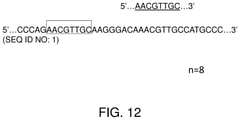
- FIG. 12 illustrates a sliding window method for identifying homologous segments.
- FIG. 13 diagrams steps in a method of screening for disease in a sample.
- Embodiments of the invention may be used for identifying unknown NAHR events with whole genome sequencing.
- NAHR events may occur at various positions within a genome, and whole genome sequencing techniques may be useful for the detection of NAHR events.
- the identification of NAHR events in patient genomes using conventional genomics and bioinformatics techniques is subject to several complications. Sequence reads generated using next-generation sequencing are relatively short (e.g., 50-200 bp), and therefore more amenable to identifying short variations of a few base pairs. Alignment tools may not be able to align sequence reads that span an NAHR deletion, and a subsequent variant calling step may miss the deletion entirely, or mark it as simply a low coverage or un-sequenced region.
- Systems and methods of the invention may be used to detect NAHR events in a subject by analyzing sequences such as the short reads produced by next-generation sequencing (NGS) technologies. Those sequences are analyzed against a reference in which graph principles are used to represent predicted, possible NAHR events. Specifically, a reference genome, or genomic reference graph, is analyzed for pairs of homologous segments. When such a pair is identified, the possible results of NAHR (including a deletion of the intervening sequence between the homologous segments, a duplication, or an inversion) may be added to the reference genome as an additional object or set of objects. For example, in the case of a deletion, an object may be used to connect the first homologous segment to the second homologous segment.
- NGS next-generation sequencing
- connection from the first homologous segment to the second homologous segment means that the reference has graph properties in that one can trace one of at least two alternative paths between the two segments.
- One of the alternative paths follows the original reference genome, e.g., the “backbone branch” of the graph.
- Another of the alternative paths travels directly from the first segment to the second segment, thus representing a deletion of the intervening sequence between the two segments.
- the genetic analysis can be coupled to graph-specific implementations of the reference, such as the use of adjacency lists to link components of the reference.
- the system can report that the subject from which those reads were generated is missing a chromosomal segment, relative to the reference, between those homologous pairs.
- 17q21.31 microdeletion syndrome is a condition with phenotypic features including developmental delay, hypotonia, and facial dysmorphisms. This disorder is thought to affect 1 in 16,000 people.
- the microdeletion at issue may be the product of NAHR.
- NAHR is thought to be involved in a variety of significant health and medical problems. NAHR may lead to gene fusion and gene interruption rearrangements, resulting in various positional effects, or revealing recessive alleles. Further, NAHR events may also have a reciprocal, corresponding duplication.
- Graphs such as directed acyclic graphs (DAGs) may be used as data structures for associating genome sequence data and variation.
- graphs have a reference sequence (such as the nucleotide sequence of a genome or chromosome) as the base or backbone branch.
- Variations such as SNPs, indels, and larger structural variants are then appended to the base branch as new edges, defining new paths that include the variation.
- Sequence reads may then be aligned to the graph instead of a linear reference sequence. Because the graph includes known variation, sequence alignment is improved and more sequence reads are aligned. However, building such a graph requires previous knowledge of variations.
- NAHR events can be accurately detected by populating a reference graph with computationally predicted NAHR events.
- NAHR events typically occur between closely situated LCRs on the same chromosome. This suggests an algorithm in which a reference graph may be pre-populated with NAHR events based on an analysis of the repetitive regions of each chromosome. The resulting reference graph thus includes nearly every possible NAHR event.
- the patient's whole genome sequencing data is aligned against the reference graph structure. The reference graph may then be used during sequence alignment to confirm the existence of previously unknown NAHR events in patients, identifying all possible deletions, gene fusions, and the like.
- FIG. 1 diagrams steps of a method 101 of detecting a recombination.
- the method 101 includes the steps of providing 105 a genomic reference stored as one or more objects in tangible, non-transitory memory coupled to a processor and identifying 109 within the genomic reference a first segment and a second segment that are homologous to each other.
- the method 101 includes creating 117 an object connecting the first segment to the second segment and storing the object in the memory and aligning 127 sequences from a subject to the first segment and the second segment. Additionally, the method 101 includes providing 133 a report describing a recombination event in the subject when the sequences align across the object.
- FIG. 2 illustrates a genomic reference 201 that may be provided 105 .
- the genomic reference 201 includes CCCAGAACGTTGCAAGGGACAAACGTTGCCATGCCC (SEQ ID NO: 1).
- the ellipses indicate that the genomic reference 201 is larger than what is shown.
- the genomic reference 201 includes all or a substantial part of a human genome or a chromosome of the human genome.
- a suitable human genome is, for example, GRCh37, the Genome Reference Consortium human genome (build 37) derived from thirteen anonymous volunteers from Buffalo, New York.
- the genomic reference 201 is stored using a system of the invention as one or more objects in tangible, non-transitory memory coupled to a processor.
- FIG. 3 diagrams a system 301 that includes at least one computer 333 .
- the computer 333 includes a processor coupled to tangible, non-transitory memory 375 and one or more input/output (I/O) devices.
- the system 301 may include one or more the computer 333 , a server computer 309 , a sequencing instrument 355 coupled to a sequencing computer 351 , or combinations thereof. Any of the computer 333 , the server computer 309 , the sequencing instrument 355 , and the sequencing computer 351 may communicate via a communications network 315 . Any of the computer 333 , the server computer 309 , and the sequencing computer 351 may be a computer.
- a computer includes a processor coupled to memory and one or more input/output devices.
- a processor may be any suitable processor such as the microprocessor sold under the trademark XEON E7 by Intel (Santa Clara, Calif.) or the microprocessor sold under the trademark OPTERON 6200 by AMD (Sunnyvale, Calif.).
- Memory generally includes a tangible, non-transitory computer-readable storage device and can include any machine-readable medium or media on or in which is stored instructions (one or more software applications), data, or both.
- the instructions when executed, can implement any or all of the functionality described herein.
- the term “computer-readable storage device” shall be taken to include, without limit, one or more disk drives, tape drives, flash drives, solid state drives (SSD), memory devices (such as RAM, ROM, EPROM, etc.), optical storage devices, and/or any other non-transitory and tangible storage medium or media.
- Input/output devices may include a video display unit (e.g., a liquid crystal display (LCD) or a cathode ray tube (CRT) monitor), an alphanumeric input device (e.g., a keyboard), a cursor control device (e.g., a mouse or trackpad), a disk drive unit, a signal generation device (e.g., a speaker), a touchscreen, an accelerometer, a microphone, a cellular radio frequency antenna, and a network interface device, which can be, for example, a network interface card (NIC), Wi-Fi card, or cellular modem.
- a video display unit e.g., a liquid crystal display (LCD) or a cathode ray tube (CRT) monitor
- an alphanumeric input device e.g., a keyboard
- a cursor control device e.g., a mouse or trackpad
- a disk drive unit e.g., a disk drive unit
- a signal generation device
- the system 301 is able to perform the steps of the method 101 .
- the system 301 may be used for identifying 109 within the genomic reference 201 a first segment and a second segment that are homologous to each other and creating 117 an object connecting the first segment to the second segment and storing the object in the memory 375 .
- systems and methods of the invention may be used for populating a reference graph with predicted NAHR events.
- FIG. 4 illustrates identifying 109 within the genomic reference 201 a first segment 403 and a second segment 409 that are homologous to each other.
- Systems and methods may first identify homologous segments (having in excess of 95% identity) of a particular chromosome. Homologous segments can be identified in many ways. For example, one could generate a self-alignment plot (or “dot-plot”) of the sequence of the genomic reference 201 .
- One common tool for generating self-alignment plots and alignments is YASS, publicly available at the Bonsai website provided by the Laboratoire d'Informatique Fondamentale de Lille. Self-alignments generated by YASS may be further evaluated to determine whether they are candidates for NAHR events. This can be performed by evaluating the distance (e.g., 10-300 kb) between each candidate position in the self-alignment.
- homologous segments could be identified by using an alignment or sequence searching tool, such as BLAST or BLAT.
- the first N bases of the chromosome may be selected as input for the alignment tool, which then identifies regions of the chromosome with sufficient identity. The positions and number of each homologous region are noted. The window may then be shifted by an additional number of bases and the process repeated. Suitable values for N may comprise those lengths typically associated with LCRs, e.g., 10-300 kb. Further filtering may be needed to remove redundant entries. The result is a list of homologous sequences, associated with positions in the chromosome at which they occur.
- Homologous segments could also be identified by previously existing annotations. Many repetitive regions of the genome have been well characterized and their annotations are often freely available as metadata for a published reference genome (e.g., the GRCH38/hg38 reference genome and associated tracks available on the UCSC Genome Browser). Other software may also be used to identify repetitive regions (e.g., RepeatMasker).
- NAHR events the difference in base pairs is calculated between each pair of positions at which they occur. Those pairs are separated by a distance between 10 and 50 kb. These pairs are candidates for NAHR events.
- the disclosure recognizes that one or more predicted results of the candidate NAHR event (e.g., a deletion, duplication, inversion) may then be added as an alternative path to in the reference genome (i.e., the genomic reference 201 ) to account for that event.
- This middle portion of FIG. 4 illustrates one way that, having identified the first segment 403 and the second segment 409 that are homologous to each other, the reference genome 201 may be segmented to facilitate in creating 117 an object connecting the first segment to the second segment.
- the reference genome 201 has been divided into five segments, representing the 5′ sequence before the first segment 403 , the first segment 403 , the intervening sequence, the second segment 409 , and finally the 3′ sequence after the second segment.
- This segmentation has been chosen for ease of illustration and may differ in different embodiments; for example, one could also segment the genomic reference sequence 201 into three segments, representing the 5′ sequence upstream of the intervening sequence, the intervening sequence itself, and the 3′ sequence downstream of the intervening sequence.
- One may also choose to select different positions for which to divide the homologous segment; for example, because NAHR events may not occur precisely at the endpoints of LCRs, the midpoint of the homologous sequence may instead be chosen to guide segmentation.
- FIG. 4 shows a reference graph 401 generated by creating objects to store each of the segments of the reference sequence 201 .
- the reference graph 401 includes nodes 415 connected by edges 419 , and segments of the genomic reference 201 are stored in the edges 419 .
- sequences can be stored in nodes as is discussed in greater detail below.
- an object 499 has been created to connect objects associated with the first segment 403 and the second segment 409 .
- the object 499 creates an alternative path (representing a deletion) that may be followed through the reference graph 401 , which corresponds to a predicted NAHR event.
- the starting reference is itself a graph that includes known human genetic variation.
- the reference sequence 201 may represent a single object in a larger graph structure, which is then segmented and re-connected to accommodate the predicted variation.
- nodes are connected by edges with sequence data stored in those objects, either in the nodes, the edges, or both.
- a known sequence is represented by a path through those connected nodes.
- Human genetic variation is represented by divergent paths through the graph (i.e., the paths converge where human genetic material is conserved and diverge to describe variants).
- a genomic reference graph is implemented as a DAG, but the acyclic requirement may be ignored and the reference may be implemented as a directed graph more generally.
- Methods of the invention may operate using a reference genomic graph structure that includes known human variations. Alternately, methods may use a linear reference structure having no known human variations, e.g., containing only the reference sequence as a “backbone” branch.
- an object 499 is inserted into the reference graph structure 401 .
- the object 499 is an edge that connects a first position (of the first LCR, represented by the first segment 403 ) to a second position (of the second LCR, represented by the second segment 409 ).
- the positions selected may vary depending on the expected type of event; for example, and as shown in FIG. 4 , if the event is an NAHR deletion then one may choose the positions to be the after the last base of the corresponding LCR.
- the edge object 499 thus represents a deletion of the intervening sequence 481 that would be removed if such an NAHR event had occurred. (Of course, if sequence data is instead associated with the edges of the graph, a vertex may be added that represents the deletion.)
- the system 301 stores the genomic reference graph 401 as one or more objects in the tangible, non-transitory memory 375 coupled to a processor.
- the system further includes instructions that, when executed by the processor, cause the system to identify 109 within the genomic reference, using the processor, a first segment 403 and a second segment 409 that are homologous to each other and to create 117 an object connecting the first segment 403 to the second segment 409 and store the object in the memory 375 .
- FIG. 5 illustrates how the system 301 creates objects associated with the reference graph 401 , such as the object 499 of FIG. 4 .
- the reference graph 401 includes nodes 415 connected by edges 419 .
- the system writes an object 501 for each edge.
- Each object 501 is located at a specific spatial address 531 . Included in each object is a string of nucleotide characters associated with the corresponding edge 419 in the reference graph 401 , as well as an adjacency list 505 that gives the spatial address 531 of each object to which that object is adjacent.
- a pointer is a programming language object, whose value refers to (or “points to”) another value stored elsewhere in the computer memory using its memory address.
- Memory addresses may be fixed-length sequences of digits conventionally displayed and manipulated as unsigned integers.
- a digital computer's memory more specifically main memory, consists of many memory locations, each having a physical address, a code, which the CPU (or other device) can use to access it.
- Most application programs do not have a knowledge of physical addresses. Rather, they address logical addresses, or virtual addresses, using the computer's memory management unit and operating system memory mapping. Using adjacency lists 505 , the system takes advantage of having knowledge of the physical address.
- the processor can read from one object 501 and directly to an adjacent object without referring to an index or look-up table or other such logical, virtual construct.
- the object 499 connects the first segment 403 to the second segment 409 in reference graph 401 and is implemented as an object 501 in which the adjacency list 505 provides a direct connection from the first segment 403 to the second segment 409 .
- the reference graph 401 includes nodes 415 connected by edges 419 , and segments of the genomic reference 201 are stored in the edges 419 . Each edge gets instantiated as an object 501 in the memory 375 . Other embodiments are included. For example, segments of the genome can be stored in nodes. In another example, nodes and edges can each get instantiated as objects. An important point is that the reference graph 401 may be populated with new connections. Specifically, possible NAHR events are being predicted and the reference graph 401 is modified to model those events by writing to objects in the memory 375 .
- the reference graph may be stored as a set of objects, each object having a set of parent objects, an identifier, and an associated sequence.
- the reference graph may be stored as a topology, in which each object similarly has an identifier and an associated sequence.
- the reference graph structure 401 is populated with all possible NAHR deletion events according to the used parameters, the reference graph 401 is used for the alignment of a subject sequence such as sequence reads from next-generation sequencing data. Patients who have a previously unknown NAHR deletion will have sequence reads that uniquely map to the edges representing that deletion, thus identifying the deletion event with high precision.
- FIG. 6 illustrates obtaining 601 sequences 615 from a sample 605 from a subject.
- nucleic acid may be isolated and/or enriched.
- sequence reads are obtained by performing sequencing 609 on a sample 605 from a subject (however in some embodiments, sequence reads are obtained when a read file is transferred into a system of the invention). Sequencing may be by any method and sequencing instrument known in the art. See, generally, Quail, et al., 2012, A tale of three next generation sequencing platforms: comparison of Ion Torrent, Pacific Biosciences and Illumina MiSeq sequencers, BMC Genomics 13:341.
- DNA sequencing techniques include classic dideoxy sequencing reactions (Sanger method) using labeled terminators or primers and gel separation in slab or capillary, sequencing by synthesis using reversibly terminated labeled nucleotides, pyrosequencing, 454 sequencing, Illumina/Solexa sequencing, allele specific hybridization to a library of labeled oligonucleotide probes, sequencing by synthesis using allele specific hybridization to a library of labeled clones that is followed by ligation, real time monitoring of the incorporation of labeled nucleotides during a polymerization step, polony sequencing, and SOLiD sequencing.
- a sequencing technique that can be used includes, for example, use of sequencing-by-synthesis systems and sequencing instruments sold under the trademarks GS JUNIOR, GS FLX+ and 454 SEQUENCING by 454 Life Sciences, a Roche company (Branford, Conn.), and described by Margulies, M. et al., Genome sequencing in micro-fabricated high-density picotiter reactors, Nature, 437:376-380 (2005); U.S. Pat. Nos. 5,583,024; 5,674,713; and 5,700,673, each incorporated by reference.
- 454 sequencing involves two steps. First, DNA is sheared into blunt-end fragments attached to capture beads and then amplified in droplets. Second, pyrosequencing is performed on each DNA fragment in parallel. Addition of nucleotides generates a light signal that is recorded by a CCD camera in a sequencing instrument.
- DNA sequencing technique and instrument Another example of a DNA sequencing technique and instrument that can be used is ion semiconductor sequencing using, for example, a system sold under the trademark ION TORRENT by Ion Torrent by Life Technologies (South San Francisco, Calif.). Ion semiconductor sequencing is described, for example, in Rothberg, et al., An integrated semiconductor device enabling non-optical genome sequencing, Nature 475:348-352 (2011); U.S. Pubs. 2009/0026082, 2009/0127589, 2010/0035252, 2010/0137143, 2010/0188073, 2010/0197507, 2010/0282617, 2010/0300559, 2010/0300895, 2010/0301398, and 2010/0304982, each incorporated by reference.
- DNA is fragmented and given amplification and sequencing adapter oligos. The fragments can be attached to a surface. Addition of one or more nucleotides releases a proton (H+), which signal is detected and recorded in a sequencing instrument.
- H+ proto
- Illumina sequencing is based on the amplification of DNA on a solid surface using fold-back PCR and anchored primers. Genomic DNA is fragmented and attached to the surface of flow cell channels. Four fluorophore-labeled, reversibly terminating nucleotides are used to perform sequential sequencing. After nucleotide incorporation, a laser is used to excite the fluorophores, and an image is captured and the identity of the first base is recorded. Sequencing according to this technology is described in U.S. Pub. 2011/0009278, U.S. Pub. 2007/0114362, U.S. Pub. 2006/0024681, U.S. Pub. 2006/0292611, U.S. Pat. Nos. 7,960,120, 7,835,871, 7,232,656, 7,598,035, 6,306,597, 6,210,891, 6,828,100, 6,833,246, and 6,911,345, each incorporated by reference.
- SMRT real-time
- Sequencing 609 generates a plurality of sequences 615 , which may be in the form of sequence reads.
- Reads according to the invention generally include sequences of nucleotide data anywhere from tens to thousands of bases in length. Reads may be stored in any suitable format such as, for example, FASTA or FASTQ format.
- FASTA is originally a computer program for searching sequence databases and the name FASTA has come to also refer to a standard file format. See Pearson & Lipman, 1988, Improved tools for biological sequence comparison, PNAS 85:2444-2448.
- a sequence in FASTA format begins with a single-line description, followed by lines of sequence data. The description line is distinguished from the sequence data by a greater-than (“>”) symbol in the first column.
- FASTQ files are similar to FASTA but further include a line of quality scores. Typically, sequence reads will be obtained 123 in a format such as FASTA, FASTQ, or similar.
- FIG. 7 illustrates finding 127 alignments between the sequences 615 and the reference graph 401 .
- reads can be rapidly mapped to the reference graph 401 despite their large numbers or short lengths.
- Numerous benefits obtain by using a graph as a reference. For example, aligning against a graph is more accurate than aligning against a linear reference and then attempting to adjust one's results in light of other extrinsic information. This is primarily because the latter approach enforces an unnatural asymmetry between the sequence used in the initial alignment and other information. Aligning against an object that potentially represents all the relevant physical possibilities is much more computationally efficient than attempting to align against a linear sequence for each physical possibility (the number of such possibilities will generally be exponential in the number of junctions).
- a modified Smith-Waterman operation for comparing a sequence to a reference graph is provided here as an extension of pairwise alignment methods.
- Pairwise alignment generally involves placing one sequence along part of target, introducing gaps according to an algorithm, scoring how well the two sequences match, and preferably repeating for various positions along the reference. The best-scoring match is deemed to be the alignment and represents an inference of homology between aligned portions of the sequences.
- scoring an alignment of a pair of nucleic acid sequences involves setting values for the probabilities of substitutions and indels. When individual bases are aligned, a match or mismatch contributes to the alignment score by a substitution score, which could be, for example, 1 for a match and ⁇ 0.33 for a mismatch. An indel deducts from an alignment score by a gap penalty, which could be, for example, ⁇ 1.
- Gap penalties and substitution probabilities can be based on empirical knowledge or a priori assumptions about how sequences evolve. Their values affect the resulting alignment. Particularly, the relationship between the gap penalties and substitution probabilities influences whether substitutions or indels will be favored in the resulting alignment.
- a pairwise alignment generally, involves—for sequence Q (query) having m characters and a reference genome T (target) of n characters—finding and evaluating possible local alignments between Q and T. For any 1 ⁇ i ⁇ n and 1 ⁇ j ⁇ m, the largest possible alignment score of T[h . . . i] and Q[k . . . j], where h ⁇ i and k ⁇ j, is computed (i.e. the best alignment score of any substring of T ending at position i and any substring of Q ending at position j). This can include examining all substrings with cm characters, where c is a constant depending on a similarity model, and aligning each substring separately with Q.
- H _ ij max ⁇ H _( i ⁇ 1, j ⁇ 1)+ s ( a _ i,b _ j ), H _( i ⁇ 1, j ) ⁇ W _ in,H _( i,j ⁇ 1) ⁇ W _ del, 0 ⁇ (for 1 ⁇ i ⁇ n and 1 ⁇ j ⁇ m ) (1)
- the resulting matrix has many elements that are zero. This representation makes it easier to backtrace from high-to-low, right-to-left in the matrix, thus identifying the alignment.
- the SW algorithm performs a backtrack to determine the alignment. Starting with the maximum value in the matrix, the algorithm will backtrack based on which of the three values (Hi ⁇ 1,j ⁇ 1, Hi ⁇ 1,j, or Hi,j ⁇ 1) was used to compute the final maximum value for each cell. The backtracking stops when a zero is reached.
- the optimal-scoring alignment may contain greater than the minimum possible number of insertions and deletions, while containing far fewer than the maximum possible number of substitutions.
- SW may be implemented using dynamic programming to perform local sequence alignment of the two strings, S and A, of sizes m and n, respectively.
- This dynamic programming employs tables or matrices to preserve match scores and avoid re-computation for successive cells.
- i [ j,k ] max( p [ j ⁇ 1, k ]+OPENING_PEN, i [ j ⁇ 1, k ], d [ j ⁇ 1, k ]+OPENING_PEN)+INSERTION_PEN (4)
- d [ j,k ] max( p [ j,k ⁇ 1]+OPENING_PEN, i [ j,k ⁇ 1]+OPENING_PEN, d [ j,k ⁇ 1])+DELETION_PEN (5)
- the scoring parameters are somewhat arbitrary, and can be adjusted to achieve the behavior of the computations.
- One example of the scoring parameter settings (Huang, Chapter 3: Bio-Sequence Comparison and Alignment, ser. Curr Top Comp Mol Biol. Cambridge, Mass.: The MIT Press, 2002) for DNA would be:
- MISMATCH PEN ⁇ 20
- the relationship between the gap penalties (INSERTION_PEN, OPENING_PEN) above help limit the number of gap openings, i.e., favor grouping gaps together, by setting the gap insertion penalty higher than the gap opening cost.
- MISMATCH_PEN, MATCH_BONUS, INSERTION_PEN, OPENING_PEN and DELETION_PEN are possible.
- the methods and systems of the invention use a modified Smith-Waterman operation that involves a multi-dimensional look-back through the reference graph 401 .
- Multi-dimensional operations of the invention provide for a “look-back” type analysis of sequence information (as in Smith-Waterman), wherein the look back is conducted through a multi-dimensional space that includes multiple pathways and multiple nodes.
- the multi-dimensional algorithm can be used to align sequence reads against the graph-type reference. That alignment algorithm identifies the maximum value for Ci,j by identifying the maximum score with respect to each sequence contained at a position on the graph. In fact, by looking “backwards” at the preceding positions, it is possible to identify the optimum alignment across a plurality of possible paths.
- the modified Smith-Waterman operation described here aka the multi-dimensional alignment, provides exceptional speed when performed in a genomic graph system that employs physical memory addressing (e.g., through the use of native pointers or index free adjacency as discussed above).
- the combination of multi-dimensional alignment to a reference graph 401 with the use of spatial memory addresses (e.g., native pointers or index-free adjacency) improves what the computer system is capable of, facilitating whole genomic scale analysis to be performed using the methods described herein.
- the operation includes aligning a sequence, or string, to a graph.
- S be the string being aligned
- D be the directed graph to which S is being aligned.
- each letter of the sequence of a node will be represented as a separate element, d.
- node or edge objects contain the sequences and the sequences are stored as the longest-possible string in each object.
- a predecessor of d is defined as:
- the algorithm seeks the value of M[j,d], the score of the optimal alignment of the first j elements of S with the portion of the graph preceding (and including) d. This step is similar to finding Hi,j in equation 1 above.
- e is the highest of the alignments of the first j characters of S with the portions of the graph up to, but not including, d, plus an additional DELETE_PEN. Accordingly, if d is not the first letter of the sequence of the object, then there is only one predecessor, p, and the alignment score of the first j characters of S with the graph (up-to-and-including p) is equivalent to M[j,p]+DELETE_PEN. In the instance where d is the first letter of the sequence of its object, there can be multiple possible predecessors, and because the DELETE_PEN is constant, maximizing [M[j, p*]+DELETE_PEN] is the same as choosing the predecessor with the highest alignment score with the first j characters of S.
- i is the alignment of the first j ⁇ 1 characters of the string S with the graph up-to-and-including d, plus an INSERT_PEN, which is similar to the definition of the insertion argument in SW (see equation 1).
- a is the highest of the alignments of the first j characters of S with the portions of the graph up to, but not including d, plus either a MATCH_SCORE (if the jth character of S is the same as the character d) or a MISMATCH_PEN (if the jth character of S is not the same as the character d).
- MATCH_SCORE if the jth character of S is the same as the character d
- MISMATCH_PEN if the jth character of S is not the same as the character d.
- a is the alignment score of the first j ⁇ 1 characters of S with the graph (up-to-and-including p), i.e., M[j ⁇ 1,p], with either a MISMATCH_PEN or MATCH_SCORE added, depending upon whether d and the jth character of S match.
- d is the first letter of the sequence of its object, there can be multiple possible predecessors.
- maximizing ⁇ M[j, p*]+MISMATCH_PEN or MATCH_SCORE ⁇ is the same as choosing the predecessor with the highest alignment score with the first j ⁇ 1 characters of S (i.e., the highest of the candidate MU ⁇ 1,p1 arguments) and adding either a MISMATCH_PEN or a MATCH_SCORE depending on whether d and the jth character of S match.
- the penalties e.g., DELETE_PEN, INSERT_PEN, MATCH_SCORE and MISMATCH_PEN, can be adjusted to encourage alignment with fewer gaps, etc.
- the operation finds the optimal (e.g., maximum) value for aligning sequences 615 to the reference graph 401 by calculating not only the insertion, deletion, and match scores for that element, but looking backward (against the direction of the graph) to any prior nodes on the graph to find a maximum score.
- the optimal e.g., maximum
- FIG. 8 shows the matrices that represent the comparison.
- the modified Smith-Waterman operation of the invention identifies the highest score and performs a backtrack to identify the proper alignment of the sequence. See, e.g., U.S. Pub. 2015/0057946 and U.S. Pub. 2015/0056613, both incorporated by reference.
- Systems and methods of the invention can be used to provide a report that identifies a modified base at the position within the genome of the subject.
- sequences 615 align to the reference graph 401 across (i.e., overlapping) the object 499 that was created to connect the first position (at the beginning of the first segment 403 ) to the second position (at the end of the second segment 409 ), as shown in FIG. 7 . Because that alignment overlaps the edge object 499 , it may be surmised that the corresponding segment of genetic information has been deleted from the subject's genome, relative to the reference.
- FIG. 9 shows providing a report 1001 describing a recombination event in the subject when the sequences align across the object.
- the report 1001 identifies Del 22q11.2 as a 3 mb deletion from the subject's genome. Additionally, the report 1001 identifies DG/VCF syndrome as a medical condition associated with the deletion. More generally, the report 1001 may identify a deletion or other recombination, a medical condition associated with the recombination, or both.
- Reference graphs according to the disclosure have many benefits when used for identifying previously unknown variations in patients. As in other situations, reference graphs are ideal objects against which to align. Performing alignments with a reference graph constructed with NAHR events is much more effective than attempting to identify an NAHR event after alignment to a traditional linear reference. The resulting graph can be used to quickly and accurately identify NAHR events with high precision, serving as an important medical research and diagnostic tool.
- the reference is pre-populated with candidate deletions based on homologous segments.
- the homologous segments may be identified by analysis of intrinsic properties of the sequence of the reference. Additionally or alternatively, the first segment and the second segment are identified from a database of known repeats. Thus systems and methods may be used to find a plurality of low copy repeats, each low copy repeat comprising a pair of homologous segments, and create an additional object in the genomic reference connecting each pair of homologous segments.
- FIG. 10 illustrates an embodiment in which strings of sequence data are stored in nodes.
- a graph 1001 is made that includes nodes 1015 and edges 1019 .
- Strings of characters representing segments of the reference 201 are stored in the nodes.
- each of the nodes 1015 and the edges 1019 are both stored as objects in memory 375 .
- the bottom of FIG. 10 shows that each node and edge has been assigned a number for reference.
- FIG. 11 also shows that objects may be created for nodes and edges. Creating objects for nodes and edges is a concept that is unlinked to the question of whether to store sequence data in nodes or edges. Each node and edge is instantiated as an object 1209 in the memory 375 . Each object includes an adjacency list 1205 indicating those objects that are adjacent.
- Embodiments of the invention include an operation for detecting homologous segments in the reference.
- a pair of homologous segments may be found by reading a segment of the reference and aligning that segment back to the reference to find good alignments other than the segment itself. For example, any part of the reference to which the segment aligns with at least 90% sequence similarity may be deemed to be a homologous segment.
- the method 101 may include reading a second string of bases offset along the genomic reference from the string of N bases and performing an alignment between the second string of bases and the genomic reference.
- the method may include iteratively sliding a window of length N to a plurality of positions along the genomic reference and, for each position, finding alignments between a string from a current position and the genomic reference.
- each position is offset from the previous position by a fixed distance such as, for example, 1, n/2, or n.
- pairs of segments may also be found using other measures, such as from dot plots and partial alignments generated by aligning a nucleotide sequence (such as portions of a reference genome) against itself.
- a pair of segments with at least 90% identity may be deemed to be homologous.
- actual homology is unknowable but the distinction between identity by homology and identity by chance or convergent evolution is moot, because the NAHR mechanism is indifferent to the cause of the similarity. It is enough that the two segments are sufficiently similar.
- a reference may be populated with predicted, possible mutational events. Populating a reference with a predicted or possible mutational event may be taken to mean manipulating the reference to have a form consisting with the predicted or possible mutational event while also having a form consistent with a wild type. Where a mutation is known to be associated with a disease or condition, this suggests a method of screening for a disease.
- FIG. 13 diagrams steps in a method 1301 of screening for disease in a genomic sample.
- the method 1301 includes using at least one computer hardware processor for receiving 1305 a representation of a reference genome.
- the reference genome includes a sequence of symbols, the receiving comprising storing the reference genome in at least one object in computer memory.
- the method includes identifying 1309 the presence of a predicted mutational event in a location of the reference genome.
- An alternative path is created 1317 by the processor in the reference genome representing the predicted mutational event.
- the alternative path is created by segmenting the reference genome at the location of the predicted mutational event, creating a first path connecting the segmented reference genome, and creating a second path connecting at least part of the segmented reference genome with the predicted mutational event.
- a plurality of sequence reads is obtained 1321 from a genomic sample from a subject. At least one sequence read covers at least a portion of a mutation in the subject, corresponding to the predicted mutational event.
- the sequence reads are mapped 1327 to the reference genome via an operation that includes determining a location on the reference genome for which a score for the at least one sequence read is maximized, such that the determined location of the mapped at least one sequence read spans the alternate path representing the predicted mutational event.
- the computer hardware processor identifies 1333 the predicted mutational event as present in the genomic sample.
- identifying the presence of a predicted mutational event in a location of the reference genome comprises accessing information specifying the presence of the predicted mutational event (e.g., by accessing a database of predicted mutations, predicting the presence of the mutational event, or both).
- the predicted mutational event is determined computationally by scanning the reference genome. Predicting the presence of the mutational event may include identifying a first segment of the reference genome and a second segment of the reference genome that are homologous (e.g., 90% sequence similarity, separated by a distance of between 10 kilobases and 300 kilobases, or both).
- segmenting the reference genome at the location of the predicted mutational event is done by segmenting the reference genome into a first segment, a second segment, and a third segment, and associating each of the segments with respective first, second, and third objects in computer memory.
- An alternative path is created in the reference genome representing the predicted mutational event, which may include associating the predicted mutational event with a fourth object in computer memory.
- a first path is created connecting the segmented reference genome comprises connecting the first, second, and third objects into the first path.
- a second path is created connecting at least part of the segmented reference genome with the predicted mutational event comprises connecting the first, fourth, and third objects into the second path.
- the first segment and the third segment are homologous.
- the second path may represent a deletion of the second segment.
- the second path may represent a recombination event in the reference genome.
- the method may include identifying a medical condition in the genomic sample associated with the predicted mutational event.
- the representation of the reference genome is a directed acyclic graph.
Landscapes
- Physics & Mathematics (AREA)
- Life Sciences & Earth Sciences (AREA)
- Health & Medical Sciences (AREA)
- Engineering & Computer Science (AREA)
- Bioinformatics & Cheminformatics (AREA)
- Medical Informatics (AREA)
- General Health & Medical Sciences (AREA)
- Biotechnology (AREA)
- Spectroscopy & Molecular Physics (AREA)
- Theoretical Computer Science (AREA)
- Proteomics, Peptides & Aminoacids (AREA)
- Bioinformatics & Computational Biology (AREA)
- Biophysics (AREA)
- Evolutionary Biology (AREA)
- Analytical Chemistry (AREA)
- Chemical & Material Sciences (AREA)
- Genetics & Genomics (AREA)
- Molecular Biology (AREA)
- Public Health (AREA)
- Biomedical Technology (AREA)
- Data Mining & Analysis (AREA)
- Databases & Information Systems (AREA)
- Pathology (AREA)
- Epidemiology (AREA)
- Primary Health Care (AREA)
- Measuring Or Testing Involving Enzymes Or Micro-Organisms (AREA)
Abstract
Description
H_k0=H_01=0(for 0≤k≤n and 0≤1≤m)
H_ij=max{H_(i−1,j−1)+s(a_i,b_j),H_(i−1,j)−W_in,H_(i,j−1)−W_del,0} (for 1≤i≤n and 1≤j≤m) (1)
B[j,k]=max(p[j,k],i[j,k],d[j,k],0)(for 0<j≤m,0<k≤n) (2)
p[j,k]=max(p[j−1,k−1],i[j−1,k−1],d[j−1,k−1])+MISMATCH_PEN, if S[j]A[k]=max(p[j−1,k−1],i[j−1,k−1],d[j−1,k−1])+MATCH_BONUS, if S[j]=A[k] (3)
i[j,k]=max(p[j−1,k]+OPENING_PEN,i[j−1,k],d[j−1,k]+OPENING_PEN)+INSERTION_PEN (4)
d[j,k]=max(p[j,k−1]+OPENING_PEN,i[j,k−1]+OPENING_PEN,d[j,k−1])+DELETION_PEN (5)
M[j,d]=max{a,i,e,0}
where
e=max{M[j,p*]+DELETE_PEN} for p*in P[d]
i=M[j−1,d]+INSERT_PEN
a=max{M[j−1,p*]+MATCH_SCORE} for p*in P[d], if S[j]=d;
max{M[j−1,p*]+MISMATCH_PEN} for p*in P[d], if S[j]≠d (6)
Claims (19)
Priority Applications (2)
| Application Number | Priority Date | Filing Date | Title |
|---|---|---|---|
| US15/254,258 US11250931B2 (en) | 2016-09-01 | 2016-09-01 | Systems and methods for detecting recombination |
| US17/670,380 US12482535B2 (en) | 2016-09-01 | 2022-02-11 | Systems and methods for detecting recombination |
Applications Claiming Priority (1)
| Application Number | Priority Date | Filing Date | Title |
|---|---|---|---|
| US15/254,258 US11250931B2 (en) | 2016-09-01 | 2016-09-01 | Systems and methods for detecting recombination |
Related Child Applications (1)
| Application Number | Title | Priority Date | Filing Date |
|---|---|---|---|
| US17/670,380 Division US12482535B2 (en) | 2016-09-01 | 2022-02-11 | Systems and methods for detecting recombination |
Publications (2)
| Publication Number | Publication Date |
|---|---|
| US20180060480A1 US20180060480A1 (en) | 2018-03-01 |
| US11250931B2 true US11250931B2 (en) | 2022-02-15 |
Family
ID=61242799
Family Applications (2)
| Application Number | Title | Priority Date | Filing Date |
|---|---|---|---|
| US15/254,258 Active 2038-11-04 US11250931B2 (en) | 2016-09-01 | 2016-09-01 | Systems and methods for detecting recombination |
| US17/670,380 Active 2036-11-28 US12482535B2 (en) | 2016-09-01 | 2022-02-11 | Systems and methods for detecting recombination |
Family Applications After (1)
| Application Number | Title | Priority Date | Filing Date |
|---|---|---|---|
| US17/670,380 Active 2036-11-28 US12482535B2 (en) | 2016-09-01 | 2022-02-11 | Systems and methods for detecting recombination |
Country Status (1)
| Country | Link |
|---|---|
| US (2) | US11250931B2 (en) |
Cited By (1)
| Publication number | Priority date | Publication date | Assignee | Title |
|---|---|---|---|---|
| US20220254444A1 (en) * | 2016-09-01 | 2022-08-11 | Seven Bridges Genomics Inc. | Systems and methods for detecting recombination |
Families Citing this family (2)
| Publication number | Priority date | Publication date | Assignee | Title |
|---|---|---|---|---|
| CN112289382B (en) * | 2020-10-28 | 2023-02-24 | 天津诺禾致源生物信息科技有限公司 | Splitting method and device for polyploid genome homologous chromosome and application thereof |
| KR102646434B1 (en) * | 2022-12-07 | 2024-03-12 | 주식회사 엔비아이티 | ELECTRONIC APPARATUS FOR PROVIDING USER INTERFACE BASED ON Basic-Local-Alignment-Search-Tool INCLUDING DOT PLOT VIEWER |
Citations (142)
| Publication number | Priority date | Publication date | Assignee | Title |
|---|---|---|---|---|
| US4683202A (en) | 1985-03-28 | 1987-07-28 | Cetus Corporation | Process for amplifying nucleic acid sequences |
| US4683195A (en) | 1986-01-30 | 1987-07-28 | Cetus Corporation | Process for amplifying, detecting, and/or-cloning nucleic acid sequences |
| US4988617A (en) | 1988-03-25 | 1991-01-29 | California Institute Of Technology | Method of detecting a nucleotide change in nucleic acids |
| US5234809A (en) | 1989-03-23 | 1993-08-10 | Akzo N.V. | Process for isolating nucleic acid |
| US5242794A (en) | 1984-12-13 | 1993-09-07 | Applied Biosystems, Inc. | Detection of specific sequences in nucleic acids |
| US5494810A (en) | 1990-05-03 | 1996-02-27 | Cornell Research Foundation, Inc. | Thermostable ligase-mediated DNA amplifications system for the detection of genetic disease |
| US5511158A (en) | 1994-08-04 | 1996-04-23 | Thinking Machines Corporation | System and method for creating and evolving directed graphs |
| US5583024A (en) | 1985-12-02 | 1996-12-10 | The Regents Of The University Of California | Recombinant expression of Coleoptera luciferase |
| US5701256A (en) | 1995-05-31 | 1997-12-23 | Cold Spring Harbor Laboratory | Method and apparatus for biological sequence comparison |
| US6054278A (en) | 1997-05-05 | 2000-04-25 | The Perkin-Elmer Corporation | Ribosomal RNA gene polymorphism based microorganism identification |
| US6210891B1 (en) | 1996-09-27 | 2001-04-03 | Pyrosequencing Ab | Method of sequencing DNA |
| US6223128B1 (en) | 1998-06-29 | 2001-04-24 | Dnstar, Inc. | DNA sequence assembly system |
| US6306597B1 (en) | 1995-04-17 | 2001-10-23 | Lynx Therapeutics, Inc. | DNA sequencing by parallel oligonucleotide extensions |
| US20020164629A1 (en) | 2001-03-12 | 2002-11-07 | California Institute Of Technology | Methods and apparatus for analyzing polynucleotide sequences by asynchronous base extension |
| US20020190663A1 (en) | 2000-07-17 | 2002-12-19 | Rasmussen Robert T. | Method and apparatuses for providing uniform electron beams from field emission displays |
| US6582938B1 (en) | 2001-05-11 | 2003-06-24 | Affymetrix, Inc. | Amplification of nucleic acids |
| US20040023209A1 (en) | 2001-11-28 | 2004-02-05 | Jon Jonasson | Method for identifying microorganisms based on sequencing gene fragments |
| US6818395B1 (en) | 1999-06-28 | 2004-11-16 | California Institute Of Technology | Methods and apparatus for analyzing polynucleotide sequences |
| US6828100B1 (en) | 1999-01-22 | 2004-12-07 | Biotage Ab | Method of DNA sequencing |
| US6833246B2 (en) | 1999-09-29 | 2004-12-21 | Solexa, Ltd. | Polynucleotide sequencing |
| US20050089906A1 (en) | 2003-09-19 | 2005-04-28 | Nec Corporation Et Al. | Haplotype estimation method |
| US6890763B2 (en) | 2001-04-30 | 2005-05-10 | Syn X Pharma, Inc. | Biopolymer marker indicative of disease state having a molecular weight of 1350 daltons |
| US6925389B2 (en) | 2000-07-18 | 2005-08-02 | Correlogic Systems, Inc., | Process for discriminating between biological states based on hidden patterns from biological data |
| US6989100B2 (en) | 2002-05-09 | 2006-01-24 | Ppd Biomarker Discovery Sciences, Llc | Methods for time-alignment of liquid chromatography-mass spectrometry data |
| US20060024681A1 (en) | 2003-10-31 | 2006-02-02 | Agencourt Bioscience Corporation | Methods for producing a paired tag from a nucleic acid sequence and methods of use thereof |
| US20060195269A1 (en) | 2004-02-25 | 2006-08-31 | Yeatman Timothy J | Methods and systems for predicting cancer outcome |
| US20060292611A1 (en) | 2005-06-06 | 2006-12-28 | Jan Berka | Paired end sequencing |
| US7169560B2 (en) | 2003-11-12 | 2007-01-30 | Helicos Biosciences Corporation | Short cycle methods for sequencing polynucleotides |
| US20070114362A1 (en) | 2005-11-23 | 2007-05-24 | Illumina, Inc. | Confocal imaging methods and apparatus |
| US7232656B2 (en) | 1998-07-30 | 2007-06-19 | Solexa Ltd. | Arrayed biomolecules and their use in sequencing |
| US20070166707A1 (en) | 2002-12-27 | 2007-07-19 | Rosetta Inpharmatics Llc | Computer systems and methods for associating genes with traits using cross species data |
| WO2007086935A2 (en) | 2005-08-01 | 2007-08-02 | 454 Life Sciences Corporation | Methods of amplifying and sequencing nucleic acids |
| US7282337B1 (en) | 2006-04-14 | 2007-10-16 | Helicos Biosciences Corporation | Methods for increasing accuracy of nucleic acid sequencing |
| US20080003571A1 (en) | 2005-02-01 | 2008-01-03 | Mckernan Kevin | Reagents, methods, and libraries for bead-based sequencing |
| US7321623B2 (en) | 2002-10-01 | 2008-01-22 | Avocent Corporation | Video compression system |
| US20080077607A1 (en) | 2004-11-08 | 2008-03-27 | Seirad Inc. | Methods and Systems for Compressing and Comparing Genomic Data |
| US20080251711A1 (en) | 2004-09-30 | 2008-10-16 | U.S. Department Of Energy | Ultra High Mass Range Mass Spectrometer Systems |
| US20080281463A1 (en) | 2006-01-18 | 2008-11-13 | Suh Suk Hwan | Method of Non-Linear Process Planning and Internet-Based Step-Nc System Using the Same |
| US20080294403A1 (en) | 2004-04-30 | 2008-11-27 | Jun Zhu | Systems and Methods for Reconstructing Gene Networks in Segregating Populations |
| US7483585B2 (en) | 2004-12-01 | 2009-01-27 | Ati Technologies Ulc | Image compression using variable bit size run length encoding |
| US20090026082A1 (en) | 2006-12-14 | 2009-01-29 | Ion Torrent Systems Incorporated | Methods and apparatus for measuring analytes using large scale FET arrays |
| US20090119313A1 (en) | 2007-11-02 | 2009-05-07 | Ioactive Inc. | Determining structure of binary data using alignment algorithms |
| US20090127589A1 (en) | 2006-12-14 | 2009-05-21 | Ion Torrent Systems Incorporated | Methods and apparatus for measuring analytes using large scale FET arrays |
| US20090164135A1 (en) | 2007-12-21 | 2009-06-25 | Brodzik Andrzej K | Quaternionic algebra approach to dna and rna tandem repeat detection |
| US7577554B2 (en) | 2001-07-03 | 2009-08-18 | I2 Technologies Us, Inc. | Workflow modeling using an acyclic directed graph data structure |
| US7580918B2 (en) | 2006-03-03 | 2009-08-25 | Adobe Systems Incorporated | System and method of efficiently representing and searching directed acyclic graph structures in databases |
| US20090233809A1 (en) | 2008-03-04 | 2009-09-17 | Affymetrix, Inc. | Resequencing methods for identification of sequence variants |
| US7598035B2 (en) | 1998-02-23 | 2009-10-06 | Solexa, Inc. | Method and compositions for ordering restriction fragments |
| US7620800B2 (en) | 2002-10-31 | 2009-11-17 | Src Computers, Inc. | Multi-adaptive processing systems and techniques for enhancing parallelism and performance of computational functions |
| US20090300781A1 (en) | 2006-03-31 | 2009-12-03 | Ian Bancroft | Prediction of heterosis and other traits by transcriptome analysis |
| US20090318310A1 (en) | 2008-04-21 | 2009-12-24 | Softgenetics Llc | DNA Sequence Assembly Methods of Short Reads |
| US20090325145A1 (en) | 2006-10-20 | 2009-12-31 | Erwin Sablon | Methodology for analysis of sequence variations within the hcv ns5b genomic region |
| US20100010992A1 (en) | 2008-07-10 | 2010-01-14 | Morris Robert P | Methods And Systems For Resolving A Location Information To A Network Identifier |
| WO2010010992A1 (en) | 2008-07-25 | 2010-01-28 | Korea Research Institute Of Bioscience And Biotechnology | Bio information analysis process auto design system and thereof |
| US20100035252A1 (en) | 2008-08-08 | 2010-02-11 | Ion Torrent Systems Incorporated | Methods for sequencing individual nucleic acids under tension |
| US20100041048A1 (en) | 2008-07-31 | 2010-02-18 | The Johns Hopkins University | Circulating Mutant DNA to Assess Tumor Dynamics |
| US20100137143A1 (en) | 2008-10-22 | 2010-06-03 | Ion Torrent Systems Incorporated | Methods and apparatus for measuring analytes |
| US20100169026A1 (en) | 2008-11-20 | 2010-07-01 | Pacific Biosciences Of California, Inc. | Algorithms for sequence determination |
| US7776616B2 (en) | 1997-09-17 | 2010-08-17 | Qiagen North American Holdings, Inc. | Apparatuses and methods for isolating nucleic acid |
| US20100240046A1 (en) | 2009-03-20 | 2010-09-23 | Siemens Corporation | Methods and Systems for Identifying PCR Primers Specific to One or More Target Genomes |
| US7809509B2 (en) | 2001-05-08 | 2010-10-05 | Ip Genesis, Inc. | Comparative mapping and assembly of nucleic acid sequences |
| US20100285578A1 (en) | 2009-02-03 | 2010-11-11 | Network Biosystems, Inc. | Nucleic Acid Purification |
| US20100282617A1 (en) | 2006-12-14 | 2010-11-11 | Ion Torrent Systems Incorporated | Methods and apparatus for detecting molecular interactions using fet arrays |
| US7835871B2 (en) | 2007-01-26 | 2010-11-16 | Illumina, Inc. | Nucleic acid sequencing system and method |
| US20100304982A1 (en) | 2009-05-29 | 2010-12-02 | Ion Torrent Systems, Inc. | Scaffolded nucleic acid polymer particles and methods of making and using |
| US20100300559A1 (en) | 2008-10-22 | 2010-12-02 | Ion Torrent Systems, Inc. | Fluidics system for sequential delivery of reagents |
| US20100300895A1 (en) | 2009-05-29 | 2010-12-02 | Ion Torrent Systems, Inc. | Apparatus and methods for performing electrochemical reactions |
| US20100301398A1 (en) | 2009-05-29 | 2010-12-02 | Ion Torrent Systems Incorporated | Methods and apparatus for measuring analytes |
| US20110004413A1 (en) | 2009-04-29 | 2011-01-06 | Complete Genomics, Inc. | Method and system for calling variations in a sample polynucleotide sequence with respect to a reference polynucleotide sequence |
| US7885840B2 (en) | 2003-01-07 | 2011-02-08 | Sap Aktiengesellschaft | System and method of flexible workflow management |
| US7917302B2 (en) | 2000-09-28 | 2011-03-29 | Torbjorn Rognes | Determination of optimal local sequence alignment similarity score |
| US20110098193A1 (en) | 2009-10-22 | 2011-04-28 | Kingsmore Stephen F | Methods and Systems for Medical Sequencing Analysis |
| US7957913B2 (en) | 2006-05-03 | 2011-06-07 | Population Diagnostics, Inc. | Evaluating genetic disorders |
| US7960120B2 (en) | 2006-10-06 | 2011-06-14 | Illumina Cambridge Ltd. | Method for pair-wise sequencing a plurality of double stranded target polynucleotides |
| US20110207135A1 (en) | 2008-11-07 | 2011-08-25 | Sequenta, Inc. | Methods of monitoring conditions by sequence analysis |
| US20110257889A1 (en) | 2010-02-24 | 2011-10-20 | Pacific Biosciences Of California, Inc. | Sequence assembly and consensus sequence determination |
| US20120030566A1 (en) | 2010-07-28 | 2012-02-02 | Victor B Michael | System with touch-based selection of data items |
| US20120041727A1 (en) | 2008-12-24 | 2012-02-16 | New York University | Method, computer-accessible medium and systems for score-driven whole-genome shotgun sequence assemble |
| US20120040851A1 (en) | 2008-09-19 | 2012-02-16 | Immune Disease Institute, Inc. | miRNA TARGETS |
| US20120045771A1 (en) | 2008-12-11 | 2012-02-23 | Febit Holding Gmbh | Method for analysis of nucleic acid populations |
| US8146099B2 (en) | 2007-09-27 | 2012-03-27 | Microsoft Corporation | Service-oriented pipeline based architecture |
| US8165821B2 (en) | 2007-02-05 | 2012-04-24 | Applied Biosystems, Llc | System and methods for indel identification using short read sequencing |
| US20120157322A1 (en) | 2010-09-24 | 2012-06-21 | Samuel Myllykangas | Direct Capture, Amplification and Sequencing of Target DNA Using Immobilized Primers |
| US8209130B1 (en) | 2012-04-04 | 2012-06-26 | Good Start Genetics, Inc. | Sequence assembly |
| WO2012096579A2 (en) | 2011-01-14 | 2012-07-19 | Keygene N.V. | Paired end random sequence based genotyping |
| WO2012098515A1 (en) | 2011-01-19 | 2012-07-26 | Koninklijke Philips Electronics N.V. | Method for processing genomic data |
| US20120239706A1 (en) | 2011-03-18 | 2012-09-20 | Los Alamos National Security, Llc | Computer-facilitated parallel information alignment and analysis |
| WO2012142531A2 (en) | 2011-04-14 | 2012-10-18 | Complete Genomics, Inc. | Processing and analysis of complex nucleic acid sequence data |
| US20120330566A1 (en) | 2010-02-24 | 2012-12-27 | Pacific Biosciences Of California, Inc. | Sequence assembly and consensus sequence determination |
| US20130029879A1 (en) | 2011-07-29 | 2013-01-31 | Ginkgo Bioworks | Methods and Systems for Cell State Quantification |
| US20130035904A1 (en) | 2010-01-14 | 2013-02-07 | Daniel Kuhn | 3d plant modeling systems and methods |
| US20130059738A1 (en) | 2011-04-28 | 2013-03-07 | Life Technologies Corporation | Methods and compositions for multiplex pcr |
| WO2013035904A1 (en) | 2011-09-08 | 2013-03-14 | 한국과학기술정보연구원 | System and method for processing bio information analysis pipeline |
| US20130073214A1 (en) | 2011-09-20 | 2013-03-21 | Life Technologies Corporation | Systems and methods for identifying sequence variation |
| US20130124573A1 (en) | 2011-11-10 | 2013-05-16 | Microsoft Corporation | Deep cloning of objects using binary format |
| US20130124100A1 (en) | 2009-06-15 | 2013-05-16 | Complete Genomics, Inc. | Processing and Analysis of Complex Nucleic Acid Sequence Data |
| KR101282798B1 (en) | 2011-09-08 | 2013-07-04 | 한국과학기술정보연구원 | System and method for processing bio information analysis pipeline |
| WO2013106737A1 (en) | 2012-01-13 | 2013-07-18 | Data2Bio | Genotyping by next-generation sequencing |
| US20130232480A1 (en) | 2012-03-02 | 2013-09-05 | Vmware, Inc. | Single, logical, multi-tier application blueprint used for deployment and management of multiple physical applications in a cloud environment |
| US20130289099A1 (en) | 2010-12-17 | 2013-10-31 | Universite Pierre Et Marie Curie (Paris 6) | Abcg1 gene as a marker and a target gene for treating obesity |
| US20130311106A1 (en) | 2012-03-16 | 2013-11-21 | The Research Institute At Nationwide Children's Hospital | Comprehensive Analysis Pipeline for Discovery of Human Genetic Variation |
| US20130332081A1 (en) | 2010-09-09 | 2013-12-12 | Omicia Inc | Variant annotation, analysis and selection tool |
| WO2013184643A1 (en) | 2012-06-04 | 2013-12-12 | Good Start Genetics, Inc. | Determining the clinical significance of variant sequences |
| US20130345066A1 (en) | 2012-05-09 | 2013-12-26 | Life Technologies Corporation | Systems and methods for identifying sequence variation |
| US20140012866A1 (en) | 2012-07-03 | 2014-01-09 | International Business Machines Corporation | Using annotators in genome research |
| US20140025312A1 (en) | 2012-07-13 | 2014-01-23 | Pacific Biosciences Of California, Inc. | Hierarchical genome assembly method using single long insert library |
| US8639847B2 (en) | 2003-03-18 | 2014-01-28 | Microsoft Corporation | Systems and methods for scheduling data flow execution based on an arbitrary graph describing the desired data flow |
| US20140066317A1 (en) | 2012-09-04 | 2014-03-06 | Guardant Health, Inc. | Systems and methods to detect rare mutations and copy number variation |
| US20140129201A1 (en) | 2012-11-07 | 2014-05-08 | Good Start Genetics, Inc. | Validation of genetic tests |
| US20140136120A1 (en) | 2007-11-21 | 2014-05-15 | Cosmosid Inc. | Direct identification and measurement of relative populations of microorganisms with direct dna sequencing and probabilistic methods |
| US20140200147A1 (en) | 2013-01-17 | 2014-07-17 | Personalis, Inc. | Methods and Systems for Genetic Analysis |
| US20140280360A1 (en) | 2013-03-15 | 2014-09-18 | James Webber | Graph database devices and methods for partitioning graphs |
| US20140281708A1 (en) | 2013-03-14 | 2014-09-18 | International Business Machines Corporation | Generating fault tolerant connectivity api |
| US20140278590A1 (en) | 2013-03-13 | 2014-09-18 | Airline Tariff Publishing Company | System, method and computer program product for providing a fare analytic engine |
| US20140323320A1 (en) | 2011-12-31 | 2014-10-30 | Bgi Tech Solutions Co., Ltd. | Method of detecting fused transcripts and system thereof |
| US20150020061A1 (en) | 2013-07-11 | 2015-01-15 | Oracle International Corporation | Forming an upgrade recommendation in a cloud computing environment |
| US20150057946A1 (en) | 2013-08-21 | 2015-02-26 | Seven Bridges Genomics Inc. | Methods and systems for aligning sequences |
| US20150056613A1 (en) | 2013-08-21 | 2015-02-26 | Seven Bridges Genomics Inc. | Methods and systems for detecting sequence variants |
| US8972201B2 (en) | 2011-12-24 | 2015-03-03 | Tata Consultancy Services Limited | Compression of genomic data file |
| US20150066383A1 (en) | 2013-09-03 | 2015-03-05 | Seven Bridges Genomics Inc. | Collapsible modular genomic pipeline |
| US20150094212A1 (en) | 2013-10-01 | 2015-04-02 | Life Technologies Corporation | Systems and Methods for Detecting Structural Variants |
| WO2015048753A1 (en) | 2013-09-30 | 2015-04-02 | Seven Bridges Genomics Inc. | Methods and system for detecting sequence variants |
| US20150112602A1 (en) | 2013-10-21 | 2015-04-23 | Seven Bridges Genomics Inc. | Systems and methods for using paired-end data in directed acyclic structure |
| WO2015058097A1 (en) | 2013-10-18 | 2015-04-23 | Seven Bridges Genomics Inc. | Methods and systems for identifying disease-induced mutations |
| US20150110754A1 (en) | 2013-10-15 | 2015-04-23 | Regeneron Pharmaceuticals, Inc. | High Resolution Allele Identification |
| WO2015058120A1 (en) | 2013-10-18 | 2015-04-23 | Seven Bridges Genomics Inc. | Methods and systems for aligning sequences in the presence of repeating elements |
| WO2015058093A1 (en) | 2013-10-18 | 2015-04-23 | Seven Bridges Genomics Inc. | Methods and systems for genotyping genetic samples |
| WO2015058095A1 (en) | 2013-10-18 | 2015-04-23 | Seven Bridges Genomics Inc. | Methods and systems for quantifying sequence alignment |
| US20150199475A1 (en) | 2014-01-10 | 2015-07-16 | Seven Bridges Genomics Inc. | Systems and methods for use of known alleles in read mapping |
| US20150227685A1 (en) | 2014-02-11 | 2015-08-13 | Seven Bridges Genomics Inc. | Systems and methods for analyzing sequence data |
| US20150293994A1 (en) | 2012-11-06 | 2015-10-15 | Hewlett-Packard Development Company, L.P. | Enhanced graph traversal |
| US20150344970A1 (en) | 2010-02-18 | 2015-12-03 | The Johns Hopkins University | Personalized Tumor Biomarkers |
| US20150356147A1 (en) * | 2013-01-24 | 2015-12-10 | New York University | Systems, methods and computer-accessible mediums for utilizing pattern matching in stringomes |
| US20160259880A1 (en) | 2015-03-05 | 2016-09-08 | Seven Bridges Genomics Inc. | Systems and methods for genomic pattern analysis |
| US20160364523A1 (en) | 2015-06-11 | 2016-12-15 | Seven Bridges Genomics Inc. | Systems and methods for identifying microorganisms |
| US20170058320A1 (en) | 2015-08-24 | 2017-03-02 | Seven Bridges Genomics Inc. | Systems and methods for epigenetic analysis |
| US20170058341A1 (en) | 2015-09-01 | 2017-03-02 | Seven Bridges Genomics Inc. | Systems and methods for mitochondrial analysis |
| US20170058365A1 (en) | 2015-09-01 | 2017-03-02 | Seven Bridges Genomics Inc. | Systems and methods for analyzing viral nucleic acids |
| US20170199960A1 (en) | 2016-01-07 | 2017-07-13 | Seven Bridges Genomics Inc. | Systems and methods for adaptive local alignment for graph genomes |
| US20170198351A1 (en) | 2016-01-13 | 2017-07-13 | Seven Bridges Genomics Inc. | Systems and methods for analyzing circulating tumor dna |
| US20170199959A1 (en) | 2016-01-13 | 2017-07-13 | Seven Bridges Genomics Inc. | Genetic analysis systems and methods |
| US20170242958A1 (en) | 2016-02-24 | 2017-08-24 | Seven Bridges Genomics Inc. | Systems and methods for genotyping with graph reference |
Family Cites Families (1)
| Publication number | Priority date | Publication date | Assignee | Title |
|---|---|---|---|---|
| US11250931B2 (en) | 2016-09-01 | 2022-02-15 | Seven Bridges Genomics Inc. | Systems and methods for detecting recombination |
-
2016
- 2016-09-01 US US15/254,258 patent/US11250931B2/en active Active
-
2022
- 2022-02-11 US US17/670,380 patent/US12482535B2/en active Active
Patent Citations (180)
| Publication number | Priority date | Publication date | Assignee | Title |
|---|---|---|---|---|
| US5242794A (en) | 1984-12-13 | 1993-09-07 | Applied Biosystems, Inc. | Detection of specific sequences in nucleic acids |
| US4683202B1 (en) | 1985-03-28 | 1990-11-27 | Cetus Corp | |
| US4683202A (en) | 1985-03-28 | 1987-07-28 | Cetus Corporation | Process for amplifying nucleic acid sequences |
| US5583024A (en) | 1985-12-02 | 1996-12-10 | The Regents Of The University Of California | Recombinant expression of Coleoptera luciferase |
| US5674713A (en) | 1985-12-02 | 1997-10-07 | The Regents Of The University Of California | DNA sequences encoding coleoptera luciferase activity |
| US5700673A (en) | 1985-12-02 | 1997-12-23 | The Regents Of The University Of California | Recombinantly produced Coleoptera luciferase and fusion proteins thereof |
| US4683195B1 (en) | 1986-01-30 | 1990-11-27 | Cetus Corp | |
| US4683195A (en) | 1986-01-30 | 1987-07-28 | Cetus Corporation | Process for amplifying, detecting, and/or-cloning nucleic acid sequences |
| US4988617A (en) | 1988-03-25 | 1991-01-29 | California Institute Of Technology | Method of detecting a nucleotide change in nucleic acids |
| US5234809A (en) | 1989-03-23 | 1993-08-10 | Akzo N.V. | Process for isolating nucleic acid |
| US5494810A (en) | 1990-05-03 | 1996-02-27 | Cornell Research Foundation, Inc. | Thermostable ligase-mediated DNA amplifications system for the detection of genetic disease |
| US5511158A (en) | 1994-08-04 | 1996-04-23 | Thinking Machines Corporation | System and method for creating and evolving directed graphs |
| US6306597B1 (en) | 1995-04-17 | 2001-10-23 | Lynx Therapeutics, Inc. | DNA sequencing by parallel oligonucleotide extensions |
| US5701256A (en) | 1995-05-31 | 1997-12-23 | Cold Spring Harbor Laboratory | Method and apparatus for biological sequence comparison |
| US6210891B1 (en) | 1996-09-27 | 2001-04-03 | Pyrosequencing Ab | Method of sequencing DNA |
| US6054278A (en) | 1997-05-05 | 2000-04-25 | The Perkin-Elmer Corporation | Ribosomal RNA gene polymorphism based microorganism identification |
| US7776616B2 (en) | 1997-09-17 | 2010-08-17 | Qiagen North American Holdings, Inc. | Apparatuses and methods for isolating nucleic acid |
| US7598035B2 (en) | 1998-02-23 | 2009-10-06 | Solexa, Inc. | Method and compositions for ordering restriction fragments |
| US6223128B1 (en) | 1998-06-29 | 2001-04-24 | Dnstar, Inc. | DNA sequence assembly system |
| US7232656B2 (en) | 1998-07-30 | 2007-06-19 | Solexa Ltd. | Arrayed biomolecules and their use in sequencing |
| US6828100B1 (en) | 1999-01-22 | 2004-12-07 | Biotage Ab | Method of DNA sequencing |
| US6911345B2 (en) | 1999-06-28 | 2005-06-28 | California Institute Of Technology | Methods and apparatus for analyzing polynucleotide sequences |
| US6818395B1 (en) | 1999-06-28 | 2004-11-16 | California Institute Of Technology | Methods and apparatus for analyzing polynucleotide sequences |
| US6833246B2 (en) | 1999-09-29 | 2004-12-21 | Solexa, Ltd. | Polynucleotide sequencing |
| US20020190663A1 (en) | 2000-07-17 | 2002-12-19 | Rasmussen Robert T. | Method and apparatuses for providing uniform electron beams from field emission displays |
| US6925389B2 (en) | 2000-07-18 | 2005-08-02 | Correlogic Systems, Inc., | Process for discriminating between biological states based on hidden patterns from biological data |
| US7917302B2 (en) | 2000-09-28 | 2011-03-29 | Torbjorn Rognes | Determination of optimal local sequence alignment similarity score |
| US20020164629A1 (en) | 2001-03-12 | 2002-11-07 | California Institute Of Technology | Methods and apparatus for analyzing polynucleotide sequences by asynchronous base extension |
| US6890763B2 (en) | 2001-04-30 | 2005-05-10 | Syn X Pharma, Inc. | Biopolymer marker indicative of disease state having a molecular weight of 1350 daltons |
| US7809509B2 (en) | 2001-05-08 | 2010-10-05 | Ip Genesis, Inc. | Comparative mapping and assembly of nucleic acid sequences |
| US6582938B1 (en) | 2001-05-11 | 2003-06-24 | Affymetrix, Inc. | Amplification of nucleic acids |
| US7577554B2 (en) | 2001-07-03 | 2009-08-18 | I2 Technologies Us, Inc. | Workflow modeling using an acyclic directed graph data structure |
| US20040023209A1 (en) | 2001-11-28 | 2004-02-05 | Jon Jonasson | Method for identifying microorganisms based on sequencing gene fragments |
| US6989100B2 (en) | 2002-05-09 | 2006-01-24 | Ppd Biomarker Discovery Sciences, Llc | Methods for time-alignment of liquid chromatography-mass spectrometry data |
| US7321623B2 (en) | 2002-10-01 | 2008-01-22 | Avocent Corporation | Video compression system |
| US7620800B2 (en) | 2002-10-31 | 2009-11-17 | Src Computers, Inc. | Multi-adaptive processing systems and techniques for enhancing parallelism and performance of computational functions |
| US20070166707A1 (en) | 2002-12-27 | 2007-07-19 | Rosetta Inpharmatics Llc | Computer systems and methods for associating genes with traits using cross species data |
| US7885840B2 (en) | 2003-01-07 | 2011-02-08 | Sap Aktiengesellschaft | System and method of flexible workflow management |
| US8639847B2 (en) | 2003-03-18 | 2014-01-28 | Microsoft Corporation | Systems and methods for scheduling data flow execution based on an arbitrary graph describing the desired data flow |
| US20050089906A1 (en) | 2003-09-19 | 2005-04-28 | Nec Corporation Et Al. | Haplotype estimation method |
| US20060024681A1 (en) | 2003-10-31 | 2006-02-02 | Agencourt Bioscience Corporation | Methods for producing a paired tag from a nucleic acid sequence and methods of use thereof |
| US20090191565A1 (en) | 2003-11-12 | 2009-07-30 | Helicos Biosciences Corporation | Short cycle methods for sequencing polynucleotides |
| US7169560B2 (en) | 2003-11-12 | 2007-01-30 | Helicos Biosciences Corporation | Short cycle methods for sequencing polynucleotides |
| US20060195269A1 (en) | 2004-02-25 | 2006-08-31 | Yeatman Timothy J | Methods and systems for predicting cancer outcome |
| US20080294403A1 (en) | 2004-04-30 | 2008-11-27 | Jun Zhu | Systems and Methods for Reconstructing Gene Networks in Segregating Populations |
| US20080251711A1 (en) | 2004-09-30 | 2008-10-16 | U.S. Department Of Energy | Ultra High Mass Range Mass Spectrometer Systems |
| US20080077607A1 (en) | 2004-11-08 | 2008-03-27 | Seirad Inc. | Methods and Systems for Compressing and Comparing Genomic Data |
| US8340914B2 (en) | 2004-11-08 | 2012-12-25 | Gatewood Joe M | Methods and systems for compressing and comparing genomic data |
| US7483585B2 (en) | 2004-12-01 | 2009-01-27 | Ati Technologies Ulc | Image compression using variable bit size run length encoding |
| US20080003571A1 (en) | 2005-02-01 | 2008-01-03 | Mckernan Kevin | Reagents, methods, and libraries for bead-based sequencing |
| US20060292611A1 (en) | 2005-06-06 | 2006-12-28 | Jan Berka | Paired end sequencing |
| WO2007086935A2 (en) | 2005-08-01 | 2007-08-02 | 454 Life Sciences Corporation | Methods of amplifying and sequencing nucleic acids |
| US20070114362A1 (en) | 2005-11-23 | 2007-05-24 | Illumina, Inc. | Confocal imaging methods and apparatus |
| US20080281463A1 (en) | 2006-01-18 | 2008-11-13 | Suh Suk Hwan | Method of Non-Linear Process Planning and Internet-Based Step-Nc System Using the Same |
| US7580918B2 (en) | 2006-03-03 | 2009-08-25 | Adobe Systems Incorporated | System and method of efficiently representing and searching directed acyclic graph structures in databases |
| US20090300781A1 (en) | 2006-03-31 | 2009-12-03 | Ian Bancroft | Prediction of heterosis and other traits by transcriptome analysis |
| US7282337B1 (en) | 2006-04-14 | 2007-10-16 | Helicos Biosciences Corporation | Methods for increasing accuracy of nucleic acid sequencing |
| US7957913B2 (en) | 2006-05-03 | 2011-06-07 | Population Diagnostics, Inc. | Evaluating genetic disorders |
| US7960120B2 (en) | 2006-10-06 | 2011-06-14 | Illumina Cambridge Ltd. | Method for pair-wise sequencing a plurality of double stranded target polynucleotides |
| US20090325145A1 (en) | 2006-10-20 | 2009-12-31 | Erwin Sablon | Methodology for analysis of sequence variations within the hcv ns5b genomic region |
| US20090127589A1 (en) | 2006-12-14 | 2009-05-21 | Ion Torrent Systems Incorporated | Methods and apparatus for measuring analytes using large scale FET arrays |
| US20100188073A1 (en) | 2006-12-14 | 2010-07-29 | Ion Torrent Systems Incorporated | Methods and apparatus for measuring analytes using large scale fet arrays |
| US20100197507A1 (en) | 2006-12-14 | 2010-08-05 | Ion Torrent Systems Incorporated | Methods and apparatus for measuring analytes using large scale fet arrays |
| US20090026082A1 (en) | 2006-12-14 | 2009-01-29 | Ion Torrent Systems Incorporated | Methods and apparatus for measuring analytes using large scale FET arrays |
| US20100282617A1 (en) | 2006-12-14 | 2010-11-11 | Ion Torrent Systems Incorporated | Methods and apparatus for detecting molecular interactions using fet arrays |
| US20110009278A1 (en) | 2007-01-26 | 2011-01-13 | Illumina, Inc. | Nucleic acid sequencing system and method |
| US7835871B2 (en) | 2007-01-26 | 2010-11-16 | Illumina, Inc. | Nucleic acid sequencing system and method |
| US8165821B2 (en) | 2007-02-05 | 2012-04-24 | Applied Biosystems, Llc | System and methods for indel identification using short read sequencing |
| US8146099B2 (en) | 2007-09-27 | 2012-03-27 | Microsoft Corporation | Service-oriented pipeline based architecture |
| US20090119313A1 (en) | 2007-11-02 | 2009-05-07 | Ioactive Inc. | Determining structure of binary data using alignment algorithms |
| US20140136120A1 (en) | 2007-11-21 | 2014-05-15 | Cosmosid Inc. | Direct identification and measurement of relative populations of microorganisms with direct dna sequencing and probabilistic methods |
| US20090164135A1 (en) | 2007-12-21 | 2009-06-25 | Brodzik Andrzej K | Quaternionic algebra approach to dna and rna tandem repeat detection |
| US20090233809A1 (en) | 2008-03-04 | 2009-09-17 | Affymetrix, Inc. | Resequencing methods for identification of sequence variants |
| US20090318310A1 (en) | 2008-04-21 | 2009-12-24 | Softgenetics Llc | DNA Sequence Assembly Methods of Short Reads |
| US20100010992A1 (en) | 2008-07-10 | 2010-01-14 | Morris Robert P | Methods And Systems For Resolving A Location Information To A Network Identifier |
| WO2010010992A1 (en) | 2008-07-25 | 2010-01-28 | Korea Research Institute Of Bioscience And Biotechnology | Bio information analysis process auto design system and thereof |
| US20100041048A1 (en) | 2008-07-31 | 2010-02-18 | The Johns Hopkins University | Circulating Mutant DNA to Assess Tumor Dynamics |
| US20100035252A1 (en) | 2008-08-08 | 2010-02-11 | Ion Torrent Systems Incorporated | Methods for sequencing individual nucleic acids under tension |
| US20120040851A1 (en) | 2008-09-19 | 2012-02-16 | Immune Disease Institute, Inc. | miRNA TARGETS |
| US20100300559A1 (en) | 2008-10-22 | 2010-12-02 | Ion Torrent Systems, Inc. | Fluidics system for sequential delivery of reagents |
| US20100137143A1 (en) | 2008-10-22 | 2010-06-03 | Ion Torrent Systems Incorporated | Methods and apparatus for measuring analytes |
| US20110207135A1 (en) | 2008-11-07 | 2011-08-25 | Sequenta, Inc. | Methods of monitoring conditions by sequence analysis |
| US8370079B2 (en) | 2008-11-20 | 2013-02-05 | Pacific Biosciences Of California, Inc. | Algorithms for sequence determination |
| US20100169026A1 (en) | 2008-11-20 | 2010-07-01 | Pacific Biosciences Of California, Inc. | Algorithms for sequence determination |
| US20120045771A1 (en) | 2008-12-11 | 2012-02-23 | Febit Holding Gmbh | Method for analysis of nucleic acid populations |
| US20120041727A1 (en) | 2008-12-24 | 2012-02-16 | New York University | Method, computer-accessible medium and systems for score-driven whole-genome shotgun sequence assemble |
| US20100285578A1 (en) | 2009-02-03 | 2010-11-11 | Network Biosystems, Inc. | Nucleic Acid Purification |
| US20100240046A1 (en) | 2009-03-20 | 2010-09-23 | Siemens Corporation | Methods and Systems for Identifying PCR Primers Specific to One or More Target Genomes |
| US20110004413A1 (en) | 2009-04-29 | 2011-01-06 | Complete Genomics, Inc. | Method and system for calling variations in a sample polynucleotide sequence with respect to a reference polynucleotide sequence |
| US20100304982A1 (en) | 2009-05-29 | 2010-12-02 | Ion Torrent Systems, Inc. | Scaffolded nucleic acid polymer particles and methods of making and using |
| US20100300895A1 (en) | 2009-05-29 | 2010-12-02 | Ion Torrent Systems, Inc. | Apparatus and methods for performing electrochemical reactions |
| US20100301398A1 (en) | 2009-05-29 | 2010-12-02 | Ion Torrent Systems Incorporated | Methods and apparatus for measuring analytes |
| US20140051588A9 (en) | 2009-06-15 | 2014-02-20 | Complete Genomics, Inc. | Sequencing Small Amounts of Complex Nucleic Acids |
| US20130124100A1 (en) | 2009-06-15 | 2013-05-16 | Complete Genomics, Inc. | Processing and Analysis of Complex Nucleic Acid Sequence Data |
| US20130059740A1 (en) | 2009-06-15 | 2013-03-07 | Complete Genomics, Inc. | Sequencing Small Amounts of Complex Nucleic Acids |
| US20110098193A1 (en) | 2009-10-22 | 2011-04-28 | Kingsmore Stephen F | Methods and Systems for Medical Sequencing Analysis |
| US20130035904A1 (en) | 2010-01-14 | 2013-02-07 | Daniel Kuhn | 3d plant modeling systems and methods |
| US20150344970A1 (en) | 2010-02-18 | 2015-12-03 | The Johns Hopkins University | Personalized Tumor Biomarkers |
| US20120330566A1 (en) | 2010-02-24 | 2012-12-27 | Pacific Biosciences Of California, Inc. | Sequence assembly and consensus sequence determination |
| US20110257889A1 (en) | 2010-02-24 | 2011-10-20 | Pacific Biosciences Of California, Inc. | Sequence assembly and consensus sequence determination |
| US20120030566A1 (en) | 2010-07-28 | 2012-02-02 | Victor B Michael | System with touch-based selection of data items |
| US20130332081A1 (en) | 2010-09-09 | 2013-12-12 | Omicia Inc | Variant annotation, analysis and selection tool |
| US20120157322A1 (en) | 2010-09-24 | 2012-06-21 | Samuel Myllykangas | Direct Capture, Amplification and Sequencing of Target DNA Using Immobilized Primers |
| US20130289099A1 (en) | 2010-12-17 | 2013-10-31 | Universite Pierre Et Marie Curie (Paris 6) | Abcg1 gene as a marker and a target gene for treating obesity |
| WO2012096579A2 (en) | 2011-01-14 | 2012-07-19 | Keygene N.V. | Paired end random sequence based genotyping |
| WO2012098515A1 (en) | 2011-01-19 | 2012-07-26 | Koninklijke Philips Electronics N.V. | Method for processing genomic data |
| US20120239706A1 (en) | 2011-03-18 | 2012-09-20 | Los Alamos National Security, Llc | Computer-facilitated parallel information alignment and analysis |
| WO2012142531A2 (en) | 2011-04-14 | 2012-10-18 | Complete Genomics, Inc. | Processing and analysis of complex nucleic acid sequence data |
| US20130059738A1 (en) | 2011-04-28 | 2013-03-07 | Life Technologies Corporation | Methods and compositions for multiplex pcr |
| US20130029879A1 (en) | 2011-07-29 | 2013-01-31 | Ginkgo Bioworks | Methods and Systems for Cell State Quantification |
| WO2013035904A1 (en) | 2011-09-08 | 2013-03-14 | 한국과학기술정보연구원 | System and method for processing bio information analysis pipeline |
| KR101282798B1 (en) | 2011-09-08 | 2013-07-04 | 한국과학기술정보연구원 | System and method for processing bio information analysis pipeline |
| WO2013043909A1 (en) | 2011-09-20 | 2013-03-28 | Life Technologies Corporation | Systems and methods for identifying sequence variation |
| US20130073214A1 (en) | 2011-09-20 | 2013-03-21 | Life Technologies Corporation | Systems and methods for identifying sequence variation |
| US20130124573A1 (en) | 2011-11-10 | 2013-05-16 | Microsoft Corporation | Deep cloning of objects using binary format |
| US8972201B2 (en) | 2011-12-24 | 2015-03-03 | Tata Consultancy Services Limited | Compression of genomic data file |
| US20140323320A1 (en) | 2011-12-31 | 2014-10-30 | Bgi Tech Solutions Co., Ltd. | Method of detecting fused transcripts and system thereof |
| WO2013106737A1 (en) | 2012-01-13 | 2013-07-18 | Data2Bio | Genotyping by next-generation sequencing |
| US20130232480A1 (en) | 2012-03-02 | 2013-09-05 | Vmware, Inc. | Single, logical, multi-tier application blueprint used for deployment and management of multiple physical applications in a cloud environment |
| US20130311106A1 (en) | 2012-03-16 | 2013-11-21 | The Research Institute At Nationwide Children's Hospital | Comprehensive Analysis Pipeline for Discovery of Human Genetic Variation |
| US8209130B1 (en) | 2012-04-04 | 2012-06-26 | Good Start Genetics, Inc. | Sequence assembly |
| US20130345066A1 (en) | 2012-05-09 | 2013-12-26 | Life Technologies Corporation | Systems and methods for identifying sequence variation |
| WO2013184643A1 (en) | 2012-06-04 | 2013-12-12 | Good Start Genetics, Inc. | Determining the clinical significance of variant sequences |
| US20140012866A1 (en) | 2012-07-03 | 2014-01-09 | International Business Machines Corporation | Using annotators in genome research |
| US20140025312A1 (en) | 2012-07-13 | 2014-01-23 | Pacific Biosciences Of California, Inc. | Hierarchical genome assembly method using single long insert library |
| US20140066317A1 (en) | 2012-09-04 | 2014-03-06 | Guardant Health, Inc. | Systems and methods to detect rare mutations and copy number variation |
| US20150293994A1 (en) | 2012-11-06 | 2015-10-15 | Hewlett-Packard Development Company, L.P. | Enhanced graph traversal |
| US20140129201A1 (en) | 2012-11-07 | 2014-05-08 | Good Start Genetics, Inc. | Validation of genetic tests |
| US20140200147A1 (en) | 2013-01-17 | 2014-07-17 | Personalis, Inc. | Methods and Systems for Genetic Analysis |
| US20150356147A1 (en) * | 2013-01-24 | 2015-12-10 | New York University | Systems, methods and computer-accessible mediums for utilizing pattern matching in stringomes |
| US20140278590A1 (en) | 2013-03-13 | 2014-09-18 | Airline Tariff Publishing Company | System, method and computer program product for providing a fare analytic engine |
| US20140281708A1 (en) | 2013-03-14 | 2014-09-18 | International Business Machines Corporation | Generating fault tolerant connectivity api |
| US20140280360A1 (en) | 2013-03-15 | 2014-09-18 | James Webber | Graph database devices and methods for partitioning graphs |
| US20150020061A1 (en) | 2013-07-11 | 2015-01-15 | Oracle International Corporation | Forming an upgrade recommendation in a cloud computing environment |
| US20150347678A1 (en) | 2013-08-21 | 2015-12-03 | Seven Bridges Genomics Inc. | Methods and systems for detecting sequence variants |
| WO2015027050A1 (en) | 2013-08-21 | 2015-02-26 | Seven Bridges Genomics Inc. | Methods and systems for aligning sequences |
| US20160306921A1 (en) | 2013-08-21 | 2016-10-20 | Seven Bridges Genomics Inc. | Methods and systems for detecting sequence variants |
| US20150057946A1 (en) | 2013-08-21 | 2015-02-26 | Seven Bridges Genomics Inc. | Methods and systems for aligning sequences |
| US9116866B2 (en) | 2013-08-21 | 2015-08-25 | Seven Bridges Genomics Inc. | Methods and systems for detecting sequence variants |
| US20150056613A1 (en) | 2013-08-21 | 2015-02-26 | Seven Bridges Genomics Inc. | Methods and systems for detecting sequence variants |
| US9390226B2 (en) | 2013-08-21 | 2016-07-12 | Seven Bridges Genomics Inc. | Methods and systems for detecting sequence variants |
| US20150066383A1 (en) | 2013-09-03 | 2015-03-05 | Seven Bridges Genomics Inc. | Collapsible modular genomic pipeline |
| WO2015048753A1 (en) | 2013-09-30 | 2015-04-02 | Seven Bridges Genomics Inc. | Methods and system for detecting sequence variants |
| US20150094212A1 (en) | 2013-10-01 | 2015-04-02 | Life Technologies Corporation | Systems and Methods for Detecting Structural Variants |
| US20150110754A1 (en) | 2013-10-15 | 2015-04-23 | Regeneron Pharmaceuticals, Inc. | High Resolution Allele Identification |
| WO2015058095A1 (en) | 2013-10-18 | 2015-04-23 | Seven Bridges Genomics Inc. | Methods and systems for quantifying sequence alignment |
| WO2015058093A1 (en) | 2013-10-18 | 2015-04-23 | Seven Bridges Genomics Inc. | Methods and systems for genotyping genetic samples |
| WO2015058120A1 (en) | 2013-10-18 | 2015-04-23 | Seven Bridges Genomics Inc. | Methods and systems for aligning sequences in the presence of repeating elements |
| US20150197815A1 (en) | 2013-10-18 | 2015-07-16 | Seven Bridges Genomics Inc. | Methods and systems for identifying disease-induced mutations |
| US20150199472A1 (en) | 2013-10-18 | 2015-07-16 | Seven Bridges Genomics Inc. | Methods and systems for genotyping genetic samples |
| US20150199474A1 (en) | 2013-10-18 | 2015-07-16 | Seven Bridges Genomics Inc. | Methods and systems for aligning sequences in the presence of repeating elements |
| US20150199473A1 (en) | 2013-10-18 | 2015-07-16 | Seven Bridges Genomics Inc. | Methods and systems for quantifying sequence alignment |
| WO2015058097A1 (en) | 2013-10-18 | 2015-04-23 | Seven Bridges Genomics Inc. | Methods and systems for identifying disease-induced mutations |
| WO2015061099A1 (en) | 2013-10-21 | 2015-04-30 | Seven Bridges Genomics Inc. | Systems and methods for transcriptome analysis |
| US9092402B2 (en) | 2013-10-21 | 2015-07-28 | Seven Bridges Genomics Inc. | Systems and methods for using paired-end data in directed acyclic structure |
| US9063914B2 (en) | 2013-10-21 | 2015-06-23 | Seven Bridges Genomics Inc. | Systems and methods for transcriptome analysis |
| US20150302145A1 (en) | 2013-10-21 | 2015-10-22 | Seven Bridges Genomics Inc. | Systems and methods for transcriptome analysis |
| US20150310167A1 (en) | 2013-10-21 | 2015-10-29 | Seven Bridges Genomics Inc. | Systems and methods for using paired-end data in directed acyclic structure |
| WO2015061103A1 (en) | 2013-10-21 | 2015-04-30 | Seven Bridges Genomics Inc. | Systems and methods for using paired-end data in directed acyclic structure |
| US20150112658A1 (en) | 2013-10-21 | 2015-04-23 | Seven Bridges Genomics Inc. | Systems and methods for transcriptome analysis |
| US20150112602A1 (en) | 2013-10-21 | 2015-04-23 | Seven Bridges Genomics Inc. | Systems and methods for using paired-end data in directed acyclic structure |
| WO2015105963A1 (en) | 2014-01-10 | 2015-07-16 | Seven Bridges Genomics Inc. | Systems and methods for use of known alleles in read mapping |
| US20150199475A1 (en) | 2014-01-10 | 2015-07-16 | Seven Bridges Genomics Inc. | Systems and methods for use of known alleles in read mapping |
| US20150227685A1 (en) | 2014-02-11 | 2015-08-13 | Seven Bridges Genomics Inc. | Systems and methods for analyzing sequence data |
| US9817944B2 (en) | 2014-02-11 | 2017-11-14 | Seven Bridges Genomics Inc. | Systems and methods for analyzing sequence data |
| WO2015123269A1 (en) | 2014-02-11 | 2015-08-20 | Seven Bridges Genomics Inc. | System and methods for analyzing sequence data |
| WO2016141294A1 (en) | 2015-03-05 | 2016-09-09 | Seven Bridges Genomics Inc. | Systems and methods for genomic pattern analysis |
| US20160259880A1 (en) | 2015-03-05 | 2016-09-08 | Seven Bridges Genomics Inc. | Systems and methods for genomic pattern analysis |
| US20160364523A1 (en) | 2015-06-11 | 2016-12-15 | Seven Bridges Genomics Inc. | Systems and methods for identifying microorganisms |
| WO2016201215A1 (en) | 2015-06-11 | 2016-12-15 | Seven Bridges Genomics Inc. | Systems and methods for identifying microorganisms |
| US20170058320A1 (en) | 2015-08-24 | 2017-03-02 | Seven Bridges Genomics Inc. | Systems and methods for epigenetic analysis |
| US20170058341A1 (en) | 2015-09-01 | 2017-03-02 | Seven Bridges Genomics Inc. | Systems and methods for mitochondrial analysis |
| US20170058365A1 (en) | 2015-09-01 | 2017-03-02 | Seven Bridges Genomics Inc. | Systems and methods for analyzing viral nucleic acids |
| US20170199960A1 (en) | 2016-01-07 | 2017-07-13 | Seven Bridges Genomics Inc. | Systems and methods for adaptive local alignment for graph genomes |
| WO2017120128A1 (en) | 2016-01-07 | 2017-07-13 | Seven Bridges Genomics Inc. | Systems and methods for adaptive local alignment for graph genomes |
| US20170199959A1 (en) | 2016-01-13 | 2017-07-13 | Seven Bridges Genomics Inc. | Genetic analysis systems and methods |
| WO2017123864A1 (en) | 2016-01-13 | 2017-07-20 | Seven Bridges Genomics Inc. | Systems and methods for analyzing circulating tumor dna |
| US20170198351A1 (en) | 2016-01-13 | 2017-07-13 | Seven Bridges Genomics Inc. | Systems and methods for analyzing circulating tumor dna |
| US20170242958A1 (en) | 2016-02-24 | 2017-08-24 | Seven Bridges Genomics Inc. | Systems and methods for genotyping with graph reference |
| WO2017147124A1 (en) | 2016-02-24 | 2017-08-31 | Seven Bridges Genomics Inc. | Systems and methods for genotyping with graph reference |
Non-Patent Citations (272)
| Title |
|---|
| Abouelhoda, 2012, Tavaxy: integrating Taverna and Galaxy workflows with cloud computing support, BMC Bioinformatics 13:77. |
| Agarwal, 2013, SINNET: Social Interaction Network Extractor from Text, Proc IJCNLP 33-36. |
| Aguiar, 2012, HapCompass: A fast cycle basis algorithm for accurate haplotype assembly of sequence data, J Comp Biol 19(6):577-590. |
| Aguiar, 2013, Haplotype assembly in polyploid genomes and identical by descent shared tracts, BioInformatics 29(13):i352-i360. |
| Airoldi, 2008, Mixed membership stochastic blockmodels, JMLR 9:1981-2014. |
| Albers, 2011, Dindel: Accurate indel calls from short-read data, Genome Research 21:961-973. |
| Alioto et al., A comprehensive assessment of somatic mutation detection in cancer using whole-genome sequencing, Nature Communications, Dec. 9, 2015. |
| Altera, 2007, Implementation of the Smith-Waterman algorithm on reconfigurable supercomputing platform, White Paper ver 1.0 (18 pages). |
| Altschul, 1986, Optimal Sequence Alignment Using Affine Gap Costs, Bull Math Biol 48(5/6):603-616. |
| Bansal, 2008, An MCMC algorithm for haplotype assembly from whole-genome sequence data, Genome Res 18:1336-1346. |
| Bao, 2013, BRANCH: boosting RNA-Seq assemblies with partial or related genomic sequences, Bioninformatics 29(10):1250-1259. |
| Barbieri, 2013, Exome sequencing identifies recurrent SPOP, FOXA1 and MED12 mutations in prostate cancer, Nature Genetics 44:6 685-689. |
| BCF2 Quick Reference (Γ198), available at http://samtools.github.io/hts-specs/BCFv2_qref.pdf. |
| Beerenwinkel, 200/, Conjunctive Bayesian Networks, Bernoulli 13(4), 893-909. |
| Berlin, 2014, Assembling large genomes with single-molecule sequencing and locality sensitive hashing, bioRxiv preprint (35 pages); retrieved from the internet on Jan. 29, 2015, at <http://biorxiv.org/content/biorxiv/early/2014/08/14/008003.full.pdf>. |
| Bertone, 2004, Global identification of human transcribed sequences with genome tiling arrays, Science 306:2242-2246. |
| Bertrand, 2009, Genetic map refinement using a comparative genomic approach, J Comp Biol 16(10):1475-1486. |
| Black, 2005, A simple answer for a splicing conundrum, PNAS 102:4927-8. |
| Boyer, 1977, A Fast String Searching Algorithm, Comm ACM 20(10):762-772. |
| Browning et al, Haplotype phasing: existing methods and new developments, 2011, vol. 12, Nature Reviews Genetics. |
| Buhler, 2001, Search algorithms for biosequences using random projection, dissertation, University of Washington (203 pages); retreived from the internet on Jun. 3, 2016, at <http://www.mathcs.emory.edu/˜cheung/papers/Matching/Search-Alg-for-Biosequences-Thesis.pdf>. |
| Caboche et al, Comparison of mapping algorithms used in high-throughput sequencing: application to Ion Torrent data, 2014, vol. 15, BMC Genomics. |
| Carrington, 1985, Polypeptide ligation occurs during post-translational modification of concanavalin A, Nature 313:64-67. |
| Cartwright, DNA assembly with gaps (DAWG): simulating sequence evolution, 2005, pp. iii31-iii38, vol. 21, Oxford University Press. |
| Chang, 2005, The application of alternative splicing graphs in quantitative analysis of alternative splicing form from EST database, Int J Comp Appl Tech 22(1):14. |
| Chen, 2012, Transient hypermutability, chromothripsis and replication-based mechanisms in the generation of concurrent clustered mutations, Mutation Res 750(1):562-59. |
| Chen, 2014, Genome architecture and its role in human copy number variation, Genomics Inform 12(4):136-144. |
| Chin, 2013, Nonhybrid finished microbial genome assemblies from long-read SMRT sequencing data, Nat Meth 10 (6):563-569. |
| Chuang, 2001, Gene recognition based on DAG shortest paths, Bioinformatics 17(Suppl. 1):s56-s64. |
| Clark, 2014, Illumina announces landmark $1,000 human genome sequencing, Wired, Jan. 15, 2014. |
| Cock, 2013, Galaxy tools and workflows for sequence analysis with applications in molecular plant pathology, Peer J 1:e167. |
| Cohen-Boulakia, 2014, Distilling structure in Taverna scientific workflows: a refactoring approach, BMC Bioinformatics 15(Suppl 1):S12. |
| Compeau, 2011, How to apply de Bruijn graphs to genome assembly, Nat Biotech 29(11):987-991. |
| Costa, 2010, Uncovering the Complexity of Transcriptomes with RNA-Seq, J Biomed Biotech 853916. |
| Craig, 1990, Ordering of cosmid clones covering the Herpes simplex virus type I (HSV-I) genome: a test case for fingerprinting by hybridisation, Nucleic Acids Research 18:9 pp. 2653-2660. |
| Danecek, 2011, The variant call format and VCFtools, Bioinformatics 27(15):2156-2158. |
| Delcher, 1999, Alignment of whole genomes, Nucl. Acids Res 27(11):2369-76. |
| Denoeud, 2004, Identification of polymorphic tandem repeats by direct comparison of genome sequence from different bacterial strains: a web-based resource, BMC Bioinformatics 5:4 pp. 1-12. |
| DePristo, 2011, A framework for variation discovery and genotyping using next-generation DNA sequencing data, Nat Gen 43:491-498. |
| Dinov, 2011, Applications of the pipeline environment for visual informatics and genomic computations, BMC Bioinformatics 12:304. |
| Duan et al., Optimizing de novo common wheat transcriptome assembly using short-read RNA-Seq data. (2012) pp. 1-12, vol. 13, BMC Genomics. |
| Dudley, 2009, A quick guide for developing effective bioinformatics programming skills, PLoS Comput Biol 5(12):e1000589. |
| Durbin, 2014, Efficient haplotype matching and storage using the positional Burrows-Wheeler transform (PBWT), Bioinformatics 30(9):1266-1272. |
| Durham, 2005, EGene: a configurable pipeline system for automated sequence analysis, Bioinformatics 21(12):2812-2813. |
| Enedelman, 2011, New algorithm improves fine structure of the barley consensus SNP map, BMC Genomics 12(1):407 (and whole document). |
| Exam Report issued in EP14803268.3. |
| Examination Report issued in SG 11201601124Y. |
| Extended European Search Report issued in EP 14837955.5. |
| Extended European Search Report issued in EP 14847490.1. |
| Extended European Search Report issued in EP 14854801.9. |
| Farrar, 2007, Striped Smith-Waterman speeds database searches six times over other SIMD implementations, Bioinformatics 23(2):156-161. |
| Fiers, 2008, High-throughput Bioinformatics with the Cyrille2 Pipeline System, BMC Bioinformatics 9:96. |
| Fitch, 1970, Distinguishing homologous from analogous proteins, Systematic Zoology 19:99-113. |
| Flicek, 2009, Sense from sequence reads: methods for alignment and assembly, Nat Meth Suppl 6(11s):s6-s12. |
| Florea, 2005, Gene and alternative splicing annotation with AIR, Genome Res 15:54-66. |
| Florea, 2013, Genome-guided transcriptome assembly in the age of next-generation sequencing, IEEE/ACM Trans Comp Biol Bioinf 10(5):1234-1240. |
| Garber, 2011, Computational methods for transcriptome annotation and quantification using RNA-Seq, Nat Meth 8(6):469-477. |
| Gerlinger, 2012, Intratumor Heterogeneity and Branched Evolution Revealed by Multiregion Sequencing, 366:10 883-892. |
| Glusman, 2014, Whole-genome haplotyping approaches and genomic medicine, Genome Med 6:73. |
| Golub, 1999, Molecular classification of cancer: class discovery and class prediction by gene expression monitoring, Science 286, pp. 531-537. |
| Goto, 2010, BioRuby: bioinformatics software for the Ruby programming language, Bioinformatics 26(20):2617-2619. |
| Gotoh, 1982, An Improved Algorithm for Matching Biological Sequences, J Mol Biol 162:705-708. |
| Gotoh, 1999, Multiple sequence alignment: algorithms and applications, Adv Biophys 36:159-206. |
| Grabherr, 2011, Full-length transcriptome assembly from RNA-Seq data without a reference genome, Nat Biotech 29 (7):644-654. |
| Grasso, 2004, Combining partial order alignment and progressive multiple sequence alignment increases alignment speed and scalability to very large alignment problems, Bioinformatics 20(10):1546-1556. |
| Gullmnan, 2010, Ab initio reconstruction of cell type-specific transcriptomes in mouse reveals the conserved multi-exonic structure of lincRNAs, Nat Biotech 28(5):503-510. |
| Gullmnan, 2010, Ab initio reconstruction of transcriptomes of pluripotent and lineage committed cells reveals gene structures of thousands of lincRNAs, NIH-PA Author Manuscript. |
| Haas, 2004, DAGchainer: a tool for mining segmental genome duplications and synteny, Bioinformatics 20(18):3643-3646. |
| Harenberg, 2014, Community detection in large-scale networks: a survey and empirical evaluation, WIREs Comp Stat 6:426-439. |
| Harrow, 2012, GENCODE: The reference human genome annotation for The ENCODE Project, Genome Res 22:1760-1774. |
| He, 2010, Optimal algorithms for haplotype assembly from whole-genome sequence data, Bioinformatics 26:i183-i190. |
| Heber, 2002, Splicing graphs and EST assembly problems, Bioinformatics 18 Suppl:181-188. |
| Hein, 1989, A new method that simultaneously aligns and reconstructs ancestral sequences for any number of homologous sequences when the phylogeny is given, Mol Biol Evol 6(6):649-668. |
| Hein, 1989, A tree reconstruction method that is economical in the number of pairwise comparisons used, Mol Biol Evol 6(6):649-668. |
| Hokamp, 2003, Wrapping up BLAST and Other Applications for Use on Unix Clusters, Bioinformatics 19(3)441-42. |
| Holland, 2008, BioJava: an open-source framework for bioinformatics, Bioinformatics 24(18):2096-2097. |
| Homer, 2010, Improved variant discovery through local re-alignment of short-read next generation sequencing data using SRMA, Genome Biol 11(10):R99. |
| Hoon, 2003, Biopipe: A flexible framework for protocol-based bioinformatics analysis, Genome Res 13(8): 1904-1915. |
| Horspool, 1980, Practical Fast Searching in Strings, Software-Practice & Experience 10:501-506. |
| Huang, Chapter 3: Bio-Sequence Comparison and Alignment, ser. CurrTop Comp Mol Biol. Cambridge, Mass.: The MIT Press, 2002. |
| Hull, 2006, Taverna: a tool for building and running workflows of services, Nucl Acids Res 34(Web Server issue): W729-32. |
| Hutchinson, 2014, Allele-specific methylation occurs at genetic variants associated with complex diseases, PLoS One 9(6):e98464. |
| International HapMap Consortium, 2005, A haplotype map of the human genome. Nature 437:1299-1320. |
| International Preliminary Report on Patentability issued in application No. PCT/US2014/052065 dated Feb. 23, 2016. |
| International Search Report and Written Opinion dated Apr. 19, 2017 for International Patent Application No. PCT/US2017/012015, (14 Pages). |
| International Search Report and Written Opinion dated Apr. 7, 2017, for International Patent Application No. PCT/US17/13329, filed Jan. 13, 2017, (9 pages). |
| International Search Report and Written Opinion dated Aug. 31, 2017, for International Application No. PCT/US2017/018830 with International Filing Date Feb. 22, 2017, (11 pages). |
| International Search Report and Written Opinion dated Dec. 11, 2014, for International Patent Application Mo. PCT/US14/52065, filed Aug. 21, 2014, (18 pages). |
| International Search Report and Written Opinion dated Dec. 30, 2014, for International Patent Application Mo. PCT/US14/58328, filed Sep. 30, 2014 (22 pages). |
| International Search Report and Written Opinion dated Dec. 30, 2014, for PCT/US14/58328, with International Filing Date Sep. 30, 2014 (15 pages). |
| International Search Report and Written Opinion dated Feb. 10, 2015, for International Patent Application No. PCT/US2014/060690, filed Oct. 15, 2014, (11 pages). |
| International Search Report and Written Opinion dated Feb. 17, 2015, for International Patent Application No. PCT/US2014/061156, filed Oct. 17, 2014 (19 pages). |
| International Search Report and Written Opinion dated Feb. 4, 2015, for International Patent Application No. PCT/US2014/061198, filed Oct. 17, 2014, (8 pages). |
| International Search Report and Written Opinion dated Feb. 4, 2015, for Patent Application No. PCT/US2014/061158, filed Oct. 17, 2014, (11 pages). |
| International Search Report and Written Opinion dated Jan. 10, 2017, for application No. PCT/US16/57324 with International filing date Oct. 17, 2016 (7 pages). |
| International Search Report and Written Opinion dated Jan. 27, 2015, for International Patent Application No. PCT/US2014/060680, filed Oct. 215, 2014, (11 pages). |
| International Search Report and Written Opinion dated Jan. 5, 2016, for International Patent Application PCT/US2015/054461 with International Filing Date Oct. 7, 2015 (7 pages). |
| International Search Report and Written Opinion dated Mar. 19, 2015, for International Application No. PCT/US2014/061162 with International Filing Date Oct. 17, 2014 (12 pages). |
| International Search Report and Written Opinion dated Mar. 31, 2015 for International Application No. PCT/US2015/010604 filed Jan. 8, 2015 (13 pages). |
| International Search Report and Written Opinion dated May 11, 2015, for International Patent Application No. PCT/US2015/015375 with International Filing Date Feb. 11, 2015 (12 pages). |
| International Search Report and Written Opinion dated May 5, 2016, for International Patent Application No. PCT/US2016/020899, wiht International Filing Date Mar. 4, 2016 (12 pages). |
| International Search Report and Written Opinion dated Sep. 2, 2016, for International Patent Application No. PCT/US2016/033201 with International Filing Date May 19, 2016 (14 pages). |
| International Search Report and Written Opinion dated Sep. 7, 2016, for International Application No. PCT/US2016/036873 with International filing date Jun. 10, 2016 (8 pages). |
| International Search Report and Written Opinion of the International Searching Authority dated Nov. 17, 2015 tor International Application No. PCT/US2015/048891 (11 Pages). |
| Kano, 2010, Text mining meets workflow: linking U-Compare with Taverna, Bioinformatics 26(19):2486-7. |
| Katoh, 2005, MAFFT version 5: improvement in accuracy of multiple sequence alignment, Nucl Acids Res 33(2):511-518. |
| Kawas, 2006, BioMoby extensions to the Taverna workflow management and enactment software, BMC Bioinformatics 7:523. |
| Kehr, 2014, Genome alignment with graph data structures: a comparison, BMC Bioinformatics 15:99. |
| Kent, 2002, BLAT—The Blast-Like Alignment Tool, Genome Research 4:656-664. |
| Kim, 2005, ECgene: Genome-based EST clustering and gene modeling for alternative splicing, Genome Res 15:566-576. |
| Kim, 2008, A Scaffold Analysis Tool Using Mate-Pair Information in Genome Sequencing, Journal of Biomedicine and Biotechnology 8(3):195-197. |
| Kim, 2013, TopHat2: accurate alignment of transcriptomes in the presence of insertions, deletions and gene fusions, Genome Biol 14(4):R36. |
| Koolen, 2008, Clinical and Molecular Delineation of the 17q21.31 Microdeletion Syndrome, J Med Gen 45(11):710-720. |
| Krabbenhoft, 2008, Integrating ARC grid middleware with Taverna workflows, Bioinformatics 24(9):1221-2. |
| Kuhn, 2010, CDK—Taverna: an open workflow environment for cheminformatics, BMC Bioinformatics 11:159. |
| Kumar, 2010, Comparing de novo assemblers for 454 transcriptome data, BMC Genomics 11:571. |
| Kurtz, 2004, Versatile and open software for comparing large genomes, Genome Biol 5:R12. |
| LaFramboise, 2009, Single nucleotide polymorphism arrays: a decade of biological, computational and technological advance, Nucleic Acids Res 37(13):4181-4193. |
| Lam, 2008, Compressed indexing and local alignment of DNA, Bioinformatics 24(6):791-97. |
| Langmead, 2009, Ultrafast and memory-efficient alignment of short DNA sequences to the human genome, Genome Biol 10:R25. |
| Lanzen, 2008, The Taverna Interaction Service: enabling manual interaction in workflows, Bioinformatics 24(8):1118-20. |
| Larkin, 2007, Clustal W and Clustal X version 2.0, Bioinformatics 23(21):2947-2948. |
| Layer, 2015, Efficient compression and analysis of large genetic variation datasets, Biorxiv preprint, available at http://biorxiv.org/content/early/2015/04/20/018259. |
| Layer, 2015, Efficient genotype compression and analysis of large genetic-variation data sets, Nat Meth 13(1):63-65. |
| Lecca, 2015, Defining order and timing of mutations during cancer progression: the TO-DAG probabilistic graphical model, Frontiers in Genetics, vol. 6 Article 309 1-17. |
| Lee et al. Accurate read mapping using a graph-based human pan-genome. (May 2015) American Society of Human Genetics 64th Annual Meeting Platform Abstracts; Abstract 41. |
| Lee, 2002, Multiple sequence alignment using partial order graphs, Bioinformatics 18(3):452-464. |
| Lee, 2003, Generating consensus sequences from partial order multiple sequence alignment graphs, Bioinformatics 19(8):999-1008. |
| Lee, 2005, Bioinformatics analysis of alternative splicing, Brief Bioinf 6(1):23-33. |
| Lee, 2014, Accurate read mapping using a graph-based human pan-genome, ASHG 2014 Abstracts. |
| Lee, 2014, Mosaik: A hash-based algorithm for accurate next-generation sequencing short-read mapping, PLoS One 9(3):e90581. |
| LeGault, 2010, Learning Probalistic Splice Graphs from RNA-Seq data, pages.cs.wisc.edu/˜legault/cs760_writeup.pdf; retrieved from the internet on Apr. 6, 2014. |
| LeGault, 2013, Inference of alternative splicing from RNA-Seq data with probabilistic splice graphs, Bioinformatics 29(18):2300-2310. |
| Leipzig, 2004, The alternative splicing gallery (ASG): Bridging the gap between genome and transcriptome, Nuc Acids Res 23(13):3977-3983. |
| Li, 2008, Automated manipulation of systems biology models using libSBML within Taverna workflows, Bioinformatics 24(2):287-9. |
| Li, 2008, Performing statistical analyses on quantitative data in Tavema workflows: an example using R and maxdBrowse to identify differentially-expressed genes from microarray data, BMC Bioinformatics 9:334. |
| Li, 2008, SOAP: short oligonucleotide alignment program, Bioinformatics 24(5):713-14. |
| Li, 2009, Fast and accurate short read alignment with Burrows-Wheeler Transform. Bioinformatics 25:1754-60. |
| Li, 2009, SOAP2: an improved ultrafast tool for short read alignment, Bioinformatics 25(15):1966-67. |
| Li, 2009, The Sequence Alignment/Map format and SAMtools, Bioinformatics 25(16):2078-9. |
| Li, 2010, A survey of sequence alignment algorithms for next-generation sequencing, Briefings in Bionformatics 11(5):473-483. |
| Li, 2015, BGT: efficient and flexible genotype query across many samples, arXiv: 1506.08452 [q-bio.GN]. |
| Li, 2015, Towards Better Understanding of Artificats in Variant Calling from High-Coverage Samples, arXiv:1404.0929 [q-bio.GN]. |
| Life Technologies, 2013, Rapid Exome Sequencing Using the Ion Proton System and Ion Ampliseq Technology, Application Note (5 Pages). |
| Lindgreen, 2012, AdapterRemoval: easy cleaning of next-generation sequence reads, BMC Res Notes 5:337. |
| Lipman, 1985, Rapid and sensitive protein similarity searches, Science 227(4693): 1435-41. |
| Lucking, 2011, PICS-Ord: unlimited coding of ambiguous regions by pairwise identity and cost scores ordination, BMC Bioinf 12:10. |
| Lupski, 2005, Genomic disorders: Molecular mechanisms for rearrangements and conveyed phenotypes, PLoS Genetics 1(6):e49. |
| Ma, 2010, Multiple genome alignment based on longest path in directed acyclic graphs, Int J Bioinformatics 6(4):366-683. |
| Machine translation of KR 10-1282798 B1 generated on Jan. 6, 2016, by the website of the European Patent Office (23 pages). |
| Machine translation produced on Jun. 1, 2015, by Espacenet of WO 2010/010992 A1 (11 pages). |
| Machine translation produced on Jun. 1, 2015, by WPIO website of WO 2013/035904 (10 pages). |
| Mamoulis, 2004, Non-contiguous sequence pattern queries, in Advances in Database Technology-EDBT 2004: 9th International Conference on Extending Database Technology, Heraklion, Crete, Greece, Mar. 14-18, 2004, Proceedings (18 pages); retreived from the internet on Jun. 3, 2016, at <http://Lcs.hku.hk/˜nikos/seqjoin.pdf>. |
| Manolio, 2010, Genome wide association studies and assessment of the risk of disease, NEJM 363(2):166-76. |
| Mardis, 2010, The $1,000 genome, the $100,000 analysis?, Genome Med 2:84-85. |
| Margulies, 2005, Genome sequencing in micro-fabricated high-density picotiter reactors, Nature 437:376-380. |
| Marth et al., 1999—A general approach to single-nucleotide polymorphism discovery, pp. 452-456, vol. 23, Nature Genetics. |
| Mazrouee, 2014, FastHap: fast and accurate single individual haplotype reconstructions using fuzzy conflict graphs, Bioinformatics 30:i371-i378. |
| McKenna, 2010, The Genome Analysis Toolkit: a MapReduce framework for analyzing next-generation DNA sequencing data, Genome Res 20(9):1297-1303. |
| McSherry, 2001, Spectial partitioning of random graphs, Proc 42nd IFFF Symp Found Comp Sci 529-537. |
| Miller, 2010, Assembly Algorithms for Next-Generation Sequencing Data, Genomics 95(6):315-327. |
| Misra, 2011, Anatomy of a hash-based long read sequence mapping algorithm for next generation DNA sequencing, Bioinformatics 27(2):189-195. |
| Missier, 2010, Taverna, reloaded, Proc. Scientific and Statistical Database Management, 22nd Int Conf, Heidelberg, Germany, Jun./ Jul. 2010, Gertz & Ludascher, Eds., Springer. |
| Moudrianakis, 1965, Base sequence determination in nucleic acids with electron microscope III: chemistry and microscopy of guanine-labelled DNA, PNAS 53:564-71. |
| Mount, 2001, Multiple Sequence Alignment, Bioinformatics, 2001, Cold Spring Harbor Laboratory Press, Cold Spring Harbor, New York, pp. 139-204. |
| Mourad, 2012, A hierarchical Bayesian network approach for linkage disequilibrium modeling and data-dimensionality reduction prior to genome-wide association studies, BMC Bioinformatics 12:16 1-20. |
| Myers, The Fragment Assembly String Graph, Bioinformatics, 2005, pp. ii79-ii85, vol. 21. |
| Nagalakshmi, 2010, RNA-Seq: A Method for Comprehensive Transcriptome Analysis, Curr Proc Mol Biol 4.11.1.13. |
| Nagarajan, 2013, Sequence assembly demystified, Nat Rev 14:157-167. |
| Najafi, 2016, Fundamental limits of pooled-DNA sequencing, arXiv: 1604.04735. |
| Nakao, 2005, Large-scale analysis of human alternative protein isoforms: pattern classification and correlation with subcellular localization signals, Nucl Ac Res 33(8):2355-2363. |
| Needleman, 1970, A general method applicable to the search for similarities in the amino acid sequence of two proteins, J Mol Biol 48(3):443-453. |
| Nenadic, 2010, Nested Workflows, The Taverna Knowledge Blog, Dec. 13, 2010. Retrieved on Feb. 25, 2016 from http://taverna.knowledgeblog.org/2010/12/13/nested-workflows/. |
| Newman, 2013, Community detection and graph portioning, Europhys Lett 103(2):28003, arXiv:1305.4974v1. |
| Newman, 2014, An ultrasensitive method for quantitating circulating tumor DNA with broad patient coverage, Nature Medicine 20:5 1-11. |
| Ning, 2001, SSAHA: a fast search method for large DNA databases, Genome Res 11(10):1725-9. |
| Oinn, 2004, Taverna: a tool for the composition and enactment of bioinformatics workflows, Bioinformatics 20(17):3045-54. |
| Oinn, 2006, Taverna: lessons in creating a workflow environment for the life sciences, Concurrency and Computation Practice and Experience 18(10):1067-1100. |
| Olsson, 2015, Serial monitoring of circulating tumor DNA in patients with primary breast cancer for detection of occult metastatic disease, EMBO Molecular Medicine 7:8 1034-1047. |
| O'Rawe, 2013, Low Concordance of Multiple Variant-Calling Pipelines: Practical Implications for Exome and Genome Sequencing, Genome Med 5:28. |
| Oshlack, 2010, From RNA-seq reads to differential expression results. Genome Bio 11:220. |
| Pabinger, 2013, A survey of tools for variant analysis of next-generation genome sequencing data, Brief Bioinf. |
| Parks, 2015, Detecting non-allelic homologous recombination from high-throughput sequencing data, Genome Biol 16:17. |
| Parks, Matthew M., Charles E. Lawrence, and Benjamin J. Raphael. "Detecting non-allelic homologous recombination from high-throughput sequencing data." Genome biology 16.1 (2015): 72. * |
| Paterson, 2009, An XML transfer schema for exchange of genomic and genetic mapping data: implementation as a web service in a Taverna workflow, BMC Bioinformatics 10:252. |
| Pearson, 1988, Improved tools for biological sequence comparison, PNAS 85(8):2444-8. |
| Pe'er, 2006, Evaluating and improving power in whole-genome association studies using fixed marker sets. Nat Genet 38:663-667. |
| Peixoto, 2014, Efficient Monte Carlo and greedy heuristic for the inference of stochastic block models, Phys. Rev. E 89, 012804. |
| Pop et al., 2004, Comparative genome assembly, Briefings in Bioinformatics vol. 5, pp. 237-248. |
| Pope, 2014, ROVER Variant Caller: Read-Pair Overlap Considerate Variant-Calling Software Applied to PCR-Based Massively Parallel Sequencing Datasets, Source Code Bio Med 9:3. |
| Popitsch, 2013, NGC: lossless and lossy compression of aligned high-throughput sequencing data, Nucl Acids Res, 41(1):e27. |
| Posada, 1998, Model Test: testing the model of DNA substitution, Bioinformatics 14(9):817-8. |
| Potter, 1994, ASC: An Associative-Computing Paradigm, Computer 27(11):19-25. |
| Potter, 2004, The ensemble analysis pipeline, Genome Res 14:934-941. |
| Pruesse, 2012, SINA: Accurate high-throughput multiple sequence alignment of ribosomal RNA genes, Bioinformatics 28:14 1823-1829. |
| Quail, et al., 2012, A tale of three next generation sequencing platforms: comparison of Ion Torrent, Pacific Biosciences and Illumina MiSeq sequencers, BMC Genomics 13:341. |
| Rajaram, 2013, Pearl millet [Pennisetum glaucum (L.) R. Br.] consensus linkage map constructed using four RIL mapping populations and newly developed EST-SSRs, BMC Genomics 14(1):159. |
| Ramirez-Gonzalez, 2011, Gee Fu: a sequence version and web-services database tool for genomic assembly, genome feature and NGS data, Bioinformatics 27(19):2754-2755. |
| Raphael, 2004, A novel method for multiple alignment of sequences with repeated and shuffled elements, Genome Res 14:2336-2346. |
| Robertson, 2010, De novo assembly and analysis of RNA-seq data, Nat Meth 7(11):909. |
| Rodelsperger, 2008, Syntenator: Multiple gene order alignments with a gene-specific scoring function, Alg Mol Biol 3:14. |
| Rognes, 2000, Six-fold speed-up of Smith-Waterman sequence database searching using parallel processing on common microprocessors, Bioinformatics 16(8):699-706. |
| Rognes, 2001, ParAlign: a parallel sequence alignment algorithm for rapid and sensitive database searches, Nucl Ac Res 29(7):1647-1652. |
| Rognes, 2011, Faster Smith-Waterman database searches with inter-sequence SIMD parallelisation, Bioinformatics 12:221. |
| Ronquist, 2012, MrBayes 3.2: efficient Bayesian phylogenetic inference and model choice across a large model space, Syst Biol 61(3):539-42. |
| Rothberg, 2011, An integrated semiconductor device enabling non-optical genome sequencing, Nature 475:348-352. |
| Saebo, 2005, PARALIGN: rapid and sensitive sequence similarity searches powered by parallel computing technology, Mucl Ac Res 33:W535-W539. |
| Sato, 2008, Directed acyclic graph kernels for structural RNA analysis, BMC (BioMed Central) Bioinformatics 9(318). |
| Schenk, 2013, A pipeline for comprehensive and automated processing of electron diffraction data in IPLT, J Struct Biol 182(2):173-185. |
| Schneeberger, 2009, Sumaltaneous alignment of short reads against multiple genomes, Genome Biol 10(9):R98.2-R98.12. |
| Schneeberger, Korbinian, et al. "Simultaneous alignment of short reads against multiple genomes." Genome biology 10.9 (2009): R98. * |
| Schwikowski, 2002, Weighted sequence graphs: boosting iterated dynamic programming using locally suboptimal solutions, Disc Appl Mat 127:95-117. |
| Shao, 2006, Bioinformatic analysis of exon repetition, exon scrambling and trans-splicing in humans, Bioinformatics 22: 692-698. |
| Sievers, 2011, Fast, scalable generation of high-quality protein multiple sequence alignments using Clustal Omeag, Mol Syst Biol 7:539. |
| Slater, 2005, Automated generation of heuristics for biological sequence comparison, BMC Bioinformatics 6:31. |
| Smith, 1981, Identification of common molecular subsequences, J Mol Biol, 147(1):195-197. |
| Smith, 2012, Multiple insert size paired-end sequencing for deconvolution of complex transcriptions, RNA Bio 9(5) 596-609. |
| Soni, 2007, Progress toward ultrafast DNA sequencing using solid-state nanopores, Clin Chem 53(11):1996-2001. |
| Sosa, 2012, Next-Generation Sequencing of Human Mitochondrial Reference Genomes Uncovers High Heteroplasmy Frequency, PLoS One 8(10):e1002737. |
| Sroka, 2006, XQTav: an XQuery processor for Taverna environment, Bioinformatics 22(10):1280-1. |
| Sroka, 2010, A formal semantics for the Taverna 2 workflow model, J Comp Sys Sci 76(6):490-508. |
| Sroka, 2011, CalcTav—integration of a spreadsheet and Taverna workbench, Bioinformatics 27(18):2618-9. |
| Standish (Data Structures, Algorithms and Software Principles in C, 1995 by Addison Wesley Publishing Company, Inc; see Chapter 10, sections 10.4-10.6). * |
| Standish (Data Structures, Algorithms and Software Principles in C, 1995 by Addison Wesley Publishing Company, Inc; see pp. 35-36 and 412-413). * |
| Stephens, 2001, A new statistical method for haplotype reconstruction from population data, Am J Hum Genet 68:978-989. |
| Stewart, 2011, A comprehensive map of mobile element insertion polymorphisms in humans, PLoS Genetics 7(8):1-19. |
| Sturgeon, RCDA: a highly sensitive and specific alternatively spliced transcript assembly tool featuring upstream consecutive exon structures, Genomics, Dec. 2012, 100(6): 357-362. |
| Subramanian, 2008, DIALIGN-TX: greedy and progessive approaches for segment-based multiple sequence alignment, Alg Mol Biol 3(1):1-11. |
| Sudmant, 2015, An integrated map of structural variation in 2,504 human genomes, Nature 526:75-81. |
| Sun, 2006, Pairwise Comparison Between Genomic Sequences and Optical maps, dissertation, New York University (131 pages); retreived from the internet on Jun. 3, 2016, at <https://cs.nyu.edu/mishra/PEOPLE/sun_bing-pdf>. |
| Szalkowski, 2012, Fast and robust multiple sequence alignment with phylogeny-aware gap placement, BMC (BioMed Central) Bioinformatics 13(129). |
| Szalkowski, 2013, Graph-based modeling of tandem repeats improves global multiple sequence alignment, Nucl Ac Res41(17):e162. |
| Tan, 2010, A Comparison of Using Tavema and BPEL in Building Scientific Workflows: the case of caGrid, Concurr Comput 22(9):1098-1117. |
| Tan, 2010, CaGrid Workflow Toolkit: a Taverna based workflow tool for cancer grid, BMC Bioinformatics 11:542. |
| Tarhio, 1993, Approximate Boyer-Moore String Matching, SIAM J Comput 22(2):243-260. |
| Tewhey, 2011, The importance of phase information for human genomics, Nat Rev Gen 12:215-223. |
| The 1000 Genomes Project, 2015, A global reference for human genetic variation, Nature 526:68-74. |
| The Variant Call Format (VCF) Version 4.2 Specification (Jan. 26, 2015), available at https://samtools.github.io/hts-specs/VCFv4.2.pdf. |
| Thomas, 2014, Community-wide effort aims to better represent variation in human reference genome, Genome Web (11 pages). |
| Torri, 2012, Next generation sequence analysis and computational genomics using graphical pipeline workflows, Senes (Basel) 3(3):545-575. |
| Trapnell, 2009, TopHat: discovering splice junctions with RNA-Seq, Bioinformatics 25:1105-1111. |
| Trapnell, 2010, Transcript assembly and abundance estimation from RNA-Seq reveals thousands of new transcripts and switching among isoforms, Nat Biotech 28(5):511-515. |
| Trapnell, 2010, Transcript assembly and quantification by RNA-Seq reveals unannotated trancripts and isoform switching during cell differentiation, Nat Biotech 28(5):511-515. |
| Truszkowski, 2011, New developments on the cheminformatics open workflow environment CDK-Taverna, J Cheminform 3:54. |
| Turi, 2007, Tavema Workflows: Syntax and Semantics, IEEE Int Conf on e-Science and Grid Computing 441-448. |
| Uchiyama et al., CGAT: a comparative genome analysis tool for visualizing alignments in the analysis of complex evolutionary changes between closely related genomes, 2006, e-pp. 1-17, vol. 7:472; BMC Bioinformatics. |
| Wajid, Bilal, and Erchin Serpedin. "Review of general algorithmic features for genome assemblers for next generation sequencers." Genomics, proteomics & bioinformatics 10.2 (2012): 58-73. * |
| Wallace, 2005, Multiple sequence alignments, Curr Op Struct Biol 15(3):261-266. |
| Wang, 2009, RNA-Seq: a revolutionary tool for transcriptomics, Nat Rev Genet 10(1):57-63. |
| Wang, 2011, Next generation sequencing has lower sequence coverage and poorer SNP-detection capability in the regulatory regions, Scientific Reports 1:55. |
| Wassink, 2009, Using R in Taverna: RShell v1.2. BMC Res Notes 2:138. |
| Waterman, 1976, Some biological sequence metrics, Adv Math 20(3):367-387. |
| Wellcome Trust Case Control Consortium, 2007, Genome-wide association study of 14,000 cases of seven common diseases and 3,000 shared controls, Nature 447:661-678. |
| Wolstencroft, 2005, Panoply of Utilities in Taverna, Proc 2005 1st Int Conf e-Science and Grid Computing 156-162. |
| Wolstencroft, 2013, The Taverna Workflow Suite: Designing and Executing Workflows of Web Services on the Desktop, Web or in the Cloud, Nucl Acids Res 41(W1):W556-W561. |
| Written Opinion issued in SG 11201601124Y. |
| Written Opinion issued in SG 11201602903X. |
| Written Opinion issued in SG 11201603039P. |
| Written Opinion issued in SG 11201603044S. |
| Written Opinion issued in SG 11201605506Q. |
| Wu, 2010, Fast and SNP-tolerant detection of complex variants and splicing in short reads, Bioinformatics, 26(7):873-881. |
| Xing, 2006, An expectation-maximization algorithm for probabilistic reconstructions of full-length isoforms from splice graphs, Nucleic Acids Research, 34:3150-3160. |
| Yang, 2013, Leveraging reads that span multiple single nucleotide polymorphisms for haplotype inference from sequencing data, Bioinformatics 29(18):2245-2252. |
| Yang, 2014, Community detection in networks with node attributes, proc IEEE ICDM '13, arXiv:1401.7267. |
| Yanovsky, 2008, Read mapping algorithms for single molecule sequencing data, Proc 8th Int Workshop Alg Bioinformatics 5251:38-49. |
| Yildiz, 2014, BIFI: a Taverna plugin for a simplified and user-friendly workflow platform, BMC Res Notes 7:740. |
| Yu, 2007, A tool for creating and parallelizing bioinformatics pipelines, DOD High Performance Computing Conf 417-420. |
| Yu, 2010, The construction of a tetrapioid cotton genome wide comprehensive reference map, Genomics 95:230-240. |
| Zeng, 2013, PyroHMMvar: a sensitive and accurate method to call short indels and SNPs for Ion Torrent and 454 data, Bioinformatics 29:22 2859-2868. |
| Zhang et al., Construction of a high-density genetic map for sesame based on large scale marker development by specific length amplified fragment (SLAF) sequencing. (2013) pp. 1-12, vol. 13, BMC Plant Biology. |
| Zhang, 2013, Taverna Mobile: Taverna workflows on Android, EMBnet J 19(B):43-45. |
| Zhao, 2012, Why Workflows Break-Understanding and Combating Decay in Taverna Workflows, eScience 2012, Chicago, Oct. 2012. |
Cited By (2)
| Publication number | Priority date | Publication date | Assignee | Title |
|---|---|---|---|---|
| US20220254444A1 (en) * | 2016-09-01 | 2022-08-11 | Seven Bridges Genomics Inc. | Systems and methods for detecting recombination |
| US12482535B2 (en) * | 2016-09-01 | 2025-11-25 | Seven Bridges Genomics Inc. | Systems and methods for detecting recombination |
Also Published As
| Publication number | Publication date |
|---|---|
| US20220254444A1 (en) | 2022-08-11 |
| US12482535B2 (en) | 2025-11-25 |
| US20180060480A1 (en) | 2018-03-01 |
Similar Documents
| Publication | Publication Date | Title |
|---|---|---|
| US12173374B2 (en) | Systems and methods for analyzing viral nucleic acids | |
| US20230357842A1 (en) | Systems and methods for mitochondrial analysis | |
| US12365933B2 (en) | Systems and methods for epigenetic analysis | |
| US11560598B2 (en) | Systems and methods for analyzing circulating tumor DNA | |
| US11756652B2 (en) | Systems and methods for analyzing sequence data | |
| US10262102B2 (en) | Systems and methods for genotyping with graph reference | |
| US10192026B2 (en) | Systems and methods for genomic pattern analysis | |
| US20210265012A1 (en) | Systems and methods for use of known alleles in read mapping | |
| US9165109B2 (en) | Sequence assembly and consensus sequence determination | |
| US20170199959A1 (en) | Genetic analysis systems and methods | |
| US12482535B2 (en) | Systems and methods for detecting recombination | |
| JP2018500625A (en) | Method, system and process for de novo assembly of sequencing leads | |
| US20160154930A1 (en) | Methods for identification of individuals | |
| US20180247016A1 (en) | Systems and methods for providing assisted local alignment | |
| US20160070856A1 (en) | Variant-calling on data from amplicon-based sequencing methods | |
| Bolognini | Unraveling tandem repeat variation in personal genomes with long reads | |
| Söylev | Algorithms for Structural Variation Discovery Using Multiple Sequence Signatures |
Legal Events
| Date | Code | Title | Description |
|---|---|---|---|
| AS | Assignment |
Owner name: SEVEN BRIDGES GENOMICS INC., MASSACHUSETTS Free format text: ASSIGNMENT OF ASSIGNORS INTEREST;ASSIGNOR:LOCKE, DEVIN;REEL/FRAME:041159/0014 Effective date: 20170110 |
|
| AS | Assignment |
Owner name: BROWN RUDNICK, MASSACHUSETTS Free format text: NOTICE OF ATTORNEY'S LIEN;ASSIGNOR:SEVEN BRIDGES GENOMICS INC.;REEL/FRAME:044174/0113 Effective date: 20171011 |
|
| AS | Assignment |
Owner name: MJOLK HOLDING BV, NETHERLANDS Free format text: SECURITY INTEREST;ASSIGNOR:SEVEN BRIDGES GENOMICS INC.;REEL/FRAME:044305/0871 Effective date: 20171013 |
|
| AS | Assignment |
Owner name: SEVEN BRIDGES GENOMICS INC., MASSACHUSETTS Free format text: RELEASE BY SECURED PARTY;ASSIGNOR:MJOLK HOLDING BV;REEL/FRAME:045928/0013 Effective date: 20180412 |
|
| AS | Assignment |
Owner name: SEVEN BRIDGES GENOMICS INC., MASSACHUSETTS Free format text: TERMINATION AND RELEASE OF NOTICE OF ATTORNEY'S LIEN;ASSIGNOR:BROWN RUDNICK LLP;REEL/FRAME:046943/0683 Effective date: 20180907 |
|
| STPP | Information on status: patent application and granting procedure in general |
Free format text: NON FINAL ACTION MAILED |
|
| STPP | Information on status: patent application and granting procedure in general |
Free format text: RESPONSE TO NON-FINAL OFFICE ACTION ENTERED AND FORWARDED TO EXAMINER |
|
| STPP | Information on status: patent application and granting procedure in general |
Free format text: NON FINAL ACTION MAILED |
|
| STPP | Information on status: patent application and granting procedure in general |
Free format text: RESPONSE TO NON-FINAL OFFICE ACTION ENTERED AND FORWARDED TO EXAMINER |
|
| STPP | Information on status: patent application and granting procedure in general |
Free format text: DOCKETED NEW CASE - READY FOR EXAMINATION |
|
| STPP | Information on status: patent application and granting procedure in general |
Free format text: RESPONSE TO NON-FINAL OFFICE ACTION ENTERED AND FORWARDED TO EXAMINER |
|
| STPP | Information on status: patent application and granting procedure in general |
Free format text: FINAL REJECTION MAILED |
|
| FEPP | Fee payment procedure |
Free format text: ENTITY STATUS SET TO UNDISCOUNTED (ORIGINAL EVENT CODE: BIG.); ENTITY STATUS OF PATENT OWNER: LARGE ENTITY |
|
| STPP | Information on status: patent application and granting procedure in general |
Free format text: DOCKETED NEW CASE - READY FOR EXAMINATION |
|
| STPP | Information on status: patent application and granting procedure in general |
Free format text: NOTICE OF ALLOWANCE MAILED -- APPLICATION RECEIVED IN OFFICE OF PUBLICATIONS |
|
| STPP | Information on status: patent application and granting procedure in general |
Free format text: PUBLICATIONS -- ISSUE FEE PAYMENT RECEIVED |
|
| STPP | Information on status: patent application and granting procedure in general |
Free format text: AWAITING TC RESP, ISSUE FEE PAYMENT VERIFIED |
|
| STPP | Information on status: patent application and granting procedure in general |
Free format text: PUBLICATIONS -- ISSUE FEE PAYMENT VERIFIED |
|
| STCF | Information on status: patent grant |
Free format text: PATENTED CASE |
|
| AS | Assignment |
Owner name: IMPERIAL FINANCIAL SERVICES B.V., NETHERLANDS Free format text: SECURITY INTEREST;ASSIGNOR:SEVEN BRIDGES GENOMICS INC.;REEL/FRAME:059554/0165 Effective date: 20220330 |
|
| FEPP | Fee payment procedure |
Free format text: PETITION RELATED TO MAINTENANCE FEES GRANTED (ORIGINAL EVENT CODE: PTGR); ENTITY STATUS OF PATENT OWNER: LARGE ENTITY |
|
| AS | Assignment |
Owner name: IMPERIAL FINANCIAL SERVICES B.V., NETHERLANDS Free format text: SECURITY INTEREST;ASSIGNOR:SEVEN BRIDGES GENOMICS INC.;REEL/FRAME:060173/0803 Effective date: 20220520 Owner name: SEVEN BRIDGES GENOMICS INC., MASSACHUSETTS Free format text: RELEASE BY SECURED PARTY;ASSIGNOR:IMPERIAL FINANCIAL SERVICES B.V.;REEL/FRAME:060173/0792 Effective date: 20220523 Owner name: SEVEN BRIDGES GENOMICS INC., MASSACHUSETTS Free format text: RELEASE OF SECURITY INTEREST;ASSIGNOR:IMPERIAL FINANCIAL SERVICES B.V.;REEL/FRAME:060173/0792 Effective date: 20220523 |
|
| AS | Assignment |
Owner name: SEVEN BRIDGES GENOMICS INC., MASSACHUSETTS Free format text: RELEASE BY SECURED PARTY;ASSIGNOR:IMPERIAL FINANCIAL SERVICES B.V.;REEL/FRAME:061055/0078 Effective date: 20220801 Owner name: SEVEN BRIDGES GENOMICS INC., MASSACHUSETTS Free format text: RELEASE OF SECURITY INTEREST;ASSIGNOR:IMPERIAL FINANCIAL SERVICES B.V.;REEL/FRAME:061055/0078 Effective date: 20220801 |
|
| AS | Assignment |
Owner name: ORBIMED ROYALTY & CREDIT OPPORTUNITIES III, LP, NEW YORK Free format text: SECURITY INTEREST;ASSIGNORS:PIERIANDX, INC.;SEVEN BRIDGES GENOMICS INC.;REEL/FRAME:061084/0786 Effective date: 20220801 |
|
| FEPP | Fee payment procedure |
Free format text: MAINTENANCE FEE REMINDER MAILED (ORIGINAL EVENT CODE: REM.); ENTITY STATUS OF PATENT OWNER: LARGE ENTITY |
|
| FEPP | Fee payment procedure |
Free format text: SURCHARGE FOR LATE PAYMENT, LARGE ENTITY (ORIGINAL EVENT CODE: M1554); ENTITY STATUS OF PATENT OWNER: LARGE ENTITY |
|
| MAFP | Maintenance fee payment |
Free format text: PAYMENT OF MAINTENANCE FEE, 4TH YEAR, LARGE ENTITY (ORIGINAL EVENT CODE: M1551); ENTITY STATUS OF PATENT OWNER: LARGE ENTITY Year of fee payment: 4 |