US11188883B2 - Using ledger sensors to enable contextual contracts across various enterprise blockchain applications - Google Patents
Using ledger sensors to enable contextual contracts across various enterprise blockchain applications Download PDFInfo
- Publication number
- US11188883B2 US11188883B2 US15/274,296 US201615274296A US11188883B2 US 11188883 B2 US11188883 B2 US 11188883B2 US 201615274296 A US201615274296 A US 201615274296A US 11188883 B2 US11188883 B2 US 11188883B2
- Authority
- US
- United States
- Prior art keywords
- blockchain
- contract
- contextual
- ledger
- sensor
- Prior art date
- Legal status (The legal status is an assumption and is not a legal conclusion. Google has not performed a legal analysis and makes no representation as to the accuracy of the status listed.)
- Expired - Fee Related, expires
Links
Images


Classifications
-
- G—PHYSICS
- G06—COMPUTING OR CALCULATING; COUNTING
- G06Q—INFORMATION AND COMMUNICATION TECHNOLOGY [ICT] SPECIALLY ADAPTED FOR ADMINISTRATIVE, COMMERCIAL, FINANCIAL, MANAGERIAL OR SUPERVISORY PURPOSES; SYSTEMS OR METHODS SPECIALLY ADAPTED FOR ADMINISTRATIVE, COMMERCIAL, FINANCIAL, MANAGERIAL OR SUPERVISORY PURPOSES, NOT OTHERWISE PROVIDED FOR
- G06Q20/00—Payment architectures, schemes or protocols
- G06Q20/02—Payment architectures, schemes or protocols involving a neutral party, e.g. certification authority, notary or trusted third party [TTP]
-
- G—PHYSICS
- G06—COMPUTING OR CALCULATING; COUNTING
- G06Q—INFORMATION AND COMMUNICATION TECHNOLOGY [ICT] SPECIALLY ADAPTED FOR ADMINISTRATIVE, COMMERCIAL, FINANCIAL, MANAGERIAL OR SUPERVISORY PURPOSES; SYSTEMS OR METHODS SPECIALLY ADAPTED FOR ADMINISTRATIVE, COMMERCIAL, FINANCIAL, MANAGERIAL OR SUPERVISORY PURPOSES, NOT OTHERWISE PROVIDED FOR
- G06Q10/00—Administration; Management
- G06Q10/06—Resources, workflows, human or project management; Enterprise or organisation planning; Enterprise or organisation modelling
- G06Q10/063—Operations research, analysis or management
-
- G—PHYSICS
- G06—COMPUTING OR CALCULATING; COUNTING
- G06Q—INFORMATION AND COMMUNICATION TECHNOLOGY [ICT] SPECIALLY ADAPTED FOR ADMINISTRATIVE, COMMERCIAL, FINANCIAL, MANAGERIAL OR SUPERVISORY PURPOSES; SYSTEMS OR METHODS SPECIALLY ADAPTED FOR ADMINISTRATIVE, COMMERCIAL, FINANCIAL, MANAGERIAL OR SUPERVISORY PURPOSES, NOT OTHERWISE PROVIDED FOR
- G06Q10/00—Administration; Management
- G06Q10/06—Resources, workflows, human or project management; Enterprise or organisation planning; Enterprise or organisation modelling
- G06Q10/063—Operations research, analysis or management
- G06Q10/0639—Performance analysis of employees; Performance analysis of enterprise or organisation operations
-
- G—PHYSICS
- G06—COMPUTING OR CALCULATING; COUNTING
- G06Q—INFORMATION AND COMMUNICATION TECHNOLOGY [ICT] SPECIALLY ADAPTED FOR ADMINISTRATIVE, COMMERCIAL, FINANCIAL, MANAGERIAL OR SUPERVISORY PURPOSES; SYSTEMS OR METHODS SPECIALLY ADAPTED FOR ADMINISTRATIVE, COMMERCIAL, FINANCIAL, MANAGERIAL OR SUPERVISORY PURPOSES, NOT OTHERWISE PROVIDED FOR
- G06Q20/00—Payment architectures, schemes or protocols
- G06Q20/04—Payment circuits
- G06Q20/06—Private payment circuits, e.g. involving electronic currency used among participants of a common payment scheme
- G06Q20/065—Private payment circuits, e.g. involving electronic currency used among participants of a common payment scheme using e-cash
-
- G—PHYSICS
- G06—COMPUTING OR CALCULATING; COUNTING
- G06Q—INFORMATION AND COMMUNICATION TECHNOLOGY [ICT] SPECIALLY ADAPTED FOR ADMINISTRATIVE, COMMERCIAL, FINANCIAL, MANAGERIAL OR SUPERVISORY PURPOSES; SYSTEMS OR METHODS SPECIALLY ADAPTED FOR ADMINISTRATIVE, COMMERCIAL, FINANCIAL, MANAGERIAL OR SUPERVISORY PURPOSES, NOT OTHERWISE PROVIDED FOR
- G06Q20/00—Payment architectures, schemes or protocols
- G06Q20/38—Payment protocols; Details thereof
- G06Q20/382—Payment protocols; Details thereof insuring higher security of transaction
- G06Q20/3827—Use of message hashing
-
- G—PHYSICS
- G06—COMPUTING OR CALCULATING; COUNTING
- G06Q—INFORMATION AND COMMUNICATION TECHNOLOGY [ICT] SPECIALLY ADAPTED FOR ADMINISTRATIVE, COMMERCIAL, FINANCIAL, MANAGERIAL OR SUPERVISORY PURPOSES; SYSTEMS OR METHODS SPECIALLY ADAPTED FOR ADMINISTRATIVE, COMMERCIAL, FINANCIAL, MANAGERIAL OR SUPERVISORY PURPOSES, NOT OTHERWISE PROVIDED FOR
- G06Q20/00—Payment architectures, schemes or protocols
- G06Q20/38—Payment protocols; Details thereof
- G06Q20/382—Payment protocols; Details thereof insuring higher security of transaction
- G06Q20/3829—Payment protocols; Details thereof insuring higher security of transaction involving key management
-
- G—PHYSICS
- G06—COMPUTING OR CALCULATING; COUNTING
- G06Q—INFORMATION AND COMMUNICATION TECHNOLOGY [ICT] SPECIALLY ADAPTED FOR ADMINISTRATIVE, COMMERCIAL, FINANCIAL, MANAGERIAL OR SUPERVISORY PURPOSES; SYSTEMS OR METHODS SPECIALLY ADAPTED FOR ADMINISTRATIVE, COMMERCIAL, FINANCIAL, MANAGERIAL OR SUPERVISORY PURPOSES, NOT OTHERWISE PROVIDED FOR
- G06Q20/00—Payment architectures, schemes or protocols
- G06Q20/38—Payment protocols; Details thereof
- G06Q20/389—Keeping log of transactions for guaranteeing non-repudiation of a transaction
-
- H—ELECTRICITY
- H04—ELECTRIC COMMUNICATION TECHNIQUE
- H04L—TRANSMISSION OF DIGITAL INFORMATION, e.g. TELEGRAPHIC COMMUNICATION
- H04L9/00—Cryptographic mechanisms or cryptographic arrangements for secret or secure communications; Network security protocols
- H04L9/32—Cryptographic mechanisms or cryptographic arrangements for secret or secure communications; Network security protocols including means for verifying the identity or authority of a user of the system or for message authentication, e.g. authorization, entity authentication, data integrity or data verification, non-repudiation, key authentication or verification of credentials
- H04L9/3236—Cryptographic mechanisms or cryptographic arrangements for secret or secure communications; Network security protocols including means for verifying the identity or authority of a user of the system or for message authentication, e.g. authorization, entity authentication, data integrity or data verification, non-repudiation, key authentication or verification of credentials using cryptographic hash functions
- H04L9/3239—Cryptographic mechanisms or cryptographic arrangements for secret or secure communications; Network security protocols including means for verifying the identity or authority of a user of the system or for message authentication, e.g. authorization, entity authentication, data integrity or data verification, non-repudiation, key authentication or verification of credentials using cryptographic hash functions involving non-keyed hash functions, e.g. modification detection codes [MDCs], MD5, SHA or RIPEMD
-
- H—ELECTRICITY
- H04—ELECTRIC COMMUNICATION TECHNIQUE
- H04L—TRANSMISSION OF DIGITAL INFORMATION, e.g. TELEGRAPHIC COMMUNICATION
- H04L9/00—Cryptographic mechanisms or cryptographic arrangements for secret or secure communications; Network security protocols
- H04L9/32—Cryptographic mechanisms or cryptographic arrangements for secret or secure communications; Network security protocols including means for verifying the identity or authority of a user of the system or for message authentication, e.g. authorization, entity authentication, data integrity or data verification, non-repudiation, key authentication or verification of credentials
- H04L9/3247—Cryptographic mechanisms or cryptographic arrangements for secret or secure communications; Network security protocols including means for verifying the identity or authority of a user of the system or for message authentication, e.g. authorization, entity authentication, data integrity or data verification, non-repudiation, key authentication or verification of credentials involving digital signatures
-
- H—ELECTRICITY
- H04—ELECTRIC COMMUNICATION TECHNIQUE
- H04L—TRANSMISSION OF DIGITAL INFORMATION, e.g. TELEGRAPHIC COMMUNICATION
- H04L9/00—Cryptographic mechanisms or cryptographic arrangements for secret or secure communications; Network security protocols
- H04L9/50—Cryptographic mechanisms or cryptographic arrangements for secret or secure communications; Network security protocols using hash chains, e.g. blockchains or hash trees
-
- G—PHYSICS
- G06—COMPUTING OR CALCULATING; COUNTING
- G06Q—INFORMATION AND COMMUNICATION TECHNOLOGY [ICT] SPECIALLY ADAPTED FOR ADMINISTRATIVE, COMMERCIAL, FINANCIAL, MANAGERIAL OR SUPERVISORY PURPOSES; SYSTEMS OR METHODS SPECIALLY ADAPTED FOR ADMINISTRATIVE, COMMERCIAL, FINANCIAL, MANAGERIAL OR SUPERVISORY PURPOSES, NOT OTHERWISE PROVIDED FOR
- G06Q2220/00—Business processing using cryptography
-
- H04L2209/38—
-
- H—ELECTRICITY
- H04—ELECTRIC COMMUNICATION TECHNIQUE
- H04L—TRANSMISSION OF DIGITAL INFORMATION, e.g. TELEGRAPHIC COMMUNICATION
- H04L2209/00—Additional information or applications relating to cryptographic mechanisms or cryptographic arrangements for secret or secure communication H04L9/00
- H04L2209/56—Financial cryptography, e.g. electronic payment or e-cash
Definitions
- the present disclosure relates to blockchains and in particular to enabling contextually aware smart contracts across blockchains.
- Blockchain technology was developed as a way of providing a publicly transparent and decentralized ledger that is configured to track and store digital transactions in a publicly verifiable, secure, and hardened manner to prevent tampering or revision.
- a typical blockchain includes three primary functions: read, write, and validate.
- a user of the blockchain must have the ability to read the data that resides on the blockchain.
- a user of the blockchain must also have the ability to write, e.g. append, data to the blockchain. Every write operation starts out as a proposed transaction that is posted on the network.
- the proposed transaction may not always be valid, for example, it may be malformed (syntax errors), or it may constitute an attempt to perform a task for which the submitter is not authorized.
- Validation refers to filtering out invalid transactions and then deciding on the exact order for the remaining, valid, transactions to be appended to the blockchain. This process is often called consensus.
- each new block that is appended to the blockchain also includes a hash of the previous block. Accordingly, as each new block is added, the security and integrity of the entire blockchain is further enhanced. It is important to note that once data is written to the blockchain, for example, once a block including transactions has been appended to the blockchain, that data can no longer be altered or modified. In a typical blockchain, the anonymity of the users is protected through the use of pseudonyms and the transaction data itself is protected through the use of cryptography, e.g., via the use of hash codes.
- Smart contracts are self executing agreements between parties that have all of the relevant covenants spelled out in code, and settle automatically, depending on future signatures or trigger events.
- smart contracts once appended to the blockchain, cannot be revoked, denied, or reversed, since decentralized execution removes them from the control of any one party.
- the system, method, and computer program product described herein provides contextual contracts across various enterprise blockchain applications.
- a method in an aspect of the present disclosure, includes receiving a contextual contract for addition to a blockchain.
- the contextual contract includes at least one term.
- the method further includes appending a block to the blockchain based on the received contextual contract and in response to appending the block, activating a ledger sensor for the contextual contract.
- the ledger sensor is configured to monitor at least one of the blockchain and at least one other blockchain for transactions that correspond to the at least one term.
- the method further includes receiving from the ledger sensor data about transactions that corresponds to the at least one term and finalizing the contextual contract by appending a block to the blockchain based on the received data and the contextual contract.
- FIG. 1 is a system diagram illustrating a blockchain in accordance with an aspect of the present disclosure.
- FIG. 2 is a system diagram illustrating validator nodes of the blockchain of FIG. 1 in accordance with an aspect of the present disclosure.
- FIG. 3 is a system diagram illustrating nodes storing the ledger of the blockchain of FIG. 1 in accordance with an aspect of the present disclosure
- FIG. 4 is a diagram illustrating the interaction between a contextual contract and a ledger sensor in accordance with an aspect of the present disclosure.
- FIG. 5 is a diagram illustrating a smart contract registry in accordance with an embodiment of the present disclosure.
- FIG. 6 is a flow chart of a method according to an embodiment of the present disclosure.
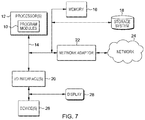
- FIG. 7 is an exemplary block diagram of a computer system in which processes involved in the system, method, and computer program product described herein may be implemented.
- Smart contracts deployed on blockchains are often limited in both scope and reach because they are static and are not context aware. For example, a generic smart contract that is appended to a blockchain may only be executable based on information explicitly passed to it from other transactions that are also appended to the same blockchain. In a business enterprise environment, however, the use of a single blockchain for every aspect of the business may not be tenable. Further, even within a single blockchain, smart contracts are incapable of monitoring and extracting state information maintained in the ledger.
- an enterprise may wish to deploy a separate blockchain for one or more of the enterprise's business unit silos.
- a smart contract for the sale of a good or service may be appended to a contracts blockchain associated with a contracts business unit of the enterprise.
- a received payment transaction for the good or service based on the contract may be appended to an accounts receivable blockchain associated with an accounts receivable business unit of the enterprise.
- the smart contract for the sale is not context aware, the smart contract has no way of knowing that the payment associated with the smart contract has been received and appended to the accounts receivable blockchain.
- Contextual contracts are smart contracts that include state dependent terms.
- the state dependent terms may be based on events that occur in the future.
- a contextual contract may include a term that party A receives 10% of the sales of a product sold by party B.
- the future sales of the product are not known.
- the receipt of 10% of the sales of a product may be considered a state dependent term.
- a company X may enter into a contextual contract pledging to donate $1 to charity Y for every product sold by its participating retail stores in a given month.
- a ledger sensor may be activated by the contextual contract to search through one or more blockchains for data corresponding to the contextual contract. Ledger sensors are described in more detail below.
- Contextual contracts may be useful in many different circumstances to allow for the tracking of transactions, smart contracts, etc.
- a bank may utilize a contextual contract to track information related to a mortgagee.
- the contextual contract may monitor the financial performance of the company (e.g., is the company paying interest regularly for all its loans across multiple banks, is it paying its suppliers on time) using a ledger sensor.
- the bank may use this information to make future lending decisions for the company.
- a consortium of banks could use the same ledger sensor to monitor performance of the company across all of its lending contracts.
- a contextual contract and ledger sensor may be useful to donors of a non-profit company. For example, when different donors donate large sums of money to the company, they would like to track the expenses paid to various sources by the company. The donors may also be interested to know how much money the non-profit has left at the end of the fiscal year. Typically, if non-profits do not use up to a required amount, some of the funding gets decreased.
- the ledger sensor may monitor the company and report that information to a contextual contract.
- a credit card company may offer a promotion “Spend $X across brands/sites A, B, C in a given month and get cash back of $Y.” This may be submitted to a blockchain as a contextual contract where the final execution of the contextual contract will be based on the actual spending as monitored by a ledger sensor.
- the ledger sensor will monitor purchases across these brands and determine the cumulative amount spent.
- each purchase may be a transaction on a ledger that is monitored by a ledger sensor.
- contextual contracts and ledger sensors may be used in voting.
- Voters may cast votes by submitting them for addition to a blockchain.
- Different ledger sensors may count the submitted votes based on different criteria (e.g., location, demographic identifiers, gender, ethnicity, party affiliation, etc. of the voters).
- the contextual contracts may monitor the voting using the ledger sensors and may determine the outcome of an election based on the monitoring.
- Contextual contracts may also be used to generate plots/graphs based on the data.
- a blockchain 100 includes a plurality of blocks 102 .
- Each block 102 is a data structure that includes data representing transactions 104 , for example, smart contracts, payment receipts, or any other transaction.
- transactions 104 for example, smart contracts, payment receipts, or any other transaction.
- additional blocks 102 are generated and appended to the blockchain 100 .
- Each new block 102 also includes a hash 106 of the immediately previous block 102 .
- block 2 includes a hash of block 1
- block n includes a hash of block n ⁇ 1, etc.
- any transactions submitted to blockchain 100 are validated by a set of validator nodes 200 of blockchain 100 .
- Each validator node 202 performs a series of mathematical computations to determine whether a transaction 104 is valid and also determines whether the transaction complies with the rules of the blockchain.
- a consensus of the set of validator nodes 200 is required to add the transaction 104 to a block 102 for appending to the blockchain 100 .
- blockchain 100 is stored in a decentralized manner on a plurality of nodes 300 .
- Nodes 300 may each include memory 302 that stores at least a portion of a ledger 304 of blockchain 100 .
- every node 300 may store the entire ledger 304 .
- each node 300 may store a portion of ledger 304 .
- some or all of nodes 300 may be also be validator nodes 200 .
- some or all of blockchain 100 may be stored in a centralized manner.
- contextual contract 402 including a value 404 (e.g., a numerical value, monetary value, or any other value) and a state 406 (e.g., a number of items of a product sold in all retail outlets of a firm, or other similar information that may be dependent on other sources).
- a value 404 e.g., a numerical value, monetary value, or any other value
- a state 406 e.g., a number of items of a product sold in all retail outlets of a firm, or other similar information that may be dependent on other sources.
- contextual contract 402 may receive value 404 from a transaction 408 , or aggregated from multiple transactions 408 , and the value 404 may be sent to another contextual contract 420 via a transaction 410 .
- Contextual contract 402 may also receive information about the state 406 from an event 412 , or aggregated from multiple events 412 , and the state 406 may be sent as an event 414 to another contextual contract 420 .
- event 412
- transactions 408 , 410 and events 412 , 414 may be monitored and shared through the use of listeners or ledger sensors 418 .
- ledger sensors 418 may, for example, be software implemented alongside blockchain 100 that monitor every transaction 408 , 410 written to blockchain 100 for information that the ledger sensors 418 is instructed to find.
- one or more ledger sensors 418 may be activated by a contextual contract 402 when the contextual contract 402 is validated or appended to a blockchain 100 .
- contextual contract 402 may include a term specifying that a ledger sensor 418 should be activated.
- the appending of any transaction to blockchain 100 may automatically activate a ledger sensors 418 .
- the contextual contract 402 may include one or more search terms to be used by the ledger sensor 418 .
- ledger sensor 418 may alternatively parse, sensor, or extract relevant search terms from contextual contract 402 .
- ledger sensor 418 may parse the contextual contract 402 for the state information 406 and may monitor other transactions for information related to the state 406 of the contextual contract 402 .
- the search terms may include meta data, key words, terms of the contextual contract 402 , applications, enterprise blockchains to be searched, name space, or other criteria, that the activated ledger sensor 418 may use to search for information or data.
- contextual contract 402 may specify what blockchain ledger sensor 418 will monitor when activated.
- contextual contract 402 may specify that ledger sensor 418 will monitor blockchain 100 .
- contextual contract 402 may specify that ledger sensor 418 will also or alternatively monitor one or more other blockchains, e.g., other intra-enterprise blockchains, inter-enterprise blockchains, publicly accessible blockchains, etc.
- the ledger sensor 418 itself will be programmed to monitor a specific blockchain or set of blockchains.
- ledger sensors 418 are configured to monitor new transactions, events, contextual contracts, and smart contracts that are appended to a blockchain. In some aspects, ledger sensors 418 may also be configured to monitor transactions, events, contextual contracts, and smart contracts that have already been appended to the blockchain. In some aspects, ledger sensors 418 are configured to monitor transactions, contextual contracts, and smart contracts across multiple blockchains at the same time. For example, ledgers sensors 418 may be configured to monitor blockchain 100 to which contextual contract 402 has been appended, other blockchains associated with the same enterprise that is running blockchain 100 , blockchains associated with other enterprises, decentralized blockchains, or any other database that may contain data relevant to the contextual contract 402 .
- ledger sensors 418 may be configured to monitor transactions, events, contextual contracts, and smart contracts appended to blockchains or transactions associated with a first enterprise business silo 440 and a second enterprise business silo 450 .
- the transactions monitored by ledger sensors 418 may be on the same blockchain as the contextual contract 402 .
- ledger sensors 418 may monitor transactions based on conditions found in the contextual contract 402 . For example, if the contextual contract 402 includes a condition that for each time an event occurs, the contextual contract will perform some action, ledger sensors 418 will monitor transactions for the triggering event. If the event has not occurred in a transaction, the ledger sensor 418 will not increment a counter. On the other hand, if the event has occurred in a transaction, the ledger sensor 418 will increment the counter. In this manner, the number of occurrences may be tracked and aggregated across transactions by ledger sensor 418 and may be provided to the contextual contract 402 for later use.
- the ledger sensors 418 are configured to determine whether a monitored transaction, contextual contract, or smart contract includes terms, events, values, etc., that are relevant to the contextual contract 402 that activated the ledger sensor 418 .
- the method of determination by ledger sensors 418 may be predetermined in the specification of each ledger sensor 418 .
- the specification of a ledger sensor may specify that the ledger sensor uses string matching, or any other determination criteria based on the particular state information that the ledger sensor 418 must monitor.
- ledger sensors 418 may determine whether any terms, events, values, or other information of a monitored transaction, contextual contract, or smart contract match the search term specified by the contextual contract 402 . Ledger sensors 418 may then provide any terms, events, values, etc.
- the ledger sensor 418 may search other transactions and smart contracts for the sale of the product and capture or aggregate any matching data, e.g., quantity, price, etc., of the sales together. The matching data may then be provided or returned to contextual contract 402 and may be appended to the blockchain 100 .
- ledger sensor 418 may generate a new transaction or an update to the contextual contract 402 including the matching data and may submit the new transaction or update for addition to the blockchain 100 .
- the matching data may be used to finalize contextual contract 402 , for example, by submitting a finalized version of the contextual contract 402 based on the matching data to the blockchain 100 .
- contextual contract 402 need not be finalized where, for example, the terms of contextual contract 402 allow contextual contract 402 to periodically make use of the values returned by ledger sensors 418 to execute.
- the monitored data 114 may be stored in a database 108 associated with blockchain 100 .
- ledger sensor 418 may aggregate together any sales of the product that it finds in other contextual contracts, smart contracts, or transactions for later use with contextual contract 402 .
- ledger sensors 418 may record the monitored data 114 that matches the search terms in database 108 . For example, each sale may be recorded by ledger sensors 418 in database 108 , e.g., for later use with contextual contract 402 .
- ledger sensors 418 may count a quantity of items sold across different transactions, contextual contracts, and smart contracts and store the quantity in database 108 .
- database 108 is decentralized where each of the set of nodes 300 includes all or a portion of the database 108 .
- database 108 may be stored separately from nodes 300 , e.g., in a separate distributed network, on a server, or in any other location.
- database 108 may be centralized, e.g., stored by computing devices of a single entity.
- database 108 may store monitored data 114 associated with more than one blockchain.
- database 108 may store monitored data 114 associated with blockchain 100 , other blockchains associated with business unit silos of the same enterprise, blockchains associated with other enterprises, public blockchains, etc.
- ledger sensor 418 may be a generic ledger sensor 110 that is included in database 108 for use by more than one contextual contract 402 .
- a generic ledger sensor 110 may be provided as part of database 108 for use by more than one of the contextual contracts 402 at the same time.
- each ledger sensor 418 may alternatively be generated specifically for the contextual contract 402 that activated it.
- the ledger sensor 418 may be added to database 108 for later use by other contextual contracts.
- database 108 may also include a smart contract registry 112 .
- smart contract registry 112 stores data relating to contextual contracts, smart contracts, and transactions appended to blockchain 100 .
- smart contract registry 112 may also store data relating to contextual contracts, smart contracts, and transactions appended to one or more additional blockchains, e.g., other blockchains associated with business unit silos of the same enterprise, blockchains associated with other enterprises, public blockchains, etc.
- Smart contract registry 112 may include, for example, a unique identifier associated with each contextual contract, smart contract, and transaction appended to blockchain 100 or any other blockchains for which smart registry 112 stores data.
- the unique identifier may include a link or other data that may direct a ledger sensor 418 to a particular contextual contract, smart contract, or transaction.
- smart contract registry 112 may also include a database of contract terms associated with each contextual contract, smart contract, and transaction. For example, a ledger sensor 418 activated by a contextual contract 402 may search smart contract registry 112 for contract terms that match the state dependent search terms provided by contextual contract 402 and may use the unique identifier to find the corresponding contextual contract, smart contract, or transaction 502 that includes the matching contract terms.
- smart contract registry 112 may also include meta data/key words associated with each contextual contract, smart contract, or transaction.
- smart contract registry 112 may also include applications associated with each contextual contract, smart contract, or transaction.
- smart contract registry 112 may also include an identification of the blockchain to which each contextual contract, smart contract, or transaction has been appended. In some aspects, smart contract registry 112 may also include a name space associated with each contextual contract, smart contract, or transaction. In some aspects, contextual contracts, smart contracts, and transactions in one name space may not be able to view or monitor contextual contracts, smart contracts, and transactions in another name space, thereby providing isolation. Smart contract registry 112 may also or alternatively include any other data that may be relevant to, or match the search terms of, a contextual contract 402 .
- a method 600 for using contextual contracts with ledger sensors on a blockchain is disclosed.
- blockchain 100 receives a contextual contract 402 including at least one term for addition to a blockchain 100 .
- the contextual contract 402 may be received by a node 300 of blockchain 100 , by a validator 200 of blockchain 100 or by any other portion of blockchain 100 .
- a block is appended to the blockchain based on the received contextual contract 402 .
- the validators 200 may validate the contextual contract by reaching a consensus on whether to add the contextual contract to blockchain 100 , may add the contextual contract 402 to the next block to be added to the blockchain 100 , the previous block may be hashed, the hash may be added to the next block, and the next block may be appended to the blockchain 100 .
- a ledger sensor 418 is activated in response to a block containing the contextual contract 402 having been appended to the blockchain 100 .
- the ledger sensor 418 may be activated prior to the block containing the contextual contract 402 being appended to the blockchain 100 .
- the contextual contract includes a term, e.g., an instruction, trigger, etc., specifying that a ledger sensor 418 should be activated.
- ledger sensor 418 may be activated at the time of deployment.
- ledger sensors 418 may be activated after a period of delay, e.g., a number of minutes, hours, days, etc. The period of delay may be pre-defined as part of the ledger sensor 418 , specified in the contextual contract 402 , or set by blockchain 100 itself, for example, in a genesis block of the blockchain 100 .
- ledger sensor 418 monitors blockchain 100 for transactions that correspond to the at least one term.
- ledger sensor 418 may also or alternatively monitor other blockchains for transactions that correspond to the at least one term.
- ledger sensor 418 may monitor other blockchains associated with business unit silos of the same enterprise, blockchains associated with other enterprises, public blockchains, etc.
- contextual contract 402 may specify the blockchains that ledger sensor 418 should monitor for the at least one term.
- ledger sensor 418 may detect a transaction that corresponds to the at least one term. For example, ledger sensor 418 may determine that at least one term of the transaction matches the at least one term of the contextual contract, may determine that a value of the transaction corresponds to the at least one contract, or may make other similar determinations. In some aspects, the ledger sensor may detect the transaction by searching smart contract registry 112 .
- ledger sensor 418 may generate data based on the comparison including, for example, extracting a value from the transaction that corresponds to the at least one term.
- ledger sensor 418 may aggregate the values extracted from a plurality of transactions that are determined to correspond to the at least one term. For example, where the at least one term is for the sale of a product and the ledger sensor 418 detects the sale of the product in more than one transaction, the ledger sensor 418 may aggregate the number of sales together in the data.
- the data may be stored in database 108 .
- the format of the generated data may be arbitrary and based on the particular features of the values that are extracted.
- the data is returned to blockchain 100 for use with contextual contract 402 .
- ledger sensor 418 may return the data to blockchain 100 and may generate and submit a transaction including the data to the blockchain for addition to blockchain 100 .
- the contextual contract 402 may be finalized by submitting a transaction based on the contextual contract and the data to blockchain 100 for addition to blockchain 100 .
- FIG. 7 illustrates a schematic of an example computer or processing system that may implement any portion of blockchain 100 , validators 200 , nodes 300 , systems, methods, and computer program products described herein in one embodiment of the present disclosure.
- the computer system is only one example of a suitable processing system and is not intended to suggest any limitation as to the scope of use or functionality of embodiments of the methodology described herein.
- the processing system shown may be operational with numerous other general purpose or special purpose computing system environments or configurations.
- Examples of well-known computing systems, environments, and/or configurations that may be suitable for use with the processing system may include, but are not limited to, personal computer systems, server computer systems, thin clients, thick clients, handheld or laptop devices, multiprocessor systems, microprocessor-based systems, set top boxes, programmable consumer electronics, network PCs, minicomputer systems, mainframe computer systems, and distributed cloud computing environments that include any of the above systems or devices, and the like.
- the computer system may be described in the general context of computer system executable instructions, such as program modules, being executed by a computer system.
- program modules may include routines, programs, objects, components, logic, data structures, and so on that perform particular tasks or implement particular abstract data types.
- the computer system may be practiced in distributed cloud computing environments where tasks are performed by remote processing devices that are linked through a communications network.
- program modules may be located in both local and remote computer system storage media including memory storage devices.
- the components of computer system may include, but are not limited to, one or more processors or processing units 12 , a system memory 16 , and a bus 14 that couples various system components including system memory 16 to processor 12 .
- the processor 12 may include a software module 10 that performs the methods described herein.
- the module 10 may be programmed into the integrated circuits of the processor 12 , or loaded from memory 16 , storage device 18 , or network 24 or combinations thereof.
- Bus 14 may represent one or more of any of several types of bus structures, including a memory bus or memory controller, a peripheral bus, an accelerated graphics port, and a processor or local bus using any of a variety of bus architectures.
- bus architectures include Industry Standard Architecture (ISA) bus, Micro Channel Architecture (MCA) bus, Enhanced ISA (EISA) bus, Video Electronics Standards Association (VESA) local bus, and Peripheral Component Interconnects (PCI) bus.
- Computer system may include a variety of computer system readable media. Such media may be any available media that is accessible by computer system, and it may include both volatile and non-volatile media, removable and non-removable media.
- System memory 16 can include computer system readable media in the form of volatile memory, such as random access memory (RAM) and/or cache memory or others. Computer system may further include other removable/non-removable, volatile/non-volatile computer system storage media.
- storage system 18 can be provided for reading from and writing to a non-removable, non-volatile magnetic media (e.g., a “hard drive”).
- a magnetic disk drive for reading from and writing to a removable, non-volatile magnetic disk (e.g., a “floppy disk”).
- an optical disk drive for reading from or writing to a removable, non-volatile optical disk such as a CD-ROM, DVD-ROM or other optical media.
- each can be connected to bus 14 by one or more data media interfaces.
- Computer system may also communicate with one or more external devices 26 such as a keyboard, a pointing device, a display 28 , etc.; one or more devices that enable a user to interact with computer system; and/or any devices (e.g., network card, modem, etc.) that enable computer system to communicate with one or more other computing devices. Such communication can occur via Input/Output (I/O) interfaces 20 .
- external devices 26 such as a keyboard, a pointing device, a display 28 , etc.
- any devices e.g., network card, modem, etc.
- I/O Input/Output
- computer system can communicate with one or more networks 24 such as a local area network (LAN), a general wide area network (WAN), and/or a public network (e.g., the Internet) via network adapter 22 .
- network adapter 22 communicates with the other components of computer system via bus 14 .
- bus 14 It should be understood that although not shown, other hardware and/or software components could be used in conjunction with computer system. Examples include, but are not limited to: microcode, device drivers, redundant processing units, external disk drive arrays, RAID systems, tape drives, and data archival storage systems, etc.
- aspects of the present invention may be embodied as a system, method or computer program product. Accordingly, aspects of the present invention may take the form of an entirely hardware embodiment, an entirely software embodiment (including firmware, resident software, micro-code, etc.) or an embodiment combining software and hardware aspects that may all generally be referred to herein as a “circuit,” “module” or “system.” Furthermore, aspects of the present invention may take the form of a computer program product embodied in one or more computer readable medium(s) having computer readable program code embodied thereon.
- the computer readable medium may be a computer readable signal medium or a computer readable storage medium.
- a computer readable storage medium may be, for example, but not limited to, an electronic, magnetic, optical, electromagnetic, infrared, or semiconductor system, apparatus, or device, or any suitable combination of the foregoing.
- a computer readable storage medium may be any tangible medium that can contain, or store a program for use by or in connection with an instruction execution system, apparatus, or device.
- a computer readable signal medium may include a propagated data signal with computer readable program code embodied therein, for example, in baseband or as part of a carrier wave. Such a propagated signal may take any of a variety of forms, including, but not limited to, electro-magnetic, optical, or any suitable combination thereof.
- a computer readable signal medium may be any computer readable medium that is not a computer readable storage medium and that can communicate, propagate, or transport a program for use by or in connection with an instruction execution system, apparatus, or device.
- Program code embodied on a computer readable medium may be transmitted using any appropriate medium, including but not limited to wireless, wireline, optical fiber cable, RF, etc., or any suitable combination of the foregoing.
- Computer program code for carrying out operations for aspects of the present invention may be written in any combination of one or more programming languages, including an object oriented programming language such as Java, Smalltalk, C++ or the like and conventional procedural programming languages, such as the “C” programming language or similar programming languages, a scripting language such as Perl, VBS or similar languages, and/or functional languages such as Lisp and ML and logic-oriented languages such as Prolog.
- the program code may execute entirely on the user's computer, partly on the user's computer, as a stand-alone software package, partly on the user's computer and partly on a remote computer or entirely on the remote computer or server.
- the remote computer may be connected to the user's computer through any type of network, including a local area network (LAN) or a wide area network (WAN), or the connection may be made to an external computer (for example, through the Internet using an Internet Service Provider).
- LAN local area network
- WAN wide area network
- Internet Service Provider an Internet Service Provider
- These computer program instructions may also be stored in a computer readable medium that can direct a computer, other programmable data processing apparatus, or other devices to function in a particular manner, such that the instructions stored in the computer readable medium produce an article of manufacture including instructions which implement the function/act specified in the flowchart and/or block diagram block or blocks.
- the computer program instructions may also be loaded onto a computer, other programmable data processing apparatus, or other devices to cause a series of operational steps to be performed on the computer, other programmable apparatus or other devices to produce a computer implemented process such that the instructions which execute on the computer or other programmable apparatus provide processes for implementing the functions/acts specified in the flowchart and/or block diagram block or blocks.
- each block in the flowchart or block diagrams may represent a module, segment, or portion of code, which comprises one or more executable instructions for implementing the specified logical function(s).
- the functions noted in the block may occur out of the order noted in the figures. For example, two blocks shown in succession may, in fact, be executed substantially concurrently, or the blocks may sometimes be executed in the reverse order, depending upon the functionality involved.
- the computer program product may comprise all the respective features enabling the implementation of the methodology described herein, and which—when loaded in a computer system—is able to carry out the methods.
- Computer program, software program, program, or software in the present context means any expression, in any language, code or notation, of a set of instructions intended to cause a system having an information processing capability to perform a particular function either directly or after either or both of the following: (a) conversion to another language, code or notation; and/or (b) reproduction in a different material form.
- aspects of the present disclosure may be embodied as a program, software, or computer instructions embodied in a computer or machine usable or readable medium, which causes the computer or machine to perform the steps of the method when executed on the computer, processor, and/or machine.
- a program storage device readable by a machine, tangibly embodying a program of instructions executable by the machine to perform various functionalities and methods described in the present disclosure is also provided.
- the system and method of the present disclosure may be implemented and run on a general-purpose computer or special-purpose computer system.
- the terms “computer system” and “computer network” as may be used in the present application may include a variety of combinations of fixed and/or portable computer hardware, software, peripherals, and storage devices.
- the computer system may include a plurality of individual components that are networked or otherwise linked to perform collaboratively, or may include one or more stand-alone components.
- the hardware and software components of the computer system of the present application may include and may be included within fixed and portable devices such as desktop, laptop, and/or server.
- a module may be a component of a device, software, program, or system that implements some “functionality”, which can be embodied as software, hardware, firmware, electronic circuitry, or etc.
Landscapes
- Business, Economics & Management (AREA)
- Engineering & Computer Science (AREA)
- Accounting & Taxation (AREA)
- Strategic Management (AREA)
- Computer Security & Cryptography (AREA)
- Physics & Mathematics (AREA)
- General Physics & Mathematics (AREA)
- Theoretical Computer Science (AREA)
- General Business, Economics & Management (AREA)
- Human Resources & Organizations (AREA)
- Economics (AREA)
- Entrepreneurship & Innovation (AREA)
- Finance (AREA)
- Educational Administration (AREA)
- Development Economics (AREA)
- Signal Processing (AREA)
- Computer Networks & Wireless Communication (AREA)
- Game Theory and Decision Science (AREA)
- Tourism & Hospitality (AREA)
- Quality & Reliability (AREA)
- Operations Research (AREA)
- Marketing (AREA)
- Management, Administration, Business Operations System, And Electronic Commerce (AREA)
Abstract
Description
Claims (17)
Priority Applications (1)
| Application Number | Priority Date | Filing Date | Title |
|---|---|---|---|
| US15/274,296 US11188883B2 (en) | 2016-09-23 | 2016-09-23 | Using ledger sensors to enable contextual contracts across various enterprise blockchain applications |
Applications Claiming Priority (1)
| Application Number | Priority Date | Filing Date | Title |
|---|---|---|---|
| US15/274,296 US11188883B2 (en) | 2016-09-23 | 2016-09-23 | Using ledger sensors to enable contextual contracts across various enterprise blockchain applications |
Publications (2)
| Publication Number | Publication Date |
|---|---|
| US20180089638A1 US20180089638A1 (en) | 2018-03-29 |
| US11188883B2 true US11188883B2 (en) | 2021-11-30 |
Family
ID=61685564
Family Applications (1)
| Application Number | Title | Priority Date | Filing Date |
|---|---|---|---|
| US15/274,296 Expired - Fee Related US11188883B2 (en) | 2016-09-23 | 2016-09-23 | Using ledger sensors to enable contextual contracts across various enterprise blockchain applications |
Country Status (1)
| Country | Link |
|---|---|
| US (1) | US11188883B2 (en) |
Cited By (2)
| Publication number | Priority date | Publication date | Assignee | Title |
|---|---|---|---|---|
| US20210294920A1 (en) * | 2018-07-10 | 2021-09-23 | Netmaster Solutions Ltd | A method and system for managing digital evidence using a blockchain |
| US20230205929A1 (en) * | 2018-05-29 | 2023-06-29 | Oracle International Corporation | Securing Access to Confidential Data Using a Blockchain Ledger |
Families Citing this family (53)
| Publication number | Priority date | Publication date | Assignee | Title |
|---|---|---|---|---|
| WO2018058441A1 (en) * | 2016-09-29 | 2018-04-05 | Nokia Technologies Oy | Method and apparatus for trusted computing |
| US11663609B2 (en) * | 2016-10-04 | 2023-05-30 | International Business Machines Corporation | Method and apparatus to enforce smart contract execution hierarchy on blockchain |
| US10628491B2 (en) | 2016-11-09 | 2020-04-21 | Cognitive Scale, Inc. | Cognitive session graphs including blockchains |
| US10719771B2 (en) | 2016-11-09 | 2020-07-21 | Cognitive Scale, Inc. | Method for cognitive information processing using a cognitive blockchain architecture |
| US10621511B2 (en) | 2016-11-09 | 2020-04-14 | Cognitive Scale, Inc. | Method for using hybrid blockchain data architecture within a cognitive environment |
| US10726343B2 (en) * | 2016-11-09 | 2020-07-28 | Cognitive Scale, Inc. | Performing compliance operations using cognitive blockchains |
| US10726346B2 (en) * | 2016-11-09 | 2020-07-28 | Cognitive Scale, Inc. | System for performing compliance operations using cognitive blockchains |
| US10621233B2 (en) | 2016-11-09 | 2020-04-14 | Cognitive Scale, Inc. | Cognitive session graphs including blockchains |
| US10621510B2 (en) | 2016-11-09 | 2020-04-14 | Cognitive Scale, Inc. | Hybrid blockchain data architecture for use within a cognitive environment |
| US10726342B2 (en) | 2016-11-09 | 2020-07-28 | Cognitive Scale, Inc. | Cognitive information processing using a cognitive blockchain architecture |
| US10171509B2 (en) * | 2016-11-10 | 2019-01-01 | International Business Machines Corporation | Filtering and redacting blockchain transactions |
| US11176519B2 (en) * | 2016-11-11 | 2021-11-16 | International Business Machines Corporation | Smart contract admission check and fault tolerance in a blockchain |
| US20180260921A1 (en) * | 2017-03-08 | 2018-09-13 | Bsquare Corp. | Remote machine operation through distributed permissioning |
| EP3607509B1 (en) | 2017-04-07 | 2024-06-26 | BXB Digital PTY Limited | Systems and methods for tracking promotions |
| GB201706132D0 (en) * | 2017-04-18 | 2017-05-31 | Nchain Holdings Ltd | Computer-implemented system and method |
| WO2018204499A1 (en) | 2017-05-02 | 2018-11-08 | BXB Digital Pty Limited | Systems and methods for pallet identification |
| US10832208B2 (en) | 2017-05-02 | 2020-11-10 | BXB Digital Pty Limited | Systems and methods for facility matching and localization |
| WO2018204912A1 (en) | 2017-05-05 | 2018-11-08 | BXB Digital Pty Limited | Pallet with tracking device |
| CN107301536B (en) * | 2017-06-12 | 2019-07-12 | 腾讯科技(深圳)有限公司 | Resource transfers method and device |
| JP2019012415A (en) * | 2017-06-30 | 2019-01-24 | 株式会社bitFlyer | Method for building consensus in network and nodes constituting network |
| EP3673426B1 (en) | 2017-08-21 | 2024-03-06 | BXB Digital PTY Limited | Systems and methods for pallet tracking using hub and spoke architecture |
| MA50387A (en) | 2017-10-20 | 2020-08-26 | Bxb Digital Pty Ltd | FREIGHT CARRIER TRACKING SYSTEMS AND METHODS |
| US10949722B2 (en) * | 2017-10-24 | 2021-03-16 | 0Chain, LLC | Systems and methods of sustainability protocol using distributed blockchain application with IoT sensors |
| US10839345B2 (en) | 2017-10-27 | 2020-11-17 | BXB Digital Pty Limited | Systems and methods for executing smart contracts using a block chain |
| US11216788B1 (en) * | 2017-11-30 | 2022-01-04 | Worldpay, Llc | Systems and methods for blockchain-based payment transactions, alerts, and dispute settlement, using a blockchain interface server |
| DE112018006630T5 (en) * | 2017-12-28 | 2020-09-24 | Intel Corporation | VISUAL FOG |
| WO2019200279A1 (en) * | 2018-04-13 | 2019-10-17 | Hinkel Jennifer M | Utilizing digital data assets in a blockchain platform using a transactional proof of work |
| US20190333143A1 (en) * | 2018-04-30 | 2019-10-31 | Darren Williams | System for enabling short-term financing |
| EP3564881A1 (en) * | 2018-05-02 | 2019-11-06 | Rockwell Automation Technologies, Inc. | Blockchain-enabled industrial devices |
| US10747201B2 (en) | 2018-05-02 | 2020-08-18 | Rockwell Automation Technologies, Inc. | Subscription-based services using industrial blockchains |
| US20210117933A1 (en) * | 2018-05-03 | 2021-04-22 | 3M Innovative Properties Company | Personal protective equipment management system with distributed digital blockchain ledger |
| US20190347699A1 (en) * | 2018-05-14 | 2019-11-14 | Xenia, LLC | System, method, and platform for managing transactions supporting causes |
| KR102288045B1 (en) * | 2018-05-21 | 2021-08-10 | 성신여자대학교 연구 산학협력단 | Method and apparatus for managing subject data based on blockchain |
| CN108830463B (en) * | 2018-05-29 | 2021-03-19 | 厦门哈希科技有限公司 | Evaluation record storage method, device, storage medium and system |
| CN110634069B (en) | 2018-06-25 | 2023-03-31 | 巍乾全球技术有限责任公司 | Method, apparatus, storage medium, and program product for carbon trading |
| CN109003078B (en) | 2018-06-27 | 2021-08-24 | 创新先进技术有限公司 | Blockchain-based smart contract calling method and device, and electronic equipment |
| US11354669B2 (en) * | 2018-06-28 | 2022-06-07 | International Business Machines Corporation | Collaborative analytics for fraud detection through a shared public ledger |
| US11227287B2 (en) | 2018-06-28 | 2022-01-18 | International Business Machines Corporation | Collaborative analytics for fraud detection through a shared public ledger |
| IT201800007495A1 (en) * | 2018-07-26 | 2020-01-26 | Caldarola Srl | Blockchain-based system for fleet control in compliance |
| US11842322B2 (en) * | 2018-08-22 | 2023-12-12 | Equinix, Inc. | Smart contract interpreter |
| US10984412B2 (en) * | 2018-09-20 | 2021-04-20 | Coinbase, Inc. | System and method for management of cryptocurrency systems |
| US11068470B2 (en) * | 2018-11-09 | 2021-07-20 | Innoplexus Ag | System and method for interoperability of blockchains |
| WO2020101869A1 (en) * | 2018-11-16 | 2020-05-22 | Rutgers, The State University Of New Jersey | Scalable, secure, and broad-spectrum mechanism for enforcement of protocols over multi-agent systems |
| US10816637B2 (en) | 2018-12-27 | 2020-10-27 | Chep Technology Pty Limited | Site matching for asset tracking |
| IT201800021313A1 (en) * | 2018-12-28 | 2020-06-28 | Capurso Azienda Casearia S R L | Blockchain-based system for the certification of a dairy product chain |
| US11138600B2 (en) * | 2019-02-05 | 2021-10-05 | Capital One Services, Llc | Smart contract regulation |
| JP7147074B2 (en) | 2019-02-25 | 2022-10-04 | ビィ・エックス・ビィ・デジタル・プロプライエタリー・リミテッド | Smart physical closure in the supply chain |
| US11126593B2 (en) | 2019-06-15 | 2021-09-21 | Facebook, Inc. | Scalable, secure, efficient, and adaptable distributed digital ledger transaction network |
| US20200394177A1 (en) * | 2019-06-15 | 2020-12-17 | Facebook, Inc. | Scalable, secure, efficient, and adaptable distributed digital ledger transaction network |
| US11669830B2 (en) * | 2019-10-15 | 2023-06-06 | Jpmorgan Chase Bank, N.A. | Systems and methods for distributed-ledger based settlement |
| US11210751B2 (en) * | 2020-01-14 | 2021-12-28 | International Business Machines Corporation | Targeting energy units in a blockchain |
| US12229778B2 (en) | 2020-06-15 | 2025-02-18 | Capital One Services, Llc | Systems and methods for building blockchains for verifying assets for smart contracts |
| CN112804359B (en) * | 2021-03-30 | 2021-07-06 | 支付宝(杭州)信息技术有限公司 | Method and apparatus for providing cross-chain messages |
Citations (13)
| Publication number | Priority date | Publication date | Assignee | Title |
|---|---|---|---|---|
| US20150134675A1 (en) * | 2013-11-14 | 2015-05-14 | Wells Fargo Bank, N.A. | Context association |
| US20150379510A1 (en) | 2012-07-10 | 2015-12-31 | Stanley Benjamin Smith | Method and system to use a block chain infrastructure and Smart Contracts to monetize data transactions involving changes to data included into a data supply chain. |
| US20160028552A1 (en) | 2014-07-25 | 2016-01-28 | Blockchain Technologies Corporation | System and method for creating a multi-branched blockchain with configurable protocol rules |
| US20160092988A1 (en) | 2014-09-30 | 2016-03-31 | Raistone, Inc. | Systems and methods for transferring digital assests using a de-centralized exchange |
| US20160342977A1 (en) * | 2015-05-20 | 2016-11-24 | Vennd.io Pty Ltd | Device, method and system for virtual asset transactions |
| US20170011460A1 (en) * | 2015-07-09 | 2017-01-12 | Ouisa, LLC | Systems and methods for trading, clearing and settling securities transactions using blockchain technology |
| US20170046651A1 (en) * | 2015-08-13 | 2017-02-16 | The Toronto-Dominion Bank | Systems and method for tracking enterprise events using hybrid public-private blockchain ledgers |
| US20170061347A1 (en) * | 2015-08-28 | 2017-03-02 | Oracle Financial Services Software Limited | Computerized system and method for predicting quantity levels of a resource |
| US20170206326A1 (en) * | 2016-01-20 | 2017-07-20 | Change Healthcare Llc | Systems and methods for the classification and indexing of contract documentation |
| US20170243287A1 (en) * | 2016-02-22 | 2017-08-24 | Bank Of America Corporation | System for managing serializability of resource transfers in a process data network |
| US20170331896A1 (en) * | 2016-05-13 | 2017-11-16 | De La Rue International Limited | Methods and systems for processing assets |
| US20170372392A1 (en) * | 2016-06-24 | 2017-12-28 | Raise Marketplace Inc. | Securely processing exchange items in a data communication system |
| US20190043059A1 (en) * | 2014-11-11 | 2019-02-07 | Valida, Inc. | Monitoring supply chains, authenticating goods and authorizing payment |
-
2016
- 2016-09-23 US US15/274,296 patent/US11188883B2/en not_active Expired - Fee Related
Patent Citations (13)
| Publication number | Priority date | Publication date | Assignee | Title |
|---|---|---|---|---|
| US20150379510A1 (en) | 2012-07-10 | 2015-12-31 | Stanley Benjamin Smith | Method and system to use a block chain infrastructure and Smart Contracts to monetize data transactions involving changes to data included into a data supply chain. |
| US20150134675A1 (en) * | 2013-11-14 | 2015-05-14 | Wells Fargo Bank, N.A. | Context association |
| US20160028552A1 (en) | 2014-07-25 | 2016-01-28 | Blockchain Technologies Corporation | System and method for creating a multi-branched blockchain with configurable protocol rules |
| US20160092988A1 (en) | 2014-09-30 | 2016-03-31 | Raistone, Inc. | Systems and methods for transferring digital assests using a de-centralized exchange |
| US20190043059A1 (en) * | 2014-11-11 | 2019-02-07 | Valida, Inc. | Monitoring supply chains, authenticating goods and authorizing payment |
| US20160342977A1 (en) * | 2015-05-20 | 2016-11-24 | Vennd.io Pty Ltd | Device, method and system for virtual asset transactions |
| US20170011460A1 (en) * | 2015-07-09 | 2017-01-12 | Ouisa, LLC | Systems and methods for trading, clearing and settling securities transactions using blockchain technology |
| US20170046651A1 (en) * | 2015-08-13 | 2017-02-16 | The Toronto-Dominion Bank | Systems and method for tracking enterprise events using hybrid public-private blockchain ledgers |
| US20170061347A1 (en) * | 2015-08-28 | 2017-03-02 | Oracle Financial Services Software Limited | Computerized system and method for predicting quantity levels of a resource |
| US20170206326A1 (en) * | 2016-01-20 | 2017-07-20 | Change Healthcare Llc | Systems and methods for the classification and indexing of contract documentation |
| US20170243287A1 (en) * | 2016-02-22 | 2017-08-24 | Bank Of America Corporation | System for managing serializability of resource transfers in a process data network |
| US20170331896A1 (en) * | 2016-05-13 | 2017-11-16 | De La Rue International Limited | Methods and systems for processing assets |
| US20170372392A1 (en) * | 2016-06-24 | 2017-12-28 | Raise Marketplace Inc. | Securely processing exchange items in a data communication system |
Cited By (4)
| Publication number | Priority date | Publication date | Assignee | Title |
|---|---|---|---|---|
| US20230205929A1 (en) * | 2018-05-29 | 2023-06-29 | Oracle International Corporation | Securing Access to Confidential Data Using a Blockchain Ledger |
| US12045372B2 (en) * | 2018-05-29 | 2024-07-23 | Oracle International Corporation | Securing access to confidential data using a blockchain ledger |
| US20210294920A1 (en) * | 2018-07-10 | 2021-09-23 | Netmaster Solutions Ltd | A method and system for managing digital evidence using a blockchain |
| US12153717B2 (en) * | 2018-07-10 | 2024-11-26 | Thomson Reuters Enterprise Centre Gmb | Method and system for managing digital evidence using a blockchain |
Also Published As
| Publication number | Publication date |
|---|---|
| US20180089638A1 (en) | 2018-03-29 |
Similar Documents
| Publication | Publication Date | Title |
|---|---|---|
| US11188883B2 (en) | Using ledger sensors to enable contextual contracts across various enterprise blockchain applications | |
| US12216993B2 (en) | Systems and methods for hyperledger-based payment transactions, alerts, and dispute settlement, using smart contracts | |
| US11042873B2 (en) | Blockchain: automatic fork protection | |
| US12217264B2 (en) | Systems and methods for payment transactions, alerts, dispute settlement, and settlement payments, using multiple blockchains | |
| US11663609B2 (en) | Method and apparatus to enforce smart contract execution hierarchy on blockchain | |
| EP3834364A1 (en) | Self-enforcing security token implementing smart-contract-based compliance rules consulting smart-contract-based global registry of investors | |
| US20170024828A1 (en) | Systems and methods for identifying information related to payment card testing | |
| US20230351368A1 (en) | E-Commerce Platform with Tokenization System | |
| AU2019449460A1 (en) | Auto-pilot transactions using smart contracts | |
| US11664974B2 (en) | Summary chains in distributed systems | |
| CN107016544A (en) | Managed across the proof rule of entity | |
| CN112837149A (en) | A method and device for identifying enterprise credit risk | |
| Crookes et al. | Technology challenges in accounting and finance | |
| US20190279228A1 (en) | Suspicious activity report smart validation | |
| WO2016115207A1 (en) | A system and method for consolidating expense records | |
| US10354303B1 (en) | Verification of rental and mortgage payment history | |
| CN120408684A (en) | A method, device, system, equipment and medium for encrypting asset data | |
| US11403210B1 (en) | Virtual simulation environment for testing functionality of physical cash handling devices | |
| US20180004968A1 (en) | Protecting sensitive information when replicating data to remote systems | |
| Caven et al. | Using an SBOM to mitigate a lemons market | |
| US12124875B2 (en) | System and method for facilitating creation, verification, and management of digital resources | |
| CN107924535A (en) | Credit management system, method, and program | |
| CN115983995A (en) | Transaction service supervision method, device, equipment and storage medium | |
| US20200193468A1 (en) | Blockchain for ads and coupons | |
| WO2020234864A1 (en) | System and method for transferring an anonymized transaction between nodes of a computer network |
Legal Events
| Date | Code | Title | Description |
|---|---|---|---|
| AS | Assignment |
Owner name: INTERNATIONAL BUSINESS MACHINES CORPORATION, NEW YORK Free format text: ASSIGNMENT OF ASSIGNORS INTEREST;ASSIGNORS:CHRISTIDIS, KONSTANTINOS;DERBAKOVA, ANNA D.;GAUR, NITIN;AND OTHERS;SIGNING DATES FROM 20160812 TO 20160922;REEL/FRAME:039844/0987 Owner name: INTERNATIONAL BUSINESS MACHINES CORPORATION, NEW Y Free format text: ASSIGNMENT OF ASSIGNORS INTEREST;ASSIGNORS:CHRISTIDIS, KONSTANTINOS;DERBAKOVA, ANNA D.;GAUR, NITIN;AND OTHERS;SIGNING DATES FROM 20160812 TO 20160922;REEL/FRAME:039844/0987 |
|
| STPP | Information on status: patent application and granting procedure in general |
Free format text: DOCKETED NEW CASE - READY FOR EXAMINATION |
|
| STPP | Information on status: patent application and granting procedure in general |
Free format text: NON FINAL ACTION MAILED |
|
| STPP | Information on status: patent application and granting procedure in general |
Free format text: FINAL REJECTION MAILED |
|
| STPP | Information on status: patent application and granting procedure in general |
Free format text: RESPONSE AFTER FINAL ACTION FORWARDED TO EXAMINER |
|
| STPP | Information on status: patent application and granting procedure in general |
Free format text: DOCKETED NEW CASE - READY FOR EXAMINATION |
|
| STPP | Information on status: patent application and granting procedure in general |
Free format text: NON FINAL ACTION MAILED |
|
| STPP | Information on status: patent application and granting procedure in general |
Free format text: RESPONSE TO NON-FINAL OFFICE ACTION ENTERED AND FORWARDED TO EXAMINER |
|
| STPP | Information on status: patent application and granting procedure in general |
Free format text: NOTICE OF ALLOWANCE MAILED -- APPLICATION RECEIVED IN OFFICE OF PUBLICATIONS |
|
| STPP | Information on status: patent application and granting procedure in general |
Free format text: PUBLICATIONS -- ISSUE FEE PAYMENT RECEIVED |
|
| STPP | Information on status: patent application and granting procedure in general |
Free format text: PUBLICATIONS -- ISSUE FEE PAYMENT VERIFIED |
|
| STCF | Information on status: patent grant |
Free format text: PATENTED CASE |
|
| FEPP | Fee payment procedure |
Free format text: MAINTENANCE FEE REMINDER MAILED (ORIGINAL EVENT CODE: REM.); ENTITY STATUS OF PATENT OWNER: LARGE ENTITY |
|
| LAPS | Lapse for failure to pay maintenance fees |
Free format text: PATENT EXPIRED FOR FAILURE TO PAY MAINTENANCE FEES (ORIGINAL EVENT CODE: EXP.); ENTITY STATUS OF PATENT OWNER: LARGE ENTITY |
|
| STCH | Information on status: patent discontinuation |
Free format text: PATENT EXPIRED DUE TO NONPAYMENT OF MAINTENANCE FEES UNDER 37 CFR 1.362 |
|
| FP | Lapsed due to failure to pay maintenance fee |
Effective date: 20251130 |