US11106132B2 - Energy-sensitive composition, cured product, and pattern forming method - Google Patents
Energy-sensitive composition, cured product, and pattern forming method Download PDFInfo
- Publication number
- US11106132B2 US11106132B2 US16/390,429 US201916390429A US11106132B2 US 11106132 B2 US11106132 B2 US 11106132B2 US 201916390429 A US201916390429 A US 201916390429A US 11106132 B2 US11106132 B2 US 11106132B2
- Authority
- US
- United States
- Prior art keywords
- group
- compound
- energy
- acid
- sensitive composition
- Prior art date
- Legal status (The legal status is an assumption and is not a legal conclusion. Google has not performed a legal analysis and makes no representation as to the accuracy of the status listed.)
- Expired - Fee Related, expires
Links
- 0 [1*]C1=C(C(=O)C2=C([6*])C([7*])=C([8*])C(C([10*])([11*])C(=O)[O-])=C2[9*])C([5*])=C([4*])C([3*])=C1[2*] Chemical compound [1*]C1=C(C(=O)C2=C([6*])C([7*])=C([8*])C(C([10*])([11*])C(=O)[O-])=C2[9*])C([5*])=C([4*])C([3*])=C1[2*] 0.000 description 10
- UCBFBQXXPWLTSZ-WAYWQWQTSA-N C/N=C(/C)N(C)C Chemical compound C/N=C(/C)N(C)C UCBFBQXXPWLTSZ-WAYWQWQTSA-N 0.000 description 1
- DNVFAGHWZDNRNG-JXGYXAOLSA-N C/N=C(/C)N(C)C.CN=P(N(C)C)(N(C)C)N(C)C Chemical compound C/N=C(/C)N(C)C.CN=P(N(C)C)(N(C)C)N(C)C DNVFAGHWZDNRNG-JXGYXAOLSA-N 0.000 description 1
- GBHIJFWXJBGERY-UHFFFAOYSA-M C1=C2CCCCCN2CCC1.CC(C(=O)[O-])C1=CC2=C(C=C1)OC1=CC=CC=C1C2=O.CC(C(=O)[O-])C1=CC2=C(C=C1)OC1=CC=CC=C1C2=O.CC(C(=O)[O-])C1=CC2=C(C=C1)OC1=CC=CC=C1C2=O.CC[NH+]=P(N=P(N(C)C)(N(C)C)N(C)C)(N(C)C)N(C)C.CN(C)C(=[NH2+])N(C)C Chemical compound C1=C2CCCCCN2CCC1.CC(C(=O)[O-])C1=CC2=C(C=C1)OC1=CC=CC=C1C2=O.CC(C(=O)[O-])C1=CC2=C(C=C1)OC1=CC=CC=C1C2=O.CC(C(=O)[O-])C1=CC2=C(C=C1)OC1=CC=CC=C1C2=O.CC[NH+]=P(N=P(N(C)C)(N(C)C)N(C)C)(N(C)C)N(C)C.CN(C)C(=[NH2+])N(C)C GBHIJFWXJBGERY-UHFFFAOYSA-M 0.000 description 1
- HJPCJOBIWPXYCF-UHFFFAOYSA-N C=NP(=NC(C)(C)C)(N=P(C(C)C)(N(C)C)N(C)C)N=P(N(C)C)(N(C)C)N(C)C.CCCN(CC)P1(=NC(C)(C)C)C(C)CCCN1C.CN(C)P(N(C)C)N(C)C Chemical compound C=NP(=NC(C)(C)C)(N=P(C(C)C)(N(C)C)N(C)C)N=P(N(C)C)(N(C)C)N(C)C.CCCN(CC)P1(=NC(C)(C)C)C(C)CCCN1C.CN(C)P(N(C)C)N(C)C HJPCJOBIWPXYCF-UHFFFAOYSA-N 0.000 description 1
- CAJQQCJQUNAOND-UHFFFAOYSA-K CC(C(=O)[O-])C1=CC(C(=O)C2=CC=CC=C2)=CC=C1.O=C([O-])CC1=CC2=C(C=C1)OC1=C(C=CC=C1)C2=O.O=C([O-])CC1=CC2=C(C=C1)SC1=C(C=CC=C1)C2=O Chemical compound CC(C(=O)[O-])C1=CC(C(=O)C2=CC=CC=C2)=CC=C1.O=C([O-])CC1=CC2=C(C=C1)OC1=C(C=CC=C1)C2=O.O=C([O-])CC1=CC2=C(C=C1)SC1=C(C=CC=C1)C2=O CAJQQCJQUNAOND-UHFFFAOYSA-K 0.000 description 1
- KSZOBISXWIERRR-UHFFFAOYSA-L CC(C(=O)[O-])C1=CC2=C(C=C1)OC1=CC=CC=C1C2=O.CC(C(=O)[O-])C1=CC2=C(C=C1)OC1=CC=CC=C1C2=O.CC(C(=O)[O-])C1=CC2=C(C=C1)OC1=CC=CC=C1C2=O.CN(C)P(=NP(=CC(C)(C)C)(N=P(N(C)C)(N(C)C)N(C)C)N=P(N(C)C)(N(C)C)N(C)C)(N(C)C)N(C)C.CN(C)P(=NP(=CC(C)(C)CC(C)(C)C)(N=P(N(C)C)(N(C)C)N(C)C)N=P(N(C)C)(N(C)C)N(C)C)(N(C)C)N(C)C.CN(C)P(=NP(=[NH+]C(C)(C)C)(N(C)C)N(C)C)(N(C)C)N(C)C Chemical compound CC(C(=O)[O-])C1=CC2=C(C=C1)OC1=CC=CC=C1C2=O.CC(C(=O)[O-])C1=CC2=C(C=C1)OC1=CC=CC=C1C2=O.CC(C(=O)[O-])C1=CC2=C(C=C1)OC1=CC=CC=C1C2=O.CN(C)P(=NP(=CC(C)(C)C)(N=P(N(C)C)(N(C)C)N(C)C)N=P(N(C)C)(N(C)C)N(C)C)(N(C)C)N(C)C.CN(C)P(=NP(=CC(C)(C)CC(C)(C)C)(N=P(N(C)C)(N(C)C)N(C)C)N=P(N(C)C)(N(C)C)N(C)C)(N(C)C)N(C)C.CN(C)P(=NP(=[NH+]C(C)(C)C)(N(C)C)N(C)C)(N(C)C)N(C)C KSZOBISXWIERRR-UHFFFAOYSA-L 0.000 description 1
- VPTWQEJHZMWHQA-UHFFFAOYSA-N CC.CC(=O)OC1CC1 Chemical compound CC.CC(=O)OC1CC1 VPTWQEJHZMWHQA-UHFFFAOYSA-N 0.000 description 1
- XKBWVLHEBFSMMG-UHFFFAOYSA-N CCC1=NCCCN1CC Chemical compound CCC1=NCCCN1CC XKBWVLHEBFSMMG-UHFFFAOYSA-N 0.000 description 1
- XIYLJKDSPVXWSV-UHFFFAOYSA-N CN=P(N(C)C)(N(C)C)N(C)C Chemical compound CN=P(N(C)C)(N(C)C)N(C)C XIYLJKDSPVXWSV-UHFFFAOYSA-N 0.000 description 1
- UBHZUDXTHNMNLD-UHFFFAOYSA-N C[SiH2]C Chemical compound C[SiH2]C UBHZUDXTHNMNLD-UHFFFAOYSA-N 0.000 description 1
- CZDYPVPMEAXLPK-UHFFFAOYSA-N C[Si](C)(C)C Chemical compound C[Si](C)(C)C CZDYPVPMEAXLPK-UHFFFAOYSA-N 0.000 description 1
- PZDIMUKBXNJDSX-UHFFFAOYSA-N C[Si](C)(C)C.C[Si](C)(C)C.C[Si](C)(C)C.C[Si](C)(C)C.C[Si](C)(C)C Chemical compound C[Si](C)(C)C.C[Si](C)(C)C.C[Si](C)(C)C.C[Si](C)(C)C.C[Si](C)(C)C PZDIMUKBXNJDSX-UHFFFAOYSA-N 0.000 description 1
Classifications
-
- G—PHYSICS
- G03—PHOTOGRAPHY; CINEMATOGRAPHY; ANALOGOUS TECHNIQUES USING WAVES OTHER THAN OPTICAL WAVES; ELECTROGRAPHY; HOLOGRAPHY
- G03F—PHOTOMECHANICAL PRODUCTION OF TEXTURED OR PATTERNED SURFACES, e.g. FOR PRINTING, FOR PROCESSING OF SEMICONDUCTOR DEVICES; MATERIALS THEREFOR; ORIGINALS THEREFOR; APPARATUS SPECIALLY ADAPTED THEREFOR
- G03F7/00—Photomechanical, e.g. photolithographic, production of textured or patterned surfaces, e.g. printing surfaces; Materials therefor, e.g. comprising photoresists; Apparatus specially adapted therefor
- G03F7/004—Photosensitive materials
- G03F7/075—Silicon-containing compounds
- G03F7/0755—Non-macromolecular compounds containing Si-O, Si-C or Si-N bonds
-
- G—PHYSICS
- G03—PHOTOGRAPHY; CINEMATOGRAPHY; ANALOGOUS TECHNIQUES USING WAVES OTHER THAN OPTICAL WAVES; ELECTROGRAPHY; HOLOGRAPHY
- G03F—PHOTOMECHANICAL PRODUCTION OF TEXTURED OR PATTERNED SURFACES, e.g. FOR PRINTING, FOR PROCESSING OF SEMICONDUCTOR DEVICES; MATERIALS THEREFOR; ORIGINALS THEREFOR; APPARATUS SPECIALLY ADAPTED THEREFOR
- G03F7/00—Photomechanical, e.g. photolithographic, production of textured or patterned surfaces, e.g. printing surfaces; Materials therefor, e.g. comprising photoresists; Apparatus specially adapted therefor
- G03F7/004—Photosensitive materials
- G03F7/0045—Photosensitive materials with organic non-macromolecular light-sensitive compounds not otherwise provided for, e.g. dissolution inhibitors
-
- C—CHEMISTRY; METALLURGY
- C07—ORGANIC CHEMISTRY
- C07C—ACYCLIC OR CARBOCYCLIC COMPOUNDS
- C07C257/00—Compounds containing carboxyl groups, the doubly-bound oxygen atom of a carboxyl group being replaced by a doubly-bound nitrogen atom, this nitrogen atom not being further bound to an oxygen atom, e.g. imino-ethers, amidines
- C07C257/10—Compounds containing carboxyl groups, the doubly-bound oxygen atom of a carboxyl group being replaced by a doubly-bound nitrogen atom, this nitrogen atom not being further bound to an oxygen atom, e.g. imino-ethers, amidines with replacement of the other oxygen atom of the carboxyl group by nitrogen atoms, e.g. amidines
-
- C—CHEMISTRY; METALLURGY
- C07—ORGANIC CHEMISTRY
- C07F—ACYCLIC, CARBOCYCLIC OR HETEROCYCLIC COMPOUNDS CONTAINING ELEMENTS OTHER THAN CARBON, HYDROGEN, HALOGEN, OXYGEN, NITROGEN, SULFUR, SELENIUM OR TELLURIUM
- C07F9/00—Compounds containing elements of Groups 5 or 15 of the Periodic Table
- C07F9/02—Phosphorus compounds
- C07F9/06—Phosphorus compounds without P—C bonds
- C07F9/062—Organo-phosphoranes without P-C bonds
- C07F9/065—Phosphoranes containing the structure P=N-
-
- C—CHEMISTRY; METALLURGY
- C07—ORGANIC CHEMISTRY
- C07F—ACYCLIC, CARBOCYCLIC OR HETEROCYCLIC COMPOUNDS CONTAINING ELEMENTS OTHER THAN CARBON, HYDROGEN, HALOGEN, OXYGEN, NITROGEN, SULFUR, SELENIUM OR TELLURIUM
- C07F9/00—Compounds containing elements of Groups 5 or 15 of the Periodic Table
- C07F9/02—Phosphorus compounds
- C07F9/06—Phosphorus compounds without P—C bonds
- C07F9/062—Organo-phosphoranes without P-C bonds
- C07F9/065—Phosphoranes containing the structure P=N-
- C07F9/067—Polyphosphazenes containing the structure [P=N-n]
-
- C—CHEMISTRY; METALLURGY
- C07—ORGANIC CHEMISTRY
- C07F—ACYCLIC, CARBOCYCLIC OR HETEROCYCLIC COMPOUNDS CONTAINING ELEMENTS OTHER THAN CARBON, HYDROGEN, HALOGEN, OXYGEN, NITROGEN, SULFUR, SELENIUM OR TELLURIUM
- C07F9/00—Compounds containing elements of Groups 5 or 15 of the Periodic Table
- C07F9/02—Phosphorus compounds
- C07F9/06—Phosphorus compounds without P—C bonds
- C07F9/22—Amides of acids of phosphorus
- C07F9/222—Amides of phosphoric acids
-
- C—CHEMISTRY; METALLURGY
- C07—ORGANIC CHEMISTRY
- C07F—ACYCLIC, CARBOCYCLIC OR HETEROCYCLIC COMPOUNDS CONTAINING ELEMENTS OTHER THAN CARBON, HYDROGEN, HALOGEN, OXYGEN, NITROGEN, SULFUR, SELENIUM OR TELLURIUM
- C07F9/00—Compounds containing elements of Groups 5 or 15 of the Periodic Table
- C07F9/02—Phosphorus compounds
- C07F9/547—Heterocyclic compounds, e.g. containing phosphorus as a ring hetero atom
- C07F9/553—Heterocyclic compounds, e.g. containing phosphorus as a ring hetero atom having one nitrogen atom as the only ring hetero atom
- C07F9/572—Five-membered rings
-
- C—CHEMISTRY; METALLURGY
- C07—ORGANIC CHEMISTRY
- C07F—ACYCLIC, CARBOCYCLIC OR HETEROCYCLIC COMPOUNDS CONTAINING ELEMENTS OTHER THAN CARBON, HYDROGEN, HALOGEN, OXYGEN, NITROGEN, SULFUR, SELENIUM OR TELLURIUM
- C07F9/00—Compounds containing elements of Groups 5 or 15 of the Periodic Table
- C07F9/02—Phosphorus compounds
- C07F9/547—Heterocyclic compounds, e.g. containing phosphorus as a ring hetero atom
- C07F9/6564—Heterocyclic compounds, e.g. containing phosphorus as a ring hetero atom having phosphorus atoms, with or without nitrogen, oxygen, sulfur, selenium or tellurium atoms, as ring hetero atoms
- C07F9/6581—Heterocyclic compounds, e.g. containing phosphorus as a ring hetero atom having phosphorus atoms, with or without nitrogen, oxygen, sulfur, selenium or tellurium atoms, as ring hetero atoms having phosphorus and nitrogen atoms with or without oxygen or sulfur atoms, as ring hetero atoms
- C07F9/6584—Heterocyclic compounds, e.g. containing phosphorus as a ring hetero atom having phosphorus atoms, with or without nitrogen, oxygen, sulfur, selenium or tellurium atoms, as ring hetero atoms having phosphorus and nitrogen atoms with or without oxygen or sulfur atoms, as ring hetero atoms having one phosphorus atom as ring hetero atom
- C07F9/65842—Cyclic amide derivatives of acids of phosphorus, in which one nitrogen atom belongs to the ring
- C07F9/65846—Cyclic amide derivatives of acids of phosphorus, in which one nitrogen atom belongs to the ring the phosphorus atom being part of a six-membered ring which may be condensed with another ring system
-
- C—CHEMISTRY; METALLURGY
- C07—ORGANIC CHEMISTRY
- C07F—ACYCLIC, CARBOCYCLIC OR HETEROCYCLIC COMPOUNDS CONTAINING ELEMENTS OTHER THAN CARBON, HYDROGEN, HALOGEN, OXYGEN, NITROGEN, SULFUR, SELENIUM OR TELLURIUM
- C07F9/00—Compounds containing elements of Groups 5 or 15 of the Periodic Table
- C07F9/02—Phosphorus compounds
- C07F9/547—Heterocyclic compounds, e.g. containing phosphorus as a ring hetero atom
- C07F9/6564—Heterocyclic compounds, e.g. containing phosphorus as a ring hetero atom having phosphorus atoms, with or without nitrogen, oxygen, sulfur, selenium or tellurium atoms, as ring hetero atoms
- C07F9/6581—Heterocyclic compounds, e.g. containing phosphorus as a ring hetero atom having phosphorus atoms, with or without nitrogen, oxygen, sulfur, selenium or tellurium atoms, as ring hetero atoms having phosphorus and nitrogen atoms with or without oxygen or sulfur atoms, as ring hetero atoms
- C07F9/6584—Heterocyclic compounds, e.g. containing phosphorus as a ring hetero atom having phosphorus atoms, with or without nitrogen, oxygen, sulfur, selenium or tellurium atoms, as ring hetero atoms having phosphorus and nitrogen atoms with or without oxygen or sulfur atoms, as ring hetero atoms having one phosphorus atom as ring hetero atom
- C07F9/65848—Cyclic amide derivatives of acids of phosphorus, in which two nitrogen atoms belong to the ring
-
- C—CHEMISTRY; METALLURGY
- C08—ORGANIC MACROMOLECULAR COMPOUNDS; THEIR PREPARATION OR CHEMICAL WORKING-UP; COMPOSITIONS BASED THEREON
- C08G—MACROMOLECULAR COMPOUNDS OBTAINED OTHERWISE THAN BY REACTIONS ONLY INVOLVING UNSATURATED CARBON-TO-CARBON BONDS
- C08G77/00—Macromolecular compounds obtained by reactions forming a linkage containing silicon with or without sulfur, nitrogen, oxygen or carbon in the main chain of the macromolecule
- C08G77/04—Polysiloxanes
- C08G77/12—Polysiloxanes containing silicon bound to hydrogen
-
- C—CHEMISTRY; METALLURGY
- C09—DYES; PAINTS; POLISHES; NATURAL RESINS; ADHESIVES; COMPOSITIONS NOT OTHERWISE PROVIDED FOR; APPLICATIONS OF MATERIALS NOT OTHERWISE PROVIDED FOR
- C09D—COATING COMPOSITIONS, e.g. PAINTS, VARNISHES OR LACQUERS; FILLING PASTES; CHEMICAL PAINT OR INK REMOVERS; INKS; CORRECTING FLUIDS; WOODSTAINS; PASTES OR SOLIDS FOR COLOURING OR PRINTING; USE OF MATERIALS THEREFOR
- C09D183/00—Coating compositions based on macromolecular compounds obtained by reactions forming in the main chain of the macromolecule a linkage containing silicon, with or without sulfur, nitrogen, oxygen, or carbon only; Coating compositions based on derivatives of such polymers
- C09D183/16—Coating compositions based on macromolecular compounds obtained by reactions forming in the main chain of the macromolecule a linkage containing silicon, with or without sulfur, nitrogen, oxygen, or carbon only; Coating compositions based on derivatives of such polymers in which all the silicon atoms are connected by linkages other than oxygen atoms
-
- G—PHYSICS
- G03—PHOTOGRAPHY; CINEMATOGRAPHY; ANALOGOUS TECHNIQUES USING WAVES OTHER THAN OPTICAL WAVES; ELECTROGRAPHY; HOLOGRAPHY
- G03F—PHOTOMECHANICAL PRODUCTION OF TEXTURED OR PATTERNED SURFACES, e.g. FOR PRINTING, FOR PROCESSING OF SEMICONDUCTOR DEVICES; MATERIALS THEREFOR; ORIGINALS THEREFOR; APPARATUS SPECIALLY ADAPTED THEREFOR
- G03F7/00—Photomechanical, e.g. photolithographic, production of textured or patterned surfaces, e.g. printing surfaces; Materials therefor, e.g. comprising photoresists; Apparatus specially adapted therefor
- G03F7/004—Photosensitive materials
- G03F7/075—Silicon-containing compounds
- G03F7/0757—Macromolecular compounds containing Si-O, Si-C or Si-N bonds
-
- G—PHYSICS
- G03—PHOTOGRAPHY; CINEMATOGRAPHY; ANALOGOUS TECHNIQUES USING WAVES OTHER THAN OPTICAL WAVES; ELECTROGRAPHY; HOLOGRAPHY
- G03F—PHOTOMECHANICAL PRODUCTION OF TEXTURED OR PATTERNED SURFACES, e.g. FOR PRINTING, FOR PROCESSING OF SEMICONDUCTOR DEVICES; MATERIALS THEREFOR; ORIGINALS THEREFOR; APPARATUS SPECIALLY ADAPTED THEREFOR
- G03F7/00—Photomechanical, e.g. photolithographic, production of textured or patterned surfaces, e.g. printing surfaces; Materials therefor, e.g. comprising photoresists; Apparatus specially adapted therefor
- G03F7/20—Exposure; Apparatus therefor
-
- G—PHYSICS
- G03—PHOTOGRAPHY; CINEMATOGRAPHY; ANALOGOUS TECHNIQUES USING WAVES OTHER THAN OPTICAL WAVES; ELECTROGRAPHY; HOLOGRAPHY
- G03F—PHOTOMECHANICAL PRODUCTION OF TEXTURED OR PATTERNED SURFACES, e.g. FOR PRINTING, FOR PROCESSING OF SEMICONDUCTOR DEVICES; MATERIALS THEREFOR; ORIGINALS THEREFOR; APPARATUS SPECIALLY ADAPTED THEREFOR
- G03F7/00—Photomechanical, e.g. photolithographic, production of textured or patterned surfaces, e.g. printing surfaces; Materials therefor, e.g. comprising photoresists; Apparatus specially adapted therefor
- G03F7/26—Processing photosensitive materials; Apparatus therefor
-
- C—CHEMISTRY; METALLURGY
- C08—ORGANIC MACROMOLECULAR COMPOUNDS; THEIR PREPARATION OR CHEMICAL WORKING-UP; COMPOSITIONS BASED THEREON
- C08G—MACROMOLECULAR COMPOUNDS OBTAINED OTHERWISE THAN BY REACTIONS ONLY INVOLVING UNSATURATED CARBON-TO-CARBON BONDS
- C08G77/00—Macromolecular compounds obtained by reactions forming a linkage containing silicon with or without sulfur, nitrogen, oxygen or carbon in the main chain of the macromolecule
- C08G77/60—Macromolecular compounds obtained by reactions forming a linkage containing silicon with or without sulfur, nitrogen, oxygen or carbon in the main chain of the macromolecule in which all the silicon atoms are connected by linkages other than oxygen atoms
Definitions
- the present invention relates to an energy-sensitive composition having excellent curability, a cured product of the composition, and a pattern forming method using the composition.
- Polysilane compounds having a silicon-silicon bond have been used in applications, for example, ceramics precursors, optoelectronic materials (for example, optoelectronic photographic materials such as photoresists and organic photoreceptors, optical transmission materials such as optical waveguides, optical recording materials such as optical memories, materials for electroluminescence elements), interlayer insulating films in various elements, sealing materials of light-emitting elements such as LED elements and organic EL elements, coating film for diffusion of impurities to semiconductor substrates, gap filling materials for semiconductor process and the like.
- optoelectronic materials for example, optoelectronic photographic materials such as photoresists and organic photoreceptors, optical transmission materials such as optical waveguides, optical recording materials such as optical memories, materials for electroluminescence elements
- interlayer insulating films in various elements for sealing materials of light-emitting elements such as LED elements and organic EL elements, coating film for diffusion of impurities to semiconductor substrates, gap filling materials for semiconductor process and the like
- Patent Document 1 discloses a composition including a polysilane compound. There is still room for improvement in curability and patterning of the composition including a polysilane compound, and there is a need to develop a curing agent which is satisfactory for curing the composition including a polysilane compound. Meanwhile, a photo base generator had room for improvement in quantum yield, storage stability of a composition including the photo base generator and the like, and there has been development of a photo base generator in which the quantum yield has been improved by having a specific structure (for example, Patent Document 2).
- Patent Document 1 No. WO2017/007010A1
- Patent Document 2 No. WO2014/208632A1
- an object of the present invention is to provide an energy-sensitive composition having excellent curability, a cured product of the composition, and a pattern forming method using the composition.
- the present inventors have found that an energy-sensitive composition including a polysilane-based compound, and a base generator including a counter cation composed of a base having a pKa of 24 or more and an anion having a specific structure has excellent curability, thus completing the present invention.
- a first aspect of the present invention is an energy-sensitive composition including at least one silane compound (A) selected from the group consisting of a silane compound monomer capable of forming a polysilane compound, a silane compound oligomer and the polysilane compound, and a base generator (B) represented by the following formula (1):
- R 1 to R 11 each independently represent a hydrogen atom, a halogen atom, a nitro group, an alkyl group, an aryl group, an arylalkyl group or an alkoxy group
- R 5 and R 6 may be connected to each other via a single bond or a divalent linking group
- Z q+ represents a q-valent counter cation composed of a base having a pKa of 24 or more
- q represents an integer of 1 or more.
- a second aspect of the present invention is a cured product of the energy-sensitive composition according to the first aspect.
- a third aspect of the present invention is a pattern forming method including applying the energy-sensitive composition according to the first aspect onto a substrate to form a film, and exposing the film.
- the energy-sensitive composition according to the first aspect is excellent in curability and is particularly excellent in residual film properties of a cured product.
- the energy-sensitive composition according to the first aspect is excellent in contrast (for example, contrast between the exposed portions and the unexposed portions during exposure) during patterning. According to the present invention, it is possible to provide a cured product of the composition, and a pattern forming method using the composition.
- the energy-sensitive composition according to the first aspect includes at least one silane compound (A) selected from the group consisting of a silane compound monomer capable of forming a polysilane compound, a silane compound oligomer and the polysilane compound, and a base generator (B) represented by the following formula (1):
- R 1 to R 11 each independently represent a hydrogen atom, a halogen atom, a nitro group, an alkyl group, an aryl group, an arylalkyl group or an alkoxy group
- R 5 and R 6 may be connected to each other via a single bond or a divalent linking group
- Z q+ represents a q-valent counter cation composed of a base having a pKa of 24 or more
- q represents an integer of 1 or more.
- the base generator (B) represented by the above formula (1) is capable of generating a base by being decomposed (for example, decarboxylation reaction) by light or heat (preferably light).
- the above-mentioned at least one silane compound (A) can be cured since a polymerization reaction, an increase in molecular weight and the like can proceed by an action of the base thus generated.
- an enol tautomer having an anion moiety shown in the following scheme can exist.
- the base generator according to the first aspect also includes a compound in which the anion moiety is the following enol tautomer.
- the above silane compound monomer is preferably a compound represented by the following formula (a): X n1 SiR 4-n1 (a)
- n1 is an integer of 2 or more and 4 or less
- n1X(s) are each independently a halogen atom
- (4 ⁇ n1)R(s) are each independently a hydrogen atom, a hydroxyl group, an organic group or a silyl group.
- halogen atom represented by X examples include a fluorine atom, a chlorine atom, a bromine atom or an iodine atom, and the halogen atom is preferably a chlorine atom or a bromine atom, and more preferably a chlorine atom.
- Examples of the organic group represented by R include alkyl groups [alkyl groups having 1 or more and 10 or less carbon atoms, such as a methyl group, an ethyl group, a propyl group, an isopropyl group, a butyl group and a t-butyl group (preferably alkyl groups having 1 or more and 6 or less carbon atoms, and particularly alkyl groups having 1 or more and 4 or less carbon atoms, etc.)], cycloalkyl groups (cycloalkyl groups having 5 or more and 8 or less carbon atoms, such as a cyclohexyl group, and particularly cycloalkyl groups having 5 or 6 carbon atoms), alkenyl groups [alkenyl groups having 2 or more and 10 or less carbon atoms, such as an ethenyl group, a propenyl group and a butenyl group (preferably alkenyl groups having 2 or more and 6 or less carbon atoms, and particularly alkenyl
- the alkyl group, the cycloalkyl group, the aryl group, or the aryl group constituting the aralkyl group may have one or plural substituents.
- substituents include the above-exemplified alkyl groups (particularly alkyl groups having 1 or more and 6 or less carbon atoms) and the like.
- organic group having such substituent examples include aryl groups having 6 or more and 10 or less carbon atoms which have an alkyl group having 1 or more and 6 or less carbon atoms, such as a tolyl group (methylphenyl group), a xylenyl group (dimethylphenyl group), an ethylphenyl group and a methylnaphthyl group (preferably aryl groups having 6 or more and 10 or less carbon atoms which have one or more and three or less alkyl group having 1 or more and 4 or less carbon atoms, and particularly phenyl groups which have one or two alkyl groups having 1 or more and 4 or less carbon atoms, etc.) and the like.
- aryl groups having 6 or more and 10 or less carbon atoms which have an alkyl group having 1 or more and 6 or less carbon atoms, such as a tolyl group (methylphenyl group), a xylenyl group (dimethylphenyl group), an
- silyl group examples include substituted silyl groups substituted with the alkyl group, the cycloalkyl group, the alkenyl group, the cycloalkenyl group, the aryl group, the aralkyl group and the alkoxy group and the like.
- R is preferably a hydrocarbon group such as an alkyl group or an aryl group. At least one of R may be an aryl group.
- dihalosilane compound examples include dialkyldihalosilane (di C 1-10 alkyldihalosilane such as dimethyldichlorosilane, preferably di C 1-6 alkyldihalosilane, and more preferably di C 1-4 alkyldihalosilane, etc.), monoalkylmonoaryldihalosilane (mono C 1-10 alkylmono C 6-12 aryldihalosilane such as methylphenyldichlorosilane, preferably mono C 1-6 alkylmono C 6-10 aryldihalosilane, and more preferably mono C 1-4 alkylmono C 6-8 aryldihalosilane, etc.), diaryldihalosilane (di C 6-12 aryldihalosilane such as diphenyldichlorosilane, preferably di C 6-10 aryldihalosilane, and more preferably di C 6-8 aryldihalos
- R is preferably a hydrocarbon group such as an alkyl group, a cycloalkyl group, an optionally substituted aryl group or an aralkyl group, particularly preferably an alkyl group or an aryl group, and more preferably an aryl group.
- Examples of typical trihalosilane compound include alkyltrihalosilane (C 1-10 alkyltrihalosilane such as methyltrichlorosilane, butyltrichlorosilane, t-butyltrichlorosilane or hexyltrichlorosilane, preferably C 1-6 alkyltrihalosilane, and more preferably C 1-4 alkyltrihalosilane, etc.), cycloalkyltrihalosilane (mono C 6-10 cycloalkyltrihalosilane such as cyclohexyltrihalosilane), aryltrihalosilane (C 6-12 aryltrihalosilane such as phenyltrichlorosilane, tolyltrichlorosilane or xylyltrichlorosilane, preferably C 6-10 aryltrihalosilane, and more preferably C 6-8 aryltrihalosilane, etc.), aryloxytrihalos
- n1 4 (tetrahalosilane compound monomer)
- tetrahalosilane compound monomer examples include tetrachlorosilane, dibromodichlorosilane, tetrabromosilane and the like.
- the tetrahalosilane compound may be used alone or in combination of two or more.
- the tetrahalosilane compound is preferably used in combination with a mono-, di- or tri-halosilane compound.
- the halosilane compound may also be a monohalosilane compound.
- monohalosilane examples include trialkylmonohalosilane (tri C 1-10 alkylmonohalosilane such as trimethylchlorosilane, preferably tri C 1-6 alkylmonohalosilane, and more preferably tri C 1-4 alkylmonohalosilane, etc.), dialkylmonoarylmonohalosilane (di C 1-10 alkylmono C 6-12 arylmonohalosilane such as dimethylphenylchlorosilane, preferably di C 1-6 alkylmono C 6-10 arylmonohalosilane, and more preferably di C 1-4 alkylmono C 6-8 arylmonohalosilane, etc.), monoalkyldiarylmonohalosilane (mono C 1-10 alkyldi C 6-12 arylmonohalosilane such as methyldiphenylchlorosilane,
- silane compound monomers can be used alone or in combination of two or more.
- the silane compound monomer preferably includes at least one selected from a dihalosilane compound monomer and a trihalosilane compound monomer.
- the silane compound monomer includes a trihalosilane compound monomer and/or a tetrahalosilane compound monomer
- a network polysilane compound examples include (a) alkyltrihalosilane (for example, alkyltrihalosilane alone, a combination of methyltrihalosilane with C 2-10 alkyltrihalosilane, C 2-10 alkyltrihalosilane, etc.), (b) aryltrihalosilane (for example, aryltrihalosilane alone), (c) a combination of aryltrihalosilane with dihalosilane (for example, monoalkylmonoaryldihalosilane, etc.) and the like.
- alkyltrihalosilane for example, alkyltrihalosilane alone, a combination of methyltrihalosilane with C 2-10 alkyltrihalosilane, C 2-10 alkyltrihalosilane, etc.
- aryltrihalosilane for example
- a ratio (use ratio) of at least one selected from a dihalosilane compound monomer and a trihalosilane compound monomer may be 50 mol % or more (for example, 60 mol % or more), preferably 70 mol % or more (for example, 80 mol % or more), and more preferably 90 mol % (for example, 95 mol % or more), based on the entire silane compound monomer.
- a ratio (use ratio) of the trihalosilane compound monomer may be 30 mol % or more (for example, 40 mol % or more), preferably 50 mol % or more (for example, 60 mol % or more), more preferably 70 mol % or more (for example, 75 mol % or more), and particularly 80 mol % or more, based on the entire silane compound monomer.
- the ratio (dihalosilane compound monomer/trihalosilane compound monomer) may be 99/1 to 1/99, preferably 90/10 to 2/98 (for example, 85/15 to 2/98), more preferably 80/20 to 3/97 (for example, 70/30 to 4/96), particularly 60/40 to 5/95 (for example, 50/50 to 7/93), usually 50/50 to 5/95 (for example, 45/55 to 7/93, preferably 40/60 to 10/90, and more preferably 30/70 to 88/12).
- the halosilane compound monomer preferably has a purity as high as possible.
- a liquid halosilane compound is preferably used after drying with calcium hydride as a desiccant followed by distillation, and a solid halosilane compound is preferably used after purifying by a recrystallization method.
- silane compound oligomer examples include an oligomer in which at least two silane compound monomers are polymerized by any method, and the silane compound oligomer is preferably an oligomer in which two or more and twenty or less silane compound monomers are polymerized, more preferably an oligomer in which three or more and ten or less silane compound monomers are polymerized, still more preferably an oligomer in which four or more and nine or less silane compound monomers are polymerized, and particularly preferably an oligomer in which five or more and eight or less silane compound monomers are polymerized.
- a mass average molecular weight (Mw) of the silane compound oligomer is not particularly limited as long as it does not interfere with the object of the present invention, and is preferably 200 or more and 2,000 or less, more preferably 300 or more and 1,000 or less, still more preferably 400 or more and 900 or less, and particularly preferably 500 or more and 800 or less, in terms of polystyrene.
- Silane compound oligomers having different mass average molecular weights may be used in combination of two or more.
- Examples of the method for producing the above silane compound oligomer include (a) a method in which the above silane compound monomer is subjected to dehalogenation polycondensation using magnesium as a reducing agent (“magnesium reduction method”, methods mentioned in No. WO98/29476A1 and Japanese Unexamined Patent Application, Publication No. 2003-277507, etc.), (b) a method in which dialkyldihalosilane or dihalotetraalkyldisilane in a toluene solvent is reductively coupled by vigorous stirring at a temperature of 100° C. or higher using alkali metal such as metallic sodium [J. Am. Chem.
- silane compound oligomer can be used alone or in combination of two or more.
- the polysilane compound may be linear, branched, network or cyclic, and preferably has a linear or branched chain structure.
- the polysilane compound may have a silanol group, or an alkoxy group bonded to a silicon atom.
- Examples of the polysilane compound include a polysilane compound having 6 or more and 40 or less Si atoms, and the polysilane compound is preferably a polysilane compound having 10 or more and 30 or less Si atoms.
- the polysilane compound preferably includes at least one of polysilane structures represented by the following general formula (A1), and more preferably a polysilane structure represented by the following general formula (A1-1):
- R a1 , R a2 and R a3 each independently represent a hydrogen atom, a hydroxyl group or an organic group
- R a4 each independently represent an alkyl group or an aryl group
- R a1 and R a2 are the same as defined in the general formula (A1).
- Specific examples and preferred examples of the organic group represented by R a1 to R a3 are the same as those mentioned above as specific examples and preferred examples of the organic group represented by R.
- Examples of the alkyl group of R a4 include alkyl groups having 1 or more and 6 or less carbon atoms, and the alkyl group is preferably an alkyl group having 1 or more and 4 or less carbon atoms, and more preferably a methyl group or an ethyl group.
- Examples of the aryl group of R a4 include aryl groups having 6 or more and 10 or less carbon atoms, and the aryl group is preferably a phenyl group or a naphthyl group.
- the polysilane compound is preferably at least one selected from the group consisting of polysilane compounds represented by the following general formulas (A-2-1) and (A-2-2): (R a21 R a22 R a23 Si) a1 (R a24 R a25 Si) a2 (R a26 Si) a3 (Si) a4 (A-2-1)
- R a31 and R a32 each independently represent a hydrogen atom, a hydroxyl group or an organic group, and n2 represents an integer of 3 or more and 20 or less.
- Examples of the organic group represented by R a21 to R a26 and R a31 and R a32 include those which are the same as specific examples and preferred examples mentioned above as the organic group represented by R. It is possible to introduce, as the organic group represented by R a21 to R a26 and R a31 and R a32 , for example, any organic group by the method mentioned in Japanese Unexamined Patent Application, Publication No. 2003-261681, paragraph 0031.
- the above polysilane compound by applying various methods for producing the polysilane.
- the method include (a) a method in which the above silane compound monomer is subjected to dehalogenation polycondensation using magnesium as a reducing agent (“magnesium reduction method”, methods mentioned in No. WO98/29476A1 and Japanese Unexamined Patent Application, Publication No. 2003-277507, etc.), (b) a method in which dialkyldihalosilane or dihalotetraalkyldisilane in a toluene solvent is reductively coupled by vigorous stirring at a temperature of 100° C. or higher using alkali metal such as metallic sodium [J. Am. Chem.
- polysilane compound commercially available products such as OGSOL SI-10-10 (polymethylphenylsilane), SI-10-20 (polymethylphenylsilane), SI-20-10 (polyphenylsilane), SI-20-10 (revised) (polyphenylsilane), and SI-30-10 (cyclic polydiphenylsilane) manufactured by OSAKA GAS CHEMICALS CO. LTD. It is also possible to use those obtained by lowering the molecular weight of these commercially available products under the following basic conditions.
- a mass average molecular weight (Mw) of the polysilane compound is not particularly limited as long as it does not interfere with the object of the present invention, and is preferably 600 or more and 20,000 or less, more preferably 1,000 or more and 10,000 or less, and still more preferably 1,200 or more and 5,000 or less, in terms of polystyrene.
- Polysilane compounds having different mass average molecular weights may be used in combination of two or more.
- the silane compound monomer, the silane compound oligomer and the polysilane compound may be used alone, respectively, and a mixture of at least two compounds selected from the group consisting of the silane compound monomer, the silane compound oligomer and the polysilane compound may also be used.
- each content of the silane compound monomer, the silane compound oligomer and the polysilane compound is preferably 10% by mass or more and 99% by mass or less, more preferably 50% by mass or more and 98% by mass or less, and particularly preferably 60% by mass or more and 95% by mass or less, based on the mass of the entire composition (excluding a solvent).
- the polysilane compound and a polysiloxane compound differ in function and properties and, for example, the polysiloxane compound has room for improvement in hydrophobicity and electrical insulation properties. It is preferable that a compound in which X in the above formula (a) is an alkoxy group is not included in the above silane compound monomer since the compound can form a polysiloxane compound. It is also preferable that a polysiloxane compound, which can be formed from a compound in which X in the above formula (a) is an alkoxy group, is not included in the polysilane compound according to the first aspect.
- halogen atom of R 1 to R 11 examples include a fluorine atom, a chlorine atom, a bromine atom or an iodine atom, and the halogen atom is preferably a chlorine atom or a bromine atom.
- alkyl group of R 1 to R 11 examples include alkyl groups which may have a substituent or not, and may be linear, branched or cyclic, and have 1 or more and 12 or less carbon atoms (preferably having 1 or more and 10 or less carbon atoms, and more preferably having 1 or more and 6 or less carbon atoms), and specific examples thereof include a methyl group, an ethyl group, an n-propyl group, an isopropyl group, an n-butyl group, an isobutyl group, a sec-butyl group, a tert-butyl group, a cyclobutyl group, an n-pentyl group, an isopentyl group, a sec-pentyl group, a tert-pentyl group, a neopentyl group, a 2-methylbutyl group, a 1,2-dimethylpropyl group, a 1-ethylpropyl group, a
- alkyl groups for example, linear, branched or cyclic alkyl groups having 1 or more and 4 or less carbon atoms, such as a methyl group, an ethyl group, an n-propyl group, an isopropyl group, an n-butyl group, an isobutyl group, a sec-butyl group, a tert-butyl group and a cyclobutyl group are preferable, and alkyl groups having 1 carbon atom such as a methyl group are more preferable.
- aryl group of R 1 to R 11 examples include aryl groups which may be monocyclic or condensed polycyclic and may have a substituent or not, and have 6 or more and 14 or less carbon atoms, such as a phenyl group, a naphthyl group, an anthracenyl group (anthryl group) and a phenanthrenyl group (phenanthryl group).
- aryl groups for example, aryl group having 6 or more and 10 or less carbon atoms, such as a phenyl group and a naphthyl group are preferable, and aryl groups having 6 carbon atoms such as a phenyl group are more preferable.
- arylalkyl group of R 1 to R 11 examples include arylalkyl group which may have a substituent or not and may be monocyclic or condensed polycyclic, and have 7 or more and 15 or less carbon atoms, such as a benzyl group, a phenethyl group, a methylbenzyl group, a phenylpropyl group, a 1-methylphenylethyl group, a phenylbutyl group, a 2-methylphenylpropyl group, a tetrahydronaphthyl group, a naphthylmethyl group, a naphthylethyl group, an indenyl group, a fluorenyl group, an anthracenylmethyl group (anthrylmethyl group) and a phenanthrenylmethyl group (phenanthrylmethyl group).
- arylalkyl groups having 7 carbon atoms such as a benzyl group, a pheneth
- alkoxy group of R 1 to R 11 examples include alkoxy groups which may have a substituent or not and may be linear, branched or cyclic, and have 1 or more and 12 or less carbon atoms (preferably having 1 or more and 6 or less carbon atoms, and more preferably having 1 or more and 4 or less carbon atoms) such as a methoxy group, an ethoxy group, an n-propoxy group, an isopropoxy group, an n-butoxy group, an isobutoxy group, a sec-butoxy group, a tert-butoxy group, a cyclobutoxy group, an n-pentyloxy group, an isopentyloxy group, a sec-pentyloxy group, a tert-pentyloxy group, a neopentyloxy group, a 2-methylbutoxy group, a 1,2-dimethylpropoxy group, a 1-ethylpropoxy group, a cyclopentyloxy group,
- alkoxy groups for example, linear, branched or cyclic alkoxy groups having 1 or more and 4 or less carbon atoms, such as a methoxy group, an ethoxy group, an n-propoxy group, an isopropoxy group, an n-butoxy group, isobutoxy group, a sec-butoxy group, a tert-butoxy group and a cyclobutoxy group are preferable, and alkoxy groups having 1 carbon atom such as a methoxy group are more preferable.
- R 5 and R 6 may be connected to each other via a single bond or a divalent linking group.
- the divalent linking group include an alkylene group, an oxygen atom or a sulfur atom, and the divalent linking group is preferably an oxygen atom.
- the alkylene group include linear or branched alkylene groups have 1 or more and 4 or less carbon atoms which may have a substituent or not, and specific examples thereof include a methylene group, an ethylene group, an isopropylene group and the like.
- R 1 to R 11 are preferably a hydrogen atom and an alkyl group having 1 or more and 12 or less carbon atoms, and more preferably a hydrogen atom.
- R 5 and R 6 are preferably connected to each other via a divalent linking group.
- q is preferably an integer of 1 or more and 3 or less, more preferably an integer of 1 or 2, and still more preferably 1.
- a q-valent counter cation Z q+ is composed of a base having a pKa of 24 (pKa of conjugate acid) (preferably 25 or more, more preferably 28 or more, and still more preferably 30 or more).
- pKa of conjugate acid pKa of conjugate acid
- the upper limit of pKa is not particularly limited and is, for example, 50 or less, preferably 45 or less, more preferably 40 or less, and particularly preferably 35 or less.
- pKa means a pKa in an acetonitrile (CH 3 CN) solvent and is, for example, mentioned in Fourth Revision of Kagaku-Binran II (1993) edited by The Chemical Society of Japan, Maruzen Co., Ltd. The lower this value, the larger the acid strength.
- CH 3 CN acetonitrile
- the base having a pKa of 24 or more constituting the q-valent counter cation Z q+ is not particularly limited as long as it has the pKa of 24 or more, and the base includes an organic base or an inorganic base, and is preferably an organic base.
- the base having a pKa of 24 or more preferably includes at least one base selected from the group consisting of a phosphazene compound and an amidine compound, namely, the above q-valent counter cation Z q+ preferably includes at least one cation selected from the group consisting of a phosphazene compound cation and an amidine compound cation.
- phosphazene compound means “organic compound having a —P ⁇ N— bond in the molecule”.
- the number of —P ⁇ N— bonds in the above phosphazene compound is not particularly limited as long as the pKa of 24 or more is achieved and includes 1 or more and 10 or less, and is preferably 1 or more and 6 or less, more preferably 1 or more and 5 or less, still more preferably 2 or more and 4 or less, particularly preferably 2 or 3, and most preferably 2.
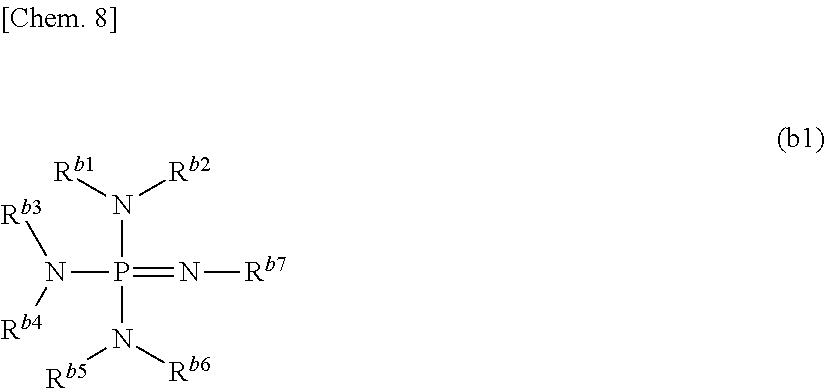
- the phosphazene compound is preferably a compound in which at least two compounds represented by the following formula (b1) or structures represented by the following formula (b1) are connected to each other, and more preferably a compound in which at least two structures represented by the following formula (b1) are connected to each other:
- R b1 to R b7 each independently represent a monovalent organic group which may include a hydrogen or a hetero atom, and at least two of R b1 to R b7 may be bonded to each other to form a ring.
- the monovalent organic group which may include a hetero atom of R b1 to R b7 preferably has 1 or more and 20 or less carbon atoms, more preferably 1 or more and 10 or less carbon atoms, and still more preferably 1 or more and 6 or less carbon atoms.
- Examples of the organic group include an alkyl group, an arylalkyl group and the like, which may include a hetero atom.
- the alkyl group which may include a hetero atom may be linear, branched or cyclic and examples thereof include alkyl groups having 1 or more and 12 or less carbon atoms (preferably having 1 or more and 10 or less carbon atoms, and more preferably having 1 or more and 6 or less carbon atoms), and specific examples thereof include a methyl group, an ethyl group, an n-propyl group, an isopropyl group, an n-butyl group, an isobutyl group, a sec-butyl group, a tert-butyl group, a cyclobutyl group, an n-pentyl group, an isopentyl group, a sec-pentyl group, a tert-pentyl group, a neopentyl group, a 2-methylbutyl group, a 1,2-dimethylpropyl group, a 1-ethylpropyl group, a cyclopentyl group, an
- alkyl groups for example, linear, branched or cyclic alkyl groups having 1 or more and 4 or less carbon atoms such as a methyl group, an ethyl group, an n-propyl group, an isopropyl group, an n-butyl group, an isobutyl group, a sec-butyl group, a tert-butyl group and a cyclobutyl group are preferable.
- arylalkyl group which may have a hetero atom examples include arylalkyl groups having 7 or more and 15 or less carbon atoms, and specific examples thereof include a benzyl group, a phenethyl group, a methylbenzyl group, a phenylpropyl group, a 1-methylphenylethyl group, a phenylbutyl group, a 2-methylphenylpropyl group, a tetrahydronaphthyl group, a naphthylmethyl group, a naphthylethyl group, an indenyl group, a fluorenyl group, an anthracenylmethyl group (anthrylmethyl group), a phenanthrenylmethyl group (phenanthrylmethyl group) and the like.
- arylalkyl groups having 7 carbon atoms such as a benzyl group are preferable.
- Examples of the hetero atom which can be possessed by the monovalent organic group of R b1 to R b7 include a nitrogen atom, an oxygen atom, a phosphorus atom or a sulfur atom. It is preferable that the hetero atom is bonded to a carbon atom and does not constitute an acid functional group such as a carboxyl group or a sulfone group. It is preferable that R b7 is not a hydrogen atom.
- Examples of the ring which can be formed by at least two of R b1 to R b7 include a five-membered ring, a six-membered ring or a seven-membered ring, and the ring is preferably a six-membered ring.
- the compound in which at least two structures represented by the above formula (b1) are connected to each other is preferably a compound in which two or more and six or less structures represented by the above formula (b1) are connected to each other, more preferably a compound in which two or more and four or less structures represented by the above formula (b1) are connected to each other, and still more preferably a compound in which two or three structures represented by the above formula (b1) are connected to each other.
- the aspect in which at least two structures represented by the above formula (b1) are connected to each other is preferably an aspect in which one structure represented by the above formula (b1) and the other structure represented by the above formula (b1) are connected so as to share one nitrogen atom in the above formula (b1).
- a molecular weight (Mw) of the phosphazene compound is, for example, 120 to 900 and is preferably 250 to 600, and more preferably 300 to 500, from the viewpoint of curability or residual film properties.
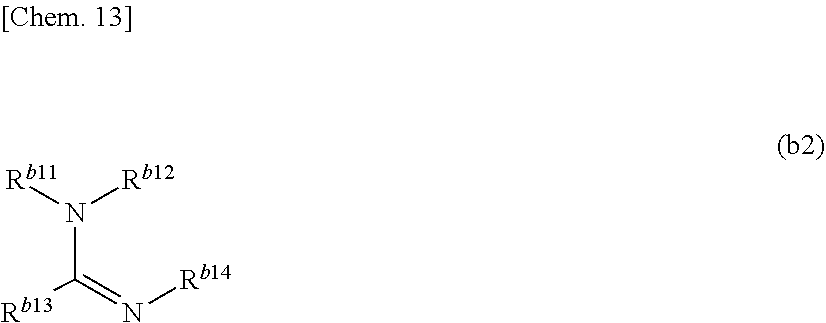
- amidine compound is preferably a compound represented by the following formula (b2):
- R b11 to R b14 each independently represent a monovalent organic group which may include a hydrogen or hetero atom
- at least one of R b11 to R b14 represents a monovalent organic group which may include a hetero atom
- at least two of R b11 to R b14 may be bonded to each other to form a ring.
- Specific examples and preferred examples of the monovalent organic group which may include a hetero atom of R b11 to R b14 include those which are the same as mentioned above as the monovalent organic group which may include a hetero atom of R b1 to R b7 .
- Examples of the hetero atom which can be possessed by the monovalent organic group of R b11 to R b14 include a nitrogen atom, an oxygen atom, a phosphorus atom or a sulfur atom. It is preferable that the hetero atom is bonded to a carbon atom and does not constitute an acid functional group such as a carboxyl group or a sulfone group. It is preferable that R b14 is not a hydrogen atom.
- Examples of the ring which can be formed by at least two of R b1 to R b14 include a five-membered ring, a six-membered ring or a seven-membered ring, and the ring is preferably a six-membered ring or a seven-membered ring.
- Amidine including at least one ring structure i.e., cyclic amidine
- Cyclic amidine including two ring structures i.e., dicyclic amidine
- the amidine compound is more preferably a compound represented by the following formula (b2-1):
- r represents an integer of 1 or more and 3 or less.
- amidine compound examples include 1,2-dimethyl-1,4,5,6-tetrahydropyrimidine, 1-ethyl-2-methyl-1,4,5,6-tetrahydropyrimidine, 1,2-diethyl-1,4,5,6-tetrahydropyrimidine, 1-n-propyl-2-methyl-1,4,5,6-tetrahydropyrimidine, 1-isopropyl-2-methyl-1,4,5,6-tetrahydropyrimidine, 1-ethyl-2-n-propyl-1,4,5,6-tetrahydropyrimidine, 1-ethyl-2-isopropyl-1,4,5,6-tetrahydropyrimidine, DBU (i.e., 1,8-diazabicyclo[5.4.0]-7-undecene), DBN (i.e., 1,5-diazabicyclo[4.3.0]-5-nonene) and those analogous thereto, and combinations thereof.
- DBU i.e., 1,8-di
- amidine examples include 1,2-dimethyl-1,4,5,6-tetrahydropyrimidine, DBU (i.e., 1,8-diazabicyclo[5.4.0]-7-undecene), DBN (i.e., 1,5-diazabicyclo[4.3.0]-5-nonene) and combinations thereof.
- DBU i.e., 1,8-diazabicyclo[5.4.0]-7-undecene
- DBN i.e., 1,5-diazabicyclo[4.3.0]-5-nonene
- the amidine is more preferably DBU, DBN and a combination thereof, and most preferably DBU.
- the base generator (B) is composed of a cation moiety and an anion moiety as is apparent from the above formula (1), and a constitutional molar ratio of the cation moiety and the anion moiety, for example, cation moiety:anion moiety is in a range of 1:1 to 1:2, and preferably 1:1 to 1:1.5.
- the base generator (B) in the energy-sensitive composition may be included alone or in combination of two or more.
- the content of the base generator (B) in the energy-sensitive composition is preferably 0.01% by mass or more and 40% by mass or less, more preferably 0.1% by mass or more and 20% by mass or less, and still more preferably 1% by mass or more and 10% by mass or less, based on the mass of the entire composition (excluding a solvent).
- the content of the base generator (B) in the energy-sensitive composition is, for example, 0.1 part by mass or more and 30 parts by mass or less, preferably 0.5 part by mass or more and 20 parts by mass or less, and more preferably 1 part by mass or more and 15 parts by mass or less, when the contents of the silane compound monomer, the silane compound oligomer and the polysilane compound are 100 parts by mass.
- the base generator (B) can be produced by mixing an acid represented by the following formula (K) with the base having a pKa of 24 or more under optional conditions, followed by a reaction (for example, neutralization reaction).
- the energy-sensitive composition according to the first aspect may further include an acid so as to improve the stability.
- the acid is preferably conjugate acid which is the anion moiety in a base generator represented by the above formula (1), and specifically an acid represented by the following formula (K):
- R 1 to R 11 are the same as R 1 to R 11 defined in the above formula (1).
- Examples of the acid other than the conjugate acid include any organic acid or inorganic acid, and the acid is preferably an organic acid.
- Examples of the acid other than the conjugate acid include monovalent or divalent or higher multivalent organic acid having 1 or more and 30 or less carbon atoms, and specific examples thereof include formic acid, acetic acid, propionic acid, butanoic acid, pentanoic acid, hexanoic acid, heptanoic acid, octanoic acid, nonanoic acid, decanoic acid, oleic acid, stearic acid, linoleic acid, linolenic acid, benzoic acid, phthalic acid, isophthalic acid, terephthalic acid, salicylic acid, trifluoroacetic acid, monochloroacetic acid, dichloroacetic acid, trichloroacetic acid, oxalic acid, malonic acid, methylmalonic acid, ethylmalonic acid, propylmal
- the energy-sensitive composition according to the first aspect may include the above acid or not and, when including the acid, the amount of the acid used is usually 0.001% by mass or more and 10% by mass or less, and preferably 0.01% by mass or more and 5% by mass or less, based on the solid content (mass excluding a solvent) of the energy-sensitive composition.
- a use ratio of the base generator (B) to the acid in the composition for example, base generator (B):acid is 1:0.003 to 1:3.5, and preferably 1:0.01 to 1:3, in terms of a molar ratio.
- base generator (B):acid is more preferably 1:0.003 to 1:1 from the viewpoint of the stability of the composition.
- an adjustment may be made such that the pH of the energy-sensitive composition according to the first aspect is, for example, in a range of 4 or higher and 9 or lower, and preferably 5 or higher and 7 or lower.
- the composition according to the first aspect preferably includes a solvent.
- the solvent include cyclic skeleton-containing acetate compounds represented by the below-mentioned formula (S1), such as cycloalkyl acetate, alcohols such as methanol, ethanol, propanol and n-butanol;
- polyhydric alcohols such as ethylene glycol, diethylene glycol, propylene glycol and dipropylene glycol
- ketones such as acetone, methyl ethyl ketone, cyclohexanone, methyl-n-amyl ketone, methyl isoamyl ketone and 2-heptanone;
- lactone ring-containing organic solvents such as ⁇ -butyrolatone
- derivatives of polyhydric alcohols for example, compounds having an ester bond, such as ethylene glycol monoacetate, diethylene glycol monoacetate, propylene glycol monoacetate or dipropylene glycol monoacetate, and compounds having an ether bond, such as monoalkyl ethers or monophenyl ethers, such as monomethyl ether, monoethyl ether, monopropyl ether and monobutyl ether of the polyhydric alcohols or the compounds having the ester bond; cyclic ethers such as dioxane, and esters such as methyl lactate, ethyl lactate, methyl acetate, ethyl acetate, butyl acetate, methyl pyruvate, ethyl pyruvate, methyl methoxypropionate and ethyl ethoxypropionate; aromatic organic solvents such as anisole, ethylbenzyl ether, cresyl methyl ether, diphenyl
- cycloalkyl acetate represented by the below-mentioned formula (S1), propylene glycol monomethyl ether acetate (PGMEA), propylene glycol monomethyl ether (PGME), N,N,N′,N′-tetramethylurea (TMU) and butanol are preferable, cyclopropyl acetate, cyclobutyl acetate, cyclopentyl acetate, cyclohexyl acetate, cycloheptyl acetate or cyclooctyl acetate is more preferable, and cyclohexyl acetate is still more preferable.
- These solvents may be used alone or in combination of two or more.
- R s1 each independently represent an alkyl group
- p is an integer of 1 or more and 6 or less
- q is an integer of 0 or more and (p+1) or less.
- alkyl group represented by R s1 include alkyl groups having 1 or more and 3 or less carbon atoms, and specific examples thereof include a methyl group, an ethyl group, an n-propyl group and an i-propyl group.
- cycloalkyl acetate represented by the formula (S1) include cyclopropyl acetate, cyclobutyl acetate, cyclopentyl acetate, cyclohexyl acetate, cycloheptyl acetate and cyclooctyl acetate.
- cyclooctyl acetate is preferable from the viewpoint of availability and the like.
- the cyclic skeleton-containing acetate compound may be used alone or in combination of two or more.
- the content of the solvent in the energy-sensitive composition according to the first aspect is not particularly limited as long as it does not interfere with the object of the present invention.
- the solvent is used such that the solid component concentration of the energy-sensitive composition according to the first aspect is preferably 0.1% by mass or more and 50% by mass or less, and more preferably 1% by mass or more and 40% by mass or less.
- the solvent may be used alone or in combination of two or more.
- the energy-sensitive composition according to the first aspect may include, as the stabilizer, a monohydric or dihydric or higher polyhydric alcohol which has a cyclic ether as a substituent, or an ether compound.
- a monohydric or dihydric or higher polyhydric alcohol which has a cyclic ether as a substituent, or an ether compound.
- usable stabilizer include stabilizers mentioned in Japanese Unexamined Patent Application, Publication No. 2009-126940, paragraphs (0180) to (0184).
- the energy-sensitive composition according to the first aspect may include water.
- the addition of water leads to an improvement in lithographic performance.
- the content of water in a solvent component of the energy-sensitive composition according to the first aspect is, for example, 0% by mass or more and less than 50% by mass, and preferably 0.5% by mass or more and 5% by mass or less.
- the energy-sensitive composition according to the first aspect may optionally include a surfactant.
- a surfactant include surfactants mentioned in Japanese Unexamined Patent Application, Publication No. 2009-126940, paragraph (0185).
- the energy-sensitive composition according to the first aspect can be used in applications for formation of a protective film or an interlayer film which protects various substrates (including a metal oxide-containing film, various metals-containing films).
- substrates for display materials including a metal oxide-containing film, a film containing various metals
- substrates for solar cells such as a semiconductor substrate, a liquid crystal display, an organic light-emitting display (OLED), an electrophoretic display (electronic paper), a touch panel, a color filter, and a back light
- substrates for solar cells substrates for photoelectric conversion elements (including a metal oxide-containing film, a film containing various metals) such as an optical sensor
- substrates for photoelectric elements including a metal oxide-containing film, a film containing various metals).
- the cured product according to the second aspect is a cured product of the energy-sensitive composition according to the first aspect.
- the thickness is preferably 10 nm or more and 10,000 nm or less, more preferably 50 nm or more and 5,000 nm or less, and still more preferably 100 nm or more and 3,000 nm or less.
- a residual film ratio after the below-mentioned development is preferably 50% or more, more preferably 55% or more, still more preferably 60% or more, particularly preferably 65% or more, and most preferably 70% or more.
- the cured product is suitable for various applications, for example, sealing material for OLED display element, OLED lightings, hard coats, insulating films, antireflective films, interlayer insulating films, carbon hard masks, display panel materials (flattened films, pixels for color filter, barrier ribs for organic EL, spacers) and the like.
- the cured product is preferably used as a transparent coating film for covering a metal wiring in display elements such as touch panel.
- the pattern forming method according to the third aspect includes applying the energy-sensitive composition according to the first aspect onto a substrate to form a film, and exposing the film.
- the method of forming a film using the energy-sensitive composition according to the first aspect is not particularly limited as long as the effects of the present invention are not impaired, and includes a method of applying the energy-sensitive composition onto an optional support, using optionally contact transfer coating applicators such as a roll coater, a reverse coater, a bar coater and an inkjet; and on-contact applicators such as a spinner (rotary applicator) and a curtain flow coater.
- the substrate examples include, but are not limited to, a glass substrate, a quartz substrate, a transparent or translucent resin substrate (for example, heat-resistant materials such as polycarbonate, polyethylene terephthalate, polyether sulfone, polyimide, and polyamideimide), metal, a silicon substrate and the like.
- a transparent or translucent resin substrate for example, heat-resistant materials such as polycarbonate, polyethylene terephthalate, polyether sulfone, polyimide, and polyamideimide
- metal a silicon substrate and the like.
- the substrate may be various substrates, for example, substrates for display materials (including a metal oxide-containing film, a film containing various metals) such as a semiconductor substrate, a liquid crystal display, an organic light-emitting display (OLED), an electrophoretic display (electronic paper), a touch panel, a color filter, and a back light; substrates for solar cells; substrates for photoelectric conversion elements (including a metal oxide-containing film, a film containing various metals) such as an optical sensor; and substrates for photoelectric devices (including a metal oxide-containing film, a film containing various metals).
- the thickness of the substrate is not particularly limited and can be appropriately selected according to embodiment of usage of a pattern forming material.
- the coating film is preferably dried (prebaked).
- the drying method is not particularly limited and includes, for example, (1) a method of drying with a hot plate at a temperature of 80° C. or higher and 180° C. or lower, and preferably 90° C. or higher and 160° C. or lower, for 60 seconds or more and 120 seconds or less, (2) a method of allowing to stand at room temperature for several hours to several days, (3) a method of placing in a hot-air heater or an infrared heater for several tens of minutes to several hours to remove the solvent and the like.
- the coating film may be exposed by irradiating with radiation.
- radiation include active energy rays such as ultraviolet rays and excimer laser beams
- a light source of the radiation include light sources emitting ultraviolet rays, such as a high pressure mercury lamp, an ultra-high pressure mercury lamp, a xenon lamp and a carbon arc lamp.
- the irradiation dose is not particularly limited and is, for example, 30 mJ/cm 2 or more and 2,000 mJ/cm 2 or less.
- the exposure step may be performed in place of or together with the below-mentioned baking step. In the exposure step, for example, the thus formed coating film may be selectively exposed and, when including the selective exposure step, the developing step may also be included.
- the thus formed coating film may be subjected to imprint lithography.
- imprint lithography there is exemplified, for example, a method including the steps of: applying the energy-sensitive composition according to the first aspect onto a substrate to form a coating film, pressing a mold, on which an irregular structure of a predetermined pattern is formed, against the coating film, and performing exposure.
- the exposure step is performed against the coating film composed of the energy-sensitive composition according to the first aspect in a state where the mold is pressed against the coating film. After curing by exposure, the mold is peeled off, thus making it possible to form a pattern according to a shape of the mold.
- a pattern having a satisfactory shape can be formed without heating (PEB), and the exposed film may be subjected to PEB.
- PEB is performed, for example, at 80° C. or higher and 180° C. or lower for 30 seconds or more and 120 seconds or less.
- the film is preferably developed to form a pattern after exposure.
- the development can be performed using an alkali developing solution or a developing solution containing an organic solvent, and it is more preferable that the development is performed using a developing solution containing an organic solvent.
- the organic solvent contained in the developing solution include those which are the same as specific examples and preferred examples of the ⁇ solvent> in the composition according to the first aspect.
- the coating film is preferably baked (post-baked) in view of enhancing film physical properties.
- the baking temperature is, for example, in a range of 200° C. or higher and 1,000° C. or lower, and preferably 230° C. or higher and 700° C. or lower, in view of an improvement in pencil hardness and an enhancement in permanent film properties or a decrease in dielectric constant, although it depends on a lower layer substrate and embodiment of usage. More preferably, the baking temperature may be appropriately adjusted in a range of 250° C. or higher and 600° C. or lower.
- the baking atmosphere is not particularly limited and may be an inert gas atmosphere such as a nitrogen atmosphere or argon atmosphere, or may be under vacuum or reduced pressure. The baking atmosphere may be under the atmosphere, or the oxygen concentration may be appropriately controlled.
- the baking time may be appropriately changed, and is 10 minutes or more and 120 minutes or less.
- the thickness of the film formed by the method according to the third aspect is preferably 10 nm or more and 10,000 nm or less, more preferably 50 nm or more and 5,000 nm or less, and still more preferably 100 nm or more and 3,000 nm or less.
- polydiphenylsilane (Mw of 2,600) was produced in accordance with the method mentioned in JACS, 110, 124 (1998) and Macromolecules, 23, 3423 (1990) and used as a polysilane compound 1 in the following respective Examples and Comparative Example 1.
- each of the energy-sensitive compositions of the respective Examples and Comparative Example 1 was applied onto a wafer to form a coating film having a thickness of 3 ⁇ m.
- the coating film was baked at 140° C. for 30 seconds to obtain a cured coating film.
- the cured coating film thus obtained was subjected to a developing treatment with a solvent (cyclohexyl acetate) by a dipping method for 60 seconds.
- a profilometer trade name: Dektak 3ST, manufactured by ULVAC, Inc.
- a residual film ratio which is a ratio of the thickness before and after the development, was measured. The results are shown in Table 1.
- Example 1 100% Example 2 (b2) 67% Example 3 (b3) 55% Example 4 (b4) 63% Example 5 (b5) 95% Comparative Example 1 (cb) 0%
- Comparative Example 1 in which a pKa of the base constituting a counter cation in a base generator is less than 24 is inferior in curability since a residual film ratio after the development is 0%.
- all of Examples 1 to 4 in which a pKa of the base constituting a counter cation in a base generator is 24 or more are excellent in curability since a residual film ratio after the development is 55% or more.
- Example 4 and Example 5 patterning was evaluated.
- each of the energy-sensitive compositions of Example 1 and Example 5 was applied onto a wafer to form a coating film having a thickness of 3 ⁇ m.
- the coating film was subjected to regioselective broadband exposure at 250 mJ/cm 2 by an ultraviolet aligner using a mask having a line width of 4 ⁇ m and a line-and-space of 1:1.
- the exposed coating film was baked at 160° C. for 30 seconds to obtain a cured coating film.
- the cured coating film thus obtained was subjected to a developing treatment with a solvent (cyclohexyl acetate) by a dipping method for 60 seconds.
- a solvent cyclohexyl acetate
- each of the energy-sensitive compositions of Example 6 and Example 7 was applied onto a wafer to form a coating film having a thickness of 3 ⁇ m.
- the coating film was subjected to regioselective broadband exposure at 250 mJ/cm 2 by an ultraviolet aligner using a mask having a line width of 4 ⁇ m and a line-and-space of 1:1.
- the exposed coating film was baked at 160° C. for 30 second to obtain a cured coating film.
- the cured coating film thus obtained was subjected to a developing treatment with a solvent (acetone) by a dipping method for 60 seconds.
Landscapes
- Chemical & Material Sciences (AREA)
- Organic Chemistry (AREA)
- Physics & Mathematics (AREA)
- General Physics & Mathematics (AREA)
- Health & Medical Sciences (AREA)
- Life Sciences & Earth Sciences (AREA)
- Spectroscopy & Molecular Physics (AREA)
- Biochemistry (AREA)
- Molecular Biology (AREA)
- General Health & Medical Sciences (AREA)
- Chemical Kinetics & Catalysis (AREA)
- Polymers & Plastics (AREA)
- Medicinal Chemistry (AREA)
- Wood Science & Technology (AREA)
- Materials Engineering (AREA)
- Engineering & Computer Science (AREA)
- Materials For Photolithography (AREA)
- Silicon Polymers (AREA)
- Exposure And Positioning Against Photoresist Photosensitive Materials (AREA)
- Nitrogen Condensed Heterocyclic Rings (AREA)
- Pyrane Compounds (AREA)
- Organic Low-Molecular-Weight Compounds And Preparation Thereof (AREA)
- Addition Polymer Or Copolymer, Post-Treatments, Or Chemical Modifications (AREA)
Abstract
Description


Xn1SiR4-n1 (a)


(Ra21Ra22Ra23Si)a1(Ra24Ra25Si)a2(Ra26Si)a3(Si)a4 (A-2-1)




(Amidine Compound)


cyclic ethers such as dioxane, and esters such as methyl lactate, ethyl lactate, methyl acetate, ethyl acetate, butyl acetate, methyl pyruvate, ethyl pyruvate, methyl methoxypropionate and ethyl ethoxypropionate;
aromatic organic solvents such as anisole, ethylbenzyl ether, cresyl methyl ether, diphenyl ether, dibenzyl ether, phenetole, butylphenyl ether, ethylbenzene, diethylbenzene, amylbenzene, isopropylbenzene, toluene, xylene, cymene and mesitylene;
nitrogen-containing organic solvents such as N,N,N′,N′-tetramethylurea, N,N,2-trimethylpropionamide, N,N-dimethylacetamide, N,N-dimethylforamide, N,N-diethylacetamide, N,N-diethylformamide, 1,3-dimethyl-2-imidazolidinone, N-methylpyrrolidone and N-ethylpyrrolidone;
and the like.


| TABLE 1 | |||
| Base generator | Residual film ratio | ||
| Example 1 | (b1) | 100% |
| Example 2 | (b2) | 67% |
| Example 3 | (b3) | 55% |
| Example 4 | (b4) | 63% |
| Example 5 | (b5) | 95% |
| Comparative Example 1 | (cb) | 0% |
Claims (10)


Xn1SiR4-n1 (a)

Xn1SiR4-n1 (a)
Applications Claiming Priority (3)
| Application Number | Priority Date | Filing Date | Title |
|---|---|---|---|
| JP2018-086838 | 2018-04-27 | ||
| JP2018086838 | 2018-04-27 | ||
| JPJP2018-086838 | 2018-04-27 |
Publications (2)
| Publication Number | Publication Date |
|---|---|
| US20190332010A1 US20190332010A1 (en) | 2019-10-31 |
| US11106132B2 true US11106132B2 (en) | 2021-08-31 |
Family
ID=68292210
Family Applications (1)
| Application Number | Title | Priority Date | Filing Date |
|---|---|---|---|
| US16/390,429 Expired - Fee Related US11106132B2 (en) | 2018-04-27 | 2019-04-22 | Energy-sensitive composition, cured product, and pattern forming method |
Country Status (4)
| Country | Link |
|---|---|
| US (1) | US11106132B2 (en) |
| JP (1) | JP7421186B2 (en) |
| KR (1) | KR20190125183A (en) |
| TW (1) | TWI809095B (en) |
Families Citing this family (6)
| Publication number | Priority date | Publication date | Assignee | Title |
|---|---|---|---|---|
| JP2022075178A (en) * | 2020-11-06 | 2022-05-18 | 東京応化工業株式会社 | Energy-sensitive composition, cured product, method for forming cured product, thermal base generator, and compound |
| JP2022075179A (en) | 2020-11-06 | 2022-05-18 | 東京応化工業株式会社 | Energy-sensitive composition, cured product, method for forming cured product, thermal base generator, and compound |
| JP2022075180A (en) | 2020-11-06 | 2022-05-18 | 東京応化工業株式会社 | Energy-sensitive composition, cured product, and method for forming cured product |
| JP7635930B2 (en) | 2020-11-06 | 2025-02-26 | 東京応化工業株式会社 | Energy-sensitive composition, cured product, and method for forming patterned cured product |
| JP7623678B2 (en) * | 2020-12-15 | 2025-01-29 | 日東化成株式会社 | Moisture-curable composition containing a curing catalyst for use in curing polymers, and method for producing the cured product |
| JP7583603B2 (en) * | 2020-12-18 | 2024-11-14 | フジコピアン株式会社 | Resin composition |
Citations (6)
| Publication number | Priority date | Publication date | Assignee | Title |
|---|---|---|---|---|
| US6174982B1 (en) * | 1996-12-27 | 2001-01-16 | Osaka Gas Company Limited | Process for the preparation of polysilanes |
| US20030036015A1 (en) * | 2001-05-09 | 2003-02-20 | Fedynyshyn Theodore H. | Resist with reduced line edge roughness |
| US20040259029A1 (en) * | 2003-06-23 | 2004-12-23 | Nec Electronics Corporation | Chemically amplified resist composition and manufacturing method of semiconductor integrated circuit device with such chemically amplified resist composition |
| WO2014208632A1 (en) | 2013-06-28 | 2014-12-31 | 和光純薬工業株式会社 | Base generator, base-reactive composition containing said base generator, and base generation method |
| WO2017007010A1 (en) | 2015-07-09 | 2017-01-12 | 東京応化工業株式会社 | Silicon-containing resin composition |
| US20170184964A1 (en) * | 2015-12-28 | 2017-06-29 | Shin-Etsu Chemical Co., Ltd. | Resist composition and patterning process |
Family Cites Families (8)
| Publication number | Priority date | Publication date | Assignee | Title |
|---|---|---|---|---|
| JP3274918B2 (en) * | 1993-10-20 | 2002-04-15 | 日本ペイント株式会社 | Polysilane-based photosensitive resin composition and pattern forming method using the same |
| JPH08305028A (en) * | 1995-04-28 | 1996-11-22 | Toshiba Corp | Resist |
| JP3628098B2 (en) * | 1996-03-29 | 2005-03-09 | ダウ コーニング アジア株式会社 | Radiation curable composition and method for producing cured product pattern using the same |
| JP4646439B2 (en) * | 2001-05-23 | 2011-03-09 | 大阪瓦斯株式会社 | Photopolymerizable resin composition, cured product thereof and production method |
| JP5561693B2 (en) * | 2009-09-08 | 2014-07-30 | 学校法人東京理科大学 | Novel compound, base generator and photosensitive resin composition containing the base generator |
| US10212950B2 (en) * | 2013-02-26 | 2019-02-26 | J-Oil Mills, Inc. | Composition, batter material using same, food or drink and feed, and method of producing composition |
| KR102501454B1 (en) * | 2014-10-17 | 2023-02-20 | 다이요 잉키 세이조 가부시키가이샤 | Dry film and flexible printed wiring board |
| CN104844564A (en) * | 2015-04-15 | 2015-08-19 | 江南大学 | Latent type photoinduced decarboxylation photobase generator and preparation method thereof |
-
2019
- 2019-04-22 US US16/390,429 patent/US11106132B2/en not_active Expired - Fee Related
- 2019-04-22 JP JP2019081072A patent/JP7421186B2/en active Active
- 2019-04-22 KR KR1020190046731A patent/KR20190125183A/en active Pending
- 2019-04-24 TW TW108114281A patent/TWI809095B/en active
Patent Citations (8)
| Publication number | Priority date | Publication date | Assignee | Title |
|---|---|---|---|---|
| US6174982B1 (en) * | 1996-12-27 | 2001-01-16 | Osaka Gas Company Limited | Process for the preparation of polysilanes |
| US20030036015A1 (en) * | 2001-05-09 | 2003-02-20 | Fedynyshyn Theodore H. | Resist with reduced line edge roughness |
| US20040259029A1 (en) * | 2003-06-23 | 2004-12-23 | Nec Electronics Corporation | Chemically amplified resist composition and manufacturing method of semiconductor integrated circuit device with such chemically amplified resist composition |
| WO2014208632A1 (en) | 2013-06-28 | 2014-12-31 | 和光純薬工業株式会社 | Base generator, base-reactive composition containing said base generator, and base generation method |
| US20160122292A1 (en) | 2013-06-28 | 2016-05-05 | Tokyo University Of Science Foundation | Base generator, base-reactive composition containing said base generator, and base generation method |
| WO2017007010A1 (en) | 2015-07-09 | 2017-01-12 | 東京応化工業株式会社 | Silicon-containing resin composition |
| US20180187010A1 (en) | 2015-07-09 | 2018-07-05 | Tokyo Ohka Kogyo Co., Ltd. | Silicon-containing resin composition |
| US20170184964A1 (en) * | 2015-12-28 | 2017-06-29 | Shin-Etsu Chemical Co., Ltd. | Resist composition and patterning process |
Non-Patent Citations (1)
| Title |
|---|
| English Machine Translation of Chisaka WO-2017/007010-A1 (Jan. 2017) (Year: 2017). * |
Also Published As
| Publication number | Publication date |
|---|---|
| JP2019194692A (en) | 2019-11-07 |
| KR20190125183A (en) | 2019-11-06 |
| TW201947324A (en) | 2019-12-16 |
| US20190332010A1 (en) | 2019-10-31 |
| JP7421186B2 (en) | 2024-01-24 |
| TWI809095B (en) | 2023-07-21 |
Similar Documents
| Publication | Publication Date | Title |
|---|---|---|
| US11106132B2 (en) | Energy-sensitive composition, cured product, and pattern forming method | |
| CN103995437B (en) | Negative-type photosensitive silicone composition | |
| JP6466087B2 (en) | Negative photosensitive composition that can be cured at low temperature | |
| KR100881544B1 (en) | Radiation-sensitive permittivity variable composition and method for forming dielectric constant pattern | |
| JP6816946B2 (en) | A composition for forming a silica-based film, a method for producing a silica-based film, and an electronic device containing the silica-based film. | |
| KR20150097550A (en) | Composition for forming silicon-containing resist underlayer film having cyclic diester group | |
| JP6272753B2 (en) | Negative photosensitive siloxane composition | |
| JPWO2013151166A1 (en) | Negative photosensitive siloxane composition | |
| JP7257134B2 (en) | Positive photosensitive composition, pattern cured film and method for producing the same | |
| JP7504348B2 (en) | Light or heat curing method and curable resin composition | |
| US10767017B2 (en) | Resin composition, method for producing resin composition, film formation method, and cured product | |
| JP3414708B2 (en) | Method of forming patterned polysilazane film | |
| US12099297B2 (en) | Energy-sensitive composition, cured product, and forming method of patterned cured product | |
| US11905433B2 (en) | Energy-sensitive composition, cured product, and forming method of cured product | |
| JP2020024984A (en) | Positive photosensitive die bond agent for chip bonding, near ultraviolet curable substrate adhesive, and method for manufacturing chip using positive photosensitive die bond agent | |
| CN119546616A (en) | Method for producing branched organopolysiloxane containing phenolic hydroxyl group | |
| US20220144745A1 (en) | Energy-sensitive composition, cured product, forming method of cured product, thermal base generator and compound | |
| JP3562569B2 (en) | Crosslinkable silicon-based polymer composition, composition for antireflection film and antireflection film | |
| US20220145125A1 (en) | Energy-sensitive composition, cured product, forming method of cured product, thermal base generator and compound | |
| JP3414710B2 (en) | Method for firing photosensitive polysilazane coating film | |
| JP2021104490A (en) | Deoxidant, deoxidant solution, deoxidant film, and deoxidant film manufacturing method | |
| JP2856916B2 (en) | Method of forming electronic circuit | |
| JP2009056736A (en) | Method of producing structure, and structure | |
| TW201126754A (en) | Method for producing semoconductor light-emitting element, and photosensitive composition used for the method for producing semiconductor light-emitting element |
Legal Events
| Date | Code | Title | Description |
|---|---|---|---|
| FEPP | Fee payment procedure |
Free format text: ENTITY STATUS SET TO UNDISCOUNTED (ORIGINAL EVENT CODE: BIG.); ENTITY STATUS OF PATENT OWNER: LARGE ENTITY |
|
| AS | Assignment |
Owner name: TOKYO OHKA KOGYO CO., LTD., JAPAN Free format text: ASSIGNMENT OF ASSIGNORS INTEREST;ASSIGNORS:NODA, KUNIHIRO;SHIOTA, DAI;ARIMITSU, KOJI;SIGNING DATES FROM 20190422 TO 20190516;REEL/FRAME:049199/0478 Owner name: TOKYO UNIVERSITY OF SCIENCE FOUNDATION, JAPAN Free format text: ASSIGNMENT OF ASSIGNORS INTEREST;ASSIGNORS:NODA, KUNIHIRO;SHIOTA, DAI;ARIMITSU, KOJI;SIGNING DATES FROM 20190422 TO 20190516;REEL/FRAME:049199/0478 |
|
| STPP | Information on status: patent application and granting procedure in general |
Free format text: DOCKETED NEW CASE - READY FOR EXAMINATION |
|
| STPP | Information on status: patent application and granting procedure in general |
Free format text: RESPONSE TO NON-FINAL OFFICE ACTION ENTERED AND FORWARDED TO EXAMINER |
|
| STPP | Information on status: patent application and granting procedure in general |
Free format text: FINAL REJECTION MAILED |
|
| STPP | Information on status: patent application and granting procedure in general |
Free format text: RESPONSE AFTER FINAL ACTION FORWARDED TO EXAMINER |
|
| STPP | Information on status: patent application and granting procedure in general |
Free format text: NOTICE OF ALLOWANCE MAILED -- APPLICATION RECEIVED IN OFFICE OF PUBLICATIONS |
|
| STCF | Information on status: patent grant |
Free format text: PATENTED CASE |
|
| FEPP | Fee payment procedure |
Free format text: MAINTENANCE FEE REMINDER MAILED (ORIGINAL EVENT CODE: REM.); ENTITY STATUS OF PATENT OWNER: LARGE ENTITY |
|
| LAPS | Lapse for failure to pay maintenance fees |
Free format text: PATENT EXPIRED FOR FAILURE TO PAY MAINTENANCE FEES (ORIGINAL EVENT CODE: EXP.); ENTITY STATUS OF PATENT OWNER: LARGE ENTITY |
|
| STCH | Information on status: patent discontinuation |
Free format text: PATENT EXPIRED DUE TO NONPAYMENT OF MAINTENANCE FEES UNDER 37 CFR 1.362 |
|
| FP | Lapsed due to failure to pay maintenance fee |
Effective date: 20250831 |