US11033066B2 - Orthotic insole for a woman's shoe - Google Patents
Orthotic insole for a woman's shoe Download PDFInfo
- Publication number
- US11033066B2 US11033066B2 US15/085,432 US201615085432A US11033066B2 US 11033066 B2 US11033066 B2 US 11033066B2 US 201615085432 A US201615085432 A US 201615085432A US 11033066 B2 US11033066 B2 US 11033066B2
- Authority
- US
- United States
- Prior art keywords
- insole
- layer
- shoe
- wearer
- length
- Prior art date
- Legal status (The legal status is an assumption and is not a legal conclusion. Google has not performed a legal analysis and makes no representation as to the accuracy of the status listed.)
- Active, expires
Links
Images




Classifications
-
- A—HUMAN NECESSITIES
- A43—FOOTWEAR
- A43B—CHARACTERISTIC FEATURES OF FOOTWEAR; PARTS OF FOOTWEAR
- A43B3/00—Footwear characterised by the shape or the use
- A43B3/0036—Footwear characterised by the shape or the use characterised by a special shape or design
- A43B3/0063—U-shaped
-
- A—HUMAN NECESSITIES
- A43—FOOTWEAR
- A43B—CHARACTERISTIC FEATURES OF FOOTWEAR; PARTS OF FOOTWEAR
- A43B13/00—Soles; Sole-and-heel integral units
- A43B13/38—Built-in insoles joined to uppers during the manufacturing process, e.g. structural insoles; Insoles glued to shoes during the manufacturing process
- A43B13/41—Built-in insoles joined to uppers during the manufacturing process, e.g. structural insoles; Insoles glued to shoes during the manufacturing process combined with heel stiffener, toe stiffener, or shank stiffener
-
- A—HUMAN NECESSITIES
- A43—FOOTWEAR
- A43B—CHARACTERISTIC FEATURES OF FOOTWEAR; PARTS OF FOOTWEAR
- A43B17/00—Insoles for insertion, e.g. footbeds or inlays, for attachment to the shoe after the upper has been joined
- A43B17/003—Insoles for insertion, e.g. footbeds or inlays, for attachment to the shoe after the upper has been joined characterised by the material
- A43B17/006—Insoles for insertion, e.g. footbeds or inlays, for attachment to the shoe after the upper has been joined characterised by the material multilayered
-
- A—HUMAN NECESSITIES
- A43—FOOTWEAR
- A43B—CHARACTERISTIC FEATURES OF FOOTWEAR; PARTS OF FOOTWEAR
- A43B7/00—Footwear with health or hygienic arrangements
- A43B7/14—Footwear with health or hygienic arrangements with foot-supporting parts
- A43B7/1405—Footwear with health or hygienic arrangements with foot-supporting parts with pads or holes on one or more locations, or having an anatomical or curved form
- A43B7/141—Footwear with health or hygienic arrangements with foot-supporting parts with pads or holes on one or more locations, or having an anatomical or curved form having an anatomical or curved form
-
- A—HUMAN NECESSITIES
- A43—FOOTWEAR
- A43B—CHARACTERISTIC FEATURES OF FOOTWEAR; PARTS OF FOOTWEAR
- A43B7/00—Footwear with health or hygienic arrangements
- A43B7/14—Footwear with health or hygienic arrangements with foot-supporting parts
- A43B7/1405—Footwear with health or hygienic arrangements with foot-supporting parts with pads or holes on one or more locations, or having an anatomical or curved form
- A43B7/1415—Footwear with health or hygienic arrangements with foot-supporting parts with pads or holes on one or more locations, or having an anatomical or curved form characterised by the location under the foot
- A43B7/142—Footwear with health or hygienic arrangements with foot-supporting parts with pads or holes on one or more locations, or having an anatomical or curved form characterised by the location under the foot situated under the medial arch, i.e. under the navicular or cuneiform bones
Definitions
- the present disclosure generally relates to an orthotic insole for a woman's shoe. More particularly, exemplary embodiments of the present disclosure relate to a built-in, orthotic insole for a women's high heel or elevated shoe.
- Extended wear of a high heel can cause a range of ailments, including for example, damage to the ankle, leg tendons, and foot tendons, or issues in the legs and back due to improper distribution of the wearer's weight.
- High-heeled shoes tend to put a foot in a plantar-flexed (foot pointed downward) position, shifting the body weight away from the heel to the balls of the foot.
- her arch height is increased, which alters her posture and gait.
- an increased arch height can lead to an unnatural increase in pressure to other areas of the foot, muscle fatigue and foot and ankle injury.
- High heel shoes also cause a wearer's foot and ankle to move in a supinated (turned outward) position.
- wearing high heel shoes can lead to an increased risk of ankle sprain or falls due to imbalance or instability.
- a built-in orthotic insole for a women's high-heel or elevated shoe is provided that may limit or counteract some of the issues that may be more prevalent for women wearing high heels.
- the orthotic insole may be configured in a variety of embodiments.
- the orthotic insole may be comprised of three layers of material, with the inner layer including a closed-cell foam material, such as, but not limited to ethylene vinyl acetate. In illustrative embodiments, this material is commercially available as P-Cell® or a similar material that has an approximate durometer of 20.
- the insole may further comprise an arch fill or arch support.
- the arch fill may consist of Microcell PuffTM or other similar material that has an approximate durometer of 35, in illustrative embodiments.
- the arch support may be configured to approximately extend laterally below the base of the forth metatarsal bone of the user of the high-heel shoe.
- the insole further includes a rear foot post or posting, which in illustrative embodiments may be made of ethylene vinyl acetate with a durometer of approximately 55, that is a 3-degree post.
- the insole may be a full-length insole, or may be a sulcus-length insole that extends to approximately the digital sulcus of a user's foot. The features as described minimize potential slippage of the user's foot into the toe box and/or reduce ankle instability as it occurs in a high-heeled shoe.
- the orthotic insole may be comprised of three layers of material, a top layer, a middle layer, and a bottom layer.
- the top layer may be configured to be in contact with a wearer's foot or a wrap of material
- the bottom layer may be configured to be adjacent an outsole of the shoe
- the middle layer may be configured to be positioned therebetween, with all three layers assembled together to form the insole.
- the top layer is configured to have substantially the same width and length of the entire insole, and may be constructed of one or more materials suitable to support a wearer's foot, such as flexible material, resistant material, or a combination of materials.
- the top layer may alternatively be constructed of multiple sublayers of material.
- the middle layer is shaped as a j-strip which provides a rearfoot posting within the insole and further provides a cupping effect to a wearer's heel.
- the middle layer may have a similar overall width as the top layer but may include a shorter length than the top layer such that the middle layer only extends from the heel to approximately the metatarsal phalangeal joint of the fifth metatarsal bone.
- the bottom layer may be configured to be more rigid than the other two layers to provide stability for the insole, and may further include a rigid plate that provides shaping and/or stiffening to the insole.
- the insole may further include an arch support integrally formed within one or more of the layers to provide support to a wearer's arch.
- a shoe with an orthotic insole may further include a cushioning layer positioned on top of a top layer of the insole.
- the cushioning layer includes a first cushion segment and a second cushion segment, wherein the first cushion segment may be positioned to be below the wearer's arch and the second cushion segment positioned may be positioned to be below the plantar aspect of the wearer's foot, sparing the arch.
- a gap is formed between the first and second cushion segments.
- a wrap may partially cover a portion of the first cushion segment, and an optional sock may cover a portion of the second cushion segment.
- the shape and size of the insole may be modified based on the shape and size of the shoe.
- the insole may further be covered in a wrap of leather or other similar material before being inserted into the shoe.
- the non-removable insole may be covered in the same fabrics and materials as the upper part of the shoe. In such a manner, the wrapped insole avoids showing unattractive adhesive pads and also eliminates slippage of such removable pads.
- FIG. 1 is a disassembled view of a women's right high heel shoe with a full-length orthotic insole according to a first exemplary embodiment
- FIG. 2 is the disassembled view of FIG. 1 further showing a cross-sectional view of the orthotic insole taken along the line 2 - 2 in FIG. 1 ;
- FIG. 3 is an exploded view of a full-length orthotic insole according to the exemplary embodiment as illustrated in FIG. 1 ;
- FIG. 4 is a disassembled view of a women's left high heel shoe with a full-length orthotic insole according to a second exemplary embodiment
- FIGS. 5A-5C are bottom perspective, exploded views of three layers of the orthotic insole of FIG. 4 ;
- FIG. 6 is an illustrative assembly view of the three layers of the insole as illustrated in FIGS. 5A-5C according to one embodiment
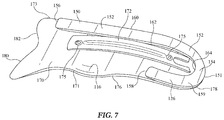
- FIG. 7 is an assembled view of a middle layer and a bottom layer of the insole of FIG. 4 ;
- FIGS. 8A-8B are side perspective views of the insole of FIG. 4 .
- FIG. 9 is a disassembled view of a women's left high heel shoe with a full-length orthotic insole including an optional cushioning layer, according to a third exemplary embodiment
- FIG. 10 is a top perspective view of the insole and cushioning layer of FIG. 9 ;
- FIG. 11 is a top perspective view of the insole of FIG. 10 after an optional wrap has been applied to a portion of the insole.
- a women's shoe 10 generally includes an insole or insert 20 and a shoe base 30 .
- the women's shoe 10 is configured to be a heeled or elevated shoe such that the shoe base 30 includes a outsole 32 , a heel 36 coupled on the bottom of the outsole 32 , and an upper portion 38 (which may include a quarter or vamp portion) that extends upward from the outsole 32 away from the heel 36 , as illustrated in FIG. 1 .
- the upper portion 38 may include a toe box 24 that surrounds and contains a user's toes (not shown) when the user is wearing the women's shoe 10 .
- the heel 36 may be configured to be similar to heels of other women's shoes as known in the industry.
- the insole 20 is configured to be permanently affixed in the shoe base along a top surface 34 of the outsole 32 of the shoe base 30 , as illustrated in FIG. 1 .
- the top surface 34 of the outsole 32 comprises an outer perimeter 122 that defines the boundaries of the top surface 34 and outsole 32 .
- the outer perimeter 122 defines the shape of the top surface 34 , and may be generally shaped similar to the shape of a women's foot.
- the insole 20 may be generally shaped to conform to a bottom surface of a person's foot (not shown). It is desirable that the insole 20 is of sufficient thickness and of appropriate durometer to be suitable under the stresses accompanying ordinary use of the women's shoe 10 . Moreover, the insole 20 should be sufficiently flexible to permit movement during flexing of the foot and to accommodate multiple arch heights in the women's shoe 10 .
- the insole 20 may be covered in a wrap 80 that substantially surrounds at least the top of the insole 20 for cosmetic reasons and/or comfort of the user. In illustrative embodiments, the wrap 80 may also surround the sides and/or a portion of the bottom of the insole for cosmetic purposes.
- the wrap 80 may be made of leather or other similar material, and may be created to match or coordinate with other portions of the shoe 10 .
- the wrap 80 may cover only the sides and a portion of the top of the insole 120 , and an optional sock layer 220 may be positioned over the top of the insole 120 in order to cover the remaining portions of the 120 , as is known in the art.
- the insole 20 may be configured to extend varying lengths of the shoe base 30 .
- the insole 20 may extend the full length of the outsole 32 , as shown in FIGS. 1-3 .
- the insole 20 may be a sulcus-length insole (not shown), extending from adjacent the user's heel to a location adjacent to where a user's digital sulcus may be positioned within the shoe 10 .
- Other insole lengths that permit incorporation of the features herein described are also envisioned.
- the insole 20 may extend substantially the full length L of the outsole 32 and span the full width W of the outsole 32 ; that is, the insole 20 may be a heel-to-toe and side-to-side insole as illustrated in FIGS. 1 and 2 .
- the insole 20 may be configured to fit within, and to extend substantially between, one or more walls 26 of the upper portion 38 of the shoe 10 . Accordingly, in such an embodiment, the insole 20 substantially provides complete separation between the wearer's foot and the outsole 32 .
- a sulcus-length insole may extend approximately a length S from the back of the outsole 32 adjacent the heel 36 to a point 28 on the outsole 32 , as illustrated in FIG. 2 , the point 28 positioned approximately where the user's digital sulcus may be aligned when the user wears the shoe 10 .
- the insole 20 comprises at least a top layer 40 , a middle layer 42 , and a bottom layer 44 , as shown in FIGS. 2-3 .
- the top layer 40 is configured to be in contact with a wearer's foot (not shown), or the wrap 80 of material may be positioned between the top layer 40 and the wearer's foot.
- the middle layer 42 is positioned between the top layer 40 and the bottom layer 44 , and the bottom layer 44 is configured to be adjacent to the outsole 32 of the shoe 10 .
- Each of these layers 40 , 42 , and 44 may be manufactured separately and assembled together to form the insole 20 .
- Each layer may be contoured to meet the shape and size of a typical underside of a foot, as illustrated in the Figures.
- the layers 40 , 42 , and 44 may be made of various materials, in illustrative embodiments, the top layer 40 may be constructed of a garment quality leather, or similar durable and resistant material.
- the middle layer 42 may be constructed of a closed-cell foam material, such as, but not limited to, ethylene vinyl acetate (EVA), commercially available as P-Cell®, or polyethylene, available commercially as Plastazote®. Other foam or cushioned materials may be used in various exemplary embodiments disclosed herein. Such material should provide adequate cushioning and shock absorption, while having a high coefficient of friction to provide a secure grip. A closed-cell material may also prevent irritation to a wearer as it is less abrasive from other materials.
- the bottom layer 44 may be constructed of a foam material, such as a closed-cell foam material, for example, ethylene vinyl acetate.
- the top layer 40 may be configured to have a length L 1 and a width W 1 , the length L 1 being substantially similar to the length L of the insole 20 and the width W 1 being substantially similar to the width W of the insole 20 .
- the middle layer 42 may be approximately 1 ⁇ 8 inches thick, and have a durometer measurement of approximately 20.
- the middle layer 42 may have a length L 2 and a width W 2 .
- the length L 2 may be substantially similar to the length L of the insole 20 and length L 1 of the top layer 40
- the width W 2 may be substantially similar to the width W of the insole 20 and the width W 1 of the top layer 40 .
- the middle layer 42 may be configured to make the insole 20 moldable to each individual's foot, while the middle layer 42 may still be very light weight.
- the middle layer 42 may have varying thickness along the length L 2 of the middle layer 42 .
- the middle layer 42 is envisioned to be fairly resistant to deformation, minimally abrasive, deflective of moisture, and a higher tensile strength.
- the bottom layer 44 may have a length L 3 that is substantially similar to lengths L, L 1 , and L 2 of the insole 20 , top layer 40 , and middle layer 42 , respectively. However, the bottom layer 44 may include a width W 3 that is smaller than the widths W, W 1 and W 2 of the insole 20 , top layer 40 , and middle layer 42 , respectively. As illustrated in FIGS. 2 and 3 , the width W 3 may be approximately equal to, or less than, half of the width W of the whole insole 20 . In illustrative embodiments, the width W 3 is configured to extend and cover the lateral column of a wearer's foot (not shown). The bottom layer 44 may be positioned along an outside edge 35 of the insole 20 , the outside edge 35 corresponding to the outside of a wearer's foot (not shown) and an outer side 37 of the upper portion 38 of the shoe base 30 .
- the bottom layer 44 may be configured to be a more rigid than the middle layer 42 , and may have a durometer of 55, which may provide more motion control. In illustrative embodiments, the bottom layer 44 may be 1/16 inches thick.
- the bottom layer 44 comprises a rearfoot post 48 , as illustrated in FIG. 3 .
- the rearfoot post 48 is a lateral rearfoot post.
- the rearfoot post 48 is configured to provide balance to the foot and ankle of the wearer, and to further reduce lateral column overload of the foot.
- the rearfoot post 48 may be a 3-degree post as known to be determined in the industry.
- a 3-degree rearfoot post is a biomechanically accepted rearfoot wedge size tolerated by most people to discourage the subtalar and ankle joints from inverting, by directing ground reactive forces laterally.
- the rearfoot post 48 may be positioned along the outsole 32 and extend the length L of the insole 20 from the heel 36 of the shoe base 30 .
- the rearfoot post 48 may be configured as a wedge of orthotic material added to control excess rearfoot frontal plane movement.
- the exemplary insole 20 further includes an arch fill 50 , as illustrated in FIGS. 1-3 .
- the arch fill 50 is not the full length of the insole 20 , but rather is only configured to be positioned under a wearer's arch along an inner edge 39 of the insole 20 and adjacent to an inner side 41 of the upper portion 38 of the shoe base 30 .
- the arch fill 50 may be made of Microcell Puff, an ethylene vinyl acetate foam, or other similar material, and may be of variable measurements based on the shoe size.
- the arch fill 50 may have a durometer measurement of 35.
- the arch fill 50 may be configured for some flexibility while also providing rigidity and resistance to deformation.
- the bottom layer 44 of the insole 20 may partially overlap the arch fill 50 when assembled together in the insole 20 .
- the bottom layer 44 may extend under the lateral column of the wearer, while the arch fill 50 extends below at least the entire arch of the wearer. In this manner, the bottom layer 44 may extend over a portion of the arch fill 50 by a length of E.
- the upper portion 38 of the shoe 10 may further include a heel counter 60 .
- the heel counter 60 is an upwardly extending support on the back of the upper portion 38 above the heel 36 .
- the heel counter 60 provides support for the heel of the wearer of the shoe 10 by wrapping around a portion of the wearer's heel and/or ankle, as illustrated in FIGS. 1 and 4 .
- the heel counter 60 is configured to be similar to heel counters known in the industry.
- the combination of the arch fill 50 and rearfoot post 48 together provide an appropriate support for the foot and ankle of the wearer of the high-heel shoe 10 .
- the addition of the arch fill 50 provides a natural support for a wearer's arch (both natural and created from the high-heel shoe), which the rearfoot post 48 provides a counter-balance to the forces on the wearer's ankle and heel that can cause ankle sprains or injuries.
- this combination may be enhanced with the heel counter 60 .
- the features of the present disclosure provide additional beneficial support for high-heel shoes.
- a women's high-heel shoe 110 generally includes an insole or insert 120 and a shoe base 130 .
- the women's shoe 110 is configured to be a heeled or elevated shoe such that the shoe base 130 includes a outsole 132 , a heel 136 coupled on the bottom of the outsole 132 , and an upper portion 138 (which may include a quarter or vamp portion) that extends upward from the outsole 132 away from the heel 136 , as illustrated in FIG. 4 .
- the upper portion 138 may include a toe box 124 that surrounds and contains a user's toes (not shown) when the user is wearing the women's shoe 110 .
- the upper portion 138 may include an open-toe feature.
- the heel 136 may be configured to be similar to heels of other women's shoes as known in the industry.
- the insole 120 include a medial or inside edge 139 and a lateral or outside edge 145 .
- the insole 120 is configured to be permanently affixed in the shoe base along a top surface 134 of the outsole 132 of the shoe base 130 , as illustrated in FIG. 4 .
- the insole 120 may be generally shaped to conform to a bottom surface of a person's foot (not shown). It is desirable that the insole 120 is of sufficient thickness and of appropriate durometer to be suitable under the stresses accompanying ordinary use of the women's shoe 10 .
- the insole 120 should be sufficiently flexible to permit movement during flexing of the foot and to accommodate multiple arch heights in the women's shoe 110 .
- the insole 120 may be covered in a wrap 180 that substantially surrounds at least the top of the insole 120 for cosmetic reasons and/or comfort of the user.
- the wrap 180 may also surround the sides and/or a portion of the bottom of the insole for cosmetic purposes.
- the wrap 180 may be made of leather or other similar material, and may be created to match or coordinate with other portions of the shoe 110 .
- the wrap 180 may cover only the sides and a portion of the top of the insole 120 , and an optional sock layer 220 may be positioned over the top of the insole 120 in order to cover the remaining portions of the 120 , as is known in the art.
- the insole 120 may be configured to extend varying lengths of the shoe base 130 .
- the insole 120 may extend the full length of the outsole 132 , as shown in FIG. 4 .
- the insole 120 may be a sulcus-length insole (not shown), extending from adjacent the user's heel to a location adjacent to where a user's digital sulcus may be positioned within the shoe 110 .
- Other insole lengths that permit incorporation of the features herein described are also envisioned.
- the insole 120 may extend substantially the full length L of the outsole 132 and span the full width W of the outsole 132 ; that is, the insole 120 may be a heel-to-toe and side-to-side insole as illustrated in FIG. 4 .
- the insole 120 may be configured to fit within, and to extend substantially between, one or more walls 26 of the upper portion 138 of the shoe 110 . Accordingly, in such an embodiment, the insole 120 substantially provides complete separation between the wearer's foot and the outsole 132 .
- a sulcus-length insole may extend approximately a length S from the back of the outsole 132 adjacent the heel 136 to a point 128 on the outsole 132 , as illustrated in FIG. 4 , the point 128 positioned approximately where the user's digital sulcus may be aligned when the user wears the shoe 110 .
- the insole 120 may be configured to include an arch support 112 positioned along the medial or inner edge 139 of the insole 120 .
- the arch support 112 may be configured to be positioned under a wearer's arch along the inner edge 139 of the insole 120 and adjacent to an inner side 141 of the upper portion 138 of the shoe base 130 .
- the arch support 112 and the rest of the insole 120 may be formed as a single unitary structure, or the arch support 112 may be formed as a separate structure and coupled to the rest of the insole 120 .
- the arch support 112 may accordingly be made of the same material as the rest of the insole 120 or of different material, and may be of variable measurements based on the shoe size.
- the arch support 112 may be configured for some flexibility while also providing rigidity and resistance to deformation.
- the insole 120 comprises at least a top layer 140 , a middle layer 142 , and a bottom layer 144 as shown in FIGS. 5A-6 .
- the top layer 140 is configured to be in contact with a wearer's foot (not shown), or the wrap 180 of material may be positioned between the top layer 140 and the wearer's foot.
- the middle layer 142 is positioned between the top layer 140 and the bottom layer 144
- the bottom layer 144 is configured to be adjacent to the outsole 132 of the shoe 110 .
- Each of these layers 140 , 142 , and 144 may be manufactured separately and assembled together to form the insole 120 .
- Each layer may be contoured to meet the shape and size of a typical underside of a foot, as illustrated in the Figures. It is envisioned that the layers 140 , 142 , and 144 may be made of the same material or different materials.
- the top layer 140 includes a first end 131 , a second end 133 , a medial or in inner edge 135 , and a lateral or outer edge 137 , as illustrated in FIG. 5C .
- the first end 131 of the top layer 140 is generally configured to be positioned adjacent to or below a wearer's heel
- the second end 133 is generally configured to be positioned adjacent to or below a wearer's toes
- the inner edge 135 is generally configured to be positioned adjacent to or below the medial or inside edge of a wearer's foot
- the outer edge 137 is generally configured to be positioned adjacent to or below the lateral or outside edge of a wearer's foot.
- the top layer 140 may be configured to have a length L 1 and a width W 1 , the length L 1 being substantially similar to the length L of the insole 120 and the width W 1 being substantially similar to the width W of the insole 120 .
- the top layer 140 comprises an outer perimeter 146 that defines the boundaries of the top layer 140 and spans across the first end 131 , second end 133 , inner edge 135 , and outer edge 137 .
- the outer perimeter 146 defines the shape of the top layer 140 , and may be generally configured to be similar in shape to the outer perimeter 122 of the top surface 34 of the outsole 32 .
- the top layer 140 includes a slight protrusion 114 positioned on the inner edge 135 that corresponds with the arch support 112 of the insole 120 , as illustrated in FIG. 5C .
- the top layer 140 may be constructed of one or more materials suitable to support a wearer's foot.
- the top layer 140 may be constructed of a garment quality leather, or similar durable and resistant material.
- the top layer 140 may alternatively be constructed of a rubber or other flexible material.
- the top layer 140 may further be constructed of a cardboard or other similar stiffing material.
- the top layer 140 may be constructed of a first sublayer of material 140 a and a second sublayer of material 140 b .
- the first sublayer 140 a may be positioned on top of the second sublayer 140 b , adjacent to the wearer's foot when the insole 120 is positioned in the shoe 110 .
- the second sublayer 140 b may be positioned adjacent to the middle layer 142 when the insole 120 is assembled.
- the first sublayer 140 a may be made of a flexible rubber or cushioning material, and the second sublayer 140 b may be constructed from a stiffer material such as cardboard or the like.
- the first sublayer 140 a may comprise a first portion 141 and a second portion 143 , as illustrated in FIGS. 4 and 5C .
- the first portion 141 and second portion 143 may be joined together to form sublayer 140 a such that first portion 141 and second portion 143 each have lengths that are less than the length L 1 of the top layer 140 .
- the first portion 141 may be constructed of a flexible foam material or rubber material, while the second portion 143 may be constructed of a stiffer material such as cardboard or the like.
- Other embodiments of sublayers 140 a and 140 b are envisioned herein.
- the middle layer 142 of the insole 120 comprises one or more pieces of material that form a j-strip 150 .
- the j-strip 150 comprises a first straight portion 152 , a curved portion 154 , and an optional second straight portion 126 , as illustrated in FIG. 5B .
- the j-strip 150 may be formed of a single piece of material that is shaped as described herein. Alternatively, the j-strip 150 may be formed of multiple pieces of material that combine to form the shape as described herein. The description and drawings of a single piece j-strip 150 are applicable to a j-strip 150 formed of multiple pieces.
- the first straight portion 152 is joined with the curved portion 154 and the second straight portion 126 to form the j-strip 150 .
- the first straight portion 152 includes a first end 156 and a connecting edge 157 that is spaced apart from the first end 156 .
- the second straight portion includes a connecting edge 159 and a second end 158 that is spaced apart from the connecting edge 159 .
- the curved portion 154 is coupled to the connecting edges 157 and 159 to connect the first straight portion 152 and the second straight portion 126 .
- the first straight portion 152 , curved portion 154 and second straight portion 126 are configured to be coupled together to form the j-strip 150 .
- the first straight portion 152 , the curved portion 154 , and the second straight portion 126 form a continuous j-strip 150 of a single material.
- these components may be formed separately and connected together, or the components may be formed separately and positioned adjacent to each other to form the j-strip 150 .
- the first end 156 of the first straight portion 152 and the second end 158 of the second straight portion 126 form the ends of the j-strip 150 .
- the first end 156 and the second end 158 of the middle layer 142 may taper to a thin edge, as illustrated in FIG. 5B , in order to minimize the transition from the middle layer 142 in order to provide comfort for the wearer.
- the middle layer 142 comprises an outer edge 160 that defines the outer boundaries of the middle layer 142 .
- the outer edge 160 extends from the first end 156 to the second end 158 of the j-strip 150 , and extends along the straight portions 152 , 126 and curved portion 154 of the j-strip 150 .
- the outer edge 160 defines the outer perimeter of the j-strip 150 , and may be generally shaped to conform in shape and size to a portion of the outer perimeter 146 of the top layer 140 , as illustrated in FIGS. 6-8B , as well as the outer perimeter 122 of the top surface 34 of the outsole 32 .
- the middle layer 142 further includes an inner edge 162 that extends from the first end 156 to the second end 158 of the j-strip 150 , as illustrated in FIG. 5B .
- the inner edge 162 comprises a curved edge 164 that corresponds with the curved portion 154 of the j-strip 150 .
- the curved portion 154 of the j-strip is configured to be positioned below the heel of a wearer's foot and provides approximately 180 degrees of curvature for the j-strip 150 . Accordingly, the j-strip 150 , and in particular the curved edge 164 of the inner edge 162 , provides a cupping effect to the user's heel to maintain the heel in a pre-determined position within the shoe.
- the middle layer 142 may have a length L 2 and an overall width W 2 , as illustrated in FIG. 5B , wherein the length L 2 is smaller than the length L 1 of the top layer 140 while the overall width W 2 may be similar is size as the width W 1 of the top layer 140 .
- the overall width W 2 may be defined relative to the outer edge 160 of the j-strip 150 .
- the length L 2 is the distance from the first end 156 to a bottom point 151 of the j-strip 150 along the curved portion 154 .
- the length L 2 may be determined by the distance from the heel of a wearer to approximately the joint of the fifth metatarsal bone (e.g. sulcus-length).
- the length of the first straight portion 152 is configured to be larger than the length of the second straight portion 126 such that the first end 156 is not aligned with the second end 158 . Accordingly, the first straight portion 152 extends generally along a substantial portion of the lateral edge of a wearer's foot, while the second straight portion 126 does not extend along a substantial portion of the medial edge of the wearer's foot.
- the middle layer 142 causes a variance in thickness across the width of the insole 120 —i.e. the lateral edge 145 of the insole 120 may be thicker than the medial edge 139 of the insole 120 .
- the j-strip shape of the j-strip 150 effectively promotes such an effect on only one side, namely, the lateral side, of the insole 120 .
- the j-strip 150 provides for increased stability for a wearer of the shoe in light of the variance in thickness of the insole 120 between the medial edge 139 and the lateral edge 145 .
- the difference between the thickness of the insole 120 along the lateral edge 145 verses the thickness of the insole 120 along the medial edge 139 creates a rearfoot posting effect for the wearer of the shoe.
- the first straight portion 152 of the middle layer 142 comprises a lateral rearfoot post 148 .
- the rearfoot post 148 is configured to provide balance to the foot and ankle of the wearer, and to further reduce lateral column overload of the foot.
- the rearfoot post 148 may be a 3-degree post as known to be determined in the industry.
- a 3-degree rearfoot post is a biomechanically accepted rearfoot wedge size tolerated by most people to discourage the subtalar and ankle joints from inverting, by directing ground reactive forces laterally. Such a design reduces the tendency to twist or sprain an ankle. This feature is helpful in combination with a high-heel shoe, as the heel causes the arch to elevate naturally.
- the rearfoot post 148 may be configured as a wedge of orthotic material added to control excess rearfoot frontal plane movement.
- the first straight portion 152 and second straight portion 126 are configured to extend to specific points along a standard wearer's foot.
- the first straight portion 152 is configured to be aligned along the outside edge 137 of the insole 120 , which corresponds to an outside edge of a wearer's foot.
- the first straight portion 152 may be configured to extend to approximately below the joint of the fifth metatarsal bone of a typical women's foot along the outside edge 137 of the insole 120 .
- the second straight portion 126 is configured to be aligned along the inside edge 139 of the insole 120 , which corresponds to an inside edge of the wearer's foot.
- the second straight portion 126 may be configured to extend to at or just before the arch support 112 of the insole 120 (and accordingly the arch of the wearer's foot). As illustrated in FIGS. 5A-5B , the second straight portion 126 may extend a distance L 4 that is less than a length L 5 from the heel of the insole 120 to the beginning of the arch support 112 .
- the first straight portion 152 may include a width W 4 that is smaller than the widths W of the insole 120 or W 2 of the middle layer 142 , respectively. As illustrated in FIGS. 5B and 6 , the width W 4 may be less than half of the width W 2 of the middle layer 142 . In illustrative embodiments, the width W 4 is configured to extend across a portion of the lateral column of a wearer's foot (not shown). The straight portion 152 is configured to be positioned along an outside edge 35 of the insole 120 , the outside edge 35 corresponding to the outside of a wearer's foot (not shown) and the outer side 137 of the upper portion 138 of the shoe base 130 .
- the bottom layer 144 of the insole 120 may be configured to be a more rigid than the middle layer 142 , and may have a durometer of 55, which may provide more motion control. In illustrative embodiments, the bottom layer 144 may be 1/16 inches thick. In various embodiments, the bottom layer includes a slight protrusion 116 that corresponds with the arch support 112 of the insole 120 , as illustrated in FIG. 5A .
- the bottom layer 144 includes a base 170 and a rigid plate 172 fixedly secured to the base 170 , as illustrated in FIG. 5A .
- the base 170 includes a top surface 174 , a bottom surface 176 , a first end 178 , a second end 181 , an inner edge 171 , and an outer edge 173 .
- the first end 178 of the bottom layer 144 is generally configured to be positioned below a wearer's heel
- the second end 181 is generally configured to be positioned below and inward of a wearer's toes
- the inner edge 171 is generally configured to be positioned below the inside portion of a wearer's foot
- the outer edge 193 is generally configured to be positioned below the outside portion of a wearer's foot.
- the top surface 174 is configured to be positioned adjacent to the middle layer 142
- the bottom surface 176 is configured to be positioned adjacent to the outsole of the shoe 110 .
- the second end 181 of the base 170 may taper to a thin edge 182 , as illustrated in FIG. 5A , in order to minimize the transition from the bottom layer 144 in order to provide comfort for the wearer.
- the base includes the protrusion 116 along the inner edge 171 that corresponds with the arch support 112 , and is configured to align with the protrusion 114 of the top layer 140 when the insole 120 is assembled.
- the first end 178 may be shaped to correspond to the first end 131 of the top layer 140
- the inner edge 171 may be shaped to partially correspond to the inner edge 135 of the top layer 140
- the outer edge 173 may be shaped to partially correspond to the outer edge 137 of the top layer 140 .
- the rigid plate 172 is coupled to the top surface 174 of the base 170 .
- the rigid plate 172 may be configured to extend away from the top surface 174 in the middle of the rigid plate 172 when the ends of the rigid plate 172 are coupled to the top surface 174 , as illustrated in FIG. 5A .
- the rigid plate 172 is an elongated and slightly curved member that is secured to the top surface 174 of the base 170 via rivets or similar connecting members 175 .
- the rigid plate 172 may be positioned on the base 170 such that the rigid plate 172 aligns with a cavity 184 formed in the j-strip 150 between the first straight portion 152 and the second straight portion 126 .
- the rigid plate 172 may provide additional resistance and stability to the shoe, or further provide means for shaping and/or flexing of the insole 120 to a desired shape and height of the shoe, as well as means for providing a spring or bias force to the wearer's foot from the insole 120 during use.
- the base 170 may have a shape that conforms in part to the shape of a portion of the top layer 140 , and may generally have a width W 3 that is substantially similar to the width W 1 of the top layer 140 .
- the base 170 may have a length L 3 that is less than the length L 1 of the top layer 140 , but is equal to or greater than the length L 2 of the middle layer 142 .
- Other alternatives for the length and width of the bottom later 144 are envisioned herein.
- the base 170 may have a length L 3 that extends from the heel of the wearer to generally just past the pivot point of the joint of the fifth metatarsal bone.
- the base 170 may have a length L 3 that is sulcus length.
- An exemplary embodiment of a method of making the insole 120 of the second embodiment for a women's high-heel shoe 110 includes positioning the middle layer 142 between the bottom layer 144 and the top layer 140 , as illustrated in FIG. 6 , and assembling the layers 140 , 142 and 144 together to form a single insole 120 , as illustrated in FIGS. 8A-8B .
- the middle layer 142 is configured to include a rearfoot posting 148 that provides, for example, a 3-degree wedge to diminish or prevent lateral column loading to the wearer's foot.
- the middle layer 142 may include a first straight portion 152 configured to have a smaller width W 4 than the rest of the insole 20 such that the first straight portion 152 only extends to cover the width of a wearer's lateral column, while the width W of the insole 120 may extend the entire width W of a wearer's foot.
- the insole 120 may be combined with a shoe base 130 that includes a heel counter 161 along the back of the shoe base 130 , the heel counter 60 restraining movement of the wearer's heel while the wearer's foot is in the shoe 110 .
- the high-heel shoe 110 may optionally include a cushioning layer 200 that is positioned adjacent to or above the insole 120 described herein.
- the cushioning layer 200 may be positioned on top of the top layer 140 .
- the cushioning layer 200 may be constructed of a closed-cell foam material, such as, but not limited to, ethylene vinyl acetate (EVA), commercially available as P-Cell®, or polyethylene, available commercially as Plastazote®.
- EVA ethylene vinyl acetate
- P-Cell® polyethylene
- Plastazote® polyethylene
- Other foam or cushioned materials may be used in various exemplary embodiments disclosed herein. Such material should provide adequate cushioning and shock absorption, while having a high coefficient of friction to provide a secure grip.
- a closed-cell material may also prevent irritation to a wearer as it is less abrasive from other materials.
- the cushioning layer 200 may be comprised of one or more separate pads of material that have a shape that is partially dependent on the shape or size of the insole 120 .
- the cushioning layer 200 may be configured to extend varying lengths of the insole 120 .
- the cushioning layer 200 may extend the full length of the insole 120 , or may extend less than the full length of the insole 120 .
- the cushioning layer 200 may have a width W 5 that is slightly smaller than the width W 1 of the insole 120 , and may have a length L 5 that is slightly smaller than the length L 1 of the insole 120 .
- a gap 202 may be formed between a medial edge 204 of the cushioning layer 200 and the medial edge 135 of the top layer 140 of the insole 120
- a gap 203 may be formed between a lateral edge 206 of the cushioning layer 200 and the lateral edge 137 of the top layer 140 , as illustrated in FIG. 10
- cushioning layer 200 may extend the full width between edges 135 and 137 , and the full length between the ends 131 and 133 of the top layer 140 .
- cushioning layer 200 may be comprised of a first cushion segment 210 and a second cushion segment 212 , as illustrated in FIG. 10 .
- the first cushion segment 210 may be positioned to be above the arch support 112 of insole 120 along a medial side of the insole 120 corresponding with the inner edge 139 of the insole 120 .
- the first cushion segment may further include a slight protrusion 214 that corresponds to the shape of the slight protrusion 114 of the top layer 140 .
- the first cushion segment 210 may be shaped to conform generally with the arch of a wearer's foot.
- the first cushion segment 210 may have a width W 6 that is less than the width W 5 of the cushion segment 210 and a length L 6 that is less than the length L 5 of the cushion segment 210 .
- the first cushion segment 210 may be thicker than the second cushion segment 212 .
- the second cushion segment 212 may be positioned to be below the plantar aspect of the foot sparing the arch, as illustrated in FIG. 10 , and may be shaped to generally correspond with the plantar aspect of the foot (minus the arch).
- the second cushion segment 212 and first cushion segment 210 are configured to be generally in the same plane of alignment with each other so that the first cushion segment 210 and second cushion segment 212 form cushioning layer 200 on top of top layer 140 .
- First cushion segment 210 and second cushion segment 212 may be spaced apart from each other such that a gap 208 is formed between first cushion segment 210 and second cushion segment 212 .
- first cushion segment 210 may overlap a portion of second cushion segment 212
- second cushion segment 212 may overlay a portion of first cushion segment 210 , on top of top layer 140 .
- cushioning layer 200 may include multiple segments that are positioned on top of top layer 140 .
- first or second cushioning segments 210 or 212 may be comprised of two or more separate segments of material such that cushioning layer 200 is formed of three or more segments of material.
- cushioning layer 200 may be comprised of a single layer of cushion material.
- Cushioning layer 200 may be applied to insole 120 of shoe 110 in a variety of methods. Cushioning layer 200 may be applied before or after insole 120 is affixed to other components of shoe 110 , such as the heel 136 and the upper portion 138 . Cushioning layer 200 may alternatively be applied to the top layer 140 before the top layer 140 is coupled to the middle layer 142 and the bottom layer 144 of the insole 120 . Other methods of applying cushioning layer 200 to the insole 120 are envisioned herein.
- first cushioning segment 210 may be coupled to the top layer 140 of the insole 120 above the arch support in a first step, and then a wrap 180 of material may be applied over a portion of the first cushioning segment 210 and the sides of insole 120 , as illustrated in FIG. 11 .
- the wrap 180 may be formed of a leather or leather like material, and may extend around the full circumference of the insole 120 . Alternatively, the wrap 180 may only extend around a portion of the circumference of the insole 120 .
- the wrap 180 may provide a finished surface for the wearer's foot to rest upon when wearing the shoe 110 .
- the insole 120 (with the first cushioning segment 210 ) may then be fixedly secured to other components of the shoe 110 , such as the heel 136 and upper portion 138 .
- the second cushioning segment 212 may be affixed to the plantar aspect of the foot sparing the arch in a third step.
- the second cushioning segment 212 may be applied directly to the top layer 140 , or may partially lay over the first cushioning segment and/or the wrap 180 .
- An optional sock layer 220 may be applied over the second cushioning segment 212 in a last step and may further overlap a portion of the wrap 180 and/or second cushioning segment 212 .
- the word “comprise” and variations of the word, such as “comprising” and “comprises,” means “including but not limited to,” and is not intended to exclude, for example, other additives, components, integers or steps.
- “Exemplary” or “illustrative” means “an example of” and is not intended to convey an indication of a preferred or ideal embodiment. “Such as” is not used in a restrictive sense, but for explanatory purposes.
Landscapes
- Health & Medical Sciences (AREA)
- Epidemiology (AREA)
- General Health & Medical Sciences (AREA)
- Public Health (AREA)
- Life Sciences & Earth Sciences (AREA)
- Chemical & Material Sciences (AREA)
- Engineering & Computer Science (AREA)
- Materials Engineering (AREA)
- Wood Science & Technology (AREA)
- Footwear And Its Accessory, Manufacturing Method And Apparatuses (AREA)
Abstract
Description
Claims (21)
Priority Applications (1)
| Application Number | Priority Date | Filing Date | Title |
|---|---|---|---|
| US15/085,432 US11033066B2 (en) | 2014-11-25 | 2016-03-30 | Orthotic insole for a woman's shoe |
Applications Claiming Priority (2)
| Application Number | Priority Date | Filing Date | Title |
|---|---|---|---|
| US14/553,275 US10130139B2 (en) | 2014-11-25 | 2014-11-25 | Orthotic insole for a woman's shoe |
| US15/085,432 US11033066B2 (en) | 2014-11-25 | 2016-03-30 | Orthotic insole for a woman's shoe |
Related Parent Applications (1)
| Application Number | Title | Priority Date | Filing Date |
|---|---|---|---|
| US14/553,275 Continuation-In-Part US10130139B2 (en) | 2014-11-25 | 2014-11-25 | Orthotic insole for a woman's shoe |
Publications (2)
| Publication Number | Publication Date |
|---|---|
| US20160206038A1 US20160206038A1 (en) | 2016-07-21 |
| US11033066B2 true US11033066B2 (en) | 2021-06-15 |
Family
ID=56406810
Family Applications (1)
| Application Number | Title | Priority Date | Filing Date |
|---|---|---|---|
| US15/085,432 Active 2036-02-10 US11033066B2 (en) | 2014-11-25 | 2016-03-30 | Orthotic insole for a woman's shoe |
Country Status (1)
| Country | Link |
|---|---|
| US (1) | US11033066B2 (en) |
Cited By (3)
| Publication number | Priority date | Publication date | Assignee | Title |
|---|---|---|---|---|
| US20210000222A1 (en) * | 2014-07-07 | 2021-01-07 | Jason Guadalajara | Reformable Insole and Method of Fabricating |
| US20240024148A1 (en) * | 2020-02-03 | 2024-01-25 | Roberto Corona | Plantar orthosis |
| US12096823B1 (en) * | 2018-11-30 | 2024-09-24 | Under Armour, Inc. | Article of footwear |
Families Citing this family (4)
| Publication number | Priority date | Publication date | Assignee | Title |
|---|---|---|---|---|
| US11311075B2 (en) * | 2017-12-15 | 2022-04-26 | Chez Nous Brands, Inc. | Comfortable dress shoes |
| KR102202828B1 (en) * | 2018-11-29 | 2021-01-14 | 김일수 | Sole structure of high-heeled footwear and high-heeled footwear having the same |
| GB2594890B (en) * | 2019-01-29 | 2023-01-18 | Vibrant Tech Pte Ltd | An insole for a footwear |
| US11786009B2 (en) * | 2020-06-11 | 2023-10-17 | Najwa Javed | Footwear system with integrated orthotics, stabilization features, and a plurality of design features |
Citations (88)
| Publication number | Priority date | Publication date | Assignee | Title |
|---|---|---|---|---|
| GB404406A (en) | 1932-09-21 | 1934-01-18 | Alfred Neil Weaver | An improved foot arch support |
| US2009789A (en) | 1934-02-12 | 1935-07-30 | Saladino Charles | Cushion arch support |
| US2343790A (en) | 1941-09-22 | 1944-03-07 | Hugh J Nicholl | Shoe inner sole |
| US2366096A (en) | 1944-01-22 | 1944-12-26 | Gerber Jack | Arch support |
| US2413534A (en) | 1944-06-02 | 1946-12-31 | Henry G Lumbard | Sock lining |
| US2425837A (en) * | 1944-09-04 | 1947-08-19 | William M Scholl | Cuboid support and heel retainer |
| US2447954A (en) | 1946-12-07 | 1948-08-24 | Edward C Meldman | Shoe insert |
| US2672698A (en) | 1952-11-29 | 1954-03-23 | Carlisle V Watson | Form-fitting sock lining |
| US2857689A (en) * | 1956-10-19 | 1958-10-28 | Lorraine A Van Ostrom | Corrective foot support |
| US2878593A (en) | 1958-01-15 | 1959-03-24 | Craddock Terry Shoe Corp | Arch support |
| US2917757A (en) | 1957-11-13 | 1959-12-22 | William M Scholl | Method of fitting an orthopedic article of footwear |
| US2949685A (en) * | 1958-06-09 | 1960-08-23 | Burns Joseph | Removable shoe pad construction |
| US3170178A (en) | 1962-06-22 | 1965-02-23 | William M Scholl | Method of making a foot cushioning insole |
| US3292277A (en) | 1964-02-03 | 1966-12-20 | Genesco Inc | Shoe |
| US3398469A (en) | 1967-12-08 | 1968-08-27 | Bressan Ezio | Cushioned shoe innersole construction |
| US3442031A (en) | 1965-02-04 | 1969-05-06 | Joseph Antell | Shoe and method and last for making same |
| US3828792A (en) * | 1968-11-18 | 1974-08-13 | A Valenta | Shoe liners |
| US4360027A (en) * | 1981-06-29 | 1982-11-23 | Bruce Friedlander | Thin, light-weight flexible orthopedic device |
| US4563787A (en) | 1983-03-08 | 1986-01-14 | John Drew (London) Limited | Production of insoles |
| US4597196A (en) * | 1984-08-24 | 1986-07-01 | Northwest Podiatric Laboratories, Inc. | Orthotic insert and method or making of the same |
| US4633877A (en) * | 1984-08-07 | 1987-01-06 | Duramet Systems, Inc. | Dynamic foot support and kit therefor |
| US4766679A (en) * | 1986-08-28 | 1988-08-30 | Puma Aktiengesellschaft Rudolf Dassler Sport | Midsole for athletic shoes |
| US4942679A (en) | 1989-02-21 | 1990-07-24 | Genesco, Inc. | Styled comfort shoe construction |
| US5036603A (en) | 1986-10-20 | 1991-08-06 | Milliken Research Corporation | Insole product and method of making same |
| US5036851A (en) * | 1989-08-10 | 1991-08-06 | Dr. Cohen Group, Inc. | Antipronation orthotic with lateral column |
| US5138774A (en) | 1990-06-04 | 1992-08-18 | Jeff Sarkozi | Insole with removable, height-adjustable stackable support pads |
| US5164878A (en) | 1989-04-24 | 1992-11-17 | Hauser John P | Orthopedic pad |
| US5184409A (en) * | 1984-08-24 | 1993-02-09 | Northwest Podiatric Laboratory, Inc. | Orthotic insert and method of making of the same |
| USD353259S (en) | 1993-03-05 | 1994-12-13 | Schering-Plough/Healthcare Products, Inc. | High heel arch support |
| US5724753A (en) | 1993-07-23 | 1998-03-10 | James L. Throneburg | Footwear system |
| US5733647A (en) | 1992-11-05 | 1998-03-31 | Polymer Innovations, Inc. | Insole |
| US5901394A (en) | 1996-07-30 | 1999-05-11 | Greenawalt; Kent S. | Custom-made footwear |
| US6000147A (en) | 1998-07-17 | 1999-12-14 | Kellerman | Three section orthotic device |
| US6176025B1 (en) | 1999-05-28 | 2001-01-23 | Spalding Sports Worldwide, Inc. | Cushioning system for golf shoes |
| US6484419B1 (en) | 2000-08-21 | 2002-11-26 | Nike, Inc. | Sockliner cover |
| US6510626B1 (en) | 2000-07-28 | 2003-01-28 | Kent S. Greenawalt | Custom orthotic foot support assembly |
| US6560902B1 (en) | 1999-10-08 | 2003-05-13 | Globus Berkemann Gmbh & Co. Kg | Orthopaedic insole |
| US20030105193A1 (en) | 2001-12-05 | 2003-06-05 | Gerald Wang | Thermoplastic insole |
| US20040118017A1 (en) * | 2002-12-23 | 2004-06-24 | Jacob A. Martinez And John C. Hardt | Insole with improved cushioning and anatomical centering device |
| US20040181971A1 (en) | 2003-03-21 | 2004-09-23 | E-Z Gard Industries, Inc.. | Footbed |
| US20040211086A1 (en) | 2003-04-23 | 2004-10-28 | Hbn Shoe, Llc | Device for high-heeled shoes |
| US20050000114A1 (en) | 2003-07-01 | 2005-01-06 | Totes Isotoner Corporation | Tufted foam insole and tufted footwear |
| US20050138844A1 (en) | 2003-12-26 | 2005-06-30 | Johnson Stephen F. | Anti-fatigue support and comfort insole |
| US20050281988A1 (en) | 2004-06-19 | 2005-12-22 | Polarwrap, Llc | Insulating liner for an article of clothing |
| US20060026867A1 (en) * | 2004-08-09 | 2006-02-09 | Polcek Norma E | Cushioned insole |
| US20060123664A1 (en) * | 2003-10-14 | 2006-06-15 | Boyd Robert E | Insole having multiple energy sources |
| US20060156583A1 (en) | 2005-01-18 | 2006-07-20 | Butash Allison L | Pedicure shoe insert |
| US20060288613A1 (en) | 2005-06-27 | 2006-12-28 | Ming-Jor Lo | Innovative shaped memory insole structure with re-adjustable supporting pads |
| US20070011918A1 (en) | 2005-07-18 | 2007-01-18 | Snow Rebecca E | Shoe construction |
| US20070033834A1 (en) * | 2005-08-12 | 2007-02-15 | Cheskin Melvyn P | Shoe insole |
| US20070084084A1 (en) | 2005-10-13 | 2007-04-19 | Rich Jeffrey S | User moldable adjustable insert |
| US20070107261A1 (en) * | 2005-11-02 | 2007-05-17 | Cheskin Melvyn P | Shoe insole |
| US20070277400A1 (en) * | 2006-06-05 | 2007-12-06 | Tim The Nguyen | Improved orthotic shell for orthopedic sole insert |
| US20080052963A1 (en) | 2006-08-29 | 2008-03-06 | Pang-Ching Chiang | Orthotic foot wear |
| US20080127527A1 (en) | 2006-12-05 | 2008-06-05 | Chen Ting-Chun | Multilayered insole for footwear |
| US20080148599A1 (en) | 2006-12-21 | 2008-06-26 | Collins Jason H | Footwear inserts, including midsoles, sockliners, footbeds and/or upper components using granular ethyl vinyl acetate (EVA) and method of manufacture |
| USD571989S1 (en) | 2006-11-09 | 2008-07-01 | Carolyn Siegal | Arch support |
| US20090007455A1 (en) | 2007-07-03 | 2009-01-08 | Scott Montgomery | High heel shoe of improved comfort |
| US20090049712A1 (en) * | 2007-08-24 | 2009-02-26 | Athena Pacific, Llc | Orthotic foot device with removable support components and method of making same |
| US20090282705A1 (en) | 2008-05-15 | 2009-11-19 | Angela Trigillo | Naturally absorbent footpad |
| US20100064550A1 (en) | 2008-09-12 | 2010-03-18 | Joseph Kahn | Universal adjustable insole with an arch support and method of using it |
| US20100122475A1 (en) | 2008-11-20 | 2010-05-20 | 3M Innovative Properties Company | Molded insulated shoe footbed and method of making an insulated footbed |
| US20100154252A1 (en) * | 2008-12-22 | 2010-06-24 | Schering-Plough Healthcare Products, Inc. | Footwear insole for alleviating arthritis pain |
| US20100180467A1 (en) | 2007-09-28 | 2010-07-22 | Angela Singleton | Insole Support System For Footwear |
| US20100269375A1 (en) * | 2009-04-24 | 2010-10-28 | Nine West Development Corporation | Footbed system and footwear construction |
| US20100275468A1 (en) | 2009-04-29 | 2010-11-04 | Brown Shoe Company, Inc. | Air circulating footbed and method thereof |
| US20110061264A1 (en) | 2008-02-18 | 2011-03-17 | Solymosi Laszlo | Footwear with unstable sole structure |
| US20110209360A1 (en) | 2010-03-01 | 2011-09-01 | Nike, Inc. | Footwear Insole |
| US20110219642A1 (en) | 2007-11-21 | 2011-09-15 | Spenco Medical Corporation | Arthritis & Diabetes Insole |
| US20110258879A1 (en) * | 2009-08-03 | 2011-10-27 | DANANBERG Howard | Footwear insole |
| US20120174436A1 (en) | 2009-08-31 | 2012-07-12 | Josef Hanak | Insole |
| USD668850S1 (en) | 2011-09-23 | 2012-10-16 | Charles Anthony Pozzi | Ladies shoes |
| USD668849S1 (en) | 2011-09-23 | 2012-10-16 | Charles Anthony Pozzi | Ladies shoes |
| US20120304493A1 (en) | 2011-06-05 | 2012-12-06 | Thomas Barret Hudson | Fashion Shoe Having A Removable Insole and Footbed Cover |
| US20130008050A1 (en) | 2011-07-07 | 2013-01-10 | Michel Marc | Shoe Insole |
| US20130074367A1 (en) * | 2011-09-23 | 2013-03-28 | Torng-Haur Yeh | Insole with concept of harmonic tai chi |
| US20130256947A1 (en) * | 2008-01-10 | 2013-10-03 | JD and SW, LLC (a Nevada LLC) | Moldable thermoplastic inserts |
| US20130263470A1 (en) | 2010-12-23 | 2013-10-10 | Ortho-Duro Inc. | Preform and device for cooperation with a lower limb member, apparatus and method for manufacturing the device |
| USD701028S1 (en) | 2012-08-03 | 2014-03-18 | Stable Step LLC | Pediatric insole |
| US20140209229A1 (en) | 2013-01-29 | 2014-07-31 | Msd Consumer Care, Inc. | Cushioning device |
| US8800170B1 (en) | 2014-01-16 | 2014-08-12 | Ukies LLC | Footwear insole system |
| US20140245631A1 (en) | 2013-03-04 | 2014-09-04 | Lfrj, Llc | Shoe insert and method for using same |
| US20140250722A1 (en) | 2013-03-08 | 2014-09-11 | Chao Meng Shoes Material Company Limited | Insole |
| US20140259758A1 (en) * | 2013-03-18 | 2014-09-18 | Torng-Haur Yeh | Insole with seahorse reinforcing element |
| US20150026998A1 (en) | 2013-07-29 | 2015-01-29 | Su-Miao LIN | Insole structure |
| US20150201702A1 (en) * | 2012-03-01 | 2015-07-23 | Spenco Medical Corportion | Insole for Relief of Over-Pronation and Knee Joint Stress |
| US20150237959A1 (en) * | 2012-08-31 | 2015-08-27 | Spenco Medical Corporation | Basketball Insole |
| US9215908B1 (en) | 2011-12-13 | 2015-12-22 | Otz Shoes, Inc. | Foot bed |
-
2016
- 2016-03-30 US US15/085,432 patent/US11033066B2/en active Active
Patent Citations (88)
| Publication number | Priority date | Publication date | Assignee | Title |
|---|---|---|---|---|
| GB404406A (en) | 1932-09-21 | 1934-01-18 | Alfred Neil Weaver | An improved foot arch support |
| US2009789A (en) | 1934-02-12 | 1935-07-30 | Saladino Charles | Cushion arch support |
| US2343790A (en) | 1941-09-22 | 1944-03-07 | Hugh J Nicholl | Shoe inner sole |
| US2366096A (en) | 1944-01-22 | 1944-12-26 | Gerber Jack | Arch support |
| US2413534A (en) | 1944-06-02 | 1946-12-31 | Henry G Lumbard | Sock lining |
| US2425837A (en) * | 1944-09-04 | 1947-08-19 | William M Scholl | Cuboid support and heel retainer |
| US2447954A (en) | 1946-12-07 | 1948-08-24 | Edward C Meldman | Shoe insert |
| US2672698A (en) | 1952-11-29 | 1954-03-23 | Carlisle V Watson | Form-fitting sock lining |
| US2857689A (en) * | 1956-10-19 | 1958-10-28 | Lorraine A Van Ostrom | Corrective foot support |
| US2917757A (en) | 1957-11-13 | 1959-12-22 | William M Scholl | Method of fitting an orthopedic article of footwear |
| US2878593A (en) | 1958-01-15 | 1959-03-24 | Craddock Terry Shoe Corp | Arch support |
| US2949685A (en) * | 1958-06-09 | 1960-08-23 | Burns Joseph | Removable shoe pad construction |
| US3170178A (en) | 1962-06-22 | 1965-02-23 | William M Scholl | Method of making a foot cushioning insole |
| US3292277A (en) | 1964-02-03 | 1966-12-20 | Genesco Inc | Shoe |
| US3442031A (en) | 1965-02-04 | 1969-05-06 | Joseph Antell | Shoe and method and last for making same |
| US3398469A (en) | 1967-12-08 | 1968-08-27 | Bressan Ezio | Cushioned shoe innersole construction |
| US3828792A (en) * | 1968-11-18 | 1974-08-13 | A Valenta | Shoe liners |
| US4360027A (en) * | 1981-06-29 | 1982-11-23 | Bruce Friedlander | Thin, light-weight flexible orthopedic device |
| US4563787A (en) | 1983-03-08 | 1986-01-14 | John Drew (London) Limited | Production of insoles |
| US4633877A (en) * | 1984-08-07 | 1987-01-06 | Duramet Systems, Inc. | Dynamic foot support and kit therefor |
| US4597196A (en) * | 1984-08-24 | 1986-07-01 | Northwest Podiatric Laboratories, Inc. | Orthotic insert and method or making of the same |
| US5184409A (en) * | 1984-08-24 | 1993-02-09 | Northwest Podiatric Laboratory, Inc. | Orthotic insert and method of making of the same |
| US4766679A (en) * | 1986-08-28 | 1988-08-30 | Puma Aktiengesellschaft Rudolf Dassler Sport | Midsole for athletic shoes |
| US5036603A (en) | 1986-10-20 | 1991-08-06 | Milliken Research Corporation | Insole product and method of making same |
| US4942679A (en) | 1989-02-21 | 1990-07-24 | Genesco, Inc. | Styled comfort shoe construction |
| US5164878A (en) | 1989-04-24 | 1992-11-17 | Hauser John P | Orthopedic pad |
| US5036851A (en) * | 1989-08-10 | 1991-08-06 | Dr. Cohen Group, Inc. | Antipronation orthotic with lateral column |
| US5138774A (en) | 1990-06-04 | 1992-08-18 | Jeff Sarkozi | Insole with removable, height-adjustable stackable support pads |
| US5733647A (en) | 1992-11-05 | 1998-03-31 | Polymer Innovations, Inc. | Insole |
| USD353259S (en) | 1993-03-05 | 1994-12-13 | Schering-Plough/Healthcare Products, Inc. | High heel arch support |
| US5724753A (en) | 1993-07-23 | 1998-03-10 | James L. Throneburg | Footwear system |
| US5901394A (en) | 1996-07-30 | 1999-05-11 | Greenawalt; Kent S. | Custom-made footwear |
| US6000147A (en) | 1998-07-17 | 1999-12-14 | Kellerman | Three section orthotic device |
| US6176025B1 (en) | 1999-05-28 | 2001-01-23 | Spalding Sports Worldwide, Inc. | Cushioning system for golf shoes |
| US6560902B1 (en) | 1999-10-08 | 2003-05-13 | Globus Berkemann Gmbh & Co. Kg | Orthopaedic insole |
| US6510626B1 (en) | 2000-07-28 | 2003-01-28 | Kent S. Greenawalt | Custom orthotic foot support assembly |
| US6484419B1 (en) | 2000-08-21 | 2002-11-26 | Nike, Inc. | Sockliner cover |
| US20030105193A1 (en) | 2001-12-05 | 2003-06-05 | Gerald Wang | Thermoplastic insole |
| US20040118017A1 (en) * | 2002-12-23 | 2004-06-24 | Jacob A. Martinez And John C. Hardt | Insole with improved cushioning and anatomical centering device |
| US20040181971A1 (en) | 2003-03-21 | 2004-09-23 | E-Z Gard Industries, Inc.. | Footbed |
| US20040211086A1 (en) | 2003-04-23 | 2004-10-28 | Hbn Shoe, Llc | Device for high-heeled shoes |
| US20050000114A1 (en) | 2003-07-01 | 2005-01-06 | Totes Isotoner Corporation | Tufted foam insole and tufted footwear |
| US20060123664A1 (en) * | 2003-10-14 | 2006-06-15 | Boyd Robert E | Insole having multiple energy sources |
| US20050138844A1 (en) | 2003-12-26 | 2005-06-30 | Johnson Stephen F. | Anti-fatigue support and comfort insole |
| US20050281988A1 (en) | 2004-06-19 | 2005-12-22 | Polarwrap, Llc | Insulating liner for an article of clothing |
| US20060026867A1 (en) * | 2004-08-09 | 2006-02-09 | Polcek Norma E | Cushioned insole |
| US20060156583A1 (en) | 2005-01-18 | 2006-07-20 | Butash Allison L | Pedicure shoe insert |
| US20060288613A1 (en) | 2005-06-27 | 2006-12-28 | Ming-Jor Lo | Innovative shaped memory insole structure with re-adjustable supporting pads |
| US20070011918A1 (en) | 2005-07-18 | 2007-01-18 | Snow Rebecca E | Shoe construction |
| US20070033834A1 (en) * | 2005-08-12 | 2007-02-15 | Cheskin Melvyn P | Shoe insole |
| US20070084084A1 (en) | 2005-10-13 | 2007-04-19 | Rich Jeffrey S | User moldable adjustable insert |
| US20070107261A1 (en) * | 2005-11-02 | 2007-05-17 | Cheskin Melvyn P | Shoe insole |
| US20070277400A1 (en) * | 2006-06-05 | 2007-12-06 | Tim The Nguyen | Improved orthotic shell for orthopedic sole insert |
| US20080052963A1 (en) | 2006-08-29 | 2008-03-06 | Pang-Ching Chiang | Orthotic foot wear |
| USD571989S1 (en) | 2006-11-09 | 2008-07-01 | Carolyn Siegal | Arch support |
| US20080127527A1 (en) | 2006-12-05 | 2008-06-05 | Chen Ting-Chun | Multilayered insole for footwear |
| US20080148599A1 (en) | 2006-12-21 | 2008-06-26 | Collins Jason H | Footwear inserts, including midsoles, sockliners, footbeds and/or upper components using granular ethyl vinyl acetate (EVA) and method of manufacture |
| US20090007455A1 (en) | 2007-07-03 | 2009-01-08 | Scott Montgomery | High heel shoe of improved comfort |
| US20090049712A1 (en) * | 2007-08-24 | 2009-02-26 | Athena Pacific, Llc | Orthotic foot device with removable support components and method of making same |
| US20100180467A1 (en) | 2007-09-28 | 2010-07-22 | Angela Singleton | Insole Support System For Footwear |
| US20110219642A1 (en) | 2007-11-21 | 2011-09-15 | Spenco Medical Corporation | Arthritis & Diabetes Insole |
| US20130256947A1 (en) * | 2008-01-10 | 2013-10-03 | JD and SW, LLC (a Nevada LLC) | Moldable thermoplastic inserts |
| US20110061264A1 (en) | 2008-02-18 | 2011-03-17 | Solymosi Laszlo | Footwear with unstable sole structure |
| US20090282705A1 (en) | 2008-05-15 | 2009-11-19 | Angela Trigillo | Naturally absorbent footpad |
| US20100064550A1 (en) | 2008-09-12 | 2010-03-18 | Joseph Kahn | Universal adjustable insole with an arch support and method of using it |
| US20100122475A1 (en) | 2008-11-20 | 2010-05-20 | 3M Innovative Properties Company | Molded insulated shoe footbed and method of making an insulated footbed |
| US20100154252A1 (en) * | 2008-12-22 | 2010-06-24 | Schering-Plough Healthcare Products, Inc. | Footwear insole for alleviating arthritis pain |
| US20100269375A1 (en) * | 2009-04-24 | 2010-10-28 | Nine West Development Corporation | Footbed system and footwear construction |
| US20100275468A1 (en) | 2009-04-29 | 2010-11-04 | Brown Shoe Company, Inc. | Air circulating footbed and method thereof |
| US20110258879A1 (en) * | 2009-08-03 | 2011-10-27 | DANANBERG Howard | Footwear insole |
| US20120174436A1 (en) | 2009-08-31 | 2012-07-12 | Josef Hanak | Insole |
| US20110209360A1 (en) | 2010-03-01 | 2011-09-01 | Nike, Inc. | Footwear Insole |
| US20130263470A1 (en) | 2010-12-23 | 2013-10-10 | Ortho-Duro Inc. | Preform and device for cooperation with a lower limb member, apparatus and method for manufacturing the device |
| US20120304493A1 (en) | 2011-06-05 | 2012-12-06 | Thomas Barret Hudson | Fashion Shoe Having A Removable Insole and Footbed Cover |
| US20130008050A1 (en) | 2011-07-07 | 2013-01-10 | Michel Marc | Shoe Insole |
| US20130074367A1 (en) * | 2011-09-23 | 2013-03-28 | Torng-Haur Yeh | Insole with concept of harmonic tai chi |
| USD668849S1 (en) | 2011-09-23 | 2012-10-16 | Charles Anthony Pozzi | Ladies shoes |
| USD668850S1 (en) | 2011-09-23 | 2012-10-16 | Charles Anthony Pozzi | Ladies shoes |
| US9215908B1 (en) | 2011-12-13 | 2015-12-22 | Otz Shoes, Inc. | Foot bed |
| US20150201702A1 (en) * | 2012-03-01 | 2015-07-23 | Spenco Medical Corportion | Insole for Relief of Over-Pronation and Knee Joint Stress |
| USD701028S1 (en) | 2012-08-03 | 2014-03-18 | Stable Step LLC | Pediatric insole |
| US20150237959A1 (en) * | 2012-08-31 | 2015-08-27 | Spenco Medical Corporation | Basketball Insole |
| US20140209229A1 (en) | 2013-01-29 | 2014-07-31 | Msd Consumer Care, Inc. | Cushioning device |
| US20140245631A1 (en) | 2013-03-04 | 2014-09-04 | Lfrj, Llc | Shoe insert and method for using same |
| US20140250722A1 (en) | 2013-03-08 | 2014-09-11 | Chao Meng Shoes Material Company Limited | Insole |
| US20140259758A1 (en) * | 2013-03-18 | 2014-09-18 | Torng-Haur Yeh | Insole with seahorse reinforcing element |
| US20150026998A1 (en) | 2013-07-29 | 2015-01-29 | Su-Miao LIN | Insole structure |
| US8800170B1 (en) | 2014-01-16 | 2014-08-12 | Ukies LLC | Footwear insole system |
Non-Patent Citations (1)
| Title |
|---|
| International Search Report and Written Opinion for International Patent Application No. PCT/US2015/060585; dated Jan. 29, 2016. |
Cited By (3)
| Publication number | Priority date | Publication date | Assignee | Title |
|---|---|---|---|---|
| US20210000222A1 (en) * | 2014-07-07 | 2021-01-07 | Jason Guadalajara | Reformable Insole and Method of Fabricating |
| US12096823B1 (en) * | 2018-11-30 | 2024-09-24 | Under Armour, Inc. | Article of footwear |
| US20240024148A1 (en) * | 2020-02-03 | 2024-01-25 | Roberto Corona | Plantar orthosis |
Also Published As
| Publication number | Publication date |
|---|---|
| US20160206038A1 (en) | 2016-07-21 |
Similar Documents
| Publication | Publication Date | Title |
|---|---|---|
| US11033066B2 (en) | Orthotic insole for a woman's shoe | |
| EP3079638B1 (en) | Outsole for orthopedic device | |
| US8256142B2 (en) | Anatomically correct flexible contoured footbed insole | |
| EP3013171B1 (en) | An article of footwear | |
| US20120317844A1 (en) | Outsole with pods and grooves | |
| US10251445B2 (en) | Article of footwear with improved arch support | |
| US20140298680A1 (en) | Footwear with Metatarsal Offloading | |
| US11432614B2 (en) | Foot covering with divided sole | |
| JPH05130902A (en) | Asymmetric valley shoes | |
| US10130139B2 (en) | Orthotic insole for a woman's shoe | |
| US20120110872A1 (en) | Midsole pad for women's shoes that distributes pressure applied onto the sole of the foot, and midsole and shoe having same | |
| US10299534B2 (en) | Midfoot orthotic shoe insert | |
| EP2399475A2 (en) | Footwear with Rocker Sole | |
| US20230292880A1 (en) | Shoe sole with shock absorbing layer structure | |
| US20170332729A1 (en) | Footwear | |
| US7360326B1 (en) | Flexible footwear sole | |
| US20120079740A1 (en) | Basketball Shoe Sole | |
| KR102659993B1 (en) | Functional Slippers | |
| KR200495970Y1 (en) | Slippers for correcting the human body | |
| US20190320758A1 (en) | Functional orthotic support structure for footwear | |
| KR102667891B1 (en) | Slippers for correcting feet | |
| US20230337785A1 (en) | Anatomically pliant athletic footwear | |
| US20220312892A1 (en) | Footwear sole with a midfoot lateral extension to increase lateral stability | |
| KR200464470Y1 (en) | Women's Shoe Midsole, Sole With Tooth And Shoe For Sole Pressure Dispersion | |
| KR20140093872A (en) | A shoe inner soles |
Legal Events
| Date | Code | Title | Description |
|---|---|---|---|
| AS | Assignment |
Owner name: MARION PARKE DESIGNS, LLC, MINNESOTA Free format text: ASSIGNMENT OF ASSIGNORS INTEREST;ASSIGNOR:PARKE, MARION GARRETT;REEL/FRAME:039838/0995 Effective date: 20160920 Owner name: MARION PARKE DESIGNS, LLC, MINNESOTA Free format text: ASSIGNMENT OF ASSIGNORS INTEREST;ASSIGNOR:PARKE, MARION GARRETT;REEL/FRAME:039839/0213 Effective date: 20160920 |
|
| STPP | Information on status: patent application and granting procedure in general |
Free format text: DOCKETED NEW CASE - READY FOR EXAMINATION |
|
| STPP | Information on status: patent application and granting procedure in general |
Free format text: NON FINAL ACTION MAILED |
|
| STPP | Information on status: patent application and granting procedure in general |
Free format text: RESPONSE TO NON-FINAL OFFICE ACTION ENTERED AND FORWARDED TO EXAMINER |
|
| STPP | Information on status: patent application and granting procedure in general |
Free format text: FINAL REJECTION MAILED |
|
| STPP | Information on status: patent application and granting procedure in general |
Free format text: ADVISORY ACTION MAILED |
|
| STCV | Information on status: appeal procedure |
Free format text: NOTICE OF APPEAL FILED |
|
| STCV | Information on status: appeal procedure |
Free format text: APPEAL BRIEF (OR SUPPLEMENTAL BRIEF) ENTERED AND FORWARDED TO EXAMINER |
|
| STCV | Information on status: appeal procedure |
Free format text: EXAMINER'S ANSWER TO APPEAL BRIEF MAILED |
|
| STCV | Information on status: appeal procedure |
Free format text: BOARD OF APPEALS DECISION RENDERED |
|
| STPP | Information on status: patent application and granting procedure in general |
Free format text: NOTICE OF ALLOWANCE MAILED -- APPLICATION RECEIVED IN OFFICE OF PUBLICATIONS |
|
| STPP | Information on status: patent application and granting procedure in general |
Free format text: PUBLICATIONS -- ISSUE FEE PAYMENT RECEIVED |
|
| STPP | Information on status: patent application and granting procedure in general |
Free format text: PUBLICATIONS -- ISSUE FEE PAYMENT VERIFIED |
|
| STCF | Information on status: patent grant |
Free format text: PATENTED CASE |