US10992097B2 - Apparatus and method for an optical resonator with an integrated Bragg grating - Google Patents
Apparatus and method for an optical resonator with an integrated Bragg grating Download PDFInfo
- Publication number
- US10992097B2 US10992097B2 US15/618,833 US201715618833A US10992097B2 US 10992097 B2 US10992097 B2 US 10992097B2 US 201715618833 A US201715618833 A US 201715618833A US 10992097 B2 US10992097 B2 US 10992097B2
- Authority
- US
- United States
- Prior art keywords
- signal
- optical
- laser
- optical resonator
- resonator
- Prior art date
- Legal status (The legal status is an assumption and is not a legal conclusion. Google has not performed a legal analysis and makes no representation as to the accuracy of the status listed.)
- Active, expires
Links
Images




Classifications
-
- G—PHYSICS
- G01—MEASURING; TESTING
- G01C—MEASURING DISTANCES, LEVELS OR BEARINGS; SURVEYING; NAVIGATION; GYROSCOPIC INSTRUMENTS; PHOTOGRAMMETRY OR VIDEOGRAMMETRY
- G01C19/00—Gyroscopes; Turn-sensitive devices using vibrating masses; Turn-sensitive devices without moving masses; Measuring angular rate using gyroscopic effects
- G01C19/58—Turn-sensitive devices without moving masses
- G01C19/64—Gyrometers using the Sagnac effect, i.e. rotation-induced shifts between counter-rotating electromagnetic beams
- G01C19/66—Ring laser gyrometers
- G01C19/661—Ring laser gyrometers details
-
- H—ELECTRICITY
- H01—ELECTRIC ELEMENTS
- H01S—DEVICES USING THE PROCESS OF LIGHT AMPLIFICATION BY STIMULATED EMISSION OF RADIATION [LASER] TO AMPLIFY OR GENERATE LIGHT; DEVICES USING STIMULATED EMISSION OF ELECTROMAGNETIC RADIATION IN WAVE RANGES OTHER THAN OPTICAL
- H01S3/00—Lasers, i.e. devices using stimulated emission of electromagnetic radiation in the infrared, visible or ultraviolet wave range
- H01S3/05—Construction or shape of optical resonators; Accommodation of active medium therein; Shape of active medium
- H01S3/06—Construction or shape of active medium
- H01S3/063—Waveguide lasers, i.e. whereby the dimensions of the waveguide are of the order of the light wavelength
- H01S3/067—Fibre lasers
- H01S3/06791—Fibre ring lasers
-
- G—PHYSICS
- G01—MEASURING; TESTING
- G01C—MEASURING DISTANCES, LEVELS OR BEARINGS; SURVEYING; NAVIGATION; GYROSCOPIC INSTRUMENTS; PHOTOGRAMMETRY OR VIDEOGRAMMETRY
- G01C19/00—Gyroscopes; Turn-sensitive devices using vibrating masses; Turn-sensitive devices without moving masses; Measuring angular rate using gyroscopic effects
- G01C19/58—Turn-sensitive devices without moving masses
- G01C19/64—Gyrometers using the Sagnac effect, i.e. rotation-induced shifts between counter-rotating electromagnetic beams
- G01C19/72—Gyrometers using the Sagnac effect, i.e. rotation-induced shifts between counter-rotating electromagnetic beams with counter-rotating light beams in a passive ring, e.g. fibre laser gyrometers
- G01C19/721—Details, e.g. optical or electronical details
-
- G—PHYSICS
- G01—MEASURING; TESTING
- G01C—MEASURING DISTANCES, LEVELS OR BEARINGS; SURVEYING; NAVIGATION; GYROSCOPIC INSTRUMENTS; PHOTOGRAMMETRY OR VIDEOGRAMMETRY
- G01C19/00—Gyroscopes; Turn-sensitive devices using vibrating masses; Turn-sensitive devices without moving masses; Measuring angular rate using gyroscopic effects
- G01C19/58—Turn-sensitive devices without moving masses
- G01C19/64—Gyrometers using the Sagnac effect, i.e. rotation-induced shifts between counter-rotating electromagnetic beams
- G01C19/72—Gyrometers using the Sagnac effect, i.e. rotation-induced shifts between counter-rotating electromagnetic beams with counter-rotating light beams in a passive ring, e.g. fibre laser gyrometers
- G01C19/727—Gyrometers using the Sagnac effect, i.e. rotation-induced shifts between counter-rotating electromagnetic beams with counter-rotating light beams in a passive ring, e.g. fibre laser gyrometers using a passive ring resonator
-
- H—ELECTRICITY
- H01—ELECTRIC ELEMENTS
- H01S—DEVICES USING THE PROCESS OF LIGHT AMPLIFICATION BY STIMULATED EMISSION OF RADIATION [LASER] TO AMPLIFY OR GENERATE LIGHT; DEVICES USING STIMULATED EMISSION OF ELECTROMAGNETIC RADIATION IN WAVE RANGES OTHER THAN OPTICAL
- H01S3/00—Lasers, i.e. devices using stimulated emission of electromagnetic radiation in the infrared, visible or ultraviolet wave range
- H01S3/005—Optical devices external to the laser cavity, specially adapted for lasers, e.g. for homogenisation of the beam or for manipulating laser pulses, e.g. pulse shaping
- H01S3/0078—Frequency filtering
-
- H—ELECTRICITY
- H01—ELECTRIC ELEMENTS
- H01S—DEVICES USING THE PROCESS OF LIGHT AMPLIFICATION BY STIMULATED EMISSION OF RADIATION [LASER] TO AMPLIFY OR GENERATE LIGHT; DEVICES USING STIMULATED EMISSION OF ELECTROMAGNETIC RADIATION IN WAVE RANGES OTHER THAN OPTICAL
- H01S3/00—Lasers, i.e. devices using stimulated emission of electromagnetic radiation in the infrared, visible or ultraviolet wave range
- H01S3/05—Construction or shape of optical resonators; Accommodation of active medium therein; Shape of active medium
- H01S3/06—Construction or shape of active medium
- H01S3/063—Waveguide lasers, i.e. whereby the dimensions of the waveguide are of the order of the light wavelength
- H01S3/067—Fibre lasers
- H01S3/0675—Resonators including a grating structure, e.g. distributed Bragg reflectors [DBR] or distributed feedback [DFB] fibre lasers
-
- H—ELECTRICITY
- H01—ELECTRIC ELEMENTS
- H01S—DEVICES USING THE PROCESS OF LIGHT AMPLIFICATION BY STIMULATED EMISSION OF RADIATION [LASER] TO AMPLIFY OR GENERATE LIGHT; DEVICES USING STIMULATED EMISSION OF ELECTROMAGNETIC RADIATION IN WAVE RANGES OTHER THAN OPTICAL
- H01S3/00—Lasers, i.e. devices using stimulated emission of electromagnetic radiation in the infrared, visible or ultraviolet wave range
- H01S3/10—Controlling the intensity, frequency, phase, polarisation or direction of the emitted radiation, e.g. switching, gating, modulating or demodulating
- H01S3/10084—Frequency control by seeding
- H01S3/10092—Coherent seed, e.g. injection locking
-
- H—ELECTRICITY
- H01—ELECTRIC ELEMENTS
- H01S—DEVICES USING THE PROCESS OF LIGHT AMPLIFICATION BY STIMULATED EMISSION OF RADIATION [LASER] TO AMPLIFY OR GENERATE LIGHT; DEVICES USING STIMULATED EMISSION OF ELECTROMAGNETIC RADIATION IN WAVE RANGES OTHER THAN OPTICAL
- H01S3/00—Lasers, i.e. devices using stimulated emission of electromagnetic radiation in the infrared, visible or ultraviolet wave range
- H01S3/10—Controlling the intensity, frequency, phase, polarisation or direction of the emitted radiation, e.g. switching, gating, modulating or demodulating
- H01S3/13—Stabilisation of laser output parameters, e.g. frequency or amplitude
- H01S3/1303—Stabilisation of laser output parameters, e.g. frequency or amplitude by using a passive reference, e.g. absorption cell
-
- H—ELECTRICITY
- H01—ELECTRIC ELEMENTS
- H01S—DEVICES USING THE PROCESS OF LIGHT AMPLIFICATION BY STIMULATED EMISSION OF RADIATION [LASER] TO AMPLIFY OR GENERATE LIGHT; DEVICES USING STIMULATED EMISSION OF ELECTROMAGNETIC RADIATION IN WAVE RANGES OTHER THAN OPTICAL
- H01S3/00—Lasers, i.e. devices using stimulated emission of electromagnetic radiation in the infrared, visible or ultraviolet wave range
- H01S3/10—Controlling the intensity, frequency, phase, polarisation or direction of the emitted radiation, e.g. switching, gating, modulating or demodulating
- H01S3/13—Stabilisation of laser output parameters, e.g. frequency or amplitude
- H01S3/1305—Feedback control systems
-
- H—ELECTRICITY
- H01—ELECTRIC ELEMENTS
- H01S—DEVICES USING THE PROCESS OF LIGHT AMPLIFICATION BY STIMULATED EMISSION OF RADIATION [LASER] TO AMPLIFY OR GENERATE LIGHT; DEVICES USING STIMULATED EMISSION OF ELECTROMAGNETIC RADIATION IN WAVE RANGES OTHER THAN OPTICAL
- H01S3/00—Lasers, i.e. devices using stimulated emission of electromagnetic radiation in the infrared, visible or ultraviolet wave range
- H01S3/30—Lasers, i.e. devices using stimulated emission of electromagnetic radiation in the infrared, visible or ultraviolet wave range using scattering effects, e.g. stimulated Brillouin or Raman effects
- H01S3/302—Lasers, i.e. devices using stimulated emission of electromagnetic radiation in the infrared, visible or ultraviolet wave range using scattering effects, e.g. stimulated Brillouin or Raman effects in an optical fibre
Definitions
- Optical resonators are widely used in optical systems, such as ring laser gyroscopes.
- Optical resonators are made, e.g. from optical fiber using silica and in integrated circuits using silicon nitride.
- an optical pump signal of sufficiently high power is supplied to the resonator, non-linearities in the resonator material generate Stokes signals (or Stokes lines) at one or more frequencies.
- Each Stokes signal gives rise to a next higher order Stokes signal as the power of the optical pump signal is progressively increased.
- the Stokes signals may be altogether undesirable, e.g. because they diminish power, i.e. of the pump signal, or generate interference. However, because they have low phase noise, a sub-set of Stokes signal(s), e.g. the first order Stokes signal, may be desirable. Therefore, there is a need for suppressing Stokes signals of a particular order, and subsequent higher order Stokes signals.
- the apparatus comprises: an optical resonator including a surface; wherein a Bragg grating is formed at least part of the surface of the optical resonator; and wherein the Bragg grating has a Bragg frequency substantially equal to a center frequency of an Nth order Brillouin gain region capable of generating an Nth order Stokes signal.
- FIG. 1A illustrates a plan view of one embodiment of an optical ring resonator with an integrated Bragg grating, and a waveguide coupler
- FIG. 1B illustrates a plan view of notches in a portion of a surface of an optical ring resonator with an integrated Bragg grating
- FIG. 1C illustrates one embodiment of an exemplary transmission response of a Bragg grating
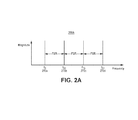
- FIG. 2A illustrates one embodiment of a frequency response of an optical ring resonator without Bragg gratings
- FIG. 2B illustrates one embodiment of a frequency response of an optical ring resonator with Bragg gratings
- FIG. 2C illustrates one embodiment of a pump signal, a first order Stokes signal, and a second order Stokes signal in an optical ring resonator
- FIG. 2D illustrates one embodiment of a pump signal and a first order Stokes signal in an optical ring resonator with an integrated Bragg grating
- FIG. 3 illustrates one embodiment of a method of operation of an optical ring resonator with an integrated Bragg grating
- FIG. 4A illustrates one embodiment of a SBS ring single laser gyroscope including an optical ring resonator with the integrated Bragg grating
- FIG. 4B illustrates one embodiment of a SBS ring dual laser gyroscope including an optical ring resonator with the integrated Bragg grating.
- An optical resonator with an integrated Bragg grating may be used to overcome the above referenced problem.
- Embodiments of the optical resonator with an integrated Bragg grating have at least one advantage: generation of Stokes signals up to a specific order, and suppression of Stokes signals having orders higher than the specific order.
- the power level of the one or more generated Stokes signals is greater than if the suppressed Stokes signals had not been suppressed.
- integrated Bragg gratings can be applied in a similar manner, e.g. to the exterior, of other optical resonators such as linear resonators and disc resonators.
- the Bragg gratings would be formed in circular side surface, of the disc resonator, which is typically perpendicular to the substrate on which the disc resonator is mounted.
- the Bragg gratings would be implemented in a manner similar to that described below.
- FIG. 1A illustrates a plan view of one embodiment of an optical ring resonator with an integrated Bragg grating, and a waveguide coupler 100 .
- a ring may be circular, triangular or any other closed perimeter geometry.
- the optical ring resonator with the integrated Bragg grating 150 is proximate to an optical waveguide coupler 152 .
- the Bragg grating is designed to have a center frequency, or Bragg frequency, substantially equal to the center frequency of an Nth order Brillouin gain region, or zone, capable of generating an Nth order Stokes signal.
- an input optical signal 154 is injected into the optical waveguide coupler 152 .
- the input optical signal 154 is coupled into the optical ring resonator with the integrated Bragg grating 150 at the narrowest portion 156 between the optical ring resonator with the integrated Bragg grating 150 and the optical waveguide 110 .
- an evanescent field of a mode of the input optical signal 154 in the optical waveguide coupler 152 transitions to a mode supported by the optical ring resonator with the integrated Bragg grating 150 , and generates a resonator optical signal 158 in the optical ring resonator with the integrated Bragg grating 150 .
- the optical waveguide coupler 152 and the optical ring resonator with the integrated Bragg grating 150 are formed from optical fiber. In another embodiment, the optical waveguide coupler 152 and the optical ring resonator with the integrated Bragg grating 150 are formed from by waveguide on a substrate, e.g. using semiconductor manufacturing processes.
- the Bragg grating acts as a notch rejection filter.
- the Bragg grating is formed on the optical ring resonator with the integrated Bragg grating 150 by forming periodic notches on the exterior of the optical ring resonator with the integrated Bragg grating 150 .
- periodic notches For example, for optical waveguide having a circular periphery, such periodic notches would be around the whole exterior circumference of the optical fiber.
- the notches would be made on parallel sides of the waveguide that are perpendicular to the substrate.
- the notches in the optical ring resonator with the integrated Bragg grating 150 have a quadrilateral cross-section.
- notches having other geometric cross-sections e.g. semi-circular and triangular, may be used. Further the notches may be on the surface of the whole or part of the optical ring resonator with the integrated Bragg grating 150 .
- FIG. 1B illustrates a plan view of notches in a portion of a surface of an optical ring resonator with the integrated Bragg grating 150 ′.
- the illustrated notches 161 in the surface 163 have a quadrilateral cross-section.
- T 158 is the grating period.
- the depth of a notch, D 1 160 with respect to the width or diameter of the waveguide, D 2 162 , can vary.
- the greater the ratio, D 1 /D 2 the higher the Q factor of the rejection notch filter.
- FIG. 1C illustrates one embodiment of an exemplary transmission response of a Bragg grating 164 .
- the illustrated transmission response has a band rejection notch 166 .
- the band rejection notch 166 arises due to signals, reflected by the Bragg grating 164 , being in phase and adding constructively, generating a back reflected signal centered about the Bragg wavelength (or frequency). Reflected signals at other wavelengths do not add constructively and are cancelled out, and such wavelengths are transmitted through the Bragg grating 164 .
- FIG. 2A illustrates one embodiment of a frequency response of an optical ring resonator without Bragg gratings 268 .
- the resonator has a first resonant frequency (f R ) 270 a and subsequent resonant frequencies f R2 270 b , f R3 270 c , and f R4 270 d , where each pair of proximate resonant frequencies is separated by a free spectral range (FSR).
- FSR free spectral range
- the frequency of the input optical signal 154 and the Stokes signals are designed to have frequencies equal to or substantially equal to resonant frequencies of the optical ring resonator.
- the input optical signal 154 would have a frequency equal to f R 270 a .
- the first order Stokes signal would have a frequency of f R2 270 b .
- the second order Stokes signal would have a frequency of f R3 270 c , and so on.
- FIG. 2B illustrates the frequency response of an optical ring resonator with Bragg gratings 268 B.
- the center frequency or Bragg frequency, f B of the notch filter is designed to align with the third resonant frequency 3f R to suppress generation of, e.g. a second order, Stokes signal at that frequency.
- f R3 270 c rather than just the third resonant frequency f R3 270 c being eliminated, two split resonances f R3 ⁇ f 271 a and f R3 + ⁇ f R 271 b (which are equidistant on either side of where the third resonant frequency would lie) are created adjacent to one another.
- the minimum separation of the two split resonances f R3 ⁇ f 271 a and f R3 + ⁇ f R 271 b is dependent upon the 3 dB bandwidth of the Brillouin gain of the material used to form the optical ring resonator.
- the 3 dB bandwidth of the Brillouin gain is about forty Megahertz.
- the 3 dB bandwidth of the Brillouin gain is about two hundred Megahertz.
- the frequency separation of the two split resonances f R3 ⁇ f 271 a and f R3 + ⁇ f R 271 b is dependent upon the Q factor of the Bragg grating.
- the Q factor of the grating ranges from 200,000 to 1,000,000.
- the two split resonances will be separated by several hundreds of Megahertz which is sufficiently far removed from the proximate frequency band of Brillouin gain, e.g. which is substantially in the center of the two split resonances. Because there is no longer a resonance at the third resonant frequency f R3 270 c , the, e.g. second order, Stokes signal at the third resonant frequency f R3 270 c is suppressed.
- FIG. 2C illustrates one embodiment of a pump signal, a first order Stokes signal, and a second order Stokes signal in an optical ring resonator 275 A.
- the pump signal 276 has a sufficiently high power to create the first order Stokes signal 278 A, and the second order Stokes signal 278 B in the optical ring resonator 150 .
- the second order Stokes signal 268 B is generated when the power level of the pump signal is four times the power level of the pump signal that initially generates the first order Stokes signal 268 A.
- FIG. 2D illustrates one embodiment of a pump signal and a first order Stokes signal in an optical ring resonator with an integrated Bragg grating 275 B.
- the integrated Bragg grating of the optical resonator is designed to have a center frequency, or a Bragg frequency, that is substantially equal to the frequency of the second order Stokes signal, or f B ⁇ 3*f R .
- the pump signal 276 has a sufficiently high power to create the first order Stokes signal 278 A and the second order Stokes signal 278 B in the optical ring resonator with the integrated Bragg grating 150 , the second order Stokes signal 278 B is suppressed because of two split resonances f R3 ⁇ f 271 a and f R3 + ⁇ f R 271 b created by the Bragg grating are sufficiently far from the 3 dB band of the Brillouin gain for the second order Stokes signal.
- the power level of the first order Stokes signal can be increased higher than if the second order Stokes signal was not suppressed.
- FIG. 3 illustrates one embodiment of a method of operation of an optical ring resonator with an integrated Bragg grating 300 .
- FIG. 3 illustrates one embodiment of a method of operation of an optical ring resonator with an integrated Bragg grating 300 .
- the blocks of the flow diagrams have been arranged in a generally sequential manner for ease of explanation; however, it is to be understood that this arrangement is merely exemplary, and it should be recognized that the processing associated with the methods (and the blocks shown in the Figure) can occur in a different order (for example, where at least some of the processing associated with the blocks is performed in parallel and/or in an event-driven manner).
- block 380 couple an optical signal into an optical waveguide.
- block 382 couple an optical signal into an optical resonator, e.g. with a Bragg grating.
- block 384 propagate the optical signal around the optical resonator, e.g. with the Bragg grating.
- block 386 generate at least one Stokes signal having order(s) equal to or less than N ⁇ 1. In another embodiment, N equals two, and generate a first order Stokes signal.
- suppress Nth order and higher order Stokes signals in the optical resonator e.g. with a Bragg grating.
- suppress the Nth order and higher order Stokes signals by generating a back reflected signal arising from signals, e.g. reflected by the Bragg grating, being in phase and adding constructively; the back reflected signal is at a center frequency (e.g. Bragg frequency), in the optical resonator (e.g. with the Bragg grating), that is substantially similar to the center frequency of a band of Brillouin gain corresponding to an Nth order Stokes signal.
- suppress second and higher order Stokes signals suppress second and higher order Stokes signals.
- the optical ring resonator with the integrated Bragg grating 150 can be used in a stimulated Brillouin scattering (SBS) ring laser gyroscope to eliminate higher order Stokes signals, e.g. second order and higher order Stokes signals.
- SBS ring laser gyroscopes are desirable because Stokes frequencies have low phase noise, and thus the SBS ring laser can accurately determine rotation around its input axis.
- the power level of the Stokes frequency can be increased so as to also increase the signal to noise ratio and thus the sensitivity of the SBS ring laser gyroscope.
- FIG. 4A illustrates one embodiment of a SBS ring single laser gyroscope including an optical ring resonator with the integrated Bragg grating 400 A.
- the SBS ring single laser gyroscope including an optical ring resonator with the integrated Bragg grating 400 A includes an optical ring resonator with the integrated Bragg grating 450 , and is used to measure angular rotation ( ⁇ ) 411 around an input axis 430 of the optical ring resonator with the integrated Bragg grating 450 .
- the SBS ring single laser gyroscope including an optical ring resonator with the integrated Bragg grating 400 A illustrated in FIG. 4 is one example of how to construct such a gyroscope. As is further illustrated below, other combinations of optical components may be used to implement the SBS ring single laser gyroscope including an optical ring resonator with the integrated Bragg grating.
- the SBS ring single laser gyroscope including an optical ring resonator with the integrated Bragg grating 400 A includes a first laser 404 .
- the first laser 404 includes a first input that is coupled to a first output of a resonance tracking servo system 410 .
- the first laser 404 has a second input configured to be coupled to an output of a processing system 425 .
- the processing system 425 is also configured to be coupled to and to control the power level of the first laser 404 .
- An output of the first laser 404 is coupled to a first port of a first optical coupler (C 1 ) 414 .
- the resonance tracking servo system 110 includes PDH feedback control electronics, a subtractor, and an integrator as is illustrated in U.S. Pat. No. 9,537,283, which is hereby incorporated by reference in its entirety.
- the resonance tracking servo system 110 is respectively part of a Pound-Drever-Hall servo loop which is subsequently described in more detail.
- the processing system 425 includes a processor coupled to a memory.
- the processor may be implemented, in whole or in part, with a state machine or a field programmable gate array.
- the memory includes software, executed on the processor, to determine a parameter corresponding to the angular rotation rate ( ⁇ ) 411 around an input axis 430 of the optical ring resonator with the integrated Bragg grating 450 .
- a second port of the first optical coupler 414 is coupled to a first input of a first phase modulator ( ⁇ Mod 1 ) 416 .
- a third port of the first optical coupler 414 is coupled to a first port of a second coupler (C 2 ) 418 .
- a first oscillator (Osc. 1 ) 415 is coupled to a second input of the first phase modulator 416 .
- the first oscillator 415 is coupled to, and its frequency is controlled by, the resonance tracking servo system 410 .
- the first oscillator 415 is a signal generator configured to generate a sinusoidal signal at a single frequency, e.g. within a range of one kHz and five GHz.
- the first oscillator 415 , the first phase modulator 416 , a third photodetector (PD 3 ) 422 , and the resonance tracking servo system 410 comprise a Pound-Drever-Hall servo loop.
- An output of the first phase modulator 416 is coupled to a first port of a first optical circulator (Cir 1 ) 408 .
- a second port and a third port of the first optical circulator 408 are respectively coupled to a first port of a resonator optical coupler (C 0 ) 406 and a second port of the second optical coupler 418 .
- the first circulator 408 directs light from the first port to the second port of the first circulator 408 , so that light generated from the first laser 404 is injected to the optical resonator 402 in a counter-clockwise direction.
- a third port and a fourth port of the resonator optical coupler 406 are respectively coupled to a first port and a second port of the optical resonator with the integrated Bragg grating 450 .
- the first order Stokes signal generated in the optical ring resonator with the integrated Bragg grating 450 by the pump signal from the first laser 404 , propagates in the clockwise direction of the optical ring resonator with the integrated Bragg grating 450 .
- This first order Stokes signal is coupled out of the optical ring resonator with the integrated Bragg grating 450 at the first port of the resonator optical coupler 406 and propagates from the second port of the first circulator 408 to its third port, and is coupled to the second port of the second optical coupler 418 , and then to an input of a first photodetector (PD 1 ) 413 (e.g. the second and third ports of the second optical coupler 418 combines the pump signal from the first laser 404 with the corresponding first order Stokes signal).
- a second port of the resonator optical coupler 406 is coupled to the third photodetector 422 .
- a third port and a fourth port of the resonator optical coupler 406 are respectively coupled to a first port and a second port of an optical ring resonator with the integrated Bragg grating 450 .
- the optical ring resonator with the integrated Bragg grating 450 is a coil of optical fiber (coil).
- different waveguides e.g. made from silicon nitride for example by semiconductor processing techniques, and different geometries, e.g. triangular, can be used.
- the output of the third photodetector 422 is coupled to an input of the resonance tracking servo system 410 .
- the output of the first photodetector 413 is respectively coupled to an input of a first analog to digital converter 424 .
- An output of the first analog to digital converter 424 is coupled to the processing system 425 .
- a heater 428 is thermally coupled to the optical ring resonator with the integrated Bragg grating 450 .
- the heater 428 is coupled to the processing system 425 which can activate and deactivate the heater 428 , and adjust the temperature of the heater 128 .
- the heater 428 is used to heat the optical ring resonator with the integrated Bragg grating 450 , and thus adjust the resonant frequency of the optical ring resonator with the integrated Bragg grating, e.g. so that it is closer to the frequencies of the pump signals emitted by the first laser 404 .
- the processing system 425 is configured to generate a signal, representative of the angular rotation rate ( ⁇ ) 411 , around an input axis 430 of the optical ring resonator with the integrated Bragg grating 450 .
- the input axis 430 is parallel to the center axis of the optical ring resonator with the integrated Bragg grating 450 , e.g. the coil.
- the input axis 430 is a centerline through the optical ring resonator with the integrated Bragg grating 450 , e.g. the coil.
- the input axis 430 need not be the centerline through the optical ring resonator with the integrated Bragg grating 450 , e.g. the coil.
- the first laser 404 generates a first laser pump signal.
- the first laser pump signal 472 propagates counter-clockwise in the optical ring resonator with the integrated Bragg grating 450 . If the power level of the first laser pump signal 472 is sufficiently high, a set of one or more Stokes signals is generated for the pump signal.
- a first laser first order Stokes signal 474 is generated from the first laser pump signal 472 .
- the first laser first order Stokes signal 474 propagates clockwise (opposite the pump signal).
- a first beat signal, f B1 is generated by the first photodetector 413 A as a result of the first laser first order Stokes signal 474 and the first laser pump signal 472 A being incident on the first photodetector 413 .
- ⁇ f R is equal to f B1 .
- the first laser pump signal 472 is incident upon the third photodetector 422 , which generates an electrical signal corresponding to the power level of the first laser pump signal 472 .
- This electrical signal is used to adjust the frequency of the first laser pump signal 472 so that it tracks a resonant frequency of the optical ring resonator with the integrated Bragg grating 450 .
- the second and higher order Stokes signals that would be generated by the first laser first order Stokes signal 474 .
- this can be done by regulating the power level of the first laser pump signal 472 so that it is lower, e.g. than four times the power level that gives rise to first Stoke signal.
- lower power pump signals result in lower power first order Stokes signals.
- higher power levels of the first Stoke signals are desirable to increase the signal to noise levels, and thus the sensitivity, of the SBS ring laser gyroscope including an optical ring resonator with the integrated Bragg grating 300 .
- second and higher order Stokes signals are suppressed by the optical ring resonator with the integrated Bragg grating 450 rather than by limiting the power level of the first laser pump signal 472 .
- the power level of the first laser pump signal 472 can be increased to increase the power level of the first order Stokes signals.
- FIG. 4B illustrates one embodiment of a SBS ring dual laser gyroscope including an optical ring resonator with the integrated Bragg grating 400 B.
- the SBS ring dual laser gyroscope including an optical ring resonator with the integrated Bragg grating 400 B includes an optical ring resonator with the integrated Bragg grating 450 , and is used to measure angular rotation ( ⁇ ) 411 around an input axis 430 of the optical ring resonator with the integrated Bragg grating 450 .
- the SBS ring dual laser gyroscope including an optical ring resonator with the integrated Bragg grating 400 B illustrated in FIG. 4 is one example of how to construct such a gyroscope. As is further illustrated below, other combinations of optical components may be used to implement the SBS ring dual laser gyroscope including an optical ring resonator with the integrated Bragg grating.
- the SBS ring dual laser gyroscope including an optical ring resonator with the integrated Bragg grating 400 B includes a first laser 404 A and a second laser 404 B.
- the first laser 404 A includes a first input that is coupled to a first output of a resonance tracking servo system 410 .
- the second laser 404 B includes a first input that is coupled to a second output of a resonance tracking servo system 410 .
- the first laser 404 A and the second laser 404 B each have a second input configured to be coupled to output(s) of a processing system 425 .
- the processing system 425 is also configured to be coupled to and to control the power levels of the first laser 404 A and the second laser 404 B.
- the resonance tracking servo system 110 includes PDH feedback control electronics, a subtractor, and an integrator as is illustrated in U.S. Pat. No. 9,537,283, which is hereby incorporated by reference in its entirety.
- the resonance tracking servo system 110 is respectively part of a first Pound-Drever-Hall servo loop and a second Pound-Drever-Hall servo loop which are subsequently described in more detail.
- An output of the first laser 404 A is coupled to a first port of a first optical coupler (C 1 ) 414 A.
- An output of the second laser 404 B is coupled to a first port of a fourth optical coupler (C 4 ) 414 B.
- the processing system 425 includes a processor coupled to a memory.
- the processor may be implemented, in whole or in part, with a state machine or a field programmable gate array.
- the memory includes software, executed on the processor, to determine a parameter corresponding to the angular rotation rate ( ⁇ ) 411 around an input axis 430 of the optical ring resonator with the integrated Bragg grating 450 .
- a second port of the first optical coupler 414 A is coupled to a first input of a first phase modulator ( ⁇ Mod 1 ) 416 A.
- a third port of the first optical coupler 414 A is coupled to a first port of a second coupler (C 2 ) 418 A.
- a second port of the fourth optical coupler 414 B is coupled to a first input of a second phase modulator ( ⁇ Mod 2 ) 416 B.
- a third port of the fourth optical coupler 414 B is coupled to a first port of a fifth coupler (C 5 ) 418 B.
- a first oscillator (Osc. 1 ) 415 A is coupled to a second input of the first phase modulator 416 A.
- a second oscillator (Osc. 2 ) 415 B is coupled to a second input of the second phase modulator 116 B.
- the first oscillator 415 A and the second oscillator 415 B are coupled to, and their frequencies are controlled by, the resonance tracking servo system 110 .
- each of the first oscillator 415 A and the second oscillator 415 B are signal generators configured to generate sinusoidal signals at a single frequency, e.g. within a range of one kHz and five GHz.
- the first oscillator 415 A, the first phase modulator 416 A, the sixth optical coupler (C 6 ) 420 B, a fourth photodetector (PD 4 ) 422 B, and the resonance tracking servo system 410 comprise the first Pound-Drever-Hall servo loop;
- the second oscillator 415 B, the second phase modulator 416 B, the third coupler (C 3 ) 420 A, the third photodetector (PD 3 ) 422 A, and the resonance tracking servo system 410 comprise the second Pound-Drever-Hall servo loop.
- An output of the first phase modulator 416 A is coupled to a first port of a first optical circulator (Cir 1 ) 408 A.
- An output of the second phase modulator 416 B is coupled to a first port of a second optical circulator (Cir 2 ) 408 B.
- a second port and a third port of the first optical circulator 408 A are respectively coupled to a first port of a resonator optical coupler (C 0 ) 406 and a first port of a third optical coupler 420 A.
- the first circulator 408 A directs light from the first port to the second port of the first circulator 408 A, so that light generated from the first laser 404 A is injected to the optical resonator 402 in a counter-clockwise direction.
- a second port and a third port of the second optical circulator 408 B are respectively coupled to a second port of the resonator optical coupler 406 and a first port of a sixth optical coupler 420 B.
- the second circulator 408 B directs light from the first port to the second port of the second circulator 408 B, so that light generated from the second laser 404 B is injected to the optical ring resonator with the integrated Bragg grating 450 in a clockwise direction.
- a third port and a fourth port of the resonator optical coupler 406 are respectively coupled to a first port and a second port of the optical resonator with the integrated Bragg grating 450 .
- the first order Stokes signal generated in the optical ring resonator with the integrated Bragg grating 450 by the pump signal from the first laser 404 A, propagates in the clockwise direction of the optical ring resonator with the integrated Bragg grating 450 .
- This first order Stokes signal is coupled out of the optical ring resonator with the integrated Bragg grating 450 at the first port of the resonator optical coupler 406 and propagates from the second port of the first circulator 408 A to its third port, and is coupled to the first port of the third optical coupler 420 A.
- a second port and a third port of the third optical coupler 420 A are respectively coupled to an input of a first photodetector (PD 1 ) 413 A (e.g. through second and third ports of the second optical coupler 418 A which combines the pump signal from the first laser 404 A with the corresponding first order Stokes signal), and an input of a third photodetector 422 A.
- PD 1 photo
- the first order Stokes signal generated in the optical ring resonator with the integrated Bragg grating 450 by the pump signal from the second laser 404 B, propagates in the counter-clockwise direction of the optical ring resonator with the integrated Bragg grating 450 .
- This first order Stokes signal is coupled out of the optical ring resonator with the integrated Bragg grating 450 at the second port of the resonator optical coupler 406 , and propagates from the second port of the second circulator 408 B to the third port, and is coupled to the first port of the sixth optical coupler 420 B.
- a second port and a third port of the sixth optical coupler 420 B are respectively coupled to an input of a second photodetector (PD 2 ) 413 B (e.g. through second and third ports of the fifth optical coupler 418 B which combines the pump signal from the second laser 404 B with the corresponding first order Stokes signal), and an input of a fourth photodetector 422 B.
- PD 2 photodetector
- a third port and a fourth port of the resonator optical coupler 406 are respectively coupled to a first port and a second port of an optical ring resonator with the integrated Bragg grating 450 .
- the optical ring resonator with the integrated Bragg grating 450 is a coil of optical fiber (coil).
- different waveguides e.g. made from silicon nitride for example by semiconductor processing techniques, and different geometries, e.g. triangular, can be used.
- the outputs of the third photodetector 422 A and the fourth photodetector 422 B are respectively coupled to a first input and a second input of the resonance tracking servo system 410 .
- the outputs of the first photodetector 413 A and the second photodetector 413 B are respectively coupled to inputs of a first analog to digital converter 424 A and a second analog to digital converter 424 B.
- Outputs of the first analog to digital converter 424 A and the second analog to digital converter 424 B are coupled to the processing system 425 .
- a heater 428 is thermally coupled to the optical ring resonator with the integrated Bragg grating 450 .
- the heater 428 is coupled to the processing system 425 which can activate and deactivate the heater 428 , and adjust the temperature of the heater 128 .
- the heater 428 is used to heat the optical ring resonator with the integrated Bragg grating 450 , and thus adjust the resonant frequency of the optical ring resonator with the integrated Bragg grating, e.g. so that it is closer to the frequencies of the pump signals emitted by the first laser 404 A and the second laser 404 B.
- the processing system 425 is configured to generate a signal, representative of the angular rotation rate ( ⁇ ) 411 , around an input axis 430 of the optical ring resonator with the integrated Bragg grating 450 .
- the input axis 430 is parallel to the center axis of the optical ring resonator with the integrated Bragg grating 450 , e.g. the coil.
- the input axis 430 is a centerline through the optical ring resonator with the integrated Bragg grating 450 , e.g. the coil.
- the input axis 430 need not be the centerline through the optical ring resonator with the integrated Bragg grating 450 , e.g. the coil.
- the first laser 404 A and the second laser 404 B respectively generate a first laser pump signal 472 A and a second laser pump signal 472 B.
- the first laser pump signal 472 A and the second laser pump signal 472 B respectively propagate counter-clockwise and clockwise in the optical ring resonator with the integrated Bragg grating 450 . If the power levels of the first laser pump signal 472 A and the second laser pump signal 472 B are sufficiently high, a set of one or more Stokes signals is respectively generated for each pump signal.
- a first laser first order Stokes signal 474 A and a second laser first order Stokes signal 474 B are respectively generated from the first laser pump signal 472 A and the second laser pump signal 472 B.
- the first laser first order Stokes signal 474 A and the second laser first order Stokes signal 474 B propagate clockwise and counter-clockwise (opposite the corresponding pump signals).
- a first beat signal, f B1 is generated by the first photodetector 413 A as a result of the first laser first order Stokes signal 474 A and the first laser pump signal 472 A being incident on the first photodetector 413 A.
- a second beat signal, f B2 is generated by the second photodetector 413 B as a result of the second laser first order Stokes signal 474 B and the second laser pump signal 472 B being incident upon the second photodetector 413 B.
- ⁇ f R is equal to (f B1 ⁇ f B2 )/2.
- the first laser pump signal 472 A is incident upon the fourth photodetector 422 B, which generates an electrical signal corresponding to the power level of the first laser pump signal 472 A. This electrical signal is used to adjust the frequency of the first laser pump signal 472 A so that it tracks a resonant frequency of the optical ring resonator with the integrated Bragg grating 450 .
- the second laser pump signal 472 B is incident upon the third photodetector 422 A, which generates an electrical signal corresponding to the power level of the second laser pump signal 472 B. This electrical signal is used to adjust the frequency of the second laser pump signal 472 B so that it tracks a resonant frequency of the optical ring resonator with the integrated Bragg grating 450 .
- second and higher order Stokes signals are suppressed by the optical ring resonator with the integrated Bragg grating 450 rather than by limiting the power levels of the first laser pump signal 472 A and the second laser pump signal 372 B.
- the power levels of the first laser pump signal 472 A and the second laser pump signal 372 B can be increased to increase the power levels of the corresponding first order Stokes signals.
- FIGS. 4A and 4B illustrate examples of combinations of optical couplers and/or circulators that can be used implement an SBS ring laser gyroscope.
- the SBS ring laser gyroscope can be implemented without the use of optical circulators.
- a second optical resonator optical coupler can be coupled to the side of the optical resonator with a Bragg grating 450 opposite the resonator optical coupler 406 , in lieu of the optical circulators.
- the second resonator optical coupler would also be coupled to the third optical coupler 420 A and the sixth optical coupler 420 B to provide output signals, Stokes and laser pump signals, to the first photodetector 413 A, the second photodetector 313 B, the third photodetector 422 A, and the fourth photodetector 422 B.
- Terms of relative position as used in this application are defined based on a plane parallel to, or in the case of the term coplanar—the same plane as, the conventional plane or working surface of a layer, wafer, or substrate, regardless of orientation.
- the term “horizontal” or “lateral” as used in this application are defined as a plane parallel to the conventional plane or working surface of a layer, wafer, or substrate, regardless of orientation.
- the term “vertical” refers to a direction perpendicular to the horizontal. Terms such as “on,” “side” (as in “sidewall”), “higher,” “lower,” “over,” “top,” and “under” are defined with respect to the conventional plane or working surface being on the top surface of a layer, wafer, or substrate, regardless of orientation.
- the term “coplanar” as used in this application is defined as a plane in the same plane as the conventional plane or working surface of a layer, wafer, or substrate, regardless of orientation.
- Example 1 includes an apparatus, comprising: an optical resonator including a surface; wherein a Bragg grating is formed at least part of the surface of the optical resonator; and wherein the Bragg grating has a Bragg frequency substantially equal to a center frequency of an Nth order Brillouin gain region capable of generating an Nth order Stokes signal.
- Example 2 includes the apparatus of Example 1, further comprising a coupler proximate to the optical resonator.
- Example 3 includes the apparatus of Examples 1-2, wherein the Bragg grating is formed by periodic notches in the at least part of the surface of the optical resonator.
- Example 4 includes the apparatus of Example 3, wherein the periodic notches comprise notches having a quadrilateral cross-section.
- Example 5 includes the apparatus of Examples 3-4 wherein the ratio of a depth of each notch to a width or diameter of a waveguide, forming the resonator, Example 0.97 or lower.
- Example 6 includes the optical resonator of Examples 1-5, wherein the optical resonator is an optical ring resonator.
- Example 7 includes the optical resonator of Examples 1-6, wherein the optical resonator is formed from optical fiber.
- Example 8 includes the optical resonator of Examples 1-7, where the Nth Stokes signal is the second order Stokes signal.
- Example 9 includes a method, comprising: coupling an optical signal into an optical resonator; propagating the optical signal in the optical resonator; generating at least one Stokes signal having order(s) equal to or less than N ⁇ 1; and suppressing Nth order and higher order Stokes signals in the optical resonator.
- Example 10 includes the method of Example 9, further comprising coupling the optical signal into an optical waveguide; and wherein coupling the optical signal into the optical resonator portion comprises coupling the optical signal from the optical waveguide into the optical resonator.
- Example 11 includes the method of Examples 9-10, wherein coupling the optical signal into the optical resonator comprises coupling the optical signal in an optical ring resonator; wherein propagating the optical signal in the optical resonator comprises propagating the optical signal in the optical ring resonator; and wherein suppressing the Nth order and higher order Stokes signals in the optical resonator comprises suppressing the Nth order and higher order Stokes signals in an optical ring resonator.
- Example 12 includes the method of Examples 9-11, wherein suppressing the Nth order and higher order Stokes signals in the optical resonator comprises wherein suppressing the second order and higher order Stokes signals in the optical resonator.
- Example 13 includes the method of Examples 9-12, wherein suppressing the Nth order and higher order Stokes signals in the optical resonator comprises generating a back reflected signal arising from signals, reflected by a Bragg grating on the optical resonator, being in phase and adding constructively.
- Example 14 includes A gyroscope, comprising: a first laser configured to generate a first laser pump signal; an optical resonator, including a surface, coupled to the first laser; wherein a Bragg grating is formed at least part of the surface of the optical resonator; wherein the Bragg grating has a Bragg frequency substantially equal to the center frequency of an Nth order Brillouin gain region capable of generating an Nth order Stokes signal; an input axis parallel to a center axis of the optical resonator; wherein the first laser pump signal generates a first order Stokes signal in the optical resonator that propagates in an opposite direction, around the optical resonator, of the first laser pump signal; a first photodetector coupled to the optical resonator; a second photodetector coupled to the optical resonator and configured to generate a first signal in response to a first portion of the first pump signal coupled out of the optical resonator; wherein the first photodetector is
- Example 15 includes the gyroscope of Example 14, further comprising: a second laser configured to generate a second laser pump signal, and coupled to the optical resonator and resonance tracking servo system; wherein the second laser pump signal generates a first order Stokes signal in the optical resonator that propagates in an opposite direction, around the optical resonator, of the second laser pump signal; a third photodetector coupled to the optical resonator and the processing system; a fourth photodetector coupled to the optical resonator and the resonance tracking servo system, and configured to generate a second signal in response to a first portion of the second pump signal coupled out of the optical resonator; wherein the third photodetector is configured to generate a second beat signal in response to a first Stokes signal, corresponding to the second pump signal, which is coupled out of the optical resonator and a second portion of the second pump signal; wherein the resonance tracking servo system is configured to alter the frequency of the second laser pump signal based upon the second
- Example 16 includes the apparatus of Examples 14-15, wherein the Bragg grating is formed by periodic notches in the at least part of the surface of the optical resonator.
- Example 17 includes the apparatus of Example 16, wherein the periodic notches comprise notches having a quadrilateral cross-section.
- Example 18 includes the optical resonator of Examples 14-17, wherein the optical resonator is an optical ring resonator.
- Example 19 includes the optical resonator of Examples 14-18, wherein the optical resonator is formed from optical fiber.
- Example 20 includes the optical resonator of Examples 14-19, where the Nth Stokes signal is the second order Stokes signal.
Landscapes
- Physics & Mathematics (AREA)
- Electromagnetism (AREA)
- Engineering & Computer Science (AREA)
- Optics & Photonics (AREA)
- Plasma & Fusion (AREA)
- Power Engineering (AREA)
- General Physics & Mathematics (AREA)
- Radar, Positioning & Navigation (AREA)
- Remote Sensing (AREA)
- Automation & Control Theory (AREA)
- Lasers (AREA)
- Gyroscopes (AREA)
Abstract
Description
T=λ B/(2*n e),
where λB (the Bragg wavelength) is the vacuum wavelength of light, ne is the effective refractive index of the medium, and T is the grating period.
λB=2n e *T,
where ne is the effective refractive index of the grating in the waveguide. The depth of a notch, D1 160, with respect to the width or diameter of the waveguide,
Claims (7)
Priority Applications (2)
| Application Number | Priority Date | Filing Date | Title |
|---|---|---|---|
| US15/618,833 US10992097B2 (en) | 2017-06-09 | 2017-06-09 | Apparatus and method for an optical resonator with an integrated Bragg grating |
| EP18165567.1A EP3425751B1 (en) | 2017-06-09 | 2018-04-03 | Apparatus and method for an optical resonator with an integrated bragg grating |
Applications Claiming Priority (1)
| Application Number | Priority Date | Filing Date | Title |
|---|---|---|---|
| US15/618,833 US10992097B2 (en) | 2017-06-09 | 2017-06-09 | Apparatus and method for an optical resonator with an integrated Bragg grating |
Publications (2)
| Publication Number | Publication Date |
|---|---|
| US20180358772A1 US20180358772A1 (en) | 2018-12-13 |
| US10992097B2 true US10992097B2 (en) | 2021-04-27 |
Family
ID=61899089
Family Applications (1)
| Application Number | Title | Priority Date | Filing Date |
|---|---|---|---|
| US15/618,833 Active 2038-01-31 US10992097B2 (en) | 2017-06-09 | 2017-06-09 | Apparatus and method for an optical resonator with an integrated Bragg grating |
Country Status (2)
| Country | Link |
|---|---|
| US (1) | US10992097B2 (en) |
| EP (1) | EP3425751B1 (en) |
Families Citing this family (8)
| Publication number | Priority date | Publication date | Assignee | Title |
|---|---|---|---|---|
| US11079233B2 (en) * | 2019-09-18 | 2021-08-03 | Honeywell International Inc. | Stimulated brillouin scattering gyroscope |
| US10907967B1 (en) | 2019-10-02 | 2021-02-02 | Honeywell International Inc. | Ring laser gyroscopes with active volume Bragg grating |
| US10855372B1 (en) | 2019-10-16 | 2020-12-01 | Honeywell International Inc. | Systems and methods for reduction of optical signal line width |
| US11486706B2 (en) * | 2020-04-24 | 2022-11-01 | Honeywell International Inc. | Kerr effect reduction in SBS laser gyroscope |
| CN112729271B (en) * | 2020-12-21 | 2022-07-15 | 北京航空航天大学 | An Optical Gyro Resonator Structure Based on Singular Point Resonant Mode Splitting |
| US11431144B2 (en) | 2021-01-06 | 2022-08-30 | Honeywell International Inc. | Suppression of higher-order lasing in a Brillouin laser using nested ring resonators |
| US11656080B1 (en) * | 2022-08-23 | 2023-05-23 | Anello Photonics, Inc. | Silicon nitride waveguide based integrated photonics front-end chip for optical gyroscope |
| CN119780459B (en) * | 2024-12-11 | 2025-10-17 | 北京科技大学 | Angular velocity sensing method and system based on double silicon-based micro-ring resonance demodulation |
Citations (51)
| Publication number | Priority date | Publication date | Assignee | Title |
|---|---|---|---|---|
| US3958188A (en) * | 1974-12-11 | 1976-05-18 | Nasa | Fiber distributed feedback laser |
| US4159178A (en) | 1976-11-24 | 1979-06-26 | University Of Utah Research Institute | Stimulated brillouin scattering ring laser gyroscope |
| US4396290A (en) | 1979-09-24 | 1983-08-02 | University Of Utah Research Institute | Two pump-frequency-stimulated Brillouin scattering ring laser gyroscope |
| US4863272A (en) | 1988-05-12 | 1989-09-05 | The Charles Stark Draper Laboratory, Inc. | Multi-mode fiber optic resonator gyroscope |
| US4922481A (en) | 1985-08-01 | 1990-05-01 | Hicks John W | Optical communication systems enabling minimal subscriber components |
| US4952059A (en) * | 1986-06-06 | 1990-08-28 | The Board Of Trustees Of The Leland Stanford Junior University | Reentrant fiber raman gyroscope |
| US5064288A (en) | 1990-12-07 | 1991-11-12 | The Charles Stark Draper Laboratory | Scattered light multi-Brillouin gyroscope |
| US5295209A (en) * | 1991-03-12 | 1994-03-15 | General Instrument Corporation | Spontaneous emission source having high spectral density at a desired wavelength |
| US5323404A (en) * | 1993-11-02 | 1994-06-21 | At&T Bell Laboratories | Optical fiber laser or amplifier including high reflectivity gratings |
| US5323415A (en) | 1992-06-09 | 1994-06-21 | Thomas Quast | Brillouin ring laser |
| US5351252A (en) | 1993-02-26 | 1994-09-27 | The Board Of Trustees Of The Leland Stanford University | Technique of reducing the Kerr effect and extending the dynamic range in a Brillouin fiber optic gyroscope |
| US5406370A (en) | 1993-02-26 | 1995-04-11 | The Board Of Trustees Of The Leland Stanford University | Winding technique for decreasing the pump power requirement of a brillouin fiber optic gyroscope |
| US5408317A (en) | 1990-12-28 | 1995-04-18 | The Charles Stark Draper Laboratory, Inc. | Scattered light moire-brillouin gyroscope |
| US5440669A (en) * | 1991-07-26 | 1995-08-08 | Accuwave Corporation | Photorefractive systems and methods |
| US5517305A (en) | 1994-03-05 | 1996-05-14 | Bodenseewerk Geratetechnik Gmbh | Brillouin ring laser gyro |
| US5537671A (en) | 1995-02-10 | 1996-07-16 | The Board Of Trustees Of The Leland Stanford Junior University | Technique of reducing the Kerr effect and extending the dynamic range in a brillouin fiber optic gyroscope |
| US5912910A (en) * | 1996-05-17 | 1999-06-15 | Sdl, Inc. | High power pumped mid-IR wavelength systems using nonlinear frequency mixing (NFM) devices |
| US20010010593A1 (en) * | 1998-01-23 | 2001-08-02 | Takafumi Terahara | Tunable optical filter |
| US6407855B1 (en) * | 1999-10-29 | 2002-06-18 | Sdl, Inc. | Multiple wavelength optical sources |
| US6411429B1 (en) * | 1999-10-19 | 2002-06-25 | Fujitsu Limited | Optical amplifying apparatus, wide-band optical amplifying apparatus, and optical communication system |
| US6424664B1 (en) | 2000-02-03 | 2002-07-23 | Electronics And Telecommunications Research Institute | Brillouin/erbuim fiber laser outputting dual spacing multiwavelength light |
| US6560246B1 (en) * | 1997-10-24 | 2003-05-06 | The University Of Sydney | Brillouin/erbium fiber laser current monitor using elliptically polarizing fiber |
| US20040086004A1 (en) * | 2001-03-14 | 2004-05-06 | Domenico Bonaccini | Narrow band high power fibre lasers with extended wavelength coverage |
| US7024069B2 (en) | 2003-10-01 | 2006-04-04 | California Institute Of Technology | Tunable resonator-based devices for producing variable delays and narrow spectral linewidths |
| US7065276B2 (en) | 2003-04-03 | 2006-06-20 | Lambda Crossing Ltd. | Integrated optical filters utilizing resonators |
| US7184624B1 (en) | 2006-06-05 | 2007-02-27 | The United States Of America As Represented By The Administrator Of The National Aeronautics And Space Administration | Vertically-coupled whispering gallery mode resonator optical waveguide, and methods |
| US7272160B1 (en) * | 2005-01-24 | 2007-09-18 | Np Photonics, Inc | Single-frequency Brillouin fiber ring laser with extremely narrow linewidth |
| US7372574B2 (en) | 2005-12-09 | 2008-05-13 | Honeywell International Inc. | System and method for stabilizing light sources in resonator gyro |
| US7463360B2 (en) | 2006-04-18 | 2008-12-09 | Honeywell International Inc. | Optical resonator gyro with integrated external cavity beam generator |
| WO2010009951A1 (en) | 2008-07-25 | 2010-01-28 | Thales | Self-referenced optical fibre sensor with stimulated brillouin scattering |
| US20100322559A1 (en) * | 2008-02-29 | 2010-12-23 | Fujikura Ltd. | Planar optical waveguide element, chromatic dispersion compensator, optical filter, optical resonator and methods for designing the element, chromatic dispersion compensator, optical filter and optical resonator |
| US20100329680A1 (en) * | 2007-10-29 | 2010-12-30 | Marco Presi | Optical networks |
| US20110134940A1 (en) * | 2009-12-08 | 2011-06-09 | Schlumberger Technology Corporation | Narrow linewidth brillouin laser |
| US20110255094A1 (en) | 2010-03-23 | 2011-10-20 | Oewaves, Inc. | Optical gyroscope sensors based on optical whispering gallery mode resonators |
| US20120189025A1 (en) | 2010-11-23 | 2012-07-26 | Oracle International Corporation | Monolithic laser source using ring-resonator reflectors |
| US8289616B1 (en) | 2008-05-15 | 2012-10-16 | Oewaves, Inc. | Optical devices based on optically coupled optical whispering gallery-mode resonators formed on a rod |
| US8472486B1 (en) * | 2011-08-17 | 2013-06-25 | The United States Of America As Represented By The Secretary Of The Air Force | Seeded raman amplifier for applications in the 1100-1500 nm spectral region |
| EP2685213A2 (en) | 2012-07-10 | 2014-01-15 | Honeywell International Inc. | Narrow bandwidth reflectors for reducing stimulated brillouin scattering in an optical cavity |
| US8659760B2 (en) | 2012-04-12 | 2014-02-25 | Honeywell International Inc. | Resonator fiber optic gyroscope utilizing laser frequency combs |
| US8718112B2 (en) | 2008-10-10 | 2014-05-06 | International Business Machines Corporation | Radial Bragg ring resonator structure with high quality factor |
| US20140152994A1 (en) | 2012-12-04 | 2014-06-05 | Honeywell International Inc. | Optical frequency comb stimulated brillouin scattering gyroscope |
| US20140269789A1 (en) * | 2011-10-28 | 2014-09-18 | Ofs Fitel, Llc | Distributed feedback (dfb) brillouin fiber lasers |
| US20140320863A1 (en) * | 2013-04-27 | 2014-10-30 | Magiq Technologies, Inc | System and method for increasing sensitivity of optical sensors |
| EP2927636A1 (en) | 2014-04-02 | 2015-10-07 | Honeywell International Inc. | Systems and methods for stabilized stimulated brillouin scattering lasers with ultra-low phase noise |
| WO2015191124A2 (en) | 2014-03-06 | 2015-12-17 | California Institute Of Technology | Stable microwave-frequency source based on cascaded brillouin lasers |
| US20160109736A1 (en) * | 2014-10-16 | 2016-04-21 | The Board Of Trustees Of The University Of Illinois | System and method for brillouin scattering induced transparency |
| US20160204571A1 (en) * | 2015-01-14 | 2016-07-14 | Honeywell International Inc. | Systems and methods for an optical frequency comb stimulated brillouin scattering gyroscope with rigid optical waveguide resonator |
| US9537283B2 (en) | 2012-08-10 | 2017-01-03 | Honeywell International Inc. | Laser with transmission and reflection mode feedback control |
| US20170067743A1 (en) | 2015-09-09 | 2017-03-09 | Honeywell International Inc. | Single-pump cascaded stimulated brillouin scattering (sbs) ring laser gyro |
| US20180081205A1 (en) * | 2016-09-20 | 2018-03-22 | Honeywell International Inc. | Double-layer high-confinement acousto-optic waveguide |
| US20180081206A1 (en) * | 2016-09-20 | 2018-03-22 | Honeywell International Inc. | Optical waveguide having a wide brillouin bandwidth |
-
2017
- 2017-06-09 US US15/618,833 patent/US10992097B2/en active Active
-
2018
- 2018-04-03 EP EP18165567.1A patent/EP3425751B1/en active Active
Patent Citations (54)
| Publication number | Priority date | Publication date | Assignee | Title |
|---|---|---|---|---|
| US3958188A (en) * | 1974-12-11 | 1976-05-18 | Nasa | Fiber distributed feedback laser |
| US4159178A (en) | 1976-11-24 | 1979-06-26 | University Of Utah Research Institute | Stimulated brillouin scattering ring laser gyroscope |
| US4396290A (en) | 1979-09-24 | 1983-08-02 | University Of Utah Research Institute | Two pump-frequency-stimulated Brillouin scattering ring laser gyroscope |
| US4922481A (en) | 1985-08-01 | 1990-05-01 | Hicks John W | Optical communication systems enabling minimal subscriber components |
| US4952059A (en) * | 1986-06-06 | 1990-08-28 | The Board Of Trustees Of The Leland Stanford Junior University | Reentrant fiber raman gyroscope |
| US4863272A (en) | 1988-05-12 | 1989-09-05 | The Charles Stark Draper Laboratory, Inc. | Multi-mode fiber optic resonator gyroscope |
| US5064288A (en) | 1990-12-07 | 1991-11-12 | The Charles Stark Draper Laboratory | Scattered light multi-Brillouin gyroscope |
| US5408317A (en) | 1990-12-28 | 1995-04-18 | The Charles Stark Draper Laboratory, Inc. | Scattered light moire-brillouin gyroscope |
| US5295209A (en) * | 1991-03-12 | 1994-03-15 | General Instrument Corporation | Spontaneous emission source having high spectral density at a desired wavelength |
| US5440669A (en) * | 1991-07-26 | 1995-08-08 | Accuwave Corporation | Photorefractive systems and methods |
| US5323415A (en) | 1992-06-09 | 1994-06-21 | Thomas Quast | Brillouin ring laser |
| US5351252A (en) | 1993-02-26 | 1994-09-27 | The Board Of Trustees Of The Leland Stanford University | Technique of reducing the Kerr effect and extending the dynamic range in a Brillouin fiber optic gyroscope |
| US5406370A (en) | 1993-02-26 | 1995-04-11 | The Board Of Trustees Of The Leland Stanford University | Winding technique for decreasing the pump power requirement of a brillouin fiber optic gyroscope |
| US5323404A (en) * | 1993-11-02 | 1994-06-21 | At&T Bell Laboratories | Optical fiber laser or amplifier including high reflectivity gratings |
| US5517305A (en) | 1994-03-05 | 1996-05-14 | Bodenseewerk Geratetechnik Gmbh | Brillouin ring laser gyro |
| US5537671A (en) | 1995-02-10 | 1996-07-16 | The Board Of Trustees Of The Leland Stanford Junior University | Technique of reducing the Kerr effect and extending the dynamic range in a brillouin fiber optic gyroscope |
| US5912910A (en) * | 1996-05-17 | 1999-06-15 | Sdl, Inc. | High power pumped mid-IR wavelength systems using nonlinear frequency mixing (NFM) devices |
| US6560246B1 (en) * | 1997-10-24 | 2003-05-06 | The University Of Sydney | Brillouin/erbium fiber laser current monitor using elliptically polarizing fiber |
| US20010010593A1 (en) * | 1998-01-23 | 2001-08-02 | Takafumi Terahara | Tunable optical filter |
| US6411429B1 (en) * | 1999-10-19 | 2002-06-25 | Fujitsu Limited | Optical amplifying apparatus, wide-band optical amplifying apparatus, and optical communication system |
| US6407855B1 (en) * | 1999-10-29 | 2002-06-18 | Sdl, Inc. | Multiple wavelength optical sources |
| US6424664B1 (en) | 2000-02-03 | 2002-07-23 | Electronics And Telecommunications Research Institute | Brillouin/erbuim fiber laser outputting dual spacing multiwavelength light |
| US20040086004A1 (en) * | 2001-03-14 | 2004-05-06 | Domenico Bonaccini | Narrow band high power fibre lasers with extended wavelength coverage |
| US7065276B2 (en) | 2003-04-03 | 2006-06-20 | Lambda Crossing Ltd. | Integrated optical filters utilizing resonators |
| US7024069B2 (en) | 2003-10-01 | 2006-04-04 | California Institute Of Technology | Tunable resonator-based devices for producing variable delays and narrow spectral linewidths |
| US7272160B1 (en) * | 2005-01-24 | 2007-09-18 | Np Photonics, Inc | Single-frequency Brillouin fiber ring laser with extremely narrow linewidth |
| US7372574B2 (en) | 2005-12-09 | 2008-05-13 | Honeywell International Inc. | System and method for stabilizing light sources in resonator gyro |
| US7463360B2 (en) | 2006-04-18 | 2008-12-09 | Honeywell International Inc. | Optical resonator gyro with integrated external cavity beam generator |
| US7184624B1 (en) | 2006-06-05 | 2007-02-27 | The United States Of America As Represented By The Administrator Of The National Aeronautics And Space Administration | Vertically-coupled whispering gallery mode resonator optical waveguide, and methods |
| US20100329680A1 (en) * | 2007-10-29 | 2010-12-30 | Marco Presi | Optical networks |
| US20100322559A1 (en) * | 2008-02-29 | 2010-12-23 | Fujikura Ltd. | Planar optical waveguide element, chromatic dispersion compensator, optical filter, optical resonator and methods for designing the element, chromatic dispersion compensator, optical filter and optical resonator |
| US8289616B1 (en) | 2008-05-15 | 2012-10-16 | Oewaves, Inc. | Optical devices based on optically coupled optical whispering gallery-mode resonators formed on a rod |
| US20110122417A1 (en) | 2008-07-25 | 2011-05-26 | Thales | Self-Referenced Optical Fiber Sensor with Stimulated Brillouin Scattering |
| WO2010009951A1 (en) | 2008-07-25 | 2010-01-28 | Thales | Self-referenced optical fibre sensor with stimulated brillouin scattering |
| US8718112B2 (en) | 2008-10-10 | 2014-05-06 | International Business Machines Corporation | Radial Bragg ring resonator structure with high quality factor |
| US20110134940A1 (en) * | 2009-12-08 | 2011-06-09 | Schlumberger Technology Corporation | Narrow linewidth brillouin laser |
| US20110255094A1 (en) | 2010-03-23 | 2011-10-20 | Oewaves, Inc. | Optical gyroscope sensors based on optical whispering gallery mode resonators |
| US20120189025A1 (en) | 2010-11-23 | 2012-07-26 | Oracle International Corporation | Monolithic laser source using ring-resonator reflectors |
| US8472486B1 (en) * | 2011-08-17 | 2013-06-25 | The United States Of America As Represented By The Secretary Of The Air Force | Seeded raman amplifier for applications in the 1100-1500 nm spectral region |
| US20140269789A1 (en) * | 2011-10-28 | 2014-09-18 | Ofs Fitel, Llc | Distributed feedback (dfb) brillouin fiber lasers |
| US8659760B2 (en) | 2012-04-12 | 2014-02-25 | Honeywell International Inc. | Resonator fiber optic gyroscope utilizing laser frequency combs |
| EP2685213A2 (en) | 2012-07-10 | 2014-01-15 | Honeywell International Inc. | Narrow bandwidth reflectors for reducing stimulated brillouin scattering in an optical cavity |
| US9537283B2 (en) | 2012-08-10 | 2017-01-03 | Honeywell International Inc. | Laser with transmission and reflection mode feedback control |
| US8830478B2 (en) | 2012-12-04 | 2014-09-09 | Honeywell International Inc. | Optical frequency comb stimulated Brillouin scattering gyroscope |
| US20140152994A1 (en) | 2012-12-04 | 2014-06-05 | Honeywell International Inc. | Optical frequency comb stimulated brillouin scattering gyroscope |
| US9581448B2 (en) | 2013-04-27 | 2017-02-28 | Magiq Technologies, Inc. | Optical sensors using stimulated brillouin scattering |
| US20140320863A1 (en) * | 2013-04-27 | 2014-10-30 | Magiq Technologies, Inc | System and method for increasing sensitivity of optical sensors |
| WO2015191124A2 (en) | 2014-03-06 | 2015-12-17 | California Institute Of Technology | Stable microwave-frequency source based on cascaded brillouin lasers |
| EP2927636A1 (en) | 2014-04-02 | 2015-10-07 | Honeywell International Inc. | Systems and methods for stabilized stimulated brillouin scattering lasers with ultra-low phase noise |
| US20160109736A1 (en) * | 2014-10-16 | 2016-04-21 | The Board Of Trustees Of The University Of Illinois | System and method for brillouin scattering induced transparency |
| US20160204571A1 (en) * | 2015-01-14 | 2016-07-14 | Honeywell International Inc. | Systems and methods for an optical frequency comb stimulated brillouin scattering gyroscope with rigid optical waveguide resonator |
| US20170067743A1 (en) | 2015-09-09 | 2017-03-09 | Honeywell International Inc. | Single-pump cascaded stimulated brillouin scattering (sbs) ring laser gyro |
| US20180081205A1 (en) * | 2016-09-20 | 2018-03-22 | Honeywell International Inc. | Double-layer high-confinement acousto-optic waveguide |
| US20180081206A1 (en) * | 2016-09-20 | 2018-03-22 | Honeywell International Inc. | Optical waveguide having a wide brillouin bandwidth |
Non-Patent Citations (31)
Also Published As
| Publication number | Publication date |
|---|---|
| EP3425751B1 (en) | 2021-06-16 |
| US20180358772A1 (en) | 2018-12-13 |
| EP3425751A1 (en) | 2019-01-09 |
Similar Documents
| Publication | Publication Date | Title |
|---|---|---|
| US10992097B2 (en) | Apparatus and method for an optical resonator with an integrated Bragg grating | |
| Tran et al. | Tutorial on narrow linewidth tunable semiconductor lasers using Si/III-V heterogeneous integration | |
| US10288429B2 (en) | Apparatus and method for diminishing mode lock induced error in stimulated brillouin scattering waveguide ring laser gyroscopes | |
| EP3141865B1 (en) | Single-pump cascaded stimulated brillouin scattering (sbs) ring laser gyro | |
| Ciminelli et al. | A high-Q InP resonant angular velocity sensor for a monolithically integrated optical gyroscope | |
| JP6415799B2 (en) | Narrowband reflector for reducing stimulated Brillouin scattering in optical cavities | |
| JP5290737B2 (en) | Optical-microwave oscillator and pulse generator | |
| US9519115B2 (en) | Optical circuit | |
| CA1301510C (en) | Apparatus and method for optical signal source stabilization | |
| US9772187B2 (en) | Stimulated Brillouin scattering (SBS) gyro with coupled resonator for frequency-dependent output coupling | |
| US20120183004A1 (en) | Ultra-Low Frequency-Noise Semiconductor Laser With Electronic Frequency Feedback Control and Homodyne Optical Phase Demodulation | |
| JP2012244182A (en) | Frequency stabilization laser system | |
| JP2016136143A (en) | Systems and methods for optical frequency comb-stimulated brillouin scattering gyroscope with rigid optical waveguide resonator | |
| EP3514491B1 (en) | Apparatus and method for diminished bias error due to polarization mismatch | |
| US11429010B1 (en) | Systems and methods for a tunable radio frequency synthesizer utilizing optical frequency combs | |
| JP2016164986A (en) | Temperature-independent laser | |
| Jeon et al. | Palm-sized, vibration-insensitive, and vacuum-free all-fiber-photonic module for 10− 14-level stabilization of CW lasers and frequency combs | |
| US4780876A (en) | Method and apparatus for generating coherent radiation | |
| EP4102657A1 (en) | Systems and methods for a tunable radio frequency synthesizer utilizing optical frequency combs | |
| US20050058396A1 (en) | Nested function ring resonator | |
| JP2018512626A (en) | Bidirectional photonic integrated circuit with reduced reflection | |
| Wang et al. | Suppression of backscattering-induced noise in a resonator optic gyro by the dual-frequency modulation method | |
| US20240258769A1 (en) | External cavity lasing and on-chip self-injection locking based on cascaded grating structures | |
| US12548963B2 (en) | Systems and methods for reduction of optical signal linewidth | |
| Shu et al. | A dual-loop-optoelectronic-oscillator-based stimulated Brillouin scattering for temperature sensing |
Legal Events
| Date | Code | Title | Description |
|---|---|---|---|
| AS | Assignment |
Owner name: HONEYWELL INTERNATIONAL INC., NEW JERSEY Free format text: ASSIGNMENT OF ASSIGNORS INTEREST;ASSIGNORS:PUCKETT, MATTHEW WADE;NELSON, KARL D.;WU, JIANFENG;REEL/FRAME:042664/0436 Effective date: 20170608 |
|
| STPP | Information on status: patent application and granting procedure in general |
Free format text: NOTICE OF ALLOWANCE MAILED -- APPLICATION RECEIVED IN OFFICE OF PUBLICATIONS |
|
| STPP | Information on status: patent application and granting procedure in general |
Free format text: DOCKETED NEW CASE - READY FOR EXAMINATION |
|
| STPP | Information on status: patent application and granting procedure in general |
Free format text: NOTICE OF ALLOWANCE MAILED -- APPLICATION RECEIVED IN OFFICE OF PUBLICATIONS |
|
| STPP | Information on status: patent application and granting procedure in general |
Free format text: DOCKETED NEW CASE - READY FOR EXAMINATION |
|
| STPP | Information on status: patent application and granting procedure in general |
Free format text: RESPONSE TO NON-FINAL OFFICE ACTION ENTERED AND FORWARDED TO EXAMINER |
|
| STPP | Information on status: patent application and granting procedure in general |
Free format text: NOTICE OF ALLOWANCE MAILED -- APPLICATION RECEIVED IN OFFICE OF PUBLICATIONS |
|
| STPP | Information on status: patent application and granting procedure in general |
Free format text: PUBLICATIONS -- ISSUE FEE PAYMENT VERIFIED |
|
| STCF | Information on status: patent grant |
Free format text: PATENTED CASE |
|
| CC | Certificate of correction | ||
| MAFP | Maintenance fee payment |
Free format text: PAYMENT OF MAINTENANCE FEE, 4TH YEAR, LARGE ENTITY (ORIGINAL EVENT CODE: M1551); ENTITY STATUS OF PATENT OWNER: LARGE ENTITY Year of fee payment: 4 |