US10940150B2 - Thymine derivatives and quinazoline-dione derivatives for the inhibition of HSP27 - Google Patents
Thymine derivatives and quinazoline-dione derivatives for the inhibition of HSP27 Download PDFInfo
- Publication number
- US10940150B2 US10940150B2 US15/329,722 US201515329722A US10940150B2 US 10940150 B2 US10940150 B2 US 10940150B2 US 201515329722 A US201515329722 A US 201515329722A US 10940150 B2 US10940150 B2 US 10940150B2
- Authority
- US
- United States
- Prior art keywords
- residue
- optionally substituted
- general formula
- hsp27
- cells
- Prior art date
- Legal status (The legal status is an assumption and is not a legal conclusion. Google has not performed a legal analysis and makes no representation as to the accuracy of the status listed.)
- Active, expires
Links
- 0 [1*]CN1C=C([2*])C(=O)N([3*])C1=O Chemical compound [1*]CN1C=C([2*])C(=O)N([3*])C1=O 0.000 description 9
- IFQTZXQZTUYRRQ-SVMKZPJVSA-N BB/C(CC(C)C)=C(\B)CC(C)C.CC(C)CC1CCC(C(C)C)C1 Chemical compound BB/C(CC(C)C)=C(\B)CC(C)C.CC(C)CC1CCC(C(C)C)C1 IFQTZXQZTUYRRQ-SVMKZPJVSA-N 0.000 description 2
- ONPAJGPUQSGEPQ-UHFFFAOYSA-N CC(C)CC1CCC(C(C)C)C1 Chemical compound CC(C)CC1CCC(C(C)C)C1 ONPAJGPUQSGEPQ-UHFFFAOYSA-N 0.000 description 2
- YMSFNSDJGGWIOD-SVMKZPJVSA-N BB/C(CC(C)C)=C(\B)CC(C)C.CC(C)C1CCC(C(C)C)C1 Chemical compound BB/C(CC(C)C)=C(\B)CC(C)C.CC(C)C1CCC(C(C)C)C1 YMSFNSDJGGWIOD-SVMKZPJVSA-N 0.000 description 1
- SDPTZUHTKUAHGO-KUOCFAQFSA-N C/C=C\CN1C=C(C)C(=O)NC1=O.CC1=CN(C/C=C\COC(C2=CC=CC=C2)(C2=CC=CC=C2)C2C=CN(C)C=C2)C(=O)NC1=O.CC1=CN(C2C[C@H](N3N=NC=C3C3=CC=CC=C3)[C@@H](CO)O2)C(=O)NC1=O.CC1=CN(CCCCCCCCOC(C2=CC=CC=C2)(C2=CC=CC=C2)C2=CC=CC=C2)C(=O)NC1=O.COC1=CC=C(C2(OC[C@H]3O[C@@H](N4C=C(C)C(=O)N(C(=O)C5=CC=CC=C5)C4=O)C[C@@H]3O)C3=CC=CC=C3OC3=CC=CC=C32)C=C1 Chemical compound C/C=C\CN1C=C(C)C(=O)NC1=O.CC1=CN(C/C=C\COC(C2=CC=CC=C2)(C2=CC=CC=C2)C2C=CN(C)C=C2)C(=O)NC1=O.CC1=CN(C2C[C@H](N3N=NC=C3C3=CC=CC=C3)[C@@H](CO)O2)C(=O)NC1=O.CC1=CN(CCCCCCCCOC(C2=CC=CC=C2)(C2=CC=CC=C2)C2=CC=CC=C2)C(=O)NC1=O.COC1=CC=C(C2(OC[C@H]3O[C@@H](N4C=C(C)C(=O)N(C(=O)C5=CC=CC=C5)C4=O)C[C@@H]3O)C3=CC=CC=C3OC3=CC=CC=C32)C=C1 SDPTZUHTKUAHGO-KUOCFAQFSA-N 0.000 description 1
- JBBZYNUDYBLSNY-CJLFVYSJSA-N C1=CC=C(CN(CCCN2C3=C(C=CC=C3)SC3=C2C=CC=C3)CC2=CC=CC=C2)C=C1.CN(C)CCCN1C2=CC=C(O[C@H]3CCCCO3)C=C2SC2=C1C=C(C(F)(F)F)C=C2.CN(CCCN1C2=C(C=CC=C2)SC2=C1C=CC=C2)CC1=CC=CC=C1.CN(C[C@@H](O)CN1C2=CC=CC=C2SC2=CC=CC=C21)C1CCCCC1.COC1=CC=C(CCN(C)C#CCN2C3=C(C=CC=C3)SC3=C2C=CC=C3)C=C1OC Chemical compound C1=CC=C(CN(CCCN2C3=C(C=CC=C3)SC3=C2C=CC=C3)CC2=CC=CC=C2)C=C1.CN(C)CCCN1C2=CC=C(O[C@H]3CCCCO3)C=C2SC2=C1C=C(C(F)(F)F)C=C2.CN(CCCN1C2=C(C=CC=C2)SC2=C1C=CC=C2)CC1=CC=CC=C1.CN(C[C@@H](O)CN1C2=CC=CC=C2SC2=CC=CC=C21)C1CCCCC1.COC1=CC=C(CCN(C)C#CCN2C3=C(C=CC=C3)SC3=C2C=CC=C3)C=C1OC JBBZYNUDYBLSNY-CJLFVYSJSA-N 0.000 description 1
- NUBKEXIUSLZPRN-UHFFFAOYSA-K C=CC1=CC(NC2=NC(=O)C3=C(N=CN3)N2)=CC=C1.CCCCC1=CC=C(CC2=NC3=C(N=CN3COCCO)C(=O)N2)C=C1.CCCCC1=CC=C(NC2=NC(=O)C3=C(N2)N(C2CC(O)C(COP(=O)([O-])C(=O)P(=O)([O-])[O-])O2)C=N3)C=C1.NC1=C(NC2=NC(=O)C3=C(N2)N(C2CC(O)C(CO)O2)C=N3)C2=C(C=CC=C2)C=C1.NC1=NC(=O)C2=C(N1)N(C1CCC(CO)O1)C=N2.O=C1NC(NC2=CC=CC(CO)=C2)=NC2=C1N=CN2.O=C1NC(NC2=CC=CC=C2)=NC2=C1N=CN2CCCCO Chemical compound C=CC1=CC(NC2=NC(=O)C3=C(N=CN3)N2)=CC=C1.CCCCC1=CC=C(CC2=NC3=C(N=CN3COCCO)C(=O)N2)C=C1.CCCCC1=CC=C(NC2=NC(=O)C3=C(N2)N(C2CC(O)C(COP(=O)([O-])C(=O)P(=O)([O-])[O-])O2)C=N3)C=C1.NC1=C(NC2=NC(=O)C3=C(N2)N(C2CC(O)C(CO)O2)C=N3)C2=C(C=CC=C2)C=C1.NC1=NC(=O)C2=C(N1)N(C1CCC(CO)O1)C=N2.O=C1NC(NC2=CC=CC(CO)=C2)=NC2=C1N=CN2.O=C1NC(NC2=CC=CC=C2)=NC2=C1N=CN2CCCCO NUBKEXIUSLZPRN-UHFFFAOYSA-K 0.000 description 1
- YBCSDULHYJPILB-VXBBMPNLSA-N C=CC1=CN([C@@H]2O[C@H](CO)[C@@H](O)[C@@H]2OC(=O)CC2=CC=C(OC)C=C2)C(=O)NC1=O.C=CC1=CN([C@H]2C[C@H](N3C=C(C4=CC=CC=C4)N=N3)[C@@H](CO)O2)C(=O)NC1=O.CC1=CN([C@H]2C[C@H](N3C=C(C4=CC=CC=C4)N=N3)[C@@H](CO)O2)C(=O)NC1=O.CCCCC1=CN([C@H]2C[C@H](N3C=C(C)C(=O)NC3=O)O[C@@H]2CO)N=N1 Chemical compound C=CC1=CN([C@@H]2O[C@H](CO)[C@@H](O)[C@@H]2OC(=O)CC2=CC=C(OC)C=C2)C(=O)NC1=O.C=CC1=CN([C@H]2C[C@H](N3C=C(C4=CC=CC=C4)N=N3)[C@@H](CO)O2)C(=O)NC1=O.CC1=CN([C@H]2C[C@H](N3C=C(C4=CC=CC=C4)N=N3)[C@@H](CO)O2)C(=O)NC1=O.CCCCC1=CN([C@H]2C[C@H](N3C=C(C)C(=O)NC3=O)O[C@@H]2CO)N=N1 YBCSDULHYJPILB-VXBBMPNLSA-N 0.000 description 1
- JZOFCJNNVOQKHY-UHFFFAOYSA-N CC(=O)C1=CC=C2SC3=C(C=CC=C3)N(CCCN(C)C)C2=C1.CCN(CC)CCC(=O)N1C2=C(C=CC=C2)SC2=C1C=CC=C2 Chemical compound CC(=O)C1=CC=C2SC3=C(C=CC=C3)N(CCCN(C)C)C2=C1.CCN(CC)CCC(=O)N1C2=C(C=CC=C2)SC2=C1C=CC=C2 JZOFCJNNVOQKHY-UHFFFAOYSA-N 0.000 description 1
- IOZKAMBBGBJYIM-SIUMQSNKSA-N CC(C)C(=O)NC1=CC([C@H]2C[C@H](F)[C@@H](COC(=O)C3=CC=C(C4=CC=CC=C4)C=C3)O2)C(=O)NC1=O.CC1=CC2=C(C=C1)N(CC1=CC=C(F)C(C(=O)N3CCN(C4=NC=CC=N4)CC3)=C1)C(=O)NC2=O.C[C@H]1CCC2=C(C1)C(=O)NC(=O)N2CC1=CC(C(=O)N2CCN(C3=NC=CC=N3)CC2)=C(F)C=C1.O=C1NC(=O)N(C2CCC3CC32)C=C1Br.O=C1NC(=O)N([C@@H]2CO[C@H](CO)[C@@H](O)C2)C=C1I Chemical compound CC(C)C(=O)NC1=CC([C@H]2C[C@H](F)[C@@H](COC(=O)C3=CC=C(C4=CC=CC=C4)C=C3)O2)C(=O)NC1=O.CC1=CC2=C(C=C1)N(CC1=CC=C(F)C(C(=O)N3CCN(C4=NC=CC=N4)CC3)=C1)C(=O)NC2=O.C[C@H]1CCC2=C(C1)C(=O)NC(=O)N2CC1=CC(C(=O)N2CCN(C3=NC=CC=N3)CC2)=C(F)C=C1.O=C1NC(=O)N(C2CCC3CC32)C=C1Br.O=C1NC(=O)N([C@@H]2CO[C@H](CO)[C@@H](O)C2)C=C1I IOZKAMBBGBJYIM-SIUMQSNKSA-N 0.000 description 1
- PRPDABSFXDFWAO-UHFFFAOYSA-J CC(C)C(N)C(=O)OCCOCN1C=NC2=C1N=C(N)NC2=O.CCCCC1=CC=C(NC2=NC(=O)C3=C(N2)N(C2CC(O)C(COP(=O)([O-])OP(=O)([O-])OP(=O)([O-])[O-])O2)C=N3)C=C1.NC1=NC(=O)C2=C(N1)N(CCC(CO)CO)C=N2.NC1=NC(=O)C2=C(N1)N(COC(CO)CO)C=N2.NC1=NC(=O)C2=C(N1)N(COCCO)C=N2.NC1=NC2=C(N=CN2CCCCO)C(=O)N1.O=C1N=C(NC2=C([N+](=O)[O-])C=CC(C3=CC=CC=C3)=C2)NC2=C1N=CN2C1CC(O)C(CO)O1 Chemical compound CC(C)C(N)C(=O)OCCOCN1C=NC2=C1N=C(N)NC2=O.CCCCC1=CC=C(NC2=NC(=O)C3=C(N2)N(C2CC(O)C(COP(=O)([O-])OP(=O)([O-])OP(=O)([O-])[O-])O2)C=N3)C=C1.NC1=NC(=O)C2=C(N1)N(CCC(CO)CO)C=N2.NC1=NC(=O)C2=C(N1)N(COC(CO)CO)C=N2.NC1=NC(=O)C2=C(N1)N(COCCO)C=N2.NC1=NC2=C(N=CN2CCCCO)C(=O)N1.O=C1N=C(NC2=C([N+](=O)[O-])C=CC(C3=CC=CC=C3)=C2)NC2=C1N=CN2C1CC(O)C(CO)O1 PRPDABSFXDFWAO-UHFFFAOYSA-J 0.000 description 1
- OIIJJIOKRQXVES-UHFFFAOYSA-N CC(C)C1CC[W]C1.CC(C)C[U][W][V] Chemical compound CC(C)C1CC[W]C1.CC(C)C[U][W][V] OIIJJIOKRQXVES-UHFFFAOYSA-N 0.000 description 1
- JJVYHBOJQFWUTJ-PPJXEINESA-N CC(C)[3H]1CCCC1 Chemical compound CC(C)[3H]1CCCC1 JJVYHBOJQFWUTJ-PPJXEINESA-N 0.000 description 1
- ZHVYPDMRDPLVAP-KIIHBLGUSA-N CC1=CC=CC(N2CCN(C/C=C/NC(=O)CCN3C(=O)NC(=O)C4=CC=CC=C43)CC2)=C1.CC1=CN(C/C=C\CNC=O)C(=O)NC1=O.CC1=CN(CCCCCCOC(C2=CC=CC=C2)(C2=CC=CC=C2)C2=CC=NC=C2)C(=O)NC1=O.CC1=CN([C@H]2C[C@H](O)[C@@H](COC3(C4=CC=CC=C4)C4=CC=CC=C4OC4=CC=CC=C43)O2)C(=O)NC1=O.CC1=CN([C@H]2C[C@H](O)[C@@H](COCC3=CC=C(C4=CC=CC=C4)C=C3)O2)C(=O)NC1=O Chemical compound CC1=CC=CC(N2CCN(C/C=C/NC(=O)CCN3C(=O)NC(=O)C4=CC=CC=C43)CC2)=C1.CC1=CN(C/C=C\CNC=O)C(=O)NC1=O.CC1=CN(CCCCCCOC(C2=CC=CC=C2)(C2=CC=CC=C2)C2=CC=NC=C2)C(=O)NC1=O.CC1=CN([C@H]2C[C@H](O)[C@@H](COC3(C4=CC=CC=C4)C4=CC=CC=C4OC4=CC=CC=C43)O2)C(=O)NC1=O.CC1=CN([C@H]2C[C@H](O)[C@@H](COCC3=CC=C(C4=CC=CC=C4)C=C3)O2)C(=O)NC1=O ZHVYPDMRDPLVAP-KIIHBLGUSA-N 0.000 description 1
- STUUVBVVUWCOBV-IARPAZIMSA-N CC1=CC=CC2=C1N(CC1=CC=CC(C(=O)N3CCN(C4=NC=CC=N4)CC3)=C1)C(=O)NC2=O.CC1=CN([C@]23CC(O)[C@@H](CO)[C@H]2C3)C(=O)NC1=O.O=C1NC(=O)N(CC2=CC(C(=O)N3CCC(N4CCCCC4)CC3)=CC=C2)C2=CC=CC=C12.O=C1NC(=O)N(CC2=CC(C(=O)N3CCN(C4=NC=CC=N4)CC3)=CC=C2)[C@@H]2CCCC[C@H]12.O=C1NC(=O)N(CC2=CC=CC(C(=O)N3CCN(C4=CC=CC=N4)CC3)=N2)C2=C1C=CC=C2 Chemical compound CC1=CC=CC2=C1N(CC1=CC=CC(C(=O)N3CCN(C4=NC=CC=N4)CC3)=C1)C(=O)NC2=O.CC1=CN([C@]23CC(O)[C@@H](CO)[C@H]2C3)C(=O)NC1=O.O=C1NC(=O)N(CC2=CC(C(=O)N3CCC(N4CCCCC4)CC3)=CC=C2)C2=CC=CC=C12.O=C1NC(=O)N(CC2=CC(C(=O)N3CCN(C4=NC=CC=N4)CC3)=CC=C2)[C@@H]2CCCC[C@H]12.O=C1NC(=O)N(CC2=CC=CC(C(=O)N3CCN(C4=CC=CC=N4)CC3)=N2)C2=C1C=CC=C2 STUUVBVVUWCOBV-IARPAZIMSA-N 0.000 description 1
- YMXKDLPBQNNWDB-UHFFFAOYSA-N CC1=CC=CC=C1C1=CC(C)=C(N)C(NC2=NC(=O)C3=C(N2)N(C2CC(O)C(CO)O2)C=N3)=C1.CCCCC(=O)OC1C(O)C(CO)OC1N1C=CC2=C1/N=C(/N)NC2=O.CCCCCCCC(=O)NC1=NC2=C(N=CN2C2OC(CO)C(O)C2OC(=O)CCCCCCC)C(=O)N1.CCCCCCCC(=O)OC1C(O)C(CO)OC1N1/C=N\C2=C1N=C(N)NC2=O.NC1=CC=C2/C=C\C3=C4/C=CC=C/C4=C(\NC4=NC(=O)C5=C(N4)N(C4CC(O)C(CO)O4)C=N5)C4=CC=C1C2=C43.NC1=NC(=O)C2=C(N1)N(C1CCCO1)C=N2.NC1=NC2=C(N=CN2C2OC(CO)C(O)C2O)C(=O)N1.O=C1N=C(NC2=CC=CC=C2)NC2=C1N=CN2CCCCO Chemical compound CC1=CC=CC=C1C1=CC(C)=C(N)C(NC2=NC(=O)C3=C(N2)N(C2CC(O)C(CO)O2)C=N3)=C1.CCCCC(=O)OC1C(O)C(CO)OC1N1C=CC2=C1/N=C(/N)NC2=O.CCCCCCCC(=O)NC1=NC2=C(N=CN2C2OC(CO)C(O)C2OC(=O)CCCCCCC)C(=O)N1.CCCCCCCC(=O)OC1C(O)C(CO)OC1N1/C=N\C2=C1N=C(N)NC2=O.NC1=CC=C2/C=C\C3=C4/C=CC=C/C4=C(\NC4=NC(=O)C5=C(N4)N(C4CC(O)C(CO)O4)C=N5)C4=CC=C1C2=C43.NC1=NC(=O)C2=C(N1)N(C1CCCO1)C=N2.NC1=NC2=C(N=CN2C2OC(CO)C(O)C2O)C(=O)N1.O=C1N=C(NC2=CC=CC=C2)NC2=C1N=CN2CCCCO YMXKDLPBQNNWDB-UHFFFAOYSA-N 0.000 description 1
- ZZJZRPBQIDVXKQ-PVMICDGVSA-N CC1=CN(C/C=C\CNC(=O)C(C2=CC=CC=C2)C2=CC=CC=C2)C(=O)NC1=O.CC1=CN(CCCCCC(=O)C(C2=CC=CC=C2)C2=CC=CC=C2)C(=O)NC1=O.CC1=CN(CCCCNC(=O)CC2=CC=C3C=CC=CC3=C2)C(=O)CC1=O.O=C1C=CN(C/C=C\CNC(=O)C2C3=C(C=CC=C3)OC3=C2C=CC=C3)C(=O)N1 Chemical compound CC1=CN(C/C=C\CNC(=O)C(C2=CC=CC=C2)C2=CC=CC=C2)C(=O)NC1=O.CC1=CN(CCCCCC(=O)C(C2=CC=CC=C2)C2=CC=CC=C2)C(=O)NC1=O.CC1=CN(CCCCNC(=O)CC2=CC=C3C=CC=CC3=C2)C(=O)CC1=O.O=C1C=CN(C/C=C\CNC(=O)C2C3=C(C=CC=C3)OC3=C2C=CC=C3)C(=O)N1 ZZJZRPBQIDVXKQ-PVMICDGVSA-N 0.000 description 1
- FBRZCTGMHWBVDU-ZYPYGDESSA-N CC1=CN(C/C=C\CNC(=O)C2=C3C=CC=CC3=CC=C2)C(=O)CC1=O.CC1=CN(CCCCCC(=O)C2C3=C(C=CC=C3)OC3=C2C=CC=C3)C(=O)NC1=O.CC1=CN(CCCCNC(=O)C2C3=C(C=CC=C3)C3=C2C=CC=C3)C(=O)CC1=O.O=C(CC/C=C\CN1C=CC(=O)NC1=O)CC1=CC=C(C2=CC=CC=C2)C=C1.O=C1C=CN(C/C=C\CNC(=O)CC2=CC=C3C=CC=CC3=C2)C(=O)C1 Chemical compound CC1=CN(C/C=C\CNC(=O)C2=C3C=CC=CC3=CC=C2)C(=O)CC1=O.CC1=CN(CCCCCC(=O)C2C3=C(C=CC=C3)OC3=C2C=CC=C3)C(=O)NC1=O.CC1=CN(CCCCNC(=O)C2C3=C(C=CC=C3)C3=C2C=CC=C3)C(=O)CC1=O.O=C(CC/C=C\CN1C=CC(=O)NC1=O)CC1=CC=C(C2=CC=CC=C2)C=C1.O=C1C=CN(C/C=C\CNC(=O)CC2=CC=C3C=CC=CC3=C2)C(=O)C1 FBRZCTGMHWBVDU-ZYPYGDESSA-N 0.000 description 1
- LCNVNGZYRVFANK-WTZBFREJSA-N CC1=CN(C/C=C\CNC(=O)C2C3=C(C=CC=C3)C3=C2/C=C\C=C/3)C(=O)NC1=O.CC1=CN(C2C[C@H](N3C=C(C4=CC=CC=C4)N=N3)[C@@H](CO)O2)C(=O)NC1=O.CC1=CN(C2C[C@H](N3C=C(CCC4=CC=CC=C4)N=N3)[C@@H](CO)O2)C(=O)NC1=O Chemical compound CC1=CN(C/C=C\CNC(=O)C2C3=C(C=CC=C3)C3=C2/C=C\C=C/3)C(=O)NC1=O.CC1=CN(C2C[C@H](N3C=C(C4=CC=CC=C4)N=N3)[C@@H](CO)O2)C(=O)NC1=O.CC1=CN(C2C[C@H](N3C=C(CCC4=CC=CC=C4)N=N3)[C@@H](CO)O2)C(=O)NC1=O LCNVNGZYRVFANK-WTZBFREJSA-N 0.000 description 1
- TWBZOXCKRPZUDH-NIXOKWTBSA-N CC1=CN(C/C=C\CNC(=O)CC2=C3C=CC=CC3=CC=C2)C(=O)CC1=O.CC1=CN(C2C[C@H](N3C=C(C4=CC=C(F)C=C4)N=N3)[C@@H](CO)O2)C(=O)NC1=O.CC1=CN([C@@H]2C[C@H](N3C=C(C4=CC=C(Br)C=C4)N=N3)[C@@H](CO)O2)C(=O)NC1=O.CC1=CN([C@@H]2C[C@H](N3C=C(C4=CC=C(Cl)C(Cl)=C4)N=N3)[C@H](CO)O2)C(=O)NC1=O Chemical compound CC1=CN(C/C=C\CNC(=O)CC2=C3C=CC=CC3=CC=C2)C(=O)CC1=O.CC1=CN(C2C[C@H](N3C=C(C4=CC=C(F)C=C4)N=N3)[C@@H](CO)O2)C(=O)NC1=O.CC1=CN([C@@H]2C[C@H](N3C=C(C4=CC=C(Br)C=C4)N=N3)[C@@H](CO)O2)C(=O)NC1=O.CC1=CN([C@@H]2C[C@H](N3C=C(C4=CC=C(Cl)C(Cl)=C4)N=N3)[C@H](CO)O2)C(=O)NC1=O TWBZOXCKRPZUDH-NIXOKWTBSA-N 0.000 description 1
- KUWUJJRKASMZHR-WAKGKXTESA-N CC1=CN(C/C=C\CNC(=O)CC2=CC=C3C=CC=CC3=C2)C(=O)CC1=O.CC1=CN(C2C[C@H](N3C=C(C4=CC=C(Cl)C=C4)N=N3)[C@@H](CO)O2)C(=O)NC1=O.CC1=CN(C2C[C@H](N3C=C(C4=NC=CC=C4)N=N3)[C@@H](CO)O2)C(=O)NC1=O.CC1=CN(CCCCCC(=O)CC2=CC=C(C3=CC=CC=C3)C=C2)C(=O)NC1=O.COC1=CC=C(C2=CN([C@H]3CC(N4C=C(C)C(=O)NC4=O)O[C@@H]3CO)N=N2)C=C1 Chemical compound CC1=CN(C/C=C\CNC(=O)CC2=CC=C3C=CC=CC3=C2)C(=O)CC1=O.CC1=CN(C2C[C@H](N3C=C(C4=CC=C(Cl)C=C4)N=N3)[C@@H](CO)O2)C(=O)NC1=O.CC1=CN(C2C[C@H](N3C=C(C4=NC=CC=C4)N=N3)[C@@H](CO)O2)C(=O)NC1=O.CC1=CN(CCCCCC(=O)CC2=CC=C(C3=CC=CC=C3)C=C2)C(=O)NC1=O.COC1=CC=C(C2=CN([C@H]3CC(N4C=C(C)C(=O)NC4=O)O[C@@H]3CO)N=N2)C=C1 KUWUJJRKASMZHR-WAKGKXTESA-N 0.000 description 1
- CVLONDRROMWQRY-QCHZNMIKSA-N CC1=CN(C/C=C\COC(C2=CC=CC=C2)(C2=CC=CC=C2)C2=CC=CC=C2)C(=O)NC1=O.CC1=CN([C@H]2CCCO2)C(=O)CC1=O.O=C(CCN1C(=O)NC(=O)C2=CC=CC=C21)NC[C@H]1CC2C3=CC=CC=C3C1C1=C2C=CC=C1.O=C1C=CN(C2CC(O)C3CC32)C(=O)N1.O=C1CC(=O)N(CC2=CC=NC(C(=O)N3CCN(C4=NC=CC=N4)CC3)=C2)C2=C1C=CC=C2.O=C1NC(=O)N([C@H]2CCC3CC32)C=C1I Chemical compound CC1=CN(C/C=C\COC(C2=CC=CC=C2)(C2=CC=CC=C2)C2=CC=CC=C2)C(=O)NC1=O.CC1=CN([C@H]2CCCO2)C(=O)CC1=O.O=C(CCN1C(=O)NC(=O)C2=CC=CC=C21)NC[C@H]1CC2C3=CC=CC=C3C1C1=C2C=CC=C1.O=C1C=CN(C2CC(O)C3CC32)C(=O)N1.O=C1CC(=O)N(CC2=CC=NC(C(=O)N3CCN(C4=NC=CC=N4)CC3)=C2)C2=C1C=CC=C2.O=C1NC(=O)N([C@H]2CCC3CC32)C=C1I CVLONDRROMWQRY-QCHZNMIKSA-N 0.000 description 1
- CXVWXNGEJOFGMZ-UQQLJNCZSA-N CC1=CN(C2C[C@H](N3C=C(CC4CCCC4)N=N3)[C@@H](CO)O2)C(=O)NC1=O.CC1=CN(C2C[C@H](N3C=C(N4=CC=CC(Br)=C4)N=N3)C(CO)O2)C(=O)NC1=O.CCCC1=CN([C@H]2CC(N3C=C(C)C(=O)NC3=O)O[C@@H]2CO)N=N1.CCCCC1=CN([C@H]2CC(N3C=C(C)C(=O)NC3=O)O[C@@H]2CO)N=N1 Chemical compound CC1=CN(C2C[C@H](N3C=C(CC4CCCC4)N=N3)[C@@H](CO)O2)C(=O)NC1=O.CC1=CN(C2C[C@H](N3C=C(N4=CC=CC(Br)=C4)N=N3)C(CO)O2)C(=O)NC1=O.CCCC1=CN([C@H]2CC(N3C=C(C)C(=O)NC3=O)O[C@@H]2CO)N=N1.CCCCC1=CN([C@H]2CC(N3C=C(C)C(=O)NC3=O)O[C@@H]2CO)N=N1 CXVWXNGEJOFGMZ-UQQLJNCZSA-N 0.000 description 1
- ODKIXGONZYUUGY-JEUHTKSFSA-N CC1=CN([C@@H]2C[C@H](N3C=C(C(C)(C)C)N=N3)[C@H](CO)O2)C(=O)NC1=O.CC1=CN([C@H]2C[C@H](N3C=C(CC4CCCC4)N=N3)[C@@H](CO)O2)C(=O)CC1=O.CCCCCC1=CN([C@H]2CC(N3C=C(C)C(=O)NC3=O)OC2CO)N=N1.O=C1NC(=O)N([C@H]2C[C@@H](CO)[C@H](O)C2)C=C1C1=CSC=C1 Chemical compound CC1=CN([C@@H]2C[C@H](N3C=C(C(C)(C)C)N=N3)[C@H](CO)O2)C(=O)NC1=O.CC1=CN([C@H]2C[C@H](N3C=C(CC4CCCC4)N=N3)[C@@H](CO)O2)C(=O)CC1=O.CCCCCC1=CN([C@H]2CC(N3C=C(C)C(=O)NC3=O)OC2CO)N=N1.O=C1NC(=O)N([C@H]2C[C@@H](CO)[C@H](O)C2)C=C1C1=CSC=C1 ODKIXGONZYUUGY-JEUHTKSFSA-N 0.000 description 1
- SJRSRULONBCAGV-KTZXDDAPSA-N CC1=CN([C@H]2C[C@H](N3C=C(C4=NC=CC=C4)N=N3)[C@@H](CO)O2)C(=O)NC1=O.CC1=CN([C@H]2C[C@H](N3C=C(CC4=CC=CC=C4)N=N3)[C@@H](CO)O2)C(=O)NC1=O.CC1=CN([C@H]2C[C@H](N3C=C(CC4CCCC4)N=N3)[C@@H](CO)O2)C(=O)NC1=O.O=C1C=CN(C2CCC(CO)O2)C(=O)N1.O=C1NC(=O)N([C@H]2C[C@H](O)[C@@H](CO)O2)C=C1C1=CC=CC=C1 Chemical compound CC1=CN([C@H]2C[C@H](N3C=C(C4=NC=CC=C4)N=N3)[C@@H](CO)O2)C(=O)NC1=O.CC1=CN([C@H]2C[C@H](N3C=C(CC4=CC=CC=C4)N=N3)[C@@H](CO)O2)C(=O)NC1=O.CC1=CN([C@H]2C[C@H](N3C=C(CC4CCCC4)N=N3)[C@@H](CO)O2)C(=O)NC1=O.O=C1C=CN(C2CCC(CO)O2)C(=O)N1.O=C1NC(=O)N([C@H]2C[C@H](O)[C@@H](CO)O2)C=C1C1=CC=CC=C1 SJRSRULONBCAGV-KTZXDDAPSA-N 0.000 description 1
- YUSISDWXUKYMSB-OEUIPELNSA-N CC1=CN([C@H]2C[C@H](NC(=S)NC3=CC(C(F)(F)F)=CC=C3)[C@@H](COC(C3=CC=CC=C3)(C3=CC=CC=C3)C3=CC=CC=C3)O2)C(=O)NC1=O.O=C1C=CN(C2CCC(O)C2)C(=O)N1.O=C1NC(=O)N([C@H]2C[C@H](O)[C@@H](CO)O2)C=C1C1=CC=CS1.[H]/C(CCC(=O)C1C2=CC=CC=C2OC2=CC=CC=C21)=C(\[H])CN1C=C(C)C(=O)NC1=O.[H]/C(CNC(=O)CC1=CC=C(C2=CC=CC=C2)C=C1)=C(\[H])CN1C=C(C)C(=O)CC1=O Chemical compound CC1=CN([C@H]2C[C@H](NC(=S)NC3=CC(C(F)(F)F)=CC=C3)[C@@H](COC(C3=CC=CC=C3)(C3=CC=CC=C3)C3=CC=CC=C3)O2)C(=O)NC1=O.O=C1C=CN(C2CCC(O)C2)C(=O)N1.O=C1NC(=O)N([C@H]2C[C@H](O)[C@@H](CO)O2)C=C1C1=CC=CS1.[H]/C(CCC(=O)C1C2=CC=CC=C2OC2=CC=CC=C21)=C(\[H])CN1C=C(C)C(=O)NC1=O.[H]/C(CNC(=O)CC1=CC=C(C2=CC=CC=C2)C=C1)=C(\[H])CN1C=C(C)C(=O)CC1=O YUSISDWXUKYMSB-OEUIPELNSA-N 0.000 description 1
- ASUWSPVTJUCCRJ-UHFFFAOYSA-L CCC1=CC(NC2=NC(=O)C3=C(N2)N(CCCCCN2CCN(C4=C(F)C=C5C(=N4)N(C4CC4)C=C(C(=O)[O-])C5O)CC2)C=N3)=CC=C1C.CCC1=CC(NC2=NC(=O)C3=C(N2)N(CCCCN2CCN(C4=C(F)C=C5C(=O)C(C(=O)[O-])=CN(C6CC6)C5=C4)CC2)C=N3)=CC=C1C.CCC1=CC(NC2=NC(=O)C3=C(N=CN3CCCCCN3CCC(O)(C4=CC=CC(C(F)(F)F)=C4)CC3)N2)=CC=C1C Chemical compound CCC1=CC(NC2=NC(=O)C3=C(N2)N(CCCCCN2CCN(C4=C(F)C=C5C(=N4)N(C4CC4)C=C(C(=O)[O-])C5O)CC2)C=N3)=CC=C1C.CCC1=CC(NC2=NC(=O)C3=C(N2)N(CCCCN2CCN(C4=C(F)C=C5C(=O)C(C(=O)[O-])=CN(C6CC6)C5=C4)CC2)C=N3)=CC=C1C.CCC1=CC(NC2=NC(=O)C3=C(N=CN3CCCCCN3CCC(O)(C4=CC=CC(C(F)(F)F)=C4)CC3)N2)=CC=C1C ASUWSPVTJUCCRJ-UHFFFAOYSA-L 0.000 description 1
- DMABNRKKEUZEJM-UHFFFAOYSA-N CCC1=CC(NC2=NC(=O)C3=C(N2)N(CCCC[NH+]2CCN(C4=C(F)C=C5C(=O)C(C(=O)[O-])=CN(CC)C5=C4)CC2)C=N3)=CC=C1C.NC1=C(NC2=NC(=O)C3=C(N2)N(C2CC(O)C(CO)O2)C=N3)C2=C(C=C1)C1=C(C=CC=C1)C=C2.NC1=C2CC=CC=C2C(O)C=C1NC1=NC(=O)C2=C(N1)N(C1CC(O)C(CO)O1)C=N2.NC1=NC(=O)C2=C(N1)N(C1CCC(CO)O1)/C=N\2.NC1=NC(=O)C2NCC(COCCO)C2=N1.O=C1N=C(NC2=CC=CC3=C2C=CC=C3)NC2=C1N=CN2C1CC(O)C(CO)O1.[H]N1C=NC2=C1C(=O)N=C(N([H])C1=CC=CC(C(Cl)=C(Cl)Cl)=C1)N2[H] Chemical compound CCC1=CC(NC2=NC(=O)C3=C(N2)N(CCCC[NH+]2CCN(C4=C(F)C=C5C(=O)C(C(=O)[O-])=CN(CC)C5=C4)CC2)C=N3)=CC=C1C.NC1=C(NC2=NC(=O)C3=C(N2)N(C2CC(O)C(CO)O2)C=N3)C2=C(C=C1)C1=C(C=CC=C1)C=C2.NC1=C2CC=CC=C2C(O)C=C1NC1=NC(=O)C2=C(N1)N(C1CC(O)C(CO)O1)C=N2.NC1=NC(=O)C2=C(N1)N(C1CCC(CO)O1)/C=N\2.NC1=NC(=O)C2NCC(COCCO)C2=N1.O=C1N=C(NC2=CC=CC3=C2C=CC=C3)NC2=C1N=CN2C1CC(O)C(CO)O1.[H]N1C=NC2=C1C(=O)N=C(N([H])C1=CC=CC(C(Cl)=C(Cl)Cl)=C1)N2[H] DMABNRKKEUZEJM-UHFFFAOYSA-N 0.000 description 1
- ZCLULFLAJGGGQU-ASBRYJHPSA-N CCN1N=NN=C1CC1=CC=C2SC3=C(C=CC=C3)N(CCCN(C)C)C2=C1.CN(C(=O)CCN1C2=CC=CC=C2SC2=CC=CC=C21)[C@@H](CC1=CC=C(OCC2=CC=CC=C2)C=C1)C(=O)O.CN(C=O)CCCN1C2=CC=CC=C2SC2=CC(O[C@H]3CCCCO3)=CC=C21.N=C(N)C1=CC=C(OCCN(CCCN2C3=C(C=CC=C3)SC3=C2C=CC=C3)CCOC2=CC=C(C(=N)N)C=C2)C=C1 Chemical compound CCN1N=NN=C1CC1=CC=C2SC3=C(C=CC=C3)N(CCCN(C)C)C2=C1.CN(C(=O)CCN1C2=CC=CC=C2SC2=CC=CC=C21)[C@@H](CC1=CC=C(OCC2=CC=CC=C2)C=C1)C(=O)O.CN(C=O)CCCN1C2=CC=CC=C2SC2=CC(O[C@H]3CCCCO3)=CC=C21.N=C(N)C1=CC=C(OCCN(CCCN2C3=C(C=CC=C3)SC3=C2C=CC=C3)CCOC2=CC=C(C(=N)N)C=C2)C=C1 ZCLULFLAJGGGQU-ASBRYJHPSA-N 0.000 description 1
- YRHBWNRFDNHYDE-OIWAPESSSA-N COC1=CC=C(C2=CC=C(N3CCN(C(=O)CCN4C=CC(=O)NC4=O)CC3)N=N2)C=C1.O=C1NC(=O)N(C2CCC3CC32)C=C1I.O=C1NC(=O)N(C2CCCC2)C=C1I.O=C1NC(=O)N([C@@H]2C[C@H](F)[C@@H](COC(=O)C3=CC=C(C4=CC=CC=C4)C=C3)O2)C=C1[N+](=O)[O-].O=CC1=CN([C@@H]2C[C@H](F)[C@@H](COC(=O)C3=CC=C(C4=CC=CC=C4)C=C3)O2)C(=O)NC1=O Chemical compound COC1=CC=C(C2=CC=C(N3CCN(C(=O)CCN4C=CC(=O)NC4=O)CC3)N=N2)C=C1.O=C1NC(=O)N(C2CCC3CC32)C=C1I.O=C1NC(=O)N(C2CCCC2)C=C1I.O=C1NC(=O)N([C@@H]2C[C@H](F)[C@@H](COC(=O)C3=CC=C(C4=CC=CC=C4)C=C3)O2)C=C1[N+](=O)[O-].O=CC1=CN([C@@H]2C[C@H](F)[C@@H](COC(=O)C3=CC=C(C4=CC=CC=C4)C=C3)O2)C(=O)NC1=O YRHBWNRFDNHYDE-OIWAPESSSA-N 0.000 description 1
- FRYBDUYETVLPJE-UHFFFAOYSA-N C[W][U]CC(C)C Chemical compound C[W][U]CC(C)C FRYBDUYETVLPJE-UHFFFAOYSA-N 0.000 description 1
- VYXGMNGTHFTNPD-UHFFFAOYSA-N C[Y]C1=NC(=O)C2=C(N1)N(C)C=N2.C[Y]C1=NC(=O)C2=C(N=CN2[Rn])N1 Chemical compound C[Y]C1=NC(=O)C2=C(N1)N(C)C=N2.C[Y]C1=NC(=O)C2=C(N=CN2[Rn])N1 VYXGMNGTHFTNPD-UHFFFAOYSA-N 0.000 description 1
Images


Classifications
-
- A—HUMAN NECESSITIES
- A61—MEDICAL OR VETERINARY SCIENCE; HYGIENE
- A61K—PREPARATIONS FOR MEDICAL, DENTAL OR TOILETRY PURPOSES
- A61K31/00—Medicinal preparations containing organic active ingredients
- A61K31/33—Heterocyclic compounds
- A61K31/395—Heterocyclic compounds having nitrogen as a ring hetero atom, e.g. guanethidine or rifamycins
- A61K31/495—Heterocyclic compounds having nitrogen as a ring hetero atom, e.g. guanethidine or rifamycins having six-membered rings with two or more nitrogen atoms as the only ring heteroatoms, e.g. piperazine or tetrazines
- A61K31/505—Pyrimidines; Hydrogenated pyrimidines, e.g. trimethoprim
- A61K31/519—Pyrimidines; Hydrogenated pyrimidines, e.g. trimethoprim ortho- or peri-condensed with heterocyclic rings
- A61K31/52—Purines, e.g. adenine
- A61K31/522—Purines, e.g. adenine having oxo groups directly attached to the heterocyclic ring, e.g. hypoxanthine, guanine, acyclovir
-
- A—HUMAN NECESSITIES
- A61—MEDICAL OR VETERINARY SCIENCE; HYGIENE
- A61K—PREPARATIONS FOR MEDICAL, DENTAL OR TOILETRY PURPOSES
- A61K31/00—Medicinal preparations containing organic active ingredients
- A61K31/33—Heterocyclic compounds
- A61K31/395—Heterocyclic compounds having nitrogen as a ring hetero atom, e.g. guanethidine or rifamycins
- A61K31/495—Heterocyclic compounds having nitrogen as a ring hetero atom, e.g. guanethidine or rifamycins having six-membered rings with two or more nitrogen atoms as the only ring heteroatoms, e.g. piperazine or tetrazines
- A61K31/505—Pyrimidines; Hydrogenated pyrimidines, e.g. trimethoprim
- A61K31/513—Pyrimidines; Hydrogenated pyrimidines, e.g. trimethoprim having oxo groups directly attached to the heterocyclic ring, e.g. cytosine
-
- C—CHEMISTRY; METALLURGY
- C07—ORGANIC CHEMISTRY
- C07D—HETEROCYCLIC COMPOUNDS
- C07D279/00—Heterocyclic compounds containing six-membered rings having one nitrogen atom and one sulfur atom as the only ring hetero atoms
- C07D279/10—1,4-Thiazines; Hydrogenated 1,4-thiazines
- C07D279/14—1,4-Thiazines; Hydrogenated 1,4-thiazines condensed with carbocyclic rings or ring systems
- C07D279/18—[b, e]-condensed with two six-membered rings
- C07D279/22—[b, e]-condensed with two six-membered rings with carbon atoms directly attached to the ring nitrogen atom
-
- A—HUMAN NECESSITIES
- A61—MEDICAL OR VETERINARY SCIENCE; HYGIENE
- A61K—PREPARATIONS FOR MEDICAL, DENTAL OR TOILETRY PURPOSES
- A61K2300/00—Mixtures or combinations of active ingredients, wherein at least one active ingredient is fully defined in groups A61K31/00 - A61K41/00
-
- A—HUMAN NECESSITIES
- A61—MEDICAL OR VETERINARY SCIENCE; HYGIENE
- A61K—PREPARATIONS FOR MEDICAL, DENTAL OR TOILETRY PURPOSES
- A61K31/00—Medicinal preparations containing organic active ingredients
- A61K31/33—Heterocyclic compounds
- A61K31/395—Heterocyclic compounds having nitrogen as a ring hetero atom, e.g. guanethidine or rifamycins
- A61K31/54—Heterocyclic compounds having nitrogen as a ring hetero atom, e.g. guanethidine or rifamycins having six-membered rings with at least one nitrogen and one sulfur as the ring hetero atoms, e.g. sulthiame
- A61K31/5415—Heterocyclic compounds having nitrogen as a ring hetero atom, e.g. guanethidine or rifamycins having six-membered rings with at least one nitrogen and one sulfur as the ring hetero atoms, e.g. sulthiame ortho- or peri-condensed with carbocyclic ring systems, e.g. phenothiazine, chlorpromazine, piroxicam
-
- A—HUMAN NECESSITIES
- A61—MEDICAL OR VETERINARY SCIENCE; HYGIENE
- A61K—PREPARATIONS FOR MEDICAL, DENTAL OR TOILETRY PURPOSES
- A61K31/00—Medicinal preparations containing organic active ingredients
- A61K31/70—Carbohydrates; Sugars; Derivatives thereof
- A61K31/7042—Compounds having saccharide radicals and heterocyclic rings
- A61K31/7052—Compounds having saccharide radicals and heterocyclic rings having nitrogen as a ring hetero atom, e.g. nucleosides, nucleotides
- A61K31/706—Compounds having saccharide radicals and heterocyclic rings having nitrogen as a ring hetero atom, e.g. nucleosides, nucleotides containing six-membered rings with nitrogen as a ring hetero atom
- A61K31/7064—Compounds having saccharide radicals and heterocyclic rings having nitrogen as a ring hetero atom, e.g. nucleosides, nucleotides containing six-membered rings with nitrogen as a ring hetero atom containing condensed or non-condensed pyrimidines
- A61K31/7076—Compounds having saccharide radicals and heterocyclic rings having nitrogen as a ring hetero atom, e.g. nucleosides, nucleotides containing six-membered rings with nitrogen as a ring hetero atom containing condensed or non-condensed pyrimidines containing purines, e.g. adenosine, adenylic acid
- A61K31/708—Compounds having saccharide radicals and heterocyclic rings having nitrogen as a ring hetero atom, e.g. nucleosides, nucleotides containing six-membered rings with nitrogen as a ring hetero atom containing condensed or non-condensed pyrimidines containing purines, e.g. adenosine, adenylic acid having oxo groups directly attached to the purine ring system, e.g. guanosine, guanylic acid
-
- A—HUMAN NECESSITIES
- A61—MEDICAL OR VETERINARY SCIENCE; HYGIENE
- A61K—PREPARATIONS FOR MEDICAL, DENTAL OR TOILETRY PURPOSES
- A61K45/00—Medicinal preparations containing active ingredients not provided for in groups A61K31/00 - A61K41/00
- A61K45/06—Mixtures of active ingredients without chemical characterisation, e.g. antiphlogistics and cardiaca
-
- A—HUMAN NECESSITIES
- A61—MEDICAL OR VETERINARY SCIENCE; HYGIENE
- A61P—SPECIFIC THERAPEUTIC ACTIVITY OF CHEMICAL COMPOUNDS OR MEDICINAL PREPARATIONS
- A61P35/00—Antineoplastic agents
-
- C—CHEMISTRY; METALLURGY
- C07—ORGANIC CHEMISTRY
- C07D—HETEROCYCLIC COMPOUNDS
- C07D239/00—Heterocyclic compounds containing 1,3-diazine or hydrogenated 1,3-diazine rings
- C07D239/02—Heterocyclic compounds containing 1,3-diazine or hydrogenated 1,3-diazine rings not condensed with other rings
- C07D239/24—Heterocyclic compounds containing 1,3-diazine or hydrogenated 1,3-diazine rings not condensed with other rings having three or more double bonds between ring members or between ring members and non-ring members
- C07D239/28—Heterocyclic compounds containing 1,3-diazine or hydrogenated 1,3-diazine rings not condensed with other rings having three or more double bonds between ring members or between ring members and non-ring members with hetero atoms or with carbon atoms having three bonds to hetero atoms with at the most one bond to halogen, directly attached to ring carbon atoms
- C07D239/46—Two or more oxygen, sulphur or nitrogen atoms
- C07D239/52—Two oxygen atoms
- C07D239/54—Two oxygen atoms as doubly bound oxygen atoms or as unsubstituted hydroxy radicals
- C07D239/545—Two oxygen atoms as doubly bound oxygen atoms or as unsubstituted hydroxy radicals with other hetero atoms or with carbon atoms having three bonds to hetero atoms with at the most one bond to halogen, directly attached to ring carbon atoms
- C07D239/553—Two oxygen atoms as doubly bound oxygen atoms or as unsubstituted hydroxy radicals with other hetero atoms or with carbon atoms having three bonds to hetero atoms with at the most one bond to halogen, directly attached to ring carbon atoms with halogen atoms or nitro radicals directly attached to ring carbon atoms, e.g. fluorouracil
-
- C—CHEMISTRY; METALLURGY
- C07—ORGANIC CHEMISTRY
- C07D—HETEROCYCLIC COMPOUNDS
- C07D239/00—Heterocyclic compounds containing 1,3-diazine or hydrogenated 1,3-diazine rings
- C07D239/70—Heterocyclic compounds containing 1,3-diazine or hydrogenated 1,3-diazine rings condensed with carbocyclic rings or ring systems
- C07D239/72—Quinazolines; Hydrogenated quinazolines
- C07D239/95—Quinazolines; Hydrogenated quinazolines with hetero atoms directly attached in positions 2 and 4
- C07D239/96—Two oxygen atoms
-
- C—CHEMISTRY; METALLURGY
- C07—ORGANIC CHEMISTRY
- C07D—HETEROCYCLIC COMPOUNDS
- C07D279/00—Heterocyclic compounds containing six-membered rings having one nitrogen atom and one sulfur atom as the only ring hetero atoms
- C07D279/10—1,4-Thiazines; Hydrogenated 1,4-thiazines
- C07D279/14—1,4-Thiazines; Hydrogenated 1,4-thiazines condensed with carbocyclic rings or ring systems
- C07D279/18—[b, e]-condensed with two six-membered rings
- C07D279/22—[b, e]-condensed with two six-membered rings with carbon atoms directly attached to the ring nitrogen atom
- C07D279/24—[b, e]-condensed with two six-membered rings with carbon atoms directly attached to the ring nitrogen atom with hydrocarbon radicals, substituted by amino radicals, attached to the ring nitrogen atom
- C07D279/26—[b, e]-condensed with two six-membered rings with carbon atoms directly attached to the ring nitrogen atom with hydrocarbon radicals, substituted by amino radicals, attached to the ring nitrogen atom without other substituents attached to the ring system
-
- C—CHEMISTRY; METALLURGY
- C07—ORGANIC CHEMISTRY
- C07D—HETEROCYCLIC COMPOUNDS
- C07D403/00—Heterocyclic compounds containing two or more hetero rings, having nitrogen atoms as the only ring hetero atoms, not provided for by group C07D401/00
- C07D403/02—Heterocyclic compounds containing two or more hetero rings, having nitrogen atoms as the only ring hetero atoms, not provided for by group C07D401/00 containing two hetero rings
- C07D403/12—Heterocyclic compounds containing two or more hetero rings, having nitrogen atoms as the only ring hetero atoms, not provided for by group C07D401/00 containing two hetero rings linked by a chain containing hetero atoms as chain links
-
- C—CHEMISTRY; METALLURGY
- C07—ORGANIC CHEMISTRY
- C07D—HETEROCYCLIC COMPOUNDS
- C07D473/00—Heterocyclic compounds containing purine ring systems
- C07D473/26—Heterocyclic compounds containing purine ring systems with an oxygen, sulphur, or nitrogen atom directly attached in position 2 or 6, but not in both
- C07D473/28—Oxygen atom
- C07D473/30—Oxygen atom attached in position 6, e.g. hypoxanthine
-
- C—CHEMISTRY; METALLURGY
- C07—ORGANIC CHEMISTRY
- C07D—HETEROCYCLIC COMPOUNDS
- C07D519/00—Heterocyclic compounds containing more than one system of two or more relevant hetero rings condensed among themselves or condensed with a common carbocyclic ring system not provided for in groups C07D453/00 or C07D455/00
-
- C—CHEMISTRY; METALLURGY
- C07—ORGANIC CHEMISTRY
- C07F—ACYCLIC, CARBOCYCLIC OR HETEROCYCLIC COMPOUNDS CONTAINING ELEMENTS OTHER THAN CARBON, HYDROGEN, HALOGEN, OXYGEN, NITROGEN, SULFUR, SELENIUM OR TELLURIUM
- C07F9/00—Compounds containing elements of Groups 5 or 15 of the Periodic Table
- C07F9/02—Phosphorus compounds
- C07F9/547—Heterocyclic compounds, e.g. containing phosphorus as a ring hetero atom
- C07F9/6561—Heterocyclic compounds, e.g. containing phosphorus as a ring hetero atom containing systems of two or more relevant hetero rings condensed among themselves or condensed with a common carbocyclic ring or ring system, with or without other non-condensed hetero rings
- C07F9/65616—Heterocyclic compounds, e.g. containing phosphorus as a ring hetero atom containing systems of two or more relevant hetero rings condensed among themselves or condensed with a common carbocyclic ring or ring system, with or without other non-condensed hetero rings containing the ring system having three or more than three double bonds between ring members or between ring members and non-ring members, e.g. purine or analogs
-
- C—CHEMISTRY; METALLURGY
- C07—ORGANIC CHEMISTRY
- C07H—SUGARS; DERIVATIVES THEREOF; NUCLEOSIDES; NUCLEOTIDES; NUCLEIC ACIDS
- C07H19/00—Compounds containing a hetero ring sharing one ring hetero atom with a saccharide radical; Nucleosides; Mononucleotides; Anhydro-derivatives thereof
- C07H19/02—Compounds containing a hetero ring sharing one ring hetero atom with a saccharide radical; Nucleosides; Mononucleotides; Anhydro-derivatives thereof sharing nitrogen
- C07H19/04—Heterocyclic radicals containing only nitrogen atoms as ring hetero atom
- C07H19/06—Pyrimidine radicals
- C07H19/073—Pyrimidine radicals with 2-deoxyribosyl as the saccharide radical
Definitions
- the present invention relates to novel thymine derivatives and their use as medicinal products for the selective inhibition of the heat shock protein HSP27 (HSPB1).
- HSP27 heat shock protein
- Heat shock proteins are evolutionarily highly conserved proteins, which are formed by the cell under sublethal stress conditions. Heat shock proteins are chaperones, with natural tasks including returning proteins that have been denatured by heat or chemicals to their functional state or preventing the denaturation of proteins. Because of the way in which they function, heat shock proteins are overexpressed in many cancer cells. In recent years, therefore, heat shock proteins have emerged as promising target proteins for cancer therapy.
- HSP27 The heat shock protein HSP27 (HSPB1) is involved in many cellular processes, e.g. apoptosis (programmed cell death), DNA repair and recombination. HSP27 is overexpressed in the cell in many different types of cancer, e.g. prostate cancer, bowel cancer, liver cancer and breast cancer, and affects the course of the disease. It has been found that increased expression of HSP27 is associated with increased resistance to cytostatic agents, such as e.g. gemcitabine (2′,2′-difluorodeoxycytidine) or bortezomib (Velcade), in chemotherapy. Because of the negative effect of HSP27 on chemotherapy, HSP27 is considered to be a promising additional target in cancer therapy, in particular for suppressing the development of chemoresistance.
- cytostatic agents such as e.g. gemcitabine (2′,2′-difluorodeoxycytidine) or bortezomib (Velcade
- JP 2010 215669 A or US 2012/294846 A1 is based on suppressing the gene expression of HSP27 by direct intervention in translation or transcription by means of intracellular administration of antisense oligonucleotides or double-stranded small interfering (si) RNA.
- the nucleotide-based inhibitors bind to the DNA or RNA, thereby specifically preventing the formation of HSP27 in the cell.
- WO 2013 114339 A1 discloses a combination therapy for the treatment of cancer based on the synergistic effect of a nucleotide inhibitor for inhibiting the expression of HSP27 in conjunction with an EGFR (epidermal growth factor receptor) protein inhibitor, such as e.g. erlotinib, or antifolates such as pemetrexed.
- the nucleotide inhibitor is preferably an antisense oligonucleotide or a double-stranded siRNA.
- nucleotide-based inhibitors are their excess of negative charges and the associated high polarity of the active ingredient molecules, whereby their bioavailability is significantly minimized. Even more problematic is the huge chemical instability of nucleotide-based inhibitors, in particular RNA-based inhibitors.
- short nucleotide-based inhibitors have the disadvantage of a potential immunogenic action, also acting e.g. by secretion on non-transfected cells (e.g. macrophages) and thus inducing a strong immune response in the organism, which is harmful for the patient.
- nucleotide-based inhibitors are represented by low-molecular-weight organic compounds, since these usually exhibit high stability in a biological system together with good bioavailability.
- the “off-target” effects typical of other methods e.g. due to the otherwise necessary transfection do not occur.
- BVDU low-molecular-weight organic compound
- E low-molecular-weight organic compound
- BVDU low-molecular-weight organic compound
- HSP27 protein HSP27
- BVDU thus increases sensitivity to cytostatic-induced apoptosis, so that pancreatic cancer patients obtain a survival benefit through oral administration of BVDU.
- Clinical studies with late-stage pancreatic cancer patients have shown that BVDU works safely and efficiently at an administered dose of 500 mg/day. However, at an increased administered dose of 760 mg/day, BVDU proved disadvantageous for low-weight patients.
- the compound BVDU described above and derivatives thereof in DE 10 2008 035 299 A1 are the only known low-molecular-weight inhibitors of HSP27.
- the existing active ingredients show considerable potential for improvement in terms of binding affinity.
- WO 2009/156182 A2 describes uracil derivatives of general formula I
- WO 2009/156182 A2 shows no methods for the experimental validation of these compounds for the assumptions made; for instance, no values for the inhibitory concentration or for active ingredient concentrations of the individual compounds can be taken from the document.
- the present invention is therefore based on the object of providing chemical compounds that inhibit the heat shock protein HSP27 as selectively and potently as possible, in particular for use in cancer therapy.
- purine derivatives according to general formula (I) or (II) are specified for use as medicinal products, in particular for use for the treatment of carcinomas or mucoviscidosis:
- G and A 1 are selected as above and A 4 is —CH 2 — or —CHOR and T is CH and/or T and G or G and A 4 together form a cyclopropyl ring;
- the substituent R y on the purine derivative according to formula (I) or (II) or the thymine derivative of formula (VI), (VI′), (VII) or (VIII) is adapted to the active ingredient binding pocket in such a way that the substituent R y represents a planar system.
- the planar system does not necessarily have to be a conjugated system here.
- the substituent R y on the purine derivative according to formula (I) or (II) or the thymine derivative of formula (VI), (VI′), (VII) or (VIII) is an optionally substituted cyclic or polycyclic aryl residue or a nitrogen heterocycle, in particular selected from optionally substituted phenyl, naphthalene, bisphenyl, phenanthrene, benzopyrene, pyridine, diazine, xanthene, carbazole, phenothiazine, triphenylmethane, piperidine, bipiperidine, piperazine residues and a combination thereof.
- the substituents of the cyclic or polycyclic aryl residue or of the nitrogen heterocycle have an and/or ⁇ M effect, whereby the purine derivatives of formula (I) or (II) and the thymine derivatives of formula (VI), (VI′), (VII) or (VIII) advantageously have a higher binding affinity to the active ingredient binding pocket of the HSP27 protein.
- the substituents of the cyclic or polycyclic aryl residue or of the nitrogen heterocycle are selected from -halogen, —NO 2 , —CN, —N(R) 2 , —SR, —OR, —COOR, —COR, R, wherein R as defined above is H or a C1 to C8 alkyl residue.
- the substituents of the cyclic or polycyclic aryl residue or of the nitrogen heterocycle are, independently of one another, substituents having an —I and/or ⁇ M effect selected from H, —NO 2 , —CF 3 , —F, —Cl, —Br, —OH, —COOH, —OCH 3 and —COR; quite particularly preferably, the substituents are selected independently of one another from H, —NO 2 , —CF 3 , —OH, —COOH and F.
- K is preferably selected independently of R y from the same residues as mentioned above for R y . This applies in particular when R y is H or OH.
- the purine derivative according to formula (I) or (II), in addition to the basic purine structure, preferably has at least one optionally substituted cyclic or polycyclic aryl residue or an optionally substituted nitrogen heterocycle in R n or R y .
- the thymine derivative according to formula (VI), (VI′), (VII) or (VIII) preferably has, in addition to the basic thymine structure, at least one optionally substituted aliphatic cyclic or polycyclic residue (preferably in L) or an optionally substituted cyclic or polycyclic aryl residue or an or an optionally substituted oxygen or nitrogen heterocycle (preferably in K or R y ).
- the nitrogen heterocycle is further substituted.
- the nitrogen heterocycle is a triazole ring, which is preferably linked in position 1 to Y or —CH in —CHK and is preferably substituted in position 4 of the triazole ring.
- Preferred substituents have the formula —R T E with R T selected from a single bond and C1 to C5 alkyl and E selected from cyclic residues.
- the cyclic residues in E are preferably mol/Locyclic residues, particularly preferably selected from cyclopentyl, pyridine and phenyl and mol/Lo- or polyhalogen (preferably Br, Cl or F) substituted phenyl.
- the linker L is an optionally substituted phenyl, benzyl or pyridine residue, in particular substituted with —CH 3 , —CF 3 or halogen, particularly preferably substituted with —CF 3 and —F,
- substituents B 1 and B 2 are, independently of one another, —H, —CH 3 , —CF 3 , —F or —Cl
- a 1 and A 2 are, independently of one another, —CH 2 —, —CHOR, —CHF— or —CHOC( ⁇ O)R and G is CH 2 or O.
- conformational flexibility i.e. reduction in entropy
- Restriction of the conformational flexibility within the meaning of the present invention means that a certain conformational flexibility is retained in the molecule, although the number of possible conformations in the molecule and the energy barrier for the conformational flexibility of the molecule are severely restricted.
- polycyclic aryl residue within the meaning of this invention is to be understood as a conjugated system containing at least two arylene groups which are connected together directly, i.e. are in conjugation with one another.
- the arylene groups here can also be connected together directly via an electron donor (e.g. nitrogen, oxygen, CH) and thus create the planarity of the system, such as e.g. xanthenes, carbazoles, phenothiazines or triphenylmethane.
- purine derivatives according to general formula (I) or (II) and thymine derivatives of formula (VI), (VI′), (VII) or (VIII) inhibit the HSP27 protein by means of a specific interaction with the active ingredient binding pocket of the HSP27 protein.
- the purine derivatives of general formula (I) or (II) and thymine derivatives according to general formula (VI), (VI′), (VII) or (VIII) already have an activity with respect to HSP27 in the lower micromolar or submicromolar active ingredient concentration range.
- the purine derivatives of general formula (I) and (II) and thymine derivatives of formula (VI), (VI′), (VII) or (VIII) or thymine derivatives of formula (VI), (VI′), (VII) and (VIII) are employed with an active ingredient concentration in the range of 1 nmol/L to 1000 ⁇ mol/L, preferably in the range of 10 nmol/L to 750 ⁇ mol/L, further preferably 100 nmol/L to 500 ⁇ mol/L or 10 nmol/L to 100 ⁇ mol/L, particularly preferably 100 nmol/L to 10 ⁇ mol/L.
- “Inhibition of HSP27” within the meaning of the present invention means that, by interaction with a low-molecular-weight compound, preferably the purine derivative of general formula (I) or (II), the thymine derivatives according to general formula (VI), (VI′), (VII) or (VIII) or phenothiazine derivatives according to formula (V), the HSP27 loses its capacity to interact with cancer-triggering binding partners (e.g. proteins) and at the same time advantageously induces the introduction of apoptosis (e.g. by stimulated activity of caspases). Caspases are the most important enzymes in apoptosis (programmed cell death) in animals.
- the present invention is based on the very recent finding that HSP27, which is overexpressed in many types of cancer and has a negative effect on the course of the disease, has an active ingredient binding pocket for low-molecular-weight organic compounds, said binding pocket being central to the functionality (e.g. binding to client proteins and probably also oligomerization) of the HSP27 protein and its activity.
- the functionality of the active ingredient binding pocket is based on two phenylalanine residues at positions 29 and 33 (Phe29 and Phe33) in the amino acid sequence of the protein.
- the active ingredient binding pocket of the HSP27 protein is a localized region (local tertiary structure), which is formed by spatial arrangement of the amino acid sequence and comprises the phenylalanine residues Phe29 and Phe33 (based on the primary structure of HSP27).
- the active ingredient binding pocket of HSP27 is capable of interacting with a low-molecular-weight organic compound, preferably by means of coordinative interaction, in such a way that the HSP27 protein loses its functionality (capacity for oligomerization and interaction with client proteins).
- a client protein here is a substrate, preferably a protein, on which HSP27 acts as a chaperone.
- the binding affinity here is a measure of the binding strength between binding partners (here the low-molecular-weight organic compound) and a target protein.
- the inhibitory concentration (K i ) of the binding partner refers to the concentration at which complete inhibition of the target protein is present. It is understood that the lower the value of K i , the higher the binding affinity.
- virtual screening comprises a medicinal product research process known to a person skilled in the art, in which novel active ingredient molecules are to be found by means of in silico methods (i.e. in computer experiments).
- the binding affinity (K i ) of these potential inhibitors is not measured by wet chemical experiments here, as in traditional screening, but is predicted by computer-based methods.
- HSP27 By means of the binding/interaction of a low-molecular-weight organic compound or inhibitor on the active ingredient binding pocket of HSP27, the structure of the HSP27 protein can undergo changes. Often, these changes are limited to side chain conformations, but entire groups of amino acids with their peptide backbone can also move.
- the purine derivatives of general formula (I) or (II) and thymine derivatives of formula (VI), (VI′), (VII) or (VIII) according to the invention have a dissociation constant (K D ) in respect of the HSP27 protein in the range of 10 nM/L to 1000 ⁇ mol/L, preferably in the range of 100 nM/L to 800 ⁇ mol/L.
- K D dissociation constant
- the inhibiting action of the pre-identified low-molecular-weight organic compounds on the functionality of the HSP27 protein is preferably measured in cells that express HSP27.
- the in situ methods are performed with the aid of common, readily cultured cell lines in which the binding partners are expressed. Suitable cell lines are U937 and RPMI-8226 as examples of cancer cell lines and CCD-186Sk as an example of a mucoviscidosis cell line.
- the detection of the efficacy of the low-molecular-weight organic compounds preferably takes place here by measuring the development of resistance to a cytostatic agent or determining the interaction between HSP27 and its binding partners (e.g. by measuring the caspase-3 activity).
- low-molecular-weight organic compound within the meaning of the invention is understood to mean molecular compounds composed primarily of the elements carbon, hydrogen, oxygen and nitrogen and preferably having a molecular weight in the range of 100 to 900 g/mol, in particular of 150 to 750 g/mol, above all 200 to 600 g/mol.
- Low-molecular-weight organic compounds have the significant advantage over large molecules (e.g. nucleotide-based inhibitors such as antisense oligonucleotides or RNA oligonucleotides) that they are substantially easier to handle and more stable under physiological conditions. Furthermore, low-molecular-weight organic compounds are usually cell-penetrating and therefore easier to administer into the cell or an organism.
- nucleotide-based inhibitors such as antisense oligonucleotides or RNA oligonucleotides
- the substituent R y is an optionally substituted cyclic or polycyclic aryl residue or an optionally polycyclic and/or substituted nitrogen heterocycle, which is selected in particular from a phenyl, naphthalene, bisphenyl, phenanthrene, benzopyrene, pyridine, diazine, triazole, piperidine, bipiperidine, piperazine, xanthene, carbazole, phenothiazine, 9,10-dihydrophenanthrene, triphenylmethyl residue or a combinations thereof.
- the six-membered ring nitrogen heterocycle is bound covalently to the general formula (I) or (II) via a nitrogen atom.
- the substituent R y on the thymine derivative according to general formula (VI), (VI′), (VII) or (VIII) is selected from a phenyl, triazole, piperazine, diazine and triphenylmethyl residue, which can in particular be substituted with a six-membered ring nitrogen heterocycle, in particular pyridine, 1,2-diazine, 1,3-diazine, piperidine, bipiperidine or piperazine or a sequence of two to three of the above-mentioned substituents bridged to one another in the para-position.
- the substituent R y on the thymine derivative according to general formula (VI) or (VII) is H or OH, i.e. a sterically undemanding residue, wherein A 3 is particularly preferably —CHK—, i.e. a sterically demanding residue, wherein K is an optionally substituted five-membered ring nitrogen heterocycle, in particular triazole, diazole or imidazole, wherein the five-membered ring nitrogen heterocycle is preferably bound covalently to A 3 via a nitrogen atom.
- the substituent on the five-membered ring nitrogen heterocycle here is selected in particular from a phenyl, pyridine and diazine residue.
- the substituent R y on the purine derivative according to general formula (I) or (II) or the thymine derivative according to general formula (VI), (VI′), (VII) or (VIII) is adapted to the active ingredient binding pocket in such a way that R y is selected from H, general formula (III) or formula (IV):
- R y is preferably selected from —CR a R b R c wherein R a , R b and R c are selected independently of one another from H and cyclic residues, preferably selected from optionally substituted cyclic or polycyclic aryl residues and optionally substituted heterocycles, particularly preferably H, phenyl, naphthylene, biphenyl.
- at least one of the residues R a , R b and R c is H and at least one of the residues is a cyclic residue, which is preferably selected as above.
- the purine derivatives according to general formula (I) and (II) or thymine derivatives of formula (VI), (VI′), (VII) and (VIII) particularly advantageously exhibit an activity in the lower micromolar or submicromolar, particularly preferably in the nanomolar concentration range.
- the substituents R 1 to R 4 taking into account the steric effects, have an —I and/or ⁇ M effect and therefore the purine derivatives according to general formula (I) or (II) or thymine derivatives according to general formula (VI), (VI′), (VII) or (VIII) advantageously have a high binding affinity to the active ingredient binding pocket of the HSP27 protein (i.e. low K i and K D ).
- the substituents R 1 to R 4 independently of one another are substituents having an —I and/or ⁇ M effect selected from H, —NO 2 , —CF 3 , —F, —Cl, —Br, —OH, —COOH, —OCH 3 and —COR; particularly preferably, the substituents are selected independently of one another from H, —NO 2 , —CF 3 , —OH, —COOH and F.
- exclusively two, particularly preferably exclusively one of the substituents R 1 to R 4 have/has a substituent other than H.
- one of the substituents R 1 to R 4 is an optionally substituted aryl residue having a marked +M effect, preferably a phenyl residue or a six-membered ring nitrogen heterocycle selected from pyridine, pyridazine, pyrimidine or pyrazine.
- one of the substituents R 1 to R 4 is an optionally substituted six-membered ring nitrogen heterocycle.
- R n is a sterically undemanding, small substituent selected from H, an optionally branched C 1 -C 4 alkyl or ether residue, wherein V is H or OH, an optionally substituted five-membered ring or six-membered ring oxygen heterocycle.
- such purine derivatives of general formula (I) and (II) in which R n is as defined above have a K i with respect to HSP27 in the range of 10 nmol/L to 5 mmol/L, particularly preferably in the range of 50 nmol/L to 5 mmol/L.
- the substituent R n is substantially composed of two parts, wherein part 1 comprises U and W and part 2 comprises V.
- part 1 (U and W) is an optionally branched C 1 -C 4 alkyl or ether residue and part 2 (V) is a substituted six-membered ring nitrogen heterocycle, such as pyridine, diazine, piperidine or piperazine, and wherein the substituents of the six-membered ring nitrogen heterocycle are preferably selected from —OH and an optionally substituted and/or polycyclic aryl residue, in particular phenyl, naphthalene, quinoline, naphthyridine, and wherein the substituents on the aryl residue are preferably selected from —CF3, —F, —OH, —NH 2 , ⁇ O, —COOH, —OCH 3 and a C1 to C3 alkyl residue.
- such purine derivatives of general formula (I) and (II) in which R n is as defined above have a K i with respect to HSP27 at least in the lower micromolar or submicromolar range, particularly preferably in the nanomolar range, quite particularly preferably in the range of 10 nmol/L to 200 nmol/L.
- the substituent R n is
- V is an amino acid AA which is bound covalently to W via its carboxyl group.
- the amino acid is selected from the group of proteinogenic amino acids and their corresponding ⁇ -AA, but AA is quite particularly preferably selected from the group of hydrophobic ( ⁇ non-polar) proteinogenic amino acids and their corresponding ⁇ -AA, e.g. alanine, valine, leucine, isoleucine, phenylalanine or tryptophan, as a result of which the binding affinity of purine derivatives of general formula (I) and (II) to the active ingredient binding pocket of HSP27 is advantageously further increased.
- purine derivatives according to general formula (I) or (II) or thymine derivatives according to general formula (VI), (VI′), (VII) or (VIII) are preferred in which, for the substituent R y according to formula (III), Z is —O—, —C( ⁇ O)— or —S— and X is N or CH, wherein purine derivatives in which Z is —O— or —C( ⁇ O)— and X is CH have proved to be particularly selective HSP27 inhibitors, i.e. with high binding affinity to the active ingredient binding pocket of the HSP27 protein (i.e. low K i and K D ).
- Y is an O, NR, a six-membered ring nitrogen heterocycle, in particular pyridine, diazine, piperidine or piperazine, or an amide group (—NH—C( ⁇ O)—), wherein Y is particularly preferably an NR or pyridine, diazine, piperidine or piperazine.
- the amide group is preferably oriented such that the C( ⁇ O) group binds directly to the substituent R y according to general formula (III) or (IV).
- R 1 , R 3 and optionally R 4 of the substituent R y on purine derivatives according to general formula (I) or (II) or thymine derivatives according to general formula (VI) are H.
- R 1 and R 3 are H and R 2 is an optionally substituted phenyl residue.
- purine derivatives according to general formula (I) and (II) or thymine derivatives according to general formula (VI), (VI′), (VII) and (VIII) preferably only comprise the substituent R 1 in ortho-position on the phenyl ring according to formula (IV) and/or R 3 in para-position, wherein R 2 in meta-position is H.
- R 1 and R 2 are H and R 3 is an optionally substituted phenyl residue.
- R 1 is H and R 2 and R 3 are, independently of one another, R or an optionally substituted C 1 to C 4 vinyl residue, wherein R is H or an optionally OH-functionalized C 1 to C 5 alkyl residue.
- R 1 , R 3 and R 4 are H and R 2 is H, -halogen, —COR or an optionally substituted phenyl residue.
- HSP27 inhibitors in particular selected from the group of the purine derivatives of general formula (I) or (II), the thymine derivatives according to general formula (VI) and/or phenothiazine derivatives of general formula (V), for the suppression of the development of chemoresistance in cancer therapy and for use in the treatment of mucoviscidosis.
- Mucoviscidosis is a hereditary disease, wherein in most cases of cystic fibrosis the CFTR protein (cystic fibrosis transmembrane conductance regulator) at position 508, owing to a deletion of three nucleotides in the DNA sequence coding for CFTR, lacks the amino acid phenylalanine (Phe508).
- the CFTR protein is a transmembrane protein, which regulates the transport of water and salt in the plasma membrane of epithelial cells.
- the resulting protein of the deletion mutant ⁇ F508 is not folded entirely correctly during its formation (translation). It is therefore not transported to the cell membrane via the endoplasmic reticulum, but is encapsulated with the assistance of HSP27 and transported for degradation.
- the deletion mutant ⁇ F508 is protected from degradation and consequently, to a certain degree, transported to the cell membrane where it is functionally integrated.
- the deletion mutant ⁇ F508 that has been functionally integrated into the cell membrane can perform its natural function as a cAMP-regulated chloride channel.
- the purine derivatives of general formula (I) and (II) or thymine derivatives according to general formula (VI), (VI′), (VII) and (VIII) but also phenothiazine derivatives of general formula (V) are suitable as medicinal products for use in cancer therapy, in particular for suppressing the development of chemoresistance, and in the treatment of mucoviscidosis.
- a subject of the invention is the use of these compounds for preparing a medicinal product, preferably for use in cancer therapy, in particular for suppressing the development of chemoresistance, and in the treatment of mucoviscidosis.
- the present invention also comprises compounds such as pharmacologically acceptable salts, prodrugs, enantiomers, diastereomers, racemic mixtures, crystalline forms, amorphous forms and solvates, having a purine derivative according to general formula (I) and (II) or a thymine derivative of general formula (VI), (VI′), (VII) and (VIII), for use as medicinal products in cancer therapy, in particular for suppressing the development of chemoresistance, and the treatment of mucoviscidosis.
- compounds such as pharmacologically acceptable salts, prodrugs, enantiomers, diastereomers, racemic mixtures, crystalline forms, amorphous forms and solvates, having a purine derivative according to general formula (I) and (II) or a thymine derivative of general formula (VI), (VI′), (VII) and (VIII), for use as medicinal products in cancer therapy, in particular for suppressing the development of chemoresistance, and the treatment of muco
- a pharmacologically acceptable salt within the meaning of the present invention is understood to be chemical compounds of the purine derivative according to general formula (I) and (II) or of the thymine derivative of formula (VI), (VI′), (VII) and (VIII) composed of positively and negatively charged ions, which, depending on the substituents of the purine derivative, can be obtained e.g. by treatment with a weak, pharmaceutically acceptable acid or base.
- prodrug refers to an inactive or less active pharmacological substance, which is only converted to the pharmacologically active form of a purine derivative according to general formula (I) or (II) or of a thymine derivative according to general formula (VI), (VI′), (VII) and (VIII) by a chemical modification under physiological conditions (i.e. by metabolic processes or metabolization) in the organism. It can also be provided here that the prodrug is converted to the pharmacologically active form of a purine derivative according to general formula (I), (II) or of a thymine derivative according to general formula (VI), (VI′), (VII) or (VIII) by means of chemical or biochemical methods in an ex vivo environment.
- a particularly advantageous property of the purine derivatives according to general formula (I) or (II) and the thymine derivatives according to general formula (VI), (VI′), (VII) or (VIII) compared with conventional nucleotide-based inhibitors is that, as low-molecular-weight organic compounds within the meaning of the invention, they have a bioavailability which is e.g. largely independent of the pH in the stomach.
- compounds containing a purine derivative according to general formula (I) and/or (II) and/or a thymine derivative of formula (VI) or (VII) are administered to an organism by an oral or parenteral route and are resorbed via the mucous membranes.
- pharmaceutical formulations e.g. in the form of a tablet, capsule or liquid, or rectally in the form of suppositories, are suitable.
- Examples of organisms within the meaning of the present invention are preferably selected from the group of the mammals, wherein the purine derivative according to general formula (I) or (II) and/or thymine derivative of formula (VI), (VI′), (VII) or (VIII) can quite particularly preferably be administered to a human.
- a further subject of the invention is a pharmaceutical formulation containing at least one purine derivative according to general formula (I) or (II) and/or thymine derivatives according to general formula (VI), (VI′), (VII) or (VIII) for use in cancer therapy or the treatment of mucoviscidosis.
- the purine derivatives according to general formula (I) or (II) and/or the thymine derivatives according to general formula (VI), (VI′), (VII) or (VIII) can be used in the pharmaceutical formulation as the sole pharmacologically active ingredient or in combination with at least one cytostatic agent, e.g. in order to extend the spectrum of activity or prevent the development of resistances.
- at least one cytostatic agent e.g. in order to extend the spectrum of activity or prevent the development of resistances.
- additive or synergistic effects are obtained here, i.e. the efficacy of the mixture is greater than the efficacy of the individual components.
- the pharmaceutical formulation according to the invention only has one active ingredient in the form of the purine derivative according to general formula (I) or (II) or the thymine derivative of general formula (VI) or (VII).
- a pharmaceutical formulation according to the invention containing the purine derivative according to general formula (I) or (II) and/or the thymine derivative of general formula (VI), (VI′), (VII) or (VIII) in combination with at least one cytostatic agent.
- cytostatic agents are: folic acid antagonists (e.g. methotrexate, pemetrexed), pyrimidine analogs (e.g. 5-fluorouracil, gemcitabine), purine analogs (e.g. pentostatin, azathioprine) and oligopeptides with N- or C-terminal protection (e.g. bortezomib).
- the purine derivative of general formula (I) or (II) and/or the thymine derivative of general formula (VI), (VI′), (VII) or (VIII) can be administered orally in the form of tablets, capsules, liquids or syrup or rectally in the form of suppositories.
- phenothiazine derivatives are also capable of selectively binding to the active ingredient binding pocket of the HSP27 protein, thereby inhibiting the functionality of the HSP27 protein, and so phenothiazine derivatives are suitable for use in cancer therapy or the treatment of mucoviscidosis.
- Phenothiazine CAS Number derivatives Molecular formula MW [g/mol] 61-00-7 Acepromazine C 19 H 22 N 2 OS 326.46 50-53-3 Chlorpromazine C 17 H 19 ClN 2 S 318.86 60-99-1 Levomepromazine C 19 H 24 N 2 OS 328.47 58-40-2 Promazine C 17 H 20 N 2 S 284.42 60-87-7 Promethazine C 17 H 20 N 2 S 284.42 146-54-3 Triflupromazine C 18 H 19 F 3 N 2 S 352.42 84-97-9 Perazine C 20 H 25 N 3 S 339.50 58-39-9 Perphenazine C 21 H 26 ClN 3 OS 403.97 69-23-8 Fluphenazine C 22 H 26 F 3 N 3 OS 437.52
- Phenothiazine derivatives according to general formula (V) are employed in pharmacy in a known manner as antipsychotics, preferably in a concentration of 1.0 to 3.0 mg per kg body weight of an organism.
- a purine derivative according to general formula (I) or (II) and/or a thymine derivative of general formula (VI), (VI′), (VII) or (VIII) and a phenothiazine derivative according to general formula (V) can advantageously lead to superadditive (“synergistic”) effects in the selective inhibition of the HSP27 protein.
- superadditive additive
- the following effects are possible, which go beyond the effects that would actually be expected: reduced administration concentration and/or extended spectrum of activity and/or increased efficacy of the individual compounds (i.e. active ingredients) and pharmaceutical formulations.
- the pharmaceutical formulation according to the invention accordingly comprises the purine derivative according to general formula (I) or (II) and/or the thymine derivative of general formula (VI), (VI′), (VII) or (VIII) in combination with one or more phenothiazine derivatives according to general formula (V).
- Chlorpromazine displayed only a low affinity for interaction with HSP27 in wet-chemical experiments and is therefore less preferred as a representative of the phenothiazine derivatives of general formula (V) for use according to the invention in cancer therapy or the treatment of mucoviscidosis.
- phenothiazine derivatives of general formula (V) are used individually or as a mixture thereof as medicinal products for use in cancer therapy or the treatment of mucoviscidosis.
- a subject of the invention is therefore also the use of the phenothiazine derivatives of general formula (V) or of a mixture of this type for the preparation of a pharmaceutical formulation for use in cancer therapy or the treatment of mucoviscidosis.
- the phenothiazine derivatives of general formula (V) are administered in a quantity of 0.1 to 50 mg/kg, preferably about 0.1 to 30 mg/kg body weight per day and ideally in a quantity of 0.5 to 20 mg/kg, particularly preferably 0.5 to 15 mg/kg or 0.3 ⁇ mol/kg to 150 ⁇ mol/kg and ideally 1.5 ⁇ mol/kg to 60 ⁇ mol/kg body weight per day.
- a person skilled in the art will recognize that, if another compound is employed, e.g.
- the correct dosage can be determined both by investigating the efficacy of the compound in cell proliferation assays and by establishing the toxicity in animal experiments (and ultimately in humans).
- a method for reducing the functionality of the HSP27 protein in a cell or organism comprising the administration of a purine derivative according to general formula (I) or (II) or a thymine derivative of general formula (VI), (VI′), (VII) or (VIII) in a physiologically effective concentration for the inhibition of the HSP27 protein, wherein the purine derivative interacts with the active ingredient binding pocket of the HSP27 protein.
- the invention also comprises the use of a purine derivative according to general formula (I), (II) or a thymine derivative of general formula (VI), (VI′), (VII) or (VIII) and/or phenothiazine derivatives of general formula (V) for the treatment of disease states which are associated with increased HSP27 signalling, in particular in cancer and also in mucoviscidosis.
- the invention also comprises a method for the treatment of mucoviscidosis or avoidance of the development of chemoresistance in cancer therapy by administration of an effective dose of an HSP27 inhibitor, in particular of a purine derivative according to general formula (I), (II) or of a thymine derivative of general formula (VI) or (VII) (VI), (VI′), (VII) or (VIII) and/or phenothiazine derivatives of general formula (V).
- an HSP27 inhibitor in particular of a purine derivative according to general formula (I), (II) or of a thymine derivative of general formula (VI) or (VII) (VI), (VI′), (VII) or (VIII) and/or phenothiazine derivatives of general formula (V).
- the treatment method here comprises the administration of a pharmaceutical formulation containing at least a purine derivative according to general formula (I), (II), a thymine derivative of formula (VI), (VI′), (VII) or (VIII) and/or a phenothiazine derivative of general formula (V) in a physiologically effective concentration.
- the pharmaceutical formulation for administration is solid or liquid, e.g. in the form of a tablet, capsule or liquid or rectally in the form of suppositories, so that the pharmaceutical formulation is administered to an organism by oral or parenteral administration and resorbed via the mucous membranes.
- the purine derivatives according to general formula (I), (II), thymine derivatives of formula (VI), (VI′), (VII) or (VIII) and/or a phenothiazine derivative of general formula (V) are administered in a quantity of about 0.1 to 30 mg/kg body weight per day and ideally in a quantity of 0.5 to 15 mg/kg body weight per day.
- Suitable organisms for such treatment are e.g. mammals, such as humans.
- the purine derivatives according to general formula (I), (II), thymine derivatives of formula (VI), (VI′), (VII) or (VIII) and/or a phenothiazine derivatives of general formula (V) are employed in non-cytotoxic concentrations.
- a subject of the invention are also purine derivatives according to general formula (I) and/or (II), of a thymine derivative of formula (VI), (VI′), (VII) or (VIII) and/or of a phenothiazine derivative of general formula (V) or of a mixture for use as medicinal products, in particular for use in cancer therapy or the treatment of mucoviscidosis.
- the purine derivatives according to general formula (I) and/or (II), thymine derivatives of formula (VI), (VI′), (VII) or (VIII) and/or phenothiazine derivatives of general formula (V) or of a mixture are used for the preparation of a pharmaceutical formulation, in particular for use in cancer therapy or the treatment of mucoviscidosis.
- the dosage of the phenothiazine derivatives of general formula (V) and/or the purine derivatives of general formula (I) or (II) and/or the thymine derivatives of formula (VI), (VI′), (VII) or (VIII) depends on various factors, e.g. the administration method, age, weight and health, including the type of the organism to be treated.
- the compounds with the lowest possible K i are particularly preferred. Preferred are the compounds with a K i of no more than 100 ⁇ mol/L, in particular no more than 10 ⁇ mol/L, particularly preferably no more than 500 nmol/L.
- thymine derivatives according to general formula (VI), (VI′), (VII) or (VIII): (with the respective calculated inhibitory concentration in relation to HSP27—K i ):
- the compounds with the lowest possible K i are particularly preferred. Preferred are the compounds with a K i of no more than 100 ⁇ mol/L, in particular no more than 10 ⁇ mol/L, particularly preferably no more than 500 nmol/L.
- the present invention also comprises the use of a purine derivative according to general formula (I) and/or (II), a thymine derivative of formula (VI), (VI′), (VII) or (VIII) and/or a phenothiazine derivative of general formula (V) for the preparation of a pharmaceutical formulation, in particular for use in cancer therapy or the treatment of mucoviscidosis.
- a subject of the invention is also the use of a purine derivative according to general formula (I), (II), a thymine derivative of formula (VI), (VI′), (VII) or (VIII) and/or a phenothiazine derivative of general formula (V) in combination with chemotherapy, radiotherapy and/or cancer immunotherapy for use in the treatment of cancer diseases, wherein advantageously the development of resistance (i.e. ability of a tumour or tumour cells to resist the treatment method employed) to the treatment methods is reduced, in particular suppressed.
- resistance i.e. ability of a tumour or tumour cells to resist the treatment method employed
- cancer immunotherapy methods a distinction is made between active and passive immunisation.
- active immunisation the patient is given substances which are intended to trigger an immune response in his/her immune system.
- passive immunisation antibodies or antibody fragments are employed.
- leucocytes are taken from the patient, cultured ex vivo and then injected into the patient again.
- the further treatment of cancer diseases is made significantly more difficult owing to the development of resistance.
- a purine derivative according to general formula (I), (II), of a thymine derivative of formula (VI), (VI′), (VII) or (VIII) and/or of a phenothiazine derivative of general formula (V) therefore offers the particular advantage that the development of resistance in chemotherapy, radiotherapy or cancer immunotherapy, in particular cytostatic treatment, is prevented or at least significantly delayed.
- cytostatic agents are: folic acid antagonists (e.g. methotrexate, pemetrexed), pyrimidine analogs (e.g. 5-fluorouracil, gemcitabine), purine analogs (e.g. pentostatin, azathioprine) and oligopeptides with N- or C-terminal protection (e.g. bortezomib).
- At least one purine derivative according to general formula (I), (II), a thymine derivative of formula (VI), (VI′), (VII) or (VIII) and/or a phenothiazine derivative of general formula (V) is employed in combination with a cytostatic agent, which is preferably selected from the above-mentioned list, for the cancer therapy.
- the purine derivative, thymine derivative and/or phenothiazine derivative is already employed before the start of the chemotherapy, radiotherapy and/or cancer immunotherapy and the administration of the purine derivative, thymine derivative and/or phenothiazine derivative is continued during the said cytotoxic therapies (chemotherapy, radiotherapy and/or cancer immunotherapy) in order to suppress the development of resistance.
- the administration of the purine derivative, thymine derivative and/or phenothiazine derivative is started 15 min to 4 hours before the start of the cytotoxic therapy.
- FIG. 1 a spectrophotometric protein aggregation assay at 43° C., a wavelength of 500 nm and a concentrations of the proteins: 1.44 ⁇ mol/L citrate synthase (CS), 481 nmol/L HSP27 (HSP) in a 40 mmol/L HEPES buffer (pH 7.4) during treatment with 14 or 28 ⁇ mol/L 2-(3-trichlorovinylphenylamino)-1,9-dihydropurin-6-one (CS+HSP+test substance no. 2), with 750 ⁇ mol/L BVDU (CS+HSP+BVDU) and without (CS+HSP; reference);
- CS citrate synthase
- HSP27 HSP27
- FIG. 2 the cell counts over the number of treatment days of U937 cells treated with the cytostatic agent bortezomib (0.1 to 0.5 ng/ml) in each case combined with the HSP27 inhibitors acepromazine (+1 ⁇ M ACE) and BVDU (+30 ⁇ M BVDU) and without HSP27 inhibitor.
- FIG. 3 the cell counts over the number of treatment days of U937 cells treated with the cytostatic agent bortezomib (0.2 to 0.4 ng/ml) in each case combined with the HSP27 inhibitors acepromazine (+1 ⁇ M ACE) and BVDU (+30 ⁇ M BVDU) and without HSP27 inhibitor.
- FIG. 4 shows the inhibition of the development of resistance of the tumour cell line RPMI-8226 by acepromazine.
- FIG. 4 a shows RPMI 8226 cells treated with cytostatic agent bortezomib 0.2-0.4 ng/ml (A), combination treatment with bortezomib plus 0.75 ⁇ M acepromazine (B) and combination treatment with bortezomib plus 30 ⁇ M BVDU (C).
- FIG. 4 b shows the control without cytostatic agent: RPMI 8226 cells untreated (A), 0.75 ⁇ M acepromazine alone (B) and 30 ⁇ M BVDU alone (C).
- FIG. 5 shows the inhibition of the development of resistance of the tumour cell line RPMI-8226 by chlorpromazine.
- FIG. 5 a shows RPMI 8226 cells treated with cytostatic agent bortezomib 0.2-0.4 ng/ml (A), combination treatment with bortezomib plus 0.5 ⁇ M chlorpromazine (B) and combination treatment with bortezomib plus 30 ⁇ M BVDU (C).
- FIG. 5 b shows the control without cytostatic agent: RPMI 8226 cells untreated (A), 0.5 ⁇ M chlorpromazine alone (B) and 30 ⁇ M BVDU alone (C).
- FIG. 6 shows the inhibition of the development of resistance of the tumour cell line RPMI-8226 by 2-(4-butylphenylamino)-9-(2-hydroxyethoxymethyl)-1,9-dihydropurin-6-one.
- FIG. 6 a shows RPMI 8226 cells treated with cytostatic agent bortezomib 0.1-0.3 ng/ml (A), combination treatment with bortezomib plus 1 ⁇ M 2-(4-butylphenylamino)-9-(2-hydroxy-ethoxymethyl)-1,9-dihydropurin-6-one (B) and combination treatment with bortezomib plus 30 ⁇ M BVDU (C).
- A cytostatic agent bortezomib 0.1-0.3 ng/ml
- B 2-(4-butylphenylamino)-9-(2-hydroxy-ethoxymethyl)-1,9-dihydropurin-6-one
- C combination treatment with bortez
- 6 b shows the control without cytostatic agent: RPMI 8226 cells untreated (A), 1 ⁇ M 2-(4-butylphenylamino)-9-(2-hydroxyethoxymethyl)-1,9-dihydropurin-6-one alone (B) and 30 ⁇ M BVDU alone (C).
- FIG. 7 shows the inhibition of the development of resistance of the tumour cell line RPMI-8226 by 2-(3-trichlorovinylphenylamino)-1,9-dihydropurin-6-one.
- FIG. 7 a shows RPMI 8226 cells treated with cytostatic agent bortezomib 0.1-0.3 ng/ml (A), combination treatment with bortezomib plus 1 ⁇ M 2-(3-trichlorovinylphenylamino)-1,9-dihydropurin-6-one (B) and combination treatment with bortezomib plus 30 ⁇ M BVDU (C).
- A cytostatic agent bortezomib 0.1-0.3 ng/ml
- B 2-(3-trichlorovinylphenylamino)-1,9-dihydropurin-6-one
- C combination treatment with bortezomib plus 30 ⁇ M BVDU
- 7 b shows the control without cytostatic agent: RPMI 8226 cells untreated (A), 1 ⁇ M 2-(3-trichlorovinyl-phenylamino)-1,9-dihydropurin-6-one alone (B) and 30 ⁇ M BVDU alone (C).
- FIG. 8 shows the inhibition of the development of resistance of the tumour cell line RPMI-8226 by 9H-xanthene-9-carboxylic acid [4-(5-methyl-2,4-dioxo-3,4-dihydro-2H-pyrimidin-1-yl)-but-2-enyl]amide.
- FIG. 8 a shows RPMI 8226 cells treated with cytostatic agent bortezomib 0.075-0.275 ng/ml (A), combination treatment with bortezomib plus 1 ⁇ M 9H-xanthene-9-carboxylic acid [4-(5-methyl-2,4-dioxo-3,4-dihydro-2H-pyrimidin-1-yl)-but-2-enyl]amide (B) and combination treatment with bortezomib plus 30 ⁇ M BVDU (C).
- A cytostatic agent bortezomib 0.075-0.275 ng/ml
- B combination treatment with bortezomib plus 1 ⁇ M 9H-xanthene-9-carboxylic acid [4-(5-methyl-2,4-dioxo-3,4-dihydro-2H-pyrimidin-1-yl)-but-2-enyl]amide
- B combination treatment with bortezom
- 8 b shows the control without cytostatic agent: RPMI 8226 cells untreated (A), 1 ⁇ M 9H-xanthene-9-carboxylic acid [4-(5-methyl-2,4-dioxo-3,4-dihydro-2H-pyrimidin-1-yl)-but-2-enyl]amide alone (B) and 30 ⁇ M BVDU alone (C).
- FIG. 9 shows the inhibition of the development of resistance of the tumour cell line RPMI-8226 by 2-biphenyl-4-yl-N-[4-(5-methyl-2,4-dioxo-3,4-dihydro-2H-pyrimidin-1-yl)-but-2-enyl]-acetamide.
- FIG. 9 a shows RPMI 8226 cells treated with cytostatic agent bortezomib 0.075-0.275 ng/ml (A), combination treatment with bortezomib plus 1 ⁇ M 2-biphenyl-4-yl-N-[4-(5-methyl-2,4-dioxo-3,4-dihydro-2H-pyrimidin-1-yl)-but-2-enyl]acetamide (B) and combination treatment with bortezomib plus 30 ⁇ M BVDU (C).
- A cytostatic agent bortezomib 0.075-0.275 ng/ml
- B combination treatment with bortezomib plus 1 ⁇ M 2-biphenyl-4-yl-N-[4-(5-methyl-2,4-dioxo-3,4-dihydro-2H-pyrimidin-1-yl)-but-2-enyl]acetamide
- B combination treatment with bortez
- 9 b shows the control without cytostatic agent: RPMI 8226 cells untreated (A), 1 ⁇ M 2-biphenyl-4-yl-N-[4-(5-methyl-2,4-dioxo-3,4-dihydro-2H-pyrimidin-1-yl)-but-2-enyl]acetamide alone (B) and 30 ⁇ M BVDU alone (C).
- FIG. 10 shows the inhibition of the development of resistance of the tumour cell line U-937 by acepromazine.
- FIG. 10 a shows U-937 cells treated with cytostatic agent bortezomib 0.1-0.5 ng/ml (A), combination treatment with bortezomib plus 0.75 ⁇ M acepromazine (B) and combination treatment with bortezomib plus 30 ⁇ M BVDU (C).
- FIG. 10 b shows the control without cytostatic agent: RPMI 8226 cells untreated (A), 0.75 ⁇ M acepromazine alone (B) and 30 ⁇ M BVDU alone (C).
- FIG. 11 shows the inhibition of the development of resistance of the tumour cell line U-937 by 2-(4-butylphenylamino)-9-(2-hydroxyethoxymethyl)-1,9-dihydropurin-6-one.
- FIG. 11 a shows U-937 cells treated with cytostatic agent bortezomib 0.1-0.5 ng/ml (A), combination treatment with bortezomib plus 0.75 ⁇ M 2-(4-butylphenylamino)-9-(2-hydroxyethoxymethyl)-1,9-dihydropurin-6-one (B) and combination treatment with bortezomib plus 30 ⁇ M BVDU (C).
- A cytostatic agent
- B combination treatment with bortezomib plus 0.75 ⁇ M
- B 2-(4-butylphenylamino)-9-(2-hydroxyethoxymethyl)-1,9-dihydropurin-6-one
- C combination treatment with bortezomib
- 11 b shows the control without cytostatic agent: RPMI 8226 cells untreated (A), 0.75 ⁇ M 2-(4-butylphenylamino)-9-(2-hydroxyethoxymethyl)-1,9-dihydropurin-6-one alone (B) and 30 ⁇ M BVDU alone (C).
- the method for detecting molecular bonds using gel filtration was described in 2004 as “SpeedScreen” [Muckenschnabel et al., 2004] and was adapted to meet the requirements of the invention.
- the method of separation consists in the fact that larger molecules, such as e.g. proteins, can pass through a matrix of Sephadex G-25, while low-molecular-weight compounds (small molecules) penetrate into the matrix and do not pass through it.
- PD SpinTraps G-25 from GE Healthcare were used. During the 2-minute centrifugation at 800 ⁇ g (according to operating instructions), these columns allow molecules with a molecular weight of greater than or equal to 5000 g/mol to pass through, while smaller molecules are retained in the matrix.
- the target protein HSP27 has a molecular weight of 27000 g/mol and therefore passes through the matrix.
- the HSP27 inhibitors of general formula (I) described according to the invention are low-molecular-weight compounds, which can only pass through the Sephadex G-25 matrix if they have previously bound to the target protein HSP27 and are transported thereby through the matrix. Non-bound low-molecular-weight compounds are retained by the matrix. Molecules that have passed through the matrix can then be detected by mass spectroscopy. This enables “binders” to be differentiated from “non-binders”.
- acepromazine (as acepromazine maleate) was tested positively as a representative of the phenothiazine derivatives by means of SpeedScreen.
- the three purine derivatives pass through the Sephadex G-25 matrix and are detected in the medium after the passage.
- the method for detecting molecular bonds using gel filtration was described in 2004 as “SpeedScreen” [Muckenschnabel et al., 2004] and was adapted to meet the requirements of the invention.
- the method of separation consists in the fact that larger molecules, such as e.g. proteins, can pass through a matrix of Sephadex G-25, while low-molecular-weight compounds (small molecules) penetrate into the matrix and do not pass through it.
- PD SpinTraps G-25 from GE Healthcare were used. During the 2-minute centrifugation at 800 ⁇ g (according to operating instructions), these columns allow molecules with a molecular weight of greater than or equal to 5000 g/mol to pass through, while smaller molecules are retained in the matrix.
- the target protein HSP27 has a molecular weight of 27000 g/mol and therefore passes through the matrix.
- the HSP27 inhibitors of general formula (I) described according to the invention are low-molecular-weight compounds, which can only pass through the Sephadex G-25 matrix if they have previously bound to the target protein HSP27 and are transported thereby through the matrix. Non-bound low-molecular-weight compounds are retained by the matrix. Molecules that have passed through the matrix can then be detected by mass spectroscopy. This enables “binders” to be differentiated from “non-binders”.
- Both thymine derivatives pass through the Sephadex G-25 matrix and are detected in the medium after the passage.
- Bio-layer interferometry is a technique for detecting biomolecular interactions. It is an analytical technique that measures the optical interference of white light which is reflected by two surfaces: in each case, one surface consists of a layer of the immobilized target protein on the tip of the biosensor and one is an internal reference surface. The binding of ligands to the target protein alters the interference pattern and can be measured in real time.
- the protein citrate synthase (graph CS alone) is denatured by increasing the temperature to 43° C. and forms aggregates.
- the aggregation is measured in the spectrometer at 500 nm (light scattering by protein aggregates).
- HSP27 HSP27
- the presence of HSP27 (HSP) counteracts the aggregation (cf. graph, CS+HSP). Since the addition of the test substances (BVDU and 2-(3-trichlorovinylphenylamino)-1,9-dihydropurin-6-one) inhibits the chaperone function of HSP27, the activity of the respective test substance can be determined by measuring the aggregation behaviour of the CS.
- the inhibition of HSP27 correlates to the binding strength of a low-molecular-weight organic compound to the active ingredient binding pocket of HSP27.
- the active concentration of a low-molecular-weight organic compound interacting with HSP27 can be converted to BVDU equivalents via the activity of BVDU, i.e. equal to the HSP27 inhibiting dose in mg BVDU.
- the test substance 2-(3-trichlorovinylphenylamino)-1,9-dihydropurin-6-one has a BVDU equivalent dose of less than 1.9 mg.
- the heat-denatured protein aggregates of the citrate synthase from Example 1 are not water-soluble, these can be separated completely from the supernatant by means of centrifugation at room temperature at 16,000 ⁇ g, 10 min. By using capillary electrophoresis, the compositions of the separated precipitates can be shown and quantified. The relative quantity of protein of precipitated citrate synthase serves as a measure of the efficacy of the test substances.
- Table 1 below shows the separation by capillary electrophoresis of heat-denatured protein aggregates of citrate synthase after thermal treatment of the samples at 43° C. for 120 minutes.
- the four test substances proved significantly more effective than the reference substance BVDU when used at a concentration of 10 ⁇ mol/L in each case, and can therefore be given in a dose in the range of between 53 and 79 times lower to achieve an effect comparable with that of the conventional BVDU.
- the purine derivative 2-(4-butyl-phenylamino)-9-(2-hydroxyethoxymethyl)-1,9-dihydropurin-6-one shows a 69 times higher activity than BVDU for the inhibition of the HSP27 protein (BVDU equivalent dose is 1.4 mg).
- the purine derivative 2-(3-trichlorovinylphenylamino)-1,9-dihydropurin-6-one also shows a 53 times higher activity for the inhibition of the HSP27 protein compared with BVDU, which corresponds to a BVDU equivalent dose of less than 1.9 mg.
- HSP27 favours the development of chemoresistances, e.g. by interacting with apoptosis proteins and thus preventing the sought cell death of the cancer cells.
- apoptosis proteins e.g. apoptosis proteins
- cytostatic agent proteasome inhibitor
- U937 cells (histiocytic lymphoma) were cultured in DMEM culture medium (+10% FCS) at 37° C., 5% CO 2 in an H 2 O-saturated atmosphere. 100,000 cells/ml were seeded and incubated with the cytostatic agent bortezomib (0.1 ng/ml) and the respective test substance (dosage in the current experiment: 1 ⁇ M/L acepromazine).
- the reference substance, BVDU was employed at a concentration of 30 ⁇ M/L. The cells were in each case passaged before the cell count reached 1,000,000 cells/ml.
- EXAMPLE 8 CAPILLARY ELECTROPHORESIS OF THE CS PROTEIN PRECIPITATES WITH THYMINE DERIVATIVES
- the heat-denatured protein aggregates of the citrate synthase from Example 2 are not water-soluble, these can be separated completely from the supernatant by means of centrifugation at room temperature at 16,000 ⁇ g, 10 min. By using capillary electrophoresis, the compositions of the separated precipitates can be shown and quantified. The relative quantity of protein of precipitated citrate synthase serves as a measure of the efficacy of the test substances.
- Table 2 below shows the separation by capillary electrophoresis of heat-denatured protein aggregates of citrate synthase after thermal treatment of the samples at 43° C. for 120 minutes.
- the four test substances proved significantly more effective than the reference substance BVDU when used at a concentration of 10 ⁇ mol/L in each case, and can therefore be given in a dose in the range of between 49 and 79 times lower to achieve an effect comparable with that of the conventional BVDU.
- the thymine derivative 2-biphenyl-4-yl-N-[4-(5-methyl-2,4-dioxo-3,4-dihydro-2H-pyrimidin-1-yl)-but-2-enyl]acetamide shows a 61 times higher activity than BVDU for the inhibition of the HSP27 protein (BVDU equivalent dose is 1.6 mg).
- the thymine derivative 9H-xanthene-9-carboxylic acid[4-(5-methyl-2,4-dioxo-3,4-dihydro-2H-pyrimidin-1-yl)-but-2-enyl]amide also shows a 49 times higher activity for the inhibition of the HSP27 protein compared with BVDU, which corresponds to a BVDU equivalent dose of less than 2 mg.
- Table 3 shows the results of the capillary electrophoretic separation of heat-denatured protein aggregates of citrate synthase after thermal treatment of the samples at 43° C. for 70 minutes for further thymine derivatives. Otherwise, the experiments were performed as described above:
- the mucoviscidosis cell line CCD-186Sk (ATCC® CRL-1563TM) was used.
- the mucoviscidosis cell line CCD-186Sk is a homozygous carrier of the ⁇ F508 mutation, to which the CFTR gene relates.
- the deletion of the phenylalanine at position 508 of the CFTR gene is typical of this disease and affects over 70% of patients. Because of this deletion, the CFTR protein that forms is not folded entirely correctly and is therefore supplied to the cellular degradation processes and not—like the healthy protein—transported to the cell membrane and incorporated there as a transmembrane protein.
- HSP27 plays a crucial role in isolating the delta F508 CFTR protein for degradation.
- the CCD-186Sk cells are seeded at a density of 100,000 cells/ml and incubated with:
- an antibody which specifically labels the extracellular “loop” (amino acids 103-117) of the CFTR protein. This antibody is labelled with the fluorescent dye FITC and detected by flow cytometry.
- biotinylated HSP27 protein was first bound to Super-Streptavidin sensors (SSA, Fortebio). The loaded sensors were then incubated (“quenched”) with biocytin. As reference, unloaded SSA sensors were incubated with biocytin. In the case of a specific binding to HSP27 of the analyte to be measured, the loaded HSP27 sensor generates a stronger signal (response) than the concurrent reference sensor. After the “baseline” has been established by incubation with the reaction buffer (PBST 0.1% Tween 20 plus 3% DMSO), first the association and then the dissociation of the respective analyte is measured in real time. The analytes were measured in increasing concentrations in each case: 1.23-3.7-11.11-33.33-100-300 ⁇ M/l.
- the cell line RPMI-8226 (DMSZ 402) is a “multiple myeloma” cell line and was chosen because bortezomib is employed as a standard therapy for multiple myeloma. RPMI-8226 cells respond to bortezomib, express HSP27 and develop resistance to Velcade.
- FIG. 4 a shows that, as a result of the treatment with 0.75 ⁇ mol/L acepromazine, the development of resistance to the cytostatic agent bortezomib was significantly inhibited and only 30,000 living cells per ml medium could be detected at the end of the experiment.
- RPMI 8226 cells that were treated with 30 ⁇ mol/L BVDU, a final cell count of 160,000 cells/ml was detected whereas the final cell count for the culture without the addition of an HSP27 inhibitor amounted to 350,000 cells/ml.
- RPMI 8226 cells were treated with the respective test substances alone, FIG. 4 b .
- the test substances alone do not affect cell growth, since HSP27 is not needed in a large quantity by the cancer cells without the pressure from the cytostatic agent.
- EXAMPLE 12 INHIBITION OF THE DEVELOPMENT OF RESISTANCE OF THE TUMOUR CELL LINE RPMI-8226 BY CHLORPROMAZINE
- FIG. 5 a shows that, as a result of the treatment with 0.5 ⁇ mol/L chlorpromazine, the development of resistance to the cytostatic agent bortezomib was significantly inhibited and only 70,000 living cells per ml medium could be detected at the end of the experiment.
- RPMI 8226 cells that were treated with 30 ⁇ mol/L BVDU, a final cell count of 160,000 cells/ml was detected whereas the final cell count in the culture without the addition of an HSP27 inhibitor amounted to 350,000 cells/ml.
- RPMI 8226 cells were treated with the respective test substances alone, FIG. 5 b . At the same dosage, the test substances alone do not affect cell growth.
- EXAMPLE 13 INHIBITION OF THE DEVELOPMENT OF RESISTANCE OF THE TUMOUR CELL LINE RPMI-8226 BY 2-(4-BUTYLPHENYLAMINO)-9-(2-HYDROXYETHOXYMETHYL)-1,9-DIHYDROPURIN-6-ONE
- FIG. 6 a shows that, as a result of the treatment with 1 ⁇ M/L 2-(4-butylphenylamino)-9-(2-hydroxyethoxymethyl)-1,9-dihydropurin-6-one, the development of resistance to the cytostatic agent bortezomib was significantly inhibited. At the end of the experiment, 240,000 living cells per ml medium could be detected. For the treatment with 30 ⁇ M/L BVDU, a final cell count of 290,000 cells/ml was detected whereas the final cell count in the culture without the addition of an HSP27 inhibitor amounted to 950,000 cells/ml. As a control, RPMI 8226 cells were treated with the respective test substances alone, FIG. 6 b . At the same dosage, the test substances alone do not affect cell growth.
- EXAMPLE 14 INHIBITION OF THE DEVELOPMENT OF RESISTANCE OF THE TUMOUR CELL LINE RPMI-8226 BY 2-(3-TRICHLOROVINYLPHENYLAMINO)-1,9-DIHYDROPURIN-6-ONE
- FIG. 7 a shows that, as a result of the treatment with 1 ⁇ mol/L 2-(3-trichlorovinylphenylamino)-1,9-dihydropurin-6-one, the development of resistance to the cytostatic agent bortezomib was significantly inhibited. At the end of the experiment, 270,000 living cells per ml medium could be detected. For the treatment with 30 ⁇ mol/L BVDU, a final cell count of 290,000 cells/ml was detected whereas the final cell count in the culture without the addition of an HSP27 inhibitor amounted to 950,000 cells/ml. As a control, RPMI 8226 cells were treated with the respective test substances alone, FIG. 7 b . At the same dosage, the test substances alone do not affect cell growth.
- EXAMPLE 15 INHIBITION OF THE DEVELOPMENT OF RESISTANCE OF THE TUMOUR CELL LINE RPMI-8226 BY 9H-XANTHENE-9-CARBOXYLIC ACID[4-(5-METHYL-2,4-DIOXO-3,4-DIHYDRO-2H-PYRIMIDIN-1-YL)-BUT-2-ENYL]AMIDE
- FIG. 8 a shows that, as a result of the treatment with 1 ⁇ mol/L 9H-xanthene-9-carboxylic acid[4-(5-methyl-2,4-dioxo-3,4-dihydro-2H-pyrimidin-1-yl)-but-2-enyl]amide, the development of resistance to the cytostatic agent bortezomib was significantly inhibited. At the end of the experiment, 290,000 living cells per ml medium could be detected.
- EXAMPLE 16 INHIBITION OF THE DEVELOPMENT OF RESISTANCE OF THE TUMOUR CELL LINE RPMI-8226 BY 2-BIPHENYL-4-YL-N[4-(5-METHYL-2,4-DIOXO-3,4-DIHYDRO-2H-PYRIMIDIN-1-YL)-BUT-2-ENYL]-ACETAMIDE
- FIG. 9 a shows that, as a result of the treatment with 1 ⁇ mol/L 2-biphenyl-4-yl-N-[4-(5-methyl-2,4-dioxo-3,4-dihydro-2H-pyrimidin-1-yl)-but-2-enyl]-acetamide, the development of resistance to the cytostatic agent bortezomib was significantly inhibited. At the end of the experiment, 380,000 living cells per ml medium could be detected.
- the cell line U-937 is a histiocytic lymphoma (DSMZ ACC 5). This cell line also responds to treatment with bortezomib, expresses HSP27 and develops resistance to bortezomib. Bortezomib is not the standard therapy for this lymphoma, but is being discussed as a possible therapeutic agent.
- FIG. 10 a shows that, as a result of the treatment with 0.75 ⁇ mol/L acepromazine, the development of resistance to the cytostatic agent bortezomib was significantly inhibited. At the end of the experiment, 70,000 living cells per ml medium could be detected. For the treatment with 30 ⁇ mol/L BVDU, a final cell count of 250,000 cells/ml was detected whereas the final cell count in the culture without the addition of an HSP27 inhibitor amounted to 450,000 cells/ml. As a control, U-937 cells were treated with the respective test substances alone, FIG. 10 b . At the same dosage, the test substances alone do not affect cell growth.
- EXAMPLE 18 INHIBITION OF THE DEVELOPMENT OF RESISTANCE OF THE TUMOUR CELL LINE U-937 BY 2-(4-BUTYLPHENYLAMINO)-9-(2-HYDROXYETHOXYMETHYL)-1,9-DIHYDROPURIN-6-ONE
- FIG. 11 a shows that, as a result of the treatment with 0.75 ⁇ mol/L 2-(4-butyl-phenylamino)-9-(2-hydroxyethoxymethyl)-1,9-dihydropurin-6-one, the development of resistance to the cytostatic agent bortezomib was significantly inhibited.
- 30,000 living cells per ml medium could be detected.
- a final cell count of 250,000 cells/ml was detected whereas the final cell count in the culture without the addition of an HSP27 inhibitor amounted to 450,000 cells/ml.
- U-937 cells were treated with the respective test substances alone, FIG. 11 b . At the same dosage, the test substances alone do not affect cell growth.
Landscapes
- Health & Medical Sciences (AREA)
- Chemical & Material Sciences (AREA)
- Organic Chemistry (AREA)
- Life Sciences & Earth Sciences (AREA)
- General Health & Medical Sciences (AREA)
- Veterinary Medicine (AREA)
- Animal Behavior & Ethology (AREA)
- Public Health (AREA)
- Pharmacology & Pharmacy (AREA)
- Medicinal Chemistry (AREA)
- Epidemiology (AREA)
- Molecular Biology (AREA)
- Chemical Kinetics & Catalysis (AREA)
- General Chemical & Material Sciences (AREA)
- Nuclear Medicine, Radiotherapy & Molecular Imaging (AREA)
- Biochemistry (AREA)
- Biotechnology (AREA)
- Genetics & Genomics (AREA)
- Engineering & Computer Science (AREA)
- Pharmaceuticals Containing Other Organic And Inorganic Compounds (AREA)
Abstract
Description

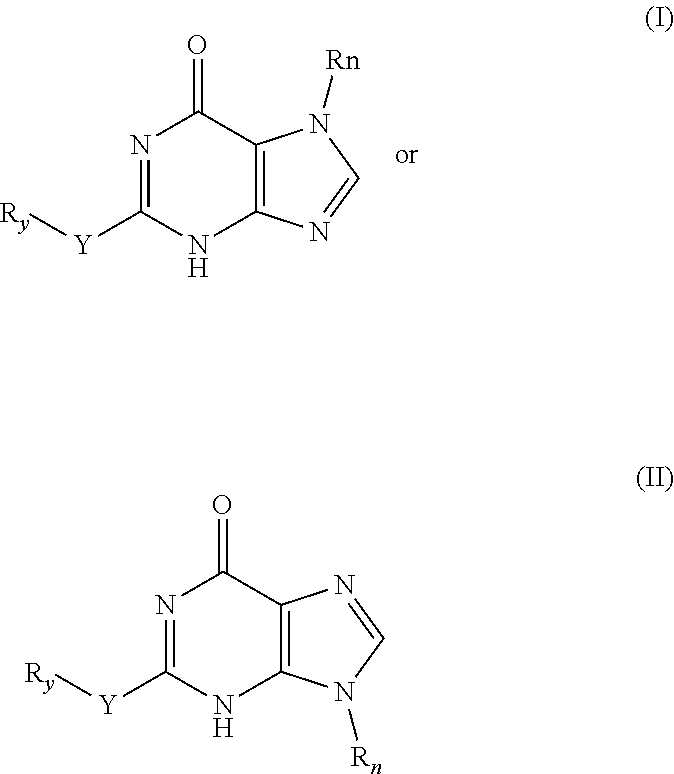
-
- Rn is selected from hydrogen (H),

-
- wherein is the covalent linkage to general formula (I) or (II) and the variables have the following meanings:

- U is selected from oxygen (O), an optionally branched and/or OH-functionalized C1 to C4 alkyl residue and optionally substituted vinyl residue, in particular substituted with halogen, particularly preferably F, Cl, I; U is preferably O or an optionally OH-functionalized C1 to C4 alkyl residue,
- W is an optionally substituted methylene (—CH2—), ethylene (—CH2CH2—), ethoxy (—O—CH2CH2—) or ethene-1,2-diyl residue (—CH═CH—), and wherein the substituents are preferably selected from —CH3, —CH2OH, —COOCH3, —CH2—(PO3H)o—OH with o=0, 1, 2 or 3, —CH2-phosphonic acid,
- V is selected from H, —OH, an amino acid -AA, wherein the amino acid is in particular selected from the group of proteinogenic amino acids and their corresponding β-AAs and wherein AA is bound covalently to W via the carboxyl group, an optionally substituted heterocycle, in particular a six-membered ring nitrogen heterocycle, such as pyridine, diazine, piperidine or piperazine, and wherein the substituents are preferably selected from —OH and an optionally substituted and/or polycyclic aryl residue, in particular phenyl, naphthalene, quinoline, naphthyridine, and wherein the substituents on the aryl residue are preferably selected from —CF3, —F, —Cl, —I, —OH, —NH2, ═O, —COOH, —OCH3, —R,
- A1 and A2 independently of one another are —CH2, —CHOR, —CHF— or —CHOC(═O)R,
- G is CH2, —CH2O— or O,
- Y is O, S, NR, carboxyl, carbonyl or amide,
- wherein R is an H or an optionally OH-functionalized C1 to C8 alkyl residue,
- the substituent Ry is H, OH, an optionally substituted C1 to C7 alkyl residue, an optionally substituted cyclic or polycyclic aryl residue or an optionally polycyclic nitrogen heterocycle, in particular an optionally substituted phenyl, naphthalene, bisphenyl, phenanthrene, benzopyrene, pyridine, diazine, triazole, piperidine, bipiperidine, piperazine, xanthene, carbazole, 9,10-dihydrophenanthrene, phenothiazine, triphenylmethane residue or a combination thereof, wherein the substituents are selected from —F, —NH2, R and the group of the six-membered ring nitrogen heterocycle, in particular pyridine, 1,2-diazine, 1,3-diazine, piperidine, bipiperidine or piperazine or a sequence of two to three of the above-mentioned substituents bridged to one another in para-position. Alternatively, Ry is —C═O or is selected from —CRaRbRc wherein Ra, Rb and Rc are selected independently of one another from H and cyclic residues.
- wherein
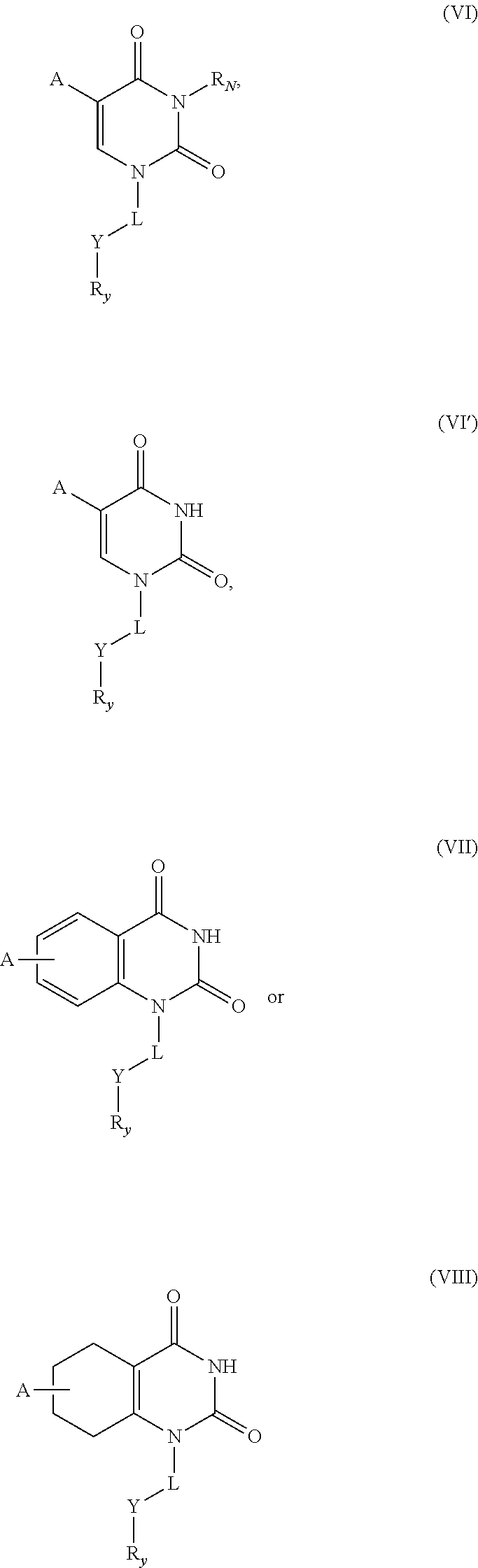
-
- the substituent A is —H, —CH3 or an optionally substituted C2 to C4 vinyl or alkynyl residue, in particular substituted with halogen, particularly preferably F, Cl, I; alternatively, A is a halogen, —NO2, —C═O, phenyl or thiophene residue—the halogen preferably being selected from I and Br;
- the linker L preferably serves to restrict the conformational flexibility (i.e. reduction in entropy) and is selected from an optionally substituted phenyl, benzyl or pyridine residue, in particular substituted with —CH3, —CF3, halogen, particularly preferably substituted with —CF3 and F,
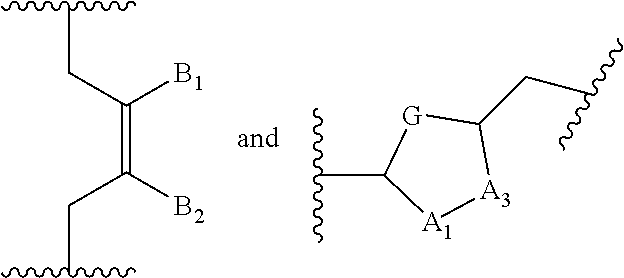
-
- is the covalent linkage to general formula (VI) or (VII) or is Y,

- the substituents B1 and B2 independently of one another are —H, —CH3, —CF3, —F or —Cl,
- A1, is —CH2—, —CHOR, —CHF— or —CHOC(═O)R,
- A3 is —CH2—, —CHOR, —CHF—, —CHOC(═O)R or —CHK—, wherein K is an optionally substituted five-membered ring nitrogen heterocycle, in particular triazole, diazole or imidazole, wherein the five-membered ring nitrogen heterocycle is preferably bound covalently to A3 via a nitrogen atom.
- G is CH2, —CH2O— or O;
- Alternatively, the linker L is selected from optionally substituted C1 to C6 alkyl residues or
-

wherein G and A1 are selected as above and A4 is —CH2— or —CHOR and T is CH and/or T and G or G and A4 together form a cyclopropyl ring;
-
- Y is O, S, NR, carboxyl, carbonyl or amide,
- wherein R is an H or an optionally substituted and/or branched C1 to C8 alkyl residue,
- the substituent Ry is as defined above or below H, OH, an optionally substituted cyclic or polycyclic aryl residue or an optionally substituted oxygen or nitrogen heterocycle, wherein the substituents are selected from —F, —NH2, R and the group of the six-membered ring nitrogen heterocycles, in particular pyridine, 1,2-diazine, 1,3-diazine, piperidine, bipiperidine or piperazine or a sequence of two to three of the above-mentioned substituents bridged to one another in para-position;
- Alternatively, Ry is —C═O or is selected from —CRaRbRc wherein Ra, Rb and Rc are selected independently of one another from H and cyclic residues, preferably selected from optionally substituted cyclic or polycyclic aryl residues and optionally substituted heterocycles, particularly preferably H, phenyl, naphthylene, biphenyl. Preferably, at least one of the residues Ra, Rb and Rc is H and at least one of the residues is a cyclic residue, which is preferably selected as above;
- the substituent RN in formula (IV) is H or a benzoyl residue.
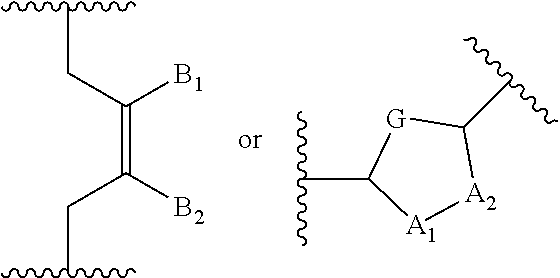
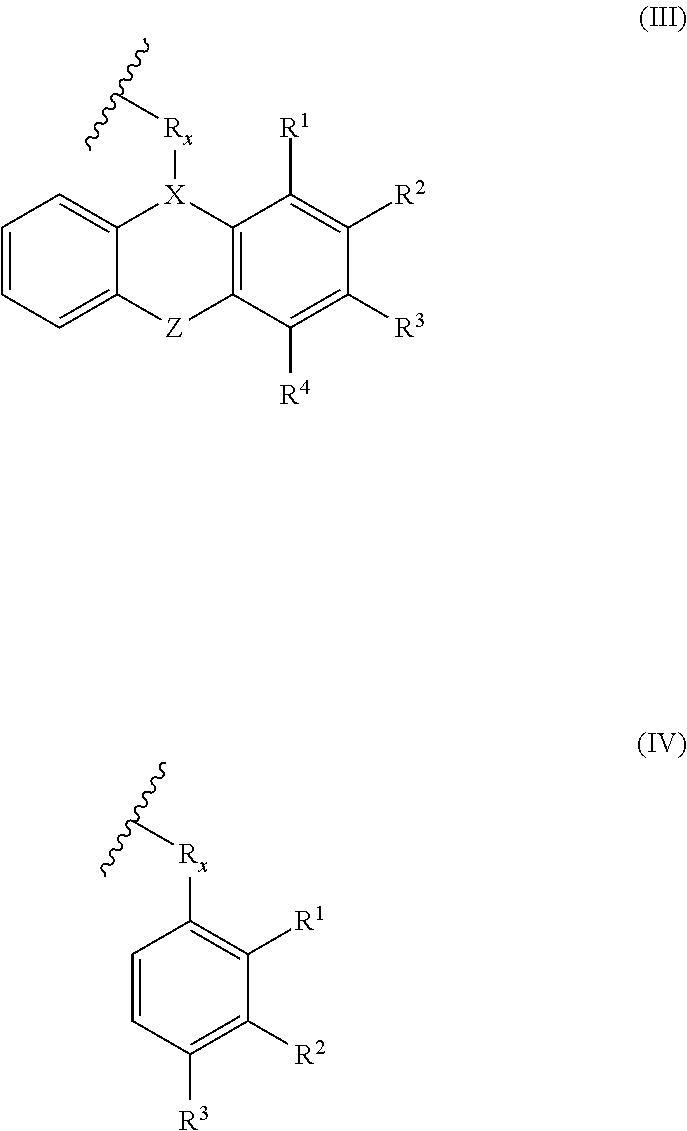
-
- is the covalent linkage to general formula (I), (II) or (VI), (VI′), (VII) or (VIII),
- X is N or CH,
- Z is a single bond, CH2, O, C(═O), S or NRx, in particular CH2, O, C(═O), S or NRx, particularly preferably CH2, O, S or NRx,
- Rx is an optionally substituted and/or branched C1 to C4 alkyl residue,
- R1, R2, R3 and R4 independently of one another are —H, -halogen, —NO2, —CN, —NR2, and —SR, —OR, —COOR, —COR, —R or an optionally substituted C1 to C4 vinyl residue or optionally substituted aryl residue, wherein R as defined above is H or a C1 to C8 alkyl residue.
-


-
- X is N and Z is S,
- Rx is an optionally substituted and/or branched C1 to C4 alkyl, alkenyl or alkynyl residue,
- the substituents R1 and R2 in ortho-, meta- or para-position are, independently of one another, —H, —OR, —C(═O)R, —CF3, -halogen, an aliphatic or aromatic heterocycle,
- Y is N or an amide group (—NR—C(═O)—),
- n and m are, independently of one another, an integer from 0 to 3,
- R5 and R6 are, independently of one another, H, an optionally substituted piperazine, phenyl (—C6H5), hydroxyphenyl (—OC6H5) or phenylene residue (—C6H4—),
| Phenothiazine | |||
| CAS Number | derivatives | Molecular formula | MW [g/mol] |
| 61-00-7 | Acepromazine | C19H22N2OS | 326.46 |
| 50-53-3 | Chlorpromazine | C17H19ClN2S | 318.86 |
| 60-99-1 | Levomepromazine | C19H24N2OS | 328.47 |
| 58-40-2 | Promazine | C17H20N2S | 284.42 |
| 60-87-7 | Promethazine | C17H20N2S | 284.42 |
| 146-54-3 | Triflupromazine | C18H19F3N2S | 352.42 |
| 84-97-9 | Perazine | C20H25N3S | 339.50 |
| 58-39-9 | Perphenazine | C21H26ClN3OS | 403.97 |
| 69-23-8 | Fluphenazine | C22H26F3N3OS | 437.52 |

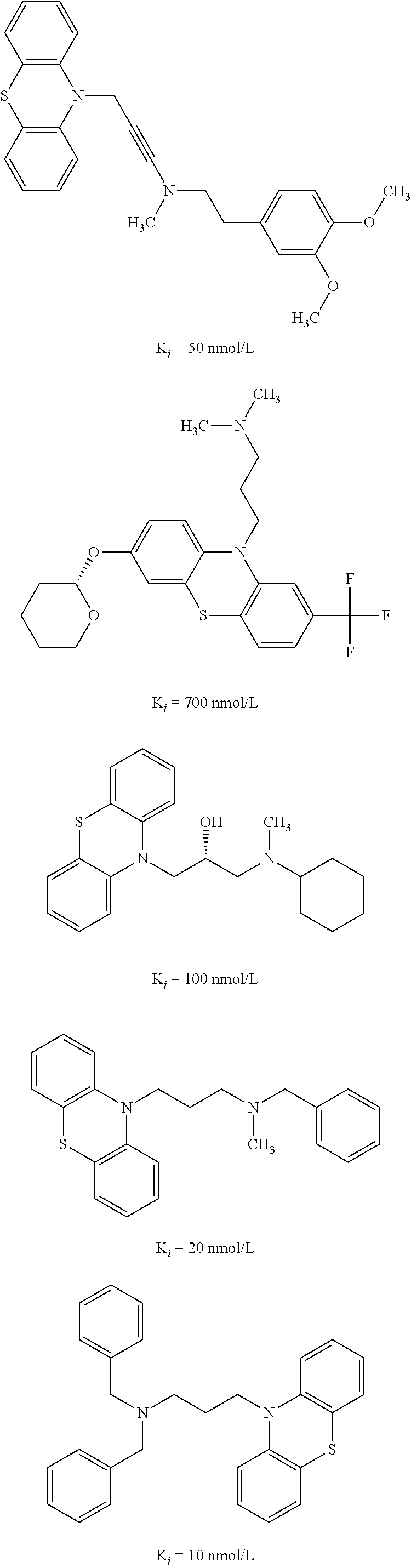
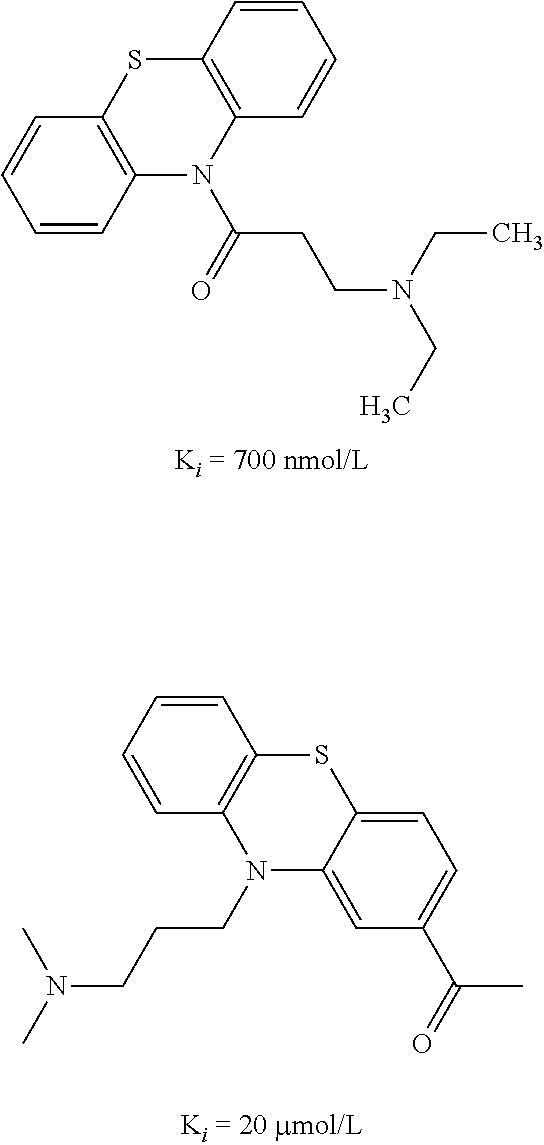
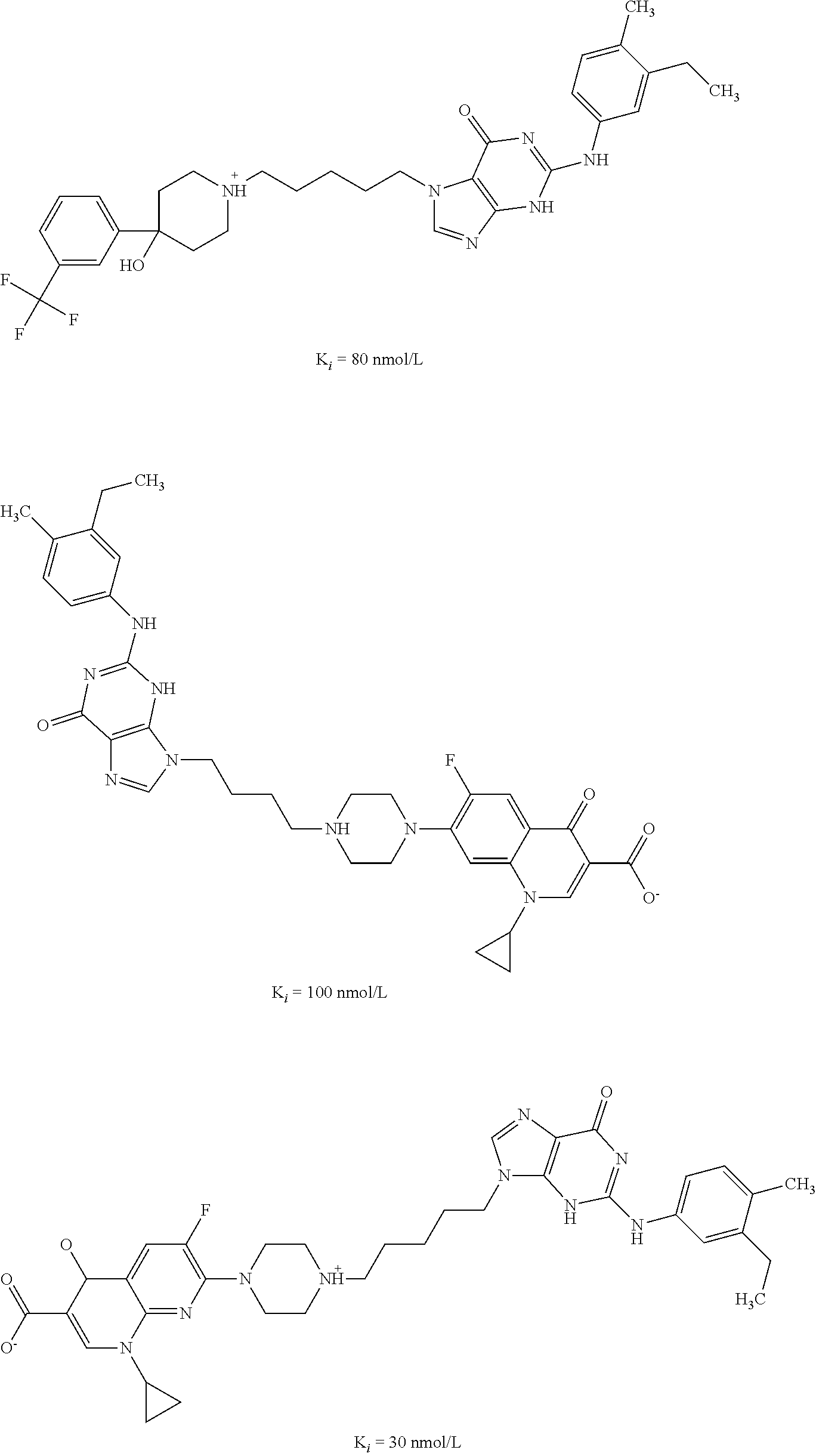

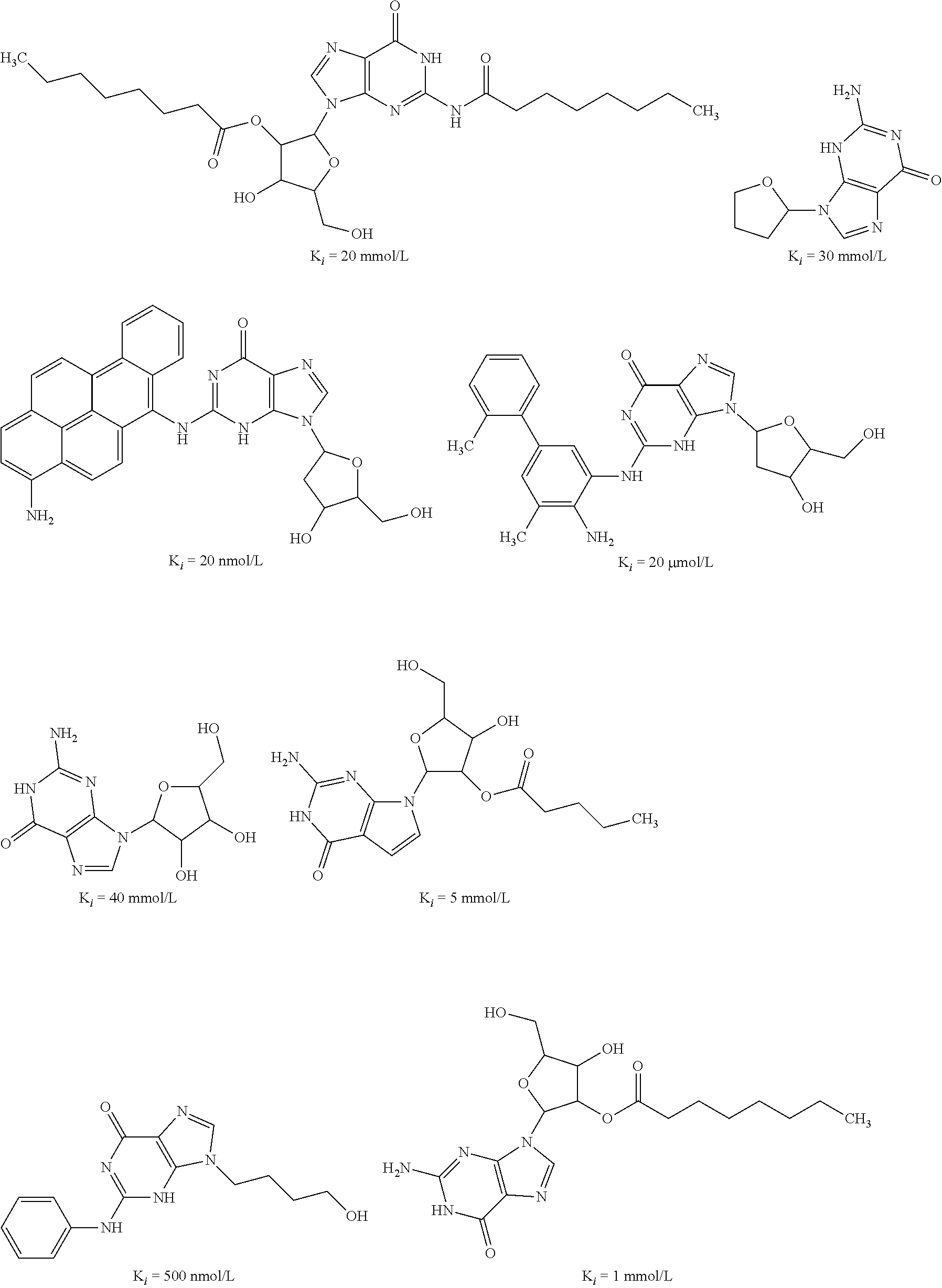
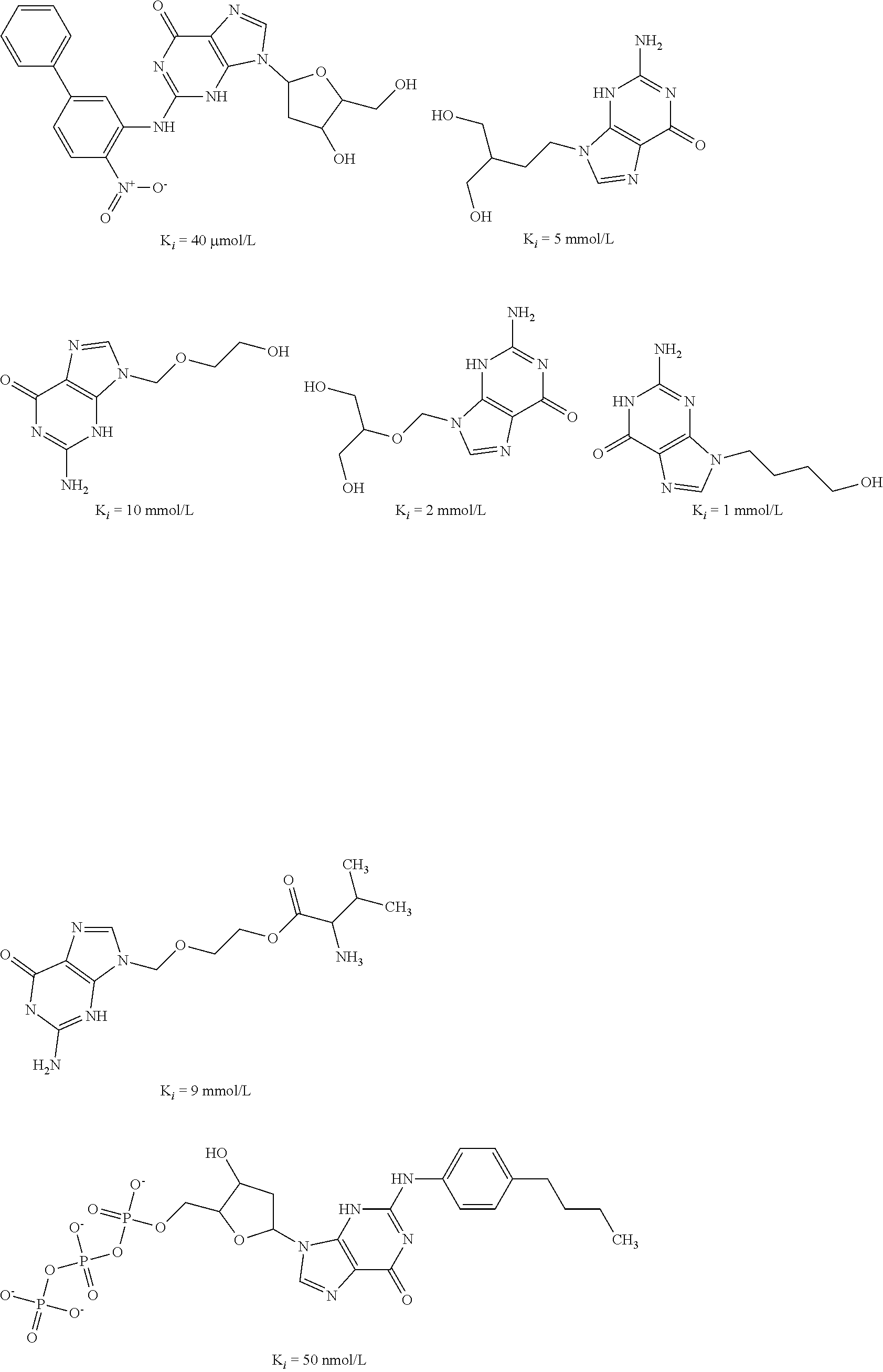


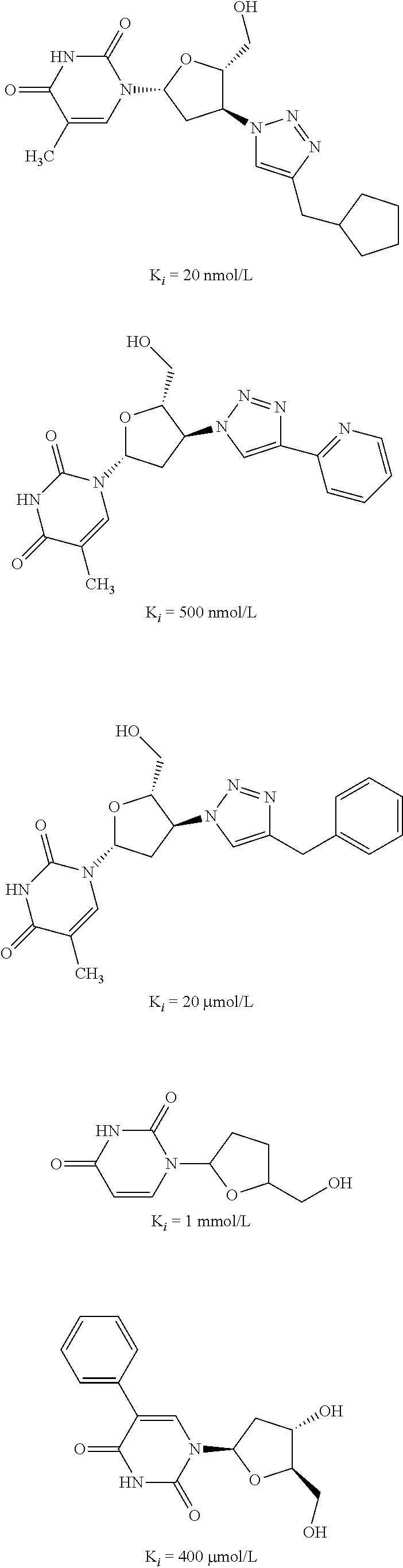
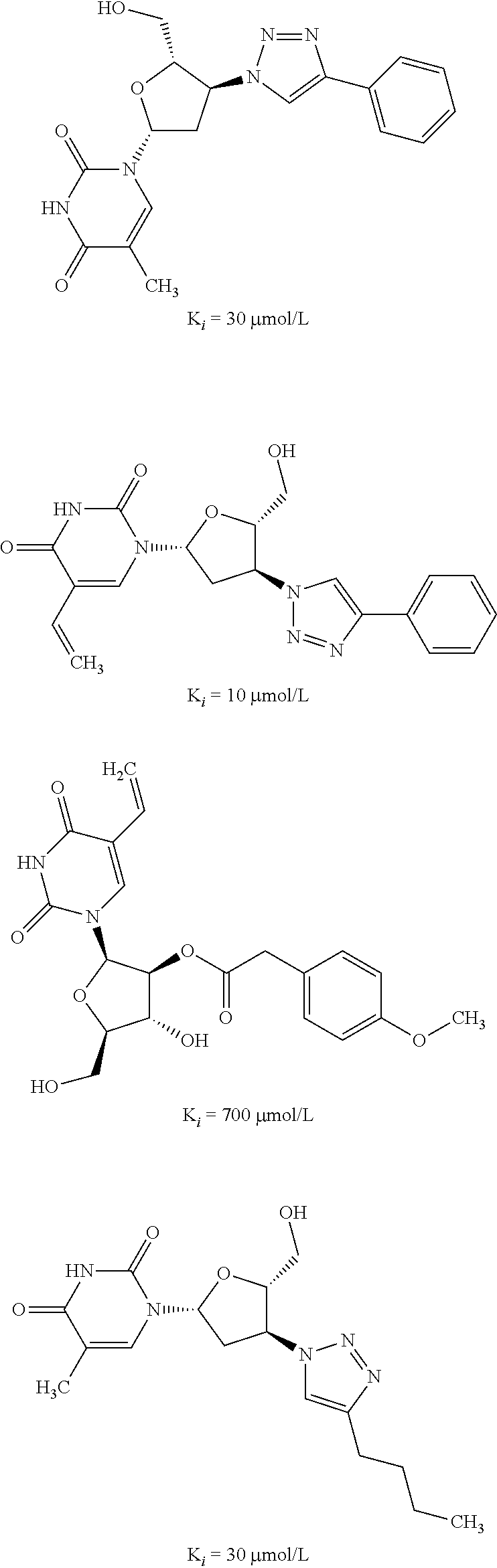
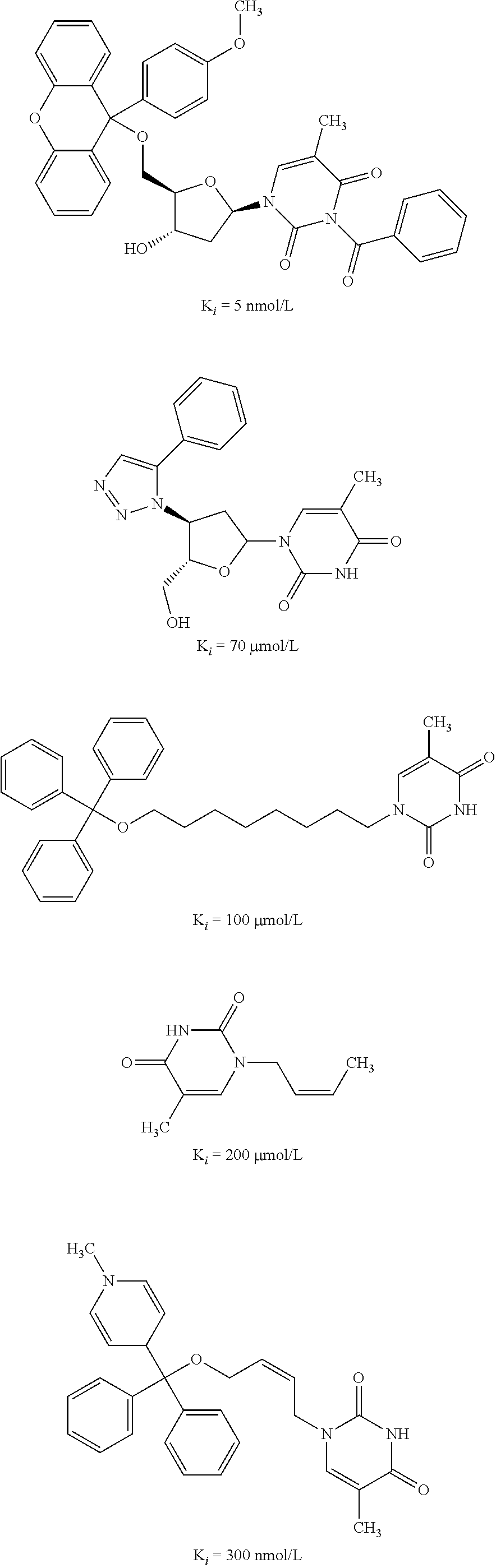
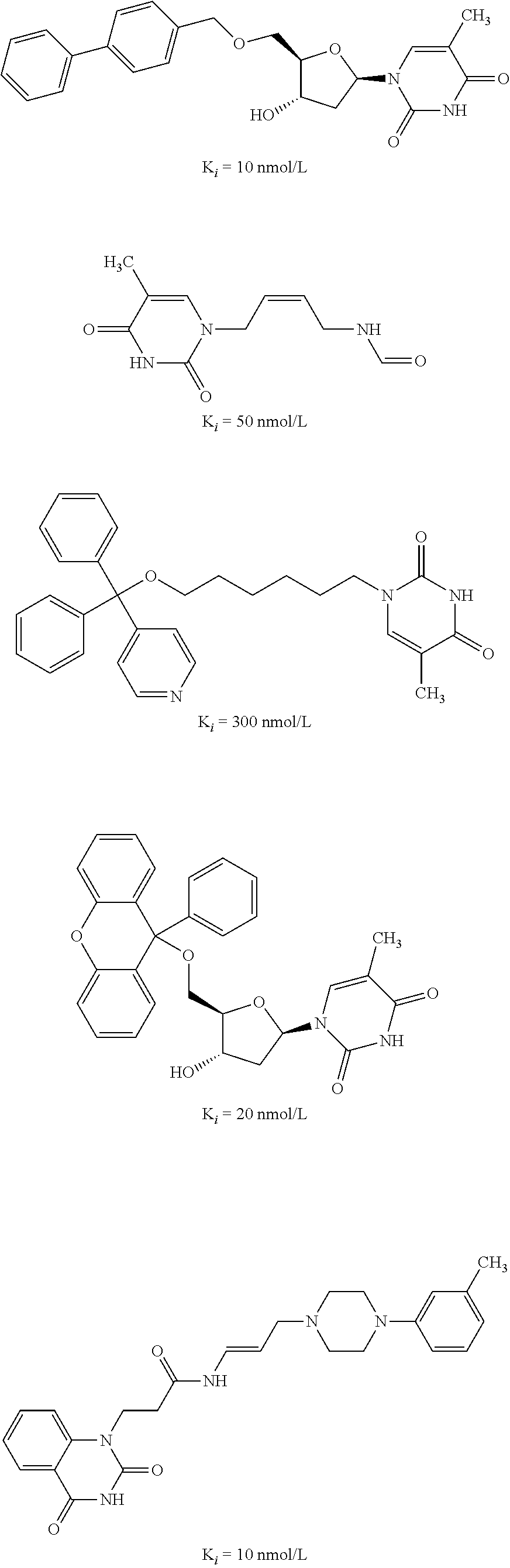
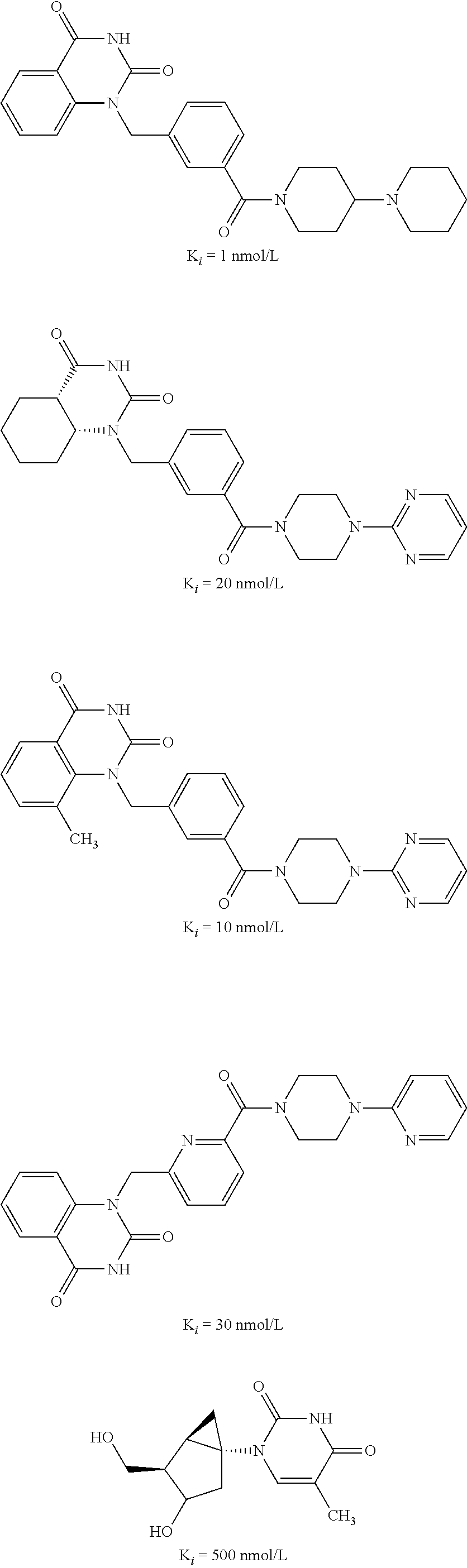
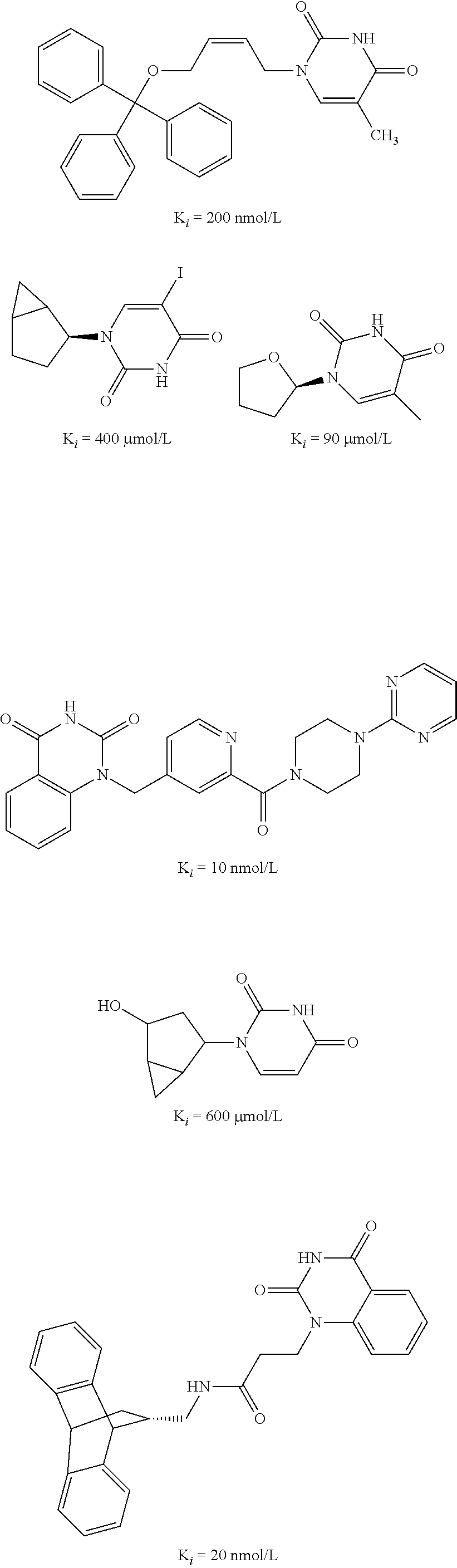

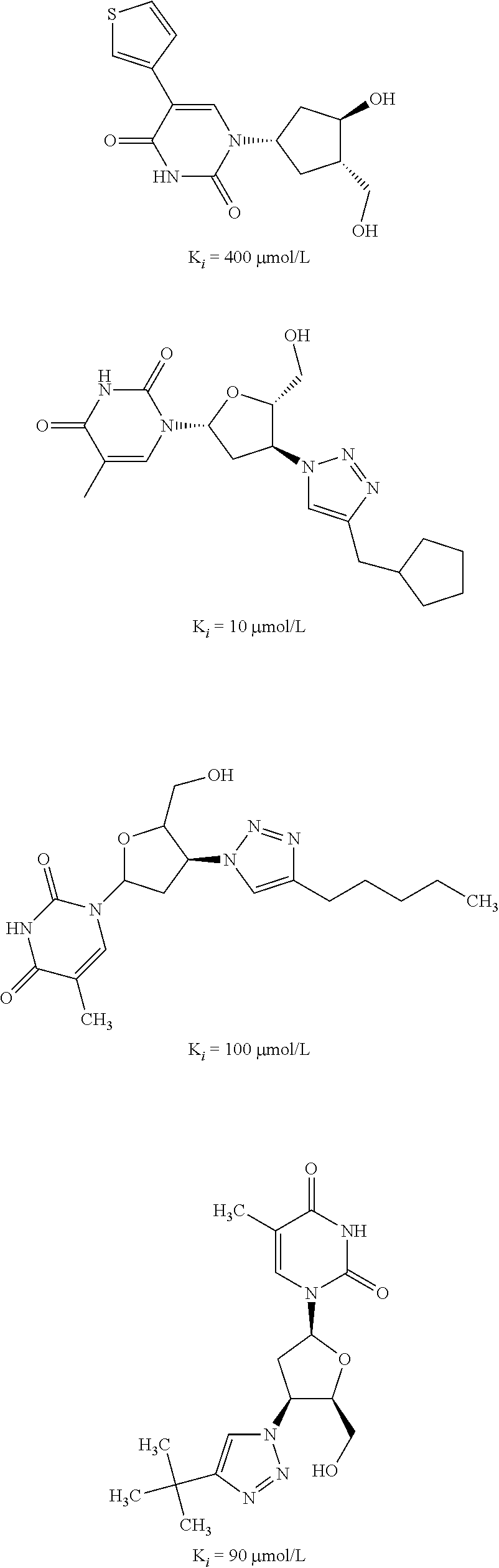
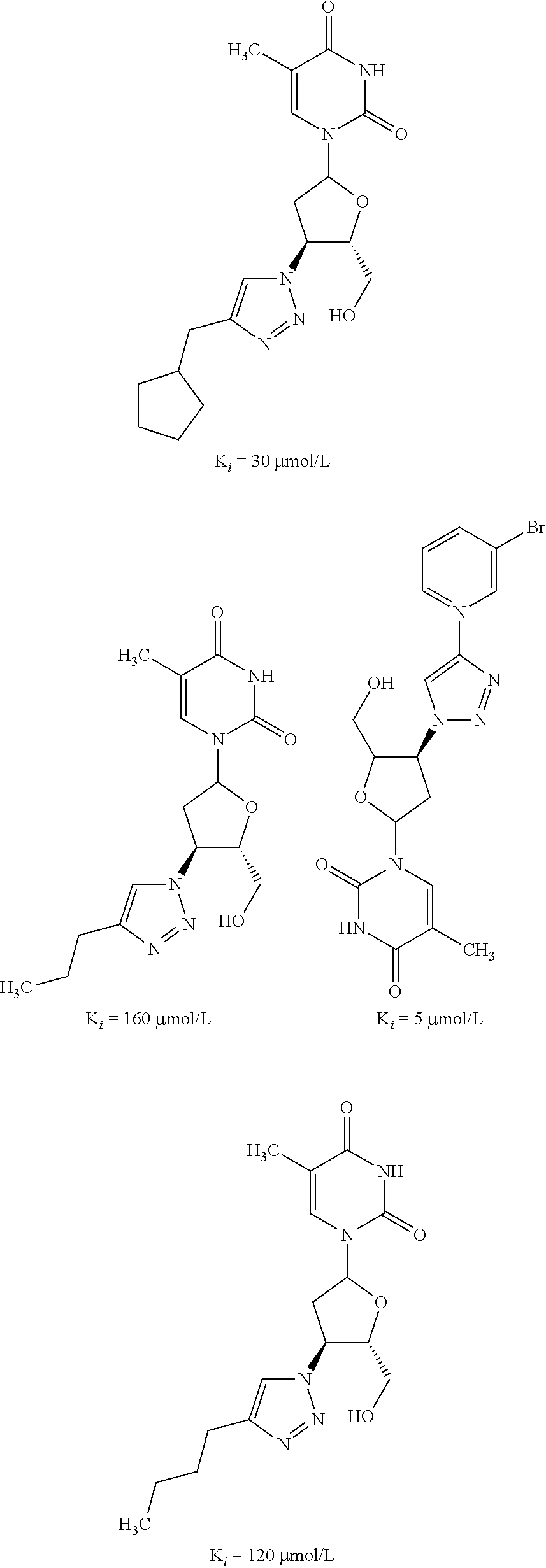
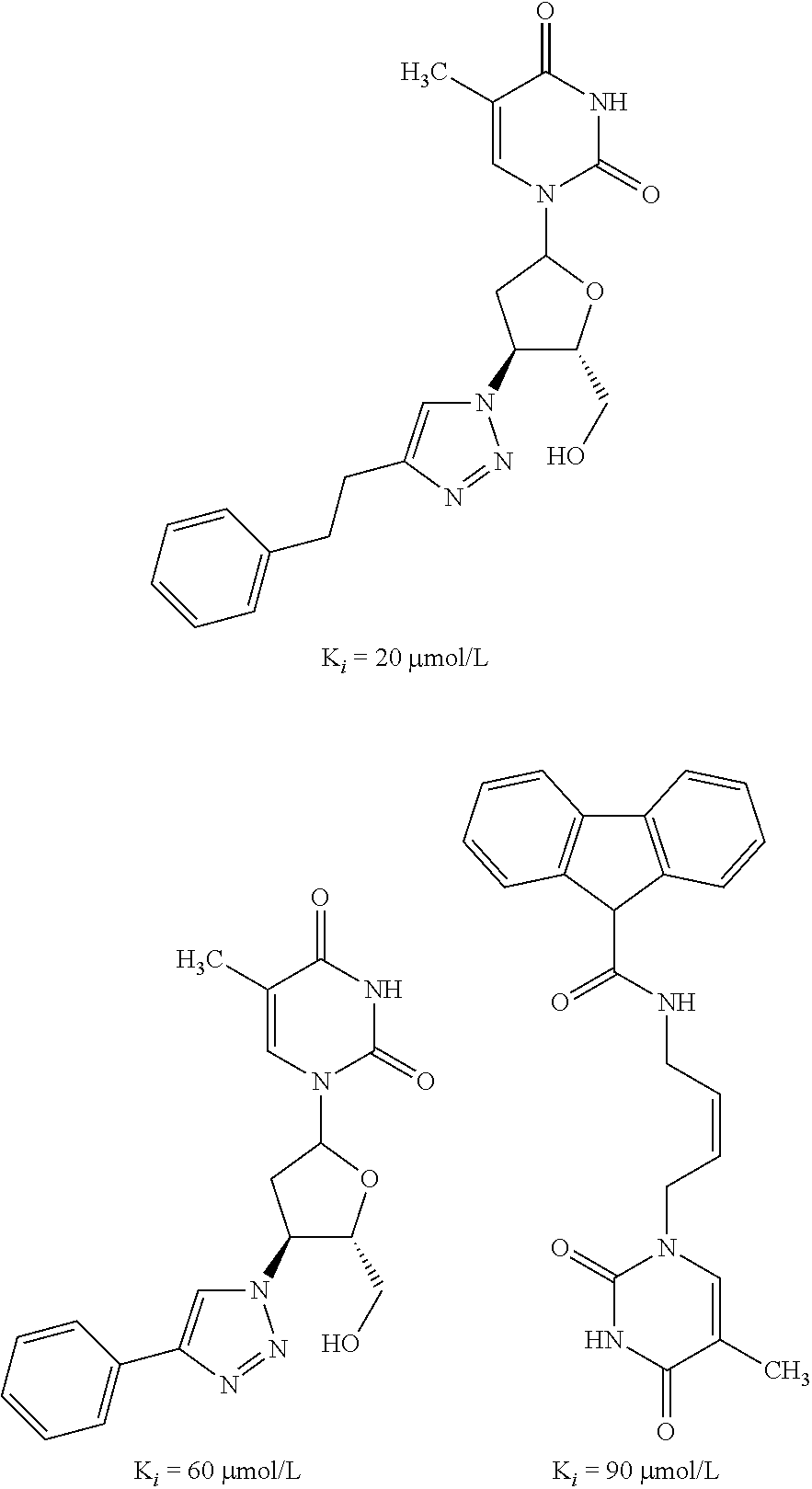
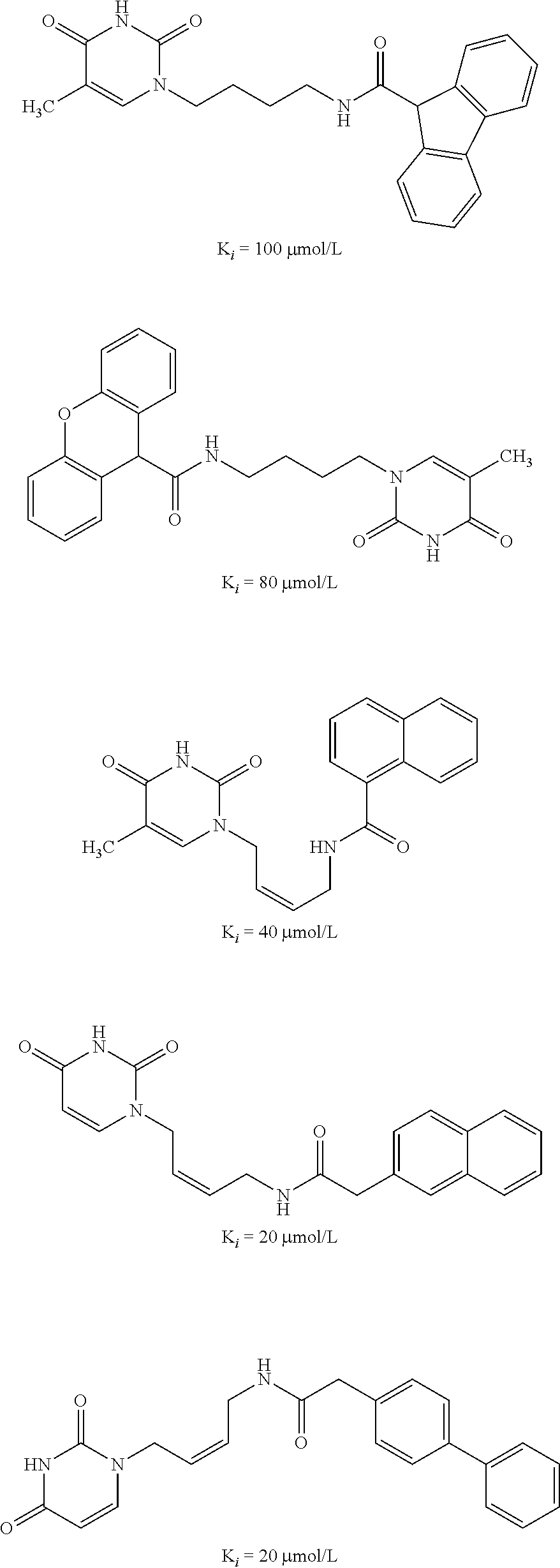
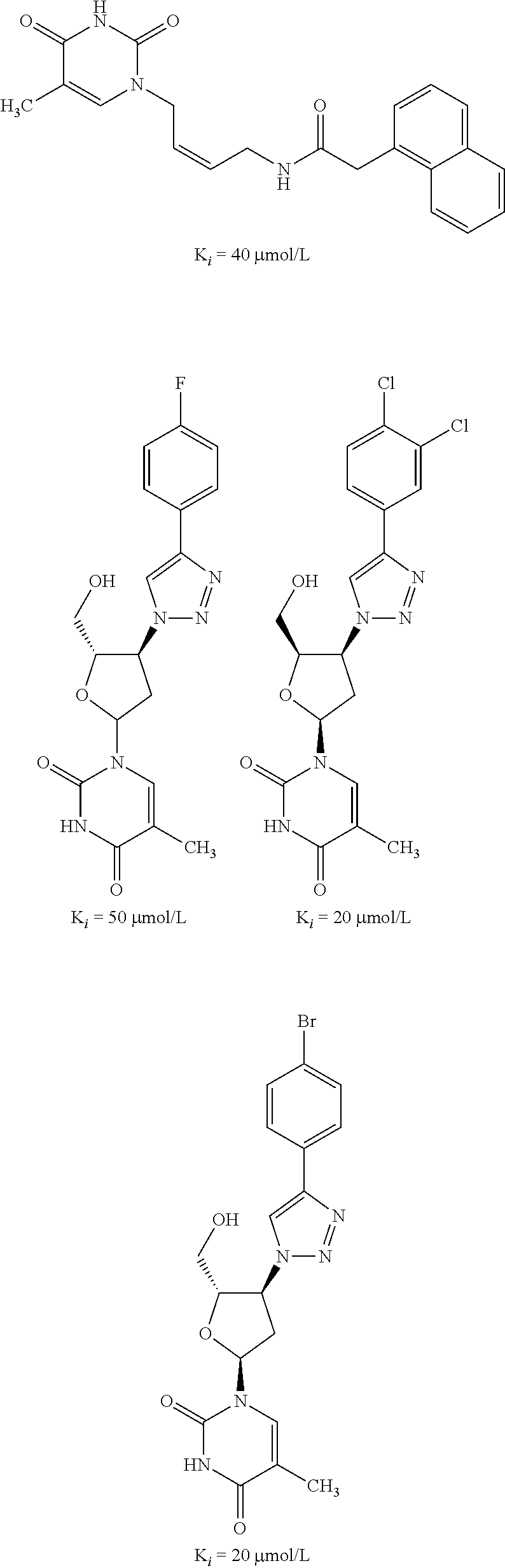

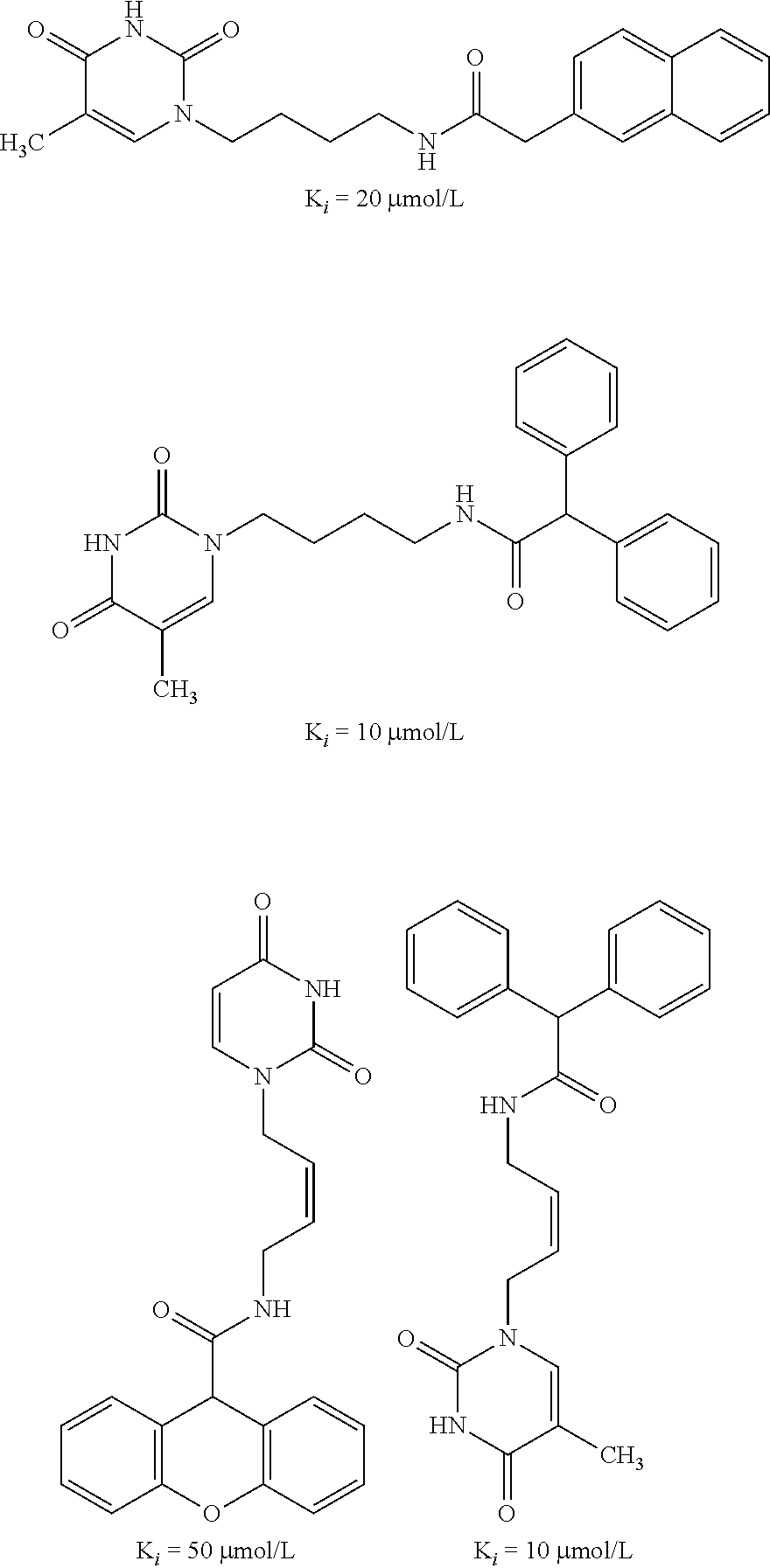
- 2-(3-trichlorovinylphenylamino)-1,9-dihydropurin-6-one
- 2-(4-butylphenylamino)-9-(2-hydroxyethoxymethyl)-1,9-dihydropurin-6-one
- 2-(3-hydroxymethylphenylamino)-3,7-dihydropurin-6-one
- 9H-xanthene-9-carboxylic acid [4-(5-methyl-2,4-dioxo-3,4-dihydro-2H-pyrimidin-1-yl)-but-2-enyl]amide
- 2-biphenyl-4-yl-N-[4-(5-methyl-2,4-dioxo-3,4-dihydro-2H-pyrimidin-1-yl)-but-2-enyl]-acetamide
| Overview of test results: |
| Rel. | |||
| quantity | Efficacy | ||
| of protein | compared | ||
| Dose | Substance employed | prec. CS | with BVDU |
| 750 μmol/ | BVDU | 1 | ||
| 10 μmol/L | Chlorpromazine | 1.06 | 79.5 x | |
| 10 μmol/L | Acepromazine | 0.99 | 74.25 x | |
| 10 μmol/L | 2-(4-Butylphenylamino)-9-(2- | 0.92 | 69.0 x | |
| hydroxyethoxymethyl)-1,9- | ||||
| dihydropurin-6- |
||||
| 10 μmol/L | 2-(3-Trichlorovinyl- | 0.71 | 53.25 x | |
| phenylamino)-1,9- | ||||
| dihydropurin-6-one | ||||
| Overview of the test results: |
| Rel. | |||
| quantity | Efficacy | ||
| of protein | compared | ||
| Dose | Substance employed | prec. CS | with BVDU |
| 750 μmol/ | BVDU | 1 | ||
| 10 μmol/L | Chlorpromazine | 1.06 | 79.5 x | |
| 10 μmol/L | Acepromazine | 0.99 | 74.25 x | |
| 10 μmol/L | 9H-Xanthene-9-carboxylic | 0.65 | 48.75 x | |
| acid[4-(5-methyl-2,4- | ||||
| dioxo-3,4-dihydro-2H- | ||||
| pyrimidin-1-yl)-but-2- | ||||
| enyl] |
||||
| 10 μmol/L | 2-Biphenyl-4-yl-N-[4-(5- | 0.81 | 60.75 x | |
| methyl-2,4-dioxo-3,4-dihydro- | ||||
| 2H-pyrimidin-1-yl)- | ||||
| but-2-enyl]acetamide | ||||
| Rel. | |||
| quantity | Efficacy | ||
| of protein | compared | ||
| Dose | Substance employed | prec. CS | with BVDU |
| 750 μmol/L | BVDU | 1 | |
| 10 μmol/L | N-[(2Z)-4-(2,4-Dioxo-3H-pyrimidin-1-yl)but-2-en-1-yl]-2- | 1.15 | 86.25 x |
| (naphthalen-2-yl)acetamide | |||
| 10 μmol/L | N-[(2Z)-4-(2,4-Dioxo-3H-pyrimidin-1-yl)but-2-en-1-yl]-2-(4- | 0.88 | 66.15 x |
| phenylphenyl)acetamide | |||
| 10 μmol/L | N-[(2Z)-4-(5-Methyl-2,4-dioxo-3H-pyrimidin-1-yl)but-2-en- | 0.86 | 64.31 x |
| 1-yl]-9H-fluorene-9-carboxamide | |||
| 10 μmol/L | 3′-Deoxy-3′-[4-(3,4-dichlorophenyl)-1H-1,2,3-triazol-1-yl]- | 0.86 | 64.21 x |
| thymidine | |||
| 10 μmol/L | N-[(2Z)-4-(2,4-Dioxo-3H-pyrimidin-1-yl)but-2-en-1-yl]-9,9a- | 0.85 | 63.38 x |
| dihydro-4aH-xanthene-9-carboxamide | |||
| 10 μmol/L | 3′-Deoxy-3′-[4-(2-pyridinyl)-1H-1,2,3-triazol-1]-yl]thymidine | 0.84 | 62.86 x |
| 10 μmol/L | N-[(2Z)-4-(5-Methyl-2,4-dioxo-3H-pyrimidin-1-yl)but-2-en- | 0.83 | 62.51 x |
| 1-yl]-2-(naphthalen-2-yl)acetamide | |||
| 10 μmol/L | N-[(2Z)-4-(5-Methyl-2,4-dioxo-3H-pyrimidin-1-yl)but-2-en- | 0.82 | 61.19 x |
| 1-yl]-2,2-diphenylacetamide | |||
| 10 μmol/L | 1-[(4S,5S)-4-[4-(3-Bromophenyl)-1H-1,2,3-triazol-1-yl]-5- | 0.81 | 60.88 x |
| (hydroxymethyl)oxolan-2-yl]-5-methyl-1,2,3,4- | |||
| tetrahydropyrimidine-2,4-dione | |||
| 10 μmol/L | N-[(2Z)-4-(5-Methyl-2,4-dioxo-3H-pyrimidin-1-yl)but-2-en- | 0.81 | 60.44 x |
| 1-yl]-2-(naphthalen-1-yl)acetamide | |||
| 10 μmol/L | 3′-Deoxy-3′-(4-propyl-1H-1,2,3-triazol-1-yl)thymidine | 0.79 | 59.59 x |
| 10 μmol/L | 3′-Deoxy-3′-(4-phenyl-1H-1,2,3-triazol-1-yl)thymidine | 0.79 | 59.07 x |
| 10 μmol/L | N-[4-(5-Methyl-2,4-dioxo-3H-pyrimidin-1-yl)butyl]-2,2- | 0.79 | 58.97 x |
| diphenylacetamide | |||
| 10 μmol/L | N-[(2Z)-4-(5-Methyl-2,4-dioxo-3H-pyrimidin-1-yl)but-2-en- | 0.78 | 58.73 x |
| 1-yl]naphthalene-1-carboxamide | |||
| 10 μmol/L | 3′-(4-Butyl-1H-1,2,3-triazol-1-yl)-3′-deoxythymidine | 0.76 | 57.08 x |
| 10 μmol/L | N-[4-(5-Methyl-2,4-dioxo-3H-pyrimidin-1-yl)butyl]-2- | 0.75 | 56.36 x |
| (naphthalen-2-yl)acetamide | |||
| 10 μmol/L | 1-[(4S,5S)-5-(Hydroxymethyl)-4-[4-(4-methoxyphenyl)-1, | 0.75 | 55.89 x |
| 2,3-triazol-1-yl]oxolan-2-yl]-5-methyl-3H-pyrimidine-2,4- | |||
| dione | |||
| 10 μmol/L | 3′-Deoxy-3′-[4-(2-phenylethyl)-1H-1,2,3-triazol-1-yl]- | 0.74 | 55.67 x |
| thymidine | |||
| 10 μmol/L | 3′-Deoxy-3′-(4-pentyl-1H-1,2,3-triazol-1-yl)thymidine | 0.70 | 52.57 x |
| 10 μmol/L | N-[4-(5-Methyl-2,4-dioxo-3H-pyrimidin-1-yl)butyl]-9H- | 0.68 | 51.16 x |
| xanthene-9-carboxamide | |||
| 10 μmol/L | 3′-[4-(4-Chlorophenyl)-1H-1,2,3-triazol-1-yl]-3′- | 0.67 | 50.53 x |
| deoxythymidine | |||
| 10 μmol/L | N-[4-(5-Methyl-2,4-dioxo-3H-pyrimidin-1-yl)butyl]-2-(4- | 0.67 | 50.52 x |
| phenylphenyl)acetamide | |||
| 10 μmol/L | 3′-Deoxy-3′-[4-(4-fluorophenyl)-1H-1,2,3-triazol-1-yl]- | 0.66 | 49.69 x |
| thymidine | |||
| 10 μmol/L | 3′-[4-(Cyclopentylmethyl)-1H-1,2,3-triazol-1-yl]-3′- | 0.66 | 49.63 x |
| deoxythymidine | |||
| 10 μmol/L | 1-[(4S,5S)-4-[4-(4-Bromophenyl)-1,2,3-triazol-1-yl]-5- | 0.64 | 48.14 x |
| (hydroxymethyl)oxolan-2-yl]-5-methyl-3H-pyrimidine-2,4- | |||
| dione | |||
| 10 μmol/L | 3′-Deoxy-3′-[4-(2-methyl-2-propanyl)-1H-1,2,3-triazol-1- | 0.61 | 46.01 x |
| yl]thymidine | |||
| 10 μmol/L | N-[4-(5-Methyl-2,4-dioxo-3H-pyrimidin-1-yl)butyl]-9H- | 0.58 | 43.30 x |
| fluorene-9-carboxamide | |||
- 2-(3-trichlorovinylphenylamino)-1,9-dihydropurin-6-one
- 2-(4-butylphenylamino)-9-(2-hydroxyethoxymethyl)-1,9-dihydropurin-6-one
- 2-(3-hydroxymethyl-phenylamino)-3,7-dihydropurin-6-one
| Dissociation | |
| constant | |
| Substance | KD [μM] |
| Chlorpromazine | 770 |
| Acepromazine | 72 |
| 5-Phenyl-2′-deoxyuridine | 60 |
| 2-(3-Hydroxymethylphenylamino)-3,7-dihydropurin-6- | 710 |
| one | |
| 2-(4-Butylphenylamino)-9-(2-hydroxyethoxymethyl)- | 15 |
| 1,9-dihydropurin-6-one | |
| 9H-Xanthene-9-carboxylic acid [4-(5-methyl-2,4- | 267 |
| dioxo-3,4-dihydro-2H-pyrimidin-1-yl)-but-2-enyl]amide | |
| 2-Biphenyl-4-yl-N-[4-(5-methyl-2,4-dioxo-3,4-dihydro- | 424 |
| 2H-pyrimidin-1-yl)-but-2-enyl]acetamide | |
- Straume O, Shimamura T, Lampa M J, Carretero J, Øyan A M, Jia D, Borgman C L, Soucheray M, Downing S R, Short S M, Kang S Y, Wang S, Chen L, Collett K, Bachmann I, Wong K K, Shapiro G I, Kalland K H, Folkman J, Watnick R S, Akslen L A, Naumov G N. (2012) Suppression of
heat shock protein 27 induces long-term dormancy in human breast cancer. Proc Natl Acad Sci USA. 2012 May 29; 109(22):8699-704. - Jakob U, Gaestel M, Engel K, and Buchner J. (1993) Small Heat Shock Proteins Are Molecular Chaperones. J Biol Chem 268(3): 1517-1520.
- Muckenschnabel I, Falchetto R, Mayr L M, Filipuzzi I. (2004) SpeedScreen: label-free liquid chromatography-mass spectrometry-based high-throughput screening for the discovery of orphan protein ligands. Anal Biochem. 2004 Jan. 15; 324(2):241-9.
- Chauhan D, Li G, Auclair D, Hideshima T, Podar K, Mitsiades N, Mitsiades C, Chen L B, Munshi N, Saxena S, Anderson K C. (2004) 2-Methoxyestardiol and bortezomib/proteasome-inhibitor overcome dexamethasone-resistance in multiple myeloma cells by modulating Heat Shock Protein-27. Apoptosis. 2004 March; 9(2): 149-55.
Claims (12)


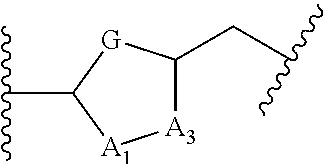

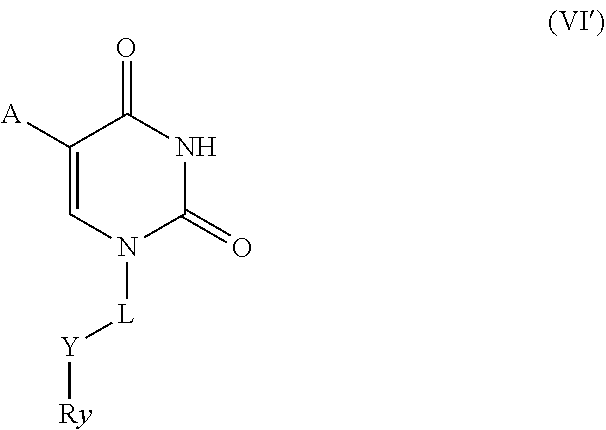
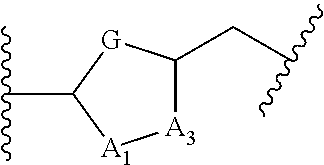
Applications Claiming Priority (5)
| Application Number | Priority Date | Filing Date | Title |
|---|---|---|---|
| DE102014214798.0 | 2014-07-28 | ||
| DE102014214799.9 | 2014-07-28 | ||
| DE102014214798 | 2014-07-28 | ||
| DE102014214799 | 2014-07-28 | ||
| PCT/EP2015/067312 WO2016016268A1 (en) | 2014-07-28 | 2015-07-28 | Thymine derivatives and quinazoline-dione derivatives for the inhibition of hsp27 |
Publications (2)
| Publication Number | Publication Date |
|---|---|
| US20180207160A1 US20180207160A1 (en) | 2018-07-26 |
| US10940150B2 true US10940150B2 (en) | 2021-03-09 |
Family
ID=53761383
Family Applications (2)
| Application Number | Title | Priority Date | Filing Date |
|---|---|---|---|
| US15/329,722 Active 2035-07-31 US10940150B2 (en) | 2014-07-28 | 2015-07-28 | Thymine derivatives and quinazoline-dione derivatives for the inhibition of HSP27 |
| US15/329,693 Abandoned US20170216297A1 (en) | 2014-07-28 | 2015-07-28 | Efficient inhibition of hsp27 |
Family Applications After (1)
| Application Number | Title | Priority Date | Filing Date |
|---|---|---|---|
| US15/329,693 Abandoned US20170216297A1 (en) | 2014-07-28 | 2015-07-28 | Efficient inhibition of hsp27 |
Country Status (4)
| Country | Link |
|---|---|
| US (2) | US10940150B2 (en) |
| EP (2) | EP3174545A1 (en) |
| CN (2) | CN107073003A (en) |
| WO (2) | WO2016016267A1 (en) |
Families Citing this family (4)
| Publication number | Priority date | Publication date | Assignee | Title |
|---|---|---|---|---|
| EP3819006A1 (en) | 2019-11-05 | 2021-05-12 | Technische Universität Dresden | Compounds with thymine skeleton for use in medicine |
| CN111234247B (en) * | 2020-01-17 | 2021-08-27 | 福建师范大学 | Preparation of electric resistance-variable poly-cable hydrocarbon crystalline material and application of electric resistance-variable poly-cable hydrocarbon crystalline material in memory |
| KR20230171440A (en) * | 2021-03-31 | 2023-12-20 | 듀크 스트리트 바이오 리미티드 | pharmaceutical compound |
| WO2024015641A1 (en) * | 2022-07-15 | 2024-01-18 | The Regents Of The University Of California | Small molecule for treatment of cancer of the appendix |
Citations (22)
| Publication number | Priority date | Publication date | Assignee | Title |
|---|---|---|---|---|
| US5116823A (en) * | 1990-02-27 | 1992-05-26 | Roger Williams General Hospital | Drug combinations containing AZT |
| US20010020089A1 (en) | 2000-02-18 | 2001-09-06 | Mantell Simon John | Purine derivatives |
| WO2001072779A1 (en) | 2000-03-24 | 2001-10-04 | Duke University | Characterization of grp94-ligand interactions and purification, screening, and therapeutic methods relating thereto |
| US20050137185A1 (en) | 2003-09-18 | 2005-06-23 | Lee Margaret S. | Combinations of drugs for the treatment of neoplasms |
| US6995145B1 (en) * | 1999-06-04 | 2006-02-07 | Au Jessie L-S | Methods and compositions for modulating drug activity through telomere damage |
| WO2006120481A2 (en) | 2005-05-11 | 2006-11-16 | Merck Sharp & Dohme Limited | 2,3-substituted fused bicyclic pyrimidin-4(3h)-ones which modulate the function of the vanilloid-1 receptor (vr1) |
| DE102005037733A1 (en) | 2005-08-10 | 2007-02-15 | Merck Patent Gmbh | adenine |
| WO2007034185A1 (en) | 2005-09-20 | 2007-03-29 | Vernalis (R & D) Ltd. | Purine compounds as hsp90 protein inhibitors for the treatment of cancer |
| US20070275986A1 (en) | 2004-10-15 | 2007-11-29 | Centre National De La Recherche Scientifique (Cnrs) | Use of purine derivatives for the production of medicaments for the treatment of mucoviscidosis and diseases related to protein addressing errors in cells |
| WO2008146008A1 (en) | 2007-05-30 | 2008-12-04 | The University Of Birmingham | Use of antivirals in the treatment of medical disorders |
| WO2009156182A2 (en) | 2008-06-25 | 2009-12-30 | Resprotect Gmbh | Uracil derivatives and use thereof |
| DE102008035299A1 (en) | 2008-07-29 | 2010-02-04 | Resprotect Gmbh | Conjugate, particularly bromovinyl-deoxyuridine for manufacture medicament for inhibiting or suppressing metastasis including distant metastases in cytostatic treatment, includes heat shock protein and nucleoside |
| JP2010215669A (en) | 2002-10-02 | 2010-09-30 | Univ Of British Columbia | Composition and method for treatment of prostate and other cancer |
| US20110070192A1 (en) | 2003-11-14 | 2011-03-24 | Bruno Tse | Method of preparation of novel nucleoside analogs and uses |
| US20120195911A1 (en) | 2011-02-01 | 2012-08-02 | Artur Martynov | Method of treatment of cancer patients |
| WO2012125521A1 (en) | 2011-03-14 | 2012-09-20 | Eternity Bioscience Inc. | Quinazolinediones and their use |
| WO2012130166A1 (en) | 2011-04-01 | 2012-10-04 | Impact Therapeutics, Inc. | 1-(arylmethyl)quinazoline-2,4(1h,3h)-diones as parp inhibitors and the use thereof |
| US20120294846A1 (en) | 2011-05-12 | 2012-11-22 | Oncogenex Technologies Inc. | Treatment of Pulmonary and Pleural Fibrosis Using HSP27 Inhibitors |
| US20130150429A1 (en) | 2011-12-09 | 2013-06-13 | The University Of British Columbia | P27kip1 as a molecular marker for suitability and efficacy of treatment with hsp27 inhibitors |
| WO2013114339A1 (en) | 2012-02-02 | 2013-08-08 | The Universityof British Columbia | Combination therapy for cancer using hsp27 inhibitor and egfr tyrosine kinase inhibitors or anti-folates |
| US8617823B2 (en) | 2008-04-29 | 2013-12-31 | Immunexcite, Inc. | Immunomodulating compositions and methods of use thereof |
| US20140057864A1 (en) | 2011-01-20 | 2014-02-27 | University Of Rochester | Compositions and methods for treating or preventing a retrovirus infection |
-
2015
- 2015-07-28 US US15/329,722 patent/US10940150B2/en active Active
- 2015-07-28 EP EP15744196.5A patent/EP3174545A1/en not_active Withdrawn
- 2015-07-28 WO PCT/EP2015/067311 patent/WO2016016267A1/en not_active Ceased
- 2015-07-28 CN CN201580040458.2A patent/CN107073003A/en active Pending
- 2015-07-28 EP EP15744197.3A patent/EP3174541A1/en not_active Withdrawn
- 2015-07-28 WO PCT/EP2015/067312 patent/WO2016016268A1/en not_active Ceased
- 2015-07-28 US US15/329,693 patent/US20170216297A1/en not_active Abandoned
- 2015-07-28 CN CN201580040473.7A patent/CN107074791A/en active Pending
Patent Citations (29)
| Publication number | Priority date | Publication date | Assignee | Title |
|---|---|---|---|---|
| US5116823A (en) * | 1990-02-27 | 1992-05-26 | Roger Williams General Hospital | Drug combinations containing AZT |
| US6995145B1 (en) * | 1999-06-04 | 2006-02-07 | Au Jessie L-S | Methods and compositions for modulating drug activity through telomere damage |
| US20010020089A1 (en) | 2000-02-18 | 2001-09-06 | Mantell Simon John | Purine derivatives |
| US6525032B2 (en) | 2000-02-18 | 2003-02-25 | Pfizer Inc | Purine derivatives |
| DE60119492T2 (en) | 2000-02-18 | 2006-11-09 | Pfizer Inc. | purine derivatives |
| WO2001072779A1 (en) | 2000-03-24 | 2001-10-04 | Duke University | Characterization of grp94-ligand interactions and purification, screening, and therapeutic methods relating thereto |
| JP2010215669A (en) | 2002-10-02 | 2010-09-30 | Univ Of British Columbia | Composition and method for treatment of prostate and other cancer |
| US20050137185A1 (en) | 2003-09-18 | 2005-06-23 | Lee Margaret S. | Combinations of drugs for the treatment of neoplasms |
| CN1878556A (en) | 2003-09-18 | 2006-12-13 | 康宾纳特克斯公司 | Combinations of drugs for the treatment of neoplasms |
| US20110070192A1 (en) | 2003-11-14 | 2011-03-24 | Bruno Tse | Method of preparation of novel nucleoside analogs and uses |
| US20070275986A1 (en) | 2004-10-15 | 2007-11-29 | Centre National De La Recherche Scientifique (Cnrs) | Use of purine derivatives for the production of medicaments for the treatment of mucoviscidosis and diseases related to protein addressing errors in cells |
| WO2006120481A2 (en) | 2005-05-11 | 2006-11-16 | Merck Sharp & Dohme Limited | 2,3-substituted fused bicyclic pyrimidin-4(3h)-ones which modulate the function of the vanilloid-1 receptor (vr1) |
| US20100160352A1 (en) | 2005-08-10 | 2010-06-24 | Merck Patent Gmbh | Adenine derivatives |
| DE102005037733A1 (en) | 2005-08-10 | 2007-02-15 | Merck Patent Gmbh | adenine |
| US7977343B2 (en) | 2005-08-10 | 2011-07-12 | Merck Patent Gesellschaft Mit Beschrankter Haftung | Adenine derivatives |
| WO2007034185A1 (en) | 2005-09-20 | 2007-03-29 | Vernalis (R & D) Ltd. | Purine compounds as hsp90 protein inhibitors for the treatment of cancer |
| WO2008146008A1 (en) | 2007-05-30 | 2008-12-04 | The University Of Birmingham | Use of antivirals in the treatment of medical disorders |
| US8617823B2 (en) | 2008-04-29 | 2013-12-31 | Immunexcite, Inc. | Immunomodulating compositions and methods of use thereof |
| WO2009156182A2 (en) | 2008-06-25 | 2009-12-30 | Resprotect Gmbh | Uracil derivatives and use thereof |
| US20110166096A1 (en) | 2008-06-25 | 2011-07-07 | Resprotect Gmbh | Uracil derivatives and use thereof |
| DE102008035299A1 (en) | 2008-07-29 | 2010-02-04 | Resprotect Gmbh | Conjugate, particularly bromovinyl-deoxyuridine for manufacture medicament for inhibiting or suppressing metastasis including distant metastases in cytostatic treatment, includes heat shock protein and nucleoside |
| US20140057864A1 (en) | 2011-01-20 | 2014-02-27 | University Of Rochester | Compositions and methods for treating or preventing a retrovirus infection |
| US20120195911A1 (en) | 2011-02-01 | 2012-08-02 | Artur Martynov | Method of treatment of cancer patients |
| WO2012125521A1 (en) | 2011-03-14 | 2012-09-20 | Eternity Bioscience Inc. | Quinazolinediones and their use |
| CN103443085A (en) | 2011-03-14 | 2013-12-11 | 永恒生物科技公司 | Quinazolinediones and their use |
| WO2012130166A1 (en) | 2011-04-01 | 2012-10-04 | Impact Therapeutics, Inc. | 1-(arylmethyl)quinazoline-2,4(1h,3h)-diones as parp inhibitors and the use thereof |
| US20120294846A1 (en) | 2011-05-12 | 2012-11-22 | Oncogenex Technologies Inc. | Treatment of Pulmonary and Pleural Fibrosis Using HSP27 Inhibitors |
| US20130150429A1 (en) | 2011-12-09 | 2013-06-13 | The University Of British Columbia | P27kip1 as a molecular marker for suitability and efficacy of treatment with hsp27 inhibitors |
| WO2013114339A1 (en) | 2012-02-02 | 2013-08-08 | The Universityof British Columbia | Combination therapy for cancer using hsp27 inhibitor and egfr tyrosine kinase inhibitors or anti-folates |
Non-Patent Citations (41)
| Title |
|---|
| A. Maureen Rouhi, "The Right Stuff: From research and development to the clinic, getting drug crystals right is full of pitfalls," Chem. & Eng. News, Feb. 24, 2003, pp. 32-35. |
| Banker et al., "Modern Pharmaceutics" Fourth Edition, Revised and Expanded, Preface and selected pages, Marcel Dekker, Inc. New York, 2002, 10 pages. |
| Banker et al., "Modern Pharmaceutics" Third Edition, Revised and Expanded, Preface and selected pages, Marcel Dekker, Inc. New York, 1996, 3 pages. |
| Byrn et al., "Hydrates and Solvates," Solid-State Chemistry of Drugs, 2nd Ed. (1999), Ch. 11, 233-247. |
| Chauhan et al.; "2-Methoxyestardiol and bortezomib/proteasome-inhibitor overcome dexamethasone-resistance in multiple myeloma cells by modulating Heat Shock Protein-27;" Apoptosis; vol. 9; No. 2; 2004, pp. 149-155. |
| Choi et al., "Kinetic Analysis of Translesion Synthesis Opposite Bulky N2-and O6-Alkylguanine DNA Adducts by Human DNA Polymerase REV1," Journal of Biological Chemistry vol. 283, No. 35, Aug. 29, 2008, 23645-23655, DOI: 10.1074/jbc.M801686200. |
| Davis et al., "Phenotypic Identification of the Redox Dye Methylene Blue as an Antagonist of Heat Shock Response Gene Expression in Metastatic Melanoma Cells," Int. J. Mol. Sci. 2013, 14, 4185-4202, DOI:10.3390/ijms14024185. |
| Ebalunode, et al., "Novel Approach to Structure-Based Pharmacophore Search Using Computational Geometry and Shape Matching techniques," J. Chem. Inf. Model, 2008, 48 (4), 889-901, DOI: 10.1021/ci700368p. |
| Focher et al., "N2-Phenyldeoxyguanosine: A Novel Selective Inhibitor of Herpes Simplex Thymidine Kinase," J. Med. Chem. 1988, 31, 1496-1500, XP-002053646. |
| FOCHER F., ET AL.: "N2-PHENYLDEOXYGUANOSINE: A NOVEL SELECTIVE INHIBITOR OF HERPES SIMPLEX THYMIDINE KINASE.", JOURNAL OF MEDICINAL CHEMISTRY, AMERICAN CHEMICAL SOCIETY, US, vol. 31., 1 January 1988 (1988-01-01), US, pages 1496 - 1500., XP002053646, ISSN: 0022-2623, DOI: 10.1021/jm00403a004 |
| Gambino et al., "Quantitative Structure-Activity Relationships of N2-Phenylguanines as Inhibitors or Herpes Simplex Virus Thymidine Kinases," J. Med. Chem. 1992, 35, 2979-2983. |
| Graham-Pole et al. in Journal of Clinical Oncology 4(7):1110-3 (1986) (Year: 1986). * |
| Hernandez et al. in Bioorganic & Medicinal Chemistry 13, 3027-3030 (2003) (Year: 2003). * |
| Hernandez et al. in Journal of Medicinal Chemistry 45, 4254-4263 (2002) (Year: 2002). * |
| Hernandez et al. Journal of Bioorganic and Medicinal Chemistry Letters, 13, 3027-3030 (2003) (Year: 2003). * |
| Hernández et al., "N1-Substituted Thymine Derivatives as Mitochondrial Thymidine Kinase (TK-2) Inhibitors," J. Med. Chem. 2006, 49, 7766-7773. |
| Hernandez et al.; "Acyclic Nucleoside Analogues as Novel Inhibitors of Human Mitochondrial Thymidine Kinase;" J. Med. Chem.; 45; 2002; pp. 4254-4263. |
| HILDEBRAND C, SANDOLI D, FOCHER F, GAMBINO J, CIARROCCHI G, SPADARI S, WRIGHT G.: "Structure-activity relationships of N2-substituted guanines as inhibitors of HSV1 and HSV2 thymidine kinases.", JOURNAL OF MEDICINAL CHEMISTRY, AMERICAN CHEMICAL SOCIETY, US, vol. 33, no. 1, 1 January 1990 (1990-01-01), US, pages 203 - 206, XP002744762, ISSN: 0022-2623, DOI: 10.1021/jm00163a033 |
| Hildebrand et al., "Structure-Activity Relationships of N2-Substituted Guanines as Inhibitors of HSV1 and HSV2 Thymidine Kinases," J. Med. Chem. 1990, 33, 203-206, XP-002744762. |
| Huang et al., "Efficient synthesis and biological evaluation of 1,2,9-trisubstituted 1,9-dihydro-6H-purin-6-ones," Bioorganic & Medicinal Chemistry Letters 19 (2009) 831-833, DOI: 10.1016/j.bmcl.2008.12.007. |
| Jakob et al.; "Small Heat Shock Proteins Are Molecular Chaperones*;" The Journal of Biological Chemistry; vol. 268, No. 3, 1993, pp. 1517-1520. |
| Jego et al., "Targeting heat shock proteins in cancer," Cancer Letters 332 (2013) 275-285. |
| Kukanich B. in Antiemetic Therapy (Proceedings) (2010) at http://veterinarycalendar.dvm360.com/print/302394?page=full (retrieved from the internet Oct. 23, 2018) (Year: 2010). * |
| Kumar et al., "Phenyl 1,2,3-Triazole-Thymidine Ligands Stabilize G-Quadruplex DNA, Inhibit DNA Synthesis and Potentially Reduce Tumor Cell Proliferation over 3′-Azido Deoxythymidine," Plos One, Aug. 2013, vol. 8, Issue 8, e70798, 12 pages DOI: 10.1371/journal.pone.0070798. |
| Laubach et al. in Cancer Care and Management 107-117 (2009) (Year: 2009). * |
| McPherson et al., "A cyclic nucleotide PDE5 inhibitor corrects defective mucin secretion in submandibular cells containing antibody directed against the cystic fibrosis transmembrane conductance regulator protein," FEBS Letters 464 (1999) 48-52. |
| MedicineNet.com (2004) Web: <http://www.medterms.com> https://web.archive.org/web/20040603184158/http://www.medterms.com/script/main/art.asp?articlekey=2580. |
| Morissette et al., "High-throughput crystallization: polymorphs, salts, co-crystals and solvates of pharmaceutical solids," Advanced Drug Delivery Reviews 56 (2004), 275-300 DOI: 10.1016/j.addr.2003.10.020. |
| Muckenschnabel et al.; "SpeedScreen: label-free liquid chromatography—mass spectrometry-based high-throughput screening for the discovery of orphan protein ligands;" Analytical Biochemistry; vol. 324; 2004; pp. 241-249. |
| Noonan et al., "The Synthesis and Interaction of Novel GTP Derivatives with Ras Oncogene Proteins," Nucleosides and Nucleotides, 10(1-3), 503-505 (1991) DOI: 10.1080/07328319108046509. |
| O. Kalid et al., "Small molecule correctors of F508del-CFTR discovered by structure-based virtual screening," Journal of Computer-Aided Molecular Design (2010) 24:971-991. |
| Office Action dated Jan. 7, 2019 in Chinese Application No. 201580040473.7 with English translation, 16 pages. |
| Pereira et al. in Anti-Cancer Agents in Medicinal Chemistry, 13(1), 186-192 (2013) (Year: 2013). * |
| Powers et al., "Inhibitors of the heat shock response: Biology and pharmacology," FEBS Letters 581 (2007) 3758-3769 DOI: 10.1016/j.febslet.2007.05.040. |
| Richter et al.; "Synthesis, Molecular Modelling and Biological Evaluation of 4-Amino-2(1H)-quinazolinone and 2,4(1H,3H)-Quinazolidone Derivatives as Antitumor Agents;" Arch. Pharm. Chem. Life Sci.; vol. 344; 2011; pp. 810-820. |
| Savijoki et al., "New convenient defined media for [35S]methionine labelling and proteomic analyses of probiotic lactobacilli," Letters in Applied Microbiology 42 (2006) 202-209 DOI: 10.1111/j.1472-765X.2005.01853.x. |
| Straume et al.; "Suppression of heat shock protein 27 induces long-term dormancy in human breast cancer;" Proceedings of the National Academy of Sciences; vol. 109, No. 22, 2012, pp. 8699-8704. |
| Weber et al. in Cancer Communications 2(4), 129-133 (1990) (Year: 1990). * |
| Wright et al., "Synthesis, Cell Growth Inhibition, and Antitumor Screening of 2-(p-n-Butylanilino)purines and Their Nucleoside Analogues," J. Med. Chem. 1987, 30, 109-116. |
| Xu et al., "Synthesis, Properties, and Pharmacokinetic Studies of N2-Phenylguanine Derivatives as Inhibitors of Herpes Simplex Virus Thymidine Kinases," J. Med. Chem. 1995, 38, 49-57 XP-002053656. |
| XU H., ET AL.: "SYNTHESIS, PROPERTIES, AND PHARMACOKINETIC STUDIES OF N2- PHENYLGUANINE DERIVATIVES AS INHIBITORS OF HERPES SIMPLEX VIRUS THYMIDINE KINASES.", JOURNAL OF MEDICINAL CHEMISTRY, AMERICAN CHEMICAL SOCIETY, US, vol. 38., 1 January 1995 (1995-01-01), US, pages 49 - 57., XP002053656, ISSN: 0022-2623, DOI: 10.1021/jm00001a010 |
Also Published As
| Publication number | Publication date |
|---|---|
| WO2016016267A1 (en) | 2016-02-04 |
| EP3174545A1 (en) | 2017-06-07 |
| WO2016016268A1 (en) | 2016-02-04 |
| US20170216297A1 (en) | 2017-08-03 |
| EP3174541A1 (en) | 2017-06-07 |
| CN107073003A (en) | 2017-08-18 |
| US20180207160A1 (en) | 2018-07-26 |
| CN107074791A (en) | 2017-08-18 |
Similar Documents
| Publication | Publication Date | Title |
|---|---|---|
| Huang et al. | Discovery of janus kinase 2 (JAK2) and histone deacetylase (HDAC) dual inhibitors as a novel strategy for the combinational treatment of leukemia and invasive fungal infections | |
| RU2478387C2 (en) | IMIDASOQUINOLINES AS DUAL LIPID KINASE AND mTOR INHIBITORS | |
| Li et al. | Discovery of N 1-(4-((7-Cyclopentyl-6-(dimethylcarbamoyl)-7 H-pyrrolo [2, 3-d] pyrimidin-2-yl) amino) phenyl)-N 8-hydroxyoctanediamide as a Novel Inhibitor Targeting Cyclin-dependent Kinase 4/9 (CDK4/9) and Histone Deacetlyase1 (HDAC1) against Malignant Cancer | |
| WO2022225728A9 (en) | Bifunctional molecules for selective modification of target substrates | |
| EP3901151A1 (en) | Halogenated-heteroaryl and other heterocyclic kinase inhibitors, and uses thereof | |
| TW201936596A (en) | TLR7/8 antagonists and uses thereof | |
| CN102159214A (en) | Inhibitors of Bruton's tyrosine kinase for the treatment of solid tumors | |
| Yu et al. | Small-molecule inhibitors of tankyrases as prospective therapeutics for cancer | |
| Cheng et al. | Specific inhibition of bacterial β-glucuronidase by pyrazolo [4, 3-c] quinoline derivatives via a pH-dependent manner to suppress chemotherapy-induced intestinal toxicity | |
| US9295676B2 (en) | Mutation mimicking compounds that bind to the kinase domain of EGFR | |
| JP2016519684A5 (en) | ||
| US10940150B2 (en) | Thymine derivatives and quinazoline-dione derivatives for the inhibition of HSP27 | |
| US10758522B2 (en) | Small molecule analogs of the nemo binding peptide | |
| US20240400542A1 (en) | Sulfonyl-triazoles useful as covalent kinase ligands | |
| EP3836929A1 (en) | Methods of treating liver diseases | |
| US20230364243A1 (en) | Cancer-selective target degradation by targeting group caged protacs | |
| Ma et al. | Discovery of clinical candidate NTQ1062 as a potent and bioavailable Akt inhibitor for the treatment of human tumors | |
| Daniele et al. | Lead optimization of 2-phenylindolylglyoxylyldipeptide murine double minute (MDM) 2/translocator protein (TSPO) dual inhibitors for the treatment of gliomas | |
| US20090312324A1 (en) | Compositions and Methods Related to RAD51 Inactivation in the Treatment of Neoplastic Diseases, and Especially CML | |
| Chi et al. | Discovery and synthesis of a Pyrimidine-based Aurora kinase inhibitor to reduce levels of MYC Oncoproteins | |
| TW202202143A (en) | Co-treatment with cdk4/6 and cdk2 inhibitors to suppress tumor adaptation to cdk2 inhibitors | |
| CN114025766A (en) | Oxathiazine compounds for inhibiting GAPDH | |
| Borgini et al. | Synthesis of Veliparib prodrugs and determination of drug-release-dependent PARP-1 inhibition | |
| JP2007513967A (en) | Compositions for use in the treatment of cell proliferative diseases driven by mutant receptor tyrosine kinases | |
| US20250282783A1 (en) | Protein stabilizing compounds containing usp28 and/or usp25 targeting ligands |
Legal Events
| Date | Code | Title | Description |
|---|---|---|---|
| STPP | Information on status: patent application and granting procedure in general |
Free format text: RESPONSE TO NON-FINAL OFFICE ACTION ENTERED AND FORWARDED TO EXAMINER |
|
| STPP | Information on status: patent application and granting procedure in general |
Free format text: FINAL REJECTION MAILED |
|
| STPP | Information on status: patent application and granting procedure in general |
Free format text: DOCKETED NEW CASE - READY FOR EXAMINATION |
|
| STPP | Information on status: patent application and granting procedure in general |
Free format text: NON FINAL ACTION MAILED |
|
| STPP | Information on status: patent application and granting procedure in general |
Free format text: RESPONSE TO NON-FINAL OFFICE ACTION ENTERED AND FORWARDED TO EXAMINER |
|
| STPP | Information on status: patent application and granting procedure in general |
Free format text: NOTICE OF ALLOWANCE MAILED -- APPLICATION RECEIVED IN OFFICE OF PUBLICATIONS |
|
| AS | Assignment |
Owner name: TECHNISCHE UNIVERSITAET DRESDEN, GERMANY Free format text: ASSIGNMENT OF ASSIGNORS INTEREST;ASSIGNORS:SCHROEDER, MICHAEL;ZHANG, YIXIN;HEINRICH, JOERG-CHRISTIAN;AND OTHERS;SIGNING DATES FROM 20200407 TO 20200504;REEL/FRAME:052589/0376 |
|
| STPP | Information on status: patent application and granting procedure in general |
Free format text: NOTICE OF ALLOWANCE MAILED -- APPLICATION RECEIVED IN OFFICE OF PUBLICATIONS |
|
| STPP | Information on status: patent application and granting procedure in general |
Free format text: PUBLICATIONS -- ISSUE FEE PAYMENT VERIFIED |
|
| STCF | Information on status: patent grant |
Free format text: PATENTED CASE |
|
| MAFP | Maintenance fee payment |
Free format text: PAYMENT OF MAINTENANCE FEE, 4TH YR, SMALL ENTITY (ORIGINAL EVENT CODE: M2551); ENTITY STATUS OF PATENT OWNER: SMALL ENTITY Year of fee payment: 4 |
|
| AS | Assignment |
Owner name: SCHROEDER, MICHAEL, DR., GERMANY Free format text: ASSIGNMENT OF ASSIGNORS INTEREST;ASSIGNOR:TECHNISCHE UNIVERSITAET DRESDEN;REEL/FRAME:068606/0851 Effective date: 20240910 |
|
| AS | Assignment |
Owner name: PHARMAI DISCOVERY GMBH, GERMANY Free format text: ASSIGNMENT OF ASSIGNORS INTEREST;ASSIGNOR:SCHROEDER, MICHAEL, DR.;REEL/FRAME:069926/0923 Effective date: 20250115 |
|
| AS | Assignment |
Owner name: PHARMAI DISCOVERY GMBH, GERMANY Free format text: CORRECTIVE ASSIGNMENT TO CORRECT THE RECEIVING PARTY ADDRESS PREVIOUSLY RECORDED AT REEL: 69926 FRAME: 923. ASSIGNOR(S) HEREBY CONFIRMS THE ASSIGNMENT;ASSIGNOR:SCHROEDER, MICHAEL, DR.;REEL/FRAME:072866/0971 Effective date: 20250115 |