[go: up one dir, main page]

US10899349B2 - Centering a vehicle in a lane using environmental information to correct a predicted trajectory - Google Patents

Centering a vehicle in a lane using environmental information to correct a predicted trajectory Download PDF

Info

Publication number
US10899349B2
US10899349B2 US15/950,923 US201815950923A US10899349B2 US 10899349 B2 US10899349 B2 US 10899349B2 US 201815950923 A US201815950923 A US 201815950923A US 10899349 B2 US10899349 B2 US 10899349B2
Authority
US
United States
Prior art keywords
vehicle
sensor
motion
predicted position
environmental information
Prior art date
Legal status (The legal status is an assumption and is not a legal conclusion. Google has not performed a legal analysis and makes no representation as to the accuracy of the status listed.)
Active, expires
Application number
US15/950,923
Other versions
US20190193730A1 (en
Inventor
Thomas Voorheis
Current Assignee (The listed assignees may be inaccurate. Google has not performed a legal analysis and makes no representation or warranty as to the accuracy of the list.)
Robert Bosch GmbH
Original Assignee
Robert Bosch GmbH
Priority date (The priority date is an assumption and is not a legal conclusion. Google has not performed a legal analysis and makes no representation as to the accuracy of the date listed.)
Filing date
Publication date
Application filed by Robert Bosch GmbH filed Critical Robert Bosch GmbH
Priority to US15/950,923 priority Critical patent/US10899349B2/en
Assigned to ROBERT BOSCH GMBH reassignment ROBERT BOSCH GMBH ASSIGNMENT OF ASSIGNORS INTEREST (SEE DOCUMENT FOR DETAILS). Assignors: VOORHEIS, Thomas
Priority to DE112018006044.6T priority patent/DE112018006044T5/en
Priority to PCT/EP2018/086092 priority patent/WO2019129615A1/en
Priority to CN201880090392.1A priority patent/CN111788100B/en
Publication of US20190193730A1 publication Critical patent/US20190193730A1/en
Application granted granted Critical
Publication of US10899349B2 publication Critical patent/US10899349B2/en
Active legal-status Critical Current
Adjusted expiration legal-status Critical

Links

Images

Classifications

    • BPERFORMING OPERATIONS; TRANSPORTING
    • B60VEHICLES IN GENERAL
    • B60WCONJOINT CONTROL OF VEHICLE SUB-UNITS OF DIFFERENT TYPE OR DIFFERENT FUNCTION; CONTROL SYSTEMS SPECIALLY ADAPTED FOR HYBRID VEHICLES; ROAD VEHICLE DRIVE CONTROL SYSTEMS FOR PURPOSES NOT RELATED TO THE CONTROL OF A PARTICULAR SUB-UNIT
    • B60W30/00Purposes of road vehicle drive control systems not related to the control of a particular sub-unit, e.g. of systems using conjoint control of vehicle sub-units
    • B60W30/10Path keeping
    • B60W30/12Lane keeping
    • BPERFORMING OPERATIONS; TRANSPORTING
    • B60VEHICLES IN GENERAL
    • B60WCONJOINT CONTROL OF VEHICLE SUB-UNITS OF DIFFERENT TYPE OR DIFFERENT FUNCTION; CONTROL SYSTEMS SPECIALLY ADAPTED FOR HYBRID VEHICLES; ROAD VEHICLE DRIVE CONTROL SYSTEMS FOR PURPOSES NOT RELATED TO THE CONTROL OF A PARTICULAR SUB-UNIT
    • B60W40/00Estimation or calculation of non-directly measurable driving parameters for road vehicle drive control systems not related to the control of a particular sub unit, e.g. by using mathematical models
    • B60W40/02Estimation or calculation of non-directly measurable driving parameters for road vehicle drive control systems not related to the control of a particular sub unit, e.g. by using mathematical models related to ambient conditions
    • B60W40/04Traffic conditions
    • BPERFORMING OPERATIONS; TRANSPORTING
    • B60VEHICLES IN GENERAL
    • B60WCONJOINT CONTROL OF VEHICLE SUB-UNITS OF DIFFERENT TYPE OR DIFFERENT FUNCTION; CONTROL SYSTEMS SPECIALLY ADAPTED FOR HYBRID VEHICLES; ROAD VEHICLE DRIVE CONTROL SYSTEMS FOR PURPOSES NOT RELATED TO THE CONTROL OF A PARTICULAR SUB-UNIT
    • B60W40/00Estimation or calculation of non-directly measurable driving parameters for road vehicle drive control systems not related to the control of a particular sub unit, e.g. by using mathematical models
    • B60W40/10Estimation or calculation of non-directly measurable driving parameters for road vehicle drive control systems not related to the control of a particular sub unit, e.g. by using mathematical models related to vehicle motion
    • BPERFORMING OPERATIONS; TRANSPORTING
    • B60VEHICLES IN GENERAL
    • B60WCONJOINT CONTROL OF VEHICLE SUB-UNITS OF DIFFERENT TYPE OR DIFFERENT FUNCTION; CONTROL SYSTEMS SPECIALLY ADAPTED FOR HYBRID VEHICLES; ROAD VEHICLE DRIVE CONTROL SYSTEMS FOR PURPOSES NOT RELATED TO THE CONTROL OF A PARTICULAR SUB-UNIT
    • B60W50/00Details of control systems for road vehicle drive control not related to the control of a particular sub-unit, e.g. process diagnostic or vehicle driver interfaces
    • B60W50/0097Predicting future conditions
    • BPERFORMING OPERATIONS; TRANSPORTING
    • B60VEHICLES IN GENERAL
    • B60WCONJOINT CONTROL OF VEHICLE SUB-UNITS OF DIFFERENT TYPE OR DIFFERENT FUNCTION; CONTROL SYSTEMS SPECIALLY ADAPTED FOR HYBRID VEHICLES; ROAD VEHICLE DRIVE CONTROL SYSTEMS FOR PURPOSES NOT RELATED TO THE CONTROL OF A PARTICULAR SUB-UNIT
    • B60W50/00Details of control systems for road vehicle drive control not related to the control of a particular sub-unit, e.g. process diagnostic or vehicle driver interfaces
    • B60W50/02Ensuring safety in case of control system failures, e.g. by diagnosing, circumventing or fixing failures
    • B60W50/0225Failure correction strategy
    • BPERFORMING OPERATIONS; TRANSPORTING
    • B60VEHICLES IN GENERAL
    • B60WCONJOINT CONTROL OF VEHICLE SUB-UNITS OF DIFFERENT TYPE OR DIFFERENT FUNCTION; CONTROL SYSTEMS SPECIALLY ADAPTED FOR HYBRID VEHICLES; ROAD VEHICLE DRIVE CONTROL SYSTEMS FOR PURPOSES NOT RELATED TO THE CONTROL OF A PARTICULAR SUB-UNIT
    • B60W50/00Details of control systems for road vehicle drive control not related to the control of a particular sub-unit, e.g. process diagnostic or vehicle driver interfaces
    • B60W2050/0062Adapting control system settings
    • B60W2050/0075Automatic parameter input, automatic initialising or calibrating means
    • B60W2050/0083Setting, resetting, calibration
    • B60W2050/0086Recalibrating datum positions, e.g. by using check cycles
    • BPERFORMING OPERATIONS; TRANSPORTING
    • B60VEHICLES IN GENERAL
    • B60WCONJOINT CONTROL OF VEHICLE SUB-UNITS OF DIFFERENT TYPE OR DIFFERENT FUNCTION; CONTROL SYSTEMS SPECIALLY ADAPTED FOR HYBRID VEHICLES; ROAD VEHICLE DRIVE CONTROL SYSTEMS FOR PURPOSES NOT RELATED TO THE CONTROL OF A PARTICULAR SUB-UNIT
    • B60W50/00Details of control systems for road vehicle drive control not related to the control of a particular sub-unit, e.g. process diagnostic or vehicle driver interfaces
    • B60W50/02Ensuring safety in case of control system failures, e.g. by diagnosing, circumventing or fixing failures
    • B60W50/0205Diagnosing or detecting failures; Failure detection models
    • B60W2050/0215Sensor drifts or sensor failures
    • BPERFORMING OPERATIONS; TRANSPORTING
    • B60VEHICLES IN GENERAL
    • B60WCONJOINT CONTROL OF VEHICLE SUB-UNITS OF DIFFERENT TYPE OR DIFFERENT FUNCTION; CONTROL SYSTEMS SPECIALLY ADAPTED FOR HYBRID VEHICLES; ROAD VEHICLE DRIVE CONTROL SYSTEMS FOR PURPOSES NOT RELATED TO THE CONTROL OF A PARTICULAR SUB-UNIT
    • B60W2420/00Indexing codes relating to the type of sensors based on the principle of their operation
    • B60W2420/40Photo, light or radio wave sensitive means, e.g. infrared sensors
    • B60W2420/403Image sensing, e.g. optical camera
    • BPERFORMING OPERATIONS; TRANSPORTING
    • B60VEHICLES IN GENERAL
    • B60WCONJOINT CONTROL OF VEHICLE SUB-UNITS OF DIFFERENT TYPE OR DIFFERENT FUNCTION; CONTROL SYSTEMS SPECIALLY ADAPTED FOR HYBRID VEHICLES; ROAD VEHICLE DRIVE CONTROL SYSTEMS FOR PURPOSES NOT RELATED TO THE CONTROL OF A PARTICULAR SUB-UNIT
    • B60W2420/00Indexing codes relating to the type of sensors based on the principle of their operation
    • B60W2420/40Photo, light or radio wave sensitive means, e.g. infrared sensors
    • B60W2420/408Radar; Laser, e.g. lidar
    • B60W2420/42
    • B60W2420/52
    • BPERFORMING OPERATIONS; TRANSPORTING
    • B60VEHICLES IN GENERAL
    • B60WCONJOINT CONTROL OF VEHICLE SUB-UNITS OF DIFFERENT TYPE OR DIFFERENT FUNCTION; CONTROL SYSTEMS SPECIALLY ADAPTED FOR HYBRID VEHICLES; ROAD VEHICLE DRIVE CONTROL SYSTEMS FOR PURPOSES NOT RELATED TO THE CONTROL OF A PARTICULAR SUB-UNIT
    • B60W2510/00Input parameters relating to a particular sub-units
    • B60W2510/20Steering systems
    • BPERFORMING OPERATIONS; TRANSPORTING
    • B60VEHICLES IN GENERAL
    • B60WCONJOINT CONTROL OF VEHICLE SUB-UNITS OF DIFFERENT TYPE OR DIFFERENT FUNCTION; CONTROL SYSTEMS SPECIALLY ADAPTED FOR HYBRID VEHICLES; ROAD VEHICLE DRIVE CONTROL SYSTEMS FOR PURPOSES NOT RELATED TO THE CONTROL OF A PARTICULAR SUB-UNIT
    • B60W2520/00Input parameters relating to overall vehicle dynamics
    • B60W2520/10Longitudinal speed
    • B60W2520/105Longitudinal acceleration
    • BPERFORMING OPERATIONS; TRANSPORTING
    • B60VEHICLES IN GENERAL
    • B60WCONJOINT CONTROL OF VEHICLE SUB-UNITS OF DIFFERENT TYPE OR DIFFERENT FUNCTION; CONTROL SYSTEMS SPECIALLY ADAPTED FOR HYBRID VEHICLES; ROAD VEHICLE DRIVE CONTROL SYSTEMS FOR PURPOSES NOT RELATED TO THE CONTROL OF A PARTICULAR SUB-UNIT
    • B60W2520/00Input parameters relating to overall vehicle dynamics
    • B60W2520/12Lateral speed
    • B60W2520/125Lateral acceleration
    • BPERFORMING OPERATIONS; TRANSPORTING
    • B60VEHICLES IN GENERAL
    • B60WCONJOINT CONTROL OF VEHICLE SUB-UNITS OF DIFFERENT TYPE OR DIFFERENT FUNCTION; CONTROL SYSTEMS SPECIALLY ADAPTED FOR HYBRID VEHICLES; ROAD VEHICLE DRIVE CONTROL SYSTEMS FOR PURPOSES NOT RELATED TO THE CONTROL OF A PARTICULAR SUB-UNIT
    • B60W2520/00Input parameters relating to overall vehicle dynamics
    • B60W2520/28Wheel speed
    • BPERFORMING OPERATIONS; TRANSPORTING
    • B60VEHICLES IN GENERAL
    • B60WCONJOINT CONTROL OF VEHICLE SUB-UNITS OF DIFFERENT TYPE OR DIFFERENT FUNCTION; CONTROL SYSTEMS SPECIALLY ADAPTED FOR HYBRID VEHICLES; ROAD VEHICLE DRIVE CONTROL SYSTEMS FOR PURPOSES NOT RELATED TO THE CONTROL OF A PARTICULAR SUB-UNIT
    • B60W2556/00Input parameters relating to data
    • B60W2556/45External transmission of data to or from the vehicle
    • B60W2556/50External transmission of data to or from the vehicle of positioning data, e.g. GPS [Global Positioning System] data

Definitions

  • Embodiments relate to an automated steering for vehicles.
  • Modern vehicles include various partially autonomous driving functions, for example adaptive cruise-control, collision avoidance systems, self-parking, and the like.
  • Fully autonomous driving is a goal, but has not yet been achieved, at least on market-ready, commercially viable scale.
  • One goal for an automatic steering vehicle is to be able to accurately measure the dynamics of the vehicle in order to predict the future position of the vehicle.
  • the sensors that can be used to predict the vehicle motion include a steering angle sensor, MEMS gyroscopes, and accelerometers.
  • MEMS gyroscopes MEMS gyroscopes
  • accelerometers MEMS gyroscopes
  • drift effects that cause MEMS-based inertial sensors to lose accuracy. Differences in the position of the vehicle parts due to cornering, tire inflation, or road banking may cause a yaw rate sensor to measure motion that is not parallel with the ground plane as lateral motion.
  • Embodiments described herein provide, among other things, an automatic steering system for a vehicle where a sensor signal (for example, from a gyroscope, a steering angle sensor, or an accelerometer) is used as the controlled signal of a closed-loop vehicle motion controller.
  • a sensor signal for example, from a gyroscope, a steering angle sensor, or an accelerometer
  • vehicle motion that is requested or executed should be achieved.
  • Environmental sensing can be used in combination with a motion sensor to determine the true motion of the vehicle and correct for system errors.
  • Embodiments provide, among other things, a system and a method for centering a vehicle in a lane.
  • the system includes an electromagnetic radiation sensor, a motion sensor, a steering system, and an electronic controller.
  • the electronic controller is configured to receive environmental information regarding an environment external to the vehicle from the electromagnetic radiation sensor and to receive a first motion of the vehicle from the motion sensor.
  • the electronic controller is also configured to determine a predicted position of the vehicle based on the first motion of the vehicle and the environmental information, store the predicted position of the vehicle in memory, compare the predicted position of the vehicle to a desired position of the vehicle to generate a corrective signal, and send the corrective signal to the steering system of the vehicle.
  • the electronic controller is further configured to determine a current position of the vehicle, compare the current position of the vehicle with the predicted position of the vehicle to generate a difference, and calibrate the motion sensor based on the difference.
  • Another embodiment provides a method of centering a vehicle in a lane.
  • the method includes sensing, with an electromagnetic radiation sensor, environmental information regarding an environment external to the vehicle and sensing, with a motion sensor, a first motion of the vehicle.
  • the method also includes determining, with an electronic controller, a predicted position of the vehicle based on the first motion of the vehicle and the environmental information, storing the predicted position of the vehicle in memory, comparing the predicted position of the vehicle to a desired position of the vehicle to generate a corrective signal, and sending the corrective signal to a steering system of the vehicle.
  • the method further includes determining a current position of the vehicle, comparing the current position of the vehicle with the predicted position of the vehicle to generate a difference, and calibrating the motion sensor based on the difference.
  • FIG. 1 is a block diagram of a vehicle equipped with a system for sensing and controlling the motion of the vehicle.
  • FIG. 2 is a block diagram of a vehicle equipped with a system for detecting the position of the vehicle relative to a surrounding environment.
  • FIG. 3 is a block diagram of a vehicle traveling during a time in an example surrounding environment.
  • FIG. 4 is a block diagram of an electronic controller of the system of FIG. 1 and the system of FIG. 2 .
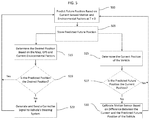
  • FIG. 5 is a flowchart of a method of calibrating the motion sensors of FIG. 1 based on data from the system of FIG. 2 and calibrating the motion of the vehicle so that the position predicted by the systems of FIG. 1 and FIG. 2 is the desired position.
  • a plurality of hardware and software based devices may be used to implement various embodiments.
  • embodiments may include hardware, software, and electronic components or modules that, for purposes of discussion, may be illustrated and described as if the majority of the components were implemented solely in hardware.
  • the electronic based aspects of the invention may be implemented in software (for example, stored on non-transitory computer-readable medium) executable by one or more processors.
  • control units” and “controllers” described in the specification can include one or more electronic processors, one or more memory modules including non-transitory computer-readable medium, one or more input/output interfaces, one or more application specific integrated circuits (ASICs), and various connections (for example, a system bus) connecting the various components.
  • ASICs application specific integrated circuits
  • FIG. 1 and FIG. 2 illustrate two subsystems of a single system used to center a vehicle 100 in a lane.
  • FIG. 1 illustrates an example of the vehicle 100 equipped with a system 105 for sensing motion and controlling the vehicle's position.
  • the vehicle 100 although illustrated as a four-wheeled vehicle, may encompass various types and designs of vehicles.
  • the vehicle 100 may be an automobile, a motorcycle, a truck, a bus, a semi-tractor, and others.
  • the vehicle 100 includes at least some autonomous functionality, but may also require a driver or operator to perform driving functions.
  • the system 105 includes several hardware components including an electronic controller 110 , speed sensors 115 , a gyroscope 120 , a steering control system 125 , steering angle sensor 127 , and a three dimensional (or three-dimensional (3D)) accelerometer 130 .
  • the components of the system 105 may be of various constructions and may use various communication types and protocols.
  • the electronic controller 110 may be communicatively connected to speed sensors 115 , gyroscope 120 , steering control system 125 , steering angle sensor 127 , and three-dimensional accelerometer 130 via various wired or wireless connections.
  • the electronic controller 110 is directly coupled via a dedicated wire to each of the above-listed components of the system 105 for sensing and controlling the vehicle's motion.
  • the electronic controller 110 is communicatively coupled to one or more of the components via a shared communication link such as a vehicle communication bus (for example, a controller area network (CAN) bus) or a wireless vehicle network.
  • a vehicle communication bus for example, a controller area network (CAN) bus
  • a wireless vehicle network for example, a wireless vehicle network.
  • the speed sensors 115 may be implemented, for example, using wheel speed sensors that sense rotational speed.
  • vehicle speed may be sensed or determined using other sensors alone or in combination with wheel speed sensors, for example, a transmission output speed sensor (TOSS) or other types of sensors.
  • TOSS transmission output speed sensor
  • a single speed sensor 115 is associated with each wheel of the vehicle 100 .
  • components of the system 105 may include a steering angle sensor 127 , a steering actuator (for example, an electric motor of an electric steering system), and other components that directly or indirectly (for example, by differential braking) control the steering angle of the vehicle 100 .
  • Each of the above-listed components of the system 105 may include dedicated processing circuitry including an electronic processor for receiving, processing, and transmitting data associated with the functions of each component.
  • the 3-dimensional accelerometer 115 may include an electronic processor that determines the parameters relating to the vehicle's directional motion. In this case, the 3-dimensional accelerometer 115 transmits the parameters or calculated values associated with the parameters to the electronic controller 110 .
  • Each of the components of the system 105 for sensing and controlling the vehicle's motion may communicate with the electronic controller 110 using various communication protocols.
  • the embodiment illustrated in FIG. 1 provides but one example of the components and connections of the system 105 for sensing and controlling the vehicle's motion. However, these components and connections may be constructed in other ways than those illustrated and described herein.
  • FIG. 2 illustrates an example of the vehicle 100 equipped with a system 200 for sensing environmental information regarding an environment external to the vehicle 100 .
  • the system 200 includes several hardware components including an electronic controller 110 , a radar sensor 202 , a video camera 205 , a lidar sensor 210 , a global positioning system 215 , and a map 220 .
  • the map 220 may be a map of a geographical area surrounding the vehicle 100 , for example a map of an area with a radius of a predetermined size, for example, 1 kilometer.
  • the components of the system 200 may be of various constructions and may use various communication types and protocols.
  • the electronic controller 110 may be communicatively connected to the radar sensor 202 , video camera 205 , lidar sensor 210 , global positioning system 215 , and map 220 via various wired or wireless connections.
  • the electronic controller 110 is directly coupled via a dedicated wire to each of the above-listed components of the system 200 for sensing environmental information regarding an environment external to the vehicle 100 .
  • the electronic controller 110 is communicatively coupled to one or more of the components via a shared communication link such as a vehicle communication bus (for example, a controller area network (CAN) bus) or a wireless vehicle network.
  • a vehicle communication bus for example, a controller area network (CAN) bus
  • a wireless vehicle network for example, a wireless vehicle network.
  • Each of the above-listed components of the system 200 for sensing environmental information regarding an environment external to the vehicle 100 may include dedicated processing circuitry including an electronic processor for receiving, processing, and transmitting data associated with the functions of each component.
  • the video camera 205 may include an electronic processor that determines the images to use to measure the accuracy of the system for sensing and controlling the vehicle's motion 105 . In this case, the video camera 205 transmits the images or values associated with the images to the electronic controller 110 .
  • Each of the components of the system 200 for sensing environmental information regarding an environment external to the vehicle 100 may communicate with the electronic controller 110 using various communication protocols.
  • the embodiment illustrated in FIG. 2 provides but one example of the components and connections of the system 200 for sensing environmental information regarding an environment external to the vehicle 100 . These components and connections may be constructed in other ways than those illustrated and described herein.
  • the radar sensor 202 , video camera 205 , and lidar sensor 210 are electromagnetic radiation sensors. There may be more than one of each of the electromagnetic radiation sensors and they may be located at different positions on the interior or exterior of the vehicle 100 .
  • the video camera 205 , or components thereof may be externally mounted to a portion of the vehicle 100 (such as on a side mirror or front end).
  • the video camera 205 , or components thereof may be internally mounted within the vehicle 100 (for example, positioned on the dashboard or by the rearview mirror).
  • the electromagnetic radiation sensors are configured to receive signals indicative of the vehicle's distance from and position relative to, elements in the vehicle's surrounding environment 300 as the vehicle 100 moves from one point to another.
  • FIG. 3 is a block diagram of a vehicle 100 in an example surrounding environment 300 .
  • the vehicle 100 is depicted in a first position 302 (at a first time) and in a second position 305 (at a second later time).
  • the electromagnetic radiation sensors (for example, sensors 202 , 205 , and 210 ) of the vehicle 100 detect the surrounding environment 300 of the vehicle 100 and elements in that environment (“environmental elements”) including a dashed center line 310 (a “lane marking”), a solid line 315 (another “lane marking”), a solid line 317 , a building 320 , and a road sign 325 .
  • the electronic controller 110 uses elements that can be detected at the first position 302 and second position 305 to calculate the position of the vehicle 100 .
  • the building 320 , the dashed center line 310 , solid line 315 , and solid line 317 are used to calculate the vehicle's position at both times because they can be detected at the first position 302 and second position 305 .
  • Environmental elements that cannot be detected at the first position 302 and second position 305 are not used by the electronic controller 110 to calculate the position of the vehicle 100 .
  • the road sign 325 is not used to calculate the vehicle's position because it cannot be detected at the first position 302 and second position 305 .
  • FIG. 4 is a block diagram of the electronic controller 110 of the systems of FIG. 1 and FIG. 2 .
  • the electronic controller 110 includes a plurality of electrical and electronic components that provide power, operation control, and protection to the components and modules within the electronic controller 110 .
  • the electronic controller 110 includes, among other things, an electronic processor 405 (such as a programmable electronic microprocessor, microcontroller, or similar device), a memory 415 (for example, non-transitory, machine readable memory), and an input/output interface 410 .
  • the electronic processor 405 is communicatively connected to the memory 415 and the input/output interface 410 .
  • the electronic processor 405 in coordination with the memory 415 and the input/output interface 410 , is configured to implement, among other things, the methods described herein.
  • the electronic controller 110 may be implemented in several independent controllers (for example, programmable electronic controllers) each configured to perform specific functions or sub-functions. Additionally, the electronic controller 110 may contain sub-modules that include additional electronic processors, memory, or application specific integrated circuits (ASICs) for handling input/output functions, processing of signals, and application of the methods listed below. In other embodiments, the electronic controller 110 includes additional, fewer, or different components.
  • controllers for example, programmable electronic controllers
  • ASICs application specific integrated circuits
  • FIG. 5 illustrates a method of centering a vehicle in a lane using the system 105 for sensing motion and controlling the vehicle's position and the system 200 for sensing environmental information regarding an environment external to the vehicle 100 .
  • the method performs a first task and a second task in parallel in order to center the vehicle 100 in the lane.
  • the electronic processor 405 predicts the future position of the vehicle 100 relative to elements in the vehicle's future surrounding environment (block 500 ).
  • the predicted position is calculated based on the vehicle's current motion (first motion) and surrounding environmental elements.
  • environmental elements that are used to determine the vehicle's position include stationary infrastructure and road markings present at the vehicle's predicted position and the vehicle's current position.
  • the predicted position is stored in the memory 415 of the electrical controller 110 as a location on the map 220 or as a set of variables describing the location relative to the environment (blocks 505 ).
  • the first task is correcting the vehicle's motion so that the vehicle 100 moves to a desired position.
  • the desired position is defined as the position where the vehicle 100 is centered in the lane.
  • the electronic processor 405 uses the input from the radar sensor 202 , video camera 205 , lidar sensor 210 , and global positioning system 215 to determine the geographical position of the vehicle 100 on the map 220 . Using the map 220 and information from the system 105 the electronic processor 405 determines the desired position (block 515 ). The electronic processor 405 compares the predicted position of the vehicle 100 to the desired position of the vehicle 100 (block 520 ).
  • a corrective signal is generated by the electronic controller 110 and sent to components that directly (for example, by adjusting the angle, relative to the front of the vehicle 100 , of the front wheels' axis) or indirectly (for example, by differential braking) control the steering angle of the vehicle 100 (block 522 ).
  • the corrective signal causes an adjustment to be made to the vehicle's motion. The adjustment to the vehicle's motion ensures that the desired position and future position will be the same.
  • the second task is to determine if and how the system 105 for sensing motion and controlling the vehicle's position needs to be calibrated.
  • the current position of the vehicle 100 is determined relative to elements in the vehicle's current surrounding environment (block 525 ).
  • the predicted position is retrieved from the electronic controller's memory 415 .
  • the predicted position of the vehicle 100 and the current position of the vehicle 100 are then compared (block 527 ). Differences between the predicted position and the current position indicate that the motion sensors are calibrated incorrectly.
  • the motion sensors are recalibrated based on the differences between the vehicle's current position and the vehicle's predicted position (block 530 ).
  • the second task is performed while the first task compares a second predicted position of the vehicle to a second desired position of the vehicle to generate a second corrective signal and sends the second corrective signal to the steering system of the vehicle 100 .

Landscapes

  • Engineering & Computer Science (AREA)
  • Automation & Control Theory (AREA)
  • Transportation (AREA)
  • Mechanical Engineering (AREA)
  • Human Computer Interaction (AREA)
  • Physics & Mathematics (AREA)
  • Mathematical Physics (AREA)
  • Traffic Control Systems (AREA)
  • Control Of Driving Devices And Active Controlling Of Vehicle (AREA)
  • Steering Control In Accordance With Driving Conditions (AREA)

Abstract

A method and system for centering a vehicle in a lane. The system includes an electromagnetic radiation sensor, a motion sensor, a steering system, and an electronic controller. The electronic controller is configured to receive environmental information regarding an environment external to the vehicle from the electromagnetic radiation sensor and to receive a first motion of the vehicle from the motion sensor. The electronic controller is also configured to determine a predicted position of the vehicle based the first motion of the vehicle and the environmental information, store the predicted position, compare the predicted position to a desired position of the vehicle to generate and send a corrective signal to the steering system. The electronic controller is further configured to determine a current position of the vehicle, compare the current position with the predicted position to generate a difference, and calibrate the motion sensor based on the difference.

Description

FIELD
Embodiments relate to an automated steering for vehicles.
BACKGROUND
Modern vehicles include various partially autonomous driving functions, for example adaptive cruise-control, collision avoidance systems, self-parking, and the like. Fully autonomous driving is a goal, but has not yet been achieved, at least on market-ready, commercially viable scale.
SUMMARY
One goal for an automatic steering vehicle is to be able to accurately measure the dynamics of the vehicle in order to predict the future position of the vehicle. For lateral dynamics, the sensors that can be used to predict the vehicle motion include a steering angle sensor, MEMS gyroscopes, and accelerometers. There are many reasons why a motion sensor is not always able to accurately measure the real motion of the vehicle. There are known drift effects that cause MEMS-based inertial sensors to lose accuracy. Differences in the position of the vehicle parts due to cornering, tire inflation, or road banking may cause a yaw rate sensor to measure motion that is not parallel with the ground plane as lateral motion. Similarly, for steering angle based sensing there are additional external forces that are not measured causing systemic error when the sensor is used to predict the future vehicle position. Embodiments described herein provide, among other things, an automatic steering system for a vehicle where a sensor signal (for example, from a gyroscope, a steering angle sensor, or an accelerometer) is used as the controlled signal of a closed-loop vehicle motion controller. To achieve robust control, vehicle motion that is requested or executed should be achieved. Environmental sensing can be used in combination with a motion sensor to determine the true motion of the vehicle and correct for system errors.
For driving in a linear vehicle dynamics range, it is usually sufficient to make single-track assumptions to determine the correct steering angle to achieve the desired vehicle reaction. Such assumptions rely on being able to accurately sense the position of the steering system of a vehicle. Since the position of the steering system is normally measured only in one place, in vehicles where there is significant play in the mechanical design of the steering system, or the configuration of the steering system can change dynamically (for example, in a vehicle equipped with an air suspension), the sensed steering angle may be inaccurate. One option is to model the mechanical behavior of the steering system. However, modeling typically requires significant software application effort for each mechanical design to which the model is adapted and potentially requires adaptation of system changes over time.
Embodiments provide, among other things, a system and a method for centering a vehicle in a lane.
One embodiment provides a system for centering a vehicle in a lane. The system includes an electromagnetic radiation sensor, a motion sensor, a steering system, and an electronic controller. The electronic controller is configured to receive environmental information regarding an environment external to the vehicle from the electromagnetic radiation sensor and to receive a first motion of the vehicle from the motion sensor. The electronic controller is also configured to determine a predicted position of the vehicle based on the first motion of the vehicle and the environmental information, store the predicted position of the vehicle in memory, compare the predicted position of the vehicle to a desired position of the vehicle to generate a corrective signal, and send the corrective signal to the steering system of the vehicle. The electronic controller is further configured to determine a current position of the vehicle, compare the current position of the vehicle with the predicted position of the vehicle to generate a difference, and calibrate the motion sensor based on the difference.
Another embodiment provides a method of centering a vehicle in a lane. The method includes sensing, with an electromagnetic radiation sensor, environmental information regarding an environment external to the vehicle and sensing, with a motion sensor, a first motion of the vehicle. The method also includes determining, with an electronic controller, a predicted position of the vehicle based on the first motion of the vehicle and the environmental information, storing the predicted position of the vehicle in memory, comparing the predicted position of the vehicle to a desired position of the vehicle to generate a corrective signal, and sending the corrective signal to a steering system of the vehicle. The method further includes determining a current position of the vehicle, comparing the current position of the vehicle with the predicted position of the vehicle to generate a difference, and calibrating the motion sensor based on the difference.
Other aspects, features, and embodiments will become apparent by consideration of the detailed description and accompanying drawings.
BRIEF DESCRIPTION OF THE DRAWINGS
FIG. 1 is a block diagram of a vehicle equipped with a system for sensing and controlling the motion of the vehicle.
FIG. 2 is a block diagram of a vehicle equipped with a system for detecting the position of the vehicle relative to a surrounding environment.
FIG. 3 is a block diagram of a vehicle traveling during a time in an example surrounding environment.
FIG. 4 is a block diagram of an electronic controller of the system of FIG. 1 and the system of FIG. 2.
FIG. 5 is a flowchart of a method of calibrating the motion sensors of FIG. 1 based on data from the system of FIG. 2 and calibrating the motion of the vehicle so that the position predicted by the systems of FIG. 1 and FIG. 2 is the desired position.
DETAILED DESCRIPTION
Before any embodiments are explained in detail, it is to be understood that this disclosure is not intended to be limited in its application to the details of construction and the arrangement of components set forth in the following description or illustrated in the following drawings. Embodiments are capable of other configurations and of being practiced or of being carried out in various ways.
A plurality of hardware and software based devices, as well as a plurality of different structural components may be used to implement various embodiments. In addition, embodiments may include hardware, software, and electronic components or modules that, for purposes of discussion, may be illustrated and described as if the majority of the components were implemented solely in hardware. However, one of ordinary skill in the art, and based on a reading of this detailed description, would recognize that, in at least one embodiment, the electronic based aspects of the invention may be implemented in software (for example, stored on non-transitory computer-readable medium) executable by one or more processors. For example, “control units” and “controllers” described in the specification can include one or more electronic processors, one or more memory modules including non-transitory computer-readable medium, one or more input/output interfaces, one or more application specific integrated circuits (ASICs), and various connections (for example, a system bus) connecting the various components.
FIG. 1 and FIG. 2 illustrate two subsystems of a single system used to center a vehicle 100 in a lane. FIG. 1 illustrates an example of the vehicle 100 equipped with a system 105 for sensing motion and controlling the vehicle's position. The vehicle 100, although illustrated as a four-wheeled vehicle, may encompass various types and designs of vehicles. For example, the vehicle 100 may be an automobile, a motorcycle, a truck, a bus, a semi-tractor, and others. The vehicle 100 includes at least some autonomous functionality, but may also require a driver or operator to perform driving functions. In the example illustrated, the system 105 includes several hardware components including an electronic controller 110, speed sensors 115, a gyroscope 120, a steering control system 125, steering angle sensor 127, and a three dimensional (or three-dimensional (3D)) accelerometer 130. The components of the system 105 may be of various constructions and may use various communication types and protocols.
The electronic controller 110 may be communicatively connected to speed sensors 115, gyroscope 120, steering control system 125, steering angle sensor 127, and three-dimensional accelerometer 130 via various wired or wireless connections. For example, in some embodiments, the electronic controller 110 is directly coupled via a dedicated wire to each of the above-listed components of the system 105 for sensing and controlling the vehicle's motion. In other embodiments, the electronic controller 110 is communicatively coupled to one or more of the components via a shared communication link such as a vehicle communication bus (for example, a controller area network (CAN) bus) or a wireless vehicle network.
The speed sensors 115 may be implemented, for example, using wheel speed sensors that sense rotational speed. In other embodiments, vehicle speed may be sensed or determined using other sensors alone or in combination with wheel speed sensors, for example, a transmission output speed sensor (TOSS) or other types of sensors. In the embodiment shown, a single speed sensor 115 is associated with each wheel of the vehicle 100. In another example, components of the system 105 may include a steering angle sensor 127, a steering actuator (for example, an electric motor of an electric steering system), and other components that directly or indirectly (for example, by differential braking) control the steering angle of the vehicle 100.
Each of the above-listed components of the system 105 may include dedicated processing circuitry including an electronic processor for receiving, processing, and transmitting data associated with the functions of each component. For example, the 3-dimensional accelerometer 115 may include an electronic processor that determines the parameters relating to the vehicle's directional motion. In this case, the 3-dimensional accelerometer 115 transmits the parameters or calculated values associated with the parameters to the electronic controller 110. Each of the components of the system 105 for sensing and controlling the vehicle's motion may communicate with the electronic controller 110 using various communication protocols. The embodiment illustrated in FIG. 1 provides but one example of the components and connections of the system 105 for sensing and controlling the vehicle's motion. However, these components and connections may be constructed in other ways than those illustrated and described herein.
FIG. 2 illustrates an example of the vehicle 100 equipped with a system 200 for sensing environmental information regarding an environment external to the vehicle 100. In the example illustrated, the system 200 includes several hardware components including an electronic controller 110, a radar sensor 202, a video camera 205, a lidar sensor 210, a global positioning system 215, and a map 220. The map 220 may be a map of a geographical area surrounding the vehicle 100, for example a map of an area with a radius of a predetermined size, for example, 1 kilometer. The components of the system 200 may be of various constructions and may use various communication types and protocols.
The electronic controller 110 may be communicatively connected to the radar sensor 202, video camera 205, lidar sensor 210, global positioning system 215, and map 220 via various wired or wireless connections. For example, in some embodiments, the electronic controller 110 is directly coupled via a dedicated wire to each of the above-listed components of the system 200 for sensing environmental information regarding an environment external to the vehicle 100. In other embodiments, the electronic controller 110 is communicatively coupled to one or more of the components via a shared communication link such as a vehicle communication bus (for example, a controller area network (CAN) bus) or a wireless vehicle network.
Each of the above-listed components of the system 200 for sensing environmental information regarding an environment external to the vehicle 100 may include dedicated processing circuitry including an electronic processor for receiving, processing, and transmitting data associated with the functions of each component. For example, the video camera 205 may include an electronic processor that determines the images to use to measure the accuracy of the system for sensing and controlling the vehicle's motion 105. In this case, the video camera 205 transmits the images or values associated with the images to the electronic controller 110. Each of the components of the system 200 for sensing environmental information regarding an environment external to the vehicle 100 may communicate with the electronic controller 110 using various communication protocols. The embodiment illustrated in FIG. 2 provides but one example of the components and connections of the system 200 for sensing environmental information regarding an environment external to the vehicle 100. These components and connections may be constructed in other ways than those illustrated and described herein.
The radar sensor 202, video camera 205, and lidar sensor 210 are electromagnetic radiation sensors. There may be more than one of each of the electromagnetic radiation sensors and they may be located at different positions on the interior or exterior of the vehicle 100. For example, the video camera 205, or components thereof, may be externally mounted to a portion of the vehicle 100 (such as on a side mirror or front end). Alternatively the video camera 205, or components thereof, may be internally mounted within the vehicle 100 (for example, positioned on the dashboard or by the rearview mirror). The electromagnetic radiation sensors are configured to receive signals indicative of the vehicle's distance from and position relative to, elements in the vehicle's surrounding environment 300 as the vehicle 100 moves from one point to another.
FIG. 3 is a block diagram of a vehicle 100 in an example surrounding environment 300. The vehicle 100 is depicted in a first position 302 (at a first time) and in a second position 305 (at a second later time). The electromagnetic radiation sensors (for example, sensors 202, 205, and 210) of the vehicle 100 detect the surrounding environment 300 of the vehicle 100 and elements in that environment (“environmental elements”) including a dashed center line 310 (a “lane marking”), a solid line 315 (another “lane marking”), a solid line 317, a building 320, and a road sign 325. The electronic controller 110 uses elements that can be detected at the first position 302 and second position 305 to calculate the position of the vehicle 100. For example, the building 320, the dashed center line 310, solid line 315, and solid line 317 are used to calculate the vehicle's position at both times because they can be detected at the first position 302 and second position 305. Environmental elements that cannot be detected at the first position 302 and second position 305 are not used by the electronic controller 110 to calculate the position of the vehicle 100. For example, the road sign 325 is not used to calculate the vehicle's position because it cannot be detected at the first position 302 and second position 305.
FIG. 4 is a block diagram of the electronic controller 110 of the systems of FIG. 1 and FIG. 2. The electronic controller 110 includes a plurality of electrical and electronic components that provide power, operation control, and protection to the components and modules within the electronic controller 110. The electronic controller 110 includes, among other things, an electronic processor 405 (such as a programmable electronic microprocessor, microcontroller, or similar device), a memory 415 (for example, non-transitory, machine readable memory), and an input/output interface 410. The electronic processor 405 is communicatively connected to the memory 415 and the input/output interface 410. The electronic processor 405, in coordination with the memory 415 and the input/output interface 410, is configured to implement, among other things, the methods described herein.
The electronic controller 110 may be implemented in several independent controllers (for example, programmable electronic controllers) each configured to perform specific functions or sub-functions. Additionally, the electronic controller 110 may contain sub-modules that include additional electronic processors, memory, or application specific integrated circuits (ASICs) for handling input/output functions, processing of signals, and application of the methods listed below. In other embodiments, the electronic controller 110 includes additional, fewer, or different components.
FIG. 5 illustrates a method of centering a vehicle in a lane using the system 105 for sensing motion and controlling the vehicle's position and the system 200 for sensing environmental information regarding an environment external to the vehicle 100. In a general sense, the method performs a first task and a second task in parallel in order to center the vehicle 100 in the lane. In the illustrated method, the electronic processor 405 predicts the future position of the vehicle 100 relative to elements in the vehicle's future surrounding environment (block 500). The predicted position is calculated based on the vehicle's current motion (first motion) and surrounding environmental elements. In some embodiments, environmental elements that are used to determine the vehicle's position include stationary infrastructure and road markings present at the vehicle's predicted position and the vehicle's current position. The predicted position is stored in the memory 415 of the electrical controller 110 as a location on the map 220 or as a set of variables describing the location relative to the environment (blocks 505).
The first task is correcting the vehicle's motion so that the vehicle 100 moves to a desired position. In one example, the desired position is defined as the position where the vehicle 100 is centered in the lane. The electronic processor 405 uses the input from the radar sensor 202, video camera 205, lidar sensor 210, and global positioning system 215 to determine the geographical position of the vehicle 100 on the map 220. Using the map 220 and information from the system 105 the electronic processor 405 determines the desired position (block 515). The electronic processor 405 compares the predicted position of the vehicle 100 to the desired position of the vehicle 100 (block 520). If there are differences between the desired position and the predicted position a corrective signal is generated by the electronic controller 110 and sent to components that directly (for example, by adjusting the angle, relative to the front of the vehicle 100, of the front wheels' axis) or indirectly (for example, by differential braking) control the steering angle of the vehicle 100 (block 522). The corrective signal causes an adjustment to be made to the vehicle's motion. The adjustment to the vehicle's motion ensures that the desired position and future position will be the same.
The second task is to determine if and how the system 105 for sensing motion and controlling the vehicle's position needs to be calibrated. At the time the vehicle 100 should have reached the predicted position, the current position of the vehicle 100 is determined relative to elements in the vehicle's current surrounding environment (block 525). The predicted position is retrieved from the electronic controller's memory 415. The predicted position of the vehicle 100 and the current position of the vehicle 100 are then compared (block 527). Differences between the predicted position and the current position indicate that the motion sensors are calibrated incorrectly. The motion sensors are recalibrated based on the differences between the vehicle's current position and the vehicle's predicted position (block 530). If the predicted position were recalculated given the data from the recalibrated motion sensors the predicted position and current position of the vehicle 100 would be the same. The second task is performed while the first task compares a second predicted position of the vehicle to a second desired position of the vehicle to generate a second corrective signal and sends the second corrective signal to the steering system of the vehicle 100.
Various features, advantages, and embodiments are set forth in the following claims.

Claims (12)

What is claimed is:
1. A system for centering a vehicle in a lane, the system comprising:
an electromagnetic radiation sensor;
a motion sensor;
a steering system; and
an electronic controller configured to,
receive environmental information regarding an environment external to the vehicle from the electromagnetic radiation sensor,
receive a first motion of the vehicle from the motion sensor,
at a first time
determine a predicted position of the vehicle based on the first motion of the vehicle and the environmental information,
store the predicted position of the vehicle in memory,
compare the predicted position of the vehicle to a desired position of the vehicle to generate a corrective signal,
send the corrective signal to the steering system of the vehicle, and
determine a second time when the vehicle should reach the predicted position, and
at the second time
determine a current position of the vehicle,
compare the current position of the vehicle with the predicted position of the vehicle to generate a difference, and
calibrate the motion sensor based on the difference, wherein the motion sensor is one selected from the group comprising a steering angle sensor, a 3-dimensional accelerometer, and a gyroscope.
2. The system according to claim 1, wherein the desired position is a future position of the vehicle where the vehicle is centered in the lane.
3. The system according to claim 1, wherein the electromagnetic radiation sensor is at least one from the group consisting of a radar sensor, video camera, and lidar sensor.
4. The system according to claim 1, wherein the corrective signal includes an adjustment to a steering angle of the vehicle that causes the vehicle to reach the desired position at a future point in time.
5. The system according to claim 1, wherein the predicted position is stored as a location on a map or as a set of variables describing the location relative to the environment.
6. The system according to claim 1, wherein the electronic processor is configured to determine the desired position using a map of a geographical area surrounding the vehicle and the received environmental information.
7. A method of centering a vehicle in a lane, the method comprising:
sensing, with an electromagnetic radiation sensor, environmental information regarding an environment external to the vehicle;
sensing, with a motion sensor, a first motion of the vehicle;
at a first time
determining, with an electronic controller, a predicted position of the vehicle based the first motion of the vehicle and the environmental information;
storing the predicted position of the vehicle in memory;
comparing the predicted position of the vehicle to a desired position of the vehicle to generate a corrective signal;
sending the corrective signal to a steering system of the vehicle; and
determine a second time when the vehicle should reach the predicted position, and
at the second time
determining a current position of the vehicle;
comparing the current position of the vehicle with the predicted position of the vehicle to generate a difference;
calibrating the motion sensor based on the difference, wherein the motion sensor is one selected from the group comprising a steering angle sensor, a 3-dimensional accelerometer, and a gyroscope.
8. The method according to claim 7, wherein the electromagnetic radiation sensor is at least one from the group consisting of a radar sensor, video camera, and lidar sensor.
9. The method according to claim 7, wherein the desired position is a future position of the vehicle where the vehicle is centered in the lane.
10. The method according to claim 7, method further comprising determining the desired position using a map of a geographical area surrounding the vehicle and the received environmental information.
11. The method according to claim 7, wherein the corrective signal includes an adjustment to a steering angle of the vehicle that causes the vehicle to reach the desired position at a future point in time.
12. The method according to claim 7, wherein the predicted position is stored as a location on a map or as a set of variables describing the location relative to the environment external to the vehicle.
US15/950,923 2017-12-27 2018-04-11 Centering a vehicle in a lane using environmental information to correct a predicted trajectory Active 2038-11-26 US10899349B2 (en)

Priority Applications (4)

Application Number Priority Date Filing Date Title
US15/950,923 US10899349B2 (en) 2017-12-27 2018-04-11 Centering a vehicle in a lane using environmental information to correct a predicted trajectory
DE112018006044.6T DE112018006044T5 (en) 2017-12-27 2018-12-20 CENTERING A VEHICLE IN A LANE USING ENVIRONMENTAL INFORMATION TO CORRECT A PREDICTED TRAJECTORY
PCT/EP2018/086092 WO2019129615A1 (en) 2017-12-27 2018-12-20 Centering a vehilce in a lane using environmental information to correct a predicted trajectory
CN201880090392.1A CN111788100B (en) 2017-12-27 2018-12-20 Use environmental information to correct the predicted trajectory to keep the vehicle centered in the lane

Applications Claiming Priority (2)

Application Number Priority Date Filing Date Title
US201762610623P 2017-12-27 2017-12-27
US15/950,923 US10899349B2 (en) 2017-12-27 2018-04-11 Centering a vehicle in a lane using environmental information to correct a predicted trajectory

Publications (2)

Publication Number Publication Date
US20190193730A1 US20190193730A1 (en) 2019-06-27
US10899349B2 true US10899349B2 (en) 2021-01-26

Family

ID=66948802

Family Applications (1)

Application Number Title Priority Date Filing Date
US15/950,923 Active 2038-11-26 US10899349B2 (en) 2017-12-27 2018-04-11 Centering a vehicle in a lane using environmental information to correct a predicted trajectory

Country Status (4)

Country Link
US (1) US10899349B2 (en)
CN (1) CN111788100B (en)
DE (1) DE112018006044T5 (en)
WO (1) WO2019129615A1 (en)

Cited By (1)

* Cited by examiner, † Cited by third party
Publication number Priority date Publication date Assignee Title
US12424034B2 (en) 2023-12-22 2025-09-23 Industrial Technology Research Institute Vehicle control system and vehicle control method thereof

Families Citing this family (6)

* Cited by examiner, † Cited by third party
Publication number Priority date Publication date Assignee Title
CN109100537B (en) * 2018-07-19 2021-04-20 百度在线网络技术(北京)有限公司 Motion detection method, apparatus, device, and medium
US11216000B2 (en) * 2019-01-17 2022-01-04 Toyota Motor Engineering & Manufacturing North America, Inc. System and method for estimating lane prediction errors for lane segments
US11572074B2 (en) * 2020-05-22 2023-02-07 Cnh Industrial America Llc Estimation of terramechanical properties
US11400976B2 (en) * 2020-07-22 2022-08-02 Ford Global Technologies, Llc Steering wheel angle calibration
DE102020209353A1 (en) 2020-07-24 2022-01-27 Ford Global Technologies, Llc Controlling a vehicle considering the sensor range
DE102021100794A1 (en) * 2021-01-15 2022-07-21 Bayerische Motoren Werke Aktiengesellschaft Method for processing measurement data from an environment sensor of a vehicle with compensation for vehicle data affected by latency, computing device and computer program

Citations (8)

* Cited by examiner, † Cited by third party
Publication number Priority date Publication date Assignee Title
US7162333B2 (en) 2001-12-27 2007-01-09 Toyota Jidosha Kabushiki Kaisha Integrated vehicle motion control system
US20110231095A1 (en) 2010-03-19 2011-09-22 Hitachi Automotive Systems, Ltd. Vehicle control apparatus and vehicle control method
US8332134B2 (en) 2008-04-24 2012-12-11 GM Global Technology Operations LLC Three-dimensional LIDAR-based clear path detection
US8346437B2 (en) 2009-07-30 2013-01-01 Nissan Motor Co., Ltd. Vehicle driving support device and vehicle driving support method
US8352112B2 (en) 2009-04-06 2013-01-08 GM Global Technology Operations LLC Autonomous vehicle management
US20130253767A1 (en) * 2012-03-26 2013-09-26 GM Global Technology Operations LLC System and method for vehicle lateral control
US20160091325A1 (en) 2014-09-25 2016-03-31 Nissan North America, Inc. Method and system of assisting a driver of a vehicle
US20160176398A1 (en) 2014-12-23 2016-06-23 Toyota Motor Engineering & Manufacturing North America, Inc. Risk mitigation for autonomous vehicles relative to turning objects

Family Cites Families (4)

* Cited by examiner, † Cited by third party
Publication number Priority date Publication date Assignee Title
US8170739B2 (en) * 2008-06-20 2012-05-01 GM Global Technology Operations LLC Path generation algorithm for automated lane centering and lane changing control system
JP2011117739A (en) * 2009-11-30 2011-06-16 Fujitsu Ten Ltd Navigation system and vehicle-mounted device
US8706347B2 (en) * 2010-01-19 2014-04-22 GM Global Technology Operations LLC Diagnosis of wheel alignment using GPS
DE102011007024A1 (en) * 2011-04-08 2012-10-11 Robert Bosch Gmbh Method for determining the position of a moving vehicle and maneuver assistance system

Patent Citations (8)

* Cited by examiner, † Cited by third party
Publication number Priority date Publication date Assignee Title
US7162333B2 (en) 2001-12-27 2007-01-09 Toyota Jidosha Kabushiki Kaisha Integrated vehicle motion control system
US8332134B2 (en) 2008-04-24 2012-12-11 GM Global Technology Operations LLC Three-dimensional LIDAR-based clear path detection
US8352112B2 (en) 2009-04-06 2013-01-08 GM Global Technology Operations LLC Autonomous vehicle management
US8346437B2 (en) 2009-07-30 2013-01-01 Nissan Motor Co., Ltd. Vehicle driving support device and vehicle driving support method
US20110231095A1 (en) 2010-03-19 2011-09-22 Hitachi Automotive Systems, Ltd. Vehicle control apparatus and vehicle control method
US20130253767A1 (en) * 2012-03-26 2013-09-26 GM Global Technology Operations LLC System and method for vehicle lateral control
US20160091325A1 (en) 2014-09-25 2016-03-31 Nissan North America, Inc. Method and system of assisting a driver of a vehicle
US20160176398A1 (en) 2014-12-23 2016-06-23 Toyota Motor Engineering & Manufacturing North America, Inc. Risk mitigation for autonomous vehicles relative to turning objects

Non-Patent Citations (1)

* Cited by examiner, † Cited by third party
Title
International Search Report for Application No. PCT/EP2018/086092 dated Apr. 17, 2019 (5 pages).

Cited By (1)

* Cited by examiner, † Cited by third party
Publication number Priority date Publication date Assignee Title
US12424034B2 (en) 2023-12-22 2025-09-23 Industrial Technology Research Institute Vehicle control system and vehicle control method thereof

Also Published As

Publication number Publication date
CN111788100A (en) 2020-10-16
CN111788100B (en) 2025-03-04
WO2019129615A1 (en) 2019-07-04
DE112018006044T5 (en) 2020-09-03
US20190193730A1 (en) 2019-06-27

Similar Documents

Publication Publication Date Title
US10899349B2 (en) Centering a vehicle in a lane using environmental information to correct a predicted trajectory
US11454525B2 (en) Vehicle sensor field calibration utilizing other vehicles
EP3088281B1 (en) Automatic driving vehicle system
US10173671B2 (en) Sensor calibration in a parking facility
US9771073B2 (en) Adaptive cruise control system in vehicle and method thereof
CN110114254B (en) Reduce lateral position deviation during automatic lane changes
EP3556625B1 (en) Vehicle control system, external electronic control unit, vehicle control method, and application
US10782129B2 (en) Method and system for ascertaining and providing a ground profile
EP3279062A1 (en) Lane keeping system for vehicle in wind conditions using vehicle roll
US11591015B2 (en) Method and assembly for validity-checking and/or (re)initializing rear wheel steering
EP3637385A1 (en) Driving-obstacle detecting device and vehicle navigation system
CN111795692A (en) Method and apparatus for parallel tracking and positioning via multi-mode SLAM fusion process
CN107764265A (en) Method and system for vehicle location feedback
JP2016206976A (en) Preceding vehicle track calculation device for driving support control of vehicle
KR20210135526A (en) How to estimate the motion state of a vehicle during vehicle maneuvering
KR101246128B1 (en) Automatic vehicle driving system
KR20180036287A (en) Map management apparatus
KR102637830B1 (en) Methods, electronic control devices and systems for position determination
US11340357B2 (en) Method and apparatus for detecting a position of a vehicle having a high level of automation
US9221467B2 (en) Determining the installation location of a wheel sensor
KR20130074736A (en) Automatic vehicle driving system
KR20210137038A (en) Vehicle positioning device and vehicle
US20250333102A1 (en) Systems and methods to compensate for a steering pinion offset
WO2025110911A1 (en) A method and a control arrangement for estimation of motion of a portion of a vehicle body, and methods and control arrangements for motion compensation, detection of a critical situation and detection of a miscalibration of sensors

Legal Events

Date Code Title Description
AS Assignment

Owner name: ROBERT BOSCH GMBH, GERMANY

Free format text: ASSIGNMENT OF ASSIGNORS INTEREST;ASSIGNOR:VOORHEIS, THOMAS;REEL/FRAME:045912/0659

Effective date: 20180410

FEPP Fee payment procedure

Free format text: ENTITY STATUS SET TO UNDISCOUNTED (ORIGINAL EVENT CODE: BIG.); ENTITY STATUS OF PATENT OWNER: LARGE ENTITY

STPP Information on status: patent application and granting procedure in general

Free format text: NON FINAL ACTION MAILED

STPP Information on status: patent application and granting procedure in general

Free format text: RESPONSE TO NON-FINAL OFFICE ACTION ENTERED AND FORWARDED TO EXAMINER

STPP Information on status: patent application and granting procedure in general

Free format text: PUBLICATIONS -- ISSUE FEE PAYMENT RECEIVED

STPP Information on status: patent application and granting procedure in general

Free format text: PUBLICATIONS -- ISSUE FEE PAYMENT VERIFIED

STCF Information on status: patent grant

Free format text: PATENTED CASE

MAFP Maintenance fee payment

Free format text: PAYMENT OF MAINTENANCE FEE, 4TH YEAR, LARGE ENTITY (ORIGINAL EVENT CODE: M1551); ENTITY STATUS OF PATENT OWNER: LARGE ENTITY

Year of fee payment: 4