US10870663B2 - Compounds useful in HIV therapy - Google Patents
Compounds useful in HIV therapy Download PDFInfo
- Publication number
- US10870663B2 US10870663B2 US16/897,351 US202016897351A US10870663B2 US 10870663 B2 US10870663 B2 US 10870663B2 US 202016897351 A US202016897351 A US 202016897351A US 10870663 B2 US10870663 B2 US 10870663B2
- Authority
- US
- United States
- Prior art keywords
- bis
- compound
- methylamino
- dimethyl
- thiazepine
- Prior art date
- Legal status (The legal status is an assumption and is not a legal conclusion. Google has not performed a legal analysis and makes no representation as to the accuracy of the status listed.)
- Active
Links
- 0 *C1(C)CC2([H])SCCC(NC(=C)C(C)NC)C(=O)N2C1C(=O)N*NC(=O)C1N2C(=O)C(NC(=C)C(C)NC)CCSC2([H])CC1(C)C Chemical compound *C1(C)CC2([H])SCCC(NC(=C)C(C)NC)C(=O)N2C1C(=O)N*NC(=O)C1N2C(=O)C(NC(=C)C(C)NC)CCSC2([H])CC1(C)C 0.000 description 61
- MTMBHVSFKNCLFN-RMTBLGQQSA-N S.S.S.S.S.S.S.S.S.S.[H][C@]12CC(C)(C)[C@@H](C(=O)N[C@H](C(=O)NCC#CC#CCCC(=O)[C@@H](NC(=O)[C@H]3N4C(=O)[C@@H](NC(=O)[C@H](C)CC)CCS[C@@]4([H])CC3(C)C)C3=CC=CC=C3)C3=CC=CC=C3)N1C(=O)[C@@H](CC(=O)[C@H](C)NC)CCS2 Chemical compound S.S.S.S.S.S.S.S.S.S.[H][C@]12CC(C)(C)[C@@H](C(=O)N[C@H](C(=O)NCC#CC#CCCC(=O)[C@@H](NC(=O)[C@H]3N4C(=O)[C@@H](NC(=O)[C@H](C)CC)CCS[C@@]4([H])CC3(C)C)C3=CC=CC=C3)C3=CC=CC=C3)N1C(=O)[C@@H](CC(=O)[C@H](C)NC)CCS2 MTMBHVSFKNCLFN-RMTBLGQQSA-N 0.000 description 7
- VCVMWFDNPLLHKP-UHFFFAOYSA-N CC(C)(C)C#CC#CC(C)(C)C Chemical compound CC(C)(C)C#CC#CC(C)(C)C VCVMWFDNPLLHKP-UHFFFAOYSA-N 0.000 description 5
- WEXGLTHGIVTTOF-SPFUWUIZSA-N *.*.S.S.S.S.S.S.S.S.S.[H][C@]12CC(C)(C)[C@@H](C(=O)N[C@H]3C4=C(C=CC=C4)C[C@H]3OCC#CC#CCO[C@@H]3CC4=C(C=CC=C4)[C@@H]3NC(=O)[C@H]3N4C(=O)[C@@H](CC(=S)[C@H](C)NC)CCS[C@@]4([H])CC3(C)C)N1C(=O)[C@@H](NC(=O)[C@H](C)CC)CCS2 Chemical compound *.*.S.S.S.S.S.S.S.S.S.[H][C@]12CC(C)(C)[C@@H](C(=O)N[C@H]3C4=C(C=CC=C4)C[C@H]3OCC#CC#CCO[C@@H]3CC4=C(C=CC=C4)[C@@H]3NC(=O)[C@H]3N4C(=O)[C@@H](CC(=S)[C@H](C)NC)CCS[C@@]4([H])CC3(C)C)N1C(=O)[C@@H](NC(=O)[C@H](C)CC)CCS2 WEXGLTHGIVTTOF-SPFUWUIZSA-N 0.000 description 4
- HCQQDSCIVSQECA-UHFFFAOYSA-N C.C.CC#CC.CC=CC Chemical compound C.C.CC#CC.CC=CC HCQQDSCIVSQECA-UHFFFAOYSA-N 0.000 description 4
- ZTZDMDSMCXMCKS-SDCFIAAWSA-N *.*.*.*.S.S.S.S.S.S.S.S.[H][C@]12CC(C)(C)[C@@H](C(=O)N[C@@H]3C4=CC=CC=C4CC[C@H]3C(=O)N3CCN(C(=O)[C@@H]4CCC5=CC=CC=C5[C@H]4NC(=O)[C@H]4N5C(=O)[C@@H](NC(=O)[C@H](C)NC)CCS[C@@]5([H])CC4(C)C)CC3)N1C(=O)[C@@H](NC(=O)[C@H](C)NC)CCS2 Chemical compound *.*.*.*.S.S.S.S.S.S.S.S.[H][C@]12CC(C)(C)[C@@H](C(=O)N[C@@H]3C4=CC=CC=C4CC[C@H]3C(=O)N3CCN(C(=O)[C@@H]4CCC5=CC=CC=C5[C@H]4NC(=O)[C@H]4N5C(=O)[C@@H](NC(=O)[C@H](C)NC)CCS[C@@]5([H])CC4(C)C)CC3)N1C(=O)[C@@H](NC(=O)[C@H](C)NC)CCS2 ZTZDMDSMCXMCKS-SDCFIAAWSA-N 0.000 description 3
- CSNXPDUBTKTKNH-LKBQDRPISA-N *.*.S.S.S.S.S.S.S.S.S.S.[H][C@]12CC(C)(C)C(C(=O)N[C@H]3C4=C(C=CC=C4)C[C@H]3OCCOCCO[C@@H]3CC4=C(C=CC=C4)[C@@H]3NC(=O)[C@H]3N4C(=O)[C@@H](NC(=O)[C@H](C)NC)CCS[C@@]4([H])CC3(C)C)N1C(=O)[C@@H](NC(=O)[C@H](C)NC)CCS2 Chemical compound *.*.S.S.S.S.S.S.S.S.S.S.[H][C@]12CC(C)(C)C(C(=O)N[C@H]3C4=C(C=CC=C4)C[C@H]3OCCOCCO[C@@H]3CC4=C(C=CC=C4)[C@@H]3NC(=O)[C@H]3N4C(=O)[C@@H](NC(=O)[C@H](C)NC)CCS[C@@]4([H])CC3(C)C)N1C(=O)[C@@H](NC(=O)[C@H](C)NC)CCS2 CSNXPDUBTKTKNH-LKBQDRPISA-N 0.000 description 3
- VUUABQBHBJPKNF-MCISUQIXSA-N *.*.S.S.S.S.S.S.S.S.S.S.[H][C@]12CC(C)(C)[C@@H](C(=O)N[C@H]3C4=C(C=CC=C4)C[C@H]3OCC3=CC=C(CO[C@@H]4CC5=C(C=CC=C5)[C@@H]4NC(=O)[C@H]4N5C(=O)[C@@H](NC(=O)[C@H](C)NC)CCS[C@@]5([H])CC4(C)C)C=C3)N1C(=O)[C@@H](NC(=O)[C@H](C)NC)CCS2 Chemical compound *.*.S.S.S.S.S.S.S.S.S.S.[H][C@]12CC(C)(C)[C@@H](C(=O)N[C@H]3C4=C(C=CC=C4)C[C@H]3OCC3=CC=C(CO[C@@H]4CC5=C(C=CC=C5)[C@@H]4NC(=O)[C@H]4N5C(=O)[C@@H](NC(=O)[C@H](C)NC)CCS[C@@]5([H])CC4(C)C)C=C3)N1C(=O)[C@@H](NC(=O)[C@H](C)NC)CCS2 VUUABQBHBJPKNF-MCISUQIXSA-N 0.000 description 3
- MWIXPCTUZQPAPF-MCISUQIXSA-N *.*.S.S.S.S.S.S.S.S.S.S.[H][C@]12CC(C)(C)[C@@H](C(=O)N[C@H]3C4=C(C=CC=C4)C[C@H]3OCC3=CC=C(CO[C@@H]4CC5=C(C=CC=C5)[C@@H]4NC(=O)[C@H]4N5C(=O)[C@@H](NC(=S)[C@H](C)NC)CCS[C@@]5([H])CC4(C)C)C=C3)N1C(=O)[C@@H](NC(=S)[C@H](C)NC)CCS2 Chemical compound *.*.S.S.S.S.S.S.S.S.S.S.[H][C@]12CC(C)(C)[C@@H](C(=O)N[C@H]3C4=C(C=CC=C4)C[C@H]3OCC3=CC=C(CO[C@@H]4CC5=C(C=CC=C5)[C@@H]4NC(=O)[C@H]4N5C(=O)[C@@H](NC(=S)[C@H](C)NC)CCS[C@@]5([H])CC4(C)C)C=C3)N1C(=O)[C@@H](NC(=S)[C@H](C)NC)CCS2 MWIXPCTUZQPAPF-MCISUQIXSA-N 0.000 description 3
- NRXXHILXFLOYRW-LNOBVKNKSA-N *.*.S.S.S.S.S.S.S.S.S.S.[H][C@]12CC(C)(C)[C@@H](C(=O)N[C@H]3C4=C(C=CC=C4)C[C@H]3OCCCCCCO[C@@H]3CC4=C(C=CC=C4)[C@@H]3NC(=O)[C@H]3N4C(=O)[C@@H](NC(=O)[C@H](C)NC)CCS[C@@]4([H])CC3(C)C)N1C(=O)[C@@H](NC(=O)[C@H](C)NC)CCS2 Chemical compound *.*.S.S.S.S.S.S.S.S.S.S.[H][C@]12CC(C)(C)[C@@H](C(=O)N[C@H]3C4=C(C=CC=C4)C[C@H]3OCCCCCCO[C@@H]3CC4=C(C=CC=C4)[C@@H]3NC(=O)[C@H]3N4C(=O)[C@@H](NC(=O)[C@H](C)NC)CCS[C@@]4([H])CC3(C)C)N1C(=O)[C@@H](NC(=O)[C@H](C)NC)CCS2 NRXXHILXFLOYRW-LNOBVKNKSA-N 0.000 description 3
- JQCDFDLDWDUBES-LNOBVKNKSA-N *.*.S.S.S.S.S.S.S.S.S.S.[H][C@]12CC(C)(C)[C@@H](C(=O)N[C@H]3C4=C(C=CC=C4)C[C@H]3OCCCCCCO[C@@H]3CC4=C(C=CC=C4)[C@@H]3NC(=O)[C@H]3N4C(=O)[C@@H](NC(=S)[C@H](C)NC)CCS[C@@]4([H])CC3(C)C)N1C(=O)[C@@H](NC(=S)[C@H](C)NC)CCS2 Chemical compound *.*.S.S.S.S.S.S.S.S.S.S.[H][C@]12CC(C)(C)[C@@H](C(=O)N[C@H]3C4=C(C=CC=C4)C[C@H]3OCCCCCCO[C@@H]3CC4=C(C=CC=C4)[C@@H]3NC(=O)[C@H]3N4C(=O)[C@@H](NC(=S)[C@H](C)NC)CCS[C@@]4([H])CC3(C)C)N1C(=O)[C@@H](NC(=S)[C@H](C)NC)CCS2 JQCDFDLDWDUBES-LNOBVKNKSA-N 0.000 description 3
- UKWUVHQNFGGROU-SPFUWUIZSA-N *.*.S.S.S.S.S.S.S.S.S.[H][C@]12CC(C)(C)[C@@H](C(=O)N[C@H]3C4=C(C=CC=C4)C[C@H]3OCC#CC#CCO[C@@H]3CC4=C(C=CC=C4)[C@@H]3NC(=O)[C@H]3N4C(=O)[C@@H](CC(=S)[C@H](C)NC)CCS[C@@]4([H])CC3(C)C)N1C(=O)[C@@H](NC(=S)[C@H](C)CC)CCS2 Chemical compound *.*.S.S.S.S.S.S.S.S.S.[H][C@]12CC(C)(C)[C@@H](C(=O)N[C@H]3C4=C(C=CC=C4)C[C@H]3OCC#CC#CCO[C@@H]3CC4=C(C=CC=C4)[C@@H]3NC(=O)[C@H]3N4C(=O)[C@@H](CC(=S)[C@H](C)NC)CCS[C@@]4([H])CC3(C)C)N1C(=O)[C@@H](NC(=S)[C@H](C)CC)CCS2 UKWUVHQNFGGROU-SPFUWUIZSA-N 0.000 description 3
- PCTCNWZFDASPLA-UHFFFAOYSA-N CC#CC#CC Chemical compound CC#CC#CC PCTCNWZFDASPLA-UHFFFAOYSA-N 0.000 description 3
- YZLOLCPKAFBPDW-LAZFIKSHSA-N S.S.S.S.S.S.S.S.S.S.[H][C@]12CC(C)(C)[C@@H](C(=O)C[C@H](COCC3=CC=C(COC[C@@H](NC(=O)[C@H]4N5C(=O)[C@@H](NC(=O)[C@H](C)CC)CCS[C@@]5([H])CC4(C)C)C4=CC=CC=C4)C=C3)C3=CC=CC=C3)N1C(=O)[C@@H](NC(=O)[C@H](C)NC)CCS2 Chemical compound S.S.S.S.S.S.S.S.S.S.[H][C@]12CC(C)(C)[C@@H](C(=O)C[C@H](COCC3=CC=C(COC[C@@H](NC(=O)[C@H]4N5C(=O)[C@@H](NC(=O)[C@H](C)CC)CCS[C@@]5([H])CC4(C)C)C4=CC=CC=C4)C=C3)C3=CC=CC=C3)N1C(=O)[C@@H](NC(=O)[C@H](C)NC)CCS2 YZLOLCPKAFBPDW-LAZFIKSHSA-N 0.000 description 3
- JLNPOMGZYHTGQA-LAZFIKSHSA-N S.S.S.S.S.S.S.S.S.S.[H][C@]12CC(C)(C)[C@@H](C(=O)C[C@H](COCC3=CC=C(COC[C@@H](NC(=O)[C@H]4N5C(=O)[C@@H](NC(=S)[C@H](C)CC)CCS[C@@]5([H])CC4(C)C)C4=CC=CC=C4)C=C3)C3=CC=CC=C3)N1C(=O)[C@@H](NC(=S)[C@H](C)NC)CCS2 Chemical compound S.S.S.S.S.S.S.S.S.S.[H][C@]12CC(C)(C)[C@@H](C(=O)C[C@H](COCC3=CC=C(COC[C@@H](NC(=O)[C@H]4N5C(=O)[C@@H](NC(=S)[C@H](C)CC)CCS[C@@]5([H])CC4(C)C)C4=CC=CC=C4)C=C3)C3=CC=CC=C3)N1C(=O)[C@@H](NC(=S)[C@H](C)NC)CCS2 JLNPOMGZYHTGQA-LAZFIKSHSA-N 0.000 description 3
- JLCXQDWXHPEFTE-WEEDMMDFSA-N S.S.S.S.S.S.S.S.S.S.[H][C@]12CC(C)(C)[C@@H](C(=O)C[C@H](COCCCCCCOC[C@@H](NC(=O)[C@H]3N4C(=O)[C@@H](NC(=O)[C@H](C)CC)CCS[C@@]4([H])CC3(C)C)C3=CC=CC=C3)C3=CC=CC=C3)N1C(=O)[C@@H](NC(=O)[C@H](C)NC)CCS2 Chemical compound S.S.S.S.S.S.S.S.S.S.[H][C@]12CC(C)(C)[C@@H](C(=O)C[C@H](COCCCCCCOC[C@@H](NC(=O)[C@H]3N4C(=O)[C@@H](NC(=O)[C@H](C)CC)CCS[C@@]4([H])CC3(C)C)C3=CC=CC=C3)C3=CC=CC=C3)N1C(=O)[C@@H](NC(=O)[C@H](C)NC)CCS2 JLCXQDWXHPEFTE-WEEDMMDFSA-N 0.000 description 3
- RUQLUONSYVUUHA-WEEDMMDFSA-N S.S.S.S.S.S.S.S.S.S.[H][C@]12CC(C)(C)[C@@H](C(=O)C[C@H](COCCCCCCOC[C@@H](NC(=O)[C@H]3N4C(=O)[C@@H](NC(=S)[C@H](C)CC)CCS[C@@]4([H])CC3(C)C)C3=CC=CC=C3)C3=CC=CC=C3)N1C(=O)[C@@H](NC(=S)[C@H](C)NC)CCS2 Chemical compound S.S.S.S.S.S.S.S.S.S.[H][C@]12CC(C)(C)[C@@H](C(=O)C[C@H](COCCCCCCOC[C@@H](NC(=O)[C@H]3N4C(=O)[C@@H](NC(=S)[C@H](C)CC)CCS[C@@]4([H])CC3(C)C)C3=CC=CC=C3)C3=CC=CC=C3)N1C(=O)[C@@H](NC(=S)[C@H](C)NC)CCS2 RUQLUONSYVUUHA-WEEDMMDFSA-N 0.000 description 3
- JEPQJKPUOSGVPL-HONMYXSISA-N S.S.S.S.S.S.S.S.S.S.[H][C@]12CC(C)(C)[C@@H](C(=O)N[C@H](COCC#CC#CCOC[C@@H](NC(=O)[C@H]3N4C(=O)[C@@H](CC(=S)[C@H](C)NC)CCS[C@@]4([H])CC3(C)C)C3=CC=CC=C3)C3=CC=CC=C3)N1C(=O)[C@@H](NC(=S)[C@H](C)CC)CCS2 Chemical compound S.S.S.S.S.S.S.S.S.S.[H][C@]12CC(C)(C)[C@@H](C(=O)N[C@H](COCC#CC#CCOC[C@@H](NC(=O)[C@H]3N4C(=O)[C@@H](CC(=S)[C@H](C)NC)CCS[C@@]4([H])CC3(C)C)C3=CC=CC=C3)C3=CC=CC=C3)N1C(=O)[C@@H](NC(=S)[C@H](C)CC)CCS2 JEPQJKPUOSGVPL-HONMYXSISA-N 0.000 description 3
- BKKBCMSSXLGLOG-HONMYXSISA-N S.S.S.S.S.S.S.S.S.S.[H][C@]12CC(C)(C)[C@@H](C(=O)N[C@H](COCC#CC#CCOC[C@@H](NC(=O)[C@H]3N4C(=O)[C@@H](NC(=O)[C@H](C)CC)CCS[C@@]4([H])CC3(C)C)C3=CC=CC=C3)C3=CC=CC=C3)N1C(=O)[C@@H](CC(=O)[C@H](C)NC)CCS2 Chemical compound S.S.S.S.S.S.S.S.S.S.[H][C@]12CC(C)(C)[C@@H](C(=O)N[C@H](COCC#CC#CCOC[C@@H](NC(=O)[C@H]3N4C(=O)[C@@H](NC(=O)[C@H](C)CC)CCS[C@@]4([H])CC3(C)C)C3=CC=CC=C3)C3=CC=CC=C3)N1C(=O)[C@@H](CC(=O)[C@H](C)NC)CCS2 BKKBCMSSXLGLOG-HONMYXSISA-N 0.000 description 3
- MYYHXYWZFKHKHQ-HONMYXSISA-N S.S.S.S.S.S.S.S.S.S.[H][C@]12CC(C)(C)[C@@H](C(=O)N[C@H](COCC#CC#CCOC[C@@H](NC(=O)[C@H]3N4C(=O)[C@@H](NC(=S)[C@H](C)CC)CCS[C@@]4([H])CC3(C)C)C3=CC=CC=C3)C3=CC=CC=C3)N1C(=O)[C@@H](CC(=O)[C@H](C)NC)CCS2 Chemical compound S.S.S.S.S.S.S.S.S.S.[H][C@]12CC(C)(C)[C@@H](C(=O)N[C@H](COCC#CC#CCOC[C@@H](NC(=O)[C@H]3N4C(=O)[C@@H](NC(=S)[C@H](C)CC)CCS[C@@]4([H])CC3(C)C)C3=CC=CC=C3)C3=CC=CC=C3)N1C(=O)[C@@H](CC(=O)[C@H](C)NC)CCS2 MYYHXYWZFKHKHQ-HONMYXSISA-N 0.000 description 3
- SNMFGQYRUOSNDM-LNQUVJHXSA-N S.S.S.S.S.S.S.S.S.S.[H][C@]12CC(C)(C)[C@@H](C(=O)N[C@H](COCCOCCOC[C@@H](NC(=O)[C@H]3N4C(=O)[C@@H](NC(=O)[C@H](C)CC)CCS[C@@]4([H])CC3(C)C)C3=CC=CC=C3)C3=CC=CC=C3)N1C(=O)[C@@H](NC(=O)[C@H](C)CC)CCS2 Chemical compound S.S.S.S.S.S.S.S.S.S.[H][C@]12CC(C)(C)[C@@H](C(=O)N[C@H](COCCOCCOC[C@@H](NC(=O)[C@H]3N4C(=O)[C@@H](NC(=O)[C@H](C)CC)CCS[C@@]4([H])CC3(C)C)C3=CC=CC=C3)C3=CC=CC=C3)N1C(=O)[C@@H](NC(=O)[C@H](C)CC)CCS2 SNMFGQYRUOSNDM-LNQUVJHXSA-N 0.000 description 3
- XGJDGMPKLUHSEP-LNQUVJHXSA-N S.S.S.S.S.S.S.S.S.S.[H][C@]12CC(C)(C)[C@@H](C(=O)N[C@H](COCCOCCOC[C@@H](NC(=O)[C@H]3N4C(=O)[C@@H](NC(=S)[C@H](C)CC)CCS[C@@]4([H])CC3(C)C)C3=CC=CC=C3)C3=CC=CC=C3)N1C(=O)[C@@H](NC(=S)[C@H](C)CC)CCS2 Chemical compound S.S.S.S.S.S.S.S.S.S.[H][C@]12CC(C)(C)[C@@H](C(=O)N[C@H](COCCOCCOC[C@@H](NC(=O)[C@H]3N4C(=O)[C@@H](NC(=S)[C@H](C)CC)CCS[C@@]4([H])CC3(C)C)C3=CC=CC=C3)C3=CC=CC=C3)N1C(=O)[C@@H](NC(=S)[C@H](C)CC)CCS2 XGJDGMPKLUHSEP-LNQUVJHXSA-N 0.000 description 3
- KUFRJMYDRXIAFE-PYCKWAFPSA-N S.S.S.S.S.S.S.S.S.S.[H][C@]12CC(C)(C)[C@@H](C(=O)N[C@H]3C4=C(C=CC=C4)C[C@H]3OCCCCO[C@@H]3CC4=C(C=CC=C4)[C@@H]3NC(=O)[C@H]3N4C(=O)[C@@H](NC(=O)[C@H](C)NC)CCS[C@@]4([H])CC3(C)C)N1C(=O)[C@@H](NC(=O)[C@H](C)NC)CCS2 Chemical compound S.S.S.S.S.S.S.S.S.S.[H][C@]12CC(C)(C)[C@@H](C(=O)N[C@H]3C4=C(C=CC=C4)C[C@H]3OCCCCO[C@@H]3CC4=C(C=CC=C4)[C@@H]3NC(=O)[C@H]3N4C(=O)[C@@H](NC(=O)[C@H](C)NC)CCS[C@@]4([H])CC3(C)C)N1C(=O)[C@@H](NC(=O)[C@H](C)NC)CCS2 KUFRJMYDRXIAFE-PYCKWAFPSA-N 0.000 description 3
- XLKDARQNSFCJIH-AYDHHVQESA-N S.S.S.S.S.S.S.S.[H][C@]12CC(C)(C)[C@@H](C(=O)NC3=CC=CC=C3CCC3=C(NC(=O)[C@H]4N5C(=O)[C@@H](NC(=S)[C@H](C)NC)CCS[C@@]5([H])CC4(C)C)C=CC=C3)N1C(=O)[C@@H](NC(=O)[C@H](C)NC)CCS2 Chemical compound S.S.S.S.S.S.S.S.[H][C@]12CC(C)(C)[C@@H](C(=O)NC3=CC=CC=C3CCC3=C(NC(=O)[C@H]4N5C(=O)[C@@H](NC(=S)[C@H](C)NC)CCS[C@@]5([H])CC4(C)C)C=CC=C3)N1C(=O)[C@@H](NC(=O)[C@H](C)NC)CCS2 XLKDARQNSFCJIH-AYDHHVQESA-N 0.000 description 3
- RZIXSHDWLCXISG-BYHSRYQMSA-N *.*.*.*.*.*.*.*.*.*.*.*.*.*.*.*.CC(C)(C)[C@H]1C2=CC=CC=C2CC[C@H]1C(=O)N1CCN(C(=O)[C@@H]2CCC3=CC=CC=C3[C@@H]2C(C)(C)C)CC1.CC(C)(C)[C@H]1C2=CC=CC=C2CC[C@H]1C(=O)NCC1=CC=C(CNC(=O)[C@@H]2CCC3=CC=CC=C3[C@@H]2C(C)(C)C)C=C1.CC(C)[C@H]1C2=C(C=CC=C2)C[C@@H]1OCCCCO[C@H]1CC2=C(C=CC=C2)[C@@H]1C(C)C.CC(C)[C@H]1C2=C(C=CC=C2)C[C@H]1OCC1=CC=C(CO[C@@H]2CC3=C(C=CC=C3)[C@@H]2C(C)C)C=C1.CC(C)[C@H]1C2=C(C=CC=C2)C[C@H]1OCCCCCCO[C@@H]1CC2=C(C=CC=C2)[C@@H]1C(C)C.CC(C)[C@H]1C2=C(C=CC=C2)C[C@H]1OCCOCCO[C@@H]1CC2=C(C=CC=C2)[C@@H]1C(C)C.S.S.S.S.S.S.S.S Chemical compound *.*.*.*.*.*.*.*.*.*.*.*.*.*.*.*.CC(C)(C)[C@H]1C2=CC=CC=C2CC[C@H]1C(=O)N1CCN(C(=O)[C@@H]2CCC3=CC=CC=C3[C@@H]2C(C)(C)C)CC1.CC(C)(C)[C@H]1C2=CC=CC=C2CC[C@H]1C(=O)NCC1=CC=C(CNC(=O)[C@@H]2CCC3=CC=CC=C3[C@@H]2C(C)(C)C)C=C1.CC(C)[C@H]1C2=C(C=CC=C2)C[C@@H]1OCCCCO[C@H]1CC2=C(C=CC=C2)[C@@H]1C(C)C.CC(C)[C@H]1C2=C(C=CC=C2)C[C@H]1OCC1=CC=C(CO[C@@H]2CC3=C(C=CC=C3)[C@@H]2C(C)C)C=C1.CC(C)[C@H]1C2=C(C=CC=C2)C[C@H]1OCCCCCCO[C@@H]1CC2=C(C=CC=C2)[C@@H]1C(C)C.CC(C)[C@H]1C2=C(C=CC=C2)C[C@H]1OCCOCCO[C@@H]1CC2=C(C=CC=C2)[C@@H]1C(C)C.S.S.S.S.S.S.S.S RZIXSHDWLCXISG-BYHSRYQMSA-N 0.000 description 2
- HDRSPLIGQXKMLR-JFOCVFOOSA-N *.*.*.*.CC(C)(C)C1=CC=C(CC2=CC=C(C(C)(C)C)C=C2)C=C1.CC(C)(C)C1=CC=C(CCC2=CC=C(C(C)(C)C)C=C2)C=C1.CC(C)(C)C1=CC=CC=C1CCC1=C(C(C)(C)C)C=CC=C1.CC(C)(C)[C@H]1C2=CC=CC=C2CC[C@H]1C(=O)C[C@H]1CC[C@H](NC(=O)[C@@H]2CCC3=CC=CC=C3[C@@H]2C(C)(C)C)CC1.CC(C)C(COCC#CC#CCOC[C@H](C1=CC=CC=C1)C(C)C)C1=CC=CC=C1.CC(C)[C@H](COCCCCCCOC[C@H](C1=CC=CC=C1)C(C)(C)C)C1=CC=CC=C1.CC(C)[C@H](COCCOCCOC[C@H](C1=CC=CC=C1)C(C)C)C1=CC=CC=C1.S.S.S.S.S.S Chemical compound *.*.*.*.CC(C)(C)C1=CC=C(CC2=CC=C(C(C)(C)C)C=C2)C=C1.CC(C)(C)C1=CC=C(CCC2=CC=C(C(C)(C)C)C=C2)C=C1.CC(C)(C)C1=CC=CC=C1CCC1=C(C(C)(C)C)C=CC=C1.CC(C)(C)[C@H]1C2=CC=CC=C2CC[C@H]1C(=O)C[C@H]1CC[C@H](NC(=O)[C@@H]2CCC3=CC=CC=C3[C@@H]2C(C)(C)C)CC1.CC(C)C(COCC#CC#CCOC[C@H](C1=CC=CC=C1)C(C)C)C1=CC=CC=C1.CC(C)[C@H](COCCCCCCOC[C@H](C1=CC=CC=C1)C(C)(C)C)C1=CC=CC=C1.CC(C)[C@H](COCCOCCOC[C@H](C1=CC=CC=C1)C(C)C)C1=CC=CC=C1.S.S.S.S.S.S HDRSPLIGQXKMLR-JFOCVFOOSA-N 0.000 description 2
- NTVVVJYCEMONRE-PFJQAWSYSA-N *.*.CC(C)(C)[C@H](C(=O)CCC#CC#CCNC(=O)[C@H](C1=CC=CC=C1)C(C)(C)C)C1=CC=CC=C1.CC(C)(C)[C@H](C(=O)CCC1=CC=C(CNC(=O)[C@H](C2=CC=CC=C2)C(C)(C)C)C=C1)C1=CC=CC=C1.CC(C)(C)[C@H](C(=O)C[C@H]1CC[C@H](NC(=O)[C@H](C2=CC=CC=C2)C(C)(C)C)CC1)C1=CC=CC=C1.CC(C)(C)[C@H](C(=O)N1CCN(C(=O)[C@H](C2=CC=CC=C2)C(C)(C)C)CC1)C1=CC=CC=C1.CC(C)[C@H]1C2=C(C=CC=C2)C[C@H]1OCC#CC#CCO[C@@H]1CC2=C(C=CC=C2)[C@@H]1C(C)C.S.S.S.S.S.S.S.S.S.S Chemical compound *.*.CC(C)(C)[C@H](C(=O)CCC#CC#CCNC(=O)[C@H](C1=CC=CC=C1)C(C)(C)C)C1=CC=CC=C1.CC(C)(C)[C@H](C(=O)CCC1=CC=C(CNC(=O)[C@H](C2=CC=CC=C2)C(C)(C)C)C=C1)C1=CC=CC=C1.CC(C)(C)[C@H](C(=O)C[C@H]1CC[C@H](NC(=O)[C@H](C2=CC=CC=C2)C(C)(C)C)CC1)C1=CC=CC=C1.CC(C)(C)[C@H](C(=O)N1CCN(C(=O)[C@H](C2=CC=CC=C2)C(C)(C)C)CC1)C1=CC=CC=C1.CC(C)[C@H]1C2=C(C=CC=C2)C[C@H]1OCC#CC#CCO[C@@H]1CC2=C(C=CC=C2)[C@@H]1C(C)C.S.S.S.S.S.S.S.S.S.S NTVVVJYCEMONRE-PFJQAWSYSA-N 0.000 description 2
- LEVHRTNXENKJOJ-LKBQDRPISA-N *.*.S.S.S.S.S.S.S.S.S.S.[H][C@]12CC(C)(C)C(C(=O)N[C@H]3C4=C(C=CC=C4)C[C@H]3OCCOCCO[C@@H]3CC4=C(C=CC=C4)[C@@H]3NC(=O)[C@H]3N4C(=O)[C@@H](NC(=S)[C@H](C)NC)CCS[C@@]4([H])CC3(C)C)N1C(=O)[C@@H](NC(=S)[C@H](C)NC)CCS2 Chemical compound *.*.S.S.S.S.S.S.S.S.S.S.[H][C@]12CC(C)(C)C(C(=O)N[C@H]3C4=C(C=CC=C4)C[C@H]3OCCOCCO[C@@H]3CC4=C(C=CC=C4)[C@@H]3NC(=O)[C@H]3N4C(=O)[C@@H](NC(=S)[C@H](C)NC)CCS[C@@]4([H])CC3(C)C)N1C(=O)[C@@H](NC(=S)[C@H](C)NC)CCS2 LEVHRTNXENKJOJ-LKBQDRPISA-N 0.000 description 2
- YBNOZHVNNJMBAI-NLJPEXFNSA-N *.*.S.S.S.S.S.S.S.S.S.S.[H][C@]12CC(C)(C)[C@@H](C(=O)N[C@H]3C4=C(C=CC=C4)C[C@H]3OCC#CC#CCO[C@@H]3CC4=C(C=CC=C4)[C@@H]3NC(=O)[C@H]3N4C(=O)[C@@H](NC(=O)[C@H](C)CC)CCS[C@@]4([H])CC3(C)C)N1C(=O)[C@@H](CC(=O)[C@H](C)NC)CCS2 Chemical compound *.*.S.S.S.S.S.S.S.S.S.S.[H][C@]12CC(C)(C)[C@@H](C(=O)N[C@H]3C4=C(C=CC=C4)C[C@H]3OCC#CC#CCO[C@@H]3CC4=C(C=CC=C4)[C@@H]3NC(=O)[C@H]3N4C(=O)[C@@H](NC(=O)[C@H](C)CC)CCS[C@@]4([H])CC3(C)C)N1C(=O)[C@@H](CC(=O)[C@H](C)NC)CCS2 YBNOZHVNNJMBAI-NLJPEXFNSA-N 0.000 description 2
- UFZQHTOYTQUUKG-KWYJSMPQSA-N *.*.S.S.S.S.S.S.S.S.S.[H][C@]12CC(C)(C)[C@@H](C(=O)N[C@H]3C4=C(C=CC=C4)C[C@H]3OCC#CC#CCO[C@@H]3CC4=C(C=CC=C4)[C@@H]3NC(=O)[C@H]3N4C(=O)[C@@H](NC(=O)[C@H](C)CC)CCS[C@@]4([H])CC3(C)C)N1C(=O)[C@@H](CC(=O)[C@H](C)NC)CCS2 Chemical compound *.*.S.S.S.S.S.S.S.S.S.[H][C@]12CC(C)(C)[C@@H](C(=O)N[C@H]3C4=C(C=CC=C4)C[C@H]3OCC#CC#CCO[C@@H]3CC4=C(C=CC=C4)[C@@H]3NC(=O)[C@H]3N4C(=O)[C@@H](NC(=O)[C@H](C)CC)CCS[C@@]4([H])CC3(C)C)N1C(=O)[C@@H](CC(=O)[C@H](C)NC)CCS2 UFZQHTOYTQUUKG-KWYJSMPQSA-N 0.000 description 2
- OMBYAPXOTJSCOR-UHFFFAOYSA-N C.C.C.CC#CC.CC=CC Chemical compound C.C.C.CC#CC.CC=CC OMBYAPXOTJSCOR-UHFFFAOYSA-N 0.000 description 2
- HCAMEMWLXVDVTK-UHFFFAOYSA-N C.C.CC#CC Chemical compound C.C.CC#CC HCAMEMWLXVDVTK-UHFFFAOYSA-N 0.000 description 2
- CRYBEPXYNYFCMZ-UHFFFAOYSA-N C.C.CC(C)(C)NC(=O)C(C)(C)C.CC(C)(C)NC(=O)CC(=O)NC(C)(C)C.CC(C)(C)NC(=O)NC(C)(C)C.CC(C)(C)OCOC(C)(C)C.COC(=O)NS(=O)(=O)NC(C)(C)C Chemical compound C.C.CC(C)(C)NC(=O)C(C)(C)C.CC(C)(C)NC(=O)CC(=O)NC(C)(C)C.CC(C)(C)NC(=O)NC(C)(C)C.CC(C)(C)OCOC(C)(C)C.COC(=O)NS(=O)(=O)NC(C)(C)C CRYBEPXYNYFCMZ-UHFFFAOYSA-N 0.000 description 2
- XNMQEEKYCVKGBD-UHFFFAOYSA-N CC#CC Chemical compound CC#CC XNMQEEKYCVKGBD-UHFFFAOYSA-N 0.000 description 2
- OAHOOHXIULPTPC-UHFFFAOYSA-N CC(C)(C)C1CC2=C(C=CC=C2)C1C(C)(C)C Chemical compound CC(C)(C)C1CC2=C(C=CC=C2)C1C(C)(C)C OAHOOHXIULPTPC-UHFFFAOYSA-N 0.000 description 2
- LHYGFZRYRXMVHF-UHFFFAOYSA-N CC(C)(C)NC(=O)C(C)(C)C.CC(C)(C)NC(=O)CC(=O)NC(C)(C)C.CC(C)(C)NC(=O)NC(C)(C)C.CC(C)(C)NS(=O)(=O)NC(=O)OC(C)(C)C.CC(C)(C)OCOC(C)(C)C Chemical compound CC(C)(C)NC(=O)C(C)(C)C.CC(C)(C)NC(=O)CC(=O)NC(C)(C)C.CC(C)(C)NC(=O)NC(C)(C)C.CC(C)(C)NS(=O)(=O)NC(=O)OC(C)(C)C.CC(C)(C)OCOC(C)(C)C LHYGFZRYRXMVHF-UHFFFAOYSA-N 0.000 description 2
- SWOXGRQBZVYPKD-UHFFFAOYSA-N CC(C)(C)NC(=O)C(C)(C)C.CC(C)(C)NC(=O)NC(C)(C)C.CC(C)(C)NCC(=O)CC(=O)NC(C)(C)C.CC(C)(C)NS(=O)(=O)NC(=O)OC(C)(C)C.CC(C)(C)OCOC(C)(C)C Chemical compound CC(C)(C)NC(=O)C(C)(C)C.CC(C)(C)NC(=O)NC(C)(C)C.CC(C)(C)NCC(=O)CC(=O)NC(C)(C)C.CC(C)(C)NS(=O)(=O)NC(=O)OC(C)(C)C.CC(C)(C)OCOC(C)(C)C SWOXGRQBZVYPKD-UHFFFAOYSA-N 0.000 description 2
- BOCVWNFKSSOWMD-LWWFBZQRSA-N CC(C)[C@H](COCC1=CC=C(COC[C@H](C2=CC=CC=C2)C(C)(C)C)C=C1)C1=CC=CC=C1.CC(C)[C@H](COCCCCOC[C@H](C1=CC=CC=C1)C(C)(C)C)C1=CC=CC=C1.S.S.S.S Chemical compound CC(C)[C@H](COCC1=CC=C(COC[C@H](C2=CC=CC=C2)C(C)(C)C)C=C1)C1=CC=CC=C1.CC(C)[C@H](COCCCCOC[C@H](C1=CC=CC=C1)C(C)(C)C)C1=CC=CC=C1.S.S.S.S BOCVWNFKSSOWMD-LWWFBZQRSA-N 0.000 description 2
- AUZONCFQVSMFAP-UHFFFAOYSA-N CCN(CC)C(=S)SSC(=S)N(CC)CC Chemical compound CCN(CC)C(=S)SSC(=S)N(CC)CC AUZONCFQVSMFAP-UHFFFAOYSA-N 0.000 description 2
- HTCMOKLILBPXBD-IOAPBFLJSA-N Cl.Cl.S.S.S.S.S.S.S.S.S.S.S.S.S.S.S.S.S.S.S.S.[H][C@]12CC(C)(C)[C@@H](C(=O)C[C@H](COCCCCCCCCOC[C@@H](NC(=O)[C@H]3C4C(=O)[C@@H](NC(=O)[C@H](C)CC)CCS[C@@]4([H])CC3(C)C)C3=CC=CC=C3)C3=CC=CC=C3)C1C(=O)[C@@H](NC(=O)[C@H](C)NC)CCS2.[H][C@]12CC(C)(C)[C@@H](C(=O)C[C@H](COCCCCCCCCOC[C@@H](NC(=O)[C@H]3N4C(=O)[C@@H](NC(=O)[C@H](C)N(C)C(=O)OC(C)(C)C)CS[C@@]4([H])CC3(C)C)C3=CC=CC=C3)C3=CC=CC=C3)N1C(=O)[C@@H](NC(=O)[C@H](C)N(C)C(=O)OC(C)(C)C)CS2 Chemical compound Cl.Cl.S.S.S.S.S.S.S.S.S.S.S.S.S.S.S.S.S.S.S.S.[H][C@]12CC(C)(C)[C@@H](C(=O)C[C@H](COCCCCCCCCOC[C@@H](NC(=O)[C@H]3C4C(=O)[C@@H](NC(=O)[C@H](C)CC)CCS[C@@]4([H])CC3(C)C)C3=CC=CC=C3)C3=CC=CC=C3)C1C(=O)[C@@H](NC(=O)[C@H](C)NC)CCS2.[H][C@]12CC(C)(C)[C@@H](C(=O)C[C@H](COCCCCCCCCOC[C@@H](NC(=O)[C@H]3N4C(=O)[C@@H](NC(=O)[C@H](C)N(C)C(=O)OC(C)(C)C)CS[C@@]4([H])CC3(C)C)C3=CC=CC=C3)C3=CC=CC=C3)N1C(=O)[C@@H](NC(=O)[C@H](C)N(C)C(=O)OC(C)(C)C)CS2 HTCMOKLILBPXBD-IOAPBFLJSA-N 0.000 description 2
- RBLWJNZUOYMCMB-OVPGUOMFSA-N S.S.S.S.S.S.S.S.S.S.[H][C@]12CC(C)(C)[C@@H](C(=O)C[C@H](C(=O)N3CCN(C(=O)[C@@H](NC(=O)[C@H]4N5C(=O)[C@@H](NC(=O)[C@H](C)CC)CCS[C@@]5([H])CC4(C)C)C4=CC=CC=C4)CC3)C3=CC=CC=C3)N1C(=O)[C@@H](NC(=O)[C@H](C)NC)CCS2 Chemical compound S.S.S.S.S.S.S.S.S.S.[H][C@]12CC(C)(C)[C@@H](C(=O)C[C@H](C(=O)N3CCN(C(=O)[C@@H](NC(=O)[C@H]4N5C(=O)[C@@H](NC(=O)[C@H](C)CC)CCS[C@@]5([H])CC4(C)C)C4=CC=CC=C4)CC3)C3=CC=CC=C3)N1C(=O)[C@@H](NC(=O)[C@H](C)NC)CCS2 RBLWJNZUOYMCMB-OVPGUOMFSA-N 0.000 description 2
- JRZKWUQHKUXCGV-OVPGUOMFSA-N S.S.S.S.S.S.S.S.S.S.[H][C@]12CC(C)(C)[C@@H](C(=O)C[C@H](C(=O)N3CCN(C(=O)[C@@H](NC(=O)[C@H]4N5C(=O)[C@@H](NC(=S)[C@H](C)CC)CCS[C@@]5([H])CC4(C)C)C4=CC=CC=C4)CC3)C3=CC=CC=C3)N1C(=O)[C@@H](NC(=S)[C@H](C)NC)CCS2 Chemical compound S.S.S.S.S.S.S.S.S.S.[H][C@]12CC(C)(C)[C@@H](C(=O)C[C@H](C(=O)N3CCN(C(=O)[C@@H](NC(=O)[C@H]4N5C(=O)[C@@H](NC(=S)[C@H](C)CC)CCS[C@@]5([H])CC4(C)C)C4=CC=CC=C4)CC3)C3=CC=CC=C3)N1C(=O)[C@@H](NC(=S)[C@H](C)NC)CCS2 JRZKWUQHKUXCGV-OVPGUOMFSA-N 0.000 description 2
- ZAKVVBYCYHORTD-AIBOMFPOSA-N S.S.S.S.S.S.S.S.S.S.[H][C@]12CC(C)(C)[C@@H](C(=O)C[C@H](COCCCCOC[C@@H](NC(=O)[C@H]3N4C(=O)[C@@H](NC(=O)[C@H](C)CC)CCS[C@@]4([H])CC3(C)C)C3=CC=CC=C3)C3=CC=CC=C3)N1C(=O)[C@@H](NC(=O)[C@H](C)NC)CCS2 Chemical compound S.S.S.S.S.S.S.S.S.S.[H][C@]12CC(C)(C)[C@@H](C(=O)C[C@H](COCCCCOC[C@@H](NC(=O)[C@H]3N4C(=O)[C@@H](NC(=O)[C@H](C)CC)CCS[C@@]4([H])CC3(C)C)C3=CC=CC=C3)C3=CC=CC=C3)N1C(=O)[C@@H](NC(=O)[C@H](C)NC)CCS2 ZAKVVBYCYHORTD-AIBOMFPOSA-N 0.000 description 2
- BFQDONYUIPRPTO-AIBOMFPOSA-N S.S.S.S.S.S.S.S.S.S.[H][C@]12CC(C)(C)[C@@H](C(=O)C[C@H](COCCCCOC[C@@H](NC(=O)[C@H]3N4C(=O)[C@@H](NC(=S)[C@H](C)CC)CCS[C@@]4([H])CC3(C)C)C3=CC=CC=C3)C3=CC=CC=C3)N1C(=O)[C@@H](NC(=S)[C@H](C)NC)CCS2 Chemical compound S.S.S.S.S.S.S.S.S.S.[H][C@]12CC(C)(C)[C@@H](C(=O)C[C@H](COCCCCOC[C@@H](NC(=O)[C@H]3N4C(=O)[C@@H](NC(=S)[C@H](C)CC)CCS[C@@]4([H])CC3(C)C)C3=CC=CC=C3)C3=CC=CC=C3)N1C(=O)[C@@H](NC(=S)[C@H](C)NC)CCS2 BFQDONYUIPRPTO-AIBOMFPOSA-N 0.000 description 2
- XTQMGEZNYASJFB-UAGQHXGWSA-N S.S.S.S.S.S.S.S.S.S.[H][C@]12CC(C)(C)[C@@H](C(=O)N[C@@H](C(=O)NCC3=CC=C(CNC(=O)[C@@H](NC(=O)[C@H]4N5C(=O)[C@H](NC(=S)[C@H](C)NC)CCS[C@@]5([H])CC4(C)C)C4=CC=CC=C4)C=C3)C3=CC=CC=C3)N1C(=O)[C@@H](NC(=S)[C@H](C)NC)CCS2 Chemical compound S.S.S.S.S.S.S.S.S.S.[H][C@]12CC(C)(C)[C@@H](C(=O)N[C@@H](C(=O)NCC3=CC=C(CNC(=O)[C@@H](NC(=O)[C@H]4N5C(=O)[C@H](NC(=S)[C@H](C)NC)CCS[C@@]5([H])CC4(C)C)C4=CC=CC=C4)C=C3)C3=CC=CC=C3)N1C(=O)[C@@H](NC(=S)[C@H](C)NC)CCS2 XTQMGEZNYASJFB-UAGQHXGWSA-N 0.000 description 2
- NXUMZSTVLMSHOG-OQHAIYNASA-N S.S.S.S.S.S.S.S.S.S.[H][C@]12CC(C)(C)[C@@H](C(=O)N[C@@H](C(=O)N[C@H]3CC[C@H](NC(=O)[C@@H](NC(=O)[C@H]4N5C(=O)[C@H](NC(=O)[C@H](C)NC)CCS[C@@]5([H])CC4(C)C)C4=CC=CC=C4)CC3)C3=CC=CC=C3)N1C(=O)[C@@H](NC(=O)[C@H](C)NC)CCS2 Chemical compound S.S.S.S.S.S.S.S.S.S.[H][C@]12CC(C)(C)[C@@H](C(=O)N[C@@H](C(=O)N[C@H]3CC[C@H](NC(=O)[C@@H](NC(=O)[C@H]4N5C(=O)[C@H](NC(=O)[C@H](C)NC)CCS[C@@]5([H])CC4(C)C)C4=CC=CC=C4)CC3)C3=CC=CC=C3)N1C(=O)[C@@H](NC(=O)[C@H](C)NC)CCS2 NXUMZSTVLMSHOG-OQHAIYNASA-N 0.000 description 2
- WXKUKUHCSLPEIY-OQHAIYNASA-N S.S.S.S.S.S.S.S.S.S.[H][C@]12CC(C)(C)[C@@H](C(=O)N[C@@H](C(=O)N[C@H]3CC[C@H](NC(=O)[C@@H](NC(=O)[C@H]4N5C(=O)[C@H](NC(=S)[C@H](C)NC)CCS[C@@]5([H])CC4(C)C)C4=CC=CC=C4)CC3)C3=CC=CC=C3)N1C(=O)[C@@H](NC(=S)[C@H](C)NC)CCS2 Chemical compound S.S.S.S.S.S.S.S.S.S.[H][C@]12CC(C)(C)[C@@H](C(=O)N[C@@H](C(=O)N[C@H]3CC[C@H](NC(=O)[C@@H](NC(=O)[C@H]4N5C(=O)[C@H](NC(=S)[C@H](C)NC)CCS[C@@]5([H])CC4(C)C)C4=CC=CC=C4)CC3)C3=CC=CC=C3)N1C(=O)[C@@H](NC(=S)[C@H](C)NC)CCS2 WXKUKUHCSLPEIY-OQHAIYNASA-N 0.000 description 2
- BETMUTFJXBDGEV-PYCKWAFPSA-N S.S.S.S.S.S.S.S.S.S.[H][C@]12CC(C)(C)[C@@H](C(=O)N[C@H]3C4=C(C=CC=C4)C[C@H]3OCCCCO[C@@H]3CC4=C(C=CC=C4)[C@@H]3NC(=O)[C@H]3N4C(=O)[C@@H](NC(=S)[C@H](C)NC)CCS[C@@]4([H])CC3(C)C)N1C(=O)[C@@H](NC(=S)[C@H](C)NC)CCS2 Chemical compound S.S.S.S.S.S.S.S.S.S.[H][C@]12CC(C)(C)[C@@H](C(=O)N[C@H]3C4=C(C=CC=C4)C[C@H]3OCCCCO[C@@H]3CC4=C(C=CC=C4)[C@@H]3NC(=O)[C@H]3N4C(=O)[C@@H](NC(=S)[C@H](C)NC)CCS[C@@]4([H])CC3(C)C)N1C(=O)[C@@H](NC(=S)[C@H](C)NC)CCS2 BETMUTFJXBDGEV-PYCKWAFPSA-N 0.000 description 2
- HDXADLZVLIKFDJ-WHNDGFJASA-N S.S.S.S.S.S.S.S.[H][C@]12CC(C)(C)[C@@H](C(=O)CC3=CC=C(CC4=CC=C(CC(=O)[C@H]5N6C(=O)[C@@H](NC(=O)[C@H](C)NC)CCS[C@@]6([H])CC5(C)C)C=C4)C=C3)N1C(=O)[C@@H](NC(=O)[C@H](C)NC)CCS2 Chemical compound S.S.S.S.S.S.S.S.[H][C@]12CC(C)(C)[C@@H](C(=O)CC3=CC=C(CC4=CC=C(CC(=O)[C@H]5N6C(=O)[C@@H](NC(=O)[C@H](C)NC)CCS[C@@]6([H])CC5(C)C)C=C4)C=C3)N1C(=O)[C@@H](NC(=O)[C@H](C)NC)CCS2 HDXADLZVLIKFDJ-WHNDGFJASA-N 0.000 description 2
- QPMFWDMJIVTSSM-WHNDGFJASA-N S.S.S.S.S.S.S.S.[H][C@]12CC(C)(C)[C@@H](C(=O)CC3=CC=C(CC4=CC=C(CC(=O)[C@H]5N6C(=O)[C@@H](NC(=S)[C@H](C)NC)CCS[C@@]6([H])CC5(C)C)C=C4)C=C3)N1C(=O)[C@@H](NC(=S)[C@H](C)NC)CCS2 Chemical compound S.S.S.S.S.S.S.S.[H][C@]12CC(C)(C)[C@@H](C(=O)CC3=CC=C(CC4=CC=C(CC(=O)[C@H]5N6C(=O)[C@@H](NC(=S)[C@H](C)NC)CCS[C@@]6([H])CC5(C)C)C=C4)C=C3)N1C(=O)[C@@H](NC(=S)[C@H](C)NC)CCS2 QPMFWDMJIVTSSM-WHNDGFJASA-N 0.000 description 2
- JLRRWXHLESMLFE-LZHXDUOBSA-N S.S.S.S.S.S.S.S.[H][C@]12CC(C)(C)[C@@H](C(=O)CC3=CC=C(CCC4=CC=C(NC(=O)[C@H]5N6C(=O)[C@@H](NC(=O)[C@H](C)NC)CCS[C@@]6([H])CC5(C)C)C=C4)C=C3)N1C(=O)[C@@H](NC(=O)[C@H](C)NC)CCS2 Chemical compound S.S.S.S.S.S.S.S.[H][C@]12CC(C)(C)[C@@H](C(=O)CC3=CC=C(CCC4=CC=C(NC(=O)[C@H]5N6C(=O)[C@@H](NC(=O)[C@H](C)NC)CCS[C@@]6([H])CC5(C)C)C=C4)C=C3)N1C(=O)[C@@H](NC(=O)[C@H](C)NC)CCS2 JLRRWXHLESMLFE-LZHXDUOBSA-N 0.000 description 2
- NGRLDJLROOXQCH-AYDHHVQESA-N S.S.S.S.S.S.S.S.[H][C@]12CC(C)(C)[C@@H](C(=O)NC3=CC=CC=C3CCC3=C(NC(=O)[C@H]4N5C(=O)[C@@H](NC(=O)[C@H](C)NC)CCS[C@@]5([H])CC4(C)C)C=CC=C3)N1C(=O)[C@@H](NC(=O)[C@H](C)NC)CCS2 Chemical compound S.S.S.S.S.S.S.S.[H][C@]12CC(C)(C)[C@@H](C(=O)NC3=CC=CC=C3CCC3=C(NC(=O)[C@H]4N5C(=O)[C@@H](NC(=O)[C@H](C)NC)CCS[C@@]5([H])CC4(C)C)C=CC=C3)N1C(=O)[C@@H](NC(=O)[C@H](C)NC)CCS2 NGRLDJLROOXQCH-AYDHHVQESA-N 0.000 description 2
- XKVDBOLJILLBPP-UDFJPQJISA-N [H][C@]12CC(C)(C)[C@@H](C(=O)N[C@H](COCCN3C=C(COC[C@@H](NC(=O)[C@H]4N5C(=O)[C@@H](NC(=S)[C@H](C)CC)CCS[C@@]5([H])CC4(C)C)C4=CC=CC=C4)N=N3)C3=CC=CC=C3)N1C(=O)[C@@H](NC(=O)[C@H](C)NC)CCS2 Chemical compound [H][C@]12CC(C)(C)[C@@H](C(=O)N[C@H](COCCN3C=C(COC[C@@H](NC(=O)[C@H]4N5C(=O)[C@@H](NC(=S)[C@H](C)CC)CCS[C@@]5([H])CC4(C)C)C4=CC=CC=C4)N=N3)C3=CC=CC=C3)N1C(=O)[C@@H](NC(=O)[C@H](C)NC)CCS2 XKVDBOLJILLBPP-UDFJPQJISA-N 0.000 description 2
- FSUBPVYDDIQMTQ-BNNFYEBWSA-N [H][C@]12CC(C)(C)[C@@H](C(=O)N[C@H]3C4=C(C=CC=C4)C[C@H]3C(=O)N[C@H]3CC[C@H](CC(=O)[C@@H]4CC5=CC=CC=C5[C@@H]4NC(=O)[C@H]4N5C(=O)[C@@H](CC(=S)[C@H](C)NC)CCS[C@@]5([H])CC4(C)C)CC3)N1C(=O)[C@@H](NC(=S)[C@H](C)CC)CCS2 Chemical compound [H][C@]12CC(C)(C)[C@@H](C(=O)N[C@H]3C4=C(C=CC=C4)C[C@H]3C(=O)N[C@H]3CC[C@H](CC(=O)[C@@H]4CC5=CC=CC=C5[C@@H]4NC(=O)[C@H]4N5C(=O)[C@@H](CC(=S)[C@H](C)NC)CCS[C@@]5([H])CC4(C)C)CC3)N1C(=O)[C@@H](NC(=S)[C@H](C)CC)CCS2 FSUBPVYDDIQMTQ-BNNFYEBWSA-N 0.000 description 2
- YMRXRIFNBPCRER-GEORUZDGSA-N [H][C@]12CC(C)(C)[C@@H](C(=O)N[C@H]3C4=C(C=CC=C4)C[C@H]3OCCCCCCCCO[C@@H]3CC4=C(C=CC=C4)[C@@H]3NC(=O)[C@H]3N4C(=O)[C@@H](NC(=O)[C@H](C)NC)CCS[C@@]4([H])CC3(C)C)N1C(=O)[C@@H](NC(=O)[C@H](C)NC)CCS2 Chemical compound [H][C@]12CC(C)(C)[C@@H](C(=O)N[C@H]3C4=C(C=CC=C4)C[C@H]3OCCCCCCCCO[C@@H]3CC4=C(C=CC=C4)[C@@H]3NC(=O)[C@H]3N4C(=O)[C@@H](NC(=O)[C@H](C)NC)CCS[C@@]4([H])CC3(C)C)N1C(=O)[C@@H](NC(=O)[C@H](C)NC)CCS2 YMRXRIFNBPCRER-GEORUZDGSA-N 0.000 description 2
- LQWNOYQVLAJSGG-BNNFYEBWSA-N [H][C@]12CC(C)(C)[C@@H](C(=O)N[C@H]3C4=CC=CC=C4C[C@H]3C(=O)C[C@H]3CC[C@H](NC(=O)[C@@H]4CC5=C(C=CC=C5)[C@@H]4NC(=O)[C@H]4N5C(=O)[C@@H](NC(=O)[C@H](C)CC)CCS[C@@]5([H])CC4(C)C)CC3)N1C(=O)[C@@H](CC(=O)[C@H](C)NC)CCS2 Chemical compound [H][C@]12CC(C)(C)[C@@H](C(=O)N[C@H]3C4=CC=CC=C4C[C@H]3C(=O)C[C@H]3CC[C@H](NC(=O)[C@@H]4CC5=C(C=CC=C5)[C@@H]4NC(=O)[C@H]4N5C(=O)[C@@H](NC(=O)[C@H](C)CC)CCS[C@@]5([H])CC4(C)C)CC3)N1C(=O)[C@@H](CC(=O)[C@H](C)NC)CCS2 LQWNOYQVLAJSGG-BNNFYEBWSA-N 0.000 description 2
- MOJFUVKQFGKQNF-GMUNZSJYSA-N [H][C@]12CC(C)(C)[C@@H](C(=O)N[C@H]3C4=CC=CC=C4C[C@H]3OCCCOCCCO[C@@H]3CC4=CC=CC=C4[C@@H]3NC(=O)[C@H]3N4C(=O)[C@@H](NC(=O)[C@H](C)CC)CCS[C@@]4([H])CC3(C)C)N1C(=O)[C@@H](NC(=O)[C@H](C)CC)CCS2 Chemical compound [H][C@]12CC(C)(C)[C@@H](C(=O)N[C@H]3C4=CC=CC=C4C[C@H]3OCCCOCCCO[C@@H]3CC4=CC=CC=C4[C@@H]3NC(=O)[C@H]3N4C(=O)[C@@H](NC(=O)[C@H](C)CC)CCS[C@@]4([H])CC3(C)C)N1C(=O)[C@@H](NC(=O)[C@H](C)CC)CCS2 MOJFUVKQFGKQNF-GMUNZSJYSA-N 0.000 description 2
- FJDWEIGYYBYXCO-AGBJDTIPSA-N *.*.*.*.*.*.*.BrCCCCCCCCBr.Cl.Cl.Cl.N[C@H]1C2=C(C=CC=C2)C[C@H]1O.N[C@H]1C2=C(C=CC=C2)C[C@H]1OCCCCCCCCO[C@@H]1CC2=C(C=CC=C2)[C@@H]1N.S.S.S.S.S.S.S.S.S.S.S.S.S.S.S.S.S.S.S.S.S.S.S.S.S.S.S.[H][C@]12CC(C)(C)[C@@H](C(=O)N[C@H]3C4=C(C=CC=C4)C[C@H]3OCCCCCCCCO[C@@H]3CC4=C(C=CC=C4)[C@@H]3NC(=O)[C@H]3N4C(=O)[C@@H](NC(=O)[C@H](C)CC)CCS[C@@]4([H])CC3(C)C)N1C(=O)[C@@H](NC(=O)[C@H](C)NC)CCS2.[H][C@]12CC(C)(C)[C@@H](C(=O)N[C@H]3C4=C(C=CC=C4)C[C@H]3OCCCCCCCCO[C@@H]3CC4=C(C=CC=C4)[C@@H]3NC(=O)[C@H]3N4C(=O)[C@@H](NC(=O)[C@H](C)N(C)C(=O)OC(C)(C)C)CCS[C@@]4([H])CC3(C)C)N1C(=O)[C@@H](NC(=O)[C@H](C)N(C)C(=O)OC(C)(C)C)CCS2.[H][C@]12CC(C)(C)[C@@H](C(=O)O)N1C(=O)[C@@H](NC(=O)[C@H](C)N(C)C(=O)OC(C)(C)C)CCS2 Chemical compound *.*.*.*.*.*.*.BrCCCCCCCCBr.Cl.Cl.Cl.N[C@H]1C2=C(C=CC=C2)C[C@H]1O.N[C@H]1C2=C(C=CC=C2)C[C@H]1OCCCCCCCCO[C@@H]1CC2=C(C=CC=C2)[C@@H]1N.S.S.S.S.S.S.S.S.S.S.S.S.S.S.S.S.S.S.S.S.S.S.S.S.S.S.S.[H][C@]12CC(C)(C)[C@@H](C(=O)N[C@H]3C4=C(C=CC=C4)C[C@H]3OCCCCCCCCO[C@@H]3CC4=C(C=CC=C4)[C@@H]3NC(=O)[C@H]3N4C(=O)[C@@H](NC(=O)[C@H](C)CC)CCS[C@@]4([H])CC3(C)C)N1C(=O)[C@@H](NC(=O)[C@H](C)NC)CCS2.[H][C@]12CC(C)(C)[C@@H](C(=O)N[C@H]3C4=C(C=CC=C4)C[C@H]3OCCCCCCCCO[C@@H]3CC4=C(C=CC=C4)[C@@H]3NC(=O)[C@H]3N4C(=O)[C@@H](NC(=O)[C@H](C)N(C)C(=O)OC(C)(C)C)CCS[C@@]4([H])CC3(C)C)N1C(=O)[C@@H](NC(=O)[C@H](C)N(C)C(=O)OC(C)(C)C)CCS2.[H][C@]12CC(C)(C)[C@@H](C(=O)O)N1C(=O)[C@@H](NC(=O)[C@H](C)N(C)C(=O)OC(C)(C)C)CCS2 FJDWEIGYYBYXCO-AGBJDTIPSA-N 0.000 description 1
- FDXSYHDBTCUBBJ-HJUSMUCPSA-N *.*.*.*.*.*.*.BrCCCCCCCCCCCCBr.C.C.C.C.Cl.Cl.N[C@H]1C2=C(C=CC=C2)C[C@H]1O.N[C@H]1C2=C(C=CC=C2)C[C@H]1OCCCCCCCCCCCCO[C@@H]1CC2=C(C=CC=C2)[C@@H]1N.S.S.S.S.S.S.S.S.S.S.S.S.S.S.S.S.S.S.S.S.S.S.S.S.S.S.S.[H][C@]12CC(C)(C)[C@@H](C(=O)N[C@H]3C4=C(C=CC=C4)C[C@H]3OCCCCCCCCCCCCO[C@@H]3CC4=C(C=CC=C4)[C@@H]3NC(=O)[C@H]3N4C(=O)[C@@H](NC(=O)[C@H](C)NC)CCS[C@@]4([H])CC3(C)C)N1C(=O)[C@@H](CC(=O)[C@H](C)NC)CCS2.[H][C@]12CC(C)(C)[C@@H](C(=O)N[C@H]3C4=C(C=CC=C4)[C@H](N)[C@H]3OCCCCCCCCCCCCO[C@@H]3CC4=C(C=CC=C4)[C@@H]3NC(=O)[C@H]3N4C(=O)[C@@H](NC(=O)[C@H](C)N(C)C(=O)OC(C)(C)C)CCS[C@@]4([H])CC3(C)C)N1C(=O)[C@@H](CC(=O)[C@H](C)N(C)C(=O)OC(C)(C)C)CCS2.[H][C@]12CC(C)(C)[C@@H](C(=O)O)N1C(=O)[C@@H](NC(=O)[C@H](C)N(C)C(=O)OC(C)(C)C)CCS2 Chemical compound *.*.*.*.*.*.*.BrCCCCCCCCCCCCBr.C.C.C.C.Cl.Cl.N[C@H]1C2=C(C=CC=C2)C[C@H]1O.N[C@H]1C2=C(C=CC=C2)C[C@H]1OCCCCCCCCCCCCO[C@@H]1CC2=C(C=CC=C2)[C@@H]1N.S.S.S.S.S.S.S.S.S.S.S.S.S.S.S.S.S.S.S.S.S.S.S.S.S.S.S.[H][C@]12CC(C)(C)[C@@H](C(=O)N[C@H]3C4=C(C=CC=C4)C[C@H]3OCCCCCCCCCCCCO[C@@H]3CC4=C(C=CC=C4)[C@@H]3NC(=O)[C@H]3N4C(=O)[C@@H](NC(=O)[C@H](C)NC)CCS[C@@]4([H])CC3(C)C)N1C(=O)[C@@H](CC(=O)[C@H](C)NC)CCS2.[H][C@]12CC(C)(C)[C@@H](C(=O)N[C@H]3C4=C(C=CC=C4)[C@H](N)[C@H]3OCCCCCCCCCCCCO[C@@H]3CC4=C(C=CC=C4)[C@@H]3NC(=O)[C@H]3N4C(=O)[C@@H](NC(=O)[C@H](C)N(C)C(=O)OC(C)(C)C)CCS[C@@]4([H])CC3(C)C)N1C(=O)[C@@H](CC(=O)[C@H](C)N(C)C(=O)OC(C)(C)C)CCS2.[H][C@]12CC(C)(C)[C@@H](C(=O)O)N1C(=O)[C@@H](NC(=O)[C@H](C)N(C)C(=O)OC(C)(C)C)CCS2 FDXSYHDBTCUBBJ-HJUSMUCPSA-N 0.000 description 1
- VPKLKLOVCJZVHT-OSLCMNHBSA-N *.*.*.*.*.*.BrCCCCCCCCCCBr.Cl.Cl.N[C@H]1C2=C(C=CC=C2)C[C@H]1O.N[C@H]1C2=C(C=CC=C2)C[C@H]1OCCCCCCCCCCO[C@@H]1CC2=C(C=CC=C2)[C@@H]1N.S.S.S.S.S.S.S.S.S.S.S.S.S.S.S.S.S.S.S.S.S.S.S.S.S.S.[H][C@]12CC(C)(C)[C@@H](C(=O)N[C@H]3C4=C(C=CC=C4)C[C@H]3OCCCCCCCCCCO[C@@H]3CC4=C(C=CC=C4)[C@@H]3NC(=O)[C@H]3N4C(=O)[C@@H](NC(=O)[C@H](C)N(C)C(=O)OC(C)(C)C)CCS[C@@]4([H])CC3(C)C)N1C(=O)[C@@H](NC(=O)[C@H](C)N(C)C(=O)OC(C)(C)C)CCS2.[H][C@]12CC(C)(C)[C@@H](C(=O)N[C@H]3C4=C(C=CC=C4)C[C@H]3OCCCCCCCCCCO[C@@H]3CC4=C(C=CC=C4)[C@@H]3NC(=O)[C@H]3N4C(=O)[C@@H](NC(=O)[C@H](C)NC)CCS[C@@]4([H])CC3(C)C)N1C(=O)[C@@H](NC(=O)[C@H](C)NC)CCS2.[H][C@]12CC(C)(C)[C@@H](C(=O)O)N1C(=O)[C@@H](NC(=O)[C@H](C)N(C)C(=O)OC(C)(C)C)CCS2 Chemical compound *.*.*.*.*.*.BrCCCCCCCCCCBr.Cl.Cl.N[C@H]1C2=C(C=CC=C2)C[C@H]1O.N[C@H]1C2=C(C=CC=C2)C[C@H]1OCCCCCCCCCCO[C@@H]1CC2=C(C=CC=C2)[C@@H]1N.S.S.S.S.S.S.S.S.S.S.S.S.S.S.S.S.S.S.S.S.S.S.S.S.S.S.[H][C@]12CC(C)(C)[C@@H](C(=O)N[C@H]3C4=C(C=CC=C4)C[C@H]3OCCCCCCCCCCO[C@@H]3CC4=C(C=CC=C4)[C@@H]3NC(=O)[C@H]3N4C(=O)[C@@H](NC(=O)[C@H](C)N(C)C(=O)OC(C)(C)C)CCS[C@@]4([H])CC3(C)C)N1C(=O)[C@@H](NC(=O)[C@H](C)N(C)C(=O)OC(C)(C)C)CCS2.[H][C@]12CC(C)(C)[C@@H](C(=O)N[C@H]3C4=C(C=CC=C4)C[C@H]3OCCCCCCCCCCO[C@@H]3CC4=C(C=CC=C4)[C@@H]3NC(=O)[C@H]3N4C(=O)[C@@H](NC(=O)[C@H](C)NC)CCS[C@@]4([H])CC3(C)C)N1C(=O)[C@@H](NC(=O)[C@H](C)NC)CCS2.[H][C@]12CC(C)(C)[C@@H](C(=O)O)N1C(=O)[C@@H](NC(=O)[C@H](C)N(C)C(=O)OC(C)(C)C)CCS2 VPKLKLOVCJZVHT-OSLCMNHBSA-N 0.000 description 1
- VTZJCRSEBVFMMR-IDAJLSJVSA-N *.*.*.*.*.*.S.S.S.S.S.S.S.S.[H][C@]12CC(C)(C)[C@@H](C(=O)N[C@H]3C4=CC=CC=C4CC[C@H]3C(=O)N[C@H]3CC[C@H](CC(=O)[C@@H]4CCC5=CC=CC=C5[C@@H]4NC(=O)[C@H]4N5C(=O)[C@@H](CC(=O)[C@H](C)NC)CCS[C@@]5([H])CC4(C)C)CC3)N1C[C@@H](NC(=C)[C@H](C)CC)CCS2 Chemical compound *.*.*.*.*.*.S.S.S.S.S.S.S.S.[H][C@]12CC(C)(C)[C@@H](C(=O)N[C@H]3C4=CC=CC=C4CC[C@H]3C(=O)N[C@H]3CC[C@H](CC(=O)[C@@H]4CCC5=CC=CC=C5[C@@H]4NC(=O)[C@H]4N5C(=O)[C@@H](CC(=O)[C@H](C)NC)CCS[C@@]5([H])CC4(C)C)CC3)N1C[C@@H](NC(=C)[C@H](C)CC)CCS2 VTZJCRSEBVFMMR-IDAJLSJVSA-N 0.000 description 1
- LHHURDNJQMEYJT-NLVAXTGYSA-N *.*.*.*.*.*.S.S.S.S.S.S.S.S.[H][C@]12CC(C)(C)[C@@H](C(=O)N[C@H]3C4=CC=CC=C4CC[C@H]3C(=O)N[C@H]3CC[C@H](CC(=O)[C@@H]4CCC5=CC=CC=C5[C@@H]4NC(=O)[C@H]4N5C(=O)[C@@H](CC(=O)[C@H](C)NC)CCS[C@@]5([H])CC4(C)C)CC3)N1C[C@@H](NC(=O)[C@H](C)CC)CCS2 Chemical compound *.*.*.*.*.*.S.S.S.S.S.S.S.S.[H][C@]12CC(C)(C)[C@@H](C(=O)N[C@H]3C4=CC=CC=C4CC[C@H]3C(=O)N[C@H]3CC[C@H](CC(=O)[C@@H]4CCC5=CC=CC=C5[C@@H]4NC(=O)[C@H]4N5C(=O)[C@@H](CC(=O)[C@H](C)NC)CCS[C@@]5([H])CC4(C)C)CC3)N1C[C@@H](NC(=O)[C@H](C)CC)CCS2 LHHURDNJQMEYJT-NLVAXTGYSA-N 0.000 description 1
- KVYYRFJUCDYNEZ-ACIJDAGPSA-N *.*.*.*.C.C.C.C.Cl.Cl.S.S.S.S.S.S.S.S.S.S.S.S.S.S.S.S.S.S.S.S.[H][C@]12CC(C)(C)[C@@H](C(=O)N[C@H]3C4=C(C=CC=C4)C[C@H]3OCCCCCCCCCCCCO[C@@H]3CC4=C(C=CC=C4)[C@@H]3NC(=O)[C@H]3N4C(=O)[C@@H](NC(=O)[C@H](C)N(C)C(=O)OC(C)(C)C)CCS[C@@]4([H])CC3(C)C)N1C(=O)[C@@H](CC(=O)[C@H](C)N(C)C(=O)OC(C)(C)C)CCS2.[H][C@]12CC(C)(C)[C@@H](C(=O)N[C@H]3C4=C(C=CC=C4)C[C@H]3OCCCCCCCCCCCCO[C@@H]3CC4=C(C=CC=C4)[C@@H]3NC(=O)[C@H]3N4C(=O)[C@@H](NC(=O)[C@H](C)NC)CCS[C@@]4([H])CC3(C)C)N1C(=O)[C@@H](CC(=O)[C@H](C)NC)CCS2 Chemical compound *.*.*.*.C.C.C.C.Cl.Cl.S.S.S.S.S.S.S.S.S.S.S.S.S.S.S.S.S.S.S.S.[H][C@]12CC(C)(C)[C@@H](C(=O)N[C@H]3C4=C(C=CC=C4)C[C@H]3OCCCCCCCCCCCCO[C@@H]3CC4=C(C=CC=C4)[C@@H]3NC(=O)[C@H]3N4C(=O)[C@@H](NC(=O)[C@H](C)N(C)C(=O)OC(C)(C)C)CCS[C@@]4([H])CC3(C)C)N1C(=O)[C@@H](CC(=O)[C@H](C)N(C)C(=O)OC(C)(C)C)CCS2.[H][C@]12CC(C)(C)[C@@H](C(=O)N[C@H]3C4=C(C=CC=C4)C[C@H]3OCCCCCCCCCCCCO[C@@H]3CC4=C(C=CC=C4)[C@@H]3NC(=O)[C@H]3N4C(=O)[C@@H](NC(=O)[C@H](C)NC)CCS[C@@]4([H])CC3(C)C)N1C(=O)[C@@H](CC(=O)[C@H](C)NC)CCS2 KVYYRFJUCDYNEZ-ACIJDAGPSA-N 0.000 description 1
- URLHGOCEPHVGIZ-UVPLZTRVSA-N *.*.*.*.C.C.N[C@H]1C2=C(C=CC=C2)C[C@H]1OCCCCCCCCCCCCO[C@@H]1CC2=C(C=CC=C2)[C@@H]1N.S.S.S.S.S.S.S.S.S.S.S.S.S.S.S.S.[H][C@]12CC(C)(C)[C@@H](C(=O)N[C@H]3C4=C(C=CC=C4)C[C@H]3OCCCCCCCCCCCCO[C@@H]3CC4=C(C=CC=C4)[C@@H]3NC(=O)[C@H]3N4C(=O)[C@@H](NC(=O)[C@H](C)N(C)C(=O)OC(C)(C)C)CCS[C@@]4([H])CC3(C)C)N1C(=O)[C@@H](CC(=O)[C@H](C)N(C)C(=O)OC(C)(C)C)CCS2.[H][C@]12CC(C)(C)[C@@H](C(=O)O)N1C(=O)[C@@H](NC(=O)[C@H](C)N(C)C(=O)OC(C)(C)C)CCS2 Chemical compound *.*.*.*.C.C.N[C@H]1C2=C(C=CC=C2)C[C@H]1OCCCCCCCCCCCCO[C@@H]1CC2=C(C=CC=C2)[C@@H]1N.S.S.S.S.S.S.S.S.S.S.S.S.S.S.S.S.[H][C@]12CC(C)(C)[C@@H](C(=O)N[C@H]3C4=C(C=CC=C4)C[C@H]3OCCCCCCCCCCCCO[C@@H]3CC4=C(C=CC=C4)[C@@H]3NC(=O)[C@H]3N4C(=O)[C@@H](NC(=O)[C@H](C)N(C)C(=O)OC(C)(C)C)CCS[C@@]4([H])CC3(C)C)N1C(=O)[C@@H](CC(=O)[C@H](C)N(C)C(=O)OC(C)(C)C)CCS2.[H][C@]12CC(C)(C)[C@@H](C(=O)O)N1C(=O)[C@@H](NC(=O)[C@H](C)N(C)C(=O)OC(C)(C)C)CCS2 URLHGOCEPHVGIZ-UVPLZTRVSA-N 0.000 description 1
- VOFHDDRSUDWCJX-HJBDPDFNSA-N *.*.*.*.CC(C)C1C2=C(C=CC=C2)C[C@H]1OCC#CC#CCO[C@@H]1CC2=C(C=CC=C2)[C@@H]1C(C)C.CC(C)[C@H]1C2=C(C=CC=C2)C[C@H]1OCCCCCCO[C@@H]1CC2=C(C=CC=C2)[C@@H]1C(C)C.S.S.S.S Chemical compound *.*.*.*.CC(C)C1C2=C(C=CC=C2)C[C@H]1OCC#CC#CCO[C@@H]1CC2=C(C=CC=C2)[C@@H]1C(C)C.CC(C)[C@H]1C2=C(C=CC=C2)C[C@H]1OCCCCCCO[C@@H]1CC2=C(C=CC=C2)[C@@H]1C(C)C.S.S.S.S VOFHDDRSUDWCJX-HJBDPDFNSA-N 0.000 description 1
- QMECCYDVHGTESY-NKFLYAIVSA-N *.*.*.*.Cl.Cl.Cl.S.S.S.S.S.S.S.S.S.S.S.S.S.S.S.S.S.S.S.S.[H][C@]12CC(C)(C)[C@@H](C(=O)N[C@H]3C4=C(C=CC=C4)C[C@H]3OCCCCCCCCO[C@@H]3CC4=C(C=CC=C4)[C@@H]3NC(=O)[C@H]3N4C(=O)[C@@H](NC(=O)[C@H](C)CC)CCS[C@@]4([H])CC3(C)C)N1C(=O)[C@@H](NC(=O)[C@H](C)NC)CCS2.[H][C@]12CC(C)(C)[C@@H](C(=O)N[C@H]3C4=C(C=CC=C4)C[C@H]3OCCCCCCCCO[C@@H]3CC4=C(C=CC=C4)[C@@H]3NC(=O)[C@H]3N4C(=O)[C@@H](NC(=O)[C@H](C)N(C)C(=O)OC(C)(C)C)CCS[C@@]4([H])CC3(C)C)N1C(=O)[C@@H](NC(=O)[C@H](C)N(C)C(=O)OC(C)(C)C)CCS2 Chemical compound *.*.*.*.Cl.Cl.Cl.S.S.S.S.S.S.S.S.S.S.S.S.S.S.S.S.S.S.S.S.[H][C@]12CC(C)(C)[C@@H](C(=O)N[C@H]3C4=C(C=CC=C4)C[C@H]3OCCCCCCCCO[C@@H]3CC4=C(C=CC=C4)[C@@H]3NC(=O)[C@H]3N4C(=O)[C@@H](NC(=O)[C@H](C)CC)CCS[C@@]4([H])CC3(C)C)N1C(=O)[C@@H](NC(=O)[C@H](C)NC)CCS2.[H][C@]12CC(C)(C)[C@@H](C(=O)N[C@H]3C4=C(C=CC=C4)C[C@H]3OCCCCCCCCO[C@@H]3CC4=C(C=CC=C4)[C@@H]3NC(=O)[C@H]3N4C(=O)[C@@H](NC(=O)[C@H](C)N(C)C(=O)OC(C)(C)C)CCS[C@@]4([H])CC3(C)C)N1C(=O)[C@@H](NC(=O)[C@H](C)N(C)C(=O)OC(C)(C)C)CCS2 QMECCYDVHGTESY-NKFLYAIVSA-N 0.000 description 1
- VMXCVFWTZQETIX-JKBWYCQNSA-N *.*.*.*.Cl.Cl.S.S.S.S.S.S.S.S.S.S.S.S.S.S.S.S.S.S.S.S.[H][C@]12CC(C)(C)[C@@H](C(=O)N[C@H]3C4=C(C=CC=C4)C[C@H]3OCCCCCCCCCCO[C@@H]3CC4=C(C=CC=C4)[C@@H]3NC(=O)[C@H]3N4C(=O)[C@@H](NC(=O)[C@H](C)N(C)C(=O)OC(C)(C)C)CCS[C@@]4([H])CC3(C)C)N1C(=O)[C@@H](NC(=O)[C@H](C)N(C)C(=O)OC(C)(C)C)CCS2.[H][C@]12CC(C)(C)[C@@H](C(=O)N[C@H]3C4=C(C=CC=C4)C[C@H]3OCCCCCCCCCCO[C@@H]3CC4=C(C=CC=C4)[C@@H]3NC(=O)[C@H]3N4C(=O)[C@@H](NC(=O)[C@H](C)NC)CCS[C@@]4([H])CC3(C)C)N1C(=O)[C@@H](NC(=O)[C@H](C)NC)CCS2 Chemical compound *.*.*.*.Cl.Cl.S.S.S.S.S.S.S.S.S.S.S.S.S.S.S.S.S.S.S.S.[H][C@]12CC(C)(C)[C@@H](C(=O)N[C@H]3C4=C(C=CC=C4)C[C@H]3OCCCCCCCCCCO[C@@H]3CC4=C(C=CC=C4)[C@@H]3NC(=O)[C@H]3N4C(=O)[C@@H](NC(=O)[C@H](C)N(C)C(=O)OC(C)(C)C)CCS[C@@]4([H])CC3(C)C)N1C(=O)[C@@H](NC(=O)[C@H](C)N(C)C(=O)OC(C)(C)C)CCS2.[H][C@]12CC(C)(C)[C@@H](C(=O)N[C@H]3C4=C(C=CC=C4)C[C@H]3OCCCCCCCCCCO[C@@H]3CC4=C(C=CC=C4)[C@@H]3NC(=O)[C@H]3N4C(=O)[C@@H](NC(=O)[C@H](C)NC)CCS[C@@]4([H])CC3(C)C)N1C(=O)[C@@H](NC(=O)[C@H](C)NC)CCS2 VMXCVFWTZQETIX-JKBWYCQNSA-N 0.000 description 1
- JWUCEWCXLDZKJT-BGMKHDHISA-N *.*.*.*.N[C@H]1C2=C(C=CC=C2)C[C@H]1OCCCCCCCCCCO[C@@H]1CC2=C(C=CC=C2)[C@@H]1N.S.S.S.S.S.S.S.S.S.S.S.S.S.S.S.S.[H][C@]12CC(C)(C)[C@@H](C(=O)N[C@H]3C4=C(C=CC=C4)C[C@H]3OCCCCCCCCCCO[C@@H]3CC4=C(C=CC=C4)[C@@H]3NC(=O)[C@H]3N4C(=O)[C@@H](NC(=O)[C@H](C)N(C)C(=O)OC(C)(C)C)CCS[C@@]4([H])CC3(C)C)N1C(=O)[C@@H](NC(=O)[C@H](C)NC(=O)OC(C)(C)C)CCS2.[H][C@]12CC(C)(C)[C@@H](C(=O)O)N1C(=O)[C@@H](NC(=O)[C@H](C)N(C)C(=O)OC(C)(C)C)CCS2 Chemical compound *.*.*.*.N[C@H]1C2=C(C=CC=C2)C[C@H]1OCCCCCCCCCCO[C@@H]1CC2=C(C=CC=C2)[C@@H]1N.S.S.S.S.S.S.S.S.S.S.S.S.S.S.S.S.[H][C@]12CC(C)(C)[C@@H](C(=O)N[C@H]3C4=C(C=CC=C4)C[C@H]3OCCCCCCCCCCO[C@@H]3CC4=C(C=CC=C4)[C@@H]3NC(=O)[C@H]3N4C(=O)[C@@H](NC(=O)[C@H](C)N(C)C(=O)OC(C)(C)C)CCS[C@@]4([H])CC3(C)C)N1C(=O)[C@@H](NC(=O)[C@H](C)NC(=O)OC(C)(C)C)CCS2.[H][C@]12CC(C)(C)[C@@H](C(=O)O)N1C(=O)[C@@H](NC(=O)[C@H](C)N(C)C(=O)OC(C)(C)C)CCS2 JWUCEWCXLDZKJT-BGMKHDHISA-N 0.000 description 1
- KJYPEALLGGLNGG-MOPXDWABSA-N *.*.*.*.N[C@H]1C2=C(C=CC=C2)C[C@H]1OCCCCCCCCO[C@@H]1CC2=C(C=CC=C2)[C@@H]1N.S.S.S.S.S.S.S.S.S.S.S.S.S.S.S.S.[H][C@]12CC(C)(C)[C@@H](C(=O)N[C@H]3C4=C(C=CC=C4)C[C@H]3OCCCCCCCCO[C@@H]3CC4=C(C=CC=C4)[C@@H]3NC(=O)[C@H]3N4C(=O)[C@@H](NC(=O)[C@H](C)N(C)C(=O)OC(C)(C)C)CCS[C@@]4([H])CC3(C)C)N1C(=O)[C@@H](NC(=O)[C@H](C)N(C)C(=O)OC(C)(C)C)CCS2.[H][C@]12CC(C)(C)[C@@H](C(=O)O)N1C(=O)[C@@H](NC(=O)[C@H](C)N(C)C(=O)OC(C)(C)C)CCS2 Chemical compound *.*.*.*.N[C@H]1C2=C(C=CC=C2)C[C@H]1OCCCCCCCCO[C@@H]1CC2=C(C=CC=C2)[C@@H]1N.S.S.S.S.S.S.S.S.S.S.S.S.S.S.S.S.[H][C@]12CC(C)(C)[C@@H](C(=O)N[C@H]3C4=C(C=CC=C4)C[C@H]3OCCCCCCCCO[C@@H]3CC4=C(C=CC=C4)[C@@H]3NC(=O)[C@H]3N4C(=O)[C@@H](NC(=O)[C@H](C)N(C)C(=O)OC(C)(C)C)CCS[C@@]4([H])CC3(C)C)N1C(=O)[C@@H](NC(=O)[C@H](C)N(C)C(=O)OC(C)(C)C)CCS2.[H][C@]12CC(C)(C)[C@@H](C(=O)O)N1C(=O)[C@@H](NC(=O)[C@H](C)N(C)C(=O)OC(C)(C)C)CCS2 KJYPEALLGGLNGG-MOPXDWABSA-N 0.000 description 1
- DJJILMJNRFMQGB-IHDBLEPVSA-N *.*.*.*.S.S.S.S.S.S.S.S.S.S.S.S.S.S.S.S.S.S.S.[H][C@]12CC(C)(C)[C@@H](C(=O)N[C@H]3C4=C(C=CC=C4)C[C@H]3OCC#CC#CCO[C@@H]3CC4=C(C=CC=C4)[C@@H]3NC(=O)[C@H]3N4C(=O)[C@@H](NC(=O)[C@H](C)CC)CCS[C@@]4([H])CC3(C)C)N1C(=O)[C@@H](CC(=O)[C@H](C)NC)CCS2.[H][C@]12CC(C)(C)[C@@H](C(=O)N[C@H]3C4=C(C=CC=C4)C[C@H]3OCCCCCCO[C@@H]3CC4=C(C=CC=C4)[C@@H]3NC(=O)[C@H]3N4C(=O)[C@@H](NC(=O)[C@H](C)NC)CCS[C@@]4([H])CC3(C)C)N1C(=O)[C@@H](NC(=O)[C@H](C)NC)CCS2 Chemical compound *.*.*.*.S.S.S.S.S.S.S.S.S.S.S.S.S.S.S.S.S.S.S.[H][C@]12CC(C)(C)[C@@H](C(=O)N[C@H]3C4=C(C=CC=C4)C[C@H]3OCC#CC#CCO[C@@H]3CC4=C(C=CC=C4)[C@@H]3NC(=O)[C@H]3N4C(=O)[C@@H](NC(=O)[C@H](C)CC)CCS[C@@]4([H])CC3(C)C)N1C(=O)[C@@H](CC(=O)[C@H](C)NC)CCS2.[H][C@]12CC(C)(C)[C@@H](C(=O)N[C@H]3C4=C(C=CC=C4)C[C@H]3OCCCCCCO[C@@H]3CC4=C(C=CC=C4)[C@@H]3NC(=O)[C@H]3N4C(=O)[C@@H](NC(=O)[C@H](C)NC)CCS[C@@]4([H])CC3(C)C)N1C(=O)[C@@H](NC(=O)[C@H](C)NC)CCS2 DJJILMJNRFMQGB-IHDBLEPVSA-N 0.000 description 1
- ZTZDMDSMCXMCKS-FSJMTOAESA-N *.*.*.*.S.S.S.S.S.S.S.S.[H][C@]12CC(C)(C)C(C(=O)N[C@@H]3C4=CC=CC=C4CC[C@H]3C(=O)N3CCN(C(=O)[C@@H]4CCC5=CC=CC=C5[C@H]4NC(=O)[C@H]4N5C(=O)[C@@H](NC(=O)[C@H](C)NC)CCS[C@@]5([H])CC4(C)C)CC3)N1C(=O)[C@@H](NC(=O)[C@H](C)NC)CCS2 Chemical compound *.*.*.*.S.S.S.S.S.S.S.S.[H][C@]12CC(C)(C)C(C(=O)N[C@@H]3C4=CC=CC=C4CC[C@H]3C(=O)N3CCN(C(=O)[C@@H]4CCC5=CC=CC=C5[C@H]4NC(=O)[C@H]4N5C(=O)[C@@H](NC(=O)[C@H](C)NC)CCS[C@@]5([H])CC4(C)C)CC3)N1C(=O)[C@@H](NC(=O)[C@H](C)NC)CCS2 ZTZDMDSMCXMCKS-FSJMTOAESA-N 0.000 description 1
- NBFMUEOXJSUQFU-FSJMTOAESA-N *.*.*.*.S.S.S.S.S.S.S.S.[H][C@]12CC(C)(C)C(C(=O)N[C@@H]3C4=CC=CC=C4CC[C@H]3C(=O)N3CCN(C(=O)[C@@H]4CCC5=CC=CC=C5[C@H]4NC(=O)[C@H]4N5C(=O)[C@@H](NC(=S)[C@H](C)NC)CCS[C@@]5([H])CC4(C)C)CC3)N1C(=O)[C@@H](NC(=S)[C@H](C)NC)CCS2 Chemical compound *.*.*.*.S.S.S.S.S.S.S.S.[H][C@]12CC(C)(C)C(C(=O)N[C@@H]3C4=CC=CC=C4CC[C@H]3C(=O)N3CCN(C(=O)[C@@H]4CCC5=CC=CC=C5[C@H]4NC(=O)[C@H]4N5C(=O)[C@@H](NC(=S)[C@H](C)NC)CCS[C@@]5([H])CC4(C)C)CC3)N1C(=O)[C@@H](NC(=S)[C@H](C)NC)CCS2 NBFMUEOXJSUQFU-FSJMTOAESA-N 0.000 description 1
- BKRWLASBDCWZCW-FMCXZJESSA-N *.*.*.*.S.S.S.S.S.S.S.S.[H][C@]12CC(C)(C)[C@@H](C(=O)N[C@@H]3C4=CC=CC=C4CC[C@H]3C(=O)C3=CC=C(CNC(=O)[C@@H]4CCC5=CC=CC=C5[C@@H]4NC(=O)[C@H]4N5C(=O)[C@H](NC(=O)[C@H](C)NC)CCS[C@@]5([H])CC4(C)C)C=C3)N1C(=O)[C@@H](NC(=O)[C@H](C)NC)CCS2 Chemical compound *.*.*.*.S.S.S.S.S.S.S.S.[H][C@]12CC(C)(C)[C@@H](C(=O)N[C@@H]3C4=CC=CC=C4CC[C@H]3C(=O)C3=CC=C(CNC(=O)[C@@H]4CCC5=CC=CC=C5[C@@H]4NC(=O)[C@H]4N5C(=O)[C@H](NC(=O)[C@H](C)NC)CCS[C@@]5([H])CC4(C)C)C=C3)N1C(=O)[C@@H](NC(=O)[C@H](C)NC)CCS2 BKRWLASBDCWZCW-FMCXZJESSA-N 0.000 description 1
- UEELTZPVDIBHRH-FMCXZJESSA-N *.*.*.*.S.S.S.S.S.S.S.S.[H][C@]12CC(C)(C)[C@@H](C(=O)N[C@@H]3C4=CC=CC=C4CC[C@H]3C(=O)C3=CC=C(CNC(=O)[C@@H]4CCC5=CC=CC=C5[C@@H]4NC(=O)[C@H]4N5C(=O)[C@H](NC(=S)[C@H](C)NC)CCS[C@@]5([H])CC4(C)C)C=C3)N1C(=O)[C@@H](NC(=S)[C@H](C)NC)CCS2 Chemical compound *.*.*.*.S.S.S.S.S.S.S.S.[H][C@]12CC(C)(C)[C@@H](C(=O)N[C@@H]3C4=CC=CC=C4CC[C@H]3C(=O)C3=CC=C(CNC(=O)[C@@H]4CCC5=CC=CC=C5[C@@H]4NC(=O)[C@H]4N5C(=O)[C@H](NC(=S)[C@H](C)NC)CCS[C@@]5([H])CC4(C)C)C=C3)N1C(=O)[C@@H](NC(=S)[C@H](C)NC)CCS2 UEELTZPVDIBHRH-FMCXZJESSA-N 0.000 description 1
- PPOPKPRWTGCRKF-SDCFIAAWSA-N *.*.*.*.S.S.S.S.S.S.S.S.[H][C@]12CC(C)(C)[C@@H](C(=O)N[C@@H]3C4=CC=CC=C4CC[C@H]3C(=O)N3CCN(C(=O)[C@@H]4CCC5=CC=CC=C5[C@H]4NC(=O)[C@H]4N5C(=O)[C@@H](NC(=S)[C@H](C)NC)CCS[C@@]5([H])CC4(C)C)CC3)N1C(=O)[C@@H](NC(=O)[C@H](C)NC)CCS2 Chemical compound *.*.*.*.S.S.S.S.S.S.S.S.[H][C@]12CC(C)(C)[C@@H](C(=O)N[C@@H]3C4=CC=CC=C4CC[C@H]3C(=O)N3CCN(C(=O)[C@@H]4CCC5=CC=CC=C5[C@H]4NC(=O)[C@H]4N5C(=O)[C@@H](NC(=S)[C@H](C)NC)CCS[C@@]5([H])CC4(C)C)CC3)N1C(=O)[C@@H](NC(=O)[C@H](C)NC)CCS2 PPOPKPRWTGCRKF-SDCFIAAWSA-N 0.000 description 1
- DFHRAIZAZBPWAJ-FLUNFTBDSA-N *.*.*.*.S.S.S.S.S.S.S.S.[H][C@]12CC(C)(C)[C@@H](C(=O)N[C@@H]3C4=CC=CC=C4CC[C@H]3C(=O)NCC3=CC=C(CNC(=O)[C@@H]4CCC5=CC=CC=C5[C@@H]4NC(=O)[C@H]4N5C(=O)[C@@H](NC(=O)[C@H](C)NC)CCS[C@@]5([H])CC4(C)C)C=C3)N1C(=O)[C@@H](NC(=O)[C@H](C)NC)CCS2 Chemical compound *.*.*.*.S.S.S.S.S.S.S.S.[H][C@]12CC(C)(C)[C@@H](C(=O)N[C@@H]3C4=CC=CC=C4CC[C@H]3C(=O)NCC3=CC=C(CNC(=O)[C@@H]4CCC5=CC=CC=C5[C@@H]4NC(=O)[C@H]4N5C(=O)[C@@H](NC(=O)[C@H](C)NC)CCS[C@@]5([H])CC4(C)C)C=C3)N1C(=O)[C@@H](NC(=O)[C@H](C)NC)CCS2 DFHRAIZAZBPWAJ-FLUNFTBDSA-N 0.000 description 1
- SBILAPVDVSVHJG-RMSMWOOFSA-N *.*.*.*.S.S.S.S.S.S.S.S.[H][C@]12CC(C)(C)[C@@H](C(=O)N[C@@H]3C4=CC=CC=C4CC[C@H]3C(=O)NCC3=CC=C(CNC(=O)[C@@H]4CCC5=CC=CC=C5[C@@H]4NC(=O)[C@H]4N5C(=O)[C@@H](NC(=S)[C@H](C)NC)CCS[C@@]5([H])CC4(C)C)C=C3)N1C(=O)[C@@H](NC(=O)[C@H](C)NC)CCS2 Chemical compound *.*.*.*.S.S.S.S.S.S.S.S.[H][C@]12CC(C)(C)[C@@H](C(=O)N[C@@H]3C4=CC=CC=C4CC[C@H]3C(=O)NCC3=CC=C(CNC(=O)[C@@H]4CCC5=CC=CC=C5[C@@H]4NC(=O)[C@H]4N5C(=O)[C@@H](NC(=S)[C@H](C)NC)CCS[C@@]5([H])CC4(C)C)C=C3)N1C(=O)[C@@H](NC(=O)[C@H](C)NC)CCS2 SBILAPVDVSVHJG-RMSMWOOFSA-N 0.000 description 1
- DFHRAIZAZBPWAJ-UMUXGWSMSA-N *.*.*.*.S.S.S.S.S.S.S.S.[H][C@]12CC(C)(C)[C@@H](C(=O)N[C@@H]3C4=CC=CC=C4CC[C@H]3C(=O)NCC3=CC=C(CNC(=O)[C@@H]4CCC5=CC=CC=C5[C@@H]4NC(=O)[C@H]4N5C(=O)[C@H](NC(=O)[C@H](C)NC)CCS[C@@]5([H])CC4(C)C)C=C3)N1C(=O)[C@@H](NC(=O)[C@H](C)NC)CCS2 Chemical compound *.*.*.*.S.S.S.S.S.S.S.S.[H][C@]12CC(C)(C)[C@@H](C(=O)N[C@@H]3C4=CC=CC=C4CC[C@H]3C(=O)NCC3=CC=C(CNC(=O)[C@@H]4CCC5=CC=CC=C5[C@@H]4NC(=O)[C@H]4N5C(=O)[C@H](NC(=O)[C@H](C)NC)CCS[C@@]5([H])CC4(C)C)C=C3)N1C(=O)[C@@H](NC(=O)[C@H](C)NC)CCS2 DFHRAIZAZBPWAJ-UMUXGWSMSA-N 0.000 description 1
- WWSMWKJDNYMEPB-UMUXGWSMSA-N *.*.*.*.S.S.S.S.S.S.S.S.[H][C@]12CC(C)(C)[C@@H](C(=O)N[C@@H]3C4=CC=CC=C4CC[C@H]3C(=O)NCC3=CC=C(CNC(=O)[C@@H]4CCC5=CC=CC=C5[C@@H]4NC(=O)[C@H]4N5C(=O)[C@H](NC(=S)[C@H](C)NC)CCS[C@@]5([H])CC4(C)C)C=C3)N1C(=O)[C@@H](NC(=S)[C@H](C)NC)CCS2 Chemical compound *.*.*.*.S.S.S.S.S.S.S.S.[H][C@]12CC(C)(C)[C@@H](C(=O)N[C@@H]3C4=CC=CC=C4CC[C@H]3C(=O)NCC3=CC=C(CNC(=O)[C@@H]4CCC5=CC=CC=C5[C@@H]4NC(=O)[C@H]4N5C(=O)[C@H](NC(=S)[C@H](C)NC)CCS[C@@]5([H])CC4(C)C)C=C3)N1C(=O)[C@@H](NC(=S)[C@H](C)NC)CCS2 WWSMWKJDNYMEPB-UMUXGWSMSA-N 0.000 description 1
- KRQJNCPBDRYHLW-GFVGBJEOSA-N *.*.*.*.S.S.S.S.S.S.S.S.[H][C@]12CC(C)(C)[C@@H](C(=O)N[C@H]3C4=CC=CC=C4CC[C@H]3C(=O)C[C@H]3CC[C@H](NC(=O)[C@@H]4CCC5=CC=CC=C5[C@@H]4NC(=O)[C@H]4N5C(=O)[C@@H](NC(=O)[C@H](C)CC)CCS[C@@]5([H])CC4(C)C)CC3)N1C(=O)[C@@H](CC(=O)[C@H](C)NC)CCS2 Chemical compound *.*.*.*.S.S.S.S.S.S.S.S.[H][C@]12CC(C)(C)[C@@H](C(=O)N[C@H]3C4=CC=CC=C4CC[C@H]3C(=O)C[C@H]3CC[C@H](NC(=O)[C@@H]4CCC5=CC=CC=C5[C@@H]4NC(=O)[C@H]4N5C(=O)[C@@H](NC(=O)[C@H](C)CC)CCS[C@@]5([H])CC4(C)C)CC3)N1C(=O)[C@@H](CC(=O)[C@H](C)NC)CCS2 KRQJNCPBDRYHLW-GFVGBJEOSA-N 0.000 description 1
- AUZPZLZGBUWPBC-ZNJNECCTSA-N *.*.*.*.S.S.S.S.S.S.S.S.[H][C@]12CC(C)(C)[C@@H](C(=O)N[C@H]3C4=CC=CC=C4CC[C@H]3C(=O)C[C@H]3CC[C@H](NC(=O)[C@@H]4CCC5=CC=CC=C5[C@@H]4NC(=O)[C@H]4N5C(=O)[C@@H](NC(=O)[C@H](C)CC)CCS[C@@]5([H])CC4(C)C)CC3)N1C[C@@H](CC(=O)[C@H](C)NC)CCS2 Chemical compound *.*.*.*.S.S.S.S.S.S.S.S.[H][C@]12CC(C)(C)[C@@H](C(=O)N[C@H]3C4=CC=CC=C4CC[C@H]3C(=O)C[C@H]3CC[C@H](NC(=O)[C@@H]4CCC5=CC=CC=C5[C@@H]4NC(=O)[C@H]4N5C(=O)[C@@H](NC(=O)[C@H](C)CC)CCS[C@@]5([H])CC4(C)C)CC3)N1C[C@@H](CC(=O)[C@H](C)NC)CCS2 AUZPZLZGBUWPBC-ZNJNECCTSA-N 0.000 description 1
- DUQBBXRBPYKFTG-GFVGBJEOSA-N *.*.*.*.S.S.S.S.S.S.S.S.[H][C@]12CC(C)(C)[C@@H](C(=O)N[C@H]3C4=CC=CC=C4CC[C@H]3C(=O)C[C@H]3CC[C@H](NC(=O)[C@@H]4CCC5=CC=CC=C5[C@@H]4NC(=O)[C@H]4N5C(=O)[C@@H](NC(=S)[C@H](C)CC)CCS[C@@]5([H])CC4(C)C)CC3)N1C(=O)[C@@H](CC(=O)[C@H](C)NC)CCS2 Chemical compound *.*.*.*.S.S.S.S.S.S.S.S.[H][C@]12CC(C)(C)[C@@H](C(=O)N[C@H]3C4=CC=CC=C4CC[C@H]3C(=O)C[C@H]3CC[C@H](NC(=O)[C@@H]4CCC5=CC=CC=C5[C@@H]4NC(=O)[C@H]4N5C(=O)[C@@H](NC(=S)[C@H](C)CC)CCS[C@@]5([H])CC4(C)C)CC3)N1C(=O)[C@@H](CC(=O)[C@H](C)NC)CCS2 DUQBBXRBPYKFTG-GFVGBJEOSA-N 0.000 description 1
- QSJYEPBOXJLGQN-ZNJNECCTSA-N *.*.*.*.S.S.S.S.S.S.S.S.[H][C@]12CC(C)(C)[C@@H](C(=O)N[C@H]3C4=CC=CC=C4CC[C@H]3C(=O)C[C@H]3CC[C@H](NC(=O)[C@@H]4CCC5=CC=CC=C5[C@@H]4NC(=O)[C@H]4N5C(=O)[C@@H](NC(=S)[C@H](C)CC)CCS[C@@]5([H])CC4(C)C)CC3)N1C[C@@H](CC(=O)[C@H](C)NC)CCS2 Chemical compound *.*.*.*.S.S.S.S.S.S.S.S.[H][C@]12CC(C)(C)[C@@H](C(=O)N[C@H]3C4=CC=CC=C4CC[C@H]3C(=O)C[C@H]3CC[C@H](NC(=O)[C@@H]4CCC5=CC=CC=C5[C@@H]4NC(=O)[C@H]4N5C(=O)[C@@H](NC(=S)[C@H](C)CC)CCS[C@@]5([H])CC4(C)C)CC3)N1C[C@@H](CC(=O)[C@H](C)NC)CCS2 QSJYEPBOXJLGQN-ZNJNECCTSA-N 0.000 description 1
- HOKOSTYNXRNNLG-RRFDQXFBSA-N *.*.*.BrCCCCCCCCBr.C.N[C@H]1C2=C(C=CC=C2)C[C@H]1O.N[C@H]1C2=C(C=CC=C2)C[C@H]1OCCCCCCCCO[C@@H]1CC2=C(C=CC=C2)[C@@H]1N.S.S.S Chemical compound *.*.*.BrCCCCCCCCBr.C.N[C@H]1C2=C(C=CC=C2)C[C@H]1O.N[C@H]1C2=C(C=CC=C2)C[C@H]1OCCCCCCCCO[C@@H]1CC2=C(C=CC=C2)[C@@H]1N.S.S.S HOKOSTYNXRNNLG-RRFDQXFBSA-N 0.000 description 1
- ZGMYLWOWQBQOEM-HCDLDFEVSA-N *.*.*.BrCCCCCCCCCCBr.N[C@H]1C2=C(C=CC=C2)C[C@H]1O.N[C@H]1C2=C(C=CC=C2)C[C@H]1OCCCCCCCCCCO[C@@H]1CC2=C(C=CC=C2)[C@@H]1N.S.S.S Chemical compound *.*.*.BrCCCCCCCCCCBr.N[C@H]1C2=C(C=CC=C2)C[C@H]1O.N[C@H]1C2=C(C=CC=C2)C[C@H]1OCCCCCCCCCCO[C@@H]1CC2=C(C=CC=C2)[C@@H]1N.S.S.S ZGMYLWOWQBQOEM-HCDLDFEVSA-N 0.000 description 1
- KFTUYJZYQSLGLB-RWUGOUSGSA-N *.*.*.BrCCCCCCCCCCCCBr.N[C@H]1C2=C(C=CC=C2)C[C@H]1O.N[C@H]1C2=C(C=CC=C2)C[C@H]1OCCCCCCCCCCCCO[C@@H]1CC2=C(C=CC=C2)[C@@H]1N.S.S.S Chemical compound *.*.*.BrCCCCCCCCCCCCBr.N[C@H]1C2=C(C=CC=C2)C[C@H]1O.N[C@H]1C2=C(C=CC=C2)C[C@H]1OCCCCCCCCCCCCO[C@@H]1CC2=C(C=CC=C2)[C@@H]1N.S.S.S KFTUYJZYQSLGLB-RWUGOUSGSA-N 0.000 description 1
- LEVHRTNXENKJOJ-QKEZZPSOSA-N *.*.S.S.S.S.S.S.S.S.S.S.[H][C@]12CC(C)(C)C(C(=O)N[C@H]3C4=C(C=CC=C4)C[C@@H]3OCCOCCO[C@@H]3CC4=C(C=CC=C4)[C@@H]3NC(=O)[C@H]3N4C(=O)[C@@H](NC(=S)[C@H](C)NC)CCS[C@@]4([H])CC3(C)C)N1C(=O)[C@@H](NC(=S)[C@H](C)NC)CCS2 Chemical compound *.*.S.S.S.S.S.S.S.S.S.S.[H][C@]12CC(C)(C)C(C(=O)N[C@H]3C4=C(C=CC=C4)C[C@@H]3OCCOCCO[C@@H]3CC4=C(C=CC=C4)[C@@H]3NC(=O)[C@H]3N4C(=O)[C@@H](NC(=S)[C@H](C)NC)CCS[C@@]4([H])CC3(C)C)N1C(=O)[C@@H](NC(=S)[C@H](C)NC)CCS2 LEVHRTNXENKJOJ-QKEZZPSOSA-N 0.000 description 1
- MRJWZCTXLXFZCJ-YCQZRYRYSA-N *.*.S.S.S.S.S.S.S.S.S.S.[H][C@]12CC(C)(C)[C@@H](C(=O)N[C@H]3C4=C(C=CC=C4)C[C@H]3OCC#CC)N1C(=O)[C@@H](CC(=O)[C@H](C)NC)CCS2.[H][C@]12CC(C)(C)[C@@H](C(=O)N[C@H]3C4=C(C=CC=C4)C[C@H]3OCC#CC)N1C(=O)[C@@H](NC(=O)[C@H](C)CC)CCS2 Chemical compound *.*.S.S.S.S.S.S.S.S.S.S.[H][C@]12CC(C)(C)[C@@H](C(=O)N[C@H]3C4=C(C=CC=C4)C[C@H]3OCC#CC)N1C(=O)[C@@H](CC(=O)[C@H](C)NC)CCS2.[H][C@]12CC(C)(C)[C@@H](C(=O)N[C@H]3C4=C(C=CC=C4)C[C@H]3OCC#CC)N1C(=O)[C@@H](NC(=O)[C@H](C)CC)CCS2 MRJWZCTXLXFZCJ-YCQZRYRYSA-N 0.000 description 1
- ZDKAHKIKYXOLCA-OIUIBLKRSA-N *.*.S.S.S.S.S.S.S.S.S.S.[H][C@]12CC(C)(C)[C@@H](C(=O)N[C@H]3C4=C(C=CC=C4)C[C@H]3OCCCCCCCCCCCCO[C@@H]3CC4=C(C=CC=C4)[C@@H]3NC(=O)[C@H]3N4C(=O)[C@@H](NC(=O)[C@H](C)NC)CCS[C@@]4([H])CC3(C)C)N1C(=O)[C@@H](CC(=O)[C@H](C)NC)CCS2 Chemical compound *.*.S.S.S.S.S.S.S.S.S.S.[H][C@]12CC(C)(C)[C@@H](C(=O)N[C@H]3C4=C(C=CC=C4)C[C@H]3OCCCCCCCCCCCCO[C@@H]3CC4=C(C=CC=C4)[C@@H]3NC(=O)[C@H]3N4C(=O)[C@@H](NC(=O)[C@H](C)NC)CCS[C@@]4([H])CC3(C)C)N1C(=O)[C@@H](CC(=O)[C@H](C)NC)CCS2 ZDKAHKIKYXOLCA-OIUIBLKRSA-N 0.000 description 1
- NGGORBDXVUJZKD-HOLXIZQFSA-N *.*.S.S.S.S.S.S.S.S.S.S.[H][C@]12CC(C)(C)[C@@H](C(=O)N[C@H]3C4=C(C=CC=C4)C[C@H]3OCCCCCCCCCCO[C@@H]3CC4=C(C=CC=C4)[C@@H]3NC(=O)[C@H]3N4C(=O)[C@@H](NC(=O)[C@H](C)NC)CCS[C@@]4([H])CC3(C)C)N1C(=O)[C@@H](NC(=O)[C@H](C)NC)CCS2 Chemical compound *.*.S.S.S.S.S.S.S.S.S.S.[H][C@]12CC(C)(C)[C@@H](C(=O)N[C@H]3C4=C(C=CC=C4)C[C@H]3OCCCCCCCCCCO[C@@H]3CC4=C(C=CC=C4)[C@@H]3NC(=O)[C@H]3N4C(=O)[C@@H](NC(=O)[C@H](C)NC)CCS[C@@]4([H])CC3(C)C)N1C(=O)[C@@H](NC(=O)[C@H](C)NC)CCS2 NGGORBDXVUJZKD-HOLXIZQFSA-N 0.000 description 1
- JSNHPBOWWJKXLO-LGQCSAENSA-N *.*.S.S.S.S.S.S.S.S.S.[H][C@]1(S)CC(C)(C)[C@@H](C(=O)N[C@H]2C3=C(C=CC=C3)C[C@H]2OCCCCCCCCO[C@@H]2CC3=C(C=CC=C3)[C@@H]2NC(=O)[C@H]2N3C(=O)[C@@H](NC(=O)[C@H](C)CC)CCS[C@@]3([H])CC2(C)C)N1C(=O)[C@H](C)NC(=O)CNC Chemical compound *.*.S.S.S.S.S.S.S.S.S.[H][C@]1(S)CC(C)(C)[C@@H](C(=O)N[C@H]2C3=C(C=CC=C3)C[C@H]2OCCCCCCCCO[C@@H]2CC3=C(C=CC=C3)[C@@H]2NC(=O)[C@H]2N3C(=O)[C@@H](NC(=O)[C@H](C)CC)CCS[C@@]3([H])CC2(C)C)N1C(=O)[C@H](C)NC(=O)CNC JSNHPBOWWJKXLO-LGQCSAENSA-N 0.000 description 1
- XIEUXSWZWUIOGE-PMSWWIMJSA-N *.*.S.S.S.S.S.S.S.S.S.[H][C@]12CC(C)(C)[C@@H](C(=O)C[C@H](COCC3=CN(CCCOC[C@@H](NC(=O)[C@H]4N5C(=O)[C@@H](NC(=S)[C@H](C)CC)CCS[C@@]5([H])CC4(C)C)C4=CC=CC=C4)N=N3)C3=CC=CC=C3)N1C(=O)[C@@H](NC(=S)[C@H](C)NC)CCS2.[H][C@]12CC(C)(C)[C@@H](C(=O)C[C@H](COCC3=CN(CCOC[C@@H](NC(=O)[C@H]4N5C(=O)[C@@H](NC(=O)[C@H](C)NC)CCS[C@@]5([H])CC4(C)C)C4=CC=CC=C4)N=N3)C3=CC=CC=C3)N1C(=O)[C@@H](NC(=O)[C@H](C)CC)CCS2.[H][C@]12CC(C)(C)[C@@H](C(=O)NC3C4=C(C=CC=C4)C[C@H]3OCC#CC#CCO[C@@H]3CC4=C(C=CC=C4)[C@@H]3NC(=O)[C@H]3N4C(=O)[C@@H](NC(=O)[C@H](C)CC)CCS[C@@]4([H])CC3(C)C)N1C(=O)[C@@H](CC(=O)[C@H](C)NC)CCS2.[H][C@]12CC(C)(C)[C@@H](C(=O)N[C@H]3C4=C(C=CC=C4)C[C@H]3OCCCCCCCCO[C@@H]3CC4=C(C=CC=C4)C3NC(=O)[C@H]3N4C(=O)[C@@H](NC(=S)[C@H](C)NC)CCS[C@@]4([H])CC3(C)C)N1C(=O)[C@@H](NC(=O)[C@H](C)NC)CCS2 Chemical compound *.*.S.S.S.S.S.S.S.S.S.[H][C@]12CC(C)(C)[C@@H](C(=O)C[C@H](COCC3=CN(CCCOC[C@@H](NC(=O)[C@H]4N5C(=O)[C@@H](NC(=S)[C@H](C)CC)CCS[C@@]5([H])CC4(C)C)C4=CC=CC=C4)N=N3)C3=CC=CC=C3)N1C(=O)[C@@H](NC(=S)[C@H](C)NC)CCS2.[H][C@]12CC(C)(C)[C@@H](C(=O)C[C@H](COCC3=CN(CCOC[C@@H](NC(=O)[C@H]4N5C(=O)[C@@H](NC(=O)[C@H](C)NC)CCS[C@@]5([H])CC4(C)C)C4=CC=CC=C4)N=N3)C3=CC=CC=C3)N1C(=O)[C@@H](NC(=O)[C@H](C)CC)CCS2.[H][C@]12CC(C)(C)[C@@H](C(=O)NC3C4=C(C=CC=C4)C[C@H]3OCC#CC#CCO[C@@H]3CC4=C(C=CC=C4)[C@@H]3NC(=O)[C@H]3N4C(=O)[C@@H](NC(=O)[C@H](C)CC)CCS[C@@]4([H])CC3(C)C)N1C(=O)[C@@H](CC(=O)[C@H](C)NC)CCS2.[H][C@]12CC(C)(C)[C@@H](C(=O)N[C@H]3C4=C(C=CC=C4)C[C@H]3OCCCCCCCCO[C@@H]3CC4=C(C=CC=C4)C3NC(=O)[C@H]3N4C(=O)[C@@H](NC(=S)[C@H](C)NC)CCS[C@@]4([H])CC3(C)C)N1C(=O)[C@@H](NC(=O)[C@H](C)NC)CCS2 XIEUXSWZWUIOGE-PMSWWIMJSA-N 0.000 description 1
- CPGYRLSNJHSNMP-WRXJRZSOSA-N *.*.S.S.S.S.S.S.S.S.S.[H][C@]12CC(C)(C)[C@@H](C(=O)N[C@H]3C4=C(C=CC=C4)C[C@H]3OCC#CC)N1C(=O)[C@@H](CC(=S)[C@H](C)NC)CCS2.[H][C@]12CC(C)(C)[C@@H](C(=O)N[C@H]3C4=C(C=CC=C4)C[C@H]3OCC#CC)N1C(=O)[C@@H](NC(=O)[C@H](C)CC)CCS2 Chemical compound *.*.S.S.S.S.S.S.S.S.S.[H][C@]12CC(C)(C)[C@@H](C(=O)N[C@H]3C4=C(C=CC=C4)C[C@H]3OCC#CC)N1C(=O)[C@@H](CC(=S)[C@H](C)NC)CCS2.[H][C@]12CC(C)(C)[C@@H](C(=O)N[C@H]3C4=C(C=CC=C4)C[C@H]3OCC#CC)N1C(=O)[C@@H](NC(=O)[C@H](C)CC)CCS2 CPGYRLSNJHSNMP-WRXJRZSOSA-N 0.000 description 1
- LESYHRSUYDZURJ-LTCCRSGTSA-N *.BrCC1=CC=C2C=CC(CBr)=CC2=C1.CC1=CC=C2C=CC(C)=CC2=C1.Cl.Cl.Cl.N[C@H](CO)C1=CC=CC=C1.N[C@H](COCC1=CC=C2C=CC(COC[C@@H](N)C3=CC=CC=C3)=CC2=C1)C1=CC=CC=C1.S.S.S.S.S.S.S.S.S.S.S.S.S.S.S.S.S.S.S.S.S.S.S.S.S.S.[H][C@]12CC(C)(C)[C@@H](C(=O)N[C@H](COCC3=CC4=C/C(COC[C@@H](NC(=O)[C@@H]5N6C(=O)[C@@H](NC(=O)[C@H](C)CC)CCS[C@@]6([H])CC5(C)C)C5=CC=CC=C5)=C\C=C\4C=C3)C3=CC=CC=C3)N1C(=O)[C@@H](NC(=O)[C@H](C)CC)CCS2.[H][C@]12CC(C)(C)[C@@H](C(=O)N[C@H](COCC3=CC=C4/C=C\C(COC[C@@H](NC(=O)[C@H]5N6C(=O)[C@@H](NC(=O)[C@H](C)CC)CCS[C@@]6([H])CC5(C)C)C5=CC=CC=C5)=C/C4=C3)C3=CC=CC=C3)N1C(=O)[C@@H](NC(=O)[C@H](C)CC)CCS2.[H][C@]12CC(C)(C)[C@@H](C(=O)O)N1C(=O)[C@@H](NC(=O)[C@H](C)CC)CCS2 Chemical compound *.BrCC1=CC=C2C=CC(CBr)=CC2=C1.CC1=CC=C2C=CC(C)=CC2=C1.Cl.Cl.Cl.N[C@H](CO)C1=CC=CC=C1.N[C@H](COCC1=CC=C2C=CC(COC[C@@H](N)C3=CC=CC=C3)=CC2=C1)C1=CC=CC=C1.S.S.S.S.S.S.S.S.S.S.S.S.S.S.S.S.S.S.S.S.S.S.S.S.S.S.[H][C@]12CC(C)(C)[C@@H](C(=O)N[C@H](COCC3=CC4=C/C(COC[C@@H](NC(=O)[C@@H]5N6C(=O)[C@@H](NC(=O)[C@H](C)CC)CCS[C@@]6([H])CC5(C)C)C5=CC=CC=C5)=C\C=C\4C=C3)C3=CC=CC=C3)N1C(=O)[C@@H](NC(=O)[C@H](C)CC)CCS2.[H][C@]12CC(C)(C)[C@@H](C(=O)N[C@H](COCC3=CC=C4/C=C\C(COC[C@@H](NC(=O)[C@H]5N6C(=O)[C@@H](NC(=O)[C@H](C)CC)CCS[C@@]6([H])CC5(C)C)C5=CC=CC=C5)=C/C4=C3)C3=CC=CC=C3)N1C(=O)[C@@H](NC(=O)[C@H](C)CC)CCS2.[H][C@]12CC(C)(C)[C@@H](C(=O)O)N1C(=O)[C@@H](NC(=O)[C@H](C)CC)CCS2 LESYHRSUYDZURJ-LTCCRSGTSA-N 0.000 description 1
- QEGPKACRKGUIJE-KWYHIAQQSA-N *.CCC[C@H](C)C(=O)CC(C(=O)NC1=C(CC(C)OC)C=CC=C1)C(C)(C)CC(OC)OC.CCC[C@H](C)C(=O)O.C[C@@H](C(=O)O)N(C)C(=O)OC(C)(C)C.N.S.S.S.S.S.[C-]#[N+]C1=C(CC(OC)OC)C=CC=C1.[H]C(=O)C(C)(C)CC(OC)OC.[H][C@]12CC(C)(C)C(C(=O)N3/C=C\C4=C3C=CC=C4)C1C(=O)[C@@H](N)CCS2.[H][C@]12CC(C)(C)[C@@H](C(=O)N3/C=C\C4=C3C=CC=C4)N1C(=O)[C@@H](NC(=O)[C@H](C)N(C)C(=O)OC(C)(C)C)CCS2.[H][C@]12CC(C)(C)[C@@H](C(=O)O)N1C(=O)[C@@H](NC(=O)[C@H](C)N(C)C(=O)OC(C)(C)C)CCS2.[H][C@]12CC(C)(C)[C@H](C(=O)N3/C=C\C4=C3C=CC=C4)N1C(=O)[C@@H](NC(=O)[C@H](C)N(C)C(=O)OC(C)(C)C)CCS2 Chemical compound *.CCC[C@H](C)C(=O)CC(C(=O)NC1=C(CC(C)OC)C=CC=C1)C(C)(C)CC(OC)OC.CCC[C@H](C)C(=O)O.C[C@@H](C(=O)O)N(C)C(=O)OC(C)(C)C.N.S.S.S.S.S.[C-]#[N+]C1=C(CC(OC)OC)C=CC=C1.[H]C(=O)C(C)(C)CC(OC)OC.[H][C@]12CC(C)(C)C(C(=O)N3/C=C\C4=C3C=CC=C4)C1C(=O)[C@@H](N)CCS2.[H][C@]12CC(C)(C)[C@@H](C(=O)N3/C=C\C4=C3C=CC=C4)N1C(=O)[C@@H](NC(=O)[C@H](C)N(C)C(=O)OC(C)(C)C)CCS2.[H][C@]12CC(C)(C)[C@@H](C(=O)O)N1C(=O)[C@@H](NC(=O)[C@H](C)N(C)C(=O)OC(C)(C)C)CCS2.[H][C@]12CC(C)(C)[C@H](C(=O)N3/C=C\C4=C3C=CC=C4)N1C(=O)[C@@H](NC(=O)[C@H](C)N(C)C(=O)OC(C)(C)C)CCS2 QEGPKACRKGUIJE-KWYHIAQQSA-N 0.000 description 1
- VILLTTDQJXEINR-JXOSADFESA-N *.C[C@@H](C(=O)NC1=CC([N+](=O)[O-])=CC=C1N)N(C)C(=O)OC(C)(C)C.C[C@@H](C(=O)O)N(C)C(=O)OC(C)(C)C.C[C@@H](C(=S)N1N=NC2=CC=C([N+](=O)[O-])C=C21)N(C)C(=O)OC(C)(C)C.C[C@@H](C(=S)NC1=CC([N+](=O)[O-])=CC=C1N)N(C)C(=O)OC(C)(C)C.NC1=CC=C([N+](=O)[O-])C=C1N.S.S.S.S.S.S.S.S.[H][C@]12CC(C)(C)C(C(C)=O)N1C(=O)[C@@H](NC(=S)[C@H](C)N(C)C(=O)OC(C)(C)C)CCS2.[H][C@]12CC(C)(C)[C@@H](C(=O)N3/C=C\C4=C3C=CC=C4)N1C(=O)[C@@H](NC(=S)[C@H](C)N(C)C(=O)OC(C)(C)C)CCS2.[H][C@]12CC(C)(C)[C@H](C(=O)N3/C=C\C4=C3C=CC=C4)N1C(=O)[C@@H](NC(=S)[C@H](C)N(C)C(=O)OC(C)(C)C)CCS2 Chemical compound *.C[C@@H](C(=O)NC1=CC([N+](=O)[O-])=CC=C1N)N(C)C(=O)OC(C)(C)C.C[C@@H](C(=O)O)N(C)C(=O)OC(C)(C)C.C[C@@H](C(=S)N1N=NC2=CC=C([N+](=O)[O-])C=C21)N(C)C(=O)OC(C)(C)C.C[C@@H](C(=S)NC1=CC([N+](=O)[O-])=CC=C1N)N(C)C(=O)OC(C)(C)C.NC1=CC=C([N+](=O)[O-])C=C1N.S.S.S.S.S.S.S.S.[H][C@]12CC(C)(C)C(C(C)=O)N1C(=O)[C@@H](NC(=S)[C@H](C)N(C)C(=O)OC(C)(C)C)CCS2.[H][C@]12CC(C)(C)[C@@H](C(=O)N3/C=C\C4=C3C=CC=C4)N1C(=O)[C@@H](NC(=S)[C@H](C)N(C)C(=O)OC(C)(C)C)CCS2.[H][C@]12CC(C)(C)[C@H](C(=O)N3/C=C\C4=C3C=CC=C4)N1C(=O)[C@@H](NC(=S)[C@H](C)N(C)C(=O)OC(C)(C)C)CCS2 VILLTTDQJXEINR-JXOSADFESA-N 0.000 description 1
- OSGDDLQEYDRFES-JUPNGJLSSA-N *.C[C@@H](C(=O)O)N(C)C(=O)OC(C)(C)C.C[C@@H](CCSC(C1=CC=CC=C1)(C1=CC=CC=C1)C1=CC=CC=C1)C(=O)O.N.S.S.S.S.S.S.S.S.S.S.S.S.S.S.S.S.S.[C-]#[N+][C@@H]1C2=CC=CC=C2C[C@H]1OCC#C.[H]C(=O)C(C)(C)CC(OC)OC.[H][C@]12CC(C)(C)C(C(=O)N[C@H]3C4=C(C=CC=C4)C[C@H]3OCC#C)N1C(=O)[C@@H](NC(=O)[C@H](C)N(C)C(=O)OC(C)(C)C)CCS2.[H][C@]12CC(C)(C)[C@@H](C(=O)N[C@H]3C4=C(C=CC=C4)C[C@H]3OCC#C)N1C(=O)[C@@H](N)CCS2.[H][C@]12CC(C)(C)[C@@H](C(=O)N[C@H]3C4=C(C=CC=C4)C[C@H]3OCC=C)N1C(=O)[C@@H](NC(=O)[C@H](C)N(C)C(=O)OC(C)(C)C)CCS2.[H][C@]12CC(C)(C)[C@H](C(=O)N[C@H]3C4=C(C=CC=C4)C[C@H]3OCC#C)N1C(=O)[C@@H](N)CCS2 Chemical compound *.C[C@@H](C(=O)O)N(C)C(=O)OC(C)(C)C.C[C@@H](CCSC(C1=CC=CC=C1)(C1=CC=CC=C1)C1=CC=CC=C1)C(=O)O.N.S.S.S.S.S.S.S.S.S.S.S.S.S.S.S.S.S.[C-]#[N+][C@@H]1C2=CC=CC=C2C[C@H]1OCC#C.[H]C(=O)C(C)(C)CC(OC)OC.[H][C@]12CC(C)(C)C(C(=O)N[C@H]3C4=C(C=CC=C4)C[C@H]3OCC#C)N1C(=O)[C@@H](NC(=O)[C@H](C)N(C)C(=O)OC(C)(C)C)CCS2.[H][C@]12CC(C)(C)[C@@H](C(=O)N[C@H]3C4=C(C=CC=C4)C[C@H]3OCC#C)N1C(=O)[C@@H](N)CCS2.[H][C@]12CC(C)(C)[C@@H](C(=O)N[C@H]3C4=C(C=CC=C4)C[C@H]3OCC=C)N1C(=O)[C@@H](NC(=O)[C@H](C)N(C)C(=O)OC(C)(C)C)CCS2.[H][C@]12CC(C)(C)[C@H](C(=O)N[C@H]3C4=C(C=CC=C4)C[C@H]3OCC#C)N1C(=O)[C@@H](N)CCS2 OSGDDLQEYDRFES-JUPNGJLSSA-N 0.000 description 1
- BJZKTXXCTJAQEV-OBWLKNPOSA-N *.Cl.Cl.Cl.S.S.S.S.S.S.S.S.S.S.S.S.S.S.S.S.S.S.S.[H][C@]12CC(C)(C)[C@@H](C(=O)N[C@H](COCC3=CC4=C/C(COC[C@@H](NC(=O)[C@@H]5N6C(=O)[C@@H](NC(=O)[C@H](C)CC)CCS[C@@]6([H])CC5(C)C)C5=CC=CC=C5)=C\C=C\4C=C3)C3=CC=CC=C3)N1C(=O)[C@@H](NC(=O)[C@H](C)CC)CCS2.[H][C@]12CC(C)(C)[C@@H](C(=O)N[C@H](COCC3=CC=C4/C=C\C(COC[C@@H](NC(=O)[C@H]5N6C(=O)[C@@H](NC(=O)[C@H](C)CC)CCS[C@@]6([H])CC5(C)C)C5=CC=CC=C5)=C/C4=C3)C3=CC=CC=C3)N1C(=O)[C@@H](NC(=O)[C@H](C)CC)CCS2 Chemical compound *.Cl.Cl.Cl.S.S.S.S.S.S.S.S.S.S.S.S.S.S.S.S.S.S.S.[H][C@]12CC(C)(C)[C@@H](C(=O)N[C@H](COCC3=CC4=C/C(COC[C@@H](NC(=O)[C@@H]5N6C(=O)[C@@H](NC(=O)[C@H](C)CC)CCS[C@@]6([H])CC5(C)C)C5=CC=CC=C5)=C\C=C\4C=C3)C3=CC=CC=C3)N1C(=O)[C@@H](NC(=O)[C@H](C)CC)CCS2.[H][C@]12CC(C)(C)[C@@H](C(=O)N[C@H](COCC3=CC=C4/C=C\C(COC[C@@H](NC(=O)[C@H]5N6C(=O)[C@@H](NC(=O)[C@H](C)CC)CCS[C@@]6([H])CC5(C)C)C5=CC=CC=C5)=C/C4=C3)C3=CC=CC=C3)N1C(=O)[C@@H](NC(=O)[C@H](C)CC)CCS2 BJZKTXXCTJAQEV-OBWLKNPOSA-N 0.000 description 1
- IXGQGNDNOOXYAN-XOFFMZSISA-N *.N[C@H](COCC1=CC=C2C=CC(COC[C@@H](N)C3=CC=CC=C3)=CC2=C1)C1=CC=CC=C1.S.S.S.S.S.S.S.S.S.S.S.S.S.S.[H][C@]12CC(C)(C)[C@@H](C(=O)N[C@H](COCC3=CC4=CC(COC[C@@H](NC(=O)[C@@H]5N6C(=O)[C@@H](NC(=O)[C@H](C)CC)CCS[C@@]6([H])CC5(C)C)C5=CC=CC=C5)=CC=C4C=C3)C3=CC=CC=C3)N1C(=O)[C@@H](NC(=O)[C@H](C)CC)CCS2.[H][C@]12CC(C)(C)[C@@H](C(=O)O)N1C[C@@H](NC(=O)[C@H](C)CC)CCS2 Chemical compound *.N[C@H](COCC1=CC=C2C=CC(COC[C@@H](N)C3=CC=CC=C3)=CC2=C1)C1=CC=CC=C1.S.S.S.S.S.S.S.S.S.S.S.S.S.S.[H][C@]12CC(C)(C)[C@@H](C(=O)N[C@H](COCC3=CC4=CC(COC[C@@H](NC(=O)[C@@H]5N6C(=O)[C@@H](NC(=O)[C@H](C)CC)CCS[C@@]6([H])CC5(C)C)C5=CC=CC=C5)=CC=C4C=C3)C3=CC=CC=C3)N1C(=O)[C@@H](NC(=O)[C@H](C)CC)CCS2.[H][C@]12CC(C)(C)[C@@H](C(=O)O)N1C[C@@H](NC(=O)[C@H](C)CC)CCS2 IXGQGNDNOOXYAN-XOFFMZSISA-N 0.000 description 1
- INUIBLPPNOAAFU-GCTUQWQCSA-N *.S.S.S.S.S.S.S.S.[H][C@]12CC(C)(C)[C@@H](C(=O)N[C@H]3C4=C(C=CC=C4)C[C@H]3OCC#CC#CCO[C@@H]3CC4=C(C=CC=C4)[C@@H]3NC(=O)[C@H]3N4C(=O)[C@@H](NC(=O)[C@H](C)CC)CCS[C@@]4([H])CC3(C)C)N1C(=O)[C@@H](CC(=O)[C@H](C)NC)CCS2 Chemical compound *.S.S.S.S.S.S.S.S.[H][C@]12CC(C)(C)[C@@H](C(=O)N[C@H]3C4=C(C=CC=C4)C[C@H]3OCC#CC#CCO[C@@H]3CC4=C(C=CC=C4)[C@@H]3NC(=O)[C@H]3N4C(=O)[C@@H](NC(=O)[C@H](C)CC)CCS[C@@]4([H])CC3(C)C)N1C(=O)[C@@H](CC(=O)[C@H](C)NC)CCS2 INUIBLPPNOAAFU-GCTUQWQCSA-N 0.000 description 1
- JNWFTACUMHJWSU-ZOBBMETISA-N BrCC1=CC=C2C=C(CBr)C=CC2=C1.Cl.Cl.Cl.N[C@H](CO)C1=CC=CC=C1.N[C@H](COCC1=CC=C2C=C(COC[C@@H](N)C3=CC=CC=C3)C=CC2=C1)C1=CC=CC=C1.S.S.S.S.S.S.S.S.S.S.S.S.S.S.S.S.S.S.S.S.S.S.S.S.S.S.S.[H][C@]12CC(C)(C)[C@@H](C(=O)N[C@H](COCC3=CC4=C/C=C(COC[C@@H](CC(=O)[C@H]5N6C(=O)[C@@H](NC(=O)[C@H](C)N(C)C(=O)OC(C)(C)C)CCS[C@]6([H])CC5(C)C)C5=CC=CC=C5)\C=C\4C=C3)C3=CC=CC=C3)N1C(=O)[C@@H](NC(=O)[C@H](C)CC)CCS2.[H][C@]12CC(C)(C)[C@@H](C(=O)N[C@H](COCC3=CC4=CC=C(COC[C@@H](NC(=O)[C@H]5N6C(=O)[C@@H](NC(=O)[C@H](C)CC)CCS[C@@]6([H])CC5(C)C)C5=CC=CC=C5)C=C4C=C3)C3=CC=CC=C3)N1C(=O)[C@@H](CC(=O)[C@H](C)NC)CCS2.[H][C@]12CC(C)(C)[C@@H](C(=O)O)N1C(=O)[C@@H](NC(=O)[C@H](C)CC)CCS2 Chemical compound BrCC1=CC=C2C=C(CBr)C=CC2=C1.Cl.Cl.Cl.N[C@H](CO)C1=CC=CC=C1.N[C@H](COCC1=CC=C2C=C(COC[C@@H](N)C3=CC=CC=C3)C=CC2=C1)C1=CC=CC=C1.S.S.S.S.S.S.S.S.S.S.S.S.S.S.S.S.S.S.S.S.S.S.S.S.S.S.S.[H][C@]12CC(C)(C)[C@@H](C(=O)N[C@H](COCC3=CC4=C/C=C(COC[C@@H](CC(=O)[C@H]5N6C(=O)[C@@H](NC(=O)[C@H](C)N(C)C(=O)OC(C)(C)C)CCS[C@]6([H])CC5(C)C)C5=CC=CC=C5)\C=C\4C=C3)C3=CC=CC=C3)N1C(=O)[C@@H](NC(=O)[C@H](C)CC)CCS2.[H][C@]12CC(C)(C)[C@@H](C(=O)N[C@H](COCC3=CC4=CC=C(COC[C@@H](NC(=O)[C@H]5N6C(=O)[C@@H](NC(=O)[C@H](C)CC)CCS[C@@]6([H])CC5(C)C)C5=CC=CC=C5)C=C4C=C3)C3=CC=CC=C3)N1C(=O)[C@@H](CC(=O)[C@H](C)NC)CCS2.[H][C@]12CC(C)(C)[C@@H](C(=O)O)N1C(=O)[C@@H](NC(=O)[C@H](C)CC)CCS2 JNWFTACUMHJWSU-ZOBBMETISA-N 0.000 description 1
- RWSIGYAHWNFOCM-ISPHZWETSA-N BrCC1=CC=C2C=C(CBr)C=CC2=C1.N[C@H](CO)C1=CC=CC=C1.N[C@H](COCC1=CC=C2C=C(COC[C@@H](N)C3=CC=CC=C3)C=CC2=C1)C1=CC=CC=C1.S.S.S Chemical compound BrCC1=CC=C2C=C(CBr)C=CC2=C1.N[C@H](CO)C1=CC=CC=C1.N[C@H](COCC1=CC=C2C=C(COC[C@@H](N)C3=CC=CC=C3)C=CC2=C1)C1=CC=CC=C1.S.S.S RWSIGYAHWNFOCM-ISPHZWETSA-N 0.000 description 1
- COBZFDJHXCWWCX-UHFFFAOYSA-N BrCC1=CC=C2C=CC(CBr)=CC2=C1.CC1=CC=C2C=CC(C)=CC2=C1 Chemical compound BrCC1=CC=C2C=CC(CBr)=CC2=C1.CC1=CC=C2C=CC(C)=CC2=C1 COBZFDJHXCWWCX-UHFFFAOYSA-N 0.000 description 1
- JTFXTAVGWFXMGK-ISPHZWETSA-N BrCC1=CC=C2C=CC(CBr)=CC2=C1.N[C@H](CO)C1=CC=CC=C1.N[C@H](COCC1=CC=C2C=CC(COC[C@@H](N)C3=CC=CC=C3)=CC2=C1)C1=CC=CC=C1.S.S.S Chemical compound BrCC1=CC=C2C=CC(CBr)=CC2=C1.N[C@H](CO)C1=CC=CC=C1.N[C@H](COCC1=CC=C2C=CC(COC[C@@H](N)C3=CC=CC=C3)=CC2=C1)C1=CC=CC=C1.S.S.S JTFXTAVGWFXMGK-ISPHZWETSA-N 0.000 description 1
- HKUDFRQXQBNKOQ-HWIRDAHSSA-N BrCCCCCCCCBr.Cl.N[C@H](CO)C1=CC=CC=C1.N[C@H](COCCCCCCCCOC[C@@H](N)C1=CC=CC=C1)C1=CC=CC=C1.S.S.S.S.S.S.S.S.S.S.S.S.S.S.S.S.S.S.S.S.S.S.S.S.S.S.S.[H][C@]12CC(C)(C)C(C(=O)O)C1C(=O)[C@@H](NC(=O)[C@H](C)CC)CCS2.[H][C@]12CC(C)(C)[C@@H](C(=O)C[C@H](COCCCCCCOC[C@@H](NC(=O)[C@H]3N4C(=O)[C@@H](NC(=O)[C@H](C)CC)CCS[C@@]4([H])CC3(C)C)C3=CC=CC=C3)C3=CC=CC=C3)C1C(=O)[C@@H](NC(=O)[C@H](C)NC)CCS2.[H][C@]12CC(C)(C)[C@@H](C(=O)C[C@H](COCCCCCCOC[C@@H](NC(=O)[C@H]3N4C(=O)[C@@H](NC(=O)[C@H](C)N(C)C(=O)OC(C)(C)C)CCS[C@@]4([H])CC3(C)C)C3=CC=CC=C3)C3=CC=CC=C3)C1C(=O)[C@@H](NC(=O)[C@H](C)N(C)C(=O)OC(C)(C)C)CCS2 Chemical compound BrCCCCCCCCBr.Cl.N[C@H](CO)C1=CC=CC=C1.N[C@H](COCCCCCCCCOC[C@@H](N)C1=CC=CC=C1)C1=CC=CC=C1.S.S.S.S.S.S.S.S.S.S.S.S.S.S.S.S.S.S.S.S.S.S.S.S.S.S.S.[H][C@]12CC(C)(C)C(C(=O)O)C1C(=O)[C@@H](NC(=O)[C@H](C)CC)CCS2.[H][C@]12CC(C)(C)[C@@H](C(=O)C[C@H](COCCCCCCOC[C@@H](NC(=O)[C@H]3N4C(=O)[C@@H](NC(=O)[C@H](C)CC)CCS[C@@]4([H])CC3(C)C)C3=CC=CC=C3)C3=CC=CC=C3)C1C(=O)[C@@H](NC(=O)[C@H](C)NC)CCS2.[H][C@]12CC(C)(C)[C@@H](C(=O)C[C@H](COCCCCCCOC[C@@H](NC(=O)[C@H]3N4C(=O)[C@@H](NC(=O)[C@H](C)N(C)C(=O)OC(C)(C)C)CCS[C@@]4([H])CC3(C)C)C3=CC=CC=C3)C3=CC=CC=C3)C1C(=O)[C@@H](NC(=O)[C@H](C)N(C)C(=O)OC(C)(C)C)CCS2 HKUDFRQXQBNKOQ-HWIRDAHSSA-N 0.000 description 1
- PFMMNTPJPABXMA-HUHMIOCKSA-N BrCCCCCCCCBr.N[C@H](CO)C1=CC=CC=C1.N[C@H](COCCCCCCCCOC[C@@H](N)C1=CC=CC=C1)C1=CC=CC=C1.S.S.S Chemical compound BrCCCCCCCCBr.N[C@H](CO)C1=CC=CC=C1.N[C@H](COCCCCCCCCOC[C@@H](N)C1=CC=CC=C1)C1=CC=CC=C1.S.S.S PFMMNTPJPABXMA-HUHMIOCKSA-N 0.000 description 1
- RUNHDHLGYGBFQL-JVRSJTBMSA-N BrCCCCCCCCCCBr.C.C.C.Cl.Cl.Cl.N[C@H](CO)C1=CC=CC=C1.N[C@H](COCCCCCCCCCCOC[C@@H](N)C1=CC=CC=C1)C1=CC=CC=C1.S.S.S.S.S.S.S.S.S.S.S.S.S.S.S.S.S.S.S.S.S.S.S.S.S.S.S.[H][C@]12CC(C)(C)[C@@H](C(=O)N[C@H](COCCCCCCCCCCOC[C@@H](CC(=O)[C@H]3N4C(=O)[C@@H](NC(=O)[C@H](C)N(C)C(=O)OC(C)(C)C)CCS[C@]4([H])CC3(C)C)C3=CC=CC=C3)C3=CC=CC=C3)N1C(=O)[C@@H](NC(=O)[C@H](C)N(C)C(=O)OC(C)(C)C)CCS2.[H][C@]12CC(C)(C)[C@@H](C(=O)N[C@H](COCCCCCCCCCCOC[C@@H](CC(=O)[C@H]3N4C(=O)[C@@H](NC(=O)[C@H](C)NC)CCS[C@]4([H])CC3(C)C)C3=CC=CC=C3)C3=CC=CC=C3)N1C(=O)[C@@H](NC(=O)[C@H](C)CC)CCS2.[H][C@]12CC(C)(C)[C@@H](C(=O)O)N1C(=O)[C@@H](NC(=O)[C@H](C)CC)CCS2 Chemical compound BrCCCCCCCCCCBr.C.C.C.Cl.Cl.Cl.N[C@H](CO)C1=CC=CC=C1.N[C@H](COCCCCCCCCCCOC[C@@H](N)C1=CC=CC=C1)C1=CC=CC=C1.S.S.S.S.S.S.S.S.S.S.S.S.S.S.S.S.S.S.S.S.S.S.S.S.S.S.S.[H][C@]12CC(C)(C)[C@@H](C(=O)N[C@H](COCCCCCCCCCCOC[C@@H](CC(=O)[C@H]3N4C(=O)[C@@H](NC(=O)[C@H](C)N(C)C(=O)OC(C)(C)C)CCS[C@]4([H])CC3(C)C)C3=CC=CC=C3)C3=CC=CC=C3)N1C(=O)[C@@H](NC(=O)[C@H](C)N(C)C(=O)OC(C)(C)C)CCS2.[H][C@]12CC(C)(C)[C@@H](C(=O)N[C@H](COCCCCCCCCCCOC[C@@H](CC(=O)[C@H]3N4C(=O)[C@@H](NC(=O)[C@H](C)NC)CCS[C@]4([H])CC3(C)C)C3=CC=CC=C3)C3=CC=CC=C3)N1C(=O)[C@@H](NC(=O)[C@H](C)CC)CCS2.[H][C@]12CC(C)(C)[C@@H](C(=O)O)N1C(=O)[C@@H](NC(=O)[C@H](C)CC)CCS2 RUNHDHLGYGBFQL-JVRSJTBMSA-N 0.000 description 1
- FBLVFNASIDMXAA-JCSQIBCQSA-N BrCCCCCCCCCCBr.N[C@H](CO)C1=CC=CC=C1.N[C@H](COCCCCCCCCCCOC[C@@H](N)C1=CC=CC=C1)C1=CC=CC=C1.S.S.S Chemical compound BrCCCCCCCCCCBr.N[C@H](CO)C1=CC=CC=C1.N[C@H](COCCCCCCCCCCOC[C@@H](N)C1=CC=CC=C1)C1=CC=CC=C1.S.S.S FBLVFNASIDMXAA-JCSQIBCQSA-N 0.000 description 1
- FONKZEVTZFLUTF-YSGQLAABSA-N BrCCCCCCCCCCCCBr.C.C.C.Cl.Cl.Cl.N[C@H](CO)C1=CC=CC=C1.N[C@H](COCCCCCCCCCCCCOC[C@@H](N)C1=CC=CC=C1)C1=CC=CC=C1.S.S.S.S.S.S.S.S.S.S.S.S.S.S.S.S.S.S.S.S.S.S.S.S.S.S.S.[H][C@]12CC(C)(C)[C@@H](C(=O)C[C@H](COCCCCCCCCCCCCOC[C@@H](NC(=O)[C@H]3N4C(=O)[C@@H](NC(=O)[C@H](C)CC)CCS[C@@]4([H])CC3(C)C)C3=CC=CC=C3)C3=CC=CC=C3)N1C(=O)[C@@H](NC(=O)[C@H](C)NC)CCS2.[H][C@]12CC(C)(C)[C@@H](C(=O)C[C@H](COCCCCCCCCCCCCOC[C@@H](NC(=O)[C@H]3N4C(=O)[C@@H](NC(=O)[C@H](C)N(C)C(=O)OC(C)(C)C)CCS[C@@]4([H])CC3(C)C)C3=CC=CC=C3)C3=CC=CC=C3)N1C(=O)[C@@H](NC(=O)[C@H](C)N(C)C(=O)OC(C)(C)C)CCS2.[H][C@]12CC(C)(C)[C@@H](C(=O)O)N1C(=O)[C@@H](NC(=O)[C@H](C)CC)CCS2 Chemical compound BrCCCCCCCCCCCCBr.C.C.C.Cl.Cl.Cl.N[C@H](CO)C1=CC=CC=C1.N[C@H](COCCCCCCCCCCCCOC[C@@H](N)C1=CC=CC=C1)C1=CC=CC=C1.S.S.S.S.S.S.S.S.S.S.S.S.S.S.S.S.S.S.S.S.S.S.S.S.S.S.S.[H][C@]12CC(C)(C)[C@@H](C(=O)C[C@H](COCCCCCCCCCCCCOC[C@@H](NC(=O)[C@H]3N4C(=O)[C@@H](NC(=O)[C@H](C)CC)CCS[C@@]4([H])CC3(C)C)C3=CC=CC=C3)C3=CC=CC=C3)N1C(=O)[C@@H](NC(=O)[C@H](C)NC)CCS2.[H][C@]12CC(C)(C)[C@@H](C(=O)C[C@H](COCCCCCCCCCCCCOC[C@@H](NC(=O)[C@H]3N4C(=O)[C@@H](NC(=O)[C@H](C)N(C)C(=O)OC(C)(C)C)CCS[C@@]4([H])CC3(C)C)C3=CC=CC=C3)C3=CC=CC=C3)N1C(=O)[C@@H](NC(=O)[C@H](C)N(C)C(=O)OC(C)(C)C)CCS2.[H][C@]12CC(C)(C)[C@@H](C(=O)O)N1C(=O)[C@@H](NC(=O)[C@H](C)CC)CCS2 FONKZEVTZFLUTF-YSGQLAABSA-N 0.000 description 1
- QNNYVEUVKCKKDR-ISPHZWETSA-N BrCCCCCCCCCCCCBr.N[C@H](CO)C1=CC=CC=C1.N[C@H](COCCCCCCCCCCCCOC[C@@H](N)C1=CC=CC=C1)C1=CC=CC=C1.S.S.S Chemical compound BrCCCCCCCCCCCCBr.N[C@H](CO)C1=CC=CC=C1.N[C@H](COCCCCCCCCCCCCOC[C@@H](N)C1=CC=CC=C1)C1=CC=CC=C1.S.S.S QNNYVEUVKCKKDR-ISPHZWETSA-N 0.000 description 1
- IOEOPYIOZVACIP-RKKXFAPRSA-N C.C=C1NC(C(C)C)C(=O)O[C@@H]2/C=C\CCSSCC(CC(=O)[C@H](C(C)C)NC(=O)C2)C(=O)N/C1=C/C.[H]N1C(=O)[C@H](C(C)CC)NC(=O)[C@@H]2CCCCN2C(=O)[C@H](CCCCCC(=O)CC)NC(=O)C1CC1=CN(OC)C2=C1C=CC=C2.[H]ON([H])C(=O)/C=C/C#CC1=CC=C(NCC2=CC=CC=C2)C=C1.[H]ON([H])C(=O)/C=C/C1=CC=C(C(=O)CO)C=C1 Chemical compound C.C=C1NC(C(C)C)C(=O)O[C@@H]2/C=C\CCSSCC(CC(=O)[C@H](C(C)C)NC(=O)C2)C(=O)N/C1=C/C.[H]N1C(=O)[C@H](C(C)CC)NC(=O)[C@@H]2CCCCN2C(=O)[C@H](CCCCCC(=O)CC)NC(=O)C1CC1=CN(OC)C2=C1C=CC=C2.[H]ON([H])C(=O)/C=C/C#CC1=CC=C(NCC2=CC=CC=C2)C=C1.[H]ON([H])C(=O)/C=C/C1=CC=C(C(=O)CO)C=C1 IOEOPYIOZVACIP-RKKXFAPRSA-N 0.000 description 1
- KGONPDRCHPIOQU-MQTQKTHESA-N C.[H]OC([H])C(=O)CCCCCCC(=O)NC1=CC=C([C@@H]2O[C@H](C3=CC=C(CO)C=C3)C[C@H](CSC3=NC(C4=CC=CC=C4)=C(C4=CC=CC=C4)O3)O2)C=C1.[H]ON([H])C(=O)/C=C/C(C)=C/[C@@]([H])(C)C(=O)C1=CC=C(N(C)C)C=C1.[H]ON([H])C(=O)/C=C/C1=CC=C(CN(CCO)CC/C2=C/C3=CC=CC=C3N2[H])C=C1.[H]ON([H])C(=O)/C=C/C1=CC=C(NCC2=CC=CC=C2)C=C1.[H]ON([H])C(=O)CCCCCCC(=O)N([H])C1=CC=CC=C1.[H]ON([H])C(=O)CCCCCN1C(=O)C2=CC=C/C3=C/C=C\C(=C23)C1=O Chemical compound C.[H]OC([H])C(=O)CCCCCCC(=O)NC1=CC=C([C@@H]2O[C@H](C3=CC=C(CO)C=C3)C[C@H](CSC3=NC(C4=CC=CC=C4)=C(C4=CC=CC=C4)O3)O2)C=C1.[H]ON([H])C(=O)/C=C/C(C)=C/[C@@]([H])(C)C(=O)C1=CC=C(N(C)C)C=C1.[H]ON([H])C(=O)/C=C/C1=CC=C(CN(CCO)CC/C2=C/C3=CC=CC=C3N2[H])C=C1.[H]ON([H])C(=O)/C=C/C1=CC=C(NCC2=CC=CC=C2)C=C1.[H]ON([H])C(=O)CCCCCCC(=O)N([H])C1=CC=CC=C1.[H]ON([H])C(=O)CCCCCN1C(=O)C2=CC=C/C3=C/C=C\C(=C23)C1=O KGONPDRCHPIOQU-MQTQKTHESA-N 0.000 description 1
- OHRURASPPZQGQM-GCCNXGTGSA-N C/C=C1\NC(=O)[C@H]2CSSCC/C=C/[C@H](CC(=O)N[C@H](C(C)C)C(=O)N2)OC(=O)[C@H](C(C)C)NC1=O Chemical compound C/C=C1\NC(=O)[C@H]2CSSCC/C=C/[C@H](CC(=O)N[C@H](C(C)C)C(=O)N2)OC(=O)[C@H](C(C)C)NC1=O OHRURASPPZQGQM-GCCNXGTGSA-N 0.000 description 1
- BXEMXLDMNMKWPV-UHFFFAOYSA-N C1=CC=NC=C1.C1=CC=NC=C1 Chemical compound C1=CC=NC=C1.C1=CC=NC=C1 BXEMXLDMNMKWPV-UHFFFAOYSA-N 0.000 description 1
- NCDHTJPBMSZOOI-PSLNUARBSA-N C=CCNC1=C2C[C@@H](C)C[C@H](OC)CC/C=C(\C)[C@H](OC(N)=O)[C@@H](OC)/C=C\C=C(/C)C(=O)NC(=CC1=O)C2=O Chemical compound C=CCNC1=C2C[C@@H](C)C[C@H](OC)CC/C=C(\C)[C@H](OC(N)=O)[C@@H](OC)/C=C\C=C(/C)C(=O)NC(=CC1=O)C2=O NCDHTJPBMSZOOI-PSLNUARBSA-N 0.000 description 1
- QHHMDTSEXHKFRX-UHFFFAOYSA-N CC(C(=O)NCCCNC(=O)C(C)C(C)(C)C)C(C)(C)C Chemical compound CC(C(=O)NCCCNC(=O)C(C)C(C)(C)C)C(C)(C)C QHHMDTSEXHKFRX-UHFFFAOYSA-N 0.000 description 1
- GDFXLUJWHVOCEJ-UHFFFAOYSA-N CC(C(=O)NC[Ar]CNC(=O)C(C)C(C)(C)C)C(C)(C)C.[Ar].[Ar].[Ar] Chemical compound CC(C(=O)NC[Ar]CNC(=O)C(C)C(C)(C)C)C(C)(C)C.[Ar].[Ar].[Ar] GDFXLUJWHVOCEJ-UHFFFAOYSA-N 0.000 description 1
- KEBJBTRHOWRWBY-MGVMRLBKSA-N CC(C)(C(N[C@@H](CCS[C@@H](CC1(C)C)N2[C@@H]1C(N[C@H]([C@@H](C1)OCCCCO[C@H](Cc3c4cccc3)[C@H]4NC([C@H](C(C)(C)C[C@@H]3SCC[C@@H]4NC(CNC)=O)N3C4=O)=O)c3c1cccc3)=O)C2=O)=O)NC Chemical compound CC(C)(C(N[C@@H](CCS[C@@H](CC1(C)C)N2[C@@H]1C(N[C@H]([C@@H](C1)OCCCCO[C@H](Cc3c4cccc3)[C@H]4NC([C@H](C(C)(C)C[C@@H]3SCC[C@@H]4NC(CNC)=O)N3C4=O)=O)c3c1cccc3)=O)C2=O)=O)NC KEBJBTRHOWRWBY-MGVMRLBKSA-N 0.000 description 1
- KWYZMTNWJRSBFX-UHFFFAOYSA-N CC(C)(C)C([Ar])COCCCOCC([Ar])C(C)(C)C.[Ar] Chemical compound CC(C)(C)C([Ar])COCCCOCC([Ar])C(C)(C)C.[Ar] KWYZMTNWJRSBFX-UHFFFAOYSA-N 0.000 description 1
- KUUSITOHZZQFLX-UHFFFAOYSA-N CC(C)(C)C1(C(C)(C)C)CC1 Chemical compound CC(C)(C)C1(C(C)(C)C)CC1 KUUSITOHZZQFLX-UHFFFAOYSA-N 0.000 description 1
- FWLPFQQAADCXQA-UHFFFAOYSA-N CC(C)(C)C1C2CCCC21 Chemical compound CC(C)(C)C1C2CCCC21 FWLPFQQAADCXQA-UHFFFAOYSA-N 0.000 description 1
- OXHLADAVQMJNLO-UHFFFAOYSA-N CC(C)(C)C1CC2CC2C1 Chemical compound CC(C)(C)C1CC2CC2C1 OXHLADAVQMJNLO-UHFFFAOYSA-N 0.000 description 1
- JGJJNGIJSFGHCI-UHFFFAOYSA-N CC(C)(C)CCC(C)(C)CC(C)(C)C Chemical compound CC(C)(C)CCC(C)(C)CC(C)(C)C JGJJNGIJSFGHCI-UHFFFAOYSA-N 0.000 description 1
- GKNMBVVJQTWDRT-UHFFFAOYSA-N CC(C)(C)CCCC(C)(C)C Chemical compound CC(C)(C)CCCC(C)(C)C GKNMBVVJQTWDRT-UHFFFAOYSA-N 0.000 description 1
- JKBOEYQUEOUSLW-UHFFFAOYSA-N CC(C)(C)[Ar]C(=O)N1CCN(C(=O)[Ar]C(C)(C)C)CC1.[Ar].[Ar].[Ar].[Ar].[Ar].[Ar].[Ar].[Ar].[Ar].[Ar].[Ar].[Ar].[Ar].[Ar].[Ar].[Ar].[Ar].[Ar].[Ar].[Ar].[Ar].[Ar].[Ar].[Ar].[Ar].[Ar].[Ar].[Ar].[Ar].[Ar].[Ar].[Ar].[Ar].[Ar].[Ar] Chemical compound CC(C)(C)[Ar]C(=O)N1CCN(C(=O)[Ar]C(C)(C)C)CC1.[Ar].[Ar].[Ar].[Ar].[Ar].[Ar].[Ar].[Ar].[Ar].[Ar].[Ar].[Ar].[Ar].[Ar].[Ar].[Ar].[Ar].[Ar].[Ar].[Ar].[Ar].[Ar].[Ar].[Ar].[Ar].[Ar].[Ar].[Ar].[Ar].[Ar].[Ar].[Ar].[Ar].[Ar].[Ar] JKBOEYQUEOUSLW-UHFFFAOYSA-N 0.000 description 1
- WWHVKNPNBUGSJU-UHFFFAOYSA-N CC(C)(C)[Ar]C[Ar]C(C)(C)C.[Ar].[Ar].[Ar].[Ar].[Ar].[Ar].[Ar].[Ar].[Ar].[Ar].[Ar].[Ar].[Ar].[Ar].[Ar].[Ar].[Ar].[Ar].[Ar].[Ar].[Ar].[Ar].[Ar].[Ar].[Ar].[Ar].[Ar].[Ar].[Ar].[Ar].[Ar].[Ar].[Ar].[Ar].[Ar].[Ar].[Ar].[Ar].[Ar].[Ar].[Ar] Chemical compound CC(C)(C)[Ar]C[Ar]C(C)(C)C.[Ar].[Ar].[Ar].[Ar].[Ar].[Ar].[Ar].[Ar].[Ar].[Ar].[Ar].[Ar].[Ar].[Ar].[Ar].[Ar].[Ar].[Ar].[Ar].[Ar].[Ar].[Ar].[Ar].[Ar].[Ar].[Ar].[Ar].[Ar].[Ar].[Ar].[Ar].[Ar].[Ar].[Ar].[Ar].[Ar].[Ar].[Ar].[Ar].[Ar].[Ar] WWHVKNPNBUGSJU-UHFFFAOYSA-N 0.000 description 1
- RIOXWCJUIUCABI-UHFFFAOYSA-N CC(C)(C)[Ar]OCCCO[Ar]C(C)(C)C.[Ar].[Ar].[Ar].[Ar].[Ar].[Ar].[Ar].[Ar].[Ar].[Ar].[Ar].[Ar].[Ar].[Ar].[Ar].[Ar].[Ar].[Ar].[Ar].[Ar].[Ar].[Ar].[Ar] Chemical compound CC(C)(C)[Ar]OCCCO[Ar]C(C)(C)C.[Ar].[Ar].[Ar].[Ar].[Ar].[Ar].[Ar].[Ar].[Ar].[Ar].[Ar].[Ar].[Ar].[Ar].[Ar].[Ar].[Ar].[Ar].[Ar].[Ar].[Ar].[Ar].[Ar] RIOXWCJUIUCABI-UHFFFAOYSA-N 0.000 description 1
- KYBQHIWIFVLWBH-QWTDRGRMSA-N CC(C)C(COCC#CC#CCOC[C@H](C1=CC=CC=C1)C(C)C)C1=CC=CC=C1.CC(C)[C@H](COCC1=CC=C(COC[C@H](C2=CC=CC=C2)C(C)(C)C)C=C1)C1=CC=CC=C1.CC(C)[C@H](COCCCCCCOC[C@H](C1=CC=CC=C1)C(C)(C)C)C1=CC=CC=C1.S.S.S.S.S.S Chemical compound CC(C)C(COCC#CC#CCOC[C@H](C1=CC=CC=C1)C(C)C)C1=CC=CC=C1.CC(C)[C@H](COCC1=CC=C(COC[C@H](C2=CC=CC=C2)C(C)(C)C)C=C1)C1=CC=CC=C1.CC(C)[C@H](COCCCCCCOC[C@H](C1=CC=CC=C1)C(C)(C)C)C1=CC=CC=C1.S.S.S.S.S.S KYBQHIWIFVLWBH-QWTDRGRMSA-N 0.000 description 1
- MBMMDBCDBYAGGB-AXMSVBEJSA-N CC(C)C(N[C@H](C(NCC#CC#CCNC([C@@](c1ccccc1)(NC([C@H](C(C)(C)C[C@@H]1SCC[C@@H]2NC([C@H](C)NC)=O)N1C2=O)=O)O)=O)=O)c1ccccc1)(NC1=O)SCC[C@@H]1NC(CNC)=O Chemical compound CC(C)C(N[C@H](C(NCC#CC#CCNC([C@@](c1ccccc1)(NC([C@H](C(C)(C)C[C@@H]1SCC[C@@H]2NC([C@H](C)NC)=O)N1C2=O)=O)O)=O)=O)c1ccccc1)(NC1=O)SCC[C@@H]1NC(CNC)=O MBMMDBCDBYAGGB-AXMSVBEJSA-N 0.000 description 1
- BVMJVJBCLGHIPY-UHFFFAOYSA-N CC(C)C1(C(C)C)CC1 Chemical compound CC(C)C1(C(C)C)CC1 BVMJVJBCLGHIPY-UHFFFAOYSA-N 0.000 description 1
- GXJABQQUPOEUTA-RDJZCZTQSA-N CC(C)C[C@H](NC(=O)[C@H](CC1=CC=CC=C1)NC(=O)C1=NC=CN=C1)B(O)O Chemical compound CC(C)C[C@H](NC(=O)[C@H](CC1=CC=CC=C1)NC(=O)C1=NC=CN=C1)B(O)O GXJABQQUPOEUTA-RDJZCZTQSA-N 0.000 description 1
- BLMPQMFVWMYDKT-NZTKNTHTSA-N CC(C)C[C@H](NC(=O)[C@H](CCC1=CC=CC=C1)NC(=O)CN1CCOCC1)C(=O)N[C@@H](CC1=CC=CC=C1)C(=O)N[C@@H](CC(C)C)C(=O)[C@@]1(C)CO1 Chemical compound CC(C)C[C@H](NC(=O)[C@H](CCC1=CC=CC=C1)NC(=O)CN1CCOCC1)C(=O)N[C@@H](CC1=CC=CC=C1)C(=O)N[C@@H](CC(C)C)C(=O)[C@@]1(C)CO1 BLMPQMFVWMYDKT-NZTKNTHTSA-N 0.000 description 1
- QSTLEYSZGIFFKT-UHFFFAOYSA-N CC(CC(C)(C)C)C(C)CC(C)(C)C Chemical compound CC(CC(C)(C)C)C(C)CC(C)(C)C QSTLEYSZGIFFKT-UHFFFAOYSA-N 0.000 description 1
- ATQUKKARNQMGTQ-UHFFFAOYSA-N CC.CC.CC.CC.CC(=O)O.CC(N)C1=CC=CC=C1.CC(N)C1=CC=CC=C1.CC(N)C1=CC=CC=C1.CC(N)C1=CC=CC=C1.CC(N)C1=CC=CC=C1.CC(N)C1=CC=CC=C1.CCC(=O)C(N)C1=CC=CC=C1.CCC(=O)C(N)C1=CC=CC=C1.CN.CN.CN.CN.CNC(C)=O.CNC(C)=O.CO.COC.COC.COCC(N)C1=CC=CC=C1.COCC(N)C1=CC=CC=C1.NC(C(=O)O)C1=CC=CC=C1.NC(CO)C1=CC=CC=C1 Chemical compound CC.CC.CC.CC.CC(=O)O.CC(N)C1=CC=CC=C1.CC(N)C1=CC=CC=C1.CC(N)C1=CC=CC=C1.CC(N)C1=CC=CC=C1.CC(N)C1=CC=CC=C1.CC(N)C1=CC=CC=C1.CCC(=O)C(N)C1=CC=CC=C1.CCC(=O)C(N)C1=CC=CC=C1.CN.CN.CN.CN.CNC(C)=O.CNC(C)=O.CO.COC.COC.COCC(N)C1=CC=CC=C1.COCC(N)C1=CC=CC=C1.NC(C(=O)O)C1=CC=CC=C1.NC(CO)C1=CC=CC=C1 ATQUKKARNQMGTQ-UHFFFAOYSA-N 0.000 description 1
- XUPFBNDPNJAAHG-UHFFFAOYSA-N CC.CC.CC1CCC2CC2C1 Chemical compound CC.CC.CC1CCC2CC2C1 XUPFBNDPNJAAHG-UHFFFAOYSA-N 0.000 description 1
- ITMNYYGWJCKBIS-UHFFFAOYSA-N CC.CC.CC1CCC2CCC2C1 Chemical compound CC.CC.CC1CCC2CCC2C1 ITMNYYGWJCKBIS-UHFFFAOYSA-N 0.000 description 1
- NXXVWFHIDODJSR-CCEZHUSRSA-N CC1=C(CCCCC2=CC=C(/C=C/C(=O)NO)C=C2)C2=CC=CC=C2N1 Chemical compound CC1=C(CCCCC2=CC=C(/C=C/C(=O)NO)C=C2)C2=CC=CC=C2N1 NXXVWFHIDODJSR-CCEZHUSRSA-N 0.000 description 1
- LILZEAJBVQOINI-UHFFFAOYSA-N CCC#CC#CCC Chemical compound CCC#CC#CCC LILZEAJBVQOINI-UHFFFAOYSA-N 0.000 description 1
- SSJFNJAAGSTCOT-UHFFFAOYSA-N CCC(CC)C(=O)O.O=C(O)CCCC1=CC=CC=C1.[H]N(C(=O)CCCCCCC(=O)C(=O)CC)C1=CC=CC=C1.[H]N(C(=O)CCCCCCC(=O)C(F)(F)F)C1=CC=CC=C1.[H]N([H])C1=CC=CC=C1N([H])C(=O)C1=CC=C(CN([H])C(=O)OCC2=CC=CN=C2)C=C1.[H]N([H])C1=CC=CC=C1N([H])C(=O)C1=CC=C(N([H])C(C)=O)C=C1 Chemical compound CCC(CC)C(=O)O.O=C(O)CCCC1=CC=CC=C1.[H]N(C(=O)CCCCCCC(=O)C(=O)CC)C1=CC=CC=C1.[H]N(C(=O)CCCCCCC(=O)C(F)(F)F)C1=CC=CC=C1.[H]N([H])C1=CC=CC=C1N([H])C(=O)C1=CC=C(CN([H])C(=O)OCC2=CC=CN=C2)C=C1.[H]N([H])C1=CC=CC=C1N([H])C(=O)C1=CC=C(N([H])C(C)=O)C=C1 SSJFNJAAGSTCOT-UHFFFAOYSA-N 0.000 description 1
- NIJJYAXOARWZEE-UHFFFAOYSA-N CCCC(CCC)C(=O)O Chemical compound CCCC(CCC)C(=O)O NIJJYAXOARWZEE-UHFFFAOYSA-N 0.000 description 1
- BBQNIHQBKDRGFN-PFSTVKRSSA-N CC[C@H](C)C(=O)N[C@@H](C(=O)N1CCC[C@@H]1C(=O)N[C@@H]1C2=C(C=CC=C2)C[C@@H]1OCC#CC#CCO[C@H]1CC2=C(C=CC=C2)[C@H]1NC(=O)[C@H]1CCCN1C(=O)[C@H](CC(=O)[C@@H](C)NC)C1CCCCC1)C1CCCCC1.CC[C@H](C)C(=O)N[C@H](CC)C(=O)N1C[C@@H](O)C[C@@H]1CC1=C(C2=C(C[C@H]3C[C@@H](O)CN3C(=O)[C@@H](CC)CC(=O)[C@@H](C)NC)C3=CC=C(F)C=C3N2)NC2=C1C=CC(F)=C2.[H][C@@]12CC(C)(C)C(C(=O)N[C@@H]3CCCC4=C3C=CC=C4)N1C(=O)[C@H](NC(=O)[C@@H](C)NC)CCS2 Chemical compound CC[C@H](C)C(=O)N[C@@H](C(=O)N1CCC[C@@H]1C(=O)N[C@@H]1C2=C(C=CC=C2)C[C@@H]1OCC#CC#CCO[C@H]1CC2=C(C=CC=C2)[C@H]1NC(=O)[C@H]1CCCN1C(=O)[C@H](CC(=O)[C@@H](C)NC)C1CCCCC1)C1CCCCC1.CC[C@H](C)C(=O)N[C@H](CC)C(=O)N1C[C@@H](O)C[C@@H]1CC1=C(C2=C(C[C@H]3C[C@@H](O)CN3C(=O)[C@@H](CC)CC(=O)[C@@H](C)NC)C3=CC=C(F)C=C3N2)NC2=C1C=CC(F)=C2.[H][C@@]12CC(C)(C)C(C(=O)N[C@@H]3CCCC4=C3C=CC=C4)N1C(=O)[C@H](NC(=O)[C@@H](C)NC)CCS2 BBQNIHQBKDRGFN-PFSTVKRSSA-N 0.000 description 1
- OCKJMMAOVDJFTJ-GFCVFMFKSA-N CC[C@H](CC(=O)[C@@H](C)NC)C(=O)N1C[C@H](O)C[C@@H]1C/C1=C(C2=C(/C[C@H]3C[C@@H](O)CN3C(=O)[C@@H](CC)NC(=O)[C@@H](C)NC)C3=C(C=C(F)C=C3)N\2)/NC2=CC(F)=CC=C21.CN[C@H](C)C(=O)CC(C(=O)N1CCC[C@@H]1C(=O)N[C@@H]1C2=C(C=CC=C2)C[C@@H]1OCC#CC#CCO[C@H]1CC2=C(C=CC=C2)[C@H]1NC(=O)[C@H]1CCCN1C(=O)[C@H](NC(=O)[C@@H](C)NC)C1CCCCC1)C1CCCCC1.[H][C@@]12CC(C)(C)C(C(=O)N[C@@H]3CCCC4=C3C=CC=C4)N1C(=O)[C@H](NC(=O)[C@@H](C)NC)CCS2 Chemical compound CC[C@H](CC(=O)[C@@H](C)NC)C(=O)N1C[C@H](O)C[C@@H]1C/C1=C(C2=C(/C[C@H]3C[C@@H](O)CN3C(=O)[C@@H](CC)NC(=O)[C@@H](C)NC)C3=C(C=C(F)C=C3)N\2)/NC2=CC(F)=CC=C21.CN[C@H](C)C(=O)CC(C(=O)N1CCC[C@@H]1C(=O)N[C@@H]1C2=C(C=CC=C2)C[C@@H]1OCC#CC#CCO[C@H]1CC2=C(C=CC=C2)[C@H]1NC(=O)[C@H]1CCCN1C(=O)[C@H](NC(=O)[C@@H](C)NC)C1CCCCC1)C1CCCCC1.[H][C@@]12CC(C)(C)C(C(=O)N[C@@H]3CCCC4=C3C=CC=C4)N1C(=O)[C@H](NC(=O)[C@@H](C)NC)CCS2 OCKJMMAOVDJFTJ-GFCVFMFKSA-N 0.000 description 1
- RXYPXQSKLGGKOL-UHFFFAOYSA-N CN1CCN(C)CC1 Chemical compound CN1CCN(C)CC1 RXYPXQSKLGGKOL-UHFFFAOYSA-N 0.000 description 1
- XBQFZEAUBCBTIO-LSHDHPHYSA-N CN[C@@H](C)C(N)=O.S.S.S.S.S.S.S.S.[H][C@]12CC(C)(C)[C@@H](C(=O)CC3=CC=C(CC4=CC=C(CC(=O)[C@H]5N6C(=O)[C@@H](NC(=O)[C@H](C)NC)CCS[C@@]6([H])CC5(C)C)C=C4)C=C3)N1C(=O)CCCS2 Chemical compound CN[C@@H](C)C(N)=O.S.S.S.S.S.S.S.S.[H][C@]12CC(C)(C)[C@@H](C(=O)CC3=CC=C(CC4=CC=C(CC(=O)[C@H]5N6C(=O)[C@@H](NC(=O)[C@H](C)NC)CCS[C@@]6([H])CC5(C)C)C=C4)C=C3)N1C(=O)CCCS2 XBQFZEAUBCBTIO-LSHDHPHYSA-N 0.000 description 1
- QEJBJYWQLJVRGP-LSHDHPHYSA-N CN[C@@H](C)C(N)=S.S.S.S.S.S.S.S.S.[H][C@]12CC(C)(C)[C@@H](C(=O)CC3=CC=C(CC4=CC=C(CC(=O)[C@H]5N6C(=O)[C@@H](NC(=O)[C@H](C)NC)CCS[C@@]6([H])CC5(C)C)C=C4)C=C3)N1C(=O)CCCS2 Chemical compound CN[C@@H](C)C(N)=S.S.S.S.S.S.S.S.S.[H][C@]12CC(C)(C)[C@@H](C(=O)CC3=CC=C(CC4=CC=C(CC(=O)[C@H]5N6C(=O)[C@@H](NC(=O)[C@H](C)NC)CCS[C@@]6([H])CC5(C)C)C=C4)C=C3)N1C(=O)CCCS2 QEJBJYWQLJVRGP-LSHDHPHYSA-N 0.000 description 1
- SPHZFQAYIDREQQ-VMFWAQNDSA-N C[C@@H](C(N[C@@H](CCS[C@@H](CC1(C)C)N2[C@@H]1C(N[C@H]([C@@H](C1)OCC#CC#CCO[C@H](Cc3ccccc33)[C@H]3NC([C@H](C(C)(C)C[C@@H]3SCC[C@@H]4NC(CNC)=S)N3C4=O)=O)c3c1cccc3)=O)C2=O)=O)NC Chemical compound C[C@@H](C(N[C@@H](CCS[C@@H](CC1(C)C)N2[C@@H]1C(N[C@H]([C@@H](C1)OCC#CC#CCO[C@H](Cc3ccccc33)[C@H]3NC([C@H](C(C)(C)C[C@@H]3SCC[C@@H]4NC(CNC)=S)N3C4=O)=O)c3c1cccc3)=O)C2=O)=O)NC SPHZFQAYIDREQQ-VMFWAQNDSA-N 0.000 description 1
- QKVVKSJGZOGHHA-VUXAMBMDSA-N C[C@@H](C(N[C@@H](CCS[C@@H](CC1(C)C)N2[C@@H]1C(N[C@H]([C@@H](C1)OCCOCCO[C@H](Cc3ccccc33)[C@H]3NC(C(C(C)(C)C[C@@H]3SCC[C@]4(NC([C@H](C)NC)=S)O)N3C4=O)=O)c3c1cccc3)=O)C2=O)=S)NC Chemical compound C[C@@H](C(N[C@@H](CCS[C@@H](CC1(C)C)N2[C@@H]1C(N[C@H]([C@@H](C1)OCCOCCO[C@H](Cc3ccccc33)[C@H]3NC(C(C(C)(C)C[C@@H]3SCC[C@]4(NC([C@H](C)NC)=S)O)N3C4=O)=O)c3c1cccc3)=O)C2=O)=S)NC QKVVKSJGZOGHHA-VUXAMBMDSA-N 0.000 description 1
- RVYMGOKRRQOSIQ-WVBIKRRLSA-N C[C@@H](C(N[C@@H](CCS[C@@H](CC1(C)C)N2[C@@H]1C(Nc1ccc(Cc(cc3)ccc3NC([C@H](C(C)(C)C[C@@H]3SCC[C@]4(NC([C@H](C)NC)=S)S)N3C4=O)=O)cc1)=O)C2=O)=O)NC Chemical compound C[C@@H](C(N[C@@H](CCS[C@@H](CC1(C)C)N2[C@@H]1C(Nc1ccc(Cc(cc3)ccc3NC([C@H](C(C)(C)C[C@@H]3SCC[C@]4(NC([C@H](C)NC)=S)S)N3C4=O)=O)cc1)=O)C2=O)=O)NC RVYMGOKRRQOSIQ-WVBIKRRLSA-N 0.000 description 1
- HWFVCEFNOYFWHZ-VQESWOBGSA-N C[C@@H](C(N[C@@H](CCS[C@@H](CC1(C)C)N2[C@@H]1C(Nc1ccccc1CCc1ccccc1NC([C@H](C(C)(C)C[C@@H]1SCC[C@@H]3NC([C@H](C)NC)=S)N1C3=O)=O)=O)C2=O)=O)NC Chemical compound C[C@@H](C(N[C@@H](CCS[C@@H](CC1(C)C)N2[C@@H]1C(Nc1ccccc1CCc1ccccc1NC([C@H](C(C)(C)C[C@@H]1SCC[C@@H]3NC([C@H](C)NC)=S)N1C3=O)=O)=O)C2=O)=O)NC HWFVCEFNOYFWHZ-VQESWOBGSA-N 0.000 description 1
- HFGBJBNISAWJKR-PUOZBQJBSA-N C[C@@H](C(N[C@@H](CCS[C@@H](CC1(C=C)C=C)N2[C@@H]1C(N[C@H](COCC[n]1nnc(COC[C@H](c3ccccc3)NC([C@H](C(C[C@@H]3SCC[C@@H]4NC([C@H](C=C)NC=C)=O)(C=N)C=N)N3C4=O)=O)c1)c1ccccc1)=O)C2=O)=O)NC=N Chemical compound C[C@@H](C(N[C@@H](CCS[C@@H](CC1(C=C)C=C)N2[C@@H]1C(N[C@H](COCC[n]1nnc(COC[C@H](c3ccccc3)NC([C@H](C(C[C@@H]3SCC[C@@H]4NC([C@H](C=C)NC=C)=O)(C=N)C=N)N3C4=O)=O)c1)c1ccccc1)=O)C2=O)=O)NC=N HFGBJBNISAWJKR-PUOZBQJBSA-N 0.000 description 1
- WRXFTTYYMLKRAI-QSQPWKPUSA-O C[C@@H](C(N[C@@H](CCS[C@H]1CC2(C)C)CN1[C@@H]2C(N[C@H]([C@@H](CC1)C(N[C@H](CC2)CC[C@@H]2NC([C@H](CCc2c3cccc2)[C@H]3NC([C@H](C(C)(C)C2)N(C3)[C@H]2SCC[C@@H]3NC(CNC)=O)=O)=O)=O)c2c1cccc2)=O)=[SH+])NC Chemical compound C[C@@H](C(N[C@@H](CCS[C@H]1CC2(C)C)CN1[C@@H]2C(N[C@H]([C@@H](CC1)C(N[C@H](CC2)CC[C@@H]2NC([C@H](CCc2c3cccc2)[C@H]3NC([C@H](C(C)(C)C2)N(C3)[C@H]2SCC[C@@H]3NC(CNC)=O)=O)=O)=O)c2c1cccc2)=O)=[SH+])NC WRXFTTYYMLKRAI-QSQPWKPUSA-O 0.000 description 1
- DRORSUWQRVORHJ-XDROMCFYSA-N C[C@@H](C(N[C@H](CCS[C@@H](CC1(C)C)N2[C@@H]1C(N[C@H](C(NCc1ccc(CNC([C@@H](c3ccccc3)NC([C@H](C(C)(C)C[C@@H]3SCC[C@@H]4NC(C(C)(C)NC)=O)N3C4=O)=O)=O)cc1)=O)c1ccccc1)=O)C2=O)=O)NC Chemical compound C[C@@H](C(N[C@H](CCS[C@@H](CC1(C)C)N2[C@@H]1C(N[C@H](C(NCc1ccc(CNC([C@@H](c3ccccc3)NC([C@H](C(C)(C)C[C@@H]3SCC[C@@H]4NC(C(C)(C)NC)=O)N3C4=O)=O)=O)cc1)=O)c1ccccc1)=O)C2=O)=O)NC DRORSUWQRVORHJ-XDROMCFYSA-N 0.000 description 1
- WYZWZEOGROVVHK-GTMNPGAYSA-N C[C@@H]1C[C@H]2O[C@@H]2/C=C\C=C\C(=O)CC2=C(Cl)C(O)=CC(O)=C2C(=O)O1 Chemical compound C[C@@H]1C[C@H]2O[C@@H]2/C=C\C=C\C(=O)CC2=C(Cl)C(O)=CC(O)=C2C(=O)O1 WYZWZEOGROVVHK-GTMNPGAYSA-N 0.000 description 1
- OVTMBVSNLUTLKT-QLLKGVGDSA-N C[C@@]12OC(=O)C1([C@@H](O)C1C=CCCC1)CC(=O)[C@@H]2CCCl Chemical compound C[C@@]12OC(=O)C1([C@@H](O)C1C=CCCC1)CC(=O)[C@@H]2CCCl OVTMBVSNLUTLKT-QLLKGVGDSA-N 0.000 description 1
- SATOGUHTSNQMAG-DLTKLPRDSA-N Cl.Cl.Cl.S.S.S.S.S.S.S.S.S.S.S.S.S.S.S.S.S.S.S.S.[H][C@]12CC(C)(C)[C@@H](C(=O)C[C@H](COCC3=C/C=C4/C=C(COC[C@@H](NC(=O)[C@H]5N6C(=O)[C@@H](NC(=O)[C@H](C)CC)CCS[C@@]6([H])CC5(C)C)C5=CC=CC=C5)C=C/C4=C\3)C3=CC=CC=C3)N1C(=O)[C@@H](NC(=O)[C@H](C)N(C)C(=O)OC(C)(C)C)CCS2.[H][C@]12CC(C)(C)[C@@H](C(=O)N[C@H](COCC3=CC4=CC=C(COC[C@@H](NC(=O)[C@H]5N6C(=O)[C@@H](NC(=O)[C@H](C)CC)CCS[C@@]6([H])CC5(C)C)C5=CC=CC=C5)C=C4C=C3)C3=CC=CC=C3)N1C(=O)[C@@H](CC(=O)[C@H](C)NC)CCS2 Chemical compound Cl.Cl.Cl.S.S.S.S.S.S.S.S.S.S.S.S.S.S.S.S.S.S.S.S.[H][C@]12CC(C)(C)[C@@H](C(=O)C[C@H](COCC3=C/C=C4/C=C(COC[C@@H](NC(=O)[C@H]5N6C(=O)[C@@H](NC(=O)[C@H](C)CC)CCS[C@@]6([H])CC5(C)C)C5=CC=CC=C5)C=C/C4=C\3)C3=CC=CC=C3)N1C(=O)[C@@H](NC(=O)[C@H](C)N(C)C(=O)OC(C)(C)C)CCS2.[H][C@]12CC(C)(C)[C@@H](C(=O)N[C@H](COCC3=CC4=CC=C(COC[C@@H](NC(=O)[C@H]5N6C(=O)[C@@H](NC(=O)[C@H](C)CC)CCS[C@@]6([H])CC5(C)C)C5=CC=CC=C5)C=C4C=C3)C3=CC=CC=C3)N1C(=O)[C@@H](CC(=O)[C@H](C)NC)CCS2 SATOGUHTSNQMAG-DLTKLPRDSA-N 0.000 description 1
- TVLYNIGJIZHFIQ-YIOJPINXSA-N Cl.Cl.Cl.S.S.S.S.S.S.S.S.S.S.S.S.S.S.S.S.S.S.S.S.[H][C@]12CC(C)(C)[C@@H](C(=O)C[C@H](COCCCCCCCCCCCCOC[C@@H](NC(=O)[C@H]3N4C(=O)[C@@H](NC(=O)[C@H](C)CC)CS[C@@]4([H])CC3(C)C)C3=CC=CC=C3)C3=CC=CC=C3)N1C(=O)[C@@H](NC(=O)[C@H](C)NC)CS2.[H][C@]12CC(C)(C)[C@@H](C(=O)C[C@H](COCCCCCCCCCCCCOC[C@@H](NC(=O)[C@H]3N4C(=O)[C@@H](NC(=O)[C@H](C)N(C)C(=O)OC(C)(C)C)CS[C@@]4([H])CC3(C)C)C3=CC=CC=C3)C3=CC=CC=C3)N1C(=O)[C@@H](NC(=O)[C@H](C)N(C)C(=O)OC(C)(C)C)CS2 Chemical compound Cl.Cl.Cl.S.S.S.S.S.S.S.S.S.S.S.S.S.S.S.S.S.S.S.S.[H][C@]12CC(C)(C)[C@@H](C(=O)C[C@H](COCCCCCCCCCCCCOC[C@@H](NC(=O)[C@H]3N4C(=O)[C@@H](NC(=O)[C@H](C)CC)CS[C@@]4([H])CC3(C)C)C3=CC=CC=C3)C3=CC=CC=C3)N1C(=O)[C@@H](NC(=O)[C@H](C)NC)CS2.[H][C@]12CC(C)(C)[C@@H](C(=O)C[C@H](COCCCCCCCCCCCCOC[C@@H](NC(=O)[C@H]3N4C(=O)[C@@H](NC(=O)[C@H](C)N(C)C(=O)OC(C)(C)C)CS[C@@]4([H])CC3(C)C)C3=CC=CC=C3)C3=CC=CC=C3)N1C(=O)[C@@H](NC(=O)[C@H](C)N(C)C(=O)OC(C)(C)C)CS2 TVLYNIGJIZHFIQ-YIOJPINXSA-N 0.000 description 1
- HRNLUBSXIHFDHP-UHFFFAOYSA-N NC1=CC=CC=C1NC(=O)C1=CC=C(CNC2=NC=CC(C3=CN=CC=C3)=N2)C=C1 Chemical compound NC1=CC=CC=C1NC(=O)C1=CC=C(CNC2=NC=CC(C3=CN=CC=C3)=N2)C=C1 HRNLUBSXIHFDHP-UHFFFAOYSA-N 0.000 description 1
- LOESPZOJWCULTA-XDFRBEFWSA-N NCN.NCN.S.S.S.S.S.S.S.S.S.S.S.S.S.S.S.S.S.S.S.S.S.S.S.S.[H][C@]12CC(C)(C)[C@@H](C(=O)CCNC(=O)[C@H]3N4C(=O)[C@@H](NC(=O)[C@H](C)N(C)C(=O)OC(C)(C)C)CCS[C@@]4([H])CC3(C)C)N1C(=O)[C@@H](NC(=O)[C@H](C)N(C)C(=O)OC(C)(C)C)CCS2.[H][C@]12CC(C)(C)[C@@H](C(=O)CCNC(=O)[C@H]3N4C(=O)[C@@H](NC(=O)[C@H](C)NC)CCS[C@@]4([H])CC3(C)C)N1C(=O)[C@@H](NC(=O)[C@H](C)NC)CCS2.[H][C@]12CC(C)(C)[C@@H](C(=O)O)N1C(=O)[C@@H](NC(=O)[C@H](C)N(C)C(=O)OC(C)(C)C)CCS2.[H][C@]12CC(C)(C)[C@@H](C(=O)O)N1C(=O)[C@@H](NC(=S)[C@H](C)N(C)C(=O)OC(C)(C)C)CCS2 Chemical compound NCN.NCN.S.S.S.S.S.S.S.S.S.S.S.S.S.S.S.S.S.S.S.S.S.S.S.S.[H][C@]12CC(C)(C)[C@@H](C(=O)CCNC(=O)[C@H]3N4C(=O)[C@@H](NC(=O)[C@H](C)N(C)C(=O)OC(C)(C)C)CCS[C@@]4([H])CC3(C)C)N1C(=O)[C@@H](NC(=O)[C@H](C)N(C)C(=O)OC(C)(C)C)CCS2.[H][C@]12CC(C)(C)[C@@H](C(=O)CCNC(=O)[C@H]3N4C(=O)[C@@H](NC(=O)[C@H](C)NC)CCS[C@@]4([H])CC3(C)C)N1C(=O)[C@@H](NC(=O)[C@H](C)NC)CCS2.[H][C@]12CC(C)(C)[C@@H](C(=O)O)N1C(=O)[C@@H](NC(=O)[C@H](C)N(C)C(=O)OC(C)(C)C)CCS2.[H][C@]12CC(C)(C)[C@@H](C(=O)O)N1C(=O)[C@@H](NC(=S)[C@H](C)N(C)C(=O)OC(C)(C)C)CCS2 LOESPZOJWCULTA-XDFRBEFWSA-N 0.000 description 1
- UCDMJIITOLAQEO-GMTTWNOBSA-N N[C@H](COCC1=CC=C2C=C(COC[C@@H](N)C3=CC=CC=C3)C=CC2=C1)C1=CC=CC=C1.S.S.S.S.S.S.S.S.S.S.S.S.S.S.S.S.[H][C@]12CC(C)(C)[C@@H](C(=O)C[C@H](COCC3=CC=C4C=C(COC[C@@H](NC(=O)[C@H]5N6C(=O)[C@@H](NC(=O)[C@H](C)CC)CS[C@@]6([H])CC5(C)C)C5=CC=CC=C5)C=CC4=C3)C3=CC=CC=C3)N1C(=O)[C@@H](NC(=O)[C@H](C)N(C)C(=O)OC(C)(C)C)CS2.[H][C@]12CC(C)(C)[C@@H](C(=O)O)N1C(=O)[C@@H](NC(=O)[C@H](C)N(C)C(=O)OC(C)(C)C)CCS2 Chemical compound N[C@H](COCC1=CC=C2C=C(COC[C@@H](N)C3=CC=CC=C3)C=CC2=C1)C1=CC=CC=C1.S.S.S.S.S.S.S.S.S.S.S.S.S.S.S.S.[H][C@]12CC(C)(C)[C@@H](C(=O)C[C@H](COCC3=CC=C4C=C(COC[C@@H](NC(=O)[C@H]5N6C(=O)[C@@H](NC(=O)[C@H](C)CC)CS[C@@]6([H])CC5(C)C)C5=CC=CC=C5)C=CC4=C3)C3=CC=CC=C3)N1C(=O)[C@@H](NC(=O)[C@H](C)N(C)C(=O)OC(C)(C)C)CS2.[H][C@]12CC(C)(C)[C@@H](C(=O)O)N1C(=O)[C@@H](NC(=O)[C@H](C)N(C)C(=O)OC(C)(C)C)CCS2 UCDMJIITOLAQEO-GMTTWNOBSA-N 0.000 description 1
- TUQATNSJRUOBBM-MUEKAYIASA-N N[C@H](COCCCCCCCCCCCCOC[C@@H](N)C1=CC=CC=C1)C1=CC=CC=C1.S.S.S.S.S.S.S.S.S.S.S.S.S.S.S.S.[H][C@]12CC(C)(C)[C@@H](C(=O)C[C@H](COCCCCCCCCCCCCOC[C@@H](NC(=O)[C@H]3N4C(=O)[C@@H](NC(=O)[C@H](C)N(C)C(=O)OC(C)(C)C)CS[C@@]4([H])CC3(C)C)C3=CC=CC=C3)C3=CC=CC=C3)N1C(=O)[C@@H](NC(=O)[C@H](C)N(C)C(=O)OC(C)(C)C)CS2.[H][C@]12CC(C)(C)[C@@H](C(=O)O)N1C(=O)[C@@H](NC(=O)[C@H](C)N(C)C(=O)OC(C)(C)C)CCS2 Chemical compound N[C@H](COCCCCCCCCCCCCOC[C@@H](N)C1=CC=CC=C1)C1=CC=CC=C1.S.S.S.S.S.S.S.S.S.S.S.S.S.S.S.S.[H][C@]12CC(C)(C)[C@@H](C(=O)C[C@H](COCCCCCCCCCCCCOC[C@@H](NC(=O)[C@H]3N4C(=O)[C@@H](NC(=O)[C@H](C)N(C)C(=O)OC(C)(C)C)CS[C@@]4([H])CC3(C)C)C3=CC=CC=C3)C3=CC=CC=C3)N1C(=O)[C@@H](NC(=O)[C@H](C)N(C)C(=O)OC(C)(C)C)CS2.[H][C@]12CC(C)(C)[C@@H](C(=O)O)N1C(=O)[C@@H](NC(=O)[C@H](C)N(C)C(=O)OC(C)(C)C)CCS2 TUQATNSJRUOBBM-MUEKAYIASA-N 0.000 description 1
- VJJVAHXXXUAAIT-SANMLTNESA-N N[C@H](COCCCCCCCCCCOCCc1ccccc1)Sc1ccccc1 Chemical compound N[C@H](COCCCCCCCCCCOCCc1ccccc1)Sc1ccccc1 VJJVAHXXXUAAIT-SANMLTNESA-N 0.000 description 1
- YHVOQHPRUFFWAL-IMGIBZPESA-N N[C@H](COCCCCCCCCCCOC[C@@H](N)C1=CC=CC=C1)C1=CC=CC=C1.S.S.S.S.S.S.S.S.S.S.S.S.S.S.S.S.[H][C@]12CC(C)(C)[C@@H](C(=O)C[C@H](COCCCCCCCCOC[C@@H](NC(=O)[C@H]3N4C(=O)[C@@H](NC(=O)[C@H](C)N(C)C(=O)OC(C)(C)C)CS[C@@]4([H])CC3(C)C)C3=CC=CC=C3)C3=CC=CC=C3)N1C(=O)[C@@H](NC(=O)[C@H](C)N(C)C(=O)OC(C)(C)C)CS2.[H][C@]12CC(C)(C)[C@@H](C(=O)O)N1C(=O)[C@@H](NC(=O)[C@H](C)N(C)C(=O)OC(C)(C)C)CCS2 Chemical compound N[C@H](COCCCCCCCCCCOC[C@@H](N)C1=CC=CC=C1)C1=CC=CC=C1.S.S.S.S.S.S.S.S.S.S.S.S.S.S.S.S.[H][C@]12CC(C)(C)[C@@H](C(=O)C[C@H](COCCCCCCCCOC[C@@H](NC(=O)[C@H]3N4C(=O)[C@@H](NC(=O)[C@H](C)N(C)C(=O)OC(C)(C)C)CS[C@@]4([H])CC3(C)C)C3=CC=CC=C3)C3=CC=CC=C3)N1C(=O)[C@@H](NC(=O)[C@H](C)N(C)C(=O)OC(C)(C)C)CS2.[H][C@]12CC(C)(C)[C@@H](C(=O)O)N1C(=O)[C@@H](NC(=O)[C@H](C)N(C)C(=O)OC(C)(C)C)CCS2 YHVOQHPRUFFWAL-IMGIBZPESA-N 0.000 description 1
- SMINUBWZPLSSNN-XMMPIXPASA-N N[C@H](COCCCCCCCCOCCc1ccccc1)c1ccccc1 Chemical compound N[C@H](COCCCCCCCCOCCc1ccccc1)c1ccccc1 SMINUBWZPLSSNN-XMMPIXPASA-N 0.000 description 1
- JRWUWJPSWDISEP-VSDIFHSOSA-N N[C@H](COCCCCCCCCOC[C@@H](N)C1=CC=CC=C1)C1=CC=CC=C1.S.S.S.S.S.S.S.S.S.S.S.S.S.S.S.S.[H][C@]12CC(C)(C)[C@@H](C(=O)C[C@H](COCCCCCCCCOC[C@@H](NC(=O)[C@H]3N4C(=O)[C@@H](NC(=O)[C@H](C)N(C)C(=O)OC(C)(C)C)CS[C@@]4([H])CC3(C)C)C3=CC=CC=C3)C3=CC=CC=C3)N1C(=O)[C@@H](NC(=O)[C@H](C)N(C)C(=O)OC(C)(C)C)CS2.[H][C@]12CC(C)(C)[C@@H](C(=O)O)N1C(=O)[C@@H](NC(=O)[C@H](C)CC)CCS2 Chemical compound N[C@H](COCCCCCCCCOC[C@@H](N)C1=CC=CC=C1)C1=CC=CC=C1.S.S.S.S.S.S.S.S.S.S.S.S.S.S.S.S.[H][C@]12CC(C)(C)[C@@H](C(=O)C[C@H](COCCCCCCCCOC[C@@H](NC(=O)[C@H]3N4C(=O)[C@@H](NC(=O)[C@H](C)N(C)C(=O)OC(C)(C)C)CS[C@@]4([H])CC3(C)C)C3=CC=CC=C3)C3=CC=CC=C3)N1C(=O)[C@@H](NC(=O)[C@H](C)N(C)C(=O)OC(C)(C)C)CS2.[H][C@]12CC(C)(C)[C@@H](C(=O)O)N1C(=O)[C@@H](NC(=O)[C@H](C)CC)CCS2 JRWUWJPSWDISEP-VSDIFHSOSA-N 0.000 description 1
- JFAMJWRLVICCCZ-UHFFFAOYSA-N O=C(CO)CCCCCCC(=O)NC1=CC=CC=C1 Chemical compound O=C(CO)CCCCCCC(=O)NC1=CC=CC=C1 JFAMJWRLVICCCZ-UHFFFAOYSA-N 0.000 description 1
- WMBWREPUVVBILR-WIYYLYMNSA-N O=C(O[C@@H]1CC2=C(C=C(O)C=C2O)O[C@@H]1C1=CC(O)=C(O)C(O)=C1)C1=CC(O)=C(O)C(O)=C1 Chemical compound O=C(O[C@@H]1CC2=C(C=C(O)C=C2O)O[C@@H]1C1=CC(O)=C(O)C(O)=C1)C1=CC(O)=C(O)C(O)=C1 WMBWREPUVVBILR-WIYYLYMNSA-N 0.000 description 1
- KMGCKSAIIHOKCX-UHFFFAOYSA-N OC1Cc2ccccc2C1 Chemical compound OC1Cc2ccccc2C1 KMGCKSAIIHOKCX-UHFFFAOYSA-N 0.000 description 1
- XWYZHYMBXIYMAV-YUHCFFNJSA-N S.S.S.S.S.S.S.S.S.S.S.S.S.S.S.S.S.S.S.S.S.S.S.S.S.S.S.S.S.S.[H][C@]12CC(C)(C)[C@@H](C(=O)N[C@H]3C4=C(C=CC=C4)C[C@H]3OCC=CCO[C@@H]3CC4=C(C=CC=C4)[C@@H]3NC(=O)[C@H]3N4C(=O)[C@@H](NC(=O)[C@H](C)N(C)C(=O)OC(C)(C)C)CCS[C@@]4([H])CC3(C)C)N1C(=O)[C@@H](NC(=O)[C@H](C)N(C)C(=O)OC(C)(C)C)CCS2.[H][C@]12CC(C)(C)[C@@H](C(=O)N[C@H]3C4=C(C=CC=C4)C[C@H]3OCCCCO[C@@H]3CC4=C(C=CC=C4)[C@@H]3NC(=O)[C@H]3N4C(=O)[C@@H](NC(=O)[C@H](C)N(C)C(=O)OC(C)(C)C)CCS[C@@]4([H])CC3(C)C)N1C(=O)[C@@H](NC(=O)[C@H](C)N(C)C(=O)OC(C)(C)C)CCS2.[H][C@]12CC(C)(C)[C@@H](C(=O)N[C@H]3C4=C(C=CC=C4)C[C@H]3OCCCCO[C@@H]3CC4=C(C=CC=C4)[C@@H]3NC(=O)[C@H]3N4C(=O)[C@@H](NC(=O)[C@H](C)NC)CCS[C@@]4([H])CC3(C)C)N1C(=O)[C@@H](NC(=O)[C@H](C)NC)CCS2 Chemical compound S.S.S.S.S.S.S.S.S.S.S.S.S.S.S.S.S.S.S.S.S.S.S.S.S.S.S.S.S.S.[H][C@]12CC(C)(C)[C@@H](C(=O)N[C@H]3C4=C(C=CC=C4)C[C@H]3OCC=CCO[C@@H]3CC4=C(C=CC=C4)[C@@H]3NC(=O)[C@H]3N4C(=O)[C@@H](NC(=O)[C@H](C)N(C)C(=O)OC(C)(C)C)CCS[C@@]4([H])CC3(C)C)N1C(=O)[C@@H](NC(=O)[C@H](C)N(C)C(=O)OC(C)(C)C)CCS2.[H][C@]12CC(C)(C)[C@@H](C(=O)N[C@H]3C4=C(C=CC=C4)C[C@H]3OCCCCO[C@@H]3CC4=C(C=CC=C4)[C@@H]3NC(=O)[C@H]3N4C(=O)[C@@H](NC(=O)[C@H](C)N(C)C(=O)OC(C)(C)C)CCS[C@@]4([H])CC3(C)C)N1C(=O)[C@@H](NC(=O)[C@H](C)N(C)C(=O)OC(C)(C)C)CCS2.[H][C@]12CC(C)(C)[C@@H](C(=O)N[C@H]3C4=C(C=CC=C4)C[C@H]3OCCCCO[C@@H]3CC4=C(C=CC=C4)[C@@H]3NC(=O)[C@H]3N4C(=O)[C@@H](NC(=O)[C@H](C)NC)CCS[C@@]4([H])CC3(C)C)N1C(=O)[C@@H](NC(=O)[C@H](C)NC)CCS2 XWYZHYMBXIYMAV-YUHCFFNJSA-N 0.000 description 1
- SHMVGJWFRRUARV-SYHCDKQESA-N S.S.S.S.S.S.S.S.S.S.S.S.S.S.S.S.[H][C@]12CC(C)(C)[C@@H](C(=O)CCNC(=O)[C@H]3N4C(=O)[C@@H](NC(=S)[C@H](C)N(C)C(=O)OC(C)(C)C)CCS[C@@]4([H])CC3(C)C)N1C(=O)[C@@H](NC(=O)[C@H](C)N(C)C(=O)OC(C)(C)C)CCS2.[H][C@]12CC(C)(C)[C@@H](C(=O)CCNC(=O)[C@H]3N4C(=O)[C@@H](NC(=S)[C@H](C)NC)CCS[C@@]4([H])CC3(C)C)N1C(=O)[C@@H](NC(=O)[C@H](C)NC)CCS2 Chemical compound S.S.S.S.S.S.S.S.S.S.S.S.S.S.S.S.[H][C@]12CC(C)(C)[C@@H](C(=O)CCNC(=O)[C@H]3N4C(=O)[C@@H](NC(=S)[C@H](C)N(C)C(=O)OC(C)(C)C)CCS[C@@]4([H])CC3(C)C)N1C(=O)[C@@H](NC(=O)[C@H](C)N(C)C(=O)OC(C)(C)C)CCS2.[H][C@]12CC(C)(C)[C@@H](C(=O)CCNC(=O)[C@H]3N4C(=O)[C@@H](NC(=S)[C@H](C)NC)CCS[C@@]4([H])CC3(C)C)N1C(=O)[C@@H](NC(=O)[C@H](C)NC)CCS2 SHMVGJWFRRUARV-SYHCDKQESA-N 0.000 description 1
- CCKJAVILBMZZCC-NTBZZOGPSA-N S.S.S.S.S.S.S.S.S.S.S.S.[H][C@]12CC(C)(C)[C@@H](C(=O)N[C@@H](C(=O)N[C@H]3CC[C@H](NC(=O)[C@@H](NC(=O)[C@H]4N5C(=O)[C@H](NC(=S)[C@H](C)NC)CCS[C@@]5([H])CC4(C)C)C4=CC=CC=C4)CC3)C3=CC=CC=C3)N1C(=O)[C@@H](NC(=S)[C@H](C)NC)CCS2 Chemical compound S.S.S.S.S.S.S.S.S.S.S.S.[H][C@]12CC(C)(C)[C@@H](C(=O)N[C@@H](C(=O)N[C@H]3CC[C@H](NC(=O)[C@@H](NC(=O)[C@H]4N5C(=O)[C@H](NC(=S)[C@H](C)NC)CCS[C@@]5([H])CC4(C)C)C4=CC=CC=C4)CC3)C3=CC=CC=C3)N1C(=O)[C@@H](NC(=S)[C@H](C)NC)CCS2 CCKJAVILBMZZCC-NTBZZOGPSA-N 0.000 description 1
- CSEVMGUKGHHBQP-YAEKZAEBSA-N S.S.S.S.S.S.S.S.S.S.S.S.[H][C@]12CC(C)(C)[C@@H](C(=O)N[C@H](C(=O)N[C@H]3CC[C@H](NC(=O)[C@@H](NC(=O)[C@H]4N5C(=O)[C@@H](NC(=O)[C@H](C)NC)CCS[C@@]5([H])CC4(C)C)C4=CC=CC=C4)CC3)C3=CC=CC=C3)N1C(=O)[C@@H](NC(=O)[C@H](C)NC)CCS2 Chemical compound S.S.S.S.S.S.S.S.S.S.S.S.[H][C@]12CC(C)(C)[C@@H](C(=O)N[C@H](C(=O)N[C@H]3CC[C@H](NC(=O)[C@@H](NC(=O)[C@H]4N5C(=O)[C@@H](NC(=O)[C@H](C)NC)CCS[C@@]5([H])CC4(C)C)C4=CC=CC=C4)CC3)C3=CC=CC=C3)N1C(=O)[C@@H](NC(=O)[C@H](C)NC)CCS2 CSEVMGUKGHHBQP-YAEKZAEBSA-N 0.000 description 1
- RBLWJNZUOYMCMB-SIISXNKCSA-N S.S.S.S.S.S.S.S.S.S.[H][C@]12CC(C)(C)C(C(=O)C[C@H](C(=O)N3CCN(C(=O)[C@@H](NC(=O)[C@H]4N5C(=O)[C@@H](NC(=O)[C@H](C)CC)CCS[C@@]5([H])CC4(C)C)C4=CC=CC=C4)CC3)C3=CC=CC=C3)N1C(=O)[C@@H](NC(=O)[C@H](C)NC)CCS2 Chemical compound S.S.S.S.S.S.S.S.S.S.[H][C@]12CC(C)(C)C(C(=O)C[C@H](C(=O)N3CCN(C(=O)[C@@H](NC(=O)[C@H]4N5C(=O)[C@@H](NC(=O)[C@H](C)CC)CCS[C@@]5([H])CC4(C)C)C4=CC=CC=C4)CC3)C3=CC=CC=C3)N1C(=O)[C@@H](NC(=O)[C@H](C)NC)CCS2 RBLWJNZUOYMCMB-SIISXNKCSA-N 0.000 description 1
- JRZKWUQHKUXCGV-SIISXNKCSA-N S.S.S.S.S.S.S.S.S.S.[H][C@]12CC(C)(C)C(C(=O)C[C@H](C(=O)N3CCN(C(=O)[C@@H](NC(=O)[C@H]4N5C(=O)[C@@H](NC(=S)[C@H](C)CC)CCS[C@@]5([H])CC4(C)C)C4=CC=CC=C4)CC3)C3=CC=CC=C3)N1C(=O)[C@@H](NC(=S)[C@H](C)NC)CCS2 Chemical compound S.S.S.S.S.S.S.S.S.S.[H][C@]12CC(C)(C)C(C(=O)C[C@H](C(=O)N3CCN(C(=O)[C@@H](NC(=O)[C@H]4N5C(=O)[C@@H](NC(=S)[C@H](C)CC)CCS[C@@]5([H])CC4(C)C)C4=CC=CC=C4)CC3)C3=CC=CC=C3)N1C(=O)[C@@H](NC(=S)[C@H](C)NC)CCS2 JRZKWUQHKUXCGV-SIISXNKCSA-N 0.000 description 1
- USKVBISGBYQIEJ-IPVSTPNDSA-N S.S.S.S.S.S.S.S.S.S.[H][C@]12CC(C)(C)C(C(=O)N[C@H](C(=O)NCC3=CC=C(CNC(=O)[C@@H](NC(=O)[C@H]4N5C(=O)[C@@H](NC(=O)[C@H](C)NC)CCS[C@@]5([H])CC4(C)C)C4=CC=CC=C4)C=C3)C3=CC=CC=C3)N1C(=O)[C@@H](NC(=O)[C@H](C)NC)CCS2 Chemical compound S.S.S.S.S.S.S.S.S.S.[H][C@]12CC(C)(C)C(C(=O)N[C@H](C(=O)NCC3=CC=C(CNC(=O)[C@@H](NC(=O)[C@H]4N5C(=O)[C@@H](NC(=O)[C@H](C)NC)CCS[C@@]5([H])CC4(C)C)C4=CC=CC=C4)C=C3)C3=CC=CC=C3)N1C(=O)[C@@H](NC(=O)[C@H](C)NC)CCS2 USKVBISGBYQIEJ-IPVSTPNDSA-N 0.000 description 1
- XTQMGEZNYASJFB-IPVSTPNDSA-N S.S.S.S.S.S.S.S.S.S.[H][C@]12CC(C)(C)C(C(=O)N[C@H](C(=O)NCC3=CC=C(CNC(=O)[C@@H](NC(=O)[C@H]4N5C(=O)[C@@H](NC(=S)[C@H](C)NC)CCS[C@@]5([H])CC4(C)C)C4=CC=CC=C4)C=C3)C3=CC=CC=C3)N1C(=O)[C@@H](NC(=S)[C@H](C)NC)CCS2 Chemical compound S.S.S.S.S.S.S.S.S.S.[H][C@]12CC(C)(C)C(C(=O)N[C@H](C(=O)NCC3=CC=C(CNC(=O)[C@@H](NC(=O)[C@H]4N5C(=O)[C@@H](NC(=S)[C@H](C)NC)CCS[C@@]5([H])CC4(C)C)C4=CC=CC=C4)C=C3)C3=CC=CC=C3)N1C(=O)[C@@H](NC(=S)[C@H](C)NC)CCS2 XTQMGEZNYASJFB-IPVSTPNDSA-N 0.000 description 1
- SZILFTOLZBZPDU-LAPGGCONSA-N S.S.S.S.S.S.S.S.S.S.[H][C@]12CC(C)(C)[C@@H](C(=O)C[C@H](COCCCCCCCCCCCCOC[C@@H](NC(=O)[C@H]3N4C(=O)[C@@H](NC(=O)[C@H](C)CC)CCS[C@@]4([H])CC3(C)C)C3=CC=CC=C3)C3=CC=CC=C3)N1C(=O)[C@@H](NC(=O)[C@H](C)NC)CCS2 Chemical compound S.S.S.S.S.S.S.S.S.S.[H][C@]12CC(C)(C)[C@@H](C(=O)C[C@H](COCCCCCCCCCCCCOC[C@@H](NC(=O)[C@H]3N4C(=O)[C@@H](NC(=O)[C@H](C)CC)CCS[C@@]4([H])CC3(C)C)C3=CC=CC=C3)C3=CC=CC=C3)N1C(=O)[C@@H](NC(=O)[C@H](C)NC)CCS2 SZILFTOLZBZPDU-LAPGGCONSA-N 0.000 description 1
- XEQQGSSGZRQEQO-JPXNDMOTSA-N S.S.S.S.S.S.S.S.S.S.[H][C@]12CC(C)(C)[C@@H](C(=O)C[C@H](COCCCCCCCCOC[C@@H](NC(=O)[C@H]3N4C(=O)[C@@H](NC(=O)[C@H](C)N)CCS[C@@]4([H])CC3(C)C)C3=CC=CC=C3)C3=CC=CC=C3)N1C(=O)[C@@H](NC(=O)[C@H](C)NC)CCS2 Chemical compound S.S.S.S.S.S.S.S.S.S.[H][C@]12CC(C)(C)[C@@H](C(=O)C[C@H](COCCCCCCCCOC[C@@H](NC(=O)[C@H]3N4C(=O)[C@@H](NC(=O)[C@H](C)N)CCS[C@@]4([H])CC3(C)C)C3=CC=CC=C3)C3=CC=CC=C3)N1C(=O)[C@@H](NC(=O)[C@H](C)NC)CCS2 XEQQGSSGZRQEQO-JPXNDMOTSA-N 0.000 description 1
- USKVBISGBYQIEJ-UAGQHXGWSA-N S.S.S.S.S.S.S.S.S.S.[H][C@]12CC(C)(C)[C@@H](C(=O)N[C@@H](C(=O)NCC3=CC=C(CNC(=O)[C@@H](NC(=O)[C@H]4N5C(=O)[C@H](NC(=O)[C@H](C)NC)CCS[C@@]5([H])CC4(C)C)C4=CC=CC=C4)C=C3)C3=CC=CC=C3)N1C(=O)[C@@H](NC(=O)[C@H](C)NC)CCS2 Chemical compound S.S.S.S.S.S.S.S.S.S.[H][C@]12CC(C)(C)[C@@H](C(=O)N[C@@H](C(=O)NCC3=CC=C(CNC(=O)[C@@H](NC(=O)[C@H]4N5C(=O)[C@H](NC(=O)[C@H](C)NC)CCS[C@@]5([H])CC4(C)C)C4=CC=CC=C4)C=C3)C3=CC=CC=C3)N1C(=O)[C@@H](NC(=O)[C@H](C)NC)CCS2 USKVBISGBYQIEJ-UAGQHXGWSA-N 0.000 description 1
- DVIBRZZKYQNHIK-RMTBLGQQSA-N S.S.S.S.S.S.S.S.S.S.[H][C@]12CC(C)(C)[C@@H](C(=O)N[C@H](C(=O)CCC#CC#CCNC(=O)[C@@H](NC(=O)[C@H]3N4C(=O)[C@@H](CC(=S)[C@H](C)NC)CCS[C@@]4([H])CC3(C)C)C3=CC=CC=C3)C3=CC=CC=C3)N1C(=O)[C@@H](NC(=O)[C@H](C)CC)CCS2 Chemical compound S.S.S.S.S.S.S.S.S.S.[H][C@]12CC(C)(C)[C@@H](C(=O)N[C@H](C(=O)CCC#CC#CCNC(=O)[C@@H](NC(=O)[C@H]3N4C(=O)[C@@H](CC(=S)[C@H](C)NC)CCS[C@@]4([H])CC3(C)C)C3=CC=CC=C3)C3=CC=CC=C3)N1C(=O)[C@@H](NC(=O)[C@H](C)CC)CCS2 DVIBRZZKYQNHIK-RMTBLGQQSA-N 0.000 description 1
- ANZVFDHOGYQPLU-RMTBLGQQSA-N S.S.S.S.S.S.S.S.S.S.[H][C@]12CC(C)(C)[C@@H](C(=O)N[C@H](C(=O)CCC#CC#CCNC(=O)[C@@H](NC(=O)[C@H]3N4C(=O)[C@@H](CC(=S)[C@H](C)NC)CCS[C@@]4([H])CC3(C)C)C3=CC=CC=C3)C3=CC=CC=C3)N1C(=O)[C@@H](NC(=S)[C@H](C)CC)CCS2 Chemical compound S.S.S.S.S.S.S.S.S.S.[H][C@]12CC(C)(C)[C@@H](C(=O)N[C@H](C(=O)CCC#CC#CCNC(=O)[C@@H](NC(=O)[C@H]3N4C(=O)[C@@H](CC(=S)[C@H](C)NC)CCS[C@@]4([H])CC3(C)C)C3=CC=CC=C3)C3=CC=CC=C3)N1C(=O)[C@@H](NC(=S)[C@H](C)CC)CCS2 ANZVFDHOGYQPLU-RMTBLGQQSA-N 0.000 description 1
- USKVBISGBYQIEJ-UWBUZGOSSA-N S.S.S.S.S.S.S.S.S.S.[H][C@]12CC(C)(C)[C@@H](C(=O)N[C@H](C(=O)NCC3=CC=C(CNC(=O)[C@@H](NC(=O)[C@H]4N5C(=O)[C@@H](NC(=O)[C@H](C)NC)CCS[C@@]5([H])CC4(C)C)C4=CC=CC=C4)C=C3)C3=CC=CC=C3)N1C(=O)[C@@H](NC(=O)[C@H](C)NC)CCS2 Chemical compound S.S.S.S.S.S.S.S.S.S.[H][C@]12CC(C)(C)[C@@H](C(=O)N[C@H](C(=O)NCC3=CC=C(CNC(=O)[C@@H](NC(=O)[C@H]4N5C(=O)[C@@H](NC(=O)[C@H](C)NC)CCS[C@@]5([H])CC4(C)C)C4=CC=CC=C4)C=C3)C3=CC=CC=C3)N1C(=O)[C@@H](NC(=O)[C@H](C)NC)CCS2 USKVBISGBYQIEJ-UWBUZGOSSA-N 0.000 description 1
- WSRHZPCCDVKMJZ-PKLHOLCBSA-N S.S.S.S.S.S.S.S.S.S.[H][C@]12CC(C)(C)[C@@H](C(=O)N[C@H](COCC3=CC=C4C=C(COC[C@@H](NC(=O)[C@H]5N6C(=O)[C@@H](CC(=O)[C@H](C)NC)CCS[C@@]6([H])CC5(C)C)C5=CC=CC=C5)C=CC4=C3)C3=CC=CC=C3)N1C(=C)[C@@H](NC(=O)[C@H](C)CC)CCS2 Chemical compound S.S.S.S.S.S.S.S.S.S.[H][C@]12CC(C)(C)[C@@H](C(=O)N[C@H](COCC3=CC=C4C=C(COC[C@@H](NC(=O)[C@H]5N6C(=O)[C@@H](CC(=O)[C@H](C)NC)CCS[C@@]6([H])CC5(C)C)C5=CC=CC=C5)C=CC4=C3)C3=CC=CC=C3)N1C(=C)[C@@H](NC(=O)[C@H](C)CC)CCS2 WSRHZPCCDVKMJZ-PKLHOLCBSA-N 0.000 description 1
- MXGXBVKOCVLVEZ-UZHOAQIVSA-N S.S.S.S.S.S.S.S.S.S.[H][C@]12CC(C)(C)[C@@H](C(=O)N[C@H](COCC3=CC=C4C=CC(COC[C@@H](NC(=O)[C@H]5N6C(=O)[C@@H](NC(=O)[C@H](C)CC)CCS[C@@]6([H])CC5(C)C)C5=CC=CC=C5)=CC4=C3)C3=CC=CC=C3)N1C(=O)[C@@H](NC(=O)[C@H](C)CC)CCS2 Chemical compound S.S.S.S.S.S.S.S.S.S.[H][C@]12CC(C)(C)[C@@H](C(=O)N[C@H](COCC3=CC=C4C=CC(COC[C@@H](NC(=O)[C@H]5N6C(=O)[C@@H](NC(=O)[C@H](C)CC)CCS[C@@]6([H])CC5(C)C)C5=CC=CC=C5)=CC4=C3)C3=CC=CC=C3)N1C(=O)[C@@H](NC(=O)[C@H](C)CC)CCS2 MXGXBVKOCVLVEZ-UZHOAQIVSA-N 0.000 description 1
- DRZWFIIKMYLYGR-PYCKWAFPSA-N S.S.S.S.S.S.S.S.S.S.[H][C@]12CC(C)(C)[C@@H](C(=O)N[C@H]3C4=C(C=CC=C4)C[C@H]3OCCCCO[C@@H]3CC4=C(C=CC=C4)[C@@H]3NC(=O)[C@H]3N4C(=O)[C@@H](NC(=S)[C@H](C)NC)CCS[C@@]4([H])CC3(C)C)N1C(=O)[C@@H](NC(=O)[C@H](C)NC)CCS2 Chemical compound S.S.S.S.S.S.S.S.S.S.[H][C@]12CC(C)(C)[C@@H](C(=O)N[C@H]3C4=C(C=CC=C4)C[C@H]3OCCCCO[C@@H]3CC4=C(C=CC=C4)[C@@H]3NC(=O)[C@H]3N4C(=O)[C@@H](NC(=S)[C@H](C)NC)CCS[C@@]4([H])CC3(C)C)N1C(=O)[C@@H](NC(=O)[C@H](C)NC)CCS2 DRZWFIIKMYLYGR-PYCKWAFPSA-N 0.000 description 1
- ODLXRDZKAVZCGM-AUFYSPMBSA-N S.S.S.S.S.S.S.S.S.[H][C@]12CC(C)(C)[C@@H](C(=O)C[C@H](COCCCCCCCCCCOC[C@@H](NC(=O)[C@H]3N4C(=O)[C@@H](NC(=O)[C@H](C)N)CCS[C@@]4([H])CC3(C)C)C3=CC=CC=C3)/C(C=C)=C/C)N1C(=O)[C@@H](N)CCS2 Chemical compound S.S.S.S.S.S.S.S.S.[H][C@]12CC(C)(C)[C@@H](C(=O)C[C@H](COCCCCCCCCCCOC[C@@H](NC(=O)[C@H]3N4C(=O)[C@@H](NC(=O)[C@H](C)N)CCS[C@@]4([H])CC3(C)C)C3=CC=CC=C3)/C(C=C)=C/C)N1C(=O)[C@@H](N)CCS2 ODLXRDZKAVZCGM-AUFYSPMBSA-N 0.000 description 1
- WSKVUATYJBMNLM-BRDBGMBRSA-N S.S.S.S.S.S.S.S.S.[H][C@]12CC(C)(C)[C@@H](C(=O)C[C@H](COCCCCOC[C@@H](NC(=O)[C@H]3N4C(=O)[C@@H](NC(=O)[C@H](C)CC)CCS[C@@]4([H])CC3(C)C)C3=CC=CC=C3)C3=CC=CC=C3)N1C(=O)[C@@H](NC(=O)[C@H](C)NC)CCS2 Chemical compound S.S.S.S.S.S.S.S.S.[H][C@]12CC(C)(C)[C@@H](C(=O)C[C@H](COCCCCOC[C@@H](NC(=O)[C@H]3N4C(=O)[C@@H](NC(=O)[C@H](C)CC)CCS[C@@]4([H])CC3(C)C)C3=CC=CC=C3)C3=CC=CC=C3)N1C(=O)[C@@H](NC(=O)[C@H](C)NC)CCS2 WSKVUATYJBMNLM-BRDBGMBRSA-N 0.000 description 1
- NRSVPJZWKPMPDB-BRDBGMBRSA-N S.S.S.S.S.S.S.S.S.[H][C@]12CC(C)(C)[C@@H](C(=O)C[C@H](COCCCCOC[C@@H](NC(=O)[C@H]3N4C(=O)[C@@H](NC(=S)[C@H](C)CC)CCS[C@@]4([H])CC3(C)C)C3=CC=CC=C3)C3=CC=CC=C3)N1C(=O)[C@@H](NC(=S)[C@H](C)NC)CCS2 Chemical compound S.S.S.S.S.S.S.S.S.[H][C@]12CC(C)(C)[C@@H](C(=O)C[C@H](COCCCCOC[C@@H](NC(=O)[C@H]3N4C(=O)[C@@H](NC(=S)[C@H](C)CC)CCS[C@@]4([H])CC3(C)C)C3=CC=CC=C3)C3=CC=CC=C3)N1C(=O)[C@@H](NC(=S)[C@H](C)NC)CCS2 NRSVPJZWKPMPDB-BRDBGMBRSA-N 0.000 description 1
- VWBVSBSPNDWYGR-DABICKOASA-N S.S.S.S.S.S.S.S.[H][C@]12CC(C)(C)[C@@H](C(=O)CC3=CC=C(CCC4=CC=C(NC(=O)C5N6C(=O)[C@@H](NC(=O)[C@H](C)NC)CCS[C@@]6([H])CC5(C)C)C=C4)C=C3)C1C(=O)[C@@H](NC(=O)[C@H](C)NC)CCS2 Chemical compound S.S.S.S.S.S.S.S.[H][C@]12CC(C)(C)[C@@H](C(=O)CC3=CC=C(CCC4=CC=C(NC(=O)C5N6C(=O)[C@@H](NC(=O)[C@H](C)NC)CCS[C@@]6([H])CC5(C)C)C=C4)C=C3)C1C(=O)[C@@H](NC(=O)[C@H](C)NC)CCS2 VWBVSBSPNDWYGR-DABICKOASA-N 0.000 description 1
- XUUWUACMTBEAKJ-DABICKOASA-N S.S.S.S.S.S.S.S.[H][C@]12CC(C)(C)[C@@H](C(=O)CC3=CC=C(CCC4=CC=C(NC(=O)C5N6C(=O)[C@@H](NC(=S)[C@H](C)NC)CCS[C@@]6([H])CC5(C)C)C=C4)C=C3)C1C(=O)[C@@H](NC(=S)[C@H](C)NC)CCS2 Chemical compound S.S.S.S.S.S.S.S.[H][C@]12CC(C)(C)[C@@H](C(=O)CC3=CC=C(CCC4=CC=C(NC(=O)C5N6C(=O)[C@@H](NC(=S)[C@H](C)NC)CCS[C@@]6([H])CC5(C)C)C=C4)C=C3)C1C(=O)[C@@H](NC(=S)[C@H](C)NC)CCS2 XUUWUACMTBEAKJ-DABICKOASA-N 0.000 description 1
- LJCJVLSWQSUGSD-LZHXDUOBSA-N S.S.S.S.S.S.S.S.[H][C@]12CC(C)(C)[C@@H](C(=O)CC3=CC=C(CCC4=CC=C(NC(=O)[C@H]5N6C(=O)[C@@H](NC(=S)[C@H](C)NC)CCS[C@@]6([H])CC5(C)C)C=C4)C=C3)N1C(=O)[C@@H](NC(=S)[C@H](C)NC)CCS2 Chemical compound S.S.S.S.S.S.S.S.[H][C@]12CC(C)(C)[C@@H](C(=O)CC3=CC=C(CCC4=CC=C(NC(=O)[C@H]5N6C(=O)[C@@H](NC(=S)[C@H](C)NC)CCS[C@@]6([H])CC5(C)C)C=C4)C=C3)N1C(=O)[C@@H](NC(=S)[C@H](C)NC)CCS2 LJCJVLSWQSUGSD-LZHXDUOBSA-N 0.000 description 1
- JLRRWXHLESMLFE-IPOVYBNVSA-N S.S.S.S.S.S.S.S.[H][C@]12CC(C)(C)[C@@H](C(=O)NC3=CC=C(CCC4=CC=C(CC(=O)[C@H]5N6C(=O)[C@@H](NC(=O)[C@H](C)NC)CCS[C@]6([H])CC5(C)C)C=C4)C=C3)N1C(=O)[C@@H](NC(=O)[C@H](C)NC)CCS2 Chemical compound S.S.S.S.S.S.S.S.[H][C@]12CC(C)(C)[C@@H](C(=O)NC3=CC=C(CCC4=CC=C(CC(=O)[C@H]5N6C(=O)[C@@H](NC(=O)[C@H](C)NC)CCS[C@]6([H])CC5(C)C)C=C4)C=C3)N1C(=O)[C@@H](NC(=O)[C@H](C)NC)CCS2 JLRRWXHLESMLFE-IPOVYBNVSA-N 0.000 description 1
- ZECUYUWDHASFOF-AYDHHVQESA-N S.S.S.S.S.S.S.S.[H][C@]12CC(C)(C)[C@@H](C(=O)NC3=CC=CC=C3CCC3=C(NC(=O)[C@H]4N5C(=O)[C@@H](NC(=S)[C@H](C)NC)CCS[C@@]5([H])CC4(C)C)C=CC=C3)N1C(=O)[C@@H](NC(=S)[C@H](C)NC)CCS2 Chemical compound S.S.S.S.S.S.S.S.[H][C@]12CC(C)(C)[C@@H](C(=O)NC3=CC=CC=C3CCC3=C(NC(=O)[C@H]4N5C(=O)[C@@H](NC(=S)[C@H](C)NC)CCS[C@@]5([H])CC4(C)C)C=CC=C3)N1C(=O)[C@@H](NC(=S)[C@H](C)NC)CCS2 ZECUYUWDHASFOF-AYDHHVQESA-N 0.000 description 1
- CASONBOTCZVKDZ-CHCFAPTBSA-N S.S.S.S.[H][C@]12CC(C)(C)[C@@H](C(=O)O)N1C(=O)[C@@H](NC(=O)[C@H](C)CC)CCS2 Chemical compound S.S.S.S.[H][C@]12CC(C)(C)[C@@H](C(=O)O)N1C(=O)[C@@H](NC(=O)[C@H](C)CC)CCS2 CASONBOTCZVKDZ-CHCFAPTBSA-N 0.000 description 1
- DYLXQXKZDBPWCK-CHCFAPTBSA-N S.S.S.S.[H][C@]12CC(C)(C)[C@@H](C(=O)O)N1C(=O)[C@@H](NC(=S)[C@H](C)CC)CCS2 Chemical compound S.S.S.S.[H][C@]12CC(C)(C)[C@@H](C(=O)O)N1C(=O)[C@@H](NC(=S)[C@H](C)CC)CCS2 DYLXQXKZDBPWCK-CHCFAPTBSA-N 0.000 description 1
- RAIFORDSTICNHT-PUOJKCFHSA-N [H][C@@]12CCC[C@H](NC(=O)[C@H](C)NC)C(=O)N1[C@H](C(=O)N[C@H]1C3=CC=CC=C3C[C@H]1C(=O)NCC#CC#CCNC(=O)[C@@H]1CC3=CC=CC=C3[C@@H]1NC(=O)[C@H]1N3C(=O)[C@@H](NC(=O)[C@H](C)NC)CCN[C@@]3([H])CC1(C)C)C(C)(C)C2 Chemical compound [H][C@@]12CCC[C@H](NC(=O)[C@H](C)NC)C(=O)N1[C@H](C(=O)N[C@H]1C3=CC=CC=C3C[C@H]1C(=O)NCC#CC#CCNC(=O)[C@@H]1CC3=CC=CC=C3[C@@H]1NC(=O)[C@H]1N3C(=O)[C@@H](NC(=O)[C@H](C)NC)CCN[C@@]3([H])CC1(C)C)C(C)(C)C2 RAIFORDSTICNHT-PUOJKCFHSA-N 0.000 description 1
- BDPYIKIOZJLWOH-DBKVKBBLSA-N [H][C@]12CC(C)(C)C(C(=O)NC3=C(SSC4=C(CC(=O)C5N6C(=O)[C@@H](CC(=S)[C@H](C)NC)CCO[C@@]6([H])CC5(C)C)C=CC=C4)C=CC=C3)N1C(=O)[C@@H](NC(=O)[C@H](C)CC)CCO2 Chemical compound [H][C@]12CC(C)(C)C(C(=O)NC3=C(SSC4=C(CC(=O)C5N6C(=O)[C@@H](CC(=S)[C@H](C)NC)CCO[C@@]6([H])CC5(C)C)C=CC=C4)C=CC=C3)N1C(=O)[C@@H](NC(=O)[C@H](C)CC)CCO2 BDPYIKIOZJLWOH-DBKVKBBLSA-N 0.000 description 1
- VFOPNKAHGIAJRT-KBECIOFCSA-N [H][C@]12CC(C)(C)[C@@H](C(=O)C[C@H](COCCCN3C=C(COC[C@@H](NC(=O)[C@H]4N5C(=O)[C@@H](NC(=S)[C@H](C)NC)CCS[C@@]5([H])CC4(C)C)C4=CC=CC=C4)N=N3)C3=CC=CC=C3)N1C(=O)[C@@H](NC(=S)[C@H](C)CC)CCS2 Chemical compound [H][C@]12CC(C)(C)[C@@H](C(=O)C[C@H](COCCCN3C=C(COC[C@@H](NC(=O)[C@H]4N5C(=O)[C@@H](NC(=S)[C@H](C)NC)CCS[C@@]5([H])CC4(C)C)C4=CC=CC=C4)N=N3)C3=CC=CC=C3)N1C(=O)[C@@H](NC(=S)[C@H](C)CC)CCS2 VFOPNKAHGIAJRT-KBECIOFCSA-N 0.000 description 1
- VJRPMDAXAPMKCP-MGMPWXRTSA-N [H][C@]12CC(C)(C)[C@@H](C(=O)NC3C4=C(C=CC=C4)C[C@H]3C(=O)CCC3=CC=C(CNC(=O)[C@@H]4CC5=C(C=CC=C5)[C@@H]4NC(=O)[C@H]4N5C(=O)[C@@H](NC(=O)[C@H](C)NC)CCS[C@@]5([H])CC4(C)C)C=C3)N1C(=O)[C@@H](NC(=O)[C@H](C)NC)CCS2.[H][C@]12CC(C)(C)[C@@H](C(=O)NC3C4=C(C=CC=C4)C[C@H]3C(=O)CCC3=CC=C(CNC(=O)[C@@H]4CC5=C(C=CC=C5)[C@@H]4NC(=O)[C@H]4N5C(=O)[C@@H](NC(=S)[C@H](C)NC)CCS[C@@]5([H])CC4(C)C)C=C3)N1C(=O)[C@@H](NC(=S)[C@H](C)NC)CCS2.[H][C@]12CC(C)(C)[C@@H](C(=O)NC3C4=C(C=CC=C4)C[C@H]3C(=O)N3CCN(C(=O)[C@@H]4CC5=C(C=CC=C5)[C@@H]4NC(=O)[C@H]4N5C(=O)[C@@H](NC(=S)[C@H](C)NC)CCS[C@@]5([H])CC4(C)C)CC3)N1C(=O)[C@@H](NC(=S)[C@H](C)NC)CCS2.[H][C@]12CC(C)(C)[C@@H](C(=O)NC3C4=C(C=CC=C4)C[C@H]3C(=O)N3CCN(C(=O)[C@@H]4CC5=C(C=CC=C5)[C@@H]4NC(=O)[C@H]4N5C(=O)[C@@H](NC(=S)[C@H](C)NC)CCS[C@@]5([H])CC4(C)C)CC3)N1C(=O)[C@@H](NC(=S)[C@H](C)NC)CCS2 Chemical compound [H][C@]12CC(C)(C)[C@@H](C(=O)NC3C4=C(C=CC=C4)C[C@H]3C(=O)CCC3=CC=C(CNC(=O)[C@@H]4CC5=C(C=CC=C5)[C@@H]4NC(=O)[C@H]4N5C(=O)[C@@H](NC(=O)[C@H](C)NC)CCS[C@@]5([H])CC4(C)C)C=C3)N1C(=O)[C@@H](NC(=O)[C@H](C)NC)CCS2.[H][C@]12CC(C)(C)[C@@H](C(=O)NC3C4=C(C=CC=C4)C[C@H]3C(=O)CCC3=CC=C(CNC(=O)[C@@H]4CC5=C(C=CC=C5)[C@@H]4NC(=O)[C@H]4N5C(=O)[C@@H](NC(=S)[C@H](C)NC)CCS[C@@]5([H])CC4(C)C)C=C3)N1C(=O)[C@@H](NC(=S)[C@H](C)NC)CCS2.[H][C@]12CC(C)(C)[C@@H](C(=O)NC3C4=C(C=CC=C4)C[C@H]3C(=O)N3CCN(C(=O)[C@@H]4CC5=C(C=CC=C5)[C@@H]4NC(=O)[C@H]4N5C(=O)[C@@H](NC(=S)[C@H](C)NC)CCS[C@@]5([H])CC4(C)C)CC3)N1C(=O)[C@@H](NC(=S)[C@H](C)NC)CCS2.[H][C@]12CC(C)(C)[C@@H](C(=O)NC3C4=C(C=CC=C4)C[C@H]3C(=O)N3CCN(C(=O)[C@@H]4CC5=C(C=CC=C5)[C@@H]4NC(=O)[C@H]4N5C(=O)[C@@H](NC(=S)[C@H](C)NC)CCS[C@@]5([H])CC4(C)C)CC3)N1C(=O)[C@@H](NC(=S)[C@H](C)NC)CCS2 VJRPMDAXAPMKCP-MGMPWXRTSA-N 0.000 description 1
- JCTRCVZVPPCBHB-UQXMRVJUSA-N [H][C@]12CC(C)(C)[C@@H](C(=O)N[C@H](COCCCN3C=C(COC[C@@H](NC(=O)[C@H]4N5C(=O)[C@@H](NC(=S)[C@H](C)NC)CCS[C@@]5([H])CC4(C)C)C4=CC=CC=C4)N=N3)C3=CC=CC=C3)N1C(=O)[C@@H](NC(=O)[C@H](C)CC)CCS2 Chemical compound [H][C@]12CC(C)(C)[C@@H](C(=O)N[C@H](COCCCN3C=C(COC[C@@H](NC(=O)[C@H]4N5C(=O)[C@@H](NC(=S)[C@H](C)NC)CCS[C@@]5([H])CC4(C)C)C4=CC=CC=C4)N=N3)C3=CC=CC=C3)N1C(=O)[C@@H](NC(=O)[C@H](C)CC)CCS2 JCTRCVZVPPCBHB-UQXMRVJUSA-N 0.000 description 1
- AYLHJUGWRZVXFS-UDFJPQJISA-N [H][C@]12CC(C)(C)[C@@H](C(=O)N[C@H](COCCN3C=C(COC[C@@H](NC(=O)[C@H]4N5C(=O)[C@@H](NC(=O)[C@H](C)CC)CCS[C@@]5([H])CC4(C)C)C4=CC=CC=C4)N=N3)C3=CC=CC=C3)N1C(=O)[C@@H](NC(=O)[C@H](C)NC)CCS2 Chemical compound [H][C@]12CC(C)(C)[C@@H](C(=O)N[C@H](COCCN3C=C(COC[C@@H](NC(=O)[C@H]4N5C(=O)[C@@H](NC(=O)[C@H](C)CC)CCS[C@@]5([H])CC4(C)C)C4=CC=CC=C4)N=N3)C3=CC=CC=C3)N1C(=O)[C@@H](NC(=O)[C@H](C)NC)CCS2 AYLHJUGWRZVXFS-UDFJPQJISA-N 0.000 description 1
- MILOUXTVHZLHIO-UDFJPQJISA-N [H][C@]12CC(C)(C)[C@@H](C(=O)N[C@H](COCCN3C=C(COC[C@@H](NC(=O)[C@H]4N5C(=O)[C@@H](NC(=S)[C@H](C)CC)CCS[C@@]5([H])CC4(C)C)C4=CC=CC=C4)N=N3)C3=CC=CC=C3)N1C(=O)[C@@H](NC(=S)[C@H](C)NC)CCS2 Chemical compound [H][C@]12CC(C)(C)[C@@H](C(=O)N[C@H](COCCN3C=C(COC[C@@H](NC(=O)[C@H]4N5C(=O)[C@@H](NC(=S)[C@H](C)CC)CCS[C@@]5([H])CC4(C)C)C4=CC=CC=C4)N=N3)C3=CC=CC=C3)N1C(=O)[C@@H](NC(=S)[C@H](C)NC)CCS2 MILOUXTVHZLHIO-UDFJPQJISA-N 0.000 description 1
- HCVFAJBBRZADIM-GJCRUQDHSA-N [H][C@]12CC(C)(C)[C@@H](C(=O)N[C@H]3C4=C(C=CC=C4)CC3C(=O)NCC3=CC=C(CCC(=O)[C@@H]4CC5=C(C=CC=C5)[C@@H]4NC(=O)[C@H]4N5C(=O)[C@@H](NC(=O)[C@H](C)NC)CCS[C@@]5([H])CC4(C)C)C=C3)N1C(=O)[C@@H](NC(=O)[C@H](C)NC)CCS2 Chemical compound [H][C@]12CC(C)(C)[C@@H](C(=O)N[C@H]3C4=C(C=CC=C4)CC3C(=O)NCC3=CC=C(CCC(=O)[C@@H]4CC5=C(C=CC=C5)[C@@H]4NC(=O)[C@H]4N5C(=O)[C@@H](NC(=O)[C@H](C)NC)CCS[C@@]5([H])CC4(C)C)C=C3)N1C(=O)[C@@H](NC(=O)[C@H](C)NC)CCS2 HCVFAJBBRZADIM-GJCRUQDHSA-N 0.000 description 1
- LKAVQWAAFCXTJA-GJCRUQDHSA-N [H][C@]12CC(C)(C)[C@@H](C(=O)N[C@H]3C4=C(C=CC=C4)CC3C(=O)NCC3=CC=C(CCC(=O)[C@@H]4CC5=C(C=CC=C5)[C@@H]4NC(=O)[C@H]4N5C(=O)[C@@H](NC(=S)[C@H](C)NC)CCS[C@@]5([H])CC4(C)C)C=C3)N1C(=O)[C@@H](NC(=S)[C@H](C)NC)CCS2 Chemical compound [H][C@]12CC(C)(C)[C@@H](C(=O)N[C@H]3C4=C(C=CC=C4)CC3C(=O)NCC3=CC=C(CCC(=O)[C@@H]4CC5=C(C=CC=C5)[C@@H]4NC(=O)[C@H]4N5C(=O)[C@@H](NC(=S)[C@H](C)NC)CCS[C@@]5([H])CC4(C)C)C=C3)N1C(=O)[C@@H](NC(=S)[C@H](C)NC)CCS2 LKAVQWAAFCXTJA-GJCRUQDHSA-N 0.000 description 1
- QIVXTCURVPBZCD-ROZIPLKWSA-N [H][C@]12CC(C)(C)[C@@H](C(=O)N[C@H]3C4=C(C=CC=C4)CC3C(=O)NCN3CCN(CCC(=O)[C@@H]4CC5=C(C=CC=C5)[C@@H]4NC(=O)[C@H]4N5C(=O)[C@@H](NC(=O)[C@H](C)NC)CCS[C@@]5([H])CC4(C)C)CC3)N1C(=O)[C@@H](NC(=O)[C@H](C)NC)CCS2 Chemical compound [H][C@]12CC(C)(C)[C@@H](C(=O)N[C@H]3C4=C(C=CC=C4)CC3C(=O)NCN3CCN(CCC(=O)[C@@H]4CC5=C(C=CC=C5)[C@@H]4NC(=O)[C@H]4N5C(=O)[C@@H](NC(=O)[C@H](C)NC)CCS[C@@]5([H])CC4(C)C)CC3)N1C(=O)[C@@H](NC(=O)[C@H](C)NC)CCS2 QIVXTCURVPBZCD-ROZIPLKWSA-N 0.000 description 1
- QYWVLWJRYCRYCA-ROZIPLKWSA-N [H][C@]12CC(C)(C)[C@@H](C(=O)N[C@H]3C4=C(C=CC=C4)CC3C(=O)NCN3CCN(CCC(=O)[C@@H]4CC5=C(C=CC=C5)[C@@H]4NC(=O)[C@H]4N5C(=O)[C@@H](NC(=S)[C@H](C)NC)CCS[C@@]5([H])CC4(C)C)CC3)N1C(=O)[C@@H](NC(=S)[C@H](C)NC)CCS2 Chemical compound [H][C@]12CC(C)(C)[C@@H](C(=O)N[C@H]3C4=C(C=CC=C4)CC3C(=O)NCN3CCN(CCC(=O)[C@@H]4CC5=C(C=CC=C5)[C@@H]4NC(=O)[C@H]4N5C(=O)[C@@H](NC(=S)[C@H](C)NC)CCS[C@@]5([H])CC4(C)C)CC3)N1C(=O)[C@@H](NC(=S)[C@H](C)NC)CCS2 QYWVLWJRYCRYCA-ROZIPLKWSA-N 0.000 description 1
- HCVFAJBBRZADIM-MGIMIETMSA-N [H][C@]12CC(C)(C)[C@@H](C(=O)N[C@H]3C4=C(C=CC=C4)C[C@H]3C(=O)CCC3=CC=C(CNC(=O)[C@@H]4CC5=C(C=CC=C5)[C@@H]4NC(=O)[C@H]4N5C(=O)[C@@H](NC(=O)[C@H](C)NC)CCS[C@@]5([H])CC4(C)C)C=C3)N1C(=O)[C@@H](NC(=O)[C@H](C)NC)CCS2 Chemical compound [H][C@]12CC(C)(C)[C@@H](C(=O)N[C@H]3C4=C(C=CC=C4)C[C@H]3C(=O)CCC3=CC=C(CNC(=O)[C@@H]4CC5=C(C=CC=C5)[C@@H]4NC(=O)[C@H]4N5C(=O)[C@@H](NC(=O)[C@H](C)NC)CCS[C@@]5([H])CC4(C)C)C=C3)N1C(=O)[C@@H](NC(=O)[C@H](C)NC)CCS2 HCVFAJBBRZADIM-MGIMIETMSA-N 0.000 description 1
- LKAVQWAAFCXTJA-MGIMIETMSA-N [H][C@]12CC(C)(C)[C@@H](C(=O)N[C@H]3C4=C(C=CC=C4)C[C@H]3C(=O)CCC3=CC=C(CNC(=O)[C@@H]4CC5=C(C=CC=C5)[C@@H]4NC(=O)[C@H]4N5C(=O)[C@@H](NC(=S)[C@H](C)NC)CCS[C@@]5([H])CC4(C)C)C=C3)N1C(=O)[C@@H](NC(=S)[C@H](C)NC)CCS2 Chemical compound [H][C@]12CC(C)(C)[C@@H](C(=O)N[C@H]3C4=C(C=CC=C4)C[C@H]3C(=O)CCC3=CC=C(CNC(=O)[C@@H]4CC5=C(C=CC=C5)[C@@H]4NC(=O)[C@H]4N5C(=O)[C@@H](NC(=S)[C@H](C)NC)CCS[C@@]5([H])CC4(C)C)C=C3)N1C(=O)[C@@H](NC(=S)[C@H](C)NC)CCS2 LKAVQWAAFCXTJA-MGIMIETMSA-N 0.000 description 1
- WIFUOOLERAHREF-NWCPILHLSA-N [H][C@]12CC(C)(C)[C@@H](C(=O)N[C@H]3C4=C(C=CC=C4)C[C@H]3C(=O)N3CCN(C(=O)[C@@H]4CC5=C(C=CC=C5)[C@@H]4NC(=O)[C@H]4N5C(=O)[C@@H](NC(=O)[C@H](C)NC)CCS[C@@]5([H])CC4(C)C)CC3)N1C(=O)[C@@H](NC(=O)[C@H](C)NC)CCS2 Chemical compound [H][C@]12CC(C)(C)[C@@H](C(=O)N[C@H]3C4=C(C=CC=C4)C[C@H]3C(=O)N3CCN(C(=O)[C@@H]4CC5=C(C=CC=C5)[C@@H]4NC(=O)[C@H]4N5C(=O)[C@@H](NC(=O)[C@H](C)NC)CCS[C@@]5([H])CC4(C)C)CC3)N1C(=O)[C@@H](NC(=O)[C@H](C)NC)CCS2 WIFUOOLERAHREF-NWCPILHLSA-N 0.000 description 1
- LMQTWVNCVJFFLX-NWCPILHLSA-N [H][C@]12CC(C)(C)[C@@H](C(=O)N[C@H]3C4=C(C=CC=C4)C[C@H]3C(=O)N3CCN(C(=O)[C@@H]4CC5=C(C=CC=C5)[C@@H]4NC(=O)[C@H]4N5C(=O)[C@@H](NC(=S)[C@H](C)NC)CCS[C@@]5([H])CC4(C)C)CC3)N1C(=O)[C@@H](NC(=S)[C@H](C)NC)CCS2 Chemical compound [H][C@]12CC(C)(C)[C@@H](C(=O)N[C@H]3C4=C(C=CC=C4)C[C@H]3C(=O)N3CCN(C(=O)[C@@H]4CC5=C(C=CC=C5)[C@@H]4NC(=O)[C@H]4N5C(=O)[C@@H](NC(=S)[C@H](C)NC)CCS[C@@]5([H])CC4(C)C)CC3)N1C(=O)[C@@H](NC(=S)[C@H](C)NC)CCS2 LMQTWVNCVJFFLX-NWCPILHLSA-N 0.000 description 1
- XLKVDVGVVPWPSK-NMCGMGQUSA-N [H][C@]12CC(C)(C)[C@@H](C(=O)N[C@H]3C4=CC=CC=C4C[C@H]3C(=O)NCC#CC#CCNC(=O)[C@@H]3CC4=CC=CC=C4[C@@H]3NC(=O)[C@H]3N4C(=O)[C@@H](NC(=S)[C@H](C)NC)CCS[C@@]4([H])CC3(C)C)N1C(=O)[C@@H](NC(=S)[C@H](C)NC)CCS2 Chemical compound [H][C@]12CC(C)(C)[C@@H](C(=O)N[C@H]3C4=CC=CC=C4C[C@H]3C(=O)NCC#CC#CCNC(=O)[C@@H]3CC4=CC=CC=C4[C@@H]3NC(=O)[C@H]3N4C(=O)[C@@H](NC(=S)[C@H](C)NC)CCS[C@@]4([H])CC3(C)C)N1C(=O)[C@@H](NC(=S)[C@H](C)NC)CCS2 XLKVDVGVVPWPSK-NMCGMGQUSA-N 0.000 description 1
- UELBSWNVDOPIQO-ODWFMUPOSA-N [H][C@]12CC(C)(C)[C@@H](C(=O)N[C@H]3C4=CC=CC=C4C[C@H]3C(=O)N[C@H]3CC[C@H](CC(=O)[C@@H]4CC5=CC=CC=C5[C@@H]4NC(=O)[C@H]4N5C(=O)[C@@H](CC(=S)[C@H](C)NC)CCS[C@@]5([H])CC4(C)C)CC3)N1C(=O)[C@@H](NC(=S)[C@H](C)CC)CCS2.[H][C@]12CC(C)(C)[C@@H](C(=O)N[C@H]3C4=CC=CC=C4C[C@H]3C(=O)N[C@H]3CC[C@H](CC(=O)[C@@H]4CC5=CC=CC=C5[C@@H]4NC(=O)[C@H]4N5C(=O)[C@@H](CC(=S)[C@H](C)NC)CCS[C@@]5([H])CC4(C)C)CC3)N1C(=O)[C@@H](NC(=S)[C@H](C)CC)CCS2 Chemical compound [H][C@]12CC(C)(C)[C@@H](C(=O)N[C@H]3C4=CC=CC=C4C[C@H]3C(=O)N[C@H]3CC[C@H](CC(=O)[C@@H]4CC5=CC=CC=C5[C@@H]4NC(=O)[C@H]4N5C(=O)[C@@H](CC(=S)[C@H](C)NC)CCS[C@@]5([H])CC4(C)C)CC3)N1C(=O)[C@@H](NC(=S)[C@H](C)CC)CCS2.[H][C@]12CC(C)(C)[C@@H](C(=O)N[C@H]3C4=CC=CC=C4C[C@H]3C(=O)N[C@H]3CC[C@H](CC(=O)[C@@H]4CC5=CC=CC=C5[C@@H]4NC(=O)[C@H]4N5C(=O)[C@@H](CC(=S)[C@H](C)NC)CCS[C@@]5([H])CC4(C)C)CC3)N1C(=O)[C@@H](NC(=S)[C@H](C)CC)CCS2 UELBSWNVDOPIQO-ODWFMUPOSA-N 0.000 description 1
Images

Classifications
-
- C—CHEMISTRY; METALLURGY
- C07—ORGANIC CHEMISTRY
- C07D—HETEROCYCLIC COMPOUNDS
- C07D519/00—Heterocyclic compounds containing more than one system of two or more relevant hetero rings condensed among themselves or condensed with a common carbocyclic ring system not provided for in groups C07D453/00 or C07D455/00
-
- A—HUMAN NECESSITIES
- A61—MEDICAL OR VETERINARY SCIENCE; HYGIENE
- A61P—SPECIFIC THERAPEUTIC ACTIVITY OF CHEMICAL COMPOUNDS OR MEDICINAL PREPARATIONS
- A61P31/00—Antiinfectives, i.e. antibiotics, antiseptics, chemotherapeutics
- A61P31/12—Antivirals
- A61P31/14—Antivirals for RNA viruses
- A61P31/18—Antivirals for RNA viruses for HIV
Definitions
- the present invention relates to compounds, pharmaceutical compositions, and methods of use thereof in connection with individuals infected with HIV, HBV or cancer.
- HIV-1 infection leads to the contraction of acquired immune deficiency disease (AIDS).
- AIDS acquired immune deficiency disease
- the number of cases of HIV continues to rise, and currently an estimated over thirty-five million individuals worldwide suffer from HIV infection e.g., http://www.sciencedirect.com/science/article/pii/S235230181630087X?via %3Dihub
- HAART highly active antiretroviral therapy
- ART Modern antiretroviral therapy
- HIV genomes can remain latent within mostly immune cells in the infected individual and may reactivate at any time, such that after interruption of ART, virus replication typically resumes within weeks.
- the size of this viral reservoir has been significantly reduced and upon cessation of ART, the rebound of viral replication has been delayed [Henrich T J J Infect Dis 2013] [Henrich T J Ann Intern Med 2014].
- the viral reservoir was eliminated during treatment of leukemia and no viral rebound was observed during several years of follow-up [Hutter G N Engl J Med 2009].
- SMACm Synd Mitochondrial-derived Activator of Caspases mimetics are a class of compounds that have recently entered clinical trials as potential cancer treatments.
- the drugs deplete and/or inhibit cellular inhibitor of apoptosis proteins (cIAP) that act as anti-apoptotic proteins, thereby promoting the cell death of cancer cells.
- Antagonism and/or depletion of cIAP also leads to activation of the non-canonical NF-kB signaling pathway, that may induce HIV expression and may enable elimination of HIV infected cells.
- SMAC mimetics may selectively promote the cell death of cells infected by HIV [Campbell Cell Host Microbe 2018] or HBV [Ebert Proc Nat Acad Sci 2013] by antagonizing anti-apoptotic proteins.
- ncNF- ⁇ B non-canonical NF-kB pathway
- the ncNF- ⁇ B pathway is typically activated by ligation of a subset of TNF receptor family members.
- a multimolecular complex with ubiquitin ligase activity consisting of TNF receptor-associated factor 2 (TRAF2), TRAF3, and cellular inhibitor of apoptosis protein-1 (cIAP1) associates with the cytoplasmic portion of the unligated receptor and constitutively ubiquitinylates and degrades the NF- ⁇ B-inducing kinase (NIK).
- TNF receptor-associated factor 2 TRAF2
- cIAP1 cellular inhibitor of apoptosis protein-1
- NIK NIK is constitutively active and, once accumulated, phosphorylates the inhibitor of KB kinase- ⁇ (IKK ⁇ ) homodimer.
- IKK ⁇ KB kinase- ⁇
- the activated IKK ⁇ /IKK ⁇ homodimer then phosphorylates the inactive p100 form of NF ⁇ B2 leading to ubiquitinylation by Skp1-Cul1-F-box ubiquitin ligase (SCF ⁇ TrCP) and proteasomal cleavage of p100, releasing the active p52 subunit.
- SCF ⁇ TrCP Skp1-Cul1-F-box ubiquitin ligase
- ncNF- ⁇ B can be activated by signaling intermediates of the apoptosis cascade. Cleavage of the second mitochondrial activator of caspases (SMAC) from the mitochondrial membrane exposes the N-terminal motif Ala-Val-Pro-Ile, which binds specifically to the baculovirus intermediate repeat (BIR) domains of the IAP proteins.
- SMAC second mitochondrial activator of caspases
- Such BIR binding in cIAP1/2 activates the ubiquitin ligase activity of the TRAF2:TRAF3:cIAP complex, inducing autoubiquitinylation and degradation of cIAP1/2, NIK accumulation, and activation of the ncNF-KB pathway. Binding of SMAC to the BIR domains of XIAP and ML-IAP antagonizes the caspase inhibition activities of these molecules, often overexpressed in tumor cells, leading to potentiation of apoptosis.
- SMACm SMAC mimetics
- U.S. Pat. No. 7,960,372 relates to bivalent diazo bicyclic SMAC mimetics that inhibit the activity of IAP.
- the invention provides a compound of the structure according to Formula (I):
- R, R′, R′′ and R′′′ are independently selected from H and CH 3 ;
- X 1 and X 2 are independently selected from the group consisting of O and S;
- L is a linker selected from the group consisting of:
- Ar 1 , Ar 2 , Ar 3 , Ar 4 , Ar 5 , Ar 6 , Ar 7 , Ar 8 , Ar 9 , Ar 10 , Ar 11 , Ar 12 , Ar 13 , Ar 14 , Ar 15 , Ar 16 , Ar 17 , Ar 18 , Ar 19 , Ar 21 , Ar 22 , Ar 23 , Ar 24 , Ar 25 and Ar 26 are each independently selected from (C 6 -C 14 )aryl;
- Alk, Alk 2 and Alk 3 are each independently selected from:
- R 1 is C 3 -C 6 cycloalkyl or C 1 -C 6 heterocycle
- R 2 is selected from the group consisting of —(CH 2 ) a —, —(CH 2 ) b —O—(CH 2 ) c —, —(CH 2 ) d —(C 6 -C 14 )aryl-(CH 2 ) e — and —(CH 2 ) f —(C 1 -C 6 )heteroaryl-(CH 2 ) g —;
- R 3 is selected from the group consisting of —(CH 2 ) h —; —(CH 2 ) i —O—(CH 2 ) j —, —(CH 2 ) k —(C 6 -C 14 )aryl-(CH 2 ) l — and —(CH 2 ) m —(C 1 -C 6 )heteroaryl-(CH 2 ) m′′ —;
- R 4 is C 3 -C 6 cycloalkyl, (C 6 -C 14 )aryl or (CH 2 ) n′ —(C 6 -C 14 )aryl —(CH 2 ) n′′ , (CH 2 ) n′′′ -Alk- (CH 2 ) n ′′′′ wherein n′, n′′, n′′′ and n′′′′ are independently selected from 1 to 8
- R 5 is C 3 -C 6 cycloalkyl
- R 6 is selected from the group consisting of (CH 2 ) z ,
- a, b, c, d, e, f, g, h, i, j, k, l, m, m′, m′′, n, p, q, r, s, t, u, v, x, y and z are each independently selected from 1 to 12.
- the invention relates to a compound of Formula (Ia):
- R, R′, R′′ and R′′′ are independently selected from H and CH 3 ;
- X 1 and X 2 are independently selected from the group consisting of O and S;
- L is a linker selected from the group consisting of:
- Ar 1 , Ar 2 , Ar 3 , Ar 4 , Ar 5 , Ar 6 , Ar 7 , Ar 8 , Ar 9 , Ar 10 , Ar 11 , Ar 12 , Ar 13 , Ar 14 , Ar 15 , Ar 16 , Ar 17 , Ar 18 , Ar 19 , Ar 21 , Ar 22 , Ar 23 , Ar 24 , Ar 25 and Ar 26 are each independently selected from (C 6 -C 14 )aryl;
- Alk, Alk 2 and Alk 3 are each independently selected from:
- R 1 is C 3 —C cycloalkyl or C 1 -C 6 heterocycle
- R 2 is selected from the group consisting of —(CH 2 ) a —, —(CH 2 ) b —O—(CH 2 ) c —, —(CH 2 ) d —(C 6 -C 14 )aryl-(CH 2 ) e — and —(CH 2 ) f —(C 1 -C 6 )heteroaryl-(CH 2 ) g —;
- R 3 is selected from the group consisting of —(CH 2 ) h —; —(CH 2 ) i —O—(CH 2 ) j —, —(CH 2 ) k —(C 6 -C 14 )aryl-(CH 2 ) l — and —(CH 2 ) m′ —(C 1 -C 6 )heteroaryl-(CH 2 ) m′′ —;
- R 4 is C 3 -C 6 cycloalkyl, (C 6 -C 14 )aryl or (CH 2 ) n′ —(C 6 -C 14 )aryl —(CH 2 ) n′′ , (CH 2 ) n′′′ -Alk- (CH 2 ) n′′′′ , wherein n′, n′′, n′′′ and n′′′′ are independently selected from 1 to 8
- R 5 is C 3 -C 6 cycloalkyl
- R 6 is selected from the group consisting of (CH 2 ) z ,
- a, b, c, d, e, f, g, h, i, j, k, l, m, m′, m′′, n, p, q, r, s, t, u, v, x, y and z are each independently selected from 1 to 12.
- the invention relates to a compound of Formula (Ib):
- R, R′, R′′ and R′′′ are independently selected from H and CH 3 ;
- X 1 and X 2 are independently selected from the group consisting of O and S;
- L is a linker selected from the group consisting of:
- Ar 1 , Ar 2 , Ar 3 , Ar 4 , Ar 5 , Ar 6 , Ar 7 , Ar 8 , Ar 9 , Ar 10 , Ar 11 , Ar 12 , Ar 13 , Ar 14 , Ar 15 , Ar 16 , Ar 17 , Ar 18 , Ar 19 , Ar 21 , Ar 22 , Ar 23 , Ar 24 , Ar 25 and Ar 26 are each independently selected from (C 6 -C 14 )aryl;
- Alk, Alk 2 and Alk 3 are each independently selected from:
- R 1 is C 3 -C 6 cycloalkyl or C 1 -C 6 heterocycle
- R 2 is selected from the group consisting of —(CH 2 ) a —, —(CH 2 ) b —O—(CH 2 ) c —, —(CH 2 ) d —(C 6 -C 14 )aryl-(CH 2 ) e — and —(CH 2 ) f —(C 1 -C 6 )heteroaryl-(CH 2 ) g —;
- R 3 is selected from the group consisting of —(CH 2 ) h —; —(CH 2 ) i —O—(CH 2 ) j —, —(CH 2 ) k —(C 6 -C 14 )aryl-(CH 2 ) l — and —(CH 2 ) m′ —(C 1 -C 6 )heteroaryl-(CH 2 ) m′′ —;
- R 4 is C 3 -C 6 cycloalkyl, (C 6 -C 14 )aryl or (CH 2 ) n′ —(C 6 -C 14 )aryl —(CH 2 ) n′′ , (CH 2 ) n′′′ -Alk- (CH 2 ) n′′′′ , wherein n′, n′′, n′′′ and n′′′′ are independently selected from 1 to 8
- R 5 is C 3 —C cycloalkyl
- R 6 is selected from the group consisting of (CH 2 ) z ,
- a, b, c, d, e, f, g, h, i, j, k, l, m, m′, m′′, n, p, q, r, s, t, u, v, x, y and z are each independently selected from 1 to 12.
- the invention relates to a compound represented by the Formula (II):
- R, R′, R′′ and R′′′ are independently selected from H and CH 3 ;
- X 1 and X 2 are independently selected from the group consisting of O and S;
- L′ is a linker of the formula:
- Ar 27 and Ar 28 are each independently selected from C 6 -C 14 aryl,
- R 7 is selected from the group consisting of
- a′ and b′ are independently selected from 0 to 6.
- the invention relates to a compound represented by the formula (III):
- R, R′, R′′ and R′′′ are independently selected from H and CH 3 ;
- X 1 and X 2 are independently selected from the group consisting of O and S;
- L′′ is a linker of the formula:
- Ar 29 and Ar 30 are independently selected from C 6 -C 10 aryl and R 8 is selected from the group consisting of:
- the invention provides a pharmaceutical composition
- a pharmaceutical composition comprising a compound according to Formula (I), (Ia), (Ib), (II), (III) or a pharmaceutically acceptable salt thereof and a pharmaceutically acceptable excipient.
- the invention provides a method of treating or curing an HIV infection in a subject comprising administering to the subject a compound of Formula (I), (Ia), (Ib), (II), (III) or a pharmaceutically acceptable salt thereof.
- the invention provides a method of depleting HIV infected cells comprising administering to a subject a compound of Formula (I), (Ia), (Ib), (II), (III) or a pharmaceutically acceptable salt thereof.
- the invention provides a method of depleting HIV infected cells comprising administering to a subject a compound of Formula (I), (Ia), (Ib), (II), (III) or a pharmaceutically acceptable salt thereof and one or more additional agents active against HIV.
- these agents active against HIV are selected from the group consisting of anti-retroviral agents, latency reversing agents, and agents for clearance therapy.
- FIG. 1 is a graph comparing rodent pharmacokinetic (PK) data of several compounds of Formula I with that of SMACm AZD5582 PK data.
- Apoptosis a type of programmed cell death, plays an important role in maintaining homeostasis and regulating the number of cells in higher organisms.
- Abnormal apoptosis is involved in a number of diseases, including autoimmune disorders, degenerative diseases of the Central Nervous System, cancer, and viral infections, such as HIV.
- the family of Inhibitor of Apoptosis Proteins (IAPs) plays a key role in the suppression of proapoptotic signaling in mammalian cells.
- SMACm which mimic a critical tetrapeptide sequence from the second mitochondria-derived activator of caspase, have been shown to disrupt the binding of IAPs with their functional partner and restore apoptotic response to proapoptotic stimuli in cells.
- SMAC mimetics As IAP antagonists, particularly in promoting cell death in tumor cells and more recently in reversing HIV latency.
- Such investigations have explored the activation of the non-canonical NF-kB pathway (ncNF-kB) as a potential method by which SMAC mimics selectively deplete latent HIV cells.
- An example of an early SMAC mimetic is monomeric SBI-0637142, prepared by researchers at the Sanford-Burnham Medical Research Institute. In HIV depletion tests, SBI-0637142 was found to be potent in cell line assays, but did not exhibit activity in p100-p52 conversion or HIV caRNA induction in primary cells.
- AstraZeneca's AZD5582 and Medivir's Birinapant TL32711 are examples of dimeric SMAC mimetics.
- Birinapant TL32711 was not potent in Jurkat, p100-p52 conversion, or HIV caRNA induction.
- AZD5582 exhibited an increase in cell-associated HIV RNA expression in resting CD4+ T cells through Jurkat assay experiments, p100-p52 conversion studies, and HIV and CaRNA induction (Sampey et al. bioRxiv 312447).
- AZD5582 can also demonstrate tolerability issues.
- dimeric SMACm believed to be sufficiently potent and effective enough to activate ncNF-kB, reverse HIV latency in primary, unmodified human cells as single agents, and may have less off-target toxicity relative to other dimeric SMACm such as AZD5582, making them suitable for consideration for further development.
- the dimeric SMACm of the invention are capable of inducing HIV RNA expression in unstimulated, resting primary CD4+ T cells from HIV-infected donors whose viremia is completely suppressed by standard therapy.
- Other SMACm specifically monomeric molecules or dimeric molecules with unoptimized linkers, are not believed to have this effect in these cells, the primary latent reservoir of persistent infection.
- the dimeric SMACm of the invention are capable of a clinically measurable reversal of latency in two animal models (SIV-infected, antiretroviral suppressed rhesus macaques and HIV-infected ART-suppressed humanized mouse) as evidenced by intermittent plasma viremia that transiently emerges despite successful ongoing antiviral therapy
- alkyl refers to a monovalent saturated aliphatic hydrocarbyl group having from 1 to 14 carbon atoms and, in some embodiments, from 1 to 8 carbon atoms or 1 to 6 carbon atoms.
- (Cx-Cy)alkyl refers to alkyl groups having from x to y carbon atoms.
- alkyl includes, by way of example, linear and branched hydrocarbyl groups such as methyl (CH 3 ), ethyl (CH 3 CH 2 ), n-propyl (CH 3 CH 2 CH 2 ), isopropyl ((CH 3 ) 2 CH), n-butyl (CH 3 CH 2 CH 2 CH 2 ), isobutyl ((CH 3 ) 2 CHCH 2 ), sec-butyl ((CH 3 )(CH 3 CH 2 )CH), t-butyl ((CH 3 ) 3 C), n-pentyl (CH 3 CH 2 CH 2 CH 2 CH 2 ), and neopentyl ((CH 3 ) 3 CCH 2 ). It should be noted that the recitation of e.g., (C 1 -C 12 ) alkyl also encompasses ranges within this group e.g., (C 1 -C 6 )alkyl.
- Alkylene or “alkylene” refers to divalent saturated aliphatic hydrocarbyl groups having from 1 to 10 carbon atoms and, in some embodiments, from 1 to 6 carbon atoms.
- (C u C v )alkylene refers to alkylene groups having from u to v carbon atoms.
- the alkylene groups include branched and straight chain hydrocarbyl groups.
- (C 1 -C 6 )alkylene” is meant to include methylene, ethylene, propylene, 2-methypropylene, dimethylethylene, pentylene, and so forth.
- the term “propylene” could be exemplified by the following structure:
- dimethylbutylene could be exemplified by any of the following three structures or more:
- (C 1 -C 6 )alkylene is meant to include such branched chain hydrocarbyl groups as cyclopropylmethylene, which could be exemplified by the following structure:
- Alkynyl refers to a linear monovalent hydrocarbon radical or a branched monovalent hydrocarbon radical containing at least one triple bond.
- alkynyl is also meant to include those hydrocarbyl groups having one triple bond and one double bond.
- (C 2 -C 6 ) alkynyl is meant to include ethynyl, propynyl, and the like.
- Aryl refers to an aromatic group of from 6 to 14 carbon atoms and no ring heteroatoms and having a single ring (e.g., phenyl) or multiple condensed (fused) rings (e.g., naphthyl or anthryl).
- a single ring e.g., phenyl
- multiple condensed (fused) rings e.g., naphthyl or anthryl.
- the term “Aryl” or “Ar” applies when the point of attachment is at an aromatic carbon atom (e.g., 5,6,7,8 tetrahydronaphthalene-2-yl is an aryl group as its point of attachment is at the 2-position of the aromatic phenyl ring).
- a preferred bicyclic aryl system may be represented by the formula:
- Cycloalkyl refers to a saturated or partially saturated cyclic group of from 3 to 14 carbon atoms and no ring heteroatoms and having a single ring or multiple rings including fused, bridged, and spiro ring systems.
- cycloalkyl applies when the point of attachment is at a non-aromatic carbon atom (e.g. 5,6,7,8,-tetrahydronaphthalene-5-yl).
- Cycloalkyl includes cycloalkenyl groups, such as cyclohexenyl.
- cycloalkyl groups include, for instance, adamantyl, cyclopropyl, cyclobutyl, cyclohexyl, cyclopentyl, cyclooctyl, cyclopentenyl, and cyclohexenyl.
- cycloalkyl groups that include multiple bicycloalkyl ring systems are bicyclohexyl, bicyclopentyl, bicyclooctyl, and the like. Two such bicycloalkyl multiple ring structures are exemplified and named below:
- (C u -C v )cycloalkyl refers to cycloalkyl groups having u to v carbon atoms.
- “Spiro cycloalkyl” refers to a 3 to 10 member cyclic substituent formed by replacement of two hydrogen atoms at a common carbon atom in a cyclic ring structure or in an alkylene group having 2 to 9 carbon atoms, as exemplified by the following structure wherein the group shown here attached to bonds marked with wavy lines is substituted with a spiro cycloalkyl group:
- “Fused cycloalkyl” refers to a 3 to 10 member cyclic substituent formed by the replacement of two hydrogen atoms at different carbon atoms in a cycloalkyl ring structure, as exemplified by the following structure wherein the cycloalkyl group shown here contains bonds marked with wavy lines which are bonded to carbon atoms that are substituted with a fused cycloalkyl group:
- AUC refers to the area under the plot of plasma concentration of drug (not logarithm of the concentration) against time after drug administration.
- EC 50 refers to the concentration of a drug that gives half-maximal response. Sometimes, it is also converted to the pEC 50 scale ( ⁇ log IC 50 ), in which higher values indicate exponentially greater potency.
- IC 50 refers to the half-maximal inhibitory concentration of a drug. Sometimes, it is also converted to the pIC 50 scale ( ⁇ log IC 50 ), in which higher values indicate exponentially greater potency.
- Heteroaryl refers to an aromatic group of from e.g., and unless otherwise noted 1 to 14 carbon atoms (preferably 1 to 12 carbon atoms, and more preferably 2 to 12 carbon atoms) and 1 to 6 heteroatoms (more preferably 1 to 3 heteroatoms) selected from oxygen, nitrogen, and sulfur and includes single ring (e.g. imidazolyl) and multiple ring systems (e.g. benzimidazol-2-yl and benzimidazol-6-yl).
- heteroaryl applies if there is at least one ring heteroatom and the point of attachment is at an atom of an aromatic ring (e.g. 1,2,3,4-tetrahydroquinolin-6-yl and 5,6,7,8-tetrahydroquinolin-3-yl).
- the nitrogen and/or the sulfur ring atom(s) of the heteroaryl group are optionally oxidized to provide for the Noxide (N ⁇ O), sulfinyl, or sulfonyl moieties.
- a prefix indicating the number of carbon atoms refers to the total number of carbon atoms in the portion of the heteroaryl group exclusive of the number of heteroatoms. Also encompassed by this group are all ranges between x and y, e.g., C 1 -C 14 encompasses C 2 -C 14 , C 2 -C 9 etc.
- heteroaryl includes, but is not limited to, pyridyl, furanyl, thienyl, thiazolyl, isothiazolyl, triazolyl, imidazolyl, imidazolinyl, isoxazolyl, pyrrolyl, pyrazolyl, pyridazinyl, pyrimidinyl, purinyl, phthalazyl, naphthylpryidyl, benzofuranyl, tetrahydrobenzofuranyl, isobenzofuranyl, benzothiazolyl, benzoisothiazolyl, benzotriazolyl, indolyl, isoindolyl, indolizinyl, dihydroindolyl, indazolyl, indolinyl, benzoxazolyl, quinolyl, isoquinolyl, quinolizyl, quianazolyl, quinoxalyl, tetrahydro
- Heterocyclic or “heterocycle” or “heterocycloalkyl” or “heterocyclyl” refers to a saturated or partially saturated cyclic group having from e.g., and unless otherwise noted 1 to 14 carbon atoms (preferably 1 to 12 carbon atoms, and more preferably 2 to 12 carbon atoms) and from 1 to 6 heteroatoms (more preferably 1 to 3 heteroatoms) selected from nitrogen, sulfur, phosphorus or oxygen and includes single ring and multiple ring systems including fused, bridged, and spiro ring systems.
- heterocyclic For multiple ring systems having aromatic and/or non-aromatic rings, the terms “heterocyclic”, “heterocycle”, “heterocycloalkyl”, or “heterocyclyl” apply when there is at least one ring heteroatom and the point of attachment is at an atom of a non-aromatic ring (e.g. 1,2,3,4-tetrahydroquinoline-3-yl, 5,6,7,8-tetrahydroquinoline-6-yl, and decahydroquinolin-6-yl).
- a non-aromatic ring e.g. 1,2,3,4-tetrahydroquinoline-3-yl, 5,6,7,8-tetrahydroquinoline-6-yl, and decahydroquinolin-6-yl.
- the nitrogen, phosphorus and/or sulfur atom(s) of the heterocyclic group are optionally oxidized to provide for the N-oxide, phosphinane oxide, sulfinyl, sulfonyl moieties.
- the heterocyclyl includes, but is not limited to, tetrahydropyranyl, piperidinyl, piperazinyl, 3-pyrrolidinyl, 2-pyrrolidon-1-yl, morpholinyl, and pyrrolidinyl.
- a prefix indicating the number of carbon atoms refers to the total number of carbon atoms in the portion of the heterocyclyl group exclusive of the number of heteroatoms. Also encompassed by this group are all ranges between x and y, e.g., C 1 -C 12 encompasses C 2 -C 12 , C 2 -C 9 etc. In one embodiment, for example, a (C 3 -C 9 ) heterocyclic spiro ring fused system is present, more preferably, (C 4 -C 6 ) heterocycle.
- heterocycle and heteroaryl groups include, but are not limited to, azetidine, pyrrole, imidazole, pyrazole, pyridine, pyrazine, pyrimidine, pyridazine, pyridone, indolizine, isoindole, indole, dihydroindole, indazole, purine, quinolizine, isoquinoline, quinoline, phthalazine, naphthylpyridine, quinoxaline, quinazoline, cinnoline, pteridine, carbazole, carboline, phenanthridine, acridine, phenanthroline, isothiazole, phenazine, isoxazole, phenoxazine, phenothiazine, imidazolidine, imidazoline, piperidine, piperazine, indoline, phthalimide, 1,2,3,4tetrahydroisoquinoline,
- “Fused heterocyclic” or “fused heterocycle” refer to a 3 to 9 member cyclic substituent (more preferably 4 to 6 member) formed by the replacement of two hydrogen atoms at different carbon atoms in a cycloalkyl ring structure, as exemplified by the following structure wherein the cycloalkyl group shown here contains bonds marked with wavy lines which are bonded to carbon atoms that are substituted with a fused heterocyclic group:
- An embodiment of spiro ring system (e.g., without limitation, formed from R 2 and R 3 ) in Formula (I), (Ia), (Ib), (II) or (III) includes, without limitation:
- A can be selected from e.g., C(O), O, N, B, B(OH), Si or P, P(O)R
- Compound refers to a compound encompassed by the generic formulae disclosed herein, any subgenus of those generic formulae, and any forms of the compounds within the generic and subgeneric formulae, including the racemates, stereoisomers, and tautomers of the compound or compounds.
- heteroatom means nitrogen, oxygen, or sulfur and includes any oxidized form of nitrogen, such as N(O) ⁇ N + ⁇ O ⁇ ⁇ and sulfur such as S(O) and S(O) 2 , and the quaternized form of any basic nitrogen.
- Linker refers to a substance (e.g., molecule) that binds the two portions of the molecule.
- Polymorphism refers to when two or more clearly different phenotypes exist in the same population of a species where the occurrence of more than one form or morph. In order to be classified as such, morphs must occupy the same habitat at the same time and belong to a panmictic population (one with random mating).
- Protein binding refers to the binding of a drug to proteins in blood plasma, tissue membranes, red blood cells and other components of blood.
- Protein shift refers to determining a binding shift by comparing the EC 50 values determined in the absence and presence of human serum.
- Racemates refers to a mixture of enantiomers.
- the compounds of Formula I, Ia, Ib, II and III, or pharmaceutically acceptable salts thereof are enantiomerically enriched with one enantiomer wherein all of the chiral carbons referred to are in one configuration.
- reference to an enantiomerically enriched compound or salt is meant to indicate that the specified enantiomer will comprise more than 50% by weight of the total weight of all enantiomers of the compound or salt.
- Solvate or “solvates” of a compound refer to those compounds, as defined above, which are bound to a stoichiometric or nonstoichiometric amount of a solvent.
- Solvates of a compound includes solvates of all forms of the compound.
- solvents are volatile, nontoxic, and/or acceptable for administration to humans in trace amounts. Suitable solvates include water.
- Stereoisomer or “stereoisomers” refer to compounds that differ in the chirality of one or more stereocenters. Stereoisomers include enantiomers and diastereomers, including the compounds of Formula (I), (Ia), (Ib), (II) and (III) and linkers (L) of Formulas (I) through (xiii) set forth herein, as well as linkers set forth in Formulas (II) and (III).
- atropisomer refers to a stereoisomer resulting from an axis of asymmetry. This can result from restricted rotation about a single bond where the rotational barrier is high enough to allow differentiation of the isomeric species up to and including complete isolation of stable non-interconverting diastereomer or enantiomeric species.
- R x a nonsymmetrical R x to core
- the formation of atropisomers is possible.
- the two chiral elements taken together can create diastereomeric and enantiomeric stereochemical species.
- interconversion between the atropisomers may or may not be possible and may depend on temperature.
- the atropisomers may interconvert rapidly at room temperature and not resolve under ambient conditions.
- Other situations may allow for resolution and isolation but interconversion can occur over a period of seconds to hours or even days or months such that optical purity is degraded measurably over time.
- Yet other species may be completely restricted from interconversion under ambient and/or elevated temperatures such that resolution and isolation is possible and yields stable species.
- the resolved atropisomers were named using the helical nomenclature. For this designation, only the two ligands of highest priority in front and behind the axis are considered. When the turn priority from the front ligand 1 to the rear ligand 1 is clockwise, the configuration is P, if counterclockwise it is M.
- “Pharmaceutically acceptable salt” refers to pharmaceutically acceptable salts derived from a variety of organic and inorganic counter ions well known in the art and include, by way of example only, sodium, potassium, calcium, magnesium, ammonium, and tetraalkylammonium, and when the molecule contains a basic functionality, salts of organic or inorganic acids, such as hydrochloride, hydrobromide, tartrate, mesylate, acetate, maleate, and oxalate. Suitable salts include those described in P. Heinrich Stahl, Camille G. Wermuth (Eds.), Handbook of Pharmaceutical Salts Properties, Selection, and Use; 2002.
- Patient or “subject” refers to mammals and includes humans and nonhuman mammals.
- Treating” or “treatment” of a disease in a patient refers to 1) preventing the disease from occurring in a patient that is predisposed or does not yet display symptoms of the disease; 2) inhibiting the disease or arresting its development; or 3) ameliorating or causing regression of the disease.
- prevention includes prevention of the disorder.
- prevention is not an absolute term. In medicine, “prevention” is understood to refer to the prophylactic administration of a drug to substantially diminish the likelihood or severity of a disorder or biological manifestation thereof, or to delay the onset of such disorder or biological manifestation thereof.
- the terms “intermittent” or “intermittently” as used herein means stopping and starting at either regular or irregular intervals.
- viral infection describes a diseased state in which a virus invades healthy cells, uses the cell's reproductive machinery to multiply or replicate and ultimately lyse the cell resulting in cell death, release of viral particles and the infection of other cells by the newly produced progeny viruses. Latent infection by certain viruses is also a possible result of viral infection.
- the term “treating viral infections” means to inhibit the replication of the particular virus, to inhibit viral transmission, and to ameliorate or alleviate the symptoms of the disease caused by the viral infection.
- the treatment is considered “therapeutic” if there is a reduction in viral load, decrease in mortality and/or morbidity.
- Preventing viral infections means to prevent the virus from establishing itself in the host.
- a treatment is considered “prophylactic” if the subject is exposed to the virus, but does not become infected with the virus as a result of treatment.
- latency means a concept describing 1) the dormant state of viral activity within a population of cells, wherein viral production, viral packaging, and host cell lysis does not occur, or occurs at a very low frequency, or 2) the down-regulation or absence of gene expression within an infected cell.
- reversing latent HIV infection refers to a treatment that upregulates the expression of integrated HIV genomes within latently infected cells, such as the agent that activates the non-canonical NF-kB pathway, leading to susceptibility of the infected cell to virally-induced cell death or immunologic clearance.
- depleting latent HIV infection refers to the clearance of latently HIV-infected cells that may follow the reversal of HIV latency by reagents such as those that activate the non-canonical NF-kB pathway.
- the latent HIV infected cells are resting CD4 + T cells.
- dashed line represents an optional double bond at that position.
- dashed circles appear within ring structures denoted by solid lines or solid circles, then the dashed circles represent one to three optional double bonds arranged according to their proper valence taking into account whether the ring has any optional substitutions around the ring as will be known by one of skill in the art.
- the dashed line in the structure below could either indicate a double bond at that position or a single bond at that position:
- the present invention includes compounds as well as their pharmaceutically acceptable salts. Accordingly, the word “or” in the context of “a compound or a pharmaceutically acceptable salt thereof” is understood to refer to either: 1) a compound alone or a compound and a pharmaceutically acceptable salt thereof (alternative), or 2) a compound and a pharmaceutically acceptable salt thereof (in combination).
- substituents that are not explicitly defined herein are arrived at by naming the terminal portion of the functionality followed by the adjacent functionality toward the point of attachment.
- substituent “arylalkyloxycarbonyl” refers to the group (aryl)(alkyl)OC(O).
- —C(R x ) 2 it should be understood that the two R x groups can be the same, or they can be different if R x is defined as having more than one possible identity.
- certain substituents are drawn as —R x R y , where the “-” indicates a bond adjacent to the parent molecule and R y being the terminal portion of the functionality.
- impermissible substitution patterns e.g., methyl substituted with 5 fluoro groups. Such impermissible substitution patterns are well known to the skilled artisan.
- the invention provides compounds of Formulas (I), (Ia), (Ib), (II) and (III), as well as various forms of these compounds set forth herein (e.g., pharmaceutically acceptable salts). It should be appreciated that any reference to the compounds of Formulas (I), (Ia), (Ib), (II) and (III) herein is clearly meant to also include, without limitation, those compounds set forth in Table 1.
- the invention provides a compound of the structure according to Formula (I):
- R, R′, R′′ and R′′′ are independently selected from H and CH 3 ;
- X 1 and X 2 are independently selected from the group consisting of O and S;
- L is a linker selected from the group consisting of:
- Ar 1 , Ar 2 , Ar 3 , Ar 4 , Ar 5 , Ar 6 , Ar 7 , Ar 8 , Ar 9 , Ar 10 , Ar 11 , Ar 12 , Ar 13 , Ar 14 , Ar 15 , Ar 16 , Ar 17 , Ar 18 , Ar 19 , Ar 21 , Ar 22 , Ar 23 , Ar 24 , Ar 25 and Ar 26 are each independently selected from (C 6 -C 14 )aryl;
- Alk, Alk 2 and Alk 3 are each independently selected from:
- R 1 is C 3 -C 6 cycloalkyl or C 1 -C 6 heterocycle
- R 2 is selected from the group consisting of —(CH 2 ) a —, —(CH 2 ) b —O—(CH 2 ) c —, —(CH 2 ) d —(C 6 -C 14 )aryl-(CH 2 ) e — and —(CH 2 ) f —(C 1 -C 6 )heteroaryl-(CH 2 ) g —, more preferably C 2 heteroaryl
- R 3 is selected from the group consisting of —(CH 2 ) h —; —(CH 2 ) i —O—(CH 2 ) j —, —(CH 2 ) k —(C 6 -C 14 )aryl-(CH 2 ) l — and —(CH 2 ) m′ —(C 1 -C 6 )heteroaryl-(CH 2 ) m′′ —;
- R 4 is C 3 -C 6 cycloalkyl, (C 6 -C 14 )aryl or (CH 2 ) n′ —(C 6 -C 14 )aryl —(CH 2 ) n′′ , (CH 2 ) n′′′ -Alk- (CH 2 ) n′′′′ , wherein n′, n′′, n′′′ and n′′′′ are independently selected from 1 to 8
- R 5 is C 3 -C 6 cycloalkyl
- R 6 is selected from the group consisting of (CH 2 ) z ,
- a, b, c, d, e, f, g, h, i, j, k, l, m, m′, m′′, n, p, q, r, s, t, u, v, x, y and z are each independently selected from 1 to 12.
- the invention relates to a compound of Formula (a):
- R, R′, R′′ and R′′′ are independently selected from H and CH 3 ;
- X 1 and X 2 are independently selected from the group consisting of O and S;
- L is a linker selected from the group consisting of:
- Ar 1 , Ar 2 , Ar 3 , Ar 4 , Ar 5 , Ar 6 , Ar 7 , Ar 8 , Ar 9 , Ar 10 , Ar 11 , Ar 12 , Ar 13 , Ar 14 , Ar 15 , Ar 16 , Ar 17 , Ar 18 , Ar 19 , Ar 21 , Ar 22 , Ar 23 , Ar 24 , Ar 25 and Ar 26 are each independently selected from (C 6 -C 14 )aryl;
- Alk, Alk 2 and Alk 3 are each independently selected from:
- R 1 is C 3 -C 6 cycloalkyl or C 1 -C 6 heterocycle
- R 2 is selected from the group consisting of —(CH 2 ) a —, —(CH 2 ) b —O—(CH 2 ) c —, —(CH 2 ) d —(C 6 -C 14 )aryl-(CH 2 ) e — and —(CH 2 ) f —(C 1 -C 6 )heteroaryl-(CH 2 ) g —;
- R 3 is selected from the group consisting of —(CH 2 ) h —; —(CH 2 ) i —O—(CH 2 ) j —, —(CH 2 ) k —(C 6 -C 14 )aryl-(CH 2 ) i — and —(CH 2 ) m —(C 1 -C 6 )heteroaryl-(CH 2 ) m′′ —;
- R 4 is C 3 -C 6 cycloalkyl, (C 6 -C 14 )aryl or (CH 2 ) n′ —(C 6 -C 14 )aryl —(CH 2 ) n′′ , (CH 2 ) n′′′ -Alk- (CH 2 ) n′′′′ , wherein n′, n′′, n′′′ and n′′′′ are independently selected from 1 to 8
- R 5 is C 3 -C 6 cycloalkyl
- R 6 is selected from the group consisting of (CH 2 ) z ,
- n, p, q, r, s, t, u, v, x, y and z are each independently selected from 1 to 12.
- the invention relates to a compound of Formula (Ib):
- R, R′, R′′ and R′′′ are independently selected from H and CH 3 ;
- X 1 and X 2 are independently selected from the group consisting of O and S;
- L is a linker selected from the group consisting of:
- Ar 1 , Ar 2 , Ar 3 , Ar 4 , Ar 5 , Ar 6 , Ar 7 , Ar 8 , Ar 9 , Ar 10 , Ar 11 , Ar 12 , Ar 13 , Ar 14 , Ar 15 , Ar 16 , Ar 17 , Ar 18 , Ar 19 , Ar 21 , Ar 22 , Ar 23 , Ar 24 , Ar 25 and Ar 26 are each independently selected from (C 6 -C 14 )aryl;
- Alk, Alk 2 and Alk 3 are each independently selected from:
- R 1 is C 3 -C 6 cycloalkyl or C 1 -C 6 heterocycle
- R 2 is selected from the group consisting of —(CH 2 ) a —, —(CH 2 ) b —O—(CH 2 ) c —, —(CH 2 ) d —(C 6 -C 14 )aryl-(CH 2 ) e — and —(CH 2 ) f —(C 1 -C 6 )heteroaryl-(CH 2 ) g —;
- R 3 is selected from the group consisting of —(CH 2 ) h —; —(CH 2 ) i —O—(CH 2 ) j —, —(CH 2 ) k —(C 6 -C 14 )aryl-(CH 2 ) l — and —(CH 2 ) m —(C 1 -C 6 )heteroaryl-(CH 2 ) m′′ —;
- R 4 is C 3 -C 6 cycloalkyl, (C 6 -C 14 )aryl or (CH 2 ) n′ —(C 6 -C 14 )aryl —(CH 2 ) n′′ , (CH 2 ) n′′′ -Alk- (CH 2 ) n′′′′ , wherein n′, n′′, n′′′ and n′′′′ are independently selected from 1 to 8
- R 5 is C 3 -C 6 cycloalkyl
- R 6 is selected from the group consisting of (CH 2 ) z ,
- n, p, q, r, s, t, u, v, x, y and z are each independently selected from 1 to 12.
- variables a, b, c, d, e, f, g, h, i, j, k, l, m, m′, m′′. n, p, q, r, s, t, u, v, x, y and z for Formulas (I), (Ia), (Ib), (II) and (III) may each be independently selected from 1 to 8
- At least one of R′′ and R′′′ is CH 3 .
- both R′′ and R′ are each CH 3 .
- each of R, R′, R′′ and R′′′ is CH 3 .
- both X 1 and X 2 are O.
- both X 1 and X 2 are S.
- X 1 is O and X 2 is S.
- X 1 is S and X 2 is O.
- each of Alk, Alk 2 and Alk 3 is preferably:
- each of Ar 1 , Ar 2 , Ar 3 , Ar 4 , Ar 5 , Ar 6 , Ar 7 , Ar 8 , Ar 9 , Ar 10 , Ar 11 , Ar 21 , Ar 22 , Ar 23 , Ar 24 , Ar 25 and Ar 26 may be C 6 aryl.
- each of Ar 12 , Ar 13 , Ar 14 , Ar 15 , Ar 16 , Ar 17 , Ar 18 and Ar 19 may be C 9 aryl.
- C 9 aryl is represented by
- each of Ar 16 , Ar 17 , Ar 18 and Ar 19 is C 10 aryl.
- C 10 aryl is represented by
- the linker is of the Formula (i):
- Each of Ar 1 and Ar 2 may be independently selected from C 6 -C 9 aryl
- Ar 1 is C 6 aryl
- Alk is:
- Ar 2 is C 6 aryl, m is 1, n is 1, p is 1 and q is 1.
- X 1 is S and X 2 is S.
- X 1 is S and X 2 is O.
- the linker is of the formula (ii):
- Each of Ar 3 , Ar 2 and Ar 5 may be independently selected from C 6 -C 9 aryl
- Ar 3 is C 6 aryl
- Ar 4 is C 6 aryl
- r is 1
- Ar 4 is C 6 aryl
- s is 1
- Ar 5 is C 6 aryl.
- X 1 is O and X 2 is O.
- X 1 is S and X 2 is S.
- the linker is of the formula (iii):
- Ar 6 and Ar 7 are each independently C 6 -C 9 aryl, most preferably each are C 6 aryl;
- R 1 is preferably C 1 -C 6 heterocycle (e.g., C 4 heterocycle), most preferably:
- the linker is of the formula (iv):
- Ar 8 is C 6-9 aryl, more preferably C aryl, and Alk 2 is:
- Ar 9 is C 6 aryl; C 6-9 aryl, more preferably C aryl.
- the linker is of the formula (v):
- Ar 10 is C 6-6 aryl, more preferably C 6 aryl
- Ar 11 is preferably C 6-6 aryl, more preferably C 6 aryl
- R 2 is selected from —(CH 2 )—C 6-9 aryl-(CH 2 )—, (more preferably, —(CH 2 )—C 6 aryl-(CH 2 )—), —(CH 2 ) 1-8 — (more preferably —(CH 2 ) 4 —, —(CH 2 ) 3 —, or —(CH 2 ) 6 —) and —(CH 2 ) 2-6 —O—(CH 2 ) 2-6 — (more preferably —(CH 2 ) 2-4 —O—(CH 2 ) 2-4 ).
- R 2 is —(CH 2 ) 2 —O—(CH 2 ) 2 —.
- R 2 is heteroaryl, it is preferably C 2 heteroaryl.
- the linker is of the formula (vi):
- Ar 12 is C 6 aryl, t is 1-4 (more preferably, t is 1), Alk 3 is:
- u is 1-4 (more preferably, u is 1) and Ar 13 is C 6-9 aryl.
- Ar 12 and Ar 13 are each C 9 aryl, and most preferably, C 9 aryl is represented as follows:
- the linker is of the formula (vii):
- Ar 14 is C 6-9 aryl (more preferably, C 9 aryl), R 3 is selected from the group consisting of (CH 2 ) 1-12 (e.g., (CH 2 ) 4-6 ), —(CH 2 ) 1-6 —O—(CH 2 ) 1-6 — (e.g., —(CH 2 ) 2-4 —O—(CH 2 ) 2-4 —), and Ar 15 is C 9 aryl. More preferably, with respect to the formula (vii), Ar 14 is C 9 aryl, R 3 is selected from the group consisting of —(CH 2 ) 4-12 —, —(CH 2 ) 2-4 —O—(CH 2 ) 2-4 —,
- Ar 14 and Ar 15 are each C aryl as follows:
- the linker is of the formula (viii):
- Ar 16 is C 6-10 aryl, more preferably, C 9 aryl or C 10 aryl
- R 4 is selected from the group consisting of C 3 -C 6 cycloalkyl or (C 6 -C 14 )aryl
- Ar 17 is C 6-10 aryl, more preferably, C 9 aryl or C 10 aryl. More preferably, R 4 is C 6 cycloalkyl, C 6 aryl, —CH 2 —C 6 aryl-CH 2 , or
- the linker is of the formula (ix):
- Ar 18 is C 6-10 aryl, more preferably, C 9 aryl or C 10 aryl and Ar 19 is C 6-10 aryl, more preferably, C 9 aryl or C 10 aryl.
- the linker is of the formula (x):
- a 21 and A 22 are independently selected from C 6-9 aryl, and v ranges from 1 to 6. More preferably in one embodiment, Ar 21 is C 6 aryl, v is 1 and Ar 22 is C 6 aryl. More preferably in one embodiment, Ar 21 is C 6 aryl, v is 2 and Ar 22 is C 6 aryl.
- the linker is of the formula (xi):
- Ar 23 is C 6-9 aryl, more preferably C 6 aryl
- R 5 is C 3 -C 6 cycloalkyl
- Ar 24 is preferably C 6-9 aryl, more preferably C 6 aryl.
- R 5 is C 6 cycloalkyl.
- the invention provides a compound of Formula (II):
- R, R′, R′′ and R′′′′ are independently selected from H and CH 3 ;
- X 1 and X 2 are independently selected from the group consisting of O and S;
- L′ is a linker of the formula:
- Ar 27 and Ar 28 are each independently selected from C 6 -C 14 aryl,
- R 7 is selected from the group consisting of
- R, R′, R′′ and R′′′ are each CH 3 .
- X 1 and X 2 are each O;
- Ar 27 and Ar 28 are each selected from C 6 -C 10 aryl, and are each more preferably C 9 aryl.
- C 9 aryl may be represented by the formula
- C 9 aryl is of the formula:
- R, R′, R′′ and R′′′ are each CH 3 , X 1 and X 2 are each O; a′ is 1, b′ is 1, R 7 is:
- Ar 27 and Ar 28 are each of the formula:
- the invention provides a compound of formula (II), with the proviso that when R, R′, R′′ and R′′′ are each CH 3 , X 1 and X 2 are each O, Ar 27 and Ar 2 are each of the formula:
- the compound of Formula (II) is encompassed, wherein a′ is 0, b′ is 0 and R 7 is —(CH 2 ) 6-15 —, (more preferably —(CH 2 ) 6-10 —), R, R′, R′′ and R′′′ are each CH 3 , X 1 and X 2 are each O, and Ar 27 and Ar 28 are each C 9 aryl.
- C 9 aryl is represented by the formula
- C aryl is of the formula:
- the invention provides a compound of Formula (II), wherein a′ is 0, b′ is 0, R 7 is —(CH 2 ) 6 —, R, R′, R′′ and R′′′ are each CH 3 , X 1 and X 2 are each O, and Ar 27 and Ar 28 are each C aryl represented by the formula:
- the invention provides a compound of formula (II), with the provisio that when R, R′, R′′ and R′′′ are each CH 3 , X 1 and X 2 are each O, Ar 27 and Ar 28 are each of the formula:
- R 7 is not —(CH 2 ) 6 —:
- the invention provides a compound of the structure according to Formula (III):
- R, R′, R′′ and R′′′ are independently selected from H and CH 3 ;
- X 1 and X 2 are independently selected from the group consisting of O and S;
- L′′ is a linker of the formula:
- Ar 29 and Ar 30 are independently selected from C 6 -C 10 aryl and R 8 is selected from the group consisting of:
- R, R′, R′′ and R′′′ are each CH 3 , X 1 and X 2 are each O, Ar 29 and Ar 30 are each C 6 aryl, and R 8 is:
- R, R′, R′′ and R′′′ are each CH 3 , X 1 and X 2 are each O, Ar 29 and Ar 30 are each C 6 aryl, and R 8 is —(CH 2 )—(C 6 )aryl-(CH 2 )—.
- R, R′, R′′ and R′′′ are each CH 3 , X 1 and X 2 are each O, Ar 29 and Ar 30 are each C 6 aryl, and R 8 is —(CH 2 ) 6 —.
- any of the aryl groups may be optionally substituted by any one of the following, without limitation: (C 1 -C 6 )alkyl, (C 1 -C 6 )alkoxy, halo, oxo, haloalkyl, bihaloalkyl, trihaloalkyl, haloalkoxy, bihaloalkoxy, trihaloalkoxy, hydroxyl, amino, and amide. Additionally, any of the aryl groups in formulas (I), (Ia) and (Ib) may also be optionally substituted with the above.
- the invention relates to a compound selected from the group consisting of:
- the invention provides a compound selected from the group consisting of:
- each of compounds 1-63 may be present generically as hydrochloride (i.e., HCl salts), e.g., more specifically a dihydrochloride, (2 HCl) salt. Also within the scope of the invention are any of compounds 1-63 present as a single species, including pharmaceutically acceptable salts thereof, as well as any of these compounds in free base form.
- linkers (L) that can be used in accordance with the present invention include those selected from the group consisting of:
- a pharmaceutical composition comprising a compound of Formula (I), (Ia), (Ib), (II) or (III) or a pharmaceutically acceptable salt thereof, and a pharmaceutically acceptable excipient.
- the compound is present in amorphous form.
- the pharmaceutical composition is in a tablet form.
- the compound is present as a spray dried dispersion.
- the composition is present in nanoparticulate form, e.g., particles between 1 and 100 nanometers in size.
- a method of treating an HIV infection in a subject comprising administering to the subject a compound of Formula (I), (Ia), (Ib), (II) or (III) or a pharmaceutically acceptable salt thereof.
- a method of treating an HIV infection in a subject comprising administering to the subject a pharmaceutical composition as described herein.
- the compounds of the invention can exist in particular geometric or stereoisomeric forms.
- the invention contemplates all such compounds, including cis- and trans-isomers, ( ⁇ )- and (+)-enantiomers, (R)- and (S)-enantiomers, diastereomers, (D)-isomers, (L)-isomers, the racemic mixtures thereof, and other mixtures thereof, such as enantiomerically or diastereomerically enriched mixtures, as falling within the scope of the invention.
- Additional asymmetric carbon atoms can be present in a substituent such as an alkyl group. All such isomers, as well as mixtures thereof, are intended to be included in this invention.
- Optically active (R)- and (S)-isomers and d and l isomers can be prepared using chiral synthons or chiral reagents, or resolved using conventional techniques. If, for instance, a particular enantiomer of a compound of the present invention is desired, it can be prepared by asymmetric synthesis, or by derivatization with a chiral auxiliary, where the resulting diastereomeric mixture is separated and the auxiliary group cleaved to provide the pure desired enantiomers.
- diastereomeric salts can be formed with an appropriate optically active acid or base, followed by resolution of the diastereomers thus formed by fractional crystallization or chromatographic means known in the art, and subsequent recovery of the pure enantiomers.
- separation of enantiomers and diastereomers is frequently accomplished using chromatography employing chiral, stationary phases, optionally in combination with chemical derivatization (e.g., formation of carbamates from amines).
- a compound of Formula I, Ia, Ib, II or III, or a pharmaceutically acceptable salt thereof for use in treating an HIV infection there is provided a compound of Formula I, Ia, Ib, II or III, or a pharmaceutically acceptable salt thereof for use in treating an HIV infection.
- a compound of Formula I, Ia, Ib, II or III wherein the compound or salt of the compound is used in the manufacture of a medicament for use in the treatment of an HIV infection in a human.
- the invention provides a method of curing an HIV infection in a subject comprising administering to the subject a compound of Formulas I, Ia, Ib, II and III, as well as any compound of Table 1, along with pharmaceutically salts thereof.
- “Cure” or “Curing” a disease in a patient refer to is used to denote the eradication, stoppage, halt or end of the human immunodeficiency virus or symptoms, or the progression of the symptoms or virus, for a defined period.
- “cure” or “curing” refers to a therapeutic administration or a combination of administrations that alone or in combination with one or more other compounds induces and maintains sustained viral control (undetectable levels of plasma viremia by, e.g., a polymerase chain reaction (PCR) test, a bDNA (branched chain DNA) test or a NASBA (nucleic acid sequence based amplification) test) of human immunodeficiency virus after a minimum of two years without any other therapeutic intervention.
- PCR polymerase chain reaction
- bDNA branched chain DNA
- NASBA nucleic acid sequence based amplification
- the invention provides a method of curing an HIV infection in a subject comprising administering to the subject a pharmaceutical composition comprising a compound of Formulas I, Ia, Ib, II and III, along with pharmaceutically salts thereof.
- the invention provides the use of a compound of Formulas I, Ia, Ib, II and III, or a pharmaceutically acceptable salt thereof in the manufacture of a medicament for use in curing an HIV infection.
- the invention provides a compound of Formulas I, Ia, Ib, II and III, or a pharmaceutically acceptable salt thereof for use in curing an HIV infection.
- Combinations of compounds of Formulas I, Ia, Ib, II and III, and one or more agents useful in HIV therapy may also be used in methods of curing an HIV infection.
- the pharmaceutical formulation containing a compound of Formula I, Ia, Ib, II or III, or a salt thereof is a formulation adapted for parenteral administration.
- the formulation is a long-acting parenteral formulation.
- the formulation is a nano-particle formulation.
- the methods of treating and/or preventing an HIV infection in a subject may in addition to administration of a compound of Formula I, Ia, Ib, II or III further comprising administration of one or more additional pharmaceutical agents active against HIV.
- the one or more additional agents active against HIV is selected from the group consisting of anti-retroviral agents, latency reversing agents, and agents for clearance therapy.
- the one or more additional agents active against HIV is selected from the group consisting of nucleotide reverse transcriptase inhibitors, non-nucleotide reverse transcriptase inhibitors, protease inhibitors, entry inhibitors, attachment and fusion inhibitors, integrase inhibitors, maturation inhibitors, CXCR4 and/or CCR5 inhibitors, histone deacetylase inhibitors, histone crotonyl transferase inhibitors, protein kinase C agonists, proteasome inhibitors, TLR7 agonists, bromodomain inhibitors, and neutralizing antibodies, and combinations thereof.
- the one or more additional agents active against HIV is selected from the group consisting of zidovudine, didanosine, lamivudine, zalcitabine, abacavir, stavudine, adefovir, adefovir dipivoxil, fozivudine, todoxil, emtricitabine, alovudine, amdoxovir, elvucitabine, nevirapine, delavirdine, efavirenz, loviride, immunocal, oltipraz, capravirine, lersivirine, GSK2248761, TMC-278, TMC-125, etravirine, saquinavir, ritonavir, indinavir, nelfinavir, amprenavir, fosamprenavir, brecanavir, darunavir, atazanavir, tipranavir, palinavir, lasinavir, enf
- the compounds of the present invention of Formula (I), (Ia), (Ib), (II) or (III) and any other pharmaceutically active agent(s) may be administered together or separately and, when administered separately, administration may occur simultaneously or sequentially, in any order.
- the amounts of the compounds of Formula (I), (Ia), (Ib), (II) or (III) of the present invention and the other pharmaceutically active agent(s) and the relative timings of administration will be selected in order to achieve the desired combined therapeutic effect.
- the administration in combination of a compound of the present invention of Formula (I), (Ia), (Ib), (II) or (III) and salts, solvates, or other pharmaceutically acceptable derivatives thereof with other treatment agents may be in combination by administration concomitantly in: (1) a unitary pharmaceutical composition including both compounds; or (2) separate pharmaceutical compositions each including one of the compounds.
- the combination may be administered separately in a sequential manner wherein one treatment agent is administered first and the other second or vice versa. Such sequential administration may be close in time or remote in time.
- the amounts of the compound(s) of Formula I, Ia, Ib, II or III or salts thereof and the other pharmaceutically active agent(s) and the relative timings of administration will be selected in order to achieve the desired combined therapeutic effect.
- the compounds of the present invention of Formula (I), (Ia), (Ib), (II) or (III) may be used in combination with one or more other agents that may be useful in the treatment of HIV.
- agents may include anti-retroviral agents, latency reversing agents, and agents for clearance therapy.
- anti-retroviral agents are provided below:
- Nucleotide reverse transcriptase inhibitors such as zidovudine, didanosine, lamivudine, zalcitabine, abacavir, stavudine, adefovir, adefovir dipivoxil, fozivudine, todoxil, emtricitabine, alovudine, amdoxovir, elvucitabine, and similar agents;
- Non-nucleotide reverse transcriptase inhibitors include an agent having anti-oxidation activity such as immunocal, oltipraz, etc.
- an agent having anti-oxidation activity such as immunocal, oltipraz, etc.
- nevirapine delavirdine, efavirenz, loviride
- immunocal immunocal
- oltipraz capravirine
- lersivirine GSK2248761, TMC-278, TMC-125
- etravirine and similar agents
- Protease inhibitors such as saquinavir, ritonavir, indinavir, nelfinavir, amprenavir, fosamprenavir, brecanavir, darunavir, atazanavir, tipranavir, palinavir, lasinavir, and similar agents
- Entry, attachment and fusion inhibitors such as enfuvirtide (T-20), T-1249, PRO-542, PRO-140, TNX-355
- latency reversing agents include, but are not limited to, the following: histone deacetylase inhibitors (e.g., vorinostat, panobinostat, romidepin), histone crotonyl transferase inhibitors (sodium corotonate), protein kinase C agonists (e.g., bryostatin, ingenol B), disulfiram, TLR7 agonists (e.g., GS-9620), bromodomain inhibitors (e.g., JQ1, iBET151). Many of these agents are described in further detail below.
- histone deacetylase inhibitors e.g., vorinostat, panobinostat, romidepin
- histone crotonyl transferase inhibitors sodium corotonate
- protein kinase C agonists e.g., bryostatin, ingenol B
- disulfiram e.g., TLR7 agonists
- the present invention may be used in combination with other agents that induce HIV expression, such as agents for clearance therapy.
- agents for clearance therapy or of immunological combinations for clearance, include, but are not limited to, the following: neutralizing and broadly neutralizing antibodies (bNAb), eCD4-Ig, CD4-Ig, and dual-affinity re-targeting (DART) proteins.
- combinations of compounds of this invention with HIV agents is not limited to those mentioned above, but includes in principle any combination with any pharmaceutical composition useful for the treatment and/or prevention of HIV.
- the compounds of the present invention and other HIV agents may be administered separately or in conjunction.
- one agent may be prior to, concurrent to, or subsequent to the administration of other agent(s).
- the present invention may be used in combination with one or more agents useful as pharmacological enhancers as well as with or without additional compounds for the prevention or treatment of HIV.
- agents useful as pharmacological enhancers include, but are not limited to, ritonavir, GS-9350 (cobicistat), and SPI-452.
- Ritonavir is 10-hydroxy-2-methyl-5-(1-methylethyl)-1-1[2-(1-methylethyl)-4-thiazolyl]-3,6-dioxo-8,11-bis(phenylmethyl)-2,4,7,12-tetraazatridecan-13-oic acid, 5-thiazolylmethyl ester, [5S-(5S*,8R*,10R*,11R*)] and is available from Abbott Laboratories of Abbott park, Illinois, as Norvir.
- Ritonavir is an HIV protease inhibitor indicated with other antiretroviral agents for the treatment of HIV infection.
- Ritonavir also inhibits P450 mediated drug metabolism as well as the P-gycoprotein (Pgp) cell transport system, thereby resulting in increased concentrations of active compound within the organism.
- Pgp P-gycoprotein
- GS-9350 (cobicistat) is a compound being developed by Gilead Sciences of Foster City Calif. as a pharmacological enhancer.
- SPI-452 is a compound being developed by Sequoia Pharmaceuticals of Gaithersburg, Md., as a pharmacological enhancer.
- a compound of Formula I, Ia, Ib, II or III is used in combination with ritonavir.
- the combination is an oral fixed dose combination.
- the compound of Formula I, Ia, Ib, II or III is formulated as a long acting parenteral injection and ritonavir is formulated as an oral composition.
- a kit containing the compound of Formula I, Ia, Ib, II or III is formulated as a long acting parenteral injection and ritonavir formulated as an oral composition.
- the compound of Formula I, Ia, Ib, II or III is formulated as a long acting parenteral injection and ritonavir is formulated as an injectable composition.
- a kit containing the compound of Formula I, Ia, Ib, II or III is formulated as a long acting parenteral injection and ritonavir formulated as an injectable composition.
- a compound of Formula I, Ia, Ib, II or III is used in combination with GS-9350.
- the combination is an oral fixed dose combination.
- the compound of Formula I, Ia, Ib, II or III is formulated as a long acting parenteral injection and GS-9350 is formulated as an oral composition.
- there is provided a kit containing the compound of Formula I, Ia, Ib, II or III is formulated as a long acting parenteral injection and GS-9350 formulated as an oral composition.
- the compound of Formula I, Ia, Ib, II or III is formulated as a long acting parenteral injection and GS-9350 is formulated as an injectable composition.
- is a kit containing the compound of Formula I, Ia, Ib, II or III is formulated as a long acting parenteral injection and GS-9350 formulated as an injectable composition.
- a compound of Formula I, Ia, Ib, II or III is used in combination with SPI-452.
- the combination is an oral fixed dose combination.
- the compound of Formula I, Ia, Ib, II or III is formulated as a long acting parenteral injection and SPI-452 is formulated as an oral composition.
- a kit containing the compound of Formula I, Ia, Ib, II or III is formulated as a long acting parenteral injection and SPI-452 formulated as an oral composition.
- the compound of Formula I, la, Ib, II or III is formulated as a long acting parenteral injection and SPI-452 is formulated as an injectable composition.
- there is provided a kit containing the compound of Formula I, Ia, Ib, II or III is formulated as a long acting parenteral injection and SPI-452 formulated as an injectable composition.
- a compound of Formula I, Ia, Ib, II or III is used in combination with compounds which are found in previously filed PCT/CN2011/0013021, which is herein incorporated by reference.
- a method for treating a viral infection in a mammal mediated at least in part by a virus in the retrovirus family of viruses which method comprises administering to a mammal, that has been diagnosed with said viral infection or is at risk of developing said viral infection, a compound of Formula I, Ia, Ib, II or III.
- a method for treating a viral infection in a mammal mediated at least in part by a virus in the retrovirus family of viruses which method comprises administering to a mammal, that has been diagnosed with said viral infection or is at risk of developing said viral infection, a compound of Formula I, Ia, Ib, II or III, wherein said virus is an HIV virus.
- the HIV virus is the HIV-1 virus.
- a method for treating a viral infection in a mammal mediated at least in part by a virus in the retrovirus family of viruses which method comprises administering to a mammal, that has been diagnosed with said viral infection or is at risk of developing said viral infection, a compound of Formula I, Ia, Ib, II or III, further comprising administration of a therapeutically effective amount of one or more agents active against an HIV virus.
- a method for treating a viral infection in a mammal mediated at least in part by a virus in the retrovirus family of viruses comprises administering to a mammal, that has been diagnosed with said viral infection or is at risk of developing said viral infection, a compound of Formula I, Ia, lb, II or III, further comprising administration of a therapeutically effective amount of one or more agents active against the HIV virus, wherein said agent active against HIV virus is selected from Nucleotide reverse transcriptase inhibitors; Non-nucleotide reverse transcriptase inhibitors; Protease inhibitors; Entry, attachment and fusion inhibitors; Integrase inhibitors; Maturation inhibitors; CXCR4 inhibitors; and CCR5 inhibitors.
- the invention provides a method of depleting latent HIV infected cells comprising administering to a subject a compound of Formula (I), (Ia), (Ib), (II) or (III) or a pharmaceutically acceptable salt thereof.
- each of Alk, Alk 2 and Alk 3 is represented by the formula:
- each of Ar 1 , Ar 2 , Ar 3 , Ar 4 , Ar 5 , Ar 6 , Ar 7 , Ar 8 , Ar 9 , Ar 10 , Ar 11 , Ar 21 , Ar 22 , Ar 23 , Ar 24 , Ar 25 and Ar 26 is C 6 aryl.
- each of Ar 12 , Ar 13 , Ar 14 and Ar 15 , Ar 16 , Ar 17 , Ar 18 , and Ar 19 is C aryl.
- each of Ar 16 , Ar 17 , Ar 18 and Ar 19 is C 10 aryl.
- the linker (L) is selected from the group consisting of:
- the compound is selected from the group consisting of:
- X 1 and X 2 are each O, preferably for the Formulas (Ia) and (Ib).
- each of Ar 1 , Ar 2 , Ar 3 , Ar 4 , Ar 5 Are, Ar 7 , Ar 8 , Ar 9 , Ar 10 , Ar 11 , Ar 20 , Ar 21 , Ar 22 , Ar 23 , and Ar 24 is C 6 aryl.
- the linker (L) is selected from the group consisting of (i) and (v).
- each of m, n, p, and q is 1 and each (CH 2 ) 0-3 group in formula (v) is represented by (CH 2 ).
- the linker (L) is selected from the group consisting of:
- the linker (L) is selected from the group consisting of (vi) and (vii), and each of Ar 12 , Ar 13 , Ar 14 and Ar 15 is C 9 aryl.
- each of Ar 12 and Ar 14 is independently selected from
- the linker (L) is selected from the group consisting of:
- the invention relates to a compound (compound 13) of the formula:
- the invention also includes a pharmaceutical composition comprising this compound, or a pharmaceutically acceptable salt thereof, and a pharmaceutically acceptable excipient including e.g., those set forth herein.
- the invention also includes a method of treating an HIV infection in a subject comprising administering to the subject this compound or a pharmaceutically acceptable salt thereof, as well as combinations.
- the invention also includes this compound, or a pharmaceutically acceptable salt thereof, for use in treating an HIV infection.
- the invention also includes use of this compound, in the manufacture of a medicament for treating an HIV infection.
- the invention also includes a method of depleting latent HIV infected cells comprising administering to a subject this compound or a pharmaceutically acceptable salt thereof, as well as combinations thereof.
- the invention relates to a compound (compound 20) of the formula:
- the invention also includes a pharmaceutical composition comprising this compound, or a pharmaceutically acceptable salt thereof, and a pharmaceutically acceptable excipient. including e.g., those set forth herein.
- the invention also includes a method of treating an HIV infection in a subject comprising administering to the subject this compound or a pharmaceutically acceptable salt thereof, as well as combinations.
- the invention also includes this compound, or a pharmaceutically acceptable salt thereof, for use in treating an HIV infection.
- the invention also includes use of this compound, in the manufacture of a medicament for treating an HIV infection.
- the invention also includes a method of depleting latent HIV infected cells comprising administering to a subject this compound or a pharmaceutically acceptable salt thereof, as well as combinations thereof.
- the method of depleting latent HIV infection further comprises administering to the subject one or more additional agents active against HIV as disclosed hereinabove.
- the one or more additional agents is selected from the group consisting of nucleotide reverse transcriptase inhibitors, non-nucleotide reverse transcriptase inhibitors, protease inhibitors, entry inhibitors, attachment and fusion inhibitors, integrase inhibitors, maturation inhibitors, CXCR4 and/or CCR5 inhibitors, histone deacetylase inhibitors, histone crotonyl transferase inhibitors, protein kinase C agonists, proteasome inhibitors, TLR7 agonists, bromodomain inbhibitors, and antibodies for clearance therapy, and combinations thereof.
- the one or more additional agents active against HIV is selected from the group consisting of zidovudine, didanosine, lamivudine, zalcitabine, abacavir, stavudine, adefovir, adefovir dipivoxil, fozivudine, todoxil, emtricitabine, alovudine, amdoxovir, elvucitabine, nevirapine, delavirdine
- e efavirenz, loviride, immunocal, oltipraz, capravirine, lersivirine, GSK2248761, TMC-278, TMC-125, etravirine, saquinavir, ritonavir, indinavir, nelfinavir, amprenavir, fosamprenavir, brecanavir, darunavir, atazanavir, tipranavir, palinavir, lasinavir, enfuvirtide, T-20, T-1249, PRO-542, PRO-140, TNX-355, BMS-806, BMS-663068 and BMS-626529, 5-Helix, raltegravir, elvitegravir, dolutegravir,cabotegravir, bictegravir, vicriviroc (Sch-C), Sch-D, TAK779, maraviroc, TAK449, didanosine, tenofovir, lopinavir,
- the compounds according to Formula I, Ia, Ib, II and III and pharmaceutically acceptable salts thereof may be useful in the treatment of cancer, pre-cancerous syndromes.
- the present invention relates to a method for treating cancers selected from the group consisting of brain (gliomas), glioblastomas, astrocytomas, glioblastoma multiforme, Bannayan-Zonana syndrome, Cowden disease, Lhermitte-Duclos disease, Wilm's tumor, Ewing's sarcoma, Rhabdomyosarcoma, ependymoma, medulloblastoma, head and neck, kidney, liver, melanoma, ovarian, pancreatic, adenocarcinoma, ductal adenocarcinoma, adenosquamous carcinoma, acinar cell carcinoma, glucagonoma, insulinoma, prostate, sarcoma, osteosarcoma, giant cell tumor of bone
- the present invention relates to a method for treating pre-cancerous syndromes in a mammal, including a human, wherein the pre-cancerous syndrome is selected from: cervical intraepithelial neoplasia, monoclonal gammapathy of unknown significance (MGUS), myelodysplastic syndrome, aplastic anemia, cervical lesions, skin nevi (pre-melanoma), prostatic intraepithleial (intraductal) neoplasia (PIN), Ductal Carcinoma in situ (DCIS), colon polyps and severe hepatitis or cirrhosis.
- MGUS monoclonal gammapathy of unknown significance
- MUS monoclonal gammapathy of unknown significance
- myelodysplastic syndrome aplastic anemia
- cervical lesions cervical lesions
- skin nevi pre-melanoma
- PIN prostatic intraepithleial (intraductal) neoplasia
- the compounds of Formulas (I), (Ia), (Ib), (II), (III) and pharmaceutically acceptable salts thereof may be co-administered with at least one other active agent known to be useful in the treatment of cancer or pre-cancerous syndromes.
- co-administration is meant either simultaneous administration or any manner of separate sequential administration of a c-MYC inhibiting compound, as described herein, and a further active agent or agents, known to be useful in the treatment of cancer, including chemotherapy and radiation treatment.
- further active agent or agents includes any compound or therapeutic agent known to or that demonstrates advantageous properties when administered to a patient in need of treatment for cancer.
- the compounds are administered in a close time proximity to each other.
- the compounds are administered in the same dosage form, e.g. one compound may be administered by injection and another compound may be administered orally.
- anti-neoplastic agent examples of a further active ingredient or ingredients (anti-neoplastic agent) for use in combination or co-administered with the presently invented combinations are indicated below. This list is non-limiting. Additional anti-neoplastic agents are contemplated for use with the presently invented compounds.
- any anti-neoplastic agent that has activity versus a susceptible tumor being treated may be co-administered in the treatment of cancer in the present invention.
- examples of such agents can be found in Cancer Principles and Practice of Oncology by V. T. Devita and S. Hellman (editors), 6 th edition (Feb. 15, 2001), Lippincott Williams & Wilkins Publishers.
- a person of ordinary skill in the art would be able to discern which combinations of agents would be useful based on the particular characteristics of the drugs and the cancer involved.
- Typical anti-neoplastic agents useful in the present invention include, but are not limited to, anti-microtubule agents such as diterpenoids and vinca alkaloids; platinum coordination complexes; alkylating agents such as nitrogen mustards, oxazaphosphorines, alkylsulfonates, nitrosoureas, and triazenes; antibiotic agents such as anthracyclins, actinomycins and bleomycins; topoisomerase II inhibitors such as epipodophyllotoxins; antimetabolites such as purine and pyrimidine analogues and anti-folate compounds; topoisomerase I inhibitors such as camptothecins; hormones and hormonal analogues; signal transduction pathway inhibitors; non-receptor tyrosine kinase angiogenesis inhibitors; immunotherapeutic agents; proapoptotic agents; cell cycle signaling inhibitors; proteasome inhibitors; and inhibitors of cancer metabolism.
- anti-microtubule agents such as
- Examples of a further active ingredient or ingredients (anti-neoplastic agent) for use in combination or co-administered with the presently invented compounds are chemotherapeutic agents.
- Anti-microtubule or anti-mitotic agents are phase specific agents active against the microtubules of tumor cells during M or the mitosis phase of the cell cycle.
- anti-microtubule agents include, but are not limited to, diterpenoids and vinca alkaloids.
- Diterpenoids which are derived from natural sources, are phase specific anti-cancer agents that operate at the G 2 /M phases of the cell cycle. It is believed that the diterpenoids stabilize the p-tubulin subunit of the microtubules, by binding with this protein. Disassembly of the protein appears then to be inhibited with mitosis being arrested and cell death following. Examples of diterpenoids include, but are not limited to, paclitaxel and its analog docetaxel.
- Paclitaxel 5 ⁇ ,20-epoxy-1,2 ⁇ ,4,7 ⁇ ,10 ⁇ ,13 ⁇ -hexa-hydroxytax-11-en-9-one 4,10-diacetate 2-benzoate 13-ester with (2R,3S)—N-benzoyl-3-phenylisoserine; is a natural diterpene product isolated from the Pacific yew tree Taxus brevifolia and is commercially available as an injectable solution TAXOL®. It is a member of the taxane family of terpenes. It was first isolated in 1971 by Wani et al. J. Am. Chem, Soc., 93:2325. 1971), who characterized its structure by chemical and X-ray crystallographic methods.
- Paclitaxel has been approved for clinical use in the treatment of refractory ovarian cancer in the United States (Markman et al., Yale Journal of Biology and Medicine, 64:583, 1991; McGuire et al., Ann. Intem, Med., 111:273,1989) and for the treatment of breast cancer (Holmes et al., J. Nat. Cancer Inst., 83:1797,1991.) It is a potential candidate for treatment of neoplasms in the skin (Einzig et. al., Proc. Am. Soc. Clin. Oncol., 20:46) and head and neck carcinomas (Forastire et. al., Sem. Oncol., 20:56, 1990).
- the compound also shows potential for the treatment of polycystic kidney disease (Woo et. al., Nature, 368:750. 1994), lung cancer and malaria.
- Treatment of patients with paclitaxel results in bone marrow suppression (multiple cell lineages, Ignoff, R. J. et. al, Cancer Chemotherapy Pocket Guide, 1998) related to the duration of dosing above a threshold concentration (50 nM) (Kearns, C. M. et. al., Seminars in Oncology, 3(6) p. 16-23, 1995).
- Docetaxel (2R,3S)—N-carboxy-3-phenylisoserine,N-tert-butyl ester, 13-ester with 5 ⁇ -20-epoxy-1,2 ⁇ ,4,7 ⁇ ,10 ⁇ ,13 ⁇ -hexahydroxytax-11-en-9-one 4-acetate 2-benzoate, trihydrate; is commercially available as an injectable solution as TAXOTERE®.
- Docetaxel is indicated for the treatment of breast cancer.
- Docetaxel is a semisynthetic derivative of paclitaxel q.v., prepared using a natural precursor, 10-deacetyl-baccatin III, extracted from the needle of the European Yew tree. The dose limiting toxicity of docetaxel is neutropenia.
- Vinca alkaloids are phase specific anti-neoplastic agents derived from the periwinkle plant. Vinca alkaloids act at the M phase (mitosis) of the cell cycle by binding specifically to tubulin. Consequently, the bound tubulin molecule is unable to polymerize into microtubules. Mitosis is believed to be arrested in metaphase with cell death following. Examples of vnca alkaloids include, but are not limited to, vinblastine, vincristine, and vinorelbine.
- Vinblastine vincaleukoblastine sulfate
- VELBAN® an injectable solution.
- Myelosuppression is the dose limiting side effect of vinblastine.
- Vincristine vincaleukoblastine, 22-oxo-, sulfate
- ONCOVIN® an injectable solution.
- Vincristine is indicated for the treatment of acute leukemias and has also found use in treatment regimens for Hodgkin's and non-Hodgkin's malignant lymphomas.
- Alopecia and neurologic effects are the most common side effect of vincristine and to a lesser extent myelosupression and gastrointestinal mucositis effects occur.
- Vinorelbine 3′,4′-didehydro-4‘-deoxy-C’-norvincaleukoblastine [R—(R*,R*)-2,3-dihydroxybutanedioate (1:2)(salt)], commercially available as an injectable solution of vinorelbine tartrate (NAVELBINE®), is a semisynthetic vinca alkaloid. Vinorelbine is indicated as a single agent or in combination with other chemotherapeutic agents, such as cisplatin, in the treatment of various solid tumors, particularly non-small cell lung, advanced breast, and hormone refractory prostate cancers. Myelosuppression is the most common dose limiting side effect of vinorelbine.
- Platinum coordination complexes are non-phase specific anti-cancer agents, which are interactive with DNA.
- the platinum complexes enter tumor cells, undergo, aquation and form intra- and interstrand crosslinks with DNA causing adverse biological effects to the tumor.
- Examples of platinum coordination complexes include, but are not limited to, cisplatin and carboplatin.
- Cisplatin cis-diamminedichloroplatinum
- PLATINOL® an injectable solution.
- Cisplatin is primarily indicated in the treatment of metastatic testicular and ovarian cancer and advanced bladder cancer.
- the primary dose limiting side effects of cisplatin are nephrotoxicity, which may be controlled by hydration and diuresis, and ototoxicity.
- Carboplatin platinum, diammine [1,1-cyclobutane-dicarboxylate(2-)-O,O′], is commercially available as PARAPLATIN® as an injectable solution.
- Carboplatin is primarily indicated in the first and second line treatment of advanced ovarian carcinoma. Bone marrow suppression is the dose limiting toxicity of carboplatin.
- Alkylating agents are non-phase anti-cancer specific agents and strong electrophiles. Typically, alkylating agents form covalent linkages, by alkylation, to DNA through nucleophilic moieties of the DNA molecule such as phosphate, amino, sulfhydryl, hydroxyl, carboxyl, and imidazole groups. Such alkylation disrupts nucleic acid function leading to cell death.
- alkylating agents include, but are not limited to, nitrogen mustards such as cyclophosphamide, melphalan, and chlorambucil; alkyl sulfonates such as busulfan; nitrosoureas such as carmustine; and triazenes such as dacarbazine.
- Cyclophosphamide 2-[bis(2-chloroethyl)amino]tetrahydro-2H-1,3,2-oxazaphosphorine 2-oxide monohydrate, is commercially available as an injectable solution or tablets as CYTOXAN. Cyclophosphamide is indicated as a single agent or in combination with other chemotherapeutic agents, in the treatment of malignant lymphomas, multiple myeloma, and leukemias. Alopecia, nausea, vomiting and leukopenia are the most common dose limiting side effects of cyclophosphamide.
- Melphalan 4-[bis(2-chloroethyl)amino]-L-phenylalanine, is commercially available as an injectable solution or tablets as ALKERAN®. Melphalan is indicated for the palliative treatment of multiple myeloma and non-resectable epithelial carcinoma of the ovary. Bone marrow suppression is the most common dose limiting side effect of melphalan.
- Chlorambucil 4-[bis(2-chloroethyl)amino]benzenebutanoic acid, is commercially available as LEUKERAN® tablets. Chlorambucil is indicated for the palliative treatment of chronic lymphatic leukemia, and malignant lymphomas such as lymphosarcoma, giant follicular lymphoma, and Hodgkin's disease. Bone marrow suppression is the most common dose limiting side effect of chlorambucil.
- Busulfan 1,4-butanediol dimethanesulfonate, is commercially available as MYLERAN® TABLETS. Busulfan is indicated for the palliative treatment of chronic myelogenous leukemia. Bone marrow suppression is the most common dose limiting side effects of busulfan.
- Carmustine 1,3-[bis(2-chloroethyl)-1-nitrosourea, is commercially available as single vials of lyophilized material as BiCNU®.
- Carmustine is indicated for the palliative treatment as a single agent or in combination with other agents for brain tumors, multiple myeloma, Hodgkin's disease, and non-Hodgkin's lymphomas. Delayed myelosuppression is the most common dose limiting side effects of carmustine.
- dacarbazine 5-(3,3-dimethyl-1-triazeno)-imidazole-4-carboxamide, is commercially available as single vials of material as DTIC-Dome®.
- dacarbazine is indicated for the treatment of metastatic malignant melanoma and in combination with other agents for the second line treatment of Hodgkin's Disease. Nausea, vomiting, and anorexia are the most common dose limiting side effects of dacarbazine.
- Antibiotic anti-neoplastics are non-phase specific agents, which bind or intercalate with DNA. Typically, such action results in stable DNA complexes or strand breakage, which disrupts ordinary function of the nucleic acids, leading to cell death.
- antibiotic anti-neoplastic agents include, but are not limited to, actinomycins such as dactinomycin, anthrocyclins such as daunorubicin and doxorubicin; and bleomycins.
- Dactinomycin also know as Actinomycin D, is commercially available in injectable form as COSMEGEN®. Dactinomycin is indicated for the treatment of Wilm's tumor and rhabdomyosarcoma. Nausea, vomiting, and anorexia are the most common dose limiting side effects of dactinomycin.
- Daunorubicin (8S-cis-)-8-acetyl-10-[(3-amino-2,3,6-trideoxy- ⁇ -L-lyxo-hexopyranosyl)oxy]-7,8,9,10-tetrahydro-6,8,11-trihydroxy-1-methoxy-5,12 naphthacenedione hydrochloride, is commercially available as a liposomal injectable form as DAUNOXOME® or as an injectable as CERUBIDINE®. Daunorubicin is indicated for remission induction in the treatment of acute nonlymphocytic leukemia and advanced HIV associated Kaposi's sarcoma. Myelosuppression is the most common dose limiting side effect of daunorubicin.
- Doxorubicin (8S, 10S)-10-[(3-amino-2,3,6-trideoxy- ⁇ -L-lyxo-hexopyranosyl)oxy]-8-glycoloyl, 7,8,9,10-tetrahydro-6,8,11-trihydroxy-1-methoxy-5,12 naphthacenedione hydrochloride, is commercially available as an injectable form as RUBEX® or ADRIAMYCIN RDF®.
- Doxorubicin is primarily indicated for the treatment of acute lymphoblastic leukemia and acute myeloblastic leukemia, but is also a useful component in the treatment of some solid tumors and lymphomas. Myelosuppression is the most common dose limiting side effect of doxorubicin.
- Bleomycin a mixture of cytotoxic glycopeptide antibiotics isolated from a strain of Streptomyces verticillus , is commercially available as BLENOXANE®. Bleomycin is indicated as a palliative treatment, as a single agent or in combination with other agents, of squamous cell carcinoma, lymphomas, and testicular carcinomas. Pulmonary and cutaneous toxicities are the most common dose limiting side effects of bleomycin.
- Topoisomerase II inhibitors include, but are not limited to, epipodophyllotoxins.
- Epipodophyllotoxins are phase specific anti-neoplastic agents derived from the mandrake plant. Epipodophyllotoxins typically affect cells in the S and G 2 phases of the cell cycle by forming a ternary complex with topoisomerase II and DNA causing DNA strand breaks. The strand breaks accumulate and cell death follows. Examples of epipodophyllotoxins include, but are not limited to, etoposide and teniposide.
- Etoposide 4′-demethyl-epipodophyllotoxin 9[4,6-0-(R)-ethylidene- ⁇ -D-glucopyranoside]
- VePESID® an injectable solution or capsules
- VP-16 an injectable solution or capsules
- Etoposide is indicated as a single agent or in combination with other chemotherapy agents in the treatment of testicular and non-small cell lung cancers. Myelosuppression is the most common side effect of etoposide. The incidence of leucopenia tends to be more severe than thrombocytopenia.
- Teniposide 4′-demethyl-epipodophyllotoxin 9[4,6-0-(R)-thenylidene- ⁇ -D-glucopyranoside], is commercially available as an injectable solution as VUMON® and is commonly known as VM-26.
- Teniposide is indicated as a single agent or in combination with other chemotherapy agents in the treatment of acute leukemia in children. Myelosuppression is the most common dose limiting side effect of teniposide. Teniposide can induce both leucopenia and thrombocytopenia.
- Antimetabolite neoplastic agents are phase specific anti-neoplastic agents that act at S phase (DNA synthesis) of the cell cycle by inhibiting DNA synthesis or by inhibiting purine or pyrimidine base synthesis and thereby limiting DNA synthesis. Consequently, S phase does not proceed and cell death follows.
- Examples of antimetabolite anti-neoplastic agents include, but are not limited to, fluorouracil, methotrexate, cytarabine, mecaptopurine, thioguanine, and gemcitabine.
- 5-fluorouracil 5-fluoro-2,4-(1H,3H) pyrimidinedione
- fluorouracil is commercially available as fluorouracil.
- Administration of 5-fluorouracil leads to inhibition of thymidylate synthesis and is also incorporated into both RNA and DNA. The result typically is cell death.
- 5-fluorouracil is indicated as a single agent or in combination with other chemotherapy agents in the treatment of carcinomas of the breast, colon, rectum, stomach and pancreas. Myelosuppression and mucositis are dose limiting side effects of 5-fluorouracil.
- Other fluoropyrimidine analogs include 5-fluoro deoxyuridine (floxuridine) and 5-fluorodeoxyuridine monophosphate.
- Cytarabine 4-amino-1- ⁇ -D-arabinofuranosyl-2 (1H)-pyrimidinone, is commercially available as CYTOSAR-U® and is commonly known as Ara-C. It is believed that cytarabine exhibits cell phase specificity at S-phase by inhibiting DNA chain elongation by terminal incorporation of cytarabine into the growing DNA chain. Cytarabine is indicated as a single agent or in combination with other chemotherapy agents in the treatment of acute leukemia. Other cytidine analogs include 5-azacytidine and 2′,2′-difluorodeoxycytidine (gemcitabine). Cytarabine induces leucopenia, thrombocytopenia, and mucositis.
- Mercaptopurine 1,7-dihydro-6H-purine-6-thione monohydrate, is commercially available as PURINETHOL®.
- Mercaptopurine exhibits cell phase specificity at S-phase by inhibiting DNA synthesis by an as of yet unspecified mechanism.
- Mercaptopurine is indicated as a single agent or in combination with other chemotherapy agents in the treatment of acute leukemia. Myelosuppression and gastrointestinal mucositis are expected side effects of mercaptopurine at high doses.
- a useful mercaptopurine analog is azathioprine.
- Thioguanine 2-amino-1,7-dihydro-6H-purine-6-thione, is commercially available as TABLOID.
- Thioguanine exhibits cell phase specificity at S-phase by inhibiting DNA synthesis by an as of yet unspecified mechanism.
- Thioguanine is indicated as a single agent or in combination with other chemotherapy agents in the treatment of acute leukemia.
- Myelosuppression including leucopenia, thrombocytopenia, and anemia, is the most common dose limiting side effect of thioguanine administration. However, gastrointestinal side effects occur and can be dose limiting.
- Other purine analogs include pentostatin, erythrohydroxynonyladenine, fludarabine phosphate, and cladribine.
- Gemcitabine 2′-deoxy-2′, 2′-difluorocytidine monohydrochloride (p-isomer), is commercially available as GEMZAR.
- GEMZAR 2′-deoxy-2′, 2′-difluorocytidine monohydrochloride
- Gemcitabine exhibits cell phase specificity at S-phase and by blocking progression of cells through the G1/S boundary.
- Gemcitabine is indicated in combination with cisplatin in the treatment of locally advanced non-small cell lung cancer and alone in the treatment of locally advanced pancreatic cancer.
- Myelosuppression including leucopenia, thrombocytopenia, and anemia, is the most common dose limiting side effect of gemcitabine administration.
- Methotrexate N-[4[[(2,4-diamino-6-pteridinyl) methyl]methylamino] benzoyl]-L-glutamic acid, is commercially available as methotrexate sodium. Methotrexate exhibits cell phase effects specifically at S-phase by inhibiting DNA synthesis, repair and/or replication through the inhibition of dyhydrofolic acid reductase which is required for synthesis of purine nucleotides and thymidylate.
- Methotrexate is indicated as a single agent or in combination with other chemotherapy agents in the treatment of choriocarcinoma, meningeal leukemia, non-Hodgkin's lymphoma, and carcinomas of the breast, head, neck, ovary and bladder.
- Myelosuppression (leucopenia, thrombocytopenia, and anemia) and mucositis are expected side effect of methotrexate administration.
- Camptothecins including, camptothecin and camptothecin derivatives are available or under development as Topoisomerase I inhibitors. Camptothecins cytotoxic activity is believed to be related to its Topoisomerase I inhibitory activity. Examples of camptothecins include, but are not limited to irinotecan, topotecan, and the various optical forms of 7-(4-methylpiperazino-methylene)-10,11-ethylenedioxy-20-camptothecin described below.
- Irinotecan HCl (4S)-4,11-diethyl-4-hydroxy-9-[(4-piperidinopiperidino) carbonyloxy]-1H-pyrano[3′,4′,6,7]indolizino[1,2-b]quinoline-3,14(4H,12H)-dione hydrochloride, is commercially available as the injectable solution CAMPTOSAR®.
- Irinotecan is a derivative of camptothecin which binds, along with its active metabolite SN-38, to the topoisomerase I-DNA complex. It is believed that cytotoxicity occurs as a result of irreparable double strand breaks caused by interaction of the topoisomerase I: DNA: irintecan or SN-38 ternary complex with replication enzymes.
- Irinotecan is indicated for treatment of metastatic cancer of the colon or rectum.
- the dose limiting side effects of irinotecan HCl are myelosuppression, including neutropenia, and GI effects, including diarrhea.
- Topotecan HCl (S)-10-[(dimethylamino)methyl]-4-ethyl-4,9-dihydroxy-1H-pyrano[3′,4′,6,7]indolizino[1,2-b]quinoline-3,14-(4H,12H)-dione monohydrochloride, is commercially available as the injectable solution HYCAMTIN®.
- Topotecan is a derivative of camptothecin which binds to the topoisomerase I-DNA complex and prevents religation of singles strand breaks caused by Topoisomerase I in response to torsional strain of the DNA molecule.
- Topotecan is indicated for second line treatment of metastatic carcinoma of the ovary and small cell lung cancer.
- the dose limiting side effect of topotecan HCl is myelosuppression, primarily neutropenia.
- Hormones and hormonal analogues are useful compounds for treating cancers in which there is a relationship between the hormone(s) and growth and/or lack of growth of the cancer.
- hormones and hormonal analogues useful in cancer treatment include, but are not limited to, adrenocorticosteroids such as prednisone and prednisolone which are useful in the treatment of malignant lymphoma and acute leukemia in children; aminoglutethimide and other aromatase inhibitors such as anastrozole, letrazole, vorazole, and exemestane useful in the treatment of adrenocortical carcinoma and hormone dependent breast carcinoma containing estrogen receptors; progestrins such as megestrol acetate useful in the treatment of hormone dependent breast cancer and endometrial carcinoma; estrogens, androgens, and anti-androgens such as flutamide, nilutamide, bicalutamide, cyproterone acetate and 5a-reductases
- GnRH gonadotropin-releasing hormone
- LH leutinizing hormone
- FSH follicle stimulating hormone
- Signal transduction pathway inhibitors are those inhibitors, which block or inhibit a chemical process which evokes an intracellular change. As used herein this change is cell proliferation or differentiation.
- Signal tranduction inhibitors useful in the present invention include inhibitors of receptor tyrosine kinases, non-receptor tyrosine kinases, SH2/SH3 domain blockers, serine/threonine kinases, phosphotidylinositol-3 kinases, myo-inositol signaling, and Ras oncogenes.
- Protein tyrosine kinases catalyse the phosphorylation of specific tyrosyl residues in various proteins involved in the regulation of cell growth.
- Such protein tyrosine kinases can be broadly classified as receptor or non-receptor kinases.
- Receptor tyrosine kinases are transmembrane proteins having an extracellular ligand binding domain, a transmembrane domain, and a tyrosine kinase domain.
- Receptor tyrosine kinases are involved in the regulation of cell growth and are generally termed growth factor receptors. Inappropriate or uncontrolled activation of many of these kinases, i.e.
- aberrant kinase growth factor receptor activity for example by over-expression or mutation, has been shown to result in uncontrolled cell growth. Accordingly, the aberrant activity of such kinases has been linked to malignant tissue growth. Consequently, inhibitors of such kinases could provide cancer treatment methods.
- Growth factor receptors include, for example, epidermal growth factor receptor (EGFr), platelet derived growth factor receptor (PDGFr), erbB2, erbB4, vascular endothelial growth factor receptor (VEGFr), tyrosine kinase with immunoglobulin-like and epidermal growth factor homology domains (TIE-2), insulin growth factor-I (IGFI) receptor, macrophage colony stimulating factor (cfms), BTK, ckit, cmet, fibroblast growth factor (FGF) receptors, Trk receptors (TrkA, TrkB, and TrkC), ephrin (eph) receptors, and the RET protooncogene.
- EGFr epidermal growth factor receptor
- PDGFr platelet derived growth factor receptor
- erbB2 erbB4
- VEGFr vascular endothelial growth factor receptor
- TIE-2 vascular endothelial growth factor receptor
- IGFI insulin growth factor
- inhibitors of growth receptors include ligand antagonists, antibodies, tyrosine kinase inhibitors and anti-sense oligonucleotides.
- Growth factor receptors and agents that inhibit growth factor receptor function are described, for instance, in Kath, John C., Exp. Opin. Ther. Patents (2000) 10(6):803-818; Shawver et al DDT Vol 2, No. 2 Feb. 1997; and Lofts, F. J. et al, “Growth factor receptors as targets”, New Molecular Targets for Cancer Chemotherapy, ed. Workman, Paul and Kerr, David, CRC press 1994, London.
- the pharmaceutically active compounds of the invention are used in combination with a VEGFR inhibitor, suitably 5-[[4-[(2,3-dimethyl-2H-indazol-6-yl)methylamino]-2-pyrimidinyl]amino]-2-methylbenzenesulfonamide, or a pharmaceutically acceptable salt, suitably the monohydrochloride salt thereof, which is disclosed and claimed in International Application No. PCT/US01/49367, having an International filing date of Dec. 19, 2001, International Publication Number WO02/059110 and an International Publication date of Aug. 1, 2002, the entire disclosure of which is hereby incorporated by reference, and which is the compound of Example 69.
- a VEGFR inhibitor suitably 5-[[4-[(2,3-dimethyl-2H-indazol-6-yl)methylamino]-2-pyrimidinyl]amino]-2-methylbenzenesulfonamide, or a pharmaceutically acceptable salt, suitably the monohydrochloride salt thereof,
- 5-[[4-[(2,3-dimethyl-2H-indazol-6-yl)methylamino]-2-pyrimidinyl]amino]-2-methylbenzenesulfonamide is in the form of a monohydrochloride salt.
- This salt form can be prepared by one of skill in the art from the description in International Application No. PCT/US01/49367, having an International filing date of Dec. 19, 2001.
- Pazopanib is implicated in the treatment of cancer and ocular diseases/angiogenesis.
- the present invention relates to the treatment of cancer and ocular diseases/angiogenesis, suitably age-related macular degeneration, which method comprises the administration of a compound of Formula (I) alone or in combination with pazopanib.
- Non-receptor tyrosine kinases which are not growth factor receptor kinases are termed non-receptor tyrosine kinases.
- Non-receptor tyrosine kinases for use in the present invention include cSrc, Lck, Fyn, Yes, Jak, cAbl, FAK (Focal adhesion kinase), Brutons tyrosine kinase, and Bcr-Abl.
- Such non-receptor kinases and agents which inhibit non-receptor tyrosine kinase function are described in Sinh, S. and Corey, S. J., (1999) Journal of Hematotherapy and Stem Cell Research 8 (5): 465-80; and Bolen, J. B., Brugge, J. S., (1997) Annual review of Immunology. 15:371-404.
- SH2/SH3 domain blockers are agents that disrupt SH2 or SH3 domain binding in a variety of enzymes or adaptor proteins including, PI3-K p85 subunit, Src family kinases, adaptor molecules (Shc, Crk, Nck, Grb2) and Ras-GAP.
- SH2/SH3 domains as targets for anti-cancer drugs are discussed in Smithgall, T. E. (1995), Journal of Pharmacological and Toxicological Methods. 34(3) 125-32.
- Inhibitors of Serine/Threonine Kinases including MAP kinase cascade blockers which include blockers of Raf kinases (rafk), Mitogen or Extracellular Regulated Kinase (MEKs), and Extracellular Regulated Kinases (ERKs); and Protein kinase C family member blockers including blockers of PKCs (alpha, beta, gamma, epsilon, mu, lambda, iota, zeta).
- IkB kinase family IKKa, IKKb
- PKB family kinases akt kinase family members
- PDK1 and TGF beta receptor kinases IkB kinase family
- Serine/Threonine kinases and inhibitors thereof are described in Yamamoto, T., Taya, S., Kaibuchi, K., (1999), Journal of Biochemistry. 126 (5) 799-803; Brodt, P, Samani, A., and Navab, R. (2000), Biochemical Pharmacology, 60. 1101-1107; Massague, J., Weis-Garcia, F. (1996) Cancer Surveys. 27:41-64; Philip, P. A., and Harris, A. L. (1995), Cancer Treatment and Research. 78: 3-27, Lackey, K. et al Bioorganic and Medicinal Chemistry Letters, (10), 2000, 223-226; U.S. Pat. No. 6,268,391; Pearce, L. R et al. Nature Reviews Molecular Cell Biology (2010) 11, 9-22, and Martinez-lacaci, L., et al, Int. J. Cancer (2000), 88(1), 44-52.
- the pharmaceutically active compounds of the invention are used in combination with a MEK inhibitor.
- a MEK inhibitor for example, N- ⁇ 3-[3-cyclopropyl-5-(2-fluoro-4-iodo-phenylamino)-6,8-dimethyl-2,4,7-trioxo-3,4,6,7-tetrahydro-2H-pyrido[4,3-d]pyrimidin-1-yl]phenyl ⁇ acetamide, or a pharmaceutically acceptable salt or solvate, suitably the dimethyl sulfoxide solvate, thereof, which is disclosed and claimed in International Application No. PCT/JP2005/011082, having an International filing date of Jun.
- N- ⁇ 3-[3-cyclopropyl-5-(2-fluoro-4-iodo-phenylamino)-6,8-dimethyl-2,4,7-trioxo-3,4,6,7-tetrahydro-2H-pyrido[4,3-d]pyrimidin-1-yl]phenyl ⁇ acetamide can be prepared as described in United States Patent Publication No. US 2006/0014768, Published Jan. 19, 2006, the entire disclosure of which is hereby incorporated by reference.
- the pharmaceutically active compounds of the invention are used in combination with a B-Raf inhibitor.
- a B-Raf inhibitor e.g., N- ⁇ 3-[5-(2-Amino-4-pyrimidinyl)-2-(1,1-dimethylethyl)-1,3-thiazol-4-yl]-2-fluorophenyl ⁇ -2,6-difluorobenzenesulfonamide, or a pharmaceutically acceptable salt thereof, which is disclosed and claimed, in International Application No. PCT/US2009/042682, having an International filing date of May 4, 2009, the entire disclosure of which is hereby incorporated by reference.
- N- ⁇ 3-[5-(2-Amino-4-pyrimidinyl)-2-(1,1-dimethylethyl)-1,3-thiazol-4-yl]-2-fluorophenyl ⁇ -2,6-difluorobenzenesulfonamide can be prepared as described in International Application No. PCT/US2009/042682.
- the pharmaceutically active compounds of the invention are used in combination with an Akt inhibitor.
- an Akt inhibitor e.g., N- ⁇ (1S)-2-amino-1-[(3,4-difluorophenyl)methyl]ethyl ⁇ -5-chloro-4-(4-chloro-1-methyl-1H-pyrazol-5-yl)-2-furancarboxamide or a pharmaceutically acceptable salt thereof, which is disclosed and claimed in International Application No. PCT/US2008/053269, having an International filing date of Feb. 7, 2008; International Publication Number WO 2008/098104 and an International Publication date of Aug. 14, 2008, the entire disclosure of which is hereby incorporated by reference.
- N- ⁇ (1S)-2-amino-1-[(3,4-difluorophenyl)methyl]ethyl ⁇ -5-chloro-4-(4-chloro-1-methyl-1H-pyrazol-5-yl)-2-furancarboxamide is the compound of example 224 and can be prepared as described in International Application No. PCT/US2008/053269.
- the pharmaceutically active compounds of the invention are used in combination with an Akt inhibitor.
- an Akt inhibitor e.g., N- ⁇ (1S)-2-amino-1-[(3-fluorophenyl)methyl]ethyl ⁇ -5-chloro-4-(4-chloro-1-methyl-1H-pyrazol-5-yl)-2-thiophenecarboxamide or a pharmaceutically acceptable salt thereof, which is disclosed and claimed in International Application No. PCT/US2008/053269, having an International filing date of Feb. 7, 2008; International Publication Number WO 2008/098104 and an International Publication date of Aug. 14, 2008, the entire disclosure of which is hereby incorporated by reference.
- N- ⁇ (1S)-2-amino-1-[(3-fluorophenyl)methyl]ethyl ⁇ -5-chloro-4-(4-chloro-1-methyl-1H-pyrazol-5-yl)-2-thiophenecarboxamide is the compound of example 96 and can be prepared as described in International Application No. PCT/US2008/053269.
- N- ⁇ (1S)-2-amino-1-[(3-fluorophenyl)methyl]ethyl ⁇ -5-chloro-4-(4-chloro-1-methyl-1H-pyrazol-5-yl)-2-thiophenecarboxamide is in the form of a hydrochloride salt.
- the salt form can be prepared by one of skill in the art from the description in International Application No. PCT/US2010/022323, having an International filing date of Jan. 28, 2010.
- Inhibitors of Phosphotidylinositol-3 Kinase family members including blockers of PI3-kinase, ATM, DNA-PK, and Ku may also be useful in the present invention.
- Such kinases are discussed in Abraham, R. T. (1996), Current Opinion in Immunology. 8 (3) 412-8; Canman, C. E., Lim, D. S. (1998), Oncogene 17 (25) 3301-3308; Jackson, S. P. (1997), International Journal of Biochemistry and Cell Biology. 29 (7):935-8; and Zhong, H. et al, Cancer res, (2000) 60(6), 1541-1545.
- Myo-inositol signaling inhibitors such as phospholipase C blockers and Myoinositol analogues.
- signal inhibitors are described in Powis, G., and Kozikowski A., (1994) New Molecular Targets for Cancer Chemotherapy ed., Paul Workman and David Kerr, CRC press 1994, London.
- Ras Oncogene Another group of signal transduction pathway inhibitors are inhibitors of Ras Oncogene.
- Such inhibitors include inhibitors of farnesyltransferase, geranyl-geranyl transferase, and CAAX proteases as well as anti-sense oligonucleotides, ribozymes and immunotherapy.
- Such inhibitors have been shown to block ras activation in cells containing wild type mutant ras, thereby acting as antiproliferation agents.
- Ras oncogene inhibition is discussed in Scharovsky, O. G., Rozados, V. R., Gervasoni, S. I. Matar, P. (2000), Journal of Biomedical Science. 7(4) 292-8; Ashby, M. N. (1998), Current Opinion in Lipidology. 9 (2) 99-102; and BioChim. Biophys. Acta, (19899) 1423(3):19-30.
- antibody antagonists to receptor kinase ligand binding may also serve as signal transduction inhibitors.
- This group of signal transduction pathway inhibitors includes the use of humanized antibodies to the extracellular ligand binding domain of receptor tyrosine kinases.
- Imclone C225 EGFR specific antibody see Green, M. C. et al, Monoclonal Antibody Therapy for Solid Tumors, Cancer Treat.
- Herceptin® erbB2 antibody see Tyrosine Kinase Signalling in Breast cancer:erbB Family Receptor Tyrosine Kniases, Breast cancer Res., 2000, 2(3), 176-183
- 2CB VEGFR2 specific antibody see Brekken, R. A. et al, Selective Inhibition of VEGFR2 Activity by a monoclonal Anti-VEGF antibody blocks tumor growth in mice, Cancer Res. (2000) 60, 5117-5124).
- Non-receptor kinase angiogenesis inhibitors may also be useful in the present invention.
- Inhibitors of angiogenesis related VEGFR and TIE2 are discussed above in regard to signal transduction inhibitors (both receptors are receptor tyrosine kinases).
- Angiogenesis in general is linked to erbB2/EGFR signaling since inhibitors of erbB2 and EGFR have been shown to inhibit angiogenesis, primarily VEGF expression. Accordingly, non-receptor tyrosine kinase inhibitors may be used in combination with the compounds of the present invention.
- anti-VEGF antibodies which do not recognize VEGFR (the receptor tyrosine kinase), but bind to the ligand; small molecule inhibitors of integrin (alphav betas) that will inhibit angiogenesis; endostatin and angiostatin (non-RTK) may also prove useful in combination with the disclosed compounds.
- VEGFR the receptor tyrosine kinase
- small molecule inhibitors of integrin alphav betas
- endostatin and angiostatin non-RTK
- Agents used in immunotherapeutic regimens may also be useful in combination with the compounds of Formula (I).
- immunologic strategies to generate an immune response. These strategies are generally in the realm of tumor vaccinations.
- the efficacy of immunologic approaches may be greatly enhanced through combined inhibition of signaling pathways using a small molecule inhibitor. Discussion of the immunologic/tumor vaccine approach against erbB2/EGFR are found in Reilly R T et al. (2000), Cancer Res. 60: 3569-3576; and Chen Y, Hu D, Eling D J, Robbins J, and Kipps T J. (1998), Cancer Res. 58: 1965-1971.
- Agents used in proapoptotic regimens may also be used in the combination of the present invention.
- Members of the Bcl-2 family of proteins block apoptosis. Upregulation of bcl-2 has therefore been linked to chemoresistance.
- EGF epidermal growth factor
- Cell cycle signalling inhibitors inhibit molecules involved in the control of the cell cycle.
- a family of protein kinases called cyclin dependent kinases (CDKs) and their interaction with a family of proteins termed cyclins controls progression through the eukaryotic cell cycle. The coordinate activation and inactivation of different cyclin/CDK complexes is necessary for normal progression through the cell cycle.
- CDKs cyclin dependent kinases
- Several inhibitors of cell cycle signalling are under development. For instance, examples of cyclin dependent kinases, including CDK2, CDK4, and CDK6 and inhibitors for the same are described in, for instance, Rosania et al, Exp. Opin. Ther. Patents (2000) 10(2):215-230.
- p21WAF1/CIP1 has been described as a potent and universal inhibitor of cyclin-dependent kinases (Cdks) (Ball et al., Progress in Cell Cycle Res., 3:125 (1997)).
- Cdks cyclin-dependent kinases
- Compounds that are known to induce expression of p21WAF1/CIP1 have been implicated in the suppression of cell proliferation and as having tumor suppressing activity (Richon et al., Proc. Nat Acad. Sci. U.S.A. 97(18): 10014-10019 (2000)), and are included as cell cycle signaling inhibitors.
- Histone deacetylase (HDAC) inhibitors are implicated in the transcriptional activation of p21WAF1/CIP1 (Vigushin et al., Anticancer Drugs, 13(1): 1-13 (January 2002)), and are suitable cell cycle signaling inhibitors for use in combination herein.
- HDAC inhibitors examples include:
- Vorinostat including pharmaceutically acceptable salts thereof. Marks et al., Nature Biotechnology 25, 84 to 90 (2007); Stenger, Community Oncology 4, 384-386 (2007).
- Vorinostat has the following chemical structure and name:
- Romidepsin has the following chemical structure and name:
- Panobinostat including pharmaceutically acceptable salts thereof.
- Panobinostat has the following chemical structure and name:
- Valproic acid including pharmaceutically acceptable salts thereof. Gottlich, et al., EMBO J. 20(24): 6969-6978 (2001).
- Valproic acid has the following chemical structure and name:
- Mocetinostat (MGCD0103), including pharmaceutically acceptable salts thereof. Balasubramanian et al., Cancer Letters 280: 211-221 (2009).
- Mocetinostat has the following chemical structure and name:
- HDAC inhibitors are included in Bertrand European Journal of Medicinal Chemistry 45, (2010) 2095-2116, particularly the compounds of table 3 therein as indicated below.
- proteasome inhibitors are drugs that block the action of proteasomes, cellular complexes that break down proteins, like the p53 protein.
- proteasome inhibitors are marketed or are being studied in the treatment of cancer. Suitable proteasome inhibitors for use in combination herein include:
- Bortezomib has the following chemical structure and name.
- Disulfiram has the following chemical structure and name.
- Epigallocatechin gallate has the following chemical structure and name.
- Salinosporamide A including pharmaceutically acceptable salts thereof. Feling et al., (2003), Angew. Chem. Int. Ed. EngL. 42 (3): 355-7.
- Salinosporamide A has the following chemical structure and name.
- Carfilzomib including pharmaceutically acceptable salts thereof. Kuhn D J, et al, Blood, 2007, 110:3281-3290.
- Carfilzomib has the following chemical structure and name.
- Hsp70s and Hsp90s are a families of ubiquitously expressed heat shock proteins. Hsp70s and Hsp90s are over expressed certain cancer types. Several Hsp70s and Hsp90s inhibitors are being studied in the treatment of cancer. Suitable Hsp70s and Hsp90s inhibitors for use in combination herein include:
- 17-AAG(Geldanamycin) has the following chemical structure and name.
- Radicicol has the following chemical structure and name.
- Inhibitors of cancer metabolism Many tumor cells show a markedly different metabolism from that of normal tissues. For example, the rate of glycolysis, the metabolic process that converts glucose to pyruvate, is increased, and the pyruvate generated is reduced to lactate, rather than being further oxidized in the mitochondria via the tricarboxylic acid (TCA) cycle. This effect is often seen even under aerobic conditions and is known as the Warburg Effect.
- TCA tricarboxylic acid
- Lactate dehydrogenase A (LDH-A), an isoform of lactate dehydrogenase expressed in muscle cells, plays a pivotal role in tumor cell metabolism by performing the reduction of pyruvate to lactate, which can then be exported out of the cell.
- the enzyme has been shown to be upregulated in many tumor types.
- the alteration of glucose metabolism described in the Warburg effect is critical for growth and proliferation of cancer cells and knocking down LDH-A using RNA-i has been shown to lead to a reduction in cell proliferation and tumor growth in xenograft models.
- FAS fatty acid synthase
- Inhibitors of cancer metabolism including inhibitors of LDH-A and inhibitors of fatty acid biosynthesis (or FAS inhibitors), are suitable for use in combination with the compounds of this invention.
- the cancer treatment method of the claimed invention includes the co-administration a compound of Formula I, Ia, Ib, II or III and/or a pharmaceutically acceptable salt thereof and at least one anti-neoplastic agent, such as one selected from the group consisting of anti-microtubule agents, platinum coordination complexes, alkylating agents, antibiotic agents, topoisomerase II inhibitors, antimetabolites, topoisomerase I inhibitors, hormones and hormonal analogues, signal transduction pathway inhibitors, non-receptor tyrosine kinase angiogenesis inhibitors, immunotherapeutic agents, proapoptotic agents, cell cycle signaling inhibitors; proteasome inhibitors; and inhibitors of cancer metabolism.
- anti-neoplastic agent such as one selected from the group consisting of anti-microtubule agents, platinum coordination complexes, alkylating agents, antibiotic agents, topoisomerase II inhibitors, antimetabolites, topoisomerase I inhibitors, hormones and hormonal analogues, signal transduction pathway inhibitors
- a compound of Formula I, Ia and Ib is used as a chemosensitizer to enhance tumor cell killing.
- a compound of Formula I, Ia, Ib, II or III is used in combination as a chemosensitizer to enhance tumor cell killing.
- a compound of Formula I, Ia, Ib, II or III is used in combination with a compound that inhibits the activity of protein kinase R (PKR)-like ER kinase, PERK (PERK inhibitor).
- PLR protein kinase R
- PERK PERK inhibitor
- the compounds of Formula I, Ia, Ib, II, III and pharmaceutically acceptable salts thereof may be co-administered with at least one other active agent known to be inhibitors of PERK kinase (EIF2K3) for treating or lessening the severity of neurodegenerative diseases/injury, such as Alzheimer's disease, spinal cord injury, traumatic brain injury, ischemic stroke, stroke, diabetes, Parkinson disease, Huntington's disease, Creutzfeldt-Jakob Disease, and related prion diseases, progressive supranuclear palsy, amyotrophic lateral sclerosis, myocardial infarction, cardiovascular disease, inflammation, fibrosis, chronic and acute diseases of the liver, chronic and acute diseases of the lung, chronic and acute diseases of the kidney, chronic traumatic encephalopathy (CTE), neurodegeneration, dementia, traumatic brain injury, cognitive impairment, atherosclerosis, ocular diseases, arrhythmias, in organ transplantation and in the transportation of organs for transplantation.
- EIF2K3
- “Chemotherapeutic” or “chemotherapeutic agent” is used in accordance with its plain ordinary meaning and refers to a chemical composition or compound having antineoplastic properties or the ability to inhibit the growth or proliferation of cells.
- the compounds described herein can be co-administered with conventional immunotherapeutic agents including, but not limited to, immunostimulants (e.g., Bacillus Calmette-Guerin (BCG), levamisole, interleukin-2, alpha-interferon, etc.), monoclonal antibodies (e.g., anti-CD20, anti-HER2, anti-CD52, anti-HLA-DR, and anti-VEGF monoclonal antibodies), immunotoxins (e.g., anti-CD33 monoclonal antibody-calicheamicin conjugate, anti-CD22 monoclonal antibody- pseudomonas exotoxin conjugate, etc.), and radioimmunotherapy (e.g., anti-CD20 monoclonal antibody conjugated to 111 In, 90 Y, or 131 I, etc.).
- immunostimulants e.g., Bacillus Calmette-Guerin (BCG), levamisole, interleukin-2, alpha-interferon, etc.
- the compounds described herein can be co-administered with conventional radiotherapeutic agents including, but not limited to, radionuclides such as 47 Sc, 64 C 67 C, 89 Sr, 86 Y, 87 Y, and 212 Bi, optionally conjugated to antibodies directed against tumor antigens.
- conventional radiotherapeutic agents including, but not limited to, radionuclides such as 47 Sc, 64 C 67 C, 89 Sr, 86 Y, 87 Y, and 212 Bi, optionally conjugated to antibodies directed against tumor antigens.
- anti-neoplastic agent for use in combination or co-administered with the compounds are anti-PD-L1 agents.
- Anti-PD-L1 antibodies and methods of making the same are known in the art.
- Such antibodies to PD-L1 may be polyclonal or monoclonal, and/or recombinant, and/or humanized.
- Exemplary PD-L1 antibodies are disclosed in:
- PD-L1 also referred to as CD274 or B7-H1
- methods for use are disclosed in U.S. Pat. No. 7,943,743; US20130034559, WO2014055897, U.S. Pat. Nos. 8,168,179; and 7,595,048.
- PD-L1 antibodies are in development as immuno-modulatory agents for the treatment of cancer.
- the antibody to PD-L1 is an antibody disclosed in U.S. Pat. No. 8,217,149.
- the anti-PD-1 antibody comprises the CDRs of an antibody disclosed in U.S. Pat. No. 8,217,149.
- the antibody to PD-L1 is an antibody disclosed in U.S. application Ser. No. 13/511,538.
- the anti-PD-1 antibody comprises the CDRs of an antibody disclosed in U.S. application Ser. No. 13/511,538.
- the antibody to PD-L1 is an antibody disclosed in application Ser. No. 13/478,511.
- the anti-PD-1 antibody comprises the CDRs of an antibody disclosed in U.S. application Ser. No. 13/478,511.
- the anti-PD-L1 antibody is BMS-936559 (MDX-1105). In another embodiment, the anti-PD-L1 antibody is MPDL3280A (RG7446). In another embodiment, the anti-PD-1 antibody is MEDI4736.
- a further active ingredient or ingredients for use in combination or co-administered with the presently invented ATF4 pathway inhibiting compounds are PD-1 antagonist.
- PD-1 antagonist means any chemical compound or biological molecule that blocks binding of PD-L1 expressed on a cancer cell to PD-1 expressed on an immune cell (T cell, B cell or NKT cell) and preferably also blocks binding of PD-L2 expressed on a cancer cell to the immune-cell expressed PD-1.
- Alternative names or synonyms for PD-1 and its ligands include: PDCD1, PD1, CD279 and SLEB2 for PD-1; PDCD1L1, PDL1, B7H1, B7-4, CD274 and B7-H for PD-L1; and PDCD1L2, PDL2, B7-DC, Btdc and CD273 for PD-L2.
- the PD-1 antagonist blocks binding of human PD-L1 to human PD-1, and preferably blocks binding of both human PD-L1 and PD-L2 to human PD-1.
- Human PD-1 amino acid sequences can be found in NCBI Locus No.: NP_005009.
- Human PD-L1 and PD-L2 amino acid sequences can be found in NCBI Locus No.: NP_054862 and NP_079515, respectively.
- PD-1 antagonists useful in the any of the aspects of the present invention include a monoclonal antibody (mAb), or antigen binding fragment thereof, which specifically binds to PD-1 or PD-L1, and preferably specifically binds to human PD-1 or human PD-L1.
- the mAb may be a human antibody, a humanized antibody or a chimeric antibody, and may include a human constant region.
- the human constant region is selected from the group consisting of IgG1, IgG2, IgG3 and IgG4 constant regions, and in preferred embodiments, the human constant region is an IgG1 or IgG4 constant region.
- the antigen binding fragment is selected from the group consisting of Fab, Fab′-SH, F(ab′) 2 , scFv and Fv fragments.
- Specific anti-human PD-1 mAbs useful as the PD-1 antagonist in any of the aspects and embodiments of the present invention include: MK-3475, a humanized IgG4 mAb with the structure described in WHO Drug Information, Vol. 27, No. 2, pages 161-162 (2013) and which comprises the heavy and light chain amino acid sequences shown in FIG. 6 ; nivolumab, a human IgG4 mAb with the structure described in WHO Drug Information, Vol. 27, No. 1, pages 68-69 (2013) and which comprises the heavy and light chain amino acid sequences shown in FIG. 7 ; the humanized antibodies h409A11, h409A16 and h409A17, which are described in WO2008/156712, and AMP-514, which is being developed by Medimmune.
- PD-1 antagonists useful in the any of the aspects and embodiments of the present invention include an immunoadhesin that specifically binds to PD-1, and preferably specifically binds to human PD-1, e.g., a fusion protein containing the extracellular or PD-1 binding portion of PD-L1 or PD-L2 fused to a constant region such as an Fc region of an immunoglobulin molecule.
- immunoadhesion molecules that specifically bind to PD-1 are described in WO2010/027827 and WO2011/066342.
- Specific fusion proteins useful as the PD-1 antagonist in the treatment method, medicaments and uses of the present invention include AMP-224 (also known as B7-DCIg), which is a PD-L2-FC fusion protein and binds to human PD-1.
- mAbs that bind to human PD-L1 are described in WO2013/019906, WO2010/077634 A and U.S. Pat. No. 8,383,796.
- Specific anti-human PD-L1 mAbs useful as the PD-1 antagonist in the treatment method, medicaments and uses of the present invention include MPDL3280A, BMS-936559, MED14736, MSB0010718C.
- KEYTRUDA/pembrolizumab is an anti-PD-1 antibody marketed for the treatment of lung cancer by Merck.
- the amino acid sequence of pembrolizumab and methods of using are disclosed in U.S. Pat. No. 8,168,757.
- Opdivo/nivolumab is a fully human monoclonal antibody marketed by Bristol Myers Squibb directed against the negative immunoregulatory human cell surface receptor PD-1 (programmed death-1 or programmed cell death-1/PCD-1) with immunopotentiation activity.
- Nivolumab binds to and blocks the activation of PD-1, an Ig superfamily transmembrane protein, by its ligands PD-L1 and PD-L2, resulting in the activation of T-cells and cell-mediated immune responses against tumor cells or pathogens.
- Activated PD-1 negatively regulates T-cell activation and effector function through the suppression of PI3k/Akt pathway activation.
- nivolumab Other names for nivolumab include: BMS-936558, MDX-1106, and ONO-4538.
- the amino acid sequence for nivolumab and methods of using and making are disclosed in U.S. Pat. No. 8,008,449.
- immuno-modulators refer to any substance including monoclonal antibodies that affects the immune system.
- the ICOS binding proteins of the present invention can be considered immune-modulators.
- Immuno-modulators can be used as anti-neoplastic agents for the treatment of cancer.
- immune-modulators include, but are not limited to, anti-CTLA-4 antibodies such as ipilimumab (YERVOY) and anti-PD-1 antibodies (Opdivo/nivolumab and Keytruda/pembrolizumab).
- Other immuno-modulators include, but are not limited to, OX-40 antibodies, PD-L1 antibodies, LAG3 antibodies, TIM-3 antibodies, 41BB antibodies and GITR antibodies.
- Yervoy is a fully human CTLA-4 antibody marketed by Bristol Myers Squibb.
- the protein structure of ipilimumab and methods are using are described in U.S. Pat. Nos. 6,984,720 and 7,605,238.
- this invention provides a compound of Table 1 described herein or a Formula (I), (Ia), (Ib), (II) or (III), or a pharmaceutically acceptable salt or prodrug thereof, for use in the treatment of a hepatitis B virus-related disease, condition or disorder.
- This invention provides a compound of Table 1 or a pharmaceutically acceptable salt or prodrug thereof, for use in the treatment of a hepatitis B virus-related disease, condition or disorder. wherein the hepatitis B virus-related disease, condition or disorder may be jaundice, liver cancer, liver inflammation, liver fibrosis, liver cirrhosis, liver failure, diffuse hepatocellular inflammatory disease, hemophagocytic syndrome or serum hepatitis).
- the compound of the present invention of Formula (I), (Ia), (Ib), (II) or (III), or pharmaceutically acceptable salts thereof is selected from the group of compounds set forth in Table 1. Additionally, the present invention also encompasses each of these compounds individually and pharmaceutically acceptable salts thereof.
- a pharmaceutical composition comprising a pharmaceutically acceptable diluent and a therapeutically effective amount of a compound of Formula I, Ia, Ib, II or III or a pharmaceutically acceptable salt thereof.
- the compound(s) of the present invention is chosen from the compounds set forth in Table 1.
- the compounds of the present invention can be supplied in the form of a pharmaceutically acceptable salt.
- pharmaceutically acceptable salt refer to salts prepared from pharmaceutically acceptable inorganic and organic acids and bases. Accordingly, the word “or” in the context of “a compound or a pharmaceutically acceptable salt thereof” is understood to refer to either a compound or a pharmaceutically acceptable salt thereof (alternative), or a compound and a pharmaceutically acceptable salt thereof (in combination).
- pharmaceutically acceptable refers to those compounds, materials, compositions, and dosage forms which are, within the scope of sound medical judgment, suitable for use in contact with the tissues of human beings and animals without excessive toxicity, irritation, or other problem or complication.
- pharmaceutically acceptable salts of compounds according to Formula I, Ia, Ib, II or III may be prepared. These pharmaceutically acceptable salts may be prepared in situ during the final isolation and purification of the compound, or by separately reacting the purified compound in its free acid or free base form with a suitable base or acid, respectively.
- Illustrative pharmaceutically acceptable acid salts of the compounds of the present invention can be prepared from the following acids, including, without limitation formic, acetic, propionic, benzoic, succinic, glycolic, gluconic, lactic, maleic, malic, tartaric, citric, nitic, ascorbic, glucuronic, maleic, fumaric, pyruvic, aspartic, glutamic, benzoic, hydrochloric, hydrobromic, hydroiodic, isocitric, trifluoroacetic, pamoic, propionic, anthranilic, mesylic, oxalacetic, oleic, stearic, salicylic, p-hydroxybenzoic, nicotinic, phenylacetic, mandelic, embonic (pamoic), methanesulfonic, phosphoric, phosphonic, ethanesulfonic, benzenesulfonic, pantothenic, toluenes
- Illustrative pharmaceutically acceptable inorganic base salts of the compounds of the present invention include metallic ions. More preferred metallic ions include, but are not limited to, appropriate alkali metal salts, alkaline earth metal salts and other physiological acceptable metal ions.
- Salts derived from inorganic bases include aluminum, ammonium, calcium, copper, ferric, ferrous, lithium, magnesium, manganic salts, manganous, potassium, sodium, zinc, and the like and in their usual valences.
- Exemplary base salts include aluminum, calcium, lithium, magnesium, potassium, sodium and zinc.
- Other exemplary base salts include the ammonium, calcium, magnesium, potassium, and sodium salts.
- Still other exemplary base salts include, for example, hydroxides, carbonates, hydrides, and alkoxides including NaOH, KOH, Na 2 CO 3 , K 2 CO 3 , NaH, and potassium-t-butoxide.
- Salts derived from pharmaceutically acceptable organic non-toxic bases include salts of primary, secondary, and tertiary amines, including in part, trimethylamine, diethylamine, N, N′-dibenzylethylenediamine, chloroprocaine, choline, diethanolamine, ethylenediamine, meglumine (N-methylglucamine) and procaine; substituted amines including naturally occurring substituted amines; cyclic amines; quaternary ammonium cations; and basic ion exchange resins, such as arginine, betaine, caffeine, choline, N,N-dibenzylethylenediamine, diethylamine, 2-diethylaminoethanol, 2-dimethylaminoethanol, ethanolamine, ethylenediamine, N-ethylmorpholine, N-ethylpiperidine, glucamine, glucosamine, histidine, hydrabamine, isopropylamine, lysine,
- salts can be prepared by those skilled in the art by conventional means from the corresponding compound of the present invention.
- the pharmaceutically acceptable salts of the present invention can be synthesized from the parent compound which contains a basic or acidic moiety by conventional chemical methods.
- such salts can be prepared by reacting the free acid or base forms of these compounds with a stoichiometric amount of the appropriate base or acid in water or in an organic solvent, or in a mixture of the two; generally, nonaqueous media like ether, ethyl acetate, ethanol, isopropanol, or acetonitrile are preferred.
- the salt may precipitate from solution and be collected by filtration or may be recovered by evaporation of the solvent.
- the degree of ionisation in the salt may vary from completely ionised to almost non-ionised. Lists of suitable salts are found in Remington's Pharmaceutical Sciences, 17th ed., Mack Publishing Company, Easton, Pa., 1985, p. 1418, as well as in Berge, J. Pharm.
- the compounds of Formula (I), (Ia), (Ib), (II) or (III) of the invention may exist in both unsolvated and solvated forms.
- solvate is used herein to describe a molecular complex comprising the compound of the invention and one or more pharmaceutically acceptable solvent molecules, for example, ethanol.
- hydrate is employed when said solvent is water.
- Pharmaceutically acceptable solvates include hydrates and other solvates wherein the solvent of crystallization may be isotopically substituted, e.g. D 2 O, d 6 -acetone, d 6 -DMSO.
- Compounds of Formula (I), (la), (Ib), (II) or (Ill) containing one or more asymmetric carbon atoms can exist as two or more stereoisomers.
- a compound of Formula (I), (Ia), (Ib), (II) or (III) contains an alkenyl or alkenylene group or a cycloalkyl group
- geometric cis/trans (or Z/E) isomers are possible.
- the compound contains, for example, a keto or oxime group or an aromatic moiety, tautomeric isomerism (‘tautomerism’) can occur. It follows that a single compound may exhibit more than one type of isomerism.
- Cis/trans isomers may be separated by conventional techniques well known to those skilled in the art, for example, chromatography and fractional crystallisation.
- the racemate (or a racemic precursor) may be reacted with a suitable optically active compound, for example, an alcohol, or, in the case where the compound of Formula I, Ia, Ib, II or III contains an acidic or basic moiety, an acid or base such as tartaric acid or 1-phenylethylamine.
- a suitable optically active compound for example, an alcohol, or, in the case where the compound of Formula I, Ia, Ib, II or III contains an acidic or basic moiety, an acid or base such as tartaric acid or 1-phenylethylamine.
- the resulting diastereomeric mixture may be separated by chromatography and/or fractional crystallization and one or both of the diastereoisomers converted to the corresponding pure enantiomer(s) by means well known to a skilled person.
- Chiral compounds of the invention may be obtained in enantiomerically-enriched form using chromatography, typically HPLC, on a resin with an asymmetric stationary phase and with a mobile phase consisting of a hydrocarbon, typically heptane or hexane, containing from 0 to 50% isopropanol, typically from 2 to 20%, and from 0 to 5% of an alkylamine, typically 0.1% diethylamine. Concentration of the eluate affords the enriched mixture.
- the present invention includes all pharmaceutically acceptable isotopically-labelled compounds of Formula (I), (Ia), (Ib), (II) or (III) wherein one or more atoms are replaced by atoms having the same atomic number, but an atomic mass or mass number different from the atomic mass or mass number usually found in nature.
- isotopes suitable for inclusion in the compounds of the invention include isotopes of hydrogen, such as 2 H and 3 H, carbon, such as 11 C, 13 C and 14 C, chlorine, such as 36 Cl, fluorine, such as 18 F, iodine, such as 123 I and 125 I, nitrogen, such as 13 N and 15 N, oxygen, such as 15 O, 17 O and 18 O, phosphorus, such as 32 P, and sulphur, such as 35S
- isotopically-labelled compounds of Formula (I), (Ia), (Ib), (II) or (III), for example, those incorporating a radioactive isotope are useful in drug and/or substrate tissue distribution studies.
- the radioactive isotopes tritium, i.e. 3 H, and carbon-14, i.e. 14 C, are particularly useful for this purpose in view of their ease of incorporation and ready means of detection.
- Substitution with heavier isotopes such as deuterium, i.e. 2 H, may afford certain therapeutic advantages resulting from greater metabolic stability, for example, increased in vivo half-life or reduced dosage requirements, and hence may be preferred in some circumstances.
- Isotopically-labelled compounds of Formula (I), (Ia), (Ib), (II) or (III) can generally be prepared by conventional techniques known to those skilled in the art or by processes analogous to those described in the accompanying Examples and Preparations using an appropriate isotopically-labelled reagents in place of the non-labelled reagent previously employed.
- the compounds of the present invention may be administered as prodrugs.
- certain derivatives of compounds of Formula (I), (Ia), (Ib), (II) or (III) which may have little or no pharmacological activity themselves can, when administered into or onto the body, be converted into compounds of Formula (I), (Ia), (Ib), (II) or (III) as ‘prodrugs’.
- Administration of the chemical entities described herein can be via any of the accepted modes of administration for agents that serve similar utilities including, but not limited to, orally, sublingually, subcutaneously, intravenously, intranasally, topically, transdermally, intraperitoneally, intramuscularly, intrapulmonarilly, vaginally, rectally, or intraocularly.
- oral or parenteral administration is used.
- compositions or formulations include solid, semi-solid, liquid and aerosol dosage forms, such as, e.g., tablets, capsules, powders, liquids, suspensions, suppositories, aerosols or the like.
- the chemical entities can also be administered in sustained or controlled release dosage forms, including depot injections, or implant preparation, osmotic pumps, pills, transdermal (including electrotransport) patches, and the like, for prolonged and/or timed, pulsed administration at a predetermined rate.
- the compositions are provided in unit dosage forms suitable for single administration of a precise dose.
- the active ingredient can be compressed into pellets or small cylinders and implanted subcutaneously or intramuscularly as depot injections or implants.
- Implants may employ inert materials such as biodegradable polymers or synthetic silicones, for example, Silastic or silicone rubber.
- the chemical entities can also be administered in the form of liposome delivery systems, such as small unilamellar vesicles, large unilamellar vesicles and multilamellar vesicles.
- Liposomes can be formed from a variety of phospholipids, such as cholesterol, stearylamine, or phosphatidylcholines.
- Liposomal preparations of tyrosine kinase inhibitors may also be used in the methods of the invention. Liposome versions of tyrosine kinase inhibitors may be used to increase tolerance to the inhibitors.
- the chemical entities can also be delivered by the use of monoclonal antibodies as individual carriers to which the compound molecules are coupled.
- the chemical entities can also be prepared with soluble polymers as targetable drug carriers.
- soluble polymers can include polyvinyl pyrrolidone, pyran copolymer, polyhydroxy-propyl-methacrylamide-phenol, polyhydroxyethyl-aspartamide-phenol, or polyethyleneoxide-polylysine substituted with palmitoyl residues.
- the chemical entities can be prepared with biodegradable polymers useful in achieving controlled release of a drug, for example, polylactic acid, polyglycolic acid, copolymers of polylactic and polyglycolic acid, polyepsilon caprolactone, polyhydroxy butyric acid, polyorthoesters, polyacetals, polydihydropyrans, polycyanoacrylates and cross linked or amphipathic block copolymers of hydrogels.
- biodegradable polymers useful in achieving controlled release of a drug, for example, polylactic acid, polyglycolic acid, copolymers of polylactic and polyglycolic acid, polyepsilon caprolactone, polyhydroxy butyric acid, polyorthoesters, polyacetals, polydihydropyrans, polycyanoacrylates and cross linked or amphipathic block copolymers of hydrogels.
- the chemical entities described herein can be administered either alone or more typically in combination with a conventional pharmaceutical carrier, excipient or the like (e.g., mannitol, lactose, starch, magnesium stearate, sodium saccharine, talcum, cellulose, sodium crosscarmellose, glucose, gelatin, sucrose, magnesium carbonate, and the like).
- a conventional pharmaceutical carrier e.g., mannitol, lactose, starch, magnesium stearate, sodium saccharine, talcum, cellulose, sodium crosscarmellose, glucose, gelatin, sucrose, magnesium carbonate, and the like.
- the pharmaceutical composition can also contain minor amounts of nontoxic auxiliary substances such as wetting agents, emulsifying agents, solubilizing agents, pH buffering agents and the like (e.g., sodium acetate, sodium citrate, cyclodextrine derivatives, sorbitan monolaurate, triethanolamine acetate, triethanolamine oleate, and the like).
- the pharmaceutical composition will contain about 0.005% to 95%; in certain embodiments, about 0.5% to 50% by weight of a chemical entity.
- Actual methods of preparing such dosage forms are known, or will be apparent, to those skilled in this art; for example, see Remington's Pharmaceutical Sciences , Mack Publishing Company, Easton, Pa.
- the compositions will take the form of a pill or tablet and thus the composition will contain, along with the active ingredient, a diluent such as lactose, sucrose, dicalcium phosphate, or the like; a lubricant such as magnesium stearate or the like; and a binder such as starch, gum acacia, polyvinylpyrrolidine, gelatin, cellulose, cellulose derivatives or the like.
- a powder, marume, solution or suspension e.g., in propylene carbonate, vegetable oils or triglycerides
- a gelatin capsule e.g., in propylene carbonate, vegetable oils or triglycerides
- Liquid pharmaceutically administrable compositions can, for example, be prepared by dissolving, dispersing, etc. at least one chemical entity and optional pharmaceutical adjuvants in a carrier (e.g., water, saline, aqueous dextrose, glycerol, glycols, ethanol or the like) to form a solution or suspension.
- a carrier e.g., water, saline, aqueous dextrose, glycerol, glycols, ethanol or the like
- injectables can be prepared in conventional forms, either as liquid solutions or suspensions, as emulsions, or in solid forms suitable for dissolution or suspension in liquid prior to injection.
- the percentage of chemical entities contained in such parenteral compositions is highly dependent on the specific nature thereof, as well as the activity of the chemical entities and the needs of the subject.
- composition will comprise from about 0.2 to 2% of the active agent in solution.
- compositions of the chemical entities described herein may also be administered to the respiratory tract as an aerosol or solution for a nebulizer, or as a microfine powder for insufflation, alone or in combination with an inert carrier such as lactose.
- the particles of the pharmaceutical composition have diameters of less than 50 microns, in certain embodiments, less than 10 microns.
- the chemical entities provided will be administered in a therapeutically effective amount by any of the accepted modes of administration for agents that serve similar utilities.
- the dosage regimen utilizing the chemical entities described herein can be selected in accordance with a variety of factors including type, species, age, weight, sex and the type of disease being treated; the severity (i.e., stage) of the disease to be treated; the route of administration; the renal and hepatic function of the patient; and the particular compound or salt thereof employed.
- a dosage regimen can be used, for example, to prevent, inhibit (fully or partially), or arrest the progress of the disease.
- the drug can be administered more than once a day, such as once or twice a day.
- the patient would receive the chemical entities described herein in therapeutically effective amounts sufficient to deliver between about 0.001 to 200 mg per kilogram body weight of the recipient per day; such as about 0.005-100 mg/kg/day, for example, from about 0.005 to 1 mg/kg/day.
- the dosage range may be about 0.35-70 mg per day.
- Such quantities may be administered in a number of suitable ways, e.g. large volumes of low concentrations of the chemical entities during one extended period of time or several times a day.
- the quantities can be administered for one or more consecutive days, intermittent days or a combination thereof per week (7-day period).
- low volumes of high concentrations of the chemical entities during a short period of time e.g. once a day for one or more days either consecutively, intermittently or a combination thereof per week (7-day period).
- the chemical entities described herein can be administered by continuous or intermittent dosages.
- intermittent administration of the chemical entity may be administration one to six days per week or it may mean administration in cycles (e.g. daily administration for two to eight consecutive weeks, then a rest period with no administration for up to one week) or it may mean administration on alternate days.
- the compositions may be administered in cycles, with rest periods in between the cycles (e.g. treatment for two to eight weeks with a rest period of up to a week between treatments).
- Subcutaneous formulations can be prepared according to procedures well known in the art at a pH in the range between about 5 and about 12, which include suitable buffers and isotonicity agents.
- the chemical entities will be administered as pharmaceutical compositions by any one of the following routes: oral, systemic (e.g., transdermal, intranasal or by suppository), or parenteral (e.g., intramuscular, intravenous or subcutaneous) administration.
- oral administration with a convenient daily dosage regimen that can be adjusted according to the degree of affliction may be used.
- Compositions can take the form of tablets, pills, capsules, semisolids, powders, sustained release formulations, solutions, suspensions, elixirs, aerosols, or any other appropriate compositions. Another manner for administering the provided chemical entities is inhalation.
- the choice of formulation depends on various factors such as the mode of drug administration and bioavailability of the drug substance.
- the chemical entity can be formulated as liquid solution, suspensions, aerosol propellants or dry powder and loaded into a suitable dispenser for administration.
- suitable dispenser for administration There are several types of pharmaceutical inhalation devices-nebulizer inhalers, metered dose inhalers (MDI) and dry powder inhalers (DPI).
- MDIs metered dose inhalers
- DPI dry powder inhalers
- Nebulizer devices produce a stream of high velocity air that causes the therapeutic agents (which are formulated in a liquid form) to spray as a mist that is carried into the patient's respiratory tract.
- MDIs typically are formulation packaged with a compressed gas.
- the device Upon actuation, the device discharges a measured amount of therapeutic agent by compressed gas, thus affording a reliable method of administering a set amount of agent.
- DPI dispenses therapeutic agents in the form of a free flowing powder that can be dispersed in the patient's inspiratory air-stream during breathing by the device.
- the therapeutic agent In order to achieve a free flowing powder, the therapeutic agent is formulated with an excipient such as lactose.
- a measured amount of the therapeutic agent is stored in a capsule form and is dispensed with each actuation.
- compositions have been developed for drugs that show poor bioavailability based upon the principle that bioavailability can be increased by increasing the surface area i.e., decreasing particle size.
- U.S. Pat. No. 4,107,288 describes a pharmaceutical formulation having particles in the size range from 10 to 1,000 nm in which the active material is supported on a cross-linked matrix of macromolecules.
- U.S. Pat. No. 5,145,684 describes the production of a pharmaceutical formulation in which the drug substance is pulverized to nanoparticles (average particle size of 400 nm) in the presence of a surface modifier and then dispersed in a liquid medium to give a pharmaceutical formulation that exhibits remarkably high bioavailability.
- compositions are comprised of, in general, at least one chemical entity described herein in combination with at least one pharmaceutically acceptable excipient.
- Acceptable excipients are non-toxic, aid administration, and do not adversely affect the therapeutic benefit of the at least one chemical entity described herein.
- excipient may be any solid, liquid, semi-solid or, in the case of an aerosol composition, gaseous excipient that is generally available to one of skill in the art.
- Solid pharmaceutical excipients include starch, cellulose, talc, glucose, lactose, sucrose, gelatin, malt, rice, flour, chalk, silica gel, magnesium stearate, sodium stearate, glycerol monostearate, sodium chloride, dried skim milk and the like.
- Liquid and semisolid excipients may be selected from glycerol, propylene glycol, water, ethanol and various oils, including those of petroleum, animal, vegetable or synthetic origin, e.g., peanut oil, soybean oil, mineral oil, sesame oil, etc.
- Liquid carriers, for injectable solutions include water, saline, aqueous dextrose, and glycols.
- Compressed gases may be used to disperse a chemical entity described herein in aerosol form.
- Inert gases suitable for this purpose are nitrogen, carbon dioxide, etc.
- Other suitable pharmaceutical excipients and their formulations are described in Remington's Pharmaceutical Sciences, edited by E. W. Martin (Mack Publishing Company, 18th ed., 1990).
- the amount of the chemical entity in a composition can vary within the full range employed by those skilled in the art.
- the composition will contain, on a weight percent (wt %) basis, from about 0.01-99.99 wt % of at least one chemical entity described herein based on the total composition, with the balance being one or more suitable pharmaceutical excipients.
- the at least one chemical entity described herein is present at a level of about 1-80 wt %.
- compositions of the present invention encompass compounds of Formula (I), (Ia), (Ib), (II) or (III), salts thereof, and combinations of the above.
- the methods of this invention may employ protecting groups which prevent certain functional groups from undergoing undesired reactions.
- Suitable protecting groups for various functional groups as well as suitable conditions for protecting and deprotecting particular functional groups are well known in the art. For example, numerous protecting groups are described in T. W. Greene and G. M. Wuts, Protecting Groups in Organic Synthesis, Third Edition, Wiley, New York, 1999, and references cited therein.
- the provided chemical entities may contain one or more chiral centers and such compounds can be prepared or isolated as pure stereoisomers, i.e., as individual enantiomers or diastereomers, or as stereoisomer-enriched mixtures. All such stereoisomers (and enriched mixtures) are included within the scope of this specification, unless otherwise indicated. Pure stereoisomers (or enriched mixtures) may be prepared using, for example, optically active starting materials or stereoselective reagents well-known in the art. Alternatively, racemic mixtures of such compounds can be separated using, for example, chiral column chromatography, chiral resolving agents and the like.
- the starting materials for the following reactions are generally known compounds or can be prepared by known procedures or obvious modifications thereof.
- many of the starting materials are available from commercial suppliers such as Aldrich Chemical Co. (Milwaukee, Wis., USA), Bachem (Torrance, Calif., USA), Ernka-Chemce or Sigma (St. Louis, Mo., USA).
- reaction times and conditions are intended to be approximate, e.g., taking place at about atmospheric pressure within a temperature range of about ⁇ 78 C to about 110 C over a period of about 1 to about 24 hours; reactions left to run overnight average a period of about 16 hours.
- solvent each mean a solvent inert under the conditions of the reaction being described in conjunction therewith, including, for example, benzene, toluene, acetonitrile, tetrahydrofuranyl (“THF”), dimethylformamide (“DMF”), chloroform, methylene chloride (or dichloromethane), diethyl ether, methanol, N-methylpyrrolidone (“NMP”), pyridine and the like.
- solvent inert under the conditions of the reaction being described in conjunction therewith, including, for example, benzene, toluene, acetonitrile, tetrahydrofuranyl (“THF”), dimethylformamide (“DMF”), chloroform, methylene chloride (or dichloromethane), diethyl ether, methanol, N-methylpyrrolidone (“NMP”), pyridine and the like.
- THF tetrahydrofuranyl
- DMF dimethylformamide
- NMP
- Isolation and purification of the chemical entities and intermediates described herein can be effected, if desired, by any suitable separation or purification procedure such as, for example, filtration, extraction, crystallization, column chromatography, thin-layer chromatography or thick-layer chromatography, or a combination of these procedures.
- suitable separation and isolation procedures can be had by reference to the examples herein below. However, other equivalent separation or isolation procedures can also be used.
- the (R)- and (S)-isomers may be resolved by methods known to those skilled in the art, for example by formation of diastereoisomeric salts or complexes which may be separated, for example, by crystallization; via formation of diastereoisomeric derivatives which may be separated, for example, by crystallization, gas-liquid or liquid chromatography; selective reaction of one enantiomer with an enantiomer-specific reagent, for example enzymatic oxidation or reduction, followed by separation of the modified and unmodified enantiomers; or gas-liquid or liquid chromatography in a chiral environment, for example on a chiral support, such as silica with a bound chiral ligand or in the presence of a chiral solvent.
- a specific enantiomer may be synthesized by asymmetric synthesis using optically active reagents, substrates, catalysts or solvents, or by converting one enantiomer to the other by asymmetric
- the LCMS analysis was conducted on a HALO C-18, 4.6*50 mm, 2.7 ⁇ m, C18 column at 45° C.
- Time % A % B Flow Rate 0.00 min 95 5 1.8 ml/min 1.0 min 5 95 1.8 ml/min 2.0 min 5 95 1.8 ml/min 2.5 min 95 5 1.8 ml/min UV detection provided by summed absorbance signal at 214 nm and 254 nm scanning Instrument: Shimadzu LCMS-2020 Scan Mode: Alternating Positive/Negative Electrospray Scan Range: 100-2000 amu LC Conditions: The LCMS analysis was conducted on a HALO C-18, 4.6*50 mm, 2.7 ⁇ m, C18 column at 45° C. 1.0 uL of sample was injected The gradient employed was: Mobile Phase A: Water+0.1% v/v Formic Acid Mobile Phase B: Acetonitrile+0.1% v/v Formic Acid
- the compound of Formula 1.12 may be prepared as shown in Scheme 1.
- the bicyclic ring system in Formulas 1.5 and 1.6 can be formed using the 4 component Ugi reaction of carboxylic acid 1.1, isocyanide 1.2, aldehyde 1.3 and ammonia to give a dipeptide 1.4 followed by acid deprotection and cyclization.
- Compounds of Formulas 1.5 and 1.6 can be synthesized using asymmetric Ugi syntheses with the addition of chiral reagents such as chiral phosphoric acids (Jian Zhang, et al, Science, 2018, 361, 1087). Isocyanides (Isocyanide Chemistry: Application in Synthesis and Material Science, Edited by V.
- Nenajdenko, Wiley-VCH, 1 st Ed can be synthesized by dehydration of formamides using for example phosphorus oxychloride, phosgene, diphosgene, toluenesulfonyl chloride, etc.
- Formamides can in turn be prepared by formylation of the amine by ethyl formate, mixed formic-acetic anhydride, formic acid/carbodiimides, activated formic acid ester.
- Aldehyde with Formula 1.3 (M. Vamos, et al, ACS Chem. Biol., 2013, 8, 725-732) can be prepared from the di-methylation of 4,4-dimethoxybutanenitrile followed by reduction with DIBAL-H.
- the compound of formula 1.8 can be prepared by coupling of Boc-N-Methyl-L-Ala-OH 1.7 with the desired diastereoisomer 1.5 using standard amide coupling reagents such as T3P, HATU, HBTU, EDC/HOBt, TBTU, and the like in the presence of a base such as Hunig's base, N-methyl morpholine and the like in an appropriate solvent such as DMF, DCM, and the like.
- the alkyne in Formula 1.8 can be selectively reduced through hydrogenation in the presence of Lindlar's catalyst, or alternative methods to give the alkene of Formula 1.9.
- the alkene of Formula 1.9 can be dimerized using Grubbs olefin metathesis to give the compound of Formula 1.10.
- the olefin of Formula 1.10 can be reduced using hydrogenation in the presence of a metal catalyst such as palladium on carbon, platinum to yield the compound of Formula 1.11 in which the Boc protecting groups can be removed under acidic conditions such as HCl, TFA or the like.
- the intermediate of Formula 2.8 can be prepared according to Scheme 2.
- Intermediate 2.8 is a versatile intermediate in regards to Formula I, Ia, Ib, II or III by coupling with various diamines that are skilled in the art.
- the Bicyclic compound of Formula 2.5 can be prepared by using the 4 component Ugi reaction of acid 2.1, isocyanide 2.2, aldehyde 2.3 and ammonia to give the dipeptide of Formula 2.4.
- the compound of Formula 2.5 can be prepared by treatment of dipeptide 2.4 with acid which can result in the formation of the bicyclic ring structure as well as the indole amide (O. Kreye, et al, SYNLETT, 2007, p 3188-3192).
- Compound of formula 2.6 and 2.7 can be prepared by coupling of Boc-N-Methyl-L-Ala-OH 1.7 with compound 2.5 using standard amide coupling reagents such as T3P, HATU, HBTU, EDC/HOBt, TBTU, and the like in the presence of a base such as Hunig's base, N-methyl morpholine and the like in an appropriate solvent such as DMF, DCM, and the like.
- the acid of Formula 2.8 can be prepared through the basic hydrolysis of the indole amide of Formula 2.6 in the presence of sodium hydroxide or the like in solvents such as water, methanol.
- intermediate of Formula 3.7 can be prepared according to Scheme 3.
- Intermediate 3.7 is a versatile intermediate with respect to the compounds of Formula I, Ia, Ib, II or III by coupling with various diamines that are skilled in the art.
- An activated thioamidation reagent of Formula 3.4 can be prepared as follows. Amide coupling of Boc-N-Methyl-L-Ala-OH 1.7 with diamine of formula 3.1 using mixed anhydride coupling condition or alternative amide coupling conditions can provide the compound of Formula 3.2. The thionation of of amide 3.2 using phosphorous pentasulfide in the presence of a base such as sodium carbonate or the like in solvent such as THF may yield the thioamide of Formula 3.3.
- the nitrobenzotriazole reagent of Formula 3.4 can be prepared by treating the thiomaide 3.3 with sodium nitrite in acetic acid in solvents such as THF and the like (M.
- the compound of Formulas 3.5 and 3.6 can be prepared by reacting indole amide 2.5 and activated thioacylating reagent of formula 3.4 in the presence of a base such as Hunig's base, triethylamine or the like in solvents such as DCM, DMF or the like.
- a base such as Hunig's base, triethylamine or the like in solvents such as DCM, DMF or the like.
- the separated diastereoiosmer of Formula 3.5 can be treated with aqueous base such as sodium hydroxide in an alcohol solvent such as methanol to give the intermediate of Formula 3.7.
- compounds of formula 4.3 and 4.5 can be prepared according to Scheme 4.
- Compounds of formula 4.2 and 4.4 can be prepared by coupling of the intermediates 2.8 or 3.7 with a diamine 4.1 in the presence of a coupling reagent or through activated esters in the presence of a base such as Hunig's base, triethylamie or the like and in solvents such as DMF, THF, DCM or the like.
- Coupling reagents such as HATU, TBTU, BOP. PyBOP, DEPBT, EDC/HOBt, EEDQ but not limited to the list can be used in the coupling reactions.
- the compounds of Formulas 4.3 and 4.5 can be prepared by Boc deprotection of the compounds 4.2 and 4.4 under acidic conditions such as HCl, TFA or the like.
- the diamines for the coupling of Intermediates 2.8 and 3.7 are readily available from commercial suppliers or can be made within the skill of the art. Various examples are illustrated in Scheme 5 but not limited to the type of chemistry or functional groups used for the linkers.
- the diamines of Formulas 5.3 and 5.5 can be prepared by the bis-alkylation of amino alcohols 5.1 or 5.4 where X is a leaving group such as a halide, tosylate, mesylate or the like in the presence of a base such as sodium hydride, or the like in solvents such as DMF, THF or the like.
- Compounds of formula 5.8 and 5.10 can be prepared by coupling of protected amino acids 5.6 and 5.9 under amide coupling conditions followed by acid deprotection.
- the dimers of Formulas 6.7, 6.8, 6.9, 6.10 and 6.11 can be prepared according to Scheme 6.
- the compounds of Formulas 6.3, 6.4, 6.5 and 6.6 can be prepared by amide bond coupling Intermediates 2.8 and 3.7 with the amines of Formulas 6.1 and 6.2 where X and Y are linkers with functional groups at the termini that can be used for further reaction.
- X and Y are linkers with functional groups at the termini that can be used for further reaction.
- Examples of function groups but not limited to the following lists are protected amine, protected carboxylic acid, protected thiols, alkyne, alkene, sulfonyl chloride, azide, hydroxyl, halides, nitriles, isocyanates.
- the monomers of Formulas 6.3 and 6.5 can dimerize to form dimers of Formulas 6.7 and 6.11, for example when X contains an alkyne, alkene, amines or alternative functional groups that can further react to form homodimers through copper-mediated alkyne coupling, olefin metathesis, urea or sulfamide formation.
- the monomers of Formulas 6.3, 6.4, 6.5 and 6.6 can react with each other to form heterodimers of Formulas of 6.8, 6.9 and 6.10, for example when X contains an amine and Y contained a carboxylic acid, sulfonyl chloride, isocyanate which can form an amdie, sulfonamide, or urea; or for example when X is an alkyne and Y is an azide which can form a triazol; or when X contains a hydroxy and Y contains a halogen which can form an ether.
- the chemistry is not limited to the list above but other combinations for those skilled in the art.
- N-(2-(2,2 dimethoxyethyl)phenyl)formamide 58 g, 277.5 mmol
- dichloromethane 500 mL
- triethylamine 143 g, 1415.3 mmol
- phosphorus oxychloride 63.9 g, 416.3 mmol
- the mixture was warmed to room temperature and stirred for 2 h. At which time it was poured into saturated aqueous sodium bicarbonate (300 mL) and extracted with dichloromethane (3 ⁇ 200 mL). The organic layers were dried over anhydrous sodium sulfate, filtered and concentrated.
- Step 8 (4S,9aS)-4-amino-7-(1H-indole-1-carbonyl)-8,8-dimethylhexahydropyrrolo[2,1-b][1,3]thiazepin-5(2H)-one
- step b Further to step a, to a solution of crude tert-butyl ((2S)-1-((1-((2-(2,2-dimethoxyethyl)phenyl)amino)-5,5-dimethoxy-3,3-dimethyl-1-oxopentan-2-yl)amino)-1-oxo-4-(tritylthio)butan-2-yl)carbamate (26 g, crude) in dichloromethane (200 mL) was added trifluoroacetic acid (20 mL) slowly. The mixture was stirred at 40° C. for 2 h.
- Step 9 Tert-butyl ((S)-1-(((4S,7S,9aS)-7-(1H-indole-1-carbonyl)-8,8-dimethyl-5-oxooctahydropyrrolo[2,1-b][1,3]thiazepin-4-yl)amino)-1-oxopropan-2-yl)(methyl)carbamate
- Step 10 (4S,7S,9aS)-4-((S)-2-((tert-butoxycarbonyl)(methyl)amino)propanamido)-8,8-dimethyl-5-oxooctahydropyrrolo[2,1-b][1,3]thiazepine-7-carboxylic Acid
- the remaining aqueous phase was washed with ethyl acetate (50 mL) and the pH of the aqueous phase was adjusted with citric acid to pH 3.
- the aqueous phase was extracted with ethyl acetate (3 ⁇ 60 mL).
- the combined organic phases were washed with brine (100 mL), dried over anhydrous sodium sulfate, filtered and concentrated.
- Step 1 Tert-butyl (S)-(1-((2-amino-5-nitrophenyl)amino)-1-oxopropan-2-yl)(methyl)carbamate
- Step 2 Tert-butyl (S)-(1-((2-amino-5-nitrophenyl)amino)-1-thioxopropan-2-yl)(methyl)carbamate
- Step 3 Tert-butyl (S)-methyl(1-(6-nitro-1H-benzo[d][1,2,3]triazol-1-yl)-1-thioxopropan-2-yl)carbamate
- Step 4 Tert-butyl ((S)-1-(((4S,7S,9aS)-7-(1H-indole-1-carbonyl)-8,8-dimethyl-5-oxooctahydropyrrolo[2,1-b][1,3]thiazepin-4-yl)amino)-1-thioxopropan-2-yl)(methyl)carbamate
- Step 5 (4S,7S,9aS)-4-(2-((tert-butoxycarbonyl)(methyl)amino)ethanethioamido)-8,8,9a-trimethyl-5-oxooctahydropyrrolo[2,1-b][1,3]thiazepine-7-carboxylic Acid
- N, N′-(methylenebis (4,1-phenylene)) diformamide (4.7 g, 18.5 mmol) in dichloromethane (150 mL) at 0° C. was added triethylamine (19 g, 188.7 mmol) followed by the addition of phosphorus oxychloride (8.5 g, 55.4 mmol).
- the mixture was warmed to room temperature and stirred for 2 h.
- the reaction was poured into saturated aqueous sodium bicarbonate (100 mL) and extracted with dichloromethane (3 ⁇ 60 mL). The organics were dried over anhydrous sodium sulfate, filtered and concentrated.
- Step 4 di-tert-butyl ((2S,2′S)-(((4S,4′S,7S,7′S,9aS,9a′S)-(((methylenebis(4,1-phenylene))bis(azanediyl))bis(carbonyl))bis(8,8-dimethyl-5-oxooctahydropyrrolo[2,1-b][1,3]thiazepine-7,4-diyl))bis(azanediyl))bis(1-oxopropane-1,2-diyl))bis(methylcarbamate)
- Step 5 (4S,4′S,7S,7′S,9aS,9a′S)—N,N′-(methylenebis(4,1-phenylene))bis(8,8-dimethyl-4-((S)-2-(methylamino)propanamido)-5-oxooctahydropyrrolo[2,1-b][1,3]thiazepine-7-carboxamide) dihydrochloride
- Step 1 Di-tert-butyl ((2S,2′S)-(((4S,4′S,7S,7′S,9aS,9a′S)-(((methylenebis(4,1-phenylene))bis(azanediyl))bis(carbonyl))bis(8,8-dimethyl-5-oxooctahydropyrrolo[2,1-b][1,3]thiazepine-7,4-diyl))bis(azanediyl))bis(1-thioxopropane-1,2diyl))bis (methylcarbamate)
- Step 2 (4S,4′S,7S,7′S,9aS,9a′S)—N,N′-(methylenebis(4,1-phenylene))bis(8,8-dimethyl-4-((S)-2-(methylamino)propanethioamido)-5-oxooctahydropyrrolo[2,1-b][1,3]thiazepine-7-carboxamide) dihydrochloride
- Step 4 (4S,4′S,9aS,9a′S)—N,N′-(ethane-1,2-diylbis(2,1-phenylene))bis(4-amino-8,8-dimethyl-5-oxooctahydropyrrolo[2,1-b][1,3]thiazepine-7-carboxamide)
- Step 5 Di-tert-butyl ((2S,2′S)-(((4S,4′S,7S,7′S,9aS,9a′S)-(((ethane-1,2-diylbis(2,1-phenylene))bis(azanediyl))bis(carbonyl))bis(8,8-dimethyl-5-oxooctahydropyrrolo[2,1-b][1,3]thiazepine-7,4-diyl))bis(azanediyl))bis(1-oxopropane-1,2-diyl))bis(methylcarbamate)
- Step 6 (4S,4′S,7S,7′S,9aS,9a′S)—N,N′-(ethane-1,2-diylbis(2,1-phenylene))bis(8,8-dimethyl-4-((S)-2-(methylamino)propanamido)-5-oxooctahydropyrrolo[2,1-b][1,3]thiazepine-7-carboxamide) dihydrochloride
- Step 1 Di-tert-butyl ((2S,2′S)-(((4S,4′S,7S,7′S,9aS,9a′S)-(((ethane-1,2-diylbis(2,1-phenylene))bis(azanediyl))bis(carbonyl))bis(8,8-dimethyl-5-oxooctahydropyrrolo[2,1-b][1,3]thiazepine-7,4-diyl))bis(azanediyl))bis(1-thioxopropane-1,2-diyl))bis(methylcarbamate)
- Step 2 (4S,4′S,7S,7′S,9aS,9a′S)—N,N′-(ethane-1,2-diylbis(2,1-phenylene))bis(8,8-dimethyl-4-((S)-2-(methylamino)propanethioamido)-5-oxooctahydropyrrolo[2,1-b][1,3]thiazepine-7-carboxamide) dihydrochloride
- Step 1 Di-tert-butyl ((2S,2′S)-(((4S,4′S,7S,7′S,9aS,9a′S)-(((ethane-1,2-diylbis(4,1-phenylene))bis(azanediyl))bis(carbonyl))bis(8,8-dimethyl-5-oxooctahydropyrrolo[2,1-b][1,3]thiazepine-7,4-diyl))bis(azanediyl))bis(1-oxopropane-1,2-diyl))bis(methylcarbamate)
- Step 2 (4S,4′S,7S,7′S,9aS,9a′S)—N,N′-(ethane-1,2-diylbis(4,1-phenylene))bis(8,8-dimethyl-4-((S)-2-(methylamino)propanamido)-5-oxooctahydropyrrolo[2,1-b][1,3]thiazepine-7-carboxamide) ditrifluoroacetate
- Step 1 Di-tert-butyl ((2S,2′S)-(((4S,4′S,7S,7′S,9aS,9a′S)-(((ethane-1,2-diylbis(4,1-phenylene))bis(azanediyl))bis(carbonyl))bis(8,8-dimethyl-5-oxooctahydropyrrolo[2,1-b][1,3]thiazepine-7,4-diyl))bis(azanediyl))bis(1-thioxopropane-1,2-diyl))bis(methylcarbamate)
- Step 2 (4S,4′S,7S,7′S,9aS,9a′S)—N,N′-(ethane-1,2-diylbis(4,1-phenylene))bis(8,8-dimethyl-4-((S)-2-(methylamino)propanethioamido)-5-oxooctahydropyrrolo[2,1-b][1,3]thiazepine-7-carboxamide) dihydrochloride
- Step 2 Di-tert-butyl ((1R,1′R,2R,2′R)-(piperazine-1,4-dicarbonyl)bis(1,2,3,4-tetrahydronaphthalene-2,1-diyl))dicarbamate
- Step 3 piperazine-1,4-diylbis(((1R,2R)-1-amino-1,2,3,4-tetrahydronaphthalen-2-yl)methanone) dihydrochloride
- Step 4 Di-tert-butyl ((2S,2′S)-(((4S,4′S,7S,7′S,9aS,9a′S)-((((1R,1′R,2R,2′R)-(piperazine-1,4-dicarbonyl)bis(1,2,3,4-tetrahydronaphthalene-2,1-diyl))bis(azanediyl))bis(carbonyl))bis(8,8-dimethyl-5-oxooctahydropyrrolo[2,1-b][1,3]thiazepine-7,4-diyl))bis(azanediyl))bis(1-oxopropane-1,2-diyl))bis(methylcarbamate)
- Step 5 (4S,4′S,7S,7′S,9aS,9a′S)—N,N′-((1R,1′R,2R,2′R)-(piperazine-1,4-dicarbonyl)bis(1,2,3,4-tetrahydronaphthalene-2,1-diyl))bis(8,8-dimethyl-4-((S)-2-(methylamino)propanamido)-5-oxooctahydropyrrolo[2,1-b][1,3]thiazepine-7-carboxamide) dihydrochloride
- Step 1 Di-tert-butyl ((2S,2′S)-(((4S,4′S,7S,7′S,9aS,9a′S)-((((1R,1′R,2R,2′R)-(piperazine-1,4-dicarbonyl)bis(1,2,3,4-tetrahydronaphthalene-2,1-diyl))bis(azanediyl))bis(carbonyl))bis(8,8-dimethyl-5-oxooctahydropyrrolo[2,1-b][1,3]thiazepine-7,4-diyl))bis(azanediyl))bis(1-thioxopropane-1,2-diyl))bis(methylcarbamate)
- Step 2 (4S,4′S,7S,7′S,9aS,9a′S)—N,N′-((1R,1′R,2R,2′R)-(piperazine-1,4-dicarbonyl)bis(1,2,3,4-tetrahydronaphthalene-2,1-diyl))bis(8,8-dimethyl-4-((S)-2-(methylamino)propanethioamido)-5-oxooctahydropyrrolo[2,1-b][1,3]thiazepine-7-carboxamide) dihydrochloride
- Step 1 Di-tert-butyl ((1R,1′R,2R,2′R)-(((1,4-phenylenebis(methylene))bis(azanediyl))bis(carbonyl))bis(1,2,3,4-tetrahydronaphthalene-2,1-diyl))dicarbamate
- Step 2 (1R,1′R,2R,2′R)—N,N′-(1,4-phenylenebis(methylene))bis(1-amino-1,2,3,4-tetrahydronaphthalene-2-carboxamide) dihydrochloride
- Step 3 Di-tert-butyl ((2S,2′S)-(((4S,4′S,7S,7′S,9aS,9a′S)-((((1R,1′R,2R,2′R)-(((1,4-phenylenebis(methylene))bis(azanediyl))bis(carbonyl))bis(1,2,3,4-tetrahydronaphthalene-2,1-diyl))bis(azanediyl))bis(carbonyl))bis(8,8-dimethyl-5-oxooctahydropyrrolo[2,1-b][1,3]thiazepine-7,4-diyl))bis(azanediyl))bis(1-oxopropane-1,2-diyl))bis(methylcarbamate)
- Step 4 (4S,4′S,7S,7′S,9aS,9a′S)—N,N′-((1R,1′R,2R,2′R)-(((1,4-phenylenebis(methylene))bis(azanediyl))bis(carbonyl))bis(1,2,3,4-tetrahydronaphthalene-2,1-diyl))bis(8,8-dimethyl-4-((S)-2-(methylamino)propanamido)-5-oxooctahydropyrrolo[2,1-b][1,3]thiazepine-7-carboxamide) dihydrochloride
- Step 1 di-tert-butyl ((2S,2′S)-(((4S,4′S,7S,7′S,9aS,9a′S)-((((1R,1′R,2R,2′R)-(((1,4-phenylenebis(methylene))bis(azanediyl))bis(carbonyl))bis(1,2,3,4-tetrahydronaphthalene-2,1-diyl))bis(azanediyl))bis(carbonyl))bis(8,8-dimethyl-5-oxooctahydropyrrolo[2,1-b][1,3]thiazepine-7,4-diyl))bis(azanediyl))bis(1-thioxopropane-1,2-diyl))bis(methylcarbamate)
- Step 2 (4S,4′S,7S,7′S,9aS,9a′S)—N,N′-((1R,1′R,2R,2′R)-(((1,4-phenylenebis(methylene))bis(azanediyl))bis(carbonyl))bis(1,2,3,4-tetrahydronaphthalene-2,1-diyl))bis(8,8-dimethyl-4-((S)-2-(methylamino)propanethioamido)-5-oxooctahydropyrrolo[2,1-b][1,3]thiazepine-7-carboxamide)
- the reaction was stirred at room temperature overnight. The solvent was removed under reduced pressure and diluted with water. The pH was adjusted to 8-9 with sodium bicarbonate and extracted with dichloromethane (3 ⁇ 10 mL). The combined organic layers were washed with brine, dried, filtered and concentrated under reduced pressure.
- Step 1 di-tert-butyl ((1R,1′R,2R,2′R)-((((1R,4R)-cyclohexane-1,4-diyl)bis(azanediyl))bis(carbonyl))bis(1,2,3,4-tetrahydronaphthalene-2,1-diyl))dicarbamate
- Step 2 (1R,1′R,2R,2′R)—N,N′-((1R,4R)-cyclohexane-1,4-diyl)bis(1-amino-1,2,3,4-tetrahydronaphthalene-2-carboxamide) dihydrochloride
- Step 3 di-tert-butyl ((2S,2′S)-(((4S,4′S,7S,7′S,9aS,9a′S)-((((1R,1′R,2R,2′R)-((((1R,4R)-cyclohexane-1,4-diyl)bis(azanediyl))bis(carbonyl))bis(1,2,3,4-tetrahydronaphthalene-2,1-diyl))bis(azanediyl))bis(carbonyl))bis(8,8-dimethyl-5-oxooctahydropyrrolo[2,1-b][1,3]thiazepine-7,4-diyl))bis(azanediyl))bis(1-oxopropane-1,2-diyl))bis(methylcarbamate)
- Step 4 (4S,7S,9aS)-8,8-dimethyl-4-[(2S)-2-(methylamino)propanamido]-5-oxo-N-[(1R,2R)-2- ⁇ [(1rs,4rs)-4-[(1R,2R)-1-[(4S,7S,9aS)-8,8-dimethyl-4-[(2S)-2-(methylamino)propanamido]-5-oxo-octahydropyrrolo[2,1-b][1,3]thiazepine-7-amido]-1,2,3,4-tetrahydronaphthalene-2-amido]cyclohexyl]carbamoyl ⁇ -1,2,3,4-tetrahydronaphthalen-1-yl]-octahydropyrrolo[2,1-b][1,3]thiazepine-7-carboxamide Dihydrochloride
- Step 1 Di-tert-butyl ((2S,2′S)-(((4S,4′S,7S,7′S,9aS,9a′S)-((((1R,1′R,2R,2′R)-((((1R,4R)-cyclohexane-1,4-diyl)bis(azanediyl))bis(carbonyl))bis(1,2,3,4-tetrahydronaphthalene-2,1-diyl))bis(azanediyl))bis(carbonyl))bis(8,8-dimethyl-5-oxooctahydropyrrolo[2,1-b][1,3]thiazepine-7,4-diyl))bis(azanediyl))bis(1-thioxopropane-1,2-diyl))bis(methylcarbamate)
- Step 2 (4S,7S,9aS)-8,8-dimethyl-4-[(2S)-2-(methylamino)propanethioamido]-5-oxo-N-[(1R,2R)-2- ⁇ [(1rs,4rs)-4-[(1R,2R)-1-[(4S,7S,9aS)-8,8-dimethyl-4-[(2S)-2-(methylamino)propanethioamido]-5-oxo-octahydropyrrolo[2,1-b][1,3]thiazepine-7-amido]-1,2,3,4-tetrahydronaphthalene-2-amido]cyclohexyl]carbamoyl ⁇ -1,2,3,4-tetrahydronaphthalen-1-yl]-octahydropyrrolo[2,1-b][1,3]thiazepine-7-carboxamide Dihydrochloride
- Step 2 Tert-butyl ((S)-1-(((4S,7S,9aS)-8,8-dimethyl-5-oxo-7-(((1S,2R)-2-(prop-2-yn-1-yloxy)-2,3-dihydro-1H-inden-1-yl)carbamoyl)octahydropyrrolo[2,1-b][1,3]thiazepin-4-yl)amino)-1-oxopropan-2-yl)(methyl)carbamate
- Step 3 Di-tert-butyl ((2S,2′S)-(((4S,4′S,7S,7′S,9aS,9a′S)-((((1S,1′S,2R,2′R)-(hexa-2,4-diyne-1,6-diylbis(oxy))bis(2,3-dihydro-1H-indene-2,1-diyl))bis(azanediyl))bis(carbonyl))bis(8,8-dimethyl-5-oxooctahydropyrrolo[2,1-b][1,3]thiazepine-7,4-diyl))bis(azanediyl))bis(1-oxopropane-1,2-diyl))bis(methylcarbamate)
- the mixture was stirred at 85° C. for 1h.
- the mixture was cooled, concentrated and diluted with ethyl acetate (15 mL).
- Aqueous ammonia (20 fold dilution, 15 mL) was added.
- the aqueous phase was extracted with ethyl acetate (2 ⁇ 10 mL).
- the combined organic layers were washed with brine (15 mL), dried over anhydrous sodium sulfate, filtered and concentrated.
- Step 4 (4S,4′S,7S,7′S,9aS,9a′S)—N,N′-((1S,1′S,2R,2′R)-(hexa-2,4-diyne-1,6-diylbis(oxy))bis(2,3-dihydro-1H-indene-2,1-diyl))bis(8,8-dimethyl-4-((S)-2-(methylamino)propanamido)-5-oxooctahydropyrrolo[2,1-b][1,3]thiazepine-7-carboxamide) Dihydrochloride
- Step 1 Tert-butyl ((S)-1-(((4S,7S,9aS)-8,8-dimethyl-5-oxo-7-(((1S,2R)-2-(prop-2-yn-1-yloxy)-2,3-dihydro-1H-inden-1-yl)carbamoyl)octahydropyrrolo[2,1-b][1,3]thiazepin-4-yl)amino)-1-thioxopropan-2-yl)(methyl)carbamate
- Step 2 Tert-butyl ((S)-1-(((4S,7S,9aS)-7-(((1S,2R)-2-((6-(((1S,2R)-1-((4S,7S,9aS)-4-((S)- 2-((tert-butoxycarbonyl)(methyl)amino)propanethioamido)-8,8-dimethyl-5-oxooctahydropyrrolo[2,1-b][1,3]thiazepine-7-carboxamido)-2,3-dihydro-1H-inden-2-yl)oxy)hexa-2,4-diyn-1-yl)oxy)-2,3-dihydro-1H-inden-1-yl)carbamoyl)-8,8-dimethyl-5-oxooctahydropyrrolo[2,1-b][1,3]thiazepin-4-yl)amino)-1
- the mixture was stirred at 85° C. for 40 min. Upon cooling, the solvent was removed under reduced pressure.
- the crude was diluted with ethyl acetate (20 mL) and aqueous ammonia (20 fold dilution, 20 mL).
- the aqueous phase was extracted with ethyl acetate (2 ⁇ 15 mL).
- the combined organic layers were washed with brine (20 mL), dried over anhydrous sodium sulfate, filtered and concentrated.
- Step 3 (4S,7S,9aS)—N-((1S,2R)-2-((6-(((1S,2R)-1-((4S,7S,9aS)-8,8-dimethyl-4-((S)-2-(methylamino)propanamido)-5-oxooctahydropyrrolo[2,1-b][1,3]thiazepine-7-carboxamido)-2,3-dihydro-1H-inden-2-yl)oxy)hexa-2,4-diyn-1-yl)oxy)-2,3-dihydro-1H-inden-1-yl)-8,8-dimethyl-4-((S)-2-(methylamino)propanethioamido)-5-oxooctahydropyrrolo[2,1-b][1,3]thiazepine-7-carboxamide dihydrochloride
- Step 2 (4S,7S,9aS)-4-amino-8,8-dimethyl-5-oxo-N-((1S,2R)-2-(prop-2-yn-1-yloxy)-2,3-dihydro-1H-inden-1-yl)octahydropyrrolo[2,1-b][1,3]thiazepine-7-carboxamide and (4S,7R,9aS)-4-amino-8,8-dimethyl-5-oxo-N-((1S,2R)-2-(prop-2-yn-1-yloxy)-2,3-dihydro-1H-inden-1-yl)octahydropyrrolo[2,1-b][1,3]thiazepine-7-carboxamide
- the crude was absorbed on Celite® and purified by C18 using an ISCO instrument [20-30% ACN gradient, 0.1% formic acid] to give 2 fractions.
- the lyophilized fractions were individually diluted with EtOAc (150 mL) and washed with sat. aq. NaHCO 3 (25 mL), dried (Na 2 SO 4 ), filtered and concentrated.
- Step 3 tert-butyl ((S)-1-(((4S,7S,9aS)-8,8-dimethyl-5-oxo-7-(((1S,2R)-2-(prop-2-yn-1-yloxy)-2,3-dihydro-1H-inden-1-yl)carbamoyl)octahydropyrrolo[2,1-b][1,3]thiazepin-4-yl)amino)-1-oxopropan-2-yl)(methyl)carbamate
- Step 4 tert-butyl ((S)-1-(((4S,7S,9aS)-7-(((1S,2R)-2-(allyloxy)-2,3-dihydro-1H-inden-1-yl)carbamoyl)-8,8-dimethyl-5-oxooctahydropyrrolo[2,1-b][1,3]thiazepin-4-yl)amino)-1-oxopropan-2-yl)(methyl)carbamate
- Step 5 di-tert-butyl ((2S,2′S)-(((4S,4′S,7S,7′S,9aS,9a′S)-((((1S,1′S,2R,2′R)-(((E/Z)-but-2-ene-1,4-diyl)bis(oxy))bis(2,3-dihydro-1H-indene-2,1-diyl))bis(azanediyl))bis(carbonyl))bis(8,8-dimethyl-5-oxooctahydropyrrolo[2,1-b][1,3]thiazepine-7,4-diyl))bis(azanediyl))bis(1-oxopropane-1,2-diyl))bis(methylcarbamate)
- Step 6 Di-tert-butyl ((2S,2′S)-(((4S,4′S,7S,7′S,9aS,9a′S)-((((1S,1′S,2R,2′R)-(butane-1,4-diylbis(oxy))bis(2,3-dihydro-1H-indene-2,1-diyl))bis(azanediyl))bis(carbonyl))bis(8,8-dimethyl-5-oxooctahydropyrrolo[2,1-b][1,3]thiazepine-7,4-diyl))bis(azanediyl))bis(1-oxopropane-1,2-diyl))bis(methylcarbamate)
- Step 7 (4S,4′S,7S,7′S,9aS,9a′S)—N,N′-((1S,1′S,2R,2′R)-(butane-1,4-diylbis(oxy))bis(2,3-dihydro-1H-indene-2,1-diyl))bis(8,8-dimethyl-4-((S)-2-(methylamino)propanamido)-5-oxooctahydropyrrolo[2,1-b][1,3]thiazepine-7-carboxamide)
- Step 3 di-tert-butyl ((2S,2′S)-(((4S,4′S,7S,7′S,9aS,9a′S)-((((1S,1′S,2R,2′R)-(butane-1,4-diylbis(oxy))bis(2,3-dihydro-1H-indene-2,1-diyl))bis(azanediyl))bis(carbonyl))bis(8,8-dimethyl-5-oxooctahydropyrrolo[2,1-b][1,3]thiazepine-7,4-diyl))bis(azanediyl))bis(1-thioxopropane-1,2-diyl))bis(methylcarbamate)
- Step 4 (4S,4′S,7S,7′S,9aS,9a′S)—N,N′-((1S,1′S,2R,2′R)-(butane-1,4-diylbis(oxy))bis(2,3-dihydro-1H-indene-2,1-diyl))bis(8,8-dimethyl-4-((S)-2-(methylamino)propanethioamido)-5-oxooctahydropyrrolo[2,1-b][1,3]thiazepine-7-carboxamide) dihydrochloride
- Step 1 (1S,1′S,2R,2′R)-2,2′-((oxybis(ethane-2,1-diyl))bis(oxy))bis(2,3-dihydro-1H-inden-1-amine)
- Step 2 di-tert-butyl ((2S,2′S)-(((4S,4′S,7S,7′S,9aS,9a′S)-((((1S,1′S,2R,2′R)-((oxybis(ethane-2,1-diyl))bis(oxy))bis(2,3-dihydro-1H-indene-2,1-diyl))bis(azanediyl))bis(carbonyl))bis(8,8-dimethyl-5-oxooctahydropyrrolo[2,1-b][1,3]thiazepine-7,4-diyl))bis(azanediyl))bis(1-oxopropane-1,2-diyl))bis(methylcarbamate)
- Step 3 (4S,4′S,7S,7′S,9aS,9a′S)—N,N′-((1S,1′S,2R,2′R)-((oxybis(ethane-2,1-diyl))bis(oxy))bis(2,3-dihydro-1H-indene-2,1-diyl))bis(8,8-dimethyl-4-((S)-2-(methylamino)propanamido)-5-oxooctahydropyrrolo[2,1-b][1,3]thiazepine-7-carboxamide) dihydrochloride
Landscapes
- Health & Medical Sciences (AREA)
- Organic Chemistry (AREA)
- Chemical & Material Sciences (AREA)
- Life Sciences & Earth Sciences (AREA)
- Virology (AREA)
- General Chemical & Material Sciences (AREA)
- Nuclear Medicine, Radiotherapy & Molecular Imaging (AREA)
- Oncology (AREA)
- Molecular Biology (AREA)
- Chemical Kinetics & Catalysis (AREA)
- Tropical Medicine & Parasitology (AREA)
- Medicinal Chemistry (AREA)
- Communicable Diseases (AREA)
- AIDS & HIV (AREA)
- Pharmacology & Pharmacy (AREA)
- Animal Behavior & Ethology (AREA)
- General Health & Medical Sciences (AREA)
- Public Health (AREA)
- Veterinary Medicine (AREA)
- Pharmaceuticals Containing Other Organic And Inorganic Compounds (AREA)
Abstract

a pharmaceutically acceptable salt thereof, compositions thereof, and methods of therapeutic treatment using the same.
Description

or a pharmaceutically acceptable salt or stereoisomer thereof, wherein:

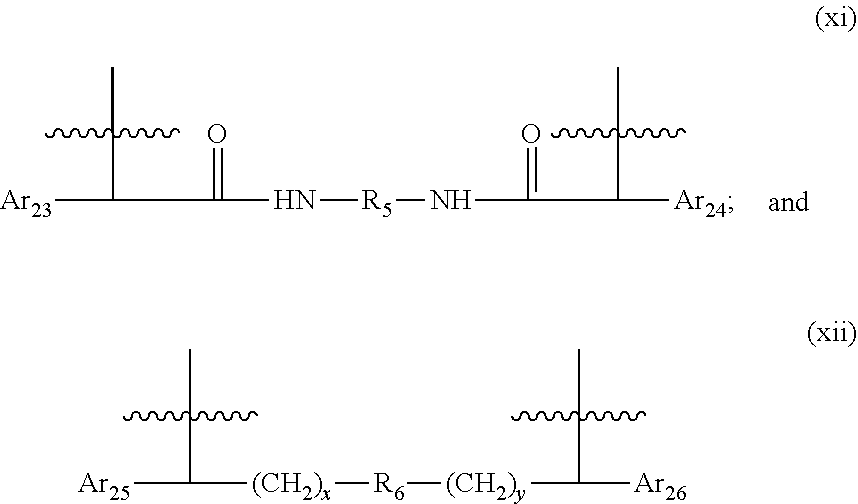
wherein:


or a pharmaceutically acceptable salt or stereoisomer thereof, wherein:
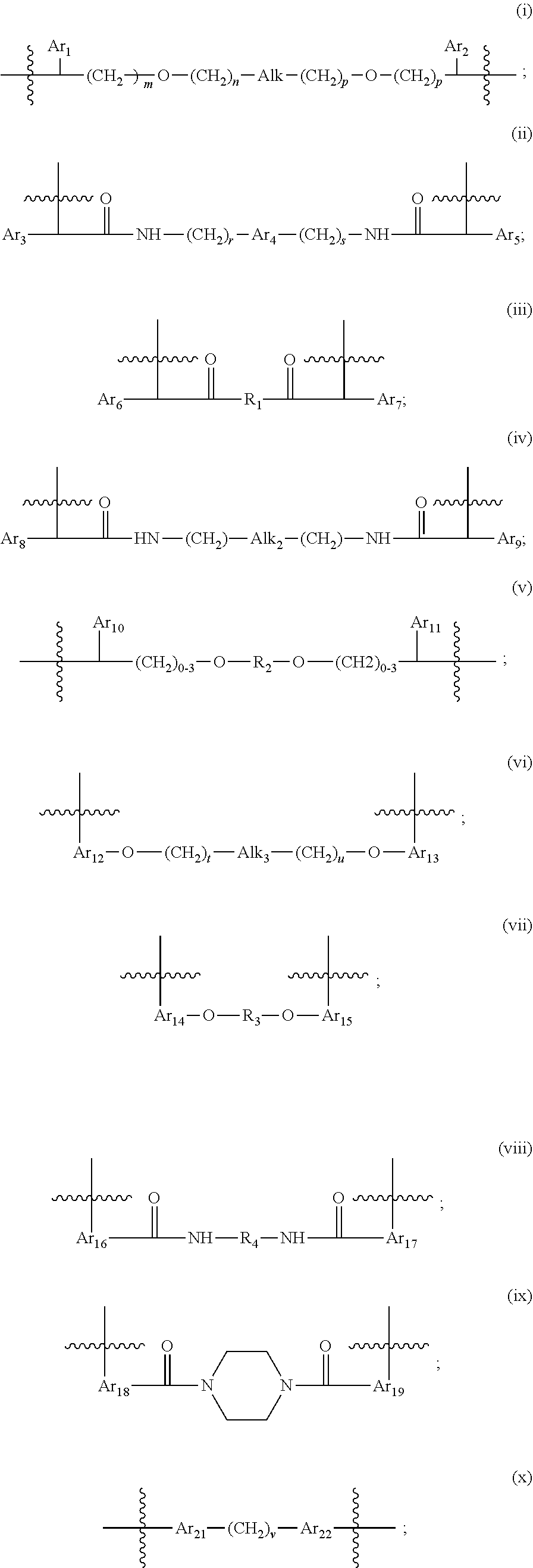

wherein:


or a pharmaceutically acceptable salt or stereoisomer thereof, wherein:


wherein:


C6 aryl and —(CH2)4-15—; and


—(CH2)6-15—, ′- and —(CH2)d′—(C6-C10)aryl-(CH2)e—; wherein d′ and e′ are independently selected and ranging from 1 to 6.


Likewise, the term “dimethylbutylene” could be exemplified by any of the following three structures or more:

p, or

Furthermore, the term “(C1-C6)alkylene” is meant to include such branched chain hydrocarbyl groups as cyclopropylmethylene, which could be exemplified by the following structure:


wherein the size of the ring fused to the C6 aryl group ranges from 4 to 8

bicyclohexyl, and

bicyclohexyl.


wherein A can be selected from e.g., C(O), O, N, B, B(OH), Si or P, P(O)R


or a pharmaceutically acceptable salt or stereoisomer thereof, wherein:


wherein:


or a pharmaceutically acceptable salt or stereoisomer thereof, wherein:


wherein:


or a pharmaceutically acceptable salt or stereoisomer thereof, wherein:


wherein:


Ar2 is C6 aryl, m is 1, n is 1, p is 1 and q is 1. In one embodiment, X1 is S and X2 is S. In one embodiment, X1 is S and X2 is O.


C6 aryl and —(CH2)4-15— (more preferably, —(CH2)6-10—); and
-
- a′ and b′ are independently selected from 0 to 6.


-
- and


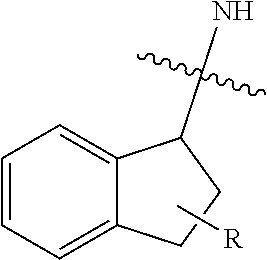

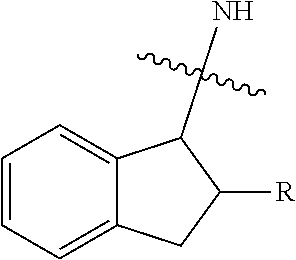


—(CH2)6-15, ′- and —(CH2)d—(C6-C10)aryl-(CH2)e—; wherein d′ and e′ are independently selected and ranging from 1 to 6.

| TABLE 1 | ||
| Compound | ||
| No | Compound structure | Compound name |
| 1 |
 |
(4S,4′S,7S,7′S,9aS,9a′S)-N,N′- (methylenebis(4,1- phenylene))bis(8,8- dimethyl-4-((S)- 2-(methylamino) propanamido)-5- oxooctahydropyrrolo[2,1- b][1,3]thiazepine-7- carboxamide) |
| 2 |
 |
(4S,4′S,7S,7′S,9aS,9a′S)-N,N′- (methylenebis(4,1- phenylene))bis(8,8- dimethyl-4-((S)- 2-(methylamino) propanethioamido)- 5-oxooctahydropyrrolo[2,1- b][1,3]thiazepine-7- carboxamide) |
| 3 |
 |
(4S,4′S,7S,7′S,9aS,9a′S)-N,N′- (ethane-1,2-diylbis(2,1- phenylene))bis(8,8- dimethyl-4-((S)- 2-(methylamino) propanamido)-5- oxooctahydropyrrolo[2,1- b][1,3]thiazepine-7- carboxamide) |
| 4 |
 |
(4S,4′S,7S,7′S,9aS,9a′S)-N,N′- (ethane-1,2-diylbis(2,1- phenylene))bis(8,8- dimethyl-4-((S)- 2-(methylamino) propanethioamido)- 5-oxooctahydropyrrolo[2,1- b][1,3]thiazepine-7- carboxamide) |
| 5 |
 |
(4S,4′S,7S,7′S,9aS,9a′S)-N,N′- (ethane-1,2-diylbis(4,1- phenylene))bis (8,8-dimethyl-4-((S)- 2-(methylamino) propanamido)-5- oxooctahydropyrrolo[2,1- b][1,3]thiazepine-7- carboxamide) |
| 6 |
 |
(4S,4′S,7S,7′S,9aS,9a′S)-N,N′- (ethane-1,2-diylbis(4,1- phenylene))bis (8,8-dimethyl-4-((S)- 2-(methylamino) propanethioamido)- 5-oxooctahydropyrrolo[2,1- b][1,3]thiazepine-7- carboxamide) |
| 7 |
 |
(4S,4′S,7S,7′S,9aS,9a′S)-N,N′- ((1R,1′R,2R,2′R)- (piperazine-1,4- dicarbonyl)bis(1,2,3,4- tetrahydronaphthalene-2,1- diyl))bis(8,8- dimethyl-4-((S)-2- (methylamino) propanamido)-5- oxooctahydropyrrolo[2,1- b][1,3]thiazepine-7- carboxamide) |
| 8 |
 |
(4S,4′S,7S,7′S,9aS,9a′S)-N,N′- ((1R,1′R,2R,2′R)- (piperazine-1,4- dicarbonyl)bis(1,2,3,4- tetrahydronaphthalene-2,1- diyl))bis(8,8- dimethyl-4-((S)-2- (methylamino) propanethioamido)-5- oxooctahydropyrrolo[2,1- b][1,3]thiazepine-7- carboxamide) |
| 9 |
 |
(4S,4′S,7S,7′S,9aS,9a′S)-N,N′- ((1R,1′R,2R,2′R)-(((1,4- phenylenebis(methylene))bis (azanediyl))bis(carbonyl))bis (1,2,3,4- tetrahydronaphthalene-2,1- diyl))bis(8,8- dimethyl-4-((S)-2- (methylamino) propanamido)-5- oxooctahydropyrrolo[2,1- b][1,3]thiazepine-7- carboxamide) |
| 10 |
 |
(4S,4′S,7S,7′S,9aS,9a′S)-N,N′- ((1R,1′R,2R,2′R)-(((1,4- phenylenebis (methylene))bis(azaned- iyl))bis(carbonyl)) bis(1,2,3,4- tetrahydronaphthalene-2,1- diyl))bis(8,8- dimethyl-4-((S)-2- (methylamino) propanethioamido)-5- oxooctahydropyrrolo[2,1- b][1,3]thiazepine-7- carboxamide) |
| 11 |
 |
(4S,7S,9aS)-8,8- dimethyl-4-[(2S)-2- (methylamino) propanamido]-5-oxo- N-[(1R,2R)-2- {[(1rs,4rs)-4-[(1R,2R)- 1-[(4S,7S,9aS)-8,8- dimethyl-4-[(2S)- 2-(methylamino) propanamido]-5- oxo-octahydropyrrolo[2,1- b][1,3]thiazepine-7- amido]-1,2,3,4- tetrahydronaphthalene-2- amido]cyclohexyl] carbamoyl}- 1,2,3,4- tetrahydronaphthalen-1-yl]- octahydropyrrolo[2,1- b][1,3]thiazepine-7- carboxamide |
| 12 |
 |
(4S,7S,9aS)-8,8- dimethyl-4-[(2S)-2- (methylamino) propanethioamido]-5- oxo-N-[(1R,2R)-2- {[(1rs,4rs)-4- [(1R,2R)-1-[(4S,7S,9aS)-8,8- dimethyl-4-[(2S)-2- (methylamino) propanethioamido]-5- oxo-octahydropyrrolo[2,1- b][1,3]thiazepine-7- amido]-1,2,3,4- tetrahydronaphthalene-2- amido]cyclohexyl] carbamoyl}- 1,2,3,4- tetrahydronaphthalen-1-yl]- octahydropyrrolo[2,1- b][1,3]thiazepine-7- |
| 13 |
 |
(4S,4′S,7S,7′S,9aS,9a′S)-N,N′- ((1S,1′S,2R,2′R)- (hexa-2,4-diyne- 1,6-diylbis(oxy)) bis(2,3-dihydro-1H- indene-2,1-diyl)) bis(8,8-dimethyl-4- ((S)-2-(methylamino) propanamido)- 5-oxooctahydropyrrolo[2,1- b][1,3]thiazepine-7- carboxamide) |
| 14 |
 |
(4S,7S,9aS)-N-((1S,2R)-2-((6- (((1S,2R)-1-((4S,7S,9aS)-8,8- dimethyl-4-((S)-2- (methylamino) propanamido)-5- oxooctahydropyrrolo[2,1- b][1,3]thiazepine-7- carboxamido)- 2,3-dihydro-1H-inden-2-yl) oxy)hexa- 2,4-diyn-1-yl)oxy)-2,3- dihydro-1H- inden-1-yl)-8,8- dimethyl-4-((S)-2- (methylamino) propanethioamido)-5- oxooctahydropyrrolo[2,1- b][1,3]thiazepine-7- carboxamide |
| 15 |
 |
(4S,4′S,7S,7′S,9aS,9a′S)-N,N′- ((1S,1′S,2R,2′R)- (hexa-2,4-diyne- 1,6-diylbis(oxy)) bis(2,3-dihydro-1H- indene-2,1-diyl)) bis(8,8-dimethyl-4- ((S)-2- (methylamino) propanethioamido)-5- oxooctahydropyrrolo[2,1- b][1,3]thiazepine-7- carboxamide) |
| 16 |
 |
(4S,4′S,7S,7′S,9aS,9a′S)-N,N′- ((1S,1′S,2R,2′R)-(butane-1,4- diylbis(oxy))bis(2,3- dihydro-1H- indene-2,1-diyl)) bis(8,8-dimethyl-4- ((S)-2-(methylamino) propanamido)- 5-oxooctahydropyrrolo[2,1- b][1,3]thiazepine-7- carboxamide) |
| 17 |
 |
(4S,4′S,7S,7′S,9aS,9a′S)-N,N′- ((1S,1′S,2R,2′R)-(butane-1,4- diylbis(oxy))bis (2,3-dihydro-1H- indene-2,1-diyl))bis (8,8-dimethyl-4- ((S)-2- (methylamino) propanethioamido)-5- oxooctahydropyrrolo[2,1- b][1,3]thiazepine-7- carboxamide) |
| 18 |
 |
(4S,4′S,7S,7′S,9aS,9a′S)-N,N′- ((1S,1′S,2R,2′R)- ((oxybis(ethane- 2,1-diyl))bis(oxy))bis(2,3- dihydro-1H- indene-2,1-diyl))bis(8,8- dimethyl-4- ((S)-2-(methylamino) propanamido)- 5-oxooctahydropyrrolo[2,1- b][1,3]thiazepine-7- carboxamide) |
| 19 |
 |
(4S,4′S,7S,7′S,9aS,9a′S)-N,N′- ((1S,1′S,2R,2′R)- ((oxybis(ethane- 2,1-diyl))bis(oxy)) bis(2,3-dihydro- 1H- indene-2,1-diyl))bis(8,8- dimethyl-4-((S)-2- (methylamino) propanethioamido)-5- oxooctahydropyrrolo[2,1- b][1,3]thiazepine-7- carboxamide) |
| 20 |
 |
(4S,4′S,7S,7′S,9aS,9a′S)-N,N′- ((1S,1′S,2R,2′R)-(hexane-1,6- diylbis(oxy))bis (2,3-dihydro-1H- indene-2,1-diyl))bis (8,8-dimethyl-4- ((S)-2-(methylamino) propanamido)- 5-oxooctahydropyrrolo[2,1- b][1,3]thiazepine-7- carboxamide) |
| 21 |
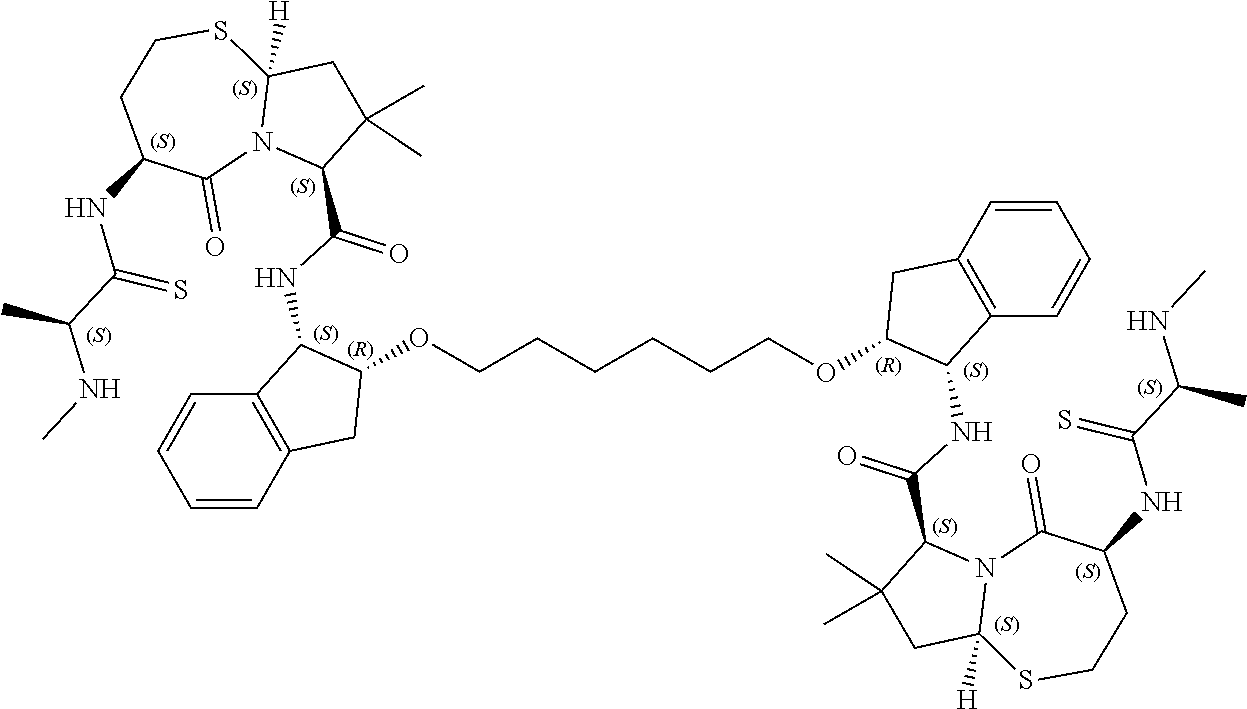 |
(4S,4′S,7S,7′S,9aS,9a′S)-N,N′- ((1S,1′S,2R,2′R)-(hexane-1,6- diylbis(oxy))bis(2,3- dihydro-1H- indene-2,1-diyl))bis (8,8-dimethyl-4- ((S)-2- (methylamino) propanethioamido)-5- oxooctahydropyrrolo[2,1- b][1,3]thiazepine-7- carboxamide) |
| 22 |
 |
(4S,4′S,7S,7′S,9aS,9a′S)-N,N′- ((1S,1′S,2R,2′R)-((1,4- phenylenebis (methylene))bis(oxy)) bis(2,3-dihydro-1H- indene-2,1- diyl))bis(8,8- dimethyl-4-((S)-2- (methylamino) propanamido)-5- oxooctahydropyrrolo[2,1- b][1,3]thiazepine-7- carboxamide) |
| 23 |
 |
(4S,4′S,7S,7′S,9aS,9a′S)-N,N′- ((1S,1′S,2R,2′R)-((1,4- phenylenebis (methylene))bis(oxy)) bis(2,3-dihydro- 1H-indene-2,1- diyl))bis(8,8- dimethyl-4-((S)-2- (methylamino) propanethioamido)-5- oxooctahydropyrrolo[2,1- b][1,3]thiazepine-7- carboxamide) |
| 24 |
 |
(4S,4′S,7S,7′S,9aS,9a′S)-N,N′- ((1S,1′S)-((1,4- phenylenebis(methylene)) bis(azaned- iyl))bis(2-oxo-1- phenylethane-2,1- diyl))bis(8,8- dimethyl-4-((S)-2- (methylamino) propanamido)-5- oxooctahydropyrrolo[2,1- b][1,3]thiazepine-7- carboxamide) |
| 25 |
 |
(4S,4′S,7S,7′S,9aS,9a′S)-N,N′- ((1S,1′S)-((1,4- phenylenebis(methylene)) bis(azaned- iyl))bis(2-oxo-1- phenylethane-2,1- diyl))bis(8,8- dimethyl-4-((S)-2- (methylamino) propanethioamido)-5- oxooctahydropyrrolo[2,1- b][1,3]thiazepine-7- carboxamide) |
| 26 |
 |
(4S,4′S,7S,7′S,9aS,9a′S)-N,N′- ((1S,1′S)-piperazine- 1,4-diylbis(2- oxo-1-phenylethane-2,1- diyl))bis(8,8- dimethyl-4-((S)-2- (methylamino) propanamido)-5- oxooctahydropyrrolo[2,1- b][1,3]thiazepine-7- carboxamide) |
| 27 |
 |
(4S,4′S,7S,7′S,9aS,9a′S)-N,N′- ((1S,1′S)-piperazine-1,4- diylbis(2- oxo-1-phenylethane-2,1- diyl))bis(8,8- dimethyl-4-((S)-2- (methylamino) propanethioamido)-5- oxooctahydropyrrolo[2,1- b][1,3]thiazepine-7- carboxamide) |
| 28 |
 |
(2S)-N-[(4S,7S,9aS)- 8,8-dimethyl-5- oxo-7-{[(S)-phenyl ({[(1rs,4rs)-4- [(2S)-2-{[(4S,7S,9aS)- 8,8-dimethyl- 4-[(2S)-2- (methylamino) propanamido]-5-oxo- octahydropyrrolo[2,1- b][1,3]thiazepin-7-yl] formamido}-2- phenylacetamido] cyclohexyl]carbam- oyl})methyl]carbamoyl}- octahydropyrrolo[2,1- b][1,3]thiazepin-4-yl]-2- (methylamino)propanamide |
| 29 |
 |
(2S)-2-{[(4S,7S,9aS)- 8,8-dimethyl- 4-[(2S)-2- (methylamino) propanethioamido]-5- oxo-octahydropyrrolo[2,1- b][1,3]thiazepin-7-yl] formamido}-2- phenyl-N-[(1rs,4rs)-4-[(2S)-2- {[(4S,7S,9aS)-8,8- dimethyl-4-[(2S)- 2-(methylamino) propanethioamido]- 5-oxo-octahydropyrrolo[2,1- b][1,3]thiazepin-7-yl] formamido}-2- phenylacetamido]cyclohexyl] acetamide |
| 30 |
 |
(4S,4′S,7S,7′S,9aS,9a′S)-N,N′- ((1S,1′S)-(hexa- 2,4-diyne-1,6- diylbis(azanediyl)) bis(2-oxo-1- phenylethane-2,1- diyl))bis(8,8- dimethyl-4-((S)-2- (methylamino) propanamido)-5- oxooctahydropyrrolo[2,1- b][1,3]thiazepine-7- carboxamide) |
| 31 |
 |
(4S,7S,9aS)-N- ((S)-2-((6-((S)-2- ((4S,7S,9aS)-8,8- dimethyl-4-((S)-2- (methylamino) propanamido)-5- oxooctahydropyrrolo[2,1- b][1,3]thiazepine-7- carboxamido)-2- phenylacetamido) hexa-2,4-diyn-1- yl)amino)-2-oxo-1- phenylethyl)-8,8- dimethyl-4-((S)-2- (methylamino) propanethioamido)-5- oxooctahydropyrrolo[2,1- b][1,3]thiazepine-7- |
| 32 |
 |
(4S,4′S,7S,7′S,9aS,9a′S)-N,N′- ((1S,1′S)-(hexa- 2,4-diyne-1,6- diylbis(azanediyl)) bis(2-oxo-1- phenylethane-2,1- diyl))bis(8,8- dimethyl-4-((S)-2- (methylamino) propanethioamido)-5- oxooctahydropyrrolo[2,1- b][1,3]thiazepine-7- carboxamide) |
| 33 |
 |
(4S,4′S,7S,7′S,9aS,9a′S)-N,N′- ((1S,1′S)-(hexa- 2,4-diyne-1,6- diylbis(oxy))bis(1- phenylethane-2,1- diyl))bis(8,8- dimethyl-4-((S)-2- (methylamino) propanamido)-5- oxooctahydropyrrolo[2,1- b][1,3]thiazepine-7- carboxamide) |
| 34 |
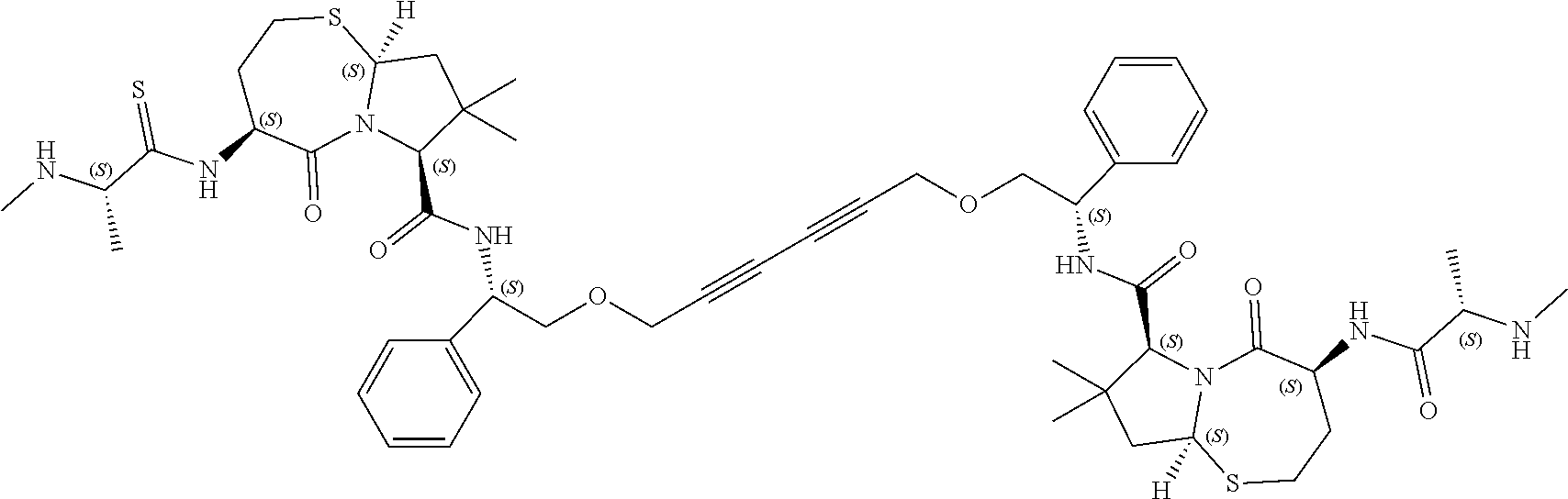 |
(4S,7S,9aS)-N- ((S)-2-((6-((S)-2- ((4S,7S,9aS)-8,8- dimethyl-4-((S)-2- (methylamino) propanamido)-5- oxooctahydropyrrolo[2,1- b][1,3]thiazepine-7- carboxamido)-2- phenylethoxy) hexa-2,4-diyn-1- yl)oxy)-1- phenylethyl)-8,8- dimethyl- 4-((S)-2- (methylamino) propanethioamido)-5- oxooctahydropyrrolo[2,1- b][1,3]thiazepine-7- carboxamide |
| 35 |
 |
(4S,4′S,7S,7′S,9aS,9a′S)-N,N′- ((1S,1′S)-(hexa- 2,4-diyne-1,6- diylbis(oxy))bis(1- phenylethane-2,1- diyl))bis(8,8- dimethyl-4-((S)-2- (methylamino) propanethioamido)-5- oxooctahydropyrrolo[2,1- b][1,3]thiazepine-7- carboxamide) |
| 36 |
 |
(4S,4′S,7S,7′S,9aS,9a′S)-N,N′- ((1S,1′S)-(butane-1,4- diylbis(oxy))bis(1- phenylethane-2,1- diyl))bis(8,8- dimethyl-4-((S)-2- (methylamino) propanamido)-5- oxooctahydropyrrolo[2,1- b][1,3]thiazepine-7- carboxamide) |
| 37 |
 |
(4S,4′S,7S,7′S,9aS,9a′S)-N,N′- ((1S,1′S)-(butane-1,4- diylbis(oxy))bis(1- phenylethane-2,1- diyl))bis(8,8- dimethyl-4-((S)-2- (methylamino) propanethioamido)-5- oxooctahydropyrrolo[2,1- b][1,3]thiazepine-7- carboxamide) |
| 38 |
 |
(4S,4′S,7S,7′S,9aS,9a′S)-N,N′- ((1S,1′S)-((oxybis(ethane-2,1- diyl))bis(oxy))bis(1- phenylethane- 2,1-diyl))bis(8,8- dimethyl-4-((S)-2- (methylamino) propanamido)-5- oxooctahydropyrrolo[2,1- b][1,3]thiazepine-7- carboxamide) |
| 39 |
 |
(4S,4′S,7S,7′S,9aS,9a′S)-N,N′- ((1S,1′S)-((oxybis(ethane-2,1- diyl))bis(oxy))bis(1- phenylethane- 2,1-diyl))bis(8,8- dimethyl-4-((S)-2- (methylamino) propanethioamido)-5- oxooctahydropyrrolo[2,1- b][1,3]thiazepine-7- carboxamide) |
| 40 |
 |
(4S,4′S,7S,7′S,9aS,9a′S)-N,N′- ((1S,1′S)-(hexane-1,6- diylbis(oxy))bis(1- phenylethane-2,1- diyl))bis(8,8- dimethyl-4-((S)-2- (methylamino) propanamido)-5- oxooctahydropyrrolo[2,1- b][1,3]thiazepine-7- carboxamide) |
| 41 |
 |
(4S,4′S,7S,7′S,9aS,9a′S)-N,N′- ((1S,1′S)-(hexane-1,6- diylbis(oxy))bis(1- phenylethane-2,1- diyl))bis(8,8- dimethyl-4-((S)-2- (methylamino) propanethioamido)-5- oxooctahydropyrrolo[2,1- b][1,3]thiazepine-7- carboxamide) |
| 42 |
 |
(4S,4′S,7S,7′S,9aS,9a′S)-N,N′- ((1S,1′S)-((1,4- phenylenebis (methylene))bis(oxy)) bis (1-phenylethane-2,1-diyl)) bis(8,8-dimethyl-4-((S)-2- (methylamino) propanamido)-5- oxooctahydropyrrolo[2,1- b][1,3]thiazepine-7- carboxamide) |
| 43 |
 |
(4S,4′S,7S,7′S,9aS,9a′S)-N,N′- ((1S,1′S)-((1,4- phenylenebis (methylene))bis(oxy))bis (1-phenylethane-2,1- diyl))bis(8,8- dimethyl-4-((S)-2- (methylamino) propanethioamido)-5- oxooctahydropyrrolo[2,1- b][1,3]thiazepine-7- carboxamide) |
| 44 |
 |
(4S,7S,9aS)-N- [(1R,2R)-2-({[4- ({[(1R,2R)-1- [(4S,7S,9aS)-8,8- dimethyl-4-[(2S)-2- (methylamino) propanethioamido]-5- oxo-octahydropyrrolo[2,1- b][1,3]thiazepine-7- amido]-2,3- dihydro-1H-inden-2- yl]formamido}methyl) phenyl]methyl} carbamoyl)-2,3-dihydro- 1H-inden-1- yl]-8,8-dimethyl-4-[(2S)-2- (methylamino) propanethioamido]-5- oxo-octahydropyrrolo[2,1- b][1,3]thiazepine-7- carboxamide |
| 45 |
 |
(4S,7S,9aS)-N- [(1R,2R)-2-({[4- ({[(1R,2R)-1- [(4S,7S,9aS)-8,8- dimethyl-4-[(2S)-2- (methylamino) propanamido]-5-oxo- octahydropyrrolo[2,1- b][1,3]thiazepine-7- amido]-2,3- dihydro-1H-inden-2- yl]formamido}methyl) phenyl]methyl} carbamoyl)-2,3-dihydro- 1H-inden-1- yl]-8,8-dimethyl-4-[(2S)-2- (methylamino) propanamido]-5-oxo- octahydropyrrolo[2,1- b][1,3]thiazepine-7- carboxamide |
| 46 |
 |
(4S,7S,9aS)-N- [(1R,2R)-2-{4- [(1R,2R)-1- [(4S,7S,9aS)-8,8- dimethyl-4-[(2S)-2- (methylamino) propanamido]-5-oxo- octahydropyrrolo[2,1- b][1,3]thiazepine-7- amido]-2,3- dihydro-1H-indene-2- carbonyl]piperazine-1- carbonyl}-2,3- dihydro-1H-inden-1-yl]- 8,8-dimethyl- 4-[(2S)-2- (methylamino) propanamido]-5-oxo- octahydropyrrolo[2,1- b][1,3]thiazepine-7- carboxamide |
| 47 |
 |
(4S,7S,9aS)-N- [(1R,2R)-2-{4- [(1R,2R)-1- [(4S,7S,9aS)-8,8- dimethyl-4-[(2S)-2- (methylamino) propanethioamido]-5- oxo-octahydropyrrolo[2,1- b][1,3]thiazepine-7- amido]-2,3- dihydro-1H-indene-2- carbonyl]piperazine-1- carbonyl}-2,3- dihydro-1H-inden-1-yl]- 8,8-dimethyl- 4-[(2S)-2- (methylamino) propanethioamido]-5- oxo-octahydropyrrolo[2,1- b][1,3]thiazepine-7- carboxamide |
| 48 |
 |
(4S,7S,9aS)-N- [(1S,2R)-2-[(8- {[(1S,2R)-1- [(4S,7S,9aS)-8,8- dimethyl-4-[(2S)-2- (methylamino)propanamido]- 5-oxo- octahydropyrrolo[2,1- b][1,3]thiazepine-7- amido]-2,3- dihydro-1H-inden-2-yl]oxy} octyl)oxy]- 2,3-dihydro-1H- inden-1-yl]-8,8- dimethyl-4-[(2S)-2- (methylamino)propanamido]- 5-oxo- octahydropyrrolo[2,1- b][1,3]thiazepine-7- carboxamide |
| 49 |
 |
(4S,7S,9aS)-N- [(1R,2R)-2-[(6- {[(1R,2R)-1- [(4S,7S,9aS)-8,8- dimethyl-4-[(2S)-2- (methylamino)propanamido]- 5-oxo- octahydropyrrolo[2,1- b][1,3]thiazepine-7- amido]-2,3- dihydro-1H-inden-2- yl]formamido} hexa-2,4-diyn-1- yl)carbamoyl]-2,3-dihydro- 1H-inden- 1-yl]-8,8-dimethyl-4-[(2S)-2- (methylamino)propanamido]- 5-oxo- octahydropyrrolo[2,1- b][1,3]thiazepine-7- carboxamide |
| 50 |
 |
(4S,7S,9aS)-N- [(1S)-2-[2-(4- {[(2S)-2- {[(4S,7S,9aS)- 8,8-dimethyl- 4-[(2S)- 2-(methylamino) propanamido]-5- oxo-octahydropyrrolo[2,1- b][1,3]thiazepin-7-yl] formamido}-2- phenylethoxy]methyl}- 1H-1,2,3- triazol-1-yl)ethoxy]-1- phenylethyl]- 8,8-dimethyl-4-[(2S)-2- (methylamino) propanamido]-5-oxo- octahydropyrrolo[2,1- b][1,3]thiazepine-7- carboxamide |
| 51 |
 |
(4S,7S,9aS)-N-[(1S,2R)- 2-[3-(3- {[(1S,2R)-1- [(4S,7S,9aS)-8,8- dimethyl-4-[(2S)-2- (methylamino) propanamido]- 5-oxo- octahydropyrrolo[2,1- b][1,3]thiazepine-7- amido]-2,3- dihydro-1H-inden-2- yl]oxy}propoxy) propoxy]-2,3- dihydro-1H-inden-1-yl]-8,8- dimethyl-4-[(2S)- 2-(methylamino) propanamido]-5- oxo-octahydropyrrolo[2,1- b][1,3]thiazepine-7- carboxamide |
| 52 |
 |
(4S,7S,9aS)-N-[(1S)-2-[2- (4-{[(2S)-2- {[(4S,7S,9aS)-8,8- dimethyl-4-[(2S)- 2-(methylamino) propanethioamido]- 5-oxo- |
| 53 |
 |
(4S,7S,9aS)-N-[(1S)-2-[3-(4- {[(2S)-2- {[(4S,7S,9aS)-8,8-dimethyl- 4-[(2S)- 2-(methylamino) propanethioamido]- 5-oxo-octahydropyrrolo[2,1- b][1,3]thiazepin-7-yl] formamido}-2- phenylethoxy]methyl}- 1H-1,2,3- triazol-1-yl)propoxy]-1- phenylethyl]- 8,8-dimethyl-4-[(2S)-2- (methylamino) propanethioamido]-5- oxo-octahydropyrrolo[2,1- b][1,3]thiazepine-7- carboxamide |
| 54 |
 |
(4S,7S,9aS)-8,8- dimethyl-4-[(2S)-2- (methylamino) propanethioamido]-5- oxo-N-[(1R,2R)-2- {[(1rs,4rs)-4- [(1R,2R)-1-[(4S,7S,9aS)-8,8- dimethyl-4-[(2S)-2- (methylamino) propanethioamido]-5- oxo-octahydropyrrolo[2,1- b][1,3]thiazepine-7- amido]-2,3- dihydro-1H-indene-2- amido]cyclohexyl] carbamoyl}-2,3- dihydro-1H-inden-1-yl]- octahydropyrrolo[2,1- b][1,3]thiazepine-7- carboxamide |
| 55 |
 |
(4S,7S,9aS)-8,8-dimethyl-4- [(2S)-2- (methylamino) propanamido]-5-oxo- N-[(1R,2R)-2-{[(1rs,4rs)- 4-[(1R,2R)- 1-[(4S,7S,9aS)-8,8-dimethyl- 4-[(2S)- 2-(methylamino) propanamido]-5- oxo-octahydropyrrolo[2,1- b][1,3]thiazepine-7- amido]-2,3- dihydro-1H-indene-2- amido]cyclohexyl] carbamoyl}-2,3- dihydro-1H-inden-1-yl]- octahydropyrrolo[2,1- b][1,3]thiazepine-7- carboxamide |
| 56 |
 |
(4S,4′S,7S,7′S,9aS,9a′S)-N,N′- ((1S,1′S)-((naphthalene-2,7- diylbis(methylene)) bis(oxy))bis(1- phenylethane-2,1- diyl))bis(8,8- dimethyl-4-((S)-2- (methylamino) propanamido)-5- oxooctahydropyrrolo[2,1- b][1,3]thiazepine-7- carboxamide |
| 57 |
 |
(4S,4′S,7S,7′S,9aS,9a′S)-N,N′- ((1S,1′S,2R,2′R)- (decane-1,10- diylbis(oxy))bis(2,3- dihydro-1H- indene-2,1-diyl))bis(8,8- dimethyl-4- ((S)-2-(methylamino) propanamido)- 5-oxooctahydropyrrolo[2,1- b][1,3]thiazepine-7- carboxamide) |
| 58 |
 |
(4S,4′S,7S,7′S,9aS,9a′S)-N,N′- ((1S,1′S)-(octane-1,8- diylbis(oxy))bis(1- phenylethane-2,1- diyl))bis(8,8- dimethyl-4-((S)-2- (methylamino) propanamido)-5- oxooctahydropyrrolo[2,1- b][1,3]thiazepine-7- carboxamide) |
| 59 |
 |
(4S,4′S,7S,7′S,9aS,9a′S)-N,N′- ((1S,1′S,2R,2′R)- (dodecane-1,12- diylbis(oxy))bis (2,3-dihydro-1H- indene-2,1-diyl))bis(8,8- dimethyl-4- ((S)-2-(methylamino) propanamido)- 5-oxooctahydropyrrolo[2,1- b][1,3]thiazepine-7- carboxamide) |
| 60 |
 |
(4S,4′S,7S,7′S,9aS,9a′S)-N,N′- ((1S,1′S)-(decane-1,10- diylbis(oxy))bis(1- phenylethane-2,1- diyl))bis(8,8- dimethyl-4-((S)-2- (methylamino) propanamido)-5- oxooctahydropyrrolo[2,1- b][1,3]thiazepine-7- carboxamide) |
| 61 |
 |
(4S,4′S,7S,7′S,9aS,9a′S)-N,N′- ((1S,1′S)-(dodecane-1,12- diylbis(oxy))bis(1- phenylethane-2,1- diyl))bis(8,8- dimethyl-4-((S)-2- (methylamino) propanamido)-5- oxooctahydropyrrolo[2,1- b][1,3]thiazepine-7- carboxamide) |
| 62 |
 |
4S,4′S,7S,7′S,9aS,9a′S)-N,N′- ((1S,1′S)-((naphthalene-2,6- diylbis(methylene))bis (oxy))bis(1- phenylethane-2,1-diyl))bis(8,8- dimethyl-4-((S)-2- (methylamino)propanamido)-5- oxooctahydropyrrolo[2,1- b][1,3]thiazepine-7-c arboxamide) |
| 63 |
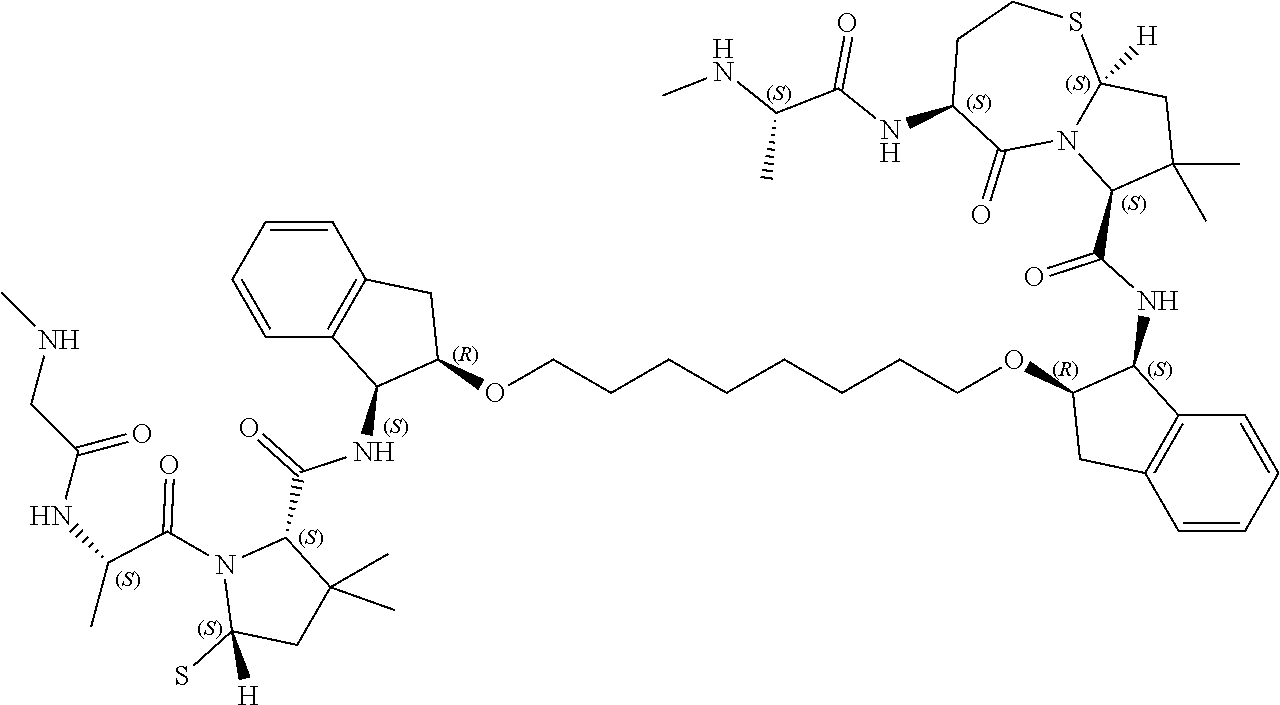 |
(4S,4′S,7S,7′S,9aS,9a′S)-N,N′- ((1S,1′S,2R,2′R)-(octane-1,8- diylbis(oxy))bis(2,3- dihydro-1H- indene-2,1-diyl))bis(8,8- dimethyl-4- ((S)-2-(methylamino) propanamido)- 5-oxooctahydropyrrolo[2,1- b][1,3]thiazepine-7- carboxamide) |


Protease inhibitors such as saquinavir, ritonavir, indinavir, nelfinavir, amprenavir, fosamprenavir, brecanavir, darunavir, atazanavir, tipranavir, palinavir, lasinavir, and similar agents;
Entry, attachment and fusion inhibitors such as enfuvirtide (T-20), T-1249, PRO-542, PRO-140, TNX-355, BMS-806, BMS-663068 and BMS-626529, 5-Helix and similar agents;
Integrase inhibitors such as raltegravir, elvitegravir, dolutegravir, cabotegravir, bictegravir and N similar agents;
Maturation inhibitors such as PA-344 and PA-457, and similar agents; and
CXCR4 and/or CCR5 inhibitors such as vicriviroc (Sch-C), Sch-D, TAK779,maraviroc (UK 427,857), TAK449, as well as those disclosed in WO 02/74769, PCT/US03/39644 PCT/US03/39975, PCT/US03/39619, PCT/US03/39618, PCT/US03/39740, and PCT/US03/39732, and similar agents.
Further examples where the compounds of the present invention may be used in combination with one or more agents useful in the prevention or treatment of HIV are found in Table 2.
| TABLE 2 | |||
| Brand | |||
| FDA Approval | Name | Generic Name | Manufacturer |
| Nucleoside Reverse | |||
| Transcriptase | |||
| Inhibitors (NRTIs) | |||
| 1987 | Retrovir | zidovudine, | GlaxoSmithKline |
| azidothymidine, | |||
| AZT, ZDV | |||
| 1991 | Videx | didanosine, | Bristol-Myers |
| dideoxyinosine, | Squibb | ||
| ddl | |||
| 1992 | Hivid | zalcitabine, | Roche |
| dideoxycytidine, | Pharmaceuticals | ||
| ddC | |||
| 1994 | Zerit | stavudine, d4T | Bristol-Myers |
| Squibb | |||
| 1995 | Epivir | lamivudine, 3TC | GlaxoSmithKline |
| 1997 | Combivir | lamivudine + | GlaxoSmithKline |
| zidovudine | |||
| 1998 | Ziagen | abacavir sulfate, | GlaxoSmithKline |
| ABC | |||
| 2000 | Trizivir | abacavir + | GlaxoSmithKline |
| lamivudine + | |||
| zidovudine | |||
| 2000 | Videx EC | enteric coated | Bristol-Myers |
| didanosine, ddl | Squibb | ||
| EC | |||
| 2001 | Viread | tenofovir disoproxil | Gilead Sciences |
| fumarate, TDF | |||
| 2003 | Emtriva | emtricitabine, FTC | Gilead Sciences |
| 2004 | Epzicom | abacavir + | GlaxoSmithKline |
| lamivudine | |||
| 2004 | Truvada | emtricitabine + | Gilead Sciences |
| tenofovir disoproxil | |||
| fumarate | |||
| Non-Nucleosides | |||
| Reverse | |||
| Transcriptase | |||
| Inhibitors (NNRTIs) | |||
| 1996 | Viramune | nevirapine, NVP | Boehringer |
| Ingelheim | |||
| 1997 | Rescriptor | delavirdine, DLV | Pfizer |
| 1998 | Sustiva | efavirenz, EFV | Bristol-Myers |
| Squibb | |||
| 2008 | Intelence | Etravirine | Tibotec |
| Therapeutics | |||
| Protease Inhibitors | |||
| (PIs) | |||
| 1995 | Invirase | saquinavir | Roche |
| mesylate, SQV | Pharmaceuticals | ||
| 1996 | Norvir | ritonavir, RTV | Abbott |
| Laboratories | |||
| 1996 | Crixivan | indinavir, IDV | Merck |
| 1997 | Viracept | nelfinavir | Pfizer |
| mesylate, NFV | |||
| 1997 | Fortovase | saquinavir (no | Roche |
| longer marketed) | Pharmaceuticals | ||
| 1999 | Agenerase | amprenavir, APV | GlaxoSmithKline |
| 2000 | Kaletra | lopinavir + | Abbott |
| ritonavir, LPV/RTV | Laboratories | ||
| 2003 | Reyataz | atazanavir sulfate, | Bristol-Myers |
| ATV | Sguibb | ||
| 2003 | Lexiva | fosamprenavir | GlaxoSmithKline |
| calcium, FOS-APV | |||
| 2005 | Aptivus | tripranavir, TPV | Boehringer |
| Ingelheim | |||
| 2006 | Prezista | Darunavir | Tibotec |
| Therapeutics | |||
| Fusion Inhibitors | |||
| 2003 | Fuzeon | Enfuvirtide, T-20 | Roche |
| Pharmaceuticals | |||
| & Trimeris | |||
| Entry Inhibitors | |||
| 2007 | Selzentry | Maraviroc | Pfizer |
| Integrase Inhibitors | |||
| 2007 | Isentress | Raltegravir | Merck |
| 2013 | Tivicay | Dolutegravir | ViiV Healthcare |
| — | — | Cabotegravir | |


 |
(S,4S,4′S,7S,7′S,9aS,9a′S)- N,N′-(methylenebis(4,1- phenylene))bis(8,8-dimethyl-4-((S)-2- (methylamino)propanamido)-5- oxooctahydropyrrolo[2,1- b][1,3]thiazepine-7-carboxamide) |
 |
(S,4S,4′S,7S,7′S,9aS,9a′S)- N,N′-(methylenebis(4,1- phenylene))bis(8,8-dimethyl-4-((S)-2- (methylamino)propanethioamido)-5- oxooctahydropyrrolo[2,1- b][1,3]thiazepine-7-carboxamide) |
 |
(S,4S,4′S,7S,7′S,9aS,9a′S)- N,N′-(ethane-1,2-diylbis(2,1- phenylene))bis(8,8-dimethyl-4-((S)-2- (methylamino)propanamido)-5- oxooctahydropyrrolo[2,1- b][1,3]thiazepine-7-carboxamide) |
 |
(S,4S,4′S,7S,7′S,9aS,9a′S)- N,N′-(ethane-1,2-diylbis(2,1- phenylene))bis(8,8-dimethyl-4-((S)-2- (methylamino) propanethioamido)-5- oxooctahydropyrrolo[2,1- b][1,3]thiazepine-7-carboxamide) |
 |
(S,4S,4′S,7S,7′S,9aS,9a′S)- N,N′-(ethane-1,2-diylbis(4,1- phenylene))bis(8,8-dimethyl-4-((S)-2- (methylamino)propanamido)-5- oxooctahydropyrrolo[2,1- b][1,3]thiazepine-7-carboxamide) |
 |
(S,4S,4′S,7S,7′S,9aS,9a′S)- N,N′-(ethane-1,2-diylbis(4,1- phenylene))bis(8,8-dimethyl-4-((S)-2- (methylamino)propanethioamido)-5- oxooctahydropyrrolo[2,1- b][1,3]thiazepine-7-carboxamide) |
 |
(S,4S,4′S,7S,7′S,9aS,9a′S)- N,N′-((1R,1′R,2R,2′R)-(piperazine- 1,4-dicarbonyl)bis(1,2,3,4- tetrahydronaphthalene-2,1- diyl))bis(8,8-dimethyl-4-((S)-2- (methylamino)propanamido)-5- oxooctahydropyrrolo[2,1- b][1,3]thiazepine-7-carboxamide) |
 |
(S,4S,4′S,7S,7′S,9aS,9a′S)- N,N′-((1R,1′R,2R,2′R)-(piperazine- 1,4-dicarbonyl)bis(1,2,3,4- tetrahydronaphthalene-2,1- diyl))bis(8,8-dimethyl-4-((S)-2- (methylamino)propanethioamido)-5- oxooctahydropyrrolo[2,1- b][1,3]thiazepine-7-carboxamide) |
 |
(S,4S,4′S,7S,7′S,9aS,9a′S)- N,N′-((1R,1′R,2R,2′R)-(((1,4- phenylenebis(methylene))bis (azanediyl))bis(carbonyl))bis(1,2,3,4- tetrahydronaphthalene-2,1- diyl))bis(8,8-dimethyl-4-((S)-2- (methylamino)propanamido)-5- oxooctahydropyrrolo[2,1- b][1,3]thiazepine-7-carboxamide) |
 |
(S,4S,4′S,7S,7′S,9aS,9a′S)- N,N′-((1R,1′R,2R,2′R)-(((1,4- phenylenebis(methylene))bis (azanediyl))bis(carbonyl))bis(1,2,3,4- tetrahydronaphthalene-2,1- diyl))bis(8,8-dimethyl-4-((S)-2- (methylamino)propanethioamido)-5- oxooctahydropyrrolo[2,1- b][1,3]thiazepine-7-carboxamide) |
 |
(S,4S,4′S,7S,7′S,9aS,9a′S)- N,N′-((1R,1′R,2R,2′R)-(((1R,4R)- cyclohexane-1,4- diylbis(azanediyl))bis(carbonyl))bis (1,2,3,4-tetrahydronaphthalene-2,1- diyl))bis(8,8-dimethyl-4-((S)-2- (methylamino)propanamido)-5- oxooctahydropyrrolo[2,1- b][1,3]thiazepine-7-carboxamide) |
 |
(S,4S,4′S,7S,7′S,9aS,9a′S)- N,N′-((1R,1′R,2R,2′R)-(((1R,4R)- cyclohexane-1,4- diylbis(azanediyl))bis(carbonyl))bis (1,2,3,4-tetrahydronaphthalene-2,1- diyl))bis(8,8-dimethyl-4-((S)-2- (methylamino)propanethioamido)-5- oxooctahydropyrrolo[2,1- b][1,3]thiazepine-7-carboxamide) |
 |
(S,4S,4′S,7S,7′S,9aS,9a′S)- N,N′-((1S,1′S,2R,2′R)-(hexa-2,4- diyne-1,6-diylbis(oxy))bis(2,3- dihydro-1H-indene-2,1-diyl))bis(8,8- dimethyl-4-((S)-2- (methylamino)propanamido)-5- oxooctahydropyrrolo[2,1- b][1,3]thiazepine-7-carboxamide) |
 |
(4S,7S,9aS)-N-((1S,2R)-2- ((6-(((1S,2R)-1-((4S,7S,9aS)-8,8- dimethyl-4-((S)-2- (methylamino)propanamido)-5- oxooctahydropyrrolo[2,1- b][1,3]thiazepine-7-carboxamido)- 2,3-dihydro-1H-inden-2-yl)oxy)hexa- 2,4-diyn-1-yl)oxy)-2,3-dihydro-1H- inden-1-yl)-8,8-dimethyl-4-((S)-2- (methylamino)propanethioamido)-5- oxooctahydropyrrolo[2,1- b][1,3]thiazepine-7-carboxamide |
 |
(S,4S,4′S,7S,7′S,9aS,9a′S)- N,N′-((1S,1′S,2R,2′R)-(hexa-2,4- diyne-1,6-diylbis(oxy))bis(2,3- dihydro-1H-indene-2,1-diyl))bis(8,8- dimethyl-4-((S)-2- (methylamino)propanethioamido)-5- oxooctahydropyrrolo[2,1- b][1,3]thiazepine-7-carboxamide) |
 |
(S,4S,4′S,7S,7′S,9aS,9a′S)- N,N′-((1S,1′S,2R,2′R)-(butane-1,4- diylbis(oxy))bis(2,3-dihydro-1H- indene-2,1-diyl))bis(8,8-dimethyl-4- ((S)-2-(methylamino) propanamido)-5- oxooctahydropyrrolo[2,1- b][1,3]thiazepine-7-carboxamide) |
 |
(S,4S,4′S,7S,7′S,9aS,9a′S)- N,N′-((1S,1′S,2R,2′R)-(butane-1,4- diylbis(oxy))bis(2,3-dihydro-1H- indene-2,1-diyl))bis(8,8-dimethyl-4- ((S)-2-(methylamino) propanethioamido)-5- oxooctahydropyrrolo[2,1- b][1,3]thiazepine-7-carboxamide) |
 |
(S,4S,4′S,7S,7′S,9aS,9a′S)- N,N′-((1S,1′S,2R,2′R)- ((oxybis(ethane-2,1- diyI))bis(oxy))bis(2,3-dihydro-1H- indene-2,1-diyl))bis(8,8-dimethyl-4- ((S)-2-(methylamino)propanamido)- 5-oxooctahydropyrrolo[2,1- b][1,3]thiazepine-7-carboxamide) |
 |
(S,4S,4′S,7S,7′S,9aS,9a′S)- N,N′-((1S,1′S,2R,2′R)- ((oxybis(ethane-2,1- diyl))bis(oxy))bis(2,3-dihydro-1H- indene-2,1-diyl))bis(8,8-dimethyl-4- ((S)-2- (methylamino)propanethioamido)-5- oxooctahydropyrrolo[2,1- b][1,3]thiazepine-7-carboxamide) |
 |
(S,4S,4′S,7S,7′S,9aS,9a′S)- N,N′-((1S,1′S,2R,2′R)-(hexane-1,6- diylbis(oxy))bis(2,3-dihydro-1H- indene-2,1-diyl))bis(8,8-dimethyl-4- ((S)-2-(methylamino) propanamido)-5- oxooctahydropyrrolo[2,1- b][1,3]thiazepine-7-carboxamide) |
 |
(S,4S,4′S,7S,7′S,9aS,9a′S)- N,N′-((1S,1′S,2R,2′R)-(hexane-1,6- diylbis(oxy))bis(2,3-dihydro-1H- indene-2,1-diyl))bis(8,8-dimethyl-4- ((S)-2-(methylamino) propanethioamido)-5- oxooctahydropyrrolo[2,1- b][1,3]thiazepine-7-carboxamide) |
 |
(S,4S,4′S,7S,7′S,9aS,9a′S)- N,N′-((1S,1′S,2R,2′R)-((1,4- phenylenebis(methylene))bis(oxy)) bis(2,3-dihydro-1H-indene-2,1- diyl))bis(8,8-dimethyl-4-((S)-2- (methylamino)propanamido)-5- oxooctahydropyrrolo[2,1- b][1,3]thiazepine-7-carboxamide) |
 |
(S,4S,4′S,7S,7′S,9aS,9a′S)- N,N′-((1S,1′S,2R,2′R)-((1,4- phenylenebis(methylene))bis(oxy)) bis(2,3-dihydro-1H-indene-2,1- diyl))bis(8,8-dimethyl-4-((S)-2- (methylamino)propanethioamido)-5- oxooctahydropyrrolo[2,1- b][1,3]thiazepine-7-carboxamide) |
 |
(S,4S,4′S,7S,7′S,9aS,9a′S)- N,N′-((1S,1′S)-((1,4- phenylenebis(methylene))bis (azanediyl))bis(2-oxo-1- phenylethane-2,1- diyl))bis(8,8-dimethyl-4-((S)-2- (methylamino)propanamido)-5- oxooctahydropyrrolo[2,1- b][1,3]thiazepine-7-carboxamide) |
 |
(S,4S,4′S,7S,7′S,9aS,9a′S)- N,N′-((1S,1′S)-((1,4- phenylenebis(methylene))bis (azanediyl))bis(2-oxo-1- phenylethane-2,1- diyl))bis(8,8-dimethyl-4-((S)-2- (methylamino)propanethioamido)-5- oxooctahydropyrrolo[2,1- b][1,3]thiazepine-7-carboxamide) |
 |
(S,4S,4′S,7S,7′S,9aS,9a′S)- N,N′-((1S,1′S)-piperazine-1,4- diylbis(2-oxo-1-phenylethane-2,1- diyl))bis(8,8-dimethyl-4-((S)-2- (methylamino)propanamido)-5- oxooctahydropyrrolo[2,1- b][1,3]thiazepine-7-carboxamide) |
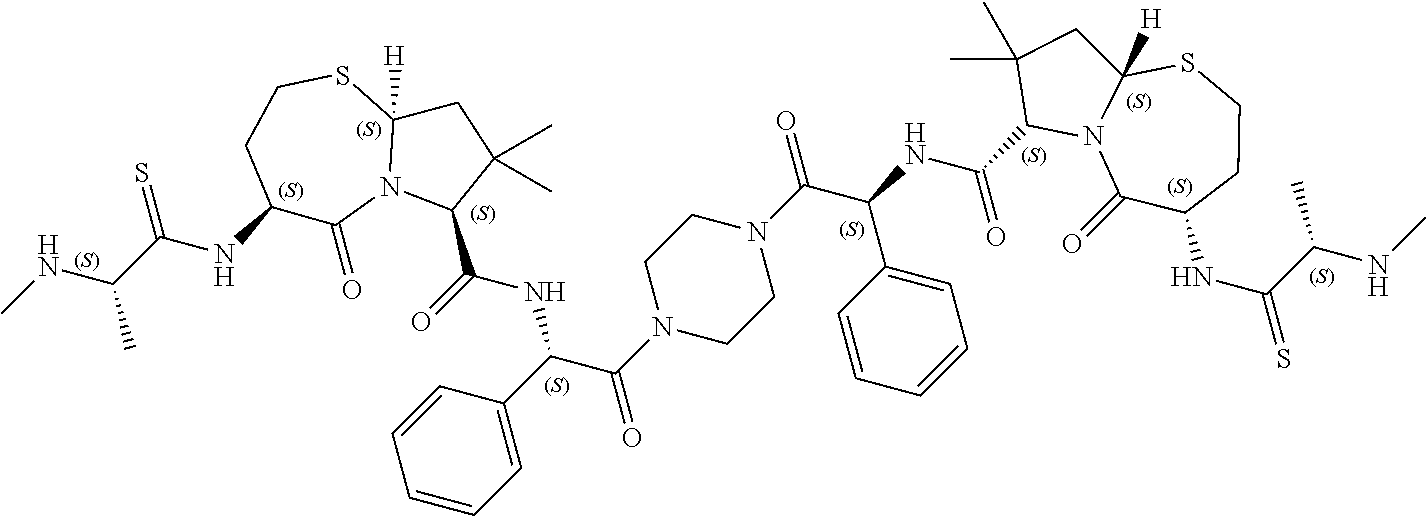 |
(S,4S,4′S,7S,7′S,9aS,9a′S)- N,N′-((1S,1′S)-piperazine-1,4- diylbis(2-oxo-1-phenylethane-2,1- diyl))bis(8,8-dimethyl-4-((S)-2- (methylamino)propanethioamido)-5- oxooctahydropyrrolo[2,1- b][1,3]thiazepine-7-carboxamide) |
 |
(S,4S,4′S,7S,7′S,9aS,9a′S)- N,N′-((1S,1′S)-((1S,4S)-cyclohexane 1,4-diylbis(azanediyl))bis(2-oxo-1- phenylethane-2,1-diyl))bis(8,8- dimethyl-4-((S)-2- (methylamino)propanamido)-5- oxooctahydropyrrolo[2,1- b][1,3]thiazepine-7-carboxamide) |
 |
(S,4S,4′S,7S,7′S,9aS,9a′S)- N,N′-((1S,1′S)-((1S,4S)-cyclohexane 1,4-diylbis(azanediyl))bis(2-oxo-1- phenylethane-2,1-diyl))bis(8,8- dimethyl-4-((S)-2- (methylamino)propanethioamido)-5- oxooctahydropyrrolo[2,1- b][1,3]thiazepine-7-carboxamide) |
 |
(S,4S,4′S,7S,7′S,9aS,9a′S)- N,N′-((1S,1′S)-(hexa-2,4-diyne-1,6- diylbis(azanediyl))bis(2-oxo-1- phenylethane-2,1-diyl))bis(8,8- dimethyl-4-((S)-2- (methylamino)propanamido)-5- oxooctahydropyrrolo[2,1- b][1,3]thiazepine-7-carboxamide) |
 |
(4S,7S,9aS)-N-((S)-2-((6-((S)- 2-((4S,7S,9aS)-8,8-dimethyl-4-((S)-2- (methylamino)propanamido)-5- oxooctahydropyrrolo[2,1- b][1,3]thiazepine-7-carboxamido)-2- phenylacetamido)hexa-2,4-diyn-1- yl)amino)-2-oxo-1-phenylethyl)-8,8- dimethyl-4-((S)-2- (methylamino)propanethioamido)-5- oxooctahydropyrrolo[2,1- b][1,3]thiazepine-7-carboxamide |
 |
(S,4S,4′S,7S,7′S,9aS,9a′S)- N,N′-((1S,1′S)-(hexa-2,4-diyne-1,6- diylbis(azanediyl))bis(2-oxo-1- phenylethane-2,1-diyl))bis(8,8- dimethyl-4-((S)-2- (methylamino)propanethioamido)-5- oxooctahydropyrrolo[2,1- b][1,3]thiazepine-7-carboxamide) |
 |
(S,4S,4′S,7S,7′S,9aS,9a′S)- N,N′-((1S,1′S)-(hexa-2,4-diyne-1,6- diylbis(oxy))bis(1-phenylethane-2,1- diyl))bis(8,8-dimethyl-4-((S)-2- (methylamino)propanamido)-5- oxooctahydropyrrolo[2,1- b][1,3]thiazepine-7-carboxamide) |
 |
(4S,7S,9aS)-N-((S)-2-((6-((S)- 2-((4S,7S,9aS)-8,8-dimethyl-4-((S)-2- (methylamino)propanamido)-5- oxooctahydropyrrolo[2,1- b][1,3]thiazepine-7-carboxamido)-2- phenylethoxy)hexa-2,4-diyn-1- yl)oxy)-1-phenylethyl)-8,8-dimethyl-4- ((S)-2- (methylamino)propanethioamido)-5- oxooctahydropyrrolo[2,1- b][1,3]thiazepine-7-carboxamide |
 |
(S,4S,4′S,7S,7′S,9aS,9a′S)- N,N′-((1S,1′S)-(hexa-2,4-diyne-1,6- diylbis(oxy))bis(1-phenylethane-2,1- diyl))bis(8,8-dimethyl-4-((S)-2- (methylamino) propanethioamido)-5- oxooctahydropyrrolo[2,1- b][1,3]thiazepine-7-carboxamide) |
 |
(S,4S,4′S,7S,7′S,9aS,9a′S)- N,N′-((1S,1′S)-(butane-1,4- diylbis(oxy))bis(1-phenylethane-2,1- diyl))bis(8,8-dimethyl-4-((S)-2- (methylamino)propanamido)-5- oxooctahydropyrrolo[2,1- b][1,3]thiazepine-7-carboxamide) |
 |
(S,4S,4′S,7S,7′S,9aS,9a′S)- N,N′-((1S,1′S)-(butane-1,4- diylbis(oxy))bis(1-phenylethane-2,1- diyl))bis(8,8-dimethyl-4-((S)-2- (methylamino) propanethioamido)-5- oxooctahydropyrrolo[2,1- b][1,3]thiazepine-7-carboxamide) |
 |
(S,4S,4′S,7S,7′S,9aS,9a′S)- N,N′-((1S,1′S)-((oxybis(ethane-2,1- diyl))bis(oxy))bis(1-phenylethane-2,1- diyl))bis(8,8-dimethyl-4-((S)-2- (methylamino)propanamido)-5- oxooctahydropyrrolo[2,1- b][1,3]thiazepine-7-carboxamide) |
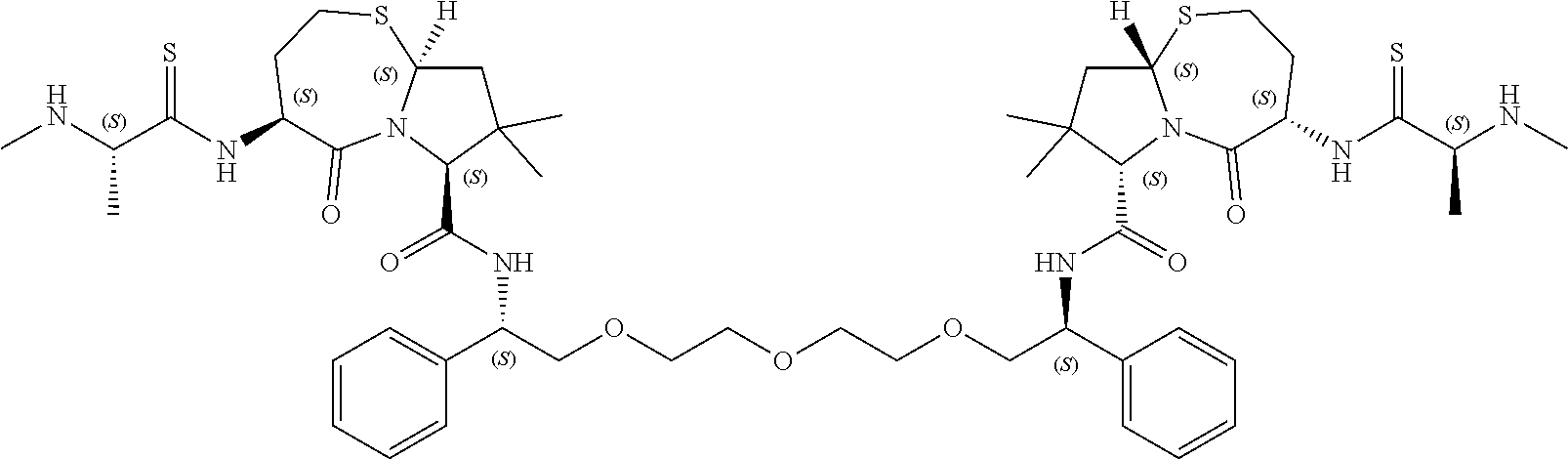 |
(S,4S,4′S,7S,7′S,9aS,9a′S)- N,N′-((1S,1′S)-((oxybis(ethane-2,1- diyl))bis(oxy))bis(1-phenylethane-2,1- diyl))bis(8,8-dimethyl-4-((S)-2- (methylamino) propanethioamido)-5- oxooctahydropyrrolo[2,1- b][1,3]thiazepine-7-carboxamide) |
 |
(S,4S,4′S,7S,7′S,9aS,9a′S)- N,N′-((1S,1′S)-(hexane-1,6- diylbis(oxy))bis(1-phenylethane-2,1- diyl))bis(8,8-dimethyl-4-((S)-2- (methylamino)propanamido)-5- oxooctahydropyrrolo[2,1- b][1,3]thiazepine-7-carboxamide) |
 |
(S,4S,4′S,7S,7′S,9aS,9a′S)- N,N′-((1S,1′S)-(hexane-1,6- diylbis(oxy))bis(1-phenylethane-2,1- diyl))bis(8,8-dimethyl-4-((S)-2- (methylamino) propanethioamido)-5- oxooctahydropyrrolo[2,1- b][1,3]thiazepine-7-carboxamide) |
 |
(S,4S,4′S,7S,7′S,9aS,9a′S)- N,N′-((1S,1′S)-((1,4- phenylenebis(methylene))bis(oxy)) bis(1-phenylethane-2,1-diyl))bis(8,8- dimethyl-4-((S)-2- (methylamino)propanamido)-5- oxooctahydropyrrolo[2,1- b][1,3]thiazepine-7-carboxamide) |
 |
(S,4S,4′S,7S,7′S,9aS,9a′S)- N,N′-((1S,1′S)-((1,4- phenylenebis(methylene))bis(oxy)) bis(1-phenylethane-2,1-diyl))bis(8,8- dimethyl-4-((S)-2- (methylamino)propanethioamido)-5- oxooctahydropyrrolo[2,1- b][1,3]thiazepine-7-carboxamide) |


and each of Ar13 and Ar15 is

where the wavy lines represent points of attachment.


or a pharmaceutically acceptable salt thereof. The invention also includes a pharmaceutical composition comprising this compound, or a pharmaceutically acceptable salt thereof, and a pharmaceutically acceptable excipient including e.g., those set forth herein. The invention also includes a method of treating an HIV infection in a subject comprising administering to the subject this compound or a pharmaceutically acceptable salt thereof, as well as combinations. The invention also includes this compound, or a pharmaceutically acceptable salt thereof, for use in treating an HIV infection. The invention also includes use of this compound, in the manufacture of a medicament for treating an HIV infection. The invention also includes a method of depleting latent HIV infected cells comprising administering to a subject this compound or a pharmaceutically acceptable salt thereof, as well as combinations thereof.

or a pharmaceutically acceptable salt thereof. The invention also includes a pharmaceutical composition comprising this compound, or a pharmaceutically acceptable salt thereof, and a pharmaceutically acceptable excipient. including e.g., those set forth herein. The invention also includes a method of treating an HIV infection in a subject comprising administering to the subject this compound or a pharmaceutically acceptable salt thereof, as well as combinations. The invention also includes this compound, or a pharmaceutically acceptable salt thereof, for use in treating an HIV infection. The invention also includes use of this compound, in the manufacture of a medicament for treating an HIV infection. The invention also includes a method of depleting latent HIV infected cells comprising administering to a subject this compound or a pharmaceutically acceptable salt thereof, as well as combinations thereof.


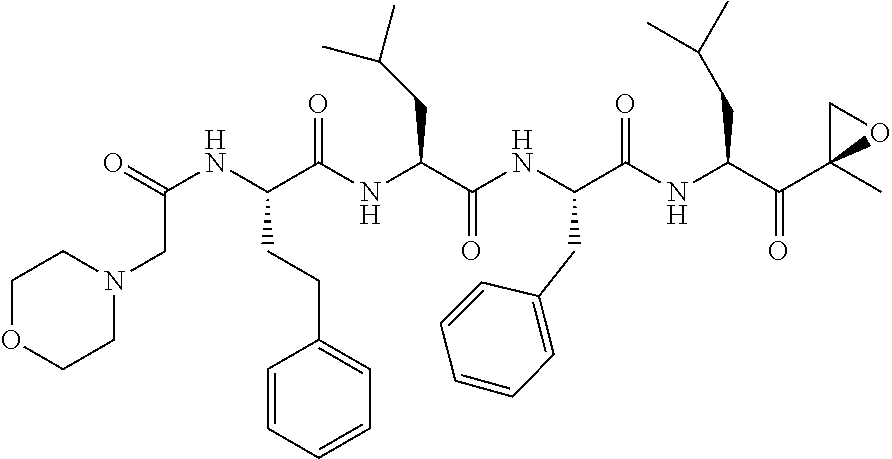


-
- U.S. Pat. No. 8,217,149; Ser. No. 12/633,339;
- U.S. Pat. No. 8,383,796; Ser. No. 13/091,936;
- U.S. Pat. No. 8,552,154; Ser. No. 13/120,406;
- US patent publication No. 20110280877; Ser. No. 13/068,337;
- US Patent Publication No. 20130309250; Ser. No. 13/892,671;
- WO2013019906;
- WO2013079174;
- U.S. application Ser. No. 13/511,538 (filed Aug. 7, 2012), which is the US National Phase of International Application No. PCT/US10/58007 (filed 2010); and
- U.S. application Ser. No. 13/478,511 (filed May 23, 2012).
Substitution with heavier isotopes such as deuterium, i.e. 2H, may afford certain therapeutic advantages resulting from greater metabolic stability, for example, increased in vivo half-life or reduced dosage requirements, and hence may be preferred in some circumstances.
Isotopically-labelled compounds of Formula (I), (Ia), (Ib), (II) or (III) can generally be prepared by conventional techniques known to those skilled in the art or by processes analogous to those described in the accompanying Examples and Preparations using an appropriate isotopically-labelled reagents in place of the non-labelled reagent previously employed.
-
- aq.=Aqueous
- μL=Microliters
- μM=Micromolar
- NMR=nuclear magnetic resonance
- Boc=tert-butoxycarbonyl
- Br=Broad
- Cbz=Benzyloxycarbonyl
- d=Doublet
- Δ=chemical shift
- ° C.=degrees celcius
- DCM=Dichloromethane
- dd=doublet of doublets
- DMAP=4-(Dimethylamino)pyridine
- DMEM=Dulbeco's Modified Eagle's Medium
- DMF=N,N-dimethylformamide
- DMP=2,2-dimethoxypropane
- DMSO=Dimethylsulfoxide
- EtOAc=ethyl acetate
- ESI=electrospray ionization
- G or g=Gram
- h or hr=Hours
- HCV=hepatitus C virus
- HPLC=high performance liquid chromatography
- Hz=Hertz
- IU=International Units
- IC50=inhibitory concentration at 50% inhibition
- J=coupling constant (given in Hz unless otherwise indicated)
- LHMDS=Lithium bis(trimethylsilyl)amide
- M=Multiplet
- M=Molar
- M+H+=parent mass spectrum peak plus H+
- Mg or mg=Milligram
- Min=Minutes
- mL=Milliliter
- mM=Millimolar
- Mmol=Millimole
- MS=mass spectrum
- Nm=Nanomolar
- ppm=parts per million
- p-TsOH=p-Toluenesulfonic acid
- q.s.=sufficient amount
- S=Singlet
- RT=room temperature
- sat.=Saturated
- T=Triplet
- TBS-Cl=tert-Butyldimethylsilyl chloride
- TFA=trifluoroacetic acid
| Time | % A | % B | Flow Rate | |
| 0.00 min | 95 | 5 | 1.8 ml/min | |
| 1.0 min | 5 | 95 | 1.8 ml/min | |
| 2.0 min | 5 | 95 | 1.8 ml/min | |
| 2.5 min | 95 | 5 | 1.8 ml/min | |
UV detection provided by summed absorbance signal at 214 nm and 254 nm scanning
Instrument: Shimadzu LCMS-2020
Scan Mode: Alternating Positive/Negative Electrospray
Scan Range: 100-2000 amu
LC Conditions:
The LCMS analysis was conducted on a HALO C-18, 4.6*50 mm, 2.7 μm, C18 column at 45° C.
1.0 uL of sample was injected
The gradient employed was:
Mobile Phase A: Water+0.1% v/v Formic Acid
Mobile Phase B: Acetonitrile+0.1% v/v Formic Acid
| Time | % A | % B | Flow Rate | |
| 0.00 min | 95 | 5 | 1.5 ml/min | |
| 1.0 min | 5 | 95 | 1.5 ml/min | |
| 2.0 min | 5 | 95 | 1.5 ml/min | |
| 2.5 min | 95 | 5 | 1.5 ml/min | |
| 3.0 min | 95 | 5 | 1.5 ml/min | |
UV detection provided by summed absorbance signal at 214 nm and 254 nm scanning


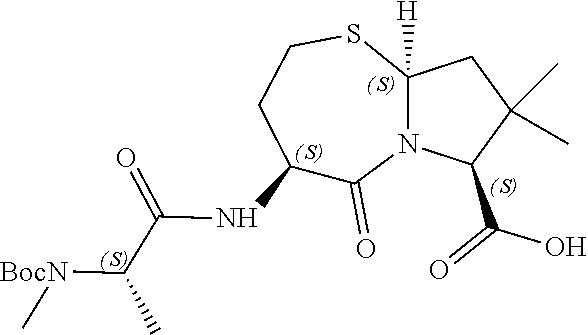


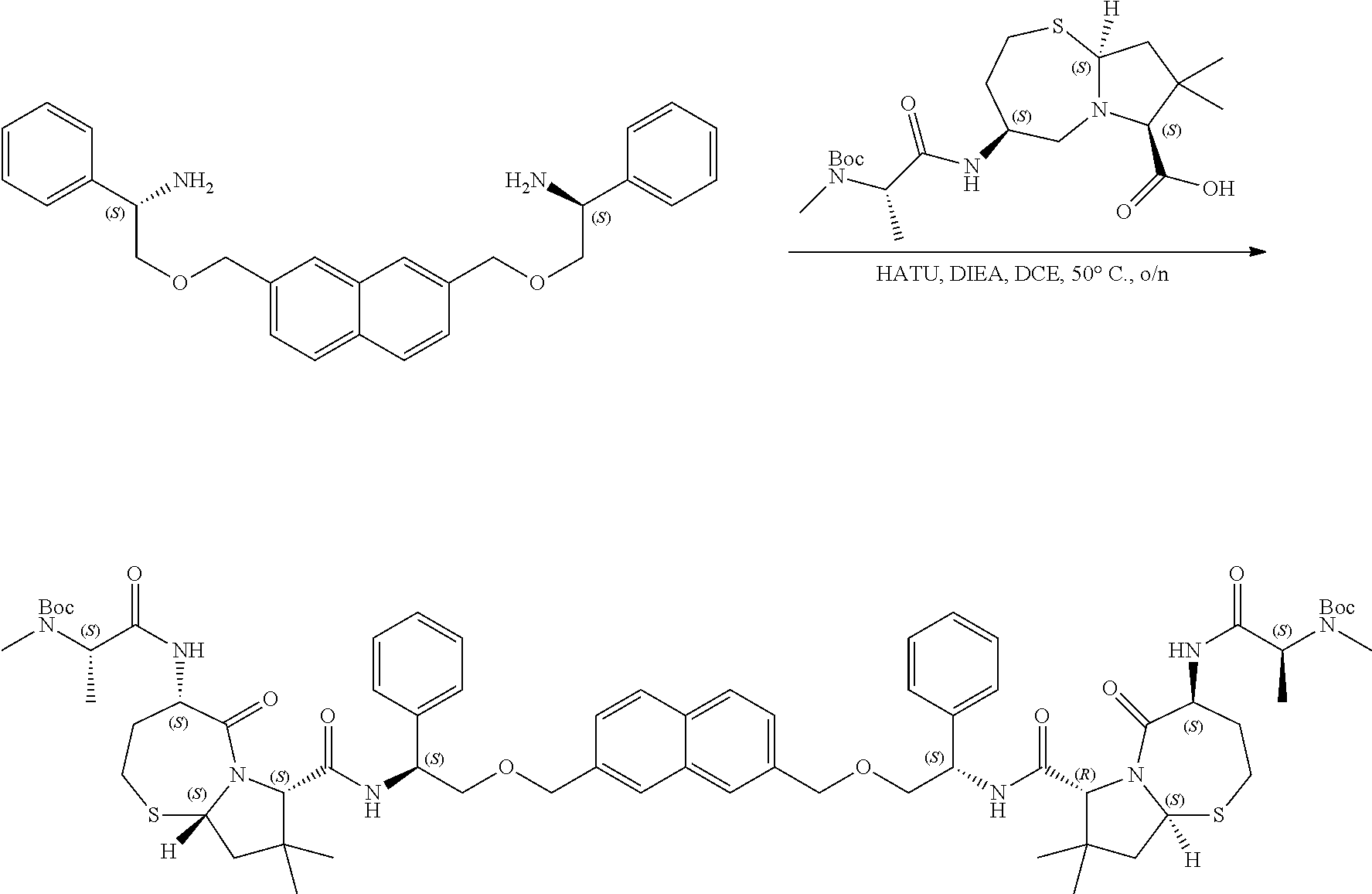
| Wavelength | 214 nm/254 nm |
| Instrument | Combi Flash |
| Column | WelFlash ® C18-I Spherical C18, 20-40 μm Size |
| 120 | |
| Flow Rate | |
| 20 mL/min | |
| Gradient Method | Time (min) | ACN | H2O |
| 0 | 5 | 95 | |
| 5 | 5 | 95 | |
| 50 | 45 | 55 | |
| 60 | 45 | 55 | |
| 90 | 100 | 0 | |


| Wavelength | 214 nm | |
| Instrument | Waters 2545 | |
| Column | Gemini 5 u C18 150 × 21.2 | |
| Flow Rate | ||
| 20 mL/min | ||
| Gradient Method | Time (min) | can | H2O | |
| 0 | 5 | 95 | ||
| 10 | 50 | 50 | ||
| 60 | 100 | 0 | ||
| 100 | 100 | 0 | ||


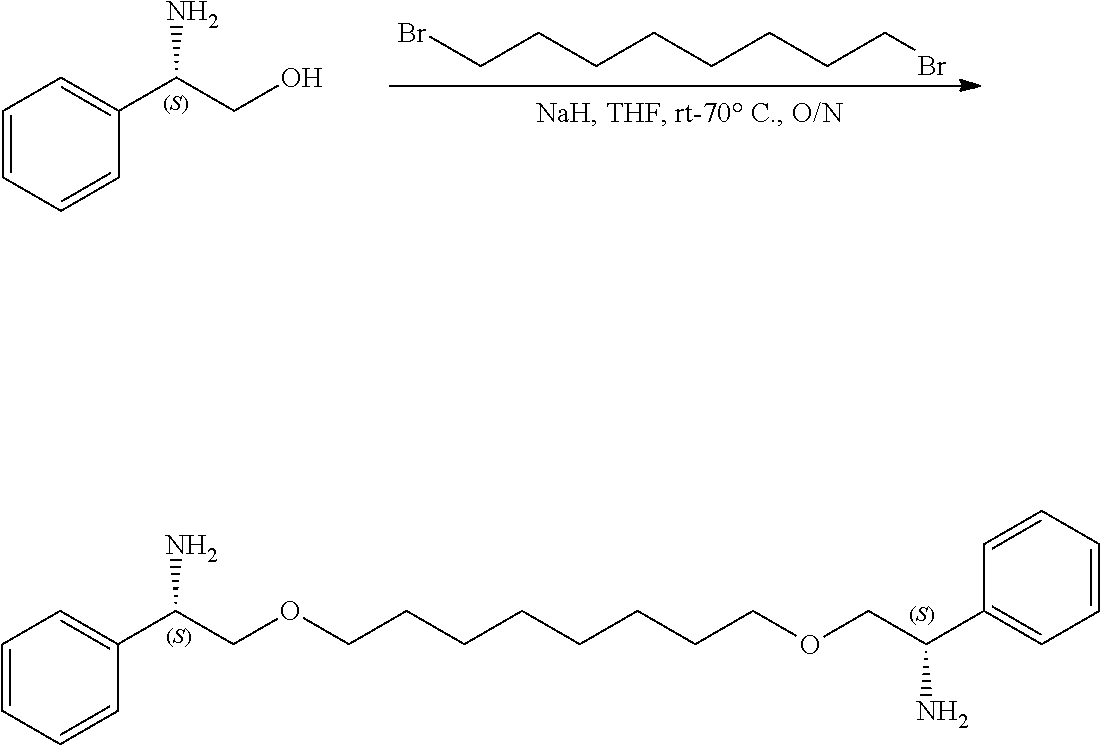

| Wavelength | 214 nm | |
| Instrument | Waters 2545 | |
| Column | Gemini 5 u C18 150 × 21.2 | |
| Flow Rate | ||
| 20 mL/min | ||
| Gradient Method | Time (min) | can | H2O | |
| 0 | 5 | 95 | ||
| 10 | 45 | 55 | ||
| 65 | 100 | 0 | ||
| 100 | 100 | 0 | ||


| Wavelength | 214 nm | |
| Instrument | Waters 2545 | |
| Column | Gemini 5 u C18 150 × 21.2 | |
| Flow Rate | ||
| 20 mL/min | ||
| Gradient Method | Time (min) | CAN | H2O | |
| 0 | 5 | 95 | ||
| 10 | 55 | 45 | ||
| 55 | 100 | 0 | ||
| 100 | 100 | 0 | ||


| Wavelength | 214 nm/254 nm |
| Instrument | Combi Flash |
| Column | WelFlash ® C18-I Spherical C18, 20-40 μm Size |
| 120 | |
| Flow Rate | |
| 20 mL/min | |
| Gradient Method | Time (min) | can | H2O |
| 0 | 5 | 95 | |
| 5 | 5 | 95 | |
| 50 | 45 | 55 | |
| 60 | 45 | 55 | |
| 90 | 100 | 0 | |


| Wavelength | 214 nm/254 nm |
| Instrument | Combi Flash |
| Column | WelFlash ® C18-I Spherical C18, 20-40 μm Size |
| 120 | |
| Flow Rate | |
| 20 mL/min | |
| Gradient Method | Time (min) | ACN | H2O |
| 0 | 5 | 95 | |
| 5 | 5 | 95 | |
| 50 | 45 | 55 | |
| 60 | 45 | 55 | |
| 90 | 100 | 0 | |

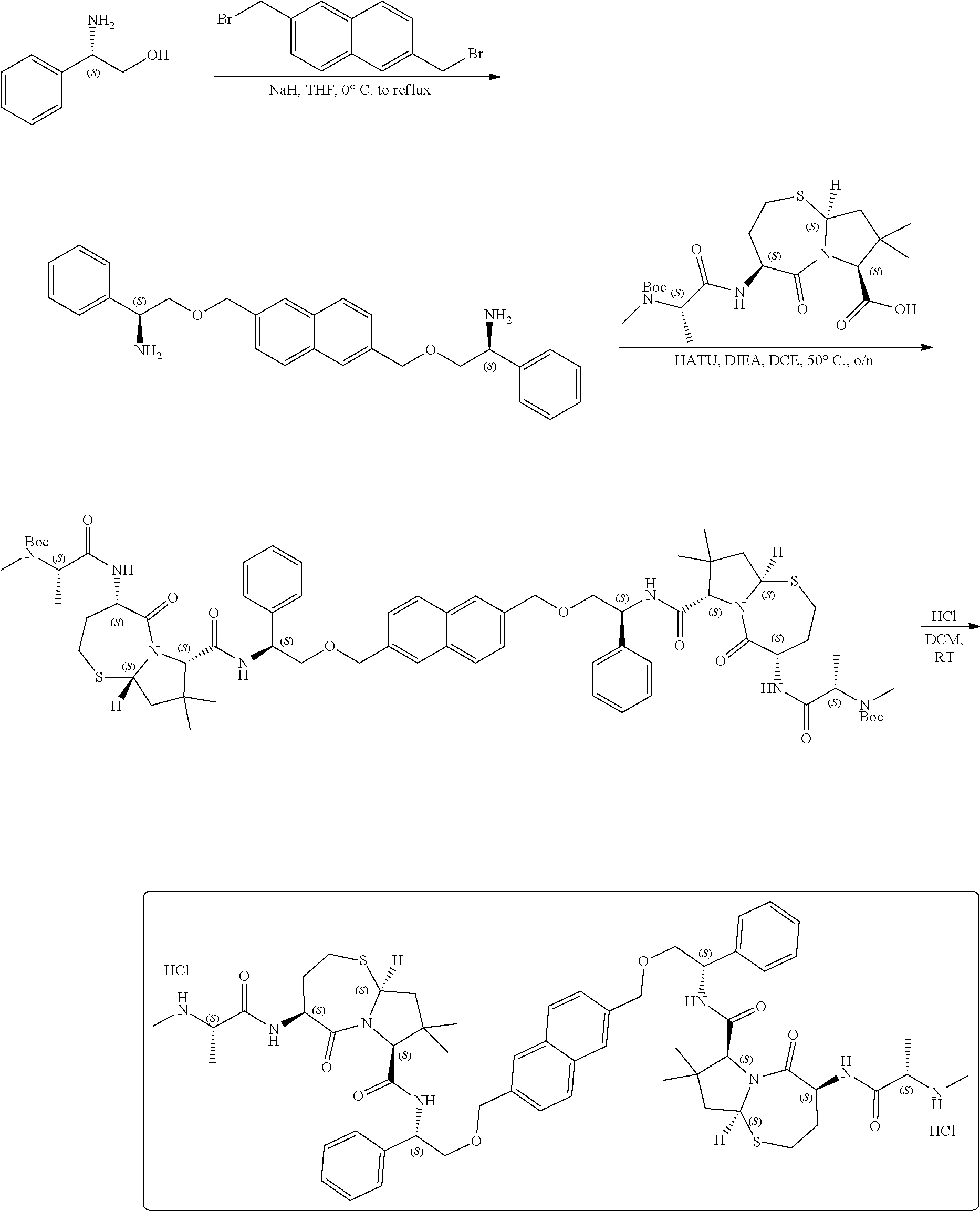


| Wavelength | 214 nm/254 nm |
| Instrument | Combi Flash |
| Column | WelFlash ® C18-I Spherical C18, 20-40 μm Size |
| 120 | |
| Flow Rate | |
| 20 mL/min | |
| Gradient Method | Time (min) | ACN | H2O |
| 0 | 5 | 95 | |
| 5 | 5 | 95 | |
| 50 | 45 | 55 | |
| 60 | 45 | 55 | |
| 90 | 100 | 0 | |


| Wavelength | 214 nm | |
| Instrument | Waters 2545 | |
| Column | Gemini 5 u C18 150 × 21.2 | |
| Flow Rate | ||
| 20 mL/min | ||
| Gradient Method | Time (min) | ACN | H2O | |
| 0 | 5 | 95 | ||
| 10 | 50 | 50 | ||
| 60 | 100 | 0 | ||
| 100 | 100 | 0 | ||

| TABLE 3 | ||
| Example No. | EC50 (nM) | |
| 1 | 47.0 | |
| 2 | 585.1 | |
| 3 | 80.5 | |
| 4 | 387.2 | |
| 5 | 53.6 | |
| 6 | 7051 | |
| 7 | 141.5 | |
| 8 | 2.4 | |
| 9 | 90.3 | |
| 10 | 43.4 | |
| 11 | 324.0 | |
| 12 | 6.8 | |
| 13 | 9.3 | |
| 14 | 8.4 | |
| 15 | 15.3 | |
| 16 | 10.1 | |
| 17 | 20.7 | |
| 18 | 22.3 | |
| 19 | 9.4 | |
| 20 | 11.9 | |
| 21 | 13.0 | |
| 22 | 8.8 | |
| 23 | 55.5 | |
| 24 | 47.9 | |
| 25 | 61.8 | |
| 26 | 69.1 | |
| 27 | 52.2 | |
| 28 | 53.7 | |
| 29 | 89.5 | |
| 30 | 65.4 | |
| 31 | 25.8 | |
| 32 | 165.5 | |
| 33 | 5.5 | |
| 34 | 36.3 | |
| 35 | 9.0 | |
| 36 | 9.5 | |
| 37 | 10.9 | |
| 38 | 50.7 | |
| 39 | 51.8 | |
| 40 | 6.1 | |
| 41 | 51.6 | |
| 42 | 6.8 | |
| 43 | 43.4 | |
| 44 | 20.4 | |
| 45 | 183.1 | |
| 46 | 127.2 | |
| 47 | 1.2 | |
| 48 | 11.6 | |
| 49 | 466.4 | |
| 50 | 95.9 | |
| 51 | 24.0 | |
| 52 | 243.3 | |
| 53 | 178.0 | |
| 54 | 32.0 | |
| 55 | 429.2 | |
| 56 | 2.9 | |
| 57 | 8.5 | |
| 58 | 4.5 | |
| 59 | 13.3 | |
| 60 | 3.5 | |
| 61 | 11.8 | |
| 62 | 4.2 | |
| 63 | 11.6 | |
| TABLE 4 |
| Summary of SMAC mimetics disclosed herein with other mimetics |
| AZD- | SBI- | Formula F | Ex. | Ex. | Ex. | Ex. | Ex. | ||
| 5582 | Birinapant | 0637142 | US20190135861A1 | 33 | 13 | 42 | 40 | 20 | |
| Jurkat EC50 | 8 | 200 | 1 | ~1000 | 5.5 | 9.3 | 6.8 | 6.1 | 11.9 |
| (nM) | |||||||||
| p100/p52 | 63 | 1000 | 100-1000 | >1000 | 158 | 12.6 | 3.1 | 1 | 3.1 |
| Western Blot | |||||||||
| (WB)EC50 | |||||||||
| (nM) | |||||||||
| NFkB2 gene | 28 | >1000 | 18000 | Not tested | 46 | 73 | 3.6 | 11 | 75 |
| induction | |||||||||
| EC50 (nM) | |||||||||
| caRNA | 10 | >1000 | >1000 | Not tested | 10 | 10 | 10 | 10 | 10 |
| Lowest | |||||||||
| efficacious | |||||||||
| concentration | |||||||||
| observed | |||||||||
| “Ex” means Example | |||||||||


Claims (12)


Priority Applications (4)
| Application Number | Priority Date | Filing Date | Title |
|---|---|---|---|
| US16/897,351 US10870663B2 (en) | 2018-11-30 | 2020-06-10 | Compounds useful in HIV therapy |
| US16/948,873 US11492361B2 (en) | 2018-11-30 | 2020-10-05 | Compounds useful in HIV therapy |
| US17/395,723 US11873310B2 (en) | 2018-11-30 | 2021-08-06 | Compounds useful in HIV therapy |
| US17/899,877 US20240051972A1 (en) | 2018-11-30 | 2022-08-31 | Compounds Useful in HIV Therapy |
Applications Claiming Priority (4)
| Application Number | Priority Date | Filing Date | Title |
|---|---|---|---|
| US201862773563P | 2018-11-30 | 2018-11-30 | |
| US201916621312A | 2019-11-28 | 2019-11-28 | |
| PCT/IB2019/060267 WO2020110056A1 (en) | 2018-11-30 | 2019-11-28 | Compounds useful in hiv therapy |
| US16/897,351 US10870663B2 (en) | 2018-11-30 | 2020-06-10 | Compounds useful in HIV therapy |
Related Parent Applications (2)
| Application Number | Title | Priority Date | Filing Date |
|---|---|---|---|
| PCT/IB2019/060267 Continuation WO2020110056A1 (en) | 2018-11-30 | 2019-11-28 | Compounds useful in hiv therapy |
| US201916621312A Continuation | 2018-11-30 | 2019-11-28 |
Related Child Applications (1)
| Application Number | Title | Priority Date | Filing Date |
|---|---|---|---|
| US16/948,873 Continuation US11492361B2 (en) | 2018-11-30 | 2020-10-05 | Compounds useful in HIV therapy |
Publications (2)
| Publication Number | Publication Date |
|---|---|
| US20200299309A1 US20200299309A1 (en) | 2020-09-24 |
| US10870663B2 true US10870663B2 (en) | 2020-12-22 |
Family
ID=72516350
Family Applications (4)
| Application Number | Title | Priority Date | Filing Date |
|---|---|---|---|
| US16/897,351 Active US10870663B2 (en) | 2018-11-30 | 2020-06-10 | Compounds useful in HIV therapy |
| US16/948,873 Active 2039-12-13 US11492361B2 (en) | 2018-11-30 | 2020-10-05 | Compounds useful in HIV therapy |
| US17/395,723 Active 2040-04-11 US11873310B2 (en) | 2018-11-30 | 2021-08-06 | Compounds useful in HIV therapy |
| US17/899,877 Abandoned US20240051972A1 (en) | 2018-11-30 | 2022-08-31 | Compounds Useful in HIV Therapy |
Family Applications After (3)
| Application Number | Title | Priority Date | Filing Date |
|---|---|---|---|
| US16/948,873 Active 2039-12-13 US11492361B2 (en) | 2018-11-30 | 2020-10-05 | Compounds useful in HIV therapy |
| US17/395,723 Active 2040-04-11 US11873310B2 (en) | 2018-11-30 | 2021-08-06 | Compounds useful in HIV therapy |
| US17/899,877 Abandoned US20240051972A1 (en) | 2018-11-30 | 2022-08-31 | Compounds Useful in HIV Therapy |
Country Status (1)
| Country | Link |
|---|---|
| US (4) | US10870663B2 (en) |
Cited By (2)
| Publication number | Priority date | Publication date | Assignee | Title |
|---|---|---|---|---|
| US20220119417A1 (en) * | 2018-11-30 | 2022-04-21 | Glaxosmithkline Intellectual Property Development Limited | Compounds Useful in HIV Therapy |
| US12060357B2 (en) | 2018-11-30 | 2024-08-13 | Merck Sharp & Dohme Llc | 9-substituted amino triazolo quinazoline derivatives as adenosine receptor antagonists, pharmaceutical compositions and their use |
Citations (13)
| Publication number | Priority date | Publication date | Assignee | Title |
|---|---|---|---|---|
| WO2005069894A2 (en) | 2004-01-16 | 2005-08-04 | The Regents Of The University Of Michigan | Conformationally constrained smac mimetics and the uses thereof |
| WO2006010118A2 (en) | 2004-07-09 | 2006-01-26 | The Regents Of The University Of Michigan | Conformationally constrained smac mimetics and the uses thereof |
| WO2007130626A2 (en) | 2006-05-05 | 2007-11-15 | The Regents Of The University Of Michigan | Bivalent smac mimetics and the uses thereof |
| WO2008128171A2 (en) | 2007-04-13 | 2008-10-23 | The Regents Of The University Of Michigan | Diazo bicyclic smac mimetics and the uses thereof |
| EP2058312A1 (en) | 2007-11-09 | 2009-05-13 | Universita' degli Studi di Milano | SMAC mimetic compounds as apoptosis inducers |
| WO2009126947A2 (en) | 2008-04-11 | 2009-10-15 | The Regents Of The University Of Michigan | Heteroaryl-substituted bicyclic smac mimetics and the uses thereof |
| WO2010014994A1 (en) | 2008-08-01 | 2010-02-04 | Qualcomm Incorporated | Successive detection and cancellation for cell pilot detection |
| WO2010142994A1 (en) | 2009-06-12 | 2010-12-16 | Astrazeneca Ab | 2, 3-dihydro-1h-indene compounds and their use to treat cancer |
| WO2011002684A1 (en) | 2009-07-02 | 2011-01-06 | Tetralogic Pharmaceuticals Corp. | Smac mimetic |
| WO2011050068A2 (en) | 2009-10-23 | 2011-04-28 | The Regents Of The University Of Michigan | Bivalent diazo bicyclic smac mimetics and the uses thereof |
| WO2014031487A1 (en) | 2012-08-23 | 2014-02-27 | The Regentis Of The University Of Michigan | Bivalent inhibitors of iap proteins and therapeutic methods using the same |
| WO2014085489A1 (en) | 2012-11-30 | 2014-06-05 | Sanford-Burnham Medical Research Institute | Inhibitor of apoptosis protein (iap) antagonists |
| WO2015187998A2 (en) | 2014-06-04 | 2015-12-10 | Sanford-Burnham Medical Research Institute | Use of inhibitor of apoptosis protein (iap) antagonists in hiv therapy |
Family Cites Families (2)
| Publication number | Priority date | Publication date | Assignee | Title |
|---|---|---|---|---|
| US5489586A (en) | 1994-03-07 | 1996-02-06 | Warner-Lambert Company | Method for treating inflammatory disease in humans |
| US10870663B2 (en) * | 2018-11-30 | 2020-12-22 | Glaxosmithkline Intellectual Property Development Limited | Compounds useful in HIV therapy |
-
2020
- 2020-06-10 US US16/897,351 patent/US10870663B2/en active Active
- 2020-10-05 US US16/948,873 patent/US11492361B2/en active Active
-
2021
- 2021-08-06 US US17/395,723 patent/US11873310B2/en active Active
-
2022
- 2022-08-31 US US17/899,877 patent/US20240051972A1/en not_active Abandoned
Patent Citations (21)
| Publication number | Priority date | Publication date | Assignee | Title |
|---|---|---|---|---|
| US7932382B2 (en) | 2004-01-16 | 2011-04-26 | The Regents Of The University Of Michigan | Conformationally constrained Smac mimetics and the uses thereof |
| WO2005069894A2 (en) | 2004-01-16 | 2005-08-04 | The Regents Of The University Of Michigan | Conformationally constrained smac mimetics and the uses thereof |
| WO2006010118A2 (en) | 2004-07-09 | 2006-01-26 | The Regents Of The University Of Michigan | Conformationally constrained smac mimetics and the uses thereof |
| WO2007130626A2 (en) | 2006-05-05 | 2007-11-15 | The Regents Of The University Of Michigan | Bivalent smac mimetics and the uses thereof |
| US7960372B2 (en) | 2006-05-05 | 2011-06-14 | The Regents Of The University Of Michigan | Bivalent Smac mimetics and the uses thereof |
| WO2008128171A2 (en) | 2007-04-13 | 2008-10-23 | The Regents Of The University Of Michigan | Diazo bicyclic smac mimetics and the uses thereof |
| US8278293B2 (en) | 2007-04-13 | 2012-10-02 | The Regents Of The University Of Michigan | Diazo bicyclic Smac mimetics and the uses thereof |
| EP2058312A1 (en) | 2007-11-09 | 2009-05-13 | Universita' degli Studi di Milano | SMAC mimetic compounds as apoptosis inducers |
| WO2009126947A2 (en) | 2008-04-11 | 2009-10-15 | The Regents Of The University Of Michigan | Heteroaryl-substituted bicyclic smac mimetics and the uses thereof |
| WO2010014994A1 (en) | 2008-08-01 | 2010-02-04 | Qualcomm Incorporated | Successive detection and cancellation for cell pilot detection |
| WO2010142994A1 (en) | 2009-06-12 | 2010-12-16 | Astrazeneca Ab | 2, 3-dihydro-1h-indene compounds and their use to treat cancer |
| US20110003877A1 (en) | 2009-07-02 | 2011-01-06 | Tetralogic Pharmaceuticals Corporation | SMAC Mimetic |
| WO2011002684A1 (en) | 2009-07-02 | 2011-01-06 | Tetralogic Pharmaceuticals Corp. | Smac mimetic |
| WO2011050068A2 (en) | 2009-10-23 | 2011-04-28 | The Regents Of The University Of Michigan | Bivalent diazo bicyclic smac mimetics and the uses thereof |
| US8815927B2 (en) | 2009-10-23 | 2014-08-26 | The Regents Of The University Of Michigan | Bivalent diazo bicyclic Smac mimetics and the uses thereof |
| WO2014031487A1 (en) | 2012-08-23 | 2014-02-27 | The Regentis Of The University Of Michigan | Bivalent inhibitors of iap proteins and therapeutic methods using the same |
| WO2014085489A1 (en) | 2012-11-30 | 2014-06-05 | Sanford-Burnham Medical Research Institute | Inhibitor of apoptosis protein (iap) antagonists |
| US20150307499A1 (en) | 2012-11-30 | 2015-10-29 | Sanford-Burnham Medical Research Institute | Inhibitor of apoptosis protein (iap) antagonists |
| US9546174B2 (en) | 2012-11-30 | 2017-01-17 | Sanford-Burnham Medical Research Institute | Inhibitor of apoptosis protein (IAP) antagonists |
| US20190135861A1 (en) | 2012-11-30 | 2019-05-09 | Sanford Burnham Prebys Medical Discovery Institute | Inhibitor of Apoptosis Protein (IAP) Antagonists |
| WO2015187998A2 (en) | 2014-06-04 | 2015-12-10 | Sanford-Burnham Medical Research Institute | Use of inhibitor of apoptosis protein (iap) antagonists in hiv therapy |
Non-Patent Citations (18)
Cited By (3)
| Publication number | Priority date | Publication date | Assignee | Title |
|---|---|---|---|---|
| US20220119417A1 (en) * | 2018-11-30 | 2022-04-21 | Glaxosmithkline Intellectual Property Development Limited | Compounds Useful in HIV Therapy |
| US11873310B2 (en) * | 2018-11-30 | 2024-01-16 | Glaxosmithkline Intellectual Property Development Limited | Compounds useful in HIV therapy |
| US12060357B2 (en) | 2018-11-30 | 2024-08-13 | Merck Sharp & Dohme Llc | 9-substituted amino triazolo quinazoline derivatives as adenosine receptor antagonists, pharmaceutical compositions and their use |
Also Published As
| Publication number | Publication date |
|---|---|
| US11492361B2 (en) | 2022-11-08 |
| US20240051972A1 (en) | 2024-02-15 |
| US11873310B2 (en) | 2024-01-16 |
| US20220119417A1 (en) | 2022-04-21 |
| US20200299309A1 (en) | 2020-09-24 |
| US20210009609A1 (en) | 2021-01-14 |
Similar Documents
| Publication | Publication Date | Title |
|---|---|---|
| EP4342473A2 (en) | Compounds useful in hiv therapy | |
| US11377440B2 (en) | Modulators of stimulator of interferon genes (STING) | |
| US20210238172A1 (en) | Heterocyclic amides useful as protein modulators and methods of using the same | |
| JP2019510796A (en) | Heterocyclic Amides Useful as Protein Modulators | |
| US20240051972A1 (en) | Compounds Useful in HIV Therapy | |
| US20180162845A1 (en) | Enhancer of zeste homolog 2 inhibitors | |
| RU2806030C2 (en) | Compounds suitable for therapy against hiv | |
| HK40102082A (en) | Compounds useful in hiv therapy | |
| US20250326771A1 (en) | Piperazine derivatives useful in hiv therapy | |
| BR122023027623A2 (en) | COMPOUNDS AND SALTS, THEIR USES IN HIV TREATMENT, PHARMACEUTICAL COMPOSITION, COMBINATION AND KIT THEREOF | |
| WO2025235719A1 (en) | Dimeric smac mimetics useful in hiv therapy | |
| EA037671B1 (en) | Heterocyclic amides useful as protein modulators | |
| HK40052462A (en) | Compounds useful in hiv therapy | |
| HK40052462B (en) | Compounds useful in hiv therapy |
Legal Events
| Date | Code | Title | Description |
|---|---|---|---|
| FEPP | Fee payment procedure |
Free format text: ENTITY STATUS SET TO UNDISCOUNTED (ORIGINAL EVENT CODE: BIG.); ENTITY STATUS OF PATENT OWNER: LARGE ENTITY |
|
| STPP | Information on status: patent application and granting procedure in general |
Free format text: PUBLICATIONS -- ISSUE FEE PAYMENT RECEIVED |
|
| STPP | Information on status: patent application and granting procedure in general |
Free format text: PUBLICATIONS -- ISSUE FEE PAYMENT VERIFIED |
|
| STCF | Information on status: patent grant |
Free format text: PATENTED CASE |
|
| CC | Certificate of correction | ||
| AS | Assignment |
Owner name: THE UNIVERSITY OF NORTH CAROLINA AT CHAPEL HILL, NORTH CAROLINA Free format text: ASSIGNMENT OF ASSIGNORS INTEREST;ASSIGNOR:MARGOLIS, DAVID;REEL/FRAME:064350/0747 Effective date: 20190401 Owner name: VIIV HEALTHCARE COMPANY, DELAWARE Free format text: ASSIGNMENT OF ASSIGNORS INTEREST;ASSIGNORS:DE LA ROSA, MARTHA ALICIA;TAI, VINCENT WING-FAI;TANG, JUN;AND OTHERS;SIGNING DATES FROM 20190430 TO 20190529;REEL/FRAME:064350/0724 Owner name: GLAXOSMITHKLINE INTELLECTUAL PROPERTY DEVELOPMENT LIMITED, UNITED KINGDOM Free format text: ASSIGNMENT OF ASSIGNORS INTEREST;ASSIGNORS:DE LA ROSA, MARTHA ALICIA;TAI, VINCENT WING-FAI;TANG, JUN;AND OTHERS;SIGNING DATES FROM 20190430 TO 20190529;REEL/FRAME:064350/0724 |
|
| CC | Certificate of correction | ||
| CC | Certificate of correction | ||
| MAFP | Maintenance fee payment |
Free format text: PAYMENT OF MAINTENANCE FEE, 4TH YEAR, LARGE ENTITY (ORIGINAL EVENT CODE: M1551); ENTITY STATUS OF PATENT OWNER: LARGE ENTITY Year of fee payment: 4 |
|
| AS | Assignment |
Owner name: GLAXOSMITHKLINE INTELLECTUAL PROPERTY DEVELOPMENT LIMITED, UNITED KINGDOM Free format text: CHANGE OF ADDRESS;ASSIGNOR:GLAXOSMITHKLINE INTELLECTUAL PROPERTY DEVELOPMENT LIMITED;REEL/FRAME:071649/0432 Effective date: 20240102 |
|
| AS | Assignment |
Owner name: GLAXOSMITHKLINE INTELLECTUAL PROPERTY DEVELOPMENT LIMITED, UNITED KINGDOM Free format text: CHANGE OF ADDRESS;ASSIGNOR:GLAXOSMITHKLINE INTELLECTUAL PROPERTY DEVELOPMENT LIMITED;REEL/FRAME:073032/0390 Effective date: 20240102 |