US10863811B2 - Process for treating keratin fibres with input of heat - Google Patents
Process for treating keratin fibres with input of heat Download PDFInfo
- Publication number
- US10863811B2 US10863811B2 US14/128,097 US201214128097A US10863811B2 US 10863811 B2 US10863811 B2 US 10863811B2 US 201214128097 A US201214128097 A US 201214128097A US 10863811 B2 US10863811 B2 US 10863811B2
- Authority
- US
- United States
- Prior art keywords
- keratin fibres
- heating
- rigid elements
- closed space
- treatment composition
- Prior art date
- Legal status (The legal status is an assumption and is not a legal conclusion. Google has not performed a legal analysis and makes no representation as to the accuracy of the status listed.)
- Active, expires
Links
- 0 [8*]N([9*])([10*])[11*].[CH3-] Chemical compound [8*]N([9*])([10*])[11*].[CH3-] 0.000 description 9
- WSXVEWPNFAOTCH-UHFFFAOYSA-N C1CCCCCCC1.CCCCCCCC[Si](C)(C)OC.CO[Si](C)(C)C Chemical compound C1CCCCCCC1.CCCCCCCC[Si](C)(C)OC.CO[Si](C)(C)C WSXVEWPNFAOTCH-UHFFFAOYSA-N 0.000 description 1
Images


Classifications
-
- A—HUMAN NECESSITIES
- A45—HAND OR TRAVELLING ARTICLES
- A45D—HAIRDRESSING OR SHAVING EQUIPMENT; EQUIPMENT FOR COSMETICS OR COSMETIC TREATMENTS, e.g. FOR MANICURING OR PEDICURING
- A45D7/00—Processes of waving, straightening or curling hair
- A45D7/06—Processes of waving, straightening or curling hair combined chemical and thermal
-
- A—HUMAN NECESSITIES
- A45—HAND OR TRAVELLING ARTICLES
- A45D—HAIRDRESSING OR SHAVING EQUIPMENT; EQUIPMENT FOR COSMETICS OR COSMETIC TREATMENTS, e.g. FOR MANICURING OR PEDICURING
- A45D1/00—Curling-tongs, i.e. tongs for use when hot; Curling-irons, i.e. irons for use when hot; Accessories therefor
- A45D1/02—Curling-tongs, i.e. tongs for use when hot; Curling-irons, i.e. irons for use when hot; Accessories therefor with means for internal heating, e.g. by liquid fuel
- A45D1/04—Curling-tongs, i.e. tongs for use when hot; Curling-irons, i.e. irons for use when hot; Accessories therefor with means for internal heating, e.g. by liquid fuel by electricity
-
- A45D19/0008—
-
- A—HUMAN NECESSITIES
- A45—HAND OR TRAVELLING ARTICLES
- A45D—HAIRDRESSING OR SHAVING EQUIPMENT; EQUIPMENT FOR COSMETICS OR COSMETIC TREATMENTS, e.g. FOR MANICURING OR PEDICURING
- A45D19/00—Devices for washing the hair or the scalp; Similar devices for colouring the hair
- A45D19/0041—Processes for treating the hair of the scalp
- A45D19/0066—Coloring or bleaching
-
- A—HUMAN NECESSITIES
- A45—HAND OR TRAVELLING ARTICLES
- A45D—HAIRDRESSING OR SHAVING EQUIPMENT; EQUIPMENT FOR COSMETICS OR COSMETIC TREATMENTS, e.g. FOR MANICURING OR PEDICURING
- A45D19/00—Devices for washing the hair or the scalp; Similar devices for colouring the hair
- A45D19/012—Devices for colouring or bleaching separated strands of hair, e.g. highlighting
-
- A—HUMAN NECESSITIES
- A45—HAND OR TRAVELLING ARTICLES
- A45D—HAIRDRESSING OR SHAVING EQUIPMENT; EQUIPMENT FOR COSMETICS OR COSMETIC TREATMENTS, e.g. FOR MANICURING OR PEDICURING
- A45D19/00—Devices for washing the hair or the scalp; Similar devices for colouring the hair
- A45D19/16—Surface treatment of hair by steam, oil, or the like
-
- A—HUMAN NECESSITIES
- A61—MEDICAL OR VETERINARY SCIENCE; HYGIENE
- A61K—PREPARATIONS FOR MEDICAL, DENTAL OR TOILETRY PURPOSES
- A61K8/00—Cosmetics or similar toiletry preparations
- A61K8/18—Cosmetics or similar toiletry preparations characterised by the composition
- A61K8/30—Cosmetics or similar toiletry preparations characterised by the composition containing organic compounds
- A61K8/31—Hydrocarbons
-
- A—HUMAN NECESSITIES
- A61—MEDICAL OR VETERINARY SCIENCE; HYGIENE
- A61K—PREPARATIONS FOR MEDICAL, DENTAL OR TOILETRY PURPOSES
- A61K8/00—Cosmetics or similar toiletry preparations
- A61K8/18—Cosmetics or similar toiletry preparations characterised by the composition
- A61K8/30—Cosmetics or similar toiletry preparations characterised by the composition containing organic compounds
- A61K8/33—Cosmetics or similar toiletry preparations characterised by the composition containing organic compounds containing oxygen
- A61K8/34—Alcohols
- A61K8/342—Alcohols having more than seven atoms in an unbroken chain
-
- A—HUMAN NECESSITIES
- A61—MEDICAL OR VETERINARY SCIENCE; HYGIENE
- A61K—PREPARATIONS FOR MEDICAL, DENTAL OR TOILETRY PURPOSES
- A61K8/00—Cosmetics or similar toiletry preparations
- A61K8/18—Cosmetics or similar toiletry preparations characterised by the composition
- A61K8/30—Cosmetics or similar toiletry preparations characterised by the composition containing organic compounds
- A61K8/33—Cosmetics or similar toiletry preparations characterised by the composition containing organic compounds containing oxygen
- A61K8/37—Esters of carboxylic acids
-
- A—HUMAN NECESSITIES
- A61—MEDICAL OR VETERINARY SCIENCE; HYGIENE
- A61K—PREPARATIONS FOR MEDICAL, DENTAL OR TOILETRY PURPOSES
- A61K8/00—Cosmetics or similar toiletry preparations
- A61K8/18—Cosmetics or similar toiletry preparations characterised by the composition
- A61K8/30—Cosmetics or similar toiletry preparations characterised by the composition containing organic compounds
- A61K8/40—Cosmetics or similar toiletry preparations characterised by the composition containing organic compounds containing nitrogen
- A61K8/41—Amines
- A61K8/416—Quaternary ammonium compounds
-
- A—HUMAN NECESSITIES
- A61—MEDICAL OR VETERINARY SCIENCE; HYGIENE
- A61K—PREPARATIONS FOR MEDICAL, DENTAL OR TOILETRY PURPOSES
- A61K8/00—Cosmetics or similar toiletry preparations
- A61K8/18—Cosmetics or similar toiletry preparations characterised by the composition
- A61K8/72—Cosmetics or similar toiletry preparations characterised by the composition containing organic macromolecular compounds
- A61K8/84—Cosmetics or similar toiletry preparations characterised by the composition containing organic macromolecular compounds obtained by reactions otherwise than those involving only carbon-carbon unsaturated bonds
- A61K8/89—Polysiloxanes
- A61K8/891—Polysiloxanes saturated, e.g. dimethicone, phenyl trimethicone, C24-C28 methicone or stearyl dimethicone
-
- A—HUMAN NECESSITIES
- A61—MEDICAL OR VETERINARY SCIENCE; HYGIENE
- A61K—PREPARATIONS FOR MEDICAL, DENTAL OR TOILETRY PURPOSES
- A61K8/00—Cosmetics or similar toiletry preparations
- A61K8/18—Cosmetics or similar toiletry preparations characterised by the composition
- A61K8/72—Cosmetics or similar toiletry preparations characterised by the composition containing organic macromolecular compounds
- A61K8/84—Cosmetics or similar toiletry preparations characterised by the composition containing organic macromolecular compounds obtained by reactions otherwise than those involving only carbon-carbon unsaturated bonds
- A61K8/89—Polysiloxanes
- A61K8/896—Polysiloxanes containing atoms other than silicon, carbon, oxygen and hydrogen, e.g. dimethicone copolyol phosphate
- A61K8/898—Polysiloxanes containing atoms other than silicon, carbon, oxygen and hydrogen, e.g. dimethicone copolyol phosphate containing nitrogen, e.g. amodimethicone, trimethyl silyl amodimethicone or dimethicone propyl PG-betaine
-
- A—HUMAN NECESSITIES
- A61—MEDICAL OR VETERINARY SCIENCE; HYGIENE
- A61Q—SPECIFIC USE OF COSMETICS OR SIMILAR TOILETRY PREPARATIONS
- A61Q5/00—Preparations for care of the hair
- A61Q5/06—Preparations for styling the hair, e.g. by temporary shaping or colouring
- A61Q5/065—Preparations for temporary colouring the hair, e.g. direct dyes
-
- A—HUMAN NECESSITIES
- A61—MEDICAL OR VETERINARY SCIENCE; HYGIENE
- A61Q—SPECIFIC USE OF COSMETICS OR SIMILAR TOILETRY PREPARATIONS
- A61Q5/00—Preparations for care of the hair
- A61Q5/10—Preparations for permanently dyeing the hair
-
- A—HUMAN NECESSITIES
- A61—MEDICAL OR VETERINARY SCIENCE; HYGIENE
- A61Q—SPECIFIC USE OF COSMETICS OR SIMILAR TOILETRY PREPARATIONS
- A61Q5/00—Preparations for care of the hair
- A61Q5/12—Preparations containing hair conditioners
-
- A45D2019/0091—
-
- A—HUMAN NECESSITIES
- A61—MEDICAL OR VETERINARY SCIENCE; HYGIENE
- A61K—PREPARATIONS FOR MEDICAL, DENTAL OR TOILETRY PURPOSES
- A61K2800/00—Properties of cosmetic compositions or active ingredients thereof or formulation aids used therein and process related aspects
- A61K2800/80—Process related aspects concerning the preparation of the cosmetic composition or the storage or application thereof
- A61K2800/88—Two- or multipart kits
Definitions
- the invention relates to a process for treating keratin fibres, especially the hair, with input of heat.
- one subject of the invention is a process for treating keratin fibres, in particular the hair, in which:
- a subject of the invention is also a kit comprising:
- the invention relates to the use of a device comprising two elements that are mutually mobile between an open position and a closed position in which the two mobile elements define a substantially leaktight closed space and a heating means for treating keratin fibres, and in particular human keratin fibres such as the hair.
- FIG. 1 represents an example of a device according to the invention in the open position
- FIG. 2 shows, in partial schematic cross section, the device of FIG. 1 , in the closed position.
- substantially leaktight closed space means that this space allows little or no liquid or gas to pass during the heating step, the space being obturated between the two mobile elements.
- both mobile elements are shaped to define a substantially leaktight closed space when the volume of keratinous fibers is arranged in this space.
- Keratinous fibers can be then partially pinched between both mobile elements, in particular by one or several seals provided on the one or both mobile elements, defining at least partly the periphery of the closed space.
- compositions to the hair combined with a step of heating the composition on the hair by supplying heat in a confined manner, especially into an occluded space, allows evaporation of part of the composition by creating a slight excess pressure inside the closed space.
- the deposition of the compounds of the composition onto the hair and/or the penetration of these compounds into the hair are thus greatly increased when compared with the application of an identical composition at room temperature.
- the remnants to shampooing of the deposits and of the resulting cosmetic properties are also increased.
- the composition comprises at least one compound whose softening point or melting point is between 40 and 150° C.
- the compound has a softening point or melting point of between 50 and 100° C. and even more preferentially between 60 and 90° C.
- the softening point or melting point values may be determined by the DSC (differential scanning calorimetry) method; the softening point or melting point then corresponds to the melting peak and the temperature increase is 5 or 10° C./min.
- the composition comprises at least one fatty substance.
- the term “fatty substance” is intended to mean an organic compound which is insoluble in water at normal temperature (25° C.) and at atmospheric pressure (760 mmHg, i.e. 1.013 ⁇ 10 5 Pa), that is to say with a solubility of less than 4% by weight, preferably of less than 1% by weight and even more preferentially of less than 0.1% by weight. They have in their structure at least one hydrocarbon-based chain comprising at least 6 carbon atoms or a sequence of at least two siloxane groups.
- the fatty substances are soluble in organic solvents under the same temperature and pressure conditions, for instance chloroform, ethanol or benzene.
- the fatty substances of the invention may be liquid or non-liquid at room temperature (25° C.) and at atmospheric pressure (760 mmHg; i.e. 1.013 ⁇ 10 5 Pa).
- the liquid fatty substances of the invention preferably have a viscosity of less than or equal to 2 Pa ⁇ s, better still less than or equal to 1 Pa ⁇ s and even better still less than or equal to 0.1 Pa ⁇ s at a temperature of 25° C. and at a shear rate of 1 s ⁇ 1 .
- Liquid fatty substances that may be mentioned include silicone or non-silicone oils.
- non-silicone oil means an oil not containing any silicon atoms (Si) and the term “silicone oil” means an oil containing at least one silicon atom.
- the fatty substances may be chosen from C 6 -C 16 alkanes, non-silicone oils of animal, plant, mineral or synthetic origin, fatty acids, fatty alcohols, esters of a fatty acid and/or of a fatty alcohol, non-silicone waxes of natural or synthetic origin, and silicones.
- the fatty alcohols, esters and acids more particularly have at least one linear or branched, saturated or unsaturated hydrocarbon-based group comprising 6 to 30 carbon atoms, which is optionally substituted, in particular with one or more hydroxyl groups (in particular 1 to 4). If they are unsaturated, these compounds may comprise one to three conjugated or unconjugated carbon-carbon double bonds.
- C 6 -C 16 alkanes they are linear or branched, and possibly cyclic. Examples that may be mentioned include hexane, dodecane and isoparaffins such as isohexadecane and isodecane.
- oils of animal, plant, mineral or synthetic origin that may be used, examples that may be mentioned include:
- the fatty alcohols that are suitable for use in the invention are more particularly chosen from linear or branched, saturated or unsaturated alcohols comprising from 6 to 30 carbon atoms and preferably from 8 to 30 carbon atoms. Examples that may be mentioned include cetyl alcohol, stearyl alcohol and the mixture thereof (cetylstearyl alcohol), octyldodecanol, 2-butyloctanol, 2-hexyldecanol, 2-undecylpentadecanol, oleyl alcohol and linoleyl alcohol.
- the fatty acids that are suitable for use in the invention are more particularly chosen from linear or branched, saturated or unsaturated acids comprising from 6 to 30 carbon atoms and preferably from 8 to 30 carbon atoms. Examples that may be mentioned include lauric acid, palmitic acid and oleic acid.
- esters of fatty acids and/or of fatty alcohols mention may be made especially of esters of saturated or unsaturated, linear or branched C 1 -C 26 aliphatic mono- or polyacids and of saturated or unsaturated, linear or branched C 1 -C 26 aliphatic mono- or polyalcohols, the total carbon number of the esters being greater than or equal to 6 and more advantageously greater than or equal to 10.
- dihydroabietyl behenate octyldodecyl behenate; isocetyl behenate; cetyl lactate; C 12 -C 15 alkyl lactate; isostearyl lactate; lauryl lactate; linoleyl lactate; oleyl lactate; (iso)stearyl octanoate; isocetyl octanoate; octyl octanoate; cetyl octanoate; decyl oleate; isocetyl isostearate; isocetyl laurate; isocetyl stearate; isodecyl octanoate; isodecyl oleate; isononyl isononanoate; isostearyl palmitate; methylacetyl ricinoleate; myristyl stearate;
- esters of C 4 -C 22 dicarboxylic or tricarboxylic acids and of C 1 -C 22 alcohols and esters of mono-, di- or tricarboxylic acids and of C 2 -C 26 di-, tri-, tetra- or pentahydroxy alcohols may also be used.
- esters mentioned above it is preferred to use ethyl, isopropyl, myristyl, cetyl or stearyl palmitate, 2-ethylhexyl palmitate, 2-octyldecyl palmitate, alkyl myristates such as isopropyl, butyl, cetyl or 2-octyldodecyl myristate, hexyl stearate, butyl stearate, isobutyl stearate; dioctyl malate, hexyl laurate, 2-hexyldecyl laurate, isononyl isononanoate or cetyl octanoate.
- alkyl myristates such as isopropyl, butyl, cetyl or 2-octyldodecyl myristate, hexyl stearate, butyl stearate, isobutyl stearate
- composition may also comprise, as fatty ester, sugar esters and diesters of C 6 -C 30 and preferably C 12 C 22 fatty acids.
- sugar esters means oxygen-bearing hydrocarbon-based compounds containing several alcohol functions, with or without aldehyde or ketone functions, and which comprise at least 4 carbon atoms. These sugars may be monosaccharides, oligosaccharides or polysaccharides.
- suitable sugars include sucrose (or saccharose), glucose, galactose, ribose, fucose, maltose, fructose, mannose, arabinose, xylose and lactose, and derivatives thereof, especially alkyl derivatives, such as methyl derivatives, for instance methylglucose.
- the sugar esters of fatty acids may be selected especially from the group containing the esters or mixtures of esters of sugars described previously and of linear or branched, saturated or unsaturated C 6 -C 30 and preferably C 12 -C 22 fatty acids. If they are unsaturated, these compounds may comprise one to three conjugated or unconjugated carbon-carbon double bonds.
- esters according to this variant may also be chosen from monoesters, diesters, triesters, tetraesters and polyesters, and mixtures thereof.
- esters may be, for example, oleates, laurates, palmitates, myristates, behenates, cocoates, stearates, linoleates, linolenates, caprates and arachidonates, or mixtures thereof such as, especially, oleopalmitate, oleostearate and palmitostearate mixed esters.
- monoesters and diesters and especially sucrose, glucose or methylglucose monooleates or dioleates, stearates, behenates, oleopalmitates, linoleates, linolenates and oleostearates.
- esters or mixtures of esters of sugar and of fatty acid that may also be mentioned include:
- the non-silicone wax(es) are chosen in particular from carnauba wax, candelilla wax, esparto wax, paraffin wax, ozokerite, plant waxes, such as olive tree wax, rice wax, hydrogenated jojoba wax or absolute flower waxes, such as the blackcurrant blossom essential wax sold by Bertin (France), or animal waxes, such as beeswaxes or modified beeswaxes (cerabellina); other waxes or waxy raw materials that can be used according to the invention are in particular marine waxes, such as that sold by Sophim under the reference M82, polyethylene waxes or polyolefin waxes in general.
- the silicones that may be used in the cosmetic compositions of the present invention are volatile or non-volatile, cyclic, linear or branched silicones, which are unmodified or modified with organic groups, having a viscosity of 5 ⁇ 10 ⁇ 6 to 2.5 m 2 /s at 25° C., and preferably 1 ⁇ 10 ⁇ 5 to 1 m 2 /s.
- the silicones that can be used in accordance with the invention may be in the form of oils, waxes, resins or gums.
- the silicone is chosen from polydialkylsiloxanes, in particular polydimethylsiloxanes (PDMSs), and organomodified polysiloxanes comprising at least one functional group chosen from poly(oxyalkylene) groups, amino groups and alkoxy groups.
- PDMSs polydimethylsiloxanes
- organomodified polysiloxanes comprising at least one functional group chosen from poly(oxyalkylene) groups, amino groups and alkoxy groups.
- Organopolysiloxanes are defined in greater detail in Walter Noll's “Chemistry and Technology of Silicones” (1968), Academic Press. They may be volatile or non-volatile.
- the silicones are more particularly chosen from those having a boiling point of between 60° C. and 260° C., and more particularly still from:
- cyclic polydialkylsiloxanes containing from 3 to 7 and preferably from 4 to 5 silicon atoms.
- cyclic polydialkylsiloxanes containing from 3 to 7 and preferably from 4 to 5 silicon atoms.
- These are, for example, octamethylcyclotetrasiloxane sold in particular under the name Volatile Silicone® 7207 by Union Carbide or Silbione® 70045 V2 by Rhodia, decamethylcyclopentasiloxane sold under the name Volatile Silicone® 7158 by Union Carbide, and Silbione® 70045 V5 by Rhodia, and mixtures thereof.
- linear volatile polydialkylsiloxanes containing 2 to 9 silicon atoms and having a viscosity of less than or equal to 5 ⁇ 10 ⁇ 6 m 2 /s at 25° C.
- An example is decamethyltetrasiloxane sold in particular under the name SH 200 by the company Toray Silicone. Silicones belonging to this category are also described in the article published in Cosmetics and Toiletries, Vol. 91, January 76, pp. 27-32, Todd & Byers, Volatile Silicone Fluids for Cosmetics.
- Use is preferably made of non-volatile polydialkylsiloxanes, polydialkylsiloxane gums and resins, polyorganosiloxanes modified with the organofunctional groups above, and mixtures thereof.
- CTFA dimethiconol
- polydialkylsiloxanes In this category of polydialkylsiloxanes, mention may also be made of the products sold under the names Abil Wax® 9800 and 9801 by the company Goldschmidt, which are polydi(C 1 -C 20 )alkylsiloxanes.
- the silicone gums that can be used in accordance with the invention are especially polydialkylsiloxanes and preferably polydimethylsiloxanes with high number-average molecular weights of between 200 000 and 1 000 000, used alone or as a mixture in a solvent.
- This solvent can be chosen from volatile silicones, polydimethylsiloxane (PDMS) oils, polyphenylmethylsiloxane (PPMS) oils, isoparaffins, polyisobutylenes, methylene chloride, pentane, dodecane and tridecane, or mixtures thereof.
- Products that can be used more particularly in accordance with the invention are mixtures such as:
- organopolysiloxane resins that can be used in accordance with the invention are crosslinked siloxane systems containing the following units: R 2 SiO 2/2 , R 3 SiO 1/2 , RSiO 3/2 and SiO 412 ,
- R represents an alkyl containing 1 to 16 carbon atoms.
- R denotes a C 1 -C 4 lower alkyl group, more particularly methyl.
- organomodified silicones that can be used in accordance with the invention are silicones as defined above and comprising in their structure one or more organofunctional groups attached via a hydrocarbon-based group.
- the organomodified silicones may be polydiarylsiloxanes, in particular polydiphenylsiloxanes, and polyalkylarylsiloxanes functionalized with the organofunctional groups mentioned previously.
- the polyalkylarylsiloxanes are chosen particularly from linear and/or branched polydimethyl/methylphenylsiloxanes and polydimethyl/diphenylsiloxanes with a viscosity of from 1 ⁇ 10 ⁇ 5 to 5 ⁇ 10 ⁇ 2 m 2 /s at 25° C.
- organomodified silicones mention may be made of polyorganosiloxanes comprising:
- the fatty substance may be chosen from fatty alcohols, fatty acids, non-silicone waxes of natural or synthetic origin, and silicone gums, or mixtures thereof.
- the composition may comprise one or more surfactants.
- the surfactant may be cationic, nonionic, anionic, amphoteric and/or zwitterionic.
- the cationic surfactant(s) that may be used comprise, for example, salts of optionally polyoxyalkylenated primary, secondary or tertiary fatty amines, quaternary ammonium salts, and mixtures thereof.
- quaternary ammonium salts examples include:
- the groups R8 to R11 which may be identical or different, represent a linear or branched aliphatic group comprising from 1 to 30 carbon atoms or an aromatic group such as aryl or alkylaryl, at least one of the groups R8 to R11 comprising from 8 to 30 carbon atoms and preferably from 12 to 24 carbon atoms.
- the aliphatic groups may comprise heteroatoms such as, in particular, oxygen, nitrogen, sulfur and halogens.
- the aliphatic groups are chosen, for example, from C1-C30 alkyl, C1-C30 alkoxy, polyoxy(C2-C6)alkylene, C1-C30 alkylamide, (C12-C22)alkylamido(C2-C6)alkyl, (C12-C22)alkylacetate, C1-C30 hydroxyalkyl,
- X— is an anionic counterion chosen from halides, phosphates, acetates, lactates, (C1-C4)alkyl sulfates, and (C1-C4)alkyl- or (C1-C4)alkylarylsulfonates.
- tetraalkylammonium chlorides for instance dialkyldimethylammonium or alkyltrimethylammonium chlorides in which the alkyl group comprises approximately from 12 to 22 carbon atoms, in particular behenyltrimethylammonium chloride, distearyldimethylammonium chloride, cetyltrimethylammonium chloride or benzyldimethylstearylammonium chloride, or also, on the other hand, to distearoylethylhydroxyethylmethylammonium methosulfate, dipalmitoylethylhydroxyethylammonium methosulfate or distearoylethylhydroxyethylammonium methosulfate, or also, finally, to palmitylamidopropyltrimethylammonium chloride or stearamidopropyldimethyl(myristyl a
- R12 represents an alkyl or alkenyl group comprising from 8 to 30 carbon atoms, for example fatty acid derivatives of tallow
- R13 represents a hydrogen atom, a C1-C4 alkyl group or an alkyl or alkenyl group comprising from 8 to 30 carbon atoms
- R14 represents a C1-C4 alkyl group
- R15 represents a hydrogen atom or a C1-C4 alkyl group
- X— is an anion chosen from the group of halides, phosphates, acetates, lactates, (C1-C4)alkyl sulfates and (C1-C4)alkyl- or (C1-C4)alkylaryl-sulfonates.
- R 12 and R 13 preferably denote a mixture of alkyl or alkenyl groups comprising from 12 to 21 carbon atoms, for example tallow fatty acid derivatives, R 14 denotes a methyl group, and R 15 denotes a hydrogen atom.
- a product is, for example, sold under the name Rewoquat® W 75 by the company Rewo,
- R16 denotes an alkyl group comprising for about 16 to 30 carbon atoms, optionally hydroxylated and/or interrupted with one or more oxygen atoms
- R17 is chosen from hydrogen, an alkyl group comprising from 1 to 4 carbon atoms or a group —(CH 2 ) 3 —N + (R16a)(R17a)(R18a);
- R16a, R17a, R18a, R18, R19, R20 and R21, which may be identical or different, are chosen from hydrogen and an alkyl group comprising from 1 to 4 carbon atoms
- X ⁇ is an anion chosen from the group of halides, acetates, phosphates, nitrates, (C1-C4)alkyl sulfates and (C1-C4)alkyl- or (C1-C4)alkylaryl-sulfonates, in particular methyl sulfate and ethyl sulfate.
- Such compounds are, for
- R22 is chosen from C1-C6 alkyl and C1-C6 hydroxyalkyl or dihydroxyalkyl groups;
- R 23 is selected from:
- the alkyl groups R 22 may be linear or branched, and more particularly linear.
- R 22 denotes a methyl, ethyl, hydroxyethyl or dihydroxypropyl group, and more particularly a methyl or ethyl group.
- the sum x+y+z is from 1 to 10.
- R 23 is a hydrocarbon-based group R 27 , it may be long and may have 12 to 22 carbon atoms, or may be short and may have from 1 to 3 carbon atoms.
- R 25 is a hydrocarbon-based group R 29 , it preferably contains 1 to 3 carbon atoms.
- R 24 , R 26 and R 28 which may be identical or different, are chosen from linear or branched, saturated or unsaturated C 11 -C 21 hydrocarbon-based groups, and more particularly from linear or branched, saturated or unsaturated C 11 -C 21 alkyl and alkenyl groups.
- x and z which may be identical or different, are preferably 0 or 1.
- y is advantageously equal to 1.
- r, s and t which may be identical or different, equal 2 or 3, and even more particularly are equal to 2.
- the anion X— is preferably a halide, preferably chloride, bromide or iodide, a (C1-C4)alkyl sulfate or a (C1-C4)alkyl- or (C1-C4)alkylaryl-sulfonate.
- a halide preferably chloride, bromide or iodide
- a (C1-C4)alkyl sulfate or a (C1-C4)alkyl- or (C1-C4)alkylaryl-sulfonate preferably a halide, preferably chloride, bromide or iodide, a (C1-C4)alkyl sulfate or a (C1-C4)alkyl- or (C1-C4)alkylaryl-sulfonate.
- methanesulfonate, phosphate, nitrate, tosylate an anion derived from an organic acid, such as a
- the anion X— is even more particularly chloride, methyl sulfate or ethyl sulfate. Use is made more particularly, in the composition according to the invention, of the ammonium salts of formula (IV) in which:
- hydrocarbon-based groups are advantageously linear.
- acyl groups preferably contain 14 to 18 carbon atoms and are obtained more particularly from a plant oil such as palm oil or sunflower oil. When the compound contains several acyl groups, these groups may be identical or different.
- This esterification is followed by a quaternization by means of an alkylating agent such as an alkyl halide, preferably methyl or ethyl halide, a dialkyl sulfate, preferably dimethyl or diethyl sulfate, methyl methanesulfonate, methyl para-toluenesulfonate, glycol chlorohydrin or glycerol chlorohydrin.
- an alkylating agent such as an alkyl halide, preferably methyl or ethyl halide, a dialkyl sulfate, preferably dimethyl or diethyl sulfate, methyl methanesulfonate, methyl para-toluenesulfonate, glycol chlorohydrin or glycerol chlorohydrin.
- Such compounds are sold, for example, under the names Dehyquart® by the company Henkel, Stepanquat® by the company Stepan, Noxamium® by the company CECA or Rewoquat® WE 18 by the company Rewo-Witco.
- composition according to the invention may contain, for example, a mixture of quaternary ammonium monoester, diester and triester salts with a weight majority of diester salts.
- mixtures of ammonium salts that may be used include the mixture containing 15% to 30% by weight of acyloxyethyldihydroxyethylmethylammonium methyl sulfate, 45% to 60% of diacyloxyethylhydroxyethylmethylammonium methyl sulfate and 15% to 30% of triacyloxyethylmethylammonium methyl sulfate, the acyl radicals containing from 14 to 18 carbon atoms and originating from palm oil that is optionally partially hydrogenated.
- ammonium salts containing at least one ester function that are described in patents U.S. Pat. Nos. 4,874,554 and 4,137,180.
- Use may also be made of behenoylhydroxypropyltrimethylammonium chloride sold by the company KAO under the name Quartamin BTC 131.
- the ammonium salts containing at least one ester function contain two ester functions.
- cationic surfactants present in the composition according to the invention it is more particularly preferred to choose cetyltrimethylammonium, behenyltrimethylammonium and dipalmitoylethylhydroxyethylmethylammonium salts, and mixtures thereof, and more particularly behenyltrimethylammonium chloride, cetyltrimethylammonium chloride, and dipalmitoylethylhydroxyethylammonium methosulfate, and mixtures thereof.
- nonionic surfactants that may be used in the composition used according to the invention are described, for example, in the Handbook of Surfactants by M. R. Porter, published by Blackie & Son (Glasgow and London), 1991, pp. 116-178. They are especially chosen from alcohols, ⁇ -diols and (C 1 -C 20 )alkylphenols, these compounds being polyethoxylated, polypropoxylated or polyglycerolated, and containing at least one fatty chain comprising, for example, from 8 to 18 carbon atoms, it being possible for the number of ethylene oxide and/or propylene oxide groups to especially range from 2 to 50, and for the number of glycerol groups to especially range from 2 to 30.
- nonionic surfactant(s) that may be used in the composition of the invention are more particularly chosen from:
- the mean number of oxyalkylene units is advantageously between 2 and 150 units. preferably, they are oxyethylene or oxypropylene units or mixtures thereof.
- polyglycerolated surfactants they preferably comprise, on average, from 1 to 20 and in particular from 1.5 to 5 glycerol groups.
- anionic surfactants examples include:
- amphoteric or zwitterionic surfactant(s) that may be used may especially be optionally quaternized secondary or tertiary aliphatic amine derivatives, in which the aliphatic group is a linear or branched chain comprising from 8 to 22 carbon atoms, the said amine derivatives containing at least one anionic group, for instance a carboxylate, sulfonate, sulfate, phosphate or phosphonate group.
- cocoamphodiacetate sold by the company Rhodia under the trade name Miranol® C2M Concentrate.
- amphoteric or zwitterionic surfactants mentioned above, use is preferably made of (C 8 -C 20 )alkylbetaines such as cocobetaine, and (C 8 -C 20 )alkylamido(C 3 -C 8 )alkylbetaines such as cocamidopropylbetaine, and mixtures thereof. More preferentially, the amphoteric or zwitterionic surfactant(s) are chosen from cocamidopropylbetaine and cocobetaine.
- the composition comprises at least one polymer whose glass transition temperature (Tg) is between 40 and 150° C.
- the polymers with a Tg of between 40 and 150° C. may be chosen from homopolymers and copolymers, which are especially in block and/or random form, such as polyacrylics, polymethacrylics, for instance polyacrylamides or polymethacrylic acids, polyolefins, polystyrenes, poly(vinyl halides), for instance PVC (polyvinyl chloride), poly(vinyl nitriles), polyurethanes, polyesters, polyvinylics, polyvinyl esters, polycarbonates, polysulfones, polysulfonamides, polycyclics containing a ring in the main chain, for instance polyphenylenes, polymers containing a heteroatom in the main chain, for instance polyamides, or polyoxyphenylenes.
- polyacrylics polymethacrylics, for instance polyacrylamides or polymethacrylic acids
- polyolefins polystyrenes
- homopolymers they may be chosen more particularly from homopolymers consisting of the following monomers:
- the monomers whose homopolymers have glass transition temperatures of greater than or equal to 40° C. are chosen, preferably, from the following monomers:
- R7 and R8, which may be identical or different, each represent a hydrogen atom or a linear or branched C1 to C12 alkyl group such as an n-butyl, t-butyl, isopropyl, isohexyl, isooctyl or isononyl group; or R7 represents H and R8 represents a 1,1-dimethyl-3-oxobutyl group, and and R′ denotes H or methyl.
- monomers that may be mentioned include N-butylacrylamide, N-t-butylacrylamide, N-isopropylacrylamide, N,N-dimethylacrylamide and N,N-dibutylacrylamide,
- Monomers that are particularly preferred are methyl methacrylate, isobutyl methacrylate, isobornyl (meth)acrylate, trifluoroethyl methacrylate and styrene, and mixtures thereof.
- Measurement of the glass transition temperature (Tg) of the polymer may be performed according to various methods; for example, it is performed by DMTA (dynamic and mechanical temperature analysis), by DTA (differential thermal analysis) or by DSC (differential scanning calorimetry).
- the measurement by DSC may be performed according to standard ASTM D 3418-97.
- the composition comprises an oxidation dye precursor or a direct dye.
- the oxidation dyes may be oxidation bases or couplers.
- oxidation bases mention will be made in particular of ortho- or para-phenylenediamines, ortho- or para-aminophenols, and heterocyclic compounds such as pyridine, pyrimidine or pyrazole derivatives.
- couplers also known as colour modifiers
- para-phenylenediamines examples that may be mentioned more particularly include para-phenylenediamine, para-tolylenediamine, 2--chloro-para-phenylenediamine, 2,3-dimethyl-para-phenylenediamine, 2,6--dimethyl-para-phenylenediamine, 2,6-diethyl-para-phenylenediamine, 2,5--dimethyl-para-phenylenediamine, N,N-dimethyl-para-phenylenediamine, N,N-diethyl-para-phenylenediamine, N,N-dipropyl-para-phenylenediamine, 4-amino-N,N--diethyl-3-methylaniline, N,N-bis( ⁇ -hydroxyethyl)-para-phenylenediamine, 4-N,N-bis( ⁇ -hydroxyethyl)amino-2-methylaniline, 4-N,N--bis-( ⁇ -hydroxy)-phen
- para-phenylenediamine para-tolylenediamine, 2--isopropyl-para-phenylenediamine, 2 ⁇ -hydroxyethyl-para-phenylenediamine, 2- ⁇ -hydroxyethyloxy-para-phenylenediamine, 2,6-dimethyl-para-phenylenediamine, 2,6-diethyl-para-phenylenediamine, 2,3--dimethyl-para-phenylenediamine, N,N-bis( ⁇ -hydroxyethyl)-para-phenylenediamine, 2--chloro-para-phenylenediamine and 2- ⁇ -acetylaminoethyloxy-para-phenylenediamine, and the addition salts thereof with an acid, are most particularly preferred.
- examples that may be mentioned more particularly include N,N′-bis( ⁇ -hydroxyethyl)-N,N′-bis(4′-aminophenyl)-1,3-diaminopropanol, N,N′-bis( ⁇ -hydroxyethyl)-N,N′-bis(4′-aminophenyl)ethylenediamine, N,N′-bis(4-aminophenyl)tetramethylenediamine, N,N′-bis( ⁇ -hydroxyethyl)-N,N′-bis(4-aminophenyl)tetramethylenediamine, N,N′-bis(4-methylaminophenyl)tetramethylenediamine, N,N′-bis(ethyl)-N,N′-bis(4′-amino-3′-methylphenyl)ethylenediamine and 1,8-bis(2,5-diaminophenoxy)-3
- para-aminophenols that may be mentioned more particularly, for example, are para-aminophenol, 4-amino-3-methylphenol, 4-amino-3-fluorophenol, 4-amino-3-hydroxymethylphenol, 4-amino-2-methylphenol, 4-amino-2-hydroxymethylphenol, 4-amino-2-methoxymethylphenol, 4-amino-2-aminomethylphenol, 4-amino-2-(-hydroxyethylaminomethyl)phenol and 4-amino-2-fluorophenol, and the addition salts thereof with an acid.
- ortho-aminophenols that may be mentioned more particularly, for example, are 2-aminophenol, 2-amino-5-methylphenol, 2-amino-6-methylphenol and 5-acetamido-2-aminophenol, and their addition salts with an acid.
- pyridine derivatives that may be mentioned more particularly are the compounds described, for example, in patents GB 1 026 978 and GB 1 153 196, for instance 2,5-diaminopyridine, 2-(4-methoxyphenyl)amino-3-aminopyridine, 2,3-diamino-6-methoxypyridine, 2-( ⁇ -methoxyethyl)amino-3-amino-6-methoxypyridine and 3,4-diaminopyridine, and the addition salts thereof with an acid.
- pyrimidine derivatives that may be mentioned more particularly are the compounds described, for example, in patents DE 2 359 399; JP 88-169 571; JP 05 163 124; EP 0 770 375 or patent application WO 96/15765, for instance 2,4,5,6-tetraaminopyrimidine, 4-hydroxy-2,5,6-triaminopyrimidine, 2-hydroxy-4,5,6-triaminopyrimidine, 2,4-dihydroxy-5,6-diaminopyrimidine and 2,5,6-triaminopyrimidine, pyrazolopyrimidine derivatives such as those mentioned in patent application FR-A-2 750 048, and among which mention may be made of pyrazolo[1,5-a]pyrimidine-3,7-diamine, 2,5-dimethylpyrazolo[1,5-a]pyrimidine-3,7-diamine, pyrazolo[1,5-a]pyrimidine-3,5-diamine, 2,7-dd
- pyrazole derivatives that may be mentioned more particularly are the compounds described in patents DE 3 843 892 and DE 4 133 957 and patent applications WO 94/08969, WO 94/08970, FR-A-2 733 749 and DE 195 988, such as 4,5-diamino-1-methylpyrazole, 4,5-diamino-1-( ⁇ -hydroxyethyl)pyrazole, 3,4-diaminopyrazole, 4,5-diamino-1-(4′-chlorobenzyl)pyrazole, 4,5-diamino-1,3-dimethylpyrazole, 4,5-diamino-3-methyl-1-phenylpyrazole, 4,5-diamino-1-methyl-3-phenylpyrazole, 4-amino-1,3-dimethyl-5-hydrazinopyrazole, 1-benzyl-4,5-diamino-3-methylpyrazole, 4,5-diamin
- the oxidation bases generally represent from 0.0005% to 12% by weight approximately, and even more preferentially from 0.005% to 6% by weight approximately, relative to the total weight of the dye composition.
- the couplers that may be used may be chosen from meta-phenylenediamines, meta-aminophenols, meta-diphenols, naphthols and heterocyclic couplers, for instance indole derivatives, indoline derivatives, pyridine derivatives, indazole derivatives, pyrazolo[1,5 b]-1,2,4 triazole derivatives, pyrazolo[3,2c]-1,2,4 triazole derivatives, benzimidazole derivatives, benzothiazole derivatives, benzoxazole derivatives, 1,3 benzodioxole derivatives and pyrazolones, and the addition salts thereof with an acid.
- couplers are more particularly chosen from 2 methyl-5 aminophenol, 5N-(62-hydroxyethyl)amino-2 methylphenol, 3-aminophenol, 1,3-dihydroxybenzene, 1,3-dihydroxy-2-methylbenzene, 4-chloro-1,3-dihydroxybenzene, 2,4-diamino-1-( ⁇ -hydroxyethyloxy)benzene, 2 amino-4-( ⁇ -hydroxyethylamino)-1-methoxybenzene, 1,3-diaminobenzene, 1,3-bis(2,4-diaminophenoxy)propane, sesamol, ⁇ -naphthol, 2-methyl-1-naphthol, 6-hydroxyindole, 4-hydroxyindole, 4-hydroxy-N-methylindole, 6-hydroxyindoline, 6-hydroxybenzomorpholine, 3,5-diamino-2,6-dimethoxypyridine, 1N-( ⁇ -hydroxyethyl)
- the direct dyes that may be used may be synthetic or natural, and nonionic, anionic or cationic.
- these direct dyes are chosen from nitrobenzene dyes and azo, anthraquinone, naphthoquinone, benzoquinone, phenothiazine, indigoid, xanthene, phenanthridine, phthalocyanin and triarylmethane-based dyes, alone or as mixtures.
- azo direct dyes that may also be mentioned are the following dyes, described in the Color Index International, 3rd edition: Disperse Red 17, Acid Yellow 9, Acid Black 1, Basic Red 22, Basic Red 76, Basic Yellow 57, Basic Brown 16, Acid Yellow 36, Acid Orange 7, Acid Red 33, Acid Red 35, Basic Brown 17, Acid Yellow 23, Acid Orange 24, Disperse Black 9.
- quinone direct dyes that may be mentioned are the following dyes: Disperse Red 15, Solvent Violet 13, Acid Violet 43, Disperse Violet 1, Disperse Violet 4, Disperse Blue 1, Disperse Violet 8, Disperse Blue 3, Disperse Red 11, Acid Blue 62, Disperse Blue 7, Basic Blue 22, Disperse Violet 15, Basic Blue 99, and also the following compounds:
- azine synthetic direct dyes mention may be made of the following dyes: Basic Blue 17, Basic Red 2.
- triarylmethane synthetic direct dyes that may be used according to the invention, mention may be made of the following dyes: Basic Green 1, Acid Blue 9, Basic Violet 3, Basic Violet 14, Basic Blue 7, Acid Violet 49, Basic Blue 26, Acid Blue 7.
- indoamine synthetic direct dyes that may be used according to the invention, mention may be made of the following dyes:
- natural dye means compounds that exist in nature, whether they have been obtained by extraction or reproduced via chemistry.
- ortho-diphenols that may be used in the process of the invention are in particular:
- composition may also contain other active agents, especially organic acids other than fatty acids, amino acids, sunscreens, ceramides, polymers other than the polymers with a Tg of between 40 and 150° C., organic or mineral thickeners, antioxidants, penetrants, sequestrants, fragrances, buffers, dispersants, film-forming agents, ceramides, preserving agents, stabilizers and opacifiers.
- active agents especially organic acids other than fatty acids, amino acids, sunscreens, ceramides, polymers other than the polymers with a Tg of between 40 and 150° C., organic or mineral thickeners, antioxidants, penetrants, sequestrants, fragrances, buffers, dispersants, film-forming agents, ceramides, preserving agents, stabilizers and opacifiers.
- the treatment according to the invention is performed by applying a hair treatment composition to a lock of hair and by confining the composition on the lock with heating, using a device 10 according to the invention.
- the process of the invention consists in applying the hair treatment composition described previously onto one or more locks of hair, and then in inserting these locks into the device 10 comprising two elements 11 and 12 that are mutually mobile between an open position and a closed position in which the two mobile elements define a substantially leaktight closed space.
- the process then consists in bringing the two mobile elements together up to the closed position so as to confine the keratin fibres in the closed space 20 ; and then in heating the locks to a temperature of between 40 and 250° C. and preferably between 50 and 150° C.
- the keratin fibres are heated in the closed space for a time ranging from 1 s to 60 min, preferably from 5 to 60 s and even more preferentially from 5 to 20 s.
- the closed space is kept closed throughout the heating period, i.e. the mobile elements are returned to their open position only when the heating is complete, i.e., in practice, when the heating is switched off.
- the two mobile elements may then be moved into their open position before or after cooling the device.
- the heating time depends on the set temperature and on the amount of lock introduced into the device.
- the locks of hair are inserted into the device without being placed under mechanical tension beforehand. They may be inserted loose into the device, without especially being wound onto a curler. It is also possible for them not to be under mechanical tension when they are inside the closed space.
- a heat-exchange liquid 80 is added into the space defined by the two mobile elements receiving the keratin fibres, before or after closing the device.
- This liquid uniformly distributes the heat in the closed space, and especially on the locks. It also allows increase of the excess pressure generated inside the closed space 20 during the heating.
- the process optionally comprises a step of smoothing the keratin fibres, especially after the heating step.
- the process then optionally comprises a step of rinsing or washing the keratin fibres after the heating step, generally with water or with shampoo, optionally followed by a drying step and optionally a styling step.
- the device 10 used in the treatment process of the invention is described schematically in FIG. 1 in the open position and in partial cross section in the closed position in FIG. 2 .
- the device comprises two elements 11 and 12 that are mutually mobile between an open position and a closed position in which the two elements 11 and 12 define a closed space 20 .
- the volume of this closed space allows all or part of the head of hair to be placed in this space.
- the closed space 20 is a flat chamber into which one or more locks M may be introduced.
- a pipe for feeding heat-exchange liquid into the device may be provided in order to add a heat-exchange liquid into the space 20 in the closed position.
- the two mobile elements are articulated about each other.
- it may be arranged for the two mobile elements not to be articulated, and to be configured so as to fix onto each other in the closed position in order to define the substantially leaktight closed space.
- the device 10 comprises a heating means 30 .
- the heating means may be included either in only one of the mobile elements, or in both.
- the heating means is included in both the mobile elements.
- the heating means is chosen from a thermal resistance, a source of infrared radiation, a source of microwave radiation, a laser and a source of intense pulsed light. It is preferentially a thermal resistance.
- the thermal resistance is powered by a battery or by a mains connection.
- This heating means is regulated as a function of the temperature desired on the hair.
- the heating means is adjusted so that the temperature detected on the hair is between 40 and 250° C. and preferentially between 70 and 150° C.
- the temperature is measured at standard atmospheric pressure, equal to 101 325 Pa.
- Each mobile element comprises an outer shell 40 made, for example, of a thermoplastic material, especially of ABS (acrylonitrile-butadiene-styrene).
- the two mobile elements may be heat-insulating, such that throughout the heating period they act as an oven, i.e. the heat is not dissipated outside the device. The temperature is thus kept constant throughout the heating step.
- each mobile element comprises a coating 50 made of a thermally insulating material between the heating means 30 and the outer shell 40 .
- thermally insulating material means materials with an electrical conductivity of between 0 and 1 W/m.° C. (PVC: 0.17 W/m.° C.).
- a plate 60 made of a heat-conducting material covers the thermal resistance and delimits the space 20 so as to homogeneously distribute the heat generated by the thermal resistance in the closed space 20 .
- the plate is made of aluminium.
- the two mobile elements 11 and 12 are designed such that the closed space 20 created is as hermetic as possible.
- at least one of the two mobile elements comprises a seal 70 at least partly delimiting the periphery of the closed space.
- each mobile element comprises a seal 70 delimiting the periphery of the closed space, the seals of the mobile elements being applied against each other in the closed position.
- the seal may especially be made of silicone or rubber, perfluorinated elastomer, polyurethane or nitrile.
- the two mobile elements of the device are thus leaktight, especially to water and to the applied composition, such that, throughout the heating period, the composition and, where appropriate, the heat-exchange liquid do not escape from the device.
- Composition Composition Composition Composition 1 2 3 cetylstearyl alcohol 5 5 5 (C16/C18 50/50) Myristyl/cetyl/stearyl 1 1 1 myristate/palmitate/stearate mixture Behenyltrimethylammonium 0.79 0.79 2.96 chloride (melting point: 77-80° C.) Isopropyl myristate 1.05 1.05 1.05 Ozokerite (melting point: — 2 — 73-80° C.) Isopropyl alcohol 0.18 0.18 0.675 Mineral oil — — 0.21 Polyquaternium-37* — — 0.3 Dimethicone 0.4 Amodimethicone — — 0.1 Water qs 100 qs 100 qs 100 *Crosslinked ethyltrimethylammonium methacrylate chloride homopolymer as an inverse emulsion in a mineral oil
- Composition 1 was applied to a lock of 2 g of hair.
- the lock was then placed in the open device 10 , and the two mobile elements were then moved into their closed position so as to confine the lock in the space 20 .
- the heating means were then switched on and the lock of hair was heated at 150° C. for 15 s. After this leave-on time, the heating was stopped and, after removing the lock of hair from the device, the said lock was rinsed and then dried in the open air.
- Composition 1 was applied to a lock of 2 g of hair for a leave-on time of 5 minutes. The lock was then rinsed and then dried in the open air.
- the chosen cationic surfactant (behenyltrimethylammonium chloride), whose melting point is about 80° C., is assayed after application and after shampooing.
- the initial deposit of cationic surfactant is increased by 12% in the case of Example 1 (input of heat into the confined medium) relative to Example 2. After shampooing, the deposit of surfactant is 10.6 times greater.
- the locks were evaluated by a panel of experts, and it emerges therefrom that the locks treated in Example 1 and show greater softness under water and softness on dry hair than the locks treated in Example 2.
- the coating is more present after application and even after 10 shampoo washes.
- the softness of the hair is improved and the remnants of the hair treatment is increased.
- compositions 2 and 3 were also applied and comparative tests with and without input of heat into a confined medium were performed according to the same protocol as for composition 1. The results are the same as for composition 1.
Landscapes
- Health & Medical Sciences (AREA)
- Life Sciences & Earth Sciences (AREA)
- General Health & Medical Sciences (AREA)
- Public Health (AREA)
- Veterinary Medicine (AREA)
- Animal Behavior & Ethology (AREA)
- Epidemiology (AREA)
- Birds (AREA)
- Dermatology (AREA)
- Emergency Medicine (AREA)
- Physics & Mathematics (AREA)
- Thermal Sciences (AREA)
- Chemical & Material Sciences (AREA)
- Oil, Petroleum & Natural Gas (AREA)
- Cosmetics (AREA)
Abstract
Description
-
- a hair treatment composition is applied to the keratin fibres, the composition comprising at least one compound chosen from fatty substances, surfactants, polymers with a Tg (glass transition temperature) of between 40 and 150° C., oxidation dye precursors and direct dyes;
- the keratin fibres are inserted into a device comprising two elements that are mutually mobile between an open position and a closed position in which the two mobile elements define a substantially leaktight closed space;
- the two mobile elements are brought together up to the closed position so as to confine the keratin fibres in the closed space;
- the fibres are heated to a temperature of between 40 and 250° C.
- a hair treatment composition is applied to the keratin fibres, the composition comprising at least one compound chosen from fatty substances, surfactants, polymers with a Tg (glass transition temperature) of between 40 and 150° C., oxidation dye precursors and direct dyes;
-
- a device comprising two elements that are mutually mobile between an open position and a closed position in which the two mobile elements define a substantially leaktight closed space, and a heating means;
- a compartment containing a composition comprising at least one compound chosen from fatty substances, surfactants, polymers with a Tg of between 40 and 150° C., oxidation dye precursors and direct dyes.
-
- hydrocarbon-based oils of animal origin, such as perhydrosqualene;
- triglyceride oils of plant or synthetic origin, such as liquid fatty acid triglycerides containing from 6 to 30 carbon atoms, for instance heptanoic or octanoic acid triglycerides, or alternatively, for example, sunflower oil, corn oil, soybean oil, marrow oil, grapeseed oil, sesame seed oil, hazelnut oil, apricot oil, macadamia oil, arara oil, castor oil, avocado oil, caprylic/capric acid triglycerides, for instance those sold by the company Stéarineries Dubois or those sold under the names Miglyol® 810, 812 and 818 by the company Dynamit Nobel, jojoba oil and shea butter oil;
- linear or branched hydrocarbons of mineral or synthetic origin, containing more than 16 carbon atoms, such as liquid paraffins, petroleum jelly, liquid petroleum jelly, polydecenes, and hydrogenated polyisobutene such as Parleam®;
- fluoro oils, for instance perfluoromethylcyclopentane and perfluoro-1,3-dimethylcyclohexane, sold under the names Flutec® PC1 and Flutec® PC3 by the company BNFL Fluorochemicals; perfluoro-1,2-dimethylcyclobutane; perfluoroalkanes such as dodecafluoropentane and tetradecafluorohexane, sold under the names PF 5050® and PF 5060® by the company 3M, or bromoperfluorooctyl sold under the name Foralkyl® by the company Atochem; nonafluoromethoxybutane and nonafluoroethoxyisobutane; perfluoromorpholine derivatives such as 4-trifluoromethylperfluoromorpholine sold under the name PF 5052® by the company 3M.
-
- the products sold under the names F160, F140, F110, F90, F70 and SL40 by the company Crodesta, respectively denoting sucrose palmitostearates formed from 73% monoester and 27% diester and triester, from 61% monoester and 39% diester, triester and tetraester, from 52% monoester and 48% diester, triester and tetraester, from 45% monoester and 55% diester, triester and tetraester, from 39% monoester and 61% diester, triester and tetraester, and sucrose monolaurate;
- the products sold under the name Ryoto Sugar Esters, for example referenced B370 and corresponding to sucrose behenate formed from 20% monoester and 80% diester-triester-polyester;
- the sucrose monopalmitostearate-dipalmitostearate sold by the company Goldschmidt under the name Tegosoft® PSE.

-
- the Silbione® oils of the 47 and 70 047 series or the Mirasil® oils sold by Rhodia, for instance the
oil 70 047 V 500 000; - the oils of the Mirasil® series sold by the company Rhodia;
- the oils of the 200 series from the company Dow Corning, such as DC200 with a viscosity of 60 000 mm2/s;
- the Viscasil® oils from General Electric and certain oils of the SF series (SF 96, SF 18) from General Electric.
- the Silbione® oils of the 47 and 70 047 series or the Mirasil® oils sold by Rhodia, for instance the
-
- the mixtures formed from a hydroxy-terminated polydimethylsiloxane or dimethiconol (CTFA), and from a cyclic polydimethylsiloxane, also known as cyclomethicone (CTFA), such as the product Q2 1401 sold by Dow Corning;
- mixtures of a polydimethylsiloxane gum and a cyclic silicone, such as the product SF 1214 Silicone Fluid from the company General Electric; this product is an
SF 30 gum corresponding to a dimethicone, having a number-average molecular weight of 500 000, dissolved in the oil SF 1202 Silicone Fluid corresponding to decamethylcyclopentasiloxane; - mixtures of two PDMSs with different viscosities, and more particularly of a PDMS gum and a PDMS oil, such as the product SF 1236 from the company General Electric. The product SF 1236 is a mixture of a
gum SE 30 defined above, with a viscosity of 20 m2/s and of an oil SF 96 with a viscosity of 5×10⁻⁶ m2/s. This product preferably comprises 15% ofgum SE 30 and 85% of an oil SF 96.
-
- the Silbione® oils of the 70 641 series from Rhodia;
- the oils of the
Rhodorsil® 70 633 and 763 series from Rhodia; - the oil Dow Corning 556 Cosmetic Grade Fluid from Dow Corning;
- the silicones of the PK series from Bayer, such as the product PK20;
- the silicones of the PN and PH series from Bayer, such as the products PN1000 and PH1000;
- certain oils of the SF series from General Electric, such as SF 1023, SF 1154, SF 1250 and SF 1265.
-
- polyethyleneoxy and/or polypropyleneoxy groups optionally comprising C6-C24 alkyl groups, such as the products known as dimethicone copolyol sold by the company Dow Corning under the name DC 1248 or the oils Silwet® L 722, L 7500, L 77 and L 711 by the company Union Carbide, and the (C12)alkylmethicone copolyol sold by the company Dow Corning under the name Q2 5200;
- substituted or unsubstituted amine groups, such as the products sold under the name GP 4 Silicone Fluid and GP 7100 by the company Genesee, or the products sold under the names Q2 8220 and Dow Corning 929 or 939 by the company Dow Corning. The substituted amine groups are, in particular, C1-C4 aminoalkyl groups;
- alkoxy groups such as the product sold under the name Silicone Copolymer F-755 by SWS Silicones, and Abil Wax® 2428, 2434 and 2440 by the company Goldschmidt.
-
- those corresponding to the following general formula (I):

in which the groups R8 to R11, which may be identical or different, represent a linear or branched aliphatic group comprising from 1 to 30 carbon atoms or an aromatic group such as aryl or alkylaryl, at least one of the groups R8 to R11 comprising from 8 to 30 carbon atoms and preferably from 12 to 24 carbon atoms. The aliphatic groups may comprise heteroatoms such as, in particular, oxygen, nitrogen, sulfur and halogens.
-
- quaternary ammonium salts of imidazoline, for instance those of formula (II) below:

in which R12 represents an alkyl or alkenyl group comprising from 8 to 30 carbon atoms, for example fatty acid derivatives of tallow, R13 represents a hydrogen atom, a C1-C4 alkyl group or an alkyl or alkenyl group comprising from 8 to 30 carbon atoms, R14 represents a C1-C4 alkyl group, R15 represents a hydrogen atom or a C1-C4 alkyl group, X— is an anion chosen from the group of halides, phosphates, acetates, lactates, (C1-C4)alkyl sulfates and (C1-C4)alkyl- or (C1-C4)alkylaryl-sulfonates. R12 and R13 preferably denote a mixture of alkyl or alkenyl groups comprising from 12 to 21 carbon atoms, for example tallow fatty acid derivatives, R14 denotes a methyl group, and R15 denotes a hydrogen atom. Such a product is, for example, sold under the name Rewoquat® W 75 by the company Rewo,
-
- quaternary diammonium or triammonium salts, in particular of formula (III) below:
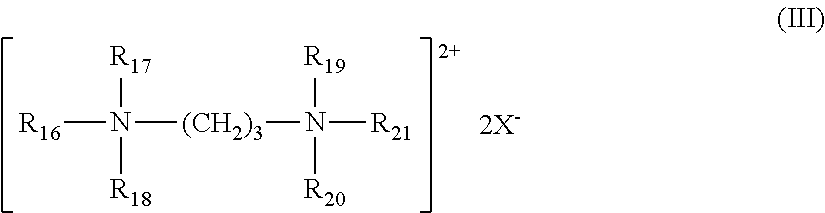
in which R16 denotes an alkyl group comprising for about 16 to 30 carbon atoms, optionally hydroxylated and/or interrupted with one or more oxygen atoms; R17 is chosen from hydrogen, an alkyl group comprising from 1 to 4 carbon atoms or a group —(CH2)3—N+(R16a)(R17a)(R18a); R16a, R17a, R18a, R18, R19, R20 and R21, which may be identical or different, are chosen from hydrogen and an alkyl group comprising from 1 to 4 carbon atoms, and X− is an anion chosen from the group of halides, acetates, phosphates, nitrates, (C1-C4)alkyl sulfates and (C1-C4)alkyl- or (C1-C4)alkylaryl-sulfonates, in particular methyl sulfate and ethyl sulfate. Such compounds are, for example, Finquat CT-P, available from the company Finetex (Quaternium 89), and Finquat CT, available from the company Finetex (Quaternium 75);
-
- quaternary ammonium salts containing one or more ester functions, for instance those of formula (IV) below:

in which:
R22 is chosen from C1-C6 alkyl and C1-C6 hydroxyalkyl or dihydroxyalkyl groups;
R23 is selected from:
-
- the group

-
- linear or branched, saturated or unsaturated C1-C22 hydrocarbon-based groups R27,
- a hydrogen atom,
R25 is selected from: - the group

-
- the groups R29, which are linear or branched, saturated or unsaturated C1-C6 hydrocarbon-based radicals;
- a hydrogen atom,
R24, R26 and R28, which may be identical or different, are chosen from linear or branched, saturated or unsaturated C7-C21 hydrocarbon-based groups;
r, s and t, which may be identical or different, are integers ranging from 2 to 6,
r1 and t1, which may be identical or different, are equal to 0 or 1,
r2+r1=2 r and t1+t2=2 t,
y is an integer ranging from 1 to 10,
x and z, which may be identical or different, are integers ranging from 0 to 10,
X− is a simple or complex organic or inorganic anion,
with the proviso that the sum x+y+z is from 1 to 15, that when x is 0, then R23 denotes R27 and that when z is 0, then R25 denotes R29.
-
- R22 denotes a methyl or ethyl group,
- x and y are equal to 1,
- z is equal to 0 or 1,
- r, s and t are equal to 2,
- R23 is chosen from:
- the group

-
- methyl, ethyl or C14-C22 hydrocarbon-based groups,
- a hydrogen atom,
- R25 is chosen from:
- the group

-
- a hydrogen atom,
- R24, R26 and R28, which may be identical or different, are chosen from linear or branched, saturated or unsaturated C13-C17 hydrocarbon-based groups, and more particularly from linear or branched, saturated or unsaturated C13-C17 alkyl and alkenyl groups.
-
- oxyalkylenated or glycerolated fatty alcohols;
- oxyalkylenated alkylphenols, the alkyl chain of which is a C8-C18 alkyl chain;
- oxyalkylenated or glycerolated fatty amides;
- oxyalkylenated plant oils;
- optionally oxyalkylenated C6-C30 acid esters of sorbitan;
- optionally oxyalkylenated fatty acid esters of sucrose;
- fatty acid esters of polyethylene glycol;
- (C6-C30)alkylpolyglycosides;
- N—(C6-C30)alkylglucamine derivatives;
- amine oxides such as (C10-C14)alkylamine oxides or N-acylaminopropylmorpholine oxides;
- copolymers of ethylene oxide and of propylene oxide;
- mixtures thereof.
-
- (C6-C30)alkyl sulfates, (C6-C30)alkyl ether sulfates, (C6-C30)alkylamido ether sulfates, alkylaryl polyether sulfates and monoglyceride sulfates;
- (C6-C30)alkylsulfonates, (C6-C30)alkylamidesulfonates, (C6-C30)alkylaryl-sulfonates, α-olefin-sulfonates and paraffin-sulfonates;
- (C6-C30)alkyl phosphates;
- (C6-C30)alkylsulfosuccinates, (C6-C30)alkyl ether sulfosuccinates and (C6-C30)alkylamidesulfosuccinates;
- (C6-C30)alkylsulfoacetates;
- (C6-C24)acylsarcosinates;
- (C6-C24)acylglutamates;
- (C6-C30)alkyl polyglycoside carboxylic ethers; (C6-C30)alkyl polyglycoside sulfosuccinates;
- (C6-C30)alkylsulfosuccinamates;
- (C6-C24)acylisethionates;
- N—(C6-C24)acyltaurates;
- fatty acid salts; coconut oil or hydrogenated coconut oil acid salts;
- (C8-C20)acyl-lactylates;
- (C6-C30)alkyl-D-galactoside uronic acid salts;
- salts of polyoxyalkylenated(C6-C30)alkyl ether carboxylic acids, of polyoxyalkylenated (C6-C30)alkylaryl ether carboxylic acids or of polyoxyalkylenated (C6-C30)alkylamido ether carboxylic acids;
- and mixtures thereof.
Ra—C(O)—NH—CH2—CH2—N+(Rb)(Rc)—CH2C(O)O−,M+,X− (A1)
in which formula (A1):
-
- Ra represents a C10-C30 alkyl or alkenyl group derived from an acid Ra-COOH preferably present in hydrolysed coconut oil, or a heptyl, nonyl or undecyl group;
- Rb represents a β-hydroxyethyl group; and
- M+ represents a carboxymethyl group;
- M+ represents a cationic counterion derived from an alkali metal or alkaline-earth metal, such as sodium, an ammonium ion or an ion derived from an organic amine, and
- X− represents an organic or inorganic anionic counterion, such as that chosen from halides, acetates, phosphates, nitrates, (C1-C4)alkyl sulfates, (C1-C4)alkyl- or (C1-C4)alkylarylsulfonates, in particular methyl sulfate and ethyl sulfate; or alternatively M+ and X− are absent;
Ra—C(O)—NH—CH2—CH2—N(B)(B′) (A2) - in which formula (A2):
- B represents the group —CH2-CH2-O—X′;
- B′ represents the group —(CH2)zY′, with z=1 or 2;
- X′ represents the group —CH2—C(O)OH, —CH2—C(O)OZ′, —CH2—CH2—C(O)OH, —CH2—CH2—C(O)OZ′, or a hydrogen atom;
- Y′ represents the group —C(O)OH, —C(O)OZ′, —CH2-CH(OH)—SO3H or the group —CH2-CH(OH)—SO3-Z′;
- Z′ represents a cationic counterion derived from an alkali metal or alkaline-earth metal, such as sodium, an ammonium ion or an ion derived from an organic amine;
- Ra′ represents a C10-C30 alkyl or alkenyl group of an acid Ra′-C(O)OH preferably present in coconut oil or in hydrolysed linseed oil, an alkyl group, especially of C17 and its iso form, or an unsaturated C17 group.
-
- the methacrylates of formula CH2═C(CH3)—COOR1,
in which R1 represents a linear or branched alkyl group containing from 1 to 4 carbon atoms, such as a methyl, ethyl, propyl or isobutyl group, the said alkyl group also possibly being substituted with one or more substituents chosen from hydroxyl groups and halogen atoms (Cl, Br, I or F), or R1 represents a C4 to C12 cycloalkyl group, - the acrylates of formula CH2═CH—COOR2
in which R2 represents a C4 to C12 cycloalkyl group such as isobornyl acrylate or a tert-butyl group, - the (meth)acrylamides of formula:
- the methacrylates of formula CH2═C(CH3)—COOR1,

in which R7 and R8, which may be identical or different, each represent a hydrogen atom or a linear or branched C1 to C12 alkyl group such as an n-butyl, t-butyl, isopropyl, isohexyl, isooctyl or isononyl group; or R7 represents H and R8 represents a 1,1-dimethyl-3-oxobutyl group, and
and R′ denotes H or methyl. Examples of monomers that may be mentioned include N-butylacrylamide, N-t-butylacrylamide, N-isopropylacrylamide, N,N-dimethylacrylamide and N,N-dibutylacrylamide,
-
- styrene and derivatives thereof such as chlorostyrene,
- and mixtures thereof.
- 1-N-methylmorpholiniumpropylamino-4-hydroxyanthraquinone,
- 1-aminopropylamino-4-methylaminoanthraquinone,
- 1-aminopropylaminoanthraquinone,
- 5-β-hydroxyethyl-1,4-diaminoanthraquinone,
- 2-aminoethylaminoanthraquinone,
- 1,4-bis(β,γ-dihydroxypropylamino)anthraquinone.
- 2-β-hydroxyethlyamino-5-[bis(β-4′-hydroxyethyl)amino]anilino-1,4-benzoquinone;
- 2-β-hydroxyethylamino-5-(2′-methoxy-4′-amino)anilino-1,4-benzoquinone;
- 3-N-(2′-chloro-4′-hydroxy)phenylacetylamino-6-methoxy-1,4-benzoquinoneimine
- 3-N-(3′-chloro-4′-methylamino)phenylureido-6-methyl-1,4-benzoquinoneimine;
- 3-[4′-N-(ethyl,carbamylmethyl)amino]phenylureido-6-methyl-1,4-benzoquinoneimine.
-
- flavonols, for instance catechin and epicatechin gallate,
- flavonols, such as quercetin,
- anthocyanidins, for instance cyanidin, delphinidin and petunidin,
- anthocyanins or anthocyans, for instance myrtillin,
- ortho-hydroxybenzoates, for example gallic acid salts,
- flavones, such as luteolin,
- hydroxystilbenes, for example tetrahydroxy-3,3′,4,5′-stilbene, optionally oxylated (for example glucosylated),
- 3,4-dihydroxyphenylalanine and derivatives thereof,
- 2,3-dihydroxyphenylalanine and derivatives thereof,
- 4,5-dihydroxyphenylalanine and derivatives thereof,
- dihydroxycinnamates such as caffeic acid and chlorogenic acid,
- ortho-polyhydroxycoumarins,
- ortho-polyhydroxyisocoumarins,
- ortho-polyhydroxycoumarones,
- ortho-polyhydroxyisocoumarones,
- ortho-polyhydroxychalcones,
- ortho-polyhydroxychromones,
- ortho-polyhydroxyquinones,
- ortho-polyhydroxyxanthones,
- 1,2-dihydroxybenzene and derivatives thereof,
- 1,2,4-trihydroxybenzene and derivatives thereof,
- 1,2,3-trihydroxybenzene and derivatives thereof,
- 2,4,5-trihydroxytoluene and derivatives thereof,
- proanthocyanidins and in particular the proanthocyanidins A1, A2, B1, B2, B3 and C1,
- proathocyanins,
- tannic acid,
- ellagic acid,
- and mixtures of the preceding compounds,
| Composition | Composition | Composition | |
| Composition | 1 | 2 | 3 |
| cetylstearyl alcohol | 5 | 5 | 5 |
| (C16/ |
|||
| Myristyl/cetyl/stearyl | 1 | 1 | 1 |
| myristate/palmitate/stearate | |||
| mixture | |||
| Behenyltrimethylammonium | 0.79 | 0.79 | 2.96 |
| chloride (melting point: | |||
| 77-80° C.) | |||
| Isopropyl myristate | 1.05 | 1.05 | 1.05 |
| Ozokerite (melting point: | — | 2 | — |
| 73-80° C.) | |||
| Isopropyl alcohol | 0.18 | 0.18 | 0.675 |
| Mineral oil | — | — | 0.21 |
| Polyquaternium-37* | — | — | 0.3 |
| Dimethicone | 0.4 | ||
| Amodimethicone | — | — | 0.1 |
| Water | qs 100 | qs 100 | qs 100 |
| *Crosslinked ethyltrimethylammonium methacrylate chloride homopolymer as an inverse emulsion in a mineral oil | |||
Claims (20)
Priority Applications (1)
| Application Number | Priority Date | Filing Date | Title |
|---|---|---|---|
| US14/128,097 US10863811B2 (en) | 2011-06-23 | 2012-06-25 | Process for treating keratin fibres with input of heat |
Applications Claiming Priority (5)
| Application Number | Priority Date | Filing Date | Title |
|---|---|---|---|
| FR1155575A FR2976804B1 (en) | 2011-06-23 | 2011-06-23 | PROCESS FOR TREATING KERATIN FIBERS WITH HEAT DELIVERY |
| FR1155575 | 2011-06-23 | ||
| US201161510048P | 2011-07-20 | 2011-07-20 | |
| PCT/EP2012/062223 WO2012175734A1 (en) | 2011-06-23 | 2012-06-25 | Process for treating keratin fibres with input of heat |
| US14/128,097 US10863811B2 (en) | 2011-06-23 | 2012-06-25 | Process for treating keratin fibres with input of heat |
Publications (2)
| Publication Number | Publication Date |
|---|---|
| US20140230842A1 US20140230842A1 (en) | 2014-08-21 |
| US10863811B2 true US10863811B2 (en) | 2020-12-15 |
Family
ID=44993002
Family Applications (1)
| Application Number | Title | Priority Date | Filing Date |
|---|---|---|---|
| US14/128,097 Active 2033-07-21 US10863811B2 (en) | 2011-06-23 | 2012-06-25 | Process for treating keratin fibres with input of heat |
Country Status (8)
| Country | Link |
|---|---|
| US (1) | US10863811B2 (en) |
| EP (1) | EP2723307B1 (en) |
| JP (1) | JP6018191B2 (en) |
| CN (1) | CN103561712B (en) |
| BR (1) | BR112013031210B1 (en) |
| ES (1) | ES2776143T3 (en) |
| FR (1) | FR2976804B1 (en) |
| WO (1) | WO2012175734A1 (en) |
Families Citing this family (25)
| Publication number | Priority date | Publication date | Assignee | Title |
|---|---|---|---|---|
| JP6336597B2 (en) * | 2013-12-19 | 2018-06-06 | ザ プロクター アンド ギャンブル カンパニー | Fiber material molding equipment |
| CN105828795A (en) | 2013-12-19 | 2016-08-03 | 宝洁公司 | Shaping Keratin Fibres Using A Reducing Composition And A Fixing Composition |
| MX353843B (en) | 2013-12-19 | 2018-01-30 | Procter & Gamble | Shaping keratin fibres using oxoethanoic acid and/or derivatives thereof. |
| JP6396473B2 (en) | 2013-12-19 | 2018-09-26 | ザ プロクター アンド ギャンブル カンパニー | Molding of keratin fibers using an activator comprising at least two functional groups selected from -C (OH)-and -C (= O) OH |
| WO2015095685A1 (en) | 2013-12-19 | 2015-06-25 | The Procter & Gamble Company | Shaping keratin fibres using 2-hydroxypropane-1,2,3-tricarboxylic acid and/or 1,2,3,4-butanetetracarboxylic acid |
| MX363629B (en) | 2013-12-19 | 2019-03-28 | Procter & Gamble | Shaping keratin fibres using an active agent comprising a functional group selected from the group consisting of: -c(=o)-, -c(=o)-h, and -c(=o)-o-. |
| EP3082744A1 (en) | 2013-12-19 | 2016-10-26 | The Procter & Gamble Company | Shaping keratin fibres using carbonate ester |
| WO2015094757A1 (en) | 2013-12-19 | 2015-06-25 | The Procter & Gamble Company | Shaping keratin fibres using a sugar |
| WO2016100258A1 (en) | 2014-12-19 | 2016-06-23 | The Procter & Gamble Company | Method of shaping keratin fibres |
| WO2016100257A1 (en) | 2014-12-19 | 2016-06-23 | The Procter & Gamble Company | Shaping keratin fibres using arabinose and ethylene carbonate |
| MX2017016152A (en) | 2015-06-18 | 2018-04-18 | Procter & Gamble | Shaping keratin fibres using dialdehyde compounds. |
| US20180168997A1 (en) * | 2015-06-24 | 2018-06-21 | Kao Germany Gmbh | Hair conditioning composition |
| EP3216368A1 (en) * | 2016-03-09 | 2017-09-13 | Koninklijke Philips N.V. | Hair styling |
| FR3052060B1 (en) | 2016-06-06 | 2018-06-08 | L'oreal | PROCESS FOR TREATING KERATIN FIBERS WITH A PARTICULAR COMPOSITION AND A HEATING TOOL |
| FR3062786B1 (en) * | 2017-02-13 | 2021-06-25 | Oreal | HAIR TREATMENT DEVICE |
| FR3064456B1 (en) * | 2017-03-30 | 2019-04-05 | L'oreal | PROCESS FOR TREATING KERATIN FIBERS WITH HEAT DELIVERY |
| RU2734471C1 (en) * | 2017-09-10 | 2020-10-16 | Конинклейке Филипс Н.В. | Hair styling device |
| EP3453279A1 (en) * | 2017-09-10 | 2019-03-13 | Koninklijke Philips N.V. | Hair styling device |
| JP1665824S (en) | 2019-08-21 | 2020-08-11 | ||
| WO2021042128A1 (en) * | 2019-08-30 | 2021-03-04 | The Procter & Gamble Company | Hair conditioning product comprising first and second compositions |
| US11497703B2 (en) | 2019-08-30 | 2022-11-15 | The Procter & Gamble Company | Packaged hair care composition |
| US11752074B2 (en) | 2020-10-27 | 2023-09-12 | The Procter & Gamble Company | Warming conditioner |
| USD1006632S1 (en) | 2020-12-11 | 2023-12-05 | The Procter & Gamble Company | Container for hair care products |
| USD1012718S1 (en) | 2020-12-21 | 2024-01-30 | The Procter & Gamble Company | Container for hair care product |
| CN115781136B (en) * | 2023-02-03 | 2023-04-25 | 苏芯物联技术(南京)有限公司 | Intelligent recognition and optimization feedback method for welding heat input abnormality |
Citations (44)
| Publication number | Priority date | Publication date | Assignee | Title |
|---|---|---|---|---|
| US2263718A (en) | 1939-03-01 | 1941-11-25 | Cowan Harry | Hair waving apparatus |
| GB1026978A (en) | 1962-03-30 | 1966-04-20 | Schwarzkopf Verwaltung G M B H | Method of dyeing hair |
| GB1153196A (en) | 1965-07-07 | 1969-05-29 | Schwarzkopf Verwaltung G M B H | Method of Dyeing Hair |
| DE2359399A1 (en) | 1973-11-29 | 1975-06-12 | Henkel & Cie Gmbh | Tetraaminopyrimidines as developers in oxidation hair dyes - esp. used with meta aminophenol couplers for blue shading dyes |
| US3941613A (en) * | 1974-04-01 | 1976-03-02 | Nicoletti Robert E | Hair frosting device |
| US4003699A (en) | 1974-11-22 | 1977-01-18 | Henkel & Cie G.M.B.H. | Oxidation hair dyes based upon tetraaminopyrimidine developers |
| US4137180A (en) | 1976-07-02 | 1979-01-30 | Lever Brothers Company | Fabric treatment materials |
| USRE30199E (en) | 1973-11-29 | 1980-01-29 | Henkel Kommanditgesellschaft Auf Aktien (Henkel Kgaa) | Oxidation hair dyes based upon tetraaminopyrimidine developers |
| US4261375A (en) * | 1979-06-22 | 1981-04-14 | Douglas Anderson | Hair curler and crimper |
| US4714820A (en) * | 1985-08-22 | 1987-12-22 | Clairol Incorporated | Electrically heated curling wrapper |
| US4743726A (en) * | 1986-10-14 | 1988-05-10 | Hughes Thomas E | Microwave activated heating element |
| US4849593A (en) * | 1986-10-14 | 1989-07-18 | Hughes Thomas E | Microwave-activated heating element |
| US4874554A (en) | 1986-07-10 | 1989-10-17 | Henkel Kommanditgesellschaft Auf Aktien | Quaternary ammonium compounds |
| JPH0219576A (en) | 1988-07-07 | 1990-01-23 | Kao Corp | Dyeing composition for keratinous fiber |
| DE3843892A1 (en) | 1988-12-24 | 1990-06-28 | Wella Ag | OXIDATION HAIR AGENTS CONTAINING DIAMINOPYRAZOL DERIVATIVES AND NEW DIAMINOPYRAZOLE DERIVATIVES |
| US4942893A (en) * | 1988-08-03 | 1990-07-24 | Trottier Allan J | Hair highlighting capsule |
| US5156172A (en) * | 1991-11-29 | 1992-10-20 | Paul Straubinger | Device and method for cosmetically treating hair |
| DE4133957A1 (en) | 1991-10-14 | 1993-04-15 | Wella Ag | HAIR DYE CONTAINING AMINOPYRAZOLE DERIVATIVES AND NEW PYRAZOLE DERIVATIVES |
| JPH05163124A (en) | 1991-12-17 | 1993-06-29 | Kao Corp | Keratin fiber dyeing composition |
| WO1994008970A1 (en) | 1992-10-16 | 1994-04-28 | Wella Aktiengesellschaft | Oxidation hair dye containing 4,5-diaminopyrazole derivatives and novel 4,5-diaminopyrazole derivatives and process for their production |
| WO1994008969A1 (en) | 1992-10-16 | 1994-04-28 | Wella Aktiengesellschaft | Process for producing 4,5-diamino pyrazole derivatives, their use for colouring hair and novel pyrazole derivatives |
| WO1995001772A1 (en) | 1993-07-05 | 1995-01-19 | Ciba-Geigy Ag | Process for dyeing keratin-containing fibres |
| WO1995015144A1 (en) | 1993-11-30 | 1995-06-08 | Ciba-Geigy Ag | Cationic dyes for keratin-containing fibres |
| WO1996015765A1 (en) | 1994-11-17 | 1996-05-30 | Henkel Kommanditgesellschaft Auf Aktien | Oxidation dyes |
| EP0714954A2 (en) | 1994-11-03 | 1996-06-05 | Ciba-Geigy Ag | Cationic iminazoleazodyestuffs |
| FR2733749A1 (en) | 1995-05-05 | 1996-11-08 | Oreal | COMPOSITIONS FOR DYEING KERATINIC FIBERS CONTAINING DIAMINO PYRAZOLES, DYEING PROCESS, NOVEL DIAMINO PYRAZOLES, AND PREPARATION METHOD THEREOF |
| EP0770375A1 (en) | 1995-10-21 | 1997-05-02 | GOLDWELL GmbH | Hair dyeing composition |
| DE19543988A1 (en) | 1995-11-25 | 1997-05-28 | Wella Ag | Oxidative hair dye composition |
| US5663366A (en) | 1992-10-16 | 1997-09-02 | Wella Aktiengesellschat | Process for the synthesis of 4,5-diaminopyrazole derivatives useful for dyeing hair |
| FR2750048A1 (en) | 1996-06-21 | 1997-12-26 | Oreal | KERATIN FIBER DYEING COMPOSITIONS CONTAINING PYRAZOLO- (1,5-A) -PYRIMIDINE DERIVATIVES, DYEING PROCESS, NOVEL PYRAZOLO- (1,5-A) -PYRIMIDINE DERIVATIVES AND PROCESS FOR PREPARING THE SAME |
| US5706839A (en) * | 1997-02-10 | 1998-01-13 | Patti; Josie Ann | Direct application |
| US5933794A (en) | 1997-02-25 | 1999-08-03 | Hughes Electronics Corporation | Scalable parallel processing apparatus and method for performing fast multipole scattering calculations |
| US6153178A (en) | 1996-05-08 | 2000-11-28 | Wella Aktiengesellschaft | Agent and process for permanent hair wave based on mercaptoacetamides |
| EP1147762A2 (en) | 2000-04-19 | 2001-10-24 | Kao Corporation | Method of treating hair |
| FR2821250A1 (en) | 2001-02-28 | 2002-08-30 | Kao Corp | DEVICE FOR HEATING HAIR AND HAIR TREATMENT METHOD USING THE SAME |
| US20040129290A1 (en) * | 2003-01-08 | 2004-07-08 | Kwan Anthony C. | Hair color applicator to add color, graphics or custom patterns of the individual per design |
| US20080083418A1 (en) * | 2006-10-09 | 2008-04-10 | The Proctor & Gamble Company | Hair highlighting application tool |
| US20080308119A1 (en) * | 2007-06-15 | 2008-12-18 | Paul James Smith | Device for the Application of a Hair Treatment Composition to a Hair Bundle |
| US20090211594A1 (en) * | 2006-03-03 | 2009-08-27 | Kao Corporation | Hair holder |
| EP2095737A1 (en) | 2008-02-29 | 2009-09-02 | Wella Aktiengesellschaft | A device to treat hair using ultrasound |
| US20100263683A1 (en) * | 2009-04-15 | 2010-10-21 | Katia Dutheil-Gouret | Method for shaping the hair using at least one reducing composition, at least one care composition, and heating |
| WO2011151310A1 (en) * | 2010-06-03 | 2011-12-08 | L'oreal | Device for confinement of a cosmetic product on a volume of keratin fibers, kit and associated method. |
| US8132576B1 (en) * | 2009-03-12 | 2012-03-13 | Quale, Inc. | Hair coloring agent capsule |
| US20130152959A1 (en) * | 2010-05-11 | 2013-06-20 | L'oreal | Hair treatment method |
Family Cites Families (4)
| Publication number | Priority date | Publication date | Assignee | Title |
|---|---|---|---|---|
| JPS63169571A (en) | 1987-01-06 | 1988-07-13 | Nec Corp | Tone detector |
| JP2001213741A (en) * | 2000-02-01 | 2001-08-07 | Hoyu Co Ltd | Method for hair treatment |
| JP4076355B2 (en) * | 2001-02-28 | 2008-04-16 | 花王株式会社 | Hair treatment method |
| JP2008272505A (en) * | 2008-06-26 | 2008-11-13 | Procter & Gamble Co | Hair styling apparatus and method for straightening hair strands on scalp site |
-
2011
- 2011-06-23 FR FR1155575A patent/FR2976804B1/en not_active Expired - Fee Related
-
2012
- 2012-06-25 ES ES12735238T patent/ES2776143T3/en active Active
- 2012-06-25 US US14/128,097 patent/US10863811B2/en active Active
- 2012-06-25 CN CN201280026107.2A patent/CN103561712B/en active Active
- 2012-06-25 JP JP2014516385A patent/JP6018191B2/en active Active
- 2012-06-25 BR BR112013031210-6A patent/BR112013031210B1/en active IP Right Grant
- 2012-06-25 EP EP12735238.3A patent/EP2723307B1/en active Active
- 2012-06-25 WO PCT/EP2012/062223 patent/WO2012175734A1/en not_active Ceased
Patent Citations (60)
| Publication number | Priority date | Publication date | Assignee | Title |
|---|---|---|---|---|
| US2263718A (en) | 1939-03-01 | 1941-11-25 | Cowan Harry | Hair waving apparatus |
| GB1026978A (en) | 1962-03-30 | 1966-04-20 | Schwarzkopf Verwaltung G M B H | Method of dyeing hair |
| GB1153196A (en) | 1965-07-07 | 1969-05-29 | Schwarzkopf Verwaltung G M B H | Method of Dyeing Hair |
| DE2359399A1 (en) | 1973-11-29 | 1975-06-12 | Henkel & Cie Gmbh | Tetraaminopyrimidines as developers in oxidation hair dyes - esp. used with meta aminophenol couplers for blue shading dyes |
| USRE30199E (en) | 1973-11-29 | 1980-01-29 | Henkel Kommanditgesellschaft Auf Aktien (Henkel Kgaa) | Oxidation hair dyes based upon tetraaminopyrimidine developers |
| US3941613A (en) * | 1974-04-01 | 1976-03-02 | Nicoletti Robert E | Hair frosting device |
| US4003699A (en) | 1974-11-22 | 1977-01-18 | Henkel & Cie G.M.B.H. | Oxidation hair dyes based upon tetraaminopyrimidine developers |
| US4137180A (en) | 1976-07-02 | 1979-01-30 | Lever Brothers Company | Fabric treatment materials |
| US4261375A (en) * | 1979-06-22 | 1981-04-14 | Douglas Anderson | Hair curler and crimper |
| US4714820A (en) * | 1985-08-22 | 1987-12-22 | Clairol Incorporated | Electrically heated curling wrapper |
| US4874554A (en) | 1986-07-10 | 1989-10-17 | Henkel Kommanditgesellschaft Auf Aktien | Quaternary ammonium compounds |
| US4743726A (en) * | 1986-10-14 | 1988-05-10 | Hughes Thomas E | Microwave activated heating element |
| US4849593A (en) * | 1986-10-14 | 1989-07-18 | Hughes Thomas E | Microwave-activated heating element |
| JPH0219576A (en) | 1988-07-07 | 1990-01-23 | Kao Corp | Dyeing composition for keratinous fiber |
| US4942893A (en) * | 1988-08-03 | 1990-07-24 | Trottier Allan J | Hair highlighting capsule |
| DE3843892A1 (en) | 1988-12-24 | 1990-06-28 | Wella Ag | OXIDATION HAIR AGENTS CONTAINING DIAMINOPYRAZOL DERIVATIVES AND NEW DIAMINOPYRAZOLE DERIVATIVES |
| US5061289A (en) | 1988-12-24 | 1991-10-29 | Wella Aktiengesellschaft | Oxidation hair dye composition containinng diaminopyrazol derivatives and new diaminopyrazol derivatives |
| DE4133957A1 (en) | 1991-10-14 | 1993-04-15 | Wella Ag | HAIR DYE CONTAINING AMINOPYRAZOLE DERIVATIVES AND NEW PYRAZOLE DERIVATIVES |
| US5380340A (en) | 1991-10-14 | 1995-01-10 | Wella Aktiengesellschaft | Hair dye containing aminopyrazole derivatives as well as pyrazole derivatives |
| US5156172A (en) * | 1991-11-29 | 1992-10-20 | Paul Straubinger | Device and method for cosmetically treating hair |
| JPH05163124A (en) | 1991-12-17 | 1993-06-29 | Kao Corp | Keratin fiber dyeing composition |
| US5534267A (en) | 1992-10-16 | 1996-07-09 | Wella Aktiengesellschaft | Composition for the oxidative dyeing of hair containing 4,5-diaminopyrazole derivatives as well as new 4,5-diaminopyrazole derivatives and process for their synthesis |
| WO1994008970A1 (en) | 1992-10-16 | 1994-04-28 | Wella Aktiengesellschaft | Oxidation hair dye containing 4,5-diaminopyrazole derivatives and novel 4,5-diaminopyrazole derivatives and process for their production |
| WO1994008969A1 (en) | 1992-10-16 | 1994-04-28 | Wella Aktiengesellschaft | Process for producing 4,5-diamino pyrazole derivatives, their use for colouring hair and novel pyrazole derivatives |
| US5663366A (en) | 1992-10-16 | 1997-09-02 | Wella Aktiengesellschat | Process for the synthesis of 4,5-diaminopyrazole derivatives useful for dyeing hair |
| WO1995001772A1 (en) | 1993-07-05 | 1995-01-19 | Ciba-Geigy Ag | Process for dyeing keratin-containing fibres |
| WO1995015144A1 (en) | 1993-11-30 | 1995-06-08 | Ciba-Geigy Ag | Cationic dyes for keratin-containing fibres |
| EP0714954A2 (en) | 1994-11-03 | 1996-06-05 | Ciba-Geigy Ag | Cationic iminazoleazodyestuffs |
| US5708151A (en) | 1994-11-03 | 1998-01-13 | Ciba Specialty Chemicals Corporation | Cationic imidazole azo dyes |
| WO1996015765A1 (en) | 1994-11-17 | 1996-05-30 | Henkel Kommanditgesellschaft Auf Aktien | Oxidation dyes |
| US6284003B1 (en) | 1994-11-17 | 2001-09-04 | Henkel Kommanditgesellschaft Auf Aktien | Oxidation colorants comprising 2-(2,5-diaminophenyl)-ethanol compounds and 2-chloro-6-methyl-3-aminophenol compounds |
| FR2733749A1 (en) | 1995-05-05 | 1996-11-08 | Oreal | COMPOSITIONS FOR DYEING KERATINIC FIBERS CONTAINING DIAMINO PYRAZOLES, DYEING PROCESS, NOVEL DIAMINO PYRAZOLES, AND PREPARATION METHOD THEREOF |
| US6099592A (en) | 1995-05-05 | 2000-08-08 | L'oreal | Composition for dyeing keratin fibers which contain at least one diaminopyrazole, dyeing process, novel diaminopyrazoles and process for their preparation |
| US6645258B2 (en) | 1995-05-05 | 2003-11-11 | L'oreal, S.A. | Composition for dyeing keratin fibers which contain at least one diaminopyrazole, dyeing process, novel diaminopyrazoles and process for their preparation |
| US20030019051A9 (en) | 1995-05-05 | 2003-01-30 | L'oreal | Composition for dyeing keratin fibers which contain at least one diaminopyrazole, dyeing process, novel diaminopyrazoles and process for their preparation |
| US20020050013A1 (en) | 1995-05-05 | 2002-05-02 | L'oreal | Composition for dyeing keratin fibers which contain at least one diaminopyrazole, dyeing process, novel diaminopyrazoles and process for their preparation |
| US6338741B1 (en) | 1995-05-05 | 2002-01-15 | L'oreal | Composition for dyeing keratin fibers which contain at least one diaminopyrazole, dyeing process, novel diaminopyrazoles and process for their preparation |
| EP0770375A1 (en) | 1995-10-21 | 1997-05-02 | GOLDWELL GmbH | Hair dyeing composition |
| US5766576A (en) | 1995-11-25 | 1998-06-16 | Wella Aktiengesellschaft | Oxidation hair dye compositions containing 3,4,5-triaminopyrazole derivatives and 3,4,5-triaminopyrazole derivatives |
| DE19543988A1 (en) | 1995-11-25 | 1997-05-28 | Wella Ag | Oxidative hair dye composition |
| US6153178A (en) | 1996-05-08 | 2000-11-28 | Wella Aktiengesellschaft | Agent and process for permanent hair wave based on mercaptoacetamides |
| FR2750048A1 (en) | 1996-06-21 | 1997-12-26 | Oreal | KERATIN FIBER DYEING COMPOSITIONS CONTAINING PYRAZOLO- (1,5-A) -PYRIMIDINE DERIVATIVES, DYEING PROCESS, NOVEL PYRAZOLO- (1,5-A) -PYRIMIDINE DERIVATIVES AND PROCESS FOR PREPARING THE SAME |
| US6099593A (en) | 1996-06-21 | 2000-08-08 | L'oreal | Compositions for dyeing keratin fibers containing pyrazolo(1,5-a)pyrimidine derivatives and dyeing processes |
| US5706839A (en) * | 1997-02-10 | 1998-01-13 | Patti; Josie Ann | Direct application |
| US5933794A (en) | 1997-02-25 | 1999-08-03 | Hughes Electronics Corporation | Scalable parallel processing apparatus and method for performing fast multipole scattering calculations |
| EP1147762A2 (en) | 2000-04-19 | 2001-10-24 | Kao Corporation | Method of treating hair |
| US7562661B2 (en) | 2001-02-28 | 2009-07-21 | Kao Corporation | Hair warming tool and hair treating method |
| FR2821250A1 (en) | 2001-02-28 | 2002-08-30 | Kao Corp | DEVICE FOR HEATING HAIR AND HAIR TREATMENT METHOD USING THE SAME |
| US20020157682A1 (en) | 2001-02-28 | 2002-10-31 | Kao Corporation | Hair warming tool and hair treating method |
| US20040129290A1 (en) * | 2003-01-08 | 2004-07-08 | Kwan Anthony C. | Hair color applicator to add color, graphics or custom patterns of the individual per design |
| US20090211594A1 (en) * | 2006-03-03 | 2009-08-27 | Kao Corporation | Hair holder |
| US20080083418A1 (en) * | 2006-10-09 | 2008-04-10 | The Proctor & Gamble Company | Hair highlighting application tool |
| US20080308119A1 (en) * | 2007-06-15 | 2008-12-18 | Paul James Smith | Device for the Application of a Hair Treatment Composition to a Hair Bundle |
| US8499770B2 (en) * | 2007-06-15 | 2013-08-06 | The Procter & Gamble Company | Device for the application of a hair treatment composition to a hair bundle |
| EP2095737A1 (en) | 2008-02-29 | 2009-09-02 | Wella Aktiengesellschaft | A device to treat hair using ultrasound |
| US8132576B1 (en) * | 2009-03-12 | 2012-03-13 | Quale, Inc. | Hair coloring agent capsule |
| US20100263683A1 (en) * | 2009-04-15 | 2010-10-21 | Katia Dutheil-Gouret | Method for shaping the hair using at least one reducing composition, at least one care composition, and heating |
| FR2944438A1 (en) | 2009-04-15 | 2010-10-22 | Oreal | METHOD OF FORMING HAIR BY MEANS OF REDUCING COMPOSITION AND HEATING. |
| US20130152959A1 (en) * | 2010-05-11 | 2013-06-20 | L'oreal | Hair treatment method |
| WO2011151310A1 (en) * | 2010-06-03 | 2011-12-08 | L'oreal | Device for confinement of a cosmetic product on a volume of keratin fibers, kit and associated method. |
Non-Patent Citations (8)
| Title |
|---|
| English Translation of the Office Action for JP 201416385 dated Jul. 3, 2017. |
| Japanese Patent Application No. H10-231235, filed Feb. 21, 1997, with English Abstract. |
| Japanese Patent Application No. H-11-509556, filed Aug. 24, 1999, with English Abstract. |
| Porter, M.R., "Handbook of Surfactants," 1991, pp. 116-178. |
| The International Search Report for corresponding International Patent Application No. PCT/EP2012/062223, dated Nov. 30, 2012. |
| Todd, Charles, et al., "Volatile Silicone Fluids for Cosmetic Formulations," Cosmetics and Toiletries, vol. 91, Jan. 1976, pp. 27-32. |
| Winter, Ruth, "A Consumer's Dictionary of Cosmetic Ingredients", 2005, Three Rieers Press, NY, pp. 721. * |
| Winter, RUth, "A Consumer's Dictionary of Ingredients", 2005, Three Rieers Press, NY, p. 721. * |
Also Published As
| Publication number | Publication date |
|---|---|
| JP6018191B2 (en) | 2016-11-02 |
| CN103561712A (en) | 2014-02-05 |
| FR2976804B1 (en) | 2013-07-12 |
| WO2012175734A1 (en) | 2012-12-27 |
| ES2776143T3 (en) | 2020-07-29 |
| EP2723307A1 (en) | 2014-04-30 |
| CN103561712B (en) | 2016-08-17 |
| US20140230842A1 (en) | 2014-08-21 |
| JP2014520133A (en) | 2014-08-21 |
| BR112013031210B1 (en) | 2018-06-26 |
| EP2723307B1 (en) | 2020-01-15 |
| BR112013031210A2 (en) | 2017-07-25 |
| FR2976804A1 (en) | 2012-12-28 |
Similar Documents
| Publication | Publication Date | Title |
|---|---|---|
| US10863811B2 (en) | Process for treating keratin fibres with input of heat | |
| JP5826454B2 (en) | Lightening or dyeing human keratin fibers using an anhydrous composition containing a monoethanolamine / basic amino acid mixture and device therefor | |
| JP5697844B2 (en) | Method for lightening direct dyeing or oxidation dyeing in the presence of certain organic amines, device therefor and anhydrous composition | |
| JP5788138B2 (en) | Composition comprising fatty substance and specific oxyethylene surfactant, dyeing or lightening method using the same, and apparatus therefor | |
| JP5881934B2 (en) | Method for brightly dyeing keratin materials using an anhydrous dyeing composition comprising an alkaline agent and an oxidizing composition | |
| US7927381B2 (en) | Process for lightening or lightening direct dyeing or oxidation dyeing in the presence of an aqueous composition comprising at least one fatty substance, and device | |
| US9474700B2 (en) | Methods for altering the color and appearance of hair | |
| JP6626618B2 (en) | Dye compositions using long-chain ethers of alkoxylated fatty alcohols and cationic polymers, methods of using the same and devices | |
| CN102100643A (en) | Double agent for dyeing and/or bleaching of keratin fibres, containing fatty substances and chelating agents | |
| EP2729120B1 (en) | Cosmetic composition rich in fatty substances comprising a polyoxyalkylenated fatty alcohol ether and a direct dye and/or an oxidation dye, the dyeing method and the device | |
| JP5748953B2 (en) | Method for dyeing or lightening human keratin fibers using anhydrous compositions and monoethanolamine / basic amino acid mixtures and suitable devices therefor | |
| CN101861188A (en) | Hair treatment method using direct emulsion containing oxidizing agent and composition containing alkaline agent | |
| CN101744748A (en) | Process for lightening or process for direct dyeing or oxidation dyeing of keratin fibers in the presence of ammonium salt and device therefor | |
| WO2013152956A1 (en) | Hair dyeing composition using (2,5- diaminophenyl) ethanol, a betaine amphoteric surfactant or a tertiary fatty amine in a medium rich in fatty substances | |
| ES2793955T3 (en) | Dyeing composition comprising a polycondensate of ethylene oxide and propylene oxide | |
| EP2793806B1 (en) | Oxidizing composition for treating keratin fibres, comprising a phosphoric acid mineral salt, and processes therefore | |
| US10383803B2 (en) | Dye composition using at least one coupler of meta-phenylenediamine type substituted in position 4 in a medium comprising a fatty substance, processes and device |
Legal Events
| Date | Code | Title | Description |
|---|---|---|---|
| AS | Assignment |
Owner name: L'OREAL, FRANCE Free format text: ASSIGNMENT OF ASSIGNORS INTEREST;ASSIGNORS:PARRIS, ERIC;VIC, GABIN;REEL/FRAME:033313/0033 Effective date: 20140314 |
|
| STCV | Information on status: appeal procedure |
Free format text: ON APPEAL -- AWAITING DECISION BY THE BOARD OF APPEALS |
|
| STCV | Information on status: appeal procedure |
Free format text: BOARD OF APPEALS DECISION RENDERED |
|
| STPP | Information on status: patent application and granting procedure in general |
Free format text: NOTICE OF ALLOWANCE MAILED -- APPLICATION RECEIVED IN OFFICE OF PUBLICATIONS |
|
| STPP | Information on status: patent application and granting procedure in general |
Free format text: PUBLICATIONS -- ISSUE FEE PAYMENT VERIFIED |
|
| STCF | Information on status: patent grant |
Free format text: PATENTED CASE |
|
| MAFP | Maintenance fee payment |
Free format text: PAYMENT OF MAINTENANCE FEE, 4TH YEAR, LARGE ENTITY (ORIGINAL EVENT CODE: M1551); ENTITY STATUS OF PATENT OWNER: LARGE ENTITY Year of fee payment: 4 |