US10819997B2 - Encoding video data according to target decoding device decoding complexity - Google Patents
Encoding video data according to target decoding device decoding complexity Download PDFInfo
- Publication number
- US10819997B2 US10819997B2 US15/002,372 US201615002372A US10819997B2 US 10819997 B2 US10819997 B2 US 10819997B2 US 201615002372 A US201615002372 A US 201615002372A US 10819997 B2 US10819997 B2 US 10819997B2
- Authority
- US
- United States
- Prior art keywords
- encoding
- decoding
- complexity
- target
- video data
- Prior art date
- Legal status (The legal status is an assumption and is not a legal conclusion. Google has not performed a legal analysis and makes no representation as to the accuracy of the status listed.)
- Active, expires
Links
Images






Classifications
-
- H—ELECTRICITY
- H04—ELECTRIC COMMUNICATION TECHNIQUE
- H04N—PICTORIAL COMMUNICATION, e.g. TELEVISION
- H04N19/00—Methods or arrangements for coding, decoding, compressing or decompressing digital video signals
- H04N19/42—Methods or arrangements for coding, decoding, compressing or decompressing digital video signals characterised by implementation details or hardware specially adapted for video compression or decompression, e.g. dedicated software implementation
- H04N19/436—Methods or arrangements for coding, decoding, compressing or decompressing digital video signals characterised by implementation details or hardware specially adapted for video compression or decompression, e.g. dedicated software implementation using parallelised computational arrangements
-
- H—ELECTRICITY
- H04—ELECTRIC COMMUNICATION TECHNIQUE
- H04N—PICTORIAL COMMUNICATION, e.g. TELEVISION
- H04N19/00—Methods or arrangements for coding, decoding, compressing or decompressing digital video signals
- H04N19/10—Methods or arrangements for coding, decoding, compressing or decompressing digital video signals using adaptive coding
- H04N19/102—Methods or arrangements for coding, decoding, compressing or decompressing digital video signals using adaptive coding characterised by the element, parameter or selection affected or controlled by the adaptive coding
- H04N19/103—Selection of coding mode or of prediction mode
-
- H—ELECTRICITY
- H04—ELECTRIC COMMUNICATION TECHNIQUE
- H04N—PICTORIAL COMMUNICATION, e.g. TELEVISION
- H04N19/00—Methods or arrangements for coding, decoding, compressing or decompressing digital video signals
- H04N19/10—Methods or arrangements for coding, decoding, compressing or decompressing digital video signals using adaptive coding
- H04N19/134—Methods or arrangements for coding, decoding, compressing or decompressing digital video signals using adaptive coding characterised by the element, parameter or criterion affecting or controlling the adaptive coding
- H04N19/156—Availability of hardware or computational resources, e.g. encoding based on power-saving criteria
-
- H—ELECTRICITY
- H04—ELECTRIC COMMUNICATION TECHNIQUE
- H04N—PICTORIAL COMMUNICATION, e.g. TELEVISION
- H04N19/00—Methods or arrangements for coding, decoding, compressing or decompressing digital video signals
- H04N19/10—Methods or arrangements for coding, decoding, compressing or decompressing digital video signals using adaptive coding
- H04N19/134—Methods or arrangements for coding, decoding, compressing or decompressing digital video signals using adaptive coding characterised by the element, parameter or criterion affecting or controlling the adaptive coding
- H04N19/164—Feedback from the receiver or from the transmission channel
-
- H—ELECTRICITY
- H04—ELECTRIC COMMUNICATION TECHNIQUE
- H04N—PICTORIAL COMMUNICATION, e.g. TELEVISION
- H04N19/00—Methods or arrangements for coding, decoding, compressing or decompressing digital video signals
- H04N19/10—Methods or arrangements for coding, decoding, compressing or decompressing digital video signals using adaptive coding
- H04N19/169—Methods or arrangements for coding, decoding, compressing or decompressing digital video signals using adaptive coding characterised by the coding unit, i.e. the structural portion or semantic portion of the video signal being the object or the subject of the adaptive coding
- H04N19/17—Methods or arrangements for coding, decoding, compressing or decompressing digital video signals using adaptive coding characterised by the coding unit, i.e. the structural portion or semantic portion of the video signal being the object or the subject of the adaptive coding the unit being an image region, e.g. an object
- H04N19/172—Methods or arrangements for coding, decoding, compressing or decompressing digital video signals using adaptive coding characterised by the coding unit, i.e. the structural portion or semantic portion of the video signal being the object or the subject of the adaptive coding the unit being an image region, e.g. an object the region being a picture, frame or field
-
- H—ELECTRICITY
- H04—ELECTRIC COMMUNICATION TECHNIQUE
- H04N—PICTORIAL COMMUNICATION, e.g. TELEVISION
- H04N19/00—Methods or arrangements for coding, decoding, compressing or decompressing digital video signals
- H04N19/10—Methods or arrangements for coding, decoding, compressing or decompressing digital video signals using adaptive coding
- H04N19/102—Methods or arrangements for coding, decoding, compressing or decompressing digital video signals using adaptive coding characterised by the element, parameter or selection affected or controlled by the adaptive coding
- H04N19/115—Selection of the code volume for a coding unit prior to coding
-
- H—ELECTRICITY
- H04—ELECTRIC COMMUNICATION TECHNIQUE
- H04N—PICTORIAL COMMUNICATION, e.g. TELEVISION
- H04N19/00—Methods or arrangements for coding, decoding, compressing or decompressing digital video signals
- H04N19/10—Methods or arrangements for coding, decoding, compressing or decompressing digital video signals using adaptive coding
- H04N19/102—Methods or arrangements for coding, decoding, compressing or decompressing digital video signals using adaptive coding characterised by the element, parameter or selection affected or controlled by the adaptive coding
- H04N19/12—Selection from among a plurality of transforms or standards, e.g. selection between discrete cosine transform [DCT] and sub-band transform or selection between H.263 and H.264
- H04N19/122—Selection of transform size, e.g. 8x8 or 2x4x8 DCT; Selection of sub-band transforms of varying structure or type
-
- H—ELECTRICITY
- H04—ELECTRIC COMMUNICATION TECHNIQUE
- H04N—PICTORIAL COMMUNICATION, e.g. TELEVISION
- H04N19/00—Methods or arrangements for coding, decoding, compressing or decompressing digital video signals
- H04N19/10—Methods or arrangements for coding, decoding, compressing or decompressing digital video signals using adaptive coding
- H04N19/102—Methods or arrangements for coding, decoding, compressing or decompressing digital video signals using adaptive coding characterised by the element, parameter or selection affected or controlled by the adaptive coding
- H04N19/124—Quantisation
-
- H—ELECTRICITY
- H04—ELECTRIC COMMUNICATION TECHNIQUE
- H04N—PICTORIAL COMMUNICATION, e.g. TELEVISION
- H04N19/00—Methods or arrangements for coding, decoding, compressing or decompressing digital video signals
- H04N19/10—Methods or arrangements for coding, decoding, compressing or decompressing digital video signals using adaptive coding
- H04N19/134—Methods or arrangements for coding, decoding, compressing or decompressing digital video signals using adaptive coding characterised by the element, parameter or criterion affecting or controlling the adaptive coding
- H04N19/136—Incoming video signal characteristics or properties
- H04N19/137—Motion inside a coding unit, e.g. average field, frame or block difference
-
- H—ELECTRICITY
- H04—ELECTRIC COMMUNICATION TECHNIQUE
- H04N—PICTORIAL COMMUNICATION, e.g. TELEVISION
- H04N19/00—Methods or arrangements for coding, decoding, compressing or decompressing digital video signals
- H04N19/10—Methods or arrangements for coding, decoding, compressing or decompressing digital video signals using adaptive coding
- H04N19/134—Methods or arrangements for coding, decoding, compressing or decompressing digital video signals using adaptive coding characterised by the element, parameter or criterion affecting or controlling the adaptive coding
- H04N19/146—Data rate or code amount at the encoder output
- H04N19/147—Data rate or code amount at the encoder output according to rate distortion criteria
-
- H—ELECTRICITY
- H04—ELECTRIC COMMUNICATION TECHNIQUE
- H04N—PICTORIAL COMMUNICATION, e.g. TELEVISION
- H04N19/00—Methods or arrangements for coding, decoding, compressing or decompressing digital video signals
- H04N19/10—Methods or arrangements for coding, decoding, compressing or decompressing digital video signals using adaptive coding
- H04N19/169—Methods or arrangements for coding, decoding, compressing or decompressing digital video signals using adaptive coding characterised by the coding unit, i.e. the structural portion or semantic portion of the video signal being the object or the subject of the adaptive coding
- H04N19/17—Methods or arrangements for coding, decoding, compressing or decompressing digital video signals using adaptive coding characterised by the coding unit, i.e. the structural portion or semantic portion of the video signal being the object or the subject of the adaptive coding the unit being an image region, e.g. an object
- H04N19/176—Methods or arrangements for coding, decoding, compressing or decompressing digital video signals using adaptive coding characterised by the coding unit, i.e. the structural portion or semantic portion of the video signal being the object or the subject of the adaptive coding the unit being an image region, e.g. an object the region being a block, e.g. a macroblock
Definitions
- the present invention relates to systems and methods for encoding video data, and in particular to a system and method for according to the target decoding device's ability to decode the encoded video stream.
- HEVC High Efficiency Video Coding
- Patent publication WO 2005002233 for “Method of encoding for handheld apparatuses,” (hereby incorporated by reference herein) discloses estimating a power consumption of a video processing device, but does not suggest encoding for multicore client devices or those with parallel processing. Instead, advanced video encoders such as HEVC video encoders typically optimize rate distortion (RD) and do not consider the complexity of the decoding process that will be required of the decoder that will decode the encoded stream.
- General video encoders (such as the HM encoder used for HEVC encoding) may optimize coding efficiency and video quality. They may not consider optimizing of the decoding complexity of the bitstream at the decoder side.
- the encoder decisions are made without factoring in the effect of those decisions on the complexity as a decoder (handling that bitstream) sees it.
- decoding of specific portions of the encoded bitstream may result in stutters or other manifestations of degradation in the decoding and playback user-experience.
- the present invention discloses a method and system for encoding video data according to the complexity of the targeted decoding device.
- a method of encoding video data for decoding on a target decoding device having parallel processing comprising receiving uncoded video data, computing a relationship between each of a plurality of encoding parameters and target decoding device decoding costs, selecting encoding parameters to minimize encoding costs, wherein the encoding costs include the target decoding device decoding costs, and encoding the uncoded video data according to the selected encoding parameters.
- Another embodiment is evidenced by an apparatus for encoding video data for decoding on a target decoding device having parallel processing, comprising a processor and an encoder.
- the processor is communicatively coupled to a memory storing processor instructions, the processor instructions comprising instructions for computing a relationship between each of a plurality of encoding parameters and target decoding device decoding costs, and selecting encoding parameters to minimize encoding costs, wherein the encoding costs include the target decoding device decoding costs.
- the encoder receives the uncoded video data, and encodes the uncoded video data according to the selected encoding parameters.
- FIG. 1 is a diagram depicting an exemplary embodiment of a video coding-decoding system that can be used for transmission and/or storage and retrieval of audio and/or video information;
- FIG. 2A is a diagram of one embodiment of a codec system in which the encoded AV information is transmitted to and received at another location;
- FIG. 2B is a diagram depicting an exemplary embodiment of codec system in which the encoded information is stored and later retrieved for presentation, hereinafter referred to as codec storage system;
- FIG. 2C is another diagram depicting an exemplary content distribution system comprising a coding system or encoder and a decoding system or decoder that can be used to transmit and receive HEVC data;
- FIG. 3 is a block diagram illustrating one embodiment of the source encoder
- FIG. 4 is a diagram depicting a picture of AV information, such as one of the pictures in the picture sequence;
- FIG. 5 is a diagram showing an exemplary partition of a coding tree block into coding units
- FIG. 6 is a diagram illustrating a representation of a representative quadtree and data parameters for the code tree block partitioning shown in FIG. 5 ;
- FIG. 8 is a diagram showing a coding unit partitioned into four prediction units and an associated set of transform units
- FIG. 9 is a diagram showing a residual quad tree (RQT) for the transform units associated with the coding unit in the example of FIG. 8 ;
- FIG. 10 is a diagram illustrating spatial prediction of prediction units
- FIG. 11 is a diagram illustrating temporal prediction
- FIG. 12 is a diagram illustrating the use of motion vector predictors (MVPs).
- MVPs motion vector predictors
- FIG. 13 is a diagram illustrating the increase of entropy decoding time with respect to increase in bitrate of stream
- FIG. 14 is a diagram depicting relative decoding time versus the average block size of the prediction blocks
- FIG. 15 is a diagram illustrating the relative motion vector prediction time per sample versus prediction block size
- FIG. 16 is a diagram depicting a relative time required to compute motion compensation per sample versus the size of the prediction block in pixels
- FIG. 17 is a diagram of the reconstruction time per sample versus transform block sizes
- FIG. 18 is a diagram presenting the relative time for the decoder to perform inverse transformations as a function of transform block size
- FIG. 19 is a diagram of a 16 ⁇ 16 transform unit (TU) having 4 ⁇ 4 coefficient groups
- FIG. 20 is a diagram illustrating the correlation between instantaneous bit rate and relative decoding time
- FIG. 21 is a diagram illustrating moving average frame rate as applied to characterizing decoder complexity
- FIG. 22 is a diagram illustrating an exemplary representation of the contribution of various decoding module functions to the total time to decode the media program
- FIGS. 23A-23B are diagrams illustrating the use of variants to provide streams with varying decoding complexities
- FIG. 24 is a diagram illustrating the principle of upper layers having greater detail than lower layers
- FIG. 25 is a diagram depicting the selection of an HEVC parallelism tool based upon the capabilities of target devices belonging to different classes;
- FIG. 26 is a diagram illustrating exemplary process steps that can be used to implement one embodiment of the coding scheme
- FIG. 27 is a diagram illustrating exemplary process steps that can be used to compute a relationship between each of the plurality of coding parameters and the target decoding device decoding costs;
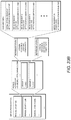
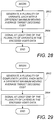
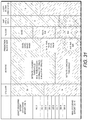
- FIGS. 28-29 are diagrams depicting how the uncoded video may be encoded according to the selected encoding parameters
- FIG. 30 is a diagram presenting an exemplar architecture of an intelligent encoder for encoding the video data according to target decoding device decoding complexity
- FIG. 31 is a diagram illustrating three exemplary complexity categories.
- FIG. 32 is a diagram illustrating an exemplary computer system that could be used to implement elements of the present invention.
- This invention envisions that an encoder that generates content for mobile clients encodes video stream in a manner sensitive to decoding complexity.
- the encoder would also consider the decoding complexity associated with any encoding decision made.
- Encoding decisions that impact decoding complexity are comprised of motion estimation, intra-mode decisions, inter-mode decisions, appropriate decisions pertaining to deblocking and other in-loop filtering operations.
- the decoding complexity is related to decoder's motion compensation, entropy coding, generating inter and intra prediction signals, in-loop filtering.
- Every choice of an encoding mode or technique used for encoding input video data has a cost (indicative of the decoder complexity).
- Each encoding decision results in addition to a maintained running sum of decoder complexity costs (along with ‘RD’ costs).
- the final value of the sum not only indicates the cost in terms of distortion and rate but also serves as a measure of the total decoding complexity of the encoded data.
- Encoding modes and methods are altered whenever the total actual cost exceeds the target cost (which in part includes the target decoder complexity).
- FIG. 1 is a diagram depicting an exemplary embodiment of a video coding-decoding (codec) system 100 that can be used for transmission and/or storage and retrieval of audio and/or video information.
- the codec system 100 comprises an encoding system 104 , which accepts audio-visual (AV) information 102 (also referred to hereinafter as uncoded video) and processes the AV information 102 to generate encoded (compressed) AV information 106 , and a decoding system 112 , which processes the encoded AV information 106 to produce recovered AV information 114 .
- AV audio-visual
- the recovered AV information 114 is not identical to the initial AV information 102 , but with judicious selection of the encoding processes and parameters, the differences between the recovered AV information 114 and the unprocessed AV information 102 are acceptable to human perception.
- the encoded AV information 106 is typically transmitted or stored and retrieved before decoding and presentation, as performed by transception (transmission and reception) or storage/retrieval system 108 .
- Transception losses may be significant, but storage/retrieval losses are typically minimal or non-existent, hence, the transcepted AV information 110 provided to the decoding system 112 is typically the same as or substantially the same as the encoded AV information 106 .
- FIG. 2A is a diagram of one embodiment of a codec system 200 A in which the encoded AV information 106 is transmitted to and received at another location.
- a transmission segment 230 converts an input AV information 102 into a signal appropriate for transmission and transmits the converted signal over the transmission channel 212 to the reception segment 232 .
- the reception segment 232 receives the transmitted signal, and converts the received signal into the recovered AV information 114 for presentation.
- the recovered AV information 114 may be of lower quality than the AV information 102 that was provided to the transmission segment 230 .
- error-correcting systems may be included to reduce or eliminate such errors.
- the encoded AV information 106 may be forward error correction (FEC) encoded by adding redundant information, and such redundant information can be used to identify and eliminate errors in the reception segment 232 .
- FEC forward error correction
- the transmission segment 230 comprises one or more source encoders 202 to encode multiple sources of AV information 102 .
- the source encoder 202 encodes the AV information 102 primarily for purposes of compression to produce the encoded AV information 106 , and may include, for example a processor and related memory storing instructions implementing a codec such as MPEG-1, MPEG-2, MPEG-4 AVC/H.264, HEVC or similar codec, as described further below.
- the codec system 200 A may also include optional elements indicated by the dashed lines in FIG. 2A . These optional elements include a video multiplex encoder 204 , an encoding controller 208 , and a video demultiplexing decoder 218 .
- the optional video multiplex encoder 204 multiplexes encoded AV information 106 from an associated plurality of source encoder(s) 202 according to one or more parameters supplied by the optional encoding controller 208 . Such multiplexing is typically accomplished in the time domain and is data packet based.
- the video multiplex encoder 204 comprises a statistical multiplexer, which combines the encoded AV information 106 from a plurality of source encoders 202 so as to minimize the bandwidth required for transmission. This is possible, since the instantaneous bit rate of the coded AV information 106 from each source encoder 202 can vary greatly with time according to the content of the AV information 102 . For example, scenes having a great deal of detail and motion (e.g. sporting events) are typically encoded at higher bitrates than scenes with little motion or detail (e.g. portrait dialog).
- each source encoder 202 may produce information with a high instantaneous bitrate while another source encoder 202 produces information with a low instantaneous bit rate, and since the encoding controller 208 can command the source encoders 202 to encode the AV information 102 according to certain performance parameters that affect the instantaneous bit rate, the signals from each of the source encoders 202 (each having a temporally varying instantaneous bit rate) can be combined together in an optimal way to minimize the instantaneous bit rate of the multiplexed stream 205 .
- the source encoder 202 and the video multiplex coder 204 may optionally be controlled by a encoding controller 208 to minimize the instantaneous bit rate of the combined video signal. In one embodiment, this is accomplished using information from a transmission buffer 206 which temporarily stores the coded video signal and can indicate the fullness of the buffer 206 . This allows the coding performed at the source encoder 202 or video multiplex coder 204 to be a function of the storage remaining in the transmission buffer 206 .
- the transmission segment 230 also may comprise a transmission encoder 210 , which further encodes the video signal for transmission to the reception segment 232 .
- Transmission encoding may include for example, the aforementioned FEC coding and/or coding into a multiplexing scheme for the transmission medium of choice.
- the transmission encoder 114 may encode the signal into a signal constellation before transmission via quadrature amplitude modulation (QAM) or similar modulation technique.
- QAM quadrature amplitude modulation
- the transmission encodes the signal according to the appropriate protocol. Further, if the encoded signal is to be transmitted via mobile telephony, the appropriate coding protocol is used, as further described below.
- the reception segment 232 comprises a transmission decoder 214 to receive the signal that was coded by the transmission coder 210 using a decoding scheme complementary to the coding scheme used in the transmission encoder 214 .
- the decoded received signal may be temporarily stored by optional reception buffer 216 , and if the received signal comprises multiple video signals, the received signal is multiplex decoded by video multiplex decoder 218 to extract the video signal of interest from the video signals multiplexed by the video multiplex coder 204 .
- the video signal of interest is decoded by source decoder 220 (hereinafter also referred to as a target decoding device) using a decoding scheme or codec complementary to the codec used by the source encoder 202 to encode the AV information 102 .
- the transmitted data comprises a packetized video stream transmitted from a server (representing the transmitting segment 230 ) to a client (representing the receiving segment 232 ).
- the transmission encoder 210 may packetize the data and embed network abstract layer (NAL) units in network packets.
- NAL units define a data container that has header and coded elements, and may correspond to a video frame or other slice of video data.
- the compressed data to be transmitted may packetized and transmitted via transmission channel 212 , which may include a Wide Area Network (WAN) or a Local Area Network (LAN).
- a network may comprise, for example, a wireless network such as WiFi, an Ethernet network, an Internet network or a mixed network composed of several different networks.
- Such communication may be affected via a communication protocol, for example Real-time Transport Protocol (RTP), User Datagram Protocol (UDP) or any other type of communication protocol.
- RTP Real-time Transport Protocol
- UDP User Datagram Protocol
- Different packetization methods may be used for each network abstract layer (NAL) unit of the bitstream.
- NAL unit size is smaller than the maximum transport unit (MTU) size corresponding to the largest packet size that can be transmitted over the network without being fragmented.
- MTU maximum transport unit
- the NAL unit is embedded into a single network packet.
- NAL units are included in a single network packet.
- one NAL unit may be too large to be transmitted in a single network packet and is thus split into several fragmented NAL units with each fragmented NAL unit being transmitted in an individual network packet. Fragmented NAL unit are typically sent consecutively for decoding purposes.
- the reception segment 232 receives the packetized data and reconstitutes the NAL units from the network packet.
- the client concatenates the data from the fragmented NAL units in order to reconstruct the original NAL unit.
- the client 232 decodes the received and reconstructed data stream and reproduces the video images on a display device and the audio data by a loud speaker.
- FIG. 2B is a diagram depicting an exemplary embodiment of codec system in which the encoded information is stored and later retrieved for presentation, hereinafter referred to as codec storage system 200 B.
- This embodiment may be used, for example, to locally store information in a digital video recorder (DVR), a flash drive, hard drive, or similar device.
- the AV information 102 is source encoded by source encoder 202 , optionally buffered by storage buffer 234 before storage in a storage device 236 .
- the storage device 236 may store the video signal temporarily or for an extended period of time, and may comprise a hard drive, flash drive, RAM or ROM.
- the stored AV information is then retrieved, optionally buffered by retrieve buffer 238 and decoded by the source decoder 220 .
- FIG. 2C is another diagram depicting an exemplary content distribution system 200 C comprising a coding system or encoder 202 and a decoding system or decoder 220 that can be used to transmit and receive HEVC data.
- the coding system 202 can comprise an input interface 256 , a scene change detector 249 , a controller 241 a counter 242 a frame memory 243 , an encoding unit 244 , a transmitter buffer 247 and an output interface 257 .
- the decoding system 220 can comprise a receiver buffer 259 , a decoding unit 260 , a frame memory 261 and a controller 267 .
- the coding system 202 and the decoding system 220 can be coupled with each other via a transmission path which can carry a compressed bit stream.
- the controller 241 of the coding system 202 can control the amount of data to be transmitted on the basis of the capacity of the transmitter buffer 247 or receiver buffer 259 and can include other parameters such as the amount of data per a unit of time.
- the controller 241 can control the encoding unit 244 to prevent the occurrence of a failure of a received signal decoding operation of the decoding system 220 .
- the controller 241 can be a processor or include, by way of a non-limiting example, a microcomputer having a processor, a random access memory and a read only memory.
- Source pictures 246 supplied from, by way of a non-limiting example, a content provider can include a video sequence of frames including source pictures in a video sequence.
- the source pictures 246 can be uncompressed or compressed. If the source pictures 246 are uncompressed, the coding system 202 can have an encoding function. If the source pictures 246 are compressed, the coding system 202 can have a transcoding function. Coding units can be derived from the source pictures 246 utilizing the controller 241 .
- the frame memory 243 can have a first area that can be used for storing the incoming frames from the source pictures 246 and a second area that can be used for reading out the frames 245 and outputting them to the encoding unit 244 .
- the controller 241 can output an area switching control signal 249 to the frame memory 243 .
- the area switching control signal 249 can indicate whether the first area or the second area is to be utilized.
- the controller 241 can output an encoding control signal 250 to the encoding unit 244 .
- the encoding control signal 250 can cause the encoding unit 244 to start an encoding operation, such as preparing the Coding Units of a source picture.
- the encoding unit 244 can begin to read out the prepared Coding Units to a high-efficiency encoding process, such as a prediction coding process or a transform coding process which process the prepared Coding Units generating video compression data based on the source pictures associated with the Coding Units.
- the encoding unit 244 can package the generated video compression data in a packetized elementary stream (PES) including video packets.
- PES packetized elementary stream
- the encoding unit 244 can map the video packets into an encoded video signal 248 using control information and a program time stamp (PTS) and the encoded video signal 248 can be transmitted to the transmitter buffer 247 .
- PTS program time stamp
- the encoded video signal 248 can be stored in the transmitter buffer 247 .
- the information amount counter 242 can be incremented to indicate the total amount of data in the transmitter buffer 247 . As data is retrieved and removed from the buffer, the counter 242 can be decremented to reflect the amount of data in the transmitter buffer 247 .
- the occupied area information signal 253 can be transmitted to the counter 242 to indicate whether data from the encoding unit 244 has been added or removed from the transmitter buffer 247 so the counter 242 can be incremented or decremented.
- the controller 241 can control the production of video packets produced by the encoding unit 244 on the basis of the occupied area information 253 which can be communicated in order to anticipate, avoid, prevent, and/or detect an overflow or underflow from taking place in the transmitter buffer 247 .
- the information amount counter 242 can be reset in response to a preset signal 254 generated and output by the controller 241 . After the information amount counter 242 is reset, it can count data output by the encoding unit 244 and obtain the amount of video compression data and/or video packets, which have been generated. The information amount counter 242 can supply the controller 241 with an information amount signal 255 representative of the obtained amount of information. The controller 241 can control the encoding unit 244 so that there is no overflow at the transmitter buffer 247 .
- the decoding system 220 can comprise an input interface 266 , a receiver buffer 259 , a controller 267 , a frame memory 261 , a decoding unit 260 and an output interface 268 .
- the receiver buffer 259 of the decoding system 220 can temporarily store the compressed bit stream, including the received video compression data and video packets based on the source pictures from the source pictures 246 .
- the decoding system 220 can read the control information and presentation time stamp information associated with video packets in the received data and output a frame number signal 263 which can be applied to the controller 267 .
- the controller 267 can supervise the counted number of frames at a predetermined interval. By way of a non-limiting example, the controller 267 can supervise the counted number of frames each time the decoding unit 260 completes a decoding operation.
- the controller 267 can output a decoding start signal 264 to the decoding unit 260 .
- the controller 267 can wait for the occurrence of a situation in which the counted number of frames becomes equal to the predetermined amount.
- the controller 267 can output the decoding start signal 264 when the situation occurs.
- the controller 267 can output the decoding start signal 264 when the frame number signal 263 indicates the receiver buffer 259 is at the predetermined capacity.
- the encoded video packets and video compression data can be decoded in a monotonic order (i.e., increasing or decreasing) based on presentation time stamps associated with the encoded video packets.
- the decoding unit 260 can decode data amounting to one picture associated with a frame and compressed video data associated with the picture associated with video packets from the receiver buffer 259 .
- the decoding unit 260 can write a decoded video signal 269 into the frame memory 261 .
- the frame memory 261 can have a first area into which the decoded video signal is written, and a second area used for reading out decoded pictures 262 to the output interface 268 .
- the coding system 202 can be incorporated or otherwise associated with a transcoder or an encoding apparatus at a headend and the decoding system 220 can be incorporated or otherwise associated with a downstream device, such as a mobile device, a set top box or a transcoder.
- the encoders 202 employ compression algorithms to generate bit streams and/or files of smaller size than the original video sequences in the AV information 102 . Such compression is made possible by reducing spatial and temporal redundancies in the original sequences.
- Encoders 202 include those compliant with the video compression standard H.264/MPEG-4 AVC (“Advanced Video Coding”) developed by between the “Video Coding Expert Group” (VCEG) of the ITU and the “Moving Picture Experts Group” (MPEG) of the ISO, in particular in the form of the publication “Advanced Video Coding for Generic Audiovisual Services” (March 2005), which is hereby incorporated by reference herein.
- H.264/MPEG-4 AVC Advanced Video Coding
- HEVC “High Efficiency Video Coding” (sometimes known as H.265) is expected to replace the H.264/MPEG-4 AVC.
- HEVC introduces new coding tools and entities that are generalizations of the coding entities defined in H.264/AVC, as further described below.
- FIG. 3 is a block diagram illustrating one embodiment of the source encoder 202 .
- the source encoder 202 accepts AV information 102 and uses sampler 302 to sample the AV information 102 to produce a sequence 303 of successive of digital images or pictures, each having a plurality of pixels.
- a picture can comprise a frame or a field, wherein a frame is a complete image captured during a known time interval, and a field is the set of odd-numbered or even-numbered scanning lines composing a partial image.
- the sampler 302 produces an uncompressed picture sequence 303 .
- Each digital picture can be represented by one or more matrices having a plurality of coefficients that represent information about the pixels that together comprise the picture.
- the value of a pixel can correspond to luminance or other information.
- each of these components may be separately processed.
- Images can be segmented into “slices,” which may comprise a portion of the picture or may comprise the entire picture.
- these slices are divided into coding entities called macroblocks (generally blocks of size 16 pixels ⁇ 16 pixels) and each macroblock may in turn be divided into different sizes of data blocks, for example 4 ⁇ 4, 4 ⁇ 8, 8 ⁇ 4, 8 ⁇ 8, 8 ⁇ 16, 16 ⁇ 8.
- HEVC expands and generalizes the notion of the coding entity beyond that of the macroblock.
- HEVC Coding Entities CTU, CU, PU and TU
- HEVC is a block-based hybrid spatial and temporal predictive coding scheme.
- HEVC introduces new coding entities that are not included with H.264/AVC standard. These coding entities include (1) Coding tree block (CTUs), coding units (CUs), the predictive units (PUs) and transform units (TUs) and are further described below.
- CTUs Coding tree block
- CUs coding units
- PUs predictive units
- TUs transform units
- FIG. 4 is a diagram depicting a picture 400 of AV information 102 , such as one of the pictures in the picture sequence 303 .
- the picture 400 is spatially divided into non-overlapping square blocks known as coding tree units(s), or CTUs 402 .
- the CTU 402 is the basic coding unit of HEVC, and can be as large as 128 ⁇ 128 pixels.
- the CTUs 402 are typically referenced within the picture 400 in an order analogous to a progressive scan.
- Each CTU 402 may in turn be iteratively divided into smaller variable size coding units described by a “quadtree” decomposition further described below. Coding units are regions formed in the image to which similar encoding parameters are applied and transmitted in the bitstream 314 .
- FIG. 5 is a diagram showing an exemplary partition of a CTU 402 into coding units (CUs) such as coding unit 502 A and 502 B (hereinafter alternatively referred to as coding unit(s) 502 ).
- CUs coding units
- a single CTU 402 can be divided into four CUs 502 such as CU 502 A, each a quarter of the size of CTU 402 .
- Each such divided CU 502 A can be further divided into four smaller CUs 502 B of quarter size of initial CU 502 A.
- quadtree data parameters e.g. flags or bits
- FIG. 6 is a diagram illustrating a representation of a representative quadtree 600 and data parameters for the CTU 402 partitioning shown in FIG. 5 .
- the quadtree 600 comprises a plurality of nodes including first node 602 A at one hierarchical level and second node 602 B at a lower hierarchical level (hereinafter, quadtree nodes may be alternatively referred to as “nodes” 602 ).
- quadtree nodes may be alternatively referred to as “nodes” 602 ).
- a “split flag” or bit “1” is assigned if the node 602 is further split into sub-nodes, otherwise a bit “0” is assigned.
- the CTU 402 partition illustrated in FIG. 5 can be represented by the quadtree 600 presented in FIG. 6 , which includes a split flag of “1” associated with node 602 A at the top CU 502 level (indicating there are 4 additional nodes at a lower hierarchical level).
- the illustrated quadtree 600 also includes a split flag of “1” associated with node 602 B at the mid CU 502 level to indicate that this CU is also partitioned into four further CUs 502 at the next (bottom) CU level.
- the source encoder 202 may restrict the minimum and maximum CU 502 sizes, thus changing the maximum possible depth of the CU 502 splitting.
- the source encoder 202 generates encoded AV information 106 in the form of a bitstream 314 that includes a first portion having encoded data for the CUs 502 and a second portion that includes overhead known as syntax elements.
- the encoded data includes data corresponding to the encoded CUs 502 (i.e. the encoded residuals together with their associated motion vectors, predictors, or related residuals as described further below).
- the second portion includes syntax elements that may represent encoding parameters which do not directly correspond to the encoded data of the blocks.
- the syntax elements may comprise an address and identification of the CU 502 in the image, a quantization parameter, an indication of the elected Inter/Intra coding mode, the quadtree 600 or other information.
- CUs 502 correspond to elementary coding elements and include two related sub-units: prediction units (PUs) and transform units (TUs), both of which have a maximum size equal to the size of the corresponding CU 502 .
- PUs prediction units
- TUs transform units
- FIG. 7 is a diagram illustrating the partition of a CU 502 into one or more PUs 702 .
- a PU 702 corresponds to a partitioned CU 502 and is used to predict pixels values for intra-picture or inter-picture types.
- a final (bottom level) CU 502 of 2N ⁇ 2N can possess one of four possible patterns of PUs: 2N ⁇ 2N ( 702 A), 2N ⁇ N ( 702 B), N ⁇ 2N ( 702 C) and N ⁇ N ( 702 D), as shown in FIG. 7 , as well as certain other asymmetric motion partitions (AMP) defined in the HEVC specification.
- PUs 2N ⁇ 2N ( 702 A), 2N ⁇ N ( 702 B), N ⁇ 2N ( 702 C) and N ⁇ N ( 702 D), as shown in FIG. 7 , as well as certain other asymmetric motion partitions (AMP) defined in the HEVC specification.
- AMP asymmetric motion partitions
- a CU 502 can be either spatially or temporally predictive coded. If a CU 502 is coded in “intra” mode, each PU 702 of the CU 502 can have its own spatial prediction direction and image information as further described below. Also, in the “intra” mode, the PU 702 of the CU 502 may depend on another CU 502 because it may use a spatial neighbor, which is in another CU. If a CU 502 is coded in “inter” mode, each PU 702 of the CU 502 can have its own motion vector(s) and associated reference picture(s) as further described below.
- FIG. 8 is a diagram showing a CU 502 partitioned into four PUs 702 and an associated set of transform units (TUs) 802 .
- TUs 802 are used to represent the elementary units that are spatially transformed by a DCT (Discrete Cosine Transform).
- DCT Discrete Cosine Transform
- RQT residual quadtree
- FIG. 9 is a diagram showing RQT 900 for TUs 802 for the CU 502 in the example of FIG. 8 .
- the “1” at the first node 902 A of the RQT 900 indicates that there are four branches and that the “1” at the second node 902 B at the adjacent lower hierarchical level indicates that the indicated node further has four branches.
- the data describing the RQT 900 is also coded and transmitted as an overhead in the bitstream 314 .
- the coding parameters of a video sequence may be stored in dedicated NAL units called parameter sets.
- Two types of parameter sets NAL units may be employed.
- the first parameter set type is known as a Sequence Parameter Set (SPS), and comprises a NAL unit that includes parameters that are unchanged during the entire video sequence.
- SPS Sequence Parameter Set
- PPS Picture Parameter Set
- PPS Picture Parameter Set
- One of the techniques used to compress a bitstream 314 is to forego the storage of pixel values themselves and instead, predict the pixel values using a process that can be repeated at the decoder 220 and store or transmit the difference between the predicted pixel values and the actual pixel values (known as the residual). So long as the decoder 220 can compute the same predicted pixel values from the information provided, the actual picture values can be recovered by adding the residuals to the predicted values. The same technique can be used to compress other data as well.
- each PU 702 of the CU 502 being processed is provided to a predictor module 307 .
- the predictor module 307 predicts the values of the PUs 702 based on information in nearby PUs 702 in the same frame (intra-frame prediction, which is performed by the spatial predictor 324 ) and information of PUs 702 in temporally proximate frames (inter-frame prediction, which is performed by the temporal predictor 330 ).
- Temporal prediction may not always be based on a collocated PU, since collocated PUs are defined to be located at a reference/non-reference frame having the same x and y coordinates as the current PU 702 .
- Encoded units can therefore be categorized to include two types: (1) non-temporally predicted units and (2) temporally predicted units.
- Non-temporally predicted units are predicted using the current frame, including adjacent or nearby PUs 702 within the frame (e.g. intra-frame prediction), and are generated by the spatial predictor 324 .
- Temporally predicted units are predicted from one temporal picture (e.g. P-frames) or predicted from at least two reference pictures temporally ahead and/or behind (i.e. B-frames).
- FIG. 10 is a diagram illustrating spatial prediction of PUs 702 .
- a picture may comprise a PU 702 and spatially proximate other PUs 1-4, including nearby PU 702 N.
- the spatial predictor 324 predicts the current block (e.g. block C of FIG. 10 ) by means of an “intra-frame” prediction which uses PUs 702 of already-encoded other blocks of pixels of the current image.
- the spatial predictor 324 locates a nearby PU (e.g. PU 1, 2, 3 or 4 of FIG. 10 ) that is appropriate for spatial coding and determines an angular prediction direction to that nearby PU.
- a nearby PU e.g. PU 1, 2, 3 or 4 of FIG. 10
- 35 directions can be considered, so each PU may have one of 35 directions associated with it, including horizontal, vertical, 45 degree diagonal, 135 degree diagonal, DC etc.
- the spatial prediction direction of the PU is indicated in the syntax.
- this located nearby PU is used to compute a residual PU 704 ( e ) as the difference between the pixels of the nearby PU 702 N and the current PU 702 , using element 305 .
- the result is an intra-predicted PU element 1006 that comprises a prediction direction 1002 and the intra-predicted residual PU 1004 .
- the prediction direction 1002 may be coded by inferring the direction from spatially proximate PUs, and the spatial dependencies of the picture, enabling the coding rate of the intra prediction direction mode to be reduced.
- FIG. 11 is a diagram illustrating temporal prediction.
- Temporal prediction considers information from temporally neighboring pictures or frames, such as the previous picture, picture i ⁇ 1.
- temporal prediction includes single-prediction (P-type), which predicts the PU 702 by referring to one reference area from only one reference picture, and multiple prediction (B-type), which predicts the PU by referring to two reference areas from one or two reference pictures.
- P-type single-prediction
- B-type multiple prediction
- Reference images are images in the video sequence that have already been coded and then reconstructed (by decoding).
- the temporal predictor 330 identifies, in one or several of these reference areas (one for P-type or several for B-type), areas of pixels in a temporally nearby frame so that they can be used as predictors of this current PU 702 . In the case where several areas predictors are used (B-type), they may be merged to generate one single prediction.
- the reference area 1102 is identified in the reference frame by a motion vector (MV) 1104 that defines the displacement between the current PU 702 in current frame (picture i) and the reference area 1102 (refldx) in the reference frame (picture i ⁇ 1).
- a PU in a B-picture may have up to two MVs. Both MV and refldx information are included in the syntax of the HEVC bitstream.
- a difference between the pixel values between of the reference area 1102 and the current PU 702 may be computed by element 305 as selected by switch 306 .
- This difference is referred to as the residual of the inter-predicted PU 1006 .
- the current PU 1006 is composed of one motion vector MV 1104 and a residual 1106 .
- one technique for compressing data is to generate predicted values for the data using means repeatable by the decoder 220 , computing the difference between the predicted and actual values of the data (the residual) and transmitting the residual for decoding. So long as the decoder 220 can reproduce the predicted values, the residual values can be used to determine the actual values.
- This technique can be applied to the MVs 1104 used in temporal prediction by generating a prediction of the MV 1104 , computing a difference between the actual MV 1104 and the predicted MV 1104 (a residual) and transmitting the MV residual in the bitstream 314 . So long as the decoder 220 can reproduce the predicted MV 1104 , the actual MV 1104 can be computed from the residual.
- HEVC computes a predicted MV for each PU 702 using the spatial correlation of movement between nearby PUs 702 .
- FIG. 12 is a diagram illustrating the use of motion vector predictors (MVPs) in HEVC.
- Motion vector predictors V 1 , V 2 and V 3 are taken from the MVs 1104 of a plurality of blocks 1, 2, and 3 situated nearby or adjacent the block to encode (C).
- C block to encode
- these vectors refer to motion vectors of spatially neighboring blocks within the same temporal frame and can be used to predict the motion vector of the block to encode, these vectors are known as spatial motion predictors.
- FIG. 12 also illustrates temporal motion vector predictor V T which is the motion vector of the co-located block C′ in a previously decoded picture (in decoding order) of the sequence (e.g. block of picture i ⁇ 1 located at the same spatial position as the block being coded (block C of image i).
- the components of the spatial motion vector predictors V 1 , V 2 and V 3 and the temporal motion vector predictor V T can be used to generate a median motion vector predictor V M .
- the three spatial motion vector predictors may be taken as shown in FIG. 12 , that is, from the block situated to the left of the block to encode (V 1 ), the block situated above (V 3 ) and from one of the blocks situated at the respective corners of the block to encode (V 2 ), according to a predetermined rule of availability.
- This MV predictor selection technique is known as Advanced Motion Vector Prediction (AMVP).
- AMVP Advanced Motion Vector Prediction
- a plurality of (typically five) MV predictor (MVP) candidates having spatial predictors (e.g. V 1 , V 2 and V 3 ) and temporal predictor(s) V T is therefore obtained.
- the set of motion vector predictors may reduced by eliminating data for duplicated motion vectors (for example, MVs which have the same value as other MVs may be eliminated from the candidates).
- the encoder 202 may select a “best” motion vector predictor from among the candidates, and compute a motion vector predictor residual as a difference between the selected motion vector predictor and the actual motion vector, and transmit the motion vector predictor residual in the bitstream 314 .
- the actual motion vector must be stored for later use by the decoder 220 (although it is not transmitted in the bit stream 314 .
- Signaling bits or flags are included in the bitstream 314 to specify which MV residual was computed from the normalized motion vector predictor, and are later used by the decoder to recover the motion vector. These bits or flags are further described below.
- the intra-predicted residuals 1004 and the inter-predicted residuals 1106 obtained from the spatial (intra) or temporal (inter) prediction process are then transformed by transform module 308 (depicted in FIG. 3 ) into the transform units (TUs) 802 described above.
- a TU 802 can be further split into smaller TUs using the RQT decomposition described above with respect to FIG. 9 .
- RQT decomposition described above with respect to FIG. 9 .
- HEVC generally 2 or 3 levels of decompositions are used and authorized transform sizes are from 32 ⁇ 32, 16 ⁇ 16, 8 ⁇ 8 and 4 ⁇ 4.
- the transform is derived according to a discrete cosine transform (DCT) or discrete sine transform (DST).
- DCT discrete cosine transform
- DST discrete sine transform
- Quantization plays a very important role in data compression. In HEVC, quantization converts the high precision transform coefficients into a finite number of possible values. Although the quantization permits a great deal of compression, quantization is a lossy operation, and the loss by quantization cannot be recovered.
- the coefficients of the quantized transformed residual are then coded by means of an entropy coder 312 and then inserted into the compressed bit stream 3140 as a part of the useful data coding the images of the AV information.
- Coding syntax elements may also be coded using spatial dependencies between syntax elements to increase the coding efficiency.
- HEVC offers entropy coding such as context-adaptive binary arithmetic coding (CABAC). Other forms or entropy or arithmetic coding may also be used.
- the encoder 202 decodes already encoded PUs 702 using “decoding” loop 315 , which includes elements 316 , 318 , 320 , 322 , 328 .
- This decoding loop 315 reconstructs the PUs and images from the quantized transformed residuals.
- the quantized transform residual coefficients E are provided to dequantizer 316 , which applies the inverse operation to that of quantizer 310 to produce dequantized transform coefficients of the residual PU (E′) 708 .
- the dequantized data 708 is then provided to inverse transformer 318 which applies the inverse of the transform applied by the transform module 308 to generate reconstructed residual coefficients of the PU (e′) 710 .
- the reconstructed coefficients of the residual PU 710 are then added to the corresponding coefficients of the corresponding predicted PU (x′) 702 ′ selected from the intra-predicted PU 1004 and the inter-predicted PU 1106 by selector 306 .
- the “intra” predictor (x′) is added to this residual in order to recover a reconstructed PU (x′′) 712 corresponding to the original PU 702 modified by the losses resulting from a transformation, for example in this case the quantization operations.
- the residual 710 comes from an “inter” coding process of the temporal predictor 330 , the areas pointed to by the current motion vectors (these areas belong to the reference images stored in reference buffer 328 referred by the current image indices) are merged then added to this decoded residual. In this way the original PU 702 is modified by the losses resulting from the quantization operations.
- the motion vector may be stored using motion vector buffer 329 for use in temporally subsequent frames.
- a flag may be set and transferred in the syntax to indicate that the motion vector for the currently decoded frame should be used for at least the subsequently coded frame instead of replacing the contents of the MV buffer 329 with the MV for the current frame.
- a loop filter 322 is applied to the reconstructed signal (x′′) 712 in order to reduce the effects created by heavy quantization of the residuals obtained, and to improve the signal quality.
- the loop filter 322 may comprise, for example, a deblocking filter for smoothing borders between PUs to visually attenuate high frequencies created by the coding process and a linear filter that is applied after all of the PUs for an image have been decoded to minimize the sum of the square difference (SSD) with the original image.
- the linear filtering process is performed on a frame by frame basis and uses several pixels around the pixel to be filtered, and also uses spatial dependencies between pixels of the frame.
- the linear filter coefficients may be coded and transmitted in one header of the bitstream, typically a picture or slice header.
- the filtered images also known as reconstructed images, are then stored as reference images from reference image buffer 328 in order to allow the subsequent “Inter” predictions taking place during the compression of the subsequent images of the current video sequence.
- HEVC induces a variable-size block tree-partitioning on each frame by using (luma and chroma) coding tree blocks (CTB), which can be used directly as coding blocks (CB), or can be partitioned into multiple CBs.
- CB coding tree blocks
- the prediction for luma and associated chroma CBs of an area of frame, can use intra-picture or inter-picture prediction.
- luma and chroma CBs can further be split into luma and chroma prediction blocks (PBs).
- PBs luma and chroma prediction blocks
- the residual coding is performed after a CB is recursively partitioned into transform blocks (TBs)
- HEVC uses DC, planar and 33 angular prediction modes for performing intra (within the picture) prediction. Samples are predicted from reconstructed samples of neighboring blocks.
- the PB sizes used can range from 4 ⁇ 4 to 64 ⁇ 64.
- intra-prediction operates on a TB size at a time, and previously decoded boundary samples from spatially neighboring TBs are used to form the prediction signal.
- the inter (between temporally nearby) coded blocks may use any of a number of partition modes.
- Motion compensation is typically applied to reconstruct the inter coded blocks.
- the decoder performs motion compensation by first fetching reference data, applying padding if reference block is outside picture boundaries, and subsequently using the motion vectors, signaled modes and the reference data to construct the predictor.
- interpolation is applied.
- linear filters may be applied to obtain pixel values at fractional positions.
- the interpolation filters may have seven or eight taps for luma and four taps for chroma.
- HEVC reduces the number of bits require to carry the motion data by employing effective motion vector prediction (MVP) signaling under two types—a merge mode (involving complete inheritance of motion data), and an Advanced Motion Prediction mode (involving inference of motion vectors using predictors and signaled motion vector differences).
- MVP effective motion vector prediction
- merge mode involving complete inheritance of motion data
- Advanced Motion Prediction mode involving inference of motion vectors using predictors and signaled motion vector differences
- the processes of scaling and dequantization, followed by inverse transforms use the frequency domain quantized transformed coefficients. These coefficients are duly converted to the spatial domain residuals for the constituent blocks under these processes.
- the prediction error residual is signaled in HEVC in a quantized transform-coded manner.
- the residual block is partitioned into multiple square TBs, the possible TB sizes being 4 ⁇ 4, 8 ⁇ 8, 16 ⁇ 16, and 32 ⁇ 32.
- the transform data is typically quantized as per a quantization parameter Qp, which ranges from 0 to 51.
- Quantization matrices of sizes 4 ⁇ 4 and 8 ⁇ 8 are used.
- An 8 ⁇ 8 scaling matrix is sent for the 16 ⁇ 16 and 32 ⁇ 32 transform sizes, which is applied in a specific way by sharing of values within 2 ⁇ 2 and 4 ⁇ 4 groups of coefficients, along with signaling of value at the DC position.
- the entropy decoder first converts the bits of coded bit-stream into bins, which are the binarized form of the coded symbols.
- the entropy decoder uses appropriate context models (indexed appropriately using a context index) that are associated with a probability distribution to each given bin.
- the de-binarization step in entropy decoding converts the bins to the transmitted symbol value.
- the symbol values are used for the remaining processes involved in the video decoding since they convey information such as intra-prediction mode, quantized transform coefficients, motion vectors and indexes into reference pictures list(s).
- deblocking filter operations are applied at the transform and/or prediction block boundaries, depending on a number of factors, e.g., presence of intra-coded block, presence of non-zero coefficients, reference indices and motion vectors of the constituent blocks.
- the deblocking filter in HEVC may be content-based. Sample adaptive offset filtering to reduce other compression noise is also performed.
- Tile structure allows the partitioning of video frame in square and rectangular shapes. Both the size and shape of tiles can be freely defined by controlling the number of row and column partitions. Tiles are considered independent since coding and prediction dependencies such as motion vector prediction, intra prediction, entropy coding and context selection, are broken through its boundaries.
- the Standard provides a mechanism of insertion of markers in the bitstream to indicate the tiles entry points.
- the tile offsets can be signaled in the slice header.
- WPP wavefront parallel processing
- a slice is divided into rows of CTUs and WPP supports parallel processing of rows of CTUs by using multiple processing threads in the decoder.
- WPP offers parallelism within a slice.
- WPP could provide better compression performance than tiles, and avoid some visual artifacts that may be induced by using tiles.
- WPP is not allowed to be used in combination with tiles (although these features could, in principle, work properly together).
- Entropy decoding becomes a bottleneck at high bit rates, and in I slices in particular.
- FIG. 14 is a diagram depicting relative decoding time versus the average block size of the prediction blocks. Discoveries have been made with respect to different modules of the decoder, specifically:
- Motion Vector Prediction The motion vector prediction time increases with smaller block sizes. Increase in number of prediction blocks scales up the overall number of candidates to be evaluated.
- FIG. 15 is a diagram illustrating the relative motion vector prediction time per sample versus prediction block size. Note that the motion compensation time per sample increase with smaller block sizes, as smaller block sizes need increased loads from reference frames.
- the reconstruction time per sample which is the time required for addition of the residual to the motion compensated predictor, increases with smaller block sizes in the case of the optimized decoder. For the pre-optimized version of the decoder, this was found to be constant. Parallelization by SIMD was found to be more effective for larger block sizes. Hence the time per sample decreases with increasing block size for the SIMD optimized decoder.
- FIG. 17 is a diagram of the reconstruction time per sample versus transform block sizes.
- FIG. 18 is a diagram presenting the relative time for the decoder to perform inverse transformations as a function of transform block size.
- the quantization parameter Q P is signaled by a flag known as a coded_block_flag.
- the significance of the coded_block_flag depends on the level as follows:
- coded_block_flag is signaled for each TB (transform block) to specify the significance of the entire TB.
- the choice of a Q P takes into account:
- FIG. 19 is a diagram of a 16 ⁇ 16 transform unit (TU) having 4 ⁇ 4 coefficient groups. Note that a number of the groups have coefficients that are all zero. As Q P is chosen to be a larger value, more of the coefficient groups have blocks having all zero coefficients. In the TU illustrated in FIG. 19 , a slight change in Q P may result in the coefficient group 1902 having all zero coefficients, thus reducing the required decoding complexity without significant detriment to the quality of the TU being encoded.
- TU 16 ⁇ 16 transform unit
- FIG. 20 is a diagram illustrating the correlation between instantaneous bit rate and relative decoding time.
- a decoder is designed to accommodate the uneven input rate of the encoded bitstream by introducing an initial latency and buffering up the decoded frames.
- the size of the buffer is dictated by the initial latency that one can tolerate and the memory constraints the system may have. Under these constraints let us say a buffer size of N frames is chosen.
- the rate at which this buffer is filled by the decoder can thus be tracked using the moving average over N frames of the rate at which the frames are decoded. If this rate is greater than the rate at which the buffer needs to be rendered, a smooth playout of decoded video is guaranteed.
- min(MAN) a measure of the decoder performance for a given stream. For instance, for a set of 720p30 streams, if min(MAN)>30, we can be assured of a smooth playback, where the value of N may be determined on a specific platform, as say 16.
- FIG. 21 is a diagram illustrating moving average frame rate as applied to characterizing decoder complexity.
- the Y axis is in units of percentage of target instantaneous frame rate (frames per second or FPS), wherein 100% is the target FPS.
- One plot is of the instantaneous FPS, while the smoother plot is that of the moving average (MA) of the FPS (% of the target FPS) computed over N frames.
- the X axis indicates the frame number, and represents time.
- Exemplary target FPS and N are 30 fps and 16 frames, respectively.
- an encoder would need to take into account the buffer size N over which, when a moving average is calculated, the minimum of this moving average of decoding speed must be ensured to be greater than the rate at which the buffer needs to be rendered, to ensure smooth playback.
- the moving average of per-frame-costs (associated with decoding complexity) must be lesser than a target device decoding complexity cost. Since encoding is done frame by frame, the cumulative actual costs of the frames encoded along with a cost-reservoir can be used to track the remaining “cost budget” available and needing to be adhered to.
- a typical value for N for a “live” media program may be 10 frames, while a time-shifted live media program (for example, with a time shift of a few seconds) may have a greater value for N.
- a media program that is provided on demand e.g. video on demand or VOD
- VOD video on demand
- N may also demand that the encoder keep tighter control over the decoding complexity involved, in whatever stream it generates (i.e. peak and average decoder-complexity cannot be very spread apart).
- peak and average decoder-complexity cannot be very spread apart.
- the peak and average decoder complexity can be quite spread apart.
- rule-based strategies are employed to optimize the encoding considering the parallelization opportunities available to a client target decoding device. These strategies are presented in Table I below:
- Target Client Encode the video Encoder chooses number Profile has breaking it into of tiles based on available multiple cores approximately equal number of cores at a for parallel sized tiles.
- Number of target client specifies execution tiles can be equal to or respective entry points in greater than number of terms of byte offsets. available cores.
- aspect ratio tending Choose aspect ratio Note: tending to square tiles All dependencies are since square tiles have broken at tile boundaries. high area/perimeter ratio The entropy coding square tiles and hence engine is reset at the start are more beneficial than of each tile and flushed at rectangular ones (the the end of the tile. perimeter represents the Only the deblocking filter boundaries where the can be optionally applied dependencies are across tiles, in order to broken).
- Target Client Encode video using The context models of the Profile has wavefront parallel entropy coder in each row multiple cores for processing by dividing are inferred from those in parallel execution each frame into rows of the preceding row with a with CTUs.
- small fixed processing lag sophisticated No breaking of (context models are synchronization dependencies across inherited from the second capabilities rows of CTUs CTU of the previous row) between cores Good for architectures
- Target Client Encode modeling the Modeling as describe in profile does not decoding complexity of “Entropy Encoding,” have multiple individual modules “Effect of block-sizes on cores decoder complexity,” “Reconstruction,” and “Inverse Transform and Scaling,” sections, including choice of Qp.
- D total distortion in reconstructed video frame
- R total bit rate
- C T ⁇ i C i n i , wherein C i n i denotes the target decoder complexity cost factor for the block n i . If a simple rate optimization were used, the optimization would be made subject to a rate constraint R ⁇ R budget , where R budget is the targeted bit rate. But with decoder-complexity optimization, the equation above is optimized subject to the constraint that C T ⁇ C budget , where C budget is the targeted decoder complexity.
- C MC,MVP a 2 (wherein C MC,MVP is aggregated for all samples of a block)
- plots previously depicted illustrate relative decoding complexity within a module of the target decoding device, with respect to each dependent parameter.
- these relationships are weighted to account for the relative fraction of the total decoding time they account for.
- FIG. 22 is a diagram illustrating an exemplary representation of the contribution of various decoding module functions to the total time to decode the media program. Note that motion compensation and motion vector prediction (MC and MVP) together account for a significant amount of decoding time, with entropy-related processing accounting for much of the remainder. Experiments performed with different video streams indicates that the following empirical values work well.
- MC and MVP motion compensation and motion vector prediction
- the encoding mode/method is determined such that distortion, rate, and target decoder complexity are jointly optimized. This may be accomplished by iteratively determining the combination of encoding modes/methods and optimizing for J, in the process also adding the complexity factors C i for individual modes/methods of blocks within a slice or a frame, and comparing the obtained total complexity with a target complexity cost factor for each slice or frame.
- the encoder needs to not only keep an account of the running costs over the immediate frame being encoded, but also needs to ensure that the moving average cost, over a chosen number of frames, does not exceed a decoding complexity cost budget.
- the cumulative actual costs of the frames encoded along with a cost reservoir can be used to track the remaining cost budget available and needing to be adhered to.
- This moving average can be defined such that the moving average of C T computed over N frames is less than or equal to a budget for the moving average of C T , or: C T
- HTTP Live streaming and MPEG DASH are exemplar adaptive streaming technologies of today.
- the video-audio (A/V) content is typically broken into small chunks spanning a few seconds each.
- the client can switch between chunks encoded at different bitrates based on the network conditions available at the client.
- a single core target decoding device or client could choose to consume version A, a dual core target decoding device or client choose version B, and a quad-core target device or client choose version C.
- a specific mobile client reduces as it discharges causing it to switch from version A through version C.
- Our invention pertains to the method by which an encoder generates streams corresponding to different decoder-complexity operating points.
- FIGS. 23A and 23B are a diagrams illustrating the use of variants to provide streams with varying decoding complexities.
- FIG. 23A illustrates an HLS embodiment
- FIG. 23B presents a DASH embodiment.
- the multiple representations can be used in future to contain representations of streams corresponding to different decoding complexities.
- Another use-case where the foregoing principles can be readily applied is to support a scalable extension of HEVC.
- the methods describe above allow an encoder to generate layers of streams, each layer pertaining to a different decoder-complexity. Typically, each layer is incremental to the previous layer in terms of information contained.
- a single core client target decoding device could choose to consume the layer corresponding to the lowest de-complexity version D 1 .
- a dual core client target decoding device could consume layer D 1 as well as an incremental layer D 2 , wherein D 1 and D 2 are combinedly associated with an intermediate decoding complexity that the dual core client decoding device is equipped to handle.
- a quad-core client decoding device could consume layers D 1 , D 2 and D 3 , wherein D 1 , D 2 and D 3 together are associated with a higher decoding complexity than the quad core client decoding device is equipped to handle.
- layer selection may be performed as a function of remaining battery power in the client target decoding device.
- the client target decoding device may switch from a high decoding complexity stream containing (D 1 , D 2 , D 3 ) to a medium decoding complexity stream containing (D 1 , D 2 ) and as power further declines, finally switch to decoding the low complexity stream having only D 1 .
- the techniques presented above allow the encoder to generate the aforementioned layered scalable stream corresponding to different decoder-complexity operating points.
- each layer of the stream adds details missing from the hierarchically lower layer. For example, when reproduced, layer D 1 has fewer details than layer D 2 , which has fewer layers than level D 3 .
- FIG. 24 is a diagram illustrating the principle of upper layers having greater detail than lower layers.
- the encoder encodes different versions of the encoded stream using parallelism techniques, with each version based on a different target decoding device profile (e.g. each version is suitable for a target decoding device of a particular class.
- FIG. 25 is a diagram depicting the selection of an HEVC parallelism tool based upon the capabilities of target devices belonging to different classes.
- the target decoding device class is a multicore (having a plurality of processing cores) encoding device having sophisticated synchronization capabilities between cores and/or shared cache
- the encoder may encode the video stream using WPP.
- the target decoding device class includes devices with a plurality of processing cores but without synchronization capabilities, the encoder may encode the video stream using tiles, but not WPP.
- the media program may be encoded without using tiles or WPP, but the other decoding complexity aware techniques described above may be used.
- FIG. 26 is a diagram illustrating exemplary process steps that can be used to implement the coding scheme described above.
- the uncoded video such as AV information 102 is received, for example, by a source encoder 202 , as shown in block 2602 .
- a relationship is computed between each of a plurality of coding parameters and target decoding device decoding costs. This can be accomplished, for example, as described in FIG. 27 .
- FIG. 27 is a diagram illustrating exemplary process steps that can be used to compute a relationship between each of the plurality of coding parameters and the target decoding device decoding costs.
- one or more encoding parameters is associated with a respective cost factor indicative of a target decoding device decoding complexity.
- one or more of the following decoding costs/encoding parameter associates may be made: (1) an entropy decoding cost (C ENTROPY ) associated with the bit rate encoding parameter, (2) a motion vector and compensation complexity cost (C MC, MVP ), associated with the prediction block size, (3) a reconstruction time cost (C RECON ), associated with the transform unit size, and (4) an inverse discrete cosine transfer cost (C IDCT ), associated with the quantization factor of the transform block, as described above.
- C ENTROPY entropy decoding cost
- C MC, MVP motion vector and compensation complexity cost
- C RECON reconstruction time cost
- C IDCT inverse discrete cosine transfer cost
- the cost factor values are computed for each encoding parameter. For example, (1) an entropy decoding cost (C ENTROPY ) value may be computed for one or more bit rate encoding parameters, (2) a motion vector and compensation complexity cost (C MC, MVP ) may be computed for one or more prediction block sizes, (3) a reconstruction time cost (C RECON ) can be computed for one or more transform unit sizes, and (4) an inverse discrete cosine transfer cost (C IDCT ) can be computed for one or more quantization factors of the transform block(s).
- C ENTROPY entropy decoding cost
- C MC, MVP motion vector and compensation complexity cost
- C RECON reconstruction time cost
- C IDCT inverse discrete cosine transfer cost
- the uncoded video is encoded according to the selected encoding parameters, as shown in block 2608 .
- FIG. 28 is a diagram depicting one embodiment of how the uncoded video may be encoded according to the selected encoding parameters.
- a plurality of variants are generated, each by performing the operations of blocks 2602 - 2608 for each variant, with each variant having a different upper bound on the moving average decoding cost.
- the variants are signaled in the encoded video data.
- FIG. 29 is a diagram depicting another embodiment of how the uncoded video may be encoded according to the selected encoding parameters.
- a plurality of complexity layers are generated, each with a different upper bound on the moving average decoding cost.
- one or more of the plurality of layers are signaled in the encoded video data.
- FIG. 30 is a diagram presenting an exemplar architecture of an intelligent encoder 3000 for encoding the video data according to target decoding device 220 decoding complexity.
- a raw (unencoded) video stream or AV information 102 having a plurality of input video frames is provided to an Intelligent Partitioning Unit (IPU) 3002 .
- the IPU 3002 splits the input video frames into appropriate partitions 3014 like slices, tiles, wavefronts, each of which can be placed in a task queue.
- the “intelligent” partitioning performed by the IPU 3002 also includes the aspect of deciding whether tiles or WPP need to be used, based on the use-case described above.
- the IPU 3002 also accounts for dependencies (if any, say in case of slices) among different partitions, splitting video frames correctly also to ensure that parts of video can be distributed among the units of the parallel architecture responsible for encoding (e.g. among cores of multicore architecture).
- the IPU 3002 can account for dependencies and perform dependency management for a variety of partitioning schemes.
- the load predictor 3004 predicts the system load associated with the decoding at client or target decoding device 220 .
- Learning algorithms such as support vector machines can be used to learn the patterns of the actuals in relation to a learned prediction value, in a training phase, to optimize prediction accuracy in the testing phase.
- the load predictor 3004 examines each CTB or each chosen set of CTBs of the incoming video to predict how much complexity the chosen modes (e.g. RDO vs non-RDO based encoding) would account for from a target decoding device 220 perspective.
- the core video encoder 3006 takes into account the currently available complexity budget as seen from the perspective of the target decoding device 220 .
- Decoder complexity is adaptively modeled in real or near real time, at least in part using the actual generated payload, using the decoding complexity model 3008 , providing actual decoding complexity to the predictor learning unit 3012 , for processing.
- the predictor learning unit 3012 updates parameters in the load predictor 3004 .
- the stream aware merger 3010 accepts the encoded video partitions and assembles them together in corresponding video streams in the proper order.
- Temporary header information entered by the IPU 3002 for example, stream and partition ID
- the intelligent encoder 3000 uses estimated or actual decoding costs to carefully plan the encoding or schedule the available tasks. In other embodiments, the intelligent encoder uses pre-categorization techniques to make quick encoding decisions. In order to speed up the process of selection of the right tools for a given complexity budget, it is useful to classify the encoding options into complexity categories.
- FIG. 31 is a diagram illustrating three exemplary complexity categories.
- the un-crosshatched region denotes encoding options chosen for least decoding effort at the target decoding device 220 . This can be used when there is least computational power available at a target decoding device.
- the double cross-hatched complexity category shows maximum decoding effort at target decoding device 220 . This can be used when there is ample computational power available at target decoding device 220 .
- the single cross-hatched complexity category indicates a medium decoding effort at the target decoding device 220 and may be used when the first or second categories are not appropriate. It is envisioned that these decisions are made as dynamically as possible within compliance limits of the standard.
- FIG. 32 is a diagram illustrating an exemplary computer system 3200 that could be used to implement elements of the present invention, including the encoding controller 208 or other device computing the relationship between encoding parameters and target decoding device decoding costs and selecting encoding parameters to minimize encoding costs including target decoding device decoding costs.
- the exemplary computer system 3200 may also be used to encode the uncoded video 2608 according to the selected encoding parameters or to decode the coded video.
- the computer 3202 comprises a general purpose hardware processor 3204 A and/or a special purpose hardware processor 3204 B (hereinafter alternatively collectively referred to as processor 3204 ) and a memory 3206 , such as random access memory (RAM).
- the computer 3202 may be coupled to other devices, including input/output (I/O) devices such as a keyboard 3214 , a mouse device 3216 and a printer 3228 .
- I/O input/output
- the computer 3202 operates by the general purpose processor 3204 A performing instructions defined by the computer program 3210 under control of an operating system 3208 .
- the computer program 3210 and/or the operating system 3208 may be stored in the memory 3206 and may interface with the user and/or other devices to accept input and commands and, based on such input and commands and the instructions defined by the computer program 3210 and operating system 3208 to provide output and results.
- Output/results may be presented on the display 3222 or provided to another device for presentation or further processing or action.
- the display 3222 comprises a liquid crystal display (LCD) having a plurality of separately addressable pixels formed by liquid crystals. Each pixel of the display 3222 changes to an opaque or translucent state to form a part of the image on the display in response to the data or information generated by the processor 3204 from the application of the instructions of the computer program 3210 and/or operating system 3208 to the input and commands.
- Other display 3222 types also include picture elements that change state in order to create the image presented on the display 3222 .
- the image may be provided through a graphical user interface (GUI) module 3218 A. Although the GUI module 3218 A is depicted as a separate module, the instructions performing the GUI functions can be resident or distributed in the operating system 3208 , the computer program 3210 , or implemented with special purpose memory and processors.
- GUI graphical user interface
- Some or all of the operations performed by the computer 3202 according to the computer program 3210 instructions may be implemented in a special purpose processor 3204 B.
- some or all of the computer program 3210 instructions may be implemented via firmware instructions stored in a read only memory (ROM), a programmable read only memory (PROM) or flash memory within the special purpose processor 3204 B or in memory 3206 .
- the special purpose processor 3204 B may also be hardwired through circuit design to perform some or all of the operations to implement the present invention.
- the special purpose processor 3204 B may be a hybrid processor, which includes dedicated circuitry for performing a subset of functions, and other circuits for performing more general functions such as responding to computer program instructions.
- the special purpose processor is an application specific integrated circuit (ASIC).
- the computer 3202 may also implement a compiler 3212 which allows an application program 3210 written in a programming language such as COBOL, C++, FORTRAN, or other language to be translated into processor 3204 readable code. After completion, the application or computer program 3210 accesses and manipulates data accepted from I/O devices and stored in the memory 3206 of the computer 3202 using the relationships and logic that was generated using the compiler 3212 .
- a compiler 3212 which allows an application program 3210 written in a programming language such as COBOL, C++, FORTRAN, or other language to be translated into processor 3204 readable code.
- the application or computer program 3210 accesses and manipulates data accepted from I/O devices and stored in the memory 3206 of the computer 3202 using the relationships and logic that was generated using the compiler 3212 .
- the computer 3202 also optionally comprises an external communication device such as a modem, satellite link, Ethernet card, or other device for accepting input from and providing output to other computers.
- an external communication device such as a modem, satellite link, Ethernet card, or other device for accepting input from and providing output to other computers.
- instructions implementing the operating system 3208 , the computer program 3210 , and/or the compiler 3212 are tangibly embodied in a computer-readable medium, e.g., data storage device 3220 , which could include one or more fixed or removable data storage devices, such as a zip drive, floppy disc drive 3224 , hard drive, CD-ROM drive, tape drive, or a flash drive.
- a computer-readable medium e.g., data storage device 3220 , which could include one or more fixed or removable data storage devices, such as a zip drive, floppy disc drive 3224 , hard drive, CD-ROM drive, tape drive, or a flash drive.
- the operating system 3208 and the computer program 3210 are comprised of computer program instructions which, when accessed, read and executed by the computer 3202 , causes the computer 3202 to perform the steps necessary to implement and/or use the present invention or to load the program of instructions into a memory, thus creating a special purpose data structure causing the computer to operate as a specially programmed computer executing the method steps described herein.
- Computer program 3210 and/or operating instructions may also be tangibly embodied in memory 3206 and/or data communications devices 3230 , thereby making a computer program product or article of manufacture according to the invention.
- the terms “article of manufacture,” “program storage device” and “computer program product” or “computer readable storage device” as used herein are intended to encompass a computer program accessible from any computer readable device or media.
- the term “computer” is referred to herein, it is understood that the computer may include portable devices such as cellphones, portable MP3 players, video game consoles, notebook computers, pocket computers, or any other device with suitable processing, communication, and input/output capability.
- portable devices such as cellphones, portable MP3 players, video game consoles, notebook computers, pocket computers, or any other device with suitable processing, communication, and input/output capability.
Landscapes
- Engineering & Computer Science (AREA)
- Multimedia (AREA)
- Signal Processing (AREA)
- Computing Systems (AREA)
- Theoretical Computer Science (AREA)
- Compression Or Coding Systems Of Tv Signals (AREA)
Abstract
Description
C Entropy =a 1 ·R
Prediction block size·Decoder complexity(MC,MVP)≈constant
wherein the prediction block size is expressed in terms of a product of the number of samples or pixels in an x direction and the number of samples or pixels in the y direction. Thus:
Decoder complexity per sample(MC,MVP)=C (MC,MVP) =a 2/Prediction block size
wherein the prediction block size is in pixels.
Transform block size·Decoder Reconstruction complexity per sample≈constant
wherein the transform block size is in terms of (number of samples in x direction*number of samples in y-direction)
Decoder Reconstruction complexity per sample=a 3/Transform block size
-
- a) The coded_sub_block_flag syntax elements are signaled in reverse order (from bottom-right towards top-left) according to selected scan.
- b) The coded_sub_block_flag is not signaled for the last CG (i.e. the CG which contains the last level). Motivation: a decoder can infer significance since the last level is present.
- c) The coded_sub_block_flag is not signaled for the group including the DC position
-
- a) The significant coeff flag are signaled in the reverse order (from bottom-right towards top-left) according to selected scan.
-
- 1. How much distortion it incurs;
- 2. How many bits it takes to code a specific transform block;
- 3. Whether there is an opportunity to reduce client-decoder-complexity by leveraging opportunities to have zero coded_block_flags specify entire TB as zero, or zero coded_sub_block_flag to specify 4×4 coeff groups as zero, or even by adjusting the number of insignificant individual coefficients (the last named choice benefits a few IDCT implementations which may be zero-coefficient aware even if entire block or coefficient group is not all zeros). Slight adjustment of QP may help getting more zero blocks/sub-blocks/insignificants without much detriment to quality in block being coded, and the bits saved can be used to improve quality elsewhere. The zero blocks/sub-blocks/insignificant also end up saving decoder-complexity.
| TABLE I |
| Parallelism Strategies |
| Rule Antecedent | Rule Consequent | Comments |
| Target Client | Encode the video | Encoder chooses number |
| Profile has | breaking it into | of tiles based on available |
| multiple cores | approximately equal | number of cores at a |
| for parallel | sized tiles. Number of | target client, specifies |
| execution | tiles can be equal to or | respective entry points in |
| greater than number of | terms of byte offsets. | |
| available cores. | aspect ratio tending | |
| Choose aspect ratio | Note: | |
| tending to square tiles | All dependencies are | |
| since square tiles have | broken at tile boundaries. | |
| high area/perimeter ratio | The entropy coding | |
| square tiles and hence | engine is reset at the start | |
| are more beneficial than | of each tile and flushed at | |
| rectangular ones (the | the end of the tile. | |
| perimeter represents the | Only the deblocking filter | |
| boundaries where the | can be optionally applied | |
| dependencies are | across tiles, in order to | |
| broken). | reduce visual artifacts. | |
| Target Client | Encode video using | The context models of the |
| Profile has | wavefront parallel | entropy coder in each row |
| multiple cores for | processing by dividing | are inferred from those in |
| parallel execution | each frame into rows of | the preceding row with a |
| with | CTUs. | small fixed processing lag |
| sophisticated | No breaking of | (context models are |
| synchronization | dependencies across | inherited from the second |
| capabilities | rows of CTUs | CTU of the previous row) |
| between cores | Good for architectures | Entropy coding memory |
| and/or shared | with shared cache, e.g. | is flushed after the last |
| cache | overlapping of search | CTU of each row, making |
| areas. | each row to end at byte | |
| Frequent cross-core data | boundary. | |
| communication, inter- | ||
| processor | ||
| synchronization for WPP | ||
| needs sophisticated | ||
| synchronization | ||
| capabilities. | ||
| Target Client | Encode, modeling the | Modeling as describe in |
| profile does not | decoding complexity of | “Entropy Encoding,” |
| have multiple | individual modules | “Effect of block-sizes on |
| cores | decoder complexity,” | |
| “Reconstruction,” and | ||
| “Inverse Transform and | ||
| Scaling,” sections, | ||
| including choice of Qp. | ||
J=D+λR
wherein J is a measure of the cost of encoding the video data, R indicates the number of bits needed for encoding the block, D is a measure of the distortion for the selected encoding mode or method, λ represents a Lagrangian factor that represents slope of the RD curve.
J=D+λR+μC T
which represents a total cost of the encoding modes/methods to encode the block, and considering a particular decoding complexity cost. In the foregoing representation, CT=ΣiCi n
C T =C CABAC +C MC,MVP +C IDCT +C Recon +C deblock,SAO
Claims (13)
Priority Applications (1)
| Application Number | Priority Date | Filing Date | Title |
|---|---|---|---|
| US15/002,372 US10819997B2 (en) | 2016-01-20 | 2016-01-20 | Encoding video data according to target decoding device decoding complexity |
Applications Claiming Priority (1)
| Application Number | Priority Date | Filing Date | Title |
|---|---|---|---|
| US15/002,372 US10819997B2 (en) | 2016-01-20 | 2016-01-20 | Encoding video data according to target decoding device decoding complexity |
Publications (2)
| Publication Number | Publication Date |
|---|---|
| US20170208335A1 US20170208335A1 (en) | 2017-07-20 |
| US10819997B2 true US10819997B2 (en) | 2020-10-27 |
Family
ID=59314846
Family Applications (1)
| Application Number | Title | Priority Date | Filing Date |
|---|---|---|---|
| US15/002,372 Active 2037-08-06 US10819997B2 (en) | 2016-01-20 | 2016-01-20 | Encoding video data according to target decoding device decoding complexity |
Country Status (1)
| Country | Link |
|---|---|
| US (1) | US10819997B2 (en) |
Cited By (1)
| Publication number | Priority date | Publication date | Assignee | Title |
|---|---|---|---|---|
| US20240040127A1 (en) * | 2021-04-26 | 2024-02-01 | Vivo Mobile Communication Co., Ltd. | Video encoding method and apparatus and electronic device |
Families Citing this family (26)
| Publication number | Priority date | Publication date | Assignee | Title |
|---|---|---|---|---|
| CA3025334C (en) * | 2016-05-25 | 2021-07-13 | Arris Enterprises Llc | Binary ternary quad tree partitioning for jvet coding of video data |
| WO2018020299A1 (en) | 2016-07-29 | 2018-02-01 | Chan Kam Fu | Lossless compression and decompression methods |
| US10218986B2 (en) * | 2016-09-26 | 2019-02-26 | Google Llc | Frame accurate splicing |
| CN117354516A (en) | 2016-10-04 | 2024-01-05 | 有限公司B1影像技术研究所 | Image encoding/decoding method, recording medium and method of transmitting bit stream |
| US11037330B2 (en) * | 2017-04-08 | 2021-06-15 | Intel Corporation | Low rank matrix compression |
| US10652300B1 (en) | 2017-06-16 | 2020-05-12 | Amazon Technologies, Inc. | Dynamically-generated encode settings for media content |
| US11297339B2 (en) * | 2017-12-06 | 2022-04-05 | V-Nova International Limited | Methods and apparatuses for hierarchically encoding and decoding a bytestream |
| EP3496403A1 (en) * | 2017-12-06 | 2019-06-12 | V-Nova International Limited | Hierarchical data structure |
| CN118283260A (en) * | 2018-05-10 | 2024-07-02 | 三星电子株式会社 | Method and apparatus for image encoding and method and apparatus for image decoding |
| US11606575B2 (en) | 2018-07-10 | 2023-03-14 | Qualcomm Incorporated | Multiple history based non-adjacent MVPs for wavefront processing of video coding |
| US10440378B1 (en) | 2018-07-17 | 2019-10-08 | Tencent America LLC | Method and apparatus for history-based motion vector prediction with parallel processing |
| CN110536140B (en) * | 2018-09-20 | 2021-09-07 | 北京达佳互联信息技术有限公司 | Video coding method and device |
| WO2020108571A1 (en) * | 2018-11-28 | 2020-06-04 | Beijing Bytedance Network Technology Co., Ltd. | Extension method for motion reference in intra block copy mode |
| US10909728B1 (en) * | 2019-05-01 | 2021-02-02 | Amazon Technologies, Inc. | Learned lossy image compression codec |
| CN110536168B (en) * | 2019-09-11 | 2021-09-17 | 北京达佳互联信息技术有限公司 | Video uploading method and device, electronic equipment and storage medium |
| EP4038883B1 (en) * | 2019-10-02 | 2023-12-13 | V-Nova International Limited | Use of transformed coefficients to provide embedded signalling for watermarking |
| CN111080032B (en) * | 2019-12-30 | 2023-08-29 | 成都数之联科技股份有限公司 | A Load Forecasting Method Based on Transformer Structure |
| US12101479B2 (en) * | 2020-03-24 | 2024-09-24 | Intel Corporation | Content and quality adaptive wavefront split for parallel video coding |
| US11196795B2 (en) * | 2020-03-25 | 2021-12-07 | Arris Enterprises Llc | Method and apparatus for predicting video decoding time |
| US11968383B2 (en) * | 2020-10-02 | 2024-04-23 | Apple Inc. | Quality-sparing code burn-in for video |
| CN112702601B (en) * | 2020-12-17 | 2023-03-10 | 北京达佳互联信息技术有限公司 | Method and apparatus for determining motion vector for inter prediction |
| CN115190306B (en) * | 2021-04-01 | 2025-08-29 | Oppo广东移动通信有限公司 | Image processing method, device, storage medium and electronic device |
| WO2023062180A1 (en) * | 2021-10-14 | 2023-04-20 | Interdigital Ce Patent Holdings, Sas | Signaling for green metadata |
| EP4274225A1 (en) * | 2022-05-04 | 2023-11-08 | MK Systems USA Inc. | Systems and methods for multiple channel video encoding in a shared resource environment |
| US11811838B1 (en) | 2022-10-05 | 2023-11-07 | Hulu, LLC | Generation of unique presentation of media content |
| EP4510578A1 (en) * | 2023-08-15 | 2025-02-19 | Axis AB | Systems, methods, and non-transitory computer-readable media for transforming raw image data into a video stream comprising a plurality of encoded image frames |
Citations (6)
| Publication number | Priority date | Publication date | Assignee | Title |
|---|---|---|---|---|
| WO2005002233A1 (en) | 2003-06-27 | 2005-01-06 | Koninklijke Philips Electronics N.V. | Method of encoding for handheld apparatuses |
| US20080062018A1 (en) * | 2006-09-11 | 2008-03-13 | Apple Computer, Inc. | Complexity-aware encoding |
| US20080069247A1 (en) * | 2006-09-15 | 2008-03-20 | Freescale Semiconductor Inc. | Video information processing system with selective chroma deblock filtering |
| US20150016543A1 (en) * | 2013-07-12 | 2015-01-15 | Qualcomm Incorporated | Bitstream restrictions on picture partitions across layers |
| US20150110118A1 (en) * | 2013-10-22 | 2015-04-23 | Canon Kabushiki Kaisha | Method of processing disordered frame portion data units |
| US20160105675A1 (en) * | 2014-10-13 | 2016-04-14 | Apple Inc. | Metadata hints to support best effort decoding for green mpeg applications |
-
2016
- 2016-01-20 US US15/002,372 patent/US10819997B2/en active Active
Patent Citations (6)
| Publication number | Priority date | Publication date | Assignee | Title |
|---|---|---|---|---|
| WO2005002233A1 (en) | 2003-06-27 | 2005-01-06 | Koninklijke Philips Electronics N.V. | Method of encoding for handheld apparatuses |
| US20080062018A1 (en) * | 2006-09-11 | 2008-03-13 | Apple Computer, Inc. | Complexity-aware encoding |
| US20080069247A1 (en) * | 2006-09-15 | 2008-03-20 | Freescale Semiconductor Inc. | Video information processing system with selective chroma deblock filtering |
| US20150016543A1 (en) * | 2013-07-12 | 2015-01-15 | Qualcomm Incorporated | Bitstream restrictions on picture partitions across layers |
| US20150110118A1 (en) * | 2013-10-22 | 2015-04-23 | Canon Kabushiki Kaisha | Method of processing disordered frame portion data units |
| US20160105675A1 (en) * | 2014-10-13 | 2016-04-14 | Apple Inc. | Metadata hints to support best effort decoding for green mpeg applications |
Cited By (2)
| Publication number | Priority date | Publication date | Assignee | Title |
|---|---|---|---|---|
| US20240040127A1 (en) * | 2021-04-26 | 2024-02-01 | Vivo Mobile Communication Co., Ltd. | Video encoding method and apparatus and electronic device |
| US12413738B2 (en) * | 2021-04-26 | 2025-09-09 | Vivo Mobile Communication Co., Ltd. | Video encoding method and apparatus and electronic device |
Also Published As
| Publication number | Publication date |
|---|---|
| US20170208335A1 (en) | 2017-07-20 |
Similar Documents
| Publication | Publication Date | Title |
|---|---|---|
| US10819997B2 (en) | Encoding video data according to target decoding device decoding complexity | |
| US20230007248A1 (en) | Region specific encoding and sao-sensitive-slice-width-adaptation for improved-quality hevc encoding | |
| US9350996B2 (en) | Method and apparatus for last coefficient indexing for high efficiency video coding | |
| US9838685B2 (en) | Method and apparatus for efficient slice header processing | |
| US9185408B2 (en) | Efficient storage of motion information for high efficiency video coding | |
| US10291934B2 (en) | Modified HEVC transform tree syntax | |
| US9674537B2 (en) | Method and apparatus for encoding rate control in advanced coding schemes | |
| US20140056356A1 (en) | Method and apparatus for efficient signaling of weighted prediction in advanced coding schemes | |
| US12348741B2 (en) | Modification of picture parameter set (PPS) for HEVC extensions | |
| US20250150633A1 (en) | Conditionally parsed extension syntax for hevc extension processing | |
| US10171807B2 (en) | Picture-level QP rate control for HEVC encoding | |
| US10742979B2 (en) | Nonlinear local activity for adaptive quantization | |
| Ahmed | Development of a CMSE based prediction model for HEVC video slices | |
| KR20250158686A (en) | Method and appratus for video encoding and decoding based on adaptive decoder adaptation technology | |
| CN117981316A (en) | Image encoding/decoding method, method for transmitting bit stream, and recording medium for storing bit stream | |
| Bharamgouda | Rate control for region of interest video coding in H. 264 |
Legal Events
| Date | Code | Title | Description |
|---|---|---|---|
| AS | Assignment |
Owner name: ARRIS ENTERPRISES, INC., GEORGIA Free format text: ASSIGNMENT OF ASSIGNORS INTEREST;ASSIGNORS:RAMAMURTHY, SHAILESH;PICHUMANI, PADMAGOWRI;KULKARNI, VINAY;AND OTHERS;SIGNING DATES FROM 20160119 TO 20160120;REEL/FRAME:037539/0900 |
|
| AS | Assignment |
Owner name: ARRIS ENTERPRISES LLC, PENNSYLVANIA Free format text: CHANGE OF NAME;ASSIGNOR:ARRIS ENTERPRISES INC;REEL/FRAME:041995/0031 Effective date: 20151231 |
|
| STPP | Information on status: patent application and granting procedure in general |
Free format text: FINAL REJECTION MAILED |
|
| AS | Assignment |
Owner name: ARRIS ENTERPRISES LLC, GEORGIA Free format text: CHANGE OF NAME;ASSIGNOR:ARRIS ENTERPRISES, INC.;REEL/FRAME:049586/0470 Effective date: 20151231 |
|
| AS | Assignment |
Owner name: WILMINGTON TRUST, NATIONAL ASSOCIATION, AS COLLATE Free format text: PATENT SECURITY AGREEMENT;ASSIGNOR:ARRIS ENTERPRISES LLC;REEL/FRAME:049820/0495 Effective date: 20190404 Owner name: JPMORGAN CHASE BANK, N.A., NEW YORK Free format text: ABL SECURITY AGREEMENT;ASSIGNORS:COMMSCOPE, INC. OF NORTH CAROLINA;COMMSCOPE TECHNOLOGIES LLC;ARRIS ENTERPRISES LLC;AND OTHERS;REEL/FRAME:049892/0396 Effective date: 20190404 Owner name: JPMORGAN CHASE BANK, N.A., NEW YORK Free format text: TERM LOAN SECURITY AGREEMENT;ASSIGNORS:COMMSCOPE, INC. OF NORTH CAROLINA;COMMSCOPE TECHNOLOGIES LLC;ARRIS ENTERPRISES LLC;AND OTHERS;REEL/FRAME:049905/0504 Effective date: 20190404 Owner name: WILMINGTON TRUST, NATIONAL ASSOCIATION, AS COLLATERAL AGENT, CONNECTICUT Free format text: PATENT SECURITY AGREEMENT;ASSIGNOR:ARRIS ENTERPRISES LLC;REEL/FRAME:049820/0495 Effective date: 20190404 |
|
| STPP | Information on status: patent application and granting procedure in general |
Free format text: DOCKETED NEW CASE - READY FOR EXAMINATION |
|
| STPP | Information on status: patent application and granting procedure in general |
Free format text: NON FINAL ACTION MAILED |
|
| STPP | Information on status: patent application and granting procedure in general |
Free format text: RESPONSE TO NON-FINAL OFFICE ACTION ENTERED AND FORWARDED TO EXAMINER |
|
| STPP | Information on status: patent application and granting procedure in general |
Free format text: NOTICE OF ALLOWANCE MAILED -- APPLICATION RECEIVED IN OFFICE OF PUBLICATIONS |
|
| STCF | Information on status: patent grant |
Free format text: PATENTED CASE |
|
| AS | Assignment |
Owner name: WILMINGTON TRUST, DELAWARE Free format text: SECURITY INTEREST;ASSIGNORS:ARRIS SOLUTIONS, INC.;ARRIS ENTERPRISES LLC;COMMSCOPE TECHNOLOGIES LLC;AND OTHERS;REEL/FRAME:060752/0001 Effective date: 20211115 |
|
| MAFP | Maintenance fee payment |
Free format text: PAYMENT OF MAINTENANCE FEE, 4TH YEAR, LARGE ENTITY (ORIGINAL EVENT CODE: M1551); ENTITY STATUS OF PATENT OWNER: LARGE ENTITY Year of fee payment: 4 |
|
| CC | Certificate of correction | ||
| AS | Assignment |
Owner name: APOLLO ADMINISTRATIVE AGENCY LLC, NEW YORK Free format text: SECURITY INTEREST;ASSIGNORS:ARRIS ENTERPRISES LLC;COMMSCOPE TECHNOLOGIES LLC;COMMSCOPE INC., OF NORTH CAROLINA;AND OTHERS;REEL/FRAME:069889/0114 Effective date: 20241217 |
|
| AS | Assignment |
Owner name: RUCKUS WIRELESS, LLC (F/K/A RUCKUS WIRELESS, INC.), NORTH CAROLINA Free format text: RELEASE OF SECURITY INTEREST AT REEL/FRAME 049905/0504;ASSIGNOR:JPMORGAN CHASE BANK, N.A., AS COLLATERAL AGENT;REEL/FRAME:071477/0255 Effective date: 20241217 Owner name: COMMSCOPE TECHNOLOGIES LLC, NORTH CAROLINA Free format text: RELEASE OF SECURITY INTEREST AT REEL/FRAME 049905/0504;ASSIGNOR:JPMORGAN CHASE BANK, N.A., AS COLLATERAL AGENT;REEL/FRAME:071477/0255 Effective date: 20241217 Owner name: COMMSCOPE, INC. OF NORTH CAROLINA, NORTH CAROLINA Free format text: RELEASE OF SECURITY INTEREST AT REEL/FRAME 049905/0504;ASSIGNOR:JPMORGAN CHASE BANK, N.A., AS COLLATERAL AGENT;REEL/FRAME:071477/0255 Effective date: 20241217 Owner name: ARRIS SOLUTIONS, INC., NORTH CAROLINA Free format text: RELEASE OF SECURITY INTEREST AT REEL/FRAME 049905/0504;ASSIGNOR:JPMORGAN CHASE BANK, N.A., AS COLLATERAL AGENT;REEL/FRAME:071477/0255 Effective date: 20241217 Owner name: ARRIS TECHNOLOGY, INC., NORTH CAROLINA Free format text: RELEASE OF SECURITY INTEREST AT REEL/FRAME 049905/0504;ASSIGNOR:JPMORGAN CHASE BANK, N.A., AS COLLATERAL AGENT;REEL/FRAME:071477/0255 Effective date: 20241217 Owner name: ARRIS ENTERPRISES LLC (F/K/A ARRIS ENTERPRISES, INC.), NORTH CAROLINA Free format text: RELEASE OF SECURITY INTEREST AT REEL/FRAME 049905/0504;ASSIGNOR:JPMORGAN CHASE BANK, N.A., AS COLLATERAL AGENT;REEL/FRAME:071477/0255 Effective date: 20241217 |