US10810513B2 - Iterative clustering for machine learning model building - Google Patents
Iterative clustering for machine learning model building Download PDFInfo
- Publication number
- US10810513B2 US10810513B2 US16/171,182 US201816171182A US10810513B2 US 10810513 B2 US10810513 B2 US 10810513B2 US 201816171182 A US201816171182 A US 201816171182A US 10810513 B2 US10810513 B2 US 10810513B2
- Authority
- US
- United States
- Prior art keywords
- group
- data
- cluster
- clusters
- labels
- Prior art date
- Legal status (The legal status is an assumption and is not a legal conclusion. Google has not performed a legal analysis and makes no representation as to the accuracy of the status listed.)
- Active
Links
Images



Classifications
-
- G—PHYSICS
- G06—COMPUTING OR CALCULATING; COUNTING
- G06N—COMPUTING ARRANGEMENTS BASED ON SPECIFIC COMPUTATIONAL MODELS
- G06N20/00—Machine learning
-
- G—PHYSICS
- G06—COMPUTING OR CALCULATING; COUNTING
- G06F—ELECTRIC DIGITAL DATA PROCESSING
- G06F16/00—Information retrieval; Database structures therefor; File system structures therefor
- G06F16/20—Information retrieval; Database structures therefor; File system structures therefor of structured data, e.g. relational data
- G06F16/28—Databases characterised by their database models, e.g. relational or object models
- G06F16/284—Relational databases
- G06F16/285—Clustering or classification
-
- G—PHYSICS
- G06—COMPUTING OR CALCULATING; COUNTING
- G06F—ELECTRIC DIGITAL DATA PROCESSING
- G06F18/00—Pattern recognition
- G06F18/20—Analysing
- G06F18/24—Classification techniques
- G06F18/241—Classification techniques relating to the classification model, e.g. parametric or non-parametric approaches
-
- G—PHYSICS
- G06—COMPUTING OR CALCULATING; COUNTING
- G06F—ELECTRIC DIGITAL DATA PROCESSING
- G06F18/00—Pattern recognition
- G06F18/20—Analysing
- G06F18/21—Design or setup of recognition systems or techniques; Extraction of features in feature space; Blind source separation
- G06F18/214—Generating training patterns; Bootstrap methods, e.g. bagging or boosting
-
- G—PHYSICS
- G06—COMPUTING OR CALCULATING; COUNTING
- G06F—ELECTRIC DIGITAL DATA PROCESSING
- G06F18/00—Pattern recognition
- G06F18/20—Analysing
- G06F18/23—Clustering techniques
-
- G—PHYSICS
- G06—COMPUTING OR CALCULATING; COUNTING
- G06N—COMPUTING ARRANGEMENTS BASED ON SPECIFIC COMPUTATIONAL MODELS
- G06N20/00—Machine learning
- G06N20/10—Machine learning using kernel methods, e.g. support vector machines [SVM]
-
- G—PHYSICS
- G06—COMPUTING OR CALCULATING; COUNTING
- G06N—COMPUTING ARRANGEMENTS BASED ON SPECIFIC COMPUTATIONAL MODELS
- G06N3/00—Computing arrangements based on biological models
- G06N3/02—Neural networks
- G06N3/08—Learning methods
- G06N3/084—Backpropagation, e.g. using gradient descent
-
- G—PHYSICS
- G06—COMPUTING OR CALCULATING; COUNTING
- G06N—COMPUTING ARRANGEMENTS BASED ON SPECIFIC COMPUTATIONAL MODELS
- G06N5/00—Computing arrangements using knowledge-based models
- G06N5/01—Dynamic search techniques; Heuristics; Dynamic trees; Branch-and-bound
-
- G—PHYSICS
- G06—COMPUTING OR CALCULATING; COUNTING
- G06N—COMPUTING ARRANGEMENTS BASED ON SPECIFIC COMPUTATIONAL MODELS
- G06N7/00—Computing arrangements based on specific mathematical models
- G06N7/01—Probabilistic graphical models, e.g. probabilistic networks
Definitions
- Classification tasks are one type of task that can be performed using machine learning.
- classification tasks each member of a data set is assigned to one of a number of different groups or classes.
- Some classification tasks can be performed using supervised learning and others can be performed using unsupervised learning.
- Supervised learning is useful when groups or classes among which data are to be divided are known in advance.
- supervised learning can be used to develop a machine learning classifier to evaluate a real-time data stream and to assign each data point of the data stream to one of a number of pre-determined classes.
- Developing a machine learning classifier using supervised learning techniques relies on use of a set of training data for which group membership is known in advance.
- the training data are often referred to as labeled training data or supervised training data.
- Unsupervised learning can be used when the set of groups or classes into which the data are to be grouped are not known in advance. In contrast to supervised learning, unsupervised learning does not rely on access to labeled training data. Rather, an unsupervised learning technique can be used to determine groupings of data points, using an unlabeled data set, based on similarities or patterns in the data set.
- an unsupervised environment is a type of machine learning referred to as “clustering.”
- the present disclosure describes systems and methods that use unsupervised learning and supervised learning cooperatively to generate and update a machine learning classifier.
- a set of unlabeled data is analyzed using clustering operations to identify clusters, where each cluster corresponds to a particular state or condition represented in the data.
- the data of the set are labeled, to generate labeled training data, based on the clusters.
- the data are labeled based on human input and expertise.
- an expert can be consulted to identify the state or condition represented by the data points in each cluster, and the label assigned to the cluster by the expert is associated with each data point in the cluster.
- each data point in the first cluster is labeled “first normal operating state”.
- the labeled data resulting from the clustering and labeling operations is used as supervised training data to generate a machine learning classifier.
- the machine learning classifier After the machine learning classifier is trained, it can be used to classify data that is subsequently received or analyzed (i.e., different data than the original unsupervised training data).
- the original unsupervised training data may have been collected during a first time period, and the machine learning classifier can be used to classify data collected during a second time period that is subsequent to the first time period.
- the original unsupervised training data may not include data corresponding to every possible state or condition of the system that generated the data.
- the machine may not experience all of its normal operational states and fault states in the time period during which the original unsupervised training data are gathered.
- data representing a normal operational state of the machine can drift overtime due to mechanical wear, normal sensor drift, etc.
- data that would not be representative of a particular normal operational state in the time period during which the original unsupervised training data are gathered may later be representative of the particular normal operational state. Accordingly, in this example, to accurately classify operational states of machine over time, the machine learning classifier should be updated occasionally.
- the cluster and label mapping techniques described herein map labels assigned based on a first clustering operation to clusters generated during a second clustering operation.
- the first clustering operation and the second clustering operation are performed on different (though possibly overlapping) data sets.
- the first clustering operation can be performed using a first data set that represents a system or machine during a first time period
- the second clustering operation can be performed using a second data set that represents the system or machine during a second time period that is subsequent to the first time period.
- the second data set can include more dataor fewer data than the first data set.
- the second data set includes the entire first data set. In other implementations, the second data set includes a subset or portion of the first data set.
- the first clustering operation and the second clustering operation can identify different clusters (or different cluster boundaries). Further, many clustering techniques use randomized operations, e.g., to select an initial number of cluster centers or to designate initial cluster centers, which can also result in differences between clusters identified by the first clustering operation and clusters identified by the second clustering operation.
- the cluster and label mapping techniques described herein identify commonalities between clusters from the first clustering operation and clusters from the second clustering operation to map the labels assigned based on the first clustering operation to corresponding clusters from the second clustering operation.
- the commonalities identified can include, for example, common data points, similar relative positions in a cluster space, or other similar features, as described further below.
- the cluster and label mapping techniques described herein simplify the process of updating the machine learning classifier by preserving information across clustering operations.
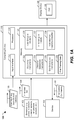
- FIGS. 1A and 1B illustrate particular implementations of a system that is operable to perform multiple clustering operations and to generate machine learning classifiers
- FIG. 2 illustrates particular clustering operations in accordance with one or more aspects disclosed herein;
- FIG. 3 illustrates clustering of time-series data in accordance with one or more aspects disclosed herein;
- FIG. 4 illustrates a process for generating a machine learning classifier
- FIG. 5 is a flowchart to illustrate a particular embodiment of a method of operation at the system of FIG. 1 .
- FIGS. 1A and 1B a particular illustrative example of a system 100 is shown.
- the system 100 may be implemented using (e.g., executed by) one or more computing devices, such as laptop computers, desktop computers, mobile devices, servers, and Internet of Things devices and other devices utilizing embedded processors and firmware or operating systems, etc.
- the system 100 includes one or more sensors 102 , a computing device 110 , a display device 108 , and a device 150 .
- operations described herein as being performed by the various instructions or by a machine learning classifier may be performed by a device executing instructions or the machine learning classifier.
- the clustering operations and the classifier generation operations are performed on a different device, processor (e.g., central processor unit (CPU), graphics processing unit (GPU) or other type of processor), processor core, and/or thread (e.g., hardware or software thread) than the machine learning classifier.
- processor e.g., central processor unit (CPU), graphics processing unit (GPU) or other type of processor
- thread e.g., hardware or software thread
- execution of certain operations associated with the clustering operations, the classifier generation operations, the graphical user interface (GUI) generation operations, or the trained classifier may be parallelized, as further described herein.
- the system 100 may operate to iteratively generate and train (or retrain) a machine learning classifier based on input data.
- FIG. 1A corresponds to an example of the system 100 training a first machine learning classifier and using the first machine learning classifier to monitor and control the device 150
- FIG. 1B corresponds to an example of the system 100 training (or retraining) a second machine learning classifier and using the second machine learning classifier to monitor and control the device 150 .
- the sensors 102 are configured to generate time-series sensor data.
- the sensors 102 are coupled to the device (e.g., a machine) and configured to generate sensor readings (e.g., measurements) associated with the device 150 .
- the sensors 102 include one or more vibration sensors configured to generate vibration measurements.
- the sensors 102 include one or more pressure sensors configured to generate pressure measurements.
- the sensors 102 include one or more temperature sensors configured to generate temperature measurements.
- the sensors 102 include mixed sensors (e.g., temperature and pressure sensors) configured to generate multiple types of measurements. Such examples are for illustration only, and in other implementations, the sensors 102 include other types of sensors.
- the device 150 includes a turbine, a compressor, an engine, a motor, a generator, another type of machine or device, or a combination thereof. Although described as a single device, in other implementations, the device 150 includes multiple devices. For example, the device 150 can be one piece of equipment in a processing system, such as an oil extraction or refining process.
- the computing device 110 is configured to receive a first data set 104 of the time-series data (e.g., the sensor data) from the sensors 102 .
- the time-series data may be received in real-time or near real-time from the sensors 102
- the first data set 104 includes data corresponding to a first time period.
- sensor data received in real-time or near real-time refers to sensor data that are generated during the operation of the device (e.g., the device monitored by the sensors 102 ) and received from the sensors after any processing is performed.
- the sensors 102 generate the sensor data and passes (or processes and passes) the sensor data to the computing device 110 .
- the computing device 110 includes an input interface 112 , a processor 114 , and a memory 120 .
- the input interface 112 and the memory 120 are coupled to the processor 114 , such as via a bus.
- the input interface 112 is configured to receive user input from one or more users.
- the input interface 112 may include a keyboard, a touchscreen, a mouse, a voice-command interface, a gesture-command interface, or a combination thereof.
- the processor 114 may be a single processor or may include one or more processors, one or more central processing units (CPUs), one or more graphics processing units (GPUs), one or more controllers, or a combination thereof, that are configured to execute instructions stored at the memory 120 to perform the operations described herein.
- the memory 120 is configured to store instructions and data to enable the processor 114 to perform the operations herein.
- the memory 120 may include a random-access memory (RAM), a read-only memory (ROM), a computer-readable storage device, an enterprise storage device, any other type of memory, or a combination thereof.
- the memory 120 is configured to store clustering instructions 122 , classifier generation instructions 124 , graphical user interface (GUI) generation instructions 126 , first training data 128 , a first group of clusters 130 (e.g., data indicative of the first group of clusters 130 ), a first group of labels 132 , and a first machine learning classifier 134 (e.g., data indicative of the first machine learning classifier 134 ).
- the clustering instructions 122 are configured to perform clustering operations using input data, such as the first data set 104 , as further described herein.
- the clustering instructions 122 may group members (also referred to herein as data points) of the first data set 104 into the first group of clusters 130 .
- the clustering instructions 122 also associate clusters with corresponding labels.
- the first group of clusters 130 are associated with the first group of labels 132 , as further described herein.
- the first data set 104 includes multiple sensor data points.
- the sensor(s) 102 can include a temperature sensor and a tachometer, each of which generates a corresponding sensed value periodically or occasionally to generate time-series data including a temperature value and a revolutions per minute (RPM) value for each time period.
- the time-series data can be grouped into vectors with each vector including a plurality of sensed data values for a particular time period.
- the first data set 104 can include a first data vector including a first temperature value and a first RPM value for a first time period
- the first data set 104 can include a second data vector including a second temperature value and a second RPM value for a second time period.
- each vector can include more than two sensed data values.
- data pre-processing operations can be performed to fill in some values, to assign data values to time periods, or to perform other operations to generate the vectors of data for each time period.
- the classifier generation instructions 124 are configured to generate a machine learning classifier, such as the first machine learning classifier 134 , based on training data, such as the first training data 128 , as further described herein.
- generating a machine learning classifier may include training a machine learning classifier based on training data and storing data indicative of the machine learning classifier, such as at the memory 120 .
- the GUI generation instructions 126 are configured to generate a GUI 109 for display to the user, as further described herein.
- the GUI 109 may display information indicative of the grouping of input data into clusters, prompts for a user to provide labels to one or more clusters, identification of operating states of a device, other information, or a combination thereof, as further described herein.
- the computing device 110 is also coupled to a display device 108 .
- the display device 108 includes any device capable of displaying information to a user, such as a monitor, a liquid crystal display (LCD) screen, a touch screen, another type of display device, or a combination thereof. Although illustrated as a separate component, in other implementations, the display device 108 is included in or integrated within the computing device 110 .
- the display device 108 is configured to display the GUI 109 , as further described herein.
- the sensors 102 perform measurements of the device 150 to generate the time-series data (e.g., the sensor data).
- the device 150 may include or correspond to industrial machinery, such as a turbine, a compressor, an engine, another type of machinery, or another type of device.
- the time-series data (e.g., the sensor data) may include vibration measurements, pressure measurements, temperature measurements, other measurements, or a combination thereof. Further, the time-series data can include multiple measurements (or sensed values) for each time segment, such as both a temperature measurement and a pressure measurement for each minute of the time series.
- the computing device 110 receives the first data set 104 of the time-series data (e.g., the sensor data) from the sensors 102 or from another computing device that is coupled to the sensors 102 (e.g., via a network, via direct transmission, etc.).
- the first data set 104 corresponds to data recorded or generated during a first time period.
- the clustering instructions 122 receive the first data set 104 as an input and perform first clustering operations on the first data set 104 to group the members of the first data set 104 into the first group of clusters 130 .
- the first clustering operations may be any type of clustering operations, including centroid clustering operations (such as K-Means clustering), hierarchical clustering operations, mean-shift clustering operations, connectivity clustering operations, density clustering operations (such as density-based spatial clustering applications with noise (DBSCAN)), distribution clustering operations, expectation-maximization (EM) clustering using Gaussian mixture models (GMM), or other types of clustering operations or algorithms.
- centroid clustering operations such as K-Means clustering
- hierarchical clustering operations such as mean-shift clustering operations, connectivity clustering operations, density clustering operations (such as density-based spatial clustering applications with noise (DBSCAN)), distribution clustering operations, expectation-maximization (EM) clustering using Gaussian mixture models (GMM), or other types of clustering operations or algorithms.
- EM expectation-maximization
- GMM Gaussian mixture models
- each member of the first data set 104 may be mapped into a feature space.
- the feature space includes a plurality of dimensions, with each dimension corresponding to a particular feature of the input data.
- the time-series data may include multiple types of sensor readings during each sample period, and each type of sensor reading may correspond to a dimension in the feature space.
- the feature space may be two dimensional, with one dimension corresponding to a particular measurement value (e.g., a pressure measurement, a vibration measurement, a temperature measurement, etc.) and another dimension corresponding to time.
- the feature space may include more than two dimensions or include different dimensions.
- the clustering instructions 122 are configured to group the members of the first data set 104 (e.g., data points of the first data set 104 ) into clusters based on the notion that a distance between two points in the feature space is generally indicative of similarity between two members of the first data set 104 .
- a particular number of initial locations e.g., cluster centers
- a distance between a member (e.g., data point) and a particular cluster center is determined.
- the distance between a particular data point and a cluster center (or another data point) may be determined as a Euclidean distance, as a non-limiting example.
- the data point is added to a nearest cluster based on the distance between the data point and each cluster center (which may be an initial position if the cluster does not include any data points). In some implementations, if a data point is remote from every cluster (e.g., the distance between the data point and each cluster center is greater than a threshold distance), the data point is identified as an anomaly and is not assigned to any cluster. After a data point is added to a cluster, a new cluster center is determined as a center of each data point assigned to the cluster. Each additional data point of the first data set 104 is similarly assigned to a corresponding one of the first group of clusters 130 . In other implementations, clustering may be performed based on a different attribute, such as connectivity, density, distributions, etc., and in some implementations, initial conditions for the clusters are not set prior to performing the clustering operations.
- the computing device 110 is configured to identify the first group of clusters using unsupervised learning to assign members of the first data set 104 to the first group of clusters 130 .
- the clusters are determined based on relationships or patterns within the time-series data.
- the clustering instructions 122 are configured to associate each cluster of the first group of clusters 130 with a corresponding label of the first group of labels 132 .
- the first group of labels 132 initially includes system-generated labels. For example, there may be N clusters, and the first group of labels 132 includes “Cluster A,” “Cluster B,” “Cluster C,” and “Cluster N”.
- the computing device 110 is configured to display information regarding the clusters to the user to enable the user to define the first group of labels 132 .
- the display device 108 may be configured to display (e.g., via the GUI 109 ) a prompt for one or more user-defined labels corresponding to the first group of labels 132
- the input interface 112 may be configured to receive a user input 106 indicating the one or more user-defined labels.
- the GUI generation instructions 126 are configured to cause generation of the GUI 109 where the GUI 109 displays an identification of at least some of the data points that are in a first cluster and a prompt for the user to enter a label for the first cluster.
- the GUI 109 similarly displays information and prompts for each of the other clusters, enabling the user to label each of the clusters.
- the user labels the clusters with operating states of the device 150 , such as “Operating State 1”, Operating State 2”, “Operating State 3”, and “Operating State N.”
- the first group of labels 132 may correspond to operating states of the device 150 .
- the processor 114 may execute the classifier generation instructions 124 to generate and train the first machine learning classifier 134 .
- the first machine learning classifier 134 includes any type of trained classifier, such as a neural network classifier, a decision tree classifier, a support vector machine classifier, a regression classifier, a naive Bayes classifier, a perceptron classifier, or another type of classifier.
- the classifier generation instructions 124 are configured to generate the first training data 128 including the first data set 104 and the first group of labels 132 .
- each data point of the first data set 104 is associated with a corresponding label (e.g., a cluster label of the cluster to which the data point belongs) of the first group of labels 132 , and the labeled data are used as the first training data 128 .
- a corresponding label e.g., a cluster label of the cluster to which the data point belongs
- the classifier generation instructions 124 are further configured to train the first machine learning classifier 134 based on the first training data 128 . After the first machine learning classifier 134 is trained, the first machine learning classifier 134 is configured to provide labels based on unlabeled input data. For example, real-time, time-series data from the sensors 102 may be provided to the first machine learning classifier 134 , and the first machine learning classifier 134 may output one or more labels associated with the real-time time-series data. The labels generated by the first machine learning classifier 134 may be used in determining labels assigned by another machine learning classifier (or a re-trained machine learning classifier) as further described herein.
- training the first machine learning classifier 134 includes training the first machine learning classifier 134 to detect an operating state of the device 150 based on real-time, time-series data.
- the first machine learning classifier 134 is further configured to generate an output indicating a user-defined label describing the operating state.
- the first machine learning classifier 134 outputs one or more labels based on the real-time, time-series data.
- the operating states may be labeled or described by a user, such as via the user input 106 indicating one or more user defined labels for the clusters.
- the first machine learning classifier 134 can also, or in the alternative, label operating states that may be associated with an imminent fault condition.
- the user may be able to label some of the data points as associated with or indicative of the fault state.
- the first training data 128 may include sufficient information to train the first machine learning classifier 134 to predict that the device 150 will soon enter the fault state based on the real-time, time-series data.
- the first machine learning classifier 134 is executed by the computing device 110 , and output of the first machine learning classifier 134 is provided as input to the GUI generation instructions 126 .
- the GUI generation instructions 126 are configured to generate the GUI 109 for display at the display device 108 .
- the GUI 109 may indicate the labels output by the first machine learning classifier 134 based on the real-time, time-series data.
- the GUI 109 may display the operating states of the device 150 for each of a plurality of time periods (e.g., sample times corresponding to the real-time, time-series data).
- the device 150 may be controlled based on the labels of the real-time, time-series data.
- the processor 114 may generate first control commands 152 to cause the device 150 to perform operations based on the labels output by the first machine learning classifier 134 .
- the processor 114 if the first machine learning classifier 134 outputs a particular label (e.g., of an operating state that is a precursor to a fault state), the processor 114 generates the first control commands 152 to cause the device 150 to change operating states (e.g., to an operating state that is less likely to precede a fault state) or to change a configuration of the device 150 .
- the first machine learning classifier 134 may be configured to output labels of operating states to be used to control the device 150 .
- the computing device 110 generates a new machine learning classifier (e.g., updates the first machine learning classifier 134 ).
- the generation of the new machine learning classifier may occur after a particular amount of time has lapsed, after a particular amount of the time-series data has been received, after a particular number of a specific label has been output by the first machine learning classifier 134 , or at some other time.
- generation of the new machine learning classifier may be responsive to a change associated with the device 150 . For example, the device 150 may undergo maintenance, a new component may be added, a component may be removed, or another change may occur that substantially changes (or is expected to change) the sensor data generated by the sensors 102 .
- the sensors 102 may undergo “sensor drift” such that measurements recorded by the sensors 102 are on average different from during the first time period associated with the first data set 104 .
- the computing device 110 To compensate for these changes to the device 150 or to the sensors 102 , the computing device 110 generates a new machine learning classifier.
- the new machine learning classifier is based on the previous sensor data as well as new sensor data.
- the computing device 110 receives a second data set 105 of the time-series data.
- the second data set 105 corresponds to a second time period that is subsequent to the first time period associated with the first data set 104 .
- the second data set 105 can be collected and analyzed, in real-time, by the first machine learning classifier 134 of FIG. 1A to provide an indication of the state of the device 150 to a user.
- the computing device 110 combines the second data set 105 with at least a portion of the first data set 104 to generate a combined data set.
- the combined data set includes the second data set 105 and an entirety of the first data set 104 .
- only a portion of the first data set 104 is included in the combined data set.
- a sliding window may be used to determine the portion of the first data set 104 to be included in the combined data set.
- data associated with particular clusters are included in the combined data set.
- other portions of the first data set 104 are included in the combined data set.
- the clustering instructions 122 are configured to perform second clustering operations on the combined data set to group members (e.g., data points) of the combined data set into a second group of clusters 142 .
- members of the combined data set e.g., the second data set 105 and a portion of the first data set 104
- the second group of clusters 142 includes one or more of the clusters that corresponds to clusters of the first group of clusters 130 .
- the first group of clusters 130 and the second group of clusters 142 may both include one or more clusters having the same characteristics.
- the second group of clusters 142 may include clusters having different characteristics than the first group of clusters 130 .
- the second group of clusters 142 is associated with a second group of labels 144 .
- the clustering instructions 122 are configured to associate each cluster of the second group of clusters 142 with a corresponding label of the second group of labels 144 .
- the second group of labels 144 includes one or more labels of the first group of labels 132 such that one or more clusters of the second group of clusters 142 are associated with corresponding labels of the first group of labels 132 .
- the clustering instructions 122 may determine that a second cluster in the second group of clusters 142 also corresponds to the label “Operating State A.”
- a first cluster of the first group of clusters 130 and a second cluster of the second group of clusters 142 may both be associated with a first label of the first group of labels 132 even though one or more characteristics of the first cluster are different from one or more characteristics of the second cluster.
- the clustering instructions 122 determine that the first cluster and the second cluster correspond to the same label based on characteristics of the first cluster and the second cluster. For example, the clustering instructions 122 may determine that the first cluster and the second cluster correspond to the same label based on the first cluster and the second cluster including the same one or more data points (e.g., members of the first data set 104 ). As another example, the clustering instructions 122 may determine that the first cluster and the second cluster correspond to the same label based on a characteristic, such as a center location, quantity of members, distribution, or another characteristic of the first cluster being within a corresponding threshold of a characteristic of the second cluster. Other characteristics of the first cluster and the second cluster may be different. Determining that two clusters correspond to the same label is further described with reference to FIG. 2 .
- Assigning labels from the first group of labels 132 to the second group of clusters 142 enables the system 100 to retain knowledge of the device 150 based on historical data (e.g., the first data set 104 ).
- historical data e.g., the first data set 104
- past operating states may continue to be identified even though the input data have changed sufficiently to cause one or more of the clusters to change characteristics. Retaining the past knowledge (e.g., of previous operating states) enables the system 100 to continue identifying the same operating states even after the input data have changed instead of generating newly labeled operating states when the input data have changed.
- a first cluster of the first group of clusters 130 may be labeled “Operating State A.”
- the first cluster includes data point 1 , data point 2 , and data point 3 , in addition to other data points.
- a second cluster of the second group of clusters 142 is identified.
- the second cluster includes data point 1 , data point 2 , and data point 3 , in addition to other data points.
- the second cluster has at least one characteristic that is different from the first cluster.
- a location of a cluster center of the second cluster may be different from a location of a cluster center of the first cluster
- a distribution associated with the second cluster may be different from a distribution associated with the first cluster
- the number of data points included in the second cluster may be different from a number of data points included in the first cluster
- another characteristic may be different.
- the clustering instructions 122 determine that the second cluster corresponds to the first cluster (regardless of the other different characteristics), and the clustering instructions 122 associate the second cluster with the label associated with the first cluster (e.g., “Operating State A”).
- clusters having different characteristics can be identified as corresponding to previously identified clusters, thereby enabling the system 100 to retain information about clusters as machine learning classifiers are iteratively generated (or updated).
- the remaining clusters of the second group of clusters 142 are labeled based on user-defined labels.
- the GUI 109 may include prompts to a user to label any of the clusters that are not associated with a label from the first group of labels 132 , as these may represent new operating states of the device 150 .
- second training data 140 are generated.
- the classifier generation instructions 124 are configured to generate the second training data 140 including the second group of labels 144 and the combined data set (e.g., the combination of the second data set 105 and the portion of the first data set 104 ).
- the classifier generation instructions 124 use the second training data 140 to generate and train a second machine learning classifier 146 .
- the second training data 140 may be provided to the second machine learning classifier 146 during a training process of the second machine learning classifier 146 .
- the first machine learning classifier 134 may be retrained to generate the second machine learning classifier 146 .
- the second machine learning classifier 146 is configured to provide labels to a third data set 107 of the time-series data (e.g., the sensor data) associated with a third time period that is subsequent to the second time period. For example, after the second machine learning classifier 146 is trained, the second machine learning classifier 146 outputs labels based on real-time, time-series data.
- the labels are from the second group of labels 144 (which includes one or more labels of the first group of labels 132 ).
- the second machine learning classifier 146 is configured to detect an operating state of the device 150 based on real-time, time-series data. The operating state is identified by a label output by the second machine learning classifier 146 .
- the GUI generation instructions 126 are configured to generate the GUI 109 for display at the display device 108 .
- the GUI 109 may include a prompt for a label of a new cluster that is included in the second group of clusters 142 .
- the display device 108 may be configured to display a prompt for one or more user-defined labels corresponding to the second group of labels 144 .
- the one or more user-defined labels may be indicated by the user input 106 .
- the input interface 112 is configured to receive the user input 106 indicating the one or more user-defined labels.
- output of the second machine learning classifier 146 is output via the GUI 109 .
- the GUI 109 may display the labels corresponding to the third data set 107 that are output by execution of the second machine learning classifier 146 .
- the labels include labels indicating operating states of the device 150 .
- the second machine learning classifier 146 may be executed at a different device, or the output generated by the second machine learning classifier 146 may be displayed at a display device of a different device.
- the computing device 110 may be a cloud computing device that is accessed by a second device communicatively coupled (e.g., via a network, such as the Internet) to the cloud computing device, and the output of the second machine learning classifier 146 may be displayed on a display device of the second computing device.
- a second device communicatively coupled (e.g., via a network, such as the Internet) to the cloud computing device, and the output of the second machine learning classifier 146 may be displayed on a display device of the second computing device.
- the device 150 is controlled based on the labels of the real-time, time-series data (e.g., the third data set 107 ).
- the processor 114 may generate second control commands 154 to cause the device 150 to perform operations based on the labels output by the second machine learning classifier 146 .
- the processor 114 if the second machine learning classifier 146 outputs a particular label (e.g., of an operating state that is a precursor to a fault state), the processor 114 generates the second control commands 154 to cause the device 150 to change operating states (e.g., to an operating state that is less likely to precede a fault state) or to change a configuration of the device 150 .
- the second machine learning classifier 146 may be configured to output labels of operating states to be used to control the device 150 .
- the system 100 is able to adapt to an evolving device while still retaining information learned from historical data.
- the device 150 may exhibit new operating behaviors over time (e.g., due to maintenance, parts changes, wear, or other changes to the device 150 ).
- sensor readings may change over time due to sensor drift. Due to the new behaviors or changes in sensor readings, a particular machine learning classifier may become outdated and may begin to identify anomalies (e.g., data points that cannot be assigned a label with sufficient certainty) with increasing frequency. Such identifications are false positives, and the increased false positive rate degrades the utility of the particular machine learning classifier.
- the new machine learning classifier identifies at least some of the same operating states as previous classifiers, thereby retaining a correspondence between existing historical data and newly received data, and reducing time and expense associated with user labeling of data.
- the system 100 periodically generates machine learning classifiers that have reduced false positive rates while retaining information learned from historical data.
- Such machine learning classifiers have greater utility than other machine learning classifiers that become outdated (e.g., do not take into account changes to the device and thus have higher false positive rates) or that do not retain information learned from historical data.
- the machine learning classifiers generated by the system 100 can be used to control the device 150 , such as to avoid unintended operating states or operating states that are precursors to fault states, thereby reducing an amount of downtime of the device 150 for repairs.
- first clustering operations 200 are performed on the first data set 104 of FIG. 1A
- second clustering operations 220 are performed on the combined data set (e.g., the second data set 105 of FIG. 1B and at least a portion of the first data set 104 ).
- the first clustering operations 200 are performed on the first data set 104 to group the data points (e.g., members of the first data set 104 ) into various clusters. For example, the data points of the first data set 104 are grouped into the first group of clusters 130 . In the example illustrated in FIG. 2 , the first group of clusters 130 includes four clusters. In other examples, the first group of clusters 130 includes fewer than four or more than four clusters.
- the clusters 202 - 208 are determined using K-Means clustering operations.
- a number of clusters is determined, and a cluster center for each of the clusters is initially set.
- the number of clusters is determined based on a number of operating states of a device (e.g., the device 150 of FIGS. 1A and 1B ). After initializing each of the cluster centers in the feature space, data points are added to the various clusters and locations of the cluster centers are modified.
- the particular data point A 1 is added to the first cluster 202 , and the location of the center of the first cluster 202 is modified (e.g., updated) to be between the location of the initial cluster center and the location of the particular data point A 1 . Additional points may be added to the clusters 202 - 208 in a similar manner.
- another particular data point may be added to the second cluster 204 based on the other particular data point being closer to the cluster center of the second cluster 204 than to the center of any other cluster 202 , 206 , 208 , and the location of the cluster center of the second cluster 204 may be updated based on the location of the other particular data point.
- a data point is only added to a cluster if the data point is within a threshold distance of the cluster center; otherwise, the data point is maintained as an outlier.
- outliers are identified as anomalies (e.g., data points that are not representative of an operating state) or are identified as corresponding to a fault state.
- one or more of the operating states corresponding to the clusters 202 - 208 may correspond to fault states, or precursors to fault states.
- the first clustering operations 200 continue until all data points (e.g., of the first data set 104 ) are assigned to a corresponding cluster or are identified as outliers, and the locations of the cluster centers are updated based on the assignments. For example, after performance of the first clustering operations 200 , the data points are grouped into the clusters 202 - 208 , as illustrated in FIG. 2 .
- the first clustering operations 200 include other types of clustering operations or algorithms, such as hierarchical clustering, mean-shift clustering, connectivity clustering operations, density clustering operations (such as DBSCAN), distribution clustering operations, EM clustering using GMM, or other types of clustering operations or algorithms.
- clustering operations or algorithms such as hierarchical clustering, mean-shift clustering, connectivity clustering operations, density clustering operations (such as DBSCAN), distribution clustering operations, EM clustering using GMM, or other types of clustering operations or algorithms.
- Each of the clusters is associated with a label.
- a first cluster 202 is associated with the label “Operating State A”
- a second cluster 204 is associated with the label “Operating State B”
- a third cluster 206 is associated with the label “Operating State C”
- a fourth cluster 208 is associated with the label “Operating State D.”
- outliers may also be identified by a label, such as “Anomaly” or “Fault State.”
- one or more of “Operating State A,” “Operating State B,” “Operating State C,” or “Operating State D” may correspond to a fault state. In the example illustrated in FIG. 2 , these four labels make up the first group of labels 132 of FIG.
- the labels are determined by the computing device 110 .
- one or more of the labels may be user-defined.
- the user input 106 of FIGS. 1A and 1B may indicate the names of the labels for the clusters 202 - 208 .
- a machine learning classifier such as the first machine learning classifier 134 of FIG. 1A , is trained based on supervised training data that include the labels corresponding to the clusters 202 - 208 and the first data set 104 .
- the first data set 104 and the corresponding labels e.g., the cluster label of each data point in the first data set 104
- This machine learning classifier is configured to receive input data and to output a label, such as one of “Operating State A”, “Operating State B,” “Operating State C,” “Operating State D”, or “Anomaly,” based on the input data.
- an anomaly refers to a data point that does not correspond, with sufficient confidence, to a class or label that the machine learning classifier is trained to identify.
- data points of input data may begin to fall outside the clusters 202 - 208 , leading to increased identification of anomalous data.
- Many of these anomalous data identifications may be false positives, and thus the usefulness of the first machine learning classifier 134 may deteriorate as time progresses.
- a sensor value gathered during a normal operating condition may deviate sufficiently from other data points associated with the normal operating condition that the machine learning classifier is not able to reliably label the sensor value as indicative of any recognized operating condition.
- the sensor value is indicative of a normal operating condition, but because of the sensor drift, the machine learning classifier is not able to properly label the sensor data.
- the second clustering operations 220 are performed.
- the second clustering operations 220 are performed as part of the process to generate a new machine learning classifier, such as the second machine learning classifier 146 (also referred to as updating the first machine learning classifier 134 ).
- the second clustering operations 220 are performed on a combined data set (e.g., a combination of the second data set 105 and at least a portion of the first data set 104 ).
- the combined data set includes an entirety of the first data set 104 .
- the combined data set includes less than an entirety of the first data set 104 .
- the second clustering operations 220 are performed to group the data points of the combined data set into the second group of clusters 142 of FIG. 1B .
- the second group of clusters 142 includes a fifth cluster 222 , a sixth cluster 224 , a seventh cluster 226 , an eighth cluster 228 , a ninth cluster 230 , and a tenth cluster 232 .
- a particular data point 250 is identified as an outlier.
- the second clustering operations 220 include K-Means clustering operations
- the particular data point 250 is identified as an outlier based on there being no cluster center that is located within a threshold distance of the location of the particular data point 250 in the feature space.
- other types of clustering operations may be used.
- Each of the clusters 222 - 232 is associated with a label.
- the labels associated with the clusters 222 - 232 make up the second group of labels 144 .
- At least some of the labels for the clusters 222 - 232 are the same as labels of the clusters 202 - 208 (e.g., the second group of labels 144 includes at least some labels of the first group of labels 132 ).
- a cluster of the first group of clusters 130 may have the same label as a cluster of the second group of clusters 142 even though one or more characteristics of the clusters differ.
- the first cluster 202 is associated with a first label (e.g., “Operating State A”)
- the fifth cluster 222 is associated with the first label
- a characteristic of the first cluster 202 is different from a characteristic of the fifth cluster 222 .
- a location of a cluster center, a quantity of members, a distribution, or another characteristic may be different between the first cluster 202 and the fifth cluster 222 .
- Association of clusters with labels from previous clusters is performed based on a correspondence between the clusters.
- a particular characteristic e.g., a common characteristic
- the first label (“Operating State A”) is associated with the first cluster 202 , and the first cluster 202 includes the data points A 1 , A 2 , and A 3 .
- the first label is also associated with the fifth cluster 222 based on the fifth cluster 222 including the data points A 1 , A 2 , A 3 .
- the two clusters correspond to each other and are associated with the same label.
- the location of a cluster center 210 of the first cluster 202 is different from the location of a cluster center 240 of the fifth cluster 222 and a quantity of data points included in the first cluster 202 is different from a quantity of data points included in the fifth cluster 222
- the first cluster 202 and the fifth cluster 222 are both associated with the label “Operating State A.”
- two clusters may be associated with the same label if at least one characteristic (e.g., a common characteristic) of one cluster is similar to the characteristic of another cluster. For example, if a characteristic of the second cluster is within a threshold similarity to a characteristic of the first cluster, the second cluster is associated with the same label as the first cluster.
- the characteristic includes a location of a cluster center.
- the first label (“Operating State A”) is associated with the first cluster 202 and the first cluster 202 has the cluster center 210 located at a first location (e.g., a center location) in the feature space.
- the first label is also associated with the fifth cluster 222 based on the location in the feature space of the cluster center 240 of the fifth cluster 222 being within a threshold distance of the location of the cluster center 210 of the first cluster 202 .
- this implementation may be used for centroid clustering operations.
- the characteristic includes a quantity of members (e.g., data points).
- the first label is associated with the first cluster 202 and the first cluster 202 includes a first quantity of members (e.g., a total number of data points included in the first cluster 202 ).
- the first label is also associated with the fifth cluster 222 based on a difference between the first quantity and a second quantity of members included in the fifth cluster 222 satisfying a threshold (e.g., being less than or equal to the threshold).
- the characteristic includes a cluster distribution.
- the first label is associated with the first cluster 202 and the first cluster 202 is associated with a first distribution.
- the first label is also associated with the fifth cluster 222 based on a difference between the first distribution and a second distribution associated with the fifth cluster 222 satisfying a threshold (e.g., being less than or equal to the threshold).
- a threshold e.g., being less than or equal to the threshold.
- a mean or a standard deviation associated with the fifth cluster 222 may be within a threshold of a mean or a standard deviation associated with the first cluster 202 .
- this implementation may be used for distribution clustering operations.
- the characteristic includes a cluster density.
- the first label is associated with the first cluster 202 and the first cluster 202 has a first density.
- the first label is also associated with the fifth cluster 222 based on a difference between the first density and a second density associated with the fifth cluster 222 satisfying a threshold (e.g., being less than or equal to the threshold).
- this implementation may be used for density clustering operations, such as DBSCAN.
- the fifth cluster 222 is associated with the first label (e.g., “Operating State A”) based on the fifth cluster 222 including a set of members (e.g., data points) that are also included in the first cluster 202 .
- the first label e.g., “Operating State A”
- both the first cluster 202 and the fifth cluster 222 include the data points A 1 , A 2 , and A 3 .
- the set of data points may be specifically chosen (e.g., the data points are particular representative data points or other selected data points) or the set of data points may be chosen randomly or pseudo-randomly.
- the sixth cluster 224 is associated with the second label (e.g., “Operating State B”) based on multiple similarities (e.g., inclusion of a set of data points, location of cluster center, cluster boundary, etc.) with the second cluster 204 .
- the seventh cluster 226 is associated with the third label (e.g., “Operating State C”) based on multiple similarities (e.g., inclusion of a set of data, location of cluster center, cluster boundary, etc.) with the third cluster 206 .
- the eighth cluster 228 is associated with the fourth label (e.g., “Operating State D”) based on the eighth cluster 228 including a set of data points that are also included in the fourth cluster 208 . Because the ninth cluster 230 and the tenth cluster 232 are not sufficiently similar to any of the clusters 202 - 208 , the ninth cluster 230 is associated with a fifth label (e.g., “Operating State E”) and the tenth cluster is associated with a sixth label (e.g., “Operating State F”).
- the new labels (e.g., the fifth label and the sixth label) may correspond to new operating states that are associated with a time period associated with the second data set 105 or may correspond to fault states. Additionally, in implementations in which outliers are identified, the particular data point 250 is identified as anomalous (which may correspond to a fault state).
- the information e.g., the labeled operating states
- the second group of clusters are associated with labels that are also associated with the first group of clusters (e.g., clusters 202 - 208 )
- the information e.g., the labeled operating states
- the second machine learning classifier e.g., the second machine learning classifier 146
- changing behavior patterns of complex assets can be learned by a machine learning classifier while retaining information (e.g., indicative of operating states) learned from historical data. This improves the utility of the machine learning classifier by reducing false positives of outliers (e.g., fault states) as time goes on.
- Graph 300 illustrates a first data set of time-series data, such as the first data set 104 of FIGS. 1A and 1B .
- the first data set includes first data points 302 and second data points 304 .
- Clustering operations are performed on the first data points 302 and the second data points 304 to group the data points into a first group of clusters, as described with reference to FIG. 2 .
- similarities of the first data points 302 e.g., similarities in a feature space
- the first data points 302 are grouped in a first cluster.
- the second data points 304 are grouped in a second cluster.
- Each of the clusters is associated with a label, as described with reference to FIG. 2 .
- the first cluster is associated with a first label
- the second cluster is associated with a second label.
- the labels may correspond to operating states of a device being monitored, and may computer-generated or user-defined.
- the labels, the clusters, and the first data set are used to train a machine learning classifier, such as the first machine learning classifier 134 of FIG. 1A .
- a second data set is received, such as the second data set 105 of FIG. 1B .
- Graph 310 illustrates a combined data set (e.g., the first data set and the second data set). As illustrated in FIG. 3 , an entirety of the first data set may be combined with the second data set to form the combined data set. Alternatively, less than an entirety of the first data set may be combined with the second data set to form the combined data set.
- the combined data set includes the first data points 302 , the second data points 304 , third data points 312 , fourth data points 314 , and a particular data point 316 .
- Clustering operations are performed on the data points 302 - 304 and 312 - 316 to group the data points into a second group of clusters, as described with reference to FIG. 2 . For example, based on similarities of the first data points 302 and the third data points 312 , the first data points 302 and the third data points 312 are grouped into a third cluster. Additionally, based on similarities of the second data points 304 and the fourth data points 314 , the second data points 304 and the fourth data points 314 are grouped into a fourth cluster.
- the particular data point 316 may be identified as an outlier. For example, a location of the particular data point 316 may be outside a threshold range of the locations of each cluster center.
- Each of the clusters is associated with a label, as described with reference to FIG. 2 .
- At least some of the labels are the same as the previously assigned labels.
- the third cluster is associated with the first label based on the third cluster including the first data points 302 (or a subset thereof).
- the fourth cluster is associated with the second label based on the fourth cluster including the second data points 304 (or a subset thereof).
- the particular data point 316 is associated with a third label.
- the third label is a fault state label.
- the labels, the clusters, and the combined data set are used to train a machine learning classifier, such as the second machine learning classifier 146 of FIG. 1B .
- the information e.g., the labeled operating states
- the second machine learning classifier e.g., the second machine learning classifier 146
- the second machine learning classifier e.g., the second machine learning classifier 146
- changing behavior patterns of complex assets can be learned by a machine learning classifier while retaining information (e.g., indicative of operating states) learned from historical data. This improves the utility of the machine learning classifier by reducing false positives of anomalous data as time goes on.
- FIG. 4 illustrates a process 400 of generating a machine learning classifier.
- the process 400 may be performed by the computing device 110 , such as by the processor 114 executing instructions stored at the memory 120 .
- the process 400 begins with receiving sensor data 402 .
- the sensor data 402 may include the first data set 104 or the combined data set (e.g., a combination of the second data set 105 and at least a portion of the first data set 104 ).
- the sensor data 402 include vibration data, pressure data, temperature data, or a combination thereof, that is generated based on monitoring of a device, such as an industrial machine including a turbine, a compressor, or an engine.
- the sensor data 402 include sensor data at various times (e.g., sampled sensor data).
- the sensor data 402 are provided to the clustering instructions 122 to cluster the sensor data 402 into a group of clusters.
- the clustering instructions 122 are configured to cluster the sensor data 402 into clusters based on relationships between particular elements of the sensor data 402 , as further described with reference to FIG. 2 .
- the clustering instructions 122 may be configured to perform centroid clustering operations (such as K-Means clustering), hierarchical clustering operations, mean-shift clustering operations, connectivity clustering operations, density clustering operations (such as DBSCAN), distribution clustering operations, EM clustering using GMMs, or other types of clustering operations or algorithms.
- the clustering instructions 122 are also configured to associate the clusters with corresponding labels.
- the labels may be user-defined. After the clusters are labeled, each data point of the sensor data 402 is associated with a corresponding cluster label to generate label data 410 .
- the label data 410 indicates a label associated with each element of the sensor data 402 , and the label is based on the cluster that the element is assigned to.
- the sensor data 402 may include sensor data at a first time 404 , sensor data at a second time 406 , and sensor data at an Mth time 408 .
- the label data 410 indicates a first label 412 associated with the sensor data at the first time 404 , a second label 414 associated with the sensor data at the second time 406 , and an Mth label 416 associated with the sensor data at the Mth time 408 .
- Each label corresponds to a cluster that the element of the sensor data 402 is assigned to.
- the sensor data at the first time 404 may be assigned to a particular cluster by the clustering instructions 122
- the first label 412 is the label associated with the particular cluster.
- the sensor data 402 and the label data 410 are used as supervised training data 420 .
- the supervised training data 420 are provided to the classifier generation instructions 124 .
- the classifier generation instructions 124 generate a machine learning classifier 422 , such as the first machine learning classifier 134 or the second machine learning classifier 146 , based on the supervised training data 420 .
- the classifier generation instructions 124 may generate a neural network classifier, a decision tree classifier, a support vector machine classifier, a regression classifier, a naive Bayes classifier, a perceptron classifier, or another type of classifier.
- the supervised training data 420 may be used to train the machine learning classifier to output labels based on input data (e.g., time-series data) received by the machine learning classifier 422 .
- input data e.g., time-series data
- the machine learning classifier 422 is a neural network classifier
- the training may be performed using backpropagation or another training technique.
- the machine learning classifier 422 may be stored at the memory 120 for execution by the computing device 110 or for sending to another computing device.
- the classifier generation instructions 124 are configured to use a first portion of the supervised training data 420 to train preliminary machine learning classifiers and, after training, to use a second portion of the supervised training data 420 to test performance of the preliminary machine learning classifiers.
- the classifier generation instructions 124 may determine a performance metric or multiple performance metrics for each of the preliminary machine learning classifiers.
- the performance indicator or performance indicators may indicate values of the performance metrics.
- the performance indicator or performance indicators may identify the best performing preliminary machine learning classifier of the preliminary machine learning classifiers. The best performing machine learning classifier may be selected based on classification accuracy, processing time, complexity, or other factors.
- the classifier generation instructions 124 generate the machine learning classifier 422 by designating the best performing machine learning classifier as the machine learning classifier 422 .
- the classifier generation instructions determine classifier generation settings associated with the best performing preliminary machine learning classifier to generate a new classifier, which is designated as the machine learning classifier 422 .
- the preliminary machine learning classifiers are used to identify which type of machine learning classifier and which classifier generation settings work best for particular input data by dividing the supervised training data 420 into a training portion and a test portion.
- the classifier generation instructions 124 After identifying classifier parameters (e.g., a type of classifier and classifier generation settings) that work best for the particular input data, the classifier generation instructions 124 generate the machine learning classifier 422 using the classifier parameters and the entire set of the supervised training data 420 .
- the machine learning classifier 422 may be trained using a larger set of supervised training data, which is expected to improve the accuracy of classifications assigned by the machine learning classifier 422 .
- the method 500 includes receiving, by a processor, a first data set of time-series data, at 502 .
- the processor 114 receives the first data set 104 .
- the method 500 includes performing, by the processor, a first clustering operation on the first data set to group members of the first data set into a first group of clusters, at 504 .
- the processor 114 performs a first clustering operation on the first data set 104 to group members of the first data set 104 into the first group of clusters 130 .
- the method 500 includes associating, at the processor, each cluster of the first group of clusters with a corresponding label of a first group of labels, at 506 .
- the processor 114 associates each cluster of the first group of clusters 130 with a corresponding label of the first group of labels 132 .
- the method 500 includes, after performing the first clustering operation, receiving, by the processor, a second set of the time-series data, at 508 .
- the processor 114 receives the second data set 105 .
- the method 500 includes combining, at the processor, the second data set and at least a portion of the first data set to generate a combined data set, at 510 .
- the processor 114 combines the second data set 105 and at least a portion of the first data set 104 to generate the combined data set.
- the method 500 includes performing, by the processor, a second clustering operation on the combined data set to group members of the combined data set into a second group of clusters, at 512 .
- the processor 114 performs a second clustering operation on the combined data set (e.g., the second data set 105 and at least a portion of the first data set 104 ) to group members of the combined data set into the second group of clusters 142 .
- the method 500 includes associating, at the processor, one or more clusters of the second group of clusters with a corresponding label of the first group of labels, at 514 .
- the processor 114 associates one or more clusters of the second group of clusters 142 with a corresponding label of the first group of labels 132 .
- the second group of labels includes one or more of the first group of labels 132 .
- the method 500 includes generating, at the processor, training data based on a second group of labels corresponding to the second group of clusters and the combined data set, at 516 .
- the processor 114 generates the second training data 140 that is based on the combined data set, the second group of clusters 142 , and the second group of labels 144 .
- the method 500 further includes training, at the processor, a machine learning classifier based on the training data to provide labels to a third data set of the time-series data, at 518 .
- the processor 114 trains the second machine learning classifier 146 based on the second training data 140 to provide labels to a third data set of the time-series data.
- the first group of labels includes one or more user-defined labels describing an operating state associated with the time-series data.
- the first group of labels 132 describes an operating state of a device, such as a machine, which the sensors 102 are performing measurements of
- the method 500 further includes initiating display of a prompt for a label of a new cluster, and the second group of clusters includes the new cluster.
- the display device 108 may display (e.g., via the GUI 109 ) a prompt for a label of a new cluster that is included in the second group of clusters 142 , and the label may be indicated by the user input 106 .
- training the machine learning classifier includes training the machine learning classifier to detect an operating state of a device based on real-time, time-series data and to generate an output indicating a user-defined label describing the operating state, the user-defined label including a cluster label.
- the sensors 102 are coupled to a device and generate real-time, time-series data.
- the second machine learning classifier 146 is configured to generate labels associated with members of the real-time, time-series data. The labels may include a user-defined label as indicated by the user input 106 .
- the method 500 includes training a first machine learning classifier based on the first data set and the first group of labels to provide labels to input data.
- the processor 114 trains the first machine learning classifier 134 based on the first training data 128 .
- the method 500 further includes providing the second data set to the first machine learning classifier to generate one or more labels associated with the second data set.
- the second data set 105 is provided to the first machine learning classifier 134 to generate one or more labels associated with the second data set 105 .
- the one or more labels may also be included in the second group of labels 144 , as further described with reference to FIG. 1B .
- the first data set and the second data set include pressure measurements generated by one or more pressure sensors, vibration measurements generated by one or more vibration sensors, temperature measurements generated by one or more temperature sensors, or a combination thereof.
- the sensors 102 may include pressure sensor, vibration sensors, temperature sensors, or a combination thereof.
- a first cluster of the first group of clusters is associated with a first label of the first group of labels
- a second cluster of the second group of clusters is associated with the first label
- a characteristic of the first cluster is different from a corresponding characteristic of the second cluster.
- the first cluster 202 and the fifth cluster 222 are associated with the same label (e.g., “Operating State A”) even though certain characteristics (e.g., location of cluster center, quantity of members, cluster boundary, etc.) of the fifth cluster 222 is different from the corresponding characteristics of the first cluster 202 .
- a first label of the first group of labels is associated with a first cluster of the first group of clusters, the first cluster has a first center location in a feature space, and the first label is associated with a second cluster of the second group of clusters based on a center location in the feature space of the second cluster being within a threshold distance of the center location of the first cluster.
- the first cluster 202 and the fifth cluster 222 may be associated with the same label (e.g., “Operating State A”) based on the location of the cluster center 240 of the fifth cluster 222 being within a threshold distance of the location of the cluster center 210 of the first cluster 202 .
- a first label of the first group of labels is associated with a first cluster of the first group of clusters, the first cluster includes one or more particular members of the first data set, and the first label is associated with a second cluster of the second group of clusters based on the second cluster including the one or more particular members.
- the first cluster 202 and the fifth cluster 222 may be associated with the same label (e.g., “Operating State A”) based on the first cluster 202 and the fifth cluster 222 both including the data points A 1 , A 2 , and A 3 .
- a first label of the first group of labels is associated with a first cluster of the first group of clusters, the first cluster includes a first quantity of members, and the first label is associated with a second cluster of the second group of clusters based on a difference between the first quantity and a second quantity of members included in the second cluster satisfying a threshold.
- the first cluster 202 and the fifth cluster 222 may be associated with the same label (e.g., “Operating State A”) based on a difference between the total number of data points (e.g., members) of the first cluster 202 and the total number of data points of the fifth cluster 222 being less than or equal to a threshold.
- a first label of the first group of labels is associated with a first cluster of the first group of clusters, the first cluster is associated with a first distribution, and the first label is associated with a second cluster of the second group of clusters based on a difference between the first distribution and a second distribution associated with the second cluster satisfying a threshold.
- the first cluster 202 and the fifth cluster 222 may be associated with the same label (e.g., “Operating State A”) based on a difference between a first distribution associated with the first cluster 202 and a second distribution associated with the fifth cluster 222 being less than or equal to a threshold.
- the method 500 enables generation and training of a machine learning classifier that maintains information associated with previous data (e.g., the first data set) while taking into account changes to a device being monitored. This improves the utility of the machine learning classifier by reducing false positives of anomalous data as time goes on.
- a computing device includes a processor and a memory storing instructions executable by the processor to perform operations including receiving a first data set of time-series data.
- the operations include performing a first clustering operation on the first data set to group members of the first data set into a first group of clusters.
- the operations include associating each cluster of the first group of clusters with a corresponding label of a first group of labels.
- the operations include, after performing the first clustering operation, receiving a second data set of the time-series data.
- the operations include combining the second data set and at least a portion of the first data set to generate a combined data set.
- the operations include performing a second clustering operation on the combined data set to group members of the combined data set into a second group of clusters.
- the operations include associating one or more clusters of the second group of clusters with a corresponding label of the first group of labels.
- the operations include generating training data based on a second group of labels corresponding to the second group of clusters and the combined data set.
- the operations further include training a machine learning classifier based on the training data to provide labels to a third data set of the time-series data.
- a first cluster of the first group of clusters is associated with a first label of the first group of labels
- a second cluster of the second group of clusters is associated with the first label
- a characteristic of the first cluster is different from a corresponding characteristic of the second cluster.
- a centroid of the first cluster in a feature space, a number of members included in the first cluster, or a distribution associated with the first cluster may be different from a centroid of the second cluster in the feature space, a number of members included in the second cluster, or a distribution associated with the second cluster, respectively.
- the computing device may further include a display device configured to display a prompt for one or more user-defined labels corresponding to the second group of labels.
- the machine learning classifier is configured to detect an operating state of a device based on real-time, time-series data and to generate an output indicating the one or more user-defined labels describing the operating state.
- the display device is further configured to display the output.
- the computing device further includes an input interface configured to receive a user input indicating the one or more user-defined labels.
- a method includes receiving, by a processor, a first data set of time-series data.
- the method includes performing, by the processor, a first clustering operation on the first data set to group members of the first data set into a first group of clusters.
- the method includes associating, at the processor, each cluster of the first group of clusters with a corresponding label of a first group of labels.
- the method includes, after performing the first clustering operation, receiving, by the processor, a second data set of the time-series data.
- the method includes combining, at the processor, the second data set and at least a portion of the first data set to generate a combined data set.
- the method includes performing, by the processor, a second clustering operation on the combined data set to group members of the combined data set into a second group of clusters.
- the method includes associating, at the processor, one or more clusters of the second group of clusters with a corresponding label of the first group of labels.
- the method includes generating, at the processor, training data based on a second group of labels corresponding to the second group of clusters and the combined data set.
- the method further includes training, at the processor, a machine learning classifier based on the training data to provide labels to a third data set of the time-series data.
- a computer-readable storage device stores instructions that, when executed, cause a computer to perform operations including receiving a first data set of time-series data.
- the operations include performing a first clustering operation on the first data set to group members of the first data set into a first group of clusters.
- the operations include associating each cluster of the first group of clusters with a corresponding label of a first group of labels.
- the operations include, after performing the first clustering operation, receiving a second data set of time-series data.
- the operations include combining the first data set and the second data set to generate a combined data set.
- the operations include performing a second clustering operation on the combined data set to group members of the combined data set into a second group of clusters.
- the operations include associating one or more clusters of the second group of clusters with a corresponding label of the first group of labels.
- the operations include generating training data based on a second group of labels corresponding to the second group of clusters and the combined data set.
- the operations further include training a machine learning classifier based on the training data to provide labels to a third data set of the time-series data.
- the first data set and the second data set comprise pressure measurements generated by one or more pressure sensors, vibration measurements generated by one or more vibration sensors, temperature measurements generated by one or more temperature sensor, or a combination thereof.
- the first data set and the second data set are generated by sensors coupled to one or more turbines, one or more compressors, one or more oil rigs, or a combination thereof.
- the software elements of the system may be implemented with any programming or scripting language such as C, C++, C#, Java, JavaScript, VBScript, Macromedia Cold Fusion, COBOL, Microsoft Active Server Pages, assembly, PERL, PHP, AWK, Python, Visual Basic, SQL Stored Procedures, PL/SQL, any UNIX shell script, and extensible markup language (XML) with the various algorithms being implemented with any combination of data structures, objects, processes, routines or other programming elements.
- the system may employ any number of techniques for data transmission, signaling, data processing, network control, and the like.
- the systems and methods of the present disclosure may be embodied as a customization of an existing system, an add-on product, a processing apparatus executing upgraded software, a standalone system, a distributed system, a method, a data processing system, a device for data processing, and/or a computer program product.
- any portion of the system or a module may take the form of a processing apparatus executing code, an internet based (e.g., cloud computing) embodiment, an entirely hardware embodiment, or an embodiment combining aspects of the internet, software and hardware.
- the system may take the form of a computer program product on a computer-readable storage medium or device having computer-readable program code (e.g., instructions) embodied or stored in the storage medium or device.
- any suitable computer-readable storage medium or device may be utilized, including hard disks, CD-ROM, optical storage devices, magnetic storage devices, and/or other storage media.
- the system 100 may be implemented using one or more computer hardware devices (which may be communicably coupled via local and/or wide-area networks) that include one or more processors, where the processor(s) execute software instructions corresponding to the various components of FIG. 1 .
- one or more of the components of FIG. 1 may be implemented using a hardware device, such as a field-programmable gate array (FPGA) device, an application-specific integrated circuit (ASIC) device, etc.
- FPGA field-programmable gate array
- ASIC application-specific integrated circuit
- a “computer-readable storage medium” or “computer-readable storage device” is not a signal.
- Computer program instructions may be loaded onto a computer or other programmable data processing apparatus to produce a machine, such that the instructions that execute on the computer or other programmable data processing apparatus create means for implementing the functions specified in the flowchart block or blocks.
- These computer program instructions may also be stored in a computer-readable memory or device that can direct a computer or other programmable data processing apparatus to function in a particular manner, such that the instructions stored in the computer-readable memory produce an article of manufacture including instruction means which implement the function specified in the flowchart block or blocks.
- the computer program instructions may also be loaded onto a computer or other programmable data processing apparatus to cause a series of operational steps to be performed on the computer or other programmable apparatus to produce a computer-implemented process such that the instructions which execute on the computer or other programmable apparatus provide steps for implementing the functions specified in the flowchart block or blocks.
- the disclosure may include a method, it is contemplated that it may be embodied as computer program instructions on a tangible computer-readable medium, such as a magnetic or optical memory or a magnetic or optical disk/disc. All structural, chemical, and functional equivalents to the elements of the above-described exemplary embodiments that are known to those of ordinary skill in the art are intended to be encompassed by the present claims. Moreover, it is not necessary for a device or method to address each and every problem sought to be solved by the present disclosure, for it to be encompassed by the present claims. Furthermore, no element, component, or method step in the present disclosure is intended to be dedicated to the public regardless of whether the element, component, or method step is explicitly recited in the claims.
- the terms “comprises”, “comprising”, or any other variation thereof, are intended to cover a non-exclusive inclusion, such that a process, method, article, or apparatus that comprises a list of elements does not include only those elements but may include other elements not expressly listed or inherent to such process, method, article, or apparatus.
Landscapes
- Engineering & Computer Science (AREA)
- Theoretical Computer Science (AREA)
- Data Mining & Analysis (AREA)
- Physics & Mathematics (AREA)
- General Engineering & Computer Science (AREA)
- General Physics & Mathematics (AREA)
- Databases & Information Systems (AREA)
- Artificial Intelligence (AREA)
- Evolutionary Computation (AREA)
- Software Systems (AREA)
- Computer Vision & Pattern Recognition (AREA)
- Life Sciences & Earth Sciences (AREA)
- Mathematical Physics (AREA)
- Computing Systems (AREA)
- Bioinformatics & Computational Biology (AREA)
- Bioinformatics & Cheminformatics (AREA)
- Evolutionary Biology (AREA)
- Medical Informatics (AREA)
- Health & Medical Sciences (AREA)
- Biomedical Technology (AREA)
- Biophysics (AREA)
- Computational Linguistics (AREA)
- General Health & Medical Sciences (AREA)
- Molecular Biology (AREA)
- Information Retrieval, Db Structures And Fs Structures Therefor (AREA)
Abstract
Description
Claims (16)
Priority Applications (2)
| Application Number | Priority Date | Filing Date | Title |
|---|---|---|---|
| US16/171,182 US10810513B2 (en) | 2018-10-25 | 2018-10-25 | Iterative clustering for machine learning model building |
| CN201911026204.1A CN111104959A (en) | 2018-10-25 | 2019-10-25 | Method and apparatus for machine learning classifier generation |
Applications Claiming Priority (1)
| Application Number | Priority Date | Filing Date | Title |
|---|---|---|---|
| US16/171,182 US10810513B2 (en) | 2018-10-25 | 2018-10-25 | Iterative clustering for machine learning model building |
Publications (2)
| Publication Number | Publication Date |
|---|---|
| US20200134510A1 US20200134510A1 (en) | 2020-04-30 |
| US10810513B2 true US10810513B2 (en) | 2020-10-20 |
Family
ID=70325250
Family Applications (1)
| Application Number | Title | Priority Date | Filing Date |
|---|---|---|---|
| US16/171,182 Active US10810513B2 (en) | 2018-10-25 | 2018-10-25 | Iterative clustering for machine learning model building |
Country Status (2)
| Country | Link |
|---|---|
| US (1) | US10810513B2 (en) |
| CN (1) | CN111104959A (en) |
Cited By (4)
| Publication number | Priority date | Publication date | Assignee | Title |
|---|---|---|---|---|
| US20220335085A1 (en) * | 2019-07-30 | 2022-10-20 | Nippon Telegraph And Telephone Corporation | Data selection method, data selection apparatus and program |
| US20240265273A1 (en) * | 2023-02-07 | 2024-08-08 | Netscout Systems, Inc. | Systems and methods for machine learning model selection for time series data |
| TWI869297B (en) * | 2024-06-11 | 2025-01-01 | 神耀科技股份有限公司 | Learning sample data screening and abnormal data screening system for machine learning and method thereof |
| US12229706B2 (en) | 2021-06-10 | 2025-02-18 | Samsung Display Co., Ltd. | Systems and methods for concept intervals clustering for defect visibility regression |
Families Citing this family (33)
| Publication number | Priority date | Publication date | Assignee | Title |
|---|---|---|---|---|
| US10810513B2 (en) * | 2018-10-25 | 2020-10-20 | The Boeing Company | Iterative clustering for machine learning model building |
| US12541688B2 (en) * | 2018-11-05 | 2026-02-03 | Edge Case Research, Inc. | Systems and methods for evaluating perception system quality |
| US11669770B2 (en) * | 2018-11-28 | 2023-06-06 | Stmicroelectronics S.R.L. | Activity recognition method with automatic training based on inertial sensors |
| US10552736B1 (en) * | 2019-03-06 | 2020-02-04 | Capital One Services, Llc | Counter data generation for data profiling using only true samples |
| US11533326B2 (en) | 2019-05-01 | 2022-12-20 | Oracle International Corporation | Systems and methods for multivariate anomaly detection in software monitoring |
| US11586659B2 (en) * | 2019-05-03 | 2023-02-21 | Servicenow, Inc. | Clustering and dynamic re-clustering of similar textual documents |
| EP3786861A1 (en) * | 2019-08-27 | 2021-03-03 | Ford Global Technologies, LLC | A computer-implemented logistics method |
| US12001984B2 (en) * | 2019-12-27 | 2024-06-04 | Oracle International Corporation | Enhanced user selection for communication workflows using machine-learning techniques |
| US20230038415A1 (en) * | 2020-02-07 | 2023-02-09 | Fanuc Corporation | Diagnosis device |
| US11593714B2 (en) * | 2020-05-06 | 2023-02-28 | Citrix Systems, Inc. | Adaptive anomaly detector |
| US11455322B2 (en) * | 2020-05-12 | 2022-09-27 | International Business Machines Corporation | Classification of time series data |
| GB202009198D0 (en) * | 2020-06-17 | 2020-07-29 | Rolls Royce Plc | Computer-implemented method |
| GB202009196D0 (en) * | 2020-06-17 | 2020-07-29 | Rolls Royce Plc | Computer-implemented method |
| GB202009197D0 (en) | 2020-06-17 | 2020-07-29 | Rolls Royce Plc | Computer-implemented method |
| US11676071B2 (en) * | 2020-06-30 | 2023-06-13 | Oracle International Corporation | Identifying and ranking anomalous measurements to identify faulty data sources in a multi-source environment |
| EP3958100A1 (en) * | 2020-08-21 | 2022-02-23 | Microsoft Technology Licensing, LLC | Anomaly detection for sensor systems |
| US20220067460A1 (en) * | 2020-08-28 | 2022-03-03 | Capital One Services, Llc | Variance Characterization Based on Feature Contribution |
| CN114139676B (en) * | 2020-09-02 | 2025-10-03 | 富士通株式会社 | Training Methods for Domain-Adaptive Neural Networks |
| EP4227864A4 (en) * | 2020-10-08 | 2023-11-22 | Fujitsu Limited | EVALUATION METHOD, EVALUATION DEVICE AND EVALUATION PROGRAM |
| US12518198B2 (en) * | 2021-01-08 | 2026-01-06 | Bank Of America Corporation | System and method for ascertaining data labeling accuracy in supervised learning systems |
| US12216740B2 (en) | 2021-01-08 | 2025-02-04 | Bank Of America Corporation | Data source evaluation platform for improved generation of supervised learning models |
| US20240152821A1 (en) * | 2021-03-10 | 2024-05-09 | Schlumberger Technology Corporation | Methods and systems for operational surveillance of a physical asset using smart event detection |
| CN115134221B (en) * | 2021-03-11 | 2024-05-14 | 中国电信股份有限公司 | Quality difference identification method and device of terminal, storage medium and electronic equipment |
| WO2022212915A1 (en) * | 2021-04-01 | 2022-10-06 | Giant.Ai, Inc. | Spatio-temporal consistency embeddings from multiple observed modalities |
| US20230004857A1 (en) * | 2021-06-30 | 2023-01-05 | Armis Security Ltd. | Techniques for validating machine learning models |
| JP2023030456A (en) * | 2021-08-23 | 2023-03-08 | 富士通株式会社 | Machine learning program, machine learning method, and machine learning device |
| US20230205921A1 (en) * | 2021-12-23 | 2023-06-29 | Spirion, LLC | Data location similarity systems and methods |
| US12197304B2 (en) * | 2022-04-06 | 2025-01-14 | SparkCognition, Inc. | Anomaly detection using multiple detection models |
| EP4276557A1 (en) * | 2022-05-09 | 2023-11-15 | Bobst Mex Sa | A method and a system for tracking the downtime of a production machine |
| US20230394119A1 (en) * | 2022-06-02 | 2023-12-07 | Booz Allen Hamilton Inc. | Unsupervised machine learning leveraging human cognitive ability learning loop workflow |
| CN115186005B (en) * | 2022-06-16 | 2025-05-06 | 上海船舶运输科学研究所有限公司 | A method and system for dividing operating conditions of ship main engine |
| US12470593B2 (en) | 2022-07-11 | 2025-11-11 | Armis Security Ltd. | Malicious lateral movement detection using remote system protocols |
| US20240249500A1 (en) * | 2023-01-23 | 2024-07-25 | The Boeing Company | System and method for training a machine learning model |
Citations (15)
| Publication number | Priority date | Publication date | Assignee | Title |
|---|---|---|---|---|
| US9082018B1 (en) * | 2014-09-30 | 2015-07-14 | Google Inc. | Method and system for retroactively changing a display characteristic of event indicators on an event timeline |
| US9110984B1 (en) * | 2011-12-27 | 2015-08-18 | Google Inc. | Methods and systems for constructing a taxonomy based on hierarchical clustering |
| US9122956B1 (en) * | 2012-11-09 | 2015-09-01 | California Institute Of Technology | Automated feature analysis, comparison, and anomaly detection |
| US20170024641A1 (en) * | 2015-07-22 | 2017-01-26 | Qualcomm Incorporated | Transfer learning in neural networks |
| US20170132307A1 (en) * | 2015-11-11 | 2017-05-11 | Freescale Semiconductor, Inc. | Data clustering employing mapping and merging |
| US20170300828A1 (en) * | 2016-04-14 | 2017-10-19 | Yahoo! Inc. | Method and system for distributed machine learning |
| US20170308801A1 (en) * | 2014-09-10 | 2017-10-26 | Siemens Aktiengesellschaft | Gas turbine failure prediction utilizing supervised learning methodologies |
| US20170357909A1 (en) * | 2016-06-14 | 2017-12-14 | Xerox Corporation | System and method to efficiently label documents alternating machine and human labelling steps |
| US20180150036A1 (en) * | 2016-11-28 | 2018-05-31 | General Electric Company | Systems and methods for concept drift learning with alternating learners |
| US20180268319A1 (en) * | 2017-03-17 | 2018-09-20 | Liang Guo | Mixed-initiative machine learning systems and methods for determining segmentations |
| US20180285347A1 (en) * | 2017-03-30 | 2018-10-04 | Fujitsu Limited | Learning device and learning method |
| US20180322436A1 (en) * | 2017-05-02 | 2018-11-08 | Centaur Analytics, Inc. | Methods for post-harvest crop pest management |
| US20190152011A1 (en) * | 2017-11-21 | 2019-05-23 | General Electric Company | Predictive cutting tool failure determination |
| US20190164054A1 (en) * | 2017-11-29 | 2019-05-30 | International Business Machines Corporation | Pre-training neural networks using data clusters |
| US20190362021A1 (en) * | 2018-05-24 | 2019-11-28 | International Business Machines Corporation | Incremental discovery of salient topics during customer interaction |
Family Cites Families (7)
| Publication number | Priority date | Publication date | Assignee | Title |
|---|---|---|---|---|
| US7707148B1 (en) * | 2003-10-07 | 2010-04-27 | Natural Selection, Inc. | Method and device for clustering categorical data and identifying anomalies, outliers, and exemplars |
| US9366451B2 (en) * | 2010-12-24 | 2016-06-14 | Commonwealth Scientific And Industrial Research Organisation | System and method for the detection of faults in a multi-variable system utilizing both a model for normal operation and a model for faulty operation |
| US9740773B2 (en) * | 2012-11-02 | 2017-08-22 | Qualcomm Incorporated | Context labels for data clusters |
| US9875301B2 (en) * | 2014-04-30 | 2018-01-23 | Microsoft Technology Licensing, Llc | Learning multimedia semantics from large-scale unstructured data |
| CN107832896B (en) * | 2017-11-29 | 2021-03-12 | 广东电网有限责任公司电力科学研究院 | Power plant equipment slow-changing fault early warning method and device |
| CN108108766B (en) * | 2017-12-28 | 2021-10-29 | 东南大学 | Driving behavior recognition method and system based on multi-sensor data fusion |
| US10810513B2 (en) * | 2018-10-25 | 2020-10-20 | The Boeing Company | Iterative clustering for machine learning model building |
-
2018
- 2018-10-25 US US16/171,182 patent/US10810513B2/en active Active
-
2019
- 2019-10-25 CN CN201911026204.1A patent/CN111104959A/en active Pending
Patent Citations (15)
| Publication number | Priority date | Publication date | Assignee | Title |
|---|---|---|---|---|
| US9110984B1 (en) * | 2011-12-27 | 2015-08-18 | Google Inc. | Methods and systems for constructing a taxonomy based on hierarchical clustering |
| US9122956B1 (en) * | 2012-11-09 | 2015-09-01 | California Institute Of Technology | Automated feature analysis, comparison, and anomaly detection |
| US20170308801A1 (en) * | 2014-09-10 | 2017-10-26 | Siemens Aktiengesellschaft | Gas turbine failure prediction utilizing supervised learning methodologies |
| US9082018B1 (en) * | 2014-09-30 | 2015-07-14 | Google Inc. | Method and system for retroactively changing a display characteristic of event indicators on an event timeline |
| US20170024641A1 (en) * | 2015-07-22 | 2017-01-26 | Qualcomm Incorporated | Transfer learning in neural networks |
| US20170132307A1 (en) * | 2015-11-11 | 2017-05-11 | Freescale Semiconductor, Inc. | Data clustering employing mapping and merging |
| US20170300828A1 (en) * | 2016-04-14 | 2017-10-19 | Yahoo! Inc. | Method and system for distributed machine learning |
| US20170357909A1 (en) * | 2016-06-14 | 2017-12-14 | Xerox Corporation | System and method to efficiently label documents alternating machine and human labelling steps |
| US20180150036A1 (en) * | 2016-11-28 | 2018-05-31 | General Electric Company | Systems and methods for concept drift learning with alternating learners |
| US20180268319A1 (en) * | 2017-03-17 | 2018-09-20 | Liang Guo | Mixed-initiative machine learning systems and methods for determining segmentations |
| US20180285347A1 (en) * | 2017-03-30 | 2018-10-04 | Fujitsu Limited | Learning device and learning method |
| US20180322436A1 (en) * | 2017-05-02 | 2018-11-08 | Centaur Analytics, Inc. | Methods for post-harvest crop pest management |
| US20190152011A1 (en) * | 2017-11-21 | 2019-05-23 | General Electric Company | Predictive cutting tool failure determination |
| US20190164054A1 (en) * | 2017-11-29 | 2019-05-30 | International Business Machines Corporation | Pre-training neural networks using data clusters |
| US20190362021A1 (en) * | 2018-05-24 | 2019-11-28 | International Business Machines Corporation | Incremental discovery of salient topics during customer interaction |
Cited By (4)
| Publication number | Priority date | Publication date | Assignee | Title |
|---|---|---|---|---|
| US20220335085A1 (en) * | 2019-07-30 | 2022-10-20 | Nippon Telegraph And Telephone Corporation | Data selection method, data selection apparatus and program |
| US12229706B2 (en) | 2021-06-10 | 2025-02-18 | Samsung Display Co., Ltd. | Systems and methods for concept intervals clustering for defect visibility regression |
| US20240265273A1 (en) * | 2023-02-07 | 2024-08-08 | Netscout Systems, Inc. | Systems and methods for machine learning model selection for time series data |
| TWI869297B (en) * | 2024-06-11 | 2025-01-01 | 神耀科技股份有限公司 | Learning sample data screening and abnormal data screening system for machine learning and method thereof |
Also Published As
| Publication number | Publication date |
|---|---|
| CN111104959A (en) | 2020-05-05 |
| US20200134510A1 (en) | 2020-04-30 |
Similar Documents
| Publication | Publication Date | Title |
|---|---|---|
| US10810513B2 (en) | Iterative clustering for machine learning model building | |
| US10809153B2 (en) | Detecting apparatus, detection method, and program | |
| Ouadah et al. | Selecting an appropriate supervised machine learning algorithm for predictive maintenance | |
| US10970158B2 (en) | Root cause analysis | |
| US11288577B2 (en) | Deep long short term memory network for estimation of remaining useful life of the components | |
| US20230052691A1 (en) | Maching learning using time series data | |
| US20190287005A1 (en) | Diagnosing and predicting electrical pump operation | |
| JP5684941B1 (en) | Abnormal sign diagnostic apparatus and abnormal sign diagnostic method | |
| WO2019191002A1 (en) | Object movement behavior learning | |
| JP6453086B2 (en) | Operating data classification device | |
| JP2019016209A (en) | Diagnosis device, diagnosis method, and computer program | |
| JP2017004509A (en) | Advanced analytical infrastructure for machine learning | |
| Ture et al. | Stacking-based ensemble learning for remaining useful life estimation: BA Ture et al. | |
| JP7131351B2 (en) | LEARNING METHOD, LEARNING PROGRAM AND LEARNING DEVICE | |
| US12271256B2 (en) | Anomaly diagnosis for time series data | |
| US12131234B2 (en) | Code generation for deployment of a machine learning model | |
| US20230206111A1 (en) | Compound model for event-based prognostics | |
| WO2024043888A1 (en) | Real time detection, prediction and remediation of machine learning model drift in asset hierarchy based on time-series data | |
| Lu et al. | Assessment of data-driven, machine learning techniques for machinery prognostics of offshore assets | |
| CN119850065A (en) | Multi-mode AIGC cold chain cargo state tracking and tracing method and system | |
| US11328583B2 (en) | Dynamic gauges for displaying present and predicted machine status | |
| CN116244651A (en) | System and method for detecting manufacturing anomalies | |
| US12530003B2 (en) | Controlling equipment based on reinforced learning using an operation model | |
| JP7484868B2 (en) | Operation system, operation method, and operation program, as well as evaluation model generation device, evaluation model generation method, and evaluation model generation program | |
| US20260030584A1 (en) | Multi-dimensional safety model |
Legal Events
| Date | Code | Title | Description |
|---|---|---|---|
| FEPP | Fee payment procedure |
Free format text: ENTITY STATUS SET TO UNDISCOUNTED (ORIGINAL EVENT CODE: BIG.); ENTITY STATUS OF PATENT OWNER: SMALL ENTITY |
|
| FEPP | Fee payment procedure |
Free format text: ENTITY STATUS SET TO SMALL (ORIGINAL EVENT CODE: SMAL); ENTITY STATUS OF PATENT OWNER: SMALL ENTITY |
|
| AS | Assignment |
Owner name: SPARKCOGNITION, INC., TEXAS Free format text: ASSIGNMENT OF ASSIGNORS INTEREST;ASSIGNORS:BASEL, TEK;GULLIKSON, KEVIN;SIGNING DATES FROM 20190201 TO 20190203;REEL/FRAME:048478/0578 |
|
| STCF | Information on status: patent grant |
Free format text: PATENTED CASE |
|
| AS | Assignment |
Owner name: ORIX GROWTH CAPITAL, LLC, TEXAS Free format text: SECURITY INTEREST;ASSIGNOR:SPARKCOGNITION, INC.;REEL/FRAME:059760/0360 Effective date: 20220421 |
|
| MAFP | Maintenance fee payment |
Free format text: PAYMENT OF MAINTENANCE FEE, 4TH YR, SMALL ENTITY (ORIGINAL EVENT CODE: M2551); ENTITY STATUS OF PATENT OWNER: SMALL ENTITY Year of fee payment: 4 |
|
| AS | Assignment |
Owner name: SPARKCOGNITION, INC., TEXAS Free format text: TERMINATION AND RELEASE OF INTELLECTUAL PROPERTY SECURITY AGREEMENT;ASSIGNOR:ORIX GROWTH CAPITAL, LLC;REEL/FRAME:069300/0567 Effective date: 20241101 |
|
| AS | Assignment |
Owner name: AVATHON, INC., TEXAS Free format text: CHANGE OF NAME;ASSIGNOR:SPARKCOGNITION, INC.;REEL/FRAME:072016/0432 Effective date: 20250305 |