US10770705B2 - Olefin separator free Li-ion battery - Google Patents
Olefin separator free Li-ion battery Download PDFInfo
- Publication number
- US10770705B2 US10770705B2 US16/037,895 US201816037895A US10770705B2 US 10770705 B2 US10770705 B2 US 10770705B2 US 201816037895 A US201816037895 A US 201816037895A US 10770705 B2 US10770705 B2 US 10770705B2
- Authority
- US
- United States
- Prior art keywords
- ceramic separator
- separator layer
- electrode structure
- ceramic
- implementations
- Prior art date
- Legal status (The legal status is an assumption and is not a legal conclusion. Google has not performed a legal analysis and makes no representation as to the accuracy of the status listed.)
- Active, expires
Links
Images




Classifications
-
- H—ELECTRICITY
- H01—ELECTRIC ELEMENTS
- H01M—PROCESSES OR MEANS, e.g. BATTERIES, FOR THE DIRECT CONVERSION OF CHEMICAL ENERGY INTO ELECTRICAL ENERGY
- H01M10/00—Secondary cells; Manufacture thereof
- H01M10/05—Accumulators with non-aqueous electrolyte
- H01M10/058—Construction or manufacture
-
- H—ELECTRICITY
- H01—ELECTRIC ELEMENTS
- H01M—PROCESSES OR MEANS, e.g. BATTERIES, FOR THE DIRECT CONVERSION OF CHEMICAL ENERGY INTO ELECTRICAL ENERGY
- H01M50/00—Constructional details or processes of manufacture of the non-active parts of electrochemical cells other than fuel cells, e.g. hybrid cells
- H01M50/40—Separators; Membranes; Diaphragms; Spacing elements inside cells
- H01M50/403—Manufacturing processes of separators, membranes or diaphragms
-
- H01M2/1646—
-
- C—CHEMISTRY; METALLURGY
- C23—COATING METALLIC MATERIAL; COATING MATERIAL WITH METALLIC MATERIAL; CHEMICAL SURFACE TREATMENT; DIFFUSION TREATMENT OF METALLIC MATERIAL; COATING BY VACUUM EVAPORATION, BY SPUTTERING, BY ION IMPLANTATION OR BY CHEMICAL VAPOUR DEPOSITION, IN GENERAL; INHIBITING CORROSION OF METALLIC MATERIAL OR INCRUSTATION IN GENERAL
- C23C—COATING METALLIC MATERIAL; COATING MATERIAL WITH METALLIC MATERIAL; SURFACE TREATMENT OF METALLIC MATERIAL BY DIFFUSION INTO THE SURFACE, BY CHEMICAL CONVERSION OR SUBSTITUTION; COATING BY VACUUM EVAPORATION, BY SPUTTERING, BY ION IMPLANTATION OR BY CHEMICAL VAPOUR DEPOSITION, IN GENERAL
- C23C14/00—Coating by vacuum evaporation, by sputtering or by ion implantation of the coating forming material
- C23C14/0021—Reactive sputtering or evaporation
-
- C—CHEMISTRY; METALLURGY
- C23—COATING METALLIC MATERIAL; COATING MATERIAL WITH METALLIC MATERIAL; CHEMICAL SURFACE TREATMENT; DIFFUSION TREATMENT OF METALLIC MATERIAL; COATING BY VACUUM EVAPORATION, BY SPUTTERING, BY ION IMPLANTATION OR BY CHEMICAL VAPOUR DEPOSITION, IN GENERAL; INHIBITING CORROSION OF METALLIC MATERIAL OR INCRUSTATION IN GENERAL
- C23C—COATING METALLIC MATERIAL; COATING MATERIAL WITH METALLIC MATERIAL; SURFACE TREATMENT OF METALLIC MATERIAL BY DIFFUSION INTO THE SURFACE, BY CHEMICAL CONVERSION OR SUBSTITUTION; COATING BY VACUUM EVAPORATION, BY SPUTTERING, BY ION IMPLANTATION OR BY CHEMICAL VAPOUR DEPOSITION, IN GENERAL
- C23C14/00—Coating by vacuum evaporation, by sputtering or by ion implantation of the coating forming material
- C23C14/06—Coating by vacuum evaporation, by sputtering or by ion implantation of the coating forming material characterised by the coating material
- C23C14/08—Oxides
- C23C14/081—Oxides of aluminium, magnesium or beryllium
-
- C—CHEMISTRY; METALLURGY
- C23—COATING METALLIC MATERIAL; COATING MATERIAL WITH METALLIC MATERIAL; CHEMICAL SURFACE TREATMENT; DIFFUSION TREATMENT OF METALLIC MATERIAL; COATING BY VACUUM EVAPORATION, BY SPUTTERING, BY ION IMPLANTATION OR BY CHEMICAL VAPOUR DEPOSITION, IN GENERAL; INHIBITING CORROSION OF METALLIC MATERIAL OR INCRUSTATION IN GENERAL
- C23C—COATING METALLIC MATERIAL; COATING MATERIAL WITH METALLIC MATERIAL; SURFACE TREATMENT OF METALLIC MATERIAL BY DIFFUSION INTO THE SURFACE, BY CHEMICAL CONVERSION OR SUBSTITUTION; COATING BY VACUUM EVAPORATION, BY SPUTTERING, BY ION IMPLANTATION OR BY CHEMICAL VAPOUR DEPOSITION, IN GENERAL
- C23C14/00—Coating by vacuum evaporation, by sputtering or by ion implantation of the coating forming material
- C23C14/22—Coating by vacuum evaporation, by sputtering or by ion implantation of the coating forming material characterised by the process of coating
- C23C14/24—Vacuum evaporation
-
- C—CHEMISTRY; METALLURGY
- C23—COATING METALLIC MATERIAL; COATING MATERIAL WITH METALLIC MATERIAL; CHEMICAL SURFACE TREATMENT; DIFFUSION TREATMENT OF METALLIC MATERIAL; COATING BY VACUUM EVAPORATION, BY SPUTTERING, BY ION IMPLANTATION OR BY CHEMICAL VAPOUR DEPOSITION, IN GENERAL; INHIBITING CORROSION OF METALLIC MATERIAL OR INCRUSTATION IN GENERAL
- C23C—COATING METALLIC MATERIAL; COATING MATERIAL WITH METALLIC MATERIAL; SURFACE TREATMENT OF METALLIC MATERIAL BY DIFFUSION INTO THE SURFACE, BY CHEMICAL CONVERSION OR SUBSTITUTION; COATING BY VACUUM EVAPORATION, BY SPUTTERING, BY ION IMPLANTATION OR BY CHEMICAL VAPOUR DEPOSITION, IN GENERAL
- C23C14/00—Coating by vacuum evaporation, by sputtering or by ion implantation of the coating forming material
- C23C14/22—Coating by vacuum evaporation, by sputtering or by ion implantation of the coating forming material characterised by the process of coating
- C23C14/24—Vacuum evaporation
- C23C14/28—Vacuum evaporation by wave energy or particle radiation
-
- C—CHEMISTRY; METALLURGY
- C23—COATING METALLIC MATERIAL; COATING MATERIAL WITH METALLIC MATERIAL; CHEMICAL SURFACE TREATMENT; DIFFUSION TREATMENT OF METALLIC MATERIAL; COATING BY VACUUM EVAPORATION, BY SPUTTERING, BY ION IMPLANTATION OR BY CHEMICAL VAPOUR DEPOSITION, IN GENERAL; INHIBITING CORROSION OF METALLIC MATERIAL OR INCRUSTATION IN GENERAL
- C23C—COATING METALLIC MATERIAL; COATING MATERIAL WITH METALLIC MATERIAL; SURFACE TREATMENT OF METALLIC MATERIAL BY DIFFUSION INTO THE SURFACE, BY CHEMICAL CONVERSION OR SUBSTITUTION; COATING BY VACUUM EVAPORATION, BY SPUTTERING, BY ION IMPLANTATION OR BY CHEMICAL VAPOUR DEPOSITION, IN GENERAL
- C23C14/00—Coating by vacuum evaporation, by sputtering or by ion implantation of the coating forming material
- C23C14/22—Coating by vacuum evaporation, by sputtering or by ion implantation of the coating forming material characterised by the process of coating
- C23C14/24—Vacuum evaporation
- C23C14/28—Vacuum evaporation by wave energy or particle radiation
- C23C14/30—Vacuum evaporation by wave energy or particle radiation by electron bombardment
-
- H—ELECTRICITY
- H01—ELECTRIC ELEMENTS
- H01G—CAPACITORS; CAPACITORS, RECTIFIERS, DETECTORS, SWITCHING DEVICES, LIGHT-SENSITIVE OR TEMPERATURE-SENSITIVE DEVICES OF THE ELECTROLYTIC TYPE
- H01G11/00—Hybrid capacitors, i.e. capacitors having different positive and negative electrodes; Electric double-layer [EDL] capacitors; Processes for the manufacture thereof or of parts thereof
- H01G11/52—Separators
-
- H—ELECTRICITY
- H01—ELECTRIC ELEMENTS
- H01G—CAPACITORS; CAPACITORS, RECTIFIERS, DETECTORS, SWITCHING DEVICES, LIGHT-SENSITIVE OR TEMPERATURE-SENSITIVE DEVICES OF THE ELECTROLYTIC TYPE
- H01G11/00—Hybrid capacitors, i.e. capacitors having different positive and negative electrodes; Electric double-layer [EDL] capacitors; Processes for the manufacture thereof or of parts thereof
- H01G11/84—Processes for the manufacture of hybrid or EDL capacitors, or components thereof
-
- H—ELECTRICITY
- H01—ELECTRIC ELEMENTS
- H01G—CAPACITORS; CAPACITORS, RECTIFIERS, DETECTORS, SWITCHING DEVICES, LIGHT-SENSITIVE OR TEMPERATURE-SENSITIVE DEVICES OF THE ELECTROLYTIC TYPE
- H01G9/00—Electrolytic capacitors, rectifiers, detectors, switching devices, light-sensitive or temperature-sensitive devices; Processes of their manufacture
- H01G9/0029—Processes of manufacture
-
- H—ELECTRICITY
- H01—ELECTRIC ELEMENTS
- H01G—CAPACITORS; CAPACITORS, RECTIFIERS, DETECTORS, SWITCHING DEVICES, LIGHT-SENSITIVE OR TEMPERATURE-SENSITIVE DEVICES OF THE ELECTROLYTIC TYPE
- H01G9/00—Electrolytic capacitors, rectifiers, detectors, switching devices, light-sensitive or temperature-sensitive devices; Processes of their manufacture
- H01G9/004—Details
- H01G9/02—Diaphragms; Separators
-
- H—ELECTRICITY
- H01—ELECTRIC ELEMENTS
- H01G—CAPACITORS; CAPACITORS, RECTIFIERS, DETECTORS, SWITCHING DEVICES, LIGHT-SENSITIVE OR TEMPERATURE-SENSITIVE DEVICES OF THE ELECTROLYTIC TYPE
- H01G9/00—Electrolytic capacitors, rectifiers, detectors, switching devices, light-sensitive or temperature-sensitive devices; Processes of their manufacture
- H01G9/004—Details
- H01G9/04—Electrodes or formation of dielectric layers thereon
-
- H—ELECTRICITY
- H01—ELECTRIC ELEMENTS
- H01M—PROCESSES OR MEANS, e.g. BATTERIES, FOR THE DIRECT CONVERSION OF CHEMICAL ENERGY INTO ELECTRICAL ENERGY
- H01M10/00—Secondary cells; Manufacture thereof
- H01M10/04—Construction or manufacture in general
-
- H—ELECTRICITY
- H01—ELECTRIC ELEMENTS
- H01M—PROCESSES OR MEANS, e.g. BATTERIES, FOR THE DIRECT CONVERSION OF CHEMICAL ENERGY INTO ELECTRICAL ENERGY
- H01M10/00—Secondary cells; Manufacture thereof
- H01M10/05—Accumulators with non-aqueous electrolyte
- H01M10/052—Li-accumulators
- H01M10/0525—Rocking-chair batteries, i.e. batteries with lithium insertion or intercalation in both electrodes; Lithium-ion batteries
-
- H—ELECTRICITY
- H01—ELECTRIC ELEMENTS
- H01M—PROCESSES OR MEANS, e.g. BATTERIES, FOR THE DIRECT CONVERSION OF CHEMICAL ENERGY INTO ELECTRICAL ENERGY
- H01M10/00—Secondary cells; Manufacture thereof
- H01M10/05—Accumulators with non-aqueous electrolyte
- H01M10/056—Accumulators with non-aqueous electrolyte characterised by the materials used as electrolytes, e.g. mixed inorganic/organic electrolytes
- H01M10/0564—Accumulators with non-aqueous electrolyte characterised by the materials used as electrolytes, e.g. mixed inorganic/organic electrolytes the electrolyte being constituted of organic materials only
- H01M10/0565—Polymeric materials, e.g. gel-type or solid-type
-
- H—ELECTRICITY
- H01—ELECTRIC ELEMENTS
- H01M—PROCESSES OR MEANS, e.g. BATTERIES, FOR THE DIRECT CONVERSION OF CHEMICAL ENERGY INTO ELECTRICAL ENERGY
- H01M10/00—Secondary cells; Manufacture thereof
- H01M10/05—Accumulators with non-aqueous electrolyte
- H01M10/058—Construction or manufacture
- H01M10/0585—Construction or manufacture of accumulators having only flat construction elements, i.e. flat positive electrodes, flat negative electrodes and flat separators
-
- H01M2/145—
-
- H01M2/1673—
-
- H—ELECTRICITY
- H01—ELECTRIC ELEMENTS
- H01M—PROCESSES OR MEANS, e.g. BATTERIES, FOR THE DIRECT CONVERSION OF CHEMICAL ENERGY INTO ELECTRICAL ENERGY
- H01M4/00—Electrodes
- H01M4/02—Electrodes composed of, or comprising, active material
- H01M4/04—Processes of manufacture in general
- H01M4/0402—Methods of deposition of the material
- H01M4/0421—Methods of deposition of the material involving vapour deposition
-
- H—ELECTRICITY
- H01—ELECTRIC ELEMENTS
- H01M—PROCESSES OR MEANS, e.g. BATTERIES, FOR THE DIRECT CONVERSION OF CHEMICAL ENERGY INTO ELECTRICAL ENERGY
- H01M4/00—Electrodes
- H01M4/02—Electrodes composed of, or comprising, active material
- H01M4/04—Processes of manufacture in general
- H01M4/0402—Methods of deposition of the material
- H01M4/0421—Methods of deposition of the material involving vapour deposition
- H01M4/0423—Physical vapour deposition
-
- H—ELECTRICITY
- H01—ELECTRIC ELEMENTS
- H01M—PROCESSES OR MEANS, e.g. BATTERIES, FOR THE DIRECT CONVERSION OF CHEMICAL ENERGY INTO ELECTRICAL ENERGY
- H01M4/00—Electrodes
- H01M4/02—Electrodes composed of, or comprising, active material
- H01M4/13—Electrodes for accumulators with non-aqueous electrolyte, e.g. for lithium-accumulators; Processes of manufacture thereof
- H01M4/139—Processes of manufacture
-
- H—ELECTRICITY
- H01—ELECTRIC ELEMENTS
- H01M—PROCESSES OR MEANS, e.g. BATTERIES, FOR THE DIRECT CONVERSION OF CHEMICAL ENERGY INTO ELECTRICAL ENERGY
- H01M4/00—Electrodes
- H01M4/02—Electrodes composed of, or comprising, active material
- H01M4/36—Selection of substances as active materials, active masses, active liquids
- H01M4/58—Selection of substances as active materials, active masses, active liquids of inorganic compounds other than oxides or hydroxides, e.g. sulfides, selenides, tellurides, halogenides or LiCoFy; of polyanionic structures, e.g. phosphates, silicates or borates
- H01M4/583—Carbonaceous material, e.g. graphite-intercalation compounds or CFx
-
- H—ELECTRICITY
- H01—ELECTRIC ELEMENTS
- H01M—PROCESSES OR MEANS, e.g. BATTERIES, FOR THE DIRECT CONVERSION OF CHEMICAL ENERGY INTO ELECTRICAL ENERGY
- H01M4/00—Electrodes
- H01M4/02—Electrodes composed of, or comprising, active material
- H01M4/62—Selection of inactive substances as ingredients for active masses, e.g. binders, fillers
-
- H—ELECTRICITY
- H01—ELECTRIC ELEMENTS
- H01M—PROCESSES OR MEANS, e.g. BATTERIES, FOR THE DIRECT CONVERSION OF CHEMICAL ENERGY INTO ELECTRICAL ENERGY
- H01M50/00—Constructional details or processes of manufacture of the non-active parts of electrochemical cells other than fuel cells, e.g. hybrid cells
- H01M50/40—Separators; Membranes; Diaphragms; Spacing elements inside cells
- H01M50/409—Separators, membranes or diaphragms characterised by the material
- H01M50/411—Organic material
-
- H—ELECTRICITY
- H01—ELECTRIC ELEMENTS
- H01M—PROCESSES OR MEANS, e.g. BATTERIES, FOR THE DIRECT CONVERSION OF CHEMICAL ENERGY INTO ELECTRICAL ENERGY
- H01M50/00—Constructional details or processes of manufacture of the non-active parts of electrochemical cells other than fuel cells, e.g. hybrid cells
- H01M50/40—Separators; Membranes; Diaphragms; Spacing elements inside cells
- H01M50/409—Separators, membranes or diaphragms characterised by the material
- H01M50/411—Organic material
- H01M50/414—Synthetic resins, e.g. thermoplastics or thermosetting resins
-
- H—ELECTRICITY
- H01—ELECTRIC ELEMENTS
- H01M—PROCESSES OR MEANS, e.g. BATTERIES, FOR THE DIRECT CONVERSION OF CHEMICAL ENERGY INTO ELECTRICAL ENERGY
- H01M50/00—Constructional details or processes of manufacture of the non-active parts of electrochemical cells other than fuel cells, e.g. hybrid cells
- H01M50/40—Separators; Membranes; Diaphragms; Spacing elements inside cells
- H01M50/409—Separators, membranes or diaphragms characterised by the material
- H01M50/411—Organic material
- H01M50/414—Synthetic resins, e.g. thermoplastics or thermosetting resins
- H01M50/42—Acrylic resins
-
- H—ELECTRICITY
- H01—ELECTRIC ELEMENTS
- H01M—PROCESSES OR MEANS, e.g. BATTERIES, FOR THE DIRECT CONVERSION OF CHEMICAL ENERGY INTO ELECTRICAL ENERGY
- H01M50/00—Constructional details or processes of manufacture of the non-active parts of electrochemical cells other than fuel cells, e.g. hybrid cells
- H01M50/40—Separators; Membranes; Diaphragms; Spacing elements inside cells
- H01M50/409—Separators, membranes or diaphragms characterised by the material
- H01M50/411—Organic material
- H01M50/414—Synthetic resins, e.g. thermoplastics or thermosetting resins
- H01M50/426—Fluorocarbon polymers
-
- H—ELECTRICITY
- H01—ELECTRIC ELEMENTS
- H01M—PROCESSES OR MEANS, e.g. BATTERIES, FOR THE DIRECT CONVERSION OF CHEMICAL ENERGY INTO ELECTRICAL ENERGY
- H01M50/00—Constructional details or processes of manufacture of the non-active parts of electrochemical cells other than fuel cells, e.g. hybrid cells
- H01M50/40—Separators; Membranes; Diaphragms; Spacing elements inside cells
- H01M50/409—Separators, membranes or diaphragms characterised by the material
- H01M50/411—Organic material
- H01M50/429—Natural polymers
-
- H—ELECTRICITY
- H01—ELECTRIC ELEMENTS
- H01M—PROCESSES OR MEANS, e.g. BATTERIES, FOR THE DIRECT CONVERSION OF CHEMICAL ENERGY INTO ELECTRICAL ENERGY
- H01M50/00—Constructional details or processes of manufacture of the non-active parts of electrochemical cells other than fuel cells, e.g. hybrid cells
- H01M50/40—Separators; Membranes; Diaphragms; Spacing elements inside cells
- H01M50/409—Separators, membranes or diaphragms characterised by the material
- H01M50/431—Inorganic material
-
- H—ELECTRICITY
- H01—ELECTRIC ELEMENTS
- H01M—PROCESSES OR MEANS, e.g. BATTERIES, FOR THE DIRECT CONVERSION OF CHEMICAL ENERGY INTO ELECTRICAL ENERGY
- H01M50/00—Constructional details or processes of manufacture of the non-active parts of electrochemical cells other than fuel cells, e.g. hybrid cells
- H01M50/40—Separators; Membranes; Diaphragms; Spacing elements inside cells
- H01M50/409—Separators, membranes or diaphragms characterised by the material
- H01M50/431—Inorganic material
- H01M50/434—Ceramics
-
- H—ELECTRICITY
- H01—ELECTRIC ELEMENTS
- H01M—PROCESSES OR MEANS, e.g. BATTERIES, FOR THE DIRECT CONVERSION OF CHEMICAL ENERGY INTO ELECTRICAL ENERGY
- H01M50/00—Constructional details or processes of manufacture of the non-active parts of electrochemical cells other than fuel cells, e.g. hybrid cells
- H01M50/40—Separators; Membranes; Diaphragms; Spacing elements inside cells
- H01M50/409—Separators, membranes or diaphragms characterised by the material
- H01M50/449—Separators, membranes or diaphragms characterised by the material having a layered structure
-
- H—ELECTRICITY
- H01—ELECTRIC ELEMENTS
- H01M—PROCESSES OR MEANS, e.g. BATTERIES, FOR THE DIRECT CONVERSION OF CHEMICAL ENERGY INTO ELECTRICAL ENERGY
- H01M50/00—Constructional details or processes of manufacture of the non-active parts of electrochemical cells other than fuel cells, e.g. hybrid cells
- H01M50/40—Separators; Membranes; Diaphragms; Spacing elements inside cells
- H01M50/409—Separators, membranes or diaphragms characterised by the material
- H01M50/449—Separators, membranes or diaphragms characterised by the material having a layered structure
- H01M50/451—Separators, membranes or diaphragms characterised by the material having a layered structure comprising layers of only organic material and layers containing inorganic material
-
- H—ELECTRICITY
- H01—ELECTRIC ELEMENTS
- H01M—PROCESSES OR MEANS, e.g. BATTERIES, FOR THE DIRECT CONVERSION OF CHEMICAL ENERGY INTO ELECTRICAL ENERGY
- H01M50/00—Constructional details or processes of manufacture of the non-active parts of electrochemical cells other than fuel cells, e.g. hybrid cells
- H01M50/40—Separators; Membranes; Diaphragms; Spacing elements inside cells
- H01M50/409—Separators, membranes or diaphragms characterised by the material
- H01M50/449—Separators, membranes or diaphragms characterised by the material having a layered structure
- H01M50/457—Separators, membranes or diaphragms characterised by the material having a layered structure comprising three or more layers
-
- H—ELECTRICITY
- H01—ELECTRIC ELEMENTS
- H01M—PROCESSES OR MEANS, e.g. BATTERIES, FOR THE DIRECT CONVERSION OF CHEMICAL ENERGY INTO ELECTRICAL ENERGY
- H01M50/00—Constructional details or processes of manufacture of the non-active parts of electrochemical cells other than fuel cells, e.g. hybrid cells
- H01M50/40—Separators; Membranes; Diaphragms; Spacing elements inside cells
- H01M50/46—Separators, membranes or diaphragms characterised by their combination with electrodes
-
- H—ELECTRICITY
- H01—ELECTRIC ELEMENTS
- H01M—PROCESSES OR MEANS, e.g. BATTERIES, FOR THE DIRECT CONVERSION OF CHEMICAL ENERGY INTO ELECTRICAL ENERGY
- H01M50/00—Constructional details or processes of manufacture of the non-active parts of electrochemical cells other than fuel cells, e.g. hybrid cells
- H01M50/40—Separators; Membranes; Diaphragms; Spacing elements inside cells
- H01M50/489—Separators, membranes, diaphragms or spacing elements inside the cells, characterised by their physical properties, e.g. swelling degree, hydrophilicity or shut down properties
-
- H—ELECTRICITY
- H01—ELECTRIC ELEMENTS
- H01M—PROCESSES OR MEANS, e.g. BATTERIES, FOR THE DIRECT CONVERSION OF CHEMICAL ENERGY INTO ELECTRICAL ENERGY
- H01M50/00—Constructional details or processes of manufacture of the non-active parts of electrochemical cells other than fuel cells, e.g. hybrid cells
- H01M50/40—Separators; Membranes; Diaphragms; Spacing elements inside cells
- H01M50/489—Separators, membranes, diaphragms or spacing elements inside the cells, characterised by their physical properties, e.g. swelling degree, hydrophilicity or shut down properties
- H01M50/491—Porosity
-
- H—ELECTRICITY
- H01—ELECTRIC ELEMENTS
- H01G—CAPACITORS; CAPACITORS, RECTIFIERS, DETECTORS, SWITCHING DEVICES, LIGHT-SENSITIVE OR TEMPERATURE-SENSITIVE DEVICES OF THE ELECTROLYTIC TYPE
- H01G11/00—Hybrid capacitors, i.e. capacitors having different positive and negative electrodes; Electric double-layer [EDL] capacitors; Processes for the manufacture thereof or of parts thereof
- H01G11/54—Electrolytes
- H01G11/56—Solid electrolytes, e.g. gels; Additives therein
-
- H—ELECTRICITY
- H01—ELECTRIC ELEMENTS
- H01M—PROCESSES OR MEANS, e.g. BATTERIES, FOR THE DIRECT CONVERSION OF CHEMICAL ENERGY INTO ELECTRICAL ENERGY
- H01M4/00—Electrodes
- H01M4/02—Electrodes composed of, or comprising, active material
- H01M2004/026—Electrodes composed of, or comprising, active material characterised by the polarity
- H01M2004/027—Negative electrodes
-
- H—ELECTRICITY
- H01—ELECTRIC ELEMENTS
- H01M—PROCESSES OR MEANS, e.g. BATTERIES, FOR THE DIRECT CONVERSION OF CHEMICAL ENERGY INTO ELECTRICAL ENERGY
- H01M2220/00—Batteries for particular applications
- H01M2220/10—Batteries in stationary systems, e.g. emergency power source in plant
-
- H—ELECTRICITY
- H01—ELECTRIC ELEMENTS
- H01M—PROCESSES OR MEANS, e.g. BATTERIES, FOR THE DIRECT CONVERSION OF CHEMICAL ENERGY INTO ELECTRICAL ENERGY
- H01M2300/00—Electrolytes
- H01M2300/0085—Immobilising or gelification of electrolyte
-
- Y—GENERAL TAGGING OF NEW TECHNOLOGICAL DEVELOPMENTS; GENERAL TAGGING OF CROSS-SECTIONAL TECHNOLOGIES SPANNING OVER SEVERAL SECTIONS OF THE IPC; TECHNICAL SUBJECTS COVERED BY FORMER USPC CROSS-REFERENCE ART COLLECTIONS [XRACs] AND DIGESTS
- Y02—TECHNOLOGIES OR APPLICATIONS FOR MITIGATION OR ADAPTATION AGAINST CLIMATE CHANGE
- Y02E—REDUCTION OF GREENHOUSE GAS [GHG] EMISSIONS, RELATED TO ENERGY GENERATION, TRANSMISSION OR DISTRIBUTION
- Y02E60/00—Enabling technologies; Technologies with a potential or indirect contribution to GHG emissions mitigation
- Y02E60/10—Energy storage using batteries
-
- Y—GENERAL TAGGING OF NEW TECHNOLOGICAL DEVELOPMENTS; GENERAL TAGGING OF CROSS-SECTIONAL TECHNOLOGIES SPANNING OVER SEVERAL SECTIONS OF THE IPC; TECHNICAL SUBJECTS COVERED BY FORMER USPC CROSS-REFERENCE ART COLLECTIONS [XRACs] AND DIGESTS
- Y02—TECHNOLOGIES OR APPLICATIONS FOR MITIGATION OR ADAPTATION AGAINST CLIMATE CHANGE
- Y02P—CLIMATE CHANGE MITIGATION TECHNOLOGIES IN THE PRODUCTION OR PROCESSING OF GOODS
- Y02P70/00—Climate change mitigation technologies in the production process for final industrial or consumer products
- Y02P70/50—Manufacturing or production processes characterised by the final manufactured product
Definitions
- Implementations of the present disclosure generally relate to separators, high performance electrochemical devices, such as, batteries and capacitors, including the aforementioned separators, and methods for fabricating the same.
- Li-ion batteries typically include an anode electrode, a cathode electrode, and a separator positioned between the anode electrode and the cathode electrode.
- the separator is an electronic insulator, which provides physical and electrical separation between the cathode and the anode electrodes.
- the separator is typically made from micro-porous polyethylene and polyolefin.
- electrochemical reactions i.e., charging and discharging
- Li-ions are transported through the pores in the separator between the two electrodes via an electrolyte.
- electrochemical reactions i.e., charging and discharging
- Li-ions are transported through the pores in the separator between the two electrodes via an electrolyte.
- high porosity separators are susceptible to electrical shorts when lithium dendrites formed during cycling create shorts between the electrodes.
- separators which are then laminated together with anode and cathode electrodes in separate processes.
- Other separators are typically made by wet or dry extrusion of a polymer and then stretched to produce holes (tears) in the polymer.
- the separator is also one of the most expensive components in the Li-ion battery and accounts for over 20% of the material cost in battery cells.
- Implementations of the present disclosure generally relate to separators, high performance electrochemical devices, such as, batteries and capacitors, including the aforementioned separators, and methods for fabricating the same.
- a method of forming a separator for a battery comprises exposing a metallic material to be deposited on a surface of an electrode structure positioned in a processing region to an evaporation process.
- the method further comprises flowing a reactive gas into the processing region.
- the method further comprises reacting the reactive gas and the evaporated metallic material to deposit a ceramic separator layer on the surface of the electrode structure.
- a method of forming a battery comprises depositing a ceramic separator layer on a surface of a positive electrode structure.
- the ceramic separator layer is deposited on the surface of the positive electrode structure by exposing a metallic material to be deposited on the surface of the positive electrode structure to an evaporation process, flowing a reactive gas into the processing region, and reacting the reactive gas and the evaporated metallic material to deposit the ceramic separator layer.
- the positive electrode structure is joined with a negative electrode with the ceramic separator layer therebetween.
- a method of forming a battery comprises depositing a ceramic separator layer on a surface of a negative electrode structure.
- the ceramic separator layer is deposited on the surface of the negative electrode structure by exposing a metallic material to be deposited on the surface of the negative electrode structure to an evaporation process, flowing a reactive gas into the processing region, and reacting the reactive gas and the evaporated metallic material to deposit the ceramic separator layer on the negative electrode structure.
- the negative electrode structure is joined with a positive electrode with the ceramic separator layer therebetween.
- a method of forming a battery comprises depositing a first ceramic separator layer on the surface of a positive electrode structure.
- the ceramic separator layer is deposited on the surface of the positive electrode structure by exposing a metallic material to be deposited on the surface of the positive electrode structure to an evaporation process, flowing a reactive gas into the processing region, and reacting the reactive gas and the evaporated metallic material to deposit the ceramic separator layer.
- the method further comprises depositing a second ceramic separator layer on the surface of a negative electrode structure.
- the second ceramic separator layer is deposited on the surface of the negative electrode structure by exposing a metallic material to be deposited on the surface of the negative electrode structure to an evaporation process, flowing a reactive gas into the processing region, and reacting the reactive gas and the evaporated metallic material to deposit the second ceramic separator layer on the negative electrode structure.
- the positive electrode and the negative electrode are joined together to form the battery.
- a method of forming a separator for a battery comprises exposing a metallic material to be deposited on a surface of an electrode structure positioned in a processing region to an evaporation process.
- the method further comprises flowing a reactive gas into the processing region.
- the method further comprises reacting the reactive gas and the evaporated metallic material to deposit a ceramic separator layer on the surface of the electrode structure.
- Flowing the reactive gas into the processing region comprises flowing moist oxygen into the processing region.
- a method of forming a battery comprises depositing a ceramic separator layer on a surface of a negative electrode structure. Depositing the ceramic separator layer further comprises exposing a metallic material to be deposited on the surface of the negative electrode structure positioned in a processing region to an evaporation process. Depositing the ceramic separator layer further comprises flowing a reactive gas into the processing region. Depositing the ceramic separator layer further comprises reacting the reactive gas and the evaporated metallic material to deposit the ceramic separator layer on the surface of the negative electrode structure, wherein flowing a reactive gas into the processing region comprises flowing moist oxygen into the processing region. The method further comprises joining the negative electrode structure with a positive electrode structure with the ceramic separator layer therebetween.
- a method of forming a battery comprises depositing a ceramic separator layer on a surface of a positive electrode structure. Depositing the ceramic separator layer comprises exposing a metallic material to be deposited on the surface of the positive electrode structure positioned in a processing region to an evaporation process. Depositing the ceramic separator layer further comprises flowing a reactive gas into the processing region. Depositing the ceramic separator layer further comprises reacting the reactive gas and the evaporated metallic material to deposit the ceramic separator layer on the surface of the positive electrode structure. Flowing the reactive gas into the processing region comprises flowing moist oxygen into the processing region. The method further comprises joining the positive electrode structure with a negative electrode structure with the ceramic separator layer therebetween.
- FIG. 1 illustrates a cross-sectional view of one implementation of a cell structure formed according to one or more implementations described herein;
- FIG. 2 illustrates a cross-sectional view of another implementation of a cell structure formed according to one or more implementations described herein;
- FIG. 3 illustrates a cross-sectional view of yet another implementation of a cell structure formed according to one or more implementations described herein;
- FIG. 4 illustrates a cross-sectional view of yet another implementation of a cell structure formed according to one or more implementations described herein;
- FIG. 5 illustrates a process flow chart summarizing one implementation of a method for forming a cell structure according to one or more implementations described herein;
- FIG. 6 illustrates a process flow chart summarizing one implementation of a method for forming an electrode structure according to one or more implementations described herein;
- FIG. 7 illustrates a process flow chart summarizing one implementation of a method for forming an electrode structure according to one or more implementations described herein;
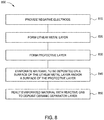
- FIG. 8 illustrates a process flow chart summarizing one implementation of a method for forming an electrode structure according to one or more implementations described herein;
- FIG. 9 illustrates a schematic view of a web tool for forming a ceramic separator according to one or more implementations described herein;
- FIG. 10A illustrates a scanning electron microscope (SEM) image of uncoated cathode material
- FIG. 10B illustrates an SEM image of cathode material coated with aluminum oxide according to implementations described herein.
- FIG. 11 illustrates an SEM image of a schematic cross-sectional view of a cell structure having a ceramic separator layer formed according to implementations described herein.
- the following disclosure describes separators, high performance electrochemical cells and batteries including the aforementioned separators, and methods for fabricating the same. Certain details are set forth in the following description and in FIGS. 1-11 to provide a thorough understanding of various implementations of the disclosure. Other details describing well-known structures and systems often associated with electrochemical cells and batteries are not set forth in the following disclosure to avoid unnecessarily obscuring the description of the various implementations.
- a pore size of about 10 nm generally indicates in its broadest sense 10 nm ⁇ 10%, which indicates 9.0-11.0 nm.
- the term “about” can indicate either a measurement error (i.e., by limitations in the measurement method), or alternatively, a variation or average in a physical characteristic of a group (e.g., a population of pores).
- crucible as used herein shall be understood as a unit capable of evaporating material that is fed to the crucible when the crucible is heated.
- a crucible is defined as a unit adapted for transforming solid material into vapor.
- the term “crucible” and “evaporation unit” are used synonymously.
- the currently available generation batteries especially Li-ion batteries, use porous polyolefin separators, which are susceptible to thermal shrinkage at elevated temperatures and may cause short between positive and negative electrodes or the corresponding current collectors.
- some polyolefin separators have poor wettability issues.
- a ceramic coating on the separator helps to inhibit direct contact between electrodes and helps to prevent potential dendrite growth associated with Li metal.
- Current state of the art ceramic coating uses wet coating (e.g., slot-die techniques) of ceramic particles dispersed in a polymeric binder to make the composite and a solvent to make the slurry. The coating thickness is typically around 3 microns including randomly oriented dielectric material bound together by a polymer leading to a random pore structure.
- the existing ceramic particle coating method has difficulty in reducing tortuosity due to this random orientation of ceramic particles. Further, it is difficult to reduce the thickness of current ceramic coatings using current wet coating techniques. In order to compensate for the increased surface area of finer ceramic powder particles current wet coating techniques involve increased amounts of both binder and solvent to decrease the viscosity of the slurry. Thus, the current wet coating techniques suffer from several problems.
- a thin, low ionic resistance ceramic coating is formed directly on a surface of a positive electrode and/or a surface of a negative electrode, where the ceramic coating is formed by a dry method using reactive evaporation of metals or metal compounds. Further, the ceramic coating can be tuned for the appropriate thickness, micro/nanostructure, multilayered structure, morphology, pore structure and pore/ceramic orientation.
- the reactive evaporation techniques described herein have at least one of the following advantages: (1) thinner separators result in less inactive component volume fraction and a corresponding increase in energy density and less ionic resistance across the separator; (2) the control of coating thickness and morphology provides less tortuous pores leading to superior separator performance; (3) the pore surface of the ceramic enhances the ionic conductivity of the overall electrolyte; and (4) suitably engineered ceramic coated separator shall enhance X-ray detection to determine manufacturing defects; and (5) higher voltage stability and puncture resistance properties of the separator can be achieved by nanocomposite coating control. Lithium dendrite inhibiting properties of ceramic-coated separator are enhanced by nanosurface engineering to achieve homogeneous lithium metal deposition and stripping during cycling.
- Results achieved so far include (1) uniform 300 nanometer and 600 nanometer thick AlO x coating deposited on a positive electrode using aluminum evaporation in a reactive oxygen environment; (2) the AlO x coating adhesion seems to be good with scotch tape peeling tests; and (3) columnar AlO x structure and crystallites are aligned vertically in the ceramic separator layer.
- FIG. 1 illustrates a cross-sectional view of one implementation of a cell structure 100 formed according to implementations described herein.
- the cell structure 100 has one or more ceramic separator layer(s) 130 formed according to implementations described herein.
- the cell structure 100 is a Li-ion battery structure.
- Cell structure 100 has a positive current collector 110 , positive electrode(s) 120 a , 120 b (collectively 120 ) formed on opposing sides of the positive current collector 110 , one or more ceramic separator layer(s) 130 a - c (collectively 130 ), a negative current collector 150 and negative electrode(s) 140 a , 140 b (collectively 140 ) formed on opposing sides of the negative current collector. Note in FIG.
- the current collectors are shown to extend beyond the stack, although it is not necessary for the current collectors to extend beyond the stack, the portions extending beyond the stack may be used as tabs.
- the portions extending beyond the stack may be used as tabs.
- dual-sided electrode structures are shown, the implementations described herein are also applicable to single-sided electrode structures.
- the current collectors 110 , 150 , on positive electrode 120 and negative electrode 140 , respectively, can be identical or different electronic conductors.
- metals that the current collectors 110 , 150 may be comprised of include aluminum (Al), copper (Cu), zinc (Zn), nickel (Ni), cobalt (Co), tin (Sn), silicon (Si), manganese (Mn), magnesium (Mg), alloys thereof, and combinations thereof.
- at least one of the current collectors 110 , 150 is perforated.
- current collectors may be of any form factor (e.g., metallic foil, sheet, or plate), shape and micro/macro structure.
- tabs are formed of the same material as the current collector and may be formed during fabrication of the stack, or added later. All components except current collectors 110 and 150 contain lithium ion electrolytes.
- the negative electrode 140 or anode may be any material compatible with the positive electrode 120 .
- the negative electrode 140 may have an energy capacity greater than or equal to 372 mAh/g, preferably ⁇ 700 mAh/g, and most preferably ⁇ 1000 mAh/g.
- the negative electrode 140 may be constructed from a graphite, silicon-containing graphite (e.g., silicon ( ⁇ 5%) blended graphite), a lithium metal foil or a lithium alloy foil (e.g. lithium aluminum alloys), or a mixture of a lithium metal and/or lithium alloy and materials such as carbon (e.g. coke, graphite), nickel, copper, tin, indium, silicon, oxides thereof, or combinations thereof.
- the negative electrode 140 comprises intercalation compounds containing lithium or insertion compounds containing lithium.
- the positive electrode 120 or cathode may be any material compatible with the negative electrode 140 and may include an intercalation compound, an insertion compound, or an electrochemically active polymer.
- Suitable intercalation materials include, for example, lithium-containing metal oxides, MoS 2 , FeS 2 , MnO 2 , TiS 2 , NbSe 3 , LiCoO 2 , LiNiO 2 , LiMnO 2 , LiMn 2 O 4 , V 6 O 13 and V 2 O 5 .
- Suitable polymers include, for example, polyacetylene, polypyrrole, polyaniline, and polythiophene.
- the positive electrode 120 or cathode may be made from a layered oxide, such as lithium cobalt oxide, an olivine, such as lithium iron phosphate, or a spinel, such as lithium manganese oxide.
- exemplary lithium-containing oxides may be layered, such as lithium cobalt oxide (LiCoO 2 ), or mixed metal oxides, such as LiNi x Co 1 ⁇ 2x MnO 2 , LiNiMnCoO 2 (“NMC”), LiNi 0.5 Mn 1.5 O 4 , Li(Ni 0.8 Co 0.15 Al 0.05 )O 2 , LiMn 2 O 4 , and doped lithium rich layered-layered materials, wherein x is zero or a non-zero number.
- Exemplary phosphates may be iron olivine (LiFePO 4 ) and it is variants (such as LiFe (1-x) Mg x PO 4 ), LiMoPO 4 , LiCoPO 4 , LiNiPO 4 , Li 3 V 2 (PO 4 ) 3 , LiVOPO 4 , LiMP 2 O 7 , or LiFe 1.5 P 2 O 7 , wherein x is zero or a non-zero number.
- Exemplary fluorophosphates may be LiVPO 4 F, LiAlPO 4 F, Li 5 V(PO 4 ) 2 F 2 , Li 5 Cr(PO 4 ) 2 F 2 , Li 2 CoPO 4 F, or Li 2 NiPO 4 F.
- Exemplary silicates may be Li 2 FeSiO 4 , Li 2 MnSiO 4 , or Li 2 VOSiO 4 .
- An exemplary non-lithium compound is Na 5 V 2 (PO 4 ) 2 F 3 .
- the positive electrode 120 is formed from positive electrode particles.
- the positive electrode particles are coated to enhance higher voltage stability, interface compatibility with the electrolyte and longer battery cycle life.
- the coating of the positive electrode particles may be performed by sol-gel techniques, dry coating of nano-particles on the positive electrode material, or atomic layer deposition (ALD) techniques.
- lithium is contained in atomic layers of crystal structures of carbon graphite (LiC 6 ) at the negative electrode 140 and lithium manganese oxide (LiMnO 4 ) or lithium cobalt oxide (LiCoO 2 ) at the positive electrode 120 , for example, although in some implementations the negative electrode 140 may also include lithium absorbing materials such as silicon, tin, etc.
- the cell even though shown as a planar structure, may also be formed into a cylinder by rolling the stack of layers; furthermore, other cell configurations (e.g., prismatic cells, button cells) may be formed.
- Electrolytes infused in cell components 120 , 130 and 140 can be comprised of a liquid/gel or a solid polymer and may be different in each.
- the electrolyte primarily includes a salt and a medium (e.g., in a liquid electrolyte, the medium may be referred to as a solvent; in a gel electrolyte, the medium may be a polymer matrix).
- the salt may be a lithium salt.
- the lithium salt may include, for example, LiPF 6 , LiAsF 6 , LiCF 3 SO 3 , LiN(CF 3 SO 3 ) 3 , LiBF 6 , and LiClO 4 , BETTE electrolyte (commercially available from 3M Corp. of Minneapolis, Minn.) and combinations thereof.
- Solvents may include, for example, ethylene carbonate (EC), propylene carbonate (PC), EC/PC, 2-MeTHF(2-methyltetrahydrofuran)/EC/PC, EC/DMC (dimethyl carbonate), EC/DME (dimethyl ethane), EC/DEC (diethyl carbonate), EC/EMC (ethyl methyl carbonate), EC/EMC/DMC/DEC, EC/EMC/DMC/DEC/PE, PC/DME, and DME/PC.
- Polymer matrices may include, for example, PVDF (polyvinylidene fluoride), PVDF:THF (PVDF:tetrahydrofuran), PVDF:CTFE (PVDF: chlorotrifluoroethylene) PAN (polyacrylonitrile), and PEO (polyethylene oxide).
- PVDF polyvinylidene fluoride
- PVDF:THF PVDF:tetrahydrofuran
- PVDF:CTFE PVDF: chlorotrifluoroethylene
- PAN polyacrylonitrile
- PEO polyethylene oxide
- the ceramic separator layer 130 comprises a porous (e.g., microporous) ceramic layer (e.g., a separator film) 130 with pores. In some implementations, the ceramic separator layer 130 is non-porous. In some implementations, the ceramic separator layer 130 comprises a lithium-ion conducting material.
- the lithium-ion conducting material may be a lithium-ion conducting ceramic or a lithium-ion conducting glass or liquid crystal. In some implementations, the ceramic separator layer 130 does not need to be ion conducting, however, once filled with electrolyte (liquid, gel, solid, combination etc.), the combination of porous ceramic and electrolyte is ion conducting.
- the ceramic separator layer 130 is, at least, adapted for preventing electronic shorting (e.g. direct or physical contact of the anode and the cathode) and blocking dendrite growth.
- the ceramic separator layer 130 may be, at least, adapted for blocking (or shutting down) ionic conductivity (or flow) between the anode and the cathode during the event of thermal runaway.
- the ceramic separator layer 130 should be sufficiently conductive to allow ionic flow between the anode and cathode, so that current, in selected quantities, may be generated by the cell.
- the ceramic separator layer 130 should adhere well to the underlying electrode material, i.e. separation should not occur. As discussed herein, the ceramic separator layer 130 is formed on the underlying electrode using evaporation techniques.
- the ceramic separator layer 130 comprises one or more ceramic materials.
- the ceramic material may be an oxide.
- the ceramic material may be selected from, for example, aluminum oxide (Al 2 O 3 ), AlO x , AlO x N y , AlN (aluminum deposited in a nitrogen environment), aluminum hydroxide oxide ((AlO(OH)) (e.g., diaspore (( ⁇ -AlO(OH))), boehmite ( -AlO(OH)), or akdalaite (5Al 2 O 3 .H 2 O)), calcium carbonate (CaCO 3 ), titanium dioxide (TiO 2 ), SiS 2 , SiPO 4 , silicon oxide (SiO 2 ), zirconium oxide (ZrO 2 ), MgO, TiO 2 , Ta 2 O 5 , Nb 2 O 5 , LiAlO 2 , BaTiO 3 , BN, ion-conducting garnet, ion-conducting
- the ceramic material is a material selected from the group consisting of: porous aluminum oxide, porous-ZrO 2 , porous-SiO 2 , porous-MgO, porous-TiO 2 , porous-Ta 2 O 5 , porous-Nb 2 O 5 , porous-LiAlO 2 , porous-BaTiO 3 , ion-conducting garnet, anti-ion-conducting perovskites, porous glass dielectric, or combinations thereof.
- the ceramic separator layer 130 is a binder-free ceramic layer. In some implementations, the ceramic separator layer 130 is a porous aluminum oxide layer.
- the ceramic separator layer 130 may be a lithium-ion conducting material.
- the lithium-ion conducting material may be a lithium-ion conducting ceramic or a lithium-ion conducting glass or ion conducting liquid crystal.
- the Li-ion conducting material may be comprised of one or more of LiPON, doped variants of either crystalline or amorphous phases of Li 7 La 3 Zr 2 O 12 , doped anti-perovskite compositions, Li 2 S—P 2 S 5 , Li 10 GeP 2 S 12 , and Li 3 PS 4 , lithium phosphate glasses, sulfide glasses, (1 ⁇ x)LiI-(x)Li 4 SnS 4 , xLiI-(1 ⁇ x)Li 4 SnS 4 , mixed sulfide and oxide electrolytes (crystalline LLZO, amorphous (1 ⁇ x)LiI-(x)Li 4 SnS 4 mixture, and amorphous (x)LiI-(1 ⁇ x)Li 4
- x is between 0 and 1 (e.g., 0.1, 0.2, 0.3, 0.4, 0.5, 0.6, 0.7, 0.8, and 0.9).
- the Li-ion conducting material can be directly deposited on the lithium metal film using either a by Physical Vapor Deposition (PVD), Chemical Vapor Deposition (CVD), spray, doctor blade, printing or any of a number of coating methods.
- PVD Physical Vapor Deposition
- CVD Chemical Vapor Deposition
- spray doctor blade, printing or any of a number of coating methods.
- a suitable method for some implementations is PVD.
- the ceramic separator layer 130 does not need to be ion conducting, however, once filled with electrolyte (liquid, gel, solid, combination etc.), the combination of porous substrate and electrolyte is ion conducting.
- the ceramic separator layer 130 is the lithium-ion conducting material and the lithium-ion conducting material is selected from the group consisting of: LiPON, crystalline or amorphous phases of garnet-type Li 7 La 3 Zr 2 O 12 , LISICON (e.g., Li 2+2x Zn 1 ⁇ x GeO 4 wherein 0 ⁇ x ⁇ 1), NASICON (e.g., Na 1 ⁇ x Zr 2 Si x P 3 ⁇ x O 12 wherein 0 ⁇ x ⁇ 3), lithium borohydride (LiBH 4 ), doped anti-perovskite compositions, lithium containing sulfides (e.g., Li 2 S, Li 2 S—P 2 S 5 , Li 10 GeP 2 S 12 and Li 3 PS 4 ), and lithium argyrodites (e.g., LiPS 5 X wherein x is Cl, Br or I).
- LiPON Li 2+2x Zn 1 ⁇ x GeO 4 wherein 0 ⁇ x ⁇ 1
- NASICON e
- the ceramic separator layer 130 comprises from about 50 wt. % to about 100 wt. % of aluminum oxide based on the total weight of the ceramic separator layer 130 (e.g., from about 75 wt. % to about 100 wt. %; from about 85 wt. % to about 100 wt. % of aluminum oxide).
- the ceramic material is blended with glass evaporated in an oxidizing atmosphere.
- SiO 2 can be introduced into Al 2 O 3 to modify the physical properties (such as flexibility, fracture toughness) of the ceramic layer.
- the ceramic separator layer 130 comprises a plurality of ceramic columnar projections.
- the ceramic columnar shaped projections may have a diameter that expands from the bottom (e.g., where the columnar shaped projection contacts the porous substrate) of the columnar shaped projection to a top of the columnar shaped projection.
- the ceramic columnar projections typically comprise dielectric grains. Nano-structured contours or channels are typically formed between the dielectric grains.
- the plurality of ceramic columnar projections may comprise one or more of various forms of porosities.
- the columnar projections of the ceramic separator layer 130 form a nano-porous structure between the columnar projections of dielectric material.
- the nano-porous structure may have a plurality of nano-pores that are sized to have an average pore size or diameter less than about 10 nanometers (e.g., from about 1 nanometer to about 10 nanometers; from about 3 nanometers to about 5 nanometers).
- the nano-porous structure may have a plurality of nano-pores sized to have an average pore size or diameter less than about 5 nanometers.
- the nano-porous structure has a plurality of nano-pores having a diameter ranging from about 1 nanometer to about 20 nanometers (e.g., from about 2 nanometers to about 15 nanometers; or from about 5 nanometers to about 10 nanometers).
- the nano-porous structure yields a significant increase in the surface area of the ceramic separator layer 130 .
- the pores of the nanoporous structure can act as liquid electrolyte reservoir and provides excess surface area for ion-conductivity. Not to be bound by theory but it is believed that the electrolyte liquid/gel confined within the nanoporous structure behaves similar to solid electrolyte.
- the ceramic separator layer 130 has a porosity of at least 10%, 15%, 20%, 25%, 30%, 35%, 40%, 45%, 50%, 55%, 60%, or 65% as compared to a solid film formed from the same material and a porosity up to at least 15%, 20%, 25%, 30%, 35%, 40%, 45%, 50%, 55%, 60%, 65%, or 70% as compared to a solid film formed from the same material.
- Tortuosity is the direct measure for describing a lithium diffusion pathway. Tortuosity describes the tortuous path for Li diffusion in porous media. For example, if diffusion is along a straight pathway, the tortuosity equals 1. Tortuosity is not easily measured due to the complex geometry in dielectric layers (i.e., irregular particle shapes, wide particle size distribution, etc.). It is believed that direct engineering tortuosity, i.e., introducing “straight” pathway or channels, is desirable. Ceramic layers formed using the evaporation processes disclosed herein exhibit lower tortuosity when compared with ceramic layers formed using currently know slot-die techniques or other slurry deposition techniques.
- the ceramic separator layer 130 may be a coating or a discrete layer, either having a thickness in the range of 1 nanometer to 3,000 nanometers (e.g., in the range of 10 nanometers to 600 nanometers; in the range of 50 nanometers to 200 nanometers; in the range of 100 nanometers to 150 nanometers).
- FIG. 2 illustrates a cross-sectional view of another implementation of a cell structure 200 formed according to implementations described herein.
- the cell structure 200 is a Li-ion battery structure. Similar to cell structure 100 , the cell structure 200 has the ceramic separator layer 130 formed according to implementations described herein. However, in addition the ceramic separator layer 130 , the cell structure 200 also comprises one or more gel polymer layers 210 a , 210 b (collectively 210 ) positioned between the ceramic separator layer 130 and the opposing electrode structure, which in this implementation is the negative electrode 140 a .
- the ceramic separator layer 130 a contacts the negative electrode 140 a and the gel polymer layer 210 a contacts the negative electrode 140 a . Not to be bound by theory, but it is believe that the gel polymer layer helps improve adhesion between the positive electrode and the negative electrode when joined together.
- the polymer for the gel polymer layer 210 can be chosen from polymers currently used in the Li-ion battery industry.
- polymers that may be used to form the gel polymer layer include, but are not limited to, polyvinylidene difluoride (PVDF), polyethylene oxide (PEO), poly-acrylonitrile (PAN), carboxymethyl cellulose (CMC), styrene butadiene rubber (SBR), and combinations thereof.
- PVDF polyvinylidene difluoride
- PEO polyethylene oxide
- PAN poly-acrylonitrile
- CMC carboxymethyl cellulose
- SBR styrene butadiene rubber
- gel electrolyte or liquid crystal electrolyte is made by using mixture of warm liquids and lithium ion conducting salt.
- the mixture of warm liquids is injected into the spiral-wound electrodes or stacked electrodes filling the network electrode pores and the electrolyte forms a solid or gel at room temperature.
- the gel polymer layer 210 can be formed by dip-coating, slot-die coating, gravure coating, or printing.
- the polymer can also be deposited using Applied Materials Metacoat equipment.
- the dielectric polymer layer may have a thickness from about 5 nanometers to about 1 micrometer.
- Organic polymers with sulfur ions e.g., polyphenylene sulfide with Li 2 O mixture
- FIG. 3 illustrates a cross-sectional view of another implementation of a cell structure 300 formed according to implementations described herein.
- the cell structure 300 is a Li-ion battery structure. Similar to cell structure 200 , the cell structure 300 has one or more ceramic separator layers 330 a - c (collectively 330 ) and one or more gel polymer layers 310 a , 310 b (collectively 310 ) formed according to implementations described herein.
- the one or more ceramic separator layers 330 are similar to the one or more ceramic separator layers 130 .
- the one or more gel polymer layers 310 are similar to the one or more gel polymer layers 210 . However, the gel polymer layer 310 a is positioned between or “sandwiched” in between the ceramic separator layer 330 a and the ceramic separator layer 330 b.
- FIG. 4 illustrates a cross-sectional view of yet another implementation of a cell structure 400 formed according to one or more implementations described herein.
- the cell structure 400 is a Li-ion battery structure. Similar to cell structure 300 , the cell structure 400 has one or more ceramic separator layers 430 a - c (collectively 430 ) and one or more gel polymer layers 440 a , 440 b (collectively 440 ) formed according to implementations described herein.
- the one or more ceramic separator layers 430 are similar to the one or more ceramic separator layer(s) 130 .
- the one or more gel polymer layers 440 a , 440 b (collectively 440 ) are similar to the one or more gel polymer layers 210 .
- the cell structure 400 optionally includes a pre-lithiation layer 410 , and a protective film 420 formed between a ceramic separator layer 430 and the pre-lithiation layer 410 .
- the ceramic separator layer 430 is deposited directly on either the protective film 420 (if present) or the pre-lithiation layer 410 if the protective film 420 is not present.
- the pre-lithiation layer 410 formed on the negative electrode 140 a is a lithium metal film.
- the lithium metal film may be formed according to the implementations described herein.
- the negative electrode 140 a is a silicon graphite anode or a silicon oxide graphite anode with the lithium metal film formed thereon.
- the lithium metal film replenishes lithium lost from first cycle capacity loss of the negative electrode 140 a .
- the lithium metal film may be a thin lithium metal film (e.g., 20 microns or less; from about 1 micron to about 20 microns; or from about 2 microns to about 10 microns).
- the lithium metal film replaces the negative electrode 140 .
- the lithium metal film is formed on the negative current collector 150 .
- a protective film 420 is formed on the lithium metal film.
- the protective film 420 is typically formed ex-situ on the lithium metal film.
- the protective film 420 is electrically insulating yet sufficiently conductive to lithium-ions.
- the protective film 420 is a nonporous film.
- the protective film 420 is a porous film.
- the protective film 420 has a plurality of nanopores that are sized to have an average pore size or diameter less than about 10 nanometers (e.g., from about 1 nanometer to about 10 nanometers; from about 3 nanometers to about 5 nanometers).
- the protective film 420 has a plurality of nanopores that are sized to have an average pore size or diameter less than about 5 nanometers. In one implementation, the protective film 420 has a plurality of nanopores having a diameter ranging from about 1 nanometer to about 20 nanometers (e.g., from about 2 nanometers to about 15 nanometers; or from about 5 nanometers to about 10 nanometers).
- the protective film 420 may be a coating or a discrete layer, either having a thickness in the range of 1 nanometer to 200 nanometers (e.g., in the range of 5 nanometers to 200 nanometers; in the range of 10 nanometers to 50 nanometers). Not to be bound by theory, but it is believed that protective films greater than 200 nanometers may increase resistance within the rechargeable battery.
- the protective film 420 examples include, but are not limited to, lithium fluoride (LiF), aluminum oxide, lithium carbonate (Li 2 CO 3 ), and combinations thereof.
- the protective film 420 is a lithium fluoride film. Not to be bound by theory but it is believed that the protective film 420 can take-up Li-conducting electrolyte to form gel during device fabrication which is beneficial for forming good solid electrolyte interface (SEI) and also helps lower resistance.
- SEI solid electrolyte interface
- the protective film 420 can be directly deposited on the lithium metal film by Physical Vapor Deposition (PVD), such as evaporation or sputtering, special atomic layer deposition (ALD), a slot-die process, a thin-film transfer process, or a three-dimensional lithium printing process. PVD is a preferred method for deposition of the protective film 420 .
- the protective film 420 can also be deposited using Metacoat equipment.
- the ceramic separator layer 430 a may be deposited directly on either the protective film 420 (if present) or the pre-lithiation layer 410 if the protective film 420 is not present.
- the ceramic separator layer 430 a may be a lithium-ion conducting material.
- the lithium-ion conducting material may be a lithium-ion conducting ceramic or a lithium-ion conducting glass.
- the Li-ion conducting material may be comprised of one or more of LiPON, doped variants of either crystalline or amorphous phases of Li 7 La 3 Zr 2 O 12 , doped anti-perovskite compositions, Li 2 S—P 2 S 5 , Li 10 GeP 2 S 12 , and Li 3 PS 4 , lithium phosphate glasses, (1 ⁇ x)LiI-(x)Li 4 SnS 4 , xLiI-(1 ⁇ x)Li 4 SnS 4 , mixed sulfide and oxide electrolytes (crystalline LLZO, amorphous (1 ⁇ x)LiI-(x)Li 4 SnS 4 mixture, and amorphous xLiI-(1 ⁇ x)Li 4 SnS 4 ) for example.
- LiPON LiPON
- doped variants of either crystalline or amorphous phases of Li 7 La 3 Zr 2 O 12 doped anti-perovskite compositions
- x is between 0 and 1 (e.g., 0.1, 0.2, 0.3, 0.4, 0.5, 0.6, 0.7, 0.8, and 0.9).
- the Li-ion conducting material can be directly deposited on the pre-lithiation layer 410 or the protective film 420 using either a by Physical Vapor Deposition (PVD), Chemical Vapor Deposition (CVD), spray, doctor blade, printing or any of a number of coating methods.
- PVD Physical Vapor Deposition
- CVD Chemical Vapor Deposition
- spray doctor blade, printing or any of a number of coating methods.
- a suitable method for some implementations is PVD.
- the ceramic separator layer 430 a does not need to be ion conducting, however, once filled with electrolyte (liquid, gel, solid, combination etc.), the combination of porous substrate and electrolyte is ion conducting.
- the ceramic separator layer 430 a is the lithium-ion conducting material and the lithium-ion conducting material is selected from the group consisting of: LiPON, crystalline or amorphous phases of garnet-type Li 7 La 3 Zr 2 O 12 , LISICON (e.g., Li 2+2x Zn 1 ⁇ x GeO 4 wherein 0 ⁇ x ⁇ 1), NASICON (e.g., Na 1+x Zr 2 Si x P 3 ⁇ x O 12 wherein 0 ⁇ x ⁇ 3), lithium borohydride (LiBH 4 ), doped anti-perovskite compositions, lithium containing sulfides (e.g., Li 2 S, Li 2 S—P 2 S 5 , Li 10 GeP 2 S 12 and Li 3 PS 4 ), and lithium argyrodites (e.g., LiPS 5 X wherein x is Cl, Br or I).
- LiPON Li 2+2x Zn 1 ⁇ x GeO 4 wherein 0 ⁇ x ⁇ 1
- the ceramic separator layer 430 a formed over the negative electrode 140 and the ceramic separator layer 430 b formed over the positive electrode 120 are different materials.
- ceramic separator layer 430 a is a non-porous lithium ion conducting material and the ceramic separator layer 430 b is a porous lithium ion conducting material.
- the ceramic separator layer 430 is a non-porous ion conducting electrolyte layer, which may provide added electrochemical stability for some anode material compositions.
- the negative electrode 140 is a silicon or silicon oxide blended graphite anode material with the pre-lithiation layer 410 (e.g., lithium metal film) formed thereon, a protective film 420 that is a lithium fluoride film, and the ceramic separator layer 430 is a non-porous lithium ion-conducting material.
- the surfaces of the electrode are optionally exposed to a surface modification treatment to enhance the nucleation/growth conditions of the surfaces of the electrode.
- the surface modification treatment process is a plasma treatment process (e.g., corona discharge treatment process).
- the surface modification treatment process includes supplying a treatment gas mixture into a processing region.
- a plasma is then formed from the treatment gas mixture to plasma treat a surface of the electrode to activate at least a portion of the electrode into an excited state, forming a treated electrode having a treated upper surface, which may then enhance the nucleation/growth conditions of the subsequently deposited ceramic separator layer.
- the treatment gas mixture includes at least one of oxygen-containing gas, an inert gas (e.g., argon, helium), or combinations thereof.
- the oxygen-containing gas supplied into the processing region includes at least one of oxygen (O 2 ), ozone (O 3 ), oxygen radicals (O*), ionized oxygen atoms, carbon dioxide (CO 2 ), nitric oxide (NO x ), water vapor, or combinations thereof.
- Other oxygen-containing gases may be used.
- a gas source supplies oxygen gas (O 2 ) through a mass flow controller to an ozonator, which converts a large fraction of the oxygen to ozone gas (O 3 ).
- O 2 oxygen gas
- O 3 ozone gas
- the resultant oxygen-based mixture of O 2 and O 3 and perhaps some oxygen radicals O* and ionized oxygen atoms or molecules is delivered into the processing region.
- the oxygen-based gas reacts within the processing region with the surface of the electrode, which has been heated to a predetermined, preferably low temperature.
- Ozone is a metastable molecule which spontaneously quickly dissociates in the reaction O 3 ⁇ O 2 +O*, where O* is a radical, which very quickly reacts with whatever available material can be oxidized.
- the ozonator may be implemented in a number of forms including capacitively or inductively coupled plasma or a UV lamp source.
- this preparation may include exposing the electrode to a corona treatment, chemically treating it (e.g. with an oxidizing agent), or adsorbing or grafting a polyelectrolyte to the surface of the electrode. Having a charged electrode may be appropriate for a first layer of oppositely charged material to bind to the electrode.
- the surface modification treatment process is an electron beam treatment process.
- An electron beam source is directed onto a surface of the electrode prior to coating the electrode.
- the electron beam source may be a linear source.
- the electron beam device emitting the electron beam is typically adapted such that the electron beam affects the electrode across its entire width, such that due to the longitudinal movement of the electrode, the whole surface (on one side) of the electrode is treated with the electron beam.
- the electron beam device may for example be an electron source such as an electron flood gun, a linear electron gun, an electron beam, or the like.
- the gas used in the electron source may be Argon, O 2 , N 2 , CO 2 , or He, more particularly O 2 , N 2 , CO 2 , or He.
- the electrode treated with the emitted electrons is physically, respectively structurally altered in order to achieve improved adhesion between the electrode and the subsequently deposited ceramic separator layer.
- the selected effect can be achieved by providing electrons at energies from 1 keV to 15 keV, more typically from 5 keV to 10 keV, for example, 6 keV, 7 keV, 8 keV or 9 keV.
- Typical electron currents are from 20 mA to 1500 mA, for example 500 mA.
- the surfaces of the electrode e.g., negative electrode and/or positive electrode
- the surfaces of the electrode structure may be cooled to a temperature between ⁇ 20 degrees Celsius and room temperature (i.e., 20 to 22 degrees Celsius) (e.g., ⁇ 10 degrees Celsius and 0 degrees Celsius).
- the electrode structure may be cooled by cooling the drum over which the electrode structure travels. Other active cooling means may be used to cool the electrode structure.
- the electrode structure may be exposed to temperatures in excess of 1,000 degrees Celsius thus it is beneficial to cool the electrode structure prior to the evaporation processes of operation 510 , operation 610 , and operation 710 .
- FIG. 5 illustrates a process flow chart summarizing one implementation of a method 500 for forming a cell structure according to one or more implementations described herein.
- the cell structure may be, for example, the cell structure 100 depicted in FIG. 1 .
- the material to be deposited on at least one of a surface of a negative electrode and a surface of a positive electrode is exposed to an evaporation process to evaporate the material to be deposited in a processing region.
- the negative electrode is negative electrode 140 and the positive electrode is positive electrode 120 .
- the material to be deposited is deposited on a single electrode (e.g., either the negative electrode or the positive electrode).
- the material to be deposited is deposited on both the negative electrode and the positive electrode.
- deposition on the negative electrode and the positive electrode may occur in the same processing chamber or may occur in separate processing chambers. In some implementations, deposition on the negative electrode and the positive electrode may occur sequentially or simultaneously.
- the evaporation material may be chosen from the group consisting of aluminum (Al), zirconium (Zr), hafnium (Hf), niobium (Nb), tantalum (Ta), titanium (Ti), yttrium (Y), lanthanum (La), silicon (Si), boron (B), silver (Ag), chromium (Cr), copper (Cu), indium (In), iron (Fe), magnesium (Mg), calcium (Ca), strontium (Sr), barium (Ba), nickel (Ni), tin (Sn), ytterbium (Yb), lithium (Li), calcium (Ca) or combinations thereof.
- the material to be deposited is a metal such as aluminum or an aluminum alloy.
- the evaporation material may also be an alloy of two or more metals.
- the evaporation material is the material that is evaporated during the evaporation process and with which the surface(s) of the one or more electrodes are coated.
- the material to be deposited e.g., aluminum
- the aluminum can, for example, be evaporated by thermal evaporation techniques or by electron beam evaporation techniques.
- the evaporation material is fed to the crucible as a wire.
- the feeding rates and/or the wire diameters have to be chosen such that the appropriate ratio of the evaporation material and the reactive gas is achieved.
- the diameter of the feeding wire for feeding to the crucible is chosen between 0.5 mm and 2.0 mm (e.g., between 1.0 mm and 1.5 mm). These dimensions may refer to several feedings wires made of the evaporation material. Typical feeding rates of the wire are in the range of between 50 cm/min and 150 cm/min (e.g., between 70 cm/min and 100 cm/min).
- the crucible is heated in order to generate a vapor, which reacts with the reactive gas supplied at operation 510 to coat the surface(s) of the one or more electrodes with a ceramic separator layer (e.g., ceramic separator layer 130 ).
- a ceramic separator layer e.g., ceramic separator layer 130
- the crucible is heated by applying a voltage to the electrodes of the crucible, which are positioned at opposite sides of the crucible.
- the material of the crucible is conductive.
- the material used as crucible material is temperature resistant to the temperatures used for melting and evaporating.
- the crucible of the present disclosure is made of one or more materials selected from the group consisting of metallic boride, metallic nitride, metallic carbide, non-metallic boride, non-metallic nitride, non-metallic carbide, nitrides, titanium nitride, borides, graphite, TiB 2 , BN, B 4 C, and SiC.
- the material to be deposited is melted and evaporated by heating the evaporation crucible.
- Heating can be conducted by providing a power source (not shown) connected to the first electrical connection and the second electrical connection of the crucible.
- these electrical connections may be electrodes made of copper or an alloy thereof.
- heating is conducted by the current flowing through the body of the crucible.
- heating may also be conducted by an irradiation heater of an evaporation apparatus or an inductive heating unit of an evaporation apparatus.
- the evaporation unit according to the present disclosure is typically heatable to a temperature of between 1,300 degrees Celsius and 1,600 degrees Celsius, such as 1,560 degrees Celsius. This is done by adjusting the current through the crucible accordingly, or by adjusting the irradiation accordingly.
- the crucible material is chosen such that its stability is not negatively affected by temperatures of that range.
- the speed of the one or more electrodes is in the range of between 20 cm/min and 200 cm/min, more typically between 80 cm/min and 120 cm/min such as 100 cm/min. In these cases, the means for transporting should be capable of transporting the substrate at those speeds.
- a reactive gas is flowed into the processing region for reacting with the evaporated material to form a ceramic separator layer on at least a surface of the negative electrode and a surface of the positive electrode.
- the reactive gases can be selected from the group consisting of: oxygen-containing gases, nitrogen-containing gases, or combinations thereof.
- oxygen-containing gases that may be used with the implementations described herein include oxygen (O 2 ), ozone (O 3 ), oxygen radicals (O*), ionized oxygen atoms, carbon dioxide (CO 2 ), nitric oxide (NO x ), water vapor, or combinations thereof.
- Exemplary nitrogen containing gases that may be used with the implementations described herein include N 2 , N 2 O, NO 2 , NH 3 , or combinations thereof.
- additional gases typically inert gases such as argon can be added to a gas mixture comprising the reactive gas.
- the process can be carried out in a vacuum environment with a typical atmosphere of 1*10 ⁇ 2 mbar to 1*10 ⁇ 6 mbar (e.g., 1*10 ⁇ 3 mbar or below; 1*10 ⁇ 4 mbar or below).
- moist oxygen may be used as the reactive gas.
- the moist oxygen may be formed by flowing oxygen through a canister containing water vapor to react with the evaporated material to form an aluminum hydroxide oxide ((AlO(OH)), which is deposited on the surface of the electrode.
- the aluminum hydroxide oxide ((AlO(OH)) typically takes the form of diaspore (( ⁇ -AlO(OH))), boehmite ( -AlO(OH)), or akdalaite (5Al 2 O 3 .H 2 O).
- the aluminum hydroxide oxide thermodynamically stable but the hydrogen bond also helps improve the bond strength of the ceramic separator layer to the surface of the electrode.
- a plasma is formed from the reactive gas mixture.
- the plasma is an oxygen-containing plasma.
- the oxygen-containing plasma reacts with the evaporated material to deposit the ceramic separator layer on the surface of the electrode.
- the reactive gas mixture includes at least one of oxygen-containing gas, an inert gas (e.g., argon, helium), or combinations thereof.
- the oxygen-containing gas supplied into the processing region includes at least one of oxygen (O 2 ), ozone (O 3 ), oxygen radicals (O*), ionized oxygen atoms, carbon dioxide (CO 2 ), nitric oxide (NO x ), water vapor, or combinations thereof. Other oxygen-containing gases may be used.
- the plasma is formed using a remote plasma source and delivered to the processing region.
- a gas source supplies oxygen gas (O 2 ) through a mass flow controller to an ozonator, which converts a large fraction of the oxygen to ozone gas (O 3 ).
- the resultant oxygen-based mixture of O 2 and O 3 and perhaps some oxygen radicals O* and ionized oxygen atoms or molecules is delivered into the processing region.
- the oxygen-based gas reacts within the processing region with the surface of electrode structure, which has been heated to a predetermined, preferably low temperature.
- Ozone is a metastable molecule which spontaneously quickly dissociates in the reaction O 3 ⁇ O 2 +O*, where O* is a radical, which very quickly reacts with whatever available material can be oxidized.
- the ozonator may be implemented in a number of forms including capacitively or inductively coupled plasma or a UV lamp source.
- the ceramic edge coating may contain the same material as the ceramic separator layer.
- the ceramic edge coating may be deposited using wet deposition methods (e.g., slot-die coating) followed by optional drying and/or calendaring operations.
- the ceramic edge coating typically has a thickness similar to the ceramic separator layer.
- the edge coating process occurs prior to operation 510 . In another implementation, the edge coating process takes place after operation 520 .
- the negative electrode and the positive electrode are joined together with the ceramic separator layer therebetween to form a cell structure, for example, cell structure 100 .
- FIG. 6 illustrates a process flow chart summarizing one implementation of a method 600 for forming a cell structure according to one or more implementations described herein.
- the cell structure may be, for example, the cell structure 200 depicted in FIG. 2 .
- Method 600 is similar to method 500 except that method 600 includes operation 630 where a gel polymer layer is deposited on the surface of either the negative electrode or the surface of the positive electrode.
- the gel polymer layer is gel polymer layer 210 .
- the negative electrode is negative electrode 140 and the positive electrode is positive electrode 120 .
- the ceramic separator layer 130 is deposited on a single electrode (e.g., either the negative electrode or the positive electrode) and the gel polymer layer 210 is deposited on the other electrode prior to joining the electrodes together.
- the material to be deposited on at least one of a surface of a negative electrode and a surface of a positive electrode is exposed to an evaporation process to evaporate the material to be deposited in a processing region. Operation 610 may be performed similarly to operation 510 .
- a reactive gas is flowed into the processing region for reacting with the evaporated material to form a ceramic separator layer on at least a surface of the negative electrode and a surface of the positive electrode. Operation 620 may be performed similarly to operation 520 .
- a gel polymer layer is deposited on at least one of the surface of the negative electrode and the surface of the positive electrode.
- the polymer for the gel polymer layer 210 can be chosen from polymers currently used in the Li-ion battery industry. Examples of polymers that may be used to form the gel polymer layer include, but are not limited to, polyvinylidene difluoride (PVDF), polyethylene oxide (PEO), poly-acrylonitrile (PAN), carboxymethyl cellulose (CMC), styrene butadiene rubber (SBR), and combinations thereof.
- PVDF polyvinylidene difluoride
- PEO polyethylene oxide
- PAN poly-acrylonitrile
- CMC carboxymethyl cellulose
- SBR styrene butadiene rubber
- the gel polymer layer 210 can take-up Li-conducting electrolyte to form gel during device fabrication which is beneficial for forming good solid electrolyte interface (SEI) and also helps lower resistance.
- the gel polymer layer 210 can be formed by dip-coating, slot-die coating, gravure coating, or printing.
- the polymer can also be deposited using Applied Materials Metacoat equipment.
- the dielectric polymer layer may have a thickness from about 5 nanometers to about 1 micrometer.
- the negative electrode and the positive electrode are joined together with the ceramic separator layer and gel polymer layer there between to form a cell structure, for example, cell structure 200 .
- FIG. 7 illustrates a process flow chart summarizing one implementation of a method 700 for forming a cell structure according to one or more implementations described herein.
- the cell structure may be, for example, the cell structure 300 depicted in FIG. 3 .
- Method 700 is similar to method 600 except that ceramic separator layers are deposited on both the positive electrode and the negative electrode with a gel polymer layer deposited on one of the ceramic separator layers prior to joining the negative electrode and the positive electrode together.
- the gel polymer layer is gel polymer layer 310 a
- the first ceramic separator layer is ceramic separator layer 330 a
- the second ceramic separator layer is ceramic separator layer 330 b .
- the negative electrode is negative electrode 140 and the positive electrode is positive electrode 120 .
- the material to be deposited on at least one of a surface of a negative electrode and a surface of a positive electrode is exposed to an evaporation process to evaporate the material to be deposited in a processing region.
- Operation 710 may be performed similarly to operation 510 and operation 610 .
- a reactive gas is flowed into the processing region for reacting with the evaporated material to form a first ceramic separator layer on a surface of the negative electrode and a second ceramic separator layer on a surface of the positive electrode.
- deposition on the negative electrode and the positive electrode may occur in the same processing chamber or may occur in separate processing chambers.
- deposition on the negative electrode and the positive electrode may occur sequentially or simultaneously.
- Operation 720 may be performed similarly to operation 520 and operation 620 .
- a gel polymer layer is deposited on at least one of the first ceramic separator layer and the second ceramic separator layer.
- the polymer for the gel polymer layer 310 can be chosen from polymers currently used in the Li-ion battery industry. Examples of polymers that may be used to form the gel polymer layer include, but are not limited to, polyvinylidene difluoride (PVDF), polyethylene oxide (PEO), poly-acrylonitrile (PAN), carboxymethyl cellulose (CMC), styrene butadiene rubber (SBR), and combinations thereof.
- PVDF polyvinylidene difluoride
- PEO polyethylene oxide
- PAN poly-acrylonitrile
- CMC carboxymethyl cellulose
- SBR styrene butadiene rubber
- the polymer can also be a liquid crystal with salt such as Li 2 O.
- the gel polymer layer 310 can take-up Li-conducting electrolyte to form gel during device fabrication which is beneficial for forming good solid electrolyte interface (SEI) and also helps lower resistance.
- the gel polymer layer 310 can be formed by dip-coating, slot-die coating, gravure coating, or printing.
- the polymer can also be deposited using Applied Materials Metacoat equipment.
- the dielectric polymer layer may have a thickness from about 5 nanometers to about 1 micrometer.
- the negative electrode and the positive electrode are joined together with the first ceramic separator layer, the gel polymer layer, and the second ceramic separator layer there between to form a cell structure, for example, cell structure 300 .
- FIG. 8 illustrates a process flow chart summarizing one implementation of a method 800 for forming an electrode structure according to one or more implementations described herein.
- the cell structure may be, for example, the cell structure 400 depicted in FIG. 4 .
- a negative electrode is provided.
- the negative electrode structure may be negative electrode 140 .
- a lithium metal layer is formed on the negative electrode.
- the lithium metal layer may be the pre-lithiation layer 410 .
- the alkali metal film is formed on the substrate.
- the pre-lithiation layer 410 is formed on the negative electrode 140 .
- the lithium metal film may be formed directly on the negative current collector 150 . Any suitable lithium metal film deposition process for depositing thin films of lithium metal may be used to deposit the thin film of lithium metal. Deposition of the thin film of lithium metal may be by PVD processes, such as evaporation, a slot-die process, a transfer process, screen printing or a three-dimensional lithium printing process.
- the chamber for depositing the thin film of alkali metal may include a PVD system, such as an electron-beam evaporator, a thermal evaporator, or a sputtering system, a thin film transfer system (including large area pattern printing systems such as gravure printing systems) or a slot-die deposition system.
- a PVD system such as an electron-beam evaporator, a thermal evaporator, or a sputtering system
- a thin film transfer system including large area pattern printing systems such as gravure printing systems
- slot-die deposition system such as a slot-die deposition system.
- a protective layer is optionally formed on the lithium metal layer.
- the protective layer may be protective film 420 .
- the protective film 420 may be a lithium fluoride film or a lithium carbonate film.
- the protective film 420 is formed via an evaporation process.
- the material to be deposited on the substrate is exposed to an evaporation process to evaporate the material to be deposited in a processing region.
- the evaporation material may be chosen from the group consisting of lithium (Li), lithium fluoride (LiF) (e.g., ultra-high pure single crystal lithium), aluminum oxide (AlOx), lithium carbonate (Li 2 CO 3 ), or combinations thereof.
- the material to be deposited includes a metal such as lithium.
- the evaporation material may also be an inorganic compound.
- the evaporation material is the material that is evaporated during the evaporation process and with which the lithium metal film is coated.
- the material to be deposited e.g., lithium fluoride
- the lithium fluoride can be provided in a crucible.
- the lithium fluoride for example, can be evaporated by thermal evaporation techniques or by electron beam evaporation techniques.
- This AlOx could be nm thick but can be non-porous. Under some electrochemical conditions ion conducting Li—Al—O may form.
- the evaporation material is fed to crucible in pellet format.
- the evaporation material is fed to the crucible as a wire.
- the feeding rates and/or the wire diameters have to be chosen such that the sought after ratio of the evaporation material and the reactive gas is achieved.
- the diameter of the feeding wire for feeding to the crucible is chosen between 0.5 mm and 2.0 mm (e.g., between 1.0 mm and 1.5 mm). These dimensions may refer to several feedings wires made of the evaporation material. Typical feeding rates of the wire are in the range of between 50 cm/min and 150 cm/min (e.g., between 70 cm/min and 100 cm/min).
- the crucible is heated in order to generate a vapor to coat the lithium metal film with the protective film.
- the crucible is heated by applying a voltage to the electrodes of the crucible, which are positioned at opposite sides of the crucible.
- the material of the crucible is conductive.
- the material used as crucible material is temperature resistant to the temperatures used for melting and evaporating.
- the crucible of the present disclosure is made of one or more materials selected from the group consisting of metallic boride, metallic nitride, metallic carbide, non-metallic boride, non-metallic nitride, non-metallic carbide, nitrides, titanium nitride, borides, graphite, tungsten, TiB 2 , BN, B 4 C, and SiC.
- the material to be deposited is melted and evaporated by heating the evaporation crucible.
- Heating can be conducted by providing a power source (not shown) connected to the first electrical connection and the second electrical connection of the crucible.
- these electrical connections may be electrodes made of copper or an alloy thereof.
- heating is conducted by the current flowing through the body of the crucible.
- heating may also be conducted by an irradiation heater of an evaporation apparatus or an inductive heating unit of an evaporation apparatus.
- the evaporation unit according to the present disclosure is typically heatable to a temperature of between 800 degrees Celsius and 1200 degrees Celsius, such as 845 degrees Celsius. This is done by adjusting the current through the crucible accordingly, or by adjusting the irradiation accordingly.
- the crucible material is chosen such that its stability is not negatively affected by temperatures of that range.
- the speed of the porous polymeric substrate is in the range of between 20 cm/min and 200 cm/min, more typically between 80 cm/min and 120 cm/min such as 100 cm/min. In these cases, the means for transporting should be capable of transporting the substrate at those speeds.
- the material to be deposited on at least one of a surface of the lithium metal layer and/or a surface of the protective layer is exposed to an evaporation process to evaporate the material to be deposited in a processing region.
- Operation 810 may be performed similarly to operation 510 , operation 610 , and operation 710 .
- a reactive gas is flowed into the processing region for reacting with the evaporated material to form a ceramic separator layer on at least one of a surface of the lithium metal layer and/or a surface of the protective layer.
- the ceramic separator layer may be ceramic separator layer 430 a .
- deposition on the negative electrode and the positive electrode may occur in the same processing chamber or may occur in separate processing chambers. In some implementations, deposition on the negative electrode and the positive electrode may occur sequentially or simultaneously.
- Operation 720 may be performed similarly to operation 520 and operation 620 .
- a gel polymer layer is formed on the ceramic separator layer.
- the gel polymer layer may be gel polymer layer 440 and may be formed similarly to gel polymer layer 310 described at operation 730 .
- the polymer for the gel polymer layer 440 can be chosen from polymers currently used in the Li-ion battery industry. Examples of polymers that may be used to form the gel polymer layer include, but are not limited to, polyvinylidene difluoride (PVDF), polyethylene oxide (PEO), poly-acrylonitrile (PAN), carboxymethyl cellulose (CMC), styrene butadiene rubber (SBR), and combinations thereof.
- PVDF polyvinylidene difluoride
- PEO polyethylene oxide
- PAN poly-acrylonitrile
- CMC carboxymethyl cellulose
- SBR styrene butadiene rubber
- the gel polymer layer 440 can take-up Li-conducting electrolyte to form gel during device fabrication which is beneficial for forming good solid electrolyte interface (SEI) and also helps lower resistance.
- the gel polymer layer 440 can be formed by dip-coating, slot-die coating, gravure coating, or printing.
- the polymer can also be deposited using Applied Materials Metacoat equipment.
- the dielectric polymer layer may have a thickness from about 5 nanometers to about 1 micrometer.
- the negative electrode and the positive electrode are joined together with the ceramic separator layer 430 a , the gel polymer layer 440 a , and the ceramic separator layer 430 b there between to form a cell structure, for example, cell structure 400 .
- FIG. 9 illustrates a schematic view of an integrated processing tool 900 for forming a ceramic separator according to one or more implementations described herein.
- the integrated processing tool 900 comprises a plurality of processing modules or chambers 920 and 930 arranged in a line, each configured to perform one processing operation to a continuous sheet of material 910 .
- the processing chambers 920 and 930 are stand-alone modular processing chambers wherein each modular processing chamber is structurally separated from the other modular processing chambers. Therefore, each of the stand-alone modular processing chambers, can be arranged, rearranged, replaced, or maintained independently without affecting each other.
- the processing chambers 920 and 930 are configured to process both sides of the continuous sheet of material 910 .
- the integrated processing tool 900 is configured to process a vertically oriented continuous sheet of material 910
- the integrated processing tool 900 may be configured to process substrates positioned in different orientations, for example, a horizontally oriented continuous sheet of material 910 .
- the continuous sheet of material 910 is a flexible conductive substrate.
- the integrated processing tool 900 comprises a transfer mechanism 905 .
- the transfer mechanism 905 may comprise any transfer mechanism capable of moving the continuous sheet of material 910 through the processing region of the processing chambers 920 and 930 .
- the transfer mechanism 905 may comprise a common transport architecture.
- the common transport architecture may comprise a reel-to-reel system with a take-up reel 914 and a feed reel 912 for the system.
- the take-up reel 914 and the feed reel 912 may be individually heated.
- the take-up reel 914 and the feed reel 912 may be individually heated using an internal heat source positioned within each reel or an external heat source.
- the common transport architecture may further comprise one or more intermediate transfer reels ( 913 a & 913 b , 916 a & 916 b , 918 a & 918 b ) positioned between the take-up reel 914 and the feed reel 912 .
- the integrated processing tool 900 is depicted as having a single processing region, in certain implementations, it may be advantageous to have separate or discrete processing regions, modules, or chambers for each process.
- the common transport architecture may be a reel-to-reel system where each chamber or processing region has an individual take-up-reel and feed reel and one or more optional intermediate transfer reels positioned between the take-up reel and the feed reel.
- the common transport architecture may comprise a track system.
- the track system extends through the processing regions or discrete processing regions.
- the track system is configured to transport either a web substrate or discrete substrates.
- the integrated processing tool 900 may comprise the feed reel 912 and the take-up reel 914 for moving the continuous sheet of material 910 through the different processing chambers.
- the different processing chamber may include a first processing chamber 920 for deposition of a ceramic separator film and a second processing chamber 930 for deposition of a gel polymer layer over the ceramic separator film.
- the finished electrode will not be collected on the take-up reel 914 as shown in the figures, but may go directly for integration with the separator and positive electrodes, etc., to form battery cells.
- the first processing chamber 920 is configured for depositing a ceramic separator film on the continuous sheet of material 910 .
- the first processing chamber 920 is an evaporation chamber.
- the evaporation chamber has a processing region 942 that is shown to comprise an evaporation source 944 a , 944 b (collectively 944 ) that may be placed in a crucible, which may be a thermal evaporator or an electron beam evaporator (cold) in a vacuum environment, for example.
- a first gas source 950 for supplying reactive gas to the processing region 942 is coupled with the processing region 942 .
- a remote plasma source 960 is coupled with the processing region for supplying plasma to the processing region.
- the remote plasma source 960 may be coupled with a second gas source 970 .
- the second processing chamber 930 is configured for depositing a gel polymer layer over the sheet of material (e.g., on the ceramic separator film.
- the gel polymer layer may be an ion conducting material as described herein.
- the gel polymer layer can be formed by dip-coating, slot-die coating, gravure coating, laminating, or printing.
- the second processing chamber 930 is a three-dimensional printing chamber.
- the printing chamber has a processing region 952 that is shown to comprise a printing source 954 a , 954 b (collectively 954 ) for printing a polymer ink.
- the processing region 942 and the processing region 952 remain under vacuum and/or at a pressure below atmosphere during processing.
- the vacuum level of processing region 942 may be adjusted to match the vacuum level of the processing region 952 .
- the processing region 942 and the processing region 952 remain at atmospheric pressure during processing.
- the processing region 942 and the processing region 952 remain under an inert gas atmosphere during processing.
- the inert gas atmosphere is an argon gas atmosphere.
- the inert gas atmosphere is a nitrogen gas (N 2 ) atmosphere.
- Additional chambers may be included in the integrated processing tool 900 .
- additional chambers may provide for deposition of an electrolyte soluble binder, or in some implementations, additional chambers may provide for formation of electrode material (positive or negative electrode material). In some implementations, additional chambers provide for cutting of the electrode.
- FIG. 10A illustrates a scanning electron microscope (SEM) image 1000 of uncoated cathode material.
- FIG. 10B illustrates an SEM image 1010 of cathode material coated with aluminum oxide according to implementations described herein.
- FIG. 11 illustrates an SEM image of a schematic cross-sectional view of a cell structure 1100 having a ceramic separator layer formed according to implementations described herein.
- the cell structure 1100 includes a ceramic separator layer positioned between a negative electrode and a positive electrode.
- the negative electrode has a thickness of about 55 ⁇ m and an estimated porosity of less than 20%.
- the positive electrode e.g., LiCoO 2
- the ceramic separator layer has a thickness of about 12 to 14 ⁇ m.
- some of the benefits of the present disclosure include the efficient deposition of ceramic separator material directly onto electrode material.
- the ability to deposit ceramic separator material directly onto electrode material eliminates the need for polyolefin separators. Elimination of the polyolefin separator reduces the likelihood of thermal shrinkage while decreasing the distance between the positive electrode and the negative electrode.
- the ceramic separator layer formed according to implementations described herein has a thickness of 3 ⁇ m or less in comparison with a polyolefin separate, which typically has a thickness of about 20 ⁇ m or more.
- the dry coating techniques described herein do not suffer from several of the drawbacks that wet coating techniques suffer from.
- wet coating techniques include solvents, which are often adsorbed into the underlying electrode structure, which adds an extra drying operation to the overall process.
- the process of ceramic separator layer deposition is a vacuum coating process, which removes residual moisture from the electrode structure without adding an additional drying component to the deposition process and the processing tool.
Landscapes
- Chemical & Material Sciences (AREA)
- Chemical Kinetics & Catalysis (AREA)
- Engineering & Computer Science (AREA)
- Electrochemistry (AREA)
- General Chemical & Material Sciences (AREA)
- Manufacturing & Machinery (AREA)
- Materials Engineering (AREA)
- Power Engineering (AREA)
- Metallurgy (AREA)
- Organic Chemistry (AREA)
- Mechanical Engineering (AREA)
- Inorganic Chemistry (AREA)
- Microelectronics & Electronic Packaging (AREA)
- Toxicology (AREA)
- Health & Medical Sciences (AREA)
- Ceramic Engineering (AREA)
- Physics & Mathematics (AREA)
- Condensed Matter Physics & Semiconductors (AREA)
- Dispersion Chemistry (AREA)
- General Physics & Mathematics (AREA)
- Cell Separators (AREA)
- Secondary Cells (AREA)
- Battery Electrode And Active Subsutance (AREA)
Abstract
Description

Claims (20)
Priority Applications (2)
| Application Number | Priority Date | Filing Date | Title |
|---|---|---|---|
| US16/037,895 US10770705B2 (en) | 2017-08-17 | 2018-07-17 | Olefin separator free Li-ion battery |
| US16/990,377 US11631922B2 (en) | 2017-08-17 | 2020-08-11 | Olefin separator free Li-ion battery |
Applications Claiming Priority (2)
| Application Number | Priority Date | Filing Date | Title |
|---|---|---|---|
| US201762546824P | 2017-08-17 | 2017-08-17 | |
| US16/037,895 US10770705B2 (en) | 2017-08-17 | 2018-07-17 | Olefin separator free Li-ion battery |
Related Child Applications (1)
| Application Number | Title | Priority Date | Filing Date |
|---|---|---|---|
| US16/990,377 Continuation US11631922B2 (en) | 2017-08-17 | 2020-08-11 | Olefin separator free Li-ion battery |
Publications (2)
| Publication Number | Publication Date |
|---|---|
| US20190058177A1 US20190058177A1 (en) | 2019-02-21 |
| US10770705B2 true US10770705B2 (en) | 2020-09-08 |
Family
ID=65361612
Family Applications (2)
| Application Number | Title | Priority Date | Filing Date |
|---|---|---|---|
| US16/037,895 Active 2038-09-18 US10770705B2 (en) | 2017-08-17 | 2018-07-17 | Olefin separator free Li-ion battery |
| US16/990,377 Active 2039-03-17 US11631922B2 (en) | 2017-08-17 | 2020-08-11 | Olefin separator free Li-ion battery |
Family Applications After (1)
| Application Number | Title | Priority Date | Filing Date |
|---|---|---|---|
| US16/990,377 Active 2039-03-17 US11631922B2 (en) | 2017-08-17 | 2020-08-11 | Olefin separator free Li-ion battery |
Country Status (6)
| Country | Link |
|---|---|
| US (2) | US10770705B2 (en) |
| JP (2) | JP7414709B2 (en) |
| KR (2) | KR102357946B1 (en) |
| CN (2) | CN111201634B (en) |
| TW (2) | TWI795264B (en) |
| WO (1) | WO2019036137A1 (en) |
Families Citing this family (17)
| Publication number | Priority date | Publication date | Assignee | Title |
|---|---|---|---|---|
| US10569330B2 (en) * | 2014-04-01 | 2020-02-25 | Forge Nano, Inc. | Energy storage devices having coated passive components |
| US10770705B2 (en) * | 2017-08-17 | 2020-09-08 | Applied Materials, Inc. | Olefin separator free Li-ion battery |
| US12300782B2 (en) * | 2018-04-06 | 2025-05-13 | Celgard, Llc | Solid state batteries, SSE batteries, lithium metal batteries with solid state electrolytes, HSSE, separators, and/or coatings, and/or related methods |
| FR3080945B1 (en) * | 2018-05-07 | 2025-05-02 | I Ten | MESOPOROUS ELECTROLYTES FOR THIN-FILM ELECTROCHEMICAL DEVICES |
| US11791469B2 (en) * | 2018-06-07 | 2023-10-17 | Shenzhen Xworld Technology Limited | Materials and methods for components of lithium batteries |
| US11532851B2 (en) * | 2019-11-08 | 2022-12-20 | Enevate Corporation | Si-anode-based semi-solid cells with solid separators |
| DE102019208843B4 (en) * | 2019-06-18 | 2020-12-31 | Fraunhofer-Gesellschaft zur Förderung der angewandten Forschung e.V. | Alkali metal secondary battery and uses thereof |
| GB2586635B (en) * | 2019-08-30 | 2024-01-24 | Dyson Technology Ltd | Deposition system |
| US20210126247A1 (en) * | 2019-10-28 | 2021-04-29 | Applied Materials, Inc. | Dielectric coated lithium metal anode |
| US11652240B1 (en) * | 2019-12-03 | 2023-05-16 | GRU Energy Lab Inc. | Solid-state electrochemical cells comprising coated negative electrodes and methods of fabricating thereof |
| TW202535801A (en) * | 2019-12-12 | 2025-09-16 | 美商尼藍寶股份有限公司 | Functionalized textile compositions and articles |
| US20230231231A1 (en) * | 2020-06-04 | 2023-07-20 | Ceigard, LLC | A heat-resistant battery separators and related batteries and methods |
| US12374678B2 (en) * | 2020-12-03 | 2025-07-29 | Elevated Materials Us Llc | Lithium metal surface modification using carbonate passivation |
| JP2024508074A (en) * | 2020-12-08 | 2024-02-22 | アプライド マテリアルズ インコーポレイテッド | Prelithiated and lithium metal-free anode coatings |
| EP4320654A4 (en) * | 2021-04-09 | 2025-06-11 | Applied Materials, Inc. | Pretreatment and post-treatment of electrode surfaces |
| MX2023013671A (en) * | 2021-05-20 | 2024-02-02 | Univ Arizona State | Fast charging quasi-solid state li-metal batteries enabled by î³-alumina separators. |
| DE102022106263A1 (en) | 2022-03-17 | 2023-09-21 | Volkswagen Aktiengesellschaft | Stacked lithium-ion battery with hybrid anode |
Citations (70)
| Publication number | Priority date | Publication date | Assignee | Title |
|---|---|---|---|---|
| US4180400A (en) * | 1977-06-09 | 1979-12-25 | Sandvik Aktiebolag | Coated cemented carbide body and method of making such a body |
| US5208121A (en) | 1991-06-18 | 1993-05-04 | Wisconsin Alumni Research Foundation | Battery utilizing ceramic membranes |
| EP0761726A2 (en) | 1995-09-01 | 1997-03-12 | Nippon Paint Co., Ltd. | Process for corona discharge treatment of plastic surface |
| US5656391A (en) | 1992-12-08 | 1997-08-12 | Hambitzer; Guenther | lectrochemical alkali metal cell and process for its manufacture |
| US5705292A (en) | 1995-06-19 | 1998-01-06 | Sony Corporation | Lithium ion secondary battery |
| US5948464A (en) | 1996-06-19 | 1999-09-07 | Imra America, Inc. | Process of manufacturing porous separator for electrochemical power supply |
| US5961672A (en) | 1994-02-16 | 1999-10-05 | Moltech Corporation | Stabilized anode for lithium-polymer batteries |
| US6153337A (en) | 1997-12-19 | 2000-11-28 | Moltech Corporation | Separators for electrochemical cells |
| US6183901B1 (en) | 1998-12-17 | 2001-02-06 | Moltech Corporation | Protective coating for separators for electrochemical cells |
| US6277514B1 (en) | 1998-12-17 | 2001-08-21 | Moltech Corporation | Protective coating for separators for electrochemical cells |
| US6432586B1 (en) | 2000-04-10 | 2002-08-13 | Celgard Inc. | Separator for a high energy rechargeable lithium battery |
| US20030146674A1 (en) * | 2002-02-01 | 2003-08-07 | Philippe Jacot | Surface acoustic wave device having improved performance and method of making the device |
| EP1345280A1 (en) | 2002-03-07 | 2003-09-17 | Kabushiki Kaisha Toyota Chuo Kenkyusho | Solid electrolyte with nanometre size pores |
| US20070281206A1 (en) | 2006-06-05 | 2007-12-06 | Matsushita Electric Industrial Co., Ltd. | Separator for lithium secondary battery, method for producing the same, and lithium secondary battery including the same |
| US20090110807A1 (en) | 2007-10-25 | 2009-04-30 | Applied Materials, Inc. | Method for coating and apparatus |
| US20090203222A1 (en) * | 2006-06-02 | 2009-08-13 | Christian Dussarrat | Method of forming dielectric films, new precursors and their use in semiconductor manufacturing |
| US7662510B2 (en) | 2007-09-20 | 2010-02-16 | Celgard Llc | X-ray sensitive battery separator and a method for detecting the position of a separator in a battery |
| US7666233B2 (en) | 2003-10-14 | 2010-02-23 | Polyplus Battery Company | Active metal/aqueous electrochemical cells and systems |
| US20100099018A1 (en) * | 2008-10-15 | 2010-04-22 | Sony Corporation | Secondary battery |
| US7754015B2 (en) | 2002-12-26 | 2010-07-13 | Toppan Printing Co., Ltd. | Vacuum vapor-deposition apparatus and method of producing vapor-deposited film |
| US20100216026A1 (en) | 2009-02-25 | 2010-08-26 | Applied Materials, Inc. | Thin film electrochemical energy storage device with three-dimensional anodic structure |
| US7928411B2 (en) | 2007-12-21 | 2011-04-19 | Applied Materials, Inc. | Linear electron source, evaporator using linear electron source, and applications of electron sources |
| US8017262B2 (en) | 2005-06-15 | 2011-09-13 | Panasonic Corporation | Lithium secondary battery with porous heat-resistant layer |
| US20110262660A1 (en) * | 2010-04-22 | 2011-10-27 | L'air Liquide, Societe Anonyme Pour L'etude Et L'exploitation Des Procedes Georges Claude | Chalcogenide-containing precursors, methods of making, and methods of using the same for thin film deposition |
| US8142920B2 (en) | 2003-10-14 | 2012-03-27 | Evonik Degussa Gmbh | Ceramic, flexible membrane providing improved adhesion to the support fleece |
| WO2012050406A2 (en) | 2010-10-15 | 2012-04-19 | 성균관대학교산학협력단 | Separator for electrochemical device and preparation method thereof |
| US8182948B2 (en) | 2010-08-27 | 2012-05-22 | Tsinghua University | Separator of lithium ion battery, method for making the same, and lithium ion battery using the same |
| US20120251890A1 (en) | 2009-07-31 | 2012-10-04 | Evonik Degussa Gmbh | Ceramic membrane having support materials comprising polyaramide fibers and method for producing said membranes |
| US20120301774A1 (en) | 2011-05-26 | 2012-11-29 | Dongguan Amperex Technology Limited | Inorganic/organic composite porous separator and electrochemical device using the same |
| US8372475B2 (en) | 2009-07-29 | 2013-02-12 | Hyundai Motor Company | Method for preparing cross-linked ceramic-coated separator containing ionic polymer, ceramic-coated separator prepared by the method, and lithium secondary battery using the same |
| US8394536B2 (en) | 2009-04-24 | 2013-03-12 | Dai Nippon Printing Co., Ltd. | Electrode plate for non-aqueous electrolyte secondary battery, method for producing the same, and non-aqueous electrolyte secondary battery |
| US8394535B2 (en) | 2009-04-24 | 2013-03-12 | Dai Nippon Printing Co., Ltd. | Electrode plate for non-aqueous electrolyte secondary battery, method for producing the same, and non-aqueous electrolyte secondary battery |
| US8425738B2 (en) | 2008-04-04 | 2013-04-23 | Applied Materials, Inc. | Method for depositing of barrier layers on a plastic substrate as well as coating device therefor and a layer system |
| US8470468B2 (en) | 2010-02-12 | 2013-06-25 | GM Global Technology Operations LLC | Lithium-ion batteries with coated separators |
| US20130216924A1 (en) * | 2012-02-03 | 2013-08-22 | University Of Washington Through Its Center For Commercialization | Methods and devices for generating electricity from a fuel and an oxidant using a capacitor |
| US8518582B2 (en) | 2007-06-12 | 2013-08-27 | Samsung Sdi Co., Ltd. | Cathode comprising active material composite and lithium battery using the same |
| US8535826B2 (en) | 2010-10-28 | 2013-09-17 | Samsung Sdi Co., Ltd. | Rechargeable lithium battery |
| US20130260208A1 (en) | 2011-11-01 | 2013-10-03 | Lg Chem, Ltd. | Separator and electrochemical device having the same |
| US20130260184A1 (en) | 2011-02-07 | 2013-10-03 | Sony Corporation | Battery separator, method of manufacturing a battery separator, battery, battery pack, and electronic apparatus |
| US8591223B2 (en) | 2008-09-29 | 2013-11-26 | Applied Materials, Inc. | Evaporator for organic materials and method for evaporating organic materials |
| US8597819B2 (en) | 2002-11-26 | 2013-12-03 | Evonik Degussa Gmbh | Asymetrical pore structure separator for an electrochemical cell |
| US20140045033A1 (en) | 2012-08-07 | 2014-02-13 | Celgard Llc | Separator membranes for lithium ion batteries and related methods |
| US8663730B1 (en) | 2007-01-12 | 2014-03-04 | Enovix Corporation | Method to fabricate a three dimensional battery with a porous dielectric separator |
| US20140072884A1 (en) | 2012-09-07 | 2014-03-13 | Zhengcheng Zhang | Lithium air battery having a cross-linked polysiloxane separator |
| US8691419B2 (en) | 2008-02-20 | 2014-04-08 | Samsung Sdi Co., Ltd. | Cylindrical secondary battery |
| US20140133068A1 (en) | 2011-11-29 | 2014-05-15 | Panasonic Corporation | Capacitor |
| WO2014093519A1 (en) | 2012-12-13 | 2014-06-19 | Applied Materials, Inc. | Ceramic coating on battery separators |
| US20140212727A1 (en) | 2005-09-05 | 2014-07-31 | Evonik Degussa Gmbh | Separator with improved ease of handling |
| US20140220233A1 (en) * | 2013-02-01 | 2014-08-07 | GM Global Technology Operations LLC | Direct formation of a separator with a protective edge on an electrode |
| US20140227443A1 (en) | 2011-04-29 | 2014-08-14 | Applied Materials, Inc. | Gas system for reactive deposition process |
| US20140227455A1 (en) | 2011-07-05 | 2014-08-14 | Applied Materials, Inc. | Method for processing a flexible substrate |
| US20140272524A1 (en) | 2002-10-15 | 2014-09-18 | Polyplus Battery Company | Protected lithium electrodes based on ceramic membranes |
| US20140322587A1 (en) | 2013-04-25 | 2014-10-30 | Dongguan Amperex Technology Limited | Separator of lithium-ion-battery preparation and method thereof |
| US20140335395A1 (en) | 2012-01-24 | 2014-11-13 | Enovix Corporation | Ionically permeable structures for energy storage devices |
| US20150064576A1 (en) | 2013-08-28 | 2015-03-05 | Corning Incorporated | Lithium orthophosphate glasses, corresponding glass-ceramics and lithium ion-conducting nzp glass ceramics |
| KR20150026553A (en) | 2013-09-03 | 2015-03-11 | 한화케미칼 주식회사 | Separator for lithium secondary battery and preparation method thereof |
| US20150132633A1 (en) | 2013-11-12 | 2015-05-14 | Ceramatec, Inc. | Separator for alkali metal ion battery |
| US20150140404A1 (en) | 2012-12-10 | 2015-05-21 | Samsung Total Petrochemicals Co., Ltd. | Porous separator coated with organic/inorganic complex using aqueous coating solution, method for manufacturing same, and electrochemical device using same |
| US9065122B2 (en) | 2010-09-30 | 2015-06-23 | Applied Materials, Inc. | Electrospinning for integrated separator for lithium-ion batteries |
| US20150236320A1 (en) | 2014-02-19 | 2015-08-20 | Sion Power Corporation | Electrode protection using a composite comprising an electrolyte-inhibiting ion conductor |
| US20150236322A1 (en) | 2014-02-19 | 2015-08-20 | Sion Power Corporation | Electrode protection using electrolyte-inhibiting ion conductor |
| US9142833B2 (en) | 2010-06-07 | 2015-09-22 | The Regents Of The University Of California | Lithium ion batteries based on nanoporous silicon |
| WO2016020737A1 (en) | 2014-08-06 | 2016-02-11 | Toyota Jidosha Kabushiki Kaisha | Nonaqueous electrolyte secondary battery |
| US20160204408A1 (en) * | 2015-01-09 | 2016-07-14 | Applied Materials, Inc. | Battery separator with dielectric coating |
| US20160365610A1 (en) * | 2007-10-15 | 2016-12-15 | Sony Corporation | Anode and battery |
| US20170012264A1 (en) * | 2015-07-09 | 2017-01-12 | Optodot Corporation | Nanoporous separators for batteries and related manufacturing methods |
| US9548486B2 (en) | 2013-05-31 | 2017-01-17 | Sony Corporation | Battery |
| US20170025658A1 (en) | 2015-07-22 | 2017-01-26 | Celgard, Llc | Membranes, separators, batteries, and methods |
| US9660310B2 (en) | 2008-09-08 | 2017-05-23 | Nanyang Technological University | Electrode materials for metal-air batteries, fuel cells and supercapacitors |
| US20170338456A1 (en) * | 2016-05-23 | 2017-11-23 | Automotive Energy Supply Corporation | Lithium Ion Secondary Battery |
Family Cites Families (19)
| Publication number | Priority date | Publication date | Assignee | Title |
|---|---|---|---|---|
| US5522955A (en) | 1994-07-07 | 1996-06-04 | Brodd; Ralph J. | Process and apparatus for producing thin lithium coatings on electrically conductive foil for use in solid state rechargeable electrochemical cells |
| WO1999026306A1 (en) | 1997-11-19 | 1999-05-27 | Mitsubishi Denki Kabushiki Kaisha | Lithium ion secondary battery and manufacture thereof |
| US6096454A (en) | 1998-08-31 | 2000-08-01 | The Regents Of The University Of California | Surface modifications for carbon lithium intercalation anodes |
| JP3812324B2 (en) | 2000-11-06 | 2006-08-23 | 日本電気株式会社 | Lithium secondary battery and manufacturing method thereof |
| AU2002306737A1 (en) | 2001-03-14 | 2002-09-24 | Amtek Research International Llc | Multi-layer electrode assembly including a gel-forming polymer and an adhesive resin material |
| JP2003045415A (en) | 2001-07-31 | 2003-02-14 | Nec Corp | Negative electrode for secondary battery |
| JP4336869B2 (en) | 2001-11-27 | 2009-09-30 | 日本電気株式会社 | Vacuum film forming apparatus, vacuum film forming method, and battery electrode manufacturing method |
| US6911280B1 (en) | 2001-12-21 | 2005-06-28 | Polyplus Battery Company | Chemical protection of a lithium surface |
| JP4442235B2 (en) | 2004-01-28 | 2010-03-31 | ソニー株式会社 | Negative electrode for secondary battery, secondary battery, and production method thereof |
| JP2007023366A (en) * | 2005-07-21 | 2007-02-01 | Toppan Printing Co Ltd | Laminated body and method for producing the same |
| JP2009163942A (en) | 2007-12-28 | 2009-07-23 | Panasonic Corp | Non-aqueous secondary battery and manufacturing method thereof |
| CN102144320A (en) | 2009-06-29 | 2011-08-03 | 松下电器产业株式会社 | Negative electrode for lithium ion battery, production method therefor, and lithium ion battery |
| US20120207973A1 (en) * | 2011-02-15 | 2012-08-16 | Canon Kabushiki Kaisha | Optical member, method of manufacturing the same, and optical system using the same |
| US20170203235A1 (en) * | 2014-05-28 | 2017-07-20 | Basf Se | Mesh comprising a surface of hydrated aluminum oxides and their use for oil-water separation |
| JP6451506B2 (en) | 2015-05-28 | 2019-01-16 | トヨタ自動車株式会社 | Electrode manufacturing method |
| KR102593300B1 (en) | 2015-06-05 | 2023-10-25 | 어플라이드 머티어리얼스, 인코포레이티드 | Battery separator with dielectric coating |
| EP3360178A4 (en) | 2015-10-05 | 2019-05-22 | Daramic LLC | FUNCTIONALIZED LEAD-ACID ACCUMULATOR SEPARATORS, ENHANCED LEAD-ACID BATTERIES, AND RELATED METHODS |
| CN106654118A (en) * | 2016-11-09 | 2017-05-10 | 江南大学 | Lithium-ion battery composite membrane with thermal shutdown function and preparation method |
| US10770705B2 (en) | 2017-08-17 | 2020-09-08 | Applied Materials, Inc. | Olefin separator free Li-ion battery |
-
2018
- 2018-07-17 US US16/037,895 patent/US10770705B2/en active Active
- 2018-07-17 KR KR1020207007343A patent/KR102357946B1/en active Active
- 2018-07-17 JP JP2020507640A patent/JP7414709B2/en active Active
- 2018-07-17 KR KR1020227003069A patent/KR102419382B1/en active Active
- 2018-07-17 CN CN201880065997.5A patent/CN111201634B/en active Active
- 2018-07-17 WO PCT/US2018/042403 patent/WO2019036137A1/en not_active Ceased
- 2018-07-17 CN CN202310258657.7A patent/CN116207335A/en active Pending
- 2018-07-19 TW TW111113173A patent/TWI795264B/en active
- 2018-07-19 TW TW107124945A patent/TWI762679B/en active
-
2020
- 2020-08-11 US US16/990,377 patent/US11631922B2/en active Active
-
2022
- 2022-06-08 JP JP2022093193A patent/JP7599454B2/en active Active
Patent Citations (78)
| Publication number | Priority date | Publication date | Assignee | Title |
|---|---|---|---|---|
| US4180400A (en) * | 1977-06-09 | 1979-12-25 | Sandvik Aktiebolag | Coated cemented carbide body and method of making such a body |
| US5208121A (en) | 1991-06-18 | 1993-05-04 | Wisconsin Alumni Research Foundation | Battery utilizing ceramic membranes |
| US5342709A (en) | 1991-06-18 | 1994-08-30 | Wisconsin Alumni Research Foundation | Battery utilizing ceramic membranes |
| US5656391A (en) | 1992-12-08 | 1997-08-12 | Hambitzer; Guenther | lectrochemical alkali metal cell and process for its manufacture |
| US5961672A (en) | 1994-02-16 | 1999-10-05 | Moltech Corporation | Stabilized anode for lithium-polymer batteries |
| US5705292A (en) | 1995-06-19 | 1998-01-06 | Sony Corporation | Lithium ion secondary battery |
| EP0761726A2 (en) | 1995-09-01 | 1997-03-12 | Nippon Paint Co., Ltd. | Process for corona discharge treatment of plastic surface |
| US5948464A (en) | 1996-06-19 | 1999-09-07 | Imra America, Inc. | Process of manufacturing porous separator for electrochemical power supply |
| US6153337A (en) | 1997-12-19 | 2000-11-28 | Moltech Corporation | Separators for electrochemical cells |
| US6306545B1 (en) | 1997-12-19 | 2001-10-23 | Moltech Corporation | Separators for electrochemical cells |
| US6183901B1 (en) | 1998-12-17 | 2001-02-06 | Moltech Corporation | Protective coating for separators for electrochemical cells |
| US6194098B1 (en) | 1998-12-17 | 2001-02-27 | Moltech Corporation | Protective coating for separators for electrochemical cells |
| US6277514B1 (en) | 1998-12-17 | 2001-08-21 | Moltech Corporation | Protective coating for separators for electrochemical cells |
| US6432586B1 (en) | 2000-04-10 | 2002-08-13 | Celgard Inc. | Separator for a high energy rechargeable lithium battery |
| US20030146674A1 (en) * | 2002-02-01 | 2003-08-07 | Philippe Jacot | Surface acoustic wave device having improved performance and method of making the device |
| EP1345280A1 (en) | 2002-03-07 | 2003-09-17 | Kabushiki Kaisha Toyota Chuo Kenkyusho | Solid electrolyte with nanometre size pores |
| US20140272524A1 (en) | 2002-10-15 | 2014-09-18 | Polyplus Battery Company | Protected lithium electrodes based on ceramic membranes |
| US8597819B2 (en) | 2002-11-26 | 2013-12-03 | Evonik Degussa Gmbh | Asymetrical pore structure separator for an electrochemical cell |
| US7754015B2 (en) | 2002-12-26 | 2010-07-13 | Toppan Printing Co., Ltd. | Vacuum vapor-deposition apparatus and method of producing vapor-deposited film |
| US7666233B2 (en) | 2003-10-14 | 2010-02-23 | Polyplus Battery Company | Active metal/aqueous electrochemical cells and systems |
| US8142920B2 (en) | 2003-10-14 | 2012-03-27 | Evonik Degussa Gmbh | Ceramic, flexible membrane providing improved adhesion to the support fleece |
| US8202649B2 (en) | 2003-10-14 | 2012-06-19 | Polyplus Battery Company | Active metal/aqueous electrochemical cells and systems |
| US8017262B2 (en) | 2005-06-15 | 2011-09-13 | Panasonic Corporation | Lithium secondary battery with porous heat-resistant layer |
| US20140212727A1 (en) | 2005-09-05 | 2014-07-31 | Evonik Degussa Gmbh | Separator with improved ease of handling |
| US20090203222A1 (en) * | 2006-06-02 | 2009-08-13 | Christian Dussarrat | Method of forming dielectric films, new precursors and their use in semiconductor manufacturing |
| US20070281206A1 (en) | 2006-06-05 | 2007-12-06 | Matsushita Electric Industrial Co., Ltd. | Separator for lithium secondary battery, method for producing the same, and lithium secondary battery including the same |
| US8663730B1 (en) | 2007-01-12 | 2014-03-04 | Enovix Corporation | Method to fabricate a three dimensional battery with a porous dielectric separator |
| US8518582B2 (en) | 2007-06-12 | 2013-08-27 | Samsung Sdi Co., Ltd. | Cathode comprising active material composite and lithium battery using the same |
| US7662510B2 (en) | 2007-09-20 | 2010-02-16 | Celgard Llc | X-ray sensitive battery separator and a method for detecting the position of a separator in a battery |
| US20160365610A1 (en) * | 2007-10-15 | 2016-12-15 | Sony Corporation | Anode and battery |
| US20090110807A1 (en) | 2007-10-25 | 2009-04-30 | Applied Materials, Inc. | Method for coating and apparatus |
| US7928411B2 (en) | 2007-12-21 | 2011-04-19 | Applied Materials, Inc. | Linear electron source, evaporator using linear electron source, and applications of electron sources |
| US8691419B2 (en) | 2008-02-20 | 2014-04-08 | Samsung Sdi Co., Ltd. | Cylindrical secondary battery |
| US8425738B2 (en) | 2008-04-04 | 2013-04-23 | Applied Materials, Inc. | Method for depositing of barrier layers on a plastic substrate as well as coating device therefor and a layer system |
| US9660310B2 (en) | 2008-09-08 | 2017-05-23 | Nanyang Technological University | Electrode materials for metal-air batteries, fuel cells and supercapacitors |
| US8591223B2 (en) | 2008-09-29 | 2013-11-26 | Applied Materials, Inc. | Evaporator for organic materials and method for evaporating organic materials |
| US20100099018A1 (en) * | 2008-10-15 | 2010-04-22 | Sony Corporation | Secondary battery |
| US20100216026A1 (en) | 2009-02-25 | 2010-08-26 | Applied Materials, Inc. | Thin film electrochemical energy storage device with three-dimensional anodic structure |
| US8394535B2 (en) | 2009-04-24 | 2013-03-12 | Dai Nippon Printing Co., Ltd. | Electrode plate for non-aqueous electrolyte secondary battery, method for producing the same, and non-aqueous electrolyte secondary battery |
| US8394536B2 (en) | 2009-04-24 | 2013-03-12 | Dai Nippon Printing Co., Ltd. | Electrode plate for non-aqueous electrolyte secondary battery, method for producing the same, and non-aqueous electrolyte secondary battery |
| US8372475B2 (en) | 2009-07-29 | 2013-02-12 | Hyundai Motor Company | Method for preparing cross-linked ceramic-coated separator containing ionic polymer, ceramic-coated separator prepared by the method, and lithium secondary battery using the same |
| US20120251890A1 (en) | 2009-07-31 | 2012-10-04 | Evonik Degussa Gmbh | Ceramic membrane having support materials comprising polyaramide fibers and method for producing said membranes |
| US8470468B2 (en) | 2010-02-12 | 2013-06-25 | GM Global Technology Operations LLC | Lithium-ion batteries with coated separators |
| US20110262660A1 (en) * | 2010-04-22 | 2011-10-27 | L'air Liquide, Societe Anonyme Pour L'etude Et L'exploitation Des Procedes Georges Claude | Chalcogenide-containing precursors, methods of making, and methods of using the same for thin film deposition |
| US9142833B2 (en) | 2010-06-07 | 2015-09-22 | The Regents Of The University Of California | Lithium ion batteries based on nanoporous silicon |
| US8182948B2 (en) | 2010-08-27 | 2012-05-22 | Tsinghua University | Separator of lithium ion battery, method for making the same, and lithium ion battery using the same |
| US9065122B2 (en) | 2010-09-30 | 2015-06-23 | Applied Materials, Inc. | Electrospinning for integrated separator for lithium-ion batteries |
| US20130337312A1 (en) | 2010-10-15 | 2013-12-19 | Research & Business Foundation Sungkyunkwan University | Separator for electrochemical devices and method of manufacturing the separator |
| WO2012050406A2 (en) | 2010-10-15 | 2012-04-19 | 성균관대학교산학협력단 | Separator for electrochemical device and preparation method thereof |
| US8535826B2 (en) | 2010-10-28 | 2013-09-17 | Samsung Sdi Co., Ltd. | Rechargeable lithium battery |
| US20130260184A1 (en) | 2011-02-07 | 2013-10-03 | Sony Corporation | Battery separator, method of manufacturing a battery separator, battery, battery pack, and electronic apparatus |
| US20140227443A1 (en) | 2011-04-29 | 2014-08-14 | Applied Materials, Inc. | Gas system for reactive deposition process |
| US20120301774A1 (en) | 2011-05-26 | 2012-11-29 | Dongguan Amperex Technology Limited | Inorganic/organic composite porous separator and electrochemical device using the same |
| US20140227455A1 (en) | 2011-07-05 | 2014-08-14 | Applied Materials, Inc. | Method for processing a flexible substrate |
| US20130260208A1 (en) | 2011-11-01 | 2013-10-03 | Lg Chem, Ltd. | Separator and electrochemical device having the same |
| US20140133068A1 (en) | 2011-11-29 | 2014-05-15 | Panasonic Corporation | Capacitor |
| US20140335395A1 (en) | 2012-01-24 | 2014-11-13 | Enovix Corporation | Ionically permeable structures for energy storage devices |
| US20130216924A1 (en) * | 2012-02-03 | 2013-08-22 | University Of Washington Through Its Center For Commercialization | Methods and devices for generating electricity from a fuel and an oxidant using a capacitor |
| US20140045033A1 (en) | 2012-08-07 | 2014-02-13 | Celgard Llc | Separator membranes for lithium ion batteries and related methods |
| US20140072884A1 (en) | 2012-09-07 | 2014-03-13 | Zhengcheng Zhang | Lithium air battery having a cross-linked polysiloxane separator |
| US20150140404A1 (en) | 2012-12-10 | 2015-05-21 | Samsung Total Petrochemicals Co., Ltd. | Porous separator coated with organic/inorganic complex using aqueous coating solution, method for manufacturing same, and electrochemical device using same |
| US20150325828A1 (en) | 2012-12-13 | 2015-11-12 | Applied Materials, Inc. | Ceramic coating on battery separators |
| WO2014093519A1 (en) | 2012-12-13 | 2014-06-19 | Applied Materials, Inc. | Ceramic coating on battery separators |
| US20140220233A1 (en) * | 2013-02-01 | 2014-08-07 | GM Global Technology Operations LLC | Direct formation of a separator with a protective edge on an electrode |
| US20140322587A1 (en) | 2013-04-25 | 2014-10-30 | Dongguan Amperex Technology Limited | Separator of lithium-ion-battery preparation and method thereof |
| US9548486B2 (en) | 2013-05-31 | 2017-01-17 | Sony Corporation | Battery |
| US20150064576A1 (en) | 2013-08-28 | 2015-03-05 | Corning Incorporated | Lithium orthophosphate glasses, corresponding glass-ceramics and lithium ion-conducting nzp glass ceramics |
| KR20150026553A (en) | 2013-09-03 | 2015-03-11 | 한화케미칼 주식회사 | Separator for lithium secondary battery and preparation method thereof |
| US20150132633A1 (en) | 2013-11-12 | 2015-05-14 | Ceramatec, Inc. | Separator for alkali metal ion battery |
| US20150236320A1 (en) | 2014-02-19 | 2015-08-20 | Sion Power Corporation | Electrode protection using a composite comprising an electrolyte-inhibiting ion conductor |
| US20150236322A1 (en) | 2014-02-19 | 2015-08-20 | Sion Power Corporation | Electrode protection using electrolyte-inhibiting ion conductor |
| WO2016020737A1 (en) | 2014-08-06 | 2016-02-11 | Toyota Jidosha Kabushiki Kaisha | Nonaqueous electrolyte secondary battery |
| US9508976B2 (en) | 2015-01-09 | 2016-11-29 | Applied Materials, Inc. | Battery separator with dielectric coating |
| US20170062788A1 (en) | 2015-01-09 | 2017-03-02 | Applied Materials, Inc. | Battery separator with dielectric coating |
| US20160204408A1 (en) * | 2015-01-09 | 2016-07-14 | Applied Materials, Inc. | Battery separator with dielectric coating |
| US20170012264A1 (en) * | 2015-07-09 | 2017-01-12 | Optodot Corporation | Nanoporous separators for batteries and related manufacturing methods |
| US20170025658A1 (en) | 2015-07-22 | 2017-01-26 | Celgard, Llc | Membranes, separators, batteries, and methods |
| US20170338456A1 (en) * | 2016-05-23 | 2017-11-23 | Automotive Energy Supply Corporation | Lithium Ion Secondary Battery |
Non-Patent Citations (15)
| Title |
|---|
| Choi, et al., "Enhancement of Thermal Stability and Cycling Performance in Lithium-Ion Cells through the Use of Ceramic-Coated Separators," Journal of Power Sources 195 (2010), 5 pages. |
| Evonik Industries, "Growth Drivers in Our Portfolio: Lithium-ion Battery Components," Jun. 2009, 4 pp. |
| International Search Report and Written Opinion for International Application No. PCT/US2016/034579 dated Aug. 24, 2016. |
| International Search Report and Written Opinion for International Application No. PCT/US2018/042403 dated Jul. 17, 2018. |
| Kim, et al., "Surface-Modified Membrane as a Separator for Lithium-Ion Polymer Battery," Energies, 2010, 3, pp. 866-885. |
| Lee, et al., "A Review of Recent Developments in Membrane Separators for Rechargeable Lithium-Ion Batteries," Royal Society of Chemistry, Energy and Environmental Science, Aug. 18, 2014, 30 pp. |
| Lee, et al., "Effect of Al203 Coatings Prepared by RF Sputtering on Polyethylene Separators for High-Power Lithium on Batteries," Macromolecular Research, 2014, vol. 22, No. 11, pp. 1190-1195. |
| Novak, et al., "Study of Surface Properties of Polyolefins Modified by Corona Discharge Plasma," Plasma Processes and Polymers, 2006, 3, pp. 355-364. |
| Office Action for U.S. Appl. No. 14/937,442 dated Mar. 10, 2016. |
| Shin, et al., "Composite Gel Electrolytes for Suppressing Lithium Dendrite Grow1h and Improving Cycling Performance of LiNi0.5Mn1.504 Electrodes," Journal ofThe Electrochemical Society, 162 (14), 2015, pp. A2628-A2634. |
| Struller, et al., "Aluminum Oxide Barrier Layers on Polymer Web," 2012, 12 pages. |
| Suo, et al., "A New Class of Solvent-in-Salt Electrolyte for High-Energy Rechargeable Metallic Lithium Batteries," Nature Communications, Feb. 12, 2013,9 pp. |
| Yoo, et al., "Initiated Chemical Vapor Deposition {iCVD) of Highly Cross-Linked Polymer Films for Advanced Lithiumon Battery Separators," ACS Applied Materials & Interfaces 2015, 7, pp. 18849-18855. |
| Zhang, "A Review on the Separators of Liquid Electroly1e Li-Ion Batteries," Journal of Power Sources, 164 (2007) pp. 351-364. |
| Zhang, et al., "Superior Conductive Solid-like Electrolytes: Nanoconfining Liquids Within the Hollow Structures," Nano cetters, 2015, 15 (5) Apr. 6, 2015, 5 pages. |
Also Published As
| Publication number | Publication date |
|---|---|
| CN116207335A (en) | 2023-06-02 |
| JP7599454B2 (en) | 2024-12-13 |
| KR20220019298A (en) | 2022-02-16 |
| TW202230859A (en) | 2022-08-01 |
| CN111201634A (en) | 2020-05-26 |
| JP2020532048A (en) | 2020-11-05 |
| KR20200030634A (en) | 2020-03-20 |
| US20190058177A1 (en) | 2019-02-21 |
| KR102419382B1 (en) | 2022-07-12 |
| WO2019036137A1 (en) | 2019-02-21 |
| TW201914084A (en) | 2019-04-01 |
| TWI762679B (en) | 2022-05-01 |
| JP2022130438A (en) | 2022-09-06 |
| TWI795264B (en) | 2023-03-01 |
| JP7414709B2 (en) | 2024-01-16 |
| US11631922B2 (en) | 2023-04-18 |
| US20200373536A1 (en) | 2020-11-26 |
| KR102357946B1 (en) | 2022-02-08 |
| CN111201634B (en) | 2023-04-04 |
Similar Documents
| Publication | Publication Date | Title |
|---|---|---|
| US11631922B2 (en) | Olefin separator free Li-ion battery | |
| US12057574B2 (en) | Method of forming an anode structure with dielectric coating | |
| US20200083506A1 (en) | Ceramic coating on separator for batteries | |
| EP3304617B1 (en) | Battery separator with dielectric coating | |
| US20230170580A1 (en) | Ultra-thin ceramic coating on separator for batteries |
Legal Events
| Date | Code | Title | Description |
|---|---|---|---|
| FEPP | Fee payment procedure |
Free format text: ENTITY STATUS SET TO UNDISCOUNTED (ORIGINAL EVENT CODE: BIG.); ENTITY STATUS OF PATENT OWNER: LARGE ENTITY |
|
| STPP | Information on status: patent application and granting procedure in general |
Free format text: DOCKETED NEW CASE - READY FOR EXAMINATION |
|
| AS | Assignment |
Owner name: APPLIED MATERIALS, INC., CALIFORNIA Free format text: ASSIGNMENT OF ASSIGNORS INTEREST;ASSIGNOR:HERLE, SUBRAMANYA P.;REEL/FRAME:046582/0966 Effective date: 20180806 |
|
| STPP | Information on status: patent application and granting procedure in general |
Free format text: NON FINAL ACTION MAILED |
|
| STPP | Information on status: patent application and granting procedure in general |
Free format text: NOTICE OF ALLOWANCE MAILED -- APPLICATION RECEIVED IN OFFICE OF PUBLICATIONS |
|
| STPP | Information on status: patent application and granting procedure in general |
Free format text: PUBLICATIONS -- ISSUE FEE PAYMENT VERIFIED |
|
| STCF | Information on status: patent grant |
Free format text: PATENTED CASE |
|
| MAFP | Maintenance fee payment |
Free format text: PAYMENT OF MAINTENANCE FEE, 4TH YEAR, LARGE ENTITY (ORIGINAL EVENT CODE: M1551); ENTITY STATUS OF PATENT OWNER: LARGE ENTITY Year of fee payment: 4 |
|
| AS | Assignment |
Owner name: ELEVATED MATERIALS US LLC, CALIFORNIA Free format text: ASSIGNMENT OF ASSIGNORS INTEREST;ASSIGNOR:APPLIED MATERIALS, INC.;REEL/FRAME:071036/0188 Effective date: 20250212 Owner name: ELEVATED MATERIALS US LLC, CALIFORNIA Free format text: ASSIGNMENT OF ASSIGNOR'S INTEREST;ASSIGNOR:APPLIED MATERIALS, INC.;REEL/FRAME:071036/0188 Effective date: 20250212 |