US10747787B2 - Web cookie virtualization - Google Patents
Web cookie virtualization Download PDFInfo
- Publication number
- US10747787B2 US10747787B2 US15/405,087 US201715405087A US10747787B2 US 10747787 B2 US10747787 B2 US 10747787B2 US 201715405087 A US201715405087 A US 201715405087A US 10747787 B2 US10747787 B2 US 10747787B2
- Authority
- US
- United States
- Prior art keywords
- cookie
- domain
- encoded
- web
- original
- Prior art date
- Legal status (The legal status is an assumption and is not a legal conclusion. Google has not performed a legal analysis and makes no representation as to the accuracy of the status listed.)
- Active
Links
Images




Classifications
-
- G—PHYSICS
- G06—COMPUTING OR CALCULATING; COUNTING
- G06F—ELECTRIC DIGITAL DATA PROCESSING
- G06F16/00—Information retrieval; Database structures therefor; File system structures therefor
- G06F16/20—Information retrieval; Database structures therefor; File system structures therefor of structured data, e.g. relational data
- G06F16/28—Databases characterised by their database models, e.g. relational or object models
- G06F16/289—Object oriented databases
-
- G—PHYSICS
- G06—COMPUTING OR CALCULATING; COUNTING
- G06F—ELECTRIC DIGITAL DATA PROCESSING
- G06F21/00—Security arrangements for protecting computers, components thereof, programs or data against unauthorised activity
- G06F21/60—Protecting data
- G06F21/64—Protecting data integrity, e.g. using checksums, certificates or signatures
-
- G—PHYSICS
- G06—COMPUTING OR CALCULATING; COUNTING
- G06F—ELECTRIC DIGITAL DATA PROCESSING
- G06F21/00—Security arrangements for protecting computers, components thereof, programs or data against unauthorised activity
- G06F21/50—Monitoring users, programs or devices to maintain the integrity of platforms, e.g. of processors, firmware or operating systems
- G06F21/52—Monitoring users, programs or devices to maintain the integrity of platforms, e.g. of processors, firmware or operating systems during program execution, e.g. stack integrity ; Preventing unwanted data erasure; Buffer overflow
- G06F21/54—Monitoring users, programs or devices to maintain the integrity of platforms, e.g. of processors, firmware or operating systems during program execution, e.g. stack integrity ; Preventing unwanted data erasure; Buffer overflow by adding security routines or objects to programs
-
- G—PHYSICS
- G06—COMPUTING OR CALCULATING; COUNTING
- G06F—ELECTRIC DIGITAL DATA PROCESSING
- G06F9/00—Arrangements for program control, e.g. control units
- G06F9/06—Arrangements for program control, e.g. control units using stored programs, i.e. using an internal store of processing equipment to receive or retain programs
- G06F9/46—Multiprogramming arrangements
- G06F9/465—Distributed object oriented systems
-
- G—PHYSICS
- G06—COMPUTING OR CALCULATING; COUNTING
- G06F—ELECTRIC DIGITAL DATA PROCESSING
- G06F9/00—Arrangements for program control, e.g. control units
- G06F9/06—Arrangements for program control, e.g. control units using stored programs, i.e. using an internal store of processing equipment to receive or retain programs
- G06F9/46—Multiprogramming arrangements
- G06F9/54—Interprogram communication
- G06F9/543—User-generated data transfer, e.g. clipboards, dynamic data exchange [DDE], object linking and embedding [OLE]
-
- H—ELECTRICITY
- H04—ELECTRIC COMMUNICATION TECHNIQUE
- H04L—TRANSMISSION OF DIGITAL INFORMATION, e.g. TELEGRAPHIC COMMUNICATION
- H04L63/00—Network architectures or network communication protocols for network security
- H04L63/04—Network architectures or network communication protocols for network security for providing a confidential data exchange among entities communicating through data packet networks
- H04L63/0407—Network architectures or network communication protocols for network security for providing a confidential data exchange among entities communicating through data packet networks wherein the identity of one or more communicating identities is hidden
- H04L63/0414—Network architectures or network communication protocols for network security for providing a confidential data exchange among entities communicating through data packet networks wherein the identity of one or more communicating identities is hidden during transmission, i.e. party's identity is protected against eavesdropping, e.g. by using temporary identifiers, but is known to the other party or parties involved in the communication
-
- H—ELECTRICITY
- H04—ELECTRIC COMMUNICATION TECHNIQUE
- H04L—TRANSMISSION OF DIGITAL INFORMATION, e.g. TELEGRAPHIC COMMUNICATION
- H04L63/00—Network architectures or network communication protocols for network security
- H04L63/04—Network architectures or network communication protocols for network security for providing a confidential data exchange among entities communicating through data packet networks
- H04L63/0428—Network architectures or network communication protocols for network security for providing a confidential data exchange among entities communicating through data packet networks wherein the data content is protected, e.g. by encrypting or encapsulating the payload
-
- H—ELECTRICITY
- H04—ELECTRIC COMMUNICATION TECHNIQUE
- H04L—TRANSMISSION OF DIGITAL INFORMATION, e.g. TELEGRAPHIC COMMUNICATION
- H04L67/00—Network arrangements or protocols for supporting network services or applications
- H04L67/01—Protocols
- H04L67/02—Protocols based on web technology, e.g. hypertext transfer protocol [HTTP]
-
- H—ELECTRICITY
- H04—ELECTRIC COMMUNICATION TECHNIQUE
- H04L—TRANSMISSION OF DIGITAL INFORMATION, e.g. TELEGRAPHIC COMMUNICATION
- H04L9/00—Cryptographic mechanisms or cryptographic arrangements for secret or secure communications; Network security protocols
- H04L9/32—Cryptographic mechanisms or cryptographic arrangements for secret or secure communications; Network security protocols including means for verifying the identity or authority of a user of the system or for message authentication, e.g. authorization, entity authentication, data integrity or data verification, non-repudiation, key authentication or verification of credentials
- H04L9/3236—Cryptographic mechanisms or cryptographic arrangements for secret or secure communications; Network security protocols including means for verifying the identity or authority of a user of the system or for message authentication, e.g. authorization, entity authentication, data integrity or data verification, non-repudiation, key authentication or verification of credentials using cryptographic hash functions
-
- G—PHYSICS
- G06—COMPUTING OR CALCULATING; COUNTING
- G06F—ELECTRIC DIGITAL DATA PROCESSING
- G06F2212/00—Indexing scheme relating to accessing, addressing or allocation within memory systems or architectures
- G06F2212/46—Caching storage objects of specific type in disk cache
- G06F2212/464—Multimedia object, e.g. image, video
-
- G—PHYSICS
- G06—COMPUTING OR CALCULATING; COUNTING
- G06F—ELECTRIC DIGITAL DATA PROCESSING
- G06F2212/00—Indexing scheme relating to accessing, addressing or allocation within memory systems or architectures
- G06F2212/46—Caching storage objects of specific type in disk cache
- G06F2212/465—Structured object, e.g. database record
-
- G—PHYSICS
- G06—COMPUTING OR CALCULATING; COUNTING
- G06F—ELECTRIC DIGITAL DATA PROCESSING
- G06F2212/00—Indexing scheme relating to accessing, addressing or allocation within memory systems or architectures
- G06F2212/46—Caching storage objects of specific type in disk cache
- G06F2212/468—The specific object being partially cached
-
- G—PHYSICS
- G06—COMPUTING OR CALCULATING; COUNTING
- G06F—ELECTRIC DIGITAL DATA PROCESSING
- G06F2221/00—Indexing scheme relating to security arrangements for protecting computers, components thereof, programs or data against unauthorised activity
- G06F2221/21—Indexing scheme relating to G06F21/00 and subgroups addressing additional information or applications relating to security arrangements for protecting computers, components thereof, programs or data against unauthorised activity
- G06F2221/2119—Authenticating web pages, e.g. with suspicious links
-
- H—ELECTRICITY
- H04—ELECTRIC COMMUNICATION TECHNIQUE
- H04L—TRANSMISSION OF DIGITAL INFORMATION, e.g. TELEGRAPHIC COMMUNICATION
- H04L2209/00—Additional information or applications relating to cryptographic mechanisms or cryptographic arrangements for secret or secure communication H04L9/00
- H04L2209/16—Obfuscation or hiding, e.g. involving white box
-
- H—ELECTRICITY
- H04—ELECTRIC COMMUNICATION TECHNIQUE
- H04L—TRANSMISSION OF DIGITAL INFORMATION, e.g. TELEGRAPHIC COMMUNICATION
- H04L2209/00—Additional information or applications relating to cryptographic mechanisms or cryptographic arrangements for secret or secure communication H04L9/00
- H04L2209/34—Encoding or coding, e.g. Huffman coding or error correction
-
- H—ELECTRICITY
- H04—ELECTRIC COMMUNICATION TECHNIQUE
- H04L—TRANSMISSION OF DIGITAL INFORMATION, e.g. TELEGRAPHIC COMMUNICATION
- H04L2209/00—Additional information or applications relating to cryptographic mechanisms or cryptographic arrangements for secret or secure communication H04L9/00
- H04L2209/60—Digital content management, e.g. content distribution
- H04L2209/601—Broadcast encryption
-
- H—ELECTRICITY
- H04—ELECTRIC COMMUNICATION TECHNIQUE
- H04L—TRANSMISSION OF DIGITAL INFORMATION, e.g. TELEGRAPHIC COMMUNICATION
- H04L2209/00—Additional information or applications relating to cryptographic mechanisms or cryptographic arrangements for secret or secure communication H04L9/00
- H04L2209/60—Digital content management, e.g. content distribution
- H04L2209/603—Digital right managament [DRM]
-
- H—ELECTRICITY
- H04—ELECTRIC COMMUNICATION TECHNIQUE
- H04L—TRANSMISSION OF DIGITAL INFORMATION, e.g. TELEGRAPHIC COMMUNICATION
- H04L63/00—Network architectures or network communication protocols for network security
- H04L63/16—Implementing security features at a particular protocol layer
- H04L63/168—Implementing security features at a particular protocol layer above the transport layer
Definitions
- a web browser may comprise functionality that is configured to access and request resources embedded within a webpage to be rendered by the web browser.
- a content modifier such as a third party add-on of the web browser may be configured to modify, substitute or block one or more particular types of resources associated with the webpage prior to rendering by the web browser.
- Such content modification functionality may typically utilize a range of techniques to modify the webpage. These techniques include (i) adding content to the webpage prior to rendering by the web browser; (ii) removing content from the webpage prior to rendering by the web browser; (iii) blocking retrieval of content by the web browser prior to rendering by the web browser; (iv) substituting content associated with the webpage prior to rendering by the web browser; and (v) modifying one or more display attributes associated with content prior to rendering by the web browser.
- these modifications are performed automatically as a background process and without the knowledge or explicit consent of a user of the web browser or a publisher of the web content. Moreover, these modifications may negatively impact the functionality and aesthetics of the content, thereby compromising the integrity of the webpage.
- FIG. 1 is a schematic diagram showing an example of a system in accordance with an embodiment.
- FIG. 2 shows an example of a webpage definition in the form of an HTML document.
- FIG. 3 is a schematic diagram showing an example of a DOM tree.
- FIG. 4 is a schematic diagram showing an example of a system for controlling rendering of content in a web browser in accordance with an embodiment
- FIG. 5 is a flowchart illustrating an embodiment of a process for generating a modified document object model.
- FIG. 6 is a flowchart illustrating an embodiment of a process for providing a transformed version of a web content.
- FIG. 7 is a flowchart illustrating an embodiment of a process for dynamically transforming a resource identifier.
- FIG. 8 is a flowchart illustrating an embodiment of encoding an identifier in a manner that preserves special characters in an encoded version of the identifier.
- FIG. 9 shows example components of an example URI.
- FIG. 10 is a flowchart illustrating an embodiment of a process for providing a resource in response to a request.
- FIG. 11 is a flowchart illustrating an embodiment of decoding an encoded resource identifier that preserved one or more special characters of a corresponding original resource identifier.
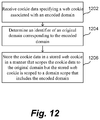
- FIG. 12 is a flowchart illustrating an embodiment of a process for storing a virtualized cookie.
- FIG. 13 is a flowchart illustrating an embodiment of a process for retrieving a virtualized cookie.
- FIG. 14 is a flowchart illustrating an embodiment of a process for handling cookies at a proxy server.
- FIG. 15 is a flowchart illustrating an embodiment of a process for maintaining virtual cookies.
- the invention can be implemented in numerous ways, including as a process; an apparatus; a system; a composition of matter; a computer program product embodied on a computer readable storage medium; and/or a processor, such as a processor configured to execute instructions stored on and/or provided by a memory coupled to the processor.
- these implementations, or any other form that the invention may take, may be referred to as techniques.
- the order of the steps of disclosed processes may be altered within the scope of the invention.
- a component such as a processor or a memory described as being configured to perform a task may be implemented as a general component that is temporarily configured to perform the task at a given time or a specific component that is manufactured to perform the task.
- the term ‘processor’ refers to one or more devices, circuits, and/or processing cores configured to process data, such as computer program instructions.
- Protecting content is disclosed. For example, integrity of web content is protected in a manner that reduces the likelihood the web content is altered prior to display to an end user.
- an original content identifier e.g., at least a portion of a location address
- the original content identifier e.g., resource identifier
- the original content identifier is to be obfuscated to prevent content modifiers (e.g., content modifier/blocker provided by a third-party to modify/block content that was originally intended by an original publisher to be rendered to a user) from recognizing the original content identifier as an identifier to replace or block.
- encoding and obfuscating the original content identifier not only obfuscates the identifier from undesired third party content modifiers but also may obfuscate it from the web browser and a web program (e.g., JavaScript) of the web content.
- Obfuscating the content identifier may involve changing a domain (e.g., hostname) associated with the original content identifier to another domain (e.g., encoded domain) to prevent detection of the network domain by undesired third party content modifiers that may block content based on the domain associated with the original network domain.
- a domain e.g., hostname
- another domain e.g., encoded domain
- the use of encoded content identifiers and associated encoded domains causes cookies to be scoped to the encoded domain rather than the original domain.
- a web browser typically permits sharing of data only between web contents with the same origin/domain. This policy prevents a malicious web content from obtaining access to data of another web content of a different domain. Thus strict separation of cookies from different domains must be maintained. However, encoding/obfuscation of the content identifier and its associated domain may cause the same-origin policy to break because web content from different original domains may become mapped to the same encoded domain. Thus when using encoded content identifiers, traditional web cookie handling must be extended to ensure correct cookie handling that still enforces the same-origin policy.
- calls to a web cookie handling API is intercepted (e.g., using modified API method/function or call to an API method/function calls a wrapper method/function of the API method/function that extends traditional functionality) to perform additional processing required to ensure correct cookie handling functionality despite the change in domains (e.g., due to identifier encoding/obfuscation).
- a web cookie handling API e.g., Document.cookie API
- web browsers limit the number and/or storage size (e.g., individual and/or total size) of web cookies. For example, browsers limit the maximum number of cookies per domain, the maximum total data size per cookie, and/or maximum total data size of all cookies per domain. If multiple different domains are being mapped to the same encoded domain during encoding/obfuscation, these limits may be reached. For example, the limit on the maximum number of cookies per domain is more likely to be reached if multiple original domains are mapped to the same encoded domain name and thus are sharing the same total limit.
- the web cookies are virtualized to enable storage of multiple cookies in a single stored cookie. For example, multiple cookies scoped for the same original domain are stored in a single stored container cookie, where the cookie value of the single stored cookie includes a plurality of data entries that each store data for a different virtualized cookie.
- cookie data specifying a web cookie associated with an encoded domain is received.
- cookie data to be stored as a web cookie is received from a JavaScript API call of web content associated with an encoded domain.
- the received cookie data may be received in a request to store the cookie data and this request to store the cookie data has been intercepted (e.g., intercepted by using a replacement function/method that is invoked instead of a corresponding standard function/method of a cookie handling web API).
- An identifier of an original domain corresponding to the encoded domain is determined. For example, if encoding/obfuscation was not performed, the cookie data would have been stored as a cookie of the original domain but due to encoding/obfuscation of a content identifier, a web browser handles the cookie data as a cookie to be scoped to the encoded domain rather than its original domain because the underlying web content of the cookie data belongs to the encoded domain of the encoded content identifier utilized to obtain the web content.
- the encoded domain and/or other data obtained using the encoded domain is decoded to determine the original domain identifier.
- the cookie data is stored in a stored web cookie in a manner that associates the cookie data to the original domain (e.g., via an identifier of the original domain stored as the key of the stored web cookie) but the stored web cookie is scoped by a web browser to a domain scope that includes the encoded domain.
- each stored cookie in a cookie storage of a web browser represents one cookie.
- a single stored cookie is utilized as a container and is configured to store data for multiple virtual cookies that each represent a different web cookie.
- virtual cookies stored in the stored container cookie are only for the same original domain (e.g., all cookies to be domain scoped to the same original domain) and allow cookies for the original domain to be aggregated together in the same container cookie to facilitate more efficient retrieval and enforcement of the same-origin policy.
- the stored container cookie was stored in the context of the encoded domain, the stored container cookie is still scoped by the web browser to a domain scope that includes the encoded domain (e.g., scoped to all domains that include the main domain name or hostname of the encoded domain).
- the browser scoped the stored cookie to the domain scope that includes the encoded domain the virtualized cookies stored within the stored cookie can be virtually scoped to a different domain (e.g., original domain).
- Certain embodiments described herein relate to controlling access to network resources.
- certain embodiments described herein provide techniques for protecting one or more portions of the content to prevent unauthorized modification by content modification functionality associated with the web browser, prior to retrieval of associated network resources. In this manner, rendering of the content may be controlled and the integrity of a webpage can be protected.
- FIG. 1 is a schematic diagram showing an example of a system in accordance with an embodiment.
- the system 100 comprises a client device 110 and a content provider system 130 , which are communicatively coupled through a network 140 .
- the client device 110 is configured with a web browser 112 for retrieval and rendering of webpages from the content provider system 130 .
- the client device 110 may comprise a laptop computer, a desktop computer, a tablet computer, a smartphone, or any other device capable of installing and running the web browser 112 .
- the content provider system 130 may comprise a web server, such as an origin server or any other apparatus capable of serving webpages to the client device 110 .
- the network 140 may comprise any combination of public or private networks, including intranets, local area networks (LANs), wide area networks (WANs), radio access networks (RANs), Wi-Fi networks and/or the Internet.
- LANs local area networks
- WANs wide area networks
- RANs radio access networks
- Wi-Fi networks and/or the Internet.
- the web browser 112 is configured to receive a webpage definition 116 (e.g., web content) from the content provider system 130 for rendering and presentation of a corresponding webpage to a user of the client device 110 .
- a webpage definition 116 e.g., web content
- the web browser 112 may retrieve the webpage definition 116 from the content provider system 130 by issuing one of more network requests according to the Hypertext Transfer Protocol (HTTP) (e.g., one or more GET requests) or any other suitable networking or Internet protocol.
- HTTP Hypertext Transfer Protocol
- the webpage definition 116 may comprise a file formatted according to one or more mark-up languages, such as Hypertext Mark-up Language (HTML) and/or Extensible Mark-up Language (XML), etc.
- the webpage definition 116 may also comprise content in the form of dynamically executable code, defined in terms of one or more programming languages (e.g., JavaScript, JavaScript Object Notation (JSON), etc.), such as interpreted programming languages, scripting languages, managed programming languages, web programming languages, etc.
- the webpage definition 116 may also comprise content in the form of one or more display attributes, defined in a style sheet language such as the Cascading Style Sheets (CSS) language.
- CSS Cascading Style Sheets
- the webpage definition 116 may be associated with one or more resources to be obtained and/or rendered by the web browser 112 .
- resources include image files, script files, video files, audio files, Adobe Flash content, HTML5 content, other webpage files, and the like.
- the resources are stored in one or more repositories that are located remote from the client device 110 and are retrieved by the web browser 112 prior to rendering of the associated webpage, or portion thereof.
- the web browser 112 may locate and retrieve the one or more resources based on one or more respective resource identifiers associated with the webpage definition 116 .
- Examples of a resource identifier include a Uniform Resource Identifier (URI), a Uniform Resource Locator (URL), a network path, a location address, a storage location and any other content identifier.
- the one or more resource identifiers may be included in the webpage definition 116 retrieved by the web browser 112 and/or generated dynamically in response to execution of executable code (e.g., JavaScript) included or referenced by the webpage definition 116 .
- FIG. 2 shows an example of a webpage definition in the form of an HTML document.
- the exemplary webpage definition 116 comprises an image element 202 - 1 , an image resource identifier 202 - 2 , a video element 204 - 1 , a video resource identifier 204 - 2 , a script element 206 - 1 , and one or more executable instructions 206 - 2 associated with the script element 206 - 1 .
- the web browser 112 parses the webpage definition 116 to build a data structure 118 representing the structure of the corresponding webpage in local memory associated with the web browser 112 .
- the data structure 118 may represent the webpage according to a Document Object Model (DOM).
- DOM Document Object Model
- the DOM is a standardized model for representing the various components of a webpage and is supported by various web browsers, including Internet Explorer and Microsoft Edge, developed and maintained by Microsoft Corporation of Redmond, Wash., United States of America; Mozilla Firefox, developed and maintained by the Mozilla Foundation of Mountain View, Calif., USA; and Google Chrome, developed and maintained by Google Inc. of Mountain View, Calif., USA.
- the DOM is a cross-platform and language-independent convention for representing and interacting with objects in HTML documents, as well as XHTML and XML documents.
- the DOM represents a webpage in terms of one or more objects that are arranged according to a hierarchy of nodes which are organized according to a tree structure.
- the one or more objects may be addressed and manipulated using one or more methods and the public interface of a DOM is specified in its application programming interfaces (APIs).
- the DOM standard includes a plurality of levels. For example, DOM levels 0 and 1 are the core standards supported by the majority of web browsers, while DOM level 2 and above are extensions to DOM levels 0 and 1, which are to be optionally supported by web browsers.
- DOM levels 0 and 1 define a “core” set of objects and interfaces for accessing and manipulating document objects, and provide a complete model for representation of HTML documents, including the means to modify portions of the representation.
- FIG. 3 is a schematic diagram showing an example of a DOM tree.
- the topmost node, or root, of DOM tree 300 is the document object.
- a document object represents an entire HTML (or XML) document, and it provides the primary access to the document's data.
- An element within the document object known as an element object, represents an element in the HTML document.
- Elements in the DOM tree 300 may include text, anchors, text-boxes, text areas, radio buttons, check boxes, selects, buttons, and the like.
- the web browser 112 builds/traverses the data structure 118 to identify any resources referenced by the data structure 118 for retrieval over the network 140 .
- the web browser 112 examines each node in the DOM to identify any resources for retrieval over the network 140 .
- a node in the DOM tree corresponding to the image tag 202 - 1 in the webpage definition 116 will include the associated image resource identifier 202 - 2
- a node in the DOM tree corresponding to the video tag 204 - 1 in the webpage definition 116 will include the associated video resource identifier 204 - 2 .
- the web browser 112 will proceed to fetch the image identified by the image resource identifier 202 - 2 and the video identified by the video resource identifier 204 - 2 for rendering in the webpage.
- the web browser 112 therefore proceeds to issue separate network requests (e.g., HTTP GET requests) via the network 140 to fetch the image and video resources, based on the image resource identifier 202 - 2 and the video resource identifier 204 - 2 respectively.
- network requests e.g., HTTP GET requests
- the web browser 112 may proceed to issue N separate resource requests (e.g., N separate HTTP GET requests) via the network 140 to request the associated resources, and in response the web browser 112 will receive N separate network responses (e.g., N separate HTTP GET responses), comprising the requested resources.
- N separate resource requests e.g., N separate HTTP GET requests
- N separate network responses e.g., N separate HTTP GET responses
- the webpage definition 116 may comprise or reference one or more dynamically executable instructions which are executed by the web browser 112 upon receipt.
- the web browser 112 may execute the one or more executable instructions 206 - 2 included in the script element 206 - 1 .
- the one of more executable instructions 206 - 2 when executed by the web browser 112 , may reference or dynamically generate one or more resource identifiers associated with resources located remote from the web browser 112 .
- the one or more executable code (e.g., JavaScript code) of a webpage definition may include or result in dynamic generation or modification of one of more resource identifiers (e.g., “dynamic resource identifiers”).
- the one of more executable instructions 206 - 2 may cause the web browser 112 to fetch a resource associated with such a dynamic resource identifier.
- the one or more executable instructions 206 - 2 may cause the web browser 112 to issue a network request (e.g., an HTTP GET request) to fetch the associated resource.
- the one of more executable instructions 206 - 2 may utilize AJAX (Asynchronous JavaScript and XML) techniques to cause the web browser 112 to issue a network request for a resource associated with the dynamic resource identifier.
- the one of more executable instructions 206 - 2 may include JavaScript code which uses the XMLHttpRequest application programming interface (API) or the jQuery library to request the resource associated with the dynamic resource identifier.
- API application programming interface
- the web browser 112 may be configured with a third party content modification component 114 .
- Examples of content modification component 114 include a web browser plugin/extension, a third party program, a third party script, and any other third party program/code that is able to alter content of web browser 112 .
- content modification component 114 is a standalone program/process separate from web browser 112 .
- the content modification component 114 may be configured to take actions with respect to a particular resource associated with the webpage rendered by the web browser 112 .
- the content modification component 114 may be configured to prevent the web browser 112 from issuing a resource request associated with the particular resource, or to cause the web browser 112 to fetch a different or alternative resource in place of the particular resource.
- Blocking mechanisms of content modification component 114 may be at least partly circumvented by transforming (e.g., encoding) resource identifiers/locators in the webpage definition 116 prior to delivery to the web browser 112 .
- the content provider system 130 or intermediary, in the network 140 , may be configured to transform the one or more URIs/URLs in an HTML document to reduce the likelihood that the content modification component 114 will be able to identify the associated resources. In this manner, it is possible to reduce the likelihood that resources associated with the HTML document are blocked or modified by the content modification component 114 prior to rendering of the associated webpage.
- dynamic resource identifiers are specified or generated by dynamically executable script/code or application (e.g., code of JavaScript, other managed or interpreted programming language, etc.) while static resource identifiers are not specified by dynamically executable script/code or application (e.g., specified within non script HTML elements). Accordingly, in order to maintain the integrity of the webpage, alternative or additional countermeasures are required to prevent modification/blocking of resources associated with dynamic resource identifiers by the content modification component 114 . Accordingly, certain embodiments described herein provide various techniques to prevent modification/blocking of resources by the content modification component 114 .
- FIG. 4 is a schematic diagram showing an example of a system for controlling rendering of content in a web browser in accordance with an embodiment.
- the system 400 of FIG. 4 comprises a number of components which are common with the system 100 of FIG. 1 and have been denoted using the same reference numerals.
- the system 400 of FIG. 4 additionally comprises a server system 150 which acts as a proxy between the client device 110 and the content provider 130 and facilitates one of more countermeasures to protect the integrity of web content delivered from the content provider 130 to the client device 110 over the network 140 . That is, the server system 150 is configured to act as an intermediary for requests for webpages originating from the web browser 112 configured on the client device 110 .
- the server system 150 may operate transparently (e.g., without requiring any manual configuration by an end user and/or a content origin).
- the server system 150 may comprise a proxy server, a gateway server, an edge server, or any other apparatus suitable for implementing the following techniques.
- the server system 150 may implement one or more server-side countermeasures to protect the integrity of web content delivered to the web browser 112 .
- the server system 150 may be configured to transform one or more static resource identifiers in a webpage definition 116 to be delivered to the client device 110 to prevent the content modification component 114 and/or network-side content blockers from identifying and blocking requests or rendering of the associated resources.
- the server system 150 is configured to transform and encode the one or more static resource identifiers to obfuscate the identity of the associated resources.
- the server system 150 proceeds to deliver a modified version of the webpage definition 116 comprising the transformed static resource identifiers to the web browser 112 for rendering.
- the static resource identifiers have been transformed in a manner that preserves a least a portion of special characters included in the original static resource identifiers in resulting encoded forms of the static resource identifiers.
- the server system 150 is configured to transform and encode the one or more dynamic resource identifiers specified in a web content prior to delivery to web browser 112 to obfuscate the identity of the associated resources. For example, certain resource identifiers included in the text of a script have been identified as okay to transform/encode prior to script execution.
- dynamic resource identifiers may be included and/or generated by one or more executable code included or referenced by the webpage definition 116 which are executed by the web browser 112 . Accordingly, at least a portion of the dynamic resource identifiers are not available for transformation or are not allowed to be modified (e.g., to ensure correct execution of the dynamically executable code) by the server system 150 . Accordingly, the server system 150 may facilitate one of more client-side countermeasures by provisioning the web browser 112 with a component 120 (e.g., virtualization client) that is executable within the web browser 112 to transform one or more dynamic resource identifiers originating from the one or more dynamically executable code specified in or referenced by the webpage definition 116 .
- a component 120 e.g., virtualization client
- the component 120 may take the form of one or more scripts that are “injected” into the webpage definition file 116 by the server system 150 .
- the component 120 may take the form of one of more scripts written using the JavaScript language.
- the component 120 may take the form of a code/script that is “pre-delivered” to the web browser prior to delivery of the webpage definition 116 by the server system 150 .
- component 120 is configured to process such transformed static resource identifiers in order to reverse the transformation and recover the original resource identifier. For example, when a resource identifier that identifies a location address pointing to the content provider 130 is transformed/encoded, the resulting encoded resource identifier identifies a location address pointing to server system 150 that will serve as a proxy between the client device 110 and the content provider 130 by fetching the resource of the resource identifier from content provider 130 and delivering it to client device 110 .
- server system 150 receives a resource request made using an encoded resource identifier, server system 150 decodes the encoded resource identifier back to its original resource identifier and utilizes this original resource identifier to fetch the desired resource and respond to resource request.
- the component 120 may be configured to control manipulation of the data structure 118 representing the structure of the webpage defined by webpage definition 116 .
- the component 120 may be configured to control access to a DOM tree by intercepting requests to the DOM interface.
- the component 120 serves as a virtualization layer to control access to the DOM interface.
- This virtualization may be facilitated by one or more wrapper methods/functions with respect to one or more of the APIs of the DOM (e.g., Document API interface of a webpage) that replace and wrap corresponding standard API methods/functions of the DOM (e.g., method API calls to create, delete or update elements in the DOM via a Document API interface are replaced with corresponding wrapper methods).
- DOM core level 1 APIs for manipulating the DOM tree are supplanted by the equivalent interfaces provided via component 120 .
- the component 120 is able to intercept requests for resources and modify the requests (e.g., transform/encode resource location identifier (e.g., URL) of a request) in a manner that is transparent to other processes running within the web browser 112 environment.
- the component 120 ensures that any other processes running within the web browser only have access to the encoded resource identifiers and thus are unable to determine the original identity (e.g., original location identifier) of resources associated with the webpage.
- This virtualization of the DOM interface can be used by the component 120 to implement one or more client side optimizations of the webpage and, in particular, one or more client-side countermeasures to protect integrity of the webpage.
- one optimization enabled by virtualization of the DOM involves encoding of resource identifiers, whereby to cause the web browser 112 to request a resource from a content server other than that from which the resource would be requested without the encoding.
- resources are requested from a proxy server (e.g., server system 150 ).
- Another optimization enabled by virtualization is masking or obfuscation of dynamic resource identifiers. In this manner, the component 120 is able to prevent the content modification component 114 from identifying and blocking or modifying network requests issued by the web browser 112 by masking/obfuscating resource location identifiers of the network requests.
- the component 120 may utilize one or more API method/function wrappers to intercept a request to add or modify an object stored in the DOM tree, and transform any resource identifiers included in the request to prevent identification of the original location identifier by the content modification component 114 .
- the request to add or modify an object in the DOM tree may originate from one or more executable code in or referenced by the webpage definition 116 , which are executed by the web browser 112 and intercepted to invoke the component 120 .
- the component 120 is able to transform dynamically generated and utilized resource identifiers before they are added to the DOM tree, thereby circumventing the content modification component 114 .
- the one of more executable code which invoke and implement the component 120 may be inserted into the webpage definition 116 by the server system 150 prior to delivering the webpage definition 116 to the client device 110 .
- the content modification component 114 may monitor and block resource requests before they are issued by the web browser 112 .
- the component 120 is configured to control access to the API interface to “intercept” resource requests originating from the one or more code instructions such that network requests for resources are not blocked by the content modification component 114 .
- the component 120 may implement one or more wrapper methods/functions with respect to one or more APIs that cause the web browser 112 to issue network requests.
- the component 120 may implement one or more wrapper methods for the .setAttribute API method to intercept setting of an attribute of a DOM element that identifies a resource identifier and obfuscate the resource identifier before it is added to the DOM and utilized to initiate a network request that can be potentially monitored and blocked by the content modification component 114 based on the resource identifier.
- the requests to the API call may originate from a script (e.g., script 206 - 2 ) included in the webpage definition 116 and/or a script resource referenced by the webpage definition 116 , which, when executed, includes one or more dynamic resource identifiers. Accordingly, in these embodiments, the component 120 is able to obfuscate the dynamic resource identifiers before the original resource identifier is potentially identified and blocked by the content modification component 114 .
- resource identifier interception is to override code utilized to access and set/modify resource identifiers during program code execution.
- JavaScript code is utilized to access objects of object models that provide a standardized programming interface (e.g., API) to access elements of a web document and a web browser.
- the object models provide objects with one or more object properties that represent the values and function/methods of the associated object.
- a web program is able to modify contents to be rendered by calling in program code one or more object properties of an object of a Document Object Model (DOM) API, browser object model API, and/or web API.
- DOM Document Object Model
- the object properties that are utilized to access and set/modify resource identifiers are reassigned to invoke inserted wrapper code that replaces and wraps corresponding standard API implementation code. For example, particular memory address locations identifying standard code of an API (e.g., DOM API, browser object model API, web API, etc.) method/function are replaced by component 120 with memory address locations of replacement wrapper methods/functions.
- an API e.g., DOM API, browser object model API, web API, etc.
- the standard identifier that identifies the standard object property of a web API has been utilized, the standard identifier has been remapped/reassigned to the new inserted wrapper code where desired additional processing (e.g., intercept and perform identifier encoding/decoding) is able to be performed in addition to performing the desired standard API processing (e.g., invoke the standard code of an API).
- desired additional processing e.g., intercept and perform identifier encoding/decoding
- desired standard API processing e.g., invoke the standard code of an API.
- requests for resources are intercepted by the wrapper method/function to modify the requests (e.g., transform/encode resource location identifier (e.g., URL) of a request) in a manner that is transparent to other processes running within the web browser 112 environment prior to invoking the standard API code to process the request.
- the virtualization component 120 may be configured to apply a transformation to resources associated with a webpage, in addition to applying a transformation/encoding to resource identifiers associated with the webpage. For example, the virtualization component may apply a transformation to a resource in order to mask the content of that resource from content modification functionality associated with the web browser 112 . Similarly, in some examples, the virtualization component 120 may be configured to transform the content of a resource in response to transforming the content of a resource identifier associated with a different resource. For example, the virtualization component 120 may be configured to apply a transform to content displayed within an HTML iFrame element, in response to a transform being applied to a resource identifier for the iFrame element itself.
- the web browser 112 may store one or more resources associated with the webpage in a local cache associated with the web browser. For example, the web browser 112 may cache a resource in response to an earlier network request in respect of that resource using a transformed resource identifier. In this example, the web browser 112 may retrieve the cached resource from the cache based on the transformed resource identifier, rather than issuing a network request for the resource to the server system 150 using the transformed resource identifier.
- the web browser 112 when web browser 112 requested a webpage, the web browser was provided a modified webpage file of the original webpage. For example, rather than providing the originally requested HTML file of the original requested webpage, the web browser is provided an alternative webpage file of the original webpage that includes component 120 .
- certain resource identifiers of the webpage may have been already transformed/encoded prior to delivery to web browser 112 , certain resource identifiers may not have been transformed/encoded from their original identifier.
- dynamically referenced resource identifiers of scripts may not have been transformed prior to delivery.
- component 120 when an external resource of the webpage is requested via dynamically executed code, component 120 transforms an identifier of the resource to obfuscate the identity of the external resource to prevent content modification component 114 from detecting the identity of the external resource.
- the web browser 112 is provided an alternative webpage file of the original webpage that includes component 120 but not the complete contents of the requested webpage (e.g., HTML file) that would have been provided in a traditional response.
- component 120 is executed. Then component 120 may request and receive contents of the original requested webpage. Because this allows component 120 access the contents of the original requested webpage prior to including it in the DOM for rendering by a web browser, component 120 is able to modify the contents of the original requested webpage, including resource identifier, prior to rendering and detection by content modification component 114 .
- the request is proxied and/or rerouted via an intermediary such as server system 150 .
- server system 150 if translated/encrypted resource identifiers are utilized by web browser 112 to make a request for a resource to the original content source (e.g., content provider 130 ), the request may fail because the original content source does not recognize the transformed/encrypted resource identifier.
- server system 150 translates the transformed resource identifier back to its original identifier and requests as the proxy the requested resource from the content source (e.g., send request to provider 130 ) using the original identifier.
- server system 150 receives the resource, the resource is provided to the client in response to the request for the resource provided using the transformed resource identifier.
- component 120 may be injected into a webpage based on standards-based (e.g., HTML, JavaScript, ActionScript, etc.) procedures. For example, after server system 150 receives a request from web browser 112 requesting an HTML webpage file, server system 150 injects code implementing component 120 into an alternative HTML webpage file of the requested HTML file, and then sends the response back to web browser 112 .
- component 120 may be injected into a webpage by a content provider directly.
- web browser 112 requests an HTML webpage file directly from content provider 130 and content provider 130 provides an alternative webpage file with code of injected component 120 .
- Content provider 130 may be a content producer of the provided content.
- component 120 may be injected by adding JavaScript client code in the head section of an alternative HTML webpage file.
- the web browser 112 may include web cookie storage 122 (e.g., data structure) storing stored web cookies. Each web cookie stored in web cookie storage 122 includes a key and a value and are scoped to be only accessible by web content of an associated domain. Under the same-origin policy web security model, a web browser permits sharing of data only between web contents with the same origin. Content of the same origin must be associated with the same domain but may be associated with different subdomains of the same domain. This policy prevents a malicious web content from obtaining access to data of another domain. Thus strict separation of cookies from different domains is maintained in web cookie storage 122 by only allowing a particular web content to access cookies scoped to the domain of the particular web content. The web browser 112 may limit the maximum of cookies per domain, the maximum cookie size per cookie, and/or maximum storage size of all cookies per domain for cookies stored in web cookie storage 122 .
- the web browser 112 may limit the maximum of cookies per domain, the maximum cookie size per cookie, and/or maximum storage size of all cookies per domain for cookies
- Encoding and obfuscating the original resource identifier for web content not only obfuscates the identifier from undesired third party content modifiers but also may obfuscate it from web browser 112 and a web program (e.g., JavaScript) of the web content.
- Obfuscating the resource identifier may involve changing a network domain (e.g., domain of content provider 130 ) associated with the original resource identifier to another domain (e.g., domain of server system 150 ) to prevent detection of the network domain by content modifier 114 that may block content based on the domain associated with the original network domain.
- a network domain e.g., domain of content provider 130
- another domain e.g., domain of server system 150
- the use of encoded resource identifiers and associated encoded domains causes cookies to be scoped to the encoded domain rather than its original domain.
- calls to a web cookie handling API are intercepted (e.g., using modified API method/function or call to an API method/function calls a wrapper method/function of the API method/function that extends traditional functionality) by code of component 120 to perform processing required to ensure correct cookie handling functionality despite the change in domains.
- a web cookie handling API e.g., Document.cookie API
- one or more web cookies stored in cookie storage 122 may be configured as cookies that act as a container to store multiple virtual cookies in a single stored cookie. For example, multiple cookies scoped for the same original domain are stored in a single stored cookie that acts as a virtual cookie container, where the value field of the single stored cookie includes a plurality of data segments and each data segment stores each separate virtual cookie.
- the encoded domain associated with the web program may be utilized to determine a corresponding original domain (e.g. by decoding the encoded domain).
- This original domain may be utilized to locate a stored container cookie comprising a plurality of virtual cookies stored in cookie storage 122 and corresponding to the original domain.
- the located container cookie includes virtual cookies in its cookie value and these virtual cookies may be individually provided to the web program by the wrapper method/function provided by component 120 .
- Server system 150 includes cookie storage 152 (e.g., data structure). Because server system 150 may act as a proxy between content provider 130 and client 110 to provide translation between encoded and not encoded identifiers, server system 150 handles cookies as cookies are passed between content provider 130 and client 110 via server system 150 .
- cookie storage 152 e.g., data structure
- the cookie may be received at server system 150 in an original format and scoped to an original domain.
- Server system 150 may transform the cookie to be for a corresponding encoded domain by virtualizing the received cookie in the manner described above (e.g., by storing the received cookie as a virtual cookie corresponding to the original domain in a container cookie, scoping the container cookie to the encoded domain), and then sending the transformed cookie to client 110 in a manner that appears to web browser 112 as if it was being sent from the encoded domain.
- the request is sent to server system 150 to be proxied and decoded and sent to content provider 130 .
- This request also includes one or more cookies (e.g., including a virtual cookie container cookie) associated with the encoded domain of the encoded content identifier that is received by server system 150 , and system 150 transforms these cookies (e.g., by extracting virtual cookies corresponding to the original domain from the container cookie) to one or more cookies of the original domain to be included in a corresponding request sent to content provider 130 .
- cookies e.g., including a virtual cookie container cookie
- the server system 150 may maintain a copy (in cookie storage 152 ) of cookies stored at various user web browsers for cookies it has proxied. For example, by maintaining a copy, server system 150 is able to more quickly send a copy of appropriate cookies when sending out a request associated with a received request it is proxying. Additionally, system 150 is also able to cache data of content provider 130 and provide the cached data in response to a request based on comparison of received cookies and stored cookies. Cookies stored in storage 152 are associated with a particular user's browser instance and/or session to enable separation and identification of appropriate cookies of different user browser/session instances.
- the encoding of a content identifier and associated encoded domain is periodically varied so that an original content identifier and its original domain become mapped to different encoded identifiers/domains. This causes cookies stored by the browser for a previous encoded domain to become invalid for use in the new encoded domain despite it being associated with the same original domain.
- system 150 obtains cookies associated with the old encoded domain for a particular browser/session instance from cookie storage 152 and sends it to the browser to be set and scoped to the new encoded domain to allow carryover of cookie data when encoding is changed for the same original domain.
- verification is performed to ensure that the cookies are being sent to a correct user/browser instance. For example, using browser fingerprinting (e.g., detect unique login information, username and password, MAC address, etc.), cookies stored in storage 152 are associated with a particular browser/user instance and prior to sending any of the stored cookies to be set and scoped to the new encoded domain, the recipient browser is fingerprinted to ensure that the recipient browser instance is the same browser/user instance as the browser/user instance associated with the stored cookies of the previous encoded domain.
- browser fingerprinting e.g., detect unique login information, username and password, MAC address, etc.
- identifiers in the headers of the network request and/or a response are also transformed to be consistent with the transformed identifiers in the body.
- location identifiers e.g., URL
- Web browser 112 , component 120 , provider 130 , and/or server system 150 performs the header transformations as appropriate for various network requests/responses.
- FIG. 5 is a flowchart illustrating an embodiment of a process for generating a modified document object model. The process of FIG. 5 may implemented on one or more components of client 110 of FIG. 4 .
- desired web content (e.g., webpage definition 116 ) is requested.
- the web browser 112 sends an HTTP request message to a server (e.g., server system 150 or content provider system 130 ).
- the web content include a webpage, streaming content, a web application, a web resource, a dynamically executable code resource, a script, a resource of a webpage, and any other content accessible via the Internet.
- the request includes an identifier of the requested content that is resolved to another identifier.
- the request includes a URL (e.g., received from a user that types the URL or selects a link of the URL) and at least a portion of the URL is provided to a DNS server to translate at least a portion of the URL to an IP address to be utilized to request the web content.
- the destination of the request is adjusted dynamically using the DNS server. For example, a mapping between a domain of a URL of the request and an associated IP address may be modified to modify a destination of the request (e.g., such that the request is routed to the server system 150 ).
- the requested web content is requested by an Adobe Flash application.
- the requested web content is requested by a mobile application such as an Apple iOS application or a Google Android application.
- alternative web content is received in place of an original version of the requested web content to be rendered.
- the alternative web content is placeholder content that includes code implementing a virtualization client (e.g., component 120 of FIG. 4 ).
- the virtualization client can request, intercept, and process, at least a portion of the file of the original requested web content as well as its resources. This contrasts to the behavior with respect to a traditional web content request response, in which the original requested web content to be rendered would be obtained from an origin server.
- a virtualization layer may be enabled between a web browser and the original requested web content to enable optimizations, or more generally, modifications with respect to the original requested web content.
- the received alternative web content includes a virtualization client such as virtualization client 120 .
- a virtualization client such as virtualization client 120 .
- code implementing virtualization client 120 of FIG. 4 is inserted into a webpage definition file (e.g., HTML file) that is received as the received alternative web content.
- this alternative web content is a placeholder webpage file that does not include contents of the original requested web content.
- the alternative web content includes a portion of the original requested web content but not the entire contents of the original requested web content. At least a portion of the original requested web content not included in the received alternative web content may be dynamically requested and processed by the virtualization client for inclusion in a DOM for rendering.
- the virtualization client may be coded in a managed programming language (e.g., runs in a Common Language Runtime) and/or a web programming/scripting language such as JavaScript, Java, .Net, etc.
- the virtualization client may be injected by adding JavaScript client code in the head section of an HTML webpage file included in the alternative web content.
- the received alternative web content is received from server system 150 of FIG. 4 .
- the received alternative web content is received directly from content provider 130 of FIG. 4 .
- alternative web content includes an identification of the original requested web content to be rendered. For example, a location address where the original requested web content (e.g., URI where the actual original requested web content is located) is to be obtained is specified in the alternative web content.
- the user is directed to a location of the alternative web content when the user attempts to obtain the original requested web content.
- the received alternative web content includes one or more resource identifiers that have been transformed using at least a portion of the process of FIG. 6 .
- an intermediate document object model (DOM) structure is built using the alternative web content.
- building the intermediate document object model structure includes allowing a web browser (e.g., web browser 112 of FIG. 4 ) to receive and process the alternative web content received at 504 .
- the web browser builds a document object model tree of an alternative web content received at 504 .
- Building the intermediate document object model structure may include executing program code implementing a virtualization client (e.g., virtualization client 120 of FIG. 4 ) included in the received alternative web content.
- building the intermediate document object model structure includes inserting objects in the intermediate document object model structure of content included in the alternative web content.
- the alternative web content includes a portion of original requested web content to be rendered, and objects corresponding to the included original requested web content portions are inserted in the intermediate document object model structure.
- a modified document object model structure is generated by modifying the intermediate document object model.
- the virtualization client included in the alternative web content modifies the intermediate document object model structure with data of the original requested web content to create a modified document object model structure.
- generating the modified document object model structure includes requesting and receiving the original requested web content.
- a virtualization client included in the received alternative content that was received in place of the original requested web content requests and receives the original requested web content to be rendered using an alternate location address where the original requested web content can be obtained. This gives the virtualization client an opportunity to transform and process even static resource identifiers of the original requested webpage file because the virtualization client has access to the original requested web content before it is provided to the web browser for rendering.
- generating the modified document object model structure includes modifying the requested and received original requested web content. For example, location addresses of resources specified in the original requested web content are modified (e.g., using a transformation/encoding similar to the transformation/encoding performed in 608 of FIG. 6 ). In another example, the original requested web content is modified for more optimized content delivery and/or rendering. In some embodiments, generating the modified document object model structure includes placing objects of the original requested web content received by the virtualization client in the intermediate document object model structure. For example, the virtualization client modifies the intermediate document object model structure to include objects of the original requested web content received by the virtualization client to render the original requested web content.
- the virtualization client manipulates the DOM including the creation, deletion, or update of nodes within the DOM tree to implement optimizations.
- the modified document object model structure different from an original document object model structure corresponding to the original version of the desired web content
- various types of different types of optimizations may be achieved.
- content redirection can be achieved by replacing a location address of a webpage resource with another location address that is able to provide the resource faster.
- optimized delivery of information over a network by segmentation and reprioritization of downloaded information can be achieved.
- the delivery of the information e.g., the order in which the information is delivered or the granularity of the information delivered
- the actual content of the delivered information corresponding to any nodes of the DOM tree may be altered, thereby speeding up the rendering of a webpage without compromising the end-user's experience.
- generating the modified document object model structure includes modifying the document object model structure (e.g., selecting a modification to be performed) based on a property of a client system (e.g., detected property) that is to render the original requested web content.
- a property of a client system e.g., detected property
- the optimizations of the original requested web content performed by the virtualization client take into consideration a property of the client system. For the same original requested web content, this may allow one type of optimization to be performed for one type of user system while allowing a different optimization to be performed for another type of user system.
- Examples of the property of the client system include the following: a type of web browser, a web browser version, available plugin/extensions of a web browser, a java processing software version, a type of operation system, a type of network connection, a network connection speed, a display property, a display type, a display window property, a type of user device, resources of a user system, or a system property of a user system.
- mapping data that is to be utilized by the virtualization client to modify the intermediate document object model structure is received.
- the virtualization client may utilize the mapping data to transform/encode resource identifiers included in the received original requested web content.
- the mapping data is utilized by the virtualization client to replace at least a portion of a content location address of a webpage resource (e.g., resource identifier) to another address specified by the mapping data.
- the mapping data may include a data structure (e.g., a table, a database, a chart, a hash table, a list, a spreadsheet, etc.).
- the received mapping data is encoded in HTML (e.g., encoded using HTML tags).
- the received mapping data is encoded in JavaScript Object Notation.
- one or more portions of content location addresses of the original requested web content are dynamically modified.
- the received mapping data may include one or more entries mapping at least a portion of an initial location address/domain to a different identifier.
- a mapping data entry maps an initial URI/URL portion to an encoded URI/URL portion.
- a mapping data entry maps an initial URI/URL to a location address that includes an IP address.
- a mapping data entry maps a domain name and/or subdomain (e.g., associated with content provider system 130 of FIG. 4 ) of an original resource identifier to a different domain name and/or subdomain (e.g., associated with a proxy such as server system 150 of FIG. 4 ) to be utilized in the transformed/encoded identifier.
- each different intermediary server may be assigned to handle content for certain assigned domains (e.g., each intermediary server may cache content for different domains).
- entries in the received mapping data identifies the domain name and/or subdomain of the corresponding intermediary server (e.g., server system 150 of FIG. 4 ) that will proxy and handle the translation of the associated encoded identifier back to the original identifier.
- the received mapping data may be utilized to transform both static resource identifier of the received original requested web content of the virtualization client and dynamic resource identifiers intercepted during execution of dynamically executable code (e.g., location address generated by execution of a web application).
- At least a portion of a resource identifier to be transformed/encoded is used to search a data structure that includes the received mapping data. If an entry that matches the at least portion of the resource identifier is found, the original resource identifier is modified using the matching entry. For example, the entry maps a domain name of an URL included in the resource identifier to a different domain name and/or subdomain to be utilized in the resulting encoded resource identifier. If a matching entry is not found in the data structure, the initial location address without replacement or translation may be utilized. In some embodiments, if a matching entry is not found in the data structure, the original resource identifier is modified using a standard default replacement identifier portion. For example, a default encoding policy specifies at least a portion of a domain name to be utilized in the corresponding encoded version of the resource identifier.
- the mapping data is received together with the alternative web content as a single received content (e.g., specified in the alternative web content).
- the alternative web content and the mapping data are received from the same server.
- the mapping data is received together with the original requested web content.
- the mapping data is received separately from the alternative web content and the original requested web content. For example, a virtualization client included in the web content requests/receives the mapping data in a separate request.
- step 508 is not performed and the modified document object model does not need to be generated.
- the received alternative web content includes the entire contents of the original requested web content (e.g., with static resource identifiers that have been already transformed/encoded) with an inserted code to implement the virtualization client.
- one or more resources of the modified document object model structure are requested and received.
- a web browser traverses the modified DOM tree to retrieve any dependent resources (e.g., images, scripts, video, etc. to be obtained via a network to render a webpage) indicated by any of the nodes in the DOM tree via a network.
- the received resources may be utilized to populate the modified DOM and/or provide/render content to a user.
- the requests for the one or more resources are requested using corresponding network location addresses that have been modified/translated when modifying the intermediate DOM in 508 .
- requesting one or more resources includes intercepting a request for a resource.
- a virtualization client such as virtualization client 120 intercepts requests for one or more resources of the web content before the request is made via the network.
- the resource is requested via the network.
- Requesting the resource via the network may include further translating at least a portion of the translated location address using a name server (e.g., DNS server) to translate a domain name of the location address to an IP address.
- a name server e.g., DNS server
- Interception may be implemented by means of method/function wrapping, whereby the virtualization client effectively traps API calls to the DOM interface, and/or modifies the otherwise standard behaviour of the web browser.
- a location address included in an intercepted request is replaced with an encoded location address.
- an initially referenced content may be replaced with a different/modified content and/or requested using a different server.
- a location address of the intercepted request may be replaced with an encoded location address determined using the received mapping data.
- an initially referenced content may be replaced with a different/modified content and/or requested using a different server.
- an inline code inserted in the received web content is utilized to intercept the request and/or replace the location address of the intercepted request with a translated location. For example, rather than utilizing a virtualization client configured to intercept all requests, a more localized inline JavaScript code (e.g., associated with one or more particular requests and/or particular utilizations of one or more particular location addresses) is added and/or utilized to replace original JavaScript code to handle the interception and/or resource identifier translation.
- a programming language/script content/file (e.g., implementing virtualization client component 120 of FIG. 4 ) inserted/referenced in the received alternative web content is utilized to intercept a request and/or replace an original resource identifier in the intercepted request with an encoded resource identifier.
- an updated mapping data is received in addition to the requested resource content. For example, data updating the previously received mapping data is received along with the requested resource content if the mapping data is to be updated.
- the updated mapping data includes new mapping data entries to replace the entire previously received mapping data. For example, virtualization client 120 replaces a stored version of the previously received mapping data with the updated mapping data.
- the updated mapping data includes only the data entries required to partially update the previously received mapping data. For example, virtualization client 120 utilizes the received update to modify a portion of the previously received mapping data.
- the updated mapping data may be received from the same server as the server that provided a requested resource.
- the updated mapping data is provided by a different server from the server that provided the requested resource content.
- the requested resource and the updated mapping data may be received together as a signal data package or may be received separately.
- the updated mapping data is received as needed without necessarily being received in response to a resource request.
- a virtualization client such as client 120 of FIG. 4 periodically polls a server (e.g., server system 150 of FIG. 4 ) for any update to the mapping data.
- updates to the mapping data are dynamically provided/pushed to the virtualization client as needed.
- FIG. 6 is a flowchart illustrating an embodiment of a process for providing a transformed version of a web content.
- the process of FIG. 6 may be implemented on server system 150 and/or content provider 130 of FIG. 4 .
- the process of FIG. 6 is utilized to generate at least a portion of the alternative web content received in 504 of FIG. 5 .
- a request for web content is received.
- a request for a webpage e.g., webpage definition 116
- the request is the request provided in 502 of FIG. 5 .
- the request is a request for at least a portion of the original requested content made by the virtualization client in 508 of FIG. 5 to generate the modified document object model structure.
- the request is an intercepted request. For example, a web browser has requested a webpage using a URL that would traditionally map to content provided by an origin server (e.g., originally to be provided by content provider 130 of FIG.
- a client requested a webpage using a URL and a DNS mapping between a domain of the URL of the request and an associated IP address has been dynamically modified to redirect/modify a destination server of the request.
- the web content include a webpage, a web application, content of a mobile application, other networked content, etc.
- the web content corresponding to the requested web content is obtained.
- web content that would be traditionally provided from an origin content provider to a client has been requested and received at an intermediary server (e.g., server system 150 of FIG. 4 ).
- This intermediary server is acting as the proxy that will provide a modified version of the requested web content with obfuscated resource identifiers.
- the web content is requested and obtained from a content provider (e.g., origin server) using a location address provided in request of 602 .
- a cached version is identified and obtained from the cache using an identifier provided in the request of 602 .
- the request has been directly received at an origin content provider (e.g., content provider 130 of FIG. 4 ), the requested content is identified and obtained from storage of the origin content provider.
- one or more resource identifiers (e.g., identifier of dependent resources) of the web content to transform/encode are selected.
- identifier(s) of resource(s) known or vulnerable to be targeted by an unauthorized content modifier e.g., content modification component 114 of FIG. 4
- resources of one or more specified types are selected for identifier transformation.
- resources that are to be obtained from one or more specified Internet domains e.g., a domain name included in a resource identifier of the resource matches an entry in a data structure
- servers are selected for identifier encoding.
- one or more identifiers of resource(s) known to be not targeted by unauthorized content modifiers are also selected for transformation. For example, once content modifying entities discover that targeted resource identifiers are being obfuscated, an unauthorized content modifier may be configured to recognize a pattern of the transformations/encoding and block all resources that are identified by encoded/obfuscated identifiers.
- the unauthorized content modifier is unable to simply block/modify all requests for resources with encoded/obfuscated identifiers and is also unable to take a whitelist approach of only allowing requests for resources with known/recognized identifiers.
- all resource identifiers included in the web content are transformed.
- the resources linked using resource identifiers include a file, an image, a script, a JavaScript, a script element, a web program, a style sheet language object (e.g., CSS file), and other content elements to be obtained to render the web content.
- the resource identifier include a Uniform Resource Identifier (URI), a Uniform Resource Locator (URL), a network path, a location address, a storage location and any other content identifier.
- URI Uniform Resource Identifier
- URL Uniform Resource Locator
- the selected resource identifiers are static resource identifiers of the received web content.
- the selected resource identifiers include resource identifiers specified within a dynamically executable script/code (e.g., JavaScript).
- a dynamically executable script/code e.g., JavaScript
- the resource identifiers specified within the dynamically executable script/code and allowed to be encoded prior to execution are selected to be encoded prior to delivering the web content that references the resource identifiers within the dynamically executable script/code.
- selected resource identifier(s) are encoded.
- encoding a resource identifier includes modifying at least a portion of character contents of the selected resource identifier.
- the resource identifier may include a URI and at least a portion of the URI is encoded to obfuscate the URI.
- encoding a resource identifier includes encrypting at least a portion of the resource identifier.
- the resource identifier is encrypted using a public key of a public key cryptography that can be only decrypted using a private key corresponding to the public key.
- the key utilized to encrypt the resource identifier is specific to a content provider of the resource identified by the resource identifier, a recipient (e.g., client) of the resource, an intermediary server performing the encryption, a resource type of the resource, and/or a network/domains/URI of the resource identifier.
- the key utilized to encrypt the resource identifier is common across various different content providers, recipients (e.g., clients), intermediary servers performing the encryption, resource types, and/or network/domains/URIs.
- the key utilized to encrypt the resource identifier is automatically changed over time. For example, in order to prevent an unauthorized content modifier from learning a pattern of the encryption, the encryption key is changed periodically.
- encoding the resource identifier includes hashing at least a portion of the resource identifier. For example, a hash value is determined as the transformed identifier using a hashing function and the original resource identifier is stored in a corresponding hash table. In some embodiments, the original resource identifier is stored in a table, a database, or other data structure to be utilized to determine the original resource identifier from the transformed identifier. In some embodiments, the encoding the selected resource identifier includes encoding the selected resource identifier in a manner that preserves one or more special characters included in the original selected resource identifier in the encode version of the original selected resource identifier in a manner as further described in this document.
- a transformed version of the obtained web content with the encoded resource identifier(s) is provided as a response to the request received in 602 .
- the transformed version of the web content has been generated by replacing the selected resource identifiers with the corresponding encoded resource identifiers.
- the provided web content is received at 504 (e.g., as the alternative web content) or 508 (e.g., utilized to generate modified document object model) of FIG. 5 .
- the transformed version includes a virtualization client (e.g., virtualization client 120 of FIG. 4 ).
- the virtualization client has been configured to intercept and operate on the dynamic resource identifiers to transform the dynamic resource identifiers to encoded resource identifiers.
- FIG. 7 is a flowchart illustrating an embodiment of a process for dynamically transforming a resource identifier.
- the process of FIG. 7 may be implemented on client 110 of FIG. 4 .
- at least a portion of the process of FIG. 7 is implemented using virtualization client component 120 and/or web browser 112 of FIG. 4 .
- the process of FIG. 7 is repeated for each intercepted request for a resource of a plurality of dependent resources of a web content (e.g., dependent resources of a webpage).
- at least a portion of the process of FIG. 7 is included in 510 of FIG. 5 .
- at least a portion of the process of FIG. 7 is performed when the one or more instances in program code that references the identifier of the program object property modified in 704 of FIG. 7 are invoked.
- a program code invocation associated with utilization of a resource of web content is intercepted.
- the program code invocation may be a program code call (e.g., JavaScript program object property call) made using a resource identifier (e.g., as an argument) and/or a program code call (e.g., JavaScript program object property call) known to set, return, or otherwise modify a resource identifier.
- a program code call e.g., JavaScript program object property call
- a request associated with a resource of web content is intercepted.
- the request is a request for an external dependent resource of web content (e.g., webpage) received in 504 of FIG. 5 .
- resources include a file, an image, a script, a JavaScript, a script element, a web program, a style sheet language object (e.g., CSS file), and other content elements to be obtained to render the web content.
- the interception of the request is performed by a virtualization client (e.g., component 120 of FIG. 4 ).
- the virtualization client is a JavaScript program that has been inserted into a webpage to intercept method/function calls associated with resource identifiers.
- the virtualization client may facilitate one or more wrapper methods/functions with respect to one or more of the web APIs (e.g., DOM API interface of a webpage) that replace and wrap corresponding standard web API methods/functions (e.g., method API calls to create, delete or update elements in the DOM via a Document API interface are replaced with corresponding wrapper methods). For example, for a particular memory address, locations identifying standard code of web API (e.g., Document API) methods/calls are replaced with memory address locations of replacement wrapper methods/functions provided via the virtualization client.
- DOM core level 1 APIs for manipulating the DOM tree are supplanted by the equivalent interfaces provided via the virtualization client.
- the virtualization client is able to intercept requests for resources and modify the requests (e.g., transform/encode resource location identifier (e.g., URL) of a request) in a manner that is transparent to other processes running within a web browser environment.
- the virtualization client ensures that any other processes running within the web browser only have access to the encoded resource identifiers and thus are unable to determine the original identity (e.g., original location identifier) of resources associated with the web content.
- the virtualization client may have been inserted in the webpage in 610 of FIG. 6 that is received in 504 of FIG. 5 .
- the interception of the request is performed prior to when an unauthorized content modifier (e.g., content modification component 114 of FIG. 4 ) has access to the request.
- intercepting the request includes identifying a resource to be obtained in the modified document object in 508 of FIG. 5 .
- the intercepted request is a dynamic request (e.g., a request made using a script).
- the resource identifier of the resource is to be encoded if the resource is known or vulnerable to be targeted by an unauthorized content modifier.
- the identifier of the resource is then selected for encoding to prevent the third-party content modifier from recognizing the resource.
- resources of one or more specified types e.g., specific file type, script, advertisement, etc.
- resources that are to be obtained from one or more specified Internet domains e.g., a domain name included in a resource identifier of the resource matches an entry in a data structure
- servers are selected for identifier encoding.
- the identifier of the resource is to be transformed even if the resource is known to be not vulnerable or not targeted by an unauthorized content modifier. For example, by also transforming identifiers of resources that the unauthorized content modifier does not desire to modify/block, the third-party content modifier is unable to simply block/modify all requests for resources with encoded/obfuscated identifiers and is also unable to take a whitelist approach of only allowing requests for resources with known/recognized identifiers. In some embodiments, it is determined to not encode the identifier of the resource if the identifier has been already encoded (e.g., transformed/encoded in 608 of FIG. 6 ).
- every intercepted resource identifier of a web content is to be transformed if it has not been already transformed.
- the resource identifier include a Uniform Resource Identifier (URI), a Uniform Resource Locator (URL), a network path, a location address, a storage location and any other content identifier.
- URI Uniform Resource Identifier
- URL Uniform Resource Locator
- the resource identifier of the resource is to be decoded if it is detected that the resource identifier is an encoded version. In some embodiments, based on which program object property invocation was intercepted in 702 , it is determined whether to encode or decode the resource identifier. For example, for certain program object properties, the resource identifier is to be decoded and for certain other program object properties, the resource identifier is to be encoded. In some embodiments, based on how the resource is utilized in a web program, it is determined whether to encode or decode the resource identifier. For example, the resource identifier utilized as a method argument to invoke the program object property or utilized to set a value is to be encoded while the resource identifier to be returned in response to a program object property invocation is to be decoded.
- the resource identifier is to be transformed. If at 704 it is determined that the resource identifier is to be transformed, at 706 , the identifier of the resource is transformed.
- the transformation includes encoding the resource identifier including by modifying at least a portion of character contents of the resource identifier.
- the resource identifier may include a URI and at least a portion of the URI is encoded to obfuscate the URI.
- encoding the resource identifier includes encrypting at least a portion of the resource identifier.
- the resource identifier is encrypted using a public key of a public key cryptography that can be only decrypted using a private key corresponding to the public key.
- the key utilized to encrypt the resource identifier is specific to a content provider of the resource identified by the resource identifier, a recipient (e.g., client) of the resource, an intermediary server performing the encryption, a resource type of the resource, and/or a network/domains/URI of the resource identifier.
- the key utilized to encrypt the resource identifier is common across various different content providers, recipients (e.g., clients), intermediary servers performing the encryption, resource types, and/or network/domains/URIs.
- the key utilized to encrypt the resource identifier is automatically changed over time. For example, in order to prevent an unauthorized content modifier from learning a pattern of the encryption, the encryption key is changed periodically.
- encoding the resource identifier includes hashing at least a portion of the resource identifier. For example, a hash value is determined as the transformed identifier using a hashing function and the original resource identifier is stored in a corresponding hash table. In some embodiments, the original resource identifier is stored in a table, a database, or other data structure to be utilized to determine the original resource identifier from the transformed identifier. In some embodiments, the encoding the resource identifier includes encoding the resource identifier in a manner that preserves one or more special characters included in the original resource identifier in the encode version of the original resource identifier in a manner as further described in this document.
- the transformation includes decoding the resource identifier.
- the resource identifier is translated/decoded back to its original resource identifier.
- decoding the resource identifier includes decrypting at least a portion of the encoded resource identifier.
- the resource identifier has been encrypted using a public key of a public key cryptography and is decrypted using a private key corresponding to the public key.
- the key utilized to decrypt the resource identifier is specific to a content provider of the resource referenced by the resource identifier, a recipient (e.g., client) of the resource, an intermediary server performing the encryption, a resource type, and/or a network/domain/URI of the resource.
- the key utilized to decrypt the resource identifier is common across various different content providers, recipients (e.g., clients), intermediary servers performing the encryption, resource types, and/or network/Internet domains/URIs.
- the key utilized to decrypt the resource identifier is automatically changed over time to correspond to the change in the encryption key.
- translating the resource identifier includes using at least a portion of the transformed identifier as the hash value and obtaining the original identifier from a hash table.
- the original resource identifier has been stored in a table, a database, or other data structure to be utilized to determine the original resource identifier from the encoded resource identifier. For example, at least a portion of the encoded resource identifier is utilized to perform a lookup of the data structure to find an entry storing at least a portion of the original resource identifier.
- the program code invocation associated with utilization of the resource of web content is allowed to proceed.
- a program object property call is allowed to proceed using an encoded version of the identifier of the resource by having a wrapper method/function, that is utilized to intercept the request, invoke the corresponding standard web API call using the encoded identifier (e.g., pass the encoded identifier as a parameter to the standard DOM API call).
- the resource identifier is a returned result of a corresponding web API call and the returned resource identifier was decoded in 706 and the decoded resource identifier is returned in 708 as a response to the call intercepted in 702 .
- FIG. 8 is a flowchart illustrating an embodiment of encoding an identifier in a manner that preserves special characters in an encoded version of the identifier.
- At least a portion of the process of FIG. 8 may be implemented on server system 150 and/or content provider 130 of FIG. 4 .
- at least a portion of the process of FIG. 8 is utilized to preserve special character format of a static resource identifier to be encoded in a web content prior to delivery to a web browser.
- At least a portion of the process of FIG. 8 may be implemented on client 110 via component 120 of FIG. 4 .
- at least a portion of the process of FIG. 8 is utilized to preserve a special character format of a dynamic resource identifier intercepted by a virtualization client.
- At least a portion of the process of FIG. 8 is included in 508 (e.g., utilized by a virtualization client to encode and preserve special characters of a resource identifier of the original requested web content) and/or 510 of FIG. 5 (e.g., utilized by a virtualization client to encode and preserve special characters of a resource identifier detected in an intercepted request).
- at least a portion of the process of FIG. 8 is included in 608 of FIG. 6 .
- at least a portion of the process of FIG. 8 is included in 706 of FIG. 7 .
- a resource identifier to be encoded is received.
- the resource identifier include at least a portion of: a URL, a URI, a file location, a storage location and any other network or storage location.
- the resource identifier is a resource identifier specified in the original requested web content obtained by a virtualization client in 508 of FIG. 5 to produce the modified document object model structure.
- the received resource identifier is a resource identifier detected (e.g., intercepted) in a request for a resource in 510 of FIG. 5 .
- the resource identifier is a resource identifier selected in 606 of FIG. 6 for transformation.
- the resource identifier is the identifier of the resource included in the request intercepted in 702 of FIG. 7 .
- the resource identifier includes at least a portion of a URI.
- a URI may include many components and components of example URI 902 are shown and labeled in FIG. 9 . As shown in the example, the different components of the URI are separated from one another by a special character.
- code of a web content that includes the resource identifier may rely on the existence of these special characters. For example, when extracting information from a resource identifier, special characters included in the resource identifier are utilized to identify a desired component to be extracted from the resource identifier.
- web content may reference a resource using a relative reference to a URI path in a resource identifier. Because this relative reference is in reference to the original not encoded URI, the encoded resource identifier needs to be decoded back to the original resource identifier prior to applying the relative path. Otherwise, an incorrect URI may result from applying a relative reference intended for the not encoded URI to an encoded URI without preserved special characters.
- a current path/URI associated with a specified resource identifier is “http://www.example.com/a/b/c”.
- Code of the web content may reference another resource located at a desired URI “http://www.example.com/a/file1.htm” by specifying relative path “../../file1.htm”.
- the identifier “..” identifies a higher path level of the current path.
- the path of the current path/URI may be modified by removing each successive path level for each specified “..” (e.g., each successive path level in the current path/URI identified by identifying special characters “/” in the current path/URI) and appending any specified additional paths.
- the code of the web content may mutilate or mix the encoded resource identifier using the relative path for a not encoded resource identifier and arrive at the resulting modified mixed identifier that is invalid.
- it would be desirable to intercept and translate any encoded resource identifier back to its original identifier prior to allowing it to be modified using a relative path in certain situations, it may not be possible to intercept or translate the encoded resource identifier prior to the modification.
- the special the special characters define a structure, a hierarchy, a format and/or components of the content location address are identified in the original content location address to identify formatting and structure of the original content location address to be preserved in an encoded form of the content location address.
- specific components and/or portions of the resource identifier are identified based on the identified special characters. For example, based on the location and type of the identified special characters, sets of characters (e.g., string) included in the resource identifier that correspond to different components are determined.
- the identified components may belong to one or more of the component types shown in the example of FIG. 9 .
- character contents of the resource identifier located between identified special characters are identified as a component and categorized as one of the component types based on a location of the component with respect to locations of the identified special characters and the locations of other identified components within the resource identifier.
- the received resource identifier is encoded at least in part by preserving at least a portion of the identified one or more special characters in a resulting encoded resource identifier corresponding to the original received resource identifier.
- the received resource identifier is encoded at least in part by preserving at least some of the identified special characters in the resulting encoded location address corresponding to the original resource identifier. For example, one or more of the identified special characters are included in the resulting encoded resource identifier (e.g., included in the same relative order the included special characters were located to each other in the received resource identifier) to preserve the special character structure of the original resource identifier in the resulting encoded resource identifier.
- one or more of the individual components of the received resource identifier between identified locations of the special characters are individually encoded.
- an original identifier “http://xyz.abc.com/dir1/index.htm?search” is transformed as “http://ljfoo8iD.NewDomain.com/alsdjfa/asdkvljle?lskfsld.”
- f(x) represents an encoding of “x”
- the encoding of the original identifier is represented as http://f(xyz.abc.com).NewDomain.com/f(dir1)/f(index.htm)?f(search), where the redirected domain name of the encoded resource identifier is “NewDomain.com”.
- the order, value/type and number of the special characters are preserved and corresponding encoded versions of components between and around the special characters are included in the encoded resource identifier.
- this transformed identifier is modified using a relative path, any removed element does not break the entire transformation and any added element may be detected (e.g., added element is detected as not encoded).
- added element is detected as not encoded.
- certain identified components/portions of the original resource identifier are not encoded in the resulting encoded resource identifier.
- a query component of the received resource identifier is not encoded to allow code of web content to access and modify contents of the query component in its original form.
- the scheme/protocol component of the received resource identifier if present, identifies the protocol to be utilized and may be preserved and/or modified to a different scheme/protocol corresponding to a network communication with the server of the redirected domain name of the encoded resource identifier.
- a larger portion including one or more special characters is encoded together as a single encoded portion.
- the original resource identifier is encoded together in its entirety (e.g., original resource identifier may be modified to remove or add scheme/protocol information prior to encoding).
- placeholder special character content e.g., dummy content
- the encoded resource identifier is reproduced and appended to the encoded resource identifier to include a representation of a format of the special characters of the original resource identifier.
- the placeholder special character content appended to an end of the encoded resource identifier only reproduces the special characters and format of a path component and/or a fragment component of the original resource identifier.
- a placeholder special character content added to a subdomain of the encoded resource identifier only reproduces the special characters and format of a subdomain component of the original resource identifier.
- identifier “http://sub1.sub2.abc.com/dir1/index.htm?search” is transformed as “http://$1.$2.NewDomain.com/sdfs3iukjlkJk/$3/$4?$5”, where “$”+counter value is the content filler between special characters in the added placeholder content.
- any modification to the content filler in the added placeholder can be specifically identified.
- f(x) represents an encoding of “x”
- the encoding of the original resource identifier is represented as “http://‘added sub-domain format’.NewDomain.com/f(http://sub1.sub2.abc.com/dir1/index.htm?search)/‘added path format”’, where the redirected domain of the transformed identifier is “NewDomain.com”.
- the ‘added path format’ reproduces the ordering and number/type of special characters in the path portion of the original identifier by reproducing the special characters in the path of the original received resource identifier along with one or more dummy content fillers (e.g., “$” character) representing the non-special character portions of the path of the received resource identifier between/around the special character(s).
- the ‘added sub-domain format’ reproduces the ordering and number/type of special characters in the subdomain portion of the original received resource identifier by reproducing the special characters in the sub-domain of the original identifier along with one or more dummy content fillers (e.g., “$” character) representing the non-special character portions of the subdomain of the received resource identifier between/around the special character(s).
- encoding the received resource identifier includes identifying a redirected domain name and/or subdomain to be utilized in the resulting encoded resource identifier.
- the redirected domain name and/or subdomain corresponds to a specific intermediary server (e.g., server system 150 of FIG. 4 ) that will handle the translation of the encoded identifier back to the original resource identifier and proxy the content located at the location address of the original resource identifier.
- a specific intermediary server e.g., server system 150 of FIG. 4
- identifying the redirected domain name and/or subdomain to be utilized includes identifying the redirected domain name and/or subdomain corresponding to the domain name and/or subdomain of the original resource identifier.
- a data structure e.g., a table, a database, a chart, a hash table, a list, a spreadsheet, etc.
- this data structure is received in 508 of FIG. 5 .
- a default redirected domain and/or subdomain is utilized.
- a subdomain of the encoded identifier is an encoding of the domain name and/or subdomain of the original resource identifier.
- the encoding of at least a portion of the received resource identifier is performed such that a result of the encoding cannot include any special characters. For example, a symbol set utilized to represent the result has been selected to not include any of the specified special characters.
- performing encoding of the received resource identifier, in component parts, or in entirety includes performing encryption of the character(s) to be encoded. For example, the resource identifier is encrypted using a public key of a public key cryptography that can be only decrypted using a private key corresponding to the public key.
- the key utilized to encrypt the resource identifier is specific to a content provider of a resource referenced by the resource identifier, a recipient (e.g., client) of the resource, an intermediary server performing the encryption, a resource type, and/or a network/Internet domain/URI of the resource.
- the key utilized to encrypt the resource identifier is common across various different content providers, recipients (e.g., clients), intermediary servers performing the encryption, resource types, and/or network/Internet domains/URIs.
- the key utilized to encrypt the resource identifier is automatically changed over time. For example, in order to prevent a third-party content modifier from learning a pattern of the encryption, the encryption key is changed periodically.
- a new encryption key (e.g., public key) may be received or obtained from a server periodically.
- encoding the resource identifier includes hashing at least a portion of the resource identifier. For example, a hash value determined using a hashing function is utilized as at least a portion of the encoded resource identifier and the original received resource identifier is stored in a corresponding hash table.
- the original received resource identifier is stored in a table, a database, or other data structure to be utilized to identify the original resource identifier from the encoded resource identifier
- the resulting encoded resource identifier is provided as an encoded version of the received resource identifier.
- the received resource identifier is replaced with the encoded resource identifier.
- the encoded resource identifier is provided for use in 508 and/or 510 of FIG. 5 .
- the encoded resource identifier is provided for use in 608 of FIG. 6 .
- the encoded resource identifier is provided for use in 706 of FIG. 7 .
- FIG. 10 is a flowchart illustrating an embodiment of a process for providing a resource in response to a request.
- the process of FIG. 10 may be implemented on server system 150 and/or content provider 130 of FIG. 4 .
- a request for a resource is received.
- the received request is the request provided in 510 of FIG. 5 or allowed in 708 of FIG. 7 .
- the requested resource is a dependent resource of a webpage.
- translating the encoded resource identifier includes decrypting at least a portion of the encoded resource identifier. For example, the encoded resource identifier has been encrypted using a public key of a public key cryptography and is decrypted using a private key corresponding to the public key.
- the key utilized to decrypt the encoded resource identifier is specific to a content provider of the resource referenced by the resource identifier, a recipient (e.g., client) of the resource, an intermediary server performing the encryption, a resource type, and/or a network/domain/URI of the resource.
- the key utilized to decrypt the resource identifier is common across various different content providers, recipients (e.g., clients), intermediary servers performing the encryption, resource types, and/or network/Internet domains/URIs.
- the key utilized to decrypt the resource identifier is automatically changed over time to correspond to the change in the encryption key.
- translating the resource identifier includes using at least a portion of the transformed identifier as the hash value and obtaining the original identifier from a hash table.
- the original resource identifier has been stored in a table, a database, or other data structure to be utilized to determine the original resource identifier from the encoded resource identifier. For example, at least a portion of the encoded resource identifier is utilized to perform a lookup of the data structure to find an entry storing at least a portion the original resource identifier.
- the resource is obtained.
- the resource is obtained using the translated/decoded resource identifier determined in 1006 .
- the resource may be obtained from a cache of an intermediary server.
- the resource is obtained by requesting and receiving the resource via a network from a content server (e.g., from content provider 130 ) using a URI content of the translated/decoded resource identifier.
- the obtained resource is provided as a response to the request received in 1002 .
- the provided response of 1010 is received in 510 of FIG. 5 .
- FIG. 11 is a flowchart illustrating an embodiment of decoding an encoded resource identifier that preserved one or more special characters of a corresponding original resource identifier. At least a portion of the process of FIG. 11 may be implemented on server system 150 and/or content provider 130 of FIG. 4 . For example, at least a portion of the process of FIG. 11 is utilized to decode an encoded resource identifier of a resource request received from a web browser. In some embodiments, at least a portion of the process of FIG. 11 is included in 1006 of FIG. 10 .
- an encoded resource identifier to be decoded is received.
- the encoded resource identifier was encoded using the process of FIG. 8 .
- the encoded resource identifier is the transformed/encoded resource identifier to be decoded in 1006 of FIG. 10 .
- specific components and/or portions of the encoded resource identifier are identified based on the identified special characters. For example, based on the location and type of the identified special characters, sets of characters (e.g., string) included in the encoded resource identifier that correspond to different components are determined.
- the encoded resource identifier is decoded.
- each group of groups of non-special characters between the special characters identified in 1104 is individually decoded together as a group, if applicable.
- a group of non-special characters between the identified special characters does not have to be decoded if it is detected as not encoded. For example, during the encoding process, certain groups of characters may have been included in the encoded resource identifier without encoding.
- code of web content may have appended non-encoded components to the encoded resource identifier and these appended non-encoded components do not have to be decoded.
- decoding the resource identifier includes replacing the domain name and/or subdomain of the encoded resource identifier with the original domain name and/or subdomain identified as a result of decoding a subdomain of the encoded resource identifier.
- the encoded resource identifier includes at least a portion that can be decoded to obtain the entire corresponding original resource identifier. However, if the encoded resource identifier is detected (e.g., detected using information identified in 1104 ) as including one or more placeholder special character content (e.g., placeholder added in 806 of FIG. 8 ), the decoded result original resource identifier is modified to apply any changes identified in the detected placeholder special character content. For example, code of web content may have added characters to the placeholder special character content and/or removed portions of the placeholder special character content and these changes may be detected by comparing the detected placeholder special character content with an original placeholder special character content corresponding to the original resource identifier.
- the encoded resource identifier is detected (e.g., detected using information identified in 1104 ) as including one or more placeholder special character content (e.g., placeholder added in 806 of FIG. 8 )
- the decoded result original resource identifier is modified to apply any changes identified in the detected placeholder special character content. For example, code of
- special characters in the detected placeholder special character content are identified and compared with special characters in the decoded result original resource identifier to identify added characters to the placeholder special character content and/or removed portions of the placeholder special character content.
- the detected added characters may be added to the decoded result original resource identifier at a corresponding appropriate location and a portion of the decoded result original resource identifier corresponding to the detected removed portion of the placeholder special character content is removed from the decoded result original resource identifier.
- decoding the encoded resource identifier includes decrypting at least a portion of the encoded resource identifier.
- the encoded resource identifier has been encrypted using a public key of a public key cryptography and is decrypted using a private key corresponding to the public key.
- the key utilized to decrypt the encoded resource identifier is specific to a content provider of a resource referenced by the encoded resource identifier, a recipient (e.g., client) of the resource, an intermediary server performing the encryption, a resource type, and/or a network/Internet domain/URI of the resource.
- the key utilized to decrypt the encoded resource identifier is common across various different content providers, recipients (e.g., clients), intermediary servers performing the encryption, resource types, and/or network/Internet domains/URIs. In some embodiments, the key utilized to decrypt the encoded resource identifier is automatically changed over time to correspond to the change in the encryption key. In some embodiments, decoding the encoded resource identifier includes using at least a portion of the encoded resource identifier as the hash value and obtaining the original identifier from a hash table. In some embodiments, the original resource identifier has been stored in a table, a database, or other data structure to be utilized to determine the original resource identifier from the encoded resource identifier. For example, at least a portion of the encoded resource identifier is utilized to perform a lookup of the data structure to find an entry storing at least a portion of the original resource identifier.
- the decoded resource identifier is provided.
- the decoded resource identifier is utilized in 1008 of FIG. 10 to obtain the resource identified by the decoded resource identifier.
- resource identifier transformation is only performed by the virtualization client 120 when it is detected that the web browser 112 comprises content modification functionality. For example, existence/operation/installation of a third-party program/plug-in that is modifying, adding, or blocking at least a portion of content resources is detected and resource identifier transformation/obfuscation is only performed upon detection of the third-party content modifier (e.g., content blocker). The detection may be performed using an included program/script in the web content to detect whether certain content components are configured or installed for the web browser 112 . In this manner, resource identification transformation is only performed when required, thereby reducing processing load for the web browser 112 .
- the third-party content modifier e.g., content blocker
- FIG. 12 is a flowchart illustrating an embodiment of a process for storing a virtualized cookie. At least a portion of the process of FIG. 12 may be implemented on client 110 , web browser 112 , component 120 , and/or server system 150 of FIG. 4 .
- At least a portion of the process of FIG. 12 is performed by a method/function and/or a component (e.g., component 120 of FIG. 4 ) in response to intercepting a request to store a cookie.
- a component e.g., component 120 of FIG. 4
- One way of achieving interception is to override standard code utilized to handle cookies.
- the request to store the cookie is a call to a standard web API method/function (e.g., invoke a Document.cookie API JavaScript object property/function) and the call to the method/function/property is intercepted. Intercepting a call to the web API may include using one or more replacement or wrapper methods/functions.
- a particular memory address location identifying standard code of an API e.g., Document.cookie API
- a replacement or wrapper method/function e.g., a particular memory address location identifying standard code of an API (e.g., Document.cookie API) method/function is replaced with a memory address location of a replacement or wrapper method/function.
- the standard identifier that identifies the standard method/function/property of a web API has been utilized by a web program, the standard identifier has been remapped/reassigned to a new inserted replacement or wrapper code where desired processing (e.g., intercept and perform virtual cookie handling) is able to be performed (e.g., in addition to performing the desired standard API processing by invoking the wrapped standard method/function).
- desired processing e.g., intercept and perform virtual cookie handling
- cookie data specifying a web cookie associated with an encoded domain is received.
- the cookie data includes an identification of a key and value pair to be stored as a cookie.
- the cookie data may be one of a plurality of different received cookie data corresponding to a plurality of different cookies.
- the encoded domain is a domain that is different from an original domain of content associated with the web cookie. For example, web content was received from a source with the encoded domain rather than the original domain because a content identifier identifying a location of the web content was encoded and the domain of the resulting encoded identifier is the encoded domain.
- the cookie data may be received from an intercepted call by a web program (e.g., call to Document.cookie web API method/function/object to store a cookie) to set/store the web cookie data as a cookie in a cookie storage of a web browser.
- the web program that made the call may have been obtained from the encoded domain that is different from an original domain. For example, the web program was obtained using an encoded resource identifier with the encoded domain. Because the web program originated from the encoded domain, any cookie set by the web program is to be scoped to its domain origin (e.g., encoded domain) due to the same-origin security policy.
- the scope of a cookie set by the web program may be defined by the “domain” attribute of the cookie as specified, for example, in RFC 6265 and its predecessors.
- the cookie data is received from a server (e.g., system 150 of FIG. 4 ) associated with the encoded domain, specifying a cookie to be set/stored in a cookie storage of a web browser. Because the data is received from a server of the encoded domain, a receiving web browser is to store the received cookie data as a cookie in the cookie storage (e.g., storage 122 of FIG. 4 ) scoped to the encoded domain. After the web browser stores the cookie data in the cookie storage, the cookie data may be read from the cookie storage and received in 1202 .
- a server e.g., system 150 of FIG. 4
- a receiving web browser is to store the received cookie data as a cookie in the cookie storage (e.g., storage 122 of FIG. 4 ) scoped to the encoded domain.
- the cookie data may be read from the cookie storage and received in 1202 .
- the cookie data is received at a server (e.g., system 150 of FIG. 4 ) to be stored in its cookie storage (e.g., storage 152 of FIG. 4 ).
- a server e.g., system 150 of FIG. 4
- its cookie storage e.g., storage 152 of FIG. 4
- the encoded content identifier when encoding a content identifier (e.g., resource identifier), utilizes a different redirected domain name than the domain name of the original content identifier. For example, a request for content located at the original content identifier becomes a request for content located at the encoded content identifier.
- the server of the new redirected domain name of the encoded identifier can then receive the request and act as a proxy that translates the encoded identifier back to the original identifier to request and proxy the requested content.
- the encoding concentrates the domain of the encoded identifier to a limited number of domains. Given the limitation on the maximum number of cookies per domain enforced by a web browser among other limitations, cookie virtualization is utilized to overcome limitations introduced by utilizing an encoded domain.
- the domain of the original content identifier is encoded separately and utilized as the subdomain in the encoded domain of the encoded content identifier.
- an original identifier “http://xyz.abc.com” is encoded as “http://ljfoo8iD.NewDomain.com.”
- f(x) represents an encoding of “x”
- the encoding of the original identifier is represented as http://f(xyz.abc.com).NewDomain.com, where the redirected domain name of the encoded identifier is “NewDomain.com.”
- mapping between an original domain and an encoded domain may change over time. For example, if content identifiers of a particular domain are always mapped to the same subdomain of an encoded domain, an undesired content blocker may eventually detect this mapping and block content of the subdomain of the encoded domain. Thus, the encoding may be changed periodically to allow the same original domain to be mapped to different subdomains of the encoded domain.
- the encoded domain may be obtained via a web API call and/or using a URL/URI associated with the cookie data. For example, a URI address of a document, an iframe, and/or web content associated with the received cookie data is requested and the domain of the URI address is extracted to obtain the encoded domain.
- an identifier of an original domain corresponding to the encoded domain is determined. For example, given that the original domain may be mapped to different encoded domains over time, a determination needs to be made on which original domain corresponds to the encoded domain.
- Various different techniques may be utilized to determine the identifier of the original domain. Depending on the available data and context, certain ones of the techniques may be available, while another one may not be available for use.
- determining the original domain identifier includes decoding at least a portion of the encoded domain (i.e., an encoded domain identifier). For example, a subdomain of the encoded domain is decoded (e.g., using a decryption/reverse hashing algorithm corresponding to an encryption/hashing utilized to generate the subdomain) to obtain the original domain.
- determining the original domain identifier includes decoding a content identifier associated with the encoded domain. For example, a URI address of a document, an iframe, and/or web content associated with the received cookie data is requested and decoded (e.g., decrypt at least a portion of the encoded URI using the process of FIG. 8 ) to obtain the original content identifier of the web content associated with the cookie data (e.g., original URI of the webpage of the cookie data) and the domain of the original content identifier is extracted as the identifier of the original domain.
- an encoding that was utilized to encode the original domain to generate at least a portion of the identifier of the encoded domain is not reversible.
- the subdomain of the encoded domain was generated using a lossy encoding/hashing of the original domain, the subdomain of the encoded domain cannot be decoded by itself to determine the original domain.
- determining the original domain identifier may include obtaining a list of possible original domains and encoding each of the original domain candidates using the same encoding/hashing algorithm/setting that was utilized in generating the encoded domain of the original domain (e.g., encoding algorithm/setting changes periodically and the one utilized to generate the particular encoded identifier is utilized).
- each of the candidates is compared with at least a portion of the encoded domain of received cookie data (e.g., subdomain of the encoded domain) to locate a match.
- the original domain corresponding to the matched candidate is selected as the determined original domain.
- a mapping cookie is placed in cookie storage to enable subsequent identification of the original domain corresponding to the encoded domain.
- the placed cookie is a special cookie that includes an identifier value (e.g., actual identifier of the original domain, an encoded/encrypted identifier of the original domain, etc.) that can be utilized to determine the original domain.
- this mapping cookie is scoped to be only accessible by web content of the encoded domain. For example, for each different encoded domain, a different mapping cookie with the same cookie key but a different cookie value (e.g., cookie value stores an identifier of the original domain) is stored and scoped to the corresponding encoded domain.
- mapping cookie By locating a cookie with this same cookie key, the appropriate mapping cookie can be obtained regardless of which is the current encoded domain, due to the different domain scoping of each mapping cookie.
- the value stored in the mapping cookie (e.g., original domain identifier) may be the actual identifier of the original domain, an encoded/encrypted identifier of the original domain, and/or an identifier of a virtual cookie container cookie for the original domain.
- identifying the original domain may be identifying the virtual cookie container cookie identifier rather than the actual original domain.
- a mapping cookie is validated prior to using its value to determine the original domain identifier to prevent tampering of the mapping cookie.
- the mapping cookie includes an encrypted value that is decrypted to obtain the original domain identifier.
- At least a portion of this resulting original domain identifier is encoded using the same encoding/hashing (e.g., lossy encryption) that was utilized to generate at least a portion (e.g., subdomain) of the encoded domain of the cookie data and the result of the encoding/hashing is compared with the at least the portion of the encoded domain.
- encoding/hashing e.g., lossy encryption
- mapping cookie is validated and the original domain identifier obtained from the mapping is utilized as the determined original domain identifier. If it is not a match, alternative techniques may be attempted to determine the original domain identifier.
- the cookie data is stored in a stored web cookie in a manner that scopes the cookie data to the original domain but the stored web cookie is scoped to a domain scope that includes the encoded domain.
- the stored web cookie is configured as a container cookie for storing a plurality of virtual cookies.
- the stored web cookie is stored in cookie storage 122 of FIG. 4 as a single cookie entry but data included in the stored cookie specifies one or more different sets of cookie data (e.g., cookies have been virtualized and stored in the container cookie).
- the received cookie data including its key and value may be included in the value of the container cookie and the received cookie data is one of a plurality of different sets of cookie data.
- all of the virtual cookies (e.g., cookie data sets) in the container cookie are associated and scoped to the same original domain and a key of the container cookie comprises data which identifies the original domain.
- An example of the content included in the virtual web cookie container cookie is given by a key and value pair where its key is an identifier of the original domain and the value of the cookie is given by inclusion of ⁇ (k 1 ,v 1 ), (k 2 ,v 2 ), . . . , (k n ,v n ) ⁇ , where each comma delimited (k,v) pair represents a different cookie data (e.g., virtual cookie).
- Each (k,v) pair may also be associated with metadata such as expiry time among other types of metadata.
- certain (k,v) pairs may store metadata associated with the container cookie. For example, a total container cookie size and time of earliest virtual cookie expiration are stored as metadata keys in the container cookie.
- the number of cookies per domain limit imposed by a web browser is less likely to be reached. Additionally, all of the cookies of a particular original domain are able to be quickly identified by locating the corresponding container cookie.
- the cookie value of the container cookie may be encrypted to prevent unauthorized tampering or access.
- the container cookie is scoped to a domain scope that includes the encoded domain.
- the container cookie is scoped to be accessible by web content with an origin of at least the encoded domain (e.g., accessible by any domain that includes the main domain name of the encoded domain),
- the encoded domain is “subD.instart.com” and the container cookie is scoped to the domain name/hostname, “instart.com” and any of its subdomains including “subD” or any new subdomain by appropriate specification of the domain attribute for the cookie.
- the domain scope may include any one of the various domain hierarchy levels that the encoded domain is a part of, including the encoded domain itself. In some embodiments, the domain scope is only the encoded domain.
- the determined original domain identifier is utilized to locate the corresponding container cookie. For example, cookies stored in a cookie storage are searched to identify a cookie with a key that is associated with the determined original domain identifier.
- the key of the container cookie is the identifier of its associated original domain.
- the key of the container cookie is a version of the identifier of its associated original domain.
- identifiers of domain levels included in the original domain are reversed in order to allow quick prefix matching rather than performing suffix matching (e.g., prefix searching is computationally often faster than suffix searching).
- the domain “subD.example.com” is reversed to be “com.example.subD” and utilized as the key of the container cookie. This allows quick identification of all container cookies of the “example.com” domain to be located by prefix searching cookies with a key that begins with “com.example”.
- a new container cookie is generated in the cookie storage and the received cookie data is stored in the new container cookie.
- a web browser limits a maximum size of a single cookie. If an existing container cookie is about to or will exceed the maximum size, in some embodiments, the received cookie data is stored in another container cookie (e.g., newly added in response) associated with the same original domain. This allows a single original domain to span multiple stored container cookies to overcome maximum cookie size limitations.
- a size of the container cookie may be determined by turning the cookie into a string and calculating the size of the string.
- a total size of a container cookie is tracked and stored in a metadata virtual cookie in the container cookie. For example, when cookie data is added to the container cookie, the size of the newly added cookie data plus a constant value that accounts for metadata is added to the running total stored as a metadata cookie in the container cookie to update its total size value. Likewise, when cookie data is removed from the container cookie, the size of the removed cookie data plus a constant value that accounts for metadata is subtracted from the running total stored as a metadata cookie in the container cookie to update its total size value. The running total stored in the container cookie can be quickly compared with the size limit to determine whether the container cookie will or likely will reach the size limit.
- FIG. 13 is a flowchart illustrating an embodiment of a process for retrieving a virtualized cookie. At least a portion of the process of FIG. 13 may be implemented on client 110 , web browser 112 , component 120 , and/or server system 150 of FIG. 4 .
- At least a portion of the process of FIG. 13 is performed by a method/function and/or a component (e.g., component 120 of FIG. 4 ) that intercepted a request to retrieve a cookie.
- a component e.g., component 120 of FIG. 4
- One way of achieving interception is to override standard code utilized to handle cookies.
- the request to retrieve a cookie is a call to a standard web API method/function (e.g., invoke a Document.cookie API JavaScript object property/function) and the call to the method/function/property is intercepted. Intercepting a call to the web API may include using one or more replacement or wrapper methods/functions.
- a particular memory address location identifying standard code of an API e.g., Document.cookie API
- a replacement or wrapper method/function e.g., a particular memory address location identifying standard code of an API (e.g., Document.cookie API) method/function is replaced with a memory address location of a replacement or wrapper method/function.
- the standard identifier that identifies the standard method/function/property of a web API has been utilized by a web program, the standard identifier has been remapped/reassigned to a new inserted replacement or wrapper code where desired processing (e.g., intercept and perform virtual cookie handling) is able to be performed (e.g., in addition to performing the desired standard API processing by invoking the wrapped standard method/function).
- desired processing e.g., intercept and perform virtual cookie handling
- a request for one or more web cookies associated with an encoded domain is received.
- the web cookies may be desired by a web program of the encoded domain to perform processing associated with the web cookies.
- web cookies are desired for inclusion in an HTTP network request for content.
- the requested web cookie(s) are virtual cookies stored using at least a portion of the process of FIG. 12 .
- the received request is an intercepted call by a web program (e.g., call to Document.cookie web API method/function/object to retrieve a cookie) to obtain one or more desired cookies from a cookie storage of a web browser.
- the web program that made the call may have been obtained from the encoded domain that is different from an original domain. For example, the web program was obtained using an encoded resource identifier with the encoded domain. Because the web program originated from the encoded domain, any cookie set by the web program is to be scoped to its domain origin (e.g., encoded domain) due to the same-origin security policy.
- received request is made by code of a server (e.g., system 150 of FIG. 4 ) to be obtain desired cookie from in its cookie storage (e.g., storage 152 of FIG. 4 ).
- the encoded domain is a domain that is different from an original domain of content associated with the requested web cookie(s). For example, the associated web content was received from a source with the encoded domain rather than the original domain because a URI identifying a location of the web content was encoded and the domain of the resulting encoded URI is the encoded domain.
- the encoded domain may be obtained via a web API call and/or using a URL/URI associated with the cookie data. For example, a URI address of a document, an iframe, and/or web content associated with the received cookie data is requested and the domain of the URI address is extracted to obtain the encoded domain.
- an identifier of an original domain corresponding to the encoded domain is determined.
- Various different techniques may be utilized to determine the identifier of the original domain. Depending on the available data and context, certain ones of the techniques may be available, while other ones may not be available for use.
- determining the original domain identifier includes decoding at least a portion of the encoded domain. For example, a subdomain of the encoded domain is decoded (e.g., using a decryption/reverse hashing algorithm corresponding to an encryption/hashing utilized to generate the subdomain) to obtain the original domain. In some embodiments, determining the original domain identifier includes decoding a content identifier associated with the encoded domain. For example, a URI address of a document, an iframe, and/or web content associated with the received cookie data is requested and decoded (e.g., decrypt at least a portion of the encoded URI using the process of FIG. 8 ) to obtain the original content identifier of the web content associated with the cookie data (e.g., original URI of the webpage of the cookie data) and the domain of the original content identifier is extracted as the original domain.
- a subdomain of the encoded domain is decoded (e.g., using a decryption/reverse has
- an encoding that was utilized to encode the original domain to generate at least a portion of the encoded domain is not reversible.
- the subdomain of the encoded domain was generated using a lossy encoding/hashing of the original domain, the subdomain of the encoded domain cannot be decoded by itself to determine the original domain.
- determining the original domain identifier may include obtaining a list of possible original domains and encoding each of the original domain candidates using the same encoding/hashing algorithm/setting that was utilized in generating the encoded domain of the original domain (e.g., encoding algorithm/setting changes periodically and the one utilized to generate the particular encoded identifier is utilized).
- each of the candidates is compared with at least a portion of the encoded domain of received cookie data (e.g., subdomain of the encoded domain) to locate a match.
- the original domain corresponding to the matched candidate is selected as the determined original domain.
- a mapping cookie was placed in cookie storage to identify the original domain corresponding to the encoded domain.
- the placed cookie is a special cookie that includes an identifier value (e.g., actual identifier of the original domain, an encoded/encrypted identifier of the original domain, etc.) that can be utilized to determine the original domain.
- this mapping cookie is scoped to be only accessible by web content of the encoded domain. For example, for each different encoded domain, a different mapping cookie with the same cookie key but a different cookie value (e.g., cookie value stores an identifier of the original domain) is stored and scoped to the corresponding encoded domain.
- mapping cookie By locating a cookie with this same cookie key, the appropriate mapping cookie can be obtained regardless of which is the current encoded domain, due to the different domain scoping of each mapping cookie.
- the value stored in the mapping cookie (e.g., original domain identifier) may be the actual identifier of the original domain, an encoded/encrypted identifier of the original domain, and/or an identifier of a virtual cookie container cookie for the original domain.
- identifying the original domain may be identifying the virtual cookie container cookie identifier rather than the actual original domain.
- a mapping cookie is validated prior to using its value to determine the original domain identifier to prevent tampering of the mapping cookie.
- the mapping cookie includes an encrypted value that is decrypted to obtain the original domain identifier.
- At least a portion of this resulting original domain identifier is encoded using the same encoding/hashing (e.g., lossy encryption) that was utilized to generate at least a portion (e.g., subdomain) of the encoded domain of the cookie data and the result of the encoding/hashing is compared with the at least the portion of the encoded domain.
- encoding/hashing e.g., lossy encryption
- mapping cookie is validated and the original domain identifier obtained from the mapping is utilized as the determined original domain identifier. If it is not a match, alternative techniques may be attempted to determine the original domain identifier.
- the determined original domain identifier is utilized to identify a stored web cookie that includes data (e.g., key value pair) of one or more of the one or more requested web cookies associated with the original domain.
- the stored web cookie is scoped to a domain scope that includes the encoded domain.
- the stored web cookie is the virtual web cookie container cookie where the cookie data of the requested web cookies was stored in 1206 of FIG. 12 .
- a plurality of container cookies are associated with the encoded domain and identifying the stored web cookie includes identify every container cookie associated with the encoded domain.
- identifying the stored web cookie includes utilizing the determined original domain identifier to search a cookie storage (e.g., storage 122 or 152 of FIG. 4 ). For example, cookies stored in a cookie storage are searched to identify a cookie with a key that is associated with the determined original domain identifier.
- the key of the container cookie is the identifier of its associated original domain.
- the key of the container cookie is a version of the identifier of its associated original domain. For example, identifiers of domain levels included in the original domain are reversed in order to allow quick prefix matching rather than performing suffix matching (e.g., prefix searching is computationally often faster than suffix searching).
- the domain “subD.example.com” is reversed to be “com.example.subD” and utilized as the key of the container cookie. This allows quick identification of all container cookies of the “example.com” domain to be located by prefix searching cookies with a key that begins with “com.example”.
- appropriate cookie data stored in the identified stored web cookie is obtained and provided as the requested web cookie(s). For example, key value pairs included in one or more identified stored web cookies matching a specified criteria (e.g., all cookies, cookies with a key matching a specified data, etc.) are provided as requested web cookie(s).
- a specified criteria e.g., all cookies, cookies with a key matching a specified data, etc.
- FIG. 14 is a flowchart illustrating an embodiment of a process for handling cookies at an encoding proxy server. At least a portion of the process of FIG. 14 may be implemented on server system 150 of FIG. 4 .
- a request for a resource located at an encoded resource identifier is received (e.g. an HTTP GET request issued by web browser 112 ).
- the request specifies one or more web cookies scoped to an encoded domain associated with the encoded content identifier.
- the request includes in its HTTP header the stored cookie (e.g., container cookie) described in 1206 of FIG. 12 .
- the received request is the request provided in 510 of FIG. 5 or allowed in 708 of FIG. 7 .
- the requested resource is a dependent resource of a webpage.
- the one or more web cookies included in the request are stored in a server cookie storage (e.g., storage 152 of FIG. 4 ) and associated with a specific user/browser instance of the request.
- storing the web cookies may include replacing a previously stored cookie.
- the web cookies are container cookies and the virtual cookies in the container cookies are extracted for storage to maintain an updated copy of cookies of the web browser instance that sends the request.
- one or more of the web cookies included in the request identify a current time value (e.g., the current time value at the time the request was sent) of a system of the sender of the request that is storing/managing the web cookies for the sender (e.g., client device).
- the current time value is included a provided container cookie or a special cookie utilized to indicate the current time value.
- the system of the sender of the request may maintain the cookie including the current time value in a cookie storage of the sender system by continually updating the current time value periodically or by dynamically updating the current time value just prior to sending the request.
- the current time value of the system of the sender of the request may be useful for the recipient of the request that is maintaining a current copy of the cookies of the sender. For example by using this current time value, the recipient is able to identify expired cookies of the sender stored by the recipient.
- the encoded resource identifier is translated/decoded back to its original resource identifier.
- translating the encoded resource identifier includes decrypting at least a portion of the encoded resource identifier.
- the encoded resource identifier has been encrypted using a public key of a public key cryptography and is decrypted using a private key corresponding to the public key.
- the key utilized to decrypt the encoded resource identifier is specific to a content provider of the resource referenced by the resource identifier, a recipient (e.g., client) of the resource, an intermediary server performing the encryption, a resource type, and/or a network/domain/URI of the resource.
- the key utilized to decrypt the resource identifier is common across various different content providers, recipients (e.g., clients), intermediary servers performing the encryption, resource types, and/or network/Internet domains/URIs.
- the key utilized to decrypt the resource identifier is automatically changed over time to correspond to the change in the encryption key.
- translating the resource identifier includes using at least a portion of the transformed identifier as the hash value and obtaining the original identifier from a hash table.
- the original resource identifier has been stored in a table, a database, or other data structure to be utilized to determine the original resource identifier from the encoded resource identifier. For example, at least a portion of the encoded resource identifier is utilized to perform a lookup of the data structure to find an entry storing at least a portion the original resource identifier.
- an identifier of an original domain corresponding to the encoded domain is determined. For example, the domain included in the original resource identifier is selected as the determined original domain identifier.
- a URI/URL and/or referrer specified in the header of the request received in 1402 is utilized to determine the identifier of the original domain.
- other previously described techniques of determining an identifier of an original domain corresponding to an encoded domain may be utilized.
- the original domain identifier is utilized to identify cookies of the original domain. For example, cookies belonging to the scope of the original domain are identified in cookie storage 152 of FIG. 4 .
- a request for content located at the original resource identifier is sent along with the identified cookies of the original domain (e.g., in the HTTP header of the request).
- server system 150 sends the request to content provider 130 of FIG. 4 .
- expired cookies are identified and only not expired cookies are sent in 1410 .
- the requested content is received along with a new cookie.
- the new cookie is identified in the HTTP header of a response to the request of 1410 .
- the new cookie is stored.
- the new cookie is stored in cookie storage 152 of FIG. 4 to maintain an updated copy of cookies of the original domain for the user/browser instance.
- a version of the received content is provided as a response to the request of 1402 along with the new cookie identified to be scoped to the encoded domain (e.g., cookie update provided in an HTTP response header).
- One or more content identifiers in the received content may be encoded prior to being provided to the web browser.
- providing the received new cookie includes generating a new container cookie, including the received new cookie in the new container cookie, and providing the new container cookie to a web browser for inclusion in the cookie storage of the web browser.
- providing the received new cookie includes including the received new cookie in an existing container cookie (e.g., in the container cookie copy maintained at a proxy server) and providing the updated container cookie to a web browser for inclusion in the cookie storage of the web browser.
- the cookie in the event the new cookie is an HttpOnly cookie and/or “practically” an HttpOnly cookie (e.g., cookie is known to be not utilized by a web program), the cookie is not provided in 1416 .
- HttpOnly cookies are not accessed/utilized by web programs and because a web browser using an encoded resource identifier will make requests for content via a proxy server that maintains a copy of all of the cookies including HttpOnly cookies, the web browser does not need to track HttpOnly and/or “practically” HttpOnly cookies.
- the proxy server receives a request associated with the original domain, any HttpOnly and/or “practically” HttpOnly cookies of the original domain can be added by the proxy server from its copy when sending a proxied request to the original domain.
- FIG. 15 is a flowchart illustrating an embodiment of a process for maintaining virtual cookies. At least a portion of the process of FIG. 15 may be implemented on client 110 , web browser 112 , component 120 , content provider 130 , and/or server system 150 of FIG. 4 . In some embodiments, at least a portion of the process of FIG. 15 is periodically performed to perform maintenance of cookies stored in cookie storage 122 and/or 152 of FIG. 4 .
- At least a portion of the process of FIG. 15 is performed using code or a component (e.g., component 120 of FIG. 4 ) inserted in a web content to at least in part cookie management.
- a program inserted into a received original webpage periodically performs at least a portion of the process of FIG. 15 .
- virtual cookie garbage collection is performed.
- cookies are associated with an expiration time and a cookie is to be deleted when its expiration time is reached.
- a web browser periodically performs garbage collection to remove expired cookies from its cookie storage.
- the browser will treat the virtualized web cookie container cookie as a single cookie and either keep or remove the entire container cookie.
- the container cookie includes data of multiple other virtual cookies that may expire at different times, the virtual cookies must be individually examined and removed from the container when expired.
- the traditional cookie garbage collection of the web browser is extended by including code in web content (e.g., virtual cookie garbage collection is performed by component 120 of FIG.
- container cookies that are accessible in a cookie storage are processed remove expired cookie data (e.g., remove expired virtual cookies) from container cookies.
- Container cookies are set to never expire or not expire for a relatively long time to prevent the container cookie from being removed by regular cookie garbage collection of the web browser.
- performing virtual cookie garbage collection often can consume too much computational resources.
- cookie garbage collection is performed for each window and iframe of a webpage.
- a webpage with many iframes may end up running virtual cookie garbage collection many times.
- virtual cookie garbage collection is only performed at one window or iframe of a webpage. For example, a hidden iframe is opened/added to a webpage and virtual cookie garbage collection is performed in the hidden iframe.
- a time indication of the earliest expiry of a virtual cookie in the container cookie is maintained and stored in the container cookie as metadata (e.g., stored as a metadata virtual cookie).
- a metadata virtual cookie indicates the earliest expiration time from expiration times of all cookies in the container cookie.
- a browser may end up directly storing a cookie associated with an encoded domain as a separate cookie in the cookie storage of the web browser because the storage of the cookie was not able to be intercepted for storage in an associated container cookie of its original domain.
- performing virtual cookie management includes periodically scanning a cookie storage and identifying a standalone cookie of an encoded domain directly stored in the cookie storage and providing the cookie data of the identified cookie for storage in an associated container cookie using at least a portion of the process of FIG. 12 . After inclusion of the standalone cookie of the original domain in the associated container cookie, the standalone cookie may be deleted.
- virtual cookie container cookie management is performed. Due to size limitation imposed on a single cookie, virtual cookies of the same original domain may span multiple container cookies as previously discussed. However, as virtual cookies are added and removed, virtual cookies of the same original domain may end up spanning multiple container cookies despite being able to fit in a single container cookie.
- performing container cookie management includes periodically scanning a cookie storage to identify container cookies associated with the same original domain that are able to be combined together and stay below the cookie size limit and combining these container cookies together.
- empty container cookies are deleted during container cookie management scans.
- an additional container cookie for the same original domain is added to improve virtual cookie insertion performance.
- a size of the container cookie may be determined by turning the cookie into a string and calculating the size of the string. Performing this calculation every time a virtual cookie is added to the container cookie may be computationally inefficient, and in some embodiments, a total size of a container cookie is tracked and stored in a metadata virtual cookie in the container cookie. For example, when cookie data is added to the container cookie, the size of the newly added cookie data plus a constant value that accounts for metadata is added to the running total stored as a metadata cookie in the container cookie to update its total size value. Likewise, when cookie data is removed from the container cookie, the size of the removed cookie data plus a constant value that accounts for metadata is subtracted from the running total stored as a metadata cookie in the container cookie to update its total size value.
Landscapes
- Engineering & Computer Science (AREA)
- Computer Security & Cryptography (AREA)
- Theoretical Computer Science (AREA)
- Software Systems (AREA)
- General Engineering & Computer Science (AREA)
- Physics & Mathematics (AREA)
- General Physics & Mathematics (AREA)
- Signal Processing (AREA)
- Computer Networks & Wireless Communication (AREA)
- Computer Hardware Design (AREA)
- Databases & Information Systems (AREA)
- Computing Systems (AREA)
- Data Mining & Analysis (AREA)
- Health & Medical Sciences (AREA)
- Bioethics (AREA)
- General Health & Medical Sciences (AREA)
- Information Transfer Between Computers (AREA)
Abstract
Description
Claims (19)
Priority Applications (2)
| Application Number | Priority Date | Filing Date | Title |
|---|---|---|---|
| US15/405,087 US10747787B2 (en) | 2014-03-12 | 2017-01-12 | Web cookie virtualization |
| PCT/US2017/013322 WO2017123859A1 (en) | 2016-01-15 | 2017-01-13 | Web cookie virtualization |
Applications Claiming Priority (6)
| Application Number | Priority Date | Filing Date | Title |
|---|---|---|---|
| US14/206,344 US10148735B1 (en) | 2014-03-12 | 2014-03-12 | Application layer load balancer |
| US201562222116P | 2015-09-22 | 2015-09-22 | |
| US201662279468P | 2016-01-15 | 2016-01-15 | |
| US15/079,396 US20160212101A1 (en) | 2014-03-12 | 2016-03-24 | Protecting content integrity |
| PCT/US2016/053102 WO2017053561A1 (en) | 2015-09-22 | 2016-09-22 | Protecting content integrity |
| US15/405,087 US10747787B2 (en) | 2014-03-12 | 2017-01-12 | Web cookie virtualization |
Related Parent Applications (2)
| Application Number | Title | Priority Date | Filing Date |
|---|---|---|---|
| US15/079,396 Continuation-In-Part US20160212101A1 (en) | 2014-03-12 | 2016-03-24 | Protecting content integrity |
| PCT/US2016/053102 Continuation-In-Part WO2017053561A1 (en) | 2014-03-12 | 2016-09-22 | Protecting content integrity |
Publications (2)
| Publication Number | Publication Date |
|---|---|
| US20170169100A1 US20170169100A1 (en) | 2017-06-15 |
| US10747787B2 true US10747787B2 (en) | 2020-08-18 |
Family
ID=59019786
Family Applications (1)
| Application Number | Title | Priority Date | Filing Date |
|---|---|---|---|
| US15/405,087 Active US10747787B2 (en) | 2014-03-12 | 2017-01-12 | Web cookie virtualization |
Country Status (1)
| Country | Link |
|---|---|
| US (1) | US10747787B2 (en) |
Cited By (2)
| Publication number | Priority date | Publication date | Assignee | Title |
|---|---|---|---|---|
| US20200110904A1 (en) * | 2018-10-08 | 2020-04-09 | Tata Consultancy Services Limited | Method and system for providing data privacy based on customized cookie consent |
| US11076002B1 (en) * | 2020-06-22 | 2021-07-27 | Amazon Technologies, Inc. | Application streaming with specialized subdomains |
Families Citing this family (14)
| Publication number | Priority date | Publication date | Assignee | Title |
|---|---|---|---|---|
| US11134063B2 (en) * | 2014-03-12 | 2021-09-28 | Akamai Technologies, Inc. | Preserving special characters in an encoded identifier |
| US10331781B2 (en) * | 2016-07-05 | 2019-06-25 | Google Llc | Template compilation using view transforms |
| US10853125B2 (en) * | 2016-08-19 | 2020-12-01 | Oracle International Corporation | Resource efficient acceleration of datastream analytics processing using an analytics accelerator |
| EP3331223A1 (en) * | 2016-12-01 | 2018-06-06 | Gemalto Sa | Method and system for performing a sensitive operation during a communication session |
| US10565106B2 (en) * | 2017-11-29 | 2020-02-18 | International Business Machines Corporation | Garbage collection of nuisance cookies |
| CN109962880A (en) * | 2017-12-22 | 2019-07-02 | 南京欣网互联网络科技有限公司 | Http request parameter verification method applied to telecom operators' electronic channel |
| KR102390938B1 (en) | 2018-04-05 | 2022-04-26 | 구글 엘엘씨 | A domain-specific browser identifier that replaces browser cookies |
| US10951588B2 (en) * | 2018-07-26 | 2021-03-16 | Palo Alto Networks, Inc. | Object property getter and setter for clientless VPN |
| US10263970B1 (en) * | 2018-10-07 | 2019-04-16 | Capital One Services, Llc | System, method and architecture for secure sharing of customer intelligence |
| WO2022044020A1 (en) * | 2020-08-31 | 2022-03-03 | Seraphic Algorithms Ltd. | Exploit prevention and malicious code neutralization method and system for javascript-enabled applications |
| CN112632440B (en) * | 2020-12-18 | 2023-01-24 | 西安博达软件股份有限公司 | Static resource generation method for teacher personal homepage based on watermark characteristic rule string |
| US12101307B2 (en) | 2022-05-31 | 2024-09-24 | Open Text Corporation | Systems and methods for stateless authentication and authorization using JWT access tokens |
| US12177352B2 (en) * | 2022-05-31 | 2024-12-24 | Open Text Corporation | Systems and methods for stateless authentication and authorization using JWT access tokens |
| US12537819B2 (en) * | 2023-10-03 | 2026-01-27 | Bitdefender IPR Management Ltd. | Device identification and deduplication systems and methods |
Citations (58)
| Publication number | Priority date | Publication date | Assignee | Title |
|---|---|---|---|---|
| US20010037292A1 (en) | 1999-05-28 | 2001-11-01 | David Vogt | Provision of transparent proxy services to a user of a client device |
| US20020048269A1 (en) | 2000-08-04 | 2002-04-25 | Hong Jack L. | Intelligent demand driven recognition of URL objects in connection oriented transactions |
| US20030028863A1 (en) | 2001-05-25 | 2003-02-06 | Reichenthal Steven W. | Simulation system and method |
| US20030115575A1 (en) | 2001-12-19 | 2003-06-19 | David Reyna | Method and system for sharing resources in hierarchical backplanes |
| US20040049579A1 (en) | 2002-04-10 | 2004-03-11 | International Business Machines Corporation | Capacity-on-demand in distributed computing environments |
| US20040133848A1 (en) | 2000-04-26 | 2004-07-08 | Novarra, Inc. | System and method for providing and displaying information content |
| US20040205149A1 (en) | 2002-09-11 | 2004-10-14 | Hughes Electronics | System and method for pre-fetching content in a proxy architecture |
| US20050021862A1 (en) | 2000-03-31 | 2005-01-27 | Dickens Coal Llc | Automatic selection of content-delivery provider using link mapping database |
| US20050108517A1 (en) * | 2003-11-19 | 2005-05-19 | Doug Dillon | Pre-fetching secure content using proxy architecture |
| US20050216845A1 (en) * | 2003-10-31 | 2005-09-29 | Jason Wiener | Utilizing cookies by a search engine robot for document retrieval |
| US20050271282A1 (en) | 2004-06-05 | 2005-12-08 | Messe Dusseldorf Gmbh | Method of encoding and decoding character trains |
| US20060036875A1 (en) * | 2004-08-10 | 2006-02-16 | Microsoft Corporation | Enhanced cookie management |
| WO2006085151A2 (en) | 2004-12-06 | 2006-08-17 | Dspv, Ltd | System and method of generic symbol recognition and user authentication using a communication device with imaging capabilities |
| US7103616B1 (en) * | 2003-02-19 | 2006-09-05 | Veritas Operating Corporation | Cookie-based directory name lookup cache for a cluster file system |
| US20070005606A1 (en) * | 2005-06-29 | 2007-01-04 | Shivakumar Ganesan | Approach for requesting web pages from a web server using web-page specific cookie data |
| US20070084935A1 (en) | 2005-10-18 | 2007-04-19 | Seiko Epson Corporation | Method and Apparatus for Generating a Barcode with a Human Readable Interpretation, a Printing Apparatus, and a Program |
| US20070180503A1 (en) | 2006-01-25 | 2007-08-02 | Chia-Hsin Li | IMX session control and authentication |
| US20070239528A1 (en) * | 2006-03-29 | 2007-10-11 | Reachlocal, Inc. | Dynamic proxy method and apparatus for an online marketing campaign |
| US20080004956A1 (en) | 2006-06-28 | 2008-01-03 | Andrew Ian Atherton | System and method for generating graphical advertisements based on text offers |
| US20080109553A1 (en) | 2006-11-08 | 2008-05-08 | Brian Fowler | System and method for reducing click fraud |
| US20080235368A1 (en) * | 2007-03-23 | 2008-09-25 | Sunil Nagaraj | System and method for monitoring network traffic |
| US20090158140A1 (en) | 2007-12-18 | 2009-06-18 | Frederic Bauchot | Method and system to secure the display of advertisements on web browsers |
| US20090193513A1 (en) | 2008-01-26 | 2009-07-30 | Puneet Agarwal | Policy driven fine grain url encoding mechanism for ssl vpn clientless access |
| US20090193498A1 (en) | 2008-01-26 | 2009-07-30 | Puneet Agarwal | Systems and methods for fine grain policy driven clientless ssl vpn access |
| US20090204541A1 (en) | 2008-02-07 | 2009-08-13 | Widevine Technologies, Inc. | Preventing unauthorized modification or skipping of viewing of advertisements within content |
| US20090300709A1 (en) | 2008-06-03 | 2009-12-03 | International Business Machines Corporation | Automated correction and reporting for dynamic web applications |
| US20100145960A1 (en) * | 2008-12-02 | 2010-06-10 | Trueffect, Inc. | Cookie Derivatives |
| US20100332993A1 (en) | 2009-06-30 | 2010-12-30 | International Business Machines Corporation | Method and system for delivering digital content |
| US7877461B1 (en) | 2008-06-30 | 2011-01-25 | Google Inc. | System and method for adding dynamic information to digitally signed mobile applications |
| US20110041153A1 (en) | 2008-01-03 | 2011-02-17 | Colin Simon | Content management and delivery method, system and apparatus |
| US20110131567A1 (en) | 2008-05-13 | 2011-06-02 | Tirk Eric E | System and method for an application distribution and metrics system enabling the integration of distrubuted applications into host applications and the monetizing of distributed applications |
| US20110179110A1 (en) * | 2010-01-21 | 2011-07-21 | Sponsorwise, Inc. DBA Versaic | Metadata-configurable systems and methods for network services |
| US20110219057A1 (en) * | 2010-03-02 | 2011-09-08 | Usablenet Inc. | Method for optimizing a web content proxy server and devices thereof |
| US20110246406A1 (en) * | 2008-07-25 | 2011-10-06 | Shlomo Lahav | Method and system for creating a predictive model for targeting web-page to a surfer |
| US20110251928A1 (en) | 2010-04-08 | 2011-10-13 | International Business Machines Corporation | Virtual worlds seamless object drop integration |
| US20110264787A1 (en) | 2010-04-21 | 2011-10-27 | Microsoft Corporation | Capturing web-based scenarios |
| US8060402B1 (en) | 2007-04-13 | 2011-11-15 | Google Inc. | Privacy-sensitive cookies |
| US20110296177A1 (en) | 2010-05-26 | 2011-12-01 | International Business Machines Corporation | Method and system for microlocking web content |
| US20120016933A1 (en) | 2004-10-29 | 2012-01-19 | Akamai Technologies, Inc. | Dynamic Image Delivery System |
| US20120131349A1 (en) | 2010-11-19 | 2012-05-24 | Microsoft Corporation | Secure software product identifier for product validation and activation |
| US20120163598A1 (en) | 2010-12-22 | 2012-06-28 | Sap Ag | Session secure web content delivery |
| US8307099B1 (en) | 2006-11-13 | 2012-11-06 | Amazon Technologies, Inc. | Identifying use of software applications |
| US20130041946A1 (en) | 2011-05-20 | 2013-02-14 | Christopher Stephen Joel | Loading of web resources |
| US20130144719A1 (en) | 2011-08-16 | 2013-06-06 | Boon-Lock Yeo | Using image match technology to improve image advertisement quality |
| US20130263182A1 (en) | 2012-03-30 | 2013-10-03 | Hulu Llc | Customizing additional content provided with video advertisements |
| US20130275595A1 (en) | 2012-04-17 | 2013-10-17 | Robert Hansen | Network element failure detection |
| US20140188839A1 (en) | 2012-12-28 | 2014-07-03 | Microsoft Corporation | Using social signals to rank search results |
| US8819817B2 (en) | 2011-05-25 | 2014-08-26 | Apple Inc. | Methods and apparatus for blocking usage tracking |
| US8892687B1 (en) | 2013-12-06 | 2014-11-18 | Shape Security, Inc. | Client/server security by an intermediary rendering modified in-memory objects |
| WO2014191968A1 (en) | 2013-05-30 | 2014-12-04 | Auditmark S.A. | Web application protection |
| US8925054B2 (en) | 2012-10-08 | 2014-12-30 | Comcast Cable Communications, Llc | Authenticating credentials for mobile platforms |
| US20150058945A1 (en) | 2012-08-23 | 2015-02-26 | Xiaoqiang Su | System and method for accepting user input using asynchronous authentication |
| US20150163087A1 (en) | 2013-12-05 | 2015-06-11 | Riverbed Technology, Inc. | Transparently intercepting and optimizing resource requests |
| US20150271188A1 (en) | 2014-03-18 | 2015-09-24 | Shape Security, Inc. | Client/server security by an intermediary executing instructions received from a server and rendering client application instructions |
| US9177335B1 (en) | 2014-09-01 | 2015-11-03 | AdSupply, Inc. | Systems and methods to bypass online advertisement blockers |
| US20160028743A1 (en) | 2014-07-25 | 2016-01-28 | Martin Johns | Web page integrity validation |
| US20170026721A1 (en) | 2015-06-17 | 2017-01-26 | Ani-View Ltd. | System and Methods Thereof for Auto-Playing Video Content on Mobile Devices |
| US20170206189A1 (en) | 2012-09-28 | 2017-07-20 | Disney Enterprises, Inc. | Client-side web site selection according to device capabilities |
-
2017
- 2017-01-12 US US15/405,087 patent/US10747787B2/en active Active
Patent Citations (58)
| Publication number | Priority date | Publication date | Assignee | Title |
|---|---|---|---|---|
| US20010037292A1 (en) | 1999-05-28 | 2001-11-01 | David Vogt | Provision of transparent proxy services to a user of a client device |
| US20050021862A1 (en) | 2000-03-31 | 2005-01-27 | Dickens Coal Llc | Automatic selection of content-delivery provider using link mapping database |
| US20040133848A1 (en) | 2000-04-26 | 2004-07-08 | Novarra, Inc. | System and method for providing and displaying information content |
| US20020048269A1 (en) | 2000-08-04 | 2002-04-25 | Hong Jack L. | Intelligent demand driven recognition of URL objects in connection oriented transactions |
| US20030028863A1 (en) | 2001-05-25 | 2003-02-06 | Reichenthal Steven W. | Simulation system and method |
| US20030115575A1 (en) | 2001-12-19 | 2003-06-19 | David Reyna | Method and system for sharing resources in hierarchical backplanes |
| US20040049579A1 (en) | 2002-04-10 | 2004-03-11 | International Business Machines Corporation | Capacity-on-demand in distributed computing environments |
| US20040205149A1 (en) | 2002-09-11 | 2004-10-14 | Hughes Electronics | System and method for pre-fetching content in a proxy architecture |
| US7103616B1 (en) * | 2003-02-19 | 2006-09-05 | Veritas Operating Corporation | Cookie-based directory name lookup cache for a cluster file system |
| US20050216845A1 (en) * | 2003-10-31 | 2005-09-29 | Jason Wiener | Utilizing cookies by a search engine robot for document retrieval |
| US20050108517A1 (en) * | 2003-11-19 | 2005-05-19 | Doug Dillon | Pre-fetching secure content using proxy architecture |
| US20050271282A1 (en) | 2004-06-05 | 2005-12-08 | Messe Dusseldorf Gmbh | Method of encoding and decoding character trains |
| US20060036875A1 (en) * | 2004-08-10 | 2006-02-16 | Microsoft Corporation | Enhanced cookie management |
| US20120016933A1 (en) | 2004-10-29 | 2012-01-19 | Akamai Technologies, Inc. | Dynamic Image Delivery System |
| WO2006085151A2 (en) | 2004-12-06 | 2006-08-17 | Dspv, Ltd | System and method of generic symbol recognition and user authentication using a communication device with imaging capabilities |
| US20070005606A1 (en) * | 2005-06-29 | 2007-01-04 | Shivakumar Ganesan | Approach for requesting web pages from a web server using web-page specific cookie data |
| US20070084935A1 (en) | 2005-10-18 | 2007-04-19 | Seiko Epson Corporation | Method and Apparatus for Generating a Barcode with a Human Readable Interpretation, a Printing Apparatus, and a Program |
| US20070180503A1 (en) | 2006-01-25 | 2007-08-02 | Chia-Hsin Li | IMX session control and authentication |
| US20070239528A1 (en) * | 2006-03-29 | 2007-10-11 | Reachlocal, Inc. | Dynamic proxy method and apparatus for an online marketing campaign |
| US20080004956A1 (en) | 2006-06-28 | 2008-01-03 | Andrew Ian Atherton | System and method for generating graphical advertisements based on text offers |
| US20080109553A1 (en) | 2006-11-08 | 2008-05-08 | Brian Fowler | System and method for reducing click fraud |
| US8307099B1 (en) | 2006-11-13 | 2012-11-06 | Amazon Technologies, Inc. | Identifying use of software applications |
| US20080235368A1 (en) * | 2007-03-23 | 2008-09-25 | Sunil Nagaraj | System and method for monitoring network traffic |
| US8060402B1 (en) | 2007-04-13 | 2011-11-15 | Google Inc. | Privacy-sensitive cookies |
| US20090158140A1 (en) | 2007-12-18 | 2009-06-18 | Frederic Bauchot | Method and system to secure the display of advertisements on web browsers |
| US20110041153A1 (en) | 2008-01-03 | 2011-02-17 | Colin Simon | Content management and delivery method, system and apparatus |
| US20090193513A1 (en) | 2008-01-26 | 2009-07-30 | Puneet Agarwal | Policy driven fine grain url encoding mechanism for ssl vpn clientless access |
| US20090193498A1 (en) | 2008-01-26 | 2009-07-30 | Puneet Agarwal | Systems and methods for fine grain policy driven clientless ssl vpn access |
| US20090204541A1 (en) | 2008-02-07 | 2009-08-13 | Widevine Technologies, Inc. | Preventing unauthorized modification or skipping of viewing of advertisements within content |
| US20110131567A1 (en) | 2008-05-13 | 2011-06-02 | Tirk Eric E | System and method for an application distribution and metrics system enabling the integration of distrubuted applications into host applications and the monetizing of distributed applications |
| US20090300709A1 (en) | 2008-06-03 | 2009-12-03 | International Business Machines Corporation | Automated correction and reporting for dynamic web applications |
| US7877461B1 (en) | 2008-06-30 | 2011-01-25 | Google Inc. | System and method for adding dynamic information to digitally signed mobile applications |
| US20110246406A1 (en) * | 2008-07-25 | 2011-10-06 | Shlomo Lahav | Method and system for creating a predictive model for targeting web-page to a surfer |
| US20100145960A1 (en) * | 2008-12-02 | 2010-06-10 | Trueffect, Inc. | Cookie Derivatives |
| US20100332993A1 (en) | 2009-06-30 | 2010-12-30 | International Business Machines Corporation | Method and system for delivering digital content |
| US20110179110A1 (en) * | 2010-01-21 | 2011-07-21 | Sponsorwise, Inc. DBA Versaic | Metadata-configurable systems and methods for network services |
| US20110219057A1 (en) * | 2010-03-02 | 2011-09-08 | Usablenet Inc. | Method for optimizing a web content proxy server and devices thereof |
| US20110251928A1 (en) | 2010-04-08 | 2011-10-13 | International Business Machines Corporation | Virtual worlds seamless object drop integration |
| US20110264787A1 (en) | 2010-04-21 | 2011-10-27 | Microsoft Corporation | Capturing web-based scenarios |
| US20110296177A1 (en) | 2010-05-26 | 2011-12-01 | International Business Machines Corporation | Method and system for microlocking web content |
| US20120131349A1 (en) | 2010-11-19 | 2012-05-24 | Microsoft Corporation | Secure software product identifier for product validation and activation |
| US20120163598A1 (en) | 2010-12-22 | 2012-06-28 | Sap Ag | Session secure web content delivery |
| US20130041946A1 (en) | 2011-05-20 | 2013-02-14 | Christopher Stephen Joel | Loading of web resources |
| US8819817B2 (en) | 2011-05-25 | 2014-08-26 | Apple Inc. | Methods and apparatus for blocking usage tracking |
| US20130144719A1 (en) | 2011-08-16 | 2013-06-06 | Boon-Lock Yeo | Using image match technology to improve image advertisement quality |
| US20130263182A1 (en) | 2012-03-30 | 2013-10-03 | Hulu Llc | Customizing additional content provided with video advertisements |
| US20130275595A1 (en) | 2012-04-17 | 2013-10-17 | Robert Hansen | Network element failure detection |
| US20150058945A1 (en) | 2012-08-23 | 2015-02-26 | Xiaoqiang Su | System and method for accepting user input using asynchronous authentication |
| US20170206189A1 (en) | 2012-09-28 | 2017-07-20 | Disney Enterprises, Inc. | Client-side web site selection according to device capabilities |
| US8925054B2 (en) | 2012-10-08 | 2014-12-30 | Comcast Cable Communications, Llc | Authenticating credentials for mobile platforms |
| US20140188839A1 (en) | 2012-12-28 | 2014-07-03 | Microsoft Corporation | Using social signals to rank search results |
| WO2014191968A1 (en) | 2013-05-30 | 2014-12-04 | Auditmark S.A. | Web application protection |
| US20150163087A1 (en) | 2013-12-05 | 2015-06-11 | Riverbed Technology, Inc. | Transparently intercepting and optimizing resource requests |
| US8892687B1 (en) | 2013-12-06 | 2014-11-18 | Shape Security, Inc. | Client/server security by an intermediary rendering modified in-memory objects |
| US20150271188A1 (en) | 2014-03-18 | 2015-09-24 | Shape Security, Inc. | Client/server security by an intermediary executing instructions received from a server and rendering client application instructions |
| US20160028743A1 (en) | 2014-07-25 | 2016-01-28 | Martin Johns | Web page integrity validation |
| US9177335B1 (en) | 2014-09-01 | 2015-11-03 | AdSupply, Inc. | Systems and methods to bypass online advertisement blockers |
| US20170026721A1 (en) | 2015-06-17 | 2017-01-26 | Ani-View Ltd. | System and Methods Thereof for Auto-Playing Video Content on Mobile Devices |
Cited By (3)
| Publication number | Priority date | Publication date | Assignee | Title |
|---|---|---|---|---|
| US20200110904A1 (en) * | 2018-10-08 | 2020-04-09 | Tata Consultancy Services Limited | Method and system for providing data privacy based on customized cookie consent |
| US11526629B2 (en) * | 2018-10-08 | 2022-12-13 | Tata Consultancy Services Limited | Method and system for providing data privacy based on customized cookie consent |
| US11076002B1 (en) * | 2020-06-22 | 2021-07-27 | Amazon Technologies, Inc. | Application streaming with specialized subdomains |
Also Published As
| Publication number | Publication date |
|---|---|
| US20170169100A1 (en) | 2017-06-15 |
Similar Documents
| Publication | Publication Date | Title |
|---|---|---|
| US10747787B2 (en) | Web cookie virtualization | |
| US10474729B2 (en) | Delayed encoding of resource identifiers | |
| US10979485B2 (en) | Mechanism for distinguishing between content to be served through first or second delivery channels | |
| US11341206B2 (en) | Intercepting not directly interceptable program object property | |
| WO2017053561A1 (en) | Protecting content integrity | |
| US11134063B2 (en) | Preserving special characters in an encoded identifier | |
| US10642600B2 (en) | Cloud suffix proxy and a method thereof | |
| US9438625B1 (en) | Mitigating scripted attacks using dynamic polymorphism | |
| US10275806B2 (en) | Systems and methods to bypass online advertisement blockers | |
| US11496512B2 (en) | Detecting realtime phishing from a phished client or at a security server | |
| US10984456B2 (en) | Systems and methods to bypass online advertisement blockers | |
| US11314834B2 (en) | Delayed encoding of resource identifiers | |
| US9270647B2 (en) | Client/server security by an intermediary rendering modified in-memory objects | |
| US9405851B1 (en) | Flexible caching | |
| JP2017532615A (en) | Cloud suffix proxy and method | |
| EP3148165B1 (en) | Controlling access to network resources | |
| CN103971059B (en) | Cookie local storage and usage method | |
| WO2017123859A1 (en) | Web cookie virtualization | |
| WO2017123858A1 (en) | Intercepting not directly interceptable program object property |
Legal Events
| Date | Code | Title | Description |
|---|---|---|---|
| AS | Assignment |
Owner name: INSTART LOGIC, INC., CALIFORNIA Free format text: ASSIGNMENT OF ASSIGNORS INTEREST;ASSIGNORS:RESHADI, MEHRDAD;KEDLAYA, MADHUKAR;NAGRA, JASVIR;AND OTHERS;SIGNING DATES FROM 20170206 TO 20170207;REEL/FRAME:041466/0664 |
|
| STPP | Information on status: patent application and granting procedure in general |
Free format text: FINAL REJECTION MAILED |
|
| STPP | Information on status: patent application and granting procedure in general |
Free format text: DOCKETED NEW CASE - READY FOR EXAMINATION |
|
| STPP | Information on status: patent application and granting procedure in general |
Free format text: NON FINAL ACTION MAILED |
|
| STPP | Information on status: patent application and granting procedure in general |
Free format text: RESPONSE TO NON-FINAL OFFICE ACTION ENTERED AND FORWARDED TO EXAMINER |
|
| AS | Assignment |
Owner name: AKAMAI TECHNOLOGIES, INC., MASSACHUSETTS Free format text: ASSIGNMENT OF ASSIGNORS INTEREST;ASSIGNOR:INSTART LOGIC, INC.;REEL/FRAME:052120/0773 Effective date: 20200220 |
|
| STPP | Information on status: patent application and granting procedure in general |
Free format text: NOTICE OF ALLOWANCE MAILED -- APPLICATION RECEIVED IN OFFICE OF PUBLICATIONS |
|
| STPP | Information on status: patent application and granting procedure in general |
Free format text: NOTICE OF ALLOWANCE MAILED -- APPLICATION RECEIVED IN OFFICE OF PUBLICATIONS |
|
| STPP | Information on status: patent application and granting procedure in general |
Free format text: PUBLICATIONS -- ISSUE FEE PAYMENT VERIFIED |
|
| STCF | Information on status: patent grant |
Free format text: PATENTED CASE |
|
| MAFP | Maintenance fee payment |
Free format text: PAYMENT OF MAINTENANCE FEE, 4TH YEAR, LARGE ENTITY (ORIGINAL EVENT CODE: M1551); ENTITY STATUS OF PATENT OWNER: LARGE ENTITY Year of fee payment: 4 |