[go: up one dir, main page]

US10658483B2 - Non-planar field effect transistor devices with wrap-around source/drain contacts - Google Patents

Non-planar field effect transistor devices with wrap-around source/drain contacts Download PDF

Info

Publication number
US10658483B2
US10658483B2 US16/411,459 US201916411459A US10658483B2 US 10658483 B2 US10658483 B2 US 10658483B2 US 201916411459 A US201916411459 A US 201916411459A US 10658483 B2 US10658483 B2 US 10658483B2
Authority
US
United States
Prior art keywords
layer
drain
layers
source
semiconductor
Prior art date
Legal status (The legal status is an assumption and is not a legal conclusion. Google has not performed a legal analysis and makes no representation as to the accuracy of the status listed.)
Active
Application number
US16/411,459
Other versions
US20190273143A1 (en
Inventor
Effendi Leobandung
Current Assignee (The listed assignees may be inaccurate. Google has not performed a legal analysis and makes no representation or warranty as to the accuracy of the list.)
International Business Machines Corp
Original Assignee
International Business Machines Corp
Priority date (The priority date is an assumption and is not a legal conclusion. Google has not performed a legal analysis and makes no representation as to the accuracy of the date listed.)
Filing date
Publication date
Application filed by International Business Machines Corp filed Critical International Business Machines Corp
Priority to US16/411,459 priority Critical patent/US10658483B2/en
Assigned to INTERNATIONAL BUSINESS MACHINES CORPORATION reassignment INTERNATIONAL BUSINESS MACHINES CORPORATION ASSIGNMENT OF ASSIGNORS INTEREST (SEE DOCUMENT FOR DETAILS). Assignors: LEOBANDUNG, EFFENDI
Publication of US20190273143A1 publication Critical patent/US20190273143A1/en
Application granted granted Critical
Publication of US10658483B2 publication Critical patent/US10658483B2/en
Active legal-status Critical Current
Anticipated expiration legal-status Critical

Links

Images

Classifications

    • H01L29/42392
    • BPERFORMING OPERATIONS; TRANSPORTING
    • B82NANOTECHNOLOGY
    • B82YSPECIFIC USES OR APPLICATIONS OF NANOSTRUCTURES; MEASUREMENT OR ANALYSIS OF NANOSTRUCTURES; MANUFACTURE OR TREATMENT OF NANOSTRUCTURES
    • B82Y10/00Nanotechnology for information processing, storage or transmission, e.g. quantum computing or single electron logic
    • H01L29/0673
    • H01L29/41733
    • H01L29/66439
    • H01L29/66545
    • H01L29/66772
    • H01L29/66818
    • H01L29/775
    • H01L29/78618
    • H01L29/78654
    • H01L29/78696
    • HELECTRICITY
    • H10SEMICONDUCTOR DEVICES; ELECTRIC SOLID-STATE DEVICES NOT OTHERWISE PROVIDED FOR
    • H10DINORGANIC ELECTRIC SEMICONDUCTOR DEVICES
    • H10D30/00Field-effect transistors [FET]
    • H10D30/01Manufacture or treatment
    • H10D30/014Manufacture or treatment of FETs having zero-dimensional [0D] or one-dimensional [1D] channels, e.g. quantum wire FETs, single-electron transistors [SET] or Coulomb blockade transistors
    • HELECTRICITY
    • H10SEMICONDUCTOR DEVICES; ELECTRIC SOLID-STATE DEVICES NOT OTHERWISE PROVIDED FOR
    • H10DINORGANIC ELECTRIC SEMICONDUCTOR DEVICES
    • H10D30/00Field-effect transistors [FET]
    • H10D30/01Manufacture or treatment
    • H10D30/021Manufacture or treatment of FETs having insulated gates [IGFET]
    • H10D30/024Manufacture or treatment of FETs having insulated gates [IGFET] of fin field-effect transistors [FinFET]
    • H10D30/0245Manufacture or treatment of FETs having insulated gates [IGFET] of fin field-effect transistors [FinFET] by further thinning the channel after patterning the channel, e.g. using sacrificial oxidation on fins
    • HELECTRICITY
    • H10SEMICONDUCTOR DEVICES; ELECTRIC SOLID-STATE DEVICES NOT OTHERWISE PROVIDED FOR
    • H10DINORGANIC ELECTRIC SEMICONDUCTOR DEVICES
    • H10D30/00Field-effect transistors [FET]
    • H10D30/01Manufacture or treatment
    • H10D30/021Manufacture or treatment of FETs having insulated gates [IGFET]
    • H10D30/031Manufacture or treatment of FETs having insulated gates [IGFET] of thin-film transistors [TFT]
    • H10D30/0321Manufacture or treatment of FETs having insulated gates [IGFET] of thin-film transistors [TFT] comprising silicon, e.g. amorphous silicon or polysilicon
    • H10D30/0323Manufacture or treatment of FETs having insulated gates [IGFET] of thin-film transistors [TFT] comprising silicon, e.g. amorphous silicon or polysilicon comprising monocrystalline silicon
    • HELECTRICITY
    • H10SEMICONDUCTOR DEVICES; ELECTRIC SOLID-STATE DEVICES NOT OTHERWISE PROVIDED FOR
    • H10DINORGANIC ELECTRIC SEMICONDUCTOR DEVICES
    • H10D30/00Field-effect transistors [FET]
    • H10D30/40FETs having zero-dimensional [0D], one-dimensional [1D] or two-dimensional [2D] charge carrier gas channels
    • H10D30/43FETs having zero-dimensional [0D], one-dimensional [1D] or two-dimensional [2D] charge carrier gas channels having 1D charge carrier gas channels, e.g. quantum wire FETs or transistors having 1D quantum-confined channels
    • HELECTRICITY
    • H10SEMICONDUCTOR DEVICES; ELECTRIC SOLID-STATE DEVICES NOT OTHERWISE PROVIDED FOR
    • H10DINORGANIC ELECTRIC SEMICONDUCTOR DEVICES
    • H10D30/00Field-effect transistors [FET]
    • H10D30/60Insulated-gate field-effect transistors [IGFET]
    • H10D30/67Thin-film transistors [TFT]
    • H10D30/6704Thin-film transistors [TFT] having supplementary regions or layers in the thin films or in the insulated bulk substrates for controlling properties of the device
    • H10D30/6713Thin-film transistors [TFT] having supplementary regions or layers in the thin films or in the insulated bulk substrates for controlling properties of the device characterised by the properties of the source or drain regions, e.g. compositions or sectional shapes
    • HELECTRICITY
    • H10SEMICONDUCTOR DEVICES; ELECTRIC SOLID-STATE DEVICES NOT OTHERWISE PROVIDED FOR
    • H10DINORGANIC ELECTRIC SEMICONDUCTOR DEVICES
    • H10D30/00Field-effect transistors [FET]
    • H10D30/60Insulated-gate field-effect transistors [IGFET]
    • H10D30/67Thin-film transistors [TFT]
    • H10D30/6729Thin-film transistors [TFT] characterised by the electrodes
    • HELECTRICITY
    • H10SEMICONDUCTOR DEVICES; ELECTRIC SOLID-STATE DEVICES NOT OTHERWISE PROVIDED FOR
    • H10DINORGANIC ELECTRIC SEMICONDUCTOR DEVICES
    • H10D30/00Field-effect transistors [FET]
    • H10D30/60Insulated-gate field-effect transistors [IGFET]
    • H10D30/67Thin-film transistors [TFT]
    • H10D30/6729Thin-film transistors [TFT] characterised by the electrodes
    • H10D30/673Thin-film transistors [TFT] characterised by the electrodes characterised by the shapes, relative sizes or dispositions of the gate electrodes
    • H10D30/6735Thin-film transistors [TFT] characterised by the electrodes characterised by the shapes, relative sizes or dispositions of the gate electrodes having gates fully surrounding the channels, e.g. gate-all-around
    • HELECTRICITY
    • H10SEMICONDUCTOR DEVICES; ELECTRIC SOLID-STATE DEVICES NOT OTHERWISE PROVIDED FOR
    • H10DINORGANIC ELECTRIC SEMICONDUCTOR DEVICES
    • H10D30/00Field-effect transistors [FET]
    • H10D30/60Insulated-gate field-effect transistors [IGFET]
    • H10D30/67Thin-film transistors [TFT]
    • H10D30/674Thin-film transistors [TFT] characterised by the active materials
    • H10D30/6741Group IV materials, e.g. germanium or silicon carbide
    • H10D30/6743Silicon
    • H10D30/6744Monocrystalline silicon
    • HELECTRICITY
    • H10SEMICONDUCTOR DEVICES; ELECTRIC SOLID-STATE DEVICES NOT OTHERWISE PROVIDED FOR
    • H10DINORGANIC ELECTRIC SEMICONDUCTOR DEVICES
    • H10D30/00Field-effect transistors [FET]
    • H10D30/60Insulated-gate field-effect transistors [IGFET]
    • H10D30/67Thin-film transistors [TFT]
    • H10D30/6757Thin-film transistors [TFT] characterised by the structure of the channel, e.g. transverse or longitudinal shape or doping profile
    • HELECTRICITY
    • H10SEMICONDUCTOR DEVICES; ELECTRIC SOLID-STATE DEVICES NOT OTHERWISE PROVIDED FOR
    • H10DINORGANIC ELECTRIC SEMICONDUCTOR DEVICES
    • H10D62/00Semiconductor bodies, or regions thereof, of devices having potential barriers
    • H10D62/10Shapes, relative sizes or dispositions of the regions of the semiconductor bodies; Shapes of the semiconductor bodies
    • H10D62/113Isolations within a component, i.e. internal isolations
    • H10D62/115Dielectric isolations, e.g. air gaps
    • H10D62/116Dielectric isolations, e.g. air gaps adjoining the input or output regions of field-effect devices, e.g. adjoining source or drain regions
    • HELECTRICITY
    • H10SEMICONDUCTOR DEVICES; ELECTRIC SOLID-STATE DEVICES NOT OTHERWISE PROVIDED FOR
    • H10DINORGANIC ELECTRIC SEMICONDUCTOR DEVICES
    • H10D62/00Semiconductor bodies, or regions thereof, of devices having potential barriers
    • H10D62/10Shapes, relative sizes or dispositions of the regions of the semiconductor bodies; Shapes of the semiconductor bodies
    • H10D62/117Shapes of semiconductor bodies
    • H10D62/118Nanostructure semiconductor bodies
    • H10D62/119Nanowire, nanosheet or nanotube semiconductor bodies
    • H10D62/121Nanowire, nanosheet or nanotube semiconductor bodies oriented parallel to substrates
    • HELECTRICITY
    • H10SEMICONDUCTOR DEVICES; ELECTRIC SOLID-STATE DEVICES NOT OTHERWISE PROVIDED FOR
    • H10DINORGANIC ELECTRIC SEMICONDUCTOR DEVICES
    • H10D62/00Semiconductor bodies, or regions thereof, of devices having potential barriers
    • H10D62/10Shapes, relative sizes or dispositions of the regions of the semiconductor bodies; Shapes of the semiconductor bodies
    • H10D62/13Semiconductor regions connected to electrodes carrying current to be rectified, amplified or switched, e.g. source or drain regions
    • H10D62/149Source or drain regions of field-effect devices
    • H10D62/151Source or drain regions of field-effect devices of IGFETs 
    • HELECTRICITY
    • H10SEMICONDUCTOR DEVICES; ELECTRIC SOLID-STATE DEVICES NOT OTHERWISE PROVIDED FOR
    • H10DINORGANIC ELECTRIC SEMICONDUCTOR DEVICES
    • H10D62/00Semiconductor bodies, or regions thereof, of devices having potential barriers
    • H10D62/10Shapes, relative sizes or dispositions of the regions of the semiconductor bodies; Shapes of the semiconductor bodies
    • H10D62/17Semiconductor regions connected to electrodes not carrying current to be rectified, amplified or switched, e.g. channel regions
    • H10D62/351Substrate regions of field-effect devices
    • H10D62/357Substrate regions of field-effect devices of FETs
    • H10D62/364Substrate regions of field-effect devices of FETs of IGFETs
    • HELECTRICITY
    • H10SEMICONDUCTOR DEVICES; ELECTRIC SOLID-STATE DEVICES NOT OTHERWISE PROVIDED FOR
    • H10DINORGANIC ELECTRIC SEMICONDUCTOR DEVICES
    • H10D64/00Electrodes of devices having potential barriers
    • H10D64/01Manufacture or treatment
    • HELECTRICITY
    • H10SEMICONDUCTOR DEVICES; ELECTRIC SOLID-STATE DEVICES NOT OTHERWISE PROVIDED FOR
    • H10DINORGANIC ELECTRIC SEMICONDUCTOR DEVICES
    • H10D64/00Electrodes of devices having potential barriers
    • H10D64/01Manufacture or treatment
    • H10D64/017Manufacture or treatment using dummy gates in processes wherein at least parts of the final gates are self-aligned to the dummy gates, i.e. replacement gate processes
    • HELECTRICITY
    • H10SEMICONDUCTOR DEVICES; ELECTRIC SOLID-STATE DEVICES NOT OTHERWISE PROVIDED FOR
    • H10DINORGANIC ELECTRIC SEMICONDUCTOR DEVICES
    • H10D64/00Electrodes of devices having potential barriers
    • H10D64/20Electrodes characterised by their shapes, relative sizes or dispositions 
    • H10D64/23Electrodes carrying the current to be rectified, amplified, oscillated or switched, e.g. sources, drains, anodes or cathodes
    • H10D64/251Source or drain electrodes for field-effect devices
    • H01L2029/7858
    • HELECTRICITY
    • H10SEMICONDUCTOR DEVICES; ELECTRIC SOLID-STATE DEVICES NOT OTHERWISE PROVIDED FOR
    • H10DINORGANIC ELECTRIC SEMICONDUCTOR DEVICES
    • H10D30/00Field-effect transistors [FET]
    • H10D30/60Insulated-gate field-effect transistors [IGFET]
    • H10D30/62Fin field-effect transistors [FinFET]
    • H10D30/6219Fin field-effect transistors [FinFET] characterised by the source or drain electrodes

Definitions

  • This disclosure relates generally to semiconductor fabrication techniques and, in particular, to structures and methods for fabricating non-planar field-effect transistor (FET) devices.
  • FET field-effect transistor
  • a nanowire FET device comprises a device channel which comprises one or more nanowire layers in a stacked configuration, wherein each nanowire comprises an elongated semiconductor layer that has a width which is substantially the same or slightly larger than a thickness of the elongated semiconductor layer.
  • a nanosheet FET device is similar to a nanowire FET device sheet in that a device channel comprises one or more nanosheet layers in a stacked configuration, but wherein each nanosheet layer has a width which is substantially greater than a thickness of the nanosheet layer.
  • a common gate structure is formed above and below each nanowire/nanosheet layer in the stacked configuration, thereby increasing the FET device width (or channel width), and thus the drive current, for a given footprint area.
  • One challenge in fabricating nanowire/nanosheet FET devices is the ability to effectively reduce various parasitic elements in highly-scaled. FET device structures.
  • Such parasitic elements include, but are not limited to, parasitic capacitances between gate structures and surrounding features (e.g., substrate) and parasitic resistances between source/drain regions and source/drain contacts, etc.
  • the parasitic elements cause leakage current, power dissipation, and otherwise contribute to degraded device performance.
  • Embodiments of the invention include semiconductor devices comprising non-planar FET devices with wrap-around source/drain contacts, and methods for fabricating non-planar FET devices with wrap-around source/drain contacts, which serve to reduce parasitic resistances between source/drain regions and the wrap-around source/drain contacts.
  • a method for fabricating a semiconductor device. The method comprises: forming a non-planar FET device on a semiconductor substrate, wherein the non-planar FET device comprises a semiconductor channel layer, and a gate structure in contact with at least an upper surface and sidewall surfaces of the semiconductor channel layer; forming a first source/drain region which is disposed adjacent to a first side of the gate structure and in contact with the semiconductor channel layer; forming a second source/drain region which is disposed adjacent to a second side of the gate structure, opposite the first side of the gate structure, and in contact with the semiconductor channel layer; forming a first recess in an isolation layer below a bottom surface of the first source/drain region; forming a second recess in the isolation layer below a bottom surface of the second source/drain region; and depositing a layer of metallic material to fill the first and second recesses in the isolation layer with metallic material and form first and second source/drain contacts which surround the first and second source/drain regions, respectively.
  • the first source/drain contact is formed in contact with an upper surface, sidewalls surfaces, and the bottom surface of the first source/drain region
  • the second source/drain contact is formed in contact with an upper surface, sidewall surfaces, and the bottom surface of the second source/drain region.
  • a method for fabricating a semiconductor device comprises: forming a nanowire stack structure on a semiconductor substrate, wherein the nanowire stack structure comprises a first sacrificial semiconductor layer disposed on the semiconductor substrate, a second sacrificial semiconductor layer disposed on the first sacrificial semiconductor layer, and a semiconductor channel layer disposed on the second sacrificial semiconductor layer; forming a first isolation layer on the semiconductor substrate, wherein the first isolation layer comprises a thickness which is substantially equal to a thickness of the first sacrificial semiconductor layer of the nanowire stack structure; forming a dummy gate structure over a portion of the nanowire stack structure; etching exposed portions of the nanowire stack structure, which are not covered by the dummy gate structure, down to an upper surface of the first sacrificial semiconductor layer of the nanowire stack structure; laterally recessing exposed sidewall surfaces of the second sacrificial semiconductor layer to form recesses in sidewalls of the nanowire stack structure, wherein the lateral recessing
  • a semiconductor device comprises: a non-planar FET device formed on a semiconductor substrate, wherein the non-planar FET device comprises a semiconductor channel layer, and a gate structure in contact with at least an upper surface and sidewall surfaces of the semiconductor channel layer; a first source/drain region disposed adjacent to a first side of the gate structure and in contact with the semiconductor channel layer; a second source/drain region disposed adjacent to a second side of the gate structure, opposite the first side of the gate structure, and in contact with the semiconductor channel layer; a first recess formed in an isolation layer below a bottom surface of the first source/drain region; a second recess formed in the isolation layer below a bottom surface of the second source/drain region; a first source/drain contact formed in contact with an upper surface, sidewalk surfaces, and the bottom surface of the first source/drain region; and a second source/drain contact formed in contact with an upper surface, sidewalls surfaces, and the bottom surface of the second source/drain region, wherein the first
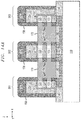
  • FIGS. 1A, 1B, 1C, and 1D are schematic views of a semiconductor device comprising a nanowire FET device with wrap-around source/drain contacts, according to an embodiment of the invention.
  • FIGS. 2 through 20B schematically illustrate a process flow for fabricating the semiconductor device of FIGS. 1A, 1B, 1C and 1D , according to an embodiment of the invention, wherein:
  • FIG. 2 is a schematic cross-sectional side view of the semiconductor device at an initial stage of fabrication in which a stack of epitaxial semiconductor layers is formed on a semiconductor substrate;
  • FIGS. 3A and 3B are schematic views of the semiconductor structure of FIG. 2 after patterning the stack of epitaxial semiconductor layers to form a plurality of nanowire stack structures;
  • FIGS. 4A and 4B are schematic views of the semiconductor structure shown in FIGS. 3A and 3B , respectively, after forming a first isolation layer;
  • FIGS. 5A, 5B, and 5C are schematic views of the semiconductor structure shown in FIGS. 4A and 4B after forming dummy gate stack structures with hard mask capping layers, which overlap portions of the nanowire stack structures;
  • FIGS. 6A, 6B, and 6C are schematic views of the semiconductor structure of FIGS. 5A, 5B, and 5C , respectively, after forming gate sidewall spacers on sidewalls of the dummy gate stack structures;
  • FIGS. 7A and 7B are schematic views of the semiconductor structure shown in FIGS. 6A and 6B , respectively, after recessing exposed portions of the nanowire stack structures between adjacent dummy gate structures;
  • FIG. 8 is a schematic cross-sectional side view of the semiconductor structure shown in FIG. 7A after laterally recessing exposed sidewall surfaces of the sacrificial epitaxial semiconductor layers of the nanowire stack structures to form recesses in the sidewalls of the nanowire stack structures;
  • FIG. 9 is a schematic cross-sectional side view of the semiconductor structure shown in FIG. 8 after filling the recesses with dielectric material to form embedded gate insulating spacers on the sidewalls of the nanowire stack structures;
  • FIG. 10 is a schematic cross-sectional side view of the semiconductor structure shown in FIG. 9 after removing a bottom sacrificial epitaxial semiconductor layer of the nanowire stack structures to form an open region surrounded by the first isolation layer;
  • FIGS. 11A and 11B are schematic views of the semiconductor structure shown in FIG. 10 after filling the open region with insulating material to form a second isolation layer that is coplanar with the first isolation layer;
  • FIGS. 12A, 12B and 12C are schematic views of the semiconductor structure of FIGS. 11A and 11B after forming an etch mask and vertically recessing exposed portions of the first and second isolation layers between adjacent dummy gate structures to form recessed regions;
  • FIGS. 13A and 13B are schematic views of the semiconductor structure shown in FIGS. 12A and 12B , respectively, after forming dummy source/drain contacts in the recessed regions of the first and second isolation layers between adjacent dummy gate structures;
  • FIGS. 14A and 14B are schematic views of the semiconductor structure shown in FIGS. 13A and 13B , respectively, after forming first and second source/drain regions between adjacent dummy gate structures;
  • FIGS. 15A, 15B, and 15C are schematic views of the semiconductor structure shown in FIGS. 14A and 14B after forming a pre-metal dielectric layer to encapsulate the dummy gate structures and the first and second source/drain regions;
  • FIGS. 16A, 16B, and 16C are schematic views of the semiconductor structure shown in FIGS. 15A and 15B after removing the dummy gate structures and removing the remaining sacrificial epitaxial semiconductor layers of the nanowire stack structures to release the epitaxial semiconductor channel layers;
  • FIGS. 17A and 17B are schematic views of the semiconductor structure shown in FIGS. 16A and 16C , respectively, after forming metal gate structures and gate capping layers;
  • FIGS. 18A, 18B, and 18C are schematic views of the semiconductor structure shown in FIGS. 17A and 17B after patterning the pre-metal dielectric layer to expose upper and sidewall surfaces of the source/drain regions between adjacent gate structures and end portions of the underlying dummy source/drain contact layers adjacent to the sidewall surfaces of the first and second source/drain regions;
  • FIGS. 19A, 19B, and 19C are schematic views of the semiconductor structure shown in FIGS. 18A, 18B, and 18C , respectively, after removing the dummy source/drain contacts to form open regions between bottom surfaces of the first and second source/drain regions and the recessed surfaces of the underlying first and second isolation layers;
  • FIGS. 20A and 20B are schematic views of the semiconductor structure shown in FIGS. 19A and 19B , respectively, after forming wrap-around source/drain contacts that surround the upper, sidewall, and bottom surfaces of the first and second source/drain regions.
  • Embodiments of the invention will now be described in further detail with regard to semiconductor devices comprising non-planar FET devices with wrap-around source/drain contacts, and methods for fabricating non-planar FET devices with wrap-around source/drain contacts.
  • semiconductor devices comprising non-planar FET devices with wrap-around source/drain contacts
  • methods for fabricating non-planar FET devices with wrap-around source/drain contacts For purposes of illustration, embodiments of the invention will be described in the context of nanowire FET devices, although the fabrication techniques discussed herein can be readily applied to fabricate other types of non-planar FET devices such as nanosheet FET devices and FinFET devices.
  • FIGS. 1A, 1B, 1C, and 1D are schematic views of a semiconductor device 100 comprising a non-planar FET device with wrap-around source/drain contacts, according to an embodiment of the invention.
  • FIG. 1A is a schematic cross-sectional side view of the semiconductor device 100 along an X-Z plane
  • FIG. 1B is schematic top plan view (X-Y plane) of the semiconductor device 100 shown in FIGS. 1A, 1C, and 1D
  • FIGS. 1C and 1D are schematic cross-sectional side views of the semiconductor device 100 along different Y-Z planes.
  • FIG. 1B it is to be noted that FIG.
  • FIG. 1A is a cross-sectional side view of the semiconductor device 100 along line 1 A- 1 A shown in FIG. 1B
  • FIG. 1C is a cross-sectional side view of the semiconductor device 100 along line 1 C- 1 C shown in FIG. 1B
  • FIG. 1D is a cross-sectional side view of the semiconductor device 100 along line 1 D- 1 D shown in FIG. 1B .
  • the semiconductor device 100 comprises a substrate 110 , a first isolation layer 140 , a second isolation layer 142 , and a nanowire FET device disposed on the first and second isolation layers 140 and 142 .
  • the nanowire FET device comprises a stack of nanowire semiconductor channel layers 123 and 125 , gates G 1 , G 2 , and G 3 formed over the nanowire semiconductor channel layers 123 and 125 , a first source/drain region 170 , and a second source/drain region 172 .
  • the gates G 1 , G 2 , and G 3 comprise gate insulating sidewall spacers 158 and 159 , metal gate structures 180 , and gate capping layers 186 .
  • the metal gate structures 180 comprise high-k gate dielectric layers 182 and gate electrode layers 184 .
  • the nanowire FET device is embedded in a pre-metal dielectric (PMD) layer 175 .
  • PMD pre-metal dielectric
  • the middle gate G 2 comprises a functional gate structure of the nanowire FET device, while the gates G 1 and G 3 are non-functional gate structures that are utilized for purposes of, e.g., facilitating the formation of the first and second source/drain regions 170 and 172 , isolating the first and second source/drain regions 170 and 172 , etc. As shown in FIGS.
  • the nanowire semiconductor channel layers 123 and 125 are disposed in a stacked configuration with the end portions of the nanowire semiconductor channel layers 123 and 125 , which are encapsulated by the metal gate structure 180 of the gate G 2 , extending between, and connected to, the first and second source/drain regions 170 and 172 .
  • the first and second source/drain regions 170 and 172 comprise merged epitaxial semiconductor layers that are epitaxially grown on the end portions of the nanowire semiconductor channel layers 123 and 125 which are exposed on the sidewalls of the gates G 1 , G 2 and G 3 .
  • the first source/drain region 170 is disposed between the gates G 1 and G 2 , and is formed by epitaxially growing semiconductor material on the end portions of the nanowire semiconductor channel layers 123 and 125 exposed on the sidewalls of the gates G 1 and G 2 .
  • the second source/drain region 172 is disposed between the gates G 2 and G 3 , and is formed by epitaxially growing semiconductor material on the end portions of the nanowire semiconductor channel layers 123 and 125 exposed on the sidewalls of the gates G 2 and G 3 .
  • source/drain region as used herein means that a given source/drain region can be either a source region or a drain region, depending on the application or circuit configuration.
  • the metal gate structure 180 of the functioning gate G 2 encapsulates the nanowire semiconductor channel layers 123 and 125 , thereby serving as a common gate structure that is formed above, below, and around each nanowire layer in the stacked configuration.
  • the nanowire semiconductor channel layers 123 and 125 collectively serve as a FET channel layer of the nanowire FET device, thereby increasing the FET device width (or channel width), and thus the drive current of the FET device, for a given footprint area.
  • the metal gate structure 180 of the functioning gate G 2 is electrically isolated from the substrate 110 by the first and second isolation layers 140 and 142 .
  • the nanowire semiconductor channel layers 123 and 125 of the first and third gates (non-functioning) G 1 and G 3 have end portions which terminate inside the metal gate structures 180 of the gates G 1 and G 3 and, thus, are not exposed on the opposing sidewalls of the gates G 1 and G 3 .
  • the nanowire semiconductor channel layers 123 and 125 of the non-functioning G 1 and G 3 are not functional FET channel layers of the nanowire FET device, but merely serve as semiconductor structures for initiating epitaxial growth of the semiconductor material which forms the first and second source/drain regions 170 and 172 .
  • the metal gate structures 180 of the non-functioning gates G 1 and G 2 are electrically isolated from the substrate 110 by the first and second isolation layers 140 and 142 .
  • the semiconductor device 100 comprises a first source/drain contact 190 , a second source/drain contact 192 , and a gate contact 195 .
  • the gate contact 195 is formed through the gate capping layer 186 of the functioning gate G 2 in contact with the metal gate structure 180 of the functioning gate G 2 .
  • the gates G 1 and G 3 are non-functioning gate structures and, therefore, no gate contacts are formed in contact to the metal gate structures 180 of the gates G 1 and G 3 .
  • the first source/drain contact 190 is disposed between the gates G 1 and G 2 in contact with the first source/drain region 170
  • the second source/drain contact 192 is disposed between the gates G 2 and G 3 in contact with the second source/drain region 172 .
  • the first source/drain contact 190 comprises a wrap-around contact that is formed in contact with the upper, sidewall, and bottom surfaces of the first source/drain region 170
  • the second source/drain contact 192 comprises a wrap-around contact that is formed in contact with the upper, sidewall, and bottom surfaces of the second source/drain region 172 .
  • the structural configuration of the wrap-around source/drain contacts 190 and 192 serves to increase the surface area of contact between the source/drain contacts 190 and 192 and the respective source/drain regions 170 and 172 , thereby reducing the parasitic resistance between source/drain regions 170 and 172 and the source/drain contacts 190 and 192 .
  • FIG. 2 is a schematic cross-sectional side view of the semiconductor device 100 at initial stage of fabrication in which a stack of epitaxial semiconductor layers 120 is formed on a semiconductor substrate 110 .
  • the semiconductor substrate 110 is illustrated as a generic substrate layer, it is to be understood that the semiconductor substrate 110 may comprise one of different types of semiconductor substrate structures and materials.
  • the semiconductor substrate 110 can be a bulk semiconductor substrate (e.g., wafer) that is formed of silicon (Si) or germanium (Ge), or other types of semiconductor substrate materials that are commonly used in bulk semiconductor fabrication processes such as a silicon-germanium alloy, compound semiconductor materials (e.g. etc.
  • the semiconductor substrate 110 may be an active semiconductor layer of an SOI (silicon-on-insulator) substrate, GeOI (germanium-on-insulator) substrate, or other type of semiconductor-on-insulator substrate, which comprises an insulating layer (e.g., oxide layer) disposed between a base substrate layer (e.g., silicon substrate) and the active semiconductor layer (e.g., Si, Ge, etc.) in which active circuit components are formed as part of a front-end-of-line (FEM) structure.
  • SOI silicon-on-insulator
  • GeOI germanium-on-insulator
  • FEM front-end-of-line
  • the stack of epitaxial semiconductor layers 120 comprises a first semiconductor layer 121 epitaxially grown on a surface of the semiconductor substrate 110 , a second semiconductor layer 122 epitaxially grown on the first semiconductor layer 121 , a third semiconductor layer 123 epitaxially grown on the second semiconductor layer 122 , a fourth semiconductor layer 124 epitaxially grown on the third semiconductor layer 123 , and a fifth semiconductor layer 125 epitaxially grown on the fourth semiconductor layer 124 .
  • the first, second and fourth semiconductor layers 121 , 122 , and 124 comprise sacrificial semiconductor layers
  • the third and fifth semiconductor layers 123 and 125 serve as semiconductor channel layers of a nanowire FET device to be subsequently formed.
  • the semiconductor layers 121 , 122 , 123 , 124 , and 125 are formed of single crystal (monocrystalline) semiconductor materials, which are epitaxially grown using known methods such as CVD (chemical vapor deposition), MOCVD (metal-organic CVD), LPCVD (Low Pressure CVD), MBE (molecular beam epitaxy), VPE (vapor-phase epitaxy), LPE (liquid-phase epitaxy) or other known epitaxial growth techniques which are suitable for the given process flow.
  • CVD chemical vapor deposition
  • MOCVD metal-organic CVD
  • LPCVD Low Pressure CVD
  • MBE molecular beam epitaxy
  • VPE vapor-phase epitaxy
  • LPE liquid-phase epitaxy
  • the type of materials that are utilized to form the semiconductor layers 121 , 122 , 123 , 124 , and 125 will depend on various factors such as the type of FET device (p-type, or n-type), and the desired level of etch selectivity between the semiconductor layers, as well as provide sufficient lattice matching between the materials of the semiconductor layers to ensure proper (e.g., defect-free) epitaxial growth of the crystalline semiconductor layers 121 , 122 , 123 , 124 and 125 .
  • the semiconductor layers 123 and 125 are formed of epitaxial silicon (Si), which is suitable to serve as semiconductor channel layers of an n-type FET device.
  • the semiconductor layers 123 and 125 (alternatively referred to as “semiconductor channel layers”) are formed of crystalline Si
  • the semiconductor layers 121 , 122 , and 124 which serve as sacrificial layers (alternatively referred to as “sacrificial semiconductor layers”), can be formed of an epitaxial silicon-germanium (SiGe) alloy.
  • the epitaxial SiGe material of the sacrificial semiconductor layers 121 , 122 , and 124 to be etched selective to the epitaxial Si material of the semiconductor channel layers 123 and 125 in a subsequent process step to “release the semiconductor channel layers 123 and 125 .
  • the Ge concentration of the bottom sacrificial semiconductor layer 121 is greater than the Ge concentration of the sacrificial semiconductor layers 122 and 124 so that the bottom sacrificial semiconductor layer 121 can be etch selective to the other semiconductor layers 122 , 123 , 124 and 125 , for reasons as will be discussed in further detail below.
  • the bottom sacrificial semiconductor layer 121 can be an SiGe layer with a Ge concentration of 50%, while the sacrificial semiconductor layers 122 and 124 can be SiGe layers with a Ge concentration of 25%.
  • the semiconductor channel layers 123 and 125 can be formed of an epitaxial SiGe material with a desired Ge concentration (optimized for device performance), and the sacrificial semiconductor layers 121 , 122 and 124 can be formed of a sacrificial semiconductor material (e.g., Si) that can be etched selective to the semiconductor channel layers 124 and 125 , and also allow the bottom sacrificial semiconductor layer 121 to be etched selective to the other sacrificial semiconductor layers 122 and 124 .
  • a sacrificial semiconductor material e.g., Si
  • the stack of epitaxial semiconductor layers 120 is shown to include two semiconductor channel layers 123 and 125 , in other embodiments of the invention, the stack of epitaxial semiconductor layers 120 can be fabricated with one semiconductor channel layer (e.g., layer 123 ), or three or more semiconductor channel layers with additional sacrificial semiconductor layers disposed between the additional semiconductor channel layers. Further, in one embodiment of the invention, the semiconductor channel layers 123 and 125 are formed with a thickness in a range of about 10 nm to about 20 nm, although the semiconductor channel layers 123 and 125 can be formed with other thickness ranges, depending on the application.
  • the sacrificial semiconductor layers 122 and 124 are formed with a thickness that is the same or similar to the thickness of the semiconductor channel layers 123 and 125 .
  • the bottom sacrificial semiconductor layer 121 is formed with a thickness that is greater than a thickness of the other layers 122 , 123 , 124 and 125 , for reasons as will be discussed in further detail below.
  • the bottom sacrificial semiconductor layer 121 is formed with a thickness that is about 100 nm or greater.
  • FIGS. 3A and 3B are schematic views of the semiconductor structure of FIG. 2 after patterning the stack of epitaxial semiconductor layers 120 to form a plurality of nanowire stack structures 130 and 131 .
  • FIG. 3A is a schematic cross-sectional schematic side view (Y-Z plane) of the semiconductor structure shown in FIG. 2 after etching the stack of epitaxial semiconductor layers 120 to form the nanowire stack structures 130 and 131
  • FIG. 3B is a schematic top plan view (X-Y plane) of the semiconductor structure shown in FIG. 3A , wherein line 3 A- 3 A in FIG. 3B denotes a cross-sectional view of the semiconductor structure shown in FIG. 3A .
  • the nanowire stack structures 130 and 131 can be patterned by forming an etch mask (e.g., a photoresist mask or a hard mask) on an upper surface of the stack of epitaxial semiconductor layers 120 , wherein the etch mask comprises an image of the nanowire stack structures 130 and 131 to be transferred into the stack of semiconductor layers 120 using a sequence of one or more dry etch processes (e.g., reactive ion etching (RIE)).
  • RIE reactive ion etching
  • the etch mask can be formed using any suitable patterning process including, but not limited to, a photolithography process, or a multi-patterning process such as a sidewall image transfer (SIT) process, a self-aligned double patterning (SADP) process, a self-aligned quadruple pattering (SAQP), etc.
  • a photolithography process or a multi-patterning process such as a sidewall image transfer (SIT) process, a self-aligned double patterning (SADP) process, a self-aligned quadruple pattering (SAQP), etc.
  • SIT sidewall image transfer
  • SADP self-aligned double patterning
  • SAQP self-aligned quadruple pattering
  • the stack of epitaxial semiconductor layers 120 is etched down to the upper surface of the semiconductor substrate 110 .
  • the etching can be performed using one or more sequential dry etch processes, such as a RIE (reactive ion etch) process, with etch chemistries that are suitable to etch the materials of the semiconductor layers 121 , 122 , 123 , 124 and 125 .
  • the resulting nanowire stack structures 130 and 131 shown in FIGS. 3A and 3B comprise elongated fin structures of width W.
  • the width W of the nanowire stack structures 130 and 131 is about the same or slighter greater than a thickness of the semiconductor channel layers 123 and 125 .
  • the width W of the nanowire stack structures 130 and 131 can be in a range of 10 nm to about 20 nm.
  • the stack of epitaxial semiconductor layers 120 can be etched to form nanosheet stack structures with a width (e.g., 30 nm or more) which is relativity much larger than a thickness (e.g., 10 nm) of the semiconductor channel layers 123 and 125 .
  • the layers 122 , 123 , 124 and 125 are replaced by a single semiconductor layer formed on the bottom sacrificial semiconductor layer 121 .
  • FIGS. 4A and 4B are schematic views of the semiconductor structure shown in FIGS. 3A and 3B , respectively, after forming the first isolation layer 140 on the semiconductor substrate 110 .
  • the first isolation layer 140 can be formed by a process which comprises depositing a layer of insulating material over the surface of the semiconductor structure to cover the nanowire stack structures 130 and 131 , planarizing the surface of the semiconductor structure (via chemical mechanical polishing (CMP)) down to an upper surface of the nanowire stack structures 130 and 131 to remove the overburden insulating material, and then performing an etch process to recess the remaining layer of insulating material down to a target level which defines a thickness of the first isolation layer 140 on the surface of the substrate 110 .
  • CMP chemical mechanical polishing
  • the first isolation layer 140 is formed with a thickness that is substantially equal to the thickness of the bottom sacrificial semiconductor layer 121 , as schematically shown in FIG. 4A .
  • the first isolation layer 140 can be formed of any type of insulating material, such an oxide material, which is suitable for the given fabrication process flow.
  • the insulating material e.g., silicon oxide
  • the insulating material can be deposited and patterned using known techniques.
  • FIGS. 5A, 5B, and 5C are schematic views of the semiconductor structure shown in FIGS. 4A and 4B after forming dummy gate stack structures 150 with hard mask capping layers 156 , which overlap portions of the nanowire stack structures 130 and 131 .
  • FIG. 5B is schematic top plan view (X-Y plane) of the semiconductor structure
  • FIG. 5A is a cross-sectional side view of the semiconductor structure along line 5 A- 5 A shown in FIG. 5B
  • FIG. 5C is a cross-sectional side view of the semiconductor structure along line 5 C- 5 C shown in FIG. 5B .
  • each dummy gate stack structure 150 comprises a sacrificial oxide layer 152 and a sacrificial polysilicon (or amorphous silicon) gate layer 154 .
  • the dummy gate stack structures 150 are formed using known techniques. For example, a thin conformal layer of silicon oxide is deposited over the entire surface of the semiconductor structure shown in FIGS. 4A and 4B , and a layer of polysilicon (or alternatively, amorphous silicon) is blanket deposited over the conformal layer of silicon oxide, and then planarized using known techniques.
  • a hard mask layer is formed on the planarized surface of the polysilicon layer by depositing a layer of dielectric material (e.g., SiOCN, SiOC, SiBCN).
  • the hard mask layer is then pattered to form the gate capping layers 156 , which collectively define an image of the dummy gate stack structures 150 .
  • the gate capping layers 156 are utilized as an etch hardmask to anisotropically etch (e.g., RIE) the sacrificial polysilicon and oxide layers down to the semiconductor channel layer 125 and the first isolation layer 140 , and thereby form the dummy gate stack structures 150 .
  • FIGS. 6A, 6B, and 6C are schematic views of the semiconductor structure of FIGS. 5A, 5B, and 5C , respectively, after forming gate sidewall spacers 158 on sidewalls of the dummy gate stack structures 150 .
  • the gate sidewall spacers 158 are formed by depositing a conformal layer of dielectric material over the entire surface of the semiconductor structure.
  • the conformal layer of dielectric material can be formed of SiN, SiBCN, SiCO, SiCON, or any other type of dielectric material that is commonly used to form insulating gate sidewall spacers of FET devices, and deposited using known techniques such as atomic layer deposition (ALD), CND and PVD.
  • the conformal layer of dielectric material is then pattered by performing an anisotropic dry etch process, such as RIE, to etch down the conformal layer of dielectric material in a vertical direction.
  • This etch process is performed selective to the semiconductor materials of the nanowire stack structures 130 and 131 and the first isolation layer 140 .
  • the etch process results in the formation of the gate insulating spacers 158 on the vertical sidewall surfaces of the dummy gate stack structures 150 and capping layers 156 , thereby forming dummy gate structures DG 1 , DG 2 and DG 3 .
  • a replacement metal gate (RMG) process is performed at a later stage of the fabrication process to convert the dummy gate structures DG 1 , DG 2 , and DG 2 to the metal gate structures G 1 , G 2 , and G 3 , respectively, shown in FIGS. 1A-1D .
  • the portions of the conformal layer of dielectric material on the lateral surfaces of the semiconductor structure (e.g., on the upper surface of the capping layers 156 , the exposed upper surfaces of the semiconductor channel layer 125 , and the first isolation layer 140 ) will be fully etched away, but the anisotropic dry etch process continues to recess the gate capping layers 156 and pull down the vertical portions of the conformal layer of dielectric material on the sidewalls of the gate capping layers 156 and on the sidewalls of the nanowire stack structures 130 and 131 .
  • the anisotropic dry etch process is terminated when all of the dielectric material is removed from vertical sidewall surfaces of the exposed portions of the nanowire stack structures 130 and 131 , as shown in FIG. 6A .
  • the gate capping layers 156 etch hardmask
  • the gate capping layers 156 are initially formed with a thickness that is greater than a vertical height of the patterned nanowire stack structures 130 and 131 to ensure that when the dielectric material on the vertical sidewall surfaces of the nanowires stack structures 130 and 131 is fully recessed/pulled down to the exposed surface of the first isolation layer 140 , a portion of the gate capping layers 156 (with reduced thickness) remains on top of the dummy gate stack structures 150 , with the insulating sidewall spacer 158 fully covering the vertical sidewall surfaces of the dummy gate stack structures 150 , as shown in FIG. 6C , for example.
  • FIGS. 7A and 7B are schematic views of the semiconductor structure shown in FIGS. 6A and 6B , respectively, after recessing exposed portions of the nanowire stack structures 130 and 131 between adjacent dummy gate structures DG 1 , DG 2 and DG 3 .
  • a directional RIE process is performed to recess exposed portions of the nanowire stack structures 130 and 131 down to the first sacrificial semiconductor layer 121 to form recessed regions R 1 and R 2 in which source/drain regions are formed in a subsequent phase of the fabrication process.
  • the semiconductor materials (e.g., Si, and SiGe 25%) of the semiconductor layers 122 , 123 , 124 and 125 are etched selective to the semiconductor material (e.g., SiGe 50%) of the bottom sacrificial semiconductor layer 121 .
  • FIG. 8 is a schematic cross-sectional side view of the semiconductor structure shown in FIG. 7A after laterally recessing exposed sidewall surfaces of sacrificial semiconductor layers 122 and 124 of the nanowire stack structures 130 and 131 to form recesses 159 A in the sidewalls of the nanowire stack structures 130 and 131 .
  • the exposed sidewall surfaces of the sacrificial semiconductor layers 122 and 124 are laterally recessed to a depth, D (in the X-direction).
  • the amount of lateral recess (depth D) is controlled through a timed etch.
  • the depth D is substantially equal to the thickness of the gate insulating spacers 158 of the dummy gate structures DG 1 , DG 2 , DG 3 .
  • the lateral etch process can be performed using an isotropic wet etch process with an etch solution that is suitable to etch the semiconductor material (e.g., SiGe 25%) of the sacrificial semiconductor layers 122 and 124 selective to the semiconductor material (e.g., Si) of the semiconductor channel layers 123 and 125 and the semiconductor material (e.g., SiGe 50%) of the bottom sacrificial semiconductor layer 121 .
  • an isotropic dry plasma etch process can be performed to laterally etch the exposed sidewall surfaces of the sacrificial semiconductor layers 122 and 124 selective to the materials of the other semiconductor layers 121 , 123 , and 125 of the nanowires stack structures 130 and 131 .
  • FIG. 9 is a schematic cross-sectional side view of the semiconductor structure shown in FIG. 8 after filling the recesses 159 A with dielectric material to form embedded gate insulating spacers 159 on the sidewalls of the patterned nanowire stack structures 130 and 131 .
  • the embedded gate insulating spacers 159 are formed by depositing a conformal layer of dielectric material over the semiconductor structure until the recesses 159 A are filled with dielectric material, followed by an etch back to remove excess dielectric material on the upper surface of the bottom sacrificial semiconductor layer 121 and the horizontal and vertical surfaces of the dummy gate structures DG 1 , DG 2 , and DG 3 , to thereby expose the vertical sidewalls of the semiconductor channel layers 123 and 125 , resulting in the semiconductor structure shown in FIG. 9 .
  • the embedded gate insulating spacers 159 are formed of the same dielectric material used to form the gate insulating spacers 158 .
  • the embedded gate insulating spacers 159 can be formed of SiN, SiBCN, SiCO, SiBCN, SiCON, or any other type of dielectric material (e.g., a low-k dielectric material having a k of less than 5) which is commonly used to form insulating gate sidewall spacers of FET devices.
  • the dielectric material is conformally deposited using a highly conformal deposition process, such as ALD, to ensure that the recesses 159 A are sufficiently filled with dielectric material.
  • CVD chemical vapor deposition
  • PVD physical vapor deposition
  • Other deposition methods such as CVD and PVD can be utilized to deposit a highly conformal layer of dielectric material to fill the recesses 159 A.
  • the conformal layer of dielectric material can be etched back using an isotropic wet etch process to remove the excess dielectric material on the sidewalls of the patterned nanowire stack structures 130 and 131 and expose the sidewalls of the semiconductor channel layers 123 and 125 , while leaving the dielectric material in the recesses 159 A to form the embedded gate insulating spacers 159 .
  • the wet etch process may include, but is not limited to, buffered hydrofluoric acid (BHF), diluted hydrofluoric acid (DHF), hydrofluoric nitric acid (HNA), phosphoric acid, HF diluted by ethylene glycol (HFEG), hydrochloric acid (HCl), or any combination thereof.
  • BHF buffered hydrofluoric acid
  • DHF diluted hydrofluoric acid
  • HNA hydrofluoric nitric acid
  • phosphoric acid HF diluted by ethylene glycol (HFEG), hydrochloric acid (HCl), or any combination thereof.
  • FIG. 10 is a schematic cross-sectional side view of the semiconductor structure shown in FIG. 9 after removing the bottom sacrificial semiconductor layer 121 to form an open region 121 A surrounded by the first isolation layer 140 .
  • the etch process can be performed using an isotropic etch process (wet etch or dry etch) having an etch chemistry which is configured to etch away the material of the bottom sacrificial semiconductor layer 121 selective to the materials of the surrounding structures 110 , 122 , 123 , 125 , and 140 , 156 , 158 , and 159 .
  • the open region 121 A is filled with an insulating material to form the second isolation layer 142 .
  • FIGS. 11A and 11B are schematic views of the semiconductor structure shown in FIG. 10 after filling the open region 121 A with insulating material to form the second isolation layer 142 which is coplanar with the first isolation layer 140 .
  • FIG. 11B is schematic top plan view (X-Y plane) of the semiconductor structure shown in FIG. 11A
  • FIG. 11A is a cross-sectional side view of the semiconductor structure along line 11 A- 11 A shown in FIG. 11B .
  • the second isolation layer 142 is formed of the same or similar insulating material (e.g., oxide) as the first isolation layer 140 .
  • the second isolation layer 142 can be formed by blanket depositing a layer of insulating material to cover the dummy gate structures DG 1 , DG 2 , and DG 3 , planarizing the layer of insulating material down to the gate capping layers 156 , and then performing a timed recess etch process to recess the insulating layer down to the upper surface of the first isolation layer 140 .
  • the insulating material between the between the dummy gate structures DG 1 , DG 2 , and DG 3 is recessed down to a level that is substantially coplanar with the upper surface of the first isolation layer 140 , thereby forming the second isolation layer 142 .
  • the second isolation layer 142 is formed to essentially replace the bottom sacrificial semiconductor layer 121 .
  • FIGS. 12A, 12B, and 12C are schematic views of the semiconductor structure of FIGS. 11A and 11B after forming an etch mask M and vertically recessing exposed portions of the first and second isolation layers 140 and 142 between adjacent dummy gate structures DG 1 , DG 2 , and DG 3 .
  • FIG. 12B is a schematic top plan view of the semiconductor structure shown in FIG. 12A , which shows the etch mask M having an opening that exposes portions of the first and second isolation layers 140 and 142 between the dummy gate structures DG 1 , DG 2 , and DG 3 .
  • FIG. 12A is a cross-sectional side view of the semiconductor structure along line 12 A- 12 A shown in FIG. 12B , and FIG.
  • FIGS. 12A and 12C illustrate that the exposed portions of the isolation layers 140 and 142 are recessed by a depth D 1 .
  • the recess depth D 1 is about one-half (1 ⁇ 2) of the thickness of the first and second isolation layers 140 and 142 .
  • the recess depth is about 50 nm.
  • the thickness of the bottom sacrificial semiconductor layer 121 which is replaced by the second isolation layer 142 , is formed with a sufficient thickness e.g., 100 nm) so that the isolation layers 140 and 142 can be recessed to a target depth, while a sufficient thickness of insulating material remains between the substrate and the recessed regions of the isolation layers 140 and 142 shown in FIGS. 12A and 12C .
  • FIGS. 13A and 13B are schematic views of the semiconductor structure shown in FIGS. 12A and 12B , respectively, after forming dummy source/drain contacts 160 in the recessed regions of the first and second isolation layers 140 and 142 between the adjacent dummy gate structures DG 1 , DG 2 , and DG 3 .
  • the dummy source/drain contacts 160 can be formed of any suitable insulating material which can be etched selective to the insulating materials of the first and second isolation layers 140 and 142 .
  • the dummy source/drain contacts 160 can be formed of a low-density oxide material, amorphous carbon, etc.
  • the dummy source/drain contacts 160 are formed by blanket depositing a layer of insulating material to cover the dummy gate structures DG 1 , DG 2 , and DG 3 , planarizing the layer of insulating material down to the dummy gate capping layers 156 , and then performing a timed etch process to recess the insulating layer down to a level that level that is substantially coplanar with the upper (non-recessed) surface of the first and second isolation layers 140 and 142 , thereby forming the dummy source/drain contacts 160 in the recessed regions between the dummy gate structures DG 1 , DG 2 , and DG 3
  • FIGS. 14A and 14B are schematic views of the semiconductor structure shown in FIGS. 13A and 13B , respectively, after forming the first and second source/drain regions 170 and 172 between the dummy gate structures DG 1 , DG 2 , and DG 3 .
  • the first and second source/drain regions 170 and 172 are formed by epitaxially growing semiconductor material (e.g., epitaxial Si material) on the exposed sidewall surfaces of the semiconductor channel layers 123 and 125 using known techniques such as CVD, MOCVD, LPCVD, MBE, VPE, or other known epitaxial growth techniques which are suitable for the given process flow.
  • the type of epitaxial semiconductor material that is used to form the first and second source/drain regions 170 and 172 will vary depending on various factors including, but not limited to, the type of material of the semiconductor channel layers 123 and 125 , the device type (e.g., n-type or p-type) of the nanowire FET device, etc.
  • the first and second source/drain regions 170 and 172 cover a substantial area of the underlying dummy source/drain contacts 160 . While FIG.
  • first and second source/drain regions 170 and 172 are at a same height as the semiconductor channel layer 125 , in other embodiments, the first and second source/drain regions 170 and 172 can be grown thicker such that the upper surfaces of the source/drain regions 170 and 172 are vertically higher than the upper surfaces of the semiconductor channel layers 125 , thereby forming “raised” source/drain regions.
  • the first and second source/drain regions 170 and 172 are doped using known techniques.
  • the first and second source/drain regions 170 and 172 are “in-situ” doped during epitaxial growth by adding a dopant gas to the source deposition gas (i.e., the Si-containing gas).
  • a dopant gas may include a boron-containing gas such as BH 3 for pFETs or a phosphorus or arsenic containing gas such as PH or AsH 3 for nFETs, wherein the concentration of impurity in the gas phase determines its concentration in the epitaxially grown semiconductor material.
  • a thermal anneal process is performed following the epitaxial growth and in-situ doping of the first and second source/drain regions to cause dopants to be injected into portions of the semiconductor channel layers 123 and 125 in contact with the epitaxial semiconductor material of the first and second source/drain regions 170 and 172 .
  • This process effectively results in extending the first and second source/drain regions 170 and 172 into the end portions of the semiconductor channel layers 123 and 125 , as schematically illustrated in FIG. 14A .
  • FIG. 14A For illustrative purposes, FIG.
  • FIG. 14A schematically illustrates that end portions of the semiconductor channel layers 123 and 125 are injected with source/drain dopants, thereby laterally extending the source/drain regions 170 and 172 into the ends of the semiconductor channel layers 123 and 125 at a length which substantially equal to a thickness of the sidewall spacers 158 and 159 .
  • FIGS. 15A, 15B and 15C are schematic views of the semiconductor structure shown in FIGS. 14A and 14B after forming the PMD layer 175 to encapsulate the dummy gate structures DG 1 , DG 2 , and DG 3 , and the first and second source/drain regions 170 and 172 in dielectric/insulating material.
  • FIG. 15B is schematic top plan view (X-Y plane) of the semiconductor structure
  • FIG. 15A is a cross-sectional side view of the semiconductor structure along line 15 A- 15 A shown in FIG. 15B
  • FIG. 15C is a cross-sectional side view of the semiconductor structure along line 15 C- 15 C shown in FIG. 15B .
  • the PMD layer 175 is formed by depositing a layer of dielectric/insulating material over the semiconductor structure of FIGS. 14A and 14B , and planarizing the layer of dielectric/insulating material down to the gate capping layers 156 to form the PMD layer 175 .
  • the PMD layer 150 may comprise any suitable insulating/dielectric material that is commonly utilized in FEOL process technologies including, but not limited to, silicon oxide. SiCOH, SiCH, SiCNH, or other types of silicon-based low-k dielectrics (e.g., k less than about 4.0), porous dielectrics, or known ULK (ultra-low-k) dielectric materials (with k less than about 2.5).
  • the dielectric/insulating material of the PMD layer 175 is deposited using known deposition techniques, such as, for example, ALD, CVD, PECVD, PVD, or spin-on deposition.
  • the layer of dielectric/insulating material is planarized using a standard planarization process such as CMP to remove the overburden dielectric/insulating down to the upper surface of the dummy gate capping layers 156 , and thereby form the PMD layer 175 .
  • FIGS. 16A, 16B, and 16C are schematic views of the semiconductor structure shown in FIGS. 15A and 15B after removing the dummy gate capping layers 156 , the dummy gate stack structures 150 (sacrificial layers 152 and 154 ), and removing remaining portions of the sacrificial semiconductor layers 122 and 124 to release the epitaxial semiconductor channel layers 123 and 125 .
  • FIG. 16B is schematic top plan view (X-Y plane) of the semiconductor structure
  • FIG. 16A is a cross-sectional side view of the semiconductor structure along line 16 A- 16 A shown in FIG. 16B
  • FIG. 16C is a cross-sectional side view of the semiconductor structure along line 16 C- 16 C shown in FIG. 16B .
  • the dummy gate capping layers 156 , the dummy gate polysilicon layer 154 , and the dummy gate oxide layers 152 are etched away using known etching techniques and etch chemistries.
  • the dummy poly gate layers 154 can be removed using a selective dry etch or wet etch process with suitable etch chemistries, including ammonium hydroxide (NH 4 OH) or tetramethylammonium hydroxide (TMAH).
  • NH 4 OH ammonium hydroxide
  • TMAH tetramethylammonium hydroxide
  • the etching of the dummy poly gate layers 154 is selective to, e.g., dummy gate oxide layer 152 , to thereby protect the semiconductor channel layers 123 and 125 from being etched during the poly etch process.
  • an oxide etch process is performed to etch away the dummy gate oxide layers 152 selective to, e.g., the semiconductor channel layers 123 and 125 .
  • the sacrificial materials e.g., dummy polysilicon and oxide layers
  • the dummy gate stack structures 150 can be etched away without damaging the semiconductor channel layers 123 and 125 .
  • the removal of the dummy gate capping layers 156 and the dummy gate stack structures 150 results in gate recess regions 150 A being formed between the gate sidewall spacers 158 .
  • the gate recess regions 150 A expose the remaining portions of the sacrificial semiconductor layers 122 and 124 .
  • An etch process is then performed to selectively etch away the sacrificial semiconductor layers 122 and 124 to release the semiconductor channel layers 123 and 125 , thereby allowing the gate recess regions 150 A to extend into spaces between and adjacent to the semiconductor channel layers 123 and 125 .
  • the sacrificial semiconductor layers 122 and 124 can be etched away selective to the semiconductor channel layers 123 and 125 (Si layers) using a wet etch process, for example.
  • the SiGe material of the sacrificial semiconductor layers 122 and 124 can be selectively etched (with high etch selectivity) using a gas phase HCl (hydrochloric acid) or wet etch solution to laterally etch the SiGe material of the sacrificial semiconductor layers 122 and 124 selective to the Si material of the semiconductor channel layers 123 and 125 .
  • the gas phase HCl (hydrochloric acid) provides high etch selectivity when, for example, the semiconductor channel layers 123 and 125 are formed of Si or SiGe with a lower Ge concentration than the SiGe material of the sacrificial semiconductor layers 122 and 124 .
  • FIGS. 17A and 17B are schematic views of the semiconductor structure shown in FIGS. 16A, 16B, and 16C after forming the metal gate structures 180 and the gate capping layers 186 , wherein the metal gate structures 180 include high-k gate dielectric layers 182 and metallic gate electrode layers 184 .
  • the high-k gate dielectric layers 182 are formed by depositing one or more conformal layers of gate dielectric material over the exposed surfaces of the semiconductor structure shown in FIGS. 16A, 16B, and 16C .
  • the gate dielectric material may comprise, e.g., nitride, oxynitride, or oxide or a high-k dielectric material having a dielectric constant of about 3.9 or greater.
  • the conformal gate dielectric material can include silicon oxide, silicon nitride, silicon oxynitride, boron nitride, high-k materials, or any combination of these materials.
  • high-k materials include but are not limited to metal oxides such as hafnium oxide, hafnium silicon oxide, hafnium silicon oxynitride, lanthanum oxide, lanthanum aluminum oxide, zirconium oxide, zirconium silicon oxide, zirconium silicon oxynitride, tantalum oxide, titanium oxide, barium strontium titanium oxide, barium titanium oxide, strontium titanium oxide, yttrium oxide, aluminum oxide, lead scandium tantalum oxide, and lead zinc niobate.
  • the high-k dielectric material may further include dopants such as lanthanum, aluminum.
  • the conformal layer of gate dielectric material is formed with a thickness in a range of about 0.5 nm to about 2.5 nm, which will vary depending on the target application.
  • the conformal layer of gate dielectric material is deposited using known methods such as ALD, for example, which allows for high conformality of the gate dielectric material
  • An optional conformal layer of work function metal may be formed on top of the gate dielectric layers 182 , wherein the WFM layer comprises one or more types of metallic materials, including, but not limited to, TiN, TaN, TiAlC, Zr, W, Hf, Ti, Al, Ru, Pa, TiAl, ZrAl, WAl, TaAl, HfAl, TiAlC, TaC, TiC, TaMgC, or other work function metals or alloys that are commonly used to obtain target work functions which are suitable for the type (e.g., n-type or p-type) of nanowire FET devices that are to be formed.
  • the conformal layer of work function metal is deposited using known methods such as ALD, CVD, etc.
  • the conformal WFM layer is formed with a thickness in a range of about 2 nm to about 5 nm.
  • the gate electrode layers 184 are formed by depositing a layer of conductive material to fill the gate recess regions 150 A with the conductive material.
  • the gate electrode layers 184 can be formed with a conductive material including, but not limited to, doped polycrystalline or amorphous silicon, germanium, silicon germanium, a metal (e.g., tungsten, titanium, tantalum, ruthenium, zirconium, cobalt, copper, aluminum, lead, platinum, tin, silver, gold), a conducting metallic compound material (e.g., tantalum nitride, titanium nitride, tantalum carbide, titanium carbide, titanium aluminum carbide, tungsten silicide, tungsten nitride, ruthenium oxide, cobalt silicide, nickel silicide), carbon nanotube, conductive carbon, graphene, or any suitable combination of these materials.
  • the gate electrode layers 184 may further comprise dopants that are incorporated during or after deposition.
  • the layer of conductive material which forms the gate electrode layers 184 is deposited using a suitable deposition process, for example, CVD, PECVD, PVD, plating, thermal or e-beam evaporation, sputtering, etc. As shown in FIGS. 17A and 17B , the deposition process is performed to ensure that the gate electrode layers 184 fill the gate recess regions 150 A including the spaces between the semiconductor channel layers 123 and 125 thereby encapsulating the semiconductor channel layers 123 and 125 within the gate electrode layer 184 .
  • the conductive material that forms the gate electrode layer 184 can serve as a WFM layer.
  • a CMP process is performed to polish the surface of the semiconductor structure down to the PMD layer 175 , thereby removing overburden materials of the dielectric, WFM and metallic layers which form the metal gate structures 180 .
  • An etch process is then performed to recess an upper portion of the metal gate structures 180 down to a target level below the upper surface of the PMD layer 175 .
  • a layer of dielectric material is then deposited over the surface of the semiconductor structure to fill the recesses above the metal gate structures 180 with dielectric material, and the semiconductor structure is planarized down to the surface of the PMD layer 175 to remove the overburden dielectric material, and thereby form the gate capping layers 186 .
  • the gate capping layers 186 can be formed of a dielectric material such as SiN, SiOCN, SiBCN, etc.
  • a next phase of the fabrication process comprises forming source/drain contacts which wrap-around the sides and bottom surfaces of the first and second source/drain regions 170 and 172 , using a process flow as schematically illustrated in FIGS. 18A through 20B .
  • FIGS. 18A, 18B, and 18C are schematic side views of the semiconductor structure shown in FIGS. 17A and 17B after patterning the PMD layer 175 to expose upper and sidewall surfaces of the first and second source/drain regions 170 and 172 between the adjacent gate structures G 1 , G 2 and G 3 .
  • FIG. 18B is schematic top plan view of the semiconductor structures shown in FIGS. 18 A and 18 C, wherein FIG.
  • FIG. 18A is a cross-sectional side view of the semiconductor structure along line 18 A- 18 A shown in FIG. 18B
  • FIG. 18C is a cross-sectional side view of the semiconductor structure along line 18 C- 18 C shown in FIG. 18B
  • the PMD layer 175 is patterned to form an opening which exposes end portions of the underlying dummy source/drain contact layers 160 adjacent to the vertical sidewalk of the first and second source/drain regions 170 and 172 .
  • FIGS. 19A, 19B, and 19C are schematic views of the semiconductor structure shown in FIGS. 18A, 18B, and 18C respectively, after removing the dummy source/drain contacts 160 to form open regions 160 A between the bottom surfaces of the first and second source/drain regions 170 and 172 and the recessed surfaces of the underlying first and second isolation layers 140 and 142 .
  • the material of the dummy source/drain contacts 160 can be etched selective to the materials of the surrounding structures/layers 140 , 142 , 170 and 175 using a wet etch process with an etch chemistry that is highly selective to the material of the dummy source/drain contacts 160 .
  • FIGS. 20A and 20B are schematic views of the semiconductor structure shown in FIGS. 19A and 19B , respectively, after forming the wrap-around first and second source/drain contacts 190 and 192 which surround the upper, sidewall, and bottom surfaces of the first and second source/drain regions 170 and 172 , respectively, between the gate structures G 1 , G 2 , and G 3 .
  • the first and second source/drain contacts 190 and 192 can be formed by depositing a layer of metallic material, such as tungsten, cobalt, aluminum, or other conductive materials that are suitable for use in forming vertical device contacts in a middle-of-line (MOL) layer of the semiconductor device, to fill the spaces between the adjacent gate structures G 1 , G 2 , and G 3 , including filling the open regions 160 A below the bottom surfaces of first and second source/drain regions 170 and 172 .
  • a CMP process is then performed to planarize the surface of the semiconductor structure down to the upper surfaces of the PMD layer 175 and the gate capping layers 186 to remove the overburden metallic material, thereby resulting in the semiconductor structure shown in FIGS. 20A and 20B .
  • MOL processing can continue by patterning the gate capping layer 186 of the functioning gate structure G 2 to form one or more openings that are filled with metallic material to form the vertical gate contact 195 shown in FIGS. 1A, 1B, and 1C .
  • a back-end-of-line (BEOL) interconnect structure is formed to provide connections to/between the vertical MOL contacts, and other active or passive devices that are formed as part of the FEOL, layer.
  • nanowire FET devices can be readily incorporated within semiconductor processing flows for fabricating other types of non-planar FET devices such as nanosheet FET devices and FinFET devices.
  • process flow discussed above for fabricating nanowire FET devices would be the same or similar to the process flow for fabricating nanosheet FET devices wherein the stack structures 130 and 131 shown in FIGS. 3A and 3B , for example, would be patterned to have significantly wider profiles.
  • the other processing steps shown throughout the figures would be similarly implemented to form nanosheet FET devices with wrap-around source/drain contacts.
  • the stack of layers 120 shown in FIG. 2 would include the bottom sacrificial semiconductor layer 121 (epitaxial SiGe layer) with the other layers 122 , 123 , 124 and 125 replaced by a single semiconductor layer (e.g., epitaxial Si layer).
  • the stack structures 130 and 131 shown in FIG. 3B (which are formed by patterning the stack of layers 120 of FIG.
  • the process flow discussed above would be modified such that, e.g., epitaxial source/drain regions would be formed on the portions of the Si vertical semiconductor fins which extend between adjacent dummy gate structures DG 1 /DG 2 , and DG 2 /DG 3 (instead of removing the layer stack 122 , 123 , 124 and 125 as shown in FIGS. 7A and 7B ).
  • similar processing steps would be implemented to form recessed regions in the isolation layer(s) below the portions of the vertical Si semiconductor fins that serve as the source/drain regions, to allow the formation of wrap-around source/drain contacts.
  • non-planar FET devices with wrap-around source/drain contacts can be readily incorporated within semiconductor processing flows, semiconductor devices, and integrated circuits with various analog and digital circuitry or mixed-signal circuitry.
  • integrated circuit dies can be fabricated with various devices such as field-effect transistors, bipolar transistors, metal-oxide-semiconductor transistors, diodes, capacitors, inductors, etc.
  • An integrated circuit in accordance with the present invention can be employed in applications, hardware, and/or electronic systems.
  • Suitable hardware and systems for implementing the invention may include, but are not limited to, personal computers, communication networks, electronic commerce systems, portable communications devices (e.g., cell phones), solid-state media storage devices, functional circuitry, etc. Systems and hardware incorporating such integrated circuits are considered part of the embodiments described herein. Given the teachings of the invention provided herein, one of ordinary skill in the art will be able to contemplate other implementations and applications of the techniques of the invention.

Landscapes

  • Engineering & Computer Science (AREA)
  • Chemical & Material Sciences (AREA)
  • Nanotechnology (AREA)
  • Crystallography & Structural Chemistry (AREA)
  • Physics & Mathematics (AREA)
  • Mathematical Physics (AREA)
  • Theoretical Computer Science (AREA)
  • Insulated Gate Type Field-Effect Transistor (AREA)
  • Thin Film Transistor (AREA)

Abstract

Non-planar field effect transistor (FET) devices having wrap-around source/drain contacts are provided, as well as methods for fabricating non-planar FET devices with wrap-around source/drain contacts. A method includes forming a non-planar FET device on a substrate, which includes a semiconductor channel layer, and a gate structure in contact with upper and sidewall surfaces of the semiconductor channel layer. First and second source/drain regions are formed on opposite sides of the gate structure in contact with the semiconductor channel layer. First and second recesses are formed in an isolation layer below bottom surfaces of the first and second source/drain regions, respectively. A layer of metallic material is deposited to fill the first and second recesses in the isolation layer with metallic material and form first and second source/drain contacts which surround the first and second source/drain regions.

Description

TECHNICAL FIELD
This disclosure relates generally to semiconductor fabrication techniques and, in particular, to structures and methods for fabricating non-planar field-effect transistor (FET) devices.
BACKGROUND
Continued innovations in semiconductor process technologies are enabling higher integration densities and device scaling. As the semiconductor industry moves towards the 7-nm technology node and beyond, semiconductor FET device structures must be scaled to smaller dimensions to provide increased device width per footprint area. In this regard, non-planar FET devices such as nanosheet FET devices, nanowire FET devices, vertical FET devices, FinFET devices, etc., are considered to be a viable option for continued CMOS scaling. In general, a nanowire FET device comprises a device channel which comprises one or more nanowire layers in a stacked configuration, wherein each nanowire comprises an elongated semiconductor layer that has a width which is substantially the same or slightly larger than a thickness of the elongated semiconductor layer. A nanosheet FET device is similar to a nanowire FET device sheet in that a device channel comprises one or more nanosheet layers in a stacked configuration, but wherein each nanosheet layer has a width which is substantially greater than a thickness of the nanosheet layer. In nanowire/nanosheet FET devices, a common gate structure is formed above and below each nanowire/nanosheet layer in the stacked configuration, thereby increasing the FET device width (or channel width), and thus the drive current, for a given footprint area. One challenge in fabricating nanowire/nanosheet FET devices is the ability to effectively reduce various parasitic elements in highly-scaled. FET device structures. Such parasitic elements include, but are not limited to, parasitic capacitances between gate structures and surrounding features (e.g., substrate) and parasitic resistances between source/drain regions and source/drain contacts, etc. The parasitic elements cause leakage current, power dissipation, and otherwise contribute to degraded device performance.
SUMMARY
Embodiments of the invention include semiconductor devices comprising non-planar FET devices with wrap-around source/drain contacts, and methods for fabricating non-planar FET devices with wrap-around source/drain contacts, which serve to reduce parasitic resistances between source/drain regions and the wrap-around source/drain contacts.
In one embodiment, a method is provided for fabricating a semiconductor device. The method comprises: forming a non-planar FET device on a semiconductor substrate, wherein the non-planar FET device comprises a semiconductor channel layer, and a gate structure in contact with at least an upper surface and sidewall surfaces of the semiconductor channel layer; forming a first source/drain region which is disposed adjacent to a first side of the gate structure and in contact with the semiconductor channel layer; forming a second source/drain region which is disposed adjacent to a second side of the gate structure, opposite the first side of the gate structure, and in contact with the semiconductor channel layer; forming a first recess in an isolation layer below a bottom surface of the first source/drain region; forming a second recess in the isolation layer below a bottom surface of the second source/drain region; and depositing a layer of metallic material to fill the first and second recesses in the isolation layer with metallic material and form first and second source/drain contacts which surround the first and second source/drain regions, respectively. The first source/drain contact is formed in contact with an upper surface, sidewalls surfaces, and the bottom surface of the first source/drain region, and the second source/drain contact is formed in contact with an upper surface, sidewall surfaces, and the bottom surface of the second source/drain region.
In another embodiment, a method for fabricating a semiconductor device comprises: forming a nanowire stack structure on a semiconductor substrate, wherein the nanowire stack structure comprises a first sacrificial semiconductor layer disposed on the semiconductor substrate, a second sacrificial semiconductor layer disposed on the first sacrificial semiconductor layer, and a semiconductor channel layer disposed on the second sacrificial semiconductor layer; forming a first isolation layer on the semiconductor substrate, wherein the first isolation layer comprises a thickness which is substantially equal to a thickness of the first sacrificial semiconductor layer of the nanowire stack structure; forming a dummy gate structure over a portion of the nanowire stack structure; etching exposed portions of the nanowire stack structure, which are not covered by the dummy gate structure, down to an upper surface of the first sacrificial semiconductor layer of the nanowire stack structure; laterally recessing exposed sidewall surfaces of the second sacrificial semiconductor layer to form recesses in sidewalls of the nanowire stack structure, wherein the lateral recessing is performed by etching the second sacrificial semiconductor layer selective to the first sacrificial semiconductor layer and the semiconductor channel layer; filling the recesses with dielectric material to form embedded gate sidewall spacers; etching away the first sacrificial semiconductor layer of the nanowire stack structure to form an opening that is surrounded by the first isolation layer; filling the opening with an insulating material to form a second isolation layer; forming a first recess region in the first and second isolation layers on a first side of the gate structure, and forming a second recess region in the first and second isolation layers on the second side of the gate structure; filling the first and second recess regions with a sacrificial material which has etch selectivity with respect to the first and second isolation layers, to form first and second dummy source/drain contact layers; forming a first source/drain region and a second source/drain region over the first dummy source/drain contact layer and the second dummy source/drain contact layer, respectively; replacing the dummy gate structure with a metal gate structure; etching away the first and second dummy source/drain contact layers selective to the first and second isolation layers to form first and second recesses below the first and second source/drain regions; and depositing a layer of metallic material to fill the first and second recesses with metallic material and form first and second source/drain contacts which surround the first and second source/drain regions, respectively.
In another embodiment, a semiconductor device comprises: a non-planar FET device formed on a semiconductor substrate, wherein the non-planar FET device comprises a semiconductor channel layer, and a gate structure in contact with at least an upper surface and sidewall surfaces of the semiconductor channel layer; a first source/drain region disposed adjacent to a first side of the gate structure and in contact with the semiconductor channel layer; a second source/drain region disposed adjacent to a second side of the gate structure, opposite the first side of the gate structure, and in contact with the semiconductor channel layer; a first recess formed in an isolation layer below a bottom surface of the first source/drain region; a second recess formed in the isolation layer below a bottom surface of the second source/drain region; a first source/drain contact formed in contact with an upper surface, sidewalk surfaces, and the bottom surface of the first source/drain region; and a second source/drain contact formed in contact with an upper surface, sidewalls surfaces, and the bottom surface of the second source/drain region, wherein the first and second source/drain contacts comprise metallic material that is disposed within the first and second recesses in the isolation layer to make contact with the bottom surfaces of the first and second source/drain regions.
Other embodiments will be described in the following detailed description of embodiments, which is to be read in conjunction with the accompanying figures.
BRIEF DESCRIPTION OF THE DRAWINGS
FIGS. 1A, 1B, 1C, and 1D are schematic views of a semiconductor device comprising a nanowire FET device with wrap-around source/drain contacts, according to an embodiment of the invention.
FIGS. 2 through 20B schematically illustrate a process flow for fabricating the semiconductor device of FIGS. 1A, 1B, 1C and 1D, according to an embodiment of the invention, wherein:
FIG. 2 is a schematic cross-sectional side view of the semiconductor device at an initial stage of fabrication in which a stack of epitaxial semiconductor layers is formed on a semiconductor substrate;
FIGS. 3A and 3B are schematic views of the semiconductor structure of FIG. 2 after patterning the stack of epitaxial semiconductor layers to form a plurality of nanowire stack structures;
FIGS. 4A and 4B are schematic views of the semiconductor structure shown in FIGS. 3A and 3B, respectively, after forming a first isolation layer;
FIGS. 5A, 5B, and 5C are schematic views of the semiconductor structure shown in FIGS. 4A and 4B after forming dummy gate stack structures with hard mask capping layers, which overlap portions of the nanowire stack structures;
FIGS. 6A, 6B, and 6C are schematic views of the semiconductor structure of FIGS. 5A, 5B, and 5C, respectively, after forming gate sidewall spacers on sidewalls of the dummy gate stack structures;
FIGS. 7A and 7B are schematic views of the semiconductor structure shown in FIGS. 6A and 6B, respectively, after recessing exposed portions of the nanowire stack structures between adjacent dummy gate structures;
FIG. 8 is a schematic cross-sectional side view of the semiconductor structure shown in FIG. 7A after laterally recessing exposed sidewall surfaces of the sacrificial epitaxial semiconductor layers of the nanowire stack structures to form recesses in the sidewalls of the nanowire stack structures;
FIG. 9 is a schematic cross-sectional side view of the semiconductor structure shown in FIG. 8 after filling the recesses with dielectric material to form embedded gate insulating spacers on the sidewalls of the nanowire stack structures;
FIG. 10 is a schematic cross-sectional side view of the semiconductor structure shown in FIG. 9 after removing a bottom sacrificial epitaxial semiconductor layer of the nanowire stack structures to form an open region surrounded by the first isolation layer;
FIGS. 11A and 11B are schematic views of the semiconductor structure shown in FIG. 10 after filling the open region with insulating material to form a second isolation layer that is coplanar with the first isolation layer;
FIGS. 12A, 12B and 12C are schematic views of the semiconductor structure of FIGS. 11A and 11B after forming an etch mask and vertically recessing exposed portions of the first and second isolation layers between adjacent dummy gate structures to form recessed regions;
FIGS. 13A and 13B are schematic views of the semiconductor structure shown in FIGS. 12A and 12B, respectively, after forming dummy source/drain contacts in the recessed regions of the first and second isolation layers between adjacent dummy gate structures;
FIGS. 14A and 14B are schematic views of the semiconductor structure shown in FIGS. 13A and 13B, respectively, after forming first and second source/drain regions between adjacent dummy gate structures;
FIGS. 15A, 15B, and 15C are schematic views of the semiconductor structure shown in FIGS. 14A and 14B after forming a pre-metal dielectric layer to encapsulate the dummy gate structures and the first and second source/drain regions;
FIGS. 16A, 16B, and 16C are schematic views of the semiconductor structure shown in FIGS. 15A and 15B after removing the dummy gate structures and removing the remaining sacrificial epitaxial semiconductor layers of the nanowire stack structures to release the epitaxial semiconductor channel layers;
FIGS. 17A and 17B are schematic views of the semiconductor structure shown in FIGS. 16A and 16C, respectively, after forming metal gate structures and gate capping layers;
FIGS. 18A, 18B, and 18C are schematic views of the semiconductor structure shown in FIGS. 17A and 17B after patterning the pre-metal dielectric layer to expose upper and sidewall surfaces of the source/drain regions between adjacent gate structures and end portions of the underlying dummy source/drain contact layers adjacent to the sidewall surfaces of the first and second source/drain regions;
FIGS. 19A, 19B, and 19C are schematic views of the semiconductor structure shown in FIGS. 18A, 18B, and 18C, respectively, after removing the dummy source/drain contacts to form open regions between bottom surfaces of the first and second source/drain regions and the recessed surfaces of the underlying first and second isolation layers; and
FIGS. 20A and 20B are schematic views of the semiconductor structure shown in FIGS. 19A and 19B, respectively, after forming wrap-around source/drain contacts that surround the upper, sidewall, and bottom surfaces of the first and second source/drain regions.
DETAILED DESCRIPTION
Embodiments of the invention will now be described in further detail with regard to semiconductor devices comprising non-planar FET devices with wrap-around source/drain contacts, and methods for fabricating non-planar FET devices with wrap-around source/drain contacts. For purposes of illustration, embodiments of the invention will be described in the context of nanowire FET devices, although the fabrication techniques discussed herein can be readily applied to fabricate other types of non-planar FET devices such as nanosheet FET devices and FinFET devices.
It is to be understood that the various layers, structures, and regions shown in the accompanying drawings are schematic illustrations that are not drawn to scale. In addition, for ease of explanation, one or more layers, structures, and regions of a type commonly used to form semiconductor devices or structures may not be explicitly shown in a given drawing. This does not imply that any layers, structures, and regions not explicitly shown are omitted from the actual semiconductor structures. Furthermore, it is to be understood that the embodiments discussed herein are not limited to the particular materials, features, and processing steps shown and described herein. In particular, with respect to semiconductor processing steps, it is to be emphasized that the descriptions provided herein are not intended to encompass all of the processing steps that may be required to form a functional semiconductor integrated circuit device. Rather, certain processing steps that are commonly used in forming semiconductor devices, such as, for example, wet cleaning and annealing steps, are purposefully not described herein for economy of description.
Moreover, the same or similar reference numbers are used throughout the drawings to denote the same or similar features, elements, or structures, and thus, a detailed explanation of the same or similar features, elements; or structures will not be repeated for each of the drawings. It is to be understood that the terms “about” or “substantially” as used herein with regard to thicknesses, widths, percentages, ranges, etc., are meant to denote being close or approximate to, but not exactly. For example, the term “about” or “substantially” as used herein implies that a small margin of error is present, such as 1% or less than the stated amount.
To provide spatial context to the different structural orientations of the semiconductor structures shown throughout the drawings, XYZ Cartesian coordinates are shown in each of the drawings. The terms “vertical” or “vertical direction” or “vertical height” as used herein denote a Z-direction of the Cartesian coordinates shown in the drawings, and the terms “horizontal,” or “horizontal direction,” or “lateral direction” as used herein denote an X-direction and/or a Y-direction of the Cartesian coordinates shown in the drawings.
FIGS. 1A, 1B, 1C, and 1D are schematic views of a semiconductor device 100 comprising a non-planar FET device with wrap-around source/drain contacts, according to an embodiment of the invention. In particular, FIG. 1A is a schematic cross-sectional side view of the semiconductor device 100 along an X-Z plane, FIG. 1B is schematic top plan view (X-Y plane) of the semiconductor device 100 shown in FIGS. 1A, 1C, and 1D, and FIGS. 1C and 1D are schematic cross-sectional side views of the semiconductor device 100 along different Y-Z planes. In the context of FIG. 1B, it is to be noted that FIG. 1A is a cross-sectional side view of the semiconductor device 100 along line 1A-1A shown in FIG. 1B, FIG. 1C is a cross-sectional side view of the semiconductor device 100 along line 1C-1C shown in FIG. 1B, and FIG. 1D is a cross-sectional side view of the semiconductor device 100 along line 1D-1D shown in FIG. 1B.
As collectively shown in FIGS. 1A, 1B, 1C, and 1D, the semiconductor device 100 comprises a substrate 110, a first isolation layer 140, a second isolation layer 142, and a nanowire FET device disposed on the first and second isolation layers 140 and 142. The nanowire FET device comprises a stack of nanowire semiconductor channel layers 123 and 125, gates G1, G2, and G3 formed over the nanowire semiconductor channel layers 123 and 125, a first source/drain region 170, and a second source/drain region 172. The gates G1, G2, and G3 comprise gate insulating sidewall spacers 158 and 159, metal gate structures 180, and gate capping layers 186. The metal gate structures 180 comprise high-k gate dielectric layers 182 and gate electrode layers 184. The nanowire FET device is embedded in a pre-metal dielectric (PMD) layer 175.
In the example embodiment FIGS. 1A-1D, the middle gate G2 comprises a functional gate structure of the nanowire FET device, while the gates G1 and G3 are non-functional gate structures that are utilized for purposes of, e.g., facilitating the formation of the first and second source/ drain regions 170 and 172, isolating the first and second source/ drain regions 170 and 172, etc. As shown in FIGS. 1A and 1C, the nanowire semiconductor channel layers 123 and 125 are disposed in a stacked configuration with the end portions of the nanowire semiconductor channel layers 123 and 125, which are encapsulated by the metal gate structure 180 of the gate G2, extending between, and connected to, the first and second source/ drain regions 170 and 172.
In one embodiment, the first and second source/ drain regions 170 and 172 comprise merged epitaxial semiconductor layers that are epitaxially grown on the end portions of the nanowire semiconductor channel layers 123 and 125 which are exposed on the sidewalls of the gates G1, G2 and G3. In particular, as shown in FIG. 1A, the first source/drain region 170 is disposed between the gates G1 and G2, and is formed by epitaxially growing semiconductor material on the end portions of the nanowire semiconductor channel layers 123 and 125 exposed on the sidewalls of the gates G1 and G2. Similarly, the second source/drain region 172 is disposed between the gates G2 and G3, and is formed by epitaxially growing semiconductor material on the end portions of the nanowire semiconductor channel layers 123 and 125 exposed on the sidewalls of the gates G2 and G3. It is to be understood that the term “source/drain region” as used herein means that a given source/drain region can be either a source region or a drain region, depending on the application or circuit configuration.
As shown in FIGS. 1A and 1C, the metal gate structure 180 of the functioning gate G2 encapsulates the nanowire semiconductor channel layers 123 and 125, thereby serving as a common gate structure that is formed above, below, and around each nanowire layer in the stacked configuration. In this configuration, the nanowire semiconductor channel layers 123 and 125 collectively serve as a FET channel layer of the nanowire FET device, thereby increasing the FET device width (or channel width), and thus the drive current of the FET device, for a given footprint area. The metal gate structure 180 of the functioning gate G2 is electrically isolated from the substrate 110 by the first and second isolation layers 140 and 142.
On the other hand, the nanowire semiconductor channel layers 123 and 125 of the first and third gates (non-functioning) G1 and G3 have end portions which terminate inside the metal gate structures 180 of the gates G1 and G3 and, thus, are not exposed on the opposing sidewalls of the gates G1 and G3. As such, the nanowire semiconductor channel layers 123 and 125 of the non-functioning G1 and G3 are not functional FET channel layers of the nanowire FET device, but merely serve as semiconductor structures for initiating epitaxial growth of the semiconductor material which forms the first and second source/ drain regions 170 and 172. The metal gate structures 180 of the non-functioning gates G1 and G2 are electrically isolated from the substrate 110 by the first and second isolation layers 140 and 142.
As further shown in FIGS. 1A, 1B, 1C, and 1D, the semiconductor device 100 comprises a first source/drain contact 190, a second source/drain contact 192, and a gate contact 195. The gate contact 195 is formed through the gate capping layer 186 of the functioning gate G2 in contact with the metal gate structure 180 of the functioning gate G2. The gates G1 and G3 are non-functioning gate structures and, therefore, no gate contacts are formed in contact to the metal gate structures 180 of the gates G1 and G3. The first source/drain contact 190 is disposed between the gates G1 and G2 in contact with the first source/drain region 170, and the second source/drain contact 192 is disposed between the gates G2 and G3 in contact with the second source/drain region 172.
As shown in FIGS. 1A and 1D, the first source/drain contact 190 comprises a wrap-around contact that is formed in contact with the upper, sidewall, and bottom surfaces of the first source/drain region 170, and the second source/drain contact 192 comprises a wrap-around contact that is formed in contact with the upper, sidewall, and bottom surfaces of the second source/drain region 172. As compared to conventional non-planar FET designs in which the vertical source/drain contacts are formed in contact with only upper portions of the source drain regions, the structural configuration of the wrap-around source/ drain contacts 190 and 192 serves to increase the surface area of contact between the source/ drain contacts 190 and 192 and the respective source/ drain regions 170 and 172, thereby reducing the parasitic resistance between source/ drain regions 170 and 172 and the source/ drain contacts 190 and 192.
Methods for fabricating the semiconductor device 100 shown in FIGS. 1A, 1B, 1C, and 1D will now be discussed in further detail with reference to FIG. 2 through FIG. 20B, which schematically illustrate the semiconductor device 100 at various stages of fabrication. To begin, FIG. 2 is a schematic cross-sectional side view of the semiconductor device 100 at initial stage of fabrication in which a stack of epitaxial semiconductor layers 120 is formed on a semiconductor substrate 110. While the semiconductor substrate 110 is illustrated as a generic substrate layer, it is to be understood that the semiconductor substrate 110 may comprise one of different types of semiconductor substrate structures and materials.
For example, in one embodiment, the semiconductor substrate 110 can be a bulk semiconductor substrate (e.g., wafer) that is formed of silicon (Si) or germanium (Ge), or other types of semiconductor substrate materials that are commonly used in bulk semiconductor fabrication processes such as a silicon-germanium alloy, compound semiconductor materials (e.g. etc. In another embodiment, the semiconductor substrate 110 may be an active semiconductor layer of an SOI (silicon-on-insulator) substrate, GeOI (germanium-on-insulator) substrate, or other type of semiconductor-on-insulator substrate, which comprises an insulating layer (e.g., oxide layer) disposed between a base substrate layer (e.g., silicon substrate) and the active semiconductor layer (e.g., Si, Ge, etc.) in which active circuit components are formed as part of a front-end-of-line (FEM) structure. It is to be noted that in each drawing, the X-Y plane represents a plane that is parallel to the plane of the semiconductor substrate 110 (e.g., wafer) being processed.
The stack of epitaxial semiconductor layers 120 comprises a first semiconductor layer 121 epitaxially grown on a surface of the semiconductor substrate 110, a second semiconductor layer 122 epitaxially grown on the first semiconductor layer 121, a third semiconductor layer 123 epitaxially grown on the second semiconductor layer 122, a fourth semiconductor layer 124 epitaxially grown on the third semiconductor layer 123, and a fifth semiconductor layer 125 epitaxially grown on the fourth semiconductor layer 124. In one embodiment, the first, second and fourth semiconductor layers 121, 122, and 124 comprise sacrificial semiconductor layers, and the third and fifth semiconductor layers 123 and 125 serve as semiconductor channel layers of a nanowire FET device to be subsequently formed.
In one embodiment, the semiconductor layers 121, 122, 123, 124, and 125 are formed of single crystal (monocrystalline) semiconductor materials, which are epitaxially grown using known methods such as CVD (chemical vapor deposition), MOCVD (metal-organic CVD), LPCVD (Low Pressure CVD), MBE (molecular beam epitaxy), VPE (vapor-phase epitaxy), LPE (liquid-phase epitaxy) or other known epitaxial growth techniques which are suitable for the given process flow. The type of materials that are utilized to form the semiconductor layers 121, 122, 123, 124, and 125 will depend on various factors such as the type of FET device (p-type, or n-type), and the desired level of etch selectivity between the semiconductor layers, as well as provide sufficient lattice matching between the materials of the semiconductor layers to ensure proper (e.g., defect-free) epitaxial growth of the crystalline semiconductor layers 121, 122, 123, 124 and 125.
For example, in one embodiment, the semiconductor layers 123 and 125 are formed of epitaxial silicon (Si), which is suitable to serve as semiconductor channel layers of an n-type FET device. When the semiconductor layers 123 and 125 (alternatively referred to as “semiconductor channel layers”) are formed of crystalline Si, the semiconductor layers 121, 122, and 124 which serve as sacrificial layers (alternatively referred to as “sacrificial semiconductor layers”), can be formed of an epitaxial silicon-germanium (SiGe) alloy. This allows the epitaxial SiGe material of the sacrificial semiconductor layers 121, 122, and 124 to be etched selective to the epitaxial Si material of the semiconductor channel layers 123 and 125 in a subsequent process step to “release the semiconductor channel layers 123 and 125. Furthermore, the Ge concentration of the bottom sacrificial semiconductor layer 121 is greater than the Ge concentration of the sacrificial semiconductor layers 122 and 124 so that the bottom sacrificial semiconductor layer 121 can be etch selective to the other semiconductor layers 122, 123, 124 and 125, for reasons as will be discussed in further detail below. For example, in one embodiment wherein the semiconductor channel layers 123 and 124 are formed of epitaxial Si (no germanium), the bottom sacrificial semiconductor layer 121 can be an SiGe layer with a Ge concentration of 50%, while the sacrificial semiconductor layers 122 and 124 can be SiGe layers with a Ge concentration of 25%.
In other embodiments, for p-type FET device, the semiconductor channel layers 123 and 125 can be formed of an epitaxial SiGe material with a desired Ge concentration (optimized for device performance), and the sacrificial semiconductor layers 121, 122 and 124 can be formed of a sacrificial semiconductor material (e.g., Si) that can be etched selective to the semiconductor channel layers 124 and 125, and also allow the bottom sacrificial semiconductor layer 121 to be etched selective to the other sacrificial semiconductor layers 122 and 124.
While the stack of epitaxial semiconductor layers 120 is shown to include two semiconductor channel layers 123 and 125, in other embodiments of the invention, the stack of epitaxial semiconductor layers 120 can be fabricated with one semiconductor channel layer (e.g., layer 123), or three or more semiconductor channel layers with additional sacrificial semiconductor layers disposed between the additional semiconductor channel layers. Further, in one embodiment of the invention, the semiconductor channel layers 123 and 125 are formed with a thickness in a range of about 10 nm to about 20 nm, although the semiconductor channel layers 123 and 125 can be formed with other thickness ranges, depending on the application. In addition, in one embodiment, the sacrificial semiconductor layers 122 and 124 are formed with a thickness that is the same or similar to the thickness of the semiconductor channel layers 123 and 125. Further, in one embodiment, the bottom sacrificial semiconductor layer 121 is formed with a thickness that is greater than a thickness of the other layers 122, 123, 124 and 125, for reasons as will be discussed in further detail below. For example, in one embodiment, the bottom sacrificial semiconductor layer 121 is formed with a thickness that is about 100 nm or greater.
A next phase of the process flow comprises patterning the stack of epitaxial semiconductor layers 120 to define nanowire stack structures for nanowire FET devices in different regions of the semiconductor substrate 110. For example, FIGS. 3A and 3B are schematic views of the semiconductor structure of FIG. 2 after patterning the stack of epitaxial semiconductor layers 120 to form a plurality of nanowire stack structures 130 and 131. In particular, FIG. 3A is a schematic cross-sectional schematic side view (Y-Z plane) of the semiconductor structure shown in FIG. 2 after etching the stack of epitaxial semiconductor layers 120 to form the nanowire stack structures 130 and 131, and FIG. 3B is a schematic top plan view (X-Y plane) of the semiconductor structure shown in FIG. 3A, wherein line 3A-3A in FIG. 3B denotes a cross-sectional view of the semiconductor structure shown in FIG. 3A.
In one embodiment, the nanowire stack structures 130 and 131 can be patterned by forming an etch mask (e.g., a photoresist mask or a hard mask) on an upper surface of the stack of epitaxial semiconductor layers 120, wherein the etch mask comprises an image of the nanowire stack structures 130 and 131 to be transferred into the stack of semiconductor layers 120 using a sequence of one or more dry etch processes (e.g., reactive ion etching (RIE)). The etch mask can be formed using any suitable patterning process including, but not limited to, a photolithography process, or a multi-patterning process such as a sidewall image transfer (SIT) process, a self-aligned double patterning (SADP) process, a self-aligned quadruple pattering (SAQP), etc.
In one embodiment of the invention as shown in FIGS. 3A and 3B, the stack of epitaxial semiconductor layers 120 is etched down to the upper surface of the semiconductor substrate 110. The etching can be performed using one or more sequential dry etch processes, such as a RIE (reactive ion etch) process, with etch chemistries that are suitable to etch the materials of the semiconductor layers 121, 122, 123, 124 and 125. The resulting nanowire stack structures 130 and 131 shown in FIGS. 3A and 3B comprise elongated fin structures of width W. In one embodiment, the width W of the nanowire stack structures 130 and 131 is about the same or slighter greater than a thickness of the semiconductor channel layers 123 and 125. For example, if the semiconductor channel layers 123 and 125 are formed with a thickness of 10 nm, the width W of the nanowire stack structures 130 and 131 can be in a range of 10 nm to about 20 nm. For nanosheet FET devices, the stack of epitaxial semiconductor layers 120 can be etched to form nanosheet stack structures with a width (e.g., 30 nm or more) which is relativity much larger than a thickness (e.g., 10 nm) of the semiconductor channel layers 123 and 125. For FinFET devices, the layers 122, 123, 124 and 125 are replaced by a single semiconductor layer formed on the bottom sacrificial semiconductor layer 121.
Next, FIGS. 4A and 4B are schematic views of the semiconductor structure shown in FIGS. 3A and 3B, respectively, after forming the first isolation layer 140 on the semiconductor substrate 110. In one embodiment, the first isolation layer 140 can be formed by a process which comprises depositing a layer of insulating material over the surface of the semiconductor structure to cover the nanowire stack structures 130 and 131, planarizing the surface of the semiconductor structure (via chemical mechanical polishing (CMP)) down to an upper surface of the nanowire stack structures 130 and 131 to remove the overburden insulating material, and then performing an etch process to recess the remaining layer of insulating material down to a target level which defines a thickness of the first isolation layer 140 on the surface of the substrate 110. In one embodiment, the first isolation layer 140 is formed with a thickness that is substantially equal to the thickness of the bottom sacrificial semiconductor layer 121, as schematically shown in FIG. 4A. The first isolation layer 140 can be formed of any type of insulating material, such an oxide material, which is suitable for the given fabrication process flow. The insulating material (e.g., silicon oxide) can be deposited and patterned using known techniques.
A next phase of the fabrication process comprises forming dummy gate structures over the nanowire stack structures 130 and 131 using a process flow as schematically illustrated in FIGS. 5A through 6B. In particular, FIGS. 5A, 5B, and 5C are schematic views of the semiconductor structure shown in FIGS. 4A and 4B after forming dummy gate stack structures 150 with hard mask capping layers 156, which overlap portions of the nanowire stack structures 130 and 131. FIG. 5B is schematic top plan view (X-Y plane) of the semiconductor structure, while FIG. 5A is a cross-sectional side view of the semiconductor structure along line 5A-5A shown in FIG. 5B, and FIG. 5C is a cross-sectional side view of the semiconductor structure along line 5C-5C shown in FIG. 5B.
As shown in FIGS. 5A and 5C, each dummy gate stack structure 150 comprises a sacrificial oxide layer 152 and a sacrificial polysilicon (or amorphous silicon) gate layer 154. The dummy gate stack structures 150 are formed using known techniques. For example, a thin conformal layer of silicon oxide is deposited over the entire surface of the semiconductor structure shown in FIGS. 4A and 4B, and a layer of polysilicon (or alternatively, amorphous silicon) is blanket deposited over the conformal layer of silicon oxide, and then planarized using known techniques. A hard mask layer is formed on the planarized surface of the polysilicon layer by depositing a layer of dielectric material (e.g., SiOCN, SiOC, SiBCN). The hard mask layer is then pattered to form the gate capping layers 156, which collectively define an image of the dummy gate stack structures 150. The gate capping layers 156 are utilized as an etch hardmask to anisotropically etch (e.g., RIE) the sacrificial polysilicon and oxide layers down to the semiconductor channel layer 125 and the first isolation layer 140, and thereby form the dummy gate stack structures 150.
Next, FIGS. 6A, 6B, and 6C are schematic views of the semiconductor structure of FIGS. 5A, 5B, and 5C, respectively, after forming gate sidewall spacers 158 on sidewalls of the dummy gate stack structures 150. The gate sidewall spacers 158 are formed by depositing a conformal layer of dielectric material over the entire surface of the semiconductor structure. The conformal layer of dielectric material can be formed of SiN, SiBCN, SiCO, SiCON, or any other type of dielectric material that is commonly used to form insulating gate sidewall spacers of FET devices, and deposited using known techniques such as atomic layer deposition (ALD), CND and PVD. The conformal layer of dielectric material is then pattered by performing an anisotropic dry etch process, such as RIE, to etch down the conformal layer of dielectric material in a vertical direction. This etch process is performed selective to the semiconductor materials of the nanowire stack structures 130 and 131 and the first isolation layer 140. The etch process results in the formation of the gate insulating spacers 158 on the vertical sidewall surfaces of the dummy gate stack structures 150 and capping layers 156, thereby forming dummy gate structures DG1, DG2 and DG3. A replacement metal gate (RMG) process is performed at a later stage of the fabrication process to convert the dummy gate structures DG1, DG2, and DG2 to the metal gate structures G1, G2, and G3, respectively, shown in FIGS. 1A-1D.
At some point in the vertical etch process to form the sidewall spacers 158, the portions of the conformal layer of dielectric material on the lateral surfaces of the semiconductor structure (e.g., on the upper surface of the capping layers 156, the exposed upper surfaces of the semiconductor channel layer 125, and the first isolation layer 140) will be fully etched away, but the anisotropic dry etch process continues to recess the gate capping layers 156 and pull down the vertical portions of the conformal layer of dielectric material on the sidewalls of the gate capping layers 156 and on the sidewalls of the nanowire stack structures 130 and 131. The anisotropic dry etch process is terminated when all of the dielectric material is removed from vertical sidewall surfaces of the exposed portions of the nanowire stack structures 130 and 131, as shown in FIG. 6A. In this regard, the gate capping layers 156 (etch hardmask) are initially formed with a thickness that is greater than a vertical height of the patterned nanowire stack structures 130 and 131 to ensure that when the dielectric material on the vertical sidewall surfaces of the nanowires stack structures 130 and 131 is fully recessed/pulled down to the exposed surface of the first isolation layer 140, a portion of the gate capping layers 156 (with reduced thickness) remains on top of the dummy gate stack structures 150, with the insulating sidewall spacer 158 fully covering the vertical sidewall surfaces of the dummy gate stack structures 150, as shown in FIG. 6C, for example.
FIGS. 7A and 7B are schematic views of the semiconductor structure shown in FIGS. 6A and 6B, respectively, after recessing exposed portions of the nanowire stack structures 130 and 131 between adjacent dummy gate structures DG1, DG2 and DG3. In particular, in one embodiment of the invention, a directional RIE process is performed to recess exposed portions of the nanowire stack structures 130 and 131 down to the first sacrificial semiconductor layer 121 to form recessed regions R1 and R2 in which source/drain regions are formed in a subsequent phase of the fabrication process. With this recess process, the semiconductor materials (e.g., Si, and SiGe 25%) of the semiconductor layers 122, 123, 124 and 125 are etched selective to the semiconductor material (e.g., SiGe 50%) of the bottom sacrificial semiconductor layer 121.
Next, FIG. 8 is a schematic cross-sectional side view of the semiconductor structure shown in FIG. 7A after laterally recessing exposed sidewall surfaces of sacrificial semiconductor layers 122 and 124 of the nanowire stack structures 130 and 131 to form recesses 159A in the sidewalls of the nanowire stack structures 130 and 131. As shown in FIG. 8, the exposed sidewall surfaces of the sacrificial semiconductor layers 122 and 124 are laterally recessed to a depth, D (in the X-direction). The amount of lateral recess (depth D) is controlled through a timed etch. In one embodiment, the depth D is substantially equal to the thickness of the gate insulating spacers 158 of the dummy gate structures DG1, DG2, DG3.
In one embodiment of the invention, the lateral etch process can be performed using an isotropic wet etch process with an etch solution that is suitable to etch the semiconductor material (e.g., SiGe 25%) of the sacrificial semiconductor layers 122 and 124 selective to the semiconductor material (e.g., Si) of the semiconductor channel layers 123 and 125 and the semiconductor material (e.g., SiGe 50%) of the bottom sacrificial semiconductor layer 121. In another embodiment, an isotropic dry plasma etch process can be performed to laterally etch the exposed sidewall surfaces of the sacrificial semiconductor layers 122 and 124 selective to the materials of the other semiconductor layers 121, 123, and 125 of the nanowires stack structures 130 and 131.
Next, FIG. 9 is a schematic cross-sectional side view of the semiconductor structure shown in FIG. 8 after filling the recesses 159A with dielectric material to form embedded gate insulating spacers 159 on the sidewalls of the patterned nanowire stack structures 130 and 131. In one embodiment, the embedded gate insulating spacers 159 are formed by depositing a conformal layer of dielectric material over the semiconductor structure until the recesses 159A are filled with dielectric material, followed by an etch back to remove excess dielectric material on the upper surface of the bottom sacrificial semiconductor layer 121 and the horizontal and vertical surfaces of the dummy gate structures DG1, DG2, and DG3, to thereby expose the vertical sidewalls of the semiconductor channel layers 123 and 125, resulting in the semiconductor structure shown in FIG. 9.
In one embodiment, the embedded gate insulating spacers 159 are formed of the same dielectric material used to form the gate insulating spacers 158. For example, the embedded gate insulating spacers 159 can be formed of SiN, SiBCN, SiCO, SiBCN, SiCON, or any other type of dielectric material (e.g., a low-k dielectric material having a k of less than 5) which is commonly used to form insulating gate sidewall spacers of FET devices. In one embodiment, the dielectric material is conformally deposited using a highly conformal deposition process, such as ALD, to ensure that the recesses 159A are sufficiently filled with dielectric material. Other deposition methods such as CVD and PVD can be utilized to deposit a highly conformal layer of dielectric material to fill the recesses 159A. The conformal layer of dielectric material can be etched back using an isotropic wet etch process to remove the excess dielectric material on the sidewalls of the patterned nanowire stack structures 130 and 131 and expose the sidewalls of the semiconductor channel layers 123 and 125, while leaving the dielectric material in the recesses 159A to form the embedded gate insulating spacers 159. The wet etch process may include, but is not limited to, buffered hydrofluoric acid (BHF), diluted hydrofluoric acid (DHF), hydrofluoric nitric acid (HNA), phosphoric acid, HF diluted by ethylene glycol (HFEG), hydrochloric acid (HCl), or any combination thereof.
Next, FIG. 10 is a schematic cross-sectional side view of the semiconductor structure shown in FIG. 9 after removing the bottom sacrificial semiconductor layer 121 to form an open region 121A surrounded by the first isolation layer 140. The etch process can be performed using an isotropic etch process (wet etch or dry etch) having an etch chemistry which is configured to etch away the material of the bottom sacrificial semiconductor layer 121 selective to the materials of the surrounding structures 110, 122, 123, 125, and 140, 156, 158, and 159. Following removal of the bottom sacrificial semiconductor layer 121, the open region 121A is filled with an insulating material to form the second isolation layer 142. In particular, FIGS. 11A and 11B are schematic views of the semiconductor structure shown in FIG. 10 after filling the open region 121A with insulating material to form the second isolation layer 142 which is coplanar with the first isolation layer 140. FIG. 11B is schematic top plan view (X-Y plane) of the semiconductor structure shown in FIG. 11A, and FIG. 11A is a cross-sectional side view of the semiconductor structure along line 11A-11A shown in FIG. 11B.
In one embodiment, the second isolation layer 142 is formed of the same or similar insulating material (e.g., oxide) as the first isolation layer 140. The second isolation layer 142 can be formed by blanket depositing a layer of insulating material to cover the dummy gate structures DG1, DG2, and DG3, planarizing the layer of insulating material down to the gate capping layers 156, and then performing a timed recess etch process to recess the insulating layer down to the upper surface of the first isolation layer 140. With this process, the insulating material between the between the dummy gate structures DG1, DG2, and DG3 is recessed down to a level that is substantially coplanar with the upper surface of the first isolation layer 140, thereby forming the second isolation layer 142. As shown in FIGS. 11A and 11B, the second isolation layer 142 is formed to essentially replace the bottom sacrificial semiconductor layer 121.
Next, FIGS. 12A, 12B, and 12C are schematic views of the semiconductor structure of FIGS. 11A and 11B after forming an etch mask M and vertically recessing exposed portions of the first and second isolation layers 140 and 142 between adjacent dummy gate structures DG1, DG2, and DG3. FIG. 12B is a schematic top plan view of the semiconductor structure shown in FIG. 12A, which shows the etch mask M having an opening that exposes portions of the first and second isolation layers 140 and 142 between the dummy gate structures DG1, DG2, and DG3. FIG. 12A is a cross-sectional side view of the semiconductor structure along line 12A-12A shown in FIG. 12B, and FIG. 12C is a cross-sectional side view of the semiconductor structure along line 12C-12C shown in FIG. 12B, FIGS. 12A and 12C illustrate that the exposed portions of the isolation layers 140 and 142 are recessed by a depth D1. In one embodiment, the recess depth D1 is about one-half (½) of the thickness of the first and second isolation layers 140 and 142. For example, in one embodiment where the first and second isolation layers have a thickness of about 100 nm, the recess depth is about 50 nm. In this regard, as noted above, the thickness of the bottom sacrificial semiconductor layer 121, which is replaced by the second isolation layer 142, is formed with a sufficient thickness e.g., 100 nm) so that the isolation layers 140 and 142 can be recessed to a target depth, while a sufficient thickness of insulating material remains between the substrate and the recessed regions of the isolation layers 140 and 142 shown in FIGS. 12A and 12C.
Next, FIGS. 13A and 13B are schematic views of the semiconductor structure shown in FIGS. 12A and 12B, respectively, after forming dummy source/drain contacts 160 in the recessed regions of the first and second isolation layers 140 and 142 between the adjacent dummy gate structures DG1, DG2, and DG3. The dummy source/drain contacts 160 can be formed of any suitable insulating material which can be etched selective to the insulating materials of the first and second isolation layers 140 and 142. For example, the dummy source/drain contacts 160 can be formed of a low-density oxide material, amorphous carbon, etc. In one embodiment, the dummy source/drain contacts 160 are formed by blanket depositing a layer of insulating material to cover the dummy gate structures DG1, DG2, and DG3, planarizing the layer of insulating material down to the dummy gate capping layers 156, and then performing a timed etch process to recess the insulating layer down to a level that level that is substantially coplanar with the upper (non-recessed) surface of the first and second isolation layers 140 and 142, thereby forming the dummy source/drain contacts 160 in the recessed regions between the dummy gate structures DG1, DG2, and DG3
FIGS. 14A and 14B are schematic views of the semiconductor structure shown in FIGS. 13A and 13B, respectively, after forming the first and second source/ drain regions 170 and 172 between the dummy gate structures DG1, DG2, and DG3. In one embodiment, the first and second source/ drain regions 170 and 172 are formed by epitaxially growing semiconductor material (e.g., epitaxial Si material) on the exposed sidewall surfaces of the semiconductor channel layers 123 and 125 using known techniques such as CVD, MOCVD, LPCVD, MBE, VPE, or other known epitaxial growth techniques which are suitable for the given process flow. The type of epitaxial semiconductor material that is used to form the first and second source/ drain regions 170 and 172 will vary depending on various factors including, but not limited to, the type of material of the semiconductor channel layers 123 and 125, the device type (e.g., n-type or p-type) of the nanowire FET device, etc.
The epitaxial growth of the semiconductor material on the exposed surfaces of the semiconductor channel layers 123 and 125 between the adjacent dummy gate structures DG1 and DG2 merges to form the first source/drain region 170, and the epitaxial growth of the semiconductor material on the exposed surfaces of the semiconductor channel layers 123 and 125 between the adjacent dummy gate structures DG2 and DG3 merges to form the second source/drain region 172. As shown in FIG. 14B, the first and second source/ drain regions 170 and 172 cover a substantial area of the underlying dummy source/drain contacts 160. While FIG. 14A shows that the first and second source/ drain regions 170 and 172 are at a same height as the semiconductor channel layer 125, in other embodiments, the first and second source/ drain regions 170 and 172 can be grown thicker such that the upper surfaces of the source/ drain regions 170 and 172 are vertically higher than the upper surfaces of the semiconductor channel layers 125, thereby forming “raised” source/drain regions.
Furthermore, in one embodiment, the first and second source/ drain regions 170 and 172 are doped using known techniques. For example, in one embodiment, the first and second source/ drain regions 170 and 172 are “in-situ” doped during epitaxial growth by adding a dopant gas to the source deposition gas (i.e., the Si-containing gas). Exemplary dopant gases may include a boron-containing gas such as BH3 for pFETs or a phosphorus or arsenic containing gas such as PH or AsH3 for nFETs, wherein the concentration of impurity in the gas phase determines its concentration in the epitaxially grown semiconductor material.
In addition, in one embodiment of the invention, a thermal anneal process is performed following the epitaxial growth and in-situ doping of the first and second source/drain regions to cause dopants to be injected into portions of the semiconductor channel layers 123 and 125 in contact with the epitaxial semiconductor material of the first and second source/ drain regions 170 and 172. This process effectively results in extending the first and second source/ drain regions 170 and 172 into the end portions of the semiconductor channel layers 123 and 125, as schematically illustrated in FIG. 14A. For illustrative purposes, FIG. 14A schematically illustrates that end portions of the semiconductor channel layers 123 and 125 are injected with source/drain dopants, thereby laterally extending the source/ drain regions 170 and 172 into the ends of the semiconductor channel layers 123 and 125 at a length which substantially equal to a thickness of the sidewall spacers 158 and 159.
Following the formation of the epitaxial source/ drain regions 170 and 172, the process flow continues with covering the source/ drain regions 170 and 172 with dielectric/insulating material and commencing a replacement metal gate process. For example, FIGS. 15A, 15B and 15C are schematic views of the semiconductor structure shown in FIGS. 14A and 14B after forming the PMD layer 175 to encapsulate the dummy gate structures DG1, DG2, and DG3, and the first and second source/ drain regions 170 and 172 in dielectric/insulating material. FIG. 15B is schematic top plan view (X-Y plane) of the semiconductor structure, while FIG. 15A is a cross-sectional side view of the semiconductor structure along line 15A-15A shown in FIG. 15B, and FIG. 15C is a cross-sectional side view of the semiconductor structure along line 15C-15C shown in FIG. 15B.
In one embodiment, the PMD layer 175 is formed by depositing a layer of dielectric/insulating material over the semiconductor structure of FIGS. 14A and 14B, and planarizing the layer of dielectric/insulating material down to the gate capping layers 156 to form the PMD layer 175. The PMD layer 150 may comprise any suitable insulating/dielectric material that is commonly utilized in FEOL process technologies including, but not limited to, silicon oxide. SiCOH, SiCH, SiCNH, or other types of silicon-based low-k dielectrics (e.g., k less than about 4.0), porous dielectrics, or known ULK (ultra-low-k) dielectric materials (with k less than about 2.5). The dielectric/insulating material of the PMD layer 175 is deposited using known deposition techniques, such as, for example, ALD, CVD, PECVD, PVD, or spin-on deposition. In one embodiment, the layer of dielectric/insulating material is planarized using a standard planarization process such as CMP to remove the overburden dielectric/insulating down to the upper surface of the dummy gate capping layers 156, and thereby form the PMD layer 175.
Following the formation of the PMD layer 175, a replacement metal gate process is performed to replace the dummy gate stack structures 150 with metal gate structures. For example, FIGS. 16A, 16B, and 16C are schematic views of the semiconductor structure shown in FIGS. 15A and 15B after removing the dummy gate capping layers 156, the dummy gate stack structures 150 (sacrificial layers 152 and 154), and removing remaining portions of the sacrificial semiconductor layers 122 and 124 to release the epitaxial semiconductor channel layers 123 and 125. FIG. 16B is schematic top plan view (X-Y plane) of the semiconductor structure, while FIG. 16A is a cross-sectional side view of the semiconductor structure along line 16A-16A shown in FIG. 16B, and FIG. 16C is a cross-sectional side view of the semiconductor structure along line 16C-16C shown in FIG. 16B.
The dummy gate capping layers 156, the dummy gate polysilicon layer 154, and the dummy gate oxide layers 152 are etched away using known etching techniques and etch chemistries. For example, after removing the dummy gate capping layers 156, the dummy poly gate layers 154 can be removed using a selective dry etch or wet etch process with suitable etch chemistries, including ammonium hydroxide (NH4OH) or tetramethylammonium hydroxide (TMAH). The etching of the dummy poly gate layers 154 is selective to, e.g., dummy gate oxide layer 152, to thereby protect the semiconductor channel layers 123 and 125 from being etched during the poly etch process. After the polysilicon material is removed, an oxide etch process is performed to etch away the dummy gate oxide layers 152 selective to, e.g., the semiconductor channel layers 123 and 125. In this manner, the sacrificial materials (e.g., dummy polysilicon and oxide layers) of the dummy gate stack structures 150 can be etched away without damaging the semiconductor channel layers 123 and 125.
As shown in FIGS. 16A, 16B, and 16C, the removal of the dummy gate capping layers 156 and the dummy gate stack structures 150 (layers 152 and 154) results in gate recess regions 150A being formed between the gate sidewall spacers 158. The gate recess regions 150A expose the remaining portions of the sacrificial semiconductor layers 122 and 124. An etch process is then performed to selectively etch away the sacrificial semiconductor layers 122 and 124 to release the semiconductor channel layers 123 and 125, thereby allowing the gate recess regions 150A to extend into spaces between and adjacent to the semiconductor channel layers 123 and 125.
The sacrificial semiconductor layers 122 and 124 (e.g., SiGe layers) can be etched away selective to the semiconductor channel layers 123 and 125 (Si layers) using a wet etch process, for example. In one embodiment, the SiGe material of the sacrificial semiconductor layers 122 and 124 can be selectively etched (with high etch selectivity) using a gas phase HCl (hydrochloric acid) or wet etch solution to laterally etch the SiGe material of the sacrificial semiconductor layers 122 and 124 selective to the Si material of the semiconductor channel layers 123 and 125. The gas phase HCl (hydrochloric acid) provides high etch selectivity when, for example, the semiconductor channel layers 123 and 125 are formed of Si or SiGe with a lower Ge concentration than the SiGe material of the sacrificial semiconductor layers 122 and 124.
Next, FIGS. 17A and 17B are schematic views of the semiconductor structure shown in FIGS. 16A, 16B, and 16C after forming the metal gate structures 180 and the gate capping layers 186, wherein the metal gate structures 180 include high-k gate dielectric layers 182 and metallic gate electrode layers 184. In one embodiment, the high-k gate dielectric layers 182 are formed by depositing one or more conformal layers of gate dielectric material over the exposed surfaces of the semiconductor structure shown in FIGS. 16A, 16B, and 16C. The gate dielectric material may comprise, e.g., nitride, oxynitride, or oxide or a high-k dielectric material having a dielectric constant of about 3.9 or greater. For example, the conformal gate dielectric material can include silicon oxide, silicon nitride, silicon oxynitride, boron nitride, high-k materials, or any combination of these materials. Examples of high-k materials include but are not limited to metal oxides such as hafnium oxide, hafnium silicon oxide, hafnium silicon oxynitride, lanthanum oxide, lanthanum aluminum oxide, zirconium oxide, zirconium silicon oxide, zirconium silicon oxynitride, tantalum oxide, titanium oxide, barium strontium titanium oxide, barium titanium oxide, strontium titanium oxide, yttrium oxide, aluminum oxide, lead scandium tantalum oxide, and lead zinc niobate. The high-k dielectric material may further include dopants such as lanthanum, aluminum. In one embodiment of the invention, the conformal layer of gate dielectric material is formed with a thickness in a range of about 0.5 nm to about 2.5 nm, which will vary depending on the target application. The conformal layer of gate dielectric material is deposited using known methods such as ALD, for example, which allows for high conformality of the gate dielectric material
An optional conformal layer of work function metal (WFM) may be formed on top of the gate dielectric layers 182, wherein the WFM layer comprises one or more types of metallic materials, including, but not limited to, TiN, TaN, TiAlC, Zr, W, Hf, Ti, Al, Ru, Pa, TiAl, ZrAl, WAl, TaAl, HfAl, TiAlC, TaC, TiC, TaMgC, or other work function metals or alloys that are commonly used to obtain target work functions which are suitable for the type (e.g., n-type or p-type) of nanowire FET devices that are to be formed. The conformal layer of work function metal is deposited using known methods such as ALD, CVD, etc. In one embodiment, the conformal WFM layer is formed with a thickness in a range of about 2 nm to about 5 nm.
The gate electrode layers 184 are formed by depositing a layer of conductive material to fill the gate recess regions 150A with the conductive material. The gate electrode layers 184 can be formed with a conductive material including, but not limited to, doped polycrystalline or amorphous silicon, germanium, silicon germanium, a metal (e.g., tungsten, titanium, tantalum, ruthenium, zirconium, cobalt, copper, aluminum, lead, platinum, tin, silver, gold), a conducting metallic compound material (e.g., tantalum nitride, titanium nitride, tantalum carbide, titanium carbide, titanium aluminum carbide, tungsten silicide, tungsten nitride, ruthenium oxide, cobalt silicide, nickel silicide), carbon nanotube, conductive carbon, graphene, or any suitable combination of these materials. The gate electrode layers 184 may further comprise dopants that are incorporated during or after deposition.
The layer of conductive material which forms the gate electrode layers 184 is deposited using a suitable deposition process, for example, CVD, PECVD, PVD, plating, thermal or e-beam evaporation, sputtering, etc. As shown in FIGS. 17A and 17B, the deposition process is performed to ensure that the gate electrode layers 184 fill the gate recess regions 150A including the spaces between the semiconductor channel layers 123 and 125 thereby encapsulating the semiconductor channel layers 123 and 125 within the gate electrode layer 184. In another embodiment, the conductive material that forms the gate electrode layer 184 can serve as a WFM layer.
Following the deposition of the dielectric, WFM and metallic layers which form the metal gate structures 180, a CMP process is performed to polish the surface of the semiconductor structure down to the PMD layer 175, thereby removing overburden materials of the dielectric, WFM and metallic layers which form the metal gate structures 180. An etch process is then performed to recess an upper portion of the metal gate structures 180 down to a target level below the upper surface of the PMD layer 175. A layer of dielectric material is then deposited over the surface of the semiconductor structure to fill the recesses above the metal gate structures 180 with dielectric material, and the semiconductor structure is planarized down to the surface of the PMD layer 175 to remove the overburden dielectric material, and thereby form the gate capping layers 186. The gate capping layers 186 can be formed of a dielectric material such as SiN, SiOCN, SiBCN, etc.
A next phase of the fabrication process comprises forming source/drain contacts which wrap-around the sides and bottom surfaces of the first and second source/ drain regions 170 and 172, using a process flow as schematically illustrated in FIGS. 18A through 20B. In particular, FIGS. 18A, 18B, and 18C are schematic side views of the semiconductor structure shown in FIGS. 17A and 17B after patterning the PMD layer 175 to expose upper and sidewall surfaces of the first and second source/ drain regions 170 and 172 between the adjacent gate structures G1, G2 and G3. FIG. 18B is schematic top plan view of the semiconductor structures shown in FIGS. 18A and 18C, wherein FIG. 18A is a cross-sectional side view of the semiconductor structure along line 18A-18A shown in FIG. 18B, and FIG. 18C is a cross-sectional side view of the semiconductor structure along line 18C-18C shown in FIG. 18B. As shown in FIGS. 18A, 18B and 18C, the PMD layer 175 is patterned to form an opening which exposes end portions of the underlying dummy source/drain contact layers 160 adjacent to the vertical sidewalk of the first and second source/ drain regions 170 and 172.
Next, FIGS. 19A, 19B, and 19C are schematic views of the semiconductor structure shown in FIGS. 18A, 18B, and 18C respectively, after removing the dummy source/drain contacts 160 to form open regions 160A between the bottom surfaces of the first and second source/ drain regions 170 and 172 and the recessed surfaces of the underlying first and second isolation layers 140 and 142. In one embodiment, the material of the dummy source/drain contacts 160 can be etched selective to the materials of the surrounding structures/ layers 140, 142, 170 and 175 using a wet etch process with an etch chemistry that is highly selective to the material of the dummy source/drain contacts 160.
Next, FIGS. 20A and 20B are schematic views of the semiconductor structure shown in FIGS. 19A and 19B, respectively, after forming the wrap-around first and second source/ drain contacts 190 and 192 which surround the upper, sidewall, and bottom surfaces of the first and second source/ drain regions 170 and 172, respectively, between the gate structures G1, G2, and G3. The first and second source/ drain contacts 190 and 192 can be formed by depositing a layer of metallic material, such as tungsten, cobalt, aluminum, or other conductive materials that are suitable for use in forming vertical device contacts in a middle-of-line (MOL) layer of the semiconductor device, to fill the spaces between the adjacent gate structures G1, G2, and G3, including filling the open regions 160A below the bottom surfaces of first and second source/ drain regions 170 and 172. A CMP process is then performed to planarize the surface of the semiconductor structure down to the upper surfaces of the PMD layer 175 and the gate capping layers 186 to remove the overburden metallic material, thereby resulting in the semiconductor structure shown in FIGS. 20A and 20B.
Following the formation of the semiconductor structure shown in FIGS. 20A and 20B, any known sequence of processing steps can be implemented to complete the fabrication of the semiconductor integrated circuit device, the details of which are not needed to understand embodiments of the invention. Briefly, by way of example, MOL processing can continue by patterning the gate capping layer 186 of the functioning gate structure G2 to form one or more openings that are filled with metallic material to form the vertical gate contact 195 shown in FIGS. 1A, 1B, and 1C. Following formation of the device contacts (e.g., MOL contacts), a back-end-of-line (BEOL) interconnect structure is formed to provide connections to/between the vertical MOL contacts, and other active or passive devices that are formed as part of the FEOL, layer.
It is to be understood that the methods discussed herein for fabricating nanowire FET devices can be readily incorporated within semiconductor processing flows for fabricating other types of non-planar FET devices such as nanosheet FET devices and FinFET devices. For example, as noted above, the process flow discussed above for fabricating nanowire FET devices would be the same or similar to the process flow for fabricating nanosheet FET devices wherein the stack structures 130 and 131 shown in FIGS. 3A and 3B, for example, would be patterned to have significantly wider profiles. The other processing steps shown throughout the figures would be similarly implemented to form nanosheet FET devices with wrap-around source/drain contacts.
In addition, for FinFET devices, the stack of layers 120 shown in FIG. 2 would include the bottom sacrificial semiconductor layer 121 (epitaxial SiGe layer) with the other layers 122, 123, 124 and 125 replaced by a single semiconductor layer (e.g., epitaxial Si layer). In this instance, the stack structures 130 and 131 shown in FIG. 3B (which are formed by patterning the stack of layers 120 of FIG. 2) would each include a vertical Si semiconductor fin disposed on top of a sacrificial SiGe semiconductor layer 121 Furthermore, the process flow discussed above would be modified such that, e.g., epitaxial source/drain regions would be formed on the portions of the Si vertical semiconductor fins which extend between adjacent dummy gate structures DG1/DG2, and DG2/DG3 (instead of removing the layer stack 122, 123, 124 and 125 as shown in FIGS. 7A and 7B). Thereafter, similar processing steps would be implemented to form recessed regions in the isolation layer(s) below the portions of the vertical Si semiconductor fins that serve as the source/drain regions, to allow the formation of wrap-around source/drain contacts.
It is to be understood that the methods discussed herein for fabricating non-planar FET devices with wrap-around source/drain contacts can be readily incorporated within semiconductor processing flows, semiconductor devices, and integrated circuits with various analog and digital circuitry or mixed-signal circuitry. In particular, integrated circuit dies can be fabricated with various devices such as field-effect transistors, bipolar transistors, metal-oxide-semiconductor transistors, diodes, capacitors, inductors, etc. An integrated circuit in accordance with the present invention can be employed in applications, hardware, and/or electronic systems. Suitable hardware and systems for implementing the invention may include, but are not limited to, personal computers, communication networks, electronic commerce systems, portable communications devices (e.g., cell phones), solid-state media storage devices, functional circuitry, etc. Systems and hardware incorporating such integrated circuits are considered part of the embodiments described herein. Given the teachings of the invention provided herein, one of ordinary skill in the art will be able to contemplate other implementations and applications of the techniques of the invention.
Although exemplary embodiments have been described herein with reference to the accompanying figures, it is to be understood that the invention is not limited to those precise embodiments, and that various other changes and modifications may be made therein by one skilled in the art without departing from the scope of the appended claims.

Claims (20)

What is claimed is:
1. A method for fabricating a semiconductor device, comprising:
forming a non-planar field effect transistor (FET) device on a semiconductor substrate, wherein the non-planar FET device comprises a semiconductor channel layer, and a gate structure in contact with at least an upper surface and sidewall surfaces of the semiconductor channel layer;
forming a first epitaxial source/drain layer which is disposed adjacent to a first side of the gate structure and in contact with a first end of the semiconductor channel layer exposed through a gate sidewall spacer of the gate structure;
forming a second epitaxial source/drain layer which is disposed adjacent to a second side of the gate structure, opposite the first side of the gate structure, and in contact with a second end of the semiconductor channel layer exposed through the gate sidewall spacer of the gate structure;
forming a first recess in an isolation layer below a bottom surface of the first epitaxial source/drain layer;
forming a second recess in the isolation layer below a bottom surface of the second epitaxial source/drain layer; and
depositing a layer of metallic material to fill the first and second recesses in the isolation layer with metallic material and form first and second source/drain contacts which surround the first and second epitaxial source/drain layers, respectively.
2. The method of claim 1, wherein the first source/drain contact is formed in contact with an upper surface, sidewalls surfaces, and the bottom surface of the first epitaxial source/drain layer, and wherein the second source/drain contact is formed in contact with an upper surface, sidewall surfaces, and the bottom surface of the second epitaxial source/drain layer.
3. The method of claim 1, wherein the first and second recess are formed by a process comprising:
etching recesses in the isolation layer;
filling the recesses with a sacrificial material which has etch selectivity with respect to insulating material of the isolation layer, to form first and second dummy source/drain contact layers;
forming the first epitaxial source/drain layer over the first dummy source/drain contact layer;
forming the second epitaxial source/drain layer over the second dummy source/drain contact layer;
etching away the first and second dummy source/drain contact layers selective to the isolation layer to form the first and second recesses in the isolation layer below the first and second epitaxial source/drain layers.
4. The method of claim 1, wherein the non-planar FET device comprises a nanowire FET device, wherein the semiconductor channel layer comprises at least one semiconductor nanowire that is encapsulated within the gate structure.
5. The method of claim 1, wherein the non-planar FET device comprises a nanosheet FET device, wherein the semiconductor channel layer comprises at least one semiconductor nanosheet layer that is encapsulated within the gate structure.
6. The method of claim 1, wherein the non-planar FET device comprises a FinFET, wherein the semiconductor channel layer comprises at least one vertical semiconductor fin, wherein the gate structure is formed over a portion of the vertical semiconductor fin, and wherein the first and second epitaxial source/drain layers are formed on portions of the vertical semiconductor fin which extend from sidewalls of the gate structure.
7. The method of claim 1, wherein forming the first and second epitaxial source/drain layers comprises epitaxially growing the first and second epitaxial source/drain layers on the first and second ends portions of the semiconductor channel layer.
8. The method of claim 1, wherein the gate structure comprises a high-k metal gate structure comprising a conformal high-k gate dielectric layer formed on surfaces of the semiconductor channel layer, and a metallic gate electrode layer.
9. A method for fabricating a semiconductor device comprising:
forming a nanosheet stack structure on a semiconductor substrate, wherein the nanosheet stack structure comprises a first sacrificial nanosheet layer disposed on the semiconductor substrate, a second sacrificial nanosheet layer disposed on the first sacrificial nanosheet layer, and a nanosheet channel layer disposed on the second sacrificial nanosheet layer;
forming a first isolation layer on the semiconductor substrate, wherein the first isolation layer comprises a thickness which is substantially equal to a thickness of the first sacrificial nanosheet layer of the nanosheet stack structure;
forming a dummy gate structure over a portion of the nanosheet stack structure;
etching exposed portions of the nanosheet stack structure, which are not covered by the dummy gate structure, down to an upper surface of the first sacrificial nanosheet layer of the nanosheet stack structure;
laterally recessing exposed sidewall surfaces of the second sacrificial nanosheet layer to form recesses in sidewalls of the nanosheet stack structure, wherein the lateral recessing is performed by etching the second sacrificial nanosheet layer selective to the first sacrificial nanosheet layer and the nanosheet channel layer;
filling the recesses with dielectric material to form embedded gate sidewall spacers;
etching away the first sacrificial nanosheet layer of the nanosheet stack structure to form an opening that is surrounded by the first isolation layer;
filling the opening with an insulating material to form a second isolation layer;
forming a first recess region in the first and second isolation layers on a first side of the gate structure, and forming a second recess region in the first and second isolation layers on the second side of the gate structure;
filling the first and second recess regions with a sacrificial material which has etch selectivity with respect to the first and second isolation layers, to form first and second dummy source/drain contact layers;
forming a first epitaxial source/drain layer and a second epitaxial source/drain layer over the first dummy source/drain contact layer and the second dummy source/drain contact layer, respectively;
replacing the dummy gate structure with a metal gate structure;
etching away the first and second dummy source/drain contact layers selective to the first and second isolation layers to form first and second recesses below the first and second epitaxial source/drain layers, and
depositing a layer of metallic material to fill the first and second recesses with metallic material and form first and second source/drain contacts which surround the first and second epitaxial source/drain layers, respectively.
10. The method of claim 9, wherein the first source/drain contact is formed in contact with an upper surface, sidewalls surfaces, and the bottom surface of the first epitaxial source/drain layer, and wherein the second source/drain contact is formed in contact with an upper surface, sidewall surfaces, and the bottom surface of the second epitaxial source/drain layer.
11. The method of claim 9, wherein forming the first epitaxial source/drain layer and the second epitaxial source/drain layer comprises epitaxially growing the first and second epitaxial source/drain layers on first and second ends of the semiconductor channel layer.
12. The method of claim 9, wherein forming the nanosheet stack structure on the semiconductor substrate comprises:
epitaxially growing the first sacrificial nanosheet layer on the semiconductor substrate;
epitaxially growing the second sacrificial semiconductor channel layer on the first sacrificial semiconductor layer;
epitaxially growing the nanosheet channel layer on the second sacrificial nanosheet layer; and
patterning the first and second sacrificial nanosheet layers and the nanosheet channel layer to form the nanosheet stack structure.
13. The method of claim 9, wherein the nanosheet channel layer comprises epitaxial silicon, wherein the second sacrificial nanosheet layer comprises silicon germanium with a first concentration of germanium, and wherein the first sacrificial nanosheet layer comprises silicon germanium with a second concentration of germanium, which is greater than the first concentration of germanium.
14. The method of claim 9, wherein replacing the dummy gate structure with a metal gate structure comprises:
removing sacrificial gate material between insulating gate sidewall spacers to form a gate recess region;
selectively etching remaining portions of the second sacrificial nanosheet layer within the gate recess region to release the nanosheet channel layer within the gate recess region;
forming a conformal gate dielectric layer on exposed surfaces of the nanosheet channel layer within the gate recess region; and
depositing one or more layers of metallic material to fill the gate recess region;
wherein the one or more layers of metallic material comprises at least one of a work function metal layer and a gate electrode layer.
15. A method for fabricating a semiconductor device, comprising:
forming a non-planar field effect transistor (FET) device on a semiconductor substrate, wherein the non-planar FET device comprises (i) a nanosheet stack comprising a plurality of nanosheet channel layers, (ii) a gate structure comprising a gate sidewall spacer surrounding a metallic gate structure, wherein the metallic gate structure is disposed around and in contact with plurality of nanosheet channel layers, (iii) a first epitaxial source/drain layer formed adjacent to a first side of the gate structure and in contact with first ends of the nanosheet channel layers exposed through the gate sidewall spacer of the gate structure, and (iv) a second epitaxial source/drain layer formed adjacent to a second side of the gate structure, opposite the first side of the gate structure, and in contact with second ends of the nanosheet channel layers exposed through the gate sidewall spacer of the gate structure;
forming a first recess in an isolation layer below a bottom surface of the first epitaxial source/drain layer;
forming a second recess in the isolation layer below a bottom surface of the second epitaxial source/drain layer; and
depositing a layer of metallic material to fill the first and second recesses in the isolation layer with metallic material and form first and second source/drain contacts which surround the first and second epitaxial source/drain layers, respectively.
16. The method of claim 15, wherein the first source/drain contact is formed in contact with an upper surface, sidewalls surfaces, and the bottom surface of the first epitaxial source/drain layer, and wherein the second source/drain contact is formed in contact with an upper surface, sidewall surfaces, and the bottom surface of the second epitaxial source/drain layer.
17. The method of claim 15, wherein the first and second recess are formed by a process comprising:
etching recesses in the isolation layer;
filling the recesses with a sacrificial material which has etch selectivity with respect to insulating material of the isolation layer, to form first and second dummy source/drain contact layers;
forming the first epitaxial source/drain layer over the first dummy source/drain contact layer;
forming the second epitaxial source/drain layer over the second dummy source/drain contact layer;
etching away the first and second dummy source/drain contact layers selective to the isolation layer to form the first and second recesses in the isolation layer below the first and second epitaxial source/drain layers.
18. The method of claim 15, wherein forming the first and second epitaxial source/drain layers comprises epitaxially growing the first and second epitaxial source/drain layers on the first and second ends of the nanosheet channel layers exposed through the gate sidewall spacer of the gate structure.
19. The method of claim 15, wherein the metallic gate structure comprises a high-k metal gate structure comprising a conformal high-k gate dielectric layer formed on surfaces of the semiconductor channel layer, and a metallic gate electrode layer.
20. The method of claim 15, wherein the nanosheet channel layers are formed of epitaxial semiconductor material.
US16/411,459 2017-11-27 2019-05-14 Non-planar field effect transistor devices with wrap-around source/drain contacts Active US10658483B2 (en)

Priority Applications (1)

Application Number Priority Date Filing Date Title
US16/411,459 US10658483B2 (en) 2017-11-27 2019-05-14 Non-planar field effect transistor devices with wrap-around source/drain contacts

Applications Claiming Priority (2)

Application Number Priority Date Filing Date Title
US15/822,724 US10586853B2 (en) 2017-11-27 2017-11-27 Non-planar field effect transistor devices with wrap-around source/drain contacts
US16/411,459 US10658483B2 (en) 2017-11-27 2019-05-14 Non-planar field effect transistor devices with wrap-around source/drain contacts

Related Parent Applications (1)

Application Number Title Priority Date Filing Date
US15/822,724 Continuation US10586853B2 (en) 2017-11-27 2017-11-27 Non-planar field effect transistor devices with wrap-around source/drain contacts

Publications (2)

Publication Number Publication Date
US20190273143A1 US20190273143A1 (en) 2019-09-05
US10658483B2 true US10658483B2 (en) 2020-05-19

Family

ID=66632717

Family Applications (3)

Application Number Title Priority Date Filing Date
US15/822,724 Active US10586853B2 (en) 2017-11-27 2017-11-27 Non-planar field effect transistor devices with wrap-around source/drain contacts
US16/411,459 Active US10658483B2 (en) 2017-11-27 2019-05-14 Non-planar field effect transistor devices with wrap-around source/drain contacts
US16/411,541 Expired - Fee Related US10658484B2 (en) 2017-11-27 2019-05-14 Non-planar field effect transistor devices with wrap-around source/drain contacts

Family Applications Before (1)

Application Number Title Priority Date Filing Date
US15/822,724 Active US10586853B2 (en) 2017-11-27 2017-11-27 Non-planar field effect transistor devices with wrap-around source/drain contacts

Family Applications After (1)

Application Number Title Priority Date Filing Date
US16/411,541 Expired - Fee Related US10658484B2 (en) 2017-11-27 2019-05-14 Non-planar field effect transistor devices with wrap-around source/drain contacts

Country Status (1)

Country Link
US (3) US10586853B2 (en)

Cited By (4)

* Cited by examiner, † Cited by third party
Publication number Priority date Publication date Assignee Title
US20220052283A1 (en) * 2019-09-05 2022-02-17 Taiwan Semiconductor Manufacturing Company, Ltd. Method of manufacturing a field effect transistor using carbon nanotubes and a field effect transistor
WO2022135790A1 (en) * 2020-12-23 2022-06-30 International Business Machines Corporation Low capacitance low rc wrap-around-contact
US11404578B2 (en) * 2018-06-22 2022-08-02 Intel Corporation Dielectric isolation layer between a nanowire transistor and a substrate
US12495588B2 (en) 2021-06-16 2025-12-09 Samsung Electronics Co., Ltd. Semiconductor device

Families Citing this family (26)

* Cited by examiner, † Cited by third party
Publication number Priority date Publication date Assignee Title
KR102353251B1 (en) 2017-09-28 2022-01-19 삼성전자주식회사 Semiconductor devices and methods of manufacturing the same
US10559656B2 (en) * 2018-05-02 2020-02-11 Globalfoundries Inc. Wrap-all-around contact for nanosheet-FET and method of forming same
US11621354B2 (en) * 2018-09-05 2023-04-04 Intel Corporation Integrated circuit structures having partitioned source or drain contact structures
US11398474B2 (en) 2018-09-18 2022-07-26 Intel Corporation Neighboring gate-all-around integrated circuit structures having disjoined epitaxial source or drain regions
US10727317B2 (en) * 2018-10-04 2020-07-28 International Business Machines Corporation Bottom contact formation for vertical transistor devices
US10714567B2 (en) * 2018-11-09 2020-07-14 Globalfoundries Inc. Nanosheet field-effect transistor with substrate isolation
KR102759937B1 (en) * 2019-05-28 2025-02-03 삼성전자주식회사 Semiconductor device and method of fabricating the same
KR102795462B1 (en) * 2019-07-29 2025-04-11 삼성전자주식회사 Semiconductor device
US11296226B2 (en) * 2019-10-16 2022-04-05 International Business Machines Corporation Transistor having wrap-around source/drain contacts and under-contact spacers
US11658245B2 (en) * 2019-10-29 2023-05-23 Taiwan Semiconductor Manufacturing Co., Ltd. Semiconductor device and method of manufacturing
US11195911B2 (en) * 2019-12-23 2021-12-07 International Business Machines Corporation Bottom dielectric isolation structure for nanosheet containing devices
US11664420B2 (en) * 2019-12-26 2023-05-30 Taiwan Semiconductor Manufacturing Company, Ltd. Semiconductor device and method
TWI787787B (en) * 2020-04-24 2022-12-21 台灣積體電路製造股份有限公司 Semiconductor transistor device and method of forming semiconductor transistor device
CN113644111B (en) * 2020-05-11 2022-07-15 北京华碳元芯电子科技有限责任公司 Transistor and manufacturing method
US11398480B2 (en) 2020-05-15 2022-07-26 International Business Machines Corporation Transistor having forked nanosheets with wraparound contacts
US20210384227A1 (en) * 2020-06-08 2021-12-09 Qualcomm Incorporated Gate-all-around (gaa) transistor with insulator on substrate and methods of fabricating
US11545558B2 (en) * 2020-09-28 2023-01-03 Paragraf Limited Method of manufacturing a transistor
US12159924B2 (en) * 2021-05-13 2024-12-03 Taiwan Semiconductor Manufacturing Company, Ltd. Structure and method for multigate devices with suppressed diffusion
US12532504B2 (en) * 2021-07-30 2026-01-20 Taiwan Semiconductor Manufacturing Company, Ltd. Device structure with reduced leakage current
US12170230B2 (en) * 2021-08-08 2024-12-17 Applied Materials, Inc. Methods of forming bottom dielectric isolation layers
KR20230039177A (en) * 2021-09-14 2023-03-21 삼성전자주식회사 Semiconductor device
US12324234B2 (en) * 2021-09-17 2025-06-03 International Business Machines Corporation Fork sheet device with better electrostatic control
US12432968B2 (en) 2021-12-01 2025-09-30 International Business Machines Corporation Nanowire source/drain formation for nanosheet device
WO2023115518A1 (en) * 2021-12-24 2023-06-29 中芯国际集成电路制造(上海)有限公司 Semiconductor structure and method for forming same
US20230268403A1 (en) * 2022-02-22 2023-08-24 Taiwan Semiconductor Manufacturing Co., Ltd. Semiconductor device having front side and back side source/drain contacts
US20240006417A1 (en) * 2022-06-29 2024-01-04 Taiwan Semiconductor Manufacturing Company, Ltd. Semiconductor structure

Citations (32)

* Cited by examiner, † Cited by third party
Publication number Priority date Publication date Assignee Title
US6303962B1 (en) 1999-01-06 2001-10-16 Advanced Micro Devices, Inc. Dielectrically-isolated transistor with low-resistance metal source and drain formed using sacrificial source and drain structures
US20040063289A1 (en) 2002-09-30 2004-04-01 Fujitsu Limited Reduction in source-drain resistance of semiconductor device
US7060580B2 (en) 2004-09-24 2006-06-13 Electronics And Telecommunications Research Institute Field effect transistor and method of fabricating the same
US7115479B2 (en) 2002-11-26 2006-10-03 Intel Corporation Sacrificial annealing layer for a semiconductor device and a method of fabrication
US7135699B1 (en) 2000-08-08 2006-11-14 Translucent Photonics, Inc. Method and apparatus for growth of single-crystal rare-earth oxides, nitrides, and phosphides
US20090315120A1 (en) 2008-06-24 2009-12-24 Lucian Shifren Raised facet- and non-facet 3d source/drain contacts in mosfets
US7893506B2 (en) 2005-02-23 2011-02-22 Intel Corporation Field effect transistor with narrow bandgap source and drain regions and method of fabrication
US7923743B2 (en) 2001-07-05 2011-04-12 International Business Machines Corporation Semiconductor structure including mixed rare earth oxide formed on silicon
US8313999B2 (en) 2009-12-23 2012-11-20 Intel Corporation Multi-gate semiconductor device with self-aligned epitaxial source and drain
US8611953B2 (en) 2010-12-07 2013-12-17 M/A-Com Technology Solutions Holdings, Inc. Integrated GPS receiver and cellular transceiver module for automotive bus applications
US20130341704A1 (en) * 2011-12-30 2013-12-26 Willy Rachmady Variable gate width for gate all-around transistors
US20140001520A1 (en) 2012-06-29 2014-01-02 Glenn A. Glass Contact resistance reduced p-mos transistors employing ge-rich contact layer
US20140001441A1 (en) 2012-06-29 2014-01-02 Seiyon Kim Integration methods to fabricate internal spacers for nanowire devices
US20140017890A1 (en) 2012-07-12 2014-01-16 International Business Machines Corporation Replacement Contacts for All-Around Contacts
US20140092506A1 (en) 2012-09-28 2014-04-03 Akm Ahsan Extended Drain Non-planar MOSFETs for Electrostatic Discharge (ESD) Protection
US20140145312A1 (en) 2012-10-19 2014-05-29 Jing Wang Semiconductor structure with rare earth oxide
US8753942B2 (en) 2010-12-01 2014-06-17 Intel Corporation Silicon and silicon germanium nanowire structures
US20140209865A1 (en) * 2011-12-28 2014-07-31 Ravi Pillarisetty Contact techniques and configurations for reducing parasitic resistance in nanowire transistors
US20140225065A1 (en) * 2011-12-23 2014-08-14 Willy Rachmady Non-planar gate all-around device and method of fabrication thereof
US20150123215A1 (en) 2013-11-01 2015-05-07 Samsung Electronics Co., Ltd. Crystalline multiple-nanosheet iii-v channel fets
US20150295084A1 (en) 2013-11-01 2015-10-15 Borna J. Obradovic Crystalline multiple-nanosheet strained channel fets and methods of fabricating the same
US9257289B2 (en) 2014-03-05 2016-02-09 International Business Machines Corporation Lowering parasitic capacitance of replacement metal gate processes
US20160064286A1 (en) 2014-09-03 2016-03-03 GlobalFoundries, Inc. Integrated circuits and methods for fabricating integrated circuits
US9281198B2 (en) 2013-05-23 2016-03-08 GlobalFoundries, Inc. Method of fabricating a semiconductor device including embedded crystalline back-gate bias planes
US20160071729A1 (en) 2014-09-04 2016-03-10 Samsung Electronics Co., Ltd. Rectangular nanosheet fabrication
US20160148936A1 (en) 2014-11-24 2016-05-26 Qualcomm Incorporated Contact wrap around structure
US9362355B1 (en) 2015-11-13 2016-06-07 International Business Machines Corporation Nanosheet MOSFET with full-height air-gap spacer
US9412843B2 (en) 2014-05-23 2016-08-09 International Business Machines Corporation Method for embedded diamond-shaped stress element
US20180090582A1 (en) 2016-09-29 2018-03-29 International Business Machines Corporation Low resistivity wrap-around contacts
US20180226490A1 (en) * 2015-09-25 2018-08-09 Intel Corporation Fabrication of multi-channel nanowire devices with self-aligned internal spacers and soi finfets using selective silicon nitride capping
US10049938B2 (en) 2014-04-21 2018-08-14 Taiwan Semiconductor Manufacturing Company Semiconductor devices, FinFET devices, and manufacturing methods thereof
US20190172941A1 (en) * 2016-07-02 2019-06-06 Intel Corporation Semiconductor device with released source and drain

Patent Citations (33)

* Cited by examiner, † Cited by third party
Publication number Priority date Publication date Assignee Title
US6303962B1 (en) 1999-01-06 2001-10-16 Advanced Micro Devices, Inc. Dielectrically-isolated transistor with low-resistance metal source and drain formed using sacrificial source and drain structures
US7135699B1 (en) 2000-08-08 2006-11-14 Translucent Photonics, Inc. Method and apparatus for growth of single-crystal rare-earth oxides, nitrides, and phosphides
US7923743B2 (en) 2001-07-05 2011-04-12 International Business Machines Corporation Semiconductor structure including mixed rare earth oxide formed on silicon
US20040063289A1 (en) 2002-09-30 2004-04-01 Fujitsu Limited Reduction in source-drain resistance of semiconductor device
US7115479B2 (en) 2002-11-26 2006-10-03 Intel Corporation Sacrificial annealing layer for a semiconductor device and a method of fabrication
US7060580B2 (en) 2004-09-24 2006-06-13 Electronics And Telecommunications Research Institute Field effect transistor and method of fabricating the same
US7893506B2 (en) 2005-02-23 2011-02-22 Intel Corporation Field effect transistor with narrow bandgap source and drain regions and method of fabrication
US20090315120A1 (en) 2008-06-24 2009-12-24 Lucian Shifren Raised facet- and non-facet 3d source/drain contacts in mosfets
US8313999B2 (en) 2009-12-23 2012-11-20 Intel Corporation Multi-gate semiconductor device with self-aligned epitaxial source and drain
US8753942B2 (en) 2010-12-01 2014-06-17 Intel Corporation Silicon and silicon germanium nanowire structures
US8611953B2 (en) 2010-12-07 2013-12-17 M/A-Com Technology Solutions Holdings, Inc. Integrated GPS receiver and cellular transceiver module for automotive bus applications
US20140225065A1 (en) * 2011-12-23 2014-08-14 Willy Rachmady Non-planar gate all-around device and method of fabrication thereof
US20140209865A1 (en) * 2011-12-28 2014-07-31 Ravi Pillarisetty Contact techniques and configurations for reducing parasitic resistance in nanowire transistors
US20130341704A1 (en) * 2011-12-30 2013-12-26 Willy Rachmady Variable gate width for gate all-around transistors
US20140001520A1 (en) 2012-06-29 2014-01-02 Glenn A. Glass Contact resistance reduced p-mos transistors employing ge-rich contact layer
US20140001441A1 (en) 2012-06-29 2014-01-02 Seiyon Kim Integration methods to fabricate internal spacers for nanowire devices
US20140017890A1 (en) 2012-07-12 2014-01-16 International Business Machines Corporation Replacement Contacts for All-Around Contacts
US20140092506A1 (en) 2012-09-28 2014-04-03 Akm Ahsan Extended Drain Non-planar MOSFETs for Electrostatic Discharge (ESD) Protection
US20140145312A1 (en) 2012-10-19 2014-05-29 Jing Wang Semiconductor structure with rare earth oxide
US9281198B2 (en) 2013-05-23 2016-03-08 GlobalFoundries, Inc. Method of fabricating a semiconductor device including embedded crystalline back-gate bias planes
US20150295084A1 (en) 2013-11-01 2015-10-15 Borna J. Obradovic Crystalline multiple-nanosheet strained channel fets and methods of fabricating the same
US20150123215A1 (en) 2013-11-01 2015-05-07 Samsung Electronics Co., Ltd. Crystalline multiple-nanosheet iii-v channel fets
US9257289B2 (en) 2014-03-05 2016-02-09 International Business Machines Corporation Lowering parasitic capacitance of replacement metal gate processes
US9685521B2 (en) 2014-03-05 2017-06-20 International Business Machines Corporation Lowering parasitic capacitance of replacement metal gate processes
US10049938B2 (en) 2014-04-21 2018-08-14 Taiwan Semiconductor Manufacturing Company Semiconductor devices, FinFET devices, and manufacturing methods thereof
US9412843B2 (en) 2014-05-23 2016-08-09 International Business Machines Corporation Method for embedded diamond-shaped stress element
US20160064286A1 (en) 2014-09-03 2016-03-03 GlobalFoundries, Inc. Integrated circuits and methods for fabricating integrated circuits
US20160071729A1 (en) 2014-09-04 2016-03-10 Samsung Electronics Co., Ltd. Rectangular nanosheet fabrication
US20160148936A1 (en) 2014-11-24 2016-05-26 Qualcomm Incorporated Contact wrap around structure
US20180226490A1 (en) * 2015-09-25 2018-08-09 Intel Corporation Fabrication of multi-channel nanowire devices with self-aligned internal spacers and soi finfets using selective silicon nitride capping
US9362355B1 (en) 2015-11-13 2016-06-07 International Business Machines Corporation Nanosheet MOSFET with full-height air-gap spacer
US20190172941A1 (en) * 2016-07-02 2019-06-06 Intel Corporation Semiconductor device with released source and drain
US20180090582A1 (en) 2016-09-29 2018-03-29 International Business Machines Corporation Low resistivity wrap-around contacts

Non-Patent Citations (1)

* Cited by examiner, † Cited by third party
Title
List of IBM Patents or Patent Applications Treated as Related.

Cited By (6)

* Cited by examiner, † Cited by third party
Publication number Priority date Publication date Assignee Title
US11404578B2 (en) * 2018-06-22 2022-08-02 Intel Corporation Dielectric isolation layer between a nanowire transistor and a substrate
US11901458B2 (en) 2018-06-22 2024-02-13 Intel Corporation Dielectric isolation layer between a nanowire transistor and a substrate
US12349394B2 (en) 2018-06-22 2025-07-01 Intel Corporation Dielectric isolation layer between a nanowire transistor and a substrate
US20220052283A1 (en) * 2019-09-05 2022-02-17 Taiwan Semiconductor Manufacturing Company, Ltd. Method of manufacturing a field effect transistor using carbon nanotubes and a field effect transistor
WO2022135790A1 (en) * 2020-12-23 2022-06-30 International Business Machines Corporation Low capacitance low rc wrap-around-contact
US12495588B2 (en) 2021-06-16 2025-12-09 Samsung Electronics Co., Ltd. Semiconductor device

Also Published As

Publication number Publication date
US10658484B2 (en) 2020-05-19
US20190165118A1 (en) 2019-05-30
US10586853B2 (en) 2020-03-10
US20190273144A1 (en) 2019-09-05
US20190273143A1 (en) 2019-09-05

Similar Documents

Publication Publication Date Title
US10658483B2 (en) Non-planar field effect transistor devices with wrap-around source/drain contacts
US11038015B2 (en) Non-planar field effect transistor devices with low-resistance metallic gate structures
US11728340B2 (en) Single diffusion break isolation for gate-all-around field-effect transistor devices
US11894423B2 (en) Contact resistance reduction in nanosheet device structure
US10832907B2 (en) Gate-all-around field-effect transistor devices having source/drain extension contacts to channel layers for reduced parasitic resistance
US12279452B2 (en) Stacked complementary transistor structure for three-dimensional integration
US10892331B2 (en) Channel orientation of CMOS gate-all-around field-effect transistor devices for enhanced carrier mobility
US10249709B2 (en) Stacked nanosheet field effect transistor device with substrate isolation
US10566430B2 (en) Field effect transistor devices having gate contacts formed in active region overlapping source/drain contacts
US10090303B2 (en) Fabrication of vertical field effect transistors with uniform structural profiles
US10790393B2 (en) Utilizing multilayer gate spacer to reduce erosion of semiconductor Fin during spacer patterning
US10340363B2 (en) Fabrication of vertical field effect transistors with self-aligned bottom insulating spacers
US10770460B2 (en) Vertical field-effect transistors for monolithic three-dimensional semiconductor integrated circuit devices
US10770562B1 (en) Interlayer dielectric replacement techniques with protection for source/drain contacts

Legal Events

Date Code Title Description
AS Assignment

Owner name: INTERNATIONAL BUSINESS MACHINES CORPORATION, NEW Y

Free format text: ASSIGNMENT OF ASSIGNORS INTEREST;ASSIGNOR:LEOBANDUNG, EFFENDI;REEL/FRAME:049172/0670

Effective date: 20171122

Owner name: INTERNATIONAL BUSINESS MACHINES CORPORATION, NEW YORK

Free format text: ASSIGNMENT OF ASSIGNORS INTEREST;ASSIGNOR:LEOBANDUNG, EFFENDI;REEL/FRAME:049172/0670

Effective date: 20171122

FEPP Fee payment procedure

Free format text: ENTITY STATUS SET TO UNDISCOUNTED (ORIGINAL EVENT CODE: BIG.); ENTITY STATUS OF PATENT OWNER: LARGE ENTITY

STPP Information on status: patent application and granting procedure in general

Free format text: DOCKETED NEW CASE - READY FOR EXAMINATION

STPP Information on status: patent application and granting procedure in general

Free format text: NON FINAL ACTION MAILED

STPP Information on status: patent application and granting procedure in general

Free format text: RESPONSE TO NON-FINAL OFFICE ACTION ENTERED AND FORWARDED TO EXAMINER

STPP Information on status: patent application and granting procedure in general

Free format text: NOTICE OF ALLOWANCE MAILED -- APPLICATION RECEIVED IN OFFICE OF PUBLICATIONS

STPP Information on status: patent application and granting procedure in general

Free format text: PUBLICATIONS -- ISSUE FEE PAYMENT VERIFIED

STCF Information on status: patent grant

Free format text: PATENTED CASE

MAFP Maintenance fee payment

Free format text: PAYMENT OF MAINTENANCE FEE, 4TH YEAR, LARGE ENTITY (ORIGINAL EVENT CODE: M1551); ENTITY STATUS OF PATENT OWNER: LARGE ENTITY

Year of fee payment: 4