US10576292B2 - Skull-mounted deep brain stimulator - Google Patents
Skull-mounted deep brain stimulator Download PDFInfo
- Publication number
- US10576292B2 US10576292B2 US15/291,846 US201615291846A US10576292B2 US 10576292 B2 US10576292 B2 US 10576292B2 US 201615291846 A US201615291846 A US 201615291846A US 10576292 B2 US10576292 B2 US 10576292B2
- Authority
- US
- United States
- Prior art keywords
- pulse generator
- housing
- implantable pulse
- feedthrough
- charging coil
- Prior art date
- Legal status (The legal status is an assumption and is not a legal conclusion. Google has not performed a legal analysis and makes no representation as to the accuracy of the status listed.)
- Active
Links
- 210000004556 brain Anatomy 0.000 title abstract description 10
- 210000003625 skull Anatomy 0.000 claims abstract description 29
- 210000000988 bone and bone Anatomy 0.000 claims abstract description 5
- 239000012212 insulator Substances 0.000 claims description 8
- 210000001519 tissue Anatomy 0.000 claims description 4
- 230000004936 stimulating effect Effects 0.000 claims 1
- 238000002560 therapeutic procedure Methods 0.000 abstract description 8
- PITHIPNORFGJPI-UHFFFAOYSA-N 1,2,3-trichloro-5-(2,4,6-trichlorophenyl)benzene Chemical compound ClC1=CC(Cl)=CC(Cl)=C1C1=CC(Cl)=C(Cl)C(Cl)=C1 PITHIPNORFGJPI-UHFFFAOYSA-N 0.000 description 20
- 239000000758 substrate Substances 0.000 description 15
- 229920001296 polysiloxane Polymers 0.000 description 11
- 239000000919 ceramic Substances 0.000 description 9
- 239000011324 bead Substances 0.000 description 8
- 238000004891 communication Methods 0.000 description 6
- 239000004606 Fillers/Extenders Substances 0.000 description 5
- 238000010276 construction Methods 0.000 description 5
- 239000004593 Epoxy Substances 0.000 description 4
- RTAQQCXQSZGOHL-UHFFFAOYSA-N Titanium Chemical compound [Ti] RTAQQCXQSZGOHL-UHFFFAOYSA-N 0.000 description 4
- 210000003195 fascia Anatomy 0.000 description 4
- 239000010936 titanium Substances 0.000 description 4
- 229910052719 titanium Inorganic materials 0.000 description 4
- 239000004696 Poly ether ether ketone Substances 0.000 description 3
- 239000004020 conductor Substances 0.000 description 3
- 229920002530 polyetherether ketone Polymers 0.000 description 3
- 230000000638 stimulation Effects 0.000 description 3
- 210000003109 clavicle Anatomy 0.000 description 2
- 230000008878 coupling Effects 0.000 description 2
- 238000010168 coupling process Methods 0.000 description 2
- 238000005859 coupling reaction Methods 0.000 description 2
- 238000002955 isolation Methods 0.000 description 2
- 210000004281 subthalamic nucleus Anatomy 0.000 description 2
- 201000004569 Blindness Diseases 0.000 description 1
- 208000000094 Chronic Pain Diseases 0.000 description 1
- RYGMFSIKBFXOCR-UHFFFAOYSA-N Copper Chemical compound [Cu] RYGMFSIKBFXOCR-UHFFFAOYSA-N 0.000 description 1
- 206010011878 Deafness Diseases 0.000 description 1
- 241001269524 Dura Species 0.000 description 1
- 206010023204 Joint dislocation Diseases 0.000 description 1
- 208000019430 Motor disease Diseases 0.000 description 1
- 208000002193 Pain Diseases 0.000 description 1
- 208000018737 Parkinson disease Diseases 0.000 description 1
- 206010046543 Urinary incontinence Diseases 0.000 description 1
- 206010003119 arrhythmia Diseases 0.000 description 1
- 230000009286 beneficial effect Effects 0.000 description 1
- 230000005540 biological transmission Effects 0.000 description 1
- 239000003990 capacitor Substances 0.000 description 1
- 206010061592 cardiac fibrillation Diseases 0.000 description 1
- 230000001010 compromised effect Effects 0.000 description 1
- 229910052802 copper Inorganic materials 0.000 description 1
- 239000010949 copper Substances 0.000 description 1
- 230000001054 cortical effect Effects 0.000 description 1
- 239000013078 crystal Substances 0.000 description 1
- 231100000895 deafness Toxicity 0.000 description 1
- 208000037265 diseases, disorders, signs and symptoms Diseases 0.000 description 1
- 208000035475 disorder Diseases 0.000 description 1
- 208000016354 hearing loss disease Diseases 0.000 description 1
- 238000010438 heat treatment Methods 0.000 description 1
- 238000002513 implantation Methods 0.000 description 1
- 238000009413 insulation Methods 0.000 description 1
- 238000000608 laser ablation Methods 0.000 description 1
- 229910052751 metal Inorganic materials 0.000 description 1
- 239000002184 metal Substances 0.000 description 1
- 238000012986 modification Methods 0.000 description 1
- 230000004048 modification Effects 0.000 description 1
- 210000003205 muscle Anatomy 0.000 description 1
- 210000005036 nerve Anatomy 0.000 description 1
- 230000001537 neural effect Effects 0.000 description 1
- 210000003455 parietal bone Anatomy 0.000 description 1
- 230000000149 penetrating effect Effects 0.000 description 1
- 150000003071 polychlorinated biphenyls Chemical class 0.000 description 1
- 238000002360 preparation method Methods 0.000 description 1
- 208000020016 psychiatric disease Diseases 0.000 description 1
- 230000002207 retinal effect Effects 0.000 description 1
- 238000007789 sealing Methods 0.000 description 1
- 201000002859 sleep apnea Diseases 0.000 description 1
- 229910000679 solder Inorganic materials 0.000 description 1
- 238000005476 soldering Methods 0.000 description 1
- 210000000278 spinal cord Anatomy 0.000 description 1
- 210000003582 temporal bone Anatomy 0.000 description 1
- 230000002123 temporal effect Effects 0.000 description 1
- 238000003466 welding Methods 0.000 description 1
Images




Classifications
-
- A—HUMAN NECESSITIES
- A61—MEDICAL OR VETERINARY SCIENCE; HYGIENE
- A61N—ELECTROTHERAPY; MAGNETOTHERAPY; RADIATION THERAPY; ULTRASOUND THERAPY
- A61N1/00—Electrotherapy; Circuits therefor
- A61N1/18—Applying electric currents by contact electrodes
- A61N1/32—Applying electric currents by contact electrodes alternating or intermittent currents
- A61N1/36—Applying electric currents by contact electrodes alternating or intermittent currents for stimulation
- A61N1/372—Arrangements in connection with the implantation of stimulators
- A61N1/375—Constructional arrangements, e.g. casings
- A61N1/3752—Details of casing-lead connections
-
- A—HUMAN NECESSITIES
- A61—MEDICAL OR VETERINARY SCIENCE; HYGIENE
- A61N—ELECTROTHERAPY; MAGNETOTHERAPY; RADIATION THERAPY; ULTRASOUND THERAPY
- A61N1/00—Electrotherapy; Circuits therefor
- A61N1/18—Applying electric currents by contact electrodes
- A61N1/32—Applying electric currents by contact electrodes alternating or intermittent currents
- A61N1/36—Applying electric currents by contact electrodes alternating or intermittent currents for stimulation
- A61N1/3605—Implantable neurostimulators for stimulating central or peripheral nerve system
- A61N1/3606—Implantable neurostimulators for stimulating central or peripheral nerve system adapted for a particular treatment
-
- A—HUMAN NECESSITIES
- A61—MEDICAL OR VETERINARY SCIENCE; HYGIENE
- A61N—ELECTROTHERAPY; MAGNETOTHERAPY; RADIATION THERAPY; ULTRASOUND THERAPY
- A61N1/00—Electrotherapy; Circuits therefor
- A61N1/18—Applying electric currents by contact electrodes
- A61N1/32—Applying electric currents by contact electrodes alternating or intermittent currents
- A61N1/36—Applying electric currents by contact electrodes alternating or intermittent currents for stimulation
- A61N1/372—Arrangements in connection with the implantation of stimulators
- A61N1/37211—Means for communicating with stimulators
- A61N1/37217—Means for communicating with stimulators characterised by the communication link, e.g. acoustic or tactile
- A61N1/37223—Circuits for electromagnetic coupling
-
- A—HUMAN NECESSITIES
- A61—MEDICAL OR VETERINARY SCIENCE; HYGIENE
- A61N—ELECTROTHERAPY; MAGNETOTHERAPY; RADIATION THERAPY; ULTRASOUND THERAPY
- A61N1/00—Electrotherapy; Circuits therefor
- A61N1/18—Applying electric currents by contact electrodes
- A61N1/32—Applying electric currents by contact electrodes alternating or intermittent currents
- A61N1/36—Applying electric currents by contact electrodes alternating or intermittent currents for stimulation
- A61N1/372—Arrangements in connection with the implantation of stimulators
- A61N1/375—Constructional arrangements, e.g. casings
- A61N1/3752—Details of casing-lead connections
- A61N1/3754—Feedthroughs
-
- A—HUMAN NECESSITIES
- A61—MEDICAL OR VETERINARY SCIENCE; HYGIENE
- A61N—ELECTROTHERAPY; MAGNETOTHERAPY; RADIATION THERAPY; ULTRASOUND THERAPY
- A61N1/00—Electrotherapy; Circuits therefor
- A61N1/18—Applying electric currents by contact electrodes
- A61N1/32—Applying electric currents by contact electrodes alternating or intermittent currents
- A61N1/36—Applying electric currents by contact electrodes alternating or intermittent currents for stimulation
- A61N1/372—Arrangements in connection with the implantation of stimulators
- A61N1/378—Electrical supply
- A61N1/3787—Electrical supply from an external energy source
Definitions
- the present application relates to an implantable pulse generator (IPG), such as a Deep Brain Stimulator (DBS).
- IPG implantable pulse generator
- DBS Deep Brain Stimulator
- Implantable stimulation devices deliver electrical stimuli to nerves and tissues for the therapy of various biological disorders, such as pacemakers to treat cardiac arrhythmia, defibrillators to treat cardiac fibrillation, cochlear stimulators to treat deafness, retinal stimulators to treat blindness, muscle stimulators to produce coordinated limb movement, spinal cord stimulators to treat chronic pain, cortical and Deep Brain Stimulators (DBS) to treat motor and psychological disorders, and other neural stimulators to treat urinary incontinence, sleep apnea, shoulder subluxation, etc.
- DBS Deep Brain Stimulators
- the description that follows will generally focus on the use of the invention within a Deep Brain Stimulation (DBS) system. However, the present invention may find applicability with any Implantable Pulse Generator (IPG) or in any IPG system.
- IPG Implantable Pulse Generator
- a DBS system includes an Implantable Pulse Generator (IPG) 10 , which includes a biocompatible device case 12 comprising titanium for example.
- the case 12 typically holds circuitry and a battery (not shown), which battery may be either rechargeable or primary in nature.
- the IPG 10 is coupled to electrodes 16 via one or more electrode leads 18 (two of which are shown).
- the proximal ends of the leads 18 include electrode terminals 20 that are coupled to the IPG 10 at one or more connector blocks 22 fixed in a header 24 , which can comprise an epoxy for example.
- Contacts in the connector blocks 22 make contact with the electrode terminals 20 , and communicate with the circuitry inside the case 12 via feedthrough pins 26 passing through a hermetic feedthrough 28 to allow such circuitry to provide stimulation to or monitor the various electrodes 16 .
- the IPG 10 is typically implanted under the patient's clavicle (collarbone), and the leads 18 with electrodes 16 are implanted through holes drilled in the skull in the left and right and side of the patient's brain 32 , as shown in FIG. 2 .
- the electrodes 16 may be implanted in the subthalamic nucleus (STN), the pedunculopontine nucleus (PPN), the Global Pallidus Interna (GPI), and/or the Ventral Intermediate Nucleus (VIM).
- STN subthalamic nucleus
- PPN pedunculopontine nucleus
- GPSI Global Pallidus Interna
- VIM Ventral Intermediate Nucleus
- four leads 18 may be necessary for full coverage, as discussed further in U.S. Patent Application Publication 2013/0184794.
- a tunnel is formed under the patient's skin and fascia (e.g., over the skull, behind the patient's ear, down the neck) to connect the proximal ends of the leads 18 to the IPG 10 .
- extender leads 28 may be employed having receptacles 30 into which the electrode terminals 20 of the leads 18 can be inserted.
- the extender leads 28 have their own electrode terminals (not shown) to allow connection to the connector blocks 22 in the IPG 10 .
- DBS therapy employed in the manner shown can provide effective neurostimulation therapy for a patient
- the inventor sees room for improvement.
- the extended distance between the IPG electronics (under the clavicle) and the site of therapy (the brain, near the top of the head) is inconvenient, as it requires a long tunnel through the patient.
- extender leads 28 are used, the possibility of a poor electrical connection between the electrode terminals 20 on the leads 18 and the receptacles 30 of the extender leads 28 can result in the disruption of neurostimulation therapy.
- Such concerns have caused the inventor to think of new solutions for implementing DBS therapy, and such solutions are disclosed herein.
- FIG. 1 shows an Implantable Pulse Generator such as a Deep Brain Stimulator (DBS), in accordance with the prior art.
- DBS Deep Brain Stimulator
- FIG. 2 shows the IPG of FIG. 1 as implanted in a patient, in accordance with the prior art.
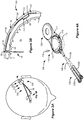
- FIGS. 3A and 3B show an improved IPG as implanted in a DBS patient, in accordance with an example of the invention.
- FIGS. 4A-4C show the improved IPG in isolation and in various view, in accordance with an example of the invention.
- FIG. 5 shows an exploded view of the components of the improved IPG, in accordance with an example of the invention.
- FIGS. 6A-6D show various electrical connections with the improved IPG, in accordance with an example of the invention.
- FIG. 7A shows an underside of the housing of the improved IPG
- FIGS. 7B and 7C show cross sections through a feedthrough pin and a ground pin respectively, in accordance with an example of the invention.
- FIG. 8 shows components within a connection block section of the improved IPG, in accordance with an example of the invention.
- FIG. 9 shows details of a Printed Circuit Board (PCB) within the IPG, in accordance with an example of the invention.
- PCB Printed Circuit Board
- FIGS. 10A-10G show various steps in the construction of the improved IPG, in accordance with an example of the invention.
- FIG. 11 shows an alternative design for the improved IPG in which the charging coil encircles the housing, in accordance with an example of the invention.
- FIGS. 3A and 3B A first example of an improved DBS IPG device 100 is shown in FIGS. 3A and 3B as implanted in a patient, and in FIGS. 4A-4C in isolation and in perspective, side, and top-down views respectively.
- the IPG 100 is designed to lie generally flat against the patient's skull, and preferably above the patient's ear proximate to the temporal or parietal bones. Such placement is preferable because the skull in these locations is generally flat, therefore allowing the IPG 100 to lay relatively flat.
- the IPG 100 is flexible at certain locations, perfect flatness of the skull is not required, as seen in the cross section of FIG. 3B .
- the IPG 100 is generally divided into four sections: an electronics section 110 , a charging coil section 120 , a connector block section 130 , and an electrode wire section 140 .
- Sections 130 and 140 are further comprised in this example of left and right connector blocks 132 a and 132 b , each coupled to its own electrode wire cable 142 a and 142 b .
- each connector block 132 / 142 pair can couple to one of the eight-electrode leads 18 illustrated earlier ( FIG. 1 ).
- the number of connector block/electrode wire cable pairs is application specific, and can comprise one or more than two.
- the IPG 100 is generally flexible at the connection 111 between the electronics section 110 and the charging coil section 120 , and also at the electrode wire section 140 , which as noted permits implantation of the IPG 10 against the skull even if not perfectly flat.
- the charging coil section 120 is also generally flexible as it is largely comprised of silicone, as explained in detail later.
- Electronics section 110 includes a conductive housing 112 , which includes the electronics necessary for proper functioning of the IPG 100 .
- housing 112 is generally cylindrical, and preferably comprises titanium.
- the housing 112 is designed to be mounted into a similarly shaped and sized hole 38 formed in the patient's skull 34 , as shown in FIG. 3B .
- the electronics section 110 further includes one or more screw holes 114 (e.g., two as shown) that proceed at least in part through the housing 112 , and that receive bone screws 116 ( FIG. 4A ; only one screw shown) to allow the IPG 100 to be firmly secured to the skull 34 once the subassembly 112 is positioned in the hole 38 .
- screw holes 114 e.g., two as shown
- the hole 38 in the skull 34 for accepting the housing 112 proceeds only partially through the thickness of the skull 34 , but in other examples may proceed all the way through to the dura (not shown) surrounding the brain 32 . Notice from FIG. 3B that the IPG 100 is fully implanted between the skull 34 and the skin/fascia 40 on top of the skull.
- the implanting physician Before securing of the IPG 100 to the skull 34 , the implanting physician will have drilled one or more holes 36 in the skull 34 as shown in FIG. 3A , and will have inserted the distal ends of leads 18 with the electrodes 16 into appropriate locations in the brain 32 , as discussed earlier.
- the leads 18 once properly placed can be secured in holes 36 by the physician using standard means, such as by cementing or plugging. Thereafter, and once the physician has verified the effectiveness of neurostimulation therapy using standard DBS surgical equipment (not shown), the IPG 100 can be secured to the skull 34 as described. Thereafter, proximal ends of the leads 18 with the electrode terminals 20 ( FIG.
- both left and right leads 18 are used, and so the IPG 100 includes two connector blocks 132 a and 132 b in its assembly 130 , although as noted earlier this number is variable. Leads 18 may be much shorter than those described in conjunction with the prior art, and extender leads ( 28 , FIG. 2 ) are not required. Leads 18 may have some slack along the skull 34 as they proceed from the connector block assembly 130 to the holes 36 .
- IPG 100 is thus implanted much closer to the site of therapy—a few inches rather than a foot or more—and doesn't require a long tunnel through the patient. Further, this shortened distance renders communications 100 between the IPG and the implanted electrodes 16 less complicated and more reliable. Further, the IPG 100 is small in size and volume, as the example dimensions depicted in FIGS. 4B and 4C show. Notice importantly that the electronics section 110 and charging coil section 120 only extended a small distance (e.g., 3.3 mm) above the skull 34 's surface when implanted. This low profile is facilitated by the fact that housing 112 of the electronics section 110 is implanted significantly below the skull's surface (e.g., 5.6 mm) in skull hole 38 . The connector block assembly 130 also has a relative small profile (e.g., 3.8 mm), and thus the entire IPG 100 is easily accommodated under the patient's skin/fascia 40 .
- a small distance e.g., 3.3 mm
- FIG. 5 shows an exploded view of various components of the IPG 100 , which are now identified and briefly explained. The function and purpose of these components will also be explained in conjunction with FIGS. 10A-10G , which illustrate sequential steps in the construction of the IPG 100 .
- a silicone overmold 150 which serves to integrate the electronics 110 and charging coil sections 120 , and to provide soft surfaces for portions of the IPG 100 that might come into contact with a patient's tissue/fascia 40 .
- Screw holes 114 referred to earlier are seen in the overmold 150 , as well as partially formed in a lip 161 of the housing 112 . Alternatively, if lip 161 is larger or the bone screws 116 ( FIG. 4A ) smaller, screw holes can be fully formed in the lip.
- Top cover 152 preferably comprising titanium, is eventually laser welded to the top of the housing 112 , and includes two slots 153 to allow for the passage of cabling to the electrode wire section 140 and to antennas 154 and 196 , as explained further below.
- Top cover 152 and a feedthrough 164 portion of the housing 112 create a cavity 201 ( FIGS. 7B & 7C ) in which electrical connections 180 (described below) can be housed.
- the overmold 150 may further include a hole 159 to allow the grounded housing at top cover 152 to be tied to the patient's tissue 5 .
- Charging coil section 120 includes a charging coil antenna 154 within a silicone overmold 156 , which is encompassed within overmold 150 during assembly.
- the charging coil antenna 154 is used to receive a magnetic field from a power source external to the patient (not shown), and is preferably used to charge the IPG 100 's battery 170 .
- the IPG 100 may include a primary (non-rechargeable) battery 170 , in which case charging coil antenna 154 would be unnecessary.
- Battery 170 is preferably coin shaped as shown to better integrate with a circular printed circuit board 168 within the housing 112 .
- IPG 100 may also lack a battery 170 , and instead be designed to continually receive a magnetic field at charging coil antenna 154 from the external power source to provide the IPG the power it needs to function.
- battery 170 is rechargeable, with a capacity of 59 mAh.
- Bi-directional data communications with the IPG 100 is facilitated by the use of a short-range RF antenna 196 that may include its own silicone overmold 198 .
- Data antenna 196 is preferably configured as a dipole antenna.
- the data antenna 196 is preferably positioned outside of the top cover 152 and housing 112 , and is preferably curved to follow at least a portion of the circular contour of the periphery of the top cover 152 . Positioning the data antenna 196 outside of conductive components such as the top cover 152 and the housing 112 keeps such components from attenuating communications to and from the antenna 196 .
- data antenna 196 can operate pursuant to a Bluetooth communications protocol, although other short-range RF protocols could be used as well, such as Zigbee, MICS, WiFi, etc.
- data communications can be enabled via magnetic fields received and transmitted from the charging coil antenna 154 , in which case data antenna 196 may be unnecessary.
- Further details concerning external devices with which the IPG 100 can communicate such as external chargers for providing power (via a magnetic field), patient external controllers, and clinician programmers, are disclosed in U.S. Patent Application Publication 2015/0360038, which is hereby incorporated by reference in its entirety.
- Various electrical connections 180 are established inside the electronics section 110 , including connections to the electrode wire section 140 and to the antennas 154 and 196 . Such signals ultimately attach to various feedthrough pins 188 , as described in further detail with reference to FIGS. 6A-6D .
- a cable retainer clip 158 and an antennas retainer clip 160 both preferably formed of polyether ether ketone (PEEK) and held within the overmold 150 , secure connections to the electrode wire cables 142 a and 142 b and to the wires associated with antennas 154 and 196 .
- PEEK polyether ether ketone
- An insulator disk 162 intervenes between the electrical connections 180 and a feedthrough 164 formed in a top surface of the housing 112 .
- the insulator disk 162 and the feedthrough 164 contain holes 163 and 165 respectively to accommodate the passage of the feedthrough pins 188 therethrough, which pins 188 may comprise titanium or copper for example.
- Holes 171 in the feedthrough 164 e.g., two, although more or less could be used
- the lip 161 of the housing 112 is encompassed within the silicone overmold 150 during assembly, as best seen in FIGS. 7B and 7C .
- the feedthrough 164 is integral with the housing 112 and the two are formed as one piece. However, this is not strictly necessary, and feedthrough 164 could for example be welded into place within the housing 112 .
- a printed circuit board (PCB) 168 is located below the feedthrough 164 inside of the housing 112 , and may carry battery 170 (if present) to power the IPG 100 .
- the top of the PCB 168 can include an insulator ring 166 , preferably formed of KaptonTM, with holes 167 and 173 allowing the feedthrough pins 188 and the ground pins 190 respectively to pass therethrough.
- the feedthrough pins 188 and the ground pins 190 connect to the PCB 168 at holes 169 and 175 respectively.
- a bottom cover 172 is laser-weldable to the bottom of the housing 112 . This creates a cylindrical and hermetically sealed cavity 199 ( FIGS.
- housing 112 complete with its top cover 152 and bottom cover 172 may also be referred to as the “housing.”
- FIGS. 6A-6D show further details of the electrical connections 180 with the housing 112 removed for easier viewing.
- Electrode wires 182 from the electrode wire cables 142 a and 142 b e.g., 8 wires in each
- antenna wires 181 from the data antenna 198 and the charging coil antenna 154 e.g., four wires, comprising the ends of the antennas
- conductive terminals 184 formed in one or more substrates 200 As shown in FIG.
- substrates 200 a - d are used in this example, with substrate 200 a connecting to the electrodes wires in electrode wire cable 142 a ; 200 b connecting to the electrode wires in electrode wire cable 142 b ; 200 c connecting to the ends of the charging coil antenna 154 ; and 200 d connecting to the data antenna 196 .
- the conductive terminals 184 may comprise crimps (tie bars) formed in conductive traces 206 in the substrates 200 , which are crimped (bent) over the ends of the wires 181 and 182 .
- Traces 206 in turn lead to contacts 186 that connect to the feedthrough pins 188 that are eventually connected to the IPG's PCB 168 .
- contacts 186 have a cross shape through which the ends of the feedthrough pins 188 can be pressed to provide electrical and mechanical connections, although these connections may also later be soldered or laser welded. Still referring to FIG.
- the substrates 200 a - d can in one example comprise a metal lead frame that is dipped in silicone 205 to cover and insulate the traces 206 .
- silicone 205 Once the silicone 205 has cured, the silicone over the crimps 184 may be excised, and holes 204 may then be formed (e.g., by laser ablation) to disconnect the various traces 204 in the lead frame from each other.
- the substrates 200 may instead comprise more typical PCBs, and may be consolidated into a single substrate, although forming them in pieces ( 200 a - d ) facilitates IPG construction as shown later. Connection of the wires 181 , 182 and feedthroughs 188 to the substrates 200 can also be made in other ways, for example, by soldering.
- each feedthrough pin 188 ultimately connects to its corresponding node (at holes 169 ) on the PCB 168 .
- Each feedthrough pin 188 is further surrounded by a ceramic bead 194 and a tube 192 preferably formed of KryoflexTM ceramic.
- the ceramic beads 194 and tubes 192 are located within holes 165 in the feedthrough 164 ( FIG. 5 ), although again the housing 112 and its feedthrough 164 is not shown in FIG. 6A or 6B for clarity.
- the ceramic beads 194 and tubes 192 are serve to insulate the feedthrough pins 188 from the conductive body of the housing 112 , which is preferably grounded by the ground pins 190 , as explained further below.
- FIGS. 7A-7C Further details of how the feedthrough pins 188 and ground pins 190 pass through feedthrough 164 and connect to the PCB 168 are shown in FIGS. 7A-7C .
- the underside of the housing 112 includes a ledge 240 .
- the top surface of the PCB 168 will rest against this ledge 240 , with insulator disk 166 intervening to prevent to two from shorting, as shown in FIGS. 7B and 7C .
- FIGS. 7B and 7C respectively show cross sections through a feedthrough pin 188 and a ground pin 190 . Notice in FIG. 7B how the sintered ceramic bead 194 and tube 192 insulates the feedthrough pin 188 from shorting to the conductive material of the housing 112 .
- ground pin 190 By contrast, no such insulation occurs around ground pin 190 as shown in FIG. 7C , as it is desirable that the ground pin 190 pass ground from the PCB 168 electronics 244 to the conductive material of the housing 112 .
- the feedthrough pins 188 in FIG. 7B are affixed to the PCB 168 in holes 169 and to appropriate corresponding PCB signals using conductive epoxy joints 242 .
- Ground pins 190 meet with a ground signal on the PCB at conductive retaining springs 179 at the holes 175 in PCB 168 .
- Ground pins are further connected to the housing 112 at conductive joints 246 , as shown in FIG. 7C .
- ground pins 190 may short to the body of the housing 112 without penetrating fully through the body, and thus holes 171 may not proceed through to the top cavity 201 .
- This alternative may be preferred so that hermeticity of cavity 199 at the location of the ground pins 190 is not compromised.
- FIG. 8 shows further details of the connector block section 130 , with some of the components of connector block 132 b removed for easier viewing.
- Covering the components of the connector blocks 132 a and 132 b is an overmold 210 , which may be made of silicone for example.
- the proximal end of a lead 18 with its electrode terminals 20 ( FIG. 1 ) is inserted in an opening 213 of a lock 212 which can receive a set screw (not shown) at perpendicular port 214 to hold the lead 18 in place after it is fully inserted to an end stop 222 in one of the connector blocks.
- Each of the electrode terminals 20 when fully inserted will meet with a corresponding spring contact 220 formed of a deformable conductive material.
- Each spring contact 220 is encased in a conductive housing 218 , and insulating seals 216 intervene between adjacent conductive housings 218 to prevent them from shorting.
- electrode wires 182 from the electrode wire cables 142 a and 142 b proceed between the overmold 210 and the insulating seals 216 , and each wire connects to a corresponding conductive housing 218 /spring contact 220 at gaps 224 between the seals 216 .
- FIG. 9 shows the underside of the PCB 168 , and the electronics 244 it carries.
- the battery 170 is on the top side of the PCB 168 and thus not in view in FIG. 9 , but its solder holes 234 can be seen. Note that the battery 170 and electronics 244 can be reversed on the PCB 168 with the former on the underside and the latter on the top side, or the battery 170 and electronics 244 could be distributed on the PCB 168 in other fashions. Further, note that the IPG 100 need not include a battery in a continuous power example as discussed earlier.
- the IPG 100 can operate as described in various manners in U.S. Patent Application Publication 2013/0184794, which is incorporated herein by reference in its entirety, and FIG. 9 shows many of the components discussed in that publication, including: a microcontroller 250 ; an Application Specific Integrated Circuit (ASIC) 252 , which among other details provides output currents to the electrodes 16 ; DC-blocking capacitors 254 through which output currents are routed on the way to electrodes 16 ; etc. Also shown is a Bluetooth integrated circuit 256 , which connects to the data antenna 196 ( FIG. 5 ) and provides modulation and demodulation circuitry to assist in wireless data transmission and reception.
- ASIC Application Specific Integrated Circuit
- feedthrough pins 188 and their receiving holes 169 are shown along with the conductive epoxy 242 used to mechanically and electrically couple the feedthrough pins to the PCB 168 .
- ground pins 190 and their receiving holes 175 are shown along with the retaining springs 179 used to mechanically and electrically couple the ground pins to the PCB 168 .
- FIGS. 10A-10G Assembly starts as shown in FIG. 10A by affixing the feedthrough pins 188 and ground pins 190 through the feedthrough 164 of the housing 112 .
- Ceramic beads 194 and tubes 192 are placed in holes 165 in the feedthrough, and the feedthrough pins 188 are placed through their centers.
- Ground pins are placed through holes 171 , and conductive joints 246 are applied.
- the subassembly is heated to sinter the ceramic beads 194 and tubes 192 and the conductive joints 246 , thus sealing all feedthrough 164 holes 165 and 171 with good hermiticity.
- the insulator disk 162 is placed over the feedthrough 164 , with feedthrough pins 188 sticking through the disk's holes 163 ( FIG. 5 ). Thereafter, substrates 200 a and 200 b are positioned in place by pressing the feedthrough pins 188 through its cross-shaped contacts 186 .
- the electrode wire cables 142 a and 142 b are affixed to the lip 161 of the housing 112 using cable retainer clip 158 , i.e., by press fitting the clip through one of the lip's holes 177 (see FIG. 7C ).
- connector blocks 132 a and 132 b of the connector block assembly 130 , the electrode wire cables 142 a and 142 b of the electrode wire assembly 140 and the substrates 200 a and 200 b be preassembled prior to coupling to the housing 112 .
- connector block 132 a (not shown in FIG. 10B ) is connected to one end of the electrode wires 182 in electrode wire cable 142 a , while the other ends are connected to substrates 220 a via conductive terminals (crimps) 184 as explained earlier.
- pre-preparation of such subassemblies is not strictly required.
- substrates 200 c and 200 d are positioned in place similarly to the substrates 200 a and 200 b of FIG. 10B , thus coupling antenna wires 181 to the assembly.
- Substrate 200 c can be placed and connected first, and is preferably preassembled including charging coil antenna 154 and its overmold 156 .
- substrate 200 d can be placed, again preferably preassembled with data antenna 196 and its overmold 198 .
- Overmold 198 may overlie overmold 156 at the location of antenna retainer clip 160 , which is fastened to the lip 161 of the housing 112 . If necessary the connections between the feedthrough pins 188 and the contacts 186 can be soldered or laser welded at this point.
- connection 111 between the main electronic housing and the charging coil antenna 154 remains flexible as it only includes the silicone overmold 156 and the flexible ends of the wires of the charging coil 154 . As described earlier, flexibility at connection 111 assists in allowing the IPG 100 to conform to the contour of the patient's skull.
- overmold 150 can be formed over and encompass at least a part of the housing and charging coil sections, as shown in FIG. 10E , with lip 161 of the housing 112 and edges of charging coil overmold 156 being encompassed by the overmold 150 (see FIGS. 7B & 7C ).
- overmold 150 need not encompass the entirety of the top cover 152 , although it could.
- leak testing can be performed to ensure that cavity 201 formed between the top cover 152 and the feedthrough 164 of the housing 112 is suitably hermetic. Electrical testing may also be performed by connecting a tester to the feedthrough pins 188 and ground pins 190 exposed on the underside of the assembly to ensure that no unwanted short or open circuits have occurred in the electrical connections 180 .
- the insulator disk 166 is positioned on ledge 240 on the underside of the housing 112 as explained earlier (see FIGS. 7B & 7C ), and then the fabricated PCB 168 is placed over disk 166 , as shown in FIG. 10F .
- Placement of the PCB 168 includes ensuring that the feedthrough pins 188 and ground pins 190 pass through holes 169 and 175 on the PCB 168 .
- conductive epoxy joints 242 can be added to the feedthrough pins 188 , and possibly also to the conductive retaining springs 179 through which the ground pins 190 pass. Such contact points can alternatively be soldered.
- bottom cover 172 is laser welded to the underside of the housing 112 , as shown in FIG. 10G , thus forming hermetic cavity 199 (see FIGS. 7B & 7C ). Hermetic and electrical testing may then occur again, with electrical testing occurring by way of wireless communication with the data antenna 196 .
- cavities 199 and 201 are formed using a top cover 152 , feedthrough 164 , and bottom cover 172 that lie in planes that are parallel.
- Cavity 199 (between the feedthrough 164 and the bottom cover 172 ) and cavity 201 (between the feedthrough 164 and the top cover 152 ) are both hermetic, but note that the hermeticity of cavity 199 is preferably superior. This is because cavity 199 is bounded by welds and by the sintered ceramic beads 194 and tubes 192 , thus providing excellent hermeticity for the PCB 168 , its electronics 244 , and the battery 170 .
- the hermeticity of cavity 201 by contrast is not as strong. This is because slots 153 ( FIG.
- top cover 152 in the top cover 152 provide a potential path for ingress, even if blocked by the electrode cable wires 142 a and 142 b , the overmolds 156 and 198 , and/or overmold 150 . Nonetheless, hermeticity in cavity 201 is not as crucial in cavity 199 contains the electronics 244 .
- IPG 100 has been illustrated as having a separate electronics section 110 and charging coil section 120 that are non-overlapping. That is, the sections 110 and 120 are next to each other, and charging coil section 120 lie in a small plane as the housing 112 . This is beneficial because it frees the charging coil 154 of conductive structures that might interfere with the receipt of magnetic fields, or cause unnecessary heating.
- FIG. 11 shows an alternative construction for an IPG 100 ′ in which electronics section 110 is effectively located in the center of the charging coil section 120 .
- IPG 100 ′ includes a combined electronics and charging coil section 110 ′ in which the charging coil 154 ′ and its overmold 156 ′ encircle the housing 112 .
- Construction is otherwise similar to that illustrated earlier for IPG 100 , and many of the components can remain unchanged, such as the connector block section 130 , and the electrode wire section 140 .
- the shape of overmold 150 ′ is now generally circular to match the circular shape of the outer charging coil 154 ′/overmold 156 ′.
- the housing 112 may still be implanted within a hole 38 in the skull 34 (see FIG. 3B ), and fastened there by bone screws 116 passing through screw holes 114 .
- the IPG 100 ′ is useable on portions of the skull that are not flat, because electrode wire cables 142 a and 142 b are still flexible.
- the charging coil overmold 156 ′ and overmold 150 ′ being silicone, can also deform to some degree.
Landscapes
- Health & Medical Sciences (AREA)
- Engineering & Computer Science (AREA)
- Biomedical Technology (AREA)
- Nuclear Medicine, Radiotherapy & Molecular Imaging (AREA)
- Radiology & Medical Imaging (AREA)
- Life Sciences & Earth Sciences (AREA)
- Animal Behavior & Ethology (AREA)
- General Health & Medical Sciences (AREA)
- Public Health (AREA)
- Veterinary Medicine (AREA)
- Physics & Mathematics (AREA)
- Electromagnetism (AREA)
- Acoustics & Sound (AREA)
- Electrotherapy Devices (AREA)
- Neurology (AREA)
- Neurosurgery (AREA)
Abstract
Description
Claims (16)
Priority Applications (6)
| Application Number | Priority Date | Filing Date | Title |
|---|---|---|---|
| US15/291,846 US10576292B2 (en) | 2015-11-29 | 2016-10-12 | Skull-mounted deep brain stimulator |
| CN201680069757.3A CN108290045B (en) | 2015-11-29 | 2016-10-13 | Skull-mounted deep brain stimulator |
| PCT/US2016/056836 WO2017091299A1 (en) | 2015-11-29 | 2016-10-13 | Skull-mounted deep brain stimulator |
| EP16787979.0A EP3344332B1 (en) | 2015-11-29 | 2016-10-13 | Skull-mounted deep brain stimulator |
| CA3001577A CA3001577C (en) | 2015-11-29 | 2016-10-13 | Skull-mounted deep brain stimulator |
| AU2016359109A AU2016359109B2 (en) | 2015-11-29 | 2016-10-13 | Skull-mounted deep brain stimulator |
Applications Claiming Priority (2)
| Application Number | Priority Date | Filing Date | Title |
|---|---|---|---|
| US201562260626P | 2015-11-29 | 2015-11-29 | |
| US15/291,846 US10576292B2 (en) | 2015-11-29 | 2016-10-12 | Skull-mounted deep brain stimulator |
Publications (2)
| Publication Number | Publication Date |
|---|---|
| US20170151438A1 US20170151438A1 (en) | 2017-06-01 |
| US10576292B2 true US10576292B2 (en) | 2020-03-03 |
Family
ID=57208382
Family Applications (1)
| Application Number | Title | Priority Date | Filing Date |
|---|---|---|---|
| US15/291,846 Active US10576292B2 (en) | 2015-11-29 | 2016-10-12 | Skull-mounted deep brain stimulator |
Country Status (6)
| Country | Link |
|---|---|
| US (1) | US10576292B2 (en) |
| EP (1) | EP3344332B1 (en) |
| CN (1) | CN108290045B (en) |
| AU (1) | AU2016359109B2 (en) |
| CA (1) | CA3001577C (en) |
| WO (1) | WO2017091299A1 (en) |
Cited By (10)
| Publication number | Priority date | Publication date | Assignee | Title |
|---|---|---|---|---|
| WO2023164700A1 (en) | 2022-02-28 | 2023-08-31 | Boston Scientific Neuromodulation Corporation | Automated selection of electrodes and stimulation parameters in a deep brain stimulation system using sensed neural potentials |
| WO2024086583A1 (en) | 2022-10-19 | 2024-04-25 | Boston Scientific Neuromodulation Corporation | Neuroanatomy-based search to optimize trajectory selection during dbs targeting |
| US20240238602A1 (en) * | 2023-01-17 | 2024-07-18 | Shiratronics, Inc. | Implantable medical device |
| WO2024167716A1 (en) | 2023-02-07 | 2024-08-15 | Boston Scientific Neuromodulation Corporation | Automated selection of electrodes and stimulation parameters in a deep brain stimulation system using anatomical structures |
| US12070603B2 (en) | 2021-02-12 | 2024-08-27 | Boston Scientific Neuromodulation Corporation | Neural feedback assisted DBS |
| EP4480529A2 (en) | 2021-02-12 | 2024-12-25 | Boston Scientific Neuromodulation Corporation | Automated selection of electrodes and stimulation parameters in a deep brain stimulation system employing directional leads |
| US12179024B2 (en) | 2021-03-18 | 2024-12-31 | Boston Scientific Neuromodulation Corporation | Methods and systems for target localization and DBS therapy |
| WO2025006483A1 (en) | 2023-06-27 | 2025-01-02 | Boston Scientific Neuromodulation Corporation | Automated selection of electrodes and stimulation parameters in a deep brain stimulation system using objective measurements |
| WO2025096577A1 (en) | 2023-10-31 | 2025-05-08 | Boston Scientific Neuromodulation Corporation | Use of n-let pulses in a deep brain stimulation system to selectively treat symptoms |
| US12377274B2 (en) | 2021-07-22 | 2025-08-05 | Boston Scientific Neuromodulation Corporation | Interpolation methods for neural responses |
Families Citing this family (17)
| Publication number | Priority date | Publication date | Assignee | Title |
|---|---|---|---|---|
| KR101656723B1 (en) * | 2015-06-30 | 2016-09-12 | 재단법인 오송첨단의료산업진흥재단 | Feedthrough making method |
| US10420950B2 (en) | 2015-11-29 | 2019-09-24 | Boston Scientific Neuromodulation Corporation | Implantable pulse generator usable during a trial stimulation phase and externally powered by magnetic inductive coupling |
| WO2019006178A1 (en) | 2017-06-30 | 2019-01-03 | Hi Llc | Reconfigurable biosignal processing architecture |
| EP3755425B1 (en) | 2018-05-09 | 2023-06-28 | Boston Scientific Neuromodulation Corporation | Determination and use of a wellness factor in an implantable medical device system using qualitative and quantitative measurements |
| US11684788B2 (en) | 2018-11-29 | 2023-06-27 | Neuropace, Inc. | Strain relief systems for active implantable medical devices |
| CN110441673B (en) * | 2019-08-27 | 2024-11-19 | 清华大学 | Active implantable medical device wireless charging and communication coil fixed connection assembly |
| AU2021209859A1 (en) * | 2020-01-21 | 2022-08-18 | Carefusion 303, Inc. | Method and system for modular connections with electrical components |
| CN111744110B (en) * | 2020-06-05 | 2024-10-29 | 清华大学 | A pulse generator and implantable neural stimulation system arranged on one side of a wiring slot |
| CN111744109B (en) * | 2020-06-05 | 2024-10-29 | 清华大学 | A pulse generator and implantable neural stimulation system arranged on both sides of a wiring slot |
| CN111744106A (en) * | 2020-06-05 | 2020-10-09 | 清华大学 | A Bendable Pulse Generator and Implantable Nerve Electrical Stimulation System |
| CN114099947A (en) * | 2020-08-27 | 2022-03-01 | 上海神奕医疗科技有限公司 | Medical device and medical system |
| CN112716689B (en) * | 2020-12-14 | 2023-09-15 | 微智医疗器械有限公司 | Ophthalmic surgical instrument |
| CN112886720B (en) * | 2021-04-29 | 2021-12-07 | 博睿康科技(常州)股份有限公司 | In-vivo electronic device suitable for wireless power supply |
| CN113599697B (en) * | 2021-08-06 | 2025-02-28 | 杭州诺为医疗技术有限公司 | A semi-embedded housing and stimulator |
| US12343547B2 (en) | 2021-08-19 | 2025-07-01 | Boston Scientific Neuromodulation Corporation | Connectors for an electrical stimulation system and methods of making and using |
| CN115382100A (en) | 2022-08-08 | 2022-11-25 | 江苏畅医达医疗科技有限公司 | Brain nerve electrical stimulation system with sensing function |
| CN121079125A (en) * | 2023-05-04 | 2025-12-05 | 科利耳有限公司 | Implants with induction coils and antennas with apexes |
Citations (38)
| Publication number | Priority date | Publication date | Assignee | Title |
|---|---|---|---|---|
| US4495917A (en) | 1982-03-26 | 1985-01-29 | The Regents Of The University Of California | Surgically implantable disconnect device |
| US6272382B1 (en) | 1998-07-31 | 2001-08-07 | Advanced Bionics Corporation | Fully implantable cochlear implant system |
| US20020052610A1 (en) * | 2000-04-07 | 2002-05-02 | Skakoon James G. | Deep organ access device and method |
| US6516227B1 (en) | 1999-07-27 | 2003-02-04 | Advanced Bionics Corporation | Rechargeable spinal cord stimulator system |
| US20040147974A1 (en) | 2001-08-21 | 2004-07-29 | Medtronic, Inc. | Implantable medical device assembly and manufacturing method |
| US20050004618A1 (en) * | 2003-05-16 | 2005-01-06 | Scott Erik R. | Implantable medical device with a nonhermetic battery |
| US20070255338A1 (en) * | 2006-04-28 | 2007-11-01 | Medtronic, Inc. | Cranial implant |
| US7444181B2 (en) | 2005-12-14 | 2008-10-28 | Boston Scientific Neuromodulation Corporation | Techniques for sensing and adjusting a compliance voltage in an implantable stimulator device |
| US20100312193A1 (en) * | 2007-10-08 | 2010-12-09 | Renishaw (Ireland) Limited | Neurosurgical cap |
| US8024049B1 (en) * | 2003-10-20 | 2011-09-20 | University Of Central Florida Research Foundation, Inc. | Spatial-temporal deep brain stimulation methods and systems |
| US20120221074A1 (en) * | 2011-02-24 | 2012-08-30 | Boston Scientific Neuromodulation Corporation | Implantable medical device for providing stimulation therapy |
| WO2012138782A1 (en) | 2011-04-04 | 2012-10-11 | Stimwave Technologies Incorporated | Implantable lead |
| US20120283800A1 (en) | 2011-01-28 | 2012-11-08 | Stimwave Technologies Incorporated | Neural Stimulator System |
| US8335569B2 (en) | 2009-02-10 | 2012-12-18 | Boston Scientific Neuromodulation Corporation | External device for communicating with an implantable medical device having data telemetry and charging integrated in a single housing |
| US20130066400A1 (en) | 2011-01-28 | 2013-03-14 | Stimwave Technologies Incorporated | Microwave field stimulator |
| US20130079849A1 (en) | 2011-09-15 | 2013-03-28 | Stimwave Technologies Incorporated | Relay module for implant |
| WO2013048396A1 (en) | 2011-09-28 | 2013-04-04 | Advanced Bionics Ag | Modular biomedical implants |
| US8457744B2 (en) | 2002-12-09 | 2013-06-04 | Medtronic, Inc. | Low-profile implantable medical device |
| US20130184794A1 (en) | 2012-01-16 | 2013-07-18 | Boston Scientific Neuromodulation Corporation | Architectures for an Implantable Stimulator Device Having a Plurality of Electrode Driver Integrated Circuits with Shorted Electrode Outputs |
| US8498716B2 (en) | 2007-11-05 | 2013-07-30 | Boston Scientific Neuromodulation Corporation | External controller for an implantable medical device system with coupleable external charging coil assembly |
| US8538545B2 (en) | 2008-05-26 | 2013-09-17 | Cochlear Limited | Multi-coil wireless communication system for an implantable device |
| US20130310901A1 (en) | 2012-05-21 | 2013-11-21 | Neural Diabetes, Llc | Methods and devices for modulating excitable tissue of the exiting spinal nerves |
| US8606362B2 (en) | 2005-07-08 | 2013-12-10 | Boston Scientific Neuromodulation Corporation | Current output architecture for an implantable stimulator device |
| US8620436B2 (en) | 2005-07-08 | 2013-12-31 | Boston Scientific Neuromodulation Corporation | Current generation architecture for an implantable stimulator device having coarse and fine current control |
| US20140058480A1 (en) | 2011-01-28 | 2014-02-27 | Stimwave Technologies Incorporated | Remote control of power or polarity selection for a neural stimulator |
| US8694120B2 (en) | 2011-02-17 | 2014-04-08 | Salomo Murtonen | Systems and methods for making and using electrical stimulation systems with improved RF compatibility |
| US8768453B2 (en) | 2010-10-13 | 2014-07-01 | Boston Scientific Neuromodulation Corporation | Monitoring electrode voltages in an implantable medical device system having daisy-chained electrode-driver integrated circuits |
| US8862235B1 (en) | 2005-07-01 | 2014-10-14 | Alfred E. Mann Foundation For Scientific Research | Brain implant device |
| US20140358194A1 (en) | 2013-06-04 | 2014-12-04 | Boston Scientific Neuromodulation Corporation | External Device for Determining an Optimal Implantable Medical Device for a Patient Using Information Determined During an External Trial Stimulation Phase |
| US20150066114A1 (en) | 2013-09-05 | 2015-03-05 | Boston Scientific Neuromodulation Corporation | Construction for an Implantable Medical Device Employing an Internal Support Structure |
| US20150080982A1 (en) | 2013-09-13 | 2015-03-19 | Boston Scientific Neuromodulation Corporation | Window in a Case of an Implantable Medical Device to Facilitate Optical Communications With External Devices |
| US20150088226A1 (en) | 2013-09-26 | 2015-03-26 | Oticon Medical A/S | Device implantable under skin |
| US20150251011A1 (en) | 2014-03-05 | 2015-09-10 | Boston Scientific Neuromodulation Corporation | Lead Connector Assembly for an Implantable Medical Device and Method of Construction |
| US20150360038A1 (en) | 2014-06-13 | 2015-12-17 | Boston Scientific Neuromodulation Corporation | Heads-Up Display and Control of an Implantable Medical Device |
| US20160066803A1 (en) * | 2014-04-17 | 2016-03-10 | Branchpoint Technologies, Inc. | Wireless intracranial monitoring system |
| US20160144166A1 (en) * | 2014-11-25 | 2016-05-26 | Medtronic Bakken Research Center B.V. | Medical lead with thin film |
| US9398901B2 (en) * | 2012-12-07 | 2016-07-26 | Medtronic, Inc. | Minimally invasive implantable neurostimulation system |
| US20170151440A1 (en) * | 2015-11-29 | 2017-06-01 | Boston Scientific Neuromodulation Corporation | Implantable Pulse Generator Usable During a Trial Stimulation Phase and Externally Powered by Magnetic Inductive Coupling |
Family Cites Families (5)
| Publication number | Priority date | Publication date | Assignee | Title |
|---|---|---|---|---|
| US6321126B1 (en) * | 1998-12-07 | 2001-11-20 | Advanced Bionics Corporation | Implantable connector |
| JP2011517970A (en) * | 2008-03-20 | 2011-06-23 | グレイトバッチ リミテッド | Shielded 3-terminal flat-through EMI / energy dissipation filter |
| US9138587B2 (en) * | 2010-12-28 | 2015-09-22 | Medtronic, Inc. | Medical devices including connector enclosures with a metallic weld to a can housing circuitry |
| CN103845803B (en) * | 2012-11-30 | 2016-03-16 | 苏州景昱医疗器械有限公司 | A kind of implantable medical device and system with radio communication function |
| CN203677737U (en) * | 2014-01-17 | 2014-07-02 | 北京品驰医疗设备有限公司 | Deep brain simulation system implanted in head |
-
2016
- 2016-10-12 US US15/291,846 patent/US10576292B2/en active Active
- 2016-10-13 AU AU2016359109A patent/AU2016359109B2/en active Active
- 2016-10-13 WO PCT/US2016/056836 patent/WO2017091299A1/en not_active Ceased
- 2016-10-13 EP EP16787979.0A patent/EP3344332B1/en active Active
- 2016-10-13 CN CN201680069757.3A patent/CN108290045B/en active Active
- 2016-10-13 CA CA3001577A patent/CA3001577C/en active Active
Patent Citations (39)
| Publication number | Priority date | Publication date | Assignee | Title |
|---|---|---|---|---|
| US4495917A (en) | 1982-03-26 | 1985-01-29 | The Regents Of The University Of California | Surgically implantable disconnect device |
| US6272382B1 (en) | 1998-07-31 | 2001-08-07 | Advanced Bionics Corporation | Fully implantable cochlear implant system |
| US6516227B1 (en) | 1999-07-27 | 2003-02-04 | Advanced Bionics Corporation | Rechargeable spinal cord stimulator system |
| US20020052610A1 (en) * | 2000-04-07 | 2002-05-02 | Skakoon James G. | Deep organ access device and method |
| US20040147974A1 (en) | 2001-08-21 | 2004-07-29 | Medtronic, Inc. | Implantable medical device assembly and manufacturing method |
| US8457744B2 (en) | 2002-12-09 | 2013-06-04 | Medtronic, Inc. | Low-profile implantable medical device |
| US20050004618A1 (en) * | 2003-05-16 | 2005-01-06 | Scott Erik R. | Implantable medical device with a nonhermetic battery |
| US7263401B2 (en) | 2003-05-16 | 2007-08-28 | Medtronic, Inc. | Implantable medical device with a nonhermetic battery |
| US8024049B1 (en) * | 2003-10-20 | 2011-09-20 | University Of Central Florida Research Foundation, Inc. | Spatial-temporal deep brain stimulation methods and systems |
| US8862235B1 (en) | 2005-07-01 | 2014-10-14 | Alfred E. Mann Foundation For Scientific Research | Brain implant device |
| US8620436B2 (en) | 2005-07-08 | 2013-12-31 | Boston Scientific Neuromodulation Corporation | Current generation architecture for an implantable stimulator device having coarse and fine current control |
| US8606362B2 (en) | 2005-07-08 | 2013-12-10 | Boston Scientific Neuromodulation Corporation | Current output architecture for an implantable stimulator device |
| US7444181B2 (en) | 2005-12-14 | 2008-10-28 | Boston Scientific Neuromodulation Corporation | Techniques for sensing and adjusting a compliance voltage in an implantable stimulator device |
| US20070255338A1 (en) * | 2006-04-28 | 2007-11-01 | Medtronic, Inc. | Cranial implant |
| US20100312193A1 (en) * | 2007-10-08 | 2010-12-09 | Renishaw (Ireland) Limited | Neurosurgical cap |
| US8498716B2 (en) | 2007-11-05 | 2013-07-30 | Boston Scientific Neuromodulation Corporation | External controller for an implantable medical device system with coupleable external charging coil assembly |
| US8538545B2 (en) | 2008-05-26 | 2013-09-17 | Cochlear Limited | Multi-coil wireless communication system for an implantable device |
| US8335569B2 (en) | 2009-02-10 | 2012-12-18 | Boston Scientific Neuromodulation Corporation | External device for communicating with an implantable medical device having data telemetry and charging integrated in a single housing |
| US8768453B2 (en) | 2010-10-13 | 2014-07-01 | Boston Scientific Neuromodulation Corporation | Monitoring electrode voltages in an implantable medical device system having daisy-chained electrode-driver integrated circuits |
| US20120283800A1 (en) | 2011-01-28 | 2012-11-08 | Stimwave Technologies Incorporated | Neural Stimulator System |
| US20140058480A1 (en) | 2011-01-28 | 2014-02-27 | Stimwave Technologies Incorporated | Remote control of power or polarity selection for a neural stimulator |
| US20130066400A1 (en) | 2011-01-28 | 2013-03-14 | Stimwave Technologies Incorporated | Microwave field stimulator |
| US8694120B2 (en) | 2011-02-17 | 2014-04-08 | Salomo Murtonen | Systems and methods for making and using electrical stimulation systems with improved RF compatibility |
| US20120221074A1 (en) * | 2011-02-24 | 2012-08-30 | Boston Scientific Neuromodulation Corporation | Implantable medical device for providing stimulation therapy |
| WO2012138782A1 (en) | 2011-04-04 | 2012-10-11 | Stimwave Technologies Incorporated | Implantable lead |
| US20130079849A1 (en) | 2011-09-15 | 2013-03-28 | Stimwave Technologies Incorporated | Relay module for implant |
| WO2013048396A1 (en) | 2011-09-28 | 2013-04-04 | Advanced Bionics Ag | Modular biomedical implants |
| US20130184794A1 (en) | 2012-01-16 | 2013-07-18 | Boston Scientific Neuromodulation Corporation | Architectures for an Implantable Stimulator Device Having a Plurality of Electrode Driver Integrated Circuits with Shorted Electrode Outputs |
| US20130310901A1 (en) | 2012-05-21 | 2013-11-21 | Neural Diabetes, Llc | Methods and devices for modulating excitable tissue of the exiting spinal nerves |
| US9398901B2 (en) * | 2012-12-07 | 2016-07-26 | Medtronic, Inc. | Minimally invasive implantable neurostimulation system |
| US20140358194A1 (en) | 2013-06-04 | 2014-12-04 | Boston Scientific Neuromodulation Corporation | External Device for Determining an Optimal Implantable Medical Device for a Patient Using Information Determined During an External Trial Stimulation Phase |
| US20150066114A1 (en) | 2013-09-05 | 2015-03-05 | Boston Scientific Neuromodulation Corporation | Construction for an Implantable Medical Device Employing an Internal Support Structure |
| US20150080982A1 (en) | 2013-09-13 | 2015-03-19 | Boston Scientific Neuromodulation Corporation | Window in a Case of an Implantable Medical Device to Facilitate Optical Communications With External Devices |
| US20150088226A1 (en) | 2013-09-26 | 2015-03-26 | Oticon Medical A/S | Device implantable under skin |
| US20150251011A1 (en) | 2014-03-05 | 2015-09-10 | Boston Scientific Neuromodulation Corporation | Lead Connector Assembly for an Implantable Medical Device and Method of Construction |
| US20160066803A1 (en) * | 2014-04-17 | 2016-03-10 | Branchpoint Technologies, Inc. | Wireless intracranial monitoring system |
| US20150360038A1 (en) | 2014-06-13 | 2015-12-17 | Boston Scientific Neuromodulation Corporation | Heads-Up Display and Control of an Implantable Medical Device |
| US20160144166A1 (en) * | 2014-11-25 | 2016-05-26 | Medtronic Bakken Research Center B.V. | Medical lead with thin film |
| US20170151440A1 (en) * | 2015-11-29 | 2017-06-01 | Boston Scientific Neuromodulation Corporation | Implantable Pulse Generator Usable During a Trial Stimulation Phase and Externally Powered by Magnetic Inductive Coupling |
Non-Patent Citations (3)
| Title |
|---|
| International Search Report and Written Opinion regarding corresponding PCT Application No. PCT/US2016/056836, dated Jan. 23, 2017. |
| U.S. Appl. No. 15/090,367, filed Apr. 4, 2015, Parramon. |
| U.S. Appl. No. 62/260,626, filed Nov. 29, 2015, Orinski. |
Cited By (11)
| Publication number | Priority date | Publication date | Assignee | Title |
|---|---|---|---|---|
| US12070603B2 (en) | 2021-02-12 | 2024-08-27 | Boston Scientific Neuromodulation Corporation | Neural feedback assisted DBS |
| EP4480529A2 (en) | 2021-02-12 | 2024-12-25 | Boston Scientific Neuromodulation Corporation | Automated selection of electrodes and stimulation parameters in a deep brain stimulation system employing directional leads |
| US12179024B2 (en) | 2021-03-18 | 2024-12-31 | Boston Scientific Neuromodulation Corporation | Methods and systems for target localization and DBS therapy |
| US12324918B2 (en) | 2021-03-18 | 2025-06-10 | Boston Scientific Neuromodulation Corporation | Methods and systems for lead movement detection and response in DBS therapy |
| US12377274B2 (en) | 2021-07-22 | 2025-08-05 | Boston Scientific Neuromodulation Corporation | Interpolation methods for neural responses |
| WO2023164700A1 (en) | 2022-02-28 | 2023-08-31 | Boston Scientific Neuromodulation Corporation | Automated selection of electrodes and stimulation parameters in a deep brain stimulation system using sensed neural potentials |
| WO2024086583A1 (en) | 2022-10-19 | 2024-04-25 | Boston Scientific Neuromodulation Corporation | Neuroanatomy-based search to optimize trajectory selection during dbs targeting |
| US20240238602A1 (en) * | 2023-01-17 | 2024-07-18 | Shiratronics, Inc. | Implantable medical device |
| WO2024167716A1 (en) | 2023-02-07 | 2024-08-15 | Boston Scientific Neuromodulation Corporation | Automated selection of electrodes and stimulation parameters in a deep brain stimulation system using anatomical structures |
| WO2025006483A1 (en) | 2023-06-27 | 2025-01-02 | Boston Scientific Neuromodulation Corporation | Automated selection of electrodes and stimulation parameters in a deep brain stimulation system using objective measurements |
| WO2025096577A1 (en) | 2023-10-31 | 2025-05-08 | Boston Scientific Neuromodulation Corporation | Use of n-let pulses in a deep brain stimulation system to selectively treat symptoms |
Also Published As
| Publication number | Publication date |
|---|---|
| CA3001577A1 (en) | 2017-06-01 |
| US20170151438A1 (en) | 2017-06-01 |
| CA3001577C (en) | 2021-06-01 |
| WO2017091299A1 (en) | 2017-06-01 |
| AU2016359109B2 (en) | 2019-04-18 |
| CN108290045A (en) | 2018-07-17 |
| EP3344332A1 (en) | 2018-07-11 |
| EP3344332B1 (en) | 2019-08-14 |
| AU2016359109A1 (en) | 2018-04-26 |
| CN108290045B (en) | 2021-06-08 |
Similar Documents
| Publication | Publication Date | Title |
|---|---|---|
| US10576292B2 (en) | Skull-mounted deep brain stimulator | |
| US10946204B2 (en) | Methods for forming implantable signal generators with molded headers | |
| US9956421B2 (en) | Construction for an implantable medical device employing an internal support structure | |
| US10213596B2 (en) | Skull-mounted optical implant | |
| JP2014508600A (en) | Implantable neurostimulator with circuit board and connector | |
| US20140172047A1 (en) | Implantable pulse generator for stimulation of a neurological cellular mass | |
| US20180272134A1 (en) | Microstimulator Having Body-Mounted Electrodes and Remote Electrode Leads | |
| AU2014315486B2 (en) | Construction for an implantable medical device employing an internal support structure | |
| AU2014315492B2 (en) | Construction for an implantable medical device having a battery affixed to the case | |
| US20180272138A1 (en) | Microstimulator with Rigid Support Structure |
Legal Events
| Date | Code | Title | Description |
|---|---|---|---|
| AS | Assignment |
Owner name: BOSTON SCIENTIFIC NEUROMODULATION CORPORATION, CALIFORNIA Free format text: ASSIGNMENT OF ASSIGNORS INTEREST;ASSIGNOR:ORINSKI, WILLIAM G.;REEL/FRAME:040336/0838 Effective date: 20160514 Owner name: BOSTON SCIENTIFIC NEUROMODULATION CORPORATION, CAL Free format text: ASSIGNMENT OF ASSIGNORS INTEREST;ASSIGNOR:ORINSKI, WILLIAM G.;REEL/FRAME:040336/0838 Effective date: 20160514 |
|
| STPP | Information on status: patent application and granting procedure in general |
Free format text: RESPONSE AFTER FINAL ACTION FORWARDED TO EXAMINER |
|
| STPP | Information on status: patent application and granting procedure in general |
Free format text: ADVISORY ACTION MAILED |
|
| STPP | Information on status: patent application and granting procedure in general |
Free format text: NON FINAL ACTION MAILED |
|
| STPP | Information on status: patent application and granting procedure in general |
Free format text: RESPONSE TO NON-FINAL OFFICE ACTION ENTERED AND FORWARDED TO EXAMINER |
|
| STPP | Information on status: patent application and granting procedure in general |
Free format text: FINAL REJECTION MAILED |
|
| STPP | Information on status: patent application and granting procedure in general |
Free format text: RESPONSE AFTER FINAL ACTION FORWARDED TO EXAMINER |
|
| STPP | Information on status: patent application and granting procedure in general |
Free format text: NOTICE OF ALLOWANCE MAILED -- APPLICATION RECEIVED IN OFFICE OF PUBLICATIONS |
|
| STPP | Information on status: patent application and granting procedure in general |
Free format text: PUBLICATIONS -- ISSUE FEE PAYMENT VERIFIED |
|
| STCF | Information on status: patent grant |
Free format text: PATENTED CASE |
|
| MAFP | Maintenance fee payment |
Free format text: PAYMENT OF MAINTENANCE FEE, 4TH YEAR, LARGE ENTITY (ORIGINAL EVENT CODE: M1551); ENTITY STATUS OF PATENT OWNER: LARGE ENTITY Year of fee payment: 4 |