US10556378B2 - Selective sintering of structurally modified polymers - Google Patents
Selective sintering of structurally modified polymers Download PDFInfo
- Publication number
- US10556378B2 US10556378B2 US15/856,843 US201715856843A US10556378B2 US 10556378 B2 US10556378 B2 US 10556378B2 US 201715856843 A US201715856843 A US 201715856843A US 10556378 B2 US10556378 B2 US 10556378B2
- Authority
- US
- United States
- Prior art keywords
- copolymer
- polymer
- group
- dimensional object
- paek
- Prior art date
- Legal status (The legal status is an assumption and is not a legal conclusion. Google has not performed a legal analysis and makes no representation as to the accuracy of the status listed.)
- Active
Links
- 229920000642 polymer Polymers 0.000 title claims abstract description 210
- 238000005245 sintering Methods 0.000 title claims abstract description 29
- 229920001577 copolymer Polymers 0.000 claims abstract description 143
- 229920006260 polyaryletherketone Polymers 0.000 claims abstract description 107
- 125000003118 aryl group Chemical group 0.000 claims abstract description 73
- 239000000843 powder Substances 0.000 claims abstract description 67
- UFWIBTONFRDIAS-UHFFFAOYSA-N Naphthalene Chemical compound C1=CC=CC2=CC=CC=C21 UFWIBTONFRDIAS-UHFFFAOYSA-N 0.000 claims abstract description 32
- 230000004048 modification Effects 0.000 claims abstract description 32
- 238000012986 modification Methods 0.000 claims abstract description 32
- 230000005670 electromagnetic radiation Effects 0.000 claims abstract description 20
- 125000000843 phenylene group Chemical group C1(=C(C=CC=C1)*)* 0.000 claims abstract description 16
- 125000002529 biphenylenyl group Chemical group C1(=CC=CC=2C3=CC=CC=C3C12)* 0.000 claims abstract description 10
- 125000000654 isopropylidene group Chemical group C(C)(C)=* 0.000 claims abstract description 10
- 230000009477 glass transition Effects 0.000 claims abstract description 9
- 239000004952 Polyamide Substances 0.000 claims description 45
- 229920002647 polyamide Polymers 0.000 claims description 45
- 229920001652 poly(etherketoneketone) Polymers 0.000 claims description 30
- 125000001140 1,4-phenylene group Chemical group [H]C1=C([H])C([*:2])=C([H])C([H])=C1[*:1] 0.000 claims description 28
- 229920000110 poly(aryl ether sulfone) Polymers 0.000 claims description 28
- 238000002844 melting Methods 0.000 claims description 24
- 230000008018 melting Effects 0.000 claims description 24
- -1 preferably Me Chemical group 0.000 claims description 23
- 239000000203 mixture Substances 0.000 claims description 18
- 125000001424 substituent group Chemical group 0.000 claims description 18
- 125000001989 1,3-phenylene group Chemical group [H]C1=C([H])C([*:1])=C([H])C([*:2])=C1[H] 0.000 claims description 16
- 239000004696 Poly ether ether ketone Substances 0.000 claims description 15
- 229920002530 polyetherether ketone Polymers 0.000 claims description 15
- 125000003545 alkoxy group Chemical group 0.000 claims description 10
- 125000000999 tert-butyl group Chemical group [H]C([H])([H])C(*)(C([H])([H])[H])C([H])([H])[H] 0.000 claims description 9
- 239000004793 Polystyrene Substances 0.000 claims description 7
- 125000001449 isopropyl group Chemical group [H]C([H])([H])C([H])(*)C([H])([H])[H] 0.000 claims description 7
- 229920002223 polystyrene Polymers 0.000 claims description 7
- 125000006165 cyclic alkyl group Chemical group 0.000 claims description 6
- 238000006116 polymerization reaction Methods 0.000 claims description 6
- 229920000098 polyolefin Polymers 0.000 claims description 6
- 239000004642 Polyimide Substances 0.000 claims description 5
- 229920001400 block copolymer Polymers 0.000 claims description 5
- 125000002950 monocyclic group Chemical group 0.000 claims description 5
- 125000005575 polycyclic aromatic hydrocarbon group Chemical group 0.000 claims description 5
- 229920000728 polyester Polymers 0.000 claims description 5
- 229920000570 polyether Polymers 0.000 claims description 5
- 229920001721 polyimide Polymers 0.000 claims description 5
- 229920002981 polyvinylidene fluoride Polymers 0.000 claims description 5
- 229920008285 Poly(ether ketone) PEK Polymers 0.000 claims description 4
- 239000004721 Polyphenylene oxide Substances 0.000 claims description 4
- 125000000217 alkyl group Chemical group 0.000 claims description 4
- 229920000359 diblock copolymer Polymers 0.000 claims description 4
- 229920000428 triblock copolymer Polymers 0.000 claims description 4
- 239000002033 PVDF binder Substances 0.000 claims description 2
- 229920006380 polyphenylene oxide Polymers 0.000 claims description 2
- 239000004734 Polyphenylene sulfide Substances 0.000 claims 1
- 229920000069 polyphenylene sulfide Polymers 0.000 claims 1
- 238000000034 method Methods 0.000 description 83
- 230000008569 process Effects 0.000 description 80
- 238000001816 cooling Methods 0.000 description 35
- 238000004519 manufacturing process Methods 0.000 description 17
- 238000000149 argon plasma sintering Methods 0.000 description 12
- 239000000463 material Substances 0.000 description 11
- 230000015572 biosynthetic process Effects 0.000 description 10
- 238000002425 crystallisation Methods 0.000 description 10
- 239000002245 particle Substances 0.000 description 9
- 238000003786 synthesis reaction Methods 0.000 description 9
- MWPLVEDNUUSJAV-UHFFFAOYSA-N anthracene Chemical compound C1=CC=CC2=CC3=CC=CC=C3C=C21 MWPLVEDNUUSJAV-UHFFFAOYSA-N 0.000 description 8
- 150000004945 aromatic hydrocarbons Chemical class 0.000 description 8
- 230000006872 improvement Effects 0.000 description 8
- 238000012545 processing Methods 0.000 description 8
- 0 *c1cc([*+])ccc1 Chemical compound *c1cc([*+])ccc1 0.000 description 6
- 230000008025 crystallization Effects 0.000 description 6
- 238000009826 distribution Methods 0.000 description 6
- 125000002496 methyl group Chemical group [H]C([H])([H])* 0.000 description 6
- 239000000178 monomer Substances 0.000 description 6
- 229920006121 Polyxylylene adipamide Polymers 0.000 description 5
- 239000000945 filler Substances 0.000 description 5
- 238000010438 heat treatment Methods 0.000 description 5
- 125000005647 linker group Chemical group 0.000 description 5
- 125000001997 phenyl group Chemical group [H]C1=C([H])C([H])=C(*)C([H])=C1[H] 0.000 description 5
- 239000004695 Polyether sulfone Substances 0.000 description 4
- 239000004698 Polyethylene Substances 0.000 description 4
- VYPSYNLAJGMNEJ-UHFFFAOYSA-N Silicium dioxide Chemical class O=[Si]=O VYPSYNLAJGMNEJ-UHFFFAOYSA-N 0.000 description 4
- 239000000654 additive Substances 0.000 description 4
- 230000008901 benefit Effects 0.000 description 4
- 238000006243 chemical reaction Methods 0.000 description 4
- 239000002131 composite material Substances 0.000 description 4
- 230000007423 decrease Effects 0.000 description 4
- 230000003247 decreasing effect Effects 0.000 description 4
- QQVIHTHCMHWDBS-UHFFFAOYSA-N isophthalic acid Chemical compound OC(=O)C1=CC=CC(C(O)=O)=C1 QQVIHTHCMHWDBS-UHFFFAOYSA-N 0.000 description 4
- VLKZOEOYAKHREP-UHFFFAOYSA-N n-Hexane Chemical group CCCCCC VLKZOEOYAKHREP-UHFFFAOYSA-N 0.000 description 4
- 229920006393 polyether sulfone Polymers 0.000 description 4
- 229920000573 polyethylene Polymers 0.000 description 4
- 229920002959 polymer blend Polymers 0.000 description 4
- 239000002861 polymer material Substances 0.000 description 4
- HIMHCKQWUSIPGX-UHFFFAOYSA-N CCC(C)(C)CC(C)CCN(C=O)C1=CC=C(C(=O)NC)C=C1 Chemical compound CCC(C)(C)CC(C)CCN(C=O)C1=CC=C(C(=O)NC)C=C1 HIMHCKQWUSIPGX-UHFFFAOYSA-N 0.000 description 3
- WGZIHDOGNOSBGJ-UHFFFAOYSA-N CCCC(C)CC(C)(C)CN(C=O)C1=CC=C(C(=O)NC)C=C1 Chemical compound CCCC(C)CC(C)(C)CN(C=O)C1=CC=C(C(=O)NC)C=C1 WGZIHDOGNOSBGJ-UHFFFAOYSA-N 0.000 description 3
- QSEGQDHLZCZKMW-UHFFFAOYSA-N COC1=CC=C(C(=O)C2=CC=C(C(=O)C3=CC=C(C)C=C3)C=C2)C=C1 Chemical compound COC1=CC=C(C(=O)C2=CC=C(C(=O)C3=CC=C(C)C=C3)C=C2)C=C1 QSEGQDHLZCZKMW-UHFFFAOYSA-N 0.000 description 3
- KKEYFWRCBNTPAC-UHFFFAOYSA-N Terephthalic acid Chemical class OC(=O)C1=CC=C(C(O)=O)C=C1 KKEYFWRCBNTPAC-UHFFFAOYSA-N 0.000 description 3
- 125000001931 aliphatic group Chemical group 0.000 description 3
- 150000001338 aliphatic hydrocarbons Chemical class 0.000 description 3
- 239000000460 chlorine Substances 0.000 description 3
- 238000007345 electrophilic aromatic substitution reaction Methods 0.000 description 3
- 229920001903 high density polyethylene Polymers 0.000 description 3
- 239000011159 matrix material Substances 0.000 description 3
- 229920006131 poly(hexamethylene isophthalamide-co-terephthalamide) Polymers 0.000 description 3
- 239000000126 substance Substances 0.000 description 3
- YJTKZCDBKVTVBY-UHFFFAOYSA-N 1,3-Diphenylbenzene Chemical group C1=CC=CC=C1C1=CC=CC(C=2C=CC=CC=2)=C1 YJTKZCDBKVTVBY-UHFFFAOYSA-N 0.000 description 2
- 229910002012 Aerosil® Inorganic materials 0.000 description 2
- KJRCEJOSASVSRA-UHFFFAOYSA-N CC(C)S Chemical compound CC(C)S KJRCEJOSASVSRA-UHFFFAOYSA-N 0.000 description 2
- UVONJMBEJUHTBG-UHFFFAOYSA-N CCCCCCCCC(=O)C1=CC(C(=O)NC)=CC=C1 Chemical compound CCCCCCCCC(=O)C1=CC(C(=O)NC)=CC=C1 UVONJMBEJUHTBG-UHFFFAOYSA-N 0.000 description 2
- IMZCXSIOVIIMAI-UHFFFAOYSA-N CCCCCCCCC(=O)C1=CC=C(C(=O)NC)C=C1 Chemical compound CCCCCCCCC(=O)C1=CC=C(C(=O)NC)C=C1 IMZCXSIOVIIMAI-UHFFFAOYSA-N 0.000 description 2
- AAYMPBRLAMTPEU-UHFFFAOYSA-N COC1=CC=C(C(=O)C2=CC(C(=O)C3=CC=C(C)C=C3)=CC=C2)C=C1 Chemical compound COC1=CC=C(C(=O)C2=CC(C(=O)C3=CC=C(C)C=C3)=CC=C2)C=C1 AAYMPBRLAMTPEU-UHFFFAOYSA-N 0.000 description 2
- ZQNLIZJQSORCPQ-UHFFFAOYSA-N COC1=CC=C(C2=CC=C(C3=CC=C(OC4=CC=C(C(=O)C5=CC=C(C)C=C5)C=C4)C=C3)C=C2)C=C1 Chemical compound COC1=CC=C(C2=CC=C(C3=CC=C(OC4=CC=C(C(=O)C5=CC=C(C)C=C5)C=C4)C=C3)C=C2)C=C1 ZQNLIZJQSORCPQ-UHFFFAOYSA-N 0.000 description 2
- OKTJSMMVPCPJKN-UHFFFAOYSA-N Carbon Chemical compound [C] OKTJSMMVPCPJKN-UHFFFAOYSA-N 0.000 description 2
- PXXNTAGJWPJAGM-VCOUNFBDSA-N Decaline Chemical compound C=1([C@@H]2C3)C=C(OC)C(OC)=CC=1OC(C=C1)=CC=C1CCC(=O)O[C@H]3C[C@H]1N2CCCC1 PXXNTAGJWPJAGM-VCOUNFBDSA-N 0.000 description 2
- 230000000996 additive effect Effects 0.000 description 2
- 229910052794 bromium Inorganic materials 0.000 description 2
- 125000004432 carbon atom Chemical group C* 0.000 description 2
- 229910052801 chlorine Inorganic materials 0.000 description 2
- 230000006835 compression Effects 0.000 description 2
- 238000007906 compression Methods 0.000 description 2
- 238000001212 derivatisation Methods 0.000 description 2
- ZUOUZKKEUPVFJK-UHFFFAOYSA-N diphenyl Chemical compound C1=CC=CC=C1C1=CC=CC=C1 ZUOUZKKEUPVFJK-UHFFFAOYSA-N 0.000 description 2
- USIUVYZYUHIAEV-UHFFFAOYSA-N diphenyl ether Chemical class C=1C=CC=CC=1OC1=CC=CC=C1 USIUVYZYUHIAEV-UHFFFAOYSA-N 0.000 description 2
- 230000000694 effects Effects 0.000 description 2
- 238000005516 engineering process Methods 0.000 description 2
- 125000004185 ester group Chemical group 0.000 description 2
- NIHNNTQXNPWCJQ-UHFFFAOYSA-N fluorene Chemical compound C1=CC=C2CC3=CC=CC=C3C2=C1 NIHNNTQXNPWCJQ-UHFFFAOYSA-N 0.000 description 2
- 150000002220 fluorenes Chemical class 0.000 description 2
- 229910052731 fluorine Inorganic materials 0.000 description 2
- 239000011521 glass Substances 0.000 description 2
- 150000002390 heteroarenes Chemical class 0.000 description 2
- 238000010348 incorporation Methods 0.000 description 2
- 238000001746 injection moulding Methods 0.000 description 2
- 125000000468 ketone group Chemical group 0.000 description 2
- 150000002576 ketones Chemical group 0.000 description 2
- 238000005259 measurement Methods 0.000 description 2
- 239000000155 melt Substances 0.000 description 2
- 238000002156 mixing Methods 0.000 description 2
- UMRZSTCPUPJPOJ-KNVOCYPGSA-N norbornane Chemical compound C1C[C@H]2CC[C@@H]1C2 UMRZSTCPUPJPOJ-KNVOCYPGSA-N 0.000 description 2
- 230000000269 nucleophilic effect Effects 0.000 description 2
- 238000010534 nucleophilic substitution reaction Methods 0.000 description 2
- YNPNZTXNASCQKK-UHFFFAOYSA-N phenanthrene Chemical compound C1=CC=C2C3=CC=CC=C3C=CC2=C1 YNPNZTXNASCQKK-UHFFFAOYSA-N 0.000 description 2
- 229920001643 poly(ether ketone) Polymers 0.000 description 2
- 238000010094 polymer processing Methods 0.000 description 2
- 239000001294 propane Substances 0.000 description 2
- 150000003839 salts Chemical class 0.000 description 2
- 238000007711 solidification Methods 0.000 description 2
- 230000008023 solidification Effects 0.000 description 2
- PXXNTAGJWPJAGM-UHFFFAOYSA-N vertaline Natural products C1C2C=3C=C(OC)C(OC)=CC=3OC(C=C3)=CC=C3CCC(=O)OC1CC1N2CCCC1 PXXNTAGJWPJAGM-UHFFFAOYSA-N 0.000 description 2
- 238000004736 wide-angle X-ray diffraction Methods 0.000 description 2
- 125000004191 (C1-C6) alkoxy group Chemical group 0.000 description 1
- 125000004169 (C1-C6) alkyl group Chemical group 0.000 description 1
- 125000002030 1,2-phenylene group Chemical group [H]C1=C([H])C([*:1])=C([*:2])C([H])=C1[H] 0.000 description 1
- HIXDQWDOVZUNNA-UHFFFAOYSA-N 2-(3,4-dimethoxyphenyl)-5-hydroxy-7-methoxychromen-4-one Chemical compound C=1C(OC)=CC(O)=C(C(C=2)=O)C=1OC=2C1=CC=C(OC)C(OC)=C1 HIXDQWDOVZUNNA-UHFFFAOYSA-N 0.000 description 1
- 229910002016 Aerosil® 200 Inorganic materials 0.000 description 1
- WKBOTKDWSSQWDR-UHFFFAOYSA-N Bromine atom Chemical compound [Br] WKBOTKDWSSQWDR-UHFFFAOYSA-N 0.000 description 1
- XVDNZYDNNCINPZ-UHFFFAOYSA-N C.C.C.C.C.C.CC[Ar](C)[Rf].CC[Ar](C)[Rf][Rf][Rf].C[Y][Ar](C)[Rf][Rf].[Ar].[Ar].[Ar] Chemical compound C.C.C.C.C.C.CC[Ar](C)[Rf].CC[Ar](C)[Rf][Rf][Rf].C[Y][Ar](C)[Rf][Rf].[Ar].[Ar].[Ar] XVDNZYDNNCINPZ-UHFFFAOYSA-N 0.000 description 1
- XTVDYGGAQLLRLH-UHFFFAOYSA-N CC.CC1=CC2=C(C=C1)/C=C(C)\C=C/2 Chemical compound CC.CC1=CC2=C(C=C1)/C=C(C)\C=C/2 XTVDYGGAQLLRLH-UHFFFAOYSA-N 0.000 description 1
- MAYBJWPNSJBWHB-UHFFFAOYSA-N CC.CC1=CC=C/C2=C(C)/C=C\C=C\12 Chemical compound CC.CC1=CC=C/C2=C(C)/C=C\C=C\12 MAYBJWPNSJBWHB-UHFFFAOYSA-N 0.000 description 1
- GEAHSFIOZABQIK-UHFFFAOYSA-N CC1=C(C)C=CC=C1.CC1=CC=CC(C)=C1 Chemical compound CC1=C(C)C=CC=C1.CC1=CC=CC(C)=C1 GEAHSFIOZABQIK-UHFFFAOYSA-N 0.000 description 1
- URLKBWYHVLBVBO-UHFFFAOYSA-N CC1=CC=C(C)C=C1 Chemical compound CC1=CC=C(C)C=C1 URLKBWYHVLBVBO-UHFFFAOYSA-N 0.000 description 1
- YSZUKWLZJXGOTF-UHFFFAOYSA-N CCC.CCC Chemical compound CCC.CCC YSZUKWLZJXGOTF-UHFFFAOYSA-N 0.000 description 1
- ZGTHOJPGIYRWNZ-UHFFFAOYSA-N CCCCCC(=O)NCC1=CC=CC(CNC(C)=O)=C1 Chemical compound CCCCCC(=O)NCC1=CC=CC(CNC(C)=O)=C1 ZGTHOJPGIYRWNZ-UHFFFAOYSA-N 0.000 description 1
- QZWJSGPXWLHMHX-UHFFFAOYSA-N CC[Ar](C)[Rf].CC[Ar](C)[Rf][Rf][Rf].C[Y][Ar](C)[Rf][Rf].[Ar].[Ar].[Ar] Chemical compound CC[Ar](C)[Rf].CC[Ar](C)[Rf][Rf][Rf].C[Y][Ar](C)[Rf][Rf].[Ar].[Ar].[Ar] QZWJSGPXWLHMHX-UHFFFAOYSA-N 0.000 description 1
- VWQKPGKZNNDJOD-UHFFFAOYSA-N COC1=CC=C(C(=O)C2=CC=C(OC3=CC=C(C(=O)C4=CC=C(C(=O)C5=CC=C(C)C=C5)C=C4)C=C3)C=C2)C=C1 Chemical compound COC1=CC=C(C(=O)C2=CC=C(OC3=CC=C(C(=O)C4=CC=C(C(=O)C5=CC=C(C)C=C5)C=C4)C=C3)C=C2)C=C1 VWQKPGKZNNDJOD-UHFFFAOYSA-N 0.000 description 1
- 229920000049 Carbon (fiber) Polymers 0.000 description 1
- ZAMOUSCENKQFHK-UHFFFAOYSA-N Chlorine atom Chemical compound [Cl] ZAMOUSCENKQFHK-UHFFFAOYSA-N 0.000 description 1
- PXGOKWXKJXAPGV-UHFFFAOYSA-N Fluorine Chemical compound FF PXGOKWXKJXAPGV-UHFFFAOYSA-N 0.000 description 1
- 238000005863 Friedel-Crafts acylation reaction Methods 0.000 description 1
- 101000576320 Homo sapiens Max-binding protein MNT Proteins 0.000 description 1
- QIGBRXMKCJKVMJ-UHFFFAOYSA-N Hydroquinone Chemical compound OC1=CC=C(O)C=C1 QIGBRXMKCJKVMJ-UHFFFAOYSA-N 0.000 description 1
- 229920000271 Kevlar® Polymers 0.000 description 1
- 229920000571 Nylon 11 Polymers 0.000 description 1
- 229920000299 Nylon 12 Polymers 0.000 description 1
- 229920002292 Nylon 6 Polymers 0.000 description 1
- 229920000305 Nylon 6,10 Polymers 0.000 description 1
- 229920002302 Nylon 6,6 Polymers 0.000 description 1
- 229920000572 Nylon 6/12 Polymers 0.000 description 1
- WUNJDQAXQMHGEF-UHFFFAOYSA-N O=C(C1=CC=C(OC2=CC=CC=C2)C=C1)C1=CC=C(OC2=CC=C(OC3=CC=C(C(=O)C4=CC=C(OC5=CC=CC=C5)C=C4)C=C3)C=C2)C=C1 Chemical compound O=C(C1=CC=C(OC2=CC=CC=C2)C=C1)C1=CC=C(OC2=CC=C(OC3=CC=C(C(=O)C4=CC=C(OC5=CC=CC=C5)C=C4)C=C3)C=C2)C=C1 WUNJDQAXQMHGEF-UHFFFAOYSA-N 0.000 description 1
- 229920006152 PA1010 Polymers 0.000 description 1
- 229920006153 PA4T Polymers 0.000 description 1
- ISWSIDIOOBJBQZ-UHFFFAOYSA-N Phenol Chemical compound OC1=CC=CC=C1 ISWSIDIOOBJBQZ-UHFFFAOYSA-N 0.000 description 1
- 229920012266 Poly(ether sulfone) PES Polymers 0.000 description 1
- 229920002614 Polyether block amide Polymers 0.000 description 1
- 239000004743 Polypropylene Substances 0.000 description 1
- 229910006069 SO3H Inorganic materials 0.000 description 1
- RTAQQCXQSZGOHL-UHFFFAOYSA-N Titanium Chemical compound [Ti] RTAQQCXQSZGOHL-UHFFFAOYSA-N 0.000 description 1
- 229920004695 VICTREX™ PEEK Polymers 0.000 description 1
- 238000005275 alloying Methods 0.000 description 1
- XAGFODPZIPBFFR-UHFFFAOYSA-N aluminium Chemical compound [Al] XAGFODPZIPBFFR-UHFFFAOYSA-N 0.000 description 1
- 229910052782 aluminium Inorganic materials 0.000 description 1
- 229920006125 amorphous polymer Polymers 0.000 description 1
- 150000008064 anhydrides Chemical class 0.000 description 1
- 125000002178 anthracenyl group Chemical group C1(=CC=CC2=CC3=CC=CC=C3C=C12)* 0.000 description 1
- 238000007080 aromatic substitution reaction Methods 0.000 description 1
- 239000011324 bead Substances 0.000 description 1
- 238000005452 bending Methods 0.000 description 1
- FDQSRULYDNDXQB-UHFFFAOYSA-N benzene-1,3-dicarbonyl chloride Chemical compound ClC(=O)C1=CC=CC(C(Cl)=O)=C1 FDQSRULYDNDXQB-UHFFFAOYSA-N 0.000 description 1
- 150000008366 benzophenones Chemical class 0.000 description 1
- PASDCCFISLVPSO-UHFFFAOYSA-N benzoyl chloride Chemical compound ClC(=O)C1=CC=CC=C1 PASDCCFISLVPSO-UHFFFAOYSA-N 0.000 description 1
- 235000010290 biphenyl Nutrition 0.000 description 1
- 239000004305 biphenyl Substances 0.000 description 1
- IFVTZJHWGZSXFD-UHFFFAOYSA-N biphenylene Chemical compound C1=CC=C2C3=CC=CC=C3C2=C1 IFVTZJHWGZSXFD-UHFFFAOYSA-N 0.000 description 1
- 150000001616 biphenylenes Chemical class 0.000 description 1
- GDTBXPJZTBHREO-UHFFFAOYSA-N bromine Substances BrBr GDTBXPJZTBHREO-UHFFFAOYSA-N 0.000 description 1
- 239000004566 building material Substances 0.000 description 1
- 125000000484 butyl group Chemical group [H]C([*])([H])C([H])([H])C([H])([H])C([H])([H])[H] 0.000 description 1
- 238000007707 calorimetry Methods 0.000 description 1
- 239000006229 carbon black Substances 0.000 description 1
- 239000004917 carbon fiber Substances 0.000 description 1
- 239000002041 carbon nanotube Substances 0.000 description 1
- 229910021393 carbon nanotube Inorganic materials 0.000 description 1
- 239000003153 chemical reaction reagent Substances 0.000 description 1
- 239000003795 chemical substances by application Substances 0.000 description 1
- 150000001805 chlorine compounds Chemical class 0.000 description 1
- 238000005859 coupling reaction Methods 0.000 description 1
- 239000013078 crystal Substances 0.000 description 1
- 125000000753 cycloalkyl group Chemical group 0.000 description 1
- 125000000113 cyclohexyl group Chemical group [H]C1([H])C([H])([H])C([H])([H])C([H])(*)C([H])([H])C1([H])[H] 0.000 description 1
- 150000007908 decalines Chemical class 0.000 description 1
- HBGGXOJOCNVPFY-UHFFFAOYSA-N diisononyl phthalate Chemical group CC(C)CCCCCCOC(=O)C1=CC=CC=C1C(=O)OCCCCCCC(C)C HBGGXOJOCNVPFY-UHFFFAOYSA-N 0.000 description 1
- 229920001971 elastomer Polymers 0.000 description 1
- 239000000806 elastomer Substances 0.000 description 1
- 238000007336 electrophilic substitution reaction Methods 0.000 description 1
- 150000002148 esters Chemical group 0.000 description 1
- RTZKZFJDLAIYFH-UHFFFAOYSA-N ether Substances CCOCC RTZKZFJDLAIYFH-UHFFFAOYSA-N 0.000 description 1
- 125000001033 ether group Chemical group 0.000 description 1
- 125000004494 ethyl ester group Chemical group 0.000 description 1
- 239000000835 fiber Substances 0.000 description 1
- 239000012628 flowing agent Substances 0.000 description 1
- 239000011737 fluorine Substances 0.000 description 1
- 239000013538 functional additive Substances 0.000 description 1
- 239000003365 glass fiber Substances 0.000 description 1
- 229920000578 graft copolymer Polymers 0.000 description 1
- 239000010439 graphite Substances 0.000 description 1
- 229910002804 graphite Inorganic materials 0.000 description 1
- 229910052736 halogen Inorganic materials 0.000 description 1
- 125000005843 halogen group Chemical group 0.000 description 1
- 150000002367 halogens Chemical group 0.000 description 1
- 239000012760 heat stabilizer Substances 0.000 description 1
- 125000005842 heteroatom Chemical group 0.000 description 1
- SYECJBOWSGTPLU-UHFFFAOYSA-N hexane-1,1-diamine Chemical class CCCCCC(N)N SYECJBOWSGTPLU-UHFFFAOYSA-N 0.000 description 1
- 125000004051 hexyl group Chemical group [H]C([H])([H])C([H])([H])C([H])([H])C([H])([H])C([H])([H])C([H])([H])* 0.000 description 1
- 150000002440 hydroxy compounds Chemical class 0.000 description 1
- 239000004761 kevlar Substances 0.000 description 1
- 150000004702 methyl esters Chemical class 0.000 description 1
- 239000012764 mineral filler Substances 0.000 description 1
- IJDNQMDRQITEOD-UHFFFAOYSA-N n-butane Chemical group CCCC IJDNQMDRQITEOD-UHFFFAOYSA-N 0.000 description 1
- 150000002790 naphthalenes Chemical class 0.000 description 1
- 125000001624 naphthyl group Chemical group 0.000 description 1
- 150000002847 norbornane derivatives Chemical class 0.000 description 1
- 230000006911 nucleation Effects 0.000 description 1
- 238000010899 nucleation Methods 0.000 description 1
- 238000007339 nucleophilic aromatic substitution reaction Methods 0.000 description 1
- 125000002347 octyl group Chemical group [H]C([*])([H])C([H])([H])C([H])([H])C([H])([H])C([H])([H])C([H])([H])C([H])([H])C([H])([H])[H] 0.000 description 1
- 230000003647 oxidation Effects 0.000 description 1
- 238000007254 oxidation reaction Methods 0.000 description 1
- 230000020477 pH reduction Effects 0.000 description 1
- 239000000049 pigment Substances 0.000 description 1
- 229920006139 poly(hexamethylene adipamide-co-hexamethylene terephthalamide) Polymers 0.000 description 1
- 238000006068 polycondensation reaction Methods 0.000 description 1
- 229920005547 polycyclic aromatic hydrocarbon Polymers 0.000 description 1
- 125000003367 polycyclic group Chemical group 0.000 description 1
- 229920001155 polypropylene Polymers 0.000 description 1
- 239000011148 porous material Substances 0.000 description 1
- 238000010008 shearing Methods 0.000 description 1
- 238000010583 slow cooling Methods 0.000 description 1
- 239000003381 stabilizer Substances 0.000 description 1
- 125000001174 sulfone group Chemical group 0.000 description 1
- LXEJRKJRKIFVNY-UHFFFAOYSA-N terephthaloyl chloride Chemical class ClC(=O)C1=CC=C(C(Cl)=O)C=C1 LXEJRKJRKIFVNY-UHFFFAOYSA-N 0.000 description 1
- 125000006836 terphenylene group Chemical group 0.000 description 1
- 238000012360 testing method Methods 0.000 description 1
- 125000000101 thioether group Chemical group 0.000 description 1
- 150000003568 thioethers Chemical class 0.000 description 1
Images

Classifications
-
- B—PERFORMING OPERATIONS; TRANSPORTING
- B29—WORKING OF PLASTICS; WORKING OF SUBSTANCES IN A PLASTIC STATE IN GENERAL
- B29C—SHAPING OR JOINING OF PLASTICS; SHAPING OF MATERIAL IN A PLASTIC STATE, NOT OTHERWISE PROVIDED FOR; AFTER-TREATMENT OF THE SHAPED PRODUCTS, e.g. REPAIRING
- B29C64/00—Additive manufacturing, i.e. manufacturing of three-dimensional [3D] objects by additive deposition, additive agglomeration or additive layering, e.g. by 3D printing, stereolithography or selective laser sintering
- B29C64/10—Processes of additive manufacturing
- B29C64/141—Processes of additive manufacturing using only solid materials
- B29C64/153—Processes of additive manufacturing using only solid materials using layers of powder being selectively joined, e.g. by selective laser sintering or melting
-
- B—PERFORMING OPERATIONS; TRANSPORTING
- B29—WORKING OF PLASTICS; WORKING OF SUBSTANCES IN A PLASTIC STATE IN GENERAL
- B29C—SHAPING OR JOINING OF PLASTICS; SHAPING OF MATERIAL IN A PLASTIC STATE, NOT OTHERWISE PROVIDED FOR; AFTER-TREATMENT OF THE SHAPED PRODUCTS, e.g. REPAIRING
- B29C64/00—Additive manufacturing, i.e. manufacturing of three-dimensional [3D] objects by additive deposition, additive agglomeration or additive layering, e.g. by 3D printing, stereolithography or selective laser sintering
- B29C64/20—Apparatus for additive manufacturing; Details thereof or accessories therefor
- B29C64/264—Arrangements for irradiation
- B29C64/268—Arrangements for irradiation using laser beams; using electron beams [EB]
-
- B—PERFORMING OPERATIONS; TRANSPORTING
- B33—ADDITIVE MANUFACTURING TECHNOLOGY
- B33Y—ADDITIVE MANUFACTURING, i.e. MANUFACTURING OF THREE-DIMENSIONAL [3-D] OBJECTS BY ADDITIVE DEPOSITION, ADDITIVE AGGLOMERATION OR ADDITIVE LAYERING, e.g. BY 3-D PRINTING, STEREOLITHOGRAPHY OR SELECTIVE LASER SINTERING
- B33Y70/00—Materials specially adapted for additive manufacturing
-
- C—CHEMISTRY; METALLURGY
- C08—ORGANIC MACROMOLECULAR COMPOUNDS; THEIR PREPARATION OR CHEMICAL WORKING-UP; COMPOSITIONS BASED THEREON
- C08J—WORKING-UP; GENERAL PROCESSES OF COMPOUNDING; AFTER-TREATMENT NOT COVERED BY SUBCLASSES C08B, C08C, C08F, C08G or C08H
- C08J3/00—Processes of treating or compounding macromolecular substances
- C08J3/28—Treatment by wave energy or particle radiation
-
- C—CHEMISTRY; METALLURGY
- C08—ORGANIC MACROMOLECULAR COMPOUNDS; THEIR PREPARATION OR CHEMICAL WORKING-UP; COMPOSITIONS BASED THEREON
- C08L—COMPOSITIONS OF MACROMOLECULAR COMPOUNDS
- C08L77/00—Compositions of polyamides obtained by reactions forming a carboxylic amide link in the main chain; Compositions of derivatives of such polymers
- C08L77/06—Polyamides derived from polyamines and polycarboxylic acids
-
- B—PERFORMING OPERATIONS; TRANSPORTING
- B29—WORKING OF PLASTICS; WORKING OF SUBSTANCES IN A PLASTIC STATE IN GENERAL
- B29B—PREPARATION OR PRETREATMENT OF THE MATERIAL TO BE SHAPED; MAKING GRANULES OR PREFORMS; RECOVERY OF PLASTICS OR OTHER CONSTITUENTS OF WASTE MATERIAL CONTAINING PLASTICS
- B29B9/00—Making granules
- B29B9/12—Making granules characterised by structure or composition
-
- B—PERFORMING OPERATIONS; TRANSPORTING
- B29—WORKING OF PLASTICS; WORKING OF SUBSTANCES IN A PLASTIC STATE IN GENERAL
- B29C—SHAPING OR JOINING OF PLASTICS; SHAPING OF MATERIAL IN A PLASTIC STATE, NOT OTHERWISE PROVIDED FOR; AFTER-TREATMENT OF THE SHAPED PRODUCTS, e.g. REPAIRING
- B29C35/00—Heating, cooling or curing, e.g. crosslinking or vulcanising; Apparatus therefor
- B29C35/02—Heating or curing, e.g. crosslinking or vulcanizing during moulding, e.g. in a mould
- B29C35/08—Heating or curing, e.g. crosslinking or vulcanizing during moulding, e.g. in a mould by wave energy or particle radiation
- B29C35/0805—Heating or curing, e.g. crosslinking or vulcanizing during moulding, e.g. in a mould by wave energy or particle radiation using electromagnetic radiation
- B29C2035/0838—Heating or curing, e.g. crosslinking or vulcanizing during moulding, e.g. in a mould by wave energy or particle radiation using electromagnetic radiation using laser
-
- B—PERFORMING OPERATIONS; TRANSPORTING
- B29—WORKING OF PLASTICS; WORKING OF SUBSTANCES IN A PLASTIC STATE IN GENERAL
- B29K—INDEXING SCHEME ASSOCIATED WITH SUBCLASSES B29B, B29C OR B29D, RELATING TO MOULDING MATERIALS OR TO MATERIALS FOR MOULDS, REINFORCEMENTS, FILLERS OR PREFORMED PARTS, e.g. INSERTS
- B29K2071/00—Use of polyethers, e.g. PEEK, i.e. polyether-etherketone or PEK, i.e. polyetherketone or derivatives thereof, as moulding material
Definitions
- the present invention relates to a process for manufacturing a three-dimensional object from a powder by selective sintering by means of electromagnetic radiation, wherein the powder comprises a polymer or copolymer. Furthermore, the present invention relates to a three-dimensional object manufactured by said process, an apparatus for manufacturing a three-dimensional object by means of said process and the use of a preselected polymer powder in said process.
- a process for manufacturing a three-dimensional object by selective sintering by means of electromagnetic radiation may be carried out layer-wise by means of a source for electromagnetic radiation.
- a three-dimensional object is manufactured layer-wise by applying layers of powder and bonding these layers to each other by selective solidification of the powder at positions corresponding to cross-sections of the object.
- FIG. 1 exemplary shows a laser sintering device by means of which a process for layer-wise manufacturing of a three-dimensional object may be performed.
- the device comprises a container 1 .
- This container is open to the top and is limited at the bottom by a support 4 for supporting an object 3 to be formed.
- a work plane 6 is defined.
- the object is located on the top side of the support 4 and is formed from a plurality of layers of a building material in powder form which is solidifiable by means of electromagnetic radiation, wherein the layers are in parallel to the top side of the support 4 .
- the support is moveable in a vertical direction, i.e. in parallel to the sidewall of the container 1 via a height adjustment device.
- the position of the support 4 can be adjusted relatively to the work plane 6 .
- an application device 10 is provided for applying the powder material 11 to be solidified onto the support surface 5 or a previously solidified layer.
- an irradiation device in the form of a laser 7 which emits a directed light beam 8 , is arranged above the work plane 6 .
- This light beam 8 is directed as deflected beam 8 ′ towards the work plane 6 by a deflection device 9 such as a rotating mirror.
- a control unit 40 allows to control the support 4 , the application device 10 and the deflection device 9 .
- the items 1 to 6, 10 and 11 are located within the machine frame 100 .
- the powder material 11 is applied layer-wise onto the support 4 or a previously solidified layer and is solidified at the positions of each powder layer corresponding to the object by means of the laser beam 8 ′. After each selective solidification of a layer, the support is lowered by the thickness of the powder layer to be subsequently applied.
- the object of the present invention is to provide an improvement of a process for manufacturing a three-dimensional object by selective sintering by means of electromagnetic radiation of polymer powders, which results in improved mechanical properties of the manufactured objects.
- a process for manufacturing a three-dimensional object from a powder by selective sintering by means of electromagnetic radiation wherein the powder comprises a polymer or copolymer which has at least one of the following structural characteristics:
- Such composites comprise one or more fillers and/or additives besides of a matrix of the respective polymer, copolymer or polymer blend.
- the final crystallinity in the obtained object is 80% or less, preferably 50% or less, more preferably 5-70%, even more preferably 15-50% and in particular 15-35%.
- the final crystallinity in the obtained object is 5 to 45%, preferably 10 to 40%, more preferably 15 to 35%, even more preferably 15 to 30%, and in particular 20 to 25%.
- PA polyamides
- the final crystallinity in the obtained object is 10 to 50%, preferably 15 to 40%, more preferably 15 to 35% and in particular 20 to 30%.
- the porosity for polymers in general is less than 10%, preferably 5%, more preferably 3% and in particular less than 2%.
- the process according to the present invention can be carried out layer-wise in an additive process, wherein successive layers of the object to be formed from solidifiable powder material are subsequently solidified by the electromagnetic radiation at positions corresponding to the cross-section of the object.
- FIG. 1 exemplary shows a laser sintering device for a layer-wise manufacturing of a three-dimensional object.
- the polymer powder material comprises a polymer or copolymer having at least one, optionally a combination of conditions selected from the group consisting of (i) at least one branching group in the backbone chain, (ii) a modification of terminal groups, (iii) at least one bulky group, and (iv) at least one aromatic group non-linearly linking the backbone chain
- this can result in a marked improvement of certain, very advantageous mechanical properties including high stiffness, high compression strength, high impact strength, high maximum tensile- and flexural-strength as well as high elongation at break and high heat distortion, while on the other hand opposing properties such as good chemical resistance and low after-shrinkage by post-crystallization are nevertheless well balanced.
- a decrease of the porosity of the manufactured object can be made possible additionally contributing to the improvement of the mechanical properties of the manufactured object.
- Objects manufactured by selective sintering by means of electromagnetic radiation of a powder comprising at least one polymer typically have a value of crystallinity substantially higher crystallinity than objects manufactured by classical polymer processing technologies like e.g. injection molding. That is, in a process for manufacturing a three-dimensional object from a powder by selective sintering by means of electromagnetic radiation of the powder comprising at least one polymer, for example of a type as it is illustrated in FIG. 1 , the crystallinity of the manufactured object tends to become high if no structurally modified polymer or copolymer according to the invention is used.
- a high powder bed temperature lying at about 1-50° C., preferably 1-30° C., even more preferably 1-20° C. and most preferably 1-10° C. below the melting point T m of the polymer is generally used.
- the object is typically exposed to relatively high processing temperatures for a substantial period of time and usually still undergoes very long cooling periods.
- the processing temperature should be kept close to the melting point of the polymer contained in the powder in order to provide for a good connection between successive layers and to minimize the formation of pores due to an inadequately melting of the powder particles. Consequently, during the whole building process, the temperature of the powder bed is kept above the crystallization temperature T c of the polymer.
- the formed object itself may be exposed for a long time to temperatures above T c .
- the cooling through T c of the object starts due to natural heat loss to the environment. Because of the low heat conductivity of the polymer powder and the large powder bed, this may take hours to days, depending on the polymer powder used and the processing conditions, i.e. without predefining a proper cooling rate—which would possibly further increase crystallization of the polymer object, eventually during the cooling process. Without proper control, even post-crystallization of the laser sintered polymer object may occur. As a consequence, relatively high and partly extremely high crystallinities are obtained in the manufactured object without the controlled cooling step according to the present invention. In turn, without properly limiting crystallinity, relevant mechanical properties of the object may be deteriorated.
- the crystallinity in the manufactured object may be beneficially adjusted still high enough to also provide for positive influences on high chemical resistance, low post shrinkage at temperatures above T g or high stiffness of the manufactured object.
- an excellent balance of properties can be achieved by the present invention.
- crystallinity of the material manufactured from polymer powder material is properly limited and preferably adjusted within a particular range, a marked improvement of certain, very advantageous mechanical properties like tensile strength, Young's modulus and elongation at break can be attained.
- Particularly effective and preferred means in order to limit the crystallinity of the manufactured object are: 1) Preselecting a suitable type of polymer material, 2) paying attention to the structural characteristics and/or modifications of the polymer comprised by the preselected powder, and/or 3) paying attention to a predefined and/or controlled cooling step after completion of the sintering process of the object.
- a predefined and/or controlled cooling step is preferably applied to the object after completion of the object after the sintering.
- the predefined and/or controlled cooling step may be realized by predefined slow cooling, possibly slower than native (passive) cooling, or by active cooling in order to provide fast cooling.
- useful settings for said cooling step can be experimentally tested with the proviso that the final crystallinity in the manufactured object is controlled such that the manufactured object has the desired mechanical characteristics.
- the cooling rate after completion of the object may also affect the curling and thus the dimensional stability of the object. It has been surprisingly found that the cooling rate can be predefined such that the three-dimensional object has not only a decreased crystallinity providing the above mentioned advantageous mechanical properties, but also a high dimensional stability, that is, it does not curl.
- a suitable type of polymer material can be selected from polyaryletherketone (PAEK), polyarylethersulfone (PAES), polyamides, polyesters, polyethers, polyolefines, polystyrenes, polyphenylensulfides, polyvinylidenfluorides, polyphenylenoxides, polyimides and copolymers comprising at least one of the aforementioned polymers, wherein the selection is however not limited to the above mentioned polymers and copolymers.
- PAEK polyaryletherketone
- PAES polyarylethersulfone
- PAES polyamides
- polyesters polyethers
- polyolefines polystyrenes
- polyphenylensulfides polyvinylidenfluorides
- polyphenylenoxides polyimides and copolymers comprising at least one of the aforementioned polymers, wherein the selection is however not limited to the above mentioned polymers and copolymers.
- suitable PAEK polymers and copolymers are preferably selected from polyetheretherketone (PEEK), polyetherketoneketone (PEKK), polyetherketone (PEK), polyetheretherketoneketone (PEEKK), polyetherketoneetherketoneketone (PEKEKK), polyaryletheretherketone (PEEEK) and copolymers comprising at least one of the aforementioned polymers.
- Suitable polyamide polymers or copolymers can be selected from the group consisting of polyamide PA6T/6I, poly-m-xylylenadipamide (PA MXD6), polamide 6/6T, polyamide elastomers like polyetherblockamide such as PEBAXTM-based materials, polyamide 6, polyamide 66, polyamide 11, polyamide 12, polyamide 612, polyamide 610, polyamide 1010, polyamide 1212, polyamide PA6T/66, PA4T/46 and copolymers comprising at least one of the aforementioned polymers.
- Suitable polyesterpolymers or copolymers can be selected from the group consisting of polyalkylenterephthalates (e.g.
- PET, PBT and their copolymers with isophthalic acid and/or 1,4-cyclohexanedimethylole.
- Suitable polyolefine polymers or copolymers can be selected from the group consisting of polyethylene and polypropylene.
- Suitable polystyrene polymers or copolymers can be selected from the group consisting of syndiotactic and isotactic polystyrenes.
- a polymer or copolymer particularly preferable for the selective sintering process according to the invention has at least one of the following structural characteristics and/or modifications:
- a group G is to be meant having, besides of the bonds linking the portions of the backbone chain of the polymer (portions A and B of the backbone chain), as shown below
- G is an aliphatic hydrocarbon, an aromatic hydrocarbon or a heteroarene.
- the side chains or the substituents “S” respectively affect the mobility of the polymer chain in the melt and thus enable to suitably influence the final crystallinity of the manufactured object.
- the substituents are independently from each other selected from the group consisting of C1 to C6 unbranched or branched, chain- or ringshaped alkyl or alkoxy groups and aryl groups, wherein methyl, isopropyl, tert-butyl or phenyl are particularly preferred.
- side chains or substituents S are preferred which respectively allow further derivatisations of the obtained polymers or copolymers—optionally after deprotection—, for example the synthesis of graft copolymers.
- the above exemplary illustration of the branching group merely shows one branching group. However, more branching groups may exist in the polymer, in particular in case the branching group is a part of the repeating unit of the polymer.
- the structural unit (G-S) also may be single or multiple component of the above shown portions A and/or B of the backbone chain.
- PAEK polyaryletherketones
- the branching group is an aromatic structural unit in the backbone chain of the polymer or copolymer.
- terminal groups R 1 and/or R 2 means of the terminal groups R 1 and/or R 2 , wherein n, m are independently from each other 0 or an integer number, preferably 1, wherein both n, m are not concurrently 0.
- n, m multiple modifications of terminal groups may exist.
- respectively unmodified terminal groups X and Y may serve as seed crystal and hence may stimulate an undesired excessive crystallisation. Therefore, at least one of the terminal groups X and Y of the polymer of copolymer can be derivatised in order to interfere with crystallisation and in this way limiting the crystallinity of the manufactured object.
- the terminal groups R 1 and R 2 are independently selected from alkyl-, alkoxy-, ester- and/or aryl groups.
- R 1 and R 2 are independently from each other selected from the group consisting of branched or non-branched C1-C6 alkyl groups, preferably methyl, isopropyl or tert-butyl; branched or non-branched C1-C6 alkoxy groups, preferably methoxy, isopropyloxy, t-butyloxy; substituted or unsubstituted C1-C6 aliphatic ester groups, preferably methyl ester, ethyl ester, isopropyl ester or tert-butyl ester; substituted or unsubstituted aromatic ester groups, preferably benzoic ester and substituted or unsubstituted aryl groups, preferably phenyl, naphthyl, anthracenyl.
- the terminal groups may also be selected such that they result in a chain extension by a chemical reaction with each other at temperatures preferably above T m of the polymer, for example polycondensation, electrophilic or nucleophilic substitution, or coupling reaction. This in turn brings about that the final crystallinity within the object decreases by an increased molar mass.
- bulky groups for example cycloalkyls like cyclohexyl or polycyclic cycloalkyls like decalines or norbornanes which may contain heteroatoms within their ring structure are meant.
- Further examples for bulky groups are aromatics like phenylene or condensed polycyclic aromatics or heteroaromates, for example naphthalene or anthracene, fluorene and fluoerene derivatives, or polynuclear aromatic hydrocarbons like biphenylene or terphenylene.
- the bulky groups represent rigid rod segments within the polymer chain, thus can interfere with crystallization and contribute to a lower final crystallinity within the manufactured object.
- the selection of the bulky group depends on the type of polymer or copolymer. While for example in case of an aliphatic polymer such as polyethylene already one phenylene unit may represent a bulky group, phenylene can not be regarded as a bulky group in case of a polyaryletherketone which by definition contains phenylene units. In case of the use of polyaryletherketones (PAEK), for the embodiment according to structural characteristic iii), the bulky group is not selected from the group consisting of phenylene, biphenylen, naphthalene and CH 2 - or isopropyliden-linking aromatics.
- PAEK polyaryletherketones
- non-linearly linking aromatic groups aromatic groups are meant which link portions of the backbone chain such that they are positioned non-linearly to each other, that is, the angle between the portions of the backbone chain is different from 180°.
- the final crystallinity in the manufactured object can be decreased in a controlled way, whereby advantageous mechanical properties like Young's modulus, tensile strength and elongation at break are obtained.
- the melting point of the polymer can be decreased by the incorporation of non-linear linking aromatic groups such that it is within a particularly advantageous temperature range, and the glass temperature can be set such that the manufactured object has a particularly advantageous heat distortion temperature.
- Non-linearly linking aromatic groups are, for example, 1,3-phenylene and 1,2-phenylene, since they link together the portions A and B of the backbone chain of the polymer as shown below
- non-linear aromatic groups are for example 1,3-xylylene, 2,4′ and 3,4′-biphenylene as well as 2,3- and 2,7-naphthalene.
- a linearly linking aromatic group links the portions of the backbone chain at an angle of 180°.
- 1,4-phenylene represents a linearly linking aromatic group, since the schematically depicted portions A and B of the backbone chain of the polymer are linked at an angle of 180°, as shown below.
- a linearly linking group consisting of a condensed aromatic can linearly link the portions of the backbone chain in two different ways, which is exemplary elucidated by means of naphthalene, but which is also valid for other condensed aromatics such as e.g. anthracene or phenanthrene.
- naphthalene in the form of 1,4-naphthalene can link the portions A and B of the backbone chain of the polymer together at an angle of 180°.
- naphthalene can also linearly link in the form of 1,5-naphthalene or 2,6-naphthalene, wherein the schematically depicted portions A and B of the backbone chain are then arranged parallel to each other.
- a suitably set molecular weight of the polymer contained in the powder can contribute to a significant decrease of the crystallinity in the manufactured object, which in turn results in a significant improvement of certain, very advantageous mechanical properties in the manufactured object.
- the molecular weight M n (average number) is preferably set to at least 10.000, more preferably 15.000 to 200.000 and in particular 15.000 to 100.000, or M w (weight average) is preferably set to at least 20.000, and more preferably 30.000 to 500.000, and in particular 30.000 to 200.000.
- the melting viscosity correlates with the molecular weight of the polymer or copolymer as follows: the higher the molecular weight of a polymer or copolymer, the higher is its melting viscosity. Therefore, the preferred melting viscosities e.g. of polyaryletherketones and their copolymers in general are in a range of 0.05-1.0 kN*s/m 2 , preferably 0.15-0.6 kN*s/m 2 and in particular 0.2-0.45 kN*s/m 2 .
- the melting viscosity can be determined in a capillary viscosimeter at 400° C. and at a shearing rate of 1000 s ⁇ 1 according to an instruction of US-Patent 2006/0251878 A1.
- the polymers or copolymers can be admixed with an alloying component in a mixture (blend), wherein a blend of at least two different polymers or copolymers is used. In such blends, it is preferred that at least one component of the blend decreases the final crystallinity of the manufactured object.
- polyamides PA
- polyesters polyethers
- polyolefines polystyrenes
- polyphenylensulfides polyvinylidenfluorides
- polyphenylenoxides polyimides or a copolymer comprising at least one of the aforementioned polymers
- polyaryletherketones do not apply for.
- the indices a, b and c denote the number of the respective units in the repeating unit of the polymer or the repeating units of the copolymer respectively, wherein one or more unit(s) of the same kind, e.g. the unit indexed with a, may be located between units of a different kind, e.g. the unit indexed with b and/or c.
- the location of the respective units in the repeating unit may be derived from the abbreviation of the PAEK derivative.
- PAEK- or PAES polymers or -copolymers shall be clarified by means of the following examples of a PAEK polymer according to the invention.
- n denotes the degree of polymerisation
- PAEK polymers or copolymers besides the conventional 1,4 phenylene; groups being more bulky as those selected from the group consisting of biphenylenes, naphthalenes and CH 2 - or isopropylidene-linked aromatics shall be selected, like p-terphenylene.
- PAEK polymers PEKK and PEKEKK are examples for PAEK polymers having linearly linking aromatic groups.
- Ar 1 is an unsubstituted 1,4-phenylene
- Ar 2 is an unsubstituted 1,4-phenylene
- n denotes the degree of polymerisation.
- Ar 1 is unsubstituted 1,4-phenylene
- Ar 2 is unsubstituted 1,4-phenylene
- n denotes the degree of polymerisation
- the following example shows a PAEK polymer applied according to the invention, namely a PEKK copolymer having non-linearly linking units.
- This PEKK copolymer has 2 different repeating units (cf. repeating unit A and B in the below structural formula).
- the repeating units A and B may be arranged strictly alternating, statistically or blockwise in the backbone chain of the copolymer. The degree of polymerisation n of this PEKK copolymer results from the sum of n 1 and n 2 .
- the ratio of 1,4-phenylene units Ar 2 in the repeating unit A to 1,3 phenylene units Ar 2 in the repeating unit B is preferably 90/10-10/90, more preferably 70/30-10/90 and in particular 60/40-10/90.
- PEKK copolymers can for example be obtained by electrophilic aromatic substitution of diphenylether as well as terephthalic-acid and -acid chloride, respectively, as the monomer having 1,4-phenylene units and isophthalic-acid and -acid chloride, respectively, as the monomer having 1,3-phenylene units.
- the ratio between the number of ketone groups Y and the number of ether- or thioether groups is preferably 1:4 to 4:1. Within this range, the final crystallinity in the manufactured object can be significantly reduced.
- the aromatic hydrocarbon groups-Ar 1 , Ar 2 and Ar 3 are respectively and independently selected from the group consisting of 1,4-phenylene, 4,4′-biphenylene, 4,4′-isopropylidendiphenylene, 4,4′-diphenylsulfone, 1,4-, 1,5- and 2,6-naphthalene, 4,4′′-p-terphenylene and 2,2-bis-(4-phenylen)-propane for linearly linking aromatic groups, and for non-linearly linking aromatic groups, they are respectively and independently selected from the group consisting of 1,2- and 1,3-phenylene, 1,3-xylylene, 2,4′- and 3,4′-biphenylene and 2,3- and 2,7-naphthalene.
- branching groups can be provided by aromatic hydrocarbons Ar 1 , Ar 2 and Ar 3 having substituents Rf 1 , Rf 2 , Rf 3 , wherein in this case it is not relevant whether the linkage at the aromatic is linear or non-linear.
- PAEK polyarylethersulfone
- PAES polyarylethersulfone
- the ratio of the number of sulfone groups Z to the number of keto groups Y is preferably between 50:50 and 10:90.
- a glass transition temperature (T g ) and a melting point (T m ) of the polymer material can be adjusted which is suitable for processing the polymer in an apparatus for manufacturing a three-dimensional object by a selective sintering by means of electromagnetic radiation.
- said PEK/PES copolymers preferably have a T 9 higher than 180° C. and a melting temperature T m of 300 to 430° C.
- the end groups of the backbone chain of the polymer or copolymer depend on the kinds of monomers used for synthesis and on the kind of polymerisation. In the following, two different kinds of PAEK synthesis schemes resulting in different kinds of PAEKs with different end groups are shown.
- PAEKs can be normally synthesized in two ways, namely by electrophilic aromatic substitution (Friedel-Crafts-Acylation) or nucleophilic aromatic substitution.
- electrophilic aromatic substitution Frriedel-Crafts-Acylation
- nucleophilic aromatic substitution for example, in the nucleophilic synthesis of a PAEK, a 1,4-bishydroxy-benzene is polymerized with an 4,4′ dihalogenated benzophenone component: x HO-Ph-OH+( y+ 1)Hal-Ph-CO-Ph-Hal ⁇ Hal-Ph-CO-Ph-[O-Ph-O] x [Ph-CO-Ph] y -Hal, wherein Hal is F, Cl, Br and x and y denote the number of monomers incorporated in the polymer.
- the PAEK backbone chain in the above example PEEK may be terminated with a residual halogen group after the polymerization, most suitably with fluorine, optionally alternatively with chlorine or bromine, at none or one end (not shown) or at both ends (shown) of the backbone chain.
- a residual halogen group after the polymerization, most suitably with fluorine, optionally alternatively with chlorine or bromine, at none or one end (not shown) or at both ends (shown) of the backbone chain.
- PAES polyethersulfone
- the aromatic bishydroxy-component may likewise be partly or fully substituted by a bisthiol component.
- the halogen substituted ends of the polymer may be derivatized by a termination reaction with phenol: 2Ph-OH+Hal-Ph-CO-Ph-[O-Ph-O] x [Ph-CO-Ph] y -Hal ⁇ Ph-O-Ph-CO-Ph-[O-Ph-O] x [Ph-CO-Ph] y -O-Ph
- Hal in the formulae above is F.
- PAEK- or polyethersulfone(PAES) copolymers wherein the dihaloginated ketone unit is partly replaced by a dihaloginated aromatic sulfone unit.
- the aromatic bishydroxy component can be replaced partly or totally by a bisthiol component, too.
- diacylaromates e.g. aromatic diacids or preferably aromatic diacid chlorides or aromatic diacid anhydrides, are polymerized with a bisaromatic ether or thioether component.
- PEKK polymers or copolymers with phenyl groups at none or one end (not shown) or both ends (shown) of the backbone chain: x R A OC-Ph-COR A +( y+ 1)Ph-O-Ph ⁇ Ph-O-Ph-[OC-Ph-CO] x [Ph-O-Ph] y -H, wherein R A is Cl or —OH and x and y denote the number of monomers incorporated in the polymer.
- the phenyl groups at the ends of the polymer may be derivatized by a termination reaction with benzoic acid chloride: 2Ph-COCl+Ph-O-Ph-[OC-Ph-CO] x [Ph-O-Ph] y -H ⁇ Ph-CO-Ph-O-Ph-[OC-Ph-CO] x [Ph-O-Ph] y -OC-Ph
- the end groups may be preferably substituted, e.g. such that a PAEK polymer has the following formula: R T -U-[PAEK]-U- R T , wherein U is a linking moiety, for example NH, O, CO, CO—O—, SO, a single bond, —(CH 2 ) k wherein k is 1-6, or the like; and the left hand and right hand structural moieties R T may be the same or different structural groups, usually the structural moieties R T are the same.
- R T is selected from the group of unsubstituted or substituted aliphatic or aromatic hydrocarbon residues.
- U may be formed by direct reaction with the ends of the polymer or copolymer, for example a monofunctional hydroxy compound may form O as U, or it may be introduced as a substituent of the termination reagent, e.g. HO-Ph-COO-tert-butyl may form COO as U.
- the polyaryletherketones with a halogenated end group can be terminated with ionic end groups like e.g. phenate salts like NaOPhSO 3 Na or NaOPhCOPhOPhSO 3 Na. Subsequent acidification of the phenate salts with e.g. HCl leads to —SO 3 H end groups that show a slightly reduced nucleation effect.
- d is a low integer number being more than 0 and preferably lower than 12, more preferably 1 to 6 and in particular 1 to 3,
- e, f and g are 0 or a low integer number, preferably lower than 12, more preferably 1 to 6 and in particular 1 to 3,
- n denotes the degree of polymerisation.
- the indices d, e, f and g denote the number of the respective repeating units of the polymer and in the respective repeating units of the copolymer, respectively, wherein one or more unit(s) of the same kind, e.g. the unit indexed with d, may be located between the units of another kind, e.g. the unit indexed with e, f and/or g.
- the following example for a polyamide polymer used according to the invention shall clarify the above general formula for polyamide polymers.
- the PA6-3-T polyamide polymer used according to the invention has following repeating units:
- Ar 4 is unsubstituted 1,4-phenylene
- Ar 4 is unsubstituted 1,4-phenylene
- PA 6T/6I and PA MXD6 applied according to the invention are examples for polyamide polymers having non-linearly linking aromatic groups.
- the polyamide PA 6T/6I copolymer has 2 different repeating units (cf. repeating unit A and B in the below structural formula).
- K is an unsubstituted n-hexane chain
- Ar 4 is unsubstituted 1,4-phenylene
- K is an unsubstituted n-hexane chain
- Ar 4 is unsubstituted 1,3-phenylene
- the degree of polymerisation n of this PA copolymer results from the sum of n 1 and n 2 .
- polyamide MXD6 poly-m-xylylene adipamide
- K is an unsubstituted n-butane chain
- Ar 4 is unsubstituted 1,3-xylylen
- n denotes the degree of polymerisation
- branching groups can be provided by aliphatic residues K and L and/or aromatic hydrocarbons Ar 4 and Ar 5 substituted with one or more of the substituents Rf 4 , Rf 5 , Rf 6 and Rf 7 .
- the bulky groups are selected from aromatic or non-aromatic groups.
- structural units selected from the group consisting of phenylene, naphthalene, anthracene, biphenyle, fluorenes, terphenyl, decaline or norbornane have to be considered.
- PAEK polymers and -copolymers as well as for PA-(co)polymers can also be applied to other, already exemplary mentioned polymer- or copolymer-materials.
- PA-(co)polymers can also be applied to other, already exemplary mentioned polymer- or copolymer-materials.
- the skilled person will appreciate that corresponding structure modifications can be made with the effect of reducing crystallinity in the produced three-dimensional object.
- the powder may be a composite powder comprising one or more filler(s) and/or additive(s) besides a matrix of the respective polymer, copolymer or blend.
- Fillers may be used to further improve the mechanical properties of the manufactured object.
- carbon fibers, glass fibers, Kevlar fibers, carbon nanotubes, or fillers, the filler preferably having a low aspect ratio (glass beads, aluminum grit, etc.) or mineral fillers such as titan dioxide may be incorporated in the powder comprising at least one polymer or copolymer.
- processing additives which improve the processability of the powder e.g. free flowing agents such as those from the Aerosil series (e.g. Aerosil R974, Aerosil R812, Aerosil 200), or other functional additives such as heat stabilizers, oxidation stabilizers, color pigments (carbon black, graphite, etc.) may be used.
- polymers or copolymers provide for a decreased cristallinity in the manufactured object and thus are particularly preferred when a preselection of specific types of polymer or copolymer is made, e.g. among polyaryletherketones (PAEK), polyarylethersulfones (PAES), polyamides, polyesters, polyethers, polyolefines, polystyrenes, polyphenylensulfides, polyvinylidenfluorides, polyphenylenoxides, polyimides and copolymers comprising at least one of the aforementioned polymers:
- PAEK polyaryletherketones
- PAES polyarylethersulfones
- polyamides polyesters
- polyethers polyolefines
- polystyrenes polyphenylensulfides
- polyvinylidenfluorides polyphenylenoxides
- polyimides and copolymers comprising at least one of the aforementioned polymers:
- the density of the manufactured three-dimensional object was measured according to ISO 1183 on a Kern 770-60 balance with a Satorius density determination set YDK 01.
- the porosity of the object can be determined via the density in case the theoretical density of 100% crystalline polymer, the theoretical density of amorphous polymer and the crystallinity of the manufactured polymeric object are known.
- the crystallinity in the manufactured object can be measured by means of dynamic differential calorimetry (DCC or DSC) according to DIN 53765.
- the crystallinity can be determined via Wide Angle X-ray Scattering (WAXS) measurements.
- WAXS Wide Angle X-ray Scattering
- the procedure is known by the person skilled in the art. If the theoretical density values for the polymer are not known, the porosity can also be determined by micro-computerthomography measurements.
- a suitable device is e.g. the ⁇ -CT40 supplied by SCANCO Medical AG, Brüttisellen, Switzerland. The procedure is known by the person skilled in the art.
- the PEEK powder having a bulk density of 0.45 g/cm3 was processed on a laser sintering machine of the type P700, that was modified by EOS company for high temperature applications.
- the temperature of the process chamber was 335° C.
- the cooling rate was controlled by post-heating between 335° C. and Tg of PEEK (145° C.). The cooling rate showed a maximum average of 0.3° C./min.
- the manufactured three-dimensional parts showed the following properties:
- the PAEK powder is processed on a laser sintering machine of the type P700, that was modified by EOS company for high temperature applications.
- the temperature of the process chamber is for example 10° C. below the melting point of the PAEK powder.
- the cooling rate is controlled by post-heating between the temperature of the process chamber and Tg of the PAEK such that the cooling rate shows a maximum average of 0.3° C./min.
- the PEEK powder is processed on a laser sintering machine of the type P700, that was modified by EOS company for high temperature applications.
- the temperature of the process chamber is for example 335° C.
- the cooling rate is controlled by post-heating between 335° C. and Tg of the PEEK (about 145° C.) such that the cooling rate shows a maximum average of 0.3° C./min.
- the polyamide powder is processed on a laser sintering machine of the type P700, that was modified by EOS company for high temperature applications.
- the temperature of the process chamber is for example 5° C. below the melting point of the polyamide.
- the cooling rate is controlled by post-heating between the temperature of the process chamber and Tg of the polyamide such that the cooling rate shows a maximum average of 0.3° C./min.
- PE-LLD linear low density
- the PE-LLD powder is processed on a laser sintering machine of the type P390 of the EOS company.
- the temperature of the process chamber is for example 5° C. below the melting point of the PE-LLD powder.
- the cooling rate of the process chamber at 40° C. is controlled such that the cooling rate shows a maximum average of 0.2° C./min.
- PE-HD high density
- the PE-HD powder is processed on a laser sintering machine of the type P390 of the EOS company.
- the temperature of the process chamber is for example 5° C. below the melting point of the PE-HD powder.
- the cooling rate of the process chamber at 40° C. is controlled such that the cooling rate shows a maximum average of 0.2° C./min.
- the laser-sintered parts averagely had the following properties:
- the laser-sintered parts averagely had the following properties:
Landscapes
- Chemical & Material Sciences (AREA)
- Engineering & Computer Science (AREA)
- Materials Engineering (AREA)
- Physics & Mathematics (AREA)
- Optics & Photonics (AREA)
- Health & Medical Sciences (AREA)
- Manufacturing & Machinery (AREA)
- Organic Chemistry (AREA)
- Polymers & Plastics (AREA)
- Medicinal Chemistry (AREA)
- Chemical Kinetics & Catalysis (AREA)
- Mechanical Engineering (AREA)
- Plasma & Fusion (AREA)
- Toxicology (AREA)
- Processes Of Treating Macromolecular Substances (AREA)
- Polyethers (AREA)
- Polymers With Sulfur, Phosphorus Or Metals In The Main Chain (AREA)
- Addition Polymer Or Copolymer, Post-Treatments, Or Chemical Modifications (AREA)
- Graft Or Block Polymers (AREA)
Abstract
Description
-
- (i) at least one branching group in the backbone chain of the polymer or copolymer, provided that in case of the use of polyaryletherketones (PAEK) the branching group is an aromatic structural unit in the backbone chain of the polymer or copolymer;
- (ii) modification of at least one end group of the backbone chain of the polymer or copolymer;
- (iii) at least one bulky group in the backbone chain of the polymer of copolymer, provided that in case of the use of polyaryletherketones (PAEK) the bulky group is not selected from the group consisting of phenylene, biphenylene, naphthalene and CH2- or isopropylidene-linked aromatics;
- (iv) at least one aromatic group non-linearly linking the backbone chain.
(2) The process according to item (1), wherein successive layers of the object to be formed from solidifiable powder material are subsequently solidified at positions corresponding to the cross section of the object.
(3) The process according to item (1) or (2), in which process the electromagnetic radiation is provided by a laser.
(4) The process according to any one of the preceding items, which comprises a predefined and/or controlled cooling step after the sintering step.
(5) The process according to item (4), which comprises a step of cooling the object after completion of the object from a temperature being 1-50° C., preferably 1-30° C. and more preferably 1-10° C. lower than Tm of the polymer or copolymer comprised in the powder, to TG of the polymer or copolymer comprised in the powder, at a cooling rate of 0.01-10° C./min, preferably 0.1-5° C./min and more preferably 1-5° C./min, wherein Tm is the melting point and TG is the glass transition temperature of the polymer or the copolymer comprised in the powder.
(6) The process according to any one of the preceding items, wherein the powder comprises a polymer or copolymer having a melting point Tm in a range of 100° C. to 450° C., preferably 150° C. to 400° C. and more preferably 250° C. to 400° C.
(7) The process according to any one of the preceding items, wherein the powder comprises a polymer or a copolymer, having a glass transition temperature TG in a range of 50 to 300° C., preferably 100° C. to 300° C. and more preferably 130 to 250° C.
(8) The process according to any one of the preceding items, wherein the polymer or copolymer has a number average Mn of at least 10,000, more preferably 15,000 to 200,000 and in particular 15,000 to 100,000 or a weight average Mw of at least 20,000, and more preferably 30,000 to 500,000 and in particular Mw 30,000 to 200,000.
(9) The process according to any one of the preceding items, wherein the polymer or copolymer has a polymerization degree n of 10 to 10,000, more preferably 20 to 5000 and in particular 50 to 1000.
(10) The process according to any one of the preceding items, wherein the polymer or copolymer contains at least one aromatic group in the backbone chain, preferably in the repeating unit of the backbone chain.
(11) The process according to any one of the preceding items, wherein according to modification (iv) at least one non-linear linking aromatic group is contained in the repeating unit of the backbone chain.
(12) The process according to item (11), wherein according to modification (iv) the non-linear linking aromatic groups are independently selected from the group of 1,2- and 1,3-phenylene, 1,3-xylylene, 2,4′- and 3,4′-biphenylene, and 2,3- and 2,7-naphthalene.
(13) The process according to item (11) or (12), wherein according to modification (iv) the polymer or copolymer contains at least one additional, linear-linking aromatic group which is different from the non-linearly linking aromatic group and/or at least one branching group, in the backbone chain, preferably in the repeating unit of the backbone chain.
(14) The process according to any one of the preceding items, wherein the aromatic groups are independently from each other selected from unsubstituted or substituted, monocyclic or polycyclic aromatic hydrocarbons.
(15) The process according to item (13) or (14), wherein according to modification (iv) the linear linking aromatic groups are independently from each other selected from the group consisting of 1,4-phenylene, 4,4′-biphenylene, 4,4′-isopropylidene diphenylene, 4,4′-diphenylsulfone, 1,4-, 1,5-, 2,6-naphtalene, 4,4″-p-terphenylene and 2,2-bis-(4-phenylen)-propane.
(16) The process according to any one of the preceding items, wherein according to modification (i) the branching group is an aliphatic hydrocarbon, an aromatic hydrocarbon or a heteroarene which has at least one substituent or one side chain, in case of the use of polyaryletherketones (PAEK), the branching group is an aromatic structural unit in the backbone chain of the polymer or copolymer.
(17) The process according to item (16), wherein according to modification (i) the side chains independently from each other are selected from the group consisting of C1 to C6 unbranched or branched, chain- or ringshaped alkyl- or alkoxy groups and aryl groups.
(18) The process according to item (16) or (17), wherein according to modification (i) the side chains independently from each other are selected from the group consisting of methyl, isopropyl, tert-butyl or phenyl.
(19) The process according to any one of the preceding items, wherein according to modification (ii) the end groups of the backbone chain are modified by terminal alkyl, alkoxy, ester and/or aryl groups.
(20) The process according to any one of the preceding items, wherein according to modification (iii) the bulky group is an aromatic or non-aromatic group, in case of the use of polyaryletherketones (PAEK), the bulky group is not selected from the group consisting of phenylene, biphenylene, naphthalene and CH2- or isopropylidene-linked aromatics.
(21) The process according to item (20), wherein according to modification (iii) the bulky group is a polycyclic aromatic or non-aromatic group.
(22) The process according to items (20) or (21), wherein according to modification (iii) the bulky group is selected from phenylene, naphthalene, anthracene, biphenyl, fluorenes, terphenyl, decaline or norbornane.
(23) The process according to any one of the preceding items, wherein a mixture of at least two different polymers or copolymers is used, wherein at least one of the admixed (co-)polymer components has at least one of the structural characteristics mentioned in item 1.
(24) The process according to any one of the preceding items, wherein the polymer or copolymer is formed on the basis of polyamide (PA), polyaryletherketone (PAEK), polyarylethersulfone (PAES), polyester, polyether, polyolefines, polystyrene, polyphenylinesulfide, polyvinylidenefluoride, polyphenyleneoxide, polyimide or a block copolymer that comprises at least one of the aforementioned polymers.
(25) The process to any one of the preceding items, wherein the polymer or copolymer is formed on the basis of polyamide (PA), polyaryletherketone (PAEK), polyarylethersulfone (PAES) or a block copolymer comprising at least one of the aforementioned polymers.
(26) The process according to item (24) or (25), wherein the block copolymer is preferably a polyaryletherketone (PAEK)/polyarylethersulfone (PAES)-diblock copolymer or a PAEK/PAES/PAEK-triblock copolymer.
(27) The process according to any one of the preceding items, wherein the polymer is a polyaryletherketone (PAEK) formed on the basis of polyetheretherketone (PEEK), polyetherketoneketone (PEKK), polyetherketone (PEK), polyetheretherketoneketone (PEEKK), polyetherketoneetherketoneketone (PEKEKK), polyaryletheretheretherketone (PEEEK) or a copolymer comprising at least one of the aforementioned polymers.
(28) The process according to item (27), wherein the polyaryletherketone (PAEK) is formed on the basis of a polyetherketoneketone (PEKK) polymer or copolymer.
(29) The process according to any one of the preceding items, wherein the polymer or copolymer on the basis of polyaryletherketone (PAEK) has a melting viscosity of 0.05-1.0 kN*s/m2, preferably 0.15-0.6 kN*s/m2 and in particular of 0.2-0.45 kN*s/m2.
(30) The process according to any one of items (24) to (29), wherein the polyaryletherketone (PAEK) polymer or copolymer has a polymerization degree n of preferably 10 to 1,000, more preferably 20 to 500, and in particular 40 to 250.
(31) The process according to any one of the items (27) to (30), wherein the polyetherketoneketone (PEKK) polymer or copolymer comprises 1,4-phenylene as the linear-linking aromatic group and 1,3-phenylene as the non-linear linking aromatic group in the backbone chain of the polymer, preferably in the repeating unit of the backbone chain.
(32) The process according to any one of the items (27) to (31), wherein the ratio of repeating units comprising, respectively, at least one 1,4-phenylene unit to repeating units comprising, respectively, one 1,3-phenylene unit is 90/10-10/90, preferably 70/30-10/90, more preferably 60/40 to 10/90.
(33) A three-dimensional object obtained by a selective sintering of a polymer, a copolymer or a blend of polymers in powder form by means of electromagnetic radiation, wherein the polymer or copolymer used for the powder has at least one of the following structural characteristics: - (i) at least one branching group in the backbone chain of the polymer or copolymer, provided that in case of the use of polyaryletherketones (PAEK) the branching group is an aromatic structural unit in the backbone chain of the polymer or copolymer;
- (ii) modification of at least one end group of the backbone chain of the polymer or copolymer;
- (iii) at least one bulky group in the backbone chain of the polymer of copolymer, provided that in case of the use of polyaryletherketones (PAEK) the bulky group is not selected from the group consisting of phenylene, biphenylene, naphthalene and CH2- or isopropylidene-linked aromatics;
- (iv) at least one aromatic group non-linearly linking the backbone chain.
(34) The three-dimensional object according to item (33), wherein the polymer or copolymer is defined as denoted in the items 6 to 32.
(35) An apparatus for manufacturing a three-dimensional object from a powder by selective sintering by means of electromagnetic radiation of the powder, wherein said apparatus comprises a temperature control device arranged for setting a predefined cooling of the object after completion of manufacturing the object.
(36) The apparatus according to item (35), wherein the cooling rate set by means of the temperature control device depends on the type of polymer, copolymer or polymer blend comprised in the powder.
(37) The apparatus according to item (35) or (36), wherein the temperature control device is set depending on the predetermined type of polymer, copolymer or polymer blend.
(38) A manufacturing system including an apparatus according to any one of items (35) to (37) and a powder comprising at least one polymer or copolymer as defined in items (6) to (32).
(39) A use of a polymer powder in the manufacture of a three-dimensional object by means of selective electromagnetic irradiation sintering, wherein the polymer is preselected from a polymer or copolymer having at least one of the following structural characteristics: - (i) at least one branching group in the backbone chain of the polymer or copolymer, provided that in case of the use of polyaryletherketones (PAEK) the branching group is an aromatic structural unit in the backbone chain of the polymer or copolymer;
- (ii) modification of at least one end group of the backbone chain of the polymer or copolymer;
- (iii) at least one bulky group in the backbone chain of the polymer of copolymer, provided that in case of the use of polyaryletherketones (PAEK) the bulky group is not selected from the group consisting of phenylene, biphenylene, naphthalene and CH2- or isopropylidene-linked aromatics;
- (iv) at least one aromatic group non-linearly linking the backbone chain.
(40) The use according to item (39), wherein the polymer or copolymer is defined as in items (6) to (32).
-
- (i) at least one branching group in the backbone chain of the polymer or copolymer, provided that in case of the use of polyaryletherketones (PAEK) the branching group is an aromatic structural unit in the backbone chain of the polymer or copolymer;
- (ii) modification of at least one end group of the backbone chain of the polymer or copolymer;
- (iii) at least one bulky group in the backbone chain of the polymer of copolymer, provided that in case of the use of polyaryletherketones (PAEK) the bulky group is not selected from the group consisting of phenylene, biphenylene, naphthalene and CH2- or isopropylidene-linked aromatics;
- (iv) at least one aromatic group non-linearly linking the backbone chain.

at least one side chain and substituent S respectively. Advantageously, G is an aliphatic hydrocarbon, an aromatic hydrocarbon or a heteroarene. The side chains or the substituents “S” respectively affect the mobility of the polymer chain in the melt and thus enable to suitably influence the final crystallinity of the manufactured object. Preferably, the substituents are independently from each other selected from the group consisting of C1 to C6 unbranched or branched, chain- or ringshaped alkyl or alkoxy groups and aryl groups, wherein methyl, isopropyl, tert-butyl or phenyl are particularly preferred. Furthermore, side chains or substituents S are preferred which respectively allow further derivatisations of the obtained polymers or copolymers—optionally after deprotection—, for example the synthesis of graft copolymers. The above exemplary illustration of the branching group merely shows one branching group. However, more branching groups may exist in the polymer, in particular in case the branching group is a part of the repeating unit of the polymer. The structural unit (G-S) also may be single or multiple component of the above shown portions A and/or B of the backbone chain. In case of the use of polyaryletherketones (PAEK), the branching group is an aromatic structural unit in the backbone chain of the polymer or copolymer.

means of the terminal groups R1 and/or R2, wherein n, m are independently from each other 0 or an integer number, preferably 1, wherein both n, m are not concurrently 0. As denoted by n, m, multiple modifications of terminal groups may exist. In this embodiment it is relevant that respectively unmodified terminal groups X and Y may serve as seed crystal and hence may stimulate an undesired excessive crystallisation. Therefore, at least one of the terminal groups X and Y of the polymer of copolymer can be derivatised in order to interfere with crystallisation and in this way limiting the crystallinity of the manufactured object. Preferably, the terminal groups R1 and R2 are independently selected from alkyl-, alkoxy-, ester- and/or aryl groups. For example, R1 and R2 are independently from each other selected from the group consisting of branched or non-branched C1-C6 alkyl groups, preferably methyl, isopropyl or tert-butyl; branched or non-branched C1-C6 alkoxy groups, preferably methoxy, isopropyloxy, t-butyloxy; substituted or unsubstituted C1-C6 aliphatic ester groups, preferably methyl ester, ethyl ester, isopropyl ester or tert-butyl ester; substituted or unsubstituted aromatic ester groups, preferably benzoic ester and substituted or unsubstituted aryl groups, preferably phenyl, naphthyl, anthracenyl. The terminal groups may also be selected such that they result in a chain extension by a chemical reaction with each other at temperatures preferably above Tm of the polymer, for example polycondensation, electrophilic or nucleophilic substitution, or coupling reaction. This in turn brings about that the final crystallinity within the object decreases by an increased molar mass.

at an angle of 120° and 60°, respectively. Further preferred non-linear aromatic groups are for example 1,3-xylylene, 2,4′ and 3,4′-biphenylene as well as 2,3- and 2,7-naphthalene.


-
- for feature (i): the branching group is an aromatic structural unit in the backbone chain of the polymer or copolymer, and
- for feature (iii): the bulky group is not selected from the group consisting of phenylene, biphenylene, naphthalene and CH2- or isopropylidene-linked aromatics.

Ar1, Ar2 and Ar3 are linearly or non-linearly linking, unsubstituted or substituted, monocyclic or polycyclic aromatic hydrocarbons, wherein independent from Rf1, Rf2 and/or Rf3 being H, substituents can be optionally selected from:
Rf1, Rf2, Rf3 independently from each other are selected from the group consisting of C1-C6 straight chain, branched or cyclic alkyl and alkoxy groups, and aryl groups, preferably Me, i-Pr, t-Bu, Ph (for unsubstituted Ar1, Ar2 and Ar3, Rf1, Rf2, Rf3=H), wherein each Ar1, Ar2 and Ar3 may have one or more substituent(s) Rf1, Rf2, Rf3 respectively,
X=O and/or S
Y=CO and/or SO2
Z=SO2, CO, O and/or S
a is a low integer which is more than 0, preferably lower than 12, more preferably 1 to 6 and in particular 1 to 3,
b is a low integer which is more than 0, and preferably lower than 12, more preferably 1 to 6 and in particular 1 to 3,
c is 0 or a low integer, preferably lower than 12, more preferably 1 to 6 and in particular 1 to 3,
n denotes the degree of polymerisation.

wherein n denotes the degree of polymerisation.

wherein n denotes the degree of polymerisation. In the further example PEKEKK, Ar1 is unsubstituted 1,4-phenylene, X is O and a=2, Ar2 is unsubstituted 1,4-phenylene, Y is CO and b=3 and c=0, wherein the following structural formula results for PEKEKK

wherein n denotes the degree of polymerisation.

repeating unit B:

xHO-Ph-OH+(y+1)Hal-Ph-CO-Ph-Hal→Hal-Ph-CO-Ph-[O-Ph-O]x[Ph-CO-Ph]y-Hal,
wherein Hal is F, Cl, Br and x and y denote the number of monomers incorporated in the polymer.
2Ph-OH+Hal-Ph-CO-Ph-[O-Ph-O]x[Ph-CO-Ph]y-Hal→Ph-O-Ph-CO-Ph-[O-Ph-O]x[Ph-CO-Ph]y-O-Ph
xRAOC-Ph-CORA+(y+1)Ph-O-Ph→Ph-O-Ph-[OC-Ph-CO]x[Ph-O-Ph]y-H,
wherein RA is Cl or —OH and x and y denote the number of monomers incorporated in the polymer.
2Ph-COCl+Ph-O-Ph-[OC-Ph-CO]x[Ph-O-Ph]y-H→Ph-CO-Ph-O-Ph-[OC-Ph-CO]x[Ph-O-Ph]y-OC-Ph
R T-U-[PAEK]-U-R T,
wherein U is a linking moiety, for example NH, O, CO, CO—O—, SO, a single bond, —(CH2)k wherein k is 1-6, or the like; and the left hand and right hand structural moieties RT may be the same or different structural groups, usually the structural moieties RT are the same.


repeating unit B:

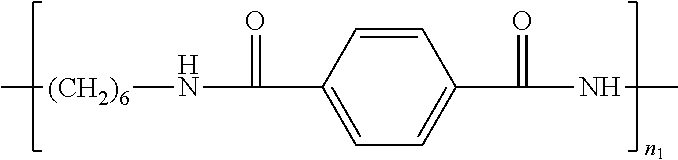
repeating unit B:
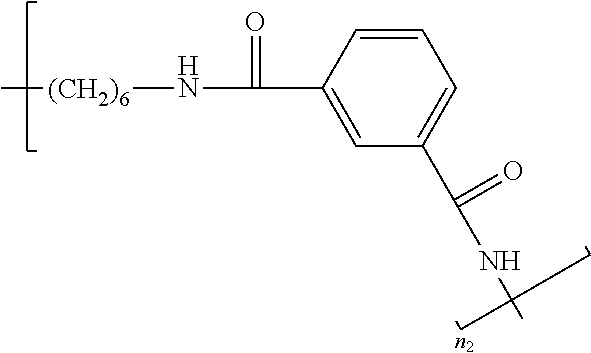

wherein n denotes the degree of polymerisation.
-
- a) Preselection of a polymer or copolymer having at least one of the following structural characteristics and/or modifications:
- (i) at least one branching group within the backbone chain of the polymer or copolymer, provided that in the case of the use of polyaryletherketones (PAEK) the branching group is an aromatic structural unit in the backbone chain of the polymer or copolymer;
- (ii) modifying at least one terminal group of the backbone chain of the polymer or copolymer;
- (iii) at least one bulky group in the backbone chain of the polymer or copolymer, provided that in the case of the use of polyaryletherketones (PAEK) the bulky group is not selected from the group consisting of phenylene, biphenylene, naphthalene and CH2- or isopropylidene-linked aromatics;
- (iv) at least one aromatic group non-linearly linking the backbone chain,
- b) using relatively high molecular masses Mn or Mw or certain melt viscosities,
- c) using long chain lengths or high degrees of polymerisation,
- d) mixing or blending by admixing of at least two different polymers or copolymers.
- a) Preselection of a polymer or copolymer having at least one of the following structural characteristics and/or modifications:
-
- Young's modulus=4500 MPa
- Tensile strength=44 MPa
- Elongation at break=1.04%

which may have an average particle size distribution of <100 μm, is thermally treated above the glass transition temperature in an oven.

which has an average particle size distribution of 50 μm, wherein the PEEK polymer has a molecular weight of Mn=32,000 and Mw=65,000, is thermally treated above the glass transition temperature in an oven.

repeating unit B:

which may have an average particle size distribution of <100 μm is thermally treated above the glass transition temperature in an oven.

-
- R=butyl, hexyl or octyl
- n, m=integers, such that there is a ratio of 15-30 short chain branchings per 1000 C-atoms,
which may have an average particle size distribution of <150 μm.

-
- R=methyl
- n, m=integers, such that there is a ratio of 15-30 short chain branchings per 1000 C-atoms,
which may have an average particle size distribution of <150 μm.
-
- Young's modulus: 4200 MPa
- tensile strength: 39 MPa
- elongation at break: 1.0%
-
- Young's modulus: 3900 MPa
- tensile strength: 69 MPa
- elongation at break: 1.9%
Claims (20)


Priority Applications (1)
| Application Number | Priority Date | Filing Date | Title |
|---|---|---|---|
| US15/856,843 US10556378B2 (en) | 2008-05-20 | 2017-12-28 | Selective sintering of structurally modified polymers |
Applications Claiming Priority (10)
| Application Number | Priority Date | Filing Date | Title |
|---|---|---|---|
| DE102008024288A DE102008024288A1 (en) | 2008-05-20 | 2008-05-20 | Preparing a three-dimensional object from a powder, comprising polymer or copolymer containing an aromatic group that non-linearly links to the main chain, comprises selective sintering of the powder by electromagnetic radiation |
| DE102008024288 | 2008-05-20 | ||
| DE102008024281 | 2008-05-20 | ||
| DE102008024281.0 | 2008-05-20 | ||
| DE102008024281A DE102008024281A1 (en) | 2008-05-20 | 2008-05-20 | Producing a three-dimensional object by selectively sintering a polymer powder comprises using a polymer that has a branching group in the main chain, has a modified terminal group and/or has a bulky group in the main chain |
| DE102008024288.8 | 2008-05-20 | ||
| US18896208P | 2008-08-14 | 2008-08-14 | |
| US18898708P | 2008-08-14 | 2008-08-14 | |
| US12/454,472 US9895842B2 (en) | 2008-05-20 | 2009-05-18 | Selective sintering of structurally modified polymers |
| US15/856,843 US10556378B2 (en) | 2008-05-20 | 2017-12-28 | Selective sintering of structurally modified polymers |
Related Parent Applications (1)
| Application Number | Title | Priority Date | Filing Date |
|---|---|---|---|
| US12/454,472 Division US9895842B2 (en) | 2008-05-20 | 2009-05-18 | Selective sintering of structurally modified polymers |
Publications (2)
| Publication Number | Publication Date |
|---|---|
| US20180117840A1 US20180117840A1 (en) | 2018-05-03 |
| US10556378B2 true US10556378B2 (en) | 2020-02-11 |
Family
ID=41378812
Family Applications (2)
| Application Number | Title | Priority Date | Filing Date |
|---|---|---|---|
| US12/454,472 Active US9895842B2 (en) | 2008-05-20 | 2009-05-18 | Selective sintering of structurally modified polymers |
| US15/856,843 Active US10556378B2 (en) | 2008-05-20 | 2017-12-28 | Selective sintering of structurally modified polymers |
Family Applications Before (1)
| Application Number | Title | Priority Date | Filing Date |
|---|---|---|---|
| US12/454,472 Active US9895842B2 (en) | 2008-05-20 | 2009-05-18 | Selective sintering of structurally modified polymers |
Country Status (8)
| Country | Link |
|---|---|
| US (2) | US9895842B2 (en) |
| EP (2) | EP2145913B2 (en) |
| JP (2) | JP5775249B2 (en) |
| CN (1) | CN104647764B (en) |
| AT (1) | ATE490284T1 (en) |
| BR (1) | BRPI0901530A2 (en) |
| DE (1) | DE602009000411D1 (en) |
| RU (1) | RU2498901C2 (en) |
Families Citing this family (67)
| Publication number | Priority date | Publication date | Assignee | Title |
|---|---|---|---|---|
| EP3323601B1 (en) * | 2008-05-20 | 2022-04-27 | EOS GmbH Electro Optical Systems | Influencing specific mechanical properties of three-dimensional objects manufactured by a selective sintering by means of electromagnetic radiation from a powder comprising at least one polymer or copolymer |
| US9895842B2 (en) * | 2008-05-20 | 2018-02-20 | Eos Gmbh Electro Optical Systems | Selective sintering of structurally modified polymers |
| EP2627687B1 (en) * | 2010-09-27 | 2021-09-22 | Arkema, Inc. | Heat treated polymer powders |
| GB201108455D0 (en) | 2011-05-20 | 2011-07-06 | Eads Uk Ltd | Polymer additive layer muanfacturing |
| US10011089B2 (en) | 2011-12-31 | 2018-07-03 | The Boeing Company | Method of reinforcement for additive manufacturing |
| DE102012207609A1 (en) * | 2012-05-08 | 2013-11-14 | Evonik Industries Ag | METHOD FOR THE LAYERED MANUFACTURE OF THREE-DIMENSIONAL OBJECTS |
| DE102012212587A1 (en) | 2012-07-18 | 2014-01-23 | Eos Gmbh Electro Optical Systems | Apparatus and method for layering a three-dimensional object |
| US10023739B2 (en) | 2012-11-21 | 2018-07-17 | Stratasys, Inc. | Semi-crystalline build materials |
| US9527242B2 (en) * | 2012-11-21 | 2016-12-27 | Stratasys, Inc. | Method for printing three-dimensional parts wtih crystallization kinetics control |
| US9925714B2 (en) | 2012-11-21 | 2018-03-27 | Stratasys, Inc. | Method for printing three-dimensional items wtih semi-crystalline build materials |
| US10144828B2 (en) | 2012-11-21 | 2018-12-04 | Stratasys, Inc. | Semi-crystalline build materials |
| US12064917B2 (en) | 2012-11-21 | 2024-08-20 | Stratasys, Inc. | Method for printing three-dimensional parts with cyrstallization kinetics control |
| EP2746319B1 (en) | 2012-12-21 | 2015-09-09 | Materialise N.V. | Method for manufacturing objects by selective sintering |
| US20140271326A1 (en) | 2013-03-15 | 2014-09-18 | 3D Systems, Inc. | Powder Distribution for Laser Sintering Systems |
| FR3015506B1 (en) * | 2013-12-20 | 2017-04-21 | Arkema France | COMPOSITION OF POLY-ARYLENE-ETHER-KETONE-KETONES POWDERS ALLOWING EXCELLENT COMPROMISE COULABILITY AND COALESCENCE ADAPTED FOR LASER SINTERING |
| EP3094684B1 (en) | 2014-01-17 | 2021-03-31 | Lubrizol Advanced Materials, Inc. | Methods of using thermoplastic polyurethanes in selective laser sintering and systems and articles thereof |
| GB2526243B (en) † | 2014-02-24 | 2021-07-14 | Victrex Mfg Ltd | Polymeric materials |
| KR102180185B1 (en) * | 2014-04-30 | 2020-11-18 | 휴렛-팩커드 디벨롭먼트 컴퍼니, 엘.피. | Computational model and three-dimensional (3d) printing methods |
| US9534086B2 (en) * | 2014-05-07 | 2017-01-03 | International Business Machines Corporation | Methods of forming poly(aryl ether sulfone)s and articles therefrom |
| US10723115B2 (en) * | 2014-09-30 | 2020-07-28 | Hewlett-Packard Development Company, L.P. | Cooling times for three-dimensional objects |
| FR3027603B1 (en) | 2014-10-22 | 2016-11-18 | Arkema France | COMPOSITION BASED ON POLYARYLENE ETHER-KETONE WITH IMPROVED PROPERTIES |
| FR3027834B1 (en) * | 2014-11-03 | 2017-11-10 | Arkema France | PROCESS FOR THE DENSIFICATION OF POLYARYLENE ETHER-KETONE POWDERS |
| EP3050540B1 (en) | 2015-01-27 | 2022-04-20 | K2M, Inc. | Spinal implant |
| US10028841B2 (en) | 2015-01-27 | 2018-07-24 | K2M, Inc. | Interbody spacer |
| WO2016121013A1 (en) * | 2015-01-28 | 2016-08-04 | 株式会社日立製作所 | Resin powder material, laser powder molding method and device |
| DE102015202964A1 (en) | 2015-02-18 | 2016-08-18 | Eos Gmbh Electro Optical Systems | Device and method for producing a three-dimensional object |
| US9695280B2 (en) * | 2015-03-03 | 2017-07-04 | Ricoh Co., Ltd. | Methods for solid freeform fabrication |
| CN107548349A (en) * | 2015-06-10 | 2018-01-05 | 惠普发展公司有限责任合伙企业 | Build temperature modulation |
| US11065860B2 (en) * | 2015-08-13 | 2021-07-20 | Corning Incorporated | Method and system for printing 3D objects |
| US10317349B2 (en) * | 2015-11-30 | 2019-06-11 | The Boeing Company | X-ray scatter systems and methods for detecting structural variations |
| US11110517B2 (en) * | 2015-12-11 | 2021-09-07 | Eos Gmbh Electro Optical Systems | Method and device for examining an input data set of a generative layer building device |
| WO2017116885A1 (en) * | 2015-12-28 | 2017-07-06 | Arkema Inc. | Processes for producing polymer powders |
| SG11201806061RA (en) * | 2016-02-19 | 2018-09-27 | Basf Se | Anti-nucleating agent for laser sintering powder |
| US10370530B2 (en) * | 2016-02-26 | 2019-08-06 | Ricoh Company, Ltd. | Methods for solid freeform fabrication |
| US10766197B2 (en) * | 2016-03-31 | 2020-09-08 | Hexcel Corporation | Apparatus and method for selective laser sintering an object with a void |
| FR3050993B1 (en) * | 2016-05-09 | 2020-01-31 | Arkema France | LOW-RATE POLY- (ARYL-ETHER-CETONE) (PAEK) COMPOSITION AND ITS USE IN A SINTERING PROCESS |
| US10427353B2 (en) * | 2016-05-13 | 2019-10-01 | Ricoh Company, Ltd. | Additive manufacturing using stimuli-responsive high-performance polymers |
| DE102016209719A1 (en) * | 2016-06-02 | 2017-12-07 | Siemens Aktiengesellschaft | Plastic-based materials for processing by means of generative manufacturing processes |
| JP6812682B2 (en) * | 2016-07-04 | 2021-01-13 | 株式会社リコー | Method for manufacturing resin composition for three-dimensional modeling and three-dimensional modeling |
| JP6402810B1 (en) | 2016-07-22 | 2018-10-10 | 株式会社リコー | Three-dimensional modeling resin powder, three-dimensional model manufacturing apparatus, and three-dimensional model manufacturing method |
| TW201821534A (en) | 2016-07-29 | 2018-06-16 | 巴斯夫歐洲公司 | Polyamine blends containing polyaryl ethers for use in laser sintered powders |
| CN106334792A (en) * | 2016-11-02 | 2017-01-18 | 青岛科技大学 | Preparing and printing molding methods for metal low-temperature 3D printing material |
| EP3321002A1 (en) * | 2016-11-15 | 2018-05-16 | Höganäs AB | Feedstock for an additive manufacturing method, additive manufacturing method using the same, and article obtained therefrom |
| CN106853687B (en) * | 2017-01-09 | 2019-06-11 | 北京彩韵数码科技有限公司 | A kind of color jet-ink 3D printing method of automatic equating |
| ES2986838T3 (en) * | 2017-04-25 | 2024-11-12 | Solvay Specialty Polymers Usa | Method of preparing a three-dimensional object using a poly(ether ether ketone) polymer component |
| JP7466267B2 (en) | 2017-05-25 | 2024-04-12 | ストライカー・ユーロピアン・オペレイションズ・ホールディングス・リミテッド・ライアビリティ・カンパニー | Fusion cage with integrated fixation and insertion features |
| JP2019001154A (en) * | 2017-06-13 | 2019-01-10 | 株式会社リコー | Three-dimensional modeling resin powder, three-dimensional modeling apparatus, three-dimensional model manufacturing method, and resin powder |
| US11851526B2 (en) * | 2017-06-30 | 2023-12-26 | Solvay Specialty Polymers Usa, Llc | Poly(ether ketone ketone) polymer powder having a low volatiles content |
| US11006981B2 (en) | 2017-07-07 | 2021-05-18 | K2M, Inc. | Surgical implant and methods of additive manufacturing |
| EP3678602A4 (en) | 2017-09-08 | 2021-10-06 | Pioneer Surgical Technology, Inc. | INTERVERTEBRAL IMPLANTS, INSTRUMENTS AND PROCESSES |
| CN111201283B (en) * | 2017-09-15 | 2024-04-26 | 阿科玛股份有限公司 | PEKK extrusion additive manufacturing methods and products |
| EP3684838A1 (en) * | 2017-09-18 | 2020-07-29 | Solvay Specialty Polymers USA, LLC | Additive manufacturing method for making a three-dimensional object using selective laser sintering |
| US11485072B2 (en) | 2017-10-27 | 2022-11-01 | DePuy Synthes Products, Inc. | Selective laser sintering of asymmetric particles |
| EP3710255A1 (en) * | 2017-11-14 | 2020-09-23 | EOS GmbH Electro Optical Systems | Composition for an additive manufacturing process |
| WO2019142942A1 (en) * | 2018-01-22 | 2019-07-25 | Dic株式会社 | Polyarylene ether ketone resin and production method thereof, and molded body |
| US12485606B1 (en) * | 2018-03-30 | 2025-12-02 | University Of South Florida | System and method for improving mechanical properties of polymer powder bed fusion processes |
| EP3880437A1 (en) * | 2018-11-13 | 2021-09-22 | Solvay Specialty Polymers USA, LLC. | Additive manufacturing method for making a three-dimensional object using selective laser sintering |
| WO2020141329A1 (en) | 2019-01-04 | 2020-07-09 | Victrex Manufacturing Limited | Polymeric material, manufacture and use |
| US11534307B2 (en) | 2019-09-16 | 2022-12-27 | K2M, Inc. | 3D printed cervical standalone implant |
| JP2023507985A (en) | 2019-12-17 | 2023-02-28 | ティコナ・エルエルシー | Three-dimensional printing system using thermotropic liquid crystal polymer |
| US12234364B2 (en) | 2019-12-17 | 2025-02-25 | Ticona Llc | Three-dimensional printing system employing a thermally conductive polymer composition |
| ES2978491T3 (en) * | 2020-03-10 | 2024-09-13 | Solvay Specialty Polymers Usa | Powder material containing poly(arylene sulfide) and its use for additive manufacturing |
| EP3909748A1 (en) | 2020-05-12 | 2021-11-17 | TIGER Coatings GmbH & Co. KG | Thermosetting material for use in additive manufacturing |
| KR20230025413A (en) * | 2020-06-11 | 2023-02-21 | 솔베이 스페셜티 폴리머즈 유에스에이, 엘.엘.씨. | Fiber Reinforced Thermoplastic Matrix Composites |
| GB2600905A (en) | 2020-06-18 | 2022-05-18 | Victrex Mfg Ltd | Polymeric material and use thereof |
| US11925981B2 (en) | 2020-06-29 | 2024-03-12 | Arcam Ab | Method, apparatus and control unit for selectively sintering a powder layer in additive manufacturing processes to achieve a future, desired heat conductivity |
| EP3940016A1 (en) * | 2020-07-16 | 2022-01-19 | Evonik Operations GmbH | Polyether ether ketones |
Citations (35)
| Publication number | Priority date | Publication date | Assignee | Title |
|---|---|---|---|---|
| DE1942452A1 (en) | 1968-08-20 | 1970-04-23 | Du Pont | Polyamide molding compound |
| US3516966A (en) | 1968-02-05 | 1970-06-23 | Du Pont | Polyketone copolymers |
| US4863538A (en) | 1986-10-17 | 1989-09-05 | Board Of Regents, The University Of Texas System | Method and apparatus for producing parts by selective sintering |
| JPH0641295A (en) | 1992-03-04 | 1994-02-15 | Asahi Chem Ind Co Ltd | End-blocked aromatic polyether ketone and its production |
| WO1994015771A1 (en) | 1993-01-11 | 1994-07-21 | Eos Gmbh Electro Optical Systems | Process and device for manufacturing three-dimensional objects |
| DE4410046C1 (en) | 1994-03-23 | 1995-05-24 | Eos Electro Optical Syst | Method and material for producing a three-dimensional object by sintering |
| US5429908A (en) | 1993-04-12 | 1995-07-04 | E. I. Du Pont De Nemours And Company | Exposure method for reducing distortion in models produced through solid imaging by forming a non-continuous image of a pattern which is then imaged to form a continuous hardened image of the pattern |
| CN1155258A (en) | 1994-09-16 | 1997-07-23 | Eos有限公司 | A method for manufacturing a three-dimensional object |
| RU2145269C1 (en) | 1995-06-16 | 2000-02-10 | Самарский филиал Физического института им.П.Н.Лебедева РАН | Method for making three-dimensional products of powder composition |
| US6136948A (en) * | 1992-11-23 | 2000-10-24 | Dtm Corporation | Sinterable semi-crystalline powder and near-fully dense article formed therewith |
| DE10129305A1 (en) | 2001-06-18 | 2002-12-19 | Bayer Ag | Production of three-dimensional models by rapid prototyping with laser sintering, involves treating thermoplastic powder particle surfaces to modify their structure |
| JP2003506229A (en) | 1999-08-06 | 2003-02-18 | イーオーエス ゲゼルシャフト ミット ベシュレンクテル ハフツング イレクトロ オプティカル システムズ | Method and apparatus for manufacturing a three-dimensional object |
| JP2003335816A (en) | 2002-05-22 | 2003-11-28 | Kyowa Yuka Co Ltd | Method for producing vinyl ether polymer having terminal carboxyl group |
| EP1413594A2 (en) | 2002-10-17 | 2004-04-28 | Degussa AG | Laser-sintering powder with better recycling properties, process for its preparation and use thereof. |
| JP2005089863A (en) | 2003-09-15 | 2005-04-07 | Trumpf Werkzeugmaschinen Gmbh & Co Kg | Apparatus and method for manufacturing three-dimensional molding |
| WO2005097475A1 (en) | 2004-03-30 | 2005-10-20 | Valspar Sourcing, Inc. | Selective laser sintering process and polymers used therein |
| RU2005122938A (en) | 2002-12-20 | 2006-01-20 | Юниверсити Оф Саутерн Калифорния (Us) | METHOD FOR REDUCING POWDER WASTE DURING SELECTIVE INHIBITION OF SINTERING |
| US20060071359A1 (en) | 2004-10-01 | 2006-04-06 | Degussa Ag | Power with improved recycling properties, process for its production, and use of the power in a process for producing three-dimensional objects |
| DE202005020596U1 (en) | 2004-03-21 | 2006-05-04 | Toyota Motorsport Gmbh | Powder for rapid prototyping |
| US20060134419A1 (en) | 2004-12-21 | 2006-06-22 | Degussa Ag | Use of polyarylene ether ketone powder in a three-dimensional powder-based moldless production process, and moldings produced therefrom |
| JP2006225664A (en) | 2005-02-19 | 2006-08-31 | Degussa Ag | Polymer powder containing block polyether amide, its use in molding method and molded article produced from the polymer powder |
| US20060251878A1 (en) | 2003-09-26 | 2006-11-09 | Victrex Manufacturing Limited | Polymeric material |
| EP1787789A1 (en) | 2005-11-17 | 2007-05-23 | Degussa GmbH | Stereolithographic process for the fabrication of three-dimensional articles by using polyester powder and article obtained by said process |
| JP2007523774A (en) | 2004-02-27 | 2007-08-23 | デグサ ゲーエムベーハー | POLYMER POWDER CONTAINING COPOLYMER, USE IN MOLDING METHOD WITH UNFOCUSED ENERGY SUPPLY AND MOLDED BODY MADE FROM THIS POLYMER POWDER |
| JP2007217651A (en) | 2006-02-20 | 2007-08-30 | Daicel Chem Ind Ltd | Spherical particles of cyclic polyolefin resin and method for producing the same |
| JP2007277546A (en) | 2006-04-01 | 2007-10-25 | Degussa Gmbh | POLYMER POWDER, PROCESS FOR PRODUCING THE POWDER AND USE THEREOF, AND MOLDED BODY COMPRISING THE POWDER |
| EP1849586A1 (en) | 2006-04-28 | 2007-10-31 | Envisiontec GmbH | Device and method for creating a three dimensional object using mask illumination |
| JP2007303601A (en) | 2006-05-12 | 2007-11-22 | Nsk Ltd | Rolling bearings for hybrid vehicles |
| WO2008057844A1 (en) | 2006-11-09 | 2008-05-15 | Valspar Sourcing, Inc. | Powder compositions and methods of manufacturing articles therefrom |
| EP1925435A1 (en) | 2006-11-22 | 2008-05-28 | EOS GmbH Electro Optical Systems | Apparatus for layerwise manufacturing of three dimensional objects |
| US20080152910A1 (en) | 2004-03-21 | 2008-06-26 | Eos Gmbh Electro Optical Systems | N/a |
| US20080228498A1 (en) | 2004-07-15 | 2008-09-18 | Gasque Samuel N | Enhanced coordinated signal generation apparatus |
| WO2008122426A2 (en) | 2007-04-05 | 2008-10-16 | Eos Gmbh Electro Optical Systems | Paek powder, particularly for use in a method for the production of a three-dimensional object in layers, and method for the production thereof |
| DE102007024469A1 (en) | 2007-05-25 | 2008-11-27 | Eos Gmbh Electro Optical Systems | Method of layering a three-dimensional object |
| WO2009114715A2 (en) | 2008-03-14 | 2009-09-17 | Valspar Sourcing, Inc. | Powder compositions and methods of manufacturing articles therefrom |
Family Cites Families (2)
| Publication number | Priority date | Publication date | Assignee | Title |
|---|---|---|---|---|
| US20050228498A1 (en) | 2003-11-18 | 2005-10-13 | Todd Andres | Osteoconductive integrated spinal cage and method of making same |
| US9895842B2 (en) * | 2008-05-20 | 2018-02-20 | Eos Gmbh Electro Optical Systems | Selective sintering of structurally modified polymers |
-
2009
- 2009-05-18 US US12/454,472 patent/US9895842B2/en active Active
- 2009-05-19 DE DE602009000411T patent/DE602009000411D1/en active Active
- 2009-05-19 RU RU2009118968/05A patent/RU2498901C2/en active
- 2009-05-19 CN CN201410850625.7A patent/CN104647764B/en active Active
- 2009-05-19 EP EP09160642.6A patent/EP2145913B2/en active Active
- 2009-05-19 EP EP10175677.3A patent/EP2272899B2/en active Active
- 2009-05-19 JP JP2009120514A patent/JP5775249B2/en active Active
- 2009-05-19 AT AT09160642T patent/ATE490284T1/en not_active IP Right Cessation
- 2009-05-20 BR BRPI0901530-2A patent/BRPI0901530A2/en not_active Application Discontinuation
-
2015
- 2015-07-02 JP JP2015133510A patent/JP6291459B2/en active Active
-
2017
- 2017-12-28 US US15/856,843 patent/US10556378B2/en active Active
Patent Citations (55)
| Publication number | Priority date | Publication date | Assignee | Title |
|---|---|---|---|---|
| US3516966A (en) | 1968-02-05 | 1970-06-23 | Du Pont | Polyketone copolymers |
| DE1942452A1 (en) | 1968-08-20 | 1970-04-23 | Du Pont | Polyamide molding compound |
| US3549601A (en) | 1968-08-20 | 1970-12-22 | Peter A Fowell | Polyamide molding resin obtained by polymerizing polyamide precursors in the presence of a critical proportion of end capping agent: branching agent |
| US4863538A (en) | 1986-10-17 | 1989-09-05 | Board Of Regents, The University Of Texas System | Method and apparatus for producing parts by selective sintering |
| JPH0641295A (en) | 1992-03-04 | 1994-02-15 | Asahi Chem Ind Co Ltd | End-blocked aromatic polyether ketone and its production |
| US6136948A (en) * | 1992-11-23 | 2000-10-24 | Dtm Corporation | Sinterable semi-crystalline powder and near-fully dense article formed therewith |
| JPH07501765A (en) | 1993-01-11 | 1995-02-23 | イーオーエス ゲゼルシャフト ミット ベシュレンクテル ハフツング イレクトロ オプティカル システムズ | Method and device for manufacturing three-dimensional objects |
| US5658412A (en) | 1993-01-11 | 1997-08-19 | Eos Gmbh Electro Optical Systems | Method and apparatus for producing a three-dimensional object |
| WO1994015771A1 (en) | 1993-01-11 | 1994-07-21 | Eos Gmbh Electro Optical Systems | Process and device for manufacturing three-dimensional objects |
| US5429908A (en) | 1993-04-12 | 1995-07-04 | E. I. Du Pont De Nemours And Company | Exposure method for reducing distortion in models produced through solid imaging by forming a non-continuous image of a pattern which is then imaged to form a continuous hardened image of the pattern |
| DE4410046C1 (en) | 1994-03-23 | 1995-05-24 | Eos Electro Optical Syst | Method and material for producing a three-dimensional object by sintering |
| CN1155258A (en) | 1994-09-16 | 1997-07-23 | Eos有限公司 | A method for manufacturing a three-dimensional object |
| RU2145269C1 (en) | 1995-06-16 | 2000-02-10 | Самарский филиал Физического института им.П.Н.Лебедева РАН | Method for making three-dimensional products of powder composition |
| US6932935B1 (en) | 1999-08-06 | 2005-08-23 | Eos Gmbh Electro Optical Systems | Method and device for producing a three-dimensional object |
| JP2003506229A (en) | 1999-08-06 | 2003-02-18 | イーオーエス ゲゼルシャフト ミット ベシュレンクテル ハフツング イレクトロ オプティカル システムズ | Method and apparatus for manufacturing a three-dimensional object |
| DE10129305A1 (en) | 2001-06-18 | 2002-12-19 | Bayer Ag | Production of three-dimensional models by rapid prototyping with laser sintering, involves treating thermoplastic powder particle surfaces to modify their structure |
| JP2003335816A (en) | 2002-05-22 | 2003-11-28 | Kyowa Yuka Co Ltd | Method for producing vinyl ether polymer having terminal carboxyl group |
| EP1413594A2 (en) | 2002-10-17 | 2004-04-28 | Degussa AG | Laser-sintering powder with better recycling properties, process for its preparation and use thereof. |
| US20040102539A1 (en) | 2002-10-17 | 2004-05-27 | Degussa Ag | Laser sintering powder with improved recycling properties, process for its production, and use of the laser sintering powder |
| RU2005122938A (en) | 2002-12-20 | 2006-01-20 | Юниверсити Оф Саутерн Калифорния (Us) | METHOD FOR REDUCING POWDER WASTE DURING SELECTIVE INHIBITION OF SINTERING |
| US20050116391A1 (en) | 2003-09-15 | 2005-06-02 | Markus Lindemann | Apparatus and process for producing a three-dimensional shaped body |
| JP2005089863A (en) | 2003-09-15 | 2005-04-07 | Trumpf Werkzeugmaschinen Gmbh & Co Kg | Apparatus and method for manufacturing three-dimensional molding |
| US20060251878A1 (en) | 2003-09-26 | 2006-11-09 | Victrex Manufacturing Limited | Polymeric material |
| US20070197692A1 (en) | 2004-02-27 | 2007-08-23 | Degussa Ag | Polymer powder comprising a copolymer, use in a shaping method which uses a non-focused application of energy and moulded body that is produced from said polymer powder |
| JP2007523774A (en) | 2004-02-27 | 2007-08-23 | デグサ ゲーエムベーハー | POLYMER POWDER CONTAINING COPOLYMER, USE IN MOLDING METHOD WITH UNFOCUSED ENERGY SUPPLY AND MOLDED BODY MADE FROM THIS POLYMER POWDER |
| JP2007535585A (en) | 2004-03-21 | 2007-12-06 | トヨタ モータースポーツ ゲーエムベーハー | Rapid prototyping powder and method for producing the same |
| DE202005020596U1 (en) | 2004-03-21 | 2006-05-04 | Toyota Motorsport Gmbh | Powder for rapid prototyping |
| US20080152910A1 (en) | 2004-03-21 | 2008-06-26 | Eos Gmbh Electro Optical Systems | N/a |
| WO2005097475A1 (en) | 2004-03-30 | 2005-10-20 | Valspar Sourcing, Inc. | Selective laser sintering process and polymers used therein |
| US20080228498A1 (en) | 2004-07-15 | 2008-09-18 | Gasque Samuel N | Enhanced coordinated signal generation apparatus |
| DE102004047876A1 (en) | 2004-10-01 | 2006-04-06 | Degussa Ag | Powder with improved recycling properties, process for its preparation and use of the powder in a process for producing three-dimensional objects |
| US20060071359A1 (en) | 2004-10-01 | 2006-04-06 | Degussa Ag | Power with improved recycling properties, process for its production, and use of the power in a process for producing three-dimensional objects |
| US20060134419A1 (en) | 2004-12-21 | 2006-06-22 | Degussa Ag | Use of polyarylene ether ketone powder in a three-dimensional powder-based moldless production process, and moldings produced therefrom |
| EP1674497A1 (en) | 2004-12-21 | 2006-06-28 | Degussa AG | Use of polyarylene ether ketone powder in a powder-based tridimensional tool-less method of manufacturing and shaped articles obtained therefrom |
| JP2006225664A (en) | 2005-02-19 | 2006-08-31 | Degussa Ag | Polymer powder containing block polyether amide, its use in molding method and molded article produced from the polymer powder |
| US20070126159A1 (en) | 2005-11-17 | 2007-06-07 | Degussa Ag | Use of polyester powder in a shaping process, and moldings produced from this polyester powder |
| EP1787789A1 (en) | 2005-11-17 | 2007-05-23 | Degussa GmbH | Stereolithographic process for the fabrication of three-dimensional articles by using polyester powder and article obtained by said process |
| JP2007217651A (en) | 2006-02-20 | 2007-08-30 | Daicel Chem Ind Ltd | Spherical particles of cyclic polyolefin resin and method for producing the same |
| JP2007277546A (en) | 2006-04-01 | 2007-10-25 | Degussa Gmbh | POLYMER POWDER, PROCESS FOR PRODUCING THE POWDER AND USE THEREOF, AND MOLDED BODY COMPRISING THE POWDER |
| EP1849586A1 (en) | 2006-04-28 | 2007-10-31 | Envisiontec GmbH | Device and method for creating a three dimensional object using mask illumination |
| US20070260349A1 (en) | 2006-04-28 | 2007-11-08 | Envisiontec Gmbh | Device and method for producing a three-dimensional object by means of mask exposure |
| JP2007303601A (en) | 2006-05-12 | 2007-11-22 | Nsk Ltd | Rolling bearings for hybrid vehicles |
| WO2008057844A1 (en) | 2006-11-09 | 2008-05-15 | Valspar Sourcing, Inc. | Powder compositions and methods of manufacturing articles therefrom |
| US20080138454A1 (en) | 2006-11-22 | 2008-06-12 | Eos Gmbh Electro Optical Systems | Device for a layer-wise manufacturing of a three-dimensional object |
| EP1925435A1 (en) | 2006-11-22 | 2008-05-28 | EOS GmbH Electro Optical Systems | Apparatus for layerwise manufacturing of three dimensional objects |
| WO2008122426A2 (en) | 2007-04-05 | 2008-10-16 | Eos Gmbh Electro Optical Systems | Paek powder, particularly for use in a method for the production of a three-dimensional object in layers, and method for the production thereof |
| US20080258330A1 (en) | 2007-04-05 | 2008-10-23 | Eos Gmbh Electro Optical Systems | PAEK powder, in particular for the use in a method for a layer-wise manufacturing of a three-dimensional object, as well as method for producing it |
| EP2115043A2 (en) | 2007-04-05 | 2009-11-11 | EOS GmbH Electro Optical Systems | Paek powder, particularly for use in a method for the production of a three-dimensional object in layers, and method for the production thereof |
| WO2008145316A2 (en) | 2007-05-25 | 2008-12-04 | Eos Gmbh Electro Optical Systems | Method for the layered production of a three-dimensional object |
| US20090017220A1 (en) | 2007-05-25 | 2009-01-15 | Eos Gmbh Electro Optical Systems | Method for a layer-wise manufacturing of a three-dimensional object |
| EP2106337A2 (en) | 2007-05-25 | 2009-10-07 | EOS GmbH Electro Optical Systems | Method for the layered production of a three-dimensional object |
| DE102007024469A1 (en) | 2007-05-25 | 2008-11-27 | Eos Gmbh Electro Optical Systems | Method of layering a three-dimensional object |
| BRPI0812112A2 (en) | 2007-05-25 | 2014-11-25 | Eos Electro Optical Syst | METHOD FOR THE LAYER PRODUCTION OF A THREE-DIMENSIONAL OBJECT |
| WO2009114715A2 (en) | 2008-03-14 | 2009-09-17 | Valspar Sourcing, Inc. | Powder compositions and methods of manufacturing articles therefrom |
| US20110052927A1 (en) * | 2008-03-14 | 2011-03-03 | Valspar Sourcing, Inc. | Powder Compositions and Methods of Manufacturing Articles Therefrom |
Non-Patent Citations (27)
| Title |
|---|
| Chang and Hsiao, Thermal Properties of High Performance Thermoplastic Composites Based on Poly(Ether Ketone Ketone) (PEKK), 36th International SAMPE Symposium, Apr. 15-18, 1991, pp. 1587-1601. |
| Chinese Office Action dated Jun. 12, 2016, issued during the prosecution of corresponding Chinese Patent Application No. 201410850625.7. |
| Communication of a Notice of Opposition issued in corresponding European Patent Application No. 10175677.3, dated Nov. 23, 2017. |
| Cowie, "Polymers: Chemistry & Physics of modern materials", 2. Edition, p. 236. |
| Decision on Grant of Patent for Invention dated Jun. 14, 2013 in corresponding Russian Patent Application No. 2009118968/05(026103). |
| DIN 53 765 "Testing of plastics and elastomeres; Thermal analysis; DSC-method", Mar. 1994. |
| DIN-EN ISA 1183-1, Plastics "Methods for determining the density of non-cellular plastics" Part 1: Immersion method, liquid pyknometer method and titration method (ISO 1183-1 : 2004) English version of DIN EN ISO 1183-1, 2004. |
| English translation. |
| Gardner et al., Structure, crystallization and morphology of poly(aryl ether ketone ketone), Polymer, 33(12), 1992, pp. 2483-2495. |
| Hsiao and Chang, Thermal behavior of high-performance poly(aryl ether ketone ketone (PEKK), Polymer Reprints (Am.Chem.Soc., Div. Polymer Chem.), 32(2), 1991, pp. 265-266. |
| Interlocutory Decision of EPO in Opposition Proceedings in Patent No. 2 272 899 dated Oct. 24, 2019. |
| ISO 527-2, Plastics-Determination of tensile properties-Part 2: "Test conditions for moulding and extrusion plastics", Jun. 15, 1993. |
| ISO 527-2, Plastics—Determination of tensile properties—Part 2: "Test conditions for moulding and extrusion plastics", Jun. 15, 1993. |
| Japanes Office Action dated Jun. 8, 2016, and English translation thereof, issued during the prosecution of corresponding Japanese Patent Application No. 2015-133510. |
| Japanese Office Action issued by the Japanese Patent Office dated Apr. 5, 2017, in corresponding Japanese Patent Application No. 2015-133510. |
| Legrass et al., "Extension of the concept of chemical nucleation to polly(ether ketones)", Polymer, 1990, vol. 31, Aug. 1990, pp. 1429-1434. |
| Notification of the First Office Action, issued in corresponding Chinese Patent Application No. CN 201410850625.7, dated Jun. 12, 2016. |
| Omexus Complete Guide on Polybutylene Terephthalate (PBT)-Accessed and Printed from Omnexus Website dated Jun. 6, 2019. |
| Omexus Complete Guide on Polybutylene Terephthalate (PBT)—Accessed and Printed from Omnexus Website dated Jun. 6, 2019. |
| Polytéréphtalate de butyléne-Wikipédia (French) and English translation-Accessed and Printed from Wikipedia Website dated Dec. 3, 2019. |
| Polytéréphtalate de butyléne—Wikipédia (French) and English translation—Accessed and Printed from Wikipedia Website dated Dec. 3, 2019. |
| Robert J. Cotter, Excerpt from Chapter 8, "A Handbook of Polyaryehers", 1995, pp. 289-290 and 322-323. |
| Römpp Online, version 3.10, "Molecular mass distribution", Document identifier RD-13-02945, http:/www.roempp.com. |
| Shi et al., Effect of the properties of the polymer materials on the quality of selective laser sintering parts, Proc. IMechE., 218, Part L: J. Materials: Design and Applications, pp. 247-252. |
| Tan et al., Fabrication and characterization of three-dimensional poly(ether-ether-ketone)/-hydrosyapatite biocomposite scaffolds using laser sintering, Proc. IMechE., 219, Part H: J. Engineering in Medicine, pp. 183-194. |
| Tan et al., Scaffold development using selective laser sintering of polyetherketone-hydroxyapatite biocomposite blends, Biomaterials, 24, 2003, pp. 3115-3123. |
| Verification of translation of International Application No. PCT/EP95/03078. |
Also Published As
| Publication number | Publication date |
|---|---|
| HK1135066A1 (en) | 2010-05-28 |
| EP2272899B2 (en) | 2022-06-15 |
| ATE490284T1 (en) | 2010-12-15 |
| EP2145913A1 (en) | 2010-01-20 |
| EP2145913B2 (en) | 2015-06-10 |
| EP2272899B1 (en) | 2017-02-22 |
| US20180117840A1 (en) | 2018-05-03 |
| CN104647764B (en) | 2018-04-24 |
| EP2145913B1 (en) | 2010-12-01 |
| RU2009118968A (en) | 2010-11-27 |
| BRPI0901530A2 (en) | 2010-04-06 |
| US9895842B2 (en) | 2018-02-20 |
| JP2015205513A (en) | 2015-11-19 |
| CN104647764A (en) | 2015-05-27 |
| US20090295042A1 (en) | 2009-12-03 |
| JP2010006057A (en) | 2010-01-14 |
| DE602009000411D1 (en) | 2011-01-13 |
| RU2498901C2 (en) | 2013-11-20 |
| JP5775249B2 (en) | 2015-09-09 |
| HK1209695A1 (en) | 2016-04-08 |
| JP6291459B2 (en) | 2018-03-14 |
| EP2272899A1 (en) | 2011-01-12 |
Similar Documents
| Publication | Publication Date | Title |
|---|---|---|
| US10556378B2 (en) | Selective sintering of structurally modified polymers | |
| US8420001B2 (en) | Influencing specific mechanical properties of three-dimensional objects manufactured by a selective sintering by means of electromagnetic radiation from a powder comprising at least one polymer or copolymer | |
| CN101623929A (en) | Selective sintering of structurally modified polymers | |
| CN106029344B (en) | polymeric material | |
| CN101151322B (en) | polymer material | |
| CN110139888A (en) | Composite articles obtained from reactive precursor materials | |
| KR20220042304A (en) | Polyarylene ether ketone resin, manufacturing method thereof, and molded article | |
| CN105940036B (en) | Polymeric material | |
| WO2008075009A1 (en) | Composite material | |
| CN101213241B (en) | Polymeric materials | |
| HK1209695B (en) | Selective sintering of structurally modified polymers | |
| HK1135066B (en) | Selective sintering of structurally modified polymers | |
| US20200181333A1 (en) | Core-shell filament, method of forming a core-shell filament, method of forming an article by fused filament fabrication, and article formed filament fabrication | |
| HK1139361B (en) | A method for influencing specific mechanical properties of three-dimensional objects manufactured from a powder |
Legal Events
| Date | Code | Title | Description |
|---|---|---|---|
| FEPP | Fee payment procedure |
Free format text: ENTITY STATUS SET TO UNDISCOUNTED (ORIGINAL EVENT CODE: BIG.); ENTITY STATUS OF PATENT OWNER: LARGE ENTITY |
|
| STPP | Information on status: patent application and granting procedure in general |
Free format text: NON FINAL ACTION MAILED |
|
| STPP | Information on status: patent application and granting procedure in general |
Free format text: RESPONSE TO NON-FINAL OFFICE ACTION ENTERED AND FORWARDED TO EXAMINER |
|
| STPP | Information on status: patent application and granting procedure in general |
Free format text: NOTICE OF ALLOWANCE MAILED -- APPLICATION RECEIVED IN OFFICE OF PUBLICATIONS |
|
| STPP | Information on status: patent application and granting procedure in general |
Free format text: AWAITING TC RESP, ISSUE FEE PAYMENT VERIFIED |
|
| STCF | Information on status: patent grant |
Free format text: PATENTED CASE |
|
| MAFP | Maintenance fee payment |
Free format text: PAYMENT OF MAINTENANCE FEE, 4TH YEAR, LARGE ENTITY (ORIGINAL EVENT CODE: M1551); ENTITY STATUS OF PATENT OWNER: LARGE ENTITY Year of fee payment: 4 |