US10497885B2 - Light emitting device and composition used for this light emitting device - Google Patents
Light emitting device and composition used for this light emitting device Download PDFInfo
- Publication number
- US10497885B2 US10497885B2 US15/565,755 US201515565755A US10497885B2 US 10497885 B2 US10497885 B2 US 10497885B2 US 201515565755 A US201515565755 A US 201515565755A US 10497885 B2 US10497885 B2 US 10497885B2
- Authority
- US
- United States
- Prior art keywords
- group
- unsubstituted
- substituted
- atom
- ring
- Prior art date
- Legal status (The legal status is an assumption and is not a legal conclusion. Google has not performed a legal analysis and makes no representation as to the accuracy of the status listed.)
- Active
Links
- 0 *[1*].*[11*]C1C(*)C([13*]*)N2C1C1C([21*]*)C([22*]*)C([23*]*)C([24*]*)C1[Ir]21CCC1.*[2*] Chemical compound *[1*].*[11*]C1C(*)C([13*]*)N2C1C1C([21*]*)C([22*]*)C([23*]*)C([24*]*)C1[Ir]21CCC1.*[2*] 0.000 description 47
- QMMCRCWWCQVLHH-UHFFFAOYSA-N C1CN[Ir]2(C1)CCC2.[1*].[2*] Chemical compound C1CN[Ir]2(C1)CCC2.[1*].[2*] QMMCRCWWCQVLHH-UHFFFAOYSA-N 0.000 description 3
- MEKDPHXPVMKCON-UHFFFAOYSA-N C.CC Chemical compound C.CC MEKDPHXPVMKCON-UHFFFAOYSA-N 0.000 description 2
- WTEWXIOJLNVYBZ-UHFFFAOYSA-N C=CC1=CC=C(N(C2=CC=C(C3=CC=C(N(C4=CC=C(C=C)C=C4)C4=C5C=CC=CC5=CC=C4)C=C3)C=C2)C2=CC=CC3=C2C=CC=C3)C=C1 Chemical compound C=CC1=CC=C(N(C2=CC=C(C3=CC=C(N(C4=CC=C(C=C)C=C4)C4=C5C=CC=CC5=CC=C4)C=C3)C=C2)C2=CC=CC3=C2C=CC=C3)C=C1 WTEWXIOJLNVYBZ-UHFFFAOYSA-N 0.000 description 2
- NNPPMTNAJDCUHE-UHFFFAOYSA-N CC(C)C Chemical compound CC(C)C NNPPMTNAJDCUHE-UHFFFAOYSA-N 0.000 description 2
- QWTDNUCVQCZILF-UHFFFAOYSA-N CCC(C)C Chemical compound CCC(C)C QWTDNUCVQCZILF-UHFFFAOYSA-N 0.000 description 2
- QURFISZWMCKHEV-UHFFFAOYSA-N CCC(N(CC)CC)N(CC)CC Chemical compound CCC(N(CC)CC)N(CC)CC QURFISZWMCKHEV-UHFFFAOYSA-N 0.000 description 2
- WFTQRNTXAPIEBP-UHFFFAOYSA-N B.B.B.B.B.BB.BBB.CCC(N(CC)CC)N(CC)CC Chemical compound B.B.B.B.B.BB.BBB.CCC(N(CC)CC)N(CC)CC WFTQRNTXAPIEBP-UHFFFAOYSA-N 0.000 description 1
- BVXUPWGPPORIMG-UHFFFAOYSA-N BC1=CC(CCCCCCC2(C3=CC=C4CCC4=C3)C3=C(C=CC=C3)C3=C2C=CC=C3)=C(B)C=C1CCCCCCC1(C2=CC=C3CCC3=C2)C2=C(C=CC=C2)C2=C1C=CC=C2.BrC1=CC(CCCCCCC2(C3=CC=C4CCC4=C3)C3=C(C=CC=C3)C3=C2C=CC=C3)=C(Br)C=C1CCCCCCC1(C2=CC=C3CCC3=C2)C2=C(C=CC=C2)C2=C1C=CC=C2.CC(C)(O)C(C)(C)O.CC(C)(O)C(C)(C)O Chemical compound BC1=CC(CCCCCCC2(C3=CC=C4CCC4=C3)C3=C(C=CC=C3)C3=C2C=CC=C3)=C(B)C=C1CCCCCCC1(C2=CC=C3CCC3=C2)C2=C(C=CC=C2)C2=C1C=CC=C2.BrC1=CC(CCCCCCC2(C3=CC=C4CCC4=C3)C3=C(C=CC=C3)C3=C2C=CC=C3)=C(Br)C=C1CCCCCCC1(C2=CC=C3CCC3=C2)C2=C(C=CC=C2)C2=C1C=CC=C2.CC(C)(O)C(C)(C)O.CC(C)(O)C(C)(C)O BVXUPWGPPORIMG-UHFFFAOYSA-N 0.000 description 1
- PRSIFOXFQVOMOR-UHFFFAOYSA-N BrBr.ClCCCCCCC1=CC(Br)=C(CCCCCCCl)C=C1Br.ClCCCCCCC1=CC=C(CCCCCCCl)C=C1 Chemical compound BrBr.ClCCCCCCC1=CC(Br)=C(CCCCCCCl)C=C1Br.ClCCCCCCC1=CC=C(CCCCCCCl)C=C1 PRSIFOXFQVOMOR-UHFFFAOYSA-N 0.000 description 1
- TYXZBMCYWZFXAF-UHFFFAOYSA-N BrC1=CC(CCCCCCC2(C3=CC=C4CCC4=C3)C3=C(C=CC=C3)C3=C2C=CC=C3)=C(Br)C=C1CCCCCCC1(C2=CC=C3CCC3=C2)C2=C(C=CC=C2)C2=C1C=CC=C2.BrC1=CC(CCCCCCI)=C(Br)C=C1CCCCCCI.C1=CC2=C(C=C1)C(C1=CC=C3CCC3=C1)C1=C2C=CC=C1 Chemical compound BrC1=CC(CCCCCCC2(C3=CC=C4CCC4=C3)C3=C(C=CC=C3)C3=C2C=CC=C3)=C(Br)C=C1CCCCCCC1(C2=CC=C3CCC3=C2)C2=C(C=CC=C2)C2=C1C=CC=C2.BrC1=CC(CCCCCCI)=C(Br)C=C1CCCCCCI.C1=CC2=C(C=C1)C(C1=CC=C3CCC3=C1)C1=C2C=CC=C1 TYXZBMCYWZFXAF-UHFFFAOYSA-N 0.000 description 1
- JNMUHOVSWJICIT-UHFFFAOYSA-M BrC1=CC(CCCCCCI)=C(Br)C=C1CCCCCCI.ClCCCCCCC1=CC(Br)=C(CCCCCCCl)C=C1Br.[Na]I Chemical compound BrC1=CC(CCCCCCI)=C(Br)C=C1CCCCCCI.ClCCCCCCC1=CC(Br)=C(CCCCCCCl)C=C1Br.[Na]I JNMUHOVSWJICIT-UHFFFAOYSA-M 0.000 description 1
- SKGXRYRNUBRUHB-UHFFFAOYSA-N BrC1=CC2=C(C=C1)C1=C(C=C(Br)C=C1)C2(C1=CC=C2CCC2=C1)C1=CC2=C(C=C1)CC2.BrC1=CC=C(N(C2=CC=C(Br)C=C2)C2=CC=C3CCC3=C2)C=C1.C=CCCCCC1=CC(B2OC(C)(C)C(C)(C)O2)=C(CCCCC=C)C=C1B1OC(C)(C)C(C)(C)O1.CCCCCCC1=CC(B2OC(C)(C)C(C)(C)O2)=C(CCCCCC)C=C1B1OC(C)(C)C(C)(C)O1.CCCCCCCCC1(CCCCCCCC)C2=C(C=CC(N(C3=CC=C(C)C=C3)C3=CC=C(Br)C=C3)=C2)C2=C1/C=C(N(C1=CC=C(C)C=C1)C1=CC=C(Br)C=C1)\C=C/2 Chemical compound BrC1=CC2=C(C=C1)C1=C(C=C(Br)C=C1)C2(C1=CC=C2CCC2=C1)C1=CC2=C(C=C1)CC2.BrC1=CC=C(N(C2=CC=C(Br)C=C2)C2=CC=C3CCC3=C2)C=C1.C=CCCCCC1=CC(B2OC(C)(C)C(C)(C)O2)=C(CCCCC=C)C=C1B1OC(C)(C)C(C)(C)O1.CCCCCCC1=CC(B2OC(C)(C)C(C)(C)O2)=C(CCCCCC)C=C1B1OC(C)(C)C(C)(C)O1.CCCCCCCCC1(CCCCCCCC)C2=C(C=CC(N(C3=CC=C(C)C=C3)C3=CC=C(Br)C=C3)=C2)C2=C1/C=C(N(C1=CC=C(C)C=C1)C1=CC=C(Br)C=C1)\C=C/2 SKGXRYRNUBRUHB-UHFFFAOYSA-N 0.000 description 1
- ANSPJFDUNAOJOJ-UHFFFAOYSA-N BrC1=CC=C2CCC2=C1.O=C1C2=C(C=CC=C2)C2=C1/C=C\C=C/2.OC1(C2=CC=C3CCC3=C2)C2=C(C=CC=C2)C2=C1/C=C\C=C/2.[Li]CCCC Chemical compound BrC1=CC=C2CCC2=C1.O=C1C2=C(C=CC=C2)C2=C1/C=C\C=C/2.OC1(C2=CC=C3CCC3=C2)C2=C(C=CC=C2)C2=C1/C=C\C=C/2.[Li]CCCC ANSPJFDUNAOJOJ-UHFFFAOYSA-N 0.000 description 1
- FRUKZMXBAHYHCP-UHFFFAOYSA-N BrC1=CC=CC=C1.CC(C)(C)C1=CC=C(N(C2=CC=C(B3OC(C)(C)C(C)(C)O3)C=C2)C2=CC=C(C(C)(C)C)C=C2)C=C1.CC(C)(C)C1=CC=C(N(C2=CC=C(I)C=C2)C2=CC=C(C(C)(C)C)C=C2)C=C1.CC(C)(C)C1=CC=C(N(C2=CC=CC=C2)C2=CC=C(C(C)(C)C)C=C2)C=C1.CC(C)(C)C1=CC=C(NC2=CC=C(C(C)(C)C)C=C2)C=C1 Chemical compound BrC1=CC=CC=C1.CC(C)(C)C1=CC=C(N(C2=CC=C(B3OC(C)(C)C(C)(C)O3)C=C2)C2=CC=C(C(C)(C)C)C=C2)C=C1.CC(C)(C)C1=CC=C(N(C2=CC=C(I)C=C2)C2=CC=C(C(C)(C)C)C=C2)C=C1.CC(C)(C)C1=CC=C(N(C2=CC=CC=C2)C2=CC=C(C(C)(C)C)C=C2)C=C1.CC(C)(C)C1=CC=C(NC2=CC=C(C(C)(C)C)C=C2)C=C1 FRUKZMXBAHYHCP-UHFFFAOYSA-N 0.000 description 1
- LBNOPDFZJDZRST-UHFFFAOYSA-N C#CC.C#CC(C)=O.C1COC1.C=CC.C=CC(C)=O.C=CC=CC.C=CC=CC(C)=O.C=CCC(C)CC=C.C=CCN(C)CC=C.CC.CC1CO1.CN1CC1 Chemical compound C#CC.C#CC(C)=O.C1COC1.C=CC.C=CC(C)=O.C=CC=CC.C=CC=CC(C)=O.C=CCC(C)CC=C.C=CCN(C)CC=C.CC.CC1CO1.CN1CC1 LBNOPDFZJDZRST-UHFFFAOYSA-N 0.000 description 1
- OVIMILHAEBBENP-UHFFFAOYSA-N C#CC.C#CC(C)=O.C1COC1.C=CC.C=CC(C)=O.C=CC=CC.C=CC=CC(C)=O.C=CCC(C)CC=C.C=CCN(C)CC=C.CC.CC1CO1.CN1CC1.CN1CCC1 Chemical compound C#CC.C#CC(C)=O.C1COC1.C=CC.C=CC(C)=O.C=CC=CC.C=CC=CC(C)=O.C=CCC(C)CC=C.C=CCN(C)CC=C.CC.CC1CO1.CN1CC1.CN1CCC1 OVIMILHAEBBENP-UHFFFAOYSA-N 0.000 description 1
- JCZFKSDXMXCLOE-UHFFFAOYSA-N C#CCCCCO.IC1=CC=C(I)C=C1.OCCCCC#CC1=CC=C(C#CCCCCO)C=C1 Chemical compound C#CCCCCO.IC1=CC=C(I)C=C1.OCCCCC#CC1=CC=C(C#CCCCCO)C=C1 JCZFKSDXMXCLOE-UHFFFAOYSA-N 0.000 description 1
- SIFLKVMXTXTAHY-UHFFFAOYSA-N C.C.C.C.CC.CC.CC.CC.CC.CC.CC.CC.CC.CC.CC.CC.CC.CC1=CC2=C(C=CC=C2)C=C1.CC1=CC=CC=C1.CC1=CC=CC=C1.CC1=CC=CC=C1.CC1=CC=CC=C1.CC1=CC=CC=C1.CC1=CC=CC=C1.CC1=CC=CC=C1.CC1=CC=CC=C1.CCC.CCCCCCC.CCCCCCOC.COCCCCOCCCCOCCCCOC.COCCOCCOCCOC.COCCOCCOCCOCCOC.COCCOCCOCCOCCOCCOCCOCCOCCOCCOCCOC Chemical compound C.C.C.C.CC.CC.CC.CC.CC.CC.CC.CC.CC.CC.CC.CC.CC.CC1=CC2=C(C=CC=C2)C=C1.CC1=CC=CC=C1.CC1=CC=CC=C1.CC1=CC=CC=C1.CC1=CC=CC=C1.CC1=CC=CC=C1.CC1=CC=CC=C1.CC1=CC=CC=C1.CC1=CC=CC=C1.CCC.CCCCCCC.CCCCCCOC.COCCCCOCCCCOCCCCOC.COCCOCCOCCOC.COCCOCCOCCOCCOC.COCCOCCOCCOCCOCCOCCOCCOCCOCCOCCOC SIFLKVMXTXTAHY-UHFFFAOYSA-N 0.000 description 1
- HUOJOGUXDVWREH-UHFFFAOYSA-N C.C.C.CC.CC1=CC2=C(C=CC=C2)C=C1.CC1=CC=CC=C1.CC1=CC=CC=C1.CC1=CC=CC=C1.CC1=CC=CC=C1.CC1=CC=CC=C1.CC1=CC=CC=C1.CC1=CC=CC=C1.CCC(=O)[O-]C.CCCCCCC.CCCCCCCCCC.CCCCCCCCCOC.CCCCCCOC.COCCOCCOCCOC.COCCOCCOCCOCCOC.COCCOCCOCCOCCOCCOCCOCCOCCOCCOCCOC.C[O-]C(C)=O.C[O-]C(C)=O.C[O-]C(C)=O.C[O-]C(C)=O.C[O-]C(C)=O.C[O-]C(C)=O.C[O-]C(C)=O.C[O-]C(C)=O Chemical compound C.C.C.CC.CC1=CC2=C(C=CC=C2)C=C1.CC1=CC=CC=C1.CC1=CC=CC=C1.CC1=CC=CC=C1.CC1=CC=CC=C1.CC1=CC=CC=C1.CC1=CC=CC=C1.CC1=CC=CC=C1.CCC(=O)[O-]C.CCCCCCC.CCCCCCCCCC.CCCCCCCCCOC.CCCCCCOC.COCCOCCOCCOC.COCCOCCOCCOCCOC.COCCOCCOCCOCCOCCOCCOCCOCCOCCOCCOC.C[O-]C(C)=O.C[O-]C(C)=O.C[O-]C(C)=O.C[O-]C(C)=O.C[O-]C(C)=O.C[O-]C(C)=O.C[O-]C(C)=O.C[O-]C(C)=O HUOJOGUXDVWREH-UHFFFAOYSA-N 0.000 description 1
- LJWXEHILZFDBFS-CTLYRITESA-N C.C.CC(C)(C)C1(C)CCCC1.CC12CCCCC1(C)CCCC2.CC1CCCC1(C)C.CC1CCCCC1(C)C.C[C@]12CCC[C@@]1(C)CCC2 Chemical compound C.C.CC(C)(C)C1(C)CCCC1.CC12CCCCC1(C)CCCC2.CC1CCCC1(C)C.CC1CCCCC1(C)C.C[C@]12CCC[C@@]1(C)CCC2 LJWXEHILZFDBFS-CTLYRITESA-N 0.000 description 1
- BSYMWAWSXISHCU-UHFFFAOYSA-N C1=CC(C2=CC=C(N(C3=CC=C(C4=CC=CC(C5=CC=C6CCC6=C5)=C4)C=C3)C3=CC=C(C4=CC(C5=CC6=C(C=C5)CC6)=CC=C4)C=C3)C=C2)=CC(C2=CC3=C(C=C2)CC3)=C1.C1=CC(OC2=CC=C3CCC3=C2)=CC(C2=CC=C(N(C3=CC=C(C4=CC(OC5=CC6=C(C=C5)CC6)=CC=C4)C=C3)C3=CC=C(C4=CC(OC5=CC6=C(C=C5)CC6)=CC=C4)C=C3)C=C2)=C1.CCC1(COC2=CC=CC(C3=CC=C(N(C4=CC=C(C5=CC=CC(OCC6(CC)COC6)=C5)C=C4)C4=CC=C(C5=CC(OCC6(CC)COC6)=CC=C5)C=C4)C=C3)=C2)COC1.CCCCC1=CC=C(N(C2=CC=C(CCCC)C=C2)C2=CC=C(N(C3=CC=C(N(C4=CC=C(N(C5=CC=C(CCCC)C=C5)C5=CC=C(CCCC)C=C5)C=C4)C4=CC5=C(C=C4)CC5)C=C3)C3=CC4=C(C=C3)CC4)C=C2)C=C1 Chemical compound C1=CC(C2=CC=C(N(C3=CC=C(C4=CC=CC(C5=CC=C6CCC6=C5)=C4)C=C3)C3=CC=C(C4=CC(C5=CC6=C(C=C5)CC6)=CC=C4)C=C3)C=C2)=CC(C2=CC3=C(C=C2)CC3)=C1.C1=CC(OC2=CC=C3CCC3=C2)=CC(C2=CC=C(N(C3=CC=C(C4=CC(OC5=CC6=C(C=C5)CC6)=CC=C4)C=C3)C3=CC=C(C4=CC(OC5=CC6=C(C=C5)CC6)=CC=C4)C=C3)C=C2)=C1.CCC1(COC2=CC=CC(C3=CC=C(N(C4=CC=C(C5=CC=CC(OCC6(CC)COC6)=C5)C=C4)C4=CC=C(C5=CC(OCC6(CC)COC6)=CC=C5)C=C4)C=C3)=C2)COC1.CCCCC1=CC=C(N(C2=CC=C(CCCC)C=C2)C2=CC=C(N(C3=CC=C(N(C4=CC=C(N(C5=CC=C(CCCC)C=C5)C5=CC=C(CCCC)C=C5)C=C4)C4=CC5=C(C=C4)CC5)C=C3)C3=CC4=C(C=C3)CC4)C=C2)C=C1 BSYMWAWSXISHCU-UHFFFAOYSA-N 0.000 description 1
- SRHHHLGCALJNJX-UHFFFAOYSA-N C1=CC2=C(C=C1)C(C1=CC=C3CCC3=C1)C1=C2/C=C\C=C/1.CC[SiH](CC)CC.OC1(C2=CC=C3CCC3=C2)C2=C(C=CC=C2)C2=C1/C=C\C=C/2 Chemical compound C1=CC2=C(C=C1)C(C1=CC=C3CCC3=C1)C1=C2/C=C\C=C/1.CC[SiH](CC)CC.OC1(C2=CC=C3CCC3=C2)C2=C(C=CC=C2)C2=C1/C=C\C=C/2 SRHHHLGCALJNJX-UHFFFAOYSA-N 0.000 description 1
- BALYEGDFVWXECM-UHFFFAOYSA-N C1=CC2=C(C=C1)CC2.C=CC1=CC=CC=C1.CC.CC.CC.CC1=CC(=O)OC1=O.CN1CCC1.CN=[N+]=[N-].O=C1C=CCO1 Chemical compound C1=CC2=C(C=C1)CC2.C=CC1=CC=CC=C1.CC.CC.CC.CC1=CC(=O)OC1=O.CN1CCC1.CN=[N+]=[N-].O=C1C=CCO1 BALYEGDFVWXECM-UHFFFAOYSA-N 0.000 description 1
- PBNGWQZYACZXEG-UHFFFAOYSA-N C1=CC2=C(C=C1)CC2.C=CC1=CC=CC=C1.CC.CC.CC.CC1=CC(=O)OC1=O.CN=[N+]=[N-].O=C1C=CCO1 Chemical compound C1=CC2=C(C=C1)CC2.C=CC1=CC=CC=C1.CC.CC.CC.CC1=CC(=O)OC1=O.CN=[N+]=[N-].O=C1C=CCO1 PBNGWQZYACZXEG-UHFFFAOYSA-N 0.000 description 1
- VFUDMQLBKNMONU-UHFFFAOYSA-N C1=CC2=C(C=C1)N(C1=CC=C(C3=CC=C(N4C5=C(C=CC=C5)C5=C4C=CC=C5)C=C3)C=C1)C1=C2C=CC=C1 Chemical compound C1=CC2=C(C=C1)N(C1=CC=C(C3=CC=C(N4C5=C(C=CC=C5)C5=C4C=CC=C5)C=C3)C=C1)C1=C2C=CC=C1 VFUDMQLBKNMONU-UHFFFAOYSA-N 0.000 description 1
- FMDTYDVSRAPTAA-UHFFFAOYSA-N C1=CC2=C(C=C1)N(C1=CC=C(C3=CC=C(N4C5=C(C=CC=C5)C5=C4C=CC=C5)C=C3)C=C1)C1=C2C=CC=C1.C1=CC2=C(C=C1)[Ir]13(C4=C(C=CC=C4)C4=N1C=CC=C4)(C1=C(C=CC=C1)C1=N3C=CC=C1)N1=C2C=CC=C1 Chemical compound C1=CC2=C(C=C1)N(C1=CC=C(C3=CC=C(N4C5=C(C=CC=C5)C5=C4C=CC=C5)C=C3)C=C1)C1=C2C=CC=C1.C1=CC2=C(C=C1)[Ir]13(C4=C(C=CC=C4)C4=N1C=CC=C4)(C1=C(C=CC=C1)C1=N3C=CC=C1)N1=C2C=CC=C1 FMDTYDVSRAPTAA-UHFFFAOYSA-N 0.000 description 1
- JDYAMHHVQFGJRT-UHFFFAOYSA-N C1=CC=C(C2=CC(C3=CC=CC=C3)=CC(C3=CC=CC(C4=CC=C5[Ir]N6=C(C=CC=C6)C5=C4)=C3)=C2)C=C1.CC(C)(C)C1=CC=C(C2=CC(C3=CC=C(C(C)(C)C)C=C3)=CC(C3=CC(C4=CC=C5[Ir]N6=C(C=CC=C6)C5=C4)=CC(C4=CC(C5=CC=C(C(C)(C)C)C=C5)=CC(C5=CC=C(C(C)(C)C)C=C5)=C4)=C3)=C2)C=C1.CC(C)(C)C1=CC=C2C(=C1)[Ir]N1=C2C2=C(C=CC=C2)C=C1.CC(C)(C)CC(C)(C)C1=CC=C(C2=CC(C3=CC=C(C(C)(C)CC(C)(C)C)C=C3)=CC(C3=CC(C4=CC(C5=CC=C(C(C)(C)CC(C)(C)C)C=C5)=CC(C5=CC=C(C(C)(C)CC(C)(C)C)C=C5)=C4)=CC(C4=C/C=C5/[Ir]N6=C(C=CC=C6)/C5=C\4)=C3)=C2)C=C1.CC1=CC=C(C)C(C2=CC=C3[Ir]N4=C(C=CC=C4)C3=C2)=C1 Chemical compound C1=CC=C(C2=CC(C3=CC=CC=C3)=CC(C3=CC=CC(C4=CC=C5[Ir]N6=C(C=CC=C6)C5=C4)=C3)=C2)C=C1.CC(C)(C)C1=CC=C(C2=CC(C3=CC=C(C(C)(C)C)C=C3)=CC(C3=CC(C4=CC=C5[Ir]N6=C(C=CC=C6)C5=C4)=CC(C4=CC(C5=CC=C(C(C)(C)C)C=C5)=CC(C5=CC=C(C(C)(C)C)C=C5)=C4)=C3)=C2)C=C1.CC(C)(C)C1=CC=C2C(=C1)[Ir]N1=C2C2=C(C=CC=C2)C=C1.CC(C)(C)CC(C)(C)C1=CC=C(C2=CC(C3=CC=C(C(C)(C)CC(C)(C)C)C=C3)=CC(C3=CC(C4=CC(C5=CC=C(C(C)(C)CC(C)(C)C)C=C5)=CC(C5=CC=C(C(C)(C)CC(C)(C)C)C=C5)=C4)=CC(C4=C/C=C5/[Ir]N6=C(C=CC=C6)/C5=C\4)=C3)=C2)C=C1.CC1=CC=C(C)C(C2=CC=C3[Ir]N4=C(C=CC=C4)C3=C2)=C1 JDYAMHHVQFGJRT-UHFFFAOYSA-N 0.000 description 1
- VOJNXBSZJFQXSU-UHFFFAOYSA-N C1=CC=C(N(C2=CC=CC=C2)C2=CC3=C(C=C2)C2=C(C=C(N(C4=CC=CC=C4)C4=CC=CC=C4)C=C2)C3(C2=CC=C3CCC3=C2)C2=CC=C3CCC3=C2)C=C1.C=CC1=CC=C(N(C2=CC=CC=C2)C2=CC=CC(N(C3=CC=CC=C3)C3=CC=C(C=C)C=C3)=C2)C=C1 Chemical compound C1=CC=C(N(C2=CC=CC=C2)C2=CC3=C(C=C2)C2=C(C=C(N(C4=CC=CC=C4)C4=CC=CC=C4)C=C2)C3(C2=CC=C3CCC3=C2)C2=CC=C3CCC3=C2)C=C1.C=CC1=CC=C(N(C2=CC=CC=C2)C2=CC=CC(N(C3=CC=CC=C3)C3=CC=C(C=C)C=C3)=C2)C=C1 VOJNXBSZJFQXSU-UHFFFAOYSA-N 0.000 description 1
- WLLRHFOXFKWDMQ-UHFFFAOYSA-N C1=CC=C(N(C2=CC=CC=C2)C2=CC=C(C3=CC=C(N(C4=CC=CC=C4)C4=CC=C(C5=CC=C(N(C6=CC=CC=C6)C6=CC=C(C7=CC=C(N(C8=CC=CC=C8)C8=CC=CC=C8)C=C7)C=C6)C=C5)C=C4)C=C3)C=C2)C=C1 Chemical compound C1=CC=C(N(C2=CC=CC=C2)C2=CC=C(C3=CC=C(N(C4=CC=CC=C4)C4=CC=C(C5=CC=C(N(C6=CC=CC=C6)C6=CC=C(C7=CC=C(N(C8=CC=CC=C8)C8=CC=CC=C8)C=C7)C=C6)C=C5)C=C4)C=C3)C=C2)C=C1 WLLRHFOXFKWDMQ-UHFFFAOYSA-N 0.000 description 1
- ZNAMNOIMZLAFPQ-UHFFFAOYSA-N C1=CC=C(N(C2=CC=CC=C2)C2=CC=C3CCC3=C2)C=C1.C=CC1=CC(N(C2=CC=CC=C2)C2=CC=C(C3=CC=C(N(C4=CC=CC=C4)C4=CC=CC(C=C)=C4)C=C3)C=C2)=CC=C1.C=CC1=CC=C(N(C2=CC=CC=C2)C2=CC=C(C3=CC=C(N(C4=CC=CC=C4)C4=CC=C(C=C)C=C4)C=C3)C=C2)C=C1.C=CC1=CC=C(N(C2=CC=CC=C2)C2=CC=C(C=C)C=C2)C=C1.C=CC1=CC=CC(N(C2=CC=CC=C2)C2=CC=C(N(C3=CC=CC=C3)C3=CC=CC(C=C)=C3)C=C2)=C1.C=COC1=CC=CC(N(C2=CC=CC=C2)C2=CC=C(N(C3=CC=CC=C3)C3=CC=CC(OC=C)=C3)C=C2)=C1 Chemical compound C1=CC=C(N(C2=CC=CC=C2)C2=CC=C3CCC3=C2)C=C1.C=CC1=CC(N(C2=CC=CC=C2)C2=CC=C(C3=CC=C(N(C4=CC=CC=C4)C4=CC=CC(C=C)=C4)C=C3)C=C2)=CC=C1.C=CC1=CC=C(N(C2=CC=CC=C2)C2=CC=C(C3=CC=C(N(C4=CC=CC=C4)C4=CC=C(C=C)C=C4)C=C3)C=C2)C=C1.C=CC1=CC=C(N(C2=CC=CC=C2)C2=CC=C(C=C)C=C2)C=C1.C=CC1=CC=CC(N(C2=CC=CC=C2)C2=CC=C(N(C3=CC=CC=C3)C3=CC=CC(C=C)=C3)C=C2)=C1.C=COC1=CC=CC(N(C2=CC=CC=C2)C2=CC=C(N(C3=CC=CC=C3)C3=CC=CC(OC=C)=C3)C=C2)=C1 ZNAMNOIMZLAFPQ-UHFFFAOYSA-N 0.000 description 1
- LTMOFABAEXYYDK-UHFFFAOYSA-N C=C(C)C(=O)OCCC1=CC=CC(N(C2=CC=CC=C2)C2=CC=C(N(C3=CC=CC=C3)C3=CC=CC(CCOC(=O)C(=C)C)=C3)C=C2)=C1.C=CC1=CC=C(N(C2=CC=C(C3=CC=C(N(C4=CC=C(C=C)C=C4)C4=CC=CC5=C4C=CC=C5)C=C3)C=C2)C2=CC=CC3=C2C=CC=C3)C=C1.C=CC1=CC=C(N(C2=CC=C(C3=CC=C(N(C4=CC=CC=C4)C4=CC(C)=CC=C4)C=C3)C=C2)C2=CC=CC(C)=C2)C=C1.C=CC1=CC=C(N(C2=CC=CC=C2)C2=CC3=C(C=C2)C2=C(C=C(N(C4=CC=CC=C4)C4=CC=C(C=C)C=C4)C=C2)C3(C)C)C=C1 Chemical compound C=C(C)C(=O)OCCC1=CC=CC(N(C2=CC=CC=C2)C2=CC=C(N(C3=CC=CC=C3)C3=CC=CC(CCOC(=O)C(=C)C)=C3)C=C2)=C1.C=CC1=CC=C(N(C2=CC=C(C3=CC=C(N(C4=CC=C(C=C)C=C4)C4=CC=CC5=C4C=CC=C5)C=C3)C=C2)C2=CC=CC3=C2C=CC=C3)C=C1.C=CC1=CC=C(N(C2=CC=C(C3=CC=C(N(C4=CC=CC=C4)C4=CC(C)=CC=C4)C=C3)C=C2)C2=CC=CC(C)=C2)C=C1.C=CC1=CC=C(N(C2=CC=CC=C2)C2=CC3=C(C=C2)C2=C(C=C(N(C4=CC=CC=C4)C4=CC=C(C=C)C=C4)C=C2)C3(C)C)C=C1 LTMOFABAEXYYDK-UHFFFAOYSA-N 0.000 description 1
- KRJMKTCDBSHVAS-UHFFFAOYSA-N C=C(C)C(=O)OCCCC1=CC(C)=C(CCCOC(=O)C(=C)C)C=C1C.CC1=CC(CCCCC2=CC3=C(C=C2)CC3)=C2C=C(C)C=C(CCCC3=CC=C4CCC4=C3)C2=C1 Chemical compound C=C(C)C(=O)OCCCC1=CC(C)=C(CCCOC(=O)C(=C)C)C=C1C.CC1=CC(CCCCC2=CC3=C(C=C2)CC3)=C2C=C(C)C=C(CCCC3=CC=C4CCC4=C3)C2=C1 KRJMKTCDBSHVAS-UHFFFAOYSA-N 0.000 description 1
- KAYLOKOAGWJXEE-KEAKCSICSA-N C=C/C=C/CCCC1(CCC/C=C/C=C)C2=C(C=CC(C)=C2)C2=C1C=C(C)C=C2.C=C/C=C/CCCOC1(OCCC/C=C/C=C)C2=C(C=CC(C)=C2)C2=C1C=C(C)C=C2.C=CCCCC1(CCCC=C(F)F)C2=C(C=CC(C)=C2)C2=C1C=C(C)C=C2.CC1=CC2=C(C=C1)C1=C(C=C(C)C=C1)C2(CCOCC1(C)CO1)CCOCC1(C)CO1.CCC1(COC2=CC=C(C3(C4=CC=C(OCC5(CC)COC5)C=C4)C4=C(C=CC(C)=C4)C4=C3C=C(C)C=C4)C=C2)COC1 Chemical compound C=C/C=C/CCCC1(CCC/C=C/C=C)C2=C(C=CC(C)=C2)C2=C1C=C(C)C=C2.C=C/C=C/CCCOC1(OCCC/C=C/C=C)C2=C(C=CC(C)=C2)C2=C1C=C(C)C=C2.C=CCCCC1(CCCC=C(F)F)C2=C(C=CC(C)=C2)C2=C1C=C(C)C=C2.CC1=CC2=C(C=C1)C1=C(C=C(C)C=C1)C2(CCOCC1(C)CO1)CCOCC1(C)CO1.CCC1(COC2=CC=C(C3(C4=CC=C(OCC5(CC)COC5)C=C4)C4=C(C=CC(C)=C4)C4=C3C=C(C)C=C4)C=C2)COC1 KAYLOKOAGWJXEE-KEAKCSICSA-N 0.000 description 1
- VOMPVCRROGYREO-WMSDLXSESA-N C=C/C=C/CCCCC1=CC(C)=CC2=C(CCCC/C=C/C=C)C=C(C)C=C12.C=CC1=CC=C(CCC2=CC(C)=CC3=C(CCC4=CC=C(C=C)C=C4)C=C(C)C=C23)C=C1.C=CCCCOC1=CC(C)=CC2=C(OCCCC=C)C=C(C)C=C12 Chemical compound C=C/C=C/CCCCC1=CC(C)=CC2=C(CCCC/C=C/C=C)C=C(C)C=C12.C=CC1=CC=C(CCC2=CC(C)=CC3=C(CCC4=CC=C(C=C)C=C4)C=C(C)C=C23)C=C1.C=CCCCOC1=CC(C)=CC2=C(OCCCC=C)C=C(C)C=C12 VOMPVCRROGYREO-WMSDLXSESA-N 0.000 description 1
- ISWOTHQQQLIJOO-UHFFFAOYSA-N C=CC(=O)OCCOCC1=CC(C)=CC=C1C.C=CCCCCC1=CC(C)=C(CCCCC=C)C=C1C.CC1=CC(C2=CC3=C(C=C2)CC3)=C(C)C=C1C1=CC2=C(C=C1)CC2 Chemical compound C=CC(=O)OCCOCC1=CC(C)=CC=C1C.C=CCCCCC1=CC(C)=C(CCCCC=C)C=C1C.CC1=CC(C2=CC3=C(C=C2)CC3)=C(C)C=C1C1=CC2=C(C=C1)CC2 ISWOTHQQQLIJOO-UHFFFAOYSA-N 0.000 description 1
- JAMQYOIHZIGRFE-UHFFFAOYSA-N C=CCC1=CC=CC(C2(C3=CC=CC(CC=C)=C3)C3=C(C=CC(C)=C3)C3=C2/C=C(C)\C=C/3)=C1.C=CCCCC1(CCCC=C)C2=C(C=CC(C)=C2)C2=C1C=C(C)C=C2.CC1=CC2=C(C=C1)C1=C(C=C(C)C=C1)C2(C1=CC=C2CCC2=C1)C1=CC2=C(C=C1)CC2.CC1=CC2=C(C=C1)C1=C(C=C(C)C=C1)C2(C1=CC=CC(C2=CC3=C(C=C2)CC3)=C1)C1=CC(C2=CC=C3CCC3=C2)=CC=C1.CC1=CC2=C(C=C1)C1=C(C=C(C)C=C1)C2(CCCC1=CC=C2CCC2=C1)CCCC1=CC2=C(C=C1)CC2 Chemical compound C=CCC1=CC=CC(C2(C3=CC=CC(CC=C)=C3)C3=C(C=CC(C)=C3)C3=C2/C=C(C)\C=C/3)=C1.C=CCCCC1(CCCC=C)C2=C(C=CC(C)=C2)C2=C1C=C(C)C=C2.CC1=CC2=C(C=C1)C1=C(C=C(C)C=C1)C2(C1=CC=C2CCC2=C1)C1=CC2=C(C=C1)CC2.CC1=CC2=C(C=C1)C1=C(C=C(C)C=C1)C2(C1=CC=CC(C2=CC3=C(C=C2)CC3)=C1)C1=CC(C2=CC=C3CCC3=C2)=CC=C1.CC1=CC2=C(C=C1)C1=C(C=C(C)C=C1)C2(CCCC1=CC=C2CCC2=C1)CCCC1=CC2=C(C=C1)CC2 JAMQYOIHZIGRFE-UHFFFAOYSA-N 0.000 description 1
- OOLTVTLDRJPLTA-UHFFFAOYSA-N C=CCCC1=CC=C(C2(C3=CC=C(CCC=C)C=C3)C3=C(C=CC(C)=C3)C3=C2C=C(C)C=C3)C=C1.C=CCCCCCCC1(CCCCCCC=C)C2=C(C=CC(C)=C2)C2=C1C=C(C)C=C2.CC1=CC2=C(C=C1)C1=C(C=C(C)C=C1)C2(CCCCCC1=CC2=C(C=C1)CC2)C1=CC2=C(C=C1)CC2.CC1=CC2=C(C=C1)C1=C(C=C(C)C=C1)C2(CCCCCCC1=CC=C2CCC2=C1)CCCCCCC1=CC2=C(C=C1)CC2 Chemical compound C=CCCC1=CC=C(C2(C3=CC=C(CCC=C)C=C3)C3=C(C=CC(C)=C3)C3=C2C=C(C)C=C3)C=C1.C=CCCCCCCC1(CCCCCCC=C)C2=C(C=CC(C)=C2)C2=C1C=C(C)C=C2.CC1=CC2=C(C=C1)C1=C(C=C(C)C=C1)C2(CCCCCC1=CC2=C(C=C1)CC2)C1=CC2=C(C=C1)CC2.CC1=CC2=C(C=C1)C1=C(C=C(C)C=C1)C2(CCCCCCC1=CC=C2CCC2=C1)CCCCCCC1=CC2=C(C=C1)CC2 OOLTVTLDRJPLTA-UHFFFAOYSA-N 0.000 description 1
- NVDQMHKIZZLQCB-UHFFFAOYSA-N C=CCCCC1(CCCC=C)C2=CC(Br)=CC=C2C2=C1/C=C(Br)\C=C/2.CCC(C)C1=CC=C(N(C2=CC=C(Br)C=C2)C2=CC=C(Br)C=C2)C=C1 Chemical compound C=CCCCC1(CCCC=C)C2=CC(Br)=CC=C2C2=C1/C=C(Br)\C=C/2.CCC(C)C1=CC=C(N(C2=CC=C(Br)C=C2)C2=CC=C(Br)C=C2)C=C1 NVDQMHKIZZLQCB-UHFFFAOYSA-N 0.000 description 1
- DQJGDDROVXDJFT-UHFFFAOYSA-N C=CCCCCC1=C(CCCCC=C)C2=C(C=CC(C)=C2)C2=C1C=C(C)C=C2.C=CCCCCN1C2=CC=C(C)C=C2C2=C1C=CC(C)=C2.C=CCOC1=C2C=C(C)C=C(OCC=C(F)F)C2=CC(C)=C1.CC1=C2C=CC=CC2=C(C)C2=C1C=CC(C1=CC3=C(C=C1)CC3)=C2.CC1=CC(CCCCCC2=CC=C3CCC3=C2)=C(C)C=C1CCCCCC1=CC=C2CCC2=C1 Chemical compound C=CCCCCC1=C(CCCCC=C)C2=C(C=CC(C)=C2)C2=C1C=C(C)C=C2.C=CCCCCN1C2=CC=C(C)C=C2C2=C1C=CC(C)=C2.C=CCOC1=C2C=C(C)C=C(OCC=C(F)F)C2=CC(C)=C1.CC1=C2C=CC=CC2=C(C)C2=C1C=CC(C1=CC3=C(C=C1)CC3)=C2.CC1=CC(CCCCCC2=CC=C3CCC3=C2)=C(C)C=C1CCCCCC1=CC=C2CCC2=C1 DQJGDDROVXDJFT-UHFFFAOYSA-N 0.000 description 1
- IGYHABLDAPQUQV-UHFFFAOYSA-N C=CCCCCCC1=CC=C(C(C)CC)C=C1.C=COCCOCCOC(=O)C(C)(C)CC.CCC(C)C1=CC=C(CCCCCCC2=CC3=C(C=C2)CC3)C=C1.CCC(C)C1=CC=C2CCC2=C1.CCC(C)OCC1(CC)COC1 Chemical compound C=CCCCCCC1=CC=C(C(C)CC)C=C1.C=COCCOCCOC(=O)C(C)(C)CC.CCC(C)C1=CC=C(CCCCCCC2=CC3=C(C=C2)CC3)C=C1.CCC(C)C1=CC=C2CCC2=C1.CCC(C)OCC1(CC)COC1 IGYHABLDAPQUQV-UHFFFAOYSA-N 0.000 description 1
- BMCWCWZGKCRPPK-UHFFFAOYSA-N C=CCCCOCCC1(CCOCCCC=C)C2=C(C=CC(C)=C2)C2=C1C=C(C)C=C2.CCCCCCC1(C2=CC=C3CCC3=C2)C2=C(C=CC(C)=C2)C2=C1C=C(C)C=C2.CCCCCCC1(C2=CC=CC(C3=CC4=C(C=C3)CC4)=C2)C2=C(C=CC(C)=C2)C2=C1C=C(C)C=C2.CCCCCCC1=CC=C(C2(CCCCCC3=CC4=C(C=C3)CC4)C3=C(C=CC(C)=C3)C3=C2C=C(C)C=C3)C=C1 Chemical compound C=CCCCOCCC1(CCOCCCC=C)C2=C(C=CC(C)=C2)C2=C1C=C(C)C=C2.CCCCCCC1(C2=CC=C3CCC3=C2)C2=C(C=CC(C)=C2)C2=C1C=C(C)C=C2.CCCCCCC1(C2=CC=CC(C3=CC4=C(C=C3)CC4)=C2)C2=C(C=CC(C)=C2)C2=C1C=C(C)C=C2.CCCCCCC1=CC=C(C2(CCCCCC3=CC4=C(C=C3)CC4)C3=C(C=CC(C)=C3)C3=C2C=C(C)C=C3)C=C1 BMCWCWZGKCRPPK-UHFFFAOYSA-N 0.000 description 1
- XQZBOZDKXHIBTM-UHFFFAOYSA-N CC(C)(C)C1=CC2=C(C=C1)C1=N(C=CC3=C1C=CC=C3)[Ir]2 Chemical compound CC(C)(C)C1=CC2=C(C=C1)C1=N(C=CC3=C1C=CC=C3)[Ir]2 XQZBOZDKXHIBTM-UHFFFAOYSA-N 0.000 description 1
- RBQGNSADERFSPD-UHFFFAOYSA-N CC(C)(C)C1=CC2=C(C=C1)N(C1=CC3=C(C=C1)N(C1=CC4=C(C=C1)N(C1=CC=CC=C1)C1=C4/C=C(N4C5=C(C=C(N6C7=C(C=C(C(C)(C)C)C=C7)C7=C6C=CC(C(C)(C)C)=C7)C=C5)C5=C4C=CC(N4C6=C(C=C(C(C)(C)C)C=C6)C6=C4C=CC(C(C)(C)C)=C6)=C5)\C=C/1)C1=C3C=C(N3C4=C(C=C(C(C)(C)C)C=C4)C4=C3C=CC(C(C)(C)C)=C4)C=C1)C1=C2C=C(C(C)(C)C)C=C1.CC(C)(C)C1=CC2=C(C=C1)N(C1=CC3=C(C=C1)N(C1=CC=C(N4C5=C(C=C(N6C7=C(C=C(N8C9=C(C=C(C(C)(C)C)C=C9)C9=C8C=CC(C(C)(C)C)=C9)C=C7)C7=C6C=CC(N6C8=C(C=C(C(C)(C)C)C=C8)C8=C6C=CC(C(C)(C)C)=C8)=C7)C=C5)C5=C4/C=C\C(N4C6=C(C=C(N7C8=C(C=C(C(C)(C)C)C=C8)C8=C7C=CC(C(C)(C)C)=C8)C=C6)C6=C4C=CC(N4C7=C(C=C(C(C)(C)C)C=C7)C7=C4C=CC(C(C)(C)C)=C7)=C6)=C/5)C=C1)C1=C3C=C(N3C4=C(C=C(C(C)(C)C)C=C4)C4=C3C=CC(C(C)(C)C)=C4)C=C1)C1=C2C=C(C(C)(C)C)C=C1 Chemical compound CC(C)(C)C1=CC2=C(C=C1)N(C1=CC3=C(C=C1)N(C1=CC4=C(C=C1)N(C1=CC=CC=C1)C1=C4/C=C(N4C5=C(C=C(N6C7=C(C=C(C(C)(C)C)C=C7)C7=C6C=CC(C(C)(C)C)=C7)C=C5)C5=C4C=CC(N4C6=C(C=C(C(C)(C)C)C=C6)C6=C4C=CC(C(C)(C)C)=C6)=C5)\C=C/1)C1=C3C=C(N3C4=C(C=C(C(C)(C)C)C=C4)C4=C3C=CC(C(C)(C)C)=C4)C=C1)C1=C2C=C(C(C)(C)C)C=C1.CC(C)(C)C1=CC2=C(C=C1)N(C1=CC3=C(C=C1)N(C1=CC=C(N4C5=C(C=C(N6C7=C(C=C(N8C9=C(C=C(C(C)(C)C)C=C9)C9=C8C=CC(C(C)(C)C)=C9)C=C7)C7=C6C=CC(N6C8=C(C=C(C(C)(C)C)C=C8)C8=C6C=CC(C(C)(C)C)=C8)=C7)C=C5)C5=C4/C=C\C(N4C6=C(C=C(N7C8=C(C=C(C(C)(C)C)C=C8)C8=C7C=CC(C(C)(C)C)=C8)C=C6)C6=C4C=CC(N4C7=C(C=C(C(C)(C)C)C=C7)C7=C4C=CC(C(C)(C)C)=C7)=C6)=C/5)C=C1)C1=C3C=C(N3C4=C(C=C(C(C)(C)C)C=C4)C4=C3C=CC(C(C)(C)C)=C4)C=C1)C1=C2C=C(C(C)(C)C)C=C1 RBQGNSADERFSPD-UHFFFAOYSA-N 0.000 description 1
- OJUQTONBJSQURK-UHFFFAOYSA-N CC(C)(C)C1=CC2=C(C=C1)N(C1=CC3=C(C=C1)N(C1=CC4=C(C=C1)OC1=C4/C=C(N4C5=C(C=C(N6C7=C(C=C(C(C)(C)C)C=C7)C7=C6C=CC(C(C)(C)C)=C7)C=C5)C5=C4C=CC(N4C6=C(C=C(C(C)(C)C)C=C6)C6=C4C=CC(C(C)(C)C)=C6)=C5)\C=C/1)C1=C3C=C(N3C4=C(C=C(C(C)(C)C)C=C4)C4=C3C=CC(C(C)(C)C)=C4)C=C1)C1=C2C=C(C(C)(C)C)C=C1 Chemical compound CC(C)(C)C1=CC2=C(C=C1)N(C1=CC3=C(C=C1)N(C1=CC4=C(C=C1)OC1=C4/C=C(N4C5=C(C=C(N6C7=C(C=C(C(C)(C)C)C=C7)C7=C6C=CC(C(C)(C)C)=C7)C=C5)C5=C4C=CC(N4C6=C(C=C(C(C)(C)C)C=C6)C6=C4C=CC(C(C)(C)C)=C6)=C5)\C=C/1)C1=C3C=C(N3C4=C(C=C(C(C)(C)C)C=C4)C4=C3C=CC(C(C)(C)C)=C4)C=C1)C1=C2C=C(C(C)(C)C)C=C1 OJUQTONBJSQURK-UHFFFAOYSA-N 0.000 description 1
- ZZEKHZBCICLQRK-UHFFFAOYSA-N CC(C)(C)C1=CC2=C(C=C1)N(C1=CC3=C(C=C1)N(C1=CC=C(N4C5=C(C=C(N6C7=C(C=C(N8C9=C(C=C(C(C)(C)C)C=C9)C9=C8C=CC(C(C)(C)C)=C9)C=C7)C7=C6C=CC(N6C8=C(C=C(C(C)(C)C)C=C8)C8=C6C=CC(C(C)(C)C)=C8)=C7)C=C5)C5=C4/C=C\C(N4C6=C(C=C(N7C8=C(C=C(C(C)(C)C)C=C8)C8=C7C=CC(C(C)(C)C)=C8)C=C6)C6=C4C=CC(N4C7=C(C=C(C(C)(C)C)C=C7)C7=C4C=CC(C(C)(C)C)=C7)=C6)=C/5)C=C1)C1=C3C=C(N3C4=C(C=C(C(C)(C)C)C=C4)C4=C3C=CC(C(C)(C)C)=C4)C=C1)C1=C2C=C(C(C)(C)C)C=C1 Chemical compound CC(C)(C)C1=CC2=C(C=C1)N(C1=CC3=C(C=C1)N(C1=CC=C(N4C5=C(C=C(N6C7=C(C=C(N8C9=C(C=C(C(C)(C)C)C=C9)C9=C8C=CC(C(C)(C)C)=C9)C=C7)C7=C6C=CC(N6C8=C(C=C(C(C)(C)C)C=C8)C8=C6C=CC(C(C)(C)C)=C8)=C7)C=C5)C5=C4/C=C\C(N4C6=C(C=C(N7C8=C(C=C(C(C)(C)C)C=C8)C8=C7C=CC(C(C)(C)C)=C8)C=C6)C6=C4C=CC(N4C7=C(C=C(C(C)(C)C)C=C7)C7=C4C=CC(C(C)(C)C)=C7)=C6)=C/5)C=C1)C1=C3C=C(N3C4=C(C=C(C(C)(C)C)C=C4)C4=C3C=CC(C(C)(C)C)=C4)C=C1)C1=C2C=C(C(C)(C)C)C=C1 ZZEKHZBCICLQRK-UHFFFAOYSA-N 0.000 description 1
- NNWIKQGBCQAAFT-UHFFFAOYSA-N CC(C)(C)C1=CC=C(C2=CC(C3=CC=C(C(C)(C)C)C=C3)=CC(C3=CC(B4OC(C)(C)C(C)(C)O4)=CC(C4=CC(C5=CC=C(C(C)(C)C)C=C5)=CC(C5=CC=C(C(C)(C)C)C=C5)=C4)=C3)=C2)C=C1.CC(C)(C)C1=CC=C(C2=CC(C3=CC=C(C(C)(C)C)C=C3)=CC(C3=CC(OS(=O)(=O)C(F)(F)F)=CC(C4=CC(C5=CC=C(C(C)(C)C)C=C5)=CC(C5=CC=C(C(C)(C)C)C=C5)=C4)=C3)=C2)C=C1.CC1(C)OB(B2OC(C)(C)C(C)(C)O2)OC1(C)C Chemical compound CC(C)(C)C1=CC=C(C2=CC(C3=CC=C(C(C)(C)C)C=C3)=CC(C3=CC(B4OC(C)(C)C(C)(C)O4)=CC(C4=CC(C5=CC=C(C(C)(C)C)C=C5)=CC(C5=CC=C(C(C)(C)C)C=C5)=C4)=C3)=C2)C=C1.CC(C)(C)C1=CC=C(C2=CC(C3=CC=C(C(C)(C)C)C=C3)=CC(C3=CC(OS(=O)(=O)C(F)(F)F)=CC(C4=CC(C5=CC=C(C(C)(C)C)C=C5)=CC(C5=CC=C(C(C)(C)C)C=C5)=C4)=C3)=C2)C=C1.CC1(C)OB(B2OC(C)(C)C(C)(C)O2)OC1(C)C NNWIKQGBCQAAFT-UHFFFAOYSA-N 0.000 description 1
- QUQRNALXDFDSMX-UHFFFAOYSA-N CC(C)(C)C1=CC=C(C2=CC(C3=CC=C(C(C)(C)C)C=C3)=CC(C3=CC(C4=CC(C5=CC=C(C(C)(C)C)C=C5)=CC(C5=CC=C(C(C)(C)C)C=C5)=C4)=CC(C4=CC5=C(C=C4)N(C4=CC=CC=C4)C4=C5/C=C(C5=CC(C6=CC(C7=CC=C(C(C)(C)C)C=C7)=CC(C7=CC=C(C(C)(C)C)C=C7)=C6)=CC(C6=CC(C7=CC=C(C(C)(C)C)C=C7)=CC(C7=CC=C(C(C)(C)C)C=C7)=C6)=C5)\C=C/4)=C3)=C2)C=C1.CCCCCCCCOC1=CC=C(C2=CC(C3=CC=C(C)C=C3)=CC(C3=CC(C4=CC(C5=CC=C(C)C=C5)=CC(C5=CC=C(OCCCCCCCC)C=C5)=C4)=CC(C4=CC5=C(C=C4)SC4=C5/C=C(C5=CC(C6=CC(C7=CC=C(C)C=C7)=CC(C7=CC=C(OCCCCCCCC)C=C7)=C6)=CC(C6=CC(C7=CC=C(OCCCCCCCC)C=C7)=CC(C7=CC=C(OCCCCCCCC)C=C7)=C6)=C5)\C=C/4)=C3)=C2)C=C1 Chemical compound CC(C)(C)C1=CC=C(C2=CC(C3=CC=C(C(C)(C)C)C=C3)=CC(C3=CC(C4=CC(C5=CC=C(C(C)(C)C)C=C5)=CC(C5=CC=C(C(C)(C)C)C=C5)=C4)=CC(C4=CC5=C(C=C4)N(C4=CC=CC=C4)C4=C5/C=C(C5=CC(C6=CC(C7=CC=C(C(C)(C)C)C=C7)=CC(C7=CC=C(C(C)(C)C)C=C7)=C6)=CC(C6=CC(C7=CC=C(C(C)(C)C)C=C7)=CC(C7=CC=C(C(C)(C)C)C=C7)=C6)=C5)\C=C/4)=C3)=C2)C=C1.CCCCCCCCOC1=CC=C(C2=CC(C3=CC=C(C)C=C3)=CC(C3=CC(C4=CC(C5=CC=C(C)C=C5)=CC(C5=CC=C(OCCCCCCCC)C=C5)=C4)=CC(C4=CC5=C(C=C4)SC4=C5/C=C(C5=CC(C6=CC(C7=CC=C(C)C=C7)=CC(C7=CC=C(OCCCCCCCC)C=C7)=C6)=CC(C6=CC(C7=CC=C(OCCCCCCCC)C=C7)=CC(C7=CC=C(OCCCCCCCC)C=C7)=C6)=C5)\C=C/4)=C3)=C2)C=C1 QUQRNALXDFDSMX-UHFFFAOYSA-N 0.000 description 1
- XDRFWKZGBPMJME-UHFFFAOYSA-N CC(C)(C)C1=CC=C(C2=CC(C3=CC=C(C(C)(C)C)C=C3)=CC(C3=CC(C4=CC=C(C5=NC(C6=CC=C(C7=CC(C8=CC(C9=CC=C(C(C)(C)C)C=C9)=CC(C9=CC=C(C(C)(C)C)C=C9)=C8)=CC(C8=CC(C9=CC=C(C(C)(C)C)C=C9)=CC(C9=CC=C(C(C)(C)C)C=C9)=C8)=C7)C=C6)=NC(C6=CC(C7=CC(C8=CC=C(C(C)(C)C)C=C8)=CC(C8=CC=C(C(C)(C)C)C=C8)=C7)=CC(C7=CC(C8=CC=C(C(C)(C)C)C=C8)=CC(C8=CC=C(C(C)(C)C)C=C8)=C7)=C6)=N5)C=C4)=CC(C4=CC(C5=CC=C(C(C)(C)C)C=C5)=CC(C5=CC=C(C(C)(C)C)C=C5)=C4)=C3)=C2)C=C1.CC(C)(C)C1=CC=C(C2=CC(C3=CC=C(C(C)(C)C)C=C3)=CC(C3=NC(C4=CC(C5=CC=C(C(C)(C)C)C=C5)=CC(C5=CC=C(C(C)(C)C)C=C5)=C4)=NC(C4=CC(C5=CC=C(C(C)(C)C)C=C5)=CC(C5=CC=C(C(C)(C)C)C=C5)=C4)=N3)=C2)C=C1.CC(C)(C)C1=CC=C(C2=CC=C(C3=NC(C4=CC=C(C5=CC=C(C(C)(C)C)C=C5)C=C4)=NC(C4=CC=C(C5=CC=C(C(C)(C)C)C=C5)C=C4)=N3)C=C2)C=C1 Chemical compound CC(C)(C)C1=CC=C(C2=CC(C3=CC=C(C(C)(C)C)C=C3)=CC(C3=CC(C4=CC=C(C5=NC(C6=CC=C(C7=CC(C8=CC(C9=CC=C(C(C)(C)C)C=C9)=CC(C9=CC=C(C(C)(C)C)C=C9)=C8)=CC(C8=CC(C9=CC=C(C(C)(C)C)C=C9)=CC(C9=CC=C(C(C)(C)C)C=C9)=C8)=C7)C=C6)=NC(C6=CC(C7=CC(C8=CC=C(C(C)(C)C)C=C8)=CC(C8=CC=C(C(C)(C)C)C=C8)=C7)=CC(C7=CC(C8=CC=C(C(C)(C)C)C=C8)=CC(C8=CC=C(C(C)(C)C)C=C8)=C7)=C6)=N5)C=C4)=CC(C4=CC(C5=CC=C(C(C)(C)C)C=C5)=CC(C5=CC=C(C(C)(C)C)C=C5)=C4)=C3)=C2)C=C1.CC(C)(C)C1=CC=C(C2=CC(C3=CC=C(C(C)(C)C)C=C3)=CC(C3=NC(C4=CC(C5=CC=C(C(C)(C)C)C=C5)=CC(C5=CC=C(C(C)(C)C)C=C5)=C4)=NC(C4=CC(C5=CC=C(C(C)(C)C)C=C5)=CC(C5=CC=C(C(C)(C)C)C=C5)=C4)=N3)=C2)C=C1.CC(C)(C)C1=CC=C(C2=CC=C(C3=NC(C4=CC=C(C5=CC=C(C(C)(C)C)C=C5)C=C4)=NC(C4=CC=C(C5=CC=C(C(C)(C)C)C=C5)C=C4)=N3)C=C2)C=C1 XDRFWKZGBPMJME-UHFFFAOYSA-N 0.000 description 1
- NNJYNOSNROCUHF-UHFFFAOYSA-N CC(C)(C)C1=CC=C(C2=CC(C3=CC=C(C(C)(C)C)C=C3)=CC(C3=CC(C4=CC=C(C5=NC(C6=CC=C(C7=CC(C8=CC(C9=CC=C(C(C)(C)C)C=C9)=CC(C9=CC=C(C(C)(C)C)C=C9)=C8)=CC(C8=CC(C9=CC=C(C(C)(C)C)C=C9)=CC(C9=CC=C(C(C)(C)C)C=C9)=C8)=C7)C=C6)=NC(C6=CC(C7=CC(C8=CC=C(C(C)(C)C)C=C8)=CC(C8=CC=C(C(C)(C)C)C=C8)=C7)=CC(C7=CC(C8=CC=C(C(C)(C)C)C=C8)=CC(C8=CC=C(C(C)(C)C)C=C8)=C7)=C6)=N5)C=C4)=CC(C4=CC(C5=CC=C(C(C)(C)C)C=C5)=CC(C5=CC=C(C(C)(C)C)C=C5)=C4)=C3)=C2)C=C1.ClC1=NC(C2=CC=C(Br)C=C2)=NC(C2=CC=C(Br)C=C2)=N1 Chemical compound CC(C)(C)C1=CC=C(C2=CC(C3=CC=C(C(C)(C)C)C=C3)=CC(C3=CC(C4=CC=C(C5=NC(C6=CC=C(C7=CC(C8=CC(C9=CC=C(C(C)(C)C)C=C9)=CC(C9=CC=C(C(C)(C)C)C=C9)=C8)=CC(C8=CC(C9=CC=C(C(C)(C)C)C=C9)=CC(C9=CC=C(C(C)(C)C)C=C9)=C8)=C7)C=C6)=NC(C6=CC(C7=CC(C8=CC=C(C(C)(C)C)C=C8)=CC(C8=CC=C(C(C)(C)C)C=C8)=C7)=CC(C7=CC(C8=CC=C(C(C)(C)C)C=C8)=CC(C8=CC=C(C(C)(C)C)C=C8)=C7)=C6)=N5)C=C4)=CC(C4=CC(C5=CC=C(C(C)(C)C)C=C5)=CC(C5=CC=C(C(C)(C)C)C=C5)=C4)=C3)=C2)C=C1.ClC1=NC(C2=CC=C(Br)C=C2)=NC(C2=CC=C(Br)C=C2)=N1 NNJYNOSNROCUHF-UHFFFAOYSA-N 0.000 description 1
- ZZUBURHLAQZNHL-UHFFFAOYSA-N CC(C)(C)C1=CC=C(C2=CC(C3=CC=C(C(C)(C)C)C=C3)=CC(C3=CC(C4=CC=C5[Ir]N6=C(C=CC=C6)C5=C4)=CC(C4=CC(C5=CC=C(C(C)(C)C)C=C5)=CC(C5=CC=C(C(C)(C)C)C=C5)=C4)=C3)=C2)C=C1 Chemical compound CC(C)(C)C1=CC=C(C2=CC(C3=CC=C(C(C)(C)C)C=C3)=CC(C3=CC(C4=CC=C5[Ir]N6=C(C=CC=C6)C5=C4)=CC(C4=CC(C5=CC=C(C(C)(C)C)C=C5)=CC(C5=CC=C(C(C)(C)C)C=C5)=C4)=C3)=C2)C=C1 ZZUBURHLAQZNHL-UHFFFAOYSA-N 0.000 description 1
- ICHRUXUFRKCBFN-UHFFFAOYSA-N CC(C)(C)C1=CC=C(C2=CC(C3=CC=C(C(C)(C)C)C=C3)=CC(C3=CC4=C(C=C3)[Ir]3(C5=CC=CC=C5C5=CC=C(C6=NC(C7=CC=C(C(C)(C)C)C=C7)=NC(C7=CC=C(C(C)(C)C)C=C7)=N6)C=N53)N3=C4C4=C(C=CC=C4)C=C3)=C2)C=C1.CC(C)(C)C1=CC=C(C2=NC(C3=CC=C(C(C)(C)C)C=C3)=NC(C3=CN4=C(C=C3)C3=C(C=CC(C5=CC=C(N(C6=CC=C(C(C)(C)C)C=C6)C6=CC=C(C(C)(C)C)C=C6)C=C5)=C3)[Ir]4)=N2)C=C1.CCCCCCC1=CC=C(C2=CC=CC(C(C)(C3=CC=C4[Ir]N5=CC(C6=NC(C7=CC=C(C(C)(C)C)C=C7)=CC(C7=CC=C(C(C)(C)C)C=C7)=N6)=CN=C5C4=C3)C3CCCCC3)=C2)C=C1.CCCCCCCCC1=CC(CCCCCCCC)=CC(C2=CC=CC(C3=CC=C4[Ir]N5=CC(C6=NC(C7=CC=C(C)C=C7)=NC(C7=CC=C(C)C=C7)=N6)=C6CCCCC6=C5C4=C3)=C2)=C1 Chemical compound CC(C)(C)C1=CC=C(C2=CC(C3=CC=C(C(C)(C)C)C=C3)=CC(C3=CC4=C(C=C3)[Ir]3(C5=CC=CC=C5C5=CC=C(C6=NC(C7=CC=C(C(C)(C)C)C=C7)=NC(C7=CC=C(C(C)(C)C)C=C7)=N6)C=N53)N3=C4C4=C(C=CC=C4)C=C3)=C2)C=C1.CC(C)(C)C1=CC=C(C2=NC(C3=CC=C(C(C)(C)C)C=C3)=NC(C3=CN4=C(C=C3)C3=C(C=CC(C5=CC=C(N(C6=CC=C(C(C)(C)C)C=C6)C6=CC=C(C(C)(C)C)C=C6)C=C5)=C3)[Ir]4)=N2)C=C1.CCCCCCC1=CC=C(C2=CC=CC(C(C)(C3=CC=C4[Ir]N5=CC(C6=NC(C7=CC=C(C(C)(C)C)C=C7)=CC(C7=CC=C(C(C)(C)C)C=C7)=N6)=CN=C5C4=C3)C3CCCCC3)=C2)C=C1.CCCCCCCCC1=CC(CCCCCCCC)=CC(C2=CC=CC(C3=CC=C4[Ir]N5=CC(C6=NC(C7=CC=C(C)C=C7)=NC(C7=CC=C(C)C=C7)=N6)=C6CCCCC6=C5C4=C3)=C2)=C1 ICHRUXUFRKCBFN-UHFFFAOYSA-N 0.000 description 1
- CIMBDMPJHXCGHS-UHFFFAOYSA-N CC(C)(C)C1=CC=C(C2=CC(C3=CC=C(C(C)(C)C)C=C3)=CC(C3=CC4=C(C=C3)[Ir]N3=C4C4=C(C=CC=C4)C=C3)=C2)C=C1 Chemical compound CC(C)(C)C1=CC=C(C2=CC(C3=CC=C(C(C)(C)C)C=C3)=CC(C3=CC4=C(C=C3)[Ir]N3=C4C4=C(C=CC=C4)C=C3)=C2)C=C1 CIMBDMPJHXCGHS-UHFFFAOYSA-N 0.000 description 1
- MEVKSCMYXGFQSW-UHFFFAOYSA-N CC(C)(C)C1=CC=C(C2=CC(C3=CC=C(C(C)(C)C)C=C3)=CC(C3=CC4=C(C=C3)[Ir]N3=C4C=CC=C3)=C2)C=C1 Chemical compound CC(C)(C)C1=CC=C(C2=CC(C3=CC=C(C(C)(C)C)C=C3)=CC(C3=CC4=C(C=C3)[Ir]N3=C4C=CC=C3)=C2)C=C1 MEVKSCMYXGFQSW-UHFFFAOYSA-N 0.000 description 1
- YDCHSBQFMKHNAZ-UHFFFAOYSA-N CC(C)(C)C1=CC=C(C2=CC(C3=CC=C(C(C)(C)C)C=C3)=CC(C3=CC4=C(C=C3)[Ir]N3=C4C=CC=C3)=C2)C=C1.CC(C)(C)C1=CC=C(C2=CC(C3=CC=C(C(C)(C)C)C=C3)=CC(C3=CN4=C(C=C3)C3=C(C=CC=C3)[Ir]4)=C2)C=C1.CC(C)(C)CC(C)(C)C1=CC=C(C2=CC(C3=CC=C(C(C)(C)CC(C)(C)C)C=C3)=CC(C3=CC4=C(C=C3)[Ir]N3=C4C=CC=C3)=C2)C=C1.CCCCCCCCC1=CC2=C(C=C1)C1=N(C=CC=C1)[Ir]2.CCCCCCCCC1=CN2=C(C=C1)C1=C(C=CC(C3=CC(C4=CC=CC=C4)=CC(C4=CC=CC=C4)=C3)=C1)[Ir]2 Chemical compound CC(C)(C)C1=CC=C(C2=CC(C3=CC=C(C(C)(C)C)C=C3)=CC(C3=CC4=C(C=C3)[Ir]N3=C4C=CC=C3)=C2)C=C1.CC(C)(C)C1=CC=C(C2=CC(C3=CC=C(C(C)(C)C)C=C3)=CC(C3=CN4=C(C=C3)C3=C(C=CC=C3)[Ir]4)=C2)C=C1.CC(C)(C)CC(C)(C)C1=CC=C(C2=CC(C3=CC=C(C(C)(C)CC(C)(C)C)C=C3)=CC(C3=CC4=C(C=C3)[Ir]N3=C4C=CC=C3)=C2)C=C1.CCCCCCCCC1=CC2=C(C=C1)C1=N(C=CC=C1)[Ir]2.CCCCCCCCC1=CN2=C(C=C1)C1=C(C=CC(C3=CC(C4=CC=CC=C4)=CC(C4=CC=CC=C4)=C3)=C1)[Ir]2 YDCHSBQFMKHNAZ-UHFFFAOYSA-N 0.000 description 1
- ROULYBKFYJEHFB-UHFFFAOYSA-N CC(C)(C)C1=CC=C(C2=CC(C3=CC=C(C(C)(C)C)C=C3)=CC(C3=CC4=C(C=C3)[Ir]N3=C4C=CC=C3)=C2)C=C1.CCC(C)C1=CC=C(N(C2=CC=C(C3=CC=C(N(C4=CC=C(C(C)(C)C)C=C4)C4=CC=C(C(C)(C)C)C=C4)C=C3)C=C2)C2=CC=C(C3=CC=C(N(C4=CC=C(C(C)(C)C)C=C4)C4=CC=C(C(C)(C)C)C=C4)C=C3)C=C2)C=C1 Chemical compound CC(C)(C)C1=CC=C(C2=CC(C3=CC=C(C(C)(C)C)C=C3)=CC(C3=CC4=C(C=C3)[Ir]N3=C4C=CC=C3)=C2)C=C1.CCC(C)C1=CC=C(N(C2=CC=C(C3=CC=C(N(C4=CC=C(C(C)(C)C)C=C4)C4=CC=C(C(C)(C)C)C=C4)C=C3)C=C2)C2=CC=C(C3=CC=C(N(C4=CC=C(C(C)(C)C)C=C4)C4=CC=C(C(C)(C)C)C=C4)C=C3)C=C2)C=C1 ROULYBKFYJEHFB-UHFFFAOYSA-N 0.000 description 1
- VZSQSLIDDCPOLV-UHFFFAOYSA-N CC(C)(C)C1=CC=C(C2=CC(C3=CC=C(C(C)(C)C)C=C3)=CC(C3=CC=C4C(=C3)[Ir]N3=C4C=C(C4=CC(C5=CC=C(C(C)(C)C)C=C5)=CC(C5=CC=C(C(C)(C)C)C=C5)=C4)C=C3)=C2)C=C1.CCCCCCC1=CC=C(C2=CC(C3=CC=C(CCCCCC)C=C3)=CC(C3=CN4=C(C=C3)C3=C(C=CC(CCCC)=C3)[Ir]4)=C2)C=C1.CCCCCCCCC1=CC2=N(C=C1)[Ir]C1=C2C=C(C2=CC(C3=CC=C(C(C)(C)C)C=C3)=CC(C3=CC=C(C(C)(C)C)C=C3)=C2)C=C1 Chemical compound CC(C)(C)C1=CC=C(C2=CC(C3=CC=C(C(C)(C)C)C=C3)=CC(C3=CC=C4C(=C3)[Ir]N3=C4C=C(C4=CC(C5=CC=C(C(C)(C)C)C=C5)=CC(C5=CC=C(C(C)(C)C)C=C5)=C4)C=C3)=C2)C=C1.CCCCCCC1=CC=C(C2=CC(C3=CC=C(CCCCCC)C=C3)=CC(C3=CN4=C(C=C3)C3=C(C=CC(CCCC)=C3)[Ir]4)=C2)C=C1.CCCCCCCCC1=CC2=N(C=C1)[Ir]C1=C2C=C(C2=CC(C3=CC=C(C(C)(C)C)C=C3)=CC(C3=CC=C(C(C)(C)C)C=C3)=C2)C=C1 VZSQSLIDDCPOLV-UHFFFAOYSA-N 0.000 description 1
- QLGQDZMZXOXYSU-UHFFFAOYSA-N CC(C)(C)C1=CC=C(C2=CC(C3=CC=C(C(C)(C)C)C=C3)=CC(C3=CC=C4[Ir]C5=C(C4=C3)C3=C(C=CC=C3)C=C5)=C2)C=C1.CC(C)(C)C1=CC=C(C2=CC(C3=CC=C(C(C)(C)C)C=C3)=NC(C3=CC=C4C5=CC=CC=C5[Ir]N4=C3)=N2)C=C1.CC(C)(C)C1=CC=C(C2=CC(C3=CC=C(C(C)(C)C)C=C3)=NC(C3=CN=C4C5=CC=CC=C5[Ir]N4=C3)=N2)C=C1.CC(C)(C)C1=CC=C(C2=CC=C3[Ir]N4=C(C3=C2)C2=C(C=CC=C2)C=C4)C=C1.CC(C)(C)C1=CC=C(C2=NC(C3=CC=C(C(C)(C)C)C=C3)=NC(C3=CC=C4C5=CC=CC=C5[Ir]N4=C3)=N2)C=C1 Chemical compound CC(C)(C)C1=CC=C(C2=CC(C3=CC=C(C(C)(C)C)C=C3)=CC(C3=CC=C4[Ir]C5=C(C4=C3)C3=C(C=CC=C3)C=C5)=C2)C=C1.CC(C)(C)C1=CC=C(C2=CC(C3=CC=C(C(C)(C)C)C=C3)=NC(C3=CC=C4C5=CC=CC=C5[Ir]N4=C3)=N2)C=C1.CC(C)(C)C1=CC=C(C2=CC(C3=CC=C(C(C)(C)C)C=C3)=NC(C3=CN=C4C5=CC=CC=C5[Ir]N4=C3)=N2)C=C1.CC(C)(C)C1=CC=C(C2=CC=C3[Ir]N4=C(C3=C2)C2=C(C=CC=C2)C=C4)C=C1.CC(C)(C)C1=CC=C(C2=NC(C3=CC=C(C(C)(C)C)C=C3)=NC(C3=CC=C4C5=CC=CC=C5[Ir]N4=C3)=N2)C=C1 QLGQDZMZXOXYSU-UHFFFAOYSA-N 0.000 description 1
- UPFUSLDKVWWJNK-UHFFFAOYSA-N CC(C)(C)C1=CC=C(C2=CC(C3=CC=C(C(C)(C)C)C=C3)=CC(C3=CN4=C(C=C3)C3=C(C=CC=C3)[Ir]4)=C2)C=C1 Chemical compound CC(C)(C)C1=CC=C(C2=CC(C3=CC=C(C(C)(C)C)C=C3)=CC(C3=CN4=C(C=C3)C3=C(C=CC=C3)[Ir]4)=C2)C=C1 UPFUSLDKVWWJNK-UHFFFAOYSA-N 0.000 description 1
- LBMTYIHSZOEERP-UHFFFAOYSA-N CC(C)(C)C1=CC=C(C2=CC=C(C3=NC(C4=CC=C(C5=CC=C(C(C)(C)C)C=C5)C=C4)=NC(C4=CC=C(C5=CC=C(C(C)(C)C)C=C5)C=C4)=N3)C=C2)C=C1 Chemical compound CC(C)(C)C1=CC=C(C2=CC=C(C3=NC(C4=CC=C(C5=CC=C(C(C)(C)C)C=C5)C=C4)=NC(C4=CC=C(C5=CC=C(C(C)(C)C)C=C5)C=C4)=N3)C=C2)C=C1 LBMTYIHSZOEERP-UHFFFAOYSA-N 0.000 description 1
- IIDGTZWFQQLIDS-UHFFFAOYSA-N CC(C)(C)C1=CC=C(C2=NC(C3=CC=C(C(C)(C)C)C=C3)=NC(C3=CC=C4C5=CC(Br)=CC=C5[Ir]N4=C3)=N2)C=C1.CC(C)(C)C1=CC=C(C2=NC(C3=CC=C(C(C)(C)C)C=C3)=NC(C3=CC=C4C5=CC=CC=C5[Ir]N4=C3)=N2)C=C1 Chemical compound CC(C)(C)C1=CC=C(C2=NC(C3=CC=C(C(C)(C)C)C=C3)=NC(C3=CC=C4C5=CC(Br)=CC=C5[Ir]N4=C3)=N2)C=C1.CC(C)(C)C1=CC=C(C2=NC(C3=CC=C(C(C)(C)C)C=C3)=NC(C3=CC=C4C5=CC=CC=C5[Ir]N4=C3)=N2)C=C1 IIDGTZWFQQLIDS-UHFFFAOYSA-N 0.000 description 1
- UFYIQWWVOJLXRG-UHFFFAOYSA-N CC(C)(C)C1=CC=C(C2=NC(C3=CC=C(C(C)(C)C)C=C3)=NC(C3=CC=C4C5=CC=CC=C5[Ir]N4=C3)=N2)C=C1 Chemical compound CC(C)(C)C1=CC=C(C2=NC(C3=CC=C(C(C)(C)C)C=C3)=NC(C3=CC=C4C5=CC=CC=C5[Ir]N4=C3)=N2)C=C1 UFYIQWWVOJLXRG-UHFFFAOYSA-N 0.000 description 1
- UTRDTXLMQOCFAG-UHFFFAOYSA-N CC(C)(C)C1=CC=C(C2=NC(C3=CC=C(C(C)(C)C)C=C3)=NC(C3=CN4=C(C=C3)C3=C(C=CC(C5=CC=C(N(C6=CC=C(C(C)(C)C)C=C6)C6=CC=C(C(C)(C)C)C=C6)C=C5)=C3)[Ir]4)=N2)C=C1 Chemical compound CC(C)(C)C1=CC=C(C2=NC(C3=CC=C(C(C)(C)C)C=C3)=NC(C3=CN4=C(C=C3)C3=C(C=CC(C5=CC=C(N(C6=CC=C(C(C)(C)C)C=C6)C6=CC=C(C(C)(C)C)C=C6)C=C5)=C3)[Ir]4)=N2)C=C1 UTRDTXLMQOCFAG-UHFFFAOYSA-N 0.000 description 1
- NNOCMYHLYJLEFO-UHFFFAOYSA-N CC(C)(C)CC(C)(C)C1=CC=C(C2=CC(C3=CC=C(C(C)(C)CC(C)(C)C)C=C3)=CC(C3=CC(C4=CC=C5C(=C4)C4=N(C=C(C6=NC(C7=CC=C(C(C)(C)C)C=C7)=NC(C7=CC=C(C(C)(C)C)C=C7)=N6)C=C4)[Ir]54C5=C(C=C(C6=CC(C7=CC=C(C(C)(C)C)C=C7)=CC(C7=CC=C(C(C)(C)C)C=C7)=C6)C=C5)C5=C6C=CC=CC6=CC=N54)=CC(C4=CC(C5=CC=C(C(C)(C)CC(C)(C)C)C=C5)=CC(C5=CC=C(C(C)(C)CC(C)(C)C)C=C5)=C4)=C3)=C2)C=C1 Chemical compound CC(C)(C)CC(C)(C)C1=CC=C(C2=CC(C3=CC=C(C(C)(C)CC(C)(C)C)C=C3)=CC(C3=CC(C4=CC=C5C(=C4)C4=N(C=C(C6=NC(C7=CC=C(C(C)(C)C)C=C7)=NC(C7=CC=C(C(C)(C)C)C=C7)=N6)C=C4)[Ir]54C5=C(C=C(C6=CC(C7=CC=C(C(C)(C)C)C=C7)=CC(C7=CC=C(C(C)(C)C)C=C7)=C6)C=C5)C5=C6C=CC=CC6=CC=N54)=CC(C4=CC(C5=CC=C(C(C)(C)CC(C)(C)C)C=C5)=CC(C5=CC=C(C(C)(C)CC(C)(C)C)C=C5)=C4)=C3)=C2)C=C1 NNOCMYHLYJLEFO-UHFFFAOYSA-N 0.000 description 1
- BOVAWSRMFPVQNA-UHFFFAOYSA-N CC(C)(C)CC(C)(C)C1=CC=C(C2=CC(C3=CC=C(C(C)(C)CC(C)(C)C)C=C3)=CC(C3=CC(C4=CC=C5C(=C4)C4=N(C=C(C6=NC(C7=CC=C(C(C)(C)C)C=C7)=NC(C7=CC=C(C(C)(C)C)C=C7)=N6)C=C4)[Ir]54C5=C(C=C(C6=CC(C7=CC=C(C(C)(C)C)C=C7)=CC(C7=CC=C(C(C)(C)C)C=C7)=C6)C=C5)C5=C6C=CC=CC6=CC=N54)=CC(C4=CC(C5=CC=C(C(C)(C)CC(C)(C)C)C=C5)=CC(C5=CC=C(C(C)(C)CC(C)(C)C)C=C5)=C4)=C3)=C2)C=C1.CC1=C2/C=C\C=C/C2=CN2=C1C1=CC(C3=CC=CC=C3)=CC=C1[Ir]2.CC1=CC(C)=C2[Ir]N3=C(C=CC4=C3C=C(CC(C)C)C=C4)C2=C1.CC1=CC(C)=C2[Ir]N3=C(C=CC4=C3C=CC=C4)C2=C1 Chemical compound CC(C)(C)CC(C)(C)C1=CC=C(C2=CC(C3=CC=C(C(C)(C)CC(C)(C)C)C=C3)=CC(C3=CC(C4=CC=C5C(=C4)C4=N(C=C(C6=NC(C7=CC=C(C(C)(C)C)C=C7)=NC(C7=CC=C(C(C)(C)C)C=C7)=N6)C=C4)[Ir]54C5=C(C=C(C6=CC(C7=CC=C(C(C)(C)C)C=C7)=CC(C7=CC=C(C(C)(C)C)C=C7)=C6)C=C5)C5=C6C=CC=CC6=CC=N54)=CC(C4=CC(C5=CC=C(C(C)(C)CC(C)(C)C)C=C5)=CC(C5=CC=C(C(C)(C)CC(C)(C)C)C=C5)=C4)=C3)=C2)C=C1.CC1=C2/C=C\C=C/C2=CN2=C1C1=CC(C3=CC=CC=C3)=CC=C1[Ir]2.CC1=CC(C)=C2[Ir]N3=C(C=CC4=C3C=C(CC(C)C)C=C4)C2=C1.CC1=CC(C)=C2[Ir]N3=C(C=CC4=C3C=CC=C4)C2=C1 BOVAWSRMFPVQNA-UHFFFAOYSA-N 0.000 description 1
- KTACBGWPIJNJTI-UHFFFAOYSA-N CC(C)(C)CC(C)(C)C1=CC=C(C2=CC(C3=CC=C(C(C)(C)CC(C)(C)C)C=C3)=CC(C3=CC(C4=CC=C5[Ir]N6=C(C=CC=C6)C5=C4)=CC(C4=CC(C5=CC=C(C(C)(C)CC(C)(C)C)C=C5)=CC(C5=CC=C(C(C)(C)CC(C)(C)C)C=C5)=C4)=C3)=C2)C=C1 Chemical compound CC(C)(C)CC(C)(C)C1=CC=C(C2=CC(C3=CC=C(C(C)(C)CC(C)(C)C)C=C3)=CC(C3=CC(C4=CC=C5[Ir]N6=C(C=CC=C6)C5=C4)=CC(C4=CC(C5=CC=C(C(C)(C)CC(C)(C)C)C=C5)=CC(C5=CC=C(C(C)(C)CC(C)(C)C)C=C5)=C4)=C3)=C2)C=C1 KTACBGWPIJNJTI-UHFFFAOYSA-N 0.000 description 1
- ZEXUHRZDRXRYRH-UHFFFAOYSA-N CC(C)(C)CC(C)(C)C1=CC=C(C2=CC(C3=CC=C(C(C)(C)CC(C)(C)C)C=C3)=CC(C3=CC4=C(C=C3)[Ir]N3=C4C=CC=C3)=C2)C=C1 Chemical compound CC(C)(C)CC(C)(C)C1=CC=C(C2=CC(C3=CC=C(C(C)(C)CC(C)(C)C)C=C3)=CC(C3=CC4=C(C=C3)[Ir]N3=C4C=CC=C3)=C2)C=C1 ZEXUHRZDRXRYRH-UHFFFAOYSA-N 0.000 description 1
- VCSGSVWPKGLSJL-UHFFFAOYSA-N CC(C)(C)CC(C)(C)C1=CC=C(C2=CC(C3=CC=C(C(C)(C)CC(C)(C)C)C=C3)=CC(C3=CN4=C(C=C3)C3=C(C=CC=C3)[Ir]4)=C2)C=C1 Chemical compound CC(C)(C)CC(C)(C)C1=CC=C(C2=CC(C3=CC=C(C(C)(C)CC(C)(C)C)C=C3)=CC(C3=CN4=C(C=C3)C3=C(C=CC=C3)[Ir]4)=C2)C=C1 VCSGSVWPKGLSJL-UHFFFAOYSA-N 0.000 description 1
- BTLNNCWFERGBHV-OQLLNIDSSA-N CC(C)(C)CC(C)(C)c(cc1)ccc1/C(/C=C)=C/C Chemical compound CC(C)(C)CC(C)(C)c(cc1)ccc1/C(/C=C)=C/C BTLNNCWFERGBHV-OQLLNIDSSA-N 0.000 description 1
- KRVCZBGKWNSQFH-UHFFFAOYSA-N CC(C)C1=C(N2C=CN3=C2C2=C(C=CC=C2)[Ir]3)C(C(C)C)=C(C2=CC=C(C3=CC=CC=C3)C=C2)C=C1.CC(C)C1=CC(C2=CC(C3=CC=C(C(C)(C)CC(C)(C)C)C=C3)=CC(C3=CC=C(C(C)(C)CC(C)(C)C)C=C3)=C2)=CC(C(C)C)=C1N1C=CN2=C1C1=C(C=CC=C1)[Ir]2.CC(C)C1=CC=CC(C(C)C)=C1N1C=CN2=C1C1=CC=CC=C1[Ir]21C2=C(C=CC=C2)C2=N1C=CN2C1=C(C(C)C)C=C(C2=CC=CC=C2)C=C1C(C)C.CC1=CC=CC(C)=C1N1C=CN2=C1C1=C(C=CC(C3=CC(C4=CC=C(C(C)(C)C)C=C4)=CC(C4=CC=C(C(C)(C)C)C=C4)=C3)=C1)[Ir]2.CCCC1=NN(C)C2=N1[Ir]C1=C2C=C(C2=CC(C3=CC=C(C(C)(C)C)C=C3)=CC(C3=CC=C(C(C)(C)C)C=C3)=C2)C=C1.CCCCCCC1=CC=C(C2=CC3=C(C=C2)[Ir]N2=C3N(C)N=C2CCC)C=C1 Chemical compound CC(C)C1=C(N2C=CN3=C2C2=C(C=CC=C2)[Ir]3)C(C(C)C)=C(C2=CC=C(C3=CC=CC=C3)C=C2)C=C1.CC(C)C1=CC(C2=CC(C3=CC=C(C(C)(C)CC(C)(C)C)C=C3)=CC(C3=CC=C(C(C)(C)CC(C)(C)C)C=C3)=C2)=CC(C(C)C)=C1N1C=CN2=C1C1=C(C=CC=C1)[Ir]2.CC(C)C1=CC=CC(C(C)C)=C1N1C=CN2=C1C1=CC=CC=C1[Ir]21C2=C(C=CC=C2)C2=N1C=CN2C1=C(C(C)C)C=C(C2=CC=CC=C2)C=C1C(C)C.CC1=CC=CC(C)=C1N1C=CN2=C1C1=C(C=CC(C3=CC(C4=CC=C(C(C)(C)C)C=C4)=CC(C4=CC=C(C(C)(C)C)C=C4)=C3)=C1)[Ir]2.CCCC1=NN(C)C2=N1[Ir]C1=C2C=C(C2=CC(C3=CC=C(C(C)(C)C)C=C3)=CC(C3=CC=C(C(C)(C)C)C=C3)=C2)C=C1.CCCCCCC1=CC=C(C2=CC3=C(C=C2)[Ir]N2=C3N(C)N=C2CCC)C=C1 KRVCZBGKWNSQFH-UHFFFAOYSA-N 0.000 description 1
- IKCYXIDDLQUPET-UHFFFAOYSA-N CC(C)C1=CC(C2=CC(C3=CC=C(C(C)(C)CC(C)(C)C)C=C3)=CC(C3=CC=C(C(C)(C)CC(C)(C)C)C=C3)=C2)=CC(C(C)C)=C1N1C=CN2=C1C1=C(C=CC=C1)[Ir]2 Chemical compound CC(C)C1=CC(C2=CC(C3=CC=C(C(C)(C)CC(C)(C)C)C=C3)=CC(C3=CC=C(C(C)(C)CC(C)(C)C)C=C3)=C2)=CC(C(C)C)=C1N1C=CN2=C1C1=C(C=CC=C1)[Ir]2 IKCYXIDDLQUPET-UHFFFAOYSA-N 0.000 description 1
- PJDOZPSBYKGYNU-UHFFFAOYSA-N CC(C)C1=CC(C2=CC=CC=C2)=CC(C(C)C)=C1N1C=C2C3=C(C=CC=C3)[Ir]N2=C1.CC1=CC(C2=CC(C3=CC=C(C(C)(C)C)C=C3)=CC(C3=CC=C(C(C)(C)C)C=C3)=C2)=CC(C)=C1N1N=C(C)N2=C1C1=C(C=CC(C3=CC(C4=CC=C(C(C)(C)C)C=C4)=CC(C4=CC=C(C(C)(C)C)C=C4)=C3)=C1)[Ir]2.CCCC1=N2[Ir]C3=C(C=C(C4=CC(C5=CC=C(C(C)(C)C)C=C5)=CC(C5=CC=C(C(C)(C)C)C=C5)=C4)C=C3)C2=NN1C.CCCC1=NN(C)C2=N1[Ir]C1=C2C=C(C2=CC(C3=CC(C4=CC=C(C(C)(C)CC(C)(C)C)C=C4)=CC(C4=CC=C(C(C)(C)CC(C)(C)C)C=C4)=C3)=CC(C3=CC(C4=CC=C(C(C)(C)CC(C)(C)C)C=C4)=CC(C4=CC=C(C(C)(C)CC(C)(C)C)C=C4)=C3)=C2)C=C1 Chemical compound CC(C)C1=CC(C2=CC=CC=C2)=CC(C(C)C)=C1N1C=C2C3=C(C=CC=C3)[Ir]N2=C1.CC1=CC(C2=CC(C3=CC=C(C(C)(C)C)C=C3)=CC(C3=CC=C(C(C)(C)C)C=C3)=C2)=CC(C)=C1N1N=C(C)N2=C1C1=C(C=CC(C3=CC(C4=CC=C(C(C)(C)C)C=C4)=CC(C4=CC=C(C(C)(C)C)C=C4)=C3)=C1)[Ir]2.CCCC1=N2[Ir]C3=C(C=C(C4=CC(C5=CC=C(C(C)(C)C)C=C5)=CC(C5=CC=C(C(C)(C)C)C=C5)=C4)C=C3)C2=NN1C.CCCC1=NN(C)C2=N1[Ir]C1=C2C=C(C2=CC(C3=CC(C4=CC=C(C(C)(C)CC(C)(C)C)C=C4)=CC(C4=CC=C(C(C)(C)CC(C)(C)C)C=C4)=C3)=CC(C3=CC(C4=CC=C(C(C)(C)CC(C)(C)C)C=C4)=CC(C4=CC=C(C(C)(C)CC(C)(C)C)C=C4)=C3)=C2)C=C1 PJDOZPSBYKGYNU-UHFFFAOYSA-N 0.000 description 1
- XRSZLUPGQQCXNW-UHFFFAOYSA-N CC(C)C1=CC(C2=CC=CC=C2)=CC(C(C)C)=C1N1C=CN2=C1C1=C(C=CC=C1)[Ir]2 Chemical compound CC(C)C1=CC(C2=CC=CC=C2)=CC(C(C)C)=C1N1C=CN2=C1C1=C(C=CC=C1)[Ir]2 XRSZLUPGQQCXNW-UHFFFAOYSA-N 0.000 description 1
- QUZIMZDXHQRJOY-UHFFFAOYSA-N CC(C)C1=CC(C2=CC=CC=C2)=CC(C(C)C)=C1N1C=CN2=C1C1=C(C=CC=C1)[Ir]2.CC1=CC(C)=C(N2C=CN3=C2C2=C(C=CC=C2)[Ir]3)C(C)=C1.CC1=CC2=C(C=C1)C1=N(C=CN1C1=C(C)C=CC=C1C)[Ir]2.CCC1=C(N2C=CN3=C2C2=C(C=CC=C2)[Ir]3)C(C)=CC=C1.CCC1=CC=CC(CC)=C1N1C=CN2=C1C1=C(C=CC=C1)[Ir]2.CCCCCCC1=CC(C)=C(N2C=CN3=C2C2=C(C=CC=C2)[Ir]3)C(C)=C1 Chemical compound CC(C)C1=CC(C2=CC=CC=C2)=CC(C(C)C)=C1N1C=CN2=C1C1=C(C=CC=C1)[Ir]2.CC1=CC(C)=C(N2C=CN3=C2C2=C(C=CC=C2)[Ir]3)C(C)=C1.CC1=CC2=C(C=C1)C1=N(C=CN1C1=C(C)C=CC=C1C)[Ir]2.CCC1=C(N2C=CN3=C2C2=C(C=CC=C2)[Ir]3)C(C)=CC=C1.CCC1=CC=CC(CC)=C1N1C=CN2=C1C1=C(C=CC=C1)[Ir]2.CCCCCCC1=CC(C)=C(N2C=CN3=C2C2=C(C=CC=C2)[Ir]3)C(C)=C1 QUZIMZDXHQRJOY-UHFFFAOYSA-N 0.000 description 1
- QDMVNZFSKFUHAC-UHFFFAOYSA-N CC.CC.CC.CC.CC.CC.CC.CC.CC.CC.CC.CC.CC.CC.CC.CC.CC.CC.CC.CC.CC.CC.CC1=CC(C2=CC(C3=CC=CC=C3)=CC(C3=CC=CC=C3)=C2)=CC(C2=CC(C3=CC=CC=C3)=CC(C3=CC=CC=C3)=C2)=C1.CC1=CC=C(C2=CC(C3=CC(C4=CC=CC=C4)=CC(C4=CC=CC=C4)=C3)=CC(C3=CC(C4=CC=CC=C4)=CC(C4=CC=CC=C4)=C3)=C2)C=C1.CC1=NC(C2=CC(C3=CC=CC=C3)=CC(C3=CC=CC=C3)=C2)=CC(C2=CC(C3=CC=CC=C3)=CC(C3=CC=CC=C3)=C2)=N1 Chemical compound CC.CC.CC.CC.CC.CC.CC.CC.CC.CC.CC.CC.CC.CC.CC.CC.CC.CC.CC.CC.CC.CC.CC1=CC(C2=CC(C3=CC=CC=C3)=CC(C3=CC=CC=C3)=C2)=CC(C2=CC(C3=CC=CC=C3)=CC(C3=CC=CC=C3)=C2)=C1.CC1=CC=C(C2=CC(C3=CC(C4=CC=CC=C4)=CC(C4=CC=CC=C4)=C3)=CC(C3=CC(C4=CC=CC=C4)=CC(C4=CC=CC=C4)=C3)=C2)C=C1.CC1=NC(C2=CC(C3=CC=CC=C3)=CC(C3=CC=CC=C3)=C2)=CC(C2=CC(C3=CC=CC=C3)=CC(C3=CC=CC=C3)=C2)=N1 QDMVNZFSKFUHAC-UHFFFAOYSA-N 0.000 description 1
- KKLWZVGSEFMRIR-UHFFFAOYSA-N CC.CC.CC.CC.CC.CC.CC.CC.CC.CC.CC.CC.CC.CC.CC.CC.CC1=CC=C(N(C2=CC=CC=C2)C2=CC=CC=C2)C=C1.CC1=CC=C(N2C3=C(C=C(N4C5=C(C=CC=C5)C5=C4C=CC=C5)C=C3)C3=C2/C=C\C(N2C4=C(C=CC=C4)C4=C2C=CC=C4)=C/3)C=C1.CN1C2=C(C=C(N3C4=C(C=CC=C4)C4=C3C=CC=C4)C=C2)C2=C1/C=C\C(N1C3=C(C=CC=C3)C3=C1C=CC=C3)=C/2 Chemical compound CC.CC.CC.CC.CC.CC.CC.CC.CC.CC.CC.CC.CC.CC.CC.CC.CC1=CC=C(N(C2=CC=CC=C2)C2=CC=CC=C2)C=C1.CC1=CC=C(N2C3=C(C=C(N4C5=C(C=CC=C5)C5=C4C=CC=C5)C=C3)C3=C2/C=C\C(N2C4=C(C=CC=C4)C4=C2C=CC=C4)=C/3)C=C1.CN1C2=C(C=C(N3C4=C(C=CC=C4)C4=C3C=CC=C4)C=C2)C2=C1/C=C\C(N1C3=C(C=CC=C3)C3=C1C=CC=C3)=C/2 KKLWZVGSEFMRIR-UHFFFAOYSA-N 0.000 description 1
- JJJSSBKMOVDFAR-UHFFFAOYSA-N CC.CC.CC.CC.CC.CC.CC.CC.CC.CC.CC.CC.CC1=CC(C2=CC=CC=C2)=CC(C2=CC=CC=C2)=C1.CC1=CC=C(C2=CC(C3=CC=CC=C3)=CC(C3=CC=CC=C3)=C2)C=C1.CC1=NC(C2=CC=CC=C2)=CC(C2=CC=CC=C2)=N1.CC1=NC(C2=CC=CC=C2)=NC(C2=CC=CC=C2)=N1 Chemical compound CC.CC.CC.CC.CC.CC.CC.CC.CC.CC.CC.CC.CC1=CC(C2=CC=CC=C2)=CC(C2=CC=CC=C2)=C1.CC1=CC=C(C2=CC(C3=CC=CC=C3)=CC(C3=CC=CC=C3)=C2)C=C1.CC1=NC(C2=CC=CC=C2)=CC(C2=CC=CC=C2)=N1.CC1=NC(C2=CC=CC=C2)=NC(C2=CC=CC=C2)=N1 JJJSSBKMOVDFAR-UHFFFAOYSA-N 0.000 description 1
- QOHJOVZCKSGZRF-UHFFFAOYSA-N CC.CC.CC.CC.CC.CC.CC.CC1=CC(C2=CC=CC=C2)=CC=C1.CC1=CC=C(C2=CC=CC=C2)C=C1.CC1=CC=CC=C1.CC1=CC=CC=C1C1=CC=CC=C1 Chemical compound CC.CC.CC.CC.CC.CC.CC.CC1=CC(C2=CC=CC=C2)=CC=C1.CC1=CC=C(C2=CC=CC=C2)C=C1.CC1=CC=CC=C1.CC1=CC=CC=C1C1=CC=CC=C1 QOHJOVZCKSGZRF-UHFFFAOYSA-N 0.000 description 1
- ACRYLLMCOHVZGZ-UHFFFAOYSA-N CC.CC.CC.CC.CC.CC.CC1=NC(C2=CC(C3=CC=CC=C3)=CC(C3=CC=CC=C3)=C2)=NC(C2=CC(C3=CC=CC=C3)=CC(C3=CC=CC=C3)=C2)=N1 Chemical compound CC.CC.CC.CC.CC.CC.CC1=NC(C2=CC(C3=CC=CC=C3)=CC(C3=CC=CC=C3)=C2)=NC(C2=CC(C3=CC=CC=C3)=CC(C3=CC=CC=C3)=C2)=N1 ACRYLLMCOHVZGZ-UHFFFAOYSA-N 0.000 description 1
- MYJIWSDDIFONRI-UHFFFAOYSA-N CC.CC.CC.CC.CC1=CC2=C(C=CC=C2)C=C1.CC1=CC=CC=C1.CC1=CC=CC=C1.CC1=CC=CC=C1.CCC.CCOCCOCCOCCOC.COCC1COCCOCCOCCOCCOCCO1.COCCOCCOCCOC.COCCOCCOCCOC.COCCOCCOCCOC Chemical compound CC.CC.CC.CC.CC1=CC2=C(C=CC=C2)C=C1.CC1=CC=CC=C1.CC1=CC=CC=C1.CC1=CC=CC=C1.CCC.CCOCCOCCOCCOC.COCC1COCCOCCOCCOCCOCCO1.COCCOCCOCCOC.COCCOCCOCCOC.COCCOCCOCCOC MYJIWSDDIFONRI-UHFFFAOYSA-N 0.000 description 1
- FJNRMRMCJADLFM-UHFFFAOYSA-N CC1(C)C2=C(C=CC=C2)C2=C1/C=C\C=C/2.CC1(C)C2=C(C=CC=C2)CC2=C1C=CC=C2.CC1(C)CCC2=C1/C=C\C=C/2.CC1(C)CCCC1.CC1(C)CCCCC1 Chemical compound CC1(C)C2=C(C=CC=C2)C2=C1/C=C\C=C/2.CC1(C)C2=C(C=CC=C2)CC2=C1C=CC=C2.CC1(C)CCC2=C1/C=C\C=C/2.CC1(C)CCCC1.CC1(C)CCCCC1 FJNRMRMCJADLFM-UHFFFAOYSA-N 0.000 description 1
- YUWFEBAXEOLKSG-UHFFFAOYSA-N CC1=C(C)C(C)=C(C)C(C)=C1C Chemical compound CC1=C(C)C(C)=C(C)C(C)=C1C YUWFEBAXEOLKSG-UHFFFAOYSA-N 0.000 description 1
- NEYHMPBYLQYIGI-UHFFFAOYSA-N CC1=C(C)C(C)=C(N(C2=C(C)C(C)=C(C)C(C)=C2C)C2=C(C)C(C)=C(C)C(C)=C2C)C(C)=C1C.CC1=C(C)C(C)=C(N(C2=C(C)C(C)=C(C)C(C)=C2C)C2=C(C)C(C)=C(C3=C(C)C(C)=C(N(C4=C(C)C(C)=C(C)C(C)=C4C)C4=C(C)C(C)=C(C)C(C)=C4C)C(C)=C3C)C(C)=C2C)C(C)=C1C.CC1=C(C)C(C)=C(N(C2=C(C)C(C)=C(C)C(C)=C2C)C2=C(C)C(C)=C(N(C3=C(C)C(C)=C(C)C(C)=C3C)C3=C(C)C(C)=C(C)C(C)=C3C)C(C)=C2C)C(C)=C1C.CC1=C(C)C(C)=C(N(C2=C(C)C(C)=C(C)C(C)=C2C)C2=C(C)C3=C(C(C)=C2C)C2=C(/C(C)=C(N(C4=C(C)C(C)=C(C)C(C)=C4C)C4=C(C)C(C)=C(C)C(C)=C4C)\C(C)=C/2C)C3(C)C)C(C)=C1C Chemical compound CC1=C(C)C(C)=C(N(C2=C(C)C(C)=C(C)C(C)=C2C)C2=C(C)C(C)=C(C)C(C)=C2C)C(C)=C1C.CC1=C(C)C(C)=C(N(C2=C(C)C(C)=C(C)C(C)=C2C)C2=C(C)C(C)=C(C3=C(C)C(C)=C(N(C4=C(C)C(C)=C(C)C(C)=C4C)C4=C(C)C(C)=C(C)C(C)=C4C)C(C)=C3C)C(C)=C2C)C(C)=C1C.CC1=C(C)C(C)=C(N(C2=C(C)C(C)=C(C)C(C)=C2C)C2=C(C)C(C)=C(N(C3=C(C)C(C)=C(C)C(C)=C3C)C3=C(C)C(C)=C(C)C(C)=C3C)C(C)=C2C)C(C)=C1C.CC1=C(C)C(C)=C(N(C2=C(C)C(C)=C(C)C(C)=C2C)C2=C(C)C3=C(C(C)=C2C)C2=C(/C(C)=C(N(C4=C(C)C(C)=C(C)C(C)=C4C)C4=C(C)C(C)=C(C)C(C)=C4C)\C(C)=C/2C)C3(C)C)C(C)=C1C NEYHMPBYLQYIGI-UHFFFAOYSA-N 0.000 description 1
- DHFNZNGJGSLLFP-UHFFFAOYSA-N CC1=C(C)C(C)=C(N(C2=C(C)C(C)=C(C)C(C)=C2C)C2=C(C)C(C)=C3C(=C2C)C(C)=C(C)C2=C(C)C(N(C4=C(C)C(C)=C(C)C(C)=C4C)C4=C(C)C(C)=C(C)C(C)=C4C)=C(C)C(C)=C23)C(C)=C1C.CC1=C(C)C(C)=C(N(C2=C(C)C(C)=C(C)C(C)=C2C)C2=C(C)C(C)=C3C4=C(C)C(C)=C(N(C5=C(C)C(C)=C(C)C(C)=C5C)C5=C(C)C(C)=C(C)C(C)=C5C)C(C)=C4C(C)(C)C(C)(C)C3=C2C)C(C)=C1C.CC1=C(C)C(C)=C(N(C2=C(C)C(C)=C(C)C(C)=C2C)C2=C(C)C3=C(C(C)=C2C)C(C)=C(N(C2=C(C)C(C)=C(C)C(C)=C2C)C2=C(C)C(C)=C(C)C(C)=C2C)C(C)=C3C)C(C)=C1C Chemical compound CC1=C(C)C(C)=C(N(C2=C(C)C(C)=C(C)C(C)=C2C)C2=C(C)C(C)=C3C(=C2C)C(C)=C(C)C2=C(C)C(N(C4=C(C)C(C)=C(C)C(C)=C4C)C4=C(C)C(C)=C(C)C(C)=C4C)=C(C)C(C)=C23)C(C)=C1C.CC1=C(C)C(C)=C(N(C2=C(C)C(C)=C(C)C(C)=C2C)C2=C(C)C(C)=C3C4=C(C)C(C)=C(N(C5=C(C)C(C)=C(C)C(C)=C5C)C5=C(C)C(C)=C(C)C(C)=C5C)C(C)=C4C(C)(C)C(C)(C)C3=C2C)C(C)=C1C.CC1=C(C)C(C)=C(N(C2=C(C)C(C)=C(C)C(C)=C2C)C2=C(C)C3=C(C(C)=C2C)C(C)=C(N(C2=C(C)C(C)=C(C)C(C)=C2C)C2=C(C)C(C)=C(C)C(C)=C2C)C(C)=C3C)C(C)=C1C DHFNZNGJGSLLFP-UHFFFAOYSA-N 0.000 description 1
- SZNYILIBZNXSKD-UHFFFAOYSA-N CC1=C(C)C(C)=C2C(=C1C)OC1=C(C(C)=C(C)C(C)=C1C)N2C.CC1=C(C)C(C)=C2C(=C1C)SC1=C(C(C)=C(C)C(C)=C1C)N2C.CC1=C(C)C2=C(C(C)=C1C)N(C)C1=C2/C(C)=C(C)\C(C)=C/1C Chemical compound CC1=C(C)C(C)=C2C(=C1C)OC1=C(C(C)=C(C)C(C)=C1C)N2C.CC1=C(C)C(C)=C2C(=C1C)SC1=C(C(C)=C(C)C(C)=C1C)N2C.CC1=C(C)C2=C(C(C)=C1C)N(C)C1=C2/C(C)=C(C)\C(C)=C/1C SZNYILIBZNXSKD-UHFFFAOYSA-N 0.000 description 1
- OCXJHVOMJCHTBT-UHFFFAOYSA-N CC1=C(C)C2=C(C(C)=C1C)C1=C(C2)/C(C)=C(C)\C(C)=C/1C Chemical compound CC1=C(C)C2=C(C(C)=C1C)C1=C(C2)/C(C)=C(C)\C(C)=C/1C OCXJHVOMJCHTBT-UHFFFAOYSA-N 0.000 description 1
- MHLBVOAHAOGIIL-UHFFFAOYSA-N CC1=C2C=C(C(C)(C)C)C=CC2=C(C)C2=C1C=CC(C(C)(C)C)=C2.CC1=CC(C2=CC(C3=CC=C(C(C)(C)C)C=C3)=CC(C3=CC=C(C(C)(C)C)C=C3)=C2)=C2C=C(C)C=C(C3=CC(C4=CC=C(C(C)(C)C)C=C4)=CC(C4=CC=C(C(C)(C)C)C=C4)=C3)C2=C1.CC1=CC2=CC=C(C)C(C3=CC=CC=C3)=C2C=C1.CCCCC(CC)CC1=CC(C)=CC2=CC=C(C)C=C21 Chemical compound CC1=C2C=C(C(C)(C)C)C=CC2=C(C)C2=C1C=CC(C(C)(C)C)=C2.CC1=CC(C2=CC(C3=CC=C(C(C)(C)C)C=C3)=CC(C3=CC=C(C(C)(C)C)C=C3)=C2)=C2C=C(C)C=C(C3=CC(C4=CC=C(C(C)(C)C)C=C4)=CC(C4=CC=C(C(C)(C)C)C=C4)=C3)C2=C1.CC1=CC2=CC=C(C)C(C3=CC=CC=C3)=C2C=C1.CCCCC(CC)CC1=CC(C)=CC2=CC=C(C)C=C21 MHLBVOAHAOGIIL-UHFFFAOYSA-N 0.000 description 1
- SQNZJJAZBFDUTD-UHFFFAOYSA-N CC1=CC(C)=C(C)C=C1C Chemical compound CC1=CC(C)=C(C)C=C1C SQNZJJAZBFDUTD-UHFFFAOYSA-N 0.000 description 1
- CKVDLMCBERYQJQ-UHFFFAOYSA-N CC1=CC(C)=NC(C)=C1.CC1=CC(C)=NC(C)=N1.CC1=CC2=C(C)C=C(C)N=C2C=C1.CC1=CC2=C(C)N=C(C)N=C2C=C1.CC1=CC2=C(C=C1)OC1=C2/C=C(C)\C=C/1.CC1=CC2=CN=C(C)C=C2C=C1.CC1=CC=CC(C)=N1.CC1=NC(C)=NC(C)=N1 Chemical compound CC1=CC(C)=NC(C)=C1.CC1=CC(C)=NC(C)=N1.CC1=CC2=C(C)C=C(C)N=C2C=C1.CC1=CC2=C(C)N=C(C)N=C2C=C1.CC1=CC2=C(C=C1)OC1=C2/C=C(C)\C=C/1.CC1=CC2=CN=C(C)C=C2C=C1.CC1=CC=CC(C)=N1.CC1=NC(C)=NC(C)=N1 CKVDLMCBERYQJQ-UHFFFAOYSA-N 0.000 description 1
- SZDNFSVVTPFQHU-UHFFFAOYSA-N CC1=CC(C2=CC(C3=CC=C(C(C)(C)C)C=C3)=CC(C3=CC=C(C(C)(C)C)C=C3)=C2)=CC(C)=C1N1N=C(C)N2=C1C1=C(C=CC=C1)[Ir]2.CC1=NN(C)C2=N1[Ir]C1=C2C=C(C2=CC(C3=CC(C4=CC=CC=C4)=CC(C4=CC=CC=C4)=C3)=CC=C2)C=C1.CCCC1=NN(C2=C(C)C=CC=C2C)C2=N1[Ir]C1=C2C=C(C2=CC(C3=CC=C(C(C)(C)C)C=C3)=CC(C3=CC=C(C(C)(C)C)C=C3)=C2)C=C1.CCCC1=NN(C2=CC(C3=CC=C(C(C)(C)C)C=C3)=CC(C3=CC=C(C(C)(C)C)C=C3)=C2)C2=N1[Ir]C1=C2C=CC(C2=CC(C3=CC=C(C(C)(C)C)C=C3)=CC(C3=CC=C(C(C)(C)C)C=C3)=C2)=C1 Chemical compound CC1=CC(C2=CC(C3=CC=C(C(C)(C)C)C=C3)=CC(C3=CC=C(C(C)(C)C)C=C3)=C2)=CC(C)=C1N1N=C(C)N2=C1C1=C(C=CC=C1)[Ir]2.CC1=NN(C)C2=N1[Ir]C1=C2C=C(C2=CC(C3=CC(C4=CC=CC=C4)=CC(C4=CC=CC=C4)=C3)=CC=C2)C=C1.CCCC1=NN(C2=C(C)C=CC=C2C)C2=N1[Ir]C1=C2C=C(C2=CC(C3=CC=C(C(C)(C)C)C=C3)=CC(C3=CC=C(C(C)(C)C)C=C3)=C2)C=C1.CCCC1=NN(C2=CC(C3=CC=C(C(C)(C)C)C=C3)=CC(C3=CC=C(C(C)(C)C)C=C3)=C2)C2=N1[Ir]C1=C2C=CC(C2=CC(C3=CC=C(C(C)(C)C)C=C3)=CC(C3=CC=C(C(C)(C)C)C=C3)=C2)=C1 SZDNFSVVTPFQHU-UHFFFAOYSA-N 0.000 description 1
- KIUOKCRGWSQGFJ-UHFFFAOYSA-N CC1=CC(C2=CC=CC=C2)=C(C)C=C1C1=CC=CC=C1.CC1=CC=C2C(=C1)/C=C(/C)C1=CC(C)=CC=C21.CC1=CC=C2C3=CC=C(C)C=C3/C(C3=CC=CC=C3)=C(/C3=CC=CC=C3)C2=C1.CC1=CC=CC(C)=C1.CCCCCCC1=CC(C)=CC(C)=C1.CCCCCCCC/C1=C(\CCCCCCCC)C2=CC(C)=CC=C2C2=CC=C(C)C=C21 Chemical compound CC1=CC(C2=CC=CC=C2)=C(C)C=C1C1=CC=CC=C1.CC1=CC=C2C(=C1)/C=C(/C)C1=CC(C)=CC=C21.CC1=CC=C2C3=CC=C(C)C=C3/C(C3=CC=CC=C3)=C(/C3=CC=CC=C3)C2=C1.CC1=CC=CC(C)=C1.CCCCCCC1=CC(C)=CC(C)=C1.CCCCCCCC/C1=C(\CCCCCCCC)C2=CC(C)=CC=C2C2=CC=C(C)C=C21 KIUOKCRGWSQGFJ-UHFFFAOYSA-N 0.000 description 1
- FTAYUDDMMIBMQO-UHFFFAOYSA-N CC1=CC(C2CCCCC2)=C(C)C=C1C1CCCCC1.CC1=CC=C(C)C=C1.CC1=CC=C2C(=C1)C1(C3=CC(C(C)(C)C)=CC=C3C3=C1C=C(C(C)(C)C)C=C3)C1=C2C=CC(C)=C1.CCCCC(CC)CC1=CC(C)=C(CC(CC)CCCC)C=C1C.CCCCCCC1=CC(C)=C(C)C=C1C.CCCCCCC1=CC(C)=C(CCCCCC)C=C1C.CCCCCCC1=CC(C)=CC=C1C Chemical compound CC1=CC(C2CCCCC2)=C(C)C=C1C1CCCCC1.CC1=CC=C(C)C=C1.CC1=CC=C2C(=C1)C1(C3=CC(C(C)(C)C)=CC=C3C3=C1C=C(C(C)(C)C)C=C3)C1=C2C=CC(C)=C1.CCCCC(CC)CC1=CC(C)=C(CC(CC)CCCC)C=C1C.CCCCCCC1=CC(C)=C(C)C=C1C.CCCCCCC1=CC(C)=C(CCCCCC)C=C1C.CCCCCCC1=CC(C)=CC=C1C FTAYUDDMMIBMQO-UHFFFAOYSA-N 0.000 description 1
- QJHUSHOSBMUKSZ-UHFFFAOYSA-K CC1=CC(COCCOCCOCCO)=C(C)C=C1C(=O)[O-].CC1=CC2=C(C=C1)C1=C(/C=C(C)\C=C/1)C2(C1=CC=C(C(=O)[O-])C(C(=O)[O-])=C1)C1=CC(COCCOCCOCCOCCO)=C(COCCOCCOCCOCCO)C=C1.COCCOCCOCCOC1=CC=C(C2(C)C3=C(C=CC(C)=C3)C3=C2/C=C(C)\C=C/3)C=C1C(=O)[O-].COCCOCCOCCOC1=CC=C(C2(C3=CC([CH+]C(=O)[Os-])=C(COCCOCCOCCO)C=C3)C3=C(C=CC(C)=C3)C3=C2/C=C(C)\C=C/3)C=C1C(=O)[O-].COCCOCCOCCOC1=CC=C(C2=CC(C)=CC=C2C)C=C1[CH+]C(=O)[Os-].COCCOCCOCCOCCOC1=CC=C(C2(C3=CC(C[NH+](C)C)=C(COCCOCCOCCOCCO)C=C3)C3=C(C=CC(C)=C3)C3=C2/C=C(C)\C=C/3)C=C1[N+](C)(C)C.[Cs+].[Cs+].[Cs+].[Cs+].[Cs+] Chemical compound CC1=CC(COCCOCCOCCO)=C(C)C=C1C(=O)[O-].CC1=CC2=C(C=C1)C1=C(/C=C(C)\C=C/1)C2(C1=CC=C(C(=O)[O-])C(C(=O)[O-])=C1)C1=CC(COCCOCCOCCOCCO)=C(COCCOCCOCCOCCO)C=C1.COCCOCCOCCOC1=CC=C(C2(C)C3=C(C=CC(C)=C3)C3=C2/C=C(C)\C=C/3)C=C1C(=O)[O-].COCCOCCOCCOC1=CC=C(C2(C3=CC([CH+]C(=O)[Os-])=C(COCCOCCOCCO)C=C3)C3=C(C=CC(C)=C3)C3=C2/C=C(C)\C=C/3)C=C1C(=O)[O-].COCCOCCOCCOC1=CC=C(C2=CC(C)=CC=C2C)C=C1[CH+]C(=O)[Os-].COCCOCCOCCOCCOC1=CC=C(C2(C3=CC(C[NH+](C)C)=C(COCCOCCOCCOCCO)C=C3)C3=C(C=CC(C)=C3)C3=C2/C=C(C)\C=C/3)C=C1[N+](C)(C)C.[Cs+].[Cs+].[Cs+].[Cs+].[Cs+] QJHUSHOSBMUKSZ-UHFFFAOYSA-K 0.000 description 1
- RKRPPPFRPVDUPN-UHFFFAOYSA-N CC1=CC2=C(C=C1)N(C)C1=C2/C=C(C)\C=C/1.CC1=CC2=C(C=C1)N(C)C1=C2/C=C(C)\C=C/1.CC1=CC2=C(C=C1)SC1=C2/C=C(C)\C=C/1 Chemical compound CC1=CC2=C(C=C1)N(C)C1=C2/C=C(C)\C=C/1.CC1=CC2=C(C=C1)N(C)C1=C2/C=C(C)\C=C/1.CC1=CC2=C(C=C1)SC1=C2/C=C(C)\C=C/1 RKRPPPFRPVDUPN-UHFFFAOYSA-N 0.000 description 1
- HLFQQBCEJYPAEK-UHFFFAOYSA-N CC1=CC2=C(C=C1)N(C1=CC(C3=CC=C(C(C)(C)C)C=C3)=CC(C3=CC=C(C(C)(C)C)C=C3)=C1)C1=C2/C=C(C)\C=C/1.CC1=CC=C2C(=C1)OC1=CC(C)=CC=C1N2C1=CC(C2=CC(C3=CC=C(C(C)(C)C)C=C3)=CC(C3=CC=C(C(C)(C)C)C=C3)=C2)=CC(C2=CC(C3=CC=C(C(C)(C)C)C=C3)=CC(C3=CC=C(C(C)(C)C)C=C3)=C2)=C1.CCCCCCC1=CC(CCCCCC)=CC(C2=CC(C3=CC(CCCCCC)=CC(CCCCCC)=C3)=CC(N3C4=CC=C(C)C=C4OC4=CC(C)=CC=C43)=C2)=C1.CCCCCCCCCCCCC1=CC=C(C2=NC(C3=CC=C(C)C=C3)=NC(C3=CC=C(C)C=C3)=N2)C=C1 Chemical compound CC1=CC2=C(C=C1)N(C1=CC(C3=CC=C(C(C)(C)C)C=C3)=CC(C3=CC=C(C(C)(C)C)C=C3)=C1)C1=C2/C=C(C)\C=C/1.CC1=CC=C2C(=C1)OC1=CC(C)=CC=C1N2C1=CC(C2=CC(C3=CC=C(C(C)(C)C)C=C3)=CC(C3=CC=C(C(C)(C)C)C=C3)=C2)=CC(C2=CC(C3=CC=C(C(C)(C)C)C=C3)=CC(C3=CC=C(C(C)(C)C)C=C3)=C2)=C1.CCCCCCC1=CC(CCCCCC)=CC(C2=CC(C3=CC(CCCCCC)=CC(CCCCCC)=C3)=CC(N3C4=CC=C(C)C=C4OC4=CC(C)=CC=C43)=C2)=C1.CCCCCCCCCCCCC1=CC=C(C2=NC(C3=CC=C(C)C=C3)=NC(C3=CC=C(C)C=C3)=N2)C=C1 HLFQQBCEJYPAEK-UHFFFAOYSA-N 0.000 description 1
- NGSRPOQEQLWRAI-UHFFFAOYSA-N CC1=CC2=C(C=C1C)C1=C(/C=C(C)\C(C)=C/1)C2 Chemical compound CC1=CC2=C(C=C1C)C1=C(/C=C(C)\C(C)=C/1)C2 NGSRPOQEQLWRAI-UHFFFAOYSA-N 0.000 description 1
- GPBRPKHLYTXFMM-UHFFFAOYSA-N CC1=CC2=C(C=CC=C2)C=C1.CC1=CC=CC=C1.CC1=CC=CC=C1.CC1=CC=CC=C1.CC1=CC=CC=C1.CCC(=O)[O-]C.CCOCCOCCOCCOC.COCC1COCCOCCOCCOCCOCCO1.COCCCCOCCCCOCCCCOC.COCCOCCOCCOC.COCCOCCOCCOC.COCCOCCOCCOC.C[O-]C(C)=O.C[O-]C(C)=O.C[O-]C(C)=O.C[O-]C(C)=O.C[O-]C(C)=O Chemical compound CC1=CC2=C(C=CC=C2)C=C1.CC1=CC=CC=C1.CC1=CC=CC=C1.CC1=CC=CC=C1.CC1=CC=CC=C1.CCC(=O)[O-]C.CCOCCOCCOCCOC.COCC1COCCOCCOCCOCCOCCO1.COCCCCOCCCCOCCCCOC.COCCOCCOCCOC.COCCOCCOCCOC.COCCOCCOCCOC.C[O-]C(C)=O.C[O-]C(C)=O.C[O-]C(C)=O.C[O-]C(C)=O.C[O-]C(C)=O GPBRPKHLYTXFMM-UHFFFAOYSA-N 0.000 description 1
- FGIFJMUIPORANA-UHFFFAOYSA-N CC1=CC=C(C2=NC(C3=CC=C(C)C=C3)=NC(C3=C(C)C=C(C(C)(C)C)C=C3C)=N2)C=C1.CC1=CC=C(C2=NC(C3=CC=C(C)C=C3)=NC(C3=CC(C4=CC=C(C(C)(C)C)C=C4)=CC(C4=CC=C(C(C)(C)C)C=C4)=C3)=N2)C=C1.CCCCCCC1=CC(CCCCCC)=CC(C2=NC(C3=CC=C(C)C=C3)=NC(C3=CC=C(C)C=C3)=N2)=C1.CCCCCCCCCCCCC1=CC=C(C2=NC(C3=CC(C)=CC=C3)=NC(C3=CC=CC(C)=C3)=N2)C=C1 Chemical compound CC1=CC=C(C2=NC(C3=CC=C(C)C=C3)=NC(C3=C(C)C=C(C(C)(C)C)C=C3C)=N2)C=C1.CC1=CC=C(C2=NC(C3=CC=C(C)C=C3)=NC(C3=CC(C4=CC=C(C(C)(C)C)C=C4)=CC(C4=CC=C(C(C)(C)C)C=C4)=C3)=N2)C=C1.CCCCCCC1=CC(CCCCCC)=CC(C2=NC(C3=CC=C(C)C=C3)=NC(C3=CC=C(C)C=C3)=N2)=C1.CCCCCCCCCCCCC1=CC=C(C2=NC(C3=CC(C)=CC=C3)=NC(C3=CC=CC(C)=C3)=N2)C=C1 FGIFJMUIPORANA-UHFFFAOYSA-N 0.000 description 1
- DIRKIBLWTPQONJ-UHFFFAOYSA-N CC1=CC=C(N(C2=CC=C(C(C)(C)C)C=C2)C2=C3C=CC=CC3=C(N(C3=CC=C(C)C=C3)C3=CC=C(C(C)(C)C)C=C3)C3=C2C=CC(C)=C3)C=C1.CC1=CC=C(N(C2=CC=C(C)C=C2)C2=C3C=CC=CC3=C(N(C3=CC=C(C)C=C3)C3=CC=C(C)C=C3)C3=C2C=CC=C3)C=C1 Chemical compound CC1=CC=C(N(C2=CC=C(C(C)(C)C)C=C2)C2=C3C=CC=CC3=C(N(C3=CC=C(C)C=C3)C3=CC=C(C(C)(C)C)C=C3)C3=C2C=CC(C)=C3)C=C1.CC1=CC=C(N(C2=CC=C(C)C=C2)C2=C3C=CC=CC3=C(N(C3=CC=C(C)C=C3)C3=CC=C(C)C=C3)C3=C2C=CC=C3)C=C1 DIRKIBLWTPQONJ-UHFFFAOYSA-N 0.000 description 1
- XNSMQZADZUEWKF-UHFFFAOYSA-N CC1=CC=C(N(C2=CC=C(C(C)(C)C)C=C2)C2=CC(C3=CC=CC=C3)=C3C=C(N(C4=CC=C(C)C=C4)C4=CC=C(C(C)(C)C)C=C4)C=C(C4=CC=CC=C4)C3=C2)C=C1.CC1=CC=C(N(C2=CC=C3C=C(N(C4=CC=C(C)C=C4)C4=C(C)C=C(C(C)(C)C)C=C4C)C=CC3=C2)C2=C(C)C=C(C(C)(C)C)C=C2C)C=C1.CCCCC(CC)CC1=CC(N(C2=CC=C(C)C=C2)C2=C(C)C=C(C(C)(C)C)C=C2C)=CC2=C(CC(CC)CCCC)C=C(N(C3=CC=C(C)C=C3)C3=C(C)C=C(C(C)(C)C)C=C3C)C=C12 Chemical compound CC1=CC=C(N(C2=CC=C(C(C)(C)C)C=C2)C2=CC(C3=CC=CC=C3)=C3C=C(N(C4=CC=C(C)C=C4)C4=CC=C(C(C)(C)C)C=C4)C=C(C4=CC=CC=C4)C3=C2)C=C1.CC1=CC=C(N(C2=CC=C3C=C(N(C4=CC=C(C)C=C4)C4=C(C)C=C(C(C)(C)C)C=C4C)C=CC3=C2)C2=C(C)C=C(C(C)(C)C)C=C2C)C=C1.CCCCC(CC)CC1=CC(N(C2=CC=C(C)C=C2)C2=C(C)C=C(C(C)(C)C)C=C2C)=CC2=C(CC(CC)CCCC)C=C(N(C3=CC=C(C)C=C3)C3=C(C)C=C(C(C)(C)C)C=C3C)C=C12 XNSMQZADZUEWKF-UHFFFAOYSA-N 0.000 description 1
- AYIWYEQPZZAINP-UHFFFAOYSA-N CC1=CC=C(N(C2=CC=C(C(C)(C)C)C=C2)C2=CC3=C(C=C2)C2=C(C=C(N(C4=CC=C(C)C=C4)C4=CC=C(C(C)(C)C)C=C4)C=C2)C32C3=C(C=CC=C3)C3=C2C=CC=C3)C=C1.CC1=CC=C(N(C2=CC=C(N(C3=CC=C(C)C=C3)C3=C(C)C=C(C(C)(C)C)C=C3C)C=C2)C2=C(C)C=C(C(C)(C)C)C=C2C)C=C1.CCCCCCC1=CC=C(C2(C3=CC=C(CCCCCC)C=C3)C3=C(C=CC(N(C4=CC=C(C)C=C4)C4=C(C)C=C(C(C)(C)C)C=C4C)=C3)C3=C2C=C(N(C2=CC=C(C)C=C2)C2=C(C)C=C(C(C)(C)C)C=C2C)C=C3)C=C1.CCCCCCCCC1(C2=CC(CCCCCC)=CC(CCCCCC)=C2)C2=C(C=CC(N(C3=CC=C(C)C=C3)C3=C(C)C=C(C)C=C3C)=C2)C2=C1C=C(N(C1=CC=C(C)C=C1)C1=C(C)C=C(C)C=C1C)C=C2.CCCCCCCCC1(CCCCCCCC)C2=C(C=CC(N(C3=CC=C(C)C=C3)C3=CC=C(C)C=C3)=C2)C2=C1C=C(N(C1=CC=C(C)C=C1)C1=CC=C(C)C=C1)C=C2 Chemical compound CC1=CC=C(N(C2=CC=C(C(C)(C)C)C=C2)C2=CC3=C(C=C2)C2=C(C=C(N(C4=CC=C(C)C=C4)C4=CC=C(C(C)(C)C)C=C4)C=C2)C32C3=C(C=CC=C3)C3=C2C=CC=C3)C=C1.CC1=CC=C(N(C2=CC=C(N(C3=CC=C(C)C=C3)C3=C(C)C=C(C(C)(C)C)C=C3C)C=C2)C2=C(C)C=C(C(C)(C)C)C=C2C)C=C1.CCCCCCC1=CC=C(C2(C3=CC=C(CCCCCC)C=C3)C3=C(C=CC(N(C4=CC=C(C)C=C4)C4=C(C)C=C(C(C)(C)C)C=C4C)=C3)C3=C2C=C(N(C2=CC=C(C)C=C2)C2=C(C)C=C(C(C)(C)C)C=C2C)C=C3)C=C1.CCCCCCCCC1(C2=CC(CCCCCC)=CC(CCCCCC)=C2)C2=C(C=CC(N(C3=CC=C(C)C=C3)C3=C(C)C=C(C)C=C3C)=C2)C2=C1C=C(N(C1=CC=C(C)C=C1)C1=C(C)C=C(C)C=C1C)C=C2.CCCCCCCCC1(CCCCCCCC)C2=C(C=CC(N(C3=CC=C(C)C=C3)C3=CC=C(C)C=C3)=C2)C2=C1C=C(N(C1=CC=C(C)C=C1)C1=CC=C(C)C=C1)C=C2 AYIWYEQPZZAINP-UHFFFAOYSA-N 0.000 description 1
- ADZLTGRSDQRTNQ-UHFFFAOYSA-N CC1=CC=C(N(C2=CC=C(C)C=C2)C2=CC=C(N(C3=CC=C(C)C=C3)C3=CC=C(C)C=C3)C(C)=C2)C=C1.CC1=CC=C(N(C2=CC=C(C3=CC=C(N(C4=CC=C(C)C=C4)C4=C(C)C=C(C(C)(C)C)C=C4C)C=C3)C=C2)C2=C(C)C=C(C(C)(C)C)C=C2C)C=C1.CC1=CC=C(N(C2=CC=C(N(C3=CC=C(C(C)(C)C)C=C3)C3=CC=C(C)C=C3C)C=C2)C2=CC=C(C(C)(C)C)C=C2)C=C1.CCC(C)C1=CC=C(N(C2=CC=C(C)C=C2)C2=CC=C(C)C=C2)C=C1.CCCCC1=CC(C)=C(N(C2=CC=C(C)C=C2)C2=CC=C(C3=C(C)C=C(N(C4=CC=C(C)C=C4)C4=C(C)C=C(CCCC)C=C4C)C=C3)C(C)=C2)C(C)=C1 Chemical compound CC1=CC=C(N(C2=CC=C(C)C=C2)C2=CC=C(N(C3=CC=C(C)C=C3)C3=CC=C(C)C=C3)C(C)=C2)C=C1.CC1=CC=C(N(C2=CC=C(C3=CC=C(N(C4=CC=C(C)C=C4)C4=C(C)C=C(C(C)(C)C)C=C4C)C=C3)C=C2)C2=C(C)C=C(C(C)(C)C)C=C2C)C=C1.CC1=CC=C(N(C2=CC=C(N(C3=CC=C(C(C)(C)C)C=C3)C3=CC=C(C)C=C3C)C=C2)C2=CC=C(C(C)(C)C)C=C2)C=C1.CCC(C)C1=CC=C(N(C2=CC=C(C)C=C2)C2=CC=C(C)C=C2)C=C1.CCCCC1=CC(C)=C(N(C2=CC=C(C)C=C2)C2=CC=C(C3=C(C)C=C(N(C4=CC=C(C)C=C4)C4=C(C)C=C(CCCC)C=C4C)C=C3)C(C)=C2)C(C)=C1 ADZLTGRSDQRTNQ-UHFFFAOYSA-N 0.000 description 1
- JXFITUNDMRYWED-UHFFFAOYSA-N CC1=CC=C(N(C2=CC=C(C)C=C2)C2=CC=C(N(C3=CC=CC=C3)C3=CC4=C(C=C3)CC4)C=C2)C=C1.CC1=CC=C(N(C2=CC=C(C)C=C2)C2=CC=C3CCC3=C2)C=C1.CC1=CC=C(N(C2=CC=C(N(C3=CC=C(C)C=C3)C3=CC4=C(C=C3)CC4)C=C2)C2=CC=C3CCC3=C2)C=C1.CC1=CC=C2C(=C1)OC1=CC(C)=CC=C1N2C1=CC(C2=CC=C3CCC3=C2)=CC(C2=CC3=C(C=C2)CC3)=C1.CCCCCCC1=CC=C(N(C2=CC=C(C)C=C2)C2=CC=C(C3=CC=C(N(C4=CC=C(C)C=C4)C4=CC=C5CCC5=C4)C=C3)C=C2)C=C1 Chemical compound CC1=CC=C(N(C2=CC=C(C)C=C2)C2=CC=C(N(C3=CC=CC=C3)C3=CC4=C(C=C3)CC4)C=C2)C=C1.CC1=CC=C(N(C2=CC=C(C)C=C2)C2=CC=C3CCC3=C2)C=C1.CC1=CC=C(N(C2=CC=C(N(C3=CC=C(C)C=C3)C3=CC4=C(C=C3)CC4)C=C2)C2=CC=C3CCC3=C2)C=C1.CC1=CC=C2C(=C1)OC1=CC(C)=CC=C1N2C1=CC(C2=CC=C3CCC3=C2)=CC(C2=CC3=C(C=C2)CC3)=C1.CCCCCCC1=CC=C(N(C2=CC=C(C)C=C2)C2=CC=C(C3=CC=C(N(C4=CC=C(C)C=C4)C4=CC=C5CCC5=C4)C=C3)C=C2)C=C1 JXFITUNDMRYWED-UHFFFAOYSA-N 0.000 description 1
- YVDYAXQALLWBAM-ODJPZQFYSA-N CC1=CC=C(N(C2=CC=C3C(=C2)C=CC2=CC(N(C4=CC=C(C)C=C4)C4=C(C)C=C(C)C=C4C)=CC=C23)C2=C(C)C=C(C)C=C2C)C=C1.CC1=CC=C(N(C2=CC=C3C4=CC=C(N(C5=CC=C(C)C=C5)C5=C(C)C=C(C(C)(C)C)C=C5C)C=C4C(C)(C)C(C)(C)C3=C2)C2=C(C)C=C(C(C)(C)C)C=C2C)C=C1.CC1=CC=C(N(C2=CC=C3C4=CC=C(N(C5=CC=C(C)C=C5)C5=C(C)C=C(C(C)(C)C)C=C5C)C=C4[C@]45CCC[C@]4(CCC5)C3=C2)C2=C(C)C=C(C(C)(C)C)C=C2C)C=C1.CCCCCCCCC1=C(CCCCCCCC)C2=CC(N(C3=CC=C(C)C=C3)C3=C(C)C=C(CCCC)C=C3C)=CC=C2C2=CC=C(N(C3=CC=C(C)C=C3)C3=C(C)C=C(CCCC)C=C3C)C=C21 Chemical compound CC1=CC=C(N(C2=CC=C3C(=C2)C=CC2=CC(N(C4=CC=C(C)C=C4)C4=C(C)C=C(C)C=C4C)=CC=C23)C2=C(C)C=C(C)C=C2C)C=C1.CC1=CC=C(N(C2=CC=C3C4=CC=C(N(C5=CC=C(C)C=C5)C5=C(C)C=C(C(C)(C)C)C=C5C)C=C4C(C)(C)C(C)(C)C3=C2)C2=C(C)C=C(C(C)(C)C)C=C2C)C=C1.CC1=CC=C(N(C2=CC=C3C4=CC=C(N(C5=CC=C(C)C=C5)C5=C(C)C=C(C(C)(C)C)C=C5C)C=C4[C@]45CCC[C@]4(CCC5)C3=C2)C2=C(C)C=C(C(C)(C)C)C=C2C)C=C1.CCCCCCCCC1=C(CCCCCCCC)C2=CC(N(C3=CC=C(C)C=C3)C3=C(C)C=C(CCCC)C=C3C)=CC=C2C2=CC=C(N(C3=CC=C(C)C=C3)C3=C(C)C=C(CCCC)C=C3C)C=C21 YVDYAXQALLWBAM-ODJPZQFYSA-N 0.000 description 1
- DIGASIYZCZFORC-UHFFFAOYSA-N CC1=CC=C(N(C2=CC=C3CCC3=C2)C2=CC3=C(C=C2)C2=C(C=C(N(C4=CC=C(C)C=C4)C4=CC5=C(C=C4)CC5)C=C2)C3(C2=CC=C3CCC3=C2)C2=CC3=C(C=C2)CC3)C=C1.CC1=CC=C(N(C2=CC=CC=C2)C2=CC3=C(C=C2)C2=C(C=C(N(C4=CC=CC=C4)C4=CC=C(C)C=C4)C=C2)C3(C2=CC=C3CCC3=C2)C2=CC3=C(C=C2)CC3)C=C1.CCCCCCCCC1(CCCCCCCC)C2=C(C=CC(N(C3=CC=C(C)C=C3)C3=CC=C4CCC4=C3)=C2)C2=C1C=C(N(C1=CC=C(C)C=C1)C1=CC3=C(C=C1)CC3)C=C2 Chemical compound CC1=CC=C(N(C2=CC=C3CCC3=C2)C2=CC3=C(C=C2)C2=C(C=C(N(C4=CC=C(C)C=C4)C4=CC5=C(C=C4)CC5)C=C2)C3(C2=CC=C3CCC3=C2)C2=CC3=C(C=C2)CC3)C=C1.CC1=CC=C(N(C2=CC=CC=C2)C2=CC3=C(C=C2)C2=C(C=C(N(C4=CC=CC=C4)C4=CC=C(C)C=C4)C=C2)C3(C2=CC=C3CCC3=C2)C2=CC3=C(C=C2)CC3)C=C1.CCCCCCCCC1(CCCCCCCC)C2=C(C=CC(N(C3=CC=C(C)C=C3)C3=CC=C4CCC4=C3)=C2)C2=C1C=C(N(C1=CC=C(C)C=C1)C1=CC3=C(C=C1)CC3)C=C2 DIGASIYZCZFORC-UHFFFAOYSA-N 0.000 description 1
- PMKOJCVXFMNYDR-UHFFFAOYSA-N CC1=NC(C2=C(C)C(C)=C(C)C(C)=C2C)=NC(C2=C(C)C(C)=C(C)C(C)=C2C)=N1.CC1=NC(C2=C(C)C(C)=C(C)C(C)=C2C)=NC(C2=C(C)C(C)=C(C)C(C)=C2C)=N1 Chemical compound CC1=NC(C2=C(C)C(C)=C(C)C(C)=C2C)=NC(C2=C(C)C(C)=C(C)C(C)=C2C)=N1.CC1=NC(C2=C(C)C(C)=C(C)C(C)=C2C)=NC(C2=C(C)C(C)=C(C)C(C)=C2C)=N1 PMKOJCVXFMNYDR-UHFFFAOYSA-N 0.000 description 1
- VWPDZRDDGMUSQX-RJASEEOESA-M CCC1=C(CC)/C2=C/C3=N4/C(=C\C5=C(CC)C(CC)=C6/C=C7/C(CC)=C(CC)C8=N7[Pt]4(N65)N2C1=C8)C(CC)=C3CC.FC(F)(F)C1=CC(C2=CC=CS2)=O[Eu]2(O1)N1=C3=C4C(=CC=C3=C/C=C\1)/C=C\C=N/42 Chemical compound CCC1=C(CC)/C2=C/C3=N4/C(=C\C5=C(CC)C(CC)=C6/C=C7/C(CC)=C(CC)C8=N7[Pt]4(N65)N2C1=C8)C(CC)=C3CC.FC(F)(F)C1=CC(C2=CC=CS2)=O[Eu]2(O1)N1=C3=C4C(=CC=C3=C/C=C\1)/C=C\C=N/42 VWPDZRDDGMUSQX-RJASEEOESA-M 0.000 description 1
- JTZWNFCGRUBLHA-UHFFFAOYSA-N CCCC1=NN(C)C2=N1[Ir]C1=C2C=C(C2=CC(C3=CC(C4=CC=C(C(C)(C)CC(C)(C)C)C=C4)=CC(C4=CC=C(C(C)(C)CC(C)(C)C)C=C4)=C3)=CC(C3=CC(C4=CC=C(C(C)(C)CC(C)(C)C)C=C4)=CC(C4=CC=C(C(C)(C)CC(C)(C)C)C=C4)=C3)=C2)C=C1 Chemical compound CCCC1=NN(C)C2=N1[Ir]C1=C2C=C(C2=CC(C3=CC(C4=CC=C(C(C)(C)CC(C)(C)C)C=C4)=CC(C4=CC=C(C(C)(C)CC(C)(C)C)C=C4)=C3)=CC(C3=CC(C4=CC=C(C(C)(C)CC(C)(C)C)C=C4)=CC(C4=CC=C(C(C)(C)CC(C)(C)C)C=C4)=C3)=C2)C=C1 JTZWNFCGRUBLHA-UHFFFAOYSA-N 0.000 description 1
- JZHVACHMDAXZPB-UHFFFAOYSA-N CCCC1=NN(C)C2=N1[Ir]C1=C2C=C(C2=CC(C3=CC=C(C(C)(C)C)C=C3)=CC(C3=CC=C(C(C)(C)C)C=C3)=C2)C=C1 Chemical compound CCCC1=NN(C)C2=N1[Ir]C1=C2C=C(C2=CC(C3=CC=C(C(C)(C)C)C=C3)=CC(C3=CC=C(C(C)(C)C)C=C3)=C2)C=C1 JZHVACHMDAXZPB-UHFFFAOYSA-N 0.000 description 1
- WVDZDYVHPRCATD-UHFFFAOYSA-N CCCC1=NN(C)C2=N1[Ir]C1=C2C=CC=C1 Chemical compound CCCC1=NN(C)C2=N1[Ir]C1=C2C=CC=C1 WVDZDYVHPRCATD-UHFFFAOYSA-N 0.000 description 1
- QQEAKKMJHBCNRT-UHFFFAOYSA-N CCCCC(CC)CN1C2=C(C=C(N3C4=C(C=CC=C4)C4=C3C=CC=C4)C=C2)C2=C1/C=C\C(N1C3=C(C=CC=C3)C3=C1C=CC=C3)=C/2 Chemical compound CCCCC(CC)CN1C2=C(C=C(N3C4=C(C=CC=C4)C4=C3C=CC=C4)C=C2)C2=C1/C=C\C(N1C3=C(C=CC=C3)C3=C1C=CC=C3)=C/2 QQEAKKMJHBCNRT-UHFFFAOYSA-N 0.000 description 1
- WALXFEVKHNSQSR-UHFFFAOYSA-N CCCCCCC1=CC(C)=C(N2C=CN3=C2C2=C(C=CC=C2)[Ir]3)C(C)=C1 Chemical compound CCCCCCC1=CC(C)=C(N2C=CN3=C2C2=C(C=CC=C2)[Ir]3)C(C)=C1 WALXFEVKHNSQSR-UHFFFAOYSA-N 0.000 description 1
- BHVJLAWGMGUCFZ-UHFFFAOYSA-N CCCCCCC1=CC(CCCCCC)=CC(C2(C)C3=C(C=C(C)C(C)=C3)C3=C2C=C(C)C(C)=C3)=C1.CCCCCCC1=CC(CCCCCC)=CC(C2(C)C3=C(C=CC(C)=C3)C3=C2C=C(C)C=C3)=C1.CCCCCCCCC1(C2=CC=CC(C(C)(C)C)=C2)C2=C(C=CC(C)=C2)C2=C1C=C(C)C=C2.CCCCCCCCC1(C2=CC=CC(C3=CC=C(CCCCCC)C=C3)=C2)C2=CC(C)=CC=C2C2=C1C=C(C)C=C2 Chemical compound CCCCCCC1=CC(CCCCCC)=CC(C2(C)C3=C(C=C(C)C(C)=C3)C3=C2C=C(C)C(C)=C3)=C1.CCCCCCC1=CC(CCCCCC)=CC(C2(C)C3=C(C=CC(C)=C3)C3=C2C=C(C)C=C3)=C1.CCCCCCCCC1(C2=CC=CC(C(C)(C)C)=C2)C2=C(C=CC(C)=C2)C2=C1C=C(C)C=C2.CCCCCCCCC1(C2=CC=CC(C3=CC=C(CCCCCC)C=C3)=C2)C2=CC(C)=CC=C2C2=C1C=C(C)C=C2 BHVJLAWGMGUCFZ-UHFFFAOYSA-N 0.000 description 1
- DKEBNOMYQIHLPG-UHFFFAOYSA-N CCCCCCC1=CC(CCCCCC)=CC(C2(C3=CC(CCCCCC)=CC(CCCCCC)=C3)C3=C(C=CC(C)=C3)C3=C2C=C(C)C=C3)=C1.CCCCCCC1=CC=C(C2(C3=CC=C(CCCCCC)C=C3)C3=C(C=CC(C)=C3)C3=C2C=C(C)C=C3)C=C1.CCCCCCC1=CC=CC(C2(C3=CC=CC(CCCCCC)=C3)C3=C(C=CC(C)=C3)C3=C2C=C(C)C=C3)=C1.CCCCCCCCC1(CCCCCCCC)C2=C(C=CC(C)=C2)C2=C1C=C(C)C=C2.CCCCCCOC1=CC=C(C2(C3=CC=C(OCCCCCC)C=C3)C3=C(C=CC(C)=C3)C3=C2C=C(C)C=C3)C=C1 Chemical compound CCCCCCC1=CC(CCCCCC)=CC(C2(C3=CC(CCCCCC)=CC(CCCCCC)=C3)C3=C(C=CC(C)=C3)C3=C2C=C(C)C=C3)=C1.CCCCCCC1=CC=C(C2(C3=CC=C(CCCCCC)C=C3)C3=C(C=CC(C)=C3)C3=C2C=C(C)C=C3)C=C1.CCCCCCC1=CC=CC(C2(C3=CC=CC(CCCCCC)=C3)C3=C(C=CC(C)=C3)C3=C2C=C(C)C=C3)=C1.CCCCCCCCC1(CCCCCCCC)C2=C(C=CC(C)=C2)C2=C1C=C(C)C=C2.CCCCCCOC1=CC=C(C2(C3=CC=C(OCCCCCC)C=C3)C3=C(C=CC(C)=C3)C3=C2C=C(C)C=C3)C=C1 DKEBNOMYQIHLPG-UHFFFAOYSA-N 0.000 description 1
- PEYLLGMOQXHLLR-UHFFFAOYSA-N CCCCCCCCC1=CC2=C(C=C1)C1=N(C=CC=C1)[Ir]2 Chemical compound CCCCCCCCC1=CC2=C(C=C1)C1=N(C=CC=C1)[Ir]2 PEYLLGMOQXHLLR-UHFFFAOYSA-N 0.000 description 1
- DHMDKQTUZRVDSI-UHFFFAOYSA-N CCOC(=O)C1=CC(C2(C3=CC(CC)=C(C)C=C3)C3=C(C=CC(B4OC(C)(C)C(C)(C)O4)=C3)C3=C2/C=C(B2OC(C)(C)C(C)(C)O2)\C=C/3)=CC=C1OCCOCCOCCOC.CCOC(=O)C1=CC(C2(C3=CC(CC)=C(C)C=C3)C3=C(C=CC(Br)=C3)C3=C2/C=C(Br)\C=C/3)=CC=C1OCCOCCOCCOC.O=C=O.O=C=O.OCCOCCOCCO.OCCOCCOCCO Chemical compound CCOC(=O)C1=CC(C2(C3=CC(CC)=C(C)C=C3)C3=C(C=CC(B4OC(C)(C)C(C)(C)O4)=C3)C3=C2/C=C(B2OC(C)(C)C(C)(C)O2)\C=C/3)=CC=C1OCCOCCOCCOC.CCOC(=O)C1=CC(C2(C3=CC(CC)=C(C)C=C3)C3=C(C=CC(Br)=C3)C3=C2/C=C(Br)\C=C/3)=CC=C1OCCOCCOCCOC.O=C=O.O=C=O.OCCOCCOCCO.OCCOCCOCCO DHMDKQTUZRVDSI-UHFFFAOYSA-N 0.000 description 1
- FLAGCEAKRCZQAA-UHFFFAOYSA-L CCOC(=O)C1=CC(C2(C3=CC(CC)=C(C)C=C3)C3=C(C=CC(C)=C3)C3=C2/C=C(C)\C=C/3)=CC=C1OCCOCCOCCOC.COCCOCCOCCOC1=CC=C(C2(C3=CC([Cs])=C(C)C=C3)C3=C(C=CC(C)=C3)C3=C2/C=C(C)\C=C/3)C=C1C(=O)O[Cs].O=C=O.O=C=O.OCCOCCOCCO.OCCOCCOCCO.O[Cs] Chemical compound CCOC(=O)C1=CC(C2(C3=CC(CC)=C(C)C=C3)C3=C(C=CC(C)=C3)C3=C2/C=C(C)\C=C/3)=CC=C1OCCOCCOCCOC.COCCOCCOCCOC1=CC=C(C2(C3=CC([Cs])=C(C)C=C3)C3=C(C=CC(C)=C3)C3=C2/C=C(C)\C=C/3)C=C1C(=O)O[Cs].O=C=O.O=C=O.OCCOCCOCCO.OCCOCCOCCO.O[Cs] FLAGCEAKRCZQAA-UHFFFAOYSA-L 0.000 description 1
- RZVLBFUPRPDOIJ-UHFFFAOYSA-M COCCOCCOCCOC1=C([CH+]C(=O)[Os-])C=C(C2=C3C=C(C)C=C(C4=CC(C(=O)[O-])=C(OCCOCCOCCOC)C=C4)C3=CC(C)=C2)C=C1.COCCOCCOCCOC1=CC(C)=CC2=C(C(=O)[O-])C=C(C)C=C12.[Cs+].[Cs+] Chemical compound COCCOCCOCCOC1=C([CH+]C(=O)[Os-])C=C(C2=C3C=C(C)C=C(C4=CC(C(=O)[O-])=C(OCCOCCOCCOC)C=C4)C3=CC(C)=C2)C=C1.COCCOCCOCCOC1=CC(C)=CC2=C(C(=O)[O-])C=C(C)C=C12.[Cs+].[Cs+] RZVLBFUPRPDOIJ-UHFFFAOYSA-M 0.000 description 1
- NLXVHZCFCLZNQE-UHFFFAOYSA-N ClCCCCCCC1=CC=C(CCCCCCCl)C=C1.O=S(Cl)Cl.OCCCCCCC1=CC=C(CCCCCCO)C=C1 Chemical compound ClCCCCCCC1=CC=C(CCCCCCCl)C=C1.O=S(Cl)Cl.OCCCCCCC1=CC=C(CCCCCCO)C=C1 NLXVHZCFCLZNQE-UHFFFAOYSA-N 0.000 description 1
- QAOZSNCUTCPNTN-UHFFFAOYSA-N OCCCCC#CC1=CC=C(C#CCCCCO)C=C1.OCCCCCCC1=CC=C(CCCCCCO)C=C1.[HH] Chemical compound OCCCCC#CC1=CC=C(C#CCCCCO)C=C1.OCCCCCCC1=CC=C(CCCCCCO)C=C1.[HH] QAOZSNCUTCPNTN-UHFFFAOYSA-N 0.000 description 1
Classifications
-
- H01L51/0085—
-
- C—CHEMISTRY; METALLURGY
- C07—ORGANIC CHEMISTRY
- C07D—HETEROCYCLIC COMPOUNDS
- C07D251/00—Heterocyclic compounds containing 1,3,5-triazine rings
- C07D251/02—Heterocyclic compounds containing 1,3,5-triazine rings not condensed with other rings
- C07D251/12—Heterocyclic compounds containing 1,3,5-triazine rings not condensed with other rings having three double bonds between ring members or between ring members and non-ring members
- C07D251/14—Heterocyclic compounds containing 1,3,5-triazine rings not condensed with other rings having three double bonds between ring members or between ring members and non-ring members with hydrogen or carbon atoms directly attached to at least one ring carbon atom
- C07D251/24—Heterocyclic compounds containing 1,3,5-triazine rings not condensed with other rings having three double bonds between ring members or between ring members and non-ring members with hydrogen or carbon atoms directly attached to at least one ring carbon atom to three ring carbon atoms
-
- C—CHEMISTRY; METALLURGY
- C07—ORGANIC CHEMISTRY
- C07F—ACYCLIC, CARBOCYCLIC OR HETEROCYCLIC COMPOUNDS CONTAINING ELEMENTS OTHER THAN CARBON, HYDROGEN, HALOGEN, OXYGEN, NITROGEN, SULFUR, SELENIUM OR TELLURIUM
- C07F15/00—Compounds containing elements of Groups 8, 9, 10 or 18 of the Periodic Table
- C07F15/0006—Compounds containing elements of Groups 8, 9, 10 or 18 of the Periodic Table compounds of the platinum group
- C07F15/0033—Iridium compounds
-
- C—CHEMISTRY; METALLURGY
- C08—ORGANIC MACROMOLECULAR COMPOUNDS; THEIR PREPARATION OR CHEMICAL WORKING-UP; COMPOSITIONS BASED THEREON
- C08G—MACROMOLECULAR COMPOUNDS OBTAINED OTHERWISE THAN BY REACTIONS ONLY INVOLVING UNSATURATED CARBON-TO-CARBON BONDS
- C08G61/00—Macromolecular compounds obtained by reactions forming a carbon-to-carbon link in the main chain of the macromolecule
- C08G61/02—Macromolecular compounds containing only carbon atoms in the main chain of the macromolecule, e.g. polyxylylenes
- C08G61/10—Macromolecular compounds containing only carbon atoms in the main chain of the macromolecule, e.g. polyxylylenes only aromatic carbon atoms, e.g. polyphenylenes
-
- C—CHEMISTRY; METALLURGY
- C08—ORGANIC MACROMOLECULAR COMPOUNDS; THEIR PREPARATION OR CHEMICAL WORKING-UP; COMPOSITIONS BASED THEREON
- C08G—MACROMOLECULAR COMPOUNDS OBTAINED OTHERWISE THAN BY REACTIONS ONLY INVOLVING UNSATURATED CARBON-TO-CARBON BONDS
- C08G61/00—Macromolecular compounds obtained by reactions forming a carbon-to-carbon link in the main chain of the macromolecule
- C08G61/12—Macromolecular compounds containing atoms other than carbon in the main chain of the macromolecule
-
- C—CHEMISTRY; METALLURGY
- C09—DYES; PAINTS; POLISHES; NATURAL RESINS; ADHESIVES; COMPOSITIONS NOT OTHERWISE PROVIDED FOR; APPLICATIONS OF MATERIALS NOT OTHERWISE PROVIDED FOR
- C09K—MATERIALS FOR MISCELLANEOUS APPLICATIONS, NOT PROVIDED FOR ELSEWHERE
- C09K11/00—Luminescent, e.g. electroluminescent, chemiluminescent materials
- C09K11/06—Luminescent, e.g. electroluminescent, chemiluminescent materials containing organic luminescent materials
-
- H01L51/0039—
-
- H01L51/0043—
-
- H01L51/0059—
-
- H01L51/0067—
-
- H01L51/0072—
-
- H01L51/50—
-
- H—ELECTRICITY
- H10—SEMICONDUCTOR DEVICES; ELECTRIC SOLID-STATE DEVICES NOT OTHERWISE PROVIDED FOR
- H10K—ORGANIC ELECTRIC SOLID-STATE DEVICES
- H10K50/00—Organic light-emitting devices
-
- H—ELECTRICITY
- H10—SEMICONDUCTOR DEVICES; ELECTRIC SOLID-STATE DEVICES NOT OTHERWISE PROVIDED FOR
- H10K—ORGANIC ELECTRIC SOLID-STATE DEVICES
- H10K85/00—Organic materials used in the body or electrodes of devices covered by this subclass
- H10K85/10—Organic polymers or oligomers
- H10K85/111—Organic polymers or oligomers comprising aromatic, heteroaromatic, or aryl chains, e.g. polyaniline, polyphenylene or polyphenylene vinylene
- H10K85/115—Polyfluorene; Derivatives thereof
-
- H—ELECTRICITY
- H10—SEMICONDUCTOR DEVICES; ELECTRIC SOLID-STATE DEVICES NOT OTHERWISE PROVIDED FOR
- H10K—ORGANIC ELECTRIC SOLID-STATE DEVICES
- H10K85/00—Organic materials used in the body or electrodes of devices covered by this subclass
- H10K85/10—Organic polymers or oligomers
- H10K85/151—Copolymers
-
- H—ELECTRICITY
- H10—SEMICONDUCTOR DEVICES; ELECTRIC SOLID-STATE DEVICES NOT OTHERWISE PROVIDED FOR
- H10K—ORGANIC ELECTRIC SOLID-STATE DEVICES
- H10K85/00—Organic materials used in the body or electrodes of devices covered by this subclass
- H10K85/30—Coordination compounds
- H10K85/341—Transition metal complexes, e.g. Ru(II)polypyridine complexes
- H10K85/342—Transition metal complexes, e.g. Ru(II)polypyridine complexes comprising iridium
-
- H—ELECTRICITY
- H10—SEMICONDUCTOR DEVICES; ELECTRIC SOLID-STATE DEVICES NOT OTHERWISE PROVIDED FOR
- H10K—ORGANIC ELECTRIC SOLID-STATE DEVICES
- H10K85/00—Organic materials used in the body or electrodes of devices covered by this subclass
- H10K85/60—Organic compounds having low molecular weight
- H10K85/631—Amine compounds having at least two aryl rest on at least one amine-nitrogen atom, e.g. triphenylamine
-
- H—ELECTRICITY
- H10—SEMICONDUCTOR DEVICES; ELECTRIC SOLID-STATE DEVICES NOT OTHERWISE PROVIDED FOR
- H10K—ORGANIC ELECTRIC SOLID-STATE DEVICES
- H10K85/00—Organic materials used in the body or electrodes of devices covered by this subclass
- H10K85/60—Organic compounds having low molecular weight
- H10K85/649—Aromatic compounds comprising a hetero atom
- H10K85/654—Aromatic compounds comprising a hetero atom comprising only nitrogen as heteroatom
-
- H—ELECTRICITY
- H10—SEMICONDUCTOR DEVICES; ELECTRIC SOLID-STATE DEVICES NOT OTHERWISE PROVIDED FOR
- H10K—ORGANIC ELECTRIC SOLID-STATE DEVICES
- H10K85/00—Organic materials used in the body or electrodes of devices covered by this subclass
- H10K85/60—Organic compounds having low molecular weight
- H10K85/649—Aromatic compounds comprising a hetero atom
- H10K85/657—Polycyclic condensed heteroaromatic hydrocarbons
- H10K85/6572—Polycyclic condensed heteroaromatic hydrocarbons comprising only nitrogen in the heteroaromatic polycondensed ring system, e.g. phenanthroline or carbazole
-
- C—CHEMISTRY; METALLURGY
- C08—ORGANIC MACROMOLECULAR COMPOUNDS; THEIR PREPARATION OR CHEMICAL WORKING-UP; COMPOSITIONS BASED THEREON
- C08G—MACROMOLECULAR COMPOUNDS OBTAINED OTHERWISE THAN BY REACTIONS ONLY INVOLVING UNSATURATED CARBON-TO-CARBON BONDS
- C08G2261/00—Macromolecular compounds obtained by reactions forming a carbon-to-carbon link in the main chain of the macromolecule
- C08G2261/10—Definition of the polymer structure
- C08G2261/12—Copolymers
- C08G2261/124—Copolymers alternating
-
- C—CHEMISTRY; METALLURGY
- C08—ORGANIC MACROMOLECULAR COMPOUNDS; THEIR PREPARATION OR CHEMICAL WORKING-UP; COMPOSITIONS BASED THEREON
- C08G—MACROMOLECULAR COMPOUNDS OBTAINED OTHERWISE THAN BY REACTIONS ONLY INVOLVING UNSATURATED CARBON-TO-CARBON BONDS
- C08G2261/00—Macromolecular compounds obtained by reactions forming a carbon-to-carbon link in the main chain of the macromolecule
- C08G2261/10—Definition of the polymer structure
- C08G2261/14—Side-groups
- C08G2261/141—Side-chains having aliphatic units
- C08G2261/1414—Unsaturated aliphatic units
-
- C—CHEMISTRY; METALLURGY
- C08—ORGANIC MACROMOLECULAR COMPOUNDS; THEIR PREPARATION OR CHEMICAL WORKING-UP; COMPOSITIONS BASED THEREON
- C08G—MACROMOLECULAR COMPOUNDS OBTAINED OTHERWISE THAN BY REACTIONS ONLY INVOLVING UNSATURATED CARBON-TO-CARBON BONDS
- C08G2261/00—Macromolecular compounds obtained by reactions forming a carbon-to-carbon link in the main chain of the macromolecule
- C08G2261/10—Definition of the polymer structure
- C08G2261/14—Side-groups
- C08G2261/148—Side-chains having aromatic units
-
- C—CHEMISTRY; METALLURGY
- C08—ORGANIC MACROMOLECULAR COMPOUNDS; THEIR PREPARATION OR CHEMICAL WORKING-UP; COMPOSITIONS BASED THEREON
- C08G—MACROMOLECULAR COMPOUNDS OBTAINED OTHERWISE THAN BY REACTIONS ONLY INVOLVING UNSATURATED CARBON-TO-CARBON BONDS
- C08G2261/00—Macromolecular compounds obtained by reactions forming a carbon-to-carbon link in the main chain of the macromolecule
- C08G2261/10—Definition of the polymer structure
- C08G2261/18—Definition of the polymer structure conjugated
-
- C—CHEMISTRY; METALLURGY
- C08—ORGANIC MACROMOLECULAR COMPOUNDS; THEIR PREPARATION OR CHEMICAL WORKING-UP; COMPOSITIONS BASED THEREON
- C08G—MACROMOLECULAR COMPOUNDS OBTAINED OTHERWISE THAN BY REACTIONS ONLY INVOLVING UNSATURATED CARBON-TO-CARBON BONDS
- C08G2261/00—Macromolecular compounds obtained by reactions forming a carbon-to-carbon link in the main chain of the macromolecule
- C08G2261/10—Definition of the polymer structure
- C08G2261/22—Molecular weight
- C08G2261/228—Polymers, i.e. more than 10 repeat units
-
- C—CHEMISTRY; METALLURGY
- C08—ORGANIC MACROMOLECULAR COMPOUNDS; THEIR PREPARATION OR CHEMICAL WORKING-UP; COMPOSITIONS BASED THEREON
- C08G—MACROMOLECULAR COMPOUNDS OBTAINED OTHERWISE THAN BY REACTIONS ONLY INVOLVING UNSATURATED CARBON-TO-CARBON BONDS
- C08G2261/00—Macromolecular compounds obtained by reactions forming a carbon-to-carbon link in the main chain of the macromolecule
- C08G2261/30—Monomer units or repeat units incorporating structural elements in the main chain
- C08G2261/31—Monomer units or repeat units incorporating structural elements in the main chain incorporating aromatic structural elements in the main chain
- C08G2261/312—Non-condensed aromatic systems, e.g. benzene
-
- C—CHEMISTRY; METALLURGY
- C08—ORGANIC MACROMOLECULAR COMPOUNDS; THEIR PREPARATION OR CHEMICAL WORKING-UP; COMPOSITIONS BASED THEREON
- C08G—MACROMOLECULAR COMPOUNDS OBTAINED OTHERWISE THAN BY REACTIONS ONLY INVOLVING UNSATURATED CARBON-TO-CARBON BONDS
- C08G2261/00—Macromolecular compounds obtained by reactions forming a carbon-to-carbon link in the main chain of the macromolecule
- C08G2261/30—Monomer units or repeat units incorporating structural elements in the main chain
- C08G2261/31—Monomer units or repeat units incorporating structural elements in the main chain incorporating aromatic structural elements in the main chain
- C08G2261/314—Condensed aromatic systems, e.g. perylene, anthracene or pyrene
-
- C—CHEMISTRY; METALLURGY
- C08—ORGANIC MACROMOLECULAR COMPOUNDS; THEIR PREPARATION OR CHEMICAL WORKING-UP; COMPOSITIONS BASED THEREON
- C08G—MACROMOLECULAR COMPOUNDS OBTAINED OTHERWISE THAN BY REACTIONS ONLY INVOLVING UNSATURATED CARBON-TO-CARBON BONDS
- C08G2261/00—Macromolecular compounds obtained by reactions forming a carbon-to-carbon link in the main chain of the macromolecule
- C08G2261/30—Monomer units or repeat units incorporating structural elements in the main chain
- C08G2261/31—Monomer units or repeat units incorporating structural elements in the main chain incorporating aromatic structural elements in the main chain
- C08G2261/314—Condensed aromatic systems, e.g. perylene, anthracene or pyrene
- C08G2261/3142—Condensed aromatic systems, e.g. perylene, anthracene or pyrene fluorene-based, e.g. fluorene, indenofluorene, or spirobifluorene
-
- C—CHEMISTRY; METALLURGY
- C08—ORGANIC MACROMOLECULAR COMPOUNDS; THEIR PREPARATION OR CHEMICAL WORKING-UP; COMPOSITIONS BASED THEREON
- C08G—MACROMOLECULAR COMPOUNDS OBTAINED OTHERWISE THAN BY REACTIONS ONLY INVOLVING UNSATURATED CARBON-TO-CARBON BONDS
- C08G2261/00—Macromolecular compounds obtained by reactions forming a carbon-to-carbon link in the main chain of the macromolecule
- C08G2261/30—Monomer units or repeat units incorporating structural elements in the main chain
- C08G2261/31—Monomer units or repeat units incorporating structural elements in the main chain incorporating aromatic structural elements in the main chain
- C08G2261/316—Monomer units or repeat units incorporating structural elements in the main chain incorporating aromatic structural elements in the main chain bridged by heteroatoms, e.g. N, P, Si or B
- C08G2261/3162—Arylamines
-
- C—CHEMISTRY; METALLURGY
- C08—ORGANIC MACROMOLECULAR COMPOUNDS; THEIR PREPARATION OR CHEMICAL WORKING-UP; COMPOSITIONS BASED THEREON
- C08G—MACROMOLECULAR COMPOUNDS OBTAINED OTHERWISE THAN BY REACTIONS ONLY INVOLVING UNSATURATED CARBON-TO-CARBON BONDS
- C08G2261/00—Macromolecular compounds obtained by reactions forming a carbon-to-carbon link in the main chain of the macromolecule
- C08G2261/50—Physical properties
- C08G2261/51—Charge transport
- C08G2261/512—Hole transport
-
- C—CHEMISTRY; METALLURGY
- C08—ORGANIC MACROMOLECULAR COMPOUNDS; THEIR PREPARATION OR CHEMICAL WORKING-UP; COMPOSITIONS BASED THEREON
- C08G—MACROMOLECULAR COMPOUNDS OBTAINED OTHERWISE THAN BY REACTIONS ONLY INVOLVING UNSATURATED CARBON-TO-CARBON BONDS
- C08G2261/00—Macromolecular compounds obtained by reactions forming a carbon-to-carbon link in the main chain of the macromolecule
- C08G2261/50—Physical properties
- C08G2261/52—Luminescence
-
- C—CHEMISTRY; METALLURGY
- C08—ORGANIC MACROMOLECULAR COMPOUNDS; THEIR PREPARATION OR CHEMICAL WORKING-UP; COMPOSITIONS BASED THEREON
- C08G—MACROMOLECULAR COMPOUNDS OBTAINED OTHERWISE THAN BY REACTIONS ONLY INVOLVING UNSATURATED CARBON-TO-CARBON BONDS
- C08G2261/00—Macromolecular compounds obtained by reactions forming a carbon-to-carbon link in the main chain of the macromolecule
- C08G2261/90—Applications
- C08G2261/95—Use in organic luminescent diodes
-
- C—CHEMISTRY; METALLURGY
- C09—DYES; PAINTS; POLISHES; NATURAL RESINS; ADHESIVES; COMPOSITIONS NOT OTHERWISE PROVIDED FOR; APPLICATIONS OF MATERIALS NOT OTHERWISE PROVIDED FOR
- C09K—MATERIALS FOR MISCELLANEOUS APPLICATIONS, NOT PROVIDED FOR ELSEWHERE
- C09K2211/00—Chemical nature of organic luminescent or tenebrescent compounds
- C09K2211/10—Non-macromolecular compounds
- C09K2211/1018—Heterocyclic compounds
- C09K2211/1025—Heterocyclic compounds characterised by ligands
- C09K2211/1029—Heterocyclic compounds characterised by ligands containing one nitrogen atom as the heteroatom
-
- C—CHEMISTRY; METALLURGY
- C09—DYES; PAINTS; POLISHES; NATURAL RESINS; ADHESIVES; COMPOSITIONS NOT OTHERWISE PROVIDED FOR; APPLICATIONS OF MATERIALS NOT OTHERWISE PROVIDED FOR
- C09K—MATERIALS FOR MISCELLANEOUS APPLICATIONS, NOT PROVIDED FOR ELSEWHERE
- C09K2211/00—Chemical nature of organic luminescent or tenebrescent compounds
- C09K2211/10—Non-macromolecular compounds
- C09K2211/1018—Heterocyclic compounds
- C09K2211/1025—Heterocyclic compounds characterised by ligands
- C09K2211/1044—Heterocyclic compounds characterised by ligands containing two nitrogen atoms as heteroatoms
-
- C—CHEMISTRY; METALLURGY
- C09—DYES; PAINTS; POLISHES; NATURAL RESINS; ADHESIVES; COMPOSITIONS NOT OTHERWISE PROVIDED FOR; APPLICATIONS OF MATERIALS NOT OTHERWISE PROVIDED FOR
- C09K—MATERIALS FOR MISCELLANEOUS APPLICATIONS, NOT PROVIDED FOR ELSEWHERE
- C09K2211/00—Chemical nature of organic luminescent or tenebrescent compounds
- C09K2211/10—Non-macromolecular compounds
- C09K2211/1018—Heterocyclic compounds
- C09K2211/1025—Heterocyclic compounds characterised by ligands
- C09K2211/1059—Heterocyclic compounds characterised by ligands containing three nitrogen atoms as heteroatoms
-
- C—CHEMISTRY; METALLURGY
- C09—DYES; PAINTS; POLISHES; NATURAL RESINS; ADHESIVES; COMPOSITIONS NOT OTHERWISE PROVIDED FOR; APPLICATIONS OF MATERIALS NOT OTHERWISE PROVIDED FOR
- C09K—MATERIALS FOR MISCELLANEOUS APPLICATIONS, NOT PROVIDED FOR ELSEWHERE
- C09K2211/00—Chemical nature of organic luminescent or tenebrescent compounds
- C09K2211/10—Non-macromolecular compounds
- C09K2211/1018—Heterocyclic compounds
- C09K2211/1025—Heterocyclic compounds characterised by ligands
- C09K2211/1074—Heterocyclic compounds characterised by ligands containing more than three nitrogen atoms as heteroatoms
-
- C—CHEMISTRY; METALLURGY
- C09—DYES; PAINTS; POLISHES; NATURAL RESINS; ADHESIVES; COMPOSITIONS NOT OTHERWISE PROVIDED FOR; APPLICATIONS OF MATERIALS NOT OTHERWISE PROVIDED FOR
- C09K—MATERIALS FOR MISCELLANEOUS APPLICATIONS, NOT PROVIDED FOR ELSEWHERE
- C09K2211/00—Chemical nature of organic luminescent or tenebrescent compounds
- C09K2211/18—Metal complexes
- C09K2211/185—Metal complexes of the platinum group, i.e. Os, Ir, Pt, Ru, Rh or Pd
-
- H01L51/5016—
-
- H01L51/5056—
-
- H—ELECTRICITY
- H10—SEMICONDUCTOR DEVICES; ELECTRIC SOLID-STATE DEVICES NOT OTHERWISE PROVIDED FOR
- H10K—ORGANIC ELECTRIC SOLID-STATE DEVICES
- H10K2101/00—Properties of the organic materials covered by group H10K85/00
- H10K2101/10—Triplet emission
-
- H—ELECTRICITY
- H10—SEMICONDUCTOR DEVICES; ELECTRIC SOLID-STATE DEVICES NOT OTHERWISE PROVIDED FOR
- H10K—ORGANIC ELECTRIC SOLID-STATE DEVICES
- H10K50/00—Organic light-emitting devices
- H10K50/10—OLEDs or polymer light-emitting diodes [PLED]
- H10K50/11—OLEDs or polymer light-emitting diodes [PLED] characterised by the electroluminescent [EL] layers
-
- H—ELECTRICITY
- H10—SEMICONDUCTOR DEVICES; ELECTRIC SOLID-STATE DEVICES NOT OTHERWISE PROVIDED FOR
- H10K—ORGANIC ELECTRIC SOLID-STATE DEVICES
- H10K50/00—Organic light-emitting devices
- H10K50/10—OLEDs or polymer light-emitting diodes [PLED]
- H10K50/14—Carrier transporting layers
- H10K50/15—Hole transporting layers
Definitions
- the present invention relates to a light emitting device and a composition used for the light emitting device.
- An organic electroluminescent device (hereinafter, referred to also as “light emitting device”) can be suitably used in applications of display and illumination, and is under active research and development.
- This light emitting device has organic layers such as a light emitting layer and a charge transporting layer.
- Patent document 1 discloses a light emitting device comprising a light emitting layer comprising an iridium complex (Ir-A1) and a heterocyclic compound (H-B1) and a hole transporting layer comprising a crosslinked body of a crosslinkable material.
- the sum of the molecular weight of the iridium complex (Ir-A1) and the molecular weight of the heterocyclic compound (H-B1) is 1139.
- the ratio of the molecular weight of the iridium complex (Ir-A1) to the molecular weight of the heterocyclic compound (H-B1) is 1.35.
- Patent document 2 discloses a light emitting device comprising a light emitting layer comprising an iridium complex (Ir-A2) and an aromatic amine compound (H-B2) and a hole transporting layer comprising a crosslinked body of a crosslinkable material.
- the sum of the molecular weight of the iridium complex (Ir-A2) and the molecular weight of the aromatic amine compound (H-B2) is 2689.
- the ratio of the molecular weight of the iridium complex (Ir-A2) to the molecular weight of the aromatic amine compound (H-B2) is 1.66.
- Patent document 2 International Publication WO2013/064814
- the present invention has an object of providing a light emitting device excellent in external quantum efficiency. Further, the present invention has an object of providing a composition which is useful for production of a light emitting device excellent in external quantum efficiency.
- the present invention provides the following [1] to [11].
- a light emitting device comprising an anode, a cathode, a light emitting layer disposed between the anode and the cathode, and a hole transporting layer disposed between the anode and the light emitting layer, wherein
- the light emitting layer is a layer comprising an iridium complex (A) and a heterocyclic compound constituted of typical elements (B),
- the hole transporting layer is a layer comprising a crosslinked body of a crosslinkable material
- the molecular weight (MA) of the iridium complex (A) and the molecular weight (MB) of the heterocyclic compound (B) satisfy the formula (M1-1) and the formula (M2-1): 2700 ⁇ MA+MB ⁇ 10000 (M1-1) 0.35 ⁇ MA/MB ⁇ 3.00 (M2-1).
- n 1 represents an integer of 1 or more
- n 2 represents an integer of 0 or more
- n 1 +n 2 is 3.
- E 1 and E 2 each independently represent a carbon atom or a nitrogen atom. At least one of E 1 and E 2 is a carbon atom.
- the ring R 1 represents an aromatic heterocyclic ring, and this ring optionally has a substituent.
- substituents When a plurality of the substituents are present, they may be the same or different and may be combined together to form a ring together with the atoms to which they are attached. When a plurality of the rings R 1 are present, they may be the same or different.
- the ring R 2 represents an aromatic hydrocarbon ring or an aromatic heterocyclic ring, and these rings each optionally have a substituent.
- substituents When a plurality of the substituents are present, they may be the same or different and may be combined together to form a ring together with the atoms to which they are attached. When a plurality of the rings R 2 are present, they may be the same or different.
- the substituent which the ring R 1 optionally has and the substituent which the ring R 1 optionally has may be combined together to form a ring together with the atoms to which they are attached.
- a 1 -G 1 -A 2 represents an anionic bidentate ligand.
- a 1 and A 2 each independently represent a carbon atom, an oxygen atom or a nitrogen atom, and these atoms may be an atom constituting a ring.
- G 1 represents a single bond or an atomic group constituting the bidentate ligand together with A 1 and A 2 .
- a 1 -G 1 -A 2 When a plurality of A 1 -G 1 -A 2 are present, they may be the same or different.].
- n 1 , n 2 , E 1 and A 1 -G 1 -A 2 represent the same meaning as described above.
- E 11A , E 12A , E 13A , E 21A , E 22A , E 23A and E 24A each independently represent a nitrogen atom or a carbon atom.
- E 11A , E 12A , E 13A , E 21A , E 22A , E 23A and E 24A may be the same or different at each occurrence.
- R 11A may be present or may not be present when E 11A is a nitrogen atom.
- R 12A may be present or may not be present when E 12A is a nitrogen atom.
- R 13A may be present or may not be present when E 13A is a nitrogen atom.
- R 21A is not present when E 21A is a nitrogen atom.
- R 22A is not present when E 22A is a nitrogen atom.
- R 23A is not present when E 23A is a nitrogen atom.
- R 24A is not present when E 24A is a nitrogen atom.
- R 11A , R 12A , R 13A , R 21A , R 22A , R 23A and R 24A each independently represent a hydrogen atom, an alkyl group, a cycloalkyl group, an alkoxy group, a cycloalkoxy group, an aryl group, an aryloxy group, a monovalent heterocyclic group, a substituted amino group or a halogen atom, and these groups each optionally have a substituent.
- R 11A , R 12A , R 13A , R 21A , R 22A , R 23A and R 24A may be the same or different at each occurrence.
- R 11A and R 12A , R 12A and R 13A , R 11A and R 21A , R 21A and R 22A , R 22A and R 23A , and R 23A and R 24A each may be combined together to form a ring together with the atoms to which they are attached.
- the ring R 1A represents a triazole ring or a diazole ring constituted of a nitrogen atom, E 1 , E 11A , E 12A and E 13A .
- the Ring R 2A represents a benzene ring, a pyridine ring or a pyrimidine ring constituted of two carbon atoms, E 21A , E 22A , E 23A and E 24A .
- n 1 , n 2 and A 1 -G 1 -A 2 represent the same meaning as described above.
- E 11B , E 12B , E 13B , E 14B , E 21B , E 22B , E 23B and E 24B each independently represent a nitrogen atom or a carbon atom.
- E 11B , E 12B , E 13B , E 14B , E 21B , E 22B , E 23B and E 24B may be the same or different at each occurrence.
- R 11B is not present when E 11B is a nitrogen atom.
- R 12B is not present when E 12B is a nitrogen atom.
- R 13B is not present when E 13B is a nitrogen atom.
- R 14B is not present when E 14B is a nitrogen atom.
- R 21B is not present when E 21B is a nitrogen atom.
- R 22B is not present when E 22B is a nitrogen atom.
- R 23B is not present when E 23B is a nitrogen atom.
- R 24B is not present when E 24B is a nitrogen atom.
- R 11B , R 12B , R 13B , R 14B , R 21B , R 22B , R 23B and R 24B each independently represent a hydrogen atom, an alkyl group, a cycloalkyl group, an alkoxy group, a cycloalkoxy group, an aryl group, an aryloxy group, a monovalent heterocyclic group, a substituted amino group or a halogen atom, and these groups each optionally have a substituent.
- R 11B , R 12B , R 13B , R 14B , R 21B , R 22B , R 23B and R 24B may be the same or different at each occurrence.
- R 11B and R 12B , R 12B and R 13B , R 13B and R 14B , R 11B and R 21B , R 21B and R 22B , R 22B and R 23B , and R 23B and R 24B each may be combined together to form a ring together with the atoms to which they are attached.
- the ring R 1B represents a pyridine ring or a pyrimidine ring constituted of a nitrogen atom, a carbon atom, E 11B , E 12B , E 13B and E 14B .
- the ring R 2B represents a benzene ring, a pyridine ring or a pyrimidine ring constituted of two carbon atoms, E 21B , E 22B , E 23B and E 24B .].
- n B1 represents an integer of 1 or more.
- Ar B1 represents a heterocyclic group, and this group optionally has a substituent.
- Ar B2 represents a group represented by the formula (D-A), (D-B) or (D-C). When a plurality of Ar B2 are present, they may be the same or different.]
- n DA1 , m DA2 and m DA3 each independently represent an integer of 0 or more.
- G DA represents a nitrogen atom, an aromatic hydrocarbon group or a heterocyclic group, and these groups each optionally have a substituent.
- Ar DA1 , Ar DA2 and Ar DA3 each independently represent an arylene group or a divalent heterocyclic group, and these groups each optionally have a substituent.
- Ar DA1 , Ar DA2 and Ar DA3 may be the same or different at each occurrence.
- T DA represents an aryl group or a monovalent heterocyclic group, and these groups each optionally have a substituent.
- the plurality of T DA may be the same or different.
- m DA1 , m DA2 , m DA3 , m DA4 , m DA5 , m DA6 and m DA7 each independently represent an integer of 0 or more.
- G DA represents a nitrogen atom, an aromatic hydrocarbon group or a heterocyclic group, and these groups each optionally have a substituent.
- the plurality of G DA may be the same or different.
- Ar DA1 , Ar DA2 , Ar DA3 , Ar DA4 , Ar DA5 , Ar DA6 and Ar DA7 each independently represent an arylene group or a divalent heterocyclic group, and these groups each optionally have a substituent.
- Ar DA1 , Ar DA2 , Ar DA3 , Ar DA4 , Ar DA5 , Ar DA6 and Ar DA7 may be the same or different at each occurrence.
- T DA represents an aryl group or a monovalent heterocyclic group, and these groups each optionally have a substituent.
- the plurality of T DA may be the same or different.
- m DA1 represents an integer of 0 or more.
- Ar DA1 represents an arylene group or a divalent heterocyclic group, and these groups each optionally have a substituent. When a plurality of Ar DA1 are present, they may be the same or different.
- T DA represents an aryl group or a monovalent heterocyclic group, and these groups each optionally have a substituent.
- crosslinkable material is a low molecular weight compound having at least one crosslinkable group selected from Group A of crosslinkable group or a polymer compound comprising a crosslinkable constitutional unit having at least one crosslinkable group selected from Group A of crosslinkable group:
- R XL represents a methylene group, an oxygen atom or a sulfur atom
- n XL represents an integer of 0 to 5.
- R XL represents a methylene group, an oxygen atom or a sulfur atom
- n XL represents an integer of 0 to 5.
- *1 represents a binding site.
- crosslinkable material is a polymer compound comprising a crosslinkable constitutional unit having at least one crosslinkable group selected from Group A of crosslinkable group.
- nA represents an integer of 0 to 5, and n represents 1 or 2.
- Ar 3 represents an aromatic hydrocarbon group or a heterocyclic group, and these groups each optionally have a substituent.
- L A represents an alkylene group, a cycloalkylene group, an arylene group, a divalent heterocyclic group, -a group represented by —NR′—, an oxygen atom or a sulfur atom, and these groups each optionally have a substituent.
- R′ represents a hydrogen atom, an alkyl group, a cycloalkyl group, an aryl group or a monovalent heterocyclic group, and these groups each optionally have a substituent.
- X represents a crosslinkable group selected from Group A of crosslinkable group. When a plurality of X are present, they may be the same or different.
- mA represents an integer of 0 to 5
- m represents an integer of 1 to 4
- c represents an integer of 0 or 1.
- a plurality of mA are present, they may be the same or different.
- Ar 5 represents an aromatic hydrocarbon group, a heterocyclic group or a group in which at least one aromatic hydrocarbon ring and at least one heterocyclic ring are bonded directly to each other, and these groups each optionally have a substituent.
- Ar 4 and Ar 6 each independently represent an arylene group or a divalent heterocyclic group, and these groups each optionally have a substituent.
- Ar 4 , Ar 5 and Ar 6 each may be bonded directly or via an oxygen atom or a sulfur atom to a group other than these groups bonding to the nitrogen atom to which these groups are attached, thereby forming a ring.
- K A represents an alkylene group, a cycloalkylene group, an arylene group, a divalent heterocyclic group, a group represented by —NR′—, an oxygen atom or a sulfur atom, and these groups each optionally have a substituent.
- R′ represents a hydrogen atom, an alkyl group, a cycloalkyl group, an aryl group or a monovalent heterocyclic group, and these groups each optionally have a substituent.
- X′ represents a crosslinkable group selected from Group A of crosslinkable group, a hydrogen atom, an alkyl group, a cycloalkyl group, an aryl group or a monovalent heterocyclic group, and these groups each optionally have a substituent. At least one X′ is a crosslinkable group selected from Group A of crosslinkable group.].
- a composition comprising an iridium complex (A) and a heterocyclic compound constituted of typical elements (B), wherein
- the iridium complex (A) is an iridium complex represented by the above-described formula (A), and
- the molecular weight (MA) of the iridium complex (A) and the molecular weight (MB) of the heterocyclic compound (B) satisfy the formula (M1-3) and the formula (M2-3): 4000 ⁇ MA+MB ⁇ 6000 (M1-3) 0.65 ⁇ MA/MB ⁇ 1.30 (M2-3).
- a light emitting device excellent in external quantum efficiency can be provided. Further, according to the present invention, a composition which is useful for production of a light emitting device excellent in external quantum efficiency can be provided.
- Me represents a methyl group
- Et represents an ethyl group
- Bu represents a butyl group
- i-Pr represents an isopropyl group
- t-Bu represents a tert-butyl group.
- a hydrogen atom may be a heavy hydrogen atom or a light hydrogen atom.
- a solid line representing a bond to a central metal in a formula representing a metal complex denotes a covalent bond or a coordinate bond.
- Polymer compound denotes a polymer having molecular weight distribution and having a polystyrene-equivalent number average molecular weight of 1 ⁇ 10 3 to 1 ⁇ 10 8 .
- a polymer compound may be any of a block copolymer, a random copolymer, an alternating copolymer and a graft copolymer, and may also be another embodiment.
- An end group of a polymer compound is preferably a stable group because if a polymerization active group remains intact at the end, when the polymer compound is used for fabrication of a light emitting device, the light emitting property or luminance life possibly becomes lower.
- This end group is preferably a group having a conjugated bond to the main chain, and includes, for example, groups bonding to an aryl group or a monovalent heterocyclic group via a carbon-carbon bond.
- Low molecular weight compound denotes a compound having no molecular weight distribution and having a molecular weight of 1 ⁇ 10 4 or less.
- Constant unit denotes a unit structure found once or more in a polymer compound.
- Alkyl group may be any of linear or branched.
- the number of carbon atoms of the linear alkyl group is, not including the number of carbon atoms of a substituent, usually 1 to 50, preferably 3 to 30, more preferably 4 to 20.
- the number of carbon atoms of the branched alkyl groups is, not including the number of carbon atoms of a substituent, usually 3 to 50, preferably 3 to 30, more preferably 4 to 20.
- the alkyl group optionally has a substituent, and examples thereof include a methyl group, an ethyl group, a propyl group, an isopropyl group, a butyl group, a 2-butyl group, an isobutyl group, a tert-butyl group, a pentyl group, an isoamyl group, a 2-ethylbutyl group, a hexyl group, a heptyl group, an octyl group, a 2-ethylhexyl group, a 3-propylheptyl group, a decyl group, a 3,7-dimethyloctyl group, a 2-ethyloctyl group, a 2-hexyldecyl group and a dodecyl group, and groups obtained by substituting a hydrogen atom in these groups with a cycloalkyl group, an alkoxy group, a cycloal
- the number of carbon atoms of “Cycloalkyl group” is, not including the number of carbon atoms of a substituent, usually 3 to 50, preferably 3 to 30, more preferably 4 to 20.
- the cycloalkyl group optionally has a substituent, and examples thereof include a cyclohexyl group, a cyclohexylmethyl group and a cyclohexylethyl group.
- Aryl group denotes an atomic group remaining after removing from an aromatic hydrocarbon one hydrogen atom linked directly to a carbon atom constituting the ring.
- the number of carbon atoms of the aryl group is, not including the number of carbon atoms of a substituent, usually 6 to 60, preferably 6 to 20, more preferably 6 to 10.
- the aryl group optionally has a substituent, and examples thereof include a phenyl group, a 1-naphthyl group, a 2-naphthyl group, a 1-anthracenyl group, a 2-anthracenyl group, a 9-anthracenyl group, a 1-pyrenyl group, a 2-pyrenyl group, a 4-pyrenyl group, a 2-fluorenyl group, a 3-fluorenyl group, a 4-fluorenyl group, a 2-phenylphenyl group, a 3-phenylphenyl group, a 4-phenylphenyl group, and groups obtained by substituting a hydrogen atom in these groups with an alkyl group, a cycloalkyl group, an alkoxy group, a cycloalkoxy group, an aryl group, a fluorine atom or the like.
- Alkoxy group may be any of linear or branched.
- the number of carbon atoms of the linear alkoxy group is, not including the number of carbon atoms of a substituent, usually 1 to 40, preferably 4 to 10.
- the number of carbon atoms of the branched alkoxy group is, not including the number of carbon atoms of a substituent, usually 3 to 40, preferably 4 to 10.
- the alkoxy group optionally has a substituent, and examples thereof include a methoxy group, an ethoxy group, a propyloxy group, an isopropyloxy group, a butyloxy group, an isobutyloxy group, a tert-butyloxy group, a pentyloxy group, a hexyloxy group, a heptyloxy group, an octyloxy group, a 2-ethylhexyloxy group, a nonyloxy group, a decyloxy group, a 3,7-dimethyloctyloxy group and a lauryloxy group, and groups obtained by substituting a hydrogen atom in these groups with a cycloalkyl group, an alkoxy group, a cycloalkoxy group, an aryl group, a fluorine atom or the like.
- the number of carbon atoms of “Cycloalkoxy group” is, not including the number of carbon atoms of a substituent, usually 3 to 40, preferably 4 to 10.
- the cycloalkoxy group optionally has a substituent, and examples thereof include a cyclohexyloxy group.
- the number of carbon atoms of “Aryloxy group” is, not including the number of carbon atoms of a substituent, usually 6 to 60, preferably 6 to 48.
- the aryloxy group optionally has a substituent, and examples thereof include a phenoxy group, a 1-naphthyloxy group, a 2-naphthyloxy group, a 1-anthracenyloxy group, a 9-anthracenyloxy group, a 1-pyrenyloxy group, and groups obtained by substituting a hydrogen atom in these groups with an alkyl group, a cycloalkyl group, an alkoxy group, a cycloalkoxy group, a fluorine atom or the like.
- p-Valent heterocyclic group (p represents an integer of 1 or more) denotes an atomic group remaining after removing from a heterocyclic compound p hydrogen atoms among hydrogen atoms directly linked to a carbon atom or a hetero atom constituting the ring.
- p-valent heterocyclic groups “p-valent aromatic heterocyclic groups” as an atomic group remaining after removing from an aromatic heterocyclic compound p hydrogen atoms among hydrogen atoms directly linked to a carbon atom or a hetero atom constituting the ring are preferable.
- “Aromatic heterocyclic compound” denotes a compound in which the heterocyclic ring itself shows aromaticity such as oxadiazole, thiadiazole, thiazole, oxazole, thiophene, pyrrole, phosphole, furan, pyridine, pyrazine, pyrimidine, triazine, pyridazine, quinoline, isoquinoline, carbazole and dibenzophosphole, and a compound in which an aromatic ring is condensed to the heterocyclic ring even if the heterocyclic ring itself shows no aromaticity such as phenoxazine, phenothiazine, dibenzoborole, dibenzosilole and benzopyran.
- the number of carbon atoms of the monovalent heterocyclic group is, not including the number of carbon atoms of a substituent, usually 2 to 60, preferably 4 to 20.
- the monovalent heterocyclic group optionally has a substituent, and examples thereof include a thienyl group, a pyrrolyl group, a furyl group, a pyridyl group, a piperidinyl group, a quinolinyl group, an isoquinolinyl group, a pyrimidinyl group, a triazinyl group, and groups obtained by substituting a hydrogen atom in these groups with an alkyl group, a cycloalkyl group, an alkoxy group, a cycloalkoxy group or the like.
- Halogen atom denotes a fluorine atom, a chlorine atom, a bromine atom or an iodine atom.
- amino group optionally has a substituent, and a substituted amino group is preferable.
- the substituent which an amino group has is preferably an alkyl group, a cycloalkyl group, an aryl group or a monovalent heterocyclic group.
- the substituted amino group includes, for example, a dialkylamino group, a dicycloalkylamino group and a diarylamino group.
- the amino group includes, for example, a dimethylamino group, a diethylamino group, a diphenylamino group, a bis(4-methylphenyl)amino group, a bis(4-tert-butylphenyl)amino group and a bis(3,5-di-tert-butylphenyl)amino group.
- Alkenyl group may be any of linear or branched.
- the number of carbon atoms of the linear alkenyl group, not including the number of carbon atoms of the substituent, is usually 2 to 30, preferably 3 to 20.
- the number of carbon atoms of the branched alkenyl group, not including the number of carbon atoms of the substituent is usually 3 to 30, preferably 4 to 20.
- the number of carbon atoms of “Cycloalkenyl group”, not including the number of carbon atoms of the substituent, is usually 3 to 30, preferably 4 to 20.
- the alkenyl group and cycloalkenyl group each optionally have a substituent, and examples thereof include a vinyl group, a 1-propenyl group, a 2-propenyl group, a 2-butenyl group, a 3-butenyl group, a 3-pentenyl group, a 4-pentenyl group, a 1-hexenyl group, a 5-hexenyl group, a 7-octenyl group, and these groups having a substituent.
- Alkynyl group may be any of linear or branched.
- the number of carbon atoms of the alkynyl group, not including the number of carbon atoms of the substituent, is usually 2 to 20, preferably 3 to 20.
- the number of carbon atoms of the branched alkynyl group, not including the number of carbon atoms of the substituent is usually 4 to 30, preferably 4 to 20.
- the number of carbon atoms of “Cycloalkynyl group”, not including the number of carbon atoms of the substituent, is usually 4 to 30, preferably 4 to 20.
- the alkynyl group and cycloalkynyl group each optionally have a substituent, and examples thereof include an ethynyl group, a 1-propynyl group, a 2-propynyl group, a 2-butynyl group, a 3-butynyl group, a 3-pentynyl group, a 4-pentynyl group, a 1-hexynyl group, a 5-hexynyl group, and these groups having a substituent.
- “Arylene group” denotes an atomic group remaining after removing from an aromatic hydrocarbon two hydrogen atoms linked directly to carbon atoms constituting the ring.
- the number of carbon atoms of the arylene group is, not including the number of carbon atoms of a substituent, usually 6 to 60, preferably 6 to 30, more preferably 6 to 18.
- the arylene group optionally has a substituent, and examples thereof include a phenylene group, a naphthalenediyl group, an anthracenediyl group, a phenanthrenediyl group, a dihydrophenanthrenediyl group, a naphthacenediyl group, a fluorenediyl group, a pyrenediyl group, a perylenediyl group, a chrysenediyl group, and these groups having a substituent, preferably, groups represented by the formulae (A-1) to (A-20).
- the arylene group includes groups obtained by linking a plurality of these groups.
- R and R a each independently represent a hydrogen atom, an alkyl group, a cycloalkyl group, an aryl group or a monovalent heterocyclic group.
- the plurality of R and R a each may be the same or different, and groups R a may be combined together to form a ring together with the atoms to which they are attached.
- the number of carbon atoms of the divalent heterocyclic group is, not including the number of carbon atoms of a substituent, usually 2 to 60, preferably 3 to 20, more preferably 4 to 15.
- the divalent heterocyclic group optionally has a substituent, and examples thereof include divalent groups obtained by removing from pyridine, diazabenzene, triazine, azanaphthalene, diazanaphthalene, carbazole, dibenzofuran, dibenzothiophene, dibenzosilole, phenoxazine, phenothiazine, acridine, dihydroacridine, furan, thiophene, azole, diazole and triazole two hydrogen atoms among hydrogen atoms linking directly to a carbon atom or a hetero atom constituting the ring, preferably groups represented by the formulae (AA-1) to (AA-34).
- the divalent heterocyclic group includes groups obtained by linking a plurality of these groups.
- Crosslinkable group is a group capable of forming a new bond by being subjected to heating, ultraviolet irradiation, near ultraviolet irradiation, visible light irradiation, infrared irradiation, a radical reaction and the like, and the crosslinkable groups are preferably groups represented by the formulae (XL-1) to (XL-17) in Group A of crosslinkable group.
- Substituent represents a halogen atom, a cyano group, an alkyl group, a cycloalkyl group, an aryl group, a monovalent heterocyclic group, an alkoxy group, a cycloalkoxy group, an aryloxy group, an amino group, a substituted amino group, an alkenyl group, a cycloalkenyl group, an alkynyl group or a cycloalkynyl group.
- the substutuent may be a crosslinkable group.
- the light emitting device of the present invention is a light emitting device comprising an anode, a cathode, a light emitting layer disposed between the anode and the cathode, and a hole transporting layer disposed between the anode and the light emitting layer, wherein the light emitting layer is a layer comprising an iridium complex (A) and a heterocyclic compound constituted of typical elements (B), the hole transporting layer is a layer comprising a crosslinked body of a crosslinkable material, and the molecular weight (MA) of the iridium complex (A) and the molecular weight (MB) of the heterocyclic compound (B) satisfy the above-described formula (1-1) and the above-described formula (2-1).
- the light emitting layer is a layer comprising an iridium complex (A) and a heterocyclic compound constituted of typical elements (B)
- the hole transporting layer is a layer comprising a crosslinked body of a crosslinkable material
- the method of forming a light emitting layer and a hole transporting layer includes, for example, a vacuum vapor deposition method, and application methods typified by a spin coat method and an inkjet printing method, and preferable are application methods.
- a light emitting layer is formed by an application method, it is preferable to use an ink of a light emitting layer described later.
- a hole transporting layer When a hole transporting layer is formed by an application method, it is preferable to use an ink of a hole transporting layer described later.
- a crosslinkable material contained in the hole transporting layer can be cross-linked by heating or light irradiation.
- a crosslinkable material in cross-linked state (a crosslinked body of a crosslinkable material) is contained in a hole transporting layer, the hole transporting layer is substantially insolubilized in a solvent. For this reason, the hole transporting layer can be suitably used for lamination of a light emitting device.
- the temperature of heating for crosslinking is usually 25 to 300° C., preferably 50 to 250° C., more preferably 150 to 200° C.
- the light used for light irradiation for crosslinking is, for example, ultraviolet light, near-ultraviolet light and visible light.
- the method of analyzing the condition of a light emitting layer (whether an iridium complex and a low molecular weight compound are contained) and the condition of a hole transporting layer (whether a crosslinked body of a crosslinkable material is contained) includes, for example, chemical separation analysis methods typified by extraction and the like, instrumental analysis methods typified by IR spectroscopy (IR), nuclear magnetic resonance spectroscopy (NMR), mass spectroscopy (MS) and the like, and analysis methods combining chemical separation analysis methods and instrumental analysis methods.
- chemical separation analysis methods typified by extraction and the like
- instrumental analysis methods typified by IR spectroscopy (IR), nuclear magnetic resonance spectroscopy (NMR), mass spectroscopy (MS) and the like
- analysis methods combining chemical separation analysis methods and instrumental analysis methods includes, for example, chemical separation analysis methods typified by extraction and the like, instrumental analysis methods typified by IR spectroscopy (IR), nuclear magnetic resonance spectroscopy (NMR), mass spectroscopy (MS) and
- a light emitting layer or a hole transporting layer can be subjected to solid-liquid extraction using an organic solvent typified by toluene, xylene, chloroform, tetrahydrofuran and the like, to be separated into components substantially insoluble in an organic solvent (insoluble component) and components soluble in an organic solvent (soluble component).
- the resultant insoluble component can be analyzed by IR spectroscopy (IR) or nuclear magnetic resonance spectroscopy (NMR), and the resultant soluble component can be analyzed by nuclear magnetic resonance spectroscopy (NMR) or mass spectroscopy (MS).
- the light emitting layer is a layer comprising an iridium complex (A) and a heterocyclic compound (B).
- the iridium complex (A) is usually an iridium complex showing phosphorescence at room temperature (25° C.), preferably an iridium complex showing light emission from triplet excited state at room temperature (25° C.).
- This iridium complex has an iridium atom (central metal) and a ligand.
- the ligand includes, for example, a neutral or anionic monodentate ligand or a neutral or anionic polydentate ligand which forms at least one bond selected from the group consisting of a coordinate bond and a covalent bond between an iridium atom and the ligand.
- the bond between an iridium atom and a ligand includes, for example, a metal-nitrogen bond, a metal-carbon bond, a metal-oxygen bond, a metal-phosphorus bond, a metal-sulfur bond and a metal-halogen bond.
- the polydentate ligand usually denotes a 2 or more-dentate and 6 or less-dentate ligand.
- the iridium complex (A) is available from Aldrich, Luminescence Technology Corp., American Dye Source, and the like.
- the iridium complex (A) can be synthesized according to methods disclosed in, for example, “Journal of American Chemical Society, Vol. 107, 1431-1432 (1985)”, “Journal of American Chemical Society, Vol. 106, 6647-6653 (1984)”, Japanese Patent Application National Publication No. 2004-530254, JP-A No. 2008-179617, JP-A No. 2011-105701, Japanese Patent Application National Publication No. 2007-504272, International Publication WO2006/121811 and JP-A No. 2013-147450, as the other acquisition means.
- the iridium complex (A) is preferably an iridium complex represented by the formula (A), because the light emitting device of the present invention is more excellent in external quantum efficiency.
- the iridium complex represented by the formula (A) is an iridium complex constituted of an iridium atom as the central metal, a ligand the number of which is prescribed by a subscript n 1 and a ligand the number of which is prescribed by a subscript n 2 .
- n 1 is preferably 2 or 3, more preferably 3.
- E 1 and E 2 represent a carbon atom.
- the ring R 1 is preferably a 5-membered aromatic heterocyclic ring or a 6-membered aromatic heterocyclic ring, preferably a 5-membered aromatic heterocyclic ring having 2 to 4 nitrogen atoms as a constituent atom or a 6-membered aromatic heterocyclic ring having 1 to 4 nitrogen atoms as a constituent atom, more preferably a diazole ring, a triazole ring, a pyridine ring, a azobenzene ring, a quinoline ring or an isoquinoline ring, and these rings each optionally have a substituent.
- the ring R 2 is preferably a 5-membered or 6-membered aromatic hydrocarbon ring or a 5-membered or 6-membered aromatic heterocyclic ring, more preferably a 6-membered aromatic hydrocarbon ring or a 6-membered aromatic heterocyclic ring, further preferably a 6-membered aromatic hydrocarbon ring, and these rings each optionally have a substituent.
- E 2 is a carbon atom.
- the ring R 2 includes, for example, a benzene ring, a naphthalene ring, a fluorene ring, a phenanthrene ring, a pyridine ring, a diazabenzene ring and a triazine ring, preferably a benzene ring, a pyridine ring or a pyrimidine ring, more preferably a benzene ring, and these rings each optionally have a substituent.
- the substituent which the ring R 1 and the ring R 2 optionally have is preferably a halogen atom, an alkyl group, a cycloalkyl group, an alkoxy group, a cycloalkoxy group, an aryloxy group, an aryl group, a monovalent heterocyclic group or a substituted amino group, more preferably an alkyl group, a cycloalkyl group, an alkoxy group, an aryl group, a monovalent heterocyclic group or a substituted amino group.
- the aryl group as the substituent which the ring R 1 and the ring R 2 optionally have is preferably a phenyl group, a naphthyl group, an anthracenyl group, a phenanthrenyl group, a dihydrophenanthrenyl group, a fluorenyl group or a pyrenyl group, more preferably a phenyl group, a naphthyl group or a fluorenyl group, further preferably a phenyl group, and these groups each optionally have a substituent.
- the monovalent heterocyclic group as the substituent which the ring R 1 and the ring R 2 optionally have is preferably a pyridyl group, a pyrimidinyl group, a triazinyl group, a quinolinyl group, an isoquinolinyl group, a dibenzofuranyl group, a dibenzothienyl group, a carbazolyl group, an azacarbazolyl group, a diazacarbazolyl group, a phenoxadinyl group or a phenothiadinyl group, more preferably a pyridyl group, a pyrimidinyl group, a triazinyl group, a carbazolyl group, an azacarbazolyl group or a diazacarbazolyl group, further preferably a pyridyl group, a pyrimidinyl group or a triazinyl group, and these groups each optionally have a substitu
- the substituent which the amino group has in the substituted amino group as the substituent which the ring R 1 and the ring R 2 optionally have is preferably an aryl group or a monovalent heterocyclic group, and these groups each optionally further have a substituent.
- the examples and the preferable range of the aryl group as the substituent which the amino group has are the same as the examples and the preferable range of the aryl group as the substituent which the ring R 1 and the ring R 2 optionally have.
- the examples and the preferable range of the monovalent heterocyclic group as the substituent which the amino group has are the same as the examples and the preferable range of the monovalent heterocyclic group as the substituent which the ring R 1 and the ring R 2 optionally have.
- the substituent which the substituent which the ring R 1 and the ring R 2 optionally have optionally further has is preferably an alkyl group, a cycloalkyl group, an aryl group, a monovalent heterocyclic group, an alkoxy group, a cycloalkoxy group, an aryloxy group or a substituted amino group, more preferably an alkyl group, a cycloalkyl group, an aryl group, a monovalent heterocyclic group or a substituted amino group, further preferably an alkyl group, a cycloalkyl group, an aryl group or a monovalent heterocyclic group, particularly preferably an alkyl group, a cycloalkyl group or an aryl group, and these groups each optionally further have a substituent.
- the aryl group, the monovalent heterocyclic group or the substituted amino group as the substituent which the ring R 1 and the ring R 2 optionally have is preferably a group represented by the formula (D-A), (D-B) or (D-C), because the light emitting device of the present invention is more excellent in external quantum efficiency.
- m DA1 , m DA2 , m DA3 , m DA4 , m DA5 , m DA6 and m DA7 represent usually an integer of 10 or less, preferably an integer of 5 or less, more preferably an integer of 2 or less, further preferably 0 or 1. It is preferable that m DA2 , m DA3 , m DA4 , m DA5 , m DA6 and m DA7 are the same integer.
- G DA is preferably a group represented by the formulae (GDA-11) to (GDA-15), more preferably a group represented by the formula (GDA-11), (GDA-14) or (GDA-15).
- ** represents a bond to Ar DA2 in the formula (D-A), Ar DA2 in the formula (D-B), Ar DA4 in the formula (D-B) or Ar DA6 in the formula (D-B).
- R DA represents a hydrogen atom, an alkyl group, a cycloalkyl group, an alkoxy group, a cycloalkoxy group, an aryl group or a monovalent heterocyclic group, and these groups each optionally further have a substituent.
- R DA represents a hydrogen atom, an alkyl group, a cycloalkyl group, an alkoxy group, a cycloalkoxy group, an aryl group or a monovalent heterocyclic group, and these groups each optionally further have a substituent.
- R DA represents a hydrogen atom, an alkyl group, a cycloalkyl group, an alkoxy group, a cycloalkoxy group, an aryl group or a monovalent heterocyclic group, and these groups each optionally further have a substituent.
- R DA represents a hydrogen atom, an alkyl group, a cycloalkyl group, an alkoxy group, a cycloal
- R DA is preferably a hydrogen atom, an alkyl group, a cycloalkyl group, an alkoxy group or a cycloalkoxy group, more preferably a hydrogen atom, an alkyl group or a cycloalkyl group, and these groups each optionally have a substituent.
- Ar DA1 , Ar DA2 , Ar DA3 , Ar DA4 , Ar DA5 , Ar DA6 and Ar DA7 represent preferably a phenylene group, a fluorenediyl group or a carbazolediyl group, more preferably a group represented by the formula (A-1) to (A-3), (A-8), (A-9), (AA-10), (AA-11), (AA-33) or (AA-34), further preferably a group represented by the formulae (ArDA-1) to (ArDA-5), particularly preferably a group represented by the formula (ArDA-1) to the formula (ArDA-3), especially preferably a group represented by the formula (ArDA-1).
- R DA represents the same meaning as described above.
- R DB represents a hydrogen atom, an alkyl group, a cycloalkyl group, an alkyl group or a monovalent heterocyclic group, and these groups each optionally have a substituent. When a plurality of R DB are present, they may be the same or different.
- R DB is preferably an alkyl group, a cycloalkyl group, an aryl group or a monovalent heterocyclic group, more preferably an aryl group or a monovalent heterocyclic group, further preferably an aryl group, and these groups each optionally have a substituent.
- T DA is preferably a group represented by the formulae (TDA-1) to (TDA-3), more preferably a group represented by the formula (TDA-1) or (TDA-3).
- R DA and R DB represent the same meaning as described above.
- the group represented by the formula (D-A) is preferably a group represented by the formulae (D-A1) to (D-A7), more preferably a group represented by the formulae (D-A1) or (D-A3) to (D-A7).
- R p1 , R p2 , R p3 and R p4 each independently represent an alkyl group, a cycloalkyl group, an alkoxy group, a cycloalkoxy group or a halogen atom.
- R p1 , R p2 and R p4 may be the same or different at each occurrence.
- np1 represents an integer of 0 to 5
- np2 represents an integer of 0 to 3
- np3 represents 0 or 1
- np4 represents an integer of 0 to 4.
- the plurality of np1 may be the same or different. When a plurality of np2 are present, they may be the same or different.
- the group represented by the formula (D-B) is preferably a group represented by the formulae (D-B1) to (D-B4), more preferably a group represented by the formula (D-B1), (D-B2) or (D-B4), further preferably a group represented by the formula (D-B1) or (D-B2).
- R p1 , R p2 , R p3 and R p4 each independently represent an alkyl group, a cycloalkyl group, an alkoxy group, a cycloalkoxy group or a halogen atom.
- R p1 , R p2 and R p4 may be the same or different at each occurrence.
- np1 represents an integer of 0 to 5
- np2 represents an integer of 0 to 3
- np3 represents 0 or 1.
- the plurality of np1 and np2 may be the same or different at each occurrence.
- the group represented by the formula (D-C) is preferably a group represented by the formulae (D-C1) to (D-C4), more preferably a group represented by the formulae (D-C1) to (D-C3), further preferably a group represented by the formula (D-C1) or (D-C2).
- R p4 , R p5 and R p6 each independently represent an alkyl group, a cycloalkyl group, an alkoxy group, a cycloalkoxy group or a halogen atom.
- R p4 , R p5 and R p6 may be the same or different at each occurrence.
- np4 represents an integer of 0 to 4
- np5 represents an integer of 0 to 5
- np6 represents an integer of 0 to 5.
- np1 is preferably 0 or 1, more preferably 1.
- np2 is preferably 0 or 1, more preferably 0.
- np3 is preferably 0.
- np4 is preferably an integer of 0 to 2.
- np5 is preferably an integer of 1 to 3.
- np6 is preferably an integer of 0 to 2.
- R p1 , R p2 , R p3 , R p4 , R p5 and R p6 represent preferably an alkyl group or a cycloalkyl group, more preferably a methyl group, an ethyl group, an isopropyl group, a tert-butyl group, a hexyl group, a 2-ethylhexyl group, a cyclohexyl group, a methoxy group, a 2-ethylhexyloxy group, a tert-octyl group or a cyclohexyloxy group, further preferably a methyl group, an ethyl group, an isopropyl group, a tert-butyl group, a hexyl group, a 2-ethylhexyl group or a tert-octyl group.
- the group represented by the formula (D-A) includes, for example, groups represented by the formulae (D-A-1) to (D-A-12).
- R D represents a methyl group, an ethyl group, an isopropyl group, a tert-butyl group, a hexyl group, a 2-ethylhexyl group, a tert-octyl group, a cyclohexyl group, a methoxy group, a 2-ethylhexyloxy group or a cyclohexyloxy group.
- R D represents a methyl group, an ethyl group, an isopropyl group, a tert-butyl group, a hexyl group, a 2-ethylhexyl group, a tert-octyl group, a cyclohexyl group, a methoxy group, a 2-ethylhexyloxy group or a cyclohexyloxy group.
- R D represents a methyl group, an ethyl group, an iso
- the group represented by the formula (D-B) includes, for example, groups represented by the formulae (D-B-1) to (D-B-4).
- the group represented by the formula (D-C) includes, for example, groups represented by the formulae (D-C-1) to (D-C-13).
- R D is preferably a methyl group, an ethyl group, an isopropyl group, a tert-butyl group, a hexyl group, a 2-ethylhexyl group or a tert-octyl group.
- the at least one ring selected from the group consisting of the ring R 1 and the ring R 2 has a substituent, because the light emitting device of the present invention is more excellent in external quantum efficiency.
- the substituent which the at least one ring selected from the group consisting of the ring R 1 and the ring R 2 has is further preferably an alkyl group or a group represented by the formulae (D-A) to (D-C), particularly preferably a group represented by the formulae (D-A) to (D-C).
- the group represented by the formulae (D-A) to (D-C) is preferably a group represented by the formulae (D-A1), (D-A3) to (D-A5), (D-B1), (D-B2), (D-B4) or (D-C1) to (D-C3), more preferably a group represented by the formulae (D-A1), (D-A3) to (D-A5), (D-B1), (D-C1) or (D-C2).
- the anionic bidentate ligand represented by A 1 -G 1 -A2 includes, for example, ligands represented by the following formulae.
- the iridium complex represented by the formula (A) is preferably an iridium complex represented by the formula (A-A) or an iridium complex represented by the formula (A-B), because the light emitting device of the present invention is more excellent in external quantum efficiency.
- ring R 1A is a diazole ring
- E 11A is a nitrogen atom
- E 12A is a nitrogen atom
- an imidazole ring in which E 11A is a nitrogen atom more preferable is an imidazole ring in which E 11A is a nitrogen atom.
- ring R 1A is a triazole ring
- a triazole ring in which E 11A and E 12A represent a nitrogen atom more preferable is a triazole ring in which E 11A and E 12A represent a nitrogen atom.
- the examples and the preferable range of the aryl group, the monovalent heterocyclic group and the substituted amino group represented by R 11A , R 12A , R 13A , R 21A , R 22A , R 23A and R 24A are the same as the examples and the preferable range of the aryl group, the monovalent heterocyclic group and the substituted amino group as the substituent which the ring R 1 and the ring R 2 optionally have, respectively.
- R 11A is preferably an alkyl group, a cycloalkyl group, an aryl group or a monovalent heterocyclic group, more preferably an alkyl group, a cycloalkyl group or a group represented by the formulae (D-A) to (D-C), and these groups each optionally have a substituent.
- R 11A is a group represented by the formula (D-A) or (D-B) and m DA1 is 0, it is preferable that G DA bonding to E 11A is an aromatic hydrocarbon group or a heterocyclic group.
- R 11A is preferably a hydrogen atom, an alkyl group, a cycloalkyl group, an aryl group, a monovalent heterocyclic group or a substituted amino group, more preferably a hydrogen atom, an alkyl group, a cycloalkyl group or an aryl group, further preferably a hydrogen atom, an alkyl group or a cycloalkyl group, and these groups each optionally have a substituent.
- R 12A is preferably an alkyl group, a cycloalkyl group, an aryl group or a monovalent heterocyclic group, more preferably an alkyl group, a cycloalkyl group or a group represented by the formulae (D-A) to (D-C), and these groups each optionally have a substituent.
- R 12A is a group represented by the formula (D-A) or (D-B) and m DA1 is 0, it is preferable that G DA bonding to E 12A is an aromatic hydrocarbon group or a heterocyclic group.
- R 12A is preferably a hydrogen atom, an alkyl group, a cycloalkyl group, an aryl group, a monovalent heterocyclic group or a substituted amino group, more preferably a hydrogen atom, an alkyl group, a cycloalkyl group or an aryl group, further preferably a hydrogen atom, an alkyl group or a cycloalkyl group, and these groups each optionally have a substituent.
- R 13A is preferably an alkyl group, a cycloalkyl group, an aryl group or a monovalent heterocyclic group, more preferably an alkyl group, a cycloalkyl group or a group represented by the formulae (D-A) to (D-C), and these groups each optionally have a substituent.
- R 13A is a group represented by the formulae (D-A) or (D-B) and m DA1 is 0, it is preferable that G DA bonding to E 13A is an aromatic hydrocarbon group or a heterocyclic group.
- R 13A is preferably a hydrogen atom, an alkyl group, a cycloalkyl group, an aryl group, a monovalent heterocyclic group or a substituted amino group, more preferably a hydrogen atom, an alkyl group, a cycloalkyl group or an aryl group, further preferably a hydrogen atom, an alkyl group or a cycloalkyl group, and these groups each optionally have a substituent.
- the at least one ring selected from the group consisting of the ring R 1A and the ring R 2A has a substituent, because the light emitting device of the present invention is more excellent in external quantum efficiency.
- R 11A or R 12A is a group represented by the formulae (D-A) to (D-C)
- R 11A is a group represented by the formulae (D-A) to (D-C)
- a pyridine ring in which E 21A is a nitrogen atom a pyridine ring in which E 22A is a nitrogen atom or a pyridine ring in which E 23A is a nitrogen atom, more preferable is a pyridine ring in which E 22A is a nitrogen atom.
- ring R 2A is a pyrimidine ring
- a pyrimidine ring in which E 22A and E 24A represent a nitrogen atom more preferable is a pyrimidine ring in which E 22A and E 24A represent a nitrogen atom.
- the ring R 2A is preferably a benzene ring.
- R 21A , R 22A , R 23A and R 24A represent preferably a hydrogen atom, an alkyl group, a cycloalkyl group, an alkoxy group, a cycloalkoxy group, a halogen atom, an aryl group, a monovalent heterocyclic group or a substituted amino group, more preferably a hydrogen atom, an alkyl group, a cycloalkyl group or a group represented by the formulae (D-A) to (D-C), further preferably a hydrogen atom or a group represented by the formulae (D-A) to (D-C), and these groups each optionally have a substituent.
- R 22A or R 23A is a group represented by the formulae (D-A) to (D-C)
- R 22A is a group represented by the formulae (D-A) to (D-C)
- the iridium complex represented by the formula (A-A) is preferably an iridium complex represented by the formula (A-A1), an iridium complex represented by the formula (A-A2), an iridium complex represented by the formula (A-A3) or an iridium complex represented by the formula (A-A4), more preferably an iridium complex represented by the formula (A-A1) or an iridium complex represented by the formula (A-A3), because the light emitting device of the present invention is further excellent in external quantum efficiency.
- ring R 1B is a pyrimidine ring
- preferable is a pyrimidine ring in which E 11B is a nitrogen atom.
- the examples and the preferable range of the aryl group, the monovalent heterocyclic group and the substituted amino group represented by R 11B , R 12B , R 13B , R 14B , R 21B , R 22B , R 23B and R 24B are the same as the examples and the preferable range of the aryl group, the monovalent heterocyclic group and the substituted amino group as the substituent which the ring R 1 and the ring R 2 optionally have, respectively.
- R 11B , R 12B , R 13B and R 14B represent preferably a hydrogen atom, an alkyl group, a cycloalkyl group, an aryl group, a monovalent heterocyclic group or a substituted amino group, more preferably a hydrogen atom, an alkyl group, a cycloalkyl group or a group represented by the formulae (D-A) to (D-C), further preferably a hydrogen atom or a group represented by the formulae (D-A) to (D-C), and these groups each optionally have a substituent.
- the at least one ring selected from the group consisting of the ring R 1B and the ring R 2B has a substituent, because the light emitting device of the present invention is more excellent in external quantum efficiency.
- R 11B , R 12B or R 13B is a group represented by the formulae (D-A) to (D-C)
- R 12B or R 13B is a group represented by the formulae (D-A) to (D-C)
- R 13B is a group represented by the formulae (D-A) to (D-C).
- a pyridine ring in which E 21B is a nitrogen atom a pyridine ring in which E 22B is a nitrogen atom or a pyridine ring in which E 23B is a nitrogen atom, more preferable is a pyridine ring in which E 22B is a nitrogen atom.
- ring R 2B is a pyrimidine ring
- a pyrimidine ring in which E 22B and E 24 represent a nitrogen atom more preferable is a pyrimidine ring in which E 22B and E 24 represent a nitrogen atom.
- the ring R 2B is preferably a benzene ring.
- R 21B , R 22B , R 23B and R 24B represent preferably a hydrogen atom, an alkyl group, a cycloalkyl group, an aryl group, a monovalent heterocyclic group or a substituted amino group, more preferably a hydrogen atom, an alkyl group, a cycloalkyl group or a group represented by the formulae (D-A) to (D-C), further preferably a hydrogen atom or a group represented by the formulae (D-A) to (D-C), and these groups each optionally have a substituent.
- R 22B or R 23B is a group represented by the formulae (D-A) to (D-C)
- R 22B is a group represented by the formulae (D-A) to (D-C)
- the iridium complex represented by the formula (A-B) is preferably an iridium complex represented by the formula (A-B1), an iridium complex represented by the formula (A-B2), an iridium complex represented by the formula (A-B3), an iridium complex represented by the formula (A-B4) or an iridium complex represented by the formula (A-B5), more preferably an iridium complex represented by the formula (A-B1), an iridium complex represented by the formula (A-B2) or an iridium complex represented by the formula (A-B3).
- n 1 , n 2 , A 1 -G 1 -A 1 , R 11B , R 12B , R 13B , R 14B , R 21B , R 22B , R 23B , and R 24B represent the same meaning as described above.
- n 11 and n 12 each independently represent an integer of 1 or more, and n 11 +n 12 is 3.
- R 15B , R 16B , R 17B and R 18B each independently represent a hydrogen atom, an alkyl group, a cycloalkyl group, an alkoxy group, a cycloalkoxy group, an aryl group, an aryloxy group, a monovalent heterocyclic group, a substituted amino group or a halogen atom, and these groups each optionally have a substituent.
- R 15B , R 16B , R 17B and R 18B When a plurality of R 15B , R 16B , R 17B and R 18B are present, they may be the same or different at each occurrence.
- R 15B and R 16B , R 16B and R 17B , and R 17B and R 18B each may be combined together to form a ring together with the atoms to which they are attached.
- R 15B , R 16B , R 17B and R 18B represent preferably a hydrogen atom, an alkyl group, a cycloalkyl group, an alkoxy group, a cycloalkoxy group, an aryl group, a monovalent heterocyclic group or a substituted amino group, more preferably a hydrogen atom, an alkyl group, a cycloalkyl group or an aryl group, further preferably a hydrogen atom or an alkyl group, particularly preferably a hydrogen atom, and these groups each optionally have a substituent.
- the iridium complex (A) includes, for example, iridium complexes represented by the formulae (A-A-1) to (A-A-20) and (A-B-1) to (A-B-26).
- the heterocyclic compound (B) is a heterocyclic compound constituted of typical elements.
- the heterocyclic compound (B) is preferably a heterocyclic compound constituted of a hydrogen atom, a carbon atom, and at least one atom selected from group XIII elements, group XIV elements, group XV elements, group XVI elements and group XVII elements, more preferably a heterocyclic compound constituted of a hydrogen atom, a carbon atom, and at least one atom selected from the group consisting of a boron atom, a silicon atom, a nitrogen atom, a phosphorus atom, an oxygen atom, a sulfur atom, a selenium atom and a halogen atom, further preferably a heterocyclic compound constituted of a hydrogen atom, a carbon atom, and at least one atom selected from the group consisting of a nitrogen atom, an oxygen atom and a sulfur atom, particularly preferably a heterocyclic compound constituted of a
- the substituent which the heterocyclic ring optionally has is preferably a halogen atom, an alkyl group, a cycloalkyl group, an alkoxy group, a cycloalkoxy group, an aryloxy group, an aryl group, a monovalent heterocyclic group or a substituted amino group, more preferably an alkyl group, a cycloalkyl group, an alkoxy group, an aryl group, a monovalent heterocyclic group or a substituted amino group, further preferably an alkyl group, a cycloalkyl group, an aryl group, a monovalent heterocyclic group or a substituted amino group, particularly preferably a group represented by the formulae (D-A) to (D-C), and these groups each optionally further have a substituent.
- the heterocyclic compound (B) has at least one function selected from the group consisting of hole injectability, hole transportability, electron injectability and electron transportability.
- the lowest excited triplet state (T 1 ) of the heterocyclic compound (B) is at energy level equivalent to or higher than the T 1 energy of the iridium complex (A), because a light emitting device excellent in external quantum efficiency is obtained.
- the heterocyclic compound (B) is preferably a low molecular weight compound having an aromatic heterocyclic ring optionally having a substituent (namely, aromatic heterocyclic compound).
- the preferable range of the atom constituting the aromatic heterocyclic ring is the same as the preferable range of the atom constituting the heterocyclic ring described above.
- the preferable range of the substituent which the aromatic heterocyclic ring optionally has is the same as the preferable range of the substituent which the heterocyclic ring optionally has described above.
- the heterocyclic ring in the heterocyclic compound (B) includes, for example, a pyrrole ring, a furan ring, a thiophene ring, an oxadiazole ring, a thiadiazole ring, a thiazole ring, an oxazole ring, a pyridine ring, a diazabenzene ring, a triazine ring, a quinoline ring, an isoquinoline ring, a quinazoline ring, a quinoxaline ring, a phenanthroline ring, a dibenzofuran ring, a dibenzothiophene ring, a dibenzosilole ring, a dibenzophosphole ring, a carbazole ring, an azacarbazole ring, a diazacarbazole ring, a phenoxazine ring and a phenothiazine ring, preferably
- the heterocyclic compound (B) is more preferably a heterocyclic compound represented by the formula (B).
- n B1 is usually an integer of 1 to 10, and it is preferably an integer of 2 to 6, more preferably an integer of 2 to 4, further preferably 3 or 4, particularly preferably 3, because the light emitting device of the present invention is more excellent in external quantum efficiency.
- the examples and the preferable range of the heterocyclic ring portion excluding n B1 substituents in Ar B1 are the same as the examples and the preferable range of the heterocyclic ring in the heterocyclic compound (B) described above.
- Ar B1 is preferably an aromatic heterocyclic group, and this aromatic heterocyclic group optionally has a substituent.
- the substituent other than Ar B2 which the heterocyclic group represented by Ar B1 optionally has is preferably a halogen atom, an alkyl group, a cycloalkyl group, an alkoxy group, a cycloalkoxy group or an aryloxy group, more preferably an alkyl group, a cycloalkyl group, an alkoxy group or a cycloalkoxy group, further preferably an alkyl group or a cycloalkyl group, and these groups each optionally further have a substituent.
- Ar B2 is preferably a group represented by the formula (D-A), (D-B), (D-C2) or (D-C3), more preferably a group represented by the formula (D-A), (D-B) or (D-C2), further preferably a group represented by the formula (D-A) or (D-B), particularly preferably a group represented by the formula (D-A1), (D-A4), (D-A6), (D-A7), (D-B1) or (D-B2), especially preferably a group represented by the formula (D-A6), (D-A7), (D-B1) or (D-B2).
- the heterocyclic compound represented by the formula (B) is preferably a heterocyclic compound represented by the formulae (B-1) to (B-11), more preferably a heterocyclic compound represented by the formulae (B-1) to (B-4) or the formulae (B-8) to (B-11), further preferably a heterocyclic compound represented by the formula (B-4), (B-10) or (B-11).
- Ar B2 represents the same meaning as described above.
- R Z represents an alkyl group, a cycloalkyl group, an aryl group or a monovalent heterocyclic group, and these groups each optionally have a substituent.
- R Z is preferably an alkyl group or a cycloalkyl group, and these groups each optionally have a substituent.
- the preferable range of the substituent which R Z optionally has is the same as the preferable range of the substituent which the heterocyclic ring optionally has described above.
- the heterocyclic compound (B) includes, for example, compounds represented by the following formulae.
- the light emitting layer is a layer comprising the iridium complex (A) and the heterocyclic compound (B). That is, the light emitting layer comprises a composition comprising the iridium complex (A) and the heterocyclic compound (B).
- the iridium complex (A) may be contained singly or two or more kinds of the iridium complexes (A) may be contained.
- the heterocyclic compound (B) may be contained singly or two or more kinds of the heterocyclic compounds (B) may be contained.
- the content of the iridium complex (A) is usually 0.01 to 90 parts by weight when the sum of the iridium complex (A) and the heterocyclic compound (B) is 100 parts by weight, and it is preferably 1 to 60 parts by weight, more preferably 10 to 40 parts by weight, because the light emitting device of the present invention is more excellent in external quantum efficiency.
- the molecular weight (MA) of the iridium complex (A) is preferably 900 to 4000, more preferably 1200 to 4000, further preferably 1600 to 4000, particularly preferably 1600 to 3000, because the light emitting device of the present invention is more excellent in external quantum efficiency.
- the molecular weight (MB) of the heterocyclic compound (B) is preferably 700 to 3000, more preferably 1500 to 3000, further preferably 2000 to 3000, because the light emitting device of the present invention is more excellent in external quantum efficiency.
- the sum (MA+MB) of the molecular weight (MA) of the iridium complex (A) and the molecular weight (MB) of the heterocyclic compound (B) is preferably 3400 or more, more preferably 4000 or more, because the light emitting device of the present invention is more excellent in external quantum efficiency.
- the sum (MA+MB) of the molecular weight (MA) of the iridium complex (A) and the molecular weight (MB) of the heterocyclic compound (B) is preferably 7000 or less, more preferably 6000 or less, because the light emitting device of the present invention is more excellent in external quantum efficiency.
- the sum (MA+MB) of the molecular weight (MA) of the iridium complex (A) and the molecular weight (MB) of the heterocyclic compound (B) preferably satisfies the above-described formula (M1-2), more preferably satisfies the above-described formula (M1-3), further preferably satisfies the formula (M1-4), because the light emitting device of the present invention is more excellent in external quantum efficiency.
- M1-2 molecular weight of the iridium complex (A) and the molecular weight (MB) of the heterocyclic compound (B) preferably satisfies the above-described formula (M1-2), more preferably satisfies the above-described formula (M1-3), further preferably satisfies the formula (M1-4), because the light emitting device of the present invention is more excellent in external quantum efficiency.
- the ratio (MA/MB) of the molecular weight (MA) of the iridium complex (A) to the molecular weight (MB) of the heterocyclic compound (B) is preferably 0.65 or more, because the light emitting device of the present invention is more excellent in external quantum efficiency.
- the ratio (MA/MB) of the molecular weight (MA) of the iridium complex (A) to the molecular weight (MB) of the heterocyclic compound (B) is less than 0.35, external quantum efficiency of a light emitting device lowers.
- the ratio (MA/MB) of the molecular weight (MA) of the iridium complex (A) to the molecular weight (MB) of the heterocyclic compound (B) is preferably 2.00 or less, more preferably 1.30 or less, because the light emitting device of the present invention is more excellent in external quantum efficiency.
- the ratio (MA/MB) of the molecular weight (MA) of the iridium complex (A) to the molecular weight (MB) of the heterocyclic compound (B) is over 3.00, external quantum efficiency of a light emitting device lowers.
- the ratio (MA/MB) of the molecular weight (MA) of the iridium complex (A) to the molecular weight (MB) of the heterocyclic compound (B) preferably satisfies the above-described formula (M2-2), more preferably satisfies the above-described formula (M2-3), because the light emitting device of the present invention is more excellent in external quantum efficiency.
- the molecular weight (MA) of the iridium complex (A) and the molecular weight (MB) of the heterocyclic compound (B) preferably satisfy the formula (M1-1) and the formula (M2-2), more preferably satisfy the formula (M1-2) and the formula (M2-2), further preferably satisfy the formula (M1-3) and the formula (M2-3), particularly preferably satisfy the formula (M1-4) and the formula (M2-3).
- the light emitting layer may further comprise at least one material selected from the group consisting of a hole transporting material, a hole injection material, an electron transporting material, an electron injection material, a light emitting material (different from the iridium complex (A) and the heterocyclic compound (B)) and an antioxidant.
- a hole transporting material, a hole injection material, an electron transporting material and an electron injection material are different from the heterocyclic compound (B).
- the hole transporting material is classified into low molecular weight compounds and polymer compounds, and is preferably polymer compounds.
- the hole transporting material optionally has a crosslinkable group.
- the polymer compound includes, for example, polyvinylcarbazole and derivatives thereof; polyarylene having an aromatic amine structure in the side chain or main chain and derivatives thereof.
- the polymer compound may also be a compound in which an electron accepting portion is linked.
- the electron accepting portion includes, for example, fullerene, tetrafluorotetracyanoquinodimethane, tetracyanoethylene, trinitrofluorenone, preferably fullerene.
- the compounding amount of the hole transporting material is usually 1 to 400 parts by weight, preferably 5 to 150 parts by weight when the total content of the iridium complex (A) and the heterocyclic compound (B) is 100 parts by weight.
- the hole transporting material may be used singly or two or more hole transporting materials may be used in combination.
- the electron transporting material is classified into low molecular weight compounds and polymer compounds.
- the electron transporting material optionally has a crosslinkable group.
- the low molecular weight compound includes, for example, a metal complex having 8-hydroxyquinoline as a ligand, oxadiazole, anthraquinodimethane, benzoquinone, naphthoquinone, anthraquinone, tetracyanoanthraquinodimethane, fluorenone, diphenyldicyanoethylene, diphenoquinone and derivatives thereof.
- the polymer compound includes, for example, polyphenylene, polyfluorene and derivatives thereof. These polymer compounds may be doped with a metal.
- the compounding amount of the electron transporting material is usually 1 to 400 parts by weight, preferably 5 to 150 parts by weight when the total content of the iridium complex (A) and the heterocyclic compound (B) is 100 parts by weight.
- the electron transporting material may be used singly or two or more electron transporting materials may be used in combination.
- the hole injection material and the electron injection material are each classified into low molecular weight compounds and polymer compounds.
- the hole injection material and the electron injection material optionally have a crosslinkable group.
- the low molecular weight compound includes, for example, metal phthalocyanines such as copper phthalocyanine; carbon; oxides of metals such as molybdenum and tungsten; metal fluorides such as lithium fluoride, sodium fluoride, cesium fluoride and potassium fluoride.
- metal phthalocyanines such as copper phthalocyanine
- carbon oxides of metals such as molybdenum and tungsten
- metal fluorides such as lithium fluoride, sodium fluoride, cesium fluoride and potassium fluoride.
- the polymer compound includes, for example, polyaniline, polythiophene, polypyrrole, polyphenylenevinylene, polythienylenevinylene, polyquinoline and polyquinoxaline, and derivatives thereof; electrically conductive polymers such as a polymer comprising an aromatic amine structure in the side chain or main chain.
- the compounding amounts of the hole injection material and the electron injection material are each usually 1 to 400 parts by weight, preferably 5 to 150 parts by weight when the total content of the iridium complex (A) and the heterocyclic compound (B) is 100 parts by weight.
- the hole injection material and the electron injection material may each be used singly or two or more of them may be used in combination.
- the electric conductivity of the electrically conductive polymer is preferably 1 ⁇ 10 ⁇ 5 S/cm to 1 ⁇ 10 3 S/cm.
- the electrically conductive polymer can be doped with a suitable amount of ions.
- the kind of the ion to be doped is an anion for a hole injection material and a cation for an electron injection material.
- the anion includes, for example, a polystyrenesulfonate ion, an alkylbenzenesulfonate ion and a camphorsulfonate ion.
- the cation includes, for example, a lithium ion, a sodium ion, a potassium ion and a tetrabutylammonium ion.
- the ion to be doped may be used singly or two or more ions to be doped may be used.
- the light emitting material (different from the iridium complex (A) and the heterocyclic compound (B)) is classified into low molecular weight compounds and polymer compounds.
- the light emitting material optionally has a crosslinkable group.
- the low molecular weight compound includes, for example, naphthalene and derivatives thereof, anthracene and derivatives thereof, perylene and derivatives thereof.
- the polymer compound includes, for example, polymer compounds comprising a phenylene group, a naphthalenediyl group, an anthracenediyl group, a fluorenediyl group, a phenanthrenediyl group, dihydrophenanthrenediyl group, a group represented by the formula (X) described below, a carbazolediyl group, a phenoxazinediyl group, a phenothiazinediyl group, a pyrenediyl group and the like.
- a triplet light emitting complex includes, for example, metal complexes listed below.
- the compounding amount of the light emitting material is usually 0.001 to 10 parts by weight when the total content of the iridium complex (A) and the heterocyclic compound (B) is 100 parts by weight.
- the light emitting material may be used singly or two or more of them may be used in combination.
- the antioxidant may advantageously be one which is soluble in the same solvent as for the iridium complex (A) and the heterocyclic compound (B) and does not disturb light emission and charge transportation, and the examples thereof include phenol antioxidants and phosphorus-based antioxidants.
- the compounding amount of the antioxidant is usually 0.001 to 10 parts by weight when the content of a metal complex is 100 parts by weight.
- the antioxidant may be used singly or two or more antioxidants may be used in combination.
- composition of the light emitting layer comprising the iridium complex (A), the heterocyclic compound (B) and a solvent (hereinafter, referred to also as “ink of light emitting layer”) can be suitably used in application methods such as a spin coating method, a casting method, a micro gravure coating method, a gravure coating method, a bar coating method, a roll coating method, a wire bar coating method, a dip coating method, a spray coating method, a screen printing method, a flexo printing method, an offset printing method, an inkjet printing method, a capillary coating method and a nozzle coating method.
- a spin coating method such as a spin coating method, a casting method, a micro gravure coating method, a gravure coating method, a bar coating method, a roll coating method, a wire bar coating method, a dip coating method, a spray coating method, a screen printing method, a flexo printing method, an offset printing method, an inkjet printing method, a capillary coating
- the viscosity of the ink of the light emitting layer may be adjusted depending on the kind of the printing method, and when a solution goes through a discharge apparatus such as in an inkjet printing method, the viscosity is preferably in the range of 1 to 20 mPa ⁇ s at 25° C. because clogging in discharging and curved aviation are less likely to occur.
- the solvent contained in the ink of the light emitting layer those capable of dissolving or uniformly dispersing solid components in the ink are preferable.
- the solvent includes, for example, chlorine-based solvents such as 1,2-dichloroethane, 1,1,2-trichloroethane, chlorobenzene and o-dichlorobenzene; ether solvents such as THF, dioxane, anisole and 4-methylanisole; aromatic hydrocarbon solvents such as toluene, xylene, mesitylene, ethylbenzene, n-hexylbenzene and cyclohexylbenzene; aliphatic hydrocarbon solvents such as cyclohexane, methylcyclohexane, n-pentane, n-hexane, n-heptane, n-octane, n-nonane, n-decane, n-dodecane and bicyclohe
- the compounding amount of the solvent is usually 1000 to 100000 parts by weight, preferably 2000 to 20000 parts by weight when the content of the metal complex is 100 parts by weight.
- the hole transporting layer is a layer comprising a crosslinked body of a crosslinkable material.
- the crosslinkable material may be a low molecular weight compound or a polymer compound, and is preferably a low molecular weight compound having at least one crosslinkable group selected from Group A of crosslinkable group (hereinafter, referred to also as “low molecular weight compound of hole transporting layer”) or a polymer compound comprising a crosslinkable constitutional unit having at least one crosslinkable group selected from Group A of crosslinkable group (hereinafter, referred to also as “polymer compound of hole transporting layer”) because the light emitting device of the present invention is more excellent in external quantum efficiency, and the polymer compound comprising a crosslinkable constitutional unit having at least one crosslinkable group selected from Group A of crosslinkable group is better.
- low molecular weight compound of hole transporting layer a polymer compound comprising a crosslinkable constitutional unit having at least one crosslinkable group selected from Group A of crosslinkable group
- the crosslinkable group selected from Group A of crosslinkable group is preferably a crosslinkable group represented by the formula (XL-1), (XL-3), (XL-9), (XL-16) or (XL-17), more preferably a crosslinkable group represented by the formula (XL-1), (XL-16) or (XL-17), further preferably a crosslinkable group represented by the formula (XL-1) or (XL-17), because the light emitting device of the present invention is more excellent in external quantum efficiency.
- the constitutional unit having at least one crosslinkable group selected from Group A of crosslinkable group contained in the polymer compound of hole transporting layer is preferably a constitutional unit represented by the formula (2) or a constitutional unit represented by the formula (2′) described later, and may also be a constitutional unit represented by the following formulae.
- the constitutional unit having at least one crosslinkable group selected from Group A of crosslinkable group contained in the polymer compound of hole transporting layer is preferably a constitutional unit represented by the formula (2) or a constitutional unit represented by the formula (2′).
- nA is preferably an integer of 0 to 3, more preferably an integer of 0 to 2, because the light emitting device of the present invention is more excellent in external quantum efficiency.
- n is preferably 2, because the light emitting device of the present invention is more excellent in external quantum efficiency.
- Ar 3 is preferably an aromatic hydrocarbon group optionally having a substituent, because the light emitting device of the present invention is more excellent in external quantum efficiency.
- the number of carbon atoms of the aromatic hydrocarbon group represented by Ar 3 is usually 6 to 60, preferably 6 to 30, more preferably 6 to 18, not including the number of carbon atoms of a substituent.
- the arylene group portion obtained by removing n substituents of the aromatic hydrocarbon group represented by Ar 3 is preferably a group represented by the formula (A-1) to the formula (A-20), more preferably a group represented by the formula (A-1), the formula (A-2), the formula (A-6) to the formula (A-10), the formula (A-19) or the formula (A-20), further preferably a group represented by the formula (A-1), the formula (A-2), the formula (A-7), the formula (A-9) or the formula (A-19), and these groups each optionally have a substituent.
- the number of carbon atoms of the heterocyclic group represented by Ar 3 is usually 2 to 60, preferably 3 to 30, more preferably 4 to 18, not including the number of carbon atoms of a substituent.
- the divalent heterocyclic group portion obtained by removing n substituents of the heterocyclic group represented by Ar 3 is preferably a group represented by the formula (AA-1) to the formula (AA-34).
- the aromatic hydrocarbon group and the heterocyclic group represented by Ar 3 each optionally have a substituent, and the substituent includes, for example, an alkyl group, a cycloalkyl group, an alkoxy group, a cycloalkoxy group, an aryl group, an aryloxy group, a halogen atom, a monovalent heterocyclic group and a cyano group.
- the number of carbon atoms of the alkylene group represented by L A is usually 1 to 20, preferably 1 to 15, more preferably 1 to 10, not including the number of carbon atoms of a substituent.
- the number of carbon atoms of the cycloalkylene group represented by L A is usually 3 to 20, not including the number of carbon atoms of a substituent.
- the alkylene group and the cycloalkylene group optionally have a substituent, and examples thereof include a methylene group, an ethylene group, a propylene group, a butylene group, a hexylene group, a cyclohexylene group and an octylene group.
- the alkylene group and the cycloalkylene group represented by L A each optionally have a substituent.
- the substituent which the alkylene group and the cycloalkylene group optionally have includes, for example, an alkyl group, a cycloalkyl group, an alkoxy group, a cycloalkoxy group, a halogen atom and a cyano group.
- the arylene group represented by L A optionally has a substituent.
- the arylene group is preferably a phenylene group or a fluorenediyl group, more preferably a m-phenylene group, a p-phenylene group, a fluorene-2,7-diyl group or a fluorene-9,9-diyl group.
- the substituent which the arylene group optionally has includes, for example, an alkyl group, a cycloalkyl group, an alkoxy group, a cycloalkoxy group, an aryl group, an aryloxy group, a monovalent heterocyclic group, a halogen atom, a cyano group and a crosslinkable group selected from Group A of crosslinkable group.
- L A is preferably an arylene group or an alkylene group, more preferably a phenylene group, a fluorenediyl group or an alkylene group, and these groups each optionally have a substituent, because synthesis of the polymer compound of the hole transporting layer is easy.
- the crosslinkable group represented by X is preferably a crosslinkable group represented by the formula (XL-1), (XL-3), (XL-7) to (XL-10), (XL-16) or (XL-17), more preferably a crosslinkable group represented by the formula (XL-1), (XL-3), (XL-9), (XL-16) or (XL-17), further preferably a crosslinkable group represented by the formula (XL-1), (XL-16) or (XL-17), particularly preferably a crosslinkable group represented by the formula (XL-1) or (XL-17), because the polymer compound of the hole transporting layer is excellent in cross-linkability.
- the amount of the constitutional unit represented by the formula (2) is preferably 0.5 to 90 mol %, more preferably 3 to 75 mol %, further preferably 5 to 60 mol %, with respect to the total amount of constitutional units contained in the polymer compound of the hole transporting layer, because the polymer compound of the hole transporting layer is excellent in stability and cross-linkability.
- One kind of the constitutional unit represented by the formula (2) may be contained singly or two or more kinds of the constitutional units may be contained in the polymer compound of the hole transporting layer.
- mA is preferably 0 to 1, more preferably 0, because the light emitting device of the present invention is more excellent in external quantum efficiency.
- m is preferably 2, because the light emitting device of the present invention is more excellent in external quantum efficiency.
- c is preferably 0, because synthesis of the polymer compound of the hole transporting layer is easy and the light emitting device of the present invention is more excellent in external quantum efficiency.
- Ar 5 is preferably an aromatic hydrocarbon group optionally having a substituent, because the light emitting device of the present invention is more excellent in external quantum efficiency.
- the definition and examples of the arylene group portion obtained by removing m substituents of the aromatic hydrocarbon group represented by Ar 5 are the same as the definition and examples of the arylene group represented by Ar X2 in the formula (X) described below.
- the definition and examples of the divalent heterocyclic group portion obtained by removing m substituents of the heterocyclic group represented by Ar 5 are the same as the definition and examples of the divalent heterocyclic group portion represented by Ar X2 in the formula (X) described below.
- the definition and examples of the divalent group obtained by removing m substituents of the group in which at least one aromatic hydrocarbon ring and at least one heterocyclic ring are bonded directly to each other represented by Ar 5 are the same as the definition and examples of the divalent group in which at least one arylene group and at least one divalent heterocyclic group are bonded directly to each other represented by Ar X2 in the formula (X) described below.
- Ar 4 and Ar 6 represent preferably an arylene group optionally having a substituent, because the light emitting device of the present invention is more excellent in external quantum efficiency.
- the definition and examples of the arylene group represented by Ar 4 and Ar 6 are the same as the definition and examples of the arylene group represented by Ar X1 and Ar X3 in the formula (X) described below.
- the definition and examples of the divalent heterocyclic group represented by Ar 4 and Ar 6 are the same as the definition and examples of the divalent heterocyclic group represented by Ar X1 and Ar X3 in the formula (X) described below.
- the groups represented by Ar 4 , Ar 5 and Ar 6 each optionally have a substituent, and the substituent includes an alkyl group, a cycloalkyl group, an alkoxy group, a cycloalkoxy group, an aryl group, an aryloxy group, a halogen atom, a monovalent heterocyclic group and a cyano group.
- the definitions and examples of the alkylene group, the cycloalkylene group, the arylene group and the divalent heterocyclic group represented by K A are the same as the definitions and examples of the alkylene group, the cycloalkylene group, the arylene group and the divalent heterocyclic group represented by L A , respectively.
- K A is preferably a phenylene group or a methylene group, because synthesis of a polymer compound of a hole transporting layer is easy.
- crosslinkable group represented by X′ are the same as the definition and examples of the crosslinkable group represented by X described above.
- the amount of the constitutional unit represented by the formula (2′) is preferably 0.5 to 50 mol %, more preferably 3 to 30 mol %, further preferably 3 to 20 mol %, with respect to the total amount of constitutional units contained in a polymer compound of a hole transporting layer, because the polymer compound of the hole transporting layer is excellent in stability and cross-linkability.
- One kind of the constitutional unit represented by the formula (2′) may be contained singly or two or more kinds of the constitutional units may be contained in the polymer compound of the hole transporting layer.
- the constitutional unit represented by the formula (2) includes, for example, constitutional units represented by the formula (2-1) to the formula (2-30), and the constitutional unit represented by the formula (2′) includes, for example, constitutional units represented by the formula (2′-1) to the formula (2′-9).
- constitutional units represented by the formula (2-1) to the formula (2-9) or the formula (2-30) because the polymer compound of the hole transporting layer is excellent in cross-linkability.
- the polymer compound of the hole transporting layer further comprises a constitutional unit represented by the formula (X), because hole transportability thereof is excellent.
- a X1 and a X2 each independently represent an integer of 0 or more.
- Ar X1 and Ar X3 each independently represent an arylene group or a divalent heterocyclic ring group, and these groups each optionally have a substituent.
- Ar X2 and Ar X4 each independently represent an arylene group, a divalent heterocyclic ring group or a divalent group in which at least one arylene group and at least one divalent heterocyclic ring group are bonded directly to each other, and these groups each optionally have a substituent.
- Ar X2 and Ar X4 may be the same or different at each occurrence.
- R X1 , R X2 and R X3 each independently represent a hydrogen atom, an alkyl group, a cycloalkyl group, an aryl group or a monovalent heterocyclic group, and these groups each option ally have a substituent.
- R X2 and R X3 may be the same or different at each occurrence.
- a X1 is preferably an integer of 2 or less, more preferably 1, because the external quantum efficiency of the light emitting device of the present invention is more excellent.
- a X2 is preferably an integer of 2 or less, more preferably 0, because the external quantum efficiency of the light emitting device of the present invention is more excellent.
- R X1 , R X2 and R X3 are preferably an alkyl group, a cycloalkyl group, an aryl group or a monovalent heterocyclic group, more preferably an aryl group, and these groups each optionally have a substituent.
- the arylene group represented by Ar X1 and Ar X3 is more preferably a group represented by the formula (A-1) or the formula (A-9), further preferably a group represented by the formula (A-1), and these groups each optionally have a substituent.
- the divalent heterocyclic group represented by Ar X1 and Ar X3 is more preferably a group represented by the formula (AA-1), the formula (AA-2) or the formula (AA-7) to the formula (AA-26), and these groups each optionally have a substituent.
- Ar X1 and Ar X3 are preferably an arylene group optionally having a substituent.
- the arylene group represented by Ar X2 and Ar X4 is more preferably a group represented by the formula (A-1), the formula (A-6), the formula (A-7), the formula (A-9) to the formula (A-11) or the formula (A-19), and these groups each optionally have a substituent.
- the more preferable range of the divalent heterocyclic group represented by Ar X2 and Ar X4 is the same as the more preferable range of the divalent heterocyclic group represented by Ar X1 and Ar X3 .
- the more preferable range and the further preferable range of the arylene group and the divalent heterocyclic group in the divalent group in which at least one arylene group and at least one divalent heterocyclic group are bonded directly to each other represented by Ar X2 and Ar X4 are the same as the more preferable range and the further preferable range of the arylene group and the divalent heterocyclic group represented by Ar X1 and Ar X3 , respectively.
- the divalent group in which at least one arylene group and at least one divalent heterocyclic group are bonded directly to each other represented by Ar X2 and Ar X4 includes, for example, groups represented by the following formulae, and they each optionally have a substituent.
- R XX represents a hydrogen atom, an alkyl group, a cycloalkyl group, an aryl group or a monovalent heterocyclic group, and these groups each optionally have a substituent.
- R XX is preferably an alkyl group, a cycloalkyl group or an aryl group, and these groups each optionally have a substituent.
- Ar X2 and Ar X4 are preferably an arylene group optionally having a substituent.
- the substituent which the group represented by Ar X1 to Ar X4 and R X1 to R X3 optionally has is preferably an alkyl group, a cycloalkyl group or an aryl group, and these groups each optionally further have a substituent.
- the constitutional unit represented by the formula (X) is preferably a constitutional unit represented by the formula (X-1) to (X-7), more preferably a constitutional unit represented by the formula (X-3) to (X-7), further preferably a constitutional unit represented by the formula (X-3) to (X-6).
- R X4 and R X5 each independently represent a hydrogen atom, an alkyl group, a cycloalkyl group, an alkoxy group, a cycloalkoxy group, an aryl group, an aryloxy group, a halogen atom, a monovalent heterocyclic group or a cyano group, and these groups each optionally have a substituent.
- the plurality of R X4 may be the same or different.
- the plurality of R X5 may be the same or different, and adjacent groups R X5 may be combined together to form a ring together with the carbon atoms to which they are attached.
- the content of the constitutional unit represented by the formula (X) is preferably 0.1 to 90 mol %, more preferably 1 to 70 mol %, further preferably 10 to 50 mol % with respect to the total content of constitutional units contained in the polymer compound of the hole transporting layer, because hole transportability thereof is excellent.
- the constitutional unit represented by the formula (X) includes, for example, constitutional units represented by the formulae (X1-1) to (X1-19), preferably constitutional units represented by the formulae (X1-6) to (X1-14).
- the constitutional unit represented by the formula (X) may be contained only singly or two or more units thereof may be contained in the polymer compound of the hole transporting layer.
- the polymer compound of the hole transporting layer further comprises a constitutional unit represented by the formula (Y), because the external quantum efficiency of the light emitting device of the present invention is more excellent.
- the polymer compound of the hole transporting layer further comprises a constitutional unit represented by the formula (X) and a constitutional unit represented by the formula (Y), because the external quantum efficiency of the light emitting device of the present invention is more excellent.
- Ar Y1 (Y) [wherein, Ar Y1 represents an arylene group, a divalent heterocyclic ring group or a divalent group in which at least one arylene group and at least one divalent heterocyclic ring group are bonded directly to each other, and these groups each optionally have a substituent.]
- the arylene group represented by Ar Y1 is more preferably a group represented by the formula (A-1), the formula (A-6), the formula (A-7), the formula (A-9) to the formula (A-11), the formula (A-13) or the formula (A-19), further preferably a group represented by the formula (A-1), the formula (A-7), the formula (A-9) or the formula (A-19), and these groups each optionally have a substituent.
- the divalent heterocyclic group represented by Ar Y1 is more preferably a group represented by the formula (AA-4), the formula (AA-10), the formula (AA-13), the formula (AA-15), the formula (AA-18) or the formula (AA-20), further preferably a group represented by the formula (AA-4), the formula (AA-10), the formula (AA-18) or the formula (AA-20), and these groups each optionally have a substituent.
- the more preferable range and the further preferable range of the arylene group and the divalent heterocyclic group in the divalent group in which at least one arylene group and at least one divalent heterocyclic group are bonded directly to each other represented by Ar Y1 are the same as the more preferable range and the further preferable range of the arylene group and the divalent heterocyclic group represented by Ar Y1 described above, respectively.
- the divalent group in which at least one arylene group and at least one divalent heterocyclic group are bonded directly to each other represented by Ar Y1 includes the same groups as the divalent group in which at least one arylene group and at least one divalent heterocyclic group are bonded directly to each other represented by Ar X2 and Ar X4 in the formula (X).
- the substituent which the group represented by Ar Y1 optionally has is preferably an alkyl group, a cycloalkyl group or an aryl group, and these groups each optionally further have a substituent.
- the constitutional unit represented by the formula (Y) includes, for example, constitutional units represented by the formulae (Y-1) to (Y-7), and from the standpoint of the external quantum efficiency of the light emitting device of the present invention preferable is a constitutional unit represented by the formula (Y-1) or (Y-2), from the standpoint of electron transportability of the polymer compound of the hole transporting layer preferable is a constitutional unit represented by the formula (Y-3) or (Y-4), and from the standpoint of hole transportability of the polymer compound of the hole transporting layer preferable are constitutional units represented by the formulae (Y-5) to (Y-7).
- R Y1 represents a hydrogen atom, an alkyl group, a cycloalkyl group, an alkoxyl group, a cycloalkoxy group, an aryl group or a monovalent heterocyclic group, and these groups each optionally have a substituent.
- the plurality of R Y1 may be the same or different, and adjacent groups R Y1 may be combined together to form a ring together with the carbon atoms to which they are attached.
- R Y1 is preferably a hydrogen atom, an alkyl group, a cycloalkyl group or an aryl group, and these groups each optionally have a substituent.
- the constitional unit represented by the formula (Y-1) is preferably a constitutional unit represented by the formula (Y-1′).
- R Y11 represents an alkyl group, a cycloalkyl group, an alkoxy group, a cycloalkoxy group, an aryl group or a monovalent heterocyclic group, and these groups each optionally have a substituent.
- the plurality of R Y1 may be the same or different.
- R Y11 is preferably an alkyl group, a cycloalkyl group or an aryl group, more preferably an alkyl group or a cycloalkyl group, and these groups each optionally have a substituent.
- R Y1 represents the same meaning as described above.
- X Y1 represents a group represented by —C(R Y2 ) 2 —, —C(R Y2 ) ⁇ C(R Y2 )— or —C(R Y2 ) 2 —C(R Y2 ) 2 —.
- R Y2 represents a hydrogen atom, an alkyl group, a cycloalkyl group, an alkoxyl group, a cycloalkoxy group, an aryl group or a monovalent heterocyclic group, and these groups each optionally have a substituent.
- the plurality of R Y2 may be the same or different, and groups R Y2 may be combined together to form a ring together with the carbon atoms to which they are attached.]
- R Y2 is preferably an alkyl group, a cycloalkyl group, an aryl group or a monovalent heterocyclic group, more preferably an alkyl group a cycloalkyl group or an aryl group, and these groups each optionally have a substituent.
- the both are an alkyl group or a cycloalkyl group, the both are an aryl group, the both are a monovalent heterocyclic group, or one is an alkyl group or a cycloalkyl group and the other is an aryl group or a monovalent heterocyclic group, it is more preferable that one is an alkyl group or cycloalkyl group and the other is an aryl group, and these groups each optionally have a substituent.
- the two groups R Y2 may be combined together to form a ring together with the atoms to which they are attached, and when the groups R Y2 form a ring, the group represented by —C(R Y2 ) 2 — is preferably a group represented by the formula (Y-A1) to (Y-A5), more preferably a group represented by the formula (Y-A4), and these groups each optionally have a substituent.
- R Y2 s in the group represented by —C(R Y2 ) ⁇ C(R Y2 )— in X Y1 it is preferable that the both are an alkyl group or cycloalkyl group, or one is an alkyl group or a cycloalkyl group and the other is an aryl group, and these groups each optionally have a substituent.
- R Y2 s in the group represented by —C(R Y2 ) 2 —C(R Y2 ) 2 — in X Y1 are preferably an alkyl group or a cycloalkyl group optionally having a substituent.
- the plurality of R Y2 may be combined together to form a ring together with the atoms to which they are attached, and when the groups R Y2 form a ring, the group represented by —C(R Y2 ) 2 —C(R Y2 ) 2 — is preferably a group represented by the formula (Y-B1) to (Y-B5), more preferably a group represented by the formula (Y-B3), and these groups each optionally have a substituent.
- R Y2 represents the same meaning as described above.
- constitutional unit represented by the formula (Y-2) is a constitutional unit represented by the formula (Y-2′).
- R Y1 represents the same meaning as described above.
- R Y3 represents a hydrogen atom, an alkyl group, a cycloalkyl group, an alkoxy group, a cycloalkoxy group, an aryl group or a monovalent heterocyclic group, and these groups each optionally have a substituent.
- R Y3 is preferably an alkyl group, a cycloalkyl group, an alkoxy group, a cycloalkoxy group, an aryl group or a monovalent heterocyclic group, more preferably an aryl group, and these groups each optionally have a substituent.
- R Y1 represents the same meaning as described above.
- R Y4 represents a hydrogen atom, an alkyl group, a cycloalkyl group, an alkoxy group, a cycloalkoxy group, an aryl group or a monovalent heterocyclic group, and these groups each optionally have a substituent.
- R Y4 is preferably an alkyl group, a cycloalkyl group, an alkoxy group, a cycloalkoxy group, an aryl group or a monovalent heterocyclic group, more preferably an aryl group, and these groups each optionally have a substituent.
- the constitutional unit represented by the formula (Y) includes, for example, constitutional units represented by the formulae (Y-11) to (Y-55).
- the content of the constitutional unit represented by the formula (Y) in which Ar Y1 is an arylene group is preferably 0.5 to 80 mol %, more preferably 30 to 60 mol % with respect to the total content of constitutional units contained in the polymer compound of the hole transporting layer, because the external quantum efficiency of the light emitting device of the present invention is more excellent.
- the content of the constitutional unit represented by the formula (Y) in which Ar Y1 is a divalent heterocyclic group or a divalent group in which at least one arylene group and at least one divalent heterocyclic group are bonded directly to each other is preferably 0.5 to 40 mol %, more preferably 3 to 30 mol % with respect to the total content of constitutional units contained in the polymer compound of the hole transporting layer, because the charge transportability of the polymer compound of the hole transporting layer invention is excellent.
- the constitutional unit represented by the formula (Y) may be contained only singly or two or more units thereof may be contained in the polymer compound of the hole transporting layer.
- the polymer compound of the hole transporting layer includes, for example, polymer compounds P-1 to P-8 shown in Table 1.
- “Other constitutional unit” denotes a constitutional unit other than constitutional units represented by the formula (2), the formula (2′), the formula (X) and the formula (Y).
- the polystyrene-equivalent number average molecular weight of the polymer compound of the hole transporting layer is preferably 5 ⁇ 10 3 to 1 ⁇ 10 6 , more preferably 1 ⁇ 10 4 to 5 ⁇ 10 5 , more preferably 1.5 ⁇ 10 4 to 1 ⁇ 10 5 .
- the polymer compound of the hole transporting layer can be produced by using known polymerization methods described in Chem. Rev., vol. 109, pp. 897-1091 (2009) and the like, and the known polymerization methods include, for example, methods for causing polymerization by a coupling reaction using a transition metal catalyst such as the Suzuki reaction, the Yamamoto reaction, the Buchwald reaction, the Stille reaction, the Negishi reaction and the Kumada reaction.
- a transition metal catalyst such as the Suzuki reaction, the Yamamoto reaction, the Buchwald reaction, the Stille reaction, the Negishi reaction and the Kumada reaction.
- the monomer charging method includes a method in which the total amount of monomers is charged in a lump into the reaction system, a method in which a part of monomers is charged and reacted, then, the remaining monomers are charged in a lump, continuously or in divided doses, a method in which monomers are charged continuously or in divided doses, and the like.
- the transition metal catalyst includes a palladium catalyst and a nickel catalyst.
- the post treatment of the polymerization reaction is conducted by using known methods, for example, a method in which water-soluble impurities are removed by liquid-separation, a method in which the reaction solution after the polymerization reaction is added to a lower alcohol such as methanol and the like, the deposited precipitate is filtrated, then, dried, and other methods, singly or in combination.
- purification can be carried out by usual methods such as, for example, crystallization, reprecipitation, continuous extraction using a Soxhlet extractor, column chromatography and the like.
- the low molecular weight compound of the hole transporting layer is preferably a low molecular weight compound represented by the formula (3).
- n B1 and m 32 each independently represent an integer of 0 or more.
- the plurality of m B1 may be the same or different.
- n B1 represents an integer of 0 or more. When a plurality of n B1 are present, they may be the same or different.
- Ar 7 represents an aromatic hydrocarbon group, a heterocyclic group, or a group in which at least one aromatic hydrocarbon ring and at least one heterocyclic ring are bonded directly to each other, and these groups each optionally have a substituent.
- Ar 5 When a plurality of Ar 5 are present, they may be the same or different.
- L B1 represents an alkylene group, a cycloalkylene group, an arylene group, a divalent heterocyclic group, a group represented by —NR′′′—, an oxygen atom or a sulfur atom, and these groups each optionally have a substituent.
- R′′′ represents a hydrogen atom, an alkyl group, a cycloalkyl group, an aryl group or a monovalent heterocyclic group, and these groups each optionally have a substituent.
- X′′ represents a crosslinkable group selected from Group A of crosslinkable group, a hydrogen atom, an alkyl group, a cycloalkyl group, an aryl group or a monovalent heterocyclic group, and these groups each optionally have a substituent.
- the plurality of X′′ may be the same or different. At least one of the plurality of X′′ is a crosslinkable group selected from Group A of crosslinkable group.
- m B1 is usually an integer of 0 to 10, preferably an integer of 0 to 5, more preferably an integer of 0 to 2, further preferably 0 or 1, particularly preferably 0, because synthesis of the low molecular weight compound of the hole transporting layer becomes easy.
- m B2 is usually an integer of 0 to 10, and it is preferably an integer of 1 to 5, more preferably an integer of 1 to 3, further preferably 1 or 2, particularly preferably 1, because synthesis of the low molecular weight compound of the hole transporting layer is easy and the external quantum efficiency of the light emitting device of the present invention is more excellent.
- m B3 is usually an integer of 0 to 5, preferably an integer of 0 to 4, more preferably an integer of 0 to 2, further preferably 0, because synthesis of the low molecular weight compound of the hole transporting layer becomes easy.
- the definition and examples of the arylene group portion obtained by removing m B3 substituents of the aromatic hydrocarbon group represented by Ar 7 are the same as the definition and examples of the arylene group represented by Ar X2 in the formula (X) described above.
- the definition and examples of the divalent heterocyclic group portion obtained by removing m B3 substituents of the heterocyclic group represented by Ar 7 are the same as the definition and examples of the divalent heterocyclic group portion represented by Ar X2 in the formula (X) described above.
- the definition and examples of the divalent group obtained by removing m B3 substituents of the group in which at least one aromatic hydrocarbon ring and at least one heterocyclic ring are bonded directly to each other represented by Ar 7 are the same as the definition and examples of the divalent group in which at least one arylene group and at least one divalent heterocyclic group are bonded directly to each other represented by Ar X2 in the formula (X) described above.
- Ar 7 is preferably an aromatic hydrocarbon group because the external quantum efficiency of the light emitting device of the present invention is excellent, and this aromatic hydrocarbon group optionally has a substituent.
- the definitions and examples of the alkylene group, the cycloalkylene group, the arylene group and the divalent heterocyclic group represented by L B1 are the same as the definitions and examples of the alkylene group, the cycloalkylene group, the arylene group and the divalent heterocyclic group represented by L A , respectively.
- L B1 is preferably an alkylene group, an arylene group or an oxygen atom, more preferably an alkylene group or an arylene group, further preferably a phenylene group, a fluorenediyl group or an alkylene group, particularly preferably a phenylene group or an alkylene group, and these groups each optionally have a substituent, because synthesis of the low molecular weight compound of the hole transporting layer becomes easy.
- X′′ is preferably a crosslinkable group represented by any one of the formulae (XL-1) to (XL-17), an aryl group or a monovalent heterocyclic group, more preferably a crosslinkable group represented by the formula (XL-1), (XL-3), (XL-7) to (XL-10), (XL-16) or (XL-17) or an aryl group, further preferably a crosslinkable group represented by the formula (XL-1), (XL-16) or (XL-17), a phenyl group, a naphthyl group or a fluorenyl group, particularly preferably a crosslinkable group represented by the formula (XL-16) or (XL-17), a phenyl group or a naphthyl group, and these groups each optionally have a substituent.
- the low molecular weight compound of the hole transporting layer includes, for example, low molecular weight compounds represented by the formulae (3-1) to (3-16), and is preferably a low molecular weight compound represented by the formulae (3-1) to (3-10), more preferably a low molecular weight compound represented by the formulae (3-5) to (3-9).
- the low molecular weight compound of the hole transporting layer is available from Aldrich, Luminescence Technology Corp., American Dye Source, and the like.
- the low molecular weight compound can be synthesized according to methods disclosed, for example, in International Publication WO 1997/033193, International Publication WO 2005/035221 and International Publication WO 2005/049548, in addition to the above-described means.
- the hole transporting layer may be a layer comprising a crosslinked body of a crosslinkable material, and at least one material selected from the group consisting of a hole transporting material (different from a crosslinked body of a crosslinkable material), a hole injection material, an electron transporting material, an electron injection material, a light emitting material and an antioxidant.
- the examples and the preferable range of the hole transporting material, the electron transporting material, the hole injection material, the electron injection material and the light emitting material contained in the hole transporting layer are the same as the examples and the preferable range of the hole transporting material, the electron transporting material, the hole injection material, the electron injection material and the light emitting material contained in the light emitting layer.
- Each compounding amount of the hole transporting material, the electron transporting material, the hole injection material, the electron injection material and the light emitting material in the hole transporting layer is usually 1 to 400 parts by weight, preferably 5 to 150 parts by weight when the amount of the crosslinked body of a crosslinkable material is 100 parts by weight.
- the examples and the preferable range of the antioxidant contained in the hole transporting layer are the same as the examples and the preferable range of the antioxidant contained in the light emitting layer.
- the compounding amount of the antioxidant in the hole transporting layer is usually 0.001 to 10 parts by weight when the amount of the crosslinked body of a crosslinkable material is 100 parts by weight.
- a composition of a hole transporting layer comprising a crosslinkable material and a solvent (hereinafter, referred to also as “ink of hole transporting layer”) can be suitably used for application methods such as a spin coat method and an inkjet printing method, like the ink of the light emitting layer.
- the preferable range of the viscosity of the ink of the hole transporting layer is the same as the preferable range of the viscosity of the ink of the light emitting layer.
- the examples and the preferable range of the solvent contained in the ink of the hole transporting layer are the same as the examples and the preferable range of the solvent contained in the ink of the light emitting layer.
- the compounding amount of a solvent is usually 1000 to 100000 parts by weight, preferably 2000 to 20000 parts by weight when the amount of the crosslinkable material is 100 parts by weight.
- the light emitting device of the present invention comprises an anode, a cathode, a light emitting layer disposed between the anode and the cathode, and a hole transporting layer disposed between the anode and the cathode.
- the light emitting device of the present invention may comprise layers other than the anode, the cathode, the light emitting layer and the hole transporting layer.
- the light emitting layer and the hole transporting layer are adjacent to each other, because the light emitting device of the present invention is more excellent in external quantum efficiency.
- the light emitting device of the present invention prefferably comprises a hole injection layer between the anode and the hole transporting layer, because the light emitting device of the present invention is more excellent in external quantum efficiency. Further, it is preferable for the light emitting device of the present invention to further comprise at least one layer selected from the group consisting of an electron transporting layer and an electron injection layer, between the cathode and the light emitting layer, because the light emitting device of the present invention is more excellent in external quantum efficiency.
- the preferable layer constitution of the light emitting device of the present invention includes, for example, the following layer constitutions.
- an insulation layer may be further provided adjacent to an electrode, for improvement of close adhesion to the electrode and for improving charge injection from the electrode, and, a thin buffer layer may be inserted into the interface of a hole transporting layer, an electron transporting layer or a light emitting layer, for improvement of close adhesion of the interface and for prevention of mixing.
- the order and the number of layers to be laminated and the thickness of each layer may be adjusted in consideration of external quantum efficiency and device life.
- the substrate which the light emitting device of the present invention can have may advantageously be one which does not chemically change in forming an electrode and forming an organic layer, and for example, substrates composed of glass, plastic, polymer film, metal film, silicon and the like, and a substrate obtained by laminating them, are used.
- an anode In the light emitting device of the present invention, if necessary, two or more layers of an anode, a hole injection layer, an electron transporting layer, an electron injection layer and a cathode may be provided, respectively.
- anodes When a plurality of anodes, hole injection layers, electron transporting layers, electron injection layers and cathodes are present, they may be the same or different at each occurrence.
- the thickness of an anode, a hole injection layer, a hole transporting layer, a light emitting layer, an electron transporting layer, an electron injection layer and a cathode is usually 1 nm to 1 ⁇ m, preferably 2 nm to 500 nm, further preferably 5 nm to 150 nm.
- the electron transporting layer is a layer comprising an electron transporting material.
- the electron transporting material includes, for example, electron transporting materials which the light emitting layer may comprise described above, and polymer compounds comprising at least one constitutional unit selected from the group consisting of a constitutional unit represented by the formula (ET-1) and a constitutional unit represented by the formula (ET-2) (hereinafter, referred to also as “polymer compound of electron transporting layer”), and preferable is the polymer compound of the electron transporting layer.
- nE1 represents an integer of 1 or more.
- Ar E1 represents an aromatic hydrocarbon group or a heterocyclic group, and these groups each optionally have a substituent other than R E1 .
- R E1 represents a group represented by the formula (ES-1). When a plurality of R E1 are present, they may be the same or different.] —R E3 - ⁇ (Q E1 ) nE3 -Y E1 (M E1 ) aE1 (Z E1 ) bE1 ⁇ mE1 (ES-1) [wherein,
- nE3 represents an integer of 0 or more
- aE1 represents an integer of 1 or more
- bE1 represents an integer of 0 or more
- mE1 represents an integer of 1 or more.
- R E3 is a single bond
- mE1 is 1.
- aE1 and bE1 are selected so that the charge of a group represented by the formula (ES-1) is 0.
- R E3 represents a single bond, a hydrocarbon group, a heterocyclic group or —O—R E3′ (R E3′ represents a hydrocarbon group or a heterocyclic group), and these groups each optionally have a substituent.
- Q E1 represents an alkylene group, a cycloalkylene group, an arylene group, an oxygen atom or a sulfur atom, and these groups optionally have a substituent. When a plurality of Q E1 are present, they may be the same or different.
- Y E1 represents —CO 2 ⁇ , —SO 3 ⁇ , —SO 2 ⁇ or PO 3 2 ⁇ .
- a plurality of Y E1 may be the same or different.
- M E1 represents an alkali metal cation, an alkaline earth metal cation or an ammonium cation, and this ammonium cation optionally has a substituent.
- M E1 represents an alkali metal cation, an alkaline earth metal cation or an ammonium cation, and this ammonium cation optionally has a substituent.
- Z E1 represents F ⁇ , Cl ⁇ , Br ⁇ , I ⁇ , OH ⁇ , B(R E4 ) 4 ⁇ , R E4 SO 3 ⁇ , R E4 COO ⁇ , NO 3 ⁇ , SO 4 2 ⁇ , HSO 4 ⁇ , PO 4 3 ⁇ , HPO 4 2 ⁇ , H 2 PO 4 ⁇ , BF 4 ⁇ or PF 6 ⁇ .
- R E4 represents an alkyl group, a cycloalkyl group or an aryl group, and these groups each optionally have a substituent. When a plurality of Z E1 are present, they may be the same or different.
- nE1 is usually an integer of 1 to 4, preferably 1 or 2.
- the aromatic hydrocarbon group or the heterocyclic group represented by Ar E1 is preferably a group obtained by removing from a 1,4-phenylene group, a 1,3-phenylene group, a 1,2-phenylene group, a 2,6-naphthalenediyl group, a 1,4-naphthalenediyl group, a 2,7-fluorenediyl group, a 3,6-fluorenediyl group, a 2,7-phenanthrenediyl group or a 2,7-carbazolediyl group nE1 hydrogen atoms bonding directly to atoms constituting its ring, and optionally has a substituent other than R E1 .
- the substituent other than R E1 which Ar E1 optionally has includes a halogen atom, a cyano group, an alkyl group, a cycloalkyl group, an aryl group, a monovalent heterocyclic group, an alkoxy group, a cycloalkoxy group, an aryloxy group, an amino group, a substituted amino group, an alkenyl group, a cycloalkenyl group, an alkynyl group, a cycloalkynyl group, a carboxyl group and a group represented by the formula (ES-3). —O—(C n′ H 2n′ O) nx —C m′ H 2m′+1 (ES-3) [wherein, n′, m′ and nx each independently represent an integer of 1 or more.]
- nE3 is usually an integer of 0 to 10, preferably an integer of 0 to 8, more preferably an integer of 0 to 2.
- aE1 is usually an integer of 1 to 10, preferably an integer of 1 to 5, more preferably 1 or 2.
- bE1 is usually an integer of 0 to 10, preferably an integer of 0 to 4, more preferably 0 or 1.
- mE1 is usually an integer of 1 to 5, preferably 1 or 2, more preferably 0 or 1.
- R E3 is —O—R E3′
- the group represented by the formula (ES-1) is a group represented by the following formula. —O—R E3′ - ⁇ (Q E1 ) nE3 -Y E1 (M E1 ) aE1 (Z E1 ) bE1 ⁇ mE1
- R E3 is preferably a hydrocarbon group or a heterocyclic group, more preferably an aromatic hydrocarbon group or an aromatic heterocyclic group, further preferably an aromatic hydrocarbon group.
- R E3 optionally has includes an alkyl group, a cycloalkyl group, an aryl group, a monovalent heterocyclic group and a group represented by the formula (ES-3), and is preferably a group represented by the formula (ES-3).
- Q E1 is preferably an alkylene group, an arylene group or an oxygen atom, more preferably an alkylene group or an oxygen atom.
- Y E1 is preferably —CO 2 ⁇ , —SO 2 ⁇ or PO 3 2 ⁇ , more preferably —CO 2 ⁇ .
- the alkali metal cation represented by M E1 includes, for example, Li + , Na + , K + , Rb + and Cs + , and is preferably K + , Rb + or Cs + , more preferably Cs + .
- the alkaline earth metal cation represented by M E1 includes, for example, Be 2+ , Mg 2+ , Ca 2+ , Sr 2+ and Ba 2+ , and is preferably Mg 2+ , Ca 2+ , Sr 2+ or Ba 2+ , more preferably Ba 2+ .
- M E1 is preferably an alkali metal cation or an alkaline earth metal cation, more preferably an alkali metal cation.
- Z E1 is preferably F ⁇ , Cl ⁇ , Br ⁇ , I ⁇ , OH ⁇ , B(R E4 ) 4 ⁇ , R E4 SO 3 ⁇ , R E4 COO ⁇ or NO 3 ⁇ , more preferably F ⁇ , Cl ⁇ , Br ⁇ , I ⁇ , OH ⁇ , R E4 SO 3 ⁇ or R E4 COO ⁇ .
- R E4 is preferably an alkyl group.
- the group represented by the formula (ES-1) includes, for example, groups represented by the following formulae.
- M + represents Li + , Na + , K + , Cs + or N(CH 3 ) 4 + .
- M + represents Li + , Na + , K + , Cs + or N(CH 3 ) 4 + .
- nE2 represents an integer of 1 or more.
- Ar E2 represents an aromatic hydrocarbon group or a heterocyclic group, and these groups each optionally have a substituent other than R E2 .
- R E2 represents a group represented by the formula (ES-2). When a plurality of R E2 are present, they may be the same or different.] —R E5 - ⁇ (Q E2 ) nE4 -Y E2 (M E2 ) aE2 (Z E2 ) bE2 ⁇ mE2 (ES-2) [wherein,
- nE4 represents an integer of 0 or more
- aE2 represents an integer of 1 or more
- bE2 represents an integer of 0 or more
- mE2 represents an integer of 1 or more.
- R E5 is a single bond
- mE2 is 1.
- aE2 and bE2 are selected so that the charge of a group represented by the formula (ES-2) is 0.
- R E5 represents a single bond, a hydrocarbon group, a heterocyclic group or —O—R E5′ (R E5′ represents a hydrocarbon group or a heterocyclic group), and these groups each optionally have a substituent.
- Q E2 represents an alkylene group, a cycloalkylene group, an arylene group, an oxygen atom or a sulfur atom, and these groups each optionally have a substituent. When a plurality of Q E2 are present, they may be the same or different.
- Y E2 represents —C + R E6 2 , —N + R E6 3 , —P + R E6 3 , —S + R E6 2 or —I + R E6 2 .
- R E6 represents a hydrogen atom, an alkyl group, a cycloalkyl group or an aryl group, and these groups each optionally have a substituent.
- the plurality of R E6 may be the same or different. When a plurality of Y E2 are present, they may be the same or different.
- M E2 represents F ⁇ , Cl ⁇ , Br ⁇ , I ⁇ , OH ⁇ , B(R E7 ) 4 ⁇ , R E7 SO 3 ⁇ , R E7 COO ⁇ , BF 4 ⁇ , SbCl 6 ⁇ or SbF 6 ⁇ .
- R E7 represents an alkyl group, a cycloalkyl group or an aryl group, and these groups each optionally have a substituent. When a plurality of M E2 are present, they may be the same or different.
- Z E2 represents an alkali metal cation or an alkaline earth metal cation. When a plurality of Z E2 are present, they may be the same or different.
- nE2 is usually an integer of 1 to 4, preferably 1 or 2.
- the aromatic hydrocarbon group or heterocyclic group represented by Ar E2 is preferably a group obtained by removing from a 1,4-phenylene group, a 1,3-phenylene group, a 1,2-phenylene group, a 2,6-naphthalenediyl group, a 1,4-naphthalenediyl group, a 2,7-fluorenediyl group, a 3,6-fluorenediyl group, 2,7-phenanthrenediyl group or a 2,7-carbazolediyl group nE2 hydrogen atoms bonding directly to atoms constituting its ring, and optionally has a substituent other than R E2 .
- the substituent other than R E2 which Ar E2 optionally has is the same as the substituent other than R E1 which Ar E1 optionally has.
- nE4 is usually an integer of 0 to 10, preferably an integer of 0 to 8, more preferably an integer of 0 to 2.
- aE2 is usually an integer of 1 to 10, preferably an integer of 1 to 5, more preferably 1 or 2.
- bE2 is usually an integer of 0 to 10, preferably an integer of 0 to 4, more preferably 0 or 1.
- mE2 is usually an integer of 1 to 5, preferably 1 or 2, more preferably 0 or 1.
- R E5 is —O—R E5′
- the group represented by the formula (ES-2) is a group represented by the following formula. —O—R E5′ - ⁇ (Q E1 ) nE3 -Y E1 (M E1 ) aE1 (Z E1 ) bE1 ⁇ mE1
- R E5 is preferably a hydrocarbon group or a heterocyclic group, more preferably an aromatic hydrocarbon group or an aromatic heterocyclic ring, further preferably an aromatic hydrocarbon group.
- R E5 optionally has includes an alkyl group, a cycloalkyl group, an aryl group, a monovalent heterocyclic group and a group represented by the formula (ES-3), and is preferably a group represented by the formula (ES-3).
- Q E2 is preferably an alkylene group, an arylene group or an oxygen atom, more preferably an alkylene group or an oxygen atom.
- Y E2 is preferably —C + R E6 2 , —N + R E6 3 , —P + R E6 3 or S + R E6 2 , more preferably —N + R E6 3 .
- R E6 is preferably a hydrogen atom, an alkyl group or an aryl group, more preferably a hydrogen atom or an alkyl group.
- M E2 is preferably F ⁇ , Cl ⁇ , Br ⁇ , I ⁇ , B(R E7 ) 4 ⁇ , R E7 SO 3 ⁇ , R E7 COO ⁇ , BF 4 ⁇ or SbF 6 ⁇ , more preferably Br ⁇ , I ⁇ , B(R E7 ) 4 ⁇ , R E7 COO ⁇ or SbF 6 ⁇ .
- R E7 is preferably an alkyl group.
- the alkali metal cation represented by Z E2 includes, for example, Li + , Na + , K + , Rb + and Cs + , and is preferably Li + , Na + or K + .
- the alkaline earth metal cation represented by Z E2 includes, for example, Be 2+ , Mg 2+ , C 2+ , Sr 2 ⁇ and Ba 2+ , and is preferably Mg 2+ or Ca 2+ .
- Z E2 is preferably an alkali metal cation.
- the group represented by the formula (ES-2) includes, for example, groups represented by the following formulae.
- X ⁇ represents F ⁇ , Cl ⁇ , Br ⁇ , I ⁇ , B(C 6 H 5 ) 4 ⁇ , CH 3 COO ⁇ or CF 3 SO 3 ⁇ .
- X ⁇ represents F ⁇ , Cl ⁇ , Br ⁇ , I ⁇ , B(C 6 H 5 ) 4 ⁇ , CH 3 COO ⁇ or CF 3 SO 3 ⁇ .
- the constitutional unit represented by the formula (ET-1) and the formula (ET-2) includes, for example, constitutional units represented by the formula (ET-31) to the formula (ET-38) described below.
- the polymer compound of the electron transporting layer can be synthesized, for example, according to methods disclosed in JP-A No. 2009-239279, JP-A No. 2012-033845, JP-A No. 2012-216821, JP-A No. 2012-216822 and JP-A No. 2012-216815.
- a material used for formation of a hole injection layer described later When a material used for formation of a hole injection layer described later, a material used for formation of a light emitting layer, a material used for formation of a hole transporting layer, a material used for formation of an electron transporting layer and a material used for formation of an electron injection layer described later are soluble in solvents used in forming a layer adjacent to a hole injection layer, a light emitting layer, a hole transporting layer, an electron transporting layer and an electron injection layer, respectively, in fabrication of a light emitting device, it is preferable to avoid dissolution of the material in the solvent.
- the method of avoiding dissolution of the material is preferably i) a method of using a material having a crosslinkable group, or ii) a method of making a difference in solubility between adjacent layers.
- a layer is formed using a material having a crosslinkable group, then, the crosslinkable group is cross-linked, thus, the layer can be insolubilized.
- the electron transporting layer In laminating an electron transporting layer by utilizing a difference of solubility on a light emitting layer, the electron transporting layer can be laminated by using a solution having low solubility for the light emitting layer.
- the solvent used in laminating an electron transporting layer by utilizing a difference of solubility on a light emitting layer water, alcohols, ethers, esters, nitrile compounds, nitro compounds, fluorinated alcohols, thiols, sulfides, sulfoxides, thioketones, amides, carboxylic acids and the like are preferable.
- the solvent examples include methanol, ethanol, 2-propanol, 1-butanol, tert-butyl alcohol, acetonitrile, 1,2-ethanediol, N,N-dimethylformamide, dimethyl sulfoxide, acetic acid, nitromethane, propylene carbonate, pyridine, carbon disulfide, and a mixed solvent of them.
- a mixed solvent when used, it may be a mixed solvent composed of at least solvent selected from water, alcohols, ethers, esters, nitrile compounds, nitro compounds, fluorinated alcohols, thiols, sulfides, sulfoxides, thioketones, amides, carboxylic acids and the like, and at least one solvent selected from chlorine-based solvents, aromatic hydrocarbon solvents, aliphatic hydrocarbon solvents and ketone solvents.
- the hole injection layer is a layer comprising a hole injection material.
- the hole injection material includes, for example, hole injection materials which the light emitting layer may comprise described above.
- the hole injection material may be contained singly or two or more kinds of the hole injection materials may be contained.
- the electron injection layer is a layer comprising an electron injection material.
- the electron injection material includes, for example, electron injection materials which the light emitting layer may comprise described above.
- the electron injection material may be contained singly or two or more kinds of the electron injection materials may be contained.
- the material of an anode includes, for example, electrically conductive metal oxides and semitransparent metals, preferably, indium oxide, zinc oxide, tin oxide; electrically conductive compounds such as indium.tin.oxide (ITO), indium.zinc.oxide and the like; a composite of Ag and palladium and copper (APC); NESA, gold, platinum, silver and copper.
- electrically conductive metal oxides and semitransparent metals preferably, indium oxide, zinc oxide, tin oxide
- electrically conductive compounds such as indium.tin.oxide (ITO), indium.zinc.oxide and the like
- APC Ag and palladium and copper
- NESA gold, platinum, silver and copper.
- the material of a cathode includes, for example, metals such as lithium, sodium, potassium, rubidium, cesium, beryllium, magnesium, calcium, strontium, barium, aluminum, zinc, indium and the like; alloys composed of two or more of them; alloys composed of at least one of them and at least one of silver, copper, manganese, titanium, cobalt, nickel, tungsten and tin; and graphite and graphite intercalation compound.
- the alloy includes, for example, a magnesium-silver alloy, a magnesium-indium alloy, a magnesium-aluminum alloy, an indium-silver alloy, a lithium-aluminum alloy, a lithium-magnesium alloy, a lithium-indium alloy and a calcium-aluminum alloy.
- At least one of an anode and a cathode is usually transparent or semitransparent, and it is preferable that an anode is transparent or semitransparent.
- the method of forming an anode and a cathode includes, for example, a vacuum vapor deposition method, a sputtering method, an ion plating method, a plating method and a laminate method.
- the method of forming each layer such as a light emitting layer, a hole transporting layer, an electron transporting layer, a hole injection layer, an electron injection layer and the like in the light emitting device of the present invention includes, for example, a vacuum vapor-deposition method from powder and a method by film formation from solution or melted state when a low molecular weight compound is used, and for example, a method by film formation from solution or melted state when a polymer compound is used.
- the light emitting layer can be formed using the ink of the light emitting layer
- the hole transporting layer can be formed using the ink of the hole transporting layer
- the electron transporting layer, the hole injection layer and the electron injection layer can be formed using the inks comprising the electron transporting material, the hole injection material and the electron injection material, respectively, described above, by an application method typified by a spin coat method and an inkjet printing method.
- the light emitting device of the present invention can be produced by laminating respective layers sequentially on a substrate.
- the light emitting device of the present invention can be produced, for example, by forming an anode on a substrate, and if necessary forming a hole injection layer on the anode, forming a hole transporting layer on the anode or the hole injection layer, forming a light emitting layer on the hole transporting layer, and if necessary forming an electron transporting layer and/or an electron injection layer on the light emitting layer, and forming a method on the light emitting layer, on the electron transporting layer or on the electron injection layer.
- the light emitting device of the present invention can be produced, for example, by forming a cathode on a substrate, and if necessary forming an electron injection layer and/or an electron transporting layer on the cathode, forming a light emitting layer on the cathode, the electron injection layer or the electron transporting layer, forming a hole transporting layer on the light emitting layer, and if necessary forming a hole injection layer on the hole transporting layer, and forming an anode on the electron transporting layer or on the hole injection layer.
- a planar anode and a planar cathode are disposed so as to overlap with each other.
- Patterned light emission can be produced by a method of placing a mask with a patterned window on the surface of a planer light emitting device, a method of forming extremely thick a layer intended to be a non-light emitting, thereby having the layer essentially no-light emitting or a method of forming an anode, a cathode or both electrodes in a patterned shape.
- both an anode and a cathode are formed in a stripe shape and disposed so as to cross orthogonally with each other. Partial color display and multi-color display are made possible by a method of printing separately certain polymer compounds showing different emission or a method of using a color filter or a fluorescence conversion filter.
- the dot matrix display can be passively driven, or actively driven combined with TFT and the like. These displays can be used in computers, television sets, portable terminals and the like.
- the planar light emitting device can be suitably used as a planer light source for backlight of a liquid crystal display or as a planar light source for illumination. If a flexible substrate is used, it can be used also as a curved light source and a curved display.
- the polystyrene-equivalent number-average molecular weight (Mn) and the polystyrene-equivalent weight-average molecular weight (Mw) of a polymer compound were determined by any of the following size exclusion chromatography (SEC) using tetrahydrofuran as a mobile phase. Measurement conditions of each SEC are as described below.
- a polymer compound to be measured was dissolved in tetrahydrofuran at a concentration of about 0.05 wt %, and 10 ⁇ L of the solution was injected into SEC. A mobile phase was flowed at a flow rate of 2.0 mL/min.
- PLgel MIXED-B manufactured by Polymer Laboratories Ltd.
- an UV-VIS detector manufactured by Shimadzu Corp., tradename: SPD-10Avp was used.
- a polymer compound to be measured was dissolved in tetrahydrofuran at a concentration of about 0.05 wt %, and 10 ⁇ L of the solution was injected into SEC. A mobile phase was flowed at a flow rate of 1.0 mL/min.
- PLgel MIXED-B manufactured by Polymer Laboratories Ltd.
- UV-VIS detector manufactured by Tosoh Corp., tradename: UV-8320GPC
- a polymer compound to be measured was dissolved in tetrahydrofuran at a concentration of about 0.05 wt %, and 10 ⁇ L of the solution was injected into SEC. A mobile phase was flowed at a flow rate of 0.6 mL/min.
- As the column each one column of TSKguardcolumn SuperAW-H, TSKgel Super AWM-H and TSKgel SuperAW3000 (all are manufactured by Tosoh Corp.) were connected serially and used.
- an UV-VIS detector manufactured by Tosoh Corp., tradename: UV-8320GPC was used.
- a measurement sample was dissolved in chloroform or tetrahydrofuran so as to give a concentration of about 2 mg/mL, and about 1 ⁇ L of the solution was injected into LC-MS (manufactured by Agilent Technologies, tradename: 1100LCMSD).
- LC-MS manufactured by Agilent Technologies, tradename: 1100LCMSD
- acetonitrole and tetrahydrofuran were used while changing the ratio thereof, and flowed at a flow rate of 0.2 mL/min.
- L-column 2 ODS 3 ⁇ m
- TLC-MS was measured by the following method.
- a measurement sample was dissolved in any solvent of toluene, tetrahydrofuran or chloroform at any concentration, and the solution was applied on a TLC plate for DART (manufactured by Techno Applications Co., tradename: YSK5-100), and TLC-MS was measured using TLC-MS (manufactured by JEOL Ltd., tradename: JMS-T100TD (The AccuTOF TLC)).
- the temperature of a helium gas in measurement was controlled in the range of 200 to 400° C.
- NMR was measured by the following method.
- HPLC high performance liquid chromatography
- acetonitrile and tetrahydrofuran were used while changing the ratio of acetonitrile/tetrahydrofuran from 100/0 to 0/100 (volume ratio), and flowed at a flow rate of 1.0 mL/min.
- Kaseisorb LC ODS 2000 manufactured by Tokyo Chemical Industry Co., Ltd.
- ODS column having the equivalent performance was used.
- the detector a photodiode array detector (manufactured by Shimadzu Corp., tradename: SPD-M20A) was used.
- the molecular weight (MA) of the iridium complex (A) and the molecular weight (MB) of the low molecular weight compound (B) were calculated using values of Molecular Weight of ChemDraw Pro 13.0 (manufactured by HULINKS Inc.).
- An iridium complex 1 was synthesized according to a method disclosed in JP-A No. 2013-237789.
- the iridium complex 1 had a molecular weight (MA) of 991.4.
- iridium complex 2 was synthesized according to a method disclosed in International Publication WO2009/131255.
- the iridium complex 2 had a molecular weight (MA) of 1676.3.
- An iridium complex 3 was synthesized according to a method disclosed in JP-A No. 2014-224101.
- the iridium complex 3 had a molecular weight (MA) of 2013.0.
- An iridium complex 4 was synthesized based on a method disclosed in JP-A No. 2014-224101 and International Publication WO2009/131255.
- the iridium complex 4 had a molecular weight (MA) of 1676.3.
- An iridium complex 5 was synthesized based on a method disclosed in JP-A No. 2014-224101.
- the iridium complex 5 had a molecular weight of 2013.0.
- An iridium complex 6 was synthesized based on a method disclosed in JP-A No. 2014-224101.
- the iridium complex 6 had a molecular weight (MA) of 2926.2.
- An iridium complex 7 was synthesized according to a method disclosed in JP-A No. 2014-224101.
- the iridium complex 7 had a molecular weight (MA) of 3599.4.
- An iridium complex 8 was synthesized based on a method disclosed in JP-A No. 2006-188673.
- the iridium complex 8 had a molecular weight (MA) of 1826.5.
- iridium complex 9 was synthesized based on a method disclosed in International Publication WO2002/44189.
- the iridium complex 9 had a molecular weight (MA) of 973.3.
- An iridium complex 10 was synthesized according to a method disclosed in JP-A No. 2008-179617.
- the iridium complex 10 had a molecular weight (MA) of 1685.2.
- a nitrogen gas atmosphere was prepared in a light-shielded reaction vessel, then, the iridium complex 10 (38 g), N-bromosuccinimide (12.1 g) and chloroform (1800 mL) were added, and the mixture was stirred at room temperature for 24 hours.
- the resultant reaction mixture was allowed to pass through a filter paved with silica gel, to remove solid components.
- the resultant filtrate was concentrated under reduced pressure to distill off the solvent, obtaining a solid.
- the resultant solid was purified by silica gel column chromatography (mixed solvent of chloroform and hexane), to obtain a fraction containing a target.
- the resultant fraction was concentrated, purified by repeating crystallization (mixed solvent of dichloromethane and hexane) three times, and dried under reduced pressure at 50° C. overnight, to obtain an iridium complex 11-1 (22.1 g) in the form of a red solid.
- the HPLC area percentage value (detection wavelength: UV 254 nm) of the resultant iridium complex 11-1 was 99.4%.
- the resultant reaction mixture was diluted with toluene (680 ml), then, hot-filtrated to remove a solid.
- activated white earth (35 g) and active alumina (35 g) were added to the resultant filtrate, and the mixture was stirred at 90° C. for 1.5 hours, then, hot-filtrated to remove a solid.
- the resultant filtrate was concentrated under reduced pressure to remove the solvent, obtaining a solid.
- the resultant solid was purified by repeating crystallization (mixed solvent of hexane and ethanol) twice, and dried under reduced pressure at 50° C. overnight, to obtain a compound 11-S1 (99 g) as a target in the form of a solid.
- the HPLC area percentage value (detection wavelength: UV 254 nm) of the resultant compound 11-S1 was 99.5% or more.
- the resultant solid was dissolved in toluene (1 L), then, washed twice using ion exchanged water (800 mL). The resultant organic layer was dried over anhydrous sodium sulfate, then, concentrated under reduced pressure to distill off the solvent, obtaining a solid. The resultant solid was dried under reduced pressure at 50° C. overnight, then, purified by conducting crystallization (mixed solvent of chloroform and methanol), and dried under reduced pressure at 50° C. overnight, to obtain a compound 11-S2 (84 g) as a target in the form of a solid.
- the HPLC area percentage value (detection wavelength: UV 254 nm) of the resultant compound 11-S2 was 99.4%.
- a nitrogen gas atmosphere was prepared in a light-shielded reaction vessel, then, the compound 11-S2 (7.5 g) and tetrahydrofuran (80 mL) were added. Thereafter, into this was dropped isopropylmagnesium chloride dissolved in tetrahydrofuran (2 mol/L, 15 mL), and the mixture was stirred at room temperature for 1 hour. Thereafter, the light-shielded reaction vessel was cooled using an ice bath, and 2-isopropoxy-4,4,5,5-tetramethyl-1,3,2-dioxaborolane (6.4 mL) was added and the mixture was stirred for 5 minutes.
- the light-shielded reaction vessel was removed from the ice bath, and the mixture was stirred for 3 hours while heating up to room temperature. Thereafter, the light-shielded reaction vessel was cooled using an ice bath, and the reaction liquid was extracted using a mixed solvent of ethyl acetate (90 mL) and toluene (30 mL). The resultant organic layer was washed with 15 wt % saline (50 mL) twice. The resultant organic layer was dried over anhydrous sodium sulfate, then, concentrated under reduced pressure to distill off the solvent, obtaining a solid.
- the resultant solid was purified by repeating crystallization (mixed solvent of chloroform and methanol) twice, and dried under reduced pressure at 50° C. overnight, to obtain a compound 11-S3 (5.5 g) as a target in the form of a white solid.
- the HPLC area percentage value (detection wavelength: UV 254 nm) of the resultant compound 11-S3 was 99.5% or more.
- a nitrogen gas atmosphere was prepared in a light-shielded reaction vessel, then, the iridium complex 11-1 (5.0 g), the compound 11-S3 (4.4 g), tetrakis(triphenylphosphine)palladium(0) (360 mg), a 20 wt % tetraethylammonium hydroxide aqueous solution (20 mL) and tetrahydrofuran (210 ml) were added, and the mixture was stirred under reflux with heating for 24 hours. Thereafter, the mixture was cooled down to room temperature, and toluene (400 mL) and ion exchanged water (400 mL) were added, and the reaction liquid was extracted.
- the resultant organic layer was washed with ion exchanged water twice and with 5 wt % saline once.
- the resultant organic layer was dried over anhydrous sodium sulfate, then, concentrated under reduced pressure to distill off the solvent, obtaining a solid.
- the resultant solid was purified by conducting crystallization (mixed solvent of toluene and isopropanol), and dried under reduced pressure at 50° C. overnight, to obtain an iridium complex 11 (3.9 g) as a target in the form of a red solid.
- the HPLC area percentage value (detection wavelength: UV 254 nm) of the resultant iridium complex 11 was 99.5% or more.
- the iridium complex 11 had a molecular weight (MA) of 2751.8.
- An iridium complex 12 was synthesized according to a method disclosed in JP-A No. 2014-224101.
- the iridium complex 12 had a molecular weight (MA) of 3695.4.
- An iridium complex 13 was synthesized according to a method disclosed in JP-A No. 2013-147551.
- the iridium complex 13 had a molecular weight (MA) of 793.0.
- An iridium complex 14 was synthesized according to a method disclosed in JP-A No. 2013-147551.
- the iridium complex 14 had a molecular weight (MA) of 1814.5.
- An iridium complex 15 was synthesized according to a method disclosed in JP-A No. 2014-224101.
- the iridium complex 15 had a molecular weight (MA) of 3737.7.
- An iridium complex 16 was synthesized according to a method disclosed in International Publication WO2015/008851.
- the iridium complex 16 had a molecular weight (MA) of 2460.7.
- An iridium complex 17 was synthesized based on a method disclosed in International Publication WO2006/121811 and JP-A No. 2013-048190.
- the iridium complex 17 had a molecular weight (MA) of 1330.8.
- a iridium complex 18 was synthesized based on a method disclosed in International Publication WO2006/121811.
- the iridium complex 18 had a molecular weight (MA) of 1186.7.
- a compound H1 was purchased from Luminescense Technology.
- the compound H1 had a molecular weight (MB) of 484.6.
- a compound H2 was synthesized according to a method disclosed in JP-A No. 2010-189630.
- the compound H2 had a molecular weight (MB) of 706.0.
- a compound H3 was purchased from Luminescense Technology.
- the compound H3 had a molecular weight (MB) of 975.3.
- a nitrogen gas atmosphere was prepared in a reaction vessel, then, a compound H4-1 (336 g) synthesized according to a method described in JP-A No. 2010-31259, bis(pinacolato)diboron (113 g), palladium(II) acetate (1.88 g), tricyclohexylphosphine (4.68 g), potassium acetate (72.7 g) and 1,4-dioxane (1580 mL) were added, and the mixture was stirred under reflux with heating for 26 hours. After cooling down to room temperature, 1,4-dioxane (1000 mL) was added for dilution, and the liquid was filtrated, to remove a solid.
- 1,4-dioxane 1000 mL was added for dilution, and the liquid was filtrated, to remove a solid.
- the resultant filtrate was concentrated under reduced pressure, to obtain a solid.
- the resultant solid was purified by silica gel column chromatography (mixed solvent of n-hexane and dichloromethane), then, purified by further conducting crystallization (mixed solvent of dichloromethane and acetonitrile) twice.
- the resultant solid was dried under reduced pressure at 50° C. overnight, to obtain a compound H4-2 (276 g) as a target in the form of a white solid.
- the HPLC area percentage value (detection wavelength: UV 254 nm) of the resultant compound H4-2 was 99.3%.
- toluene 600 mL was added for dilution, and the liquid was washed with ion exchanged water (200 mL) twice, further washed with 15 wt % saline (200 mL), and separated.
- the resultant organic layer was dried by adding anhydrous sodium sulfate, and filtrated, to remove a solid.
- the resultant filtrate was allowed to pass through a silica gel column, and the resultant solution was concentrated under reduced pressure, to obtain a solid.
- the resultant solid was purified by using medium-pressure silica gel chromatography (mixed solvent of hexane and chloroform), then, purified by further conducting crystallization (mixed solvent of hexane and ethanol) three times.
- the resultant solid was dried under reduced pressure at 50° C. overnight, to obtain a compound H4 (10.9 g) as a target in the form of a white solid.
- the HPLC area percentage value (detection wavelength: UV 254 nm) of the resultant compound H4 was 99.5% or more.
- the compound H4 had a molecular weight (MB) of 2504.6.
- a compound H5 was purchased from Luminescense Technology.
- the compound H5 had a molecular weight (MB) of 2403.4.
- the compound H6 was purchased from Luminescense Technology.
- the compound H6 had a molecular weight (MB) 609.8.
- a compound M1 was synthesized according to a method disclosed in JP-A No. 2010-189630.
- a compound M2 was synthesized according to a method disclosed in International Publication WO2005/049546.
- a compound M3 was synthesized according to a method disclosed in International Publication WO2013/146806.
- a compound M4 was synthesized according to a method disclosed in JP-A No. 2008-106241.
- a compound M5 was synthesized according to a method disclosed in International Publication WO2011/049241.
- a compound M6 was synthesized according to a method disclosed in International Publication WO2002/045184.
- a compound M7 was synthesized according to a method disclosed in JP-A No. 2010-215886.
- a gas in a flask equipped with a stirrer was purged with a nitrogen gas, then, a compound Ma2 (64.6 g) and tetrahydro furan (615 mL) were added, and the mixture was cooled down to ⁇ 70° C.
- a n-butyllithium hexane solution (1.6 M, 218 mL) was dropped over a period of 1 hour, then, the mixture was stirred at ⁇ 70° C. for 2 hours.
- a compound Ma1 (42.1 g) was added in several batches, then, the mixture w as stirred at ⁇ 70° C. for 2 hours.
- a gas in a flask equipped with a stirrer was purged with a nitrogen gas, then, the compound Ma3 (72.3 g), toluene (723 mL) and triethylsilane (118.0 g) were added, and the mixture was heated up to 70° C.
- methanesulfonic acid 97.7 g) was dropped over a period of 1.5 hours, then, the mixture was stirred at 70° C. for 0.5 hours. Thereafter, the mixture was cooled down to room temperature, and toluene (1 L) and water (1 L) were added, then, an aqueous layer was separated.
- the resultant organic layer was washed with water, a 5 wt % sodium hydrogen carbonate aqueous solution and water in this order.
- the resultant organic layer was concentrated under reduced pressure, and the resultant coarse product was crystallized from a mixed solvent of toluene and ethanol, thereby obtaining 51.8 g of a compound Ma4 as a white solid.
- the compound Ma4 had an HPLC area percentage value (UV: 254 nm) of 99.5% or more. This operation was repeated, thereby obtaining a necessary amount of the compound Ma4.
- a gas in a flask equipped with a stirrer was purged with a nitrogen gas, then, a compound Mb1 (185.0 g), a compound M b2 (121.1 g), copper iodide (I) (CuI, 3.2 g), dichloromethane (185 mL) and triethylamine (2.59 L) were added, and the mixture was heated up to the reflux temperature. Thereafter, the mixture was stirred at the reflux temperature for 0.5 hours, and cooled down to room temperature. To this was added dichloromethane (1.85 L), then, the mixture was filtrated through a filter paved with celite.
- the resultant filtrate was concentrated under reduced pressure, and the resultant residue was crystallized from hexane, thereby obtaining 99.0 g of a compound Mb3 as a white solid.
- the compound Mb3 had an HPLC area percentage value (UV: 254 nm) of 99.5% or more. This operation was repeated, thereby obtaining a necessary amount of the compound Mb3.
- a gas in a flask equipped with a stirrer was purged with a nitrogen gas, then, the compound Mb3 (110.0 g), ethanol (1.65 L) and palladium/carbon (Pd weight: 10%) (11.0 g) were added, and the mixture was heated up to 30° C. Thereafter, a gas in the flask was purged with a hydrogen gas. Thereafter, the mixture was stirred at 30° C. for 3 hours while feeding a hydrogen gas into the flask. Thereafter, a gas in the flask was purged with a nitrogen gas. The resultant mixture was filtrated, and the resultant filtrate was concentrated under reduced pressure.
- the resultant residue was purified by using a silica gel column (a mixed solvent of chloroform and ethyl acetate), thereby obtaining a coarse product.
- the resultant coarse product was crystallized from hexane, thereby obtaining 93.4 g of a compound Mb4 as a white solid.
- the compound Mb4 had an HPLC area percentage value (UV: 254 nm) of 98.3%.
- the resultant organic layer was washed with a 10 wt % sodium thiosulfate aqueous solution, and further, washed with a saturated sodium chloride aqueous solution and water in this order.
- sodium sulfate sodium sulfate
- the resultant residue was purified by using a silica gel column (hexane), thereby obtaining a coarse product.
- the resultant coarse product was crystallized from hexane, thereby obtaining 47.0 g of a compound Mb6 as a white solid.
- the compound Mb6 had an HP LC area percentage value (UV: 254 nm) of 98.3%.
- the resultant coarse product was crystallized from a mixed liquid of toluene and methanol, thereby obtaining 46.0 g of a compound Mb7 as a white solid.
- the resultant compound Mb7 had an HPLC area percentage value (UV: 254 nm) of 99.4%. This operation was repeated, thereby obtaining a necessary amount of the compound Mb7.
- the resultant mixed liquid was filtrated, and the resultant filtrate was concentrated under reduced pressure, thereby obtaining a coarse product.
- the resultant coarse product was purified by using a silica gel column a mixed solvent of hexane and toluene). Thereafter, the product was crystallized from heptane, thereby obtaining 84.1 g of a compound Mb8 as a white solid.
- the resultant compound Mb8 had an HPLC area percentage value (UV: 254 nm) of 99.5% or more.
- a polymer compound HTL-1 was synthesized according to a method disclosed in International Publication WO2013/146806 using the compound M1, the compound M2 and the compound M4
- the polymer compound HTL-1 had an Mn of 5.5 ⁇ 10 4 and an Mw of 1.4 ⁇ 10 5 .
- the polymer compound HTL-1 is a copolymer constituted of a constitutional unit derived from the compound M1, a constitutional unit derived from the compound M2 and a constitutional unit derived from the compound M4 at a molar ratio of 50:42.5:7.5, according to the theoretical values calculated from the amounts of the charging raw materials.
- Step 1 An inert gas atmosphere was prepared in a reaction vessel, then, the compound M1 (0.493 g), the compound M3 (0.0620 g), the compound M8 (0.130 g), the compound M2 (1.15 g), dichlorobis(tris(2-methoxyphenyl)phosphine)palladium (2.2 mg) and toluene (34 mL) were added, and the mixture was heated at 105° C.
- Step 2 Into the reaction liquid was dropped a 20 wt % tetraethylammonium hydroxide aqueous solution (8.3 mL), and the mixture was refluxed for 6 hours.
- Step 3 After the reaction, to this were added phenylboronic acid (61.0 mg) and dichlorobis(tris-o-methoxyphenylphosphine)palladium (1.1 mg), and the mixture was refluxed for 14.5 hours.
- Step 4 Thereafter, to this was added a sodium diethyldithiacarbamate aqueous solution, and the mixture was stirred at 80° C. for 2 hours. After cooling, the resultant reaction liquid was washed with water twice, with a 3 wt % acetic acid aqueous solution twice and with water twice, and the resultant solution was dropped into methanol, to generate precipitation. The resultant precipitate was dissolved in toluene, and purified by passing through an alumina column and a silica gel column in this order. The resultant solution was dropped into methanol, the mixture was stirred, then, the resultant precipitate was isolated by filtration, and dried, to obtain 1.05 g of a polymer compound HTL-2.
- the polymer compound HTL-2 had a polystyrene-equivalent number-average molecular weight of 2.4 ⁇ 10 4 and a polystyrene-equivalent weight-average molecular weight of 1.8 ⁇ 10 5 .
- the polymer compound HTL-2 is a copolymer constituted of a constitutional unit derived from the compound M1, a constitutional unit derived from the compound M3, a constitutional unit derived from the compound M8 and a constitutional unit derived from the compound M2 at a molar ratio of 40:5:5:50, according to the theoretical values calculated from the amounts of the charging raw materials.
- the polymer compound HTL-3 was synthesized according to a method disclosed in International Publication WO2013/146806, using the compound M1, the compound M2 and the compound M5.
- the polymer compound HTL-3 had an Mn of 1.9 ⁇ 10 4 and an Mw of 9.9 ⁇ 10 4 .
- the polymer compound HTL-3 is a copolymer constituted of a constitutional unit derived from the compound M1, a constitutional unit derived from the compound M2 and a constitutional unit derived from the compound M5 at a molar ratio of 50:42.5:7.5, according to the theoretical values calculated from the amounts of the charging raw materials.
- the polymer compound HTL-4 was synthesized according to a method disclosed in JP-A No. 2014-1327, using the compound M1, the compound M4, the compound M7 and the compound M6.
- the polymer compound HTL-4 had an Mn of 5.2 ⁇ 10 4 and an Mw of 2.5 ⁇ 10 5 .
- the polymer compound HTL-4 is a copolymer constituted of a constitutional unit derived from the compound M1, a constitutional unit derived from the compound M4, a constitutional unit derived from the compound M7 and a constitutional unit derived from the compound M6 at a molar ratio of 50:5:5:40, according to the theoretical values calculated from the amounts of the charging raw materials.
- a polymer compound ET1a was synthesized according to a method disclosed in JP-A No. 2012-33845, using a compound ET1-1 synthesized according to a method disclosed in JP-A No. 2012-33845 and a compound ET1-2 synthesized according to a method disclosed in JP-A No. 2012-33845.
- the polymer compound ET1a had a Mn of 5.2 ⁇ 10 4 .
- the polymer compound ET1a is a copolymer constituted of a constitutional unit derived from a compound ET1-1 and a constitutional unit derived from a compound ET1-2 at a molar ratio of 50:50, according to theoretical values calculated from the amounts of charged raw materials.
- an ITO film with a thickness of 45 nm by a sputtering method, to form an anode.
- a film was formed with a thickness of 35 nm by spin-coating a polythiophene-sulfonic acid type hole injection agent AQ-1200 (manufactured by Plextronics) on the anode, and heated on a hot plate at 170° C. under an air atmosphere for 15 minutes, to form a hole injection layer.
- AQ-1200 manufactured by Plextronics
- a film was formed with a thickness of 80 nm on the hole transporting layer by a spin coat method, and heated at 130° C. under a nitrogen gas atmosphere for 10 minutes, to form a light emitting layer.
- the substrate carrying the light emitting layer formed thereon was placed in a vapor deposition machine and the pressure in the machine was reduced to 1.0 ⁇ 10 ⁇ 4 Pa or less, then, as a cathode, sodium fluoride was vapor-deposited with a thickness of about 4 nm on the light emitting layer and aluminum was vapor-deposited with a thickness of about 80 nm on the sodium fluoride layer. After vapor deposition, sealing was performed using a glass substrate, to fabricate a light emitting device CD1.
- a light emitting device D9 was fabricated in the same manner as in Comparative Example CD1 excepting that (Formation of hole transporting layer) was changed to (Formation of hole transporting layer: -D9) described below and (Formation of light emitting layer) was changed to (Formation of light emitting layer: -D9) described below, in Comparative Example CD1.
- a film was formed with a thickness of 80 nm on the hole transporting layer by a spin coat method, and heated at 130° C. under a nitrogen gas atmosphere for 10 minutes, to form a light emitting layer.
- a light emitting device D10 was fabricated in the same manner as in Example D3 excepting that the polymer compound HTL-3 was used instead of the polymer compound HTL-1 in Example D3.
- a light emitting device D11 was fabricated in the same manner as in Example D3 excepting that (Formation of hole transporting layer) was changed to (Formation of hole transporting layer: -D11) described below in Example D3.
- an ITO film with a thickness of 45 nm by a sputtering method, to form an anode.
- a film was formed with a thickness of 65 nm by spin-coating a polythiophene-sulfonic acid type hole injection agent AQ-1200 (manufactured by Plextronics) on the anode, and heated on a hot plate at 170° C. under an air atmosphere for 15 minutes, to form a hole injection layer.
- AQ-1200 manufactured by Plextronics
- a film was formed with a thickness of 80 nm on the hole transporting layer by a spin coat method, and heated at 130° C. under a nitrogen gas atmosphere for 10 minutes, to form a light emitting layer.
- the substrate carrying the light emitting layer formed thereon was placed in a vapor deposition machine and the pressure in the machine was reduced to 1.0 ⁇ 10 ⁇ 4 Pa or less, then, as a cathode, sodium fluoride was vapor-deposited with a thickness of about 4 nm on the light emitting layer and aluminum was vapor-deposited with a thickness of about 80 nm on the sodium fluoride layer. After vapor deposition, sealing was performed using a glass substrate, to fabricate a light emitting device CD3.
- a light emitting device D12 was fabricated in the same manner as in Comparative Example CD3 excepting that (Formation of light emitting layer) was changed to (Formation of light emitting layer: -D12) described below in Comparative Example CD3.
- a film was formed with a thickness of 80 nm on the hole transporting layer by a spin coat method, and heated at 130° C. under a nitrogen gas atmosphere for 10 minutes, to form a light emitting layer.
- an ITO film with a thickness of 45 nm by a sputtering method, to form an anode.
- a film was formed with a thickness of 35 nm by spin-coating a polythiophene-sulfonic acid type hole injection agent AQ-1200 (manufactured by Plextronics) on the anode, and heated on a hot plate at 170° C. under an air atmosphere for 15 minutes, to form a hole injection layer.
- AQ-1200 manufactured by Plextronics
- a film was formed with a thickness of 60 nm on the hole transporting layer by a spin coat method, and heated at 130° C. under a nitrogen gas atmosphere for 10 minutes, to form a light emitting layer.
- the substrate carrying the electron transporting layer formed thereon was placed in a vapor deposition machine, and the pressure in the machine was reduced to 1.0 ⁇ 10 4 Pa or less, then, as a cathode, sodium fluoride was vapor-deposited with a thickness of about 4 nm on the electron transporting layer, then, aluminum was vapor-deposited with a thickness of about 80 nm on the sodium fluoride layer. After vapor deposition, sealing was performed using a glass substrate, to fabricate a light emitting device CD6.
- an ITO film with a thickness of 45 nm by a sputtering method, to form an anode.
- a film was formed with a thickness of 65 nm by spin-coating a polythiophene-sulfonic acid type hole injection agent AQ-1200 (manufactured by Plextronics) on the anode, and heated on a hot plate at 170° C. under an air atmosphere for 15 minutes, to form a hole injection layer.
- AQ-1200 manufactured by Plextronics
- a film was formed with a thickness of 80 nm on the hole transporting layer by a spin coat method, and heated at 130° C. under a nitrogen gas atmosphere for 10 minutes, to form a light emitting layer.
- the substrate carrying the electron transporting layer formed thereon was placed in a vapor deposition machine, and the pressure in the machine was reduced to 1.0 ⁇ 10 ⁇ 4 Pa or less, then, as a cathode, sodium fluoride was vapor-deposited with a thickness of about 4 nm on the electron transporting layer, then, aluminum was vapor-deposited with a thickness of about 80 nm on the sodium fluoride layer.
- sealing was performed using a glass substrate, to fabricate a light emitting device D20.
- a light emitting device excellent in external quantum efficiency can be provided. Further, according to the present invention, a composition which is useful for production of a light emitting device excellent in external quantum efficiency can be provided.
Landscapes
- Chemical & Material Sciences (AREA)
- Organic Chemistry (AREA)
- Materials Engineering (AREA)
- Engineering & Computer Science (AREA)
- Medicinal Chemistry (AREA)
- Polymers & Plastics (AREA)
- Health & Medical Sciences (AREA)
- Chemical Kinetics & Catalysis (AREA)
- Physics & Mathematics (AREA)
- Spectroscopy & Molecular Physics (AREA)
- Crystallography & Structural Chemistry (AREA)
- Inorganic Chemistry (AREA)
- Optics & Photonics (AREA)
- Electroluminescent Light Sources (AREA)
- Polyoxymethylene Polymers And Polymers With Carbon-To-Carbon Bonds (AREA)
Abstract
Description
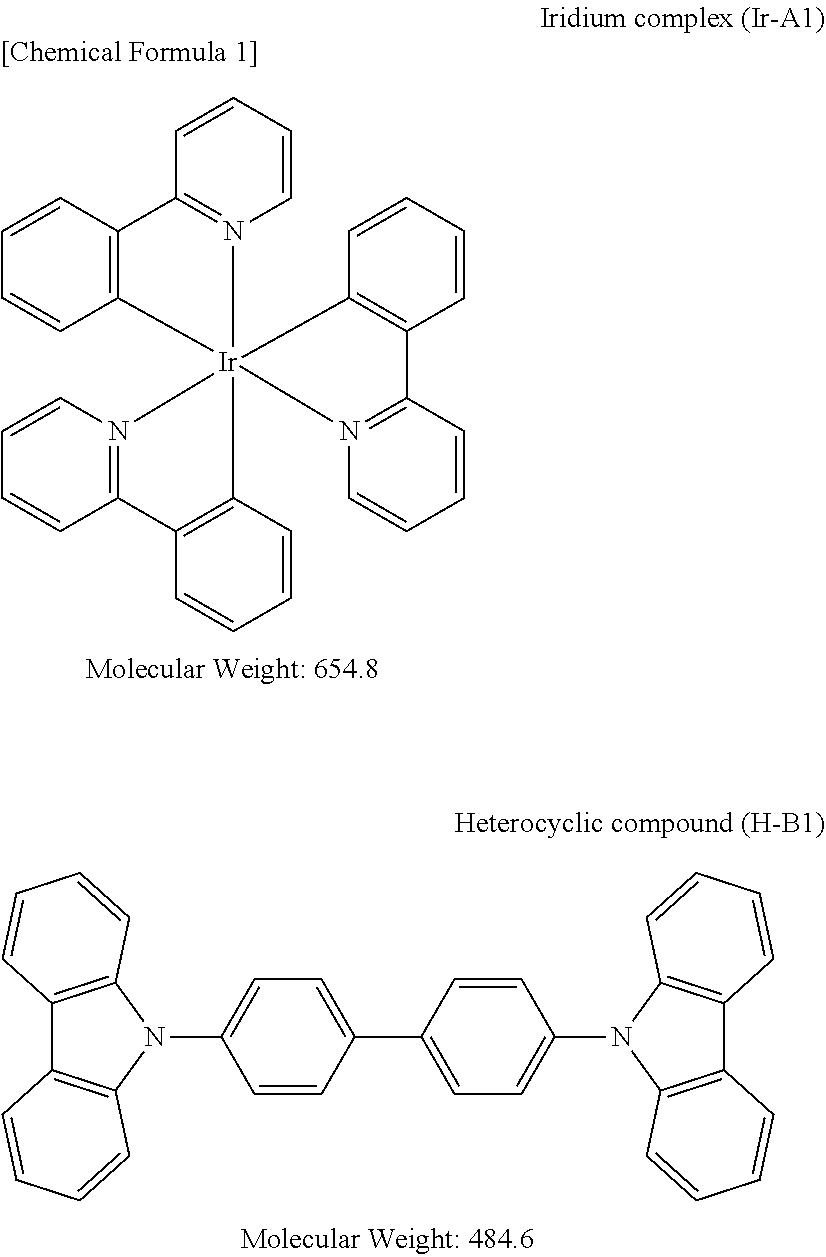

2700≤MA+MB≤10000 (M1-1)
0.35≤MA/MB≤3.00 (M2-1).
3400≤MA+MB≤7000 (M1-2)
0.35≤MA/MB≤2.00 (M2-2).
4000≤MA+MB≤6000 (M1-3)
0.65≤MA/MB≤1.30 (M2-3).
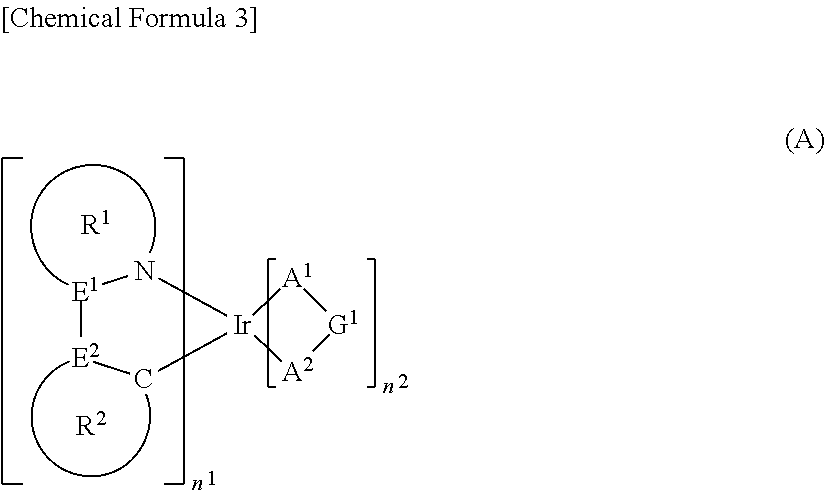
[wherein,
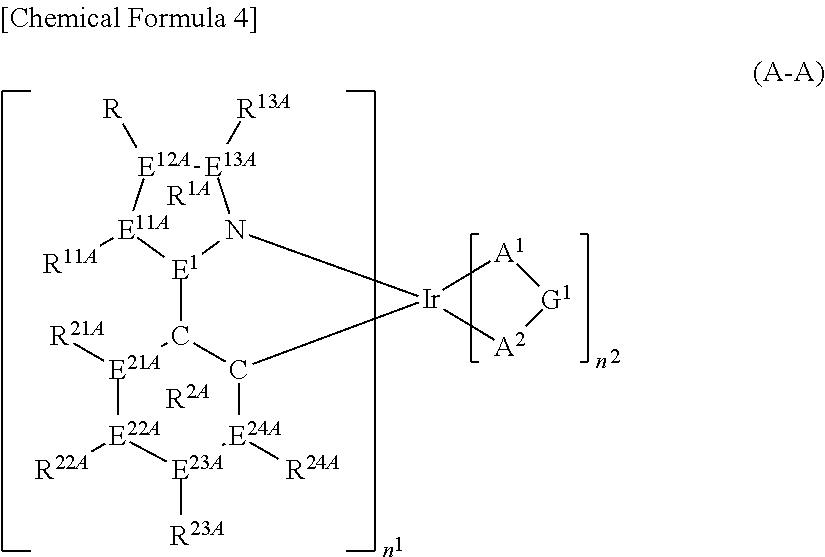
[wherein,
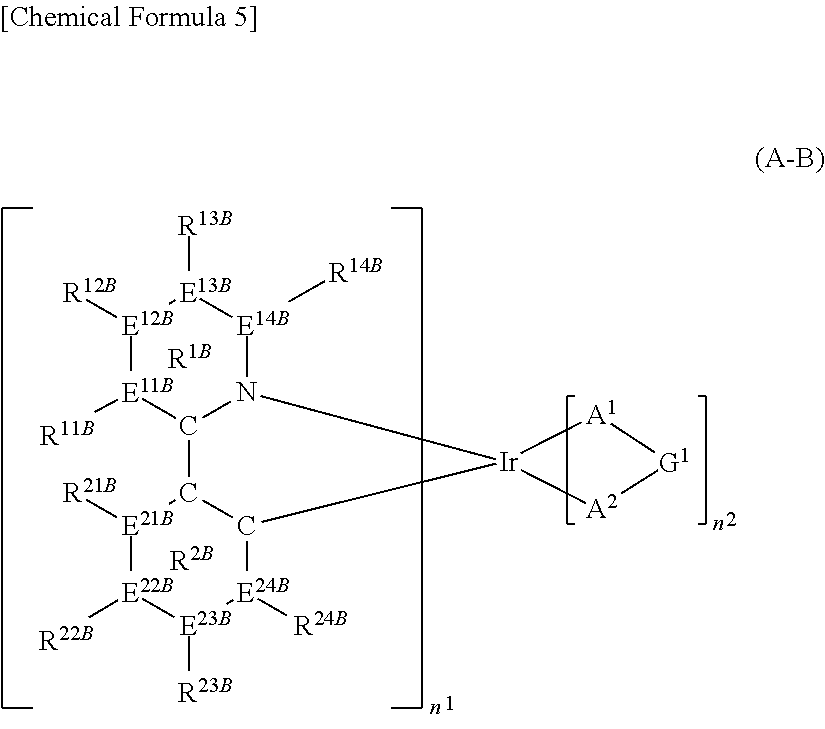
[wherein,
[Chemical Formula 6]
ArB1

[wherein,
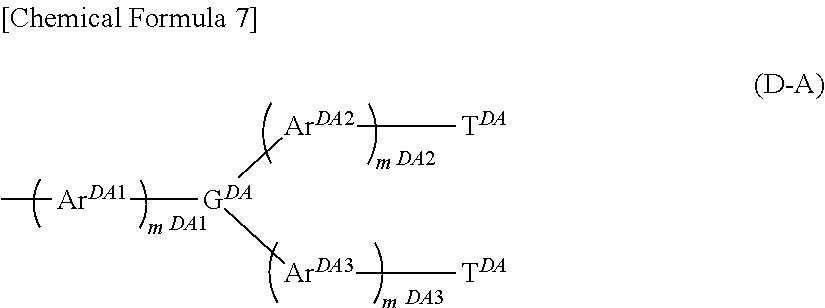
[wherein,

[wherein,
[Chemical Formula 9]

[wherein,
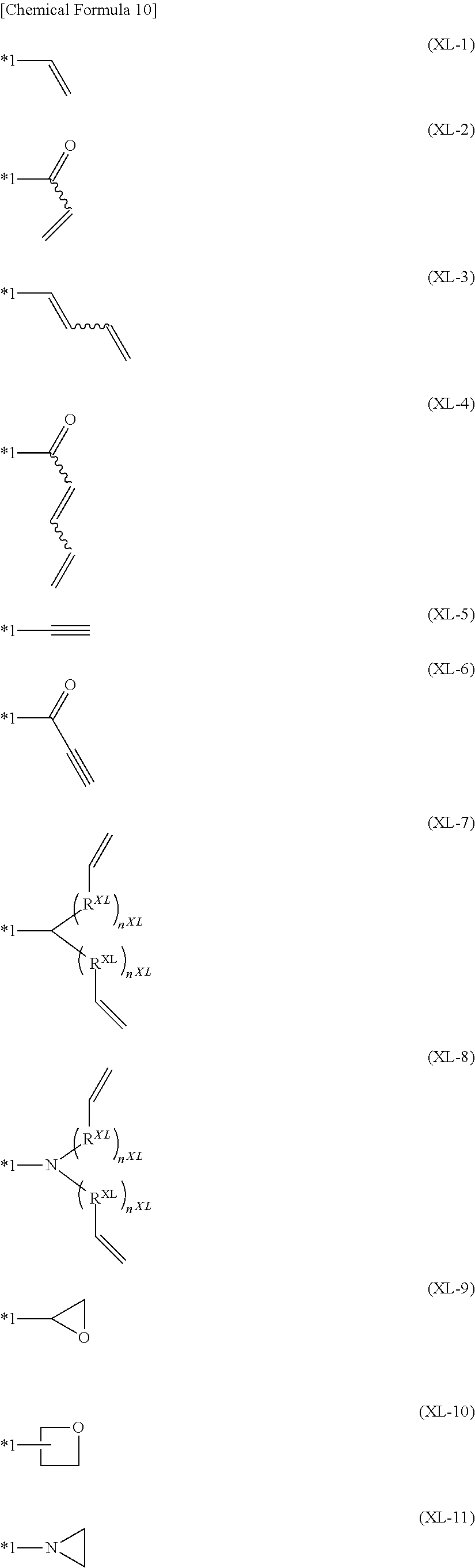
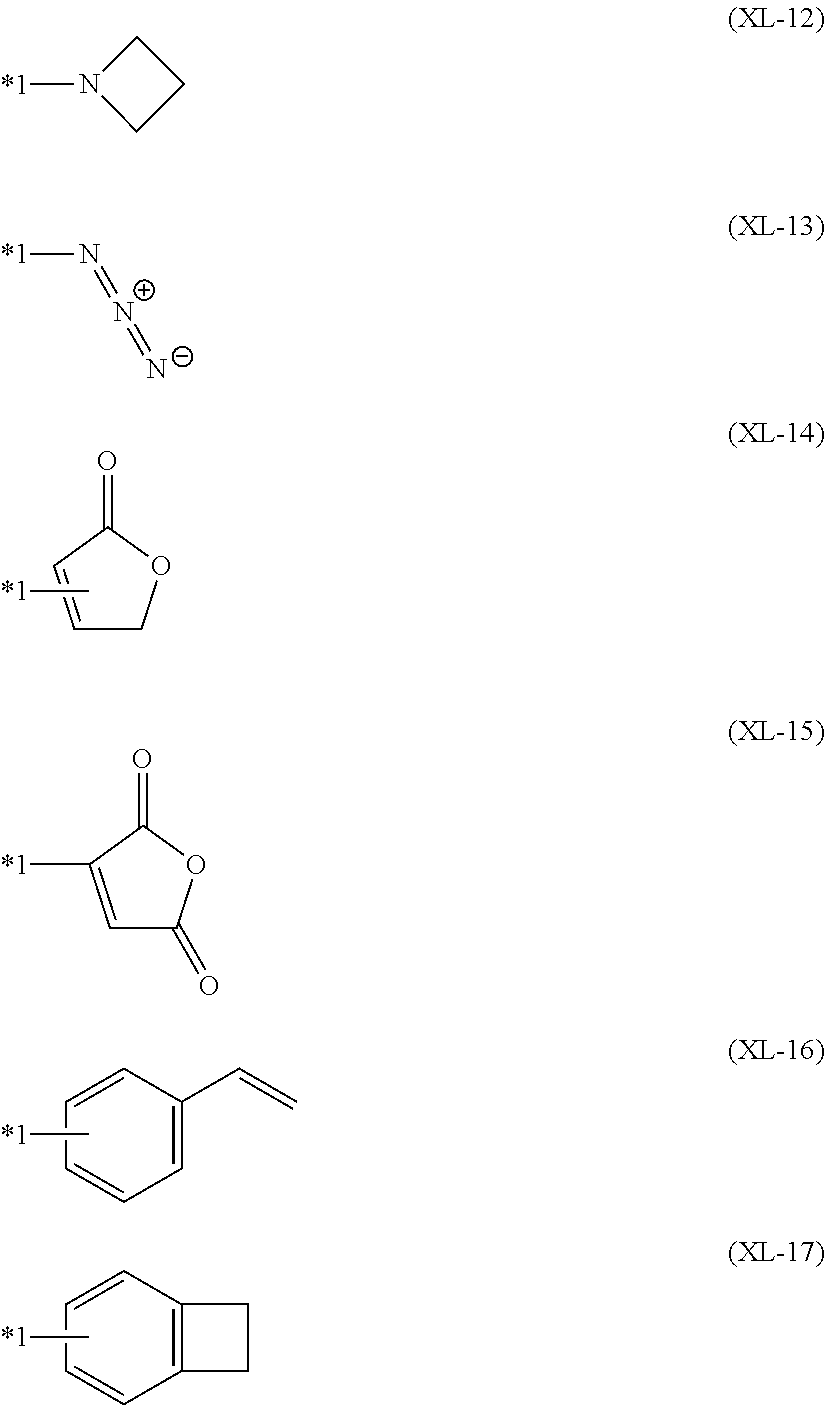
[wherein, RXL represents a methylene group, an oxygen atom or a sulfur atom, and nXL represents an integer of 0 to 5. When a plurality of RXL are present, they may be the same or different, and when a plurality of nXL are present, they may be the same or different. *1 represents a binding site. These crosslink groups each optionally have a substituent.].

[wherein,
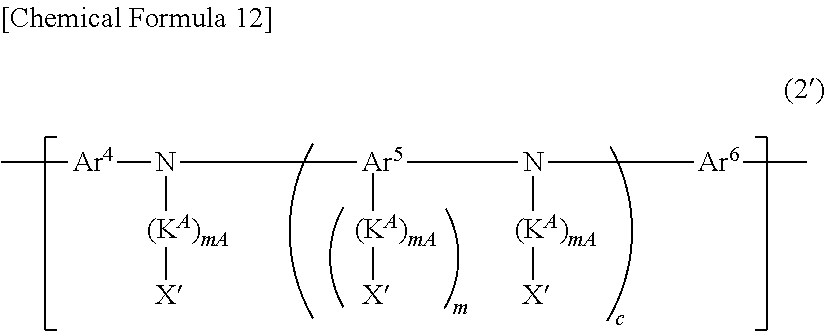
[wherein,
4000≤MA+MB≤6000 (M1-3)
0.65≤MA/MB≤1.30 (M2-3).
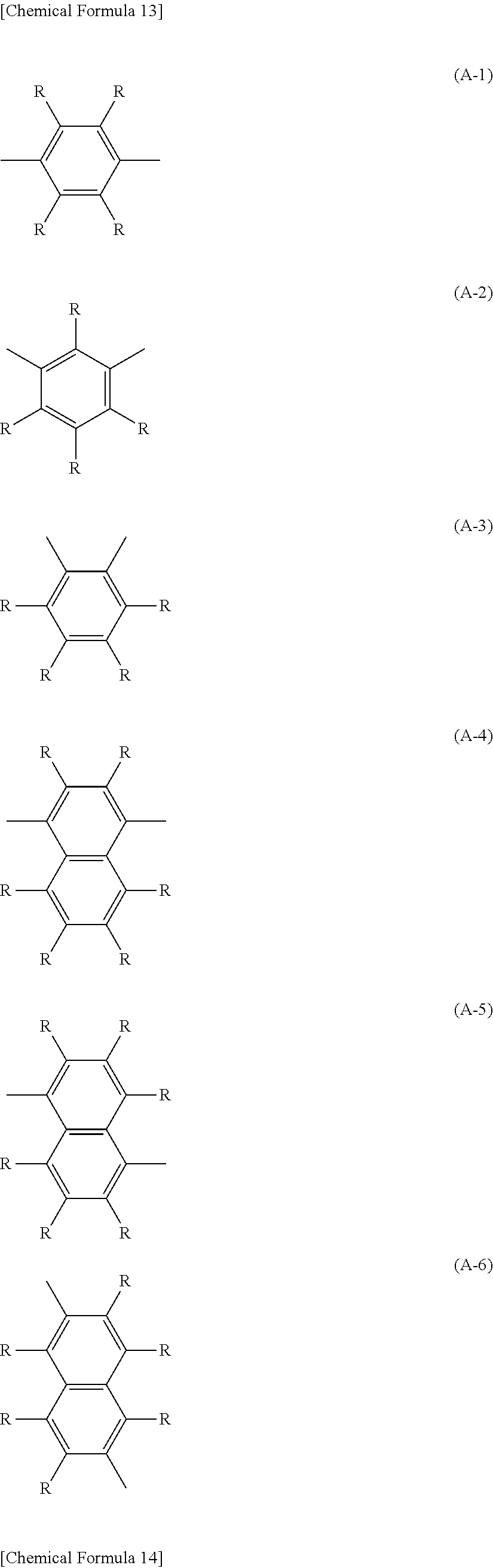

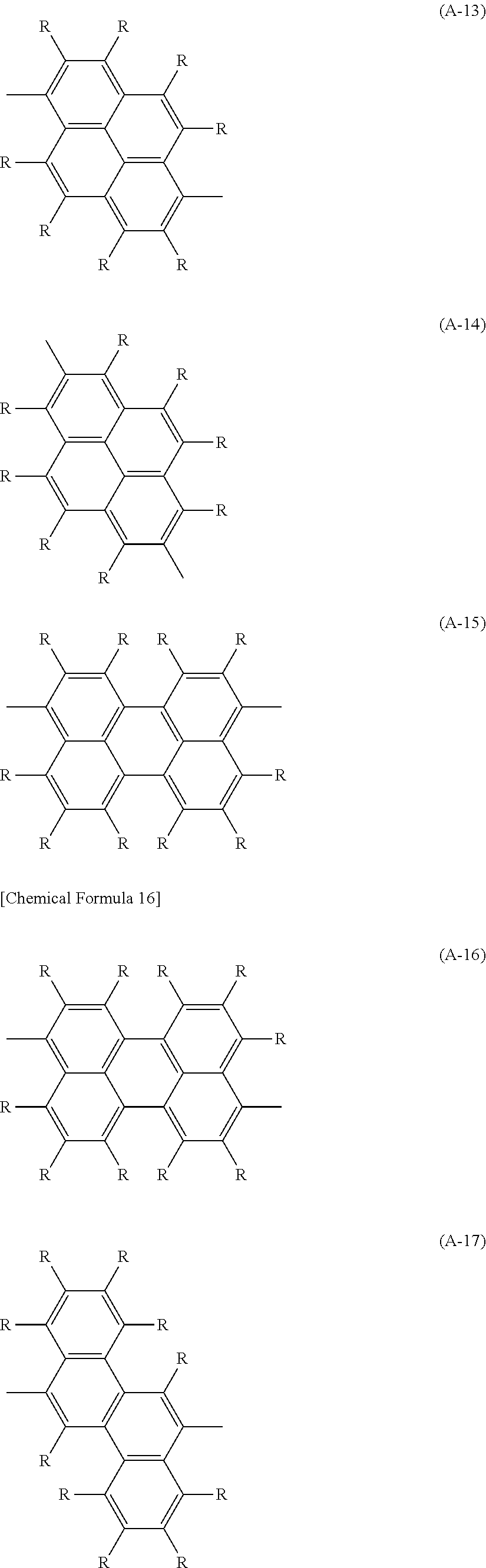
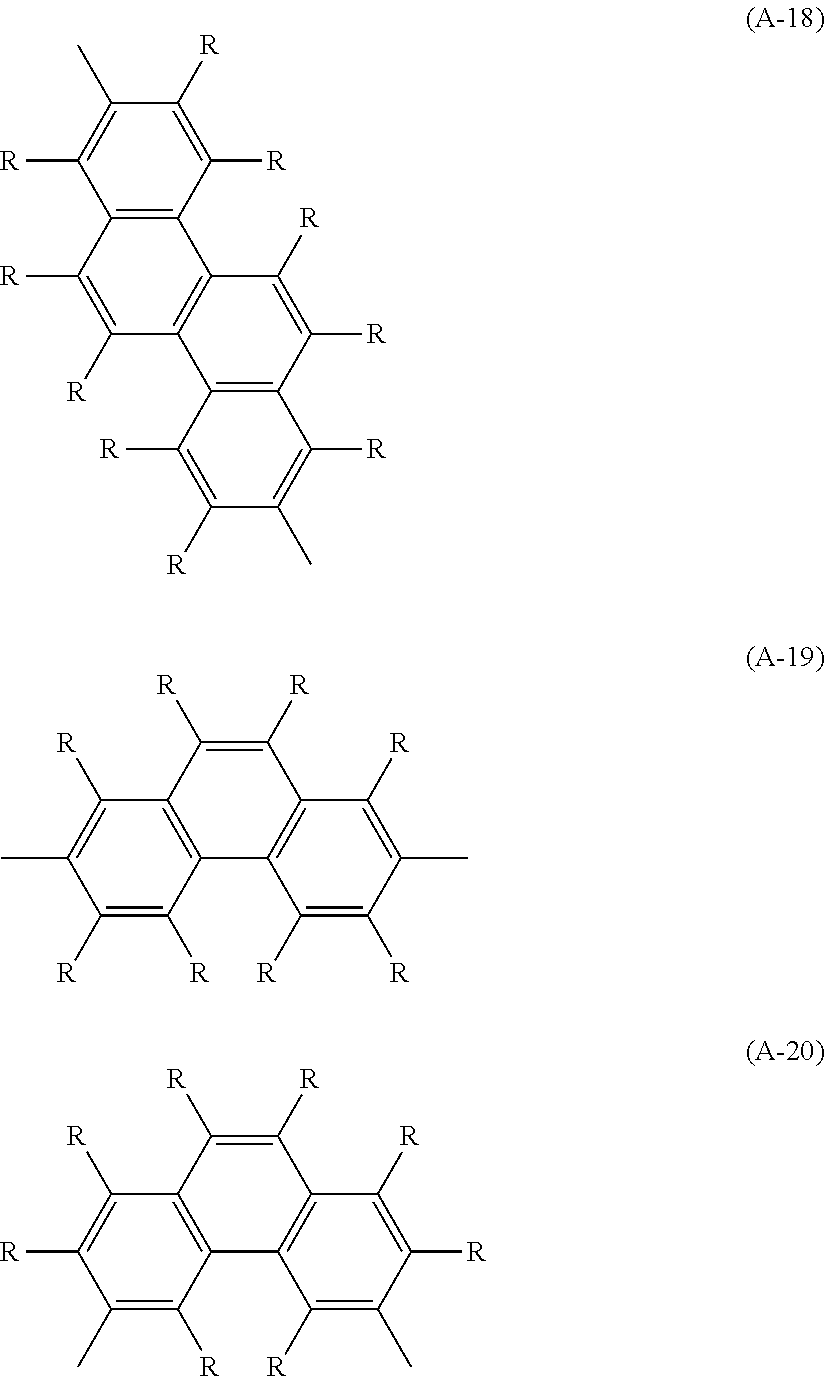
[wherein, R and Ra each independently represent a hydrogen atom, an alkyl group, a cycloalkyl group, an aryl group or a monovalent heterocyclic group. The plurality of R and Ra each may be the same or different, and groups Ra may be combined together to form a ring together with the atoms to which they are attached.]


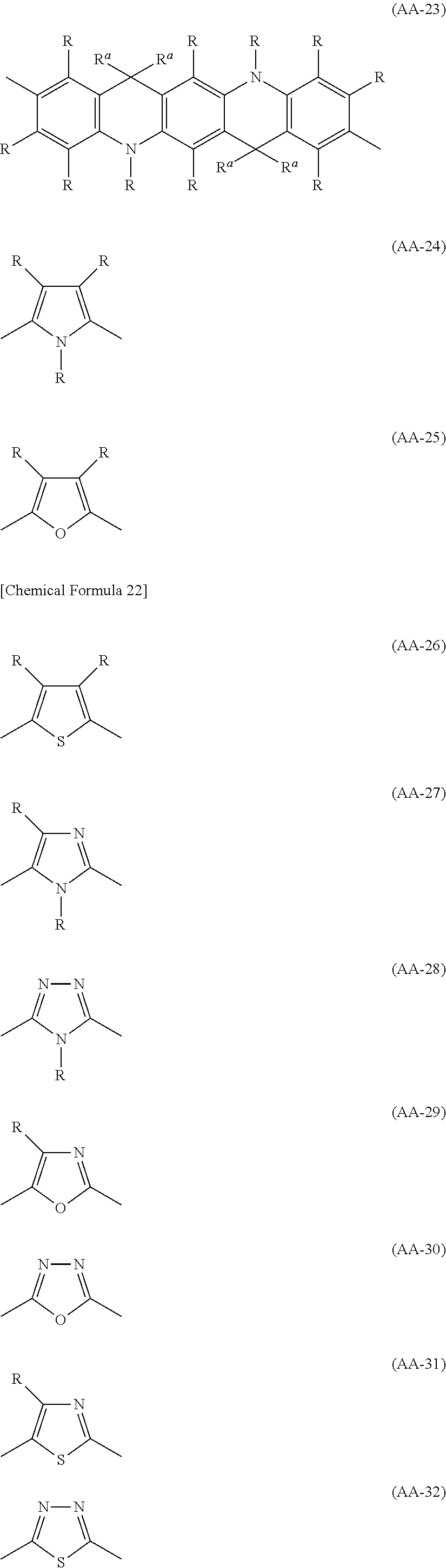

[wherein, R and Ra represent the same meaning as described above.]
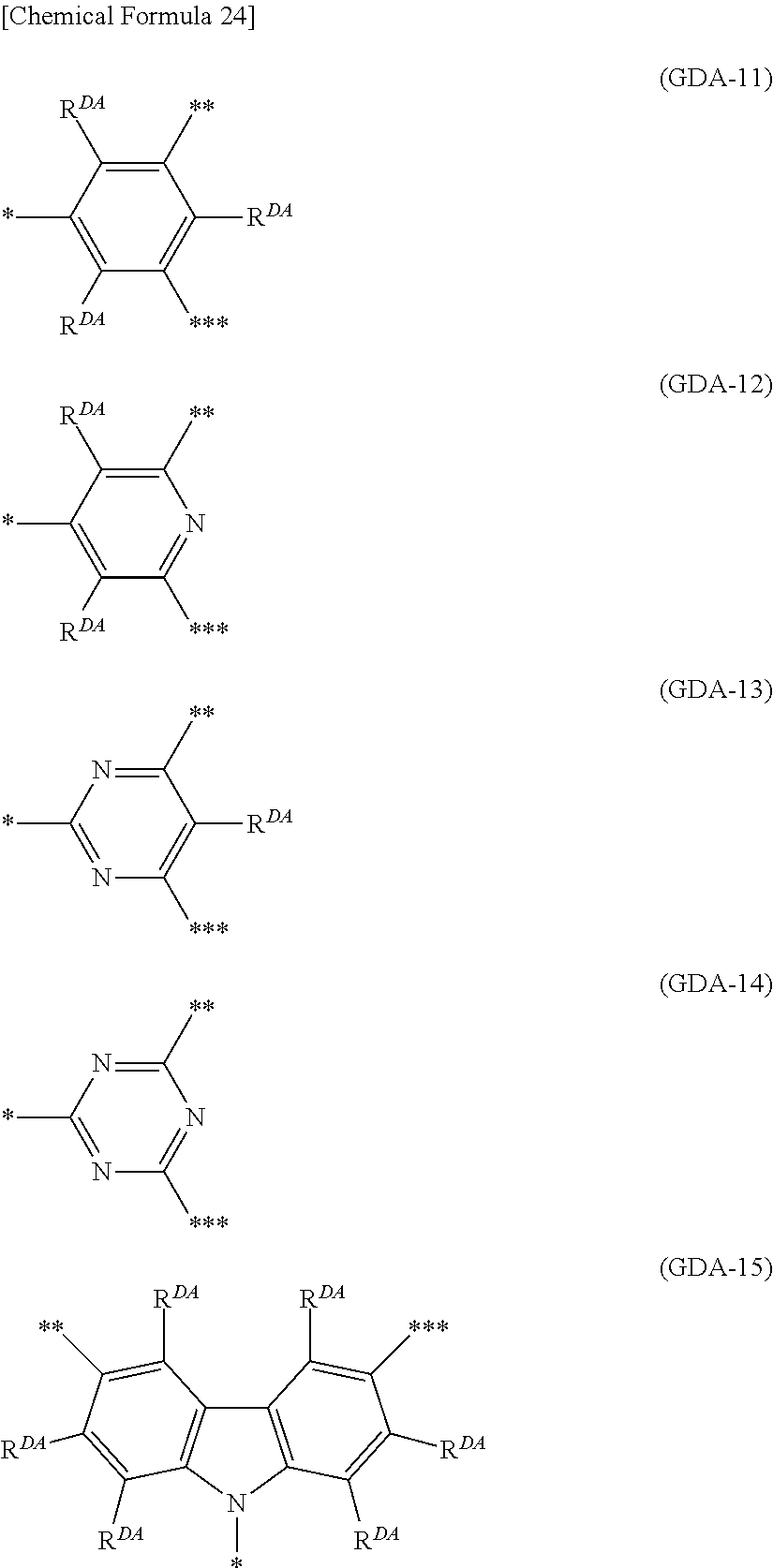
[wherein,
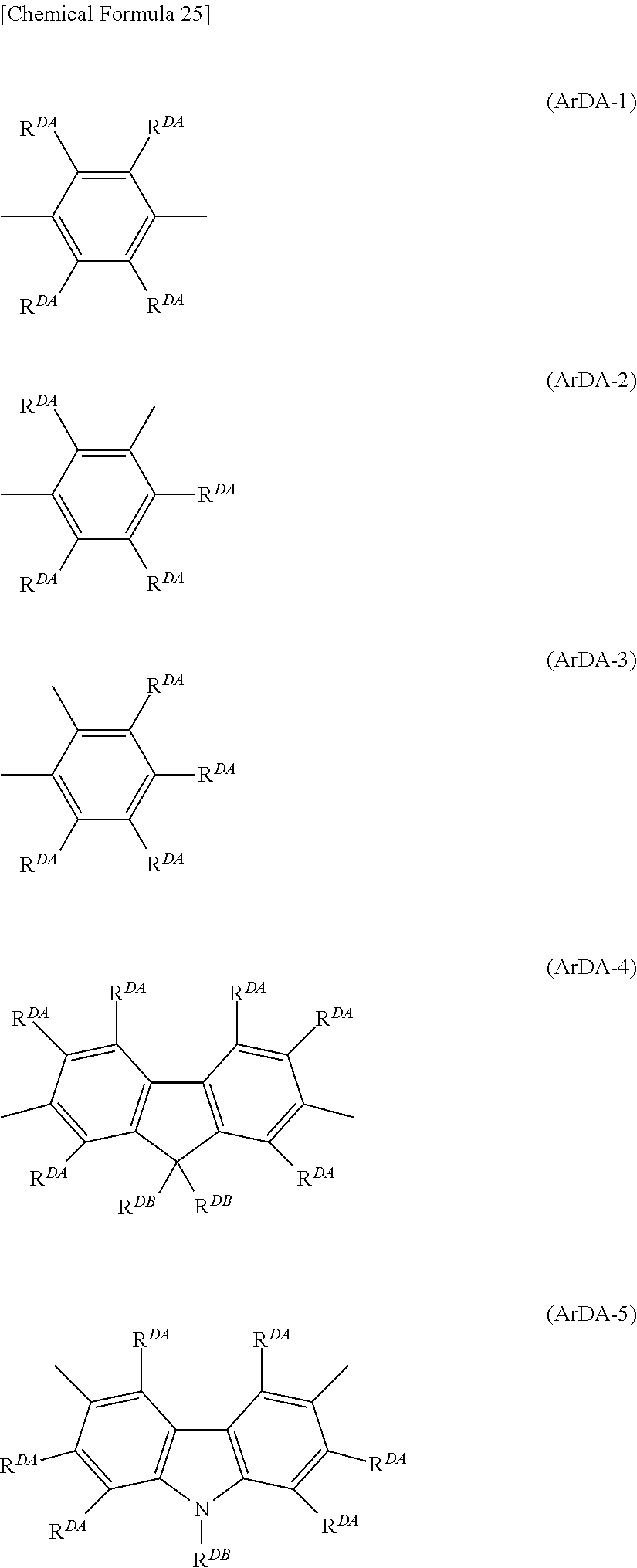
[wherein,
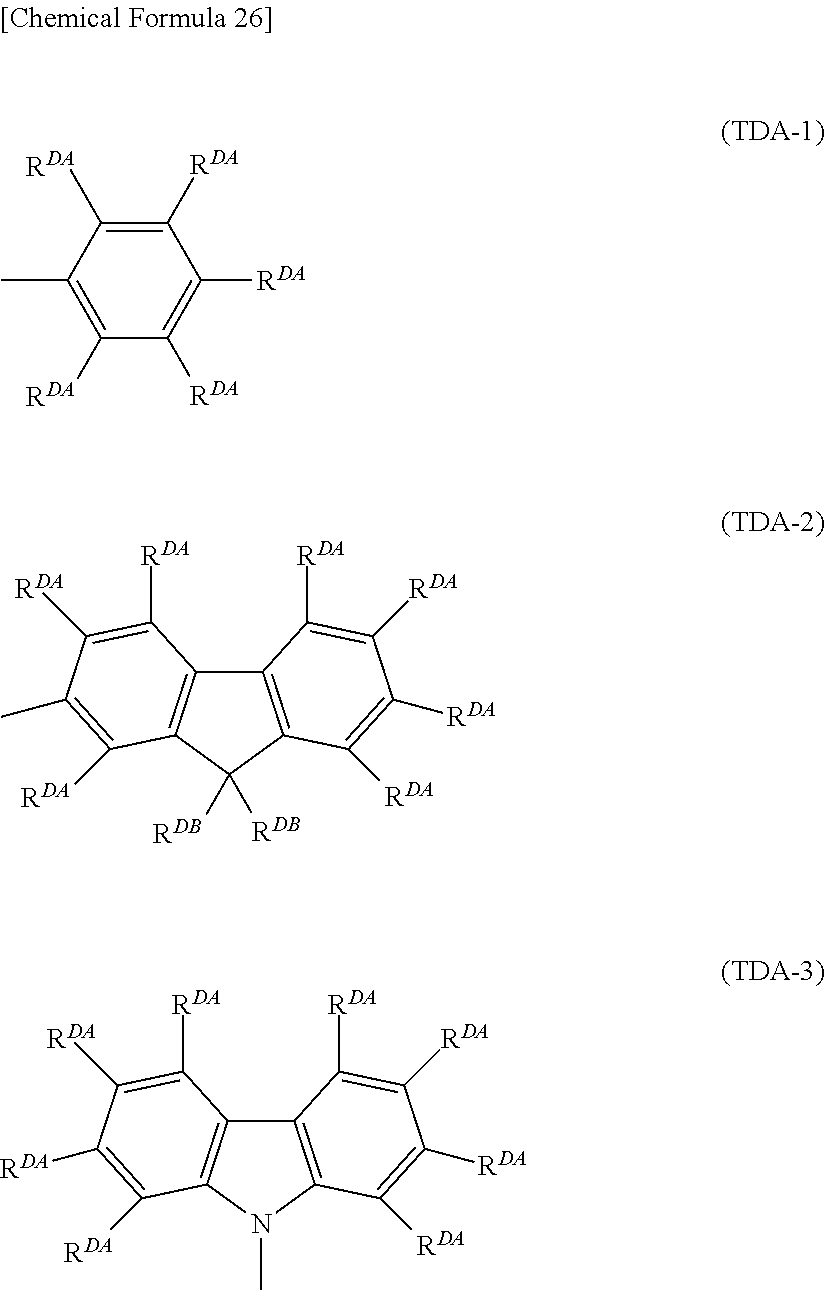
[wherein, RDA and RDB represent the same meaning as described above.]
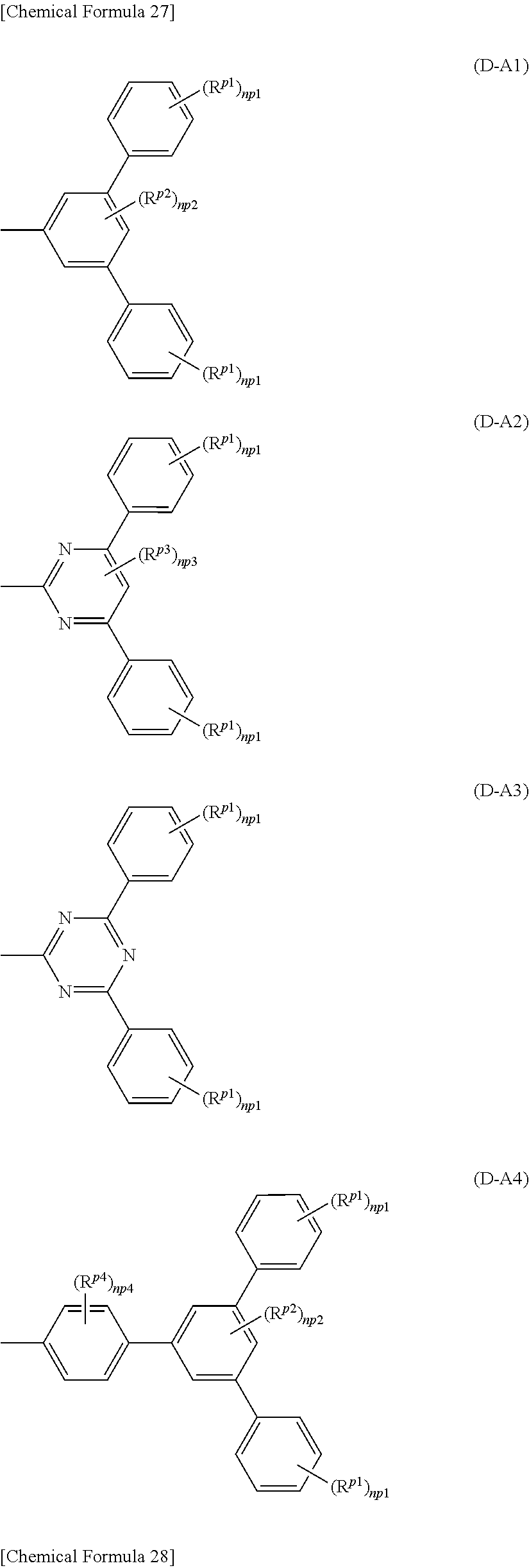
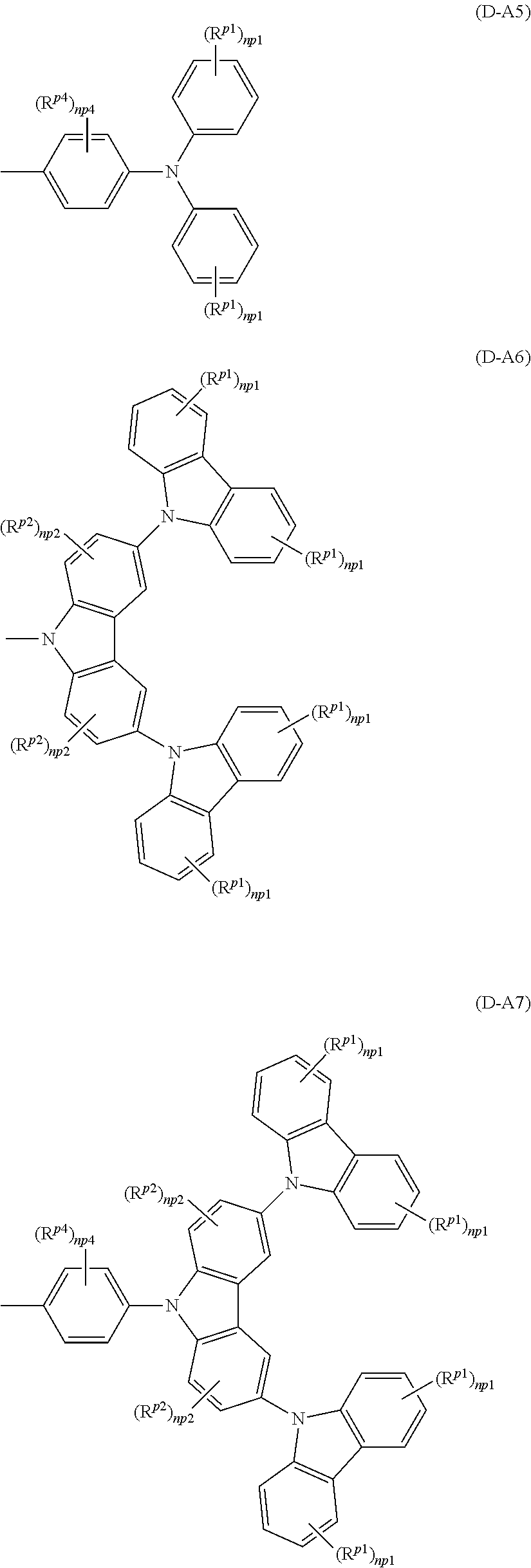
[wherein,

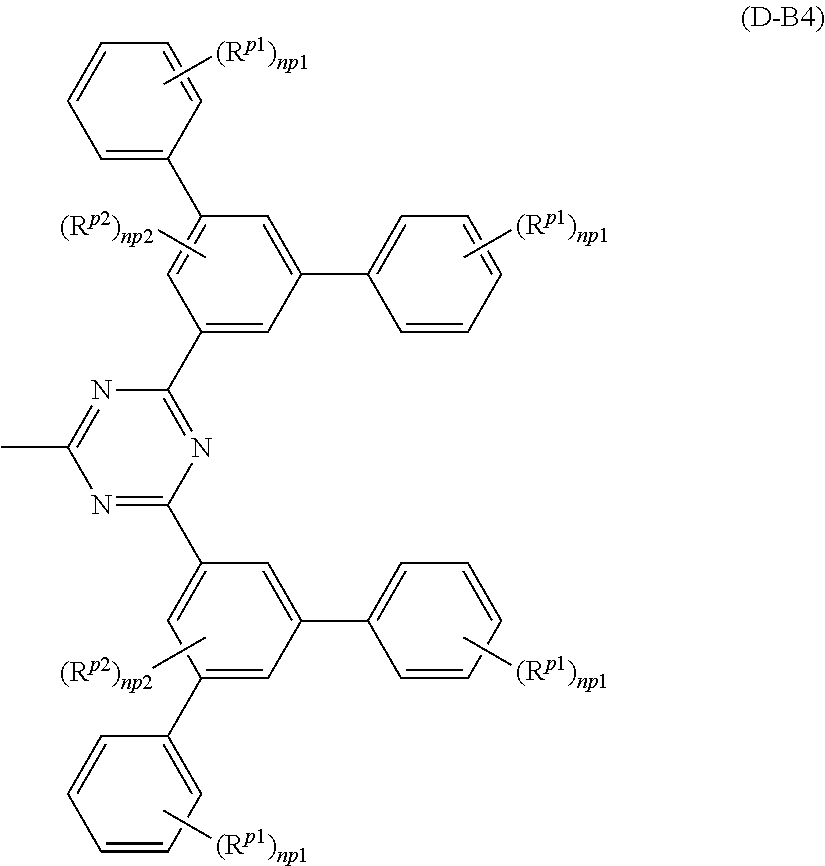
[wherein,
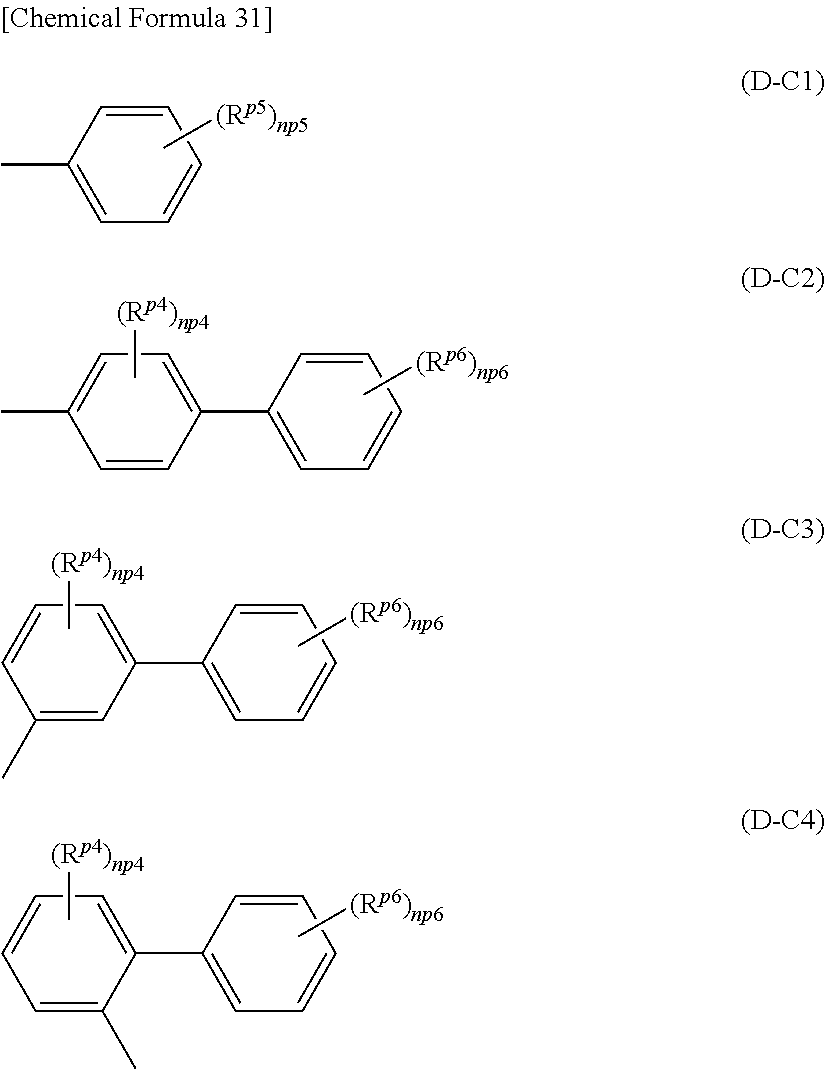
[wherein,

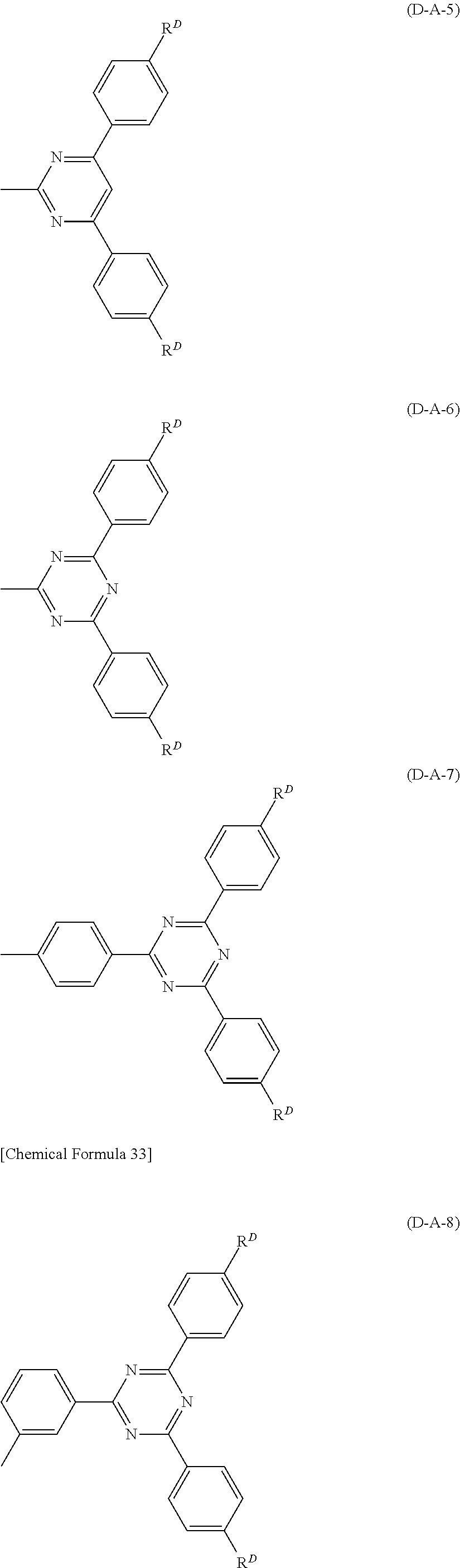

[wherein, RD represents a methyl group, an ethyl group, an isopropyl group, a tert-butyl group, a hexyl group, a 2-ethylhexyl group, a tert-octyl group, a cyclohexyl group, a methoxy group, a 2-ethylhexyloxy group or a cyclohexyloxy group. When a plurality of RD are present, they may be the same or different.]
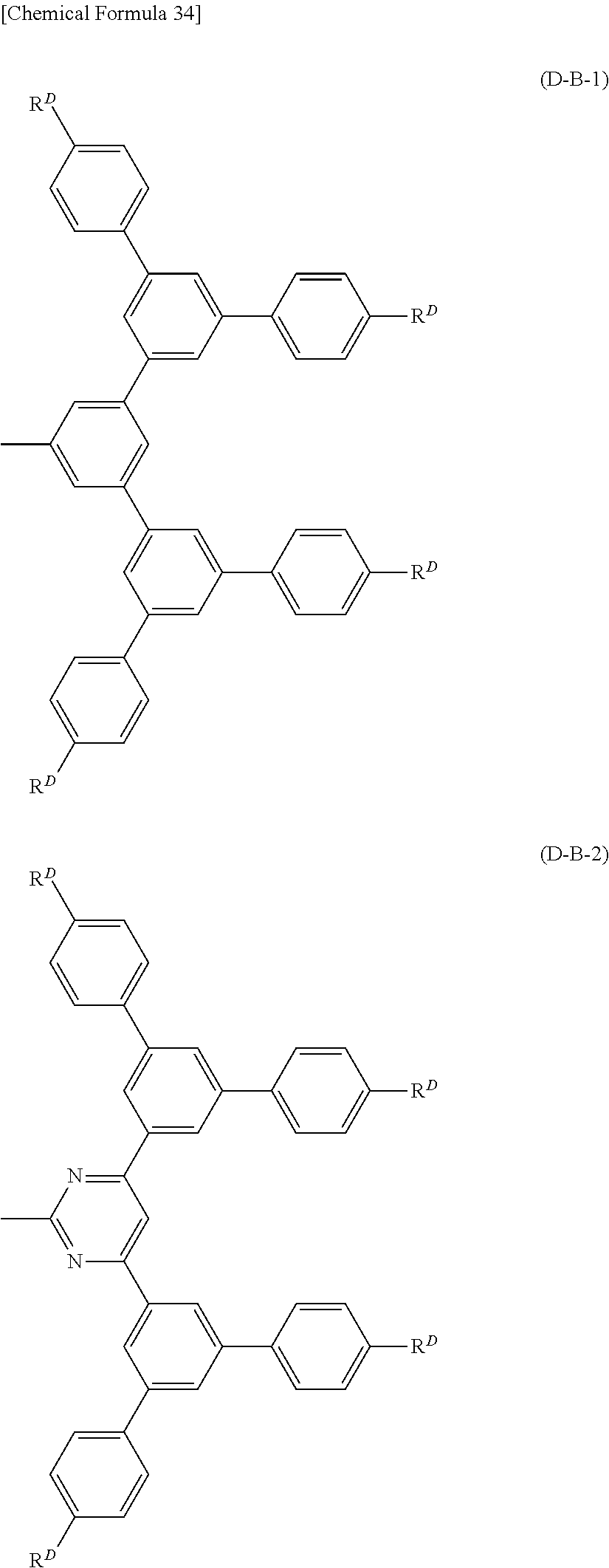
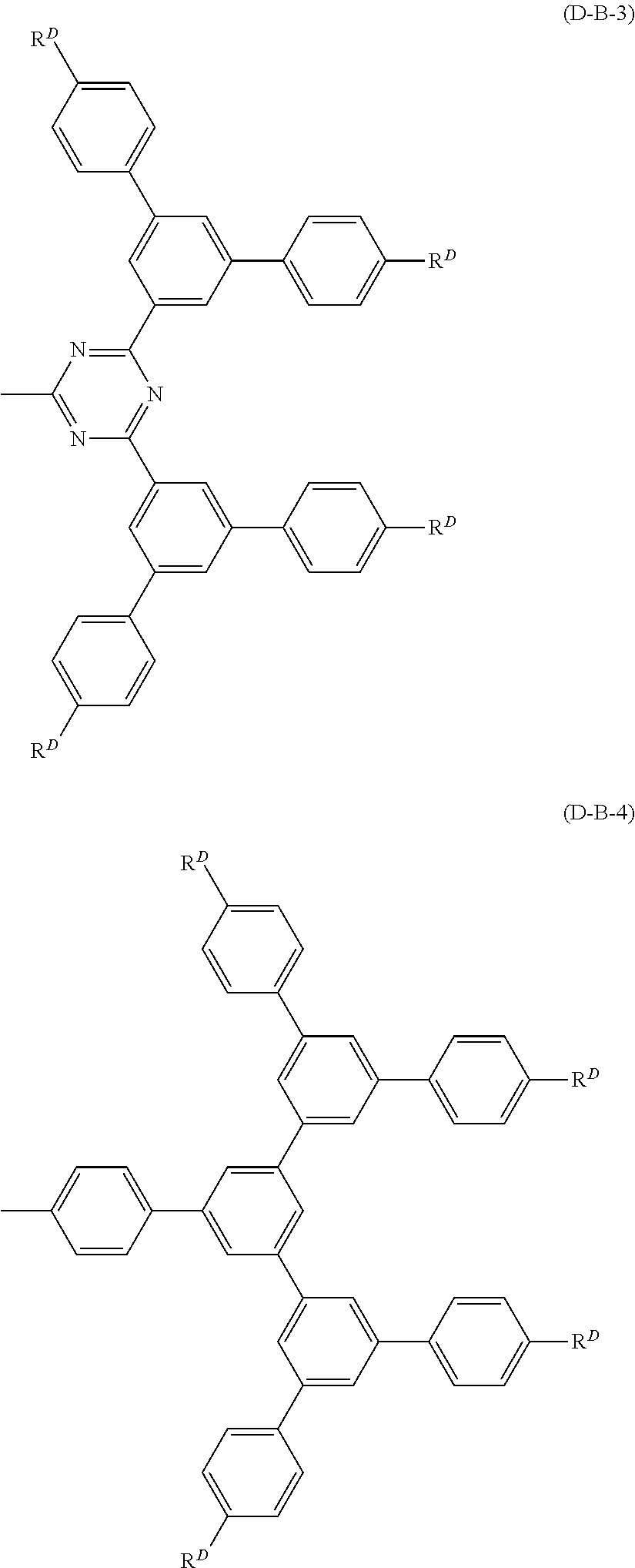
[wherein, RD represents the same meaning as described above.]
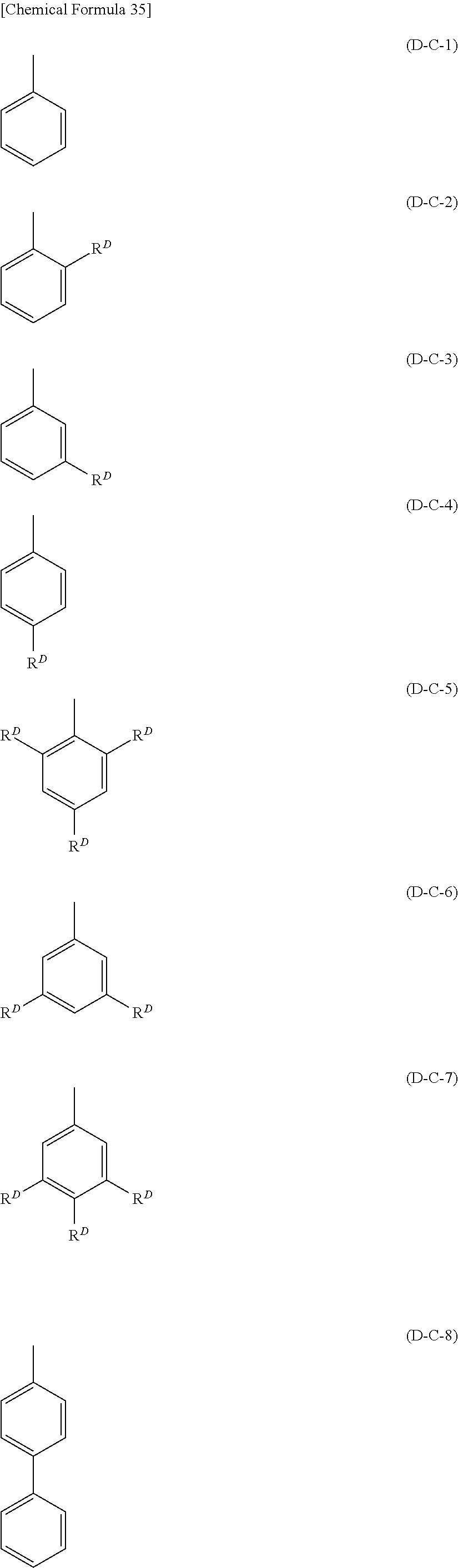
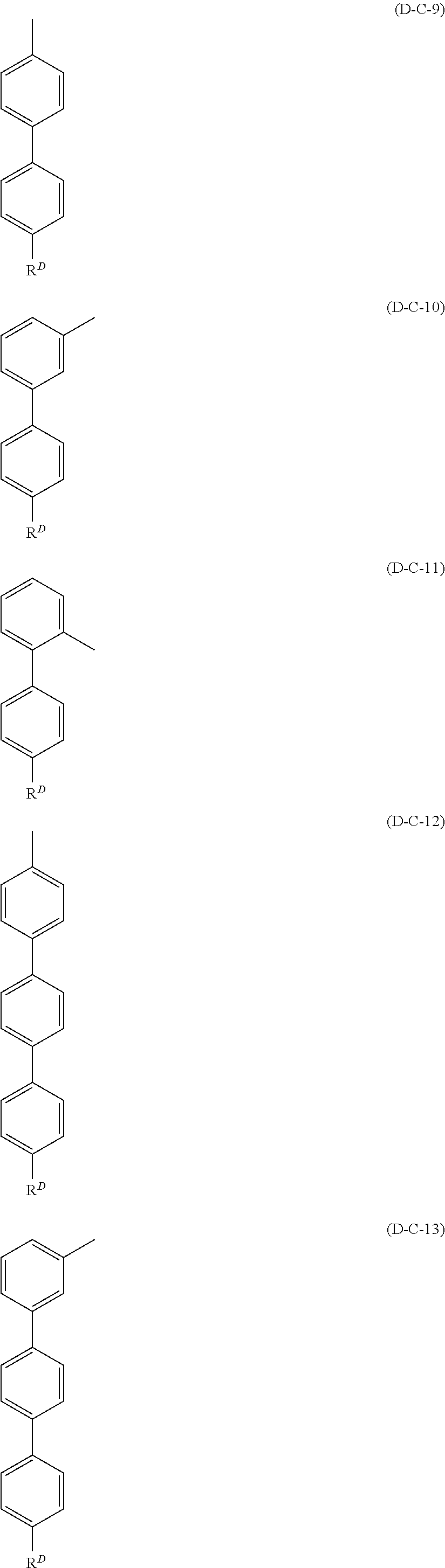
[wherein, RD represents the same meaning as described above.]

[wherein, * represents a site binding to an iridium atom.]
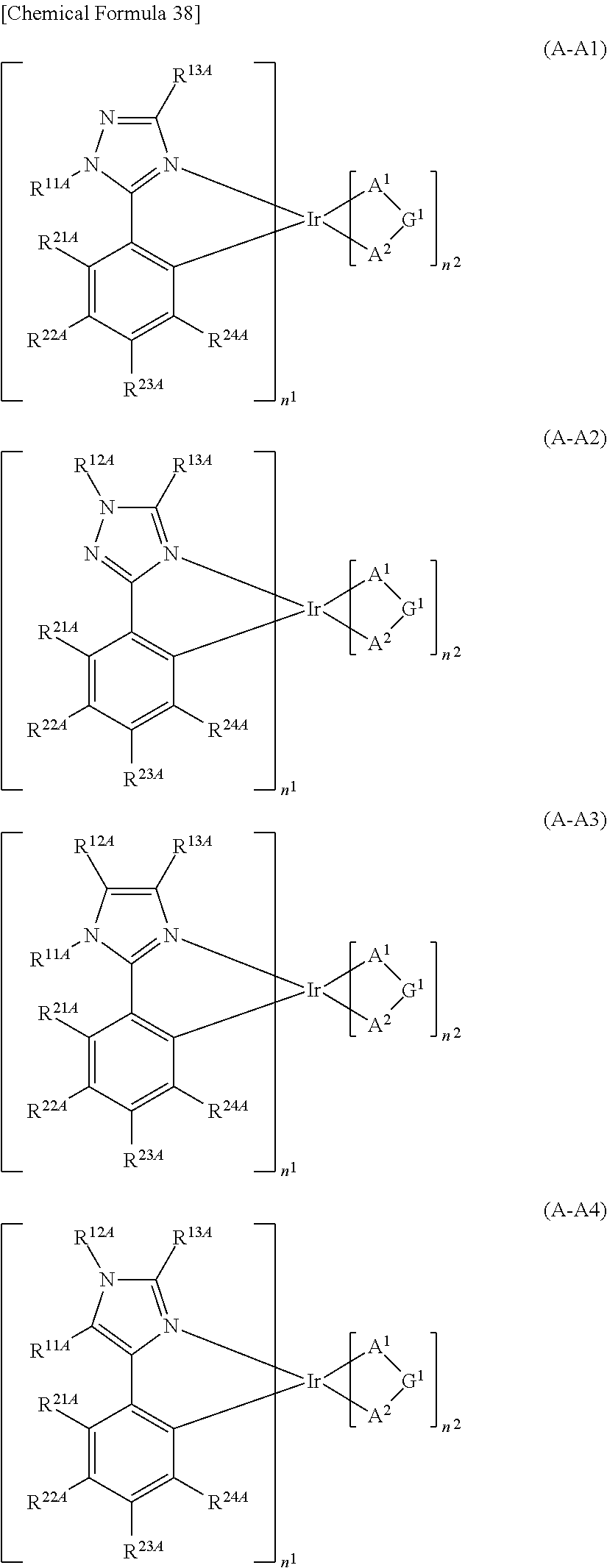
[wherein, n1, n2, R11A, R12A, R13A, R21A, R22A, R23A, R24A and A1-G1-A2 represent the same meaning as described above.]
[Iridium Complex Represented by the Formula (A-B)]


[wherein,
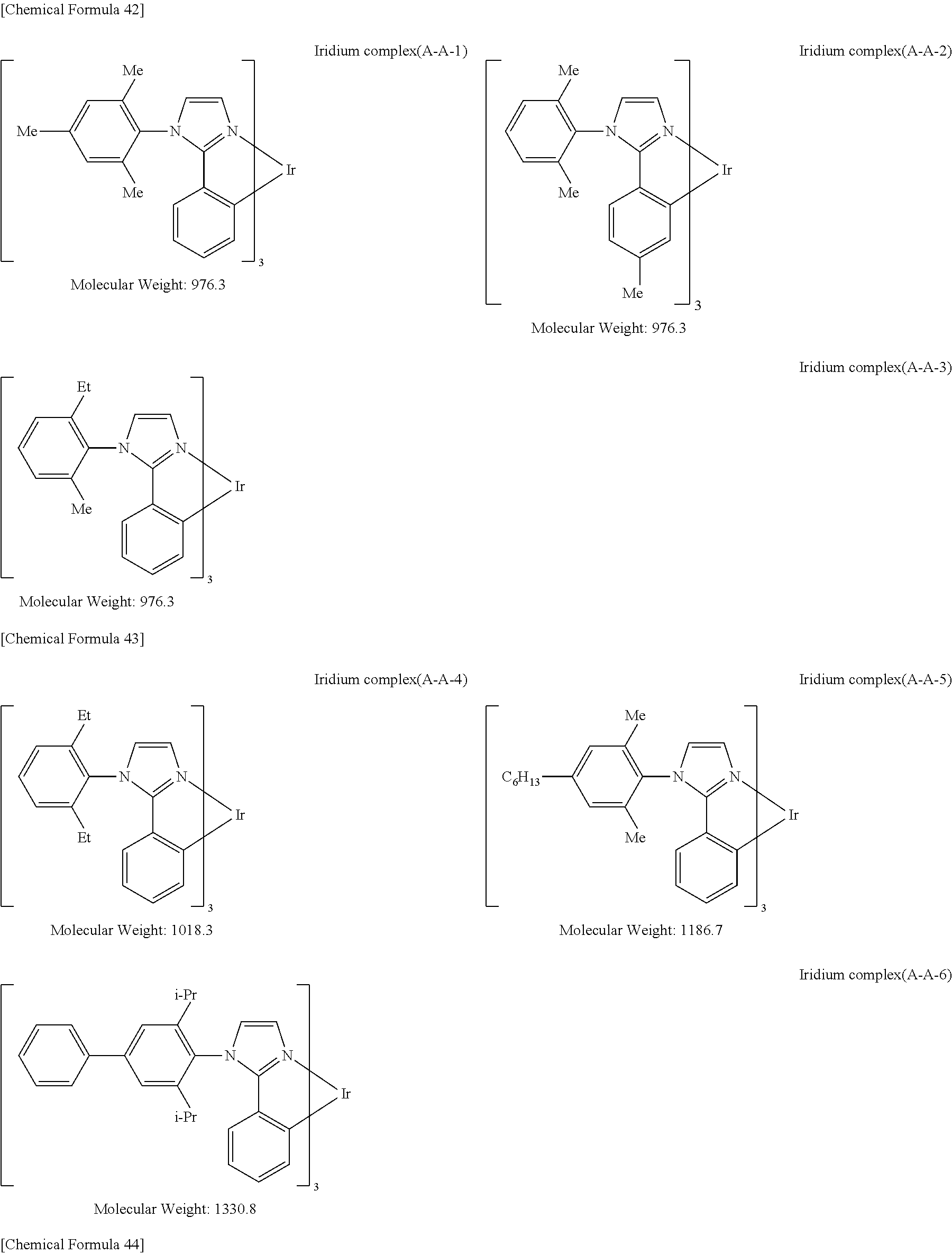


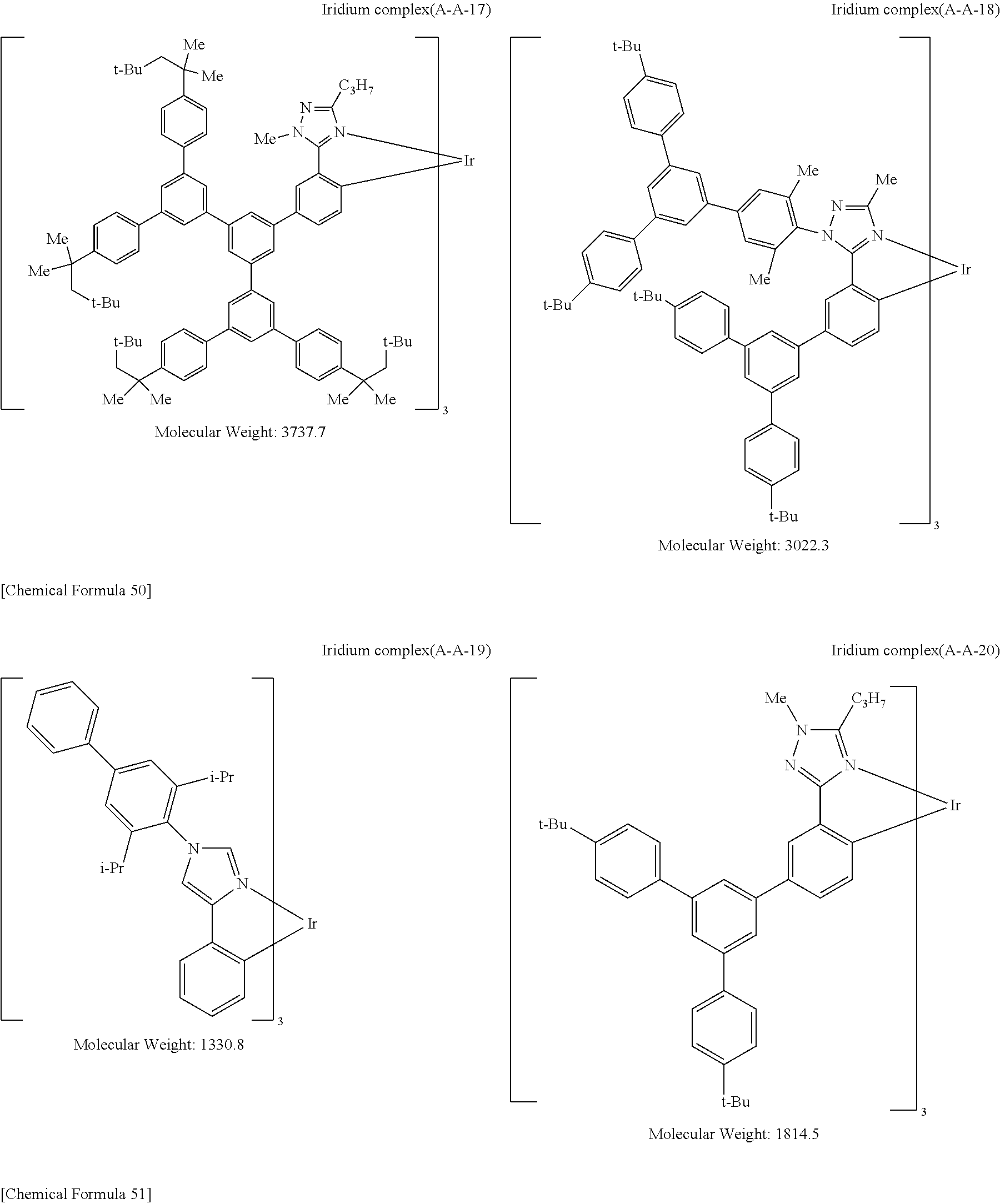
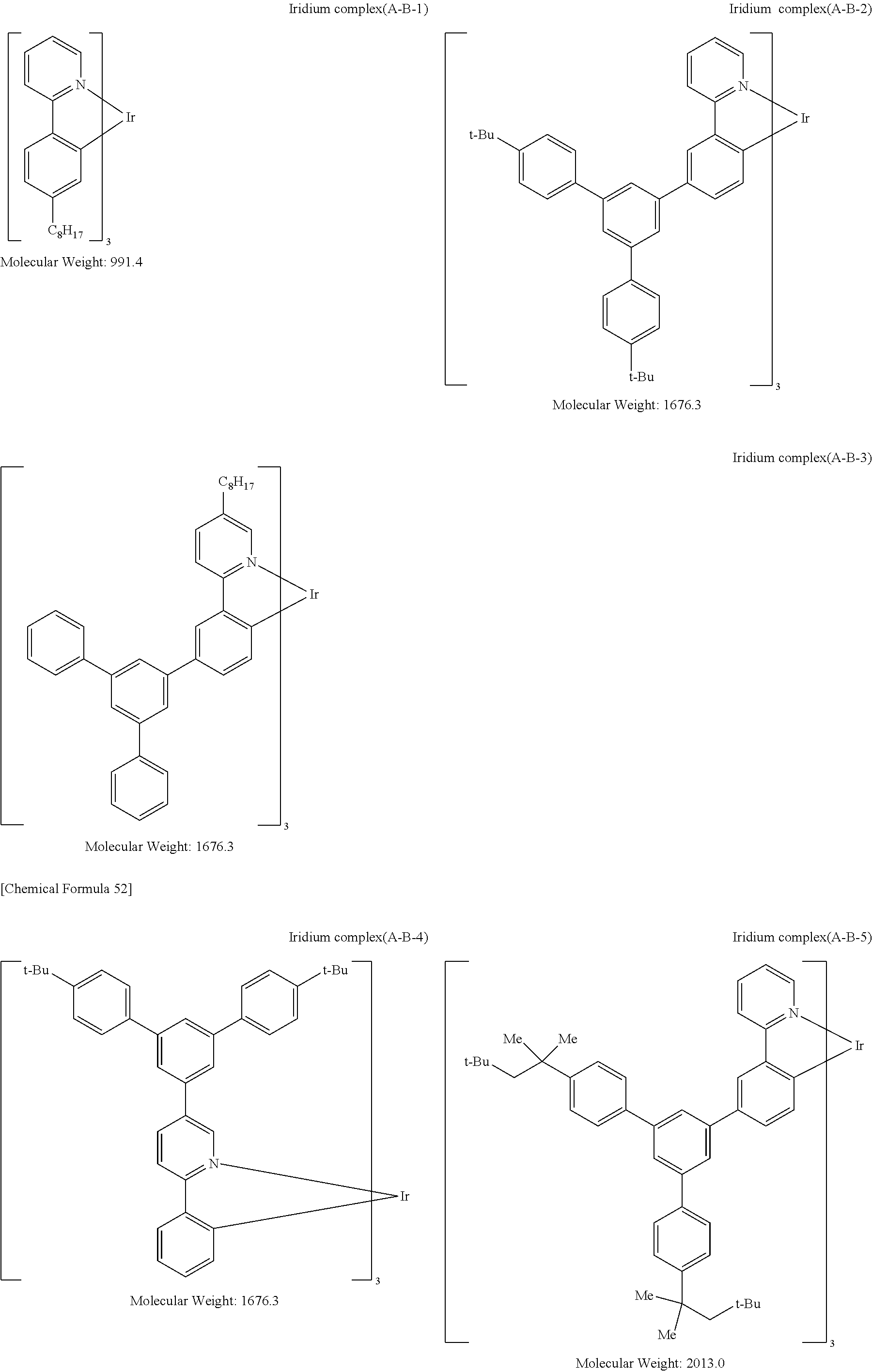


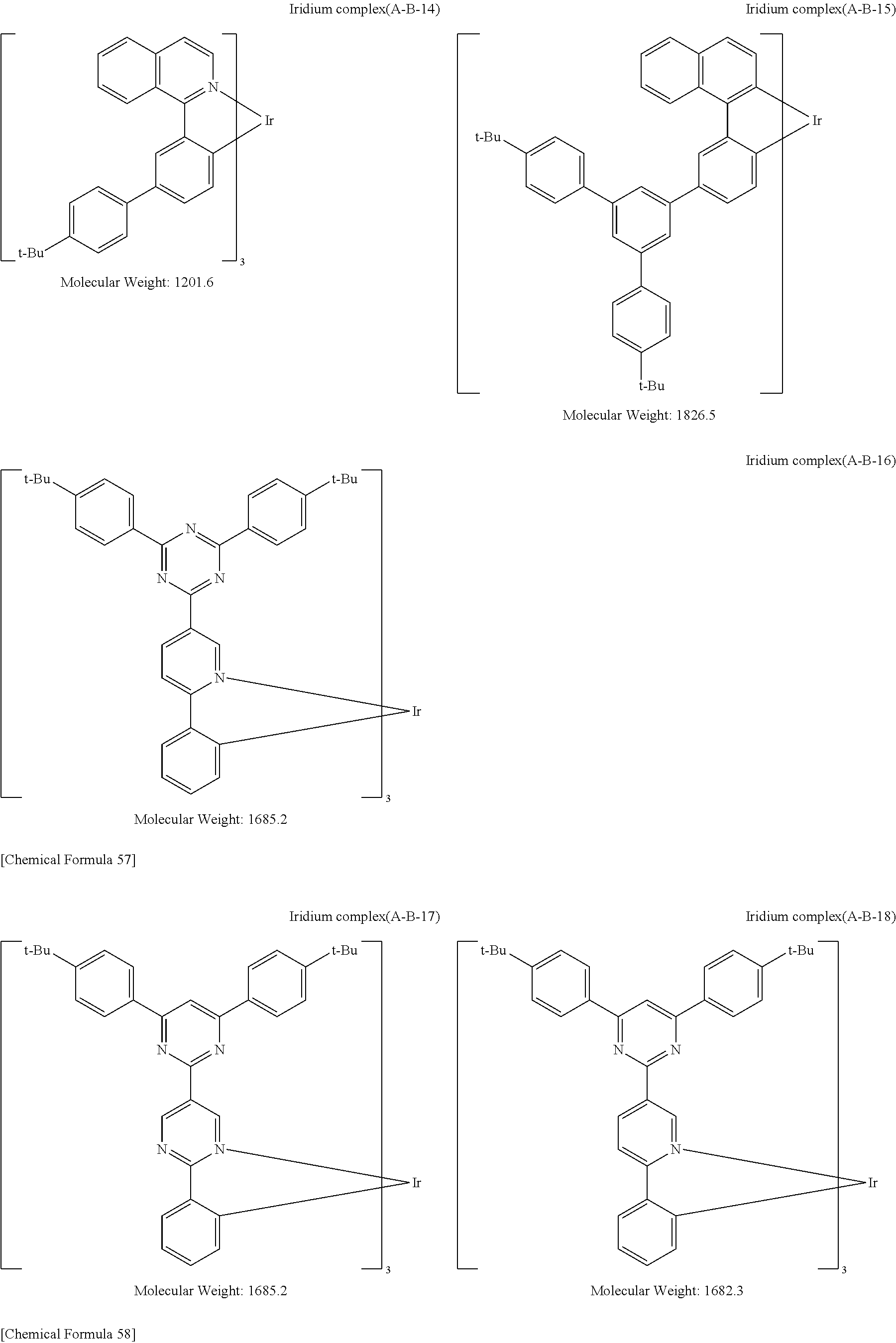
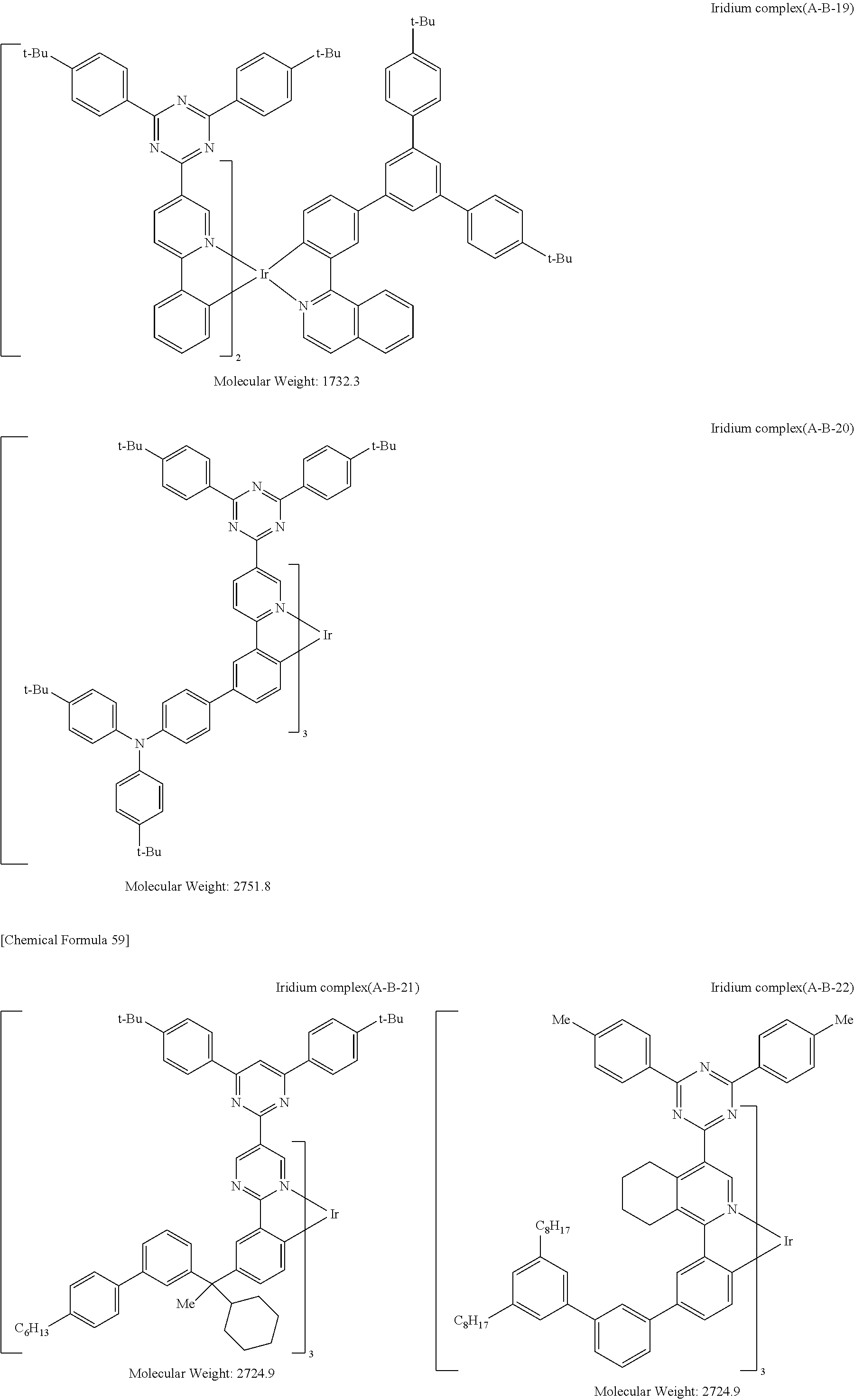
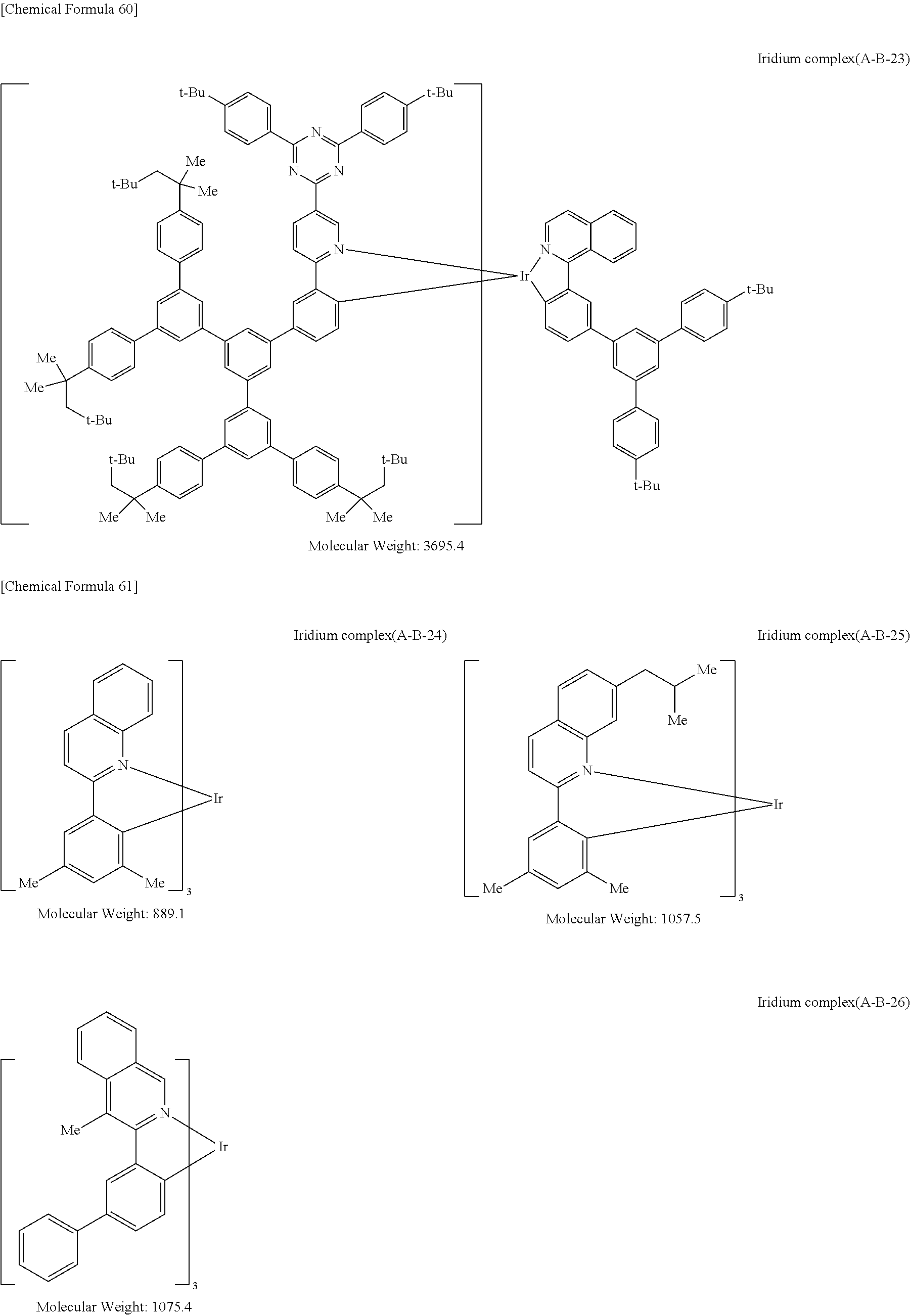
[Heterocyclic Compound (B)]
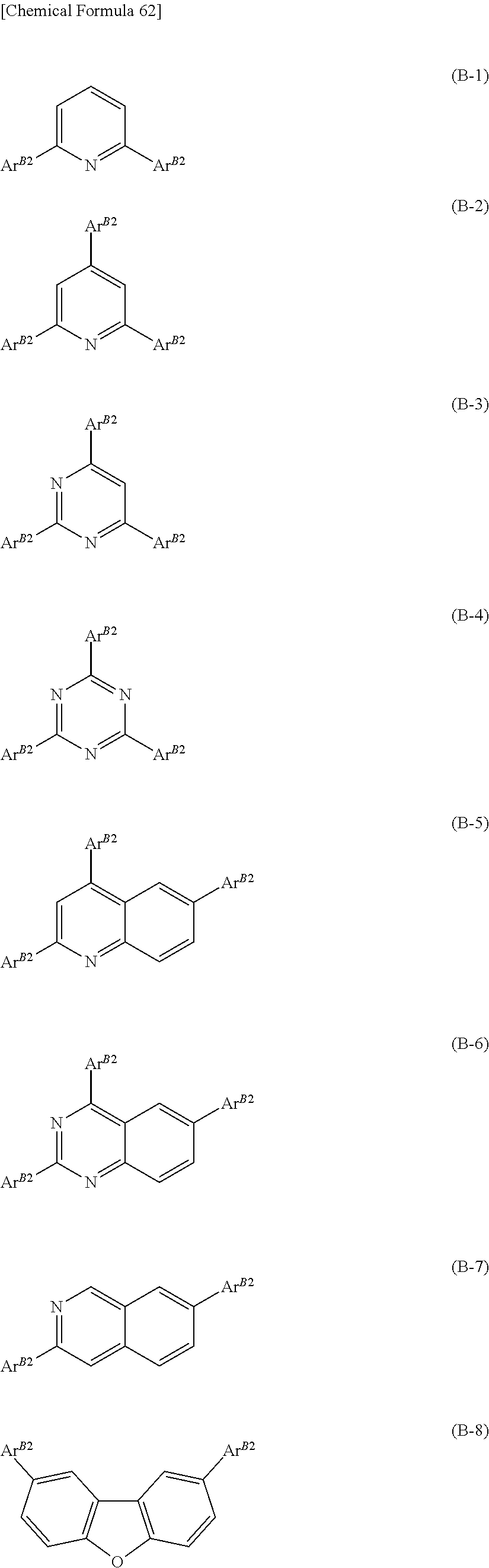

[wherein,

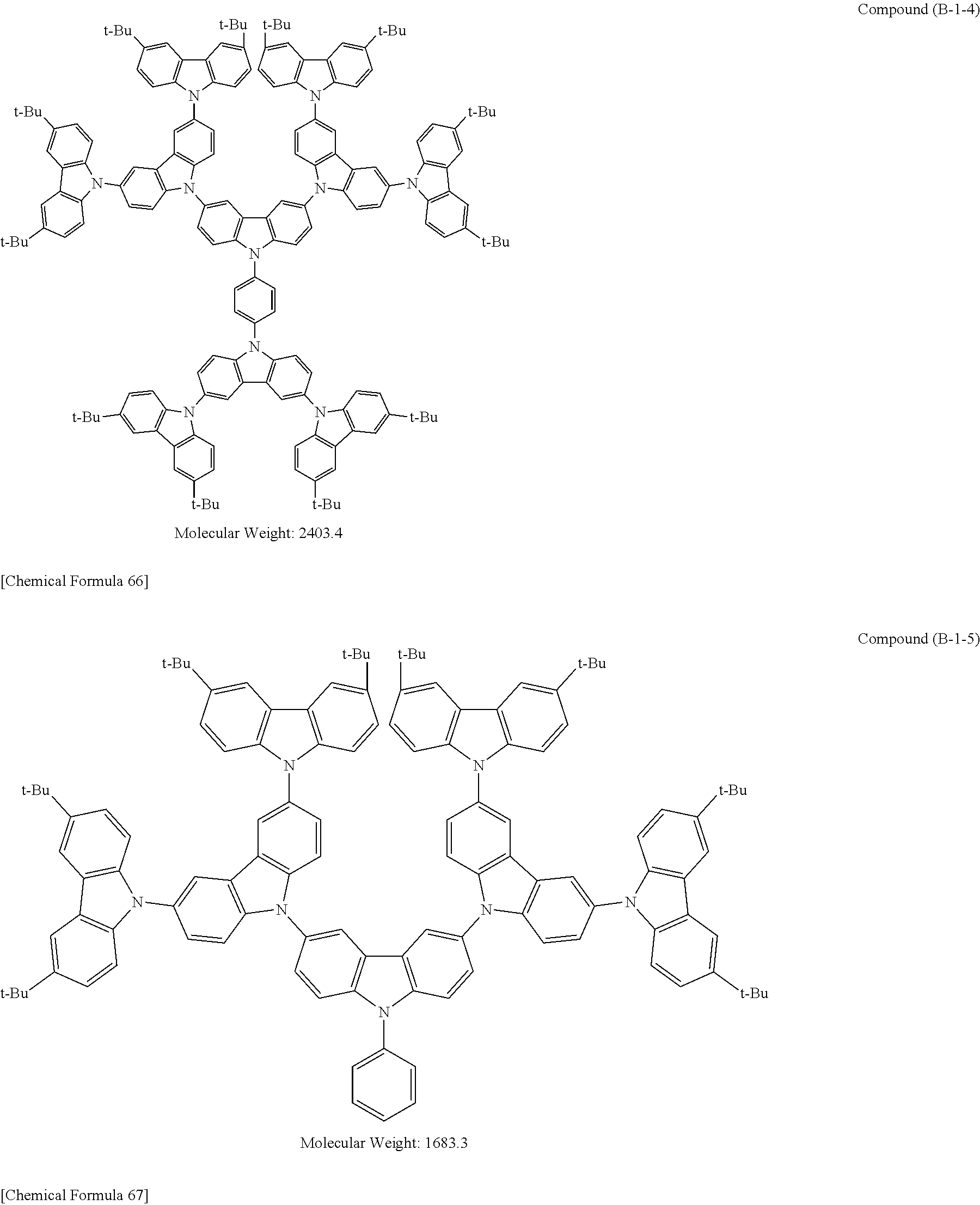
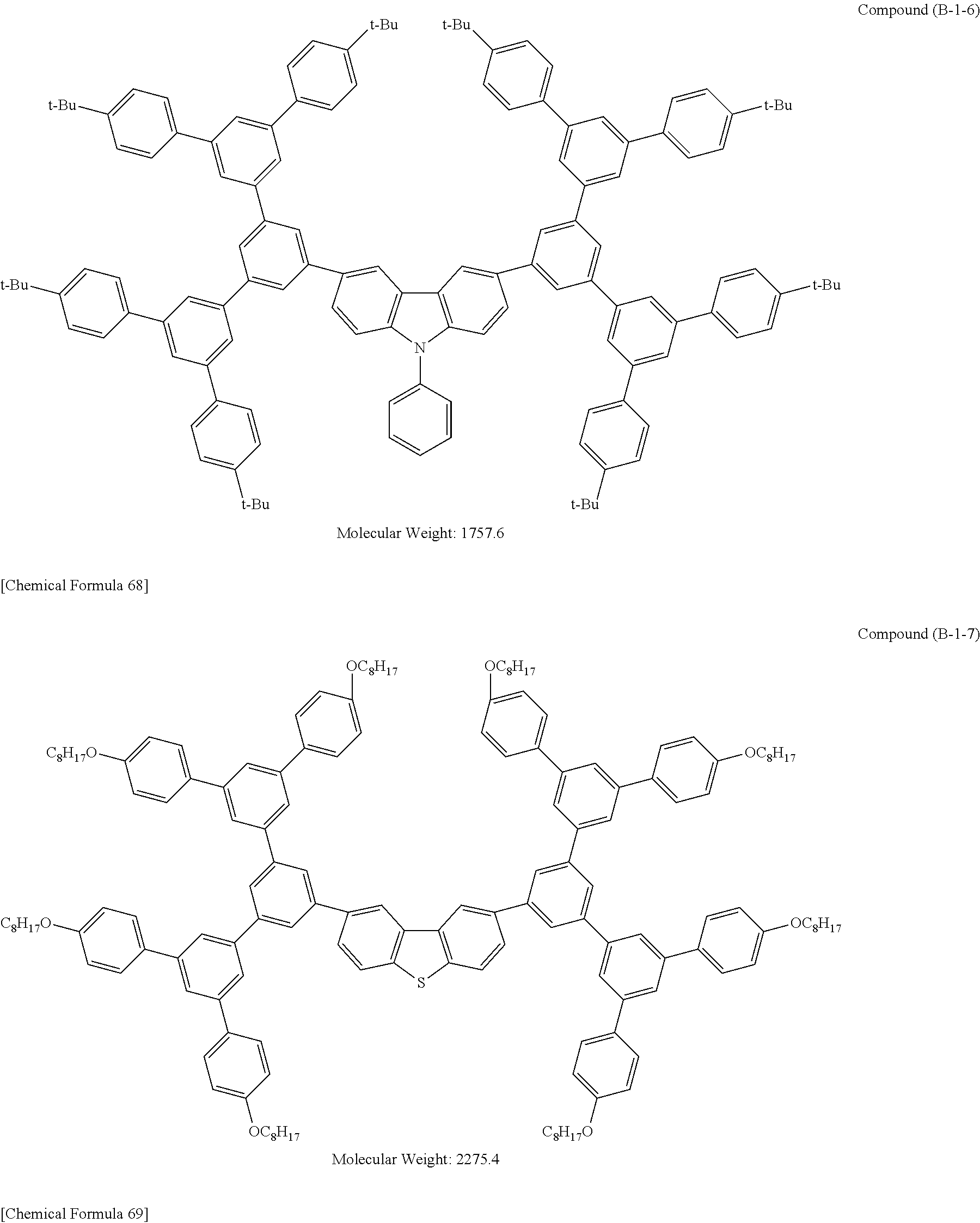
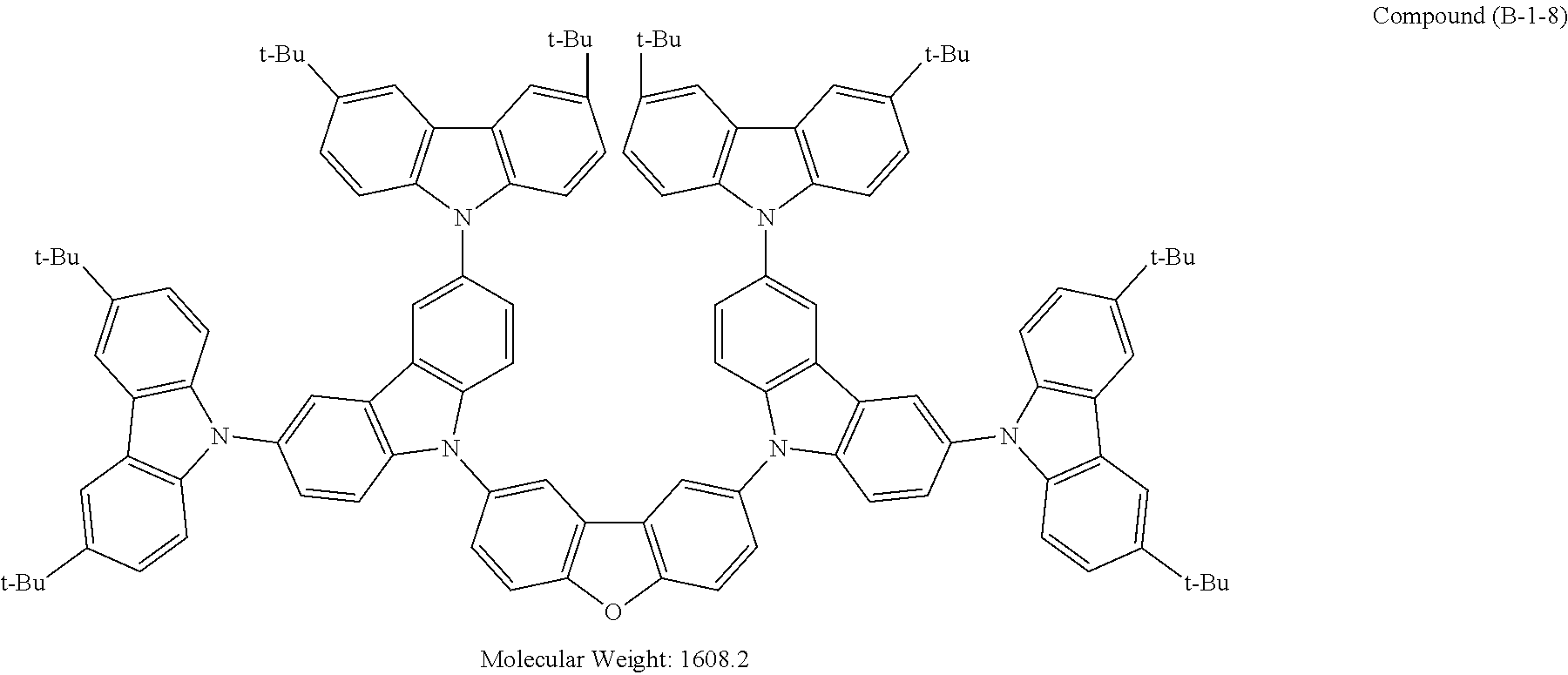
[Composition Ratio of Light Emitting Layer, and the Like]
4000≤MA+MB≤5400 (M1-4)


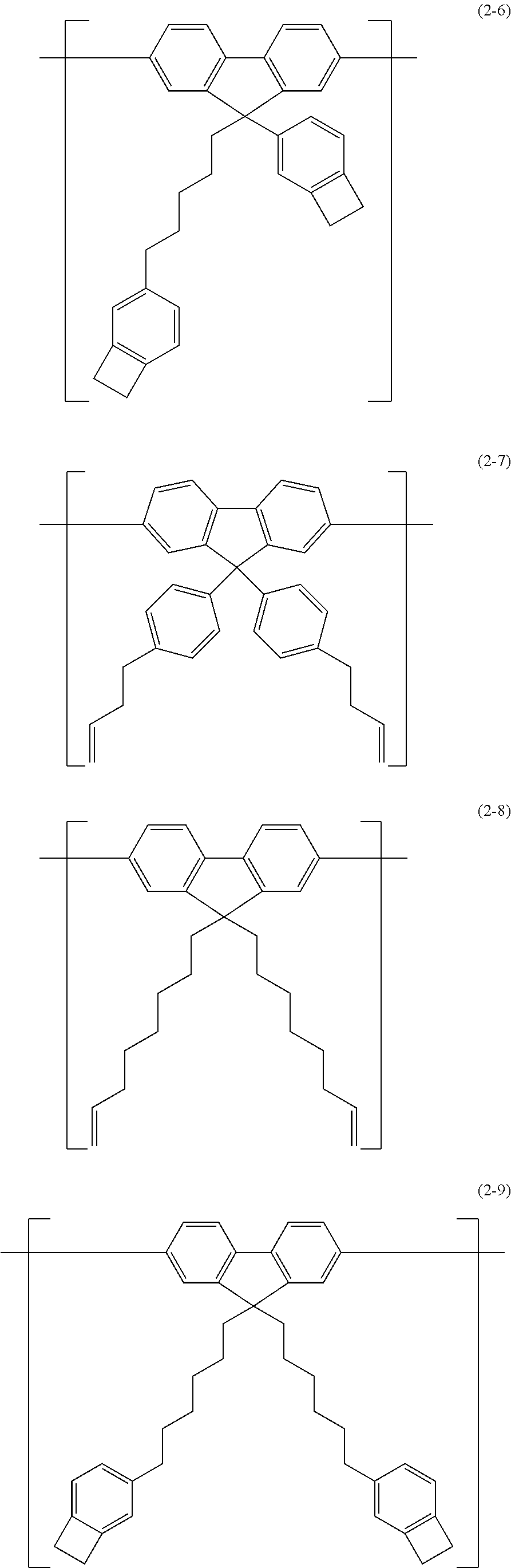
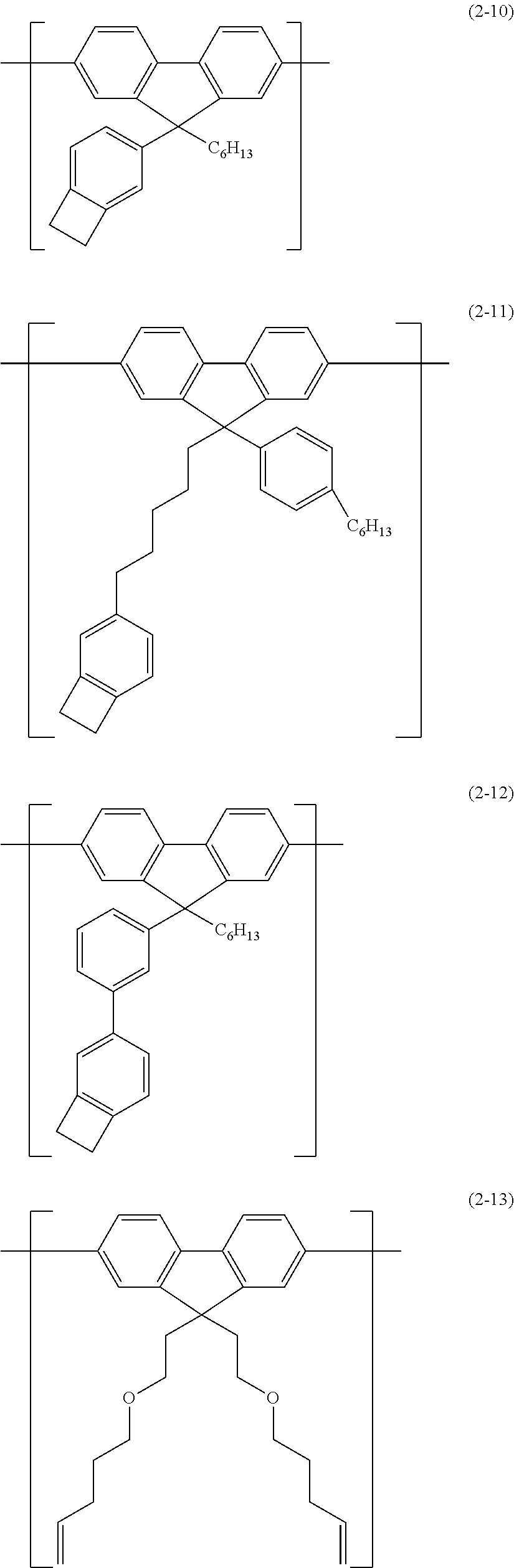
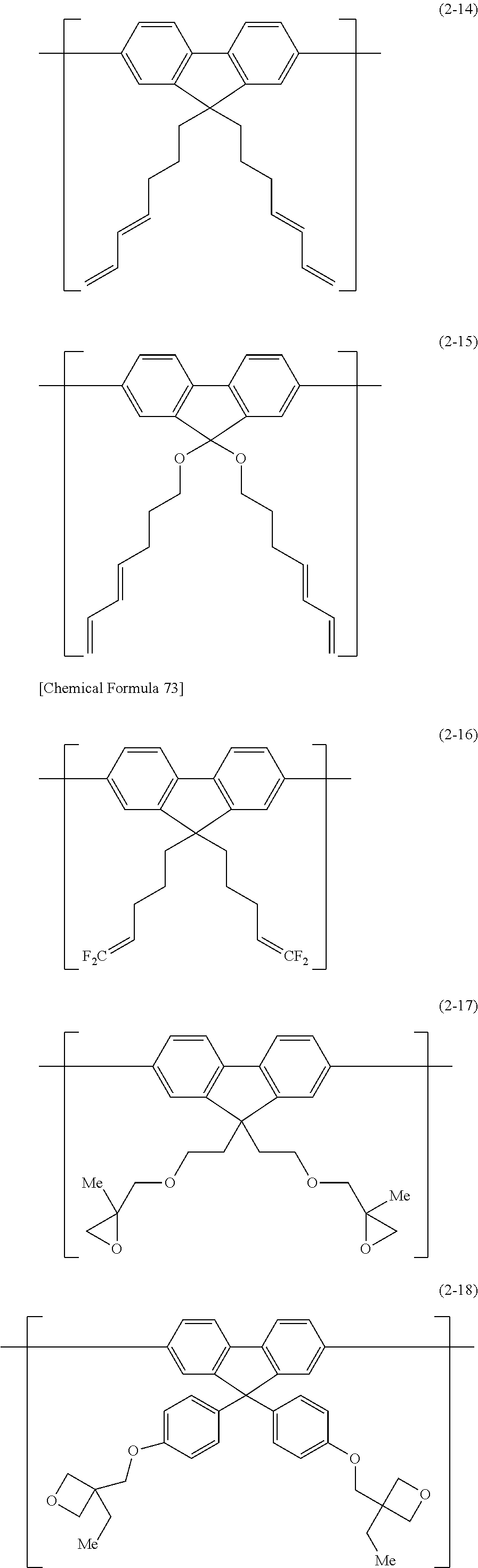
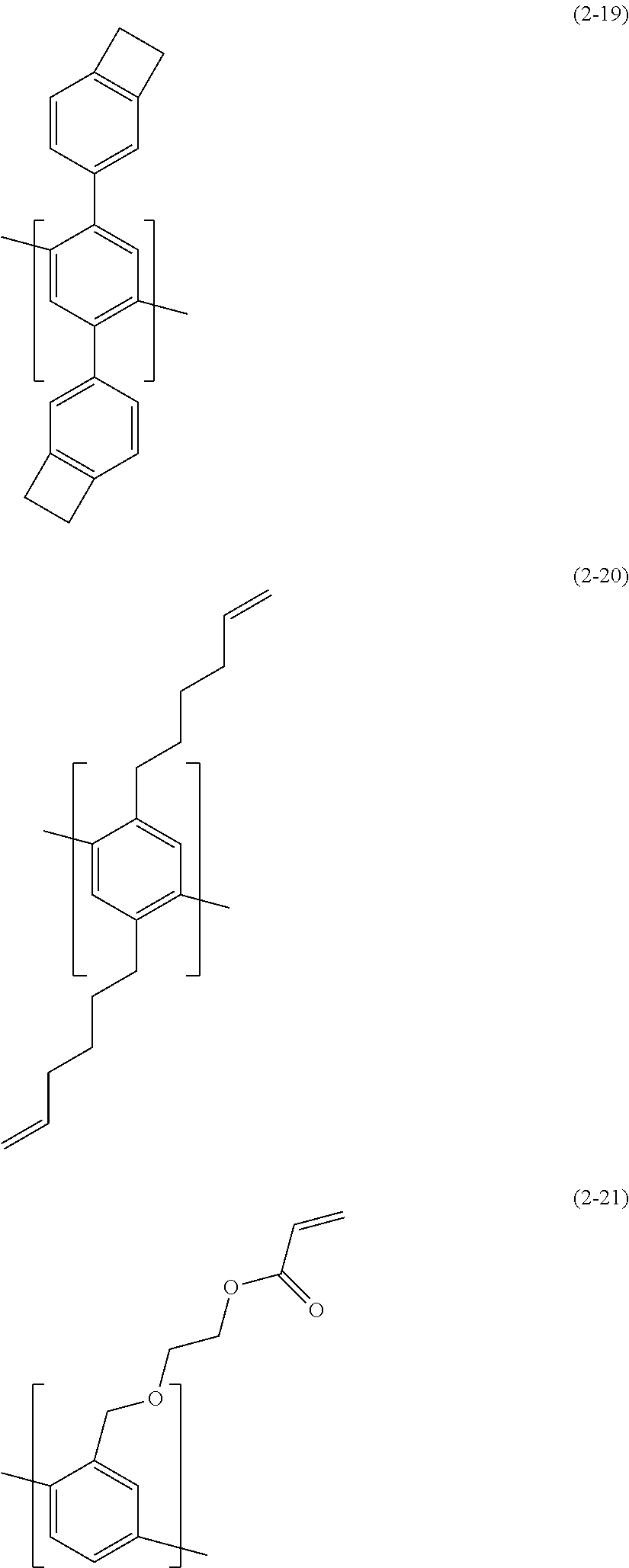


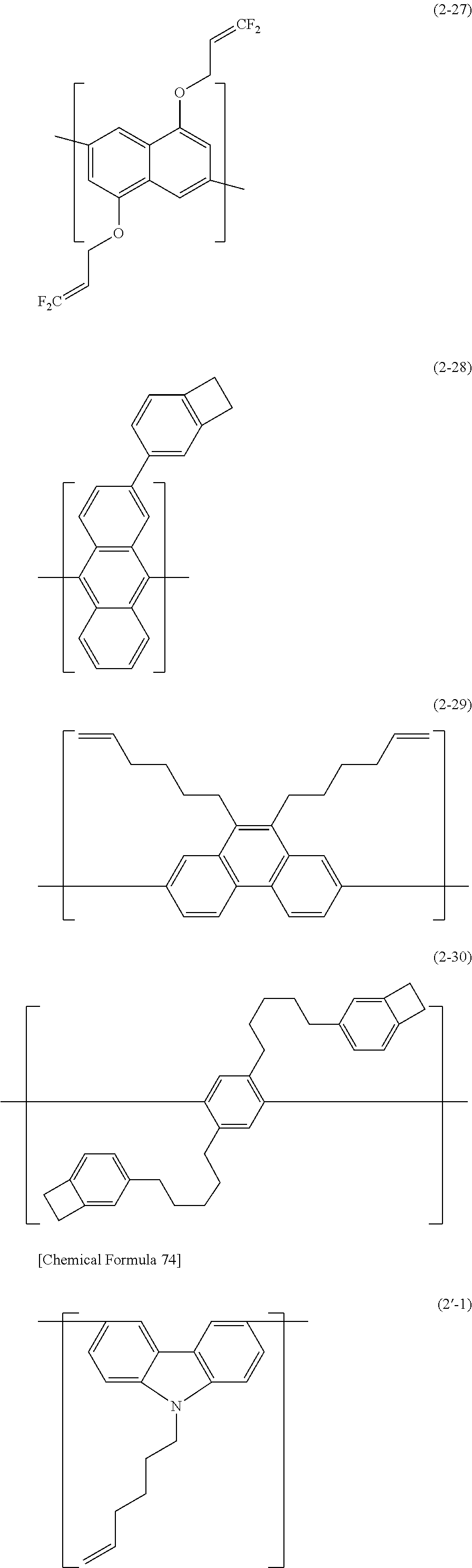

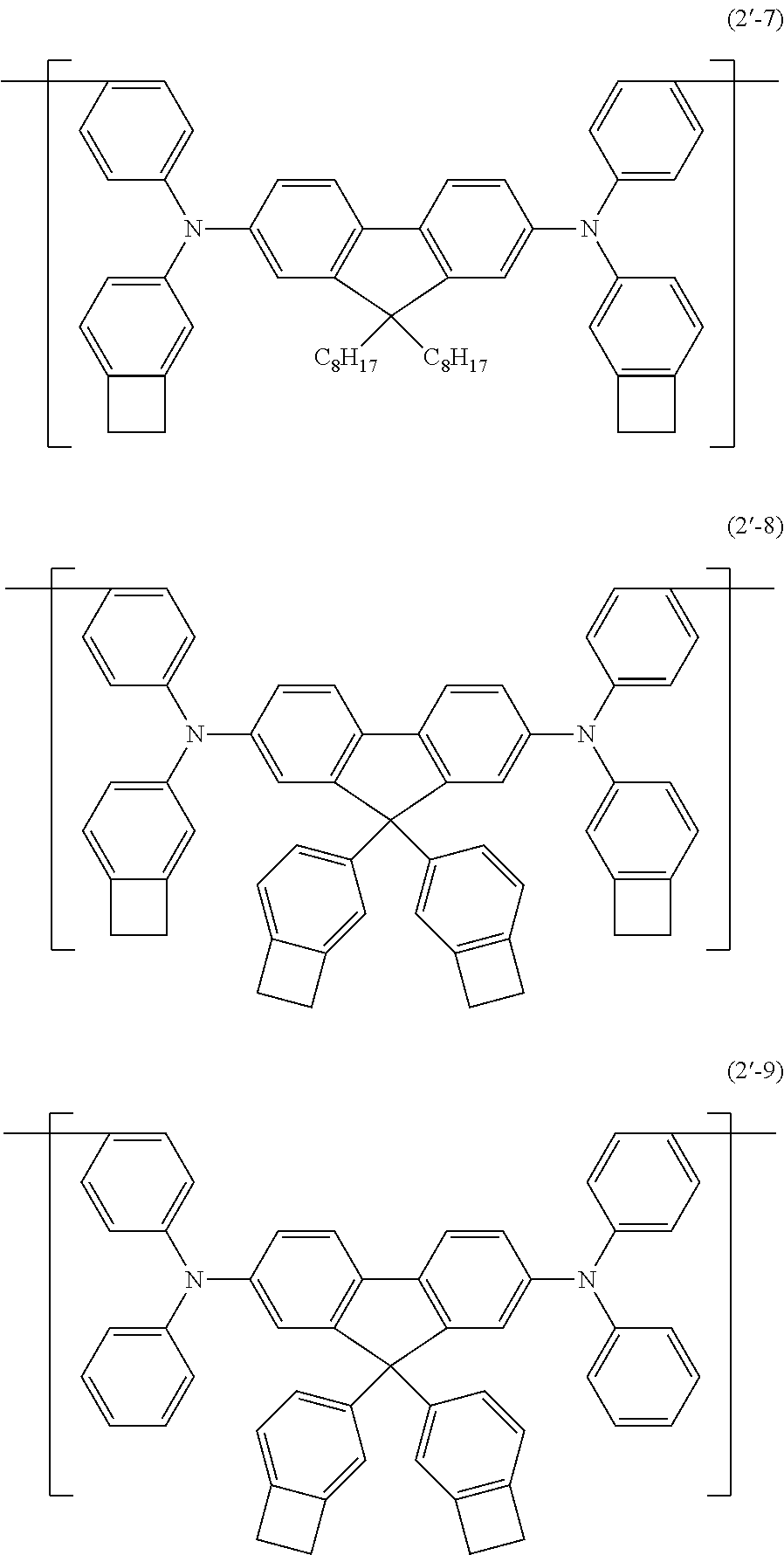
[Other Constitutional Unit]
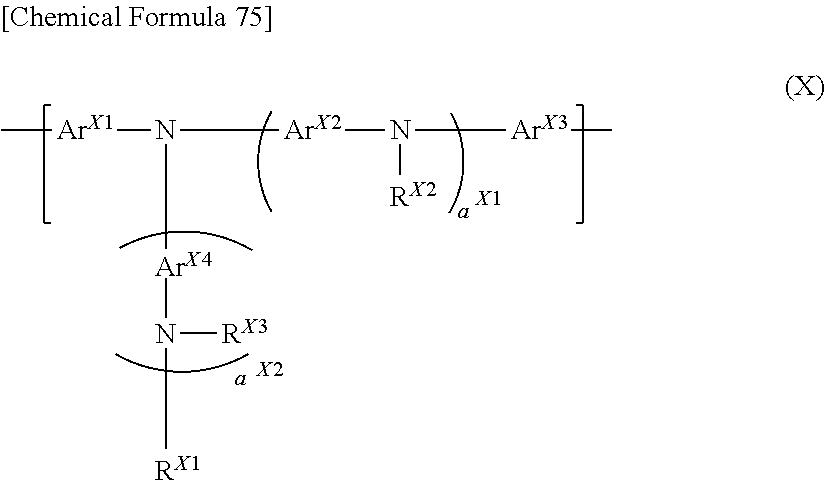
[wherein,
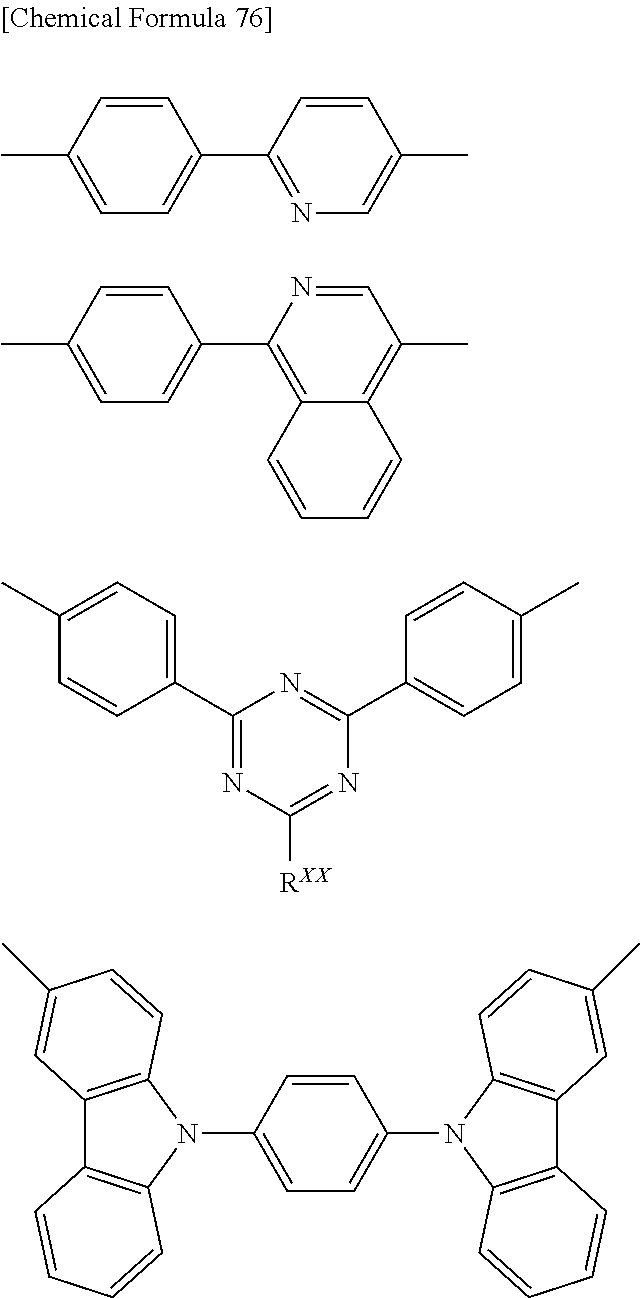
[wherein, RXX represents a hydrogen atom, an alkyl group, a cycloalkyl group, an aryl group or a monovalent heterocyclic group, and these groups each optionally have a substituent.]

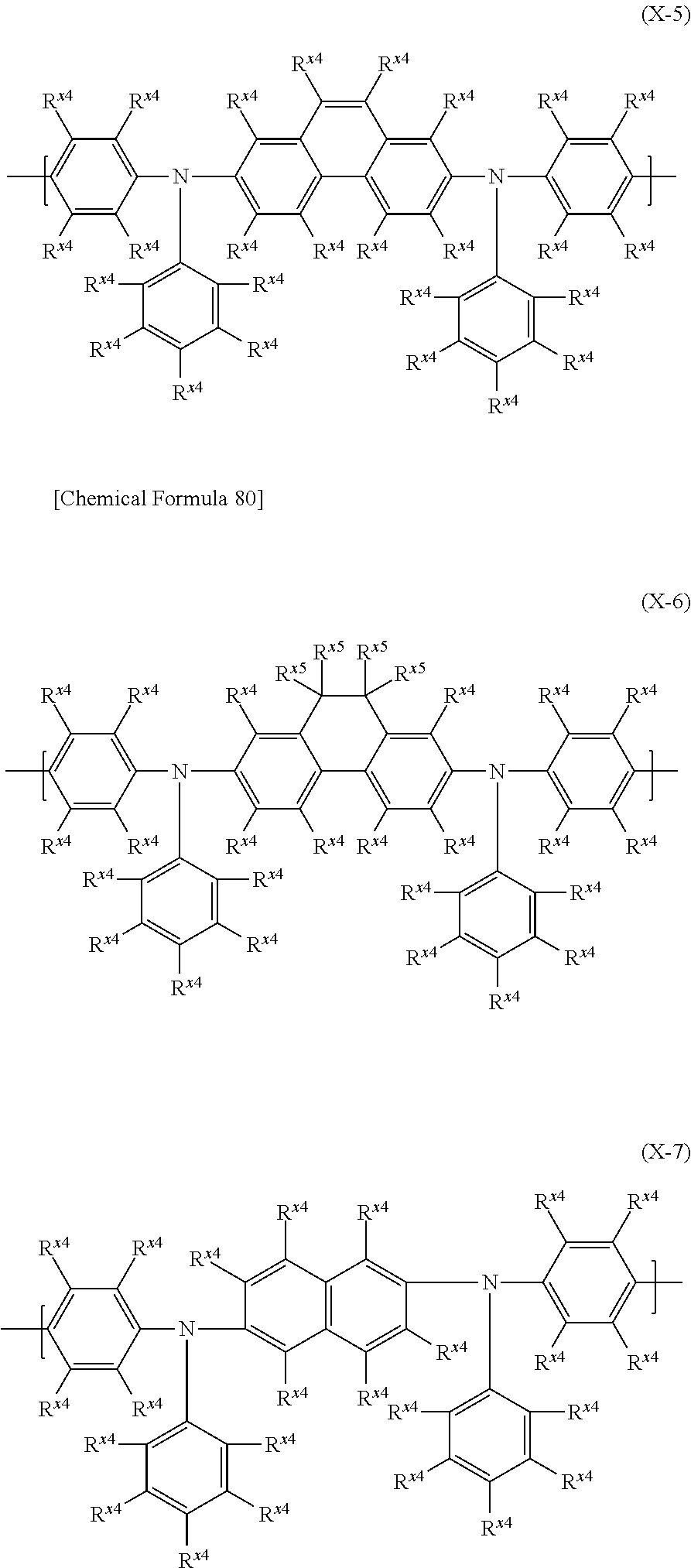
[wherein, RX4 and RX5 each independently represent a hydrogen atom, an alkyl group, a cycloalkyl group, an alkoxy group, a cycloalkoxy group, an aryl group, an aryloxy group, a halogen atom, a monovalent heterocyclic group or a cyano group, and these groups each optionally have a substituent. The plurality of RX4 may be the same or different. The plurality of RX5 may be the same or different, and adjacent groups RX5 may be combined together to form a ring together with the carbon atoms to which they are attached.]

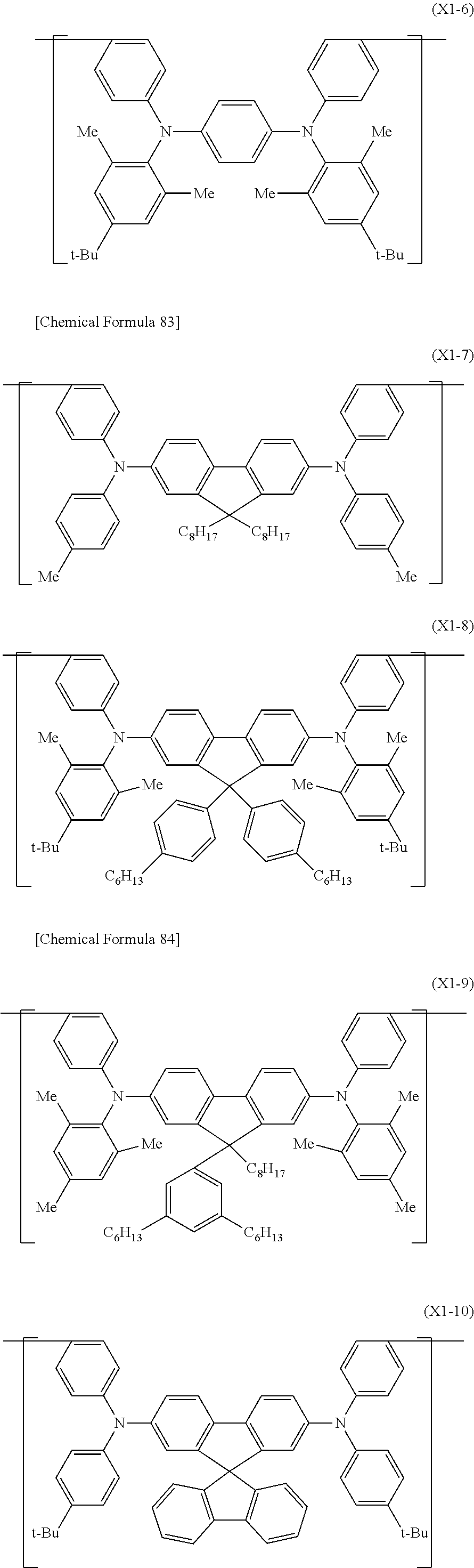


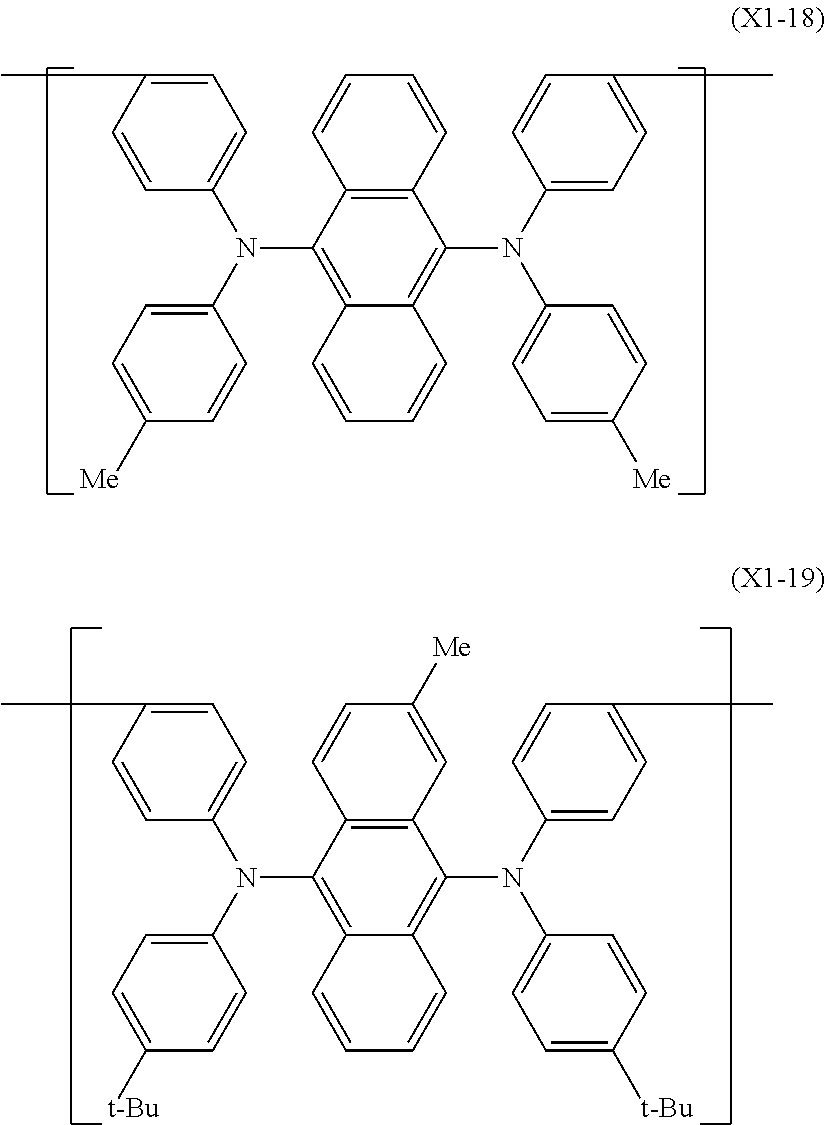
[Chemical Formula 89]


[wherein, ArY1 represents an arylene group, a divalent heterocyclic ring group or a divalent group in which at least one arylene group and at least one divalent heterocyclic ring group are bonded directly to each other, and these groups each optionally have a substituent.]
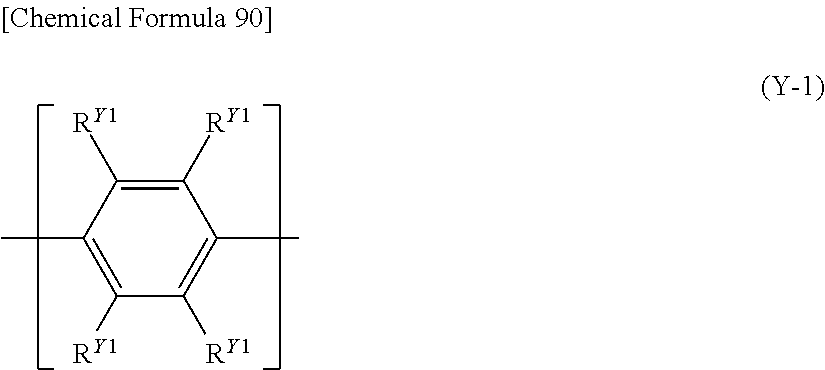
[wherein, RY1 represents a hydrogen atom, an alkyl group, a cycloalkyl group, an alkoxyl group, a cycloalkoxy group, an aryl group or a monovalent heterocyclic group, and these groups each optionally have a substituent. The plurality of RY1 may be the same or different, and adjacent groups RY1 may be combined together to form a ring together with the carbon atoms to which they are attached.]
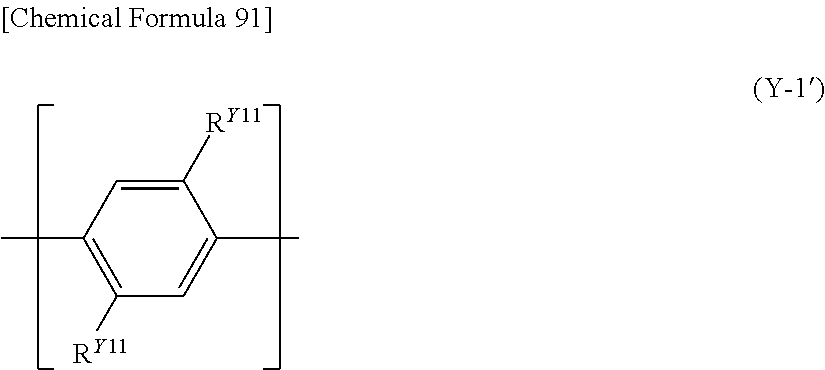
[wherein, RY11 represents an alkyl group, a cycloalkyl group, an alkoxy group, a cycloalkoxy group, an aryl group or a monovalent heterocyclic group, and these groups each optionally have a substituent. The plurality of RY1 may be the same or different.]
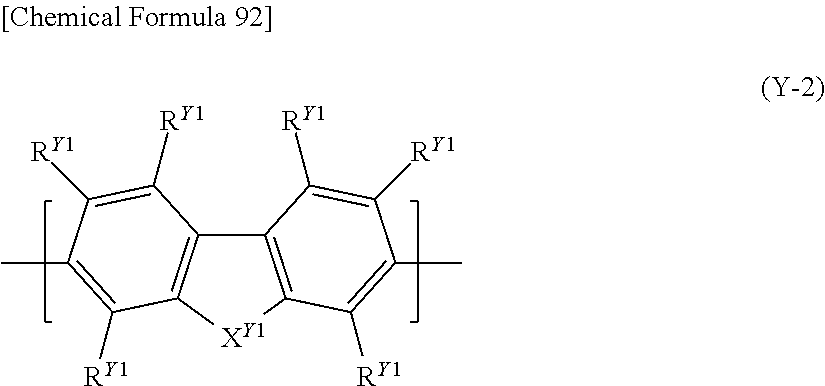
[wherein,
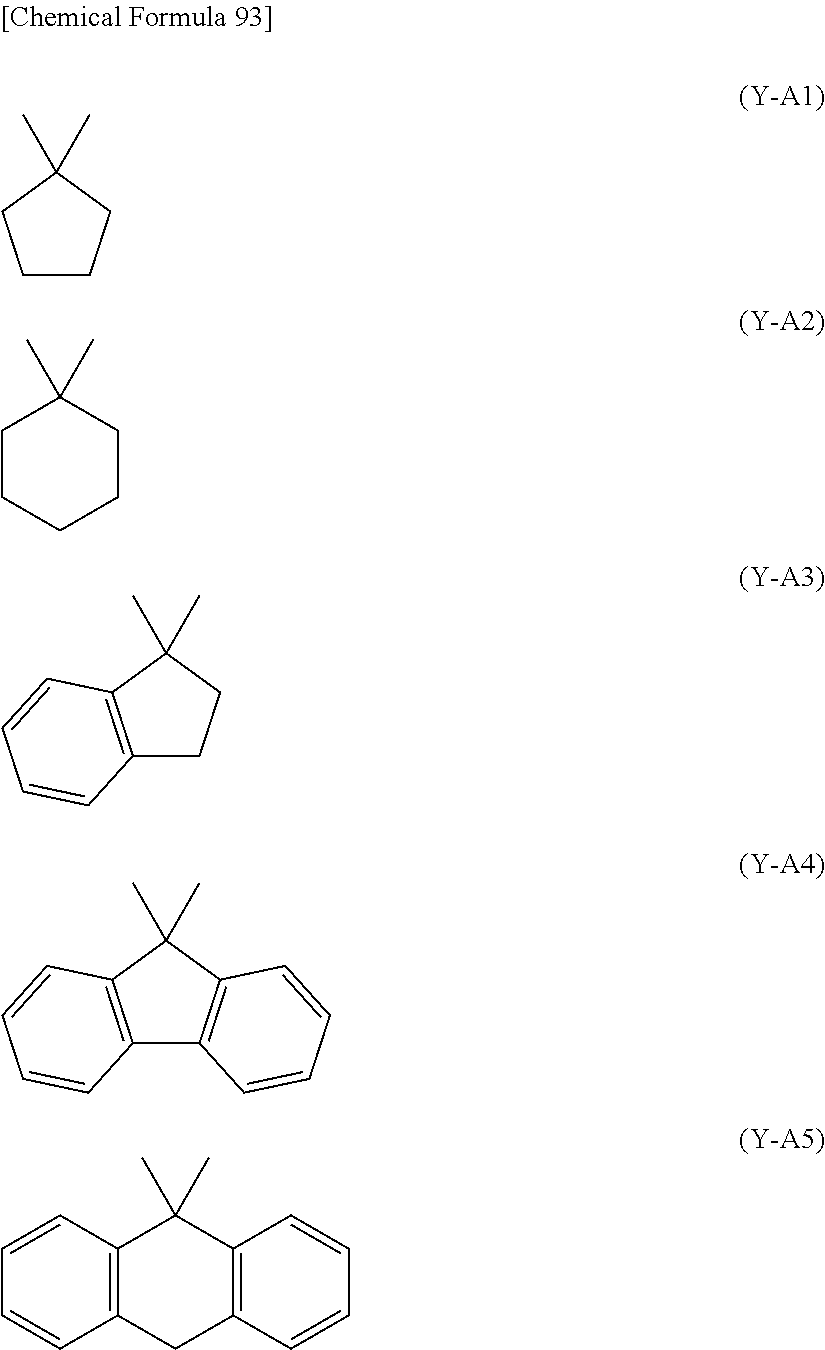

[wherein, RY2 represents the same meaning as described above.]
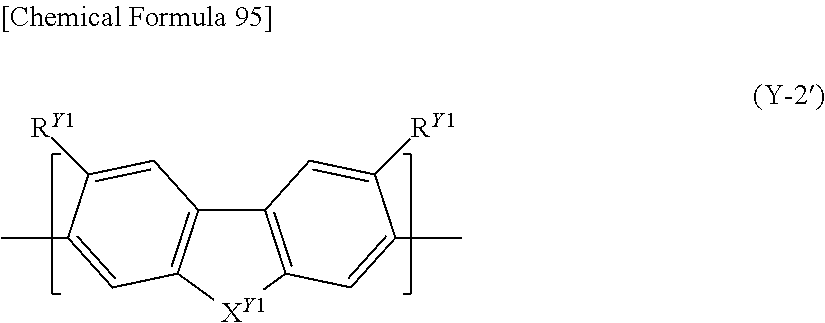
[wherein, RY1 and XY1 represent the same meaning as described above.]

[wherein,

[wherein,


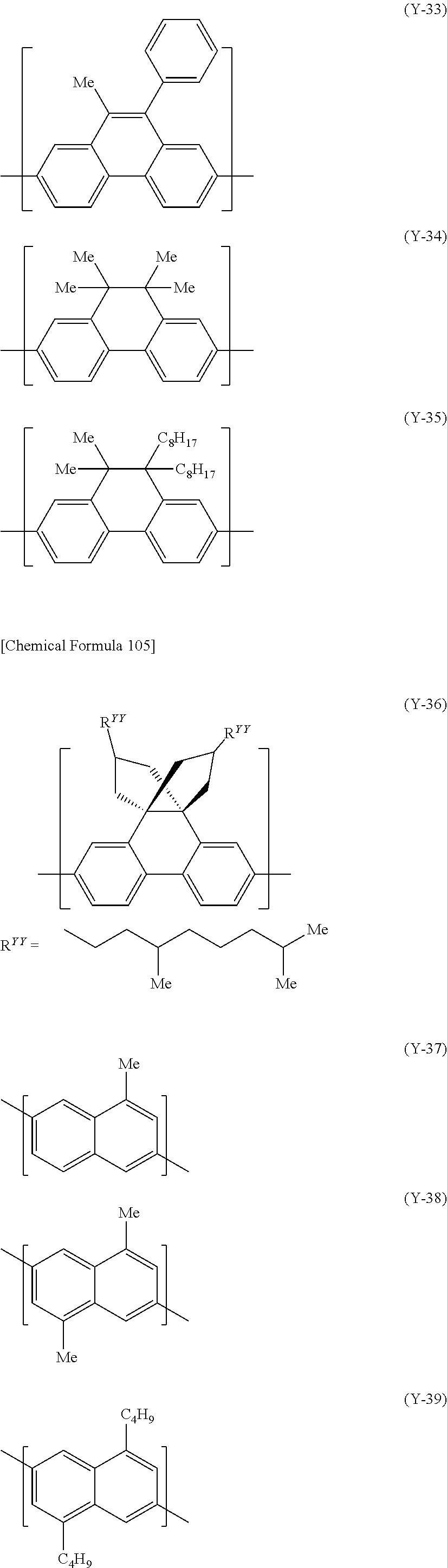
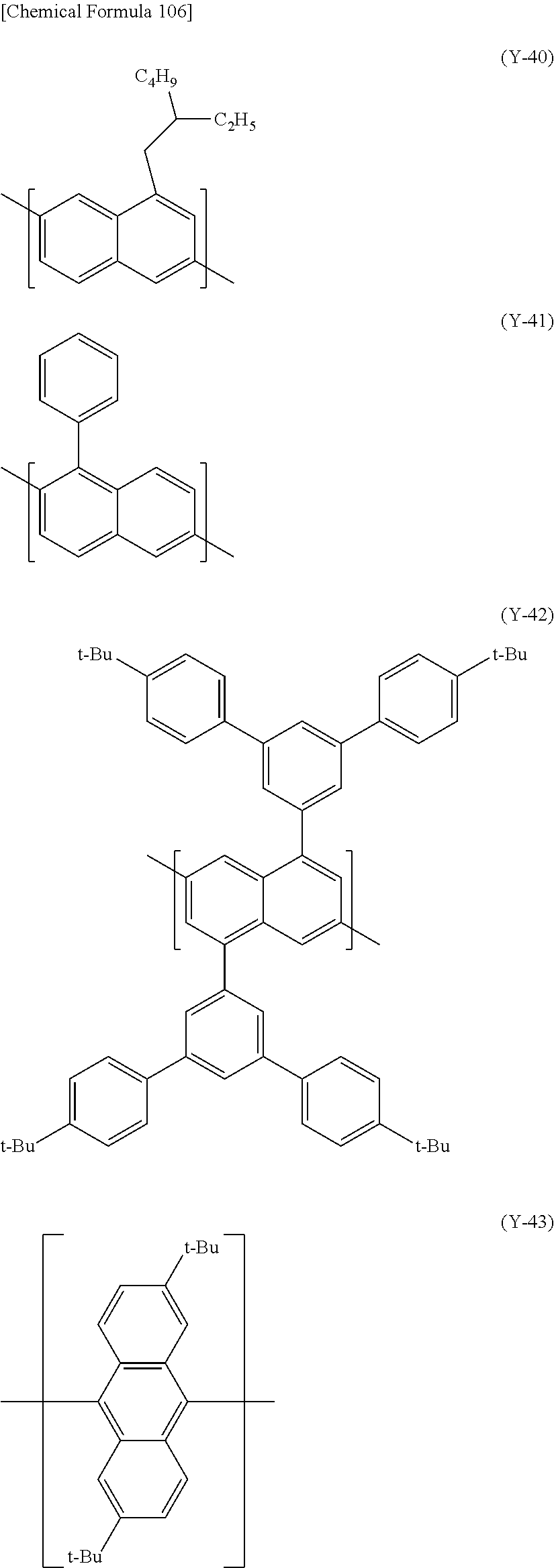
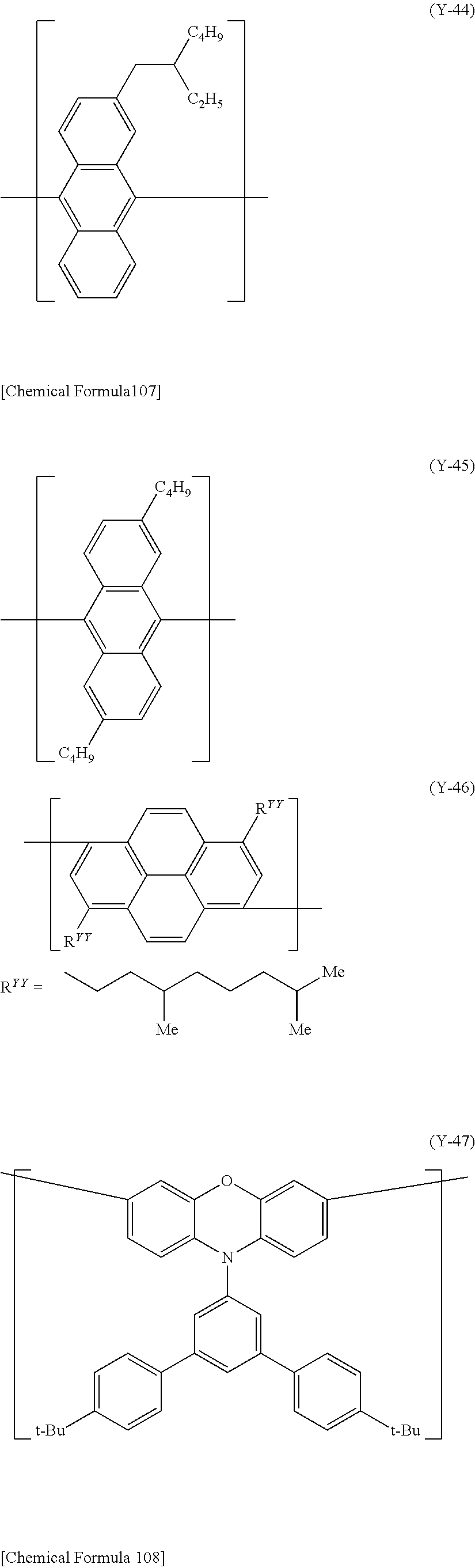
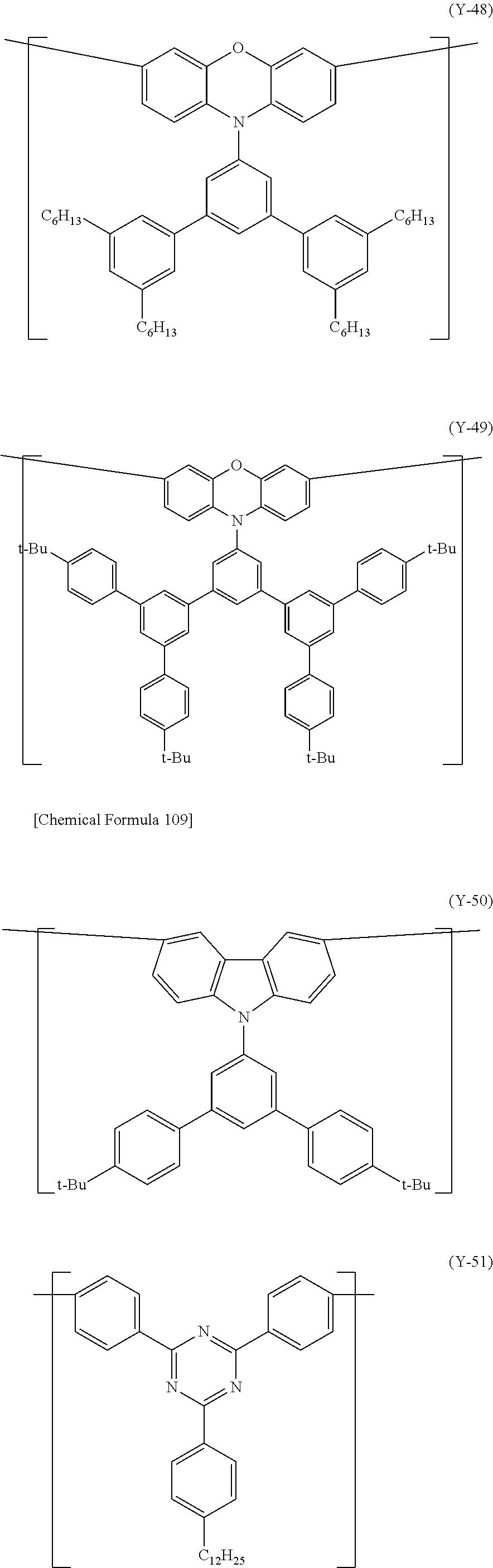
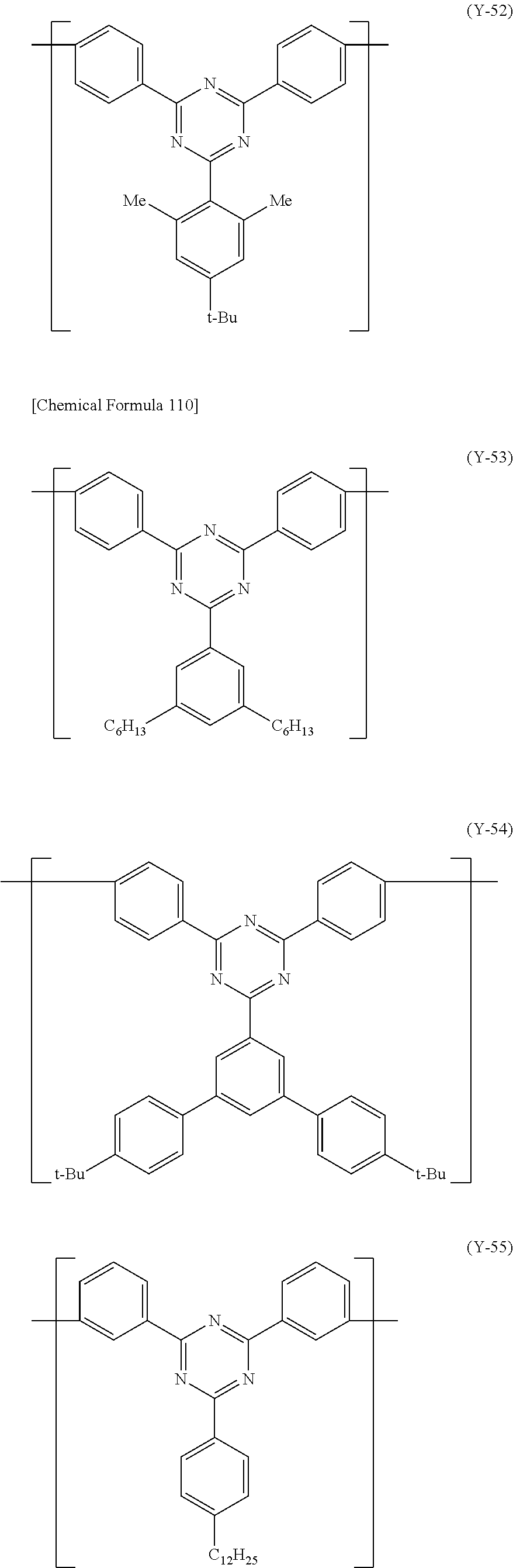
| TABLE 1 | ||
| constitutional unit and mole fraction thereof | ||
| formula | formula | formula | formula | ||||
| polymer | (2) | (2′) | (X) | (Y) | other | ||
| compound | p′ | q′ | r′ | s′ | t′ | ||
| P-1 | 0.1 to | 0.1 to | 0 | 0 | 0 to | ||
| 99.9 | 99.9 | 30 | |||||
| P-2 | 0.1 to | 0 | 0.1 to | 0 | 0 to | ||
| 99.9 | 99.9 | 30 | |||||
| P-3 | 0.1 to | 0 | 0 | 0.1 to | 0 to | ||
| 99.9 | 99.9 | 30 | |||||
| P-4 | 0 | 0.1 to | 0.1 to | 0 | 0 to | ||
| 99.9 | 99.9 | 30 | |||||
| P-5 | 0 | 0.1 to | 0 | 0.1 to | 0 to | ||
| 99.9 | 99.9 | 30 | |||||
| P-6 | 0.1 to | 0.1 to | 0.1 to | 0 | 0 to | ||
| 99.8 | 99.8 | 99.8 | 30 | ||||
| P-7 | 0.1 to | 0.1 to | 0 | 0.1 to | 0 to | ||
| 99.8 | 99.8 | 99.8 | 30 | ||||
| P-8 | 0.1 to | 0.1 to | 0.1 to | 0.1 to | 0 to | ||
| 99.7 | 99.7 | 99.7 | 99.7 | 30 | |||
[in the table, p′, q′, r′, s′ and t′ represent the mole fraction of each constitutional unit. p′+q′+r′+s′+t′=100 and, 70≤p′+q′+r′+s′≤100.]

[wherein,
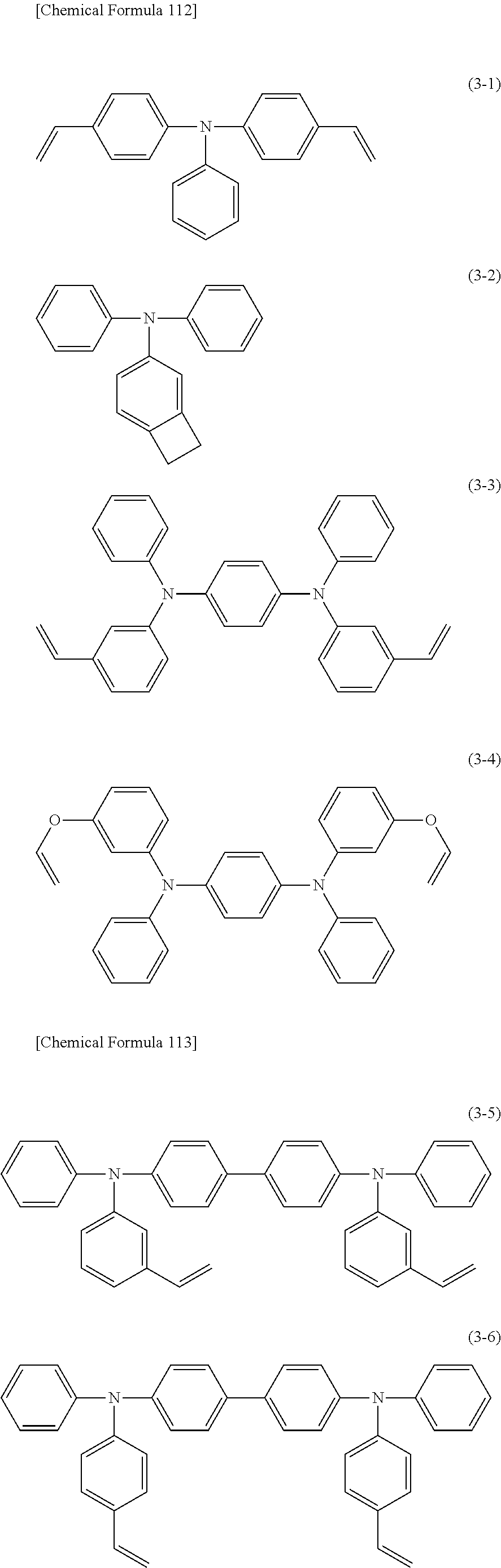
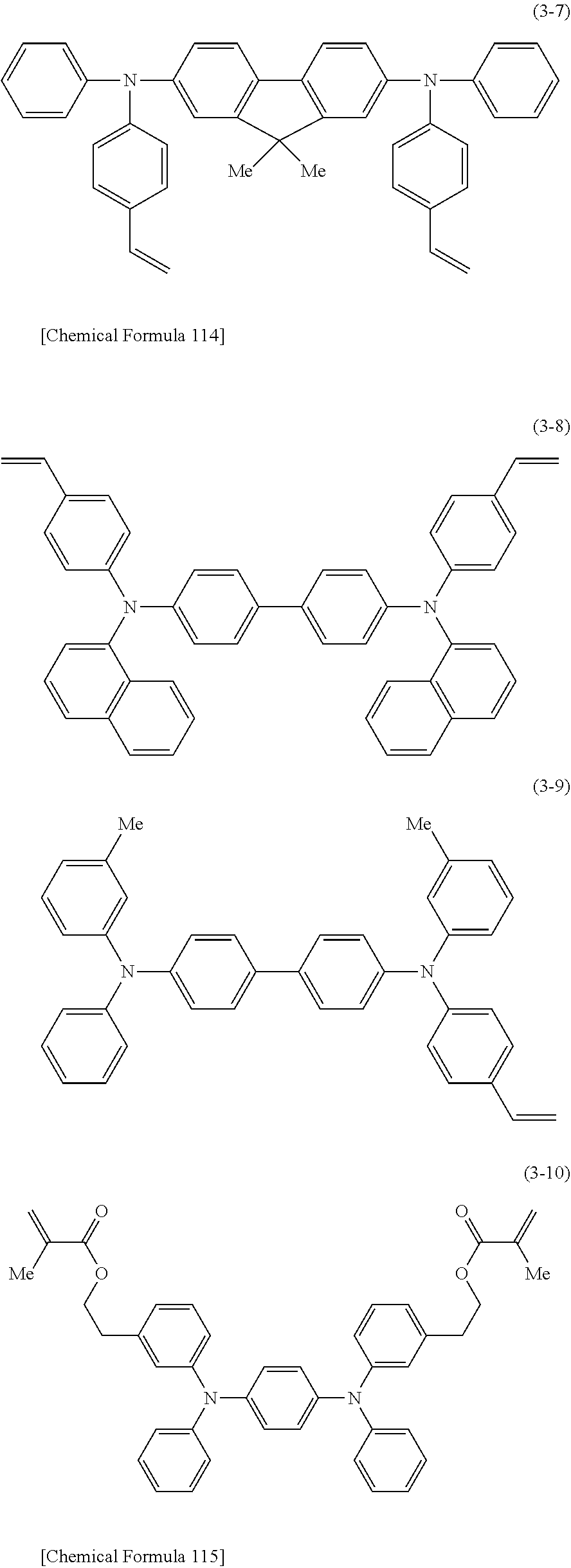


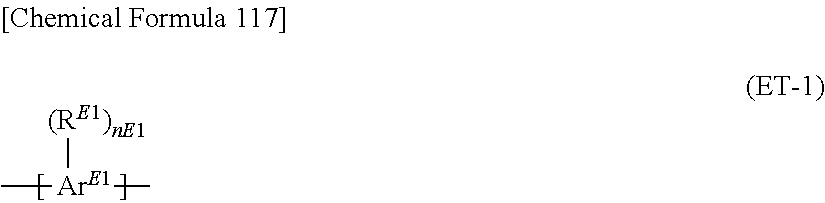
[wherein,
—RE3-{(QE1)nE3-YE1(ME1)aE1(ZE1)bE1}mE1 (ES-1)
[wherein,
—O—(Cn′H2n′O)nx—Cm′H2m′+1 (ES-3)
[wherein, n′, m′ and nx each independently represent an integer of 1 or more.]
—O—RE3′-{(QE1)nE3-YE1(ME1)aE1(ZE1)bE1}mE1
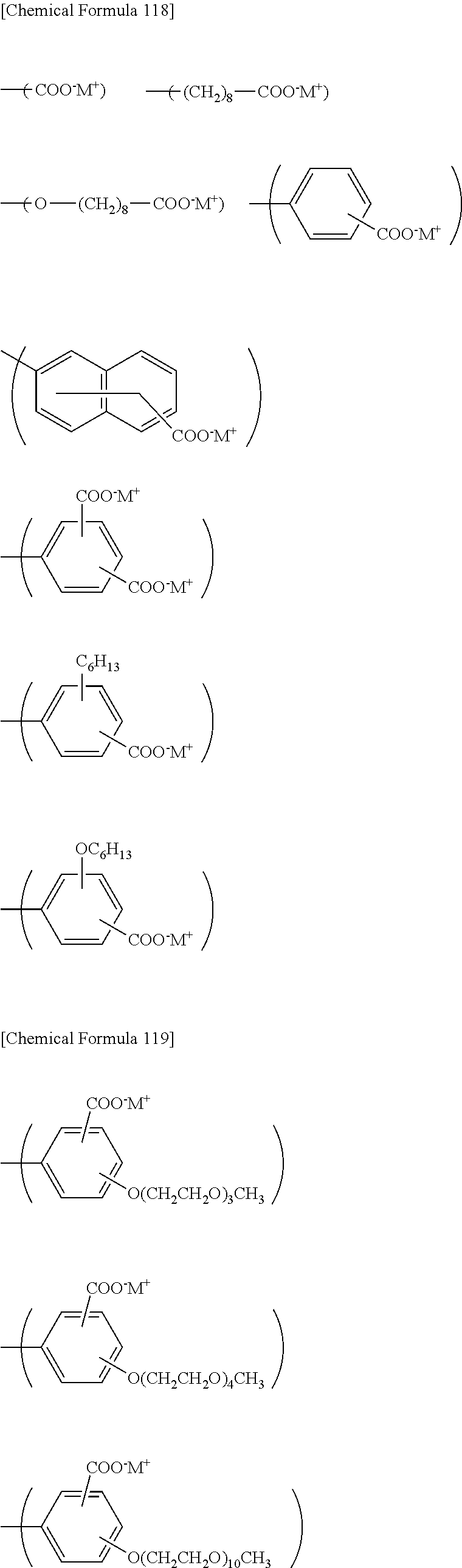
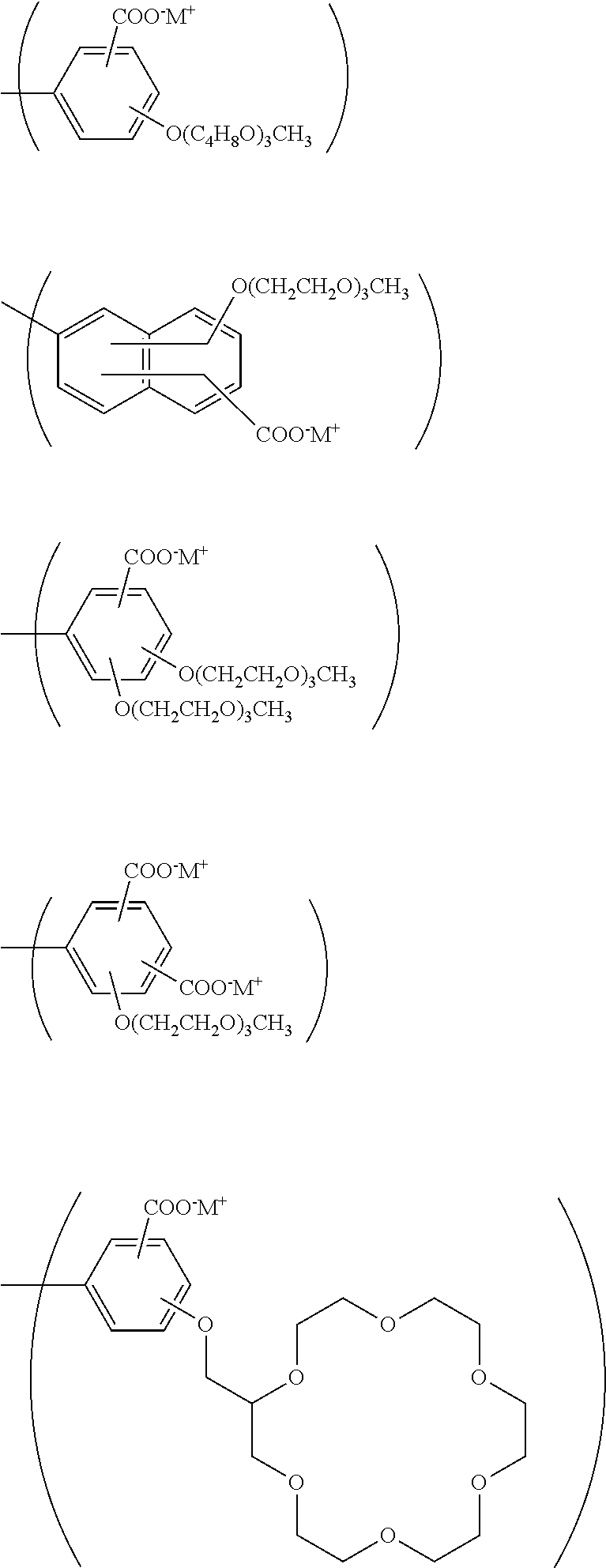
[wherein, M+ represents Li+, Na+, K+, Cs+ or N(CH3)4 +. When a plurality of M+ are present, they may be the same or different.]
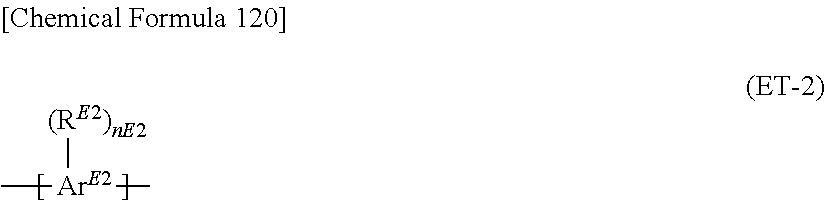
[wherein,
—RE5-{(QE2)nE4-YE2(ME2)aE2(ZE2)bE2}mE2 (ES-2)
[wherein,
—O—RE5′-{(QE1)nE3-YE1(ME1)aE1(ZE1)bE1}mE1
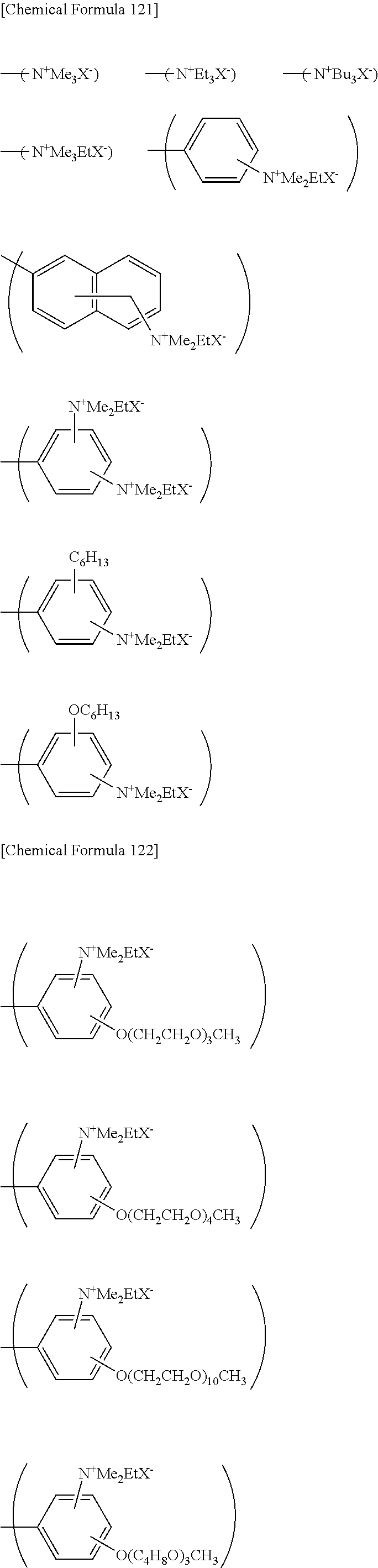
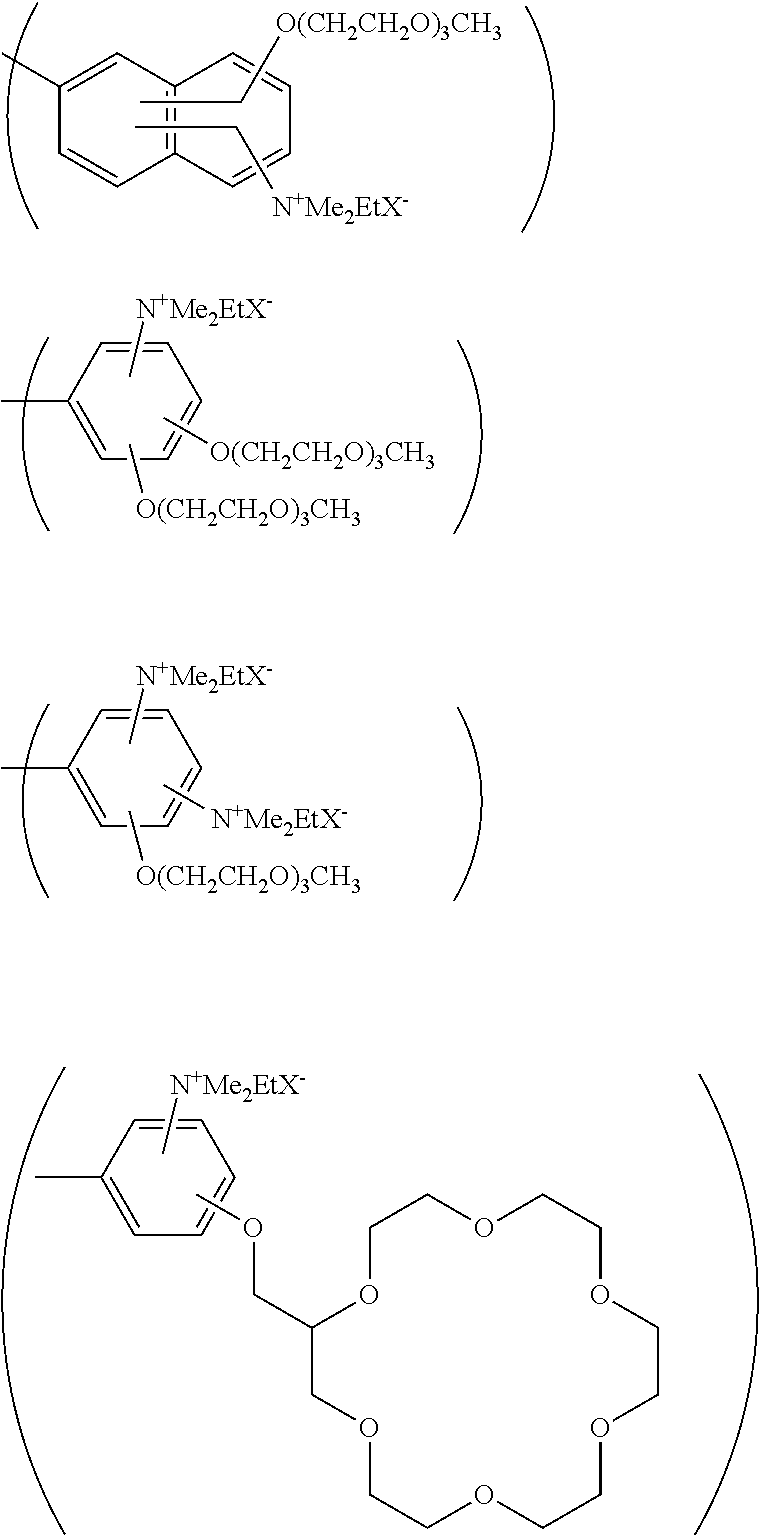
[wherein, X− represents F−, Cl−, Br−, I−, B(C6H5)4 −, CH3COO− or CF3SO3 −. When a plurality of X− are present, they may be the same or different.]

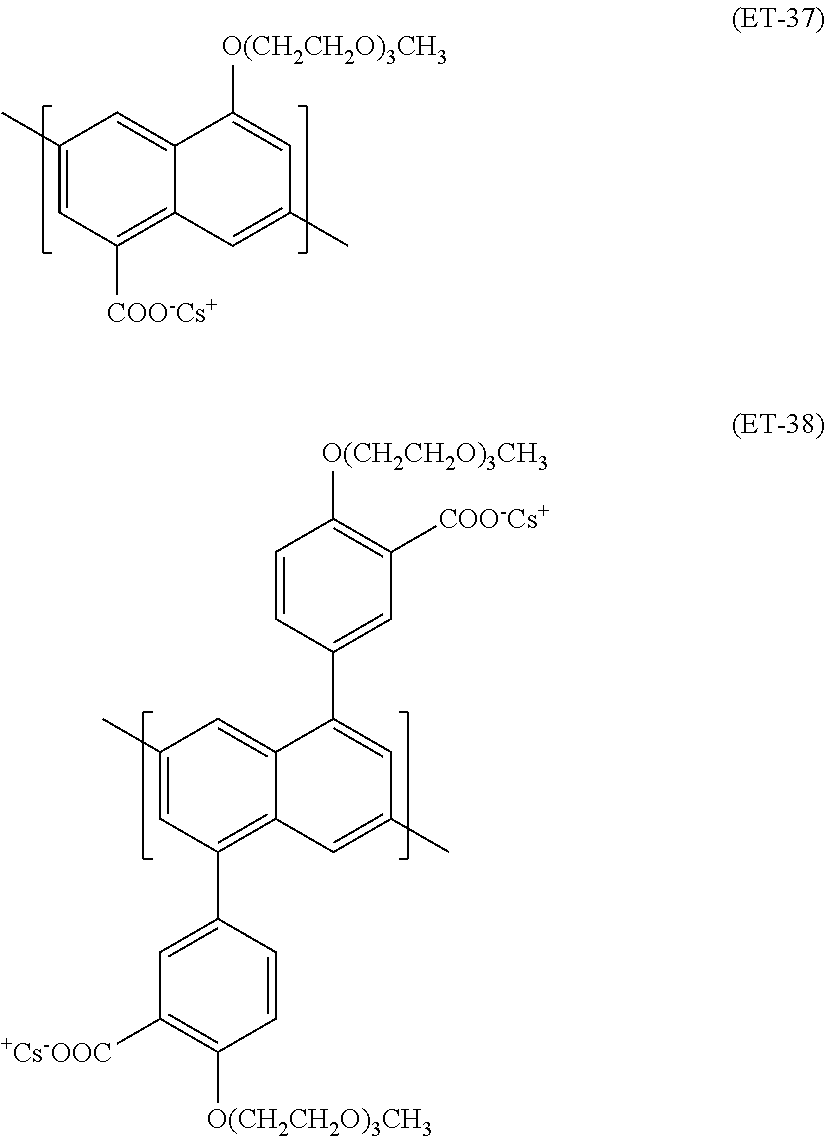
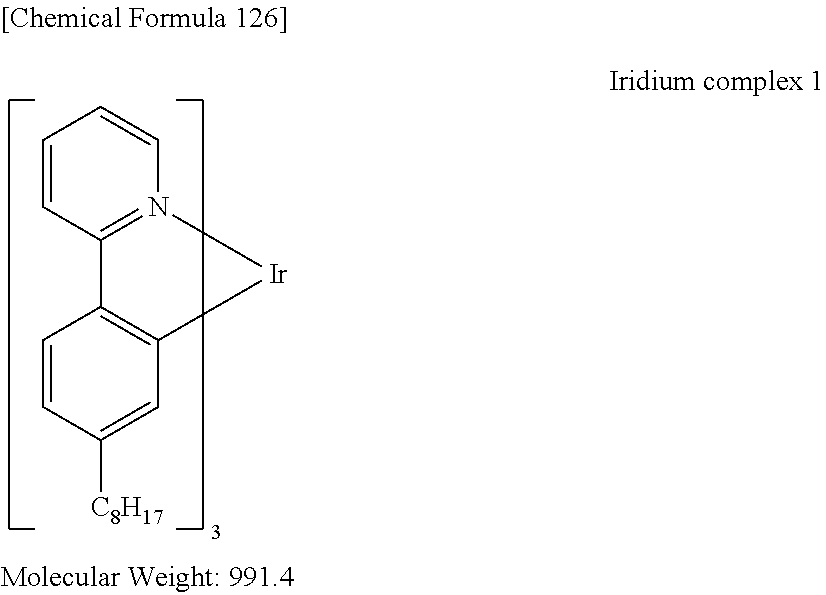

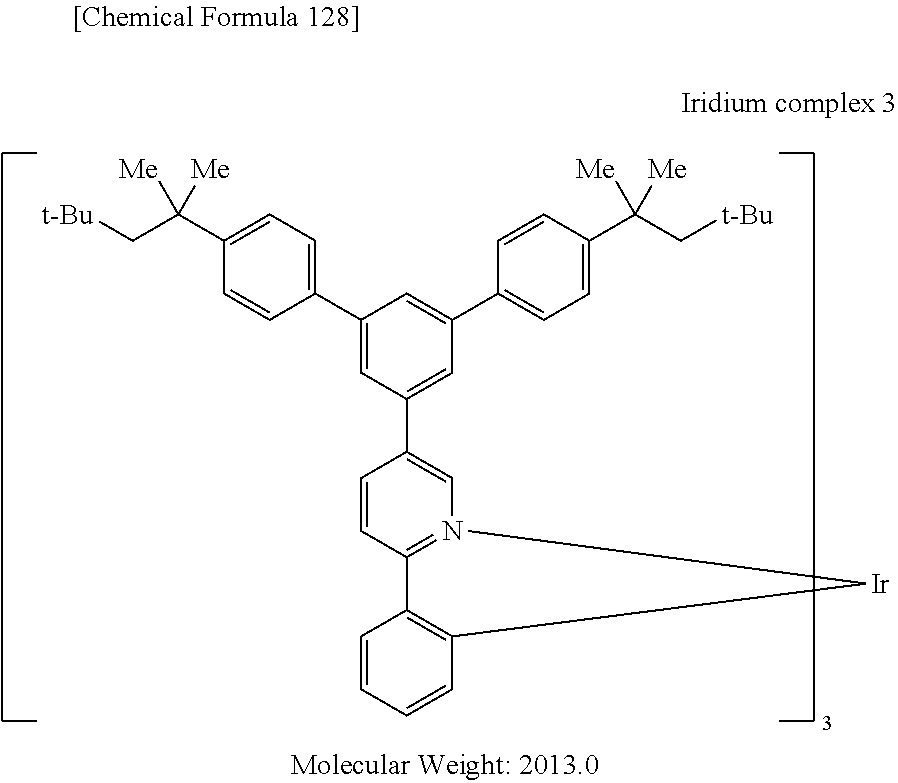
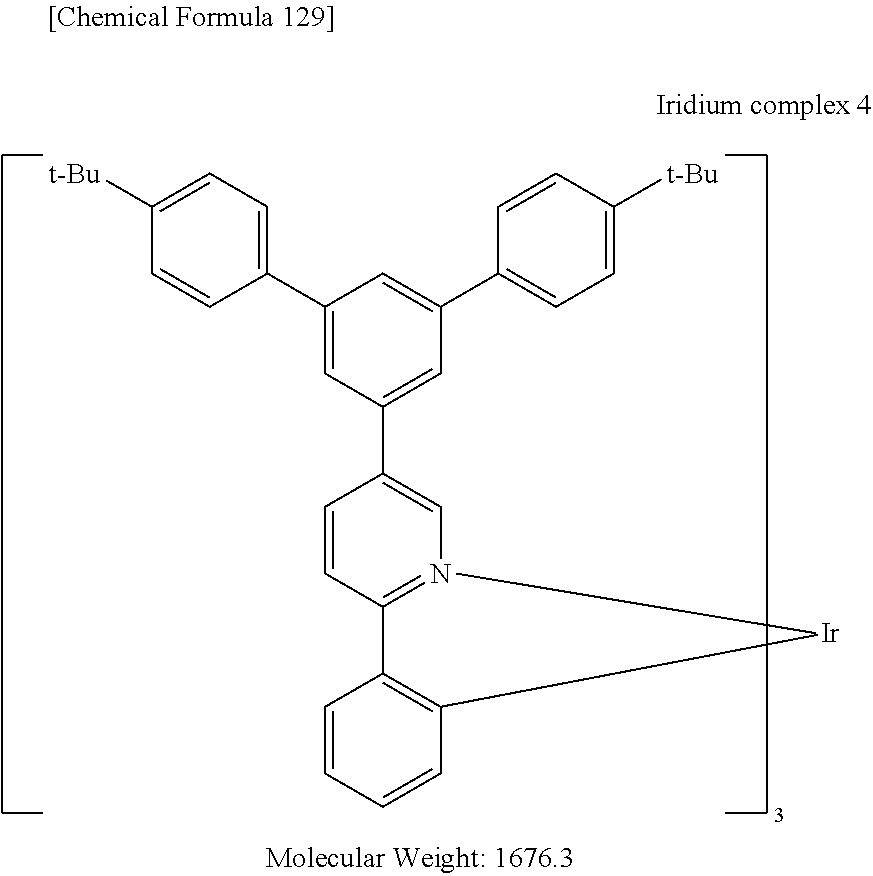

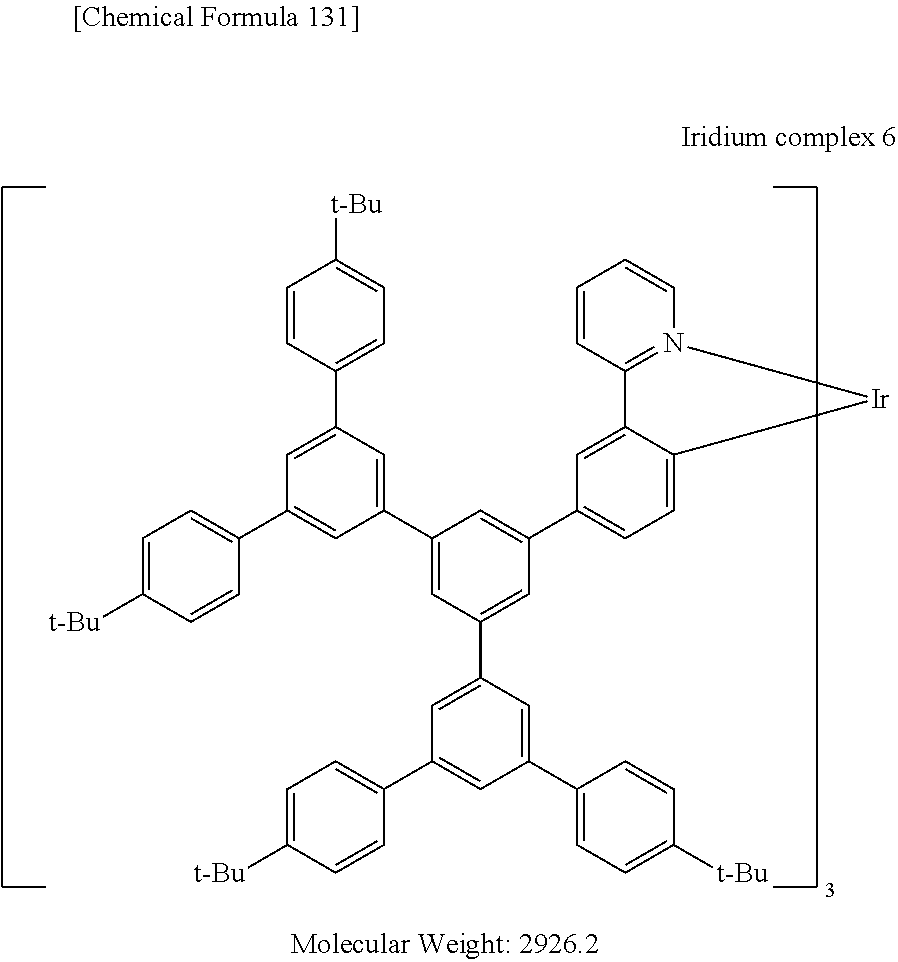
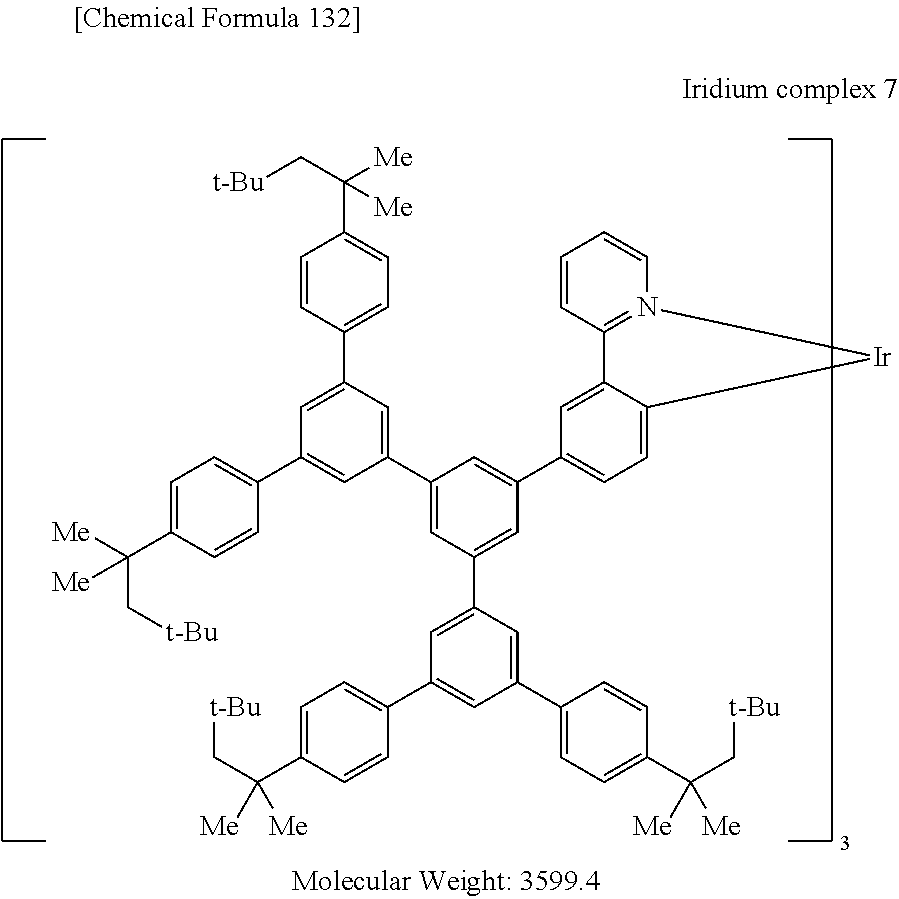


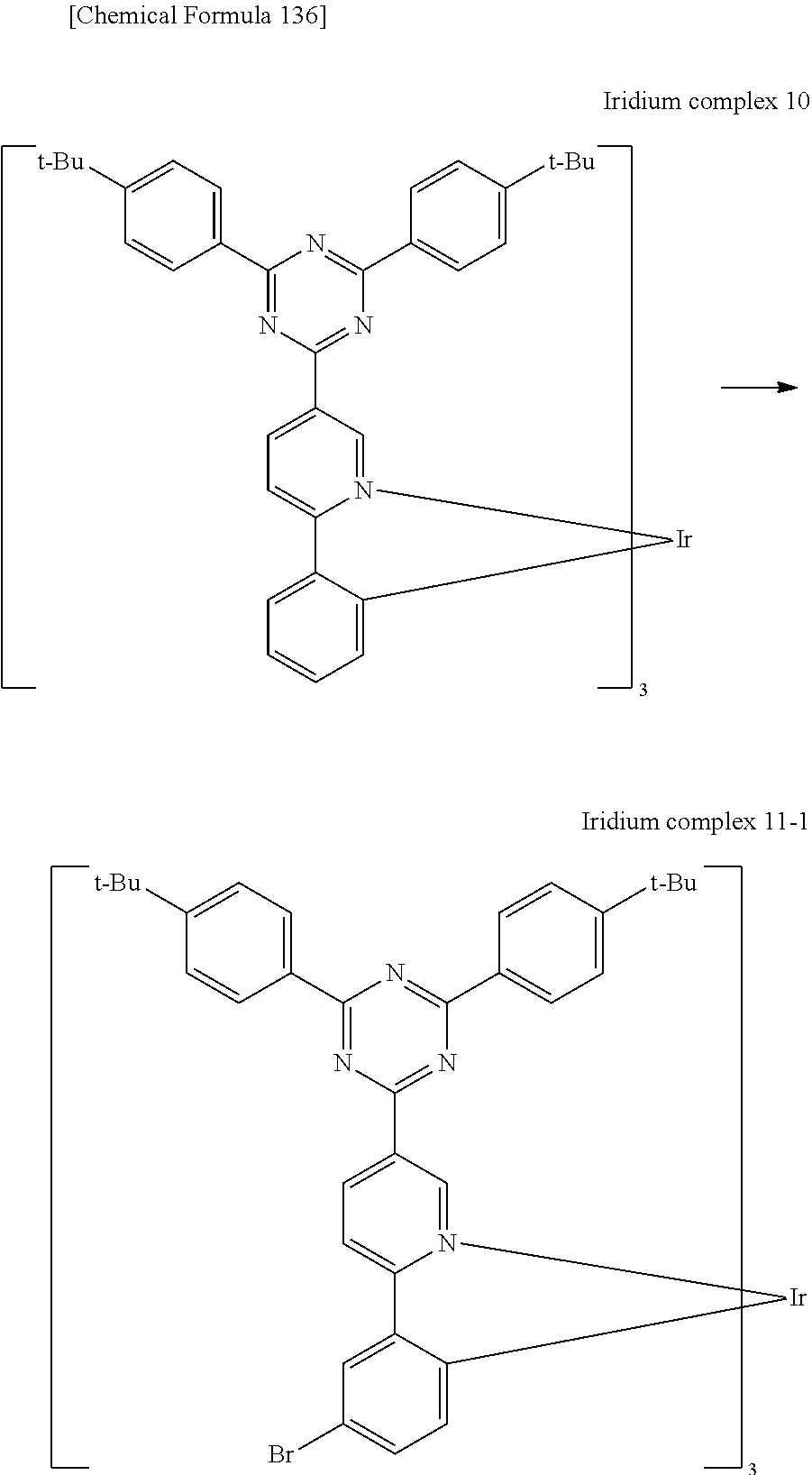
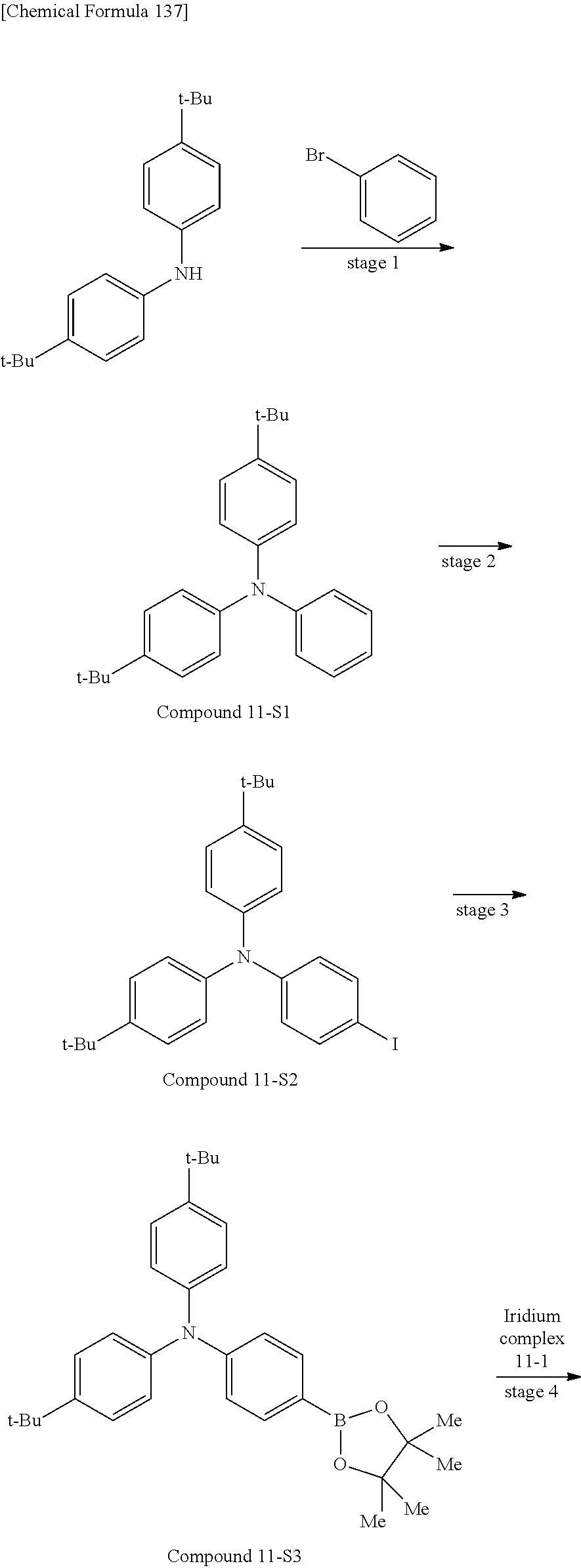
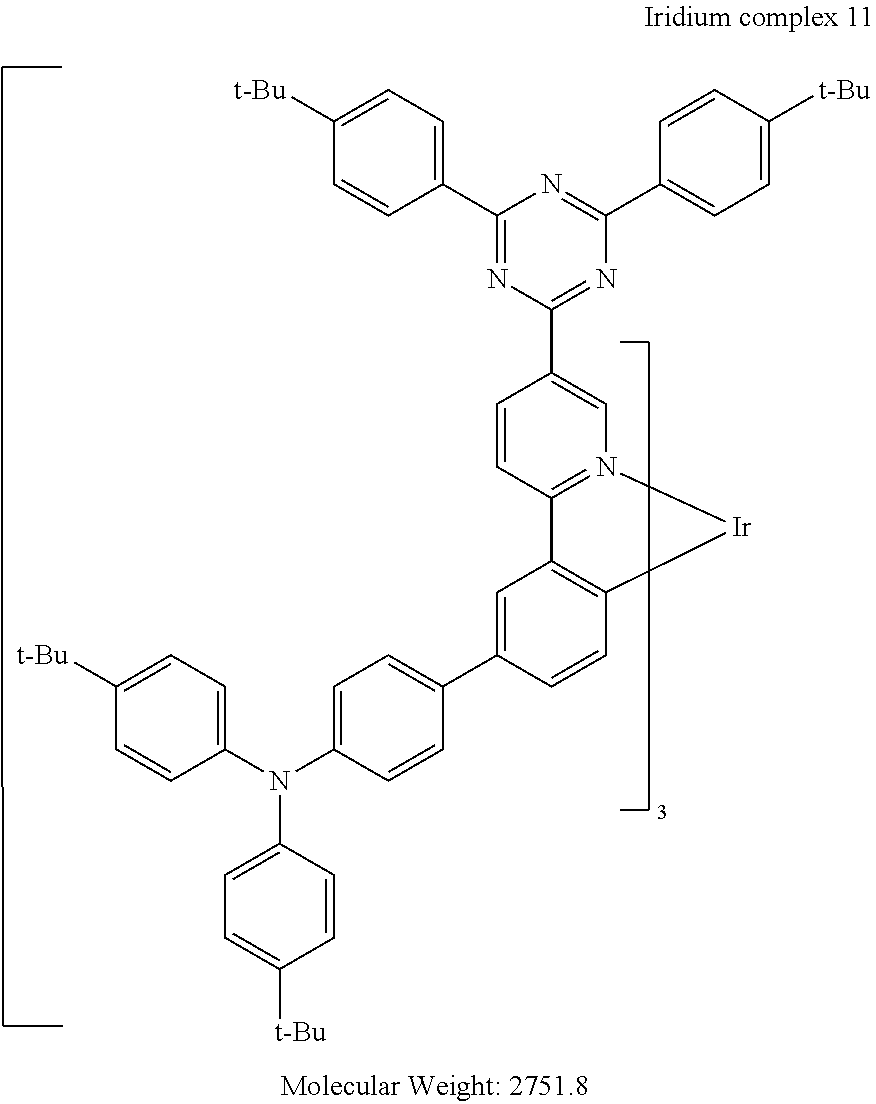
<Stage 1>
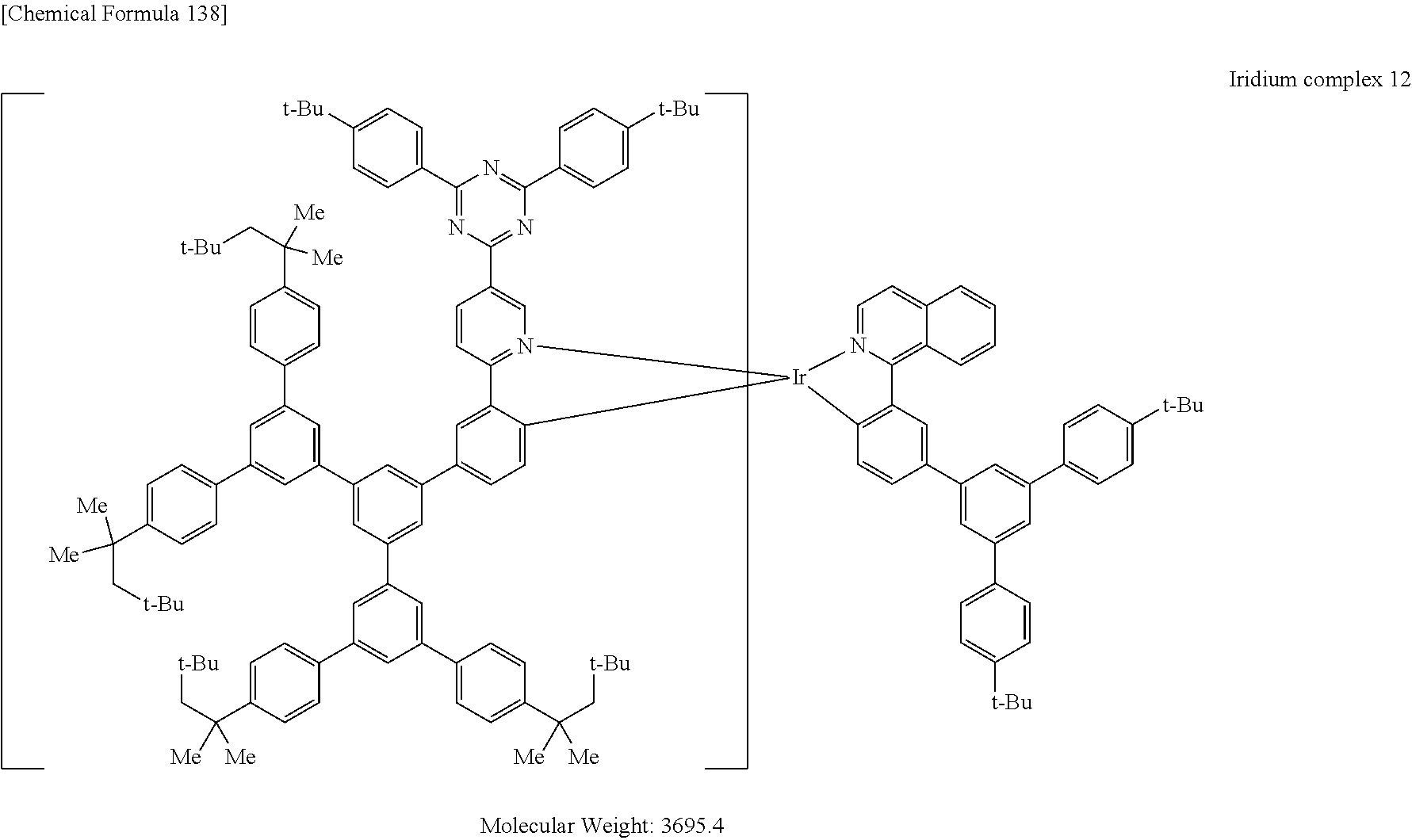


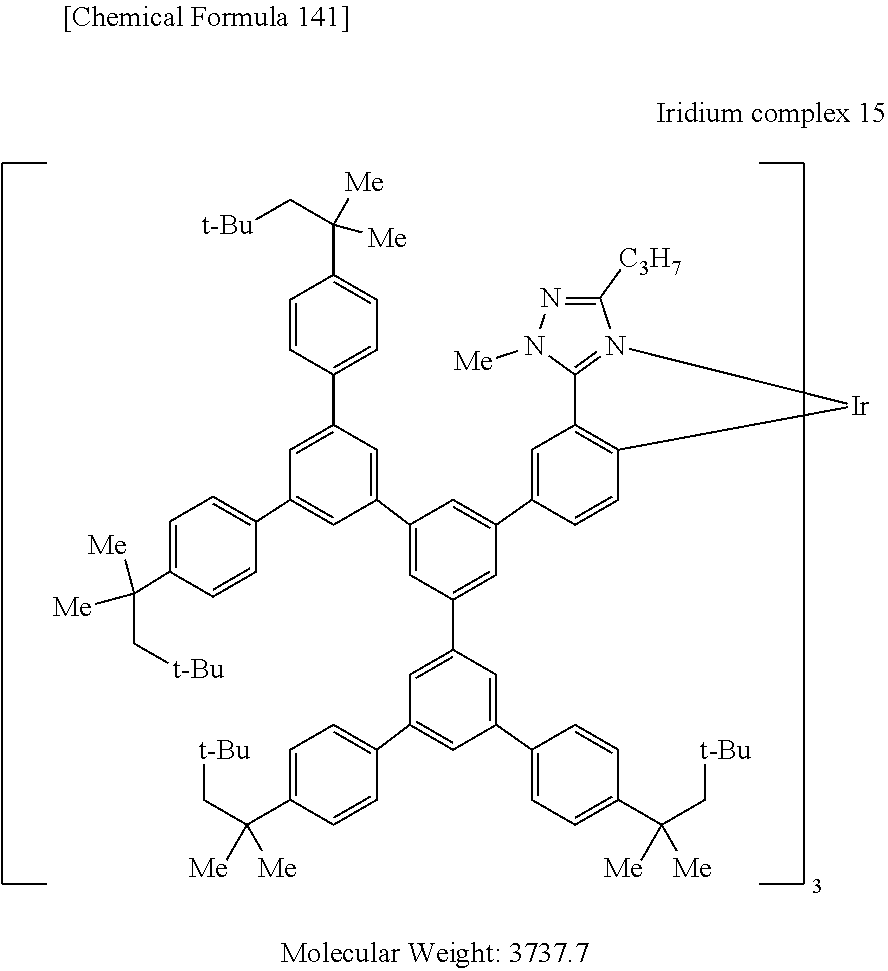

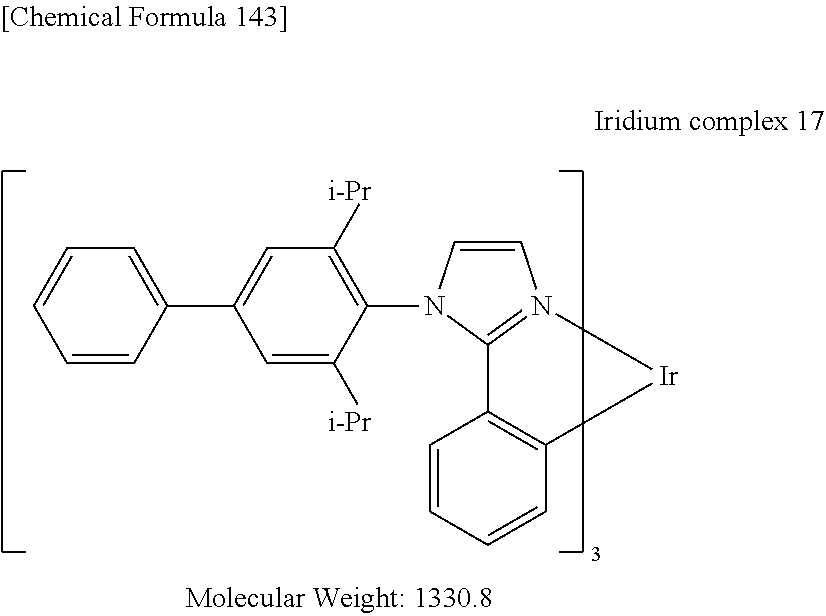

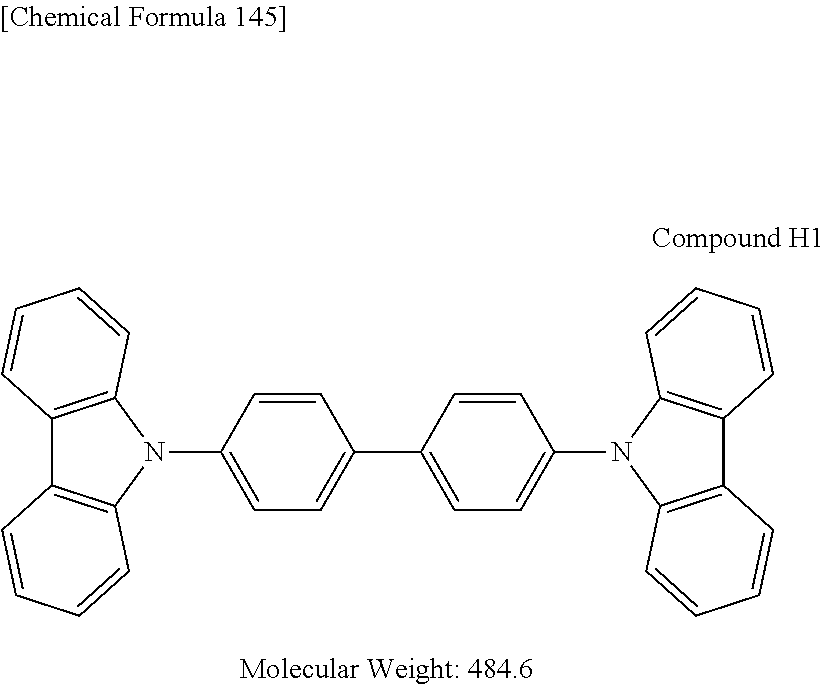
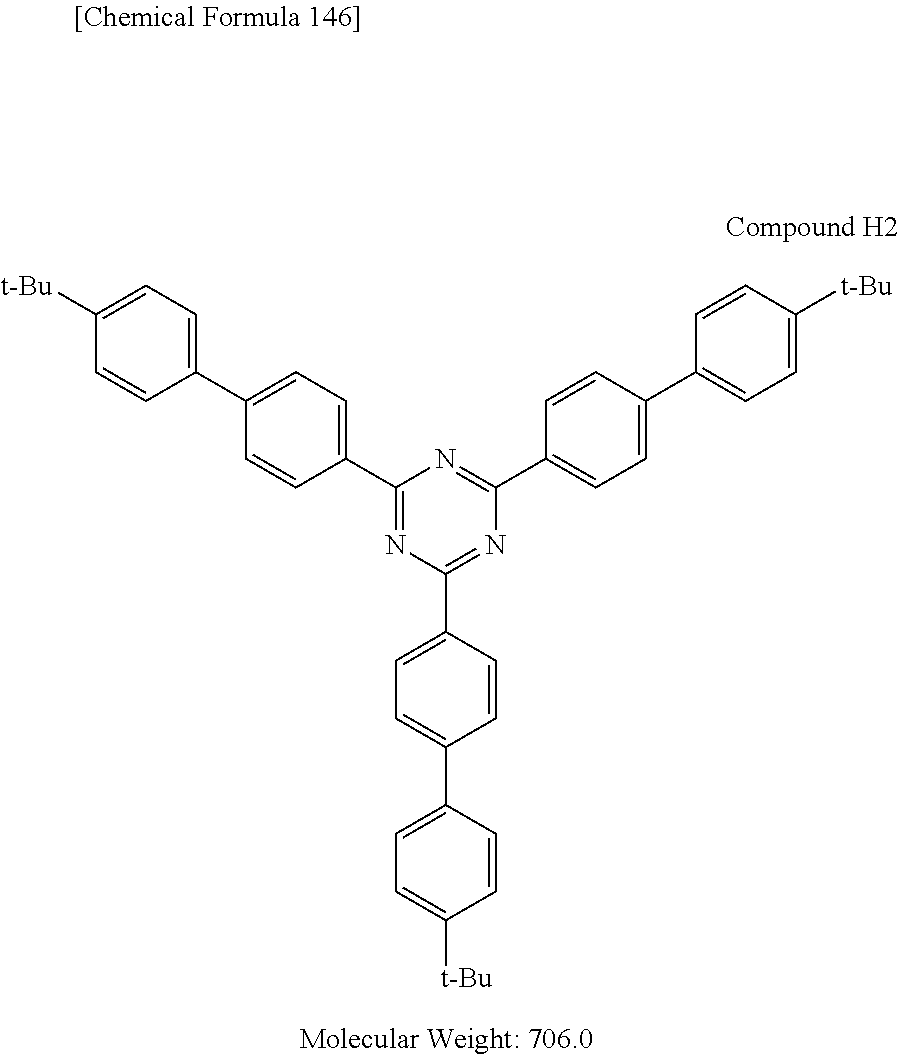
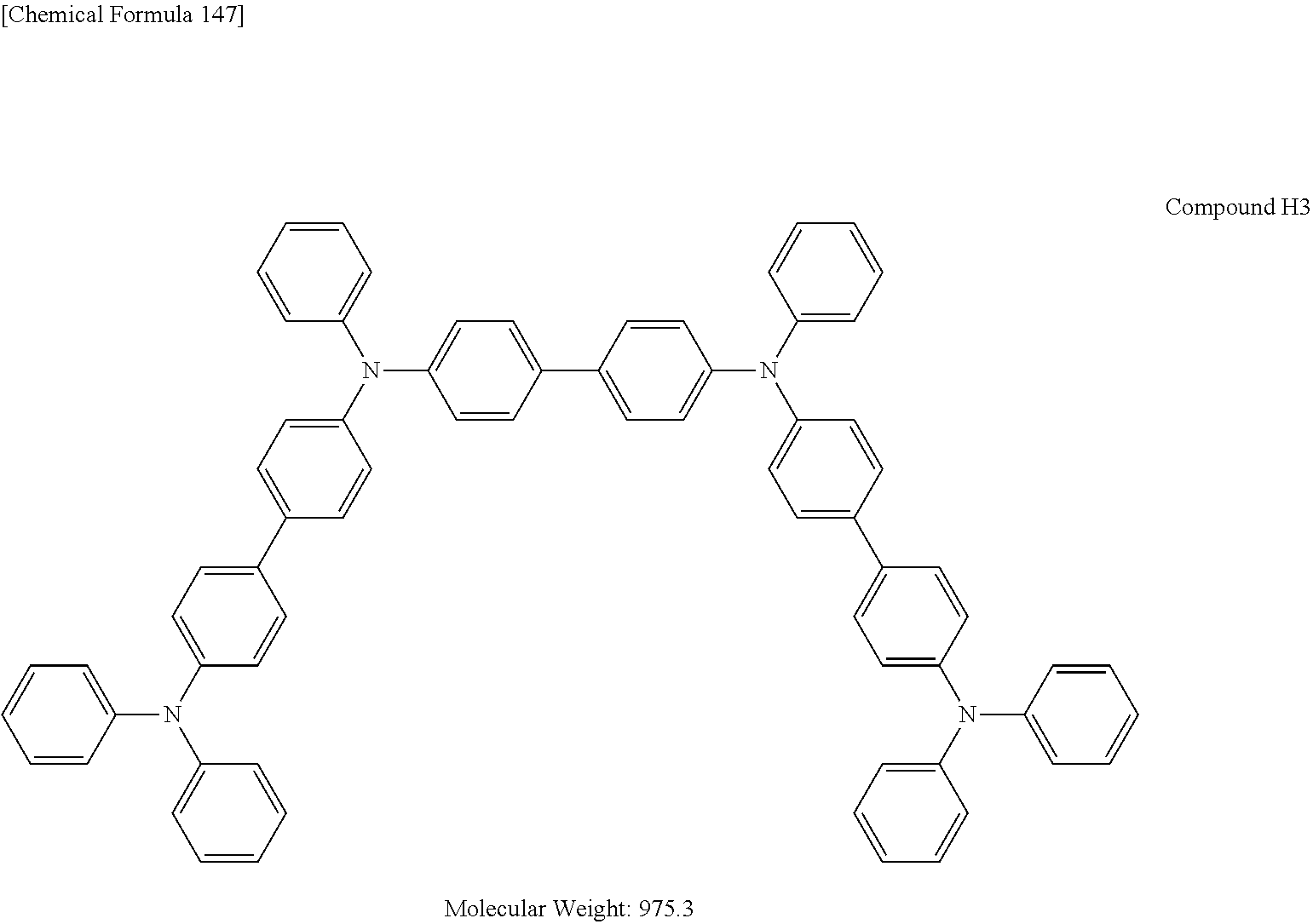
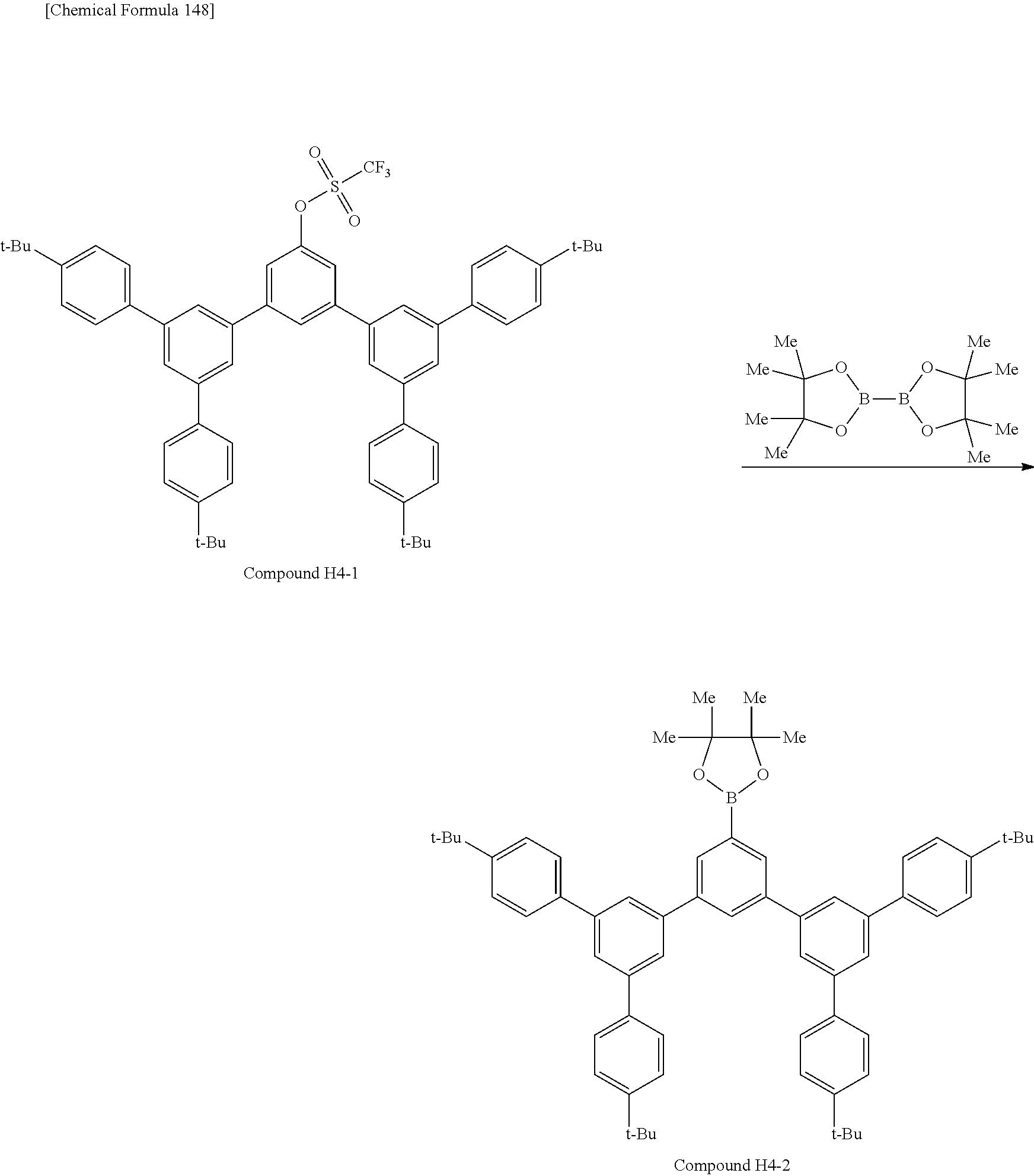

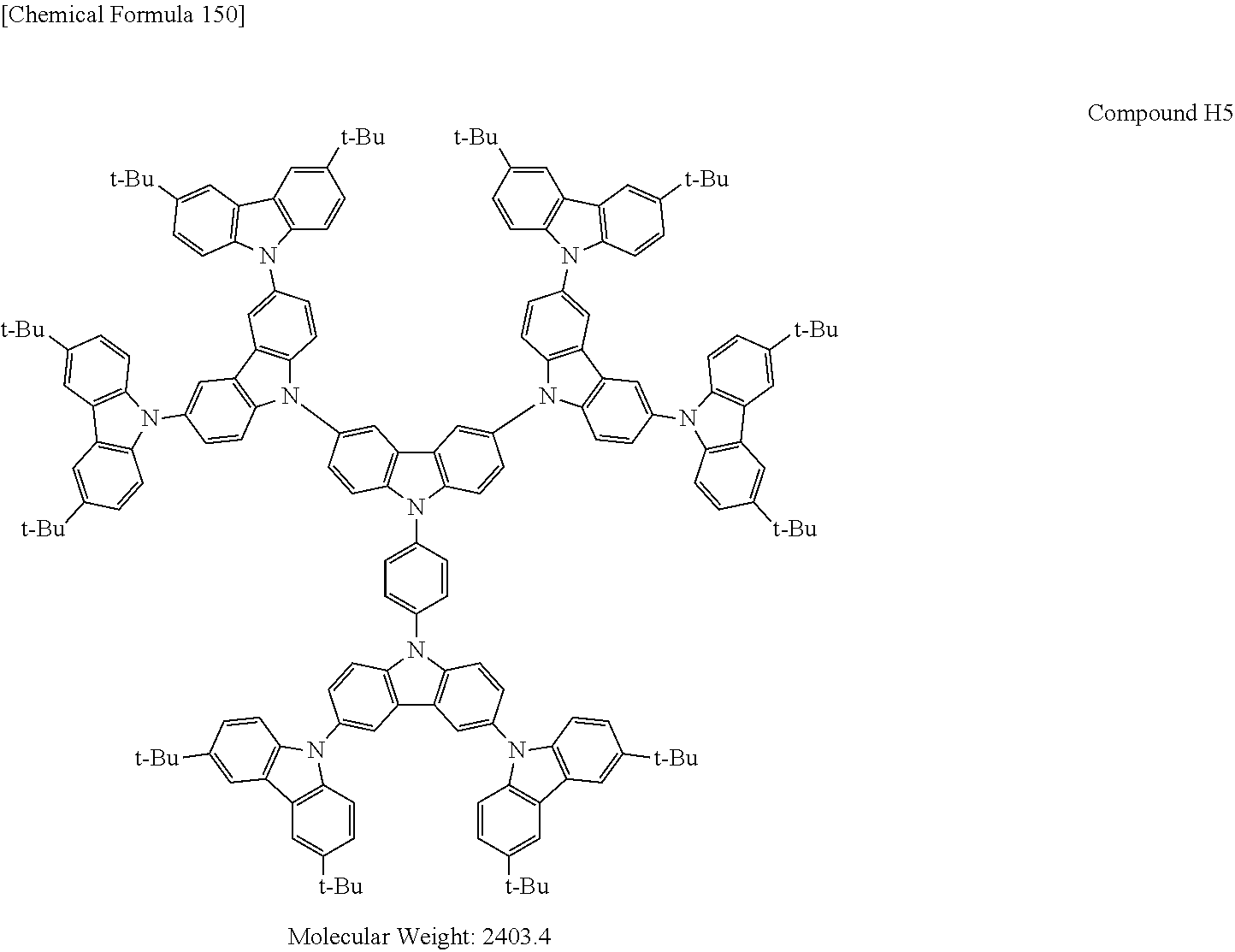

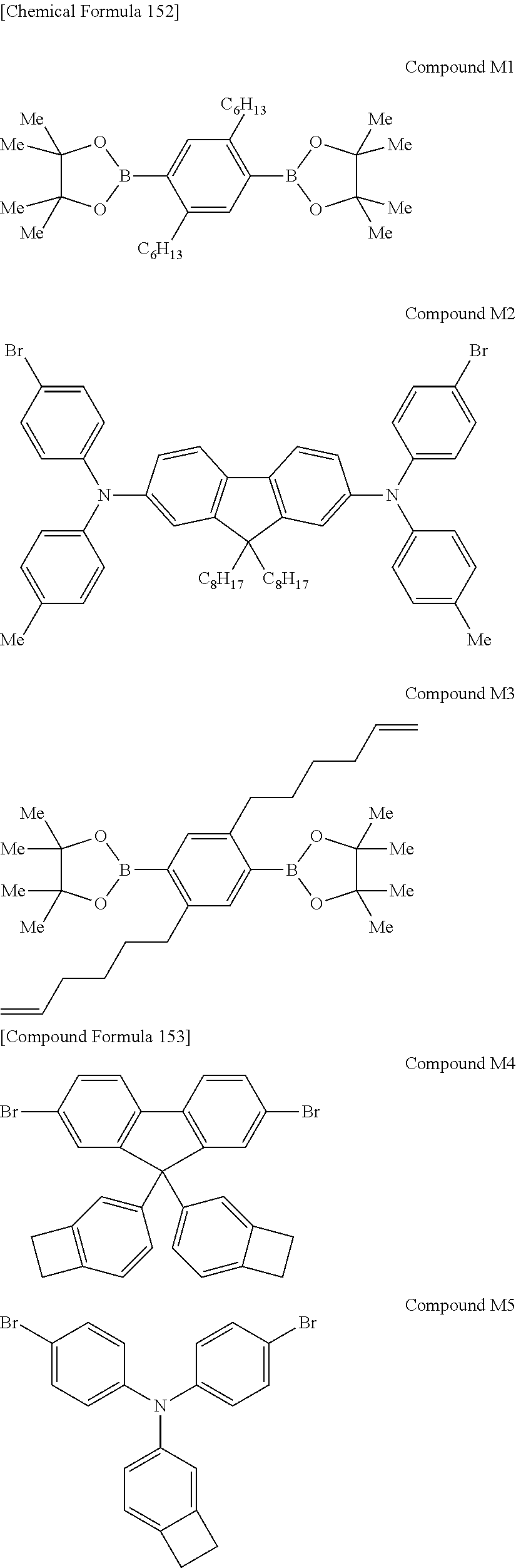
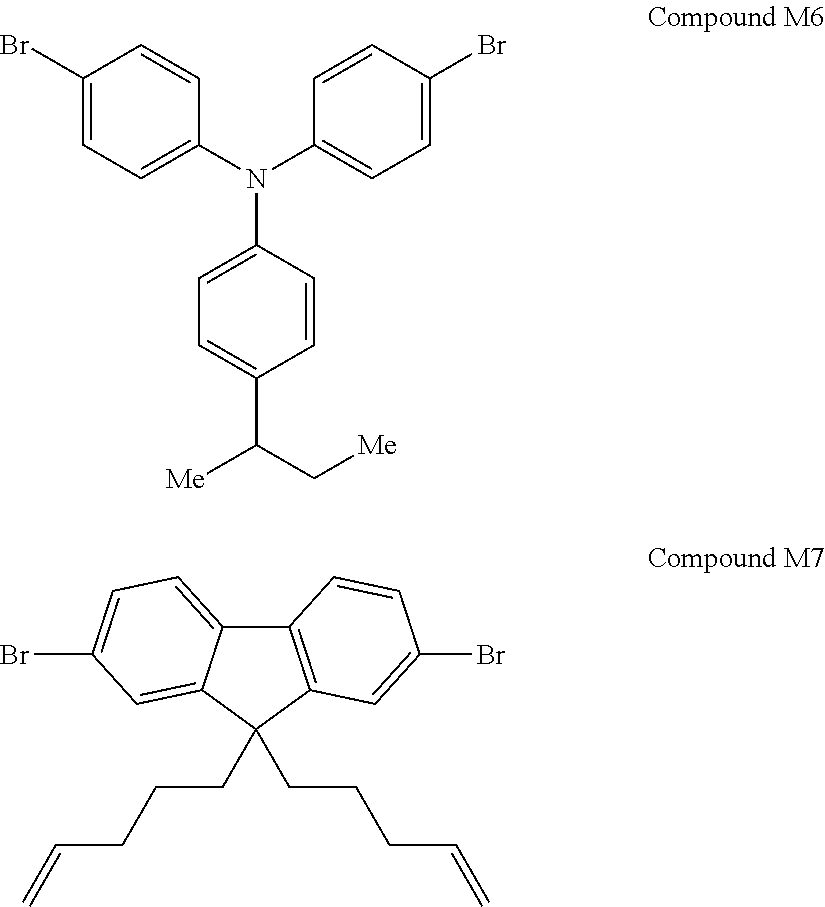
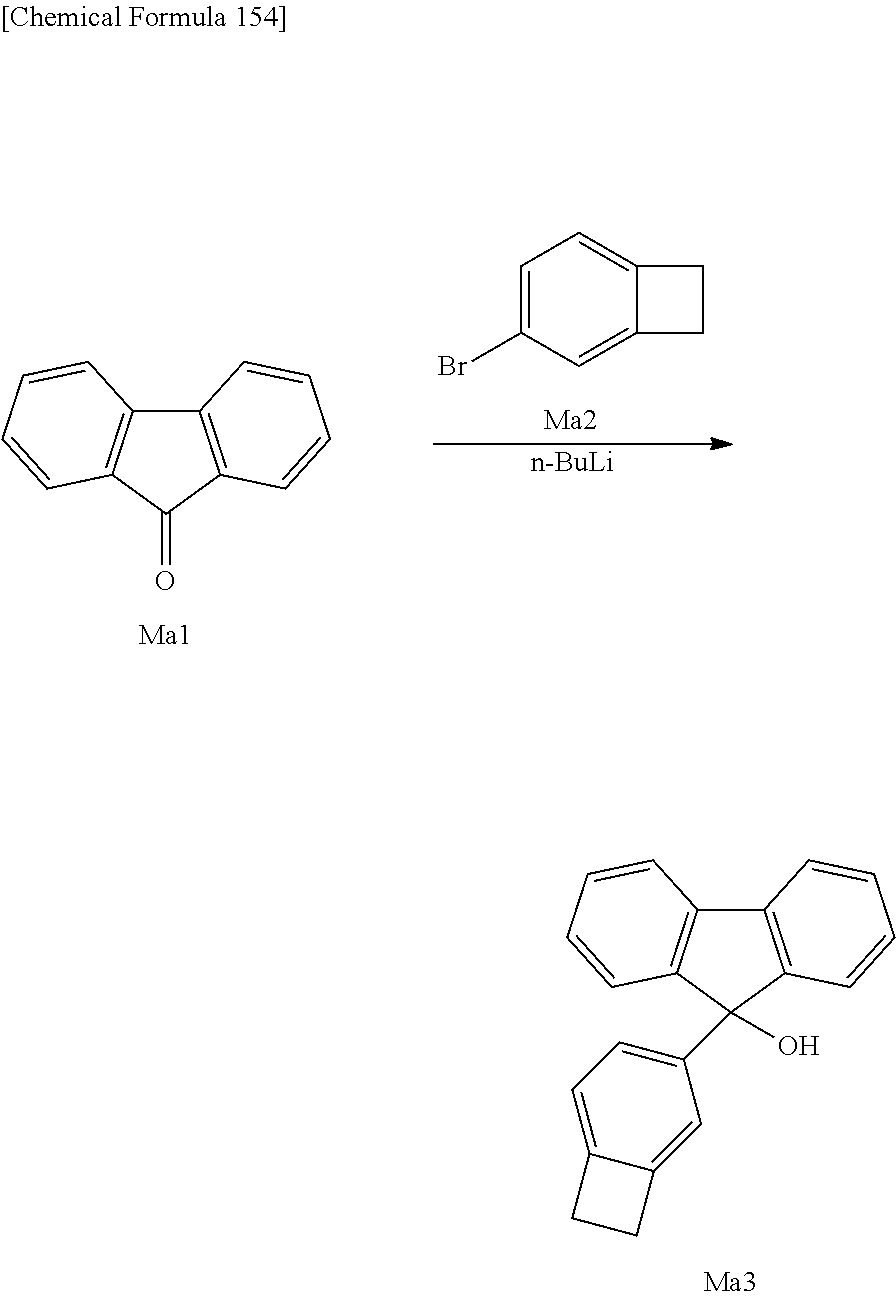
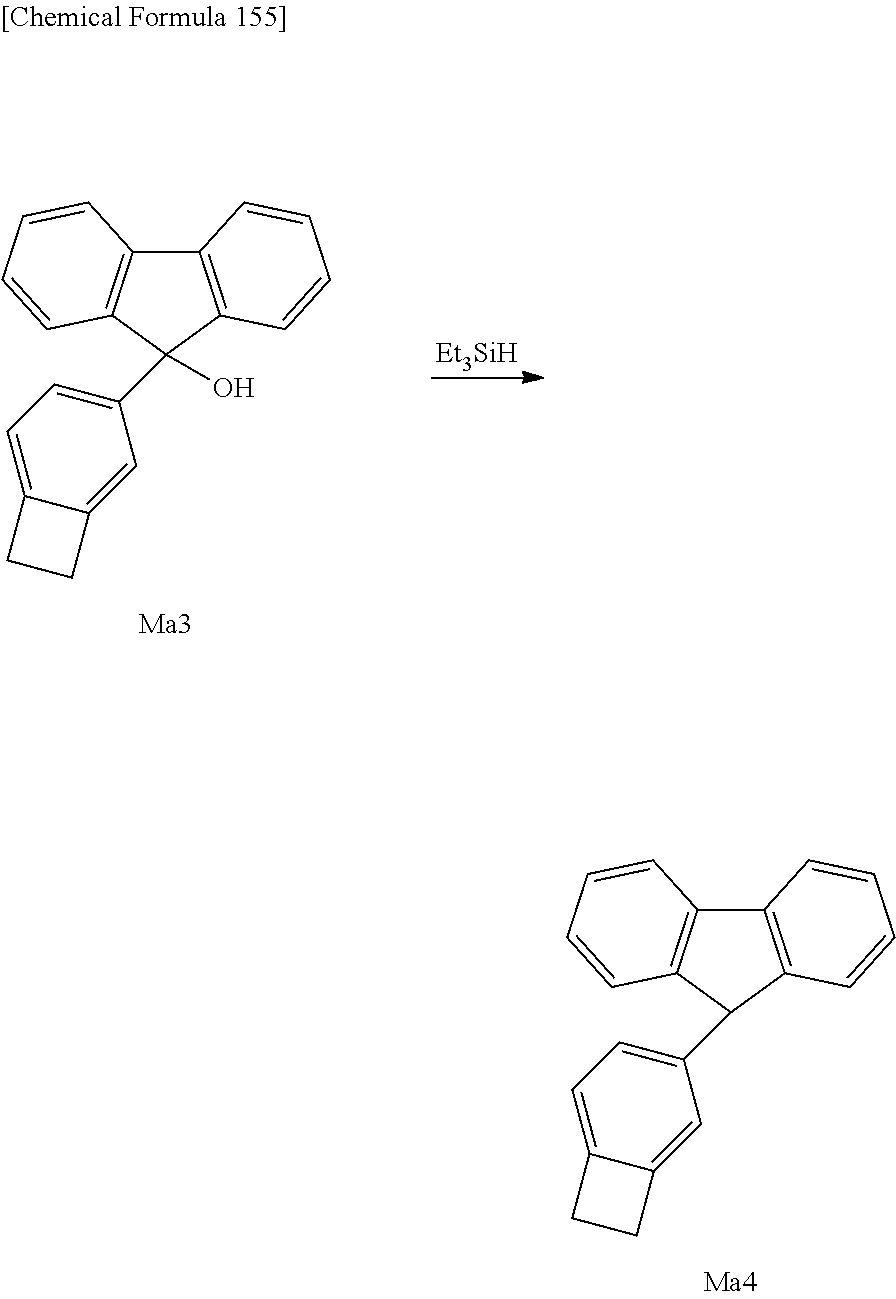
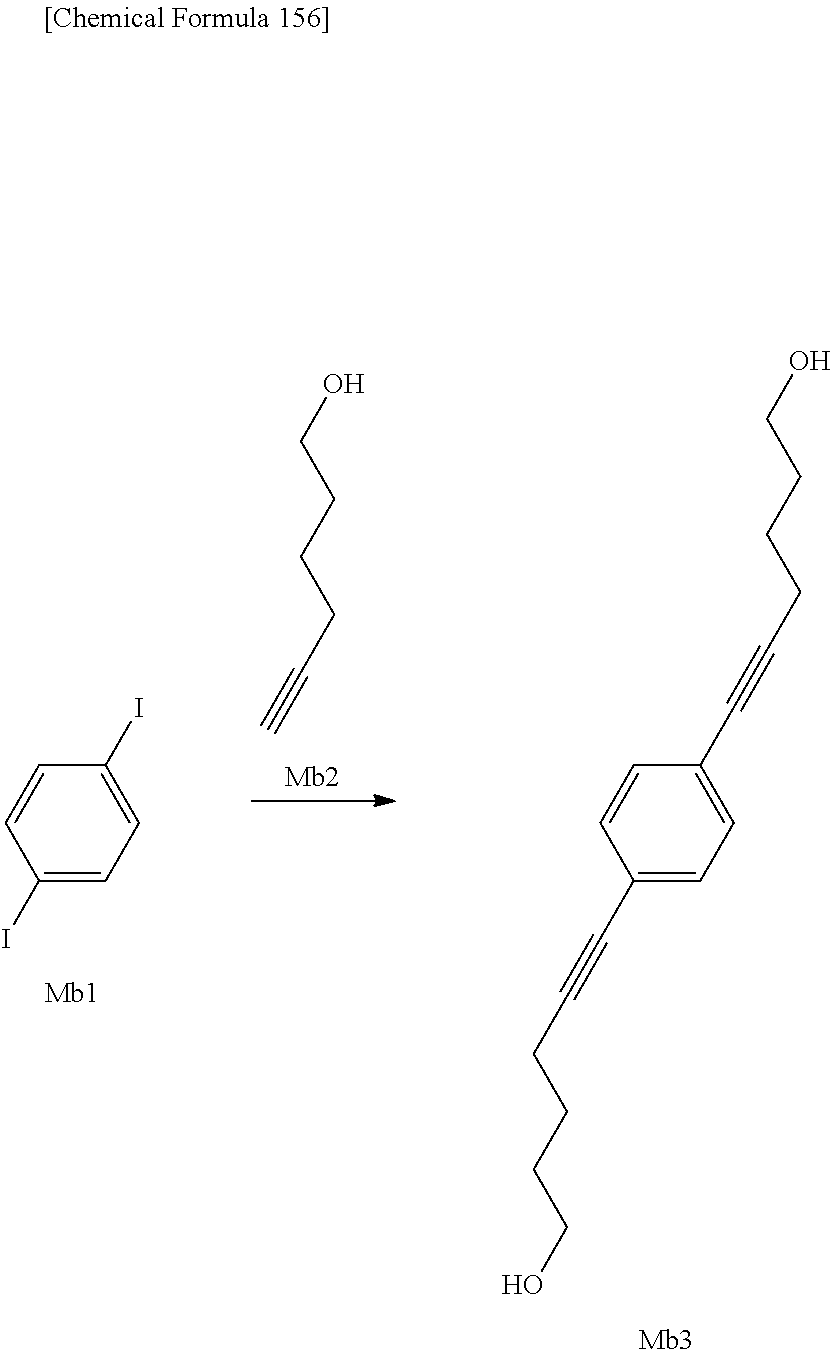
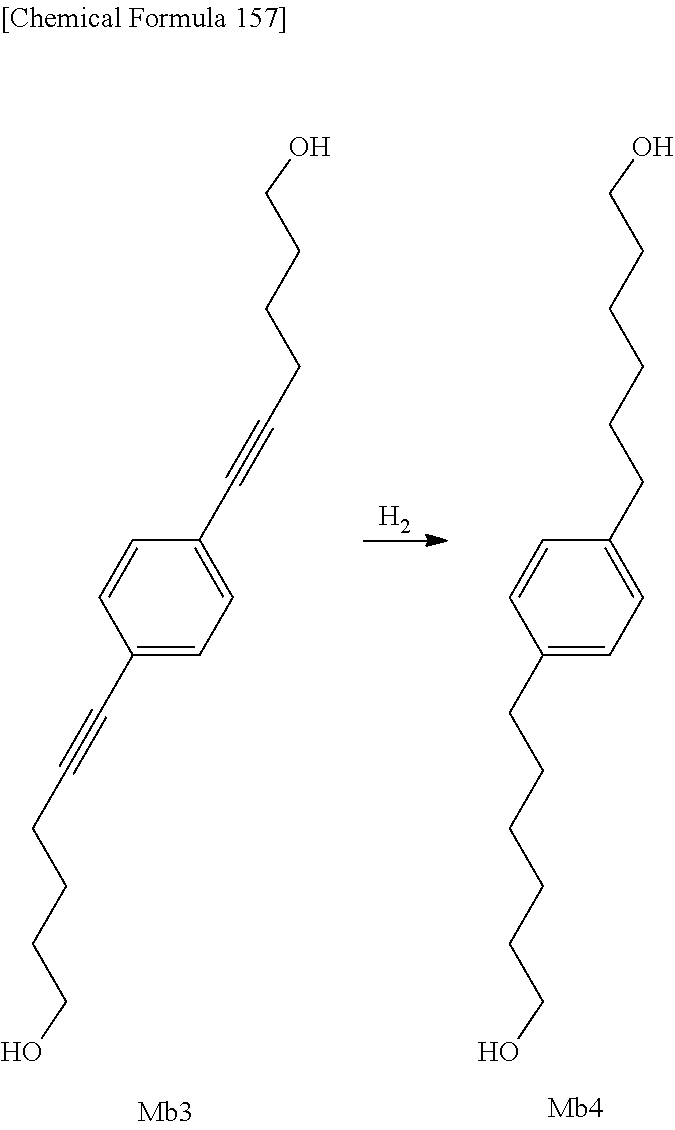
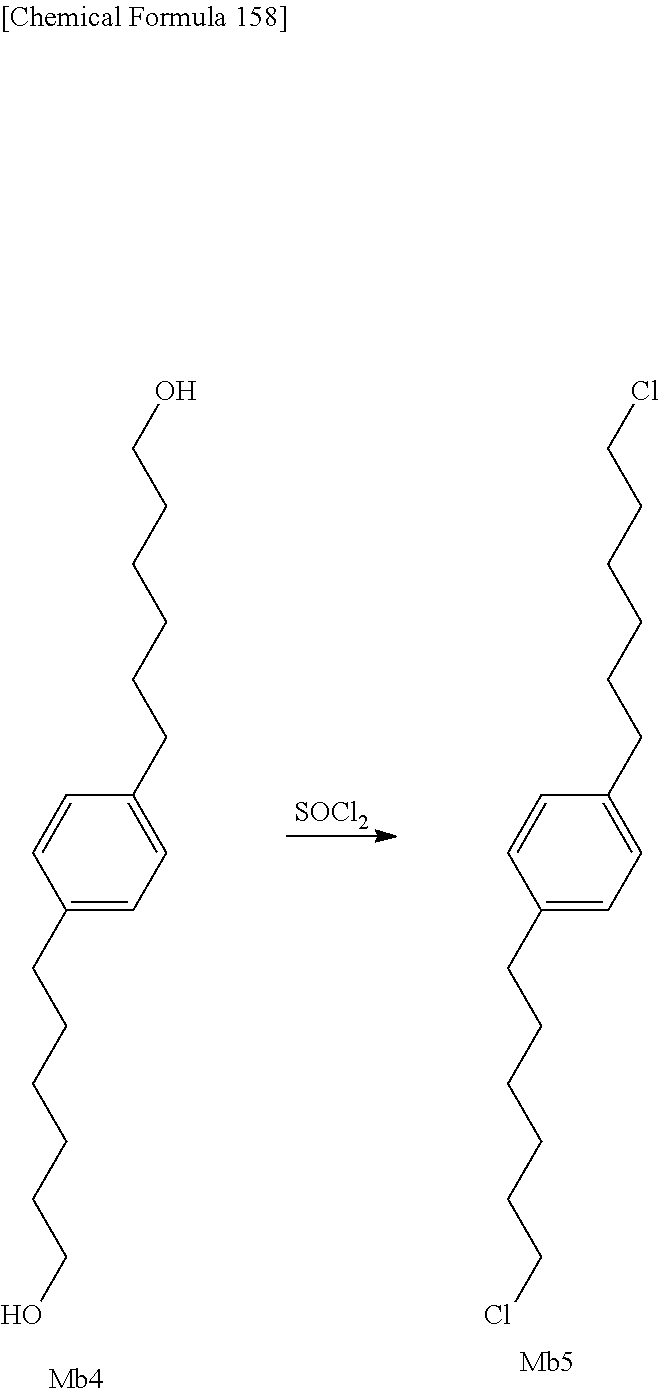
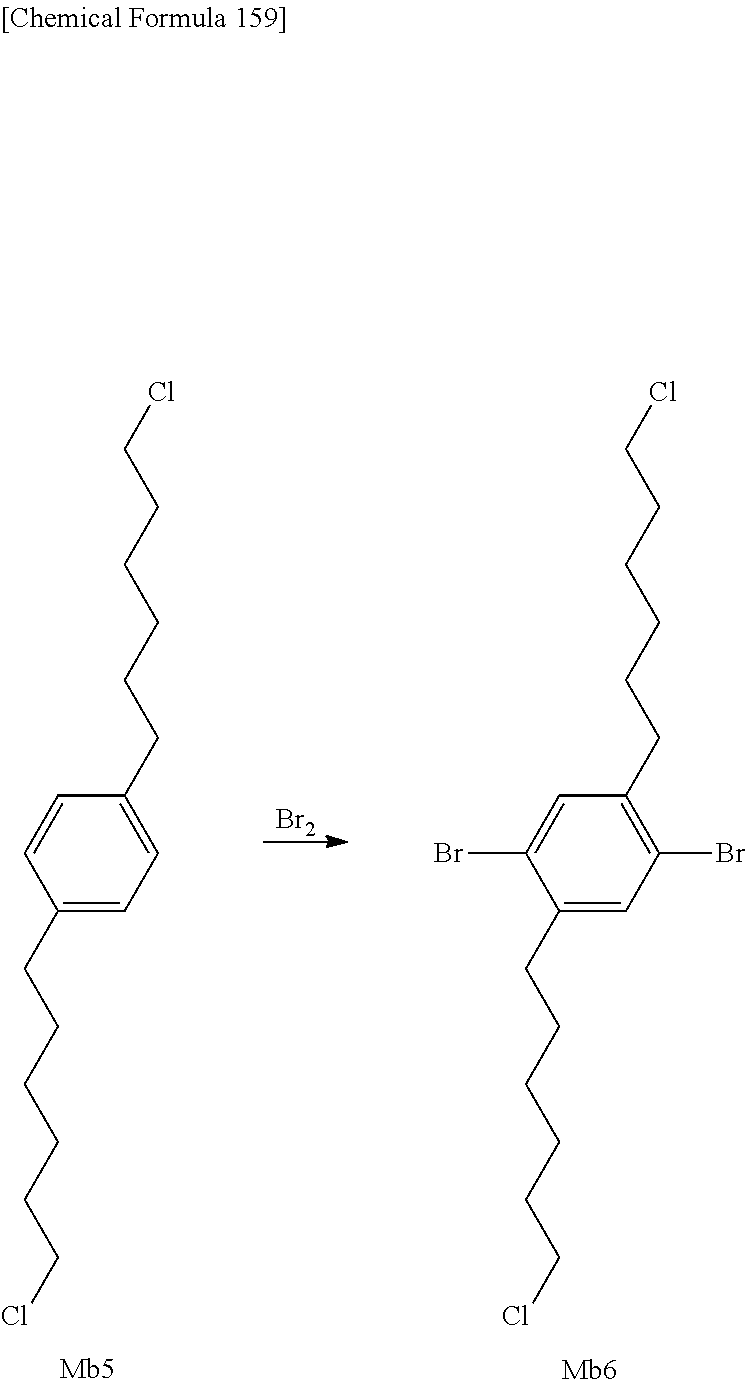
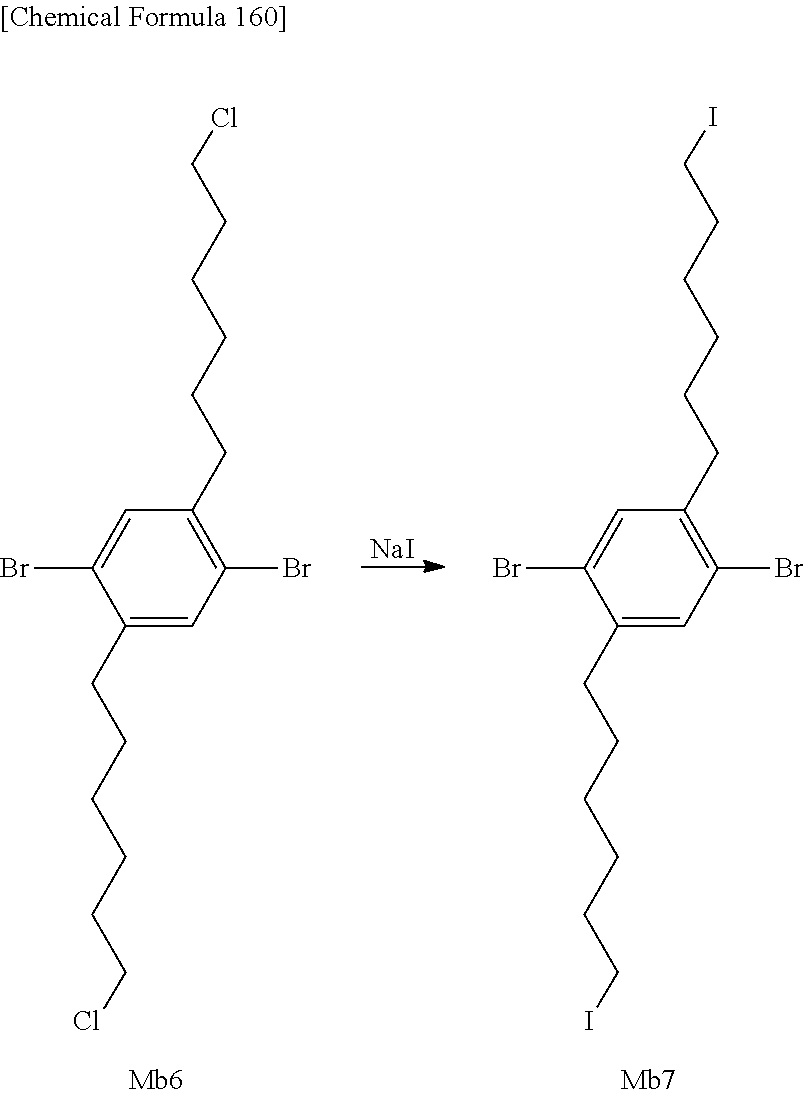
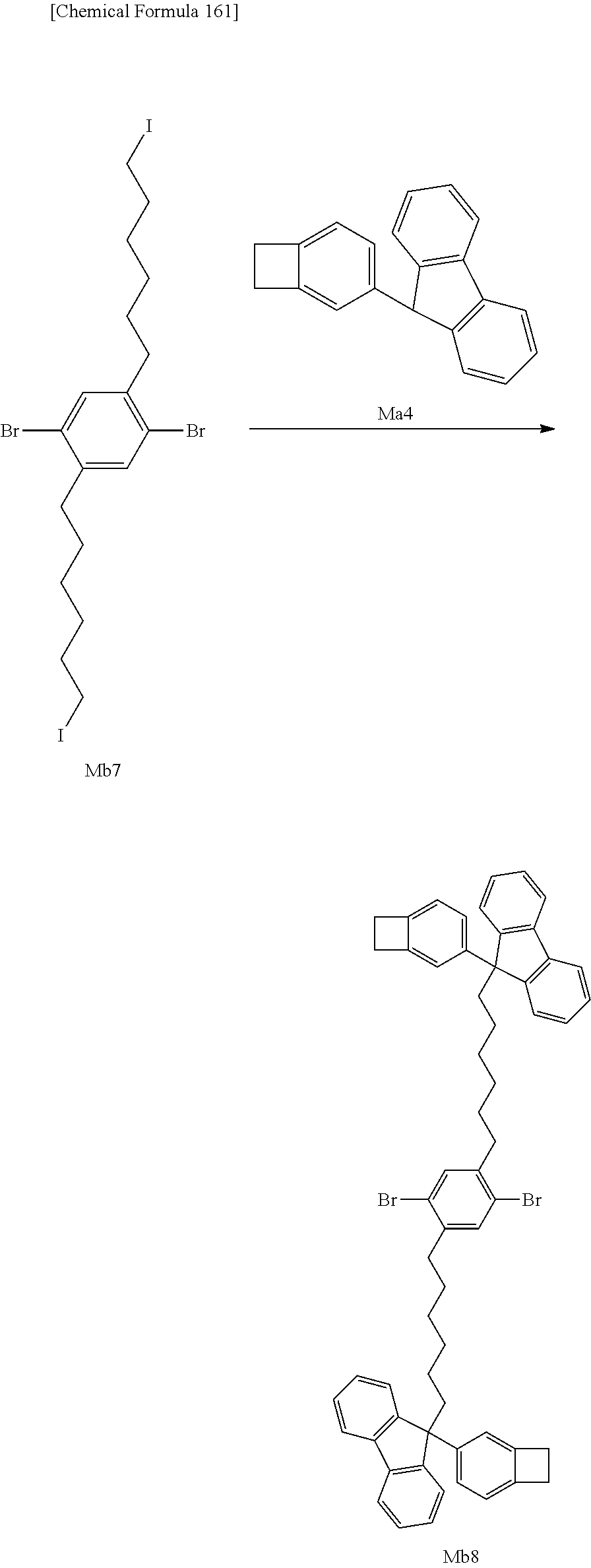

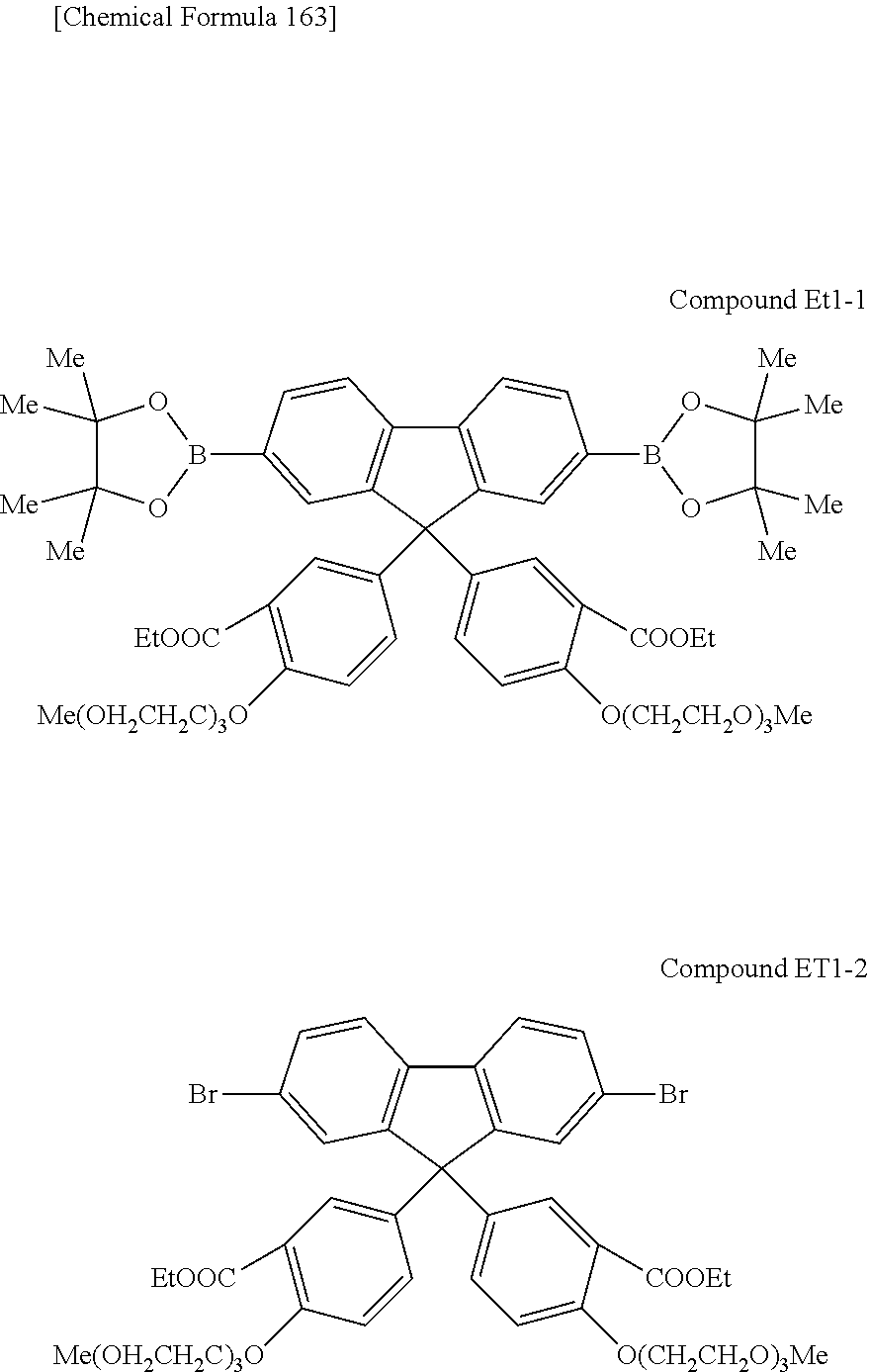
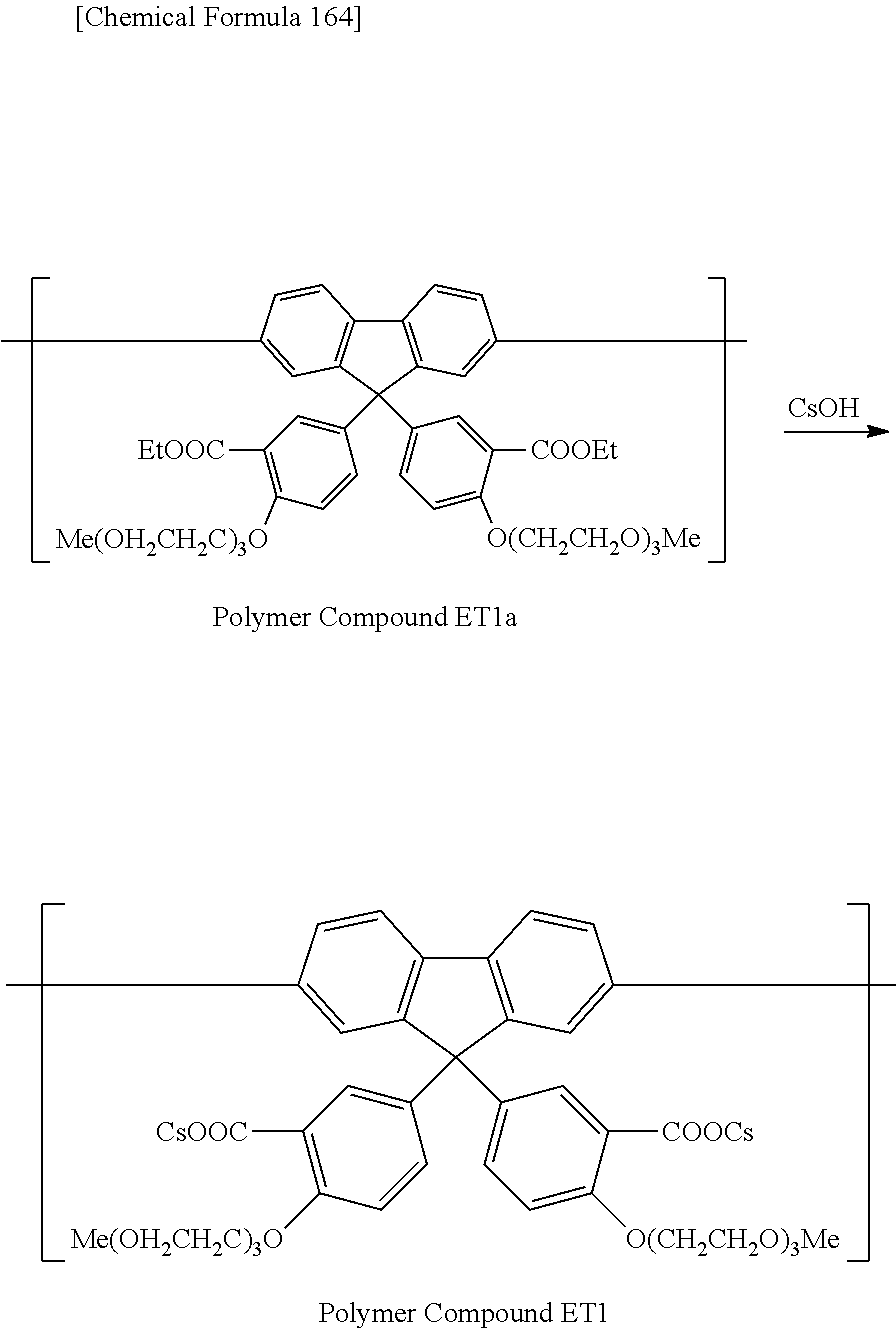

Low Molecular Weight Compound HTL-M1-3
| TABLE 2 | ||||
| external | ||||
| hole | quantum | |||
| transporting | light emitting layer | efficiency | ||
| layer | complex | compound | MA + MB | MA/MB | (%) | ||
| Comparative | HTL-1 | complex 1 | H1 | 1476 | 2.05 | 0.11 |
| Example CD1 | ||||||
| Comparative | HTL-1 | complex 2 | H3 | 2652 | 1.72 | 2.14 |
| Example CD2 | ||||||
| Example D1 | HTL-1 | complex 3 | H2 | 2719 | 2.85 | 7.31 |
| Example D2 | HTL-1 | complex 1 | H4 | 3496 | 0.40 | 15.15 |
| Example D3 | HTL-1 | complex 2 | H4 | 4181 | 0.67 | 16.96 |
| Example D4 | HTL-1 | complex 4 | H4 | 4181 | 0.67 | 20.27 |
| Example D5 | HTL-1 | complex 3 | H4 | 4518 | 0.80 | 19.27 |
| Example D6 | HTL-1 | complex 5 | H4 | 4518 | 0.80 | 18.38 |
| Example D7 | HTL-1 | complex 6 | H4 | 5431 | 1.17 | 15.22 |
| Example D8 | HTL-1 | complex 7 | H4 | 6104 | 1.44 | 12.47 |
| Example D9 | HTL-2 | complex 2 | H4 | 4181 | 0.67 | 19.09 |
| Example D10 | HTL-3 | complex 2 | H4 | 4181 | 0.67 | 18.63 |
| Example D11 | HTL-M1 | complex 2 | H4 | 4181 | 0.67 | 13.09 |
| Comparative | HTL-3 | complex 8 | H2 | 2532 | 2.59 | 1.75 |
| Example CD3 | ||||||
| Example D12 | HTL-3 | complex 9 | H4 | 3478 | 0.39 | 11.10 |
| Example D13 | HTL-3 | complex 10 | H4 | 4190 | 0.67 | 14.64 |
| Example D14 | HTL-3 | complex 11 | H4 | 5256 | 1.10 | 13.36 |
| Example D15 | HTL-3 | complex 12 | H4 | 6200 | 1.48 | 11.00 |
| Comparative | HTL-3 | complex 11 | H2 | 3458 | 3.90 | 0.83 |
| Example CD4 | ||||||
| Comparative | HTL-3 | complex 12 | H2 | 4401 | 5.23 | 0.89 |
| Example CD5 | ||||||
| TABLE 3 | ||||
| external | ||||
| hole | quantum | |||
| transporting | light emitting layer | efficiency | ||
| layer | complex | compound | MA + MB | MA/MB | (%) | ||
| Comparative | HTL-4 | complex | H5 | 3196 | 0.33 | 0.89 |
| Example CD6 | 13 | |||||
| Example D16 | HTL-4 | complex | H5 | 4218 | 0.76 | 5.41 |
| 14 | ||||||
| Example D17 | HTL-4 | complex | H5 | 6141 | 1.56 | 3.06 |
| 15 | ||||||
| Example D18 | HTL-4 | complex | H5 | 4864 | 1.02 | 7.20 |
| 16 | ||||||
| Example D19 | HTL-4 | complex | H5 | 3734 | 0.55 | 2.80 |
| 17 | ||||||
| Comparative | HTL-4 | complex | H6 | 1796 | 1.95 | 0.60 |
| Example CD7 | 18 | |||||
| Example D20 | HTL-3 | complex | H5 | 4864 | 1.02 | 7.82 |
| 16 | ||||||
| Example D21 | HTL-3 | complex | H5 | 3734 | 0.55 | 3.17 |
| 17 | ||||||
Claims (12)
3400≤MA+MB≤7000 (M1-2)
0.35≤MA/MB≤3.00 (M2-1),
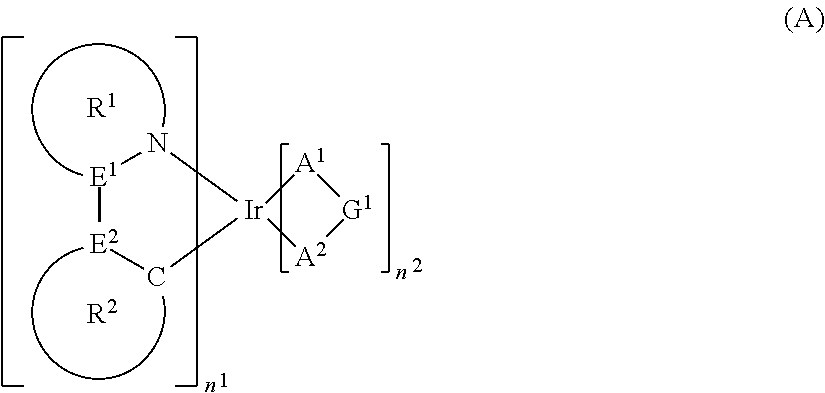

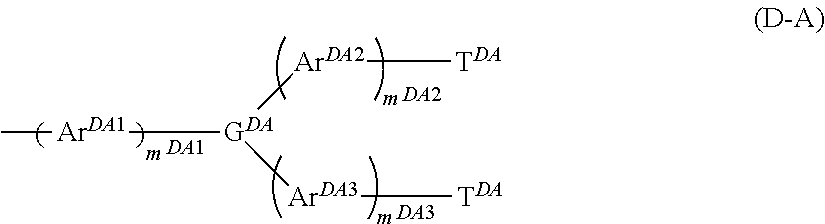
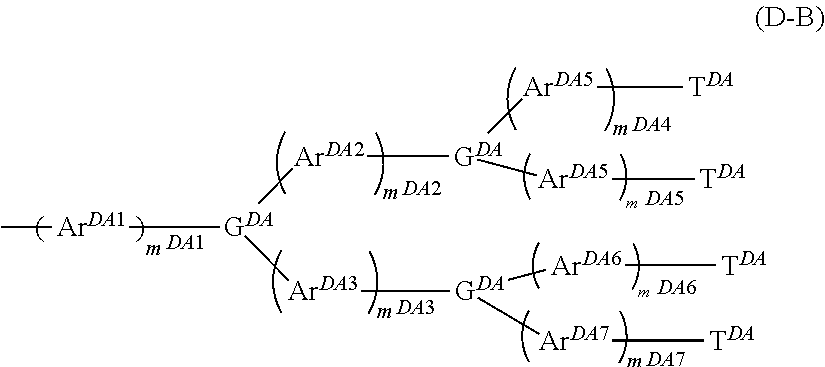

0.35≤MA/MB≤2.00 (M2-2).
4000≤MA+MB≤6000 (M1-3)
0.65≤MA/MB≤1.30 (M2-3).
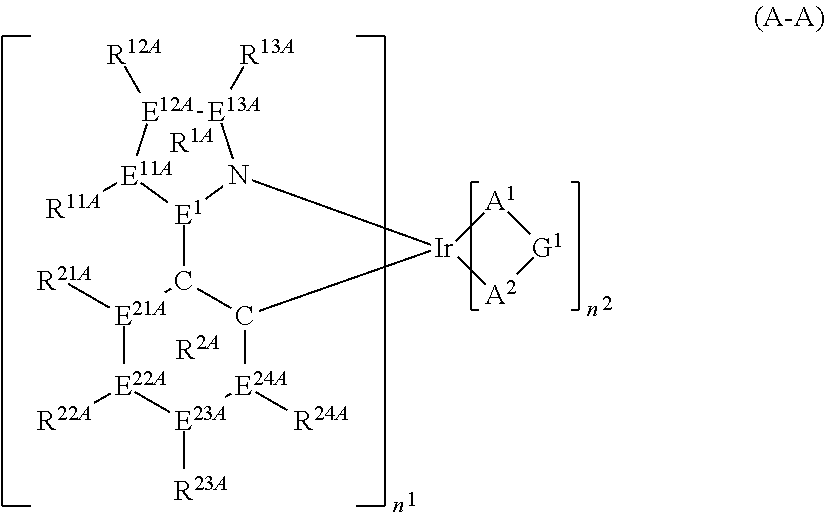
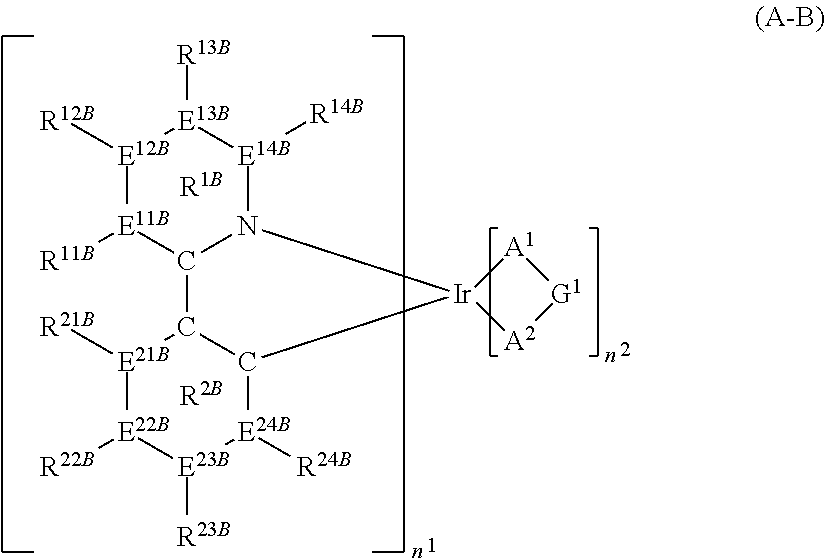
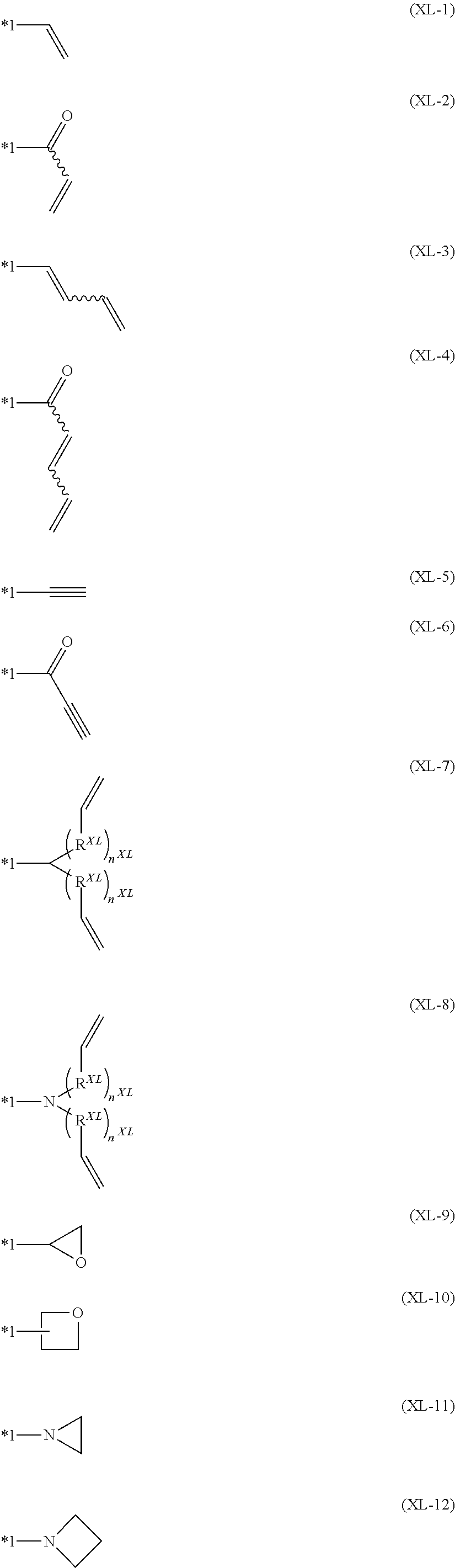

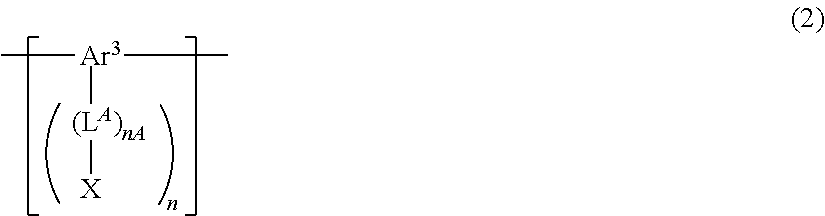
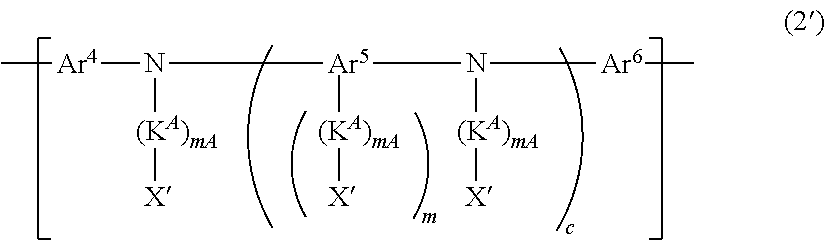
3400≤MA+MB≤7000 (M1-2)
0.35≤MA/MB≤3.00 (M2-1):


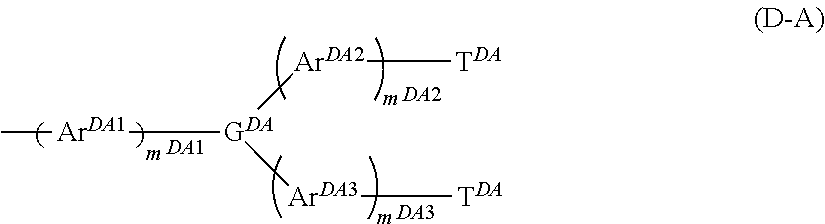
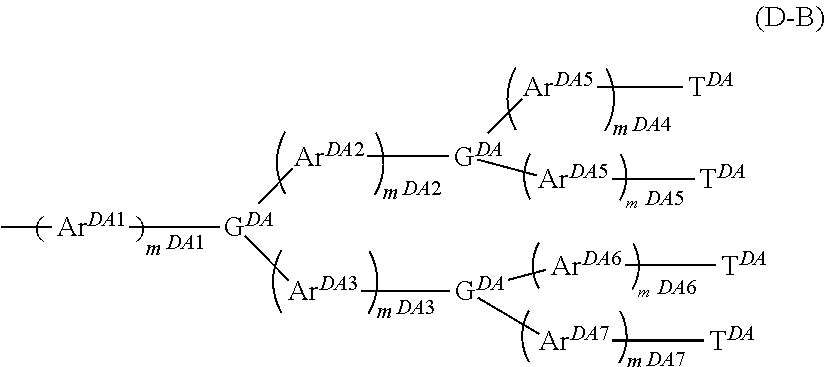

4000≤MA+MB≤6000 (M1-3)
0.65≤MA/MB≤1.30 (M2-3).
Applications Claiming Priority (1)
| Application Number | Priority Date | Filing Date | Title |
|---|---|---|---|
| PCT/JP2015/062487 WO2016170671A1 (en) | 2015-04-24 | 2015-04-24 | Light emitting element and composition used in said light emitting element |
Publications (2)
| Publication Number | Publication Date |
|---|---|
| US20180123056A1 US20180123056A1 (en) | 2018-05-03 |
| US10497885B2 true US10497885B2 (en) | 2019-12-03 |
Family
ID=57143495
Family Applications (1)
| Application Number | Title | Priority Date | Filing Date |
|---|---|---|---|
| US15/565,755 Active US10497885B2 (en) | 2015-04-24 | 2015-04-24 | Light emitting device and composition used for this light emitting device |
Country Status (6)
| Country | Link |
|---|---|
| US (1) | US10497885B2 (en) |
| EP (1) | EP3288094B1 (en) |
| JP (1) | JP6256630B2 (en) |
| KR (1) | KR101903929B1 (en) |
| CN (1) | CN107534089B (en) |
| WO (1) | WO2016170671A1 (en) |
Cited By (1)
| Publication number | Priority date | Publication date | Assignee | Title |
|---|---|---|---|---|
| US10622570B2 (en) * | 2016-03-28 | 2020-04-14 | Nippon Steel Chemical & Material Co., Ltd. | Organic electroluminescent element |
Families Citing this family (9)
| Publication number | Priority date | Publication date | Assignee | Title |
|---|---|---|---|---|
| WO2016052337A1 (en) * | 2014-09-30 | 2016-04-07 | 住友化学株式会社 | Light-emitting element |
| CN109467983B (en) * | 2018-12-14 | 2021-02-05 | 中国科学院长春应用化学研究所 | Organic small-molecule luminescent material ink and preparation method thereof |
| JP6934967B2 (en) * | 2019-03-29 | 2021-09-15 | 住友化学株式会社 | Light emitting element and composition for light emitting element |
| JP6641069B1 (en) * | 2019-03-29 | 2020-02-05 | 住友化学株式会社 | Light emitting device, method for manufacturing the same, composition for light emitting device and method for manufacturing the same |
| JP7245770B2 (en) * | 2019-12-26 | 2023-03-24 | 住友化学株式会社 | Light-emitting device, method for producing the same, composition for light-emitting device, and method for producing the same |
| JP7079883B2 (en) | 2020-09-24 | 2022-06-02 | 住友化学株式会社 | Light emitting device and composition |
| JP7058792B2 (en) | 2020-09-24 | 2022-04-22 | 住友化学株式会社 | Light emitting device and composition |
| JP7015406B1 (en) | 2020-09-24 | 2022-02-02 | 住友化学株式会社 | Light emitting device and composition |
| JP2023083028A (en) * | 2021-12-03 | 2023-06-15 | キヤノン株式会社 | Iridium complexes, organic light-emitting devices, display devices, imaging devices, electronic devices, lighting devices, and mobile objects |
Citations (24)
| Publication number | Priority date | Publication date | Assignee | Title |
|---|---|---|---|---|
| WO2002066552A1 (en) | 2001-02-20 | 2002-08-29 | Isis Innovation Limited | Metal-containing dendrimers |
| JP2006114844A (en) | 2004-10-18 | 2006-04-27 | Tdk Corp | Selecting method of organic el device material, organic el device and manufacturing method thereof |
| WO2008025997A1 (en) | 2006-08-31 | 2008-03-06 | Cdt Oxford Limited | Compounds for use in opto-electrical devices |
| WO2009060742A1 (en) | 2007-11-08 | 2009-05-14 | Konica Minolta Holdings, Inc. | Organic electroluminescent device, display device, and illuminating device |
| JP2009114369A (en) | 2007-11-08 | 2009-05-28 | Konica Minolta Holdings Inc | Organic electroluminescent material, organic electroluminescent element, display and illuminator |
| JP2009263665A (en) | 2008-04-02 | 2009-11-12 | Mitsubishi Chemicals Corp | Polymer compound, reticulated polymer compound produced by crosslinking the polymer compound, composition for organic electroluminescent element, organic electroluminescent element, organic el display, and organic el lighting |
| WO2010004877A1 (en) | 2008-07-10 | 2010-01-14 | コニカミノルタホールディングス株式会社 | Organic electroluminescent element, display device and illuminating device |
| JP2010155985A (en) | 2008-12-04 | 2010-07-15 | Mitsubishi Chemicals Corp | Arylamine polymer, organic light emitting device material, composition for organic light emitting device, organic light emitting device, organic el display, and organic electroluminescence illumination |
| JP2010165768A (en) | 2009-01-14 | 2010-07-29 | Konica Minolta Holdings Inc | Organic electroluminescent element, display, illuminating device, and organic electroluminescent element material |
| JP2010209320A (en) | 2009-02-13 | 2010-09-24 | Mitsubishi Chemicals Corp | Composition for organic electroluminescent element, method for producing organic electroluminescent element, organic electroluminescent element, organic el display and organic el lighting |
| WO2011141714A1 (en) | 2010-05-14 | 2011-11-17 | Cambridge Display Technology Limited | Organic light-emitting polymer and device |
| JP2011253722A (en) | 2010-06-02 | 2011-12-15 | Mitsubishi Chemicals Corp | Organic electroluminescent element, organic el illumination, and organic el display device |
| US20120068170A1 (en) | 2009-05-29 | 2012-03-22 | Merck Patent Gmbh | Materials for organic electroluminescent devices |
| WO2012096263A1 (en) | 2011-01-11 | 2012-07-19 | 三菱化学株式会社 | Composition for organic electroluminescent element, organic electroluminescent element, display device, and illuminator |
| JP2013033915A (en) | 2011-07-06 | 2013-02-14 | Konica Minolta Holdings Inc | Organic electroluminescent element, display device, and lighting device |
| WO2013064814A1 (en) | 2011-11-02 | 2013-05-10 | Cambridge Display Technology Limited | Light emitting composition and device |
| JP2013527989A (en) | 2010-05-03 | 2013-07-04 | メルク パテント ゲーエムベーハー | Formulations and electronic devices |
| WO2013105615A1 (en) | 2012-01-13 | 2013-07-18 | 三菱化学株式会社 | Iridium complex compound, solution composition containing iridium complex compound, organic electroluminescent element, display device, and lighting device |
| WO2013180036A1 (en) | 2012-05-28 | 2013-12-05 | 三菱化学株式会社 | Method for producing conductive thin film laminate |
| US20140034938A1 (en) * | 2011-04-07 | 2014-02-06 | Mitsubishi Chemical Corporation | Organic compound, charge-transporting material, composition containing the compound, organic electroluminescent element, display device, and lighting device |
| JP2014131973A (en) | 2012-12-06 | 2014-07-17 | Mitsubishi Chemicals Corp | Iridium complex compound, organic electroluminescent element, display device and illumination apparatus |
| WO2015039723A1 (en) | 2013-09-17 | 2015-03-26 | Merck Patent Gmbh | Polycyclic phenylpyridine iridium complexes and derivatives thereof for oleds |
| JP2015110751A (en) | 2013-10-31 | 2015-06-18 | 住友化学株式会社 | Composition and light emitting element prepared using the same |
| WO2016015815A1 (en) | 2014-07-28 | 2016-02-04 | Merck Patent Gmbh | Metal complexes |
Family Cites Families (1)
| Publication number | Priority date | Publication date | Assignee | Title |
|---|---|---|---|---|
| US9716892B2 (en) * | 2012-07-02 | 2017-07-25 | Qualcomm Incorporated | Video parameter set including session negotiation information |
-
2015
- 2015-04-24 US US15/565,755 patent/US10497885B2/en active Active
- 2015-04-24 EP EP15889910.4A patent/EP3288094B1/en active Active
- 2015-04-24 CN CN201580079094.9A patent/CN107534089B/en active Active
- 2015-04-24 KR KR1020177033343A patent/KR101903929B1/en active Active
- 2015-04-24 JP JP2016564640A patent/JP6256630B2/en active Active
- 2015-04-24 WO PCT/JP2015/062487 patent/WO2016170671A1/en not_active Ceased
Patent Citations (31)
| Publication number | Priority date | Publication date | Assignee | Title |
|---|---|---|---|---|
| WO2002066552A1 (en) | 2001-02-20 | 2002-08-29 | Isis Innovation Limited | Metal-containing dendrimers |
| JP2006114844A (en) | 2004-10-18 | 2006-04-27 | Tdk Corp | Selecting method of organic el device material, organic el device and manufacturing method thereof |
| WO2008025997A1 (en) | 2006-08-31 | 2008-03-06 | Cdt Oxford Limited | Compounds for use in opto-electrical devices |
| JP2010503193A (en) | 2006-08-31 | 2010-01-28 | シーディーティー オックスフォード リミテッド | Compounds used in photoelectric devices |
| WO2009060742A1 (en) | 2007-11-08 | 2009-05-14 | Konica Minolta Holdings, Inc. | Organic electroluminescent device, display device, and illuminating device |
| JP2009114369A (en) | 2007-11-08 | 2009-05-28 | Konica Minolta Holdings Inc | Organic electroluminescent material, organic electroluminescent element, display and illuminator |
| JP2009263665A (en) | 2008-04-02 | 2009-11-12 | Mitsubishi Chemicals Corp | Polymer compound, reticulated polymer compound produced by crosslinking the polymer compound, composition for organic electroluminescent element, organic electroluminescent element, organic el display, and organic el lighting |
| US20110108814A1 (en) | 2008-04-02 | 2011-05-12 | Mitsubishi Chemical Corporation | Polymer compound, net-like polymer compound produced by crosslinking the polymer compound, composition for organic electroluminescence element, organic electroluminescence element, organic el display, and organic el lighting |
| WO2010004877A1 (en) | 2008-07-10 | 2010-01-14 | コニカミノルタホールディングス株式会社 | Organic electroluminescent element, display device and illuminating device |
| JP2010155985A (en) | 2008-12-04 | 2010-07-15 | Mitsubishi Chemicals Corp | Arylamine polymer, organic light emitting device material, composition for organic light emitting device, organic light emitting device, organic el display, and organic electroluminescence illumination |
| JP2010165768A (en) | 2009-01-14 | 2010-07-29 | Konica Minolta Holdings Inc | Organic electroluminescent element, display, illuminating device, and organic electroluminescent element material |
| JP2010209320A (en) | 2009-02-13 | 2010-09-24 | Mitsubishi Chemicals Corp | Composition for organic electroluminescent element, method for producing organic electroluminescent element, organic electroluminescent element, organic el display and organic el lighting |
| US20120068170A1 (en) | 2009-05-29 | 2012-03-22 | Merck Patent Gmbh | Materials for organic electroluminescent devices |
| JP2013527989A (en) | 2010-05-03 | 2013-07-04 | メルク パテント ゲーエムベーハー | Formulations and electronic devices |
| WO2011141714A1 (en) | 2010-05-14 | 2011-11-17 | Cambridge Display Technology Limited | Organic light-emitting polymer and device |
| JP2011253722A (en) | 2010-06-02 | 2011-12-15 | Mitsubishi Chemicals Corp | Organic electroluminescent element, organic el illumination, and organic el display device |
| WO2012096263A1 (en) | 2011-01-11 | 2012-07-19 | 三菱化学株式会社 | Composition for organic electroluminescent element, organic electroluminescent element, display device, and illuminator |
| EP2665342A1 (en) | 2011-01-11 | 2013-11-20 | Mitsubishi Chemical Corporation | Composition for organic electroluminescent element, organic electroluminescent element, display device, and illuminator |
| US20140034938A1 (en) * | 2011-04-07 | 2014-02-06 | Mitsubishi Chemical Corporation | Organic compound, charge-transporting material, composition containing the compound, organic electroluminescent element, display device, and lighting device |
| JP2013033915A (en) | 2011-07-06 | 2013-02-14 | Konica Minolta Holdings Inc | Organic electroluminescent element, display device, and lighting device |
| WO2013064814A1 (en) | 2011-11-02 | 2013-05-10 | Cambridge Display Technology Limited | Light emitting composition and device |
| US20140319505A1 (en) | 2012-01-13 | 2014-10-30 | Mitsubishi Chemical Corporation | Iridium complex compound, solution composition containing the compound, organic electroluminescent element, display, and lighting |
| WO2013105615A1 (en) | 2012-01-13 | 2013-07-18 | 三菱化学株式会社 | Iridium complex compound, solution composition containing iridium complex compound, organic electroluminescent element, display device, and lighting device |
| WO2013180036A1 (en) | 2012-05-28 | 2013-12-05 | 三菱化学株式会社 | Method for producing conductive thin film laminate |
| JP2014131973A (en) | 2012-12-06 | 2014-07-17 | Mitsubishi Chemicals Corp | Iridium complex compound, organic electroluminescent element, display device and illumination apparatus |
| WO2015039723A1 (en) | 2013-09-17 | 2015-03-26 | Merck Patent Gmbh | Polycyclic phenylpyridine iridium complexes and derivatives thereof for oleds |
| US20160233444A1 (en) | 2013-09-17 | 2016-08-11 | Merck Patent Gmbh | Polycyclic phenylpyridine iridium complexes and derivatives thereof for oleds |
| JP2016538323A (en) | 2013-09-17 | 2016-12-08 | メルク、パテント、ゲゼルシャフト、ミット、ベシュレンクテル、ハフツングMerck Patent GmbH | Polycyclic phenylpyridine iridium complex and its derivatives for OLED |
| JP2015110751A (en) | 2013-10-31 | 2015-06-18 | 住友化学株式会社 | Composition and light emitting element prepared using the same |
| WO2016015815A1 (en) | 2014-07-28 | 2016-02-04 | Merck Patent Gmbh | Metal complexes |
| US20170250353A1 (en) | 2014-07-28 | 2017-08-31 | Merck Patent Gmbh | Metal complexes |
Non-Patent Citations (14)
| Title |
|---|
| Examination Report issued by European Patent Office on Jul. 26, 2019 in European Patent Application No. 15889910.4. |
| Machine translation of WO 2009/060742 (May 2009). * |
| Notice of Opposition filed Aug. 2, 2018 in JP Patent No. 6256630. |
| Office Action dated Feb. 2, 2019 in CN Application No. 201580079094.9 (English Translation). |
| Office Action dated Feb. 28, 2017 in JP Application No. 2016-564640. |
| Office Action dated Jan. 22, 2019 in JP Application No. 2017-223368 (English Translation). |
| Office Action dated Jul. 4, 2017 in JP Application No. 2016-564640. |
| Office Action dated Jun. 13, 2018 in CN Application No. 201580079094.9. |
| Office Action dated Jun. 20, 2018 in KR Application No. 10-2017-7033343. |
| Office Action dated Mar. 21, 2018 in KR Application No. 10-2017-7033343 (English Translation). |
| Office Action dated Oct. 8, 2019 in JP Application No. 2017-223368 (with English Translation). |
| Office Action dated Sep. 19, 2018 in EP Application No. 15889910.4. |
| Third Party Observations filed in JP Application No. 2017223368 communicated to applicant by the JP on Jan. 29, 2019 (English Translation). |
| Third party observations submitted to Japanese Patent Office on Jul. 25, 2019 in Japanese Patent Application No. 2017-223368. (With English Translation). |
Cited By (1)
| Publication number | Priority date | Publication date | Assignee | Title |
|---|---|---|---|---|
| US10622570B2 (en) * | 2016-03-28 | 2020-04-14 | Nippon Steel Chemical & Material Co., Ltd. | Organic electroluminescent element |
Also Published As
| Publication number | Publication date |
|---|---|
| US20180123056A1 (en) | 2018-05-03 |
| KR101903929B1 (en) | 2018-10-02 |
| JP6256630B2 (en) | 2018-01-10 |
| EP3288094A4 (en) | 2018-10-17 |
| WO2016170671A1 (en) | 2016-10-27 |
| KR20170141221A (en) | 2017-12-22 |
| EP3288094A1 (en) | 2018-02-28 |
| CN107534089A (en) | 2018-01-02 |
| JPWO2016170671A1 (en) | 2017-04-27 |
| CN107534089B (en) | 2019-06-14 |
| EP3288094B1 (en) | 2020-06-10 |
Similar Documents
| Publication | Publication Date | Title |
|---|---|---|
| US10497885B2 (en) | Light emitting device and composition used for this light emitting device | |
| US11271166B2 (en) | Light emitting device and composition useful for production of same light emitting device | |
| US9741934B2 (en) | Polymer compound and light emitting device using the same | |
| US10431760B2 (en) | Light emitting device | |
| US11588119B2 (en) | Light emitting device | |
| US20200194695A1 (en) | Composition, phosphorescent compound, and light emitting device | |
| US10141514B2 (en) | Composition and light emitting device using the same | |
| EP3131131B1 (en) | Light-emission element, and composition used therein | |
| US20200203615A1 (en) | Light-emitting device | |
| US11515477B2 (en) | Light emitting device having thermally activated delayed fluorescent (TADF) compound | |
| US11424410B2 (en) | Light emitting device | |
| US20180022990A1 (en) | Composition and light emitting device using the same | |
| US20170283546A1 (en) | Polymer compound and light emitting device using the same | |
| US20200052228A1 (en) | Light emitting device | |
| EP3171673B1 (en) | Method for manufacturing light emitting element | |
| US11005044B2 (en) | Light emitting device | |
| US20200216480A1 (en) | Light emitting device | |
| US10370484B2 (en) | Polymer compound and light emitting device using the same | |
| US20180375034A1 (en) | Light emitting device | |
| US20190221744A1 (en) | Light emitting device | |
| US20170222163A1 (en) | Light-emitting device | |
| JP6596918B2 (en) | Light emitting element | |
| JP6711808B2 (en) | Light emitting device and composition used for the light emitting device |
Legal Events
| Date | Code | Title | Description |
|---|---|---|---|
| AS | Assignment |
Owner name: SUMITOMO CHEMICAL COMPANY, LIMITED, JAPAN Free format text: ASSIGNMENT OF ASSIGNORS INTEREST;ASSIGNORS:SASADA, TOSHIAKI;ANRYU, MAKOTO;SAITO, TAKAKAZU;AND OTHERS;SIGNING DATES FROM 20170825 TO 20170829;REEL/FRAME:043838/0009 |
|
| FEPP | Fee payment procedure |
Free format text: ENTITY STATUS SET TO UNDISCOUNTED (ORIGINAL EVENT CODE: BIG.); ENTITY STATUS OF PATENT OWNER: LARGE ENTITY |
|
| STPP | Information on status: patent application and granting procedure in general |
Free format text: ADVISORY ACTION MAILED |
|
| STPP | Information on status: patent application and granting procedure in general |
Free format text: DOCKETED NEW CASE - READY FOR EXAMINATION |
|
| STPP | Information on status: patent application and granting procedure in general |
Free format text: NOTICE OF ALLOWANCE MAILED -- APPLICATION RECEIVED IN OFFICE OF PUBLICATIONS |
|
| STPP | Information on status: patent application and granting procedure in general |
Free format text: PUBLICATIONS -- ISSUE FEE PAYMENT VERIFIED |
|
| STCF | Information on status: patent grant |
Free format text: PATENTED CASE |
|
| MAFP | Maintenance fee payment |
Free format text: PAYMENT OF MAINTENANCE FEE, 4TH YEAR, LARGE ENTITY (ORIGINAL EVENT CODE: M1551); ENTITY STATUS OF PATENT OWNER: LARGE ENTITY Year of fee payment: 4 |