US10310378B2 - Block copolymer - Google Patents
Block copolymer Download PDFInfo
- Publication number
- US10310378B2 US10310378B2 US15/514,939 US201515514939A US10310378B2 US 10310378 B2 US10310378 B2 US 10310378B2 US 201515514939 A US201515514939 A US 201515514939A US 10310378 B2 US10310378 B2 US 10310378B2
- Authority
- US
- United States
- Prior art keywords
- block
- block copolymer
- group
- atom
- chain
- Prior art date
- Legal status (The legal status is an assumption and is not a legal conclusion. Google has not performed a legal analysis and makes no representation as to the accuracy of the status listed.)
- Active
Links
- 0 *C(C)(CC)C[Y] Chemical compound *C(C)(CC)C[Y] 0.000 description 5
- NVMXNSBXOHUMRT-UHFFFAOYSA-N CCC(C)C[W] Chemical compound CCC(C)C[W] NVMXNSBXOHUMRT-UHFFFAOYSA-N 0.000 description 2
Images


Classifications
-
- B—PERFORMING OPERATIONS; TRANSPORTING
- B81—MICROSTRUCTURAL TECHNOLOGY
- B81C—PROCESSES OR APPARATUS SPECIALLY ADAPTED FOR THE MANUFACTURE OR TREATMENT OF MICROSTRUCTURAL DEVICES OR SYSTEMS
- B81C1/00—Manufacture or treatment of devices or systems in or on a substrate
- B81C1/00388—Etch mask forming
- B81C1/00428—Etch mask forming processes not provided for in groups B81C1/00396 - B81C1/0042
-
- C—CHEMISTRY; METALLURGY
- C08—ORGANIC MACROMOLECULAR COMPOUNDS; THEIR PREPARATION OR CHEMICAL WORKING-UP; COMPOSITIONS BASED THEREON
- C08F—MACROMOLECULAR COMPOUNDS OBTAINED BY REACTIONS ONLY INVOLVING CARBON-TO-CARBON UNSATURATED BONDS
- C08F293/00—Macromolecular compounds obtained by polymerisation on to a macromolecule having groups capable of inducing the formation of new polymer chains bound exclusively at one or both ends of the starting macromolecule
- C08F293/005—Macromolecular compounds obtained by polymerisation on to a macromolecule having groups capable of inducing the formation of new polymer chains bound exclusively at one or both ends of the starting macromolecule using free radical "living" or "controlled" polymerisation, e.g. using a complexing agent
-
- G—PHYSICS
- G03—PHOTOGRAPHY; CINEMATOGRAPHY; ANALOGOUS TECHNIQUES USING WAVES OTHER THAN OPTICAL WAVES; ELECTROGRAPHY; HOLOGRAPHY
- G03F—PHOTOMECHANICAL PRODUCTION OF TEXTURED OR PATTERNED SURFACES, e.g. FOR PRINTING, FOR PROCESSING OF SEMICONDUCTOR DEVICES; MATERIALS THEREFOR; ORIGINALS THEREFOR; APPARATUS SPECIALLY ADAPTED THEREFOR
- G03F7/00—Photomechanical, e.g. photolithographic, production of textured or patterned surfaces, e.g. printing surfaces; Materials therefor, e.g. comprising photoresists; Apparatus specially adapted therefor
- G03F7/16—Coating processes; Apparatus therefor
- G03F7/165—Monolayers, e.g. Langmuir-Blodgett
-
- B—PERFORMING OPERATIONS; TRANSPORTING
- B05—SPRAYING OR ATOMISING IN GENERAL; APPLYING FLUENT MATERIALS TO SURFACES, IN GENERAL
- B05D—PROCESSES FOR APPLYING FLUENT MATERIALS TO SURFACES, IN GENERAL
- B05D1/00—Processes for applying liquids or other fluent materials
- B05D1/002—Processes for applying liquids or other fluent materials the substrate being rotated
- B05D1/005—Spin coating
-
- B—PERFORMING OPERATIONS; TRANSPORTING
- B05—SPRAYING OR ATOMISING IN GENERAL; APPLYING FLUENT MATERIALS TO SURFACES, IN GENERAL
- B05D—PROCESSES FOR APPLYING FLUENT MATERIALS TO SURFACES, IN GENERAL
- B05D3/00—Pretreatment of surfaces to which liquids or other fluent materials are to be applied; After-treatment of applied coatings, e.g. intermediate treating of an applied coating preparatory to subsequent applications of liquids or other fluent materials
- B05D3/007—After-treatment
-
- C—CHEMISTRY; METALLURGY
- C08—ORGANIC MACROMOLECULAR COMPOUNDS; THEIR PREPARATION OR CHEMICAL WORKING-UP; COMPOSITIONS BASED THEREON
- C08F—MACROMOLECULAR COMPOUNDS OBTAINED BY REACTIONS ONLY INVOLVING CARBON-TO-CARBON UNSATURATED BONDS
- C08F2/00—Processes of polymerisation
- C08F2/12—Polymerisation in non-solvents
- C08F2/14—Organic medium
-
- C—CHEMISTRY; METALLURGY
- C08—ORGANIC MACROMOLECULAR COMPOUNDS; THEIR PREPARATION OR CHEMICAL WORKING-UP; COMPOSITIONS BASED THEREON
- C08F—MACROMOLECULAR COMPOUNDS OBTAINED BY REACTIONS ONLY INVOLVING CARBON-TO-CARBON UNSATURATED BONDS
- C08F212/00—Copolymers of compounds having one or more unsaturated aliphatic radicals, each having only one carbon-to-carbon double bond, and at least one being terminated by an aromatic carbocyclic ring
- C08F212/02—Monomers containing only one unsaturated aliphatic radical
- C08F212/04—Monomers containing only one unsaturated aliphatic radical containing one ring
- C08F212/06—Hydrocarbons
- C08F212/08—Styrene
-
- C—CHEMISTRY; METALLURGY
- C08—ORGANIC MACROMOLECULAR COMPOUNDS; THEIR PREPARATION OR CHEMICAL WORKING-UP; COMPOSITIONS BASED THEREON
- C08F—MACROMOLECULAR COMPOUNDS OBTAINED BY REACTIONS ONLY INVOLVING CARBON-TO-CARBON UNSATURATED BONDS
- C08F216/00—Copolymers of compounds having one or more unsaturated aliphatic radicals, each having only one carbon-to-carbon double bond, and at least one being terminated by an alcohol, ether, aldehydo, ketonic, acetal or ketal radical
- C08F216/12—Copolymers of compounds having one or more unsaturated aliphatic radicals, each having only one carbon-to-carbon double bond, and at least one being terminated by an alcohol, ether, aldehydo, ketonic, acetal or ketal radical by an ether radical
-
- C—CHEMISTRY; METALLURGY
- C08—ORGANIC MACROMOLECULAR COMPOUNDS; THEIR PREPARATION OR CHEMICAL WORKING-UP; COMPOSITIONS BASED THEREON
- C08F—MACROMOLECULAR COMPOUNDS OBTAINED BY REACTIONS ONLY INVOLVING CARBON-TO-CARBON UNSATURATED BONDS
- C08F220/00—Copolymers of compounds having one or more unsaturated aliphatic radicals, each having only one carbon-to-carbon double bond, and only one being terminated by only one carboxyl radical or a salt, anhydride ester, amide, imide or nitrile thereof
- C08F220/02—Monocarboxylic acids having less than ten carbon atoms; Derivatives thereof
- C08F220/10—Esters
-
- C—CHEMISTRY; METALLURGY
- C08—ORGANIC MACROMOLECULAR COMPOUNDS; THEIR PREPARATION OR CHEMICAL WORKING-UP; COMPOSITIONS BASED THEREON
- C08F—MACROMOLECULAR COMPOUNDS OBTAINED BY REACTIONS ONLY INVOLVING CARBON-TO-CARBON UNSATURATED BONDS
- C08F220/00—Copolymers of compounds having one or more unsaturated aliphatic radicals, each having only one carbon-to-carbon double bond, and only one being terminated by only one carboxyl radical or a salt, anhydride ester, amide, imide or nitrile thereof
- C08F220/02—Monocarboxylic acids having less than ten carbon atoms; Derivatives thereof
- C08F220/10—Esters
- C08F220/26—Esters containing oxygen in addition to the carboxy oxygen
-
- C—CHEMISTRY; METALLURGY
- C08—ORGANIC MACROMOLECULAR COMPOUNDS; THEIR PREPARATION OR CHEMICAL WORKING-UP; COMPOSITIONS BASED THEREON
- C08F—MACROMOLECULAR COMPOUNDS OBTAINED BY REACTIONS ONLY INVOLVING CARBON-TO-CARBON UNSATURATED BONDS
- C08F220/00—Copolymers of compounds having one or more unsaturated aliphatic radicals, each having only one carbon-to-carbon double bond, and only one being terminated by only one carboxyl radical or a salt, anhydride ester, amide, imide or nitrile thereof
- C08F220/02—Monocarboxylic acids having less than ten carbon atoms; Derivatives thereof
- C08F220/10—Esters
- C08F220/26—Esters containing oxygen in addition to the carboxy oxygen
- C08F220/30—Esters containing oxygen in addition to the carboxy oxygen containing aromatic rings in the alcohol moiety
-
- C—CHEMISTRY; METALLURGY
- C08—ORGANIC MACROMOLECULAR COMPOUNDS; THEIR PREPARATION OR CHEMICAL WORKING-UP; COMPOSITIONS BASED THEREON
- C08F—MACROMOLECULAR COMPOUNDS OBTAINED BY REACTIONS ONLY INVOLVING CARBON-TO-CARBON UNSATURATED BONDS
- C08F293/00—Macromolecular compounds obtained by polymerisation on to a macromolecule having groups capable of inducing the formation of new polymer chains bound exclusively at one or both ends of the starting macromolecule
-
- C—CHEMISTRY; METALLURGY
- C08—ORGANIC MACROMOLECULAR COMPOUNDS; THEIR PREPARATION OR CHEMICAL WORKING-UP; COMPOSITIONS BASED THEREON
- C08F—MACROMOLECULAR COMPOUNDS OBTAINED BY REACTIONS ONLY INVOLVING CARBON-TO-CARBON UNSATURATED BONDS
- C08F299/00—Macromolecular compounds obtained by interreacting polymers involving only carbon-to-carbon unsaturated bond reactions, in the absence of non-macromolecular monomers
- C08F299/02—Macromolecular compounds obtained by interreacting polymers involving only carbon-to-carbon unsaturated bond reactions, in the absence of non-macromolecular monomers from unsaturated polycondensates
- C08F299/022—Macromolecular compounds obtained by interreacting polymers involving only carbon-to-carbon unsaturated bond reactions, in the absence of non-macromolecular monomers from unsaturated polycondensates from polycondensates with side or terminal unsaturations
- C08F299/024—Macromolecular compounds obtained by interreacting polymers involving only carbon-to-carbon unsaturated bond reactions, in the absence of non-macromolecular monomers from unsaturated polycondensates from polycondensates with side or terminal unsaturations the unsaturation being in acrylic or methacrylic groups
-
- C—CHEMISTRY; METALLURGY
- C08—ORGANIC MACROMOLECULAR COMPOUNDS; THEIR PREPARATION OR CHEMICAL WORKING-UP; COMPOSITIONS BASED THEREON
- C08F—MACROMOLECULAR COMPOUNDS OBTAINED BY REACTIONS ONLY INVOLVING CARBON-TO-CARBON UNSATURATED BONDS
- C08F32/00—Homopolymers and copolymers of cyclic compounds having no unsaturated aliphatic radicals in a side chain, and having one or more carbon-to-carbon double bonds in a carbocyclic ring system
- C08F32/02—Homopolymers and copolymers of cyclic compounds having no unsaturated aliphatic radicals in a side chain, and having one or more carbon-to-carbon double bonds in a carbocyclic ring system having no condensed rings
- C08F32/06—Homopolymers and copolymers of cyclic compounds having no unsaturated aliphatic radicals in a side chain, and having one or more carbon-to-carbon double bonds in a carbocyclic ring system having no condensed rings having two or more carbon-to-carbon double bonds
-
- C—CHEMISTRY; METALLURGY
- C08—ORGANIC MACROMOLECULAR COMPOUNDS; THEIR PREPARATION OR CHEMICAL WORKING-UP; COMPOSITIONS BASED THEREON
- C08G—MACROMOLECULAR COMPOUNDS OBTAINED OTHERWISE THAN BY REACTIONS ONLY INVOLVING UNSATURATED CARBON-TO-CARBON BONDS
- C08G61/00—Macromolecular compounds obtained by reactions forming a carbon-to-carbon link in the main chain of the macromolecule
- C08G61/02—Macromolecular compounds containing only carbon atoms in the main chain of the macromolecule, e.g. polyxylylenes
- C08G61/04—Macromolecular compounds containing only carbon atoms in the main chain of the macromolecule, e.g. polyxylylenes only aliphatic carbon atoms
- C08G61/06—Macromolecular compounds containing only carbon atoms in the main chain of the macromolecule, e.g. polyxylylenes only aliphatic carbon atoms prepared by ring-opening of carbocyclic compounds
- C08G61/08—Macromolecular compounds containing only carbon atoms in the main chain of the macromolecule, e.g. polyxylylenes only aliphatic carbon atoms prepared by ring-opening of carbocyclic compounds of carbocyclic compounds containing one or more carbon-to-carbon double bonds in the ring
-
- C—CHEMISTRY; METALLURGY
- C08—ORGANIC MACROMOLECULAR COMPOUNDS; THEIR PREPARATION OR CHEMICAL WORKING-UP; COMPOSITIONS BASED THEREON
- C08G—MACROMOLECULAR COMPOUNDS OBTAINED OTHERWISE THAN BY REACTIONS ONLY INVOLVING UNSATURATED CARBON-TO-CARBON BONDS
- C08G61/00—Macromolecular compounds obtained by reactions forming a carbon-to-carbon link in the main chain of the macromolecule
- C08G61/12—Macromolecular compounds containing atoms other than carbon in the main chain of the macromolecule
-
- C—CHEMISTRY; METALLURGY
- C08—ORGANIC MACROMOLECULAR COMPOUNDS; THEIR PREPARATION OR CHEMICAL WORKING-UP; COMPOSITIONS BASED THEREON
- C08J—WORKING-UP; GENERAL PROCESSES OF COMPOUNDING; AFTER-TREATMENT NOT COVERED BY SUBCLASSES C08B, C08C, C08F, C08G or C08H
- C08J5/00—Manufacture of articles or shaped materials containing macromolecular substances
- C08J5/18—Manufacture of films or sheets
-
- C—CHEMISTRY; METALLURGY
- C08—ORGANIC MACROMOLECULAR COMPOUNDS; THEIR PREPARATION OR CHEMICAL WORKING-UP; COMPOSITIONS BASED THEREON
- C08J—WORKING-UP; GENERAL PROCESSES OF COMPOUNDING; AFTER-TREATMENT NOT COVERED BY SUBCLASSES C08B, C08C, C08F, C08G or C08H
- C08J7/00—Chemical treatment or coating of shaped articles made of macromolecular substances
- C08J7/12—Chemical modification
- C08J7/123—Treatment by wave energy or particle radiation
-
- C—CHEMISTRY; METALLURGY
- C08—ORGANIC MACROMOLECULAR COMPOUNDS; THEIR PREPARATION OR CHEMICAL WORKING-UP; COMPOSITIONS BASED THEREON
- C08L—COMPOSITIONS OF MACROMOLECULAR COMPOUNDS
- C08L53/00—Compositions of block copolymers containing at least one sequence of a polymer obtained by reactions only involving carbon-to-carbon unsaturated bonds; Compositions of derivatives of such polymers
-
- C—CHEMISTRY; METALLURGY
- C08—ORGANIC MACROMOLECULAR COMPOUNDS; THEIR PREPARATION OR CHEMICAL WORKING-UP; COMPOSITIONS BASED THEREON
- C08L—COMPOSITIONS OF MACROMOLECULAR COMPOUNDS
- C08L53/00—Compositions of block copolymers containing at least one sequence of a polymer obtained by reactions only involving carbon-to-carbon unsaturated bonds; Compositions of derivatives of such polymers
- C08L53/005—Modified block copolymers
-
- C—CHEMISTRY; METALLURGY
- C08—ORGANIC MACROMOLECULAR COMPOUNDS; THEIR PREPARATION OR CHEMICAL WORKING-UP; COMPOSITIONS BASED THEREON
- C08L—COMPOSITIONS OF MACROMOLECULAR COMPOUNDS
- C08L53/00—Compositions of block copolymers containing at least one sequence of a polymer obtained by reactions only involving carbon-to-carbon unsaturated bonds; Compositions of derivatives of such polymers
- C08L53/02—Compositions of block copolymers containing at least one sequence of a polymer obtained by reactions only involving carbon-to-carbon unsaturated bonds; Compositions of derivatives of such polymers of vinyl-aromatic monomers and conjugated dienes
-
- C—CHEMISTRY; METALLURGY
- C09—DYES; PAINTS; POLISHES; NATURAL RESINS; ADHESIVES; COMPOSITIONS NOT OTHERWISE PROVIDED FOR; APPLICATIONS OF MATERIALS NOT OTHERWISE PROVIDED FOR
- C09D—COATING COMPOSITIONS, e.g. PAINTS, VARNISHES OR LACQUERS; FILLING PASTES; CHEMICAL PAINT OR INK REMOVERS; INKS; CORRECTING FLUIDS; WOODSTAINS; PASTES OR SOLIDS FOR COLOURING OR PRINTING; USE OF MATERIALS THEREFOR
- C09D153/00—Coating compositions based on block copolymers containing at least one sequence of a polymer obtained by reactions only involving carbon-to-carbon unsaturated bonds; Coating compositions based on derivatives of such polymers
-
- G—PHYSICS
- G03—PHOTOGRAPHY; CINEMATOGRAPHY; ANALOGOUS TECHNIQUES USING WAVES OTHER THAN OPTICAL WAVES; ELECTROGRAPHY; HOLOGRAPHY
- G03F—PHOTOMECHANICAL PRODUCTION OF TEXTURED OR PATTERNED SURFACES, e.g. FOR PRINTING, FOR PROCESSING OF SEMICONDUCTOR DEVICES; MATERIALS THEREFOR; ORIGINALS THEREFOR; APPARATUS SPECIALLY ADAPTED THEREFOR
- G03F7/00—Photomechanical, e.g. photolithographic, production of textured or patterned surfaces, e.g. printing surfaces; Materials therefor, e.g. comprising photoresists; Apparatus specially adapted therefor
- G03F7/0002—Lithographic processes using patterning methods other than those involving the exposure to radiation, e.g. by stamping
-
- G—PHYSICS
- G03—PHOTOGRAPHY; CINEMATOGRAPHY; ANALOGOUS TECHNIQUES USING WAVES OTHER THAN OPTICAL WAVES; ELECTROGRAPHY; HOLOGRAPHY
- G03F—PHOTOMECHANICAL PRODUCTION OF TEXTURED OR PATTERNED SURFACES, e.g. FOR PRINTING, FOR PROCESSING OF SEMICONDUCTOR DEVICES; MATERIALS THEREFOR; ORIGINALS THEREFOR; APPARATUS SPECIALLY ADAPTED THEREFOR
- G03F7/00—Photomechanical, e.g. photolithographic, production of textured or patterned surfaces, e.g. printing surfaces; Materials therefor, e.g. comprising photoresists; Apparatus specially adapted therefor
- G03F7/004—Photosensitive materials
- G03F7/0046—Photosensitive materials with perfluoro compounds, e.g. for dry lithography
-
- G—PHYSICS
- G03—PHOTOGRAPHY; CINEMATOGRAPHY; ANALOGOUS TECHNIQUES USING WAVES OTHER THAN OPTICAL WAVES; ELECTROGRAPHY; HOLOGRAPHY
- G03F—PHOTOMECHANICAL PRODUCTION OF TEXTURED OR PATTERNED SURFACES, e.g. FOR PRINTING, FOR PROCESSING OF SEMICONDUCTOR DEVICES; MATERIALS THEREFOR; ORIGINALS THEREFOR; APPARATUS SPECIALLY ADAPTED THEREFOR
- G03F7/00—Photomechanical, e.g. photolithographic, production of textured or patterned surfaces, e.g. printing surfaces; Materials therefor, e.g. comprising photoresists; Apparatus specially adapted therefor
- G03F7/004—Photosensitive materials
- G03F7/039—Macromolecular compounds which are photodegradable, e.g. positive electron resists
-
- G—PHYSICS
- G03—PHOTOGRAPHY; CINEMATOGRAPHY; ANALOGOUS TECHNIQUES USING WAVES OTHER THAN OPTICAL WAVES; ELECTROGRAPHY; HOLOGRAPHY
- G03F—PHOTOMECHANICAL PRODUCTION OF TEXTURED OR PATTERNED SURFACES, e.g. FOR PRINTING, FOR PROCESSING OF SEMICONDUCTOR DEVICES; MATERIALS THEREFOR; ORIGINALS THEREFOR; APPARATUS SPECIALLY ADAPTED THEREFOR
- G03F7/00—Photomechanical, e.g. photolithographic, production of textured or patterned surfaces, e.g. printing surfaces; Materials therefor, e.g. comprising photoresists; Apparatus specially adapted therefor
- G03F7/004—Photosensitive materials
- G03F7/09—Photosensitive materials characterised by structural details, e.g. supports, auxiliary layers
- G03F7/091—Photosensitive materials characterised by structural details, e.g. supports, auxiliary layers characterised by antireflection means or light filtering or absorbing means, e.g. anti-halation, contrast enhancement
-
- G—PHYSICS
- G03—PHOTOGRAPHY; CINEMATOGRAPHY; ANALOGOUS TECHNIQUES USING WAVES OTHER THAN OPTICAL WAVES; ELECTROGRAPHY; HOLOGRAPHY
- G03F—PHOTOMECHANICAL PRODUCTION OF TEXTURED OR PATTERNED SURFACES, e.g. FOR PRINTING, FOR PROCESSING OF SEMICONDUCTOR DEVICES; MATERIALS THEREFOR; ORIGINALS THEREFOR; APPARATUS SPECIALLY ADAPTED THEREFOR
- G03F7/00—Photomechanical, e.g. photolithographic, production of textured or patterned surfaces, e.g. printing surfaces; Materials therefor, e.g. comprising photoresists; Apparatus specially adapted therefor
- G03F7/16—Coating processes; Apparatus therefor
-
- G—PHYSICS
- G03—PHOTOGRAPHY; CINEMATOGRAPHY; ANALOGOUS TECHNIQUES USING WAVES OTHER THAN OPTICAL WAVES; ELECTROGRAPHY; HOLOGRAPHY
- G03F—PHOTOMECHANICAL PRODUCTION OF TEXTURED OR PATTERNED SURFACES, e.g. FOR PRINTING, FOR PROCESSING OF SEMICONDUCTOR DEVICES; MATERIALS THEREFOR; ORIGINALS THEREFOR; APPARATUS SPECIALLY ADAPTED THEREFOR
- G03F7/00—Photomechanical, e.g. photolithographic, production of textured or patterned surfaces, e.g. printing surfaces; Materials therefor, e.g. comprising photoresists; Apparatus specially adapted therefor
- G03F7/16—Coating processes; Apparatus therefor
- G03F7/162—Coating on a rotating support, e.g. using a whirler or a spinner
-
- G—PHYSICS
- G03—PHOTOGRAPHY; CINEMATOGRAPHY; ANALOGOUS TECHNIQUES USING WAVES OTHER THAN OPTICAL WAVES; ELECTROGRAPHY; HOLOGRAPHY
- G03F—PHOTOMECHANICAL PRODUCTION OF TEXTURED OR PATTERNED SURFACES, e.g. FOR PRINTING, FOR PROCESSING OF SEMICONDUCTOR DEVICES; MATERIALS THEREFOR; ORIGINALS THEREFOR; APPARATUS SPECIALLY ADAPTED THEREFOR
- G03F7/00—Photomechanical, e.g. photolithographic, production of textured or patterned surfaces, e.g. printing surfaces; Materials therefor, e.g. comprising photoresists; Apparatus specially adapted therefor
- G03F7/20—Exposure; Apparatus therefor
- G03F7/2002—Exposure; Apparatus therefor with visible light or UV light, through an original having an opaque pattern on a transparent support, e.g. film printing, projection printing; by reflection of visible or UV light from an original such as a printed image
- G03F7/2004—Exposure; Apparatus therefor with visible light or UV light, through an original having an opaque pattern on a transparent support, e.g. film printing, projection printing; by reflection of visible or UV light from an original such as a printed image characterised by the use of a particular light source, e.g. fluorescent lamps or deep UV light
-
- G—PHYSICS
- G03—PHOTOGRAPHY; CINEMATOGRAPHY; ANALOGOUS TECHNIQUES USING WAVES OTHER THAN OPTICAL WAVES; ELECTROGRAPHY; HOLOGRAPHY
- G03F—PHOTOMECHANICAL PRODUCTION OF TEXTURED OR PATTERNED SURFACES, e.g. FOR PRINTING, FOR PROCESSING OF SEMICONDUCTOR DEVICES; MATERIALS THEREFOR; ORIGINALS THEREFOR; APPARATUS SPECIALLY ADAPTED THEREFOR
- G03F7/00—Photomechanical, e.g. photolithographic, production of textured or patterned surfaces, e.g. printing surfaces; Materials therefor, e.g. comprising photoresists; Apparatus specially adapted therefor
- G03F7/26—Processing photosensitive materials; Apparatus therefor
- G03F7/30—Imagewise removal using liquid means
-
- H—ELECTRICITY
- H01—ELECTRIC ELEMENTS
- H01L—SEMICONDUCTOR DEVICES NOT COVERED BY CLASS H10
- H01L21/00—Processes or apparatus adapted for the manufacture or treatment of semiconductor or solid state devices or of parts thereof
- H01L21/02—Manufacture or treatment of semiconductor devices or of parts thereof
- H01L21/027—Making masks on semiconductor bodies for further photolithographic processing not provided for in group H01L21/18 or H01L21/34
- H01L21/0271—Making masks on semiconductor bodies for further photolithographic processing not provided for in group H01L21/18 or H01L21/34 comprising organic layers
- H01L21/0273—Making masks on semiconductor bodies for further photolithographic processing not provided for in group H01L21/18 or H01L21/34 comprising organic layers characterised by the treatment of photoresist layers
-
- H—ELECTRICITY
- H01—ELECTRIC ELEMENTS
- H01L—SEMICONDUCTOR DEVICES NOT COVERED BY CLASS H10
- H01L21/00—Processes or apparatus adapted for the manufacture or treatment of semiconductor or solid state devices or of parts thereof
- H01L21/02—Manufacture or treatment of semiconductor devices or of parts thereof
- H01L21/04—Manufacture or treatment of semiconductor devices or of parts thereof the devices having potential barriers, e.g. a PN junction, depletion layer or carrier concentration layer
- H01L21/18—Manufacture or treatment of semiconductor devices or of parts thereof the devices having potential barriers, e.g. a PN junction, depletion layer or carrier concentration layer the devices having semiconductor bodies comprising elements of Group IV of the Periodic Table or AIIIBV compounds with or without impurities, e.g. doping materials
- H01L21/30—Treatment of semiconductor bodies using processes or apparatus not provided for in groups H01L21/20 - H01L21/26
- H01L21/31—Treatment of semiconductor bodies using processes or apparatus not provided for in groups H01L21/20 - H01L21/26 to form insulating layers thereon, e.g. for masking or by using photolithographic techniques; After treatment of these layers; Selection of materials for these layers
- H01L21/3105—After-treatment
- H01L21/31051—Planarisation of the insulating layers
- H01L21/31053—Planarisation of the insulating layers involving a dielectric removal step
- H01L21/31055—Planarisation of the insulating layers involving a dielectric removal step the removal being a chemical etching step, e.g. dry etching
-
- H—ELECTRICITY
- H01—ELECTRIC ELEMENTS
- H01L—SEMICONDUCTOR DEVICES NOT COVERED BY CLASS H10
- H01L21/00—Processes or apparatus adapted for the manufacture or treatment of semiconductor or solid state devices or of parts thereof
- H01L21/02—Manufacture or treatment of semiconductor devices or of parts thereof
- H01L21/04—Manufacture or treatment of semiconductor devices or of parts thereof the devices having potential barriers, e.g. a PN junction, depletion layer or carrier concentration layer
- H01L21/18—Manufacture or treatment of semiconductor devices or of parts thereof the devices having potential barriers, e.g. a PN junction, depletion layer or carrier concentration layer the devices having semiconductor bodies comprising elements of Group IV of the Periodic Table or AIIIBV compounds with or without impurities, e.g. doping materials
- H01L21/30—Treatment of semiconductor bodies using processes or apparatus not provided for in groups H01L21/20 - H01L21/26
- H01L21/31—Treatment of semiconductor bodies using processes or apparatus not provided for in groups H01L21/20 - H01L21/26 to form insulating layers thereon, e.g. for masking or by using photolithographic techniques; After treatment of these layers; Selection of materials for these layers
- H01L21/3105—After-treatment
- H01L21/31051—Planarisation of the insulating layers
- H01L21/31053—Planarisation of the insulating layers involving a dielectric removal step
- H01L21/31055—Planarisation of the insulating layers involving a dielectric removal step the removal being a chemical etching step, e.g. dry etching
- H01L21/31056—Planarisation of the insulating layers involving a dielectric removal step the removal being a chemical etching step, e.g. dry etching the removal being a selective chemical etching step, e.g. selective dry etching through a mask
-
- H—ELECTRICITY
- H01—ELECTRIC ELEMENTS
- H01L—SEMICONDUCTOR DEVICES NOT COVERED BY CLASS H10
- H01L21/00—Processes or apparatus adapted for the manufacture or treatment of semiconductor or solid state devices or of parts thereof
- H01L21/02—Manufacture or treatment of semiconductor devices or of parts thereof
- H01L21/04—Manufacture or treatment of semiconductor devices or of parts thereof the devices having potential barriers, e.g. a PN junction, depletion layer or carrier concentration layer
- H01L21/18—Manufacture or treatment of semiconductor devices or of parts thereof the devices having potential barriers, e.g. a PN junction, depletion layer or carrier concentration layer the devices having semiconductor bodies comprising elements of Group IV of the Periodic Table or AIIIBV compounds with or without impurities, e.g. doping materials
- H01L21/30—Treatment of semiconductor bodies using processes or apparatus not provided for in groups H01L21/20 - H01L21/26
- H01L21/31—Treatment of semiconductor bodies using processes or apparatus not provided for in groups H01L21/20 - H01L21/26 to form insulating layers thereon, e.g. for masking or by using photolithographic techniques; After treatment of these layers; Selection of materials for these layers
- H01L21/3105—After-treatment
- H01L21/31058—After-treatment of organic layers
-
- H10P50/73—
-
- H10P76/204—
-
- H10P95/064—
-
- H10P95/066—
-
- H10P95/08—
-
- B—PERFORMING OPERATIONS; TRANSPORTING
- B81—MICROSTRUCTURAL TECHNOLOGY
- B81C—PROCESSES OR APPARATUS SPECIALLY ADAPTED FOR THE MANUFACTURE OR TREATMENT OF MICROSTRUCTURAL DEVICES OR SYSTEMS
- B81C2201/00—Manufacture or treatment of microstructural devices or systems
- B81C2201/01—Manufacture or treatment of microstructural devices or systems in or on a substrate
- B81C2201/0101—Shaping material; Structuring the bulk substrate or layers on the substrate; Film patterning
- B81C2201/0147—Film patterning
- B81C2201/0149—Forming nanoscale microstructures using auto-arranging or self-assembling material
-
- B—PERFORMING OPERATIONS; TRANSPORTING
- B82—NANOTECHNOLOGY
- B82Y—SPECIFIC USES OR APPLICATIONS OF NANOSTRUCTURES; MEASUREMENT OR ANALYSIS OF NANOSTRUCTURES; MANUFACTURE OR TREATMENT OF NANOSTRUCTURES
- B82Y40/00—Manufacture or treatment of nanostructures
-
- C—CHEMISTRY; METALLURGY
- C01—INORGANIC CHEMISTRY
- C01P—INDEXING SCHEME RELATING TO STRUCTURAL AND PHYSICAL ASPECTS OF SOLID INORGANIC COMPOUNDS
- C01P2002/00—Crystal-structural characteristics
- C01P2002/70—Crystal-structural characteristics defined by measured X-ray, neutron or electron diffraction data
-
- C—CHEMISTRY; METALLURGY
- C07—ORGANIC CHEMISTRY
- C07B—GENERAL METHODS OF ORGANIC CHEMISTRY; APPARATUS THEREFOR
- C07B2200/00—Indexing scheme relating to specific properties of organic compounds
-
- C—CHEMISTRY; METALLURGY
- C08—ORGANIC MACROMOLECULAR COMPOUNDS; THEIR PREPARATION OR CHEMICAL WORKING-UP; COMPOSITIONS BASED THEREON
- C08F—MACROMOLECULAR COMPOUNDS OBTAINED BY REACTIONS ONLY INVOLVING CARBON-TO-CARBON UNSATURATED BONDS
- C08F212/00—Copolymers of compounds having one or more unsaturated aliphatic radicals, each having only one carbon-to-carbon double bond, and at least one being terminated by an aromatic carbocyclic ring
- C08F212/02—Monomers containing only one unsaturated aliphatic radical
- C08F212/04—Monomers containing only one unsaturated aliphatic radical containing one ring
- C08F212/14—Monomers containing only one unsaturated aliphatic radical containing one ring substituted by heteroatoms or groups containing heteroatoms
- C08F212/16—Halogens
- C08F212/20—Fluorine
-
- C—CHEMISTRY; METALLURGY
- C08—ORGANIC MACROMOLECULAR COMPOUNDS; THEIR PREPARATION OR CHEMICAL WORKING-UP; COMPOSITIONS BASED THEREON
- C08F—MACROMOLECULAR COMPOUNDS OBTAINED BY REACTIONS ONLY INVOLVING CARBON-TO-CARBON UNSATURATED BONDS
- C08F214/00—Copolymers of compounds having one or more unsaturated aliphatic radicals, each having only one carbon-to-carbon double bond, and at least one being terminated by a halogen
- C08F214/18—Monomers containing fluorine
- C08F214/182—Monomers containing fluorine not covered by the groups C08F214/20 - C08F214/28
-
- C—CHEMISTRY; METALLURGY
- C08—ORGANIC MACROMOLECULAR COMPOUNDS; THEIR PREPARATION OR CHEMICAL WORKING-UP; COMPOSITIONS BASED THEREON
- C08F—MACROMOLECULAR COMPOUNDS OBTAINED BY REACTIONS ONLY INVOLVING CARBON-TO-CARBON UNSATURATED BONDS
- C08F220/00—Copolymers of compounds having one or more unsaturated aliphatic radicals, each having only one carbon-to-carbon double bond, and only one being terminated by only one carboxyl radical or a salt, anhydride ester, amide, imide or nitrile thereof
- C08F220/02—Monocarboxylic acids having less than ten carbon atoms; Derivatives thereof
- C08F220/10—Esters
- C08F220/26—Esters containing oxygen in addition to the carboxy oxygen
- C08F220/30—Esters containing oxygen in addition to the carboxy oxygen containing aromatic rings in the alcohol moiety
- C08F220/301—Esters containing oxygen in addition to the carboxy oxygen containing aromatic rings in the alcohol moiety and one oxygen in the alcohol moiety
-
- C08F2220/301—
-
- C—CHEMISTRY; METALLURGY
- C08—ORGANIC MACROMOLECULAR COMPOUNDS; THEIR PREPARATION OR CHEMICAL WORKING-UP; COMPOSITIONS BASED THEREON
- C08F—MACROMOLECULAR COMPOUNDS OBTAINED BY REACTIONS ONLY INVOLVING CARBON-TO-CARBON UNSATURATED BONDS
- C08F2438/00—Living radical polymerisation
- C08F2438/03—Use of a di- or tri-thiocarbonylthio compound, e.g. di- or tri-thioester, di- or tri-thiocarbamate, or a xanthate as chain transfer agent, e.g . Reversible Addition Fragmentation chain Transfer [RAFT] or Macromolecular Design via Interchange of Xanthates [MADIX]
-
- C—CHEMISTRY; METALLURGY
- C08—ORGANIC MACROMOLECULAR COMPOUNDS; THEIR PREPARATION OR CHEMICAL WORKING-UP; COMPOSITIONS BASED THEREON
- C08G—MACROMOLECULAR COMPOUNDS OBTAINED OTHERWISE THAN BY REACTIONS ONLY INVOLVING UNSATURATED CARBON-TO-CARBON BONDS
- C08G2261/00—Macromolecular compounds obtained by reactions forming a carbon-to-carbon link in the main chain of the macromolecule
- C08G2261/10—Definition of the polymer structure
- C08G2261/14—Side-groups
- C08G2261/142—Side-chains containing oxygen
- C08G2261/1424—Side-chains containing oxygen containing ether groups, including alkoxy
-
- C—CHEMISTRY; METALLURGY
- C08—ORGANIC MACROMOLECULAR COMPOUNDS; THEIR PREPARATION OR CHEMICAL WORKING-UP; COMPOSITIONS BASED THEREON
- C08G—MACROMOLECULAR COMPOUNDS OBTAINED OTHERWISE THAN BY REACTIONS ONLY INVOLVING UNSATURATED CARBON-TO-CARBON BONDS
- C08G2261/00—Macromolecular compounds obtained by reactions forming a carbon-to-carbon link in the main chain of the macromolecule
- C08G2261/10—Definition of the polymer structure
- C08G2261/14—Side-groups
- C08G2261/142—Side-chains containing oxygen
- C08G2261/1426—Side-chains containing oxygen containing carboxy groups (COOH) and/or -C(=O)O-moieties
-
- C—CHEMISTRY; METALLURGY
- C08—ORGANIC MACROMOLECULAR COMPOUNDS; THEIR PREPARATION OR CHEMICAL WORKING-UP; COMPOSITIONS BASED THEREON
- C08G—MACROMOLECULAR COMPOUNDS OBTAINED OTHERWISE THAN BY REACTIONS ONLY INVOLVING UNSATURATED CARBON-TO-CARBON BONDS
- C08G2261/00—Macromolecular compounds obtained by reactions forming a carbon-to-carbon link in the main chain of the macromolecule
- C08G2261/30—Monomer units or repeat units incorporating structural elements in the main chain
- C08G2261/33—Monomer units or repeat units incorporating structural elements in the main chain incorporating non-aromatic structural elements in the main chain
- C08G2261/332—Monomer units or repeat units incorporating structural elements in the main chain incorporating non-aromatic structural elements in the main chain containing only carbon atoms
-
- C—CHEMISTRY; METALLURGY
- C08—ORGANIC MACROMOLECULAR COMPOUNDS; THEIR PREPARATION OR CHEMICAL WORKING-UP; COMPOSITIONS BASED THEREON
- C08G—MACROMOLECULAR COMPOUNDS OBTAINED OTHERWISE THAN BY REACTIONS ONLY INVOLVING UNSATURATED CARBON-TO-CARBON BONDS
- C08G2261/00—Macromolecular compounds obtained by reactions forming a carbon-to-carbon link in the main chain of the macromolecule
- C08G2261/30—Monomer units or repeat units incorporating structural elements in the main chain
- C08G2261/33—Monomer units or repeat units incorporating structural elements in the main chain incorporating non-aromatic structural elements in the main chain
- C08G2261/332—Monomer units or repeat units incorporating structural elements in the main chain incorporating non-aromatic structural elements in the main chain containing only carbon atoms
- C08G2261/3324—Monomer units or repeat units incorporating structural elements in the main chain incorporating non-aromatic structural elements in the main chain containing only carbon atoms derived from norbornene
-
- C—CHEMISTRY; METALLURGY
- C08—ORGANIC MACROMOLECULAR COMPOUNDS; THEIR PREPARATION OR CHEMICAL WORKING-UP; COMPOSITIONS BASED THEREON
- C08G—MACROMOLECULAR COMPOUNDS OBTAINED OTHERWISE THAN BY REACTIONS ONLY INVOLVING UNSATURATED CARBON-TO-CARBON BONDS
- C08G2261/00—Macromolecular compounds obtained by reactions forming a carbon-to-carbon link in the main chain of the macromolecule
- C08G2261/40—Polymerisation processes
-
- C—CHEMISTRY; METALLURGY
- C08—ORGANIC MACROMOLECULAR COMPOUNDS; THEIR PREPARATION OR CHEMICAL WORKING-UP; COMPOSITIONS BASED THEREON
- C08G—MACROMOLECULAR COMPOUNDS OBTAINED OTHERWISE THAN BY REACTIONS ONLY INVOLVING UNSATURATED CARBON-TO-CARBON BONDS
- C08G2261/00—Macromolecular compounds obtained by reactions forming a carbon-to-carbon link in the main chain of the macromolecule
- C08G2261/40—Polymerisation processes
- C08G2261/41—Organometallic coupling reactions
- C08G2261/418—Ring opening metathesis polymerisation [ROMP]
-
- C—CHEMISTRY; METALLURGY
- C08—ORGANIC MACROMOLECULAR COMPOUNDS; THEIR PREPARATION OR CHEMICAL WORKING-UP; COMPOSITIONS BASED THEREON
- C08J—WORKING-UP; GENERAL PROCESSES OF COMPOUNDING; AFTER-TREATMENT NOT COVERED BY SUBCLASSES C08B, C08C, C08F, C08G or C08H
- C08J2353/00—Characterised by the use of block copolymers containing at least one sequence of a polymer obtained by reactions only involving carbon-to-carbon unsaturated bonds; Derivatives of such polymers
Definitions
- the present application relates to a block copolymer and uses thereof.
- the block copolymer has a molecular structure in which polymer blocks each with a distinct chemical structure are connected to one another by covalent bonds.
- the block copolymer can be constructed in a structure such as a sphere, a cylinder and a lamella through phase separation.
- the structure that is formed as the result of the self-assembly phenomenon of a block copolymer has a domain whose size can be adjusted, and it can be constructed in various forms which can be applied to the production of a variety of next-generation nanodevices, magnetic storage media, and patterns (by lithography or the like): to be specific, the production of high-density magnetic recording media, nanowires, quantum dots, metal dots or the like.
- the present application provides block copolymers, polymer films, methods of forming a polymer film, and methods of forming a pattern.
- An exemplary block copolymer may contain a block 1 and a block 2 , which is different from the block 1 .
- Each block in the block copolymer may be made up only of one type of a monomer, or it may be made up of two or more types of monomers.
- the block copolymer may be a diblock copolymer which contains each one of the block 1 and block 2 only, or it may be a triblock or multiblock (with more than three types of blocks) copolymer which contains 2 or more of either one or both of the block 1 and block 2 either exclusively or together with another type(s) of block(s).
- a block copolymer contains 2 or more polymer chains which are connected to one another by one or more covalent bonds, and thus phase separation occurs.
- the following block copolymer of the present application can form a nanoscale structure through microphase separation.
- the form or size of such a nanoscale structure may be controlled, for example, by the size (i.e. molecular weight or the like) of the block copolymer or relative ratios among the blocks.
- the inventors recognized that the following block copolymer of the present application can form a cylindrical structure with high efficiency, especially by self-assembly.
- D represents the ratio (D 2 /D 1 ) of the density (D 2 ) of the second block to the density (D 1 ) of the first block
- M represents the ratio (M 1 /M 2 ) of the molar mass (M 1 ) of the first block to the molar mass (M 2 ) of the second block
- K represents the ratio (A 2 /A 1 ) in a 1 H-NMR spectrum of the area (A 2 ) of the peak that is produced based on the second block to the area (A 1 ) of the peak that is produced based on the first block
- L represents the ratio (H 1 /H 2 ) of the number (H 1 ) of hydrogen atoms in 1 mole of the repeat unit of the first block to the number (H 2 ) of hydrogen atoms in 1 mole of the repeat unit of the second block.
- the method of conducting 1 H-NMR to obtain the value of K that is substituted in Equation 1 there is no particular limitation to the method of conducting 1 H-NMR to obtain the value of K that is substituted in Equation 1, and any method well known in the art can be used.
- any method well known in the art is described in the example section below in the present specification.
- the method of calculating a peak area from the NMR result is well known in the art.
- the peak area can be simply calculated when, by looking at the NMR result, the peaks derived from each of the block 1 and block 2 do not overlap each other; in contrast, when the peaks overlap each other, the ratio of the peaks is calculated, taking the overlapped part into consideration.
- There are various interpretation programs known in the field to calculate a peak area through an interpretation of a 1 H-NMR spectrum for example, a MestReC program can be used to calculate a peak area.
- the density of each block of a block copolymer which is required to obtain the value of D that is substituted in Equation 1, can be measured by using a buoyancy method that is well known in the art.
- the density can be measured by analyzing the mass of the block copolymer that is immersed in a solvent—such as ethanol—whose mass and density in air are known.
- the density of a block can be measured, for example, by subjecting a homopolymer—that is made up only of the monomer that constitutes the above block—to a buoyancy method.
- the value of M that is substituted in Equation 1 corresponds to the ratio of molar masses of repeat units of blocks in a block copolymer.
- the molar masses can be obtained in any method that is well known in the art; for example, the value of M can be obtained as the ratio of molar masses of monomers that make up blocks in a block copolymer.
- the molar mass of the monomer that is most abundant (in terms of number of moles)—among the above two or more types of monomers—in the above block can substitute for the value of the molar mass that is required to calculate the value of M.
- the value of L that is substituted in Equation 1 block copolymer corresponds to the ratio of number of hydrogen atoms that 1 mole of block repeat units of a block copolymer contains.
- the above ratio can also be obtained based on the chemical structure of each repeat unit; for example, the ratio can be obtained from the number of hydrogen atoms in the chemical structure of the monomer constituting each block of a block copolymer or by 1 H-NMR.
- the molar mass of the monomer that is most abundant (in terms of number of moles)—among the above two or more types of monomers—in the above block can substitute for the value of the molar mass that is required to calculate the value of L.
- room temperature refers to the temperature in its natural state, which has not undergone heating or cooling, and may refer to a temperature of about 10° C. to 30° C., about 25° C., or about 23° C.
- the X of Equation 1 is a numerical value that represents the amount ratio between the block 1 and block 2 in a block copolymer.
- the proportion of each block in a block copolymer is normally measured based on the molecular weight that is obtained based on gel permeation chromatography (GPC) or the like.
- GPC gel permeation chromatography
- GPC alone cannot identify the occasional failure in the synthesis of a block copolymer (which contains each of its blocks to a respective target level) that occurs depending on the reactivity of the macroinitiator and monomers when the synthesis is intended by using any one block of the block copolymer as the macroinitiator as will be described below in the present specification.
- the X of Equation 1 may be in the range of 2.5 to 6.7, 2.5 to 5, 2.8 to 5, or 3.3 to 5.
- the X of Equation 1 may be about 1.1 to 1.45, 1.1 to 1.35, 1.1 to 1.33, or 1.1 to 1.25.
- the block copolymer with the X ranging from 2.5 to 10 can form a structure in which the block 2 has a cylindrical form and is present inside the domain that is formed by the block 1
- the block copolymer with the X ranging from 1.1 to 1.7 can form a structure in which the block 1 has a cylindrical form and is present inside the domain that is formed by the block 2 .
- a side chain refers to a chain that is connected to the main chain of a polymer
- a chain-forming atom refers to an atom that forms the above side chain of a block copolymer and, in other words, an atom that forms a linear structure of the side chain.
- the side chain may be a linear-type or a branched-type, but the number of chain-forming atoms is counted only by the number of atoms that form the longest linear chain, and the other atoms that are bonded to the above chain-forming atoms (e.g. when the chain-forming atom is a carbon atom, the hydrogen atom or the like that is bonded to the carbon atom) are not taken into account.
- the number of chain-forming atoms may be counted by the number of chain-forming atoms that form the longest chain.
- the side chain is an n-pentyl group
- all of the chain-forming atoms are carbon and the number of the chain-forming atoms is five
- the side chain is a 2-methylpentyl group
- all of the chain-forming atoms are carbon and the number of the chain-forming atoms is 5.
- Examples of a chain-forming atom may include carbon, oxygen, sulfur, and nitrogen; a suitable chain-forming atom may be any one of carbon, oxygen and nitrogen, or any one of carbon and oxygen.
- the number of chain-forming atoms in a chain may be 8 or more, 9 or more, 10 or more, 11 or more, or 12 or more.
- the number of chain-forming atoms in a chain may also be 30 or less, 25 or less, 20 or less, or 16 or less.
- the number average molecular weight (Mn) of the above block copolymer may be, for example, in the range of 3,000 to 300,000.
- the term “number average molecular weight” refers to a numerical value that is measured with GPC and calibrated based on a standard polystyrene, and, unless specifically indicated otherwise, the term “molecular weight” in the present specification refers to number average molecular weight.
- Mn may be, for example, 3000 or more, 5000 or more, 7000 or more, 9000 or more, 11000 or more, 13000 or more, or 15000 or more.
- Mn may be about 250000 or less, 200000 or less, 180000 or less, 160000 or less, 140000 or less, 120000 or less, 100000 or less, 90000 or less, 80000 or less, 70000 or less, 60000 or less, 50000 or less, 40000 or less, 30000 or less, or 25000 or less.
- a block copolymer may have a polydispersity (Mw/Mn) in the range of 1.01 to 1.60.
- the Mw/Mn may be about 1.1 or more, about 1.2 or more, about 1.3 or more, or about 1.4 or more.
- a block copolymer can exhibit a sufficient self-assembling property.
- the Mn and the like of a block copolymer can be adjusted in consideration of the self-assembled structure of interest and the like.
- the structure of the above block copolymer may be controlled to secure the self-assembly or phase separation property at a sufficient level.
- either one or both of the block 1 and block 2 of a block copolymer that satisfies one or more of the aforementioned parameters may include at least an aromatic structure.
- Both the block 1 and block 2 may each include an aromatic structure; in this case, the aromatic structure included in any one of the block 1 or block 2 may be identical to or different from the aromatic structure in the other type of block.
- At least one among the block 1 and block 2 of a block copolymer that satisfies one or more of the aforementioned parameters may contain an aforementioned side chain or one or more halogen atoms which will be described below in the present specification, and the side chain and halogen atom(s) may be substituted for one or more parts of the above aromatic structures.
- the block copolymer of the present application may contain two or more blocks.
- the block 1 and/or block 2 of the above block copolymer may each include an aromatic structure.
- the aromatic structure is included in either one or both of the block 1 and block 2 .
- the aromatic structure included in one type of block may be identical to or different from that in the other type of block.
- an aromatic structure may refer to a monovalent or divalent residue, which is a structure derived from a compound that includes a benzene ring, or two or more benzene rings connected to one another (either by sharing one or two carbon atoms or by any linker) or from a derivative of the above compound.
- the above aryl group or arylene group may refer to an aryl group with, for example, 6 to 30 carbons, 6 to 25 carbons, 6 to 21 carbons, 6 to 18 carbons, or 6 to 13 carbons.
- Examples of an aryl group or arylene group may also include a monovalent or divalent residue that is derived from benzene, naphthalene, azobenzene, anthracene, phenanthrene, tetracene, pyrene, benzopyrene or the like.
- the above aromatic structure may be included in the main chain of a block or connected (in the form of a side chain) to the main chain of the block.
- the aforementioned parameter(s) may be controlled by controlling the aromatic structure that can be included in each block.
- the aforementioned parameter(s) can be controlled by including, in the block 1 of a block copolymer, a chain with 8 or more chain-forming atoms as a side chain to the block.
- a chain and a side chain may refer to a common object in the present specification.
- the above chain may be connected to the aromatic structure.
- a side chain may be a chain that contains 8 or more, 9 or more, 10 or more, 11 or more or 12 or more chain-forming atoms.
- the number of the chain-forming atoms in a side chain may also be 30 or less, 25 or less, 20 or less, or 16 or less.
- Each of the chain-forming atoms may be any one of carbon, oxygen, nitrogen and sulfur, or it may suitably be any one of carbon and oxygen.
- a hydrocarbon chain such as an alkyl group, an alkenyl group and an alkynyl group may be exemplified as the side chain. At least one carbon atom in the above hydrocarbon chain may be substituted each by a sulfur atom, an oxygen atom, or a nitrogen atom.
- the chain When the side chain is connected to an aromatic structure, the chain may be connected to the aromatic structure either directly or by a linker.
- the linker may include an oxygen atom, a sulfur atom, —NR 1 —, —S( ⁇ O) 2 —, a carbonyl group, an alkylene group, an alkenylene group, an alkynylene group, —C( ⁇ O)—X 1 — and —X 1 —C( ⁇ O)—, where the R 1 may represent a hydrogen atom, an alkyl group, an alkenyl group, an alkynyl group, an alkoxy group or an aryl group, and the X 1 may represent a single bond, an oxygen atom, a sulfur atom, —NR 2 —, —S( ⁇ O) 2 —, an alkylene group, an alkenylene group or an alkynylene group, where the R 2 may represent a hydrogen atom, an alkyl group, an alkenyl group, an
- the above aromatic structure may also be connected to the main chain either directly or by a linker.
- the linker may include an oxygen atom, a sulfur atom, —S( ⁇ O) 2 —, a carbonyl group, an alkylene group, an alkenylene group, an alkynylene group, —C( ⁇ O)—X 1 — or —X 1 —C( ⁇ O)—, where the X 1 may represent a single bond, an oxygen atom, a sulfur atom, —S( ⁇ O) 2 —, an alkylene group, an alkenylene group or an alkynylene group.
- Examples of a suitable linker that connects an aromatic structure to the main chain may include, but are not limited to, —C( ⁇ O)—O— and —O—C( ⁇ O)—.
- the aromatic structure that is included in the block 1 and/or block 2 of a block copolymer may contain 1 or more, 2 or more, 3 or more, 4 or more or 5 or more halogen atoms.
- the number of the halogen atoms may also be, for example, 30 or less, 25 or less, 20 or less, 15 or less, or 10 or less.
- Examples of the halogen atom may include fluorine and chlorine, and it may be advantageous to use fluorine.
- Such a block that includes an aromatic structure with one or more halogen atoms can efficiently realize a phase-separated structure by having sufficient interactions with (an)other block(s).
- An exemplary aromatic structure that contains one or more halogen atoms may be an aromatic structure with 6 to 30 carbons, 6 to 25 carbons, 6 to 21 carbons, 6 to 18 carbons or 6 to 13 carbons, although it is not limited thereto.
- the block 1 may be set to include an aromatic structure without a halogen atom while the block 2 is set to include an aromatic structure with one or more halogen atoms.
- the aforementioned side chain may be connected to the aromatic structure of the above block 1 , either directly or by a linker that contains oxygen or nitrogen.
- the block may be, for example, a block that is represented by the following Structural Formula 1.
- R represents a hydrogen atom or an alkyl group with 1 to 4 carbons
- X represents a single bond, an oxygen atom, a sulfur atom, —S( ⁇ O) 2 —, a carbonyl group, an alkylene group, an alkenylene group, an alkynylene group, —C( ⁇ O)—X 1 — or —X 1 —C( ⁇ O)—, where the X 1 represents an oxygen atom, a sulfur atom, —S( ⁇ O) 2 —, an alkylene group, an alkenylene group or an alkynylene group; and Y represents a monovalent substituent that includes a ring structure to which a chain with 8 or more chain-forming atoms is connected.
- a single bond may refer to an absence of any particular atom in the corresponding area.
- the X of Structural Formula 1 represents a single bond
- a structure having the Y connected directly to the polymer chain can be realized.
- an alkyl group in the present specification may refer to a linear-type, branched-type or ring-type alkyl group with 1 to 20 carbons, 1 to 16 carbons, 1 to 12 carbons, 1 to 8 carbons or 1 to 4 carbons, which may be optionally substituted in part by one or more substituents (however, when the aforementioned side chain refers to an alkyl group, the alkyl group may contain 8 or more, 9 or more, 10 or more, 11 or more or 12 or more carbon atoms, where the number of carbon atoms in the alkyl group may also be 30 or less, 25 or less, 20 or less, or 16 or less).
- an alkenyl group or “an alkynyl group” in the present specification may refer to a linear-type, branched-type or ring-type alkenyl group or alkynyl group with 2 to 20 carbons, 2 to 16 carbons, 2 to 12 carbons, 2 to 8 carbons or 2 to 4 carbons, which may be optionally substituted in part by one or more substituents (however, the alkenyl group or alkynyl group as the aforementioned side chain may contain 8 or more, 9 or more, 10 or more, 11 or more or 12 or more carbon atoms, where the number of carbon atoms in the alkenyl group or alkynyl group may also be 30 or less, 25 or less, 20 or less, or 16 or less).
- an alkylene group in the present specification may refer to a linear-type, branched-type or ring-type alkylene group with 1 to 20 carbons, 1 to 16 carbons, 1 to 12 carbons, 1 to 8 carbons or 1 to 4 carbons, which may be optionally substituted in part by one or more substituents.
- an alkenylene group or “an alkynylene group” in the present specification may refer to a linear-type, branched-type or ring-type alkenylene group or alkynylene group with 1 to 20 carbons, 1 to 16 carbons, 1 to 12 carbons, 1 to 8 carbons or 1 to 4 carbons, which may be optionally substituted in part by one or more substituents.
- the X of Structural Formula 1 may also represent —C( ⁇ O)O— or —OC( ⁇ O)—.
- the Y of Structural Formula 1 represents a substituent that contains the aforementioned chain may be, for example, a substituent that includes an aromatic structure with 6 to 18 carbons or 6 to 12 carbons.
- the above chain may be, for example, a linear-chain alkyl group with 8 or more, 9 or more, 10 or more, 11 or more or 12 or more carbon atoms.
- the alkyl group may also contain 30 or less, 25 or less, 20 or less or 16 or less carbon atoms.
- the above chain may be connected to the above aromatic structure either directly or by an aforementioned linker.
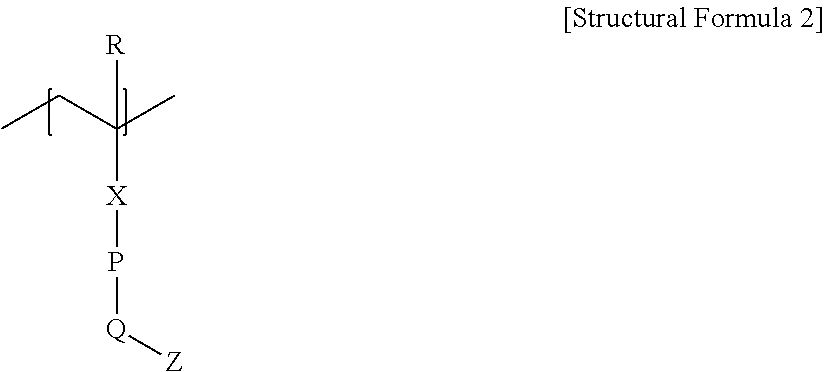
- the block 1 may be represented by the following Structural Formula 2.
- R represents a hydrogen atom or an alkyl group with 1 to 4 carbons
- X represents —C( ⁇ O)—O—
- P represents an arylene group with 6 to 12 carbons
- Q represents an oxygen atom
- Z represents an aforementioned chain with 8 or more chain-forming atoms.
- the P of Structural Formula 3 may represent phenylene, and, in another example, the Z may represent a linear-chain alkyl group with 9 to 20 carbons, 9 to 18 carbons, or 9 to 16 carbons.
- the Q may be connected in the para position of the above phenylene.
- the above alkyl group, arylene group, phenylene group and chain may be optionally substituted in part by one or more substituents.
- a block copolymer contains a block that includes an aromatic structure with one or more halogen atoms
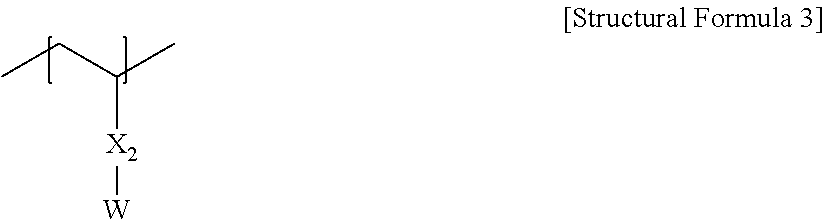
- the block may be, for example, a block that is represented by the following Structural Formula 3.
- X 2 represents a single bond, an oxygen atom, a sulfur atom, —S( ⁇ O) 2 —, an alkylene group, an alkenylene group, an alkynylene group, —C( ⁇ O)—X 1 — or —X 1 —C( ⁇ O)—, where the X 1 represents a single bond, an oxygen atom, a sulfur atom, —S( ⁇ O) 2 —, an alkylene group, an alkenylene group or an alkynylene group; and W represents an aryl group with at least one halogen atom.
- the X 2 of Structural Formula 3 may represent a single bond or an alkylene group.
- the aryl group that is represented by W may be an aryl group with 6 to 12 carbons or a phenyl group, where the aryl group or phenyl group may contain 1 or more, 2 or more, 3 or more, 4 or more or 5 or more halogen atoms.
- the number of the halogen atoms may also be, for example, 30 or less, 25 or less, 20 or less, 15 or less, or 10 or less.
- a fluorine atom may be exemplified.
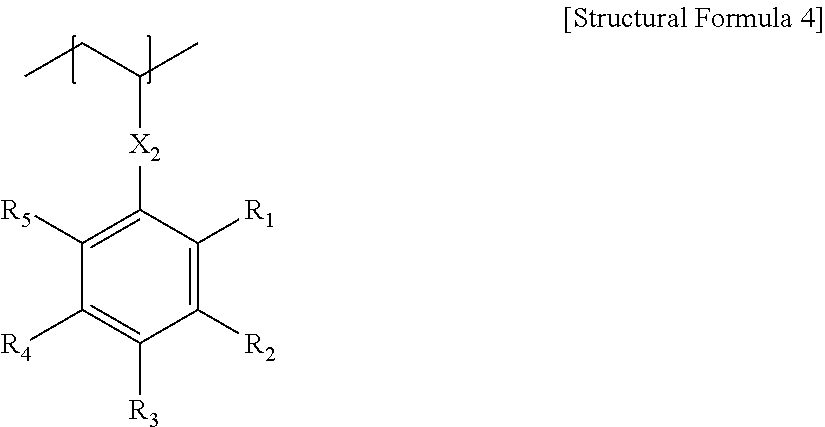
- the block that is represented by Structural Formula 3 may also be represented by the following Structural Formula 4.
- X 2 is as defined in Structural Formula 2, and each of R 1 to R 5 independently represents a hydrogen atom, an alkyl group, a haloalkyl group or a halogen atom, where 1 or more halogen atoms are contained in the positions marked as R 1 to R 5 .
- each of R 1 to R 5 independently represents a hydrogen atom, an alkyl group with 1 to 4 carbons, a haloalkyl group with 1 to 4 carbons, or a halogen, where the halogen may be chlorine or fluorine.
- R 1 to R 5 may each represent a halogen.
- halogen There is no particular limitation to the maximum number of the above halogen; it may be, for example, 12 or less, 8 or less, or 7 or less.
- the block copolymer may be a copolymer that contains either one or both of the above two types of blocks, either exclusively or together with other type(s) of block(s).
- a block copolymer may be polymerized, for example, by a living radical polymerization (LRP) method, examples of which include synthesis by anionic polymerization in which an organic rare-earth metal complex or organic alkali metal compound is used as the polymerization initiator in the presence of an alkali metal and an inorganic acid salt such as an alkaline earth metal; synthesis by an anionic polymerization method in which an organic alkali metal compound is used as the polymerization initiator in the presence of an organic aluminum compound; an atom transfer radical polymerization (ATRP) method in which an ATRP agent is used as the polymerization-control agent; an activators regenerated by electron transfer (ARGET) ATRP method in which an ATRP agent is used as the polymerization-control agent but the polymerization takes place in the presence of an organic or inorganic reducing agent that generates an electron; an initiators for continuous activator regeneration (ICAR) ATRP method; polymerization
- LRP living radical polymerization
- the aforementioned block copolymer may be prepared through polymerization of a reactant (that includes the monomers capable of forming the aforementioned block) by a living radical polymerization method in the presence of a radical initiator and a living radical polymerization reagent.
- the process of preparing a block copolymer may further include, for example, precipitating, in a nonsolvent, the polymerization product that is produced through the above processes.
- the radical initiator may be suitably selected in consideration of the polymerization efficiency; for example, an azo compound such as azobisisobutyronitrile (AIBN) and 2,2′-azobis-(2,4-dimethylvaleronitrile), or a peroxide series such as benzoyl peroxide (BPO) and di-t-butyl peroxide (DTBP) may be used.
- AIBN azobisisobutyronitrile
- BPO benzoyl peroxide
- DTBP di-t-butyl peroxide
- a living radical polymerization process may be carried out, for example, in a solvent such as methylene chloride, 1,2-dichloroethane, chlorobenzene, dichlorobenzene, benzene, toluene, acetone, chloroform, tetrahydrofuran, dioxane, monoglyme, diglyme, dimethylformamide, dimethyl sulfoxide, and dimethylacetamide.
- a solvent such as methylene chloride, 1,2-dichloroethane, chlorobenzene, dichlorobenzene, benzene, toluene, acetone, chloroform, tetrahydrofuran, dioxane, monoglyme, diglyme, dimethylformamide, dimethyl sulfoxide, and dimethylacetamide.
- nonsolvent examples include, but are not limited to, an alcohol (such as methanol, ethanol, n-propanol, and isopropanol), a glycol (such as ethylene glycol), n-hexane, cyclohexane, n-heptane, and an ether (such as petroleum ether).
- an alcohol such as methanol, ethanol, n-propanol, and isopropanol
- glycol such as ethylene glycol
- n-hexane such as ethylene glycol
- cyclohexane cyclohexane
- n-heptane examples include, but are not limited to, an ether (such as petroleum ether).
- the present application also relates to a polymer film that contains the aforementioned block copolymer.
- the polymer film may be used in a variety of applications, for example, in a variety of electronic or electrical devices, in the process of forming the aforementioned patterns, in magnetic storage recording media such as flash memory, or in biosensors.
- the aforementioned block copolymer may realize a regular structure, such as a cylinder, through self-assembly in the aforementioned polymer film.
- the block 1 , the block 2 or (in the segment of the other block that is covalently bonded to any of the block 1 and block 2 ) the segment may form a regular structure such as a cylindrical form in a block copolymer.
- the present application also relates to a method of forming a polymer film by using the aforementioned block copolymer.
- the method may include forming a polymer film containing the above block copolymer on a substrate in a self-assembled state.
- the above method may include depositing the above block copolymer, or a coating solution containing the block copolymer, to form a layer and then annealing the layer.
- the above annealing process may refer to a thermal annealing process or a solvent annealing process.
- the above thermal annealing may be carried out, for example, based on the phase transition temperature or glass transition temperature of the block copolymer; for example, it may be carried out at a temperature equal to or greater than the above glass transition temperature or phase transition temperature.
- the duration of such thermal annealing is not particularly limited and may be, for example, in the range of about 1 minute to 72 hours, although it may be subject to change as necessary.
- the heat-treatment temperature during a thermal annealing process may be, for example, about 100° C. to 250° C., which may be subject to change depending on the block copolymer to be used.
- the above solvent annealing process may be carried out in a suitable room-temperature nonpolar solvent and/or polar solvent for about 1 minute to 72 hours.
- the present application also relates to a method of forming a pattern.
- the above method may include, for example, a process of selectively removing the block 1 or block 2 of a block copolymer from the laminate that is made up of a substrate and a polymer film, which is formed on the substrate and contains the above self-assembled block copolymer.
- the above method may be a method of forming a pattern on the above substrate.
- the above method may include forming, on a substrate, a polymer film that contains the above block copolymer, selectively removing any one or more blocks of the block copolymer that is present in the above film, and subsequently etching the substrate.
- the above method enables the formation of a micropattern, for example, in nanoscale.
- a variety of patterns such as a nanorod and a nanohole may be formed by the above method, depending on the structure of the block copolymer in the polymer film. If needed, the above block copolymer may be mixed with another copolymer, a homopolymer or the like for the formation of patterns.
- the type of the substrate to be applied in the above method is not particularly limited and may be selected to suit the application; for example, silicon oxide may be used.
- the above method may form a silicon-oxide nanoscale pattern that exhibits a high aspect ratio.
- a variety of forms such as a nanorod and a nanohole may be realized, for example, by forming the above polymer film on the silicon oxide, selectively removing any one block of a block copolymer in the above polymer film where the block copolymer constitutes a predetermined structure, and then etching the silicon oxide by any one of various techniques, for example, by reactive-ion etching.
- the above method may enable the realization of a nanopattern having a high aspect ratio.
- the above pattern may be realized in the scale of tens of nanometers, and such a pattern may be used for a variety of applications including, for example, magnetic recording media for the next-generation information and electronics.
- a pattern in which nanostructures e.g. nanowires
- whose width is about 10 nm to 40 nm are arranged spaced apart (e.g. by 20 nm to 80 nm)
- a structure in which nanoholes whose width (e.g. diameter) is about 10 nm to 40 nm are arranged spaced apart by about 20 nm to 80 nm can also be realized.
- nanowires or nanoholes in the above structure can be made to have high aspect ratios.
- the method of selectively removing any one block of a block copolymer for example, a method of removing a relatively soft block by having the polymer film irradiated with suitable electromagnetic waves such as ultraviolet rays may be used.
- suitable electromagnetic waves such as ultraviolet rays
- the condition of an ultraviolet ray irradiation is determined by the type of blocks in the block copolymer; for example, it may include an irradiation of the ultraviolet rays whose wavelength is about 254 nm for 1 minute to 60 minutes.
- the process of additionally removing the segment that was previously disintegrated by ultraviolet rays may be carried out by treating the polymer film with an acid or the like.
- the process of etching the substrate by using, as the mask, the polymer film that has been selectively removed of certain blocks for example, the above etching may be carried out through reactive-ion etching with CF 4 /Ar ions or the like.
- the above etching may be followed by the process of removing the polymer film from the substrate through an oxygen plasma treatment or the like.
- FIGS. 1 to 4 is an NMR spectrum of a block copolymer of an example or comparative example.
- FIGS. 5 to 7 is an AFM or SEM image of a self-assembled film of a block copolymer of an example or comparative example.
- FIG. 8 is an image that illustrates an exemplary method for calculating the value of K of Equation 1.
- the present application can provide a block copolymer—which exhibits an excellent self-assembling property or phase separation property and, thus, can be used effectively in a variety of applications—and uses thereof.
- NMR analysis was carried out at room temperature by using a NMR spectrometer that includes a Varian Unity Inova (500 MHz) spectrometer with a 5-mm triple resonance probe.
- the analysis subject material was diluted with a solvent (CDCl 3 ) for an NMR measurement to a concentration of about 10 mg/ml for use, and the chemical shift was expressed in ppm.
- the number average molecular weight (Mn) and molecular weight distribution were measured by GPC.
- the analysis subject material such as a macroinitiator or the block copolymer of the examples was put in a 5-mL vial and diluted with tetrahydrofuran (THF) to a concentration of about 1 mg/mL. Then, a standard specimen for calibration and the specimen to be analyzed were filtered with a syringe filter (pore size: 0.45 ⁇ m) and subsequently analyzed.
- Standard specimen polystyrene (Mp: 3900000, 723000, 316500, 52200, 31400, 7200, 3940, 485)
- D can be obtained by putting a specimen to be analyzed (i.e. a homopolymer that is prepared with only the monomer that constitutes the block 1 or a homopolymer that is prepared with only the monomer that constitutes the block 2 ) in a solvent (i.e. ethanol) whose mass and density in air are known, obtaining the density of each block through the mass of the specimen, and calculating the ratio of the masses of different types of specimen.
- a specimen to be analyzed i.e. a homopolymer that is prepared with only the monomer that constitutes the block 1 or a homopolymer that is prepared with only the monomer that constitutes the block 2
- a solvent i.e. ethanol
- M can be obtained as the ratio of molar masses of monomers that make up blocks in a block copolymer.
- the molar mass of the monomer of Preparation Example 1 which is the monomer that constitutes the block 1 that will be described below in the present specification, is 346.5 g/mol
- the molar mass of pentafluorostyrene that constitutes the block 2 is 194.1 g/mol
- the value of M can be calculated to be about 1.79.
- L can be obtained as the ratio of number of hydrogen atoms in the monomers that make up blocks in a block copolymer.
- the number of hydrogen atoms in the monomer of Preparation Example 1, which is the monomer that constitutes the block 1 is 34
- the number of hydrogen atoms in pentafluorostyrene that constitutes the block 2 is 3, and, from the ratio, the value of L can be calculated to be about 11.3.
- K can be calculated through the area of a spectrum that is obtained by the aforementioned NMR analysis method.
- the peaks each of which is obtained from each block in a block copolymer—do not overlap each other, the area of the peak derived from each block is simply analyzed, and K can be obtained as the ratio of the peak areas.
- FIG. 8 is an exemplary NMR spectrum of a block copolymer that contains a structural unit, which is derived from the compound represented by Structural Formula A that is prepared according to Preparation Example 1 and applied in the following examples and comparative example, and a structural unit derived from pentafluorostyrene.
- a structural unit which is derived from the compound represented by Structural Formula A that is prepared according to Preparation Example 1 and applied in the following examples and comparative example, and a structural unit derived from pentafluorostyrene.
- the part that is marked as e and the part that is marked as d refer to the peaks that come from the block 2 (that is, the aforementioned structural unit that is derived from pentafluorostyrene), and the rest (a, b, c, f, g, h, i and j) are the peaks that come from a structural unit that is derived from the compound (represented by Structural Formula A) of Preparation Example 1.
- the peaks marked as e and g and the peaks marked as d and f overlap each other; in which case, the overlapping of the peaks should be taken into consideration when obtaining the value of K.
- the method of obtaining the value of K by taking the overlapping of the peaks into account is well known in the art; the value can be obtained, for example, by using an NMR interpretation program such as MestReC program.
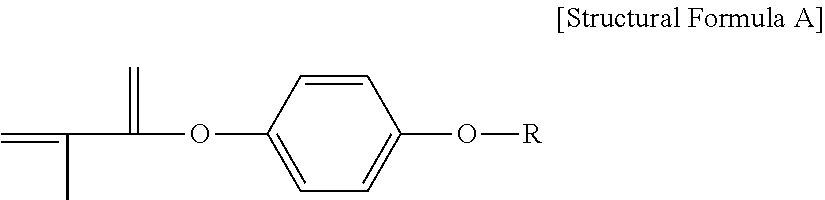
- the compound (DPM-C12) represented by the following Structural Formula A was synthesized by the following method: hydroquinone (10.0 g, 94.2 mmol) and 1-bromododecane (23.5 g, 94.2 mmol) were introduced into a 250-mL flask, dissolved in 100 mL of acetonitrile; then, an excessive amount of potassium carbonate was added to the above solution and allowed to react at about 75° C.
- R represents a linear-chain alkyl group with 12 carbons.
- the above block copolymer contains the block 1 (that is derived from monomer A prepared according to Preparation Example 1) and the block 2 (that is derived from the aforementioned pentafluorostyrene monomer).
- the results of 1 H-NMR analysis on the block copolymer that was prepared according to Example 1 are provided in FIG. 1 .
- the yield of the macroinitiator was about 57.0 wt %, and the number average molecular weight (Mn) and molecular weight distribution (Mw/Mn) were 10,400 and 1.19, respectively.
- Mn number average molecular weight
- Mw/Mn molecular weight distribution
- 0.3 g of the macroinitiator, 3.3 g of a pentafluorostyrene monomer and 1.2 mL of benzene were introduced into a 10-mL Schlenk flask, stirred at room temperature for 30 minutes under a nitrogen atmosphere, and then a RAFT polymerization reaction was carried out at 115° C. for 4 hours.
- the reaction solution was precipitated in 250 mL of an extraction solvent (methanol) and then dried by filtration under reduced pressure to prepare a light-pink block copolymer.
- the yield of the block copolymer was about 18 wt %, and the Mn and Mw/Mn were 17,800 and 1.14, respectively.
- the above block copolymer contains the block 1 (that is derived from monomer A prepared according to Preparation Example 1) and the block 2 (that is derived from the aforementioned pentafluorostyrene monomer).
- the results of 1 H-NMR analysis on the block copolymer that was prepared according to Example 2 are provided in FIG. 2 .
- the yield of the macroinitiator was about 60.0 wt %, and the number average molecular weight (Mn) and molecular weight distribution (Mw/Mn) were 5,700 and 1.18, respectively.
- Mn number average molecular weight
- Mw/Mn molecular weight distribution
- 0.2 g of the macroinitiator, 3.4 g of a pentafluorostyrene monomer and 1.2 mL of anisole were introduced into a 10-mL Schlenk flask, stirred at room temperature for 30 minutes under a nitrogen atmosphere, and then a RAFT polymerization reaction was carried out at 115° C. for 15 hours.
- the reaction solution was precipitated in 250 mL of an extraction solvent (methanol) and then dried by filtration under reduced pressure to prepare a light-pink block copolymer.
- the yield of the block copolymer was about 16 wt %, and the Mn and Mw/Mn were 59,000 and 1.22, respectively.
- the above block copolymer contains the block 1 (that is derived from monomer A prepared according to Preparation Example 1) and the block 2 (that is derived from the aforementioned pentafluorostyrene monomer).
- the results of 1 H-NMR analysis on the block copolymer that was prepared according to Example 3 are provided in FIG. 3 .
- the yield of the macroinitiator was about 52.0 wt %, and the number average molecular weight (Mn) and molecular weight distribution (Mw/Mn) were 9,100 and 1.20, respectively.
- Mn number average molecular weight
- Mw/Mn molecular weight distribution
- the reaction solution was precipitated in 250 mL of an extraction solvent (methanol) and then dried by filtration under reduced pressure to prepare a light-yellow block copolymer.
- the yield of the block copolymer was about 15 wt %, and the Mn and Mw/Mn were 23,200 and 1.12, respectively.
- the above block copolymer contains the block 1 (that is derived from monomer A prepared according to Preparation Example 1) and the block 2 (that is derived from the aforementioned pentafluorostyrene monomer).
- the results of 1 H-NMR analysis on the block copolymer that was prepared according to Comparative Example 1 are provided in FIG. 4 .
- Example 2 Example 3
- Example 1 X value 4 about 3.2 about 1.18 2 D 1.57 1.57 1.57 1.57 M about 1.79 about 1.79 about 1.79 K about 0.08 about 0.11 about 1.37 about 0.25 L about 11.3 about 11.3 about 11.3 about 11.3 about 11.3 D: ratio (D2/D1) of density (D2) of block 2 to density (D1) of block 1 M: ratio (M1/M2) of molar mass (346.5 g/mol, M1) of monomer A of Preparation Example 1 (as monomer that constitutes block 1) to molar mass (194.1 g/mol, M2) of pentafluorostyrene (as monomer that constitutes block 2) K: ratio (A2/A1) of area (A2) of peak in 1 H-NMR produced based on block 2 to area (A1) of peak produced based on block 1 L: ratio (H1/H2) of number (34, H1) of hydrogen atoms in monomer A of Preparation Example 1 (as monomer that constitutes block 1) to number
- a scanning electron microscopic (SEM) image was taken of the film.
- FIG. 5 is an AFM image of Example 1
- FIG. 6 is an SEM image of Example 2.
- FIG. 7 is the result of SEM of Comparative Example 1, from which a failure to induce effective phase separation into a cylindrical structure can be identified.
Landscapes
- Chemical & Material Sciences (AREA)
- Chemical Kinetics & Catalysis (AREA)
- Organic Chemistry (AREA)
- Health & Medical Sciences (AREA)
- Medicinal Chemistry (AREA)
- Polymers & Plastics (AREA)
- Physics & Mathematics (AREA)
- Engineering & Computer Science (AREA)
- General Physics & Mathematics (AREA)
- Manufacturing & Machinery (AREA)
- Materials Engineering (AREA)
- Microelectronics & Electronic Packaging (AREA)
- Wood Science & Technology (AREA)
- Life Sciences & Earth Sciences (AREA)
- General Chemical & Material Sciences (AREA)
- Spectroscopy & Molecular Physics (AREA)
- Architecture (AREA)
- Structural Engineering (AREA)
- Graft Or Block Polymers (AREA)
- Condensed Matter Physics & Semiconductors (AREA)
- Computer Hardware Design (AREA)
- Power Engineering (AREA)
- Photosensitive Polymer And Photoresist Processing (AREA)
Abstract
Description
X=1+(D×M)/(K×L) [Equation 1]

| TABLE 1 | |||
| Examples | Comparative Example | ||
| 1 | 2 | 3 | 1 | ||
| MI | Mn | 10300 | 10400 | 5700 | 9100 |
| PDI | 1.21 | 1.19 | 1.18 | 1.20 | |
| BCP | Mn | 15600 | 17800 | 59000 | 23200 |
| PDI | 1.15 | 1.14 | 1.22 | 1.12 | |
| MI: macroinitiator | |||||
| BCP: block copolymer | |||||
| Mn: number average molecular weight | |||||
| PDI: molecular weight distribution | |||||
| TABLE 2 | |||||
| Comparative | |||||
| Example 1 | Example 2 | Example 3 | Example 1 | ||
| X value | 4 | about 3.2 | about 1.18 | 2 |
| D | 1.57 | 1.57 | 1.57 | 1.57 |
| M | about 1.79 | about 1.79 | about 1.79 | about 1.79 |
| K | about 0.08 | about 0.11 | about 1.37 | about 0.25 |
| L | about 11.3 | about 11.3 | about 11.3 | about 11.3 |
| D: ratio (D2/D1) of density (D2) of block 2 to density (D1) of block 1 | ||||
| M: ratio (M1/M2) of molar mass (346.5 g/mol, M1) of monomer A of Preparation Example 1 (as monomer that constitutes block 1) to molar mass (194.1 g/mol, M2) of pentafluorostyrene (as monomer that constitutes block 2) | ||||
| K: ratio (A2/A1) of area (A2) of peak in 1H-NMR produced based on block 2 to area (A1) of peak produced based on block 1 | ||||
| L: ratio (H1/H2) of number (34, H1) of hydrogen atoms in monomer A of Preparation Example 1 (as monomer that constitutes block 1) to number (3, H2) of hydrogen atoms in pentafluorostyrene (as monomer that constitutes block 2) | ||||
Claims (15)
X=1+(D×M)/(K×L) [Equation 1]
X=1+(D×M)/(K×L) [Equation 1]
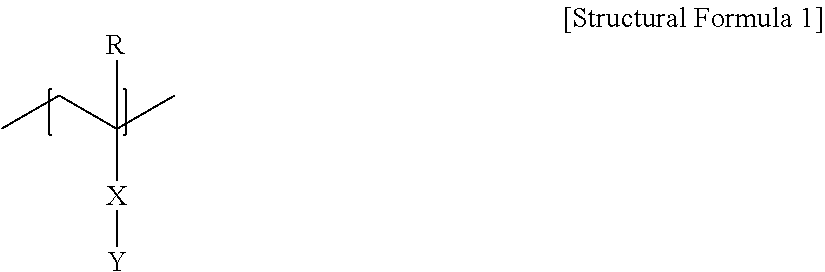
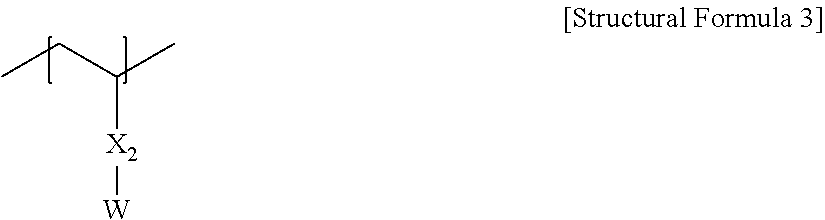
Applications Claiming Priority (27)
| Application Number | Priority Date | Filing Date | Title |
|---|---|---|---|
| KR10-2014-0131964 | 2014-09-30 | ||
| KR20140131964 | 2014-09-30 | ||
| KR10-2014-0175413 | 2014-12-08 | ||
| KR1020140175411A KR101762487B1 (en) | 2013-12-06 | 2014-12-08 | Block copolymer |
| KR10-2014-0175410 | 2014-12-08 | ||
| KR1020140175400A KR101780097B1 (en) | 2013-12-06 | 2014-12-08 | Monomer and block copolymer |
| KR10-2014-0175411 | 2014-12-08 | ||
| KR1020140175414A KR101780100B1 (en) | 2013-12-06 | 2014-12-08 | Block copolymer |
| KR10-2014-0175406 | 2014-12-08 | ||
| KR1020140175413A KR101780099B1 (en) | 2013-12-06 | 2014-12-08 | Block copolymer |
| KR10-2014-0175412 | 2014-12-08 | ||
| KR10-2014-0175407 | 2014-12-08 | ||
| KR10-2014-0175402 | 2014-12-08 | ||
| KR1020140175402A KR101832025B1 (en) | 2013-12-06 | 2014-12-08 | Monomer and block copolymer |
| KR10-2014-0175415 | 2014-12-08 | ||
| KR10-2014-0175414 | 2014-12-08 | ||
| KR1020140175410A KR101768290B1 (en) | 2013-12-06 | 2014-12-08 | Block copolymer |
| KR10-2014-0175400 | 2014-12-08 | ||
| KR1020140175415A KR101780101B1 (en) | 2013-12-06 | 2014-12-08 | Block copolymer |
| KR10-2014-0175401 | 2014-12-08 | ||
| KR1020140175406A KR101780098B1 (en) | 2013-12-06 | 2014-12-08 | Boack copolymer |
| KR1020140175407A KR101763010B1 (en) | 2013-12-06 | 2014-12-08 | Block copolymer |
| KR1020140175401A KR101763008B1 (en) | 2013-12-06 | 2014-12-08 | Monomer and block copolymer |
| KR1020140175412A KR101768291B1 (en) | 2013-12-06 | 2014-12-08 | Block copolymer |
| KR1020150079486A KR101781685B1 (en) | 2014-09-30 | 2015-06-04 | Block copolymer |
| KR10-2015-0079486 | 2015-06-04 | ||
| PCT/KR2015/010327 WO2016053005A1 (en) | 2014-09-30 | 2015-09-30 | Block copolymer |
Publications (2)
| Publication Number | Publication Date |
|---|---|
| US20170247492A1 US20170247492A1 (en) | 2017-08-31 |
| US10310378B2 true US10310378B2 (en) | 2019-06-04 |
Family
ID=66221401
Family Applications (1)
| Application Number | Title | Priority Date | Filing Date |
|---|---|---|---|
| US15/514,939 Active US10310378B2 (en) | 2014-09-30 | 2015-09-30 | Block copolymer |
Country Status (5)
| Country | Link |
|---|---|
| US (1) | US10310378B2 (en) |
| EP (1) | EP3202802B1 (en) |
| JP (1) | JP6532941B2 (en) |
| CN (1) | CN107075050B (en) |
| WO (1) | WO2016053005A1 (en) |
Families Citing this family (26)
| Publication number | Priority date | Publication date | Assignee | Title |
|---|---|---|---|---|
| WO2015084122A1 (en) | 2013-12-06 | 2015-06-11 | 주식회사 엘지화학 | Block copolymer |
| EP3101043B1 (en) | 2013-12-06 | 2021-01-27 | LG Chem, Ltd. | Block copolymer |
| JP6483693B2 (en) | 2013-12-06 | 2019-03-13 | エルジー・ケム・リミテッド | Block copolymer |
| CN105934455B (en) | 2013-12-06 | 2019-01-18 | 株式会社Lg化学 | Block copolymer |
| CN105934454B (en) | 2013-12-06 | 2019-01-18 | 株式会社Lg化学 | Block copolymer |
| EP3078685B1 (en) | 2013-12-06 | 2020-09-09 | LG Chem, Ltd. | Block copolymer |
| WO2015084128A1 (en) | 2013-12-06 | 2015-06-11 | 주식회사 엘지화학 | Block copolymer |
| WO2015084121A1 (en) * | 2013-12-06 | 2015-06-11 | 주식회사 엘지화학 | Block copolymer |
| CN105899557B (en) | 2013-12-06 | 2018-10-26 | 株式会社Lg化学 | Block copolymer |
| CN105916904B (en) | 2013-12-06 | 2018-11-09 | 株式会社Lg化学 | block copolymer |
| JP6483694B2 (en) | 2013-12-06 | 2019-03-13 | エルジー・ケム・リミテッド | Monomers and block copolymers |
| EP3078692B1 (en) * | 2013-12-06 | 2021-01-27 | LG Chem, Ltd. | Block copolymer |
| CN106459326B (en) | 2013-12-06 | 2019-08-13 | 株式会社Lg化学 | Block copolymer |
| JP6432846B2 (en) | 2013-12-06 | 2018-12-05 | エルジー・ケム・リミテッド | Block copolymer |
| WO2016052994A1 (en) | 2014-09-30 | 2016-04-07 | 주식회사 엘지화학 | Block copolymer |
| WO2016052999A1 (en) | 2014-09-30 | 2016-04-07 | 주식회사 엘지화학 | Block copolymer |
| EP3202798B1 (en) | 2014-09-30 | 2022-01-12 | LG Chem, Ltd. | Block copolymer |
| WO2016053014A1 (en) | 2014-09-30 | 2016-04-07 | 주식회사 엘지화학 | Method for producing patterned substrate |
| WO2016053011A1 (en) | 2014-09-30 | 2016-04-07 | 주식회사 엘지화학 | Block copolymer |
| EP3203497B1 (en) | 2014-09-30 | 2023-11-29 | LG Chem, Ltd. | Method for producing patterned substrate |
| WO2016053000A1 (en) | 2014-09-30 | 2016-04-07 | 주식회사 엘지화학 | Block copolymer |
| US10310378B2 (en) | 2014-09-30 | 2019-06-04 | Lg Chem, Ltd. | Block copolymer |
| CN107075054B (en) | 2014-09-30 | 2020-05-05 | 株式会社Lg化学 | Block copolymer |
| WO2016053009A1 (en) | 2014-09-30 | 2016-04-07 | 주식회사 엘지화학 | Block copolymer |
| CN109983044B (en) * | 2016-11-30 | 2021-10-22 | 株式会社Lg化学 | polymer composition |
| CN111065965B (en) * | 2017-09-13 | 2023-11-03 | 株式会社Lg化学 | Preparation method of patterned substrate |
Citations (144)
| Publication number | Priority date | Publication date | Assignee | Title |
|---|---|---|---|---|
| GB898065A (en) | 1958-03-13 | 1962-06-06 | Ciba Ltd | New monomeric, polymerisable, ultra-violet light-screening esters and amides, their polymerisation and use |
| US3976672A (en) | 1974-12-26 | 1976-08-24 | Uniroyal Inc. | (Hydrocarbylphenylsulfonyl)alkyltrimethylstannanes |
| JPH01260360A (en) | 1988-04-12 | 1989-10-17 | Nippon Oil & Fats Co Ltd | Packing agent for reverse phase chromatography |
| US5115056A (en) | 1989-06-20 | 1992-05-19 | Ciba-Geigy Corporation | Fluorine and/or silicone containing poly(alkylene-oxide)-block copolymers and contact lenses thereof |
| US5202402A (en) | 1987-10-08 | 1993-04-13 | Idemitsu Kosan Co., Ltd. | Styrene copolymer and process for producing said copolymer |
| US5234604A (en) | 1991-02-26 | 1993-08-10 | Betz Laboratories, Inc. | Water soluble block copolymers and methods of use therof |
| JPH05320281A (en) | 1992-05-21 | 1993-12-03 | Idemitsu Kosan Co Ltd | Styrene block copolymer and its production |
| JPH0665333A (en) | 1992-08-21 | 1994-03-08 | Shin Etsu Chem Co Ltd | Monodisperse copolymer and method for producing the same |
| US5554695A (en) | 1990-11-21 | 1996-09-10 | Idemitsu Kosan Co. Ltd. | Styrenic copolymer and process for producing same |
| US5728431A (en) | 1996-09-20 | 1998-03-17 | Texas A&M University System | Process for forming self-assembled polymer layers on a metal surface |
| WO1998037136A1 (en) | 1997-02-21 | 1998-08-27 | Copytele, Inc. | Polymeric-coated dielectric particles and formulation and method for preparing same |
| JPH10237143A (en) | 1997-02-21 | 1998-09-08 | Shin Etsu Chem Co Ltd | Block-graft copolymer and polymer solid electrolyte prepared using the same |
| JPH10245427A (en) | 1997-03-04 | 1998-09-14 | Shin Etsu Chem Co Ltd | Block-graft copolymer, self-crosslinking polymer solid electrolyte produced using the same, and method for producing the same |
| JPH1143523A (en) | 1997-07-25 | 1999-02-16 | Shin Etsu Chem Co Ltd | Block-graft copolymer, self-crosslinking polymer solid electrolyte produced using the same, and method for producing the same |
| JP2000053734A (en) | 1998-08-04 | 2000-02-22 | Kuraray Co Ltd | Block copolymer and its molded product |
| JP2000281737A (en) | 1999-01-29 | 2000-10-10 | Shin Etsu Chem Co Ltd | Method for producing cross-linked polymer solid electrolyte |
| JP2000285751A (en) | 1999-01-29 | 2000-10-13 | Shin Etsu Chem Co Ltd | Method for producing cross-linked polymer solid electrolyte |
| JP2001294617A (en) | 2000-04-12 | 2001-10-23 | Shin Etsu Chem Co Ltd | Proton conductive polymer electrolyte |
| US6314225B1 (en) | 1999-11-23 | 2001-11-06 | Corning Incorporated | Halogen and perhalo-organo substituted N-phenyl (or biphenyl) maleimide |
| KR20010101356A (en) | 1998-12-30 | 2001-11-14 | 메리 앤 턱커 | Branched/block copolymers for treatment of keratinous substrates |
| CN1333790A (en) | 1998-12-31 | 2002-01-30 | 西巴特殊化学品控股有限公司 | pigment composition containing ATRP polymers |
| JP2002145973A (en) | 2000-11-08 | 2002-05-22 | National Institute Of Advanced Industrial & Technology | Syndiotactic aromatic vinyl block copolymer and method for producing the same |
| US6531547B1 (en) | 1998-03-25 | 2003-03-11 | The Lubrizol Corporation | Vinyl aromatic-(vinyl aromatic-co-acrylic) block copolymers prepared by stabilized free radical polymerization |
| US6546282B1 (en) | 1999-04-23 | 2003-04-08 | Hisamitsu Pharmaceutical Co., Inc. | Device for Iontophoresis |
| US20030143343A1 (en) | 2001-12-19 | 2003-07-31 | Fuji Photo Film Co., Ltd. | Wall-structured body and process for manufacturing the same |
| JP2003536105A (en) | 2000-06-05 | 2003-12-02 | ロディア・シミ | Photosensitive composition for photoresist production |
| JP2004026688A (en) | 2002-06-24 | 2004-01-29 | Asahi Glass Co Ltd | Polyfluoroalkyl group-containing polymerizable compound and polymer thereof |
| US20040049836A1 (en) | 2002-07-03 | 2004-03-18 | The Procter & Gamble Company | Radiation curable low stress relaxation elastomeric materials |
| US20040110856A1 (en) | 2002-12-04 | 2004-06-10 | Young Jung Gun | Polymer solution for nanoimprint lithography to reduce imprint temperature and pressure |
| JP2004323773A (en) | 2003-04-28 | 2004-11-18 | Denki Kagaku Kogyo Kk | Block copolymer and resin composition |
| US20040242787A1 (en) | 2001-11-14 | 2004-12-02 | Moon-Seok Chun | Process for preparing linear block copolymer |
| JP2005015508A (en) | 2003-06-23 | 2005-01-20 | Konica Minolta Holdings Inc | Block copolymer, organic electroluminescent element, display device, illuminator and light source |
| JP2005097442A (en) | 2003-09-25 | 2005-04-14 | Ube Ind Ltd | Pattern surface and manufacturing method thereof |
| JP2005148205A (en) | 2003-11-12 | 2005-06-09 | Jsr Corp | Polymerizable compound |
| JP2005531618A (en) | 2002-07-01 | 2005-10-20 | メルク パテント ゲゼルシャフト ミット ベシュレンクテル ハフトング | Polymerizable, luminescent compounds and mixtures, luminescent polymer materials and their use |
| JP2007070453A (en) | 2005-09-06 | 2007-03-22 | Nippon Soda Co Ltd | Method for producing block copolymer |
| JP2007077292A (en) | 2005-09-14 | 2007-03-29 | Lion Corp | Composition for forming easily cleanable film and block copolymer |
| WO2007055371A1 (en) | 2005-11-14 | 2007-05-18 | Tokyo Institute Of Technology | Method for production of nano-porous substrate |
| US20070142559A1 (en) | 2005-12-16 | 2007-06-21 | Bridgestone Corporation | Nanoparticles with controlled architecture and method thereof |
| US20070166648A1 (en) | 2006-01-17 | 2007-07-19 | International Business Machines Corporation | Integrated lithography and etch for dual damascene structures |
| US20070219338A1 (en) | 2006-03-14 | 2007-09-20 | Shin-Etsu Chemical Co., Ltd. | Self-assembling polymer film material, self-assembled pattern, and pattern forming method |
| JP2008055579A (en) | 2006-09-01 | 2008-03-13 | Lintec Corp | Manufacturing method of microphase-separated structure |
| US20080105854A1 (en) | 2006-11-08 | 2008-05-08 | Cheil Industries Inc. | Conductive Copolymer, Conductive Copolymer Composition, Film and Opto-Electronic Device Using the Same |
| CN101215362A (en) | 2008-01-08 | 2008-07-09 | 厦门大学 | A kind of silicon propylene triblock copolymer with low surface energy and preparation method thereof |
| US20080193658A1 (en) | 2007-02-08 | 2008-08-14 | Micron Technology, Inc. | Methods using block copolymer self-assembly for sub-lithographic patterning |
| US20080286333A1 (en) | 2007-05-15 | 2008-11-20 | Boston Scientific Scimed, Inc. | Medical devices having coating with improved adhesion |
| US20080311402A1 (en) | 2007-06-12 | 2008-12-18 | Yeon Sik Jung | Orientation-controlled self-assembled nanolithography using a block copolymer |
| KR20090015742A (en) | 2007-08-09 | 2009-02-12 | 삼성전자주식회사 | Micro pattern formation method using block copolymer |
| JP2009057519A (en) | 2007-09-03 | 2009-03-19 | Tokyo Institute Of Technology | Microphase separation structure membrane and manufacturing method thereof |
| JP2009086354A (en) | 2007-09-28 | 2009-04-23 | Fujifilm Corp | Positive resist composition and pattern forming method using the same |
| US20090114108A1 (en) | 2007-06-21 | 2009-05-07 | Toyohisa Oya | Lithographic printing plate precursor and lithographic printing method |
| CN101443371A (en) | 2006-05-16 | 2009-05-27 | 日本曹达株式会社 | Block copolymers |
| CN101492520A (en) | 2009-03-04 | 2009-07-29 | 中国科学院上海有机化学研究所 | Diblock copolymer containing full-fluorine cyclobutyl aryl aether block and uses thereof |
| JP2009203439A (en) | 2008-02-29 | 2009-09-10 | Mitsubishi Electric Corp | Block copolymer, block copolymer composition and insulation sheet containing the same |
| US20090240001A1 (en) | 2008-03-21 | 2009-09-24 | Jennifer Kahl Regner | Methods of Improving Long Range Order in Self-Assembly of Block Copolymer Films with Ionic Liquids |
| US20090306295A1 (en) | 2004-03-19 | 2009-12-10 | University Of Tennessee Research Foundation | Materials comprising polydienes and hydrophilic polymers and related methods |
| KR100935863B1 (en) | 2008-07-02 | 2010-01-07 | 연세대학교 산학협력단 | The patterning method of blockcopolymer with nanostructure using solvent annealing and dewetting |
| JP2010507803A (en) | 2006-10-23 | 2010-03-11 | ジョン サミュエル バチェルダー | Surface energy measuring device and measuring method |
| CN101688047A (en) | 2007-03-28 | 2010-03-31 | 日东电工株式会社 | Method for producing polymer article having micro-phase separation structure and polymer article having micro-phase separation structure |
| KR20100033962A (en) | 2007-07-06 | 2010-03-31 | 마루젠 세끼유가가꾸 가부시키가이샤 | Aba triblock copolymer and process for producing the same |
| US20100086801A1 (en) | 2008-09-25 | 2010-04-08 | Russell Thomas P | Method of producing nanopatterned articles, and articles produced thereby |
| US20100098876A1 (en) | 2008-10-21 | 2010-04-22 | Hanson Eric L | Plasma treatment of substrates prior to the formation a self-assembled monolayer |
| US20100102415A1 (en) | 2008-10-28 | 2010-04-29 | Micron Technology, Inc. | Methods for selective permeation of self-assembled block copolymers with metal oxides, methods for forming metal oxide structures, and semiconductor structures including same |
| JP2010115832A (en) | 2008-11-12 | 2010-05-27 | Panasonic Corp | Method for promoting self-formation of block copolymer and method for forming self-formation pattern of block copolymer using the method for promoting self-formation |
| US20100155988A1 (en) | 2008-12-19 | 2010-06-24 | Obducat Ab | Process and method for modifying polymer film surface interaction |
| JP2010145158A (en) | 2008-12-17 | 2010-07-01 | Dainippon Printing Co Ltd | Method for confirming micro phase separation structure |
| US20100216312A1 (en) | 2007-06-01 | 2010-08-26 | Sharp Kabushiki Kaisha | Resist removing method, semiconductor manufacturing method, and resist removing apparatus |
| JP2010202723A (en) | 2009-03-02 | 2010-09-16 | Tosoh Corp | Block copolymer and method for producing the same |
| US20100266957A1 (en) | 2009-04-16 | 2010-10-21 | Yuji Harada | Resist composition and patterning process |
| US20100285276A1 (en) | 2009-05-07 | 2010-11-11 | Korea Advanced Institute Of Science And Technology | Methods for the preparation of coil-comb block copolymers and their nanostructures |
| US20100305230A1 (en) | 2002-05-31 | 2010-12-02 | Elsicon, Inc. | Hybrid polymer materials for liquid crystal alignment layers |
| JP2010275349A (en) | 2009-05-26 | 2010-12-09 | Tokyo Institute Of Technology | Self-supporting polymer thin film |
| KR20110018678A (en) | 2009-08-18 | 2011-02-24 | 연세대학교 산학협력단 | Vertical Orientation Control of Cylinder Nanostructures Using Polystyrene with Functional Terminal Groups |
| KR20110097707A (en) | 2010-02-25 | 2011-08-31 | 이화여자대학교 산학협력단 | Method for producing zinc oxide nanoring structure using self-assembled biblock copolymer and sol-gel process |
| CN102172491A (en) | 2011-03-09 | 2011-09-07 | 江苏嘉业氟材料科技有限公司 | Fluorine-contained surfactant and preparation method thereof |
| KR20110102998A (en) | 2010-03-12 | 2011-09-20 | 한국과학기술원 | Method for preparing nanoparticle block copolymer composite having a high thermal stability core shell structure and nanoparticle block copolymer composite having a high thermal stability coreshell structure |
| KR20110112501A (en) | 2010-04-07 | 2011-10-13 | 한국과학기술원 | Block copolymer for producing nanostructures having high aspect ratio and method for producing same |
| US20110253946A1 (en) | 2008-12-26 | 2011-10-20 | Dal-Ho Huh | Conductive polymer, conductive polymer composition, conductive polymer organic film, and organic photoelectric device including the same |
| US20110294070A1 (en) | 2010-06-01 | 2011-12-01 | Shin-Etsu Chemical Co., Ltd. | Monomer, polymer, chemically amplified positive resist composition, and patterning process |
| JP2012001787A (en) | 2010-06-18 | 2012-01-05 | Toppan Printing Co Ltd | Method of manufacturing minute structure, and complex |
| US20120052446A1 (en) | 2010-09-01 | 2012-03-01 | E. I. Du Pont De Nemours And Company | High resolution, solvent resistant, thin elastomeric printing plates |
| JP2012093699A (en) | 2010-09-30 | 2012-05-17 | Canon Inc | Electrochromic element |
| US8211737B2 (en) | 2008-09-19 | 2012-07-03 | The University Of Massachusetts | Method of producing nanopatterned articles, and articles produced thereby |
| US20120214094A1 (en) | 2011-02-23 | 2012-08-23 | Satoshi Mikoshiba | Method of forming pattern |
| WO2012144735A2 (en) | 2011-04-22 | 2012-10-26 | Lg Chem, Ltd. | Novel diblock copolymer, preparation method thereof, and method of forming nano pattern using the same |
| CN102967918A (en) | 2012-12-05 | 2013-03-13 | 河海大学常州校区 | Novel solar light-condensation disc |
| US20130078576A1 (en) | 2011-09-23 | 2013-03-28 | Az Electronic Materials Usa Corp. | Compositions of neutral layer for directed self assembly block copolymers and processes thereof |
| CN103025827A (en) | 2010-07-19 | 2013-04-03 | 株式会社Lg化学 | Thermosetting resin composition with good coatability and recoatability |
| JP2013512323A (en) | 2009-12-07 | 2013-04-11 | ボリアリス エージー | Process for preparing unsupported solid metallocene catalyst system and its use in olefin polymerization |
| JP2013068882A (en) | 2011-09-26 | 2013-04-18 | Toshiba Corp | Pattern forming method |
| WO2013069544A1 (en) | 2011-11-09 | 2013-05-16 | Jsr株式会社 | Self-organization composition for pattern formation and pattern formation method |
| TW201323461A (en) | 2011-09-06 | 2013-06-16 | Univ Cornell | Block copolymers and lithographic patterning using same |
| JP2013121430A (en) | 2011-12-09 | 2013-06-20 | Kyushu Univ | Biocompatible material, medical instrument and method for using medical instrument |
| US20130189504A1 (en) | 2011-09-15 | 2013-07-25 | Wisconsin Alumni Research Foundation | Directed assembly of block copolymer films between a chemically patterned surface and a second surface |
| US20130209693A1 (en) | 2012-02-10 | 2013-08-15 | Rohm And Haas Electronic Materials Llc | Block copolymer and methods relating thereto |
| WO2013120051A1 (en) | 2012-02-10 | 2013-08-15 | E. I. Du Pont De Nemours And Company | Preparation, purification and use of high-x diblock copolymers |
| US20130209755A1 (en) | 2012-02-15 | 2013-08-15 | Phillip Dene Hustad | Self-assembled structures, method of manufacture thereof and articles comprising the same |
| KR20130113596A (en) | 2012-04-06 | 2013-10-16 | 주식회사 동진쎄미켐 | Photoresist composition for forming guide pattern and method for forming fine pattern using the same |
| JP2013219334A (en) | 2012-03-16 | 2013-10-24 | Jx Nippon Oil & Energy Corp | Method for manufacturing substrate using film-like mold, and manufacturing device |
| WO2013158527A1 (en) | 2012-04-16 | 2013-10-24 | Brewer Science Inc. | Silicon hardmask layer for directed self-assembly |
| US20130284698A1 (en) | 2012-04-27 | 2013-10-31 | Shin-Etsu Chemical Co., Ltd. | Patterning process |
| US20130306594A1 (en) | 2012-05-16 | 2013-11-21 | Phillip Dene Hustad | Polystyrene-polyacrylate block copolymers, methods of manufacture thereof and articles comprising the same |
| JP2014012807A (en) | 2012-06-05 | 2014-01-23 | Asahi Kasei E-Materials Corp | Resin composition for forming pattern and pattern forming process |
| WO2014050905A1 (en) | 2012-09-28 | 2014-04-03 | 富士フイルム株式会社 | Self-organizing composition for forming pattern, method for forming pattern by self-organization of block copolymer using same, and pattern |
| US20140141375A1 (en) | 2012-11-19 | 2014-05-22 | Sangho Cho | Self-assembled structures, method of manufacture thereof and articles comprising the same |
| WO2014090178A1 (en) | 2012-12-13 | 2014-06-19 | Toray Advanced Materials Research Laboratories (China) Co., Ltd. | Multi-block copolymer and polymer electrolyte |
| WO2014124795A1 (en) | 2013-02-14 | 2014-08-21 | Asml Netherlands B.V. | Methods for providing spaced lithography features on a substrate by self-assembly of block copolymers |
| US20140238954A1 (en) | 2013-02-22 | 2014-08-28 | Tokyo Institute Of Technology | Method of producing structure containing phase-separated structure, method of forming pattern, and top coat material |
| JP2014162504A (en) | 2013-02-22 | 2014-09-08 | Canon Marketing Japan Inc | Computer, medicine packaging device and its control method and program |
| JP2015000896A (en) | 2013-06-14 | 2015-01-05 | 富士フイルム株式会社 | Composition, micro phase separation structure membrane using the same, and method for producing the micro phase separation structure membrane |
| US20150064630A1 (en) | 2012-04-27 | 2015-03-05 | Asml Netherlands B.V. | Methods and compositions for providing spaced lithography features on a substrate by self-assembly of block copolymers |
| US20150085042A1 (en) | 2013-09-24 | 2015-03-26 | Xerox Corporation | Blanket materials for indirect printing method with varying surface energies via amphiphilic block copolymers |
| WO2015084127A1 (en) | 2013-12-06 | 2015-06-11 | 주식회사 엘지화학 | Block copolymer |
| WO2015084125A1 (en) | 2013-12-06 | 2015-06-11 | 주식회사 엘지화학 | Block copolymer |
| WO2015084122A1 (en) | 2013-12-06 | 2015-06-11 | 주식회사 엘지화학 | Block copolymer |
| WO2015084121A1 (en) | 2013-12-06 | 2015-06-11 | 주식회사 엘지화학 | Block copolymer |
| WO2015084124A1 (en) | 2013-12-06 | 2015-06-11 | 주식회사 엘지화학 | Block copolymer |
| WO2015084123A1 (en) | 2013-12-06 | 2015-06-11 | 주식회사 엘지화학 | Block copolymer |
| WO2015084126A1 (en) | 2013-12-06 | 2015-06-11 | 주식회사 엘지화학 | Block copolymer |
| KR20150066488A (en) | 2013-12-06 | 2015-06-16 | 주식회사 엘지화학 | Block copolymer |
| WO2015087005A1 (en) | 2013-12-13 | 2015-06-18 | Arkema France | Method allowing the creation of nanometric structures by self-assembly of block copolymers |
| US20150228298A1 (en) | 2012-09-10 | 2015-08-13 | Lg Chem, Ltd. | Method for forming silicon oxide and metal nanopattern's, and Magnetic recording medium for information storage using the same |
| WO2016052999A1 (en) | 2014-09-30 | 2016-04-07 | 주식회사 엘지화학 | Block copolymer |
| KR20160038705A (en) | 2014-09-30 | 2016-04-07 | 주식회사 엘지화학 | Block copolymer |
| WO2016053007A1 (en) | 2014-09-30 | 2016-04-07 | 주식회사 엘지화학 | Method for producing patterned substrate |
| WO2016052994A1 (en) | 2014-09-30 | 2016-04-07 | 주식회사 엘지화학 | Block copolymer |
| WO2016053005A1 (en) | 2014-09-30 | 2016-04-07 | 주식회사 엘지화학 | Block copolymer |
| WO2016053011A1 (en) | 2014-09-30 | 2016-04-07 | 주식회사 엘지화학 | Block copolymer |
| US20160204653A1 (en) | 2014-04-01 | 2016-07-14 | SK Hynix Inc. | Semiconductor device being capable of improving the breakdown characteristics |
| CN105899560A (en) | 2013-12-06 | 2016-08-24 | 株式会社Lg化学 | Block copolymer |
| CN105899557A (en) | 2013-12-06 | 2016-08-24 | 株式会社Lg化学 | Block copolymer |
| CN105934456A (en) | 2013-12-06 | 2016-09-07 | 株式会社Lg化学 | Block copolymer |
| CN105934454A (en) | 2013-12-06 | 2016-09-07 | 株式会社Lg化学 | Block copolymer |
| US20160257838A1 (en) | 2012-03-14 | 2016-09-08 | Tokyo Ohka Kogyo Co., Ltd. | Undercoat agent and method of forming pattern of layer containing block copolymer |
| CN105960422A (en) | 2013-12-06 | 2016-09-21 | 株式会社Lg化学 | Block copolymer |
| CN105980342A (en) | 2013-12-06 | 2016-09-28 | 株式会社Lg化学 | Monomer and block copolymer |
| US20160280823A1 (en) | 2013-06-28 | 2016-09-29 | Lg Chem, Ltd. | Elastic diene terpolymer and preparation method thereof |
| US20170219922A1 (en) | 2014-09-30 | 2017-08-03 | Lg Chem, Ltd. | Method of manufacturing patterned substrate |
| US20170226258A1 (en) | 2014-09-30 | 2017-08-10 | Lg Chem, Ltd. | Block copolymer |
| US20170226235A1 (en) | 2014-09-30 | 2017-08-10 | Lg Chem, Ltd. | Block copolymer |
| EP3225641A1 (en) | 2014-09-30 | 2017-10-04 | LG Chem, Ltd. | Block copolymer |
| JP2017530236A (en) | 2014-09-30 | 2017-10-12 | エルジー・ケム・リミテッド | Block copolymer |
| JP2017530238A (en) | 2014-09-30 | 2017-10-12 | エルジー・ケム・リミテッド | Block copolymer |
| US20180170023A1 (en) | 2015-06-04 | 2018-06-21 | Lg Chem, Ltd. | Composite for neutral layer |
-
2015
- 2015-09-30 US US15/514,939 patent/US10310378B2/en active Active
- 2015-09-30 WO PCT/KR2015/010327 patent/WO2016053005A1/en not_active Ceased
- 2015-09-30 CN CN201580059546.7A patent/CN107075050B/en active Active
- 2015-09-30 EP EP15847598.8A patent/EP3202802B1/en active Active
- 2015-09-30 JP JP2017517261A patent/JP6532941B2/en active Active
Patent Citations (237)
| Publication number | Priority date | Publication date | Assignee | Title |
|---|---|---|---|---|
| GB898065A (en) | 1958-03-13 | 1962-06-06 | Ciba Ltd | New monomeric, polymerisable, ultra-violet light-screening esters and amides, their polymerisation and use |
| US3976672A (en) | 1974-12-26 | 1976-08-24 | Uniroyal Inc. | (Hydrocarbylphenylsulfonyl)alkyltrimethylstannanes |
| US5202402A (en) | 1987-10-08 | 1993-04-13 | Idemitsu Kosan Co., Ltd. | Styrene copolymer and process for producing said copolymer |
| JPH01260360A (en) | 1988-04-12 | 1989-10-17 | Nippon Oil & Fats Co Ltd | Packing agent for reverse phase chromatography |
| US5115056A (en) | 1989-06-20 | 1992-05-19 | Ciba-Geigy Corporation | Fluorine and/or silicone containing poly(alkylene-oxide)-block copolymers and contact lenses thereof |
| US5554695A (en) | 1990-11-21 | 1996-09-10 | Idemitsu Kosan Co. Ltd. | Styrenic copolymer and process for producing same |
| US5234604A (en) | 1991-02-26 | 1993-08-10 | Betz Laboratories, Inc. | Water soluble block copolymers and methods of use therof |
| JPH05320281A (en) | 1992-05-21 | 1993-12-03 | Idemitsu Kosan Co Ltd | Styrene block copolymer and its production |
| US5391626A (en) | 1992-05-21 | 1995-02-21 | Idemitsu Kosan Co., Ltd. | Styrenic block copolymer and process for producing same |
| US5418290A (en) | 1992-05-21 | 1995-05-23 | Idemitsu Kosan Co., Ltd. | Styrenic block copolymers and process for producing same |
| JP3121116B2 (en) | 1992-05-21 | 2000-12-25 | 出光興産株式会社 | Styrene block copolymer and method for producing the same |
| JPH0665333A (en) | 1992-08-21 | 1994-03-08 | Shin Etsu Chem Co Ltd | Monodisperse copolymer and method for producing the same |
| US5728431A (en) | 1996-09-20 | 1998-03-17 | Texas A&M University System | Process for forming self-assembled polymer layers on a metal surface |
| JP2001513125A (en) | 1997-02-21 | 2001-08-28 | コピイテル,インコーポレイテッド | Polymer-coated dielectric particles, blends and methods of manufacture |
| JPH10237143A (en) | 1997-02-21 | 1998-09-08 | Shin Etsu Chem Co Ltd | Block-graft copolymer and polymer solid electrolyte prepared using the same |
| WO1998037136A1 (en) | 1997-02-21 | 1998-08-27 | Copytele, Inc. | Polymeric-coated dielectric particles and formulation and method for preparing same |
| JPH10245427A (en) | 1997-03-04 | 1998-09-14 | Shin Etsu Chem Co Ltd | Block-graft copolymer, self-crosslinking polymer solid electrolyte produced using the same, and method for producing the same |
| JPH1143523A (en) | 1997-07-25 | 1999-02-16 | Shin Etsu Chem Co Ltd | Block-graft copolymer, self-crosslinking polymer solid electrolyte produced using the same, and method for producing the same |
| US6531547B1 (en) | 1998-03-25 | 2003-03-11 | The Lubrizol Corporation | Vinyl aromatic-(vinyl aromatic-co-acrylic) block copolymers prepared by stabilized free radical polymerization |
| JP2000053734A (en) | 1998-08-04 | 2000-02-22 | Kuraray Co Ltd | Block copolymer and its molded product |
| KR100622353B1 (en) | 1998-12-30 | 2006-09-11 | 노베온, 인코포레이티드 | Branched / Blocked Copolymers to Treat Keratin |
| EP1141056B1 (en) | 1998-12-30 | 2010-08-25 | Lubrizol Advanced Materials, Inc. | Branched/block copolymers for treatment of keratinous substrates |
| KR20010101356A (en) | 1998-12-30 | 2001-11-14 | 메리 앤 턱커 | Branched/block copolymers for treatment of keratinous substrates |
| CN1337974A (en) | 1998-12-30 | 2002-02-27 | B·F·谷德里奇公司 | Branched/block copolymer for treatment of keratinous substrates |
| US20040143032A1 (en) | 1998-12-31 | 2004-07-22 | Clemens Auschra | Pigment composition containing ATRP polymers |
| CN1333790A (en) | 1998-12-31 | 2002-01-30 | 西巴特殊化学品控股有限公司 | pigment composition containing ATRP polymers |
| JP2000285751A (en) | 1999-01-29 | 2000-10-13 | Shin Etsu Chem Co Ltd | Method for producing cross-linked polymer solid electrolyte |
| JP2000281737A (en) | 1999-01-29 | 2000-10-10 | Shin Etsu Chem Co Ltd | Method for producing cross-linked polymer solid electrolyte |
| US6546282B1 (en) | 1999-04-23 | 2003-04-08 | Hisamitsu Pharmaceutical Co., Inc. | Device for Iontophoresis |
| US6314225B1 (en) | 1999-11-23 | 2001-11-06 | Corning Incorporated | Halogen and perhalo-organo substituted N-phenyl (or biphenyl) maleimide |
| JP2001294617A (en) | 2000-04-12 | 2001-10-23 | Shin Etsu Chem Co Ltd | Proton conductive polymer electrolyte |
| US6953649B2 (en) | 2000-06-05 | 2005-10-11 | Rhodia Chimie | Photosensitive composition for photoresist manufacture |
| JP2003536105A (en) | 2000-06-05 | 2003-12-02 | ロディア・シミ | Photosensitive composition for photoresist production |
| JP4625901B2 (en) | 2000-11-08 | 2011-02-02 | 独立行政法人産業技術総合研究所 | Syndiotactic aromatic vinyl block copolymer and process for producing the same |
| JP2002145973A (en) | 2000-11-08 | 2002-05-22 | National Institute Of Advanced Industrial & Technology | Syndiotactic aromatic vinyl block copolymer and method for producing the same |
| US20040242787A1 (en) | 2001-11-14 | 2004-12-02 | Moon-Seok Chun | Process for preparing linear block copolymer |
| US20030143343A1 (en) | 2001-12-19 | 2003-07-31 | Fuji Photo Film Co., Ltd. | Wall-structured body and process for manufacturing the same |
| US20100305230A1 (en) | 2002-05-31 | 2010-12-02 | Elsicon, Inc. | Hybrid polymer materials for liquid crystal alignment layers |
| JP2004026688A (en) | 2002-06-24 | 2004-01-29 | Asahi Glass Co Ltd | Polyfluoroalkyl group-containing polymerizable compound and polymer thereof |
| US20060166033A1 (en) | 2002-07-01 | 2006-07-27 | Merck Patent Gmbh | Polymerizable, luminescent compounds and mixtures, luminescent polymer materials and their use |
| JP2005531618A (en) | 2002-07-01 | 2005-10-20 | メルク パテント ゲゼルシャフト ミット ベシュレンクテル ハフトング | Polymerizable, luminescent compounds and mixtures, luminescent polymer materials and their use |
| JP2005530030A (en) | 2002-07-03 | 2005-10-06 | ザ プロクター アンド ギャンブル カンパニー | Radiation curable low stress relaxation elastomer material |
| US20040049836A1 (en) | 2002-07-03 | 2004-03-18 | The Procter & Gamble Company | Radiation curable low stress relaxation elastomeric materials |
| US20040110856A1 (en) | 2002-12-04 | 2004-06-10 | Young Jung Gun | Polymer solution for nanoimprint lithography to reduce imprint temperature and pressure |
| JP2004323773A (en) | 2003-04-28 | 2004-11-18 | Denki Kagaku Kogyo Kk | Block copolymer and resin composition |
| JP2005015508A (en) | 2003-06-23 | 2005-01-20 | Konica Minolta Holdings Inc | Block copolymer, organic electroluminescent element, display device, illuminator and light source |
| JP2005097442A (en) | 2003-09-25 | 2005-04-14 | Ube Ind Ltd | Pattern surface and manufacturing method thereof |
| JP2005148205A (en) | 2003-11-12 | 2005-06-09 | Jsr Corp | Polymerizable compound |
| KR101102680B1 (en) | 2003-11-12 | 2012-01-05 | 제이에스알 가부시끼가이샤 | Polymerizable compound |
| US20090306295A1 (en) | 2004-03-19 | 2009-12-10 | University Of Tennessee Research Foundation | Materials comprising polydienes and hydrophilic polymers and related methods |
| JP2007070453A (en) | 2005-09-06 | 2007-03-22 | Nippon Soda Co Ltd | Method for producing block copolymer |
| JP2007077292A (en) | 2005-09-14 | 2007-03-29 | Lion Corp | Composition for forming easily cleanable film and block copolymer |
| WO2007055371A1 (en) | 2005-11-14 | 2007-05-18 | Tokyo Institute Of Technology | Method for production of nano-porous substrate |
| US8163189B2 (en) | 2005-11-14 | 2012-04-24 | Tokyo Institute Of Technology | Method for producing a nanoporous substrate |
| US20070142559A1 (en) | 2005-12-16 | 2007-06-21 | Bridgestone Corporation | Nanoparticles with controlled architecture and method thereof |
| US7538159B2 (en) | 2005-12-16 | 2009-05-26 | Bridgestone Corporation | Nanoparticles with controlled architecture and method thereof |
| US20070166648A1 (en) | 2006-01-17 | 2007-07-19 | International Business Machines Corporation | Integrated lithography and etch for dual damascene structures |
| JP2007246600A (en) | 2006-03-14 | 2007-09-27 | Shin Etsu Chem Co Ltd | Self-assembled polymer film material, self-assembled pattern, and pattern forming method |
| US20070219338A1 (en) | 2006-03-14 | 2007-09-20 | Shin-Etsu Chemical Co., Ltd. | Self-assembling polymer film material, self-assembled pattern, and pattern forming method |
| US20090253867A1 (en) | 2006-05-16 | 2009-10-08 | Nippon Soda Co., Ltd. | Block copolymers |
| KR20100070380A (en) | 2006-05-16 | 2010-06-25 | 닛뽕소다 가부시키가이샤 | Block copolymers |
| CN101443371A (en) | 2006-05-16 | 2009-05-27 | 日本曹达株式会社 | Block copolymers |
| JP2008055579A (en) | 2006-09-01 | 2008-03-13 | Lintec Corp | Manufacturing method of microphase-separated structure |
| US20100206057A1 (en) | 2006-10-23 | 2010-08-19 | Convey Technology Incorporated | System and method for measuring surface energies |
| JP2010507803A (en) | 2006-10-23 | 2010-03-11 | ジョン サミュエル バチェルダー | Surface energy measuring device and measuring method |
| US20080105854A1 (en) | 2006-11-08 | 2008-05-08 | Cheil Industries Inc. | Conductive Copolymer, Conductive Copolymer Composition, Film and Opto-Electronic Device Using the Same |
| CN101578232A (en) | 2007-02-08 | 2009-11-11 | 美光科技公司 | Methods using block copolymer self-assembly for sub-lithographic patterning |
| US20080193658A1 (en) | 2007-02-08 | 2008-08-14 | Micron Technology, Inc. | Methods using block copolymer self-assembly for sub-lithographic patterning |
| CN101688047A (en) | 2007-03-28 | 2010-03-31 | 日东电工株式会社 | Method for producing polymer article having micro-phase separation structure and polymer article having micro-phase separation structure |
| US20100120985A1 (en) | 2007-03-28 | 2010-05-13 | Nitto Denko Corporation | Process for producing polymeric object having microphase-separated structure and polymeric object having microphase-separated structure |
| US20080286333A1 (en) | 2007-05-15 | 2008-11-20 | Boston Scientific Scimed, Inc. | Medical devices having coating with improved adhesion |
| US20100216312A1 (en) | 2007-06-01 | 2010-08-26 | Sharp Kabushiki Kaisha | Resist removing method, semiconductor manufacturing method, and resist removing apparatus |
| US20080311402A1 (en) | 2007-06-12 | 2008-12-18 | Yeon Sik Jung | Orientation-controlled self-assembled nanolithography using a block copolymer |
| US20090114108A1 (en) | 2007-06-21 | 2009-05-07 | Toyohisa Oya | Lithographic printing plate precursor and lithographic printing method |
| KR20100033962A (en) | 2007-07-06 | 2010-03-31 | 마루젠 세끼유가가꾸 가부시키가이샤 | Aba triblock copolymer and process for producing the same |
| US20100286351A1 (en) | 2007-07-06 | 2010-11-11 | Maruzen Petrochemical Co., Ltd. | Aba triblock copolymer and process for producing the same |
| KR20090015742A (en) | 2007-08-09 | 2009-02-12 | 삼성전자주식회사 | Micro pattern formation method using block copolymer |
| US20100210742A1 (en) | 2007-09-03 | 2010-08-19 | Tokyo Institute Of Technology | Microphase-separated structure membrane and process for producing the same |
| JP2009057519A (en) | 2007-09-03 | 2009-03-19 | Tokyo Institute Of Technology | Microphase separation structure membrane and manufacturing method thereof |
| JP2009086354A (en) | 2007-09-28 | 2009-04-23 | Fujifilm Corp | Positive resist composition and pattern forming method using the same |
| CN101215362A (en) | 2008-01-08 | 2008-07-09 | 厦门大学 | A kind of silicon propylene triblock copolymer with low surface energy and preparation method thereof |
| JP2009203439A (en) | 2008-02-29 | 2009-09-10 | Mitsubishi Electric Corp | Block copolymer, block copolymer composition and insulation sheet containing the same |
| US20090240001A1 (en) | 2008-03-21 | 2009-09-24 | Jennifer Kahl Regner | Methods of Improving Long Range Order in Self-Assembly of Block Copolymer Films with Ionic Liquids |
| US20140127456A1 (en) | 2008-03-21 | 2014-05-08 | Micron Technology, Inc. | Methods of improving long range order in self-assembly of block copolymer films with ionic liquids and materials produced therefrom |
| CN101977839A (en) | 2008-03-21 | 2011-02-16 | 美光科技公司 | Methods of improving long range order in self-assembly of block copolymer films with ionic liquids |
| KR20100123920A (en) | 2008-03-21 | 2010-11-25 | 마이크론 테크놀로지, 인크. | Methods of improving long range order in self-assembly of block copolymer films with ionic liquids |
| KR100935863B1 (en) | 2008-07-02 | 2010-01-07 | 연세대학교 산학협력단 | The patterning method of blockcopolymer with nanostructure using solvent annealing and dewetting |
| US8211737B2 (en) | 2008-09-19 | 2012-07-03 | The University Of Massachusetts | Method of producing nanopatterned articles, and articles produced thereby |
| US20100086801A1 (en) | 2008-09-25 | 2010-04-08 | Russell Thomas P | Method of producing nanopatterned articles, and articles produced thereby |
| US20100098876A1 (en) | 2008-10-21 | 2010-04-22 | Hanson Eric L | Plasma treatment of substrates prior to the formation a self-assembled monolayer |
| US20100102415A1 (en) | 2008-10-28 | 2010-04-29 | Micron Technology, Inc. | Methods for selective permeation of self-assembled block copolymers with metal oxides, methods for forming metal oxide structures, and semiconductor structures including same |
| KR20110086834A (en) | 2008-10-28 | 2011-08-01 | 마이크론 테크놀로지, 인크. | A method for selectively permeating a metal oxide to a self-assembled block copolymer, a method of forming a metal oxide structure, and a semiconductor structure comprising the same |
| US20110186544A1 (en) | 2008-11-12 | 2011-08-04 | Panasonic Corporation | Method of accelerating self-assembly of block copolymer and method of forming self-assembled pattern of block copolymer using the accelerating method |
| JP2010115832A (en) | 2008-11-12 | 2010-05-27 | Panasonic Corp | Method for promoting self-formation of block copolymer and method for forming self-formation pattern of block copolymer using the method for promoting self-formation |
| JP2010145158A (en) | 2008-12-17 | 2010-07-01 | Dainippon Printing Co Ltd | Method for confirming micro phase separation structure |
| CN101799626A (en) | 2008-12-19 | 2010-08-11 | 奥贝达克特公司 | Process and method for modifying polymer film surface interaction |
| US20100155988A1 (en) | 2008-12-19 | 2010-06-24 | Obducat Ab | Process and method for modifying polymer film surface interaction |
| US20110253946A1 (en) | 2008-12-26 | 2011-10-20 | Dal-Ho Huh | Conductive polymer, conductive polymer composition, conductive polymer organic film, and organic photoelectric device including the same |
| JP2010202723A (en) | 2009-03-02 | 2010-09-16 | Tosoh Corp | Block copolymer and method for producing the same |
| CN101492520A (en) | 2009-03-04 | 2009-07-29 | 中国科学院上海有机化学研究所 | Diblock copolymer containing full-fluorine cyclobutyl aryl aether block and uses thereof |
| US20100266957A1 (en) | 2009-04-16 | 2010-10-21 | Yuji Harada | Resist composition and patterning process |
| US20100285276A1 (en) | 2009-05-07 | 2010-11-11 | Korea Advanced Institute Of Science And Technology | Methods for the preparation of coil-comb block copolymers and their nanostructures |
| JP2010275349A (en) | 2009-05-26 | 2010-12-09 | Tokyo Institute Of Technology | Self-supporting polymer thin film |
| CN102439076A (en) | 2009-05-26 | 2012-05-02 | 国立大学法人东京工业大学 | self-supporting polymer film |
| US20120116024A1 (en) | 2009-05-26 | 2012-05-10 | Tokyo Institute Of Technology | Self-supporting thin polymer film |
| KR20110018678A (en) | 2009-08-18 | 2011-02-24 | 연세대학교 산학협력단 | Vertical Orientation Control of Cylinder Nanostructures Using Polystyrene with Functional Terminal Groups |
| US8791042B2 (en) | 2009-12-07 | 2014-07-29 | Borealis Ag | Process for the preparation of an unsupported, solid metallocene catalyst system and its use in polymerization of olefins |
| JP2013512323A (en) | 2009-12-07 | 2013-04-11 | ボリアリス エージー | Process for preparing unsupported solid metallocene catalyst system and its use in olefin polymerization |
| JP2013514449A (en) | 2009-12-15 | 2013-04-25 | チュンホン・リ | Hybrid polymer materials for liquid crystal alignment layers |
| KR20110097707A (en) | 2010-02-25 | 2011-08-31 | 이화여자대학교 산학협력단 | Method for producing zinc oxide nanoring structure using self-assembled biblock copolymer and sol-gel process |
| KR20110102998A (en) | 2010-03-12 | 2011-09-20 | 한국과학기술원 | Method for preparing nanoparticle block copolymer composite having a high thermal stability core shell structure and nanoparticle block copolymer composite having a high thermal stability coreshell structure |
| KR20110112501A (en) | 2010-04-07 | 2011-10-13 | 한국과학기술원 | Block copolymer for producing nanostructures having high aspect ratio and method for producing same |
| US20110294070A1 (en) | 2010-06-01 | 2011-12-01 | Shin-Etsu Chemical Co., Ltd. | Monomer, polymer, chemically amplified positive resist composition, and patterning process |
| JP2012012577A (en) | 2010-06-01 | 2012-01-19 | Shin-Etsu Chemical Co Ltd | Polymerizable monomer, polymer compound, chemically amplified positive resist material, and method for forming pattern |
| JP2012001787A (en) | 2010-06-18 | 2012-01-05 | Toppan Printing Co Ltd | Method of manufacturing minute structure, and complex |
| US20140011916A1 (en) | 2010-07-19 | 2014-01-09 | Lg Chem, Ltd. | Thermally curable resin composition with good coatability and re-coatability |
| CN103025827A (en) | 2010-07-19 | 2013-04-03 | 株式会社Lg化学 | Thermosetting resin composition with good coatability and recoatability |
| US20120052446A1 (en) | 2010-09-01 | 2012-03-01 | E. I. Du Pont De Nemours And Company | High resolution, solvent resistant, thin elastomeric printing plates |
| CN103180783A (en) | 2010-09-01 | 2013-06-26 | E.I.内穆尔杜邦公司 | Processes for making high resolution, solvent resistant, thin elastomeric printing plates |
| JP2012093699A (en) | 2010-09-30 | 2012-05-17 | Canon Inc | Electrochromic element |
| JP2012174984A (en) | 2011-02-23 | 2012-09-10 | Toshiba Corp | Patterning method |
| US20120214094A1 (en) | 2011-02-23 | 2012-08-23 | Satoshi Mikoshiba | Method of forming pattern |
| CN102172491A (en) | 2011-03-09 | 2011-09-07 | 江苏嘉业氟材料科技有限公司 | Fluorine-contained surfactant and preparation method thereof |
| US20130248488A1 (en) | 2011-04-22 | 2013-09-26 | Iucf-Hyu (Industry-University Cooperation Foundation Hanyang University) | Novel diblock copolymer, preparation method thereof, and method of forming nano pattern using the same |
| CN103562245A (en) | 2011-04-22 | 2014-02-05 | Lg化学株式会社 | Novel diblock copolymers, methods of making them, and methods of forming nanopatterns using them |
| KR20120119998A (en) | 2011-04-22 | 2012-11-01 | 한양대학교 산학협력단 | vel Diblock Copolymer, Preparation Method Thereof, And Method Of Forming Nano Pattern Using The Same |
| WO2012144735A2 (en) | 2011-04-22 | 2012-10-26 | Lg Chem, Ltd. | Novel diblock copolymer, preparation method thereof, and method of forming nano pattern using the same |
| US20140370442A1 (en) | 2011-09-06 | 2014-12-18 | Cornell University | Block copolymers and lithographic patterning using same |
| TW201323461A (en) | 2011-09-06 | 2013-06-16 | Univ Cornell | Block copolymers and lithographic patterning using same |
| US20130189504A1 (en) | 2011-09-15 | 2013-07-25 | Wisconsin Alumni Research Foundation | Directed assembly of block copolymer films between a chemically patterned surface and a second surface |
| US20130078576A1 (en) | 2011-09-23 | 2013-03-28 | Az Electronic Materials Usa Corp. | Compositions of neutral layer for directed self assembly block copolymers and processes thereof |
| KR20140063790A (en) | 2011-09-23 | 2014-05-27 | 에이제트 일렉트로닉 머트리얼즈 유에스에이 코프. | Compositions of neutral layer for directed self assembly block copolymers and processes thereof |
| US20130183828A1 (en) | 2011-09-26 | 2013-07-18 | Hiroko Nakamura | Pattern formation method and guide pattern material |
| JP2013068882A (en) | 2011-09-26 | 2013-04-18 | Toshiba Corp | Pattern forming method |
| WO2013069544A1 (en) | 2011-11-09 | 2013-05-16 | Jsr株式会社 | Self-organization composition for pattern formation and pattern formation method |
| EP2781550A1 (en) | 2011-11-09 | 2014-09-24 | JSR Corporation | Self-organization composition for pattern formation and pattern formation method |
| JP2013121430A (en) | 2011-12-09 | 2013-06-20 | Kyushu Univ | Biocompatible material, medical instrument and method for using medical instrument |
| WO2013120051A1 (en) | 2012-02-10 | 2013-08-15 | E. I. Du Pont De Nemours And Company | Preparation, purification and use of high-x diblock copolymers |
| US20130209693A1 (en) | 2012-02-10 | 2013-08-15 | Rohm And Haas Electronic Materials Llc | Block copolymer and methods relating thereto |
| CN103289285A (en) | 2012-02-10 | 2013-09-11 | 罗门哈斯电子材料有限公司 | Block copolymer and methods relating thereto |
| KR20130094264A (en) | 2012-02-15 | 2013-08-23 | 롬 앤드 하스 일렉트로닉 머트어리얼즈, 엘.엘.씨. | Self-assembled structures, method of manufacture thereof and articles copmprising the same |
| US20130209755A1 (en) | 2012-02-15 | 2013-08-15 | Phillip Dene Hustad | Self-assembled structures, method of manufacture thereof and articles comprising the same |
| US20160257838A1 (en) | 2012-03-14 | 2016-09-08 | Tokyo Ohka Kogyo Co., Ltd. | Undercoat agent and method of forming pattern of layer containing block copolymer |
| JP2013219334A (en) | 2012-03-16 | 2013-10-24 | Jx Nippon Oil & Energy Corp | Method for manufacturing substrate using film-like mold, and manufacturing device |
| KR20130113596A (en) | 2012-04-06 | 2013-10-16 | 주식회사 동진쎄미켐 | Photoresist composition for forming guide pattern and method for forming fine pattern using the same |
| WO2013158527A1 (en) | 2012-04-16 | 2013-10-24 | Brewer Science Inc. | Silicon hardmask layer for directed self-assembly |
| JP2013232501A (en) | 2012-04-27 | 2013-11-14 | Shin Etsu Chem Co Ltd | Method for forming pattern |
| US20130284698A1 (en) | 2012-04-27 | 2013-10-31 | Shin-Etsu Chemical Co., Ltd. | Patterning process |
| US20150064630A1 (en) | 2012-04-27 | 2015-03-05 | Asml Netherlands B.V. | Methods and compositions for providing spaced lithography features on a substrate by self-assembly of block copolymers |
| KR20130128346A (en) | 2012-05-16 | 2013-11-26 | 롬 앤드 하스 일렉트로닉 머트어리얼즈, 엘.엘.씨. | Polystyrene-polyacrylate block copolymers, methods of manufacture thereof and articles comprising the same |
| US20130306594A1 (en) | 2012-05-16 | 2013-11-21 | Phillip Dene Hustad | Polystyrene-polyacrylate block copolymers, methods of manufacture thereof and articles comprising the same |
| JP2014012807A (en) | 2012-06-05 | 2014-01-23 | Asahi Kasei E-Materials Corp | Resin composition for forming pattern and pattern forming process |
| US20150228298A1 (en) | 2012-09-10 | 2015-08-13 | Lg Chem, Ltd. | Method for forming silicon oxide and metal nanopattern's, and Magnetic recording medium for information storage using the same |
| US9495991B2 (en) | 2012-09-10 | 2016-11-15 | Lg Chem, Ltd. | Method for forming silicon oxide and metal nanopattern's, and magnetic recording medium for information storage using the same |
| TW201428046A (en) | 2012-09-28 | 2014-07-16 | Fujifilm Corp | Self-organized pattern forming method for pattern formation, self-organized pattern forming method by block copolymer using the same, pattern, and electronic device and manufacturing method thereof |
| US20150197663A1 (en) | 2012-09-28 | 2015-07-16 | Fujifilm Corporation | Self-organizing composition for forming pattern, method for forming pattern by self-organization of block copolymer using same, and pattern |
| JP2014070154A (en) | 2012-09-28 | 2014-04-21 | Fujifilm Corp | Self-organizing composition for pattern formation, pattern forming method by self-organization of block copolymer using the same and pattern |
| WO2014050905A1 (en) | 2012-09-28 | 2014-04-03 | 富士フイルム株式会社 | Self-organizing composition for forming pattern, method for forming pattern by self-organization of block copolymer using same, and pattern |
| JP2014102503A (en) | 2012-11-19 | 2014-06-05 | Rohm & Haas Electronic Materials Llc | Self-assembled structure, method for manufacturing the same, and article comprising the same |
| US20140141375A1 (en) | 2012-11-19 | 2014-05-22 | Sangho Cho | Self-assembled structures, method of manufacture thereof and articles comprising the same |
| CN102967918A (en) | 2012-12-05 | 2013-03-13 | 河海大学常州校区 | Novel solar light-condensation disc |
| WO2014090178A1 (en) | 2012-12-13 | 2014-06-19 | Toray Advanced Materials Research Laboratories (China) Co., Ltd. | Multi-block copolymer and polymer electrolyte |
| WO2014124795A1 (en) | 2013-02-14 | 2014-08-21 | Asml Netherlands B.V. | Methods for providing spaced lithography features on a substrate by self-assembly of block copolymers |
| JP2014162504A (en) | 2013-02-22 | 2014-09-08 | Canon Marketing Japan Inc | Computer, medicine packaging device and its control method and program |
| US20140238954A1 (en) | 2013-02-22 | 2014-08-28 | Tokyo Institute Of Technology | Method of producing structure containing phase-separated structure, method of forming pattern, and top coat material |
| JP2015000896A (en) | 2013-06-14 | 2015-01-05 | 富士フイルム株式会社 | Composition, micro phase separation structure membrane using the same, and method for producing the micro phase separation structure membrane |
| US20160280823A1 (en) | 2013-06-28 | 2016-09-29 | Lg Chem, Ltd. | Elastic diene terpolymer and preparation method thereof |
| US20150085042A1 (en) | 2013-09-24 | 2015-03-26 | Xerox Corporation | Blanket materials for indirect printing method with varying surface energies via amphiphilic block copolymers |
| US20160311960A1 (en) | 2013-12-06 | 2016-10-27 | Lg Chem, Ltd. | Block copolymer |
| EP3078691A1 (en) | 2013-12-06 | 2016-10-12 | LG Chem, Ltd. | Block copolymer |
| KR20150066488A (en) | 2013-12-06 | 2015-06-16 | 주식회사 엘지화학 | Block copolymer |
| KR20150067065A (en) | 2013-12-06 | 2015-06-17 | 주식회사 엘지화학 | Monomer and block copolymer |
| KR20150067070A (en) | 2013-12-06 | 2015-06-17 | 주식회사 엘지화학 | Block copolymer |
| KR20150067069A (en) | 2013-12-06 | 2015-06-17 | 주식회사 엘지화학 | Block copolymer |
| EP3078691B1 (en) | 2013-12-06 | 2018-04-18 | LG Chem, Ltd. | Block copolymer |
| WO2015084123A1 (en) | 2013-12-06 | 2015-06-11 | 주식회사 엘지화학 | Block copolymer |
| WO2015084124A1 (en) | 2013-12-06 | 2015-06-11 | 주식회사 엘지화학 | Block copolymer |
| TW201536823A (en) | 2013-12-06 | 2015-10-01 | Lg Chemical Ltd | Block copolymer |
| TW201538548A (en) | 2013-12-06 | 2015-10-16 | Lg Chemical Ltd | Block copolymer |
| US20170058071A1 (en) | 2013-12-06 | 2017-03-02 | Lg Chem, Ltd. | Block copolymer |
| CN106459326A (en) | 2013-12-06 | 2017-02-22 | 株式会社Lg化学 | Block copolymer |
| JP2017505356A (en) | 2013-12-06 | 2017-02-16 | エルジー・ケム・リミテッド | Block copolymer |
| JP2017502116A (en) | 2013-12-06 | 2017-01-19 | エルジー・ケム・リミテッド | Block copolymer |
| US20170008992A1 (en) | 2013-12-06 | 2017-01-12 | Lg Chem, Ltd. | Block copolymer |
| JP2016540863A (en) | 2013-12-06 | 2016-12-28 | エルジー・ケム・リミテッド | Block copolymer |
| JP2016539239A (en) | 2013-12-06 | 2016-12-15 | エルジー・ケム・リミテッド | Block copolymer |
| CN105899560A (en) | 2013-12-06 | 2016-08-24 | 株式会社Lg化学 | Block copolymer |
| CN105899556A (en) | 2013-12-06 | 2016-08-24 | 株式会社Lg化学 | Block copolymer |
| CN105899557A (en) | 2013-12-06 | 2016-08-24 | 株式会社Lg化学 | Block copolymer |
| CN105899559A (en) | 2013-12-06 | 2016-08-24 | 株式会社Lg化学 | Block copolymer |
| CN105934456A (en) | 2013-12-06 | 2016-09-07 | 株式会社Lg化学 | Block copolymer |
| CN105934454A (en) | 2013-12-06 | 2016-09-07 | 株式会社Lg化学 | Block copolymer |
| WO2015084121A1 (en) | 2013-12-06 | 2015-06-11 | 주식회사 엘지화학 | Block copolymer |
| CN105960422A (en) | 2013-12-06 | 2016-09-21 | 株式会社Lg化学 | Block copolymer |
| CN105980342A (en) | 2013-12-06 | 2016-09-28 | 株式会社Lg化学 | Monomer and block copolymer |
| US20160280832A1 (en) | 2013-12-06 | 2016-09-29 | Lg Chem, Ltd. | Block copolymer |
| WO2015084122A1 (en) | 2013-12-06 | 2015-06-11 | 주식회사 엘지화학 | Block copolymer |
| US20160280834A1 (en) | 2013-12-06 | 2016-09-29 | Lg Chem, Ltd. | Block copolymer |
| US20160280831A1 (en) | 2013-12-06 | 2016-09-29 | Lg Chem, Ltd. | Block copolymer |
| US20160280835A1 (en) | 2013-12-06 | 2016-09-29 | Lg Chem, Ltd. | Block copolymer |
| US20160280833A1 (en) | 2013-12-06 | 2016-09-29 | Lg Chem, Ltd. | Block copolymer |
| EP3078692A1 (en) | 2013-12-06 | 2016-10-12 | LG Chem, Ltd. | Block copolymer |
| EP3078694A1 (en) | 2013-12-06 | 2016-10-12 | LG Chem, Ltd. | Block copolymer |
| WO2015084126A1 (en) | 2013-12-06 | 2015-06-11 | 주식회사 엘지화학 | Block copolymer |
| EP3078654A1 (en) | 2013-12-06 | 2016-10-12 | LG Chem, Ltd. | Monomer and block copolymer |
| US20160304654A1 (en) | 2013-12-06 | 2016-10-20 | Lg Chem, Ltd. | Block copolymer |
| US20160304655A1 (en) | 2013-12-06 | 2016-10-20 | Lg Chem, Ltd. | Block copolymer |
| US20160304653A1 (en) | 2013-12-06 | 2016-10-20 | Lg Chem, Ltd. | Monomer and block copolymer |
| US20160311959A1 (en) | 2013-12-06 | 2016-10-27 | Lg Chem, Ltd. | Block copolymer |
| WO2015084125A1 (en) | 2013-12-06 | 2015-06-11 | 주식회사 엘지화학 | Block copolymer |
| US20160311958A1 (en) | 2013-12-06 | 2016-10-27 | Lg Chem, Ltd. | Block copolymer |
| WO2015084127A1 (en) | 2013-12-06 | 2015-06-11 | 주식회사 엘지화학 | Block copolymer |
| US20160333221A1 (en) | 2013-12-13 | 2016-11-17 | Centre National De La Recherche Scientifique (Cnrs) | Process that enables the creation of nanometric structures by self-assembly of block copolymers |
| WO2015087005A1 (en) | 2013-12-13 | 2015-06-18 | Arkema France | Method allowing the creation of nanometric structures by self-assembly of block copolymers |
| US20160204653A1 (en) | 2014-04-01 | 2016-07-14 | SK Hynix Inc. | Semiconductor device being capable of improving the breakdown characteristics |
| US20170226235A1 (en) | 2014-09-30 | 2017-08-10 | Lg Chem, Ltd. | Block copolymer |
| US20170226260A1 (en) | 2014-09-30 | 2017-08-10 | Lg Chem, Ltd. | Block copolymer |
| WO2016053007A1 (en) | 2014-09-30 | 2016-04-07 | 주식회사 엘지화학 | Method for producing patterned substrate |
| KR20160038705A (en) | 2014-09-30 | 2016-04-07 | 주식회사 엘지화학 | Block copolymer |
| WO2016052999A1 (en) | 2014-09-30 | 2016-04-07 | 주식회사 엘지화학 | Block copolymer |
| US20170210938A1 (en) | 2014-09-30 | 2017-07-27 | Lg Chem, Ltd. | Method of manufacturing patterned substrate |
| US20170219922A1 (en) | 2014-09-30 | 2017-08-03 | Lg Chem, Ltd. | Method of manufacturing patterned substrate |
| EP3203497A1 (en) | 2014-09-30 | 2017-08-09 | LG Chem, Ltd. | Method for producing patterned substrate |
| US20170226258A1 (en) | 2014-09-30 | 2017-08-10 | Lg Chem, Ltd. | Block copolymer |
| WO2016053005A1 (en) | 2014-09-30 | 2016-04-07 | 주식회사 엘지화학 | Block copolymer |
| US20170226261A1 (en) | 2014-09-30 | 2017-08-10 | Lg Chem, Ltd. | Block copolymer |
| WO2016052994A1 (en) | 2014-09-30 | 2016-04-07 | 주식회사 엘지화학 | Block copolymer |
| US20170247492A1 (en) | 2014-09-30 | 2017-08-31 | Lg Chem, Ltd. | Block copolymer |
| EP3214102A1 (en) | 2014-09-30 | 2017-09-06 | LG Chem, Ltd. | Block copolymer |
| EP3225641A1 (en) | 2014-09-30 | 2017-10-04 | LG Chem, Ltd. | Block copolymer |
| JP2017530236A (en) | 2014-09-30 | 2017-10-12 | エルジー・ケム・リミテッド | Block copolymer |
| JP2017530238A (en) | 2014-09-30 | 2017-10-12 | エルジー・ケム・リミテッド | Block copolymer |
| US20170306074A1 (en) | 2014-09-30 | 2017-10-26 | Lg Chem, Ltd. | Block copolymer |
| US20170313869A1 (en) | 2014-09-30 | 2017-11-02 | Lg Chem, Ltd. | Block copolymer |
| JP2017533302A (en) | 2014-09-30 | 2017-11-09 | エルジー・ケム・リミテッド | Block copolymer |
| WO2016053011A1 (en) | 2014-09-30 | 2016-04-07 | 주식회사 엘지화학 | Block copolymer |
| US20180170023A1 (en) | 2015-06-04 | 2018-06-21 | Lg Chem, Ltd. | Composite for neutral layer |
Non-Patent Citations (133)
| Title |
|---|
| "Advances in Controlled/Living Radical Polymerization", vol. 854, 26 June 2003, AMERICAN CHEMICAL SOCIETY, Washington, DC, ISBN: 978-0-8412-1959-5, article S�REN HVILSTED, SACHIN BORKAR, HEINZ W. SIESLER, KATJA JANKOVA: "Novel Fluorinated Polymer Materials Based on 2,3,5,6-Tetrafluoro-4-methoxystyrene", pages: 236 - 249, XP055421064, DOI: 10.1021/bk-2003-0854.ch017 |
| Akiba, Isamu, et al., "Self-Assembly of Amphiphilic Block Copolymers Containing Poly(n-octadecyl acrylate) Block in Aqueous Solution." IOP Conference Series: Materials Science and Engineering, 2010, vol. 14, No. 1, pp. 1-8. |
| Anonymous., "Solid surface energy data (SFE) for common polymers", surface-tension.de, Feb. 2017, Retreived from the Internet: URL:http://www.surface-tension.de/solid-surface-energy.htm, XP002775246. |
| Beng H. Tan et al., "Synthesis and Self-Assembly of pH-Responsive Amphiphilic Poly (dimethylaminoethylmethacrylate)-block-Poly(pentafluorostyrene) Block Copolymer in Aqueous Solution", Macromolecular Rapid Communications, Jun. 17, 2009, vol. 30 (12), pp. 1002-1008. |
| C.M. Bates et al., Polymeric Cross-Linked Surface Treatments for Controlling Block Copolymer Orientation in Thin Films , Langmuir Article, American Chemical Society, Jan. 7, 2011, vol. 27, No. 5, pp. 1-7. |
| Chakrabarty, et al., "Tailor-Made Polyfluoroacrylate and its Block Copolymer by RAFT Polymerization in Miniemulsion; Improved Hydrophobicity in the Core-Shell Block Copolymer", Journal of Colloid and Interface Science, vol. 408, Oct. 2013, pp. 66-74. |
| CHEMICAL ABSTRACTS, 7 September 2011, Columbus, Ohio, US; ZOU YUE: "Fluorosurfactant capable of preventing unevenness in photoresist coating and its preparation by anionic polymerization" XP002771143 |
| Chinese Search Report for Application No. 201480072759.9 dated Jan. 24, 2018. |
| Chinese Search Report for Application No. 2014800727599 dated Jan. 8, 2018. |
| Chinese Search Report for Application No. 2014800741401 dated Mar. 9, 2018. |
| Chinese Search Report for Application No. 201480074156.2 dated Apr. 3, 2018. |
| Chinese Search Report for CN Application No. 201480071920.0, dated May 4, 2018. |
| Chinese Search Report for CN Application No. 201480072800.2, dated Apr. 10, 2018. |
| Chinese Search Report for CN Application No. 2014800740447 dated Jun. 7, 2018, completed May 30, 2018. |
| Chinese Search Report for CN Application No. 201480074045.1, dated Apr. 11, 2018. |
| CIAN CUMMINS, PARVANEH MOKARIAN-TABARI, PASCAL ANDREAZZA, CHRISTOPHE SINTUREL, MICHAEL A. MORRIS: "-lactide) Block Copolymer Thin Films for Directed Self-Assembly Application", ACS APPLIED MATERIALS & INTERFACES, ACS AMERICAN CHEMICAL SOCIETY, US, vol. 8, no. 12, 30 March 2016 (2016-03-30), US, pages 8295 - 8304, XP055419698, ISSN: 1944-8244, DOI: 10.1021/acsami.6b00765 |
| CN Search Report for Application No. 201480071920.0 dated Aug. 2, 2017. |
| CN Search Report for Application No. CN201480072884.X dated Aug. 3, 2017. |
| CN Search Report for Application No. CN2014800740447 dated Aug. 1, 2017. |
| Cummins et al., "Solvothermal Vapor Annealing of Lamellar Poly(styrene)-block-poly(D,L-lactide) Block Copolymer Thin Films for Directed Self-Assembly Application", ACS Applied Materials & Interfaces, Mar. 2016, vol. 8, No. 12, pp. 8295-8304, XP055419698. |
| DARRIN J. POCHAN, SAMUEL P. GIDO, JIAN ZHOU, JIMMY W. MAYS, MARK WHITMORE, ANTHONY J. RYAN: "Morphologies of microphase-separated conformationally asymmetric diblock copolymers", JOURNAL OF POLYMER SCIENCE PART B: POLYMER PHYSICS, JOHN WILEY & SONS, INC, US, vol. 35, no. 16, 30 November 1997 (1997-11-30), US, pages 2629 - 2643, XP055417266, ISSN: 0887-6266, DOI: 10.1002/(SICI)1099-0488(19971130)35:16<2629::AID-POLB6>3.0.CO;2-K |
| Database CA [Online] Chemical Abstracts Service Ohi0 US; Zou, Yue: "Fluorosurfactant capable of preventing unevenness in photoresist coating and its preparation by anionic polymerization", XP002771143 retrieved from STN Database accession No. 2011:1148166 * abstract * & CN 102 172 491 A (Jiangsu Johnny Material Technology Co Ltd) Sep. 7, 011 (Sep. 7, 2011) Columbus, No. 2011:1148166. |
| DATABASE CA [online] CHEMICAL ABSTRACTS SERVICE, COLUMBUS, OHIO, US; 2 November 2017 (2017-11-02), ZHUANG, RONG-CHUAN ET AL: "Synthesis of A-B type block copolymers using 1-phenylethyl dithiobenzoate as Reversible Addition-Fragmentation Chain Transfer agent", XP002775247, retrieved from STN |
| EESR for EP Application No. 15847536.8 dated Aug. 23, 2018, 6 pages. |
| European Search Report for Application No. EP14867501 dated Jul. 14, 2017. |
| Extended European Seach Report including Written Opinion for EP Application No. 15847574.9, dated May 3, 2018. |
| Extended European Search Report for Application No. EP14867273 dated Aug. 10, 2017. |
| Extended European Search Report for Application No. EP14867808.9 dated Nov. 10, 2017. |
| Extended European Search Report for Application No. EP14868022.6 dated Nov. 6, 2017. |
| Extended European Search Report for Application No. EP14868320.4 dated Nov. 20, 2017. |
| Extended European Search Report for Application No. EP14868480.6 dated Nov. 2, 2017. |
| Extended European Search Report including Written Opinion for Application No. EP15845665.7 dated Jun. 27, 2018. |
| Extended European Search Report including Written Opinion for EP Application No. 15845928.9, dated May 2, 2018. |
| Extended European Search Report including Written Opinion for EP Application No. 15847598.8, dated May 11, 2018. |
| Extended European Search Report including Written Opinion for EP15845720.0 dated May 4, 2018. |
| Extended European Search Report with Written Opinion for EP158468322 dated May 3, 2018. |
| Frank S. Bates et al., "Block Copolymer Thermodyanmics: Theory and Experiment", Annu. Rev. Phys. Chem., Oct. 1990, vol. 41 (1), pp. 525-557. |
| Funk, L. et al., "Novel Amphiphilic Styrene-Based Block Copolymers for Induced Surface Reconstruction," Macromolecular Chemistry and Physics, vol. 209, No. 1, Jan. 4, 2008, pp. 52-63, XP055382259, DE, ISSN: 1022-1352, DOI: 10.1002/macp.200700312. |
| G.R. Strobl, "The Physics of Polymers: Concepts for Understanding Their Structures and Behavior", Springer (Abstract Only). |
| Gregory, et al., "Complex Polymer Architectures via RAFT Polymerization: From Fundamental Process to Extending the Scope Using Click Chemistry and Nature's Building Blocks", Progress in Polymer Science, vol. 37, No. 1, Jan. 2012, pp. 38-105. |
| HAENG-DEOG KOH, YOUN JUNG PARK, SEONG-JUN JEONG, YOUNG-NAM KWON, IN TAEK HAN, MI-JEONG KIM: "Location-controlled parallel and vertical orientation by dewetting-induced block copolymer directed self-assembly", JOURNAL OF MATERIALS CHEMISTRY C, ROYAL SOCIETY OF CHEMISTRY, UK, vol. 1, no. 25, 1 January 2013 (2013-01-01), UK, pages 4020, XP055469744, ISSN: 2050-7526, DOI: 10.1039/c3tc30278d |
| Haeng-Dong Koh et al., "Location-controlled parallel and vertical orientation by dewetting-induced block copolymer directed self-assembly," Journal of Materials Chemistry C: Materials for Optical and Electronic Devices, vol. 1, No. 25, Jan. 1, 2013, pp. 4020-4024 XP055469744. |
| Hua et al. "Temperature-induced phase-transitions of methoxyoligo(oxyethylene) styrene-based block copolymers in aqueous solution", Soft Matter, 2013, 9, 8897. |
| Hvilsted et al., "Novel Fluorinated Polymer Materials Based on 2,3,5,6-Tetrafluoro-4-methoxyystyrene" In: "Advances in Controlled/Living Radical Polymerization", American Chemical Society, Jun. 26, 2003, vol. 854, pp. 236-249, XP055421064. |
| International Search Report from PCT/KR2014/012023, dated Mar. 10, 2015. |
| International Search Report from PCT/KR2014/012024, dated Mar. 17, 2015. |
| International Search Report from PCT/KR2014/012025, dated Mar. 17, 2015. |
| International Search Report from PCT/KR2014/012026, dated Mar. 17, 2015. |
| International Search Report from PCT/KR2014/012027, dated Mar. 17, 2015. |
| International Search Report from PCT/KR2014/012028, dated Mar. 17, 2015. |
| International Search Report from PCT/KR2014/012029, dated Mar. 17, 2015. |
| International Search Report from PCT/KR2014/012030, dated Mar. 17, 2015. |
| International Search Report from PCT/KR2014/012031, dated Feb. 12, 2015. |
| International Search Report from PCT/KR2014/012032, dated Feb. 12, 2015. |
| International Search Report from PCT/KR2014/012033, dated Feb. 12, 2015. |
| International Search Report from PCT/KR2014/012034, dated Feb. 12, 2015. |
| International Search Report from PCT/KR2014/012035, dated Feb. 12, 2015. |
| International Search Report from PCT/KR2014/012036, dated Mar. 17, 2015. |
| International Search Report from PCT/KR2015/010313, dated Nov. 23, 2015. |
| International Search Report from PCT/KR2015/010320, dated Jan. 13, 2016. |
| International Search Report from PCT/KR2015/010322, dated Jan. 13, 2016. |
| International Search Report from PCT/KR2015/010323, dated Jan. 13, 2016. |
| International Search Report from PCT/KR2015/010327, dated Jan. 12, 2016. |
| International Search Report from PCT/KR2015/010330 dated Jan. 11, 2016. |
| International Search Report from PCT/KR2015/010332 dated Jan. 13, 2016. |
| International Search Report from PCT/KR2015/010334, dated Jan. 13, 2016. |
| International Search Report from PCT/KR2015/010335 dated Jan. 13, 2016. |
| International Search Report from PCT/KR2015/010338 dated Jan. 14, 2016. |
| IPO Search Report from Taiwan Application No. 103142745, dated Dec. 14, 2015. |
| IPO Search Report from Taiwan Application No. 103142777, dated Dec. 15, 2015. |
| IPO Search Report from Taiwan Application No. 103142780, dated Dec. 15, 2015. |
| IPO Search Report from Taiwan Application No. 103142784, dated Jan. 27, 2016. |
| IPO Search Report from Taiwan Application No. 103142786, dated Jan. 11, 2016. |
| IPO Search Report from Taiwan Application No. 103142790, dated Dec. 15, 2015. |
| IPO Search Report from Taiwan Application No. 103142794, dated Dec. 15, 2015. |
| IPO Search Report from Taiwan Application No. 103142798, dated Dec. 16, 2015. |
| IPO Search Report from Taiwan Application No. 103142805, dated Dec. 11, 2015. |
| IPO Search Report from Taiwan Application No. 103142955, dated Jan. 15, 2016. |
| IPO Search Report from Taiwan Application No. 103142956 dated Jan. 20, 2016. |
| IPO Search Report from Taiwan Application No. 103142963, dated Dec. 10, 2015. |
| IPO Search Report from Taiwan Application No. 104132186, dated Aug. 18, 2016. |
| IPO Search Report from Tawain Application No. 103142782, dated Dec. 11, 2015. |
| Kago K et al: "X-ray reflectivity of polymer assembly at air-water interface" Supramolecular Science Butterworth-Heinemann Oxford GB vol. 5 No. 3-4, Jul. 1, 1998 (Jul. 1, 1998)pp. 349-355 XP027388373 ISSN: 0968-5677 [retrieved on Jul. 1, 1998] * abstract *. |
| KAGO, K. ; MATSUOKA, H. ; ENDO, H. ; ECKELT, J. ; YAMAOKA, H.: "X-ray reflectivity study of polymer assembly at air-water interface", SUPRAMOLECULAR SCIENCE, BUTTERWORTH-HEINEMANN, OXFORD, GB, vol. 5, no. 3-4, 1 July 1998 (1998-07-01), GB, pages 349 - 355, XP027388373, ISSN: 0968-5677 |
| Katja Nilles et al., "RAFT Polymerization of Activated 4-Vinylbenzoates"., Journal of Polymer Science: Part A: Polymer Chemistry, Jan. 1, 2009, vol. 47, pp. 1696-1705. |
| Khazimullis et al. "Gel formation in a mixture of a block copolymer and a nematic liquid crystal", Physical Review E 84, 021710 (2011). |
| Lutz Funk et al: "Novel Amphiphilic Styrene-Based Block Copolymers for Induced Surface Reconstruction". Macromolecular Chemistry and Physics., vol. 209, No. 1, Jan. 4, 2008 (Jan. 4, 2008), XP055382259 DE ISSN: 1022-1352 D0I: 10.1002/macp.200700312 * scheme 1, monomers M1, M4 table 2*. |
| LUTZ FUNK, MARTIN BREHMER, RUDOLF ZENTEL, HUIMAN KANG, KOOKHEON CHAR: "Novel Amphiphilic Styrene-Based Block Copolymers for Induced Surface Reconstruction", MACROMOLECULAR CHEMISTRY AND PHYSICS., WILEY-VCH VERLAG, WEINHEIM., DE, vol. 209, no. 1, 4 January 2008 (2008-01-04), DE, pages 52 - 63, XP055382259, ISSN: 1022-1352, DOI: 10.1002/macp.200700312 |
| Ma J et al., "Synthesis and Solution-State Assembly or Buld State Thiol-ene Crosslinking of Pyrrolidinone- and Alkene-Functionalized Amphiphilic Block Fluorocopoplymers: From Functional Nanoparticles to Anti-Fouling Coatings", Australian Journal of Chemistry: An International Journal for Chemical Sci, Jan. 1, 2010, pp. 1159-1163, vol. 63, No. 8,C S I R O Publishing, Australia. |
| Mahajan et al., "Synthesis and Characterization of Amphiphilic Poly(ethylene oxide)-block-poly(hexylmethacrylate Copolymers", Macromolecular Chemistry and Physics, Wiley-Vch Verlag, Weinheim, DE, Jan. 2003, vol. 204, pp. 1047-1055, XP003030406. |
| MAHAJAN S, ET AL: "Synthesis and Characterization of Amphiphilic Poly(ethylene oxide)-block-poly(hexyl methacrylate Copolymers.", MACROMOLECULAR CHEMISTRY AND PHYSICS., WILEY-VCH VERLAG, WEINHEIM., DE, vol. 204, 1 January 2003 (2003-01-01), DE, pages 1047 - 1055, XP003030406, ISSN: 1022-1352, DOI: 10.1002/macp.200390084 |
| Mariana Beija et al: "Fluorescence Anisotropy of Hydrophobic Probes in poly(N-decylacrylamide) block-poly( N, N-diethylacrylamide) Block Copolymer Aqueous Solutions: Evidence of Premicellar Aggregates" Journal of Physical Chemistry Part B: Condensed Matter, Materials, Surfaces, Interfaces & Bi0physical, vol. 114, No. 31, Aug. 12, 2010 (Aug. 12, 2010), 9977-9986, XP055394763, US ISSN: 1520-6106, D0I: 10.1021/jp101613y* abstract * * Scheme 1, PDcA11-block-PDEA295; p. 9978 *. |
| MARIANA BEIJA, ALEKSANDER FEDOROV, MARIE-THÉRÈSE CHARREYRE, JOSÉ M. G. MARTINHO: "Fluorescence Anisotropy of Hydrophobic Probes in Poly( N -decylacrylamide)- block -poly( N,N -diethylacrylamide) Block Copolymer Aqueous Solutions: Evidence of Premicellar Aggregates", JOURNAL OF PHYSICAL CHEMISTRY PART B: CONDENSED MATTER, MATERIALS, SURFACES, INTERFACES & BIOPHYSICAL, AMERICAN CHEMICAL SOCIETY, US, vol. 114, no. 31, 12 August 2010 (2010-08-12), US, pages 9977 - 9986, XP055394763, ISSN: 1520-6106, DOI: 10.1021/jp101613y |
| Mori H et al: "Synthesis and Surface Characterization of Hydrophilic-Hydrophobic Block Copolymers Containing Poly(2, 3-Dihydroxypropyl Methacrylate)"Macromolecules American Chemical Society US vol. 27 No. 15 Jul. 18, 1994 (Jul. 18, 1994) pp. 4093-4100 XP000456650 ISSN: 0024-9297 D01: 10.10211MA00093A010 * abstract *. |
| Mori H. et al., "Synthesis and Surface Characterization of Hydrophilic-Hydrophobic Block Copolymers Containing Poly(2,3-dihydroxypropyl methacrylate)," Macromolecules, American Chemical Society, US, vol. 27, No. 15, Jul. 18, 1994, pp. 4093-9297; XP000456650, DOI: 10.2021/MA00093A010. |
| MORI H., ET AL.: "SYNTHESIS AND SURFACE CHARACTERIZATION OF HYDROPHILIC-HYDROPHOBIC BLOCK COPOLYMERS CONTAINING POLY(2,3-DIHYDROXYPROPYL METHACRYLATE).", MACROMOLECULES, AMERICAN CHEMICAL SOCIETY, WASHINGTON, DC, UNITED STATES, vol. 27., no. 15., 18 July 1994 (1994-07-18), WASHINGTON, DC, UNITED STATES, pages 4093 - 4100., XP000456650, ISSN: 0024-9297, DOI: 10.1021/ma00093a010 |
| Palacios et al., Constructing Robust and Functional Micropatterns on Polystyrene Surfaces by Using Deep UV Irradiation, American Chemical Society, Langmuir, 29(8) pp. 2756-2763, Feb. 2013. |
| Park et al., "Block Copolymer Lithography: Periodic Arrays of ˜10 11 Holes in 1 Square Centimeter", Science 276, p. 1401-1404, May 30, 1997. |
| Pochan et al., "Morphologies of microphase-seperated conformationally asymmetric diblock copolymers", Journal of Polymer Science Part B: Polymer Physics, Nov. 2017, vol. 35, No. 16, pp. 2629-2643, XP055417266. |
| Riedel et al., Synthesis, post-modification and self-assembled thin films of pentafluorostyrene containing block copolymers, European Polymer Journal 47 (2011) 675-684. |
| S. Chavda et al., "Synthesis of stimuli responsive PEG47-b-PAA126-b-PSt32 triblock copolymer and its self-assembly in aqueous solutions", European Polymer Journal, Sep. 2012, vol. 49, pp. 209-216. |
| Sachin Borkar et al., "New Highly Fluorinated Styrene-Based Materials with Low Surface Energy Prepared by ATRP", Macromolecules, Jan. 2004, vol. 37, pp. 788-794. |
| SEGALMAN R A, YOKOYAMA H, KRAMER E J: "GRAPHOEPITAXY OF SPHERICAL DOMAIN BLOCK COPOLYMER FILMS", ADVANCED MATERIALS, WILEY-VCH GERMANY, DE, vol. 13, no. 15, 3 August 2001 (2001-08-03), DE, pages 1152 - 1155, XP001129643, ISSN: 0935-9648, DOI: 10.1002/1521-4095(200108)13:15<1152::AID-ADMA1152>3.0.CO;2-5 |
| Segalman R.A. et al., "Graphoepitaxy of Spherical Domain Block Copolymer Films," Advanced Materials, Wiley-VCH Verlag GmbH & Co. KGAA, DE, vol. 13, No. 15, Aug. 3, 2001, pp. 1152-1155; XP001129643, ISSN: 0935-9648, DOI: 10.1002/1521-4095(200108)13:15<1152: AID-A DMA1152>3.0.CO; 2-5. |
| Supplementary European Search Report for EP15847157 dated Mar. 21, 2018. |
| Tenneti et al. "Competition between liquid crystallinity and block copolymer self-assembly in core-shell rod-coil block copolymers", Soft Matter, 2008, 4, 458-461 (2008). |
| Tenneti et al. Hierarchical Nanostructures of Mesogen Jacketed Bent-Core Liquid Crystalline Block Copolymers, Proceedings Published 2007 by the American Chemical Society. |
| Truelsen et al., "Synthesis by ATRP of triblock copolymers with densely grafted styrenic end blocks from a polyisobutylene macroinitiator", Marcomol. Rapid. Commun., Jul. 2, 1999, vol. 21, No. 2, pp. 1-5. |
| U.S. Appl. No. 15/101,794, filed Jun. 3, 2016. |
| U.S. Appl. No. 15/101,812, filed Jun. 3, 2016. |
| U.S. Appl. No. 15/101,827, filed Jun. 3, 2016. |
| U.S. Appl. No. 15/101,915, filed Jun. 5, 2016. |
| U.S. Appl. No. 15/102,089, filed Jun. 6, 2016. |
| U.S. Appl. No. 15/102,112, filed Jun. 6, 2016. |
| U.S. Appl. No. 15/102,139, filed Jun. 6, 2016. |
| U.S. Appl. No. 15/102,149, filed Jun. 6, 2016. |
| U.S. Appl. No. 15/102,156, filed Jun. 6, 2016. |
| U.S. Appl. No. 15/173,670, filed Jun. 5, 2016. |
| U.S. Appl. No. 15/173,671, filed Jun. 5, 2016. |
| U.S. Appl. No. 15/173,673, filed Jun. 5, 2016. |
| U.S. Appl. No. 15/173,674, filed Jun. 5, 2016. |
| U.S. Appl. No. 15/173,676, filed Jun. 5, 2016. |
| U.S. Appl. No. 15/514,929, filed Mar. 28, 2017. |
| U.S. Appl. No. 15/514,959, filed Mar. 28, 2017. |
| U.S. Appl. No. 15/514,967, filed Mar. 28, 2017. |
| U.S. Appl. No. 15/515,290, filed Mar. 29, 2017. |
| U.S. Appl. No. 15/515,293, filed Mar. 29, 2017. |
| U.S. Appl. No. 15/515,432, filed Mar. 29, 2017. |
| U.S. Appl. No. 15/515,812, filed Mar. 30, 2017. |
| U.S. Appl. No. 15/515,818, filed Mar. 30, 2017. |
| U.S. Appl. No. 15/515,821, filed Mar. 30, 2017. |
| Yoshida, E. et al. Polymer Journal vol. 31 (5) pp. 429-434 (1999). |
| Zhuang et al., "Synthesis of A-B type block copolymers using 1-phenylethyl dithiobenzoate as Reversible Addition-Fragmentation Chain Transfer agent", Database CA [online], Chemical Abstracts Service, Columbus, OH, XP002775247. |
Also Published As
| Publication number | Publication date |
|---|---|
| EP3202802B1 (en) | 2022-11-23 |
| JP2017531709A (en) | 2017-10-26 |
| EP3202802A4 (en) | 2018-06-13 |
| JP6532941B2 (en) | 2019-06-19 |
| US20170247492A1 (en) | 2017-08-31 |
| EP3202802A1 (en) | 2017-08-09 |
| WO2016053005A1 (en) | 2016-04-07 |
| CN107075050B (en) | 2019-08-13 |
| CN107075050A (en) | 2017-08-18 |
Similar Documents
| Publication | Publication Date | Title |
|---|---|---|
| US10310378B2 (en) | Block copolymer | |
| KR101781685B1 (en) | Block copolymer | |
| US10281820B2 (en) | Block copolymer | |
| US10377894B2 (en) | Block copolymer | |
| US10703897B2 (en) | Block copolymer | |
| US10240035B2 (en) | Block copolymer | |
| US10253130B2 (en) | Block copolymer | |
| US10196475B2 (en) | Block copolymer | |
| US10633533B2 (en) | Block copolymer | |
| US10196474B2 (en) | Block copolymer | |
| US10202481B2 (en) | Block copolymer | |
| KR101768289B1 (en) | Block copolymer | |
| US10184021B2 (en) | Block copolymer | |
| US20160311960A1 (en) | Block copolymer | |
| US11028201B2 (en) | Polymer composition | |
| US10087276B2 (en) | Block copolymer | |
| JP2019534351A (en) | Block copolymer | |
| KR102097819B1 (en) | Block copolymer | |
| KR102096274B1 (en) | Block copolymer | |
| KR20190008022A (en) | Block copolymer |
Legal Events
| Date | Code | Title | Description |
|---|---|---|---|
| AS | Assignment |
Owner name: LG CHEM, LTD., KOREA, REPUBLIC OF Free format text: ASSIGNMENT OF ASSIGNORS INTEREST;ASSIGNORS:CHOI, EUN YOUNG;PARK, NO JIN;KIM, JUNG KEUN;AND OTHERS;REEL/FRAME:041984/0582 Effective date: 20170412 |
|
| STPP | Information on status: patent application and granting procedure in general |
Free format text: PUBLICATIONS -- ISSUE FEE PAYMENT VERIFIED |
|
| STCF | Information on status: patent grant |
Free format text: PATENTED CASE |
|
| MAFP | Maintenance fee payment |
Free format text: PAYMENT OF MAINTENANCE FEE, 4TH YEAR, LARGE ENTITY (ORIGINAL EVENT CODE: M1551); ENTITY STATUS OF PATENT OWNER: LARGE ENTITY Year of fee payment: 4 |