US10253091B2 - Antibody constant region variant - Google Patents
Antibody constant region variant Download PDFInfo
- Publication number
- US10253091B2 US10253091B2 US14/680,250 US201514680250A US10253091B2 US 10253091 B2 US10253091 B2 US 10253091B2 US 201514680250 A US201514680250 A US 201514680250A US 10253091 B2 US10253091 B2 US 10253091B2
- Authority
- US
- United States
- Prior art keywords
- amino acid
- constant region
- chain constant
- seq
- cys
- Prior art date
- Legal status (The legal status is an assumption and is not a legal conclusion. Google has not performed a legal analysis and makes no representation as to the accuracy of the status listed.)
- Active
Links
Images



Classifications
-
- C—CHEMISTRY; METALLURGY
- C07—ORGANIC CHEMISTRY
- C07K—PEPTIDES
- C07K16/00—Immunoglobulins [IGs], e.g. monoclonal or polyclonal antibodies
-
- C—CHEMISTRY; METALLURGY
- C07—ORGANIC CHEMISTRY
- C07K—PEPTIDES
- C07K16/00—Immunoglobulins [IGs], e.g. monoclonal or polyclonal antibodies
- C07K16/18—Immunoglobulins [IGs], e.g. monoclonal or polyclonal antibodies against material from animals or humans
- C07K16/28—Immunoglobulins [IGs], e.g. monoclonal or polyclonal antibodies against material from animals or humans against receptors, cell surface antigens or cell surface determinants
- C07K16/2866—Immunoglobulins [IGs], e.g. monoclonal or polyclonal antibodies against material from animals or humans against receptors, cell surface antigens or cell surface determinants against receptors for cytokines, lymphokines, interferons
-
- C—CHEMISTRY; METALLURGY
- C07—ORGANIC CHEMISTRY
- C07K—PEPTIDES
- C07K16/00—Immunoglobulins [IGs], e.g. monoclonal or polyclonal antibodies
- C07K16/18—Immunoglobulins [IGs], e.g. monoclonal or polyclonal antibodies against material from animals or humans
- C07K16/28—Immunoglobulins [IGs], e.g. monoclonal or polyclonal antibodies against material from animals or humans against receptors, cell surface antigens or cell surface determinants
- C07K16/2875—Immunoglobulins [IGs], e.g. monoclonal or polyclonal antibodies against material from animals or humans against receptors, cell surface antigens or cell surface determinants against the NGF/TNF superfamily, e.g. CD70, CD95L, CD153, CD154
-
- C—CHEMISTRY; METALLURGY
- C07—ORGANIC CHEMISTRY
- C07K—PEPTIDES
- C07K16/00—Immunoglobulins [IGs], e.g. monoclonal or polyclonal antibodies
- C07K16/18—Immunoglobulins [IGs], e.g. monoclonal or polyclonal antibodies against material from animals or humans
- C07K16/28—Immunoglobulins [IGs], e.g. monoclonal or polyclonal antibodies against material from animals or humans against receptors, cell surface antigens or cell surface determinants
- C07K16/2896—Immunoglobulins [IGs], e.g. monoclonal or polyclonal antibodies against material from animals or humans against receptors, cell surface antigens or cell surface determinants against molecules with a "CD"-designation, not provided for elsewhere
-
- C—CHEMISTRY; METALLURGY
- C07—ORGANIC CHEMISTRY
- C07K—PEPTIDES
- C07K16/00—Immunoglobulins [IGs], e.g. monoclonal or polyclonal antibodies
- C07K16/40—Immunoglobulins [IGs], e.g. monoclonal or polyclonal antibodies against enzymes
-
- C—CHEMISTRY; METALLURGY
- C07—ORGANIC CHEMISTRY
- C07K—PEPTIDES
- C07K2317/00—Immunoglobulins specific features
- C07K2317/50—Immunoglobulins specific features characterized by immunoglobulin fragments
- C07K2317/515—Complete light chain, i.e. VL + CL
-
- C—CHEMISTRY; METALLURGY
- C07—ORGANIC CHEMISTRY
- C07K—PEPTIDES
- C07K2317/00—Immunoglobulins specific features
- C07K2317/50—Immunoglobulins specific features characterized by immunoglobulin fragments
- C07K2317/52—Constant or Fc region; Isotype
-
- C—CHEMISTRY; METALLURGY
- C07—ORGANIC CHEMISTRY
- C07K—PEPTIDES
- C07K2317/00—Immunoglobulins specific features
- C07K2317/50—Immunoglobulins specific features characterized by immunoglobulin fragments
- C07K2317/52—Constant or Fc region; Isotype
- C07K2317/522—CH1 domain
-
- C—CHEMISTRY; METALLURGY
- C07—ORGANIC CHEMISTRY
- C07K—PEPTIDES
- C07K2317/00—Immunoglobulins specific features
- C07K2317/50—Immunoglobulins specific features characterized by immunoglobulin fragments
- C07K2317/52—Constant or Fc region; Isotype
- C07K2317/524—CH2 domain
-
- C—CHEMISTRY; METALLURGY
- C07—ORGANIC CHEMISTRY
- C07K—PEPTIDES
- C07K2317/00—Immunoglobulins specific features
- C07K2317/50—Immunoglobulins specific features characterized by immunoglobulin fragments
- C07K2317/52—Constant or Fc region; Isotype
- C07K2317/526—CH3 domain
-
- C—CHEMISTRY; METALLURGY
- C07—ORGANIC CHEMISTRY
- C07K—PEPTIDES
- C07K2317/00—Immunoglobulins specific features
- C07K2317/50—Immunoglobulins specific features characterized by immunoglobulin fragments
- C07K2317/52—Constant or Fc region; Isotype
- C07K2317/528—CH4 domain
-
- C—CHEMISTRY; METALLURGY
- C07—ORGANIC CHEMISTRY
- C07K—PEPTIDES
- C07K2317/00—Immunoglobulins specific features
- C07K2317/50—Immunoglobulins specific features characterized by immunoglobulin fragments
- C07K2317/52—Constant or Fc region; Isotype
- C07K2317/53—Hinge
-
- C—CHEMISTRY; METALLURGY
- C07—ORGANIC CHEMISTRY
- C07K—PEPTIDES
- C07K2317/00—Immunoglobulins specific features
- C07K2317/70—Immunoglobulins specific features characterized by effect upon binding to a cell or to an antigen
- C07K2317/71—Decreased effector function due to an Fc-modification
-
- C—CHEMISTRY; METALLURGY
- C07—ORGANIC CHEMISTRY
- C07K—PEPTIDES
- C07K2317/00—Immunoglobulins specific features
- C07K2317/70—Immunoglobulins specific features characterized by effect upon binding to a cell or to an antigen
- C07K2317/72—Increased effector function due to an Fc-modification
-
- C—CHEMISTRY; METALLURGY
- C07—ORGANIC CHEMISTRY
- C07K—PEPTIDES
- C07K2317/00—Immunoglobulins specific features
- C07K2317/70—Immunoglobulins specific features characterized by effect upon binding to a cell or to an antigen
- C07K2317/76—Antagonist effect on antigen, e.g. neutralization or inhibition of binding
-
- C—CHEMISTRY; METALLURGY
- C07—ORGANIC CHEMISTRY
- C07K—PEPTIDES
- C07K2317/00—Immunoglobulins specific features
- C07K2317/90—Immunoglobulins specific features characterized by (pharmaco)kinetic aspects or by stability of the immunoglobulin
- C07K2317/92—Affinity (KD), association rate (Ka), dissociation rate (Kd) or EC50 value
-
- C—CHEMISTRY; METALLURGY
- C07—ORGANIC CHEMISTRY
- C07K—PEPTIDES
- C07K2317/00—Immunoglobulins specific features
- C07K2317/90—Immunoglobulins specific features characterized by (pharmaco)kinetic aspects or by stability of the immunoglobulin
- C07K2317/94—Stability, e.g. half-life, pH, temperature or enzyme-resistance
Definitions
- the present invention relates to antibody constant regions with an altered amino acid sequence, and antibodies comprising these constant regions.
- Non-patent Documents 1 and 2 are IgG-type antibody pharmaceuticals available on the market and many antibody pharmaceuticals are currently under development.
- IgG1 type antibodies are expected to be useful as anti-cancer antibody pharmaceuticals since they can bind to Fc ⁇ receptor and exert ADCC activity.
- the binding of the Fc domain to Fc ⁇ receptor which is important for effector functions such as ADCC, can cause unnecessary side effects, and thus it is preferable to eliminate such binding activity (Non-patent Document 3).
- Fc ⁇ receptor is expressed in antigen-presenting cells, molecules that bind to Fc ⁇ receptor tend to be presented as antigens.
- Non-patent Document 4 It has been reported that immunogenicity is and can be enhanced by linking a protein or peptide to the Fc domain of IgG1 (Non-patent Document 4 and Patent Document 1). Interaction between the antibody Fc domain and Fc ⁇ receptor is thought to be a cause of the serious side effects encountered in phase-I clinical trials of TGN1412 (Non-patent Document 5). Thus, binding to Fc ⁇ receptor is considered unfavorable in antibody pharmaceuticals intended for neutralizing the biological activity of an antigen from the perspective of side effects and immunogenicity.
- a method for impairing the binding to Fc ⁇ receptor is to alter the subtype of the IgG antibody from IgG1 to IgG2 or IgG4; however, this method cannot completely inhibit the binding (Non-patent Document 6).
- One of the methods reported for completely inhibiting the binding to Fc ⁇ receptor is to artificially alter the Fc domain.
- the effector functions of anti-CD3 antibodies and anti-CD4 antibodies cause side effects.
- Non-patent Documents 3 and 7 amino acids that are not present in the wild type sequence were introduced into the Fc ⁇ -receptor-binding domain of Fc (Non-patent Documents 3 and 7), and clinical trials are currently being conducted to assess anti-CD3 antibodies and anti-CD4 antibodies that have a mutated Fc domain and do not bind to Fc ⁇ receptor (Non-patent Documents 5 and 8).
- Fc ⁇ receptor-nonbinding antibodies can be prepared by altering the Fc ⁇ R-binding domain of IgG1 (positions 233, 234, 235, 236, 327, 330, and 331 in the EU numbering; hereinafter abbreviated as position X (EU numbering)) to an IgG2 or IgG4 sequence (Non-patent Document 9 and Patent Document 2).
- position X EU numbering
- these molecules contain new non-native peptide sequences of nine to twelve amino acids, which may constitute a T-cell epitope peptide and thus pose an immunogenicity risk.
- Fc ⁇ receptor-nonbinding antibodies There is no previous report on Fc ⁇ receptor-nonbinding antibodies that have overcome these problems.
- Non-patent Document 2 For heterogeneity of the C-terminal sequence of an antibody, deletion of C-terminal amino acid lysine residue, and amidation of the C-terminal amino group due to deletion of both of the two C-terminal amino acids, glycine and lysine, have been reported (Non-patent Document 2). It is preferable to eliminate such heterogeneity when developing antibodies into pharmaceuticals.
- Non-patent Documents 14 and 15 A method for prolonging the antibody half-life in plasma has been reported and it substitutes amino acids in the constant region (Non-patent Documents 14 and 15); however, introduction of non-native sequences into the constant region is unpreferable from the perspective of immunogenicity risk.
- constant region sequences of antibody pharmaceuticals that are intended for neutralizing an antigen meet all the requirements in terms of the stability, C-terminal heterogeneity, immunogenicity (antigenicity), blood pharmacokinetics, and heterogeneity of hinge region.
- constant regions that do not have the heterogeneity of hinge region which are more superior in blood pharmacokinetics than the natural constant regions such as of IgG1, are expected to be very useful as a constant region of antibody pharmaceuticals.
- altered constant regions that meet all of the above requirements have not yet been reported.
- An objective of the present invention is to provide constant regions that can confer antibodies with properties preferable for pharmaceuticals by altering amino acids in the antibody constant regions, and antibodies comprising these constant regions and variable regions.
- the present inventors conducted dedicated studies to generate antibody constant regions that have been improved by altering their amino acid sequences, which have improved homogeneity (C-terminal and hinge region), immunogenicity, stability, and pharmacokinetics. As a result, the present inventors successfully produced antibody constant regions with improved heterogeneity, immunogenicity, and stability. The present inventors also successfully produced antibody constant regions with a reduced Fc ⁇ receptor-binding activity by further altering amino acids in the constant regions described above. The resulting antibody constant regions are excellent constant regions that are superior to the native IgG1 constant region in pharmacokinetics and have an improved heterogeneity of hinge region.
- the present invention relates to antibody constant regions that are superior in terms of safety, immunogenicity risk, physicochemical properties (stability and homogeneity), and more superior in terms of pharmacokinetics and heterogeneity of hinge region through improvement by amino acid alterations; antibodies comprising such antibody constant region; pharmaceutical compositions comprising such antibody; and methods for producing them. More specifically, the present invention provides:
- an antibody constant region comprising an amino acid sequence in which Cys at position 14 (position 131 in the EU numbering), Arg at position 16 (position 133 in the EU numbering), Cys at position 103 (position 220 in the EU numbering), Glu at position 20 (position 137 in the EU numbering), Ser at position 21 (position 138 in the EU numbering), His at position 147 (position 268 in the EU numbering), Arg at position 234 (position 355 in the EU numbering), and Gln at position 298 (position 419 in the EU numbering) in the amino acid sequence of SEQ ID NO: 24 (IgG2 constant region) are substituted with other amino acids; [2] the antibody constant region of [1], wherein Ser is substituted for Cys at position 14, Lys is substituted for Arg at position 16, Ser is substituted for Cys at position 103, Gly is substituted for Glu at position 20, Gly is substituted for Ser at position 21, Gln is substituted for His at position 147, Gln is substituted for substituted for
- the present invention provides constant regions that can confer to antibodies properties desirable for pharmaceutical agents.
- the constant regions of the present invention can improve the following antibody properties to conditions favorable for pharmaceutical agents.
- Polypeptides obtainable by expressing a DNA encoding a certain amino acid sequence should theoretically be homogeneous polypeptide molecules consisting of the same amino acid sequence.
- heterogeneous polypeptides with different structures may be formed due to various factors.
- an antibody population comprising many heterogeneous polypeptides can be referred to as having high heterogeneity.
- the constant regions of the present invention have the causes of heterogeneity removed by amino acid sequence alteration. Therefore, constructing antibodies using the constant regions of the present invention enables production of antibodies with low heterogeneity.
- the homogeneity of the antibodies can be maintained at a high level. Suppressing the antibody heterogeneity to a low level means ameliorating the heterogeneity and this is an important objective in maintaining the quality of pharmaceuticals. Therefore, the constant regions of the present invention contribute to the maintenance of the quality of antibody-containing pharmaceuticals.
- the present invention contributes to improvement of antibody pharmacokinetics. Specifically, when specific amino acid residues are altered in an antibody constant region of the present invention, blood concentration of the antibody composed of this constant region is maintained for a longer time than an antibody without amino acid sequence alterations. Maintaining blood concentration for as long a time as possible means that, when an antibody is administered as a pharmaceutical, its therapeutic effect can be maintained for a long time with a smaller amount of antibody. Alternatively, the antibody can be administered with wider intervals and smaller number of administrations.
- FIG. 1 shows in a graph the results of performing cation exchange chromatography on IL6R H0-IgG1/L0-k0, IL6R H0-IgG1 ⁇ K/L0-k0, and IL6R H0-IgG1 ⁇ GK/L0-k0 to evaluate the heterogeneity derived from the C terminus.
- the vertical axis shows absorbance at 280 nm and the horizontal axis shows elution time (minutes).
- FIG. 2 shows in graphs the results of performing cation exchange chromatography on IL6R H0-IgG1/L0-k0 and IL6R H0-IgG2/L0-k0 to evaluate the heterogeneity derived from disulfide bonds.
- the vertical axis shows absorbance at 280 nm and the horizontal axis shows elution time (minutes).
- FIG. 3 shows in diagrams the IgG-type antibody and details of the structure around its hinge region (positioning of the heavy chain (H chain) and light chain (L chain) and disulfide bonds between them; detailed drawing represents IgG1-k0).
- FIG. 4 shows in diagrams predicted disulfide bond patterns around the hinge region of the constant regions IgG1-k0 and IgG2-k0. Various conceivable disulfide bond patterns in IgG2-k0 are indicated by bold lines.
- FIG. 5 shows in diagrams predicted disulfide bond patterns around the hinge region of the constant regions IgG1-k0 and IgG4-k0. Disulfide bond patterns linking H and L chains are different between IgG1-k0 and IgG4-k0.
- FIG. 6 shows in diagrams predicted disulfide bond patterns around the hinge region of the constant regions SC-k0 and CS-k0. Various conceivable disulfide bond patterns in SC-k0 and CS-k0 are indicated by bold lines.
- FIG. 7 shows in a diagram a predicted disulfide bond pattern around the hinge region of constant regions SKSC-k0 and M58-k0.
- FIG. 8 shows in graphs the results of assessing the heterogeneity of IL6R H0-IgG1/L0-k0, IL6R H0-IgG2/L0-k0, IL6R H0-SC/L0-k0, IL6R H0-CS/L0-k0, IL6R H0-SKSC/L0-k0, and IL6R H0-M58/L0-k0 by cation exchange chromatography based on their disulfide bond differences.
- the vertical axis shows absorbance at 280 nm and the horizontal axis shows elution time (minutes).
- FIG. 9 shows denaturation curves determined by measuring IL6R H0-IgG1/L0-k0, IL6R H0-IgG2/L0-k0, IL6R H0-SC/L0-k0, IL6R H0-CS/L0-k0, IL6R H0-SKSC/L0-k0, and IL6R H0-M58/L0-k0 by differential scanning calorimetry (DSC).
- DSC differential scanning calorimetry
- FIG. 10 shows in graphs that the heterogeneity is greatly improved in the anti-IL-6 receptor antibody, anti-IL-31 receptor antibody, and anti-RANKL antibody by converting their constant region from IgG2-k0 into M58-k0.
- the vertical axis shows absorbance at 280 nm and the horizontal axis shows elution time (minutes).
- FIG. 11 shows in a graph a time course of plasma antibody concentration after administration of IL6R H0-IgG1/L0-k0 or IL6R H0-M58/L0-k0 at 1 mg/kg to human FcRn transgenic mice.
- the vertical axis shows plasma antibody concentration ( ⁇ g/ml), and the horizontal axis shows time after administration (days).
- the antibodies administered were IL6R H0-IgG1/L0-k0 (filled diamond, antibody with unaltered constant region) and IL6R H0-M58/L0-k0 (open diamond, antibody with altered constant region).
- FIG. 12 shows in diagrams predicted disulfide bond patterns around the hinge regions of constant regions M58-k0 and M66-k0.
- FIG. 13 shows in a graph a time course of plasma antibody concentration after administration of IL6R H0-IgG1/L0-k0, IL6R H0-M58/L0-k0, or IL6R H0-M66/L0-k0 at 1 mg/kg to human FcRn transgenic mice.
- the vertical axis shows plasma antibody concentration ( ⁇ g/ml)
- the horizontal axis shows time after administration (days).
- the antibodies administered were IL6R H0-IgG1/L0-k0 (filled diamond, antibody with unaltered constant region), IL6R H0-M58/L0-k0 (open diamond, antibody with altered constant region), and IL6R H0-M66/L0-k0 (filled circle, antibody with altered constant region).
- FIG. 14 shows in graphs the results of assessing the heterogeneity of IL6R H0-IgG1/L0-k0, IL6R H0-IgG2/L0-k0, IL6R H0-M58/L0-k0, and IL6R H0-M66/L0-k0 by cation exchange chromatography based on their disulfide bond differences.
- the vertical axis shows absorbance at 280 nm and the horizontal axis shows elution time (minutes).
- FIG. 15 shows in diagrams two types of predicted disulfide bond patterns in the constant region M66-k0.
- FIG. 16 shows in diagrams predicted disulfide bond patterns around the hinge region of constant region M66-k0, M66-k3, or M66-k4.
- the disulfide bonds which correspond to the two peaks of M66 are indicated by bold lines.
- FIG. 17 shows in graphs the results of assessing the heterogeneity of IL6R H0-IgG1/L0-k0, IL6R H0-IgG2/L0-k0, IL6R H0-M58/L0-k0, IL6R H0-M66/L0-k0, IL6R H0-M66/L0-k3, and IL6R H0-M66/L0-k4 by cation exchange chromatography based on their disulfide bond differences.
- the vertical axis shows absorbance at 280 nm and the horizontal axis shows elution time (minutes).
- FIG. 18 shows in graphs the results of assessing the heterogeneity of IL6R H0-IgG1/L0-k0, IL6R H0-IgG2/L0-k0, IL6R H0-M106/L0-k0, IL6R H0-M106/L0-k3, and IL6R H0-M106/L0-k4 by cation exchange chromatography based on their disulfide bond differences.
- the vertical axis shows absorbance at 280 nm and the horizontal axis shows elution time (minutes).
- FIG. 19 shows in a diagram the binding of H0-IgG1/L0-k0, H0-IgG2/L0-k0, or H0-M106/L0-k3 to various types of Fc ⁇ receptors.
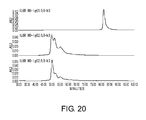
- FIG. 20 shows in graphs the results of assessing the heterogeneity of IL6R H0-IgG1/L0-k0, IL6R H0-IgG2/L0-k0, and IL6R H0-IgG2/L0-k3 by cation exchange chromatography based on their disulfide bond differences.
- the vertical axis indicates absorbance at 280 nm and the horizontal axis indicates elution time (minutes).
- FIG. 21 shows in a graph a time course of plasma antibody concentration after administration of IL6R H0-M66/L0-k0, IL6R H0-M66/L0-k3, IL6R H0-M106/L0-k3, or IL6R H0-IgG2/L0-k3 at 1 mg/kg to human FcRn transgenic mice.
- the vertical axis shows plasma antibody concentration ( ⁇ g/ml), and the horizontal axis shows time after administration (days).
- the present invention provides antibody constant regions with an altered amino acid sequence, antibodies comprising such constant regions, pharmaceutical compositions comprising such antibodies, and methods for producing them.
- the constant regions of antibody heavy chain include IgG1-, IgG2-, IgG3-, and IgG4-type constant regions.
- the heavy-chain constant region of the present invention is not particularly limited; however, it is preferably a human heavy-chain constant region.
- a human IgG2 constant region is particularly preferred in the present invention.
- the amino acid sequence of human IgG2 constant region is known in the art (SEQ ID NO: 24). A number of allotype sequences of human IgG2 constant regions due to gene polymorphisms are described in “Sequences of proteins of immunological interest”, NIH Publication No. 91-3242. Any of such sequences may be used in the present invention.
- antibody light-chain constant regions include ⁇ - and ⁇ -chain type constant regions.
- the light-chain constant region of the present invention is not particularly limited; however, it is preferably a human light-chain constant region.
- a human ⁇ chain constant region is preferred in the present invention.
- the amino acid sequence of human ⁇ chain constant region is known (SEQ ID NO: 32).
- SEQ ID NO: 32 The amino acid sequence of human ⁇ chain constant region is known (SEQ ID NO: 32).
- a number of allotype sequences of human ⁇ and ⁇ chain constant regions due to gene polymorphisms are described in “Sequences of proteins of immunological interest”, NIH Publication No. 91-3242. Any of such sequences may be used in the present invention.
- the antibody constant regions of the present invention with an amino acid alteration may additionally contain other amino acid alterations and modifications, as long as they comprise amino acid alternations of the present invention.
- sugar chains when sugar chains bind to the constant regions, they may have any structure.
- the sugar chain bound at position 297 may have any sugar chain structure (fucosylated sugar chains are preferred).
- the constant regions it is acceptable that the constant regions have no sugar chain (for example, such constant regions can be produced in E. coli ).
- the present invention provides heavy-chain constant regions with improved stability, heterogeneity, immunogenicity, and/or pharmacokinetics.
- the present invention also provides antibodies comprising the heavy-chain constant region.
- the present invention provides heavy chain constant regions that comprise an amino acid sequence in which Cys at position 14 (position 131 (EU numbering)), Arg at position 16 (position 133 (EU numbering)), Cys at position 103 (position 220 (EU numbering)), Glu at position 20 (position 137 (EU numbering)), Ser at position 21 (position 138 (EU numbering)), His at position 147 (position 268 (EU numbering)), Arg at position 234 (position 355 (EU numbering)), and Gln at position 298 (position 419 (EU numbering)) in a heavy-chain constant region (IgG2 constant region) having the amino acid sequence of SEQ ID NO: 24 has been substituted with other amino acids, and antibodies comprising the heavy-chain constant regions.
- a heavy-chain constant region IgG2 constant region
- Amino acids after substitution are not particularly limited; however, substitutions of Ser for Cys at position 14; Lys for Arg at position 16; Ser for Cys at position 103; Gly for Glu at position 20; Gly for Ser at position 21; Gln for His at position 147; Gln for Arg at position 234; and Glu for Gln at position 298 are preferred.
- substitutions can improve antibody stability, immunogenicity, and/or pharmacokinetics.
- substitutions enable one to provide excellent heavy-chain constant regions that are superior to IgG1 in pharmacokinetics, stability, and immunogenicity as well as to provide antibodies comprising such heavy-chain constant regions.
- heavy-chain constant regions of the present invention comprise at least the above-described amino acid substitution, they may comprise other amino acid alterations (substitutions, deletions, additions, insertions, and/or such) or modifications.
- the present invention provides heavy-chain constant regions whose Fc ⁇ receptor-binding activity has been reduced by additionally substituting amino acids in the above-described heavy-chain constant regions.
- the present invention also provides antibodies comprising the heavy-chain constant regions.
- the present invention provides heavy-chain constant regions having an amino acid sequence in which Cys at position 14 (position 131 (EU numbering)), Arg at position 16 (position 133 (EU numbering)), Cys at position 103 (position 220 (EU numbering)), Glu at position 20 (position 137 (EU numbering)), Ser at position 21 (position 138 (EU numbering)), His at position 147 (position 268 (EU numbering)), Arg at position 234 (position 355 (EU numbering)), Gln at position 298 (position 419 (EU numbering)), Ala at position 209 (position 330 (EU numbering)), Pro at position 210 (position 331 (EU numbering)), and Thr at position 218 (position 339 (EU numbering)) in a heavy-chain constant region (IgG2 constant region) comprising the amino acid sequence of SEQ ID NO: 24 have been substituted with other amino acids.
- the present invention also provides antibodies comprising such heavy-chain constant regions.
- Amino acids after substitution are not particularly limited; however, substitutions of Ser for Cys at position 14; Lys for Arg at position 16; Ser for Cys at position 103; Gly for Glu at position 20; Gly for Ser at position 21; Gln for His at position 147; Gln for Arg at position 234; and Glu for Gln at position 298; Ser for Ala at position 209; Ser for Pro at position 210; and Ala for Thr at position 218 are preferred.
- Such substitutions can improve antibody stability, heterogeneity, immunogenicity, safety, and/or pharmacokinetics.
- heavy-chain constant regions of the present invention comprise at least the above-described amino acid substitution, they may comprise other amino acid alterations (substitutions, deletions, additions, insertions, and/or such) or modifications.
- the present invention provides heavy-chain constant regions comprising an amino acid sequence additionally having deletion of Gly and Lys at positions 325 and 326 (positions 446 and 447 (EU numbering)), respectively, in the above-described heavy-chain constant regions.
- the present invention also provides antibodies comprising the heavy-chain constant regions. The C-terminal heterogeneity can be improved by deleting these amino acids.
- heavy-chain constant regions with altered amino acids include, for example, heavy-chain constant regions comprising the amino acid sequence of SEQ ID NO: 30 (M66) or 31 (M106).
- Those described above are optimized heavy-chain constant regions with reduced Fc ⁇ receptor-binding activity, reduced immunogenicity risk, reduced hinge-region heterogeneity, reduced C-terminal heterogeneity, and/or improved pharmacokinetics.
- the heavy-chain constant regions of the present invention may comprise amino acid alterations to improve the stability under acidic conditions, in addition to the above-described amino acid alterations.
- the amino acid alterations to improve stability under acidic conditions include, for example, substitution of Met at position 276 (position 397 (EU numbering)) in the IgG2 constant region having the amino acid sequence of SEQ ID NO: 24 with another amino acid.
- the other amino acid is not particularly limited; however, Val is preferred.
- the substitution of Met at position 276 (position 397 (EU numbering)) in the amino acid sequence of SEQ ID NO: 24 with another amino acid can improve antibody stability under acidic conditions.
- the present invention provides light-chain constant regions that can be used to improve the heterogeneity of hinge region.
- the present invention also provides antibodies comprising such light-chain constant regions.
- the present invention provides human ⁇ chain constant regions having at least one Cys at positions 102 to 106, and antibodies comprising the human ⁇ chain constant regions.
- a human ⁇ chain comprising the amino acid sequence of SEQ ID NO: 32 has at least one Cys at positions 102 to 106” means that there is at least one Cys in the region between Phe at position 102 and Glu at position 106.
- the number of Cys present in the region of positions 102 to 106 in the human ⁇ chain is not particularly limited; however, the number is five or less, preferably three or less, more preferably two or less, and still more preferably one.
- Cys is not particularly limited; however, Cys is preferably located at position 104, 105, or 106, more preferably at position 105 or 106, and particularly preferably at position 106.
- the number of amino acids in the human ⁇ chain constant region that has at least one Cys at positions 102 to 106 is not particularly limited; however, the number is preferably 102 to 107 amino acids, more preferably 105 or 106 amino acids, and still more preferably 106 amino acids.
- Methods for producing a human ⁇ chain constant region that has at least one Cys at positions 102 to 106 are not particularly limited, and include, for example, the methods described below. It is also possible to use a combination of the insertion, substitution, and deletion described below.
- the present invention provides human ⁇ chain constant regions that do not have Cys at position 107, and antibodies comprising such human ⁇ chain constant regions.
- a human ⁇ chain comprising the amino acid sequence of SEQ ID NO: 32 does not have Cys at position 107 means deletion of Cys at position 107, substitution of another amino acid for Cys at position 107, insertion of other amino acids, relocation of Cys from position 107 to a different position, etc.
- Preferred human ⁇ chain constant regions include those having deletion of Cys at position 107, relocation of Cys from position 107 to a different position, or substitution of Cys at position 107 with another amino acid.
- human ⁇ chain constant regions of the present invention include those which have at least one Cys at positions 102 to 106 but do not have Cys at position 107.
- Preferred human ⁇ chain constant regions include, for example, those having deletion of at least one amino acid at positions 1 to 106.
- deletion of Glu at position 106 leads to relocation of Cys from position 107 to 106, resulting in a human ⁇ chain constant region having Cys at position 106 but not at position 107.
- the position of amino acid deletion is not particularly limited; however, a human ⁇ chain constant region preferably comprises deletion of at least one amino acid at positions 102 to 106, more preferably deletion of the amino acid at position 105 or 106.
- the number of deleted amino acids is not particularly limited; however, the number is typically one to five, preferably one to three, more preferably one or two, and still more preferably one.
- Such preferred human ⁇ chain constant regions include, for example, those having deletion of the amino acid at position 105 or 106.
- the above-described human ⁇ chain constant regions include those having substitution of Cys for at least one amino acid at positions 102 to 106 and additionally having deletion of Cys at position 107 or substitution of Cys at position 107 with another amino acid.
- the number of amino acids substituted with Cys is not particularly limited; however, the number is typically one to five, preferably one to three, more preferably one or two, and still more preferably one.
- the position of substitution by Cys is not particularly limited; however, such preferred substitution positions include positions 105 and 106.
- Such preferred human ⁇ chain constant regions include, for example, those having substitution of Cys for Gly at position 105, and deletion of Cys at position 107 or substitution of another amino acid for Cys at position 107, and those having substitution of Cys for Glu at position 106, and deletion of Cys at position 107 or substitution of Cys at position 107 with another amino acid.
- Specific examples of the human ⁇ chain constant regions of the present invention include those comprising the amino acid sequence of SEQ ID NO: 33 (k3) or 34 (k4).
- the human ⁇ chain constant regions of the present invention may comprise other amino acid alterations in addition to the above-described amino acid alterations.
- Such human ⁇ chain constant regions additionally comprising other amino acid alterations and modifications are also included in the human ⁇ chain constant regions of the present invention, as long as they comprise the above-described amino acid alteration.
- the heterogeneity of hinge region can be reduced by using the human ⁇ chain constant region of the present invention.
- the ⁇ chain constant region of the present invention is efficient when used in combination with a heavy-chain constant region having Cys either at position 219 or 220 in the EU numbering (for example, heavy-chain constant regions having Cys only at position 219 in the EU numbering) such as a heavy-chain constant region comprising the amino acid sequence of SEQ ID NO: 30 (M66) or 31 (M106).
- the present invention provides light-chain constant regions that can be used to reduce the heterogeneity of hinge region.
- the present invention also provides antibodies comprising the above-described light-chain constant regions.
- the present invention provides human ⁇ chain constant regions having at least one Cys at positions 99 to 103, and antibodies comprising such human ⁇ chain constant regions.
- a human ⁇ chain comprising the amino acid sequence of SEQ ID NO: 37 has at least one Cys at positions 99 to 103” means that there is at least one Cys in the region between Val at position 99 and Glu at position 103.
- the number of Cys present in the region at positions 99 to 103 in the human ⁇ chains is not particularly limited; however, the number is five or less, preferably three or less, more preferably two or one, and still more preferably one.
- Cys is not particularly limited; however, Cys is preferably located at position 101, 102, or 103, more preferably at position 102 or 103, and particularly preferably at position 103.
- the number of amino acids in a human ⁇ chain that has at least one Cys at positions 99 to 103 is not particularly limited; however, the number is preferably 100 to 103 amino acids, more preferably 102 or 103 amino acids, and still more preferably 103 amino acids.
- Methods for producing a ⁇ chain constant region that has at least one Cys at positions 99 to 103 are not particularly limited, and include, for example, the methods described below. It is also possible to use a combination of the insertion, substitution, and deletion described below.
- the present invention provides human ⁇ chain constant regions that do not have Cys at position 104, and antibodies comprising such human ⁇ chain constant regions.
- a human ⁇ chain comprising the amino acid sequence of SEQ ID NO: 37 does not have Cys at position 104 means deletion of Cys at position 104, substitution of another amino acid for Cys at position 104, insertion of another amino acid, relocation of Cys from position 104 to another position; etc.
- Preferred human ⁇ chain constant regions include those having deletion of Cys at position 104, relocation of Cys from position 104 to a different position, or substitution of another amino acid for Cys at position 104.
- human ⁇ chain constant region of the present invention include those that have at least one Cys at positions 99 to 103 but do not have Cys at position 104.
- Such preferred human ⁇ chain constant regions include, for example, those having deletion of at least one amino acid at positions 1 to 103.
- the deletion of Glu at position 103 leads to relocation of Cys at position 104 to position 103, resulting in a human ⁇ chain constant region having Cys at position 103 but not at position 104.
- the position of amino acid deletion is not particularly limited; however, a human ⁇ chain constant region preferably comprises deletion of at least one amino acid at positions 99 to 103, more preferably deletion of the amino acid at position 102 or 103.
- the number of deleted amino acids is not particularly limited; however, the number is typically one to five, preferably one to three, more preferably one or two, and still more preferably one.
- Preferred examples of human ⁇ chain constant regions include those having an amino acid deletion at position 102 or 103.
- the above-described human ⁇ chain constant regions include those having substitution of Cys for at least one amino acid at positions 99 to 103, and additionally having deletion of Cys at position 104 or substitution of Cys at position 104 with another amino acid.
- the number of amino acids substituted with Cys is not particularly limited; however, the number is typically one to five, preferably one to three, more preferably one or two, and still more preferably one.
- the position of substitution with Cys is not particularly limited; however, such preferred substitution positions include 102 and 103.
- Such preferred human ⁇ chain constant regions include, for example, those having substitution of Cys for Thr at position 102, and deletion of Cys at position 104 or substitution of Cys at position 104 with another amino acid, and those having substitution of Cys for Glu at position 103, and deletion of Cys at position 104 or substitution of Cys at position 104 with another amino acid.
- the human ⁇ chain constant regions of the present invention include, for example, those comprising the amino acid sequence of SEQ ID NO: 38 or 39.
- the human ⁇ chain constant regions of the present invention may comprise other amino acid alterations in addition to the above-described amino acid alterations.
- the human ⁇ chain constant regions additionally comprising other amino acid alterations and modifications are also included in the human ⁇ chain constant regions of the present invention, as long as they comprise the above-described amino acid alteration.
- the heterogeneity of hinge region can be reduced by using the human ⁇ chain constant regions of the present invention.
- the human ⁇ chain constant region of the present invention is efficient when used in combination with a heavy-chain constant region comprising Cys either at position 219 or 220 in the EU numbering (for example, heavy-chain constant regions comprising Cys only at position 219 in the EU numbering) such as a heavy-chain constant region comprising the amino acid sequence of SEQ ID NO: 30 (M66) or 31 (M106).
- cysteine at position 107 in the human ⁇ chain constant region can form a disulfide bond with cysteine at position 219 (EU numbering) in both of the two H chains of an antibody. It is thought that the resulting two types of disulfide bonds cause heterogeneity in hinge region.
- the distance between this cysteine and cysteine at position 219 (EU numbering) in one H chain becomes greater, and as a result cysteine in the ⁇ chain constant region can only form a disulfide bond with cysteine at position 219 (EU numbering) in one of the two H chains.
- This causes reduction of heterogeneity in hinge region see FIG. 16 ).
- the heterogeneity of hinge region can be reduced by increasing the distance between cysteine in the human ⁇ chain constant region and cysteine at position 219 (EU numbering) in one H chain.
- the heterogeneity of hinge region in a human chain constant region can also be reduced by increasing the distance from cysteine at position 219 (EU numbering) in one H chain.
- the present invention can also be used to alter light-chain constant regions derived from nonhuman animals.
- light-chain constant regions derived from nonhuman animals include mouse antibody ⁇ chain constant region (SEQ ID NO: 40), rat antibody ⁇ chain constant region (SEQ ID NO: 41), and rabbit antibody ⁇ chain constant regions (SEQ ID NOs: 42 and 43), but are not limited thereto.
- the present invention provides mouse and rat antibody ⁇ chain constant regions having at least one Cys at positions 102 to 106, and antibodies comprising such light-chain constant regions.
- “there is at least one Cys at positions 102 to 106 in the mouse ⁇ chain constant region comprising the amino acid sequence of SEQ ID NO: 40 or the rat ⁇ chain constant region comprising the amino acid sequence of SEQ ID NO: 41” means that there is at least one Cys in the region between Phe at position 102 and Glu at position 106.
- the present invention provides rabbit ⁇ chain constant regions having at least one Cys at positions 99 to 103 in the rabbit antibody ⁇ chain constant region (SEQ ID NO: 42), and antibodies comprising such rabbit ⁇ chain constant regions.
- “there is at least one Cys at positions 99 to 103 in the rabbit ⁇ chain comprising the amino acid sequence of SEQ ID NO: 42” means that there is at least one Cys in the region between Phe at position 99 and Asp at position 103.
- the present invention also provides rabbit ⁇ chain constant regions having at least one Cys at positions 101 to 105 in the rabbit antibody ⁇ chain constant region (SEQ ID NO: 43), and antibodies comprising the rabbit ⁇ chain constant region.
- SEQ ID NO: 43 rabbit antibody ⁇ chain constant region
- “there is at least one Cys at positions 101 to 105 in the rabbit ⁇ chain comprising the amino acid sequence of SEQ ID NO: 43” means that there is at least one Cys in the region between Phe at position 101 and Asp at position 105.
- the number of Cys present in the region of positions 102 to 106 in a mouse ⁇ chain constant region, positions 102 to 106 in a rat ⁇ chain constant region, positions 99 to 103 in the rabbit ⁇ chain constant region (SEQ ID NO: 42), or positions 101 to 105 in the rabbit ⁇ chain constant region (SEQ ID NO: 43) is not particularly limited; however, the number is five or less, preferably three or less, more preferably two or less, and still more preferably one.
- the position of Cys is not particularly limited; however,
- the position is preferably 104, 105, or 106, more preferably 105 or 106, and particularly preferably 106;
- the position is preferably 101, 102, or 103, more preferably 102 or 103, and particularly preferably 103;
- the position is preferably 103, 104, or 105, more preferably 104 or 105, and particularly preferably 105.
- the number of amino acids in such ⁇ chain constant region is not particularly limited; however,
- the number is preferably 102 to 107 amino acids, more preferably 105 or 106 amino acids, and still more preferably 106 amino acids;
- the number is preferably 99 to 104 amino acids, more preferably 102 or 103 amino acids, and still more preferably 103 amino acids;
- the number is preferably 101 to 106 amino acids, more preferably 104 or 105 amino acids, and still more preferably 105 amino acids.
- Methods for producing a mouse or rat ⁇ chain constant region that has at least one Cys at positions 102 to 106 are not particularly limited, and include, for example, the methods described below. It is also possible to use in combination the insertion, substitution, and deletion described below.
- methods for producing a mouse or rabbit ⁇ chain constant region that has at least one Cys at positions 99 to 103 are not particularly limited, and include, for example, the methods described below. It is also possible to use in combination the insertion, substitution, and deletion described below.
- Methods for producing a rabbit ⁇ chain constant region that has at least one Cys at positions 101 to 105 are not particularly limited, and include, for example, the methods described below. It is also possible to use in combination the insertion, substitution, and deletion described below.
- the present invention provides mouse and rat ⁇ chain constant regions that do not have Cys at position 107, and antibodies comprising such ⁇ chain constant regions.
- “there is no Cys at position 107 in a mouse ⁇ chain constant region comprising the amino acid sequence of SEQ ID NO: 40 or a rat ⁇ chain constant region comprising the amino acid sequence of SEQ ID NO: 41” means deletion of Cys at position 107, substitution of Cys at position 107 with another amino acid, insertion of other amino acids, relocation of Cys from position 107 to a different position; etc.
- Preferred ⁇ chain constant regions include those having deletion of Cys at position 107, relocation of Cys from position 107 to another position, or substitution of Cys at position 107 with another amino acid.
- ⁇ chain constant regions of the present invention include those which have at least one Cys at positions 102 to 106 but do not have Cys at position 107.
- Such preferred ⁇ chain constant regions include, for example, ⁇ chain constant regions having deletion of at least one amino acid at positions 1 to 106.
- ⁇ chain constant regions having deletion of at least one amino acid at positions 1 to 106.
- deletion of Glu at position 106 leads to relocation of Cys from position 107 to position 106, resulting in a ⁇ chain constant region having Cys at position 106 but not at position 107.
- the position of amino acid deletion is not particularly limited; however, the ⁇ chain constant region preferably comprises deletion of at least one amino acid at positions 102 to 106, more preferably deletion of the amino acid at position 105 or 106.
- the number of deleted amino acids is not particularly limited; however, the number is typically one to five, preferably one to three, more preferably one or two, and still more preferably one.
- Such preferred ⁇ chain constant regions include, for example, those having deletion of the amino acid at position 105 or 106.
- the above-described mouse and rat ⁇ chain constant regions which do not have Cys at position 107 include those having substitution of Cys for at least one amino acid at positions 102 to 106, and additionally having deletion of Cys at position 107 or substitution of Cys at position 107 with another amino acid.
- the number of amino acids substituted with Cys is not particularly limited; however, the number is typically one to five, preferably one to three, more preferably one or two, and still more preferably one.
- the position of Cys substitution is not particularly limited; however, such preferred substitution positions include positions 105 and 106.
- Such preferred ⁇ chain constant regions include, for example, those having substitution of Cys for Asn at position 105, and deletion of Cys at position 107 or substitution of Cys at position 107 with another amino acid, and those having substitution of Cys for Glu at position 106, and deletion of Cys at position 107 or substitution of Cys at position 107 with another amino acid.
- the mouse or rat ⁇ chain constant regions of the present invention may comprise other amino acid alterations in addition to the above-described amino acid alterations.
- Such ⁇ chain constant regions comprising other amino acid alterations and modifications are also included in the ⁇ chain constant regions of the present invention, as long as they comprise the above-described amino acid alteration.
- the present invention provides rabbit ⁇ chain constant regions which do not have Cys at position 104 in the rabbit ⁇ chain constant region (SEQ ID NO: 42) and antibodies comprising such ⁇ chain constant regions.
- “there is no Cys as position 104 in the rabbit ⁇ chain constant region comprising the amino acid sequence of SEQ ID NO: 42” means deletion of Cys at position 104, substitution of Cys at position 104 with another amino acid, insertion of other amino acids, relocation of Cys from position 104 to a different position; etc.
- Preferred ⁇ chain constant regions include those having deletion of Cys at position 104, relocation of Cys from position 104 to a different position, or substitution of Cys at position 104 with another amino acid.
- ⁇ chain constant regions include those which have at least one Cys at positions 99 to 103 but do not have Cys at position 104.
- Such preferred ⁇ chain constant regions include, for example, those having deletion of at least one amino acid at positions 1 to 103.
- deletion of Asp at position 103 leads to relocation of Cys from position 104 to position 103, resulting in a ⁇ chain constant region having Cys at position 103 but not at position 104.
- the position of amino acid deletion is not particularly limited; however, a ⁇ chain constant region preferably comprises deletion of at least one amino acid at positions 99 to 103, more preferably deletion of the amino acid at position 102 or 103.
- the number of deleted amino acids is not particularly limited; however, the number is typically one to five, preferably one to three, more preferably one or two, and still more preferably one.
- Such preferred ⁇ chain constant regions include, for example, those having deletion of the amino acid at position 102 or 103.
- the above-described rabbit ⁇ chain constant regions which do not have Cys at position 104 include those having substitution of Cys for at least one amino acid at positions 99 to 103 and additionally having deletion of Cys at position 104 or substitution of Cys at position 104 with another amino acid.
- the number of amino acids substituted with Cys is not particularly limited; however, the number is typically one to five, preferably one to three, more preferably one or two, and still more preferably one.
- the position of Cys substitution is not particularly limited; however, such preferred positions of substitution include positions 102 and 103.
- Such preferred ⁇ chain constant regions include, for example, those having substitution of Cys for Gly at position 102, and deletion of Cys at position 104 or substitution of Cys at position 104 with another amino acid, and those having substitution of Cys for Asp at position 103, and deletion of Cys at position 104 or substitution of Cys at position 104 with another amino acid.
- the rabbit ⁇ chain constant regions of the present invention may comprise other amino acid alterations in addition to the above-described amino acid alterations.
- ⁇ chain constant regions comprising other amino acid alterations and modifications are also included in the ⁇ chain constant regions of the present invention, as long as they comprise the above-described amino acid alterations.
- the present invention provides rabbit ⁇ chain constant regions which do not have Cys at position 106 in the rabbit ⁇ chain constant region (SEQ ID NO: 43) and antibodies comprising such ⁇ chain constant regions.
- “there is no Cys at position 106 in the rabbit ⁇ chain constant region comprising the amino acid sequence of SEQ ID NO: 43” means deletion of Cys at position 106, substitution of Cys at position 106 with another amino acid, insertion of other amino acids, relocation of Cys from position 106 to a different position; etc.
- Preferred ⁇ chain constant regions include those having deletion of Cys at position 106, relocation of Cys from position 106 to a different position, or substitution of Cys at position 106 with another amino acid.
- ⁇ chain constant regions of the present invention include those which have at least one Cys at positions 101 to 105 but do not have Cys at position 106.
- Such preferred ⁇ chain constant regions include, for example, those having deletion of at least one amino acid at positions 1 to 105.
- deletion of Asp at position 105 leads to relocation of Cys from position 106 to 105, resulting in a ⁇ chain constant region having Cys at position 105 but not at position 106.
- the position of amino acid deletion is not particularly limited; however, a human ⁇ chain constant region preferably comprises deletion of at least one amino acid at positions 101 to 105, more preferably deletion of the amino acid at position 104 or 105.
- the number of deleted amino acids is not particularly limited; however, the number is typically one to five, preferably one to three, more preferably one or two, and still more preferably one.
- Such preferred ⁇ chain constant regions include, for example, those having deletion of the amino acid at position 104 or 105.
- the above-described rabbit ⁇ chain constant regions which do not have Cys at position 106 include those which have substitution of Cys for at least one amino acid at positions 101 to 105, and additionally have deletion of Cys at position 106 or substitution of Cys at position 106 with another amino acid.
- the number of amino acids substituted with Cys is not particularly limited; however, the number is typically one to five, preferably one to three, more preferably one or two, and still more preferably one.
- the position of Cys substitution is not particularly limited; however, such preferred positions of substitution include positions 104 and 105.
- Such preferred ⁇ chain constant regions include, for example, those having substitution of Cys for Gly at position 104, and deletion of Cys at position 106 or substitution of Cys at position 106 with another amino acid, and those having substitution of Cys for Asp at position 105, and deletion of Cys at position 106 or substitution of Cys at position 106 with another amino acid.
- the rabbit ⁇ chain constant regions of the present invention may comprise other amino acid alterations in addition to the above-described amino acid alterations.
- ⁇ chain constant regions comprising other amino acid alterations and modifications are also included in the ⁇ chain constant regions of the present invention, as long as they comprise the above-described amino acid alterations.
- the present invention provides antibodies comprising heavy-chain constant regions having the above-described amino acid alterations.
- the present invention also provides antibodies comprising light chain constant regions having the above-described amino acid alterations.
- the present invention also provides antibodies comprising heavy chain constant regions having the above-described amino acid alterations and light chain constant regions having the above-described amino acid alterations Amino acid alterations in the antibodies of the present invention include all possible alterations specified by the description herein and combinations thereof.
- the present invention also provides antibodies comprising light chains comprising light chain constant regions having the above-described amino acid alterations and heavy chain constant regions in which at least one Cys is substituted with another amino acid.
- heavy chain constant regions are not particularly limited; however, IgG2 heavy chain constant regions are preferred.
- Cys to be substituted is not particularly limited; however, the constant region includes, for example, those having substitution of another amino acid for at least one of:
- Cys at position 131 in the EU numbering position 14 in SEQ ID NO: 24
- Cys at position 219 in the EU numbering position 102 in SEQ ID NO: 24
- Cys at position 220 in the EU numbering position 103 in SEQ ID NO: 24
- the combination is not particularly limited and includes the combination of substitutions at positions 131 and 219 (EU numbering) and the combination of substitutions at positions 131 and 220.
- the present invention provides antibodies comprising light chains comprising light chain constant regions having the above-described amino acid alterations, and heavy chains comprising heavy chain constant regions which have Cys at position 219 in the EU numbering (position 102 in SEQ ID NO: 24) but not at position 220 in the EU numbering (position 103 in SEQ ID NO: 24).
- heavy chain constant regions are not particularly limited; however, they are preferably IgG2 constant regions, more preferably M66 and M106.
- the antibody constant regions may have one or more amino acid substitutions, deletions, additions, and/or insertions (for example, 20 amino acids or less, or 10 amino acids or less).
- variable regions that constitute the antibodies of the present invention may recognize any antigen.
- Preferred variable regions of the present invention include antibody variable regions having an antigen-neutralizing activity.
- the variable regions that constitute the antibodies of the present invention include, for example, antibody variable regions having an activity of neutralizing IL6 receptor, IL31 receptor, or RANKL.
- the antibodies of the present invention are not particularly limited in type, origin, or such; any antibody may be used in the present invention as long as it has the above-described antibody constant region.
- the origin of antibodies is not particularly limited.
- the antibodies include human, mouse, rat, and rabbit antibodies.
- the antibodies of the present invention may be chimeric, humanized, fully humanized antibodies, or such. In a preferred embodiment, the antibodies of the present invention are humanized antibodies.
- Antibody molecules of the present invention usually include heavy chains and light chains.
- Heavy chains may include variable regions in addition to constant regions.
- Variable regions may include variable portions derived not only from humans but also from nonhuman animal species.
- CDRs from variable portions derived from non-human species such as mice can be transplanted to humanize the variable portions.
- Antibody molecules composed of heavy chains and light chains may be oligomers. Specifically, they may be monomers, dimers, or larger oligomers.
- antigen constant regions may be linked with various molecules such as bioactive peptides or antigen-binding peptides to be fusion proteins.
- the antibodies of the present invention also include modification products of an antibody comprising any one of the constant regions described above.
- Such antibody modification products include, for example, antibodies linked with various molecules such as polyethylene glycol (PEG) and cytotoxic substances.
- PEG polyethylene glycol
- Such antibody modification products can be obtained by chemically modifying antibodies of the present invention. Methods for modifying antibodies are already established in this field.
- the antibodies of the present invention may also be bispecific antibodies.
- Bispecific antibody refers to an antibody that has in a single molecule variable regions that recognize different epitopes.
- the epitopes may be present in a single molecule or in separate molecules.
- the antibody constant regions described above can be used as a constant region in an antibody against an arbitrary antigen.
- the antigen is not particularly limited.
- the antibodies of the present invention can also be obtained by methods known to one skilled in the art.
- Methods for substituting or deleting one or more amino acid residues with amino acids of interest include, for example, site-directed mutagenesis (Hashimoto-Gotoh, T., Mizuno, T., Ogasahara, Y., and Nakagawa, M.
- site-directed mutagenesis Hashimoto-Gotoh, T., Mizuno, T., Ogasahara, Y., and Nakagawa, M.
- an antibody that binds to an antigen of interest is first prepared by methods known to those skilled in the art.
- the prepared antibody is derived from a nonhuman animal, it can be humanized.
- the binding activity of the antibody can be determined by known methods.
- one or more amino acid residues in the constant region of the antibody are deleted or substituted with amino acids of interest.
- the present invention relates to methods for producing antibodies with altered amino acid residues in the heavy chain and/or light chain constant regions, which comprise the steps of:
- Such alterations of amino acid residues in the heavy chain constant region include, but are not limited to, for example, those described below.
- IgG2 constant region (the amino acid sequence of SEQ ID NO: 24),
- Ser is substituted for Cys at position 14 (position 131 (EU numbering));
- Lys is substituted for Arg at position 16 (position 133 (EU numbering));
- Ser is substituted for Cys at position 103 (position 220 (EU numbering));
- Gly is substituted for Glu at position 20 (position 137 (EU numbering));
- Gly is substituted for Ser at position 21 (position 138 (EU numbering));
- Gln is substituted for His at position 147 (position 268 (EU numbering));
- Gln is substituted for Arg at position 234 (position 355 (EU numbering));
- Glu is substituted for Gln at position 298 (position 419 (EU numbering)).
- Antibodies with improved stability, immunogenicity, and/or pharmacokinetics can be produced using such substitutions.
- Ser is substituted for Cys at position 14 (position 131 (EU numbering));
- Lys is substituted for Arg at position 16 (position 133 (EU numbering));
- Ser is substituted for Cys at position 103 (position 220 (EU numbering));
- Gly is substituted for Glu at position 20 (position 137 (EU numbering));
- Gly is substituted for Ser at position 21 (position 138 (EU numbering));
- Gln is substituted for His at position 147 (position 268 (EU numbering));
- Gln is substituted for Arg at position 234 (position 355 (EU numbering));
- Glu is substituted for Gln at position 298 (position 419 (EU numbering));
- Ser is substituted for Ala at position 209 (position 330 (EU numbering));
- Ser is substituted for Pro at position 210 (position 331 (EU numbering));
- Ala is substituted for Thr at position 218 (position 339 (EU numbering)).
- Antibodies with reduced Fc ⁇ receptor-binding activity can be produced using such substitutions.
- amino acid alterations of light chain constant regions include, for example, those described below; but are not limited thereto.
- the alterations described below can reduce the heterogeneity of hinge region.
- amino acids are substituted or deleted so that it has at least one Cys at positions 102 to 106.
- amino acids are substituted or deleted so that it has at least one Cys at positions 102 to 106 but does not have Cys at position 107.
- a human ⁇ chain constant region (the amino acid sequence of SEQ ID NO: 32), mouse ⁇ chain constant region (the amino acid sequence of SEQ ID NO: 40), or rat ⁇ chain constant region (the amino acid sequence of SEQ ID NO: 41), at least one amino acid at positions 1 to 106 is deleted.
- a human ⁇ chain constant region (the amino acid sequence of SEQ ID NO: 32), mouse ⁇ chain constant region (the amino acid sequence of SEQ ID NO: 40), or rat ⁇ chain constant region (the amino acid sequence of SEQ ID NO: 41), at least one amino acid at positions 102 to 106 is deleted.
- Cys is substituted for at least one amino acid at positions 102 to 106.
- Cys is substituted for at least one amino acid at positions 102 to 106, and Cys at position 107 is deleted or substituted with another amino acid.
- amino acids are substituted or deleted so that it has at least one Cys at positions 99 to 103.
- amino acids are substituted or deleted so that it has at least one Cys at positions 99 to 103 but does not have Cys at position 104.
- Cys is substituted for at least one amino acid at positions 99 to 103.
- Cys is substituted for at least one amino acid at positions 99 to 103, and Cys at position 104 is deleted or substituted with another amino acid.
- the present invention provides methods for producing antibodies, which comprise the step of culturing host cells that comprise a vector introduced with a polynucleotide encoding an antibody heavy chain comprising the heavy chain constant region with the amino acid alterations of the present invention and/or a polynucleotide encoding an antibody light chain comprising the light chain constant region with the amino acid alterations of the present invention.
- the present invention provides methods for producing antibodies that comprise a heavy chain constant region with the amino acid alterations of the present invention and/or a light chain constant region with the amino acid alterations of the present invention, which comprise the steps of:
- Such amino acid alterations of the heavy chain constant region include the amino acid substitutions or deletions described above in (1) to (4), but are not limited thereto.
- Such amino acid alterations of the light chain constant region include the amino acid substitutions or deletions described above (1) to (27), but are not limited thereto.
- DNAs are expressed: a DNA encoding an antibody heavy chain in which one or more amino acid residues in the constant region have been deleted or substituted with amino acids of interest, and/or a DNA encoding an antibody light chain in which one or more amino acid residues in the constant region have been deleted or substituted with amino acids of interest.
- a DNA encoding a heavy chain in which one or more amino acid residues in the constant region are deleted or substituted with amino acids of interest and/or a DNA encoding a light chain in which one or more amino acid residues in the constant region are deleted or substituted with amino acids of interest can be prepared, for example, by obtaining a DNA encoding the constant region of a wild type heavy chain and/or light chain, and introducing an appropriate substitution so that a codon encoding a particular amino acid in the constant region encodes an amino acid of interest.
- a DNA encoding a heavy chain in which one or more amino acid residues in the constant region are deleted or substituted with amino acids of interest and/or a DNA encoding a light chain in which one or more amino acid residues in the constant region are deleted or substituted with amino acids of interest can also be prepared by designing and then chemically synthesizing a DNA encoding a protein in which one or more amino acid residues in the constant region of the wild type heavy chain are deleted or substituted with amino acids of interest.
- amino acid substitution and deletion include the substitutions and deletions described herein, but are not limited thereto.
- a DNA encoding a heavy chain in which one or more amino acid residues in the constant region are deleted or substituted with amino acids of interest and/or a DNA encoding a light chain in which one or more amino acid residues in the constant region are deleted or substituted with amino acids of interest can also be prepared as a combination of partial DNAs.
- Such combinations of partial DNAs include, for example, the combination of a DNA encoding a variable region and a DNA encoding a constant region, and the combination of a DNA encoding an Fab region and a DNA encoding an Fc region, but are not limited thereto.
- a heavy chain expression vector is constructed by inserting a DNA encoding a heavy chain variable region into an expression vector along with a DNA encoding a heavy chain constant region.
- a light chain expression vector is constructed by inserting a DNA encoding a light chain variable region into an expression vector along with a DNA encoding a light chain constant region.
- these heavy and light chain genes may be inserted into a single vector.
- Expression vectors include, for example, SV40 virus-based vectors, EB virus-based vectors, and BPV (papilloma virus)-based vectors, but are not limited thereto.
- Host cells are co-transformed with an antibody expression vector constructed by the methods described above.
- Such host cells include the above-described cells such as Chinese hamster ovary (CHO) cells as well as microorganisms such as E. coli , yeast, and Bacillus subtilis , and plants and animals (Nature Biotechnology (2007) 25: 563-565; Nature Biotechnology (1998) 16: 773-777; Biochemical and Biophysical Research Communications (1999) 255: 444-450; Nature Biotechnology (2005) 23: 1159-1169; Journal of Virology (2001) 75: 2803-2809; Biochemical and Biophysical Research Communications (2003) 308: 94-100).
- Such host cells also include human embryonic kinder cancer cell-derived HEK298H cells.
- the transformation can be preferably achieved by using electroporation, the lipofectin method (R. W. Malone et al., Proc. Natl. Acad. Sci. USA (1989) 86: 6077; P. L. Felgner et al., Proc. Natl. Acad. Sci. USA (1987) 84: 7413), calcium phosphate method (F. L. Graham & A. J. van der Eb, Virology (1973) 52: 456-467), DEAE-Dextran method, and the like.
- the expression products are collected.
- the expression products can be collected, for example, by culturing the transformants and then separating and purifying the antibody from the transformed cells or culture media. Separation and purification of antibodies can be achieved by an appropriate combination of methods such as centrifugation, ammonium sulfate fractionation, salting out, ultrafiltration, columns of 1q, FcRn, Protein A, and Protein G, affinity chromatography, ion exchange chromatography, and gel filtration chromatography.
- the present invention provides antibodies produced as described above. More specifically, the present invention relates to antibodies that can be produced by the following steps:
- the amino acid sequences of the constant regions of heavy and light chains are the above-mentioned constant regions provided by the present invention.
- the heavy chain constant region consists of, for example, the amino acid sequence of SEQ ID NOs: 24 and 26 to 31. Linking a DNA consisting of the nucleotide sequence encoding this amino acid sequence with a DNA encoding the heavy chain variable region can produce a DNA encoding the antibody heavy chain.
- the light chain constant region consists of, for example, the amino acid sequence of SEQ ID NOs: 32 to 34 and 37 to 39. Linking a DNA consisting of the nucleotide sequence encoding this amino acid sequence with a DNA encoding the light chain variable region can produce a DNA encoding the antibody light chain.
- variable regions that constitute the antibodies of the present invention may recognize any antigen.
- the variable regions that constitute the antibodies of the present invention are not particularly limited, and include, for example, those described below.
- the heavy-chain variable region may be, for example, variable regions having the CDR1, CDR2, and CDR3 of the humanized antibody heavy chain comprising the amino acid sequence of SEQ ID NO: 5.
- the light-chain variable region may be variable regions having the CDR1, CDR2, and CDR3 of the humanized antibody light chain comprising the amino acid sequence of SEQ ID NO: 2.
- the heavy-chain variable region may be, for example, variable regions having the CDR1, CDR2, and CDR3 of the humanized antibody heavy chain comprising the amino acid sequence of SEQ ID NO: 13.
- the light-chain variable region may be variable regions having the CDR1, CDR2, and CDR3 of the humanized antibody light chain comprising the amino acid sequence of SEQ ID NO: 12.
- the heavy-chain variable region may be variable regions having the CDR1, CDR2, and CDR3 of the humanized antibody heavy chain comprising the amino acid sequence of SEQ ID NO: 17.
- the light-chain variable region may be variable regions having the CDR1, CDR2, and CDR3 of the humanized antibody light chain comprising the amino acid sequence of SEQ ID NO: 16.
- the amino acid sequences that constitute heavy chain and light chain variable regions may have one or more amino acid residue alterations and/or modifications, as long as they retain antigen-binding activity.
- altering antibody variable regions it is preferable to conserve the amino acid sequences of CDRs.
- the antigen-binding activity of the variable regions can be maintained by conserving the amino acid sequences of CDRs.
- the acceptable number of altered amino acid residues in a variable region is generally one to ten, for example, one to five, and preferably one or two amino acids.
- the modification of the N-terminal glutamine of a variable region into pyroglutamic acid by pyroglutamylation is a modification well known to those skilled in the art.
- the heavy-chain N terminus is glutamine
- the antibodies of the present invention comprise the variable regions in which the glutamine is modified to pyroglutamic acid.
- the alterations of the present invention include substitutions, deletions, additions, and/or insertions of the above-described amino acids, and combinations thereof.
- the present invention provides genes encoding antibody constant regions comprising the amino acid alterations of the present invention.
- genes encoding the antibody constant regions of the present invention may be any gene such as DNA or RNA.
- the present invention also provides vectors carrying the genes.
- the type of vector can be appropriately selected by those skilled in the art depending on the host cells to be introduced with the vector.
- the vectors include, for example, those described above.
- the present invention relates to host cells transformed with the vectors.
- Appropriate host cells can be selected by those skilled in the art.
- the host cells include, for example, those described above.
- the present invention also relates to methods for producing the constant regions of the present invention, which comprise the steps of culturing the host cells and collecting the expressed constant regions of the present invention.
- the present invention also relates to methods for improving antibody functions, which comprise the step of altering amino acids in the human IgG2 constant region of SEQ ID NO: 24.
- the present invention also relates to antibodies produced by methods comprising the above-described step.
- the improvement of antibody functions includes improvement of antibody stability, reduction of immunogenicity, and improvement of pharmacokinetics, but is not limited thereto.
- the methods of the present invention comprise the steps of:
- amino acids after substitution are not particularly limited; however,
- Cys at position 14 is preferably substituted with Ser
- Arg at position 16 is preferably substituted with Lys
- Cys at position 103 is preferably substituted with Ser
- Glu at position 20 is preferably substituted with Gly;
- Ser at position 21 is preferably substituted with Gly;
- His at position 147 is preferably substituted with Gln;
- Arg at position 234 is preferably substituted with Gln;
- Gln at position 298 is preferably substituted with Glu.
- the methods of the present invention may additionally comprise the step of altering (substituting, deleting, adding, and/or inserting) other amino acids, modifying amino acids, and such, as long as they comprise the steps described above.
- the methods for altering or modifying amino acids are not particularly limited, and include, for example, the above-described site-specific mutagenesis and the methods described in the Examples herein.
- the methods of the present invention may also comprise, in addition to the above-described steps, the step of deleting Gly at position 325 (position 446 (EU numbering)) and Lys at position 326 (position 447 (EU numbering)) to reduce the C-terminal heterogeneity.
- the present invention relates to methods for improving antibody functions, which comprise the step of altering amino acids of the human IgG2 constant region of SEQ ID NO: 24.
- the present invention also relates to antibodies produced by methods comprising the step.
- improvement of antibody functions includes, but is not limited to, improvement of antibody stability, reduction of immunogenicity, improvement of safety, and improvement of pharmacokinetics.
- the methods of the present invention comprise the steps of:
- amino acids after substitution are not particularly limited; however,
- Cys at position 14 is preferably substituted with Ser
- Arg at position 16 is preferably substituted with Lys
- Cys at position 103 is preferably substituted with Ser
- Glu at position 20 is preferably substituted with Gly;
- Ser at position 21 is preferably substituted with Gly;
- His at position 147 is preferably substituted with Gln;
- Arg at position 234 is preferably substituted with Gln;
- Gln at position 298 is preferably substituted with Glu
- Ala at position 209 is preferably substituted with Ser
- Pro at position 210 is preferably substituted with Ser.
- Thr at position 218 is preferably substituted with Ala.
- the methods of the present invention may additionally comprise the step of altering (substituting, deleting, adding, and/or inserting) other amino acids, modifying amino acids, and such, as long as they comprise the above-described steps.
- the methods for altering or modifying amino acids are not particularly limited, and include, for example, the above-described site-specific mutagenesis and the methods described in the Examples herein.
- the methods of the present invention may also comprise, in addition to the above-described steps, the step of deleting Gly at position 325 (position 446 (EU numbering)) and Lys at position 326 (position 447 (EU numbering)) to reduce the C-terminal heterogeneity.
- the present invention relates to methods for improving the blood kinetics (pharmacokinetics) of an antibody by controlling (or changing) the disulfide bond pattern in antibody constant regions.
- the antibody constant regions are not particularly limited; however, it is preferable to control the pattern of disulfide bonds between an antibody light chain constant region ( ⁇ chain constant region or ⁇ chain constant region) and IgG2 constant region.
- the present invention relates to methods for improving pharmacokinetics of an antibody, which comprise the step of allowing specific formation of a disulfide bond between Cys in the light chain C-terminal region and Cys at position 219 (EU numbering) in the heavy-chain constant region.
- every antibody forms a disulfide bond between Cys in the light chain C-terminal region and Cys at position 219 (EU numbering) in the heavy-chain constant region.
- the step of allowing formation of a disulfide bond between Cys in the light chain C-terminal region and Cys at position 219 (EU numbering) in the heavy-chain constant region may be achieved by any method, for example, by substituting another amino acid for Cys at position 220 (EU numbering) in the heavy chain (position 103 in SEQ ID NO: 24).
- Cys at position 220 may be substituted with another amino acid.
- the amino acids after substitution are not particularly limited, and include, for example, Ser.
- Cys in the light chain C-terminal region is typically Cys in the region of positions 102 to 106 (for example, positions 102 to 106 in the human ⁇ chain constant region of SEQ ID NO: 32), preferably Cys in the region of positions 104 to 106.
- the Cys is typically Cys in the region of positions 99 to 105 (for example, positions 99 to 105 in the human ⁇ chain constant region of SEQ ID NO: 37), preferably Cys in the region of positions 102 to 104.
- An IgG2 constant region used in the methods of the present invention may comprise one or more amino acid deletions, substitutions, additions, and/or insertions (for example, 20 amino acids or less, or 10 amino acids or less) in the amino acid sequence of SEQ ID NO: 24.
- An IgG2 constant region used in the methods of the present invention may comprise alterations specified by the description herein and combinations thereof.
- a human ⁇ chain constant region used in the methods of the present invention may comprise one or more amino acid deletions, substitutions, additions, and/or insertions (for example, 20 amino acids or less, or 10 amino acids or less) in the amino acid sequence of SEQ ID NO: 32.
- a human ⁇ chain constant region used in the methods of the present invention may comprise one or more amino acid deletions, substitutions, additions, and/or insertions (for example, 20 amino acids or less, or 10 amino acids or less) in the amino acid sequence of SEQ ID NO: 37.
- human ⁇ and ⁇ chain constant regions used in the methods of the present invention may comprise alterations specified by the description herein and combinations thereof.
- Antibodies in which a disulfide bond between Cys in the light chain C-terminal region and Cys at position 219 (EU numbering) in the heavy-chain constant region has been formed are demonstrated to be superior in pharmacokinetics as compared to antibodies having a disulfide bond between Cys in the light chain C-terminal region and Cys at position 220 (EU numbering) in the heavy-chain constant region.
- the present invention provides antibodies with improved pharmacokinetics by allowing formation of a disulfide bond between Cys in the light chain C-terminal region and Cys at position 219 (EU numbering) in the heavy-chain constant region.
- the methods of the present invention are useful in producing antibodies that are superior in pharmacokinetics and excellent as pharmaceuticals.
- the present invention relates to methods for reducing the heterogeneity of hinge region, which comprise the step of introducing at least one Cys at positions 102 to 106 into the human ⁇ constant region of SEQ ID NO: 32, the mouse ⁇ chain constant region of SEQ ID NO: 40, or the rat ⁇ chain constant region of SEQ ID NO: 41.
- the present invention also relates to antibodies produced by methods comprising the above-described step.
- introducing at least one Cys at positions 102 to 106 means achieving the state where there is at least one Cys at positions 102 to 106 in a human ⁇ chain constant region.
- the present invention relates to methods for reducing the heterogeneity of hinge region, which comprise the step of removing (deleting) Cys at position 107 from the human ⁇ constant region of SEQ ID NO: 32, the mouse ⁇ chain constant region of SEQ ID NO: 40, or the rat ⁇ chain constant region of SEQ ID NO: 41.
- the present invention also relates to antibodies produced by methods comprising the above-described step.
- removing Cys at position 107 means achieving the state where there is no Cys at position 107 in a human ⁇ chain constant region.
- the present invention relates to methods for reducing the heterogeneity of hinge region in the human ⁇ constant region of SEQ ID NO: 32, the mouse ⁇ chain constant region of SEQ ID NO: 40, or the rat ⁇ chain constant region of SEQ ID NO: 41, which comprise the steps of:
- the present invention also relates to antibodies produced by methods comprising the above-described steps.
- the steps of introducing at least one Cys at positions 102 to 106 and the step of removing Cys at position 107 may be carried out in a single step.
- the number of Cys to be introduced in the step of introducing at least one Cys at positions 102 to 106 is not particularly limited; however, the number is five or less, preferably three or less, more preferably two or one, and still more preferably one.
- the position of Cys introduction is not particularly limited; however, the position is preferably 104, 105, or 106, more preferably 105 or 106, and particularly preferably 106.
- the step of introducing at least one Cys at positions 102 to 106 includes, for example, the steps described below. Such steps may be used in combination.
- the step of removing Cys at position 107 includes, for example, the following steps.
- the methods of the present invention i.e., methods for reducing the heterogeneity of hinge region and methods for enhancing FcRn binding, which comprise the steps of:
- mouse ⁇ chain constant region of SEQ ID NO: 40, or rat ⁇ chain constant region of SEQ ID NO: 41 include, for example, the step of deleting one to five amino acids at positions 1 to 106 from the human ⁇ chain constant region.
- Cys at position 107 is relocated to one of positions 102 to 106.
- the position of amino acid deletion is not particularly limited; however, the human ⁇ chain constant region preferably comprises deletion of at least one amino acid at positions 102 to 106, more preferably deletion of the amino acid at position 105 or 106.
- the number of deleted amino acids is not particularly limited; however, the number is typically one to five, preferably one to three, more preferably one or two, and still more preferably one.
- Such preferred steps include, but are not limited to, for example, the following steps.
- the methods of the present invention include methods comprising the steps of:
- the number of amino acids substituted with Cys is not particularly limited; however, the number is typically one to five, preferably one to three, more preferably one or two, and still more preferably one.
- the position of Cys substitution is not particularly limited; however, the position is preferably 105 or 106.
- such steps include, for example, the steps of:
- such steps include the steps of:
- the present invention relates to methods for reducing the heterogeneity of hinge region, which comprise the step of introducing at least one Cys at positions 99 to 103 in the human ⁇ constant region of SEQ ID NO: 37 or the rabbit ⁇ chain constant region of SEQ ID NO: 42.
- the present invention also relates to antibodies produced by methods comprising the above-described steps.
- introducing at least one Cys at positions 99 to 103 means achieving the state where there is at least one Cys at positions 99 to 103 in the human ⁇ chain constant region.
- the present invention relates to methods for reducing the heterogeneity of hinge region, which comprise the step of removing (deleting) Cys at position 104 in the human constant region of SEQ ID NO: 37 or rabbit ⁇ chain constant region of SEQ ID NO: 42.
- the present invention also relates to antibodies produced by methods comprising the above-described steps.
- removing Cys at position 104 means achieving the state where there is no Cys at position 104 in the human ⁇ chain constant region.
- the present invention relates to methods for reducing the heterogeneity of hinge region, which comprise the steps of:
- the steps of introducing at least one Cys at positions 99 to 103 and removing Cys at position 104 may be achieved in a single step.
- the number of Cys introduced in the step of introducing at least one Cys at positions 99 to 103 is not particularly limited; however, the number is five or less, preferably three or less, more preferably two or one, and still more preferably one.
- the position of Cys introduction is not particularly limited; however, the position is preferably 101, 102, or 103, more preferably 102 or 103, and particularly preferably 103.
- the step of introducing at least one Cys at positions 99 to 103 includes, for example, those described below.
- the steps described below may be used in combination.
- the step of removing Cys at position 104 includes, but is not limited to, for example, those described below.
- the methods of the present invention i.e., methods for reducing the heterogeneity of hinge region, which comprise the steps of:
- the human ⁇ constant region of SEQ ID NO: 37 or rabbit ⁇ chain constant region of SEQ ID NO: 42 include, for example, methods comprising the step of deleting one to five amino acids at positions 1 to 103 in the human ⁇ chain constant region.
- Cys at position 104 is relocated to one of positions 99 to 103.
- the steps of introducing at least one Cys at positions 99 to 103 and deleting Cys at position 104 can be achieved simultaneously.
- the position of amino acid deletion is not particularly limited; however, a human chain constant region preferably comprises deletion of at least one amino acid at positions 99 to 103, more preferably deletion of the amino acid at position 102 or 103.
- the number of deleted amino acids is not particularly limited; however, the number is typically one to five, preferably one to three, more preferably one or two, and still more preferably one.
- Such preferred steps include, but are not limited to, for example, those described below.
- the methods of the present invention include methods comprising the steps of:
- the number of amino acids substituted with Cys is not particularly limited; however, the number is typically one to five, preferably one to three, more preferably one or two, and still more preferably one.
- the position of Cys substitution is not particularly limited; however, the position is preferably 102 or 103.
- the steps include, but are not limited to, for example, the steps of:
- the steps include, but are not limited to, the steps of:
- the present invention relates to methods for reducing the heterogeneity of hinge region, which comprise the step of introducing at least one Cys at positions 101 to 105 in the rabbit ⁇ chain constant region of SEQ ID NO: 43.
- the present invention also relates to antibodies produced by methods comprising the above-described steps.
- introducing at least one Cys at positions 101 to 105 means achieving the state where there is at least one Cys at positions 101 to 105 in the rat ⁇ chain constant region.
- the present invention relates to methods for reducing the heterogeneity of hinge region, which comprise the step of removing (deleting) Cys at position 106 in the rabbit ⁇ chain constant region of SEQ ID NO: 43.
- the present invention also relates to antibodies produced by methods comprising the above-described steps.
- removing Cys at position 106 means achieving the state where there is no Cys at position 106 in the rabbit ⁇ chain constant region.
- the present invention relates to methods for reducing the heterogeneity of hinge region, which comprise the steps of:
- the steps of introducing at least one Cys at positions 101 to 105 and removing Cys at position 106 may be achieved in a single step.
- the number of Cys introduced in the step of introducing at least one Cys at positions 101 to 105 is not particularly limited; however, the number is five or less, preferably three or less, more preferably two or one, and still more preferably one.
- the position of Cys introduction is not particularly limited; however, the position is preferably 103, 104, or 105, more preferably 104 or 105, and particularly preferably 105.
- the step of introducing at least one Cys at positions 101 to 105 includes, for example, those described below.
- the steps described below may be used in combination.
- the step of removing Cys at position 106 includes, but is not limited to, for example, those described below.
- the methods of the present invention i.e., methods for reducing the heterogeneity of hinge region, which comprise the steps of:
- (b) removing Cys at position 106 in the rabbit ⁇ chain constant region of SEQ ID NO: 43) include, for example, methods comprising the step of deleting one to five amino acids at positions 1 to 105 from the rabbit ⁇ chain constant region. When one to five amino acids are deleted at positions 1 to 105, Cys at position 106 is relocated to one of positions 101 to 105. Thus, the steps of introducing at least one Cys at positions 101 to 105 and deleting Cys at position 106 can be achieved simultaneously.
- the position of amino acid deletion is not particularly limited; however, a human ⁇ chain constant region preferably comprises deletion of at least one amino acid at positions 101 to 105, more preferably deletion of the amino acid at position 104 or 105.
- the number of deleted amino acids is not particularly limited; however, the number is typically one to five, preferably one to three, more preferably one or two, and still more preferably one.
- Such preferred steps include, but are not limited to, for example, those described below.
- the methods of the present invention include methods comprising the steps of:
- the number of amino acids substituted with Cys is not particularly limited; however, the number is typically one to five, preferably one to three, more preferably one or two, and still more preferably one.
- the position of Cys substitution is not particularly limited; however, the position is preferably 104 or 105.
- steps include, but are not limited to, for example, the steps of:
- the methods of the present invention comprise the above-described steps, they may additionally comprise other steps, for example, the step of altering (substituting, deleting, adding, and/or inserting) other amino acids or modifying amino acids.
- the present invention provides pharmaceutical compositions comprising the antibodies or constant regions of the present invention.
- the present invention also provides antibody pharmaceutical compositions in which the ratio of antibody having a disulfide bond between Cys in the light chain C-terminal region and Cys at position 219 (EU numbering) in the heavy chain constant region is 80% or more, preferably 90% or more, more preferably 95% or more, and still more preferably 99% or more.
- compositions of the present invention can be formulated, in addition to the antibodies or constant regions, with pharmaceutically acceptable carriers by known methods.
- the compositions can be used parenterally, when the antibodies are formulated in a sterile solution or suspension for injection using water or any other pharmaceutically acceptable liquid.
- the compositions can be formulated by appropriately combining the antibodies with pharmaceutically acceptable carriers or media, specifically, sterile water or physiological saline, vegetable oils, emulsifiers, suspending agents, surfactants, stabilizers, flavoring agents, excipients, vehicles, preservatives, binding agents, and such, by mixing them at a unit dose and form required by generally accepted pharmaceutical implementations.
- the content of the active ingredient in such a formulation is adjusted so that an appropriate dose within the required range can be obtained.
- Sterile compositions for injection can be formulated using vehicles such as distilled water for injection, according to standard protocols.
- Aqueous solutions used for injection include, for example, physiological saline and isotonic solutions containing glucose or other adjuvants such as D-sorbitol, D-mannose, D-mannitol, and sodium chloride. These can be used in conjunction with suitable solubilizers such as alcohol, specifically ethanol, polyalcohols such as propylene glycol and polyethylene glycol, and non-ionic surfactants such as Polysorbate 80TM and HCO-50.
- suitable solubilizers such as alcohol, specifically ethanol, polyalcohols such as propylene glycol and polyethylene glycol, and non-ionic surfactants such as Polysorbate 80TM and HCO-50.
- Oils include sesame oils and soybean oils, and can be combined with solubilizers such as benzyl benzoate or benzyl alcohol. These may also be formulated with buffers, for example, phosphate buffers or sodium acetate buffers; analgesics, for example, procaine hydrochloride; stabilizers, for example, benzyl alcohol or phenol; or antioxidants.
- buffers for example, phosphate buffers or sodium acetate buffers
- analgesics for example, procaine hydrochloride
- stabilizers for example, benzyl alcohol or phenol
- antioxidants antioxidants.
- the administration is preferably carried out parenterally, and specifically includes injection, intranasal administration, intrapulmonary administration, and percutaneous administration.
- injections can be administered systemically or locally by intravenous injection, intramuscular injection, intraperitoneal injection, or subcutaneous injection.
- the method of administration can be appropriately selected according to the age and symptoms of the patient.
- a single dose of the pharmaceutical composition containing an antibody or a polynucleotide encoding an antibody can be selected, for example, from the range of 0.0001 to 1,000 mg per kg of body weight.
- the dose may be, for example, in the range of 0.001 to 100,000 mg/patient.
- the dose is not limited to these values.
- the dose and method of administration vary depending on the patient's body weight, age, and symptoms, and can be appropriately selected by those skilled in the art.
- Glycine Gly (G)
- Lysine Lys (K)
- Threonine Thr (T)
- TOCILIZUMAB which is an anti-IL-6 receptor antibody
- the main component is a sequence in which the C-terminal amino acid lysine present on the nucleotide sequence is deleted by post-translational modification, but an accessory component with remnant lysine and an accessory component with an amidated C-terminal carboxyl group produced by deletion of both glycine and lysine are also present as heterogeneities.
- single substances are desirable as much as possible, and in developing antibodies as pharmaceuticals, such heterogeneities are desirably reduced. Therefore, in terms of development as pharmaceuticals, absence of heterogeneities of the H-chain C terminal is desirable.
- the C-terminal amino acids were altered to reduce the C-terminal heterogeneity.
- the present inventors altered the nucleotide sequence of wild type IgG1 to delete the C-terminal lysine and glycine from the H-chain constant region of the IgG1, and assessed whether the amidation of the C-terminal amino group due to deletion of the two C-terminal amino acids glycine and lysine could be suppressed.
- TOCILIZUMAB (hereinafter abbreviated as IL6R H0/L0-IgG1) consisting of H0-IgG1 (amino acid SEQ ID NO: 1) as an H chain and L0-k0 (amino acid SEQ ID NO: 2) as an L chain was prepared. Furthermore, the nucleotide sequence of the H chain encoding Lys at position 447 and/or Gly at position 446 (EU numbering) was converted into a stop codon.
- expression vectors for antibody H chain H0-IgG1 ⁇ K (amino acid SEQ ID NO: 3) engineered to lack the C-terminal amino acid lysine (position 447 (EU numbering)) and antibody H chain H0-IgG1 ⁇ GK (amino acid SEQ ID NO: 4) engineered to lack the two C-terminal amino acids glycine and lysine (positions 446 and 447 (EU numbering), respectively) were constructed.
- IL6R H0-IgG1/L0-k0 consisting of H0-IgG1 (amino acid SEQ ID NO: 1) as the H chain and L0-k0 (amino acid SEQ ID NO: 2) as the L chain
- IL6R H0-IgG1 ⁇ K/L0-k0 consisting of H0-IgG1 ⁇ K (amino acid SEQ ID NO: 3) as the H chain and L0-k0 (amino acid SEQ ID NO: 2) as the L chain
- IL6R H0-IgG1 ⁇ GK/L0-k0 consisting of H0-IgG1 ⁇ GK-k0 (amino acid SEQ ID NO: 4) as the H chain and L0-k0 (amino acid SEQ ID NO: 2) as the L chain were expressed and purified by the method described in Reference Example 1.
- Heterogeneity of the purified antibodies was evaluated by performing cation exchange chromatography.
- ProPac WCX-10, 4 ⁇ 250 mm (Dionex) was used for the column, 25 mmol/L MES/NaOH, pH 6.1 was used as mobile phase A, 25 mmol/L MES/NaOH, 250 mmol/L NaCl, pH 6.1 was used as mobile phase B, and the chromatography was performed using appropriate flow and gradient.
- the results of performing cation exchange chromatographic evaluations on the purified IL6R H0-IgG1/L0-k0, IL6R H0-IgG1 ⁇ K/L0-k0, and IL6R H0-IgG1 ⁇ GK/L0-k0 are shown in FIG. 1 .
- heterogeneity of the C-terminal amino acid can be decreased for the first time by deleting both the C-terminal lysine and glycine of the H-chain constant region, not only the C-terminal lysine of the H-chain constant region, from the nucleotide sequence.
- the C-terminal sequence is lysine at position 447 and glycine at position 446 in the EU numbering (see Sequences of proteins of immunological interest, NIH Publication No. 91-3242) in all cases; therefore, the method of reducing C-terminal amino acid heterogeneity discovered in the present examination was considered to be applicable to the IgG2 constant region and IgG4 constant region, or their modified forms.
- IgG1 constant region (isotype) having effector function is preferred.
- binding to Fc ⁇ receptors is not preferred.
- IgG2 As methods for decreasing the binding to Fc ⁇ receptors, the method of changing the IgG antibody isotype from IgG1 to IgG2 or IgG4 has been considered (Ann Hematol. 1998 June; 76(6): 231-48), and from the viewpoint of binding to Fc ⁇ receptor I and pharmacokinetics of each isotype, IgG2 was considered to be more desirable than IgG4 (Nat Biotechnol. 2007 December; 25(12): 1369-72).
- physicochemical properties of the proteins, particularly homogeneity and stability are extremely important.
- the IgG2 isotype has been reported to have a very large degree of heterogeneity caused by disulfide bond linkage differences in the hinge region (J Biol Chem. 2008 Jun. 6; 283(23): 16194-205; J Biol Chem. 2008 Jun. 6; 283(23): 16206-15; Biochemistry 2008 Jul. 15; 47(28): 7496-508).
- IL6R H0-IgG1/L0-k0 having the constant regions of natural IgG1 and IL6R H0-IgG2/L0-k0 having the constant regions of natural IgG2 were actually produced and heterogeneity evaluations were carried out for both of them.
- IL6R H0-IgG1/L0-k0 which was produced in Example 1 consisting of IL6R H0-IgG1 (amino acid SEQ ID NO: 1) as the H chain and IL6R L0-k0 (amino acid SEQ ID NO: 2) as the L chain and IL6R H0-IgG2/L0-k0 consisting of IL6R H0-IgG2 (amino acid SEQ ID NO: 5) as the H chain in which the H-chain constant region was converted into IgG2 and IL6R L0-k0 (amino acid SEQ ID NO: 2) as the L chain were expressed and purified by the method described in Reference Example 1.
- Evaluation by cation exchange chromatography was carried out as the method for evaluating the heterogeneity caused by disulfide bonds in IL6R H0-IgG1/L0-k0 having the constant regions of natural IgG1 and IL6R H0-IgG2/L0-k0 having the constant regions of natural IgG2.
- ProPac WCX-10 (Dionex) was used for the column, 20 mM sodium acetate, pH 5.0 was used as mobile phase A, 20 mM sodium acetate, 1M NaCl, pH 5.0 was used as mobile phase B, and the chromatography was performed using appropriate flow and gradient. As a result, as shown in FIG.
- IL6R H0-IgG2/L0-k0 having the constant regions of natural IgG2 showed multiple peaks and it was found to have markedly high heterogeneity compared to IL6R H0-IgG1/L0-k0 having the constant regions of natural IgG1 showing only almost single main peak.
- FIG. 3 The details of the structure around the hinge region of an IgG-type antibody are shown in FIG. 3 .
- H and L chains (or two H chains) form disulfide bonds around the hinge region.
- This pattern of disulfide bonds differ depending on the isotypes of the IgG-type antibodies as indicated below. It is considered that since disulfide bonds in the hinge region of natural IgG1 have a single pattern such as that shown in FIG. 4 , heterogeneity caused by disulfide bonds does not exist and it was eluted as a nearly single main peak in cation exchange chromatography. In contrast, as shown in FIG.
- natural IgG2 has two cysteines in the hinge region (positions 219 and 220 (EU numbering)), and cysteines exist adjacent to these two cysteines of the hinge region, which are cysteine at position 131 (EU numbering), present in the H-chain CH1 domain, cysteine at the L-chain C terminus, and two cysteines of the corresponding hinge region of the H chain of the dimerization partner. Therefore, around the hinge region of IgG2, there are a total of eight neighboring cysteines when an H2L2 assembly is formed. This leads to the presence of a variety of heterogeneity due to disulfide bond linkage differences in natural IgG2, and the heterogeneity is considered to be remarkably high.
- cysteine at position 220 (EU numbering) in the sequence of IgG1 H-chain constant region (amino acid SEQ ID NO: 23) bond to cysteine at position 214 (for the numbering system, see Sequences of proteins of immunological interest, NIH Publication No. 91-3242) in the L chain (Nat Biotechnol. 2007 December; 25(12): 1369-72; Anal Chem. 2008 Mar. 15; 80(6): 2001-9) by a disulfide bond.
- cysteine at position 131 (EU numbering) in the sequence of IgG4 H-chain constant region (amino acid SEQ ID NO: 25) bond to cysteine at position 214 (for the numbering system, see Sequences of proteins of immunological interest, NIH Publication No. 91-3242) by a disulfide bond in the L chain (Nat Biotechnol. 2007 December; 25(12): 1369-72; Protein Sci. 1997 February; 6(2): 407-15). It has been reported that as described above, the pattern of disulfide bonds between the H chain and L chain is different between natural IgG1 and IgG4. The disulfide bond patterns of the natural IgG1 and IgG4 are shown in FIG. 5 . However, to date, there has been no report on the effect of the pattern of disulfide bonds between H chain and L chain on stability.
- IL6R H0-IgG1/L0-k0 which consists of IL6R H0-IgG1 (amino acid SEQ ID NO: 1) as H chain and IL6R L0-k0 (amino acid SEQ ID NO: 2) as L chain
- IL6R H0-IgG4/L0-k0 which consists of IL6R H0-IgG4 (amino acid SEQ ID NO: 6) as an H-chain constant region resulting from IgG4 conversion and IL6R L0-k0 (amino acid SEQ ID NO: 2) as L chain
- Tm value the midpoint of thermal denaturation (Tm value) was determined by differential scanning calorimetry (DSC) (N-DSCII, calorimetry Science Corporation).
- the midpoint temperature of thermal denaturation (Tm value) is a stability indicator.
- higher thermal denaturation midpoints (Tm values) are preferable for producing stable preparations as pharmaceuticals (J Pharm Sci. 2008 April; 97(4): 1414-26).
- Purified IL6R H0-IgG1/L0-k0 and IL6R H0-IgG4/L0-k0 were dialyzed against a solution (pH 6.0) containing 20 mM sodium acetate and 150 mM NaCl (EasySEP, TOMY).
- Tm values of the Fab domains are calculated based on the denaturation curves obtained by DSC. These data demonstrate that the Tm value of the IgG1 Fab domain is higher than that of the IgG4 Fab domain. The difference in the Tm value is speculated to be due to difference in the pattern of disulfide bonds between H chain and L chain.
- the thermal stability was demonstrated to be greatly reduced when the pattern of disulfide bonds between H chain and L chain is disulfide bond between cysteine at position 131 (EU numbering) in the H chain and cysteine at position 214 in the L chain (for the numbering system, see Sequences of proteins of immunological interest, NIH Publication No. 91-3242), as compared to disulfide bond between cysteine at position 220 (EU numbering) in the H chain and cysteine at position 214 (for the numbering system, see Sequences of proteins of immunological interest, NIH Publication No. 91-3242) in the L chain.
- H-chain constant regions include SC (SEQ ID NO: 26) and CS (SEQ ID NO: 27).
- SC is an H-chain constant region having substitution of serine for cysteine at position 219 (EU numbering) in the H-chain constant region sequence (amino acid SEQ ID NO: 24) of natural IgG2, while CS is an H-chain constant region having substitution of cysteine at position 220 (EU numbering).
- disulfide bonds pattern of these H-chain constant regions of SC and CS are not a single but plural like natural IgG2.
- Such disulfide bonds also include the disulfide bond pattern where cysteine at position 131 (EU numbering) in the H chain is linked to cysteine at position 214 in the L chain (for the numbering system, see Sequences of proteins of immunological interest, NIH Publication No. 91-3242). This bond is unfavorable because it reduces stability.
- H-chain constant region that consist of a single disulfide bond and do not reduce stability is an H-chain constant region SKSC (SEQ ID NO: 28), in which serine and lysine are substituted for cysteine at position 131 and arginine at position 133 (EU numbering) respectively, in the H chain SC (SEQ ID NO: 26).
- H-chain constant region is M58 (SEQ ID NO: 29) which has the following additional alterations: glycine was substituted for glutamic acid at position 137 (EU numbering) in the H chain; glycine was substituted for serine at position 138; glutamine was substituted for histidine at position 268; glutamine was substituted for arginine at position 355; and glutamic acid was substituted for glutamine at position 419 to reduce immunogenicity and improve pharmacokinetics, and the C-terminal lysine and glycine were removed in advance from the H-chain constant region by deletion from the nucleotide sequence to avoid C-terminal heterogeneity. As shown in FIG. 7 , the H-chain constant regions SKSC and M58 are thought to form a single disulfide bond and do not reduce stability.
- IL6R H0-SC amino acid SEQ ID NO: 7
- IL6R H0-CS amino acid SEQ ID NO: 8
- IL6R H0-SKSC amino acid SEQ ID NO: 9
- IL6R H0-M58 amino acid SEQ ID NO: 10.
- IL6R H0-IgG1/L0-k0 and IL6R H0-IgG2/L0-k0 each of which consists of the original H chain and IL6R L0-k0 (amino acid SEQ ID NO: 2) as L chain
- IL6R H0-SC/L0-k0, IL6R H0-CS/L0-k0, IL6R H0-SKSC/L0-k0, and IL6R H0-M58/L0-k0 which are variants derived from natural IgG2, were expressed and purified by the method described in Reference Example 1.
- IL6R H0-IgG1/L0-k0 and IL6R H0-IgG2/L0-k0, and IL6R H0-SC/L0-k0, IL6R H0-CS/L0-k0, IL6R H0-SKSC/L0-k0, and IL6R H0-M58/L0-k0 were assessed using cation exchange chromatography. The result is shown in FIG. 8 .
- Tm value was determined by differential scanning calorimetry (DSC) (VP-DSC, Microcal) in the same manner as described above.
- the purified antibodies were dialyzed against a solution (pH 6.0) containing 20 mM sodium acetate and 150 mM NaCl (EasySEP, TOMY). DSC measurements were carried out at a heating rate of 1° C./min in a range of 40 to 100° C., and at a protein concentration of about 0.1 mg/ml. The denaturation curves obtained by DSC are shown in FIG. 9 , while the Tm values for the Fab domains are listed in Table 2 below.
- IL6R H0-IgG1/L0-k0 and IL6R H0-IgG2/L0-k0WT-IgG1 exhibited almost the same Tm value for the Fab domain.
- the Tm values were about 94° C. (the Tm value of IgG2 was lower by about 1° C.).
- the Tm values of IL6R H0-SC/L0-k0 and IL6R H0-CS/L0-k0 were about 86° C. which was remarkably lower as compared to those of IL6R H0-IgG1/L0-k0 and IL6R H0-IgG2/L0-k0.
- Tm values of IL6R H0-SKSC/L0-k0 and IL6R H0-M58/L0-k0 were about 94° C. which was comparable to those of IL6R H0-IgG1/L0-k0 and IL6R H0-IgG2/L0-k0.
- H-chain constant regions SC and CS were markedly lower as compared to IgG1 and IgG2. This suggests that SC and CS form disulfide bonds that reduce stability.
- the stability of the Fab domain is reduced when a disulfide bond is formed between cysteine at position 131 (EU numbering) in the H chain and cysteine at position 214 in the L chain (for the numbering system, see Sequences of proteins of immunological interest, NIH Publication No. 91-3242).
- the presence of molecular species having such disulfide bonds was speculated to be a cause of reduced stability of SC and CS.
- H-chain constant regions SKSC and M58 in which serine is substituted for cysteine at position 131 (EU numbering) in their H chains are superior as pharmaceuticals.
- the denaturation peak is expected to be broader.
- the heterogeneity detected in natural IgG2 is not sufficiently reduced in SC and CS, therefore the H-chain constant regions IgG2, SC, and CS contained a plurality of components.
- SC and CS which are H-chain constant regions having substitution of serine for cysteine only in the hinge region to reduce heterogeneity derived from the hinge region of IgG2, are assumed to be insufficient from the standpoint of both heterogeneity and stability.
- the present inventors demonstrated that while retaining a comparable stability to that of IgG2, the heterogeneity could be greatly reduced only when serine is substituted for cysteine in the hinge region as well as for cysteine at position 131 (EU numbering) in the H chain in the CH1 domain.
- IL31R H0-IgG1/L0-k0 H-chain amino acid sequence/SEQ ID NO: 11; L-chain amino acid sequence/SEQ ID NO: 12), which is an anti-IL-31 receptor antibody
- RANKL H0-IgG1/L0-k0 H-chain amino acid sequence/SEQ ID NO: 15; L-chain amino acid sequence/SEQ ID NO: 16, which is an anti-RANKL antibody
- the H-chain constant region of each antibody was converted from the IgG1 subtype into IgG2 subtype.
- the resulting antibodies were IL31R H0-IgG2/L0-k0 (H-chain amino acid sequence/SEQ ID NO: 13; L-chain amino acid sequence/SEQ ID NO: 12) and RANKL H0-IgG2/L0-k0 (H-chain amino acid sequence/SEQ ID NO: 17; L-chain amino acid sequence/SEQ ID NO: 16).
- the H-chain constant region was also converted from the IgG1 subtype into M58.
- the resulting antibodies were IL31R H0-M58/L0-k0 (H-chain amino acid sequence/SEQ ID NO: 14; L-chain amino acid sequence/SEQ ID NO: 12) and RANKL H0-M58/L0-k0 (H-chain amino acid sequence/SEQ ID NO: 18; L-chain amino acid sequence/SEQ ID NO: 16).
- Expression vectors were constructed to express these antibodies. The antibodies were expressed and purified by the method described in Reference Example 1.
- Heterogeneity was assessed by cation exchange chromatography (IEC) using the same method as described above. The results are shown in FIG. 10 . As shown in FIG. 10 , it was confirmed that heterogeneity was increased not only in the anti-IL-6 receptor antibodies but also in the anti-IL-31 receptor antibody and anti-RANKL antibody when the H-chain constant region was converted from the IgG1 subtype into IgG2 subtype, and that heterogeneity could be reduced in every antibody by converting the H-chain constant region from the IgG2 subtype into M58.
- IEC cation exchange chromatography
- heterogeneity derived from natural IgG2 can be reduced by substituting serine for cysteine at position 131 (EU numbering) in the H-chain CH1 domain and serine for cysteine at position 219 (EU numbering) in the H-chain hinge region.
- IgG molecule The prolonged retention (slow elimination) of IgG molecule in plasma is known to be due to the function of FcRn which is known as a salvage receptor of IgG molecule (Nat. Rev. Immunol. 2007 September; 7(9): 715-25).
- FcRn FcRn which is known as a salvage receptor of IgG molecule
- IgG molecules bind to FcRn expressed in endosomes under the acidic conditions within the endosomes (approx. pH 6.0). While IgG molecules that do not bind to FcRn are transferred and degraded in lysosomes, those bound to FcRn are translocated to the cell surface and then released from FcRn back into plasma again under the neutral conditions in the plasma (approx. pH 7.4).
- IgG-type antibodies include the IgG1, IgG2, IgG3, and IgG4 isotypes.
- the plasma half-lives of these isotypes in human are reported to be about 36 days for IgG1 and IgG2; about 29 days for IgG3; and 16 days for IgG4 (Nat. Biotechnol. 2007 December; 25(12): 1369-72).
- the retention of IgG1 and IgG2 in plasma is believed to be the longest.
- the isotypes of antibodies used as pharmaceuticals are IgG1, IgG2, and IgG4.
- Methods reported for further improving the pharmacokinetics of these IgG antibodies include methods for improving the above-described binding to human FcRn, and this is achieved by altering the sequence of IgG constant region (J. Biol. Chem. 2007 Jan. 19; 282(3): 1709-17; J. Immunol. 2006 Jan. 1; 176(1): 346-56).
- Human FcRn was prepared according to the method described in Reference Example 2. The binding to human FcRn was assessed using Biacore 3000. An antibody was bound to Protein L or rabbit anti-human IgG Kappa chain antibody immobilized onto a sensor chip, human FcRn was added as an analyte for interaction with the antibody, and the affinity (KD) was calculated from the amount of bound human FcRn. Specifically, Protein L or rabbit anti-human IgG Kappa chain antibody was immobilized onto sensor chip CM5 (BIACORE) by the amine coupling method using 50 mM Na-phosphate buffer (pH 6.0) containing 150 mM NaCl as the running buffer.
- IL6R H0-IgG1/L0-k0 and IL6R H0-M58/L0-k0 was each diluted with a running buffer containing 0.02% Tween20, and injected to be bound to the chip. Human FcRn was then injected and the binding of the human FcRn to antibody was assessed.
- the affinity was computed using BIAevaluation Software. The obtained sensorgram was used to calculate the amount of hFcRn bound to the antibody immediately before the end of human FcRn injection. The affinity of the antibody for human FcRn was calculated by fitting with the steady state affinity method.
- IL6R H0-IgG1/L0-k0 and IL6R H0-M58/L0-k0 was each intravenously administered once at a dose of 1 mg/kg to mice, and blood was collected at appropriate time points. The collected blood was immediately centrifuged at 15,000 rpm and 4° C. for 15 minutes to obtain blood plasma. The separated plasma was stored in a freezer at ⁇ 20° C. or below until use. The plasma concentration was determined by ELISA (see Reference Example 3).
- IL31R H0-IgG1/L0-k0 H-chain amino acid sequence/SEQ ID NO: 11; L-chain amino acid sequence/SEQ ID NO: 12
- RANKL H0-IgG1/L0-k0 H-chain amino acid sequence/SEQ ID NO: 15; L-chain amino acid sequence/SEQ ID NO: 16
- the H-chain constant regions of the antibodies were converted from the IgG1 subtype into M58 to prepare antibodies IL31R H0-M58/L0-k0 (H-chain amino acid sequence/SEQ ID NO: 14; L-chain amino acid sequence/SEQ ID NO: 12) and RANKL H0-M58/L0-k0 (H-chain amino acid sequence/SEQ ID NO: 18; L-chain amino acid sequence/SEQ ID NO: 16).
- the resulting antibodies were assessed for their human FcRn-binding activity by the method described above. The results are shown in Table 4.
- the anti-IL-31 receptor antibody and anti-RANKL antibody were also demonstrated to be improved in terms of human FcRn-binding activity by converting the H-chain constant region from the IgG type into M58.
- Example 3 demonstrates that the H-chain constant region M58 is superior to IgG1 in pharmacokinetics. Then, the present inventors thought that a novel constant region superior to M58 in pharmacokinetics could be produced by optimizing the disulfide bond pattern in the hinge region, and assessed this possibility.
- cysteine at position 220 (EU numbering) in the H chain is assumed to form a disulfide bond with cysteine at position 214 in the L chain (for the numbering system, see Sequences of proteins of immunological interest, NIH Publication No. 91-3242).
- stability is greatly reduced when cysteine at position 131 (EU numbering) in the H chain is linked via a disulfide bond to cysteine at position 214 in the L chain (for the numbering system, see Sequences of proteins of immunological interest, NIH Publication No. 91-3242).
- an expression vector for IL6R H0-M66 (amino acid SEQ ID NO: 19) was constructed by the method described in Reference Example 1 to assess the novel H-chain constant region M66 (amino acid SEQ ID NO: 30), which has substitutions of serine for cysteine at positions 131 and 220 (EU numbering) in the H chain, so that cysteine at position 219 (EU numbering) in the H chain forms a disulfide bond with cysteine at position 214 in the L chain (for the numbering, see Sequences of proteins of immunological interest, NIH Publication No. 91-3242).
- IL6R H0-M66/L0-k0 which consists of IL6R H0-M66 (amino acid SEQ ID NO: 19) as H chain and IL6R L0-k0 (amino acid SEQ ID NO: 2) as L chain was expressed and purified by the method described in Reference Example 1.
- IL6R H0-IgG1/L0-k0, IL6R H0-M58/L0-k0, and IL6R H0-M66/L0-k0 were assessed for pharmacokinetics using human FcRn transgenic mice (B6.mFcRn ⁇ / ⁇ .hFcRn Tg line 276+/+ mice; Jackson Laboratories) by the method described in Example 3.
- IL6R H0-IgG1/L0-k0, IL6R H0-M58/L0-k0, and IL6R H0-M66/L0-k0 were assessed for plasma retention in human FcRn transgenic mice. As shown in FIG. 13 , the result demonstrated that the pharmacokinetics of IL6R H0-M66/L0-k0 was improved as compared to that of IL6R H0-M58/L0-k0.
- IL6R H0-M58/L0-k0 and IL6R H0-M66/L0-k0 are different in that at positions 219 and 220 (EU numbering) in the H chain, IL6R H0-M58/L0-k0 has serine and cysteine, respectively, while IL6R H0-M66/L0-k0 has cysteine and serine, respectively.
- cysteine at position 214 in the L chain for the numbering, see Sequences of proteins of immunological interest, NIH Publication No.
- cysteine at position 91-3242 forms a disulfide bond with cysteine at position 220 (EU numbering) in the H chain of IL6R H0-M58/L0-k0 while cysteine at position 214 forms a disulfide bond with cysteine at position 219 (EU numbering) in the H chain of IL6R H0-M66/L0-k0.
- the two are different in the position of their disulfide bond.
- Tm value was determined by differential scanning calorimetry (DSC) (N-DSCII, calorimetry Science Corporation) in a similar manner as described in Example 2.
- the purified IL6R H0-IgG1/L0-k0, IL6R H0-M58/L0-k0, and IL6R H0-M66/L0-k0 were dialyzed against a solution (pH 6.0) containing 20 mM sodium acetate and 150 mM NaCl (EasySEP, TOMY). DSC measurements were carried out at a heating rate of 1° C./min in a range of 40 to 100° C., and at a protein concentration of about 0.1 mg/ml.
- the Tm values for the Fab domains are calculated based on the denaturation curves obtained by DSC.
- the Tm value of IL6R H0-M66/L0-k0 was found to be comparable to that of H0-M58/L0-k0. This demonstrates that when M66 (amino acid SEQ ID NO: 30) is used as an H-chain constant region, the pharmacokinetics can be improved as compared to M58 (SEQ ID NO: 29) without decreasing the stability.
- IL6R H0-IgG1/L0-k0, IL6R H0-IgG2/L0-k0, IL6R H0-M58/L0-k0, and IL6R H0-M66/L0-k0 were assessed by cation exchange chromatography using the method described in Example 2. The result is shown in FIG. 14 .
- the result showed that the H-chain constant region M58 showed a single peak while the H-chain constant region M66 exhibited two major peaks.
- M58 showed a single peak while M66 showed two major peaks.
- M58 has serine and cysteine at positions 219 and 220 (EU numbering) in the H chain, respectively, while M66 has cysteine and serine at positions 219 and 220, respectively.
- This minor difference remarkably improved the pharmacokinetics of M66 compared to M58.
- the new peak in M66 which was not observed with M58, indicated heterogeneity.
- M66 was demonstrated to show heterogeneity (isoforms) because of the presence of two types of components.
- cysteine in the L chain (k0 amino acid SEQ ID NO: 32) (cysteine at position 107 in k0 of amino acid SEQ ID NO: 32) can form a disulfide bond with both cysteines at position 219 (EU numbering) in the two H chains.
- the present inventors predicted that as shown in FIG. 16 , heterogeneity (to generate a single component) could be reduced when cysteine in the L chain was capable of forming a disulfide bond with cysteine at position 219 (EU numbering) in only one of the two H chains. Then, the present inventors conceived that the above-described C-terminal cysteine was moved towards the N-terminal side in the L chain to reduce heterogeneity.
- a possible method for relocating the L-chain C-terminal cysteine to a position on the N-terminal side was to shorten the peptide length of L chain at the C terminus Specifically, the hypothesis was assessed using a novel antibody L-chain constant region k3 (amino acid SEQ ID NO: 33) resulting from deletion of glutamic acid at position 106 from the natural L-chain constant region k0 (amino acid SEQ ID NO: 32) and a novel antibody L-chain constant region k4 (amino acid SEQ ID NO: 34) resulting from deletion of glycine at position 105 from the natural L-chain constant region k0 (amino acid SEQ ID NO: 32).
- a novel antibody L-chain constant region k3 amino acid SEQ ID NO: 33
- a novel antibody L-chain constant region k4 amino acid SEQ ID NO: 34
- expression vectors for IL6R L0-k3 (amino acid SEQ ID NO: 21) having k3 as an L-chain constant region and IL6R L0-k4 (amino acid SEQ ID NO: 22) having k4 as an L-chain constant region were constructed by the method described in Reference Example 1.
- IL6R H0-M66/L0-k3 which consists of IL6R H0-M66 (amino acid SEQ ID NO: 19) as H chain and IL6R L0-k3 (amino acid SEQ ID NO: 21) as L chain
- IL6R H0-M66/L0-k4 which consists of IL6R H0-M66 (amino acid SEQ ID NO: 19) as H chain and IL6R L0-k4 (amino acid SEQ ID NO: 22) as L chain were expressed and purified by the method described in Reference Example 1.
- IL6R H0-IgG1/L0-k0, IL6R H0-IgG2/L0-k0, IL6R H0-M58/L0-k0, IL6R H0-M66/L0-k0, IL6R H0-M66/L0-k3, and IL6R H0-M66/L0-k4 were assessed by cation exchange chromatography using the method described in Example 2. The assessment result is shown in FIG. 17 .
- H0-M66/L0-k0 showed two single peaks
- H0-M66/L0-k3 and H0-M66/L0-k4 each showed a single peak like H0-M58/L0-k0.
- This finding suggests that heterogeneity can be reduced by relocating the L-chain C-terminal cysteine position toward the N-terminal side by shortening the peptide length of the L chain at the C terminus, so that the L chain cysteine can form a disulfide bond with cysteine only at position 219 (EU numbering) in one of the two H chains.
- a previously assessed method for reducing the heterogeneity (isoforms) of the disulfide bond pattern in the natural IgG2 is to substitute serine for cysteine in the H-chain constant region.
- methods for relocating the L-chain C-terminal cysteine toward a position on the N-terminal side include, for example, deletion of arginine at position 104 from the natural L-chain constant region k0 (amino acid SEQ ID NO: 32), deletion of asparagine at position 103 from the natural L-chain constant region k0 (amino acid SEQ ID NO: 32), and substitution of cysteine for glutamic acid at position 106 in the natural L-chain constant region k0 (amino acid SEQ ID NO: 32), in combination with substitution of an amino acid other than cysteine for cysteine at position 107.
- the human L-chain constant region used in this Example is a ⁇ chain (k0, amino acid SEQ ID NO: 32). The same method is expected to be applicable to the ⁇ chain constant region (amino acid SEQ ID NO: 37).
- the ⁇ chain constant region has cysteine at position 104 in amino acid SEQ ID NO: 37 (at position 214 in the numbering system described in “Sequences of proteins of immunological interest, NIH Publication No. 91-3242”).
- the method includes deletion of glutamic acid at position 103, deletion of threonine at position 102, deletion of proline at position 101, deletion of alanine at position 100, and substitution of cysteine for glutamic acid at position 103, in combination with substitution of an amino acid other than cysteine for cysteine at position 104 in the natural ⁇ chain constant region (amino acid SEQ ID NO: 37).
- IgG is known to bind to FcRn with divalent avidity (Traffic. 2006 September; 7(9): 1127-42).
- IgG is immobilized onto a sensor chip and then FcRn is injected as an analyte.
- IgG binds to FcRn with monovalent affinity.
- the present inventors assessed in this Example the binding of IgG to FcRn with divalent avidity by immobilizing human FcRn onto a sensor chip and injecting IgG as an analyte to more closely mimic the in vivo case.
- H0-IgG1/L0-k0, H0-M58/L0-k0, H0-M66/L0-k0, and H0-M66/L0-k3 were each injected as an analyte into the sensor chip immobilized with the FcRn to analyze the affinity of the antibody variants for human FcRn at pH 6.0.
- the mobile phase was injected for five minutes to assess the dissociation of each antibody variants from FcRn. All measurements were carried out at 25° C.
- the mobile phase used was 10 mM Cit (pH 6.0)/150 mM NaCl/0.05% Tween20.
- association rate constant ka (1/Ms) and dissociation rate constant kd (1/s) were calculated for the three minutes of binding phase using Biacore T100 Evaluation Software (GE Healthcare).
- the dissociation constant KD (M) was determined based on these values. KDs are listed in Table 6.
- H0-IgG1/L0-k0, H0-M58/L0-k0, and H0-M66/L0-k0 in human FcRn transgenic mice was correlated with binding of the antibodies with human FcRn in this assay system.
- the human FcRn binding activity of H0-M66/L0-k3 was comparable to or greater than that of H0-M66/L0-k0. This suggests that the pharmacokinetics of H0-M66/L0-k3 in human FcRn transgenic mice is comparable or superior to that of H0-M66/L0-k0.
- Tm value was determined by differential scanning calorimetry (DSC) (N-DSCII, calorimetry Science Corporation) in a similar manner as described in Example 2.
- DSC differential scanning calorimetry
- the purified IL6R H0-IgG1/L0-k0, IL6R H0-M66/L0-k0, IL6R H0-M66/L0-k3, and IL6R H0-M66/L0-k4 were dialyzed against a solution (pH 6.0) containing 20 mM sodium acetate and 150 mM NaCl (EasySEP, TOMY).
- DSC measurements were carried out at a heating rate of 1° C./min in a range of 40 to 100° C., and at a protein concentration of about 0.1 mg/ml.
- the Tm values for the Fab portions are calculated based on the denaturation curves obtained by DSC, which are listed in Table 7.
- H0-M66/L0-k0 which was designed to form a disulfide bond between position 219 (EU numbering) in the H chain and position 214 in the L chain (for the numbering system, see Sequences of proteins of immunological interest, NIH Publication No. 91-3242) was demonstrated to have two types of isoforms. These two components can be ascribed to the two disulfide bond patterns shown in FIG. 15 . Thus, it was found that the heterogeneity derived from natural IgG2 could not be completely eliminated by substitution of serine for only cysteine at positions 137 and 220 (EU numbering) in the H chain.
- H0-M66/L0-k3 retains the original stability and human FcRn-binding activity as compared to H0-M66/L0-k0.
- H0-M66/L0-k3 retains the original stability and human FcRn-binding activity as compared to H0-M66/L0-k0.
- H0-M66/L0-k3 the C-terminal heterogeneity of the H chain has been eliminated by alteration of the C-terminal ⁇ GK in the H chain described in Example 1.
- M66/k3 and M66/k4 were concluded to be very useful as antibody H chain/L chain constant regions.
- effector functions such as the ADCC of Fc domain are unnecessary and therefore the binding to Fc ⁇ receptor is unnecessary.
- the binding to Fc ⁇ receptor is assumed to be unfavorable from the perspectives of antigenicity and side effect (Nat Rev Drug Discov. 2007 January; 6(1): 75-92; Ann Hematol. 1998 June; 76(6): 231-48).
- the humanized anti-IL-6 receptor IgG1 antibody TOCILIZUMAB does not need to bind to Fc ⁇ receptor, because it only needs to specifically bind to IL-6 receptor and neutralize its biological activity in order to be used as a therapeutic agent for diseases associated with IL-6, such as rheumatoid arthritis.
- a possible method for reducing the Fc ⁇ receptor binding is to convert the IgG antibody isotype from IgG1 into IgG2 or IgG4 (Ann. Hematol. 1998 June; 76(6): 231-48).
- As a method for completely eliminating the binding to Fc ⁇ receptor a method of introducing an artificial modification into Fc domain has been reported. For example, since the effector functions of anti-CD3 antibody and anti-CD4 antibody cause side effects, amino acid mutations that are not present in the wild type sequence have been introduced into the Fc ⁇ receptor-binding region of Fc domain (J Immunol 2000 Feb. 15; 164(4): 1925-33; J Immunol. 1997 Oct.
- Fc ⁇ receptor-nonbinding antibodies can be prepared by converting the Fc ⁇ R-binding domain of IgG1 (at positions 233, 234, 235, 236, 327, 330, and 331 in the EU numbering) into the sequence of IgG2 (at positions 233, 234, 235, and 236 in the EU numbering) or IgG4 (at positions 327, 330, and 331 in the EU numbering).
- IgG1 at positions 233, 234, 235, 236, 327, 330, and 331 in the EU numbering
- IgG4 at positions 327, 330, and 331 in the EU numbering.
- novel peptide sequences of nine amino acids which potentially serve as non-natural T-cell epitope peptides, will be generated, and this increases the immunogenicity risk.
- the immunogenicity risk should be minimized in developing antibody pharmaceuticals.
- the amino acids at positions 233, 234, 235 and 236 are amino acids of nonbinding type; however, the amino acids at positions 330 and 331 (EU numbering) in the Fc ⁇ R-binding domain are different from the nonbinding sequence of IgG4. Therefore, it is necessary to change the amino acids at positions 330 and 331 (EU numbering) to the sequence of IgG4 (G2 ⁇ a described in Eur J Immunol. 1999 August; 29(8): 2613-24).
- IL6R H0-M106/L0-k0 which consists of IL6R H0-M106 (amino acid SEQ ID NO: 20) as H chain and IL6R L0-k0 (amino acid SEQ ID NO: 2) as L chain
- IL6R H0-M106/L0-k3 which consists of IL6R H0-M106 (amino acid SEQ ID NO: 20) as H chain and IL6R L0-k3 (amino acid SEQ ID NO: 21) as L chain
- IL6R H0-M106/L0-k4 which consists of IL6R H0-M106 (amino acid SEQ ID NO: 20) as H chain and IL6RL0-k4 (amino acid SEQ ID NO: 22) as L chain were expressed and purified by the method described in Reference Example 1.
- IL6R H0-IgG1/L0-k0, IL6R H0-IgG2/L0-k0, IL6R H0-M106/L0-k0, IL6R H0-M106/L0-k3, and IL6R H0-M106/L0-k4 were assessed by cation exchange chromatography using the method described in Example 2. The result is shown in FIG. 18 .
- H0-M106/L0-k0 showed two single peaks
- H0-M106/L0-k3 and H0-M106/L0-k4 each showed a single peak like H0-M66/L0-k3 and H0-M66/L0-k4.
- This finding suggests that heterogeneity can be reduced by relocating the L-chain C-terminal cysteine toward the N-terminal side by shortening the peptide length of the L chain at the C-terminus, so that the L chain cysteine can form a disulfide bond with cysteine only at position 219 (EU numbering) in one of the two H chains.
- heterogeneity has been reduced in the H-chain constant region variant M106 as well as in the H-chain constant region variant M66.
- H0-IgG1/L0-k0, H0-IgG2/L0-k0, and H0-M106/L0-k3 were assessed for the binding to Fc ⁇ receptor using the active Fc ⁇ receptors, Fc ⁇ RI, Fc ⁇ RIIa, and Fc ⁇ RIIIa.
- the binding to Fc ⁇ receptor was assessed using Biacore T100 (GE Healthcare).
- the human Fc ⁇ receptors were allowed to interact with the antibodies captured by Protein L immobilized onto a sensor chip.
- the binding was assessed by comparing the amount of binding.
- Protein L ACTIgen
- CM5 Biacore
- H0-IgG1/L0-k0, H0-IgG2/L0-k0, and H0-M106/L0-k3 were captured by Protein L immobilized onto the sensor chip, and allowed to interact with the following analytes: running buffer, and Fc ⁇ RI, Fc ⁇ RIIa, and Fc ⁇ RIIIa (R&D systems) diluted to 10 ⁇ g/ml with running buffer. Since it was difficult to keep the amounts of the respective antibodies captured by Protein L constant in this assay, the amounts were corrected to be constant. Specifically, the binding amount when running buffer alone was used in the interaction was subtracted from the binding amount of each human Fc ⁇ receptor, and the resulting value was divided by the amount of each antibody captured. The obtained value was multiplied by 100, and the resulting value was used as “Normalized response”.
- FIG. 19 The result of comparison of binding intensities between various antibodies and human Fc ⁇ receptor using “Normalized response” is shown in FIG. 19 .
- the Fc ⁇ receptor-binding activity of the novel constant region M106-k3 was demonstrated to be lower than that of natural IgG2. This finding suggests that the immunogenicity risk due to Fc ⁇ receptor-mediated internalization into APC and side effects caused by the effector function such as ADCC can be reduced to less than those of natural IgG2 by using H0-M106/L0-k3.
- IL6R H0-IgG2/L0-k3 which consists of IL6R H0-IgG2 (amino acid SEQ ID NO: 5) as H chain and IL6R L0-k3 (amino acid SEQ ID NO: 21) as L chain was expressed and purified by the method described in Reference Example 1.
- IL6R H0-IgG1/L0-k0, IL6R H0-IgG2/L0-k0, and IL6R H0-IgG2/L0-k3 were assessed by cation exchange chromatography using the method described in Example 2. The result is shown in FIG. 20 .
- the result confirmed heterogeneity in IgG2-k0 and showed reduction of heterogeneity in IgG2-k3.
- IgG2-k0 which is a natural IgG2, exhibits heterogeneity as a result of different disulfide bond patterns. It was demonstrated that heterogeneity could be reduced by merely relocating the L-chain C-terminal cysteine toward a position on the N-terminal side by shortening the peptide length of the L chain at the C terminus (IgG2-k3).
- IL6R H0-IgG1/L0-k0, IL6R H0-M66/L0-k0, IL6R H0-M66/L0-k3, IL6R H0-M106/L0-k3, and IL6R H0-IgG2/L0-k3 were assessed for the pharmacokinetics using human FcRn transgenic mice (B6.mFcRn ⁇ / ⁇ .hFcRn Tg line 276+/+ mice; Jackson Laboratories) by the method described in Example 3.
- IL6R H0-M66/L0-k0 IL6R H0-M66/L0-k0
- IL6R H0-M66/L0-k3 IL6R H0-M106/L0-k3
- IL6R H0-IgG2/L0-k3 were assessed for the plasma retention in human FcRn transgenic mice.
- FIG. 21 the result demonstrated that IL6R H0-M66/L0-k3 was improved in terms of the pharmacokinetics as compared to IL6R H0-M66/L0-k0. It is thought that this reflects the evaluation results of FcRn binding described in Example 5.
- L-chain constant region k3 (amino acid SEQ ID NO: 33) generated from deleting glutamic acid at position 106 from the natural L-chain constant region k0 (amino acid SEQ ID NO: 32).
- L-chain constant region k3 (amino acid SEQ ID NO: 33) generated from deleting glutamic acid at position 106 from the natural L-chain constant region k0 (amino acid SEQ ID NO: 32).
- IL6R H0-M106/L0-k3 exhibited improved plasma retention as compared to IL6R H0-M66/L0-k3.
- the constant regions M66-k3, M106-k3, and IgG2-k3 were each eluted as a single peak in the assay using cation exchange chromatography.
- the assay demonstrated that the binding of M66-k3, M106-k3, and IgG2-k3 to Fc ⁇ receptor were significantly reduced relative to natural IgG1 and that the pharmacokinetics of constant regions M66-k3, M106-k3, and IgG2-k3 were greatly improved in human FcRn transgenic mice as compared to that of natural IgG1.
- Genes encoding the nucleotide sequences of the H chain and L chain of the antibody of interest were amplified using PCR and such by methods known to those skilled in the art. Introduction of amino acid substitutions were carried out by methods known to those skilled in the art using QuikChange Site-Directed Mutagenesis Kit (Stratagene), PCR, or such.
- the obtained plasmid fragment was inserted into an animal cell expression vector, and the H-chain expression vector and L-chain expression vector of interest were produced.
- the nucleotide sequence of the obtained expression vector was determined by a method known to those skilled in the art.
- the antibodies were expressed by the following method.
- Human embryonic kidney cancer-derived HEK293H cells were suspended in DMEM (Invitrogen) supplemented with 10% Fetal Bovine Serum (Invitrogen).
- the cells (10-ml/plate; cell density of 5 to 6 ⁇ 10 5 cells/ml) were plated on dishes for adherent cells (10 cm in diameter; CORNING) and cultured in a CO 2 incubator (37° C., 5% CO 2 ) for one whole day and night. Then, the medium was removed by aspiration, and 6.9 ml of CHO-S-SFM-II medium (Invitrogen) was added.
- the prepared plasmids were introduced into cells by lipofection method.
- the obtained culture supernatants were collected and centrifuged (approx. 2000 g, 5 min, room temperature) to remove the cells, and sterilized through 0.22- ⁇ m filter MILLEX®-GV (Millipore) to prepare culture supernatant.
- Antibodies were purified from the obtained culture supernatant by a method known to those skilled in the art using rProtein A SepharoseTM Fast Flow (Amersham Biosciences). Absorbance at 280 nm was measured using a spectrophotometer to know the purified antibody concentrations. Extinction coefficient calculated from the obtained value by the PACE method was used to calculate the antibody concentration (Protein Science (1995) 4: 2411-2423).
- FcRn is a complex of FcRn and 132-microglobulin.
- Oligo-DNA primers were prepared based on the human FcRn gene sequence disclosed (J. Exp. Med. (1994) 180(6): 2377-2381).
- a DNA fragment encoding the whole gene was prepared by PCR using human cDNA (Human Placenta Marathon-Ready cDNA, Clontech) as a template and the prepared primers.
- a DNA fragment encoding the extracellular domain containing the signal region (Met1-Leu290) was amplified by PCR, and inserted into an animal cell expression vector (the amino acid sequence of human FcRn as set forth in SEQ ID NO: 35).
- oligo-DNA primers were prepared based on the human 132-microglobulin gene sequence disclosed (Proc. Natl. Acad. Sci. USA. (2002) 99(26): 16899-16903).
- a DNA fragment encoding the whole gene was prepared by PCR using human cDNA (Hu-Placenta Marathon-Ready cDNA, CLONTECH) as a template and the prepared primers.
- a DNA fragment encoding the whole 132-microglobulin containing the signal region was amplified by PCR and inserted into an animal cell expression vector (the amino acid sequence of human 132-microglobulin as set forth in SEQ ID NO: 36).
- Soluble human FcRn was expressed by the following procedure.
- the plasmids constructed for human FcRn and 132-microglobulin were introduced into cells of the human embryonic kidney cancer-derived cell line HEK293H (Invitrogen) using 10% Fetal Bovine Serum (Invitrogen) by lipofection.
- the resulting culture supernatant was collected, and FcRn was purified using IgG Sepharose 6 Fast Flow (Amersham Biosciences) by the method described in J. Immunol. 2002 Nov. 1; 169(9): 5171-80, followed by further purification using HiTrap Q HP (GE Healthcare).
- Measurement of the mouse plasma antibody concentration was carried out by the ELISA method using anti-human IgG antibodies and using each of the antibodies as standards according to a method known to those skilled in the art.
- the present invention is useful in the production of antibodies which will be administered to living organisms as pharmaceuticals. More specifically, antibodies comprising the constant regions of the present invention are advantageous in maintaining the quality of the pharmaceuticals since heterogeneity is low. In other words, by using an antibody comprising a constant region of the present invention as a pharmaceutical, a steady supply of homogeneous antibodies will be possible.
- TOCILIZUMAB common name
- which is an antibody against the IL-6 receptor is a humanized antibody used for treatment of autoimmune diseases and such. Therefore, for example, quality can be kept stable by substituting a constant region provided by the present invention for the constant region of this antibody.
- the present invention provided antibodies with improved pharmacokinetics by altering the amino acid sequence of the constant regions.
- Antibodies subjected to improvement of pharmacokinetics by the present invention maintain activity for a longer time in a living body. Therefore, for example, by substituting a constant region provided by the present invention for the constant region of TOCILIZUMAB (common name) which is an antibody against the IL-6 receptor, its pharmacokinetics is improved, and it can be an antibody that may maintain the active concentration in a living body for a long time.
- TOCILIZUMAB common name
Landscapes
- Chemical & Material Sciences (AREA)
- Health & Medical Sciences (AREA)
- Organic Chemistry (AREA)
- Immunology (AREA)
- General Health & Medical Sciences (AREA)
- Biophysics (AREA)
- Biochemistry (AREA)
- Genetics & Genomics (AREA)
- Medicinal Chemistry (AREA)
- Molecular Biology (AREA)
- Proteomics, Peptides & Aminoacids (AREA)
- Life Sciences & Earth Sciences (AREA)
- Peptides Or Proteins (AREA)
- Medicines Containing Antibodies Or Antigens For Use As Internal Diagnostic Agents (AREA)
- Preparation Of Compounds By Using Micro-Organisms (AREA)
Abstract
By altering amino acid sequences, the present inventors successfully produced constant regions that can confer antibodies with particularly favorable properties for pharmaceutical agents. When used to produce antibodies, the altered constant regions produced according to the present invention significantly reduce heterogeneity. Specifically, the antibody homogeneity can be achieved by using antibody heavy chain and light chain constant regions introduced with alterations provided by the present invention. More specifically, the alterations can prevent the loss of homogeneity of antibody molecules due to disulfide bond differences in the heavy chain. Furthermore, in a preferred embodiment, the present invention can improve antibody pharmacokinetics as well as prevent the loss of homogeneity due to C-terminal deletion in antibody constant region.
Description
This application is a divisional of U.S. application Ser. No. 13/257,145, having a 371 (c) date of Nov. 22, 2011, which is the National Stage of International Application Serial No. PCT/JP2010/054767, filed on Mar. 19, 2010, which claims priority to Japanese Application Serial Nos. 2009-068631 and 2009-213901, filed on Mar. 19, 2009, and Sep. 16, 2009, respectively.
The present invention relates to antibody constant regions with an altered amino acid sequence, and antibodies comprising these constant regions.
Antibodies are drawing attention as pharmaceuticals as they are highly stable in plasma (blood) and have few side effects. Of these, a number of IgG-type antibody pharmaceuticals are available on the market and many antibody pharmaceuticals are currently under development (Non-patent Documents 1 and 2).
Almost all antibody pharmaceuticals currently available on the market are of the IgG1 subclass. IgG1 type antibodies are expected to be useful as anti-cancer antibody pharmaceuticals since they can bind to Fcγ receptor and exert ADCC activity. However, when it comes to antibody pharmaceuticals intended for neutralizing biological activity of an antigen, the binding of the Fc domain to Fcγ receptor, which is important for effector functions such as ADCC, can cause unnecessary side effects, and thus it is preferable to eliminate such binding activity (Non-patent Document 3). Furthermore, since Fcγ receptor is expressed in antigen-presenting cells, molecules that bind to Fcγ receptor tend to be presented as antigens. It has been reported that immunogenicity is and can be enhanced by linking a protein or peptide to the Fc domain of IgG1 (Non-patent Document 4 and Patent Document 1). Interaction between the antibody Fc domain and Fcγ receptor is thought to be a cause of the serious side effects encountered in phase-I clinical trials of TGN1412 (Non-patent Document 5). Thus, binding to Fcγ receptor is considered unfavorable in antibody pharmaceuticals intended for neutralizing the biological activity of an antigen from the perspective of side effects and immunogenicity.
A method for impairing the binding to Fcγ receptor is to alter the subtype of the IgG antibody from IgG1 to IgG2 or IgG4; however, this method cannot completely inhibit the binding (Non-patent Document 6). One of the methods reported for completely inhibiting the binding to Fcγ receptor is to artificially alter the Fc domain. For example, the effector functions of anti-CD3 antibodies and anti-CD4 antibodies cause side effects. Thus, amino acids that are not present in the wild type sequence were introduced into the Fcγ-receptor-binding domain of Fc (Non-patent Documents 3 and 7), and clinical trials are currently being conducted to assess anti-CD3 antibodies and anti-CD4 antibodies that have a mutated Fc domain and do not bind to Fcγ receptor (Non-patent Documents 5 and 8). Alternatively, Fcγ receptor-nonbinding antibodies can be prepared by altering the Fcγ R-binding domain of IgG1 (positions 233, 234, 235, 236, 327, 330, and 331 in the EU numbering; hereinafter abbreviated as position X (EU numbering)) to an IgG2 or IgG4 sequence (Non-patent Document 9 and Patent Document 2). However, these molecules contain new non-native peptide sequences of nine to twelve amino acids, which may constitute a T-cell epitope peptide and thus pose an immunogenicity risk. There is no previous report on Fcγ receptor-nonbinding antibodies that have overcome these problems.
Furthermore, for heterogeneity of the C-terminal sequence of an antibody, deletion of C-terminal amino acid lysine residue, and amidation of the C-terminal amino group due to deletion of both of the two C-terminal amino acids, glycine and lysine, have been reported (Non-patent Document 2). It is preferable to eliminate such heterogeneity when developing antibodies into pharmaceuticals.
Furthermore, in general, it is necessary that subcutaneous formulations are high-concentration formulations. From the perspective of stability and such, the concentration limit of IgG-type antibody formulations is generally thought to be about 100 mg/ml (Non-patent Document 13). Thus, it was a challenge to secure stability at high concentrations. However, there has been no report published on the improvement of the stability of IgG at high concentrations by introducing amino acid substitutions into its constant region. Meanwhile, instead of increasing the antibody concentration, methods that reduce the antibody dose by improving antibody kinetics in blood can be thought. A method for prolonging the antibody half-life in plasma has been reported and it substitutes amino acids in the constant region (Non-patent Documents 14 and 15); however, introduction of non-native sequences into the constant region is unpreferable from the perspective of immunogenicity risk.
Furthermore, physicochemical properties of antibody proteins, in particular, homogeneity, are very crucial in the development of antibody pharmaceuticals. For the IgG2 subtype, heterogeneity caused by disulfide bonds in the hinge region has been reported (Non-patent Documents 10, 16, 17, and 18 and Patent Document 3). It is not easy to manufacture them as a pharmaceutical in a large scale while maintaining differences of objective substance/related substance-related heterogeneity between productions. Thus, single substances are desirable as much as possible for antibody molecules developed as pharmaceuticals. In the present invention, differences in heterogeneity among productions can be understood, for example, as differences in heterogeneity among production lots. Heterogeneity in the production lots can be evaluated quantitatively by determining the diversity of molecular weight and structure of the produced antibody molecules.
As described above, it is desirable that the constant region sequences of antibody pharmaceuticals that are intended for neutralizing an antigen meet all the requirements in terms of the stability, C-terminal heterogeneity, immunogenicity (antigenicity), blood pharmacokinetics, and heterogeneity of hinge region. In particular, constant regions that do not have the heterogeneity of hinge region, which are more superior in blood pharmacokinetics than the natural constant regions such as of IgG1, are expected to be very useful as a constant region of antibody pharmaceuticals. However, altered constant regions that meet all of the above requirements have not yet been reported. Thus, there is a demand for antibody constant regions that have overcome the problems described above.
Documents of related prior arts for the present invention are described below.
- [Non-patent Document 1] Monoclonal antibody successes in the clinic, Janice M Reichert, Clark J Rosensweig, Laura B Faden & Matthew C Dewitz, Nature Biotechnology 23, 1073-1078 (2005)
- [Non-patent Document 2] Pavlou A K, Belsey M J., The therapeutic antibodies market to 2008., Eur J Pharm Biopharm. 2005 April; 59(3): 389-96
- [Non-patent Document 3] Reddy M P, Kinney C A, Chaikin M A, Payne A, Fishman-Lobell J, Tsui P, Dal Monte P R, Doyle M L, Brigham-Burke M R, Anderson D, Reff M, Newman R, Hanna N, Sweet R W, Truneh A. Elimination of Fc receptor-dependent effector functions of a modified IgG4 monoclonal antibody to human CD4. J Immunol. 2000 Feb. 15; 164(4): 1925-33
- [Non-patent Document 4] Guyre P M, Graziano R F, Goldstein J, Wallace P K, Morganelli P M, Wardwell K, Howell A L. Increased potency of Fc-receptor-targeted antigens. Cancer Immunol Immunother. 1997 November-December; 45(3-4): 146-8
- [Non-patent Document 5] Strand V, Kimberly R, Isaacs J D. Biologic therapies in rheumatology: lessons learned, future directions. Nat Rev Drug Discov. 2007 January; 6(1): 75-92
- [Non-patent Document 6] Gessner J E, Heiken H, Tamm A, Schmidt R E. The IgG Fc receptor family. Ann Hematol. 1998 June; 76(6): 231-48
- [Non-patent Document 7] Cole M S, Anasetti C, Tso J Y. Human IgG2 variants of chimeric anti-CD3 are nonmitogenic to T cells. J Immunol. 1997 Oct. 1; 159(7): 3613-21
- [Non-patent Document 8] Chau L A, Tso J Y, Melrose J, Madrenas J. HuM291(Nuvion), a humanized Fc receptor-nonbinding antibody against CD3, anergizes peripheral blood T cells as partial agonist of the T cell receptor. Transplantation. 2001 Apr. 15; 71(7): 941-50
- [Non-patent Document 9] Armour K L, Clark M R, Hadley A G, Williamson L M., Recombinant human IgG molecules lacking Fcgamma receptor I binding and monocyte triggering activities. Eur J Immunol. 1999 August; 29(8): 2613-24
- [Non-patent Document 10] Chu G C, Chelius D, Xiao G, Khor H K, Coulibaly S, Bondarenko P V. Accumulation of Succinimide in a Recombinant Monoclonal Antibody in Mildly Acidic Buffers Under Elevated Temperatures. Pharm Res. 2007 Mar. 24; 24(6): 1145-56
- [Non-patent Document 11] A. J. Cordoba, B. J. Shyong, D. Breen, R. J. Harris, Nonenzymatic hinge region fragmentation of antibodies in solution, J. Chromatogr., B, Anal. Technol. Biomed. Life Sci. (2005) 818: 115-121
- [Non-patent Document 12] Johnson K A, Paisley-Flango K, Tangarone B S, Porter T J, Rouse J C. Cation exchange-HPLC and mass spectrometry reveal C-terminal amidation of an IgG1 heavy chain. Anal Biochem. 2007 Jan. 1; 360(1): 75-83
- [Non-patent Document 13] Shire S J, Shahrokh Z, Liu J. Challenges in the development of high protein concentration formulations., J Pharm Sci. 2004 June; 93(6): 1390-402
- [Non-patent Document 14] Hinton P R, Xiong J M, Johlfs M G, Tang M T, Keller S, Tsurushita N., An engineered human IgG1 antibody with longer serum half-life., J Immunol. 2006 Jan. 1; 176(1): 346-56
- [Non-patent Document 15] Ghetie V, Popov S, Borvak J, Radu C, Matesoi D, Medesan C, Ober R J, Ward E S., Increasing the serum persistence of an IgG fragment by random mutagenesis., Nat Biotechnol. 1997 July; 15(7): 637-40
- [Non-patent Document 16] Wypych J, Li M, Guo A, Zhang Z, Martinez T, Allen M J, Fodor S, Kelner D N, Flynn G C, Liu Y D, Bondarenko P V, Ricci M S, Dillon T M, Balland A., Human IgG2 antibodies display disulfide-mediated structural isoforms., J Biol Chem. 2008 Jun. 6; 283(23): 16194-205
- [Non-patent Document 17] Dillon T M, Ricci M S, Vezina C, Flynn G C, Liu Y D, Rehder D S, Plant M, Henkle B, Li Y, Deechongkit S, Varnum B, Wypych J, Balland A, Bondarenko P V., Structural and functional characterization of disulfide isoforms of the human IgG2 subclass., J Biol Chem. 2008 Jun. 6; 283(23): 16206-15
- [Non-patent Document 18] Martinez T, Guo A, Allen M J, Han M, Pace D, Jones J, Gillespie R, Ketchem R R, Zhang Y, Balland A., Disulfide connectivity of human immunoglobulin G2 structural isoforms., Biochemistry. 2008 Jul. 15; 47(28): 7496-508
- [Patent Document 1] US 20050261229 A1
- [Patent Document 2] WO 99/58572
- [Patent Document 3] US 2006/0194280
The present invention was achieved in view of the above circumstances. An objective of the present invention is to provide constant regions that can confer antibodies with properties preferable for pharmaceuticals by altering amino acids in the antibody constant regions, and antibodies comprising these constant regions and variable regions.
The present inventors conducted dedicated studies to generate antibody constant regions that have been improved by altering their amino acid sequences, which have improved homogeneity (C-terminal and hinge region), immunogenicity, stability, and pharmacokinetics. As a result, the present inventors successfully produced antibody constant regions with improved heterogeneity, immunogenicity, and stability. The present inventors also successfully produced antibody constant regions with a reduced Fcγ receptor-binding activity by further altering amino acids in the constant regions described above. The resulting antibody constant regions are excellent constant regions that are superior to the native IgG1 constant region in pharmacokinetics and have an improved heterogeneity of hinge region.
The present invention relates to antibody constant regions that are superior in terms of safety, immunogenicity risk, physicochemical properties (stability and homogeneity), and more superior in terms of pharmacokinetics and heterogeneity of hinge region through improvement by amino acid alterations; antibodies comprising such antibody constant region; pharmaceutical compositions comprising such antibody; and methods for producing them. More specifically, the present invention provides:
[1] an antibody constant region comprising an amino acid sequence in which Cys at position 14 (position 131 in the EU numbering), Arg at position 16 (position 133 in the EU numbering), Cys at position 103 (position 220 in the EU numbering), Glu at position 20 (position 137 in the EU numbering), Ser at position 21 (position 138 in the EU numbering), His at position 147 (position 268 in the EU numbering), Arg at position 234 (position 355 in the EU numbering), and Gln at position 298 (position 419 in the EU numbering) in the amino acid sequence of SEQ ID NO: 24 (IgG2 constant region) are substituted with other amino acids;
[2] the antibody constant region of [1], wherein Ser is substituted for Cys atposition 14, Lys is substituted for Arg at position 16, Ser is substituted for Cys at position 103, Gly is substituted for Glu at position 20, Gly is substituted for Ser at position 21, Gln is substituted for His at position 147, Gln is substituted for Arg at position 234, and Glu is substituted for Gln at position 298;
[3] the antibody constant region of [1] or [2], which comprises an amino acid sequence additionally having deletion of Gly at position 325 (position 446 in the EU numbering) and Lys at position 326 (position 447 in the EU numbering);
[4] an antibody constant region comprising an amino acid sequence in which Cys at position 14 (position 131 in the EU numbering), Arg at position 16 (position 133 in the EU numbering), Cys at position 103 (position 220 in the EU numbering), Glu at position 20 (position 137 in the EU numbering), Ser at position 21 (position 138 in the EU numbering), His at position 147 (position 268 in the EU numbering), Arg at position 234 (position 355 in the EU numbering), Gln at position 298 (position 419 in the EU numbering), Ala at position 209 (position 330 in the EU numbering), Pro at position 210 (position 331 in the EU numbering), and Thr at position 218 (position 339 in the EU numbering) in the amino acid sequence of SEQ ID NO: 24 (IgG2 constant region) are substituted with other amino acids;
[5] the antibody constant region of [4], wherein Ser is substituted for Cys atposition 14, Lys is substituted for Arg at position 16, Ser is substituted for Cys at position 103, Gly is substituted for Glu at position 20, Gly is substituted for Ser at position 21, Gln is substituted for His at position 147, Gln is substituted for Arg at position 234, Glu is substituted for Gln at position 298, Ser is substituted for Ala at position 209, Ser is substituted for Pro at position 210, and Ala is substituted for Thr at position 218;
[6] the antibody constant region of [4] or [5], which also comprises an amino acid sequence in which Gly at position 325 (position 446 in the EU numbering) and Lys at position 326 (position 447 in the EU numbering) are deleted;
[7] an antibody comprising the constant region of any one of [1] to [6];
[8] a pharmaceutical composition comprising the antibody of [7];
[9] a human κ chain constant region comprising at least one Cys at positions 102 to 106;
[10] a human κ chain constant region which does not comprise Cys at position 107;
[11] a human κ chain constant region which comprises at least one Cys at positions 102 to 106 but does not comprise Cys at position 107;
[12] the human κ chain constant region of any one of [9] to [11], in which at least one amino acid atpositions 1 to 106 in the amino acid sequence of SEQ ID NO: 32 is deleted;
[13] the human κ chain constant region of [12], in which at least one amino acid at positions 102 to 106 is deleted;
[14] the human κ chain constant region of [13], in which the amino acid at position 105 is deleted;
[15] the human κ chain constant region of [13], in which the amino acid at position 106 is deleted;
[16] the human κ chain constant region of [9], in which at least one amino acid at position 102 to 106 is substituted with Cys;
[17] the human κ chain constant region of any one of [9] to [11], in which at least one amino acid at positions 102 to 106 is substituted with Cys, and Cys at position 107 is deleted or substituted with another amino acid;
[18] an antibody comprising the human κ chain constant region of any one of [9] to [17];
[19] a pharmaceutical composition comprising the antibody of [18];
[20] an antibody comprising the heavy chain constant region of any one of [1] to [6] and the light chain constant region of any one of [9] to [17]; and
[21] a pharmaceutical composition comprising the antibody of [20].
[2] the antibody constant region of [1], wherein Ser is substituted for Cys at
[3] the antibody constant region of [1] or [2], which comprises an amino acid sequence additionally having deletion of Gly at position 325 (position 446 in the EU numbering) and Lys at position 326 (position 447 in the EU numbering);
[4] an antibody constant region comprising an amino acid sequence in which Cys at position 14 (
[5] the antibody constant region of [4], wherein Ser is substituted for Cys at
[6] the antibody constant region of [4] or [5], which also comprises an amino acid sequence in which Gly at position 325 (position 446 in the EU numbering) and Lys at position 326 (position 447 in the EU numbering) are deleted;
[7] an antibody comprising the constant region of any one of [1] to [6];
[8] a pharmaceutical composition comprising the antibody of [7];
[9] a human κ chain constant region comprising at least one Cys at positions 102 to 106;
[10] a human κ chain constant region which does not comprise Cys at position 107;
[11] a human κ chain constant region which comprises at least one Cys at positions 102 to 106 but does not comprise Cys at position 107;
[12] the human κ chain constant region of any one of [9] to [11], in which at least one amino acid at
[13] the human κ chain constant region of [12], in which at least one amino acid at positions 102 to 106 is deleted;
[14] the human κ chain constant region of [13], in which the amino acid at position 105 is deleted;
[15] the human κ chain constant region of [13], in which the amino acid at position 106 is deleted;
[16] the human κ chain constant region of [9], in which at least one amino acid at position 102 to 106 is substituted with Cys;
[17] the human κ chain constant region of any one of [9] to [11], in which at least one amino acid at positions 102 to 106 is substituted with Cys, and Cys at position 107 is deleted or substituted with another amino acid;
[18] an antibody comprising the human κ chain constant region of any one of [9] to [17];
[19] a pharmaceutical composition comprising the antibody of [18];
[20] an antibody comprising the heavy chain constant region of any one of [1] to [6] and the light chain constant region of any one of [9] to [17]; and
[21] a pharmaceutical composition comprising the antibody of [20].
The present invention provides constant regions that can confer to antibodies properties desirable for pharmaceutical agents. By means of amino acid sequence alterations, the constant regions of the present invention can improve the following antibody properties to conditions favorable for pharmaceutical agents.
Decrease in Antibody Heterogeneity:
Polypeptides obtainable by expressing a DNA encoding a certain amino acid sequence should theoretically be homogeneous polypeptide molecules consisting of the same amino acid sequence. However, in practice, when a DNA encoding an antibody is expressed in suitable hosts, heterogeneous polypeptides with different structures may be formed due to various factors. In the production of antibodies, an antibody population comprising many heterogeneous polypeptides can be referred to as having high heterogeneity. The constant regions of the present invention have the causes of heterogeneity removed by amino acid sequence alteration. Therefore, constructing antibodies using the constant regions of the present invention enables production of antibodies with low heterogeneity. Specifically, by introducing alterations provided by the present invention into heavy chain constant regions of antibodies, the homogeneity of the antibodies can be maintained at a high level. Suppressing the antibody heterogeneity to a low level means ameliorating the heterogeneity and this is an important objective in maintaining the quality of pharmaceuticals. Therefore, the constant regions of the present invention contribute to the maintenance of the quality of antibody-containing pharmaceuticals.
Improvement of Pharmacokinetics:
In a preferred embodiment, the present invention contributes to improvement of antibody pharmacokinetics. Specifically, when specific amino acid residues are altered in an antibody constant region of the present invention, blood concentration of the antibody composed of this constant region is maintained for a longer time than an antibody without amino acid sequence alterations. Maintaining blood concentration for as long a time as possible means that, when an antibody is administered as a pharmaceutical, its therapeutic effect can be maintained for a long time with a smaller amount of antibody. Alternatively, the antibody can be administered with wider intervals and smaller number of administrations.
The present invention provides antibody constant regions with an altered amino acid sequence, antibodies comprising such constant regions, pharmaceutical compositions comprising such antibodies, and methods for producing them.
The constant regions of antibody heavy chain include IgG1-, IgG2-, IgG3-, and IgG4-type constant regions. The heavy-chain constant region of the present invention is not particularly limited; however, it is preferably a human heavy-chain constant region. A human IgG2 constant region is particularly preferred in the present invention. The amino acid sequence of human IgG2 constant region is known in the art (SEQ ID NO: 24). A number of allotype sequences of human IgG2 constant regions due to gene polymorphisms are described in “Sequences of proteins of immunological interest”, NIH Publication No. 91-3242. Any of such sequences may be used in the present invention.
Meanwhile, antibody light-chain constant regions include κ- and λ-chain type constant regions. The light-chain constant region of the present invention is not particularly limited; however, it is preferably a human light-chain constant region. A human κ chain constant region is preferred in the present invention. The amino acid sequence of human κ chain constant region is known (SEQ ID NO: 32). A number of allotype sequences of human κ and λ chain constant regions due to gene polymorphisms are described in “Sequences of proteins of immunological interest”, NIH Publication No. 91-3242. Any of such sequences may be used in the present invention.
The antibody constant regions of the present invention with an amino acid alteration (substitution, deletion, addition and/or insertion) may additionally contain other amino acid alterations and modifications, as long as they comprise amino acid alternations of the present invention.
Specifically, constant regions with the following alterations are all included in the present invention.
-
- An alteration of the present invention is introduced into the amino acid sequence of SEQ ID NO: 24 (human IgG2 constant region).
- An alteration of the present invention is introduced into an altered amino acid sequence of SEQ ID NO: 24 (human IgG2 constant region).
- An alteration of the present invention plus an additional alteration is introduced into the amino acid sequence of SEQ ID NO: 24 (human IgG2 constant region).
Furthermore, constant regions with the following alterations are also included in the present invention.
-
- An alteration of the present invention is introduced into the amino acid sequence of SEQ ID NO: 32 (human κ chain constant region).
- An alteration of the present invention is introduced into an altered amino acid sequence of SEQ ID NO: 32 (human κ chain constant region).
- An alteration of the present invention plus an additional alteration is introduced into the amino acid sequence of SEQ ID NO: 32 (human κ chain constant region).
Furthermore, constant regions with the following alterations are also included in the present invention.
-
- An alteration of the present invention is introduced into the amino acid sequence of SEQ ID NO: 37 (human λ chain constant region).
- An alteration of the present invention is introduced into an altered amino acid sequence of SEQ ID NO: 37 (human λ chain constant region).
- An alteration of the present invention plus an additional alteration is introduced into the amino acid sequence of SEQ ID NO: 37 (human λ chain constant region).
Furthermore, when sugar chains bind to the constant regions, they may have any structure. For example, the sugar chain bound at position 297 (EU numbering) may have any sugar chain structure (fucosylated sugar chains are preferred). Alternatively, it is acceptable that the constant regions have no sugar chain (for example, such constant regions can be produced in E. coli).
<Amino Acid-Altered IgG2 Constant Regions and Antibodies Comprising Such Constant Regions>
The present invention provides heavy-chain constant regions with improved stability, heterogeneity, immunogenicity, and/or pharmacokinetics. The present invention also provides antibodies comprising the heavy-chain constant region.
More specifically, the present invention provides heavy chain constant regions that comprise an amino acid sequence in which Cys at position 14 (position 131 (EU numbering)), Arg at position 16 (position 133 (EU numbering)), Cys at position 103 (position 220 (EU numbering)), Glu at position 20 (position 137 (EU numbering)), Ser at position 21 (position 138 (EU numbering)), His at position 147 (position 268 (EU numbering)), Arg at position 234 (position 355 (EU numbering)), and Gln at position 298 (position 419 (EU numbering)) in a heavy-chain constant region (IgG2 constant region) having the amino acid sequence of SEQ ID NO: 24 has been substituted with other amino acids, and antibodies comprising the heavy-chain constant regions.
Amino acids after substitution are not particularly limited; however, substitutions of Ser for Cys at position 14; Lys for Arg at position 16; Ser for Cys at position 103; Gly for Glu at position 20; Gly for Ser at position 21; Gln for His at position 147; Gln for Arg at position 234; and Glu for Gln at position 298 are preferred.
Such substitutions can improve antibody stability, immunogenicity, and/or pharmacokinetics. In particular, such substitutions enable one to provide excellent heavy-chain constant regions that are superior to IgG1 in pharmacokinetics, stability, and immunogenicity as well as to provide antibodies comprising such heavy-chain constant regions.
As long as heavy-chain constant regions of the present invention comprise at least the above-described amino acid substitution, they may comprise other amino acid alterations (substitutions, deletions, additions, insertions, and/or such) or modifications.
Furthermore, the present invention provides heavy-chain constant regions whose Fcγ receptor-binding activity has been reduced by additionally substituting amino acids in the above-described heavy-chain constant regions. The present invention also provides antibodies comprising the heavy-chain constant regions.
More specifically, the present invention provides heavy-chain constant regions having an amino acid sequence in which Cys at position 14 (position 131 (EU numbering)), Arg at position 16 (position 133 (EU numbering)), Cys at position 103 (position 220 (EU numbering)), Glu at position 20 (position 137 (EU numbering)), Ser at position 21 (position 138 (EU numbering)), His at position 147 (position 268 (EU numbering)), Arg at position 234 (position 355 (EU numbering)), Gln at position 298 (position 419 (EU numbering)), Ala at position 209 (position 330 (EU numbering)), Pro at position 210 (position 331 (EU numbering)), and Thr at position 218 (position 339 (EU numbering)) in a heavy-chain constant region (IgG2 constant region) comprising the amino acid sequence of SEQ ID NO: 24 have been substituted with other amino acids. The present invention also provides antibodies comprising such heavy-chain constant regions.
Amino acids after substitution are not particularly limited; however, substitutions of Ser for Cys at position 14; Lys for Arg at position 16; Ser for Cys at position 103; Gly for Glu at position 20; Gly for Ser at position 21; Gln for His at position 147; Gln for Arg at position 234; and Glu for Gln at position 298; Ser for Ala at position 209; Ser for Pro at position 210; and Ala for Thr at position 218 are preferred.
Such substitutions can improve antibody stability, heterogeneity, immunogenicity, safety, and/or pharmacokinetics.
As long as heavy-chain constant regions of the present invention comprise at least the above-described amino acid substitution, they may comprise other amino acid alterations (substitutions, deletions, additions, insertions, and/or such) or modifications.
Furthermore, the present invention provides heavy-chain constant regions comprising an amino acid sequence additionally having deletion of Gly and Lys at positions 325 and 326 (positions 446 and 447 (EU numbering)), respectively, in the above-described heavy-chain constant regions. The present invention also provides antibodies comprising the heavy-chain constant regions. The C-terminal heterogeneity can be improved by deleting these amino acids.
Specifically, such heavy-chain constant regions with altered amino acids include, for example, heavy-chain constant regions comprising the amino acid sequence of SEQ ID NO: 30 (M66) or 31 (M106).
Those described above are optimized heavy-chain constant regions with reduced Fcγ receptor-binding activity, reduced immunogenicity risk, reduced hinge-region heterogeneity, reduced C-terminal heterogeneity, and/or improved pharmacokinetics.
Furthermore, in the present invention, the heavy-chain constant regions of the present invention may comprise amino acid alterations to improve the stability under acidic conditions, in addition to the above-described amino acid alterations.
Specifically, the amino acid alterations to improve stability under acidic conditions include, for example, substitution of Met at position 276 (position 397 (EU numbering)) in the IgG2 constant region having the amino acid sequence of SEQ ID NO: 24 with another amino acid. The other amino acid is not particularly limited; however, Val is preferred. The substitution of Met at position 276 (position 397 (EU numbering)) in the amino acid sequence of SEQ ID NO: 24 with another amino acid can improve antibody stability under acidic conditions.
<κ Chain Constant Regions with Altered Amino Acids and Antibodies Comprising Such κ Chain Constant Regions>
Furthermore, the present invention provides light-chain constant regions that can be used to improve the heterogeneity of hinge region. The present invention also provides antibodies comprising such light-chain constant regions.
More specifically, the present invention provides human κ chain constant regions having at least one Cys at positions 102 to 106, and antibodies comprising the human κ chain constant regions. For example, “a human κ chain comprising the amino acid sequence of SEQ ID NO: 32 has at least one Cys at positions 102 to 106” means that there is at least one Cys in the region between Phe at position 102 and Glu at position 106.
The number of Cys present in the region of positions 102 to 106 in the human κ chain is not particularly limited; however, the number is five or less, preferably three or less, more preferably two or less, and still more preferably one.
The position of Cys is not particularly limited; however, Cys is preferably located at position 104, 105, or 106, more preferably at position 105 or 106, and particularly preferably at position 106.
The number of amino acids in the human κ chain constant region that has at least one Cys at positions 102 to 106 is not particularly limited; however, the number is preferably 102 to 107 amino acids, more preferably 105 or 106 amino acids, and still more preferably 106 amino acids.
Methods for producing a human κ chain constant region that has at least one Cys at positions 102 to 106 are not particularly limited, and include, for example, the methods described below. It is also possible to use a combination of the insertion, substitution, and deletion described below.
-
- Insertion of at least one Cys at positions 102 to 106;
- Substitution of Cys for at least one amino acid at positions 102 to 106;
- Deletion of one to five amino acids at
positions 1 to 106.
Furthermore, the present invention provides human κ chain constant regions that do not have Cys at position 107, and antibodies comprising such human κ chain constant regions. For example, “a human κ chain comprising the amino acid sequence of SEQ ID NO: 32 does not have Cys at position 107” means deletion of Cys at position 107, substitution of another amino acid for Cys at position 107, insertion of other amino acids, relocation of Cys from position 107 to a different position, etc. Preferred human κ chain constant regions include those having deletion of Cys at position 107, relocation of Cys from position 107 to a different position, or substitution of Cys at position 107 with another amino acid.
In a preferred embodiment, human κ chain constant regions of the present invention include those which have at least one Cys at positions 102 to 106 but do not have Cys at position 107.
Preferred human κ chain constant regions include, for example, those having deletion of at least one amino acid at positions 1 to 106. For example, in the human κ chain constant region having the amino acid sequence of SEQ ID NO: 32, deletion of Glu at position 106 leads to relocation of Cys from position 107 to 106, resulting in a human κ chain constant region having Cys at position 106 but not at position 107. The position of amino acid deletion is not particularly limited; however, a human κ chain constant region preferably comprises deletion of at least one amino acid at positions 102 to 106, more preferably deletion of the amino acid at position 105 or 106.
The number of deleted amino acids is not particularly limited; however, the number is typically one to five, preferably one to three, more preferably one or two, and still more preferably one.
Such preferred human κ chain constant regions include, for example, those having deletion of the amino acid at position 105 or 106.
In another preferred embodiment, the above-described human κ chain constant regions include those having substitution of Cys for at least one amino acid at positions 102 to 106 and additionally having deletion of Cys at position 107 or substitution of Cys at position 107 with another amino acid. The number of amino acids substituted with Cys is not particularly limited; however, the number is typically one to five, preferably one to three, more preferably one or two, and still more preferably one.
The position of substitution by Cys is not particularly limited; however, such preferred substitution positions include positions 105 and 106.
Such preferred human κ chain constant regions include, for example, those having substitution of Cys for Gly at position 105, and deletion of Cys at position 107 or substitution of another amino acid for Cys at position 107, and those having substitution of Cys for Glu at position 106, and deletion of Cys at position 107 or substitution of Cys at position 107 with another amino acid. Specific examples of the human κ chain constant regions of the present invention include those comprising the amino acid sequence of SEQ ID NO: 33 (k3) or 34 (k4).
The human κ chain constant regions of the present invention may comprise other amino acid alterations in addition to the above-described amino acid alterations. Such human κ chain constant regions additionally comprising other amino acid alterations and modifications are also included in the human κ chain constant regions of the present invention, as long as they comprise the above-described amino acid alteration.
The heterogeneity of hinge region can be reduced by using the human κ chain constant region of the present invention. In particular, the κ chain constant region of the present invention is efficient when used in combination with a heavy-chain constant region having Cys either at position 219 or 220 in the EU numbering (for example, heavy-chain constant regions having Cys only at position 219 in the EU numbering) such as a heavy-chain constant region comprising the amino acid sequence of SEQ ID NO: 30 (M66) or 31 (M106).
<λ Chain Constant Region with Altered Amino Acids and Antibodies Comprising the λ Chain Constant Regions>
Furthermore, the present invention provides light-chain constant regions that can be used to reduce the heterogeneity of hinge region. The present invention also provides antibodies comprising the above-described light-chain constant regions.
More specifically, the present invention provides human λ chain constant regions having at least one Cys at positions 99 to 103, and antibodies comprising such human λ chain constant regions. For example, “a human λ chain comprising the amino acid sequence of SEQ ID NO: 37 has at least one Cys at positions 99 to 103” means that there is at least one Cys in the region between Val at position 99 and Glu at position 103.
The number of Cys present in the region at positions 99 to 103 in the human λ chains is not particularly limited; however, the number is five or less, preferably three or less, more preferably two or one, and still more preferably one.
The position of Cys is not particularly limited; however, Cys is preferably located at position 101, 102, or 103, more preferably at position 102 or 103, and particularly preferably at position 103.
The number of amino acids in a human λ chain that has at least one Cys at positions 99 to 103 is not particularly limited; however, the number is preferably 100 to 103 amino acids, more preferably 102 or 103 amino acids, and still more preferably 103 amino acids.
Methods for producing a λ chain constant region that has at least one Cys at positions 99 to 103 are not particularly limited, and include, for example, the methods described below. It is also possible to use a combination of the insertion, substitution, and deletion described below.
-
- Insertion of at least one Cys at positions 99 to 103;
- Substitution of Cys at least one amino acid at positions 99 to 103;
- Deletion of one to five amino acids at
positions 1 to 103.
Furthermore, the present invention provides human λ chain constant regions that do not have Cys at position 104, and antibodies comprising such human λ chain constant regions. For example, “a human λ chain comprising the amino acid sequence of SEQ ID NO: 37 does not have Cys at position 104” means deletion of Cys at position 104, substitution of another amino acid for Cys at position 104, insertion of another amino acid, relocation of Cys from position 104 to another position; etc. Preferred human λ chain constant regions include those having deletion of Cys at position 104, relocation of Cys from position 104 to a different position, or substitution of another amino acid for Cys at position 104.
In a preferred embodiment, human λ chain constant region of the present invention include those that have at least one Cys at positions 99 to 103 but do not have Cys at position 104.
Such preferred human λ chain constant regions include, for example, those having deletion of at least one amino acid at positions 1 to 103. For example, in the human λ chain constant region comprising the amino acid sequence of SEQ ID NO: 37, the deletion of Glu at position 103 leads to relocation of Cys at position 104 to position 103, resulting in a human λ chain constant region having Cys at position 103 but not at position 104. The position of amino acid deletion is not particularly limited; however, a human κ chain constant region preferably comprises deletion of at least one amino acid at positions 99 to 103, more preferably deletion of the amino acid at position 102 or 103.
The number of deleted amino acids is not particularly limited; however, the number is typically one to five, preferably one to three, more preferably one or two, and still more preferably one.
Preferred examples of human λ chain constant regions include those having an amino acid deletion at position 102 or 103.
In another preferred embodiment, the above-described human λ chain constant regions include those having substitution of Cys for at least one amino acid at positions 99 to 103, and additionally having deletion of Cys at position 104 or substitution of Cys at position 104 with another amino acid. The number of amino acids substituted with Cys is not particularly limited; however, the number is typically one to five, preferably one to three, more preferably one or two, and still more preferably one.
The position of substitution with Cys is not particularly limited; however, such preferred substitution positions include 102 and 103.
Such preferred human λ chain constant regions include, for example, those having substitution of Cys for Thr at position 102, and deletion of Cys at position 104 or substitution of Cys at position 104 with another amino acid, and those having substitution of Cys for Glu at position 103, and deletion of Cys at position 104 or substitution of Cys at position 104 with another amino acid. Specifically, the human λ chain constant regions of the present invention include, for example, those comprising the amino acid sequence of SEQ ID NO: 38 or 39.
The human λ chain constant regions of the present invention may comprise other amino acid alterations in addition to the above-described amino acid alterations. The human λ chain constant regions additionally comprising other amino acid alterations and modifications are also included in the human λ chain constant regions of the present invention, as long as they comprise the above-described amino acid alteration.
The heterogeneity of hinge region can be reduced by using the human λ chain constant regions of the present invention. In particular, the human λ chain constant region of the present invention is efficient when used in combination with a heavy-chain constant region comprising Cys either at position 219 or 220 in the EU numbering (for example, heavy-chain constant regions comprising Cys only at position 219 in the EU numbering) such as a heavy-chain constant region comprising the amino acid sequence of SEQ ID NO: 30 (M66) or 31 (M106).
Without being restricted to a particular theory, the reason why the human κ or λ chain constant regions of the present invention reduces the heterogeneity of hinge region can be described below using κ chain as an example.
As shown in FIG. 15 , cysteine at position 107 in the human κ chain constant region can form a disulfide bond with cysteine at position 219 (EU numbering) in both of the two H chains of an antibody. It is thought that the resulting two types of disulfide bonds cause heterogeneity in hinge region.
On the other hand, as in the human κ chain constant region of the present invention, by relocating cysteine to its N-terminal side, the distance between this cysteine and cysteine at position 219 (EU numbering) in one H chain becomes greater, and as a result cysteine in the κ chain constant region can only form a disulfide bond with cysteine at position 219 (EU numbering) in one of the two H chains. This causes reduction of heterogeneity in hinge region (see FIG. 16 ). Specifically, the heterogeneity of hinge region can be reduced by increasing the distance between cysteine in the human κ chain constant region and cysteine at position 219 (EU numbering) in one H chain. In the same manner, the heterogeneity of hinge region in a human chain constant region can also be reduced by increasing the distance from cysteine at position 219 (EU numbering) in one H chain.
<κ Chain Constant Regions Derived from Nonhuman Animals and Antibodies Comprising Such κ Chain Constant Regions>
The present invention can also be used to alter light-chain constant regions derived from nonhuman animals. Examples of light-chain constant regions derived from nonhuman animals include mouse antibody κ chain constant region (SEQ ID NO: 40), rat antibody κ chain constant region (SEQ ID NO: 41), and rabbit antibody κ chain constant regions (SEQ ID NOs: 42 and 43), but are not limited thereto.
Thus, the present invention provides mouse and rat antibody κ chain constant regions having at least one Cys at positions 102 to 106, and antibodies comprising such light-chain constant regions. For example, “there is at least one Cys at positions 102 to 106 in the mouse κ chain constant region comprising the amino acid sequence of SEQ ID NO: 40 or the rat κ chain constant region comprising the amino acid sequence of SEQ ID NO: 41” means that there is at least one Cys in the region between Phe at position 102 and Glu at position 106.
Furthermore, the present invention provides rabbit κ chain constant regions having at least one Cys at positions 99 to 103 in the rabbit antibody κ chain constant region (SEQ ID NO: 42), and antibodies comprising such rabbit κ chain constant regions. For example, “there is at least one Cys at positions 99 to 103 in the rabbit κ chain comprising the amino acid sequence of SEQ ID NO: 42” means that there is at least one Cys in the region between Phe at position 99 and Asp at position 103.
The present invention also provides rabbit κ chain constant regions having at least one Cys at positions 101 to 105 in the rabbit antibody κ chain constant region (SEQ ID NO: 43), and antibodies comprising the rabbit κ chain constant region. For example, “there is at least one Cys at positions 101 to 105 in the rabbit κ chain comprising the amino acid sequence of SEQ ID NO: 43” means that there is at least one Cys in the region between Phe at position 101 and Asp at position 105.
The number of Cys present in the region of positions 102 to 106 in a mouse κ chain constant region, positions 102 to 106 in a rat κ chain constant region, positions 99 to 103 in the rabbit κ chain constant region (SEQ ID NO: 42), or positions 101 to 105 in the rabbit κ chain constant region (SEQ ID NO: 43) is not particularly limited; however, the number is five or less, preferably three or less, more preferably two or less, and still more preferably one.
The position of Cys is not particularly limited; however,
in a mouse or rat κ chain constant region, the position is preferably 104, 105, or 106, more preferably 105 or 106, and particularly preferably 106;
in the rabbit κ chain constant region (SEQ ID NO: 42), the position is preferably 101, 102, or 103, more preferably 102 or 103, and particularly preferably 103; and
in the rabbit κ chain constant region (SEQ ID NO: 43), the position is preferably 103, 104, or 105, more preferably 104 or 105, and particularly preferably 105.
The number of amino acids in such κ chain constant region is not particularly limited; however,
in mouse or rat κ chain constant regions, the number is preferably 102 to 107 amino acids, more preferably 105 or 106 amino acids, and still more preferably 106 amino acids;
in the rabbit κ chain constant region (SEQ ID NO: 42), the number is preferably 99 to 104 amino acids, more preferably 102 or 103 amino acids, and still more preferably 103 amino acids; and
in the rabbit κ chain constant region (SEQ ID NO: 43), the number is preferably 101 to 106 amino acids, more preferably 104 or 105 amino acids, and still more preferably 105 amino acids.
Methods for producing a mouse or rat κ chain constant region that has at least one Cys at positions 102 to 106 are not particularly limited, and include, for example, the methods described below. It is also possible to use in combination the insertion, substitution, and deletion described below.
-
- Insertion of at least one Cys at positions 102 to 106.
- Substitution of Cys for at least one amino acid at positions 102 to 106.
- Deletion of one to five amino acids at
positions 1 to 106.
Meanwhile, methods for producing a mouse or rabbit κ chain constant region that has at least one Cys at positions 99 to 103 are not particularly limited, and include, for example, the methods described below. It is also possible to use in combination the insertion, substitution, and deletion described below.
-
- Insertion of at least one Cys at positions 99 to 103.
- Substitution of Cys for at least one amino acid at positions 99 to 103.
- Deletion of one to five amino acids at
positions 1 to 103.
Methods for producing a rabbit κ chain constant region that has at least one Cys at positions 101 to 105 are not particularly limited, and include, for example, the methods described below. It is also possible to use in combination the insertion, substitution, and deletion described below.
-
- Insertion of at least one Cys at positions 101 to 105.
- Substitution of Cys for at least one amino acid at positions 101 to 105.
- Deletion of one to five amino acids at
positions 1 to 105.
Furthermore, the present invention provides mouse and rat κ chain constant regions that do not have Cys at position 107, and antibodies comprising such κ chain constant regions. For example, “there is no Cys at position 107 in a mouse κ chain constant region comprising the amino acid sequence of SEQ ID NO: 40 or a rat κ chain constant region comprising the amino acid sequence of SEQ ID NO: 41” means deletion of Cys at position 107, substitution of Cys at position 107 with another amino acid, insertion of other amino acids, relocation of Cys from position 107 to a different position; etc. Preferred κ chain constant regions include those having deletion of Cys at position 107, relocation of Cys from position 107 to another position, or substitution of Cys at position 107 with another amino acid.
In a preferred embodiment, κ chain constant regions of the present invention include those which have at least one Cys at positions 102 to 106 but do not have Cys at position 107.
Such preferred κ chain constant regions include, for example, κ chain constant regions having deletion of at least one amino acid at positions 1 to 106. For example, in a κ chain constant region comprising the amino acid sequence of SEQ ID NO: 40 or 41, deletion of Glu at position 106 leads to relocation of Cys from position 107 to position 106, resulting in a κ chain constant region having Cys at position 106 but not at position 107. The position of amino acid deletion is not particularly limited; however, the κ chain constant region preferably comprises deletion of at least one amino acid at positions 102 to 106, more preferably deletion of the amino acid at position 105 or 106.
The number of deleted amino acids is not particularly limited; however, the number is typically one to five, preferably one to three, more preferably one or two, and still more preferably one.
Such preferred κ chain constant regions include, for example, those having deletion of the amino acid at position 105 or 106.
In another preferred embodiment, the above-described mouse and rat κ chain constant regions which do not have Cys at position 107 include those having substitution of Cys for at least one amino acid at positions 102 to 106, and additionally having deletion of Cys at position 107 or substitution of Cys at position 107 with another amino acid. The number of amino acids substituted with Cys is not particularly limited; however, the number is typically one to five, preferably one to three, more preferably one or two, and still more preferably one.
The position of Cys substitution is not particularly limited; however, such preferred substitution positions include positions 105 and 106.
Such preferred κ chain constant regions include, for example, those having substitution of Cys for Asn at position 105, and deletion of Cys at position 107 or substitution of Cys at position 107 with another amino acid, and those having substitution of Cys for Glu at position 106, and deletion of Cys at position 107 or substitution of Cys at position 107 with another amino acid.
The mouse or rat κ chain constant regions of the present invention may comprise other amino acid alterations in addition to the above-described amino acid alterations. Such κ chain constant regions comprising other amino acid alterations and modifications are also included in the κ chain constant regions of the present invention, as long as they comprise the above-described amino acid alteration.
Furthermore, the present invention provides rabbit κ chain constant regions which do not have Cys at position 104 in the rabbit κ chain constant region (SEQ ID NO: 42) and antibodies comprising such κ chain constant regions. For example, “there is no Cys as position 104 in the rabbit κ chain constant region comprising the amino acid sequence of SEQ ID NO: 42” means deletion of Cys at position 104, substitution of Cys at position 104 with another amino acid, insertion of other amino acids, relocation of Cys from position 104 to a different position; etc. Preferred κ chain constant regions include those having deletion of Cys at position 104, relocation of Cys from position 104 to a different position, or substitution of Cys at position 104 with another amino acid.
In a preferred embodiment of the present invention, κ chain constant regions include those which have at least one Cys at positions 99 to 103 but do not have Cys at position 104.
Such preferred κ chain constant regions include, for example, those having deletion of at least one amino acid at positions 1 to 103. For example, in a κ chain constant region comprising the amino acid sequence of SEQ ID NO: 42, deletion of Asp at position 103 leads to relocation of Cys from position 104 to position 103, resulting in a κ chain constant region having Cys at position 103 but not at position 104. The position of amino acid deletion is not particularly limited; however, a κ chain constant region preferably comprises deletion of at least one amino acid at positions 99 to 103, more preferably deletion of the amino acid at position 102 or 103.
The number of deleted amino acids is not particularly limited; however, the number is typically one to five, preferably one to three, more preferably one or two, and still more preferably one.
Such preferred κ chain constant regions include, for example, those having deletion of the amino acid at position 102 or 103.
In another preferred embodiment, the above-described rabbit κ chain constant regions which do not have Cys at position 104 include those having substitution of Cys for at least one amino acid at positions 99 to 103 and additionally having deletion of Cys at position 104 or substitution of Cys at position 104 with another amino acid. The number of amino acids substituted with Cys is not particularly limited; however, the number is typically one to five, preferably one to three, more preferably one or two, and still more preferably one.
The position of Cys substitution is not particularly limited; however, such preferred positions of substitution include positions 102 and 103.
Such preferred κ chain constant regions include, for example, those having substitution of Cys for Gly at position 102, and deletion of Cys at position 104 or substitution of Cys at position 104 with another amino acid, and those having substitution of Cys for Asp at position 103, and deletion of Cys at position 104 or substitution of Cys at position 104 with another amino acid.
The rabbit κ chain constant regions of the present invention may comprise other amino acid alterations in addition to the above-described amino acid alterations. κ chain constant regions comprising other amino acid alterations and modifications are also included in the κ chain constant regions of the present invention, as long as they comprise the above-described amino acid alterations.
Furthermore, the present invention provides rabbit κ chain constant regions which do not have Cys at position 106 in the rabbit κ chain constant region (SEQ ID NO: 43) and antibodies comprising such κ chain constant regions. For example, “there is no Cys at position 106 in the rabbit κ chain constant region comprising the amino acid sequence of SEQ ID NO: 43” means deletion of Cys at position 106, substitution of Cys at position 106 with another amino acid, insertion of other amino acids, relocation of Cys from position 106 to a different position; etc. Preferred κ chain constant regions include those having deletion of Cys at position 106, relocation of Cys from position 106 to a different position, or substitution of Cys at position 106 with another amino acid.
In a preferred embodiment, κ chain constant regions of the present invention include those which have at least one Cys at positions 101 to 105 but do not have Cys at position 106.
Such preferred κ chain constant regions include, for example, those having deletion of at least one amino acid at positions 1 to 105. For example, in a κ chain constant region comprising the amino acid sequence of SEQ ID NO: 43, deletion of Asp at position 105 leads to relocation of Cys from position 106 to 105, resulting in a κ chain constant region having Cys at position 105 but not at position 106. The position of amino acid deletion is not particularly limited; however, a human κ chain constant region preferably comprises deletion of at least one amino acid at positions 101 to 105, more preferably deletion of the amino acid at position 104 or 105.
The number of deleted amino acids is not particularly limited; however, the number is typically one to five, preferably one to three, more preferably one or two, and still more preferably one.
Such preferred κ chain constant regions include, for example, those having deletion of the amino acid at position 104 or 105.
In another preferred embodiment, the above-described rabbit κ chain constant regions which do not have Cys at position 106 include those which have substitution of Cys for at least one amino acid at positions 101 to 105, and additionally have deletion of Cys at position 106 or substitution of Cys at position 106 with another amino acid. The number of amino acids substituted with Cys is not particularly limited; however, the number is typically one to five, preferably one to three, more preferably one or two, and still more preferably one.
The position of Cys substitution is not particularly limited; however, such preferred positions of substitution include positions 104 and 105.
Such preferred κ chain constant regions include, for example, those having substitution of Cys for Gly at position 104, and deletion of Cys at position 106 or substitution of Cys at position 106 with another amino acid, and those having substitution of Cys for Asp at position 105, and deletion of Cys at position 106 or substitution of Cys at position 106 with another amino acid.
The rabbit κ chain constant regions of the present invention may comprise other amino acid alterations in addition to the above-described amino acid alterations. κ chain constant regions comprising other amino acid alterations and modifications are also included in the κ chain constant regions of the present invention, as long as they comprise the above-described amino acid alterations.
Furthermore, the present invention provides antibodies comprising heavy-chain constant regions having the above-described amino acid alterations. The present invention also provides antibodies comprising light chain constant regions having the above-described amino acid alterations. The present invention also provides antibodies comprising heavy chain constant regions having the above-described amino acid alterations and light chain constant regions having the above-described amino acid alterations Amino acid alterations in the antibodies of the present invention include all possible alterations specified by the description herein and combinations thereof.
The present invention also provides antibodies comprising light chains comprising light chain constant regions having the above-described amino acid alterations and heavy chain constant regions in which at least one Cys is substituted with another amino acid. Such heavy chain constant regions are not particularly limited; however, IgG2 heavy chain constant regions are preferred. When the heavy chain constant region is an IgG2 constant region, Cys to be substituted is not particularly limited; however, the constant region includes, for example, those having substitution of another amino acid for at least one of:
Cys at position 131 in the EU numbering (position 14 in SEQ ID NO: 24), Cys at position 219 in the EU numbering (position 102 in SEQ ID NO: 24), and Cys at position 220 in the EU numbering (position 103 in SEQ ID NO: 24). When two Cys are substituted with other amino acids, the combination is not particularly limited and includes the combination of substitutions at positions 131 and 219 (EU numbering) and the combination of substitutions at positions 131 and 220.
Furthermore, the present invention provides antibodies comprising light chains comprising light chain constant regions having the above-described amino acid alterations, and heavy chains comprising heavy chain constant regions which have Cys at position 219 in the EU numbering (position 102 in SEQ ID NO: 24) but not at position 220 in the EU numbering (position 103 in SEQ ID NO: 24). Such heavy chain constant regions are not particularly limited; however, they are preferably IgG2 constant regions, more preferably M66 and M106. The antibody constant regions may have one or more amino acid substitutions, deletions, additions, and/or insertions (for example, 20 amino acids or less, or 10 amino acids or less).
Variable regions that constitute the antibodies of the present invention may recognize any antigen. Preferred variable regions of the present invention include antibody variable regions having an antigen-neutralizing activity. The variable regions that constitute the antibodies of the present invention include, for example, antibody variable regions having an activity of neutralizing IL6 receptor, IL31 receptor, or RANKL.
The antibodies of the present invention are not particularly limited in type, origin, or such; any antibody may be used in the present invention as long as it has the above-described antibody constant region. The origin of antibodies is not particularly limited. The antibodies include human, mouse, rat, and rabbit antibodies. The antibodies of the present invention may be chimeric, humanized, fully humanized antibodies, or such. In a preferred embodiment, the antibodies of the present invention are humanized antibodies.
Antibody molecules of the present invention usually include heavy chains and light chains. Heavy chains may include variable regions in addition to constant regions. Variable regions may include variable portions derived not only from humans but also from nonhuman animal species. Furthermore, CDRs from variable portions derived from non-human species such as mice can be transplanted to humanize the variable portions. Antibody molecules composed of heavy chains and light chains may be oligomers. Specifically, they may be monomers, dimers, or larger oligomers.
Alternatively, the above-described antigen constant regions may be linked with various molecules such as bioactive peptides or antigen-binding peptides to be fusion proteins.
The antibodies of the present invention also include modification products of an antibody comprising any one of the constant regions described above.
Such antibody modification products include, for example, antibodies linked with various molecules such as polyethylene glycol (PEG) and cytotoxic substances. Such antibody modification products can be obtained by chemically modifying antibodies of the present invention. Methods for modifying antibodies are already established in this field.
The antibodies of the present invention may also be bispecific antibodies. “Bispecific antibody” refers to an antibody that has in a single molecule variable regions that recognize different epitopes. The epitopes may be present in a single molecule or in separate molecules.
The antibody constant regions described above can be used as a constant region in an antibody against an arbitrary antigen. The antigen is not particularly limited.
The antibodies of the present invention can also be obtained by methods known to one skilled in the art. Methods for substituting or deleting one or more amino acid residues with amino acids of interest include, for example, site-directed mutagenesis (Hashimoto-Gotoh, T., Mizuno, T., Ogasahara, Y., and Nakagawa, M. An oligodeoxyribonucleotide-directed dual amber method for site-directed mutagenesis. Gene (1995) 152: 271-275; Zoller, M. J., and Smith, M. Oligonucleotide-directed mutagenesis of DNA fragments cloned into M13 vectors. Methods Enzymol. (1983) 100: 468-500; Kramer, W., Drutsa, V., Jansen, H. W., Kramer, B., Pflugfelder, M., and Fritz, H. J. The gapped duplex DNA approach to oligonucleotide-directed mutation construction. Nucleic Acids Res. (1984) 12: 9441-9456; Kramer W., and Fritz H. J. Oligonucleotide-directed construction of mutations via gapped duplex DNA Methods. Enzymol. (1987) 154: 350-367; Kunkel, T. A. Rapid and efficient site-specific mutagenesis without phenotypic selection. Proc. Natl. Acad. Sci. USA (1985) 82: 488-492). These methods can be used to substitute target amino acids in the constant region of an antibody with amino acids of interest. Furthermore, one or more amino acid residues can be deleted.
In another embodiment to obtain antibodies, an antibody that binds to an antigen of interest is first prepared by methods known to those skilled in the art. When the prepared antibody is derived from a nonhuman animal, it can be humanized. The binding activity of the antibody can be determined by known methods. Next, one or more amino acid residues in the constant region of the antibody are deleted or substituted with amino acids of interest.
The present invention relates to methods for producing antibodies with altered amino acid residues in the heavy chain and/or light chain constant regions, which comprise the steps of:
(a) expressing a DNA encoding a heavy chain having deletion or substitution of one or more amino acid residues in a constant region with amino acids of interest, and/or a light chain having deletion or substitution of one or more amino acid residues in a constant region with amino acids of interest; and
(b) collecting the expression product of (a).
(b) collecting the expression product of (a).
Such alterations of amino acid residues in the heavy chain constant region include, but are not limited to, for example, those described below.
(1) In an IgG2 constant region (the amino acid sequence of SEQ ID NO: 24),
Ser is substituted for Cys at position 14 (position 131 (EU numbering));
Lys is substituted for Arg at position 16 (position 133 (EU numbering));
Ser is substituted for Cys at position 103 (position 220 (EU numbering));
Gly is substituted for Glu at position 20 (position 137 (EU numbering));
Gly is substituted for Ser at position 21 (position 138 (EU numbering));
Gln is substituted for His at position 147 (position 268 (EU numbering));
Gln is substituted for Arg at position 234 (position 355 (EU numbering)); and
Glu is substituted for Gln at position 298 (position 419 (EU numbering)).
Antibodies with improved stability, immunogenicity, and/or pharmacokinetics can be produced using such substitutions.
(2) In an IgG2 constant region (the amino acid sequence of SEQ ID NO: 24),
Ser is substituted for Cys at position 14 (position 131 (EU numbering));
Lys is substituted for Arg at position 16 (position 133 (EU numbering));
Ser is substituted for Cys at position 103 (position 220 (EU numbering));
Gly is substituted for Glu at position 20 (position 137 (EU numbering));
Gly is substituted for Ser at position 21 (position 138 (EU numbering));
Gln is substituted for His at position 147 (position 268 (EU numbering));
Gln is substituted for Arg at position 234 (position 355 (EU numbering));
Glu is substituted for Gln at position 298 (position 419 (EU numbering));
Ser is substituted for Ala at position 209 (position 330 (EU numbering));
Ser is substituted for Pro at position 210 (position 331 (EU numbering)); and
Ala is substituted for Thr at position 218 (position 339 (EU numbering)).
Antibodies with reduced Fcγ receptor-binding activity can be produced using such substitutions.
(3) In an IgG2 constant region (the amino acid sequence of SEQ ID NO: 24), Gly at position 325 (position 446 (EU numbering)) and Lys at position 326 (position 447 (EU numbering)) are deleted. Antibodies with reduced C-terminal heterogeneity can be produced using such deletions.
(4) In an IgG2 constant region (the amino acid sequence of SEQ ID NO: 24), Val is substituted for Met at position 276 (position 397 (EU numbering)). Antibodies with improved stability under acidic conditions can be produced using such substitutions.
Meanwhile, amino acid alterations of light chain constant regions include, for example, those described below; but are not limited thereto. The alterations described below can reduce the heterogeneity of hinge region.
(1) In a human κ chain constant region (the amino acid sequence of SEQ ID NO: 32), mouse κ chain constant region (the amino acid sequence of SEQ ID NO: 40), or rat κ chain constant region (the amino acid sequence of SEQ ID NO: 41), amino acids are substituted or deleted so that it has at least one Cys at positions 102 to 106.
(2) In a human κ chain constant region (the amino acid sequence of SEQ ID NO: 32), mouse κ chain constant region (the amino acid sequence of SEQ ID NO: 40), or rat κ chain constant region (the amino acid sequence of SEQ ID NO: 41), amino acids are substituted or deleted so that it does not have Cys at position 107.
(3) In a human κ chain constant region (the amino acid sequence of SEQ ID NO: 32), mouse κ chain constant region (the amino acid sequence of SEQ ID NO: 40), or rat κ chain constant region (the amino acid sequence of SEQ ID NO: 41), amino acids are substituted or deleted so that it has at least one Cys at positions 102 to 106 but does not have Cys at position 107.
(4) In a human κ chain constant region (the amino acid sequence of SEQ ID NO: 32), mouse κ chain constant region (the amino acid sequence of SEQ ID NO: 40), or rat κ chain constant region (the amino acid sequence of SEQ ID NO: 41), at least one amino acid at positions 1 to 106 is deleted.
(5) In a human κ chain constant region (the amino acid sequence of SEQ ID NO: 32), mouse κ chain constant region (the amino acid sequence of SEQ ID NO: 40), or rat κ chain constant region (the amino acid sequence of SEQ ID NO: 41), at least one amino acid at positions 102 to 106 is deleted.
(6) In a human κ chain constant region (the amino acid sequence of SEQ ID NO: 32), mouse κ chain constant region (the amino acid sequence of SEQ ID NO: 40), or rat κ chain constant region (the amino acid sequence of SEQ ID NO: 41), the amino acid at position 105 is deleted.
(7) In a human κ chain constant region (the amino acid sequence of SEQ ID NO: 32), mouse κ chain constant region (the amino acid sequence of SEQ ID NO: 40), or rat κ chain constant region (the amino acid sequence of SEQ ID NO: 41), the amino acid at position 106 is deleted.
(8) In a human κ chain constant region (the amino acid sequence of SEQ ID NO: 32), mouse κ chain constant region (the amino acid sequence of SEQ ID NO: 40), or rat κ chain constant region (the amino acid sequence of SEQ ID NO: 41), Cys is substituted for at least one amino acid at positions 102 to 106.
(9) In a human κ chain constant region (the amino acid sequence of SEQ ID NO: 32), mouse κ chain constant region (the amino acid sequence of SEQ ID NO: 40), or rat κ chain constant region (the amino acid sequence of SEQ ID NO: 41), Cys is substituted for at least one amino acid at positions 102 to 106, and Cys at position 107 is deleted or substituted with another amino acid.
(10) In a human λ chain constant region (the amino acid sequence of SEQ ID NO: 37) or rabbit κ chain constant region (the amino acid sequence of SEQ ID NO: 42), amino acids are substituted or deleted so that it has at least one Cys at positions 99 to 103.
(11) In a human λ chain constant region (the amino acid sequence of SEQ ID NO: 37) or rabbit κ chain constant region (the amino acid sequence of SEQ ID NO: 42), amino acids are substituted or deleted so that it does not have Cys at position 104.
(12) In a human λ chain constant region (the amino acid sequence of SEQ ID NO: 37) or rabbit κ chain constant region (the amino acid sequence of SEQ ID NO: 42), amino acids are substituted or deleted so that it has at least one Cys at positions 99 to 103 but does not have Cys at position 104.
(13) In a human λ chain constant region (the amino acid sequence of SEQ ID NO: 37) or rabbit κ chain constant region (the amino acid sequence of SEQ ID NO: 42), at least one amino acid at positions 1 to 103 is deleted.
(14) In a human λ chain constant region (the amino acid sequence of SEQ ID NO: 37) or rabbit κ chain constant region (the amino acid sequence of SEQ ID NO: 42), at least one amino acid at positions 99 to 103 is deleted.
(15) In a human λ chain constant region (the amino acid sequence of SEQ ID NO: 37) or rabbit κ chain constant region (the amino acid sequence of SEQ ID NO: 42), the amino acid at position 102 is deleted.
(16) In a human λ chain constant region (the amino acid sequence of SEQ ID NO: 37) or rabbit κ chain constant region (the amino acid sequence of SEQ ID NO: 42), the amino acid at position 103 is deleted.
(17) In a human λ chain constant region (the amino acid sequence of SEQ ID NO: 37) or rabbit κ chain constant region (the amino acid sequence of SEQ ID NO: 42), Cys is substituted for at least one amino acid at positions 99 to 103.
(18) In a human λ chain constant region (the amino acid sequence of SEQ ID NO: 37) or rabbit κ chain constant region (the amino acid sequence of SEQ ID NO: 42), Cys is substituted for at least one amino acid at positions 99 to 103, and Cys at position 104 is deleted or substituted with another amino acid.
(19) In a rabbit κ chain constant region (the amino acid sequence of SEQ ID NO: 43), amino acids are substituted or deleted so that it has at least one Cys at portions 101 to 105.
(20) In a rabbit κ chain constant region (the amino acid sequence of SEQ ID NO: 43), amino acids are substituted or deleted so that it does not have Cys at position 106.
(21) In a rabbit κ chain constant region (the amino acid sequence of SEQ ID NO: 43), amino acids are substituted or deleted so that it has at least one Cys at positions 101 to 105 but does not have Cys at position 106.
(22) In a rabbit κ chain constant region (the amino acid sequence of SEQ ID NO: 43), at least one amino acid at positions 1 to 105 is deleted.
(23) In a rabbit κ chain constant region (the amino acid sequence of SEQ ID NO: 43), at least one amino acid at positions 101 to 105 is deleted.
(24) In a rabbit κ chain constant region (the amino acid sequence of SEQ ID NO: 43), the amino acid at position 104 is deleted.
(25) In a rabbit κ chain constant region (the amino acid sequence of SEQ ID NO: 43), the amino acid at position 105 is deleted.
(26) In a rabbit κ chain constant region (the amino acid sequence of SEQ ID NO: 43), Cys is substituted for at least one amino acid at positions 101 to 105.
(27) In a rabbit κ chain constant region (the amino acid sequence of SEQ ID NO: 43), Cys is substituted for at least one amino acid at positions 101 to 105, and Cys at position 106 is deleted or substituted with another amino acid.
Furthermore, the present invention provides methods for producing antibodies, which comprise the step of culturing host cells that comprise a vector introduced with a polynucleotide encoding an antibody heavy chain comprising the heavy chain constant region with the amino acid alterations of the present invention and/or a polynucleotide encoding an antibody light chain comprising the light chain constant region with the amino acid alterations of the present invention.
More specifically, the present invention provides methods for producing antibodies that comprise a heavy chain constant region with the amino acid alterations of the present invention and/or a light chain constant region with the amino acid alterations of the present invention, which comprise the steps of:
(a) culturing host cells that comprise a vector introduced with a polynucleotide encoding an antibody heavy chain comprising the heavy chain constant region with the amino acid alterations of the present invention and/or a polynucleotide encoding an antibody light chain comprising the light chain constant region with the amino acid alterations of the present invention; and
(b) collecting the antibody heavy chain and/or light chain encoded by the gene.
(b) collecting the antibody heavy chain and/or light chain encoded by the gene.
Such amino acid alterations of the heavy chain constant region include the amino acid substitutions or deletions described above in (1) to (4), but are not limited thereto.
Such amino acid alterations of the light chain constant region include the amino acid substitutions or deletions described above (1) to (27), but are not limited thereto.
In the methods of the present invention for producing antibodies, first, the following DNAs are expressed: a DNA encoding an antibody heavy chain in which one or more amino acid residues in the constant region have been deleted or substituted with amino acids of interest, and/or a DNA encoding an antibody light chain in which one or more amino acid residues in the constant region have been deleted or substituted with amino acids of interest. A DNA encoding a heavy chain in which one or more amino acid residues in the constant region are deleted or substituted with amino acids of interest and/or a DNA encoding a light chain in which one or more amino acid residues in the constant region are deleted or substituted with amino acids of interest can be prepared, for example, by obtaining a DNA encoding the constant region of a wild type heavy chain and/or light chain, and introducing an appropriate substitution so that a codon encoding a particular amino acid in the constant region encodes an amino acid of interest.
Alternatively, a DNA encoding a heavy chain in which one or more amino acid residues in the constant region are deleted or substituted with amino acids of interest and/or a DNA encoding a light chain in which one or more amino acid residues in the constant region are deleted or substituted with amino acids of interest can also be prepared by designing and then chemically synthesizing a DNA encoding a protein in which one or more amino acid residues in the constant region of the wild type heavy chain are deleted or substituted with amino acids of interest.
The types of amino acid substitution and deletion include the substitutions and deletions described herein, but are not limited thereto.
Alternatively, a DNA encoding a heavy chain in which one or more amino acid residues in the constant region are deleted or substituted with amino acids of interest and/or a DNA encoding a light chain in which one or more amino acid residues in the constant region are deleted or substituted with amino acids of interest can also be prepared as a combination of partial DNAs. Such combinations of partial DNAs include, for example, the combination of a DNA encoding a variable region and a DNA encoding a constant region, and the combination of a DNA encoding an Fab region and a DNA encoding an Fc region, but are not limited thereto.
Methods for expressing the above-described DNAs include the methods described below. For example, a heavy chain expression vector is constructed by inserting a DNA encoding a heavy chain variable region into an expression vector along with a DNA encoding a heavy chain constant region. Likewise, a light chain expression vector is constructed by inserting a DNA encoding a light chain variable region into an expression vector along with a DNA encoding a light chain constant region. Alternatively, these heavy and light chain genes may be inserted into a single vector. Expression vectors include, for example, SV40 virus-based vectors, EB virus-based vectors, and BPV (papilloma virus)-based vectors, but are not limited thereto.
Host cells are co-transformed with an antibody expression vector constructed by the methods described above. Such host cells include the above-described cells such as Chinese hamster ovary (CHO) cells as well as microorganisms such as E. coli, yeast, and Bacillus subtilis, and plants and animals (Nature Biotechnology (2007) 25: 563-565; Nature Biotechnology (1998) 16: 773-777; Biochemical and Biophysical Research Communications (1999) 255: 444-450; Nature Biotechnology (2005) 23: 1159-1169; Journal of Virology (2001) 75: 2803-2809; Biochemical and Biophysical Research Communications (2003) 308: 94-100). Such host cells also include human embryonic kinder cancer cell-derived HEK298H cells. The transformation can be preferably achieved by using electroporation, the lipofectin method (R. W. Malone et al., Proc. Natl. Acad. Sci. USA (1989) 86: 6077; P. L. Felgner et al., Proc. Natl. Acad. Sci. USA (1987) 84: 7413), calcium phosphate method (F. L. Graham & A. J. van der Eb, Virology (1973) 52: 456-467), DEAE-Dextran method, and the like.
In the next step of antibody production, the expression products are collected. The expression products can be collected, for example, by culturing the transformants and then separating and purifying the antibody from the transformed cells or culture media. Separation and purification of antibodies can be achieved by an appropriate combination of methods such as centrifugation, ammonium sulfate fractionation, salting out, ultrafiltration, columns of 1q, FcRn, Protein A, and Protein G, affinity chromatography, ion exchange chromatography, and gel filtration chromatography.
The present invention provides antibodies produced as described above. More specifically, the present invention relates to antibodies that can be produced by the following steps:
(a) expressing in host cells, DNAs encoding an antibody heavy chain which comprises variable and constant regions, and a light chain; and
(b) collecting the antibodies expressed in (a).
A characteristic of the above-mentioned method is that the amino acid sequences of the constant regions of heavy and light chains are the above-mentioned constant regions provided by the present invention. In a preferred embodiment of the present invention, the heavy chain constant region consists of, for example, the amino acid sequence of SEQ ID NOs: 24 and 26 to 31. Linking a DNA consisting of the nucleotide sequence encoding this amino acid sequence with a DNA encoding the heavy chain variable region can produce a DNA encoding the antibody heavy chain. Meanwhile, the light chain constant region consists of, for example, the amino acid sequence of SEQ ID NOs: 32 to 34 and 37 to 39. Linking a DNA consisting of the nucleotide sequence encoding this amino acid sequence with a DNA encoding the light chain variable region can produce a DNA encoding the antibody light chain.
As described above, the variable regions that constitute the antibodies of the present invention may recognize any antigen. The variable regions that constitute the antibodies of the present invention are not particularly limited, and include, for example, those described below.
For an antibody that has IL6 receptor-neutralizing activity, the heavy-chain variable region may be, for example, variable regions having the CDR1, CDR2, and CDR3 of the humanized antibody heavy chain comprising the amino acid sequence of SEQ ID NO: 5. Meanwhile, the light-chain variable region may be variable regions having the CDR1, CDR2, and CDR3 of the humanized antibody light chain comprising the amino acid sequence of SEQ ID NO: 2.
For an antibody that has IL31 receptor-neutralizing activity, the heavy-chain variable region may be, for example, variable regions having the CDR1, CDR2, and CDR3 of the humanized antibody heavy chain comprising the amino acid sequence of SEQ ID NO: 13. Meanwhile, the light-chain variable region may be variable regions having the CDR1, CDR2, and CDR3 of the humanized antibody light chain comprising the amino acid sequence of SEQ ID NO: 12.
For an antibody that has RANKL-neutralizing activity, the heavy-chain variable region may be variable regions having the CDR1, CDR2, and CDR3 of the humanized antibody heavy chain comprising the amino acid sequence of SEQ ID NO: 17. Meanwhile, the light-chain variable region may be variable regions having the CDR1, CDR2, and CDR3 of the humanized antibody light chain comprising the amino acid sequence of SEQ ID NO: 16.
The amino acid sequences that constitute heavy chain and light chain variable regions may have one or more amino acid residue alterations and/or modifications, as long as they retain antigen-binding activity. In the present invention, when altering antibody variable regions, it is preferable to conserve the amino acid sequences of CDRs. The antigen-binding activity of the variable regions can be maintained by conserving the amino acid sequences of CDRs. The acceptable number of altered amino acid residues in a variable region is generally one to ten, for example, one to five, and preferably one or two amino acids.
For example, the modification of the N-terminal glutamine of a variable region into pyroglutamic acid by pyroglutamylation is a modification well known to those skilled in the art. Thus, when the heavy-chain N terminus is glutamine, the antibodies of the present invention comprise the variable regions in which the glutamine is modified to pyroglutamic acid.
The alterations of the present invention include substitutions, deletions, additions, and/or insertions of the above-described amino acids, and combinations thereof.
Furthermore, the present invention provides genes encoding antibody constant regions comprising the amino acid alterations of the present invention. Such genes encoding the antibody constant regions of the present invention may be any gene such as DNA or RNA.
The present invention also provides vectors carrying the genes. The type of vector can be appropriately selected by those skilled in the art depending on the host cells to be introduced with the vector. The vectors include, for example, those described above.
Furthermore, the present invention relates to host cells transformed with the vectors. Appropriate host cells can be selected by those skilled in the art. The host cells include, for example, those described above.
The present invention also relates to methods for producing the constant regions of the present invention, which comprise the steps of culturing the host cells and collecting the expressed constant regions of the present invention.
<Improvement of Antibody Function by Amino Acid Alterations of Heavy Chain Constant Region>
Furthermore, the present invention also relates to methods for improving antibody functions, which comprise the step of altering amino acids in the human IgG2 constant region of SEQ ID NO: 24. The present invention also relates to antibodies produced by methods comprising the above-described step. The improvement of antibody functions includes improvement of antibody stability, reduction of immunogenicity, and improvement of pharmacokinetics, but is not limited thereto. The methods of the present invention comprise the steps of:
(a) substituting another amino acid for Cys at position 14 (position 131 (EU numbering)) in SEQ ID NO: 24;
(b) substituting another amino acid for Arg at position 16 (position 133 (EU numbering)) in SEQ ID NO: 24;
(c) substituting another amino acid for Cys at position 103 (position 220 (EU numbering)) in SEQ ID NO: 24;
(d) substituting another amino acid for Glu at position 20 (position 137 (EU numbering)) in SEQ ID NO: 24;
(e) substituting another amino acid for Ser at position 21 (position 138 (EU numbering)) in SEQ ID NO: 24;
(f) substituting another amino acid for His at position 147 (position 268 (EU numbering)) in SEQ ID NO: 24;
(g) substituting another amino acid for Arg at position 234 (position 355 (EU numbering)) in SEQ ID NO: 24; and
(h) substituting another amino acid for Gln at position 298 (position 419 (EU numbering)) in SEQ ID NO: 24.
The amino acids after substitution are not particularly limited; however,
Cys at position 14 is preferably substituted with Ser;
Arg at position 16 is preferably substituted with Lys;
Cys at position 103 is preferably substituted with Ser;
Glu at position 20 is preferably substituted with Gly;
Ser at position 21 is preferably substituted with Gly;
His at position 147 is preferably substituted with Gln;
Arg at position 234 is preferably substituted with Gln; and
Gln at position 298 is preferably substituted with Glu.
The methods of the present invention may additionally comprise the step of altering (substituting, deleting, adding, and/or inserting) other amino acids, modifying amino acids, and such, as long as they comprise the steps described above. The methods for altering or modifying amino acids are not particularly limited, and include, for example, the above-described site-specific mutagenesis and the methods described in the Examples herein.
The methods of the present invention may also comprise, in addition to the above-described steps, the step of deleting Gly at position 325 (position 446 (EU numbering)) and Lys at position 326 (position 447 (EU numbering)) to reduce the C-terminal heterogeneity.
Furthermore, the present invention relates to methods for improving antibody functions, which comprise the step of altering amino acids of the human IgG2 constant region of SEQ ID NO: 24. The present invention also relates to antibodies produced by methods comprising the step. Such improvement of antibody functions includes, but is not limited to, improvement of antibody stability, reduction of immunogenicity, improvement of safety, and improvement of pharmacokinetics. The methods of the present invention comprise the steps of:
(a) substituting another amino acid for Cys at position 14 (position 131 (EU numbering)) in SEQ ID NO: 24;
(b) substituting another amino acid for Arg at position 16 (position 133 (EU numbering)) in SEQ ID NO: 24;
(c) substituting another amino acid for Cys at position 103 (position 220 (EU numbering)) in SEQ ID NO: 24;
(d) substituting another amino acid for Glu at position 20 (position 137 (EU numbering)) in SEQ ID NO: 24;
(e) substituting another amino acid for Ser at position 21 (position 138 (EU numbering)) in SEQ ID NO: 24;
(f) substituting another amino acid for His at position 147 (position 268 (EU numbering)) in SEQ ID NO: 24;
(g) substituting another amino acid for Arg at position 234 (position 355 (EU numbering)) in SEQ ID NO: 24;
(h) substituting another amino acid for Gln at position 298 (position 419 (EU numbering)) in SEQ ID NO: 24;
(i) substituting another amino acid for Ala at position 209 (position 330 (EU numbering)) in SEQ ID NO: 24;
(j) substituting another amino acid for Pro at position 210 (position 331 (EU numbering)) in SEQ ID NO: 24; and
(k) substituting another amino acid for Thr at position 218 (position 339 (EU numbering)) in SEQ ID NO: 24.
The amino acids after substitution are not particularly limited; however,
Cys at position 14 is preferably substituted with Ser;
Arg at position 16 is preferably substituted with Lys;
Cys at position 103 is preferably substituted with Ser;
Glu at position 20 is preferably substituted with Gly;
Ser at position 21 is preferably substituted with Gly;
His at position 147 is preferably substituted with Gln;
Arg at position 234 is preferably substituted with Gln;
Gln at position 298 is preferably substituted with Glu;
Ala at position 209 is preferably substituted with Ser;
Pro at position 210 is preferably substituted with Ser; and
Thr at position 218 is preferably substituted with Ala.
The methods of the present invention may additionally comprise the step of altering (substituting, deleting, adding, and/or inserting) other amino acids, modifying amino acids, and such, as long as they comprise the above-described steps. The methods for altering or modifying amino acids are not particularly limited, and include, for example, the above-described site-specific mutagenesis and the methods described in the Examples herein.
The methods of the present invention may also comprise, in addition to the above-described steps, the step of deleting Gly at position 325 (position 446 (EU numbering)) and Lys at position 326 (position 447 (EU numbering)) to reduce the C-terminal heterogeneity.
Furthermore, the present invention relates to methods for improving the blood kinetics (pharmacokinetics) of an antibody by controlling (or changing) the disulfide bond pattern in antibody constant regions. The antibody constant regions are not particularly limited; however, it is preferable to control the pattern of disulfide bonds between an antibody light chain constant region (κ chain constant region or λ chain constant region) and IgG2 constant region.
Specifically, the present invention relates to methods for improving pharmacokinetics of an antibody, which comprise the step of allowing specific formation of a disulfide bond between Cys in the light chain C-terminal region and Cys at position 219 (EU numbering) in the heavy-chain constant region.
In the above-described step, it is preferable to avoid formation of an additional disulfide bond between Cys in the light chain C-terminal region and Cys at position 220 (EU numbering) in the heavy-chain constant region.
In the methods of the present invention, it is not necessary that every antibody forms a disulfide bond between Cys in the light chain C-terminal region and Cys at position 219 (EU numbering) in the heavy-chain constant region. For example, it is acceptable that 80% or more, preferably 90% or more, more preferably 95% or more, and still more preferably 99% or more of the antibody forms a disulfide bond between Cys in the light chain C-terminal region and Cys at position 219 (EU numbering) in the heavy-chain constant region.
The step of allowing formation of a disulfide bond between Cys in the light chain C-terminal region and Cys at position 219 (EU numbering) in the heavy-chain constant region may be achieved by any method, for example, by substituting another amino acid for Cys at position 220 (EU numbering) in the heavy chain (position 103 in SEQ ID NO: 24). As a result of the substitution of another amino acid for Cys at position 220 (EU numbering) in the heavy chain, a disulfide bond is formed between Cys in the light chain C-terminal region and Cys at position 219 (EU numbering) in the heavy-chain constant region (position 102 in SEQ ID NO: 24), instead of between Cys in the light chain C-terminal region and Cys at position 220 (EU numbering) in the heavy-chain constant region.
In the present invention, not only Cys at position 220 (EU numbering) but also Cys at position 131 (EU numbering) may be substituted with another amino acid. The amino acids after substitution are not particularly limited, and include, for example, Ser.
Herein, for example, in the case of a human κ chain constant region, Cys in the light chain C-terminal region is typically Cys in the region of positions 102 to 106 (for example, positions 102 to 106 in the human κ chain constant region of SEQ ID NO: 32), preferably Cys in the region of positions 104 to 106. Alternatively, for example, in the case of a human λ chain constant region, the Cys is typically Cys in the region of positions 99 to 105 (for example, positions 99 to 105 in the human λ chain constant region of SEQ ID NO: 37), preferably Cys in the region of positions 102 to 104.
An IgG2 constant region used in the methods of the present invention may comprise one or more amino acid deletions, substitutions, additions, and/or insertions (for example, 20 amino acids or less, or 10 amino acids or less) in the amino acid sequence of SEQ ID NO: 24. An IgG2 constant region used in the methods of the present invention may comprise alterations specified by the description herein and combinations thereof.
Meanwhile, a human κ chain constant region used in the methods of the present invention may comprise one or more amino acid deletions, substitutions, additions, and/or insertions (for example, 20 amino acids or less, or 10 amino acids or less) in the amino acid sequence of SEQ ID NO: 32.
On the other hand, a human λ chain constant region used in the methods of the present invention may comprise one or more amino acid deletions, substitutions, additions, and/or insertions (for example, 20 amino acids or less, or 10 amino acids or less) in the amino acid sequence of SEQ ID NO: 37.
Furthermore, human κ and λ chain constant regions used in the methods of the present invention may comprise alterations specified by the description herein and combinations thereof.
Antibodies in which a disulfide bond between Cys in the light chain C-terminal region and Cys at position 219 (EU numbering) in the heavy-chain constant region has been formed are demonstrated to be superior in pharmacokinetics as compared to antibodies having a disulfide bond between Cys in the light chain C-terminal region and Cys at position 220 (EU numbering) in the heavy-chain constant region. Thus, the present invention provides antibodies with improved pharmacokinetics by allowing formation of a disulfide bond between Cys in the light chain C-terminal region and Cys at position 219 (EU numbering) in the heavy-chain constant region. The methods of the present invention are useful in producing antibodies that are superior in pharmacokinetics and excellent as pharmaceuticals.
<Functional Improvement of Antibodies by Altering Amino Acids in Light Chain Constant Regions>
Furthermore, the present invention relates to methods for reducing the heterogeneity of hinge region, which comprise the step of introducing at least one Cys at positions 102 to 106 into the human κ constant region of SEQ ID NO: 32, the mouse κ chain constant region of SEQ ID NO: 40, or the rat κ chain constant region of SEQ ID NO: 41. The present invention also relates to antibodies produced by methods comprising the above-described step.
Herein, “introducing at least one Cys at positions 102 to 106” means achieving the state where there is at least one Cys at positions 102 to 106 in a human κ chain constant region.
Furthermore, the present invention relates to methods for reducing the heterogeneity of hinge region, which comprise the step of removing (deleting) Cys at position 107 from the human κ constant region of SEQ ID NO: 32, the mouse κ chain constant region of SEQ ID NO: 40, or the rat κ chain constant region of SEQ ID NO: 41. The present invention also relates to antibodies produced by methods comprising the above-described step.
Herein, “removing Cys at position 107” means achieving the state where there is no Cys at position 107 in a human κ chain constant region.
Furthermore, the present invention relates to methods for reducing the heterogeneity of hinge region in the human κ constant region of SEQ ID NO: 32, the mouse κ chain constant region of SEQ ID NO: 40, or the rat κ chain constant region of SEQ ID NO: 41, which comprise the steps of:
(a) introducing at least one Cys at positions 102 to 106; and
(b) removing (deleting) Cys at position 107.
The present invention also relates to antibodies produced by methods comprising the above-described steps.
In the present invention, the steps of introducing at least one Cys at positions 102 to 106 and the step of removing Cys at position 107 may be carried out in a single step.
The number of Cys to be introduced in the step of introducing at least one Cys at positions 102 to 106 is not particularly limited; however, the number is five or less, preferably three or less, more preferably two or one, and still more preferably one.
The position of Cys introduction is not particularly limited; however, the position is preferably 104, 105, or 106, more preferably 105 or 106, and particularly preferably 106.
Specifically, the step of introducing at least one Cys at positions 102 to 106 includes, for example, the steps described below. Such steps may be used in combination.
-
- The step of inserting at least one Cys at positions 102 to 106.
- The step of substituting Cys for at least one amino acid at positions 102 to 106.
- The step of deleting one to five amino acids at
positions 1 to 106.
Specifically, the step of removing Cys at position 107 includes, for example, the following steps.
-
- The step of deleting Cys at position 107.
- The step of substituting another amino acid for Cys at position 107.
- The step of inserting another amino acid at position 107.
- The step of relocating Cys from position 107 to another position by deleting at least one amino acid at
positions 1 to 106.
In a preferred embodiment, the methods of the present invention (i.e., methods for reducing the heterogeneity of hinge region and methods for enhancing FcRn binding, which comprise the steps of:
(a) introducing at least one Cys at positions 102 to 106, and
(b) deleting Cys at position 107
in the human κ constant region of SEQ ID NO: 32, mouse κ chain constant region of SEQ ID NO: 40, or rat κ chain constant region of SEQ ID NO: 41) include, for example, the step of deleting one to five amino acids at positions 1 to 106 from the human κ chain constant region. When one to five amino acids are deleted at positions 1 to 106 from the human κ chain constant region, Cys at position 107 is relocated to one of positions 102 to 106. Thus, the steps of introducing at least one Cys at positions 102 to 106 and deleting Cys at position 107 can be achieved simultaneously by this method.
The position of amino acid deletion is not particularly limited; however, the human κ chain constant region preferably comprises deletion of at least one amino acid at positions 102 to 106, more preferably deletion of the amino acid at position 105 or 106.
The number of deleted amino acids is not particularly limited; however, the number is typically one to five, preferably one to three, more preferably one or two, and still more preferably one.
Such preferred steps include, but are not limited to, for example, the following steps.
-
- The step of deleting the amino acid at position 105.
- The step of deleting the amino acid at position 106.
In another preferred embodiment, the methods of the present invention include methods comprising the steps of:
(a) substituting Cys for at least one amino acid at positions 102 to 106; and
(b) deleting Cys at position 107 or substituting another amino acid for Cys at position 107.
The number of amino acids substituted with Cys is not particularly limited; however, the number is typically one to five, preferably one to three, more preferably one or two, and still more preferably one. The position of Cys substitution is not particularly limited; however, the position is preferably 105 or 106.
Specifically, in the case of a human κ chain constant region, such steps include, for example, the steps of:
(a) substituting Cys for Gly at position 105 or Glu at position 106; and
(b) deleting Cys at position 107, or substituting another amino acid for Cys at position 107.
Alternatively, in the case of a mouse or rat κ chain constant region, such steps include the steps of:
(a) substituting Cys for Asn at position 105 or Glu at position 106; and
(b) deleting Cys at position 107 or substituting another amino acid for Cys at position 107.
Furthermore, the present invention relates to methods for reducing the heterogeneity of hinge region, which comprise the step of introducing at least one Cys at positions 99 to 103 in the human λ constant region of SEQ ID NO: 37 or the rabbit κ chain constant region of SEQ ID NO: 42. The present invention also relates to antibodies produced by methods comprising the above-described steps.
Herein, “introducing at least one Cys at positions 99 to 103” means achieving the state where there is at least one Cys at positions 99 to 103 in the human λ chain constant region.
Furthermore, the present invention relates to methods for reducing the heterogeneity of hinge region, which comprise the step of removing (deleting) Cys at position 104 in the human constant region of SEQ ID NO: 37 or rabbit κ chain constant region of SEQ ID NO: 42. The present invention also relates to antibodies produced by methods comprising the above-described steps.
Herein, “removing Cys at position 104” means achieving the state where there is no Cys at position 104 in the human λ chain constant region.
Furthermore, the present invention relates to methods for reducing the heterogeneity of hinge region, which comprise the steps of:
(a) introducing at least one Cys at positions 99 to 103, and
(b) removing Cys at position 104
in the human λ constant region of SEQ ID NO: 37 or rabbit κ chain constant region of SEQ ID NO: 42.
In the present invention, the steps of introducing at least one Cys at positions 99 to 103 and removing Cys at position 104 may be achieved in a single step.
The number of Cys introduced in the step of introducing at least one Cys at positions 99 to 103 is not particularly limited; however, the number is five or less, preferably three or less, more preferably two or one, and still more preferably one.
The position of Cys introduction is not particularly limited; however, the position is preferably 101, 102, or 103, more preferably 102 or 103, and particularly preferably 103.
Specifically, the step of introducing at least one Cys at positions 99 to 103 includes, for example, those described below. The steps described below may be used in combination.
-
- The step of inserting at least one Cys at positions 99 to 103.
- The step of substituting Cys for at least one amino acid at positions 99 to 103.
- The step of deleting one to five amino acids at
positions 1 to 103.
Specifically, the step of removing Cys at position 104 includes, but is not limited to, for example, those described below.
-
- The step of deleting Cys at position 104.
- The step of substituting another amino acid for Cys at position 104.
- The step of inserting another amino acid at position 104.
- The step of relocating Cys from position 105 to another position by deleting at least one amino acid at
positions 1 to 103.
In a preferred embodiment, the methods of the present invention (i.e., methods for reducing the heterogeneity of hinge region, which comprise the steps of:
(a) introducing at least one Cys at positions 99 to 103, and
(b) removing Cys at position 104
in the human λ constant region of SEQ ID NO: 37 or rabbit κ chain constant region of SEQ ID NO: 42) include, for example, methods comprising the step of deleting one to five amino acids at positions 1 to 103 in the human λ chain constant region. When one to five amino acids are deleted at positions 1 to 103 in the human κ chain constant region, Cys at position 104 is relocated to one of positions 99 to 103. Thus, the steps of introducing at least one Cys at positions 99 to 103 and deleting Cys at position 104 can be achieved simultaneously.
The position of amino acid deletion is not particularly limited; however, a human chain constant region preferably comprises deletion of at least one amino acid at positions 99 to 103, more preferably deletion of the amino acid at position 102 or 103.
The number of deleted amino acids is not particularly limited; however, the number is typically one to five, preferably one to three, more preferably one or two, and still more preferably one.
Such preferred steps include, but are not limited to, for example, those described below.
-
- The step of deleting the amino acid at position 102.
- The step of deleting the amino acid at position 103.
In another preferred embodiment, the methods of the present invention include methods comprising the steps of:
(a) substituting Cys for at least one amino acid at positions 99 to 103; and
(b) deleting Cys at position 104 or substituting another amino acid for Cys at position 104.
The number of amino acids substituted with Cys is not particularly limited; however, the number is typically one to five, preferably one to three, more preferably one or two, and still more preferably one. The position of Cys substitution is not particularly limited; however, the position is preferably 102 or 103.
Specifically, in the case of a human λ chain constant region, the steps include, but are not limited to, for example, the steps of:
(a) substituting Cys for Thr at position 102 or Glu at position 103; and
(b) deleting Cys at position 104, or substituting another amino acid for Cys at position 104.
Alternatively, in the rabbit κ chain constant region of SEQ ID NO: 42, the steps include, but are not limited to, the steps of:
(a) substituting Cys for Gly at position 102 or Asp at position 103; and
(b) deleting Cys at position 104, or substituting another amino acid for Cys at position 104.
Furthermore, the present invention relates to methods for reducing the heterogeneity of hinge region, which comprise the step of introducing at least one Cys at positions 101 to 105 in the rabbit κ chain constant region of SEQ ID NO: 43. The present invention also relates to antibodies produced by methods comprising the above-described steps.
Herein, “introducing at least one Cys at positions 101 to 105” means achieving the state where there is at least one Cys at positions 101 to 105 in the rat κ chain constant region.
Furthermore, the present invention relates to methods for reducing the heterogeneity of hinge region, which comprise the step of removing (deleting) Cys at position 106 in the rabbit κ chain constant region of SEQ ID NO: 43. The present invention also relates to antibodies produced by methods comprising the above-described steps.
Herein, “removing Cys at position 106” means achieving the state where there is no Cys at position 106 in the rabbit κ chain constant region.
Furthermore, the present invention relates to methods for reducing the heterogeneity of hinge region, which comprise the steps of:
(a) introducing at least one Cys at positions 101 to 105, and
(b) removing Cys at position 106
in the rabbit κ chain constant region of SEQ ID NO: 43.
In the present invention, the steps of introducing at least one Cys at positions 101 to 105 and removing Cys at position 106 may be achieved in a single step.
The number of Cys introduced in the step of introducing at least one Cys at positions 101 to 105 is not particularly limited; however, the number is five or less, preferably three or less, more preferably two or one, and still more preferably one.
The position of Cys introduction is not particularly limited; however, the position is preferably 103, 104, or 105, more preferably 104 or 105, and particularly preferably 105.
Specifically, the step of introducing at least one Cys at positions 101 to 105 includes, for example, those described below. The steps described below may be used in combination.
-
- The step of inserting at least one Cys at positions 101 to 105.
- The step of substituting Cys for at least one amino acid at positions 101 to 105.
- The step of deleting one to five amino acids at
positions 1 to 105.
Specifically, the step of removing Cys at position 106 includes, but is not limited to, for example, those described below.
-
- The step of deleting Cys at position 106.
- The step of substituting another amino acid for Cys at position 106.
- The step of inserting another amino acid at position 106.
- The step of relocating Cys from position 106 to another position by deleting at least one amino acid at
positions 1 to 105.
In a preferred embodiment, the methods of the present invention (i.e., methods for reducing the heterogeneity of hinge region, which comprise the steps of:
(a) introducing at least one Cys at positions 101 to 105, and
(b) removing Cys at position 106 in the rabbit κ chain constant region of SEQ ID NO: 43) include, for example, methods comprising the step of deleting one to five amino acids at positions 1 to 105 from the rabbit κ chain constant region. When one to five amino acids are deleted at positions 1 to 105, Cys at position 106 is relocated to one of positions 101 to 105. Thus, the steps of introducing at least one Cys at positions 101 to 105 and deleting Cys at position 106 can be achieved simultaneously.
The position of amino acid deletion is not particularly limited; however, a human κ chain constant region preferably comprises deletion of at least one amino acid at positions 101 to 105, more preferably deletion of the amino acid at position 104 or 105.
The number of deleted amino acids is not particularly limited; however, the number is typically one to five, preferably one to three, more preferably one or two, and still more preferably one.
Such preferred steps include, but are not limited to, for example, those described below.
-
- The step of deleting the amino acid at position 104.
- The step of deleting the amino acid at position 105.
In another preferred embodiment, the methods of the present invention include methods comprising the steps of:
(a) substituting Cys for at least one amino acid at positions 101 to 105; and
(b) deleting Cys at position 106, or substituting another amino acid for Cys at position 106.
The number of amino acids substituted with Cys is not particularly limited; however, the number is typically one to five, preferably one to three, more preferably one or two, and still more preferably one. The position of Cys substitution is not particularly limited; however, the position is preferably 104 or 105.
Specifically, such steps include, but are not limited to, for example, the steps of:
(a) substituting Cys for Gly at position 104 or Asp at position 105; and
(b) deleting Cys at position 106, or substituting another amino acid for Cys at position 106.
As long as the methods of the present invention comprise the above-described steps, they may additionally comprise other steps, for example, the step of altering (substituting, deleting, adding, and/or inserting) other amino acids or modifying amino acids.
<Pharmaceutical Compositions Comprising Antibodies>
The present invention provides pharmaceutical compositions comprising the antibodies or constant regions of the present invention.
The present invention also provides antibody pharmaceutical compositions in which the ratio of antibody having a disulfide bond between Cys in the light chain C-terminal region and Cys at position 219 (EU numbering) in the heavy chain constant region is 80% or more, preferably 90% or more, more preferably 95% or more, and still more preferably 99% or more.
The pharmaceutical compositions of the present invention can be formulated, in addition to the antibodies or constant regions, with pharmaceutically acceptable carriers by known methods. For example, the compositions can be used parenterally, when the antibodies are formulated in a sterile solution or suspension for injection using water or any other pharmaceutically acceptable liquid. For example, the compositions can be formulated by appropriately combining the antibodies with pharmaceutically acceptable carriers or media, specifically, sterile water or physiological saline, vegetable oils, emulsifiers, suspending agents, surfactants, stabilizers, flavoring agents, excipients, vehicles, preservatives, binding agents, and such, by mixing them at a unit dose and form required by generally accepted pharmaceutical implementations. The content of the active ingredient in such a formulation is adjusted so that an appropriate dose within the required range can be obtained.
Sterile compositions for injection can be formulated using vehicles such as distilled water for injection, according to standard protocols.
Aqueous solutions used for injection include, for example, physiological saline and isotonic solutions containing glucose or other adjuvants such as D-sorbitol, D-mannose, D-mannitol, and sodium chloride. These can be used in conjunction with suitable solubilizers such as alcohol, specifically ethanol, polyalcohols such as propylene glycol and polyethylene glycol, and non-ionic surfactants such as Polysorbate 80™ and HCO-50.
Oils include sesame oils and soybean oils, and can be combined with solubilizers such as benzyl benzoate or benzyl alcohol. These may also be formulated with buffers, for example, phosphate buffers or sodium acetate buffers; analgesics, for example, procaine hydrochloride; stabilizers, for example, benzyl alcohol or phenol; or antioxidants. The prepared injections are typically aliquoted into appropriate ampules.
The administration is preferably carried out parenterally, and specifically includes injection, intranasal administration, intrapulmonary administration, and percutaneous administration. For example, injections can be administered systemically or locally by intravenous injection, intramuscular injection, intraperitoneal injection, or subcutaneous injection.
Furthermore, the method of administration can be appropriately selected according to the age and symptoms of the patient. A single dose of the pharmaceutical composition containing an antibody or a polynucleotide encoding an antibody can be selected, for example, from the range of 0.0001 to 1,000 mg per kg of body weight. Alternatively, the dose may be, for example, in the range of 0.001 to 100,000 mg/patient. However, the dose is not limited to these values. The dose and method of administration vary depending on the patient's body weight, age, and symptoms, and can be appropriately selected by those skilled in the art.
As used herein, the three-letter and single-letter codes for respective amino acids are as follows:
Alanine: Ala (A)
Arginine: Arg (R)
Asparagine: Asn (N)
Aspartic acid: Asp (D)
Cysteine: Cys (C)
Glutamine: Gln (Q)
Glutamic acid: Glu (E)
Glycine: Gly (G)
Histidine: His (H)
Isoleucine: Ile (I)
Leucine: Leu (L)
Lysine: Lys (K)
Methionine: Met (M)
Phenylalanine: Phe (F)
Proline: Pro (P)
Serine: Ser (S)
Threonine: Thr (T)
Tryptophan: Trp (W)
Tyrosine: Tyr (Y)
Valine: Val (V)
All prior art documents cited herein are incorporated by reference in their entirety.
Construction of an Expression Vector for H-Chain C-Terminal ΔGK Antibody
Heterogeneities of the C-terminal sequence of the IgG antibody H chain that have been reported are deletion of the C-terminal amino acid lysine residue, and amidation of the C-terminal carboxyl group due to deletion of both of the two C-terminal amino acids, glycine and lysine residues (Anal Biochem. 2007 Jan. 1; 360(1): 75-83). In TOCILIZUMAB which is an anti-IL-6 receptor antibody, the main component is a sequence in which the C-terminal amino acid lysine present on the nucleotide sequence is deleted by post-translational modification, but an accessory component with remnant lysine and an accessory component with an amidated C-terminal carboxyl group produced by deletion of both glycine and lysine are also present as heterogeneities. It is not easy to manufacture such an antibody as a pharmaceutical in a large scale, while maintaining differences of objective substance/related substance-related heterogeneity between productions, which will lead to increased cost. Thus, single substances are desirable as much as possible, and in developing antibodies as pharmaceuticals, such heterogeneities are desirably reduced. Therefore, in terms of development as pharmaceuticals, absence of heterogeneities of the H-chain C terminal is desirable.
Thus, the C-terminal amino acids were altered to reduce the C-terminal heterogeneity. Specifically, the present inventors altered the nucleotide sequence of wild type IgG1 to delete the C-terminal lysine and glycine from the H-chain constant region of the IgG1, and assessed whether the amidation of the C-terminal amino group due to deletion of the two C-terminal amino acids glycine and lysine could be suppressed.
According to the method of Reference Example 1, TOCILIZUMAB (hereinafter abbreviated as IL6R H0/L0-IgG1) consisting of H0-IgG1 (amino acid SEQ ID NO: 1) as an H chain and L0-k0 (amino acid SEQ ID NO: 2) as an L chain was prepared. Furthermore, the nucleotide sequence of the H chain encoding Lys at position 447 and/or Gly at position 446 (EU numbering) was converted into a stop codon. Thus, expression vectors for antibody H chain H0-IgG1ΔK (amino acid SEQ ID NO: 3) engineered to lack the C-terminal amino acid lysine (position 447 (EU numbering)) and antibody H chain H0-IgG1ΔGK (amino acid SEQ ID NO: 4) engineered to lack the two C-terminal amino acids glycine and lysine (positions 446 and 447 (EU numbering), respectively) were constructed.
IL6R H0-IgG1/L0-k0 consisting of H0-IgG1 (amino acid SEQ ID NO: 1) as the H chain and L0-k0 (amino acid SEQ ID NO: 2) as the L chain, IL6R H0-IgG1ΔK/L0-k0 consisting of H0-IgG1ΔK (amino acid SEQ ID NO: 3) as the H chain and L0-k0 (amino acid SEQ ID NO: 2) as the L chain, and IL6R H0-IgG1ΔGK/L0-k0 consisting of H0-IgG1ΔGK-k0 (amino acid SEQ ID NO: 4) as the H chain and L0-k0 (amino acid SEQ ID NO: 2) as the L chain were expressed and purified by the method described in Reference Example 1.
Cation Exchange Chromatographic Analysis of the H-Chain C-Terminal ΔGK Antibody
Heterogeneity of the purified antibodies was evaluated by performing cation exchange chromatography. ProPac WCX-10, 4×250 mm (Dionex) was used for the column, 25 mmol/L MES/NaOH, pH 6.1 was used as mobile phase A, 25 mmol/L MES/NaOH, 250 mmol/L NaCl, pH 6.1 was used as mobile phase B, and the chromatography was performed using appropriate flow and gradient. The results of performing cation exchange chromatographic evaluations on the purified IL6R H0-IgG1/L0-k0, IL6R H0-IgG1ΔK/L0-k0, and IL6R H0-IgG1ΔGK/L0-k0 are shown in FIG. 1 .
From the results, it was discovered that heterogeneity of the C-terminal amino acid can be decreased for the first time by deleting both the C-terminal lysine and glycine of the H-chain constant region, not only the C-terminal lysine of the H-chain constant region, from the nucleotide sequence. In the human antibody constant regions of IgG1, IgG2, and IgG4, the C-terminal sequence is lysine at position 447 and glycine at position 446 in the EU numbering (see Sequences of proteins of immunological interest, NIH Publication No. 91-3242) in all cases; therefore, the method of reducing C-terminal amino acid heterogeneity discovered in the present examination was considered to be applicable to the IgG2 constant region and IgG4 constant region, or their modified forms.
Heterogeneity of Natural IgG1 and Natural IgG2
For antibody pharmaceuticals against cancer such as those that kill target cells with effector functions and such, IgG1 constant region (isotype) having effector function is preferred. However, for antibody pharmaceuticals that neutralize the functions of a target antigen or antibody pharmaceuticals that bind to target cells but do not kill them, binding to Fcγ receptors is not preferred.
As methods for decreasing the binding to Fcγ receptors, the method of changing the IgG antibody isotype from IgG1 to IgG2 or IgG4 has been considered (Ann Hematol. 1998 June; 76(6): 231-48), and from the viewpoint of binding to Fcγ receptor I and pharmacokinetics of each isotype, IgG2 was considered to be more desirable than IgG4 (Nat Biotechnol. 2007 December; 25(12): 1369-72). On the other hand, when developing antibodies into pharmaceuticals, physicochemical properties of the proteins, particularly homogeneity and stability are extremely important. The IgG2 isotype has been reported to have a very large degree of heterogeneity caused by disulfide bond linkage differences in the hinge region (J Biol Chem. 2008 Jun. 6; 283(23): 16194-205; J Biol Chem. 2008 Jun. 6; 283(23): 16206-15; Biochemistry 2008 Jul. 15; 47(28): 7496-508).
Accordingly, IL6R H0-IgG1/L0-k0 having the constant regions of natural IgG1 and IL6R H0-IgG2/L0-k0 having the constant regions of natural IgG2 were actually produced and heterogeneity evaluations were carried out for both of them. IL6R H0-IgG1/L0-k0 which was produced in Example 1 consisting of IL6R H0-IgG1 (amino acid SEQ ID NO: 1) as the H chain and IL6R L0-k0 (amino acid SEQ ID NO: 2) as the L chain and IL6R H0-IgG2/L0-k0 consisting of IL6R H0-IgG2 (amino acid SEQ ID NO: 5) as the H chain in which the H-chain constant region was converted into IgG2 and IL6R L0-k0 (amino acid SEQ ID NO: 2) as the L chain were expressed and purified by the method described in Reference Example 1.
Evaluation by cation exchange chromatography was carried out as the method for evaluating the heterogeneity caused by disulfide bonds in IL6R H0-IgG1/L0-k0 having the constant regions of natural IgG1 and IL6R H0-IgG2/L0-k0 having the constant regions of natural IgG2. ProPac WCX-10 (Dionex) was used for the column, 20 mM sodium acetate, pH 5.0 was used as mobile phase A, 20 mM sodium acetate, 1M NaCl, pH 5.0 was used as mobile phase B, and the chromatography was performed using appropriate flow and gradient. As a result, as shown in FIG. 2 , IL6R H0-IgG2/L0-k0 having the constant regions of natural IgG2 showed multiple peaks and it was found to have markedly high heterogeneity compared to IL6R H0-IgG1/L0-k0 having the constant regions of natural IgG1 showing only almost single main peak.
The details of the structure around the hinge region of an IgG-type antibody are shown in FIG. 3 . In IgG antibodies, H and L chains (or two H chains) form disulfide bonds around the hinge region. This pattern of disulfide bonds differ depending on the isotypes of the IgG-type antibodies as indicated below. It is considered that since disulfide bonds in the hinge region of natural IgG1 have a single pattern such as that shown in FIG. 4 , heterogeneity caused by disulfide bonds does not exist and it was eluted as a nearly single main peak in cation exchange chromatography. In contrast, as shown in FIG. 3 , regarding the disulfide bonds in the hinge region of natural IgG2, natural IgG2 has two cysteines in the hinge region (positions 219 and 220 (EU numbering)), and cysteines exist adjacent to these two cysteines of the hinge region, which are cysteine at position 131 (EU numbering), present in the H-chain CH1 domain, cysteine at the L-chain C terminus, and two cysteines of the corresponding hinge region of the H chain of the dimerization partner. Therefore, around the hinge region of IgG2, there are a total of eight neighboring cysteines when an H2L2 assembly is formed. This leads to the presence of a variety of heterogeneity due to disulfide bond linkage differences in natural IgG2, and the heterogeneity is considered to be remarkably high.
It is not easy to manufacture as a pharmaceutical in large-scale while maintaining the differences of objective substance/related substance-related heterogeneity between productions (the differences originate from these disulfide bond linkage differences), and this leads to increased cost. Thus, single substances are desirable as much as possible. Therefore, in developing antibodies of the IgG2 isotype into pharmaceuticals, it is desirable to reduce heterogeneity derived from disulfide bonds without decreasing stability. In fact, it is reported in US 20060194280 (A1) that a variety of heterogeneous peaks derived from disulfide bonds were observed for natural IgG2 in ion exchange chromatographic analysis, and biological activities were also reported to be different among these peaks. As a method for unifying these heterogeneous peaks, US 20060194280 (A1) reports refolding in the purification steps, but since using these steps in the production will be costly and complicated, preferably, unifying the heterogeneous peaks by producing an IgG2 variant in which disulfide bonds will be formed in a single pattern by means of amino acid substitutions was considered desirable. However, to date, there has been no report on IgG2 variants that will form disulfide bonds in a single pattern, or IgG2 variants that have reduced heterogeneity due to disulfide bonds without having decreased stability.
Influence of the Disulfide Bond Patterns Between H Chain and L Chain on the Stability
In natural IgG1, cysteine at position 220 (EU numbering) in the sequence of IgG1 H-chain constant region (amino acid SEQ ID NO: 23) bond to cysteine at position 214 (for the numbering system, see Sequences of proteins of immunological interest, NIH Publication No. 91-3242) in the L chain (Nat Biotechnol. 2007 December; 25(12): 1369-72; Anal Chem. 2008 Mar. 15; 80(6): 2001-9) by a disulfide bond. Meanwhile, in the natural IgG4, cysteine at position 131 (EU numbering) in the sequence of IgG4 H-chain constant region (amino acid SEQ ID NO: 25) bond to cysteine at position 214 (for the numbering system, see Sequences of proteins of immunological interest, NIH Publication No. 91-3242) by a disulfide bond in the L chain (Nat Biotechnol. 2007 December; 25(12): 1369-72; Protein Sci. 1997 February; 6(2): 407-15). It has been reported that as described above, the pattern of disulfide bonds between the H chain and L chain is different between natural IgG1 and IgG4. The disulfide bond patterns of the natural IgG1 and IgG4 are shown in FIG. 5 . However, to date, there has been no report on the effect of the pattern of disulfide bonds between H chain and L chain on stability.
As prepared in Example 1, IL6R H0-IgG1/L0-k0 which consists of IL6R H0-IgG1 (amino acid SEQ ID NO: 1) as H chain and IL6R L0-k0 (amino acid SEQ ID NO: 2) as L chain, and IL6R H0-IgG4/L0-k0 which consists of IL6R H0-IgG4 (amino acid SEQ ID NO: 6) as an H-chain constant region resulting from IgG4 conversion and IL6R L0-k0 (amino acid SEQ ID NO: 2) as L chain, were expressed and purified by the method described in Reference Example 1.
To assess the stability, the midpoint of thermal denaturation (Tm value) was determined by differential scanning calorimetry (DSC) (N-DSCII, calorimetry Science Corporation). The midpoint temperature of thermal denaturation (Tm value) is a stability indicator. Thus, higher thermal denaturation midpoints (Tm values) are preferable for producing stable preparations as pharmaceuticals (J Pharm Sci. 2008 April; 97(4): 1414-26). Purified IL6R H0-IgG1/L0-k0 and IL6R H0-IgG4/L0-k0 were dialyzed against a solution (pH 6.0) containing 20 mM sodium acetate and 150 mM NaCl (EasySEP, TOMY). DSC measurements were carried out at a heating rate of 1° C./min in a range of 40 to 100° C., and at a protein concentration of about 0.1 mg/ml. The Tm values of the Fab domains (as listed in Table 1) are calculated based on the denaturation curves obtained by DSC. These data demonstrate that the Tm value of the IgG1 Fab domain is higher than that of the IgG4 Fab domain. The difference in the Tm value is speculated to be due to difference in the pattern of disulfide bonds between H chain and L chain. The thermal stability was demonstrated to be greatly reduced when the pattern of disulfide bonds between H chain and L chain is disulfide bond between cysteine at position 131 (EU numbering) in the H chain and cysteine at position 214 in the L chain (for the numbering system, see Sequences of proteins of immunological interest, NIH Publication No. 91-3242), as compared to disulfide bond between cysteine at position 220 (EU numbering) in the H chain and cysteine at position 214 (for the numbering system, see Sequences of proteins of immunological interest, NIH Publication No. 91-3242) in the L chain.
| TABLE 1 | ||
| Tm/° C. OF Fab | ||
| IL6R H0-IgG1/L0-k0 | 95° C. | ||
| IL6R H0-IgG4/L0-k0 | 88° C. | ||
Production of Various Types of Natural IgG2 Variants
For methods for reducing the heterogeneity as a result of difference in disulfide bonds of natural IgG2, one can consider the method of substituting serine for cysteine only at position 219 (EU numbering) in the H-chain hinge region or method of substituting serine for cysteine only at position 220 (Biochemistry. 2008 Jul. 15; 47(28): 7496-508). Specifically, such H-chain constant regions include SC (SEQ ID NO: 26) and CS (SEQ ID NO: 27). SC is an H-chain constant region having substitution of serine for cysteine at position 219 (EU numbering) in the H-chain constant region sequence (amino acid SEQ ID NO: 24) of natural IgG2, while CS is an H-chain constant region having substitution of cysteine at position 220 (EU numbering). However, as shown in FIG. 6 , disulfide bonds pattern of these H-chain constant regions of SC and CS are not a single but plural like natural IgG2. Such disulfide bonds also include the disulfide bond pattern where cysteine at position 131 (EU numbering) in the H chain is linked to cysteine at position 214 in the L chain (for the numbering system, see Sequences of proteins of immunological interest, NIH Publication No. 91-3242). This bond is unfavorable because it reduces stability.
A possible H-chain constant region that consist of a single disulfide bond and do not reduce stability is an H-chain constant region SKSC (SEQ ID NO: 28), in which serine and lysine are substituted for cysteine at position 131 and arginine at position 133 (EU numbering) respectively, in the H chain SC (SEQ ID NO: 26). Another possible H-chain constant region is M58 (SEQ ID NO: 29) which has the following additional alterations: glycine was substituted for glutamic acid at position 137 (EU numbering) in the H chain; glycine was substituted for serine at position 138; glutamine was substituted for histidine at position 268; glutamine was substituted for arginine at position 355; and glutamic acid was substituted for glutamine at position 419 to reduce immunogenicity and improve pharmacokinetics, and the C-terminal lysine and glycine were removed in advance from the H-chain constant region by deletion from the nucleotide sequence to avoid C-terminal heterogeneity. As shown in FIG. 7 , the H-chain constant regions SKSC and M58 are thought to form a single disulfide bond and do not reduce stability.
Then, expression vectors for IL6R H0-SC (amino acid SEQ ID NO: 7), IL6R H0-CS (amino acid SEQ ID NO: 8), IL6R H0-SKSC (amino acid SEQ ID NO: 9), and IL6R H0-M58 (amino acid SEQ ID NO: 10) were constructed by the method described in Reference Example 1. IL6R H0-IgG1/L0-k0 and IL6R H0-IgG2/L0-k0, each of which consists of the original H chain and IL6R L0-k0 (amino acid SEQ ID NO: 2) as L chain, and IL6R H0-SC/L0-k0, IL6R H0-CS/L0-k0, IL6R H0-SKSC/L0-k0, and IL6R H0-M58/L0-k0, which are variants derived from natural IgG2, were expressed and purified by the method described in Reference Example 1.
Analysis of Various Variants from Natural IgG2 by Cation Exchange Chromatography
Various variants of natural IgG2 were assessed for their heterogeneity by the method described above using cation exchange chromatography. IL6R H0-IgG1/L0-k0 and IL6R H0-IgG2/L0-k0, and IL6R H0-SC/L0-k0, IL6R H0-CS/L0-k0, IL6R H0-SKSC/L0-k0, and IL6R H0-M58/L0-k0, which are the variants of natural IgG2, were assessed using cation exchange chromatography. The result is shown in FIG. 8 .
As shown in FIG. 8 , the result revealed that heterogeneity was increased when the H-chain constant region was converted from the IgG1 subtype into IgG2 subtype; however, heterogeneity was greatly reduced when the H-chain constant region was converted into SKSC or M58. On the other hand, when the H-chain constant region was converted into CS, the reduction of heterogeneity was insufficient. However, heterogeneity was reduced when the H-chain constant region was converted into SC and when the H-chain constant region was converted into SKSC.
DSC Analysis of Various Natural IgG2 Variants
To develop an antibody as pharmaceutical, it is generally desirable to have high stability in addition to low heterogeneity for preparing stable preparations. Thus, to assess the stability of IL6R H0-IgG1/L0-k0 and IL6R H0-IgG2/L0-k0, and IL6R H0-SC/L0-k0, IL6R H0-CS/L0-k0, IL6R H0-SKSC/L0-k0, and IL6R H0-M58/L0-k0, which are variants of natural IgG2, the midpoint of thermal denaturation (Tm value) was determined by differential scanning calorimetry (DSC) (VP-DSC, Microcal) in the same manner as described above. The purified antibodies were dialyzed against a solution (pH 6.0) containing 20 mM sodium acetate and 150 mM NaCl (EasySEP, TOMY). DSC measurements were carried out at a heating rate of 1° C./min in a range of 40 to 100° C., and at a protein concentration of about 0.1 mg/ml. The denaturation curves obtained by DSC are shown in FIG. 9 , while the Tm values for the Fab domains are listed in Table 2 below.
| TABLE 2 | ||
| Tm/° C. OF Fab | ||
| IL6R H0-IgG1/L0-k0 | 94.8° C. | ||
| IL6R H0-IgG2/L0-k0 | 93.9° C. | ||
| IL6R H0-SC/L0-k0 | 86.7° C. | ||
| IL6R H0-CS/L0-k0 | 86.4° C. | ||
| IL6R H0-SKSC/L0-k0 | 93.7° C. | ||
| IL6R H0-M58/L0-k0 | 93.7° C. | ||
IL6R H0-IgG1/L0-k0 and IL6R H0-IgG2/L0-k0WT-IgG1 exhibited almost the same Tm value for the Fab domain. The Tm values were about 94° C. (the Tm value of IgG2 was lower by about 1° C.). The Tm values of IL6R H0-SC/L0-k0 and IL6R H0-CS/L0-k0 were about 86° C. which was remarkably lower as compared to those of IL6R H0-IgG1/L0-k0 and IL6R H0-IgG2/L0-k0. Meanwhile, the Tm values of IL6R H0-SKSC/L0-k0 and IL6R H0-M58/L0-k0 were about 94° C. which was comparable to those of IL6R H0-IgG1/L0-k0 and IL6R H0-IgG2/L0-k0.
The stability of H-chain constant regions SC and CS was markedly lower as compared to IgG1 and IgG2. This suggests that SC and CS form disulfide bonds that reduce stability. As described above, the stability of the Fab domain is reduced when a disulfide bond is formed between cysteine at position 131 (EU numbering) in the H chain and cysteine at position 214 in the L chain (for the numbering system, see Sequences of proteins of immunological interest, NIH Publication No. 91-3242). The presence of molecular species having such disulfide bonds was speculated to be a cause of reduced stability of SC and CS. Thus, from the standpoint of stability, it is considered that the H-chain constant regions SKSC and M58 in which serine is substituted for cysteine at position 131 (EU numbering) in their H chains are superior as pharmaceuticals.
Furthermore, comparison of DSC denaturation curves revealed that the Fab domains of IL6R H0-IgG1/L0-k0, IL6R H0-SKSC/L0-k0, and IL6R H0-M58/L0-k0 each showed a single sharp denaturation peak. On the other hand, as compared to these, IL6R H0-SC/L0-k0 and IL6R H0-CS/L0-k0 have a broader denaturation peak for the Fab domain. IL6R H0-IgG2/L0-k0 showed a shoulder peak on the lower temperature side of the Fab domain denaturation peak. In general, the DSC denaturation peak is sharp when it contains only a single component. On the other hand, when there are a plurality of components with different Tm (i.e., heterogeneity), the denaturation peak is expected to be broader. Specifically, it is suggested that the heterogeneity detected in natural IgG2 is not sufficiently reduced in SC and CS, therefore the H-chain constant regions IgG2, SC, and CS contained a plurality of components. The finding described above suggests that not only cysteines at positions 219 and 220 (EU numbering) in the H-chain hinge region but also cysteine at position 131 (EU numbering) in the H-chain CH1 domain contributes to the heterogeneity of wild type IgG2, and it is necessary to alter not only cysteines in the hinge region but also cysteine in the CH1 domain to reduce the heterogeneity detected by DSC. Thus, from the standpoint of heterogeneity, the H-chain constant regions SKSC and M58 which have substitution of serine for cysteine at position 131 (EU numbering) in the H chain are concluded to be superior as pharmaceuticals.
As described above, SC and CS, which are H-chain constant regions having substitution of serine for cysteine only in the hinge region to reduce heterogeneity derived from the hinge region of IgG2, are assumed to be insufficient from the standpoint of both heterogeneity and stability. Thus, the present inventors demonstrated that while retaining a comparable stability to that of IgG2, the heterogeneity could be greatly reduced only when serine is substituted for cysteine in the hinge region as well as for cysteine at position 131 (EU numbering) in the H chain in the CH1 domain.
Heterogeneity-Improving Effect of Natural IgG2 Variant (M58-k0) on Various Antibodies
IL31R H0-IgG1/L0-k0 (H-chain amino acid sequence/SEQ ID NO: 11; L-chain amino acid sequence/SEQ ID NO: 12), which is an anti-IL-31 receptor antibody, and RANKL H0-IgG1/L0-k0 (H-chain amino acid sequence/SEQ ID NO: 15; L-chain amino acid sequence/SEQ ID NO: 16), which is an anti-RANKL antibody, were used in addition to the anti-IL-6 receptor antibodies. The H-chain constant region of each antibody was converted from the IgG1 subtype into IgG2 subtype. The resulting antibodies were IL31R H0-IgG2/L0-k0 (H-chain amino acid sequence/SEQ ID NO: 13; L-chain amino acid sequence/SEQ ID NO: 12) and RANKL H0-IgG2/L0-k0 (H-chain amino acid sequence/SEQ ID NO: 17; L-chain amino acid sequence/SEQ ID NO: 16). The H-chain constant region was also converted from the IgG1 subtype into M58. The resulting antibodies were IL31R H0-M58/L0-k0 (H-chain amino acid sequence/SEQ ID NO: 14; L-chain amino acid sequence/SEQ ID NO: 12) and RANKL H0-M58/L0-k0 (H-chain amino acid sequence/SEQ ID NO: 18; L-chain amino acid sequence/SEQ ID NO: 16). Expression vectors were constructed to express these antibodies. The antibodies were expressed and purified by the method described in Reference Example 1.
Heterogeneity was assessed by cation exchange chromatography (IEC) using the same method as described above. The results are shown in FIG. 10 . As shown in FIG. 10 , it was confirmed that heterogeneity was increased not only in the anti-IL-6 receptor antibodies but also in the anti-IL-31 receptor antibody and anti-RANKL antibody when the H-chain constant region was converted from the IgG1 subtype into IgG2 subtype, and that heterogeneity could be reduced in every antibody by converting the H-chain constant region from the IgG2 subtype into M58. The finding described above suggests that regardless of the sequences of antibody variable regions and antigen type, heterogeneity derived from natural IgG2 can be reduced by substituting serine for cysteine at position 131 (EU numbering) in the H-chain CH1 domain and serine for cysteine at position 219 (EU numbering) in the H-chain hinge region.
Pharmacokinetics of IgG-Type Antibodies
The prolonged retention (slow elimination) of IgG molecule in plasma is known to be due to the function of FcRn which is known as a salvage receptor of IgG molecule (Nat. Rev. Immunol. 2007 September; 7(9): 715-25). When taken up into endosomes via pinocytosis, IgG molecules bind to FcRn expressed in endosomes under the acidic conditions within the endosomes (approx. pH 6.0). While IgG molecules that do not bind to FcRn are transferred and degraded in lysosomes, those bound to FcRn are translocated to the cell surface and then released from FcRn back into plasma again under the neutral conditions in the plasma (approx. pH 7.4).
Known IgG-type antibodies include the IgG1, IgG2, IgG3, and IgG4 isotypes. The plasma half-lives of these isotypes in human are reported to be about 36 days for IgG1 and IgG2; about 29 days for IgG3; and 16 days for IgG4 (Nat. Biotechnol. 2007 December; 25(12): 1369-72). Thus, the retention of IgG1 and IgG2 in plasma is believed to be the longest. In general, the isotypes of antibodies used as pharmaceuticals are IgG1, IgG2, and IgG4. Methods reported for further improving the pharmacokinetics of these IgG antibodies include methods for improving the above-described binding to human FcRn, and this is achieved by altering the sequence of IgG constant region (J. Biol. Chem. 2007 Jan. 19; 282(3): 1709-17; J. Immunol. 2006 Jan. 1; 176(1): 346-56).
There are species-specific differences between mouse FcRn and human FcRn (Proc. Natl. Acad. Sci. USA. 2006 Dec. 5; 103(49): 18709-14). Therefore, to predict the plasma retention of IgG antibodies that have an altered constant region sequence in human, it is desirable to assess the binding to human FcRn and retention in plasma in human FcRn transgenic mice (Int. Immunol. 2006 December; 18(12): 1759-69).
Comparison of IgG1-k0 and M58-k0 for the Binding to Human FcRn
Human FcRn was prepared according to the method described in Reference Example 2. The binding to human FcRn was assessed using Biacore 3000. An antibody was bound to Protein L or rabbit anti-human IgG Kappa chain antibody immobilized onto a sensor chip, human FcRn was added as an analyte for interaction with the antibody, and the affinity (KD) was calculated from the amount of bound human FcRn. Specifically, Protein L or rabbit anti-human IgG Kappa chain antibody was immobilized onto sensor chip CM5 (BIACORE) by the amine coupling method using 50 mM Na-phosphate buffer (pH 6.0) containing 150 mM NaCl as the running buffer. Then, IL6R H0-IgG1/L0-k0 and IL6R H0-M58/L0-k0 was each diluted with a running buffer containing 0.02% Tween20, and injected to be bound to the chip. Human FcRn was then injected and the binding of the human FcRn to antibody was assessed.
The affinity was computed using BIAevaluation Software. The obtained sensorgram was used to calculate the amount of hFcRn bound to the antibody immediately before the end of human FcRn injection. The affinity of the antibody for human FcRn was calculated by fitting with the steady state affinity method.
As a result of evaluating the binding of IL6R H0-IgG1/L0-k0 and IL6R H0-M58/L0-k towards human FcRn by BIAcore, as shown in Table 3, the binding of IL6R H0-M58/L0-k0 was found to be increased approximately 1.4 times compared to that of IL6R H0-IgG1/L0-k0.
| TABLE 3 | ||
| KD/μM | ||
| IL6R H0-IgG1/L0-k0 | 1.42 | ||
| IL6R H0-M58/L0-k0 | 1.03 | ||
Comparison of IgG1-k0 and M58-k0 for Pharmacokinetics in Human FcRn Transgenic Mice
The pharmacokinetics in human FcRn transgenic mice (B6.mFcRn−/−.hFcRn Tg line 276+/+ mice; Jackson Laboratories) was assessed by the following procedure. IL6R H0-IgG1/L0-k0 and IL6R H0-M58/L0-k0 was each intravenously administered once at a dose of 1 mg/kg to mice, and blood was collected at appropriate time points. The collected blood was immediately centrifuged at 15,000 rpm and 4° C. for 15 minutes to obtain blood plasma. The separated plasma was stored in a freezer at −20° C. or below until use. The plasma concentration was determined by ELISA (see Reference Example 3).
As a result of evaluating the plasma retention of IL6R H0-IgG1/L0-k0 and IL6R H0-M58/L0-k0 in human FcRn transgenic mice, as shown in FIG. 11 , pharmacokinetics of IL6R H0-M58/L0-k0 was confirmed to be improved compared to IL6R H0-IgG1/L0-k0. As indicated above, this was considered to be due to improvement in the binding of IL6R H0-M58/L0-k0 to human FcRn compared to IL6R H0-IgG1/L0-k0.
Comparison of IgG1-k0 or M58-k0 for the Binding to Human FcRn on Various Antibodies
As described above, it was demonstrated that by converting the H-chain constant region of the anti-IL-6 receptor antibody IL6R H0-IgG1/L0-k0 from IgG1 into M58, human FcRn-binding activity and pharmacokinetics were confirmed to be improved in human FcRn transgenic mice. Then, the present inventors assessed whether the pharmacokinetics of IgG1 antibodies besides anti-IL-6 receptor antibodies could also be improved by converting the H-chain constant region into M58.
In addition to the anti-IL-6 receptor antibody, IL31R H0-IgG1/L0-k0 (H-chain amino acid sequence/SEQ ID NO: 11; L-chain amino acid sequence/SEQ ID NO: 12), which is an anti-IL-31 receptor antibody, and RANKL H0-IgG1/L0-k0 (H-chain amino acid sequence/SEQ ID NO: 15; L-chain amino acid sequence/SEQ ID NO: 16), which is an anti-RANKL antibody, were used. The H-chain constant regions of the antibodies were converted from the IgG1 subtype into M58 to prepare antibodies IL31R H0-M58/L0-k0 (H-chain amino acid sequence/SEQ ID NO: 14; L-chain amino acid sequence/SEQ ID NO: 12) and RANKL H0-M58/L0-k0 (H-chain amino acid sequence/SEQ ID NO: 18; L-chain amino acid sequence/SEQ ID NO: 16). The resulting antibodies were assessed for their human FcRn-binding activity by the method described above. The results are shown in Table 4.
| TABLE 4 | ||
| KD/μM | ||
| ANTI-IL-6 | ANTI-IL-31 | |||
| RECEPTOR | RECEPTOR | ANTI-RANKL | ||
| ANTIBODY | ANTIBODY | ANTIBODY | ||
| IgG1-k0 | 1.42 | 1.07 | 1.36 | ||
| M58-k0 | 1.03 | 0.91 | 1.03 | ||
As shown in Table 4, like the anti-IL-6 receptor antibody, the anti-IL-31 receptor antibody and anti-RANKL antibody were also demonstrated to be improved in terms of human FcRn-binding activity by converting the H-chain constant region from the IgG type into M58.
This finding suggests the possibility that regardless of the sequences of antibody variable regions and antigen type, the pharmacokinetics in human was improved by converting the H-chain constant region from the IgG1 subtype into M58.
Preparation of Novel Constant Region M66-k0
As described in Example 2, the disulfide bond pattern in the hinge region of an IgG molecule was revealed to greatly influence heterogeneity and stability. Meanwhile, Example 3 demonstrates that the H-chain constant region M58 is superior to IgG1 in pharmacokinetics. Then, the present inventors thought that a novel constant region superior to M58 in pharmacokinetics could be produced by optimizing the disulfide bond pattern in the hinge region, and assessed this possibility.
As shown in FIG. 12 , since the constant region M58 has substitutions of serine for cysteine at positions 131 and 219 (EU numbering) in the H chain, cysteine at position 220 (EU numbering) in the H chain is assumed to form a disulfide bond with cysteine at position 214 in the L chain (for the numbering system, see Sequences of proteins of immunological interest, NIH Publication No. 91-3242). On the other hand, as described in Example 2, stability is greatly reduced when cysteine at position 131 (EU numbering) in the H chain is linked via a disulfide bond to cysteine at position 214 in the L chain (for the numbering system, see Sequences of proteins of immunological interest, NIH Publication No. 91-3242).
Then, as shown in FIG. 12 , an expression vector for IL6R H0-M66 (amino acid SEQ ID NO: 19) was constructed by the method described in Reference Example 1 to assess the novel H-chain constant region M66 (amino acid SEQ ID NO: 30), which has substitutions of serine for cysteine at positions 131 and 220 (EU numbering) in the H chain, so that cysteine at position 219 (EU numbering) in the H chain forms a disulfide bond with cysteine at position 214 in the L chain (for the numbering, see Sequences of proteins of immunological interest, NIH Publication No. 91-3242). IL6R H0-M66/L0-k0 which consists of IL6R H0-M66 (amino acid SEQ ID NO: 19) as H chain and IL6R L0-k0 (amino acid SEQ ID NO: 2) as L chain was expressed and purified by the method described in Reference Example 1.
Comparison of IgG1-k0, M58-k0, and M66-k0 for Pharmacokinetics in Human FcRn Transgenic Mice
IL6R H0-IgG1/L0-k0, IL6R H0-M58/L0-k0, and IL6R H0-M66/L0-k0 were assessed for pharmacokinetics using human FcRn transgenic mice (B6.mFcRn−/−.hFcRn Tg line 276+/+ mice; Jackson Laboratories) by the method described in Example 3.
IL6R H0-IgG1/L0-k0, IL6R H0-M58/L0-k0, and IL6R H0-M66/L0-k0 were assessed for plasma retention in human FcRn transgenic mice. As shown in FIG. 13 , the result demonstrated that the pharmacokinetics of IL6R H0-M66/L0-k0 was improved as compared to that of IL6R H0-M58/L0-k0.
The amino acid sequences of IL6R H0-M58/L0-k0 and IL6R H0-M66/L0-k0 are different in that at positions 219 and 220 (EU numbering) in the H chain, IL6R H0-M58/L0-k0 has serine and cysteine, respectively, while IL6R H0-M66/L0-k0 has cysteine and serine, respectively. Specifically, cysteine at position 214 in the L chain (for the numbering, see Sequences of proteins of immunological interest, NIH Publication No. 91-3242) forms a disulfide bond with cysteine at position 220 (EU numbering) in the H chain of IL6R H0-M58/L0-k0 while cysteine at position 214 forms a disulfide bond with cysteine at position 219 (EU numbering) in the H chain of IL6R H0-M66/L0-k0. Thus, the two are different in the position of their disulfide bond.
There is no previous report demonstrating whether the pharmacokinetics of IgG varies depending on the position of disulfide bond. As described in “J Biol. Chem., 2008 Jun. 6; 283(23): 16194-205; J Biol. Chem., 2008 Jun. 6; 283(23): 16206-15; Biochemistry, 2008 Jul. 15; 47(28): 7496-508”, there are many different disulfide bond patterns (isoforms) in natural IgG2, such as form A and form B. According to the report of “J Biol. Chem., 2008 Oct. 24; 283(43): 29266-72”, the pharmacokinetics does not change across isoforms having disulfide bonds at different positions.
By the assessment described above, it was found for the first time that the pharmacokinetics differed greatly between IL6R H0-M58/L0-k0 and IL6R H0-M66/L0-k0 due to difference in the position of disulfide bond. Specifically, it was demonstrated that the pharmacokinetics could be greatly improved by changing the position of disulfide bond from between position 220 (EU numbering) in the H chain and position 214 in the L chain (for the numbering system, see Sequences of proteins of immunological interest, NIH Publication No. 91-3242) to between position 219 (EU numbering) in the H chain and position 214 in the L chain (for the numbering system, see Sequences of proteins of immunological interest, NIH Publication No. 91-3242).
Analysis of Novel Constant Region M66-k0 by DSC
To assess stability, the midpoint of thermal denaturation (Tm value) was determined by differential scanning calorimetry (DSC) (N-DSCII, calorimetry Science Corporation) in a similar manner as described in Example 2. The purified IL6R H0-IgG1/L0-k0, IL6R H0-M58/L0-k0, and IL6R H0-M66/L0-k0 were dialyzed against a solution (pH 6.0) containing 20 mM sodium acetate and 150 mM NaCl (EasySEP, TOMY). DSC measurements were carried out at a heating rate of 1° C./min in a range of 40 to 100° C., and at a protein concentration of about 0.1 mg/ml. The Tm values for the Fab domains (as listed in Table 5) are calculated based on the denaturation curves obtained by DSC.
| TABLE 5 | ||
| Tm/° C. OF Fab | ||
| IL6R H0-IgG1/L0-k0 | 95° C. | ||
| IL6R H0-M58/L0-k0 | 94° C. | ||
| IL6R H0-M66/L0-k0 | 93° C. | ||
As shown in Table 5, the Tm value of IL6R H0-M66/L0-k0 was found to be comparable to that of H0-M58/L0-k0. This demonstrates that when M66 (amino acid SEQ ID NO: 30) is used as an H-chain constant region, the pharmacokinetics can be improved as compared to M58 (SEQ ID NO: 29) without decreasing the stability.
Cation Exchange Chromatography Analysis of Novel Constant Region M66-k0
IL6R H0-IgG1/L0-k0, IL6R H0-IgG2/L0-k0, IL6R H0-M58/L0-k0, and IL6R H0-M66/L0-k0 were assessed by cation exchange chromatography using the method described in Example 2. The result is shown in FIG. 14 .
As described in FIG. 14 , the result showed that the H-chain constant region M58 showed a single peak while the H-chain constant region M66 exhibited two major peaks. Likewise, for the anti-IL-31 receptor antibody, M58 showed a single peak while M66 showed two major peaks.
M58 has serine and cysteine at positions 219 and 220 (EU numbering) in the H chain, respectively, while M66 has cysteine and serine at positions 219 and 220, respectively. This minor difference remarkably improved the pharmacokinetics of M66 compared to M58. However, the new peak in M66, which was not observed with M58, indicated heterogeneity. Thus, M66 was demonstrated to show heterogeneity (isoforms) because of the presence of two types of components.
Preparation of Novel Constant Regions M66-k3 and M66-k4
The heterogeneity (two types of components) of IL6R H0-M66/L0 confirmed as described in Example 4 was speculated to be due to difference in the pattern of disulfide bonds between H chain and L chain. Specifically, it is thought that two types of components corresponding to the two types of disulfide bond patterns shown in FIG. 15 were detected. It is thought that the C-terminal cysteine at position 214 (for the numbering system, see Sequences of proteins of immunological interest, NIH Publication No. 91-3242) in the L chain (k0 amino acid SEQ ID NO: 32) (cysteine at position 107 in k0 of amino acid SEQ ID NO: 32) can form a disulfide bond with both cysteines at position 219 (EU numbering) in the two H chains. Thus, the present inventors predicted that as shown in FIG. 16 , heterogeneity (to generate a single component) could be reduced when cysteine in the L chain was capable of forming a disulfide bond with cysteine at position 219 (EU numbering) in only one of the two H chains. Then, the present inventors conceived that the above-described C-terminal cysteine was moved towards the N-terminal side in the L chain to reduce heterogeneity. This could increase the distance between the C-terminal cysteine in the L chain and cysteine at position 219 (EU numbering) in one of the H chains, and as a result the L-chain C-terminal cysteine could form a disulfide bond with cysteine only at position 219 (EU numbering) in the other H chain. A possible method for relocating the L-chain C-terminal cysteine to a position on the N-terminal side was to shorten the peptide length of L chain at the C terminus Specifically, the hypothesis was assessed using a novel antibody L-chain constant region k3 (amino acid SEQ ID NO: 33) resulting from deletion of glutamic acid at position 106 from the natural L-chain constant region k0 (amino acid SEQ ID NO: 32) and a novel antibody L-chain constant region k4 (amino acid SEQ ID NO: 34) resulting from deletion of glycine at position 105 from the natural L-chain constant region k0 (amino acid SEQ ID NO: 32). Thus, expression vectors for IL6R L0-k3 (amino acid SEQ ID NO: 21) having k3 as an L-chain constant region and IL6R L0-k4 (amino acid SEQ ID NO: 22) having k4 as an L-chain constant region were constructed by the method described in Reference Example 1.
IL6R H0-M66/L0-k3, which consists of IL6R H0-M66 (amino acid SEQ ID NO: 19) as H chain and IL6R L0-k3 (amino acid SEQ ID NO: 21) as L chain, and IL6R H0-M66/L0-k4, which consists of IL6R H0-M66 (amino acid SEQ ID NO: 19) as H chain and IL6R L0-k4 (amino acid SEQ ID NO: 22) as L chain were expressed and purified by the method described in Reference Example 1.
Cation Exchange Chromatography Analysis of Novel Constant Region M66-k3 and M66-k4
IL6R H0-IgG1/L0-k0, IL6R H0-IgG2/L0-k0, IL6R H0-M58/L0-k0, IL6R H0-M66/L0-k0, IL6R H0-M66/L0-k3, and IL6R H0-M66/L0-k4 were assessed by cation exchange chromatography using the method described in Example 2. The assessment result is shown in FIG. 17 .
As shown in FIG. 17 , the result demonstrated that H0-M66/L0-k0 showed two single peaks, while H0-M66/L0-k3 and H0-M66/L0-k4 each showed a single peak like H0-M58/L0-k0. This finding suggests that heterogeneity can be reduced by relocating the L-chain C-terminal cysteine position toward the N-terminal side by shortening the peptide length of the L chain at the C terminus, so that the L chain cysteine can form a disulfide bond with cysteine only at position 219 (EU numbering) in one of the two H chains.
A previously assessed method for reducing the heterogeneity (isoforms) of the disulfide bond pattern in the natural IgG2 (J Biol Chem. 2008 Jun. 6, 283(23): 16194-205; J Biol Chem. 2008 Jun. 6, 283(23): 16206-15) is to substitute serine for cysteine in the H-chain constant region. The Examples herein demonstrated for the first time that heterogeneity could be reduced by relocating the C-terminal cysteine in the L-chain constant region. There is no previous report on L-chain constant regions that result from relocation of the L-chain C-terminal cysteine.
In addition to the method described above, methods for relocating the L-chain C-terminal cysteine toward a position on the N-terminal side include, for example, deletion of arginine at position 104 from the natural L-chain constant region k0 (amino acid SEQ ID NO: 32), deletion of asparagine at position 103 from the natural L-chain constant region k0 (amino acid SEQ ID NO: 32), and substitution of cysteine for glutamic acid at position 106 in the natural L-chain constant region k0 (amino acid SEQ ID NO: 32), in combination with substitution of an amino acid other than cysteine for cysteine at position 107.
The human L-chain constant region used in this Example is a κ chain (k0, amino acid SEQ ID NO: 32). The same method is expected to be applicable to the λ chain constant region (amino acid SEQ ID NO: 37). The λ chain constant region has cysteine at position 104 in amino acid SEQ ID NO: 37 (at position 214 in the numbering system described in “Sequences of proteins of immunological interest, NIH Publication No. 91-3242”). Thus, the method includes deletion of glutamic acid at position 103, deletion of threonine at position 102, deletion of proline at position 101, deletion of alanine at position 100, and substitution of cysteine for glutamic acid at position 103, in combination with substitution of an amino acid other than cysteine for cysteine at position 104 in the natural λ chain constant region (amino acid SEQ ID NO: 37).
Assessment of Novel Constant Regions M66-k0 and M66-k3 for the Binding to Human FcRn
IgG is known to bind to FcRn with divalent avidity (Traffic. 2006 September; 7(9): 1127-42). In the method described in Example 3, IgG is immobilized onto a sensor chip and then FcRn is injected as an analyte. IgG binds to FcRn with monovalent affinity. Then, the present inventors assessed in this Example the binding of IgG to FcRn with divalent avidity by immobilizing human FcRn onto a sensor chip and injecting IgG as an analyte to more closely mimic the in vivo case. In Biacore T100 (GE Healthcare), H0-IgG1/L0-k0, H0-M58/L0-k0, H0-M66/L0-k0, and H0-M66/L0-k3 were each injected as an analyte into the sensor chip immobilized with the FcRn to analyze the affinity of the antibody variants for human FcRn at pH 6.0.
The methods of immobilization and analysis of the interaction are described below. First, about 2,000 RU of human FcRn was immobilized onto sensor chip CM4 (GE Healthcare) by the amino coupling method. Reagents used in the amino coupling were: ethanol amine (GE Healthcare), 50 mM NaOH solution (GE Healthcare), NHS (GE Healthcare), EDC (GE Healthcare). HBS-EP+ solution (10×HBS-EP+ solution (GE Healthcare) was used after dilution) was used as the mobile phase. Then, antibodies were each injected as an analyte into the sensor chip immobilized with human FcRn for three minutes to observe the binding of FcRn to the antibodies. After this observation, the mobile phase was injected for five minutes to assess the dissociation of each antibody variants from FcRn. All measurements were carried out at 25° C. The mobile phase used was 10 mM Cit (pH 6.0)/150 mM NaCl/0.05% Tween20.
From the obtained sensorgrams, the association rate constant ka (1/Ms) and dissociation rate constant kd (1/s) were calculated for the three minutes of binding phase using Biacore T100 Evaluation Software (GE Healthcare). The dissociation constant KD (M) was determined based on these values. KDs are listed in Table 6.
| TABLE 6 | ||
| KD/nM | ||
| IL6R H0-IgG1/L0-k0 | 4.00 | ||
| IL6R H0-M58/L0-k0 | 3.85 | ||
| IL6R H0-M66/L0-k0 | 3.54 | ||
| IL6R H0-M66/L0-k3 | 3.26 | ||
As described in Examples 3 and 4, the pharmacokinetics of H0-IgG1/L0-k0, H0-M58/L0-k0, and H0-M66/L0-k0 in human FcRn transgenic mice was correlated with binding of the antibodies with human FcRn in this assay system. The human FcRn binding activity of H0-M66/L0-k3 was comparable to or greater than that of H0-M66/L0-k0. This suggests that the pharmacokinetics of H0-M66/L0-k3 in human FcRn transgenic mice is comparable or superior to that of H0-M66/L0-k0.
Analysis of Novel Constant Region M66-k3 and M66-k4 by DSC
To assess the stability, the midpoint of thermal denaturation (Tm value) was determined by differential scanning calorimetry (DSC) (N-DSCII, calorimetry Science Corporation) in a similar manner as described in Example 2. The purified IL6R H0-IgG1/L0-k0, IL6R H0-M66/L0-k0, IL6R H0-M66/L0-k3, and IL6R H0-M66/L0-k4 were dialyzed against a solution (pH 6.0) containing 20 mM sodium acetate and 150 mM NaCl (EasySEP, TOMY). DSC measurements were carried out at a heating rate of 1° C./min in a range of 40 to 100° C., and at a protein concentration of about 0.1 mg/ml. The Tm values for the Fab portions are calculated based on the denaturation curves obtained by DSC, which are listed in Table 7.
| TABLE 7 | ||
| Tm/° C. OF Fab | ||
| IL6R H0-IgG1/L0-k0 | 95° C. | ||
| IL6R H0-M66/L0-k0 | 93° C. | ||
| IL6R H0-M66/L0-k3 | 94° C. | ||
| IL6R H0-M66/L0-k4 | 94° C. | ||
As shown in Table 7, the Tm values of IL6R H0-M66/L0-k3 and IL6R H0-M66/L0-k4 were found to be comparable to that of H0-M66/L0-k0. This demonstrates that when k3 (amino acid SEQ ID NO: 33) or k4 (amino acid SEQ ID NO: 34) is used as an L-chain constant region, the pharmacokinetics can be improved without decreasing the stability as compared to natural L-chain constant region k0 (SEQ ID NO: 32).
As shown in FIG. 14 , H0-M66/L0-k0 which was designed to form a disulfide bond between position 219 (EU numbering) in the H chain and position 214 in the L chain (for the numbering system, see Sequences of proteins of immunological interest, NIH Publication No. 91-3242) was demonstrated to have two types of isoforms. These two components can be ascribed to the two disulfide bond patterns shown in FIG. 15 . Thus, it was found that the heterogeneity derived from natural IgG2 could not be completely eliminated by substitution of serine for only cysteine at positions 137 and 220 (EU numbering) in the H chain. Then, the present inventors demonstrated that the heterogeneity derived from disulfide bonds of natural IgG2 could be eliminated only when using H0-M66/L0-k3 or H0-M66/L0-k4 generating from relocation of the C-terminal cysteine in the L-chain constant region. H0-M66/L0-k3 retains the original stability and human FcRn-binding activity as compared to H0-M66/L0-k0. Furthermore, in H0-M66/L0-k3, the C-terminal heterogeneity of the H chain has been eliminated by alteration of the C-terminal ΔGK in the H chain described in Example 1. Thus, M66/k3 and M66/k4 were concluded to be very useful as antibody H chain/L chain constant regions.
Preparation of Novel Constant Region M106-k3
In antibody pharmaceuticals aimed at neutralizing an antigen, effector functions such as the ADCC of Fc domain are unnecessary and therefore the binding to Fcγ receptor is unnecessary. The binding to Fcγ receptor is assumed to be unfavorable from the perspectives of antigenicity and side effect (Nat Rev Drug Discov. 2007 January; 6(1): 75-92; Ann Hematol. 1998 June; 76(6): 231-48). For example, the humanized anti-IL-6 receptor IgG1 antibody TOCILIZUMAB does not need to bind to Fcγ receptor, because it only needs to specifically bind to IL-6 receptor and neutralize its biological activity in order to be used as a therapeutic agent for diseases associated with IL-6, such as rheumatoid arthritis.
A possible method for reducing the Fcγ receptor binding is to convert the IgG antibody isotype from IgG1 into IgG2 or IgG4 (Ann. Hematol. 1998 June; 76(6): 231-48). As a method for completely eliminating the binding to Fcγ receptor, a method of introducing an artificial modification into Fc domain has been reported. For example, since the effector functions of anti-CD3 antibody and anti-CD4 antibody cause side effects, amino acid mutations that are not present in the wild type sequence have been introduced into the Fcγ receptor-binding region of Fc domain (J Immunol 2000 Feb. 15; 164(4): 1925-33; J Immunol. 1997 Oct. 1; 159(7): 3613-21.), and the resulting Fcγ receptor-nonbinding anti-CD3 and anti-CD4 antibodies are currently under clinical trials (Nat Rev Drug Discov. 2007 January; 6(1): 75-92, Transplantation. 2001 Apr. 15; 71(7): 941-50). According to another report (US 20050261229A1), Fcγ receptor-nonbinding antibodies can be prepared by converting the FcγR-binding domain of IgG1 (at positions 233, 234, 235, 236, 327, 330, and 331 in the EU numbering) into the sequence of IgG2 (at positions 233, 234, 235, and 236 in the EU numbering) or IgG4 (at positions 327, 330, and 331 in the EU numbering). However, if all of the above mutations are introduced into IgG1, novel peptide sequences of nine amino acids, which potentially serve as non-natural T-cell epitope peptides, will be generated, and this increases the immunogenicity risk. The immunogenicity risk should be minimized in developing antibody pharmaceuticals.
Alterations in the IgG2 constant region were considered to overcome the above-described problem. In the FcγR-binding domain of the IgG2 constant region, the amino acids at positions 233, 234, 235 and 236 (EU numbering) are amino acids of nonbinding type; however, the amino acids at positions 330 and 331 (EU numbering) in the FcγR-binding domain are different from the nonbinding sequence of IgG4. Therefore, it is necessary to change the amino acids at positions 330 and 331 (EU numbering) to the sequence of IgG4 (G2Δa described in Eur J Immunol. 1999 August; 29(8): 2613-24). However, since the amino acid at position 339 (EU numbering) in IgG4 is alanine while the corresponding residue in IgG2 is threonine, a simple alteration of the amino acids at positions 330 and 331 (EU numbering) to the sequence of IgG4 unfavorably generates a new peptide sequence of nine amino acids, potentially serving as a non-natural T-cell epitope peptide, and thus increases the immunogenicity risk. Then, the present inventors found that generation of the new peptide sequence could be prevented by introducing the substitution of Ala for Thr at position 339 (EU numbering) in IgG2, in addition to the alteration described above. Thus, the above-described mutations were introduced into the constant region M66 (amino acid SEQ ID NO: 30), and the resulting constant region M106 (amino acid SEQ ID NO: 31) was assessed. Then, an expression vector for IL6R H0-M106 (amino acid SEQ ID NO: 20) containing the H-chain constant region M106 was constructed by the method described in Reference Example 1.
IL6R H0-M106/L0-k0 which consists of IL6R H0-M106 (amino acid SEQ ID NO: 20) as H chain and IL6R L0-k0 (amino acid SEQ ID NO: 2) as L chain, IL6R H0-M106/L0-k3 which consists of IL6R H0-M106 (amino acid SEQ ID NO: 20) as H chain and IL6R L0-k3 (amino acid SEQ ID NO: 21) as L chain, and IL6R H0-M106/L0-k4 which consists of IL6R H0-M106 (amino acid SEQ ID NO: 20) as H chain and IL6RL0-k4 (amino acid SEQ ID NO: 22) as L chain were expressed and purified by the method described in Reference Example 1.
Cation Chromatography Analysis of Novel Constant Region M106-k3
IL6R H0-IgG1/L0-k0, IL6R H0-IgG2/L0-k0, IL6R H0-M106/L0-k0, IL6R H0-M106/L0-k3, and IL6R H0-M106/L0-k4 were assessed by cation exchange chromatography using the method described in Example 2. The result is shown in FIG. 18 .
As shown in FIG. 18 , the result demonstrated that H0-M106/L0-k0 showed two single peaks, while H0-M106/L0-k3 and H0-M106/L0-k4 each showed a single peak like H0-M66/L0-k3 and H0-M66/L0-k4. This finding suggests that heterogeneity can be reduced by relocating the L-chain C-terminal cysteine toward the N-terminal side by shortening the peptide length of the L chain at the C-terminus, so that the L chain cysteine can form a disulfide bond with cysteine only at position 219 (EU numbering) in one of the two H chains. Thus, heterogeneity has been reduced in the H-chain constant region variant M106 as well as in the H-chain constant region variant M66.
Assessment of Novel Constant Region M106-k3 for the Binding to Various Fcγ Receptors
H0-IgG1/L0-k0, H0-IgG2/L0-k0, and H0-M106/L0-k3 were assessed for the binding to Fcγ receptor using the active Fcγ receptors, Fcγ RI, Fcγ RIIa, and Fcγ RIIIa.
The binding to Fcγ receptor was assessed using Biacore T100 (GE Healthcare). The human Fcγ receptors were allowed to interact with the antibodies captured by Protein L immobilized onto a sensor chip. The binding was assessed by comparing the amount of binding. Specifically, Protein L (ACTIgen) was immobilized onto a sensor chip CM5 (Biacore) by the amino coupling method using HBS-EP+ (GE Healthcare) as a running buffer. Then, H0-IgG1/L0-k0, H0-IgG2/L0-k0, and H0-M106/L0-k3 were captured by Protein L immobilized onto the sensor chip, and allowed to interact with the following analytes: running buffer, and Fcγ RI, Fcγ RIIa, and Fcγ RIIIa (R&D systems) diluted to 10 μg/ml with running buffer. Since it was difficult to keep the amounts of the respective antibodies captured by Protein L constant in this assay, the amounts were corrected to be constant. Specifically, the binding amount when running buffer alone was used in the interaction was subtracted from the binding amount of each human Fcγ receptor, and the resulting value was divided by the amount of each antibody captured. The obtained value was multiplied by 100, and the resulting value was used as “Normalized response”.
The result of comparison of binding intensities between various antibodies and human Fcγ receptor using “Normalized response” is shown in FIG. 19 . The result revealed that the binding activity of H0-M106/L0-k3 to various active Fcγ receptors was significantly lower than that of natural IgG1 and also lower than that of H0-IgG2/L0-k0. Thus, the Fcγ receptor-binding activity of the novel constant region M106-k3 was demonstrated to be lower than that of natural IgG2. This finding suggests that the immunogenicity risk due to Fcγ receptor-mediated internalization into APC and side effects caused by the effector function such as ADCC can be reduced to less than those of natural IgG2 by using H0-M106/L0-k3.
IL6R H0-IgG2/L0-k3 which consists of IL6R H0-IgG2 (amino acid SEQ ID NO: 5) as H chain and IL6R L0-k3 (amino acid SEQ ID NO: 21) as L chain was expressed and purified by the method described in Reference Example 1. IL6R H0-IgG1/L0-k0, IL6R H0-IgG2/L0-k0, and IL6R H0-IgG2/L0-k3 were assessed by cation exchange chromatography using the method described in Example 2. The result is shown in FIG. 20 .
As shown in FIG. 20 , the result confirmed heterogeneity in IgG2-k0 and showed reduction of heterogeneity in IgG2-k3. IgG2-k0, which is a natural IgG2, exhibits heterogeneity as a result of different disulfide bond patterns. It was demonstrated that heterogeneity could be reduced by merely relocating the L-chain C-terminal cysteine toward a position on the N-terminal side by shortening the peptide length of the L chain at the C terminus (IgG2-k3).
IL6R H0-IgG1/L0-k0, IL6R H0-M66/L0-k0, IL6R H0-M66/L0-k3, IL6R H0-M106/L0-k3, and IL6R H0-IgG2/L0-k3 were assessed for the pharmacokinetics using human FcRn transgenic mice (B6.mFcRn−/−.hFcRn Tg line 276+/+ mice; Jackson Laboratories) by the method described in Example 3.
IL6R H0-M66/L0-k0, IL6R H0-M66/L0-k3, IL6R H0-M106/L0-k3, and IL6R H0-IgG2/L0-k3 were assessed for the plasma retention in human FcRn transgenic mice. As shown in FIG. 21 , the result demonstrated that IL6R H0-M66/L0-k3 was improved in terms of the pharmacokinetics as compared to IL6R H0-M66/L0-k0. It is thought that this reflects the evaluation results of FcRn binding described in Example 5. L-chain constant region k3 (amino acid SEQ ID NO: 33) generated from deleting glutamic acid at position 106 from the natural L-chain constant region k0 (amino acid SEQ ID NO: 32). Thus, it is thought that the improved plasma retention was due to the substitution of L0-k3 for L0-k0 in the L chain. Since FcRn binds to the Fc domain of the H-chain constant region, the L-chain constant region is in general believed not to affect antibody pharmacokinetics. Indeed, there is no previous report describing that the pharmacokinetics in human FcRn transgenic mice was improved by amino acid substitution in the L-chain constant region. The present inventors for the first time revealed that the pharmacokinetics was improved by amino acid substitution in the L-chain constant region. Furthermore, IL6R H0-M106/L0-k3 exhibited improved plasma retention as compared to IL6R H0-M66/L0-k3.
The constant regions M66-k3, M106-k3, and IgG2-k3 were each eluted as a single peak in the assay using cation exchange chromatography. The assay demonstrated that the binding of M66-k3, M106-k3, and IgG2-k3 to Fcγ receptor were significantly reduced relative to natural IgG1 and that the pharmacokinetics of constant regions M66-k3, M106-k3, and IgG2-k3 were greatly improved in human FcRn transgenic mice as compared to that of natural IgG1.
Genes encoding the nucleotide sequences of the H chain and L chain of the antibody of interest were amplified using PCR and such by methods known to those skilled in the art. Introduction of amino acid substitutions were carried out by methods known to those skilled in the art using QuikChange Site-Directed Mutagenesis Kit (Stratagene), PCR, or such. The obtained plasmid fragment was inserted into an animal cell expression vector, and the H-chain expression vector and L-chain expression vector of interest were produced. The nucleotide sequence of the obtained expression vector was determined by a method known to those skilled in the art. The antibodies were expressed by the following method. Human embryonic kidney cancer-derived HEK293H cells (Invitrogen) were suspended in DMEM (Invitrogen) supplemented with 10% Fetal Bovine Serum (Invitrogen). The cells (10-ml/plate; cell density of 5 to 6×10⁵ cells/ml) were plated on dishes for adherent cells (10 cm in diameter; CORNING) and cultured in a CO2 incubator (37° C., 5% CO2) for one whole day and night. Then, the medium was removed by aspiration, and 6.9 ml of CHO-S-SFM-II medium (Invitrogen) was added. The prepared plasmids were introduced into cells by lipofection method. The obtained culture supernatants were collected and centrifuged (approx. 2000 g, 5 min, room temperature) to remove the cells, and sterilized through 0.22-μm filter MILLEX®-GV (Millipore) to prepare culture supernatant. Antibodies were purified from the obtained culture supernatant by a method known to those skilled in the art using rProtein A Sepharose™ Fast Flow (Amersham Biosciences). Absorbance at 280 nm was measured using a spectrophotometer to know the purified antibody concentrations. Extinction coefficient calculated from the obtained value by the PACE method was used to calculate the antibody concentration (Protein Science (1995) 4: 2411-2423).
FcRn is a complex of FcRn and 132-microglobulin. Oligo-DNA primers were prepared based on the human FcRn gene sequence disclosed (J. Exp. Med. (1994) 180(6): 2377-2381). A DNA fragment encoding the whole gene was prepared by PCR using human cDNA (Human Placenta Marathon-Ready cDNA, Clontech) as a template and the prepared primers. Using the obtained DNA fragment as a template, a DNA fragment encoding the extracellular domain containing the signal region (Met1-Leu290) was amplified by PCR, and inserted into an animal cell expression vector (the amino acid sequence of human FcRn as set forth in SEQ ID NO: 35). Likewise, oligo-DNA primers were prepared based on the human 132-microglobulin gene sequence disclosed (Proc. Natl. Acad. Sci. USA. (2002) 99(26): 16899-16903). A DNA fragment encoding the whole gene was prepared by PCR using human cDNA (Hu-Placenta Marathon-Ready cDNA, CLONTECH) as a template and the prepared primers. Using the obtained DNA fragment as a template, a DNA fragment encoding the whole 132-microglobulin containing the signal region (Met1-Met119) was amplified by PCR and inserted into an animal cell expression vector (the amino acid sequence of human 132-microglobulin as set forth in SEQ ID NO: 36).
Soluble human FcRn was expressed by the following procedure. The plasmids constructed for human FcRn and 132-microglobulin were introduced into cells of the human embryonic kidney cancer-derived cell line HEK293H (Invitrogen) using 10% Fetal Bovine Serum (Invitrogen) by lipofection. The resulting culture supernatant was collected, and FcRn was purified using IgG Sepharose 6 Fast Flow (Amersham Biosciences) by the method described in J. Immunol. 2002 Nov. 1; 169(9): 5171-80, followed by further purification using HiTrap Q HP (GE Healthcare).
Measurement of the mouse plasma antibody concentration was carried out by the ELISA method using anti-human IgG antibodies and using each of the antibodies as standards according to a method known to those skilled in the art.
The present invention is useful in the production of antibodies which will be administered to living organisms as pharmaceuticals. More specifically, antibodies comprising the constant regions of the present invention are advantageous in maintaining the quality of the pharmaceuticals since heterogeneity is low. In other words, by using an antibody comprising a constant region of the present invention as a pharmaceutical, a steady supply of homogeneous antibodies will be possible. For example, TOCILIZUMAB (common name) which is an antibody against the IL-6 receptor is a humanized antibody used for treatment of autoimmune diseases and such. Therefore, for example, quality can be kept stable by substituting a constant region provided by the present invention for the constant region of this antibody.
Furthermore, the present invention provided antibodies with improved pharmacokinetics by altering the amino acid sequence of the constant regions. Antibodies subjected to improvement of pharmacokinetics by the present invention maintain activity for a longer time in a living body. Therefore, for example, by substituting a constant region provided by the present invention for the constant region of TOCILIZUMAB (common name) which is an antibody against the IL-6 receptor, its pharmacokinetics is improved, and it can be an antibody that may maintain the active concentration in a living body for a long time.
Claims (35)
1. A human κ chain constant region variant comprising the amino acid sequence of SEQ ID NO: 32 in which either
(a) at least one amino acid at any of positions 102 to 106 in the amino acid sequence of SEQ ID NO: 32 is deleted, and optionally any other amino acid at any of positions 1 to 106 of SEQ ID NO: 32 is substituted with another amino acid, wherein the total number of deleted amino acids is one to five and the combined total number of deleted amino acids and substituted amino acids is 20 or fewer; or
(b) Cys at position 107 of SEQ ID NO: 32 is deleted or substituted with another amino acid, and optionally at least one amino acid at any of positions 1 to 106 of SEQ ID NO: 32 is deleted or substituted with another amino acid, provided that at least one amino acid at any of positions 102 to 106 of SEQ ID NO: 32 is substituted with Cys, wherein the total number of deleted amino acids is one to five and the combined total number of deleted amino acids and substituted amino acids is 20 or fewer.
2. The human κ chain constant region variant of claim 1 , wherein the amino acid at position 105 in the amino acid sequence of SEQ ID NO: 32 is deleted.
3. The human κ chain constant region variant of claim 2 , wherein the human κ chain constant region variant comprises the amino acid sequence of SEQ ID NO: 32 except at one or more positions within positions 102 to 106 of SEQ ID NO: 32.
4. The human κ chain constant region variant of claim 1 , wherein the amino acid at position 106 in the amino acid sequence of SEQ ID NO: 32 is deleted.
5. The human κ chain constant region variant of claim 4 , wherein the human κ chain constant region variant comprises the amino acid sequence of SEQ ID NO: 32 except at one or more positions within positions 102 to 106 of SEQ ID NO: 32.
6. The human κ chain constant region variant of claim 1 , comprising the amino acid sequence of SEQ ID NO: 32 with Cys at position 107 deleted and a Cys substituted at one or more of positions 102 to 106.
7. The human κ chain constant region variant of claim 1 , wherein only one of positions 102 to 106 of SEQ ID NO: 32 is a Cys.
8. The human κ chain constant region variant of claim 7 , wherein the human κ chain constant region variant comprises the amino acid sequence of SEQ ID NO: 32 except at one or more positions within positions 102 to 106 of SEQ ID NO: 32.
9. The human κ chain constant region variant of claim 6 , wherein only one of positions 102 to 106 of SEQ ID NO: 32 is a Cys.
10. The human κ chain constant region variant of claim 1 , wherein the amino acids at two of positions 102 to 106 of SEQ ID NO: 32 are substituted with Cys.
11. The human κ chain constant region variant of claim 10 , wherein the human κ chain constant region variant comprises the amino acid sequence of SEQ ID NO: 32 except at one or more positions within positions 102 to 106 of SEQ ID NO: 32.
12. The human κ chain constant region variant of claim 6 , wherein the amino acids at two of positions 102 to 106 of SEQ ID NO: 32 are substituted with Cys.
13. The human κ chain constant region variant of claim 1 , wherein the human κ chain constant region variant comprises the amino acid sequence of SEQ ID NO: 32 except at one or more positions within positions 102 to 106 of SEQ ID NO: 32.
14. The human k chain constant region variant of claim 1 , wherein the combined total number of deleted or substituted amino acids is 10 or fewer.
15. An antibody comprising a light chain comprising the human κ chain constant region variant of claim 1 .
16. The antibody of claim 15 , wherein disulfide bond pattern heterogeneity of the human κ chain constant region variant in the antibody is reduced compared to disulfide bond pattern heterogeneity of a reference human κ chain constant region in a reference antibody that is identical to the antibody of claim 15 except that the reference human κ chain constant regions in the reference antibody each consist of the amino acid sequence of SEQ ID NO: 32.
17. The antibody of claim 16 , wherein the human κ chain constant region variant comprises the amino acid sequence of SEQ ID NO: 32 except at one or more positions within positions 102 to 106 of SEQ ID NO: 32.
18. The antibody of claim 15 , wherein the human κ chain constant region variant comprises the amino acid sequence of SEQ ID NO: 32 except at one or more positions within positions 102 to 106 of SEQ ID NO: 32.
19. A pharmaceutical composition comprising the antibody of claim 15 .
20. The pharmaceutical composition of claim 19 , wherein the human κ chain constant region variant comprises the amino acid sequence of SEQ ID NO: 32 except at one or more positions within positions 102 to 106 of SEQ ID NO: 32.
21. A human κ chain constant region variant comprising the amino acid sequence of SEQ ID NO: 32 in which at least one amino acid at any of positions 102 to 106 is substituted with Cys, and Cys at position 107 of SEQ ID NO: 32 is deleted or substituted with another amino acid.
22. An antibody comprising a light chain comprising the human κ chain constant region variant of claim 2 .
23. The antibody of claim 22 , wherein the human κ chain constant region variant comprises the amino acid sequence of SEQ ID NO: 32 except at one or more positions within positions 102 to 106 of SEQ ID NO: 32.
24. An antibody comprising a light chain comprising the human κ chain constant region variant of claim 4 .
25. The antibody of claim 24 , wherein the human κ chain constant region variant comprises the amino acid sequence of SEQ ID NO: 32 except at one or more positions within positions 102 to 106 of SEQ ID NO: 32.
26. An antibody comprising a light chain comprising the human κ chain constant region variant of claim 21 .
27. An antibody comprising a light chain comprising the human κ chain constant region variant of claim 6 .
28. An antibody comprising a light chain comprising the human κ chain constant region variant of claim 7 .
29. The antibody of claim 28 , wherein the human κ chain constant region variant comprises the amino acid sequence of SEQ ID NO: 32 except at one or more positions within positions 102 to 106 of SEQ ID NO: 32.
30. An antibody comprising a light chain comprising the human κ chain constant region variant of claim 9 .
31. An antibody comprising a light chain comprising the human κ chain constant region variant of claim 10 .
32. The antibody of claim 31 , wherein the human κ chain constant region variant comprises the amino acid sequence of SEQ ID NO: 32 except at one or more positions within positions 102 to 106 of SEQ ID NO: 32.
33. An antibody comprising a light chain comprising the human κ chain constant region variant of claim 12 .
34. A human κ chain constant region variant that is 102-107 amino acid residues in length, comprises at least one Cys residue at a position or positions selected from positions 102-106, and does not comprise a Cys residue at position 107, wherein the variant comprises SEQ ID NO: 32 with a combined total of up to 20 substitutions or deletions.
35. The variant of claim 34 , wherein the variant comprises SEQ ID NO: 32 with a combined total of up to 10 substitutions or deletions.
Priority Applications (3)
| Application Number | Priority Date | Filing Date | Title |
|---|---|---|---|
| US14/680,250 US10253091B2 (en) | 2009-03-19 | 2015-04-07 | Antibody constant region variant |
| US16/298,032 US20190211081A1 (en) | 2009-03-19 | 2019-03-11 | Antibody constant region variant |
| US17/530,542 US20220064264A1 (en) | 2009-03-19 | 2021-11-19 | Antibody constant region variant |
Applications Claiming Priority (7)
| Application Number | Priority Date | Filing Date | Title |
|---|---|---|---|
| JP2009-068631 | 2009-03-19 | ||
| JP2009068631 | 2009-03-19 | ||
| JP2009-213901 | 2009-09-16 | ||
| JP2009213901 | 2009-09-16 | ||
| PCT/JP2010/054767 WO2010107109A1 (en) | 2009-03-19 | 2010-03-19 | Antibody constant region variant |
| US201113257145A | 2011-11-22 | 2011-11-22 | |
| US14/680,250 US10253091B2 (en) | 2009-03-19 | 2015-04-07 | Antibody constant region variant |
Related Parent Applications (2)
| Application Number | Title | Priority Date | Filing Date |
|---|---|---|---|
| PCT/JP2010/054767 Division WO2010107109A1 (en) | 2009-03-19 | 2010-03-19 | Antibody constant region variant |
| US13/257,145 Division US20120071634A1 (en) | 2009-03-19 | 2010-03-19 | Antibody Constant Region Variant |
Related Child Applications (1)
| Application Number | Title | Priority Date | Filing Date |
|---|---|---|---|
| US16/298,032 Division US20190211081A1 (en) | 2009-03-19 | 2019-03-11 | Antibody constant region variant |
Publications (2)
| Publication Number | Publication Date |
|---|---|
| US20150274809A1 US20150274809A1 (en) | 2015-10-01 |
| US10253091B2 true US10253091B2 (en) | 2019-04-09 |
Family
ID=42739765
Family Applications (4)
| Application Number | Title | Priority Date | Filing Date |
|---|---|---|---|
| US13/257,145 Abandoned US20120071634A1 (en) | 2009-03-19 | 2010-03-19 | Antibody Constant Region Variant |
| US14/680,250 Active US10253091B2 (en) | 2009-03-19 | 2015-04-07 | Antibody constant region variant |
| US16/298,032 Abandoned US20190211081A1 (en) | 2009-03-19 | 2019-03-11 | Antibody constant region variant |
| US17/530,542 Pending US20220064264A1 (en) | 2009-03-19 | 2021-11-19 | Antibody constant region variant |
Family Applications Before (1)
| Application Number | Title | Priority Date | Filing Date |
|---|---|---|---|
| US13/257,145 Abandoned US20120071634A1 (en) | 2009-03-19 | 2010-03-19 | Antibody Constant Region Variant |
Family Applications After (2)
| Application Number | Title | Priority Date | Filing Date |
|---|---|---|---|
| US16/298,032 Abandoned US20190211081A1 (en) | 2009-03-19 | 2019-03-11 | Antibody constant region variant |
| US17/530,542 Pending US20220064264A1 (en) | 2009-03-19 | 2021-11-19 | Antibody constant region variant |
Country Status (5)
| Country | Link |
|---|---|
| US (4) | US20120071634A1 (en) |
| EP (3) | EP3674317B1 (en) |
| JP (2) | JP5787446B2 (en) |
| TW (3) | TWI682995B (en) |
| WO (1) | WO2010107109A1 (en) |
Cited By (17)
| Publication number | Priority date | Publication date | Assignee | Title |
|---|---|---|---|---|
| US10435458B2 (en) | 2010-03-04 | 2019-10-08 | Chugai Seiyaku Kabushiki Kaisha | Antibody constant region variants with reduced Fcgammar binding |
| US10604561B2 (en) | 2016-09-16 | 2020-03-31 | Chugai Seiyaku Kabushiki Kaisha | Anti-dengue virus antibodies, polypeptides containing variant Fc regions, and methods of use |
| US10662245B2 (en) | 2008-09-26 | 2020-05-26 | Chugai Seiyaku Kabushiki Kaisha | Methods of reducing IL-6 activity for disease treatment |
| US10774148B2 (en) | 2015-02-27 | 2020-09-15 | Chugai Seiyaku Kabushiki Kaisha | Composition for treating IL-6-related diseases |
| US10934344B2 (en) | 2006-03-31 | 2021-03-02 | Chugai Seiyaku Kabushiki Kaisha | Methods of modifying antibodies for purification of bispecific antibodies |
| US11046784B2 (en) | 2006-03-31 | 2021-06-29 | Chugai Seiyaku Kabushiki Kaisha | Methods for controlling blood pharmacokinetics of antibodies |
| US11124576B2 (en) | 2013-09-27 | 2021-09-21 | Chungai Seiyaku Kabushiki Kaisha | Method for producing polypeptide heteromultimer |
| US11129906B1 (en) | 2016-12-07 | 2021-09-28 | David Gordon Bermudes | Chimeric protein toxins for expression by therapeutic bacteria |
| US11142587B2 (en) | 2015-04-01 | 2021-10-12 | Chugai Seiyaku Kabushiki Kaisha | Method for producing polypeptide hetero-oligomer |
| US11168344B2 (en) | 2005-03-31 | 2021-11-09 | Chugai Seiyaku Kabushiki Kaisha | Methods for producing polypeptides by regulating polypeptide association |
| US11248053B2 (en) | 2007-09-26 | 2022-02-15 | Chugai Seiyaku Kabushiki Kaisha | Method of modifying isoelectric point of antibody via amino acid substitution in CDR |
| US20220064264A1 (en) * | 2009-03-19 | 2022-03-03 | Chugai Seiyaku Kabushiki Kaisha | Antibody constant region variant |
| US11332533B2 (en) | 2007-09-26 | 2022-05-17 | Chugai Seiyaku Kabushiki Kaisha | Modified antibody constant region |
| US11649262B2 (en) | 2015-12-28 | 2023-05-16 | Chugai Seiyaku Kabushiki Kaisha | Method for promoting efficiency of purification of Fc region-containing polypeptide |
| US11851486B2 (en) | 2017-05-02 | 2023-12-26 | National Center Of Neurology And Psychiatry | Method for predicting and evaluating therapeutic effect in diseases related to IL-6 and neutrophils |
| US11891432B2 (en) | 2018-03-15 | 2024-02-06 | Chugai Seiyaku Kabushiki Kaisha | Anti-dengue virus antibodies having cross-reactivity to Zika virus and methods of use |
| US12415857B2 (en) | 2021-06-25 | 2025-09-16 | Chugai Seiyaku Kabushiki Kaisha | Anti-CTLA-4 antibody and use thereof |
Families Citing this family (53)
| Publication number | Priority date | Publication date | Assignee | Title |
|---|---|---|---|---|
| KR20160074019A (en) | 2007-12-05 | 2016-06-27 | 추가이 세이야쿠 가부시키가이샤 | Anti-NR10 antibody and use thereof |
| WO2009096562A1 (en) * | 2008-02-01 | 2009-08-06 | Ihi Corporation | Combustion heater |
| UA121453C2 (en) * | 2008-04-11 | 2020-06-10 | Чугей Сейяку Кабусікі Кайся | METHOD OF PREPARATION OF PHARMACEUTICAL COMPOSITION CONTAINING ANTIBODY |
| EP2409991B1 (en) | 2009-03-19 | 2017-05-03 | Chugai Seiyaku Kabushiki Kaisha | Antibody constant region variant |
| WO2010131733A1 (en) | 2009-05-15 | 2010-11-18 | 中外製薬株式会社 | Anti-axl antibody |
| JP5837821B2 (en) | 2009-09-24 | 2015-12-24 | 中外製薬株式会社 | Antibody constant region variants |
| GB201014033D0 (en) | 2010-08-20 | 2010-10-06 | Ucb Pharma Sa | Biological products |
| PH12013500974A1 (en) | 2010-11-17 | 2013-07-08 | Chugai Pharmaceutical Co Ltd | Multi-specific antigen-binding molecule having alternative function to function of blood coagulation factor viii |
| KR102385507B1 (en) | 2010-11-30 | 2022-04-12 | 추가이 세이야쿠 가부시키가이샤 | Antigen-binding molecule capable of binding to plurality of antigen molecules repeatedly |
| CA2827923C (en) | 2011-02-25 | 2021-11-23 | Chugai Seiyaku Kabushiki Kaisha | Fc.gamma.riib-specific fc antibody |
| CA2833785C (en) | 2011-04-21 | 2022-06-07 | The Regents Of The University Of Colorado, A Body Corporate | Compositions and methods for the treatment of neuromyelitis optica |
| RU2641256C2 (en) | 2011-06-30 | 2018-01-16 | Чугаи Сейяку Кабусики Кайся | Heterodimerizated polypeptide |
| TW201817745A (en) | 2011-09-30 | 2018-05-16 | 日商中外製藥股份有限公司 | Therapeutic antigen-binding molecule having an FcRn binding domain that promotes antigen clearance |
| JP6322411B2 (en) | 2011-09-30 | 2018-05-09 | 中外製薬株式会社 | Antigen-binding molecules that promote the disappearance of antigens with multiple physiological activities |
| EP2762166B1 (en) * | 2011-09-30 | 2019-09-18 | Chugai Seiyaku Kabushiki Kaisha | Antigen-binding molecules for promoting elimination of antigens |
| ES2732712T3 (en) | 2011-10-31 | 2019-11-25 | Chugai Pharmaceutical Co Ltd | Antigen binding molecule that has a regulated conjugation between the heavy chain and the light chain |
| SG10201609301QA (en) | 2011-11-30 | 2016-12-29 | Chugai Pharmaceutical Co Ltd | Drug containing carrier into cell for forming immune complex |
| SG10201704849PA (en) | 2012-02-09 | 2017-07-28 | Chugai Pharmaceutical Co Ltd | Modified fc region of antibody |
| GB201203071D0 (en) * | 2012-02-22 | 2012-04-04 | Ucb Pharma Sa | Biological products |
| GB201203051D0 (en) | 2012-02-22 | 2012-04-04 | Ucb Pharma Sa | Biological products |
| CA2865158C (en) * | 2012-02-24 | 2022-11-01 | Chugai Seiyaku Kabushiki Kaisha | Antigen-binding molecule for promoting disappearance of antigen via fc.gamma.riib |
| CN107964042B (en) * | 2012-05-30 | 2022-04-19 | 中外制药株式会社 | Target tissue specific antigen binding molecules |
| AU2013306700B2 (en) | 2012-08-24 | 2019-05-02 | Chugai Seiyaku Kabushiki Kaisha | FcgammaRIIb-specific Fc region variant |
| KR102249779B1 (en) | 2012-12-27 | 2021-05-07 | 추가이 세이야쿠 가부시키가이샤 | Heterodimerized polypeptide |
| TWI635098B (en) | 2013-02-01 | 2018-09-11 | 再生元醫藥公司 | Antibody containing chimeric constant region |
| WO2014163101A1 (en) | 2013-04-02 | 2014-10-09 | 中外製薬株式会社 | Fc region variant |
| EP3892294A1 (en) | 2013-08-28 | 2021-10-13 | AbbVie Stemcentrx LLC | Site-specific antibody conjugation methods and compositions |
| JP6515111B2 (en) | 2013-11-06 | 2019-05-22 | アッヴィ・ステムセントルクス・エル・エル・シー | Novel anti-claudin antibodies and methods of use |
| TWI664331B (en) | 2013-12-04 | 2019-07-01 | 日商中外製藥股份有限公司 | Antigen-binding molecules that change antigen-binding ability in response to compound concentration and its database |
| CA2932476A1 (en) | 2013-12-12 | 2015-06-18 | Stemcentrx, Inc. | Novel anti-dpep3 antibodies and methods of use |
| BR112016018891A2 (en) | 2014-02-21 | 2017-10-10 | Abbvie Stemcentrx Llc | anti-dll3 antibodies and drug conjugates for use in melanoma |
| TWI754319B (en) | 2014-03-19 | 2022-02-01 | 美商再生元醫藥公司 | Methods and antibody compositions for tumor treatment |
| TW201617368A (en) | 2014-09-05 | 2016-05-16 | 史坦森特瑞斯公司 | Novel anti-MFI2 antibody and method of use |
| MA40764A (en) | 2014-09-26 | 2017-08-01 | Chugai Pharmaceutical Co Ltd | THERAPEUTIC AGENT INDUCING CYTOTOXICITY |
| ES2809455T3 (en) | 2014-11-17 | 2021-03-04 | Regeneron Pharma | Methods for tumor treatment using CD3xCD20 bispecific antibody |
| DK3221346T3 (en) | 2014-11-21 | 2020-10-12 | Bristol Myers Squibb Co | ANTIBODIES INCLUDING MODIFIED CONSTANT AREAS OF THE HEAVY CHAIN |
| DK3221363T3 (en) | 2014-11-21 | 2020-08-10 | Bristol Myers Squibb Co | ANTIBODIES TO CD73 AND USES THEREOF |
| JP6227191B1 (en) | 2014-12-19 | 2017-11-08 | 中外製薬株式会社 | Anti-myostatin antibody, polypeptide comprising mutant Fc region, and method of use |
| CN114773470A (en) | 2015-02-05 | 2022-07-22 | 中外制药株式会社 | Antibodies comprising an ion concentration-dependent antigen-binding domain, FC region variants, IL-8-binding antibodies and uses thereof |
| WO2016161010A2 (en) | 2015-03-30 | 2016-10-06 | Regeneron Pharmaceuticals, Inc. | Heavy chain constant regions with reduced binding to fc gamma receptors |
| US20180271998A1 (en) | 2015-12-04 | 2018-09-27 | Merrimack Pharmaceuticals, Inc. | Disulfide-stabilized fabs |
| EP3394098A4 (en) | 2015-12-25 | 2019-11-13 | Chugai Seiyaku Kabushiki Kaisha | ANTI-MYOSTATIN ANTIBODIES AND METHODS OF USE |
| RU2746754C2 (en) | 2016-03-14 | 2021-04-20 | Чугаи Сейяку Кабусики Кайся | Cell damage inducing therapeutic medicinal product for anticancer therapy |
| UA126900C2 (en) | 2016-04-28 | 2023-02-22 | Чугаі Сейяку Кабусікі Кайся | ANTIBODY CONTAINING DRUG |
| IL264626B (en) | 2016-08-05 | 2022-07-01 | Chugai Pharmaceutical Co Ltd | A preparation for the prevention or treatment of diseases related to il-8 |
| JPWO2019088143A1 (en) | 2017-11-01 | 2020-11-12 | 中外製薬株式会社 | Antibody variants and isoforms with reduced bioactivity |
| CN111556895B (en) | 2017-11-14 | 2024-09-13 | 中外制药株式会社 | Anti-C1S antibodies and methods of use |
| EP3835321A4 (en) | 2018-08-10 | 2022-11-02 | Chugai Seiyaku Kabushiki Kaisha | ANTI-CD137 ANTIGEN BINDING MOLECULE AND USE THEREOF |
| HRP20250234T1 (en) | 2018-08-31 | 2025-04-11 | Regeneron Pharmaceuticals, Inc. | DOSING STRATEGY THAT MITIGATES CYTOKINE RELEASE SYNDROME FOR CD3/CD20 BISPECIFIC ANTIBODIES |
| CA3137397A1 (en) * | 2019-04-19 | 2020-10-22 | Chugai Seiyaku Kabushiki Kaisha | Chimeric receptor that recognizes engineered site in antibody |
| BR112021021689A2 (en) | 2019-05-15 | 2022-03-22 | Chugai Pharmaceutical Co Ltd | Antigen binding molecule, pharmaceutical composition, and method |
| EP4243931A4 (en) * | 2020-11-11 | 2025-01-01 | HAN, Hq | BIFUNCTIONAL ANTAGONISTS OF ACTIVIN/TGF-BETA AND RANKL AND THEIR USES |
| CN115947830B (en) * | 2022-12-27 | 2023-09-12 | 优洛生物(上海)有限公司 | Engineered antibodies, methods of making and uses thereof |
Citations (219)
| Publication number | Priority date | Publication date | Assignee | Title |
|---|---|---|---|---|
| EP0222839A1 (en) | 1985-05-17 | 1987-05-27 | The Australian National University | Antimalarial compounds |
| WO1989001343A1 (en) | 1987-08-17 | 1989-02-23 | The Regents Of The University Of California | Cationized antibodies for delivery through the blood-brain barrier |
| JPH0228200A (en) | 1988-02-17 | 1990-01-30 | Neorx Corp | Alteration of pharmacokinetics of protein by charge control |
| EP0361902A2 (en) | 1988-09-28 | 1990-04-04 | Eli Lilly And Company | Method for the reduction of heterogeneity of monoclonal antibodies |
| WO1991001335A1 (en) | 1989-07-18 | 1991-02-07 | Dynal A.S. | IgG3 ANTIBODIES WITH SHORTENED HINGE REGION AND A COMPLEMENT ACTIVATION TEST |
| US5126250A (en) | 1988-09-28 | 1992-06-30 | Eli Lilly And Company | Method for the reduction of heterogeneity of monoclonal antibodies |
| WO1992019759A1 (en) | 1991-04-25 | 1992-11-12 | Chugai Seiyaku Kabushiki Kaisha | Reconstituted human antibody against human interleukin 6 receptor |
| WO1994005690A1 (en) | 1992-09-09 | 1994-03-17 | Smithkline Beecham Corporation | Novel antibodies for conferring passive immunity against infection by a pathogen in humans |
| WO1994010354A1 (en) | 1992-10-26 | 1994-05-11 | Cofap - Companhia Fabricadora De Peças | Gray cast iron |
| WO1994012215A1 (en) | 1992-12-01 | 1994-06-09 | Protein Design Labs, Inc. | Humanized antibodies reactive with l-selectin |
| EP0637593A1 (en) | 1993-08-02 | 1995-02-08 | MERCK PATENT GmbH | Bispecific trigger molecules recognizing lymphocyte antigen CD2 and tumor antigens |
| JPH0767688A (en) | 1992-09-09 | 1995-03-14 | Immunogen Inc | Retreatment of surface of rodent antibody |
| WO1995014710A1 (en) | 1993-11-24 | 1995-06-01 | Yeda Research And Development Co., Ltd. | Chemically modified binding protein |
| US5455030A (en) | 1986-09-02 | 1995-10-03 | Enzon Labs, Inc. | Immunotheraphy using single chain polypeptide binding molecules |
| US5468634A (en) | 1991-06-24 | 1995-11-21 | The University Of North Carolina At Chapel Hill | Axl oncogene |
| WO1995033844A1 (en) | 1994-06-03 | 1995-12-14 | GSF - Forschungszentrum für Umwelt und Gesundheit GmbH | Method for producing heterologous bispecific antibodies |
| WO1996011020A1 (en) | 1994-10-07 | 1996-04-18 | Chugai Seiyaku Kabushiki Kaisha | Rheumatoid arthritis remedy containing il-6 antagonist as active ingredient |
| WO1996012503A1 (en) | 1994-10-21 | 1996-05-02 | Chugai Seiyaku Kabushiki Kaisha | Remedy for diseases caused by il-6 production |
| WO1996023071A2 (en) | 1995-01-26 | 1996-08-01 | Bristol-Myers Squibb Company | MONOCLONAL ANTIBODIES SPECIFIC FOR DIFFERENT EPITOPES OF HUMAN gp39 AND METHODS FOR THEIR USE IN DIAGNOSIS AND THERAPY |
| WO1996027011A1 (en) | 1995-03-01 | 1996-09-06 | Genentech, Inc. | A method for making heteromultimeric polypeptides |
| WO1997009351A1 (en) | 1995-09-06 | 1997-03-13 | Idec Pharmaceuticals Corporation | Recombinant anti-cd4 antibodies for human therapy |
| WO1997010354A1 (en) | 1995-09-11 | 1997-03-20 | Kyowa Hakko Kogyo Co., Ltd. | ANTIBODY AGAINTS α-CHAIN OF HUMAN INTERLEUKIN 5 RECEPTOR |
| US5670373A (en) | 1988-01-22 | 1997-09-23 | Kishimoto; Tadamitsu | Antibody to human interleukin-6 receptor |
| WO1998003546A1 (en) | 1996-07-19 | 1998-01-29 | Amgen Inc. | Analogs of cationic proteins |
| WO1998050431A2 (en) | 1997-05-02 | 1998-11-12 | Genentech, Inc. | A method for making multispecific antibodies having heteromultimeric and common components |
| US5859205A (en) | 1989-12-21 | 1999-01-12 | Celltech Limited | Humanised antibodies |
| JPH11500916A (en) | 1995-02-28 | 1999-01-26 | ザ プロクター アンド ギャンブル カンパニー | Production of carbonated beverage products with excellent microbial stability |
| WO1999003495A1 (en) | 1997-07-17 | 1999-01-28 | Beth Israel Deaconess Medical Center, Inc. | Agonist murine monoclonal antibody as a stimulant for megakaryocytopoiesis |
| US5888510A (en) | 1993-07-21 | 1999-03-30 | Chugai Seiyaku Kabushiki Kaisha | Chronic rheumatoid arthritis therapy containing IL-6 antagonist as effective component |
| WO1999018212A1 (en) | 1997-10-03 | 1999-04-15 | Chugai Seiyaku Kabushiki Kaisha | Natural human antibody |
| US5945311A (en) | 1994-06-03 | 1999-08-31 | GSF--Forschungszentrumfur Umweltund Gesundheit | Method for producing heterologous bi-specific antibodies |
| WO1999051743A1 (en) | 1998-04-03 | 1999-10-14 | Chugai Seiyaku Kabushiki Kaisha | Humanized antibody against human tissue factor (tf) and process for constructing humanized antibody |
| WO1999058572A1 (en) | 1998-05-08 | 1999-11-18 | Cambridge University Technical Services Limited | Binding molecules derived from immunoglobulins which do not trigger complement mediated lysis |
| US5990286A (en) | 1996-12-18 | 1999-11-23 | Techniclone, Inc. | Antibodies with reduced net positive charge |
| WO2000034317A2 (en) | 1998-12-08 | 2000-06-15 | Biovation Limited | Method for reducing immunogenicity of proteins |
| WO2000075314A1 (en) | 1999-06-02 | 2000-12-14 | Chugai Research Institute For Molecular Medicine, Inc. | Novel hemopoietin receptor protein nr10 |
| WO2001030854A2 (en) | 1999-10-28 | 2001-05-03 | Active Biotech Ab | Antibody to human gastrointestinal epithelial tumor antigen related to alpha 6 beta 4 integrin |
| US20010001663A1 (en) | 1994-06-30 | 2001-05-24 | Tadamitsu Kishimoto | Chronic rheumatoid arthritis therapy containing IL-6 antagonist as effective component |
| US6309636B1 (en) | 1995-09-14 | 2001-10-30 | Cancer Research Institute Of Contra Costa | Recombinant peptides derived from the Mc3 anti-BA46 antibody, methods of use thereof, and methods of humanizing antibody peptides |
| WO2001082899A2 (en) | 2000-05-03 | 2001-11-08 | Mbt Munich Biotechnology Ag | Cationic diagnostic, imaging and therapeutic agents associated with activated vascular sites |
| US6329511B1 (en) | 1998-12-01 | 2001-12-11 | Protein Design Labs, Inc. | Humanized antibodies to γ-interferon |
| WO2002072605A2 (en) | 2001-03-07 | 2002-09-19 | Merck Patent Gmbh | Expression technology for proteins containing a hybrid isotype antibody moiety |
| US20020142374A1 (en) | 1998-08-17 | 2002-10-03 | Michael Gallo | Generation of modified molecules with increased serum half-lives |
| US20020147326A1 (en) | 1996-06-14 | 2002-10-10 | Smithkline Beecham Corporation | Hexameric fusion proteins and uses therefor |
| CA2443294A1 (en) | 2001-04-02 | 2002-10-17 | Chugai Seiyaku Kabushiki Kaisha | Remedies for infant chronic arthritis-relating diseases |
| US20020164668A1 (en) | 2000-04-03 | 2002-11-07 | Durham L. Kathryn | Nucleic acid molecules, polypeptides and uses therefor, including diagnosis and treatment of alzheimer's disease |
| US6485943B2 (en) | 1995-01-17 | 2002-11-26 | The University Of Chicago | Method for altering antibody light chain interactions |
| US20020187150A1 (en) | 1997-08-15 | 2002-12-12 | Chugai Seiyaku Kabushiki Kaisha | Preventive and/or therapeutic agent for systemic lupus erythematosus comprising anti-IL-6 receptor antibody as an active ingredient |
| WO2003000883A1 (en) | 2001-06-22 | 2003-01-03 | Chugai Seiyaku Kabushiki Kaisha | Cell proliferation inhibitors containing anti-glypican 3 antibody |
| RU2195960C2 (en) | 1998-03-17 | 2003-01-10 | Тугаи Сейяку Кабусики Кайся | Prophylactic or therapeutic agent for treating inflammatory intestinal diseases containing il-6 antagonist as an active ingredient |
| WO2003020949A2 (en) | 2001-08-31 | 2003-03-13 | The General Hospital Corporation | Targeted nucleic acid constructs and uses related thereto |
| WO2003057881A1 (en) | 2001-12-28 | 2003-07-17 | Chugai Seiyaku Kabushiki Kaisha | Method of stabilizing protein |
| WO2003060090A2 (en) | 2002-01-18 | 2003-07-24 | Zymogenetics, Inc. | Novel cytokine zcytor17 ligand |
| US20030190311A1 (en) | 2000-12-12 | 2003-10-09 | Dall'acqua William | Molecules with extended half-lives, compositions and uses thereof |
| US20030215838A1 (en) | 2002-01-18 | 2003-11-20 | Sprecher Cindy A. | Cytokine receptor zcytor17 multimers |
| US20030224397A1 (en) | 2002-02-11 | 2003-12-04 | Genentech, Inc. | Antibody variants with faster antigen association rates |
| WO2003105757A2 (en) | 2002-06-12 | 2003-12-24 | Genencor International, Inc. | Methods and compositions for milieu-dependent binding of a targeted agent to a target |
| EP1382969A1 (en) | 2002-07-17 | 2004-01-21 | Max-Planck-Gesellschaft zur Förderung der Wissenschaften e.V. | Diagnosis and prevention of cancer cell invasion |
| WO2004016740A2 (en) | 2002-08-15 | 2004-02-26 | Epitomics, Inc. | Humanized rabbit antibodies |
| WO2004020579A2 (en) | 2002-08-29 | 2004-03-11 | Sunol Molecular Corporation | Method of humanizing immune system molecules |
| JP2004086862A (en) | 2002-05-31 | 2004-03-18 | Celestar Lexico-Sciences Inc | Apparatus, method and program for processing protein interaction information, and recording medium |
| US20040081651A1 (en) | 2001-04-13 | 2004-04-29 | Michael Karpusas | Antibodies to vla-1 |
| WO2004068931A2 (en) | 2003-02-07 | 2004-08-19 | Protein Design Labs Inc. | Amphiregulin antibodies and their use to treat cancer and psoriasis |
| WO2004085476A2 (en) | 2003-03-24 | 2004-10-07 | Zymogenetics, Inc. | Anti-il-22ra antibodies and binding partners and methods of using in inflammation |
| WO2004091543A2 (en) | 2003-03-04 | 2004-10-28 | Alexion Pharmaceuticals, Inc. | Method of treating autoimmune disease by inducing antigen presentation by tolerance inducing antigen presenting cells |
| US20040223970A1 (en) | 2003-02-28 | 2004-11-11 | Daniel Afar | Antibodies against SLC15A2 and uses thereof |
| CA2523577A1 (en) | 2003-04-28 | 2004-11-11 | Chugai Seiyaku Kabushiki Kaisha | Methods for treating interleukin-6 related diseases |
| WO2004113387A2 (en) | 2003-06-24 | 2004-12-29 | Merck Patent Gmbh | Tumour necrosis factor receptor molecules with reduced immunogenicity |
| CA2531482A1 (en) | 2003-06-30 | 2005-01-20 | Centocor, Inc. | Engineered anti-target immunoglobulin derived proteins, compositions, methods and uses |
| EP1510943A1 (en) | 2002-05-31 | 2005-03-02 | Celestar Lexico-Sciences, Inc. | Interaction predicting device |
| JP2005101105A (en) | 2003-09-22 | 2005-04-14 | Canon Inc | Positioning apparatus, exposure apparatus, and device manufacturing method |
| WO2005035753A1 (en) | 2003-10-10 | 2005-04-21 | Chugai Seiyaku Kabushiki Kaisha | Double specific antibodies substituting for functional protein |
| WO2005035754A1 (en) | 2003-10-14 | 2005-04-21 | Chugai Seiyaku Kabushiki Kaisha | Double specific antibodies substituting for functional protein |
| US6884879B1 (en) | 1997-04-07 | 2005-04-26 | Genentech, Inc. | Anti-VEGF antibodies |
| US20050095243A1 (en) | 2003-06-05 | 2005-05-05 | Genentech, Inc. | Combination therapy for B cell disorders |
| WO2005047327A2 (en) | 2003-11-12 | 2005-05-26 | Biogen Idec Ma Inc. | NEONATAL Fc RECEPTOR (FcRn)-BINDING POLYPEPTIDE VARIANTS, DIMERIC Fc BINDING PROTEINS AND METHODS RELATED THERETO |
| WO2005056606A2 (en) | 2003-12-03 | 2005-06-23 | Xencor, Inc | Optimized antibodies that target the epidermal growth factor receptor |
| WO2005059106A2 (en) | 2003-12-10 | 2005-06-30 | Medarex, Inc. | Interferon alpha antibodies and their uses |
| US6913747B1 (en) | 1999-02-12 | 2005-07-05 | Genetics Institute, Llc | Humanized immunoglobulin reactive with B7 therewith |
| CA2549467A1 (en) | 2003-12-19 | 2005-07-07 | Chugai Seiyaku Kabushiki Kaisha | A preventive agent for vasculitis |
| WO2005062916A2 (en) | 2003-12-22 | 2005-07-14 | Centocor, Inc. | Methods for generating multimeric molecules |
| WO2005067620A2 (en) | 2004-01-09 | 2005-07-28 | Pfizer Inc. | ANTIBODIES TO MAdCAM |
| WO2005080429A2 (en) | 2004-02-11 | 2005-09-01 | Warner-Lambert Company Llc | Methods of treating osteoarthritis with anti-il-6 or anti-il6 receptor antibodies |
| US20050191293A1 (en) | 2003-12-10 | 2005-09-01 | Shrikant Deshpande | IP-10 antibodies and their uses |
| WO2005090405A1 (en) | 2004-03-24 | 2005-09-29 | Chugai Seiyaku Kabushiki Kaisha | Subtype of humanized antibody against interleukin-6 receptor |
| CA2560953A1 (en) | 2004-03-24 | 2005-09-29 | Chugai Seiyaku Kabushiki Kaisha | Therapeutic agent for auris interna disorder containing il-6 antagonist as active ingredient |
| WO2005092925A2 (en) | 2004-03-24 | 2005-10-06 | Xencor, Inc. | Immunoglobulin variants outside the fc region |
| US20050261229A1 (en) | 1999-07-21 | 2005-11-24 | Emd Lexigen Research Center Corp. | Fc fusion proteins for enhancing the immunogenicity of protein and peptide antigens |
| WO2005112564A2 (en) | 2004-04-15 | 2005-12-01 | The Government Of The United States Of America As Represented By The Secretary Of The Department Of Health And Human Services | Germline and sequence variants of humanized antibodies and methods of making and using them |
| WO2005123126A2 (en) | 2004-06-09 | 2005-12-29 | Wyeth | Antibodies against human interleukin-13 and uses therefor |
| WO2006004663A2 (en) | 2004-06-25 | 2006-01-12 | Medimmune, Inc. | Increasing the production of recombinant antibodies in mammalian cells by site-directed mutagenesis |
| US20060024298A1 (en) | 2002-09-27 | 2006-02-02 | Xencor, Inc. | Optimized Fc variants |
| WO2006019447A1 (en) | 2004-07-15 | 2006-02-23 | Xencor, Inc. | Optimized fc variants |
| WO2006023144A2 (en) | 2004-07-06 | 2006-03-02 | Bioren Inc. | Look-through mutagenesis for developing altered polypeptides with enhanced properties |
| WO2006030200A1 (en) | 2004-09-14 | 2006-03-23 | National Institute For Biological Standards And Control | Vaccine |
| WO2006029879A2 (en) | 2004-09-17 | 2006-03-23 | F.Hoffmann-La Roche Ag | Anti-ox40l antibodies |
| WO2006030220A1 (en) | 2004-09-17 | 2006-03-23 | Domantis Limited | Compositions monovalent for cd40l binding and methods of use |
| WO2006033386A1 (en) | 2004-09-22 | 2006-03-30 | Kirin Beer Kabushiki Kaisha | STABILIZED HUMAN IgG4 ANTIBODIES |
| US20060074225A1 (en) | 2004-09-14 | 2006-04-06 | Xencor, Inc. | Monomeric immunoglobulin Fc domains |
| WO2006047340A2 (en) | 2004-10-22 | 2006-05-04 | Amgen Inc. | Methods for refolding of recombinant antibodies |
| WO2006047350A2 (en) | 2004-10-21 | 2006-05-04 | Xencor, Inc. | IgG IMMUNOGLOBULIN VARIANTS WITH OPTIMIZED EFFECTOR FUNCTION |
| WO2006050491A2 (en) | 2004-11-08 | 2006-05-11 | Epitomics, Inc. | Methods for antibody engineering |
| US20060121022A1 (en) | 2002-07-22 | 2006-06-08 | Takaki Koga | Apc non-neutralizing anti-body |
| US20060134709A1 (en) | 2004-11-10 | 2006-06-22 | Jeffery Stavenhagen | Engineering Fc antibody regions to confer effector function |
| WO2006067913A1 (en) | 2004-12-22 | 2006-06-29 | Chugai Seiyaku Kabushiki Kaisha | Method of preparing antibody by use of cell having its fucose transporter function inhibited |
| WO2006071877A2 (en) | 2004-12-27 | 2006-07-06 | Progenics Pharmaceuticals (Nevada), Inc. | Orally deliverable and anti-toxin antibodies and methods for making and using them |
| WO2006070286A2 (en) | 2004-12-28 | 2006-07-06 | Innate Pharma S.A. | Monoclonal antibodies against nkg2a |
| US20060160184A1 (en) | 2003-05-30 | 2006-07-20 | Merus Biopharmaceuticals, B.V. I.O. | Fab library for the preparation of anti VEGF and anti rabies virus fabs |
| WO2006075668A1 (en) | 2005-01-12 | 2006-07-20 | Kirin Beer Kabushiki Kaisha | STABILIZED HUMAN IgG1 AND IgG3 ANTIBODIES |
| US20060182743A1 (en) | 2005-02-14 | 2006-08-17 | Janine Bilsborough | Methods of treating skin disorders using an IL-31RA antagonist |
| US20060204493A1 (en) | 2004-09-02 | 2006-09-14 | Genentech, Inc. | Heteromultimeric molecules |
| WO2006106903A1 (en) | 2005-03-31 | 2006-10-12 | Chugai Seiyaku Kabushiki Kaisha | sc(Fv)2 STRUCTURAL ISOMERS |
| WO2006106905A1 (en) | 2005-03-31 | 2006-10-12 | Chugai Seiyaku Kabushiki Kaisha | Process for production of polypeptide by regulation of assembly |
| US7122637B2 (en) | 1999-01-15 | 2006-10-17 | Genentech, Inc. | Polypeptide variants with altered effector function |
| WO2006109592A1 (en) | 2005-04-08 | 2006-10-19 | Chugai Seiyaku Kabushiki Kaisha | Antibody substituting for function of blood coagulation factor viii |
| WO2006113767A2 (en) | 2005-04-15 | 2006-10-26 | Genentech, Inc. | Hgf beta chain variants |
| WO2006116260A2 (en) | 2005-04-26 | 2006-11-02 | Medimmune, Inc. | Modulation of antibody effector function by hinge domain engineering |
| WO2006118959A2 (en) | 2005-04-29 | 2006-11-09 | Rinat Neuroscience Corp. | Antibodies directed against amyloid-beta peptide and methods using same |
| WO2006119115A2 (en) | 2005-04-29 | 2006-11-09 | Centocor, Inc. | Anti-il-6 antibodies, compositions, methods and uses |
| WO2006119062A2 (en) | 2005-05-03 | 2006-11-09 | Ucb Pharma S.A. | Sclerostin epitopes |
| WO2006121852A2 (en) | 2005-05-05 | 2006-11-16 | Duke University | Anti-cd19 antibody therapy for autoimmune disease |
| US20060275282A1 (en) | 2005-01-12 | 2006-12-07 | Xencor, Inc. | Antibodies and Fc fusion proteins with altered immunogenicity |
| US20060292147A1 (en) | 2000-10-27 | 2006-12-28 | Chugai Seiyaku Kabushiki Kaisha | Blood MMP-3 level-lowering agent comprising IL-6 antagonist as active ingredient |
| WO2007009065A2 (en) | 2005-07-11 | 2007-01-18 | Macrogenics, Inc. | Methods of treating autoimmune disease using humanized anti-cd16a antibodies |
| US20070036799A1 (en) | 2005-08-10 | 2007-02-15 | Macrogenics, Inc. | Identification and engineering of antibodies with variant Fc regions and methods of using same |
| WO2007024535A2 (en) | 2005-08-19 | 2007-03-01 | Wyeth | Antagonist antibodies against gdf-8 and uses in treatment of als and other gdf-8-associated disorders |
| US20070054354A1 (en) | 2002-10-16 | 2007-03-08 | Celltec R & D Limited | E.coli host cells with modified phos/psts periplasmic phosphate-binding proteins, and method of manufacturing recombinant fabs |
| US20070059312A1 (en) | 1997-04-07 | 2007-03-15 | Genentech, Inc. | Anti-vegf antibodies |
| KR20070035482A (en) | 2004-03-24 | 2007-03-30 | 추가이 세이야쿠 가부시키가이샤 | Inner Ear Disorders Treatment with Interlockin-6 Antagonist as Active Ingredient |
| CA2625773A1 (en) | 2005-10-14 | 2007-04-19 | Fukuoka University | Inhibition of interleukin-6 (il-6) receptor promotes pancreatic islet transplantation |
| CA2626688A1 (en) | 2005-10-21 | 2007-04-26 | Chugai Seiyaku Kabushiki Kaisha | Agents for treating cardiopathy |
| US7217797B2 (en) | 2002-10-15 | 2007-05-15 | Pdl Biopharma, Inc. | Alteration of FcRn binding affinities or serum half-lives of antibodies by mutagenesis |
| US20070110757A1 (en) | 2005-06-23 | 2007-05-17 | Ziping Wei | Antibody formulations having optimized aggregation and fragmentation profiles |
| WO2007060411A1 (en) | 2005-11-24 | 2007-05-31 | Ucb Pharma S.A. | Anti-tnf alpha antibodies which selectively inhibit tnf alpha signalling through the p55r |
| US20070134234A1 (en) | 2005-09-29 | 2007-06-14 | Viral Logic Systems Technology Corp. | Immunomodulatory compositions and uses therefor |
| US20070148163A1 (en) | 2003-12-25 | 2007-06-28 | Kirin Beer Kabushiki Kaisha | Mutants of anti-cd40 antibody |
| WO2007074880A1 (en) | 2005-12-28 | 2007-07-05 | Chugai Seiyaku Kabushiki Kaisha | Antibody-containing stabilizing preparation |
| US20070160611A1 (en) | 2006-01-10 | 2007-07-12 | Yue Yao | METHODS OF TREATING PAIN AND INFLAMMATION IN NEURONAL TISSUE USING IL-31Ra AND OSMRb ANTAGONISTS |
| WO2007108756A1 (en) | 2006-03-23 | 2007-09-27 | Bioarctic Neuroscience Ab | Improved protofibril selective antibodies and the use thereof |
| US20070224174A1 (en) | 2005-09-12 | 2007-09-27 | Industry Foundation Of Chonnam National University | Natural killer cell compositions and method for production of the same |
| WO2007108559A1 (en) | 2006-03-23 | 2007-09-27 | Kirin Pharma Kabushiki Kaisha | Agonistic antibody directed against human thrombopoietin receptor |
| WO2007114325A1 (en) | 2006-03-31 | 2007-10-11 | Chugai Seiyaku Kabushiki Kaisha | Antibody modification method for purifying bispecific antibody |
| CA2647846A1 (en) | 2006-03-31 | 2007-10-11 | Chugai Seiyaku Kabushiki Kaisha | Methods for controlling blood pharmacokinetics of antibodies |
| CA2648644A1 (en) | 2006-04-07 | 2007-10-18 | Osaka University | Muscle regeneration promoter |
| US20070280945A1 (en) | 2006-06-02 | 2007-12-06 | Sean Stevens | High affinity antibodies to human IL-6 receptor |
| WO2007137984A2 (en) | 2006-05-25 | 2007-12-06 | Glaxo Group Limited | Modified humanised anti-interleukin-18 antibodies |
| AU2007255753A1 (en) | 2006-06-08 | 2007-12-13 | Chugai Seiyaku Kabushiki Kaisha | Preventive or remedy for inflammatory disease |
| EP1900814A1 (en) | 2005-06-10 | 2008-03-19 | Chugai Seiyaku Kabushiki Kaisha | sc(Fv)2 SITE-DIRECTED MUTANT |
| WO2008043822A2 (en) | 2006-10-11 | 2008-04-17 | Ablynx N. V. | Amino acid sequences that bind to a desired molecule in a conditional manner |
| US20080125579A1 (en) | 2006-06-15 | 2008-05-29 | Board Of Trustees Of The University Of Arkansas | Monoclonal antibodies that selectively recognize methamphetamine and methamphetamine like compounds |
| WO2008090960A1 (en) | 2007-01-24 | 2008-07-31 | Kyowa Hakko Kirin Co., Ltd. | Genetically recombinant antibody composition capable of binding specifically to ganglioside gm2 |
| WO2008092117A2 (en) | 2007-01-25 | 2008-07-31 | Xencor, Inc. | Immunoglobulins with modifications in the fcr binding region |
| WO2008103432A1 (en) | 2007-02-23 | 2008-08-28 | Schering Corporation | Engineered anti-il-23p19 antibodies |
| US20080219971A1 (en) | 2007-02-14 | 2008-09-11 | Vaccinex, Inc. | Human anti-cd100 antibodies |
| WO2008119353A1 (en) | 2007-03-29 | 2008-10-09 | Genmab A/S | Bispecific antibodies and methods for production thereof |
| WO2008132453A1 (en) | 2007-04-25 | 2008-11-06 | Medella Therapeutics Limited | Antibodies against ramp3 |
| EP1990060A1 (en) | 2006-01-27 | 2008-11-12 | Keio University | Remedy for disease associated with choroidal angiogenesis |
| WO2008145141A1 (en) | 2007-05-31 | 2008-12-04 | Genmab A/S | Method for extending the half-life of exogenous or endogenous soluble molecules |
| EP2031064A1 (en) | 2007-08-29 | 2009-03-04 | Boehringer Ingelheim Pharma GmbH & Co. KG | Method for increasing protein titres |
| WO2009036209A2 (en) | 2007-09-14 | 2009-03-19 | Amgen Inc. | Homogeneous antibody populations |
| WO2009041613A1 (en) | 2007-09-26 | 2009-04-02 | Chugai Seiyaku Kabushiki Kaisha | Modified antibody constant region |
| WO2009041621A1 (en) | 2007-09-26 | 2009-04-02 | Chugai Seiyaku Kabushiki Kaisha | Anti-il-6 receptor antibody |
| WO2009041062A1 (en) | 2007-09-28 | 2009-04-02 | Chugai Seiyaku Kabushiki Kaisha | Anti-glypican-3 antibody having improved kinetics in plasma |
| WO2009041643A1 (en) | 2007-09-26 | 2009-04-02 | Chugai Seiyaku Kabushiki Kaisha | Method of modifying isoelectric point of antibody via amino acid substitution in cdr |
| WO2009041734A1 (en) | 2007-09-26 | 2009-04-02 | Kyowa Hakko Kirin Co., Ltd. | Agonistic antibody against human thrombopoietin receptor |
| WO2009052439A2 (en) | 2007-10-17 | 2009-04-23 | Elan Pharma International Limited | Immunotherapy regimes dependent on apoe status |
| WO2009053368A1 (en) | 2007-10-22 | 2009-04-30 | Merck Serono S.A. | Single ifn-beta fused to a mutated igg fc fragment |
| US20090117097A1 (en) | 2005-06-10 | 2009-05-07 | Chugai Seiyaku Kabushiki Kaisha | Stabilizer for Protein Preparation Comprising Meglumine and Use Thereof |
| WO2009063965A1 (en) | 2007-11-15 | 2009-05-22 | Chugai Seiyaku Kabushiki Kaisha | Monoclonal antibody capable of binding to anexelekto, and use thereof |
| WO2009072598A1 (en) | 2007-12-05 | 2009-06-11 | Chugai Seiyaku Kabushiki Kaisha | Therapeutic agent for pruritus |
| AU2008332271A1 (en) | 2007-12-05 | 2009-06-11 | Chugai Seiyaku Kabushiki Kaisha | Anti-NR10 antibody and use thereof |
| WO2009079649A1 (en) | 2007-12-18 | 2009-06-25 | Bioalliance C.V. | Antibodies recognizing a carbohydrate containing epitope on cd-43 and cea expressed on cancer cells and methods using same |
| WO2009089004A1 (en) | 2008-01-07 | 2009-07-16 | Amgen Inc. | Method for making antibody fc-heterodimeric molecules using electrostatic steering effects |
| WO2009100309A2 (en) | 2008-02-08 | 2009-08-13 | Medimmune, Llc | Anti-ifnar1 antibodies with reduced fc ligand affinity |
| US20090202556A1 (en) | 2007-03-16 | 2009-08-13 | Kyowa Hakko Kirin Co., Ltd. | Anti-claudin-4 antibody |
| WO2009125825A1 (en) | 2008-04-11 | 2009-10-15 | 中外製薬株式会社 | Antigen-binding molecule capable of binding to two or more antigen molecules repeatedly |
| WO2009139822A1 (en) | 2008-05-01 | 2009-11-19 | Amgen Inc. | Anti-hepcidin antibodies and methods of use |
| WO2010035769A1 (en) | 2008-09-26 | 2010-04-01 | 中外製薬株式会社 | Improved antibody molecule |
| WO2010064090A1 (en) | 2008-12-02 | 2010-06-10 | Pierre Fabre Medicament | Process for the modulation of the antagonistic activity of a monoclonal antibody |
| WO2010064456A1 (en) | 2008-12-05 | 2010-06-10 | 中外製薬株式会社 | Anti-nr10 antibodies and utilization of the same |
| WO2010064697A1 (en) | 2008-12-05 | 2010-06-10 | 中外製薬株式会社 | Anti-nr10 antibody, and use thereof |
| WO2010063746A1 (en) | 2008-12-02 | 2010-06-10 | Pierre Fabre Medicament | Process for the modulation of the antagonistic activity of a monoclonal antibody |
| WO2010107110A1 (en) | 2009-03-19 | 2010-09-23 | 中外製薬株式会社 | Antibody constant region variant |
| WO2010107109A1 (en) | 2009-03-19 | 2010-09-23 | 中外製薬株式会社 | Antibody constant region variant |
| WO2010115589A1 (en) | 2009-04-07 | 2010-10-14 | Roche Glycart Ag | Trivalent, bispecific antibodies |
| US20100285030A1 (en) | 2006-01-12 | 2010-11-11 | Alexion Pharmaceuticals, Inc. | Antibodies to Ox-2/Cd200 and Uses Thereof |
| WO2010131733A1 (en) | 2009-05-15 | 2010-11-18 | 中外製薬株式会社 | Anti-axl antibody |
| US20100316636A1 (en) | 2006-06-02 | 2010-12-16 | Regeneron Pharmaceuticals, Inc. | Method of Treating Rheumatoid Arthritis with an IL-6R Antibody |
| WO2010151792A1 (en) | 2009-06-26 | 2010-12-29 | Regeneron Pharmaceuticals, Inc. | Readily isolated bispecific antibodies with native immunoglobulin format |
| WO2011037158A1 (en) | 2009-09-24 | 2011-03-31 | 中外製薬株式会社 | Modified antibody constant regions |
| WO2011078332A1 (en) | 2009-12-25 | 2011-06-30 | 中外製薬株式会社 | Polypeptide modification method for purifying polypeptide multimers |
| WO2011090762A1 (en) | 2009-12-29 | 2011-07-28 | Emergent Product Development Seattle, Llc | Heterodimer binding proteins and uses thereof |
| WO2011091177A1 (en) | 2010-01-20 | 2011-07-28 | Tolerx, Inc. | Anti-ilt5 antibodies and ilt5-binding antibody fragments |
| WO2011091181A1 (en) | 2010-01-20 | 2011-07-28 | Tolerx, Inc. | Immunoregulation by anti-ilt5 antibodies and ilt5-binding antibody fragments |
| WO2011108502A1 (en) | 2010-03-02 | 2011-09-09 | 協和発酵キリン株式会社 | Modified antibody composition |
| WO2011108714A1 (en) | 2010-03-04 | 2011-09-09 | 中外製薬株式会社 | Antibody constant region variant |
| WO2011111007A2 (en) | 2010-03-11 | 2011-09-15 | Rinat Neuroscience Corporation | ANTIBODIES WITH pH DEPENDENT ANTIGEN BINDING |
| WO2011133886A2 (en) | 2010-04-23 | 2011-10-27 | Genentech, Inc. | Production of heteromultimeric proteins |
| WO2011131746A2 (en) | 2010-04-20 | 2011-10-27 | Genmab A/S | Heterodimeric antibody fc-containing proteins and methods for production thereof |
| WO2011143545A1 (en) | 2010-05-14 | 2011-11-17 | Rinat Neuroscience Corporation | Heterodimeric proteins and methods for producing and purifying them |
| US20120009188A1 (en) | 2009-03-20 | 2012-01-12 | Lfb Biotechnologies | Optimized fc variants |
| US20120028304A1 (en) | 2010-07-29 | 2012-02-02 | Xencor, Inc. | Antibodies with modified isoelectric points |
| WO2012020096A1 (en) | 2010-08-13 | 2012-02-16 | Medimmune Limited | Monomeric polypeptides comprising variant fc regions and methods of use |
| WO2012064627A2 (en) | 2010-11-08 | 2012-05-18 | Genentech, Inc. | Subcutaneously administered anti-il-6 receptor antibody |
| WO2012067176A1 (en) | 2010-11-17 | 2012-05-24 | 中外製薬株式会社 | Multi-specific antigen-binding molecule having alternative function to function of blood coagulation factor viii |
| US20120149876A1 (en) | 2010-11-05 | 2012-06-14 | Zymeworks Inc. | Stable Heterodimeric Antibody Design with Mutations in the Fc Domain |
| WO2012145238A2 (en) | 2011-04-20 | 2012-10-26 | Tolerx, Inc. | Methods for reducing an adverse immune response to a foreign antigen in a human subject with anti-cd4 antibodies or cd4-binding fragments thereof or cd4-binding molecules |
| WO2013060867A2 (en) | 2011-10-27 | 2013-05-02 | Genmab A/S | Production of heterodimeric proteins |
| US20130195849A1 (en) | 2011-11-04 | 2013-08-01 | Zymeworks Inc. | Stable Heterodimeric Antibody Design with Mutations in the Fc Domain |
| WO2013157954A1 (en) | 2012-04-20 | 2013-10-24 | Merus B.V. | Methods and means for the production of ig-like molecules |
| WO2014028354A1 (en) | 2012-08-13 | 2014-02-20 | Regeneron Pharmaceuticals, Inc. | Anti-pcsk9 antibodies with ph-dependent binding characteristics |
| WO2014054804A1 (en) | 2012-10-05 | 2014-04-10 | 協和発酵キリン株式会社 | Heterodimeric protein composition |
| WO2014067011A1 (en) | 2012-11-02 | 2014-05-08 | Zymeworks Inc. | Crystal structures of heterodimeric fc domains |
| US20140377253A1 (en) | 2013-03-15 | 2014-12-25 | Abbvie Biotherapeutics Inc. | Fc variants |
| WO2015046467A1 (en) | 2013-09-27 | 2015-04-02 | 中外製薬株式会社 | Method for producing polypeptide heteromultimer |
| US20150118184A1 (en) | 2012-03-29 | 2015-04-30 | Chugai Seiyaku Kabushiki Kaisha | Anti-lamp5 antibody and utilization thereof |
| WO2016136933A1 (en) | 2015-02-27 | 2016-09-01 | 中外製薬株式会社 | Composition for treating il-6-related diseases |
| WO2016159213A1 (en) | 2015-04-01 | 2016-10-06 | 中外製薬株式会社 | Method for producing polypeptide hetero-oligomer |
| WO2017115773A1 (en) | 2015-12-28 | 2017-07-06 | 中外製薬株式会社 | Method for promoting efficiency of purification of fc region-containing polypeptide |
-
2010
- 2010-03-19 TW TW107136146A patent/TWI682995B/en active
- 2010-03-19 EP EP19180309.7A patent/EP3674317B1/en active Active
- 2010-03-19 EP EP10753600A patent/EP2409990A4/en not_active Withdrawn
- 2010-03-19 WO PCT/JP2010/054767 patent/WO2010107109A1/en not_active Ceased
- 2010-03-19 US US13/257,145 patent/US20120071634A1/en not_active Abandoned
- 2010-03-19 TW TW099108119A patent/TWI544077B/en active
- 2010-03-19 JP JP2011504892A patent/JP5787446B2/en active Active
- 2010-03-19 TW TW104133158A patent/TWI646193B/en active
- 2010-03-19 EP EP14183761.7A patent/EP2826789A1/en not_active Ceased
-
2015
- 2015-04-07 US US14/680,250 patent/US10253091B2/en active Active
- 2015-04-16 JP JP2015084291A patent/JP6305371B2/en active Active
-
2019
- 2019-03-11 US US16/298,032 patent/US20190211081A1/en not_active Abandoned
-
2021
- 2021-11-19 US US17/530,542 patent/US20220064264A1/en active Pending
Patent Citations (415)
| Publication number | Priority date | Publication date | Assignee | Title |
|---|---|---|---|---|
| EP0222839A1 (en) | 1985-05-17 | 1987-05-27 | The Australian National University | Antimalarial compounds |
| US5455030A (en) | 1986-09-02 | 1995-10-03 | Enzon Labs, Inc. | Immunotheraphy using single chain polypeptide binding molecules |
| WO1989001343A1 (en) | 1987-08-17 | 1989-02-23 | The Regents Of The University Of California | Cationized antibodies for delivery through the blood-brain barrier |
| JPH03500644A (en) | 1987-08-17 | 1991-02-14 | ザ リージェンツ オブ ザ ユニバーシティ オブ カリフォルニア | Cationized antibodies transported across the blood-brain barrier |
| US5670373A (en) | 1988-01-22 | 1997-09-23 | Kishimoto; Tadamitsu | Antibody to human interleukin-6 receptor |
| JPH0228200A (en) | 1988-02-17 | 1990-01-30 | Neorx Corp | Alteration of pharmacokinetics of protein by charge control |
| US5322678A (en) | 1988-02-17 | 1994-06-21 | Neorx Corporation | Alteration of pharmacokinetics of proteins by charge modification |
| EP0329185B1 (en) | 1988-02-17 | 1994-04-20 | Neorx Corporation | Alteration of pharmacokinetics of proteins by charge modification |
| EP0361902A2 (en) | 1988-09-28 | 1990-04-04 | Eli Lilly And Company | Method for the reduction of heterogeneity of monoclonal antibodies |
| US5126250A (en) | 1988-09-28 | 1992-06-30 | Eli Lilly And Company | Method for the reduction of heterogeneity of monoclonal antibodies |
| JPH02163096A (en) | 1988-09-28 | 1990-06-22 | Eli Lilly & Co | Reducing process for unhomogeneity |
| CA1332367C (en) | 1988-09-28 | 1994-10-11 | Richard Mark Bartholomew | Method for the reduction of heterogeneity of monoclonal antibodies |
| WO1991001335A1 (en) | 1989-07-18 | 1991-02-07 | Dynal A.S. | IgG3 ANTIBODIES WITH SHORTENED HINGE REGION AND A COMPLEMENT ACTIVATION TEST |
| US5859205A (en) | 1989-12-21 | 1999-01-12 | Celltech Limited | Humanised antibodies |
| US20050142635A1 (en) | 1991-04-25 | 2005-06-30 | Chugai Seiyaku Kabushiki Kaisha | Reshaped human antibody to human interleukin-6 receptor |
| US7479543B2 (en) | 1991-04-25 | 2009-01-20 | Chugai Seiyaku Kabushiki Kaisha | Reshaped human antibody to human interleukin-6 receptor |
| WO1992019759A1 (en) | 1991-04-25 | 1992-11-12 | Chugai Seiyaku Kabushiki Kaisha | Reconstituted human antibody against human interleukin 6 receptor |
| US5817790A (en) | 1991-04-25 | 1998-10-06 | Chugai Seiyaku Kabushiki | Reshaped human antibody to human interleukin-6 receptor |
| US5795965A (en) | 1991-04-25 | 1998-08-18 | Chugai Seiyaku Kabushiki Kaisha | Reshaped human to human interleukin-6 receptor |
| US5468634A (en) | 1991-06-24 | 1995-11-21 | The University Of North Carolina At Chapel Hill | Axl oncogene |
| US5639641A (en) | 1992-09-09 | 1997-06-17 | Immunogen Inc. | Resurfacing of rodent antibodies |
| JPH0767688A (en) | 1992-09-09 | 1995-03-14 | Immunogen Inc | Retreatment of surface of rodent antibody |
| WO1994005690A1 (en) | 1992-09-09 | 1994-03-17 | Smithkline Beecham Corporation | Novel antibodies for conferring passive immunity against infection by a pathogen in humans |
| JPH08500979A (en) | 1992-09-09 | 1996-02-06 | スミスクライン・ビーチヤム・コーポレーシヨン | Novel antibodies to confer passive immunity against infection by pathogens in humans |
| WO1994010354A1 (en) | 1992-10-26 | 1994-05-11 | Cofap - Companhia Fabricadora De Peças | Gray cast iron |
| WO1994012215A1 (en) | 1992-12-01 | 1994-06-09 | Protein Design Labs, Inc. | Humanized antibodies reactive with l-selectin |
| US5888510A (en) | 1993-07-21 | 1999-03-30 | Chugai Seiyaku Kabushiki Kaisha | Chronic rheumatoid arthritis therapy containing IL-6 antagonist as effective component |
| RU94028282A (en) | 1993-08-02 | 1996-07-20 | Мерк Патент ГмбХ (DE) | Biospecific antibody, method of its preparing, monoclonal antibodies, pharmaceutical preparation, pharmaceutical sets, method of tumor cell removal, use of biospecific antibody fragment |
| EP0637593A1 (en) | 1993-08-02 | 1995-02-08 | MERCK PATENT GmbH | Bispecific trigger molecules recognizing lymphocyte antigen CD2 and tumor antigens |
| WO1995014710A1 (en) | 1993-11-24 | 1995-06-01 | Yeda Research And Development Co., Ltd. | Chemically modified binding protein |
| US5945311A (en) | 1994-06-03 | 1999-08-31 | GSF--Forschungszentrumfur Umweltund Gesundheit | Method for producing heterologous bi-specific antibodies |
| JPH09506001A (en) | 1994-06-03 | 1997-06-17 | ゲーエスエフ−フォルシュングスツェントルム フュア ウムヴェルト ウント ゲズントハイト ゲゼルシャフト ミット ベシュレンクテル ハフツング | Method for producing heterobispecific antibody |
| WO1995033844A1 (en) | 1994-06-03 | 1995-12-14 | GSF - Forschungszentrum für Umwelt und Gesundheit GmbH | Method for producing heterologous bispecific antibodies |
| US20010001663A1 (en) | 1994-06-30 | 2001-05-24 | Tadamitsu Kishimoto | Chronic rheumatoid arthritis therapy containing IL-6 antagonist as effective component |
| WO1996011020A1 (en) | 1994-10-07 | 1996-04-18 | Chugai Seiyaku Kabushiki Kaisha | Rheumatoid arthritis remedy containing il-6 antagonist as active ingredient |
| EP0783893A1 (en) | 1994-10-07 | 1997-07-16 | Chugai Seiyaku Kabushiki Kaisha | Rheumatoid arthritis remedy containing il-6 antagonist as active ingredient |
| CA2203182A1 (en) | 1994-10-21 | 1996-05-02 | Asao Katsume | Remedy for diseases caused by il-6 production |
| WO1996012503A1 (en) | 1994-10-21 | 1996-05-02 | Chugai Seiyaku Kabushiki Kaisha | Remedy for diseases caused by il-6 production |
| US20070036785A1 (en) | 1994-10-21 | 2007-02-15 | Tadamitsu Kishimoto | Pharmaceutical composition for treatment of diseases caused by IL-6 production |
| US6485943B2 (en) | 1995-01-17 | 2002-11-26 | The University Of Chicago | Method for altering antibody light chain interactions |
| WO1996023071A2 (en) | 1995-01-26 | 1996-08-01 | Bristol-Myers Squibb Company | MONOCLONAL ANTIBODIES SPECIFIC FOR DIFFERENT EPITOPES OF HUMAN gp39 AND METHODS FOR THEIR USE IN DIAGNOSIS AND THERAPY |
| JPH11500916A (en) | 1995-02-28 | 1999-01-26 | ザ プロクター アンド ギャンブル カンパニー | Production of carbonated beverage products with excellent microbial stability |
| US6126980A (en) | 1995-02-28 | 2000-10-03 | The Procter & Gamble Company | Noncarbonated beverage products having superior microbial stability and process for preparing same |
| JPH11500915A (en) | 1995-03-01 | 1999-01-26 | ジェネンテック インコーポレーテッド | Method for producing heteromultimeric polypeptides |
| WO1996027011A1 (en) | 1995-03-01 | 1996-09-06 | Genentech, Inc. | A method for making heteromultimeric polypeptides |
| WO1997009351A1 (en) | 1995-09-06 | 1997-03-13 | Idec Pharmaceuticals Corporation | Recombinant anti-cd4 antibodies for human therapy |
| RU2232773C2 (en) | 1995-09-06 | 2004-07-20 | Айдек Фармасьютикалз Корпорейшн | Recombinant antibody against cd4 for human therapy |
| WO1997010354A1 (en) | 1995-09-11 | 1997-03-20 | Kyowa Hakko Kogyo Co., Ltd. | ANTIBODY AGAINTS α-CHAIN OF HUMAN INTERLEUKIN 5 RECEPTOR |
| EP0811691A1 (en) | 1995-09-11 | 1997-12-10 | Kyowa Hakko Kogyo Co., Ltd. | Antibody againts alpha-chain of human interleukin 5 receptor |
| US6018032A (en) | 1995-09-11 | 2000-01-25 | Kyowa Hakko Kogyo Co., Ltd. | Antibody against human interleukin-5-receptor α chain |
| US20020164339A1 (en) | 1995-09-14 | 2002-11-07 | Do Couto Fernando J.R. | Recombinant peptides derived from the Mc3 anti-BA46 antibody, methods of use thereof, and methods of humanizing antibody peptides |
| US6309636B1 (en) | 1995-09-14 | 2001-10-30 | Cancer Research Institute Of Contra Costa | Recombinant peptides derived from the Mc3 anti-BA46 antibody, methods of use thereof, and methods of humanizing antibody peptides |
| US20020147326A1 (en) | 1996-06-14 | 2002-10-10 | Smithkline Beecham Corporation | Hexameric fusion proteins and uses therefor |
| WO1998003546A1 (en) | 1996-07-19 | 1998-01-29 | Amgen Inc. | Analogs of cationic proteins |
| US5990286A (en) | 1996-12-18 | 1999-11-23 | Techniclone, Inc. | Antibodies with reduced net positive charge |
| US20070059312A1 (en) | 1997-04-07 | 2007-03-15 | Genentech, Inc. | Anti-vegf antibodies |
| US6884879B1 (en) | 1997-04-07 | 2005-04-26 | Genentech, Inc. | Anti-VEGF antibodies |
| WO1998050431A2 (en) | 1997-05-02 | 1998-11-12 | Genentech, Inc. | A method for making multispecific antibodies having heteromultimeric and common components |
| WO1999003495A1 (en) | 1997-07-17 | 1999-01-28 | Beth Israel Deaconess Medical Center, Inc. | Agonist murine monoclonal antibody as a stimulant for megakaryocytopoiesis |
| US20020187150A1 (en) | 1997-08-15 | 2002-12-12 | Chugai Seiyaku Kabushiki Kaisha | Preventive and/or therapeutic agent for systemic lupus erythematosus comprising anti-IL-6 receptor antibody as an active ingredient |
| US7052873B2 (en) | 1997-10-03 | 2006-05-30 | Chugai Seiyaku Kabushiki Kaisha | Natural human antibody |
| WO1999018212A1 (en) | 1997-10-03 | 1999-04-15 | Chugai Seiyaku Kabushiki Kaisha | Natural human antibody |
| RU2195960C2 (en) | 1998-03-17 | 2003-01-10 | Тугаи Сейяку Кабусики Кайся | Prophylactic or therapeutic agent for treating inflammatory intestinal diseases containing il-6 antagonist as an active ingredient |
| US6723319B1 (en) | 1998-03-17 | 2004-04-20 | Chugai Seiyaku Kabushiki Kaisha | Method of treating inflammatory intestinal diseases containing as the ingredient IL-6 receptors antibodies |
| US20040071706A1 (en) | 1998-03-17 | 2004-04-15 | Chugai Seiyaku Kabushiki Kaisha | Preventive or therapeutic agent for inflammatory bowel disease comprising IL-6 antagonist as an active ingredient |
| EP1069185A1 (en) | 1998-04-03 | 2001-01-17 | Chugai Seiyaku Kabushiki Kaisha | Humanized antibody against human tissue factor (tf) and process for constructing humanized antibody |
| US6677436B1 (en) | 1998-04-03 | 2004-01-13 | Chugai Seiyaku Kabushiki Kaisha | Humanized antibody against human tissue factor (TF) and process of production of the humanized antibody |
| WO1999051743A1 (en) | 1998-04-03 | 1999-10-14 | Chugai Seiyaku Kabushiki Kaisha | Humanized antibody against human tissue factor (tf) and process for constructing humanized antibody |
| WO1999058572A1 (en) | 1998-05-08 | 1999-11-18 | Cambridge University Technical Services Limited | Binding molecules derived from immunoglobulins which do not trigger complement mediated lysis |
| JP2002514406A (en) | 1998-05-08 | 2002-05-21 | ケンブリッジ ユニバーシティ テクニカル サービシズ リミティド | Immunoglobulin-derived binding molecules that do not induce complement-mediated lysis |
| US20020142374A1 (en) | 1998-08-17 | 2002-10-03 | Michael Gallo | Generation of modified molecules with increased serum half-lives |
| US6329511B1 (en) | 1998-12-01 | 2001-12-11 | Protein Design Labs, Inc. | Humanized antibodies to γ-interferon |
| WO2000034317A2 (en) | 1998-12-08 | 2000-06-15 | Biovation Limited | Method for reducing immunogenicity of proteins |
| US7122637B2 (en) | 1999-01-15 | 2006-10-17 | Genentech, Inc. | Polypeptide variants with altered effector function |
| US6913747B1 (en) | 1999-02-12 | 2005-07-05 | Genetics Institute, Llc | Humanized immunoglobulin reactive with B7 therewith |
| US20030125520A1 (en) | 1999-06-02 | 2003-07-03 | Masatsugu Maeda | Novel hemopoietin receptor protein, NR10 |
| WO2000075314A1 (en) | 1999-06-02 | 2000-12-14 | Chugai Research Institute For Molecular Medicine, Inc. | Novel hemopoietin receptor protein nr10 |
| EP1188830A1 (en) | 1999-06-02 | 2002-03-20 | Chugai Research Institute for Molecular Medicine Inc. | Novel hemopoietin receptor protein nr10 |
| US7482440B2 (en) | 1999-06-02 | 2009-01-27 | Chugai Seiyaku Kabushiki Kaisha | Hemopoietin receptor protein, NR10 |
| US20050261229A1 (en) | 1999-07-21 | 2005-11-24 | Emd Lexigen Research Center Corp. | Fc fusion proteins for enhancing the immunogenicity of protein and peptide antigens |
| RU2266298C2 (en) | 1999-10-28 | 2005-12-20 | Эктив Байотек Аб | Antibody raised against to human gastroenteric tract epithelial tumor antigen related with alpha-6,beta-4-integrin |
| WO2001030854A2 (en) | 1999-10-28 | 2001-05-03 | Active Biotech Ab | Antibody to human gastrointestinal epithelial tumor antigen related to alpha 6 beta 4 integrin |
| US20020164668A1 (en) | 2000-04-03 | 2002-11-07 | Durham L. Kathryn | Nucleic acid molecules, polypeptides and uses therefor, including diagnosis and treatment of alzheimer's disease |
| WO2001082899A2 (en) | 2000-05-03 | 2001-11-08 | Mbt Munich Biotechnology Ag | Cationic diagnostic, imaging and therapeutic agents associated with activated vascular sites |
| JP2004511426A (en) | 2000-05-03 | 2004-04-15 | ミュンヘン バイオテク アーゲー | Cationic diagnostic, imaging and therapeutic agents associated with activated vascular sites |
| US20060292147A1 (en) | 2000-10-27 | 2006-12-28 | Chugai Seiyaku Kabushiki Kaisha | Blood MMP-3 level-lowering agent comprising IL-6 antagonist as active ingredient |
| US20030190311A1 (en) | 2000-12-12 | 2003-10-09 | Dall'acqua William | Molecules with extended half-lives, compositions and uses thereof |
| WO2002072605A2 (en) | 2001-03-07 | 2002-09-19 | Merck Patent Gmbh | Expression technology for proteins containing a hybrid isotype antibody moiety |
| CA2443294A1 (en) | 2001-04-02 | 2002-10-17 | Chugai Seiyaku Kabushiki Kaisha | Remedies for infant chronic arthritis-relating diseases |
| EP1374900A1 (en) | 2001-04-02 | 2004-01-02 | Chugai Seiyaku Kabushiki Kaisha | Remedies for infant chronic arthritis-relating diseases |
| US20040081651A1 (en) | 2001-04-13 | 2004-04-29 | Michael Karpusas | Antibodies to vla-1 |
| WO2003000883A1 (en) | 2001-06-22 | 2003-01-03 | Chugai Seiyaku Kabushiki Kaisha | Cell proliferation inhibitors containing anti-glypican 3 antibody |
| US20040236080A1 (en) | 2001-06-22 | 2004-11-25 | Hiroyuki Aburatani | Cell proliferation inhibitors containing anti-glypican 3 antibody |
| WO2003020949A2 (en) | 2001-08-31 | 2003-03-13 | The General Hospital Corporation | Targeted nucleic acid constructs and uses related thereto |
| WO2003057881A1 (en) | 2001-12-28 | 2003-07-17 | Chugai Seiyaku Kabushiki Kaisha | Method of stabilizing protein |
| WO2003060090A2 (en) | 2002-01-18 | 2003-07-24 | Zymogenetics, Inc. | Novel cytokine zcytor17 ligand |
| US20030215838A1 (en) | 2002-01-18 | 2003-11-20 | Sprecher Cindy A. | Cytokine receptor zcytor17 multimers |
| US20030224487A1 (en) | 2002-01-18 | 2003-12-04 | Sprecher Cindy A. | Novel cytokine zcytor17 ligand |
| US20030224397A1 (en) | 2002-02-11 | 2003-12-04 | Genentech, Inc. | Antibody variants with faster antigen association rates |
| US20100291072A1 (en) | 2002-02-11 | 2010-11-18 | Lowman Henry B | Antibody variants with faster antigen association rates |
| JP2004086862A (en) | 2002-05-31 | 2004-03-18 | Celestar Lexico-Sciences Inc | Apparatus, method and program for processing protein interaction information, and recording medium |
| EP1510943A1 (en) | 2002-05-31 | 2005-03-02 | Celestar Lexico-Sciences, Inc. | Interaction predicting device |
| US20050130224A1 (en) | 2002-05-31 | 2005-06-16 | Celestar Lexico- Sciences, Inc. | Interaction predicting device |
| US20060141456A1 (en) | 2002-06-12 | 2006-06-29 | Cynthia Edwards | Methods and compositions for milieu-dependent binding of a targeted agent to a target |
| WO2003105757A2 (en) | 2002-06-12 | 2003-12-24 | Genencor International, Inc. | Methods and compositions for milieu-dependent binding of a targeted agent to a target |
| WO2004008147A2 (en) | 2002-07-17 | 2004-01-22 | MAX-PLANCK-Gesellschaft zur Förderung der Wissenschaften e.V. | Diagnosis and prevention of cancer cell invasion |
| EP1382969A1 (en) | 2002-07-17 | 2004-01-21 | Max-Planck-Gesellschaft zur Förderung der Wissenschaften e.V. | Diagnosis and prevention of cancer cell invasion |
| JP2005532805A (en) | 2002-07-17 | 2005-11-04 | マックス−プランク−ゲゼルシャフト・ツア・フェルデルング・デア・ヴィッセンシャフテン・エー・ファオ | Diagnosis and prevention of cancer cell invasion |
| US20060121022A1 (en) | 2002-07-22 | 2006-06-08 | Takaki Koga | Apc non-neutralizing anti-body |
| WO2004016740A2 (en) | 2002-08-15 | 2004-02-26 | Epitomics, Inc. | Humanized rabbit antibodies |
| JP2005535341A (en) | 2002-08-15 | 2005-11-24 | エピトミスク インコーポレーティッド | Humanized rabbit antibody |
| WO2004020579A2 (en) | 2002-08-29 | 2004-03-11 | Sunol Molecular Corporation | Method of humanizing immune system molecules |
| JP2005537009A (en) | 2002-08-29 | 2005-12-08 | スノル・モレキュラー・コーポレーション | Methods for humanizing immune system molecules |
| US20060024298A1 (en) | 2002-09-27 | 2006-02-02 | Xencor, Inc. | Optimized Fc variants |
| US7217797B2 (en) | 2002-10-15 | 2007-05-15 | Pdl Biopharma, Inc. | Alteration of FcRn binding affinities or serum half-lives of antibodies by mutagenesis |
| US20070054354A1 (en) | 2002-10-16 | 2007-03-08 | Celltec R & D Limited | E.coli host cells with modified phos/psts periplasmic phosphate-binding proteins, and method of manufacturing recombinant fabs |
| WO2004068931A2 (en) | 2003-02-07 | 2004-08-19 | Protein Design Labs Inc. | Amphiregulin antibodies and their use to treat cancer and psoriasis |
| US20040223970A1 (en) | 2003-02-28 | 2004-11-11 | Daniel Afar | Antibodies against SLC15A2 and uses thereof |
| WO2004091543A2 (en) | 2003-03-04 | 2004-10-28 | Alexion Pharmaceuticals, Inc. | Method of treating autoimmune disease by inducing antigen presentation by tolerance inducing antigen presenting cells |
| WO2004085476A2 (en) | 2003-03-24 | 2004-10-07 | Zymogenetics, Inc. | Anti-il-22ra antibodies and binding partners and methods of using in inflammation |
| EA009026B1 (en) | 2003-03-24 | 2007-10-26 | Займоджинетикс, Инк. | Anti-il-22ra antibodies and binding partners and methods of using in inflammation |
| WO2004096273A1 (en) | 2003-04-28 | 2004-11-11 | Chugai Seiyaku Kabushiki Kaisha | Methods for treating interleukin-6 related diseases |
| CA2523577A1 (en) | 2003-04-28 | 2004-11-11 | Chugai Seiyaku Kabushiki Kaisha | Methods for treating interleukin-6 related diseases |
| KR20060010765A (en) | 2003-04-28 | 2006-02-02 | 추가이 세이야쿠 가부시키가이샤 | Treatment of Interleukin-6-Related Diseases |
| US20060160184A1 (en) | 2003-05-30 | 2006-07-20 | Merus Biopharmaceuticals, B.V. I.O. | Fab library for the preparation of anti VEGF and anti rabies virus fabs |
| US20050095243A1 (en) | 2003-06-05 | 2005-05-05 | Genentech, Inc. | Combination therapy for B cell disorders |
| WO2004113387A2 (en) | 2003-06-24 | 2004-12-29 | Merck Patent Gmbh | Tumour necrosis factor receptor molecules with reduced immunogenicity |
| CA2531482A1 (en) | 2003-06-30 | 2005-01-20 | Centocor, Inc. | Engineered anti-target immunoglobulin derived proteins, compositions, methods and uses |
| WO2005005604A2 (en) | 2003-06-30 | 2005-01-20 | Centocor, Inc. | Engineered anti-target immunoglobulin derived proteins, compositions, methods and uses |
| JP2005101105A (en) | 2003-09-22 | 2005-04-14 | Canon Inc | Positioning apparatus, exposure apparatus, and device manufacturing method |
| US20070041978A1 (en) | 2003-10-10 | 2007-02-22 | Kunihiro Hattori | Bispecific antibody substituting for functional proteins |
| WO2005035756A1 (en) | 2003-10-10 | 2005-04-21 | Chugai Seiyaku Kabushiki Kaisha | Bispecific antibody substituting for functional proteins |
| WO2005035753A1 (en) | 2003-10-10 | 2005-04-21 | Chugai Seiyaku Kabushiki Kaisha | Double specific antibodies substituting for functional protein |
| WO2005035754A1 (en) | 2003-10-14 | 2005-04-21 | Chugai Seiyaku Kabushiki Kaisha | Double specific antibodies substituting for functional protein |
| US20080075712A1 (en) | 2003-10-14 | 2008-03-27 | Kunihiro Hattori | Double Specific Antibodies Substituting For Functional Proteins |
| US20070148164A1 (en) | 2003-11-12 | 2007-06-28 | Biogen Idec Ma Inc. | Neonatal Fc receptor (FcRn)-binding polypeptide variants, dimeric Fc binding proteins and methods related thereto |
| WO2005047327A2 (en) | 2003-11-12 | 2005-05-26 | Biogen Idec Ma Inc. | NEONATAL Fc RECEPTOR (FcRn)-BINDING POLYPEPTIDE VARIANTS, DIMERIC Fc BINDING PROTEINS AND METHODS RELATED THERETO |
| EP1701979A2 (en) | 2003-12-03 | 2006-09-20 | Xencor, Inc. | Optimized antibodies that target the epidermal growth factor receptor |
| WO2005056606A2 (en) | 2003-12-03 | 2005-06-23 | Xencor, Inc | Optimized antibodies that target the epidermal growth factor receptor |
| US20050142133A1 (en) | 2003-12-03 | 2005-06-30 | Xencor, Inc. | Optimized proteins that target the epidermal growth factor receptor |
| WO2005059106A2 (en) | 2003-12-10 | 2005-06-30 | Medarex, Inc. | Interferon alpha antibodies and their uses |
| US20050191293A1 (en) | 2003-12-10 | 2005-09-01 | Shrikant Deshpande | IP-10 antibodies and their uses |
| CA2549467A1 (en) | 2003-12-19 | 2005-07-07 | Chugai Seiyaku Kabushiki Kaisha | A preventive agent for vasculitis |
| WO2005062916A2 (en) | 2003-12-22 | 2005-07-14 | Centocor, Inc. | Methods for generating multimeric molecules |
| US20070148163A1 (en) | 2003-12-25 | 2007-06-28 | Kirin Beer Kabushiki Kaisha | Mutants of anti-cd40 antibody |
| WO2005067620A2 (en) | 2004-01-09 | 2005-07-28 | Pfizer Inc. | ANTIBODIES TO MAdCAM |
| WO2005080429A2 (en) | 2004-02-11 | 2005-09-01 | Warner-Lambert Company Llc | Methods of treating osteoarthritis with anti-il-6 or anti-il6 receptor antibodies |
| WO2005090405A1 (en) | 2004-03-24 | 2005-09-29 | Chugai Seiyaku Kabushiki Kaisha | Subtype of humanized antibody against interleukin-6 receptor |
| EP1728801A1 (en) | 2004-03-24 | 2006-12-06 | Chugai Seiyaku Kabushiki Kaisha | Subtype of humanized antibody against interleukin-6 receptor |
| KR20070035482A (en) | 2004-03-24 | 2007-03-30 | 추가이 세이야쿠 가부시키가이샤 | Inner Ear Disorders Treatment with Interlockin-6 Antagonist as Active Ingredient |
| EP1733740A1 (en) | 2004-03-24 | 2006-12-20 | Chugai Seiyaku Kabushiki Kaisha | Therapeutic agent for auris interna disorder containing il-6 antagonist as active ingredient |
| WO2005092925A2 (en) | 2004-03-24 | 2005-10-06 | Xencor, Inc. | Immunoglobulin variants outside the fc region |
| US20100247523A1 (en) | 2004-03-24 | 2010-09-30 | Chugai Seiyaku Kabushiki Kaisha | Subtypes of humanized antibody against interleuken-6 receptor |
| US20050244403A1 (en) | 2004-03-24 | 2005-11-03 | Xencor, Inc. | Immunoglobulin variants outside the Fc region |
| US7276585B2 (en) | 2004-03-24 | 2007-10-02 | Xencor, Inc. | Immunoglobulin variants outside the Fc region |
| CA2560953A1 (en) | 2004-03-24 | 2005-09-29 | Chugai Seiyaku Kabushiki Kaisha | Therapeutic agent for auris interna disorder containing il-6 antagonist as active ingredient |
| WO2005112564A2 (en) | 2004-04-15 | 2005-12-01 | The Government Of The United States Of America As Represented By The Secretary Of The Department Of Health And Human Services | Germline and sequence variants of humanized antibodies and methods of making and using them |
| WO2005123126A2 (en) | 2004-06-09 | 2005-12-29 | Wyeth | Antibodies against human interleukin-13 and uses therefor |
| US7615213B2 (en) | 2004-06-09 | 2009-11-10 | Wyeth | Antibodies against human interleukin-13 and pharmaceutical compositions thereof |
| US20060063228A1 (en) | 2004-06-09 | 2006-03-23 | Kasaian Marion T | Antibodies against human interleukin-13 and uses therefor |
| US20060019342A1 (en) | 2004-06-25 | 2006-01-26 | Medimmune, Inc. | Increasing the production of recombinant antibodies in mammalian cells by site-directed mutagenesis |
| WO2006004663A2 (en) | 2004-06-25 | 2006-01-12 | Medimmune, Inc. | Increasing the production of recombinant antibodies in mammalian cells by site-directed mutagenesis |
| EP1773391A2 (en) | 2004-06-25 | 2007-04-18 | MedImmune, Inc. | Increasing the production of recombinant antibodies in mammalian cells by site-directed mutagenesis |
| WO2006023144A2 (en) | 2004-07-06 | 2006-03-02 | Bioren Inc. | Look-through mutagenesis for developing altered polypeptides with enhanced properties |
| WO2006019447A1 (en) | 2004-07-15 | 2006-02-23 | Xencor, Inc. | Optimized fc variants |
| US20060204493A1 (en) | 2004-09-02 | 2006-09-14 | Genentech, Inc. | Heteromultimeric molecules |
| WO2006030200A1 (en) | 2004-09-14 | 2006-03-23 | National Institute For Biological Standards And Control | Vaccine |
| US20060074225A1 (en) | 2004-09-14 | 2006-04-06 | Xencor, Inc. | Monomeric immunoglobulin Fc domains |
| JP2008512995A (en) | 2004-09-17 | 2008-05-01 | エフ.ホフマン−ラ ロシュ アーゲー | Anti-OX40L antibody |
| WO2006029879A2 (en) | 2004-09-17 | 2006-03-23 | F.Hoffmann-La Roche Ag | Anti-ox40l antibodies |
| WO2006030220A1 (en) | 2004-09-17 | 2006-03-23 | Domantis Limited | Compositions monovalent for cd40l binding and methods of use |
| US20080063635A1 (en) | 2004-09-22 | 2008-03-13 | Kirin Beer Kabushiki Kaisha | Stabilized Human Igg4 Antibodies |
| WO2006033386A1 (en) | 2004-09-22 | 2006-03-30 | Kirin Beer Kabushiki Kaisha | STABILIZED HUMAN IgG4 ANTIBODIES |
| WO2006047350A2 (en) | 2004-10-21 | 2006-05-04 | Xencor, Inc. | IgG IMMUNOGLOBULIN VARIANTS WITH OPTIMIZED EFFECTOR FUNCTION |
| US20060194280A1 (en) | 2004-10-22 | 2006-08-31 | Amgen Inc. | Methods for refolding of recombinant antibodies |
| WO2006047340A2 (en) | 2004-10-22 | 2006-05-04 | Amgen Inc. | Methods for refolding of recombinant antibodies |
| WO2006050491A2 (en) | 2004-11-08 | 2006-05-11 | Epitomics, Inc. | Methods for antibody engineering |
| US20060134709A1 (en) | 2004-11-10 | 2006-06-22 | Jeffery Stavenhagen | Engineering Fc antibody regions to confer effector function |
| US20080166756A1 (en) | 2004-12-22 | 2008-07-10 | Masayuki Tsuchiya | Method of Producing an Antibody Using a Cell in Which the Function of Fucose Transporter Is Inhibited |
| WO2006067913A1 (en) | 2004-12-22 | 2006-06-29 | Chugai Seiyaku Kabushiki Kaisha | Method of preparing antibody by use of cell having its fucose transporter function inhibited |
| WO2006071877A2 (en) | 2004-12-27 | 2006-07-06 | Progenics Pharmaceuticals (Nevada), Inc. | Orally deliverable and anti-toxin antibodies and methods for making and using them |
| US20090208416A1 (en) | 2004-12-28 | 2009-08-20 | Universita Di Genova | Monoclonal antibodies against nkg2a |
| WO2006070286A2 (en) | 2004-12-28 | 2006-07-06 | Innate Pharma S.A. | Monoclonal antibodies against nkg2a |
| US20060275282A1 (en) | 2005-01-12 | 2006-12-07 | Xencor, Inc. | Antibodies and Fc fusion proteins with altered immunogenicity |
| EP1847602A1 (en) | 2005-01-12 | 2007-10-24 | Kirin Pharma Kabushiki Kaisha | STABILIZED HUMAN IgG1 AND IgG3 ANTIBODIES |
| WO2006075668A1 (en) | 2005-01-12 | 2006-07-20 | Kirin Beer Kabushiki Kaisha | STABILIZED HUMAN IgG1 AND IgG3 ANTIBODIES |
| US20060182743A1 (en) | 2005-02-14 | 2006-08-17 | Janine Bilsborough | Methods of treating skin disorders using an IL-31RA antagonist |
| WO2006088855A1 (en) | 2005-02-14 | 2006-08-24 | Zymogenetics, Inc. | Methods of treating skin disorders using an il-31ra antagonist |
| WO2006106903A1 (en) | 2005-03-31 | 2006-10-12 | Chugai Seiyaku Kabushiki Kaisha | sc(Fv)2 STRUCTURAL ISOMERS |
| EP1870459A1 (en) | 2005-03-31 | 2007-12-26 | Chugai Seiyaku Kabushiki Kaisha | Methods for producing polypeptides by regulating polypeptide association |
| TW200722517A (en) | 2005-03-31 | 2007-06-16 | Chugai Pharmaceutical Co Ltd | Process for production of polypeptide by regulation of assembly |
| CN101198698A (en) | 2005-03-31 | 2008-06-11 | 中外制药株式会社 | Methods of making polypeptides by regulated association |
| US20100015133A1 (en) | 2005-03-31 | 2010-01-21 | Chugai Seiyaku Kabushiki Kaisha | Methods for Producing Polypeptides by Regulating Polypeptide Association |
| EP1870458A1 (en) | 2005-03-31 | 2007-12-26 | Chugai Seiyaku Kabushiki Kaisha | sc(Fv)2 STRUCTURAL ISOMERS |
| US10011858B2 (en) | 2005-03-31 | 2018-07-03 | Chugai Seiyaku Kabushiki Kaisha | Methods for producing polypeptides by regulating polypeptide association |
| WO2006106905A1 (en) | 2005-03-31 | 2006-10-12 | Chugai Seiyaku Kabushiki Kaisha | Process for production of polypeptide by regulation of assembly |
| WO2006109592A1 (en) | 2005-04-08 | 2006-10-19 | Chugai Seiyaku Kabushiki Kaisha | Antibody substituting for function of blood coagulation factor viii |
| US20100003254A1 (en) | 2005-04-08 | 2010-01-07 | Chugai Seiyaku Kabushiki Kaisha | Antibody Substituting for Function of Blood Coagulation Factor VIII |
| WO2006113767A2 (en) | 2005-04-15 | 2006-10-26 | Genentech, Inc. | Hgf beta chain variants |
| WO2006116260A2 (en) | 2005-04-26 | 2006-11-02 | Medimmune, Inc. | Modulation of antibody effector function by hinge domain engineering |
| JP2008538920A (en) | 2005-04-26 | 2008-11-13 | メディミューン,エルエルシー | Regulation of antibody effector function by hinge domain manipulation |
| US20090221803A1 (en) | 2005-04-26 | 2009-09-03 | Medimmune, Inc. | Modulation of antibody effector function by hinge domain engineering |
| WO2006118959A2 (en) | 2005-04-29 | 2006-11-09 | Rinat Neuroscience Corp. | Antibodies directed against amyloid-beta peptide and methods using same |
| WO2006119115A2 (en) | 2005-04-29 | 2006-11-09 | Centocor, Inc. | Anti-il-6 antibodies, compositions, methods and uses |
| WO2006119062A2 (en) | 2005-05-03 | 2006-11-09 | Ucb Pharma S.A. | Sclerostin epitopes |
| WO2006121852A2 (en) | 2005-05-05 | 2006-11-16 | Duke University | Anti-cd19 antibody therapy for autoimmune disease |
| US20090117097A1 (en) | 2005-06-10 | 2009-05-07 | Chugai Seiyaku Kabushiki Kaisha | Stabilizer for Protein Preparation Comprising Meglumine and Use Thereof |
| EP1900814A1 (en) | 2005-06-10 | 2008-03-19 | Chugai Seiyaku Kabushiki Kaisha | sc(Fv)2 SITE-DIRECTED MUTANT |
| US20070110757A1 (en) | 2005-06-23 | 2007-05-17 | Ziping Wei | Antibody formulations having optimized aggregation and fragmentation profiles |
| JP2009500458A (en) | 2005-07-11 | 2009-01-08 | マクロジェニクス,インコーポレーテッド | Method for treating autoimmune disease using humanized anti-CD16A antibody |
| WO2007009065A2 (en) | 2005-07-11 | 2007-01-18 | Macrogenics, Inc. | Methods of treating autoimmune disease using humanized anti-cd16a antibodies |
| US20070036799A1 (en) | 2005-08-10 | 2007-02-15 | Macrogenics, Inc. | Identification and engineering of antibodies with variant Fc regions and methods of using same |
| WO2007024535A2 (en) | 2005-08-19 | 2007-03-01 | Wyeth | Antagonist antibodies against gdf-8 and uses in treatment of als and other gdf-8-associated disorders |
| US20070224174A1 (en) | 2005-09-12 | 2007-09-27 | Industry Foundation Of Chonnam National University | Natural killer cell compositions and method for production of the same |
| US20070134234A1 (en) | 2005-09-29 | 2007-06-14 | Viral Logic Systems Technology Corp. | Immunomodulatory compositions and uses therefor |
| CA2625773A1 (en) | 2005-10-14 | 2007-04-19 | Fukuoka University | Inhibition of interleukin-6 (il-6) receptor promotes pancreatic islet transplantation |
| CA2626688A1 (en) | 2005-10-21 | 2007-04-26 | Chugai Seiyaku Kabushiki Kaisha | Agents for treating cardiopathy |
| WO2007060411A1 (en) | 2005-11-24 | 2007-05-31 | Ucb Pharma S.A. | Anti-tnf alpha antibodies which selectively inhibit tnf alpha signalling through the p55r |
| WO2007074880A1 (en) | 2005-12-28 | 2007-07-05 | Chugai Seiyaku Kabushiki Kaisha | Antibody-containing stabilizing preparation |
| US20090291076A1 (en) | 2005-12-28 | 2009-11-26 | Chugai Seiyaku Kabushiki Kaisha | Stabilized antibody-containing formulations |
| WO2007133816A2 (en) | 2006-01-10 | 2007-11-22 | Zymogenetics, Inc. | Methods of treating pain and inflammation in neuronal tissue using il-31ra and osmrb antagonists |
| US20070160611A1 (en) | 2006-01-10 | 2007-07-12 | Yue Yao | METHODS OF TREATING PAIN AND INFLAMMATION IN NEURONAL TISSUE USING IL-31Ra AND OSMRb ANTAGONISTS |
| US20100285030A1 (en) | 2006-01-12 | 2010-11-11 | Alexion Pharmaceuticals, Inc. | Antibodies to Ox-2/Cd200 and Uses Thereof |
| EP1990060A1 (en) | 2006-01-27 | 2008-11-12 | Keio University | Remedy for disease associated with choroidal angiogenesis |
| US20100004429A1 (en) | 2006-03-23 | 2010-01-07 | Kirin Pharma Kabushiki Kaisha | Agonist antibody to human thrombopoietin receptor |
| WO2007108559A1 (en) | 2006-03-23 | 2007-09-27 | Kirin Pharma Kabushiki Kaisha | Agonistic antibody directed against human thrombopoietin receptor |
| WO2007108756A1 (en) | 2006-03-23 | 2007-09-27 | Bioarctic Neuroscience Ab | Improved protofibril selective antibodies and the use thereof |
| EP2006381A1 (en) | 2006-03-31 | 2008-12-24 | Chugai Seiyaku Kabushiki Kaisha | Method for control of blood kinetics of antibody |
| JP2013165716A (en) | 2006-03-31 | 2013-08-29 | Chugai Pharmaceut Co Ltd | Method for controlling blood kinetics of antibody |
| US20090263392A1 (en) | 2006-03-31 | 2009-10-22 | Chugai Seiyaku Kabushiki Kaisha | Methods of modifying antibodies for purification of bispecific antibodies |
| US20090324589A1 (en) | 2006-03-31 | 2009-12-31 | Chugai Seiyaku Kabushiki Kaisha | Methods for controlling blood pharmacokinetics of antibodies |
| EP2009101A1 (en) | 2006-03-31 | 2008-12-31 | Chugai Seiyaku Kabushiki Kaisha | Antibody modification method for purifying bispecific antibody |
| WO2007114319A1 (en) | 2006-03-31 | 2007-10-11 | Chugai Seiyaku Kabushiki Kaisha | Method for control of blood kinetics of antibody |
| CA2647846A1 (en) | 2006-03-31 | 2007-10-11 | Chugai Seiyaku Kabushiki Kaisha | Methods for controlling blood pharmacokinetics of antibodies |
| WO2007114325A1 (en) | 2006-03-31 | 2007-10-11 | Chugai Seiyaku Kabushiki Kaisha | Antibody modification method for purifying bispecific antibody |
| JP5144499B2 (en) | 2006-03-31 | 2013-02-13 | 中外製薬株式会社 | Antibody modification method for purifying bispecific antibodies |
| CA2648644A1 (en) | 2006-04-07 | 2007-10-18 | Osaka University | Muscle regeneration promoter |
| US20100008907A1 (en) | 2006-04-07 | 2010-01-14 | Norihiro Nishimoto | Muscle regeneration promoter |
| WO2007137984A2 (en) | 2006-05-25 | 2007-12-06 | Glaxo Group Limited | Modified humanised anti-interleukin-18 antibodies |
| WO2007143168A2 (en) | 2006-06-02 | 2007-12-13 | Regeneron Pharmaceuticals, Inc. | High affinity antibodies to human il-6 receptor |
| US20070280945A1 (en) | 2006-06-02 | 2007-12-06 | Sean Stevens | High affinity antibodies to human IL-6 receptor |
| US20100316636A1 (en) | 2006-06-02 | 2010-12-16 | Regeneron Pharmaceuticals, Inc. | Method of Treating Rheumatoid Arthritis with an IL-6R Antibody |
| AU2007255753A1 (en) | 2006-06-08 | 2007-12-13 | Chugai Seiyaku Kabushiki Kaisha | Preventive or remedy for inflammatory disease |
| WO2007142325A1 (en) | 2006-06-08 | 2007-12-13 | Chugai Seiyaku Kabushiki Kaisha | Preventive or remedy for inflammatory disease |
| TW200810778A (en) | 2006-06-08 | 2008-03-01 | Chugai Pharmaceutical Co Ltd | Preventive or remedy for inflammatory disease |
| US20100055092A1 (en) | 2006-06-08 | 2010-03-04 | Chugai Seiyaku Kabushiki Kaisha | Preventive or Remedy for Inflammatory Disease |
| EP2047863A1 (en) | 2006-06-08 | 2009-04-15 | Chugai Seiyaku Kabushiki Kaisha | Preventive or remedy for inflammatory disease |
| US20080125579A1 (en) | 2006-06-15 | 2008-05-29 | Board Of Trustees Of The University Of Arkansas | Monoclonal antibodies that selectively recognize methamphetamine and methamphetamine like compounds |
| WO2008043822A2 (en) | 2006-10-11 | 2008-04-17 | Ablynx N. V. | Amino acid sequences that bind to a desired molecule in a conditional manner |
| WO2008090960A1 (en) | 2007-01-24 | 2008-07-31 | Kyowa Hakko Kirin Co., Ltd. | Genetically recombinant antibody composition capable of binding specifically to ganglioside gm2 |
| EP2107115A1 (en) | 2007-01-24 | 2009-10-07 | Kyowa Hakko Kirin Co., Ltd. | Genetically recombinant antibody composition capable of binding specifically to ganglioside gm2 |
| US20110236374A1 (en) | 2007-01-24 | 2011-09-29 | Kyowa Hakko Kirin Co., Ltd. | Genetically recombinant antibody composition capable of binding specifically to ganglioside gm2 |
| WO2008092117A2 (en) | 2007-01-25 | 2008-07-31 | Xencor, Inc. | Immunoglobulins with modifications in the fcr binding region |
| US20080219971A1 (en) | 2007-02-14 | 2008-09-11 | Vaccinex, Inc. | Human anti-cd100 antibodies |
| WO2008103432A1 (en) | 2007-02-23 | 2008-08-28 | Schering Corporation | Engineered anti-il-23p19 antibodies |
| US20090202556A1 (en) | 2007-03-16 | 2009-08-13 | Kyowa Hakko Kirin Co., Ltd. | Anti-claudin-4 antibody |
| US8076458B2 (en) | 2007-03-16 | 2011-12-13 | Kyowa Hakko Kirin Co., Ltd. | Anti-claudin-4 antibody |
| JP2010522701A (en) | 2007-03-29 | 2010-07-08 | ゲンマブ エー/エス | Bispecific antibody and method for producing the same |
| WO2008119353A1 (en) | 2007-03-29 | 2008-10-09 | Genmab A/S | Bispecific antibodies and methods for production thereof |
| WO2008132453A1 (en) | 2007-04-25 | 2008-11-06 | Medella Therapeutics Limited | Antibodies against ramp3 |
| WO2008145141A1 (en) | 2007-05-31 | 2008-12-04 | Genmab A/S | Method for extending the half-life of exogenous or endogenous soluble molecules |
| US20100297697A1 (en) | 2007-08-29 | 2010-11-25 | Boehringer Ingelheim Pharma Gmbh & Co Kg | Methods for increasing protein titers |
| EP2031064A1 (en) | 2007-08-29 | 2009-03-04 | Boehringer Ingelheim Pharma GmbH & Co. KG | Method for increasing protein titres |
| WO2009036209A2 (en) | 2007-09-14 | 2009-03-19 | Amgen Inc. | Homogeneous antibody populations |
| KR20100074221A (en) | 2007-09-26 | 2010-07-01 | 추가이 세이야쿠 가부시키가이샤 | Antibody Normal Region Modifiers |
| US20110076275A1 (en) | 2007-09-26 | 2011-03-31 | Chugai Seiyaku Kabushiki Kaisha | Method of Modifying Isoelectric Point of Antibody Via Amino Acid Substitution in CDR |
| US20110245473A1 (en) | 2007-09-26 | 2011-10-06 | Chugai Seiyaku Kabushiki Kaisha | Anti-IL-6 Receptor Antibody |
| AR068564A1 (en) | 2007-09-26 | 2009-11-18 | Chugai Pharmaceutical Co Ltd | ANTI-RECEIVER ANTIBODY OF IL-6 (INTERLEUQUINA 6) |
| US20100298542A1 (en) | 2007-09-26 | 2010-11-25 | Chugai Seiyaku Kabushiki Kaisha | Modified Antibody Constant Region |
| JP5334319B2 (en) | 2007-09-26 | 2013-11-06 | 中外製薬株式会社 | Method for modifying isoelectric point of antibody by amino acid substitution of CDR |
| US20130317203A1 (en) | 2007-09-26 | 2013-11-28 | Chugai Seiyaku Kabushiki Kaisha | Anti-IL-6 Receptor Antibody |
| JP5484060B2 (en) | 2007-09-26 | 2014-05-07 | 中外製薬株式会社 | Antibody constant region variants |
| JP2015130883A (en) | 2007-09-26 | 2015-07-23 | 中外製薬株式会社 | Method for modifying isoelectric point of antibody by amino acid substitution of CDR |
| WO2009041613A1 (en) | 2007-09-26 | 2009-04-02 | Chugai Seiyaku Kabushiki Kaisha | Modified antibody constant region |
| US9096651B2 (en) | 2007-09-26 | 2015-08-04 | Chugai Seiyaku Kabushiki Kaisha | Method of modifying isoelectric point of antibody via amino acid substitution in CDR |
| US20150284465A1 (en) | 2007-09-26 | 2015-10-08 | Chugai Seiyaku Kabushiki Kaisha | Method of Modifying Isoelectric Point of Antibody Via Amino Acid Substitution in CDR |
| CA2700498A1 (en) | 2007-09-26 | 2009-04-02 | Chugai Seiyaku Kabushiki Kaisha | Anti-il-6 receptor antibody |
| WO2009041734A1 (en) | 2007-09-26 | 2009-04-02 | Kyowa Hakko Kirin Co., Ltd. | Agonistic antibody against human thrombopoietin receptor |
| EP2194066A1 (en) | 2007-09-26 | 2010-06-09 | Chugai Seiyaku Kabushiki Kaisha | Modified antibody constant region |
| WO2009041643A1 (en) | 2007-09-26 | 2009-04-02 | Chugai Seiyaku Kabushiki Kaisha | Method of modifying isoelectric point of antibody via amino acid substitution in cdr |
| CA2700394A1 (en) | 2007-09-26 | 2009-04-02 | Chugai Seiyaku Kabushiki Kaisha | Modified antibody constant region |
| EP2206775A1 (en) | 2007-09-26 | 2010-07-14 | Chugai Seiyaku Kabushiki Kaisha | Anti-il-6 receptor antibody |
| US20180142027A1 (en) | 2007-09-26 | 2018-05-24 | Chugai Seiyaku Kabushiki Kaisha | Method of modifying isoelectric point of antibody via amino acid substitution in cdr |
| WO2009041621A1 (en) | 2007-09-26 | 2009-04-02 | Chugai Seiyaku Kabushiki Kaisha | Anti-il-6 receptor antibody |
| EP2202245A1 (en) | 2007-09-26 | 2010-06-30 | Chugai Seiyaku Kabushiki Kaisha | Method of modifying isoelectric point of antibody via amino acid substitution in cdr |
| EP2196541A1 (en) | 2007-09-28 | 2010-06-16 | Chugai Seiyaku Kabushiki Kaisha | Anti-glypican-3 antibody having improved kinetics in plasma |
| WO2009041062A1 (en) | 2007-09-28 | 2009-04-02 | Chugai Seiyaku Kabushiki Kaisha | Anti-glypican-3 antibody having improved kinetics in plasma |
| US20100239577A1 (en) | 2007-09-28 | 2010-09-23 | Chugai Seiyaku Kabushiki Kaisha | Anti-glypican-3 antibody having improved kinetics in plasma |
| CA2700986A1 (en) | 2007-09-28 | 2009-04-02 | Chugai Seiyaku Kabushiki Kaisha | Anti-glypican-3 antibody having improved kinetics in plasma |
| US20150315278A1 (en) | 2007-09-28 | 2015-11-05 | Chugai Seiyaku Kabushiki Kaisha | Anti-Glypican-3 Antibody Having Improved Kinetics in Plasma |
| WO2009052439A2 (en) | 2007-10-17 | 2009-04-23 | Elan Pharma International Limited | Immunotherapy regimes dependent on apoe status |
| WO2009053368A1 (en) | 2007-10-22 | 2009-04-30 | Merck Serono S.A. | Single ifn-beta fused to a mutated igg fc fragment |
| US20110044984A1 (en) | 2007-11-15 | 2011-02-24 | Chugai Seiyaku Kabushiki Kaisha | Monoclonal Antibody Capable of Binding to Anexelekto, and Use Thereof |
| EP2228392A1 (en) | 2007-11-15 | 2010-09-15 | Chugai Seiyaku Kabushiki Kaisha | Monoclonal antibody capable of binding to anexelekto, and use thereof |
| WO2009063965A1 (en) | 2007-11-15 | 2009-05-22 | Chugai Seiyaku Kabushiki Kaisha | Monoclonal antibody capable of binding to anexelekto, and use thereof |
| US8575317B2 (en) | 2007-12-05 | 2013-11-05 | Chugai Seiyaku Kabushiki Kaisha | Anti-NR10 antibody and use thereof |
| US20110229459A1 (en) | 2007-12-05 | 2011-09-22 | Chugai Seiyaku Kabushiki Kaisha | Anti-nr10 antibody and use thereof |
| US20150175704A1 (en) | 2007-12-05 | 2015-06-25 | Chugai Seiyaku Kabushiki Kaisha | Anti-nr10 antibody and use thereof |
| EP2236604A1 (en) | 2007-12-05 | 2010-10-06 | Chugai Seiyaku Kabushiki Kaisha | Anti-nr10 antibody and use thereof |
| US9399680B2 (en) | 2007-12-05 | 2016-07-26 | Chugai Seiyaku Kabushiki Kaisha | Nucleic acids encoding anti-NR10 antibodies |
| US20110129459A1 (en) | 2007-12-05 | 2011-06-02 | Chugai Seiyaku Kabushiki Kaisha | Anti-nr10 antibody and use thereof |
| KR101643005B1 (en) | 2007-12-05 | 2016-07-28 | 추가이 세이야쿠 가부시키가이샤 | Anti-NR10 antibody and use thereof |
| TW200932266A (en) | 2007-12-05 | 2009-08-01 | Chugai Pharmaceutical Co Ltd | Anti-NR10 antibody and use thereof |
| US20100310556A1 (en) | 2007-12-05 | 2010-12-09 | Chugai Seiyaku Kabushiki Kaisha | Therapeutic agent for pruritus |
| EP2241332A1 (en) | 2007-12-05 | 2010-10-20 | Chugai Seiyaku Kabushiki Kaisha | Therapeutic agent for pruritus |
| CA2708065A1 (en) | 2007-12-05 | 2009-06-11 | Chugai Seiyaku Kabushiki Kaisha | Therapeutic agent for pruritus |
| BRPI0821110A2 (en) | 2007-12-05 | 2015-07-07 | Chugai Pharmaceutical Co Ltd | Anti nr-10 antibody and use of it |
| WO2009072604A1 (en) | 2007-12-05 | 2009-06-11 | Chugai Seiyaku Kabushiki Kaisha | Anti-nr10 antibody and use thereof |
| KR20100097721A (en) | 2007-12-05 | 2010-09-03 | 추가이 세이야쿠 가부시키가이샤 | Anti-nr10 antibody and use thereof |
| CA2708532A1 (en) | 2007-12-05 | 2009-06-11 | Chugai Seiyaku Kabushiki Kaisha | Anti-il31ra antibody and use thereof |
| BRPI0821145A2 (en) | 2007-12-05 | 2015-06-16 | Chugai Pharmaceutical Co Ltd | Itching therapeutic agent |
| AU2008332271A1 (en) | 2007-12-05 | 2009-06-11 | Chugai Seiyaku Kabushiki Kaisha | Anti-NR10 antibody and use thereof |
| WO2009072598A1 (en) | 2007-12-05 | 2009-06-11 | Chugai Seiyaku Kabushiki Kaisha | Therapeutic agent for pruritus |
| US20140039165A1 (en) | 2007-12-05 | 2014-02-06 | Chugai Seiyaku Kabushiki Kaisha | Anti-nr10 antibody and use thereof |
| WO2009079649A1 (en) | 2007-12-18 | 2009-06-25 | Bioalliance C.V. | Antibodies recognizing a carbohydrate containing epitope on cd-43 and cea expressed on cancer cells and methods using same |
| US20100286374A1 (en) | 2008-01-07 | 2010-11-11 | Gunasekaran Kannan | Method for making antibody fc-heterodimeric molecules using electrostatic steering effects |
| WO2009089004A1 (en) | 2008-01-07 | 2009-07-16 | Amgen Inc. | Method for making antibody fc-heterodimeric molecules using electrostatic steering effects |
| US8592562B2 (en) | 2008-01-07 | 2013-11-26 | Amgen Inc. | Method for making antibody Fc-heterodimeric molecules using electrostatic steering effects |
| JP2011508604A (en) | 2008-01-07 | 2011-03-17 | アムジェン インコーポレイテッド | Method for generating antibody Fc heterodimer molecules using electrostatic steering effect |
| WO2009100309A2 (en) | 2008-02-08 | 2009-08-13 | Medimmune, Llc | Anti-ifnar1 antibodies with reduced fc ligand affinity |
| WO2009125825A1 (en) | 2008-04-11 | 2009-10-15 | 中外製薬株式会社 | Antigen-binding molecule capable of binding to two or more antigen molecules repeatedly |
| US20110111406A1 (en) | 2008-04-11 | 2011-05-12 | Chugai Seiyaku Kabushiki Kaisha | Antigen-binding molecule capable of binding to two or more antigen molecules repeatedly |
| EP2275443A1 (en) | 2008-04-11 | 2011-01-19 | Chugai Seiyaku Kabushiki Kaisha | Antigen-binding molecule capable of binding to two or more antigen molecules repeatedly |
| US20130011866A1 (en) | 2008-04-11 | 2013-01-10 | Chugai Seiyaku Kabushiki Kaisha | Antigen-binding molecule capable of binding to two or more antigen molecules repeatedly |
| WO2009139822A1 (en) | 2008-05-01 | 2009-11-19 | Amgen Inc. | Anti-hepcidin antibodies and methods of use |
| WO2010035769A1 (en) | 2008-09-26 | 2010-04-01 | 中外製薬株式会社 | Improved antibody molecule |
| US20110098450A1 (en) | 2008-09-26 | 2011-04-28 | Chugai Seiyaku Kabushiki Kaisha | Antibody Molecules |
| US20150166666A1 (en) | 2008-09-26 | 2015-06-18 | Chugai Seiyaku Kabushiki Kaisha | Antibody molecules that bind to il-6 receptor |
| AU2009290162A1 (en) | 2008-09-26 | 2010-04-15 | Chugai Seiyaku Kabushiki Kaisha | Improved antibody molecules |
| EP2330193A1 (en) | 2008-09-26 | 2011-06-08 | Chugai Seiyaku Kabushiki Kaisha | Improved antibody molecule |
| US20120253016A1 (en) | 2008-09-26 | 2012-10-04 | Chugai Seiyaku Kabushiki Kaisha | Antibody molecules that bind to il-6 receptor |
| US8562991B2 (en) | 2008-09-26 | 2013-10-22 | Chugai Seiyaku Kabushiki Kaisha | Antibody molecules that bind to IL-6 receptor |
| JP2012510281A (en) | 2008-12-02 | 2012-05-10 | ピエール、ファーブル、メディカマン | Method for modulating antagonistic activity of monoclonal antibody |
| WO2010063746A1 (en) | 2008-12-02 | 2010-06-10 | Pierre Fabre Medicament | Process for the modulation of the antagonistic activity of a monoclonal antibody |
| WO2010064090A1 (en) | 2008-12-02 | 2010-06-10 | Pierre Fabre Medicament | Process for the modulation of the antagonistic activity of a monoclonal antibody |
| EP2354161A1 (en) | 2008-12-05 | 2011-08-10 | Chugai Seiyaku Kabushiki Kaisha | Anti-nr10 antibody, and use thereof |
| WO2010064456A1 (en) | 2008-12-05 | 2010-06-10 | 中外製薬株式会社 | Anti-nr10 antibodies and utilization of the same |
| WO2010064697A1 (en) | 2008-12-05 | 2010-06-10 | 中外製薬株式会社 | Anti-nr10 antibody, and use thereof |
| US20160159915A1 (en) | 2009-03-19 | 2016-06-09 | Chugai Seiyaku Kabushiki Kaisha | Antibody constant region variant |
| US20120071634A1 (en) | 2009-03-19 | 2012-03-22 | Chugai Seiyaku Kabushiki Kaisha | Antibody Constant Region Variant |
| US20120065379A1 (en) | 2009-03-19 | 2012-03-15 | Chugai Seiyaku Kabushiki Kaisha | Antibody Constant Region Variant |
| US9228017B2 (en) | 2009-03-19 | 2016-01-05 | Chugai Seiyaku Kabushiki Kaisha | Antibody constant region variant |
| EP2409991A1 (en) | 2009-03-19 | 2012-01-25 | Chugai Seiyaku Kabushiki Kaisha | Antibody constant region variant |
| JP5787446B2 (en) | 2009-03-19 | 2015-09-30 | 中外製薬株式会社 | Antibody constant region variants |
| WO2010107109A1 (en) | 2009-03-19 | 2010-09-23 | 中外製薬株式会社 | Antibody constant region variant |
| WO2010107110A1 (en) | 2009-03-19 | 2010-09-23 | 中外製薬株式会社 | Antibody constant region variant |
| US10066018B2 (en) | 2009-03-19 | 2018-09-04 | Chugai Seiyaku Kabushiki Kaisha | Antibody constant region variant |
| US20120009188A1 (en) | 2009-03-20 | 2012-01-12 | Lfb Biotechnologies | Optimized fc variants |
| JP2012522527A (en) | 2009-04-07 | 2012-09-27 | ロシュ グリクアート アクチェンゲゼルシャフト | Trivalent bispecific antibody |
| WO2010115589A1 (en) | 2009-04-07 | 2010-10-14 | Roche Glycart Ag | Trivalent, bispecific antibodies |
| WO2010131733A1 (en) | 2009-05-15 | 2010-11-18 | 中外製薬株式会社 | Anti-axl antibody |
| US20120121587A1 (en) | 2009-05-15 | 2012-05-17 | Chugai Seiyaku Kabushiki Kaisha | Anti-axl antibody |
| US9340615B2 (en) | 2009-05-15 | 2016-05-17 | Chugai Seiyaku Kabushiki Kaisha | Anti-AXL antibody |
| CN102471378A (en) | 2009-06-26 | 2012-05-23 | 瑞泽恩制药公司 | Bispecific antibodies with native immunoglobulin format that are easily isolated |
| JP2012531439A (en) | 2009-06-26 | 2012-12-10 | リジェネロン・ファーマシューティカルズ・インコーポレイテッド | Easily isolated bispecific antibodies with natural immunoglobulin formats |
| WO2010151792A1 (en) | 2009-06-26 | 2010-12-29 | Regeneron Pharmaceuticals, Inc. | Readily isolated bispecific antibodies with native immunoglobulin format |
| US20100331527A1 (en) | 2009-06-26 | 2010-12-30 | Regeneron Pharmaceuticals, Inc. | Readily Isolated Bispecific Antibodies with Native Immunoglobulin Format |
| WO2011037158A1 (en) | 2009-09-24 | 2011-03-31 | 中外製薬株式会社 | Modified antibody constant regions |
| US20120238729A1 (en) | 2009-09-24 | 2012-09-20 | Chugai Seiyaku Kabushiki Kaisha | Modified Antibody Constant Regions |
| US20170275332A1 (en) | 2009-12-25 | 2017-09-28 | Chugai Seiyaku Kabushiki Kaisha | Polypeptide modification method for purifying polypeptide multimers |
| WO2011078332A1 (en) | 2009-12-25 | 2011-06-30 | 中外製薬株式会社 | Polypeptide modification method for purifying polypeptide multimers |
| US20180162902A1 (en) | 2009-12-25 | 2018-06-14 | Chugai Seiyaku Kabushiki Kaisha | Polypeptide modification method for purifying polypeptide multimers |
| US20130018174A1 (en) | 2009-12-25 | 2013-01-17 | Chugai Seiyaku Kabushiki Kaisha | Polypeptide modification method for purifying polypeptide multimers |
| EP2522724A1 (en) | 2009-12-25 | 2012-11-14 | Chugai Seiyaku Kabushiki Kaisha | Polypeptide modification method for purifying polypeptide multimers |
| KR20120123055A (en) | 2009-12-25 | 2012-11-07 | 추가이 세이야쿠 가부시키가이샤 | Polypeptide modification method for purifying polypeptide multimers |
| WO2011090762A1 (en) | 2009-12-29 | 2011-07-28 | Emergent Product Development Seattle, Llc | Heterodimer binding proteins and uses thereof |
| WO2011090754A1 (en) | 2009-12-29 | 2011-07-28 | Emergent Product Development Seattle, Llc | Polypeptide heterodimers and uses thereof |
| JP2013515509A (en) | 2009-12-29 | 2013-05-09 | エマージェント プロダクト デベロップメント シアトル, エルエルシー | Heterodimer binding proteins and uses thereof |
| WO2011091177A1 (en) | 2010-01-20 | 2011-07-28 | Tolerx, Inc. | Anti-ilt5 antibodies and ilt5-binding antibody fragments |
| US20130052196A1 (en) | 2010-01-20 | 2013-02-28 | Tolerx, Inc. | Immunoregulation by anti-ilt5 antibodies and ilt5-binding antibody fragments |
| WO2011091181A1 (en) | 2010-01-20 | 2011-07-28 | Tolerx, Inc. | Immunoregulation by anti-ilt5 antibodies and ilt5-binding antibody fragments |
| US20130030156A1 (en) | 2010-01-20 | 2013-01-31 | Tolerx, Inc. | Anti-ilt5 antibodies and ilt5-binding antibody fragments |
| WO2011108502A1 (en) | 2010-03-02 | 2011-09-09 | 協和発酵キリン株式会社 | Modified antibody composition |
| US20120010387A1 (en) | 2010-03-02 | 2012-01-12 | Kyowa Hakko Kirin Co., Ltd. | Antibody variants composition |
| EP2543727A1 (en) | 2010-03-02 | 2013-01-09 | Kyowa Hakko Kirin Co., Ltd. | Modified antibody composition |
| WO2011108714A1 (en) | 2010-03-04 | 2011-09-09 | 中外製薬株式会社 | Antibody constant region variant |
| US20130101581A1 (en) | 2010-03-04 | 2013-04-25 | Chugai Seiyaku Kabushiki Kaisha | Antibody constant region variant |
| WO2011111007A2 (en) | 2010-03-11 | 2011-09-15 | Rinat Neuroscience Corporation | ANTIBODIES WITH pH DEPENDENT ANTIGEN BINDING |
| WO2011131746A2 (en) | 2010-04-20 | 2011-10-27 | Genmab A/S | Heterodimeric antibody fc-containing proteins and methods for production thereof |
| US20130039913A1 (en) | 2010-04-20 | 2013-02-14 | Genmab A/S | Heterodimeric antibody fc-containing proteins and methods for production thereof |
| US20110287009A1 (en) | 2010-04-23 | 2011-11-24 | Genentech, Inc. | Production of Heteromultimeric Proteins |
| JP2013529190A (en) | 2010-04-23 | 2013-07-18 | ジェネンテック, インコーポレイテッド | Production of heteromultimeric proteins |
| WO2011133886A2 (en) | 2010-04-23 | 2011-10-27 | Genentech, Inc. | Production of heteromultimeric proteins |
| US20130115208A1 (en) | 2010-05-14 | 2013-05-09 | Rinat Neuroscience Corp. | Heterodimeric proteins and methods for producing and purifying them |
| JP2013529084A (en) | 2010-05-14 | 2013-07-18 | ライナット ニューロサイエンス コーポレイション | Heterodimeric protein and method for producing and purifying it |
| WO2011143545A1 (en) | 2010-05-14 | 2011-11-17 | Rinat Neuroscience Corporation | Heterodimeric proteins and methods for producing and purifying them |
| US20120028304A1 (en) | 2010-07-29 | 2012-02-02 | Xencor, Inc. | Antibodies with modified isoelectric points |
| US8637641B2 (en) | 2010-07-29 | 2014-01-28 | Xencor, Inc. | Antibodies with modified isoelectric points |
| WO2012020096A1 (en) | 2010-08-13 | 2012-02-16 | Medimmune Limited | Monomeric polypeptides comprising variant fc regions and methods of use |
| US20120149876A1 (en) | 2010-11-05 | 2012-06-14 | Zymeworks Inc. | Stable Heterodimeric Antibody Design with Mutations in the Fc Domain |
| US20120301460A1 (en) | 2010-11-08 | 2012-11-29 | Hoffmann-La Roche, Inc. | Subcutaneously administered anti-il-6 receptor antibody |
| WO2012064627A2 (en) | 2010-11-08 | 2012-05-18 | Genentech, Inc. | Subcutaneously administered anti-il-6 receptor antibody |
| JP2013541594A (en) | 2010-11-08 | 2013-11-14 | ジェネンテック, インコーポレイテッド | Anti-IL-6 receptor antibody administered subcutaneously |
| EP2644698A1 (en) | 2010-11-17 | 2013-10-02 | Chugai Seiyaku Kabushiki Kaisha | Multi-specific antigen-binding molecule having alternative function to function of blood coagulation factor viii |
| WO2012067176A1 (en) | 2010-11-17 | 2012-05-24 | 中外製薬株式会社 | Multi-specific antigen-binding molecule having alternative function to function of blood coagulation factor viii |
| WO2012145238A2 (en) | 2011-04-20 | 2012-10-26 | Tolerx, Inc. | Methods for reducing an adverse immune response to a foreign antigen in a human subject with anti-cd4 antibodies or cd4-binding fragments thereof or cd4-binding molecules |
| US20140112883A1 (en) | 2011-04-20 | 2014-04-24 | Liquidating Trust | Methods for reducing an adverse immune response to a foreign antigen in a human subject with anti-cd4 antibodies or cd4-binding fragments thereof or cd4-binding molecules |
| WO2013060867A2 (en) | 2011-10-27 | 2013-05-02 | Genmab A/S | Production of heterodimeric proteins |
| US20140303356A1 (en) | 2011-10-27 | 2014-10-09 | Michael Gramer | Production of heterodimeric proteins |
| US20130195849A1 (en) | 2011-11-04 | 2013-08-01 | Zymeworks Inc. | Stable Heterodimeric Antibody Design with Mutations in the Fc Domain |
| US20150118184A1 (en) | 2012-03-29 | 2015-04-30 | Chugai Seiyaku Kabushiki Kaisha | Anti-lamp5 antibody and utilization thereof |
| WO2013157954A1 (en) | 2012-04-20 | 2013-10-24 | Merus B.V. | Methods and means for the production of ig-like molecules |
| WO2014028354A1 (en) | 2012-08-13 | 2014-02-20 | Regeneron Pharmaceuticals, Inc. | Anti-pcsk9 antibodies with ph-dependent binding characteristics |
| WO2014054804A1 (en) | 2012-10-05 | 2014-04-10 | 協和発酵キリン株式会社 | Heterodimeric protein composition |
| EP2905290A1 (en) | 2012-10-05 | 2015-08-12 | Kyowa Hakko Kirin Co., Ltd. | Heterodimeric protein composition |
| WO2014067011A1 (en) | 2012-11-02 | 2014-05-08 | Zymeworks Inc. | Crystal structures of heterodimeric fc domains |
| EP2914634A1 (en) | 2012-11-02 | 2015-09-09 | Zymeworks Inc. | Crystal structures of heterodimeric fc domains |
| US20140377253A1 (en) | 2013-03-15 | 2014-12-25 | Abbvie Biotherapeutics Inc. | Fc variants |
| US20160229915A1 (en) | 2013-09-27 | 2016-08-11 | Chugai Seiyaku Kabushiki Kaisha | Method for producing polypeptide heteromultimer |
| WO2015046467A1 (en) | 2013-09-27 | 2015-04-02 | 中外製薬株式会社 | Method for producing polypeptide heteromultimer |
| WO2016136933A1 (en) | 2015-02-27 | 2016-09-01 | 中外製薬株式会社 | Composition for treating il-6-related diseases |
| US20180148509A1 (en) | 2015-02-27 | 2018-05-31 | Chugai Seiyaku Kabushiki Kaisha | Composition for treating il-6-related diseases |
| WO2016159213A1 (en) | 2015-04-01 | 2016-10-06 | 中外製薬株式会社 | Method for producing polypeptide hetero-oligomer |
| US20180057607A1 (en) | 2015-04-01 | 2018-03-01 | Chugai Seiyaku Kabushiki Kaisha | Method for producing polypeptide hetero-oligomer |
| WO2017115773A1 (en) | 2015-12-28 | 2017-07-06 | 中外製薬株式会社 | Method for promoting efficiency of purification of fc region-containing polypeptide |
Non-Patent Citations (573)
| Title |
|---|
| Abe et al., "Purification of monoclonal antibodies with light-chain heterogeneity produced by mouse hybridomas raised with NS-1 myelomas: application of hydrophobic interaction high-performance liquid chromatography," J. Biochem. Biophys. Methods, 27:215-227 (1993). |
| Adams et al., "Humanization of a recombinant monoclonal antibody to produce a therapeutic HER dimerization inhibitor, pertuzumab," Cancer Immunol. Immunother., 55:717-727 (2006). |
| Akira et al., "Interleukin-6 in Biology and Medicine," Adv Immunol, Dec. 31, 1993, 54:1-78. |
| Algonomics-Tripole® applications [online] Retrieved from the Internet on Feb. 29, 2012: http://web.archive.org/web20090221052902/http://www.algonomics.com/proteinengineering/tripole _applications.php, 2 pages (Feb. 21, 2009). |
| Algonomics—Tripole® applications [online] Retrieved from the Internet on Feb. 29, 2012: http://web.archive.org/web20090221052902/http://www.algonomics.com/proteinengineering/tripole _applications.php, 2 pages (Feb. 21, 2009). |
| Allard et al., "Antigen binding properties of highly purified bispecific antibodies," Mol Immunol., Oct. 1992;29(10):1219-27. |
| Allen et al., "Interchain disulfide bonding in human IgG2 antibodies probed by site-directed mutagenesis," Biochemistry, 48(17):3755-66 (2009). |
| Allen et al., "Novel mechanism for gonadotropin-releasing hormone neuronal migration involving Gas6/Ark signaling to p38 mitogen-activated protein kinase," Mol. Cell. Biol., 22(2):599-613 (2002). |
| Almagro et al., "Humanization of antibodies," Front Biosci., 13:1619-33 (2008). |
| Amersham Biosciences, "Affinity Chromatography: Principles and Methods," Edition AD, pp. 16-18, 137 (2002). |
| Amersham Biosciences, "Protein Purification Handbook, " Edition AC, 98 pages (2001). |
| Annual Report 2012 (Integrated Edition Including CSR Report), Chugai Pharmaceutical Co., Ltd., Mar. 27, 2013, 154 pages. |
| Araki et al., "Clinical improvement in a patient with neuromyelitis optica following therapy with the anti-IL-6 receptor monoclonal antibody tocilizumab," Mod Rheumatol, Jul. 23, 23(4):827-31. doi: 10. 1007/s10165-012-0715-9. Epub Jul. 11, 2012. |
| Aricha et al., "Blocking of IL-6 suppresses experimental autoimmune myasthenia gravis," J Autoimmun, Mar. 2011, 36(2):135-41. doi: 10. 1016/j. jaut. 2010. 12. 001. Epub Dec. 30, 2010. |
| Armour et al., "Recombinant human IgG molecules lacking Fcgamma receptor I binding and monocyte triggering activities," Eur. J. Immunol., 29(8):2613-24 (1999). |
| Arndt et al., "Factors influencing the dimer to monomer transition of an antibody single-chain Fv fragment," Biochemistry, Sep. 15, 1998;37(37):12918-26. |
| Aslan et al., "Engineering a novel, stable dimeric streptavidin with lower isoelectric point," J. Biotechnol., 128(2):213-25 (2007). |
| Atwell et al., "Stable heterodimers from remodeling the domain interface of a homodimer using a phage display library," J. Mol. Biol., 270:26-35 (1997). |
| Baerga-Ortiz et al., "Two different proteins that compete for binding to thrombin have opposite kinetic and thermodynamic profiles," Protein Sci., 13(1):166-76 (2004). |
| Baker et al., "Conversion of a T cell antagonist into an agonist by repairing a defect in the TCR/peptide/MHC interface: implications for TCR signaling," Immunity, 13:475-484 (2000). |
| Bartelds et al., "Clinical response to adalimumab: relationship to anti-adalimumab antibodies and serum adalimumab concentrations in rheumatoid arthritis," Ann Rheum. Dis., 66(7):921-6 (2007). |
| Batra et al., "Pharmacokinetics and biodistribution of genetically engineered antibodies," Curr Opin Biotechnol., Dec. 2002;13(6):603-8. |
| Bayry et al., "Immuno affinity purification of foot and mouth disease virus type specific antibodies using recombinant protein adsorbed to polystyrene wells," J. Virol. Methods, 81:21-30 (1999). |
| Beiboer et al., "Guided Selection of a Pan Carcinoma Specific Antibody Reveals Similar Binding Characteristics yet Structural Divergence Between the Orignial Murine Antibody and its Human Equivalent," J Mol Biol, Feb. 25, 2000, 296(3):833-49. |
| Bellosta et al., "Signaling through the ARK tyrosine kinase receptor protects from apoptosis in the absence of growth stimulation," Oncogene., 15(20):2387-97 (1997). |
| Bender et al., "Immunogenicity, efficacy and adverse events of adalimumab in RA patients," Rheumatol. Int., 27(3):269-74 (2007). |
| Bendig, "Humanization of rodent monoclonal antibodies by CDR grafting," METHODS: A Comparison to Methods in Enzymology, 8:83-93 (1995). |
| Berglund et al., "The epitope space of the human proteome," Protein Sci., Apr. 2008;17(4):606-13. |
| Besada, "Potential patient benefit of a subcutaneous formulation of a tocilizumab for the treatment of rheumatoid arthritis: a critical review," Patient Prefer and Adherence, Aug. 1, 2014, 8:1051-9, doi: 10.2147/PPA.S34958. eCollection 2014. |
| Bian et al., "Discovery of promiscuous HLA-II-restricted T cell epitopes with TEPITOPE," Methods, 34(4):468-75 (2004). |
| Bilsborough, "IL-31 is associated with cutaneous lymphocyte antigen-positive skin homing T cells in patients with atopic dermatitis," J. Allergy Clin. Immunol., 117(2):418-25 (2006). |
| Binz et al., "Engineering novel binding proteins from nonimmunoglobulin domains," Nat. Biotechnol., 23:1257-68 (2005). |
| Bowie et al., "Deciphering the message in protein sequences: tolerance to amino acid substitutions," Science, 247:1306-1310 (1990). |
| Branden and Tooze, "Recognition of Foreign Molecules by the Immune System," Introduction to Protein Structure, 2d Ed., Garland Publishing, pp. 299-323 (1999). |
| Brenner (Trends in Genetics 15:132-133 (1999)). * |
| Brown et al., "Tolerance of single, but not multiple, amino acid replacements in antibody VHCDR 2: a means of minimizing B cell wastage from somatic hypermutation?," J. Immunol., 156(9):3285-91 (1996). |
| Budagian et al., "A promiscuous liaison between IL-15 receptor and Ax1 receptor tyrosine kinase in cell death control," EMBO J., 24(24):4260-70 (2005). |
| Burges et al., "Effective relief of malignant ascites in patients with advanced ovarian cancer by a trifunctional anti-EpCAM x anti-CD3 antibody: a phase I/II study," Clin. Cancer Res., 13(13):3899-905 (2007). |
| Burgess et al., "Possible dissociation of the heparin-binding and mitogenic activities of heparin-binding (acidic fibroblast) growth factor-1 from its receptor-binding activities by site-directed mutagenesis of a single lysine residue," J. Cell. Biol., 111:2129-2138 (1990). |
| Calbiochem® Buffers, "A guide for the preparation and use of buffers in biological systems," by Chandra Mohan, Ph.D., Copyright© 2003 EMD Biosciences, Inc., an Affiliate of Merck KGaA, Darmstadt, Germany, 37 pages. |
| Canfield et al., "The Binding Affinity of Human IgG for its High Affinity Fc Receptor Is Determined by Multiple Amino Acids in the CH2 Domain and Is Modulated by the Hinge Region," J Exp Med, Jun. 1, 1991, 173(6):1483-91. |
| Carter, "Bispecific human IgG by design," J. Immunol. Methods, 248:7-15 (2001). |
| Casset et al., "A peptide mimetic of an anti-CD4 monoclonal antibody by rational design," Biochem Biophys Res Commun., Jul. 18, 2003;307:198-205. |
| Chamow et al., "A humanized, bispecific immunoadhesin-antibody that retargets CD3+ effectors to kill HIV-1-infected cells," J. Immunol., 153(9):4268-80 (1994). |
| Chappel et al., "Identification of a secondary Fc gamma RI binding site within a genetically engineered human IgG antibody," J Biol Chem., Nov. 25, 1993;268(33):25124-31. |
| Chappel et al., "Identification of the Fc gamma receptor class I binding site in human IgG through the use of recombinant IgG1/IgG2 hybrid and point-mutated antibodies," Proc Natl Acad Sci U S A., Oct. 15, 1991;88(20):9036-40. |
| Chatellier et al., "Functional mapping of conserved residues located at the VL and VH domain interface of a Fab," J. Mol. Biol. Nov. 22, 1996;264(1):1-6. |
| Chau et al., "HuM291(Nuvion), a humanized Fc receptor-nonbinding antibody against CD3, anergizes peripheral blood T cells as partial agonist of the T cell receptor," Transplantation, 71(7):941-50 (2001). |
| Chen et al., "Defective secretion of an immunoglobulin caused by mutations in the heavy chain complementarity determining region 2," J. Exp. Med., 180(2):577-86 (1994). |
| Chen et al., "Generation and analysis of random point mutations in an antibody CDR2 sequence: many mutated antibodies lose their ability to bind antigen," J. Exp. Med., 176(3):855-66 (1992). |
| Chen et al., "Selection and analysis of an optimized anti-VEGF antibody: crystal structure of an affinity-matured Fab in complex with antigen," J Mol Biol., Nov. 5, 1999;293(4):865-81. |
| Chien et al., "Significant structural and functional change of an antigen-binding site by a distant amino acid substitution: proposal of a structural mechanism," Proc. Natl. Acad. Sci. U.S.A., 86(14):5532-6 (1989). |
| Chihara et al, "Interleukin 6 signaling promotes anti-aquaporin 4 autoantibody production from plasmablasts in neuromyelitis optica," Proc Natl Acad Sci USA, Mar. 1, 2011, 108(9):3701-3706. |
| Chirino et al., "Minimizing the immunogenicity of protein therapeutics," Drug Discov. Today., 9(2):82-90 (2004). |
| Choi et al., "Engineering of Immunoglobulin Fc Heterodimers Using Yeast Surface-Displayed Combinatorial Fc Library Screening," PLoS One, Dec. 16, 2015;10(12):e0145349. doi: 10.1371/journal.pone.0145349. eCollection 2015. |
| Chu et al., "Accumulation of succinimide in a recombinant monoclonal antibody in mildly acidic buffers under elevated temperatures," Pharm. Res., 24(6):1145-56 (2007). |
| Chung et al., "Expression of the proto-oncogene Axl in renal cell carcinoma," DNA Cell Biol., 22(8):533-40 (2003). |
| Cole et al., "Human IgG2 variants of chimeric anti-CD3 are nonmitogenic to T cells," J. Immunol., 159(7):3613-21 (1997). |
| Coloma et al., "Position effects of variable region carbohydrate on the affinity and in vivo behavior of an anti-(1-->6) dextran antibody," J Immunol., Feb. 15, 1999;162(4):2162-70. |
| Comper and Glasgow, "Charge selectivity in kidney ultrafiltration," Kidney Int., 47:1242-51 (1995). |
| Cordoba et al., "Non-enzymatic hinge region fragmentation of antibodies in solution," J. Chromatogr. B. Analyt. Technol. Biomed. Life Sci., 818(2):115-21 (2005). |
| Couto et al., "Anti-BA46 Monoclonal Antibody Mc3: Humanization Using a Novel Positional Consensus and in Vivo and in Vitro Characterization," Cancer Research, 55:1717-1722 (1995). |
| Craven et al., "Receptor tyrosine kinases expressed in metastatic colon cancer," Int. J. Cancer, 60(6):791-7 (1995). |
| Dall'Acqua et al., "Antibody humanization by framework shuffling," Methods, 36(1):43-60 (2005). |
| Dall'Acqua et al., "Increasing the affinity of a huma IgG1 for the neonatal Fc receptor: biological consequences," J. Immunol., Nov. 1, 2002;169(9):5171-80. |
| Dall'Acqua et al., "Modulation of the effector functions of a human IgG1 through engineering of its hinge region," J. Immunol., 177(2):1129-38 (2006). |
| Dall'Acqua et al., "Properties of Human IgG1s Engineered for Enhanced Binding to the Neonatal Fc Receptor (FcRn)," J Biol Chem, Aug. 18, 2006, 281(33):23514-24. Epub Jun. 21, 2006. |
| Damschroder et al., "Framework shuffling of antibodies to reduce immunogenicity and manipulate functional and biophysical properties," Mol. Immunol., 44(11):3049-60 (2007). |
| Datta-Mannan et al., "Monoclonal antibody clearance. Impact of modulating the interaction of IgG with the neonatal Fc receptor," J Biol Chem., 282(3):1709-17 (2007). |
| Davies et al., "Affinity improvement of single antibody VH domains: residues in all three hypervariable regions affect antigen binding," Immunotechnology, 2(3):169-79 (1996). |
| Davies et al., "Antibody VH domains as small recognition units," Biotechnology (N.Y.), May 1995;13(5):475-9. |
| De Groot et al., "De-immunization of therapeutic proteins by T-cell epitope modification," Dev. Biol. (Basel), 122:171-94 (2005). |
| De Pascalis et al., "Grafting of "abbreviated" complementarity-determining regions containing specificity-determining residues essential for ligand contact to engineer a less immunogenic humanized monoclonal antibody," J. Immunol., 169(6):3076-84 (2002). |
| Deen et al., "Structural determinants of glomerular permeability," Am. J. Physiol. Renal. Physiol., 281:F579-F596 (2001). |
| Del Rio et al., "An Engineered Penicillin Acylase with Altered Surface Charge Is More Stable in Alkaline pH," Ann. NY Acad. Sci., 799:61-64 (1996). |
| Deng et al., "An Agonist Murine Monoclonal Antibody to the Human c-Mp1 Receptor Stimulates Megakaryocytopoiesis," Blood, 92:1981-88 (1998). |
| Dhiman et al., "Gene expression microarrays: a 21st century tool for directed vaccine design," Vaccine, 20(1-2):22-30 (2001). |
| Diaz et al., "Effects of engineering charged amino acids in the CH3 domains on antibody heavy chain dimerization," Philippine Science Letters. 2011;4(1):48-55. |
| Dillon et al., "Interleukin 31, a cytokine produced by activated T cells, induces dermatitis in mice," Nat. Immunol., 5(7):752-760 (2004). |
| Dillon et al., "Structural and functional characterization of disulfide isoforms of the human IgG2 subclass," J. Biol. Chem., 283(23):16206-15 (2008). |
| Diveu et al., "GPL, a novel cytokine receptor related to GP130 and leukemia inhibitory factor receptor," J. Biol. Chem., 278(50):49850-49859 (2003). |
| Dufner et al., "Harnessing phage and ribosome display for antibody optimization," Trends Biotechnol., Nov. 2006;24(11):523-9. Epub Sep. 26, 2006. |
| Dumont et al., "Monomeric Fc fusions: impact on pharmacokinetic and biological activity of protein therapeutics," BioDrugs., 20(3):151-60 (2006). |
| Ejima et al, "Effects of Acid Exposure on the Conformation, Stability, and Aggregation of Monoclonal Antibodies," Proteins. Mar. 1, 2007;66(4):954-62. |
| Elliott et al., "Activation of the erythropoietin (EPO) receptor by bivalent anti-EPO receptor antibodies," J. Biol. Chem., 271(40):24691-7 (1996). |
| EPO Register Extract EP 1915397 (document submitted in EP opposition and posted by EPO on Feb. 2, 2018); 4 pages. |
| European Search Report for App. Ser. No. 07 74 0494, dated Sep. 3, 2009, 3 pages. |
| European Search Report for App. Ser. No. EP 09 72 9337, dated Nov. 3, 2011, 3 pages. |
| Ewert et al., "Stability improvement of antibodies for extracellular and intracellular applications: CDR grafting to stable frameworks and structure-based framework engineering," Methods, 34:184-199 (2004). |
| Fish & Richardson P.C., Amendment and Reply to Action dated Oct. 27, 2011 in U.S. Appl. No. 12/680,087, filed Jan. 26, 2012, 6 pages. |
| Fish & Richardson P.C., Amendment and Reply to Final Office Action dated Sep. 5, 2014 in U.S. Appl. No. 13/257,112, filed Feb. 5, 2015, 6 pages. |
| Fish & Richardson P.C., Amendment and Reply to Non-Final Office Action dated Jan. 30, 2014 in U.S. Appl. No. 13/257,112, filed Jul. 1, 2014, 12 pages. |
| Fish & Richardson P.C., Amendment and Reply to Restriction Requirement dated Sep. 19, 2012 in U.S. Appl. No. 12/680,112, filed Oct. 17, 2012, 13 pages. |
| Fish & Richardson P.C., Amendment and Response to Election Requirement dated Oct. 15, 2013 in U.S. Appl. No. 13/257,112, filed Nov. 15, 2013, 6 pages. |
| Fish & Richardson P.C., Amendment and Response to Election Requirement dated Sep. 14, 2012 in U.S. Appl. No. 12/680,082, filed Nov. 8, 2012, 14 pages. |
| Fish & Richardson P.C., Amendment and Response to Species Election Requirement dated Oct. 7, 2011 in U.S. Appl. No. 12/680,112, filed Dec. 6, 2011, 15 pages. |
| Fish & Richardson P.C., Amendment in Reply to Action dated Apr. 12, 2012 in U.S. Appl. No. 12/295,039, filed Sep. 11, 2012, 12 pages. |
| Fish & Richardson P.C., Amendment in Reply to Action dated Feb. 29, 2012 in U.S. Appl. No. 12/680,112, filed Aug. 27, 2012, 12 pages. |
| Fish & Richardson P.C., Amendment in Reply to Action dated Jan. 3, 2013 in U.S. Appl. No. 12/679,922, filed Jul. 2, 2013, 18 pages. |
| Fish & Richardson P.C., Amendment in Reply to Action dated Jul. 18, 2014 in U.S. Appl. No. 13/582,073, filed Jan. 20, 2015, 32 pages. |
| Fish & Richardson P.C., Amendment in Reply to Action dated Jul. 19, 2012 in U.S. Appl. No. 12/295,075, filed Jan. 17, 2013, 113 pages. |
| Fish & Richardson P.C., Amendment in Reply to Action dated Jun. 28, 2011 in U.S. Appl. No. 12/295,039, filed Dec. 27, 2011, 14 pages. |
| Fish & Richardson P.C., Amendment in Reply to Action dated Jun. 7, 2013, in U.S. Appl. No. 12/295,075, filed Nov. 6, 2013, 16 pages. |
| Fish & Richardson P.C., Amendment in Reply to Action dated Nov. 4, 2011 in U.S. Appl. No. 12/295,075, filed May 3, 2012, 12 pages. |
| Fish & Richardson P.C., Amendment in Reply to Final Office Action dated Oct. 22, 2013 in U.S. Appl. No. 12/680,082, filed Feb. 21, 2014, 14 pages. |
| Fish & Richardson P.C., Amendment in Reply to Non-Final Office Action dated Feb. 14, 2013 in U.S. Appl. No. 12/680,082, filed Aug. 12, 2013, 17 pages. |
| Fish & Richardson P.C., Amendment in Reply to Office Action dated Apr. 25, 2012 in U.S. Appl. No. 11/910,128, filed Oct. 25, 2012, 32 pages. |
| Fish & Richardson P.C., Amendment in Reply to Office Action dated Feb. 6, 2014 in U.S. Appl. No. 13/257,145, filed May 6, 2014, 10 pages. |
| Fish & Richardson P.C., Amendment in Reply to Office Action dated Jul. 2, 2013 in U.S. Appl. No. 13/257,145, filed Dec. 2, 2013, 12 pages. |
| Fish & Richardson P.C., Amendment in Reply to Office Action dated May 21, 2013 in U.S. Appl. No. 12/745,781, filed Oct. 18, 2013, 13 pages. |
| Fish & Richardson P.C., Amendment in Reply to Office Action dated Oct. 18, 2012 in U.S. Appl. No. 12/745,781, filed Apr. 17, 2013, 23 pages. |
| Fish & Richardson P.C., Fourth Preliminary Amendment and Response to Restriction Requirement dated Jun. 6, 2012 in U.S. Appl. No. 12/680,082, filed Jun. 29, 2012, 13 pages. |
| Fish & Richardson P.C., Preliminary Amendment and Response to Restriction Requirement dated Mar. 20, 2013 in U.S. Appl. No. 13/257,145, filed Apr. 22, 2013, 7 pages. |
| Fish & Richardson P.C., Reply to Final Office Action dated Mar. 14, 2014 in U.S. Appl. No. 13/497,269, filed Sep. 10, 2014, 12 pages. |
| Fish & Richardson P.C., Reply to Non-Final Action dated Aug. 15, 2013 in U.S. Appl. No. 13/497,269, filed Nov. 15, 2013, 13 pages. |
| Fish & Richardson P.C., Reply to Office Action dated Apr. 25, 2013 in U.S. Appl. No. 13/320,317, filed Oct. 25, 2013, 26 pages. |
| Fish & Richardson P.C., Reply to Restriction Requirement dated Mar. 21, 2013 in U.S. Appl. No. 13/524,528, filed Sep. 13, 2013, 1 page. |
| Fish & Richardson P.C., Response to Restriction Requirement dated Dec. 13, 2012 in U.S. Appl. No. 12/809,138, filed Apr. 5, 2013, 2 pages. |
| Fish & Richardson P.C., Response to Restriction Requirement dated Dec. 18, 2012 in U.S. Appl. No. 13/320,317, filed Jan. 18, 2013, 3 pages. |
| Fish & Richardson P.C., Response to Restriction Requirement dated Dec. 6, 2012 in U.S. Appl. No. 13/497,269, filed May 1, 2013, 2 pages. |
| Fish & Richardson P.C., Response to Restriction Requirement dated Feb. 22, 2011 in U.S. Appl. No. 12/295,075, filed Aug. 18, 2011, 2 pages. |
| Fish & Richardson P.C., Response to Restriction Requirement dated Feb. 6, 2014 in U.S. Appl. No. 13/582,073, filed Apr. 7, 2014, 1 page. |
| Fish & Richardson P.C., Response to Restriction Requirement dated Jun. 9, 2011 in U.S. Appl. No. 11/910,128, filed Dec. 2, 2011, 1 page. |
| Fish & Richardson P.C., Response to Restriction Requirement dated Oct. 12, 2010 in U.S. Appl. No. 12/295,039, filed Apr. 11, 2011, 9 pages. |
| Fish & Richardson P.C., Response to Restriction Requirement dated Oct. 2, 2012 in U.S. Appl. No. 12/679,922, filed Nov. 1, 2012, 2 pages. |
| Fish & Richardson P.C., Response to Restriction Requirement dated Sep. 4, 2012 in U.S. Appl. No. 12/745,781, filed Sep. 21, 2012, 176 pages. |
| Fish & Richardson P.C., Response to Species Election Requirement dated Jun. 25, 2012 in U.S. Appl. No. 12/936,587, filed Jul. 25, 2012, 1 page. |
| Fish & Richardson P.C., Supplemental Amendment in U.S. Appl. No. 11/910,128, filed Nov. 14, 2012, 20 pages. |
| Fish & Richardson P.C., Third Preliminary Amendment and Response to Restriction Requirement dated Dec. 6, 2011 in U.S. Appl. No. 12/936,587, filed Jun. 5, 2012, 7 pages. |
| Fridell et al., "GAS6 induces Axl-mediated chemotaxis of vascular smooth muscle cells," J. Biol. Chem., 273(12):7123-6 (1998). |
| Fujii, "Antibody affinity maturation by random mutagenesis," Methods Mol. Biol., 248:345-59 (2004). |
| Gen Bank Accession No. AAG00910.2, "recombinant IgG2 heavy chain, partial [Homo sapiens]," May 14, 2001, 1 page. |
| Geneseq Accession No. AEM45140, Feb. 22, 2007, "Light chain constant region of therapeutic human IgG antibody," 1 page. |
| Geneseq Accession No. ARZ17615, Aug. 21, 2008, "Human antibody IgG2 heavy chain constant region SEQ ID No.: 36," 1 page. |
| Gershoni et al., "Epitope Mapping," BioDrugs, May 2007, 21(3):145-56. |
| Gerstner et al., "Sequence plasticity in the antigen-binding site of a therapeutic anti-HER2 antibody," J. Mol. Biol., 321(5):851-62 (2002). |
| Gessner et al., "The IgG Fc receptor family," Ann Hematol., 76(6):231-48 (1998). |
| Ghetie and Ward, "FcRn: the MHC class I-related receptor that is more than an IgG transporter," Immunol. Today, 18:592-598 (1997). |
| Ghetie et al., "Increasing the serum persistence of an IgG fragment by random mutagenesis," Nat. Biotechnol., 15:637-640 (1997). |
| Ghetie et al., "Multiple roles for the major histocompatibility complex class I-related receptor FcRn," Annu. Rev. Immunol., 18:739-766 (2000). |
| Gobburu et al., "Pharmacokinetics/dynamics of 5c8, a monoclonal antibody to CD154 (CD40 ligand) suppression of an immune response in monkeys," J. Pharmacol. Exp. Ther., 286:925-930 (1998). |
| Golay et al., "Mechanism of action of therapeutic monoclonal antibodies: Promises and pitfalls of in vitro and in vivo assays," Archived of Biochemistry and Biophysics, Feb. 2012, 526:146-153. |
| Goode et al., "The glomerular basement membrane charge-selectivity barrier: an oversimplified concept?," Nephrol. Dial. Transplant., 11:1714-16 (1996). |
| Goruppi et al., "Requirement of phosphatidylinositol 3-kinase-dependent pathway and Src for Gas6-Axl mitogenic and survival activities in NIH 3T3 fibroblasts," Mol. Cell Biol., 17(8):4442-53 (1997). |
| Gramer et al., "Production of stable bispecific IgG1 by controlled Fab-arm exchange: scalability from bench to large-scale manufacturing by application of standard approaches," MAbs., Nov.-Dec. 2013;5(6):962-73. doi: 10.4161/mabs.26233. Epub Aug. 22, 2013. |
| Graves et al., "Molecular modeling and preclinical evaluation of the humanized NR-LU-13 antibody," Clin. Cancer Res., 5:899-908 (1999). |
| Greenwood et al., "Structural motifs involved in human IgG antibody effector functions," Eur J Immunol., May 1993;23(5):1098-104. |
| Griffin et al., "Analysis of heavy and light chain sequences of conventional camelid antibodies from Camelus dromedarius and Camelus bactrianus species," J Immunol Methods, Mar. 2014;405:35-46. doi: 10.1016/j.jim.2014.01.003. Epub Jan. 18, 2014. |
| Gunasekaran et al., "Enhancing antibody Fc heterodimer formation through electrostatic steering effects: applications to bispecific molecules and monovalent IgG," J. Biol. Chem., 285(25):19637-46 (2010). |
| Gunawardane et al., "Agonistic Human Antibodies Binding to Lecithin-Cholesterol Acyltransferase Modulate High Density Lipoprotein Metabolism," J Biol Chem. Feb. 5, 2016;291(6):2799-811. doi: 10.1074/ibc.M11S.672790. Epub Dec. 7, 2015. |
| Gupta et al., "Affinity chromatography and co-chromatography of bispecific monoclonal antibody immunoconjugates," J. Biochem. Biophys. Methods, 51:203-216 (2002). |
| Gussow et al., "Humanization of monoclonal antibodies," Methods Enzymol., 203:99-121 (1991). |
| Guyre et al., "Increased potency of Fc-receptor-targeted antigens," Cancer Immunol. Immunother., 45(3-4):146-8 (1997). |
| Haagen et al., "Unprimed CD4+ and CD8+ T cells can be rapidly activated by a CD3 × CD19 bispecific antibody to proliferate and become cytotoxic," Cancer Immunol Immunother., Dec. 1994;39(6):391-6. |
| Hafizi et al., "Interaction of Axl receptor tyrosine kinase with C1-TEN, a novel C1 domain-containing protein with homology to tensin," Biochem. Biophys. Res. Commun., 299(5):793-800 (2002). |
| Hafizi et al., "Signalling and functional diversity within the Axl subfamily of receptor tyrosine kinases," Cytokine Growth Factor Rev., 17(4):295-304 (2006). |
| Hamers-Casterman et al., "Naturally occurring antibodies devoid of light chains," Nature, Jun. 3, 1993;363(6428):446-8. |
| Hanes et al., "Picomolar affinity antibodies from a fully synthetic naive library selected and evolved by ribosome display," Nat. Biotechnol., 18(12):1287-1292 (2000). |
| Hanson et al., "Catalytic antibodies and their applications," Curr. Opin. Biotechnol., 16:631-636 (2005). |
| Hattori, "Introduction of ART-Ig and application to hemophilia A treatment," Chugai Pharmaceutical Co., Ltd, Research Division, Dec. 2012, 18:42-57 (with English translation). |
| He et al., "Humanization and pharmacokinetics of a monoclonal antibody with specificity for both E- and P-selectin," J. Immunol., 160:1029-35 (1998). |
| Hinton et al., "An engineered human IgG1 antibody with longer serum half-life," J. Immunol., 176:346-356 (2006). |
| Hinton et al., "Engineered human IgG antibodies with longer serum half-lives in primates," J. Biol. Chem., 279(8):6213-6 (2004). |
| Hirano et al., "Complementary DNA for a novel human interleukin (BSF-2) that induces B lymphocytes to produce immunoglobulin," Nature, Nov. 1986, 324:73-76. |
| Hirata et al., "Characterization of IL-6 Receptor Expression by Monoclonal and Polyclonal Antibodies," J Immunol, Nov. 1, 1989, 143(9):2900-6. |
| Hird et al., "Tumour localisation with a radioactively labelled reshaped human monoclonal antibody," Br J Cancer, Nov. 1991;64(5):911-4. |
| Holland et al., "Multiple roles for the receptor tyrosine kinase axl in tumor formation," Cancer Res., 65(20):9294-303. |
| Holm et al., "Functional mapping and single chain construction of the anti-cytokeratin 8 monoclonal antibody TS1," Mol Immunol., Feb. 2007;44(6):1075-84. |
| Holt et al., "Domain antibodies: proteins for therapy," Trends Biotechnol., 21(11):484-90 (2003). |
| Hombach et al., "A CD16/CD30 bispecific monoclonal antibody induces lysis of Hodgkin's cells by unstimulated natural killer cells in vitro and in vivo," Int J Cancer, 55:830-6 (1993). |
| Hong et al., "Enhanced cellular uptake and transport of polyclonal immunoglobulin G and fab after their cationization," J Drug Target., 2000;8(2):67-77. |
| Hotzel et al., "A strategy for risk mitigation of antibodies with fast clearance," mAbs, Nov.-Dec. 2012, 4(6):753-60. doi: 10.4161/mabs.22189. |
| Huang et al., "A Monoclonal Anti-Human IL-6 Receptor Antibody Inhibits the Proliferation of Human Myeloma Cells," Hybridoma, Oct. 1993, 12(5):621-30. |
| Huizinga et al., "Sarilumab, a fully human monoclonal antibody against IL-6Rα in patients with rheumatoid arthritis and an inadequate response to methotrexate: efficacy and safey results from the randomised SARIL-RA-MOBILITY Part A trial," Ann Rheum Dis, Sep. 2014, 73(9):1626-34. doi: 10. 1136/annrheumdis-2013-204405. Epub Dec. 2, 2013. |
| Hwang et al., "Use of human germline genes in a CDR homology-based approach to antibody humanization," Methods., 36(1):35-42 (2005). |
| Igawa et al., "Antibody recycling by engineered pH-dependent antigen binding improves the duration of antigen neutralization," Nat. Biotechnol., 28(11):1203-7 (2010). |
| Igawa et al., "Engineering the variable region of therapeutic IgG antibodies," MAbs, 3(3):243-52 (2011). |
| Igawa et al., "Reduced elimination of IgG antibodies by engineering the variable region," Protein Eng. Des. Sel., 23(5):385-92 (2010). |
| Igawa et al., "VH/VL interface engineering to promote selective expression and inhibit conformational isomerization of thrombopoietin receptor agonist single-chain diabody," Protein Eng Des Sel., Aug. 2010;23(8):667-77. doi: 10.1093/protein/gzq034. Epub Jun. 24, 2010. |
| IMGT Scientific charts depicting the correspondence between Eu and Kabat numberings for the human IgG constant region, created May 17, 2001 and last updated Aug. 13, 2014. |
| International Preliminary Report on Patentability for App. Ser. No. PCT/JP2007/057036, dated Oct. 21, 2008, 6 pages. |
| International Preliminary Report on Patentability for App. Ser. No. PCT/JP2007/057058, dated Oct. 21, 2008, 11 pages. |
| International Preliminary Report on Patentability for App. Ser. No. PCT/JP2008/067483, dated Apr. 7, 2010, 13 pages. |
| International Preliminary Report on Patentability for App. Ser. No. PCT/JP2008/067534, dated Apr. 7, 2010, 7 pages. |
| International Preliminary Report on Patentability for App. Ser. No. PCT/JP2009/057309, dated Nov. 30, 2010, 7 pages. |
| International Preliminary Report on Patentability for App. Ser. No. PCT/JP2009/066590, dated May 10, 2011, 6 pages. |
| International Preliminary Report on Patentability for App. Ser. No. PCT/JP2009/070376, dated Jul. 5, 2011, 11 pages. |
| International Preliminary Report on Patentability for App. Ser. No. PCT/JP2010/054767, dated Oct. 18, 2011, 12 pages. |
| International Preliminary Report on Patentability for App. Ser. No. PCT/JP2010/054769, dated Oct. 18, 2011, 6 pages. |
| International Preliminary Report on Patentability for App. Ser. No. PCT/JP2010/058166, dated Dec. 16, 2011, 15 pages. |
| International Preliminary Report on Patentability for App. Ser. No. PCT/JP2010/066490, dated Apr. 11, 2012, 6 pages. |
| International Preliminary Report on Patentability for App. Ser. No. PCT/JP2010/073361, dated Aug. 14, 2012, 7 pages. |
| International Preliminary Report on Patentability for App. Ser. No. PCT/JP2011/055101, dated Oct. 2, 2012, 6 pages. |
| International Preliminary Report on Patentability for PCT App. Ser. No. PCT/JP2008/067499, dated Apr. 7, 2010, 6 pages. |
| International Search Report App. Ser. No. PCT/JP2007/057058, dated May 7, 2001, 2 pages. |
| International Search Report for App. Ser. No. PCT/JP2007/057036, dated May 1, 2007, 2 pages. |
| International Search Report for App. Ser. No. PCT/JP2008/067483, dated Oct. 21, 2008, 2 pages. |
| International Search Report for App. Ser. No. PCT/JP2008/067534, dated Oct. 21, 2008, 4 pages. |
| International Search Report for App. Ser. No. PCT/JP2009/057309, dated Jul. 7, 2009, 8 pages. |
| International Search Report for App. Ser. No. PCT/JP2009/066590, dated Oct. 20, 2009, 2 pages. |
| International Search Report for App. Ser. No. PCT/JP2010/054767, dated Jun. 15, 2010, 7 pages. |
| International Search Report for App. Ser. No. PCT/JP2010/054769, dated Apr. 20, 2010, 4 pages. |
| International Search Report for App. Ser. No. PCT/JP2010/066490, dated Nov. 9, 2010, 5 pages. |
| International Search Report for App. Ser. No. PCT/JP2011/055101, dated May 10, 2011, 4 pages. |
| Ito et al., "Expression of receptor-type tyrosine kinase, Axl, and its ligand, Gas6, in pediatric thyroid carcinomas around Chernobyl," Thyroid., 12(11):971-5 (2002). |
| Ito et al., "The His-probe method: effects of histidine residues introduced into the complementarity-determining regions of antibodies on antigen-antibody interactions at different pH values," FEBS Lett., 309:85-88 (1992). |
| Jackman et al., "Development of a two-part strategy to identify a therapeutic human bispecific antibody that inhibits IgE receptor signaling," J Biol Chem., Jul. 2, 2010;285(27): 20850-9. doi: 10.1074/jbc.M110.113910. Epub May 5, 2010. |
| Jain et al., "Engineering antibodies for clinical applications," Trends Biotechnol., 25(7):307-16 (2007). |
| Janeway et al., Immunobiology, 5th edition. 2001 :Extinct from Chapter 4, pp. 123-154. |
| Janeway et al., Immunobiology, 5th edition. 2001 :Extract from Chapter 3, pp. 93-122. |
| Jefferis et al., "Recognition sites on human IgG for Fc gamma receptors: the role of glycosylation," Immunol. Left., 44(2-3):111-7 (1995). |
| Jendeberg et al., "Engineering of Fc(1) and Fc(3) from human immunoglobulin G to analyse subclass specificity for staphylococcal protein A," J. Immunol Methods., 201(1):25-34 (1997). |
| Johnson et al., "Cation exchange-HPLC and mass spectrometry reveal C-terminal amidation of an IgG1 heavy chain," Anal. Biochem., 360(1):75-83 (2007). |
| Johnson et al., "Kabat database and its applications: 30 years after the first variability plot," Nucleic Acids Res., Jan. 1, 2000;28(1):214-8. |
| Jones et al., "Identification and removal of a promiscuous CD4+ T cell epitope from the C1 domain of factor VIII," Thromb. Haemost., 3(5):991-1000 (2005). |
| Ju et al., "Conversion of the interleukin 1 receptor antagonist into an agonist by site-specific mutagenesis," Proc. Natl. Acad. Sci. U.S.A., 88:2658-2662 (1991). |
| Jung et al., "The importance of framework residues H6, H7 and H10 in antibody heavy chains: experimental evidence for a new structural subclassification of antibody V(H) domains," J. Mol. Biol., Jun. 8, 2001;309(3):701-16. |
| Kabat et al., Sequence of Proteins of Immunological Interest, 5th Edition 1991, p. 690 and p. 693. |
| Kai et al., "Switching constant domains enhances agonist activities of antibodies to a thrombopoietin receptor," Nat. Biotechnol., 26(2):209-11 (2008). |
| Kashmiri et al., "Generation, characterization, and in vivo studies of humanized anticarcinoma antibody CC49," Hybridoma, 14:461-473 (1995). |
| Katayose et al., "MUC1-specific targeting immunotherapy with bispecific antibodies: inhibition of xenografted human bile duct carcinoma growth," Cancer Res., 56(18):4205-12 (1996). |
| Kenanova et al., "Tailoring the pharmacokinetics and positron emission tomography imaging properties of anti-carcinoembryonic antigen single-chain Fv-Fc antibody fragments," Cancer Res., Jan. 15, 2005;65(2):622-31. |
| Khalifa et al., "Effects on interaction kinetics of mutations at the VH-VL interface of Fabs depend on the structural context," J. Mol. Recognit., May-Jun 2000;13(3):127-39. |
| Khawli et al., "Improved tumor localization and radioimaging with chemically modified monoclonal antibodies," Cancer Biother. Radiopharm., 11:203-215 (1996). |
| Kim et al., "Antibody Engineering for the Development of Therapeutic Antibodies," Mol. Cells, 20:17-29 (2005). |
| Kim et al., "Chemical modification to reduce renal uptake of disulfide-bonded variable region fragment of anti-tac monoclonal antibody labeled with 99mTc," Bioconjugate Chem., 10:447-453 (1999). |
| Kim et al., "Lowering of pI by acylation improves the renal uptake of 99mTc-labeled anti-Tac dsFv: effect of different acylating reagents," Nucl. Med. Biol., 29:795-801 (2002). |
| Kim et al., "Mapping the site on human IgG for binding of the MHC class I-related receptor, FcRn," Eur. J. Immunol , 29(9):2819-25 (1999). |
| Kipriyanov et al., "Bispecific tandem diabody for tumor therapy with improved antigen binding and pharmacokinetics," J. Mol. Biol., Oct. 15, 1999;293(1):41-56. |
| Kipriyanov et al., "Effect of domain order on the activity of bacterially produced bispecific single-chain Fv antibodies," J. Mol. Biol., Jun. 27, 2003;330(1):99-111. |
| Klein et al., "Progress in overcoming the chain association issue in bispecific heterodimeric IgG antibodies," MAbs., Nov.-Dec. 2012;4(6):653-63. doi: 10.4161/mabs.21379. Epub Aug. 27, 2012. |
| Klimka et al., "Human anti-CD30 recombinant antibodies by guided phage antibody selection using cell panning," Br J Cancer, Jul. 2000, 83(2):252-60. |
| Kobayashi et al., "A monoclonal antibody specific for a distinct region of hen egg-white lysozyme," Mol. Immunol., 19:619-30 (1982). |
| Kobayashi et al., "The pharmacokinetic characteristics of glycolated humanized anti-Tac Fabs are determined by their isoelectric points," Cancer Res., 59:422-430 (1999). |
| Komissarov et al., "Site-specific mutagenesis of a recombinant anti-single-stranded DNA Fab. Role of heavy chain complementarity-determining region 3 residues in antigen interaction," J. Biol. Chem., 272(43):26864-70 (1997). |
| Kontermann, "Recombinant bispecific antibodies for cancer therapy," Acta Pharmacol Sin., Jan. 2005;26(1):1-9. |
| Korn et al., "Recombinant bispecific antibodies for the targeting of adenoviruses to CEA-expressing tumour cells: a comparative analysis of bacterially expressed single-chain diabody and tandem scFv," J. Gene Med., Jun. 2004;6(6):642-51. |
| Kranenborg et al., "Development and characterization of anti-renal cell carcinoma x antichelate bispecific monoclonal antibodies for two-phase targeting of renal cell carcinoma," Cancer Res., 55:5864s-5867s (1995). |
| Krauss et al., "Impact of antibody framework residue VH-71 on the stability of a humanised anti-MUC1 scFv and derived immunoenzyme," Br. J. Cancer, 90:1863-70 (2004). |
| Kreutz et al., "Efficient bispecific monoclonal antibody purification using gradient thiophilic affinity chromatography," J. Chromatogr. B, 714:161-170 (1998). |
| Krieckaert et al., "Immunogenicity of biologic therapies-we need tolerance," Nat Rev Rheumatol, Oct. 2010, 6(10):558-9. doi: 10. 1038/nrrheum. 2010. 153. |
| Krieckaert et al., "Immunogenicity of biologic therapies—we need tolerance," Nat Rev Rheumatol, Oct. 2010, 6(10):558-9. doi: 10. 1038/nrrheum. 2010. 153. |
| Kufer et al., "A revival of bispecific antibodies," Trends Biotechnol., 22(5):238-44 (2004). |
| Kumar et al., "The second PDZ domain of INAD is a type I domain involved in binding to eye protein kinase C. Mutational analysis and naturally occurring variants," J. Biol. Chem., Jul. 6, 2001;276(27): 24971-7. Epub May 7, 2001. |
| Kurfis et al., "Role of Arg182 in the second extracellular loop of angiotensin II receptor AT2 in ligand binding," Biochem. Biophys. Res. Commun., 263:816-819 (1999). |
| Labrijn et al., "Controlled Fab-arm exchange for the generation of stable bispecific IgG1," Nat Protoc, Oct. 2014, 9(10):2450-63. doi: 10.1038/nprot.2014.169. Epub Sep. 25, 2014. |
| Labrijn et al., "Efficient generation of stable bispecific IgG1 by controlled Fab-arm exchange," Pro Natl Acad Sci U S A., Mar. 26, 2013;110(13):5145-50. doi: 10.1073/pnas.1220145110. Epub Mar. 11, 2013. |
| Labrijn et al., "Species-specific determinants in the IgG CH3 domain enable Fab-arm exchange by affecting the noncavalent CH3-CH3 interaction strength," J Immunol., Sep. 15, 2011;187(6):3238-46. doi: 10.4049/jimmunol.1003336. Epub Aug. 12, 2011. |
| Lansdorp et al., "Purification and analysis of bispecific tetrameric antibody complexes," Mol. Immunol., 27:659-666 (1990). |
| Lay et al., "Sulfasalazine suppresses drug resistance and invasiveness of lung adenocarcinoma cells expressing AXL," Cancer Res., 67(8):3878-87 (2007). |
| Lazar et al., "Transforming growth factor alpha: mutation of aspartic acid 47 and leucine 48 results in different biological activities," Mol. Cell. Biol., 8:1247-1252 (1988). |
| Le Gall et al., "Effect of linker sequences between the antibody variable domains on the formation, stability and biological activity of a bispecific tandem diabody," Protein Eng. Des. Sel., Apr. 2004;17(4):357-66. Epub May 4, 2004. |
| Lebégue et al., "Production and characterization of hybrid monoclonal antibodies with IgG1/IgG3 double isotype," C R Acad Sci III., 1990;310(9):377-82. |
| Leong et al., "Adapting pharmacokinetic properties of a humanized anti-interleukin-8 antibody for therapeutic applications using site-specific pegylation," Cytokine, 16(3):106-19 (2001). |
| Levin et al., "Optimizing the affinity and specificity of proteins with molecular display," Mol. Biosyst., 2(1):49-57 (2006) (Epub Nov. 8, 2005). |
| Li et al., "Construction and characterization of a humanized anti-human CD3 monoclonal antibody 12F6 with effective immunoregulation functions," Immunology, Dec. 2005;116(4):487-98. |
| Lin et al., "Preclinical pharmacokinetics, interspecies scaling, and tissue distribution of a humanized monoclonal antibody against vascular endothelial growth factor," J Pharmacol Exp Ther., 288(1):371-8 (1999). |
| Lindhofer et al., "Preferential Species-Restricted Heavy/Light Chain Pairing in Rat/Mouse Quadromas," J. Immunol., 155:219-225 (1995). |
| Liu et al., "Functional interactions between arginine-133 and aspartate-88 in the human reduced folate carrier: evidence for a charge-pair association," Biochem. J., Sep. 2001;358(Pt. 2): 511-6. |
| Liu et al., "Heterogeneity of monoclonal antibodies," J. Pharm. Sci., 97(7):2426-47 (2008). |
| Lloyd et al., "The production of a bispecific anti-CEA, anti-hapten (4-amino-phthalate) hybrid-hybridoma," J Natl Med Assoc., Oct. 1991;83(10):901-4. |
| Lobo et al., "Antibody pharmacokinetics and pharmacodynamics," J. Pharm. Sci., 93:2645-68 (2004). |
| Lotz et al., "B Cell Stimulating Factor 2/Interleukin 6 is a Costimulant for Human Thymocytes and T Lymphocytes," J Exp Med, Mar. 1, 1988, 167(3):1253-1258. |
| Lund et al., "Expression and characterization of truncated forms of humanized L243 IgG1. Architectural features can influence synthesis of its oligosaccharide chains and affect superoxide production triggered through human Fcgamma receptor I," Eur. J. Biochem., 267(24):7246-57 (2000). |
| MacCallum et al., "Antibody-antigen interactions: contact analysis and binding site topography," J. Mol. Biol., 262:732-45 (1996). |
| Maeda et al., "pH-dependent receptor/ligand dissociation as a determining factor for intracellular sorting of ligands for epidermal growth factor receptors in rat hepatocytes," J. Control Release, 82(1):71-82 (2002). |
| Maini et al., "Double-blind randomized controlled clinical trial of the interleukin-6 receptor antagonist, tocilizumab, in European patients with rheumatoid arthritis who had an incomplete response to methotrexate," Arthritis Rheum., 54(9):2817-29 (2006). |
| Maity et al., "Equilibrium unfolding of dimeric and engineered monomeric forms of lambda Cro (F58W) repressor and the effect of added salts: evidence for the formation of folded monomer induced by sodium perchlorate," Arch. Biochem. Biophys., Feb. 1, 2005;434(1):93-107. |
| Male et al., "Antibodies" Immunology, 7th Edition (2006), published by Elsevier Ltd., pp. 59-86. |
| Manz et al., Bioanalytical Chemistry, World Scientific Publishing Co. (2003). |
| Manzke et al., "Single-step purification of bispecific monoclonal antibodies for immunotherapeutic use by hydrophobic interaction chromatography," J. Immunol Methods, 208:65-73 (1997). |
| Mariuzza et al., "The structural basis of antigen-antibody recognition," Annu. Rev. Biophys. Chem., 16:139-59 (1987). |
| Marks et al., "By-passing immunization: building high affinity human antibodies by chain shuffling," Biotechnology (N.Y.), 10(7):779-83 (1992). |
| Marshall et al., "Rational design and engineering of therapeutic proteins," Drug Discov Today, Mar. 1, 2003;8(5):212-21. |
| Marti et al., "Inverse electrostatic effect: electrostatic repulsion in the unfolded state stabilizes a leucine zipper," Biochemistry, 43(39):12436-47 (2004). |
| Martin et al., "Crystal structure at 2.8 A of an FcRn/heterodimeric Fc complex: mechanism of pH-dependent binding," Mol. Cell, 7:867-877 (2001). |
| Martinez et al., "Disulfide connectivity of human immunoglobulin G2 structural isoforms," Biochemistry, 47(28):7496-7508 (2008). |
| Marvin et al., "Recombinant approaches to IgG-like bispecific antibodies," Acta. Pharmacol. Sin., 26:649-658 (2005). |
| Marvin et al., "Recombinant approaches to IgG-like bispecific antibodies," Acta. Pharmacol. Sin., Jun. 2005;26:649-58. |
| Marvin et al., "Redesigning an antibody fragment for faster association with its antigen," Biochemistry, 42:7077-83 (2003). |
| Maxfield et al., "Endocytic recycling," Nat. Rev. Mol. Cell Biol., 5(2):121-32 (2004). |
| Maynard et al., "Antibody engineering," Annu. Rev. Biomed. Eng., 2:339-76 (2000). |
| McCloskey et al., "GAS6 mediates adhesion of cells expressing the receptor tyrosine kinase Axl," J. Biol. Chem., 272(37):23285-91 (1997). |
| McPhee et al., "Engineering human immunodeficiency virus 1 protease heterodimers as macromolecular inhibitors of viral maturation," Proc Natl Acad Sci U S A., Oct. 15, 1996;93(21):11477-81. |
| Medesan et al., "Delineation of the amino acid residues involved in transcytosis and catabolism of mouse IgG1,"J Immunol., Mar. 1, 1997;158(5):2211-7. |
| Merchant et al., "An efficient route to human bispecific IgG," Nat. Biotechnol., 16:677-681 (1998). |
| Meric et al., "Expression profile of tyrosine kinases in breast cancer," Clin. Cancer Res., 8(2):361-7 (2002). |
| Michaelsen et al., "A mutant human IgG molecule with only one C1q binding site can activate complement and induce lysis of target cells," Eur J Immunol., Jan. 2006;36(1):129-38. |
| Mihara et al., "Tocilizumab inhibits signal transduction mediated by both mIL-6R and sIL-6R, but not by the receptors of other members of IL-6 cytokine family," Int. Immunopharmacol., 5(12):1731-40 (2005). |
| Morell et al., "Metabolic properties of IgG subclasses in man," J. Clin. Invest., 49(4):673-80 (1970). |
| Morimoto et al., "Single-step purification of F(ab′)2 fragments of mouse monoclonal antibodies (immunoglobulins G1) by hydrophobic interaction high performance liquid chromatography using TSKgel Phenyl-5PW," J. Biochem. Biophys. Methods, 24:107-117 (1992). |
| Murata et al., "Anti-Digoxin Fab Variants Generated by Phage Display," Mol Biotechnol. Jun. 2013 :54 (2) :269-77. doi : 10. 1007/s12033-012-9564-1. |
| Murtaugh et al., "A combinatorial histidine scanning library approach to engineer highly pH-dependent protein switches," Protein Sci., 20(9):1619-31 doi:10.1002/pro 696 (2011). |
| Nakano et al., "Prevention of growth arrest-induced cell death of vascular smooth muscle cells by a product of growth arrest-specific gene, gas6," FEBS Lett., 387(1):78-80 (1996). |
| Nakano et al., "Vascular smooth muscle cell-derived, Gla-containing growth-potentiating factor for Ca(2+)-mobilizing growth factors," J. Biol. Chem., 270(11):5702-5 (1995). |
| Narhi et al., "Asn to Lys mutations at three sites which are N-glycosylated in the mammalian protein decrease the aggregation of Escherichia coli-derived erythropoietin," Protein Eng., Feb. 2001;14(2):135-40. |
| National Institutes of Health, Publ'n No. 91-3242, Sequences of Proteins of Immunological Interest, vol. 1, pp. 647-660 (5th ed. 1991). |
| Neis et al., "Enhanced expression levels of IL-31 correlate with IL-4 and IL-13 in atopic and allergic contact dermatitis," J. Allergy Clin. Immunol., 118(4):930-937 (2006). |
| Nemoto et al., "Overexpression of protein tyrosine kinases in human esophageal cancer," Pathobiology., 65(4):195-203 (1997). |
| Nesterova et al., "Glypican-3 as a novel target for an antibody-drug conjugate," AACR Abstract No. 656, Los Angeles, CA (Apr. 4-18, 2007). |
| Neubauer et al., "Expression of axl, a transforming receptor tyrosine kinase, in normal and malignant hematopoiesis," Blood, 84(6):1931-41 (1994). |
| Newman et al, "Modification of the Fc Region of a Primatized IgG Antibody to Human CD4 Retains Its Ability to Modulate CD4 Receptors but Does Not Deplete CD4 T Cells in Chimpanzees," Clin Immunol. Feb. 2001;98(2):164-74. |
| Nieba et al., "Disrupting the hydrophobic patches at the antibody variable/constant domain interface: improved in vivo folding and physical characterization of an engineered scFv frament," Protein Eng., Apr. 1997;10(4):435-44. |
| Nishimoto et al., "Humanized anti-interleukin-6 receptor antibody treatment of multicentric Castleman disease," Blood, 106(8):2627-32 (2005). |
| Nishimoto et al., "Humanized anti-interleukin-6 receptor antibody treatment of multicentric Castleman disease," Blood, Oct. 15, 2005, 106:2627-32. |
| Nishimoto et al., "Interleukin 6: from bench to bedside," Nat. Clin. Pract. Rheumatol., 2(11):619-26 (2006). |
| Nohaile et al., "Altering dimerization specificity by changes in surface electrostatics," Proc. Natl. Acad. Sci. U.S.A., Mar. 13, 2001;98(6):3109-14. |
| Novick et al., "Monoclonal Antibodies to the Soluble Human IL-6 Receptor: Affinity Purification, ELISA, and Inhibition of Ligand Binding," Hybridoma, Feb. 1991, 10(1):137-46. |
| O'Bryan et al., "axl, a transforming gene isolated from primary human myeloid leukemia cells, encodes a novel receptor tyrosine kinase," Mol. Cell Biol., 11(10):5016-31 (1991). |
| Ohno et al., "Antigen-binding specificities of antibodies are primarily determined by seven residues of VH," Proc. Natl. Acad. Sci. U.S.A., 82(9):2945-9 (1985). |
| Ohsugi et al., Pharm Stage, 7(5):13-18 (2007) (English translation). |
| Okabe, "Proprietary Innovative Antibody Engineering Technologies in Chugai Pharmaceutical," Chugai Pharmaceutical Co., Ltd., Dec. 18, 2012, 78 pages. |
| Okiyama et al., "Therapeutic Effects of Interleukin-6 Blockade in a Murine Model of Polymyositis That Does Not Require Interleukin-17A," Arthritis Rheum, Aug. 2009, 60(8):2505-12. |
| Onda et al., "Lowering the Isoelectric Point of the Fv Portion of Recombinant Immunotoxins Leads to Decreased Nonspecific Animal Toxicity without Affecting Antitumor Activity," Cancer Res., 61:5070-77 (2001). |
| Ono et al., "The humanized anti-HM1.24 antibody effectively kills multiple myeloma cells by human effector cell-mediated cytotoxicity," Mol. Immunol., 36(6):387-95 (1999). |
| O'Shea et al., "Peptide 'Velcro': design of a heterodimeric coiled coil," Curr Biol., Oct. 1, 1993;3(10):658-67. |
| O'Shea et al., "Peptide ‘Velcro’: design of a heterodimeric coiled coil," Curr Biol., Oct. 1, 1993;3(10):658-67. |
| Ozhegov et al., Tolkovyi Slovar Russkogo iazyka: 2004, p. 292 (with an English translation of the relevant passage defining "control"). |
| Padlan et al., "Identification of specificity-determining residues in antibodies," FASEB J., 9:133-139 (1995). |
| Padlan et al., "Structure of an antibody-antigen complex: crystal structure of the HyHEL-10 Fab-lysozyme complex," Proc. Natl. Acad. Sci. USA, 86:5938-5942 (1989). |
| Padlan et al., "X-ray Crystallography of Antibodies," Adv Protein Chem, 1996, 49:57-133. |
| Pakula et al., "Genetic Analysis of Protein Stability and Function," Annu. Rev. Genet., 23:289-310 (1989). |
| Pan et al., "Blocking neuropilin-1 function has an additive effect with anti-VEGF to inhibit tumor growth," Cancer Cell, Jan. 2007;11(1):53-67. |
| Pardridge et al., "Enhanced cellular uptake and in vivo biodistribution of a monoclonal antibody following cationization," J Pharm Sci., Aug. 1995;84(8):943-8. |
| Pardridge et al., "Enhanced endocytosis in cultured human breast carcinoma cells and in vivo biodistribution in rats of a humanized monoclonal antibody after cationization of the protein," J. Pharmacol. Exp. Ther., 286(1):548-54 (1998). |
| Paul, "Structure and function of immunoglobulins," Fundamental Immunology, Third Edition, 292-295 (1993). |
| Pavlaki et al., "Matrix metalloproteinase inhibitors (MMPIs): the beginning of phase I or the termination of phase III clinical trials," Cancer Metastasis Rev., 22(2-3):177-203 (2003). |
| Pavlinkova et al., "Charge-modified single chain antibody constructs of monoclonal antibody CC49: Generation, characterization, pharmacokinetics, and biodistribution analysis," Nucl. Med. Biol., 26:27-34 (1999). |
| Pavlou et al., "The therapeutic antibodies market to 2008," Eur. J. Pharm. Biopharm., 59:389-396 (2005). |
| Pejchal et al., "A Conformational Switch in Human Immunodeficiency Virus gp41 Revealed by the Structures of Overlapping Epitopes Recognized by Neutralizing Antibodies," J Virol. Sep. 2009 ; 83 (17) : 8451-62. do i : 10. 1128/JVI. 00685-09. Epub Jun. 10, 2009. |
| Peters et al., "Engineering an improved IgG4 molecule with reduced disulfide bond heterogeneity and increased Fab domain thermal stability," J Biol Chem, Jul. 13, 2012, 287(29):24525-33. doi: 10.1074/jbc.M112.369744. Epub May 18, 2012. |
| Pini et al., "Design and use of a phage display library. Human antibodies with subnanomolar affinity against a marker of angiogenesis eluted from a two-dimensional gel," J. Biol. Chem., 273(34):21769-76 (1998). |
| Poduslo et al., "Polyamine modification increases the permeability of proteins at the blood-nerve and blood-brain barriers," J. Neurochem., 66:1599-1609 (1996). |
| Pokkuluri et al., "A domain flip as a result of a single amino-acid substitution," Structure, Aug. 15, 1998;6(8):1037-73. |
| Pons et al., "Energetic analysis of an antigen/antibody interface: alanine scanning mutagenesis and double mutant cycles on the HyHEL-10/lysozyme interaction," Protein Sci., 8(5):958-68 (1999). |
| Presta et al., "Molecular engineering and design of therapeutic antibodies," Curr. Opin. Immunol., 20(4):460-70. doi: 10.1016/j.coi.2008.06.012 (2008). |
| Presta, "Engineering of therapeutic antibodies to minimize immunogenicity and optimize function," Adv. Drug Deliv. Rev., 58(5-6):640-56 (2006). |
| Queen et al., "A humanized antibody that binds to the interleukin 2 receptor," Proc. Natl. Acad. Sci. U.S.A., 86(24):10029-10033 (1989). |
| R&D Systems (R&D Systems, Anti-human IL-31 RA Antibody, Catalog #AF2769, Oct. 2008). |
| R&D Systems (R&D Systems, Biotinylated Anti-human IL-31 RA Antibody, Catalog #BAF2769, Nov. 2005), 1 page. |
| Raap et al., "Correlation of IL-31 serum levels with severity of atopic dermatitis," J. Allergy Clin. Immunol., 122(2):421-423 (2008). |
| Rader et al., "A phage display approach for rapid antibody humanization: designed combinatorial V gene libraries," Proc. Natl. Acad. Sci. U.S.A., Jul. 21, 1998;95(15);8910-5. |
| Raffen et al., "Reengineering immunoglobulin domain interactions by introduction of charged residues," Protein Eng. ,11:303-309 (1998). |
| Rajpal et al., A general method for greatly improving the affinity of antibodies by using combinatorial libraries, Proc. Natl. Acad. Sci. USA, 102:8466-71 (2005). |
| Raposo et al., "Epitope-specific antibody response is controlled by immunoglobulin Vh polymorphisms," J Exp Med. Mar. 10, 2014:211 (3) :405-11. do i : 10. 1084/ jem. 20130968. Epub Feb. 17, 2014. |
| Rathanaswami et al., "Demonstration of an in vivo generated sub-picomolar affinity fully human monoclonal antibody to interleukin-8," Biochem. Biophys. Res. Commun., 334:1004-13 (2005). |
| Reddy et al., "Elimination of Fc receptor-dependent effector functions of a modified IgG4 monoclonal antibody to human CD4," J. Immunol., 164(4):1925-33 (2000). |
| Reichert et al., "Development trends for monoclonal antibody cancer therapeutics," Nat. Rev. Drug Discov., 6(5):349-56 (2007). |
| Reichert et al., "Monoclonal antibody successes in the clinic," Nat. Biotechnol., 23:1073-78 (2005). |
| Reichert, "Antibodies to watch in 2014," mAbs, Jul./Aug. 2014, 6(4):799-802. |
| Reimann et al., "A humanized form of a CD4-specific monoclonal antibody exhibits decreased antigenicity and prolonged plasma half-life in rhesus monkeys while retaining its unique biological and antiviral properties," AIDS Res Hum Retroviruses, Jul. 20, 1997;13(11):933-43. |
| Reist et al., "Human IgG2 constant region enhances in vivo stability of anti-tenascin antibody 81C6 compared with its murine parent," Clin Cancer Res., Oct. 1998;4(10):2495-502. |
| Ridgway et al., "'Knobs-into-holes' engineering of antibody CH3 domains for heavy chain heterodimerization," Protein Eng., 9:617-621 (1996). |
| Rispens et al., "Dynamics of inter-heavy chain interactions in human immunoglobulin G (IgG) subclasses studied by kinetic Fab arm exchange," J Biol Chem., Feb. 28, 2014;289(9):6098-109. doi: 10.1074/jbc.M113.541813. Epub Jan. 14, 2014. |
| Roguska et al., "Humanization of murine monoclonal antibodies through variable domain resurfacing," Proc Natl Acad Sci U.S.A., 91:969-73 (1994). |
| Roitt et al., Immunology, M., Mir, (2000), pp. 110, 150, and 537-9 (in Russian, with what is believed to be a published English equivalent of those pages). |
| Roitt et al., Immunology, M., Mir, (2000), pp. 110-111 (in Russian, with what is believed to be a published English equivalent of those pages taken from Roitt et al., "Antibody Structure and Function," Immunology, Fifth Ed., (1998), pp. 80-81). |
| Roitt et al., Immunology, M., Mir, 5th Edition (2000), pp. 97-113. |
| Roopenian et al., "FcRn: the neonatal Fc receptor comes of age," Nat Rev. Immunol., 7(9):715-25 (Sep. 2007). |
| Rothe et al., "Ribosome display for improved biotherapeutic molecules," Expert Opin. Biol. Ther., 6(2):177-87 (2006). |
| Rudikoff et al., "Single amino acid substitution altering antigen-binding specificity," Proc. Natl. Acad. Sci. U.S.A., 79(6):1979-83 (1982). |
| Ruf et al., "Pharmacokinetics and in vivo stability of intraperitoneally administered therapeutic antibody catumaxomab," J. Clin. Oncol., 26 (May 20 suppl) (2008), abstr 14006. |
| Ryman et al., "Pharmacokinetics of Monoclonal Antibodies," CPT Pharmacometrics Syst Pharmacol, Sep. 2017, 6(9):576-588. doi: 10.1002/psp4.12224. Epub Jul. 29, 2017. |
| Sainaghi et al., "Gas6 induces proliferation in prostate carcinoma cell lines expressing the Axl receptor," J. Cell. Physiol., 204(1):36-44 (2005). |
| Salfeld et al., "Isotype selection in antibody engineering," Nat. Biotechnol., 25(12):1369-72 (2007). |
| Sal-Man et al., "Arginine mutations within a transmembrane domain of Tar, an Escherichia coli aspartate receptor, can drive homodimer dissociation and heterodimer association in vivo," Biochem. J., 385:29-36 (2005). |
| Sampei et al, "Non-antigen-contacting region of an asymmetric bispecific antibody to factors IXa/X significantly affects factor VIII-mimetic activity," mAbs, 2015, 7(1):120-8. doi: 10.4161/19420862.2015.989028. |
| Sampei et al., "Identification and multidimensional optimization of an asymmetric bispecific IgG antibody mimicking the function of factor VIII cofactor activity," PLoS One, Feb. 2013, 8(2):e57479, doi: 10.1371/journal.pone.0057479. Epub Feb. 28, 2013. |
| Sarkar et al., "Rational cytokine design for increased lifetime and enhanced potency using pH-activated "histidine switching"," Nat Biotechnol., Sep. 2002;20(9):908-13. Epub Aug. 5, 2002. |
| Sarmay et al., "Mapping and comparison of the interaction sites on the Fc region of IgG responsible for triggering antibody dependent cellular cytotoxicity (ADCC) through different types of human Fc gamma receptor," Mol. Immunol., 29(5):633-9 (1992). |
| Sato et al., "Reshaping a human antibody to inhibit the interleukin 6-dependent tumor cell growth," Cancer Res., 53(4):851-6 (1993). |
| Sawabu et al., "Growth arrest-specific gene 6 and Axl signaling enhances gastric cancer cell survival via Akt pathway," Mol. Carcinog., 46(2):155-64 (2007). |
| Schaefer et al., "Immunoglobulin domain crossover as a generic approach for the production of bispecific IgG antibodies," Proc Natl Acad Sci U S A., Jul. 5, 2011;108(27):11187-92. doi: 10.1073/pnas.1019002108. Epub Jun. 20, 2011. |
| Schaeffer et al., "The Rat Glomerular Filtration Barrier Does Not Show Negative Charge Selectivity," Microcirculation, 9:329-342 (2002). |
| Schmitz et al., "Phage display: a molecular tool for the generation of antibodies-a review," Placenta., 21 Suppl A:S106-12 (2000). |
| Schmitz et al., "Phage display: a molecular tool for the generation of antibodies—a review," Placenta., 21 Suppl A:S106-12 (2000). |
| Schuurman et al., "Normal human immunoglobulin G4 is bispecific: it has two different antigen-combining sites," Immunology, Aug. 1999;97(4):693-8. |
| Schuurman et al., "The inter-heavy chain disulfide bonds of IgG4 are in equilibrium with intra-chain disulfide bonds," Mol Immunol., Jan. 2001;38(1):1-8. |
| Sebba et al., "Tocilizumab: the first interleukin-6-receptor inhibitor," Am J Health Syst Pharm., Aug. 1, 2008;65(15):1413-8. doi: 10.2146/ajhp070449. |
| Segal et al., "Bispecific antibodies in cancer therapy," Curr. Opin. Immunol., 11:558-562 (1999). |
| Sequence Proteins of Immunological Interest (vol. 1, Fifth Editon, USDHHS (1991), pp. 1-17). * |
| Sharifi et al., "Improving monoclonal antibody pharmacokinetics via chemical modification," Q J Nucl Med., Dec. 1998;42(4):242-9. |
| Shaul, "Exploring the charge space of protein-protein association: a proteomic study," Proteins, 60:341-352 (2005). |
| Shieh et al., "Expression of axl in lung adenocarcinoma and correlation with tumor progression," Neoplasia., 7(12):1058-64 (2005). |
| Shields et al., "High resolution mapping of the binding site on human IgG1 for Fc gamma RI, Fc gamma RII, Fc gamma RIII, and FcRn and design of IgG1 variants with improved binding to the Fc gamma R," J. Biol. Chem., 276:6591-6604 (2001) (Epub Nov. 28, 2000). |
| Shire et al., "Challenges in the development of high protein concentration formulations," J. Pharm. Sci., 93(6):1390-402 (2004). |
| Singer et al., Genes & Genomes 1:63 (1998) (in Russian, with English translation). |
| Singer et al., Genes & Genomes, 1991; 67-69. |
| Singer et al., Genes & Genomes, 1998;1:63-64. |
| Sinha et al., "Electrostatics in protein binding and function," Curr. Protein Pept. Sci., 3(6):601-14 (2002). |
| Smans et al., "Bispecific antibody-mediated lysis of primary cultures of ovarian carcinoma cells using multiple target antigens," Int. J. Cancer, 83:270-277 (1999). |
| Smith et al. (Nature Biotechnology 15:1222-1223 (1997)). * |
| Smolen et al., "Interleukin-6: a new therapeutic target," Arthritis Res Ther., 2006;8 Suppl 2:S5. Epub Jul. 28, 2006. |
| Sonkoly et al., "IL-31: a new link between T cells and pruritus in atopic skin inflammation," J. Allergy Clin. Immunol., 117:411-417 (2006). |
| Spiess et al., "Bispecific antibodies with natural architecture produced by co-culture of bacteria expressing two distinct half-antibodies," Nat Biotechnol., Aug. 2013; 31(8):753-8. doi: 10.1038/nbt.2621. Epub Jul. 7, 2013. |
| Staerz et al., "Hybrid hybridoma producing a bispecific monoclonal antibody that can focus effector T-cell activity," Proc Natl Acad Sci U.S.A., 83:1453-7 (1986). |
| Stancovski et al., "Mechanistic Aspects of the Opposing Effects of Monoclonal Antibodies to the ERBB2 Receptor on Tumor Growth," Proc Natl Acad Sci USA, Oct. 1, 1991, 88:8691-8695. |
| Stenhoff et al., "Vitamin K-dependent Gas6 activates ERK kinase and stimulates growth of cardiac fibroblasts," Biochem. Biophys. Res. Commun., 319(3):871-8 (2004). |
| Strand et al., "Biologic therapies in rheumatology: lessons learned, future directions," Nat. Rev. Drug Discov., 6(1):75-92 (2007). |
| Summary of information about antibodies in Examples of patent (document submitted in EP opposition and posted by EPO on Apr. 23, 2018); 3 pages. |
| Sun et al., "Coexpression of Gas6/Axl in human ovarian cancers," Oncology, 66(6):450-7 (2004). |
| Suresh et al., "Bispecific monoclonal antibodies from hybrid hybridomas," Methods Enzymol., 121:210-228 (1986). |
| Tabrizi et al "Elimination mechanisms of therapeutic monoclonal antibodies," Drug Discov Today, Jan. 2006;11(1-2):81-8. |
| Taga et al., "Interleukin-6 Triggers the Association of Its Receptor with a Possible Signal Transducer, gp130," Cell, Aug. 11, 1989, 58(3):573-581. |
| Taga et al., "Receptors for B Cell Stimulatory Factor 2," J Exp Med, Oct. 1, 1987, 166(4):967-981. |
| Takkinen et al., "Affinity and Specificity Maturation by CDR Walking," Antibody Engineering, Springer Lab Manuals, pp. 540-545 (2001). |
| Tan et al., "Contributions of a highly conserved VH/VL hydrogen bonding interaction to scFv folding stability and refolding efficiency," Biophys. J., Sep. 1998;75(3):1473-82. |
| Tan et al., "Engineering the isoelectric point of a renal cell carcinoma targeting antibody greatly enhances scFv solubility," Immunotechnology, 4(2):107-114 (1998). |
| Tarditi et al., "Selective high-performance liquid chromatographic purification of bispecific monoclonal antibodies," J. Chromatogr., 599:13-20 (1992). |
| Teeling et al., "The biological activity of human CD20 monoclonal antibodies is linked to unique epitopes on CD20," J. Immunol., 177(1):362-71 (2006). |
| Ten Kate et al., "Effect of isoelectric point on biodistribution and inflammation: imaging with indium-111-labelled IgG," Eur. J. Nucl. Med., 17:305-309 (1990). |
| Thies et al., "The alternatively folded state of the antibody C(H)3 domain," J. Mol. Biol., 309(5):1077-85 (2001). |
| Tsubaki et al., "C-terminal modification of monoclonal antibody drugs: amidated species as a general product-related substance," Int J Biol Macromol., 52:139-47. doi: 10.1016/j.ijbiomac.2012.09.016. Epub Sep. 25, 2012. |
| Tsuchiya, Credit Suisse Seminar, "Therapeutic Antibody," at Fuji-Gotemba Laboratories, p. 21 (2006) (English translation). |
| Tsurushita et al., "Design of humanized antibodies: From anti-Tac to Zenapax," Methods, 36:69-83 (2005). |
| U.S. Appl. No. 11/910,128, Igawa et al., filed Oct. 7, 2008. |
| U.S. Appl. No. 12/295,039, Igawa et al., filed Jan. 20, 2009. |
| U.S. Appl. No. 12/295,075, Igawa et al., filed Apr. 20, 2009. |
| U.S. Appl. No. 12/679,922, Igawa et al., filed Oct. 1, 2010. |
| U.S. Appl. No. 12/680,082, Igawa et al., filed Jun. 25, 2010. |
| U.S. Appl. No. 12/680,112, Igawa et al., filed Jun. 23, 2010 (abandoned). |
| U.S. Appl. No. 12/680,112, Igawa et al., filed Jun. 23, 2010. |
| U.S. Appl. No. 12/745,781, Kuramochi et al., filed Sep. 13, 2010 (abandoned). |
| U.S. Appl. No. 12/745,781, Kuramochi et al., filed Sep. 13, 2010. |
| U.S. Appl. No. 13/257,112, Igawa et al., filed Nov. 22, 2011. |
| U.S. Appl. No. 13/257,145, Igawa et al., filed Nov. 22, 2011 (abandoned). |
| U.S. Appl. No. 13/257,145, Igawa et al., filed Nov. 22, 2011. |
| U.S. Appl. No. 13/320,317, Maeda et al., filed Feb. 1, 2012. |
| U.S. Appl. No. 13/497,269, Kuramochi et al., filed Jun. 1, 2012. |
| U.S. Appl. No. 13/518,861, Igawa et al., filed Oct. 4, 2012 (abandoned). |
| U.S. Appl. No. 13/518,861, Igawa et al., filed Oct. 4, 2012. |
| U.S. Appl. No. 13/518,861, Kuramochi et al., filed Oct. 4, 2012. |
| U.S. Appl. No. 13/524,528, Igawa et al., filed Jun. 15, 2012 (abandoned). |
| U.S. Appl. No. 13/524,528, Igawa et al., filed Jun. 15, 2012. |
| U.S. Appl. No. 13/582,073, Kuramochi et al., filed Dec. 20, 2012. |
| U.S. Appl. No. 13/959,489, Igawa et al., filed Aug. 5, 2013 (abandoned). |
| U.S. Appl. No. 13/959,489, Igawa et al., filed Aug. 5, 2013. |
| U.S. Appl. No. 14/047,316, Kuramochi et al., filed Oct. 7, 2013. |
| U.S. Appl. No. 14/340,883, Kuramochi et al., filed Jul. 25, 2014 (abandoned). |
| U.S. Appl. No. 14/340,883, Kuramochi et al., filed Jul. 25, 2014. |
| U.S. Appl. No. 14/520,423, Igawa et al., filed Oct. 22, 2014. |
| U.S. Appl. No. 14/741,786, Igawa et al., filed Jun. 17, 2015. |
| U.S. Appl. No. 14/962,293, Igawa et al., filed Dec. 8, 2015. |
| U.S. Appl. No. 15/024,063, Igawa et al., filed Mar. 23, 2016. |
| U.S. Appl. No. 15/263,617, Igawa et al. |
| U.S. Appl. No. 15/263,617, Igawa et al., filed Sep. 13, 2016. |
| U.S. Appl. No. 15/263,617, Igawa et al., Sep. 13, 2016 (abandoned). |
| U.S. Appl. No. 15/263,617, Igawa et al., Sep. 13, 2016. |
| U.S. Appl. No. 15/490,936, Igawa et al., filed Apr. 19, 2017. |
| U.S. Appl. No. 15/553,609, Kakehi et al., filed Aug. 25, 2017. |
| U.S. Appl. No. 15/562,186, Igawa et al., filed Sep. 27, 2017. |
| U.S. Appl. No. 15/614,842, Igawa et al., filed Jun. 6, 2017. |
| U.S. Appl. No. 15/617,008, Igawa et al., filed Jun. 8, 2017 (abandoned). |
| U.S. Appl. No. 15/617,008, Igawa et al., filed Jun. 8, 2017. |
| U.S. Appl. No. 15/725,692, Igawa et al., filed Oct. 5, 2017. |
| U.S. Appl. No. 15/782,256, Igawa et al., filed Oct. 12, 2017. |
| U.S. Appl. No. 15/875,847, Igawa et al., filed Jan. 19, 2018. |
| U.S. Appl. No. 16/041,976, Igawa et al., filed Jul. 23, 2018. |
| U.S. Appl. No. 16/061,454, Tanaka et al., filed Jun. 12, 2018. |
| U.S. Appl. No. 16/155,673, Igawa et al., filed Oct. 9, 2018. |
| U.S. Pat. No. 10,011,858, Igawa et al., issued Jul. 3, 2018. |
| U.S. Pat. No. 10,066,018, Igawa et al., issued Sep. 4, 2018. |
| U.S. Pat. No. 8,562,991, Igawa et al., issued Oct. 22, 2013. |
| U.S. Pat. No. 8,575,317, Kuramochi et al., issued Nov. 5, 2013. |
| U.S. Pat. No. 9,096,651, Igawa et al., issued Aug. 4, 2015. |
| U.S. Pat. No. 9,228,017, Igawa et al., issued Jan. 5, 2016. |
| U.S. Pat. No. 9,340,615, Maeda et al., issued May 17, 2016. |
| U.S. Pat. No. 9,399,680, Kuramochi et al., issued Jul. 26, 2016. |
| U.S. Pat. No. 9,670,269, Igawa et al., issued Jun. 6, 2017. |
| U.S. Pat. No. 9,688,762, Igawa et al., issued Jun. 27, 2017. |
| U.S. Pat. No. 9,828,429, Igawa et al., filed Nov. 28, 2017. |
| USPTO Advisory Action in U.S. Appl. No. 13/257,145, dated May 14, 2014, 6 pages. |
| USPTO Final Office Action in U.S. Appl. No. 11/910,128, dated Sep. 10, 2013, 12 pages. |
| USPTO Final Office Action in U.S. Appl. No. 12/295,039, dated Apr. 12, 2012, 8 pages. |
| USPTO Final Office Action in U.S. Appl. No. 12/295,075, dated Jan. 27, 2014, 15 pages. |
| USPTO Final Office Action in U.S. Appl. No. 12/295,075, dated Jul. 19, 2012, 12 pages. |
| USPTO Final Office Action in U.S. Appl. No. 12/679,922, dated Aug. 2, 2013, 12 pages. |
| USPTO Final Office Action in U.S. Appl. No. 12/680,082, dated Oct. 22, 2013, 12 pages. |
| USPTO Final Office Action in U.S. Appl. No. 12/745,781, dated May 21, 2013, 16 pages. |
| USPTO Final Office Action in U.S. Appl. No. 13/257,112, dated Sep. 5, 2014, 16 pages. |
| USPTO Final Office Action in U.S. Appl. No. 13/257,145, dated Feb. 6, 2014, 12 pages. |
| USPTO Final Office Action in U.S. Appl. No. 13/497,269, dated Mar. 14, 2014, 10 pages. |
| USPTO Final Office Action in U.S. Appl. No. 13/582,073, dated May 24, 2017, 19 pages. |
| USPTO Interview Summary in U.S. Appl. No. 12/680,082, dated Feb. 25, 2013, 3 pages. |
| USPTO Non Final Office Action in U.S. Appl. No. 12/680,112, dated Feb. 29, 2012, 8 pages. |
| USPTO Non Final Office Action in U.S. Appl. No. 12/680,112, dated Feb. 4, 2013, 9 pages. |
| USPTO Non-Final Office Action in U.S. Appl. No. 11/910,128, dated Apr. 25, 2012, 21 pages. |
| USPTO Non-Final Office Action in U.S. Appl. No. 12/295,039, dated Jun. 28, 2011, 9 pages. |
| USPTO Non-Final Office Action in U.S. Appl. No. 12/295,075, dated Jun. 7, 2013, 17 pages. |
| USPTO Non-Final Office Action in U.S. Appl. No. 12/295,075, dated Nov. 4, 2011, 14 pages. |
| USPTO Non-Final Office Action in U.S. Appl. No. 12/679,922, dated Jan. 3, 2013, 25 pages. |
| USPTO Non-Final Office Action in U.S. Appl. No. 12/680,082, dated Feb. 14, 2013, 12 pages. |
| USPTO Non-Final Office Action in U.S. Appl. No. 12/680,082, dated Feb. 5, 2015, 9 pages. |
| USPTO Non-Final Office Action in U.S. Appl. No. 12/745,781, dated Oct. 18, 2012, 21 pages. |
| USPTO Non-Final Office Action in U.S. Appl. No. 12/936,587, dated Nov. 7, 2012, 13 pages. |
| USPTO Non-Final Office Action in U.S. Appl. No. 13/257,112, dated Jan. 30, 2014, 18 pages. |
| USPTO Non-Final Office Action in U.S. Appl. No. 13/257,145, dated Jul. 2, 2013, 20 pages. |
| USPTO Non-Final Office Action in U.S. Appl. No. 13/497,269, dated Aug. 15, 2013, 13 pages. |
| USPTO Non-Final Office Action in U.S. Appl. No. 13/497,269, dated Dec. 20, 2016, 27 pages. |
| USPTO Non-Final Office Action in U.S. Appl. No. 13/524,528, dated Sep. 30, 2013, 9 pages. |
| USPTO Non-Final Office Action in U.S. Appl. No. 13/582,073, dated Jul. 18, 2014, 10 pages. |
| USPTO Non-Final Office Action in U.S. Appl. No. 13/582,073, dated May 4, 2018, 16 pages. |
| USPTO Non-Final Office Action in U.S. Appl. No. 13/595,139, dated Nov. 14, 2012, 10 pages. |
| USPTO Non-Final Office Action U.S. Appl. No. 12/680,087, dated Oct. 27, 2011, 6 pages. |
| USPTO Non-Final Ofice Action in U.S. Appl. No. 13/320,317, dated Dec. Apr. 25, 2013, 25 pages. |
| USPTO Notice of Allowance in U.S. Appl. No. 12/680,087, dated Apr. 15, 2013, 9 pages. |
| USPTO Notice of Allowance in U.S. Appl. No. 12/680,087, dated Aug. 2, 2013, 8 pages. |
| USPTO Notice of Allowance in U.S. Appl. No. 12/680,087, dated Feb. 24, 2012, 5 pages. |
| USPTO Notice of Allowance in U.S. Appl. No. 12/680,087, dated Jun. 25, 2012, 11 pages. |
| USPTO Notice of Allowance in U.S. Appl. No. 12/680,087, dated Nov. 26, 2012, 7 pages. |
| USPTO Notice of Allowance in U.S. Appl. No. 12/809,138, dated Aug. 23, 2013, 9 pages. |
| USPTO Notice of Allowance in U.S. Appl. No. 13/257,145, dated Jan. 9, 2015, 7 pages. |
| USPTO Notice of Allowance in U.S. Appl. No. 13/257,145, dated Mar. 11, 2015, 7 pages. |
| USPTO Notice of Allowance in U.S. Appl. No. 13/257,145, dated Oct. 1, 2014, 9 pages. |
| USPTO Restriction Requirement in U.S. Appl. No. 11/910,128, dated Jun. 9, 2011, 10 pages. |
| USPTO Restriction Requirement in U.S. Appl. No. 12/295,039, dated Oct. 12, 2010, 9 pages. |
| USPTO Restriction Requirement in U.S. Appl. No. 12/295,075, dated Feb. 22, 2011, 9 pages. |
| USPTO Restriction Requirement in U.S. Appl. No. 12/679,922, dated Oct. 2, 2012, 9 pages. |
| USPTO Restriction Requirement in U.S. Appl. No. 12/680,082, dated Jun. 6, 2012, 12 pages. |
| USPTO Restriction Requirement in U.S. Appl. No. 12/680,082, dated Sep. 14, 2012, 6 pages. |
| USPTO Restriction Requirement in U.S. Appl. No. 12/680,112, dated Oct. 7, 2011, 6 pages. |
| USPTO Restriction Requirement in U.S. Appl. No. 12/680,112, dated Sep. 19, 2012, 6 pages. |
| USPTO Restriction Requirement in U.S. Appl. No. 12/745,781, dated Sep. 4, 2012, 10 pages. |
| USPTO Restriction Requirement in U.S. Appl. No. 12/809,138, dated Dec. 13, 2012, 8 pages. |
| USPTO Restriction Requirement in U.S. Appl. No. 12/936,587, dated Dec. 6, 2011, 5 pages. |
| USPTO Restriction Requirement in U.S. Appl. No. 12/936,587, dated Jun. 25, 2012, 5 pages. |
| USPTO Restriction Requirement in U.S. Appl. No. 13/257,112, dated Oct. 15, 2013, 10 pages. |
| USPTO Restriction Requirement in U.S. Appl. No. 13/257,145, dated Mar. 20, 2013, 11 pages. |
| USPTO Restriction Requirement in U.S. Appl. No. 13/320,317, dated Dec. 18, 2012, 13 pages. |
| USPTO Restriction Requirement in U.S. Appl. No. 13/497,269, dated Dec. 6, 2012, 9 pages. |
| USPTO Restriction Requirement in U.S. Appl. No. 13/524,528, dated Mar. 21, 2013, 7 pages. |
| USPTO Restriction Requirement in U.S. Appl. No. 13/582,073, dated Feb. 6, 2014, 9 pages. |
| Vaisitti et al., "Cationization of monoclonal antibodies: another step towards the "magic bullet"?," J. Biol. Regul. Homeost. Agents., 19(3-4):105-12 (2005). |
| Vajdos et al., "Comprehensive functional maps of the antigen-binding site of an anti-ErbB2 antibody obtained with shotgun scanning mutagenesis," J. Mol. Biol., 320(2):415-28 (2002). |
| Vajkoczy et al., "Dominant-negative inhibition of the Axl receptor tyrosine kinase suppresses brain tumor cell growth and invasion and prolongs survival," Proc. Natl. Acad. Sci. U.S.A., 103(15):5799-804 (2006). |
| Van Der Neut Kolfschoten et al., "Anti-inflammatory activity of human IgG4 antibodies by dynamic Fab arm exchange," Science, Sep. 14, 2007;317(5844):1554-7. |
| Van Loghem et al., "Staphylococcal protein A and human IgG subclasses and allotypes," Scand. J. Immunol , 15(3):275-8 (1982). |
| Van Walle et al., Immunogenicity screening in protein drug development, Expert Opin. Biol. Ther., 7(3):405-18 (2007). |
| Vargas-Madrazo et al., "An improved model of association for VH-VL immunoglobulin domains: asymmetries between VH and VL in the packing of some interface residues," J. Mol. Recognit., May-Jun. 2003;16(3):113-20. |
| Varnum et al., "Axl receptor tyrosine kinase stimulated by the vitamin K-dependent protein encoded by growth-arrest-specific gene 6," Nature, 373(6515):623-6 (1995). |
| Verhoeyen et al., "Construction of a reshaped HMFG1 antibody and comparison of its fine specificity with that of the parent mouse antibody," Immunology, Mar. 1993;78(3):364-70. |
| Verhoeyen et al., "Monoclonal Antibodies in Clinical Oncology," 1991, Edited by AA Epenetos, Chapter 5, pp. 37-43, Chapman and Hall. |
| Wally et al., "Identification of a novel substitution in the constant region of a gene coding for an amyloidogenic kappa1 light chain," Biochim Biophys Acta., May 31, 1999;1454(1):49-56. |
| Wang et al., "Conserved amino acid networks involved in antibody variable domain interactions," Proteins, Jul. 2009;76(1):99-114. doi: 10.1002/prot.22319. |
| Wang et al., "Polyethylene Glycol-modified Chimeric Toxin Composed of Transforming Growth Factor alpha and Pseudomonas Exotoxin," Cancer. Res., 53:4588-4594 (1993). |
| Ward et al., "Binding activities of a repertoire of single immunoglobulin variable domains secreted from Escherichia coli," Nature, 1989;341:544-546. |
| Ward et al., "Effects of engineering complementary charged residues into the hydrophobic subunit interface of tyrosyl-tRNA synthetase. Appendix: Kinetic analysis of dimeric enzymes that reversibly dissociate into inactive subunits," Biochemistry, Jun. 30, 1987;26(13):4131-8. |
| Warnaar et al., "Purification of bispecific F(ab′)2 from murine trinoma OC/TR with specificity for CD3 and ovarian cancer," Hybridoma, 13:519-526 (1994). |
| Wiens et al., "Mutation of a single conserved residue in VH complementarity-determining region 2 results in a severe Ig secretion defect," J. Immunol., 167(4):2179-86 (2001). |
| Wiens et al., "Somatic mutation in VH complementarity-determining region 2 and framework region 2: differential effects on antigen binding and Ig secretion," J. Immunol 159(3):1293-302 (1997). |
| Winkler et al., "Changing the antigen binding specificity by single point mutations of an anti-p24 (HIV-1) antibody," J. Immunol., 165:4505-14 (2000). |
| Worn et al., "Stability engineering of antibody single-chain Fv fragments," J. Mol. Biol., Feb. 2, 2001;305(5):989-1010. |
| Written Submissions by Opponent 1 (Alexion Pharmaceuticals, Inc.) in Opposition of EP 2006381 dated Apr. 13, 2018, 19 pages. |
| Written Submissions by Opponent 2 (Novo Nordisk A/S) in Opposition of EP 2006381 dated Apr. 13, 2018, 14 pages. |
| Written Submissions by Opponent 3 (name Unknown) in Opposition of EP 2006381 dated Apr. 13, 2018, 16 pages. |
| Wu et al., "Development of motavizumab, an ultra-potent antibody for the prevention of respiratory syncytial virus infection in the upper and lower respiratory tract," J. Mol. Biol., 368(3):652-65 (2007). |
| Wu et al., "Humanization of a murine monoclonal antibody by simultaneous optimization of framework and CDR residues," J. Mol. Biol., 294(1):151-62 (1999). |
| Wu et al., "Multimerization of a chimeric anti-CD20 single-chain Fv-Fc fusion protein is mediated through variable domain exchange," Protein Eng., Dec. 2001;14(12):1025-33. |
| Wu et al., "Ultra-potent Antibodies Against Respiratory Syncytial Virus: Effects of Binding Kinetics and Binding Valence on Viral Neutralization," J Mol Biol, Jul. 1. 2005, 350(1):126-44. |
| Wypych et al., "Human IgG2 antibodies display disulfide-mediated structural isoforms," J. Biol. Chem., 283(23):16194-16205 (2008). |
| Xiang et al., "Study of B72.3 combining sites by molecular modeling and site-directed mutagenesis," Protein Eng., 13(5):339-44 (2000). |
| Yagi et al., "Interleukin-31 stimulates production of inflammatory mediators from human colonic subepithelial myofibroblasts," Int. J. Mol. Med., 19(6):941-946 (2007). |
| Yamagata et al., "Synaptic adhesion molecules," Curr. Opin. Cell Biol., 15(5):621-32 (2003). |
| Yamasaki et al., "Cloning and Expression of the Human Interleukin-6 (BSF-2/IFNb 2) Receptor," Science, Aug. 12, 1988, 241(4867):825-8. |
| Yamasaki et al., "Pharmacokinetic analysis of in vivo disposition of succinylated proteins targeted to liver nonparenchymal cells via scavenger receptors: importance of molecular size and negative charge density for in vivo recognition by receptors," J. Pharmacol. Exp. Ther., 301:467-477 (2002). |
| Yang et al., "CDR walking mutagenesis for the affinity maturation of a potent human anti-HIV-1 antibody into the picomolar range," J. Mol. Biol., 254(3):392-403 (1995). |
| Yang et al., "Tailoring structure-function and pharmacokinetic properties of single-chain Fv proteins by site-specific PEGylation," Protein Eng., 16:761-770 (2003). |
| Yarilin, Fundamentals of Immunology M:Medicina, 1999, pp. 169-72, 354-8 (with English translation), 21 pages. |
| Yarilin, Fundamentals of Immunology M:Medicina, 1999, pp. 172-174, (with English translation), 8 pages. |
| Zhu et al., "MHC class I-related neonatal Fc receptor for IgG is functionally expressed in monocytes, intestinal macrophages, and dendritic cells," J. Immunol., 166(5):3266-76 (2001). |
| Zhu et al., "Remodeling domain interfaces to enhance heterodimer formation," Protein Sci., 6(4):781-8 (1997). |
| Zuckier et al., "Chimeric human-mouse IgG antibodies with shuffled constant region exons demonstrate that multiple domains contribute to in vivo half-life," Cancer Res., 58:3905-08 (1998). |
| Zwick et al., "The long third complementarity-determining region of the heavy chain is important in the activity of the broadly neutralizing anti-human immunodeficiency virus type 1 antibody 2F5," J. Virol., 78(6):3155-61 (2004). |
Cited By (26)
| Publication number | Priority date | Publication date | Assignee | Title |
|---|---|---|---|---|
| US11168344B2 (en) | 2005-03-31 | 2021-11-09 | Chugai Seiyaku Kabushiki Kaisha | Methods for producing polypeptides by regulating polypeptide association |
| US10934344B2 (en) | 2006-03-31 | 2021-03-02 | Chugai Seiyaku Kabushiki Kaisha | Methods of modifying antibodies for purification of bispecific antibodies |
| US12473375B2 (en) | 2006-03-31 | 2025-11-18 | Chugai Seiyaku Kabushiki Kaisha | Methods for controlling blood pharmacokinetics of antibodies |
| US11046784B2 (en) | 2006-03-31 | 2021-06-29 | Chugai Seiyaku Kabushiki Kaisha | Methods for controlling blood pharmacokinetics of antibodies |
| US12116414B2 (en) | 2007-09-26 | 2024-10-15 | Chugai Seiyaku Kabushiki Kaisha | Method of modifying isoelectric point of antibody via amino acid substitution in CDR |
| US11248053B2 (en) | 2007-09-26 | 2022-02-15 | Chugai Seiyaku Kabushiki Kaisha | Method of modifying isoelectric point of antibody via amino acid substitution in CDR |
| US11332533B2 (en) | 2007-09-26 | 2022-05-17 | Chugai Seiyaku Kabushiki Kaisha | Modified antibody constant region |
| US12122840B2 (en) | 2007-09-26 | 2024-10-22 | Chugai Seiyaku Kabushiki Kaisha | Method of modifying isoelectric point of antibody via amino acid substitution in CDR |
| US10662245B2 (en) | 2008-09-26 | 2020-05-26 | Chugai Seiyaku Kabushiki Kaisha | Methods of reducing IL-6 activity for disease treatment |
| US20220064264A1 (en) * | 2009-03-19 | 2022-03-03 | Chugai Seiyaku Kabushiki Kaisha | Antibody constant region variant |
| US10435458B2 (en) | 2010-03-04 | 2019-10-08 | Chugai Seiyaku Kabushiki Kaisha | Antibody constant region variants with reduced Fcgammar binding |
| US11124576B2 (en) | 2013-09-27 | 2021-09-21 | Chungai Seiyaku Kabushiki Kaisha | Method for producing polypeptide heteromultimer |
| US10774148B2 (en) | 2015-02-27 | 2020-09-15 | Chugai Seiyaku Kabushiki Kaisha | Composition for treating IL-6-related diseases |
| US12359001B2 (en) | 2015-04-01 | 2025-07-15 | Chugai Seiyaku Kabushiki Kaisha | Method for producing polypeptide hetero-oligomer |
| US11142587B2 (en) | 2015-04-01 | 2021-10-12 | Chugai Seiyaku Kabushiki Kaisha | Method for producing polypeptide hetero-oligomer |
| US11649262B2 (en) | 2015-12-28 | 2023-05-16 | Chugai Seiyaku Kabushiki Kaisha | Method for promoting efficiency of purification of Fc region-containing polypeptide |
| US11780908B2 (en) | 2016-09-16 | 2023-10-10 | Chugai Seiyaku Kabushiki Kaisha | Anti-dengue virus antibodies, polypeptides containing variant FC regions, and methods of use |
| US10844113B2 (en) | 2016-09-16 | 2020-11-24 | Chugai Seiyaku Kabushiki Kaisha | Anti-dengue virus antibodies, polypeptides containing variant Fc regions, and methods of use |
| US12187786B2 (en) | 2016-09-16 | 2025-01-07 | Chugai Seiyaku Kabushiki Kaisha | Anti-dengue virus antibodies, polypeptides containing variant Fc regions, and methods of use |
| US10604561B2 (en) | 2016-09-16 | 2020-03-31 | Chugai Seiyaku Kabushiki Kaisha | Anti-dengue virus antibodies, polypeptides containing variant Fc regions, and methods of use |
| US11129906B1 (en) | 2016-12-07 | 2021-09-28 | David Gordon Bermudes | Chimeric protein toxins for expression by therapeutic bacteria |
| US11851486B2 (en) | 2017-05-02 | 2023-12-26 | National Center Of Neurology And Psychiatry | Method for predicting and evaluating therapeutic effect in diseases related to IL-6 and neutrophils |
| US12509511B2 (en) | 2017-05-02 | 2025-12-30 | National Center Of Neurology And Psychiatry | Method for predicting and evaluating therapeutic effect in diseases related to IL-6 and neutrophils |
| US11891432B2 (en) | 2018-03-15 | 2024-02-06 | Chugai Seiyaku Kabushiki Kaisha | Anti-dengue virus antibodies having cross-reactivity to Zika virus and methods of use |
| US12415857B2 (en) | 2021-06-25 | 2025-09-16 | Chugai Seiyaku Kabushiki Kaisha | Anti-CTLA-4 antibody and use thereof |
| US12448451B2 (en) | 2021-06-25 | 2025-10-21 | Chugai Seiyaku Kabushiki Kaisha | Anti-CTLA-4 antibody and use thereof |
Also Published As
| Publication number | Publication date |
|---|---|
| US20220064264A1 (en) | 2022-03-03 |
| TW201602344A (en) | 2016-01-16 |
| EP2409990A4 (en) | 2013-01-23 |
| TWI682995B (en) | 2020-01-21 |
| JP5787446B2 (en) | 2015-09-30 |
| TW201100542A (en) | 2011-01-01 |
| TWI544077B (en) | 2016-08-01 |
| US20150274809A1 (en) | 2015-10-01 |
| JP2015180627A (en) | 2015-10-15 |
| EP3674317B1 (en) | 2024-12-11 |
| EP3674317A1 (en) | 2020-07-01 |
| EP2826789A1 (en) | 2015-01-21 |
| TWI646193B (en) | 2019-01-01 |
| TW201900878A (en) | 2019-01-01 |
| EP2409990A1 (en) | 2012-01-25 |
| WO2010107109A1 (en) | 2010-09-23 |
| US20120071634A1 (en) | 2012-03-22 |
| JPWO2010107109A1 (en) | 2012-09-20 |
| JP6305371B2 (en) | 2018-04-04 |
| US20190211081A1 (en) | 2019-07-11 |
Similar Documents
| Publication | Publication Date | Title |
|---|---|---|
| US20220064264A1 (en) | Antibody constant region variant | |
| US20220251225A1 (en) | Modified antibody constant region | |
| US10066018B2 (en) | Antibody constant region variant | |
| AU2020202383B2 (en) | Modified antibody constant region | |
| AU2018201080B2 (en) | Modified antibody constant region |
Legal Events
| Date | Code | Title | Description |
|---|---|---|---|
| AS | Assignment |
Owner name: CHUGAI SEIYAKU KABUSHIKI KAISHA, JAPAN Free format text: ASSIGNMENT OF ASSIGNORS INTEREST;ASSIGNORS:IGAWA, TOMOYUKI;KURAMOCHI, TAICHI;MAEDA, ATSUHIKO;AND OTHERS;SIGNING DATES FROM 20111104 TO 20111107;REEL/FRAME:035365/0159 |
|
| STCF | Information on status: patent grant |
Free format text: PATENTED CASE |
|
| MAFP | Maintenance fee payment |
Free format text: PAYMENT OF MAINTENANCE FEE, 4TH YEAR, LARGE ENTITY (ORIGINAL EVENT CODE: M1551); ENTITY STATUS OF PATENT OWNER: LARGE ENTITY Year of fee payment: 4 |