US10242696B2 - Detection of acoustic impulse events in voice applications - Google Patents
Detection of acoustic impulse events in voice applications Download PDFInfo
- Publication number
- US10242696B2 US10242696B2 US15/290,685 US201615290685A US10242696B2 US 10242696 B2 US10242696 B2 US 10242696B2 US 201615290685 A US201615290685 A US 201615290685A US 10242696 B2 US10242696 B2 US 10242696B2
- Authority
- US
- United States
- Prior art keywords
- event
- noise
- signal
- speech
- detector
- Prior art date
- Legal status (The legal status is an assumption and is not a legal conclusion. Google has not performed a legal analysis and makes no representation as to the accuracy of the status listed.)
- Active, expires
Links
Images




Classifications
-
- G—PHYSICS
- G10—MUSICAL INSTRUMENTS; ACOUSTICS
- G10L—SPEECH ANALYSIS TECHNIQUES OR SPEECH SYNTHESIS; SPEECH RECOGNITION; SPEECH OR VOICE PROCESSING TECHNIQUES; SPEECH OR AUDIO CODING OR DECODING
- G10L25/00—Speech or voice analysis techniques not restricted to a single one of groups G10L15/00 - G10L21/00
- G10L25/78—Detection of presence or absence of voice signals
- G10L25/84—Detection of presence or absence of voice signals for discriminating voice from noise
-
- G—PHYSICS
- G10—MUSICAL INSTRUMENTS; ACOUSTICS
- G10L—SPEECH ANALYSIS TECHNIQUES OR SPEECH SYNTHESIS; SPEECH RECOGNITION; SPEECH OR VOICE PROCESSING TECHNIQUES; SPEECH OR AUDIO CODING OR DECODING
- G10L21/00—Speech or voice signal processing techniques to produce another audible or non-audible signal, e.g. visual or tactile, in order to modify its quality or its intelligibility
- G10L21/02—Speech enhancement, e.g. noise reduction or echo cancellation
- G10L21/0208—Noise filtering
- G10L21/0216—Noise filtering characterised by the method used for estimating noise
- G10L21/0232—Processing in the frequency domain
-
- G—PHYSICS
- G10—MUSICAL INSTRUMENTS; ACOUSTICS
- G10L—SPEECH ANALYSIS TECHNIQUES OR SPEECH SYNTHESIS; SPEECH RECOGNITION; SPEECH OR VOICE PROCESSING TECHNIQUES; SPEECH OR AUDIO CODING OR DECODING
- G10L21/00—Speech or voice signal processing techniques to produce another audible or non-audible signal, e.g. visual or tactile, in order to modify its quality or its intelligibility
- G10L21/02—Speech enhancement, e.g. noise reduction or echo cancellation
- G10L21/0272—Voice signal separating
-
- G—PHYSICS
- G10—MUSICAL INSTRUMENTS; ACOUSTICS
- G10L—SPEECH ANALYSIS TECHNIQUES OR SPEECH SYNTHESIS; SPEECH RECOGNITION; SPEECH OR VOICE PROCESSING TECHNIQUES; SPEECH OR AUDIO CODING OR DECODING
- G10L25/00—Speech or voice analysis techniques not restricted to a single one of groups G10L15/00 - G10L21/00
- G10L25/27—Speech or voice analysis techniques not restricted to a single one of groups G10L15/00 - G10L21/00 characterised by the analysis technique
- G10L25/30—Speech or voice analysis techniques not restricted to a single one of groups G10L15/00 - G10L21/00 characterised by the analysis technique using neural networks
-
- G—PHYSICS
- G10—MUSICAL INSTRUMENTS; ACOUSTICS
- G10L—SPEECH ANALYSIS TECHNIQUES OR SPEECH SYNTHESIS; SPEECH RECOGNITION; SPEECH OR VOICE PROCESSING TECHNIQUES; SPEECH OR AUDIO CODING OR DECODING
- G10L21/00—Speech or voice signal processing techniques to produce another audible or non-audible signal, e.g. visual or tactile, in order to modify its quality or its intelligibility
- G10L21/02—Speech enhancement, e.g. noise reduction or echo cancellation
- G10L21/0208—Noise filtering
- G10L21/0216—Noise filtering characterised by the method used for estimating noise
- G10L2021/02161—Number of inputs available containing the signal or the noise to be suppressed
- G10L2021/02166—Microphone arrays; Beamforming
-
- G—PHYSICS
- G10—MUSICAL INSTRUMENTS; ACOUSTICS
- G10L—SPEECH ANALYSIS TECHNIQUES OR SPEECH SYNTHESIS; SPEECH RECOGNITION; SPEECH OR VOICE PROCESSING TECHNIQUES; SPEECH OR AUDIO CODING OR DECODING
- G10L21/00—Speech or voice signal processing techniques to produce another audible or non-audible signal, e.g. visual or tactile, in order to modify its quality or its intelligibility
- G10L21/02—Speech enhancement, e.g. noise reduction or echo cancellation
Definitions
- the field of representative embodiments of this disclosure relates to methods, apparatuses, and implementations concerning or relating to voice applications in an audio device.
- Applications include detection of acoustic impulsive noise events based on the harmonic and sparse spectral nature of speech.
- VAD Voice activity detection
- speech activity detection is a technique used in speech processing in which the presence or absence of human speech is detected.
- VAD may be used in a variety of applications, including noise suppressors, background noise estimators, adaptive beamformers, dynamic beam steering, always-on voice detection, and conversation-based playback management.
- noise suppressors including noise suppressors, background noise estimators, adaptive beamformers, dynamic beam steering, always-on voice detection, and conversation-based playback management.
- high-energy and transient background noises that are often present in an environment are impulsive in nature.
- Many traditional VADs rely on changes in signal level on a full-band or sub-band basis and thus often detect such impulsive noise as speech, as a signal envelope of an impulsive noise is often similar to that of speech.
- impulsive noise may be detected as speech, which may deteriorate system performance.
- false detection of an impulse noise as speech may result in steering a “look” direction of the beam-steering system in an incorrect direction even though an individual speaking is not moving relative to the audio device.
- one or more disadvantages and problems associated with existing approaches to voice activity detection may be reduced or eliminated.
- an integrated circuit for implementing at least a portion of an audio device may include an audio output configured to reproduce audio information by generating an audio output signal for communication to at least one transducer of the audio device, a microphone input configured to receive an input signal indicative of ambient sound external to the audio device, and a processor configured to implement an impulsive noise detector.
- the impulsive noise detector may include a sudden onset detector for predicting an occurrence of a signal burst event of the input signal and an impulse detector for determining whether the signal burst event comprises a speech event or a noise event.
- a method for impulsive noise detection may include receiving an input signal indicative of ambient sound external to an audio device, predicting an occurrence of a signal burst event of the input signal, and determining whether the signal burst event comprises a speech event or a noise event.
- FIG. 1 illustrates an example of a use case scenario wherein various detectors may be used in conjunction with a playback management system to enhance a user experience, in accordance with embodiments of the present disclosure
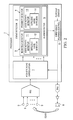
- FIG. 2 illustrates an example playback management system, in accordance with embodiments of the present disclosure
- FIG. 3 illustrates an example steered response power based beamsteering system, in accordance with embodiments of the present disclosure
- FIG. 4 illustrates an example adaptive beamformer, in accordance with embodiments of the present disclosure
- FIG. 5 illustrates a block diagram of an impulsive noise detector, in accordance with embodiments of the present disclosure
- FIGS. 6A-6F graphically illustrate distribution of pair-wise statistics and a decision boundary generated by a support vector machine, in accordance with embodiments of the present disclosure.
- FIG. 7 illustrates a timing diagram illustrating selected functionality of a latency mitigation module, in accordance with embodiments of the present disclosure.
- an automatic playback management framework may use one or more audio event detectors.
- Such audio event detectors for an audio device may include a near-field detector that may detect when sounds in the near-field of the audio device are detected, such as when a user of the audio device (e.g., a user that is wearing or otherwise using the audio device) speaks, a proximity detector that may detect when sounds in proximity to the audio device are detected, such as when another person in proximity to the user of the audio device speaks, and a tonal alarm detector that detects acoustic alarms that may have been originated in the vicinity of the audio device.
- FIG. 1 illustrates an example of a use case scenario wherein such detectors may be used in conjunction with a playback management system to enhance a user experience, in accordance with embodiments of the present disclosure.
- FIG. 2 illustrates an example playback management system that modifies a playback signal based on a decision from an event detector 2 , in accordance with embodiments of the present disclosure.
- Signal processing functionality in a processor 7 may comprise an acoustic echo canceller 1 that may cancel an acoustic echo that is received at microphones 9 due to an echo coupling between an output audio transducer 8 (e.g., loudspeaker) and microphones 9 .
- an output audio transducer 8 e.g., loudspeaker
- the echo reduced signal may be communicated to event detector 2 which may detect one or more various ambient events, including without limitation a near-field event (e.g., including but not limited to speech from a user of an audio device) detected by near-field detector 3 , a proximity event (e.g., including but not limited to speech or other ambient sound other than near-field sound) detected by proximity detector 4 , and/or a tonal alarm event detected by alarm detector 5 . If an audio event is detected, an event-based playback control 6 may modify a characteristic of audio information (shown as “playback content” in FIG. 2 ) reproduced to output audio transducer 8 .
- Audio information may include any information that may be reproduced at output audio transducer 8 , including without limitation, downlink speech associated with a telephonic conversation received via a communication network (e.g., a cellular network) and/or internal audio from an internal audio source (e.g., music file, video file, etc.).
- a communication network e.g., a cellular network
- internal audio from an internal audio source e.g., music file, video file, etc.
- near-field detector 3 may include a voice activity detector 11 which may be utilized by near-field detector 3 to detect near-field events.
- Voice activity detector 11 may include any suitable system, device, or apparatus configured to perform speech processing to detect the presence or absence of human speech.
- voice activity detector 11 may include an impulsive noise detector 12 .
- impulsive noise detector 12 may predict an occurrence of a signal burst event of an input signal indicative of ambient sound external to an audio device (e.g., a signal induced by sound pressure on one or more microphones 9 ) to determine whether the signal burst event comprises a speech event or a noise event.
- proximity detector 4 may include a voice activity detector 13 which may be utilized by proximity detector 4 to detect events in proximity with an audio device. Similar to voice activity detector 11 , voice activity detector 13 may include any suitable system, device, or apparatus configured to perform speech processing to detect the presence or absence of human speech. In accordance with such processing, voice activity detector 13 may include an impulsive noise detector 14 . Similar to impulsive noise detector 12 , impulsive noise detector 14 may predict an occurrence of a signal burst event of an input signal indicative of ambient sound external to an audio device (e.g., a signal induced by sound pressure on one or more microphones 9 ) to determine whether the signal burst event comprises a speech event or a noise event. In some embodiments, processor 7 may include a single voice activity detector having a single impulsive noise detector leveraged by both of near-field detector 3 and proximity detector 4 in performing their functionality.
- FIG. 3 illustrates an example steered response power-based beamsteering system 30 , in accordance with embodiments of the present disclosure.
- Steered response power-based beamsteering system 30 may operate by implementing multiple beamformers 33 (e.g., delay-and-sum and/or filter-and-sum beamformers) each with different look direction such that the entire bank of beamformers 33 will cover the desired field of interest.
- the beamwidth of each beamformer may depend on a microphone array aperture length.
- An output power from each beamformer may be computed, and a beamformer 33 having a maximum output power may be switched to an output path 34 by a beam selector 35 .
- Switching of beam selector 35 may be constrained by a voice activity detector 31 having an impulsive noise detector 32 such that the output power is measured by beam selector 35 only when speech is detected, thus preventing beam selector 35 from rapidly switching between multiple beamformers 33 by responding to spatially non-stationary background impulsive noises.
- FIG. 4 illustrates an example adaptive beamformer 40 , in accordance with embodiments of the present disclosure.
- Adaptive beamformer 40 may comprise any system, device, or apparatus capable of adapting to changing noise conditions based on the received data.
- an adaptive beamformer may achieve higher noise cancellation or interference suppression compared to fixed beamformers.
- adaptive beamformer 40 is implemented as a generalized side lobe canceller (GSC).
- GSC generalized side lobe canceller
- adaptive beamformer 40 may comprise a fixed beamformer 43 , blocking matrix 44 , and a multiple-input adaptive noise canceller 45 comprising an adaptive filter 46 . If adaptive filter 46 were to adapt at all times, it may train to speech leakage also causing speech distortion during a subtraction stage 47 .
- a voice activity detector 41 having an impulsive noise detector 42 may communicate a control signal to adaptive filter 46 to disable training or adaptation in the presence of speech.
- voice activity detector 41 may control a noise estimation period wherein background noise is not estimated whenever speech is present.
- the robustness of a GSC to speech leakage may be further improved by using an adaptive blocking matrix, the control for which may include an improved voice activity detector with an impulsive noise detector, as described in U.S. patent application Ser. No. 14/871,688 entitled “Adaptive Block Matrix Using Pre-Whitening for Adaptive Beam Forming.”
- FIG. 5 illustrates a block diagram of an impulsive noise detector 50 , in accordance with embodiments of the present disclosure.
- impulsive noise detector 50 may implement one or more of impulsive noise detector 12 , impulsive noise detector 14 , impulsive noise detector 32 , and impulsive noise detector 42 .
- Impulsive noise detector 50 may comprise any suitable system, device, or apparatus configured to exploit the harmonic nature of speech to distinguish impulsive noise from speech, as described in greater detail below.
- impulsive noise detector 50 may comprise two processing stages 51 and 52 .
- a first processing stage 51 may comprise a sudden onset detector 53 that predicts an occurrence of a signal burst event of an input audio signal x[n] (e.g., a signal indicative of sound pressure present upon a microphone) and a second processing stage 52 may comprise an impulse detector for determining whether the signal burst event comprises a speech event or a noise event by analyzing based on harmonicity, sparsity, and degree of temporal modulation of a signal spectrum of input audio signal x[n] to determine whether the signal burst event comprises a speech event or a noise, as described in greater detail below.
- first processing stage 51 may be computationally inexpensive, but robust, while second processing stage 52 may be more computationally expensive, but may be executed only when a possible signal burst event is detected by first processing stage 51 .
- the two-stage approach of impulsive noise detector 50 may also be used in conjunction with existing voice activity detectors to complement overall system performance of a voice application.
- Sudden onset detector 53 may comprise any system, device, or apparatus configured to exploit sudden changes in a signal level of input audio signal x[n] in order to predict a forthcoming signal burst. For example, samples of input audio signal x[n] may first be grouped into overlapping frame samples and the energy of each frame computed. Sudden onset detector 53 may calculate the energy of a frame as:
- N the total number of samples in a frame
- l the frame index
- a predetermined percentage e.g. 25%
- sudden onset detector 53 may calculate a normalized frame energy as:
- E ⁇ ⁇ [ m , l ] E ⁇ [ m ] max ⁇ ⁇ m ⁇ E ⁇ [ m ] - min ⁇ ⁇ m ⁇ E ⁇ [ m ]
- m l, l- 1 , l- 2 , . . . , l-L+1 and L is a size of the frame energy history buffer.
- the denominator in this normalization step may represent a dynamic range of frame energy over the current and past (L ⁇ 1) frames. Sudden onset detector 53 may then compute a sudden onset statistic as:
- the maximum is computed only over the past (L ⁇ 1) frames. Therefore, if a sudden acoustic event appears in the environment, the frame energy at the onset of the event may be high and the maximum energy over the past (L ⁇ 1) frames may be smaller than the maximum value. Therefore, the ratio of these two values may be small during the onset. Accordingly, the frame size should be such that the past (L ⁇ 1) frames do not contain energy corresponding to the signal burst.
- Sudden onset detector 53 may define a sudden onset test statistic as:
- sudden ⁇ ⁇ onset ⁇ ⁇ detect ⁇ True , ⁇ OS ⁇ [ l ] ⁇ Th OS E ⁇ [ l ] > Th E False , otherwise where Th OS is the threshold for the sudden onset statistic and Th E is the energy threshold.
- the energy threshold condition may reduce false alarms that may be generally high for very low energy signals, for the reason that any small change in the signal energy can trigger sudden onset detection.
- Sudden onset detector 53 may normalize frame energies by the dynamic range of audio input signal x[n] to keep the threshold, Th OS independent of the absolute signal level.
- an onset detect signal indDetTrig may also be triggered for sudden speech bursts. For example, onset detect signal indDetTrig may be triggered every time a speech event appears after a period of silence. Accordingly, impulsive noise detector 50 cannot rely solely on sudden onset detector 53 to accurately detect an impulsive noise. Accordingly, once a high energy signal onset is detected by the sudden onset detector 53 , the impulsive detector of second processing stage 52 may exploit the harmonic and sparse nature of an instantaneous speech spectrum to determine if the signal onset is caused by speech or impulsive noise.
- second processing stage 52 may use a number of parameters, including harmonicity, harmonic product spectrum flatness measure, spectral flatness measure, and/or spectral flatness measure swing of audio input signal x[n] that extract either the sparsity or the harmonicity level of a given input signal spectrum of audio input signal x[n].
- parameters including harmonicity, harmonic product spectrum flatness measure, spectral flatness measure, and/or spectral flatness measure swing of audio input signal x[n] that extract either the sparsity or the harmonicity level of a given input signal spectrum of audio input signal x[n].
- impulsive noise detector 50 may convert audio input signal x[n] from the time domain to the frequency domain by means of a discrete Fourier transform (DFT) 54 .
- DFT 54 may buffer, overlap, window, and convert audio input signal x[n] to the frequency domain as:
- the overlap may be fixed at any suitable percentage (e.g., 25%).
- second processing stage 52 may include a harmonicity calculation block 55 , a harmonic product spectrum block 56 , a harmonic flatness measure block 57 , a spectral flatness measure (SFM) block 58 , and a SFM swing block 59 .
- a harmonicity calculation block 55 may include a harmonic product spectrum block 56 , a harmonic flatness measure block 57 , a spectral flatness measure (SFM) block 58 , and a SFM swing block 59 .
- SFM spectral flatness measure
- harmonicity calculation block 55 may compute total power in a frame as:
- Harmonicity calculation block 55 may calculate a harmonic power as:
- N h is a number of harmonics
- m is a harmonic order
- the expected pitch frequency range may be set to any suitable range (e.g., 100-500 Hz).
- a harmonicity at a given frequency may be defined as a ratio of the harmonic power to the total energy without the harmonic power and harmonicity calculation block 55 may calculate harmonicity as:
- H ⁇ [ p , l ] E H ⁇ [ p , l ] E x ⁇ [ l ] - E H ⁇ [ p , l ] .
- SFM block 58 may calculate a sub-band spectral flatness measure computed as:
- the sub-band frequency range may be of any suitable range (e.g., 500-1500 Hz).
- harmonic product spectrum block 56 may provide more robust harmonicity information. Harmonic product spectrum block 56 may calculate a harmonic product spectrum as:
- An impulsive noise spectrum may exhibit spectral stationarity over a short period of time (e.g., 300-500 ms), whereas a speech spectrum may vary over time due to spectral modulation of pitch harmonics.
- SFM swing block 59 may capture such non-stationarity information by tracking spectral flatness measures from multiple sub-bands over a period of time and estimate the variation of the weighted and cumulative flatness measure over the same period. For example, SFM swing block 59 may track a cumulative SFM over a period of time and may calculate a difference between the maximum and the minimum cumulative SFM value over the same duration, such difference representing a flatness measure swing.
- the flatness measure swing value may generally be small for impulsive noises because the spectral content of such signals may be wideband in nature and may tend to be stationary for a short interval of time.
- the value of the flatness measure swing value may be higher for speech signals because spectral content of speech signal may vary faster than impulsive noises.
- SFM swing block 59 may calculate the flatness measure swing by first computing the cumulative spectral flatness measure as:
- N B (i) N H (i) ⁇ N L (i)+1, i is a sub-band number, N s is a number of sub-bands, ⁇ (i) is a sub-band weighting factor, N H (i) and N L (i) are spectral bin indices corresponding to the low- and high-frequency band edges, respectively of i th sub-band.
- SFM swing block 59 may obtain the spectral flatness measure swing by computing a difference between a maximum and a minimum spectral flatness measure value over the most-recent M frames.
- Fusion logic 60 may apply a supervised learning algorithm such as, for example, a support vector machine (SVM) to determine a non-linear function that optimally separates speech and impulse noise in a four-dimensional feature space, 4 , each dimension of the feature space corresponding to one of the foregoing parameters (e.g., harmonicity, harmonic product spectrum flatness measure, spectral flatness measure, and spectral flatness measure swing).
- SVM support vector machine
- FIGS. 6A-6F show the distribution of pair-wise statistics and the decision boundary generated by the SVM (e.g., linear kernel) when only two of the four statistics are used.
- FIG. 6A depicts pair-wise statistics and a decision boundary (shown with a straight line) for harmonic product spectrum flatness measure (HPS-SFM) and harmonicity
- FIG. 6B depicts pair-wise statistics and a decision boundary (shown with a straight line) for spectral flatness measure (SFM) and harmonicity
- FIG. 6C depicts pair-wise statistics and a decision boundary (shown with a straight line) for spectral flatness measure swing (SFM-SWING)
- FIG. 6D depicts pair-wise statistics and a decision boundary (shown with a straight line) for SFM and HPS-SFM
- FIG. 6E depicts pair-wise statistics and a decision boundary (shown with a straight line) for SFM-SWING and HPS-SFM
- FIG. 6F depicts pair-wise statistics and a decision boundary (shown with a straight line) for SFM-SWING and SFM.
- fusion logic 60 may determine an optimal decision hyperplane given by:
- d i ⁇ 1, ⁇ 1 ⁇ represents a class name
- v i (s) are support vectors
- N s is the number of support vectors
- ⁇ i are Lagrange multipliers used on the derivation of the SVM algorithm.
- fusion logic 60 may apply a simple binary hypothesis testing method to classify between speech and impulse noise. Specifically, an instantaneous impulsive noise detect signal indicating presence of impulse noise may be obtained as:
- instIndDet ⁇ [ l ] ⁇ True , ⁇ Harm ⁇ [ l ] ⁇ Th Harm ⁇ SFM ⁇ [ l ] > Th SFM ⁇ HPS - SFM ⁇ [ l ] > Th HPS - SFM ⁇ SFMSwing ⁇ [ l ] ⁇ Th SFMSwing False , otherwise where Th x are corresponding thresholds for each of the various parameters.
- second processing stage 52 may include a validation block 61 .
- Validation block 61 may validate a detected signal burst as impulsive noise by counting a number of instantaneous impulsive noise detects Instantaneous indDet during a preset validation period comprising a predetermined period of time. If the instantaneous impulsive noise detect count exceeds a certain threshold minimum, validation block 61 may determine that the signal burst is an impulsive noise and output a signal indDet indicative of a determination of impulsive noise.
- an audio system comprising a voice activity detector having an impulsive noise detector may modify a characteristic (e.g., amplitude of the audio information and/or spectral content of the audio information) associated with audio information being processed by the audio system in response to detection of a noise event.
- a characteristic e.g., amplitude of the audio information and/or spectral content of the audio information
- such characteristic may include at least one coefficient of a voice-based processing algorithm including at least one of a noise suppressor, a background noise estimator, an adaptive beamformer, dynamic beam steering, always-on voice, and a conversation-based playback management system.
- impulsive noise detector 50 may include a latency mitigation module 62 that may mitigate the effects of this latency with a shadow-update processing approach.
- FIG. 7 illustrates a timing diagram of selected functionality of latency mitigation module 62 , in accordance with embodiments of the present disclosure. As shown in FIG.
- a main processing path may continuously update state information of the state-based processing algorithm that depends on control signals from a voice activity detector (e.g., a playback management system, a steered response power based beamsteering system, a multi-channel signal enhancement system, etc.).
- a voice activity detector e.g., a playback management system, a steered response power based beamsteering system, a multi-channel signal enhancement system, etc.
- latency mitigation module 62 may freeze such state information in the main processing path and copy such state information to a shadow processing path.
- latency mitigation module 62 may continue to freeze state information in the main processing path and update state information in the shadow processing path as if normal operation were occurring.
- latency mitigation module 61 may unfreeze the state information in the main path and cause the state-based processing algorithm to use the unfrozen state information as the state information of the state-based processing algorithm.
- latency mitigation module 62 may cause the state-based processing algorithm to use the shadow state information as modified by the shadow processing as the state information of the state-based processing algorithm.
Landscapes
- Engineering & Computer Science (AREA)
- Human Computer Interaction (AREA)
- Signal Processing (AREA)
- Health & Medical Sciences (AREA)
- Audiology, Speech & Language Pathology (AREA)
- Computational Linguistics (AREA)
- Physics & Mathematics (AREA)
- Acoustics & Sound (AREA)
- Multimedia (AREA)
- Quality & Reliability (AREA)
- Artificial Intelligence (AREA)
- Evolutionary Computation (AREA)
- Noise Elimination (AREA)
- Soundproofing, Sound Blocking, And Sound Damping (AREA)
Abstract
Description
where N is the total number of samples in a frame, l is the frame index, and a predetermined percentage (e.g., 25%) of overlapping is used to generate each frame. Further,
where m=l, l-1, l-2, . . . , l-
where m′=l-1, l-2, . . . , l-
where ThOS is the threshold for the sudden onset statistic and ThE is the energy threshold. The energy threshold condition may reduce false alarms that may be generally high for very low energy signals, for the reason that any small change in the signal energy can trigger sudden onset detection.
where w[n] is a windowing function, x[n,l] is a buffered and overlapped input signal frame, N is a size of the DFT size and k is a frequency bin index. The overlap may be fixed at any suitable percentage (e.g., 25%).
where

where Nh is a number of harmonics, m is a harmonic order, and

γHarm[l]=

where NB=NH−NL+1, NH and NL are the spectral bin indices corresponding to low- and high-frequency band edges respectively, of a sub-band. The sub-band frequency range may be of any suitable range (e.g., 500-1500 Hz).
where Nh and

where

where NB(i)=NH(i)−NL(i)+1, i is a sub-band number, Ns is a number of sub-bands, α(i) is a sub-band weighting factor, NH(i) and NL(i) are spectral bin indices corresponding to the low- and high-frequency band edges, respectively of ith sub-band. Any suitable sub-band ranges may be employed (e.g., 500-1500 Hz, 1500-2750 Hz, and 2750-3500 Hz).
μSFM[l]=β*μSFM[l-1]+(1-β)ρSFM[l]
where β is the exponential averaging smoothing coefficient.
γSFM-Swing[l]=max∀m=l,l-1,l-M+1μSFM[m]−min∀m=l,l-1,l-M+1μSFM[m].
Because overlap of the foregoing parameters may be small,
v:[γHarm[l]γSFM[l]γHPS-SFM[l]γSFMSwing[l]]T.
Fusion logic 60 may apply a supervised learning algorithm such as, for example, a support vector machine (SVM) to determine a non-linear function that optimally separates speech and impulse noise in a four-dimensional feature space,


where di∈{1,−1} represents a class name, vi (s) are support vectors, Ns is the number of support vectors and λi are Lagrange multipliers used on the derivation of the SVM algorithm.
where Thx are corresponding thresholds for each of the various parameters.
Claims (12)
Priority Applications (5)
| Application Number | Priority Date | Filing Date | Title |
|---|---|---|---|
| US15/290,685 US10242696B2 (en) | 2016-10-11 | 2016-10-11 | Detection of acoustic impulse events in voice applications |
| GB1619678.4A GB2554955B (en) | 2016-10-11 | 2016-11-21 | Detection of acoustic impulse events in voice applications |
| US15/583,012 US10475471B2 (en) | 2016-10-11 | 2017-05-01 | Detection of acoustic impulse events in voice applications using a neural network |
| PCT/US2017/055887 WO2018071387A1 (en) | 2016-10-11 | 2017-10-10 | Detection of acoustic impulse events in voice applications using a neural network |
| GB1716561.4A GB2557425B (en) | 2016-10-11 | 2017-10-10 | Detection of acoustic impulse events in voice applications using a neural network |
Applications Claiming Priority (1)
| Application Number | Priority Date | Filing Date | Title |
|---|---|---|---|
| US15/290,685 US10242696B2 (en) | 2016-10-11 | 2016-10-11 | Detection of acoustic impulse events in voice applications |
Related Child Applications (1)
| Application Number | Title | Priority Date | Filing Date |
|---|---|---|---|
| US15/583,012 Continuation-In-Part US10475471B2 (en) | 2016-10-11 | 2017-05-01 | Detection of acoustic impulse events in voice applications using a neural network |
Publications (2)
| Publication Number | Publication Date |
|---|---|
| US20180102135A1 US20180102135A1 (en) | 2018-04-12 |
| US10242696B2 true US10242696B2 (en) | 2019-03-26 |
Family
ID=57993776
Family Applications (1)
| Application Number | Title | Priority Date | Filing Date |
|---|---|---|---|
| US15/290,685 Active 2037-01-28 US10242696B2 (en) | 2016-10-11 | 2016-10-11 | Detection of acoustic impulse events in voice applications |
Country Status (2)
| Country | Link |
|---|---|
| US (1) | US10242696B2 (en) |
| GB (1) | GB2554955B (en) |
Cited By (2)
| Publication number | Priority date | Publication date | Assignee | Title |
|---|---|---|---|---|
| US20190035414A1 (en) * | 2017-07-27 | 2019-01-31 | Harman Becker Automotive Systems Gmbh | Adaptive post filtering |
| US20230267945A1 (en) * | 2020-08-12 | 2023-08-24 | Dolby International Ab | Automatic detection and attenuation of speech-articulation noise events |
Families Citing this family (25)
| Publication number | Priority date | Publication date | Assignee | Title |
|---|---|---|---|---|
| US10957310B1 (en) | 2012-07-23 | 2021-03-23 | Soundhound, Inc. | Integrated programming framework for speech and text understanding with meaning parsing |
| US9565493B2 (en) | 2015-04-30 | 2017-02-07 | Shure Acquisition Holdings, Inc. | Array microphone system and method of assembling the same |
| US10242696B2 (en) | 2016-10-11 | 2019-03-26 | Cirrus Logic, Inc. | Detection of acoustic impulse events in voice applications |
| US10475471B2 (en) | 2016-10-11 | 2019-11-12 | Cirrus Logic, Inc. | Detection of acoustic impulse events in voice applications using a neural network |
| US10636421B2 (en) | 2017-12-27 | 2020-04-28 | Soundhound, Inc. | Parse prefix-detection in a human-machine interface |
| CN108335694B (en) * | 2018-02-01 | 2021-10-15 | 北京百度网讯科技有限公司 | Far-field environmental noise processing method, device, device and storage medium |
| US10043530B1 (en) | 2018-02-08 | 2018-08-07 | Omnivision Technologies, Inc. | Method and audio noise suppressor using nonlinear gain smoothing for reduced musical artifacts |
| US10043531B1 (en) * | 2018-02-08 | 2018-08-07 | Omnivision Technologies, Inc. | Method and audio noise suppressor using MinMax follower to estimate noise |
| CN111081269B (en) * | 2018-10-19 | 2022-06-14 | 中国移动通信集团浙江有限公司 | Noise detection method and system in call process |
| US11935552B2 (en) * | 2019-01-23 | 2024-03-19 | Sony Group Corporation | Electronic device, method and computer program |
| CN109801646B (en) * | 2019-01-31 | 2021-11-16 | 嘉楠明芯(北京)科技有限公司 | Voice endpoint detection method and device based on fusion features |
| EP3942845A1 (en) | 2019-03-21 | 2022-01-26 | Shure Acquisition Holdings, Inc. | Auto focus, auto focus within regions, and auto placement of beamformed microphone lobes with inhibition functionality |
| US11558693B2 (en) | 2019-03-21 | 2023-01-17 | Shure Acquisition Holdings, Inc. | Auto focus, auto focus within regions, and auto placement of beamformed microphone lobes with inhibition and voice activity detection functionality |
| JP7731292B2 (en) * | 2019-05-31 | 2025-08-29 | シュアー アクイジッション ホールディングス インコーポレイテッド | Integrated low latency automixer with voice and noise activity detection |
| WO2021087377A1 (en) | 2019-11-01 | 2021-05-06 | Shure Acquisition Holdings, Inc. | Proximity microphone |
| WO2021243368A2 (en) | 2020-05-29 | 2021-12-02 | Shure Acquisition Holdings, Inc. | Transducer steering and configuration systems and methods using a local positioning system |
| US11482236B2 (en) * | 2020-08-17 | 2022-10-25 | Bose Corporation | Audio systems and methods for voice activity detection |
| US11783809B2 (en) * | 2020-10-08 | 2023-10-10 | Qualcomm Incorporated | User voice activity detection using dynamic classifier |
| EP4427465A1 (en) | 2021-11-05 | 2024-09-11 | Shure Acquisition Holdings, Inc. | Distributed algorithm for automixing speech over wireless networks |
| KR102864489B1 (en) * | 2021-11-11 | 2025-09-25 | 썬전 샥 컴퍼니, 리미티드 | Method and system for detecting voice activity, method and system for enhancing voice |
| CN114637699B (en) * | 2022-03-22 | 2025-01-07 | 北京达佳互联信息技术有限公司 | Audio caching method, device, microphone device, electronic device and storage medium |
| CN114582371B (en) * | 2022-04-29 | 2022-07-08 | 北京百瑞互联技术有限公司 | Howling detection and suppression method, system, medium and device based on spectral flatness |
| CN115112061B (en) * | 2022-06-28 | 2023-07-25 | 苏州大学 | Rail wave grinding detection method and system |
| CN115376548B (en) * | 2022-07-06 | 2023-06-20 | 华南理工大学 | A method and system for detecting the endpoint of a voiced segment of an audio signal |
| US20240233718A9 (en) * | 2022-10-19 | 2024-07-11 | Soundhound, Inc. | Semantically conditioned voice activity detection |
Citations (52)
| Publication number | Priority date | Publication date | Assignee | Title |
|---|---|---|---|---|
| US5991718A (en) * | 1998-02-27 | 1999-11-23 | At&T Corp. | System and method for noise threshold adaptation for voice activity detection in nonstationary noise environments |
| US6240381B1 (en) * | 1998-02-17 | 2001-05-29 | Fonix Corporation | Apparatus and methods for detecting onset of a signal |
| US6453291B1 (en) * | 1999-02-04 | 2002-09-17 | Motorola, Inc. | Apparatus and method for voice activity detection in a communication system |
| US20030204394A1 (en) | 2002-04-30 | 2003-10-30 | Harinath Garudadri | Distributed voice recognition system utilizing multistream network feature processing |
| US20040137846A1 (en) * | 2002-07-26 | 2004-07-15 | Ali Behboodian | Method for fast dynamic estimation of background noise |
| US20050108004A1 (en) | 2003-03-11 | 2005-05-19 | Takeshi Otani | Voice activity detector based on spectral flatness of input signal |
| US20060100868A1 (en) * | 2003-02-21 | 2006-05-11 | Hetherington Phillip A | Minimization of transient noises in a voice signal |
| US7219065B1 (en) * | 1999-10-26 | 2007-05-15 | Vandali Andrew E | Emphasis of short-duration transient speech features |
| US20080077403A1 (en) * | 2006-09-22 | 2008-03-27 | Fujitsu Limited | Speech recognition method, speech recognition apparatus and computer program |
| US7492889B2 (en) | 2004-04-23 | 2009-02-17 | Acoustic Technologies, Inc. | Noise suppression based on bark band wiener filtering and modified doblinger noise estimate |
| US20090125899A1 (en) * | 2006-05-12 | 2009-05-14 | Koninklijke Philips Electronics N.V. | Method for changing over from a first adaptive data processing version to a second adaptive data processing version |
| US20090154726A1 (en) * | 2007-08-22 | 2009-06-18 | Step Labs Inc. | System and Method for Noise Activity Detection |
| GB2456296A (en) | 2007-12-07 | 2009-07-15 | Hamid Sepehr | Audio enhancement and hearing protection by producing a noise reduced signal |
| US20100057453A1 (en) | 2006-11-16 | 2010-03-04 | International Business Machines Corporation | Voice activity detection system and method |
| US20100280827A1 (en) * | 2009-04-30 | 2010-11-04 | Microsoft Corporation | Noise robust speech classifier ensemble |
| US20100332221A1 (en) | 2008-03-14 | 2010-12-30 | Panasonic Corporation | Encoding device, decoding device, and method thereof |
| US7903825B1 (en) | 2006-03-03 | 2011-03-08 | Cirrus Logic, Inc. | Personal audio playback device having gain control responsive to environmental sounds |
| US20110153313A1 (en) | 2009-12-17 | 2011-06-23 | Alcatel-Lucent Usa Inc. | Method And Apparatus For The Detection Of Impulsive Noise In Transmitted Speech Signals For Use In Speech Quality Assessment |
| US20110178795A1 (en) | 2008-07-11 | 2011-07-21 | Stefan Bayer | Time warp activation signal provider, audio signal encoder, method for providing a time warp activation signal, method for encoding an audio signal and computer programs |
| US20110264447A1 (en) | 2010-04-22 | 2011-10-27 | Qualcomm Incorporated | Systems, methods, and apparatus for speech feature detection |
| US20110305347A1 (en) * | 2010-06-14 | 2011-12-15 | Michael Wurm | Adaptive noise control |
| US8126706B2 (en) | 2005-12-09 | 2012-02-28 | Acoustic Technologies, Inc. | Music detector for echo cancellation and noise reduction |
| US20120076311A1 (en) * | 2010-09-28 | 2012-03-29 | Bose Corporation | Dynamic Gain Adjustment Based on Signal to Ambient Noise Level |
| US20130132076A1 (en) | 2011-11-23 | 2013-05-23 | Creative Technology Ltd | Smart rejecter for keyboard click noise |
| WO2013142659A2 (en) | 2012-03-23 | 2013-09-26 | Dolby Laboratories Licensing Corporation | Method and system for signal transmission control |
| US20130259254A1 (en) * | 2012-03-28 | 2013-10-03 | Qualcomm Incorporated | Systems, methods, and apparatus for producing a directional sound field |
| US8565446B1 (en) | 2010-01-12 | 2013-10-22 | Acoustic Technologies, Inc. | Estimating direction of arrival from plural microphones |
| US20130301842A1 (en) * | 2012-05-10 | 2013-11-14 | Cirrus Logic, Inc. | Noise burst adaptation of secondary path adaptive response in noise-canceling personal audio devices |
| US20140270260A1 (en) * | 2013-03-13 | 2014-09-18 | Aliphcom | Speech detection using low power microelectrical mechanical systems sensor |
| US20150070148A1 (en) | 2013-09-06 | 2015-03-12 | Immersion Corporation | Systems and Methods for Generating Haptic Effects Associated With Audio Signals |
| US20150081285A1 (en) | 2013-09-16 | 2015-03-19 | Samsung Electronics Co., Ltd. | Speech signal processing apparatus and method for enhancing speech intelligibility |
| US20150348572A1 (en) * | 2014-05-30 | 2015-12-03 | Apple Inc. | Detecting a user's voice activity using dynamic probabilistic models of speech features |
| US20150371631A1 (en) | 2014-06-23 | 2015-12-24 | Google Inc. | Caching speech recognition scores |
| US20150380013A1 (en) | 2014-06-30 | 2015-12-31 | Rajeev Conrad Nongpiur | Learning algorithm to detect human presence in indoor environments from acoustic signals |
| US20160029121A1 (en) * | 2014-07-24 | 2016-01-28 | Conexant Systems, Inc. | System and method for multichannel on-line unsupervised bayesian spectral filtering of real-world acoustic noise |
| US20160093313A1 (en) | 2014-09-26 | 2016-03-31 | Cypher, Llc | Neural network voice activity detection employing running range normalization |
| US20160118056A1 (en) | 2013-05-15 | 2016-04-28 | Samsung Electronics Co., Ltd. | Method and device for encoding and decoding audio signal |
| US20160133264A1 (en) * | 2014-11-06 | 2016-05-12 | Imagination Technologies Limited | Comfort Noise Generation |
| KR101624926B1 (en) | 2014-12-17 | 2016-05-27 | 서울대학교산학협력단 | Speech recognition method using feature compensation based on deep neural network |
| US9361885B2 (en) | 2013-03-12 | 2016-06-07 | Nuance Communications, Inc. | Methods and apparatus for detecting a voice command |
| KR20160073874A (en) | 2014-12-17 | 2016-06-27 | 서울대학교산학협력단 | Voice activity detection method based on statistical model employing deep neural network and voice activity detection device performing the same |
| US20160210987A1 (en) | 2013-08-30 | 2016-07-21 | Nec Corporation | Signal processing apparatus, signal processing method, and signal processing program |
| US20170025132A1 (en) | 2014-05-01 | 2017-01-26 | Nippon Telegraph And Telephone Corporation | Periodic-combined-envelope-sequence generation device, periodic-combined-envelope-sequence generation method, periodic-combined-envelope-sequence generation program and recording medium |
| US20170040016A1 (en) | 2015-04-17 | 2017-02-09 | International Business Machines Corporation | Data augmentation method based on stochastic feature mapping for automatic speech recognition |
| WO2017027397A2 (en) | 2015-08-07 | 2017-02-16 | Cirrus Logic International Semiconductor, Ltd. | Event detection for playback management in an audio device |
| KR101704926B1 (en) | 2015-10-23 | 2017-02-23 | 한양대학교 산학협력단 | Statistical Model-based Voice Activity Detection with Ensemble of Deep Neural Network Using Acoustic Environment Classification and Voice Activity Detection Method thereof |
| US20170110115A1 (en) | 2015-10-16 | 2017-04-20 | Samsung Electronics Co., Ltd. | Apparatus and method for normalizing input data of acoustic model and speech recognition apparatus |
| US20170229117A1 (en) | 2016-02-05 | 2017-08-10 | Brainchip Inc. | Low power neuromorphic voice activation system and method |
| US20170263240A1 (en) | 2012-11-29 | 2017-09-14 | Sony Interactive Entertainment Inc. | Combining auditory attention cues with phoneme posterior scores for phone/vowel/syllable boundary detection |
| US20180068654A1 (en) | 2016-09-07 | 2018-03-08 | International Business Machines Corporation | Adjusting a deep neural network acoustic model |
| US20180102135A1 (en) | 2016-10-11 | 2018-04-12 | Cirrus Logic International Semiconductor Ltd. | Detection of acoustic impulse events in voice applications |
| US20180102136A1 (en) | 2016-10-11 | 2018-04-12 | Cirrus Logic International Semiconductor Ltd. | Detection of acoustic impulse events in voice applications using a neural network |
-
2016
- 2016-10-11 US US15/290,685 patent/US10242696B2/en active Active
- 2016-11-21 GB GB1619678.4A patent/GB2554955B/en active Active
Patent Citations (53)
| Publication number | Priority date | Publication date | Assignee | Title |
|---|---|---|---|---|
| US6240381B1 (en) * | 1998-02-17 | 2001-05-29 | Fonix Corporation | Apparatus and methods for detecting onset of a signal |
| US5991718A (en) * | 1998-02-27 | 1999-11-23 | At&T Corp. | System and method for noise threshold adaptation for voice activity detection in nonstationary noise environments |
| US6453291B1 (en) * | 1999-02-04 | 2002-09-17 | Motorola, Inc. | Apparatus and method for voice activity detection in a communication system |
| US7219065B1 (en) * | 1999-10-26 | 2007-05-15 | Vandali Andrew E | Emphasis of short-duration transient speech features |
| US20030204394A1 (en) | 2002-04-30 | 2003-10-30 | Harinath Garudadri | Distributed voice recognition system utilizing multistream network feature processing |
| US20040137846A1 (en) * | 2002-07-26 | 2004-07-15 | Ali Behboodian | Method for fast dynamic estimation of background noise |
| US20060100868A1 (en) * | 2003-02-21 | 2006-05-11 | Hetherington Phillip A | Minimization of transient noises in a voice signal |
| US20050108004A1 (en) | 2003-03-11 | 2005-05-19 | Takeshi Otani | Voice activity detector based on spectral flatness of input signal |
| US7492889B2 (en) | 2004-04-23 | 2009-02-17 | Acoustic Technologies, Inc. | Noise suppression based on bark band wiener filtering and modified doblinger noise estimate |
| US8126706B2 (en) | 2005-12-09 | 2012-02-28 | Acoustic Technologies, Inc. | Music detector for echo cancellation and noise reduction |
| US8804974B1 (en) | 2006-03-03 | 2014-08-12 | Cirrus Logic, Inc. | Ambient audio event detection in a personal audio device headset |
| US7903825B1 (en) | 2006-03-03 | 2011-03-08 | Cirrus Logic, Inc. | Personal audio playback device having gain control responsive to environmental sounds |
| US20090125899A1 (en) * | 2006-05-12 | 2009-05-14 | Koninklijke Philips Electronics N.V. | Method for changing over from a first adaptive data processing version to a second adaptive data processing version |
| US20080077403A1 (en) * | 2006-09-22 | 2008-03-27 | Fujitsu Limited | Speech recognition method, speech recognition apparatus and computer program |
| US20100057453A1 (en) | 2006-11-16 | 2010-03-04 | International Business Machines Corporation | Voice activity detection system and method |
| US20090154726A1 (en) * | 2007-08-22 | 2009-06-18 | Step Labs Inc. | System and Method for Noise Activity Detection |
| GB2456296A (en) | 2007-12-07 | 2009-07-15 | Hamid Sepehr | Audio enhancement and hearing protection by producing a noise reduced signal |
| US20100332221A1 (en) | 2008-03-14 | 2010-12-30 | Panasonic Corporation | Encoding device, decoding device, and method thereof |
| US20110178795A1 (en) | 2008-07-11 | 2011-07-21 | Stefan Bayer | Time warp activation signal provider, audio signal encoder, method for providing a time warp activation signal, method for encoding an audio signal and computer programs |
| US20100280827A1 (en) * | 2009-04-30 | 2010-11-04 | Microsoft Corporation | Noise robust speech classifier ensemble |
| US20110153313A1 (en) | 2009-12-17 | 2011-06-23 | Alcatel-Lucent Usa Inc. | Method And Apparatus For The Detection Of Impulsive Noise In Transmitted Speech Signals For Use In Speech Quality Assessment |
| US8565446B1 (en) | 2010-01-12 | 2013-10-22 | Acoustic Technologies, Inc. | Estimating direction of arrival from plural microphones |
| US20110264447A1 (en) | 2010-04-22 | 2011-10-27 | Qualcomm Incorporated | Systems, methods, and apparatus for speech feature detection |
| US20110305347A1 (en) * | 2010-06-14 | 2011-12-15 | Michael Wurm | Adaptive noise control |
| US20120076311A1 (en) * | 2010-09-28 | 2012-03-29 | Bose Corporation | Dynamic Gain Adjustment Based on Signal to Ambient Noise Level |
| US20130132076A1 (en) | 2011-11-23 | 2013-05-23 | Creative Technology Ltd | Smart rejecter for keyboard click noise |
| WO2013142659A2 (en) | 2012-03-23 | 2013-09-26 | Dolby Laboratories Licensing Corporation | Method and system for signal transmission control |
| US20130259254A1 (en) * | 2012-03-28 | 2013-10-03 | Qualcomm Incorporated | Systems, methods, and apparatus for producing a directional sound field |
| US20130301842A1 (en) * | 2012-05-10 | 2013-11-14 | Cirrus Logic, Inc. | Noise burst adaptation of secondary path adaptive response in noise-canceling personal audio devices |
| US20170263240A1 (en) | 2012-11-29 | 2017-09-14 | Sony Interactive Entertainment Inc. | Combining auditory attention cues with phoneme posterior scores for phone/vowel/syllable boundary detection |
| US9361885B2 (en) | 2013-03-12 | 2016-06-07 | Nuance Communications, Inc. | Methods and apparatus for detecting a voice command |
| US20140270260A1 (en) * | 2013-03-13 | 2014-09-18 | Aliphcom | Speech detection using low power microelectrical mechanical systems sensor |
| US20160118056A1 (en) | 2013-05-15 | 2016-04-28 | Samsung Electronics Co., Ltd. | Method and device for encoding and decoding audio signal |
| US20160210987A1 (en) | 2013-08-30 | 2016-07-21 | Nec Corporation | Signal processing apparatus, signal processing method, and signal processing program |
| US20150070148A1 (en) | 2013-09-06 | 2015-03-12 | Immersion Corporation | Systems and Methods for Generating Haptic Effects Associated With Audio Signals |
| US20150081285A1 (en) | 2013-09-16 | 2015-03-19 | Samsung Electronics Co., Ltd. | Speech signal processing apparatus and method for enhancing speech intelligibility |
| US20170025132A1 (en) | 2014-05-01 | 2017-01-26 | Nippon Telegraph And Telephone Corporation | Periodic-combined-envelope-sequence generation device, periodic-combined-envelope-sequence generation method, periodic-combined-envelope-sequence generation program and recording medium |
| US20150348572A1 (en) * | 2014-05-30 | 2015-12-03 | Apple Inc. | Detecting a user's voice activity using dynamic probabilistic models of speech features |
| US20150371631A1 (en) | 2014-06-23 | 2015-12-24 | Google Inc. | Caching speech recognition scores |
| US20150380013A1 (en) | 2014-06-30 | 2015-12-31 | Rajeev Conrad Nongpiur | Learning algorithm to detect human presence in indoor environments from acoustic signals |
| US20160029121A1 (en) * | 2014-07-24 | 2016-01-28 | Conexant Systems, Inc. | System and method for multichannel on-line unsupervised bayesian spectral filtering of real-world acoustic noise |
| US20160093313A1 (en) | 2014-09-26 | 2016-03-31 | Cypher, Llc | Neural network voice activity detection employing running range normalization |
| US20160133264A1 (en) * | 2014-11-06 | 2016-05-12 | Imagination Technologies Limited | Comfort Noise Generation |
| KR101624926B1 (en) | 2014-12-17 | 2016-05-27 | 서울대학교산학협력단 | Speech recognition method using feature compensation based on deep neural network |
| KR20160073874A (en) | 2014-12-17 | 2016-06-27 | 서울대학교산학협력단 | Voice activity detection method based on statistical model employing deep neural network and voice activity detection device performing the same |
| US20170040016A1 (en) | 2015-04-17 | 2017-02-09 | International Business Machines Corporation | Data augmentation method based on stochastic feature mapping for automatic speech recognition |
| WO2017027397A2 (en) | 2015-08-07 | 2017-02-16 | Cirrus Logic International Semiconductor, Ltd. | Event detection for playback management in an audio device |
| US20170110115A1 (en) | 2015-10-16 | 2017-04-20 | Samsung Electronics Co., Ltd. | Apparatus and method for normalizing input data of acoustic model and speech recognition apparatus |
| KR101704926B1 (en) | 2015-10-23 | 2017-02-23 | 한양대학교 산학협력단 | Statistical Model-based Voice Activity Detection with Ensemble of Deep Neural Network Using Acoustic Environment Classification and Voice Activity Detection Method thereof |
| US20170229117A1 (en) | 2016-02-05 | 2017-08-10 | Brainchip Inc. | Low power neuromorphic voice activation system and method |
| US20180068654A1 (en) | 2016-09-07 | 2018-03-08 | International Business Machines Corporation | Adjusting a deep neural network acoustic model |
| US20180102135A1 (en) | 2016-10-11 | 2018-04-12 | Cirrus Logic International Semiconductor Ltd. | Detection of acoustic impulse events in voice applications |
| US20180102136A1 (en) | 2016-10-11 | 2018-04-12 | Cirrus Logic International Semiconductor Ltd. | Detection of acoustic impulse events in voice applications using a neural network |
Non-Patent Citations (20)
| Title |
|---|
| Ahmed, Rehana et al., "Speech Source Separation Using a Multi-Pitch Harmonic Product Spectrum-Based Algorithm," Audio Engineering Society Convention 130, Audio Engineering Society, May 2011, pp. 1-6. |
| Bell, Peter et al., "The UEDIN ASR Systems for the IWSLT 2014 Evaluation," Proc. IWSLT, Dec. 2014, pp. 1-9. |
| Bello, Juan Pablo et al., A Tutorial on Onset Detection in Music Signals, IEEE Transactions on Speech and AUdio Processing, vol. 13, No. 5, Sep. 2005, pp. 1035-1047. |
| Combined Search and Examination Report under Sections 17 and 18(3), Application No. GB1619678.4, dated Apr. 10, 2017. |
| Czyzewski, Andrzej, "Learning Algorithms for Audio Signal Enhancement, Part 1: Neural Network Implementation for the Removal of Impulse Distortions", JAES vol. 45, No. 10, Oct. 31, 1997, pp. 815-831. |
| Deller, Jr., J.R. et al., Discrete-Time Processing of Speech Signals, Wiley-IEEE press, 1999. |
| Dibiase, et al., Robust Localization in Reverberant Rooms, pp. 158-160. |
| Hsu, Chung-Chien, et al. "Voice activity detection based on frequency modulation of harmonics." Acoustics, Speech and Signal Processing (ICASSP), 2013 IEEE International Conference on. IEEE, Oct. 2013, pp. 6679-6683. * |
| International Search Report and Written Opinion of the International Searching Authority, International Application No. PCT/US2017/055887, dated Feb. 2, 2018. |
| Kay, S.M., Fundamentals of Statistical Signal Processing, vol. II: Detection Theory, Prentice Hall, 1998. |
| Kulkarni, Sanjeev R. et al., Statistical Learning Theory: A Tutorial, Feb. 20, 2011, pp. 1-25. |
| Manohar et al., "Speech enhancement in nonstationary noise environments using noise properties." Speech Communication 48.1, Jan. 2006, pp. 96-109. |
| Potamitis, I et al., "Impulsive noise suppression using neural networks", Acoustics, Speech, and Signal Processing 000, ICASSP '00, Proceedings, 2000 IEEE International Conference on Jun. 5-9, 2000, Piscataway, NJ, vol. 3, Jun. 5, 2000, pp. 1871-1874. |
| Ruhland, Marco et al., "Reduction of gaussian, supergaussian, and impulsive noise by interpolation of the binary mask residual", IEEE/ACM Transactions on Audio, Speech, and Language Processing, IEEE, vol. 23, No. 10, Oct. 1, 2015, pp. 1680-1691. |
| Sasaoka, Naoto, Kazumasa Ono, and Yoshio Itoh. "Speech enhancement based on 4th order cumulant backward linear predictor for impulsive noise." Signal Processing (ICSP), 2012 IEEE 11th International Conference on. vol. 1. IEEE, Oct. 2012, pp. 127-131. * |
| Search Report, UKIPO, Application No. GB1716561.4, dated Apr. 3, 2018. |
| Silvasankaran, Sunit et al., "Robust ASR Using Neural Network Based Speech Enhancement and Feature Simulation," Automatic Speech Recognition and Understanding (ASRU), 2015 IEEE Workshop on, IEEE, Dec. 2015, pp. 1-8. |
| Wisdom, Scott et al., Voice Activity Detection Using Subband Noncircularity, Proc. IEEE ICASSP, Brisbane, Australia, Apr. 2015. |
| Woo, H.K. et al., Robust voice activity detection algorithm for estimating noise spectrum, Electronics Letters, vol. 36, No. 2, pp. 180-181, 2000. |
| Zhuang, Xiaodan et al., "Real-world Acoustic Event Detection," Pattern Recognition Letters 31.12, Sep. 2010, pp. 1543-1551. |
Cited By (2)
| Publication number | Priority date | Publication date | Assignee | Title |
|---|---|---|---|---|
| US20190035414A1 (en) * | 2017-07-27 | 2019-01-31 | Harman Becker Automotive Systems Gmbh | Adaptive post filtering |
| US20230267945A1 (en) * | 2020-08-12 | 2023-08-24 | Dolby International Ab | Automatic detection and attenuation of speech-articulation noise events |
Also Published As
| Publication number | Publication date |
|---|---|
| GB201619678D0 (en) | 2017-01-04 |
| GB2554955A (en) | 2018-04-18 |
| GB2554955B (en) | 2020-03-04 |
| US20180102135A1 (en) | 2018-04-12 |
Similar Documents
| Publication | Publication Date | Title |
|---|---|---|
| US10242696B2 (en) | Detection of acoustic impulse events in voice applications | |
| US10475471B2 (en) | Detection of acoustic impulse events in voice applications using a neural network | |
| US10885907B2 (en) | Noise reduction system and method for audio device with multiple microphones | |
| US11257512B2 (en) | Adaptive spatial VAD and time-frequency mask estimation for highly non-stationary noise sources | |
| US10079026B1 (en) | Spatially-controlled noise reduction for headsets with variable microphone array orientation | |
| Cohen | Multichannel post-filtering in nonstationary noise environments | |
| US10395667B2 (en) | Correlation-based near-field detector | |
| US8600073B2 (en) | Wind noise suppression | |
| EP3716271B1 (en) | Audio processing system for speech enhancement | |
| US8143620B1 (en) | System and method for adaptive classification of audio sources | |
| US8898058B2 (en) | Systems, methods, and apparatus for voice activity detection | |
| KR102081568B1 (en) | Ambient noise root mean square(rms) detector | |
| US20150172807A1 (en) | Apparatus And A Method For Audio Signal Processing | |
| US20120140946A1 (en) | Wind Noise Mitigation | |
| US10726857B2 (en) | Signal processing for speech dereverberation | |
| US20180308503A1 (en) | Real-time single-channel speech enhancement in noisy and time-varying environments | |
| JP6959917B2 (en) | Event detection for playback management in audio equipment | |
| US9378754B1 (en) | Adaptive spatial classifier for multi-microphone systems | |
| CN106033673B (en) | A kind of near-end voice signals detection method and device | |
| US20190348056A1 (en) | Far field sound capturing | |
| EP3428918B1 (en) | Pop noise control | |
| CN103905656B (en) | The detection method of residual echo and device | |
| Wu et al. | Speaker localization and tracking in the presence of sound interference by exploiting speech harmonicity | |
| Jeong et al. | Adaptive noise power spectrum estimation for compact dual channel speech enhancement | |
| US20250037732A1 (en) | System and method for level-dependent maximum noise suppression |
Legal Events
| Date | Code | Title | Description |
|---|---|---|---|
| AS | Assignment |
Owner name: CIRRUS LOGIC INTERNATIONAL SEMICONDUCTOR LTD., UNI Free format text: ASSIGNMENT OF ASSIGNORS INTEREST;ASSIGNOR:EBENEZER, SAMUEL PON VARMA;REEL/FRAME:040312/0267 Effective date: 20161014 |
|
| AS | Assignment |
Owner name: CIRRUS LOGIC, INC., TEXAS Free format text: ASSIGNMENT OF ASSIGNORS INTEREST;ASSIGNOR:CIRRUS LOGIC INTERNATIONAL SEMICONDUCTOR LTD.;REEL/FRAME:048028/0166 Effective date: 20150407 |
|
| STCF | Information on status: patent grant |
Free format text: PATENTED CASE |
|
| MAFP | Maintenance fee payment |
Free format text: PAYMENT OF MAINTENANCE FEE, 4TH YEAR, LARGE ENTITY (ORIGINAL EVENT CODE: M1551); ENTITY STATUS OF PATENT OWNER: LARGE ENTITY Year of fee payment: 4 |