[go: up one dir, main page]

US10199392B2 - FinFET device having a partially dielectric isolated fin structure - Google Patents

FinFET device having a partially dielectric isolated fin structure Download PDF

Info

Publication number
US10199392B2
US10199392B2 US15/169,462 US201615169462A US10199392B2 US 10199392 B2 US10199392 B2 US 10199392B2 US 201615169462 A US201615169462 A US 201615169462A US 10199392 B2 US10199392 B2 US 10199392B2
Authority
US
United States
Prior art keywords
fins
fin
gate structure
substrate
layer
Prior art date
Legal status (The legal status is an assumption and is not a legal conclusion. Google has not performed a legal analysis and makes no representation as to the accuracy of the status listed.)
Active, expires
Application number
US15/169,462
Other versions
US20160276371A1 (en
Inventor
Ronald K. Sampson
Nicolas Loubet
Current Assignee (The listed assignees may be inaccurate. Google has not performed a legal analysis and makes no representation or warranty as to the accuracy of the list.)
Bell Semiconductor LLC
Original Assignee
STMicroelectronics lnc USA
Priority date (The priority date is an assumption and is not a legal conclusion. Google has not performed a legal analysis and makes no representation as to the accuracy of the date listed.)
Filing date
Publication date
Application filed by STMicroelectronics lnc USA filed Critical STMicroelectronics lnc USA
Priority to US15/169,462 priority Critical patent/US10199392B2/en
Publication of US20160276371A1 publication Critical patent/US20160276371A1/en
Application granted granted Critical
Publication of US10199392B2 publication Critical patent/US10199392B2/en
Assigned to STMICROELECTRONICS INTERNATIONAL N.V. reassignment STMICROELECTRONICS INTERNATIONAL N.V. ASSIGNMENT OF ASSIGNORS INTEREST (SEE DOCUMENT FOR DETAILS). Assignors: STMICROELECTRONICS, INC.
Assigned to BELL SEMICONDUCTOR, LLC reassignment BELL SEMICONDUCTOR, LLC ASSIGNMENT OF ASSIGNORS INTEREST (SEE DOCUMENT FOR DETAILS). Assignors: STMICROELECTRONICS INTERNATIONAL N.V.
Active legal-status Critical Current
Adjusted expiration legal-status Critical

Links

Images

Classifications

    • H01L27/1211
    • HELECTRICITY
    • H10SEMICONDUCTOR DEVICES; ELECTRIC SOLID-STATE DEVICES NOT OTHERWISE PROVIDED FOR
    • H10DINORGANIC ELECTRIC SEMICONDUCTOR DEVICES
    • H10D30/00Field-effect transistors [FET]
    • H10D30/60Insulated-gate field-effect transistors [IGFET]
    • H10D30/62Fin field-effect transistors [FinFET]
    • HELECTRICITY
    • H10SEMICONDUCTOR DEVICES; ELECTRIC SOLID-STATE DEVICES NOT OTHERWISE PROVIDED FOR
    • H10DINORGANIC ELECTRIC SEMICONDUCTOR DEVICES
    • H10D86/00Integrated devices formed in or on insulating or conducting substrates, e.g. formed in silicon-on-insulator [SOI] substrates or on stainless steel or glass substrates
    • H10D86/201Integrated devices formed in or on insulating or conducting substrates, e.g. formed in silicon-on-insulator [SOI] substrates or on stainless steel or glass substrates the substrates comprising an insulating layer on a semiconductor body, e.g. SOI
    • H10D86/215Integrated devices formed in or on insulating or conducting substrates, e.g. formed in silicon-on-insulator [SOI] substrates or on stainless steel or glass substrates the substrates comprising an insulating layer on a semiconductor body, e.g. SOI comprising FinFETs
    • HELECTRICITY
    • H01ELECTRIC ELEMENTS
    • H01LSEMICONDUCTOR DEVICES NOT COVERED BY CLASS H10
    • H01L21/00Processes or apparatus adapted for the manufacture or treatment of semiconductor or solid state devices or of parts thereof
    • H01L21/02Manufacture or treatment of semiconductor devices or of parts thereof
    • H01L21/02104Forming layers
    • H01L21/02107Forming insulating materials on a substrate
    • H01L21/02109Forming insulating materials on a substrate characterised by the type of layer, e.g. type of material, porous/non-porous, pre-cursors, mixtures or laminates
    • H01L21/02112Forming insulating materials on a substrate characterised by the type of layer, e.g. type of material, porous/non-porous, pre-cursors, mixtures or laminates characterised by the material of the layer
    • H01L21/02123Forming insulating materials on a substrate characterised by the type of layer, e.g. type of material, porous/non-porous, pre-cursors, mixtures or laminates characterised by the material of the layer the material containing silicon
    • H01L21/0217Forming insulating materials on a substrate characterised by the type of layer, e.g. type of material, porous/non-porous, pre-cursors, mixtures or laminates characterised by the material of the layer the material containing silicon the material being a silicon nitride not containing oxygen, e.g. SixNy or SixByNz
    • HELECTRICITY
    • H01ELECTRIC ELEMENTS
    • H01LSEMICONDUCTOR DEVICES NOT COVERED BY CLASS H10
    • H01L21/00Processes or apparatus adapted for the manufacture or treatment of semiconductor or solid state devices or of parts thereof
    • H01L21/02Manufacture or treatment of semiconductor devices or of parts thereof
    • H01L21/02104Forming layers
    • H01L21/02107Forming insulating materials on a substrate
    • H01L21/02225Forming insulating materials on a substrate characterised by the process for the formation of the insulating layer
    • H01L21/0226Forming insulating materials on a substrate characterised by the process for the formation of the insulating layer formation by a deposition process
    • H01L21/02263Forming insulating materials on a substrate characterised by the process for the formation of the insulating layer formation by a deposition process deposition from the gas or vapour phase
    • H01L21/02271Forming insulating materials on a substrate characterised by the process for the formation of the insulating layer formation by a deposition process deposition from the gas or vapour phase deposition by decomposition or reaction of gaseous or vapour phase compounds, i.e. chemical vapour deposition
    • HELECTRICITY
    • H01ELECTRIC ELEMENTS
    • H01LSEMICONDUCTOR DEVICES NOT COVERED BY CLASS H10
    • H01L21/00Processes or apparatus adapted for the manufacture or treatment of semiconductor or solid state devices or of parts thereof
    • H01L21/02Manufacture or treatment of semiconductor devices or of parts thereof
    • H01L21/02104Forming layers
    • H01L21/02365Forming inorganic semiconducting materials on a substrate
    • H01L21/02518Deposited layers
    • H01L21/02521Materials
    • H01L21/02524Group 14 semiconducting materials
    • H01L21/02529Silicon carbide
    • HELECTRICITY
    • H01ELECTRIC ELEMENTS
    • H01LSEMICONDUCTOR DEVICES NOT COVERED BY CLASS H10
    • H01L21/00Processes or apparatus adapted for the manufacture or treatment of semiconductor or solid state devices or of parts thereof
    • H01L21/02Manufacture or treatment of semiconductor devices or of parts thereof
    • H01L21/02104Forming layers
    • H01L21/02365Forming inorganic semiconducting materials on a substrate
    • H01L21/02518Deposited layers
    • H01L21/02521Materials
    • H01L21/02524Group 14 semiconducting materials
    • H01L21/02532Silicon, silicon germanium, germanium
    • HELECTRICITY
    • H01ELECTRIC ELEMENTS
    • H01LSEMICONDUCTOR DEVICES NOT COVERED BY CLASS H10
    • H01L21/00Processes or apparatus adapted for the manufacture or treatment of semiconductor or solid state devices or of parts thereof
    • H01L21/02Manufacture or treatment of semiconductor devices or of parts thereof
    • H01L21/02104Forming layers
    • H01L21/02365Forming inorganic semiconducting materials on a substrate
    • H01L21/02518Deposited layers
    • H01L21/0257Doping during depositing
    • HELECTRICITY
    • H01ELECTRIC ELEMENTS
    • H01LSEMICONDUCTOR DEVICES NOT COVERED BY CLASS H10
    • H01L21/00Processes or apparatus adapted for the manufacture or treatment of semiconductor or solid state devices or of parts thereof
    • H01L21/02Manufacture or treatment of semiconductor devices or of parts thereof
    • H01L21/04Manufacture or treatment of semiconductor devices or of parts thereof the devices having potential barriers, e.g. a PN junction, depletion layer or carrier concentration layer
    • H01L21/18Manufacture or treatment of semiconductor devices or of parts thereof the devices having potential barriers, e.g. a PN junction, depletion layer or carrier concentration layer the devices having semiconductor bodies comprising elements of Group IV of the Periodic Table or AIIIBV compounds with or without impurities, e.g. doping materials
    • H01L21/26Bombardment with radiation
    • H01L21/263Bombardment with radiation with high-energy radiation
    • H01L21/265Bombardment with radiation with high-energy radiation producing ion implantation
    • H01L21/26506Bombardment with radiation with high-energy radiation producing ion implantation in group IV semiconductors
    • H01L21/26513Bombardment with radiation with high-energy radiation producing ion implantation in group IV semiconductors of electrically active species
    • HELECTRICITY
    • H01ELECTRIC ELEMENTS
    • H01LSEMICONDUCTOR DEVICES NOT COVERED BY CLASS H10
    • H01L21/00Processes or apparatus adapted for the manufacture or treatment of semiconductor or solid state devices or of parts thereof
    • H01L21/02Manufacture or treatment of semiconductor devices or of parts thereof
    • H01L21/04Manufacture or treatment of semiconductor devices or of parts thereof the devices having potential barriers, e.g. a PN junction, depletion layer or carrier concentration layer
    • H01L21/18Manufacture or treatment of semiconductor devices or of parts thereof the devices having potential barriers, e.g. a PN junction, depletion layer or carrier concentration layer the devices having semiconductor bodies comprising elements of Group IV of the Periodic Table or AIIIBV compounds with or without impurities, e.g. doping materials
    • H01L21/28Manufacture of electrodes on semiconductor bodies using processes or apparatus not provided for in groups H01L21/20 - H01L21/268
    • H01L21/28008Making conductor-insulator-semiconductor electrodes
    • H01L21/28017Making conductor-insulator-semiconductor electrodes the insulator being formed after the semiconductor body, the semiconductor being silicon
    • H01L21/28026Making conductor-insulator-semiconductor electrodes the insulator being formed after the semiconductor body, the semiconductor being silicon characterised by the conductor
    • H01L21/28035Making conductor-insulator-semiconductor electrodes the insulator being formed after the semiconductor body, the semiconductor being silicon characterised by the conductor the final conductor layer next to the insulator being silicon, e.g. polysilicon, with or without impurities
    • HELECTRICITY
    • H01ELECTRIC ELEMENTS
    • H01LSEMICONDUCTOR DEVICES NOT COVERED BY CLASS H10
    • H01L21/00Processes or apparatus adapted for the manufacture or treatment of semiconductor or solid state devices or of parts thereof
    • H01L21/02Manufacture or treatment of semiconductor devices or of parts thereof
    • H01L21/04Manufacture or treatment of semiconductor devices or of parts thereof the devices having potential barriers, e.g. a PN junction, depletion layer or carrier concentration layer
    • H01L21/18Manufacture or treatment of semiconductor devices or of parts thereof the devices having potential barriers, e.g. a PN junction, depletion layer or carrier concentration layer the devices having semiconductor bodies comprising elements of Group IV of the Periodic Table or AIIIBV compounds with or without impurities, e.g. doping materials
    • H01L21/30Treatment of semiconductor bodies using processes or apparatus not provided for in groups H01L21/20 - H01L21/26
    • H01L21/302Treatment of semiconductor bodies using processes or apparatus not provided for in groups H01L21/20 - H01L21/26 to change their surface-physical characteristics or shape, e.g. etching, polishing, cutting
    • H01L21/306Chemical or electrical treatment, e.g. electrolytic etching
    • H01L21/308Chemical or electrical treatment, e.g. electrolytic etching using masks
    • H01L21/3081Chemical or electrical treatment, e.g. electrolytic etching using masks characterised by their composition, e.g. multilayer masks, materials
    • H01L21/845
    • H01L29/0649
    • H01L29/0653
    • H01L29/1083
    • H01L29/167
    • H01L29/4916
    • H01L29/66545
    • H01L29/6656
    • H01L29/66795
    • H01L29/7848
    • H01L29/785
    • HELECTRICITY
    • H10SEMICONDUCTOR DEVICES; ELECTRIC SOLID-STATE DEVICES NOT OTHERWISE PROVIDED FOR
    • H10DINORGANIC ELECTRIC SEMICONDUCTOR DEVICES
    • H10D30/00Field-effect transistors [FET]
    • H10D30/01Manufacture or treatment
    • H10D30/021Manufacture or treatment of FETs having insulated gates [IGFET]
    • H10D30/024Manufacture or treatment of FETs having insulated gates [IGFET] of fin field-effect transistors [FinFET]
    • HELECTRICITY
    • H10SEMICONDUCTOR DEVICES; ELECTRIC SOLID-STATE DEVICES NOT OTHERWISE PROVIDED FOR
    • H10DINORGANIC ELECTRIC SEMICONDUCTOR DEVICES
    • H10D30/00Field-effect transistors [FET]
    • H10D30/60Insulated-gate field-effect transistors [IGFET]
    • H10D30/791Arrangements for exerting mechanical stress on the crystal lattice of the channel regions
    • H10D30/797Arrangements for exerting mechanical stress on the crystal lattice of the channel regions being in source or drain regions, e.g. SiGe source or drain
    • HELECTRICITY
    • H10SEMICONDUCTOR DEVICES; ELECTRIC SOLID-STATE DEVICES NOT OTHERWISE PROVIDED FOR
    • H10DINORGANIC ELECTRIC SEMICONDUCTOR DEVICES
    • H10D62/00Semiconductor bodies, or regions thereof, of devices having potential barriers
    • H10D62/10Shapes, relative sizes or dispositions of the regions of the semiconductor bodies; Shapes of the semiconductor bodies
    • H10D62/113Isolations within a component, i.e. internal isolations
    • H10D62/115Dielectric isolations, e.g. air gaps
    • HELECTRICITY
    • H10SEMICONDUCTOR DEVICES; ELECTRIC SOLID-STATE DEVICES NOT OTHERWISE PROVIDED FOR
    • H10DINORGANIC ELECTRIC SEMICONDUCTOR DEVICES
    • H10D62/00Semiconductor bodies, or regions thereof, of devices having potential barriers
    • H10D62/10Shapes, relative sizes or dispositions of the regions of the semiconductor bodies; Shapes of the semiconductor bodies
    • H10D62/113Isolations within a component, i.e. internal isolations
    • H10D62/115Dielectric isolations, e.g. air gaps
    • H10D62/116Dielectric isolations, e.g. air gaps adjoining the input or output regions of field-effect devices, e.g. adjoining source or drain regions
    • HELECTRICITY
    • H10SEMICONDUCTOR DEVICES; ELECTRIC SOLID-STATE DEVICES NOT OTHERWISE PROVIDED FOR
    • H10DINORGANIC ELECTRIC SEMICONDUCTOR DEVICES
    • H10D62/00Semiconductor bodies, or regions thereof, of devices having potential barriers
    • H10D62/10Shapes, relative sizes or dispositions of the regions of the semiconductor bodies; Shapes of the semiconductor bodies
    • H10D62/17Semiconductor regions connected to electrodes not carrying current to be rectified, amplified or switched, e.g. channel regions
    • H10D62/351Substrate regions of field-effect devices
    • H10D62/357Substrate regions of field-effect devices of FETs
    • H10D62/364Substrate regions of field-effect devices of FETs of IGFETs
    • H10D62/371Inactive supplementary semiconductor regions, e.g. for preventing punch-through, improving capacity effect or leakage current
    • HELECTRICITY
    • H10SEMICONDUCTOR DEVICES; ELECTRIC SOLID-STATE DEVICES NOT OTHERWISE PROVIDED FOR
    • H10DINORGANIC ELECTRIC SEMICONDUCTOR DEVICES
    • H10D62/00Semiconductor bodies, or regions thereof, of devices having potential barriers
    • H10D62/80Semiconductor bodies, or regions thereof, of devices having potential barriers characterised by the materials
    • H10D62/83Semiconductor bodies, or regions thereof, of devices having potential barriers characterised by the materials being Group IV materials, e.g. B-doped Si or undoped Ge
    • H10D62/834Semiconductor bodies, or regions thereof, of devices having potential barriers characterised by the materials being Group IV materials, e.g. B-doped Si or undoped Ge further characterised by the dopants
    • H10D64/01306
    • HELECTRICITY
    • H10SEMICONDUCTOR DEVICES; ELECTRIC SOLID-STATE DEVICES NOT OTHERWISE PROVIDED FOR
    • H10DINORGANIC ELECTRIC SEMICONDUCTOR DEVICES
    • H10D64/00Electrodes of devices having potential barriers
    • H10D64/01Manufacture or treatment
    • H10D64/017Manufacture or treatment using dummy gates in processes wherein at least parts of the final gates are self-aligned to the dummy gates, i.e. replacement gate processes
    • HELECTRICITY
    • H10SEMICONDUCTOR DEVICES; ELECTRIC SOLID-STATE DEVICES NOT OTHERWISE PROVIDED FOR
    • H10DINORGANIC ELECTRIC SEMICONDUCTOR DEVICES
    • H10D64/00Electrodes of devices having potential barriers
    • H10D64/01Manufacture or treatment
    • H10D64/021Manufacture or treatment using multiple gate spacer layers, e.g. bilayered sidewall spacers
    • HELECTRICITY
    • H10SEMICONDUCTOR DEVICES; ELECTRIC SOLID-STATE DEVICES NOT OTHERWISE PROVIDED FOR
    • H10DINORGANIC ELECTRIC SEMICONDUCTOR DEVICES
    • H10D64/00Electrodes of devices having potential barriers
    • H10D64/60Electrodes characterised by their materials
    • H10D64/66Electrodes having a conductor capacitively coupled to a semiconductor by an insulator, e.g. MIS electrodes
    • H10D64/661Electrodes having a conductor capacitively coupled to a semiconductor by an insulator, e.g. MIS electrodes the conductor comprising a layer of silicon contacting the insulator, e.g. polysilicon having vertical doping variation
    • HELECTRICITY
    • H10SEMICONDUCTOR DEVICES; ELECTRIC SOLID-STATE DEVICES NOT OTHERWISE PROVIDED FOR
    • H10DINORGANIC ELECTRIC SEMICONDUCTOR DEVICES
    • H10D86/00Integrated devices formed in or on insulating or conducting substrates, e.g. formed in silicon-on-insulator [SOI] substrates or on stainless steel or glass substrates
    • H10D86/01Manufacture or treatment
    • H10D86/011Manufacture or treatment comprising FinFETs
    • H10P14/3408
    • H10P14/3411
    • H10P14/3438
    • H10P14/6334
    • H10P14/69433
    • H10P30/204
    • H10P30/21
    • H10P50/692
    • H01L29/0673
    • HELECTRICITY
    • H10SEMICONDUCTOR DEVICES; ELECTRIC SOLID-STATE DEVICES NOT OTHERWISE PROVIDED FOR
    • H10DINORGANIC ELECTRIC SEMICONDUCTOR DEVICES
    • H10D62/00Semiconductor bodies, or regions thereof, of devices having potential barriers
    • H10D62/10Shapes, relative sizes or dispositions of the regions of the semiconductor bodies; Shapes of the semiconductor bodies
    • H10D62/117Shapes of semiconductor bodies
    • H10D62/118Nanostructure semiconductor bodies
    • H10D62/119Nanowire, nanosheet or nanotube semiconductor bodies
    • H10D62/121Nanowire, nanosheet or nanotube semiconductor bodies oriented parallel to substrates

Definitions

  • the present invention relates to integrated circuits and, in particular, to a process for the formation of FinFET-type integrated circuit devices and a device produced by such a process.
  • the prior art teaches the formation of integrated circuits which utilize one or more FinFET type field effect transistors.
  • the FinFET transistor comprises a channel region which is oriented to conduct an electrical current parallel to the surface of the substrate.
  • the channel region is provided in an elongated section of semiconductor material referred to as a fin.
  • the source and drain regions of the transistor are typically also formed in the elongated section on either side of the channel region.
  • a gate is placed over and on both opposed sides of the elongated section at the location of the channel region to provide control over the conductive state of the transistor.
  • This FinFET design is well suited for manufacturing a multi-channel transistor in which multiple elongated sections are formed in parallel to define neighboring channel regions that are separated from each other by an intermediate gate portion of the transistor gate spanning with a perpendicular orientation over the multiple elongated sections.
  • a FinFET transistor is created from at least one thin portion (referred to as the “fin”) of semiconductor material defining the elongated section used to form the channel of the transistor and also its source and drain zones.
  • This fin is typically defined by a mask that is formed on top of a monocrystalline silicon substrate at the position of the fin. The substrate material is then directionally etched where there is no mask, to a determined depth, such that the elongated section defining the fin remains under the mask and is composed of the substrate material.
  • the fin of semiconductor material which is thus obtained, and which comprises the channel of the final transistor is not electrically insulated from the active portion of the circuit substrate, which itself is also of crystalline semiconductor material.
  • Such a FinFET device suffers from three distinct types of leakage current.
  • a first type of leakage current can circulate between the source and drain of the FinFET transistor, via the active portion of the substrate situated below the channel. This first leakage current, internal to each transistor, is not controlled by the potential applied to the transistor gate.
  • a second type of leakage current arises because the channel of the FinFET transistor is also in electrical contact with the channels of other transistors of the same conductivity type via the substrate. The second leakage current flows between transistors in the form of an inter-transistor leakage current.
  • a third type of leakage current appears between the channel of each FinFET transistor and a lower part of the substrate in response to the substrate being connected to a reference potential.
  • shallow trench isolation (STI) structures are formed on either side of the fin.
  • the silicon material of the fin is protected on a top side by barrier layer (for example, of silicon nitride) and the upper lateral sides of the fin are isolated from the STI structures by another barrier layer (also, for example, of silicon nitride).
  • barrier layer for example, of silicon nitride
  • another barrier layer also, for example, of silicon nitride.
  • the integrated circuit wafer is then subjected to an oxidation process.
  • the barrier layers function as oxygen (O 2 ) barriers and only a lower (unprotected) portion of the fin (below the lateral barrier layers) is converted to a thermal oxide material which isolates the upper portion of the fin from the underlying substrate material.
  • This process produces an undesirable scalloped interface shape at the bottom of the fin (due to the nature of the thermal oxide growth). Additionally, the process is not compatible with fins made of silicon-germanium (SiGe), and thus cannot be advantageously used when forming p-channel SiGe FinFET devices.
  • a bottom portion of the fin is formed of silicon-germanium while an upper portion of the fin is formed of silicon.
  • a selective etch is performed to remove the bottom SiGe portion to open a region between the underside of the Si fin and the underlying substrate.
  • a dielectric material fill operation is then performed to fill the opened region with an insulating material. This process presents mechanical stability issues with respect to the Si fin. Additionally, complete fill of the opened region with the insulating material cannot be assured, and any voids will accordingly present tunnel fill conformality issues.
  • An SOI substrate is formed of a top semiconductor (for example, silicon or silicon-germanium) layer over an insulating (for example, silicon dioxide) layer over a bottom semiconductor (for example, silicon) substrate layer.
  • a top semiconductor for example, silicon or silicon-germanium
  • insulating for example, silicon dioxide
  • bottom semiconductor for example, silicon
  • Further substrate development has reduced the thickness of the intervening insulating layer to about 50 nm to produce a substrate for use in transistor fabrication that is referred to as an extremely thin silicon on insulator (ETSOI) substrate.
  • Still further substrate development has reduced the thicknesses of all substrate layers to produce a substrate for use in transistor fabrication that is referred to an ultra-thin body and buried oxide (UTBB) substrate where the thickness of the intervening insulating layer is about 25 nm (or less) and the thickness of the top semiconductor layer is about 5 nm to 10 nm. All of these substrates may more generally be referred to as SOI substrates.
  • the FinFET transistor implemented on an SOI substrate is considered by those skilled in the art as an attractive option for use in connection with circuits fabricated at aggressively scaled process technology nodes, and in particular is well suited for use in CMOS integrated circuit designs. Superior short channel control along with higher performance in comparison to conventional planar bulk devices are recognized as advantages associated with the selection of the FinFET for CMOS circuits.
  • An embodiment forms a FinFET transistor with only a partial dielectric isolation of the fin.
  • the fin is considered to be partially isolated when only the channel portion of the fin (under the gate) is isolated from the underlying substrate but the source-drain regions are otherwise in contact with the substrate.
  • the fin material outside of the channel region is removed and a subsequent regrowth of semiconductor material, for example using epitaxy, is performed on either side of the gate to define source and drain regions.
  • the advantage of this fabrication technique is that the epitaxially grown source and drain regions on either side of the gate can add stress to the channel region formed by the fin while the channel remains isolated from the underlying substrate.
  • an upper semiconductor material layer of a silicon on insulator (SOI) substrate is patterned to define elongated fins.
  • a polysilicon semiconductor material layer is then deposited over and in between the elongated fins.
  • This polysilicon material layer is then patterned to define elongated gates extending to perpendicularly cross over the elongated fins.
  • Sidewall spacers are formed on side walls of the elongated gates. Portions of the elongated fins located between the elongated gates are then removed, along with an underlying insulating layer of the SOI substrate, to expose an underlying semiconductor material layer.
  • One or more semiconductor material layers are then epitaxially grown from the underlying semiconductor material layer at locations between the elongated gates.
  • the one or more semiconductor material layers may include an undoped epi-layer and an overlying doped epi-layer.
  • a method comprises: on a substrate comprising a layer of a first semiconductor material, patterning the first semiconductor material to form a plurality of elongated fins; depositing a second semiconductor material over and in between the plurality of elongated fins; patterning the second semiconductor material to form a plurality of elongated gates extending to cross over the plurality of elongated fins; forming sidewall spacers on side walls of the elongated gates; removing the first semiconductor material of the elongated fins located between the elongated gates; and epitaxially growing additional semiconductor material between the elongated gates.
  • a FinFET device comprises: a substrate supporting a plurality of elongated fins formed of a first semiconductor material; a plurality of elongated gates formed of a second semiconductor material, said elongated gates extending to cross over the plurality of elongated fins; sidewall spacers on side walls of the elongated gates; wherein first semiconductor material of the elongated fins located between the elongated gates has been removed; and epitaxial semiconductor material is present between the elongated gates.
  • a method comprises: patterning a first semiconductor material to form an elongated fin that is isolated from an underlying substrate material by an insulating layer; forming an elongated gate structure extending to cross over the elongated fin; forming sidewall spacers on side walls of the elongated gate; removing portions of the elongated fin that are located on each side of, but not under, the elongated gate; removing portions of the insulating layer that are located on each side of, but not under, the elongated gate to expose a top surface of the underlying substrate material; and epitaxially growing additional semiconductor material from the exposed top surface of the underlying substrate material on each side of the elongated gate to provide source and drain regions in contact with a channel region formed by a portion of the elongated fin located under the elongated gate.
  • a method comprises: patterning a first semiconductor material to form an elongated fin that is isolated from an underlying substrate material by an insulating layer; forming an elongated gate structure extending to cross over the elongated fin; forming sidewall spacers on side walls of the elongated gate; removing portions of the elongated fin that are located on each side of, but not under, the elongated gate; and epitaxially growing additional semiconductor material each side of the elongated gate to provide source and drain regions in contact with a channel region formed by a portion of the elongated fin located under the elongated gate.
  • the step of epitaxially growing comprises: epitaxially growing a first epitaxial layer made of a first material; and epitaxially growing a second epitaxial layer made of a second material on said first epitaxial layer.
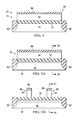
  • FIGS. 1A-11B illustrate process steps in the formation of a FinFET device on a substrate.
  • FIGS. 1A-11B showing the process steps in the formation of a FinFET device on a substrate. It will be noted that the illustrations are not necessarily presented to scale.
  • FIG. 1A shows a silicon on insulator (SOI) wafer 12 of a conventional type.
  • the wafer may comprise an ultra-thin body and buried oxide (UTBB) substrate.
  • the substrate wafer 12 comprises a top semiconductor (for example, silicon or silicon-germanium) layer 14 over an insulating (for example, silicon dioxide) layer (BOX) 16 over a bottom semiconductor (for example, silicon) substrate layer 18 .
  • the top semiconductor layer 14 may have a thickness of 5 nm to 100 nm
  • the insulating layer 16 may have a thickness of 5 nm to 100 nm
  • the bottom semiconductor substrate layer 18 may have a thickness of 100 microns to 800 microns.
  • the top semiconductor layer 14 and bottom semiconductor substrate layer 18 may be doped as appropriate for the integrated circuit application.
  • the thickness of the top and bottom semiconductor layers 14 and 18 may be tuned (for example, through the use of a thinning or epitaxy operation) as needed for the integrated circuit application.
  • the top semiconductor layer 14 may, in a preferred embodiment, have a fully depleted (FD) configuration.
  • FD fully depleted
  • a UTBB substrate is preferred, it will be understood that the substrate could comprise a silicon on insulator (SOI) substrate of any configuration including an extremely thin silicon on insulator (ETSOI) substrate.
  • FIG. 1B alternatively shows a starting bulk substrate wafer 12 ′.
  • the wafer 12 ′ comprises a semiconductor material layer 14 ′ doped as appropriate for the integrated circuit application.
  • the semiconductor material layer 14 ′ may comprise a number of epitaxially grown layers of semiconductor material.
  • FIG. 2A shows the deposit of a silicon nitride (SiN) layer 20 over the top of the layer 14 of wafer 12
  • FIG. 2B shows the deposit of a silicon nitride (SiN) layer 20 over the top of the layer 14 ′ of wafer 12 ′.
  • This layer 20 may have a thickness of 10 nm to 100 nm and may be deposited using well known process techniques such as PECVD or RTCVD. Although a SiN material is used for masking, it will be understood that the SiO 2 /SiN hard mask may alternatively be used.
  • FIGS. 3A and 3B illustrate perpendicular cross-sectional views of the wafer 12 .
  • a lithographic process as known in the art is then used to define the fins 50 for the FinFET devices.
  • the silicon nitride (SiN) layer 20 applied over the top surface of the top semiconductor layer 14 is lithographically patterned in a manner known in the art to leave SiN mask (cap 56 ) material at the desired locations of the fins 50 .
  • An etching operation is then performed to open apertures 52 in the top semiconductor layer 14 on either side of each fin 50 .
  • the apertures 52 further extend to a depth sufficient to reach the insulating layer 16 so as to ensure the fin depth passes completely through the top semiconductor layer 14 .
  • Each fin 50 is accordingly formed to include a region 54 made of the top semiconductor layer 14 over the insulating layer 16 with an overlying silicon nitride cap 56 .
  • the etching process may utilize a sidewall image transfer (SIT) process such as that described, for example, in U.S. Pat. No. 8,298,954, the disclosure of which is incorporated by reference.
  • SIT sidewall image transfer
  • FIGS. 3C and 3D illustrate perpendicular cross-sectional views of the wafer 12 ′.
  • a lithographic process as known in the art is used to define the fins 50 for the FinFET devices.
  • the silicon nitride (SiN) layer 20 applied over the top surface of the wafer 12 ′ is lithographically patterned in a manner known in the art to leave SiN mask material (cap 56 ) at the desired locations of the fins 50 .
  • An etching operation is then performed to open apertures 52 in the wafer 12 ′ on either side of each fin 50 .
  • the apertures 52 further extend to a targeted depth in the layer 14 ′ at least sufficient to define material for the fin.
  • the etching process may utilize a sidewall image transfer (SIT) process such as that described, for example, in U.S. Pat. No. 8,298,954, the disclosure of which is incorporated by reference.
  • SIT sidewall image transfer
  • any suitable technique known in the art may then be used on the wafer 12 ′ to form an insulating region 16 below each fin 50 so as to separate a region 54 made of semiconductor material layer 14 ′ (with an overlying silicon nitride cap 56 ) from a bottom portion of the layer 14 ′ referred to as a semiconductor substrate layer 18 .
  • the known bottom oxidation through STIs (BOTS) technique or silicon on nothing (SON) technique may be used to form the insulating region 16 .
  • BOTS bottom oxidation through STIs
  • SON silicon on nothing
  • a shallow trench isolation (STI) structure 60 is formed using conventional techniques well known to those skilled in the art.
  • trenches may be formed in the insulating layer 16 and bottom semiconductor substrate layer 18 which surround active regions of the wafer.
  • An etch for example comprising a reactive ion beam etching process (RIE as known in the art), may be used to open the trenches.
  • the trenches are then filled with an insulating material such a silicon dioxide using a HARP or TEOS or flowable oxide process (known in the art) followed by a high temperature anneal for densification.
  • the STI structure 60 may extend completely through the thickness of the bottom semiconductor substrate layer 18 .
  • the STI structures 60 could alternatively be formed before defining the fins.
  • STI formation before fin definition is not preferred as this may lead to issues with overlay. It is preferred to form the more dense structures (such as fins) first before forming other structures as this makes alignment easier.
  • a punch through stopper (PTS) implant 66 of arsenic, phosphorous, boron or indium dopant is made through the insulating layer 16 and into an upper surface of the bottom semiconductor substrate layer 18 .
  • PTS punch through stopper
  • an ion beam implantation process may be used to achieving the implant 66 .
  • This implant 66 is important to the operation of any resulting FinFET device because the implant functions to suppress leakage between source and drain during normal operation of the device.
  • n-type implantation 66 is used for isolating on p-channel devices and p-type implantation 66 is used for isolating on n-channel devices.
  • an oxide material layer 58 is formed on the exposed surfaces of the fin 54 .
  • This oxide layer 58 is deposited, for example, using low temperature atomic layer deposition (ALD), to form a gate oxide.
  • a deposition process well known in the art such CVD is used to blanket deposit a layer of polysilicon 70 over the wafer.
  • the material 70 may alternatively comprise amorphous silicon.
  • CMP chemical mechanical polishing
  • SiN silicon nitride
  • the oxide layer 58 and polysilicon layer 70 form structures known in the art as “dummy gate” structures. Accordingly, there is no need to dope the polysilicon 70 material.
  • the dummy gate structures will be subsequently removed later in the fabrication process and replaced with a gate stack defining the actual operating gate electrode of the FinFET device.
  • a lithographic process as known in the art is then used to define the dummy gate stack structures 80 for the FinFET devices.
  • the silicon nitride (SiN) layer 72 applied over the top surface of the polysilicon layer 70 is lithographically patterned to leave SiN mask material (cap 88 ) at the desired locations of the dummy gates.
  • a reactive ion etching (RIE) operation is then performed to open apertures 84 in the polysilicon layer 70 on either side of each dummy gate 80 .
  • the apertures 84 extend to a depth sufficient to reach the insulating layer 16 and separate the gates 80 but do not remove the material of the fin 50 .
  • Each dummy gate 80 is accordingly formed to include a region 86 made of the polysilicon layer 70 with an overlying silicon nitride cap 88 . The result is shown in FIGS. 7A and 7B .
  • a silicon nitride (SiN) material 90 is then deposited (for example, using an atomic layer deposition (ALD) process at low temperature) on the side walls of the polysilicon material defining the dummy gate stack structures 80 to form sidewall spacer structures.
  • ALD atomic layer deposition
  • the silicon material of the fins 50 which is present between dummy gate stack structures 80 is then removed.
  • an etch such as a wet HF etch or RIE process that is selective to nitride and oxide may be used to remove the silicon material.
  • FIGS. 9A, 9B and 9C wherein FIG. 9C shows a perspective view).
  • a further etch is then performed to remove the buried oxide layer 16 between gate stack structures 80 and stopping on bottom semiconductor substrate layer 18 .
  • an etch such as a wet HF etch or RIE process that is selective to nitride and silicon may be used to remove the oxide material.
  • FIGS. 10A and 10B wherein FIG. 10B shows a perspective view).
  • FIGS. 11A and 11B show a perspective view.
  • a first epitaxial growth layer 100 may be provided followed by a second epitaxial growth layer 102 .
  • the first layer may have a thickness of 5 nm to 100 nm and the second layer may have a thickness of 5 nm to 100 nm.
  • One or both of the epitaxial growth layers 100 and 102 may be undoped.
  • one or both of the epitaxial growth layers 100 and 102 may be in-situ doped.
  • the first epitaxial growth layer 100 may comprise an undoped buffer layer.
  • the layer 100 may comprise undoped silicon-germanium (SiGe).
  • the layer 100 may comprise undoped silicon-carbide (SiC).
  • This layer 100 is provided for junction leakage control and to apply strain to the channel provided by the fin 50 .
  • the second epitaxial growth layer 102 may comprise a low resistivity in-situ doped layer.
  • the layer 102 may comprise silicon-germanium (SiGe) doped with Boron.
  • the layer 102 may comprise silicon-carbide (SiC) doped with Phosphorous.
  • the layers 100 and 102 define the source-drain regions of the device in contact with the bottom semiconductor substrate layer 18 and the regions 54 .
  • the remaining steps performed to complete transistor fabrication include: 1) after completing the epitaxial growth, a thick oxide is deposited over the wafer; 2) a planarization process, such as CMP, is performed stopping on the dummy gate polysilicon material 86 ; 3) a selective removal process is performed to remove the dummy gate polysilicon material 86 and dummy gate oxide material 58 ; 4) the resulting opening is then filled with a gate stack; and 5) final contact processing is performed followed by back-end-of-line (BEOL) processing for metallization layer definition to finish fabrication of the device.
  • the resulting FinFET device will have a structure like that shown in FIGS. 11A and 11B except that the dummy gate material 86 and dummy gate oxide material 58 will be replaced with, for example, a gate stack including an insulating material and a gate electrode.
  • the process for FinFET formation disclosed herein is fully compatible with the formation of silicon-germanium (SiGe) fins.
  • SiGe silicon-germanium
  • portions of the silicon substrate may be replaced with SiGe regions. This can be accomplished in a number of ways known to those skilled in the art, including: removal of silicon material 14 with growth of SiGe or SiGe deposition to make the SiGe regions.
  • the remaining process steps as described above are then performed to fabricate fins of silicon material for n-channel devices and fins of silicon-germanium material for p-channel devices.
  • the process will support the formation of CMOS circuitry.
  • the process for FinFET formation disclosed herein possesses a number of advantages over prior art processes including: a) the process allows for control to be exercised over the thickness uniformity of the dielectric material and silicon fin material; b) the process utilizes a starting FDSOI substrate that is already in use in semiconductor processing; c) the process advantageously uses an undoped silicon channel so as to enable production with low device variability; d) known process steps implemented in a unique way provide for implementation of partial isolation of the fins; e) the FDSOI wafer may advantageously use either silicon-germanium based silicon on insulator (SGOI) substrate wafers or silicon-based silicon on insulator (SOI) substrate wafers in order to address design concerns with respect to mobility enhancement; and f) rotated or (110) orientation wafers may be used with the process to address concerns with epitaxy defect control.
  • SGOI silicon-germanium based silicon on insulator
  • SOI silicon-based silicon on insulator

Landscapes

  • Engineering & Computer Science (AREA)
  • Physics & Mathematics (AREA)
  • Microelectronics & Electronic Packaging (AREA)
  • General Physics & Mathematics (AREA)
  • Manufacturing & Machinery (AREA)
  • Computer Hardware Design (AREA)
  • Condensed Matter Physics & Semiconductors (AREA)
  • Power Engineering (AREA)
  • Thin Film Transistor (AREA)
  • High Energy & Nuclear Physics (AREA)
  • Chemical & Material Sciences (AREA)
  • Chemical Kinetics & Catalysis (AREA)
  • Health & Medical Sciences (AREA)
  • Toxicology (AREA)

Abstract

A semiconductor material is patterned to define elongated fins insulated from an underlying substrate. A polysilicon semiconductor material is deposited over and in between the elongated fins, and is patterned to define elongated gates extending to perpendicularly cross over the elongated fins at a transistor channel. Sidewall spacers are formed on side walls of the elongated gates. Portions of the elongated fins located between the elongated gates are removed, along with the underlying insulation, to expose the underlying substrate. One or more semiconductor material layers are then epitaxially grown from the underlying substrate at locations between the elongated gates. The one or more semiconductor material layers may include an undoped epi-layer and an overlying doped epi-layer. The epitaxial material defines a source or drain of the transistor.

Description

TECHNICAL FIELD
The present invention relates to integrated circuits and, in particular, to a process for the formation of FinFET-type integrated circuit devices and a device produced by such a process.
BACKGROUND
The prior art teaches the formation of integrated circuits which utilize one or more FinFET type field effect transistors. The FinFET transistor comprises a channel region which is oriented to conduct an electrical current parallel to the surface of the substrate. The channel region is provided in an elongated section of semiconductor material referred to as a fin. The source and drain regions of the transistor are typically also formed in the elongated section on either side of the channel region. A gate is placed over and on both opposed sides of the elongated section at the location of the channel region to provide control over the conductive state of the transistor. This FinFET design is well suited for manufacturing a multi-channel transistor in which multiple elongated sections are formed in parallel to define neighboring channel regions that are separated from each other by an intermediate gate portion of the transistor gate spanning with a perpendicular orientation over the multiple elongated sections.
A FinFET transistor is created from at least one thin portion (referred to as the “fin”) of semiconductor material defining the elongated section used to form the channel of the transistor and also its source and drain zones. This fin is typically defined by a mask that is formed on top of a monocrystalline silicon substrate at the position of the fin. The substrate material is then directionally etched where there is no mask, to a determined depth, such that the elongated section defining the fin remains under the mask and is composed of the substrate material.
In one prior art implementation, the fin of semiconductor material which is thus obtained, and which comprises the channel of the final transistor, is not electrically insulated from the active portion of the circuit substrate, which itself is also of crystalline semiconductor material. Such a FinFET device suffers from three distinct types of leakage current. A first type of leakage current can circulate between the source and drain of the FinFET transistor, via the active portion of the substrate situated below the channel. This first leakage current, internal to each transistor, is not controlled by the potential applied to the transistor gate. A second type of leakage current arises because the channel of the FinFET transistor is also in electrical contact with the channels of other transistors of the same conductivity type via the substrate. The second leakage current flows between transistors in the form of an inter-transistor leakage current. A third type of leakage current appears between the channel of each FinFET transistor and a lower part of the substrate in response to the substrate being connected to a reference potential.
To address the leakage current issues noted above, procedures for dielectrically isolating the fin are known in the art.
In one technique, referred to as bottom oxidation through STIs (BOTS), shallow trench isolation (STI) structures are formed on either side of the fin. The silicon material of the fin is protected on a top side by barrier layer (for example, of silicon nitride) and the upper lateral sides of the fin are isolated from the STI structures by another barrier layer (also, for example, of silicon nitride). The integrated circuit wafer is then subjected to an oxidation process. The barrier layers function as oxygen (O2) barriers and only a lower (unprotected) portion of the fin (below the lateral barrier layers) is converted to a thermal oxide material which isolates the upper portion of the fin from the underlying substrate material. This process produces an undesirable scalloped interface shape at the bottom of the fin (due to the nature of the thermal oxide growth). Additionally, the process is not compatible with fins made of silicon-germanium (SiGe), and thus cannot be advantageously used when forming p-channel SiGe FinFET devices.
In another technique, referred to silicon on nothing (SON), a bottom portion of the fin is formed of silicon-germanium while an upper portion of the fin is formed of silicon. A selective etch is performed to remove the bottom SiGe portion to open a region between the underside of the Si fin and the underlying substrate. A dielectric material fill operation is then performed to fill the opened region with an insulating material. This process presents mechanical stability issues with respect to the Si fin. Additionally, complete fill of the opened region with the insulating material cannot be assured, and any voids will accordingly present tunnel fill conformality issues.
To avoid leakage currents, it is known in the art to fabricate the FinFET transistor on an integrated circuit substrate which is of the Silicon-on-Insulator (SOI) type (as opposed to the use of bulk semiconductor substrates). An SOI substrate is formed of a top semiconductor (for example, silicon or silicon-germanium) layer over an insulating (for example, silicon dioxide) layer over a bottom semiconductor (for example, silicon) substrate layer. Reference is made to U.S. Pat. No. 6,645,797, the disclosure of which is incorporated by reference, which teaches a process for realizing a FinFET transistor from an SOI substrate. The transistor which is obtained is electrically insulated from the lower part of the substrate by the intermediate layer of insulating material, and thus leakage current concerns are reduced.
Further substrate development has reduced the thickness of the intervening insulating layer to about 50 nm to produce a substrate for use in transistor fabrication that is referred to as an extremely thin silicon on insulator (ETSOI) substrate. Still further substrate development has reduced the thicknesses of all substrate layers to produce a substrate for use in transistor fabrication that is referred to an ultra-thin body and buried oxide (UTBB) substrate where the thickness of the intervening insulating layer is about 25 nm (or less) and the thickness of the top semiconductor layer is about 5 nm to 10 nm. All of these substrates may more generally be referred to as SOI substrates.
The FinFET transistor implemented on an SOI substrate is considered by those skilled in the art as an attractive option for use in connection with circuits fabricated at aggressively scaled process technology nodes, and in particular is well suited for use in CMOS integrated circuit designs. Superior short channel control along with higher performance in comparison to conventional planar bulk devices are recognized as advantages associated with the selection of the FinFET for CMOS circuits.
Notwithstanding the foregoing, it is difficult with the SOI implementation to introduce stress to the channel region. There is a need in the art to provide both some form of fin isolation and further add stress to the channel.
SUMMARY
An embodiment forms a FinFET transistor with only a partial dielectric isolation of the fin. In this regard, the fin is considered to be partially isolated when only the channel portion of the fin (under the gate) is isolated from the underlying substrate but the source-drain regions are otherwise in contact with the substrate. To achieve this structure, the fin material outside of the channel region is removed and a subsequent regrowth of semiconductor material, for example using epitaxy, is performed on either side of the gate to define source and drain regions. The advantage of this fabrication technique is that the epitaxially grown source and drain regions on either side of the gate can add stress to the channel region formed by the fin while the channel remains isolated from the underlying substrate.
In an embodiment, an upper semiconductor material layer of a silicon on insulator (SOI) substrate is patterned to define elongated fins. A polysilicon semiconductor material layer is then deposited over and in between the elongated fins. This polysilicon material layer is then patterned to define elongated gates extending to perpendicularly cross over the elongated fins. Sidewall spacers are formed on side walls of the elongated gates. Portions of the elongated fins located between the elongated gates are then removed, along with an underlying insulating layer of the SOI substrate, to expose an underlying semiconductor material layer. One or more semiconductor material layers are then epitaxially grown from the underlying semiconductor material layer at locations between the elongated gates. The one or more semiconductor material layers may include an undoped epi-layer and an overlying doped epi-layer. These epitaxially grown structures form source-drain regions of a transistor device.
In an embodiment, a method comprises: on a substrate comprising a layer of a first semiconductor material, patterning the first semiconductor material to form a plurality of elongated fins; depositing a second semiconductor material over and in between the plurality of elongated fins; patterning the second semiconductor material to form a plurality of elongated gates extending to cross over the plurality of elongated fins; forming sidewall spacers on side walls of the elongated gates; removing the first semiconductor material of the elongated fins located between the elongated gates; and epitaxially growing additional semiconductor material between the elongated gates.
In an embodiment, a FinFET device comprises: a substrate supporting a plurality of elongated fins formed of a first semiconductor material; a plurality of elongated gates formed of a second semiconductor material, said elongated gates extending to cross over the plurality of elongated fins; sidewall spacers on side walls of the elongated gates; wherein first semiconductor material of the elongated fins located between the elongated gates has been removed; and epitaxial semiconductor material is present between the elongated gates.
In an embodiment, a method comprises: patterning a first semiconductor material to form an elongated fin that is isolated from an underlying substrate material by an insulating layer; forming an elongated gate structure extending to cross over the elongated fin; forming sidewall spacers on side walls of the elongated gate; removing portions of the elongated fin that are located on each side of, but not under, the elongated gate; removing portions of the insulating layer that are located on each side of, but not under, the elongated gate to expose a top surface of the underlying substrate material; and epitaxially growing additional semiconductor material from the exposed top surface of the underlying substrate material on each side of the elongated gate to provide source and drain regions in contact with a channel region formed by a portion of the elongated fin located under the elongated gate.
In an embodiment, a method comprises: patterning a first semiconductor material to form an elongated fin that is isolated from an underlying substrate material by an insulating layer; forming an elongated gate structure extending to cross over the elongated fin; forming sidewall spacers on side walls of the elongated gate; removing portions of the elongated fin that are located on each side of, but not under, the elongated gate; and epitaxially growing additional semiconductor material each side of the elongated gate to provide source and drain regions in contact with a channel region formed by a portion of the elongated fin located under the elongated gate. The step of epitaxially growing comprises: epitaxially growing a first epitaxial layer made of a first material; and epitaxially growing a second epitaxial layer made of a second material on said first epitaxial layer.
BRIEF DESCRIPTION OF THE DRAWINGS
For a better understanding of the embodiments, reference will now be made by way of example only to the accompanying figures in which:
FIGS. 1A-11B illustrate process steps in the formation of a FinFET device on a substrate.
DETAILED DESCRIPTION OF THE DRAWINGS
Reference is now made to FIGS. 1A-11B showing the process steps in the formation of a FinFET device on a substrate. It will be noted that the illustrations are not necessarily presented to scale.
FIG. 1A shows a silicon on insulator (SOI) wafer 12 of a conventional type. For example, the wafer may comprise an ultra-thin body and buried oxide (UTBB) substrate. The substrate wafer 12 comprises a top semiconductor (for example, silicon or silicon-germanium) layer 14 over an insulating (for example, silicon dioxide) layer (BOX) 16 over a bottom semiconductor (for example, silicon) substrate layer 18. With a UTBB substrate, for example, the top semiconductor layer 14 may have a thickness of 5 nm to 100 nm, the insulating layer 16 may have a thickness of 5 nm to 100 nm, and the bottom semiconductor substrate layer 18 may have a thickness of 100 microns to 800 microns. The top semiconductor layer 14 and bottom semiconductor substrate layer 18 may be doped as appropriate for the integrated circuit application. The thickness of the top and bottom semiconductor layers 14 and 18 may be tuned (for example, through the use of a thinning or epitaxy operation) as needed for the integrated circuit application. The top semiconductor layer 14 may, in a preferred embodiment, have a fully depleted (FD) configuration. Although a UTBB substrate is preferred, it will be understood that the substrate could comprise a silicon on insulator (SOI) substrate of any configuration including an extremely thin silicon on insulator (ETSOI) substrate.
FIG. 1B alternatively shows a starting bulk substrate wafer 12′. The wafer 12′ comprises a semiconductor material layer 14′ doped as appropriate for the integrated circuit application. The semiconductor material layer 14′ may comprise a number of epitaxially grown layers of semiconductor material.
FIG. 2A shows the deposit of a silicon nitride (SiN) layer 20 over the top of the layer 14 of wafer 12, and FIG. 2B shows the deposit of a silicon nitride (SiN) layer 20 over the top of the layer 14′ of wafer 12′. This layer 20 may have a thickness of 10 nm to 100 nm and may be deposited using well known process techniques such as PECVD or RTCVD. Although a SiN material is used for masking, it will be understood that the SiO2/SiN hard mask may alternatively be used.
Reference is now made to FIGS. 3A and 3B which illustrate perpendicular cross-sectional views of the wafer 12. A lithographic process as known in the art is then used to define the fins 50 for the FinFET devices. The silicon nitride (SiN) layer 20 applied over the top surface of the top semiconductor layer 14 is lithographically patterned in a manner known in the art to leave SiN mask (cap 56) material at the desired locations of the fins 50. An etching operation is then performed to open apertures 52 in the top semiconductor layer 14 on either side of each fin 50. The apertures 52 further extend to a depth sufficient to reach the insulating layer 16 so as to ensure the fin depth passes completely through the top semiconductor layer 14. Each fin 50 is accordingly formed to include a region 54 made of the top semiconductor layer 14 over the insulating layer 16 with an overlying silicon nitride cap 56. In a preferred implementation, the etching process may utilize a sidewall image transfer (SIT) process such as that described, for example, in U.S. Pat. No. 8,298,954, the disclosure of which is incorporated by reference.
FIGS. 3C and 3D illustrate perpendicular cross-sectional views of the wafer 12′. A lithographic process as known in the art is used to define the fins 50 for the FinFET devices. The silicon nitride (SiN) layer 20 applied over the top surface of the wafer 12′ is lithographically patterned in a manner known in the art to leave SiN mask material (cap 56) at the desired locations of the fins 50. An etching operation is then performed to open apertures 52 in the wafer 12′ on either side of each fin 50. The apertures 52 further extend to a targeted depth in the layer 14′ at least sufficient to define material for the fin. In a preferred implementation, the etching process may utilize a sidewall image transfer (SIT) process such as that described, for example, in U.S. Pat. No. 8,298,954, the disclosure of which is incorporated by reference.
Any suitable technique known in the art may then be used on the wafer 12′ to form an insulating region 16 below each fin 50 so as to separate a region 54 made of semiconductor material layer 14′ (with an overlying silicon nitride cap 56) from a bottom portion of the layer 14′ referred to as a semiconductor substrate layer 18. For example, the known bottom oxidation through STIs (BOTS) technique or silicon on nothing (SON) technique may be used to form the insulating region 16. The result of the fin insulating process produces a structure as generally shown in FIG. 3B.
Given that the wafers 12 and 12′ at this point have a same or very similar structure, the remainder of the process description will be provided with the understanding that the process started from either an SOI substrate wafer 12 or a bulk substrate wafer 12′ (with a general reference being made to the “wafer”) and continues from the structure illustrated in FIG. 3B.
With reference to FIG. 4, a shallow trench isolation (STI) structure 60 is formed using conventional techniques well known to those skilled in the art. As an example, trenches may be formed in the insulating layer 16 and bottom semiconductor substrate layer 18 which surround active regions of the wafer. An etch, for example comprising a reactive ion beam etching process (RIE as known in the art), may be used to open the trenches. The trenches are then filled with an insulating material such a silicon dioxide using a HARP or TEOS or flowable oxide process (known in the art) followed by a high temperature anneal for densification. In an embodiment as illustrated, the STI structure 60 may extend completely through the thickness of the bottom semiconductor substrate layer 18.
It will be understood by those skilled in the art that the STI structures 60 could alternatively be formed before defining the fins. However, STI formation before fin definition is not preferred as this may lead to issues with overlay. It is preferred to form the more dense structures (such as fins) first before forming other structures as this makes alignment easier.
With reference to FIGS. 5A and 5B, a punch through stopper (PTS) implant 66 of arsenic, phosphorous, boron or indium dopant is made through the insulating layer 16 and into an upper surface of the bottom semiconductor substrate layer 18. For example, an ion beam implantation process may be used to achieving the implant 66. This implant 66 is important to the operation of any resulting FinFET device because the implant functions to suppress leakage between source and drain during normal operation of the device. For example, n-type implantation 66 is used for isolating on p-channel devices and p-type implantation 66 is used for isolating on n-channel devices.
With reference to FIGS. 6A and 6B, after removal of the cap 56 (using, for example, using a selective etch of H3PO4 for the SiN cap, HF or COR or SiCoNi for the SiO2 cap), an oxide material layer 58 is formed on the exposed surfaces of the fin 54. This oxide layer 58 is deposited, for example, using low temperature atomic layer deposition (ALD), to form a gate oxide. A deposition process well known in the art such CVD is used to blanket deposit a layer of polysilicon 70 over the wafer. The material 70 may alternatively comprise amorphous silicon. Following planarization, for example using chemical mechanical polishing (CMP), a silicon nitride (SiN) layer 72 is deposited over the polysilicon layer 70.
As understood by those skilled in the art, the oxide layer 58 and polysilicon layer 70 form structures known in the art as “dummy gate” structures. Accordingly, there is no need to dope the polysilicon 70 material. The dummy gate structures will be subsequently removed later in the fabrication process and replaced with a gate stack defining the actual operating gate electrode of the FinFET device.
A lithographic process as known in the art is then used to define the dummy gate stack structures 80 for the FinFET devices. The silicon nitride (SiN) layer 72 applied over the top surface of the polysilicon layer 70 is lithographically patterned to leave SiN mask material (cap 88) at the desired locations of the dummy gates. A reactive ion etching (RIE) operation is then performed to open apertures 84 in the polysilicon layer 70 on either side of each dummy gate 80. The apertures 84 extend to a depth sufficient to reach the insulating layer 16 and separate the gates 80 but do not remove the material of the fin 50. Each dummy gate 80 is accordingly formed to include a region 86 made of the polysilicon layer 70 with an overlying silicon nitride cap 88. The result is shown in FIGS. 7A and 7B.
A silicon nitride (SiN) material 90 is then deposited (for example, using an atomic layer deposition (ALD) process at low temperature) on the side walls of the polysilicon material defining the dummy gate stack structures 80 to form sidewall spacer structures. The result is shown in FIG. 8.
The silicon material of the fins 50 which is present between dummy gate stack structures 80 is then removed. As an example, an etch such as a wet HF etch or RIE process that is selective to nitride and oxide may be used to remove the silicon material. The result is shown in FIGS. 9A, 9B and 9C (wherein FIG. 9C shows a perspective view).
A further etch is then performed to remove the buried oxide layer 16 between gate stack structures 80 and stopping on bottom semiconductor substrate layer 18. As an example, an etch such as a wet HF etch or RIE process that is selective to nitride and silicon may be used to remove the oxide material. The result is shown in FIGS. 10A and 10B (wherein FIG. 10B shows a perspective view).
Using an epitaxial process tool, an epitaxial growth process as known in the art is then performed to grow multiple epitaxial layers from the exposed bottom semiconductor substrate layer 18 in the area between dummy gate stack structures 80. The result is shown in FIGS. 11A and 11B (wherein FIG. 11B shows a perspective view). For example, a first epitaxial growth layer 100 may be provided followed by a second epitaxial growth layer 102. The first layer may have a thickness of 5 nm to 100 nm and the second layer may have a thickness of 5 nm to 100 nm. One or both of the epitaxial growth layers 100 and 102 may be undoped. Alternatively, one or both of the epitaxial growth layers 100 and 102 may be in-situ doped. As an example, the first epitaxial growth layer 100 may comprise an undoped buffer layer. For example, the layer 100 may comprise undoped silicon-germanium (SiGe). For example, the layer 100 may comprise undoped silicon-carbide (SiC). This layer 100 is provided for junction leakage control and to apply strain to the channel provided by the fin 50. As a further example, the second epitaxial growth layer 102 may comprise a low resistivity in-situ doped layer. For example, the layer 102 may comprise silicon-germanium (SiGe) doped with Boron. For example, the layer 102 may comprise silicon-carbide (SiC) doped with Phosphorous. The layers 100 and 102 define the source-drain regions of the device in contact with the bottom semiconductor substrate layer 18 and the regions 54.
The remaining steps performed to complete transistor fabrication include: 1) after completing the epitaxial growth, a thick oxide is deposited over the wafer; 2) a planarization process, such as CMP, is performed stopping on the dummy gate polysilicon material 86; 3) a selective removal process is performed to remove the dummy gate polysilicon material 86 and dummy gate oxide material 58; 4) the resulting opening is then filled with a gate stack; and 5) final contact processing is performed followed by back-end-of-line (BEOL) processing for metallization layer definition to finish fabrication of the device. In this regard, the resulting FinFET device will have a structure like that shown in FIGS. 11A and 11B except that the dummy gate material 86 and dummy gate oxide material 58 will be replaced with, for example, a gate stack including an insulating material and a gate electrode.
The process for FinFET formation disclosed herein is fully compatible with the formation of silicon-germanium (SiGe) fins. At the level of the layer 14, portions of the silicon substrate may be replaced with SiGe regions. This can be accomplished in a number of ways known to those skilled in the art, including: removal of silicon material 14 with growth of SiGe or SiGe deposition to make the SiGe regions. The remaining process steps as described above are then performed to fabricate fins of silicon material for n-channel devices and fins of silicon-germanium material for p-channel devices. By providing silicon regions and silicon-germanium regions on a same wafer, the process will support the formation of CMOS circuitry.
The process for FinFET formation disclosed herein possesses a number of advantages over prior art processes including: a) the process allows for control to be exercised over the thickness uniformity of the dielectric material and silicon fin material; b) the process utilizes a starting FDSOI substrate that is already in use in semiconductor processing; c) the process advantageously uses an undoped silicon channel so as to enable production with low device variability; d) known process steps implemented in a unique way provide for implementation of partial isolation of the fins; e) the FDSOI wafer may advantageously use either silicon-germanium based silicon on insulator (SGOI) substrate wafers or silicon-based silicon on insulator (SOI) substrate wafers in order to address design concerns with respect to mobility enhancement; and f) rotated or (110) orientation wafers may be used with the process to address concerns with epitaxy defect control.
The foregoing description has provided by way of exemplary and non-limiting examples a full and informative description of the exemplary embodiment of this invention. However, various modifications and adaptations may become apparent to those skilled in the relevant arts in view of the foregoing description, when read in conjunction with the accompanying drawings and the appended claims. However, all such and similar modifications of the teachings of this invention will still fall within the scope of this invention as defined in the appended claims.

Claims (23)

The invention claimed is:
1. A device, comprising:
a substrate having a surface;
an insulator layer on a first portion of the surface of the substrate;
a plurality of fins formed from a semiconductor material on the insulator layer, the fins having a first end and a second end that is opposite from the first end along a first direction, the plurality of fins being spaced from each other along a second direction that is transverse to the first direction, each fin having a first surface and a second surface, the first surface being in direct contact with the insulator layer, the first surface being separated from the surface of the substrate by the insulator layer;
an epitaxial layer extending in the first direction and the second direction between, and in direct contact with, each fin of the plurality of fins;
a gate structure formed on the plurality of fins having a longest dimension that extends along the second direction; and
first and second sidewalls on the gate structure, the first sidewall having an outer surface that is substantially coplanar with the first end of the plurality of fins.
2. The device of claim 1 wherein in a first location the first and second sidewalls extend from the insulator layer to a top surface of the gate structure and in a second location the sidewalls extend from the second surface of the plurality of fins to the top surface of the gate structure.
3. The device of claim 1 wherein the gate structure includes a dielectric layer on the plurality of fins, a conductive layer on the dielectric layer, and a cap on the conductive layer.
4. The device of claim 3 wherein the conductive layer is polysilicon.
5. The device of claim 3 wherein the cap is silicon nitride.
6. The device of claim 3 wherein the first and second sidewalls completely cover sidewalls of the conductive layer.
7. The device of claim 6 wherein the first and second sidewalls include an upper portion and a lower portion, the lower portion being positioned between the plurality of fins.
8. The device of claim 7 wherein the upper portion is continuous and is adjacent to the gate structure.
9. A device, comprising:
a semiconductor substrate;
a first and second isolation region in the substrate;
a first insulator layer on a first portion of the substrate;
a second insulator layer on a second portion of the substrate;
a first plurality of fins spaced from each other on the substrate along a first direction, the first plurality of fins having first ends and second ends along a second direction that is transverse to the first direction, each fin having a top surface and a bottom surface, the bottom surface of each fin of the first plurality of fins separated from the substrate by the first insulator layer;
a second plurality of fins spaced from each other on the substrate along the first direction and spaced from the first plurality of fins along the second direction, the second plurality of fins having first ends and second ends along the second direction, each fin having a top surface and a bottom surface, the bottom surface of each fin of the second plurality of fins separated from the substrate by the second insulator layer;
a first epitaxial layer extending between, and in direct contact with, each of the first and second insulator layers;
a second epitaxial layer on the first epitaxial layer, the second epitaxial layer extending between, and in direct contact with, each fin of the first plurality of fins and each fin of the second plurality of fins;
a first gate structure on the first plurality of fins having a longest dimension that extends along the first direction;
a second gate structure on the second plurality of fins having a longest dimension that extends along the first direction;
first sidewalls on the first gate structure and the first plurality of fins, the first sidewalls extending from the bottom surface, past the top surface of each fin of the first plurality of fins to a top surface of the first gate structure;
second sidewalls on the second gate structure and the second plurality of fins, the second sidewalls extending from the bottom surface, past the top surface of each fin of the second plurality of fins to a top surface of the second gate structure; and
third sidewalls on the first gate structure, the third side sidewalls extending from a top surface of the second epitaxial layer to a top surface of the first gate structure.
10. The device of claim 9 wherein the first end of each fin of the first plurality of fins is coplanar with a first surface of the first sidewalls.
11. The device of claim 10 wherein the first surface of the first sidewalls faces the second gate structure.
12. The device of claim 9 wherein the first end of each fin of the second plurality of fins is coplanar with a first surface of the second sidewalls.
13. The device of claim 12 wherein the first ends of the first plurality of fins face the first ends of the second plurality of fins.
14. The device of claim 13 wherein the second ends of the first plurality of fins and the second plurality of fins face away from the respective first ends of the first plurality of fins and the second plurality of fins.
15. The device of claim 9 wherein the semiconductor substrate includes a doped region between the first and second isolation regions.
16. A device, comprising:
a substrate having a surface;
an insulation layer on the surface of the substrate;
a first plurality of fins formed on and extending from the insulation layer, the first plurality of fins aligned with each other along a first direction, each fin having a first dimension along a second direction that is transverse to the first direction and a first end and a second end, the first end attached to the insulation layer and spaced from the substrate by the insulation layer;
a first gate structure on the first plurality of fins, the first gate structure extending along the first direction on top of the first plurality of fins, the first gate structure having a second dimension along the second direction, the second dimension being smaller than the first dimension, the first gate structure including:
a first conductive layer;
a first dielectric layer on top and side surfaces of each fin and positioned between the first conductive layer and each fin, the first dielectric layer extending from the first end to the second end of each fin; and
a first sidewall structure on the first gate structure and on the first plurality of fins, the first sidewall structure extending only from a top surface of each fin of the first plurality of fins to a top surface a the first gate structure.
17. The device of claim 16 wherein the first sidewall structure includes a third dimension along the second direction, a sum of the second and third dimensions being substantially equal to the first dimension.
18. The device of claim 16 wherein the first dielectric layer has a third dimension and the conductive layer has a fourth dimension, the third and fourth dimensions each along the second direction and being substantially equal to the second dimension.
19. The device of claim 16, further comprising:
a second plurality of fins on the substrate and aligned with each other along the first direction, the second plurality of fins being spaced from the first plurality of fins along the second direction, each fin having a third dimension along the second direction;
a second gate structure on the second plurality of fins, the second gate structure extending along the first direction, the second gate structure having a fourth dimension along the second direction, the fourth dimension being smaller than the third dimension.
20. A device, comprising:
a substrate;
a dielectric layer on the substrate;
a plurality of fins formed from a semiconductor material on the dielectric layer, the plurality of fins being spaced from each other along a first direction, each fin having a first end and a second end, the first end being in contact with the dielectric layer and the first end being spaced from the substrate by the dielectric layer;
a gate structure formed on the plurality of fins and having a longest dimension that extends along the first direction; and
sidewalls on the gate structure comprising a first sidewall and a second sidewall, wherein each fin of the plurality of fins terminates at the first sidewall, the second sidewall extending from a top surface of each fin of the plurality of fins to a top surface of the gate structure.
21. The device of claim 20 wherein each fin has a first dimension along a second direction that is transverse to the first direction and the gate structure has a second dimension along the second direction, the first dimension being larger than the second dimension.
22. The device of claim 21, further comprising a doped region in the substrate positioned below the plurality of fins.
23. The device of claim 22 wherein the first sidewall and the second sidewall extend to cover a top surface of the plurality of fins.
US15/169,462 2013-12-05 2016-05-31 FinFET device having a partially dielectric isolated fin structure Active 2033-12-18 US10199392B2 (en)

Priority Applications (1)

Application Number Priority Date Filing Date Title
US15/169,462 US10199392B2 (en) 2013-12-05 2016-05-31 FinFET device having a partially dielectric isolated fin structure

Applications Claiming Priority (3)

Application Number Priority Date Filing Date Title
US14/097,570 US9136384B2 (en) 2013-12-05 2013-12-05 Method for the formation of a FinFET device having partially dielectric isolated Fin structure
US14/822,959 US9385051B2 (en) 2013-12-05 2015-08-11 Method for the formation of a FinFET device having partially dielectric isolated fin structure
US15/169,462 US10199392B2 (en) 2013-12-05 2016-05-31 FinFET device having a partially dielectric isolated fin structure

Related Parent Applications (1)

Application Number Title Priority Date Filing Date
US14/822,959 Continuation US9385051B2 (en) 2013-12-05 2015-08-11 Method for the formation of a FinFET device having partially dielectric isolated fin structure

Publications (2)

Publication Number Publication Date
US20160276371A1 US20160276371A1 (en) 2016-09-22
US10199392B2 true US10199392B2 (en) 2019-02-05

Family

ID=53272027

Family Applications (3)

Application Number Title Priority Date Filing Date
US14/097,570 Active 2034-01-18 US9136384B2 (en) 2013-12-05 2013-12-05 Method for the formation of a FinFET device having partially dielectric isolated Fin structure
US14/822,959 Active US9385051B2 (en) 2013-12-05 2015-08-11 Method for the formation of a FinFET device having partially dielectric isolated fin structure
US15/169,462 Active 2033-12-18 US10199392B2 (en) 2013-12-05 2016-05-31 FinFET device having a partially dielectric isolated fin structure

Family Applications Before (2)

Application Number Title Priority Date Filing Date
US14/097,570 Active 2034-01-18 US9136384B2 (en) 2013-12-05 2013-12-05 Method for the formation of a FinFET device having partially dielectric isolated Fin structure
US14/822,959 Active US9385051B2 (en) 2013-12-05 2015-08-11 Method for the formation of a FinFET device having partially dielectric isolated fin structure

Country Status (1)

Country Link
US (3) US9136384B2 (en)

Families Citing this family (7)

* Cited by examiner, † Cited by third party
Publication number Priority date Publication date Assignee Title
US9812336B2 (en) * 2013-10-29 2017-11-07 Globalfoundries Inc. FinFET semiconductor structures and methods of fabricating same
US9391173B2 (en) * 2014-04-22 2016-07-12 International Business Machines Corporation FinFET device with vertical silicide on recessed source/drain epitaxy regions
US9847333B2 (en) * 2015-03-09 2017-12-19 Globalfoundries Inc. Reducing risk of punch-through in FinFET semiconductor structure
US9576954B1 (en) * 2015-09-23 2017-02-21 International Business Machines Corporation POC process flow for conformal recess fill
US9722079B2 (en) 2015-10-15 2017-08-01 Taiwan Semiconductor Manufacturing Co., Ltd. Fin-type field effect transistor structure and manufacturing method thereof
US9680019B1 (en) * 2016-07-20 2017-06-13 Globalfoundries Inc. Fin-type field-effect transistors with strained channels
KR102544153B1 (en) * 2017-12-18 2023-06-14 삼성전자주식회사 Semiconductor device and method for fabricating the same

Citations (12)

* Cited by examiner, † Cited by third party
Publication number Priority date Publication date Assignee Title
US6177318B1 (en) * 1999-10-18 2001-01-23 Halo Lsi Design & Device Technology, Inc. Integration method for sidewall split gate monos transistor
US6645797B1 (en) 2002-12-06 2003-11-11 Advanced Micro Devices, Inc. Method for forming fins in a FinFET device using sacrificial carbon layer
US20050026377A1 (en) * 2003-07-31 2005-02-03 Hirohisa Kawasaki Semiconductor device with silicon-film fins and method of manufacturing the same
US20080001176A1 (en) * 2006-06-29 2008-01-03 Kailash Gopalakrishnan Multi-bit high-density memory device and architecture and method of fabricating multi-bit high-density memory devices
US20080224183A1 (en) 2005-12-12 2008-09-18 Muhammad Nawaz Method for Manufacturing a Compound Semiconductor Field Effect Transistor Having a Fin Structure, and Compound Semiconductor Field Effect Transistor Having a Fin Structure
US20090095980A1 (en) 2007-10-16 2009-04-16 Chen-Hua Yu Reducing Resistance in Source and Drain Regions of FinFETs
US20100163971A1 (en) 2008-12-31 2010-07-01 Shih-Ting Hung Dielectric Punch-Through Stoppers for Forming FinFETs Having Dual Fin Heights
US20130082304A1 (en) * 2011-10-04 2013-04-04 Taiwan Semiconductor Manufacturing Company, Ltd. FinFET Device and Method Of Manufacturing Same
US20140284667A1 (en) 2013-03-20 2014-09-25 International Business Machines Corporation Finfet with reduced capacitance
US20150001591A1 (en) 2013-06-26 2015-01-01 GlobalFoundries, Inc. Bulk finfet with partial dielectric isolation featuring a punch-through stopping layer under the oxide
US20150014773A1 (en) 2013-07-12 2015-01-15 International Business Machines Corporation Partial FIN On Oxide For Improved Electrical Isolation Of Raised Active Regions
US8969974B2 (en) 2012-06-14 2015-03-03 Taiwan Semiconductor Manufacturing Company, Ltd. Structure and method for FinFET device

Patent Citations (12)

* Cited by examiner, † Cited by third party
Publication number Priority date Publication date Assignee Title
US6177318B1 (en) * 1999-10-18 2001-01-23 Halo Lsi Design & Device Technology, Inc. Integration method for sidewall split gate monos transistor
US6645797B1 (en) 2002-12-06 2003-11-11 Advanced Micro Devices, Inc. Method for forming fins in a FinFET device using sacrificial carbon layer
US20050026377A1 (en) * 2003-07-31 2005-02-03 Hirohisa Kawasaki Semiconductor device with silicon-film fins and method of manufacturing the same
US20080224183A1 (en) 2005-12-12 2008-09-18 Muhammad Nawaz Method for Manufacturing a Compound Semiconductor Field Effect Transistor Having a Fin Structure, and Compound Semiconductor Field Effect Transistor Having a Fin Structure
US20080001176A1 (en) * 2006-06-29 2008-01-03 Kailash Gopalakrishnan Multi-bit high-density memory device and architecture and method of fabricating multi-bit high-density memory devices
US20090095980A1 (en) 2007-10-16 2009-04-16 Chen-Hua Yu Reducing Resistance in Source and Drain Regions of FinFETs
US20100163971A1 (en) 2008-12-31 2010-07-01 Shih-Ting Hung Dielectric Punch-Through Stoppers for Forming FinFETs Having Dual Fin Heights
US20130082304A1 (en) * 2011-10-04 2013-04-04 Taiwan Semiconductor Manufacturing Company, Ltd. FinFET Device and Method Of Manufacturing Same
US8969974B2 (en) 2012-06-14 2015-03-03 Taiwan Semiconductor Manufacturing Company, Ltd. Structure and method for FinFET device
US20140284667A1 (en) 2013-03-20 2014-09-25 International Business Machines Corporation Finfet with reduced capacitance
US20150001591A1 (en) 2013-06-26 2015-01-01 GlobalFoundries, Inc. Bulk finfet with partial dielectric isolation featuring a punch-through stopping layer under the oxide
US20150014773A1 (en) 2013-07-12 2015-01-15 International Business Machines Corporation Partial FIN On Oxide For Improved Electrical Isolation Of Raised Active Regions

Non-Patent Citations (2)

* Cited by examiner, † Cited by third party
Title
Hisamoto et al., "FinFET-A Self-Aligned Double-Gate MOSFT Scalable to 20 nm," IEEE Transactions on Electron Devices 47(12):2320-2325, 2000.
Hisamoto et al., "FinFET—A Self-Aligned Double-Gate MOSFT Scalable to 20 nm," IEEE Transactions on Electron Devices 47(12):2320-2325, 2000.

Also Published As

Publication number Publication date
US9385051B2 (en) 2016-07-05
US9136384B2 (en) 2015-09-15
US20150348851A1 (en) 2015-12-03
US20150162434A1 (en) 2015-06-11
US20160276371A1 (en) 2016-09-22

Similar Documents

Publication Publication Date Title
US9773708B1 (en) Devices and methods of forming VFET with self-aligned replacement metal gates aligned to top spacer post top source drain EPI
US9312383B1 (en) Self-aligned contacts for vertical field effect transistors
US9087870B2 (en) Integrated circuits including FINFET devices with shallow trench isolation that includes a thermal oxide layer and methods for making the same
US10199392B2 (en) FinFET device having a partially dielectric isolated fin structure
US8975168B2 (en) Method for the formation of fin structures for FinFET devices
US8697523B2 (en) Integration of SMT in replacement gate FINFET process flow
US7435639B2 (en) Dual surface SOI by lateral epitaxial overgrowth
US9601382B2 (en) Method for the formation of a FinFET device with epitaxially grown source-drain regions having a reduced leakage path
US11164942B1 (en) Method for forming nanosheet transistor structures
US20130020640A1 (en) Semiconductor device structure insulated from a bulk silicon substrate and method of forming the same
US20070235819A1 (en) Semiconductor device and method for manufacturing the same
US9472470B2 (en) Methods of forming FinFET with wide unmerged source drain EPI
US9966456B1 (en) Methods of forming gate electrodes on a vertical transistor device
CN103489784B (en) There is semiconductor device and the manufacture method thereof of the gate height uniformity of improvement
TWI697985B (en) Semiconductor device and method forming the same
US8710549B2 (en) MOS device for eliminating floating body effects and self-heating effects
CN101369598A (en) semiconductor structure
US20120018809A1 (en) Mos device for eliminating floating body effects and self-heating effects
US20150093861A1 (en) Method for the formation of cmos transistors
US9099570B2 (en) Method for the formation of dielectric isolated fin structures for use, for example, in FinFET devices
US8957464B2 (en) Transistors with uniaxial stress channels
US9514996B2 (en) Process for fabricating SOI transistors for an increased integration density
CN110718548B (en) Semiconductor Devices
US10008496B1 (en) Method for forming semiconductor device having continuous fin diffusion break
JP2012230993A (en) Semiconductor substrate, semiconductor device, and method of manufacturing the same

Legal Events

Date Code Title Description
STCF Information on status: patent grant

Free format text: PATENTED CASE

CC Certificate of correction
AS Assignment

Owner name: STMICROELECTRONICS INTERNATIONAL N.V., SWITZERLAND

Free format text: ASSIGNMENT OF ASSIGNORS INTEREST;ASSIGNOR:STMICROELECTRONICS, INC.;REEL/FRAME:057791/0514

Effective date: 20211007

AS Assignment

Owner name: BELL SEMICONDUCTOR, LLC, PENNSYLVANIA

Free format text: ASSIGNMENT OF ASSIGNORS INTEREST;ASSIGNOR:STMICROELECTRONICS INTERNATIONAL N.V.;REEL/FRAME:058298/0235

Effective date: 20211016

MAFP Maintenance fee payment

Free format text: PAYMENT OF MAINTENANCE FEE, 4TH YEAR, LARGE ENTITY (ORIGINAL EVENT CODE: M1551); ENTITY STATUS OF PATENT OWNER: LARGE ENTITY

Year of fee payment: 4