US10073039B2 - Degradable cationic surfactants and use thereof in enhancing chemiluminescence - Google Patents
Degradable cationic surfactants and use thereof in enhancing chemiluminescence Download PDFInfo
- Publication number
- US10073039B2 US10073039B2 US14/891,262 US201414891262A US10073039B2 US 10073039 B2 US10073039 B2 US 10073039B2 US 201414891262 A US201414891262 A US 201414891262A US 10073039 B2 US10073039 B2 US 10073039B2
- Authority
- US
- United States
- Prior art keywords
- surfactant
- surfactants
- chemiluminescent label
- cetyltrimethylammonium chloride
- heteroatoms
- Prior art date
- Legal status (The legal status is an assumption and is not a legal conclusion. Google has not performed a legal analysis and makes no representation as to the accuracy of the status listed.)
- Active
Links
- 0 [1*]C([2*])([3*])[4*][Y][5*].[CH3-] Chemical compound [1*]C([2*])([3*])[4*][Y][5*].[CH3-] 0.000 description 9
- GRTGLSTVAUVGHG-UHFFFAOYSA-O CCCCCCCCCCCCCCCC(=O)NCC[N+](C)(C)C.CCCCCCCCCCCCOC(=O)OCCC[N+](C)(C)C.[Cl-].[Cl-] Chemical compound CCCCCCCCCCCCCCCC(=O)NCC[N+](C)(C)C.CCCCCCCCCCCCOC(=O)OCCC[N+](C)(C)C.[Cl-].[Cl-] GRTGLSTVAUVGHG-UHFFFAOYSA-O 0.000 description 2
Images


Classifications
-
- G—PHYSICS
- G01—MEASURING; TESTING
- G01N—INVESTIGATING OR ANALYSING MATERIALS BY DETERMINING THEIR CHEMICAL OR PHYSICAL PROPERTIES
- G01N21/00—Investigating or analysing materials by the use of optical means, i.e. using sub-millimetre waves, infrared, visible or ultraviolet light
- G01N21/75—Systems in which material is subjected to a chemical reaction, the progress or the result of the reaction being investigated
- G01N21/76—Chemiluminescence; Bioluminescence
-
- C—CHEMISTRY; METALLURGY
- C12—BIOCHEMISTRY; BEER; SPIRITS; WINE; VINEGAR; MICROBIOLOGY; ENZYMOLOGY; MUTATION OR GENETIC ENGINEERING
- C12Q—MEASURING OR TESTING PROCESSES INVOLVING ENZYMES, NUCLEIC ACIDS OR MICROORGANISMS; COMPOSITIONS OR TEST PAPERS THEREFOR; PROCESSES OF PREPARING SUCH COMPOSITIONS; CONDITION-RESPONSIVE CONTROL IN MICROBIOLOGICAL OR ENZYMOLOGICAL PROCESSES
- C12Q1/00—Measuring or testing processes involving enzymes, nucleic acids or microorganisms; Compositions therefor; Processes of preparing such compositions
- C12Q1/66—Measuring or testing processes involving enzymes, nucleic acids or microorganisms; Compositions therefor; Processes of preparing such compositions involving luciferase
-
- G—PHYSICS
- G01—MEASURING; TESTING
- G01N—INVESTIGATING OR ANALYSING MATERIALS BY DETERMINING THEIR CHEMICAL OR PHYSICAL PROPERTIES
- G01N33/00—Investigating or analysing materials by specific methods not covered by groups G01N1/00 - G01N31/00
- G01N33/48—Biological material, e.g. blood, urine; Haemocytometers
- G01N33/50—Chemical analysis of biological material, e.g. blood, urine; Testing involving biospecific ligand binding methods; Immunological testing
- G01N33/58—Chemical analysis of biological material, e.g. blood, urine; Testing involving biospecific ligand binding methods; Immunological testing involving labelled substances
- G01N33/582—Chemical analysis of biological material, e.g. blood, urine; Testing involving biospecific ligand binding methods; Immunological testing involving labelled substances with fluorescent label
Definitions
- the present invention relates to environmentally friendly, degradable cationic surfactants for enhancing the chemiluminescence of acridinium compounds. Related methods and kits are also provided.
- Chemiluminescent acridinium dimethylphenyl esters are highly sensitive labels ( FIG. 1B ) that are used for the measurement of a wide range of clinically important analytes in automated immunoassays such as Siemens Healthcare Diagnostics' ADVIA: Centaur® systems.
- FIG. 1B shows that light emission from the acridinium ester label is triggered by the sequential addition of two reagents.
- An initial treatment with 0.3 mL of 0.1 M nitric acid (also containing 0.5% hydrogen peroxide) converts the non-chemiluminescent pseudobase of the acridinium ester ( FIG. 1A ) to the chemiluminescent acridinium form of the label.
- CTAC cetyltrimethylammonium chloride
- chemiluminescence of chemiluminescent acridinium compounds are enhanced by incorporating degradable surfactants into light triggering reagents, to a degree that is at least comparable to that of conventional surfactants such as CTAC.
- degradable surfactants such as CTAC.
- the use of these environmentally friendly surfactants in light triggering reagents for widely used acridinium labels is a green and in some embodiments, unexpectedly more effective alternative to the conventional cationic surfactant CTAC.
- a method of enhancing chemiluminescence from a chemiluminescent label comprising contacting a chemiluminescent label with an acid and hydrogen peroxide in the presence of a degradable cationic surfactant having formula I:
- X is nitrogen or phosphorus
- R 1 , R 2 and R 3 are each independently selected from hydrogen and an alkyl, alkenyl, alkynyl, cycloalkyl or aralkyl group optionally having one or more heteroatoms;
- R 4 and R 5 are each independently selected from an alkyl, alkenyl, alkynyl, cycloalkyl or aralkyl group optionally having one or more heteroatoms;
- Y is a cleavable linkage
- a ⁇ is an anionic counterion to X + .
- the chemiluminescent label can be an acridinium dimethylphenyl ester, an acridinium sulfonamide, or a derivative or conjugate thereof.
- the acid can be nitric acid.
- the method can further include increasing chemiluminescence of said chemiluminescent label, thereby providing an increased light emission than a standard light emission without surfactants, wherein said increased light emission is comparable to that of cetyltrimethylammonium chloride.
- said increased light emission may be at least about 2.5 fold enhancement compared to the standard light emission without surfactants.
- said enhancement can be at least about 70%, at least about 80% or at least about 90% that of cetyltrimethylammonium chloride.
- the surfactant of the present invention is at least as effective as cetyltrimethylammonium chloride in compressing emission time of the chemiluminescent label.
- R 1 , R 2 and R 3 can be each independently a C 1-10 alkyl, C 2-10 alkenyl, C 2-10 alkynyl, C 3-10 cycloalkyl or C 4-10 aralkyl group optionally having one or more heteroatoms.
- R 4 can be a C 1-20 alkyl, C 2-20 alkenyl, C 2-20 alkynyl, C 3-20 cycloalkyl or C 4-20 aralkyl group optionally having one or more heteroatoms.
- R 5 can be a C 1-30 alkyl, C 2-30 alkenyl, C 2-30 alkynyl, C 3-30 cycloalkyl or C 4-30 aralkyl group optionally having one or more heteroatoms.
- Y can be degradable under hydrolytic conditions.
- Y can be selected from a carbonate linkage, an amide linkage, an ester linkage, or any combination thereof.
- a ⁇ can be chloride, bromide, iodide, sulfate, sulfonate or hydroxide ion.
- the surfactant of the present invention can be compound 1 or 2 or a mixture thereof:
- an immunoassay kit comprising:
- the chemiluminescent label can be an acridinium dimethylphenyl ester, an acridinium sulfonamide, or a derivative or conjugate thereof.
- the surfactant of the present invention when in use, can provide a compressed emission time of the chemiluminescent label than a standard emission time without surfactants, wherein said compressed emission time is comparable to (e.g., about the same as, or about 20%, about 30% or about 50% shorter than) that of cetyltrimethylammonium chloride.
- the surfactant of the present invention when in use, can exhibit an increased light emission of the chemiluminescent label compared to a standard light emission without surfactants, wherein said increased light emission is comparable to (e.g., at least about 70%, at least about 80% or at least about 90%) that of cetyltrimethylammonium chloride.
- the acid can be nitric acid.
- the alkaline hydroxide may be sodium hydroxide.
- FIG. 1A Acridinium-pseudobase equilibrium of an N-sulfopropyl acridinium dimethylphenyl ester.
- FIG. 1B Structures of chemiluminescent acridinium dimethylphenyl ester labels containing N-sulfopropyl groups in the acridinium ring that are used in automated immunoassays in Siemens Healthcare Diagnostics' ADVIA:Centaur® systems.
- FIG. 3 Exemplary synthetic scheme for cationic surfactant 1 with cleavable amide linkage.
- FIG. 4 Exemplary synthetic scheme for cationic surfactant 2 with cleavable carbonate linkage.
- FIG. 6 Chemiluminescence emission profiles of anti-TSH antibody conjugate of acridinium ester 3b in the absence and presence of cationic surfactants.
- FIG. 7 Chemiluminescence emission profiles of anti-TSH antibody conjugate of acridinium ester 3c in the absence and presence of cationic surfactants.
- the present invention relates to methods of enhancing chemiluminescence from a chemiluminescent label comprising contacting a chemiluminescent label with an acid and hydrogen peroxide in the presence of a degradable cationic surfactant.
- Related kits containing such degradable cationic surfactant are also provided.
- the degradable cationic surfactant can compress light emission time of the chemiluminescent label to an extent that is comparable to or shorter than conventional surfactants.
- the degradable cationic surfactant can also increase chemiluminescence of the chemiluminescent label, providing increased light emission that is comparable to conventional surfactants.
- the present invention introduces cleavable linkages between the quaternary head group and the alkyl chain of cationic surfactants.
- cationic surfactants containing cleavable linkages e.g., carbonate or amide
- CTAC chemiluminescence from acridinium esters.
- the use of these environmentally friendly surfactants in light triggering reagents for widely used acridinium labels is a green alternative to the conventional cationic surfactant CTAC.
- an element means one element or more than one element.
- the term “about” means within 20%, within 10% or within 5%.
- a property of a first compound e.g., a first surfactant
- a second compound e.g., a second surfactant
- a property e.g., compressed emission time or increased light emission
- cetyltrimethylammonium chloride it is meant that such property is about the same as cetyltrimethylammonium chloride, the difference being within 20%, within 10% or within 5%.
- the green surfactant of the present invention may exhibit better properties in light emission than cetyltrimethylammonium chloride.
- surfactant refers to compounds that lower the surface tension of a liquid, the interfacial tension between two liquids, or that between a liquid and a solid.
- Surfactants typically are chemicals that are amphipathic, which means that they contain both hydrophobic “head” and hydrophilic “tail” groups. Most commonly, surfactants are classified according to polar head group.
- a non-ionic surfactant has no charge groups in its head. The head of an ionic surfactant carries a net charge. If the charge is negative, the surfactant is more specifically called anionic; if the charge is positive, it is called cationic. If a surfactant contains a head with two oppositely charged groups, it is termed zwitterionic.
- a “micelle” is an aggregate of surfactant molecules dispersed in a liquid colloid.
- a typical micelle in aqueous solution forms an aggregate with the hydrophilic head regions in contact with surrounding solvent, sequestering the hydrophobic tail regions in the micelle center.
- This type of micelle is known as a normal phase micelle (oil-in-water micelle).
- Inverse micelles have the head groups at the center with the tails extending out (water-in-oil micelle).
- Micelles may form when the concentration of surfactant is greater than the critical micelle concentration (CMC).
- CMC critical micelle concentration
- Micelles can exist in different shapes, including spherical, cylindrical, and discoidal.
- the main objective of the present invention is the elimination of the cationic surfactant CTAC and its replacement with more environmentally friendly, cationic surfactants in light triggering reagents for chemiluminescent acridinium labels.
- the structure of a degradable cationic surfactant for enhancing the chemiluminescence of acridinium ester labels can be represented by the following formula (I):
- X is nitrogen or phosphorus
- R 1 , R 2 and R 3 are each independently selected from hydrogen and an alkyl, alkenyl, alkynyl, cycloalkyl or aralkyl group optionally having one or more heteroatoms
- R 4 and R 5 are each independently selected from an alkyl, alkenyl, alkynyl, cycloalkyl or aralkyl group optionally having one or more heteroatoms
- Y is a cleavable linkage
- a ⁇ is an anionic counterion.
- the structure of a degradable cationic surfactant for enhancing the chemiluminescence of acridinium ester labels can be represented by the following formula (II):
- a degradable cationic surfactant for enhancing the chemiluminescence of acridinium ester labels can be represented by the following formula (III):
- R 1 , R 2 , R 3 , R 4 , R 5 and A ⁇ can have the same definitions as above.
- the acridinium esters whose chemiluminescence can be enhanced by the degradable cationic surfactants can be represented by the following formula:
- R 6 , R 7 , R 8 and R 9 can be alkyl, alkenyl, alkynyl or aralkyl groups containing 0-20 heteroatoms;
- R 10 and R 11 can be hydrogen, alkyl, alkenyl, alkynyl or aralkyl groups containing 0-20 heteroatoms.
- acridinium compounds include those described in U.S. Pat. Nos. 8,293,908; 8,119,422; 7,875,467; 7,785,904; 7,611,909; and 7,459,284; and U.S. Pub. Nos. 2012/0225497, 2010/0256380 and 2010/0099077; all of which are hereby incorporated herein by reference in their entirety.
- cationic surfactants such as cetyltrimethylammonium chloride (CTAC)
- CCTAC cetyltrimethylammonium chloride
- these cationic surfactants are also useful for enhancing the chemiluminescence of other labels such as acridinium sulfonamides whose light emission pathway is identical to that of acridinium esters.
- one aspect of the present invention relates to a method of enhancing chemiluminescence from a chemiluminescent label comprising contacting a chemiluminescent label with an acid and hydrogen peroxide in the presence of a degradable cationic surfactant described herein.
- the method can further include compressing light emission time of the chemiluminescent label, thereby providing a compressed emission time than a standard emission time without surfactants.
- Such compressed emission time can be comparable to that of cetyltrimethylammonium chloride.
- the compressed emission time may be shorter (e.g., about 20%, about 30% or about 50% shorter) than that of cetyltrimethylammonium chloride.
- the surfactant of the present invention can be as effective as cetyltrimethylammonium chloride in enhancing total light yield of the chemiluminescent label.
- the method can further include enhancing chemiluminescence of said chemiluminescent label, thereby providing an increased light emission than a standard light emission without surfactants.
- increased light emission can be comparable to that of cetyltrimethylammonium chloride.
- said increased light emission may be at least about 2.5 fold enhancement compared to the standard light emission without surfactants.
- such enhancement can be at least about 70%, at least about 80% or at least about 90% that of cetyltrimethylammonium chloride.
- the surfactant of the present invention can be at least as effective as cetyltrimethylammonium chloride in compressing emission time of the chemiluminescent label.
- an immunoassay kit comprising:
- the surfactant of the present invention when in use, can provide a compressed emission time of the chemiluminescent label than a standard emission time without surfactants. Such compressed emission time may be comparable to (e.g., about the same as, or about 20%, about 30% or about 50% shorter than) that of cetyltrimethylammonium chloride.
- the surfactant of the present invention when in use, can alternatively or additionally exhibit an increased light emission of the chemiluminescent label compared to a standard light emission without surfactants, such that the increased light emission may be comparable to (e.g., at least about 70%, at least about 80% or at least about 90%) that of cetyltrimethylammonium chloride.
- degradable cationic surfactants such as those containing cleavable amide and carbonate linkages are at least as effective as conventional cationic surfactants such as CTAC in enhancing the chemiluminescence of widely used acridinium ester labels. It was also surprisingly discovered that degradable cationic surfactants can be more effective in accelerating light emission than CTAC.
- the degradable surfactants show excellent stability in acidic solution and are environmentally friendly alternatives to CTAC. These surfactants are also useful in enhancing the luminescence of other labels such as acridinium sulfonamides. Because perturbations of chemical reactions rely on the ability of surfactants to increase the local concentrations of reactants and/or alter the polarity of the reaction medium, degradable surfactants can serve as benign alternatives to conventional surfactants for such applications.
- Palmitic acid i, 2.564 g, 10.00 mmoles
- toluene 100 mL
- N,N-dimethylethylenediamine 1.147 mL, 10.50 mmoles
- the reaction mixture was concentrated to dryness which gave 3.21 g of a slightly yellow solid.
- the crude solid was re-crystallized from dry acetone (75 mL).
- the desired product ii (1.83 g) was obtained as white, needle-like crystals.
- FIG. 2A The critical micelle concentrations (CMCs) of the two surfactants are shown in FIG. 2A .
- the synthetic schemes for the two surfactants are illustrated in FIGS. 3-4 and described in Examples 1 and 2 above. Both surfactants were dissolved in Reagent 1 (0.1 M nitric acid containing 0.5% hydrogen peroxide) at five times their reported CMCs in water. CTAC dissolved in Reagent 2 (0.25 M NaOH) was used as the control surfactant.
- the two carbonate and amide cationic surfactants FIG.
- TSH thyroid stimulating hormone
- Chemiluminescence of anti-TSH antibody conjugates of acridinium esters 3a, 3b and 3c was measured on an Autolumat LB953 Plus luminometer from Berthold Technologies.
- the conjugates ⁇ 2 mg/mL containing approximately five labels, were serially diluted 10 5 -fold for chemiluminescence measurements in an aqueous buffer of 10 mM disodium hydrogen phosphate, 0.15 M NaCl and 8 mM sodium azide and 0.015 mM bovine serum albumin (BSA), pH 8.0.
- BSA bovine serum albumin
- Each chemiluminescence flash curve was measured in 240 intervals of 0.5 second (120 seconds total time). Each chemiluminescence reaction was carried out a minimum of three times, averaged and converted to a percentage of the chemiluminescence accumulated up to each time interval. The output from the luminometer instrument was expressed as R.L.U.s (Relative Light Units).
- Table 1a shows that surfactant 2 is as effective as CTAC within at least the first 10 days in enhancing chemiluminescence (i.e., the fold of increased light emission by surfactant 2 is the same as CTAC). Even at day 80, the fold of increased light emission using surfactant 2 remains to be about 80% (2.8/3.5) of CTAC. Similarly, the fold of increased light emission using Surfactant 1 is about 89% (3.1/3.5) on day 1, and 74% (2.6/3.5) on day 80 compared to CTAC. Thus, both surfactants 1 and 2 are comparable to CTAC in enhancing chemiluminescence.
- the two cationic surfactants 1 and 2 proved to be quite stable in Reagent 1 (0.5% peroxide in 0.1 M nitric acid) as evidenced by little loss in their ability to enhance chemiluminescence from the acridinium ester antibody conjugates even after 80 days at room temperature.
- both surfactants 1 and 2 were very effective in accelerating light emission from the acridinium ester antibody conjugates (Tables 1b, 2b and 3b, FIGS. 5-7 ). In the absence of surfactant, times for emission of >90% light from the conjugates of 3a, 3b and 3c were observed to be 57.5 seconds, 49.5 seconds and 62.5 seconds respectively. In the presence of CTAC or the two cationic surfactants 1 and 2, emission times were compressed to ⁇ 3 seconds for the conjugates of all three acridinium ester labels. Surprisingly, surfactants 1 and 2 are more effective than CTAC in accelerating light emission.
- both surfactants 1 and 2 accelerated emission kinetics of acridinium ester 3a from 57.5 seconds to 1.0 second, while CTAC was 1.5 seconds.
- the ability of the two cationic surfactants 1 and 2 to accelerate light emission did not diminish even after 80 days of storage at room temperature as also illustrated in the chemiluminescence emission profiles of the conjugates ( FIGS. 5-7 ).
- the present invention provides among other things green surfactants and their use in enhancing chemiluminescence. While specific embodiments of the subject invention have been discussed, the above specification is illustrative and not restrictive. Many variations of the invention will become apparent to those skilled in the art upon review of this specification. The full scope of the invention should be determined by reference to the claims, along with their full scope of equivalents, and the specification, along with such variations.
Landscapes
- Chemical & Material Sciences (AREA)
- Life Sciences & Earth Sciences (AREA)
- Health & Medical Sciences (AREA)
- Engineering & Computer Science (AREA)
- Organic Chemistry (AREA)
- Physics & Mathematics (AREA)
- Immunology (AREA)
- General Health & Medical Sciences (AREA)
- Molecular Biology (AREA)
- Analytical Chemistry (AREA)
- Biochemistry (AREA)
- Proteomics, Peptides & Aminoacids (AREA)
- Wood Science & Technology (AREA)
- Zoology (AREA)
- Biotechnology (AREA)
- Microbiology (AREA)
- Biomedical Technology (AREA)
- Hematology (AREA)
- Urology & Nephrology (AREA)
- Pathology (AREA)
- General Physics & Mathematics (AREA)
- Genetics & Genomics (AREA)
- Biophysics (AREA)
- General Engineering & Computer Science (AREA)
- Bioinformatics & Cheminformatics (AREA)
- Plasma & Fusion (AREA)
- Chemical Kinetics & Catalysis (AREA)
- Cell Biology (AREA)
- Food Science & Technology (AREA)
- Medicinal Chemistry (AREA)
- Investigating Or Analysing Materials By The Use Of Chemical Reactions (AREA)
- Organic Low-Molecular-Weight Compounds And Preparation Thereof (AREA)
Abstract
The present invention relates to methods of enhancing chemiluminescence from a chemiluminescent label comprising contacting a chemiluminescent label with an acid in the presence of a degradable cationic surfactant and hydrogen peroxide followed by the addition of a base. Related kits containing such degradable cationic surfactant are also provided. The degradable cationic surfactant can compress light emission time of the chemiluminescent label to an extent that is comparable to or shorter than conventional surfactants. The degradable cationic surfactant can also increase chemiluminescence of the chemiluminescent label, providing increased light emission output that is comparable to conventional surfactants.
Description
This application claims priority to U.S. Provisional Application Ser. No. 61/823,162 filed May 14, 2013, which is incorporated herein by reference in its entirety.
The present invention relates to environmentally friendly, degradable cationic surfactants for enhancing the chemiluminescence of acridinium compounds. Related methods and kits are also provided.
Chemiluminescent acridinium dimethylphenyl esters are highly sensitive labels (FIG. 1B ) that are used for the measurement of a wide range of clinically important analytes in automated immunoassays such as Siemens Healthcare Diagnostics' ADVIA: Centaur® systems. At the end of each assay, light emission from the acridinium ester label is triggered by the sequential addition of two reagents. An initial treatment with 0.3 mL of 0.1 M nitric acid (also containing 0.5% hydrogen peroxide) converts the non-chemiluminescent pseudobase of the acridinium ester (FIG. 1A ) to the chemiluminescent acridinium form of the label. Subsequent addition of 0.3 mL of 0.25 M sodium hydroxide also containing 7 mM of the cationic surfactant cetyltrimethylammonium chloride (CTAC), ionizes the hydrogen peroxide and initiates light emission. The surfactant CTAC plays a very important role in the chemiluminescence process of acridinium esters (Natrajan et al, Org. Biomol. Chem., 2011, 9, 5092-5103). CTAC compresses emission times of the labels from approximately 60 s to <5 seconds. CTAC also increases overall light output 3-4 fold from acridinium ester labels and their conjugates. Faster light emission and increased light output enable fast and sensitive assays in automated instruments such as in Siemens Healthcare Diagnostics' ADVIA: Centaur® systems.
Each immunoassay test performed on the ADVIA: Centaur® system consumes approximately 0.7 mg of CTAC. The very large volume of immunoassay tests that are performed worldwide on the ADVIA: Centaur® systems (>500 million tests in 2012 alone based on one estimate) results in the annual usage of substantial quantities (>350 kg) of this cationic surfactant. Cationic surfactants such as CTAC are considered to be quite toxic to aquatic life when they are discharged into the environment (Na
 cz-Jawecki et al, Ecotoxicology and Environmental Safety, 2003, 54, 87-91; Pantani et al, Bull. Environ. Contamin. Toxicol., 1995, 55, 179-186; Kümmurer et al, J. Chromatogr. A, 1997, 774, 281-286; Sütterlin et al, Ecotoxicology and Environmental Safety, 2008, 71, 498-505; Roberts and Costello, QSAR, 2003, 22, 220-225; Leeuwen et al, Chemosphere, 1992, 24, 629-639). Although cationic surfactants are degraded by microbes under aerobic conditions, under anaerobic conditions they are persistent and show little biodegradation thereby posing a serious environmental risk to aquatic life (Ying, Environment International, 2006, 32, 417-431; Maden in Biodegradability and Toxicity of Surfactants, Handbook of Detergents Part B: Environmental Impact, U. Zoller, Editor, Marcel Dekker, 2004, p 211-248; Ying in Distribution, Behavior, Fate and Effects of Surfactants and their Degradation Products in the Environment, Handbook of Detergents Part B: Environmental Impact, U. Zoller, Editor, Marcel Dekker, 2004, p 77-109).
Thus, a long-felt need remains to replace CTAC with degradable and environment friendly (“green”) surfactants, while preserving the efficiency of chemiluminescence enhancement. It is therefore an object of the present invention to provide green surfactants that are at least as efficient as CTAC in enhancing chemiluminescence.
In accordance with the foregoing objectives and others, it has surprisingly been found that the chemiluminescence of chemiluminescent acridinium compounds are enhanced by incorporating degradable surfactants into light triggering reagents, to a degree that is at least comparable to that of conventional surfactants such as CTAC. The use of these environmentally friendly surfactants in light triggering reagents for widely used acridinium labels is a green and in some embodiments, unexpectedly more effective alternative to the conventional cationic surfactant CTAC.
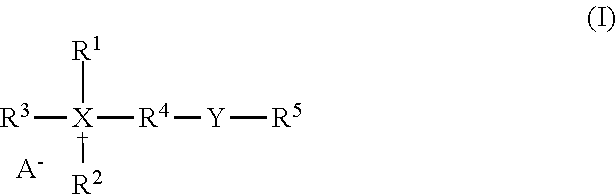
In one aspect, a method of enhancing chemiluminescence from a chemiluminescent label is provided comprising contacting a chemiluminescent label with an acid and hydrogen peroxide in the presence of a degradable cationic surfactant having formula I:
wherein:
X is nitrogen or phosphorus;
R1, R2 and R3 are each independently selected from hydrogen and an alkyl, alkenyl, alkynyl, cycloalkyl or aralkyl group optionally having one or more heteroatoms;
R4 and R5 are each independently selected from an alkyl, alkenyl, alkynyl, cycloalkyl or aralkyl group optionally having one or more heteroatoms;
Y is a cleavable linkage; and
A− is an anionic counterion to X+.
In some embodiments, the chemiluminescent label can be an acridinium dimethylphenyl ester, an acridinium sulfonamide, or a derivative or conjugate thereof. The acid can be nitric acid.
In certain embodiments, the method can further include compressing light emission time of said chemiluminescent label, thereby providing a compressed emission time than a standard emission time without surfactants, wherein said compressed emission time is comparable to that of cetyltrimethylammonium chloride. For example, the compressed emission time may be shorter (e.g., about 20%, about 30% or about 50% shorter) than that of cetyltrimethylammonium chloride. In one embodiment, the surfactant of the present invention is as effective as cetyltrimethylammonium chloride in enhancing total light yield of the chemiluminescent label.
In some embodiments, the method can further include increasing chemiluminescence of said chemiluminescent label, thereby providing an increased light emission than a standard light emission without surfactants, wherein said increased light emission is comparable to that of cetyltrimethylammonium chloride. For example, said increased light emission may be at least about 2.5 fold enhancement compared to the standard light emission without surfactants. In certain embodiments, said enhancement can be at least about 70%, at least about 80% or at least about 90% that of cetyltrimethylammonium chloride. In an embodiment, the surfactant of the present invention is at least as effective as cetyltrimethylammonium chloride in compressing emission time of the chemiluminescent label.
In various embodiments, R1, R2 and R3 can be each independently a C1-10 alkyl, C2-10 alkenyl, C2-10 alkynyl, C3-10 cycloalkyl or C4-10 aralkyl group optionally having one or more heteroatoms. R4 can be a C1-20 alkyl, C2-20 alkenyl, C2-20 alkynyl, C3-20 cycloalkyl or C4-20 aralkyl group optionally having one or more heteroatoms. R5 can be a C1-30 alkyl, C2-30 alkenyl, C2-30 alkynyl, C3-30 cycloalkyl or C4-30 aralkyl group optionally having one or more heteroatoms.
In certain embodiments, Y can be degradable under hydrolytic conditions. For example, Y can be selected from a carbonate linkage, an amide linkage, an ester linkage, or any combination thereof.
In some embodiments, A− can be chloride, bromide, iodide, sulfate, sulfonate or hydroxide ion.
In some instances, the surfactant of the present invention can be compound 1 or 2 or a mixture thereof:

In another aspect of the present invention, an immunoassay kit is provided, comprising:
-
- a) a chemiluminescent label having an acridinium dimethylphenyl ester, an acridinium sulfonamide, or a derivative or conjugate thereof;
- b) an acidifying reagent comprising an acid, hydrogen peroxide and a degradable cationic surfactant having formula I:

-
- wherein R1, R2, R3, R4, R5, Y and A− groups are defined as described herein; and
- c) a basic reagent comprising alkaline hydroxide.
In some embodiments, the chemiluminescent label can be an acridinium dimethylphenyl ester, an acridinium sulfonamide, or a derivative or conjugate thereof.
In various embodiments, when in use, the surfactant of the present invention can provide a compressed emission time of the chemiluminescent label than a standard emission time without surfactants, wherein said compressed emission time is comparable to (e.g., about the same as, or about 20%, about 30% or about 50% shorter than) that of cetyltrimethylammonium chloride.
In certain embodiments, when in use, the surfactant of the present invention can exhibit an increased light emission of the chemiluminescent label compared to a standard light emission without surfactants, wherein said increased light emission is comparable to (e.g., at least about 70%, at least about 80% or at least about 90%) that of cetyltrimethylammonium chloride.
In some examples, the acid can be nitric acid. The alkaline hydroxide may be sodium hydroxide.
These and other aspect of the invention will be better understood by reference to the following detailed description, including the appended claims.
The present invention relates to methods of enhancing chemiluminescence from a chemiluminescent label comprising contacting a chemiluminescent label with an acid and hydrogen peroxide in the presence of a degradable cationic surfactant. Related kits containing such degradable cationic surfactant are also provided. The degradable cationic surfactant can compress light emission time of the chemiluminescent label to an extent that is comparable to or shorter than conventional surfactants. The degradable cationic surfactant can also increase chemiluminescence of the chemiluminescent label, providing increased light emission that is comparable to conventional surfactants.
To address the poor biodegradability of conventional cationic surfactants, especially under anaerobic conditions, the present invention introduces cleavable linkages between the quaternary head group and the alkyl chain of cationic surfactants. In the present invention, it is surprisingly found that cationic surfactants containing cleavable linkages (e.g., carbonate or amide) are at least as effective as CTAC in enhancing chemiluminescence from acridinium esters. The use of these environmentally friendly surfactants in light triggering reagents for widely used acridinium labels (e.g., esters or sulfonamides) is a green alternative to the conventional cationic surfactant CTAC.
For convenience, certain terms employed in the specification, examples, and appended claims are collected here. Unless defined otherwise, all technical and scientific terms used herein have the same meaning as commonly understood by one of ordinary skill in the art to which this invention belongs.
As used herein, the following terms and phrases are intended to have the following meanings:
The articles “a” and “an” are used herein to refer to one or to more than one (i.e., to at least one) of the grammatical object of the article. By way of example, “an element” means one element or more than one element.
As used herein, the term “about” means within 20%, within 10% or within 5%.
The term “comparable” as used herein, means that a property of a first compound (e.g., a first surfactant) is about the same, or similar or equivalent to that of a second compound (e.g., a second surfactant). For example, when a property (e.g., compressed emission time or increased light emission) of a green surfactant of the present invention is referred to as being “comparable to that of cetyltrimethylammonium chloride,” it is meant that such property is about the same as cetyltrimethylammonium chloride, the difference being within 20%, within 10% or within 5%. In some examples, the green surfactant of the present invention may exhibit better properties in light emission than cetyltrimethylammonium chloride.
In general, the term “surfactant” refers to compounds that lower the surface tension of a liquid, the interfacial tension between two liquids, or that between a liquid and a solid. Surfactants typically are chemicals that are amphipathic, which means that they contain both hydrophobic “head” and hydrophilic “tail” groups. Most commonly, surfactants are classified according to polar head group. A non-ionic surfactant has no charge groups in its head. The head of an ionic surfactant carries a net charge. If the charge is negative, the surfactant is more specifically called anionic; if the charge is positive, it is called cationic. If a surfactant contains a head with two oppositely charged groups, it is termed zwitterionic.
A “micelle” is an aggregate of surfactant molecules dispersed in a liquid colloid. A typical micelle in aqueous solution forms an aggregate with the hydrophilic head regions in contact with surrounding solvent, sequestering the hydrophobic tail regions in the micelle center. This type of micelle is known as a normal phase micelle (oil-in-water micelle). Inverse micelles have the head groups at the center with the tails extending out (water-in-oil micelle). Micelles may form when the concentration of surfactant is greater than the critical micelle concentration (CMC). Micelles can exist in different shapes, including spherical, cylindrical, and discoidal.
Green Surfactants
The main objective of the present invention is the elimination of the cationic surfactant CTAC and its replacement with more environmentally friendly, cationic surfactants in light triggering reagents for chemiluminescent acridinium labels.
In some embodiments, the structure of a degradable cationic surfactant for enhancing the chemiluminescence of acridinium ester labels can be represented by the following formula (I):
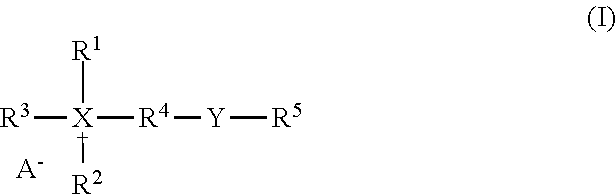
Wherein X is nitrogen or phosphorus; R1, R2 and R3 are each independently selected from hydrogen and an alkyl, alkenyl, alkynyl, cycloalkyl or aralkyl group optionally having one or more heteroatoms; R4 and R5 are each independently selected from an alkyl, alkenyl, alkynyl, cycloalkyl or aralkyl group optionally having one or more heteroatoms; Y is a cleavable linkage; and A− is an anionic counterion.
In some embodiments, the structure of a degradable cationic surfactant for enhancing the chemiluminescence of acridinium ester labels can be represented by the following formula (II):

Wherein:
-
- R1, R2 and R3 can be the same or different. For example, R1, R2 and R3 can be each independently a C1-10 alkyl, C2-10 alkenyl, C2-10 alkynyl, C3-10 cycloalkyl or C4-10 aralkyl group optionally having one or more heteroatoms (e.g., methyl, ethyl, propyl or butyl);
- R4 can be a C1-20 alkyl, C2-20 alkenyl, C2-20 alkynyl, C3-20 cycloalkyl or C4-20 aralkyl group optionally having one or more heteroatoms. For example, R4 can be an alkyl chain comprising 2-4 carbons;
- R5 can be a C1-30 alkyl, C2-30 alkenyl, C2-30 alkynyl, C3-30 cycloalkyl or C4-30 aralkyl group optionally having one or more heteroatoms. For example, R5 can be straight or branched alkyl chain (e.g., 10-16 carbons); and
- A− can be an anion selected from chloride, bromide, iodide, sulfate, sulfonate or hydroxide ions.
In another embodiment, the structure of a degradable cationic surfactant for enhancing the chemiluminescence of acridinium ester labels can be represented by the following formula (III):
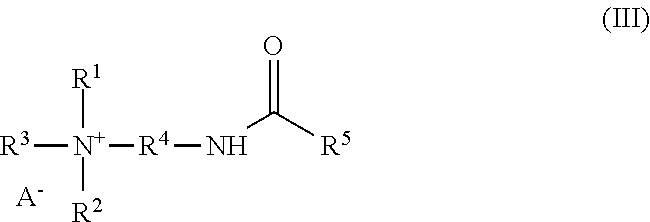
Wherein R1, R2, R3, R4, R5 and A− can have the same definitions as above.
Other suitable surfactants with cleavable linkages as greener alternatives to conventional surfactants have been described elsewhere and are incorporated herein by reference (e.g., Tatsumi et al, Journal of Surfactants and Detergents, 2000, 3, 167-172; Tatsumi et al, Journal of Surfactants and Detergents, 2001, 4, 279-285; Banno et al, Journal of Surfactants and Detergents, 2009, 12, 249-259; Banno et al, Journal of Surfactants and Detergents, 2010, 13, 387-398; Banno et al, Journal of Oleo Science, 2011, 60, 117-126; Banno et al, Journal of Oleo Science, 2007, 56, 493-499; Stjerndahl and Holmberg, J. Colloid and Interface Sci., 2005, 291, 570-576). Methods of making the above surfactants are known in the art.
Acridinium Compounds
The acridinium esters whose chemiluminescence can be enhanced by the degradable cationic surfactants can be represented by the following formula:

Wherein R6, R7, R8 and R9 can be alkyl, alkenyl, alkynyl or aralkyl groups containing 0-20 heteroatoms; R10 and R11 can be hydrogen, alkyl, alkenyl, alkynyl or aralkyl groups containing 0-20 heteroatoms.
Other suitable acridinium compounds (e.g., acridinium sulfonamides) include those described in U.S. Pat. Nos. 8,293,908; 8,119,422; 7,875,467; 7,785,904; 7,611,909; and 7,459,284; and U.S. Pub. Nos. 2012/0225497, 2010/0256380 and 2010/0099077; all of which are hereby incorporated herein by reference in their entirety.
Use of Green Surfactants
Compared to conventional cationic surfactants such as cetyltrimethylammonium chloride (CTAC), the use of degradable cationic surfactants is advantageous because they are rapidly degraded under both aerobic and anaerobic conditions and therefore pose a significantly lower risk when discharged into the environment. These cationic surfactants are also useful for enhancing the chemiluminescence of other labels such as acridinium sulfonamides whose light emission pathway is identical to that of acridinium esters.
Thus, one aspect of the present invention relates to a method of enhancing chemiluminescence from a chemiluminescent label comprising contacting a chemiluminescent label with an acid and hydrogen peroxide in the presence of a degradable cationic surfactant described herein. In certain embodiments, the method can further include compressing light emission time of the chemiluminescent label, thereby providing a compressed emission time than a standard emission time without surfactants. Such compressed emission time can be comparable to that of cetyltrimethylammonium chloride. For example, the compressed emission time may be shorter (e.g., about 20%, about 30% or about 50% shorter) than that of cetyltrimethylammonium chloride. In one embodiment, the surfactant of the present invention can be as effective as cetyltrimethylammonium chloride in enhancing total light yield of the chemiluminescent label.
In some embodiments, the method can further include enhancing chemiluminescence of said chemiluminescent label, thereby providing an increased light emission than a standard light emission without surfactants. Such increased light emission can be comparable to that of cetyltrimethylammonium chloride. For example, said increased light emission may be at least about 2.5 fold enhancement compared to the standard light emission without surfactants. In certain embodiments, such enhancement can be at least about 70%, at least about 80% or at least about 90% that of cetyltrimethylammonium chloride. In an embodiment, the surfactant of the present invention can be at least as effective as cetyltrimethylammonium chloride in compressing emission time of the chemiluminescent label.
In another aspect of the present invention, an immunoassay kit is provided, comprising:
-
- a) a chemiluminescent label having an acridinium dimethylphenyl ester, an acridinium sulfonamide, or a derivative or conjugate thereof;
- b) an acidifying reagent comprising an acid and a degradable cationic surfactant described herein; and
- c) an oxidizing reagent comprising alkaline hydrogen peroxide.
In various embodiments, when in use, the surfactant of the present invention can provide a compressed emission time of the chemiluminescent label than a standard emission time without surfactants. Such compressed emission time may be comparable to (e.g., about the same as, or about 20%, about 30% or about 50% shorter than) that of cetyltrimethylammonium chloride. In certain embodiments, when in use, the surfactant of the present invention can alternatively or additionally exhibit an increased light emission of the chemiluminescent label compared to a standard light emission without surfactants, such that the increased light emission may be comparable to (e.g., at least about 70%, at least about 80% or at least about 90%) that of cetyltrimethylammonium chloride.
In summary, it has been advantageously discovered that degradable cationic surfactants such as those containing cleavable amide and carbonate linkages are at least as effective as conventional cationic surfactants such as CTAC in enhancing the chemiluminescence of widely used acridinium ester labels. It was also surprisingly discovered that degradable cationic surfactants can be more effective in accelerating light emission than CTAC. The degradable surfactants show excellent stability in acidic solution and are environmentally friendly alternatives to CTAC. These surfactants are also useful in enhancing the luminescence of other labels such as acridinium sulfonamides. Because perturbations of chemical reactions rely on the ability of surfactants to increase the local concentrations of reactants and/or alter the polarity of the reaction medium, degradable surfactants can serve as benign alternatives to conventional surfactants for such applications.
Compound ii
Palmitic acid (i, 2.564 g, 10.00 mmoles), toluene (100 mL) and N,N-dimethylethylenediamine (1.147 mL, 10.50 mmoles) were combined and refluxed for 20 hours. The reaction mixture was concentrated to dryness which gave 3.21 g of a slightly yellow solid. The crude solid was re-crystallized from dry acetone (75 mL). The desired product ii (1.83 g) was obtained as white, needle-like crystals. 1H-NMR (500 MHz, CDCl3), 0.87 (t, 3H, J=6.5), 1.20-1.35 (m, 24H), 1.55-1.70 (m, 2H), 2.17 (t, 2H, J=7.5), 2.30 (s, 6H), 2.49 (t, 2H, J=5.5), 3.36 (dt, 2H, J=5.5, 5.5), 6.25 (br s, 1H). MALDI-TOF MS m/z 327.4 (M+H+); HRMS m/z 327.3376 (M+H+) (327.3375 calculated).
Compound iii
Compound ii (1.41 g, 4.32 mmoles), acetone (50 mL) and iodomethane (0.309 mL, 4.97 mmoles) were refluxed at 80° C. under an argon atmosphere for 6 hours. The reaction mixture was cooled to room temperature and the precipitated white solid was collected by filtration. The filter cake was washed with dry acetone (10 mL×4) and dried over P2O5 under high vacuum. The desired product iii (1.904 g) was obtained as a white solid. 1H-NMR (500 MHz, CDCl3) 0.88 (t, 3H, J=6.5), 1.21-1.38 (m, 22H), 1.57-1.70 (m, 4H), 2.29 (t, 2H, J=7.3), 3.42 (s, 9H), 3.78-3.89 (m, 4H), 7.96 (br s, 1H). MALDI-TOF MS m/z 282.36 (M-NMe3 +); HRMS m/z 341.3528 (M+) (341.3532 calculated).
Compound iii (1.50 g, 3.20 mmoles) was dissolved in absolute ethanol (400 mL) at room temperature and IR-900 chloride resin (76.2 g, 3.20 mmoles) was added and stirred at room temperature for 1 hour. Then, the mixture was passed through an IR-900 chloride resin column (80 g pre-washed with absolute ethanol). The column was eluted with absolute ethanol (600 mL). The eluent was concentrated under reduced pressure which gave 1.51 g of a slightly brown solid. This material was re-crystallized from anhydrous acetone/ethanol. The desired product, surfactant 1 (0.895 g), was obtained as a white solid. 1H-NMR (500 MHz, CDCl3) 0.86 (t, 3H, J=6.3), 1.17-1.38 (m, 22H), 1.55-1.68 (m, 4H), 2.27 (t, 2H, J=7.3), 3.43 (s, 9H), 3.70-3.85 (m, 4H), 8.72 (br s, 1H). MALDI-TOF MS m/z 282.36 (M-NMe3 +); HRMS m/z 341.3529 (M+) (341.3532 calculated).
Compound v
A mixture of dodecanol (iv, 2.236 mL, 10.00 mmoles), triethylamine (1.394 mL, 10.00 mmoles) and diphenyl carbonate (2.142 g, 10.00 mmoles) was heated to 80° C. for 16 hours. Then, 3-dimethylamino-1-propanol (2.366 mL, 20.00 mmoles) was added and heated to 80° C. for an additional 16 hours. The reaction mixture was then concentrated under reduced pressure to give 3.92 g of a dark yellow oil. It was purified by silica gel column chromatography using methanol/ethyl acetate (1:9) as eluent. The desired product v (2.63 g) was obtained as a yellow oil. 1H-NMR (500 MHz, CDCl3) 0.88 (t, 3H, J=6.5), 1.20-1.42 (m, 18H), 1.61-1.71 (m, 2H), 1.87-1.98 (m, 2H), 2.33 (s, 6H), 2.49 (br t, 2H, J=7.0), 4.12 (t, 2H, J=6.5), 4.19 (t, 2H, J=6.3). MALDI-TOF MS m/z 316.3 (M+H+); HRMS m/z 316.2855 (M+H+) (316.2852 calculated).
Compound vi
Compound v (1.500 g, 4.75 mmoles), acetone (50 mL) and iodomethane (0.340 mL, 5.47 mmoles) were combined and refluxed for 6 hours. After cooling to room temperature, the desired product precipitated out as a white solid. It was collected by filtration and washed with ethyl acetate (10 mL×4). The solid was dried over P2O5 under high vacuum. The desired product vi (1.988 g) was obtained as a white solid. 1H-NMR (500 MHz, CDCl3) 0.87 (t, 3H, J=7.0), 1.60-1.72 (m, 18H), 2.05-2.34 (m, 2H), 3.49 (s, 9H), 3.76 (t, 2H, J=7.3), 4.12 (t, 2H, J=6.5), 4.29 (m, 2H). MALDI-TOF MS m/z 316.3 (M+H+); HRMS m/z 316.2855 (M+H+) (316.2852 calculated).
Compound vi (1.50 g, 3.28 mmoles) was dissolved in absolute ethanol (200 mL) at room temperature and IR-900 chloride resin (78 g, 328 mmoles) was added and stirred at room temperature for 1 hour. Then, the mixture was passed through an IR-900 chloride resin column (80 g pre-washed with absolute ethanol). The column was eluted with absolute ethanol (400 mL). The eluent was concentrated under reduced pressure which gave 1.5 g of a white solid. The crude product was re-crystallized from anhydrous acetone. The desired product 2 (0.637 g) was obtained as a white solid. 1H-NMR (500 MHz, CDCl3) 0.86 (t, 3H, J=6.5) 1.60-1.70 (m, 18H), 2.18-2.30 (m, 2H), 3.49 (s, 9H), 3.72 (t, 2H, J=7.8), 4.11 (t, 2H, J=6.8), 4.25 (m, 2H). HRMS m/z 330.3013 (M+) (330.3008 calculated).
To study the impact of degradable cationic surfactants on acridinium ester chemiluminescence, two exemplary cationic surfactants containing cleavable linkages (FIG. 2A ) were selected. The critical micelle concentrations (CMCs) of the two surfactants are shown in FIG. 2A . The synthetic schemes for the two surfactants are illustrated in FIGS. 3-4 and described in Examples 1 and 2 above. Both surfactants were dissolved in Reagent 1 (0.1 M nitric acid containing 0.5% hydrogen peroxide) at five times their reported CMCs in water. CTAC dissolved in Reagent 2 (0.25 M NaOH) was used as the control surfactant. The two carbonate and amide cationic surfactants (FIG. 2A ) were dissolved in Reagent 1 to preserve stability, especially during long term storage (Stjerndahl and Holmberg, J. Colloid and Interface Sci., 2005, 291, 570-576). Three acridinium esters (FIG. 2B , compounds 3a, 3b and 3c) were used to make protein conjugates of an anti-TSH antibody (TSH=thyroid stimulating hormone) as described in the literature (Natrajan et al, Org. Biomol. Chem., 2011, 9, 5092-5103; Natrajan et al, Org. Biomol. Chem., 2012, 10, 3432-3447). The conjugates contained approximately 5 labels. The conjugates were stored at 4° C. in buffer and chemiluminescence from each conjugate was measured in the absence of surfactant and in the presence of CTAC as well as cationic surfactants 1 and 2 (Tables 1-3, FIGS. 5-7 ). The ability of each surfactant to (a) increase total light output and (b) accelerate emission kinetics was evaluated over a period of 80 days.
Chemiluminescence of anti-TSH antibody conjugates of acridinium esters 3a, 3b and 3c (FIG. 2B ) was measured on an Autolumat LB953 Plus luminometer from Berthold Technologies. The conjugates, ˜2 mg/mL containing approximately five labels, were serially diluted 105-fold for chemiluminescence measurements in an aqueous buffer of 10 mM disodium hydrogen phosphate, 0.15 M NaCl and 8 mM sodium azide and 0.015 mM bovine serum albumin (BSA), pH 8.0. A 0.010 mL volume of each diluted acridinium ester sample was dispensed into the bottom of a cuvette. Cuvettes were placed into the primed LB953 and the chemiluminescence reaction was initiated with the sequential addition of 0.3 mL of Reagent 1, a solution of 0.5% hydrogen peroxide in 0.1 M nitric acid followed by the addition of 0.3 mL of Reagent 2, a solution of 0.25 M sodium hydroxide. For measurements in the presence of CTAC, the surfactant (7 mM) was included in Reagent 2. For measurements in the presence of the cationic amide surfactant 1 or the cationic carbonate surfactant 2, each surfactant was dissolved in Reagent 1 at 3.2 mM (surfactant 1) and 2.15 mM (surfactant 2). Each chemiluminescence flash curve was measured in 240 intervals of 0.5 second (120 seconds total time). Each chemiluminescence reaction was carried out a minimum of three times, averaged and converted to a percentage of the chemiluminescence accumulated up to each time interval. The output from the luminometer instrument was expressed as R.L.U.s (Relative Light Units).
The results in Tables 1-3 illustrate that both the cationic surfactants 1 and 2 containing cleavable amide and carbonate linkages respectively, are at least as effective as CTAC in not only increasing total light yield from the acridinium ester conjugates but also in compressing emission times. For example, for all three acridinium ester conjugates, in comparison to the no surfactant control which was assigned a relative light yield of one, total light yield was increased approximately 2.5-4-fold for 3a, 3-5-fold for 3b and 3-4.5-fold for 3c (Tables 1a, 2a and 3a) for CTAC as well as surfactants 1 and 2. Specifically, Table 1a shows that surfactant 2 is as effective as CTAC within at least the first 10 days in enhancing chemiluminescence (i.e., the fold of increased light emission by surfactant 2 is the same as CTAC). Even at day 80, the fold of increased light emission using surfactant 2 remains to be about 80% (2.8/3.5) of CTAC. Similarly, the fold of increased light emission using Surfactant 1 is about 89% (3.1/3.5) on day 1, and 74% (2.6/3.5) on day 80 compared to CTAC. Thus, both surfactants 1 and 2 are comparable to CTAC in enhancing chemiluminescence. In addition, the two cationic surfactants 1 and 2 proved to be quite stable in Reagent 1 (0.5% peroxide in 0.1 M nitric acid) as evidenced by little loss in their ability to enhance chemiluminescence from the acridinium ester antibody conjugates even after 80 days at room temperature.
Furthermore, both surfactants 1 and 2 were very effective in accelerating light emission from the acridinium ester antibody conjugates (Tables 1b, 2b and 3b, FIGS. 5-7 ). In the absence of surfactant, times for emission of >90% light from the conjugates of 3a, 3b and 3c were observed to be 57.5 seconds, 49.5 seconds and 62.5 seconds respectively. In the presence of CTAC or the two cationic surfactants 1 and 2, emission times were compressed to <3 seconds for the conjugates of all three acridinium ester labels. Surprisingly, surfactants 1 and 2 are more effective than CTAC in accelerating light emission. For example, as shown in Table 1b, both surfactants 1 and 2 accelerated emission kinetics of acridinium ester 3a from 57.5 seconds to 1.0 second, while CTAC was 1.5 seconds. The ability of the two cationic surfactants 1 and 2 to accelerate light emission did not diminish even after 80 days of storage at room temperature as also illustrated in the chemiluminescence emission profiles of the conjugates (FIGS. 5-7 ).
The present invention provides among other things green surfactants and their use in enhancing chemiluminescence. While specific embodiments of the subject invention have been discussed, the above specification is illustrative and not restrictive. Many variations of the invention will become apparent to those skilled in the art upon review of this specification. The full scope of the invention should be determined by reference to the claims, along with their full scope of equivalents, and the specification, along with such variations.
All publications, patents and sequence database entries mentioned herein are hereby incorporated by reference in their entirety as if each individual publication or patent was specifically and individually indicated to be incorporated by reference.
| TABLE 1a |
| Observed enhancement (fold) of chemiluminescence of anti- |
| TSH antibody conjugate of |
| surfactant control was assigned a value of 1). |
| Amide cationic | | ||||
| Day | CTAC | ||||
| 1 | cationic 2 | ||||
| 1 | 3.5 | 3.1 | 3.5 | ||
| 10 | 3.6 | 3.1 | 3.6 | ||
| 20 | 4.0 | 3.4 | 3.7 | ||
| 40 | 3.4 | 2.6 | 3.2 | ||
| 80 | 3.5 | 2.6 | 2.8 | ||
| TABLE 1b |
| Observed acceleration of emission kinetics (time |
| to >90% emission in seconds) of anti-TSH antibody conjugate of |
| |
| >90% emission was 57.5 seconds). |
| Amide cationic | | ||
| Day | CTAC | ||
| 1 | cationic 2 | ||
| 1 | 1.5 | 1.0 | 1.0 |
| 10 | 1.5 | 1.0 | 1.0 |
| 20 | 1.5 | 1.0 | 1.0 |
| 40 | 1.5 | 1.0 | 1.0 |
| 80 | 1.5 | 1.0 | 1.0 |
| TABLE 2a |
| Observed enhancement (fold) of chemiluminescence of |
| anti-TSH antibody conjugate of |
| (no surfactant control was assigned a value of 1). |
| Amide cationic | | ||||
| Day | CTAC | ||||
| 1 | cationic 2 | ||||
| 1 | 5.3 | 4.5 | 5.0 | ||
| 10 | 5.2 | 4.4 | 5.2 | ||
| 20 | 5.5 | 4.7 | 5.2 | ||
| 40 | 4.2 | 3.4 | 3.9 | ||
| 80 | 4.6 | 3.4 | 4.1 | ||
| TABLE 2b |
| Observed acceleration of emission kinetics (time to >90% emission |
| in seconds) of anti-TSH antibody conjugate of |
| (in the absence of surfactant time to >90% emission was 49.5 seconds). |
| Amide cationic | | ||
| Day | CTAC | ||
| 1 | cationic 2 | ||
| 1 | 1.0 | 1.0 | 0.5 |
| 10 | 1.0 | 0.5 | 0.5 |
| 20 | 1.0 | 0.5 | 0.5 |
| 40 | 1.0 | 0.5 | 0.5 |
| 80 | 1.0 | 0.5 | 0.5 |
| TABLE 3a |
| Observed enhancement (fold) of chemiluminescence of |
| anti-TSH antibody conjugate of |
| (no surfactant control was assigned a value of 1). |
| Amide cationic | | ||||
| Day | CTAC | ||||
| 1 | cationic 2 | ||||
| 1 | 4.1 | 3.8 | 4.2 | ||
| 10 | 4.3 | 3.8 | 4.2 | ||
| 20 | 4.6 | 4.1 | 4.4 | ||
| 40 | 3.9 | 3.2 | 3.7 | ||
| 80 | 4.0 | 3.0 | 3.5 | ||
| TABLE 3b |
| Observed acceleration of emission kinetics (time to >90% |
| emission in seconds) of anti-TSH antibody conjugate of |
| ester |
| 3c (in the absence of surfactanttime |
| to >90% emission was 62.5 seconds). |
| Amide cationic | | ||
| Day | CTAC | ||
| 1 | cationic 2 | ||
| 1 | 2.0 | 2.0 | 1.0 |
| 10 | 2.0 | 2.0 | 1.0 |
| 20 | 2.5 | 2.0 | 1.5 |
| 40 | 2.5 | 2.0 | 1.5 |
| 80 | 2.5 | 2.0 | 1.5 |
Claims (20)
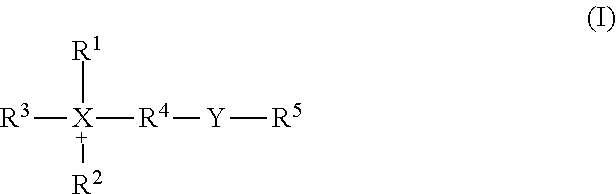
1. A method of enhancing chemiluminescence from a chemiluminescent label, comprising contacting a chemiluminescent label with an acid and hydrogen peroxide in the presence of a degradable cationic surfactant having formula I:
wherein:
X is nitrogen or phosphorus;
R1, R2 and R3 are each independently selected from hydrogen and an alkyl, alkenyl, alkynyl, cycloalkyl or aralkyl group optionally having one or more heteroatoms;
R4 and R5 are each independently selected from an alkyl, alkenyl, alkynyl, cycloalkyl or aralkyl group optionally having one or more heteroatoms;
Y is a cleavable linkage selected from the group consisting of a carbonate linkage, an amide linkage, an ester linkage and any combination thereof; and
A− is an anionic counterion to X+,
wherein said chemiluminescent label is an acridinium dimethylphenyl ester, an acridinium sulfonamide, or a derivative or conjugate thereof.
2. The method of claim 1 , wherein said surfactant provides a compressed emission time of said chemiluminescent label shorter than that of cetyltrimethylammonium chloride.
3. The method of claim 2 , wherein said compressed emission time is about 20% shorter than that of cetyltrimethylammonium chloride.
4. The method of claim 2 , wherein said compressed emission time is about 30% shorter than that of cetyltrimethylammonium chloride.
5. The method of claim 2 , wherein said compressed emission time is about 50% shorter than that of cetyltrimethylammonium chloride.
6. The method of claim 1 , wherein said surfactant is as effective as cetyltrimethylammonium chloride in enhancing total light yield of the chemiluminescent label.
7. The method of claim 1 , wherein the chemiluminescence of said chemiluminescent label is increased, thereby providing an increased light emission relative to a standard light emission without surfactants.
8. The method of claim 7 , wherein said increased light emission is at least about 2.5 fold enhancement compared to the standard light emission without surfactants.
9. The method of claim 7 , wherein said enhancement is at least about 70% that of cetyltrimethylammonium chloride.
10. The method of claim 7 , wherein said enhancement is at least about 80% that of cetyltrimethylammonium chloride.
11. The method of claim 7 , wherein said enhancement is at least about 90% that of cetyltrimethylammonium chloride.
12. The method of claim 7 , wherein said surfactant is at least as effective as cetyltrimethylammonium chloride in compressing emission time of the chemiluminescent label.
13. The method of claim 1 , wherein R1, R2 and R3 are each independently a C1-10 alkyl, C2-10 alkenyl, C2-10 alkynyl, C3-10 cycloalkyl or C4-10 aralkyl group optionally having one or more heteroatoms.
14. The method of claim 1 , wherein R4 is a C1-20 alkyl, C2-20 alkenyl, C2-20 alkynyl, C3-20 cycloalkyl or C4-20 aralkyl group optionally having one or more heteroatoms.
15. The method of claim 1 , wherein R5 is a C1-30 alkyl, C2-30 alkenyl, C2-30 alkynyl, C3-30 cycloalkyl or C4-30 aralkyl group optionally having one or more heteroatoms.
16. The method of claim 1 , wherein Y is degradable under hydrolytic conditions.
17. The method of claim 1 , wherein A− is chloride, bromide, iodide, sulfate, sulfonate or hydroxide ion.
18. The method of claim 1 , wherein said surfactant is compound 1 or 2 or a mixture thereof:

19. The method according to claim 1 , wherein R1-R3 are each independently alkyl optionally having one or more heteroatoms.
20. The method according to claim 1 wherein R4 and R5 are independently selected from alkyl, cycloalkyl, or aralkyl optionally having one or more heteroatoms.
Priority Applications (1)
| Application Number | Priority Date | Filing Date | Title |
|---|---|---|---|
| US14/891,262 US10073039B2 (en) | 2013-05-14 | 2014-05-13 | Degradable cationic surfactants and use thereof in enhancing chemiluminescence |
Applications Claiming Priority (3)
| Application Number | Priority Date | Filing Date | Title |
|---|---|---|---|
| US201361823162P | 2013-05-14 | 2013-05-14 | |
| US14/891,262 US10073039B2 (en) | 2013-05-14 | 2014-05-13 | Degradable cationic surfactants and use thereof in enhancing chemiluminescence |
| PCT/US2014/037914 WO2014186406A2 (en) | 2013-05-14 | 2014-05-13 | Degradable cationic surfactants and use thereof in enhancing chemiluminescence |
Related Parent Applications (1)
| Application Number | Title | Priority Date | Filing Date |
|---|---|---|---|
| PCT/US2014/037914 A-371-Of-International WO2014186406A2 (en) | 2013-05-14 | 2014-05-13 | Degradable cationic surfactants and use thereof in enhancing chemiluminescence |
Related Child Applications (1)
| Application Number | Title | Priority Date | Filing Date |
|---|---|---|---|
| US16/125,656 Division US10859504B2 (en) | 2013-05-14 | 2018-09-07 | Degradable cationic surfactants and use thereof in enhancing chemiluminescence |
Publications (2)
| Publication Number | Publication Date |
|---|---|
| US20160131588A1 US20160131588A1 (en) | 2016-05-12 |
| US10073039B2 true US10073039B2 (en) | 2018-09-11 |
Family
ID=51898994
Family Applications (2)
| Application Number | Title | Priority Date | Filing Date |
|---|---|---|---|
| US14/891,262 Active US10073039B2 (en) | 2013-05-14 | 2014-05-13 | Degradable cationic surfactants and use thereof in enhancing chemiluminescence |
| US16/125,656 Active 2034-11-16 US10859504B2 (en) | 2013-05-14 | 2018-09-07 | Degradable cationic surfactants and use thereof in enhancing chemiluminescence |
Family Applications After (1)
| Application Number | Title | Priority Date | Filing Date |
|---|---|---|---|
| US16/125,656 Active 2034-11-16 US10859504B2 (en) | 2013-05-14 | 2018-09-07 | Degradable cationic surfactants and use thereof in enhancing chemiluminescence |
Country Status (6)
| Country | Link |
|---|---|
| US (2) | US10073039B2 (en) |
| EP (1) | EP2997355B1 (en) |
| JP (1) | JP6494599B2 (en) |
| CN (1) | CN105264377B (en) |
| ES (1) | ES2769887T3 (en) |
| WO (1) | WO2014186406A2 (en) |
Families Citing this family (4)
| Publication number | Priority date | Publication date | Assignee | Title |
|---|---|---|---|---|
| EP2997355B1 (en) | 2013-05-14 | 2019-11-20 | Siemens Healthcare Diagnostics Inc. | Degradable cationic surfactants and use thereof in enhancing chemiluminescence |
| US20240353412A1 (en) * | 2021-07-29 | 2024-10-24 | Euroimmun Medizinische Labordiagnostika Ag | A method and reagents for enhancing the chemiluminescent signal |
| CN116559150A (en) * | 2023-04-03 | 2023-08-08 | 深圳市天大生物医疗器械有限公司 | Luminescent substrate enhancer, preparation method thereof and kit |
| US20250101296A1 (en) * | 2023-09-22 | 2025-03-27 | Ji Hoon Lee | Reagent for acridinium ester chemiluminescence including graphene oxide, reagent system including the same, and method of detecting target antigen using the same |
Citations (24)
| Publication number | Priority date | Publication date | Assignee | Title |
|---|---|---|---|---|
| US4228042A (en) | 1978-06-26 | 1980-10-14 | The Procter & Gamble Company | Biodegradable cationic surface-active agents containing ester or amide and polyalkoxy group |
| US4927769A (en) | 1987-07-08 | 1990-05-22 | Ciba Corning Diagnostics Corp. | Method for enhancement of chemiluminescence |
| JPH07278184A (en) | 1994-04-11 | 1995-10-24 | Kyowa Medex Co Ltd | Stabilization of antigen or antibody labeled with acridinium derivative |
| WO1996002839A1 (en) | 1994-07-15 | 1996-02-01 | Abbott Laboratories | Chemiluminescent signal enhancement |
| JPH08313443A (en) | 1995-05-19 | 1996-11-29 | Kdk Corp | Modified chemiluminescence measuring method |
| US5656426A (en) | 1988-08-01 | 1997-08-12 | Chiron Diagnostics Corporation | Functionaized hydrophilic acridinium esters |
| JPH1081900A (en) | 1996-07-15 | 1998-03-31 | Lion Corp | Liquid detergent composition |
| JP2001097840A (en) | 1999-09-30 | 2001-04-10 | Kao Corp | Skin cosmetics |
| JP2002128744A (en) | 2000-10-17 | 2002-05-09 | Asahi Denka Kogyo Kk | Surfactant having carbonate bond |
| US6664043B2 (en) | 2001-07-03 | 2003-12-16 | Bayer Corporation | Acridinium ester labels having hydrophilic modifiers |
| JP2005503431A (en) | 2001-09-28 | 2005-02-03 | エルジー ハウスホールド アンド ヘルス ケア エルティーディー. | Method for producing cationic surfactant and fiber softener composition containing the same |
| US20060166840A1 (en) | 2005-01-25 | 2006-07-27 | Halliburton Energy Services, Inc. | Drilling fluids containing biodegradable organophilic clay |
| CN101226200A (en) | 2007-01-19 | 2008-07-23 | 天津天美生物技术有限公司 | Chemiluminescence immunity analysis detecting myocardium calcium protein T hypersensitization method for acridine ester and alkaline phosphatase |
| US20080248493A1 (en) | 2007-04-09 | 2008-10-09 | Mattingly Phillip G | Acridinium phenyl esters useful in the analysis of biological samples |
| US7781588B1 (en) | 2004-12-30 | 2010-08-24 | E.I. Du Pont De Nemours And Company | Acridan monomers and polymers |
| US20100256380A1 (en) | 2007-11-20 | 2010-10-07 | Siemens Healthcare Diagnostics Inc. | Facile n-alkylation of acridine compounds in ionic liquids |
| US7875467B2 (en) | 2002-09-27 | 2011-01-25 | Siemens Healthcare Diagnostics Inc. | Applications of acridinium compounds and derivatives in homogeneous assays |
| WO2011060228A1 (en) | 2009-11-16 | 2011-05-19 | Siemens Healthcare Diagnostics Inc. | Zwitterion-containing acridinium compounds |
| US8034636B2 (en) | 2002-08-20 | 2011-10-11 | Quest Diagnostics Investments Incorporated | Hydrophilic chemiluminescent acridinium labeling reagents |
| CN102311731A (en) | 2010-06-30 | 2012-01-11 | 深圳迈瑞生物医疗电子股份有限公司 | Reagent and method for enhancing chemiluminescence and chemiluminescence liquid |
| US8119422B2 (en) | 2006-10-13 | 2012-02-21 | Siemens Healthcare Diagnostics Inc. | Stable acridinium esters with fast light emission |
| US20130168620A1 (en) * | 2011-12-30 | 2013-07-04 | Maggilume, LLC | Chemiluminescent system |
| WO2014011762A1 (en) | 2012-07-10 | 2014-01-16 | Siemens Heal Thcare Diagnostics Inc. | Synthesis of acridinium compounds by n-alkylation of acridans |
| CN105264377B (en) | 2013-05-14 | 2017-09-08 | 西门子医疗保健诊断公司 | Degradable cationic surface active agent and its purposes in enhanced chemiluminescence |
-
2014
- 2014-05-13 EP EP14798016.3A patent/EP2997355B1/en active Active
- 2014-05-13 WO PCT/US2014/037914 patent/WO2014186406A2/en not_active Ceased
- 2014-05-13 CN CN201480027784.5A patent/CN105264377B/en active Active
- 2014-05-13 JP JP2016514048A patent/JP6494599B2/en active Active
- 2014-05-13 ES ES14798016T patent/ES2769887T3/en active Active
- 2014-05-13 US US14/891,262 patent/US10073039B2/en active Active
-
2018
- 2018-09-07 US US16/125,656 patent/US10859504B2/en active Active
Patent Citations (25)
| Publication number | Priority date | Publication date | Assignee | Title |
|---|---|---|---|---|
| US4228042A (en) | 1978-06-26 | 1980-10-14 | The Procter & Gamble Company | Biodegradable cationic surface-active agents containing ester or amide and polyalkoxy group |
| US4927769A (en) | 1987-07-08 | 1990-05-22 | Ciba Corning Diagnostics Corp. | Method for enhancement of chemiluminescence |
| US5656426A (en) | 1988-08-01 | 1997-08-12 | Chiron Diagnostics Corporation | Functionaized hydrophilic acridinium esters |
| JPH07278184A (en) | 1994-04-11 | 1995-10-24 | Kyowa Medex Co Ltd | Stabilization of antigen or antibody labeled with acridinium derivative |
| WO1996002839A1 (en) | 1994-07-15 | 1996-02-01 | Abbott Laboratories | Chemiluminescent signal enhancement |
| JPH08313443A (en) | 1995-05-19 | 1996-11-29 | Kdk Corp | Modified chemiluminescence measuring method |
| JPH1081900A (en) | 1996-07-15 | 1998-03-31 | Lion Corp | Liquid detergent composition |
| JP2001097840A (en) | 1999-09-30 | 2001-04-10 | Kao Corp | Skin cosmetics |
| JP2002128744A (en) | 2000-10-17 | 2002-05-09 | Asahi Denka Kogyo Kk | Surfactant having carbonate bond |
| US6664043B2 (en) | 2001-07-03 | 2003-12-16 | Bayer Corporation | Acridinium ester labels having hydrophilic modifiers |
| JP2005503431A (en) | 2001-09-28 | 2005-02-03 | エルジー ハウスホールド アンド ヘルス ケア エルティーディー. | Method for producing cationic surfactant and fiber softener composition containing the same |
| US8034636B2 (en) | 2002-08-20 | 2011-10-11 | Quest Diagnostics Investments Incorporated | Hydrophilic chemiluminescent acridinium labeling reagents |
| US7875467B2 (en) | 2002-09-27 | 2011-01-25 | Siemens Healthcare Diagnostics Inc. | Applications of acridinium compounds and derivatives in homogeneous assays |
| US7781588B1 (en) | 2004-12-30 | 2010-08-24 | E.I. Du Pont De Nemours And Company | Acridan monomers and polymers |
| US20060166840A1 (en) | 2005-01-25 | 2006-07-27 | Halliburton Energy Services, Inc. | Drilling fluids containing biodegradable organophilic clay |
| US8119422B2 (en) | 2006-10-13 | 2012-02-21 | Siemens Healthcare Diagnostics Inc. | Stable acridinium esters with fast light emission |
| CN101226200A (en) | 2007-01-19 | 2008-07-23 | 天津天美生物技术有限公司 | Chemiluminescence immunity analysis detecting myocardium calcium protein T hypersensitization method for acridine ester and alkaline phosphatase |
| US20080248493A1 (en) | 2007-04-09 | 2008-10-09 | Mattingly Phillip G | Acridinium phenyl esters useful in the analysis of biological samples |
| US20100256380A1 (en) | 2007-11-20 | 2010-10-07 | Siemens Healthcare Diagnostics Inc. | Facile n-alkylation of acridine compounds in ionic liquids |
| WO2011060228A1 (en) | 2009-11-16 | 2011-05-19 | Siemens Healthcare Diagnostics Inc. | Zwitterion-containing acridinium compounds |
| JP2013510934A (en) | 2009-11-16 | 2013-03-28 | シーメンス・ヘルスケア・ダイアグノスティックス・インコーポレーテッド | Zwitterion-containing acridinium compounds |
| CN102311731A (en) | 2010-06-30 | 2012-01-11 | 深圳迈瑞生物医疗电子股份有限公司 | Reagent and method for enhancing chemiluminescence and chemiluminescence liquid |
| US20130168620A1 (en) * | 2011-12-30 | 2013-07-04 | Maggilume, LLC | Chemiluminescent system |
| WO2014011762A1 (en) | 2012-07-10 | 2014-01-16 | Siemens Heal Thcare Diagnostics Inc. | Synthesis of acridinium compounds by n-alkylation of acridans |
| CN105264377B (en) | 2013-05-14 | 2017-09-08 | 西门子医疗保健诊断公司 | Degradable cationic surface active agent and its purposes in enhanced chemiluminescence |
Non-Patent Citations (16)
| Title |
|---|
| Anand Natrajan et al, "Use of degradable cationic surfactants with cleavable linkages for enhancing the chemiluminescence of acridinium ester labels", RSC Advances, (Nov. 28, 2013), vol. 3, No. 44, doi:10.1039/c3ra44461a, p. 21398, XP055314649 [PX] 1-17 *the whole document*. |
| Anand Natrajan et al, "Chemiluminescence from alkoxy-substituted acridinium dimethylphenyl ester labels", The Royal Society of Chemistry 2012, Electronic Supplementary Material for Organic & Biomolecular Chemistry, pp. 1-35, Retrieved from the Internet: URL:http//www.rsc.org/suppdata/ob/c2/c2ob00022a/c2ob00022a.pdf, retrieved on Oct. 27, 2016. |
| Anand Natrajan et al, "Chemiluminescence from alkoxy-substituted acridinium dimethylphenyl ester labels", The Royal Society of Chemistry 2012, Organic & Biomolecular Chemistry, GB, Jan. 1, 2012, vol. 10, No. 17, p. 3432-3447. |
| Anand Natrajan et al, "Effect of surfactants on the chemiluminescence of acridinium dimethylphenyl ester labels and their conjugates", The Royal Society of Chemistry 2011, Organic & Biomolecular Chemistry, GB, Jan. 1, 2011, vol. 9, No. 14, pp. 5092-5103. |
| Anand Natrajan et al, "Supplementary Material, Effect of surfactants on the chemiluminescence of acridinium dimethylphenyl ester labels and their conjugates", Retrieved from the Internet: URL:http://www.rsc.org/suppdata/ob/cI/clob05543g/clob05543g.pdf on Oct. 10, 2017, pp. 1-17. |
| Anand Natrajan et al: Facile N-alkylation of acridine esters with 1,3-propane sultone in ionic liquids, The Royal Society of Chemistry 2011, Green Chemistry, vol. 13, No. 4, Jan. 1, 2011, pp. 913-921. |
| ANAND NATRAJAN, WEN DAVID: "Use of degradable cationic surfactants with cleavable linkages for enhancing the chemiluminescence of acridinium ester labels", RSC ADVANCES, vol. 3, no. 44, 1 January 2013 (2013-01-01), pages 21398, XP055314649, DOI: 10.1039/c3ra44461a |
| Dantoni Patricia et al. "Effect of some surfactants on the chemiluminescent reactions of bis(2,4,6-trichlorophenyl)oxalate and bis(2-nitrophenyl) oxalate with hydrogen peroxide" Published by NRC Research Press; Can. J. Chem. 90: pp. 534-541 (2012) / Jun. 30, 2012. |
| European Search Report dated Nov. 14, 2016 for Application No. 14798016.3-1408, pp. 1-10. |
| PCT Search Report and Written Opinion dated Nov. 13, 2014 for International Application No. PCT/US2014/037914, 9 pp. |
| Susana Shimizu et al, "2-(Acylaminoethyl)trimethylammonium chloride surfactants: synthesis and properties of aqueous solutions", Colloid & Polymer Science, DE, (Dec. 1, 2003), vol. 282, No. 1, doi:10.1007/s00396-003-0897-y, ISSN 0303-402X, pp. 21-31, XP055314661 [Y] 1-17 *the whole document*. |
| SUSANA SHIMIZU, OMAR A. EL SEOUD: "2-(Acylaminoethyl)trimethylammonium chloride surfactants: synthesis and properties of aqueous solutions", COLLOID & POLYMER SCIENCE, SPRINGER VERLAG, HEIDELBERG, DE, vol. 282, no. 1, 1 December 2003 (2003-12-01), DE, pages 21 - 31, XP055314661, ISSN: 0303-402X, DOI: 10.1007/s00396-003-0897-y |
| Taisuke Banno et al, "Creation of Novel Green and Sustainable Gemini-Type Cationics Containing Carbonate Linkages", Journal of Surfactants and Detergents, Springer, Berlin, DE, (Oct. 10, 2010), vol. 13, No. 4, doi:10.1007/S11743-010-1224-5, ISSN 1097-3958, pp. 387-398, XP001557625 [Y] 1-17 *the whole document*. |
| Taisuke Banno et al, "Synthesis and properties of biodegradable and chemically recyclable cationic surfactants containing carbonate linkages", Journal of Oleo Science, (Aug. 11, 2007), vol. 56, No. 9, pp. 493-499, XP055314657 [Y] 1-17 *the whole document*. |
| TAISUKE BANNO, KAZUO KAWADA AND SHUICHI MATSUMURA: "Creation of Novel Green and Sustainable Gemini-Type Cationics Containing Carbonate Linkages", JOURNAL OF SURFACTANTS AND DETERGENTS, SPRINGER, BERLIN, DE, vol. 13, no. 4, 1 October 2010 (2010-10-01), DE, pages 387 - 398, XP001557625, ISSN: 1097-3958, DOI: 10.1007/s11743-010-1224-5 |
| TAISUKE BANNO, TOSHIMA, KAZUNOBU; KAWADA, KAZUO; MATSUMURA, SHUICHI: "Synthesis and properties of biodegradable and chemically recyclable cationic surfactants containing carbonate linkages", JOURNAL OF OLEO SCIENCE, vol. 56, no. 9, 11 August 2007 (2007-08-11), pages 493 - 499, XP055314657 |
Also Published As
| Publication number | Publication date |
|---|---|
| WO2014186406A3 (en) | 2015-11-12 |
| US20190234883A1 (en) | 2019-08-01 |
| US10859504B2 (en) | 2020-12-08 |
| EP2997355B1 (en) | 2019-11-20 |
| JP2016524140A (en) | 2016-08-12 |
| CN105264377B (en) | 2017-09-08 |
| WO2014186406A2 (en) | 2014-11-20 |
| EP2997355A4 (en) | 2016-12-14 |
| CN105264377A (en) | 2016-01-20 |
| US20160131588A1 (en) | 2016-05-12 |
| EP2997355A2 (en) | 2016-03-23 |
| ES2769887T3 (en) | 2020-06-29 |
| JP6494599B2 (en) | 2019-04-03 |
Similar Documents
| Publication | Publication Date | Title |
|---|---|---|
| US10859504B2 (en) | Degradable cationic surfactants and use thereof in enhancing chemiluminescence | |
| JP3632856B2 (en) | Improved assay with enhanced chemiluminescence | |
| DE60131276T2 (en) | RARE EARTH CRYPTATES WITH REDUCED FLUORESCENCE DELETION | |
| WO2016206654A2 (en) | Alkaline phosphatase enzymatic chemiluminescent substrate | |
| CN110357865B (en) | Near-infrared fluorescent probe for detecting hNQO1 enzyme, and synthetic method and application thereof | |
| JP6388941B2 (en) | 25-OH vitamin D derivatives for measuring vitamin D metabolites | |
| US20120001136A1 (en) | Chemiluminescent compositions, enhancing reagents for chemiluminescence and methods for the preparation and use thereof | |
| US4912208A (en) | Fluorophores for encapsulation into liposomes | |
| Natrajan et al. | Synthesis and properties of chemiluminescent acridinium ester labels with fluorous tags | |
| US9139766B2 (en) | Chemiluminescent compositions and enhancing reagents for chemiluminescence | |
| US8883514B2 (en) | Chemiluminescent compositions, enhancing reagents for chemiluminescence and methods for the preparation and use thereof | |
| DE60222091T2 (en) | Dendritic chemiluminescent substrates | |
| FI111415B (en) | Elektrokemiluminescensförfarande | |
| KR101495970B1 (en) | Method for measurement of calcium ions | |
| SUNAMOTO et al. | Liposomal membranes. XVIII. Interaction of spermicidal agents with liposomal membranes | |
| Natrajan et al. | Use of degradable cationic surfactants with cleavable linkages for enhancing the chemiluminescence of acridinium ester labels | |
| Ohyashiki et al. | Changes in the fluorescence parameters of bound N-(1-pyrene) maleimide by lipid peroxidation of intestinal brush-border membranes | |
| Santa et al. | Design and synthesis of a hydrophilic fluorescent derivatization reagent for carboxylic acids, 4‐N‐(4‐N‐aminoethyl) piperazino‐7‐nitro‐2, 1, 3‐benzoxadiazole (NBD‐PZ‐NH2), and its application to capillary electrophoresis with laser‐induced fluorescence detection | |
| US4970074A (en) | Fluorophores for encapsulation into liposomes | |
| JP2019146541A (en) | Substrate solution | |
| WO2009056782A1 (en) | Luminescence | |
| CN110156858A (en) | A water-soluble hydrogen sulfide fluorescent probe and its preparation method and its application in the detection of water sulfide and cell hydrogen sulfide | |
| JPS6115864A (en) | Novel oxalic acid bisester derivative | |
| KR20090059585A (en) | Fluorescein derivative, preparation method thereof and anion detection method using the same | |
| JP6759126B2 (en) | New oxidative color-developing compounds and oxidative color-developing reagents |
Legal Events
| Date | Code | Title | Description |
|---|---|---|---|
| AS | Assignment |
Owner name: SIEMENS HEALTHCARE DIAGNOSTICS INC., NEW YORK Free format text: ASSIGNMENT OF ASSIGNORS INTEREST;ASSIGNORS:NATRAJAN, ANAND;WEN, DAVID;REEL/FRAME:042044/0295 Effective date: 20130603 |
|
| STCF | Information on status: patent grant |
Free format text: PATENTED CASE |
|
| MAFP | Maintenance fee payment |
Free format text: PAYMENT OF MAINTENANCE FEE, 4TH YEAR, LARGE ENTITY (ORIGINAL EVENT CODE: M1551); ENTITY STATUS OF PATENT OWNER: LARGE ENTITY Year of fee payment: 4 |