US10010527B2 - Active metabolite of 1-[(2-bromophenyl)sulfonyl]-5-methoxy-3-[(4-methyl-1-piperazinyl)methyl]-1H-indole dimesylate monohydrate and dimesylate dihydrate salt of active metabolite - Google Patents
Active metabolite of 1-[(2-bromophenyl)sulfonyl]-5-methoxy-3-[(4-methyl-1-piperazinyl)methyl]-1H-indole dimesylate monohydrate and dimesylate dihydrate salt of active metabolite Download PDFInfo
- Publication number
- US10010527B2 US10010527B2 US15/504,014 US201415504014A US10010527B2 US 10010527 B2 US10010527 B2 US 10010527B2 US 201415504014 A US201415504014 A US 201415504014A US 10010527 B2 US10010527 B2 US 10010527B2
- Authority
- US
- United States
- Prior art keywords
- formula
- methyl
- methoxy
- indole
- sulfonyl
- Prior art date
- Legal status (The legal status is an assumption and is not a legal conclusion. Google has not performed a legal analysis and makes no representation as to the accuracy of the status listed.)
- Active
Links
- AWRPLCHWVLUCTK-UHFFFAOYSA-N COC1=CC2=C(C=C1)N(CC1=C(Br)C=CC=C1)C=C2CN1CCNCC1 Chemical compound COC1=CC2=C(C=C1)N(CC1=C(Br)C=CC=C1)C=C2CN1CCNCC1 AWRPLCHWVLUCTK-UHFFFAOYSA-N 0.000 description 12
- KLWSFLZYJPOGSH-UHFFFAOYSA-N COC1=CC2=C(C=C1)NC=C2CN1CCN(C(=O)OC(C)(C)C)CC1 Chemical compound COC1=CC2=C(C=C1)NC=C2CN1CCN(C(=O)OC(C)(C)C)CC1 KLWSFLZYJPOGSH-UHFFFAOYSA-N 0.000 description 5
- VQWLEGCGYNNMQF-UHFFFAOYSA-N COC1=CC2=C(C=C1)N(CC1=C(Br)C=CC=C1)C=C2CN1CCN(C(=O)OC(C)(C)C)CC1 Chemical compound COC1=CC2=C(C=C1)N(CC1=C(Br)C=CC=C1)C=C2CN1CCN(C(=O)OC(C)(C)C)CC1 VQWLEGCGYNNMQF-UHFFFAOYSA-N 0.000 description 4
- DWAQDRSOVMLGRQ-UHFFFAOYSA-N COC1=CC2=C(C=C1)NC=C2 Chemical compound COC1=CC2=C(C=C1)NC=C2 DWAQDRSOVMLGRQ-UHFFFAOYSA-N 0.000 description 3
- CWXPZXBSDSIRCS-UHFFFAOYSA-N CC(C)(C)OC(=O)N1CCNCC1 Chemical compound CC(C)(C)OC(=O)N1CCNCC1 CWXPZXBSDSIRCS-UHFFFAOYSA-N 0.000 description 2
- VFPWGZNNRSQPBT-UHFFFAOYSA-N O=S(=O)(Cl)C1=CC=CC=C1Br Chemical compound O=S(=O)(Cl)C1=CC=CC=C1Br VFPWGZNNRSQPBT-UHFFFAOYSA-N 0.000 description 2
- VZXBWLKNSFLMFJ-UHFFFAOYSA-N CC(C)(C)OC(=O)N1CCN(CO)CC1.CC(C)(C)OC(=O)N1CCNCC1.COC1=CC2=C(C=C1)N(CC1=C(Br)C=CC=C1)C=C2CN1CCN(C(=O)OC(C)(C)C)CC1.COC1=CC2=C(C=C1)N(CC1=C(Br)C=CC=C1)C=C2CN1CCNCC1.COC1=CC2=C(C=C1)N(CC1=C(Br)C=CC=C1)C=C2CN1CCNCC1.COC1=CC2=C(C=C1)NC=C2.COC1=CC2=C(C=C1)NC=C2CN1CCN(C(=O)OC(C)(C)C)CC1.I.O=S(=O)(Cl)C1=CC=CC=C1Br Chemical compound CC(C)(C)OC(=O)N1CCN(CO)CC1.CC(C)(C)OC(=O)N1CCNCC1.COC1=CC2=C(C=C1)N(CC1=C(Br)C=CC=C1)C=C2CN1CCN(C(=O)OC(C)(C)C)CC1.COC1=CC2=C(C=C1)N(CC1=C(Br)C=CC=C1)C=C2CN1CCNCC1.COC1=CC2=C(C=C1)N(CC1=C(Br)C=CC=C1)C=C2CN1CCNCC1.COC1=CC2=C(C=C1)NC=C2.COC1=CC2=C(C=C1)NC=C2CN1CCN(C(=O)OC(C)(C)C)CC1.I.O=S(=O)(Cl)C1=CC=CC=C1Br VZXBWLKNSFLMFJ-UHFFFAOYSA-N 0.000 description 1
- FDCIVKRKYVZVEW-UHFFFAOYSA-N CC(C)(C)OC(=O)N1CCN(CO)CC1.CC(C)(C)OC(=O)N1CCNCC1.COC1=CC2=C(C=C1)N(CC1=C(Br)C=CC=C1)C=C2CN1CCN(C(=O)OC(C)(C)C)CC1.COC1=CC2=C(C=C1)N(CC1=C(Br)C=CC=C1)C=C2CN1CCNCC1.COC1=CC2=C(C=C1)N(CC1=C(Br)C=CC=C1)C=C2CN1CCNCC1.COC1=CC2=C(C=C1)NC=C2.COC1=CC2=C(C=C1)NC=C2CN1CCN(C(=O)OC(C)(C)C)CC1.II.O=S(=O)(Cl)C1=CC=CC=C1Br.[H]OS(C)(=O)=O Chemical compound CC(C)(C)OC(=O)N1CCN(CO)CC1.CC(C)(C)OC(=O)N1CCNCC1.COC1=CC2=C(C=C1)N(CC1=C(Br)C=CC=C1)C=C2CN1CCN(C(=O)OC(C)(C)C)CC1.COC1=CC2=C(C=C1)N(CC1=C(Br)C=CC=C1)C=C2CN1CCNCC1.COC1=CC2=C(C=C1)N(CC1=C(Br)C=CC=C1)C=C2CN1CCNCC1.COC1=CC2=C(C=C1)NC=C2.COC1=CC2=C(C=C1)NC=C2CN1CCN(C(=O)OC(C)(C)C)CC1.II.O=S(=O)(Cl)C1=CC=CC=C1Br.[H]OS(C)(=O)=O FDCIVKRKYVZVEW-UHFFFAOYSA-N 0.000 description 1
- RBKIBRZYTHBYLT-UHFFFAOYSA-N COC1=CC2=C(C=C1)N(CC1=C(Br)C=CC=C1)C=C2CN1CCCCC1 Chemical compound COC1=CC2=C(C=C1)N(CC1=C(Br)C=CC=C1)C=C2CN1CCCCC1 RBKIBRZYTHBYLT-UHFFFAOYSA-N 0.000 description 1
- AFVFQIVMOAPDHO-UHFFFAOYSA-N [H]OS(C)(=O)=O Chemical compound [H]OS(C)(=O)=O AFVFQIVMOAPDHO-UHFFFAOYSA-N 0.000 description 1
Images


Classifications
-
- C—CHEMISTRY; METALLURGY
- C07—ORGANIC CHEMISTRY
- C07D—HETEROCYCLIC COMPOUNDS
- C07D209/00—Heterocyclic compounds containing five-membered rings, condensed with other rings, with one nitrogen atom as the only ring hetero atom
- C07D209/02—Heterocyclic compounds containing five-membered rings, condensed with other rings, with one nitrogen atom as the only ring hetero atom condensed with one carbocyclic ring
- C07D209/04—Indoles; Hydrogenated indoles
- C07D209/10—Indoles; Hydrogenated indoles with substituted hydrocarbon radicals attached to carbon atoms of the hetero ring
- C07D209/14—Radicals substituted by nitrogen atoms, not forming part of a nitro radical
-
- A—HUMAN NECESSITIES
- A61—MEDICAL OR VETERINARY SCIENCE; HYGIENE
- A61K—PREPARATIONS FOR MEDICAL, DENTAL OR TOILETRY PURPOSES
- A61K31/00—Medicinal preparations containing organic active ingredients
- A61K31/33—Heterocyclic compounds
- A61K31/395—Heterocyclic compounds having nitrogen as a ring hetero atom, e.g. guanethidine or rifamycins
- A61K31/40—Heterocyclic compounds having nitrogen as a ring hetero atom, e.g. guanethidine or rifamycins having five-membered rings with one nitrogen as the only ring hetero atom, e.g. sulpiride, succinimide, tolmetin, buflomedil
- A61K31/403—Heterocyclic compounds having nitrogen as a ring hetero atom, e.g. guanethidine or rifamycins having five-membered rings with one nitrogen as the only ring hetero atom, e.g. sulpiride, succinimide, tolmetin, buflomedil condensed with carbocyclic rings, e.g. carbazole
- A61K31/4035—Isoindoles, e.g. phthalimide
-
- A—HUMAN NECESSITIES
- A61—MEDICAL OR VETERINARY SCIENCE; HYGIENE
- A61K—PREPARATIONS FOR MEDICAL, DENTAL OR TOILETRY PURPOSES
- A61K31/00—Medicinal preparations containing organic active ingredients
- A61K31/33—Heterocyclic compounds
- A61K31/395—Heterocyclic compounds having nitrogen as a ring hetero atom, e.g. guanethidine or rifamycins
- A61K31/40—Heterocyclic compounds having nitrogen as a ring hetero atom, e.g. guanethidine or rifamycins having five-membered rings with one nitrogen as the only ring hetero atom, e.g. sulpiride, succinimide, tolmetin, buflomedil
- A61K31/403—Heterocyclic compounds having nitrogen as a ring hetero atom, e.g. guanethidine or rifamycins having five-membered rings with one nitrogen as the only ring hetero atom, e.g. sulpiride, succinimide, tolmetin, buflomedil condensed with carbocyclic rings, e.g. carbazole
- A61K31/404—Indoles, e.g. pindolol
- A61K31/4045—Indole-alkylamines; Amides thereof, e.g. serotonin, melatonin
-
- A—HUMAN NECESSITIES
- A61—MEDICAL OR VETERINARY SCIENCE; HYGIENE
- A61K—PREPARATIONS FOR MEDICAL, DENTAL OR TOILETRY PURPOSES
- A61K31/00—Medicinal preparations containing organic active ingredients
- A61K31/33—Heterocyclic compounds
- A61K31/395—Heterocyclic compounds having nitrogen as a ring hetero atom, e.g. guanethidine or rifamycins
- A61K31/495—Heterocyclic compounds having nitrogen as a ring hetero atom, e.g. guanethidine or rifamycins having six-membered rings with two or more nitrogen atoms as the only ring heteroatoms, e.g. piperazine or tetrazines
- A61K31/496—Non-condensed piperazines containing further heterocyclic rings, e.g. rifampin, thiothixene or sparfloxacin
-
- A—HUMAN NECESSITIES
- A61—MEDICAL OR VETERINARY SCIENCE; HYGIENE
- A61P—SPECIFIC THERAPEUTIC ACTIVITY OF CHEMICAL COMPOUNDS OR MEDICINAL PREPARATIONS
- A61P25/00—Drugs for disorders of the nervous system
-
- A—HUMAN NECESSITIES
- A61—MEDICAL OR VETERINARY SCIENCE; HYGIENE
- A61P—SPECIFIC THERAPEUTIC ACTIVITY OF CHEMICAL COMPOUNDS OR MEDICINAL PREPARATIONS
- A61P25/00—Drugs for disorders of the nervous system
- A61P25/14—Drugs for disorders of the nervous system for treating abnormal movements, e.g. chorea, dyskinesia
- A61P25/16—Anti-Parkinson drugs
-
- A—HUMAN NECESSITIES
- A61—MEDICAL OR VETERINARY SCIENCE; HYGIENE
- A61P—SPECIFIC THERAPEUTIC ACTIVITY OF CHEMICAL COMPOUNDS OR MEDICINAL PREPARATIONS
- A61P25/00—Drugs for disorders of the nervous system
- A61P25/18—Antipsychotics, i.e. neuroleptics; Drugs for mania or schizophrenia
-
- A—HUMAN NECESSITIES
- A61—MEDICAL OR VETERINARY SCIENCE; HYGIENE
- A61P—SPECIFIC THERAPEUTIC ACTIVITY OF CHEMICAL COMPOUNDS OR MEDICINAL PREPARATIONS
- A61P25/00—Drugs for disorders of the nervous system
- A61P25/28—Drugs for disorders of the nervous system for treating neurodegenerative disorders of the central nervous system, e.g. nootropic agents, cognition enhancers, drugs for treating Alzheimer's disease or other forms of dementia
-
- A—HUMAN NECESSITIES
- A61—MEDICAL OR VETERINARY SCIENCE; HYGIENE
- A61P—SPECIFIC THERAPEUTIC ACTIVITY OF CHEMICAL COMPOUNDS OR MEDICINAL PREPARATIONS
- A61P43/00—Drugs for specific purposes, not provided for in groups A61P1/00-A61P41/00
-
- C—CHEMISTRY; METALLURGY
- C07—ORGANIC CHEMISTRY
- C07C—ACYCLIC OR CARBOCYCLIC COMPOUNDS
- C07C309/00—Sulfonic acids; Halides, esters, or anhydrides thereof
- C07C309/01—Sulfonic acids
- C07C309/02—Sulfonic acids having sulfo groups bound to acyclic carbon atoms
-
- C—CHEMISTRY; METALLURGY
- C07—ORGANIC CHEMISTRY
- C07C—ACYCLIC OR CARBOCYCLIC COMPOUNDS
- C07C317/00—Sulfones; Sulfoxides
- C07C317/14—Sulfones; Sulfoxides having sulfone or sulfoxide groups bound to carbon atoms of six-membered aromatic rings
-
- C—CHEMISTRY; METALLURGY
- C07—ORGANIC CHEMISTRY
- C07D—HETEROCYCLIC COMPOUNDS
- C07D209/00—Heterocyclic compounds containing five-membered rings, condensed with other rings, with one nitrogen atom as the only ring hetero atom
- C07D209/02—Heterocyclic compounds containing five-membered rings, condensed with other rings, with one nitrogen atom as the only ring hetero atom condensed with one carbocyclic ring
- C07D209/04—Indoles; Hydrogenated indoles
-
- C—CHEMISTRY; METALLURGY
- C07—ORGANIC CHEMISTRY
- C07D—HETEROCYCLIC COMPOUNDS
- C07D403/00—Heterocyclic compounds containing two or more hetero rings, having nitrogen atoms as the only ring hetero atoms, not provided for by group C07D401/00
- C07D403/02—Heterocyclic compounds containing two or more hetero rings, having nitrogen atoms as the only ring hetero atoms, not provided for by group C07D401/00 containing two hetero rings
- C07D403/06—Heterocyclic compounds containing two or more hetero rings, having nitrogen atoms as the only ring hetero atoms, not provided for by group C07D401/00 containing two hetero rings linked by a carbon chain containing only aliphatic carbon atoms
Definitions
- the present invention is directed to active metabolite of 1-[(2-bromophenyl)sulfonyl]-5-methoxy-3-[(4-methyl-1-piperazinyl)methyl]-1H-indole dimesylate monohydrate having the following structure
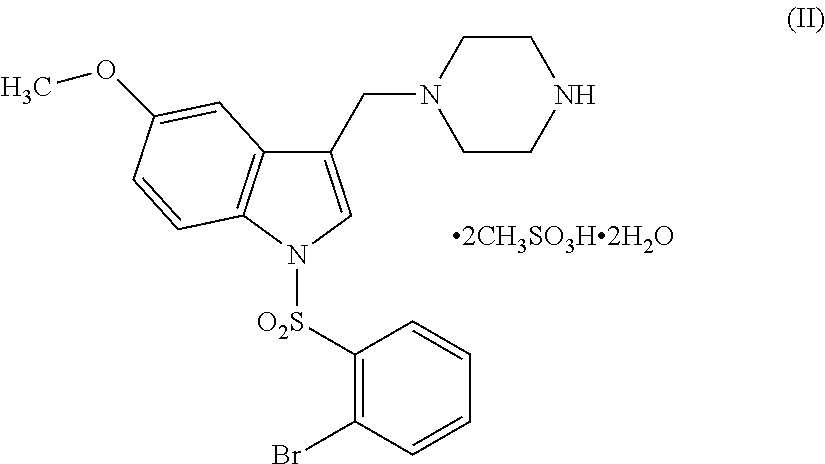
- the present invention is also directed to dimesylate dihydrate salt of formula (I) having the following structure
- the compounds of formula (I) and formula (II) are useful in the treatment of various disorders that are related to 5-HT 6 receptor antagonist.
- 5-HT 6 receptor is one of the potential therapeutic target for the development of cognitive enhancers: for the treatment of Alzheimer's disease (AD) and schizophrenia.
- 5-HT 6 receptor is localized exclusively in central nervous system, in areas important for learning and memory.
- AD Alzheimer's disease
- 5-HT 6 receptor antagonists show beneficial effect on cognition in animal models.
- the present invention is directed to active metabolite of 1-[(2-bromophenyl)sulfonyl]-5-methoxy-3-[(4-methyl-1-piperazinyl)methyl]-1H-indole dimesylate monohydrate having the following structure
- the present invention is also directed to dimesylate dihydrate salt of formula (I) having the following structure
- the present invention relates to use of a therapeutically effective amount of compounds of formula (I) and formula (II), to manufacture a medicament in the treatment of various disorders that are related to 5-HT 6 receptor antagonist.
- the compounds of formula (I) and formula (II) are useful in the treatment of various disorders such as AD, attention deficient hyperactivity, parkinson's and schizophrenia.
- the invention relates to pharmaceutical compositions containing a therapeutically effective amount of compounds of formula (I) and formula (II) with pharmaceutically acceptable excipients.
- the invention relates to method of treatment of using compounds of formula (I) and formula (H).
- the invention further relates to the process for preparing compounds of formula (I) and formula (II).
- FIG. 1 illustrates the mass spectrum and MS-fragmented chemical structure of 1-[(2-bromophenyl)sulfonyl]-5-methoxy-3-[(4-methyl-1-piperazinyl)methyl]-1H-indole.
- FIG. 2 illustrates the mass spectrum and MS-fragmented chemical structure of 1-[(2-Bromo phenyl)sulfonyl]-5-methoxy-3-[(1-piperazinyl)methyl]-1H-indole (Example 1).
- FIG. 3 illustrates the percentage choice accuracy of Example 1.
- FIG. 4 illustrates the percentage choice accuracy of Example 2.
- antagonist means full antagonist or partial antagonist.
- metabolism refers to substance produced by metabolism.
- terapéuticaally effective amount is defined as an amount of a compound of the present invention that (i) treats the particular disease, condition or disorder (ii) eliminates one or more symptoms of the particular disease, condition or disorder (iii) delays the onset of one or more symptoms of the particular disease, condition or disorder described herein.
- compositions of the present invention may be formulated in a conventional manner using one or more pharmaceutically acceptable excipients.
- the pharmaceutically acceptable excipient is carrier or diluent.
- the active compounds of the invention may be formulated for oral dosing.
- Such pharmaceutical compositions and processes for preparing the same are well known in the art (The Science and Practice of Pharmacy, D. B. Troy, 21 st Edition, Williams & Wilkins, 2006).
- the dose of the active compounds can vary depending on factors such as age and weight of patient, nature and severity of the disease to be treated and such other factors. Therefore, any reference regarding pharmacologically effective amount of the compounds of formula (I) and formula (II) refers to the aforementioned factors
- the reaction temperature may range from 20° C. to 35° C. and preferably at a temperature range from 25° C. to 30° C.
- the duration of the reaction may range from 45 minutes to 1.5 hours, preferably for a period of 1 hour;
- the reaction temperature may range from 20° C. to 35° C. and preferably at a temperature in the range from 25° C. to 30° C.
- the duration of the reaction may range from 45 minutes to 1.5 hours, preferably for a period of 1 hour;
- the reaction temperature may range from 20° C. to 35° C. and preferably at a temperature in the range from 25° C. to 30° C.
- the duration of the reaction may range from 45 minutes to 1.5 hours, preferably for a period of 1 hour;
- the reaction temperature may range from 20° C. to 35° C.
- the reaction temperature may range from 30° C. to 48° C. and preferably at a temperature ranging from 32° C. to 42° C.
- the duration of the reaction may range from 6 to 10 hours, preferably for a period of 6 hours to 8 hours;
- the reaction temperature may range from 20° C. to 35° C. and preferably at a temperature range from 25° C. to 30° C.
- the duration of the reaction may range from 45 minutes to 1.5 hours, preferably for a period of 1 hour;
- the reaction temperature may range from 20° C. to 35° C. and preferably at a temperature in the range from 25° C. to 30° C.
- the duration of the reaction may range from 45 minutes to 1.5 hours, preferably for a period of 1 hour;
- the reaction temperature may range from 20° C. to 35° C. and preferably at a temperature in the range from 25° C. to 30° C.
- the duration of the reaction may range from 45 minutes to 1.5 hours, preferably for a period of 1 hour;
- the reaction temperature may range from 20° C. to 35° C.
- the reaction temperature may range from 20° C. to 35° C. and preferably at a temperature ranging from 25° C. to 30° C.
- the duration of the reaction may range from 3.5 to 4 hours, preferably for a period of 4 hours;
- Demineralized water (DM water) (660 mL) and N-Boc piperazine (150.0 grams, 0.8034 moles) were charged into a 2 Liters three necked round bottomed flask provided with a mechanical stirrer and a thermometer pocket. The mass was stirred for 10 minutes at 25° C., to obtain a clear solution. Then acetic acid (32.5 mL, 0.5416 moles) was added to the above mass while maintaining the mass temperature at ⁇ 25° C. in 10 minutes. After completion of addition, the clear solution was stirred at 25° C. for 30 minutes.
- DM water Demineralized water
- N-Boc piperazine 150.0 grams, 0.8034 moles
- aqueous formaldehyde solution (81 mL, 30% w/v, 0.81 moles) was added slowly through an addition funnel over a period of 30 minutes maintaining the mass temperature below 25° C. During the addition, white slurry mass was formed. The resultant white slurry mass was stirred for another 1 hour at 25-30° C. Methanol (MeOH) (300 mL) was added to the above mass to obtain a clear solution. The solution was further stirred for 30 minutes at 25° C. to obtain Mannich adduct.
- MeOH MeOH
- n-Hexane (1.25 Liters) was taken in 2 Liters four necked round bottom flask equipped with thermometer pocket and mechanical stirrer and charged the above obtained technical compound (270.9 grams). The mass was stirred for 1 hour at 25° C. The product was filtered through Buckner funnel under vacuum. The compound was washed with n-hexane (2 ⁇ 125 mL), sucked well and air dried at 25° C. for 20 hours to obtain 240.0 grams of above title compound. Yield: 96%;
- Tetrahydrofuran (4.6 Liters) was charged into a reactor at 25° C., followed by the addition of powdered potassium hydroxide (860.6 grams, 85%, 13.06 moles) at 25° C. under stirring.
- TNT (3 Liters) was charged into a 5 Liters, three necked round bottom flask, provided with a mechanical stirrer and thermometer pocket.
- 3-[(1-t-Butyloxycarbonyl piperazin-4-yl) methyl]-5-methoxy-1H-indole (obtained in above step) (1287.7 grams, 3.7324 moles) was charged into the flask at 25° C. and stirred the mass well for complete dissolution.
- Ice-water (40 Liters) was charged into a clean reactor and the reaction mass unloaded in the carboys was quenched into the reactor under stirring and the pH of the resulting solution was found to be 11.5 (pH paper).
- the product was extracted with (15 Liters+7.5 Liters+7.5 Liters) ethyl acetate.
- the combined organic layer was washed with saturated brine solution (2 ⁇ 5 L) and dried over anhydrous sodium sulfate. Total volume of the organic layer was 30 Liters. A small portion of the organic layer was concentrated in laboratory and the solid obtained was analyzed to check the quality of the technical product.
- Reaction mass was then slowly cooled to room temperature (30 minutes) with room temperature water circulation in the jacket. It was further cooled to 18° C. and stirred for 1 hour. The product was centrifuged and the cake on the centrifuge was washed with isopropanol/methanol mixture (1.6 Liters+0.8 Liters). It was sucked well and air dried at 40-45° C. for 4 hours in tray driers.
- the above obtained compound (19.09 grams) was suspended in demineralised water (300 mL) and cooled to 15-20° C. The mass was basified to pH 10.5 to 11.0 by adding 40% (w/w) lye solution, maintaining mass temperature below 20° C. under nitrogen atmosphere. The product was extracted with (2 ⁇ 150 mL) ethylacetate. The combined organic layer was washed with (100 mL) saturated brine solution, dried over anhydrous sodium sulfate and solvent removed under rotavacuum at 40-45° C. to obtain the title compound (15.91 grams).
- Demineralized water (DM water) (660 mL) and N-Boc piperazine (150.0 grams, 0.8034 moles) were charged into a 2 Liters three necked round bottomed flask provided with a mechanical stirrer and a thermometer pocket. The mass was stirred for 10 minutes at 25° C., to obtain a clear solution. Then acetic acid (32.5 mL, 0.5416 moles) was added to the above mass while maintaining the mass temperature at 25° C. in 10 minutes. After completion of addition, the clear solution was stirred at 25° C. for 30 minutes.
- DM water Demineralized water
- N-Boc piperazine 150.0 grams, 0.8034 moles
- aqueous formaldehyde solution (81 mL, 30 w/v, 0.81 moles) was added slowly through an addition funnel over a period of 30 minutes maintaining the mass temperature below 25° C. During the addition, white slurry mass was formed. The resultant white slurry mass was stirred for another 1 hour at 25-30° C. Methanol (MeOH) (300 mL) was added to the above mass to obtain a clear solution. The solution was further stirred for 30 minutes at 25° C. to obtain Mannich adduct.
- MeOH Methanol
- n-Hexane (1.25 Liters) was taken in 2 Liters four necked round bottom flask equipped with thermometer pocket and mechanical stirrer and charged the above obtained technical compound (270.9 grams). The mass was stirred for 1 hour at 25° C. The product was filtered through Buckner funnel under vacuum. The compound was washed with n-hexane (2 ⁇ 125 mL), sucked well and air dried at 25° C. for 20 hours to obtain 240.0 grams of above title compound. Yield: 96%;
- Tetrahydrofuran (4.6 Liters) was charged into a reactor at 25° C., followed by the addition of powdered potassium hydroxide (860.6 grams, 85%, 13.06 moles) at 25° C. under stirring.
- THF 3 Liters was charged into a 5 Liters, three necked round bottom flask, provided with a mechanical stirrer and thermometer pocket.
- 3-[(1-t-Butyloxycarbonyl piperazin-4-yl)methyl]-5-methoxy-1H-indole (obtained in above step) (1287.7 grams, 3.7324 moles) was charged into the flask at 25° C. and stirred the mass well for complete dissolution.
- Ice-water (40 Liters) was charged into a clean reactor and the reaction mass unloaded in the carboys was quenched into the reactor under stirring and the pH of the resulting solution was 11.5 (pH paper).
- the product was extracted with (15 Liters+7.5 Liters+7.5 Liters) ethyl acetate.
- the combined organic layer was washed with saturated brine solution (2 ⁇ 5 L) and dried over anhydrous sodium sulfate. Total volume of the organic layer was 30 Liters. A small portion of the organic layer was concentrated in laboratory and the solid obtained was analyzed to check the quality of the technical product.
- Reaction mass was then slowly cooled to room temperature (30 minutes) with room temperature water circulation in the jacket. It was further cooled to 18° C. and stirred for 1 hour. The product was centrifuged and the cake on the centrifuge was washed with isopropanol/methanol mixture (1.6 Liters+0.8 Liters). It was sucked well and air dried at 40-45° C. for 4 hours in tray driers.
- the reaction mass was a clear solution before and after the addition of methanesulfonic acid solution. After stirring for ⁇ 90 minutes at reflux, thick mass of solids separated out. The progress of the reaction was monitored by TLC. The reaction was completed in 4 hours. Then the mass was cooled to 25° C. and further stirred for two hours at 25° C. The product was filtered through nutsche filter under vacuum. The product on the nutsche filter was washed with acetone (8 Liters). The material was unloaded into trays and air dried at 30-35° C. for 4 hours in a tray drier. Weight of the product: 1.61 Kg (off white with pinkish tinge).
- Salt content (dimesylate): 32.1% w/w;
- Acetone 24.15 L was taken in a Glass Lined Reactor at 25-30° C., followed by 1-[(2-Bromo phenyl)sulfonyl]-5-methoxy-3-[(1-piperazinyl)methyl]-1H-indole dimesylate (obtained in the above step) (1.61 Kg) and the resulting mass was stirred to obtain slurry.
- DM water 4.0 L was added to the reactor and then the mass temperature was raised to reflux temperature (56.0-57.5° C.). A clear solution was obtained at reflux. It was maintained for 15 minutes. The mass was cooled to 45-50° C. and added activated carbon (161 grams) to the mass and stirred the mass for 45 minutes at reflux temperature.
- Receptor Source Human recombinant expressed in CHOK1 cells
- Cell based reporter gene functional assay is performed using a validated cell line. Plate the cells and incubate overnight in complete medium. Next day incubate the cells in serum free medium (Ham's F12 without serum) for 18-24 hours. Perform the assay in OptiMEM medium by incubating the cells with 10 ⁇ M serotonin and compounds (1 nM to 10 ⁇ M) for 4 hours. Harvest the cells, lyse with lysis buffer and measure the luciferase activity using Perkin Elmer Victor Light Luminometer. Determine the binding affinity (K b ) value using the reporter activity measured as light units (Luminescence), analyze using nonlinear regression analysis with the analysis program Prism 4 (GraphPad software).
- Radial arm maze consists of a central hub of 45 centimeter diameter. Each arm was of dimension 42.5 ⁇ 15 ⁇ 24 centimeter. The maze was elevated to a height of 1 meter above the ground. The animals were placed on a restricted diet until they reached approximately 85% of their free feeding weight. During this diet restriction period animals were habituated to the novel feed (pellets). Once the rats reached approximately 85% of their free feeding weight rats were habituated to the maze on the 1 st and 2 nd day. The animals that did not eat the pellets were rejected from the study. Animals were randomized on day 2. On the subsequent days the treatment was given as per the allotment. Each animal was introduced into the maze individually for a period of 10 minutes. The arms were baited only once and the animal had to learn the rule that repeated arm entries would not be rewarded. The trial ended once the rat had visited 16 arms or 10 minutes were over or all the pellets were eaten. The arm entries were recorded using the software.
Landscapes
- Chemical & Material Sciences (AREA)
- Organic Chemistry (AREA)
- Health & Medical Sciences (AREA)
- General Health & Medical Sciences (AREA)
- Veterinary Medicine (AREA)
- Public Health (AREA)
- Medicinal Chemistry (AREA)
- Animal Behavior & Ethology (AREA)
- Life Sciences & Earth Sciences (AREA)
- Pharmacology & Pharmacy (AREA)
- Bioinformatics & Cheminformatics (AREA)
- Engineering & Computer Science (AREA)
- Biomedical Technology (AREA)
- Neurology (AREA)
- Neurosurgery (AREA)
- Nuclear Medicine, Radiotherapy & Molecular Imaging (AREA)
- General Chemical & Material Sciences (AREA)
- Chemical Kinetics & Catalysis (AREA)
- Epidemiology (AREA)
- Psychiatry (AREA)
- Psychology (AREA)
- Hospice & Palliative Care (AREA)
- Pharmaceuticals Containing Other Organic And Inorganic Compounds (AREA)
- Indole Compounds (AREA)
- Plural Heterocyclic Compounds (AREA)
Abstract
Description


-
- B: Acetonitrile (100%, v/v).
The LC-MS was operated under the conditions listed in below Table:
- B: Acetonitrile (100%, v/v).
| Parameters | Setting | ||
| Ionization | Pneumatically and thermally assisted ESI | ||
| Polarity | positive | ||
| Source | Sciex Turbo-V-Source | ||
| Spray voltage | 5500 V | ||
| | 350° C. (API 4000) | ||
| Gases | Nebulizer (air), heater (air), curtain (N2), | ||
| collision (N2) | |||
| Scan mode | MRM | ||
Pharmaceutical Compositions

Step (i): reacting N-Boc piperazine of
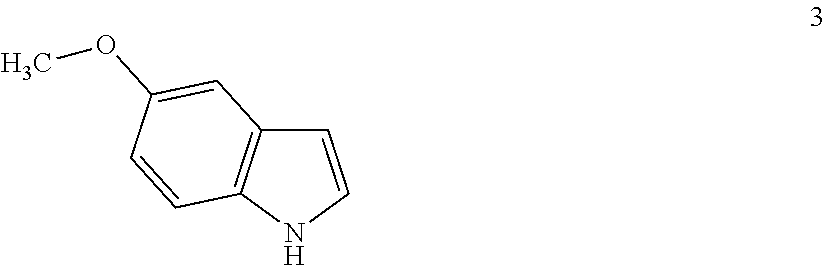
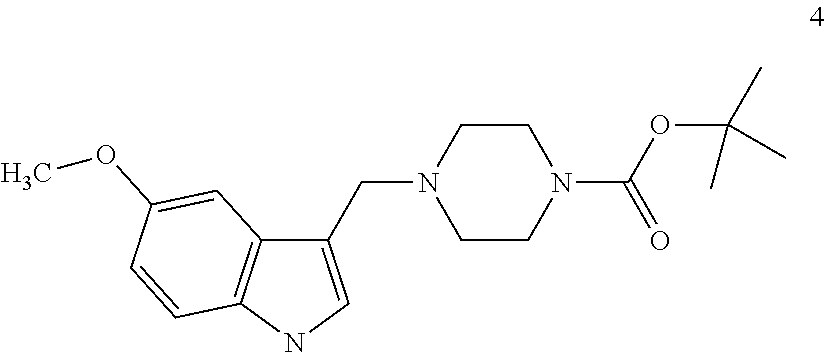
Step (ii): reacting the Mannich adduct (obtained in the above step) with 5-methoxyindole of formula 3 in presence of methanol to obtain 3-[(1-t-Butyloxycarbonyl piperazin-4-yl)methyl]-5-methoxy-1H-indole of formula 4. The reaction temperature may range from 20° C. to 35° C. and preferably at a temperature in the range from 25° C. to 30° C. The duration of the reaction may range from 45 minutes to 1.5 hours, preferably for a period of 1 hour;
Step (iii): the above obtained 3-[(1-t-Butyloxycarbonyl piperazin-4-yl)methyl]-5-methoxy-1H-indole of formula 4 is further purified by using n-hexane. The reaction temperature may range from 20° C. to 35° C. and preferably at a temperature in the range from 25° C. to 30° C. The duration of the reaction may range from 45 minutes to 1.5 hours, preferably for a period of 1 hour;
Step (iv): reacting the above obtained 3-[(1-t-Butyloxycarbonyl piperazin-4-yl)methyl]-5-methoxy-1H-indole of formula 4 with 2-bromophenylsulfonyl chloride of
Step (v): the above obtained 1-[(2-Bromophenyl)sulfonyl]-5-methoxy-3-[(1-t-butyloxycarbonyl piperazin-4-yl)methyl]-1H-indole of formula 6 is further purified by dissolving 1-[(2-Bromophenyl)sulfonyl]-5-methoxy-3-[(1-t-butyloxycarbonylpiperazin-4-yl)methyl]-1H-indole of formula 6 in isopropanol and methanol by heating the solution to a temperature ranging from 68° C. to 70.5° C. and stirring for a period of 1.5 hours to 2 hours to obtain clear solution, followed by cooling the solution to 16° C. to 18° C. and stirring for a period of 45 minutes to 1.5 hour to obtain purified product of formula 6;
Step (vi): converting the above obtained 1-[(2-Bromophenyl)sulfonyl]-5-methoxy-3-[(1-t-butyloxycarbonylpiperazin-4-yl)methyl]-1H-indole of formula 6 in presence of absolute ethanol and aqueous hydrochloric acid to obtain 1-[(2-Bromophenyl)sulfonyl]-5-methoxy-3-[(1-piperazinyl)methyl]-1H-indole dihydrochloride of formula 8. The reaction temperature may range from 30° C. to 48° C. and preferably at a temperature ranging from 32° C. to 42° C. The duration of the reaction may range from 6 to 10 hours, preferably for a period of 6 hours to 8 hours;
Step (vii): the above obtained 1-[(2-Bromophenyl)sulfonyl]-5-methoxy-3-[(1-piperazinyl)methyl]-1H-indole dihydrochloride of formula 8 is dissolved in water and basified to pH 10.5 to 11 by adding 40% (w/w) lye solution and extracted the product with ethyl acetate to obtain 1-[(2-Bromophenyl)sulfonyl]-5-methoxy-3-[(1-piperazinyl)methyl]-1H-indole of formula (I).

Step (i): reacting N-Boc piperazine of
Step (iii): the above obtained 3-[(1-t-Butyloxycarbonyl piperazin-4-yl)methyl]-5-methoxy-1H-indole of formula 4 is further purified by using n-hexane. The reaction temperature may range from 20° C. to 35° C. and preferably at a temperature in the range from 25° C. to 30° C. The duration of the reaction may range from 45 minutes to 1.5 hours, preferably for a period of 1 hour;
Step (iv): reacting the above obtained 3-[(1-t-Butyloxycarbonyl piperazin-4-yl)methyl]-5-methoxy-1H-indole of formula 4 with 2-bromophenylsulfonyl chloride of
Step (v): the above obtained 1-[(2-Bromophenyl)sulfonyl]-5-methoxy-3-[(1-t-butyloxycarbonyl piperazin-4-yl)methyl]-1H-indole of formula 6 is further purified by dissolving 1-[(2-Bromophenyl)sulfonyl]-5-methoxy-3-[(1-t-butyloxycarbonyl piperazin-4-yl)methyl]-1H-indole of formula 6 in isopropanol and methanol by heating the solution to a temperature ranging from 68° C. to 70.5° C. and stirring for a period of 1.5 hours to 2 hours to obtain clear solution, followed by cooling the solution to 16° C. to 18° C. and stirring for a period of 45 minutes to 1.5 hour to obtain purified product of formula 6;
Step (vi): converting the above obtained 1-[(2-Bromophenyl)sulfonyl]-5-methoxy-3-[(1-t-butyloxycarbonyl piperazin-4-yl)methyl]-1H-indole of formula 6 in presence of acetone and methanesulfonic acid of formula 7 to obtain 1-[(2-Bromophenyl)sulfonyl]-5-methoxy-3-[(1-piperazinyl)methyl]-1H-indole dimesylate of formula 9. The reaction temperature may range from 20° C. to 35° C. and preferably at a temperature ranging from 25° C. to 30° C. The duration of the reaction may range from 3.5 to 4 hours, preferably for a period of 4 hours;
Step (vii): the above obtained 1-[(2-Bromophenyl)sulfonyl]-5-methoxy-3-[(1-piperazinyl) methyl]-1H-indole dimesylate of formula 9 is dissolved in water and acetone by heating the solution to 55° C. to 60° C., followed by cooling the solution to 30° C. to 35° C. and further cooling to 10° C. to 12° C. for the period of 1.5 hours to 2.5 hours to obtain 1-[(2-Bromophenyl)sulfonyl]-5-methoxy-3-[(1-piperazinyl)methyl]-1H-indole dimesylate dihydrate of formula (II).


Step (i):


Step (i):


| Example Number | Kb (nM) | ||
| 1. | 10.9 nM | ||
| 2. | 9.8 nM | ||
| Reversal of Scopolamine Induced | |||
| Example Number | amnesia - |
||
| 1. | 10-20 mg/kg, p.o. | ||
| 2. | 5-20 mg/kg, p.o. | ||
Claims (15)


HCHO 2


HCHO 2



Applications Claiming Priority (3)
| Application Number | Priority Date | Filing Date | Title |
|---|---|---|---|
| IN4011CH2014 | 2014-08-16 | ||
| IN4011/CHE/2014 | 2014-08-16 | ||
| PCT/IN2014/000667 WO2016027276A1 (en) | 2014-08-16 | 2014-10-20 | Active metabolite of 1-[(2-bromophenyl) sulfonyl]-5-methoxy-3- [(4-methyl-1-piperazinyl) methyl]-1h-indole dimesylate monohydrate and dimesylate dihydrate salt of active metabolite |
Publications (2)
| Publication Number | Publication Date |
|---|---|
| US20170273944A1 US20170273944A1 (en) | 2017-09-28 |
| US10010527B2 true US10010527B2 (en) | 2018-07-03 |
Family
ID=52345478
Family Applications (1)
| Application Number | Title | Priority Date | Filing Date |
|---|---|---|---|
| US15/504,014 Active US10010527B2 (en) | 2014-08-16 | 2014-10-20 | Active metabolite of 1-[(2-bromophenyl)sulfonyl]-5-methoxy-3-[(4-methyl-1-piperazinyl)methyl]-1H-indole dimesylate monohydrate and dimesylate dihydrate salt of active metabolite |
Country Status (28)
| Country | Link |
|---|---|
| US (1) | US10010527B2 (en) |
| EP (1) | EP3180001B1 (en) |
| JP (1) | JP6629322B2 (en) |
| KR (1) | KR101938408B1 (en) |
| CN (1) | CN106794170A (en) |
| AP (1) | AP2017009752A0 (en) |
| AU (1) | AU2014404000B2 (en) |
| BR (1) | BR112017002921B1 (en) |
| CA (1) | CA2957497C (en) |
| CY (1) | CY1121393T1 (en) |
| DK (1) | DK3180001T3 (en) |
| EA (1) | EA031319B1 (en) |
| ES (1) | ES2715113T3 (en) |
| HR (1) | HRP20190446T1 (en) |
| HU (1) | HUE044011T2 (en) |
| IL (1) | IL250411B (en) |
| LT (1) | LT3180001T (en) |
| MX (1) | MX375538B (en) |
| NZ (1) | NZ728907A (en) |
| PL (1) | PL3180001T3 (en) |
| PT (1) | PT3180001T (en) |
| RS (1) | RS58575B1 (en) |
| SG (1) | SG11201701106RA (en) |
| SI (1) | SI3180001T1 (en) |
| SM (1) | SMT201900147T1 (en) |
| TR (1) | TR201903344T4 (en) |
| WO (1) | WO2016027276A1 (en) |
| ZA (1) | ZA201700915B (en) |
Families Citing this family (2)
| Publication number | Priority date | Publication date | Assignee | Title |
|---|---|---|---|---|
| SI3484467T1 (en) * | 2016-05-18 | 2020-10-30 | Suven Life Sciences Limited | Combination of pure 5-ht6 receptor antagonists with acetylcholinesterase inhibitors |
| CA3023828C (en) * | 2016-05-18 | 2019-08-27 | Suven Life Sciences Limited | Combination of pure 5-ht6 receptor antagonists with nmda receptor antagonist |
Citations (2)
| Publication number | Priority date | Publication date | Assignee | Title |
|---|---|---|---|---|
| WO2004048330A1 (en) | 2002-11-28 | 2004-06-10 | Suven Life Sciences Limited | N-arylsulfonyl-3-substituted indoles having serotonin receptor affinity, process for their preparation and pharmaceutical composition containing them |
| WO2004055026A1 (en) | 2002-12-18 | 2004-07-01 | Suven Life Sciences Limited | Tetracyclic 3-substituted indoles having serotonin receptor affinity |
Family Cites Families (4)
| Publication number | Priority date | Publication date | Assignee | Title |
|---|---|---|---|---|
| EP1326830A1 (en) * | 2000-10-20 | 2003-07-16 | Biovitrum Ab | 2-, 3-, 4-, or 5-substituted-n1-(benzensulfonyl)indoles and their use in therapy |
| EP1476151B1 (en) * | 2002-02-12 | 2008-07-16 | N.V. Organon | 1-arylsulfonyl-3-substitued indole and indoline derivates useful in the treatment of central nervous system disorders |
| US20080200471A1 (en) * | 2007-02-16 | 2008-08-21 | Memory Pharmaceuticals Corporation | 6' substituted compounds having 5-ht6 receptor affinity |
| NZ585374A (en) * | 2007-10-26 | 2011-09-30 | Suven Life Sciences Ltd | Amino arylsulfonamide compounds for treating disorders related to 5-HT6 receptor functions |
-
2014
- 2014-10-20 JP JP2017527993A patent/JP6629322B2/en active Active
- 2014-10-20 HU HUE14825443A patent/HUE044011T2/en unknown
- 2014-10-20 SM SM20190147T patent/SMT201900147T1/en unknown
- 2014-10-20 PT PT14825443T patent/PT3180001T/en unknown
- 2014-10-20 US US15/504,014 patent/US10010527B2/en active Active
- 2014-10-20 AP AP2017009752A patent/AP2017009752A0/en unknown
- 2014-10-20 EA EA201790396A patent/EA031319B1/en unknown
- 2014-10-20 SG SG11201701106RA patent/SG11201701106RA/en unknown
- 2014-10-20 AU AU2014404000A patent/AU2014404000B2/en active Active
- 2014-10-20 CA CA2957497A patent/CA2957497C/en active Active
- 2014-10-20 TR TR2019/03344T patent/TR201903344T4/en unknown
- 2014-10-20 HR HRP20190446TT patent/HRP20190446T1/en unknown
- 2014-10-20 WO PCT/IN2014/000667 patent/WO2016027276A1/en not_active Ceased
- 2014-10-20 KR KR1020177004616A patent/KR101938408B1/en active Active
- 2014-10-20 SI SI201431124T patent/SI3180001T1/en unknown
- 2014-10-20 ES ES14825443T patent/ES2715113T3/en active Active
- 2014-10-20 CN CN201480081234.1A patent/CN106794170A/en active Pending
- 2014-10-20 NZ NZ728907A patent/NZ728907A/en unknown
- 2014-10-20 RS RS20190286A patent/RS58575B1/en unknown
- 2014-10-20 EP EP14825443.6A patent/EP3180001B1/en active Active
- 2014-10-20 LT LTEP14825443.6T patent/LT3180001T/en unknown
- 2014-10-20 DK DK14825443.6T patent/DK3180001T3/en active
- 2014-10-20 BR BR112017002921-9A patent/BR112017002921B1/en active IP Right Grant
- 2014-10-20 MX MX2017002045A patent/MX375538B/en active IP Right Grant
- 2014-10-20 PL PL14825443T patent/PL3180001T3/en unknown
-
2017
- 2017-02-02 IL IL250411A patent/IL250411B/en active IP Right Grant
- 2017-02-06 ZA ZA2017/00915A patent/ZA201700915B/en unknown
-
2019
- 2019-03-08 CY CY20191100280T patent/CY1121393T1/en unknown
Patent Citations (2)
| Publication number | Priority date | Publication date | Assignee | Title |
|---|---|---|---|---|
| WO2004048330A1 (en) | 2002-11-28 | 2004-06-10 | Suven Life Sciences Limited | N-arylsulfonyl-3-substituted indoles having serotonin receptor affinity, process for their preparation and pharmaceutical composition containing them |
| WO2004055026A1 (en) | 2002-12-18 | 2004-07-01 | Suven Life Sciences Limited | Tetracyclic 3-substituted indoles having serotonin receptor affinity |
Non-Patent Citations (2)
| Title |
|---|
| European Patent Office, "International Preliminary Report on Patentability", mailed in PCT Application No. PCT/IN2014/000667 dated Feb. 26, 2016. |
| European Patent Office, "International Search Report" and "Written Opinion", mailed in PCT Application No. PCT/IN2014/000667 dated Feb. 9, 2015. |
Also Published As
Similar Documents
| Publication | Publication Date | Title |
|---|---|---|
| TWI406856B (en) | Inhibitors of human immunodeficiency virus replication | |
| JP6095844B2 (en) | Tetrahydropyrrolothiazine compound | |
| US20180305334A1 (en) | Compounds, compositions and methods of use against stress granules | |
| US9540321B2 (en) | Process for large scale production of 1-[(2-bromophenyl)sulfonyl]-5-methoxy-3-[(4-methyl-1-piperazinyl)methyl]-1H-indole dimesylate monohydrate | |
| WO2024112611A1 (en) | Targeted protein modification | |
| US9606089B2 (en) | Methods for detecting and reducing impurities of Lapatinib and salts thereof | |
| EA011087B1 (en) | Compounds and pharmaceutical compositions for treating inflammation diseases | |
| JP2013510107A (en) | Benzodiazepine bromodomain inhibitor | |
| US10010527B2 (en) | Active metabolite of 1-[(2-bromophenyl)sulfonyl]-5-methoxy-3-[(4-methyl-1-piperazinyl)methyl]-1H-indole dimesylate monohydrate and dimesylate dihydrate salt of active metabolite | |
| CN104945415B (en) | 7H-benzo-isoxazole-[7,6-e][1,3]oxazine derivatives and application | |
| US7592457B2 (en) | 3-aryl-3-methyl-quinoline-2, 4-diones, preparation method thereof, and pharmaceutical composition containing the same | |
| HK1236833A1 (en) | Active metabolite of 1-[(2-bromophenyl) sulfonyl]-5-methoxy-3- [(4-methyl-1-piperazinyl) methyl]-1h-indole dimesylate monohydrate and dimesylate dihydrate salt of active metabolite | |
| US20250325547A1 (en) | Anti-sars-cov-2 drug | |
| JP2967231B2 (en) | 1,4-thiazine derivatives | |
| CN116768881B (en) | 4- (3-Indolyl) -1, 3-thiazole compound and preparation method and application thereof | |
| US8383631B2 (en) | 1,6-disubstituted-3-amino-4,5,6,7-tetrahydro-1H-pyrazolo[3,4-C]pyridin-7-one compounds and preparation thereof | |
| US10449186B2 (en) | Phenylethynyl-substituted benzenes and heterocycles for the treatment of cancer | |
| KR20230159803A (en) | Quinoline-based histone deacetylase inhibitory compounds, method for preparing the same, and pharmaceutical composition comprising the same as the active ingredient | |
| US9475769B2 (en) | Zinc halide mediated cyclization process leading to tricyclic indoles |
Legal Events
| Date | Code | Title | Description |
|---|---|---|---|
| AS | Assignment |
Owner name: SUVEN LIFE SCIENCES LIMITED, INDIA Free format text: ASSIGNMENT OF ASSIGNORS INTEREST;ASSIGNORS:NIROGI, RAMAKRISHNA;KAMBHAMPATI, RAMASASTRI;SHINDE, ANIL KARBHARI;AND OTHERS;REEL/FRAME:041741/0050 Effective date: 20170210 |
|
| STCF | Information on status: patent grant |
Free format text: PATENTED CASE |
|
| MAFP | Maintenance fee payment |
Free format text: PAYMENT OF MAINTENANCE FEE, 4TH YEAR, LARGE ENTITY (ORIGINAL EVENT CODE: M1551); ENTITY STATUS OF PATENT OWNER: LARGE ENTITY Year of fee payment: 4 |
|
| MAFP | Maintenance fee payment |
Free format text: PAYMENT OF MAINTENANCE FEE, 8TH YEAR, LARGE ENTITY (ORIGINAL EVENT CODE: M1552); ENTITY STATUS OF PATENT OWNER: LARGE ENTITY Year of fee payment: 8 |