TWI888517B - Anti-psma antibody-drug conjugate and pharmaceutical use thereof - Google Patents
Anti-psma antibody-drug conjugate and pharmaceutical use thereof Download PDFInfo
- Publication number
- TWI888517B TWI888517B TW110110881A TW110110881A TWI888517B TW I888517 B TWI888517 B TW I888517B TW 110110881 A TW110110881 A TW 110110881A TW 110110881 A TW110110881 A TW 110110881A TW I888517 B TWI888517 B TW I888517B
- Authority
- TW
- Taiwan
- Prior art keywords
- antibody
- cancer
- drug conjugate
- pharmaceutically acceptable
- acceptable salt
- Prior art date
Links
Images


Classifications
-
- C—CHEMISTRY; METALLURGY
- C07—ORGANIC CHEMISTRY
- C07D—HETEROCYCLIC COMPOUNDS
- C07D491/00—Heterocyclic compounds containing in the condensed ring system both one or more rings having oxygen atoms as the only ring hetero atoms and one or more rings having nitrogen atoms as the only ring hetero atoms, not provided for by groups C07D451/00 - C07D459/00, C07D463/00, C07D477/00 or C07D489/00
- C07D491/22—Heterocyclic compounds containing in the condensed ring system both one or more rings having oxygen atoms as the only ring hetero atoms and one or more rings having nitrogen atoms as the only ring hetero atoms, not provided for by groups C07D451/00 - C07D459/00, C07D463/00, C07D477/00 or C07D489/00 in which the condensed system contains four or more hetero rings
-
- A—HUMAN NECESSITIES
- A61—MEDICAL OR VETERINARY SCIENCE; HYGIENE
- A61K—PREPARATIONS FOR MEDICAL, DENTAL OR TOILETRY PURPOSES
- A61K47/00—Medicinal preparations characterised by the non-active ingredients used, e.g. carriers or inert additives; Targeting or modifying agents chemically bound to the active ingredient
- A61K47/50—Medicinal preparations characterised by the non-active ingredients used, e.g. carriers or inert additives; Targeting or modifying agents chemically bound to the active ingredient the non-active ingredient being chemically bound to the active ingredient, e.g. polymer-drug conjugates
- A61K47/51—Medicinal preparations characterised by the non-active ingredients used, e.g. carriers or inert additives; Targeting or modifying agents chemically bound to the active ingredient the non-active ingredient being chemically bound to the active ingredient, e.g. polymer-drug conjugates the non-active ingredient being a modifying agent
- A61K47/68—Medicinal preparations characterised by the non-active ingredients used, e.g. carriers or inert additives; Targeting or modifying agents chemically bound to the active ingredient the non-active ingredient being chemically bound to the active ingredient, e.g. polymer-drug conjugates the non-active ingredient being a modifying agent the modifying agent being an antibody, an immunoglobulin or a fragment thereof, e.g. an Fc-fragment
- A61K47/6801—Drug-antibody or immunoglobulin conjugates defined by the pharmacologically or therapeutically active agent
- A61K47/6803—Drugs conjugated to an antibody or immunoglobulin, e.g. cisplatin-antibody conjugates
-
- A—HUMAN NECESSITIES
- A61—MEDICAL OR VETERINARY SCIENCE; HYGIENE
- A61K—PREPARATIONS FOR MEDICAL, DENTAL OR TOILETRY PURPOSES
- A61K31/00—Medicinal preparations containing organic active ingredients
- A61K31/33—Heterocyclic compounds
- A61K31/395—Heterocyclic compounds having nitrogen as a ring hetero atom, e.g. guanethidine or rifamycins
- A61K31/435—Heterocyclic compounds having nitrogen as a ring hetero atom, e.g. guanethidine or rifamycins having six-membered rings with one nitrogen as the only ring hetero atom
- A61K31/47—Quinolines; Isoquinolines
- A61K31/4738—Quinolines; Isoquinolines ortho- or peri-condensed with heterocyclic ring systems
- A61K31/4745—Quinolines; Isoquinolines ortho- or peri-condensed with heterocyclic ring systems condensed with ring systems having nitrogen as a ring hetero atom, e.g. phenantrolines
-
- A—HUMAN NECESSITIES
- A61—MEDICAL OR VETERINARY SCIENCE; HYGIENE
- A61K—PREPARATIONS FOR MEDICAL, DENTAL OR TOILETRY PURPOSES
- A61K47/00—Medicinal preparations characterised by the non-active ingredients used, e.g. carriers or inert additives; Targeting or modifying agents chemically bound to the active ingredient
- A61K47/50—Medicinal preparations characterised by the non-active ingredients used, e.g. carriers or inert additives; Targeting or modifying agents chemically bound to the active ingredient the non-active ingredient being chemically bound to the active ingredient, e.g. polymer-drug conjugates
- A61K47/51—Medicinal preparations characterised by the non-active ingredients used, e.g. carriers or inert additives; Targeting or modifying agents chemically bound to the active ingredient the non-active ingredient being chemically bound to the active ingredient, e.g. polymer-drug conjugates the non-active ingredient being a modifying agent
- A61K47/68—Medicinal preparations characterised by the non-active ingredients used, e.g. carriers or inert additives; Targeting or modifying agents chemically bound to the active ingredient the non-active ingredient being chemically bound to the active ingredient, e.g. polymer-drug conjugates the non-active ingredient being a modifying agent the modifying agent being an antibody, an immunoglobulin or a fragment thereof, e.g. an Fc-fragment
-
- A—HUMAN NECESSITIES
- A61—MEDICAL OR VETERINARY SCIENCE; HYGIENE
- A61K—PREPARATIONS FOR MEDICAL, DENTAL OR TOILETRY PURPOSES
- A61K47/00—Medicinal preparations characterised by the non-active ingredients used, e.g. carriers or inert additives; Targeting or modifying agents chemically bound to the active ingredient
- A61K47/50—Medicinal preparations characterised by the non-active ingredients used, e.g. carriers or inert additives; Targeting or modifying agents chemically bound to the active ingredient the non-active ingredient being chemically bound to the active ingredient, e.g. polymer-drug conjugates
- A61K47/51—Medicinal preparations characterised by the non-active ingredients used, e.g. carriers or inert additives; Targeting or modifying agents chemically bound to the active ingredient the non-active ingredient being chemically bound to the active ingredient, e.g. polymer-drug conjugates the non-active ingredient being a modifying agent
- A61K47/68—Medicinal preparations characterised by the non-active ingredients used, e.g. carriers or inert additives; Targeting or modifying agents chemically bound to the active ingredient the non-active ingredient being chemically bound to the active ingredient, e.g. polymer-drug conjugates the non-active ingredient being a modifying agent the modifying agent being an antibody, an immunoglobulin or a fragment thereof, e.g. an Fc-fragment
- A61K47/6801—Drug-antibody or immunoglobulin conjugates defined by the pharmacologically or therapeutically active agent
- A61K47/6803—Drugs conjugated to an antibody or immunoglobulin, e.g. cisplatin-antibody conjugates
- A61K47/68037—Drugs conjugated to an antibody or immunoglobulin, e.g. cisplatin-antibody conjugates the drug being a camptothecin [CPT] or derivatives
-
- A—HUMAN NECESSITIES
- A61—MEDICAL OR VETERINARY SCIENCE; HYGIENE
- A61K—PREPARATIONS FOR MEDICAL, DENTAL OR TOILETRY PURPOSES
- A61K47/00—Medicinal preparations characterised by the non-active ingredients used, e.g. carriers or inert additives; Targeting or modifying agents chemically bound to the active ingredient
- A61K47/50—Medicinal preparations characterised by the non-active ingredients used, e.g. carriers or inert additives; Targeting or modifying agents chemically bound to the active ingredient the non-active ingredient being chemically bound to the active ingredient, e.g. polymer-drug conjugates
- A61K47/51—Medicinal preparations characterised by the non-active ingredients used, e.g. carriers or inert additives; Targeting or modifying agents chemically bound to the active ingredient the non-active ingredient being chemically bound to the active ingredient, e.g. polymer-drug conjugates the non-active ingredient being a modifying agent
- A61K47/68—Medicinal preparations characterised by the non-active ingredients used, e.g. carriers or inert additives; Targeting or modifying agents chemically bound to the active ingredient the non-active ingredient being chemically bound to the active ingredient, e.g. polymer-drug conjugates the non-active ingredient being a modifying agent the modifying agent being an antibody, an immunoglobulin or a fragment thereof, e.g. an Fc-fragment
- A61K47/6835—Medicinal preparations characterised by the non-active ingredients used, e.g. carriers or inert additives; Targeting or modifying agents chemically bound to the active ingredient the non-active ingredient being chemically bound to the active ingredient, e.g. polymer-drug conjugates the non-active ingredient being a modifying agent the modifying agent being an antibody, an immunoglobulin or a fragment thereof, e.g. an Fc-fragment the modifying agent being an antibody or an immunoglobulin bearing at least one antigen-binding site
- A61K47/6851—Medicinal preparations characterised by the non-active ingredients used, e.g. carriers or inert additives; Targeting or modifying agents chemically bound to the active ingredient the non-active ingredient being chemically bound to the active ingredient, e.g. polymer-drug conjugates the non-active ingredient being a modifying agent the modifying agent being an antibody, an immunoglobulin or a fragment thereof, e.g. an Fc-fragment the modifying agent being an antibody or an immunoglobulin bearing at least one antigen-binding site the antibody targeting a determinant of a tumour cell
- A61K47/6869—Medicinal preparations characterised by the non-active ingredients used, e.g. carriers or inert additives; Targeting or modifying agents chemically bound to the active ingredient the non-active ingredient being chemically bound to the active ingredient, e.g. polymer-drug conjugates the non-active ingredient being a modifying agent the modifying agent being an antibody, an immunoglobulin or a fragment thereof, e.g. an Fc-fragment the modifying agent being an antibody or an immunoglobulin bearing at least one antigen-binding site the antibody targeting a determinant of a tumour cell the tumour determinant being from a cell of the reproductive system: ovaria, uterus, testes, prostate
-
- A—HUMAN NECESSITIES
- A61—MEDICAL OR VETERINARY SCIENCE; HYGIENE
- A61K—PREPARATIONS FOR MEDICAL, DENTAL OR TOILETRY PURPOSES
- A61K47/00—Medicinal preparations characterised by the non-active ingredients used, e.g. carriers or inert additives; Targeting or modifying agents chemically bound to the active ingredient
- A61K47/50—Medicinal preparations characterised by the non-active ingredients used, e.g. carriers or inert additives; Targeting or modifying agents chemically bound to the active ingredient the non-active ingredient being chemically bound to the active ingredient, e.g. polymer-drug conjugates
- A61K47/51—Medicinal preparations characterised by the non-active ingredients used, e.g. carriers or inert additives; Targeting or modifying agents chemically bound to the active ingredient the non-active ingredient being chemically bound to the active ingredient, e.g. polymer-drug conjugates the non-active ingredient being a modifying agent
- A61K47/68—Medicinal preparations characterised by the non-active ingredients used, e.g. carriers or inert additives; Targeting or modifying agents chemically bound to the active ingredient the non-active ingredient being chemically bound to the active ingredient, e.g. polymer-drug conjugates the non-active ingredient being a modifying agent the modifying agent being an antibody, an immunoglobulin or a fragment thereof, e.g. an Fc-fragment
- A61K47/6889—Conjugates wherein the antibody being the modifying agent and wherein the linker, binder or spacer confers particular properties to the conjugates, e.g. peptidic enzyme-labile linkers or acid-labile linkers, providing for an acid-labile immuno conjugate wherein the drug may be released from its antibody conjugated part in an acidic, e.g. tumoural or environment
-
- A—HUMAN NECESSITIES
- A61—MEDICAL OR VETERINARY SCIENCE; HYGIENE
- A61P—SPECIFIC THERAPEUTIC ACTIVITY OF CHEMICAL COMPOUNDS OR MEDICINAL PREPARATIONS
- A61P35/00—Antineoplastic agents
-
- C—CHEMISTRY; METALLURGY
- C07—ORGANIC CHEMISTRY
- C07K—PEPTIDES
- C07K16/00—Immunoglobulins [IGs], e.g. monoclonal or polyclonal antibodies
- C07K16/18—Immunoglobulins [IGs], e.g. monoclonal or polyclonal antibodies against material from animals or humans
- C07K16/28—Immunoglobulins [IGs], e.g. monoclonal or polyclonal antibodies against material from animals or humans against receptors, cell surface antigens or cell surface determinants
- C07K16/30—Immunoglobulins [IGs], e.g. monoclonal or polyclonal antibodies against material from animals or humans against receptors, cell surface antigens or cell surface determinants from tumour cells
- C07K16/3069—Reproductive system, e.g. ovaria, uterus, testes, prostate
-
- A—HUMAN NECESSITIES
- A61—MEDICAL OR VETERINARY SCIENCE; HYGIENE
- A61K—PREPARATIONS FOR MEDICAL, DENTAL OR TOILETRY PURPOSES
- A61K39/00—Medicinal preparations containing antigens or antibodies
- A61K2039/505—Medicinal preparations containing antigens or antibodies comprising antibodies
-
- C—CHEMISTRY; METALLURGY
- C07—ORGANIC CHEMISTRY
- C07K—PEPTIDES
- C07K2317/00—Immunoglobulins specific features
- C07K2317/50—Immunoglobulins specific features characterized by immunoglobulin fragments
- C07K2317/56—Immunoglobulins specific features characterized by immunoglobulin fragments variable (Fv) region, i.e. VH and/or VL
- C07K2317/565—Complementarity determining region [CDR]
-
- C—CHEMISTRY; METALLURGY
- C07—ORGANIC CHEMISTRY
- C07K—PEPTIDES
- C07K2317/00—Immunoglobulins specific features
- C07K2317/70—Immunoglobulins specific features characterized by effect upon binding to a cell or to an antigen
- C07K2317/77—Internalization into the cell
-
- C—CHEMISTRY; METALLURGY
- C07—ORGANIC CHEMISTRY
- C07K—PEPTIDES
- C07K2317/00—Immunoglobulins specific features
- C07K2317/90—Immunoglobulins specific features characterized by (pharmaco)kinetic aspects or by stability of the immunoglobulin
- C07K2317/94—Stability, e.g. half-life, pH, temperature or enzyme-resistance
Landscapes
- Health & Medical Sciences (AREA)
- Chemical & Material Sciences (AREA)
- Life Sciences & Earth Sciences (AREA)
- Bioinformatics & Cheminformatics (AREA)
- Engineering & Computer Science (AREA)
- Medicinal Chemistry (AREA)
- General Health & Medical Sciences (AREA)
- Animal Behavior & Ethology (AREA)
- Pharmacology & Pharmacy (AREA)
- Public Health (AREA)
- Veterinary Medicine (AREA)
- Organic Chemistry (AREA)
- Immunology (AREA)
- Epidemiology (AREA)
- Cell Biology (AREA)
- Reproductive Health (AREA)
- General Chemical & Material Sciences (AREA)
- Nuclear Medicine, Radiotherapy & Molecular Imaging (AREA)
- Chemical Kinetics & Catalysis (AREA)
- Gynecology & Obstetrics (AREA)
- Pregnancy & Childbirth (AREA)
- Biochemistry (AREA)
- Biophysics (AREA)
- Genetics & Genomics (AREA)
- Molecular Biology (AREA)
- Proteomics, Peptides & Aminoacids (AREA)
- Peptides Or Proteins (AREA)
- Medicines Containing Antibodies Or Antigens For Use As Internal Diagnostic Agents (AREA)
- Medicinal Preparation (AREA)
Abstract
Description
請求2020年3月25日提交的中國專利申請(申請號CN 202010218297.4)的優先權。 Requesting priority for the Chinese patent application filed on March 25, 2020 (application number CN 202010218297.4).
本揭露涉及抗PSMA抗體、抗PSMA抗體-依喜替康類似物偶聯物,其製備方法,包含其的藥物組成物,以及其用於製備治療PSMA介導的疾病或病症的藥物中的用途;尤其在用於製備抗癌藥物中的用途。 The present disclosure relates to anti-PSMA antibodies, anti-PSMA antibody-exitecan analog conjugates, preparation methods thereof, pharmaceutical compositions containing the same, and their use in preparing drugs for treating PSMA-mediated diseases or conditions; in particular, their use in preparing anticancer drugs.
這裡的陳述僅提供與本揭露有關的背景資訊,而不必然地構成現有技術。 The statements herein merely provide background information related to the present disclosure and do not necessarily constitute prior art.
美國癌症協會2019年統計數據顯示,美國男性新增癌症病例中前列腺癌排名第一,為174650例(CA CANCER J CLIN 2019;69:7-34)。對於臨床局部疾病,通常選擇手術和放射治療。對於局部晚期或轉移性疾病,通常先採用手術或化學方式剝奪雄激素(ADT)治療。對於去勢抵抗(CRPC)初期可選用Sipuleucel-T細胞免疫療法,對於轉移性去勢抵抗階段(mCRPC)病人,可根據情況選用雄激素抑制劑、雄激素受體拮抗劑、針對骨轉移的放療藥物以及作用於微 管的化療藥物等藥物治療。但每種治療方式都只能延長幾個月的存活期,需要尋求有效的治療方式(European Urology,66(6),1190-1193;Journal of Nuclear Medicine,59(2),177-182.)。 According to the statistics of the American Cancer Society in 2019, prostate cancer ranks first among the new cancer cases in American men, with 174,650 cases (CA CANCER J CLIN 2019; 69: 7-34). For clinical local diseases, surgery and radiotherapy are usually selected. For locally advanced or metastatic diseases, surgery or chemotherapy androgen deprivation (ADT) treatment is usually used first. For the early stage of castration-resistant prostate cancer (CRPC), Sipuleucel-T cell immunotherapy can be used. For patients in the metastatic castration-resistant stage (mCRPC), androgen inhibitors, androgen receptor antagonists, radiotherapy drugs for bone metastasis, and chemotherapy drugs acting on microtubules can be selected according to the situation. However, each treatment can only extend the survival period by a few months, and effective treatments need to be sought (European Urology, 66(6), 1190-1193; Journal of Nuclear Medicine, 59(2), 177-182.).
前列腺特異性膜抗原(PSMA)除了由前列腺上皮细胞表達以外,還可以由非前列腺組織表達,例如小腸,近端腎小管和唾液腺,但其水平遠低於前列腺組織。而PSMA在前列腺癌細胞中高表達,特別是在轉移性疾病、激素難治性疾病和高級別病變中的表達最高。另外,PSMA還高表達於所有實體瘤的新生血管的內皮细胞中,但其在正常血管中没有表達,所以它也被作為實體瘤治療的靶點(Clinical Cancer Research,Vol.3,81-85,January 1997;Urologic Oncology:Seminars and Original Investigations,1(1),18-28.;Clin Cancer Res.2010 November 15;16(22):5414-5423.)。雄激素剝奪或雄激素受體拮抗劑治療均可上調前列腺特異膜抗原(PSMA)的表達(J Nucl Med 2017;58:81-84),這為靶向療法與傳統激素療法聯合治療提供依據。 In addition to being expressed by prostate epithelial cells, prostate-specific membrane antigen (PSMA) can also be expressed by non-prostate tissues, such as the small intestine, proximal renal ducts, and salivary glands, but at levels much lower than in prostate tissue. PSMA is highly expressed in prostate cancer cells, especially in metastatic disease, hormone-refractory disease, and high-grade lesions. In addition, PSMA is also highly expressed in the endothelial cells of the new blood vessels of all solid tumors, but it is not expressed in normal blood vessels, so it is also used as a target for solid tumor treatment (Clinical Cancer Research, Vol. 3, 81-85, January 1997; Urologic Oncology: Seminars and Original Investigations, 1(1), 18-28.; Clin Cancer Res. 2010 November 15; 16(22): 5414-5423.). Androgen deprivation or androgen receptor antagonist therapy can upregulate the expression of prostate-specific membrane antigen (PSMA) (J Nucl Med 2017; 58: 81-84), which provides a basis for the combined treatment of targeted therapy and traditional hormone therapy.
PSMA屬於麩胺酸II型羧肽酶(Glutamate carboxypeptidase II,GCPII),它在神經系統中作為NAALDase,酶解NAAG得到麩胺酸,與麩胺酸的神經傳遞相關。在小腸中作為FOLH1,分解葉酸-聚-γ-麩胺酸(folyl-poly-γ-glutamate,FPGn)得到葉酸,與葉酸代謝相關(Curr Med Chem.2012;19(6):856-870.)。而在前列腺中作為PSMA,表現在上皮細胞上,與前列腺癌的發生有關。PSMA由750個胺基酸組成,胞內19個,跨膜24個,胞外707個。結晶結果顯示胞外部分由3個結構域組成,分別為蛋白酶樣結構域、頂端結構域和C末端結構域。三者都參與受質的結合,前兩者直接與受質結合,C末端結構域在使PSMA形成二聚體中發揮作用(The EMBO Journal(2006)25,1375-1384)。麩胺酸II型羧肽酶 (GCPII)及其剪接變體,旁系同源物的研究有限。以PSM’為代表的剪接變體大多存在於正常前列腺組織細胞的胞內。研究最深入的GCPII同源物GCPIII或NAALADase II作為自身有效的藥物標靶,可以彌補正常的GCPII酶促活性的不足,其與GCPII有68%序列相似性(Current Medicinal Chemistry,2012,19,1316-1322;Frontiers in Bioscience,Landmark,24,648-687,March 1,2019)。 PSMA belongs to Glutamate carboxypeptidase II (GCPII). It acts as NAALDase in the nervous system, hydrolyzing NAAG to obtain glutamine, which is related to the neurotransmission of glutamine. In the small intestine, it acts as FOLH1, decomposing folyl-poly-γ-glutamate (FPGn) to obtain folic acid, which is related to folic acid metabolism (Curr Med Chem. 2012; 19(6): 856-870.). In the prostate, it acts as PSMA, expressed on epithelial cells, and is related to the occurrence of prostate cancer. PSMA is composed of 750 amino acids, 19 of which are intracellular, 24 are transmembrane, and 707 are extracellular. Crystallization results show that the extracellular part is composed of three domains, namely the protease-like domain, the top domain and the C-terminal domain. All three are involved in substrate binding. The first two directly bind to the substrate, and the C-terminal domain plays a role in making PSMA form dimers (The EMBO Journal (2006) 25, 1375-1384). Studies on glutamine type II carboxypeptidase (GCPII) and its splice variants and paralogs are limited. Splice variants represented by PSM’ are mostly present in normal prostate tissue cells. The most intensively studied GCPII homolog GCPIII or NAALADase II is an effective drug target in itself, which can make up for the deficiency of normal GCPII enzymatic activity. It has 68% sequence similarity with GCPII (Current Medicinal Chemistry, 2012, 19, 1316-1322; Frontiers in Bioscience, Landmark, 24, 648-687, March 1, 2019).
抗體-藥物偶聯物(antibody drug conjugate,ADC)把單株抗體或者抗體片段通過接頭化合物與具有生物活性的細胞毒素相連,充分利用了抗體對正常細胞和腫瘤細胞表面抗原結合的特異性和細胞毒性物質的高效性,同時又避免了抗體的療效偏低和毒性物質毒副作用過大等缺陷。這也就意味著,與以往傳統的化療藥物相比,抗體-藥物偶聯物能更精准地殺傷腫瘤細胞並降低將對正常細胞的影響。 Antibody-drug conjugates (ADCs) connect monoclonal antibodies or antibody fragments to biologically active cytotoxins through linker compounds, making full use of the specificity of antibodies in binding to surface antigens of normal cells and tumor cells and the high efficiency of cytotoxic substances, while avoiding the defects of low efficacy of antibodies and excessive side effects of toxic substances. This means that compared with traditional chemotherapy drugs, antibody-drug conjugates can kill tumor cells more accurately and reduce the impact on normal cells.
目前已有多種ADC藥物被用於臨床或臨床研究,如Kadcyla,是靶向Her2的曲妥珠單抗與DM1形成的ADC藥物。同時,也有靶向PSMA的ADC藥物的用於臨床治療研究。Cytogen公司的PSMA-ADC,處於二期臨床階段,MedImmune公司的MEDI-3726以及BZL Biologics Inc公司的MLN-2704在臨床一期結束後因為藥效不良停止了研究。採用不同策略開發新的ADC藥物具有廣闊的前景。 Currently, many ADC drugs have been used in clinical practice or clinical research, such as Kadcyla, which is an ADC drug formed by trastuzumab targeting Her2 and DM1. At the same time, there are also ADC drugs targeting PSMA used in clinical treatment research. Cytogen's PSMA-ADC is in the Phase II clinical stage, and MedImmune's MEDI-3726 and BZL Biologics Inc's MLN-2704 stopped research after the end of Phase I clinical trials due to poor efficacy. There is a broad prospect for developing new ADC drugs using different strategies.
本揭露涉及抗PSMA抗體-ADC以及其用途,提供與抗PSMA抗體或抗原結合片段與細胞毒性物質依喜替康類似物偶聯的ADC藥物。 The present disclosure relates to anti-PSMA antibody-ADC and its use, providing an ADC drug conjugated with an anti-PSMA antibody or antigen-binding fragment and a cytotoxic substance, an isotecan analog.
本揭露提供了一種通式(Pc-L-Y-D)所示的抗體-藥物偶聯物或其藥學上可接受的鹽: The present disclosure provides an antibody-drug conjugate or a pharmaceutically acceptable salt thereof represented by the general formula (Pc-L-Y-D):
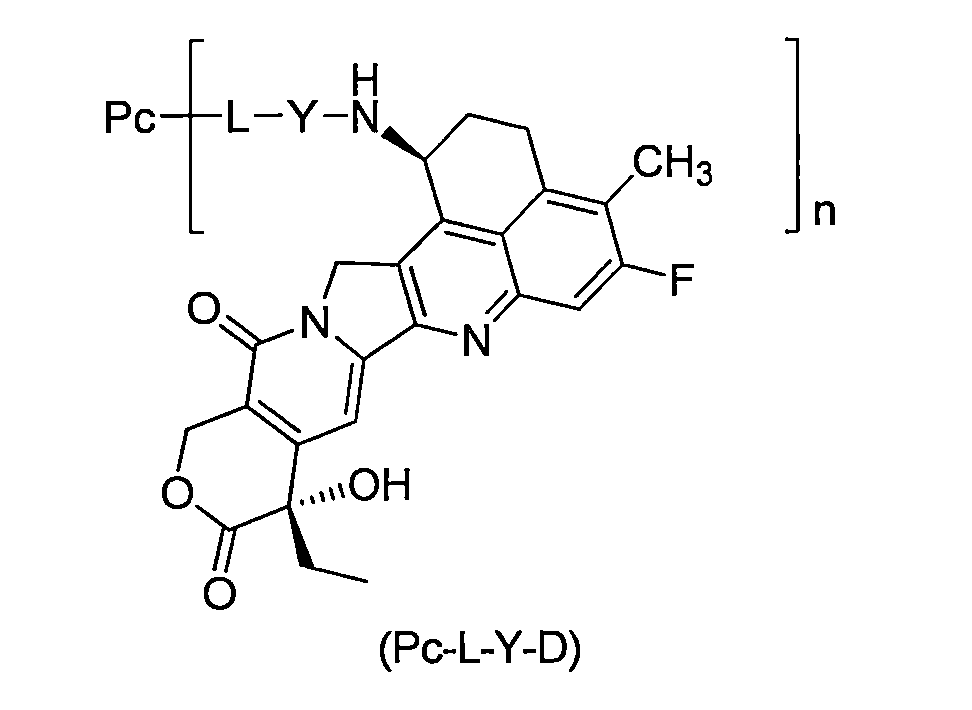
其中, in,
Y選自-O-(CRaRb)m-CR1R2-C(O)-、-O-CR1R2-(CRaRb)m-、-O-CR1R2-、-NH-(CRaRb)m-CR1R2-C(O)-和-S-(CRaRb)m-CR1R2-C(O)-; Y is selected from -O-(CR a R b ) m -CR 1 R 2 -C(O)-, -O-CR 1 R 2 -(CR a R b ) m -, -O-CR 1 R 2 -, -NH-(CR a R b ) m -CR 1 R 2 -C(O)- and -S-(CR a R b ) m -CR 1 R 2 -C(O)-;
Ra和Rb相同或不同,且各自獨立地選自氫原子、氘原子、鹵素、烷基、鹵烷基、氘代烷基、烷氧基、羥基、胺基、氰基、硝基、羥烷基、環烷基和雜環基;或者,Ra和Rb與其相連接的碳原子一起形成環烷基或雜環基; Ra and Rb are the same or different and are each independently selected from a hydrogen atom, a deuterium atom, a halogen, an alkyl group, a halogenated alkyl group, a deuterated alkyl group, an alkoxy group, a hydroxyl group, an amine group, a cyano group, a nitro group, a hydroxyl alkyl group, a cycloalkyl group and a heterocyclic group; or, Ra and Rb together with the carbon atom to which they are attached form a cycloalkyl group or a heterocyclic group;
R1選自鹵素、鹵烷基、氘代烷基、環烷基、環烷基烷基、烷氧基烷基、雜環基、芳基和雜芳基;R2選自氫原子、鹵素、鹵烷基、氘代烷基、環烷基、環烷基烷基、烷氧基烷基、雜環基、芳基和雜芳基;或者,R1和R2與其相連接的碳原子一起形成環烷基或雜環基; R1 is selected from halogen, halogenalkyl, deuterated alkyl, cycloalkyl, cycloalkylalkyl, alkoxyalkyl, heterocyclic, aryl and heteroaryl; R2 is selected from hydrogen atom, halogen, halogenalkyl, deuterated alkyl, cycloalkyl, cycloalkylalkyl, alkoxyalkyl, heterocyclic, aryl and heteroaryl; or, R1 and R2 together with the carbon atom to which they are attached form a cycloalkyl or heterocyclic group;
或者,Ra和R2與其相連的碳原子一起形成環烷基或雜環基; Alternatively, Ra and R2 together with the carbon atom to which they are attached form a cycloalkyl or heterocyclic group;
m為0至4的整數;非限制性實例如m選自0、1、2、3和4; m is an integer from 0 to 4; non-limiting examples are m selected from 0, 1, 2, 3 and 4;
n為1至10,n是小數或整數;以n為1-8較佳,為3-8更佳,為3-7再較佳,為6-7再更佳。 n is 1 to 10, and n is a decimal or an integer; preferably n is 1-8, more preferably 3-8, more preferably 3-7, and more preferably 6-7.
L為接頭單元; L is the connection unit;
Pc為抗PSMA抗體或其抗原結合片段,較佳為該抗PSMA抗體或其抗原结合片段特異性結合PSMA胞外結構域。 Pc is an anti-PSMA antibody or an antigen-binding fragment thereof, preferably the anti-PSMA antibody or an antigen-binding fragment thereof specifically binds to the extracellular domain of PSMA.
在一些實施方案中,如前所述的通式(Pc-LYD)所示的抗體-藥物偶聯物或其藥學上可接受的鹽,其中該抗PSMA抗體或其抗原結合片段包含重鏈可變區和輕鏈可變區,其中該重鏈可變區包含與如SEQ ID NO:1所示的重鏈可變區相同序列的HCDR1、HCDR2和HCDR3,該輕鏈可變區包含與如SEQ ID NO:2所示的輕鏈可變區相同序列的LCDR1、LCDR2和LCDR3。 In some embodiments, the antibody-drug conjugate represented by the aforementioned general formula (Pc-LYD) or a pharmaceutically acceptable salt thereof, wherein the anti-PSMA antibody or its antigen-binding fragment comprises a heavy chain variable region and a light chain variable region, wherein the heavy chain variable region comprises HCDR1, HCDR2 and HCDR3 having the same sequence as the heavy chain variable region shown in SEQ ID NO: 1, and the light chain variable region comprises LCDR1, LCDR2 and LCDR3 having the same sequence as the light chain variable region shown in SEQ ID NO: 2.
在一些實施方案中,如前所述的通式(Pc-LYD)所示的抗體-藥物偶聯物或其藥學上可接受的鹽,其中該抗PSMA抗體或其抗原結合片段包含重鏈可變區和輕鏈可變區,其中該重鏈可變區包含分別如SEQ ID NO:3、SEQ ID NO:4和SEQ ID NO:5所示的HCDR1、HCDR2和HCDR3,該輕鏈可變區包含分別如SEQ ID NO:6、SEQ ID NO:7和SEQ ID NO:8所示的LCDR1、LCDR2和LCDR3。在一些實施方案中,如前所述的通式(Pc-LYD)所示的抗體-藥物偶聯物或其藥學上可接受的鹽,其中該抗PSMA抗體是鼠源抗體、嵌合抗體、人源化抗體或人抗體。 In some embodiments, the antibody-drug conjugate represented by the general formula (Pc-LYD) as described above or a pharmaceutically acceptable salt thereof, wherein the anti-PSMA antibody or its antigen-binding fragment comprises a heavy chain variable region and a light chain variable region, wherein the heavy chain variable region comprises HCDR1, HCDR2 and HCDR3 as shown in SEQ ID NO: 3, SEQ ID NO: 4 and SEQ ID NO: 5, respectively, and the light chain variable region comprises LCDR1, LCDR2 and LCDR3 as shown in SEQ ID NO: 6, SEQ ID NO: 7 and SEQ ID NO: 8, respectively. In some embodiments, the antibody-drug conjugate represented by the general formula (Pc-LYD) as described above or a pharmaceutically acceptable salt thereof, wherein the anti-PSMA antibody is a murine antibody, a chimeric antibody, a humanized antibody or a human antibody.
在一些實施方案中,如前所述的通式(Pc-LYD)所示的抗體-藥物偶聯物或其藥學上可接受的鹽,其中該抗PSMA抗體或其抗原結合片段包含重鏈可變區和輕鏈可變區,其中該重鏈可變區的胺基酸序列如SEQ ID NO:1所示或與其有至少90%-100%的序列同一性,包括但不限於至少91%、至少92%、至少93%、至少94%,至少95%、至少96%、至少97%、至少98%、至少99%或至少100%的序列同一性;和該輕鏈可變區的胺基酸序列如SEQ ID NO:2所示或與其有至少90%-100%的序列同一性,包括但不限於至少91%、至少92%、至少93%、至少94%,至少95%、至少96%、至少97%、至少98%、至少99%或至少100%的序列同一性。 In some embodiments, the antibody-drug conjugate represented by the general formula (Pc-LYD) or a pharmaceutically acceptable salt thereof as described above, wherein the anti-PSMA antibody or antigen-binding fragment thereof comprises a heavy chain variable region and a light chain variable region, wherein the amino acid sequence of the heavy chain variable region is as shown in SEQ ID NO: 1 or has at least 90%-100% sequence identity thereto, including but not limited to at least 91%, at least 92%, at least 93%, at least 94%, at least 95%, at least 96%, at least 97%, at least 98%, at least 99% or at least 100% sequence identity thereto; and the amino acid sequence of the light chain variable region is as shown in SEQ ID NO: 2 or has at least 90%-100% sequence identity thereto, including but not limited to at least 91%, at least 92%, at least 93%, at least 94%, at least 95%, at least 96%, at least 97%, at least 98%, at least 99% or at least 100% sequence identity thereto.
該在一些實施方案中,如前所述的通式(Pc-LYD)所示的抗體-藥 物偶聯物或其藥學上可接受的鹽,其中該抗PSMA抗體或其抗原結合片段,包含序列如SEQ ID NO:1所示的重鏈可變區和序列如SEQ ID NO:2所示的輕鏈可變區。 In some embodiments, the antibody-drug conjugate represented by the aforementioned general formula (Pc-LYD) or a pharmaceutically acceptable salt thereof, wherein the anti-PSMA antibody or its antigen-binding fragment comprises a heavy chain variable region represented by SEQ ID NO: 1 and a light chain variable region represented by SEQ ID NO: 2.
在一些實施方案中,如前該的通式(Pc-LYD)所示的抗體-藥物偶聯物或其藥學上可接受的鹽,其中該抗PSMA抗體包含抗體重鏈恆定區和輕鏈恆定區;該重鏈恆定區較佳為選自人IgG1、IgG2、IgG3和IgG4的恆定區及其常規變體,該輕鏈恆定區較佳為選自人抗體κ和λ鏈的恆定區及其常規變體。 In some embodiments, the antibody-drug conjugate or a pharmaceutically acceptable salt thereof as shown in the above general formula (Pc-LYD), wherein the anti-PSMA antibody comprises an antibody heavy chain constant region and a light chain constant region; the heavy chain constant region is preferably selected from the constant regions of human IgG1, IgG2, IgG3 and IgG4 and conventional variants thereof, and the light chain constant region is preferably selected from the constant regions of human antibody κ and λ chains and conventional variants thereof.
在一些實施方案中,如前所述的通式(Pc-LYD)所示的抗體-藥物偶聯物或其藥學上可接受的鹽,其中該抗PSMA抗體,包含如SEQ ID NO:9所示的重鏈和如SEQ ID NO:10所示的輕鏈。 In some embodiments, the antibody-drug conjugate represented by the aforementioned general formula (Pc-LYD) or a pharmaceutically acceptable salt thereof, wherein the anti-PSMA antibody comprises a heavy chain represented by SEQ ID NO: 9 and a light chain represented by SEQ ID NO: 10.
在一些實施方案中,如前所述的通式(Pc-L-Y-D)所示的抗體-藥物偶聯物或其藥學上可接受的鹽,其中n為1至8,較佳為3-8,更佳為3-7,n是小數或整數。 In some embodiments, the antibody-drug conjugate or its pharmaceutically acceptable salt represented by the aforementioned general formula (Pc-L-Y-D), wherein n is 1 to 8, preferably 3-8, more preferably 3-7, and n is a decimal or an integer.
在一些實施方案中,如前所述的通式(Pc-L-Y-D)所示的抗體-藥物偶聯物或其藥學上可接受的鹽, In some embodiments, the antibody-drug conjugate or a pharmaceutically acceptable salt thereof represented by the aforementioned general formula (Pc-L-Y-D) is
其中, in,
Y為-O-(CRaRb)m-CR1R2-C(O)-; Y is -O-(CR a R b ) m -CR 1 R 2 -C(O)-;
Ra和Rb相同或不同,且各自獨立地選自氫原子、氘原子、鹵素和C1-6烷基; Ra and Rb are the same or different and are each independently selected from a hydrogen atom, a deuterium atom, a halogen and a C1-6 alkyl group;
R1為鹵烷基或C3-6環烷基; R1 is a halogen group or a C3-6 cycloalkyl group;
R2選自氫原子、鹵烷基和C3-6環烷基; R2 is selected from a hydrogen atom, a halogen alkyl group and a C3-6 cycloalkyl group;
或者,R1和R2與其相連接的碳原子一起形成C3-6環烷基; Alternatively, R1 and R2 together with the carbon atom to which they are attached form a C3-6 cycloalkyl group;
m為0或1。 m is 0 or 1.
在一些實施方案中,如前所述的通式(Pc-L-Y-D)所示的抗體-藥物偶聯物或其藥學上可接受的鹽,其中Y選自: In some embodiments, the antibody-drug conjugate or its pharmaceutically acceptable salt represented by the aforementioned general formula (Pc-L-Y-D), wherein Y is selected from:
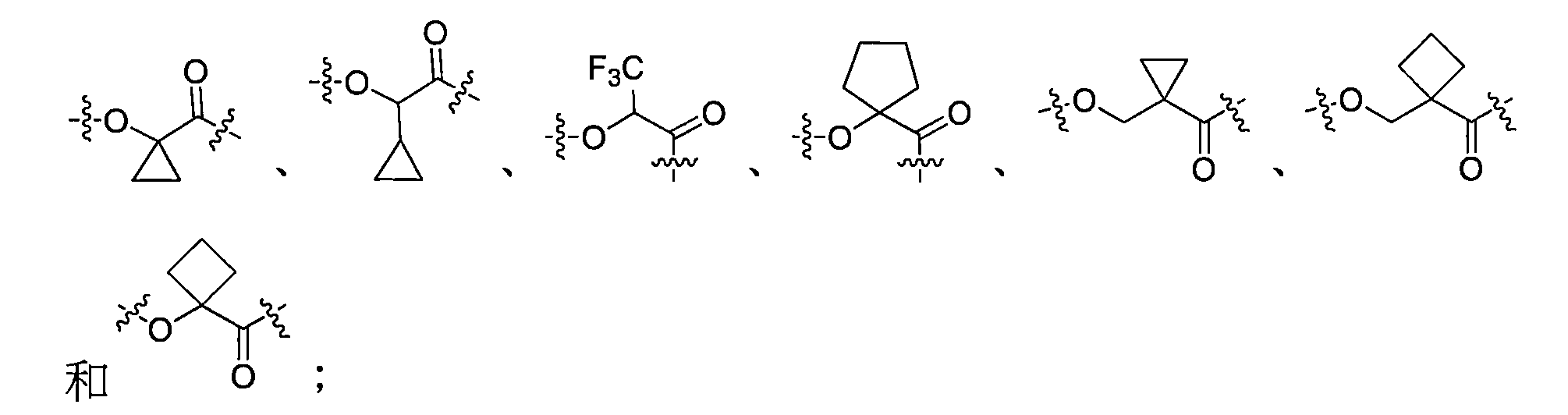
其中Y的O端與接頭單元L相連。 The O end of Y is connected to the connector unit L.
在一些實施方案中,如前所述的通式(Pc-L-Y-D)所示的抗體-藥物偶聯物或其藥學上可接受的鹽,其中接頭單元-L-為-L1-L2-L3-L4-, In some embodiments, the antibody-drug conjugate represented by the aforementioned general formula (Pc-LYD) or a pharmaceutically acceptable salt thereof, wherein the linker unit -L- is -L 1 -L 2 -L 3 -L 4 -,
L1選自-(琥珀醯亞胺-3-基-N)-W-C(O)-、-CH2-C(O)-NR3-W-C(O)-或-C(O)-W-C(O)-,其中W選自C1-8烷基、C1-8烷基-環烷基和1至8個原子的直鏈雜烷基,該雜烷基包含1至3個選自N、O和S的雜原子,其中該C1-8亞烷基、C1-8烷基-環烷基和直鏈雜烷基各自獨立地任選進一步被選自鹵素、羥基、氰基、胺基、烷基、氯烷基、氘代烷基、烷氧基和環烷基的一個或多個取代基所取代; L 1 is selected from -(succinimidyl-3-yl- N )-WC(O)-, -CH 2 -C(O)-NR 3 -WC(O)- or -C(O)-WC(O)-, wherein W is selected from C 1-8 alkyl, C 1-8 alkyl-cycloalkyl and straight-chain heteroalkyl of 1 to 8 atoms, the heteroalkyl containing 1 to 3 heteroatoms selected from N, O and S, wherein the C 1-8 alkylene, C 1-8 alkyl-cycloalkyl and straight-chain heteroalkyl are each independently optionally further substituted with one or more substituents selected from halogen, hydroxyl, cyano, amino, alkyl, chloroalkyl, deuterated alkyl, alkoxy and cycloalkyl;
L2選自-NR4(CH2CH2O)p1CH2CH2C(O)-、-NR4(CH2CH2O)p1CH2C(O)-、-S(CH2)p1C(O)-和化學鍵,其中p1為1至20的整數; L2 is selected from -NR4 ( CH2CH2O ) p1CH2CH2C( O)-, -NR4 ( CH2CH2O ) p1CH2C (O)-, -S ( CH2 ) p1C (O) - and a chemical bond, wherein p1 is an integer from 1 to 20 ;
L3為由2至7個胺基酸殘基構成的肽殘基,其中該胺基酸選自苯丙胺酸(F)、甘胺酸(G)、纈胺酸(V)、賴胺酸(K)、瓜胺酸、絲胺酸(S)、麩胺酸(E)和天門冬胺酸(D)中的胺基酸形成的胺基酸殘基,並任選進一步被選自鹵素、羥基、氰基、胺基、烷基、氯烷基、氘代烷基、烷氧基和環烷基中的一個或多個取代基所取代; L3 is a peptide residue consisting of 2 to 7 amino acid residues, wherein the amino acid residues are selected from the group consisting of phenylalanine (F), glycine (G), valine (V), lysine (K), citrulline, serine (S), glutamine (E) and aspartic acid (D), and are optionally further substituted with one or more substituents selected from the group consisting of halogen, hydroxyl, cyano, amino, alkyl, chloroalkyl, deuterated alkyl, alkoxy and cycloalkyl;
L4選自-NR5(CR6R7)t-、-C(O)NR5、-C(O)NR5(CH2)t-和化學鍵,其中t為 1至6的整數; L 4 is selected from -NR 5 (CR 6 R 7 ) t -, -C(O)NR 5 , -C(O)NR 5 (CH 2 ) t -, and a chemical bond, wherein t is an integer from 1 to 6;
R3、R4和R5相同或不同,且各自獨立地選自氫原子、烷基、鹵烷基、氘代烷基和羥烷基; R 3 , R 4 and R 5 are the same or different and are each independently selected from a hydrogen atom, an alkyl group, a halogenated alkyl group, a deuterated alkyl group and a hydroxyalkyl group;
R6和R7相同或不同,且各自獨立地選自氫原子、鹵素、烷基、鹵烷基、氘代烷基和羥烷基。 R6 and R7 are the same or different and are each independently selected from a hydrogen atom, a halogen, an alkyl group, a halogenated alkyl group, a deuterated alkyl group and a hydroxyalkyl group.
在一些實施方案中,如前所述的通式(Pc-L-Y-D)所示的抗體-藥物偶聯物或其藥學上可接受的鹽,其中接頭單元-L-為-L1-L2-L3-L4-, In some embodiments, the antibody-drug conjugate represented by the aforementioned general formula (Pc-LYD) or a pharmaceutically acceptable salt thereof, wherein the linker unit -L- is -L 1 -L 2 -L 3 -L 4 -,
L1為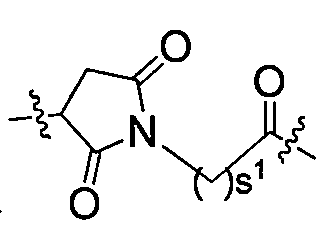
L2為化學鍵; L2 is a chemical bond;
L3為四肽殘基;較佳地,L3為GGFG(SEQ ID NO:13)(甘胺酸-甘胺酸-苯丙胺酸-甘胺酸)的四肽殘基; L3 is a tetrapeptide residue; preferably, L3 is a tetrapeptide residue of GGFG (SEQ ID NO: 13) (glycine-glycine-phenylalanine-glycine);
L4為-NR5(CR6R7)-t-,R5、R6或R7相同或不同,且各自獨立地為氫原子或烷基,t為1或2; L 4 is -NR 5 (CR 6 R 7 )-t-, R 5 , R 6 or R 7 are the same or different and each independently represents a hydrogen atom or an alkyl group, and t represents 1 or 2;
其中該L1端與Pc相連,L4端與Y相連。 The L1 end is connected to Pc, and the L4 end is connected to Y.
在一些實施方案中,如前所述的通式(Pc-L-Y-D)所示的抗體-藥物偶聯物或其藥學上可接受的鹽,其中-L-為: In some embodiments, the antibody-drug conjugate or its pharmaceutically acceptable salt represented by the aforementioned general formula (Pc-L-Y-D), wherein -L- is:

在一些實施方案中,如前所述的通式(Pc-L-Y-D)所示的抗體-藥物偶聯物或其藥學上可接受的鹽,其中-L-Y-任選自: In some embodiments, the antibody-drug conjugate or its pharmaceutically acceptable salt represented by the aforementioned general formula (Pc-L-Y-D), wherein -L-Y- is selected from:
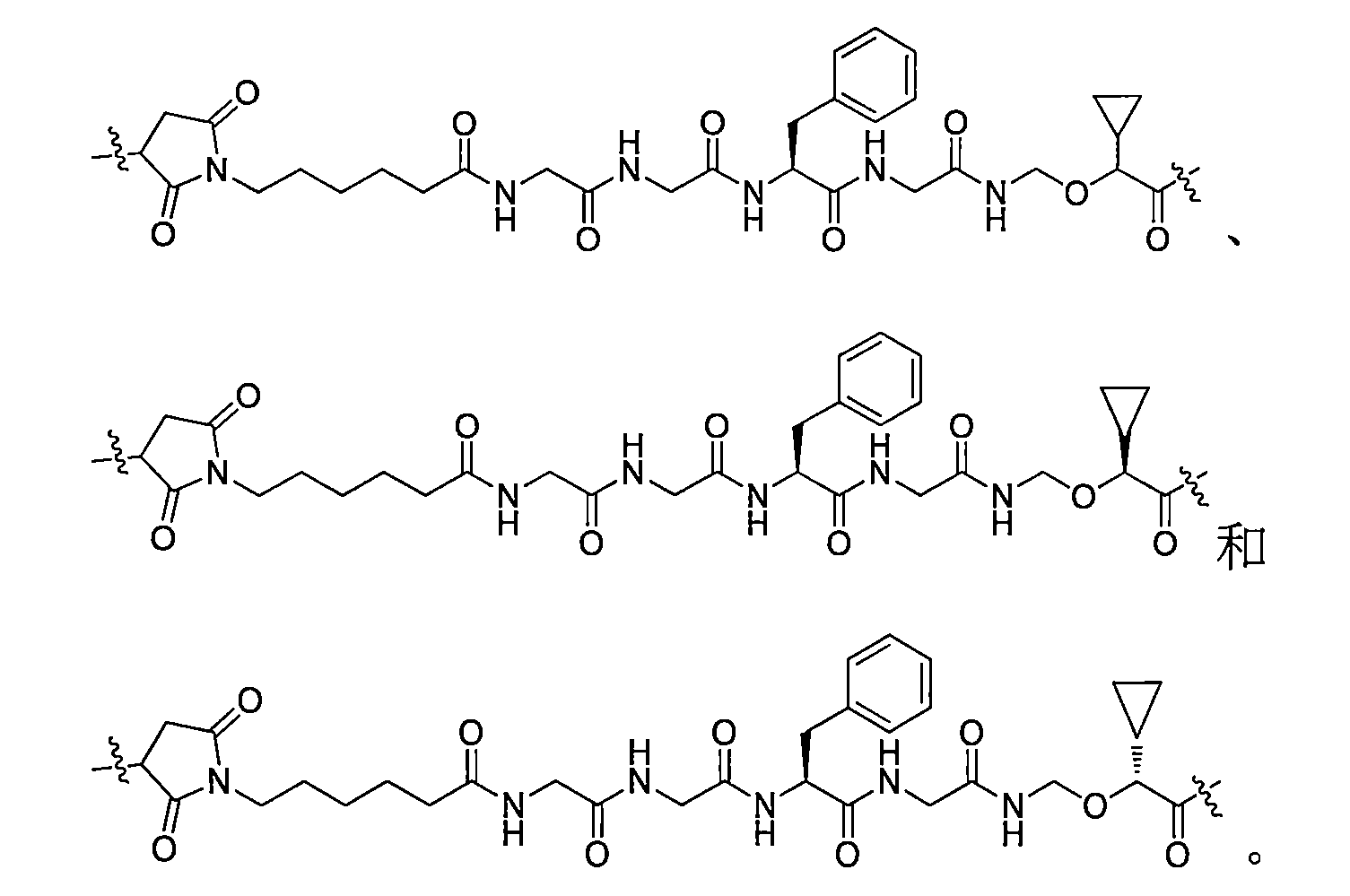
在一些實施方案中,如前所述的通式(Pc-L-Y-D)所示的抗體-藥物偶聯物或其藥學上可接受的鹽,其為通式(Pc-La-Y-D)所示的抗體-藥物偶聯物或其藥學上可接受的鹽: In some embodiments, the antibody-drug conjugate represented by the general formula (Pc-LYD) as described above or a pharmaceutically acceptable salt thereof is an antibody-drug conjugate represented by the general formula (Pc-L a -YD) or a pharmaceutically acceptable salt thereof:

其中, in,
W、L2、L3、R5、R6、R7如前所述接頭單元-L-中所定義; W, L2 , L3 , R5 , R6 , R7 are as defined in the above-mentioned connector unit -L-;
Pc、n、R1、R2、m如通式(Pc-L-Y-D)中所定義; Pc, n, R 1 , R 2 , and m are as defined in the general formula (Pc-LYD);
具體的,Pc為抗PSMA抗體或其抗原結合片段; Specifically, Pc is an anti-PSMA antibody or an antigen-binding fragment thereof;
m為0至4的整數;非限制性實例如m選自0、1、2、3和4; m is an integer from 0 to 4; non-limiting examples are m selected from 0, 1, 2, 3 and 4;
n為1至10,n是小數或整數;以n為1-8較佳,為3-8更佳,為3-7再較 佳,為6-7再更佳; n is 1 to 10, and n is a decimal or an integer; preferably n is 1-8, more preferably 3-8, more preferably 3-7, and more preferably 6-7;
R1選自鹵素、鹵烷基、氘代烷基、環烷基、環烷基烷基、烷氧基烷基、雜環基、芳基和雜芳基;R2選自氫原子、鹵素、鹵烷基、氘代烷基、環烷基、環烷基烷基、烷氧基烷基、雜環基、芳基和雜芳基;或者,R1和R2與其相連接的碳原子一起形成環烷基或雜環基; R1 is selected from halogen, halogenalkyl, deuterated alkyl, cycloalkyl, cycloalkylalkyl, alkoxyalkyl, heterocyclic, aryl and heteroaryl; R2 is selected from hydrogen atom, halogen, halogenalkyl, deuterated alkyl, cycloalkyl, cycloalkylalkyl, alkoxyalkyl, heterocyclic, aryl and heteroaryl; or, R1 and R2 together with the carbon atom to which they are attached form a cycloalkyl or heterocyclic group;
W選自C1-8烷基、C1-8烷基-環烷基或1至8個原子的直鏈雜烷基,該雜烷基包含1至3個選自N、O或S的雜原子,其中該C1-8烷基、環烷基和直鏈雜烷基各自獨立地任選進一步被選自鹵素、羥基、氰基、胺基、烷基、氯烷基、氘代烷基、烷氧基和環烷基的一個或多個取代基所取代; W is selected from C1-8 alkyl, C1-8 alkyl-cycloalkyl or straight chain heteroalkyl of 1 to 8 atoms, the heteroalkyl containing 1 to 3 heteroatoms selected from N, O or S, wherein the C1-8 alkyl, cycloalkyl and straight chain heteroalkyl are each independently optionally further substituted with one or more substituents selected from halogen, hydroxyl, cyano, amino, alkyl, chloroalkyl, deuterated alkyl, alkoxy and cycloalkyl;
L2選自-NR4(CH2CH2O)p1CH2CH2C(O)-、-NR4(CH2CH2O)p1CH2C(O)-、-S(CH2)p1C(O)-和化學鍵,其中p1為1至20的整數; L2 is selected from -NR4 ( CH2CH2O ) p1CH2CH2C( O)-, -NR4 ( CH2CH2O ) p1CH2C (O)-, -S ( CH2 ) p1C (O) - and a chemical bond, wherein p1 is an integer from 1 to 20 ;
L3為由2至7個胺基酸殘基構成的肽殘基,其中該的胺基酸殘基選自苯丙胺酸(F)、甘胺酸(G)、纈胺酸(V)、賴胺酸(K)、瓜胺酸、絲胺酸(S)、麩胺酸(E)和天門冬胺酸(D)中的胺基酸形成的胺基酸殘基,並任選進一步被選自鹵素、羥基、氰基、胺基、烷基、氯烷基、氘代烷基、烷氧基和環烷基中的一個或多個取代基所取代; L3 is a peptide residue consisting of 2 to 7 amino acid residues, wherein the amino acid residues are selected from the group consisting of phenylalanine (F), glycine (G), valine (V), lysine (K), citrulline, serine (S), glutamine (E) and aspartic acid (D), and are optionally further substituted with one or more substituents selected from the group consisting of halogen, hydroxyl, cyano, amino, alkyl, chloroalkyl, deuterated alkyl, alkoxy and cycloalkyl;
R5選自氫原子、烷基、鹵烷基、氘代烷基和羥烷基; R5 is selected from a hydrogen atom, an alkyl group, a halogenated alkyl group, a deuterated alkyl group and a hydroxyalkyl group;
R6和R7相同或不同,且各自獨立地選自氫原子、鹵素、烷基、鹵烷基、氘代烷基和羥烷基。 R6 and R7 are the same or different and are each independently selected from a hydrogen atom, a halogen, an alkyl group, a halogenated alkyl group, a deuterated alkyl group and a hydroxyalkyl group.
在一些實施方案中,如前任一項所述的通式(Pc-L-Y-D)所示的抗體-藥物偶聯物或其藥學上可接受的鹽,其為通式(Pc-Lb-Y-D)所示的抗體-藥物偶聯物或其藥學上可接受的鹽: In some embodiments, the antibody-drug conjugate represented by the general formula (Pc-LYD) or a pharmaceutically acceptable salt thereof as described in any of the preceding items is an antibody-drug conjugate represented by the general formula (Pc-L b -YD) or a pharmaceutically acceptable salt thereof:

其中, in,
s1為2至8的整數; s 1 is an integer from 2 to 8;
Pc、R1、R2、R5、R6、R7、m和n如通式(Pc-La-Y-D)所中所定義。 Pc, R 1 , R 2 , R 5 , R 6 , R 7 , m and n are as defined in the general formula (Pc-L a -YD).
在一些實施方案中,如前任一項所述的通式(Pc-L-Y-D)所示的抗體-藥物偶聯物或其藥學上可接受的鹽,該抗體-藥物偶聯物選自: In some embodiments, the antibody-drug conjugate represented by the general formula (Pc-L-Y-D) as described in any of the preceding items or a pharmaceutically acceptable salt thereof is selected from:
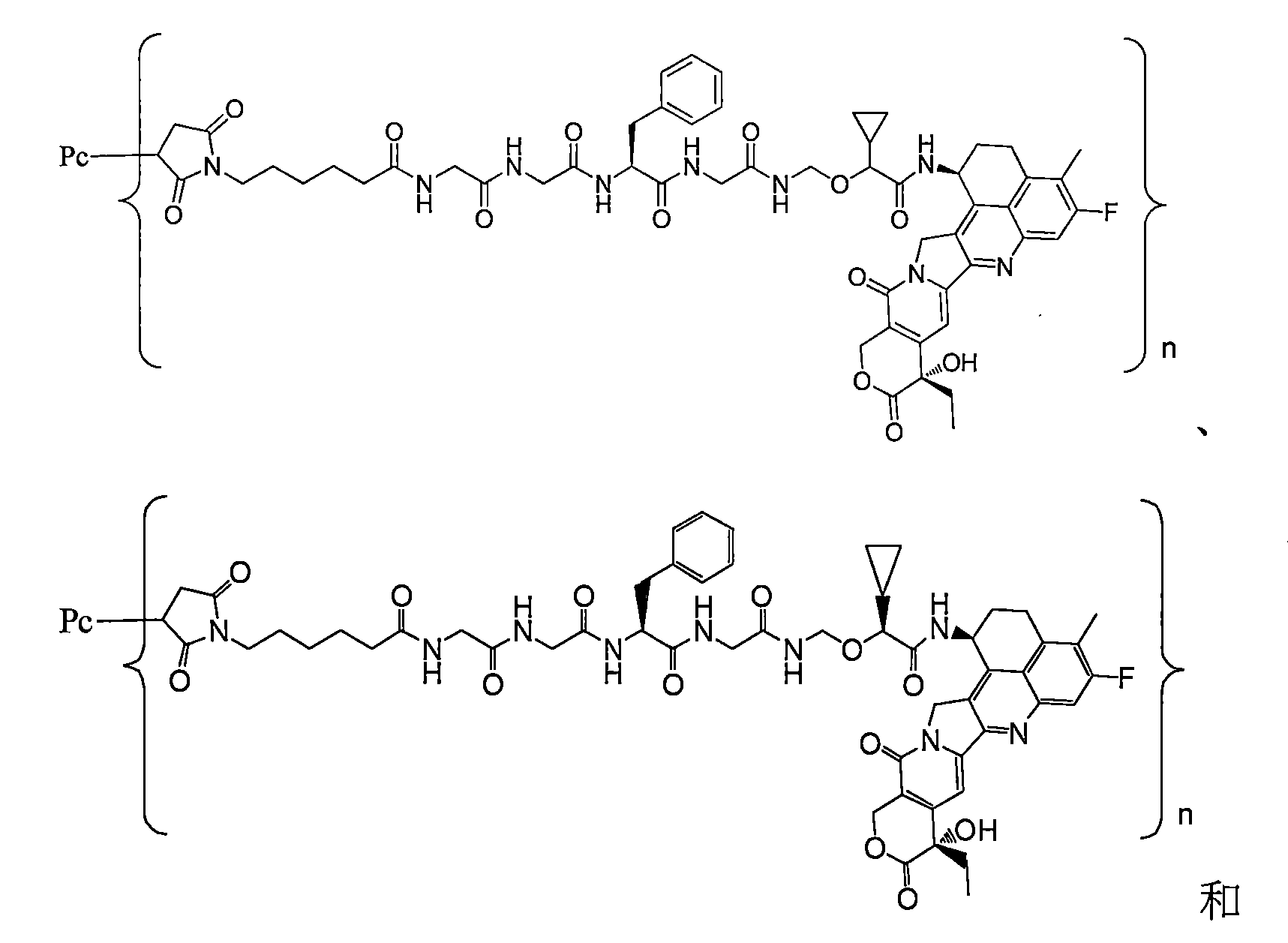

其中Pc和n如通式(Pc-L-Y-D)中所定義,具體地,Pc為抗PSMA抗體或其抗原結合片段,或如前任一項所述的抗PSMA抗體; Wherein Pc and n are as defined in the general formula (Pc-L-Y-D), specifically, Pc is an anti-PSMA antibody or an antigen-binding fragment thereof, or an anti-PSMA antibody as described in any of the preceding items;
n為1至10,n是小數或整數;以n為1-8較佳,為3-8更佳,為3-7再較佳;為6-7再更佳。 n is 1 to 10, and n is a decimal or an integer; preferably n is 1-8, more preferably 3-8, more preferably 3-7, and even more preferably 6-7.
在一些實施方案中,如前任一項所述的通式(Pc-L-Y-D)所示的抗體-藥物偶聯物或其藥學上可接受的鹽,該抗體-藥物偶聯物為: In some embodiments, the antibody-drug conjugate represented by the general formula (Pc-L-Y-D) as described in any of the preceding items or a pharmaceutically acceptable salt thereof, the antibody-drug conjugate is:

其中, in,
n為1至8,較佳為3-8,n是小數或整數; n is 1 to 8, preferably 3-8, and n is a decimal or an integer;
PM為抗PSMA抗體,其包含如SEQ ID NO:9所示的重鏈和如SEQ ID NO:10所示的輕鏈。 PM is an anti-PSMA antibody, which comprises a heavy chain as shown in SEQ ID NO: 9 and a light chain as shown in SEQ ID NO: 10.
本揭露進一步提供一種製備如通式(Pc-La-Y-D)所示的抗體-藥物偶聯物或其藥學上可接受的鹽的方法,其包括以下步驟: The present disclosure further provides a method for preparing an antibody-drug conjugate or a pharmaceutically acceptable salt thereof as shown in the general formula (Pc-L a -YD), comprising the following steps:

Pc’為還原後的Pc,與通式(La-Y-D)所示的化合物進行偶聯反應,得到通式(Pc-La-Y-D)所示的化合物; Pc' is the reduced Pc, which undergoes a coupling reaction with the compound represented by the general formula (L a -YD) to obtain a compound represented by the general formula (Pc-L a -YD);
其中, in,
Pc為抗PSMA抗體或其抗原結合片段; Pc is an anti-PSMA antibody or its antigen-binding fragment;
n、m、W、L2、L3、R1、R2、R5、R6和R7如前述通式(Pc-La-Y-D)中所定義。 n, m, W, L2 , L3 , R1 , R2 , R5 , R6 and R7 are as defined in the aforementioned general formula (Pc-L a -YD).
進一步提供一種製備如通式(Pc-L’-D)所示的抗體藥物偶聯物的方法,其包括以下步驟: Further provided is a method for preparing an antibody-drug conjugate as shown in the general formula (Pc-L’-D), which comprises the following steps:

上述反應中,Pc’與式(L’-D)所示的化合物進行偶聯反應,得到通式(Pc-L’-D)所示的化合物;其中, In the above reaction, Pc' undergoes a coupling reaction with the compound represented by formula (L'-D) to obtain a compound represented by general formula (Pc-L'-D); wherein,
Pc為如前所述的抗PSMA抗體或其抗原结合片段;Pc’為經還原後的Pc, Pc is the anti-PSMA antibody or its antigen-binding fragment as described above; Pc’ is the reduced Pc,
n如通式(Pc-L-Y-D)中所定義。 n is defined in the general formula (Pc-L-Y-D).
本揭露進一步提供一種製備如PM-9-A所示的抗體藥物偶聯物的方法,其包括以下步驟: The present disclosure further provides a method for preparing an antibody-drug conjugate as shown in PM-9-A, which comprises the following steps:

PM’與式9-A所示的化合物進行偶聯反應,得到通式(PM-9-A)所示的化合物;其中, PM' is coupled with the compound shown in formula 9-A to obtain a compound shown in general formula (PM-9-A); wherein,
n為1至8,較佳為3-8,n是小數或整數; n is 1 to 8, preferably 3-8, and n is a decimal or an integer;
PM為抗PSMA抗體,其包含序列如SEQ ID NO:9所示的重鏈和序列如SEQ ID NO:10所示的輕鏈; PM is an anti-PSMA antibody, which comprises a heavy chain with a sequence as shown in SEQ ID NO: 9 and a light chain with a sequence as shown in SEQ ID NO: 10;
PM’為經PM還原後得到。 PM’ is obtained after PM reduction.
在一些實施方案中,n代表抗體-藥物偶聯物的載藥量,也可稱為DAR值,其可用一般方法如UV/可見光光譜法、質譜、ELISA試驗和HPLC測定;在一些實施方案中,n為0-10,以1-10較佳,以1-8更佳,或2-8、或2-7、或2-4、或3-8、或3-7、或3-6、或4-7、或4-6、或4-5的平均值;在一些實施方案中,n為1、2、3、4、5、6、7、8、9、10的平均值。 In some embodiments, n represents the drug loading of the antibody-drug conjugate, which can also be called DAR value, which can be determined by general methods such as UV/visible spectrometry, mass spectrometry, ELISA test and HPLC; in some embodiments, n is 0-10, preferably 1-10, more preferably 1-8, or an average value of 2-8, or 2-7, or 2-4, or 3-8, or 3-7, or 3-6, or 4-7, or 4-6, or 4-5; in some embodiments, n is an average value of 1, 2, 3, 4, 5, 6, 7, 8, 9, 10.
另一方面,提供了一種藥物組成物,其包含根據該抗體-藥物偶聯物或其藥學上可接受的鹽,以及一種或多種藥學上可接受的賦形劑、稀釋劑或載體。在一些實施方案中,該單位劑量的藥物組成物中含有0.1mg-3000mg或1mg- 1000mg如前所述的抗PSMA抗體或如前所述的抗體藥物偶聯物。 On the other hand, a drug composition is provided, which comprises the antibody-drug conjugate or a pharmaceutically acceptable salt thereof, and one or more pharmaceutically acceptable excipients, diluents or carriers. In some embodiments, the unit dose of the drug composition contains 0.1 mg-3000 mg or 1 mg- 1000 mg of the anti-PSMA antibody or the antibody-drug conjugate as described above.
另一方面,本揭露提供了根據本揭露所述的抗體-藥物偶聯物或其藥學上可接受的鹽或包含其的藥物組成物作為藥物的用途。 On the other hand, the present disclosure provides the use of the antibody-drug conjugate or its pharmaceutically acceptable salt or a drug composition containing the same according to the present disclosure as a drug.
另一方面,本揭露提供了根據本揭露所述的抗體-藥物偶聯物或其藥學上可接受的鹽或包含其的藥物組成物在製備用於治療PSMA介導的疾病或病症的藥物中的用途,其中該PSMA介導的疾病或病症為PSMA高表達癌症、中表達癌症或低表達癌症較佳。 On the other hand, the present disclosure provides the use of the antibody-drug conjugate or its pharmaceutically acceptable salt or the drug composition comprising the same according to the present disclosure in the preparation of a drug for treating a PSMA-mediated disease or condition, wherein the PSMA-mediated disease or condition is preferably a PSMA-high expression cancer, a medium expression cancer or a low expression cancer.
另一方面,本揭露提供根據本揭露所述的抗體-藥物偶聯物或其藥學上可接受的鹽或包含其的藥物組成物在製備用於治療或預防癌症的藥物中的用途,其中該癌症較佳為頭和頸鱗狀細胞癌、頭和頸癌、腦癌、神經膠質瘤、多形性成膠質細胞瘤、神經母細胞瘤、中樞神經系統癌、神經內分泌腫瘤、咽喉癌、鼻咽癌、食管癌、甲狀腺癌、惡性胸膜間皮瘤、肺癌、乳腺癌、肝癌、肝細胞瘤、肝細胞癌、肝膽癌、胰腺癌、胃癌、胃腸道癌、腸癌、結腸癌、結腸直腸癌、腎癌、透明細胞腎細胞癌、卵巢癌、子宮內膜癌、子宮頸癌、膀胱癌、前列腺癌、睾丸癌、皮膚癌、黑色素瘤、白血病、淋巴瘤、骨癌、軟骨肉瘤、骨髓瘤、多發性骨髓瘤、骨髓異常增生綜合徵、庫肯勃氏瘤、骨髓增生性腫瘤、鱗狀細胞癌、尤因氏肉瘤、尿路上皮癌和梅克爾細胞癌,更佳為前列腺癌;該淋巴瘤再較佳為選自:何杰金淋巴瘤、非何杰金淋巴瘤、瀰漫性大B-細胞淋巴瘤、濾泡性淋巴瘤、原發性縱隔大B-細胞淋巴瘤、套細胞淋巴瘤、小淋巴細胞性淋巴瘤、富含T-細胞/組織細胞的大B-細胞淋巴瘤和淋巴漿細胞性淋巴瘤,該肺癌選自:非小細胞肺癌和小細胞肺癌,該白血病選自:慢性髓細胞樣白血病、急性髓細胞樣白血病、淋巴細胞白血病、成淋巴細胞性白血病、急性成淋巴細胞性白血病、慢性淋巴細 胞性白血病和髓樣細胞白血病。 On the other hand, the present disclosure provides a use of the antibody-drug conjugate or a pharmaceutically acceptable salt thereof or a pharmaceutical composition comprising the antibody-drug conjugate according to the present disclosure in the preparation of a drug for treating or preventing cancer, wherein the cancer is preferably head and neck squamous cell carcinoma, head and neck cancer, brain cancer, neuroglioma, multiforme glioblastoma, neuroblastoma, central nervous system cancer, neuroendocrine tumor, laryngeal cancer, nasal cancer, Pharyngeal cancer, esophageal cancer, thyroid cancer, malignant pleural mesothelioma, lung cancer, breast cancer, liver cancer, hepatocellular carcinoma, hepatobiliary cancer, pancreatic cancer, gastric cancer, gastrointestinal cancer, intestinal cancer, colon cancer, colorectal cancer, kidney cancer, clear cell renal carcinoma, ovarian cancer, endometrial cancer, cervical cancer, bladder cancer, prostate cancer, testicular cancer, skin cancer, melanoma, leukemia, lymphoma, bone cancer, chondrosarcoma, bone Myeloma, multiple myeloma, myeloid syndrome, Krugenberg tumor, myeloproliferative neoplasm, squamous cell carcinoma, Ewing's sarcoma, urothelial carcinoma and Merkel cell carcinoma, preferably prostate cancer; the lymphoma is more preferably selected from: Hodgkin's lymphoma, non-Hodgkin's lymphoma, diffuse large B-cell lymphoma, follicular lymphoma, primary septal large B-cell lymphoma, mantle cell lymphoma, small lymphoma The patient is a patient of the invention who has a primary leukemia selected from the group consisting of: non-small cell lung cancer, acute myeloid leukemia, lymphocytic leukemia, lymphoblastic leukemia, acute lymphoblastic leukemia, chronic lymphocytic leukemia, and myeloid leukemia.
另一方面,本揭露進一步涉及一種用於治療和/或預防腫瘤的方法,該方法包括向需要其的受試者施用治療有效劑量的根據本揭露所述的抗體-藥物偶聯物或其藥學上可接受的鹽或其藥學上可接受的鹽或包含其的藥物組成物;其中該腫瘤較佳為與PSMA高表達相關的癌症、中表達癌症或低表達癌症。 On the other hand, the present disclosure further relates to a method for treating and/or preventing tumors, which comprises administering a therapeutically effective dose of the antibody-drug conjugate or its pharmaceutically acceptable salt or its pharmaceutically acceptable salt or a pharmaceutical composition comprising the same according to the present disclosure to a subject in need thereof; wherein the tumor is preferably a cancer associated with high PSMA expression, a medium expression cancer or a low expression cancer.
另一方面,本揭露進一步涉及一種用於治療或預防腫瘤或癌症的方法,該方法包括向需要其的受試者施用治療有效劑量的根據本揭露所述的抗體藥物偶聯物或其藥學上可接受的鹽或包含其的藥物組成物;其中該腫瘤和癌症較佳為頭和頸鱗狀細胞癌、頭和頸癌、腦癌、神經膠質瘤、多形性成膠質細胞瘤、神經母細胞瘤、中樞神經系統癌、神經內分泌腫瘤、咽喉癌、鼻咽癌、食管癌、甲狀腺癌、惡性胸膜間皮瘤、肺癌、乳腺癌、肝癌、肝細胞瘤、肝細胞癌、肝膽癌、胰腺癌、胃癌、胃腸道癌、腸癌、結腸癌、結腸直腸癌、腎癌、透明細胞腎細胞癌、卵巢癌、子宮內膜癌、子宮頸癌、膀胱癌、前列腺癌、睾丸癌、皮膚癌、黑色素瘤、白血病、淋巴瘤、骨癌、軟骨肉瘤、骨髓瘤、多發性骨髓瘤、骨髓異常增生綜合症、庫肯勃氏瘤、骨髓增生性腫瘤、鱗狀細胞癌、尤因氏肉瘤、尿路上皮癌和梅克爾細胞癌;較佳為前列腺癌;該淋巴瘤更佳為選自:何杰金淋巴瘤、非何杰金淋巴瘤、彌漫性大B-細胞淋巴瘤、濾泡性淋巴瘤、原發性縱隔大B-細胞淋巴瘤、套細胞淋巴瘤、小淋巴細胞性淋巴瘤、富含T-細胞/組織細胞的大B-細胞淋巴瘤和淋巴漿細胞性淋巴瘤,該肺癌選自:非小細胞肺癌和小細胞肺癌,該白血病選自:慢性髓細胞樣白血病、急性髓細胞樣白血病、淋巴細胞白血病、成淋巴細胞性白血病、急性成淋巴細胞性白血病、慢性淋巴細胞性白血病和髓樣細胞白血病。 On the other hand, the present disclosure further relates to a method for treating or preventing a tumor or cancer, the method comprising administering to a subject in need thereof a therapeutically effective amount of the antibody-drug conjugate or a pharmaceutically acceptable salt thereof according to the present disclosure or a pharmaceutical composition comprising the same; wherein the tumor or cancer is preferably head and neck squamous cell carcinoma, head and neck cancer, brain cancer, neuroglioma, multiforme glioblastoma, neuroblastoma, myeloma, Central nervous system cancer, neuroendocrine tumor, pharyngeal cancer, nasopharyngeal cancer, esophageal cancer, thyroid cancer, malignant pleural mesothelioma, lung cancer, breast cancer, liver cancer, hepatocellular carcinoma, hepatobiliary cancer, pancreatic cancer, gastric cancer, gastrointestinal cancer, intestinal cancer, colon cancer, colorectal cancer, kidney cancer, clear cell renal carcinoma, ovarian cancer, endometrial cancer, cervical cancer, bladder cancer, prostate cancer, testicular cancer, skin cancer, melanoma, leukemia , lymphoma, bone cancer, chondrosarcoma, myeloma, multiple myeloma, myelodysplastic syndrome, Krukenberg tumor, myeloproliferative tumor, squamous cell carcinoma, Ewing's sarcoma, urothelial carcinoma and Merkel cell carcinoma; preferably prostate cancer; the lymphoma is more preferably selected from: Hodgkin's lymphoma, non-Hodgkin's lymphoma, diffuse large B-cell lymphoma, follicular lymphoma, primary septal large B-cell lymphoma, mantle cell lymphoma The patient is a patient of the invention who ...
另一方面,本揭露進一步提供前述的抗PSMA抗體或其抗體-藥物偶聯物作為藥物,較佳為作為治療癌症或腫瘤的藥物,更佳為作為治療PSMA介導的癌症的藥物。 On the other hand, the present disclosure further provides the aforementioned anti-PSMA antibody or its antibody-drug conjugate as a drug, preferably as a drug for treating cancer or tumor, and more preferably as a drug for treating PSMA-mediated cancer.
可將活性化合物(例如根據本揭露所述的配體-藥物偶聯物、或其藥學上可接受的鹽)製成適合於通過任何適當途徑給藥的形式,活性化合物較佳是以單位元劑量的方式,或者是以受試者能夠以單劑進行自我給藥的方式。本揭露所述的活性化合物或組成物的單位元劑量的方式可以是片劑、膠囊、扁囊劑、瓶裝藥水、藥粉、顆粒劑、錠劑、栓劑、再生藥粉或液體製劑。 The active compound (e.g., the ligand-drug conjugate according to the present disclosure, or a pharmaceutically acceptable salt thereof) can be prepared into a form suitable for administration by any appropriate route, preferably in a unit dose, or in a form that a subject can self-administer in a single dose. The unit dose of the active compound or composition described in the present disclosure can be in the form of tablets, capsules, cachets, bottled liquids, powders, granules, tablets, suppositories, reconstituted powders, or liquid preparations.
本揭露治療方法中所用活性化合物或組成物的施用劑量通常將隨疾病的嚴重性、受試者的體重和活性化合物的相對功效而改變。作為一般性指導,合適的單位劑量可以是0.1mg~1000mg。 The dosage of the active compound or composition used in the disclosed treatment method will generally vary with the severity of the disease, the weight of the subject and the relative efficacy of the active compound. As a general guide, a suitable unit dose may be 0.1 mg to 1000 mg.
本揭露的藥物組成物除活性化合物外,可含有一種或多種輔料,該輔料選自以下成分:填充劑、稀釋劑、粘合劑、潤濕劑、崩解劑或賦形劑等。根據給藥方法的不同,組成物可含有0.1至99重量%的活性化合物。 In addition to the active compound, the pharmaceutical composition disclosed herein may contain one or more excipients selected from the following ingredients: fillers, diluents, binders, wetting agents, disintegrants or excipients, etc. Depending on the method of administration, the composition may contain 0.1 to 99% by weight of the active compound.
本揭露提供的PSMA抗體及抗體藥物偶聯物具有與細胞表面抗原良好的親和力、良好的細胞內吞效率和很強的腫瘤抑制效率,並且具有更寬的藥物應用窗口、更高的抑瘤效果和治療活性、更好的安全性、藥物代謝動力學特性和成藥性(如穩定性),更適於臨床的藥物應用。 The PSMA antibodies and antibody-drug conjugates provided in this disclosure have good affinity with cell surface antigens, good cell endocytosis efficiency and strong tumor inhibition efficiency, and have a wider drug application window, higher tumor inhibition effect and therapeutic activity, better safety, drug metabolic kinetics and drugability (such as stability), and are more suitable for clinical drug applications.
圖1A:本揭露的ADC或抗體與細胞MDAPCa的體外結合能力。 Figure 1A: The in vitro binding ability of the ADC or antibody disclosed herein to cell MDAPCa.
圖1B:本揭露的ADC或抗體與細胞LNCaP的體外結合能力。 Figure 1B: The in vitro binding ability of the ADC or antibody disclosed herein to LNCaP cells.
圖1C:本揭露的ADC或抗體與細胞22Rv1的體外結合能力。 Figure 1C: The in vitro binding ability of the ADC or antibody disclosed herein to cell 22Rv1.
圖1D:本揭露的ADC或抗體與細胞PC-3的體外結合能力。 Figure 1D: The in vitro binding ability of the ADC or antibody disclosed herein to PC-3 cells.
圖1E:本揭露的ADC或抗體與細胞DU 145的體外結合能力。
Figure 1E: The in vitro binding ability of the ADC or antibody disclosed herein to the
圖2A:抗體PM在LNCaP細胞中的體外內吞實驗;2K細胞,10%U-L IgG FBS。 Figure 2A: In vitro internalization experiment of antibody PM in LNCaP cells; 2K cells, 10% U-L IgG FBS.
圖2B:抗體PM在22Rv1細胞中的體外內吞實驗;2K細胞,10%U-L IgG FBS。 Figure 2B: In vitro endocytosis experiment of antibody PM in 22Rv1 cells; 2K cells, 10% U-L IgG FBS.
圖3A:本揭露的不同ADC對LNCaP細胞殺傷作用,用2K細胞,4.5% FBS。 Figure 3A: The killing effect of different ADCs disclosed in this disclosure on LNCaP cells, using 2K cells and 4.5% FBS.
圖3B:本揭露中毒素(化合物2-B)對LNCaP細胞殺傷作用,用2K細胞,4.5% FBS。 Figure 3B: The killing effect of the toxin (Compound 2-B) in this disclosure on LNCaP cells, using 2K cells, 4.5% FBS.
圖3C:本揭露的不同ADC對22Rv1細胞殺傷作用,用4K細胞,4.5% FBS。 Figure 3C: The killing effect of different ADCs disclosed in this disclosure on 22Rv1 cells, using 4K cells and 4.5% FBS.
圖3D:本揭露中毒素(化合物2-B)對22Rv1細胞殺傷作用,用4K細胞,4.5% FBS。 Figure 3D: The killing effect of the toxin (Compound 2-B) in this disclosure on 22Rv1 cells, using 4K cells, 4.5% FBS.
圖3E:本揭露的不同ADC對PC-3細胞殺傷作用,用4K細胞,4.5% FBS。 Figure 3E: The killing effect of different ADCs disclosed in this disclosure on PC-3 cells, using 4K cells and 4.5% FBS.
圖3F:本揭露中毒素(化合物2-B)對PC-3細胞殺傷作用,用2K細胞,4.5% FBS。 Figure 3F: The killing effect of the toxin (Compound 2-B) in this disclosure on PC-3 cells, using 2K cells, 4.5% FBS.
圖4A:本揭露不同劑量的ADC對人前列腺癌細胞22Rv1裸小鼠移植瘤的抑制活性。 Figure 4A: The inhibitory activity of different doses of ADC disclosed herein on human prostate cancer cell 22Rv1 nude mouse transplanted tumors.
圖4B:本揭露不同劑量的ADC對人前列腺癌細胞22Rv1裸小鼠移 植瘤的抑制活性測試中小鼠的體重變化。 Figure 4B: Changes in the body weight of mice in the test of the inhibitory activity of different doses of ADC on human prostate cancer cell 22Rv1 nude mouse transplant tumors disclosed herein.
圖5A:本揭露不同劑量的ADC對人前列腺癌細胞22Rv1裸小鼠移植瘤的抑制活性。 Figure 5A: The inhibitory activity of different doses of ADC disclosed herein on human prostate cancer cell 22Rv1 nude mouse transplanted tumors.
圖5B:本揭露不同劑量的ADC對人前列腺癌細胞22Rv1裸小鼠移植瘤的抑制活性測試中小鼠的體重變化。 Figure 5B: Changes in the body weight of mice in the test of the inhibitory activity of different doses of ADC on human prostate cancer cell 22Rv1 nude mouse transplanted tumors.
圖6A:本揭露不同劑量的ADC對人前列腺癌細胞LNCap在SCID Beighe小鼠上的移植瘤的抑制活性。 Figure 6A: The inhibitory activity of different doses of ADC disclosed herein on human prostate cancer cell LNCap transplanted tumors in SCID Beighe mice.
圖6B:本揭露不同劑量的ADC對人前列腺癌細胞LNCap在SCID Beighe小鼠上的移植瘤的抑制活性測試中小鼠的體重變化。 Figure 6B: Changes in body weight of mice in the test of the inhibitory activity of different doses of ADC on human prostate cancer cell LNCap transplanted tumors in SCID Beighe mice.
圖7:本揭露ADC-2的藥代穩定性,其中ADC的濃度為100μg/ml。 FIG. 7 : Pharmacokinetic stability of ADC-2 of the present disclosure, wherein the ADC concentration is 100 μg /ml.
圖8:本揭露ADC-5的血漿穩定性,其中ADC的濃度為100μg/ml。 FIG. 8 : Plasma stability of ADC-5 of the present disclosure, wherein the ADC concentration is 100 μg /ml.
圖9:給藥ADC對荷瘤裸鼠22Rv1移植瘤的療效。 Figure 9: The therapeutic effect of ADC on 22Rv1 transplanted tumors in nude mice.
術語 Terminology
除非另有限定,本文所用的所有技術和科學術語均與本揭露所屬技術領域中具有通常知識者的通常理解一致。雖然也可採用與本文所述相似或等同的任何方法和材料實施或測試本揭露,但本文描述了較佳的方法和材料。描述和要求保護本揭露時,依據以下定義使用下列術語。 Unless otherwise defined, all technical and scientific terms used herein are consistent with the common understanding of one of ordinary skill in the art to which the present disclosure belongs. Although any methods and materials similar or equivalent to those described herein may be used to implement or test the present disclosure, preferred methods and materials are described herein. When describing and claiming the present disclosure, the following terms are used in accordance with the definitions below.
當本揭露中使用商品名時,旨在包括該商品名產品的製劑、該商品名產品的藥物和活性藥物部分。 When a trade name is used in this disclosure, it is intended to include the formulation of the trade name product, the drug substance and the active drug portion of the trade name product.
除非有相反陳述,在說明書和申請專利範圍中使用的術語具有下 述含義。 Unless otherwise stated, the terms used in the specification and patent application have the following meanings.
術語“藥物”或“毒素”是指細胞毒性藥物,能在腫瘤細胞內具有較強破壞其正常生長的化學分子。細胞毒性藥物原則上在足夠高的濃度下都可以殺死細胞,但是由於缺乏特異性,在殺傷腫瘤細胞的同時,也會導致正常細胞的凋亡,導致嚴重的副作用。該術語包括如細菌、真菌、植物或動物來源的小分子毒素或酶活性毒素,放射性同位素(例如At211、I131、I125、Y90、Re186、Re188、Sm153、Bi212、P32和Lu的放射性同位素),化療藥物,抗生素和核溶酶。 The term "drug" or "toxin" refers to cytotoxic drugs, which are chemical molecules that have a strong ability to destroy the normal growth of tumor cells. In principle, cytotoxic drugs can kill cells at sufficiently high concentrations, but due to the lack of specificity, while killing tumor cells, they will also cause apoptosis of normal cells, leading to serious side effects. The term includes small molecule toxins or enzyme-active toxins of bacterial, fungal, plant or animal origin, radioactive isotopes (such as At 211 , I 131 , I 125 , Y 90 , Re 186 , Re 188 , Sm 153 , Bi 212 , P 32 and radioactive isotopes of Lu), chemotherapy drugs, antibiotics and nucleolytic enzymes.
術語“接頭單元”、“接頭”、“連接單元”或“連接片段”是指一端與配體(本揭露中為抗體)連接而另一端與藥物相連的化學結構片段或鍵,也可以連接其他接頭後再與配體或藥物相連。 The term "linker unit", "linker", "linker unit" or "linker fragment" refers to a chemical structure fragment or bond that is connected to a ligand (antibody in this disclosure) at one end and to a drug at the other end. It can also be connected to other linkers and then connected to a ligand or drug.
接頭可以包含一種或多種接頭元件。示例性的接頭元件包括6-馬來醯亞胺基己醯基(“MC”)、馬來醯亞胺基丙醯基(“MP”)、纈胺酸-瓜胺酸(“val-cit”或“vc”)、丙胺酸-苯丙胺酸(“ala-phe”)、對胺基苄氧羰基(“PAB”)、N-琥珀醯亞胺基4-(2-吡啶基硫代)戊酸酯(“SPP”)、N-琥珀醯亞胺基4-(N-馬來醯亞胺基甲基)環己烷-1羧酸酯(“SMCC”,在本文中也稱作“MCC”)和N-琥珀醯亞胺基(4-碘-乙醯基)胺基苯甲酸酯(“SIAB”)。接頭可以包含以下的元件中的一個或多個、或其組合:延伸物、間隔物和胺基酸單元,可以通過本領域已知方法合成,諸如US2005-0238649A1中所記載的。接頭可以是便於在細胞中釋放藥物的“可切割接頭”。例如,可使用酸不穩定接頭(例如腙)、蛋白酶敏感(例如肽酶敏感)接頭、光不穩定接頭、二甲基接頭、或含二硫化物接頭(Chari等,Cancer Research 52:127-131(1992);美國專利No.5,208,020)。 The linker may comprise one or more linker elements. Exemplary linker elements include 6-maleimidohexanoyl ("MC"), maleimidopropionyl ("MP"), valine-citrulline ("val-cit" or "vc"), alanine-phenylalanine ("ala-phe"), p-aminobenzyloxycarbonyl ("PAB"), N-succinimidyl 4-(2-pyridylthio)pentanoate ("SPP"), N-succinimidyl 4-(N-maleimidomethyl)cyclohexane-1carboxylate ("SMCC", also referred to herein as "MCC"), and N-succinimidyl (4-iodo-acetyl) aminobenzoate ("SIAB"). The linker may comprise one or more of the following elements, or a combination thereof: an extender, a spacer, and an amino acid unit, and may be synthesized by methods known in the art, such as those described in US2005-0238649A1. The linker may be a "cleavable linker" that facilitates release of the drug in cells. For example, an acid-labile linker (e.g., hydrazone), a protease-sensitive (e.g., peptidase-sensitive) linker, a photolabile linker, a dimethyl linker, or a disulfide-containing linker may be used (Chari et al., Cancer Research 52: 127-131 (1992); U.S. Patent No. 5,208,020).
接頭元件包括但不限於: Connector components include but are not limited to:
MC=6-馬來醯亞胺基己醯基,結構如下: MC=6-maleimidohexanoyl, the structure is as follows:

Val-Cit或“vc”=纈胺酸-瓜胺酸(蛋白酶可切割接頭中的示例二肽); Val-Cit or "vc" = valeric acid-citrulline (an example dipeptide in a protease-cleavable linker);
瓜胺酸=2-胺基-5-脲基戊酸; Citrulline = 2-amino-5-ureidopentanoic acid;
PAB=對胺基苄氧羰基(“自我犧牲”接頭元件的示例); PAB = p-aminobenzyloxycarbonyl (an example of a "self-sacrificing" linker element);
Me-Val-Cit=N-甲基-纈胺酸-瓜胺酸(其中接頭肽鍵已經修飾以防止其受到組織蛋白酶B的切割); Me-Val-Cit = N-methyl-valine-citrulline (where the linker peptide bond has been modified to protect it from cleavage by cathepsin B);
MC(PEG)6-OH=馬來醯亞胺基己醯基-聚乙二醇(可附著於抗體半胱胺酸); MC(PEG)6-OH=maleimidohexanoyl-polyethylene glycol (can be attached to antibody cysteine);
SPP=N-琥珀醯亞胺基4-(2-吡啶基硫代)戊酸酯; SPP=N-succinimidyl 4-(2-pyridylthio)pentanoate;
SPDP=N-琥珀醯亞胺基3-(2-吡啶基二硫代)丙酸酯; SPDP=N-succinimidyl 3-(2-pyridyldithio) propionate;
SMCC=琥珀醯亞胺基-4-(N-馬來醯亞胺基甲基)環己烷-1-羧酸酯; SMCC = succinimidyl-4-(N-maleimidomethyl)cyclohexane-1-carboxylate;
IT=亞胺基硫烷。 IT=imidosulfane.
IT=亞胺基硫烷。 IT=imidosulfane.
術語“抗體藥物偶聯物”指抗體通過連接單元與具有生物活性的藥物相連。在本揭露中“抗體藥物偶聯物”(antibody drug conjugate,ADC),指將單株抗體或者抗體片段通過連接單元與具有生物活性的毒性藥物相連。抗體可直接地或經接頭地偶聯至藥物。n是每個抗體的平均藥物模組數,可以是整數或小數,其範圍可以是:例如每個抗體約0到約20個藥物模組,在某些實施方案中是每個抗體1個到約10個藥物模組,在某些實施方案中是每個抗體1個到約8個 藥物模組,如2、3、4、5、6、7、8個藥物模組。本揭露的抗體-藥物偶聯物的混合物的組成物,其中每個抗體的平均藥物載重是約1個至約10個,包括但不限於約3個至約7個、約3個至約6個、約3個至約5個、約1個至約9個、約7個或約4個。 The term "antibody drug conjugate" refers to an antibody linked to a biologically active drug via a linker unit. In the present disclosure, "antibody drug conjugate" (ADC) refers to a monoclonal antibody or antibody fragment linked to a biologically active toxic drug via a linker unit. The antibody can be coupled to the drug directly or via a linker. n is the average number of drug modules per antibody, which can be an integer or a decimal, and can range from, for example, about 0 to about 20 drug modules per antibody, in some embodiments, 1 to about 10 drug modules per antibody, and in some embodiments, 1 to about 8 drug modules per antibody, such as 2, 3, 4, 5, 6, 7, 8 drug modules. The composition of the mixture of antibody-drug conjugates disclosed herein, wherein the average drug loading of each antibody is about 1 to about 10, including but not limited to about 3 to about 7, about 3 to about 6, about 3 to about 5, about 1 to about 9, about 7 or about 4.
本揭露所用胺基酸三字母代碼和單字母代碼如J.biol.chem,243,p3558(1968)中所述。 The three-letter and one-letter codes of amino acids used in this disclosure are as described in J.biol.chem, 243, p3558 (1968).
術語“抗體”指免疫球蛋白,完整抗體是由兩條相同的重鏈和兩條相同的輕鏈通過鏈間二硫鍵連接而成的四肽鏈結構。免疫球蛋白重鏈恆定區的胺基酸組成和排列順序不同,可將免疫球蛋白分為五類,或稱為免疫球蛋白的同種型,即IgM、IgD、IgG、IgA和IgE,其相應的重鏈分別為μ鏈、δ鏈、γ鏈、α鏈、和ε鏈。同一類Ig根據其鉸鏈區胺基酸組成和重鏈二硫鍵的數目和位置的差別,又可分為不同的亞類,如IgG可分為IgG1、IgG2、IgG3、IgG4。輕鏈通過恆定區的不同分為κ鏈或λ鏈。五類Ig中每類Ig都可以有κ鏈或λ鏈。 The term "antibody" refers to immunoglobulin. A complete antibody is a tetrapeptide chain structure composed of two identical heavy chains and two identical light chains connected by interchain disulfide bonds. The different amino acid compositions and arrangement sequences of the constant regions of the heavy chains of immunoglobulins can be used to classify immunoglobulins into five categories, or isotypes of immunoglobulins, namely IgM, IgD, IgG, IgA, and IgE, and their corresponding heavy chains are μ, δ, γ, α, and ε chains. The same type of Ig can be divided into different subclasses based on the differences in the amino acid composition of its hinge region and the number and position of the heavy chain disulfide bonds, such as IgG can be divided into IgG1, IgG2, IgG3, and IgG4. The light chain is divided into κ chain or λ chain according to the different homeostasis regions. Each of the five types of Ig can have a κ chain or a λ chain.
全長抗體重鏈和輕鏈靠近N端的約110個胺基酸的序列變化很大,為可變區(Fv區);靠近C端的其餘胺基酸序列相對穩定,為恆定區。可變區包括3個高變區(HVR)和4個序列相對保守的框架區(FR)。3個高變區決定抗體的特異性,又稱為互補性決定區(CDR)。每條輕鏈可變區(LCVR)和重鏈可變區(HCVR)由3個CDR區4個FR區組成,從胺基端到羧基端依次排列的順序為:FR1,CDR1,FR2,CDR2,FR3,CDR3,FR4。輕鏈的3個CDR區指LCDR1、LCDR2、和LCDR3;重鏈的3個CDR區指HCDR1、HCDR2和HCDR3。 The sequences of about 110 amino acids near the N-terminus of the heavy and light chains of the full-length antibody vary greatly, which is the variable region (Fv region); the remaining amino acid sequences near the C-terminus are relatively stable, which is the constant region. The variable region includes 3 hypervariable regions (HVR) and 4 framework regions (FR) with relatively conserved sequences. The 3 hypervariable regions determine the specificity of the antibody, also known as the complementarity determining regions (CDR). Each light chain variable region (LCVR) and heavy chain variable region (HCVR) consists of 3 CDR regions and 4 FR regions, and the order from the amino terminus to the carboxyl terminus is: FR1, CDR1, FR2, CDR2, FR3, CDR3, FR4. The three CDR regions of the light chain refer to LCDR1, LCDR2, and LCDR3; the three CDR regions of the heavy chain refer to HCDR1, HCDR2, and HCDR3.
術語“完全人源抗體”、“完全人抗體”、“人抗體”或“全人抗體”,也稱“全人源單株抗體”,其抗體的可變區和恆定區都是人源的,去除免疫原性和毒副作用。全人源抗體製備的相關技術主要有:人雜交瘤技術、EBV 轉化B淋巴細胞技術、噬菌體顯示技術(phage display)、轉基因小鼠抗體製備技術(transgenic mouse)和單個B細胞抗體製備技術等。 The term "fully human antibody", "fully human antibody", "human antibody" or "fully human antibody", also known as "fully human monoclonal antibody", is an antibody whose variable and constant regions are all human, eliminating immunogenicity and toxic side effects. The relevant technologies for the preparation of fully human antibodies mainly include: human hybridoma technology, EBV-transformed B lymphocyte technology, phage display technology (phage display), transgenic mouse antibody preparation technology (transgenic mouse) and single B cell antibody preparation technology, etc.
術語“抗原結合片段”是指抗體的保持特異性結合抗原的能力的一個或多個片段。可利用全長抗體的片段來進行抗體的抗原結合功能。“抗原結合片段”中包含的結合片段選自Fab、Fab'、F(ab')2、單鏈抗體(scFv)、二聚化的V區(雙抗體)、二硫鍵穩定化的V區(dsFv)和包含CDR的肽的抗原結合片段,示例包括(i)Fab片段,由VL、VH、CL和CH1結構域組成的單價片段;(ii)F(ab')2片段,包含通過鉸鏈區上的二硫橋連接的兩個Fab片段的二價片段;(iii)由VH和CH1結構域組成的Fd片段;(iv)由抗體的單臂的VH和VL結構域組成的Fv片段;(v)單結構域或dAb片段(Ward等人,(1989)Nature341:544-546),其由VH結構域組成;和(vi)分離的互補決定區(CDR)或(vii)可任選地通過合成的接頭連接的兩個或更多個分離的CDR的組合。此外,雖然Fv片段的兩個結構域VL和VH由分開的基因編碼,但可使用重組方法,通過合成的接頭連接它們,從而使得其能夠產生為其中VL和VH區配對形成單價分子的單個蛋白質鏈(稱為單鏈Fv(scFv);參見,例如,Bird等人(1988)Science242:423-426;和Huston等人(1988)Proc.Natl.Acad.Sci USA85:5879-5883)。此類單鏈抗體也意欲包括在術語抗體的“抗原結合片段”中。使用本領域技術人員已知的一般技術獲得此類抗體片段,並且以與對於完整抗體的方式相同的方式就功用性篩選片段。可通過重組DNA技術或通過酶促或化學斷裂完整免疫球蛋白來產生抗原結合部分。抗體可以是不同同種型的抗體,例如,IgG(例如,IgG1,IgG2,IgG3或IgG4亞型),IgA1,IgA2,IgD,IgE或IgM抗體。 The term "antigen-binding fragment" refers to one or more fragments of an antibody that retain the ability to specifically bind to an antigen. Fragments of a full-length antibody can be used to perform the antigen-binding function of an antibody. The binding fragments included in the "antigen-binding fragment" are selected from Fab, Fab', F(ab')2, single-chain antibodies (scFv), dimerized V regions (diabodies), disulfide-stabilized V regions (dsFv) and antigen-binding fragments of peptides containing CDRs, examples of which include (i) Fab fragments, monovalent fragments consisting of VL, VH, CL and CH1 domains; (ii) F(ab')2 fragments, divalent fragments comprising two Fab fragments connected by a disulfide bridge on the hinge region; (iii) an Fd fragment consisting of a VH and CH1 domain; (iv) an Fv fragment consisting of the VH and VL domains of a single arm of an antibody; (v) a single domain or dAb fragment (Ward et al., (1989) Nature 341: 544-546), which consists of a VH domain; and (vi) isolated complementary determining regions (CDRs) or (vii) a combination of two or more isolated CDRs, optionally linked by a synthetic linker. In addition, although the two domains of the Fv fragment, VL and VH, are encoded by separate genes, they can be linked by a synthetic linker using recombinant methods, thereby enabling them to be produced as a single protein chain in which the VL and VH regions are paired to form a monovalent molecule (referred to as a single-chain Fv (scFv); see, for example, Bird et al. (1988) Science 242: 423-426; and Huston et al. (1988) Proc. Natl. Acad. Sci USA 85: 5879-5883). Such single-chain antibodies are also intended to be included in the term "antigen-binding fragment" of an antibody. Such antibody fragments are obtained using general techniques known to those skilled in the art, and the fragments are screened for functionality in the same manner as for intact antibodies. The antigen-binding moiety may be produced by recombinant DNA technology or by enzymatic or chemical cleavage of intact immunoglobulins. The antibodies may be antibodies of different isotypes, for example, IgG (e.g., IgG1, IgG2, IgG3 or IgG4 subtypes), IgA1, IgA2, IgD, IgE or IgM antibodies.
通常,Fab是通過用蛋白酶木瓜蛋白酶(例如,切割H鏈的224位的 胺基酸殘基)處理IgG抗體分子所獲得的片段中的具有約50,000的分子量並具有抗原結合活性的抗體片段,其中H鏈N端側的部分和L鏈通過二硫鍵結合在一起。 Generally, Fab is an antibody fragment having a molecular weight of about 50,000 and antigen-binding activity among fragments obtained by treating an IgG antibody molecule with the protease papain (for example, cleaving the amino acid residue at position 224 of the H chain), in which the N-terminal portion of the H chain and the L chain are bound together by a disulfide bond.
通常,F(ab')2是通過用酶胃蛋白酶消化IgG鉸鏈區中二硫鍵的下方部分而獲得的,分子量約為100,000並具有抗原結合活性並包含在鉸鏈位置相連的兩個Fab區的抗體片段。 Generally, F(ab')2 is obtained by digesting the part below the disulfide bond in the hinge region of IgG with the enzyme pepsin, and is an antibody fragment with a molecular weight of about 100,000 and antigen-binding activity and comprising two Fab regions linked at the hinge position.
通常,Fab'是通過切割上述F(ab')2的鉸鏈區的二硫鍵而獲得的分子量為約50,000並具有抗原結合活性的抗體片段。 Generally, Fab' is an antibody fragment having a molecular weight of about 50,000 and antigen-binding activity obtained by cleaving the disulfide bond of the hinge region of the above-mentioned F(ab')2.
此外,可以通過將編碼Fab'片段的DNA插入到原核生物表達載體或真核生物表達載體中並將載體導入到原核生物或真核生物中以表達Fab'來生產該Fab'。 Furthermore, the Fab' can be produced by inserting a DNA encoding the Fab' fragment into a prokaryotic expression vector or a eukaryotic expression vector and introducing the vector into a prokaryotic organism or a eukaryotic organism to express the Fab'.
術語“單鏈抗體”、“單鏈Fv”或“scFv”意指包含通過接頭連接的抗體重鏈可變結構域(或VH)和抗體輕鏈可變結構域(或VL)的分子。此類scFv分子可具有一般結構:NH2-VL-接頭-VH-COOH或NH2-VH-接頭-VL-COOH。合適的現有技術接頭由重複的GGGGS胺基酸序列或其變體組成,例如使用1-4個重複的變體(Holliger等人(1993),Proc.Natl.Acad.Sci.USA90:6444-6448)。可用於本揭露的其他接頭由Alfthan等人(1995),Protein Eng.8:725-731,Choi等人(2001),Eur.J.Immuno l.31:94-106,Hu等人(1996),Cancer Res.56:3055-3061,Kipriyanov等人(1999),J.Mol.Biol.293:41-56和Roovers等人(2001),Cancer Immunol.描述。 The term "single chain antibody", "single chain Fv" or "scFv" means a molecule comprising an antibody heavy chain variable domain (or VH) and an antibody light chain variable domain (or VL) connected by a linker. Such scFv molecules may have the general structure: NH2 - VL-linker-VH-COOH or NH2 - VH-linker-VL-COOH. Suitable prior art linkers consist of repeated GGGGS amino acid sequences or variants thereof, for example variants with 1-4 repeats are used (Holliger et al. (1993), Proc. Natl. Acad. Sci. USA 90: 6444-6448). Other linkers useful in the present disclosure are described by Alfthan et al. (1995), Protein Eng. 8:725-731, Choi et al. (2001), Eur. J. Immunol. 31:94-106, Hu et al. (1996), Cancer Res. 56:3055-3061, Kipriyanov et al. (1999), J. Mol. Biol. 293:41-56 and Roovers et al. (2001), Cancer Immunol.
術語“CDR”是指抗體的可變結構域內主要促成抗原結合的6個高變區之一。通常,每個重鏈可變區中存在三個CDR(HCDR1、HCDR2、HCDR3),每個輕鏈可變區中存在三個CDR(LCDR1、LCDR2、LCDR3)。可以使用各種習知方案中的任何一種來確定CDR的胺基酸序列邊界,包括“Kabat”編號規則(參 見Kabat等(1991),“Sequences of Proteins of Immunological Interest”,第5版,Public Health Service,National Institutes of Health,Bethesda,MD)、“Chothia”編號規則(參見Al-Lazikani等人,(1997)JMB 273:927-948)和ImMunoGenTics(IMGT)編號規則(Lefranc M.P.,Immunologist,7,132-136(1999);Lefranc,M.P.等,Dev.Comp.Immunol.,27,55-77(2003)等。例如,對於經典格式,遵循Kabat規則,該重鏈可變域(VH)中的CDR胺基酸殘基編號為31-35(HCDR1)、50-65(HCDR2)和95-102(HCDR3);輕鏈可變域(VL)中的CDR胺基酸殘基編號為24-34(LCDR1)、50-56(LCDR2)和89-97(LCDR3)。遵循Chothia規則,VH中的CDR胺基酸編號為26-32(HCDR1)、52-56(HCDR2)和95-102(HCDR3);並且VL中的胺基酸殘基編號為26-32(LCDR1)、50-52(LCDR2)和91-96(LCDR3)。通過組合Kabat和Chothia兩者的CDR定義,CDR由人VH中的胺基酸殘基26-35(HCDR1)、50-65(HCDR2)和95-102(HCDR3)和人VL中的胺基酸殘基24-34(LCDR1)、50-56(LCDR2)和89-97(LCDR3)構成。遵循IMGT規則,VH中的CDR胺基酸殘基編號大致為26-35(CDR1)、51-57(CDR2)和93-102(CDR3),VL中的CDR胺基酸殘基編號大致為27-32(CDR1)、50-52(CDR2)和89-97(CDR3)。遵循IMGT規則,抗體的CDR區可以使用程式IMGT/DomainGap Align確定。除非特別說明,本揭露中該6個CDR均按照Kabat編號規則獲得。((Kabat E.A.等人,(1991)Sequences of proteins of immunological interest.NIH Publication 91-3242))。按照Kabat規則,該重鏈可變域(VH)中的CDR胺基酸殘基編號為31-35(HCDR1)、50-65(HCDR2)和95-102(HCDR3);輕鏈可變域(VL)中的CDR胺基酸殘基編號為24-34(LCDR1)、50-56(LCDR2)和89-97(LCDR3)。本領域其他的編號規則Chothia、IMGT等。 The term "CDR" refers to one of the six hypervariable regions within the variable domain of an antibody that primarily contribute to antigen binding. Typically, there are three CDRs in each heavy chain variable region (HCDR1, HCDR2, HCDR3) and three CDRs in each light chain variable region (LCDR1, LCDR2, LCDR3). The amino acid sequence boundaries of the CDRs may be determined using any of a variety of well-known schemes, including the "Kabat" numbering convention (see Kabat et al. (1991), "Sequences of Proteins of Immunological Interest", 5th ed., Public Health Service, National Institutes of Health, Bethesda, MD), the "Chothia" numbering convention (see Al-Lazikani et al., (1997) JMB 273:927-948), and the ImMunoGenTics (IMGT) numbering convention (Lefranc et al., (1997) JMB 273:927-948). M.P., Immunologist, 7, 132-136 (1999); Lefranc, M.P. et al., Dev. Comp. Immunol., 27, 55-77 (2003) etc. For example, in the classical format, following the Kabat rule, the CDR amino acid residues in the heavy chain variable domain (VH) are numbered 31-35 (HCDR1), 50-65 (HCDR2) and 95-10 2 (HCDR3); the CDR amino acid residues in the light chain variable domain (VL) are numbered 24-34 (LCDR1), 50-56 (LCDR2) and 89-97 (LCDR3). Following the Chothia rule, the CDR amino acid residues in VH are numbered 26-32 (HCDR1), 52-56 (HCDR2) and 95-102 (HCDR3); and the amino acid residues in VL are numbered 26-32 (LC By combining the CDR definitions of Kabat and Chothia, the CDRs consist of amino acid residues 26-35 (HCDR1), 50-65 (HCDR2), and 95-102 (HCDR3) in human VH and amino acid residues 24-34 (LCDR1), 50-56 (LCDR2), and 89-97 (LCDR3) in human VL. 3) Composition. Following the IMGT rules, the CDR amino acid residue numbers in VH are approximately 26-35 (CDR1), 51-57 (CDR2) and 93-102 (CDR3), and the CDR amino acid residue numbers in VL are approximately 27-32 (CDR1), 50-52 (CDR2) and 89-97 (CDR3). Following the IMGT rules, the CDR region of the antibody can be generated using the program IMGT/DomainGap Align. Unless otherwise specified, the 6 CDRs in this disclosure are obtained according to the Kabat numbering rules. ((Kabat E.A. et al., (1991) Sequences of proteins of immunological interest. NIH Publication 91-3242)). According to the Kabat rule, the CDR amino acid residues in the heavy chain variable domain (VH) are numbered 31-35 (HCDR1), 50-65 (HCDR2) and 95-102 (HCDR3); the CDR amino acid residues in the light chain variable domain (VL) are numbered 24-34 (LCDR1), 50-56 (LCDR2) and 89-97 (LCDR3). Other numbering rules in this field include Chothia, IMGT, etc.
術語“抗體框架區”,是指可變結構域VL或VH的一部分,其用 作該可變結構域的抗原结合環(CDR)的支架。從本質上來說,其是不具有CDR的可變結構域。 The term "antibody framework region" refers to a portion of a variable domain VL or VH that serves as a scaffold for the antigen binding loop (CDR) of the variable domain. In essence, it is a variable domain without CDRs.
術語“表位”或“抗原決定簇”是指抗原上被免疫球蛋白或抗體結合的部位。表位通常以獨特的空間構象包括至少3、4、5、6、7、8、9、10、11、12、13、14或15個連續或非連續的胺基酸。參見,例如,Epitope Mapping Protocols in Methods in Molecular B iology,第66卷,G.E.Morris,Ed.(1996)。 The term "epitope" or "antigenic determinant" refers to the site on an antigen that is bound by an immunoglobulin or antibody. An epitope typically includes at least 3, 4, 5, 6, 7, 8, 9, 10, 11, 12, 13, 14, or 15 consecutive or non-consecutive amino acids in a unique spatial conformation. See, e.g., Epitope Mapping Protocols in Methods in Molecular B iology, Vol. 66, G.E.Morris, Ed. (1996).
術語“特異性結合”、“選擇性結合”、“選擇性地結合”和“特異性地結合”是指抗體或抗原結合片段對預先確定的抗原上的表位的結合。通常,抗體或抗原結合片段以大约小於10-7M,例如大约小於10-8M、10-9M或10-10M或更小的親和力(KD)結合。 The terms "specific binding", "selective binding", "selectively binds" and "specifically binds" refer to the binding of an antibody or antigen-binding fragment to a predetermined epitope on an antigen. Typically, the antibody or antigen-binding fragment binds with an affinity (KD) of less than about 10-7 M, such as less than about 10-8 M, 10-9 M or 10-10 M or less.
術語“KD”是指抗體-抗原相互作用的解離平衡常數。通常,本揭露的抗體或抗原結合片段以小於大约10-7M,例如小於大约10-8M或10-9M的解離平衡常數(KD)結合PSMA或其表位,例如,在本揭露中抗體與細胞表面抗原的親和力採用FACS法測定KD值。 The term "KD" refers to the dissociation equilibrium constant of an antibody-antigen interaction. Typically, the antibody or antigen-binding fragment of the present disclosure binds to PSMA or its epitope with a dissociation equilibrium constant (KD) of less than about 10-7 M, such as less than about 10-8 M or 10-9 M. For example, in the present disclosure, the affinity of the antibody to the cell surface antigen is determined by FACS to determine the KD value.
術語“核酸分子”是指DNA分子或RNA分子。核酸分子可以是單鏈或雙鏈的,但較佳是雙鏈DNA。當將核酸與另一個核酸序列置於功能關係中時,核酸是“有效連接的”。例如,如果啟動子或增強子影響編碼序列的轉錄,那麼啟動子或增強子有效地連接至該編碼序列。 The term "nucleic acid molecule" refers to a DNA molecule or an RNA molecule. Nucleic acid molecules can be single-stranded or double-stranded, but are preferably double-stranded DNA. A nucleic acid is "operably linked" when it is placed in a functional relationship with another nucleic acid sequence. For example, a promoter or enhancer is operably linked to a coding sequence if it affects the transcription of the coding sequence.
胺基酸序列“序列同一性”指比對胺基酸序列過程中,在必要時引入間隙,以達成最大序列同一性百分比,且不將任何保守性取代視為序列同一性的一部分,第一序列中與第二序列中的胺基酸殘基相同的胺基酸殘基的百分比。為測定胺基酸序列同一性百分比的目的,比對可以通過屬於本領域技術的範 圍內的多種方式來實現,例如使用公開可得到的計算機軟體,諸如BLAST、BLAST-2、ALIGN、ALIGN-2或Megalign(DNASTAR)軟體。本領域技術人員可確定適用於測量比對的參數,包括在所比較的序列全長上達成最大比對所需的任何算法。 "Sequence identity" of an amino acid sequence refers to the percentage of amino acid residues in a first sequence that are identical to the amino acid residues in a second sequence, when the amino acid sequences are aligned, gaps are introduced when necessary to achieve the maximum percentage of sequence identity, and any conservative substitutions are not considered as part of the sequence identity. For the purpose of determining the percentage of amino acid sequence identity, alignment can be achieved in a variety of ways that are within the skill of the art, such as using publicly available computer software such as BLAST, BLAST-2, ALIGN, ALIGN-2, or Megalign (DNASTAR) software. One skilled in the art can determine parameters suitable for measuring alignment, including any algorithm required to achieve maximum alignment over the entire length of the sequences being compared.
術語“表達載體”是指能夠運輸已與其連接的另一個核酸的核酸分子。在一個實施方案中,載體是“質粒”,其是指可將另外的DNA區段連接至其中的環狀雙鏈DNA環。在另一個實施方案中,載體是病毒載體,其中可將另外的DNA區段連接至病毒基因組中。本文中公開的載體能夠在已引入它們的宿主細胞中自主複製(例如,具有細菌的複製起點的細菌載體和附加型哺乳動物載體)或可在引入宿主細胞後整合入宿主細胞的基因組,從而隨宿主基因組一起複製(例如,非附加型哺乳動物載體)。 The term "expression vector" refers to a nucleic acid molecule capable of transporting another nucleic acid to which it has been linked. In one embodiment, the vector is a "plasmid," which refers to a circular double-stranded DNA loop into which additional DNA segments can be linked. In another embodiment, the vector is a viral vector, in which additional DNA segments can be linked to the viral genome. The vectors disclosed herein are capable of autonomous replication in the host cell into which they have been introduced (e.g., bacterial vectors with bacterial origins of replication and episomal mammalian vectors) or can be integrated into the host cell's genome after introduction into the host cell, thereby replicating along with the host genome (e.g., non-episomal mammalian vectors).
術語“宿主細胞”是指已向其中引入了表達載體的細胞。宿主細胞可包括微生物(如細菌)、植物或動物細胞。易於轉化的細菌包括腸桿菌科(enterobacteriaceae)的成員,例如大腸桿菌(Escherichia coli)或沙門氏菌(Salmonella)的菌株;芽孢桿菌科(Bacillaceae)例如枯草芽孢桿菌(Bacillus subtilis);肺炎球菌(Pneumococcus);鏈球菌(Streptococcus)和流感嗜血菌(Haemophilus influenzae)。適當的微生物包括釀酒酵母(Saccharomyces cerevisiae)和畢赤酵母(Pichia pastoris)。適當的動物宿主細胞系包括CHO(中國倉鼠卵巢細胞系)和NS0細胞。 The term "host cell" refers to a cell into which an expression vector has been introduced. Host cells may include microorganisms (e.g., bacteria), plant or animal cells. Bacteria that are readily transformed include members of the enterobacteriaceae family, such as strains of Escherichia coli or Salmonella; Bacillaceae, such as Bacillus subtilis; Pneumococcus; Streptococcus and Haemophilus influenzae. Suitable microorganisms include Saccharomyces cerevisiae and Pichia pastoris. Appropriate animal host cell lines include CHO (Chinese Hamster Ovary) and NS0 cells.
本揭露工程化的抗體或抗原結合片段可用一般方法製備和純化。比如,編碼重鏈和輕鏈的cDNA序列,可以克隆並重組至GS表達載體。重組的免疫球蛋白表達載體可以穩定地轉染CHO細胞。作為一種更推薦的現有技術,哺乳動物類表達系統會導致抗體的糖基化,特別是在Fc區的高度保守N端位點。陽性 的克隆在生物反應器的無血清培養基中擴大培養以生產抗體。分泌了抗體的培養液可以用一般技術純化。比如,用含調整過的緩衝液的A或G Sepharose FF柱進行純化。洗去非特異性結合的組分。再用PH梯度法沖提結合的抗體,用SDS-PAGE檢測抗體片段,收集。抗體可用一般方法進行過濾濃縮。可溶的混合物和多聚體,也可以用一般方法去除,比如分子篩、離子交換。得到的產物需立即冷凍,如-70℃,或者凍乾。 The engineered antibodies or antigen-binding fragments disclosed herein can be prepared and purified using general methods. For example, cDNA sequences encoding heavy and light chains can be cloned and recombined into GS expression vectors. The recombinant immunoglobulin expression vector can be stably transfected into CHO cells. As a more preferred prior art, mammalian expression systems result in glycosylation of the antibodies, particularly at the highly conserved N-terminal site of the Fc region. Positive clones are cultured in a serum-free medium in a bioreactor to produce antibodies. The culture medium secreting the antibodies can be purified using general techniques. For example, purification is performed using an A or G Sepharose FF column containing an adjusted buffer. Non-specifically bound components are washed away. Then use the pH gradient method to wash out the bound antibodies, use SDS-PAGE to detect the antibody fragments, and collect them. Antibodies can be filtered and concentrated by general methods. Soluble mixtures and polymers can also be removed by general methods, such as molecular screening and ion exchange. The obtained product needs to be immediately frozen, such as -70℃, or freeze-dried.
術語“肽”是指由2個或2個以上胺基酸分子通過肽鍵相互連接而成的分子,是蛋白質的結構與功能片段。 The term "peptide" refers to a molecule composed of two or more amino acid molecules connected to each other by peptide bonds. It is a structural and functional fragment of protein.
術語“烷基”指飽和脂肪族烴基團,其為包含1至20個碳原子的直鏈或支鏈基團,較佳為含有1至12(例如1、2、3、4、5、6、7、8、9、10、11和12個)個碳原子的烷基,更佳為含有1至10個碳原子的烷基,最佳為含有1至6個碳原子(包含1個、2個、3個、4個、5個或6個碳原子)的烷基。非限制性示例包括甲基、乙基、正丙基、異丙基、正丁基、異丁基、第三丁基、第二丁基、正戊基、1,1-二甲基丙基、1,2-二甲基丙基、2,2-二甲基丙基、1-乙基丙基、2-甲基丁基、3-甲基丁基、正己基、1-乙基-2-甲基丙基、1,1,2-三甲基丙基、1,1-二甲基丁基、1,2-二甲基丁基、2,2-二甲基丁基、1,3-二甲基丁基、2-乙基丁基、2-甲基戊基、3-甲基戊基、4-甲基戊基、2,3-二甲基丁基、正庚基、2-甲基己基、3-甲基己基、4-甲基己基、5-甲基己基、2,3-二甲基戊基、2,4-二甲基戊基、2,2-二甲基戊基、3,3-二甲基戊基、2-乙基戊基、3-乙基戊基、正辛基、2,3-二甲基己基、2,4-二甲基己基、2,5-二甲基己基、2,2-二甲基己基、3,3-二甲基己基、4,4-二甲基己基、2-乙基己基、3-乙基己基、4-乙基己基、2-甲基-2-乙基戊基、2-甲基-3-乙基戊基、正壬基、2-甲基-2-乙基己基、2-甲基-3-乙基己基、2,2-二乙基戊基、正癸基、3,3-二乙基己基、 2,2-二乙基己基,及其各種支鏈異構體等。再較佳的是含有1至6個碳原子的低級烷基,非限制性實施例包括甲基、乙基、正丙基、異丙基、正丁基、異丁基、第三丁基、第二丁基、正戊基、1,1-二甲基丙基、1,2-二甲基丙基、2,2-二甲基丙基、1-乙基丙基、2-甲基丁基、3-甲基丁基、正己基、1-乙基-2-甲基丙基、1,1,2-三甲基丙基、1,1-二甲基丁基、1,2-二甲基丁基、2,2-二甲基丁基、1,3-二甲基丁基、2-乙基丁基、2-甲基戊基、3-甲基戊基、4-甲基戊基、2,3-二甲基丁基等。烷基可以是取代的或非取代的,當被取代時,取代基可以在任何可使用的連接點上被取代,該取代基較佳為一個或多個以下基團,其獨立地選自烷基、烯基、炔基、烷氧基、烷硫基、烷基胺基、鹵素、巰基、羥基、硝基、氰基、環烷基、雜環烷基、芳基、雜芳基、環烷氧基、雜環烷氧基、環烷硫基、雜環烷硫基和側氧基。 The term "alkyl" refers to a saturated aliphatic hydrocarbon group, which is a straight or branched chain group containing 1 to 20 carbon atoms, preferably an alkyl group containing 1 to 12 (e.g., 1, 2, 3, 4, 5, 6, 7, 8, 9, 10, 11 and 12) carbon atoms, more preferably an alkyl group containing 1 to 10 carbon atoms, and most preferably an alkyl group containing 1 to 6 carbon atoms (including 1, 2, 3, 4, 5 or 6 carbon atoms). Non-limiting examples include methyl, ethyl, n-propyl, isopropyl, n-butyl, isobutyl, t-butyl, sec-butyl, n-pentyl, 1,1-dimethylpropyl, 1,2-dimethylpropyl, 2,2-dimethylpropyl, 1-ethylpropyl, 2-methylbutyl, 3-methylbutyl, n-hexyl, 1-ethyl-2-methylpropyl, 1,1,2-trimethylpropyl, 1,1-dimethylbutyl, 1,2-dimethylbutyl, 2,2-dimethylbutyl, 1,3-dimethylbutyl, 2-ethylbutyl, 2-methylpentyl, 3-methylpentyl, 4-methylpentyl, 2,3-dimethylbutyl, n-heptyl, 2-methylhexyl, 3-methylhexyl, 4-methylhexyl, 5-methylhexyl, 2, 3-dimethylpentyl, 2,4-dimethylpentyl, 2,2-dimethylpentyl, 3,3-dimethylpentyl, 2-ethylpentyl, 3-ethylpentyl, n-octyl, 2,3-dimethylhexyl, 2,4-dimethylhexyl, 2,5-dimethylhexyl, 2,2-dimethylhexyl, 3,3-dimethylhexyl, 4,4-dimethylhexyl, 2-ethylhexyl, 3-ethylhexyl, 4-ethylhexyl, 2-methyl-2-ethylpentyl, 2-methyl-3-ethylpentyl, n-nonyl, 2-methyl-2-ethylhexyl, 2-methyl-3-ethylhexyl, 2,2-diethylpentyl, n-decyl, 3,3-diethylhexyl, 2,2-diethylhexyl, and various branched isomers thereof. More preferred are lower alkyl groups having 1 to 6 carbon atoms, non-limiting examples of which include methyl, ethyl, n-propyl, isopropyl, n-butyl, isobutyl, t-butyl, sec-butyl, n-pentyl, 1,1-dimethylpropyl, 1,2-dimethylpropyl, 2,2-dimethylpropyl, 1-ethylpropyl, 2-methylbutyl, 3-methylbutyl, n-hexyl, 1-ethyl-2-methylpropyl, 1,1,2-trimethylpropyl, 1,1-dimethylbutyl, 1,2-dimethylbutyl, 2,2-dimethylbutyl, 1,3-dimethylbutyl, 2-ethylbutyl, 2-methylpentyl, 3-methylpentyl, 4-methylpentyl, 2,3-dimethylbutyl, and the like. The alkyl group may be substituted or unsubstituted. When substituted, the substituent may be substituted at any available point of attachment. The substituent is preferably one or more of the following groups independently selected from alkyl, alkenyl, alkynyl, alkoxy, alkylthio, alkylamino, halogen, alkyl, hydroxyl, nitro, cyano, cycloalkyl, heterocycloalkyl, aryl, heteroaryl, cycloalkoxy, heterocycloalkoxy, cycloalkylthio, heterocycloalkylthio and pendoxy.
術語“雜烷基”指含有一個或多個選自N、O或S的雜原子的烷基,其中烷基如上所定義。 The term "heteroalkyl" refers to an alkyl group containing one or more heteroatoms selected from N, O or S, wherein alkyl is as defined above.
術語“亞烷基”指飽和的直鏈或支鏈脂肪族烴基,其具有2個從母體烷的相同碳原子或兩個不同的碳原子上除去兩個氫原子所衍生的殘基,其為包含1至20個碳原子的直鏈或支鏈基團,較佳為含有1至12個(例如1、2、3、4、5、6、7、8、9、10、11和12個)碳原子,更佳為含有1至6個碳原子(包含1個、2個、3個、4個、5個或6個碳原子)的亞烷基。伸烷基的非限制性示例包括但不限於伸甲基(-CH2-)、1,1-伸乙基(-CH(CH3)-)、1,2-伸乙基(-CH2CH2)-、1,1-伸丙基(-CH(CH2CH3)-)、1,2-伸丙基(-CH2CH(CH3)-)、1,3-伸丙基(-CH2CH2CH2-)、1,4-伸丁基(-CH2CH2CH2CH2-)和1,5-伸丁基(-CH2CH2CH2CH2CH2-)等。伸烷基可以是取代的或非取代的,當被取代時,取代基可以在任何可使用的連接點上被取代,該取代基較佳為獨立地任選選自烷基、烯基、炔基、烷氧基、烷硫基、烷基胺基、鹵素、巰 基、羥基、硝基、氰基、環烷基、雜環基、芳基、雜芳基、環烷氧基、雜環烷氧基、環烷硫基、雜環烷硫基和側氧基中的一個或多個取代基所取代。 The term "alkylene" refers to a saturated straight or branched aliphatic hydrocarbon group having two residues derived from the same carbon atom or two different carbon atoms of a parent alkane by removing two hydrogen atoms, and is a straight or branched chain group containing 1 to 20 carbon atoms, preferably 1 to 12 (e.g., 1, 2, 3, 4, 5, 6, 7, 8, 9, 10, 11 and 12) carbon atoms, and more preferably 1 to 6 carbon atoms (including 1, 2, 3, 4, 5 or 6 carbon atoms). Non-limiting examples of alkylene groups include, but are not limited to, methylene (—CH 2 —), 1,1-ethylene (—CH(CH 3 )—), 1,2-ethylene (—CH 2 CH 2 )—, 1,1-propylene (—CH(CH 2 CH 3 )—), 1,2-propylene (—CH 2 CH(CH 3 )—), 1,3-propylene (—CH 2 CH 2 CH 2 —), 1,4-butylene (—CH 2 CH 2 CH 2 CH 2 —), and 1,5-butylene (—CH 2 CH 2 CH 2 CH 2 CH 2 —), and the like. The alkylene group may be substituted or unsubstituted. When substituted, the substituent may be substituted at any available attachment point. The substituent is preferably substituted with one or more substituents independently selected from alkyl, alkenyl, alkynyl, alkoxy, alkylthio, alkylamino, halogen, alkyl, hydroxyl, nitro, cyano, cycloalkyl, heterocyclic, aryl, heteroaryl, cycloalkoxy, heterocycloalkoxy, cycloalkylthio, heterocycloalkylthio and pendoxy.
術語“烷氧基”指-O-(烷基)和-O-(非取代的環烷基),其中烷基或環烷基的定義如上該。烷氧基的非限制性示例包括:甲氧基、乙氧基、丙氧基、丁氧基、環丙氧基、環丁氧基、環戊氧基、環己氧基。烷氧基可以是任選取代的或非取代的,當被取代時,取代基較佳為一個或多個以下基團,其獨立地選自烷基、烯基、炔基、烷氧基、烷硫基、烷基胺基、鹵素、巰基、羥基、硝基、氰基、環烷基、雜環烷基、芳基、雜芳基、環烷氧基、雜環烷氧基、環烷硫基和雜環烷硫基。 The term "alkoxy" refers to -O-(alkyl) and -O-(unsubstituted cycloalkyl), wherein alkyl or cycloalkyl is as defined above. Non-limiting examples of alkoxy include: methoxy, ethoxy, propoxy, butoxy, cyclopropoxy, cyclobutoxy, cyclopentyloxy, cyclohexyloxy. Alkoxy may be optionally substituted or unsubstituted, and when substituted, the substituent is preferably one or more of the following groups independently selected from alkyl, alkenyl, alkynyl, alkoxy, alkylthio, alkylamino, halogen, oxalyl, hydroxyl, nitro, cyano, cycloalkyl, heterocycloalkyl, aryl, heteroaryl, cycloalkoxy, heterocycloalkoxy, cycloalkylthio, and heterocycloalkylthio.
術語“環烷基”指飽和或部分不飽和單環或多環環狀烴取代基,環烷基環包含3至20個碳原子,較佳為包含3至12個碳原子,更佳為包含3至8個碳原子,再較佳為包含3至6個碳原子。單環環烷基的非限制性示例包括環丙基、環丁基、環戊基、環戊烯基、環己基、環己烯基、環己二烯基、環庚基、環庚三烯基、環辛基等;多環環烷基包括螺環、稠環和橋環的環烷基。 The term "cycloalkyl" refers to a saturated or partially unsaturated monocyclic or polycyclic cyclic hydrocarbon substituent, wherein the cycloalkyl ring contains 3 to 20 carbon atoms, preferably 3 to 12 carbon atoms, more preferably 3 to 8 carbon atoms, and even more preferably 3 to 6 carbon atoms. Non-limiting examples of monocyclic cycloalkyls include cyclopropyl, cyclobutyl, cyclopentyl, cyclopentenyl, cyclohexyl, cyclohexenyl, cyclohexadienyl, cycloheptyl, cycloheptatrienyl, cyclooctyl, etc.; polycyclic cycloalkyls include cycloalkyls of spirocyclic, fused and bridged rings.
該環烷基環包括如上所述的環烷基(包括單環、螺環、稠環和橋環)稠合於芳基、雜芳基或雜環烷基環上,其中與母體結構連接在一起的環為環烷基,非限制性實例包括茚滿基、四氫萘基和苯并環庚烷基等;較佳為苯基并環戊基和四氫萘基。 The cycloalkyl ring includes the cycloalkyl group (including monocyclic, spirocyclic, fused ring and bridged ring) as described above fused to an aryl, heteroaryl or heterocycloalkyl ring, wherein the ring connected to the parent structure is a cycloalkyl group, non-limiting examples include indanyl, tetrahydronaphthyl and benzocycloheptanyl, etc.; preferably phenylcyclopentyl and tetrahydronaphthyl.
環烷基可以是取代的或非取代的,當被取代時,取代基可以在任何可使用的連接點上被取代,該取代基較佳為獨立地任選選自氫原子、鹵素、烷基、烷氧基、鹵烷基、羥基、羥烷基、氰基、胺基、硝基、環烷基、雜環基、芳基和雜芳基中的一個或多個取代基所取代。 Cycloalkyl groups may be substituted or unsubstituted. When substituted, the substituents may be substituted at any available connection point. The substituents are preferably independently substituted by one or more substituents selected from hydrogen atoms, halogens, alkyls, alkoxys, halogenated alkyls, hydroxyls, hydroxyalkyls, cyano groups, amino groups, nitro groups, cycloalkyls, heterocyclic groups, aryls and heteroaryls.
術語“雜環基”指飽和或部分不飽和單環或多環環狀烴取代基,其包含3至20個環原子,其中一個或多個環原子為選自氮、氧或S(O)p(其中p是整數0至2)的雜原子,但不包括-O-O-、-O-S-或-S-S-的環部分,其餘環原子為碳。較佳為包含3至12個環原子,其中1~4個是雜原子;更佳為包含3至8個環原子,其中1-3是雜原子;再較佳為包含3至6個環原子,其中1-3個是雜原子;最佳為包含5或6個環原子,其中1-3個是雜原子。單環雜環基的非限制性示例包括吡咯烷基、四氫吡喃基、1,2.3.6-四氫吡啶基、呱啶基、呱嗪基、嗎啉基、硫代嗎啉基和高呱嗪基等。多環雜環基包括螺環、稠環和橋環的雜環基。 The term "heterocyclic group" refers to a saturated or partially unsaturated monocyclic or polycyclic hydrocarbon substituent containing 3 to 20 ring atoms, one or more of which are heteroatoms selected from nitrogen, oxygen or S(O) p (wherein p is an integer from 0 to 2), but excluding the ring part of -OO-, -OS- or -SS-, and the remaining ring atoms are carbon. Preferably, it contains 3 to 12 ring atoms, of which 1 to 4 are heteroatoms; more preferably, it contains 3 to 8 ring atoms, of which 1 to 3 are heteroatoms; more preferably, it contains 3 to 6 ring atoms, of which 1 to 3 are heteroatoms; and most preferably, it contains 5 or 6 ring atoms, of which 1 to 3 are heteroatoms. Non-limiting examples of monocyclic heterocyclic groups include pyrrolidinyl, tetrahydropyranyl, 1,2.3.6-tetrahydropyridyl, piperidinyl, piperazinyl, morpholinyl, thiomorpholinyl, and homopiperazinyl, etc. Polycyclic heterocyclic groups include spiro, fused, and bridged heterocyclic groups.
該雜環基環包括如上所述的雜環基(包括單環、螺雜環、稠雜環和橋雜環)稠合於芳基、雜芳基或環烷基環上,其中與母體結構連接在一起的環為雜環基,其非限制性示例包括: The heterocyclic ring includes the heterocyclic group as described above (including monocyclic, spiro heterocyclic, fused heterocyclic and bridged heterocyclic) fused to an aryl, heteroaryl or cycloalkyl ring, wherein the ring connected to the parent structure is a heterocyclic group, and non-limiting examples thereof include:
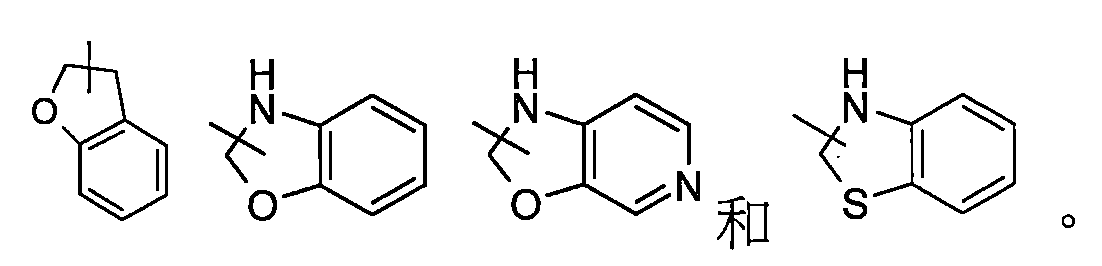
雜環基可以是取代的或非取代的,當被取代時,取代基可以在任何可使用的連接點上被取代,該取代基較佳為獨立地任選選自氫原子、鹵素、烷基、烷氧基、鹵烷基、羥基、羥烷基、氰基、胺基、硝基、環烷基、雜環基、芳基和雜芳基中的一個或多個取代基所取代。 The heterocyclic group may be substituted or unsubstituted. When substituted, the substituent may be substituted at any available connection point. The substituent is preferably independently substituted by one or more substituents selected from hydrogen atoms, halogen, alkyl, alkoxy, halogen alkyl, hydroxyl, hydroxyalkyl, cyano, amine, nitro, cycloalkyl, heterocyclic group, aryl and heteroaryl.
術語“芳基”指具有共軛的π電子體系的6至14元全碳單環或稠合多環(也就是共用毗鄰碳原子對的環)基團,較佳為6至10元,例如苯基和萘基。該芳基環包括如上該的芳基環稠合於雜芳基、雜環基或環烷基環上,其中與母體結構連接在一起的環為芳基環,其非限制性示例包括: The term "aryl" refers to a 6- to 14-membered all-carbon monocyclic or fused polycyclic (i.e., rings that share adjacent carbon atom pairs) group with a conjugated π electron system, preferably 6- to 10-membered, such as phenyl and naphthyl. The aryl ring includes the aryl ring as described above fused to a heteroaryl, heterocyclic or cycloalkyl ring, wherein the ring connected to the parent structure is an aryl ring, and non-limiting examples thereof include:
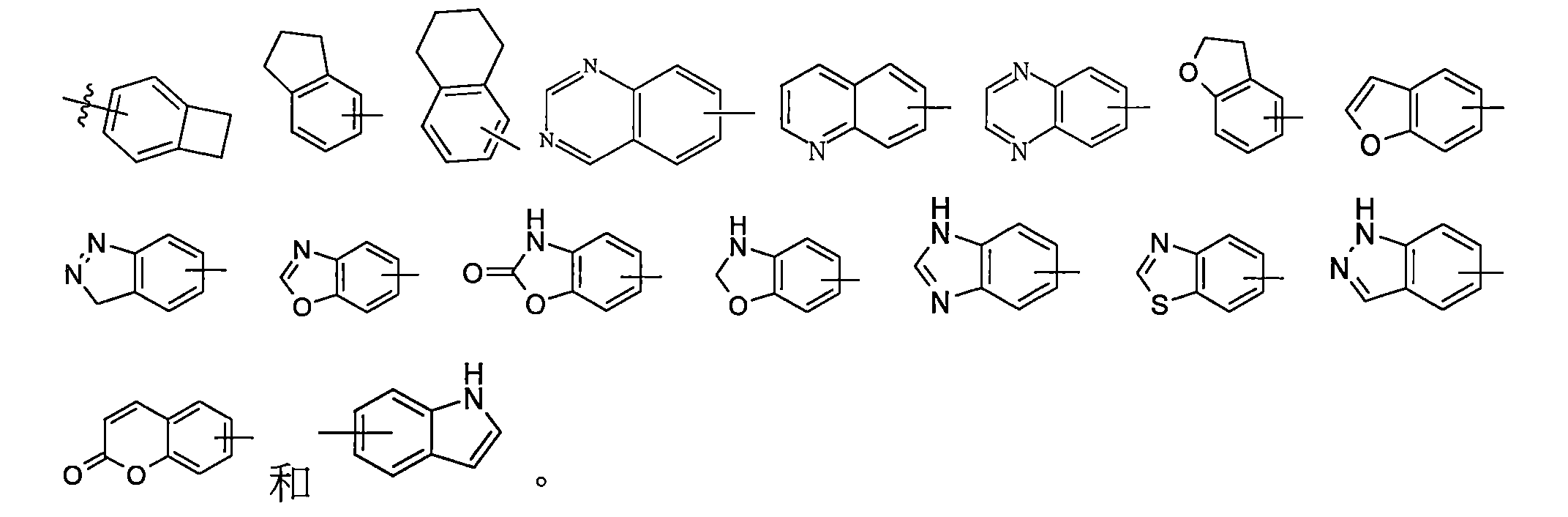
芳基可以是取代的或非取代的,當被取代時,取代基可以在任何可使用的連接點上被取代,該取代基較佳為獨立地任選選自氫原子、鹵素、烷基、烷氧基、鹵烷基、羥基、羥烷基、氰基、胺基、硝基、環烷基、雜環基、芳基和雜芳基中的一個或多個取代基所取代。 The aryl group may be substituted or unsubstituted. When substituted, the substituent may be substituted at any available connection point. The substituent is preferably independently substituted by one or more substituents selected from hydrogen atoms, halogens, alkyls, alkoxys, halogenated alkyls, hydroxyls, hydroxyalkyls, cyano groups, amino groups, nitro groups, cycloalkyls, heterocyclic groups, aryls and heteroaryls.
術語“雜芳基”指包含1至4個雜原子、5至14個環原子的雜芳族體系,其中雜原子選自氧、硫和氮。雜芳基較佳為5至10元,更佳為5元或6元,例如呋喃基、噻吩基、吡啶基、吡咯基、N-烷基吡咯基、嘧啶基、吡嗪基、噠嗪基、咪唑基、吡唑基、三唑基、四唑基等。該雜芳基環包括如上述的雜芳基稠合於芳基、雜環基或環烷基環上,其中與母體結構連接在一起的環為雜芳基環,其非限制性示例包括: The term "heteroaryl" refers to a heteroaromatic system containing 1 to 4 heteroatoms and 5 to 14 ring atoms, wherein the heteroatoms are selected from oxygen, sulfur and nitrogen. The heteroaryl is preferably 5 to 10-membered, more preferably 5-membered or 6-membered, such as furanyl, thienyl, pyridyl, pyrrolyl, N-alkylpyrrolyl, pyrimidinyl, pyrazinyl, oxazinyl, imidazolyl, pyrazolyl, triazolyl, tetrazolyl, etc. The heteroaryl ring includes the above-mentioned heteroaryl fused to an aryl, heterocyclo or cycloalkyl ring, wherein the ring connected to the parent structure is a heteroaryl ring, and its non-limiting examples include:


雜芳基可以是取代的或非取代的,當被取代時,取代基可以在任何可使用的連接點上被取代,該取代較佳為獨立地任選選自氫原子、鹵素、烷基、烷氧基、鹵烷基、羥基、羥烷基、氰基、胺基、硝基、環烷基、雜環基、芳基和雜芳基中的一個或多個取代基所取代。 The heteroaryl group may be substituted or unsubstituted. When substituted, the substituent may be substituted at any available connection point. The substitution is preferably independently arbitrarily selected from one or more substituents selected from hydrogen atoms, halogens, alkyls, alkoxys, halogenated alkyls, hydroxyls, hydroxyalkyls, cyano groups, amino groups, nitro groups, cycloalkyls, heterocyclic groups, aryls and heteroaryls.
術語“鹵烷基”指烷基上的氫被一個或多個鹵素取代,其中烷基如上所定義。 The term "haloalkyl" refers to an alkyl group in which the hydrogen atoms are replaced by one or more halogen atoms, wherein alkyl is as defined above.
術語“氘代烷基”指烷基上的氫被一個或多個氘原子取代,其中烷基如上所定義。 The term "deuterated alkyl" refers to an alkyl group in which the hydrogen atoms are replaced by one or more deuterium atoms, wherein alkyl is as defined above.
術語“羥烷基”指烷基上的氫被一個或多個羥基取代,其中烷基如上所定義。 The term "hydroxyalkyl" refers to an alkyl group in which the hydrogen atoms are replaced by one or more hydroxyl groups, wherein alkyl is as defined above.
術語“羥基”指-OH基團。 The term "hydroxy" refers to the -OH group.
術語“鹵素”指氟、氯、溴或碘。 The term "halogen" refers to fluorine, chlorine, bromine or iodine.
術語“胺基”指-NH2。 The term "amine" refers to -NH2 .
術語“硝基”指-NO2。 The term "nitro" refers to -NO2 .
術語“氰基”指-CN。 The term "cyano" refers to -CN.
“任選”或“任選地”意味著隨後所描述的事件或環境可以但不必發生,該說明包括該事件或環境發生或不發生地場合。例如,“任選被烷基取代的雜環基團”意味著烷基可以但不必須存在,該說明包括雜環基團被烷基取代的情形和雜環基團不被烷基取代的情形。 "Optional" or "optionally" means that the subsequently described event or circumstance may but need not occur, and the description includes instances where the event or circumstance occurs or does not occur. For example, "a heterocyclic group optionally substituted with an alkyl group" means that the alkyl group may but need not be present, and the description includes instances where the heterocyclic group is substituted with an alkyl group and instances where the heterocyclic group is not substituted with an alkyl group.
“取代的”指基團中的一個或多個氫原子,較佳為最多5個,更佳 為1個、2個或3個氫原子彼此獨立地被取代基取代。取代基僅處在它們的可能的化學位置,本領域技術人員能夠在不付出過多努力的情況下確定(通過實驗或理論)可能或不可能的取代。例如,具有游離氫的胺基或羥基與具有不飽和(如烯)鍵的碳原子結合時可能是不穩定的。 "Substituted" means that one or more hydrogen atoms, preferably up to 5, more preferably 1, 2 or 3 hydrogen atoms in the group are replaced independently of each other by substituents. Substituents are only in their possible chemical positions, and those skilled in the art can determine (experimentally or theoretically) possible or impossible substitutions without undue effort. For example, an amine or hydroxyl group with free hydrogen may be unstable when combined with a carbon atom with an unsaturated (such as an olefin) bond.
術語“藥物組成物”表示含有一種或多種本文該化合物或其生理學上/可藥用的鹽或前體藥物與其他化學組分的混合物,以及其他組分例如生理學/可藥用的載體和賦形劑。藥物組成物的目的是促進對生物體的給藥,利於活性成分的吸收進而發揮生物活性。 The term "pharmaceutical composition" refers to a mixture containing one or more compounds or their physiologically/pharmaceutically acceptable salts or prodrugs and other chemical components, as well as other components such as physiologically/pharmaceutically acceptable carriers and excipients. The purpose of the pharmaceutical composition is to facilitate administration to an organism, facilitate the absorption of the active ingredient, and thus exert biological activity.
術語“藥學上可接受的鹽”或“可藥用鹽”是指本揭露抗體藥物偶聯物的鹽,這類鹽用於受試者體內時具有安全性和有效性,且具有應有的生物活性,本揭露抗體藥物偶聯物至少含有一個胺基,因此可以與酸形成鹽,可藥用鹽的非限制性示例包括:鹽酸鹽、氫溴酸鹽、氫碘酸鹽、硫酸鹽、硫酸氫鹽、檸檬酸鹽、乙酸鹽、琥珀酸鹽、抗壞血酸鹽、草酸鹽、硝酸鹽、梨酸鹽、磷酸氫鹽、磷酸二氫鹽、水楊酸鹽、檸檬酸氫鹽、酒石酸鹽、馬來酸鹽、富馬酸鹽、甲酸鹽、苯甲酸鹽、甲磺酸鹽、乙磺酸鹽、苯磺酸鹽、對甲苯磺酸鹽。 The term "pharmaceutically acceptable salt" or "pharmaceutically acceptable salt" refers to a salt of the antibody-drug conjugate disclosed herein. Such salt is safe and effective when used in a subject and has the desired biological activity. The antibody-drug conjugate disclosed herein contains at least one amine group and can form a salt with an acid. Non-limiting examples of pharmaceutically acceptable salts include: hydrochloric acid, hydrobromic acid, Salt, hydroiodate, sulfate, hydrogen sulfate, citrate, acetate, succinate, ascorbate, oxalate, nitrate, sorbate, hydrogen phosphate, dihydrogen phosphate, salicylate, hydrogen citrate, tartrate, maleate, fumarate, formate, benzoate, methanesulfonate, ethanesulfonate, benzenesulfonate, p-toluenesulfonate.
“載藥量”或“平均藥物載重”也稱藥物抗體比例(Drug-to-Antibody Ratio,DAR),即ADC中每個抗體所偶聯的藥物的平均數量。其可在例如每個抗體偶聯約1至約10個藥物的範圍內,並且在某些實施例中,在每個抗體偶聯約1至約8個藥物的範圍內,較佳為自2-8、2-7、2-6、2-5、2-4、3-4、3-5、5-6、5-7、5-8和6-8的範圍。示例性的,載藥量可以為1、2、3、4、5、6、7、8、9、10的平均值。本揭露的ADC通式包括與前述一定載藥量範圍內的抗體藥物偶聯物的集合。在本揭露的實施方案中,載藥量表示為n,也可稱為DAR值,示例性 的為1、2、3、4、5、6、7、8、9、10的均值。可用一般方法如UV/可見光光譜法、質譜、ELISA試驗和HPLC測定載藥量。 "Drug loading" or "average drug loading" is also called the drug-to-antibody ratio (DAR), which is the average number of drugs conjugated to each antibody in the ADC. It can be, for example, in the range of about 1 to about 10 drugs conjugated to each antibody, and in certain embodiments, in the range of about 1 to about 8 drugs conjugated to each antibody, preferably in the range of 2-8, 2-7, 2-6, 2-5, 2-4, 3-4, 3-5, 5-6, 5-7, 5-8 and 6-8. Exemplarily, the drug loading can be an average of 1, 2, 3, 4, 5, 6, 7, 8, 9, 10. The ADC formula disclosed herein includes a collection of antibody-drug conjugates within the aforementioned certain drug loading range. In the embodiments disclosed herein, the drug loading is represented by n, which can also be referred to as the DAR value, and is exemplified by the average of 1, 2, 3, 4, 5, 6, 7, 8, 9, and 10. The drug loading can be determined by general methods such as UV/visible spectrometry, mass spectrometry, ELISA assay, and HPLC.
可以用以下非限制性方法調控配體藥物偶聯物的載量,包括: The loading capacity of the ligand drug conjugate can be modulated by the following non-limiting methods, including:
(1)調控連接試劑和單抗的莫耳比, (1) Adjust the molar ratio of the linker reagent and the monoclonal antibody,
(2)調控反應時間和溫度, (2) Control the reaction time and temperature,
(3)選擇不同的反應試劑。 (3) Choose different reaction reagents.
一般的藥物組成物的製備見中國藥典。 For the preparation of general drug compositions, please refer to the Chinese Pharmacopoeia.
術語“載體”用於本揭露的藥物,是指能改變藥物進入人體的方式和在體內的分佈、調控藥物的釋放速度並將藥物輸送到靶向器官的體系。藥物載體釋放和靶向系統能夠減少藥物降解及損失,降低副作用,提高生物利用度。如可作為載體的高分子表面活性劑由於其獨特的兩親性結構,可以進行自組裝,形成各種形式的聚集體,較佳的示例如膠束、微乳液、凝膠、液晶、囊泡等。這些聚集體具有包載藥物分子的能力,同時又對膜有良好的滲透性,可以作為優良的藥物載體。 The term "carrier" used in the drugs disclosed herein refers to a system that can change the way drugs enter the human body and their distribution in the body, regulate the release rate of drugs, and transport drugs to targeted organs. Drug carrier release and targeting systems can reduce drug degradation and loss, reduce side effects, and improve bioavailability. For example, polymer surfactants that can be used as carriers can self-assemble to form various forms of aggregates due to their unique amphiphilic structure. Preferred examples include micelles, microemulsions, gels, liquid crystals, vesicles, etc. These aggregates have the ability to encapsulate drug molecules and have good permeability to membranes, and can be used as excellent drug carriers.
術語“賦形劑”是在藥物製劑中除主藥以外的附加物,也可稱為輔料。如片劑中的粘合劑、填充劑、崩解劑、潤滑劑;半固體製劑軟膏劑、霜劑中的基質部分;液體製劑中的防腐劑、抗氧劑、矯味劑、芳香劑、助溶劑、乳化劑、增溶劑、滲透壓調節劑、著色劑等均可稱為賦形劑。 The term "excipient" refers to the additives in drug preparations other than the main drug, which can also be called excipients. For example, the binders, fillers, disintegrants, and lubricants in tablets; the base part in semisolid preparations such as ointments and creams; the preservatives, antioxidants, flavor enhancers, fragrances, solubilizers, emulsifiers, solubilizers, osmotic pressure regulators, coloring agents, etc. in liquid preparations can all be called excipients.
術語“稀釋劑”又稱填充劑,其主要用途是增加片劑的重量和體積。稀釋劑的加入不僅保證一定的體積大小,而且減少主要成分的劑量偏差,改善藥物的壓縮成型性等。當片劑的藥物含有油性組分時,需加入吸收劑吸收油性物,使保持“乾燥”狀態,以利於製成片劑。如澱粉、乳糖、鈣的無機鹽、微晶 纖維素等。 The term "diluent" is also called filler, and its main purpose is to increase the weight and volume of the tablet. The addition of diluent not only ensures a certain volume size, but also reduces the dosage deviation of the main ingredients and improves the compressibility of the drug. When the tablet contains oily components, an absorbent needs to be added to absorb the oily substance to keep it in a "dry" state to facilitate the preparation of tablets. Such as starch, lactose, inorganic salts of calcium, microcrystalline cellulose, etc.
藥物組成物可以是無菌注射水溶液形式。可在使用的可接受的溶媒和溶劑中有水、林格氏液和等滲氯化鈉溶液。無菌注射製劑可以是其中活性成分溶於油相的無菌注射水包油微乳液。例如將活性成分溶於大豆油和卵磷脂的混合物中。然後將油溶液加入水和甘油的混合物中處理形成微乳液。可通過局部大量注射,將注射液或微乳液注入受試者的血流中。或者,最好按可保持本揭露化合物恆定迴圈濃度的方式給予溶液和微乳液。為保持這種恆定濃度,可使用連續靜脈內遞藥裝置。這種裝置的示例是Deltec CADD-PLUS.TM.5400型靜脈注射泵。 The pharmaceutical composition may be in the form of a sterile injectable aqueous solution. Among the acceptable vehicles and solvents that may be used are water, Ringer's solution, and isotonic sodium chloride solution. The sterile injectable preparation may be a sterile injectable oil-in-water microemulsion in which the active ingredient is dissolved in the oil phase. For example, the active ingredient is dissolved in a mixture of soybean oil and lecithin. The oil solution is then added to a mixture of water and glycerol to form a microemulsion. The injection or microemulsion may be injected into the subject's bloodstream by local mass injection. Alternatively, it is preferred to administer the solution and microemulsion in a manner that maintains a constant circulating concentration of the disclosed compound. To maintain this constant concentration, a continuous intravenous drug delivery device may be used. An example of such a device is the Deltec CADD-PLUS.TM.5400 intravenous injection pump.
藥物組成物可以是用於肌內和皮下給藥的無菌注射水或油混懸浮液的形式。可按已知技術,用上述那些適宜的分散劑或濕潤劑和懸浮劑配製該混懸浮液。無菌注射製劑也可以是在無毒腸胃外可接受的稀釋劑或溶劑中製備的無菌注射溶液或混懸浮液,例如1,3-丁二醇中製備的溶液。此外,可方便地用無菌固定油作為溶劑或懸浮介質。為此目的,可使用包括合成甘油單或二酯在內的任何調和固定油。此外,脂肪酸例如油酸也可以製備注射劑。 The pharmaceutical composition may be in the form of a sterile injection suspension in water or oil for intramuscular and subcutaneous administration. The suspension may be prepared according to known techniques using appropriate dispersants or wetting agents and suspending agents as described above. Sterile injection preparations may also be sterile injection solutions or suspensions prepared in non-toxic parenterally acceptable diluents or solvents, such as solutions prepared in 1,3-butanediol. In addition, sterile fixed oils may be conveniently used as solvents or suspension media. For this purpose, any blended fixed oils may be used, including synthetic mono- or diglycerides. In addition, fatty acids such as oleic acid may also be used to prepare injections.
合成方法 Synthesis method
為了完成合成目的,採用如下的合成技術方案: In order to achieve the synthesis purpose, the following synthesis technology scheme is adopted:
通式(PM-9-A)所示的化合物的製備方法,其包括如下步驟: The preparation method of the compound represented by the general formula (PM-9-A) comprises the following steps:

PM還原後得到PM’,PM’與通式(9-A)偶聯反應,得到通式(PM-9-A)所示的化合物;還原劑較佳為TCEP,特別地,較佳為還原抗體上的二硫鍵; PM is reduced to obtain PM', and PM' is coupled with the general formula (9-A) to obtain a compound represented by the general formula (PM-9-A); the reducing agent is preferably TCEP, and in particular, it is preferably a disulfide bond on the reduced antibody;
其中, in,
PM為抗PSMA抗體或其抗原結合片段; PM is an anti-PSMA antibody or its antigen-binding fragment;
n為1至10,n是小數或整數。 n is 1 to 10, and n is a decimal or an integer.
在以上說明書中提出了本揭露一種或多種實施方案的細節。雖然可使用與本文該類似或相同的任何方法和材料來實施或測試本揭露,但是以下描述較佳的方法和材料。通過說明書和申請專利範圍,本揭露的其他特點、目的和優點將是顯而易見的。在說明書和申請專利範圍中,除非上下文中有清楚的另外指明,單數形式包括複數指代物的情況。除非另有定義,本文使用的所有技術和科學術語都具有本揭露所屬技術領域中具有通常知識者所理解的一般含義。說明書中引用的所有專利和出版物都通過引用納入。提出以下實施例是為了更全面地說明本揭露的較佳實施方案。這些實施例不應以任何方式理解為限制本揭露的範圍,本揭露的範圍由申請專利範圍限定。 The details of one or more embodiments of the present disclosure are proposed in the above specification. Although any methods and materials similar or identical to those herein can be used to implement or test the present disclosure, the preferred methods and materials are described below. Other features, purposes and advantages of the present disclosure will be apparent from the specification and the scope of the patent application. In the specification and the scope of the patent application, unless otherwise clearly indicated in the context, the singular form includes the case of plural references. Unless otherwise defined, all technical and scientific terms used herein have the general meaning understood by the ordinary knowledgeable person in the technical field to which the present disclosure belongs. All patents and publications cited in the specification are incorporated by reference. The following embodiments are proposed to more fully illustrate the preferred embodiments of the present disclosure. These embodiments should not be understood in any way to limit the scope of the present disclosure, and the scope of the present disclosure is limited by the scope of the patent application.
本揭露實施例或測試例中未註明具體條件的實驗方法,通常按照一般條件,或按照原料或商品製造廠商所建議的條件。參見Sambrook等,分子克隆,實驗室手冊,冷泉港實驗室;當代分子生物學方法,Ausubel等著,Greene出版協會,Wiley Interscience,NY。未註明具體來源的試劑,為市場購買的一般試劑。 Experimental methods disclosed in the embodiments or test examples without specific conditions are usually carried out under general conditions or according to the conditions recommended by the raw material or product manufacturer. See Sambrook et al., Molecular Cloning, a Laboratory Manual, Cold Spring Harbor Laboratory; Contemporary Methods in Molecular Biology, Ausubel et al., Greene Publishing Associates, Wiley Interscience, NY. Reagents without specific sources are general reagents purchased on the market.
實施例1. 抗體的製備 Example 1. Preparation of antibodies
(一)PSMA抗體製備 (I) Preparation of PSMA antibodies
1.1抗體序列 1.1 Antibody sequence
本揭露的抗體參照WO2003034903A2製備,其中AB-PG1-XG1-006可變區的胺基酸序列如下: The antibody disclosed herein is prepared with reference to WO2003034903A2, wherein the amino acid sequence of the variable region of AB-PG1-XG1-006 is as follows:
AB-PG1-XG1-006重鏈可變區: AB-PG1-XG1-006 heavy chain variable area:

AB-PG1-XG1-006輕鏈可變區: AB-PG1-XG1-006 light chain variable area:
DIQMTQSPSSLSASVGDRVTITCRASQGISNYLAWYQQKTGKVPKFLIYEASTLQSGVPSRFSGGGSGTDFTLTISSLQPEDVATYYCQNYNSAPFTFGPGTKVDIK SEQ ID NO:2 DIQMTQSPSSSLSASVGDRVTITC RASQGISNYLA WYQQKTGKVPKFLIY EASTLQS GVPSRFSGGGSGTDFTLTISSLQPEDVATYYC QNYNSAPFT FGPGTKVDIK SEQ ID NO: 2
註:底線部分為依照Kabat編號規則確定的CDR區。 Note: The underlined part is the CDR region determined according to the Kabat numbering rules.
表1AB-PG1-XG1-006抗體的CDR區

1.2全長抗體的構建 1.2 Construction of full-length antibodies
根據以上序列,設計引物PCR搭建得到VH/VK基因片段,獲得可變區。 Based on the above sequence, primers were designed and PCR was constructed to obtain VH/VK gene fragments and variable regions.
抗體可變區再與恆定區基因(CH1-Fc/CL)片段進行同源重組,構建完整抗體VH-CH1-Fc/VK-CL。 The variable region of the antibody is then homologously recombined with the constant region gene (CH1-Fc/CL) fragment to construct the complete antibody VH-CH1-Fc/VK-CL.
構建的完整全長抗體PM序列如下: The constructed complete full-length antibody PM sequence is as follows:
重鏈(IgG1)胺基酸序列: Heavy chain (IgG1) amino acid sequence:


輕鏈(Kappa)胺基酸序列: Light chain (Kappa) amino acid sequence:

1.3全長抗體的表達與純化 1.3 Expression and purification of full-length antibodies
將分別表達抗體輕、重鏈的質粒例轉染HEK293E細胞,6天後收集表達上清,高速離心去除雜質,用Protein A柱進行純化。用PBS沖洗柱子,至A280讀數降至基線。用pH3.0-pH3.5的酸性沖提液沖提目的蛋白,用1M Tris-HCl,pH8.0-9.0中和。沖提樣品適當濃縮後,利用PBS平衡好的凝膠層析Superdex200(GE)進一步純化,以去除聚體,收集單體峰,分裝備用。 The plasmids expressing the light and heavy chains of the antibody were transfected into HEK293E cells. After 6 days, the expression supernatant was collected, impurities were removed by high-speed centrifugation, and purified using a Protein A column. The column was washed with PBS until the A280 reading dropped to the baseline. The target protein was washed with an acidic washing solution of pH 3.0-pH 3.5 and neutralized with 1M Tris-HCl, pH 8.0-9.0. After the washed sample was appropriately concentrated, it was further purified using a gel chromatography Superdex200 (GE) balanced with PBS to remove aggregates, collect the monomer peak, and package it for later use.
(二)對照抗體Lmab製備 (II) Preparation of control antibody Lmab
對照抗體labetuzumab(簡稱Lmab)參照WHO Drug Information Vol.30,No.1,2016製備,其中重鏈和輕鏈胺基酸序列如下: The control antibody labetuzumab (abbreviated as Lmab) was prepared according to WHO Drug Information Vol.30, No.1, 2016, and the heavy chain and light chain amino acid sequences are as follows:
>抗體重鏈序列Lmab-HC >Antibody heavy chain sequence Lmab-HC

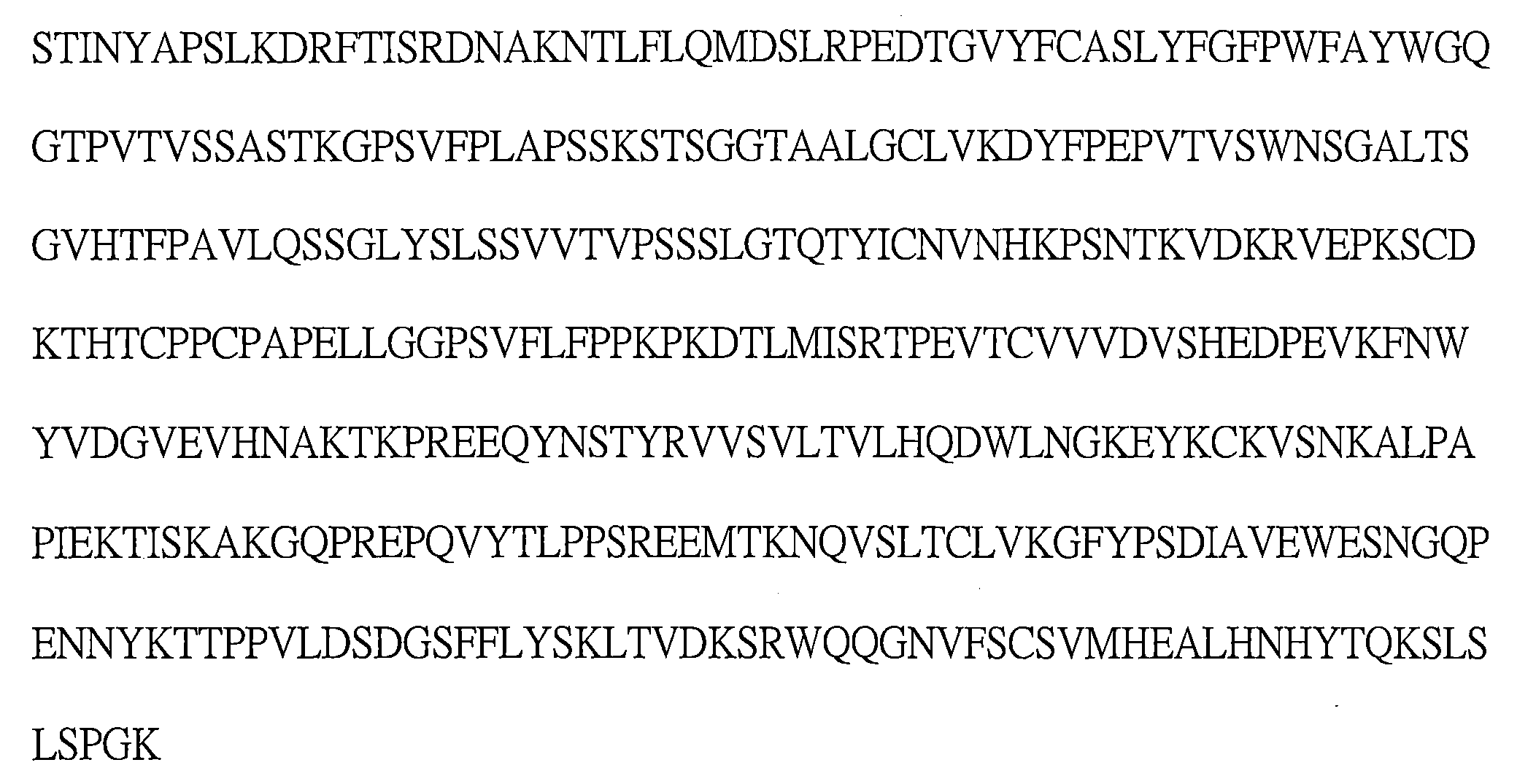
>抗體輕鏈序列Lmab-LC >Antibody light chain sequence Lmab-LC

實施例2. 化合物的製備 Example 2. Preparation of compounds
本揭露實施例中未註明具體條件的實驗方法,通常按照一般條件,或按照原料或商品製造廠商所建議的條件。未註明具體來源的試劑,為市場購買的一般試劑。 The experimental methods disclosed in this disclosure that do not specify specific conditions are usually carried out under general conditions or under conditions recommended by raw material or product manufacturers. Reagents that do not specify specific sources are general reagents purchased from the market.
化合物的結構是通過核磁共振(NMR)或質譜(MS)來確定的。NMR 的測定是用Bruker AVANCE-400核磁儀,測定溶劑為氘代二甲基亞碸(DMSO-d6)、氘代氯仿(CDCl3)、氘代甲醇(CD3OD),內標為四甲基矽烷(TMS),化學位移是以10-6(ppm)作為單位給出。 The structure of the compound is determined by nuclear magnetic resonance (NMR) or mass spectrometry (MS). NMR measurements are performed using a Bruker AVANCE-400 NMR instrument, with deuterated dimethyl sulfoxide ( DMSO-d6 ), deuterated chloroform (CDCl 3 ), deuterated methanol (CD 3 OD) as the solvent, tetramethylsilane (TMS) as the internal standard, and chemical shifts are given in units of 10 -6 (ppm).
MS的測定用FINNIGAN LCQAd(ESI)質譜儀(生產商:Thermo,型號:Finnigan LCQ advantage MAX)。 MS was determined using a FINNIGAN LCQAd(ESI) mass spectrometer (manufacturer: Thermo, model: Finnigan LCQ advantage MAX).
UPLC的測定用Waters Acquity UPLC SQD液質聯用儀。 UPLC was measured using a Waters Acquity UPLC SQD liquid chromatography-mass spectrometer.
HPLC的測定使用安捷倫1200DAD高壓液相色譜儀(Sunfire C18 150×4.6mm色譜柱)和Waters 2695-2996高壓液相色譜儀(Gimini C18 150×4.6mm色譜柱)。 HPLC determinations were performed using an Agilent 1200DAD high pressure liquid chromatograph (Sunfire C18 150×4.6mm column) and a Waters 2695-2996 high pressure liquid chromatograph (Gimini C18 150×4.6mm column).
UV-HPLC的測定使用Thermo nanodrop2000紫外分光光度計。 UV-HPLC was measured using a Thermo nanodrop2000 UV spectrophotometer.
增殖抑制率及IC50值的測定用PHERA starFS酶標儀(德國BMG公司)。 The proliferation inhibition rate and IC50 value were determined using PHERA starFS enzyme marker (BMG, Germany).
薄層層析矽膠板使用煙臺黃海HSGF254或青島GF254矽膠板,薄層色譜法(TLC)使用的矽膠板採用的規格是0.15mm~0.2mm,薄層層析分離純化產品採用的規格是0.4mm~0.5mm矽膠板。 The thin layer chromatography silica plate uses Yantai Huanghai HSGF254 or Qingdao GF254 silica plate. The silica plate used in thin layer chromatography (TLC) uses a specification of 0.15mm~0.2mm, and the thin layer chromatography separation and purification product uses a specification of 0.4mm~0.5mm silica plate.
柱層析一般使用煙臺黃海200~300目矽膠為載體。
Column chromatography generally uses
本揭露的已知的起始原料可以採用或按照本領域已知的方法來合成,或可購買自ABCR GmbH & Co.KG,Acros Organnics,Aldrich Chemical Company,韶遠化學科技(Accela ChemBio Inc)、達瑞化學品等公司。 The known starting materials disclosed herein can be synthesized by methods known in the art, or can be purchased from ABCR GmbH & Co.KG, Acros Organnics, Aldrich Chemical Company, Accela ChemBio Inc, Darui Chemicals, etc.
實施例中如無特殊說明,反應均在氬氣氛或氮氣氛下進行。 Unless otherwise specified in the examples, the reactions were carried out under an argon or nitrogen atmosphere.
氬氣氛或氮氣氛是指反應瓶連接一個約1L容積的氬氣或氮氣氣球。 Argon atmosphere or nitrogen atmosphere means that the reaction bottle is connected to an argon or nitrogen balloon with a volume of about 1L.
氫氣氛是指反應瓶連接一個約1L容積的氫氣氣球。 Hydrogen atmosphere means that the reaction bottle is connected to a hydrogen balloon with a volume of about 1L.
加壓氫化反應使用Parr 3916EKX型氫化儀和清藍QL-500型氫氣發生器或HC2-SS型氫化儀。 The pressurized hydrogenation reaction uses a Parr 3916EKX hydrogenator and a Clear Blue QL-500 hydrogen generator or a HC2-SS hydrogenator.
氫化反應通常抽真空,充入氫氣,重複操作3次。 The hydrogenation reaction is usually carried out by evacuating the air, filling it with hydrogen, and repeating the operation three times.
微波反應使用CEM Discover-S 908860型微波反應器。 The microwave reaction was performed using a CEM Discover-S 908860 microwave reactor.
實施例中如無特殊說明,反應中的溶液是指水溶液。 Unless otherwise specified in the examples, the solution in the reaction refers to an aqueous solution.
實施例中如無特殊說明,反應的溫度為室溫。 Unless otherwise specified in the examples, the reaction temperature is room temperature.
室溫為最適宜的反應溫度,溫度範圍是20℃~30℃。 Room temperature is the most suitable reaction temperature, and the temperature range is 20℃~30℃.
實施例中pH=6.5的PBS緩衝液的配製:取KH2PO4 8.5g,K2HPO4.3H2O 8.56g,NaCl 5.85g,EDTA 1.5g置於瓶中,定容至2L,超聲波使其全部溶解,搖勻即得。 Preparation of PBS buffer solution with pH=6.5 in the embodiment: 8.5 g of KH 2 PO 4 , 8.56 g of K 2 HPO 4 .3H 2 O, 5.85 g of NaCl, and 1.5 g of EDTA were placed in a bottle, the volume was fixed to 2 L, and all of them were dissolved by ultrasonication and shaken to obtain the solution.
純化化合物採用的柱層析的沖提劑的體系和薄層色譜法的展開劑的體系包括:A:二氯甲烷和異丙醇體系,B:二氯甲烷和甲醇體系,C:石油醚和乙酸乙酯體系,溶劑的體積比根據化合物的極性不同而進行調節,也可以加入少量的三乙胺和酸性或鹼性試劑等進行調節。 The column chromatography eluent system and thin layer chromatography developing agent system used for purifying compounds include: A: dichloromethane and isopropanol system, B: dichloromethane and methanol system, C: petroleum ether and ethyl acetate system. The volume ratio of the solvent is adjusted according to the polarity of the compound, and can also be adjusted by adding a small amount of triethylamine and acidic or alkaline reagents.
本揭露部分化合物是通過Q-TOF LC/MS來表徵的。Q-TOF LC/MS使用安捷倫6530精確質量數四級杆-飛行時間質譜儀和安捷倫1290-Infinity超高效液相色譜儀(安捷倫Poroshell 300SB-C8 5μm,2.1×75mm色譜柱)。
Some of the compounds disclosed herein were characterized by Q-TOF LC/MS. Q-TOF LC/MS was performed using an Agilent 6530 Accurate Mass Quadrupole-Time of Flight Mass Spectrometer and an Agilent 1290-Infinity Ultra Performance Liquid Chromatograph (Agilent Poroshell 300SB-
本揭露抗體藥物偶聯物的Y-D藥物部分參見PCT/CN2019/107873,相關的化合物合成及測試引用至本專利。其中的非限制性實施例合成引用如下: The Y-D drug part of the disclosed antibody-drug conjugate can be found in PCT/CN2019/107873, and the synthesis and testing of the related compounds are cited in this patent. The non-limiting example synthesis is cited as follows:
實施例2-1 Implementation Example 2-1
N-((1S,9S)-9-乙基-5-氟-9-羥基-4-甲基-10,13-二側氧-2,3,9,10,13,15-六氫-1H,12H-苯并[de]吡喃并[3',4':6,7]吲哚嗪并[1,2-b]喹啉-1-基)-1-羥基環丙烷-1-甲醯胺1 N -((1 S ,9 S )-9-ethyl-5-fluoro-9-hydroxy-4-methyl-10,13-dioxo-2,3,9,10,13,15-hexahydro-1 H ,12 H -benzo[ de ]pyrano[3',4':6,7]indolizino[1,2- b ]quinolin-1-yl)-1-hydroxycyclopropane-1-carboxamide


向依喜替康甲磺酸鹽1b(2.0mg,3.76μmol,採用專利申請“EP0737686A1”公開的方法製備而得)中添加1mL N,N-二甲基甲醯胺,冰水浴冷卻至0-5℃,滴加一滴三乙胺,攪拌至反應液變澄清。向反應液中依次加入1-羥基環丙基甲酸1a(1.4mg,3.7μmol,採用公知的方法“Tetrahedron Letters,25(12),1269-72;1984”製備而得)和4-(4,6-二甲氧基-1,3,5-三嗪-2-基)-4-甲基氯化嗎啉鹽(3.8mg,13.7μmol),加畢,在0-5℃攪拌反應2小時。向反應液中加入5mL水淬滅反應,用乙酸乙酯(8mL×3)萃取反應液,合併有機相,用飽和氯化鈉溶液(5mL×2)洗滌,有機相用無水硫酸鈉乾燥,過濾,將濾液減壓濃縮,用薄層層析以展開劑體系B純化所得殘餘物,得到標題產物1(1.6mg,產率:82.1%)。 1 mL of N,N-dimethylformamide was added to exitecan mesylate 1b (2.0 mg, 3.76 μ mol, prepared by the method disclosed in patent application "EP0737686A1"), cooled to 0-5°C in an ice-water bath, and one drop of triethylamine was added dropwise, and stirred until the reaction solution became clear. To the reaction solution were added 1-hydroxycyclopropylcarboxylic acid 1a (1.4 mg, 3.7 μ mol, prepared by a known method, “Tetrahedron Letters, 25 (12), 1269-72; 1984”) and 4-(4,6-dimethoxy-1,3,5-triazine-2-yl)-4-methylchlorophenoxylate (3.8 mg, 13.7 μ mol) in sequence. After the addition, the mixture was stirred at 0-5° C. for 2 hours. 5 mL of water was added to the reaction solution to quench the reaction. The reaction solution was extracted with ethyl acetate (8 mL × 3). The organic phases were combined and washed with saturated sodium chloride solution (5 mL × 2). The organic phase was dried over anhydrous sodium sulfate and filtered. The filtrate was concentrated under reduced pressure and the residue was purified by thin layer chromatography with developing agent system B to obtain the title product 1 (1.6 mg, yield: 82.1%).
MS m/z(ESI):520.2[M+1] MS m/z(ESI): 520.2[M+1]
1H NMR(400MHz,CDCl3):δ 7.90-7.84(m,1H),7.80-7.68(m,1H), 5.80-5.70(m,1H),5.62-5.54(m,2H),5.44-5.32(m,2H),5.28-5.10(m,2H),3.40-3.15(m,3H),2.44(s,3H),2.23(t,1H),2.06-1.75(m,2H),1.68-1.56(m,1H),1.22-1.18(m,2H),1.04-0.98(m,2H),0.89(t,3H). 1 H NMR (400MHz, CDCl 3 ): δ 7.90-7.84 (m, 1H), 7.80-7.68 (m, 1H), 5.80-5.70(m,1H),5.62-5.54(m,2H),5.44-5.32(m,2H),5.28-5.10(m,2H),3.40-3.15(m,3H),2.44(s,3 H),2.23(t,1H),2.06-1.75(m,2H),1.68-1.56(m,1H),1.22-1.18(m,2H),1.04-0.98(m,2H),0.89(t,3H).
實施例2-2 Implementation Example 2-2
(S)-2-環丙基-N-((1S,9S)-9-乙基-5-氟-9-羥基-4-甲基-10,13-二側氧-2,3,9,10,13,15-六氫-1H,12H-苯并[de]吡喃并[3',4':6,7]吲哚嗪并[1,2-b]喹啉-1-基)-2-羥基乙醯胺2-A ( S )-2-Cyclopropyl- N -(( 1S , 9S )-9-ethyl-5-fluoro-9-hydroxy-4-methyl-10,13-dihydro-2,3,9,10,13,15-hexahydro- 1H , 12H -benzo[ de ]pyrano[3',4':6,7]indolizino[1,2- b ]quinolin-1-yl)-2-hydroxyacetamide 2-A
(R)-2-環丙基-N-((1S,9S)-9-乙基-5-氟-9-羥基-4-甲基-10,13-二側氧-2,3,9,10,13,15-六氫-1H,12H-苯并[de]吡喃并[3',4':6,7]吲哚嗪并[1,2-b]喹啉-1-基)-2-羥基乙醯胺2-B ( R )-2-Cyclopropyl- N -(( 1S , 9S )-9-ethyl-5-fluoro-9-hydroxy-4-methyl-10,13-dihydro-2,3,9,10,13,15-hexahydro- 1H , 12H -benzo[ de ]pyrano[3',4':6,7]indolizino[1,2- b ]quinolin-1-yl)-2-hydroxyacetamide 2-B
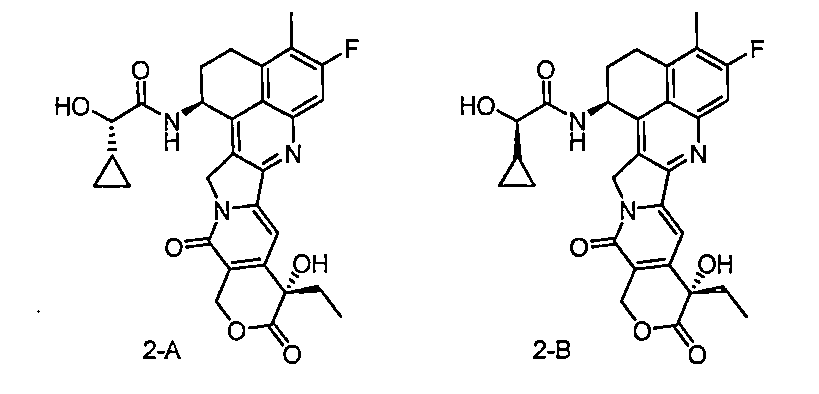

向1b(4mg,7.53μmol)中加入2mL乙醇和0.4mL N,N-二甲基甲醯胺,氬氣置換三次,冰水浴冷卻至0-5℃,滴加0.3mL N-甲基嗎啉,攪拌至反應液變澄清。向反應液中依次加入2-環丙基-2-羥基乙酸2a(2.3mg,19.8μmol,採用專利申請“WO2013106717”公開的方法製備而得)、1-羥基苯并三唑(3mg,22.4
μmol)和1-(3-二甲胺基丙基)-3-乙基碳二亞胺鹽酸鹽(4.3mg,22.4μmol),加畢,在0-5℃攪拌反應1小時。撤去冰水浴,加熱至30℃攪拌2小時。反應液減壓濃縮,所得到的粗製化合物2用高效液相色譜法純化(分離條件:色譜柱:XBridge Prep C18 OBD 5μm 19*250mm;流動相:A-水(10mmol NH4OAc),B-乙腈,梯度沖提,流速:18mL/分鐘),收集其相應組分,減壓濃縮,得到標題產物(2-A:1.5mg,2-B:1.5mg)。
2 mL of ethanol and 0.4 mL of N , N -dimethylformamide were added to 1b (4 mg, 7.53 μ mol), the atmosphere was replaced with hydrogen three times, the mixture was cooled to 0-5°C in an ice-water bath, 0.3 mL of N -methylmorpholine was added dropwise, and the mixture was stirred until the reaction solution became clear. 2-cyclopropyl-2-hydroxyacetic acid 2a (2.3 mg, 19.8 μ mol, prepared by the method disclosed in patent application "WO2013106717"), 1-hydroxybenzotriazole (3 mg, 22.4 μ mol) and 1-(3-dimethylaminopropyl)-3-ethylcarbodiimide hydrochloride (4.3 mg, 22.4 μ mol) were added to the reaction solution in sequence, and the mixture was stirred at 0-5°C for 1 hour. Remove the ice-water bath, heat to 30°C and stir for 2 hours. The reaction solution was concentrated under reduced pressure, and the obtained
MS m/z(ESI):534.0[M+1]。 MS m/z(ESI): 534.0[M+1].
單一構型化合物2-B(較短保留時間) Single configuration compound 2-B (short retention time)
UPLC分析:保留時間1.06分鐘,純度:88%(色譜柱:ACQUITY UPLC BEHC18 1.7um 2.1*50mm,流動相:A-水(5mmol NH4OAc),B-乙腈)。 UPLC analysis: retention time 1.06 minutes, purity: 88% (chromatographic column: ACQUITY UPLC BEHC18 1.7um 2.1*50mm, mobile phase: A-water (5mmol NH 4 OAc), B-acetonitrile).
1H NMR(400MHz,DMSO-d 6):δ 8.37(d,1H),7.76(d,1H),7.30(s,1H),6.51(s,1H),5.58-5.56(m,1H),5.48(d,1H),5.41(s,2H),5.32-5.29(m,2H),3.60(t,1H),3.19-3.13(m,1H),2.38(s,3H),2.20-2.14(m,1H),1.98(q,2H),1.87-1.83(m,1H),1.50-1.40(m,1H),1.34-1.28(m,1H),0.86(t,3H),0.50-0.39(m,4H)。 1 H NMR (400MHz, DMSO- d 6 ): δ 8.37(d,1H),7.76(d,1H),7.30(s,1H),6.51(s,1H),5.58-5.56(m,1H) ,5.48(d,1H),5.41(s,2H),5.32-5.29(m,2H),3.60(t,1H),3.19-3.13( m,1H),2.38(s,3H),2.20-2.14(m,1H),1.98(q,2H),1.87-1.83(m,1H) ,1.50-1.40(m,1H),1.34-1.28(m,1H),0.86(t,3H),0.50-0.39(m,4H).
單一構型化合物2-A(較長保留時間) Single configuration compound 2-A (longer retention time)
UPLC分析:保留時間1.10分鐘,純度:86%(色譜柱:ACQUITY UPLC BEHC18 1.7um 2.1*50mm,流動相:A-水(5mmol NH4OAc),B-乙腈)。 UPLC analysis: retention time 1.10 minutes, purity: 86% (chromatographic column: ACQUITY UPLC BEHC18 1.7um 2.1*50mm, mobile phase: A-water (5mmol NH 4 OAc), B-acetonitrile).
1H NMR(400MHz,DMSO-d 6):δ 8.35(d,1H),7.78(d,1H),7.31(s,1H),6.52(s,1H),5.58-5.53(m,1H),5.42(s,2H),5.37(d,1H),5.32(t,1H),3.62(t,1H),3.20-3.15(m,2H),2.40(s,3H),2.25-2.16(m,1H),1.98(q,2H),1.87-1.82(m,1H),1.50-1.40(m,1H),1.21-1.14(m,1H),0.87(t,3H),0.47-0.35(m,4H)。 1 H NMR (400MHz, DMSO- d 6 ): δ 8.35(d,1H),7.78(d,1H),7.31(s,1H),6.52(s,1H),5.58-5.53(m,1H ),5.42(s,2H),5.37(d,1H),5.32(t,1H),3.62(t,1H),3.20-3.15(m, 2H),2.40(s,3H),2.25-2.16(m,1H),1.98(q,2H),1.87-1.82(m,1H), 1.50-1.40(m,1H),1.21-1.14(m,1H),0.87(t,3H),0.47-0.35(m,4H).
實施例2-3 Implementation Example 2-3
(S)-N-((1S,9S)-9-乙基-5-氟-9-羥基-4-甲基-10,13-二側氧-2,3,9,10,13,15-六氫-1H,12H-苯并[de]吡喃并[3',4':6,7]吲哚嗪并[1,2-b]喹啉-1-基)-3,3,3-三氟-2-羥基丙醯胺3-A (S) -N -(( 1S , 9S )-9-ethyl-5-fluoro-9-hydroxy-4-methyl-10,13-dihydro-2,3,9,10,13,15-hexahydro- 1H , 12H -benzo[ de ]pyrano[3',4':6,7]indolizino[1,2- b ]quinolin-1-yl)-3,3,3-trifluoro-2-hydroxypropionamide 3-A
(R)-N-((1S,9S)-9-乙基-5-氟-9-羥基-4-甲基-10,13-二側氧-2,3,9,10,13,15-六氫-1H,12H-苯并[de]吡喃并[3',4':6,7]吲哚嗪并[1,2-b]喹啉-1-基)-3,3,3-三氟-2-羥基丙醯胺3-B (R) - N -((1 S ,9 S )-9-ethyl-5-fluoro-9-hydroxy-4-methyl-10,13-dihydro-2,3,9,10,13,15-hexahydro-1 H ,12 H -benzo[ de ]pyrano[3',4':6,7]indolizino[1,2- b ]quinolin-1-yl)-3,3,3-trifluoro-2-hydroxypropionamide 3-B
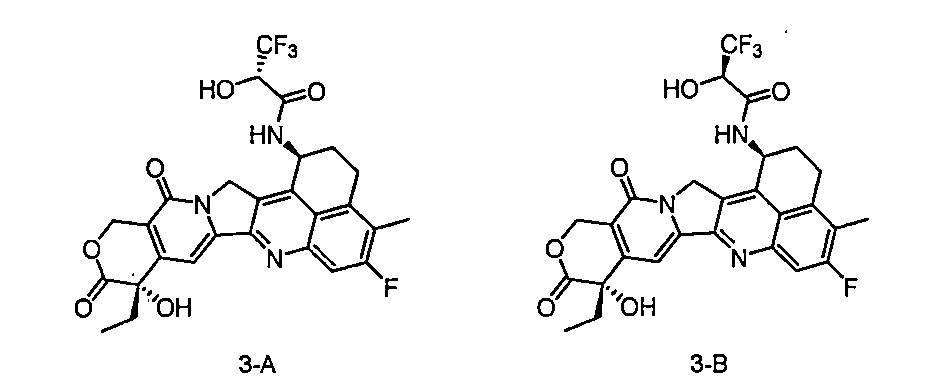

向1b(5.0mg,9.41μmol)中添加2mL乙醇和0.4mL N,N-二甲基甲醯胺,冰水浴冷卻至0-5℃,滴加0.3mL N-甲基嗎啡啉,攪拌至反應液變澄清。向反應液中依次加入3,3,3-三氟-2-羥基丙酸3a(4.1mg,28.4μmol,供應商Alfa)、1-羥基苯并三唑(3.8mg,28.1μmol)和1-(3-二甲胺基丙基)-3-乙基碳二亞胺鹽酸鹽(5.4mg,28.2μmol),加畢,在0-5℃攪拌反應10分鐘。撤去冰水浴,加熱至30℃攪拌8小時。反應液減壓濃縮,所得到的粗製化合物3用高效液相色譜法純化(分離條件:色譜柱:XBridge Prep C18 OBD 5um 19*250mm;流動相:A-水(10mmol NH4OAc):B-乙腈,梯度沖提,流速:18mL/分鐘),收集其相應組分,減壓濃縮,得到標題產物(1.5mg,1.5mg)。
Add 2 mL of ethanol and 0.4 mL of N , N -dimethylformamide to 1b (5.0 mg, 9.41 μ mol), cool to 0-5°C in an ice-water bath, add 0.3 mL of N -methylmorpholine dropwise, and stir until the reaction solution becomes clear. Add 3,3,3-trifluoro-2-hydroxypropionic acid 3a (4.1 mg, 28.4 μ mol, supplier Alfa), 1-hydroxybenzotriazole (3.8 mg, 28.1 μ mol) and 1-(3-dimethylaminopropyl)-3-ethylcarbodiimide hydrochloride (5.4 mg, 28.2 μ mol) to the reaction solution in sequence, and stir at 0-5°C for 10 minutes. Remove the ice-water bath, heat to 30°C and stir for 8 hours. The reaction solution was concentrated under reduced pressure, and the obtained
MS m/z(ESI):561.9[M+1]。 MS m/z(ESI): 561.9[M+1].
單一構型化合物(較短保留時間) Single configuration compound (short retention time)
UPLC分析:保留時間1.11分鐘,純度:88%(色譜柱:ACQUITY UPLC BEHC18 1.7um 2.1*50mm,流動相:A-水(5mmol NH4OAc),B-乙腈)。 UPLC analysis: retention time 1.11 minutes, purity: 88% (chromatographic column: ACQUITY UPLC BEHC18 1.7um 2.1*50mm, mobile phase: A-water (5mmol NH 4 OAc), B-acetonitrile).
1H NMR(400MHz,DMSO-d 6):δ 8.94(d,1H),7.80(d,1H),7.32(s,1H),7.20(d,1H),6.53(s,1H),5.61-5.55(m,1H),5.45-5.23(m,3H),5.15-5.06(m,1H),4.66-4.57(m,1H),3.18-3.12(m,1H),2.40(s,3H),2.26-2.20(m,1H),2.16-2.08(m,1H),2.02-1.94(m,1H),1.89-1.82(m,1H),1.50-1.40(m,1H),0.87(t,3H)。 1 H NMR (400MHz, DMSO- d 6 ): δ 8.94(d,1H),7.80(d,1H),7.32(s,1H),7.20(d,1H),6.53(s,1H),5.61 -5.55(m,1H),5.45-5.23(m,3H),5.15-5.06(m,1H),4.66-4.57(m,1H) ,3.18-3.12(m,1H),2.40(s,3H),2.26-2.20(m,1H),2.16-2.08(m,1H) ,2.02-1.94(m,1H),1.89-1.82(m,1H),1.50-1.40(m,1H),0.87(t,3H).
單一構型化合物(較長保留時間) Single configuration compound (longer retention time)
UPLC分析:保留時間1.19分鐘,純度:90%(色譜柱:ACQUITY UPLC BEHC18 1.7um 2.1*50mm,流動相:A-水(5mmol NH4OAc),B-乙腈)。 UPLC analysis: retention time 1.19 minutes, purity: 90% (chromatographic column: ACQUITY UPLC BEHC18 1.7um 2.1*50mm, mobile phase: A-water (5mmol NH 4 OAc), B-acetonitrile).
1H NMR(400MHz,DMSO-d 6):δ 8.97(d,1H),7.80(d,1H),7.31(s,1H),7.16(d,1H),6.53(s,1H),5.63-5.55(m,1H),5.45-5.20(m,3H),5.16-5.07(m,1H),4.66-4.57(m,1H),3.18-3.12(m,1H),2.40(s,3H),2.22-2.14(m,1H),2.04-1.95(m,2H),1.89-1.82(m,1H),1.50-1.40(m,1H),0.87(t,3H)。 1 H NMR (400MHz, DMSO- d 6 ): δ 8.97(d,1H),7.80(d,1H),7.31(s,1H),7.16(d,1H),6.53(s,1H),5.63-5.55(m,1H),5.45-5.20(m,3H),5.16-5.07(m,1H),4.66-4. 57(m,1H),3.18-3.12(m,1H),2.40(s,3H),2.22-2.14(m,1H),2.04-1.95(m,2H),1.89-1.82(m,1H),1.50-1.40(m,1H),0.87(t,3H).
實施例2-4 Implementation Example 2-4
N-((1S,9S)-9-乙基-5-氟-9-羥基-4-甲基-10,13-二側氧-2,3,9,10,13,15-六氫-1H,12H-苯并[de]吡喃并[3',4':6,7]吲哚嗪并[1,2-b]喹啉-1-基)-1-羥基環戊烷-1-甲醯胺4 N -((1 S ,9 S )-9-ethyl-5-fluoro-9-hydroxy-4-methyl-10,13-dioxo-2,3,9,10,13,15-hexahydro-1 H ,12 H -benzo[ de ]pyrano[3',4':6,7]indolizino[1,2- b ]quinolin-1-yl)-1-hydroxycyclopentane-1-carboxamide


向1b(3.0mg,5.64μmol)中添加1mL N,N-二甲基甲醯胺,冰水浴冷卻至0-5℃,滴加一滴三乙胺,攪拌至反應液變澄清。向反應液中依次加入1-羥基-環戊烷甲酸4a(2.2mg,16.9μmol,採用專利申請“WO2013106717”公開的方法製備而得)和4-(4,6-二甲氧基-1,3,5-三嗪-2-基)-4-甲基氯化嗎啉鹽(4.7mg,16.9μmol),加畢,在0-5℃攪拌反應1小時。向反應液中加入5mL水淬滅反應,用乙酸乙酯(10mL×3)萃取反應液,合併有機相,用飽和氯化鈉溶液(5mL×2)洗滌,有機相用無水硫酸鈉乾燥,過濾,將濾液減壓濃縮,用薄層層析以展開劑體系B純化所得殘餘物,得到標題產物4(2.5mg,產率:80.9%)。 Add 1 mL of N , N -dimethylformamide to 1b (3.0 mg, 5.64 μ mol), cool to 0-5°C in an ice-water bath, add a drop of triethylamine, and stir until the reaction solution becomes clear. Add 1-hydroxy-cyclopentanecarboxylic acid 4a (2.2 mg, 16.9 μ mol, prepared by the method disclosed in patent application "WO2013106717") and 4-(4,6-dimethoxy-1,3,5-triazine-2-yl)-4-methylchlorophenoxylate (4.7 mg, 16.9 μ mol) to the reaction solution in sequence, and stir at 0-5°C for 1 hour. 5 mL of water was added to the reaction solution to quench the reaction. The reaction solution was extracted with ethyl acetate (10 mL×3). The organic phases were combined and washed with saturated sodium chloride solution (5 mL×2). The organic phase was dried over anhydrous sodium sulfate and filtered. The filtrate was concentrated under reduced pressure and the residue was purified by thin layer chromatography with developing agent system B to obtain the title product 4 (2.5 mg, yield: 80.9%).
MS m/z(ESI):548.0[M+1]。 MS m/z(ESI): 548.0[M+1].
1H NMR(400MHz,CDCl3):δ 7.73-7.62(m,2H),5.75-5.62(m,1H),5.46-5.32(m,2H),5.26-5.10(m,1H),3.30-3.10(m,1H),2.43(s,3H),2.28-2.20(m,2H),2.08-1.84(m,8H),1.69-1.58(m,2H),1.04-1.00(m,2H),0.89(t,3H)。 1 H NMR (400MHz, CDCl 3 ): δ 7.73-7.62(m,2H),5.75-5.62(m,1H),5.46-5.32(m,2H),5.26-5.10(m,1H),3.30-3.10(m,1H),2.4 3(s,3H),2.28-2.20(m,2H),2.08-1.84(m,8H),1.69-1.58(m,2H),1.04-1.00(m,2H),0.89(t,3H).
實施例2-5 Implementation Example 2-5
N-((1S,9S)-9-乙基-5-氟-9-羥基-4-甲基-10,13-二側氧-2,3,9,10,13,15-六氫-1H,12H-苯并[de]吡喃并[3',4':6,7]吲哚嗪并[1,2-b]喹啉-1-基)-1-(羥甲基)環丙烷-1-甲醯胺5 N -((1 S ,9 S )-9-ethyl-5-fluoro-9-hydroxy-4-methyl-10,13-dioxo-2,3,9,10,13,15-hexahydro-1 H ,12 H -benzo[ de ]pyrano[3',4':6,7]indolizino[1,2- b ]quinolin-1-yl)-1-(hydroxymethyl)cyclopropane-1-carboxamide
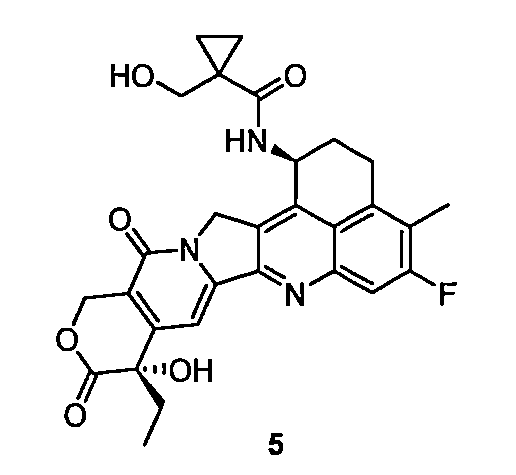

向1b(2.0mg,3.76μmol)中添加1mL N,N-二甲基甲醯胺,冰水浴冷卻至0-5℃,滴加一滴三乙胺,攪拌至反應液變澄清。向反應液中依次加入1-(羥甲基)-環戊烷甲酸5a(0.87mg,7.5μmol,採用專利申請“WO201396771”公開的方法製備而得)和4-(4,6-二甲氧基-1,3,5-三嗪-2-基)-4-甲基氯化嗎啉鹽(2mg,7.24μmol),加畢,在0-5℃攪拌反應2小時。向反應液中加入5mL水淬滅反應,用乙酸乙酯(8mL×3)萃取反應液,合併有機相,用飽和氯化鈉溶液(5mL×2)洗滌,有機相用無水硫酸鈉乾燥,過濾,將濾液減壓濃縮,用薄層層析以展開劑體系B純化所得殘餘物,得到標題產物5(1.0mg,產率:50%)。 Add 1 mL of N , N -dimethylformamide to 1b (2.0 mg, 3.76 μ mol), cool to 0-5°C in an ice-water bath, add one drop of triethylamine, and stir until the reaction solution becomes clear. Add 1-(Hydroxymethyl)-cyclopentanecarboxylic acid 5a (0.87 mg, 7.5 μ mol, prepared by the method disclosed in patent application "WO201396771") and 4-(4,6-dimethoxy-1,3,5-triazine-2-yl)-4-methylchlorophenoxylate (2 mg, 7.24 μ mol) to the reaction solution in sequence, and stir at 0-5°C for 2 hours after addition. 5 mL of water was added to the reaction solution to quench the reaction. The reaction solution was extracted with ethyl acetate (8 mL × 3). The organic phases were combined and washed with saturated sodium chloride solution (5 mL × 2). The organic phase was dried over anhydrous sodium sulfate and filtered. The filtrate was concentrated under reduced pressure and the residue was purified by thin layer chromatography with developing agent system B to obtain the title product 5 (1.0 mg, yield: 50%).
MS m/z(ESI):533.9[M+1]。 MS m/z(ESI): 533.9[M+1].
1H NMR(400MHz,CDCl3):δ 8.07(s,1H),7.23-7.18(m,2H),6.71-6.64(m,1H),6.55-6.51(m,1H),5.36-5.27(m,2H),4.67-4.61(m,2H),3.53-3.48(m,1H),3.30- 3.22(m,2H),3.18-3.13(m,1H),2.71-2.61(m,2H),2.35-2.28(m,1H),2.04-1.91(m,4H),1.53-1.40(m,3H),0.91-0.75(m,4H)。 1 H NMR (400MHz, CDCl 3 ): δ 8.07(s,1H),7.23-7.18(m,2H),6.71-6.64(m,1H),6.55-6.51(m,1H),5.36-5.27(m,2H),4.67-4.61(m,2H),3.53-3.48(m,1H),3.30- 3.22(m,2H),3.18-3.13(m,1H),2.71-2.61(m,2H),2.35-2.28(m,1H),2.04-1.91(m,4H),1.53-1.40(m,3H),0.91-0.75(m,4H).
實施例2-6 Implementation Example 2-6
N-((1S,9S)-9-乙基-5-氟-9-羥基-4-甲基-10,13-二側氧-2,3,9,10,13,15-六氫-1H,12H-苯并[de]吡喃并[3',4':6,7]吲哚嗪并[1,2-b]喹啉-1-基)-1-(羥基甲基)環丁烷-1-甲醯胺6 N -((1 S ,9 S )-9-ethyl-5-fluoro-9-hydroxy-4-methyl-10,13-dioxo-2,3,9,10,13,15-hexahydro-1 H ,12 H -benzo[ de ]pyrano[3',4':6,7]indolizino[1,2- b ]quinolin-1-yl)-1-(hydroxymethyl)cyclobutane-1-carboxamide


向1b(3.0mg,5.64μmol)中添加1mL N,N-二甲基甲醯胺,冰水浴冷卻至0-5℃,滴加一滴三乙胺,攪拌至反應液變澄清。向反應液中依次加入1-(羥基甲基)環丁烷-1-甲酸6a(2.2mg,16.9μmol;採用文獻“Journal of the American Chemical Society,2014,vol.136,#22,p.8138-8142”公開的方法製備而得)和4-(4,6-二甲氧基-1,3,5-三嗪-2-基)-4-甲基氯化嗎啉鹽(4.7mg,16.9μmol),加畢,在0-5℃攪拌反應1小時。向反應液中加入5mL水淬滅反應,用乙酸乙酯(10mL×3)萃取反應液,合併有機相,用飽和氯化鈉溶液(5mL×2)洗滌,有機相用無水硫酸 鈉乾燥,過濾,將濾液減壓濃縮,用薄層層析以展開劑體系B純化所得殘餘物,得到標題產物6(2.1mg,產率:67.9%)。 To 1b (3.0 mg, 5.64 μ mol), 1 mL of N , N -dimethylformamide was added, cooled to 0-5°C in an ice-water bath, and a drop of triethylamine was added, and the reaction solution was stirred until the reaction solution became clear. 1-(Hydroxymethyl)cyclobutane-1-carboxylic acid 6a (2.2 mg, 16.9 μ mol; prepared by the method disclosed in the literature " Journal of the American Chemical Society, 2014, vol. 136, #22, p. 8138-8142 ") and 4-(4,6-dimethoxy-1,3,5-triazine-2-yl)-4-methylchloroquinoline salt (4.7 mg, 16.9 μ mol) were added to the reaction solution in sequence, and the reaction was stirred at 0-5°C for 1 hour. 5 mL of water was added to the reaction solution to quench the reaction. The reaction solution was extracted with ethyl acetate (10 mL×3). The organic phases were combined and washed with saturated sodium chloride solution (5 mL×2). The organic phase was dried over anhydrous sodium sulfate and filtered. The filtrate was concentrated under reduced pressure and the residue was purified by thin layer chromatography with developing agent system B to obtain the title product 6 (2.1 mg, yield: 67.9%).
MS m/z(ESI):548.0[M+1]。 MS m/z(ESI): 548.0[M+1].
1H NMR(400MHz,DMSO-d 6):δ 7.85-7.62(m,1H),6.88(br,1H),5.87-5.48(m,2H),5.47-5.33(m,1H),5.31-5.06(m,1H),4.25-3.91(m,2H),3.25(br,1H),2.60-2.32(m,3H),2.23(t,1H),2.15-1.95(m,3H),1.70-1.56(m,2H),1.41-1.17(m,9H),1.03(s,1H),0.95-0.80(m,2H)。 1 H NMR (400MHz, DMSO- d 6 ): δ 7.85-7.62(m,1H),6.88(br,1H),5.87-5.48(m,2H),5.47-5.33(m,1H),5.31-5.06(m,1H),4.25-3.91(m,2H),3.25(br,1H) ,2.60-2.32(m,3H),2.23(t,1H),2.15-1.95(m,3H),1.70-1.56(m,2H),1.41-1.17(m,9H),1.03(s,1H),0.95-0.80(m,2H).
實施例2-7 Implementation Example 2-7
N-((1S,9S)-9-乙基-5-氟-9-羥基-4-甲基-10,13-二側氧-2,3,9,10,13,15-六氫-1H,12H-苯并[de]吡喃并[3',4':6,7]吲哚嗪并[1,2-b]喹啉-1-基)-1-羥基環丁烷-1-甲醯胺7 N -((1 S ,9 S )-9-ethyl-5-fluoro-9-hydroxy-4-methyl-10,13-dioxo-2,3,9,10,13,15-hexahydro-1 H ,12 H -benzo[ de ]pyrano[3',4':6,7]indolizino[1,2- b ]quinolin-1-yl)-1-hydroxycyclobutane-1-carboxamide 7
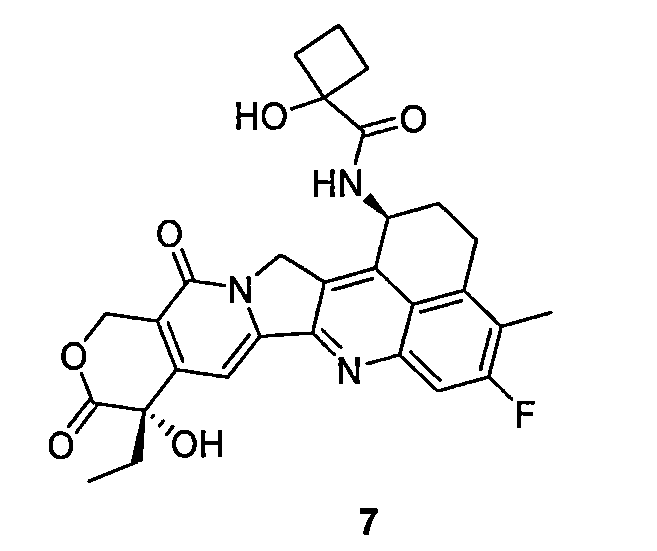

向1b(3.0mg,5.64μmol)中添加2mL乙醇和0.4mL N,N-二甲基甲醯胺,冰水浴冷卻至0-5℃,滴加0.3mL N-甲基嗎啡啉,攪拌至反應液變澄清。 向反應液中依次加入1-羥基環丁烷甲酸7a(2.0mg,17.22μmol,供應商藥石),1-羥基苯并三唑(2.3mg,17.0μmol)和1-(3-二甲胺基丙基)-3-乙基碳二亞胺鹽酸鹽(3.2mg,16.7μmol),加畢,在0-5℃攪拌反應10分鐘。撤去冰水浴,常溫攪拌2小時。反應液減壓濃縮,用薄層層析以展開劑體系B純化所得殘餘物,得到標題產物7(2.5mg,產率:83.1%)。 Add 2 mL of ethanol and 0.4 mL of N , N -dimethylformamide to 1b (3.0 mg, 5.64 μ mol), cool to 0-5°C in an ice-water bath, add 0.3 mL of N -methylmorpholine dropwise, and stir until the reaction solution becomes clear. Add 1-hydroxycyclobutanecarboxylic acid 7a (2.0 mg, 17.22 μ mol, supplier Yao Shi), 1-hydroxybenzotriazole (2.3 mg, 17.0 μ mol) and 1-(3-dimethylaminopropyl)-3-ethylcarbodiimide hydrochloride (3.2 mg, 16.7 μ mol) to the reaction solution in sequence, and stir the reaction at 0-5°C for 10 minutes. Remove the ice-water bath and stir at room temperature for 2 hours. The reaction solution was concentrated under reduced pressure, and the resulting residue was purified by thin layer chromatography with developing agent system B to obtain the title product 7 (2.5 mg, yield: 83.1%).
MS m/z(ESI):534.0[M+1]。 MS m/z(ESI): 534.0[M+1].
1H NMR(400MHz,DMSO-d 6):δ 8.28(d,1H),7.75(d,1H),7.29(s,1H),6.51(s,1H),6.12(s,1H),5.59-5.51(m,1H),5.41(s,2H),5.20-5.01(m,2H),3.27-3.17(m,1H),3.15-3.05(m,1H),2.71-2.63(m,1H),2.37(s,3H),2.12-2.05(m,1H),2.03-1.94(m,2H),1.92-1.78(m,4H),1.50-1.42(m,1H),0.90-0.83(m,4H)。 1 H NMR (400MHz, DMSO- d 6 ): δ 8.28(d,1H),7.75(d,1H),7.29(s,1H),6.51(s,1H),6.12(s,1H),5.59 -5.51(m,1H),5.41(s,2H),5.20-5.01(m,2H),3.27-3.17(m,1H),3.15 -3.05(m,1H),2.71-2.63(m,1H),2.37(s,3H),2.12-2.05(m,1H),2.03 -1.94(m,2H),1.92-1.78(m,4H),1.50-1.42(m,1H),0.90-0.83(m,4H).
實施例2-8 Implementation Example 2-8
1-(((S)-7-苄基-20-(2,5-二側氧-2,5-二氫-1H-吡咯-1-基)-3,6,9,12,15-五側氧-2,5,8,11,14-五氮雜二十烷基)氧基)-N-((1S,9S)-9-乙基-5-氟-9-羥基-4-甲基-10,13-二側氧-2,3,9,10,13,15-六氫-1H,12H-苯并[de]吡喃并[3',4':6,7]吲哚嗪并[1,2-b]喹啉-1-基)環丙烷-1-甲醯胺8 1-((( S )-7-benzyl-20-(2,5-dioxo-2,5-dihydro-1 H -pyrrol-1-yl)-3,6,9,12,15-pentaoxo-2,5,8,11,14-pentazaeicosyl)oxy) -N -((1 S ,9 S )-9-ethyl-5-fluoro-9-hydroxy-4-methyl-10,13-dioxo-2,3,9,10,13,15-hexahydro-1 H ,12 H -benzo[ de ]pyrano[3',4':6,7]indolizino[1,2- b ]quinolin-1-yl)cyclopropane-1-carboxamide 8


第一步 Step 1
1-((2-((((9H-芴-9-基)甲氧基)羰基)胺基)乙醯胺基)甲氧基)環丙烷-1-羧酸苄酯8c Benzyl 1-((2-(((( 9H -fluoren-9-yl)methoxy)carbonyl)amino)acetamido)methoxy)cyclopropane-1-carboxylate 8c
將1-羥基環丙烷-1-羧酸苄酯8a(104mg,0.54mmol;採用專利申請“US2005/20645”公開的方法製備而得)和2-((((9H-芴-9-基)甲氧基)羰基)胺基)乙醯胺基)甲基乙酸酯8b(100mg,0.27mmol;採用專利申請“CN105829346A”公開的方法製備而得)加入反應瓶,加入5mL四氫呋喃,氬氣置換三次,冰水浴降溫至0-5℃,加入第三丁醇鉀(61mg,0.54mmol),撤去冰浴,升至室溫攪拌10分鐘,加入20mL冰水,用乙酸乙酯(5mL×2)和氯仿(5mL×5)萃取,合併有機相1並濃縮。所得殘餘物溶於3mL 1,4-二氧六環中,加入0.6mL水,加入碳酸氫鈉(27mg,0.32mmol)和氯甲酸-9-芴甲酯(70mg,0.27mmol),室溫攪拌1小時。加入20mL水,用乙酸乙酯(8mL×3)萃取,有機相用飽和氯化鈉溶液(20mL)洗滌,無水硫酸鈉乾燥,過濾,濾液減壓濃縮,用矽膠柱色譜法以展開劑體系B純化所得殘餘物,得到標題產物8c(100mg,產率:73.6%)。 1-Hydroxycyclopropane-1-carboxylic acid benzyl ester 8a (104 mg, 0.54 mmol; prepared by the method disclosed in patent application "US2005/20645") and 2-((((9 H 9-fluoren-yl)methoxy)carbonyl)amino)acetamido)methyl acetate 8b (100 mg, 0.27 mmol; prepared by the method disclosed in patent application "CN105829346A") was added to the reaction bottle, 5 mL of tetrahydrofuran was added, the atmosphere was replaced with hydrogen three times, the temperature was cooled to 0-5 ° C in an ice-water bath, potassium tert-butoxide (61 mg, 0.54 mmol) was added, the ice bath was removed, the temperature was raised to room temperature and stirred for 10 minutes, 20 mL of ice water was added, and the mixture was extracted with ethyl acetate (5 mL×2) and chloroform (5 mL×5), and the organic phase 1 was combined and concentrated. The obtained residue was dissolved in 3 mL of 1,4-dioxane, 0.6 mL of water, sodium bicarbonate (27 mg, 0.32 mmol) and 9-fluorenylmethyl chloroformate (70 mg, 0.27 mmol) were added, and stirred at room temperature for 1 hour. 20 mL of water was added, and the mixture was extracted with ethyl acetate (8 mL×3). The organic phase was washed with saturated sodium chloride solution (20 mL), dried over anhydrous sodium sulfate, filtered, and the filtrate was concentrated under reduced pressure. The obtained residue was purified by silica gel column chromatography with a developing agent system B to obtain the title product 8c (100 mg, yield: 73.6%).
MS m/z(ESI):501.0[M+1]。 MS m/z(ESI): 501.0[M+1].
第二步
1-((2-((((9H-芴-9-基)甲氧基)羰基)胺基)乙醯胺基)甲氧基)環丙烷-1-羧酸8d 1-((2-(((( 9H -fluoren-9-yl)methoxy)carbonyl)amino)acetamido)methoxy)cyclopropane-1-carboxylic acid 8d
將8c(50mg,0.10mmol)溶於3mL四氫呋喃和乙酸乙酯(V:V=2:1)混合溶劑中,加入鈀碳(25mg,含量10%),氫氣置換三次,室溫攪拌反應1小時。反應液用矽藻土過濾,濾餅用四氫呋喃淋洗,濾液濃縮,得到標題產物8d(41mg,產率:100%)。 8c (50 mg, 0.10 mmol) was dissolved in 3 mL of a mixed solvent of tetrahydrofuran and ethyl acetate (V:V=2:1), palladium carbon (25 mg, 10% content) was added, the hydrogen atmosphere was replaced three times, and the reaction was stirred at room temperature for 1 hour. The reaction solution was filtered through diatomaceous earth, the filter cake was rinsed with tetrahydrofuran, and the filtrate was concentrated to obtain the title product 8d (41 mg, yield: 100%).
MS m/z(ESI):411.0[M+1]。 MS m/z(ESI): 411.0[M+1].
第三步
(9H-芴-9-基)甲基(2-(((1-(((1S,9S)-9-乙基-5-氟-9-羥基-4-甲基-10,13-二側氧-2,3,9,10,13,15-六氫-1H,12H-苯并[de]吡喃并[3',4':6,7]吲哚嗪并[1,2-b]喹啉-1-基)胺基羰基)環丙氧基)甲基)胺基)-2-側氧乙基)胺基甲酸酯8e ( 9H -fluoren-9-yl)methyl (2-(((1-((( 1S , 9S )-9-ethyl-5-fluoro-9-hydroxy-4-methyl-10,13-dihydro-2,3,9,10,13,15-hexahydro- 1H , 12H -benzo[ de ]pyrano[3',4':6,7]indolizino[1,2- b ]quinolin-1-yl)aminocarbonyl)cyclopropoxy)methyl)amino)-2-hydroxyethyl)carbamate 8e
將1b(7mg,0.013mmol)加入反應瓶,加入1mL N,N-二甲基甲醯胺,氬氣置換三次,冰水浴降溫至0-5℃,滴加一滴三乙胺,加入8d(7mg,0.017mmol)的0.5mL N,N-二甲基甲醯胺溶液,加入4-(4,6-二甲氧基-1,3,5-三嗪-2-基)-4-甲基氯化嗎啉鹽(7mg,0.026mmol),冰浴攪拌反應35分鐘。加入10mL水,用乙酸乙酯(5mL×3)萃取,有機相用飽和氯化鈉溶液(10mL)洗滌,無水硫酸鈉乾燥,過濾,濾液減壓濃縮,用薄層層析以展開劑體系B純化所得殘餘物,得到標題產物8e(8.5mg,產率78.0%)。 1b (7 mg, 0.013 mmol) was added to the reaction bottle, and 1 mL of N , N -dimethylformamide was added. The atmosphere was replaced with hydrogen three times, cooled to 0-5°C in an ice-water bath, and a drop of triethylamine was added. A solution of 8d (7 mg, 0.017 mmol) in 0.5 mL of N , N -dimethylformamide was added, and 4-(4,6-dimethoxy-1,3,5-triazine-2-yl)-4-methylchlorophenoxylate (7 mg, 0.026 mmol) was added. The reaction was stirred in an ice-water bath for 35 minutes. Add 10 mL of water, extract with ethyl acetate (5 mL×3), wash the organic phase with saturated sodium chloride solution (10 mL), dry over anhydrous sodium sulfate, filter, concentrate the filtrate under reduced pressure, and purify the residue by thin layer chromatography with developing agent system B to obtain the title product 8e (8.5 mg, yield 78.0%).
MS m/z(ESI):828.0[M+1]。 MS m/z(ESI): 828.0[M+1].
第四步
1-((2-胺基乙醯胺基)甲氧基)-N-((1S,9S)-9-乙基-5-氟-9-羥基-4-甲基-10,13-二側氧-2,3,9,10,13,15-六氫-1H,12H-苯并[de]吡喃并[3',4':6,7]吲哚嗪并[1,2-b]喹啉-1-基)環丙烷-1-甲醯胺8f 1-((2-aminoacetamido)methoxy) -N -((1 S ,9 S )-9-ethyl-5-fluoro-9-hydroxy-4-methyl-10,13-dioxo-2,3,9,10,13,15-hexahydro-1 H ,12 H -benzo[ de ]pyrano[3',4':6,7]indolizino[1,2- b ]quinolin-1-yl)cyclopropane-1-carboxamide 8f
將8e(4mg,4.84μmol)溶於0.2mL二氯甲烷中,加入0.1mL二乙胺,室溫攪拌2小時。反應液減壓濃縮,加入2mL甲苯減壓濃縮,重複兩次,加入3mL正己烷打漿,傾倒出上層正己烷,重複三次,減壓濃縮得到粗製標題產物8f(2.9mg),產品不經純化直接用於下一步反應。 8e (4 mg, 4.84 μ mol) was dissolved in 0.2 mL of dichloromethane, and 0.1 mL of diethylamine was added, and the mixture was stirred at room temperature for 2 hours. The reaction solution was concentrated under reduced pressure, and 2 mL of toluene was added to reduce pressure and concentrate, and the process was repeated twice. 3 mL of n-hexane was added to slurry, and the upper n-hexane layer was decanted, and the process was repeated three times. The crude title product 8f (2.9 mg) was obtained by concentration under reduced pressure, and the product was used directly in the next step without purification.
MS m/z(ESI):606.0[M+1]。 MS m/z(ESI): 606.0[M+1].
第五步
1-(((S)-7-苄基-20-(2,5-二側氧-2,5-二氫-1H-吡咯-1-基)-3,6,9,12,15-五側氧-2,5,8,11,14-五氮雜二十烷基)氧基)-N-((1S,9S)-9-乙基-5-氟-9-羥基-4-甲基-10,13-二側氧-2,3,9,10,13,15-六氫-1H,12H-苯并[de]吡喃并[3',4':6,7]吲哚嗪并[1,2-b]喹啉-1-基)環丙烷-1-甲醯胺8 1-((( S )-7-benzyl-20-(2,5-dioxo-2,5-dihydro-1 H -pyrrol-1-yl)-3,6,9,12,15-pentaoxo-2,5,8,11,14-pentazaeicosyl)oxy) -N -((1 S ,9 S )-9-ethyl-5-fluoro-9-hydroxy-4-methyl-10,13-dioxo-2,3,9,10,13,15-hexahydro-1 H ,12 H -benzo[ de ]pyrano[3',4':6,7]indolizino[1,2- b ]quinolin-1-yl)cyclopropane-1-carboxamide 8
將粗製8f(2.9mg,4.84μmol)溶於0.5mL N,N-二甲基甲醯胺,氬氣置換三次,冰水浴降溫至0-5℃,加入(S)-2(-2-(-2-(6-(2,5-二側氧-1H-吡咯-1-基)已醯胺基)乙醯胺基)乙醯胺基)-3-苯基丙酸8g(2.7mg,5.80μmol,採用專利申請“EP2907824”公開的方法製備而得)的0.3mL N,N-二甲基甲醯胺溶液,加入4-(4,6-二甲氧基-1,3,5-三嗪-2-基)-4-甲基氯化嗎啉鹽(2.7mg,9.67μmol),冰浴攪拌反應30分鐘,撤去冰浴,升至室溫攪拌15分鐘。反應液進行高效液相色譜法純化(分離條件:色譜柱:XBridge Prep C18 OBD 5um 19*250mm;流動相:A-水(10mmol NH4OAc):B-乙腈,梯度沖提,流速:18mL/min),收集其相應組分,減壓濃縮得到標題產物8(2mg,產率:39.0%)。 The crude product 8f (2.9 mg, 4.84 μ mol) was dissolved in 0.5 mL N , N -dimethylformamide, replaced with hydrogen for three times, cooled to 0-5°C in an ice-water bath, and a solution of ( S )-2(-2-(-2-(6-(2,5-dihydroxy -1H -pyrrol-1-yl)ethylamino)acetamido)acetamido)-3-phenylpropionic acid 8 g (2.7 mg, 5.80 μ mol, prepared by the method disclosed in patent application "EP2907824") in 0.3 mL N , N -dimethylformamide was added, and 4-(4,6-dimethoxy-1,3,5-triazine-2-yl)-4-methylchlorophenoxylate (2.7 mg, 9.67 μ mol), stirred in an ice bath for 30 minutes, removed the ice bath, heated to room temperature and stirred for 15 minutes. The reaction solution was purified by HPLC (separation conditions: chromatographic column: XBridge Prep C18 OBD 5um 19*250mm; mobile phase: A-water (10mmol NH 4 OAc): B-acetonitrile, gradient elution, flow rate: 18mL/min), and the corresponding components were collected and concentrated under reduced pressure to obtain the title product 8 (2mg, yield: 39.0%).
MS m/z(ESI):1060.0[M+1]。 MS m/z(ESI): 1060.0[M+1].
1H NMR(400MHz,DMSO-d 6):δ 9.01(d,1H),8.77(t,1H),8.21(t,1H),8.08-7.92(m,2H),7.73(d,1H),7.28(s,1H),7.24-7.07(m,4H),6.98(s,1H),6.50(s,1H),5.61(q,1H),5.40(s,2H),5.32(t,1H),5.12(q,2H),4.62(t,1H),4.52(t,1H),4.40-4.32(m,1H),3.73-3.47(m,8H),3.16-3.04(m,2H),2.89(dd,1H),2.69-2.55(m,2H),2.37-2.23(m,4H),2.12-1.93(m,4H),1.90-1.74(m,2H),1.52-1.38(m,4H),1.33-1.11(m,5H),0.91-0.81(m,4H)。 1 H NMR (400MHz, DMSO- d 6 ): δ 9.01(d,1H),8.77(t,1H),8.21(t,1H),8.08-7.92(m,2H),7.73(d,1H),7.28(s,1H),7.24-7.07(m,4H) ,6.98(s,1H),6.50(s,1H),5.61(q,1H),5.40(s,2H),5.32(t,1H),5.12(q,2H),4.62(t,1H),4.52(t,1H ),4.40-4.32(m,1H),3.73-3.47(m,8H),3.16-3.04(m,2H),2.89(dd,1H),2.69-2.55(m,2H),2.37-2.23 (m,4H),2.12-1.93(m,4H),1.90-1.74(m,2H),1.52-1.38(m,4H),1.33-1.11(m,5H),0.91-0.81(m,4H).
實施例2-9 Implementation Example 2-9
N-((2R,10S)-10-苄基-2-環丙基-1-(((1S,9S)-9-乙基-5-氟-9-羥基-4-甲基-10,13-二側氧-2,3,9,10,13,15-六氫-1H,12H-苯并[de]吡喃并[3',4':6,7]吲哚嗪并[1,2-b]喹啉-1-基)胺基)-1,6,9,12,15-五側氧-3-氧雜-5,8,11,14-四氮雜十六-16-基)-6-(2,5-二側氧-2,5-二氫-1H-吡咯-1-基)己醯胺9-A N -((2 R ,10 S )-10-benzyl-2-cyclopropyl-1-(((1 S ,9 S )-9-ethyl-5-fluoro-9-hydroxy-4-methyl-10,13-dioxo-2,3,9,10,13,15-hexahydro-1 H ,12 H -benzo[ de ]pyrano[3',4':6,7]indolizino[1,2- b ]quinolin-1-yl)amino)-1,6,9,12,15-pentaoxo-3-oxa-5,8,11,14-tetraazahexadec-16-yl)-6-(2,5-dioxo-2,5-dihydro-1 H -pyrrol-1-yl)hexanamide 9-A
N-((2S,10S)-10-苄基-2-環丙基-1-(((1S,9S)-9-乙基-5-氟-9-羥基-4-甲基-10,13-二側氧-2,3,9,10,13,15-六氫-1H,12H-苯并[de]吡喃并[3',4':6,7]吲哚嗪并[1,2-b]喹啉-1-基)胺基)-1,6,9,12,15-五側氧-3-氧雜-5,8,11,14-四氮雜十六-16-基)-6-(2,5-二側氧-2.5-二氫-1H-吡咯-1-基)己醯胺9-B N -((2 S ,10 S )-10-benzyl-2-cyclopropyl-1-(((1 S ,9 S )-9-ethyl-5-fluoro-9-hydroxy-4-methyl-10,13-dioxo-2,3,9,10,13,15-hexahydro-1 H ,12 H -benzo[ de ]pyrano[3',4':6,7]indolizino[1,2- b ]quinolin-1-yl)amino)-1,6,9,12,15-pentaoxo-3-oxa-5,8,11,14-tetraazahexadec-16-yl)-6-(2,5-dioxo-2.5-dihydro-1 H -pyrrol-1-yl)hexanamide 9-B
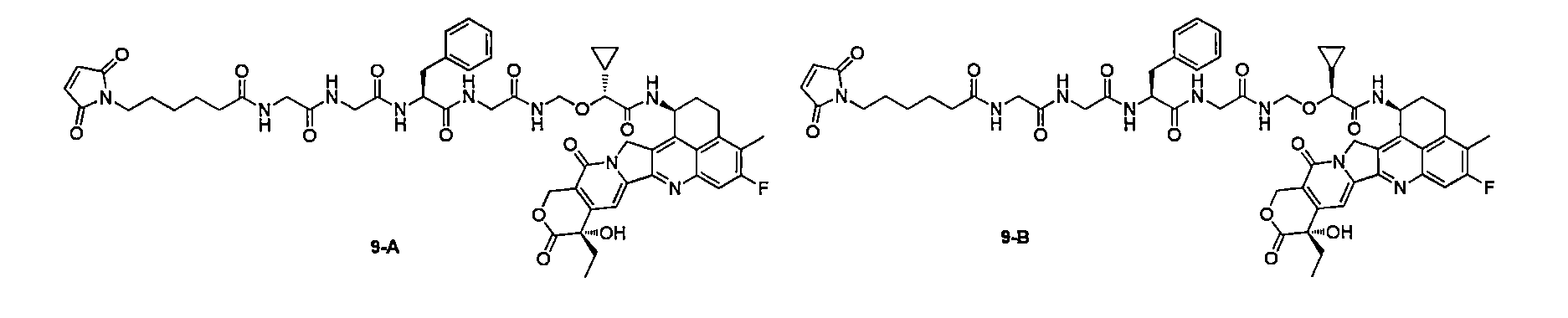

第一步 Step 1
2-環丙基-2-羥基乙酸苄酯9a 2-Cyclopropyl-2-hydroxybenzyl acetate 9a
將2a(1.3g,11.2mmol;採用專利申請“WO2013/106717”公開的方法製備而得)溶於50mL乙腈中,依次加入碳酸鉀(6.18g,44.8mmol),溴化苄(1.33mL,11.2mmol)和四丁基碘化銨(413mg,1.1mmol)。將反應液室溫攪拌48小時,通過矽藻土過濾,濾餅用乙酸乙酯(10ml)淋洗,合併濾液減壓濃縮,用矽膠柱色譜法以展開劑體系C純化所得殘餘物,得到標題產物9a(2g,產率:86.9%)。 2a (1.3 g, 11.2 mmol; prepared by the method disclosed in patent application "WO2013/106717") was dissolved in 50 mL of acetonitrile, and potassium carbonate (6.18 g, 44.8 mmol), benzyl bromide (1.33 mL, 11.2 mmol) and tetrabutylammonium iodide (413 mg, 1.1 mmol) were added in sequence. The reaction solution was stirred at room temperature for 48 hours, filtered through diatomaceous earth, and the filter cake was rinsed with ethyl acetate (10 ml). The combined filtrate was concentrated under reduced pressure, and the residue was purified by silica gel column chromatography with a developing agent system C to obtain the title product 9a (2 g, yield: 86.9%).
第二步
10-環丙基-1-(9H-芴-9-基)-3,6-二側氧-2,9-二氧雜-4,7-二氮雜十一-11-酸苄酯9b 10-Cyclopropyl-1-( 9H -fluoren-9-yl)-3,6-dioxo-2,9-dioxa-4,7-diazoundecane-11-oic acid benzyl ester 9b
將9a(120.9mg,0.586mmol)和8b(180mg,0.489mmol)加入反應瓶,加入4mL四氫呋喃,氬氣置換三次,冰水浴降溫至0-5℃,加入第三丁醇鉀(109mg,0.98mmol),撤去冰浴,升至室溫攪拌40分鐘,加入10mL冰水,用乙酸乙酯 (20mL×2)和氯仿(10mL×5)萃取,合併有機相並濃縮。所得殘餘物溶於4mL二氧六環中,加入2mL水,加入碳酸氫鈉(49.2mg,0.586mmol)和氯甲酸-9-芴甲酯(126mg,0.49mmol),室溫攪拌2小時。加入20mL水,用乙酸乙酯(10mL×3)萃取,有機相用飽和氯化鈉溶液(20mL)洗滌,無水硫酸鈉乾燥,過濾,濾液減壓濃縮。用矽膠柱色譜法以展開劑體系C純化所得殘餘物,得到標題產物9b(48mg,產率:19%)。 Add 9a (120.9 mg, 0.586 mmol) and 8b (180 mg, 0.489 mmol) to the reaction bottle, add 4 mL of tetrahydrofuran, replace with hydrogen three times, cool to 0-5 ° C in an ice-water bath, add potassium tert-butoxide (109 mg, 0.98 mmol), remove the ice bath, warm to room temperature and stir for 40 minutes, add 10 mL of ice water, extract with ethyl acetate (20 mL × 2) and chloroform (10 mL × 5), combine the organic phases and concentrate. The resulting residue was dissolved in 4 mL of dioxane, 2 mL of water was added, sodium bicarbonate (49.2 mg, 0.586 mmol) and 9-fluorenylmethyl chloroformate (126 mg, 0.49 mmol) were added, and stirred at room temperature for 2 hours. Add 20 mL of water, extract with ethyl acetate (10 mL × 3), wash the organic phase with saturated sodium chloride solution (20 mL), dry with anhydrous sodium sulfate, filter, and concentrate the filtrate under reduced pressure. Purify the resulting residue by silica gel column chromatography with developing agent system C to obtain the title product 9b (48 mg, yield: 19%).
MS m/z(ESI):515.0[M+1]。 MS m/z(ESI): 515.0[M+1].
第三步
10-環丙基-1-(9H-芴-9-基)-3,6-二側氧-2,9-二氧雜-4,7-二氮雜十一-11-酸9c 10-Cyclopropyl-1-( 9H -fluoren-9-yl)-3,6-dioxo-2,9-dioxa-4,7-diazaundecane-11-oic acid 9c
將9b(20mg,0.038mmol)溶於4.5mL四氫呋喃和乙酸乙酯(V:V=2:1)混合溶劑中,加入鈀碳(12mg,含量10%,乾型),氫氣置換三次,室溫攪拌反應1小時。反應液用矽藻土過濾,濾餅用乙酸乙酯淋洗,濾液濃縮,得到粗製標題產物9c(13mg),產品不經純化直接進行下一步反應。 Dissolve 9b (20 mg, 0.038 mmol) in 4.5 mL of tetrahydrofuran and ethyl acetate (V:V=2:1) mixed solvent, add palladium carbon (12 mg, 10% content, dry type), replace hydrogen three times, and stir at room temperature for 1 hour. The reaction solution was filtered through diatomaceous earth, the filter cake was rinsed with ethyl acetate, and the filtrate was concentrated to obtain the crude title product 9c (13 mg). The product was directly used for the next step without purification.
MS m/z(ESI):424.9[M+1]。 MS m/z(ESI): 424.9[M+1].
第四步
(9H-芴-9-基)甲基(2-(((1-環丙基-2-(((1S,9S)-9-乙基-5-氟-9-羥基-4-甲基-10,13-二側氧-2,3,9,10,13,15-六氫-1H,12H-苯并[de]吡喃并[3',4':6,7]吲哚嗪并[1,2-b]喹啉-1-基)胺基)-2-側氧乙氧基)甲基)胺基)-2-側氧乙基)胺基甲酸酯9d ( 9H -fluoren-9-yl)methyl (2-(((1-cyclopropyl-2-((( 1S , 9S )-9-ethyl-5-fluoro-9-hydroxy-4-methyl-10,13-dioxo-2,3,9,10,13,15-hexahydro- 1H , 12H -benzo[ de ]pyrano[3',4':6,7]indolizino[1,2- b ]quinolin-1-yl)amino)-2-oxoethoxy)methyl)amino)-2-oxoethyl)carbamate 9d
將1b(10mg,18.8μmol)加入反應瓶,加入1mL N,N-二甲基甲醯胺,氬氣置換三次,冰水浴降溫至0-5℃,滴加一滴三乙胺,加入粗製9c(13mg,30.6μmol),加入4-(4,6-二甲氧基-1,3,5-三嗪-2-基)-4-甲基氯化嗎啉鹽(16.9mg,61.2 μmol),冰浴攪拌反應40分鐘。加入10mL水,用乙酸乙酯(10mL×3)萃取,合併有機相。有機相用飽和氯化鈉溶液(10mL×2)洗滌,有機相用無水硫酸鈉乾燥,過濾,濾液減壓濃縮。用薄層層析以展開劑體系B純化所得殘餘物,得到標題產物9d(19mg,產率:73.6%)。 Add 1b (10 mg, 18.8 μ mol) to the reaction bottle, add 1 mL N , N -dimethylformamide, replace the atmosphere with hydrogen three times, cool to 0-5°C in an ice-water bath, add a drop of triethylamine, add crude 9c (13 mg, 30.6 μ mol), add 4-(4,6-dimethoxy-1,3,5-triazine-2-yl)-4-methylchlorophenoxylate (16.9 mg, 61.2 μ mol), stir in an ice bath for 40 minutes. Add 10 mL of water, extract with ethyl acetate (10 mL × 3), and combine the organic phases. Wash the organic phase with saturated sodium chloride solution (10 mL × 2), dry the organic phase with anhydrous sodium sulfate, filter, and concentrate the filtrate under reduced pressure. The resulting residue was purified by thin layer chromatography with developing agent system B to give the title product 9d (19 mg, yield: 73.6%).
MS m/z(ESI):842.1[M+1]。 MS m/z(ESI):842.1[M+1].
第五步
2-((2-胺基乙醯胺基)甲氧基)-2-環丙基-N-((1S,9S)-9-乙基-5-氟-9-羥基-4-甲基-10,13-二側氧-2,3,9,10,13,15-六氫-1H,12H-苯并[de]吡喃并[3',4':6,7]吲哚嗪并[1,2-b]喹啉-1-基)乙醯胺9e 2-((2-aminoacetamido)methoxy)-2-cyclopropyl- N -((1 S ,9 S )-9-ethyl-5-fluoro-9-hydroxy-4-methyl-10,13-dihydro-2,3,9,10,13,15-hexahydro-1 H ,12 H -benzo[ de ]pyrano[3',4':6,7]indolizino[1,2- b ]quinolin-1-yl)acetamide 9e
將9d(19mg,22.6μmol)溶於2mL二氯甲烷中,加入1mL二乙胺,室溫攪拌2小時。反應液減壓濃縮,加入1mL甲苯并減壓濃縮,重複兩次。往殘餘物中加入3mL正己烷打漿,靜置後傾倒出上層清液,保留固體。將固體殘餘物減壓濃縮,油泵拉乾得到粗製標題產物9e(17mg),產品不經純化直接用於下一步反應。 Dissolve 9d (19 mg, 22.6 μ mol) in 2 mL of dichloromethane, add 1 mL of diethylamine, and stir at room temperature for 2 hours. The reaction solution was concentrated under reduced pressure, 1 mL of toluene was added and concentrated under reduced pressure, and the process was repeated twice. 3 mL of n-hexane was added to the residue for slurry, and after standing, the supernatant was poured out and the solid was retained. The solid residue was concentrated under reduced pressure and pumped dry to obtain the crude title product 9e (17 mg), which was used directly in the next reaction without purification.
MS m/z(ESI):638.0[M+18]。 MS m/z(ESI): 638.0[M+18].
第六步 Step 6
N-((2R,10S)-10-苄基-2-環丙基-1-(((1S,9S)-9-乙基-5-氟-9-羥基-4-甲基-10,13-二側氧-2,3,9,10,13,15-六氫-1H,12H-苯并[de]吡喃并[3',4':6,7]吲哚嗪并[1,2-b]喹啉-1-基)胺基)-1,6,9,12,15-五側氧-3-氧雜-5,8,11,14-四氮雜十六-16-基)-6-(2,5-二側氧-2,5-二氫-1H-吡咯-1-基)己醯胺9-A N -((2 R ,10 S )-10-benzyl-2-cyclopropyl-1-(((1 S ,9 S )-9-ethyl-5-fluoro-9-hydroxy-4-methyl-10,13-dioxo-2,3,9,10,13,15-hexahydro-1 H ,12 H -benzo[ de ]pyrano[3',4':6,7]indolizino[1,2- b ]quinolin-1-yl)amino)-1,6,9,12,15-pentaoxo-3-oxa-5,8,11,14-tetraazahexadec-16-yl)-6-(2,5-dioxo-2,5-dihydro-1 H -pyrrol-1-yl)hexanamide 9-A
N-((2S,10S)-10-苄基-2-環丙基-1-(((1S,9S)-9-乙基-5-氟-9-羥基-4-甲基-10,13-二側氧-2,3,9,10,13,15-六氫-1H,12H-苯并[de]吡喃并[3',4':6,7]吲哚嗪并[1,2- b]喹啉-1-基)胺基)-1,6,9,12,15-五側氧-3-氧雜-5,8,11,14-四氮雜十六-16-基)-6-(2,5-二側氧-2,5-二氫-1H-吡咯-1-基)己醯胺9-B N -((2 S ,10 S )-10-benzyl-2-cyclopropyl-1-(((1 S ,9 S )-9-ethyl-5-fluoro-9-hydroxy-4-methyl-10,13-dioxo-2,3,9,10,13,15-hexahydro-1 H ,12 H -benzo[ de ]pyrano[3',4':6,7]indolizino[1,2- b ]quinolin-1-yl)amino)-1,6,9,12,15-pentaoxo-3-oxa-5,8,11,14-tetraazahexadec-16-yl)-6-(2,5-dioxo-2,5-dihydro-1 H -pyrrol-1-yl)hexanamide 9-B
將粗製9e(13.9mg,22.4μmol)溶於0.6mL N,N-二甲基甲醯胺,氬氣置換三次,冰水浴降溫至0-5℃,加入8g(21.2mg,44.8μmol)的0.3mL N,N-二甲基甲醯胺溶液,加入4-(4,6-二甲氧基-1,3,5-三嗪-2-基)-4-甲基氯化嗎啉鹽(18.5mg,67.3μmol),冰浴攪拌反應10分鐘,撤去冰浴,升至室溫攪拌1小時,反應生成化合物9。反應液進行高效液相色譜法純化(分離條件:色譜柱:XBridge Prep C18 OBD 5μm 19*250mm;流動相:A-水(10mmol NH4OAc):B-乙腈,梯度沖提,流速:18mL/min),收集其相應組分,減壓濃縮,得到標題產物(9-A:2.4mg,9-B:1.7mg)。
The crude product 9e (13.9 mg, 22.4 μ mol) was dissolved in 0.6 mL N , N -dimethylformamide, replaced with hydrogen three times, cooled to 0-5°C in an ice-water bath, 8 g (21.2 mg, 44.8 μ mol) of 0.3 mL N , N -dimethylformamide solution was added, and 4-(4,6-dimethoxy-1,3,5-triazine-2-yl)-4-methylchlorophenoxylate (18.5 mg, 67.3 μ mol) was added. The reaction was stirred in an ice bath for 10 minutes, the ice bath was removed, and the temperature was raised to room temperature and stirred for 1 hour to generate
MS m/z(ESI):1074.4[M+1]。 MS m/z(ESI): 1074.4[M+1].
單一構型化合物9-A(較短保留時間) Single configuration compound 9-A (short retention time)
UPLC分析:保留時間1.14分鐘,純度:85%(色譜柱:ACQUITY UPLC BEHC18 1.7um 2.1*50mm,流動相:A-水(5mmol NH4OAc),B-乙腈)。 UPLC analysis: retention time 1.14 minutes, purity: 85% (chromatographic column: ACQUITY UPLC BEHC18 1.7um 2.1*50mm, mobile phase: A-water (5mmol NH 4 OAc), B-acetonitrile).
1H NMR(400MHz,DMSO-d 6):δ 8.60(t,1H),8.51-8.49(d,1H),8.32-8.24(m,1H),8.13-8.02(m,2H),8.02-7.96(m,1H),7.82-7.75(m,1H),7.31(s,1H),7.26-7.15(m,4H),6.99(s,1H),6.55-6.48(m,1H),5.65-5.54(m,1H),5.41(s,2H),5.35-5.15(m,3H),4.74-4.62(m,1H),4.54-4.40(m,2H),3.76-3.64(m,4H),3.62-3.48(m,2H),3.20-3.07(m,2H),3.04-2.94(m,1H),2.80-2.62(m,1H),2.45-2.30(m,3H),2.25-2.15(m,2H),2.15-2.04(m,2H),1.93-1.78(m,2H),1.52-1.39(m,3H),1.34-1.12(m,5H),0.87(t,3H),0.64-0.38(m,4H)。 1 H NMR (400MHz, DMSO- d 6 ): δ 8.60(t,1H),8.51-8.49(d,1H),8.32-8.24(m,1H),8.13-8.02(m,2H),8.02-7.96(m,1H),7.82-7.75(m,1H),7.31(s,1H),7.2 6-7.15(m,4H),6.99(s,1H),6.55-6.48(m,1H),5.65-5.54(m,1H),5.41(s,2H),5.35-5.15(m,3H),4.74-4.62(m,1H),4.54-4. 40(m,2H),3.76-3.64(m,4H),3.62-3.48(m,2H),3.20-3.07(m,2H),3.04-2.94(m,1H),2.80-2.62(m,1H),2.45-2.30(m,3H),2 .25-2.15(m,2H),2.15-2.04(m,2H),1.93-1.78(m,2H),1.52-1.39(m,3H),1.34-1.12(m,5H),0.87(t,3H),0.64-0.38(m,4H).
單一構型化合物9-B(較長保留時間) Single configuration compound 9-B (longer retention time)
UPLC分析:保留時間1.16分鐘,純度:89%(色譜柱:ACQUITY UPLC BEHC18 1.7um 2.1*50mm,流動相:A-水(5mmol NH4OAc),B-乙腈)。 UPLC analysis: retention time 1.16 minutes, purity: 89% (chromatographic column: ACQUITY UPLC BEHC18 1.7um 2.1*50mm, mobile phase: A-water (5mmol NH 4 OAc), B-acetonitrile).
1H NMR(400MHz,DMSO-d 6):δ 8.68-8.60(m,1H),8.58-8.50(m,1H),8.32-8.24(m,1H),8.13-8.02(m,2H),8.02-7.94(m,1H),7.82-7.75(m,1H),7.31(s,1H),7.26-7.13(m,3H),6.99(s,1H),6.55-6.48(m,1H),5.60-5.50(m,1H),5.41(s,2H),5.35-5.15(m,2H),4.78-4.68(m,1H),4.60-4.40(m,2H),3.76-3.58(m,4H),3.58-3.48(m,1H),3.20-3.10(m,2H),3.08-2.97(m,2H),2.80-2.72(m,2H),2.45-2.30(m,3H),2.25-2.13(m,2H),2.13-2.04(m,2H),2.03-1.94(m,2H),1.91-1.78(m,2H),1.52-1.39(m,3H),1.34-1.12(m,4H),0.91-0.79(m,3H),0.53-0.34(m,4H)。 1 H NMR (400MHz, DMSO- d 6 ): δ 8.68-8.60(m,1H),8.58-8.50(m,1H),8.32-8.24(m,1H),8.13-8.02(m,2H),8.02-7.94(m,1H),7.82-7.75(m,1H),7.31(s,1H),7.26- 7.13(m,3H),6.99(s,1H),6.55-6.48(m,1H),5.60-5.50(m,1H),5.41(s,2H),5.35-5.15(m,2H),4.78-4.68(m,1H),4.60-4.40(m,2H) ,3.76-3.58(m,4H),3.58-3.48(m,1H),3.20-3.10(m,2H),3.08-2.97(m,2H),2.80-2.72(m,2H),2.45-2.30(m,3H),2.25-2.13(m,2H) ,2.13-2.04(m,2H),2.03-1.94(m,2H),1.91-1.78(m,2H),1.52-1.39(m,3H),1.34-1.12(m,4H),0.91-0.79(m,3H),0.53-0.34(m,4H).
實施例3. ADC的製備 Example 3. Preparation of ADC
ADC藥物載量分析ADC drug loading analysis
實驗目的及原理 Experimental purpose and principle
採用紫外分光光度法(UV-Vis)測定ADC載量。儀器:Thermo nanodrop2000紫外分光光度計。其原理是在某波長下ADC的總吸光值等於藥物與單株抗體在該波長下吸光值的加和。 Ultraviolet spectrophotometry (UV-Vis) was used to determine the ADC loading. Instrument: Thermo nanodrop2000 ultraviolet spectrophotometer. The principle is that the total absorbance of ADC at a certain wavelength is equal to the sum of the absorbance of the drug and the monoclonal antibody at that wavelength.
實驗方法 Experimental methods
將裝有琥珀酸鈉緩衝液的比色皿分別置於參比吸收池和樣品測定吸收池中後,扣除溶劑空白後,再將裝有供試品溶液的比色皿置於樣品測定吸收池中,測定280nm和370nm處吸光度。 Place the cuvette containing sodium succinate buffer in the reference absorption cell and the sample measurement absorption cell respectively, deduct the solvent blank, and then place the cuvette containing the test solution in the sample measurement absorption cell to measure the absorbance at 280nm and 370nm.
結果計算: Result calculation:
(1)A280nm=εmab-280bCmab+εDrug-280bCDrug (1)A 280nm =ε mab-280 bC mab +ε Drug-280 bC Drug
εDrug-280:藥物在280nm平均莫耳消光係數5100; ε Drug-280 : The average molar extinction coefficient of the drug at 280nm is 5100;
CDrug:藥物的濃度; C Drug : drug concentration;
εmab-280:單抗在280nm平均莫耳消光係數214600; ε mab-280 : The average molar extinction coefficient of the monoclonal antibody at 280nm is 214600;
Cmab:單抗的濃度; C mab : concentration of monoclonal antibody;
b:光程長度為1cm。 b: The optical path length is 1cm.
同理可以得到樣品在370nm下的總吸光值方程: Similarly, the total absorbance equation of the sample at 370nm can be obtained:
(2)A370nm=εmab-370bCmab+εDrug-370bCDrug (2)A 370nm =ε mab-370 bC mab +ε Drug-370 bC Drug
εDrug-370:藥物在370nm平均莫耳消光係數19000; ε Drug-370 : The average molar extinction coefficient of the drug at 370nm is 19000;
CDrug:藥物的濃度; C Drug : drug concentration;
εmab-370:單抗在370nm消光係數為0; ε mab-370 : The extinction coefficient of the monoclonal antibody is 0 at 370nm;
Cmab:單抗的濃度; C mab : concentration of monoclonal antibody;
b:光程長度為1cm。 b: The optical path length is 1cm.
由(1)和(2)兩種方程式結合單株抗體和藥物在兩個檢測波長下的消光係數和濃度資料可以計算出ADC中藥物的載量。 The drug loading in ADC can be calculated by combining the extinction coefficient and concentration data of monoclonal antibody and drug at two detection wavelengths using equations (1) and (2).
藥物載量=CDrug/Cmab。 Drug loading = C Drug /C mab .
不同DAR值的PSMA抗體-藥物偶聯物PM-9-A製備實施例Preparation Examples of PSMA Antibody-Drug Conjugate PM-9-A with Different DAR Values
以下實施例為本揭露相關ADC的製備過程。其中實施例3-4、實施例3-5、實施例3-7、實施例3-11中抗體PM通過半胱胺酸上的巰基偶聯帶有連接單元的藥物9-A反應,製備抗體藥物偶聯PM-9-A(DAR=約3-4);實施例3-1至實施例3-3和實施例3-6中抗體PM通過半胱胺酸上的巰基偶聯帶有連接單元的藥物9-A反應,製備PSMA ADC分子PM-9-A(DAR=約6-7);實施例3-8至實施例3-10通過抗體 PM半胱胺酸上的巰基,與帶有連接單元的藥物VcMMAE(瀚香生物科技,CAS 646502-53-6)反應製備偶聯物分子PM-VcMMAE為對照。 The following embodiment is a preparation process of the ADC related to the present disclosure. In Examples 3-4, 3-5, 3-7, and 3-11, the antibody PM was coupled to the drug 9-A with a linker unit through the hydroxyl group on cysteine to prepare the antibody drug conjugate PM-9-A (DAR = about 3-4); in Examples 3-1 to 3-3 and 3-6, the antibody PM was coupled to the drug 9-A with a linker unit through the hydroxyl group on cysteine to prepare the PSMA ADC molecule PM-9-A (DAR = about 6-7); in Examples 3-8 to 3-10, the antibody PM was reacted with the drug VcMMAE (Hanxiang Biotechnology, CAS 646502-53-6) with a linker unit through the hydroxyl group on cysteine to prepare the conjugate molecule PM-VcMMAE as a control.
通過對抗體和藥物比例,反應量規模,以及其它條件的調整,可以獲得不同DAR值(n)的抗體藥物偶聯物,較佳為DAR值為1-8,更佳為3-8,最佳為3-7。 By adjusting the ratio of antibody to drug, reaction scale, and other conditions, antibody-drug conjugates with different DAR values (n) can be obtained, with the best DAR value being 1-8, the best being 3-8, and the best being 3-7.
(一)不同DAR值的抗體藥物偶聯PM-9-A的製備 (I) Preparation of PM-9-A conjugates with different DAR values

實施例3-1 ADC-1 Example 3-1 ADC-1
在37℃條件下,向抗體PM的PBS緩衝水溶液(pH=6.5的0.05M的PBS緩衝水溶液;10.0mg/mL,0.27mL,18nmol)加入配置好的三(2-羧乙基)膦(TCEP)的水溶液(10mM,9.8μL,98nmol),置於水浴振盪器,於37℃下振盪反應3小時,停止反應。將反應液用水浴降溫至25℃。 At 37°C, add the prepared aqueous solution of tris(2-carboxyethyl)phosphine (TCEP) (10 mM, 9.8 μL, 98 nmol) to the PBS buffer solution of antibody PM (0.05 M PBS buffer solution at pH = 6.5; 10.0 mg/mL, 0.27 mL , 18 nmol), place in a water bath shaker, shake at 37°C for 3 hours, and stop the reaction. Cool the reaction solution to 25°C in a water bath.
將化合物9-A(0.3mg,277nmol)溶解於20μL二甲亞碸中,加入到上述反應液中,置於水浴振盪器,於25℃下振盪反應3小時,停止反應。將反應液用Sephadex G25凝膠柱脫鹽純化(沖提相:pH為6.5的0.05M的PBS緩衝水溶液,含0.001M的EDTA),得到如式PM-9-A所示偶聯物的示例性產物ADC-1的PBS緩衝液(0.18mg/mL,11mL),於4℃儲存。 Compound 9-A (0.3 mg, 277 nmol) was dissolved in 20 μL of dimethyl sulfoxide, added to the above reaction solution, placed in a water bath shaker, and shaken at 25°C for 3 hours to stop the reaction. The reaction solution was desalted and purified using a Sephadex G25 gel column (extraction phase: 0.05 M PBS buffer solution with a pH of 6.5, containing 0.001 M EDTA) to obtain a PBS buffer solution (0.18 mg/mL, 11 mL) of the exemplary product ADC-1 of the conjugate shown in formula PM-9-A, which was stored at 4°C.
UV-Vis計算平均值:n=6.31。 UV-Vis calculated average value: n=6.31.
實施例3-2 ADC-2 Example 3-2 ADC-2
在37℃條件下,向抗體PM的PBS緩衝水溶液(pH=6.5的0.05M的PBS緩衝水溶液;10.0mg/mL,3.6mL,243nmol)加入配置好的三(2-羧乙基)膦(TCEP)的水溶液(10mM,128.9μL,1289nmol),置於水浴振盪器,於37℃下振盪反應3小時,停止反應。將反應液用水浴降溫至25℃。 At 37°C, add the prepared aqueous solution of tris(2-carboxyethyl)phosphine (TCEP) (10 mM, 128.9 μL, 1289 nmol) to the PBS buffer solution of antibody PM (pH=6.5 0.05 M PBS buffer solution; 10.0 mg/mL, 3.6 mL , 243 nmol), place in a water bath shaker, shake at 37°C for 3 hours, and stop the reaction. Cool the reaction solution to 25°C in a water bath.
將化合物9-A(3.93mg,3649nmol)溶解於200μL二甲亞碸中,加入到上述反應液中,置於水浴振盪器,於25℃下振盪反應3小時,停止反應。將反應液用Sephadex G25凝膠柱脫鹽純化(沖提相:pH為6.5的0.05M的PBS緩衝水溶液,含0.001M的EDTA),得到如式PM-9-A所示偶聯物的示例性產物ADC-2的PBS緩衝液(1.93mg/mL,15.4mL),於4℃儲存。 Compound 9-A (3.93 mg, 3649 nmol) was dissolved in 200 μL of dimethyl sulfoxide, added to the above reaction solution, placed in a water bath shaker, shaken at 25°C for 3 hours, and the reaction was stopped. The reaction solution was desalted and purified using a Sephadex G25 gel column (extraction phase: 0.05 M PBS buffer solution with a pH of 6.5, containing 0.001 M EDTA) to obtain a PBS buffer solution (1.93 mg/mL, 15.4 mL) of the exemplary product ADC-2 of the conjugate shown in formula PM-9-A, which was stored at 4°C.
UV-Vis計算平均值:n=6.63。 UV-Vis calculated average value: n=6.63.
實施例3-3 ADC-3 Example 3-3 ADC-3
在37℃條件下,向抗體PM的PBS緩衝水溶液(pH=6.5的0.05M的PBS緩衝水溶液;10.0mg/mL,10mL,676nmol)加入配置好的三(2-羧乙基)膦(TCEP)的水溶液(10mM,358.1μL,3581nmol),置於水浴振盪器,於37℃下振盪反應3小時,停止反應。將反應液用水浴降溫至25℃。 At 37°C, add the prepared aqueous solution of tris(2-carboxyethyl)phosphine (TCEP) (10 mM, 358.1 μL, 3581 nmol) to the PBS buffer solution of antibody PM (0.05 M PBS buffer solution at pH = 6.5; 10.0 mg/mL, 10 mL , 676 nmol), place in a water bath shaker, shake at 37°C for 3 hours, and stop the reaction. Cool the reaction solution to 25°C in a water bath.
將化合物9-A(10.91mg,10135nmol)溶解於480μL二甲亞碸中,加入到上述反應液中,置於水浴振盪器,於25℃下振盪反應3小時,停止反應。將反應液用Sephadex G25凝膠柱脫鹽純化(沖提相:pH為6.5的0.05M的PBS緩衝水溶液,含0.001M的EDTA),得到如式PM-9-A所示偶聯物的示例性產物ADC-3的PBS緩衝液(3.47mg/mL,25mL),於4℃儲存。 Compound 9-A (10.91 mg, 10135 nmol) was dissolved in 480 μL of dimethyl sulfoxide, added to the above reaction solution, placed in a water bath shaker, and shaken at 25°C for 3 hours to stop the reaction. The reaction solution was desalted and purified using a Sephadex G25 gel column (extraction phase: 0.05 M PBS buffer solution with a pH of 6.5, containing 0.001 M EDTA) to obtain a PBS buffer solution (3.47 mg/mL, 25 mL) of the exemplary product ADC-3 of the conjugate shown in formula PM-9-A, which was stored at 4°C.
UV-Vis計算平均值:n=6.9。 UV-Vis calculated average value: n=6.9.
實施例3-4 ADC-4 Example 3-4 ADC-4
在37℃條件下,向抗體PM的PBS緩衝水溶液(pH=6.5的0.05M的PBS緩衝水溶液;10.0mg/mL,0.21mL,14nmol)加入配置好的三(2-羧乙基)膦(TCEP)的水溶液(10mM,3.5μL,35nmol),置於水浴振盪器,於37℃下振盪反應3小時,停止反應。將反應液用水浴降溫至25℃。 At 37°C, add the prepared aqueous solution of tris(2-carboxyethyl)phosphine (TCEP) (10 mM, 3.5 μL, 35 nmol) to the PBS buffer solution of antibody PM (0.05 M PBS buffer solution at pH = 6.5; 10.0 mg/mL, 0.21 mL , 14 nmol), place in a water bath shaker, shake at 37°C for 3 hours, and stop the reaction. Cool the reaction solution to 25°C in a water bath.
將化合物9-A(0.15mg,139nmol)溶解於20μL二甲亞碸中,加入到上述反應液中,置於水浴振盪器,於25℃下振盪反應3小時,停止反應。將反應液用Sephadex G25凝膠柱脫鹽純化(沖提相:pH為6.5的0.05M的PBS緩衝水溶液,含0.001M的EDTA),得到如式PM-9-A所示偶聯物的示例性產物ADC-4的PBS緩衝 液(0.28mg/mL,4.6mL),於4℃儲存。 Compound 9-A (0.15 mg, 139 nmol) was dissolved in 20 μL of dimethyl sulfoxide, added to the above reaction solution, placed in a water bath shaker, and shaken at 25°C for 3 hours to stop the reaction. The reaction solution was desalted and purified using a Sephadex G25 gel column (extraction phase: 0.05 M PBS buffer solution with a pH of 6.5, containing 0.001 M EDTA) to obtain a PBS buffer solution (0.28 mg/mL, 4.6 mL) of the exemplary product ADC-4 of the conjugate shown in formula PM-9-A, which was stored at 4°C.
UV-Vis計算平均值:n=3.68。 UV-Vis calculated average value: n=3.68.
實施例3-5 ADC-5 Example 3-5 ADC-5
在37℃條件下,向抗體PM的PBS緩衝水溶液(pH=6.5的0.05M的PBS緩衝水溶液;10.0mg/mL,5.23mL,353nmol)加入配置好的三(2-羧乙基)膦(TCEP)的水溶液(10mM,84.8μL,848nmol),置於水浴振盪器,於37℃下振盪反應3小時,停止反應。將反應液用水浴降溫至25℃。 At 37°C, add the prepared aqueous solution of tris(2-carboxyethyl)phosphine (TCEP) (10 mM, 84.8 μL, 848 nmol) to the PBS buffer solution of antibody PM (pH=6.5 0.05 M PBS buffer solution; 10.0 mg/mL, 5.23 mL , 353 nmol), place in a water bath shaker, shake at 37°C for 3 hours, and stop the reaction. Cool the reaction solution to 25°C in a water bath.
將化合物9-A(3.8mg,3534nmol)溶解於260μL二甲亞碸中,加入到上述反應液中,置於水浴振盪器,於25℃下振盪反應3小時,停止反應。將反應液用Sephadex G25凝膠柱脫鹽純化(沖提相:pH為6.5的0.05M的PBS緩衝水溶液,含0.001M的EDTA),得到如式PM-9-A所示偶聯物的示例性產物ADC-5的PBS緩衝液(2.48mg/mL,18.2mL),於4℃儲存。 Compound 9-A (3.8 mg, 3534 nmol) was dissolved in 260 μL of dimethyl sulfoxide, added to the above reaction solution, placed in a water bath shaker, and shaken at 25°C for 3 hours to stop the reaction. The reaction solution was desalted and purified using a Sephadex G25 gel column (extraction phase: 0.05 M PBS buffer solution with a pH of 6.5, containing 0.001 M EDTA) to obtain a PBS buffer solution (2.48 mg/mL, 18.2 mL) of the exemplary product ADC-5 of the conjugate shown in formula PM-9-A, which was stored at 4°C.
UV-Vis計算平均值:n=3.89。 UV-Vis calculated average value: n=3.89.
實施例3-6 ADC-6 Example 3-6 ADC-6
在37℃條件下,向抗體PM的PBS緩衝水溶液(pH=6.5的0.05M的PBS緩衝水溶液;10.0mg/mL,3.5mL,236nmol)加入配置好的三(2-羧乙基)膦(TCEP)的水溶液(10mM,125.3μL,1253nmol),置於水浴振盪器,於37℃下振盪反應3小時,停止反應。將反應液用水浴降溫至25℃。 At 37°C, add the prepared aqueous solution of tris(2-carboxyethyl)phosphine (TCEP) (10 mM, 125.3 μL, 1253 nmol) to the PBS buffer solution of antibody PM (pH=6.5 0.05 M PBS buffer solution; 10.0 mg/mL, 3.5 mL , 236 nmol), place in a water bath shaker, shake at 37°C for 3 hours, and stop the reaction. Cool the reaction solution to 25°C in a water bath.
將化合物9-A(3.82mg,3547nmol)溶解於150μL二甲亞碸中,加入到上述反應液中,置於水浴振盪器,於25℃下振盪反應3小時,停止反應。將 反應液用Sephadex G25凝膠柱脫鹽純化(沖提相:pH為6.5的0.05M的PBS緩衝水溶液,含0.001M的EDTA),得到如式PM-9-A所示偶聯物的示例性產物ADC-6的PBS緩衝液(1.83mg/mL,14mL),於4℃儲存。 Compound 9-A (3.82 mg, 3547 nmol) was dissolved in 150 μL of dimethyl sulfoxide, added to the above reaction solution, placed in a water bath shaker, and shaken at 25°C for 3 hours to stop the reaction. The reaction solution was desalted and purified using a Sephadex G25 gel column (extraction phase: 0.05 M PBS buffer solution with a pH of 6.5, containing 0.001 M EDTA) to obtain a PBS buffer solution (1.83 mg/mL, 14 mL) of the exemplary product ADC-6 of the conjugate shown in formula PM-9-A, which was stored at 4°C.
UV-Vis計算平均值:n=6.61。 UV-Vis calculated average value: n=6.61.
實施例3-7 ADC-7 Example 3-7 ADC-7
在37℃條件下,向抗體PM的PBS緩衝水溶液(pH=6.5的0.05M的PBS緩衝水溶液;10.0mg/mL,14.68mL,992nmol)加入配置好的三(2-羧乙基)膦(TCEP)的水溶液(10mM,238.1μL,2381nmol),置於水浴振盪器,於37℃下振盪反應3小時,停止反應。將反應液用水浴降溫至25℃。 At 37°C, add the prepared aqueous solution of tris(2-carboxyethyl)phosphine (TCEP) (10 mM, 238.1 μL, 2381 nmol) to the PBS buffer solution of antibody PM (pH=6.5 0.05 M PBS buffer solution; 10.0 mg/mL, 14.68 mL , 992 nmol), place in a water bath shaker, shake at 37°C for 3 hours, and stop the reaction. Cool the reaction solution to 25°C in a water bath.
將化合物9-A(10.67mg,9919nmol)溶解於420μl二甲亞碸中,加入到上述反應液中,置於水浴振盪器,於25℃下振盪反應3小時,停止反應。將反應液用Sephadex G25凝膠柱脫鹽純化(沖提相:pH為6.5的0.05M的PBS緩衝水溶液,含0.001M的EDTA),得到如式PM-9-A所示偶聯物的示例性產物ADC-7的PBS緩衝液(3.61mg/mL,37mL),於4℃儲存。 Compound 9-A (10.67 mg, 9919 nmol) was dissolved in 420 μl of dimethyl sulfoxide, added to the above reaction solution, placed in a water bath shaker, and shaken at 25°C for 3 hours to stop the reaction. The reaction solution was desalted and purified using a Sephadex G25 gel column (extraction phase: 0.05 M PBS buffer solution with a pH of 6.5, containing 0.001 M EDTA) to obtain a PBS buffer solution (3.61 mg/mL, 37 mL) of the exemplary product ADC-7 of the conjugate shown in formula PM-9-A, which was stored at 4°C.
UV-Vis計算平均值:n=3.93。 UV-Vis calculated average value: n=3.93.
(二)對照抗體藥物偶聯PM-VeMMAE的製備(參考專利WO9007002222A2) (II) Preparation of control antibody drug conjugated PM-VeMMAE (refer to patent WO9007002222A2)
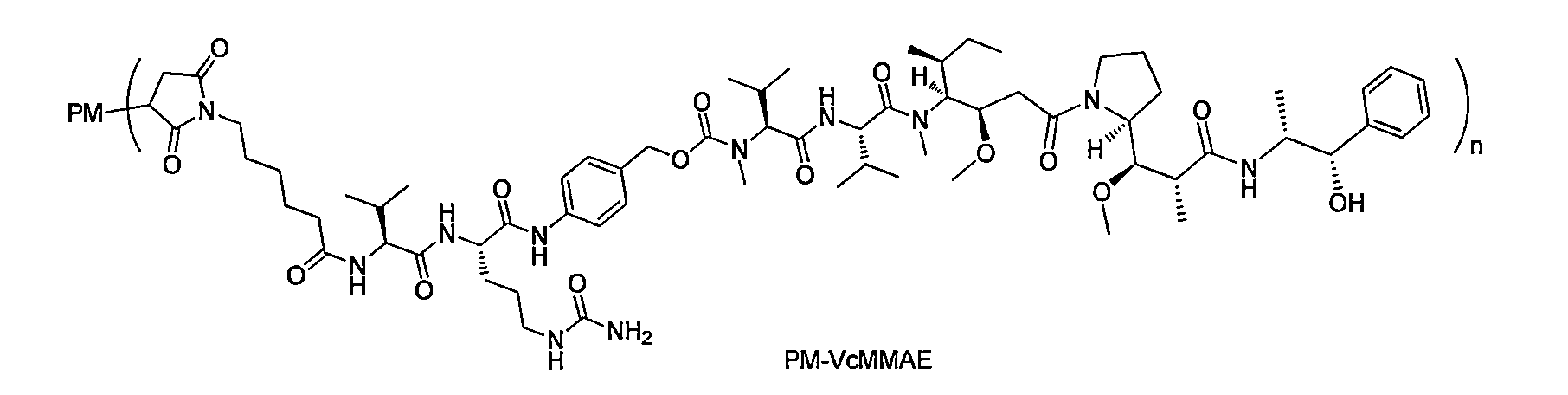
實施例3-8 ADC-8 Example 3-8 ADC-8
在37℃條件下,向抗體PM的PBS緩衝水溶液(pH=6.5的0.05M的PBS緩衝水溶液;10.0mg/mL,2.5mL,169nmol)加入配置好的三(2-羧乙基)膦(TCEP)的水溶液(10mM,42.2μL,422nmol),置於水浴振盪器,於37℃下振盪反應3小時,停止反應。將反應液用水浴降溫至25℃。 At 37°C, add the prepared aqueous solution of tris(2-carboxyethyl)phosphine (TCEP) (10 mM, 42.2 μL, 422 nmol) to the PBS buffer solution of antibody PM (pH=6.5 0.05 M PBS buffer solution; 10.0 mg/mL, 2.5 mL , 169 nmol), place in a water bath shaker, shake at 37°C for 3 hours, and stop the reaction. Cool the reaction solution to 25°C in a water bath.
將化合物VcMMAE(2.22mg,1689nmol)溶解於100μL二甲亞碸中,加入到上述反應液中,置於水浴振盪器,於25℃下振盪反應3小時,停止反應。將反應液用Sephadex G25凝膠柱脫鹽純化(沖提相:pH為6.5的0.05M的PBS緩衝水溶液,含0.001M的EDTA),得到如式PM-VcMMAE所示偶聯物的示例性產物ADC-8的PBS緩衝液(1.76mg/mL,12mL),於4℃儲存。 The compound VcMMAE (2.22 mg, 1689 nmol) was dissolved in 100 μL of dimethyl sulfoxide, added to the above reaction solution, placed in a water bath shaker, and shaken at 25°C for 3 hours to stop the reaction. The reaction solution was desalted and purified using a Sephadex G25 gel column (extraction phase: 0.05 M PBS buffer solution with a pH of 6.5, containing 0.001 M EDTA) to obtain a PBS buffer solution (1.76 mg/mL, 12 mL) of an exemplary product ADC-8 of the conjugate represented by the formula PM-VcMMAE, which was stored at 4°C.
CE-SDS計算平均值:n=4.47。 CE-SDS calculated average value: n=4.47.
實施例3-9 ADC-9 Example 3-9 ADC-9
在37℃條件下,向抗體PM的PBS緩衝水溶液(pH=6.5的0.05M的PBS緩衝水溶液;10.0mg/mL,3.3mL,223nmol)加入配置好的三(2-羧乙基)膦(TCEP)的水溶液(10mM,55.7μL,557nmol),置於水浴振盪器,於37℃下振盪反應3小時,停止反應。將反應液用水浴降溫至25℃。 At 37°C, add the prepared aqueous solution of tris(2-carboxyethyl)phosphine (TCEP) (10 mM, 55.7 μL , 557 nmol) to the PBS buffer solution of antibody PM (pH=6.5 0.05 M PBS buffer solution; 10.0 mg/mL, 3.3 mL, 223 nmol), place in a water bath shaker, shake at 37°C for 3 hours, and stop the reaction. Cool the reaction solution to 25°C in a water bath.
將化合物VcMMAE(2.93mg,2230nmol)溶解於200μL二甲亞碸中,加入到上述反應液中,置於水浴振盪器,於25℃下振盪反應3小時,停止反 應。將反應液用Sephadex G25凝膠柱脫鹽純化(沖提相:pH為6.5的0.05M的PBS緩衝水溶液,含0.001M的EDTA),得到如式PM-VcMMAE所示偶聯物的示例性產物ADC-9的PBS緩衝液(2.05mg/mL,17mL),於4℃儲存。 The compound VcMMAE (2.93 mg, 2230 nmol) was dissolved in 200 μL of dimethyl sulfoxide, added to the above reaction solution, placed in a water bath shaker, and shaken at 25°C for 3 hours to stop the reaction. The reaction solution was desalted and purified using a Sephadex G25 gel column (extraction phase: 0.05 M PBS buffer solution with a pH of 6.5, containing 0.001 M EDTA) to obtain a PBS buffer solution (2.05 mg/mL, 17 mL) of an exemplary product ADC-9 of the conjugate represented by the formula PM-VcMMAE, which was stored at 4°C.
CE-SDS計算平均值:n=4.23。 CE-SDS calculated average value: n=4.23.
實施例3-10 ADC-10 Example 3-10 ADC-10
在37℃條件下,向抗體PM的PBS緩衝水溶液(pH=6.5的0.05M的PBS緩衝水溶液;10.0mg/mL,2.5mL,169nmol)加入配置好的三(2-羧乙基)膦(TCEP)的水溶液(10mM,42.2μL,422nmol),置於水浴振盪器,於37℃下振盪反應3小時,停止反應。將反應液用水浴降溫至25℃。 At 37°C, add the prepared aqueous solution of tris(2-carboxyethyl)phosphine (TCEP) (10 mM, 42.2 μL, 422 nmol) to the PBS buffer solution of antibody PM (pH=6.5 0.05 M PBS buffer solution; 10.0 mg/mL, 2.5 mL , 169 nmol), place in a water bath shaker, shake at 37°C for 3 hours, and stop the reaction. Cool the reaction solution to 25°C in a water bath.
將化合物VcMMAE(2.22mg,1689nmol)溶解於150μL二甲亞碸中,加入到上述反應液中,置於水浴振盪器,於25℃下振盪反應3小時,停止反應。將反應液用Sephadex G25凝膠柱脫鹽純化(沖提相:pH為6.5的0.05M的PBS緩衝水溶液,含0.001M的EDTA),得到如式PM-VcMMAE所示偶聯物的示例性產物ADC-10的PBS緩衝液(2.2mg/mL,13mL),於4℃儲存。 The compound VcMMAE (2.22 mg, 1689 nmol) was dissolved in 150 μL of dimethyl sulfoxide, added to the above reaction solution, placed in a water bath shaker, and shaken at 25°C for 3 hours to stop the reaction. The reaction solution was desalted and purified using a Sephadex G25 gel column (extraction phase: 0.05 M PBS buffer solution with a pH of 6.5, containing 0.001 M EDTA) to obtain a PBS buffer solution (2.2 mg/mL, 13 mL) of an exemplary product ADC-10 of the conjugate represented by the formula PM-VcMMAE, which was stored at 4°C.
CE-SDS計算平均值:n=3.92。 CE-SDS calculated average value: n=3.92.
實施例3-11 ADC-11 Example 3-11 ADC-11
在37℃條件下,向抗體PM的PBS緩衝水溶液(pH=6.5的0.05M的PBS緩衝水溶液;10.0mg/mL,2.4mL,160nmol)加入配置好的三(2-羧乙基)膦(TCEP)的水溶液(10mM,42.2μL,422nmol),置於水浴振盪器,於37℃下振盪反應3小時,停止反應。將反應液用水浴降溫至25℃。 At 37°C, add the prepared aqueous solution of tris(2-carboxyethyl)phosphine (TCEP) (10 mM, 42.2 μL, 422 nmol) to the PBS buffer solution of antibody PM (pH=6.5 0.05 M PBS buffer solution; 10.0 mg/mL, 2.4 mL , 160 nmol), place in a water bath shaker, shake at 37°C for 3 hours, and stop the reaction. Cool the reaction solution to 25°C in a water bath.
將化合物9-A(1.75mg,1629nmol)溶解於100μL二甲亞碸中,加入到上述反應液中,置於水浴振盪器,於25℃下振盪反應3小時,停止反應。將反應液用Sephadex G25凝膠柱脫鹽純化(沖提相:pH為6.5的0.05M的PBS緩衝水溶液,含0.001M的EDTA),得到如式PM-9-A所示偶聯物的示例性產物ADC-11的PBS緩衝液(1.34mg/mL,15.5mL),於4℃儲存。 Compound 9-A (1.75 mg, 1629 nmol) was dissolved in 100 μL of dimethyl sulfoxide, added to the above reaction solution, placed in a water bath shaker, and shaken at 25°C for 3 hours to stop the reaction. The reaction solution was desalted and purified using a Sephadex G25 gel column (extraction phase: 0.05 M PBS buffer solution with a pH of 6.5, containing 0.001 M EDTA) to obtain a PBS buffer solution (1.34 mg/mL, 15.5 mL) of the exemplary product ADC-11 of the conjugate shown in formula PM-9-A, which was stored at 4°C.
UV-Vis計算平均值:n=4.19。 UV-Vis calculated average value: n=4.19.
實施例3-12 ADC-12 Example 3-12 ADC-12

在37℃條件下,向抗體PM的PBS緩衝水溶液(pH=6.5的0.05M的PBS緩衝水溶液;10.0mg/mL,2.4mL,160nmol)加入配置好的三(2-羧乙基)膦(TCEP)的水溶液(10mM,42.2μL,422nmol),置於水浴振盪器,於37℃下振盪反應3小時,停止反應。將反應液用水浴降溫至25℃。 At 37°C, add the prepared aqueous solution of tris(2-carboxyethyl)phosphine (TCEP) (10 mM, 42.2 μL, 422 nmol) to the PBS buffer solution of antibody PM (pH=6.5 0.05 M PBS buffer solution; 10.0 mg/mL, 2.4 mL , 160 nmol), place in a water bath shaker, shake at 37°C for 3 hours, and stop the reaction. Cool the reaction solution to 25°C in a water bath.
將化合物58(參照專利“CN104755494A中第163頁的實施例58製備,1.68mg,1624nmol)溶解於100μL二甲亞碸中,加入到上述反應液中,置於水浴振盪器,於25℃下振盪反應3小時,停止反應。將反應液用Sephadex G25凝膠柱脫鹽純化(沖提相:pH為6.5的0.05M的PBS緩衝水溶液,含0.001M的EDTA),得到如式PM-58所示偶聯物的示例性產物ADC-12的PBS緩衝液(1.45mg/mL,14.8mL),於4℃儲存。 Compound 58 (prepared according to Example 58 on page 163 of patent "CN104755494A, 1.68 mg, 1624 nmol) was dissolved in 100 μL of dimethyl sulfoxide, added to the above reaction solution, placed in a water bath shaker, and shaken at 25°C for 3 hours to stop the reaction. The reaction solution was desalted and purified using a Sephadex G25 gel column (extraction phase: 0.05 M PBS buffer solution with a pH of 6.5, containing 0.001 M EDTA) to obtain a PBS buffer solution (1.45 mg/mL, 14.8 mL) of an exemplary product ADC-12 of the conjugate shown in formula PM-58, which was stored at 4°C.
UV-Vis計算平均值:n=4.16。 UV-Vis calculated average value: n=4.16.
(三)對照抗體藥物偶聯Lmab-9-A的製備 (III) Preparation of control antibody drug conjugate Lmab-9-A

在37℃條件下,向抗體Lmab的PBS緩衝水溶液(pH=6.5的0.05M的PBS緩衝水溶液;10.0mg/mL,2.15mL,145nmol)加入配置好的三(2-羧乙基)膦(TCEP)的水溶液(10mM,74.1μL,741nmol),置於水浴振盪器,於37℃下振盪反應3小時,停止反應。將反應液用水浴降溫至25℃。 At 37°C, a prepared aqueous solution of tris(2-carboxyethyl)phosphine (TCEP) (10 mM, 74.1 μL, 741 nmol) was added to a PBS buffer solution of antibody Lmab (0.05 M PBS buffer solution at pH = 6.5; 10.0 mg/mL, 2.15 mL , 145 nmol), and the solution was placed in a water bath shaker and shaken at 37°C for 3 hours to stop the reaction. The reaction solution was cooled to 25°C in a water bath.
將化合物9-A(3.20mg,2179nmol)溶解於155μL二甲亞碸中,加入到上述反應液中,置於水浴振盪器,於25℃下振盪反應3小時,停止反應。將反應液用Sephadex G25凝膠柱脫鹽純化(沖提相:pH為6.5的0.05M的PBS緩衝水溶液,含0.001M的EDTA),得到標題產物Lmab-9-A的PBS緩衝液(0.99mg/mL,15mL),於4℃儲存。 Compound 9-A (3.20 mg, 2179 nmol) was dissolved in 155 μL of dimethyl sulfoxide, added to the above reaction solution, placed in a water bath shaker, shaken at 25°C for 3 hours, and the reaction was stopped. The reaction solution was desalted and purified using a Sephadex G25 gel column (extraction phase: 0.05 M PBS buffer solution with a pH of 6.5, containing 0.001 M EDTA) to obtain the title product Lmab-9-A in PBS buffer (0.99 mg/mL, 15 mL), which was stored at 4°C.
UV-Vis計算平均值:n=7.07。 UV-Vis calculated average value: n=7.07.
以下用生化測試方法驗證本揭露的抗體的活性 The following biochemical test method is used to verify the activity of the antibody disclosed in this disclosure
測試例1:體外細胞結合實驗 Test Example 1: In vitro cell binding experiment
本實驗通過檢測細胞表面抗體的螢光信號,根據螢光信號強弱來 評價抗體的結合。製備好的ADC-2、ADC-10、對照ADC Lmab-9-A和抗體PM一起被用於進行體外結合檢測。 This experiment detects the fluorescent signal of the cell surface antibody and evaluates the antibody binding according to the strength of the fluorescent signal. The prepared ADC-2, ADC-10, control ADC Lmab-9-A and antibody PM were used together for in vitro binding detection.
將梯度稀釋的ADC-2、ADC-10和抗體PM與1×10⁵個細胞(ATCC,MDA PCa 2b/CRL-2422,LNCaP/CRL-1740,22Rv1/CRL-2505,PC-3/CRL-1435,DU 145/HTB-81)在4℃孵育60分鐘後洗掉多餘的ADC或抗體。將細胞與FITC標記的山羊抗人IgG(H+L)二抗(Jackson Immuno Research,109-095-003)在4℃孵育30分鐘,洗掉多餘抗體後,使用BD CantoII讀取細胞表面的螢光信號,(結果如表2,圖1A,圖1B,圖1C,圖1D,圖1E所示)。
1×10 5 cells (ATCC, MDA PCa 2b/CRL-2422, LNCaP/CRL-1740, 22Rv1/CRL-2505, PC-3/CRL-1435,
表2 體外細胞結合活性(EC50,nM)
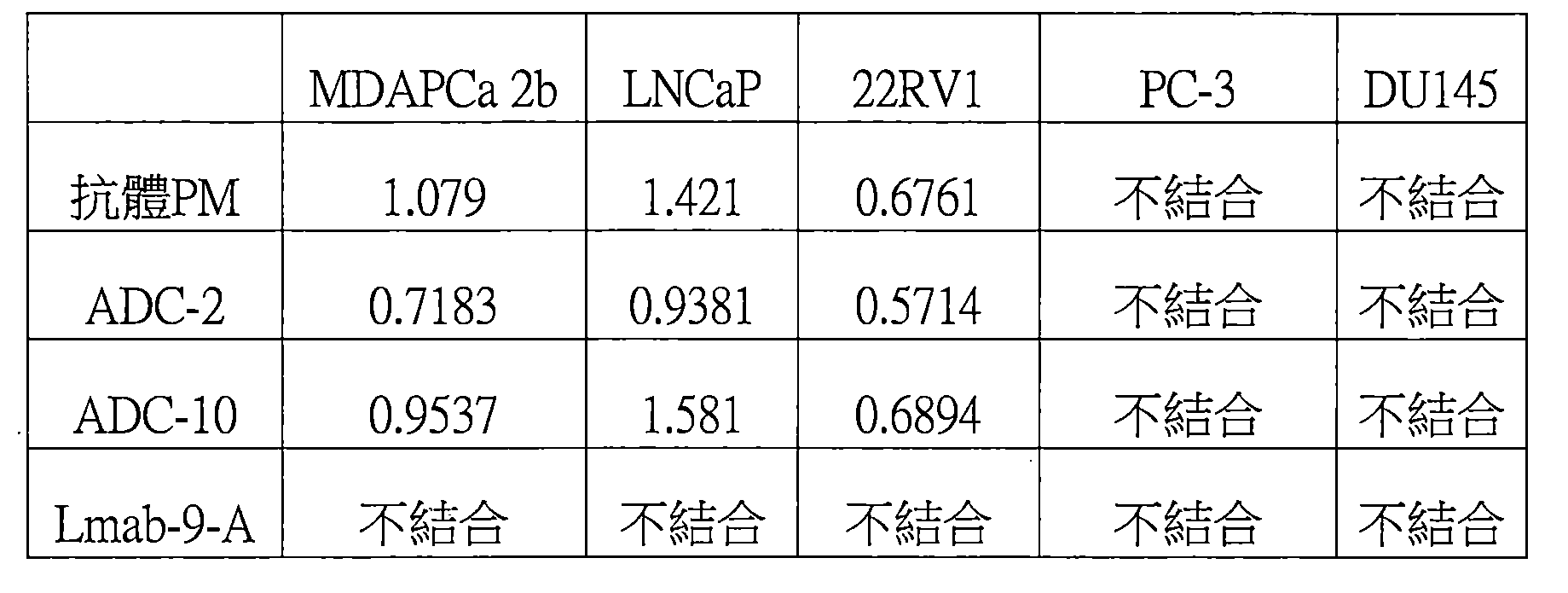
檢測用細胞的抗原PSMA的表達水準:MDA PCa 2b>LNCaP>22Rv1,PC-3和DU 145不表達PSMA。
The expression level of antigen PSMA in the test cells: MDA PCa 2b>LNCaP>22Rv1, PC-3 and
結果表明:ADC-2、ADC-10、對照ADCLmab-9-A和抗體PM與不同PSMA抗原表達水準的細胞具有相應強或弱的結合能力。EC50越小代表結合能力越強。 The results showed that ADC-2, ADC-10, control ADCLmab-9-A and antibody PM had correspondingly strong or weak binding abilities to cells with different PSMA antigen expression levels. The smaller the EC 50 , the stronger the binding ability.
測試例2:體外細胞內吞實驗 Test Example 2: In vitro endocytosis experiment
DT3C,70kd,是重組表達的融合蛋白,由白喉毒素的Fragment A(僅毒素部分)和G群鏈球菌的3C片段(IgG結合部分)融合而成,該蛋白能夠與抗體的IgG部分高度親和,在抗體發生內吞時一同進入細胞,在胞內弗林蛋白酶的作用下,釋放出具有毒性的DT,DT能夠抑制EF2-ADP核糖基化的活性,阻斷蛋白翻譯過程,最終導致細胞死亡。而未進入細胞的DT3C則不具有殺傷細胞的活性。根據細胞殺傷情況來評價抗體的內吞活性。 DT3C, 70kd, is a recombinantly expressed fusion protein, which is formed by the fusion of Fragment A (toxin part only) of diphtheria toxin and 3C fragment (IgG binding part) of group G streptococcus. This protein can have a high affinity with the IgG part of the antibody, and enter the cell together when the antibody is internalized. Under the action of intracellular furin, toxic DT is released. DT can inhibit the activity of EF2-ADP ribosylation, block the protein translation process, and ultimately lead to cell death. DT3C that does not enter the cell does not have the activity of killing cells. The endocytic activity of the antibody is evaluated based on the cell killing situation.
將無菌過濾的DT3C(70KD,SB HRS3A,MEI3AU0803)和抗體PM抗體(DT3C莫耳濃度為抗體莫耳濃度的6倍)按照1:1的體積混勻,於室溫下靜置孵育30分鐘後用無血清培養基梯度稀釋,加入提前一天準備的用含20% low IgG FBS的培養基培養的細胞(ATCC,LNCaP/CRL-1740,22Rv1/CRL-2505)中(2000個細胞/孔),5%二氧化碳培養箱中37℃孵育三天。加入CellTiter-Glo(Promega,G7573),室溫下避光孵育10分鐘,Victor3上讀取化學發光(結果如表3,圖2A,圖2B所示)。 Sterile filtered DT3C (70KD, SB HRS3A, MEI3AU0803) and antibody PM (the molar concentration of DT3C is 6 times the molar concentration of the antibody) were mixed at a volume ratio of 1:1, incubated at room temperature for 30 minutes, then diluted with serum-free medium, added to cells (ATCC, LNCaP/CRL-1740, 22Rv1/CRL-2505) cultured with 20% low IgG FBS prepared one day in advance (2000 cells/well), and incubated at 37°C in a 5% carbon dioxide incubator for three days. Add CellTiter-Glo (Promega, G7573), incubate at room temperature in the dark for 10 minutes, and read chemiluminescence on Victor3 (results are shown in Table 3, Figure 2A, Figure 2B).
表3 抗體在不同細胞的內吞活性(IC50,nM)
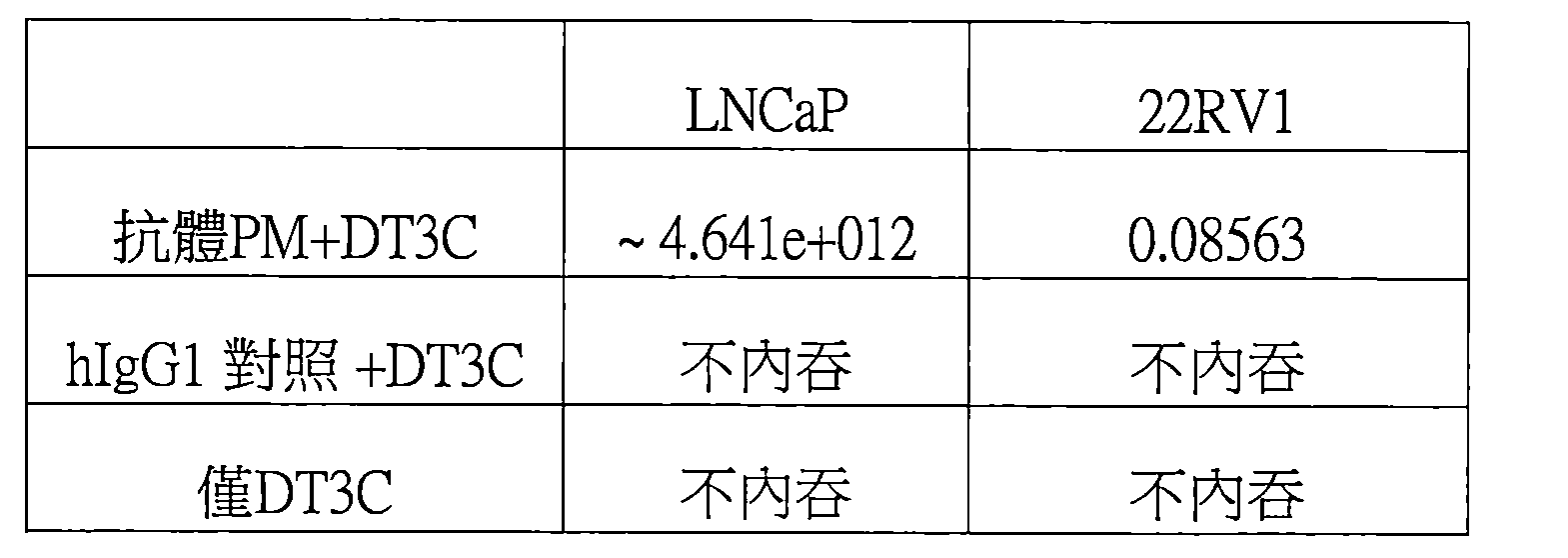
結果表明:抗體PM在陽性表達PSMA抗原的細胞上具備內吞能力。 The results showed that the antibody PM has the ability to be internalized on cells that positively express the PSMA antigen.
測試例3:細胞增殖抑制實驗 Test Example 3: Cell proliferation inhibition experiment
本實驗通過檢測細胞內ATP含量,根據IC50大小評價PSMA ADC對 細胞(ATCC,LNCaP/CRL-1740,22Rv1/CRL-2505,PC-3/CRL-1435)增殖的抑制效果。 This experiment detected the intracellular ATP content and evaluated the inhibitory effect of PSMA ADC on cell (ATCC, LNCaP/CRL-1740, 22Rv1/CRL-2505, PC-3/CRL-1435) proliferation based on the IC50 value.
待檢測樣品:ADC-2,ADC-4,對照ADC Lmab-9-A Samples to be tested: ADC-2, ADC-4, reference ADC Lmab-9-A
1、對LNCaP細胞增殖的抑制效果 1. Inhibitory effect on LNCaP cell proliferation
LNCaP細胞培養在含10%FBS的RPMI-1640培養基中,一週繼代2~3次,繼代比列1:3或1:6。繼代時,吸掉培養基,用5mL 0.25%的胰酶沖洗細胞層,然後吸掉胰酶,將細胞放在培養箱中消化3~5分鐘,加入新鮮培養基重新懸浮細胞。在96孔細胞培養板中加入180μL的細胞懸浮液,2×103細胞/孔,培養基為4.5%FBS的RPMI-1640,96孔板週邊只加入培養基。將培養板在培養箱培養24小時(37℃,5% CO2)。 LNCaP cells were cultured in RPMI-1640 medium containing 10% FBS, and subcultured 2-3 times a week at a subculture ratio of 1:3 or 1:6. During subculture, the medium was aspirated, the cell layer was rinsed with 5 mL of 0.25% trypsin, and then the trypsin was aspirated. The cells were placed in an incubator for digestion for 3-5 minutes, and fresh medium was added to resuspend the cells. 180 μL of cell suspension was added to a 96-well cell culture plate, 2×10 3 cells/well, and the culture medium was RPMI-1640 with 4.5% FBS. Only the culture medium was added around the 96-well plate. The culture plate was incubated in an incubator (37°C, 5% CO 2 ) for 24 hours.
將待測ADC(ADC-2,ADC-4,Lmab-9-A)配成起始濃度,用PBS 1:6梯度稀釋9個點,另加0濃度點。取20μL加入到上述細胞板中,在培養箱中孵育5天(37℃,5% CO2)。對於化合物2-B(即9-A的游離毒素),先用DSMO稀釋成母液並用PBS配成200μM為起始,再用PBS 1:6梯度稀釋9個點,另加0濃度點,取1μL加入20μL RPMI-1640中並轉至96孔細胞培養板中,在培養箱中孵育5天(37℃,5% CO2)。在96孔細胞培養板中,每孔加入80μL CellTiter-Glo試劑,室溫避光放置10-15分鐘,在Victor3中讀取化學發光信號值,資料使用GraphPad軟體處理。(結果如表4,圖3A,圖3B所示)。 The ADCs to be tested (ADC-2, ADC-4, Lmab-9-A) were prepared to the starting concentration, and diluted with PBS 1:6 for 9 points, plus a 0 concentration point. 20 μL was added to the above cell plate and incubated in an incubator for 5 days (37°C, 5% CO 2 ). For compound 2-B (i.e., the free toxin of 9-A), it was first diluted with DSMO to a mother solution and prepared with PBS to 200 μM as the starting point, then diluted with PBS 1:6 for 9 points, plus a 0 concentration point, 1 μL was added to 20 μL RPMI-1640 and transferred to a 96-well cell culture plate, and incubated in an incubator for 5 days (37°C, 5% CO 2 ). In a 96-well cell culture plate, 80 μL of CellTiter-Glo reagent was added to each well and placed in a dark place at room temperature for 10-15 minutes. The chemiluminescence signal value was read in Victor3 and the data was processed using GraphPad software. (The results are shown in Table 4, Figure 3A, and Figure 3B).
2、對22Rv1細胞增殖的抑制效果 2. Inhibitory effect on 22Rv1 cell proliferation
22Rv1細胞培養在含10%FBS的RPMI-1640培養基中,一週繼代2次,繼代比列1:3或1:6。繼代時,吸掉培養基,用5mL 0.25%的胰酶沖洗細胞層,然後 吸掉胰酶,將細胞放在培養箱中消化3~5分鐘,加入新鮮培養基重新懸浮細胞。在96孔細胞培養板中加入180μL的細胞懸浮液,4×103細胞/孔,培養基為4.5%FBS的RPMI-1640,96孔板週邊只加入培養基。將培養板在培養箱培養24小時(37℃,5% CO2)。待測ADC及化合物2-B配製及實驗方法同上。(結果如表4,圖3C,圖3D所示)。 22Rv1 cells were cultured in RPMI-1640 medium containing 10% FBS and subcultured twice a week at a subculture ratio of 1:3 or 1:6. During subculture, the medium was aspirated, the cell layer was rinsed with 5 mL of 0.25% trypsin, and then the trypsin was aspirated. The cells were placed in an incubator for digestion for 3-5 minutes, and fresh medium was added to resuspend the cells. 180 μL of cell suspension was added to a 96-well cell culture plate, 4×10 3 cells/well, and the medium was RPMI-1640 with 4.5% FBS. Only the medium was added around the 96-well plate. The culture plate was incubated in an incubator for 24 hours (37°C, 5% CO 2 ). The preparation and experimental methods of the ADC to be tested and compound 2-B were the same as above. (The results are shown in Table 4, Figure 3C, and Figure 3D).
3、對PC-3細胞增殖的抑制效果 3. Inhibitory effect on PC-3 cell proliferation
PC-3細胞培養在含10%FBS的F-12K培養基中,一週繼代2-3次,繼代比列1:3或1:6。繼代時,吸掉培養基,用5mL 0.25%的胰酶沖洗細胞層,然後吸掉胰酶,將細胞放在培養箱中消化3~5分鐘,加入新鮮培養基重新懸浮細胞。在96孔細胞培養板中加入180μL的細胞懸浮液,4×103細胞/孔,培養基為4.5%FBS的F-12K,96孔板週邊只加入培養基。將培養板在培養箱培養24小時(37℃,5% CO2)。待測ADC及化合物2-B配製及實驗方法同上。(結果如表4,圖3E,圖3F所示)。 PC-3 cells were cultured in F-12K medium containing 10% FBS, and subcultured 2-3 times a week at a subculture ratio of 1:3 or 1:6. During subculture, the medium was aspirated, the cell layer was rinsed with 5 mL of 0.25% trypsin, and then the trypsin was aspirated. The cells were placed in an incubator for digestion for 3-5 minutes, and fresh medium was added to resuspend the cells. 180 μL of cell suspension was added to a 96-well cell culture plate, 4×10 3 cells/well, and the medium was F-12K with 4.5% FBS. Only the medium was added around the 96-well plate. The culture plate was incubated in an incubator for 24 hours (37°C, 5% CO 2 ). The preparation and experimental methods of the ADC to be tested and compound 2-B were the same as above. (The results are shown in Table 4, Figure 3E, Figure 3F).
表4 對細胞殺傷作用(IC50,nM)

結論:PSMA ADC在LNCaP和22RV1細胞上具有殺傷作用。化合物2-B(即9-A的游離毒素)具有透膜殺傷作用。 Conclusion: PSMA ADC has a killing effect on LNCaP and 22RV1 cells. Compound 2-B (i.e., the free toxin of 9-A) has a transmembrane killing effect.
測試例4:ADC藥物對人前列腺癌細胞22Rv1裸小鼠移植瘤的療效評價 Test Example 4: Evaluation of the efficacy of ADC drugs on human prostate cancer cell 22Rv1 nude mouse transplanted tumors
一、測試方法 1. Test method
實驗用nu/nu裸小鼠,雄性,6-8週,購自北京維通利華實驗動物技術有限公司(合格證編號1908120082)。飼養環境:SPF級。裸小鼠皮下接種人前列腺癌細胞22Rv1(中科院),當腫瘤平均體積達到220mm3時,將動物隨機分組(D0),每組6只,開始腹腔注射給藥2次/週,共給藥5次,每週2次檢測瘤體積和體重,記錄資料。 Experimental nu/nu nude mice, male, 6-8 weeks old, were purchased from Beijing Weitonglihua Experimental Animal Technology Co., Ltd. (certificate number 1908120082). Housing environment: SPF grade. Nude mice were subcutaneously inoculated with human prostate cancer cells 22Rv1 (Chinese Academy of Sciences). When the average tumor volume reached 220 mm3 , the animals were randomly divided into groups (D0), with 6 mice in each group. They were given intraperitoneal injections twice a week for a total of 5 times. The tumor volume and body weight were detected twice a week and the data were recorded.
腫瘤體積V=1/2×a×b2,其中a、b分別表示長、寬。 Tumor volume V=1/2×a×b 2 , where a and b represent length and width respectively.
相對腫瘤增殖率T/C(%)=(T-T0)/(C-C0)×100其中T、C為實驗結束時治療組和對照組的腫瘤體積;T0、C0為實驗開始時的腫瘤體積。 Relative tumor proliferation rate T/C (%) = (T-T0)/(C-C0) × 100, where T and C are the tumor volumes of the treatment group and the control group at the end of the experiment; T0 and C0 are the tumor volumes at the beginning of the experiment.
抑瘤率TGI(%)=1-T/C(%)。 Tumor inhibition rate TGI (%) = 1-T/C (%).
二、測試對象 2. Test subjects
ADC-10:3mpk,10mpk; ADC-10: 3mpk, 10mpk;
ADC-2:3mpk,10mpk; ADC-2: 3mpk, 10mpk;
空白對照組:pH7.4的PBS緩衝液。 Blank control group: PBS buffer at pH 7.4.
三、抗體ADC的抑瘤效果 3. Anti-tumor effect of antibody ADC
觀察至給藥開始後第17天(D17)時,陽性ADC-10的10mpk和3mpk的抑瘤率分別為48.9%和10.0%,ADC-2的10mpk和3mpk的抑瘤率分別為>100%和91.5%,顯著優於空白對照組和陽性ADC組,且呈現良好的劑量依賴關係(表5, 圖4A)。 It was observed that on the 17th day after the start of drug administration (D17), the tumor inhibition rates of 10mpk and 3mpk of positive ADC-10 were 48.9% and 10.0%, respectively, and the tumor inhibition rates of 10mpk and 3mpk of ADC-2 were >100% and 91.5%, respectively, which were significantly better than the blank control group and the positive ADC group, and showed a good dose-dependent relationship (Table 5, Figure 4A).
給藥過程中小鼠體重平穩,提示ADC-2各給藥劑量沒有明顯的毒副作用(圖4B)。 The body weight of mice remained stable during the administration, indicating that ADC-2 had no obvious toxic side effects at all doses (Figure 4B).
表5 給藥ADC對荷瘤裸鼠22Rv1移植瘤的療效

測試例5:ADC藥物對人前列腺癌細胞22Rv1裸小鼠移植瘤的療效評價 Test Example 5: Evaluation of the efficacy of ADC drugs on human prostate cancer cell 22Rv1 nude mouse transplanted tumors
一、測試方法 1. Test method
實驗用nu/nu裸小鼠,雄性,6-8週,購自北京維通利華實驗動物技術有限公司(合格證編號1908120082)。飼養環境:SPF級。裸小鼠皮下接種人前列腺癌細胞22Rv1(中科院),當腫瘤平均體積達到210mm3時,將動物隨機分組(D0),每組8只,開始腹腔注射給藥2次/週,共給藥6次,每週2次檢測瘤體積和體重,記錄資料。 Experimental nu/nu nude mice, male, 6-8 weeks old, were purchased from Beijing Weitonglihua Experimental Animal Technology Co., Ltd. (certificate number 1908120082). Housing environment: SPF grade. Nude mice were subcutaneously inoculated with human prostate cancer cells 22Rv1 (Chinese Academy of Sciences). When the average tumor volume reached 210 mm3 , the animals were randomly divided into groups (D0), 8 in each group, and intraperitoneal injections were started 2 times/week, for a total of 6 times. The tumor volume and body weight were detected twice a week, and the data were recorded.
腫瘤體積V=1/2×a×b2,其中a、b分別表示長、寬。 Tumor volume V=1/2×a×b 2 , where a and b represent length and width respectively.
相對腫瘤增殖率T/C(%)=(T-T0)/(C-C0)×100其中T、C為實驗結束時治療組和對照組的腫瘤體積;T0、C0為實驗開始時的腫瘤體積。 Relative tumor proliferation rate T/C (%) = (T-T0)/(C-C0) × 100, where T and C are the tumor volumes of the treatment group and the control group at the end of the experiment; T0 and C0 are the tumor volumes at the beginning of the experiment.
抑瘤率TGI(%)=1-T/C(%)。 Tumor inhibition rate TGI (%) = 1-T/C (%).
二、測試對象 2. Test subjects
ADC-8:10mpk; ADC-8: 10mpk;
ADC-6:3mpk,6mpk; ADC-6: 3mpk, 6mpk;
ADC-7:3mpk,6mpk,10mpk; ADC-7: 3mpk, 6mpk, 10mpk;
空白對照組:pH7.4的PBS緩衝液。 Blank control group: PBS buffer at pH 7.4.
三、抗體ADC的抑瘤效果 3. Anti-tumor effect of antibody ADC
觀察至給藥開始後第14天(D14)時,陽性ADC-8的10mpk抑瘤率為81.6%,受試ADC-6的6mpk和3mpk的抑瘤率分別為>100%和97.8%,另一個受試ADC-7的10mpk、6mpk和3mpk的抑瘤率分別為>100%、88.4%和80.5%,所有給藥組均顯著優於對照組,受試ADC-6在同等劑量下顯著優於受試ADC-7,2個受試ADC均呈現良好的劑量依賴關係(表6,圖5A)。 On the 14th day after the start of drug administration (D14), the tumor inhibition rate of positive ADC-8 at 10mpk was 81.6%, the tumor inhibition rates of ADC-6 at 6mpk and 3mpk were >100% and 97.8%, respectively, and the tumor inhibition rates of ADC-7 at 10mpk, 6mpk and 3mpk were >100%, 88.4% and 80.5%, respectively. All drug administration groups were significantly better than the control group. ADC-6 was significantly better than ADC-7 at the same dose. Both ADCs showed a good dose-dependent relationship (Table 6, Figure 5A).
給藥過程中小鼠體重平穩,提示各受試抗體各給藥劑量沒有明顯的毒副作用(圖5B)。 The body weight of mice remained stable during the drug administration, indicating that each dose of each tested antibody had no obvious toxic side effects (Figure 5B).
表6 給藥ADC對荷瘤裸鼠22Rv1移植瘤的療效

測試例6:ADC藥物對人前列腺癌細胞LNCap在SCID Beighe小鼠上的移植瘤的療效評價 Test Example 6: Evaluation of the efficacy of ADC drugs on human prostate cancer cell LNCap transplanted tumors in SCID Beighe mice
一、測試方法 1. Test method
實驗用SCID Beige小鼠,雄性,6-8週,購自北京維通利華實驗動物技術有限公司(合格證編號1908120082)。飼養環境:SPF級。小鼠皮下接種人前列腺癌細胞LNCap(ATCC),當腫瘤平均體積達到160mm3時,將動物隨機分組(D0),每組7只,於D0和D4腹腔注射給藥2次,每週2次檢測瘤體積和體重,記錄資料。 Experimental SCID Beige mice, male, 6-8 weeks old, were purchased from Beijing Weitonglihua Laboratory Animal Technology Co., Ltd. (certificate number 1908120082). Housing environment: SPF grade. Mice were subcutaneously inoculated with human prostate cancer cells LNCap (ATCC). When the average tumor volume reached 160 mm3 , the animals were randomly divided into groups (D0), 7 in each group, and intraperitoneally injected with drugs twice on D0 and D4. The tumor volume and body weight were detected twice a week and the data were recorded.
腫瘤體積V=1/2×a×b2,其中a、b分別表示長、寬。 Tumor volume V=1/2×a×b 2 , where a and b represent length and width respectively.
相對腫瘤增殖率T/C(%)=(T-T0)/(C-C0)×100其中T、C為實驗結束時治療組和對照組的腫瘤體積;T0、C0為實驗開始時的腫瘤體積。 Relative tumor proliferation rate T/C (%) = (T-T0)/(C-C0) × 100, where T and C are the tumor volumes of the treatment group and the control group at the end of the experiment; T0 and C0 are the tumor volumes at the beginning of the experiment.
抑瘤率TGI(%)=1-T/C(%)。 Tumor inhibition rate TGI (%) = 1-T/C (%).
二、測試對象 2. Test subjects
ADC-9:10mpk; ADC-9: 10mpk;
ADC-3:3mpk,10mpk; ADC-3: 3mpk, 10mpk;
ADC-5:3mpk,6mpk,10mpk; ADC-5: 3mpk, 6mpk, 10mpk;
空白對照組:pH7.4的PBS緩衝液。 Blank control group: PBS buffer at pH 7.4.
三、抗體ADC的抑瘤效果 3. Anti-tumor effect of antibody ADC
所有給藥組腫瘤在D0和D4兩次給藥後即開始消退,且其藥效一直維持到實驗終點D18。受試ADC-3和ADC-5均呈現出一定的劑量依賴關係,但它們之間並沒有顯著性差異(表7,圖6A)。 The tumors in all drug-treated groups began to regress after two doses at D0 and D4, and the efficacy was maintained until the end point of the experiment at D18. Both ADC-3 and ADC-5 showed a certain dose-dependency, but there was no significant difference between them (Table 7, Figure 6A).
給藥過程中小鼠體重平穩,提示各受試抗體各給藥劑量沒有明顯的毒副作用(圖6B)。 The body weight of mice remained stable during the drug administration, indicating that each dose of each tested antibody had no obvious toxic side effects (Figure 6B).
表7 給藥ADC對荷瘤SCID Beige鼠LNCap移植瘤的療效

測試例7:PMSA ADC SD大鼠T1/2評價 Test Example 7: PMSA ADC SD rat T1/2 evaluation
SD雄性大鼠9只,分為三組,每組3只,12/12小時光/暗調節,溫度20-26℃恆溫,濕度40-70%,自由進食飲水。購自浙江維通利華實驗動物有限公司。實驗當天對SD雄性大鼠分別尾靜脈注射受試藥物ADC-2,ADC-5,ADC-10,給藥劑量為3mg/kg,注射體積5mL/kg。 9 male SD rats were divided into three groups, 3 rats in each group, with 12/12 hours light/dark adjustment, constant temperature of 20-26℃, humidity of 40-70%, and free access to food and water. They were purchased from Zhejiang Weitonglihua Experimental Animal Co., Ltd. On the day of the experiment, the SD male rats were injected with the test drugs ADC-2, ADC-5, and ADC-10 through the tail vein, with a dosage of 3 mg/kg and an injection volume of 5 mL/kg.
取血時間點為:第1天給藥後5分鐘、8小時、24小時(第2天)、第3天、第5天、第8天、第11天、第15天、第22天和第29天,於大鼠眼底靜脈取血,每次300μL(相當於取血清150μL);收集的血樣在室溫下置放半小時至凝集,然後4℃下1000×g離心15分鐘,將上清(血清)轉移至EP管中,立即放置-80℃貯存。採用ELISA法檢測SD大鼠血清中PSMA抗體ADC的濃度。
Blood was collected from the
測試方法: Testing method:
總抗體(Total antibody)的檢測: Total antibody detection:
1.在ELISA板(cornning)中每孔加入100μL,1μg/mL羊抗人lgG FC(abcam),4℃隔夜孵育。 1. Add 100μL, 1μg/mL goat anti-human IgG FC (abcam) to each well of the ELISA plate (cornning) and incubate overnight at 4°C.
2.用洗板液PBST沖洗三遍(1×PBS,0.5% tween-20(生工)。 2. Rinse three times with plate washing buffer PBST (1×PBS, 0.5% tween-20 (Shengang).
3.每孔加入200μL封閉液(5%牛奶,碧雲天),37℃孵育1-3小時。 3. Add 200 μL of blocking solution (5% milk, Bio-Tech) to each well and incubate at 37°C for 1-3 hours.
4.用洗板液PBST沖洗三遍。 4. Rinse three times with plate washing buffer PBST.
5.加入100μL的標準樣品,質控樣品和檢測樣品,37℃孵育1-3小時。 5. Add 100μL of standard sample, quality control sample and test sample, and incubate at 37℃ for 1-3 hours.
6.用洗板液沖洗三遍。 6. Rinse three times with plate washing liquid.
7.加入100μL鼠預吸附過的羊抗人lgG輕/重鏈HRP(1:5000,abcam),37℃孵育1-1.5小時。 7. Add 100 μL mouse pre-adsorbed goat anti-human IgG light/heavy chain HRP (1:5000, abcam) and incubate at 37°C for 1-1.5 hours.
8.用洗板液沖洗三遍。 8. Rinse three times with plate washing liquid.
9.加入100μL TMB(KPL),常溫避光孵育10分鐘。 9. Add 100μL TMB(KPL) and incubate at room temperature in the dark for 10 minutes.
10.加入100μL 1M稀硫酸(國藥集團)終止,在450nm波長下讀板(molecular device,flexstation 3)。 10. Add 100μL 1M dilute sulfuric acid (Sinopharm Group) to terminate, and read the plate at 450nm wavelength (molecular device, flexstation 3).
完整ADC(Intact ADC)的檢測: Intact ADC detection:
1.在ELISA板中每孔加入100μL,1μg/mL羊抗鼠IgG Fc,4℃隔夜孵育。 1. Add 100μL, 1μg/mL goat anti-mouse IgG Fc to each well of the ELISA plate and incubate overnight at 4℃.
2.用洗板液PBST沖洗三遍。 2. Rinse three times with plate washing buffer PBST.
3.每孔加入200μL封閉液,37℃孵育1-3小時。 3. Add 200μL of blocking solution to each well and incubate at 37℃ for 1-3 hours.
4.用洗板液沖洗三遍。 4. Rinse three times with plate washing liquid.
5.每孔加入100μL 0.2μg/mL抗毒素抗體或anti-pab-mmae(中科英沐, s-497-8),37℃孵育1-1.5小時。 5. Add 100μL 0.2μg/mL antitoxin antibody or anti-pab-mmae (Zhongke Yingmu, s-497-8) to each well and incubate at 37℃ for 1-1.5 hours.
6.用洗板液沖洗三遍。 6. Rinse three times with plate washing liquid.
7.加入100μL的標準樣品,質控樣品和檢測樣品,37℃孵育1-3小時。 7. Add 100μL of standard sample, quality control sample and test sample, and incubate at 37℃ for 1-3 hours.
8.用洗板液沖洗三遍。 8. Rinse three times with plate washing liquid.
9.加入100μL鼠預吸附過的羊抗人lgG輕/重鏈HRP(1:5000),37℃孵育1-1.5小時。 9. Add 100 μL mouse pre-adsorbed goat anti-human IgG light/heavy chain HRP (1:5000) and incubate at 37°C for 1-1.5 hours.
10.用洗板液沖洗三遍。 10. Rinse three times with plate washing liquid.
11.加入100μL TMB,常溫避光孵育10分鐘。 11. Add 100μL TMB and incubate at room temperature in the dark for 10 minutes.
12.加入100μL 1M稀硫酸終止,在450nm波長下讀板。 12. Add 100μL 1M dilute sulfuric acid to terminate and read the plate at 450nm wavelength.
檢測及分析結果: Test and analysis results:
用ELISA檢測血清中的PSMA抗體ADC的濃度,進行PK分析,(結果見表8)。 The concentration of PSMA antibody ADC in serum was detected by ELISA and PK analysis was performed (results are shown in Table 8).
表8 PSMA抗體偶聯物在SD大鼠中的T1/2 
結果表明,大鼠靜脈給予3mg/kg受試抗體偶聯物ADC-10,ADC-2,ADC-5後,總抗體(ADC中偶聯的抗體和血清中游離的抗體)在大鼠體內的半衰期約為219.8小時(9.2天),171.2小時(7.1天),172.5小時(7.2天);完整ADC在大鼠體內的半衰期約為76.7小時(3.2天),153.9小時(6.4天),137.9小時(5.7天)。ADC-2和ADC-5的T1/2優於ADC-10。 The results showed that after rats were intravenously administered 3 mg/kg of the tested antibody conjugates ADC-10, ADC-2, and ADC-5, the half-life of the total antibody (antibody conjugated in ADC and free antibody in serum) in rats was approximately 219.8 hours (9.2 days), 171.2 hours (7.1 days), and 172.5 hours (7.2 days); the half-life of the intact ADC in rats was approximately 76.7 hours (3.2 days), 153.9 hours (6.4 days), and 137.9 hours (5.7 days). The T 1/2 of ADC-2 and ADC-5 was better than that of ADC-10.
測試例8:PSMA ADC的穩定性研究(游離毒素檢測) Test Example 8: Stability study of PSMA ADC (free toxin detection)
1.大鼠藥代樣品中ADC-2穩定性 1. Stability of ADC-2 in rat pharmacokinetic samples
運用液質聯用技術,監測樣品經靜脈給藥,在雄性大鼠體內,28天中化合物2-B(9-A的游離毒素)隨時間的釋放量,用以反映樣品在定濃度條件下的穩定性。通過對28天中,不同時間點(5分鐘、8小時、1天、2天、4天、7天、10天、14天、21天、28天)的大鼠血漿中化合物2-B的含量測定,ADC-2表現了良好的穩定性,結果如表9所示。 Using liquid chromatography-mass spectrometry technology, the sample was administered intravenously. The release of compound 2-B (free toxin of 9-A) over time in male rats for 28 days was monitored to reflect the stability of the sample under constant concentration conditions. By measuring the content of compound 2-B in rat plasma at different time points (5 minutes, 8 hours, 1 day, 2 days, 4 days, 7 days, 10 days, 14 days, 21 days, and 28 days) during the 28 days, ADC-2 showed good stability. The results are shown in Table 9.
結果顯示,ADC-2在雄性大鼠體內28天之內均顯示出良好的穩定性。 The results showed that ADC-2 showed good stability in male rats within 28 days.
表9 PSMA ADC的穩定性研究

Blq表示:1ng/mL;M表示大鼠性別為雄性。 Blq means: 1ng/mL; M means the rat is male.
2. PSMA ADC血漿穩定性研究 2. PSMA ADC plasma stability study
運用液質聯用技術,監測樣品ADC-2(100μg/mL)分別在(人、猴、狗、大鼠、小鼠五個種屬的血漿(肝素抗凝)以及1%BSA-PBS作為對照)中,分別在(37℃ &5%CO2孵育箱中,放置0天、7天、14天、21天)不同時間內化合物2-B隨時間的釋放量,用以反映樣品在特定濃度(100μg/mL)條件下的穩定性。通過對不同時間點中化合物2-B的含量測定,ADC-2表現了良好的穩定性,結果如 圖7和表10所示。 Using liquid chromatography-mass spectrometry, the sample ADC-2 (100 μg/mL) was monitored in plasma (heparin anticoagulation) of five species, including human, monkey, dog, rat, and mouse, and 1% BSA-PBS as a control) and in an incubator at 37°C and 5% CO 2 for 0, 7, 14, and 21 days to determine the release of compound 2-B over time, in order to reflect the stability of the sample under a specific concentration (100 μg/mL). By measuring the content of compound 2-B at different time points, ADC-2 showed good stability, as shown in Figure 7 and Table 10.
結果顯示,ADC-2在不同種屬血漿中,在一定溫度、一定時間內顯示出良好的穩定性。 The results showed that ADC-2 exhibited good stability in plasma of different species at a certain temperature and for a certain period of time.
註:試驗操作是在無菌實驗室中進行的,空白血漿用0.22μm的微孔濾膜過濾除菌。 Note: The test operation was carried out in a sterile laboratory, and the blank plasma was sterilized by filtering with a 0.22μm microporous filter membrane.
表10 化合物2-B的含量(ng/mL)

化合物2-B線性範圍1~5000ng/mL;BLQ表示:1ng/mL。“-1”和“-2”表示重複實驗的第一次和第二次。 The linear range of compound 2-B is 1~5000ng/mL; BLQ means: 1ng/mL. "-1" and "-2" represent the first and second repeated experiments.
3. PSMA ADC血漿穩定性研究 3. PSMA ADC plasma stability study
運用液質聯用技術,監測樣品ADC-5分別在(人、猴、狗、大鼠、小鼠五個種屬的血漿(肝素抗凝)以及1%BSA-PBS作為對照)中,分別在(37℃ &5%CO2孵育箱中,放置0天、7天、14天、23天)不同時間內化合物2-B隨 時間的掉落的量,用以反映樣品在特定濃度(100μg/mL)條件下的穩定性。通過對不同時間點中化合物2-B的含量測定,ADC-5表現了良好的穩定性,結果如表11、圖8所示。 Using liquid chromatography-mass spectrometry technology, the sample ADC-5 was monitored in plasma (heparin anticoagulation) of five species of human, monkey, dog, rat, mouse and 1% BSA-PBS as a control) and in an incubator at 37°C & 5% CO 2 for 0, 7, 14, and 23 days to determine the amount of compound 2-B that dropped over time, to reflect the stability of the sample under a specific concentration (100 μg /mL). By measuring the content of compound 2-B at different time points, ADC-5 showed good stability, as shown in Table 11 and Figure 8.
結果顯示,ADC-5在不同種屬血漿,一定溫度,一定時間內顯示出良好的穩定性。 The results showed that ADC-5 exhibited good stability in plasma of different species at a certain temperature and for a certain period of time.
註:試驗操作是在無菌實驗室中進行的,空白血漿用0.22μm的微孔濾膜過濾除菌。 Note: The test operation was carried out in a sterile laboratory, and the blank plasma was sterilized by filtering with a 0.22μm microporous filter membrane.
表11 化合物2-B的含量(ng/mL)-ADC-5(100μg/mL)在不同血漿中37℃孵育23天

23d僅為單孔,化合物2-B線性範圍2~5000ng/mL;BLQ表示:1ng/mL。 23d is only a single well, the linear range of compound 2-B is 2~5000ng/mL; BLQ means: 1ng/mL.
測試例9:ADC藥物對人前列腺癌細胞22Rv1裸小鼠移植瘤的療效 評價 Test Example 9: Efficacy of ADC drugs on human prostate cancer cell 22Rv1 nude mouse transplanted tumors Evaluation
一、測試方法 1. Test method
實驗用雄性nu/nu裸小鼠,6-8週齡,購自北京維通利華實驗動物技術有限公司(合格證編號1908120082)。飼養環境:SPF級。裸小鼠皮下接種人前列腺癌細胞22Rv1(中科院),當腫瘤平均體積達到190mm3時,將動物隨機分組(D0),每組8只,開始腹腔注射給藥,2次/週,共給藥4次,每週2次檢測瘤體積和體重,記錄資料。 Male nu/nu nude mice, 6-8 weeks old, were purchased from Beijing Weitonglihua Experimental Animal Technology Co., Ltd. (certificate number 1908120082). Housing environment: SPF grade. Nude mice were subcutaneously inoculated with human prostate cancer cells 22Rv1 (Chinese Academy of Sciences). When the average tumor volume reached 190 mm3 , the animals were randomly divided into groups (D0), 8 in each group, and intraperitoneal injection of drugs was started, 2 times/week, for a total of 4 times. The tumor volume and body weight were detected twice a week, and the data were recorded.
腫瘤體積(V)計算公式為:V=1/2×a×b2其中a、b分別表示長、寬。 The formula for calculating tumor volume (V) is: V=1/2×a×b 2, where a and b represent length and width respectively.
相對腫瘤增殖率T/C(%)=(T-T0)/(C-C0)×100,其中T、C為實驗結束時治療組和對照組的腫瘤體積;T0、C0為實驗開始時的腫瘤體積。 Relative tumor proliferation rate T/C (%) = (TT 0 )/(CC 0 ) × 100, where T and C are the tumor volumes of the treatment group and the control group at the end of the experiment; T 0 and C 0 are the tumor volumes at the beginning of the experiment.
抑瘤率TGI(%)=1-T/C(%)。 Tumor inhibition rate TGI (%) = 1-T/C (%).
二、測試對象 2. Test subjects
ADC-11:5mpk ADC-11: 5mpk
ADC-12:5mpk ADC-12: 5mpk
空白對照組:pH7.4的PBS緩衝液 Blank control group: PBS buffer solution at pH 7.4
三、抗體ADC的抑瘤效果 3. Anti-tumor effect of antibody ADC
觀察至給藥開始後第13天(D13)時,ADC-11和ADC-12在5mpk劑量下的抑瘤率分別為87.63%和79.82%,均顯著優於對照組。ADC-11和ADC-12之間沒有顯著性差異(表12,圖9)。 It was observed that on the 13th day (D13) after the start of drug administration, the tumor inhibition rates of ADC-11 and ADC-12 at a dose of 5 mpk were 87.63% and 79.82%, respectively, which were significantly better than those of the control group. There was no significant difference between ADC-11 and ADC-12 (Table 12, Figure 9).
給藥過程中小鼠體重平穩,提示各受試抗體沒有明顯的毒副作用。 The weight of mice remained stable during the drug administration, indicating that the tested antibodies had no obvious toxic side effects.
表12 給藥ADC對荷瘤裸鼠22Rv1移植瘤的療效

<110> 江蘇恆瑞醫藥股份有限公司(JIANGSU HENGRUI MEDICINE CO.,LTD.) 上海恆瑞醫藥有限公司(SHANGHAI HENGRUI PHARMACEUTICAL CO.,LTD.) <110> Jiangsu Hengrui Medical Co., Ltd. (JIANGSU HENGRUI MEDICINE CO., LTD.) Shanghai Hengrui Medical Co., Ltd. (SHANGHAI HENGRUI PHARMACEUTICAL CO., LTD.)
<120> 抗PSMA抗體-依喜替康類似物偶聯物及其醫藥用途 <120> Anti-PSMA antibody-exitecan analog conjugate and its medical use
<130> 721024CPCT <130> 721024CPCT
<150> CN202010218297.4 <150> CN202010218297.4
<151> 2020-03-25 <151> 2020-03-25
<160> 13 <160> 13
<170> SIPOSequenceListing 1.0 <170> SIPOSequenceListing 1.0
<210> 1 <210> 1
<211> 123 <211> 123
<212> PRT <212> PRT
<213> 人工序列(Artificial Sequence) <213> Artificial Sequence
<220> <220>
<221> 結構域 <221> Structural domain
<223> AB-PG1-XG1-006重鏈可變區 <223> AB-PG1-XG1-006 Heavy chain variable area
<400> 1 <400> 1

<210> 2 <210> 2
<211> 107 <211> 107
<212> PRT <212> PRT
<213> 人工序列(Artificial Sequence) <213> Artificial Sequence
<220> <220>
<221> 結構域 <221> Structural domain
<223> AB-PG1-XG1-006輕鏈可變區 <223> AB-PG1-XG1-006 light chain variable area
<400> 2 <400> 2


<210> 3 <210> 3
<211> 5 <211> 5
<212> PRT <212> PRT
<213> 人工序列(Artificial Sequence) <213> Artificial Sequence
<220> <220>
<221> 結構域 <221> Structural domain
<223> AB-PG1-XG1-006 HCDR1 <223> AB-PG1-XG1-006 HCDR1
<400> 3 <400> 3

<210> 4 <210> 4
<211> 17 <211> 17
<212> PRT <212> PRT
<213> 人工序列(Artificial Sequence) <213> Artificial Sequence
<220> <220>
<221> 結構域 <221> Structural domain
<223> AB-PG1-XG1-006 HCDR2 <223> AB-PG1-XG1-006 HCDR2
<400> 4 <400> 4

<210> 5 <210> 5
<211> 14 <211> 14
<212> PRT <212> PRT
<213> 人工序列(Artificial Sequence) <213> Artificial Sequence
<220> <220>
<221> 結構域 <221> Structural domain
<223> AB-PG1-XG1-006 HCDR3 <223> AB-PG1-XG1-006 HCDR3
<400> 5 <400> 5

<210> 6 <210> 6
<211> 11 <211> 11
<212> PRT <212> PRT
<213> 人工序列(Artificial Sequence) <213> Artificial Sequence
<220> <220>
<221> 結構域 <221> Structural domain
<223> AB-PG1-XG1-006 LCDR1 <223> AB-PG1-XG1-006 LCDR1
<400> 6 <400> 6

<210> 7 <210> 7
<211> 7 <211> 7
<212> PRT <212> PRT
<213> 人工序列(Artificial Sequence) <213> Artificial Sequence
<220> <220>
<221> 結構域 <221> Structural domain
<223> AB-PG1-XG1-006 LCDR2 <223> AB-PG1-XG1-006 LCDR2
<400> 7 <400> 7

<210> 8 <210> 8
<211> 9 <211> 9
<212> PRT <212> PRT
<213> 人工序列(Artificial Sequence) <213> Artificial Sequence
<220> <220>
<221> 結構域 <221> Structural domain
<223> AB-PG1-XG1-006 LCDR3 <223> AB-PG1-XG1-006 LCDR3
<400> 8 <400> 8

<210> 9 <210> 9
<211> 453 <211> 453
<212> PRT <212> PRT
<213> 人工序列(Artificial Sequence) <213> Artificial Sequence
<220> <220>
<221> 鏈 <221> Link
<223> PM-HC <223> PM-HC
<400> 9 <400> 9

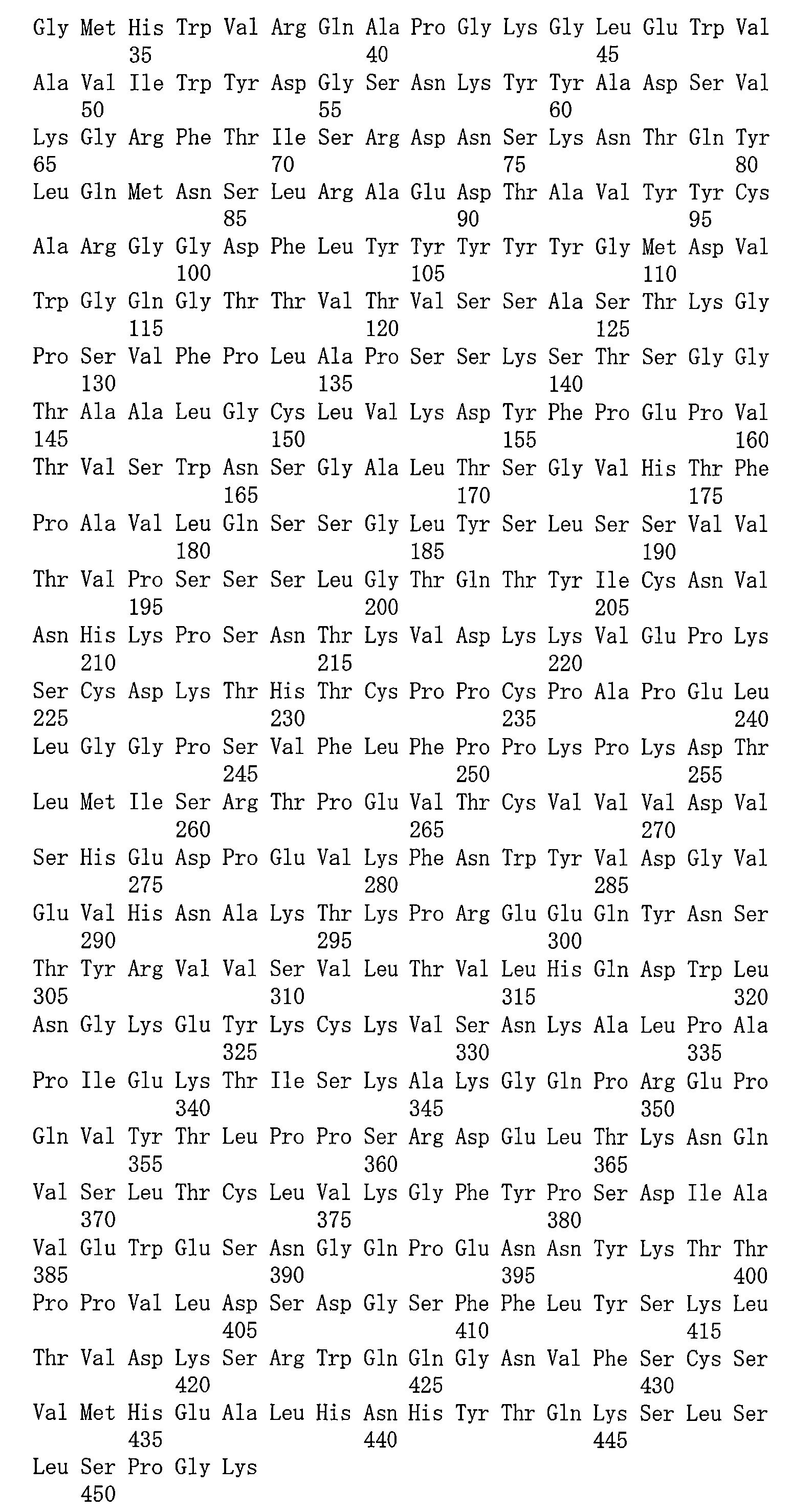
<210> 10 <210> 10
<211> 214 <211> 214
<212> PRT <212> PRT
<213> 人工序列(Artificial Sequence) <213> Artificial Sequence
<220> <220>
<221> 鏈 <221> Link
<223> PM-LC <223> PM-LC
<400> 10 <400> 10
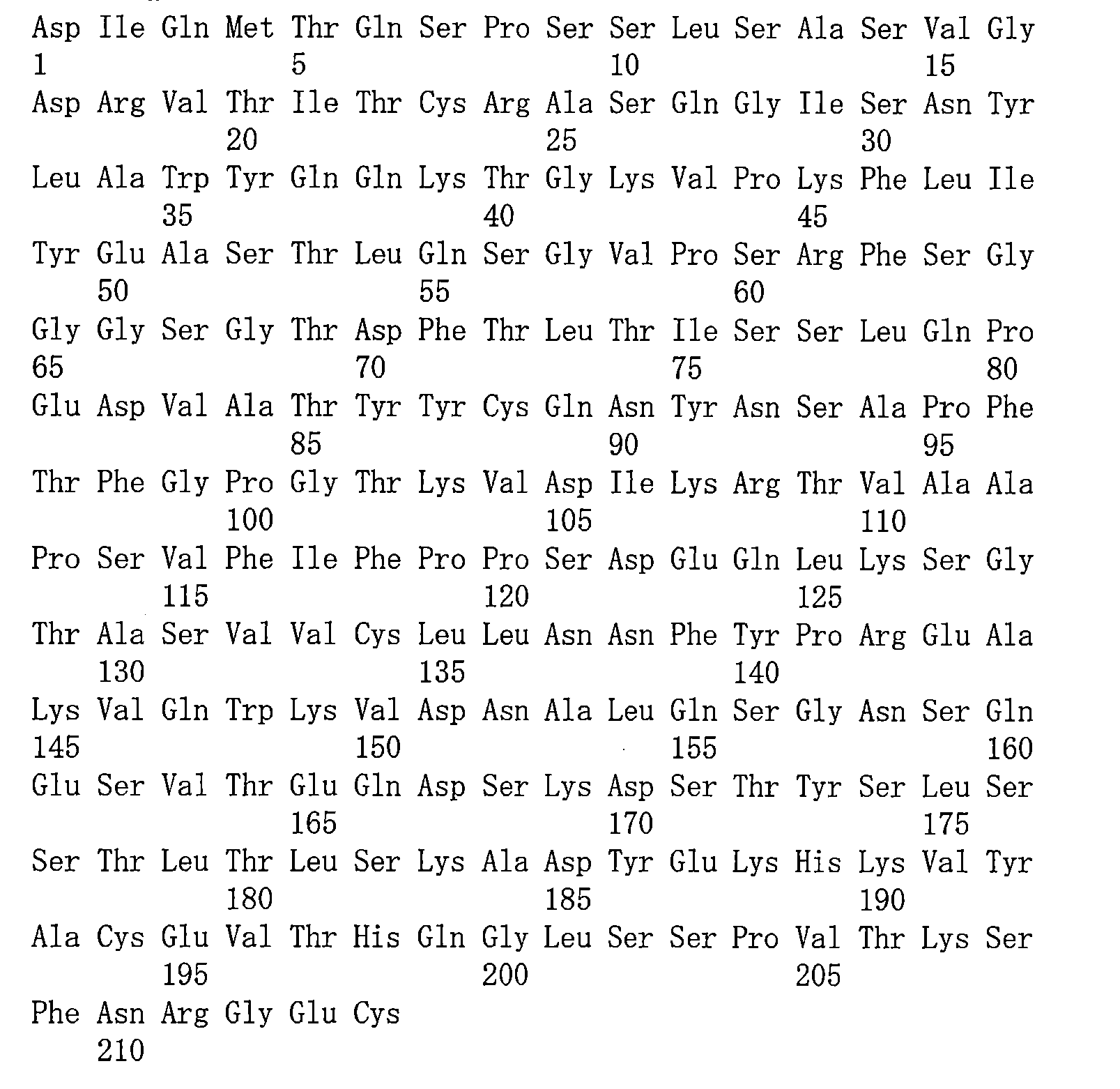
<210> 11 <210> 11
<211> 449 <211> 449
<212> PRT <212> PRT
<213> 人工序列(Artificial Sequence) <213> Artificial Sequence
<220> <220>
<221> 鏈 <221> Link
<223> 抗體重鏈序列Lmab-HC <223> Antibody heavy chain sequence Lmab-HC
<400> 11 <400> 11
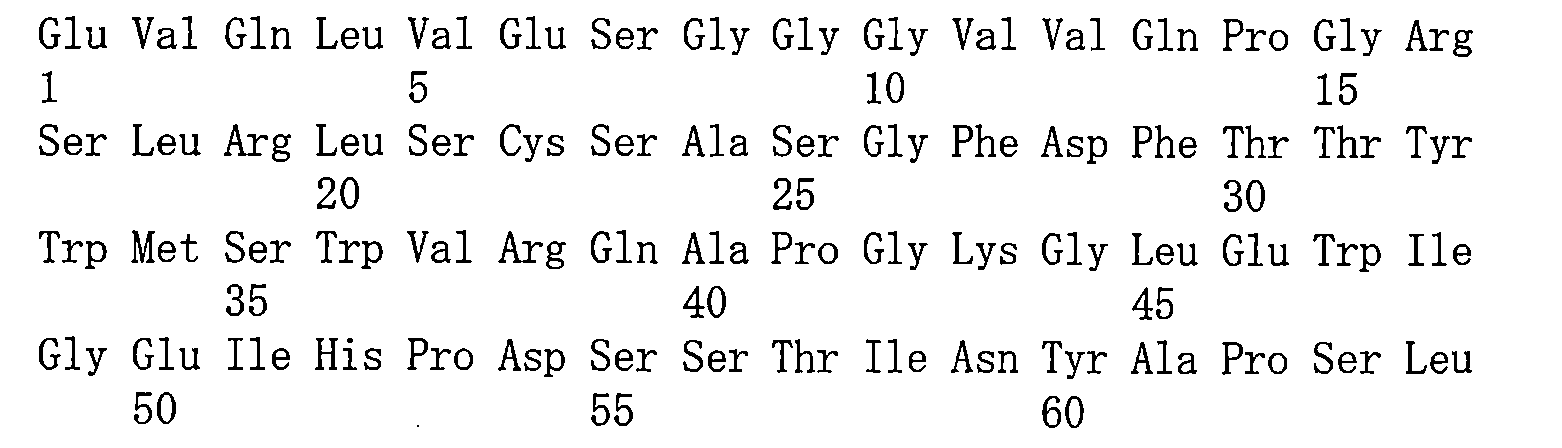
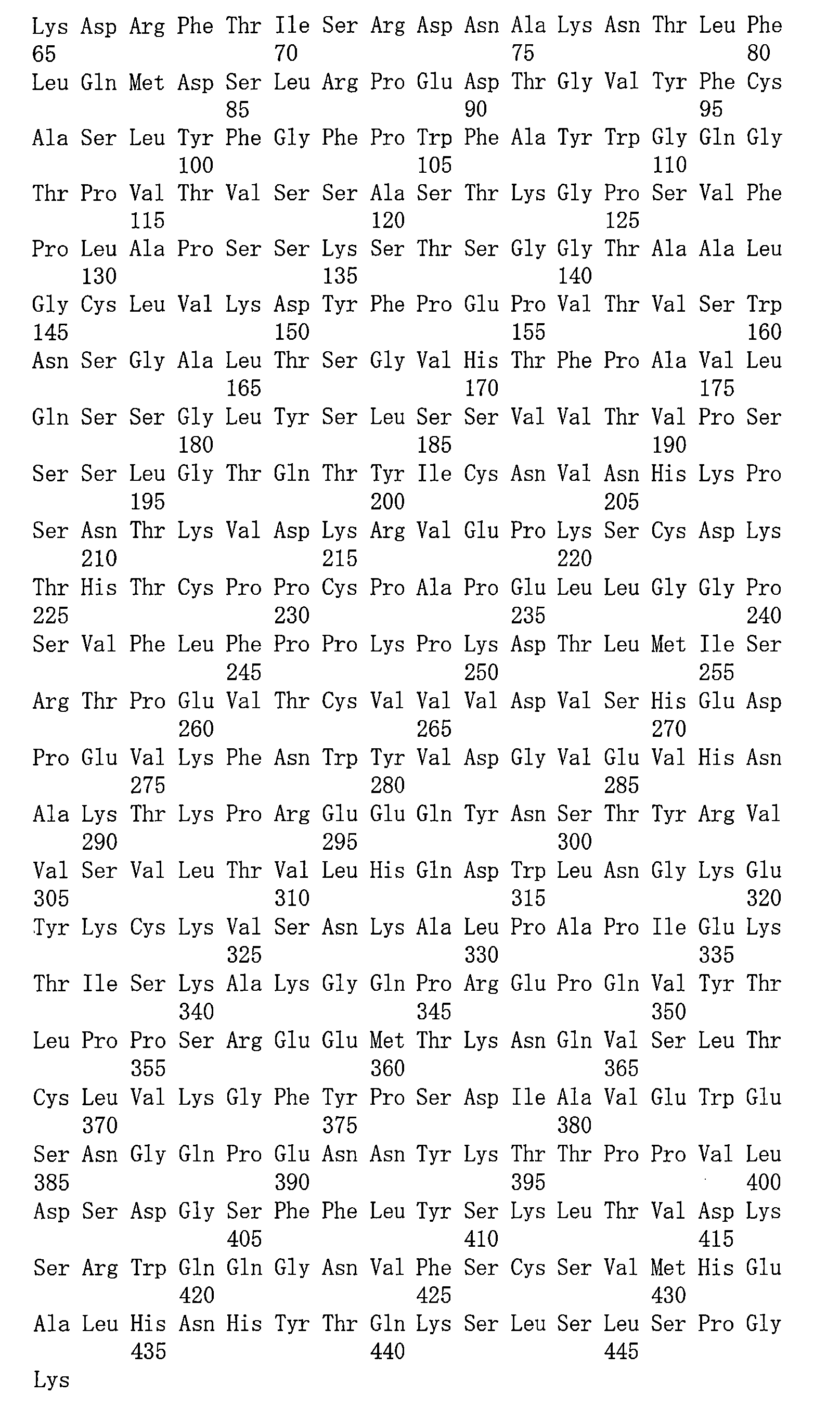
<210> 12 <210> 12
<211> 213 <211> 213
<212> PRT <212> PRT
<213> 人工序列(Artificial Sequence) <213> Artificial Sequence
<220> <220>
<221> 鏈 <221> Link
<223> 抗體輕鏈序列Lmab-LC <223> Antibody light chain sequence Lmab-LC
<400> 12 <400> 12

<210> 13 <210> 13
<211> 4 <211> 4
<212> PRT <212> PRT
<213> 人工序列(Artificial Sequence) <213> Artificial Sequence
<220> <220>
<221> 肽 <221> Peptide
<223> 四肽接頭 <223> Tetrapeptide linker
<400> 13 <400> 13
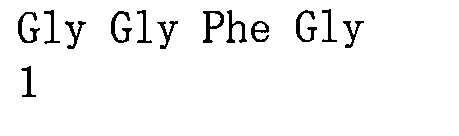

Claims (20)


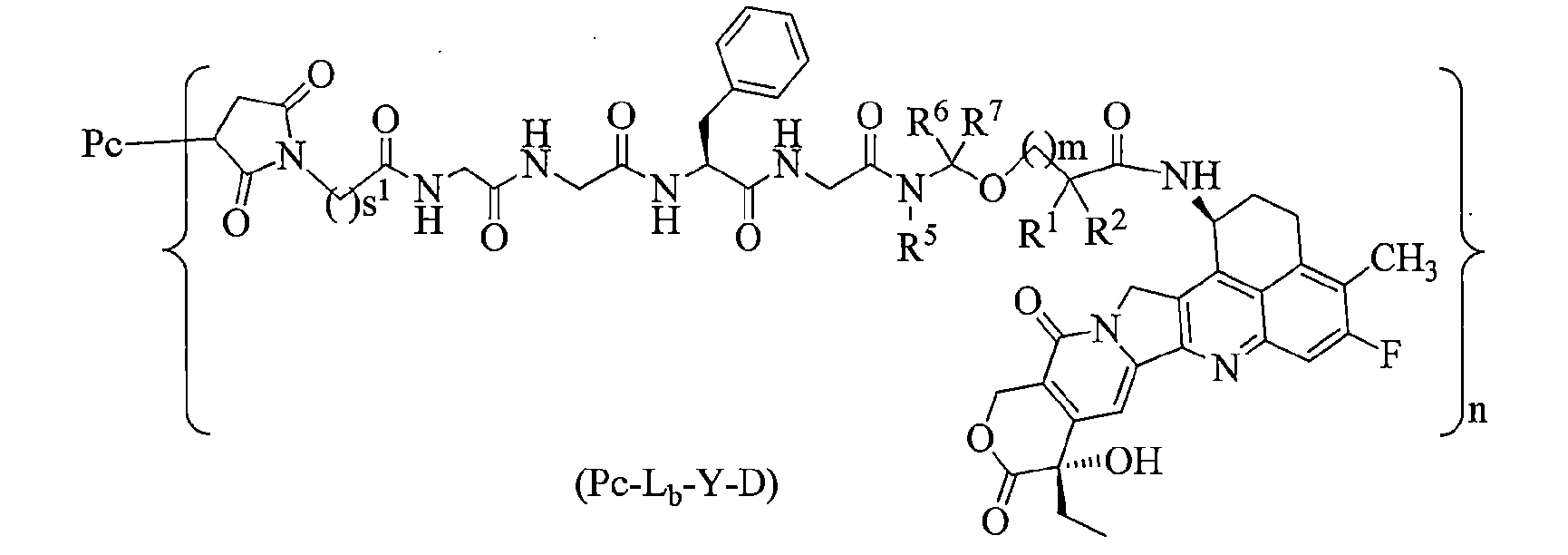


Applications Claiming Priority (2)
| Application Number | Priority Date | Filing Date | Title |
|---|---|---|---|
| CN202010218297 | 2020-03-25 | ||
| CN202010218297.4 | 2020-03-25 |
Publications (2)
| Publication Number | Publication Date |
|---|---|
| TW202144016A TW202144016A (en) | 2021-12-01 |
| TWI888517B true TWI888517B (en) | 2025-07-01 |
Family
ID=77890968
Family Applications (1)
| Application Number | Title | Priority Date | Filing Date |
|---|---|---|---|
| TW110110881A TWI888517B (en) | 2020-03-25 | 2021-03-25 | Anti-psma antibody-drug conjugate and pharmaceutical use thereof |
Country Status (12)
| Country | Link |
|---|---|
| US (1) | US20230140397A1 (en) |
| EP (1) | EP4130006A4 (en) |
| JP (1) | JP2023519261A (en) |
| KR (1) | KR20220160016A (en) |
| CN (1) | CN115298186B (en) |
| AU (1) | AU2021240756A1 (en) |
| BR (1) | BR112022019027A2 (en) |
| CA (1) | CA3177279A1 (en) |
| MX (1) | MX2022011808A (en) |
| TW (1) | TWI888517B (en) |
| WO (1) | WO2021190583A1 (en) |
| ZA (1) | ZA202210724B (en) |
Families Citing this family (5)
| Publication number | Priority date | Publication date | Assignee | Title |
|---|---|---|---|---|
| US11814394B2 (en) * | 2021-11-16 | 2023-11-14 | Genequantum Healthcare (Suzhou) Co., Ltd. | Exatecan derivatives, linker-payloads, and conjugates and thereof |
| JP2025524725A (en) | 2022-07-15 | 2025-07-30 | ジーンクオンタム ヘルスケア (スーチョウ) カンパニー リミテッド | Anti-TROP2 antibodies and conjugates thereof |
| WO2025021151A1 (en) * | 2023-07-25 | 2025-01-30 | 江苏恒瑞医药股份有限公司 | Antibody-drug conjugate targeting c-met and medical use thereof |
| WO2025031285A1 (en) * | 2023-08-04 | 2025-02-13 | 江苏恒瑞医药股份有限公司 | Anti-psma antibody-drug conjugate and pharmaceutical use thereof |
| TW202542201A (en) * | 2023-12-29 | 2025-11-01 | 瑞士商T O A D 腫瘤學股份有限公司 | Anti-psma conjugates and methods of using the same |
Citations (1)
| Publication number | Priority date | Publication date | Assignee | Title |
|---|---|---|---|---|
| EP3130608A1 (en) * | 2014-04-10 | 2017-02-15 | Daiichi Sankyo Co., Ltd. | (anti-her2 antibody)-drug conjugate |
Family Cites Families (18)
| Publication number | Priority date | Publication date | Assignee | Title |
|---|---|---|---|---|
| US5208020A (en) | 1989-10-25 | 1993-05-04 | Immunogen Inc. | Cytotoxic agents comprising maytansinoids and their therapeutic use |
| US6504029B1 (en) | 1995-04-10 | 2003-01-07 | Daiichi Pharmaceutical Co., Ltd. | Condensed-hexacyclic compounds and a process therefor |
| WO2003000657A1 (en) | 2001-06-20 | 2003-01-03 | Daiichi Pharmaceutical Co., Ltd. | Diamine derivatives |
| EP2360169B1 (en) | 2001-10-23 | 2015-10-14 | Psma Development Company, L.L.C. | PSMA antibodies |
| PT2489364E (en) | 2003-11-06 | 2015-04-16 | Seattle Genetics Inc | Monomethylvaline compounds conjugated to antibodies |
| CN103127523A (en) * | 2005-06-20 | 2013-06-05 | Psma开发有限公司 | Psma antibody-drug conjugates |
| JP2015506349A (en) | 2011-12-21 | 2015-03-02 | アルデリックス, インコーポレイテッド | Non-systemic TGR5 agonist |
| DK2802325T3 (en) | 2012-01-13 | 2017-03-13 | Massachusetts Gen Hospital | ANESTHETIC RELATIONS AND RELATED APPLICATIONS THEREOF |
| KR102853456B1 (en) * | 2012-10-11 | 2025-09-01 | 다이이찌 산쿄 가부시키가이샤 | Method for producing a glycinamide compound |
| ES2819573T3 (en) * | 2012-12-13 | 2021-04-16 | Immunomedics Inc | Method for Producing Antibody-SN-38 Immunoconjugates with a CL2A Linker |
| ES2895254T3 (en) | 2014-01-31 | 2022-02-18 | Daiichi Sankyo Co Ltd | Anti-HER2 drug-antibody conjugate |
| PT3204018T (en) * | 2014-10-07 | 2021-11-12 | Immunomedics Inc | Neoadjuvant use of antibody-drug conjugates |
| US10195175B2 (en) * | 2015-06-25 | 2019-02-05 | Immunomedics, Inc. | Synergistic effect of anti-Trop-2 antibody-drug conjugate in combination therapy for triple-negative breast cancer when used with microtubule inhibitors or PARP inhibitors |
| US20190022092A1 (en) * | 2015-09-15 | 2019-01-24 | Acerta Pharma B.V. | Therapeutic Combinations of a BTK Inhibitor and a GITR Binding Molecule, a 4-1BB Agonist, or an OX40 Agonist |
| JP7179719B2 (en) * | 2016-06-06 | 2022-11-29 | ポリセリックス・リミテッド | Antibodies, uses thereof and conjugates thereof |
| CN112469440B (en) * | 2018-06-18 | 2024-09-06 | 优瑞科生物技术公司 | Constructs targeting prostate-specific membrane antigen (PSMA) and uses thereof |
| CN112512591B (en) * | 2018-09-26 | 2024-08-16 | 江苏恒瑞医药股份有限公司 | Ligand-drug conjugate of irinotecan analogue, preparation method and application thereof |
| BR112022004913A2 (en) * | 2019-09-18 | 2022-06-07 | Baili Bio Chengdu Pharmaceutical Co Ltd | Camptothecin derivative and conjugate thereof |
-
2021
- 2021-03-25 BR BR112022019027A patent/BR112022019027A2/en unknown
- 2021-03-25 MX MX2022011808A patent/MX2022011808A/en unknown
- 2021-03-25 AU AU2021240756A patent/AU2021240756A1/en active Pending
- 2021-03-25 JP JP2022557789A patent/JP2023519261A/en active Pending
- 2021-03-25 CN CN202180022490.3A patent/CN115298186B/en active Active
- 2021-03-25 TW TW110110881A patent/TWI888517B/en active
- 2021-03-25 WO PCT/CN2021/082857 patent/WO2021190583A1/en not_active Ceased
- 2021-03-25 KR KR1020227035634A patent/KR20220160016A/en active Pending
- 2021-03-25 CA CA3177279A patent/CA3177279A1/en active Pending
- 2021-03-25 EP EP21775717.8A patent/EP4130006A4/en active Pending
- 2021-03-25 US US17/914,209 patent/US20230140397A1/en active Pending
-
2022
- 2022-09-28 ZA ZA2022/10724A patent/ZA202210724B/en unknown
Patent Citations (1)
| Publication number | Priority date | Publication date | Assignee | Title |
|---|---|---|---|---|
| EP3130608A1 (en) * | 2014-04-10 | 2017-02-15 | Daiichi Sankyo Co., Ltd. | (anti-her2 antibody)-drug conjugate |
Also Published As
| Publication number | Publication date |
|---|---|
| US20230140397A1 (en) | 2023-05-04 |
| KR20220160016A (en) | 2022-12-05 |
| EP4130006A4 (en) | 2024-01-17 |
| CN115298186B (en) | 2024-09-13 |
| EP4130006A1 (en) | 2023-02-08 |
| TW202144016A (en) | 2021-12-01 |
| JP2023519261A (en) | 2023-05-10 |
| MX2022011808A (en) | 2022-12-06 |
| CN115298186A (en) | 2022-11-04 |
| ZA202210724B (en) | 2023-12-20 |
| CA3177279A1 (en) | 2021-09-30 |
| WO2021190583A1 (en) | 2021-09-30 |
| BR112022019027A2 (en) | 2022-11-01 |
| AU2021240756A1 (en) | 2022-11-17 |
Similar Documents
| Publication | Publication Date | Title |
|---|---|---|
| TWI891714B (en) | Anti-trop-2 antibody-drug conjugate and pharmaceutical use thereof | |
| TWI846736B (en) | Anti-b7h3 antibody-exatecan analogs conjugate and medical use thereof | |
| TWI888610B (en) | Anti-cd79b antibody-drug conjugate, preparation method and pharmaceutical use thereof | |
| TWI888517B (en) | Anti-psma antibody-drug conjugate and pharmaceutical use thereof | |
| JP7720305B2 (en) | Anti-claudin antibody-drug conjugate and its medical use | |
| WO2021190586A1 (en) | B7h3 antibody-exatecan analogue conjugate and pharmaceutical use thereof | |
| TWI887316B (en) | Anti-cea antibody-exenotecan analogs conjugate and medical use thereof | |
| CN117460540A (en) | Drug conjugates of eribulin derivatives | |
| RU2830167C1 (en) | Conjugate of trop-2 antibody and exatecan analogue and medical use thereof | |
| RU2833323C1 (en) | Conjugate of anti-cea antibody and excatecan analogue and pharmaceutical use thereof | |
| HK40082496B (en) | Anti-psma antibody-exatecan analogue conjugate and medical use thereof | |
| HK40082496A (en) | Anti-psma antibody-exatecan analogue conjugate and medical use thereof | |
| HK40076788A (en) | Anti-trop-2 antidody-exatecan analog conjugate and medical use thereof | |
| HK40076788B (en) | Anti-trop-2 antidody-exatecan analog conjugate and medical use thereof | |
| HK40075050A (en) | Anti-claudin antibody-drug conjugate and pharmaceutical use thereof | |
| HK40074739B (en) | Anti-cea antibody-exatecan analog conjugate and pharmaceutical use thereof | |
| HK40074739A (en) | Anti-cea antibody-exatecan analog conjugate and pharmaceutical use thereof |